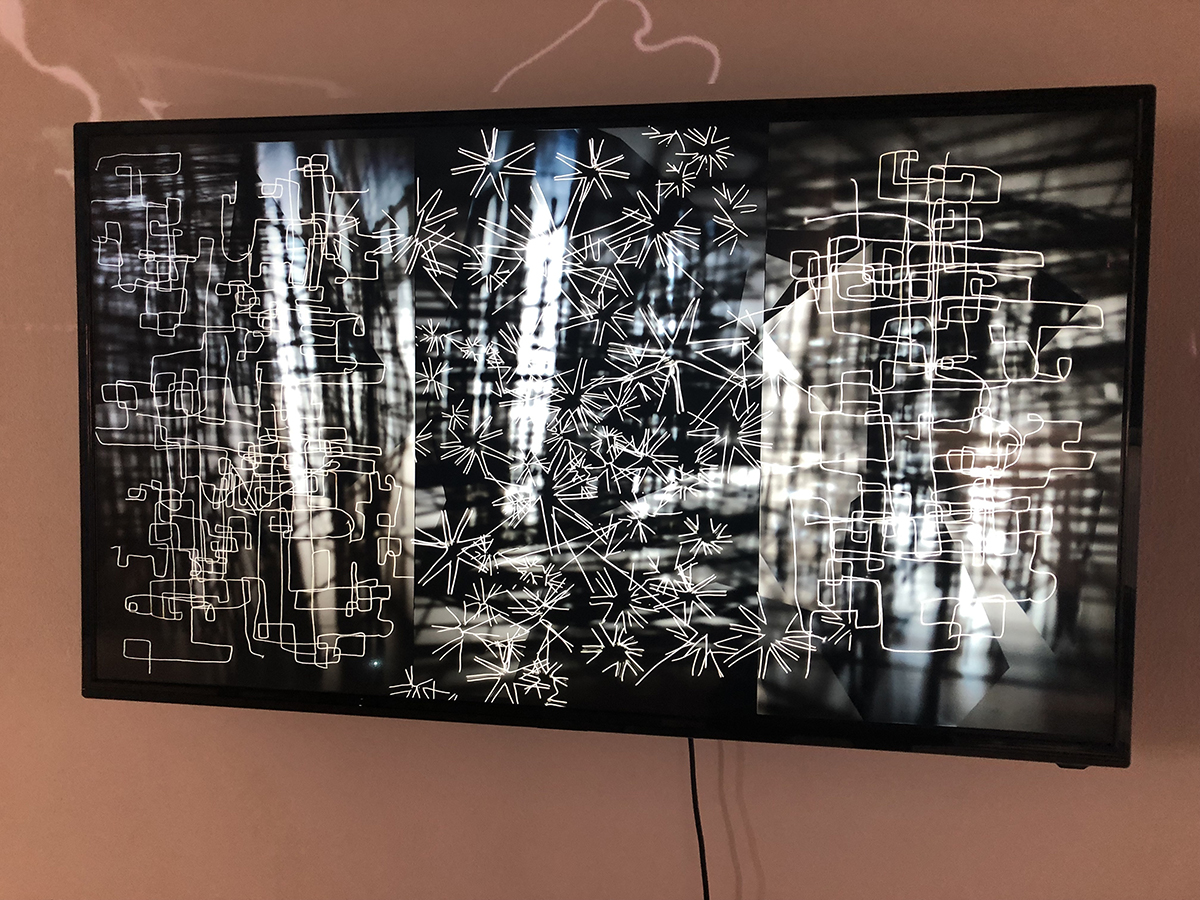
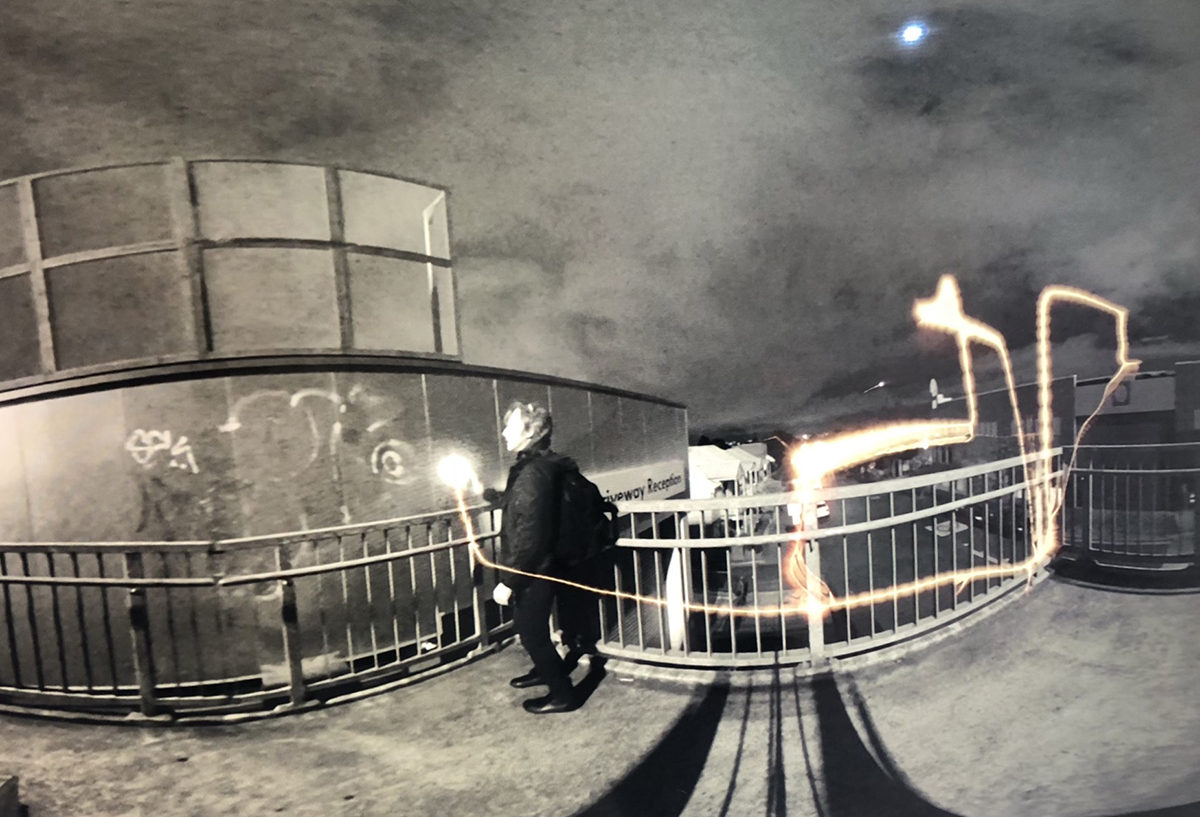
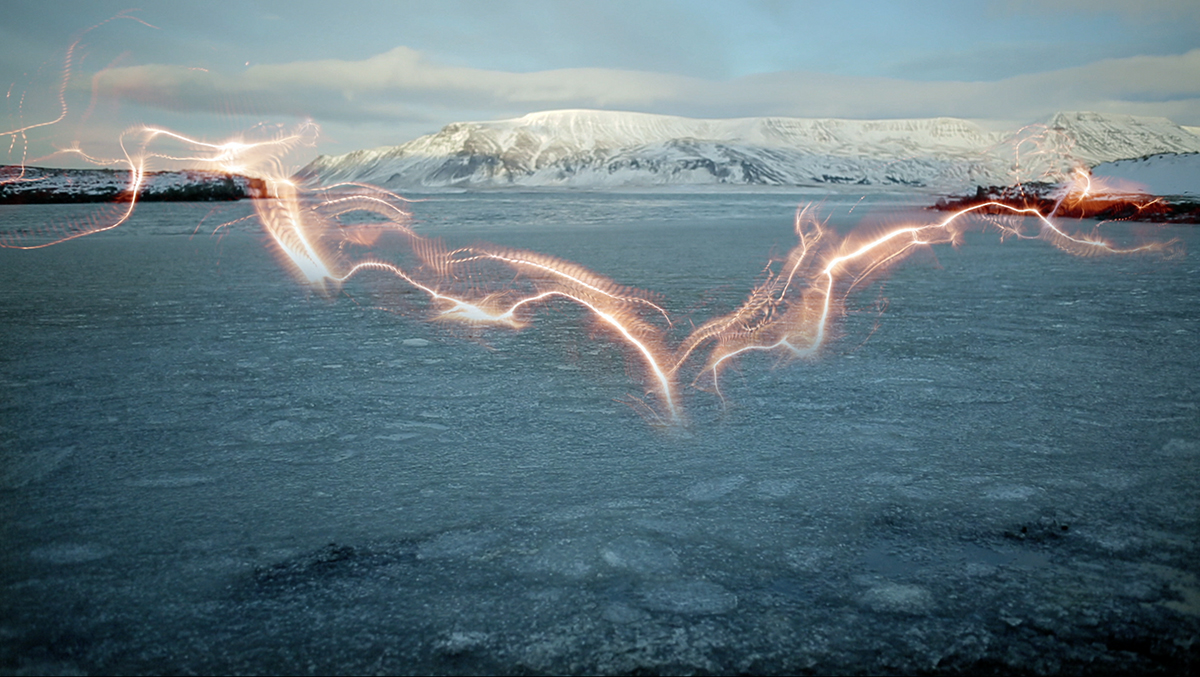
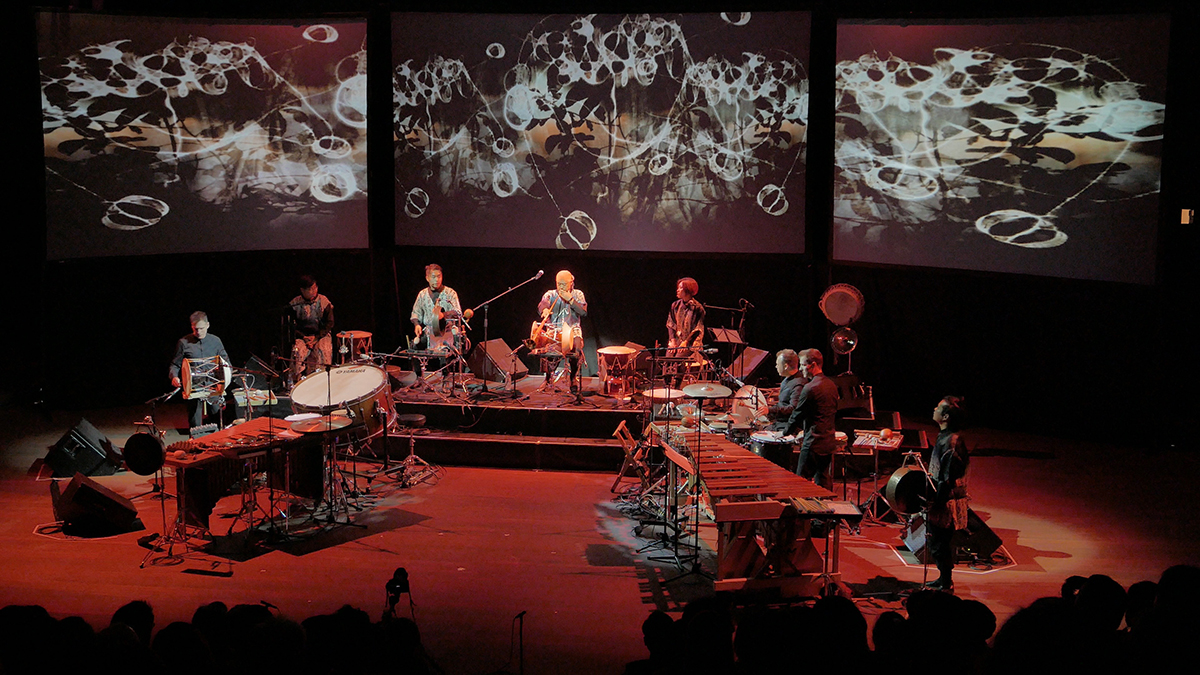
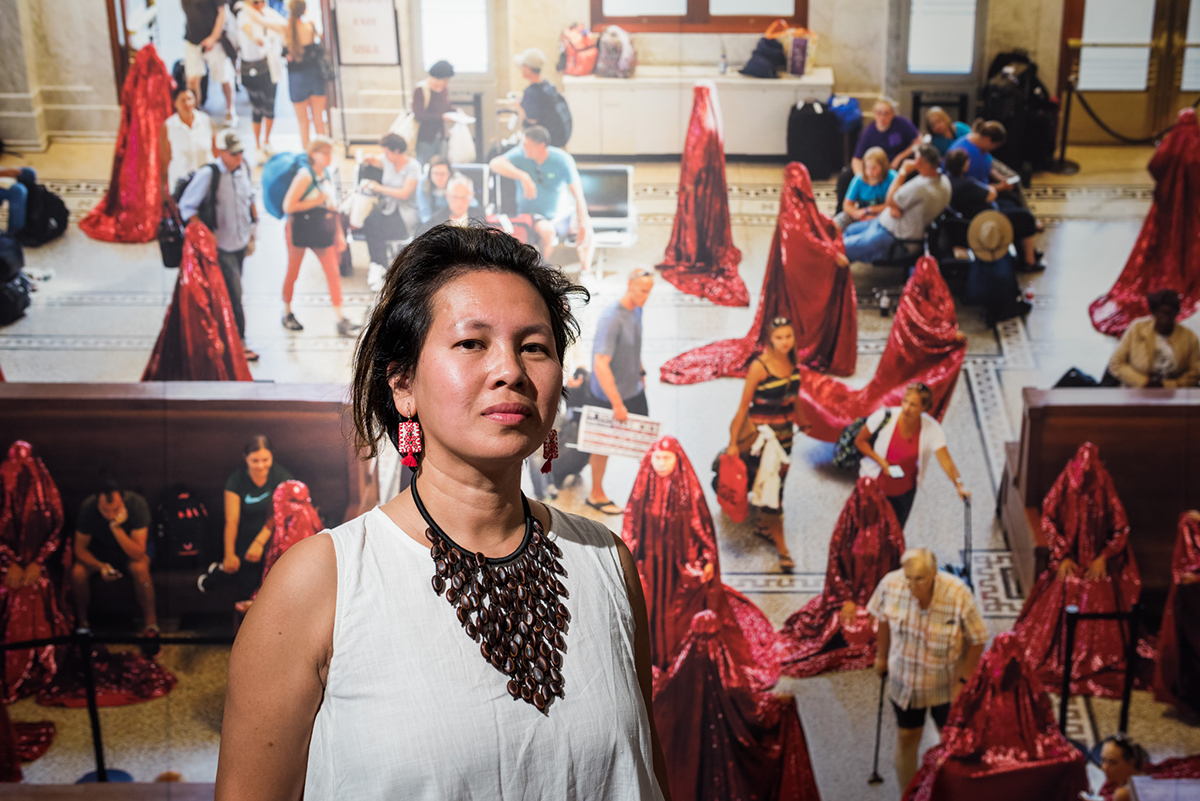
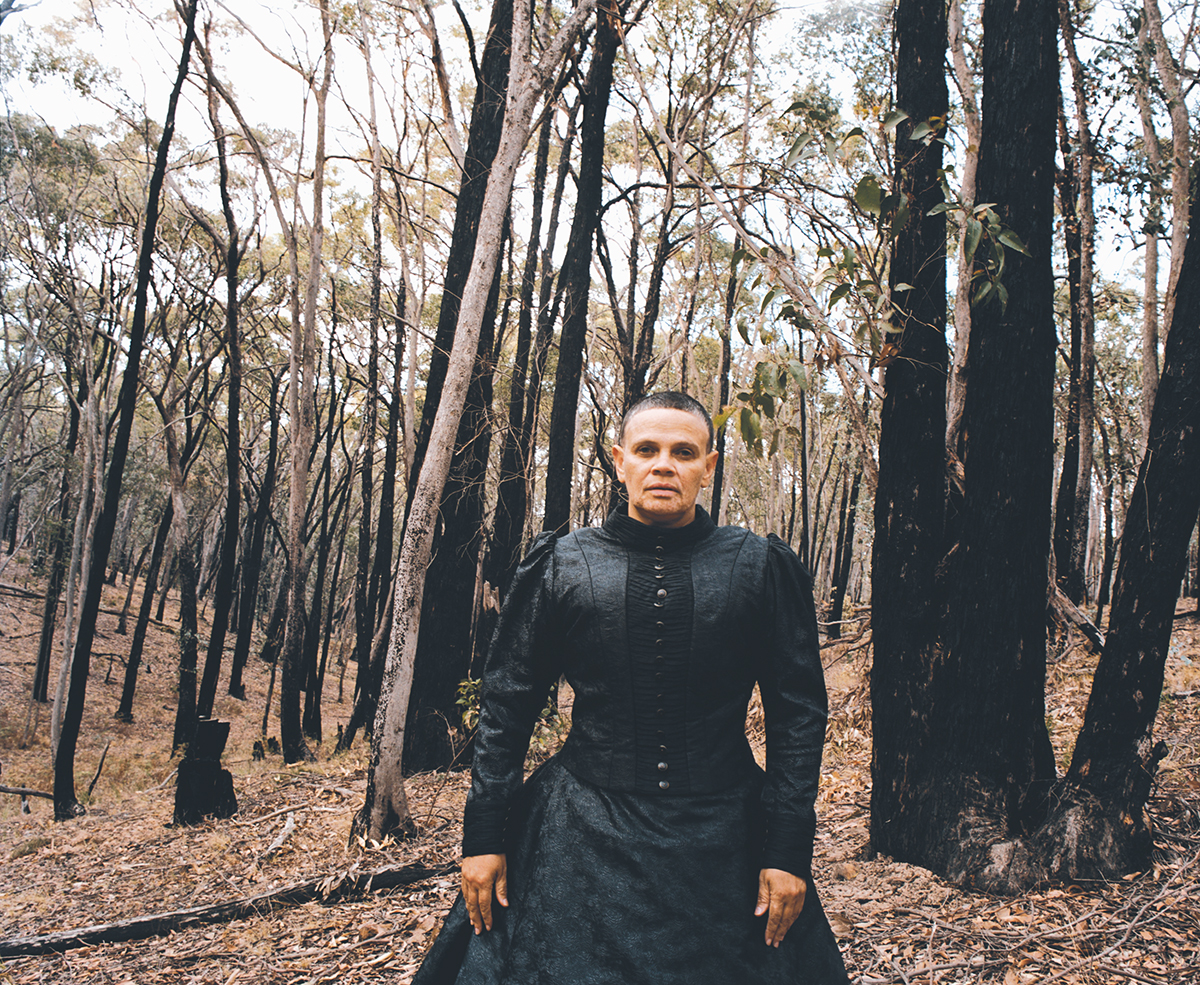
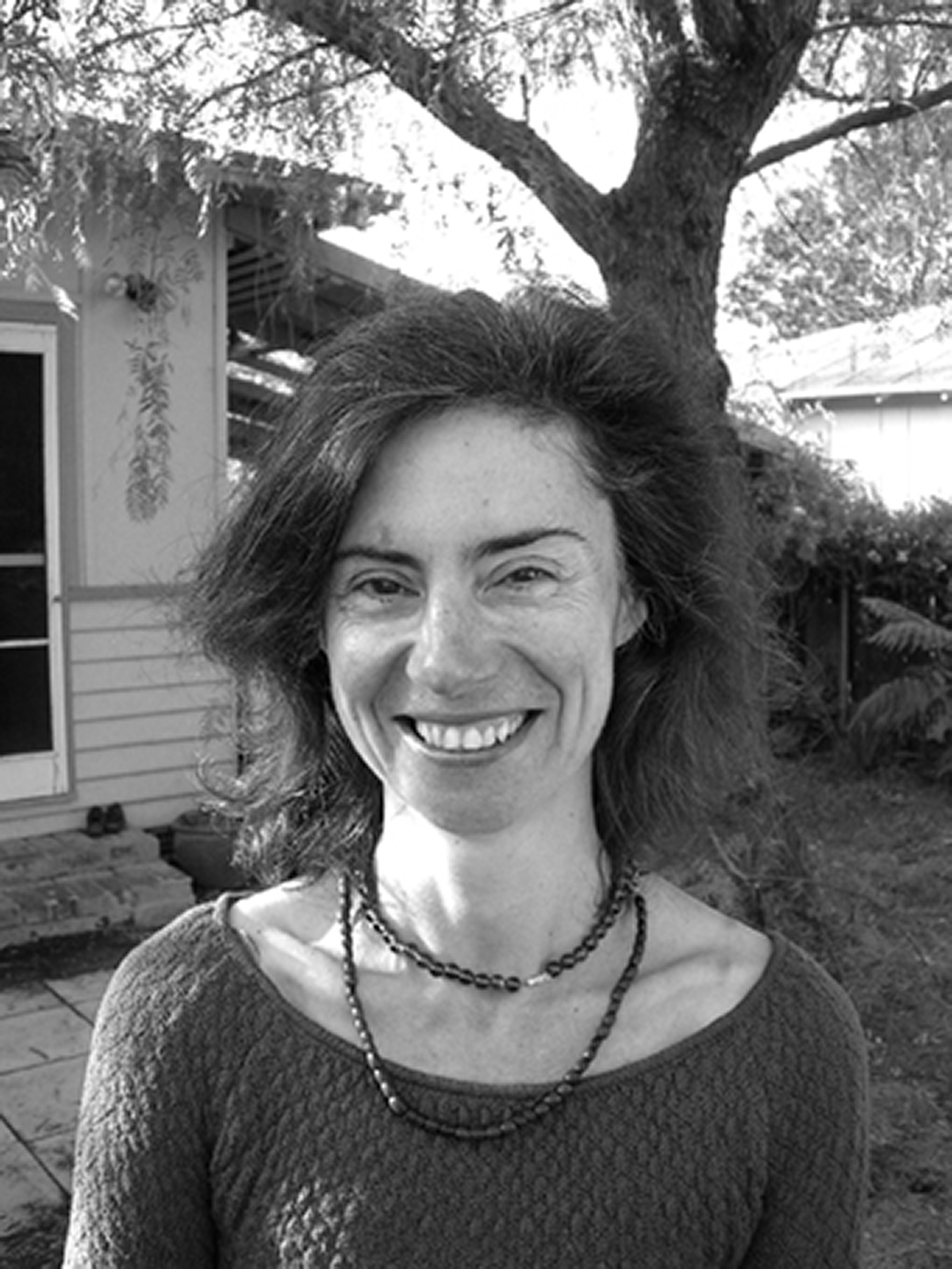
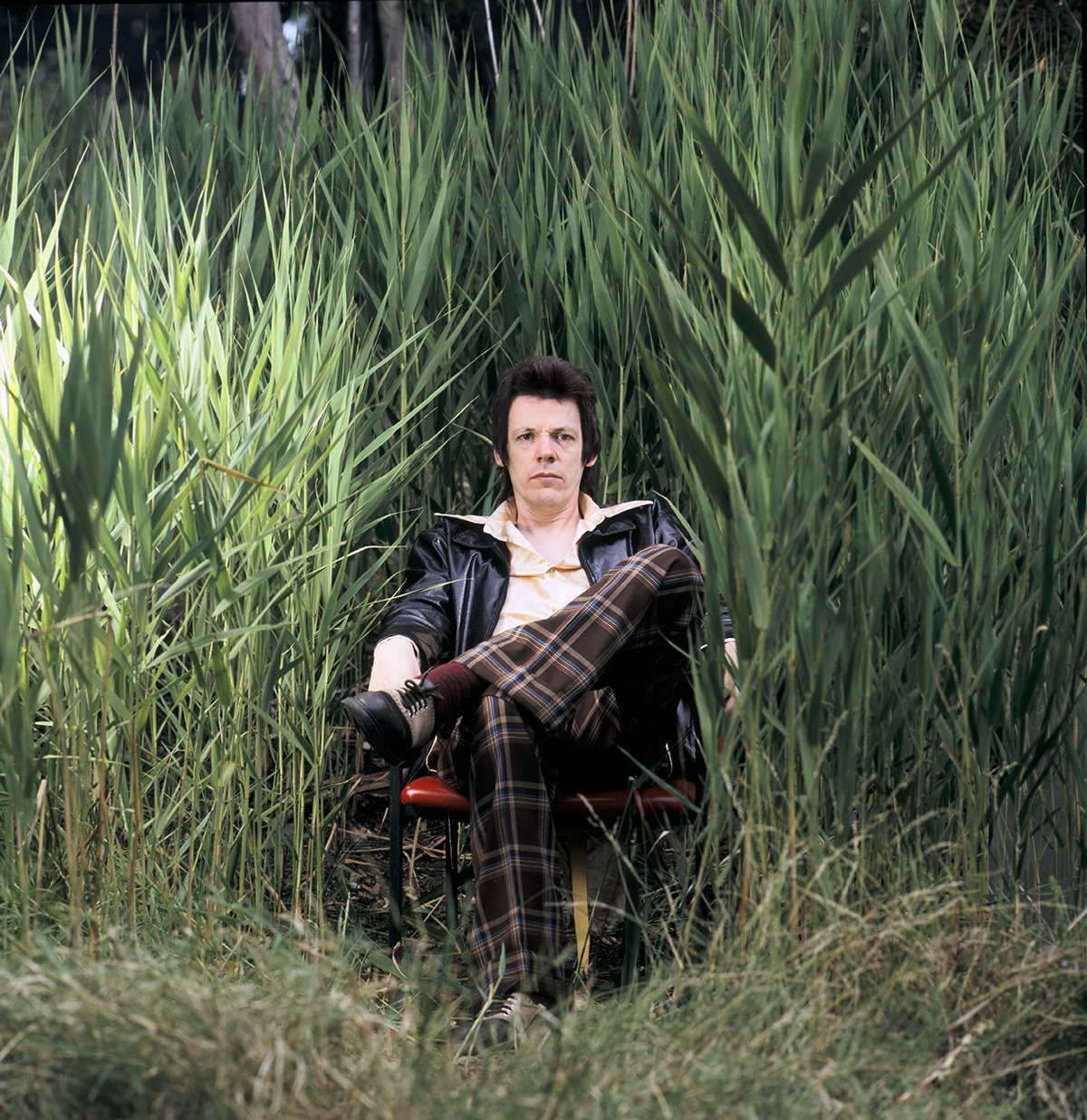
Jenny Fraser is a tough-minded, playful provocateur, a bricoleur who will use whatever media and images are at hand to celebrate First Nations culture and to right the enduring wrongs done by racist colonisation to her fellow First Nations Australians.
Jenny is a self-described “digital native” — a play on her heritage and her intimate engagement with digital technology as it emerged in the 1990s and evolved across the course of her career.
Alongside r e a, Brook Andrew, Tracey Moffatt, Karen Casey and others, Jenny is a member of a trail blazing generation of First Nations Australian artists who boldly engaged with video, film and the new media tools and communication networks of the 1990s. For Jenny, the digital is one means among others, but a key one: “The Internet has been such an important platform — otherwise we would still be in the dark.”
A trained artist and art teacher, she mastered computer art tools, CD-ROM and online interactivity, and employed the internet communally through her pioneering cyberTribe Online Indigenous Gallery (see Djon Mundine’s “Jenny Fraser: The cyberTribe odyssey”) to extend the reach of her own work and that of other First Nations artists here and overseas.
Jenny’s Aboriginal country is the border district between Queensland and New South Wales, the land of the Yugambeh-Bundjalung people. Her language dialect is Migunburri Yugambeh. Land and language are central to her life and art.
Jenny has received numerous awards, including an Australia Council Fellowship in 2012 and the prestigious Australia Council Experimental & Emerging Arts Award in 2022. When asked how she felt about being awarded the latter, she wrote: “The award helped me to survive during the pandemic, while we were being locked down in the Penal Colony. The timing of being notified that I won this was divine, as it was the same week that the University of Queensland reneged on a teaching job that I was doing. It was a precarious time to be an artist. Later that month the 2022 floods came as well, it was apocalyptic, but I was able to manage to keep on keeping on. More power to my ancestors, as I am usually being looked after in this way” (email, 15 Oct, 2023).
Jenny’s work has appeared around Australia, including a history of over two decades or more exhibiting with the Boomalli Abiriginal Artists cooperative in Sydney and more often overseas in galleries, film festivals, public spaces and online exhibitions. She has forged connections between First Nations peoples in Australia, the Pacific and the Americas.
Jenny’s PhD thesis — The Art of Aboriginal healing and Decolonisation (2017) — comprehensively delineates the trajectory of her career and activism, but above all reveals her anger and despair over the limited support offered her and the community of artists she supports. It reflects a turn not altogether away from art (she completed an impressive film, Trouble in Camp, in 2020) but very much towards a long-evolving focus on Indigenous healing and well-being, including her own. See her article Look Good, Feel Good, The art of healing, Artlink, vol 30.
The following discussion with Jenny Fraser about her art comes from a long telephone discussion we had in October 2020 which was subsequently edited with some contextual material added over 2022-23.
Although Jenny’s art is inseparable from her activism, curation and care about Indigenous well-being, I asked her about the why and how of her art practice in order to gain a greater understanding of her motivation, aesthetic and political. We discussed individual works and series and later moved on to address Jenny’s evolution as an artist.
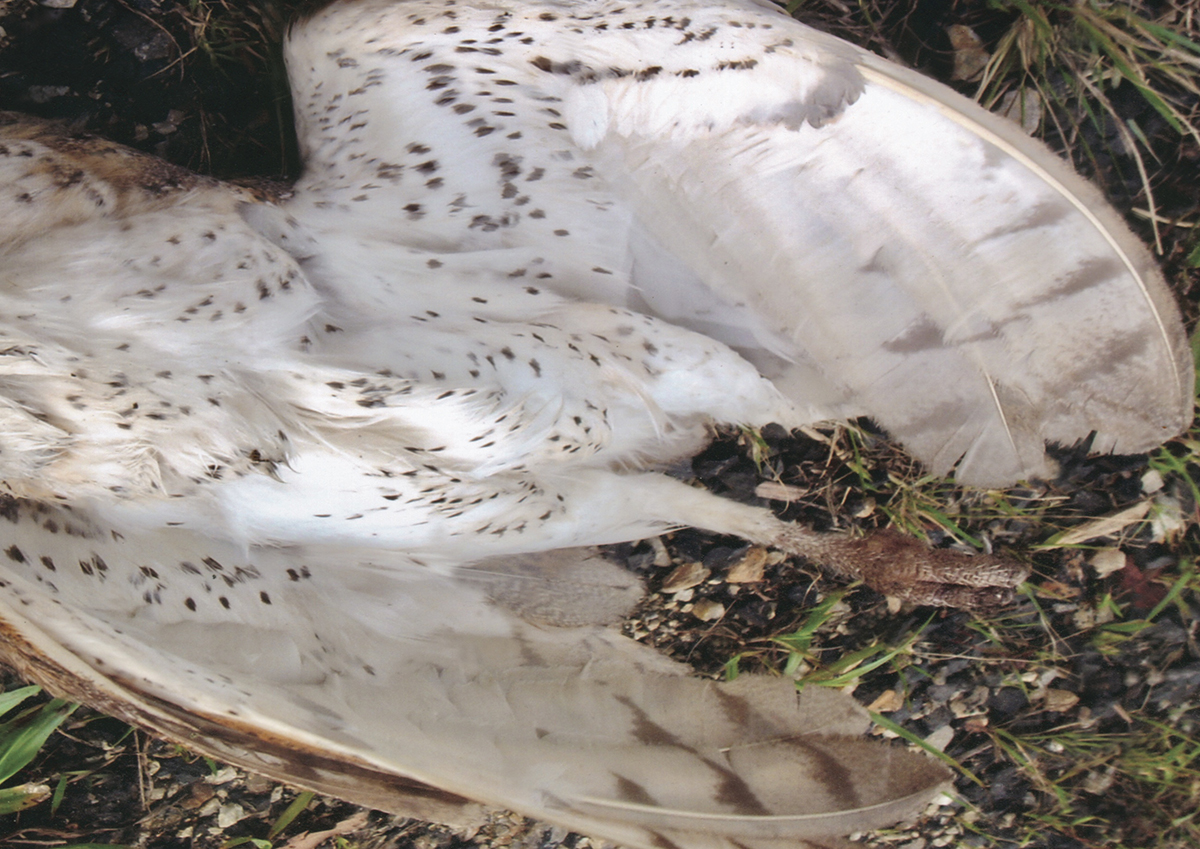
Jenny Fraser, Owl, Hit the Road series, courtesy of the artist
PHOTOGRAPHY AND SPIRIT
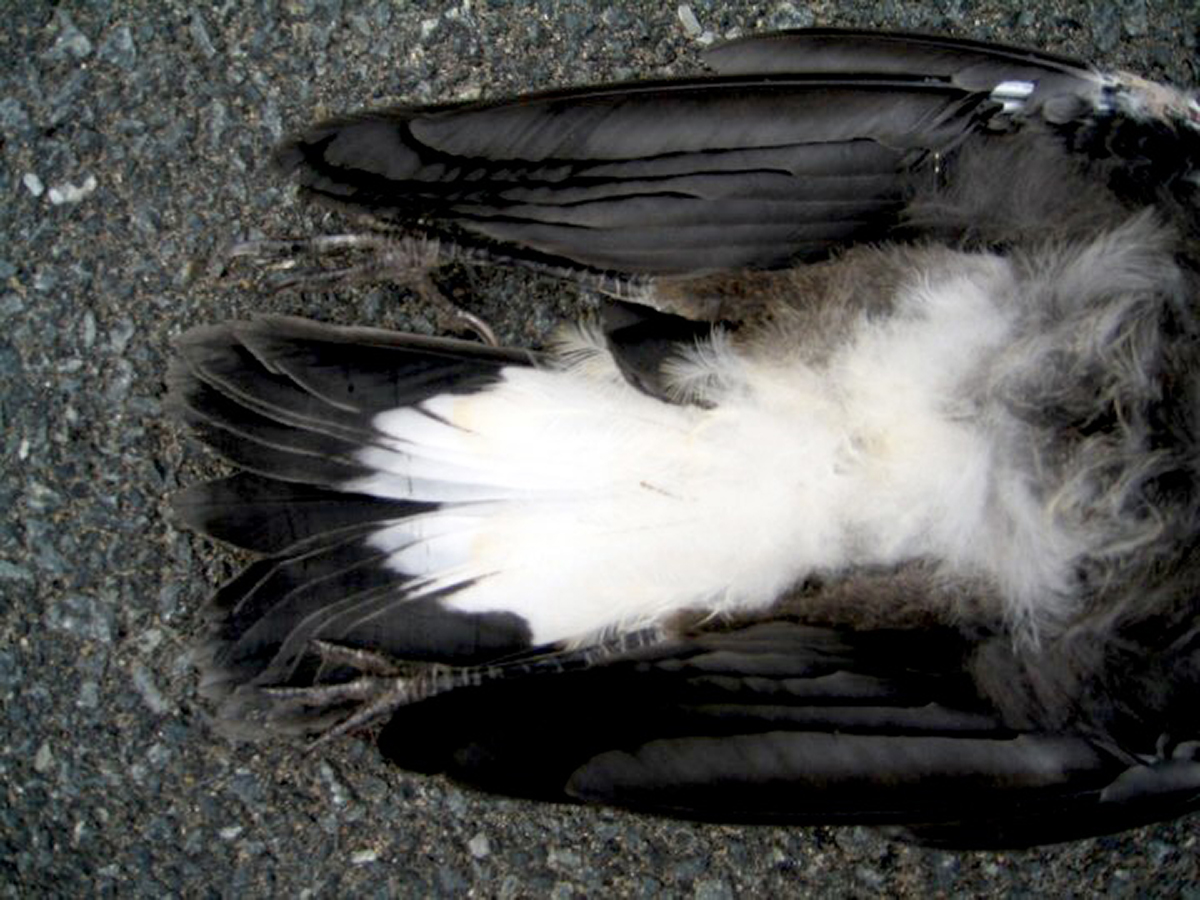
Photography recurs across your output, as in the Hit the Road and Roadkill series. A hauntingly beautiful image of a dead owl in a tryptych in that series appeared in the Feathers Float exhibition you curated at Other Gallery while in residence at the Banff Art Centre, Alberta, Canada in July 2005. It also wonthe Photography Category in the Gold Coast Indigenous Art & Design Award in 2006.
The series was based on roadkill of native animals on lands in the Bundjalung Nation. It’s also representative of how native people are treated by wider society in Australia — widely ignored and denied after impact, just like roadkill.
Jenny Fraser, Magpie, Hit the Road series, courtesy of the artist
The image of a magpie in the same triptych looks rather like spirit photography with the bird’s feathers appearing to dissolve into mist.
I think you’re right, there’s a spiritual realm in photography. With the owl I also left the top of the head off out of respect because it was a bit messy. I found the design on the feathers really fascinating. I have been doing photography for a long time, ever since my Dad gave me my first camera when I was about 10 or 12. I had a practice of making art and photography before I was a professional artist.
Are there many images in this series?
I haven’t counted them, but there’s a lot. I take them all the time. Most times when I see roadkill, I stop — unless I have a lot of a particular species already.
You like creating series?
I like the spontaneity of it where the spiritual realm provides the art department for you; you don’t have to set it up.
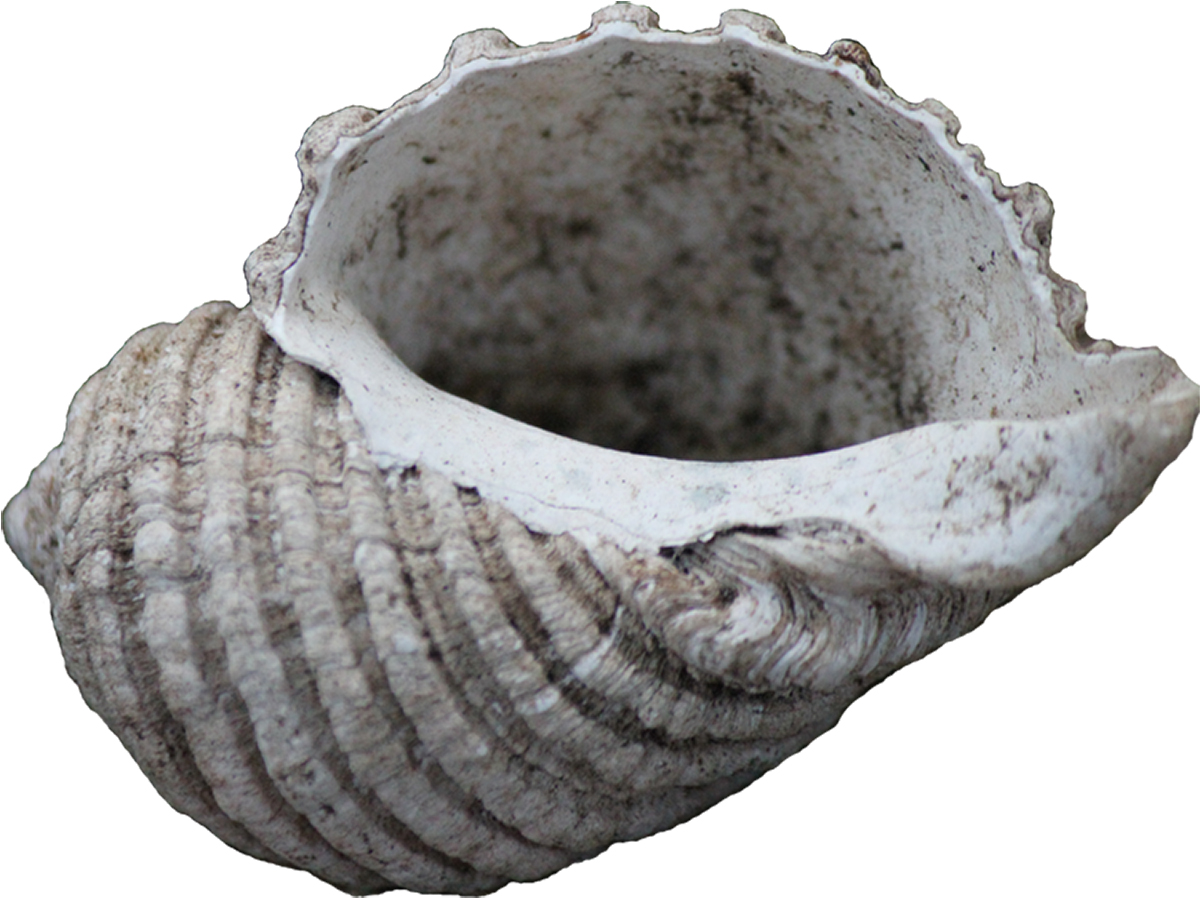
Jenny Fraser, Tallebudgera Shell, 2014, courtesy of the artist
What is the significance of Tallebudgera Shell (2014), a photographic print on canvas?
At the time I was creating another work titled Midden (a collaboration with Native American artist James Luna, Adelaide Festival, 2014). The shell I refer to comes directly from a midden that our old people would have shared at Tallebudgera, which is part of the Burleigh Headland, a national park on Kombumerri Country that’s close to the New South Wales/Queensland border. While I was researching middens I found there wasn’t much out there on the internet about them that I could identify with. I was also trying to get a hold of our ancient shells because you don’t see them anymore. People have picked over them. I wanted to put Yugambeh-based shells into our consciousness of middens.
ANIMATING PHOTOS
You also animate photographs on video, as in I Am What I YAM (2’24”, 2009), with its thumping, ritual-like soundtrack. You like wordplay and making pop culture references; here you use Popeye’s grumpy self-assertion, but what does it have to do with the yams that appear onscreen?
I took a series of photographs in Noumea in New Caledonia and animated it. I couldn’t take the yam home with me, so I staged the photos there. It was made as a joke really. At the time there was a lot of harassment of people with different ideas about gender and sexuality from our government and the church. I wanted to make light of the situation to say how this kind of thing is normal in nature; a lot of plants and animals have different genders and sexuality and they can live with it, so why can’t we? There’s a woman-shaped yam and a man-shaped yam and it’s funny because the man shape is so hairy. The video has appeared in a number of animation festivals.
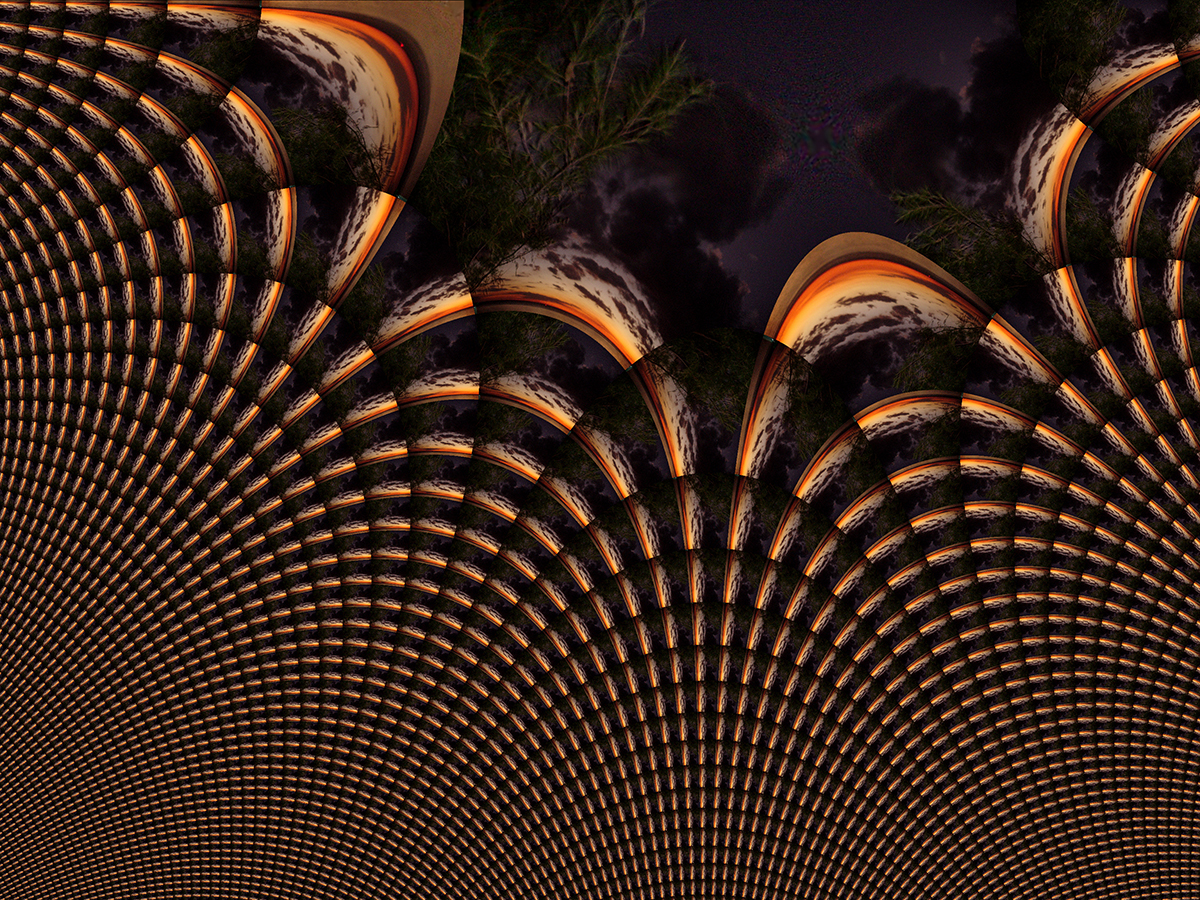
Jenny Fraser, the Creative Cell of Life, computer graphic, 2008, courtesy of the artist
You’ve also created computer graphic works such as The creative cell of life (2008 Darwin Entertainment Centre Gallery).
There are two works in that piece. One is a series of paintings, a triptych; the other was created on a computer. It’s like a mandala. Maybe it’s the view from the perspective of a cell.
It looks like a layered series of arches with dark, rainbow-like patterning. It’s quite striking. How did you create it?
It’s a sunset I’ve manipulated to create that rainbow effect. It’s related to cells because it has that rounded kind of structure.
True to the title it has an almost a cellular look.
Yes, and repeated. I referred to the work with a quote from Aboriginal scientist David Unaipon (1872-1967): “She gave birth unto the first female of life of flesh and blood, the mould and pattern for all the mothers of the Earth. She endowed her Infant Female Child with faculties and powers to conceive just what the human race is today.”
Jenny Fraser, Nokturne, computer graphic, 2006, courtesy of the artist
Nokturne (2006) is a graphic artwork in which a 1950s Australian suburban house is embedded in Aboriginal cosmology — the sun, earth and sky each with their own distinctive patterning.
That was another series because at the time I was interested in Aboriginal architecture. I took examples of mainstream Western architecture and placed them in the Aboriginal landscape. I was trying to make a statement: it doesn’t matter what something looks like from the outside, the essence of Aboriginality is always there.
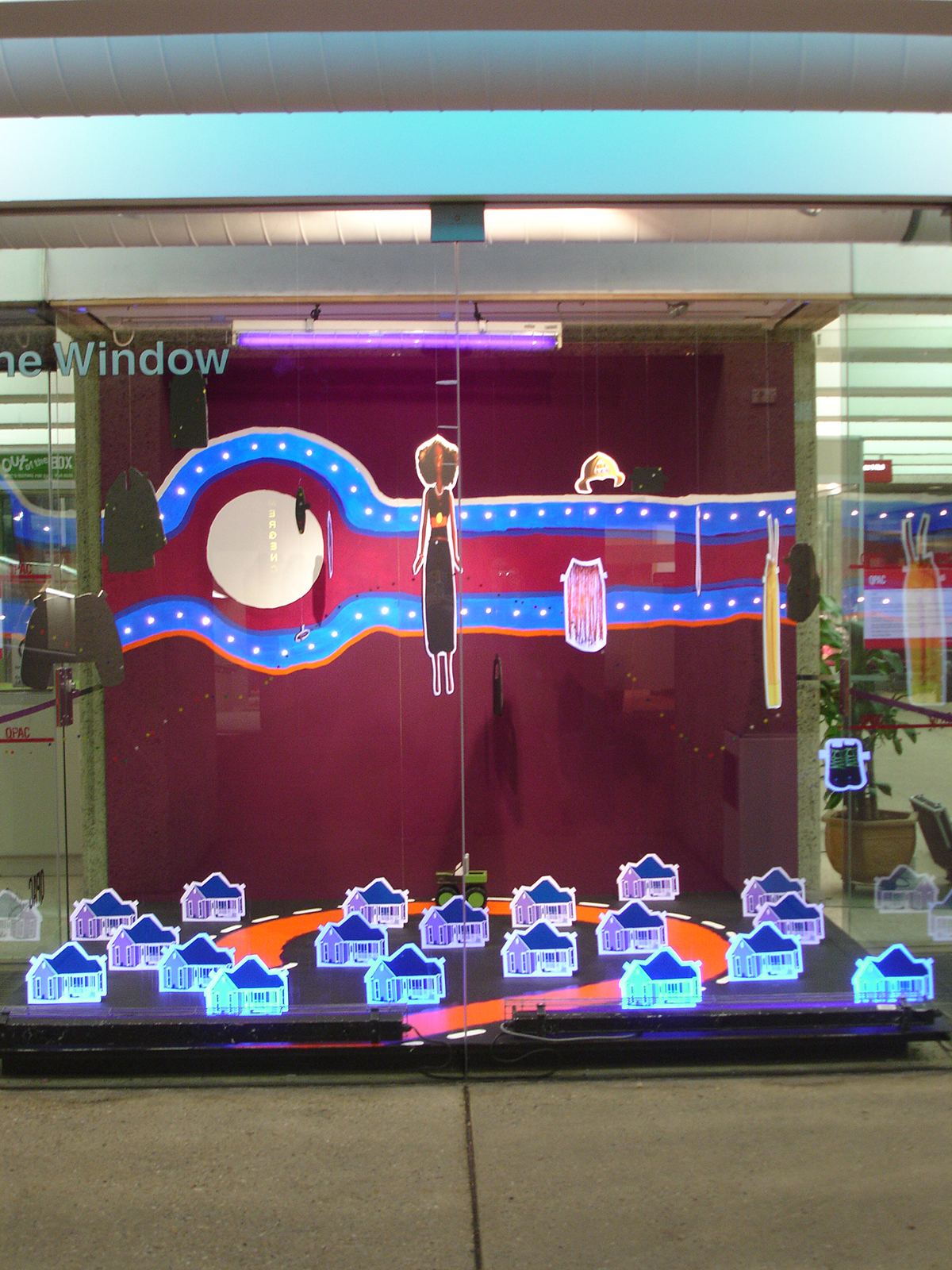
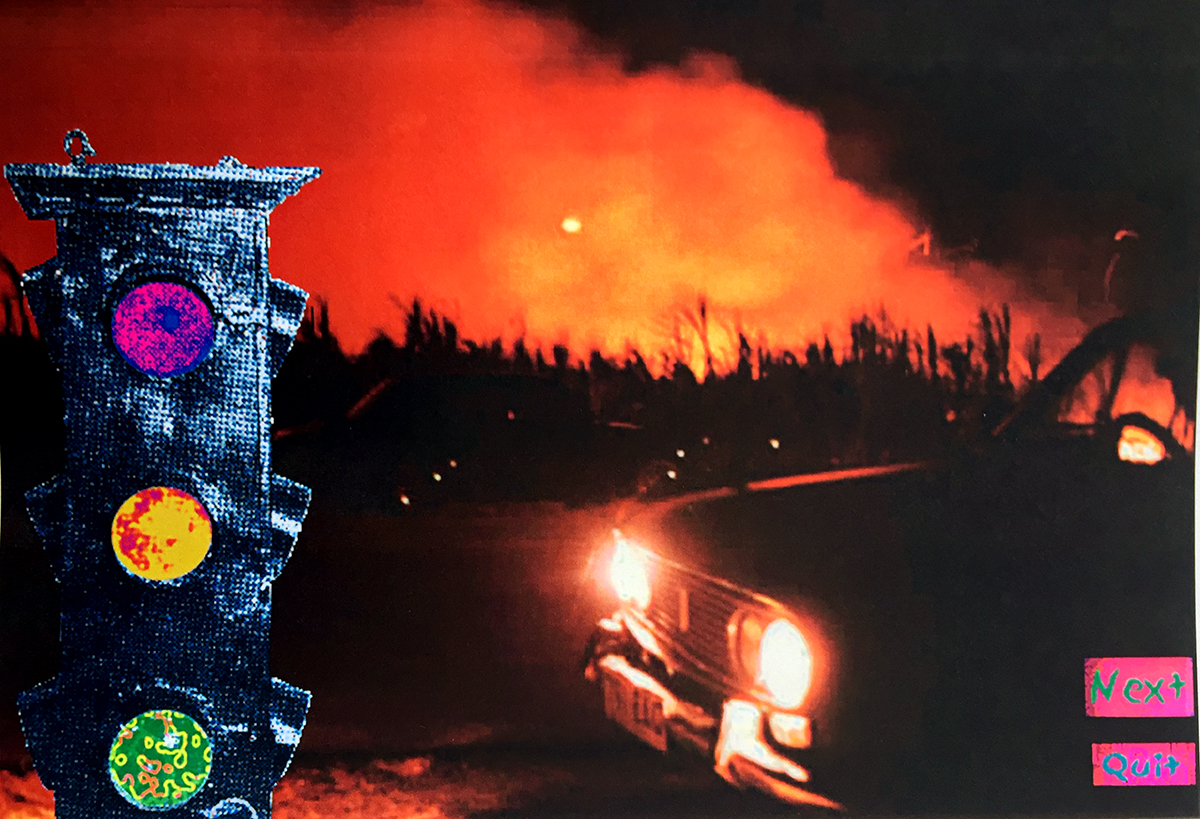
Night-time crops up repeatedly in your output, as in in Hot August Nights (2006) and in Cut it out (2006), an installation for NAIDOC week in the window of the Queensland Performing Art Centre (QPAC). You evoke a purplish twilight heading into night. It’s quite seductive. The installation included a cut-out “Brown Babe” doll.
I grew up in far north Queensland and that’s the normal time when you visit people and get creative because it’s a bit cooler. It’s too hot in the daytime to do anything. The housing estate that Brown Babe floats above could be where she lives — or where any of us live. The houses themselves are also cut-outs, replicating suburbia in a time gone by or a time in the future. Brown Babe has risen above suburbia. She enacts culture to forget and to remember. It uplifts her spirit.
Faster Food, photo-montage, 2005, courtesy of the artist
“Fraser’s works are intelligent and witty, with a wicked sense of humour that belies the seriousness of her approach. For example, her deeply iconic Faster Foods critiques the fast food industry and consumerism, references Australia’s choice of national symbolism and the QANTAS logo, and raises questions about the appropriateness of hoofed animals in Australia and this country’s entrenched eating habits. Because her image taps into so many existing representations of the kangaroo, both literal and metaphorical, it’s possible to read it on many levels, despite its surface simplicity. With Faster Foods Fraser has succeeded—very cleverly—in appropriating the appropriators.”
You work a lot with photographic and video montage. I’m curious about Raw Roo (2005) with its ironically alarming “Kill Faster” sign. How did you put this work together?
That’s from my Faster Food series begun in 2002. I’d seen a T-shirt that had a dog chasing a cat. I wanted to ‘Indigenise’ that and make our own. So, I came up with “Faster Food.” I’ve had a long-term interest in bush food because my Dad was a hunter. When I was a kid, I used to go with him all the time and harvest or catch bush food or birds and also identify a lot of plants. I wanted to bring him into it a bit. He killed a lot of kangaroos as well. So, for that piece I used a pin with a little golden kangaroo on it, like the souvenir that you take with you overseas. I took a photo of it and heightened its colour in Photoshop, to create the look of a neon sign.
In your artist statement you called Faster Food an anti-ad, describing it as “positive propaganda.”
To encourage the Indigenous community to be mindful of their genetic makeup and eat more healthy foods. To ask why don’t we have the option of eating fast foods that are native to this land. Think about the kangaroo. In urban society we usually only see it as a gourmet delicacy or pet food… it’s modern day kitsch food! The message of Faster Food comes out of the black — telling us we need to go ‘black to basics.’
Have collage and photo-montage been important in your work — that cutting and pasting, rearranging and juxtaposing?
Yes. I showed Faster Food on a light box, perfect to get a neon glow. Other montage works I present on paper. An exhibition featuring one of my collages has toured overseas because the curator of Contemporary Australian Drawing, Dr Irene Barberis, took all the works with her in a suitcase. I did draw but it was mostly a photo-montage, titled “vultures of Cultures.” It’s good to have transportable work like that.
I’ve been using a collage practice for a few decades now. I like it because it’s recycling and I don’t usually do it on a computer, I do it by hand. I can’t bear to throw out striking images. A lot of the time, when you look at magazines, there’re hardly any good images so I try to pick the good ones and rearrange them how I want — that’s my power in the process.
Jenny Fraser, Mumsy’nt, collage, 1999, courtesy of the artist
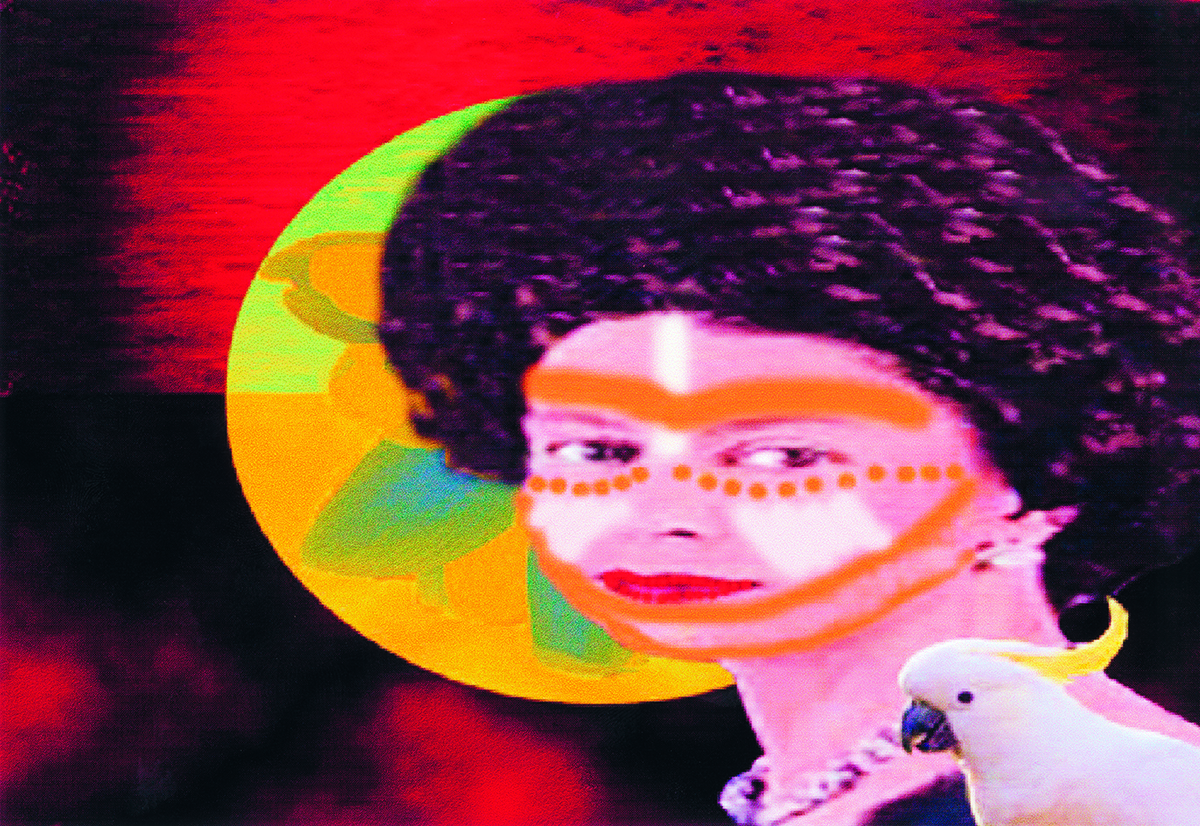
I’m curious about the Mumsy’nt (1999) collage which features Queen Elizabeth pictured in front of the Sun.
I’m glad you read it that way; other people haven’t recognised the Queen. They think I’ve used a picture of my Mum or Grandma. I wanted a picture of the Queen and at that time I couldn’t find that many on the internet. Historically you weren’t allowed to use or deface photos of the Queen — it was actually illegal. The only picture I could find was from a monarchy website in Canada where she looks very young.
It’s a funny, ambiguous title.
I was trying to use humour to make a statement. At that time some ATSIC (Aboriginal and Torres Strait Islander Commission) representatives went to talk to the Queen about some issues because they weren’t having any luck with the Australian government. She refused to speak to them. It would have helped if we had a treaty. Indigenous peoples in other countries, such as New Zealand, can call on their treaty and the Queen has to respond. I don’t actually agree with the idea of a treaty myself. I think that you can break a treaty as well as keep it. But I was horrified that the Queen could be so disrespectful as to ignore Aboriginal Elders. So I wanted to ‘indigenise’ her and to envision what it would be like if we had a monarchy that was supportive of Indigenous peoples all over the world. The Sun references the Aboriginal flag except it’s upside down, which makes it the international distress signal.
Is this a work that you printed and distributed?
I showed it for the first time at the National Aboriginal and Torres Strait Islander Art Award in Darwin around 2000. I also submitted it for the NAIDOC art poster in 1999. I think some people were scared to disrespect the Queen so they didn’t use it, but I got some good feedback. In news stories about the NATSIA awards people would stand in front of it. I think subconsciously they wanted to use it. I also gave the copyright for its use to RMIT (Royal Melbourne Institute of Technology) when they had a conference in 2001 titled Treaty, Trick or Truce. They used it on everything — posters, T-shirts, badges, bags. So it got disseminated a lot.
You’ve developed a variety of practical strategies for getting your work shown.
Some ways of working are so expensive: prints, framing, mailing, freight. So, along the way, I turned to what I could mail easily like DVDs, little prints and stickers and whatever. Then I got to the stage of doing photo books. The Chinese artist Ai Wei Wei talks about how we can use photo books as transportable exhibitions, which is true. Sometimes I would mail out a book with everything which can sit in a gallery as well. It looks really professional whereas a piece of paper doesn’t. I make a few, but I don’t farm them out as books, more as artefacts.
ANIMATINGS
Let’s talk some more about animation. Tell me about Nature in the Dark II (2015), which appears in Unlikely, La Trobe University’s online Journal of Creative Arts. The unusually vivid purple and red-fringed sea creature is accompanied by a powerful soundtrack.
I was asked to collaborate on an art-science project titled Nature in The Dark for my role as an Associate Member of the Centre for Creative Arts at La Trobe University. I was given a hard drive featuring images from various locations and from it I chose Bunurong because I wanted one with an Aboriginal name and I think that was the only one. Bunurong National Marine Park is off Victoria and is also the name of the traditional owner group within the Kulin Nation. I wanted to make the jellyfish dance. It’s just a simple thing, just over one-minute. I was fascinated by the other-worldliness of the underwater life there. My intention was to manifest an Aboriginal aesthetic in the work, to communicate old and new cultures across languages and other borders.
For the soundtrack, I used a work by Mark Atkins. The main instrument in the composition is a bull roarer — just a piece of wood on a length of string, swung around to make that noise. It has an otherworldly feel. A Native American filmmaker really loved this, because they have a similar instrument in the USA.
Jenny Fraser, australienation, video still, 2015, courtesy of the artist
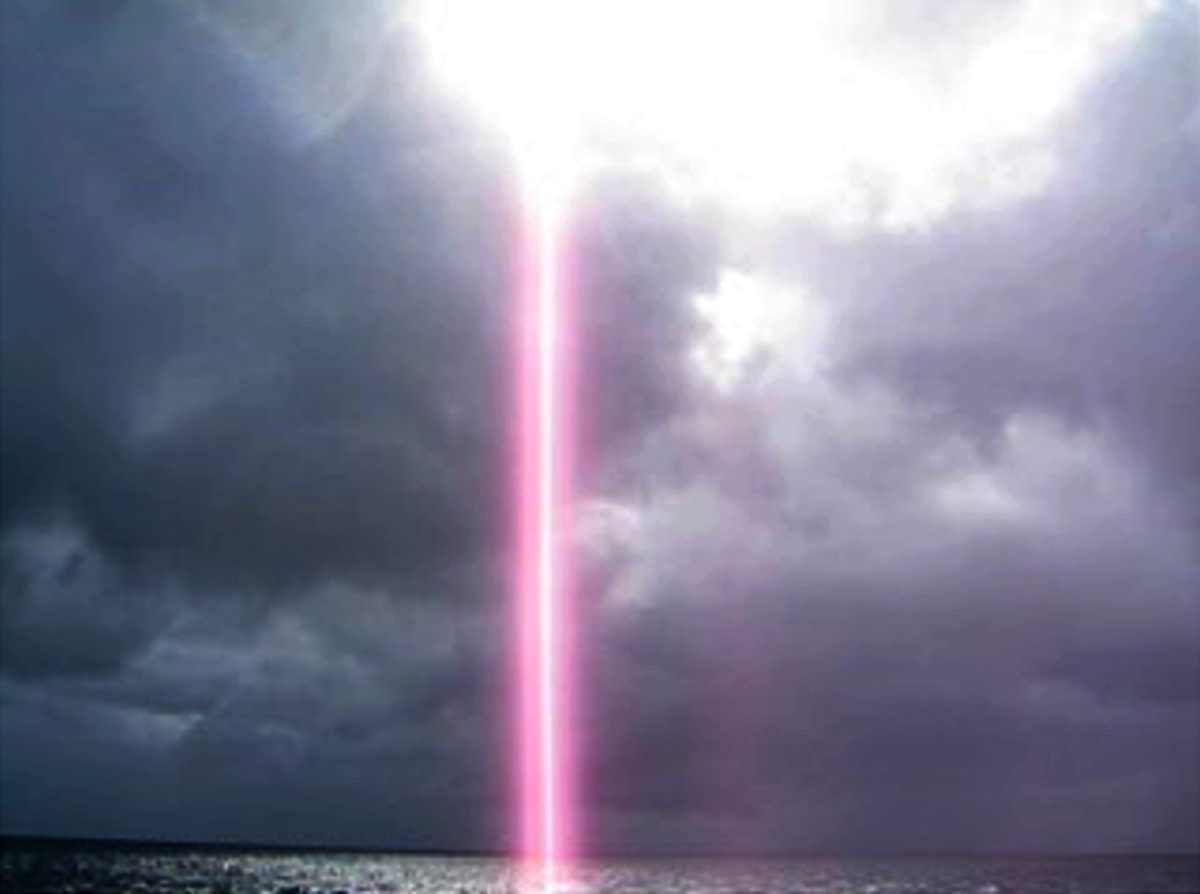
You were invited to contribute to the Forever Now project by the Melbourne artist-led experimental art organisation Aphids, in which works by 44 artists were put on a gold record to be sent into space — a follow-up to the Voyager Golden Records sent in 1977 by NASA. Your contribution, australienation (2015), is a short, striking animation in which a sudden ray of light appears over a dark ocean. How did you capture that image with its a sense of awe and ephemerality?
The video was taken on the Great Barrier Reef. Some people think I’ve manipulated the picture, but the ray was just the result of lens flare on the day. The light is spectacular out on the reef. It’s also to do with movement and capturing the sun. It’s a simple work that I like re-using, so I used it again for australienation. I wanted to communicate something historical: we have this beautiful Great Barrier Reef and in a couple of decades it will be dead, so the time to act is now and we can reflect on it later. So, I sped up and then slowed down the video and I kept doing that so the image has a very unreal kind of feel, because it’s losing and then gaining frames.
Ruby Wharton in Jenny Fraser’s Trouble in Camp, film still, 2020, courtesy of the artist
FILM: A FIRST NATIONS PERSPECTIVE
You’ve moved on from making short videos, like the politically satirical Name that beach movie II (2014) to Trouble in the Camp (2020), an ambitious 30-minute film which premiered at the end of 2020 in London’s Native Spirit Film Festival, an annual event that celebrates the world’s Indigenous cultures.
The whole point of making the film was because not many people in Queensland make films. It’s so culturally oppressive here: hardly any Indigenous films are funded and even fewer get made. If you’re an artist wanting to make a film, you’re told by the arts funders to go to the film fund, then vice versa, which is really complicated and so unnecessarily stressful.
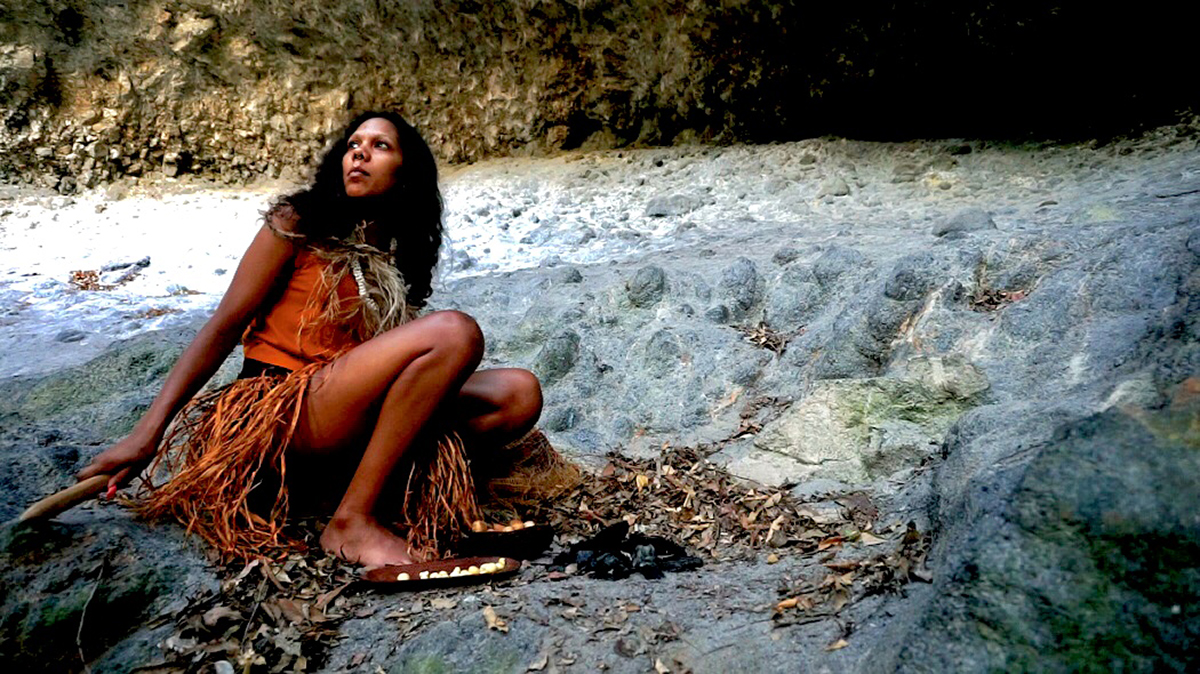
In the film, we see a girl in country. She’s integral to it, living alongside animals, birds and insects. Then she appears as a worker in a mid-19th century frontier kitchen, and then in a protest challenging the Commonwealth Games in Brisbane in 2018.
Jinda, the young woman, played by Ruby Wharton, is reincarnated over different lifetimes. Each character is actually based on the life stories of my old people including a CleverWoman, a midwife, an artist and an activist. The film has a unique structure that I’ve been working with and developing in other art forms, including the other[wize] series, and my upcoming novel, for around two decades.
The film brings together your strengths in editing and montage and the use of sound. How was it pulling it all together?
It was only a good feeling when it was finished! I filmed it over a decade and it’s taken six months or even a year to edit. I suffered a lot of anxiety over it and procrastination made it worse. All the sort of stuff that artists go through. I know now why ‘wellbeing’ for filmmakers is spoken about, because it’s a very lonely process.
In the first section, the beauty of the lovingly framed images and the rhythmic editing between Jinda and the bush creatures is perfectly supported by the music. Where did the music come from?
I wanted to make a showcase of a number of Aboriginal musicians. I thought, if my film travels I can take a few of them along with me. I was lucky because although I didn’t have any money most of them, such as Fred Leone, OKA, Eric Avery, let me have their songs and were happy to share the love. I was also lucky I had filmed the 2018 Commonwealth Games protests about the disadvantaging of Australian Indigenous and Torres Strait Islander peoples, and although I didn’t know Ruby Wharton very well‚ I knew her father. She turned out to be one of those young people who are into everything — organising, protesting, performing spoken word.
Jenny Fraser, installation, Next Wave, 2006, courtesy of the artist
INSTALLING A COUNTER-VIEW
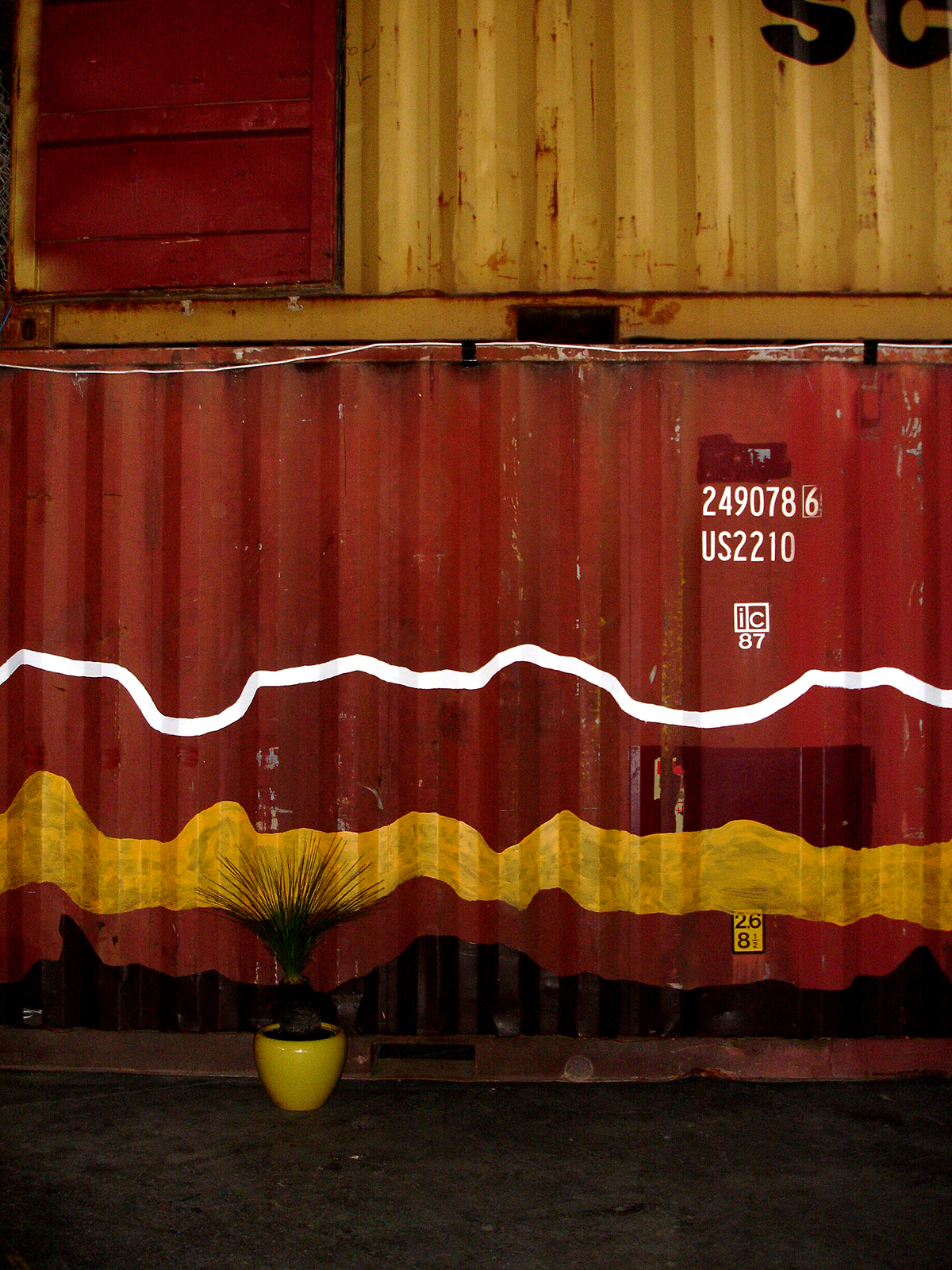
You’ve also made a number of installations. In Outblack (2006) for Melbourne’s Next Wave Festival, the Blackout Collective, in a collaboration between yourself and Cameron Goold, placed native grasses in and around a shipping container, effectively declaring country to be uncontainable by the tools of globalisation. At the same time, your title reclaims country from the notion of “outback” by converting it into “outblack.” Have you done much in the way of installation?
In Outblack we presented ancient native Australian plants such as Cycads and Grass Trees (‘Black Boys’) and the idea of the ‘uncontained’ and the issues around native versus introduced, inclusion versus exclusion, and ancient versus recent.
I gave installations a rest for a while because it’s so complicated when you have to work with other people — like installers in galleries who have different ideas or levels of commitment. That was good for The Containers Village, but it was also really limited — I wasn’t allowed to paint on the outside of the container. Some people were but you had to get permission beforehand, so I only got a few lines in before I got in trouble. I actually wanted more plants but because I was working in Victoria it’s more difficult to access plants and really expensive. I’m not used to that because in Queensland we can just walk into our yard to get plants, they’re everywhere.
I do enjoy working on that scale. I showed a similar work in 2009 for the Strand Ephemera art walk on Townsville’s Esplanade, with australienation showing in a container. I think there’s a lot of resonance with a shipping container, because it speaks across cultures, it speaks a lot to the Asia-Pacific region and also Africa.
Jenny Fraser, Yanbali Gawulah, 2006, CD-ROM screengrab, courtesy of the artist
CD-ROM: RE-ENACTING & RE-CONNECTING
You embraced CD-ROM while it remained a viable platform, including one accompanying your PhD, titled Get Creative! The Art of Healing and Decolonisation (2017).
I did a couple a decade or so before my PhD. One is called Yanbali Gawulah (2000) which is a Yugambeh saying that translates as “walk around far” — sort of like, “walk on country seeing different things.” I would have done more CD-ROM works at the time but it wasn’t easy — all that coding. A group in England called Mongrel gave out their software so I did a CD-ROM called other[wize]. It was shown in Brisbane and at ISEA2006 Inter-Symposium of Electronic Art in San Jose, California. The structure of Yanbali Gawulah is actually the basis for the film Trouble in the camp, in terms of the scenes.
In what way?
Nine frames in the CD-ROM lead to nine stories, each with a Yugambeh word, so it’s similar to the film which I’ve broken up into six chapters. In the film each one starts with a word which sums up the whole scene, if you know the language. The CD-ROM was based on my family history, celebrating the people and place of Yugambeh in South East Queensland and my family’s movements beyond, using old family photographs, Yugambeh language, sound, along with contemporary documentation of country and remembering.
With the film I’ve done the same, re-enacting family stories. The viewer might not necessarily understand that, but I’ve used my knowledge of my family and country to tell that story.
You’ve also explored the possibilities of online interactivity with a work titled unsettled, adapting some of the CD-ROM material (see a video walkthrough of unsettled above). It received an Honourable Mention at the imagineNATIVE Film & Media Arts Festival in Toronto in 2007. You wrote about it on Vimeo :
“A vital aspect to the development of ‘unsettled’ was a process of revisiting and an exploration of country, learning and using Yugambeh language and other opportunities for re-connection to make sense of lived experience and also understand the extent of trans-generational trauma derived from massacres and the many other injustices of the day. Through engaging in this process, and gaining strength from my family’s own inner knowledge and solutions, the project stands as a legacy that allows my family stories to be offered up as an alternative to the mainstream Queensland version of the history of colonisation.”
BECOMING AN ARTIST: ART WAS MY FRIEND
How did you start out as a young artist?
I went to a lot of schools, about 13 in all. Basically, art was my friend, my outlet for a stressful home-life and a way to relax and to deal with the heat. I was naturally good at it, based on what other people were saying, but I just did it because it was peaceful.
At what age did you start drawing and painting?
I’ve been doing it all my life, but I won my first award when I was 12. Just a good little art show award in a place called Giru near Townsville. That was actually about the Great Barrier Reef as well. It was an underwater scene that had a scuba diver with coral, done with craypas. Then I started taking photographs when my Dad gave me a camera. It was lucky because when I was in high school, in our senior years, we had an elective for photography and then later videography. We had a Canadian teacher who would offer that instead of sport — you know, lawn bowls on a Wednesday afternoon. We used to make our own ads for Jag or whatever and do trick cinematography.
That was a good start. Then when I went to the University of Queensland I began to miss doing visual art, so then I changed courses to Art Teaching at QUT instead. My other major aside from Art was Film and TV; I really loved that. It wasn’t just practical it was also theoretical. We did gender and media studies. That’s where I learned to be critical. I started writing critically about unpacking issues in Australia. After that, I became an art teacher and taught photography and film theory as well. When I was studying I didn’t really care about visual art that much because I found it easy to put more effort into and find more excitement in film and TV. So my practice has always been somewhere in the middle.
When did you start making work for exhibition?
I was exhibiting in Cairns in the 1980s, but no-one ever talks about that, not even in Cairns. (LAUGHS) Back then, there used to be exhibitions in shopping centres, so it was like grabbing people as they walked past. The mainstream is just such a non-art society. The Cairns Indigenous Art Fair is up there but it’s run by outsiders and actually ignores the locals and focuses on Torres Strait, Cape York and Stradbroke Island art and flies artists up from Brisbane all the time. It’s still like that even though some people have managed to rise above it and engage with the art world elsewhere in the world.
In the 1990s, I went to the University of Queensland and exhibited with their Fine Art Society. Then I changed to QUT and showed mainly in student exhibitions. Even in the 90s not much art stuff was happening in all of Queensland. That’s why the Internet has been such an important platform, as I said, otherwise we would still be in the dark.
How did you manage to find a niche for your work, or has it always been a bit of a struggle?
Queensland can be pretty horrible; that’s the basis of my PhD. I wanted to write about how art is healing but what I ended up writing about was how you can’t heal if you live in a culturally apartheid society. And it’s still like that. The beauty of escaping Queensland is that you can go and do interesting things elsewhere. The pandemic restrictions disabled that, but it’s how I got my film edited. So, it’s been a blessing and a curse.
Speaking of ‘escape,’ you’ve established connections with North American First Nations artists and institutions and you’ve managed to exhibit works in the US, Canada, Japan, the UK and elsewhere. You’re not well-known south of the border here but you have a presence overseas.
I encourage other artists to do that as well. If they say, “The gallery wants me to be in a show, but they want to charge me this amount of money,” I say, “You could take that money and go overseas, make your own exhibition and have a better time doing it.”
………
There are many dimensions to Jenny Fraser’s art, ranging from “the spiritual realm [that] provides the art department” in her images still and filmed of animals and country (and the Great Barrier Reef), to deep immersion in, and love of, family and history in her CD-ROM creations. It includes outright anger alongside often drolly expressed protest in pungent visual and word play. Jenny’s means are many and highly adaptive, guaranteeing they are far reaching. Collectively her creations, from the most substantial to the bluntly agitprop, operate as a constantly unfurling collage of images jokey, caustic, seductive and simply beautiful, even when, as in my case, the paintings and installations can often only be glimpsed on screens.
CODA: CODE FOR THE FUTURE
In 2020, at the end of an account of her family history written for SBS TV’s Insight, Jenny wrote “…as an artist, I am leaving a code for future healing and legal reference, visual symbolism that can be read or interpreted in Truth Telling. As a seeker, I try to involve and encourage others. I try to understand the story of others, because I know and further understand my own story. In 2021, I organised my own gathering in Cairns titled heal. I have majored in media studies and also learned Indigenous wellbeing practices so I may have some answers, but I also have a long way to go. We all do.
More about Jenny Fraser
Dr Jenny Fraser has a Creative Research Doctor of Philosophy in The Art of Healing and Decolonisation, through Batchelor Institute of Indigenous Tertiary Education (2017), and a Masters degree in Indigenous Wellbeing (2009) through Ginibi College, Southern Cross University in Lismore, New South Wales.
In 2012, Jenny was awarded an Australia Council Fellowship at the 5th National Indigenous Arts Awards by the Australia Council’s Aboriginal and Torres Strait Islander Arts Board. In 2022, she received the prestigious Australia Council (now Creative Australia) Award for Experimental & Emerging Arts. In the same year, her short film SYRON, about artist Gordon Syron was a Highly Commended Film at the 2022 SF3 (Smartphone Flickfest).
In 2016 Jenny received the Mana Wairoa Grand Award for Advancement of Indigenous Rights at the Wairoa Film Festival in Aotearoa New Zealand for her documentary Solid Sisters. In August 2023 Jenny was awarded a NetThing and Identity Digital Indigenous Leaders Internet Governance and Policy Fellowship. This year Jenny Fraser was also a finalist in both the Olive Cotton Photography Award and the Kate Challis RAKA Award, as well as undertaking an apexart Fellowship Residency in New York.
–
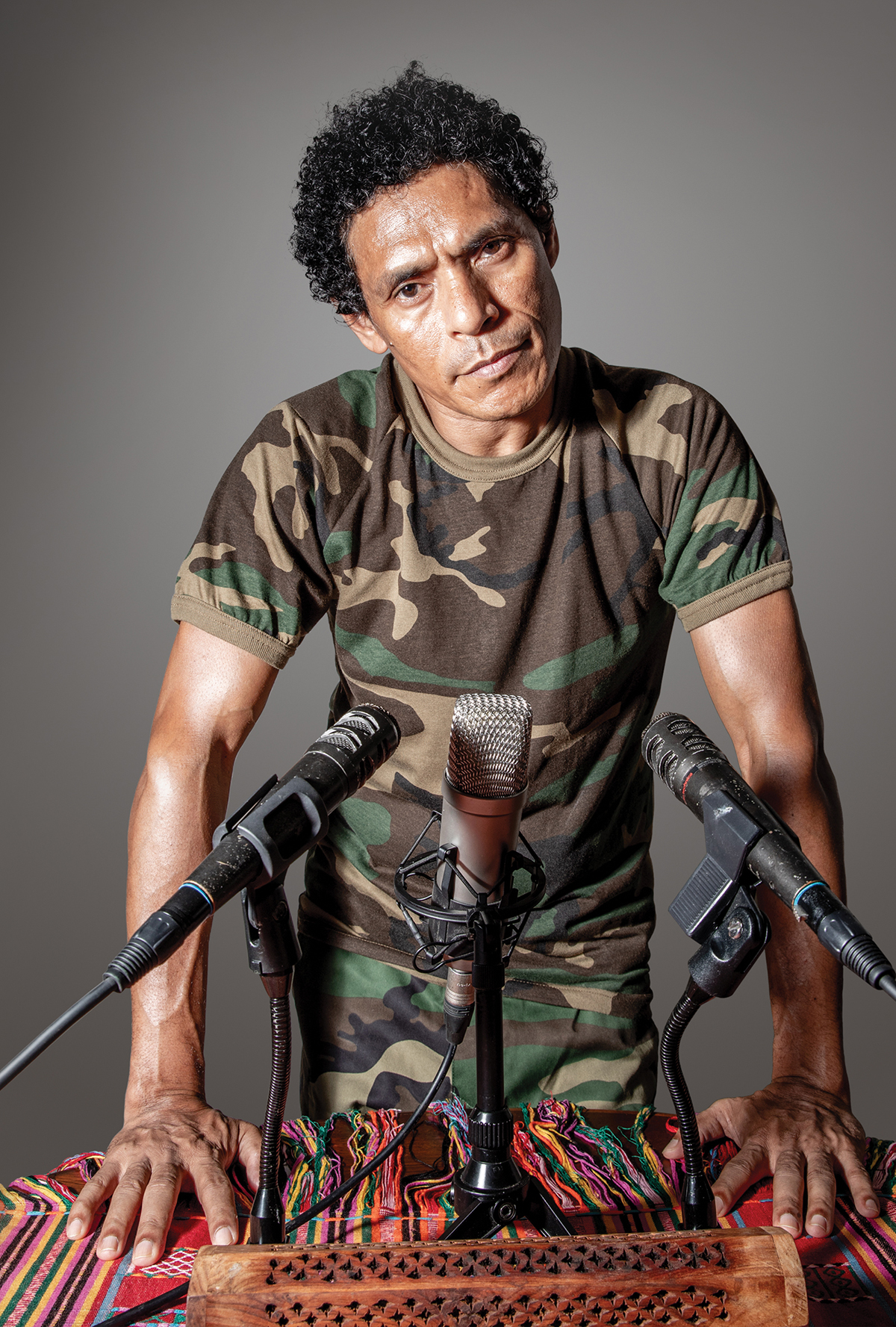
Top image credit: Jenny Fraser, photo Jenny Fraser
Perhaps it was the rejection of the proposed Voice for Australia’s First Nations peoples; the public refusal, or inability, to understand or acknowledge difference. Perhaps it was the massacre in Israel and the terror now wrought on the people of Gaza. Perhaps it was one war eclipsing the other in Ukraine. Perhaps it was all of this overshadowing the now apocalyptic tenor of climate change. Perhaps then my response to Brooke Stamp’s Mickey, as performed on 24 October, the opening night of Performance Space’s 2023 Liveworks, as a work of grieving.
Articulating the psychophysical
Mickey is an ideal work to kick off a festival of experimental arts: a performance experienced as emotionally and physically powerful, seductively elusive and richly allusive and wrought like a disturbing dream. Each performance is claimed to be quite different. “Informed by absorbed choreographic practice and dance history, Stamp’s body memory is presented as an improvised subconscious psychic waste, the content of the improvisation an articulation of what the artist terms ‘psychophysical’“ (Program guide).
In a Liveworks interview about the residency from which Mickey (originally conceptualised as “the line is a labyrinth”) sprang, Stamp says, “I wanted to explore dance’s subterranean impetuses, and to develop an audial practice that uses live processing to augment spoken language and other psychic and subconscious slippages that keep company with my practice — in an effort to dislocate dance from its obligation to bodily form.”
Stamp’s project aspires to fuse psychoanalysis with metaphysical transcendence: “Dance naturally signifies ‘bodies’ as the primary subject of dance but I’m curious to reconceptualize the centrality of the body via the expression of bodily subconsciousness. I want to tap the idea of a universal bodily matrix significantly more elastic, malleable and versatile.” She describes a “practice that interrogates and reorganizes inherited thought and movement systems – to rather reposition the whole-body sensorium as one that favours the psychic crevices, the symbols, spirits, sensations, spasms, and slippages – that better reflect my body’s potential as an agent across time.”
This “improvised subconscious psychic waste” makes for a fascinating performance providing moments of intriguing specificity, motifs and clues. Why “Mickey,” rather than the abstract “the line is a labyrinth”? Perhaps there is a real Mickey, or a floating signifier ‘Mickey’ with multiple subconscious associations; we’re not to know, but we might guess, or sense.
As a “dislocat(ion) of dance from its obligation to bodily form,” Mickey is fascinating, viscerally performative, formally unpredictable, danced and not danced, complexly voiced and the body sounded. Stamp is one of a long line of rule breakers who have sought to free dance from strictly embedded choreographic codes and conventional theatricality from, among other trajectories, Duncan to Graham, Cunningham to Judson Church, to 1990s conceptual dance and on, to a point where a weave of dance forms and other performative practices can inhabit the dancing body without overpowering or rendering it inauthentic (see part 6 of Amanda Card’s Body for Hire, the State of Dance in Australia, Platform Paper 8, Currency House, April 2006). Stamp wants this ongoing process of liberation to go further and deeper utilising whatever improvisation brings to the surface that is performance.
Brooke Stamp, Mickey, Liveworks 2023, photo Matthew Miceli
The dream
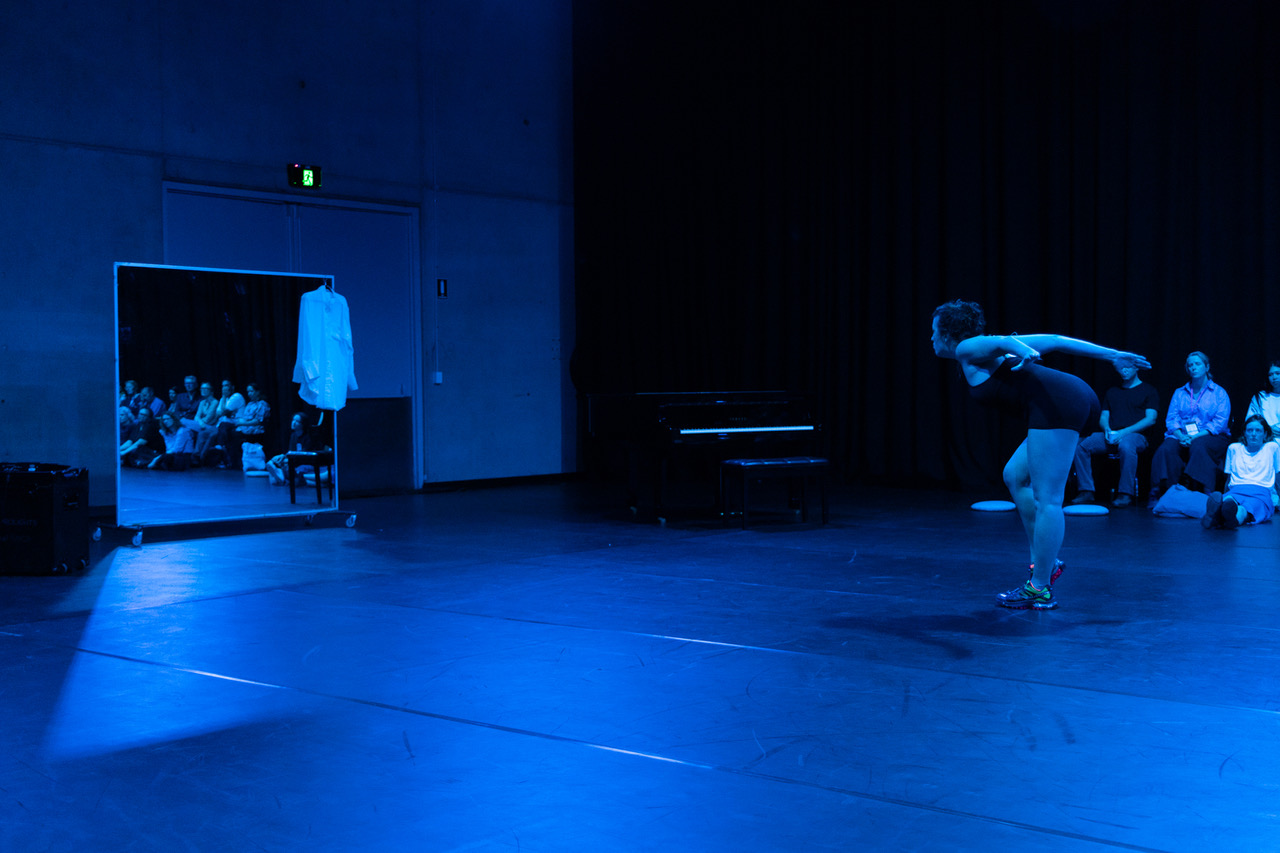
With her audience intimately placed on either side of a long performance space, piano, sound and lighting desks at one end, a large rectangular mirror on wheels at the other, Brooke Stamp occupies her territory (design Sidney McMahon), lit in an enveloping intense blue, with everyday ease. There are wandering walks, muscle flexing and prop distribution between episodes in which Stamp unleashes sound and movement, much of it executed with a durational intensity of effort and inflected from time to time with expertly articulated grace notes from modern and classical dance languages. Sounds pour from Stamp’s head-miked body, words we grasp at in the dense surround sound mix that sound designer-composer Daniel Jenatsch builds from the performer’s breath, vocalisations, the churn of spittle, whistling and dry retching. Each sono-physical episode is both a substantial exploration of ways of performing and suggestive of the “psycho-physical.” The eeriness of the pervasive blue light adds to the sense of dreaming.
There are sounds other than Stamp’s. Leading into the performance there’s an electronic trickle, a little like muted rainfall; later there’s heavy rumbling, not quite thunder; lyrical electric guitar and, quite chilling, the squeal of car tyres going into a slide, but minus the expected crash. The meaning of these motifs, independent of Stamp’s body, is not immediately evident, but they introduce a soundtrack-like element of dramatic effect punctuating Stamp’s performance. These together with the sheer physical and vocal intensity of Stamp’s performance suggest emotional disturbance, especially when correlated with the words she speaks, repeated fragments, never a coherent expression of a state of being. Perhaps, I began to feel, this was a body possessed by grief. (I was later told that in another performance in the season this was not evident.)
I didn’t go looking for a theme, but I did want to know why the title, Mickey? Why at the first mention of Mickey, a high, raw chord seemingly identified with the sun, as Stamp’s body moves with a stressed fluidity. “Fuck, I’m stuck under the sun,” she utters; then, “We all make mistakes,” her body flat to the floor. She can hear something “softly in my ear,” makes small cries underlined by crashing static. “It’s Michael … good job, Michael,” she utters as the guitar soars sweetly over the accumulating reservoir of sound. The car tyres squeal. Silence. Stamp’s arms and legs fan out at 45 degrees each, fully extended into a response to some inner force, or pain.
She wheels the mirror to the other end of the space and poses variously before it at length, close-up and distant; a passage of self-estimation? The sounds heard are “M …M… Ma…ma” or is it “Mi… Mi…”? I’m not sure, but it’s not Mickey, or Michael. A struggle to utter the name? Next, Stamp buzzes like an insect until the whole space is furiously abuzz. The car tyres squeal, there is no reprieve.
After a moment of “I can’t …” weakness, Stamp assumes a “wolf”-like strength and dances formally and elegantly. But Mickey is again invoked. Standing half behind a curtain as if looking through a doorway, Stamp asks, “Mickey, did you steal my blouse …. my magic gloves?”
In a sequence of rare calm, Stamp whistles with eloquent ease, extends her left arm and cups an imaginary bird with which she duets, their beautiful call and response multiplying across the room. Car tyres squeal and she must let the bird go, opening one of the large studio doors to reveal an ominously deep orange light into which the bird is freed.
Brooke Stamp, Mickey, Liveworks 2023, photo Matthew Miceli
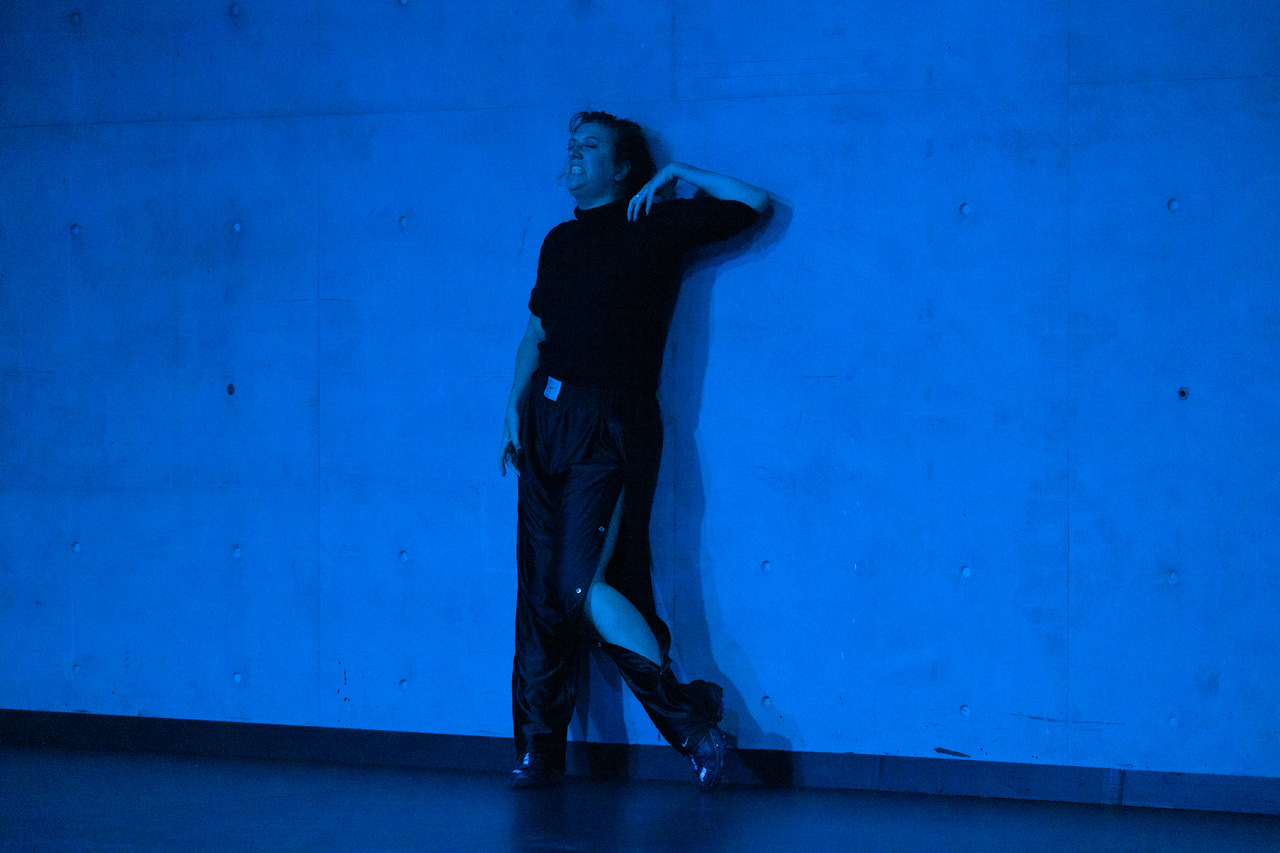
Furiously discarding clothing (there are multiple outfit changes), Stamp wonders why she feels “so hot,” “on edge,” though assuring herself “It’s working out pretty well for me.” But no, she goes to a wall at the end of the traverse and commences an exacting series of piercing dry-retchings, arms and legs splayed flat in violent danced formations against the surface. Then she’s “fine,” if that’s what I heard.
She walks to a small lighting desk and deletes the enveloping blue. Halfway down the space she sits, holding a bunch of roses, right next to me, and sings exquisitely what sounds like a fragment from a Baroque aria; I catch at words: “let me sigh …breathe … be free.” A desire for release from a state of torment, perhaps grief, or perhaps the sweet relief of having passed through it?
The dreamwork
Experiencing Mickey was like dreaming, me doing my own dreamwork with it, sensing, even imposing a shape that Stamp’s “psychic waste” might in fact resist. I had no desire to literalise the performance. For most of it I was taken by the richness of the experimental interplay between voice, body and sound design/composition and Stamp’s ability to convey intense, if often indeterminate, states of being. Her movement, even at its most extreme or held in taut near stillness, is executed with a dancer’s skill and adroitly interwoven with the surfacing of recollected dance. At the same time, each fragmented utterance, sound world or repeated gesture cumulatively built my own imaginings.
There is no knowing what memories will surface via Stamp’s improvisational strategy, for either artist or audience. However, Mickey is not a loose improvisation from Stamp and dramaturg Brian Fuata; it is structured, its episodes cleanly delineated, and closes with a sense of purpose. A bottle of champagne, a prop Stamp moved about, was left unopened in the performance I saw. Some of us pondered the significance. Perhaps there was not enough reason for celebration this time, or would it always be put off, such can be the nature of grieving. Or the improviser’s subconscious just didn’t call for champagne.
I would have drunk a toast in honour of Mickey, celebrating its dream-like intensity and odd logic, while erasing recollection of irritation felt when an episode over-extended or seemed to duplicate its exploration of a state of being. I’d love to see Mickey again, though knowing it would likely never be the same. Here’s to you Mickey, Michael, M…; but, “Mickey, did you steal my blouse …. my magic gloves?”
A blue note
Another query was about the darkly radiant blue light that dominated audience and performer for almost all of the performance. For many people blue conveys a sense of calm and introspection. For others it can be cold, depressive and impersonal. In the dream-like state of engaging with Mickey, I oscillated between repose as I sank into the reverie of engagement, or discomfort when the performance became harrowingly insistent, the blue then oppressive. Incidentally, the installation of blue lights in Japanese railway stations early in the last decade allegedly reduced suicide attempts by more than 80%.
……………..
Brooke Stamp was the 2022 recipient of Performance Space’s Experimental Choreographic Residency in partnership with Critical Path. Mickey is commissioned by Performance Space, Sydney and HOTA (House of the Arts), Gold Coast.
Performance Space, Liveworks 2023, Mickey, lead artist, performer Brooke Stamp https://brookestamp.com/, music Daniel Jenatsch, design Sidney McMahon, dramaturg Brian Fuata, research consultant Matthew Day; co-commissioned with HOTA, Gold Coast; Carriageworks, Sydney, 19-22 October
–
Top image credit: Brooke Stamp, Mickey, Liveworks 2023, photo Matthew Miceli
Superbly carrolling and chorusing all day long, the resident magpies in our inner city suburban street constantly bring to mind Night Songs, performed as part of Performance Space’s Liveworks Festival of Experimental Art in October 2022. Magpie song and my recovery from a long illness have finally brought me to write about a deeply engaging work that celebrates birdsong as music and reminds us of the ecological and emotional significance of our kinship with other species.
In Night Songs, Hollis Taylor and Jon Rose express their admiration, aesthetic and empathetic, for Australia’s Pied Butcherbird, placing it centre-stage. The bird dominates our vision in large-scale projections and envelops our hearing with the extraordinary interplay of human musicians with the beauty and daunting complexity of birdsong.
Of a previous, related project, Whistling in the Dark, the artists write that “in working with the songs of Pied Butcherbirds, we set ourselves the task of meticulously taking on the sonic constructs of another species. With imagination, we endeavour to either ‘be bird’ or consider ‘what if bird could’.”
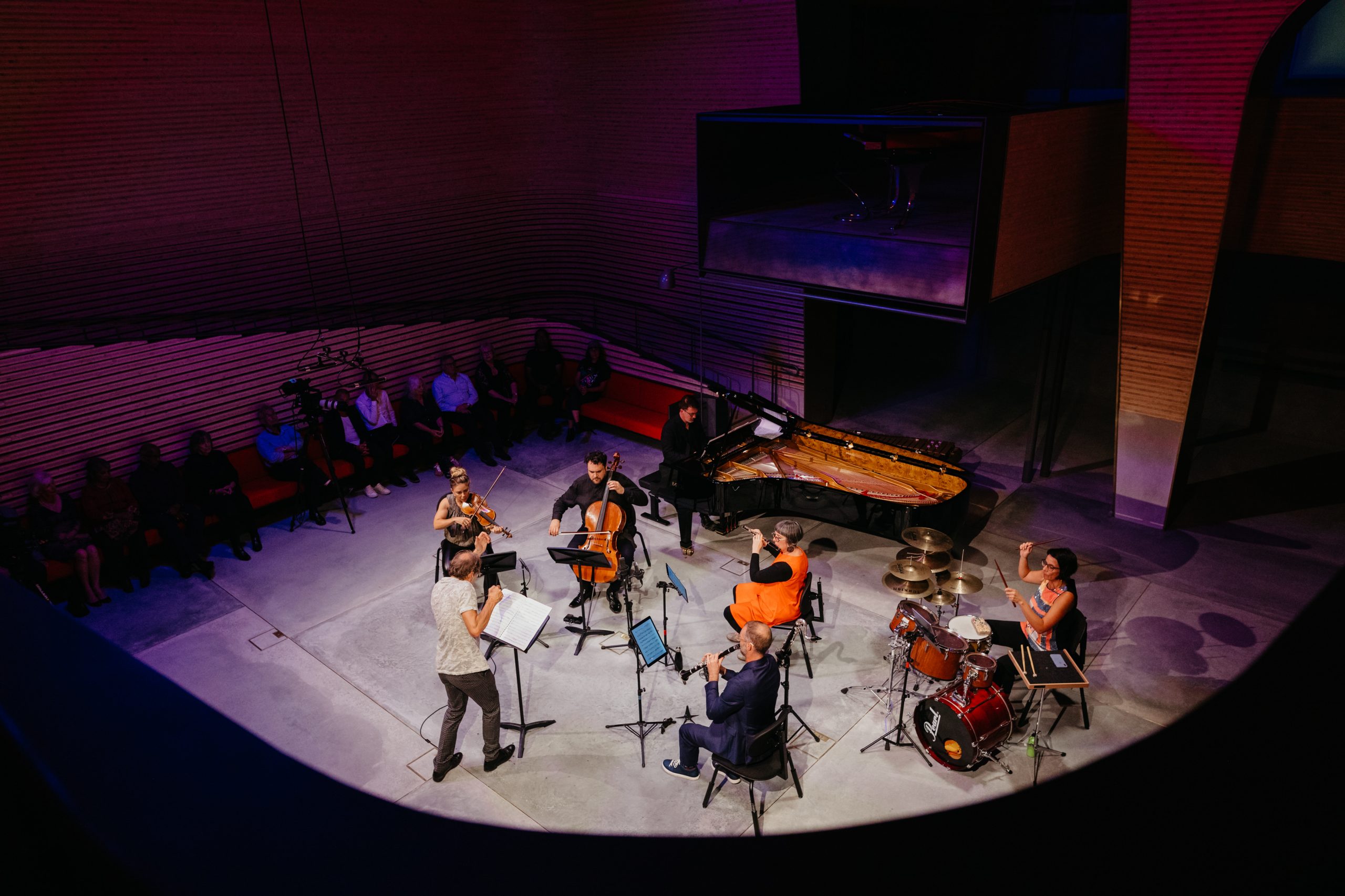
At the same height as the projected birds, eight members of Ensemble Offspring perch tree-height on scaffolding that angles out either side of the screen. From the floor we gaze up at birds and players engaged in an imaginary dialogue, a rich call and response conjured by Taylor (recordings, transcription and analysis of the birdsong) and Rose (arrangement). We get to share in a generous act of ecological attentiveness that convincingly asserts that birdsong is indeed music and kin to human music-making.
The artists write of the sundown-to-sunrise traversal of Night Songs, “Pied Butcherbirds sing their long form songs at night in spring, and this performance shrinks a twelve-hour period into a one-hour concentrated audio-visual encounter.” Across that hour we watch the birds in small clusters atop branches communing lyrically in, as Taylor writes, “ensemble singing.” In another moment, on a rare wet night in Alice Springs, bathed in blue night light, a lone bird on corrugated iron roofing surprisingly rattles off brisk imitations of the calls of other avians.
For most of Night Songs the birds, male and female, are joined by the musicians in a complex interweaving of voices. A gentle trumpet fanfare is paired with warbling and trilling. The trumpet again, long-breathed, its cries are almost elegiac against the sweetness of the birdsong that inspires it. Bird-like utterances from bassoon and clarinets hover over a double bass pulse with a flute in flight above. Elsewhere the bassoon clucks gutturally. A bird sings, the flute takes flight, singing that learnt song — “This bird is virtuosic, and so becomes the flute part,” writes Taylor. Vibraphone, marimba, woodblocks and other percussion too do their dance with birdsong, evoking environment and, like the other instruments, capturing intricacies of the song otherwise often too fast for our hearing to catch (Taylor says that sometimes, “I actually simplify the birdsong in order for humans to be able to do it”).
The flow of projected images is correspondingly embracing: starry night skies, moon, rain, lightning, ghost gums, sun rising, its gold fanning out across the musicians as the morning chorus starts up, birds and musicians singing a multi-layered fanfare. In the performance’s calming night-time “postlude,” writes Taylor, “the bird at Ross River sings (a lament?), floating above chord changes in another cosmology but connecting with our sense of musicality.” It’s a beautifully tender composition, pairing perfectly bird and vibraphone. As often in Night Songs’ 13 episodes, the bird gets the last notes, its song lingering within us. For a wondrous while we have become part of the “interspecies engagement” that Rose and Taylor aspire to.
Musician Jim Denley, responding warmly to Hollis Taylor’s 2017 CD Absolute Bird, aptly writes of “the transformation of the (birdsong) material,” that “it enters the human realm. Hollis has become a medium — her sustained forensic listening has opened up a wormhole to another world.”
A standout in Performance Space’s 2022 Liveworks, Night Songs is perfect festival fare: celebratory and communal in spirit and immersive staging, and blessed with a welcome sense of ecological sensitivity and purpose. Hollis Taylor’s faithful transcriptions effectively become co-compositions, sharing in the complex splendour of birdsong, while Jon Rose’s incisive arrangements — pairing birds and instruments in duets, trios and larger ensembles — give rich body to this beautiful co-creation. Ensemble Offspring brought together birds and composers in their wonderful 2020 CD Birdsong. In Night Songs, the ensemble does full justice to Rose and Taylor and the birds that the musicians emulate and applaud with their superb playing.
Read Chris Reid’s review, “Is birdsong music? Ask the butcherbird”, of Hollis Taylor’s book Is Birdsong Music? (Indiana University Press, Bloomington, 2017) and Taylor’s double CD Absolute Bird.
Performance Space: Liveworks 2022, Performance Space & TURA, Night Songs, John Rose & Hollis Taylor with Ensemble Offspring: percussion, conductor Claire Edwardes, clarinet, bass clarinet Jason Noble, flutes Lamorna Nightingale, double bass Benjamin Ward, double trumpet Callum G’Froerer, trombone Rhys Little, bassoon Ben Hoadley, oboe Ben Opie; audio recordings, transcriptions, analysis Hollis Taylor, video recordings Jon Rose (except Cape Range NP, Carolin Kleehaupt), arrangements Jon Rose; Carriageworks, Sydney, October 26-28
–
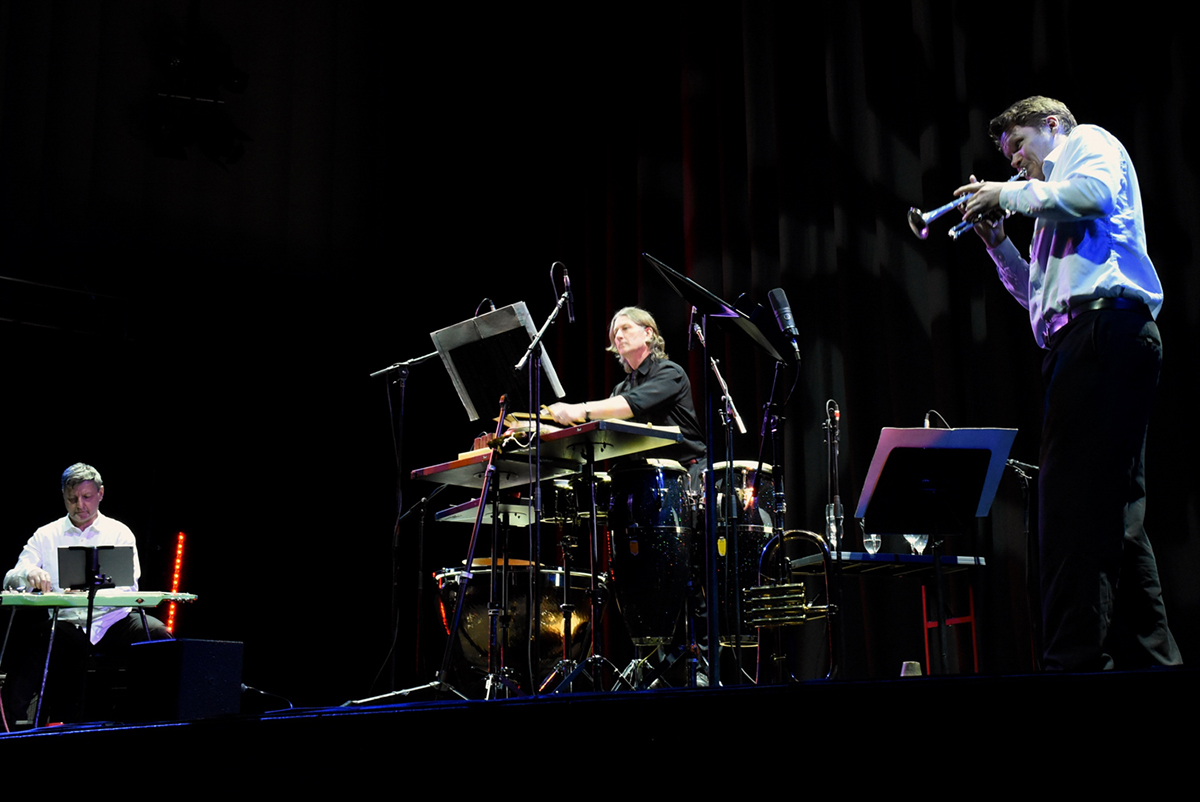
Top image: Jon Rose, Hollis Taylor, Ensemble Offspring, Night Songs, Liveworks 2022, photo Prudence Upton
In our RealTime review-writing workshops conducted around Australia and overseas for many years, we discouraged learner reviewers from evoking the weather experienced before or at a performance (“It was a warm, languid evening ideal for reflecting on the human condition”), save of course for extreme circumstances (“I was blown away, so was the show”). Broadcast into Oblivion, however, requires such a mention; an icey, unseasonal, bullying wind off Bondi Beach buffeted us into the Pavilion’s High Tide Room where doors and windows rattled as Nikki Heywood voiced her unsettling poetic text in a taut duet with experimental double bassist Mark Cauvin.
The weather and an ominous title looked to be grimly matched, however in a re-estimation of Creation and successive stages of despair about the wretched state of things, playfulness, irony and an existential frankness eventually lifted the spirits, like being hit with a fresh ozone charge as a storm of voices, words and strings hit home. Performing side by side with music stands and microphones, the artists had provided copies of the text with casual diagrams of moments of bass scoring.
Being in the making
Heywood’s opening foray, Part 1, is nothing short of ambitious, her voice a calculatedly tentative, squeaky soprano matched by Cauvin’s soft, scratching over the bass bridge, conjures bit by bit a pre-big bang state, “starting small,” comprising dust, specks. “[A] glimmer/ a shimmer” vibrates, the last note held long, and a lovely “waAaAve” dances forth. This is “when time was unthought,” without time, space or light before “a shock” (trailing a long k-k-k-k-k, the bass thumping) and a “a slingshot to infinity” (a high, long, falling squeal) generates an “impossibly large/ spread across a field of light and becoming,” the bass offering a first fully formed, satisfying chord as the cosmos begins to take shape.
In this formative phase, every word, every note is like a loose atom looking to combine, every syllable to rhyme and alliterate. A mass of “dots,” half-sung, double bass jazzily punctuating , “float … and accumulate … particles accelerate … elements coagulate/ rocks form and aggregate … systems … whole systems spray into form.” Elements tick, tickle, and throb, ooze and bubble orgasmically into a pronounced, cosmic sneeze — and comic relief. And “Air … breathed … itself … into … being” like song — gaseous, yellow, purple and green. Out of which comes life, from air sparked by “the rubbing and the throbbing,” yielding “the first bacteria/ the first beating heart/ of the mother/ the mater/ the martyr/ the matter/ the antimatter/” and — Heywood is amazed — “antipasti of the first meal that ate itself.” Creation as cannibalism. “And nothing,” she intones with a look of awe, pleasure and surprise as the plucked bass pronounces completion, “was ever …the same. ”
A great undoing
The world now made, Part 2 is an evocation of its undoing, including a litany of human destruction (of forests, delivered in a haunting high vibrato to tumbling bass notes) and our shared culpability (fighting over groceries in supermarket aisles), and with voice and bass stuttering out a desire to go back, to before all this. The tone is initially confiding, “You know … that’s why we’re here/ To begin again” (a project it seems), but mocking: “Talk (as they say) is cheap,/ like chips or sand or promises but …hey/ It’s all we humans have./ And this” (she demonstrates): “… this opposable thumb … this/ That is something/ That is something./ You must admit it. Admit it. O and a prefrontal cortex./ And fire.” Anger over the fate of lives — black, white and koala — and the wrecking of the humanities rises up through “blah… blah … blah” into a mocking yodelling. While Heywood doesn’t “want to sound cynical,” she does, surrendering to disgust and helplessness. What does the future offer — “armies of nanobots AI/ Mine the Moon/ Mine your data. Splice genes/ Move to Mars/ Split in…fin…ity./ Nyah…Non so …Che? …” and a blunt “I dunno.”
Speaking in tongues
Part 3 is at first delicate — Cauvin opening with eerie, rattling glides, Heywood standing on one leg — about how to be reasonable, “eternally elegant” when “there is no such thing as stillness.” Head swinging hair fast side to side, she foresees the Sun dimming (analogised with “cradling civilisation … like a dumpling … steaming hot”) and worlds shattering into “smithereens,” that word itself distorting, rendered utterly unstable. She advises, “Don’t panic,” fancifully imagining we’ll evasively render time “a lozenge we can suck/ All time in a sweet tablet/ capsule of chronology/ all the bitter lessons of history made sweet/ to soothe.” But a shock wave of stuttering angst and a climactic wailing take hold — “the heat stroke/ the pen stroke/ the lash stroke/the stroke of the second hand/ the minute hand/ the minute the miniature the minuscule the mama/ oh MAMA!!”
She can’t believe we humans will ever work together (to “begin again”): “We’ll all rant and speak in tongues.” She does silly tongues, briefly, but then turns dark visionary, intoning on a sweetly bowed descending scale “a garbled singing of angels/ golden haired angels/ as they descend the drainpipe/ Wiping their pale arses with wing feathers/ wiping away tears of acid regret/ wiping the ash of forest fires/ wringing their hands/ wringing their sodden robes from the floods.” She concludes with an elegantly phrased, almost operatic “Even pathos … even pathos” but grinds it down, growling “even pathos/ is pathetic.” Another sorry ending.
The wars
In Part 4 Heywood complains, “…we have spawned whole continents, whole nations of careless fools/ Whole schools of entitled man boys” but admits, “Contempt is contagious.” It’s too easy. She turns to prophecy, conjuring in witchy falsetto: “Caw caw caw/ Three crows sat upon a wall/ each bird an oracle,” asking “Is it that time again?” — for war, total war? Heywood and Cauvin lock together in a dark march: “A war on sense and the senses … On touch … On truth?/ on trees and insects” and above all on women: “Secret torture/ and pillage/ setting … women … alight.” Voice and bass cry. It’s all too much. After a droll “Stone the crows/ One …thing…at a time,” the bass sings a lingering sigh. Parts 2, 3 and 4 have yielded anger, sarcasm and despair barely leavened with bitter humour but revelling in wordplay and sonic thrills.
Begin again
Part 5 is contemplative, opening with “It’s complicated,/ So much air moving/ So many alternating currents, expanded realities,” which throw reality itself into doubt, yielding “a sense of blankness, an emptiness underneath.” Heywood and Cauvin softly intone images of a globalised, de-localised world, until finding, in the same, delicate suspended tone, sustenance in the simplicities of the everyday, “the sound of seabirds/ refracted light through the water in the glass jug,” “scratching of the pen, stillness of the woman/ my stillness,” and, with an unusual, striking and very welcome specificity, “sound of the car engine, my jaw slightly clenched/ fingers pressing into my temple/ flesh against elastic waistband/ and the sensation of bacteria moving in my gut.”
Finally, referencing the cosmological dot art of Yayoi Kusama, Heywood envisions a ladder (“the infinity net of Kusama stretches out/ back to the now and everything”) enabling a perspective with which we can “come back/ make it simpler” before we become ever stuck in ash. To reflect on the very nature of thinking: “Is this music thinking … what is thinking about thinking?” To go back to “trusting your gut/ trusting the unknown,” to finally, with the bass buzzing, gliding up, Heywood intones “just let go … let go … let go,” floating high into a sung “o” and, the bass now silent, descends lightly down into a sympathetic “you can always/ come back/ for more.”
Part 5 has been delivered with an aching inquisitiveness, sharing and elegiac in its sad sense of what we’ve lost and what might be regained; a quipped “without being a sentimental wanker” is the only note of self-deprecating levity in this moving finale. It’s not as if all the conjured disasters and their consequent anxieties have been erased by living mindfully in the moment — Heywood’s jaw is after all clenched, the fingers pressed into the temple — or that ‘trusting your gut’ is any kind of salve, let alone solution, but the consistent musical tone of Part 5 is curiously consoling, evolving a sense of easeful infinity that counters the aura of death that pervades much of the previous text and which is abetted by the work’s title.
The art of voice-reading
One of the special pleasures of Broadcast into Oblivion is that it exercises voice-reading. “Voice-reading is, ultimately, a form of empathy: we tune into what another person is thinking and feeling, not always successfully,” writes Annie Karp in The Human Voice, The Story of a Remarkable Talent, 2006, “the voice act(ing) as an exquisite psychic barometer to micro-shifts in feeling…” Heywood exploits our often unconscious sensitivities to pace, rhythm and breath, pushing her voice beyond expected pitch and tonal parameters, gliding, hovering on the edge of song, faltering, stuttering, gasping, tongue-tied, the drama underlined with understated facial expression and paralleled and amplified in Cauvin’s expressive bass playing. It can at times sound mad, like speaking in tongues: “the manic-depressive … speaking vigorously, with a wide pitch range, lots of glides and frequent emphases …” (Karp again). But so do bards, oracles, shamans and poets and singers of all kinds whom we treasure. As well, Heywood’s constant wordplay undoes the logic of language, dissociating signifier from signified, so that she can unsettle semantic stability, compelling us to reflect anew on the cliches of everyday social and political discourse in order to ask us how we are to cope with today’s constellating crises and renew our attention to language as she moves from anger and ironic detachment to immediately personal sensation. If we can’t connect with every word and thought of Heywood’s propulsive dramatic poem, we surrender to its “music and dance” (Karp), the sheer sound of its groping towards expression, its resistances (distancing, holding back) and its emotional overflows.
Broadcast into Oblivion is a grimly thrilling expression of today’s multiplying existential anxieties, delivered by Heywood and Cauvin with passion and wit, voice and double bass resonantly entwining, and offering more than a very rich aural experience. Heywood and Cauvin are onto something with a distinctive form that will grow in confidence and complexity with future iterations. As for the rather despairing title, I think the very receptive audience for this ‘broadcast’ certainly did not feel they could be equated with oblivion, let alone were they oblivious.
Kindred spirits
Broadcast into Oblivion immediately called to mind a small but significant number of Australian artists whose vocal performances “play with the boundaries between meaning and affect, between the voice and sound” (Ben Byrne, curator, Life Proof part 2, ABC Soundproof, 11 Dec 2015), often to considerable aesthetic and political effect. These are sometimes categorised as sound poets or language poets within the broader frame of performance poetry. They include major artists: sound poet Jas H Duke (1939-1992), poet and compositional linguist Chris Mann (1949-2018), poet, performer and visual artist Ania Walwicz (1951-2020), experimental sound poet Amanda Stewart, and vocalist and instrumentalist Carolyn Connors who sometimes forays into the language poet zone. Duke wrote songs, Mann and Stewart were part of Machine for Making Sense, and Walwicz performed with jazz artists Persons or Persons Unknown on one occasion that I know of. You’ll find performances by these artists on YouTube along with scattered writings about them online; and all are represented on CDs. These sound poets and their performance poet peers, including recent First Nations, Arabic-Australian artists and others, alongside extended vocal performers like Sonya Hollowell and Kate Brown, collectively warrant our attention.
New direction
Hoping that she might do more in this field, I asked Nikki Heywood if Broadcast into Oblivion indicated a new direction in her performance career and, if so, with a sense of working within a local tradition. She admitted to excitement about the form: “I’ve come around to this kind of spoken word/extended vocality in a circuitous way. Generating writing from often somatic/choreographic processes that we employ in Sydney’s Writing Dancing group, I realised that I was always hearing the words as I wrote … cadence, rhythm, attitude.
“Then working with Mark Cauvin, we looked at a huge range of graphic scores, from people like Cage of course and Cathy Berberian. Mark really encouraged me to work more with my writing and my voice and Broadcast grew from there. As a form and a practice it’s also more immediate, transportable and light on resources, compared to making larger scale performance work — which has become so difficult!
“I’m most emphatically a long term fan of Amanda Stewart and Chris Mann since the early days of Machine for Making Sense. They are both inspirational. I’ve always enjoyed the sprechgesang in classical works (as in Purcell’s Dido’s Lament) and then contemporary performers and composers such as Robert Ashley and of course Laurie Anderson. My son recently introduced me to a UK post punk band Dry Cleaning, whose vocalist Florence Shaw intones in a fabulously droll manner.”
—
Nikki Heywood
Nikki Heywood is an interdisciplinary artist who works across dance, performance, sound, writing and live art focused on embodiment & experiment since 1979. Informed by somatic & improvisational practice her body of work spans solo and group performance making that has toured to festivals and venues inter/nationally. Studying classical singing as well as extended vocal techniques and developing expanded experimental scores for voice and instrument, Heywood is interested in the voice as an energetic force through and of the body. She has also reviewed performance and dance for RealTime (see below).
Mark Cauvin
Mark Cauvin is a classically trained, experimental classical avant-garde double bassist performer, composer and improvisor. He composes music for double bass and electronics and video synthesis. He has worked with Chamber Made Opera, Decibel Ensemble, performing commissions by Cat Hope, David Young, Kasper Toeplitz and Maestro Fernando Grillo. His own multimedia work has been presented in the Netherlands and across Australia.
From the RealTime Archive
Nikki Heywood reviewed
Nikki Heywood variously as performer, writer, improviser, director, convenor and dramaturg:
Broadcast into Oblivion, text, vocals Nikki Heywood, double bass Mark Cauvin, High Tide Room, Bondi Pavilion; Sydney, 29 Sept, 2022
Top image credit: Nikki Heywood, Mark Cauvin, Broadcast into Oblivion, video still, video Sam James
“Over-interpretation is just the name we give to the moment when criticism admits — gives a gasp at — the gap between form and content.” TJ Clark, art historian
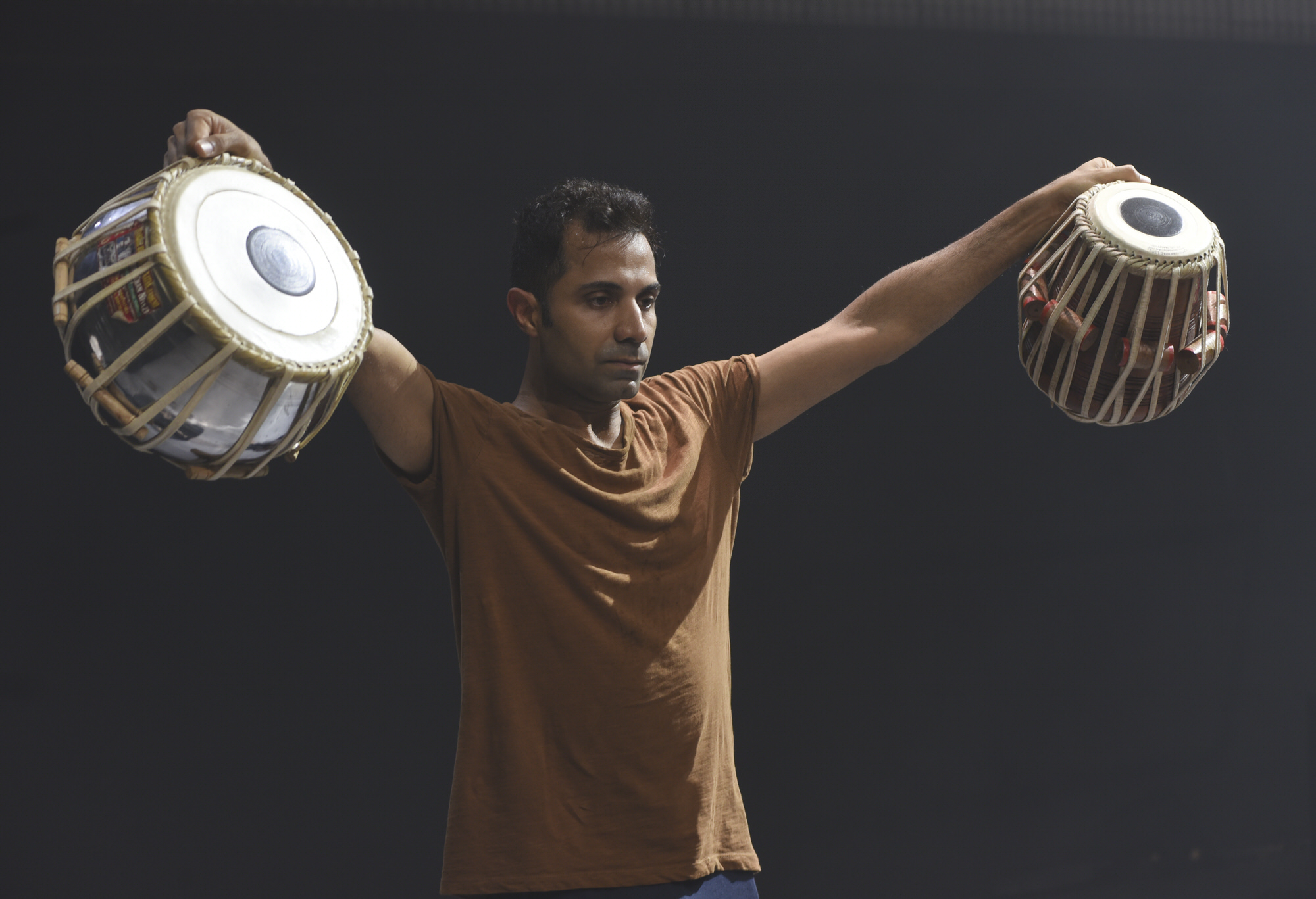
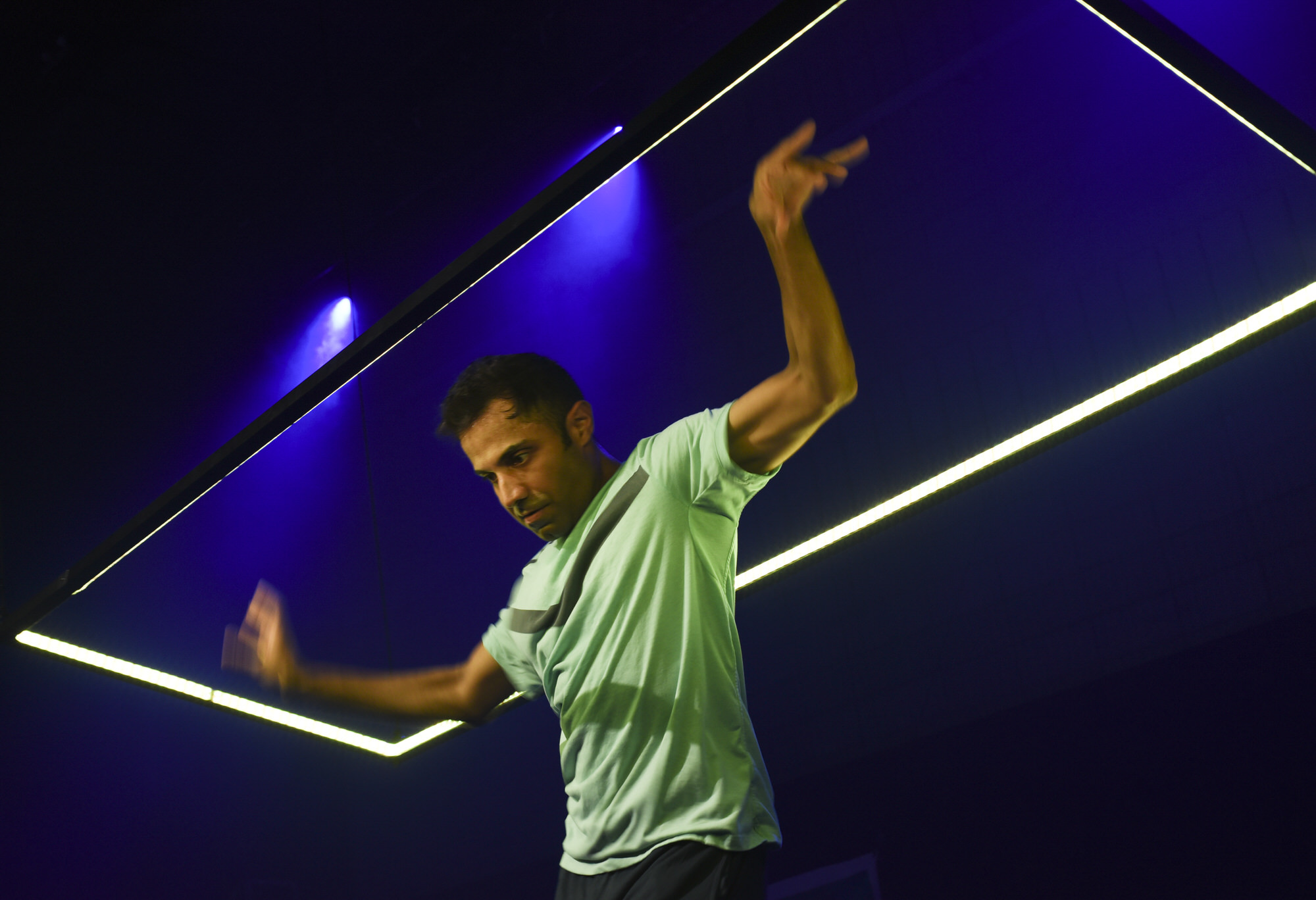
Raghav Handa’s Follies of God, part of Performance Space’s 2002 Livework’s Festival of Experimental Art, is a physically exacting performance for its maker and viscerally gripping for its audience. It is not dance in any ordinary sense but every movement, even when seemingly involuntary, is crafted from Handa’s Kathak dance heritage and his engagement with contemporary Western dance. It is a work with an agenda, as explained in the artist’s brief program note: a critique of the ill uses to which a sacred text, the Bhagavad Gita, has been put by, among others, Nazis and Hindu nationalists when rationalising the making of “just” war and its framing in terms of “duty.”
For all its physicality and its attested agenda, Follies of God is often mysterious. Symbolic objects and actions compel the viewer to attempt to ascribe meaning as the work unfolds, to make sense of a powerful sensory experience. The alternative is to surrender to the senses, to Susan Sontag’s “erotics of art,” and refuse “the itch to interpret.” That might, inversely, render The Follies of God abstract — as brutally beautiful and compulsively passionate, but without venturing understanding of Handa’s expression of his quarrel with the Bhagavad Gita’s God.
Intuition, gut reaction, deep hearing and the firing of mirror neurons are effectually forms of cognition that can ‘make sense’ of a work, not least when we reflect afterwards what happened to our minds and bodies during the performance — what was felt above what was thought, or transmuting feeling into thought. But Handa’s agenda-driven, imagistic narrative of his successive stages of wrestling with the Bhagavad Gita demand interpretation, to grasp Follies of God’s floating signifiers and to ‘gasp’ at the power of those untethered images.
I embrace the ‘erotics’ of the performance and simultaneously attempt to understand the work, in terms of Handa’s expressed intention, moment by moment. I’m going to over-interpret as I search for meaning. You’ll find me variously guessing and assuming, evident in my ‘maybes’ and ‘it’s as ifs’ and ‘just-don’t knows.’ After writing my response, I had access to a fine video recording of the performance, allowing me to pay closer attention to the work’s sound world and to make some late observations. As well, Raghav Handa kindly answered several questions I posed; his answers, which are illuminating, are found as a postscript to this review.
Prelude
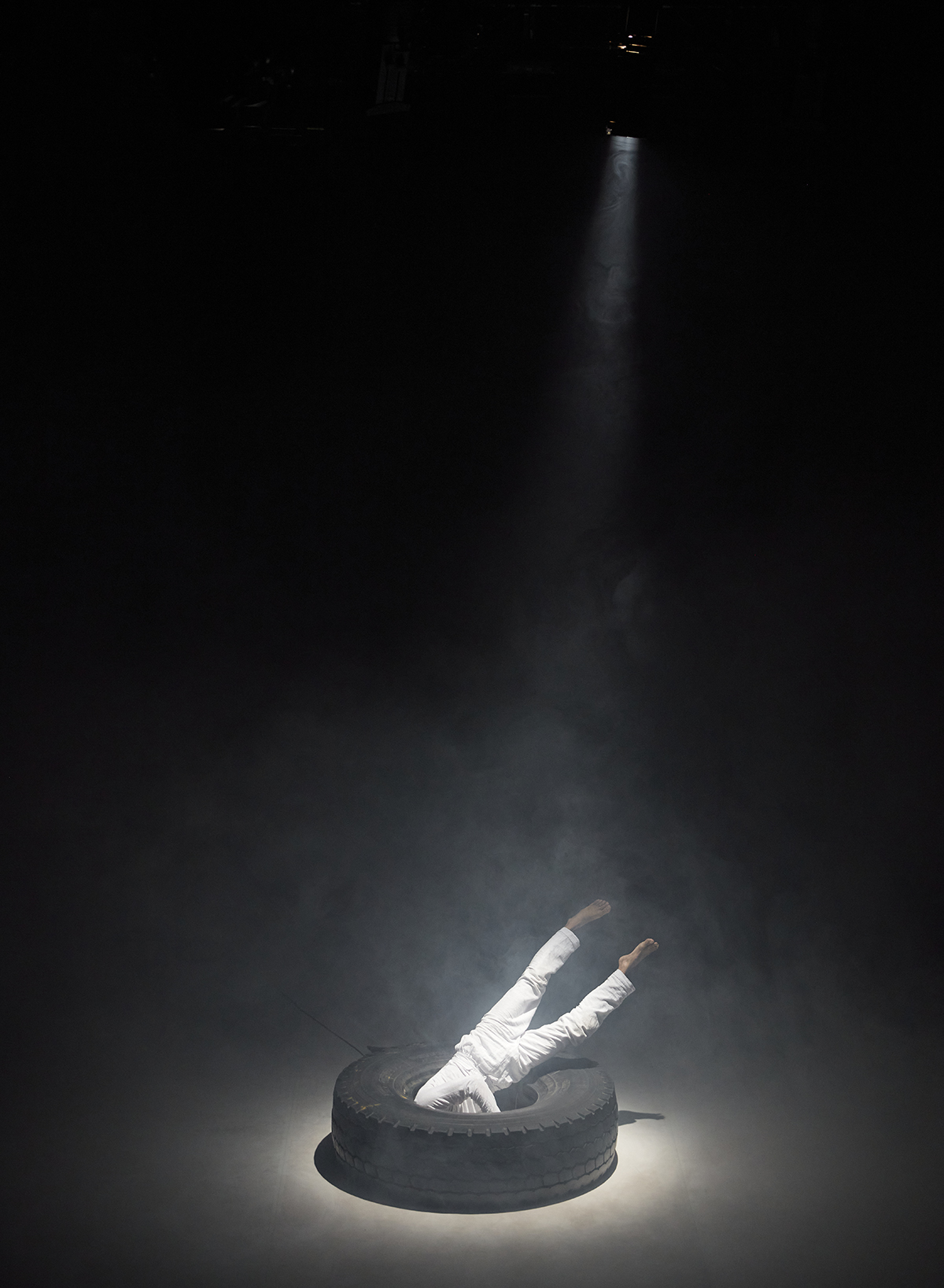
Darkness, a nervy desert wind, mist glimpsed at first light, a strange, thick circular object lying flat to the ground morphing from shadow into a massive, industrial scale, radial rubber tyre, aesthetic, ominous. An ear-bending musical explosion preludes a powerful exhortation from an unseen body: “It happens on the battlefield. The warrior prince and God. Align yourself with me and you won’t incur sin. Red is the extreme and then the blue comes.”
I’m cued, watchful for the red and the blue, for the prince and the god. With Handa’s brief program note and knowing just a little about India’s sacred Hindu text, the Bhagavad Gita, I’m anticipating an evocation of the exchange between Prince Arjuna and his charioteer about the merits of waging a “just” war. The charioteer, I know, reveals himself to be the god Krishna, urging war even if that means the prince will inevitably kill his own relatives.
On the battlefield: First assault
Slowly, secretively, dressed in white, Handa, a soldier on this presumed battlefield, crawls into view, trailing behind him a long, thin, black cable, the rest of it looped necklace like around his upper torso. Cautiously touching the end of the cable to the tyre and yielding sharp aural sparks, Handa curls up defensively against the thunderously explosive, dark chord and its aftermath incantatory chorus of male voices. A tight, white halo forms around the object — holy and obdurately intact; a stand-in, I immediately suspect, for the Bhagavad Gita — it’s sheer size suggestive of the burdensome ethical weight of its argument. And it’s a human construct, just as are the ideological ends to which the text has been put. But detonate it? It’s an aggressive first step.
Raghav Handa, Follies of God, photo Zan Wimberley
Investigation
Handa now adopts an exploratory approach, stretching body-length to rest his head gently against the tyre, listening to its unwavering chorusing, now female. But any tentativeness is abandoned when, astonishingly, he dives headfirst into the empty centre of the tyre, his legs outside, locked, pointing up while a voice intones the sacred Sanskrit text. A deep growling suddenly expels Handa from the tyre, leaving him poised over it, panting. A rash quest to go to “the heart of the matter” appears to have been a failure: he emerges exhausted, shocked, unenlightened, footsteps stuttering; the cosmic choir is now threateningly eerie.
Being god and demagogue
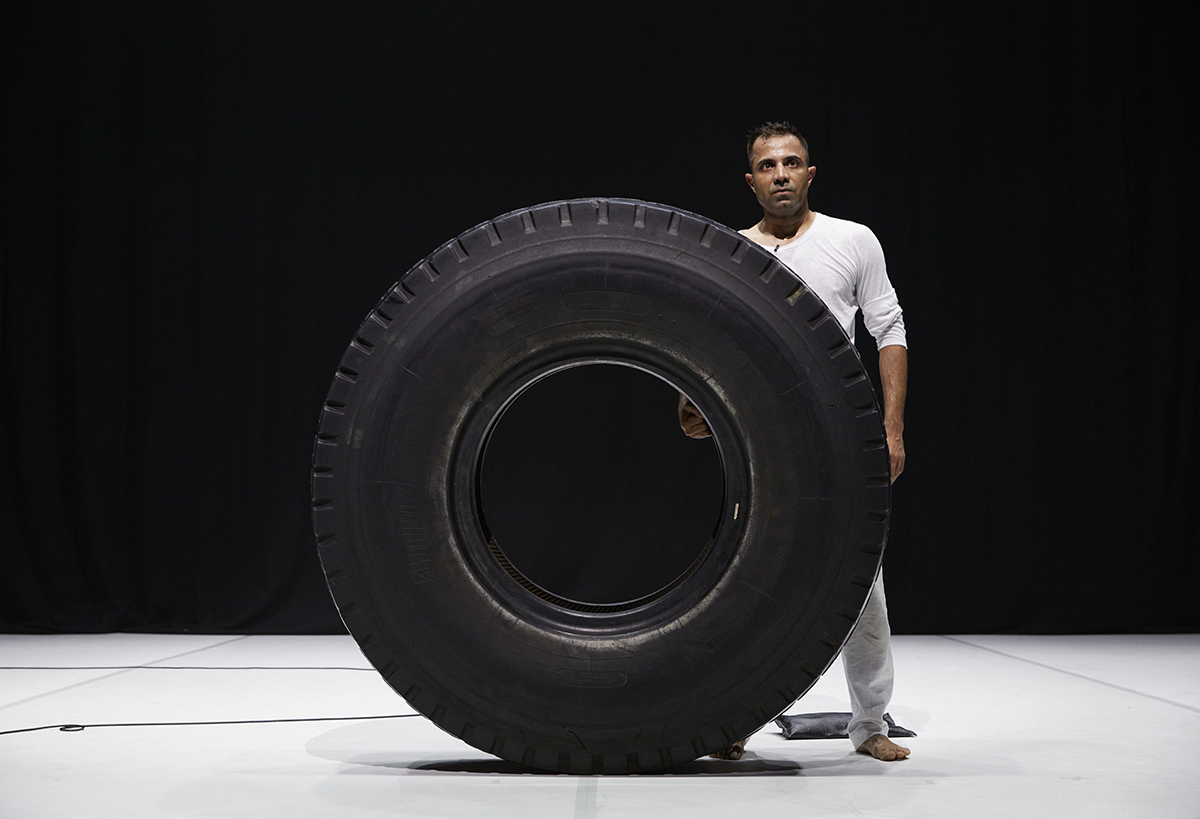
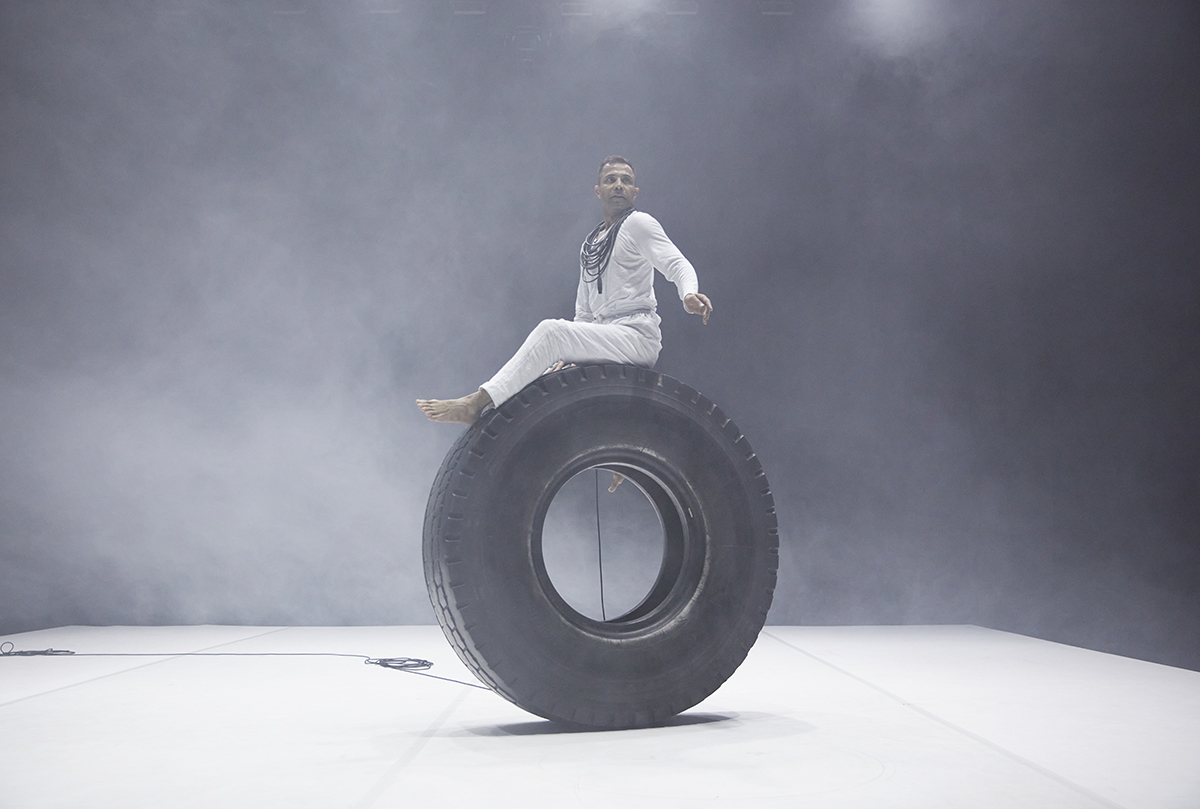
The unnerving wind bristles. With great effort, Handa lifts the 250kg tyre so that it stands upright at almost shoulder height, and held so that it doesn’t roll away. He carefully hoists himself to its top, sits, rocks forward and back gently, and then boldly stands. At one with the object and with Krishna, he delivers us a ferocious tirade, alternating between Sanskrit and English, advising, warning, gesturing grandly and with great vocal power: “Fight for the sake of duty,” “Friendship, blood relationship — don’t get involved” “…I will show you how to survive a hand grenade…You will die for me!”
Balancing slightly off-kilter in his passion, he demands, like a terrorist, “No sparks, no flames … We are covered in explosives.” Red light seeps into the space, saturating it as Handa utters a strange collection of seeming nonsenses and non-sequiturs, including: “Your unmanliness will be banned. Thunder will never be green. All weaklings will eat cake. Rust is no longer credible …” “Yellow will slip and break its leg. Your index finger and your thumb will come together to form a union. Peace is not the answer. Rise! Rise! Rise!” He is possessed, he is Krishna and recognisably a language-perverting demagogue.
Warriors in readiness
The red evaporates. Handa drops to the floor, curiously picks up the cable with his teeth and, dog-like, shakes it, striking it again and again to the floor, before rising up, a proud warrior. Encouraged by the call to action just heard and triggered by a burst of antique orchestral martial music, Handa becomes a marvellously convincing procession of military personae — various soldiers, elegant cavalry horse and rider, and an archer, all parading in wide circles. It’s a magical moment, oscillating between pomp and comedy.
Raghav Handa, Follies of God, photo Zan Wimberley
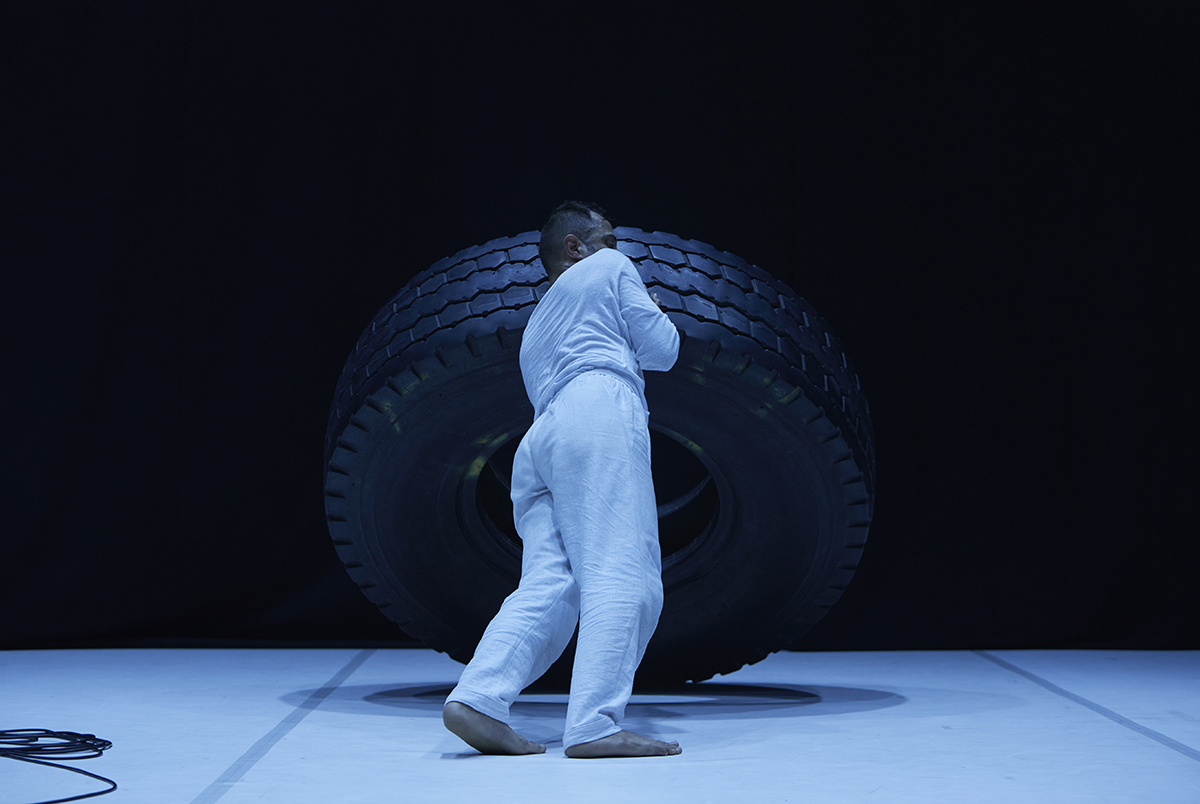
Again, possession ceases abruptly. The world turns blue: the calm after exhortation and rehearsal for slaughter, and a return to Handa’s exploration of the mysterious object. He rolls it upstage, giving it voice with the spooky squeal of rubber on tarkett. He whistles into it. Nothing. Hits it percussively. Its beautiful reverberation says nothing. And then, on another tack, with enormous effort, knees weakening and stuck halfway, breaths sobbing, Handa lowers then drops the tyre to the floor with a massive thud, banishing the blue veil.
Into battle
In the ensuing sequence, exactingly sustained, Handa’s probing of the tyre suddenly gives way to (expertly articulated) involuntarism, tossing him to the floor and then rippling fast through his arms and the length of his body — resonant in the pulsing score, with its darkening underlay and an escalating, long-noted, metallic chiming. This is battle. This is the tyre’s power to overwhelm.
Handa feels pain in his right hand and then his right leg, which he worries at with rubbing. He suddenly recovers, posturing heroically and spins furiously, but his drive soon fades. Blue light, but no respite. On all fours, his entire body vibrates furiously; sitting, he thrusts his hand into his mouth and quakes, the score rattling and grinding in parallel, before he attempts another twirling revival, which falters. No blue. Silence.
Wounded, captured
Dazed and clutching his abdomen, a palpably exhausted Handa picks up a hitherto unnoticed, heavy, small black bag, holds it to his stomach, breathes into it, drapes it over his arm, places the end of the cable in his mouth, and turns the bag into a mock helmet, stands assertively, but then lies down, using it now for a pillow. He enters a stage of protracted rest. The bag is a mystery, seemingly hoped-for sustenance, but ineffectual. I’m unable to guess precisely what it represents.
Handa stands warily, drops the ‘helmet’, hands placed on his head as if in surrender, and collapses before soon writhing across the floor and back into life again, taking control of his body to the pulsing of an urgent heart-like pulse in the score with a drumbeat edge. Recovery is fragile: the sudden barking of a dog, an odd intrusion from the everyday, frightens him.
Raghav Handa, Follies of God, photo Zan Wimberley
After the battle: Second assault
Blue light and the music of a brassy big band of the 1930s or 40s — with a fragment of its lyrics, “There’s going to be a celebration day” — fill the space. Handa is taken by the music, dances casually, humorously, lifts the tyre to standing, leans against it intimately as if for a mere second finding a dance partner. He rolls it close to us; the blue fades. Handa stands behind the tyre, looks blankly at us and commences to rub and then push his groin against the tyre with increasing force in a protracted, unsensual ‘fuck you’ moment; an extreme provocation, violence perpetrated against the ideological reduction of the Bhagavad Gita to a tool for waging war. Handa lets the tyre fall with a painful thud, the entire space suddenly flushed angry red, music growling.
Red to blue
Now calm, poised, Handa moves centre-stage, turning slowly as a thick mist gathers below and pushes hissing out from above until he is enveloped in red cloud. Sanskrit text (untranslated, unfortunately) is heard again. Less and less visible Handa swirls breathtakingly with increasing speed and apparent grace as if at one with the extremity of red. However, he stops and as he gestures up with his right hand the world turns emphatically blue, his to control it seems, a pallid pool of red fading around his feet.
Final transformation
Handa steps into the centre of the tyre and as his thumbs push into his temples, fingers flaring back, elbows jutting out, eyes rolled up, torso, gut and legs vibrating furiously, there’s a vast rip in the warping soundscape, suggesting monumental change. It’s an incredibly striking final image, another transformation, this time pulsing with possible meanings. Perhaps Handa’s persona has transcended the power of all that the tyre represents and blue, peace perhaps, has finally displaced the extremity of red. But why this strange, quaking figure? Is it a personal figuration of a perpetual struggle for Handa to balance the tensions inherent to the Bhagavad Gita, even in the apparent calm of peace? Or is it, more particularly, Handa as Arjuna, the warrior prince, forever wracked by fear of killing his family in war.
Arjuna shudders
Handa kindly provided me with a copy of the texts spoken in Follies of God. Tellingly, one of the Sanskrit passages spoken by Arjuna, but unfortunately not heard in English, translates as: “My whole body shudders; my hair is standing on end. My bow is slipping from my hand, and my skin is burning all over. If I act many will die, my kin will perish.” The flared fingers, like swept up hair, and the shuddering body confirm the association with Arjuna, correlating with the earlier shudderings of the soldier Handa.
Handa twice assaults the tyre, is seemingly wounded and captured, there is a battle, but there’s no killing in Follies of God (or if there is it’s not made explicit), which tallies with Handa’s belief that the Bhagavad Gita is “not a dogmatic collection of do’s and do not’s. It is a text concerned with larger, philosophical questions about action and inaction.” (Interview, Performance Review, 1 June.) Handa has given vivid physical life to the scared poem’s philosophising by playing out the consequences of succumbing to the obligations of duty or “right action” in participating in an allegedly “just’ war. The intensity and conviction of Handa’s performance suggests a deeply felt personal concern, engaging with a text which is an ineradicable part of his cultural heritage. The title Follies of God, though, feels contrary to Handa’s belief which appears to be that the folly is not God’s but those who misrepresent the Bhagavad Gita for their own ends.
Raghav Handa, Follies of God, photo Zan Wimberley
World-making
Deeply entwined design, lighting and sound generate the haunting space which Handa and his apparent nemesis inhabit. The seemingly passive object, oddly beautiful, quite alien, is central to Justine Shih Pearson’s effectively spare design, a living installation. Composer James Brown works visibly from the side of the stage and shares the curtain call with Handa. His live score feels acutely responsive to the performance and in conveying the pervasive realm of the tyre and everything that constellates around it. Appropriate to dealing with a text which is part of a cosmological epic, but without any obvious referencing of traditional Indian music, Brown’s music conjures vast spaces and the immediate pressures of conflict while adding droll down-to-earth moments with the use of brass band and big band music that while Western draw to mind the colonial musical impositions of the Raj. The primary richness of the red and blue lighting states alongside a subtly ‘neutral’ third (lighting designer Verity Hampson) lucidly frame Handa’s successive states of being which dramaturg Vicki Van Hout doubtless helped Handa shape and embody. Above all the real world palpability of the giant tyre and the wracked durability of Handa’s body inside a fantastical metaphysical world, give Follies of God’s quarrel tremendous substance.
I would like to think that in future seasons Handa could trust his audience with a little of the information that follows about the cable and the black bag and some of the spoken text, either in his program note or embedded in the action. I made what I could of these, but felt they placed me at a distance from the performance from time to time, threatening my immediate investment in Follies of God’s emotional physicality. But Handa won me over with his palpable personal investment in his subject matter and his superb craft, even when I felt mystified and compelled into interpretative overdrive which, intriguingly or perhaps perversely, intensified my appreciation of this remarkable 60-minute dance for life.
Follies of God is an utterly distinctive dance-theatre creation, a significant work rooted in cultural knowledge unfamiliar to many in its audience, but who should welcome it. Our sense of the work’s immediacy is heightened by our alarm and anxiety over an unjust war in Ukraine, US-China tensions in which Australia is enmeshed, the rise in general of militaristic rhetoric and the likelihood that we might in our own lives be compelled by a sense of duty to go to or abet war.
Note: The tyre
Handa and his collaborators’ choice of a type of tyre that implicitly represents globalisation is fascinating. It’s used on gantry cranes to move shipping containers on and off board container ships. Globalisation, now in a problematic state, has its advantages, for example in increasing cross-cultural awareness and migration (now increasingly blocked by sovereign state fundamentalism), but equally has a flattening effect due to wealthy nations’ weighty cultural dominance. Like the Baghavad Gita, it’s a matter of how it’s instrumentalised.
Afterword: The cable
Handa tells me that many Indian soldiers in World Wars I and II laid communication cables: “The wire allows me to connect the voices from the past and bring them to our temporality.” Simultaneously the cable represents “the absolute devotion, the coil of expectation on the warrior’s shoulders to put aside their doubts and go to war.”
Afterword: The black bag
The sandbag, weighing 12kg, represents for Handa, “the psychological weight soldiers carry. The image allows me to feel the weight of the ‘right’ action purely through the sandbag as a helmet. It also acts as a device to transport me to the frontier into a battlefield where the soldier is looking down the barrel of a shotgun. Where the soldier faces the consequence of the right action!”
How to survive a hand grenade
Handa told me that he and his sister visited their grandparents in the Punjab at a time when terrorists were killing civilians. His grandfather “would get us to do army drills and take us target shooting. He would teach us how to survive a hand grenade,” as we hear in the initial words in The Follies of God alongside utterances from Krishna. “For me, this is where Follies of God originated. The act of duty … the act of survival and what constitutes as the right action. … [My grandfather] wanted us to be able to defend ourselves. That is why I feel Bhagavad Gita is a scripture of psychology and not a religious scripture… Follies is a pursuit of contemporary truth-telling — put simply, is it ever justified to do bad to do good?”
……
The opening quotation from TJ Clark appears in Hal Foster’s “Not window, not wall,” London Review of Books, 1 December, a review of Clark’s If These Apples Should Fall: Cézanne and the Present, Thames & Hudson, 2022.
A 20-minute version of Follies of God was one of the eight works commissioned for the 2022 Keir Choreographic Award.
Performance Space, Liveworks Festival of Experimental Art 2022: Follies of God, lead artist, performer Raghav Handa, collaborator, sound designer James Brown, designer Justine Shih Pearson, lighting designer Verity Hampson, dramaturg Vicki Van Hout, Sanskrit expert, cultural consultant Shashi Handa; Carriageworks, Sydney, 20-23 October
Top image: Raghav Handa, Follies of God, photo Zan Wimberley
Afforded the ‘luxury’ of retirement, my response to Kaz Therese’s Sleeplessness honours this little reviewed, culturally significant performance by documenting and interpreting it in warranted detail. Should Sleeplessness enjoy subsequent seasons, be warned, I describe revelatory moments in the quest Therese undertakes. At the end you’ll find links to interviews with Therese at various career stages, reviews of their works and a fascinating report they wrote for RealTime about PS122’s archival RetroFutureSpective Festival in New York in 2011.
***********
Awake, flooded with stress hormones, sticky irreconcilables, invasive visions, churning repetition, time eternal. Sleeplessness. A nice enough word to voice — sibilant, assonantal — but hellish, a waking nightmare, a haunting. This irresolvable state of uncertain being is vividly conjured by Kaz Therese in Sleeplessness, a solo performance hovering eerily between confided personal history and phantasmagorical psycho-physical projections.
On a large bare space, save for a large screen upstage and a rack of clothes to one side, a casually attired Therese slowly sets out a neat grid of documents with deliberation, eventually gathering up the great mass and introducing us to a quest — to solve a sleep-depriving family mystery for which no end of facticity has been sufficient: the elision of a couturier Hungarian grandmother from a skeletal family narrative riddled with forgetting, denial and ambiguity. “It’s the not knowing. The not knowing.” Therese’s own sense of identity and wellbeing is consequently at stake, as well as the family’s: “I thought I could stitch the family back together through art, that this would become our living archive … but that’s not how it works.”
Instead, Therese sets out on a real-world quest, poring over photographs, travelling to Hungary, interpreting documentary evidence and exploring medical symptomology. Then, in the making and performing of Sleeplessness, Therese returns to art, weaving introspection, recollection and imaginings to do something more than simply represent the quest and its provisional resolution. We witness and become empathically complicit in Therese’s reaching back into the past, leaning into the pain, charting the shuddering evolution of an incomplete self, giving it feasible shape and filling gaps with invention — with what might have been and with which to move forward. The alternative? Remain in stasis, sleeplessness, self-annihilation even.
At the centre of the mystery is a riddle: a death certificate made out not for grandmother Lenke Palffy, Hungarian, female, but for Lenki Palffy, German and male. Therese’s mother Eva, who grew up in a Catholic orphanage in Sydney, has little to say or recall about her mother, let alone what happened to her, and cannot speak Hungarian: “the nuns must have beat it out of me.” Therese’s adolescence is turbulent. “At school I had a boyfriend but at night I had affairs with older women.” Therese “runs with the pack,” misses classes, is kicked out of home by mother Eva’s drunkard boyfriend, sent unwanted to father and stepmother on the Gold Coast and later rescued by sister Mel and taken to Melbourne. But “Mel disappears and I fall apart”; “Mel becomes a ghost.” Therese works in drug and alcohol rehabilitation. There are suicidal impulses but the need to solve the riddle drives a search for meaning, and new experiences —“high in Hungary, with new friends” who help in the research.
Kaz Therese, Sleeplessness, photo Anna Kucera
Threaded into the weave of recollection and anecdote are images writ large on the screen, including a passport photo of a woman’s face: “She was beautiful. Every time I asked my mum who she was, my mum would say ‘Oh that’s my mum.’ My mum did once say she remembers she always looked done up, immaculate. She remembers her wearing a blue polka dot dress and a short brown fur coat… And when I asked my mum, ‘Well, what was she like?’ My mum would always say, ‘Oh I don’t know love, I don’t know’ …When my mum was in that orphanage, the nuns told her that Lenke had died.”
There’s a happy family snap with Eva, Mel and the child Therese in a dress (emphatically declared a rare occurrence); a passport portrait of a young Therese; newspaper headlines about the so-called Bidwell Riot of 1981 (the housing commission youth of outer suburban Sydney denigrated by the media and the NSW government); and photographs from the trip to Hungary. There are treated images evoking a sense of attempts to match the vagaries of image with research: a stamped official document superimposed over the grandmother’s face; handwriting inscribed over Therese who elsewhere appears in various locations bleakly resonant with changing circumstances and sense of isolation. Closeups of hands, feet and limbs look for solutions, for identification.
Invention goes further in film passages featuring stylishly moody actors as mum and dad wandering between train carriages and elsewhere dancing: an idealised, reparative fantasy. Although Therese felt at the time that it didn’t work, admitting to loving a shot of the pair dancing in rain, if with a touch of bitter irony: “My mum and dad met at a dance and he danced her to poverty. How romantic.”
On film, we see Therese on a bridge in Budapest peering down into the river below, identifying for the first time physically with Lenke, where she once might have stood. Therese leans over the edge, perhaps tempted to fall, to disappear. And it seems does, only to emerge, head and shoulders above rippling, multi-coloured wavelets, as if revived, ready to quest on. A 1956 police report had recorded Lenke’s attempted suicide from Sydney’s Pyrmont Bridge. “I wondered if by becoming her in film, I might find her in real life, in my life.” The watery imagery spills immersively towards us over the shiny stage floor and the tingling zither-like buzz at the core of Anna Liebzeit’s score, framed by a visceral bass and keening strings, evokes a tense return to Hungarian origins and an abiding anxiety. (The score’s sense of unease is apparently generated by the composer’s use of “the rhythms of an insomniac’s sleep to underscore the physical act of memory”.)
Kaz Therese, Sleeplessness, photo Anna Kucera
A fear of death is manifest in a filmed pack of wolves recurring across Sleeplessness. Therese’s stepfather allowed the six-year-old to watch a werewolf movie on television, The Beast Must Die (1974). The consequent fear of throat-tearing wolves isn’t explicitly synced with Therese’s quest, but it underlines a sense of extreme vulnerability in the absence of a cogent sense of identity. The adolescent Therese loves American Werewolf (1981), presumably because of its evocation of outsider otherness. However, “I thought being gay was going to protect me from violent relationships but … during those relationships I became a part of the undead. I walked the earth in limbo.”
When words prove inadequate, Therese’s body opens to expressing the imagined physical abuse of the institutionalised Lenke in a painfully raw cycle of running, falling, wracked as if assaulted, and crawling. Gagging and gasping, Therese limps to the clothes rack and, in a breathtaking coup de théâtre, transforms into the grandmother in blue polka-dot dress and short fur jacket, low-heeled shoes, lipstick, a thin whispy beard, head held high, speaking Hungarian, aristocratically declaring her surname, Palffy.
Gaps in Lenke’s life are filled in: her incarceration in the Mental Home for Women — she sought treatment and was declared insane; final years in a nursing home; and the bewildering medical reason for the grandmother’s apparent masculinity, Cushing’s Syndrome, a disease of the pituitary gland leading to baldness, facial hair growth, redistribution of body fat and the clitoris growing penile — unassessed and untreated at the time (although the condition was labelled in 1932).
Therese can now declare that at 49 years-of-age, “I am here,” while “still feeling the pain” and acknowledging “the many beautiful women who have been destroyed … But I’m not one of them and that’s my choice.” Compelled by an incomplete sense of identity rather than surrendering to, Therese took on a task, to ground a ghost-like self.
Choice, however, did not come easily given the impediments of multi-generational trauma: Lenke’s disappearance and the harsh treatment and ongoing trauma wrought on Forgotten Australians — child migrants like Eva, later known as Care Leavers — banished to orphanages and children’s homes. Across three generations, Therese and sister Mel had in effect become Forgotten Australians like their mother. Apology came in 2009 from then Prime Minister Kevin Rudd on behalf of the Australian Government. There’s implied reconciliation between Therese and Eva, who is a CLAN (Care Leavers Australia Network) social welfare activist. And Eva and Mel researched Lenke’s fate in the late 1990s.
Therese’s quest is seemingly complete, in the detective work and more importantly in an act of embodied imagining, re-confirmed in Sleeplessness’s final image: Therese onstage in a hospital gown walking away from us into a projected image of Therese in a hospital gown entering a long asylum-like gothic hall, at one with Lenke. For all the work’s sense of completion, however, the image is hauntingly ambiguous, of a task never fully resolvable. Sleeplessness’s projections (Margie Medlin, Zanny Begg, Tania Lambert) provide a kind of illumination, a “radiance that falls on the past” (Iris Murdoch quoting Jean-Paul Sartre; Sartre, 1953) such that, perhaps, Therese “can recall it without disgust” and “live forwards.”
In 2003 Sleeplessness was one of the most memorable productions I’d seen that year, a sparer, less complex but grippingly raw creation that has haunted me long since. Performed in the upstairs front room of the original Performance Space on Cleveland Street, Surry Hills it had an enveloping intimacy, thanks to the sheer proximity of performer to audience and projections close to human scale, blurring the actual and the real and rendering the images deeply dream-like. I wrote, “This is a space that Therese inhabits, frantically scrawling the accumulating data of the investigation across walls pinned with letters and documents and certificates, old clothes, dress patterns and strange fragments of latex, like the skin of stretch marks and ageing and torture. This is set design as installation: the curious audience inhabits it at the end of the show.” In 2022, the performer has to meet the challenges of inhabiting a much bigger stage space and performing to very large, potent projections that while hauntingly effective somewhat limit the interplay between actual body and onscreen imagery.
A much praised artistic director, producer, director and very occasional performer, Kaz Therese takes on the considerable challenge here of “just being” on stage (no easy task), engaging in dramatic movement and, for a brief critical moment, triumphantly realising grandmother Lenke. And this is 20 years on from the clearly unfinished business of the 2003 version of Sleeplessness.
Kaz Therese, Sleeplessness, photo Anna Kucera
With calm, measured delivery Therese sustains a sense of intimacy and quiet suspense, piecing together recollection and research and, perhaps less comfortably and more actorly, occasionally unleashing some of the underlying anger and hurt that has fuelled the quest, or awkwardly avoiding it by deploying voiceover. The relationship between projections and performer and the tonal consistency of the performance might be re-considered should Sleeplessness be mounted again, and it should be.
While the intergenerational trauma suffered by Australian First Nations peoples is relatively well documented and palpably felt in their visual art and performance, if still not understood by most fellow Australians (bring on Truth Telling), Sleeplessness gives rare voice and body to the trauma wrought on Forgotten Australians and their children. Its restless night-time oscillations between rational probing and image-driven delirium invaluably foreground a tormented, questing state of being which gradually solves a seemingly inexplicable riddle: who was Lenke and in turn who is Kaz Therese?
Tautly structured by writer-performer Therese and writer-director Anthea Williams, the intensively collaborative Sleeplessness is a courageous and emotionally exacting work, a dialectical interplay between the personal and the political imbued with a pervasive sense of tragedy: “Like Lenke, I have had my many moments on the edge of the bridge, as have my mother and sister.” From 2003 to 2022 and on, Sleeplessness continues to haunt me.
……
Kaz Therese is a writer, director, interdisciplinary artist and cultural leader. They were the Artistic Director of PYT (Powerhouse Youth Theatre) Fairfield from 2013 to 2020, creating numerous productions and events with collaborating artists and organisations. Therese has postgraduate degrees from the VCA and University of Wollongong. In 2021-22, they undertook a Creative Research residency at the Museum of Contemporary Art (MCA), Sydney. Therese directed action film star Maria Tran in Action Star for the recent 2022 OzAsia Festival in Adelaide.
Keith Gallasch, Karen Therese, Tribunal preview, RealTime 137, Feb-March 2017
Kaz Therese & Carriageworks, Sleeplessness, writer, performer Kaz Therese, co-writer, director Anthea Williams, Gadigal/Bidjigal Cultural Leadership Aunty Rhonda Dixon Grovenor, composer Anna Liebzeit, video artist Zanny Begg, lighting designer Karen Norris, movement choreography Martin del Amo, video consultant Samuel James, Budapest cinematography Margie Medlin, Sydney cinematography Tania Lambert,commissioner Carriageworks; Carriageworks, Sydney 4-13 August
Top image credit: Kaz Therese, Sleeplessness, photo Anna Kucera
In March, WE ARE HERE Company, co-founded by Parramatta-based FORM Dance Projects and choreographer Emma Saunders, staged Radical Transparency, a vivid depiction of the anxieties and survival tactics, recovery and restitution of a young dance team returning to performance after suffering the individual and communal depredations of the Covid epidemic. It’s a show of bits — team dancing, solos, monologues, dance on screen, singing, projected text — but adds up to much more than a bit of a show. I saw Radical Transparency streamed in March and, thanks to FORM, subsequently but have only been able to write about it after a slew of inescapable interruptions of my own.
The stage is bare save for a high mound of colourful items of clothing to one side, the seeming source of a riotous mix and not-match colourful DIY costuming, and a large screen upstage on which is projected with existential force the word “Why” (production design David Capra). In a pre-recorded voice-over, director-choreographer Emma Saunders workshops with her 11 dancers, each responding individually to her directions: “Dancing… dancing… Stay with that!…Take it to the extreme!” She then solos to her own instructions. Led by example, the dancers join her in fluid unison. After she leaves, they voice and respond to their own instructions, seemingly affirming process and self-sustaining unity. However, all is not well.
WE ARE HERE, Radical Transparency, rear left Gabriela Green Olea, Emily Yali, front Fiorella Bamba, Claire Rodrigues; photo Dom O’Donnell
Four dancers pair off: in each, one dancer gently embraces the other. But there’s no reciprocity — the other is first limp and then a dead-weight. Roles are reversed and another pair arrives, but with the same outcome. What at first looked affectionate is now tortuous. Achieving intimacy after prolonged isolation is not going to be easy, and so commences a series of events in which individuals are at times wildly at odds with the collective.
WE ARE HERE, Radical Transparency, Sarah Kalule, Josh O’Connor; photo Dom O’Donnell
But first there is a moment of unanimity, an ensemble dance onscreen and onstage realised with precision, lyrical finesse and a shared sense of verve. It ends in collapse, darkness and a dreamlike series of projected Tik Tok self-portraits conjuring memories of COVID lockdowns in which individuals attempt to cut through isolation with wild dancing, simple illusions and comic stunts. In a Zoom workshop individual dancers appear in loungerooms, bedrooms, backyards, responding to Saunders’ instructions, building to a climactic “Big start. Open out … Fall apart!”
Above the sleeping dancers, text by writer Felicity Castagna unfolds on the screen line by line: “… we’ve been carried across into a new reality where the cities have been emptied and our bodies too — we’ve got touch starvation, skin hunger, because… loneliness. Because this too will pass, but don’t forget. Because how do we remember to show up for each other?”
As if revived by this sentiment, the dancers wake and move purposefully, but soon fall, rolling across the floor into a low-stacked row of inert bodies, save for Sabrina Muszynski who, in a comedic attempt to overcome inertia, cries “Come on, come on!” as she slides and bounces on her bottom, legs akimbo, arms circling, until she too collapses. Onscreen, a sparklingly illuminated Liam Berg confronts the unwelcome return of a lover with an acerbic poem; personal dramas had continued to play out regardless of Covid.
WE ARE HERE, Radical Transparency, Fiorella Bamba; photo Dom O’Donnell
Castagna’s words onscreen ponder the impact of the epidemic on time: “I’m not sure it exists anymore/ …I think maybe it’s all just layers and loops these days/ …Are we going to know each other again?” The dancers rise up. Fiorella Bamba vigorously takes the stage and is soon joined by the rest of the ensemble, limbs extended, bodies twirling and executing sudden floor drops until interrupted by a cry, “Again!” And the dancing starts up, again. It seems the company has now progressed from workshop to rehearsal. However Gabriela Green Olea defiantly breaks rank, dancing and collapsing irregularly to her impulses and her own dance logic while her peers dance unanimously on, until the next “Again!”
Restless, arms and hands twitching with small impotent gestures, the ensemble clusters upstage as Claire Rodrigues steps forward, speaking breathlessly to us of the surreal experience of holding down multiple part-time jobs, of a strange world outside of dance: “… a job, the other job, both of the jobs I have … they, they’re very different, the thing is not at this place and this place …. I can’t do the things at the job … I think by that point, that’s their job!”
Stranger still, Rachelle Silsby rigorously executes and exhaustingly repeats a mysterious dance entwining balletic turns, leaps and splits with a rapid set of gestures, arm and fist ‘striking’ the chest. Josh O’Connor plays choreographer, calling authoritatively: “Again!” and “You’ve got it!”, but in no way in sync with the actual dance. Meanwhile a seemingly innocently intrigued Sarah Kalule inches closer and closer to Silsby, clapping rhythmically and so close she has to regularly duck the dancer’s wild arm swings. This fascinating ‘duet’ is essentially another piece of individual expression that leaves the ensemble still unformed, but provides some almost sustained dance.
WE ARE HERE, Radical Transparency, Emily Yali, Rory Warne; photo Dom O’Donnell
Emily Yali, in another individual turn, dances to Paul Simon’s “Slip Slidin’ Away” beneath a projection of a gigantic Rory Warne shot from an extremely low angle striding to the song. Against Warne’s steady pace, Yali fluently multiplies the number of steps, with arms and legs in swaying interplay. There are no interruptions, interlopers, no “Again!” A dance has at last been allowed to complete itself.
Naomi Reichardt steps forward to speak calmly and lucidly about plants, ecology and, by implicit analogy — in the sharing of energy and information for survival — dance as an ecosystem. The ensemble gathers and logic suggests it’s time for a dance of communal togetherness. Instead, with fellow dancers standing still behind her, Fiorella Bamba sings acapella part of “Empire State of Mind” (Jay-Z, Alicia Keys et al) including the lines: “If I can make it here, I can make it anywhere, that’s what they say/ Seeing my face in lights or my name in marquees found down on Broadway.” If the original is a celebration of achievement, here it’s a spaciously phrased, achingly aspirational dream, conjuring up the earlier New Yorks of Scorsese and of the 1930s’ “let’s put on a show” movies. It felt culturally distant, if emotionally present. The surrounding dancers reach forward, extended arms swaying gently right to left to right, hands with palms turned up. Bamba joins them. It’s the beginning of a silent, gentle, concluding dance of slowly gestured serenity and supplication, the onscreen text asking, “is this the end, is this a wrap?” and “where is the respite in dance, in life? What about just … the simplicity of dance and being, radical and transparent?” At last, after a deliriously anxious interplay between group and individual, a tranquil communality is achieved.
WE ARE HERE, Radical Transparency: Claire Rodrigues, Gabriela Green Olea, Josh O’Connor, photo Dom O’Donnell
Because I’m seeing Radical Transparency on video, I miss onscreen text not caught by the camera. But the final words glimpsed take me back to earlier ones from Felicity Castagna: “To be rooted, to relinquish, to connect, to sit, knowing, to sit with my body, to be uncomfortable, to be passive… my body moves, and it’s made of milk and oil and, you know, sometimes that’s not enough…” The something else has to be other dancers and the ecosystem that is dance.
Radical Transparency conveys a strong sense of the anxieties induced by the Covid pandemic, the consequent lockdowns and the difficulties of reconnecting, but doesn’t play the angst, opting instead for humour (as you would expect of director Emma Saunders, one of the much-missed The Fondue Set trio) of varying degrees of bewilderment, darkness and estrangement, confidently played and danced by the 11 performers, all in their 20s. There are bursts of energy followed by torpor, sudden ensemble dancing and individual disruption, finely crafted text that fleetingly demands deeper reflection, and interpolated little talks that invoke everyday demands or put dance in a bigger picture. It’s a neatly constructed creation if leaning on individual performances more than extending the capacity of the ensemble as ensemble — that will doubtless come now that epidemic circumstances have eased and Radical Transparency has answered the “Why?” of dance. Radical Transparency is a delight, a bright expression of hope for dance in dark times.
—
WE ARE HERE Company, FORM Dance Projects, Riverside Theatres: Dance Bites 2022 March Dance: Radical Transparency, director, choreographer Emma Saunders, writer Felicity Castagna, collaborating dancers Live: Fiorella Bamba, Gabriela Green Olea, Sarah Goroch, Sarah Kalule, Sabrina Muszynski, Naomi Reichardt, Josh O’Connor, Claire Rodrigues, Rachelle Silsby, Emily Yali; Onscreen: Vishnu Arunasalam, Liam Berg, Cynthia Florek, Warren Foster, Romain Hassanin, Bedelia Lowrencek, Katrina Sneath, Chris Wade, Rory Warne, videographer Dom O’Donnell, designer David Capra, outside eye Jane McKernan; Riverside Theatres, Parramatta 18, 19 March
Top image credit: WE ARE HERE, Radical Transparency, Rachelle Silsby, photo Dom O’Donnell
The viewer of Brisbane-based multidisciplinary artist Suzon Fuks’ Be Like Body—Obsolete #4 first experiences a sense of flight into a slow turning spiral, a galaxy perhaps, its starry tendrils curling out into deep, dark space. The poet Parvathy Baul (India) sings ethereally of a divine yogi in a cosmos where “Neither is there beginning nor is there end.” We arrive, not at the black hole of a galaxy, but a squared-off space in which a restless body writhing on its back seeks comfort in briefly achieved geometric formations. Up close the seeming stars are aged keyboards, motherboards, laptops, cables and hard drives — a Sargasso Sea-like swirling constellation of tech junk at the centre of which Fuks’ body is bounded by eight large computers minus their screens and electronics — blind technology. She touches them tentatively.
In what Fuks describes as “a poetic meditation on age, obsolescence and technology,” the artist enacts an existential crisis. Her ageing, isolated body is caged by computer detritus, useless but nonetheless symbolising her digital entrapment. Ironically it bespeaks the very same media that enables Fuks to express her condition with kindred female spirits, six writers scattered about the Earth inscribing in verse and voice in various languages their similar suffering — separation, invisibility, loss of both intimacy and a sense of being human — as well as offering consolations and incitements to resistance.
Fuks told me that she first created the video of her imprisoned self and sent it to the writers who, in turn, responded with poems that built on and expanded on it, adding new layers of metaphor and reflecting on their own states of being. Fuks has made the complete poems available on her website, both as an e-book and recordings, but for her performance edited the poems (and, in turn her video) to match and generate the rhythms and concerns of her performance. The voices we hear are those of the poets themselves, the words often also appearing onscreen in English and original language subtitles or sometimes circulating in patterns across the screen. After Fuks’ live welcome, the streamed performance comprises a pre-recorded first half, with its dramatic play with lines of sight and time, and a live second half, followed by interaction with the ‘zoomed’ audience in terms of the resonances felt in key words and sounds in the performance. I first saw the recorded version of the live stream in 2021 and took a fresh look at it recently, at its weave of image, metaphor, performance and filming.
The galaxy disappears. Sudden darkness, panic, a voice asking in Korean, “Hello, is there anyone there? Can you hear me? How did I get here?” Confirming the work’s opening galactic image, Younghee Park (South Korea) describes a plight of isolation and repetition, glimpsing millions of dots, dust perhaps, in which, grimly, “My endless footprints have become a cosmos in the middle of vast darkness.”
Suzon Fuks, Be Like Body—Obsolete #4, photo Suzon Fuks
In close-up, Fuks, in a spare black garment and hair dyed a vivid blue, flares her fingers and pulls at her feet as if to undo cramping tension, while a Spanish speaker, Amaranta Osorio (Mexico), cries “Escape!”, joined by a chorus of voices in other languages. The artist springs into rapid animation-like motion against her confinement. The speaker is defiant, “Erase it all and start over.”
We draw closer to Fuks gently touching at the frame of an empty computer while Osorio yearns “to touch you again/ Feel the beat of your heart/ Travel your skins with my fingers./ That would ease my pain./ I feel like an autumn leaf, trodden on.” The poet laments the digital double bind, being “just one click away/ So close yet so far,” the technology that “erases borders and also locks me up … I’m just a human locked in an endless spiral.”
Annie Abrahams (France/Netherlands) intones with sad anger — “the world is made of dust/ computers are made of dust too …. Dangerous dust” — made more emphatic when expressed in Dutch as “stof.” Later in the performance, the poet will speak of exploited workers “harvesting the dust/ our machines require,” and of her own tired toiling, concluding powerfully: “don’t touch me/ I am an unstable system on the verge of…/ non-sense.”
The camera closes in on Fuks’ naked back — vulnerable, inevitably dust. She stands, gesturing as if in gentle supplication or graceful yogic meditation, balanced on one leg, blocking out perhaps Abrahams’ grim programming lingo in French and Dutch, the code simultaneously typed across the screen in English: “#include <old age.h> use experience std; style. display+“destroy” enum u (promise, desire, dust, grass, waste),”
Osorio returns, equating technology with extinction and bewailing “time that passes and no longer seems to pass, the present.” Fuks beats the computer-tops rhythmically with machine parts; a brief moment of order and release in an uncertain present. Skittering electronics accompany her as she morphs, insect-like, her hands, arms, torso vibrating while Osorio objects to a “Sea of information /Digital noise without pause/,” asking, “How to sing without music?” Fuks attacks the screens before collapsing on her back, hands and feet flailing: “I am just a human/ Locked in a spiral of footprints, of dots./ Everything turns to dust. I am dust.”
Fuks’ desperation again becomes action. Seemingly prompted by Abraham’s coded recitation of “resistance,” “soul,” “body” with an urging chorus of other voices, Fuks, fraught at first like a rat in a maze, pulls violently at the screens. But in a surprising switch she breathes forcefully into the centre of each. In a rapid shift of point of view, we’re inside the devices seeing Fuks’ mouth. Mouth-to-mouth for a dying technology or resuscitation for those of us digitally entrapped? She peers in at us.
In a significant change of mood, a seemingly calm Fuks blows dust from a keyboard and wipes it from a screen top. Her world is suddenly lighter, whiter and curiously transparent, the dark hues of the previous half of the performance evaporated. We watch, detached, from above as she casually sorts and gathers a variety of parts and then peers directly at us through a gap in a circuit board that masks and replaces the human face while Abrahams reinvokes the image of people, world and machines made of dust.
Fuks takes a bubble-wrapped parcel from one of the screens and opens it to reveal a book titled H U M A N, each letter a keycap taken from a keyboard. We hear “resist” spoken in multiple languages; it appears in Farsi, swelling to fill the screen. Fuks does not spring into action, instead she gently turns the pages of the book, touching indecipherable images, each made from keyboard circuits, while Nasim Khosravi (Iran) intones an ironic poem-cum-sermon in which “…we have emptied the oceans of water/ In search of Aabe-e-Hayat/ [Aab-e-Hayat is the elixir of immortality, water or life]/ And we are immortalised in the microchip neighbourhoods of integrated circuits in countless layers of shatterproof screens. … Oh Human, Take refuge in Google, the only way to salvation…” However, the poet’s mother tells her daughter, “artificial intelligence does not understand human suffering. It does not understand love.” In the touching complete poem, available in the performance’s accompanying e-book, the mother with her too lately granted titanium knees, “laughs and says: Robots do not say, ‘Though I be old, tonight embrace me tightly’.”
The letters on the final pages of the book spell out “vulnerable.” As the camera draws tightly close on her face for the first time, Fuks removes the circuit board, gazes at us and says, “Human.” It’s a quiet declaration of survival.
Suzon Fuks, Be Like Body—Obsolete #4, photo Suzon Fuks
Fuks’ calm ensues. Her mood is contemplative, evincing an almost everyday sense of ease. She scrolls messages on her phone while Ya-Ling Peng (Taiwan) muses over ageing and obsolescence and turns to Buddha for comfort. Wearing a necklace she’s made of computer parts, Fuks makes another and dons improvised earrings (the artist makes such jewellery as part of her practice). She picks up and listens to what appears to be a shell (Fuks tells me “It’s a ceramic that reminds me of a sea urchin fossil or a conch”) as Amaranta Osorio despairingly conjures up a “Sea of information/ Every second a death/ Virus, inequality, poverty, violence/ (in which) I can’t do anything.”
Fuks, however, now in dream-like colour negative, acts. She breathes deeply into her palms, opens them and pushes her breath out into the world, instead of into dead computers, a symbolic act of sharing and compassion. Osorio concurs, “I need to stop/ Let my heart beat in a shell/ Be free, for even a moment./ To breathe. Forget about me.”
Suzon Fuks, Be Like Body—Obsolete #4, photo Suzon Fuks
In Be Like Body—Obsolete #4’s final scene, the screen becomes two overlapping spaces. One, in black and white has Fuks half curled on the floor, breathing into the shell; in the other (in negative colour) she leans back to rest within her square, cupping the shell, and almost disappearing as her image shrinks. But she returns, resuscitated by the poet’s “Hold on for a moment/ one second/ make a pause/ Listen to the silence.” With the ceramic at her belly, her arms symmetrically framing her torso and the soles of her feet meeting, Fuks appears in the end to achieve a kind of yogic grace: “And there, life.”
The performer still resides within the wall of screens and the spiral of technological decay, but, as Fuks has written of her intended persona in the first stage of the work’s development, she “is also the living centre of this spiral structure, elder and guardian. Her humanity contrasts with the metallic/electronic technology through dance, touch, nurture, affection, curiosity and ceremony.”
The engaging voices of her poet collaborators implicitly offer comfort and community. Although she doesn’t engage with them directly in the performance, she mirrors their concerns and appears at times to act on their encouragement. They resonate as part of her consciousness as well as becoming members of a collective multilingual one. Fuks has written that she wanted “to highlight the wealth of various cultures online, promoting acceptance and making space online for culture and language inclusivity, destabilising the primacy of English.”
I first saw Be Like Body Obsolete #4 in 2021. Watching it again recently confirmed my enjoyment of Fuks’ image-making (she’s an experienced filmmaker), achieved with modest but effective technical means and emotional and dramatic resonance with the words of her writer collaborators. The alternation between choreographed movement sequences — entailing deft editing, superimposition and various camera points of view (videographer Freddy Komp) — and a live art sense of informality of the artist/persona at work in real time, is particularly effective. It’s no easy task to express a despairing sense of isolation and invisibility and then convincingly find psychological equanimity and serenity while still spatially trapped in what looks like a post-apocalyptic galaxy. The work speaks to the need to develop individual, internal strategies for survival in oppressive times, and although Suzon Fuks’ persona remains alone, the sense of her embodying the words and spirit of her collaborators, with compassion, grants at least some sense of optimism.
***
See Be Like Body — Obsolete#4 on Vimeo here. It was documented from an online broadcast, Sunday 27 June 2021 at Vulcana Circus, Brisbane as part of Bodies:On:Live Magdalena:On:Line 2021, a Magdelena Project festival, 24-27 June, 2021.
The performance concludes at the 26’50” mark. Afterwards there’s an online response from the audience. I saw the recording of Be Like Body — Obsolete#4, not the original streaming of it, so was not part of the sharing of responses between the artist and her ‘zoomed’ audience. Fuks sees the live discussion, focused on the words and sounds the audience responded to, as an integral part of her performance.
An hour-long Artists’ Talk can be found here. A very good adjunct to the performance is the e-book of the poems and a set of audio recordings with onscreen translations of the writers reading their poems. The work was also broadcast as part of the Festival Mestiza, Chile, 26 September, 2021.
Read about Brisbane-based, Brussels-born Suzon Fuks and see more of her works on her website https://suzonfuks.net/.
From the Archive: RealTime on works by Suzon Fuks and others made in collaboration with James Cunningham
Suzon Fuks, Be Like Body — Obsolete#4, The Magdelena Online Festival, performer, project initiator Suzon Fuks; writers Amaranta Osorio (Mexico), Annie Abrahams (France/Netherlands), Nasim Khosravi (Iran), Parvathy Baul (India), Ya-Ling Peng (Taiwan), Younghee Park (Korea); outside eye James Cunningham; videographer/technical manager Freddy Komp (Australia); Vulcana Circus, Brisbane, 27 June, 2021
Top image credit: Suzon Fuks, Be Like Body—Obsolete #4, photo Suzon Fuks
re:group’s live-cinema event COIL is an astonishingly multi-layered, funny-sad eulogy for, among other things, the demise of video rental stores around Australia, including the wonderful Film Club in Sydney’s Darlinghurst, which closed March 14. The audience for COIL at Sydney’s PACT in February groaned at mention of the imminent loss.
A “multi-layered eulogy” because the store closures are the foundation in COIL on which other grievings are built: for the diminution of a Wollongong University graduate performance collective from 15 to three members over a decade and some seven productions; for the loss of a pivotal creative bro-mance; for not making a promised film which is reduced to an hilariously inadequate trailer, miraculously manufactured before our eyes by a mere trio of maker-performers; and for the failure of another personal relationship, which that trailer symbolises.
Yes, it’s complex, even metaphysical, as suggested by the title COIL which is embodied in the work’s marvellous play with looping time and recollection. And it’s critical — of commercial streaming’s narrowing of creativity and access. The more content, the more choice promised by streaming services comes at a growing subscription expense and cultural cost with rarer, often even major films ever disappearing from our reach.
Film Club had an enormous inventory of arthouse films from many nations alongside commercial fare, cult films, classic silent movies and, not least, says COIL, “weird movies.” There’s small respite for cinephiles with access to MUBI, but little sign of the Criterion Channel becoming available in Australia. Anyway, these can’t replace the sheer range of choice and the sense of community often engendered by video stores — commercial businesses serving the common good.
This irony is underlined when COIL’s host, Steve Wilson-Alexander, recalls a woman who on seeing the closed video store (where Wilson-Alexander worked) in scaffolding, angrily demands,” Why weren’t we told about this? It’s a public building!” (It wasn’t) He imagines his passionate retort, “I thought…When was the last time you went here? To your local bookshop, record shop, the theatre, a gig? You did this, lady! … We’ll sacrifice anything for the sake of ease. I do it without thinking, with a click.”
The major player in COIL, Wilson-Alexander rapidly alternates between frankly confessional host, video store employee, the Thirroul store’s owners (for 38 years), customers, a cocky tradie measuring the space as a prelude to knocking down walls and a child wanting a lolly snake: “What film do you like best?” asks Wilson-Alexander. “YouTube,” replies the kid. Then there are the sci-fi/horror grotesques Wilson-Alexander realises for the trailer.
The performer dextrously role-switches with remarkable speed, while Solomon Thomas, in black, hovers close about him with camera, issuing instructions, shooting with unruffled ease live-to-screen images and recording numerous snippets of action that will add up to the trailer of the promised film. The latter takes, startlingly brief and without introduction, often make no immediate sense but are hilariously instructive about filmmaking craft, its cliches and, for the knowing, references to an array of films. Carly Young, working at a bank of computers to the side, steps onstage to facilitate the shooting of brief episodes (including catching a stream of tossed DVD cases) before playing herself, the writer of the COIL screenplay that Wilson-Alexander promised to film.
All of this is realised in a highly effective facsimile of a video shop, replete with the actual store sign rescued from Video Edge where Wilson-Alexander had once worked. A large screen extending the set to the left allows audience and performers to simultaneously view live and screen action in close juxtaposition. The handling of the DVDs, the stacking, displaying, the favourites held up to camera (along with litanies of personal preferences and dislikes) and one DVD sleeve with a spooky life of its own, evoke a deep sense of familiarity with the tedium and weirdness of video store life, executed with great humour — slapstick, sight gags, screen jokes and wit.
Fun aside, COIL is a serious reflection on loss. Through a weave of anecdotes, store scenes and trailer takes, writer Mark Rogers ingeniously threads Wilson-Alexander’s recollections of his personal and creative friendship with former company member and, implicitly, re:group artistic director Jackson Davis, who left to train as a nurse in Hobart and is now rarely in contact, let alone seen. Wilson-Alexander repeatedly loops back to the relationship, how the pair made their first films in high school, cycled to video shops from Wollongong to Thirroul, and playfully argued over which film directors were best. Wilson-Alexander’s recurring lament is a closed loop, analogously the coil of Young’s time travel screenplay. Wilson-Alexander asks her, “Is the main character the guy who goes back in time or the future version of him? … What does that even mean? … I think your time travel mechanics might need some work.” So might his.
Prior to the screening of the trailer, there’s a surprising shift in tone: a poignant, finely played reckoning of the relationship other than with Davis, between Carly Young and Wilson-Alexander — another in which Wilson-Alexander’s fixation on the past undoes him. It’s a melancholy but a perfect reveal of an underlying sadness. The trailer is as hilarious as we expected it to be, but for Young, sombrely declaring: “It made me kind of sad. Watching it’s like being back there. But we’re not.”
Of course, I’m curious. Are these ‘characters’ the real Carly Young and Steve Wilson-Alexander, or Wilson-Alexander’s projections, or performer personae, the versions of themselves they’re happy to offer writer-confidante Mark Rogers and us for their art, for some greater good? We’re not to know, but being granted insights, largely comedically played, into these artists’ lives — creative and personal and their intertwining — is one of COIL’s key pleasures. This is especially so when the sense of personal loss is coiled within an overarching eulogy for video stores — not the performance spaces and opera houses we associate with culture, but just as subject to the predations of commerce and a diminishing sense of the common good.
COIL is the product of a remarkable collective effort, evident in the tightly synchronised interplay of live and screened action, in Solomon Thomas and Steve Wilson-Alexander’s camera-performer duet danced across every inch and angle of the video store, in Wilson-Alexander and Carly Young’s quiet moment of truth-telling, and in the extreme character gearshifts, physical and vocal, demanded of Wilson-Alexander by this group-realised creation, including Mark Rogers’ deft live cinema screenplay, in which the present is always coiling back into past.
Among COIL’s wonderful precursors was Lovely, one of my favourite performance experiences of the last decade, a seamlessly choreographed interplay of live camera work and performance in a loving attempt to call back Philip Seymour Hoffman from the dead, which I reviewed in “Loving Philip Seymour Hoffman” (RT125, Feb-March 2015). Nikki Heywood’s response in “Homemade space travel” (25 October 2017, RealTime online), to Route Dash Niner: Part II captures re:group’s genius at making a spectacular and meaningful low-budget live sci-fi movie.
In an interview with RealTime in 2017, “Jackson Davis: The art of videographic performance” (RealTime online 21 November 2017), Davis gave a fascinating account of the collective’s workings and inspirations. Since its inception in 1994, RealTime documented the growth of the interplay of live camera feed and performance, not least in dance, by dedicated innovators working on the cultural margins. Mainstream theatre has finally caught up, often on a grand scale, sometimes at the expense of the live body made ridiculously small against its screen self. Not so re:group’s finely honed, intimate balance of performer and image.
—
re:group performance collective, COIL, Steve Wilson-Alexander, Solomon Thomas, Carly Young, video design Solomon Thomas, screenplay Mark Rogers, automation programming Chris Howell, sound design Liam ‘Snowy’ Halliwell, creative producer Malcolm Whittaker, set realisation Alistair Davies; PACT Theatre, Sydney, 10-12 Feb;
Top image credit: Lucy Parakhina
The Editors
Virginia Baxter and Keith Gallasch have been appointed Members (AM) of the Order of Australia (General Division) by the Governor-General with effect from 26 January 2022. The citation reads: “For significant service to the arts though performance, writing and production.”
With shared backgrounds in theatre in Adelaide since the mid 70s, Virginia and Keith formed the performance company Open City in Sydney in 1987. As writer-performers and producers they created numerous, critically lauded works 1987-96 in theatres, contemporary art spaces and on radio.
They founded and became Managing Editors of RealTime, the national arts magazine published 1994-2018 responding to and celebrating the work of a generation of innovative Australian artists. They produced other arts publications, worked as dramaturgs and sat on the boards of arts organisations and funding bodies. Their passion throughout has been for collaboration with a wide range of artists and writers, for experiment and access — hence their extensively collaborative performance works and the wide-ranging, free print and online distribution of RealTime.
Virginia Baxter and Keith Gallasch write:
The AM appointments came as a big surprise, not least because awarding an AM to each of us acknowledges a partnership, in art and life, that provided the passion which created and drove RealTime, and which was built on the experience of 20 years prior spent together (and apart on other ventures) in theatre and performance-making.
We’re deeply grateful. For us, the awards implicitly acknowledge other vital partnerships: with our performance collaborators; with the artists across Australia whom we reviewed and encouraged in RealTime for over two decades of huge transformations in the arts; with our wonderful writers from right across Australia and beyond who wrote with care, insight and verve; with our loyal, committed staff, most of them artists, arts workers and writers; with the enduringly supportive Board of Open City Inc, the publisher of RealTime; and with the Australia Council for the Arts which funded the magazine throughout, even on occasions when we were very much at odds.
For everyone who partnered with us, we share these AM awards with you.
These AM appointments add to the pleasure and pride felt when in 2019 the National Library of Australia launched the digitised 130 print editions of RealTime 1994-2015 on its TROVE website, acknowledgement of the significant cultural and historical value of RealTime. This was done with the considerable support of UNSW Library, which also staged a three-month exhibition, with performances, In Response: Dialogues with RealTime.
From performers to publishers
From the mid 1970s to the 90s, we’d been actors, contemporary performance makers in theatres, galleries and on radio, directors, writers, dramaturgs and producers. In 1994 we founded RealTime at a time when the press was neglecting the work of innovative artists and emerging practices and there was negligible sense of what was happening nationally.
Consequently, we became Managing Editors, and with that, reviewers, administrators, sales personnel, distributors, financial managers and employers as well as writing workshop leaders travelling the world and producers of publications for arts funding bodies. In 2014, Wakefield Press and RealTime co-published the book Bodies of Thought: 12 Australian Choreographers, a first in exploring independent contemporary Australian dancemaking.
We learnt publishing on the job. It proved a labour of love, often involving six-day or more working weeks, initially with inky fingers as we unloaded copies from trucks and later grappled with the ever-mutating, mind-bending demands of going digital. Seeing each new edition fresh off the press and online was always deeply satisfying, sensing the national and international connections made for Australian artists and audiences.
At peak, we were producing six 56-page broadsheet content-packed issues per year with a print run of 27,000 copies per issue sent to 1000 distribution points across Australia and provided free to readers as well as reaching many readers overseas online.
RealTime, a perpetual festival
RealTime gave us access to a remarkable volume and range of fascinating, sometimes bewildering works that stretched our ever-expanding imaginations. We were often out three or four nights a week to see performances, concerts and exhibitions. It was more often exhilarating than exhausting. As well as writing extensively ourselves, we sought, found and encouraged writers in all states and overseas, many of whom became friends and wrote for us for years. We urged staff members to write, and they did, learning on the job as we had. The work was heady and demanding and totally deadline driven, but mostly like living out a perpetual art festival. And then there were the actual festivals.
RealTime took us on 30 adventures to every capital city in Australia as well as regional centres and to remarkable festivals in London, Bristol, Lyon, Vancouver, Singapore and Jakarta, expanding our sense of what was possible in the arts. The festivals commissioned us to work with teams of local reviewers, often emerging, to produce special RealTime editions every few days for audiences eager for a different take on what they’d seen and for artists receptive to closely-read responses to their creations.
When we ceased publishing RealTime regularly at the end of 2017 and spent 2018 working on the enormous archive — a wealth of documentation of a remarkable period in the arts, of hybridity, cross-, inter- and multi-artform experimentation and discovery, much of it now familiar — it was with regret but also of a job well and happily done. For this we again thank everyone who partnered us, in our 16 Open City productions 1987-96 and with RealTime 1994-2018.
Keith Gallasch
Keith acted, directed and wrote for Adelaide’s Troupe 1976-80 and subsequently wrote for youth theatre companies in the early 80s and for physical theatre company Legs on the Wall in the late 80s. He was a member of the Literature Board of the Australia Council 1983-85 and Artistic Director of the State Theatre Company of South Australia 1984-85. In the 1990s and early 2000s Keith wrote for two productions by Nigel Kellaway’s The opera Project, The Berlioz: Our Vampires Ourselves and Tristan, and was dramaturg for four productions by Griffin Theatre Company (including for three AWGIE-winning scripts by Timothy Daly including Kafka Dances) and one for Vitalstatistix (Christine Evans’ My Vicious Angel).
Virginia Baxter
Virginia was a member of Troupe 1978-80. She wrote and performed two independently produced solo works, Just Walk and What Time Is This House (Australasian Drama Studies Association, 1992), in the early 80s in Adelaide. In Sydney she was Chair (1992-99) of Playworks, the National Women Writers’ Workshop and edited the collected papers and performance texts of Playworks’ 10th anniversary event in 1995 as Telling Time (Playworks, 1997). She has worked as a dramaturg on performance and dance projects and was co-curator of the 2002 Antistatic contemporary dance event at Performance Space. She was co-editor with Dr Erin Brannigan of Bodies of Thought: 12 Australian Choreographers (Wakefield Press-RealTime, 2014).
Open City productions
Tokyo/Now/Thriller (1987); Australia/Japan: A Love Story (ABC Radio, 1987); Photoplay (1987, 1994); The Girl with a Stone in her Shoe (1989); All That Flows (1990); Out There (ABC Radio, 1990); Small Talk in Big Rooms (1991); The Museum of Accidents (1991); The Australian Body: As well as can be expected (ABC Radio 1991-93); Tokyo Two (1992); Sense (1991; 1992); Sum of the Sudden (1993); Murder Suite (ABC Radio 1994); Shop and The Necessary Orgy (1995); Promiscuous Spaces: Joke, Joke (1996); Promiscuous Spaces: Table Talk (1996).
Scripts, images, videos, audio recordings and reviews are currently being prepared to be archived on the RealTime website.
In Repertoire
The Australia Council for the Arts commissioned from RealTime the highly respected and internationally distributed In Repertoire series of seven booklets (1999-2004) which Keith and Virginia edited. These promoted tourable Australian contemporary works in performance, music theatre, dance [two editions], Indigenous arts, new media art and theatre for young people. Some can be found here on the RealTime website.
Explorations: Films Indigènes d’Australie
For the Department of Foreign Affairs and the Australian Film Commission (AFC) Keith and Virginia edited and produced Explorations: Films Indigènes d’Australie (2002), a catalogue in French accompanying a set of eight short films by Australian First Nations filmmakers gifted to the French Government in celebration of the voyage of Nicolas Baudin to Australia.
Dreaming in Motion, A Celebration of Australian Indigenous Filmmaking
In 2014, RealTime and Adelaide’s Wakefield Press co-published the book Bodies of Thought: 12 Australian Choreographers, edited by Erin Brannigan and Virginia; the project was managed by Keith. This collection of essays and interviews focuses on a generation of independent choreographers who emerged in the 1990s and came into prominence in the 2000s. The book is one of the very few substantial volumes available on contemporary independent Australian dance.
–
Top image credit: Virginia Baxter, Keith Gallasch, In Response: Dialogues with RealTime 2019 photo Sandy Edwards
At first glance the tracklist for composer Andrée Greenwell’s Cinéaste suggests the album might be the soundtrack for a film, its 22 entries running from a mere 0’55” to a maximum of 3’03” with most unfolding in around a couple of minutes. It’s not, but it is in good part movie driven, featuring Greenwell’s own film scores, rescorings and pieces inspired by film composers as well as kindred compositions she has created for theatre companies and her own multimedia works. Perhaps music from her short films LAQUIEM and MEDUSAHEAD will find their way into Volume 2.
Cinéaste Vol. 1 is an assemblage that allows Greenwell to lovingly reflect on the idiom of film scoring and to inventively refract her own compositions, yielding aural gems that glitter then fade all too soon. Hit replay and they sparkle again: riffs, ostinatos, hooks and soundscapes, the stuff of movies actual and imagined.
Of course, such brevity can be a virtue, whether it’s in, say, the Preludes and Fugues of Bach and Shostakovitch or in scoring for film where tight cueing and desired immediacy of affect often require short, repeatable, mutable compositions which, at their best, have a cellular cohesiveness.
Discursion: soundtrack lover
A cinéaste is a cinephile is a film lover. According to Merriam-Webster, the term was borrowed by Americans in the 1920s from the French who had attached the -aste suffix (as in gymnaste and enthousiaste) to Ciné (cinema). Originally applied to filmmakers it was later extended to film lovers and buffs in general. Having scored films, including her own, Greenwell is a cinéaste insider. I’m an outsider, but a long-term soundtrack fancier (the term soundtrack was made common in the 1940s with the sale of records of film music minus dialogue and effects). One of my first 78rpm shellac disk purchases was of a rather grim, brief passage from the score of the three-hour (barely) historical epic Quo Vadis (1951), my first conscious taste of symphonic music. Its composer, the great American-Hungarian composer Miklós Rózsa (who scored everything from Double Indemnity, The Lost Weekend and The Killers to Ben Hur and El Cid), inhabited both film and classical music worlds. Sadly, someone sat on and broke the record. Mum, though a chronic film fan, thought the music depressing and wouldn’t have it played within her hearing.
I’ve felt attuned to film music ever since, to the scores of Herrmann, Tiomkin, Raksin, Legrand, Newman, Takamitsu, Morricone, Rota, Goldsmith and more recently, among others, Carter Burwell (for the Coen Brothers) and Mychael Danna (for Atom Egoyan). Burwell’s sometimes spare orchestrations and unusual choice of instruments have a particular appeal as do Matthieu Chabrol’s wry modernist chamber ensemble scorings, perfect matches for his father Claude’s many films from 1979 to 2009. Spotify has allowed me to revisit and expand my appreciation of many of these composers and to experience scores by newer ones for film and especially television, including the remarkably inventive Nicolas Brittell (Succession, The Underground Railroad — a superb exemplar of the intricate melding of composition and sound design) and the growing number of women writing for film and television in the UK and USA (Rachel Portman, Debbie Wiseman, Mica Levi [Under the Skin], Sophie Waller-Bridge, Tamar-kali [Mudbound]) and in Australia (Lisa Gerrard, Caitlin Yeo [Kriv Stenders’ Danger Close: The Battle of Long Tan], Elena Kats-Chernin, Bryony Marks [Noise] and Felicity Wilcox [Reindeer in my Saami Heart]). It’s a great time for soundtrack fanciers, for access and the thrill of hearing increasing experimentation in composition and sound design.
Cinéaste Vol. 1, album cover
What’s the score?
Full of variety, Cinéaste Vol. 1 comprises companion pieces and fascinating juxtapositions. The immediately engaging opening tracks, Trio and Outing, for example, share structural similarities, briskly if unhurriedly unfolding with simple ostinato overlays, including foregrounded musing strings, until dissolving into eerie electronic surge and fade — with a haunting, lingering piano and distant, distorting voices in the darker toned Outing.
In a reversal of process, Greenwell commissioned Sydney video artist John Gillies to respond to Trio with a film for the launch of the album (held over until 2022). The result is a precise and subtle engagement with the rhythms of the score (Gillies is also a drummer), surveying a rural landscape and the clouds above interpolated with closeups of white moths caught in a web, the last featuring the arrival of a hungry spider as the music turns eerie. While film music usually underlines, amplifies or even counterpoints intended affect, here it’s film illustrating to what end this music might be used, with moments of unsettling rapid cutting that presage the ending. This meshes with Greenwell’s own feeling about Outing, as she writes on the online platform Bandcamp: “I like the sense of motion and anticipation in this piece, and the instrumentation reminds me of [Michel] Legrand’s memorable score for The Go Between, through a palette of thistles and with a couple of sharp unexpected turns at its end.”
With its spacious droning, sweet piano-belling and folk-like intertwining violins (Veronique Serret), Cinéaste’s third track, Herding (at an all too short 1’19”), references Greenwell’s score for American indie director Anne-Marie-Hess’s feature documentary Refugio: TX. Greenwell writes, “There are gorgeous moody images of rural farms in Texas, and I recall the slow-mo trek of the cattle approaching the camera …” It’s the kind of music found in many a Western these days harking back to Appalachian, English and Irish roots, delivered here with a distinctive elegiac warmth. Greenwell tells me she met Hess in 2002 when in an artist residency at Château de La Napoule in France. They became friends and Hess came to Australia for the recording and mixing with engineer Shane Fahey.
Writing about Langour#1, Greenwell invokes a different kind of landscape, describing the piece as: “An expansive post-minimal track that suggests an epic poetic of landscape; so I am thinking about film makers I admire greatly in its writing — Gus Van Sant, Jim Jarmusch and Jane Campion.” A contemplative piano is joined with a distant, long-noted, raw-edged electric guitar (think early Terj Rypdal on ECM) played by David Trumpmanis and soft string phrasings, the overall tone ambiently in tune with the previous track, Herding.
With big brass chords (think Jeff Beal’s scoring for House of Cards) slowly sweeping from ear to ear over a pondering piano, neatly plucked strings and dark bass, Secret Theme sounds like the secondary theme for a big production TV series about power and politics. For all its orchestral feel it’s solely the product of Greenwell’s sequencing, keyboards, electronica and mixing. Search into the Eerie, which follows, is an apt pairing, darkening the mood with thumping drum, querulously riffing strings, sustained bass notes and nervy, rattling percussion. The bass climbs, then drops out leaving behind carolling strings and electronically chopped-up tinkling, like some powerful force dissipating into a vacuum.
With its unrelenting crashing percussion, scattering glass, high-reverb soaring and subsequent screaming (Ruth Wells tenor saxophone) over an anxious, almost heart-beat bass and a bed of spooky swirling electronics, Fire [Insto Redux] is the dramatic highlight of the album. Greenwell writes, “I really went with a literal violence in my use of sound and EQ’d bass in this one.” She tells me that it’s the music track for the Fire from Greenwell’s podcast Listen to Me (2018), originally with spoken word by the late Candy Royalle. It feels satisfyingly complete at 2’13” even if shorter than the original.
Lee McIver on flugel horn plays on the solemnly bugle-ish Flugel Haul and on Gentle Rise #1 in which an affecting melody — a sweet ‘rising’ seemingly plucked high on bass strings — and a pulsing female choral one-note la-la-la-ing are joined very briefly by horn and trombone (Jacob Parks) providing a melancholy ostinato. Greenwell, again alluding to “poetic landscape,” had been “thinking about Gus Van Sant and one of my favourite songwriters Beck, sunshine and flare, maybe peeping out from some twilight…”
In Languor #2 (Greenwell’s “cine-score reimagining of her music for 2071 – a performance about climate change, Seymour Centre, 2017”) the electric guitar heard in number #1 initially sings a ringing, widely-spaced four-note suspended phrase over a mesmeric slow, electronic swirl, then rises sweetly in pitch before dipping down into a lingering yearning. Deftly constructed and at 3’03” it’s one of the album’s most satisfying tracks. Greenwell’s reference points, she writes, are David Lynch (Eraserhead and the band Tuxedo Moon) and Angelo Badalamenti — hence Trumpmanis’s spacious, darkly ethereal guitar (Greenwell does an excellent, minimalist string-pulsed cover of Badalamenti’s Falling from Twin Peaks on her album Gothic on Bandcamp). The video for Languor #2, edited by James Manché from cinematography by Steve Macdonald, has the restless, swirling waters of the NSW south coast alternating with refracted, abstracted light.
Watch the video for Languor #2 on YouTube
In Spanish Cowboy, another of her pieces for Anne-Marie Hess’s Refugio: Tx, Greenwell delivers, as she puts it, “a sultry-minimal-cowboy-new-folk piece with a little acidic electro turn.” A Morricone-ish warping electric guitar (lap steel, electric guitars Tim Malfroy) sings eloquently over a horse-plodding three-note acoustic guitar foundation and plangent brass until strings and trumpet take over in a brief Glassian exit. It’s a beautiful track, well deserving of more than its 1’48” playing time, but memorable nonetheless, especially for the guitar writing. The accompanying video (editor Manché) features brief, quick-paced glimpses of ranch labour taken from Refugio: TX counterpointed with the music’s leisurely unfolding. Meeting, which follows Spanish Cowboy, deploys the same guitar style, this time the instrument spaciously musing before dropping out for cello, then violin, then trumpet and drumkit warmly coalescing, the guitar then chording along.
Secret Texture, entirely produced and played by Greenwell in her home studio, was inspired by the score by Kyle Dixon and Michael Stein for the wonderfully bracing American TV series Stranger Things. When her foregrounded percussion kicks in at the one-minute mark and the electronics eerily ring in the ears on the way to the end, Andrée Greenwell’s version of this kind of sci-fi scoring feels fresher and sharper than the denser Stranger Things score.
Andrée Greenwell, photo James Manché
Two of the most beautiful tracks on the album are Piano Tendrils and Gentle Rise #2, played, sequenced and mixed by Greenwell. The first is blessed with tender melodic writing for slowly paced, high, abstracted piano notes pinging against pizzicato and deep long-phrased strings and a bird-like flute hovering delicately above. The second deploys a similar melodic pinging, with McIver initially repeating single notes on trumpet before sketching a yearning ostinato as the piece closes.
Maria Walks (Instro Redux) comprises the instrumental and backup vocals from Maria Walks Amid the Thorns which was part of Greenwell’s Gothic album. Like Secret Texture and the endings of Trio and Outing, this track is on the cosmological scale with its insect-like electronic distortions and reversed, increasingly layered female chorus (from Julia County’s original vocals) and David Trumpmanis’s reverberant electric guitar texturing.
The original, Maria Walks Amid the Thorns, can be experienced on YouTube with its haunting singing and eerie motion graphics by the UK-based Australian media artist Michaela French.
Castlecrag and Steinway Hall, reveal a different compositional voice, demonstrating Greenwell’s range. They’re accomplished, acoustic string-driven post-minimalist tracks from Greenwell’s score for Belinda Mason’s City of Dreams (2000), a documentary about artist and architect Marion Mahoney Griffin.
The album’s penultimate track, a favourite of mine, the plangent Notre Père (instro) from Greenwell’s acoustic score for Sydney Theatre Company’s Cyrano (1999). As in Meeting, the cumulative interplay of solo musings and subsequent collective chording — here trumpet, violin, cello, double bass — evoke dramatic introspection and, as in Piano Tendrils, the piece is graced with affecting melodic invention.
Cinéaste is blessed with a cast of superior musicians and features tracks that, for all their brevity, are far more engaging than the predictable, often heavily textured ostinatos of many a contemporary soundtrack. Greenwell deftly layers her patterning, delivering spare, affecting variations and melodies made with intriguing instrumental, electronic and spatial choices. Cinéaste Vol 1 will doubtless serve as an excellent calling card for Greenwell to take to directors and producers while offering soundtrack enthusiasts much to ponder about the idiom and, for other listeners, the pleasures of the rural, poetic and theatrical vistas conjured, and films actual and imagined.
Top image credit: Andrée Greenwell, photo James Manché
I’m at The Studio in the Sydney Opera House. It’s the night of the premiere performance of Angela Goh’s Sky Blue Mythic; an expanded version of the 20-minute work that won Goh the 2020 Keir Choreographic Award, which I hadn’t seen. After the show I find a QR code for the program in the foyer. I decide to download but not read the artist statement, not until I’ve written my response.
I don’t want to mess with the disconcerting strangeness that was Sky Blue Mythic by being guided by what Goh thinks she’s made. I’m not altogether invoking the intentional fallacy: “Never trust the teller, trust the tale” (DH Lawrence). I don’t distrust this highly intelligent dancemaker. I am curious to know what she intends, but only after I put my experience into words, and consider what I’m bringing to, and perhaps projecting onto, Sky Blue Mythic. What follows is more essay than review.
Other than working from scribbled notes, recalling how Sky Blue Mythic unfolded was aided by the work’s quite musical construction. Recurrent motifs and their variations are frequently realised as sustained images, often indelibly rendered. But I can’t claim accurate reporting from one viewing. The description that follows might suggest Sky Blue Mythic belted along. Not so. Stillness and movements held in suspension, or obsessively repeated, warped all sense of time. Then there were the shocks: sudden, atypical actions and the sonic boom of Corin Ileto’s music, powerfully underlining the significance, albeit uncertain, of unfolding events.
Angela Goh, Sky Blue Mythic, photo Prudence Upton
Seen from memory
A radiant white wall and white floor merge into a stark void. Off-centre left is a small, classic horizontal sundial, the arm angled up to cast its time-telling shadow when placed outdoors. The name of the arm is gnomon – “one that knows or examines,” from the Ancient Greek. A sign that we’re to witness a form of knowing, or an investigation?
In the back left corner, Angela Goh, in a spare black top, pale blue jeans and cap, appears — an everyday presence holding a can of soft drink. A diagonal walk almost two-thirds the way across is broken by an artfully considered fall, almost slow, the can tipping and spilling. We’ve witnessed an ‘accident’ so calculated that it appears to be not the actual event, but rather a re-enactment. A necessary, rehearsed repetition?
Her hands and knees on the floor, Goh’s left arm lifts off, hovers, extends horizontally. With slow momentum the whole body, on three points, turns on an invisible axis, anti-clockwise; a little like a sundial, but reversing time’s passage, and casting no shadow.
Sitting, Goh looks through, at, into us. After a slow blinking, she emphatically closes her right eye and looks with her left. Testing perspective, gauging us? She crawls forward, looking. What are we to do with this looking? Goh’s ever distinctive stare simultaneously establishes and pierces the fourth wall; we inhabit this stark landscape with her — we’re implicated, somehow, but we’re equally outside it.
Contemplating the sundial, she touches the gnomon, initiating a piercing music of metal abrading metal, a chilling circular sawing. She turns the dial anti-clockwise, releasing a primal thumping counterpointed with ascendent female voices. The sound, painfully loud, signals the enormity of this small act and, perhaps in the singing, its pleasure.
The music stops bluntly. Goh exits. Blackout. A stage hand clears the can and cleans the floor. Whatever the plan, has this reversal of time not done its work. Is it too hard?
The void returns, dazzling. Begin again. The walk, fall and spill again. A fraction faster? On all fours again, head raised, Goh cries out in a rounded rising and dipping ‘o’, repeating and repeating, this time partnering her female chorus. To deeply reverberant, forcefully plucked strings, she backs up on all fours, reverses to her starting point. There’s something animal now about this still artfully human body and its cry.
Begin again. She walks slowly to the centre with a pronounced forward tilt, which she holds, making an image of off-centredness, as if something is not right with human erectness. The music snaps aggressively. She looks to her right, sensing what? In a flurry of little steps (a split-second reversal to a classical ballet body?) she backs up, again, to her starting point. The compulsive repetitions and ‘begin-agains’ start to suggest psychodrama on the one hand, or a vigorously formal experiment on the other. Perhaps both.
Centre again, on her back and in one of Sky Blue Mythic’s stranger images, Goh effortlessly flattens to the floor, knees forward, calves folded back tight under thighs. She’s a shape-shifting contortionist, dancer, she’s human and animal, straining to be other, and now other-dimensional.
A series of forms proliferate, oscillating between erect and earthed. She stands, neatly extending and angling her arms in a moment of geometric certitude. Then her right hand pushes her hair back; the hair falls heavily across, erasing her face. Arms again extended she turns anti-clockwise, dextrously on one foot with balletic poise, with a dance body’s certitude. She crawls. She repeats the episodic tilted walk in soft green light. These varied moves are variously bathed in colour washes, red, blue, mauve, suggesting possible states of being, possible choices. Her attention is suddenly caught, white light flares again, her companion female voices silenced. She is propelled backwards. What threatens?
Begin again. She is drawn to and picks up the drink can, memento of the fall. Unfinished business? She holds it, looks to us. Is it any longer recognisable? She puts it down, falls on all fours, repeatedly uttering a worrying new cry, sustained until briefly rising and weakening with a sudden fall. She stops. The stage hand reappears; removes the can. It’s finished with, but not the threat: she looks sharply to her right. Metal grinds metal.
Angela Goh, Sky Blue Mythic, photo Prudence Upton
Begin again, with an even stranger development: on her knees, buttocks raised, back sloping to the floor, shoulders down, head weirdly contorted, facing us even as she spins slowly to a high keening and staccato thumping, again moving without apparent volition. A more extreme shape-shifting, organic but seeming even less human.
After being pulled to the right corner into another balletic flurry, she returns centre, the body flattened again, face up, calves under thighs, now pulled anti-clockwise over and over, until my otherwise rapt attention evaporates, the image, already deeply etched, seeming duplicative, no longer evolving.
She stands, falls, rolls, sits, her back to us, and, regaining my attention, to an eerie whistling she gestures upwards; to whom or for what? A hint of supplication? It seems antithetical to the downward push of her shape-shifting, as had the earlier rising female chorus.
On all fours, she moves on the spot, a leopard say, travelling but with forward motion suspended. Her back rounds, head and hair fall down, as she rhythmically flexes with feline ease. It’s a beautiful image, a resolved if temporary transformation.
Angela Goh, Sky Blue Mythic, photo Prudence Upton
Begin again. She walks tilting to the centre and slowly turns, a hand raised high. She moves close, demanding we attend to an autonomous dance of hands, fingers coming together in sync with the gentle wave of lyrical metal-edged music. Hands dance high over and behind her head, cross in front of her face, where the fingers lace and then open and close as a single organ. Alien, they probe their way into her mouth. They withdraw, rising to the eyes and pointing upwards.
Music gently chimes from afar. The hands explore whatever this now seated body has become. They lift a leg, feel a thigh, cradle a foot. Goh looks at none of this, only forward. without willing the actions of her body. The music intensifies triumphantly. Fingers independently brush across neck, hair, then back and thighs and neck again as the light softens and withdraws, Goh’s gaze is ever with us, if not felt as quite human, curiously peaceful, if utterly strange, even alien. Darkness.
Angela Goh, Sky Blue Mythic, photo Prudence Upton
I say…
I experienced Sky Blue Mythic as a work of fraught progression towards achieving a body devoid of ego consciousness, a project that commenced with a seemingly innocuous (but already rehearsed) fall, a driven task abandoned and obsessively returned to in a host of permutations (the repeated fall, other collapses, the pondered drink can) and the many ‘begin agains,’ in shape-shifting experiments, balletic regressions, the adoption of animal-like forms (and their musical ‘humanimal’ crying), and recurrent tensions between erect, formal aspiration (very human) and a downward thrust into otherness.
Without conscious projection I read Sky Blue Mythic psychologically, as addressing and re-addressing trauma, developing tactics for release, often failing but finally succeeding in some way. The sheer weight and stress of the challenge was felt in the body’s anti-clockwise striving, its reversal of time triggered with the turning of the sundial and felt in the grating power of the musical score. I first thought the reversal regressive, especially in the animal-like transformations (an anthropomorphism eventually abandoned), but the repeated re-wind and starting again grew to feel more like resistance to time’s relentless forward thrust — a stilling of time in order to find another way to be.
The beginnings of Goh’s successful transformation into something a-human were evident in the ease with which the body at its most contorted could rotate without apparent conscious or evident muscular volition, in sharp contrast to those moments when it appeared involuntarily propelled backwards to a starting point. These were stages on the way to the final image of a body examining itself as if for the first time, regardless of its ‘owner.’
I couldn’t easily place those moments when Goh was suddenly alert to actions or sounds off that we couldn’t sense. I think of them now as threats to the project itself, a ‘real’ off-stage world momentarily intruding on a myth-like reverie (myths are full of transformations human to animal or tree or… and, always, an idea), threatening to break the “blue sky thinking” with which Sky Blue Mythic attempts to create a new way of being. While hinting at the meaning of the work, the ungrammatical title is typical of the work’s play with expectation. Sky Blue Mythic is a kind of myth-making, with Goh as the agent herself (no gods here) of potential transformation.
I could only guess at the nature and efficacy of Sky Blue Mythic’s final, seemingly ego-less state of being. Perhaps Goh’s program note would give me an answer. In the meantime, I was left with an acute sense of anxiety and urgency and an abstract sense of resolution. I fixed on the original fall and its permutations. Although ordinary, Goh’s fall momentarily evoked suspended time — falls can be like that: the centre of gravity gone, sheer helplessness (I know, I was recently upended by a bounding labradoodle), until it’s suddenly over. A fall is a crisis, a moment generating fear but also possible insight (into vulnerability, mortality), which is perhaps why Goh’s fall is so considered. What has it told her that drives an intensely physical project that possibly betrays deep anxiety and a woundedness that I’ll come back to?
Angela Goh, Sky Blue Mythic, photo Prudence Upton
Angela Goh says…
In her program note, Goh challenges “the arbitrary forms and expressions that structure our worlds” by “work[ing] from the inside, searching for the small opportunities where it might smooth the way for a slip or a glitch that might just open up something unknown from the inside out. Inside out. Upside down. Back to front. Inverted.”
These “arbitrary forms” doubtless range from how we think about and live with our bodies, to dance conventions and to political ideologies that hinder our own and the Earth’s well-being. The “slip or glitch” is realised as the fall that begins the work, freeing the way to an “opening up” of new forms — of dancing, thinking, being.
Goh’s staged fall then is a metaphor for this “slip or glitch,” prompting the sought “opening up.” My sense of a demanding quest full of false starts and seemingly compulsive repetitions suggested something more than a mere ‘slip’ that had to be worked through, underlined by the physical extremity of the movement and the intensity of the design and music. I was, of course, psychologising. But the goal of the quest, to achieve a state other than human, was confirmed by Goh’s note, and that it came from “inside.” Perhaps it’s not a psychological “inside,” but a cognitive or imaginative one, as the use of the word “thinking” suggests as her note goes on.
She writes, “One of the primary drivers for Sky Blue Mythic is to think and approach dance as an extra human sentience rather than a mode of human expression.” She argues that “[t]his requires the body to become an interface rather than a vehicle.” In other words, for the body to be in direct touch with, for example, nature. A larger aspiration follows: “It seems quite pressing to consider the systems that we are part of—ecological, social, technological. We must break from the dangers of human centrism in favour of caring for the tangled relations that make up our more-than-human worlds.”
How can we achieve this? Goh suggests, “Thinking dance as a non-human entity rather than human tool is a fiction that requires a leap into speculation, into imagination.” Some of this imaginative thinking, for example, has become easier with the growing knowledge and appreciation of animal emotion, play, song and culture. Can dance itself achieve this leap? We gratefully witness Goh’s attempt, giving way exactingly, but serenely, to an imagined extra-human selflessness. It’s a fascinating fiction with which to attempt an unmediated relationship with non-human ways of being.
For a non-dancing audience, unable to “de-centre” physically from the impeding weight of Humanism’s anthropocentric legacy, Goh offers some consolation, seeing the mind, not just the body, as an interface: “The mind is also a prehensile organ, grasping worlds that are just out of reach and pulling them closer into being.” As I sat, immersed in Goh’s fantastical vision and the sheer discipline and inventiveness with which she realised it, I was deeply grateful for a fiction with such stated serious intent.
Opposing the West’s relentless progress, Goh argues, “Continuity is our biggest planetary threat. When more of the same is catastrophic, Sky Blue Mythic employs methods of spatial and temporal discontinuity — to glitch, fork, bifurcate, and charter an unhinged journey outwards, from the inside.” Given the work’s almost surreal realisation I find “unhinged” really apt; but for all its quite palpable glitching, forking and bifurcating, the work seemed to me to have an inexorable drive.
The driver is global catastrophe, a fear felt “inside” by many of us every waking day, a woundedness with myriad attendant anxieties and concern for a wounded Earth and flailing social and other systems. It’s not surprising that Sky Blue Mythic exudes a sense of urgency and danger in its quest, via the body, to find a state of mind with which to begin to redemptively undo the damage we humans have done. It’s not surprising to me that I initially took Sky Blue Mythic to be, in some ways, an act of performative self-psychoanalysis, not least since Goh implicates dance, her medium, as part of the problem, for not interfacing with extra-human reality. I have no desire to impose an all-too-human narrative grid over Sky Blue Mythic’s fantastical glitching and looping, to reduce it to a convenient trope, but Goh’s is a human quest after all, leading us towards a sense of what we might be capable of becoming and the healing that might ensue.
After reading Goh’s statement I felt Sky Blue Mythic less perplexing, a sci-fi-like ‘What if…” project, conceptual at root but no less challenging and disconcerting in its attempt to move beyond conveying an idea (dance as vehicle) to rigorously giving body to that idea. And its incredible striving conveyed a deeply felt need, from the inside.
Angela Goh, Sky Blue Mythic, photo Prudence Upton
Artists & critics
I couldn’t altogether grasp what Angela Goh had created in performance, art is like that and never less magical for it, but I felt my response was open to her stated vision. Out of performance and reception something else had been created, a “third act.”
In Artforum in February 1985, Jeanne Silverthorne noted “the phenomenologists’ claim that ‘art is . . . not an object but an act.’ Acts are intended. But in the recovery of the artist’s intention, [the critic] both projects parts of [their] consciousness onto the work and makes that consciousness accept the points and barbs of an alien mind set, resulting in a third ‘act’ which opens everything up.” I’ve added a fourth act: my account of Goh’s statement, testing it against my response. Incidentally, “alien mind set” seems an amusingly apt descriptor for a work in which Goh becomes so other in the end.
Artists need to be listened to; innovators are often ahead of us and their words can prod us towards understanding the new experiences they conjure. But how seriously should artists take critics?
Silverthorne writes: “The critic’s abstinence from premature information provided by the artist has an analogue in the artist’s wariness of criticism. If the artist listens too religiously, he or she has no chance to work through a development, and whatever changes are made will never be profound. In a sense, artists have to ignore criticism, because they cannot arm themselves against hearing it and the useful remarks will make themselves felt only when the artist is ready for them. Criticism is not, in general, a way of making art behave. It is, however, crucial to art’s intellectual life.”
With reference to…
It’s fun (and meaningful) to dig into the first paragraph of Angela Goh’s artist statement which rattles off artworks, films and ideas that influenced the making of her creation, “all of which become arbitrary once Sky Blue Mythic begins to become a world of its own, and more than just its inspirations.”
Alongside popular culture references, there’s a noticeable preoccupation with time, not least in science and science fictions. These include Edward A Abbott’s Flatland: A Romance of Many Dimensions, a 19th century mathematical and social satire (one anticipating the theory of time as the fourth dimension) that depicts a two-dimensional world in which men are polygons and women line segments, paralleling Goh’s transformation into a ‘flattened’ form. There’s Giselle, who collapses and dies and defies time by returning as a ghost, and Walter Benjamin’s Angel of History, blown into the future by progress but facing the wreckage (imagine climate change, mass inequality etc) behind.
Also listed are the concept of Time’s Arrow and the novel Hard to be a God by the Russian science fiction writers Arkady and Boris Strugatsky Brothers’ (or is it Aleksei German’s film of the book?) about a culture in temporal lockdown. Xenofeminism, which embraces de-gendered science and technology, gets a mention. So does Thomas Moynihan’s spinal catastrophism (too difficult to explain here, but one of its key starting points is the ‘accident’ of human upright posture as “evolutionary trauma” in our relationship with nature) which might explain some of Goh’s tilted bi-pedal choreography. And there’s more. These references can’t define Sky Blue Mythic, but Goh makes the offer, implicitly encouraging us to consider them and, if there’s the opportunity to revisit the work, enjoy a richer reflection on the experience.
Angela Goh, Sky Blue Mythic, photo Prudence Upton
On reflection
I was open to Sky Blue Mythic’s visceral power and its sense of quest. After all, this was a rare visit to the theatre in COVID-time, I’d been ill and the Moon was red, so it’s not surprising I read the work as self-psychoanalytic, a projection encouraged by the work’s insistent glitching and looping. In Goh’s vision these are not metaphors for a psychological condition but for tech means with which to facilitate her avatar’s quest — with Goh doing a William Gibson, generating a performative zone equivalent to cyberspace on stage (also felt, if differently, in Goh’s allusion rich Uncanny Valley Girl with the performer as borderline cyborg).
Goh’s impressive repertoire includes Desert: Body Creep (2016) and Uncanny Valley Girl (2018), solo performances fusing performance art, movement and installation, and the fascinating Scum Ballet (2017), an emphatically danced ensemble work rich with moments of haunting stillness, threat and care. Compared with those solos, Sky Blue Mythic feels more palpably organic, its references deeply embedded, its sense of purpose more potent. It might not have yielded the dancing that some desire, but every movement is considered and can only come from a highly disciplined dancer with a creative imagination that can render the human body strange and newly oriented. I was gripped by Sky Blue Mythic, a work both coherent and continually surprising, its choreography, music and design coalescing to generate a provocative, utterly memorable otherworld I hope to enter again and, in the world outside, with my imagination, and senses, embrace the extra-human.
—
UnWrapped: Sky Blue Mythic, choreographer, dancer Angela Goh, lighting designer Ruben Govin, composer Corin Ileto, production manager Matt Cornell; The Studio Theatre, Sydney Opera House,26-29 May, 2021. Winner of the 2020 Keir Choreographic Award, the full-length Sky Blue Mythic was commissioned by Sydney Opera House’s New Work Now initiative.
Top image credit: Angela Goh, Sky Blue Mythic, photo Prudence Upton
This is a review that started out as a brief response, but its subject matter felt too important to treat lightly, a risk that Narcifixion itself takes as a stylishly propulsive entertainment with a simple message – in effect, ‘beware screen-driven narcissism, it’ll destroy you.’ I found myself wanting to honour the makers by detailing the logic, as I see it, of the work’s construction and the nature of its vision.
Mashing “narcissism” with “crucifixion” for his title, choreographer-director Anton readies his audience for Narcifixion’s account of self-crucifying self-possession. It’s a common belief that we’re living in an era of rampant narcissism brought on by the unfortunate co-emergence of me-first neoliberal capitalism and social media platforms. On the other hand, narcissism is a necessary and highly complex component of psychological development and survival, manifesting in many ways, good and bad and, in extremis, a serious affliction.
I wonder, therefore, where ‘on the narcissism spectrum’ each of us sits: from apparent zero in some to the uneasy balancing of self and other in many of us, to the deceptive cover that is passive aggression, to the “controllers,” to narcissism’s full-blown realisation in attention seeking, power grabbing egotism driven by fear, conscious or not, of utter inadequacy? What will Narcifixion tell me?
Sorry to miss the performance in-theatre, I nonetheless had the advantage of watching a live stream of the final performance as well as a subsequent re-viewing. Save for distant images of a very wide stage, the work on screen was delivered with a finely lit and shot intimacy highly apt for the subject and for observing the precision and dynamism of the dancing.
Narcifixion, Anton, Brianna Kell, photo Heidrun Löhr
NARCIFIXION AT WORK
From darkness, green warning beacons signal furiously, their agents barely invisible. From silence, one voice and then two intone ‘me’ in an impassioned string of distorting variations against a sustained grainy drone that soars into Vangelis-Blade Runner organ-synth that says sci-fi, confirmed with a flood of blue light revealing the two signallers (Anton, Brianna Kell) beneath an ominously pulsing electronic eye that presumably surveils them. Identically uniformed in flexible plastic tops and glass-visored helmets, the pair move in neat synch, the flow now and then interrupted by seeming mechanical faltering. Something is not right with these perhaps less than human beings, cyborgs maybe, and presumably the narcissists implied by the work’s title.
Narcifixion, Anton, Brianna Kell, photo Heidrun Löhr
They soon appear real enough. To a trumpeting fanfare and bathed in red light, they formally remove their helmets and wrap-around shades, briefly mirror each other with smiles, muscular posturing and outstretched fingers that agonisingly strain to touch the other. Failure results in jerky agitation. Peeling off their tops (like swaying, skin-shedding snakes), they are even further freed of the outward shell of purpose but, curiously, sink to the floor.
Immobilised, face-down they gradually revive in an elegant micro dance of fingers, new life that quite gradually extends to arms, to bodies sitting, swivelling, to bodies, unfortunately, on backs like upturned insects racked by passing tremors. The further the pair is removed from the protective anonymity of uniform, of routine, the more naked they are, the worse their condition — narcissists short of the fuel provided by admirers?
Seemingly half-conscious, the couple rise. Ambiguous poses (some heroic, some like beach fashion modelling) slip into supple movements, increasingly one-hand-led, and escalating manically — replete with indeterminate signalling and sporadic jerkiness — until pulled to a halt. They peer serenely into the palms of their raised hands as if into unseen mirrors, and then, in a gentle turn and sway, hands lowered, look down on them as if gazing into water like the Narcissus of myth.
Narcifixion, Anton, Brianna Kell, photo Heidrun Löhr
The selfish pleasure of narcissism demands constant refuelling; if not met anxiety ensues. With shocking suddenness, the pair’s hands turn on them, striking, pulling, spinning, vibrating them, until two becomes one, a four-armed, strobed, panicked creature fixated on mirror-palms that yield no sustaining sense of self. Exhausted and entangled, body against body, in a slow circular walk the pair refuse eye contact and touching comes to nothing in a sad little disengagement.
A new phase ensues, one of individual endeavours. He tries to communicate with her. First, it’s casual, a smile, an ‘Aaaah,’ then an indecipherable deep-throated utterance, then a cocky little circular dance — an invitation? The display grows grotesque, his t-shirt pulled up, a cartwheel, high kicks, failure to connect, a tantrum — narcissistic rage. Exhaustion.
Narcifixion, Brianna Kell, photo Heidrun Löhr
It’s her turn. She carries a silvery, transparent plastic sheet the height and width of her body. It mirrors her gaze and movement in a slow, intimate dance between self and an image inviting curiosity and attraction, but then fixes stiflingly to her. The dark clattering of the amplified material is claustrophobic. There and not there, she is eventually nothing more than a fading image. Her mirror dance a narcissistic dead-end: a mere image cannot sustain self.
Another attempt to secure that self is announced with a darkly underscored, cicada-like beat. Standing before the ‘eye’ each neatens their hair, checks the other’s face, and together step into a spot-lit space, suddenly aware of an audience. Like fashion models they venture into a rehearsal of stylish strutting and then loping across the stage, hyper-smiling, pulling off t-shirts (branded with a square version of the ‘eye’) and settling into a ludicrous show girl promenade and, as the music dips away, embarrassingly exhaling overt groans of pleasure and self-congratulation, climaxing in an ‘Aaah!’ of joint approval, heads exultantly thrown back.
Such rare if empty success, free of now anticipated breakdown, prompts more exaggerated exertion, with a growing sense of omnipotence. A dark drum beat glides deep into a throbbing pulse introducing a protracted, bigger than life, hyper-articulated disco sequence that progresses with supreme confidence, faultless synchrony and increasingly expansive moves, dance as pure narcissistic display, with none of disco’s double offering of individual interiority and crowd communality.
Narcifixion, Anton, Brianna Kell, photo Heidrun Löhr
The hand as mirror motif makes a brief appearance, integrated into the dance, before the desire to break out of the single self, to once more touch, recurs exactly as it first did, bodies awkwardly angled towards each other, fingers fluttering in near connection, stilled bodies helplessly vibrating. The pair break out, walking then dancing into proud recovery. But this too is doomed. They wind down, depleted, the world darkening around them, hands outstretched but palms now turned down, reaching out as if blindly into nothingness as a haunting oceanic swirling thins out into silence.
WORRYING AT NARCIFIXION
It’s a grim ending, this in-effect blinding, a cruel fate for a pair fixated on sight, on the gaze received from their mirror selves and imagined admirers. Are we complicit in this cruelty? While we’ve scrutinised and laughed at the pair’s self-crucifying behaviour, there is no way out for them in this scenario, or for ourselves.
Anton writes, “This union of words (Narcifixion) is a warning against getting too caught up in your ‘virtual’ identity.” But is this sufficient? If narcissism is a closed circuit, so is Anton’s critique of it, a vivid, exacting portrayal of a compulsive condition and its escalating pathology as the pair seek out new ways to reach impossible fulfilment, but throughout within that closed loop of grandiose effort and abject failure. What if one of the pair were eventually ‘unplugged’ instead of doomed? Which points to one of the stranger dimensions of the work, the absence of a dynamic between the two figures.
Anton describes Narcifixion as “a dance for two singular characters caught in a constant state of exhibiting and observing themselves.” Just how ‘singular’? Except for the conventional gender distribution of the two solos (the male as extrovert mate-seeker; the female locked in her mirror gaze), these narcissists are otherwise undifferentiated, save in appearance, dancing in exacting tight-knit harmony, in a duet of sameness without opposition or counterpoint (might one narcissist sooner or later strive to outcompete or demolish the other?). Is then the narcissism of our era exactly the same for one or two or three or more of us?
This absence of differentiation underlines the unresolved hybridity of a work that looks like dance theatre (the elaborate sci-fi-ish set-up of the opening, not returned to, the intensifying pattern of release and breakdown, the contrasting solos that have no other ramification) but inclines to a series of lightly themed, abstracted states of being, a relentless dancing for dance’s sake, which can at times be thrilling; at others it feels that Narcifixion could just keep going on.
Driven by the compelling logic of intensifying self-obsession and self-destruction, realised with meticulously executed dance, comic self-aggrandisement and the pathos of failed connection, Narcifixion is cogent and variously funny, acerbic and affecting, but too narrow in its vision of the condition it harshly critiques. What, in the end, are we meant to feel about its narcissists? That they deserve their doom? That we’re superior to them — because Narcifixion has refused to implicate us? That we see no way out?
I appreciate having been provoked by Narcifixion, and enjoyed the opportunity to view it more closely a second time. Viewed onscreen, the production’s eerie, no-where ‘set,’ comprising only highly effective lighting (Steve Hendy) and spare costuming (Brooke-Cooper Scott), was reinforced by composer Jai Pyne’s texturally rich, dance-triggering score and its chilling silences. Anton and co-choreographer Brianna Kell danced admirably as if their narcissists’ lives depended on it, in manic survival workouts with locked-in look-at-me smiles demanding infinite reward.
—
FORM Dance Projects & Riverside Theatres, Dance Bites 2021: Narcifixion, director, choreographer, performer Anton, choreographer, performer Brianna Kell, composer Jai Pyne, lighting designer Steve Hendy, costumeBrooke Cooper-Scott, livestream team Denis Beaubois, Martin Fox, Dom O’Donnell, education consultant Shane Carroll, producer Anton; Riverside Theatre, Parramatta, May 13 – 15 2021
Top image credit: Narcifixion, Anton, Brianna Kell, photo Heidrun Löhr
Rakini Devi, dancer, choreographer, performance artist and visual artist, reveals that the multitude of small paintings that fill one long wall of Sydney’s Articulate gallery for her exhibition Inhabiting Erasures: Embodying Traces of The Feminine, “are what I call ‘dancing on paper.’ They’re everything that I want to express, in actual journals, from which I have ripped these pages. If I didn’t have this journaling practice, which I worked on every single night during COVID, I don’t think I would have survived.”
Rakini Devi, Calcutta Manga #2, photo Heidrun Löhr
Rakini Devi, Kali Shrine, photo Heidrun Löhr
Inhabiting Erasures hauntingly resurrects “erased” and violated women as “spectral residues” at the same time as it celebrates the artist’s 30-year career within the aura of a festival for Durga (the primary goddess of the Hindu universe), for which the long narrow ground floor gallery space on a crowded opening night evoked the ambience of a busy, narrow night-time street filled with devotional artworks.
Everything about Inhabiting Erasure evokes night labour, Freud’s dream-work, the shaping and managing of images conjured by desire, anxiety and trauma. Responding specifically to “the erasure of women through acts of misogyny and violence” in India and beyond, Devi has called up from the depths of her consciousness a phantasmagoria of fearsome goddess figures, Kali (the dark side of Durga) above all. Alongside are their cross-cultural correlatives: the Madonna and a Female Pope whom Devi has hauntingly and wittily embodied and hybridised with Kali in performance and installation. These are found in traces, including projections from performances and costumes and props on display, awaiting embodiment.
Rakini Devi, Karl Ockelford, Urban Kali, video still
Also on the left side of the gallery is a superbly produced film with Devi manifesting as a snakily-tongued Kali. At the other end, tall hangings from a 1991 performance (“on a Ben Hur scale,” quips Devi) by her company Kalika at Perth’s PICA portray other majestic female figures. In between are two cloth canopies. Inside one is a female figure painted on the floor, Devi’s body providing the template; in the other an outline, awaiting the artist’s actual presence for opening and closing night performances.
These canopies, Devi explains, are inspired by ‘pandals,’ celebratory roadside shrines made for the annual festival in honour of Durga, Kali and all the Hindu Goddesses including the goddess of learning and knowledge Saraswati and Laxmi the goddess of wealth. Pandals range in scale from small to massive, from humble to gorgeously extravagant, sometimes produced, and copyrighted, by major artists and greeted by coursing crowds. Devi’s canopies are modest, but rich in personal, mythological and political meaning.
When I next visited Inhabiting Erasure, I had the exhibition to myself before being joined by Devi. I was immediately responsive to the artist’s “dancing on paper,” to an air of ephemerality, of figures conjured in the night, phantom presences (in Devi’s words, “traces of the (absent) female body materialising as spectral residue”), of many bodies as one, sharing the artist’s personal mark-making, classical dance poses and gestures and ritual symbols. These recur in the paintings, canopies, costumes and video, generating a connectiveness that works cumulatively to transform exhibition into installation into vibrant archive.
A long-time performer learning how to use installation, Devi asks herself, “How can I embody a space without actually being there?” Using “my own body as a template I frame myself in my own aesthetic. In all my work I imprint on my body various Sanskrit markings of sacred sounds and syllables, like the snakes that represent kundalini energy. Each symbol represents the chakras rising.”
I ask Devi, who has been drawing since childhood, what she feels each night as she paints, aside from the solace of doing it. “I paint all the things I envisage in my mind and how I feel my body moving. I have journals extending over 20 years and sometimes just by looking at a painting that I’ve done, I remember exactly what I was feeling at that time — happy, sad, tragic.” As for movement, “Well, it really does feel like my body moving; the hands and feet usually reference Indian traditional dance. It’s something I think goes back to when I was eight years old. It’s still in my body and my mind.”
We discuss pandals. Devi recalls “growing up in Kolkata and from a very young age being fascinated with the temporary shrines made every year for the goddess festivals. They are basically constructed out of cloth and bamboo. Over the years, they’ve been elevated to absolutely incredible artworks that cost thousands of rupees. Every suburb has one. As a young girl, besides being in a Catholic convent and marvelling at the icons there, I would see 20-foot idols of the goddesses Durga and Kali, as well as Ganesha. It was fascinating: the priests, the smell of incense. And then, travelling through India, I would see the tiniest little roadside shrine under a tree, a piece of cloth tied around it. I’ve always loved the idea of the canopy and decided to use it to create environments in which to frame myself. I started with the Female Pope (2010) and then in Kali Madonna (2014) in The Rocks in Sydney I constructed and inhabited a pandal-styled canopy in a shop window. Last year when I was stuck forever at home during the pandemic, I started creating all these little structures in my back patio and then in a residency at the Rex Cramphorn Studio at the University of Sydney doing chalk drawings on the floor to give them some context.”
Rakini Devi, Canopy 1, photo Heidrun Löhr
The first canopy is draped in an attractive, embroidered pink mosquito net which, says Devi, “is of great sentimental value. It was sent to me by my aunt in Kolkata, because she knows I love mosquito nets. I love the colour. This canopy is a sort of satirical construction; it’s supposed to convey the gorgeous environment of a bride, but in fact, in India, there are dowry deaths, gender mutilation, suttee (the burning of widows) and other misogyny towards women — the stuff I’ve been researching since the early 90s. So I created this image inside. I’m actually quite attached to her. She’s not for sale.”
The figure within is white, as if naked, but not at all vulnerable. Accompanying it is “a replica sacrificial sword crafted for a 1995 show, representing Kali’s power,” and a classical hairpiece — “also worn by brides.” I also notice hair hanging eerily on the outside frame. On the floor are inscribed statistics: “2020 Australia: lockdown: domestic violence 55 deaths” and “50% of global femicides occur in Latin America.” The figure, although supine, exudes a sense of strength. Devi says, “My idea is to show that despite the misogyny and violence directed towards women, female strength is still evident. Also, I don’t want to simply house a victim. I want to really focus on and celebrate power and beauty.” The symbol at the womb-centre of the figure suggests a force field. “Exactly. You’ve got it,” Devi replies. “I don’t want to spell out everything, but people can sense it. The red sari is a typical bridal sari. Red is the colour of brides; also, for me, a representation of blood spilt. It has tragic connotations. I’m trying to show the beauty of the façade of culture that also has a darker side to it.”
Rakini Devi, Canopy 2, photo Heidrun Löhr
We come to the second canopy which, says Devi, “is more or less a documentation of all the Female Pope performances I’ve done all over the world.” Projected images of the artist as Pope eerily grace the canopy while inside is the outline of her body: “I can embody a space without actually being there.” The Female Pope, like Kali, carries a string of decapitated heads representing the evil she has defeated. Devi explains, “I made them myself for performances I’ve done in Europe and America. I suppose it’s no coincidence that they all happen to be male, but the head, of course, mainly represents the ego; so it’s not really violence towards men, it’s actually annihilating ego.”
Rakini Devi, Shroud of Devi, 2021, photo Heidrun Löhr
We move on to Shroud of Devi, a large, striking life-size, black and white painting of a naked woman. Lines of energy radiate from the blurred head, “like an explosion,” I say [we both laugh], “a burst of ecstasy.” Devi recalls, “I managed to dig this material out of my storeroom and it just happened to be a piece of black cloth. I imprinted by painted body onto the cloth. All the canvases are black. I love working on a black surface. It also has a negative like X-ray feel about it.”
The texts inscribed on the painting assert a self that is “indestructible, luminous, perfumed and swift like light” (Piero Camporesi, The Incorruptible Flesh, Cambridge UP,1983) and that “Art is a way of recognising oneself, which is why it will always be modern” (Louise Bourgeois, interviewed by D Kuspit, in Bourgeois, Destruction of the Father, Reconstruction of the Father: Writings and Interviews 1923-1997, MIT, 1998).
This hanging is a bracingly powerful work that speaks of enormous creative and psychic release. Devi muses, “It’s a very personal sort of expression. I had all this pent-up feeling, just dying to express all these things. I hadn’t worked in large scale for a very long time. I thought, why don’t I allow myself to do large scale works anymore?”
The painting includes the words “I bow to the goddess who is the soul of all yantras.” Curious about the symbols that recur in the exhibition I ask Devi to elaborate the meaning they hold for her. She explains, “The yantra is a sacred diagram just as a mantra is a sacred incantation or prayer. They are from one of my favourite books, which influences all my drawings of yantras or sacred designs. According to a lot of tantric teachers, the body is a yantra; it’s also a sacred diagram; it has sacred points. These three paintings behind you, especially the blue one; I call them ‘yantra devis’ or ‘goddesses of the yantra.’ Since the 1990s I’ve been using these symbols — the circle, the triangle, the square. I wrote at length about this in my doctorate thesis. The yantras have been an inspiration for me over the last 30 years.”
Rakini Devi, White Devi, Blue Devi, Dancer in The Dark, photo Heidrun Löhr
We turn to the trio of paintings. The central, intensely blue four-armed woman hovers serenely. I ask about the figure in her womb. “It’s a dancing four-armed Kali, the centre of her power. The downward triangle represents the female and the upward triangle is the male aspect/element.” She’s embodying both male and female? “Correct.” And the medium? “I always use a mixture of oils, pastels, inks and acrylics and a variety of different textures, pens, metal needles. I love layering textures.”
In the painting on the left, “A flow of red from the mouth down, represents the tongue of Kali, her energy,” says Devi. The figure’s hair too radiates with psychic energy. “It’s almost like a halo,” she adds. “There are references to the yantras and there’s my signature mark, which is the syllable or the Sanskrit letter for Kali. It’s called ‘kreem’ which is the mantra for Kali.” The symbol appears on the figure’s forehead and down the bloody flow from the mouth.
The relaxed woman in the righthand painting is endowed with an opalescent radiance, only the raised, slightly curled open right, hand perhaps evoking symbolic meaning: “This is way too pretty for my normal drawing. The face is very beautiful. I thought okay, I’ll leave her; I won’t put in any subversive elements.”
As we consider each of the journal paintings, Devi says, “Every work I’ve ever done starts off on paper, from costumes to texts, to stage setting, how the work will be framed.” Within these paintings the female body is often beautifully sinuous, sometimes a “a nude in movement…the most beautiful celebration of the feminine,” sometimes abstracted, and often referencing the poses and gestures of Bharatanatyam and Odissi classical Indian dance in which Devi trained, as in Dancer Mandala and Green Dancer. Juxtaposed with the latter is Twisted Dancer, a delightful casually contorted nude with hand and feet flexed, captured in the reverie of her movement, as if afloat. Devi is emphatic: “I’m not using actual sacred gestures. I’ve stylised them for my own art and choreography.”
Rakini Devi, Seed Mantra, photo Rakini Devi
I return several times to Seed Mantra, one of the rare abstract images among the journal paintings. The symbol, says Devi, “represents the chakra that is the source of my name, Rakini.” It hovers over a deeply layered and etched surface that evokes the timelessness of ancient tree rings. Devi explains the appeal of focussing on a symbol: “Distilling one’s concentration into a single letter that holds power with layers of meanings, resounding with an aura of its own, is a practice I have done repeatedly over the years, a process that gives me much satisfaction. My love of abstract painting gives me another level of concentration. While referencing and immersing myself in yantra-inspired diagrams, the process of painting them is my form of meditation. Repetitious dance moves can also produce the same sensation of escaping the earthiness and gravity of the human body, with its burdensome ego, complex desires and angst.”
Rakini Devi, Female Pope in canopy projection, photo Heidrun Löhr
This magical host of small nightworks, the fragile beauty of the pandal canopies, the towering unframed paintings and the many residues of performances past not only collectively evoke the street art celebration of Hindu Goddess culture and “the absent female body materialising as spectral residue,” of women violated and erased, but also speak to art’s ephemerality. Inhabiting Erasures is an exhibition as installation as archive: “For me,” says Devi, “it’s about leaving a legacy. I felt this was the time to address that.”
In the face of ephemerality and its erasures, it is consoling to reflect that the richness and power of Rakini Devi’s Inhabiting Erasures emanates not only from three decades of practice, but sustainingly from a several thousand-year-old cultural heritage which the artist perpetuates and idiosyncratically opens out, defying transience. Her art is born of a culture often beyond my comprehension, but that’s not say it’s beyond meaning as Devi’s imagery incorporates itself indelibly into my own night work, where art is most deeply felt. This is art that is at once modern (full of self-recognition, as Bourgeois would have it), powerfully ancient (felt like a shock of the old) and compelled by compassion that both respects and challenges tradition.
See also an interview with Rakini Devi about Inhabiting Erasure: “Real presences,” Fiona McGregor, The Saturday Paper, No. 342, March 27- April 2 2021
Rakini Devi, Inhabiting Erasures: Embodying Traces of The Feminine, technical production Richard Manner, photography Heidrun Löhr, Urban Kali video (2017) Karl Ockelford; opening night performance Rakini with Cat Hope, closing night performance Rakini with Liberty Kerr; Articulate, Sydney, 27 March-11 April
—
Top image: Rakini Devi, Canopy 1, photo Heidrun Löhr
For our archive we’re completing and updating our contributor entries. Dancer, research academic and writer Jodie McNeilly likes that writing “lets [her] turn towards the world with acute attention.”
For our archive we’re completing and updating our contributor entries. Writer and teacher Erin Brannigan’s passionate “motivation in writing about dance and choreography in its many forms is to help it persist into the future.”
For our archive we’re completing and updating our contributor entries. Writer, teacher and video-maker Cleo Mees reflects on music and dance, Bodyweather and writing “that makes surprising associations and confessions…”
Raghav Handa takes the traditional Kathak dance recital, already informal in its improvisational interplay between dancer and musician, a bold step further, playing it out as a witty, intimate ‘real-life’ encounter shared with the audience. Handa warms up, tabla player Maharshi Raval arrives, there’s banter, some preliminary drumming on boxes and responsive moves from Handa. Then the pair shape the boxes into a platform for the tabla drums. The performance is palpably constructed as we watch, listen and learn.
Raval puts Handa through his paces — too fast at 12 beats, the dancer objects; will 6 do, asks the drummer with mock condescension. The artists are role playing humble dancer and master musician. Raval triggers the dance in the first instance, not just with the drumming but with the emphatic vocal delivery of the abstract but distinctively musical syllables (bol) that count out the meters (tala) that drive Kathak.
Ever elegant, Raghav Handa nonetheless can display the vibrancy of a puppy and the friskiness of a colt (in Sue Healey’s On View: Live Portrait series he moves in parallel with an onscreen trainer managing a lively horse), so it’s not surprising that when prompted by Raval’s tabla and bols, the dancer’s initial responses — head sliding side to side, limbs articulating acutely or, at one point, head and then body furiously quivering — give sudden way to explosive dancing about the stage, arms extended, high kicking, twirling, rolling, moving with astonishingly deft footwork in a circle that takes him back to his starting point, facing Raval, with a sense of breathless completion, ready for the next challenge. All the while he’s supported by the deep pulse, glides, quickfire tapping and bell-like harmonics of Raval’s virtuosic drumming.
A traditional Kathak dancer might not move far, if at all, from their initial standing position, often working up and out from patterned movement of the feet (ankles ringed with bells that make their own musical statement). Handa only briefly engages with this stage each time before taking flight; too briefly perhaps. I wanted more of this precision. However, Handa is not constrained by tradition; his engagement with Western dance is revealed in the artful looseness of his liberated moves. Even in these, my untutored eye detected traditional shaping, not least in the final circling on opening night when, just as I’d been feeling that a sameness was becoming evident in these improvised eruptions, Handa, with arms extended, right-angling up at the elbows, span with sublime elegance back to Raval.
Raghav Handa, TWO, photo Heidrun Löhr
In a game of gentle subversion, Raghav Handa tests the ordained boundaries between musician and dancer. The dancer must not touch the drums, but when Raval exits (to move his car!), Handa is tempted, a tiny gesture yielding punishment from an instantly suspicious Raval on return. Beginning with Handa straining to hold high a small but weighty drum in each hand, casual retribution becomes boundary crossing art with the dancer stretched out on the floor, the drum beaten by Raval against chest and then stomach.
In turn, Handa draws Raval into his dancing, the pair making an admirable duo until the sinuously able musician dismissively dips out. As jobbing artists (Raval asks Siri for his next gig), the pair have a history of collaboration, including performing at corporate events for which they needed a banner. As they unfold and hoist the outcome, Handa tells of commissioning it from a famed Indian graphic artist notable for his Bollywood poster work. The artist is nonplussed — who’s the hero, who’s the villain? The result: a kind of sexy idealisation of the pair, revealed with droll self-deprecation.
Raghav Handa, TWO, photo Heidrun Löhr
The staging, true to Kathak tradition, is simple, an open space, but with the addition of three rectangular shapes, all becoming mobile: the musician’s platform, the promotional banner and a metal frame suspended over the stage. These come into play with the raising of the banner, and with Handa slowly pushing the platform, Raval playing, across the stage (from its traditional position, on the audience’s left), yielding fascinatingly hued colour rectangles projected across the floor. Both artists engage with the internally lit metal frame which literally reframes them in a surreal Bollywood cum disco modernity, requiring of Handa great upper-body dexterity as the device swings and sways with sometimes threatening speed.
Raghav Handa dances within and beyond constraining frames. Working from within Kathak, he can extend, depart from and fluently return to it, respectfully obeying the principles embodied in Maharshi Raval’s pervasive commitment to the form’s fundamental rhythms. That respect neatly shapes the structure of the performance.
I greatly enjoyed the performers’ wry, relaxed intimacy (doubtless encouraged by dramaturg Julie-Anne Long), a reminder that the etymology of Kathak includes ‘conversation’ and ‘story’ — in this case of a creative relationship. The great Kathak dancer Akram Khan, like Handa both traditionalist and moderniser, has said, “If you don’t understand the music you don’t understand the dance.” TWO took me a little way towards that understanding, for which I’m grateful. Not least, integrated design (Justine Shih Pearson) and lighting (Karen Norris) cumulatively transformed the initially spare stage into a vividly complex, mutating space reflecting creator Raghav Handa’s benignly subversive vision.
TWO’s clever framing of the complexities and joys of modern Kathak within an amiable, everyday conversation between artist friends makes for vitally engaging theatre warranting a large audience (variable audibility though needs to be addressed). TWO is also another fascinating addition to Raghav Handa’s impressive body of work.
The launch of a bracingly addictive new album from Ensemble Offspring — Offspring Bites 3: En Masse — provides an occasion for reflection in a forthcoming RT edition on our responses over several decades in the RealTime archive to this ever-inventive Sydney-based contemporary music group. Here’s my take on the album after a couple of first listens.
En Masse [32 minutes], Alex Pozniak’s gripping sonic essay on weight and on ensemble-as-mass, almost but never quite transforms into a march; its stormy, thumping piano and drum-kit-driven fits and starts trigger resonant turbulence in the lightning flights of strings and winds that are inevitably earthed in the 30-minute work’s dramatic sense of accelerating entropy, save for moments, especially in the middle movement, when an eerily beautiful near inertia takes seductive hold.
In contrast, Holly Harrison’s bend/boogie/break [10’] revels in regular beats, an invitation to savour the composer’s witty take on instrumental and subtle structural distortions in music’s time-space continuum. It’s variously moody, funky, cartoony, almost a tango, and powers to a finish cut short with final notes slowly warping in descending glissandi, emptying into the void — victims of Pozniakian mass?
Counterpointing the rhythmic energies of Harrison and Pozniak, Thomas Meadowcroft’s Medieval Rococo [13’] commits at length to a reverberant contemplative pattern, its delicate acoustic textures becoming densely layered with soaring electronics. These depart but soon return along with a driving dance beat. It drops out briefly — as sounds acoustic and digital swirl, magically enmeshed — but then pulses on to the end, undaunted by gravity. Perhaps. We know the end story of expanding universes. (As for the title, the composer writes, “‘Medieval’ denotes music crude and backward, ‘rococo’ denotes music garish and arty.” This essentially serene composition seems neither descriptive, ironic or satirical, though ‘arty’ might fit, in the nicest way. Perhaps I’d left my ‘good taste’ sensor unplugged.)
Ensemble Offspring, playing En Masse, Phoenix Central Park, Sydney, photo Elin Bandmann
As mutually rich explorations of music making that rewardingly expand and deepen the listening experience, these three works make great companion pieces. As ever, they are superbly played and recorded by Ensemble Offspring. A recorded live performance of Pozniak’s En Masse and video artist responses to bend/boogie/break and Medieval Rococo are available online, making for all-round immersive engagement.
—
Ensemble Offspring, album En Masse, Offspring Bites 3, performers Claire Edwardes (percussion), Jason Noble (clarinets), Lamorna Nightingale (flutes), Véronique Serret (violin), Blair Harris & Rowena McNeish (cello), Benjamin Kopp & Zubin Kanga (piano) Roland Peelman (conductor, Pozniak’s En Masse).
Top image credit: CD cover, Offspring Bites 3: En Masse, photo & design Dale Harrison
The highly successful 2019 exhibition In Response: Dialogues with RealTime, which celebrated the interplay between RealTime and the artists Martin del Amo (image above), Vicki Van Hout and Branch Nebula (Lee Wilson, Mirabelle Wouters), is now exhibited online. A generous offering of essays, performances and audio interviews sustain the legacies of the participants and provide an excellent resource for students, researchers and the public. We also interview instigator and co-curator Dr Erin Brannigan about her motivation for mounting this innovative exhibition. In another bold archival venture, Madeleine Hodge and Sarah Rodigari have created Timely Readings, a visual mapping of live art in Australia drawing on the vast RealTime archive. We expand artist Sam James’ place in our archive with an in-depth interview about his remarkable 2019 solo exhibition Interminable Present and the pre-COVID-19 conceived work Panic Embrace, produced for the 2020 BLIK BLIK light festival in the Czech Republic.
Thinking about panic, art has never seemed so ephemeral, fraught and vulnerable and further endangered by arts ministers state and federal (from kickstarters Brandis and Fifield to Harwin, Marshall and Fletcher) who have tossed out the arm’s length principle in favour of direct control, even as funding rorts proliferate in ministries elsewhere. Yet again, artists are being told that they have to make their case to government for funding, with the same figures, the same arguments and to no good end. We might better ask, what is it in the Australian arts imaginary that never quite manages to embrace the arts with generosity, let alone passion? There’s a bigger argument to be had about our culture. Our compassion for our fellow players in the arts is deeply felt. We hope you can sustain your creativity through these art-defying times. Keith & Virginia
–
Top image: Martin del Amo, talk/performance for In Response: Dialogues with RealTime, UNSW Library, photo Jackson Mann
The 2019 exhibition In Response: Dialogues with RealTime is now online, featuring performances, interviews and documentation from the exhibition in a superbly produced digital record that enriches the archives of RealTime, Martin del Amo, Branch Nebula (Lee Wilson, Mirabelle Wouters) and Vicki Van Hout, providing an invaluable resource for artists, scholars and the public.
The exhibition, including four performative events, was held in UNSW Library’s Exhibition Space from 25 February-25 April 2019 to mark the closure of RealTime and to celebrate the national magazine’s “crucial role in documenting and providing critical commentary on work in dance, performance, sound, music, film, digital media and visual art that carved out new terrain in those fields” (Introduction, Erin Brannigan, co-curator).
In Response… intensively addressed the relationship between RealTime and a group of artists whose work had been covered by the magazine over many years. With installations created by the artists, performances and, available on iPad for exhibition visitors, performances on video and new artist interviews conducted by Erin Brannigan, the outcome constitutes a deepening of the archives of each of the participants.
The online version of the exhibition captures this layering of the exhibition experience. With the briefest of scrolling, a single page opens up a wealth of performance, talk and documentation. UNSW Library Special Collections and Exhibitions curator Jackson Mann, who co-curated the exhibition with Erin Brannigan along with the artists and RealTime, has produced a highly organic online experience, easily accessible and a delight to explore.
Vicki Van Hout, Henrietta Baird, talk/performance for In Response: Dialogues with RealTime, UNSW Library, photo Jackson Mann
The exhibition catalogue features essays by John Baylis (Branch Nebula), Lizzie Thompson (Vicki Van Hout), Amanda Card (Martin del Amo) and our own reflections on the reviewing experience. As well, an extensive Audio-visual Collection, held by UNSW Library, provides even more interviews and recorded performances.
For us at RealTime, the exhibition and its online archive have resulted in a welcome expansion and enriching of the magazine’s archive and the furthering of its legacy, for which we are deeply grateful. Our thanks go to Erin Brannigan and Jackson Mann, the participating artists, the School of English, Media and Performing Arts and, for their considerable support, UNSW Library and University Librarian Martin Borchert.
We’ve been inspired by the experience, as Erin puts it in her introduction to the exhibition, of “contribut[ing] to innovations at the interface between performance, the archive and the gallery.” We felt right at home with such exhilaratingly productive hybridity.
Top image: Mirabelle Wouters, Lee Wilson (Branch Nebula), In Response: Dialogues with RealTime, UNSW Library, photo Jackson Mann
From time to time, we and a few friends have fantasised about making a map of Sydney’s contemporary performance and live art community and its inevitable ties, in several decades of intensive hybridising, with innovative dance, physical theatre, experimental music and media art. A further inevitability is the connection between live art and performance practitioners right across Australia, and then with overseas artists. It’d likely become a very big map.
Undeterred, live art practitioner Sarah Rodigari and artist, writer and curator Madeleine Hodge (collaborators as Panther) have boldly initiated the mapping of Australian live art using RealTime as their source in Timely Readings: A Study on Live Art in Australia. The guide was commissioned by London’s LADA (Live Art Development Agency) as a Study Room Guide in the form of a poster and a booklet which includes Sarah and Madeleine’s interview with us.
The large, limited edition poster (45x30cm), designed by Ella Sutherland, evokes on one side a vast range of Australian performance activity with columns of performance titles, each numbered, generating a strange poetry.
Bold blue and white scalloping across the background evokes a sense of actual but uncertain boundaries and movement, but also of bracketed inclusion. Within the scalloping, inverted and reversed, is text from the other side of the poster, as if the poster is partly transparent and the content cut-up.
That second side provides the front’s numbered references to RealTime responses, specifying 666 chronologically ordered reviews, their edition numbers and pages, or the web dates, on which they appeared.
Poster (detail), Timely Readings, Madeleine Hodge, Sarah Rodigari, Live Art Development Agency, courtesy Live Art Development Agency, UK
The poster is both poetic and precise, and clearly the product of considerable artistic and practical investment. Selecting and then detailing the works and sources must have been labour intensive, let alone the collaborative task of generating imagery to suit. The booklet accompanying the poster, explains Hodge and Rodigari’s motivation:
“Since its beginning in 1994, RealTime’s extensive coverage through descriptive arts writing has not only influenced Madeleine and Sarah’s personal trajectories as emerging artists, but has also tirelessly spoken to and recorded a generation of experimental Australian performance locally and overseas. As artists, Madeleine and Sarah began practicing not long after RealTime was established and they both have a close personal association with the magazine as readers, artists and writers. Through mining the archives of RealTime, in reflecting on what is there and who is missing, they critically engage with how they can approach, read and disseminate this history from a self-reflective perspective.”
When interviewed by Madeleine and Sarah for the guide, we felt prompted to add some contextual detail to the map by describing the considerable interplay between UK and Australian live art, particularly in the first decade of this century, but beginning for us in 1997 when RealTime was commissioned to run a review-writing team of English and Australian writer to cover LIFT (London International Festival of Theatre), and where we first encountered LADA and the live art movement.
We greatly appreciate Sarah and Madeleine’s initiative, commitment and vision in bringing this project to fruition. We hope it’s just the first of many like ventures to further explore the barely mapped terrain of Australian live art and contemporary performance and experimental theatre, dating back to the 1960s, and which continues to evolve in fascinating ways.
Top image: Poster (detail), Timely Readings, Madeleine Hodge, Sarah Rodigari, courtesy Live Art Development Agency, UK
On the occasion of this week’s launch of the online archive of In Response: Dialogues with RealTime, our interview with Erin Brannigan, who initiated the 2019 exhibition, provided an opportunity to discuss contemporary archiving and Erin’s passion for it. The strength of In Response… was that it generated a sense of RealTime as a living archive, not simply a repository of historical knowledge and experience but a publication with which to actively engage. In Response… has provided an innovative model for future engagements with performing arts archives, which includes expanding and deepening the archive with new material.
Erin is Senior Lecturer in Dance in the School of English, Media and Performing Arts at the University of New South Wales, an author of books, articles about and reviews of dance, curator of screen dance festivals, a long-term writer for RealTime and an integral player in Sydney’s independent contemporary dance scene. She believes that the time is ripe to intensively archive the dance record. Erin exemplifies that drive, revealing in this interview the considerable range of her involvement in archival and related projects.
The digital archive, Erin says, has the capacity to provide easy access to dance for a wide audience. It can circulate performance caught on or made for video or film as well as writing that responds to it, thus circulating knowledge and driving legacy and, not least, much-needed support for the form. Digitisation is an invaluable tool, but in this interview, Brannigan points also to the importance of collaboration between organisations, and between artists and organisations — as exemplified in the In Response: Dialogues with RealTime exhibition in 2019, which Erin initiated — with a special role for universities and libraries. What, I wondered, were the sources of Erin’s passion for history and the archive.
Are you a preservationist by nature? Your books and other projects around dance suggest so.
I’m a bit of an historian and I do like to get to the historical heart of whatever it is that I’m working on. So, I think in my dance film book (Dancefilm: Choreography and the Moving Image, NY, OUP 2011) and in my current work, I’m definitely tracing tendencies back to some historical point. In terms of Sydney and Australian dance I do feel an impulse to record, document and preserve because I feel strongly that it’s an area of the arts that traditionally has not been well served by documentation and preservation. So, the short answer to your question would probably be yes.
What is your current project?
I’m working on a couple of books on dance and the gallery. One is quite historical —looking at mid-20th century activity between dance and the gallery in America. The second is looking at the contemporary situation in terms of art theory. It’s attached to a project, Precarious Movements, that I’ve really delved into in the last 12 months with art institutions. It definitely has a preservation agenda, working with major art organisations here and in the UK on protocols specifically around collecting choreographic work. So, there’s definitely a through-line there.
Where does this impulse come from? Did you start out as a dancer?
I started dancing very young. I think I was three years old when I first did my dance classes, and then later dancing after school at Bodenwieser Dance Centre in Chippendale, which was really the only place to study contemporary dance at that level in Sydney. And of course, that was an amazing time. Margaret Chapple was such a wonderful, generous woman and so many of us benefited from the culture that she set up at the centre. Dean Walsh was there and a lot of other people (too many to name) who moved through that school.
When was this?
The very late-1980s. I was thinking about this recently. Margaret Chapple had all of the dance theory books in her office and though I didn’t read any of them at the time, I was very conscious that she was interested in all facets of dance — dance theory, dance history — and I think that really informed how she ran the centre. I was always kind of curious about where she had come from. She was really a bit of a ‘relic’ from the modern dance era with an embodied kind of ‘European’ modern dance technique and style, which I did find fascinating. I remember doing some of her repertoire from Gertrud Bodenwieser — things like The Blue Danube (LAUGHS). I actually loved it. I loved dancing pieces from other eras. But it wasn’t the bulk of what I did. I really loved more contemporary styles and jazz and tap. So, yes, I did study dance and lots of different types of dancing. I thought I was pretty good but I wasn’t very good at auditions and I didn’t really have the drive to make it as a professional and didn’t find the right work for me in Sydney. I wasn’t that interested in dance theatre and ended up doing a lot of commercial work and going back to university, because I was teaching more dance than actually dancing.
So you let dancing go?
I let it go and I did grieve a little bit, but I was also conscious of needing to have a bit more security, knowing that I wanted to have kids and all that.
When you first came to our attention you were writing, I think, for The City Hub, the street paper, and at some stage we came into contact and you started writing for RealTime, which became several decades of involvement. Does the impulse for preservation partly come from this, from having written for journals of record both popular and academic?
I guess so. I was at the University of Sydney in the Power Institute doing Fine Arts and Film Studies. I loved Ancient History in high school too. I guess I’ve always loved history. When I finished my BA, I did Honours with [film scholar] Laleen Jayamanne. I did a project on Australian cinema, which was also historical. I could see this gap where there weren’t many people writing about dance. Jill Sykes, of course, was writing [for The Sydney Morning Herald], Deborah Jones was writing [for The Australian], but I felt there needed to be some younger voices. So I started writing and trying to get gigs with Metro in the Sydney Morning Herald and found The Hub, which was somewhere you could kind of do what you wanted. Not being paid for it very well, of course but it was a good place to cut my teeth and there were some very good people working there at the time.
I loved the Performance Space and was hanging around there a bit. [Performance Space Director] Angharad Wynne-Jones supported me and I think my first ever article was for the Performance Space Quarterly. It was [Assistant Director] Jonathan Parsons who edited one of my early pieces.
And then, of course, everyone wanted to write for RealTime and you guys were amazing. I learned a lot very quickly once I started writing for you because I certainly wasn’t getting that sort of feedback from City Hub. I was allowed to write whatever I wanted but there wasn’t much guidance. So, that was the beginning of that mentoring relationship that I had with you and Virginia.
You began to write extensively for academic journals and for a substantial period you focused very much on dance film, to which you’ve made a considerable contribution both in Australia and beyond through ReelDancewhich you founded for One Extra Dance Company in 1999.
Again, there’s the issue of accessibility, which is what I loved about dance film. I could see the most recent European work through the films that these choreographers were producing — Wim Vandekeybus, Alain Platel, Anne Teresa de Keersmaeker, DV8… That was the only way that I could see that work. And I was very privileged to have access as a curator making programs for Sydney Opera House and other partner venues. I thought it was a really great way for Australian work to travel too and that became part of what we tried to do with ReelDance: curating programs of Australian dance on screen for international festivals. We were working our way towards distribution. We had a couple of ReelDance DVDs that were distributed through Art Films. I was always aware of that capacity for dance film to both document work but also distribute it. And I suppose advocacy for dance is another part of my interest in documentation and preservation.
How many years were you with ReelDance?
I was there from 1999 until 2008 and during that time, I wrote my PhD thesis, which turned into the book on dance film. They were very complementary, doing the research and running the festival. I was teaching as a sessional during that time but when I got my full-time job at UNSW in 2009 I had to give up the festival.
The writing I’ve done as an academic during that period and beyond, what I’ve brought to it I think is a love of thick description. Often that’s what people like best about my academic work (LAUGHS) and reviewing is where I honed that skill. I have a deep suspicion of academic writing. I think it can tend to neutralise the voice somehow. So in this part of my academic career, I’m trying to find a way back to a more creative approach — with more or less success — but it’s an aim.
I think any kind of archival project is expansive by nature. I feel like I need to get going with more of that work if I want to make any substantial contribution. So, I have been working with the library to update the moving image collection, the ReelDance collection and now we have the RealTime exhibition archive. And, of course, I have colleagues I’m working with. Caroline Wake has been working with the Performance Space on their archive. Jonathan Bollen is very involved with AusStage. I believe Meg Mumford is in discussion with Milk Crate Theatre about working with their archive materials. And there’s The Wolanski Collection, which both Caroline and Jonathan are involved in. So, there are quite a few of us working in this area, putting our heads together about how we can use the university as a platform to consolidate some of that work. As you know the UNSW Library and University Librarian Martin Borchert have been incredibly supportive, particularly Special Collections and Exhibitions curator Jackson Mann with his work on the digital collection of In Response: Dialogues with RealTime.
Rather than having a sense of urgency, it feels like the time is right. There’s interest, the artists are interested in archiving. It’s become a bit of a hot topic in the arts – how to keep performance alive in the archive. There are some very good examples in dance: William Forsyth and Siobhan Davies. And Amanda Card [Senior Lecturer, Theatre and Performance Studies, University of Sydney] and Julie-Anne Long [Senior Lecturer, Media, Music, Communications & Cultural Studies, Macquarie University], whom I work with on the Sydney Dancing project — they both bring so much, as an historian in Amanda’s case and Julie-Anne’s deep networks historically in Sydney. So it feels like the right time, the right combination of elements.
However, does the preservation impulse partly come from a fear that dance is perhaps endangered, particularly in Sydney?
Oh, I think that’s definitely a part of it. And that’s always been underwriting the Sydney Dancing project. We wanted to capture so much of the work that’s just become ‘invisiblised’ over time. It’s a drive to make dance more visible.
There’s another project I’m tinkering with called “How to look at dancing,” based on a couple of things I’ve read. One of them is a book by Justin Paton who’s a curator at AGNSW. He wrote a book called “How To Look At A Painting.” I’m very conscious that the approach to anything like that is about readerships and I don’t want to talk down to people, but I think there’s a genuine curiosity and confusion about contemporary dance. I did an interview along these lines with Michael Cathcart on the Stage Show on ABC Radio National last week. We’ll see how this little project goes: visibility and advocacy are definitely part of it.
Erin Brannigan participating in Branch Nebula installation activity; In Response: Dialogues with RealTime, photo Jackson Mann
We really appreciated your initiating In Response: Dialogues with RealTIme, a wonderful three-month exhibition with four events and performances, a printed catalogue, a material exhibition, everything documented digitally and audio interviews you conducted with the artists. This seems a very particular kind of archiving — an archival event. Rather than storing and putting away, it’s as if the archive is being interrogated at the very moment that you launch it. It’s a very interesting model. What was your intent with this kind of approach?
The main intention was to honour RealTime and your work, which has been so important to so many people in Australia and my experience in Sydney working so closely with you both and having various roles from itinerant proofer to collaborator on the Bodies of Thought: Twelve Australian Choreographers book. I think I had in my mind, particularly around the Sydney Dancing project, some kind of exhibition model that was about mapping networks and keeping the choreographic as a kind of score for the exhibition. I was trying to imagine what that might look like, along with Julie-Anne and Amanda. Then the new exhibition space at UNSW Library seemed like an opportunity to use the partnership with the university around the RealTIme archive to make an event that would ultimately draw more attention to the RealTime work that was now available. That was the intention and it became an amazing collaboration with the artists — Lee Wilson and Mirabelle Wouters (Branch Nebula), Martin del Amo and Vicki Van Hout —who responded with such extraordinary generosity and put so much work into the exhibition.
It was a really amazing collaborative process — I could never take full credit for the output. Each room was co-curated with the artists themselves. And I learned a lot about the potential for the approach, particularly through Vicki’s room which comprised a soundscape and part of a set that she made for a couple of weeks in the lead-up to the exhibition. It was interactive during the exhibition and then there was the de-install, which was another process. Vicki was particularly educational in terms of, I think, new and exciting models for performance archive exhibitions.
Do you see your quite distinctive exhibition as archive as a model for future events?
I hope so. I’m doing some oral histories for the State Library to fill the gap there in their holdings. In our partnership with [choreographic research centre] Critical Path, we had 12 Sydney-based choreographers self-archiving. Now we’re working on a self-archiving kit for artists to help pull their work together.
And I’m hoping that maybe that partnership with the State Library might develop into more possibilities with exhibiting archives. It’s all about context and collaboration. It’s already taken quite a long time for us to get to where we are now with the Critical Path project and I think it will take more time for us to arrive at the right kind of combination and timing and post-pandemic context. Yes, I would love to do another like In Response….
In your model, the archive and the response to it are digitised and made publicly accessible. What’s the appeal of the digital preservation?
Stability, I guess. In a lot of the research work that I do I depend upon stable artefacts that I can access. I visited the Robert Rauschenberg archive in New York to see how many resources a visual artist of that stature has in terms of staff and space. Much of his work has been digitised and is available readily online, which makes it easy for people to write about it, which means it’s written about more, which means it circulates more. I can see the power of the archive in terms of driving the legacy of particular artists. I think someone like Yvonne Rainer was always very conscious of that. Marcel Duchamp was self-archiving from the beginning. I think dancers could all be smarter about setting up their legacies. Amanda Card feels very strongly about this, about setting the record straight.
If you’re watching dance archivally, of course, it’s not the same as seeing the original but it can still convey quite a lot.
Yes. Pina Bausch had basically put a freeze on any documentation of her work circulating. After she died it was just amazing to see her reputation explode internationally with the showing of the Wim Wenders’ film Pina [2011].
It’s really something that performance needs to take up; the visual arts has really had the monopoly on catalogues and retrospectives. It’s something we can learn from.
Are there any limitations involved in digital preservation?
Yes, of course. That’s really what’s stopped performance taking it up. There’s always something you will never capture and that’s also the strength of performance, that it can’t be locked down and put in a cupboard. So, definitely there are limits but I just think it’s important that we remember our performing artists. It’s cultural memory that RealTime has played such an important role in. Lee and Mirabelle said that much of their work has only really ever been written about in RealTime. And that’s extraordinary for artists of their stature. So, thank god for RealTime having done its job of preserving.
Thanks to you, Erin, for In Response: Dialogues with RealTime and for working on so many fronts to support, preserve and promote performance.
–
Dr Erin Brannigan is a Senior Lecturer in Dance in the School of English, Media and Performing Arts and works in the fields of dance and film as an academic and curator. She was the founding Director of ReelDance (1999-2008) and has curated dance screen programs and exhibitions for Sydney Festival 2008, Melbourne International Arts Festival 2003 and international dance screen festivals. She wrote on dance for RealTime 1997-2019. Publications include: Moving Across Disciplines: Dance in the Twenty-First Century (Sydney: Currency House, 2010), Dancefilm: Choreography and the Moving Image (New York: Oxford University Press, 2011) and co-editor with Virginia Baxter, Bodies of Thought: 12 Australian Choreographers, (Kent Town, SA; RealTime Wakefield Press, 2014). She has published articles in Performance Philosophy, Dance Research Journal, The International Journal of Screendance, Senses of Cinema, Performance Paradigm, Runway, Broadsheet, Writings on Dance, Choreologia (Japan), Oxford Encyclopaedia of Aesthetics (2nd Ed), Brolga and International Journal of Performance Arts and Digital Media.
Top image: Erin Brannigan, launch of In Response: Dialogues with RealTime, UNSW Library, photo Jackson Mann
The RealTime Archive is a unique record of critical responses to the works of innovative and experimental artists, companies and festivals in Australia and beyond from 1994-2017
RealTime formally ceased publication at the end of 2017, but has followed on with occasional editions 2018-present, focused for the most part on preserving and promoting the archive.
The RealTime archive has been preserved in a number of formats and locations, determined in part by changes in digital technology and means of preservation across the decades.
ARCHIVES: General
The digitised print magazine (1994-2000), online versions of print editions (2001-15) and exclusively online editions (2016-present) can all be found here on the RealTime website.
Digitised editions of all print editions are preserved on the National Library of Australia’s TROVE website [see below].
PRINT EDITIONS ONLINE
RealTime was published as a free paper bi-monthly in print 1994-2015 in 130 editions at print runs of 48-56 pages that peaked at 27,000 copies per edition distributed to 1,000 locations nationally.
RealTime editions 1-130 on TROVE
In recognition of the cultural value of the magazine, the 130 RealTime print editions have been digitised for the Australian National Library’s TROVE website. You’ll find them here. Click on BROWSE THIS COLLECTION. Although not searchable, the viewing options are excellent, enabling some ease of searching. This record of the magazine conveys its design sense and the advertising culture of the period. To search RealTime, see below.
RealTime website, RealTime editions 1-40
Digitised print editions 1-40 (1994-2000) are also available on the RealTime website, with limited viewing choices and no search facility choices but with brighter resolution. You’ll find them here.
JOINT PRINT/ONLINE EDITIONS 2001-2015
All print editions 41-130 (2001-2015) were simultaneously published online from 1996 on, in a different format and often with different advertising. Go to Archives. These editions are searchable.
NOTE: When we built a new website in 2017, the transfer of content resulted in loss of detail in some photographs. You can visit the original website, which is also searchable, to see the original reproductions 2001-15.
ONLINE EDITIONS 2016-PRESENT
In 2016-2017 RealTime was published exclusively online, issued weekly at 40 editions per year. Each edition appears in the subscriber mailout format. Occasional editions have been published 2018-present. Go to Archives.
SEARCH
In 2018, we upgraded the search mechanism of the RealTime website, adding filtering for Titles, Author and Content. Given the vast volume of content, the initial absence of tagging and then different systems of tagging over the years, searching won’t always find what you want. Given RealTime’s reach, you can sometimes turn to Google, which will find the artist or the work and then take you to RealTime.
More features can be found on the original RealTime website here. They include reviews from RealTime’s commissioned national and international review-writing workshops in Bristol, Jakarta, Vancouver, Cairns, Darwin and elsewhere, and from writing teams reviewing other festivals, including three iterations of Melbourne’s Dance Massive.
OTHER ARCHIVAL SOURCES
In Response: Dialogues with RealTime
This exhibition, which included four performative events, was held in UNSW Library’s Exhibition Space from 25 February-25 April 2019 to mark the closure of RealTime, celebrating the national magazine’s “crucial role in documenting and providing critical commentary on work in dance, performance, sound, music, film, digital media and visual art that carved out new terrain in those fields” (Introduction, Erin Brannigan, co-curator).
The excellent online record of the exhibition includes filmed performances, audio interviews, a catalogue and other documentation which you can find here. Further material is to be found in the accompanying Audio-visual Collection.
LADA Study Room Guide: Timely Readings, A Study on Live Art in Australia
Commissioned by London’s LADA (Live Art Development Agency) and with the support of the Australia Council for the Arts, Timely Readings is a Study Room Guide created by Australian artists Madeleine Hodge and Sarah Rodigari.
The guide can be downloaded at no cost from the LADA website. It includes an interview with the RealTime Editors in which they detail the Live Art exchange between Australian and UK artists, organisations and festivals.
The accompanying limited edition poster (45x30cm), designed by Ella Sutherland, evokes on one side a vast range of Australian live art and contemporary performance activity and, on the other, provides references to the RealTime coverage of it, specifying reviews, edition numbers and the pages on which they appeared. There are 666 reviews listed in chronological order.
There isn’t a digitised version of the poster with links to its content, so the easiest access to the reviews is via RealTime on TROVE for the digitised print editions 1-130, and thereafter the RealTime website Archives for the online editions 2016-18.
[Please note, Timely Readings lists 146 RealTime editions, for the consistency of its record. There were 130 print editions 1994-2015. The 90 online editions 2016-18 are identified on the RealTime Archive by dates of publication, not by editions, since these were not numbered.]
–
Top image: Exhibition, In Response: Dialogues with RealTime, UNSW Library, photo Jackson Mann
With a video camera and a Mini Maglite torch as wand and abetted by collage and superimposition, Blue Mountains-based artist Sam James magically engages with thought, time, objects and spaces — Australian, Icelandic and Czech. Overlaying images with radiantly expressive unfolding lines and emergent shapes, James draws with light to engender visions which, though their titles reference the everyday, politics and philosophy, play enigmatically with perception.
James’ animations remind me of the childhood thrill of sparklers, of their explosive white radiance and even more the retinal afterglow of lines waved and slashed through night air. I envy James’ ability to preserve on video his sustained, delicate space marking, and revel in his sensual perceptual play with texture, depth of field and layered visual and sometimes aural simultaneities.
For a visual artist who much of his time works closely with dancers, musicians and contemporary performance makers as documenter and collaborator, Sam James has found through light drawing a way for himself to perform, semi-improvising, barely if at all visible, but leaving on video sustained trace lines of his presence in, as he suggests in the following interview, a transparent act of disappearance.
Sam James, installation, Interminable Present, Articulate Project Space, photo Sam James
I visited James’ solo show Interminable Present at Sydney’s Articulate Project Space in September 2019. Very much taken with it, I interviewed the artist at my home in January this year. Added to, it via email, is an account of James’ experience of the BLIK BLIK festival of light in March this year in Pilsen in the Czech Republic. He’d been invited to make a new work onsite but Covid-19 shut down the festival. However, he completed and staged the aptly but incidentally titled Panic Embrace without a physically present audience before flying into two weeks’ quarantine in a Sydney hotel.
Sam James, Seeing Old Friends in Sydney, video still, Articulate Project Space
Let’s start with Seeing Old Friends in Sydney, to which I’m particularly attracted with its moon, silhouetted branches, reflecting leaves and, gradually emerging before them, dotted and flaring lines of light resolving into an abstraction casually juxtaposed with nature. Why the title?
The notion of ‘visiting old friends’ was a simple beginning point for the project, something I can do around this area of Sydney—Stanmore and Marrickville. All these works are site-related—this experience, this time, being here in this place. I’d never slept here in [friend artist Denis Beaubois’] back shed in Marrickville before. So, this is a new experience and it’s where I’m thinking about making the work, lying on top of a hard futon in his back shed.
Is it a window view or taken outside?
It’s me getting up at three in the morning and stepping out into the garden and looking at the sky. Denis and I have been communicating a lot in our bread-and-butter video documentation jobs, helping each other out pretty often. The curved lines here are where we intersect on email, asking each other, “Can you do this gig? Can you shoot this thing?” Then all the other lines are the few days where we actually have more sustained contact, proper instead of incidental conversations. And a tree for me is always a reference to networked consciousness, expanding limbs reaching out to make connections.
A sense of place, self and friendship?
Yes, meeting points. The lines are coming from different directions and different angles. The dots end up being part of a similar thread.
It’s quite beautiful. It’s as if you’ve traced insects flying through the night air, making patterns or, actually, a hieroglyph because the drawing movement resolves into a near formal shape.
Exactly. It is something like a hieroglyph because it’s the image of a mark. A hieroglyph means something but it’s also an illustration. Most of the works are expressions of thoughts, I suppose. If you have a thought, how do you illustrate it? You don’t have to draw a naturalistic picture; it could just be the feeling of the thought or the energy of it.
Tell me about the process? You step out of the shed and there’s the moon, the stars. What do you actually do?
[With] most of the more advanced light drawings, I first do a free sketch. The actual process of the light drawing is so chaotic, sometimes it’s good to have a plan before you start. If I want to make it look like ‘this’, I’m going to have to move like ‘this’ at ‘this’ speed.
Sam James, sketches for light drawings, Articulate Project Space, courtesy the artist
These are three sketches I did in the Blue Mountains recently—Art, House and Work. They’re about the different ways I’ve been trying to juggle these three aspects of my life: place, self and friendship. The drawings look almost figurative and my drawing style a bit cartoon-ish. So, anything that can reduce my control over the line makes it more interesting—as if I am drawing lines in the sand on a beach at night and go back in the morning to see what the picture has become.
Was that the principal reason you began ‘blind’ video drawing, to free yourself from the constraints of formality?
Pretty much. It started from wanting to develop a way to feed back into video images because, before this, most of the time I was just recording objects and spaces and combining them. I was trying to find a way to re-enter those virtual, recorded spaces and have another effect on them, literally just wanting to be able to draw onto the image. I used to draw onto slides in the 1990s, scratching back into the photograph.
Again, the issue of reducing control.
I’ve always been interested in lack of control in the outcome. It’s a question and an answer in a way. When I see the answer I think, “Oh, that’s so much more interesting than I thought it would be.” It’s different from what I’d imagined. This makes me want to add another comment or a line or a mark or a gesture, into the image.
Where did the process of drawing with light start for you?
And the third element would always be, “Okay, how do I get the collaged object to not just be static? How can I make it move in a space?” I tried lots of key-frame tracking and conventional ways of animating objects, but they looked too slick and digital and I felt like it was really distracting from the photographic sense of what’s going on in the image. So, I’d draw with a torch and use the light point as the locking position for the tracking of objects. That’s how it started. I could, say, make an object move around with my human-drawn pathway rather than a digital pathway just by tracking the light point.
Then I realised the camera usually captures me drawing with the torch. I’ve never really had many photographs taken of me, so seeing myself doing this stuff, I started thinking, “Does that actually make it more interesting—to see the drawer doing the drawing?” It sort of evolved from there.
The history of video art might be crudely divided into the performative and image-making; here you’re engaging with both simultaneously.
Artists like Joan Jonas have been really inspiring for me, and Robin Rhode for his superimposition of drawings onto real environments and surfaces.
Sam James, Reaching Over Somewhere I Don’t Want to Go, video still, Articulate Project Space
You appear in the work made on a pedestrian bridge, in Reaching Over Somewhere I Don’t Want To Go. But in others, like Visiting Old Friends in Sydney, you’re not visible, although your agency is — as a moving trace.
The thing is, in those other works I am actually present, but I’ve just crushed the black, keyed it out, so I’m invisible. But it’s transparent. It’s good to see the action of the drawing and to get the feeling that ‘Oh, that doesn’t look like a digital i-Pad sketch.’ It feels more rustic, or like someone’s hand is actually doing it. Also, there’s blackness, darkness, the undiscovered area or the unconscious.
Sam James, Waterbelly, Articulate Project Space, photo Sam James
Waterbelly was made in Honeymoon Bay while working from 2014 on a Bundanon Trust local project, Hyperreal Tales of the Shoalhaven. I loved the rock formations on the coast. I don’t know the kind of rock, but it’s that crumbly, dark, volcanic type of matter. There’s a space between two massive bodies of rock with the water flowing in.
I was working with choreographer Philip Channels over three years on the video installation project. It being a community engagement project, I was forced to think, “How do I creatively connect with a community I don’t know; how do I impose a personal creative agenda with non-artists?” I used this ocean rock gully as a kind of environmental space for the answer and drew into it an expression of the resource we find in community. It’s pretty primal.
It’s as if the inflowing water is releasing an electrical charge between the rocks, which is very striking. The vertical lines are fairly formal, but the rest is turbulent. It has a very organic, spontaneous feel.
I’m also attracted to it because this one had a really downward energy. I’m less interested in iconographic artwork or strong metaphors. I’m always looking for the things in between obvious references and I like that downward energy. It maybe doesn’t offer much to some people but to me it’s like entropy.
I was very attracted to it. Maybe that says something about me too.
That’s the kind of thing that interests me most. It’s something that’s unusual enough to not know exactly what it is but you do get a sense of it.
Sam James, Practicing Liberty Then to be Jailed/Giving Refuge/Giving Asylum, photo Keith Gallasch
Tell me about Practicing Liberty Then to be Jailed.
It came from visiting the House of Terror Museum in Budapest when I was working with Back to Back Theatre in 2017. The House of Terror is a popular museum, covering the extensive history of wars in the region. It’s different from the way Australia loves to memorialise and glorify war and focus on heroes; this place had much more the feeling of a kind of deepening of understanding of the human condition through suffering. It’s an ongoing thing that Hungary is living with. And at the time I was there, there was that massive influx of Syrian refugees. It was interesting to see a museum that was dedicated to this darker unconscious, which I think isn’t recognised as much in Australia. I ‘drew’ onto a wall in a prison cell which was retained as part of the museum when it was built.
I like the way the light brightens and flares orange and red. Strangely the line patterns in this work and some others remind me of paintings by Paul Klee.
While they’re the kinds of paintings I might aspire to, I don’t have that kind of consciousness in the moment of drawing. It’s only in accidental moments that flares happen, when the light might point slightly towards the lens and the lens might have a filter on it or it will pick up a flare, but none of that I’m conscious of at the time.
Is each work a one-off or do you try a number of ‘takes’ on location?
Most are one-offs but my choice usually sits somewhere between: the first go is the most interesting but maybe not very accurate; the second is maybe slightly less interesting but more accurate. I usually don’t go to third or fourth takes because I feel like I’m trying to control the process too much. So, it’s the first or the second which is usually chosen.
These are palpably performative works even when you’re often not visible. How did you arrive at your current approach as performer?
My work for my Master of Arts at COFA [now UNSW Art & Design] in 2012 was called Artefact Cartoons because I was only working with objects and spaces and animating them together. What I really missed was the human presence. I was used to working with performers who’d come in and make my work look fantastic. Because I’ve always worked with dancers, I’m used to the energy of dance activating background images and other objects that I’m working with. I did work a bit with dancer Victoria Hunt on light tracking, and then realised that I could do it myself.
You’ve got a camera on a tripod and you’re in front of the camera; what are you using to draw these images?
My most used tool is the Mini Maglite torch, which is only about this big [approximately 14cms long], because you can control the beam. It can be narrow or wider. My i-Phone light is also quite good. It has quite a wide throw so if you have a certain wide lens and you stop the lens down, you get quite good sun stars, eight or 10-pointed with which to trace out images.
When I was in the Czech Republic in 2018, there was a cupboard in the room where I was staying full of old, mostly worn-out art materials, but also a whole box of different kinds of torches with different-sized beams, so I used a few of them as well. And sometimes I just use the light source to reflect off objects, for example shine it onto my hand to get a smear pattern.
Sam James, Detainee Hunger Protest, photo Keith Gallasch
Compared with other works, there’s a lot going on in Detainee Hunger Protest. How did you produce so much detail? The background also seems more impressionistic.
It’s a whole lot of construction mesh I’ve double-exposed to make a more complex, lined background, but in shadow, in negative. Then the foreground is the positive white line sitting front. I’m trying to combine two levels of complexity. When I went to the Czech Republic, I was trying to be more ambitious about making more highly detailed images rather than simple gestures. I was trying to make something more complex, like a field of lines.
Quite a challenge, I imagine.
Yes. There are three panels. The first and last were lines about trying to deal with bureaucratic systems with their perpendicular, hierarchical corridors; I suppose that’s what I was thinking. Some of those lines head in a certain direction but then they have to turn back on themselves and go in the opposite direction. But they try not to deviate too much into free-form. They’re pretty much strictly limited.
And you’re doing this blind, just keeping a shape in mind all the time?
Yes. But each of those panels is a composite of probably three or four drawings. I’d draw for one to two minutes and will have filled up my screen, and then I’d do another one and then layer them together to build up a big canvas. In the central one I was trying to get really straight lines to give more of a feeling of acute fear or some kind of terror. I can do fragile, sensitive lines quite easily, but I was also trying to move towards something that was non-human, more mechanistic, more terrifying in that way.
How did you create the star shapes?
I had a camera above, filming the floor, and used my phone torch with its light on the floor facing up and sliding it in an easily controllable geometric shape, making it a more locked, inflexible line.
I’m always trying to get out of the two-dimensional or three or four-dimensional, trying to create lots of dimensions at once. In my Masters, I was trying to avoid any kind of representation of how we read the world in a bi-focal perspectival way. We assess everything from one point of view all the time when, really, every living entity has its own energy or sphere that it operates in and they’re all overlapping and intersecting. I’ve always tried to penetrate those boundaries. I can hold the torch and walk towards the camera and draw lots of lines coming towards it, but in the end you’ll only see a two-dimensional relief. You don’t always get the sense of three-dimensionality. So, by layering things up I’m trying to technically break through that limitation.
Sam James, Reaching Over Somewhere I Don’t Want to Go, photo Keith Gallasch
Returning to the footbridge video, you achieve a very unusual sense of depth of field. Is this work more experimental and less preconceived?
Just a pure exploration of space. I was on Parramatta Road, which is my least favourite road in Sydney but, ironically, this is where the Articulate Project Space gallery is located. This is the environment I had to work with.
The footbridge goes over to Fort Street High School but it’s one of those bridges that takes a lot more energy to get up and onto and to cross over than the few seconds to cross the road. I was thinking of it as a kind of Piranesi-style architectural space, trying to navigate while avoiding stepping onto Parramatta Road.
Piranesi with a touch of Escher; a feeling of “What is this and where is it going?”
I’m using the Go-Pro 360 camera. That’s why it has that Escher sort of warping, bubble look, turning straight lines into curves.
Sam James, Icedragon/Snowflow, Iceland, video still Sam James
You included in the exhibition examples of work you did in a residency in Iceland.
I felt like I had to include something in the show from the first residency I did, which was in Iceland in 2015. I showed a half-hour film of light drawings of different spaces in and around Reykjavik. I was still experimenting a lot in those days and I was naïve, I suppose, which I miss. The hard thing for me now is dealing with knowing what the likely outcomes are, being more familiar with the results. So, I have to keep on working out ways of removing those controls.
I’ve loved doing the residencies in Europe I‘ve had since 2015, I realise, because I feel so out of my depth a lot of the time—trying to experience a new culture while knowing nothing about its history except for trivial, superficial facts; thinking about how much you can understand just by looking at monuments or reading tourist information.
You were invited to the Czech Republic to make a new work. Tell me about the festival and the work.
BLIK BLIK is a big outdoor light festival that usually attracts 30-40,000 people to Pilsen in the Czech Republic. I had done a residency there at the end of 2018, after which the festival invited me to be one of the 13 artists in the 2020 festival.
It’s a light festival in which artists are creating things like architectural fluorescent tube structures. As far as I know I’m one of the few showing video. I was planning to use wax paper clusters to project onto, to try to map the resulting images onto comet-like floating balls and have, as well, a separate monitor which showed the full picture so that the audience could see the difference between a more phenomenological experience of a work and then a more readable, cinematic view. I might still do that but it’s hard to make wax paper survive wet weather.
What attracts you to show in the Czech Republic?
I’d been to DEPO2015, run by one of the organisations that’s co-curating BLIK BLIK. One of the things I like about Czech work is that it’s very object- or sculpturally-orientated, labyrinthine and combinatorial; and artists are into collective ways of thinking about space and objects and how they work together. From a set design perspective, there’s the creation of a space with multiple things being activated. The polyvision of stage designer Josef Svoboda (1920-2002) really interests me with its multi-spatial parallelism — lots of things going on simultaneously.
What’s the way forward after BLIK BLIK? Is light drawing an area you want to keep exploring?
I think so. In a way it’s infinite in that drawing can be an exploration for your whole life. You don’t ever need to end it. Every line you draw is an unknown in a way.
There’s obviously room to move in the ways you can deploy it, in your own art and also for theatre and dance-makers. You’re creating a distinctive niche for yourself.
Yes, but I’ll still rely on working in theatre and dance. I don’t make money from the artwork and I think I have a different kind of ego from most visual artists. I find it really stressful making visual art. I’m continuing to work with writer-performer Talya Rubin. We did Bluebird Mechanicals in 2017 [read Victoria Carless’ review], and there’s a new project titled At the End of the Land for Melbourne’s Arts House. I’m also working a lot with Theatre Kantanka director Carlos Gomes on 360VR (360-degree virtual reality) projects.
Noreum Machi and Synergy Percussion, Earth Cry, Korean Tour 2016, projections Sam James, photo Sam James
You’ve also collaborated with contemporary music groups.
I’ve made two video works using light drawing with Ensemble Offspring (2017-19) and one with Synergy Percussion in Korea (2015-2017) in collaboration with the South Korean shaman drumming group Noreum Machi [reviewed in RealTime]. Synergy had a big triptych screen for three projectors constructed for the tour. I’d never worked with musicians before. It’s been a very equal partnership: a visual medium connecting with a sound medium. Working with performance there’s a whole other dramaturgy involved. So, I’m interested in doing more collaborations.
[Sydney’s Ensemble Offspring’s Offspring Bites are commissioned video responses to works by Australian composers. For Juan Felipe Waller’s Detone/Retune, James produced in 2015 an ever mutating, image-rich contrapuntal “reaction” to the piece. The composer wrote in appreciation, “I call it a reaction, because in no moment did I give [James] an explanation of my music, and from the start he was spot on in creating a very organic imagery that complements my ideas in varied layers, adding a sense of suspense, enigma and predictability, thus enhancing the musical experience for internet audiences with crisp new qualities.”]
[For Offspring Bites 2 (2019), James reacted directly, on his own terms, to the intent of Bree Van Reyk’s Light for the First Time which the composer describes as “imagin[ing] the experience of opening one’s eyes for the first time, which occurs at around 28 weeks’ gestation. The unfolding of the piece reflects a desire to be able to relive that moment endlessly, in slow motion, as if bathed in the brand-new memory of light.” James wrote of his “attempt to create pre-figurative imagery without any conception of the infinite phenomena of the material world. It is like being in a bubble of pure perception without reflexivity. To see, but without a concept of matter, the sight of a being which is yet to be born.” The fusion of Van Reyk’s transcendentally vibratory score and James’ magical evocation of emergent sight represents an exemplary interplay of music and video. On his blog, James reveals that the video was “made only with a Leica M digital camera, physical lens distortions and real time movement,” and pays tribute to the composer: “This is probably the most subtle and sensitive piece I have made, thanks to Bree.”]
Do you feel that light drawing has been singularly important in your evolution both as a solo artist and a theatrical collaborator?
Yes, it is one of the core techniques I use. So far, it’s the only way I’ve been able to think of how to break into and play within the frame of video. When I’m making video work for dance and other performance the emphasis is on making connections with the performing body. The light drawing is an action that is as close to performing as I can get. I still aspire to Joan Jonas’ approach to live drawing: it’s a way to draw video closer towards actual phenomenological experience and I think the ‘action’ of the drawing is what really matters. So, it applies as well to my collaborations with performance and its value can also enliven the static experience in gallery installations.
CODA: LIGHT DRAWING IN VR SPACE
What was your experience of BLIK BLIK?
The festival was interrupted by the Covid-19 outbreak and the lockdown after I had arrived. But I could still make the work, Panic Embrace (2020), in the festival’s workshops and present it in one of the then empty theatre spaces.
First, I was thinking about how to make the installation as immersive as it would have been in the forest in Lobeszky Park. I thought of setting the screens up in the theatre for a 360VR experience. This was a technical and conceptual jump forward, offering the possibility of more dimensional qualities through layering and collaging inside VR space as well as the potential, in the future, for making virtual installations; very appropriate in lockdown.
During this time, I was watching the 2020 Biennale of Sydney via phone videos on social media and thinking that there is a way to connect with the essence of an art work, even if it is remote. BLIK BLIK might be remounted but there are costs involved in doing a physical version again. In the meantime, Panic Embrace exists as a standalone 360VR experience best experienced on a smartphone.
Panic Embrace
Sam James’ Panic Embrace is unnervingly immersive, even on a small smartphone screen. For over five minutes turbulent images of fire and flood are projected onto a grid of suspended clothing emphatically void of bodies. The garments at one stage flare with a sense of the ghostly presence of lost wearers. At another, James’ light drawing rapidly fills the space, ambiguously suggesting art generating order and reducing panic in the face of chaos, or perhaps representing a decimating virus (see James’ own account below). Aural turbulence—flooding, thunder—is counterpointed with the eerie musicality of rattling metal, on the one hand evoking calming wind chimes, on the other the restless remnants of destroyed buildings. Whatever this push and pull, it feels akin to the “leaning in to anxiety” encouraged by psychotherapists to break panic loops. More metaphysical are the consoling words of American spiritualist Ram Dass circulating through James’ images: “Death is a ceremony in which one takes off one pair of clothes and adopts a new one. The ego sees death as suffering and the soul sees death as the awakening…of a new perception.”
On his blog, James explains that the overlaid drawings were “made with the sense of waking and sleeping brain cycles and repatriation, like a person passing through life-threatening experiences, possibly dying or being transformed and coming out the other side. They are made in the liminal state of brief hesitation, realising one’s life is at stake.”
Even though the work’s conception pre-dated the COVID-19 pandemic, James is only too aware of the palpable connection with recent and current events. He writes, “From the initial RFS command during the bushfires in NSW, ‘stay and fight or leave now’, and seeing people driving through walls of flames, bleeding into a global Coronavirus pandemic, suddenly everyone is faced with mortality, not just refugees and those fleeing terror.”
Another kind of perception is also understood by the experience Panic Embrace offers, writes James: “Using a 360-degree equirectangular canvas dissolves the singular perspective, cuts up and time-slices the space and draws light lines continuously through it, transecting our assumptions of continuity. All is fragmenting, all is simultaneous. And a lived-in process.”
Panic Embrace, BLIK BLIK, Pilsen, Czech Republic, March 2020, supported by Create NSW, DEPO2015 and BLIK BLIK
Top image: Sam James, Interminable Present, Articulate Project Space, photo Sam James.
–
From the RealTime Archive:
In a 2009 interview, Sam James reflects on his education (which included three and a half years in architecture school before ‘fleeing’ to visual arts) and the importance, for all of its transience, of live performance collaborations. He observed, “All of my film and performance work has been an essential philosophical decision about survival.” Following is a brief account James wrote of the phenomenological impulse that drives his work. Then, Virginia Baxter, Martin del Amo and Jodie McNeilly convey their responses to James’ deep engagement with dancers.
In this edition, a focus on anxiety. At worse, it’s the kind triggered by a dictatorial Australian Government’s sudden erasure of the Arts from the title of a new mega-department (see below). At best it’s in the form of The Big Anxiety. It’s a bold, even risky title for a festival that “brings together artists, scientists and communities to question and re-imagine the state of mental health in the 21st century” (website). But far from inducing anxiety, the recent UNSW event is liberating, bringing to bear new thinking, strategies and technologies with which to address trauma, depression, panic and pain across a broad spectrum of physical, mental and cultural conditions, not least in the event’s The Empathy Clinic (image above). Curation by Jill Bennett and Bec Dean is superb, as is the spacious yet intimate exhibition design by Anna Tregloan. Focusing on r e a and Judy Atkinson’s listen_UP, Eugenie Lee’s Breakout My Pelvic Sorcery and a selection of other challenging creations, Keith recounts his experience of immersive artworks that test preconceptions, heighten the senses and expand the capacity for empathy, often in works made by sufferers themselves. Also in this edition, Ensemble Offspring supports bold new Australian compositions with inventive staging, and Branch Nebula brings spectacle to public space with DEMO.
Very big anxiety. With Stalinist verve, Prime Minister Scott Morrison has disappeared the Arts, calculatedly refusing to name them as part of the new Department of Infrastructure, Transport, Regional Development and Communications; instead they are buried in the latter portfolio. This is perfectly in sync with secret trials, a secret Senate deal over Medevac, increasingly limited Freedom of Information access and suppression of unions and a free press. A government that cannot say to the world, proudly, we have a Ministry of the Arts, is in denial of art, possibly in fear of it. Let your anger be heard. Have a safe and happy holiday season. Keith & Virginia
–
Top image credit: Entrance to The Empathy Clinic, The Big Anxiety, design by Anna Tregloan, photo Jessica Maurer
On a reflective golden floor, six tree stumps for sitting. Above, six small boat-like objects crafted from paperbark float serenely. A soft, blue cloth curtain gently encloses the intimate, circular space. The floor dips deep beneath the sitter, mirroring all that is above in the contemplative space that is listen_UP, an installation in The Big Anxiety’s Empathy Clinic. The work advocates and induces deep listening with which to understand the anger and underlying grieving born of serial trauma suffered by generations of Australia’s Indigenous peoples. As a soft crackling suggests a gentle fire at listen_UP’s centre, a very present, lone female voice, pondering inherited and personally experienced suffering, is textured with heartbeat, the rumble of restless weather and a singer expressively uttering a mutating syllable sequence emotionally in tandem with the speaker’s narrative in a sound world of gently shifting perspectives.
The speaker struggles to begin—“I am… I am…”—but the words come—“I am without hope, without future”—revealing “a pain so deep, shame of what I am, what you have made me.” She is “a child unloved,” who has introjected her oppression: “I knew that I deserved not to be loved.” She briefly proffers an explanation for white listeners’ inability to empathise: “You cannot see me… because I mirror your pain.” While her plight is existential—“To be nothing would be preferable to being”—she is compassionate for children “raped in welfare, in a world where multinationals trade in weapons.” Unable to wait for revolution, she declares she will start with herself. The singer intones “reya, reya…”
Suddenly there’s particularity, the speaker revealing her profession, declaring “university a prison without walls.” As an academic, “I build walls of paper to bury my grieving soul while children are dying.” These children are close by, “crying down the street.”
However, a sense of purpose emerges with metaphor enriching the sense of passion inherent in the quietly controlled voice: “I am fire… I am stinging nettle.” “Will you accept the need for this pain?” she asks the listener. “Illy, illy,” sings the singer. Moving beyond metaphor, doubtless drawing on her spiritual heritage, the speaker declares herself owl, spider and “goanna full of healing.” Perhaps we can now travel with her: “I hear so many songs, I will wait for you.”
Finally, the speaker, no longer “I” but “we,” celebrates “the bliss of being completely a woman” through, she says, women’s shared words, dance and song. The singer’s “eeya, eeya…” becomes “eeya, eeya, num, num…” conveying a sense of both completion and eternal duration. I have no idea what these syllables (loosely transcribed here) mean, if anything literal, but the beauty of the intensifying ritual framing they offer lends choral power to the speaker’s path from anger and despair to survival through art, amid resonating wind, thunder and rain, distant bird call and the rattling of cicadas.
Keith Gallasch, listen_UP, The Big Anxiety, photo Virginia Baxter
The speaker is much admired Emeritus Professor Judy Atkinson AM, a Jiman/Bundjalung woman of also Anglo-Celtic and German heritage. She is the author of Trauma Trails—Recreating Songlines (Spinifex Press, 2003): The transgenerational effects of Trauma in Indigenous Australia, and founder of We Ali-li, a Culturally Informed Trauma Integrated Healing training organisation.
The pioneering visual and media artist r e a has worked with Atkinson “to create an aural campfire—a place where stories are shared, listened to, understood and then reflected or meditated on. In culture the campfire is a creative learning and teaching space where elders pass on their knowledge and stories to listeners young and old” (program note). To focus and intensify this listening r e a has textured Atkinson’s voice with the artistry of Nardi Simpson (composer and singer with Stiff Gins), Missi Mel Pesa (audio-visual artist, musician and composer) and Andrew Belletty (self-described “vibro-tactile sound artist”).
Andrew Belletty kindly spoke with me about listen_UP’s embracingly natural sound design: the six small directional speakers encased in paperbark, keeping the technology invisible; the “grounding campfire” centre speaker; the two gently enveloping sub-bass speakers outside the circle; occasional sounds—birds, insects—including those from field trip recording in r e a’s country; and a realised desire to have the listener feel intimately and directly addressed by Atkinson, mouth to ear.
Listen_UP is a generous invitation to sense, via a contemplative space (exhibition designer Anna Tregloan) and aural magic, how Australia’s Indigenous peoples, as a young We Ali-li participant has put it, “we use our anger, we recycle it, we use it as power for us… to make beautiful things out of your anger, out of your hate, out of your sadness” (We Ali-li website).
–
The Big Anxiety, first staged in 2017, is a festival that “brings together artists, scientists and communities to question and re-imagine the state of mental health in the 21st century” (website). Artistic and Executive Director Professor Jill Bennett (UNSW), Producer Tanja Farman, Senior Curator Bec Dean.
The Big Anxiety: r e a and Judy Atkinson: The Empathy Clinic, listen_UP, artists r e a,Nardi Simpson, Missi Mel Pesa, Andrew Belletty; UNSW Galleries, Sydney, 23 Sept-9 Nov
Top image credit: Installation, Listen_UP, r e a and Judy Atkinson, The Big Anxiety, photo Jessica Maurer
Two brute skateboard ramps dip face to face in the forecourt of Circular Quay’s elegant, mid-Victorian Customs House. Dimly visible beneath the slipways, squirming figures slither into harsh sunlight like emergent life-forms. Two merge organically with their boards, one with his BMX-bike. Three more emerge, one of them, entwined in black concertina-ish plastic tubing which she vigorously sheds, joins another as fellow dancer while the third is a parkour traceur. They learn quickly to athletically and aesthetically duck and weave between and beneath the increasingly dangerous speedsters, who fly high and swoop like predators to Lucy Cliché’s pulsing electronica.
DEMO, Branch Nebula, photo Mark Metcalfe
Once individual skills, male and female, have vigorously displayed genetic advantage, it’s time for emergent mutualism—paired flight high above the ramps for those on wheels, while the movers catch rides, share risk and celebrate collaboration with proud, cheesy tableaux straight out of circus. Suddenly, pink smoke pours apocalyptically from the BMX (scarily apt on a bushfire haze-filled Sydney day), the soundtrack roars and this seemingly robust world collapses. But out of stillness and silence, life resiliently returns in a series of virtuosic turns. At half an hour, DEMO is a brisk, cheerful, frequently thrilling parable of hope realised—with the most basic of technologies—by young bodies with trust in their collective strength.
–
City of Sydney: Branch Nebula, DEMO, co-directors Lee Wilson, Mirabelle Wouters; performer-devisors: dancers Marnie Palomares, Kathryn Puie, skater Sam Renwick, Aimee Massie, BMX Brock Horneman, parkour Antek Marciniec, composer Lucy Cliché, producer Intimate Spectacle (Harley Stumm); Customs House Square, Sydney, 30 Oct-3 Nov
Top image credit: DEMO, Branch Nebula, photo Mark Metcalfe
In front of me, a red brick wall. Nearer, hovers a large green ball. I hit it. It flies to the wall, knocking out a single brick and bounces back. I hit again. Another brick goes down. But the return is too fast, the ball flies past and I experience a sudden high frequency pulsing in the groin, not exactly painful, but certainly uncomfortable and even moreso each time I miss the ball and the vibrations escalate. I endure for only a few minutes (10 is the maximum), doubling up as what now feels like pain (the ‘cramping’ and ‘hammering’ sensations reported by pelvic pain patients) triggers body memory associated with hernia and prostate operations. The wall and the ball are components of an interactive animation inspired by the Breakout video game. I’m wearing a VR headset and, around my pelvis, a pumped-up inflatable belt holding two nodes to the lower abdomen. I’m spared simulated back pain because, on my visit, the tech is playing up. A blessing.
The work is Eugenie Lee’s Breakout My Pelvic Sorcery, part of The Big Anxiety’s The Empathy Clinic at UNSW Galleries. It’s an artistic creation rooted in solid multidisciplinary science exploring the experience, understanding and communication of chronic pain. Lee’s earlier works focused on externalising and objectifying it, crafting material metaphors with which to manage her own suffering. Now she offers others the opportunity to experience simulacra of chronic pain. At the first Big Anxiety in 2017, I experienced Lee’s Seeing is believing, a VR work conducted within in a padded anechoic chamber. I found myself suspended in a red void with an intensifying, grating soundscape, a barbed wire coil slowly descending around me and finally a large nail passing through the palm of my hand (wired for low-key vibration and heat). A subsequent conversation with the artist, as part of the work, involved putting the unnerving experience into words. The new work has none of the Gothic horror aesthetic of its predecessor, instead the participant is active, attempting to physically and mentally function in a simple physical-virtual game scenario while suffering ongoing and escalating bodily discomfort.
Breakout… is designed to help doctors, nurses and other health and related professionals to understand the nature and impacts of chronic pain: it’s an empathy training machine addressing the suffering regularly experienced by 20% of Australian women and possibly 8% of men. Lee’s collaborators are multidisciplinary, addressing the whole person: Dr Susan Evans (physician, pelvic pain specialist), Emeritus Professor Roland Sussex (linguist, University of Queensland), Dr Claire Ashton-James (social psychologist, empathy expert, University of Sydney), Peter de Jersey (mechatronic engineer), Warren Armstrong (VR media artist) and Big Anxiety producer Bec Dean. Lee has been aided by data from a scientific survey by Sussex, Evans and Ellie Schofield titled The Language of Pelvic Pain, produced by the Pelvic Pain Foundation of Australia.
Empathy: art & transfer of learning
We humans are innately empathetic—without fundamental mutualism, for example, our species would have been short-lived—but for the most part within highly determined cultural boundaries. It is often assumed that education and art in particular loosen those limits by nurturing understanding of others’ emotions and cultures. In recent years, there’s been a preoccupation with the virtues of storytelling, backed by data and theorising of various kinds, but short on an understanding of the transfer of learning required to convert empathy into application, let alone any acknowledgment of the devious narratives inflicted on us every day. The arts can arouse our sympathies, but to what extent? Nigerian-American novelist and essayist Teju Cole, while applauding the risks taken by many of his writer peers, believes only that “literature can save a life. Just one life at a time.” He writes, “After observing the foreign policies of the so-called developed countries, I cannot trust any complacent claims about the power of literature to inspire empathy. Sometimes, even, it seems that the more libraries we have over here, the more likely we are to bomb people over there.”
In her essay “The Banality of Empathy” Zambian writer Namwali Serpell also acknowledges literature’s limits: “Narrative art is indeed an incredible vehicle for virtual experience—we think and feel with characters. It simulates empathy, so we believe it stimulates it.”
Citing Paul Bloom’s complexly argued Against Empathy: The Case for Rational Compassion (Bodley Head, 2016) in which the author argues for cognitive empathy (“understanding what’s happening in other minds and bodies”) over emotional empathy (“trying to feel like or even as someone else”), Serpell writes supportively, “Bloom shows that emotional empathy is often beside the point for moral action. You don’t have to feel the suffocation, the clutch of a throat gasping for air, to save someone [from drowning].” And, as Bloom argues, too much empathy may inhibit a doctor from taking radical action which will induce pain in order to save life.
However, this either-or argument would eliminate Lee’s and a growing number of projects like those encountered in The Empathy Clinic. Surely a synthesis of ‘understanding’ and ‘feeling like’ would be an ideal goal. Pain is intensely private but we constantly share what it is like, comparing another’s with our own experience. The notion that cognitive empathy is somehow free of the traps of emotion seems untenable.
The semantics of pain
One way of coming to understand others’ pain is through attentive listening to the vocabulary and narratives with which sufferers attempt to describe (to themselves, friends, doctors) and take some control of their condition. It’s long been recognised that using metaphor is the commonest means of describing pain (transferring associations from one domain to another). Susan Sontag invaluably challenged the use of metaphor in Illness as Metaphor (1978) for its reduction of the sufferer to Other (clinically and socially objectified in terms of their illness) and the deployment of emotionally negative analogies, especially stigmatising ones to do with cancer. To achieve this, she deployed numerous metaphors herself while, critics argued, denying those in pain the same means of managing it (see Richard Gwyn, Communicating Health and Illness, Sage Publications, 2002, an excellent account of professional medical and patient metaphors and narratives).
For Lee’s Seeing is Believing, psychologist Ronald Melzack’s McGill Pain Questionnaire (1975), which mapped sensory, affective, evaluative and other descriptors used by patients to describe their experience of pain, was a touchstone. However, in Australia Professor Roland Sussex and associates have freshly researched this terrain, surveying over 1000 women about pelvic pain in The Language of Pelvic Pain study, focussing, as Sussex says in a talk, “on the guts of the language itself.” The team discovered, surprisingly, he says, that conjunctive simile usage (eg “a stabbing pain that feels like a hot barb”) was the prevalent means of description.
The researchers also learned that certain sets of similes complemented specific pelvic conditions, be they period, endometrial, ovulation, bladder or vulval pain, the latter, for example, having no “cramping” descriptors common to the other categories, let alone being the most difficult to describe. It was this new study that Lee turned to formulate the kind of discomfort she would induce in her subjects.
The sharability of pain
In her classic work The Body in Pain: The Making and Unmaking of the World (OUP, 1986), Elaine Scarry wrote of the existential “unsharability” of pain and its resistance to language, if not necessarily to art. Pain itself cannot be shared, but the McGill Questionnaire and The Language of Pelvic Pain project point to the capacity of sufferers to use metaphor and simile as a means of sharing expression of their pain and to have their need to be heard acknowledged. It crucially underlines commonalities of experience between sufferers. For health professionals attentive to language this sharing provides indicators of the whereabouts and nature of certain conditions and the qualities of the pain, yielding a rational understanding, Bloom’s ‘cognitive empathy.’ But metaphor is potent; it’s only a short step to the listener drawing on their own experiences of pain to becoming ‘as if’ the sufferer, just as we can have a visceral response to hearing about bodily damage or seeing operation scenes on screen. We can move quickly from understanding to emotional empathy with little or no conscious effort, but to what degree comprehended and how enduring?
Screenshot of Animation (in development), Breakout My Pelvic Sorcery, Eugenie Lee
Metaphor, magic & science
With her VR translation of sufferers’ metaphors into very convincing simulacra of pain for non-sufferers of pelvic pain, Eugenie Lee synthesises rational understanding and affective experience, most tellingly for me when I attempted to describe what I felt, for a moment completing a loop between myself and those whose suffering prompted the making of Breakout My Pelvic Sorcery. In a video accessible on Lee’s website, gynaecologists testing Breakout My Pelvic Sorcery, speak enthusiastically of the value of the VR’s enabling them to feel something akin to their patients’ suffering.
Like a metaphor, Breakout My Pelvic Sorcery, stands in for and expresses Eugenie Lee’s own experience of pelvic pain as well as for the women who contributed their own metaphors to The Language of Pelvic Language project. Lee’s art is informed and driven by multidisciplinary science. For much of the 20th century, positivist science saw metaphor as being loosely associative, subversive even and having no cognitive value; only literal language would do. The “sorcery” of the work’s title evokes Lee as VR conjurer of ‘pain’ and effector of balm, and a cheeky promulgator of a productive, magical tension between art and science, encouraging a potent dialectic of emotional and cognitive empathies. With further testing and collection of responses from participants, this work-in-progress seems, from my relatively innocent vantage, very promising. As Lee is aware, Breakout My Pelvic Sorcery not will not suit everyone; for some it will seem invasive. But for those happy to brave temporary physical or cultural discomfort it might be a venture into newly found or deeper empathy.
–
The Big Anxiety, first staged in 2017, is a festival that “brings together artists, scientists and communities to question and re-imagine the state of mental health in the 21st century” (website). Artistic and Executive Director Professor Jill Bennett (UNSW), Producer Tanja Farman, Senior Curator Bec Dean.
Breakout My Pelvic Sorcery, artist Eugenie Lee, physician, pelvic pain specialist Dr Susan Evans, linguist Emeritus Professor Roland Sussex, social psychologist, empathy expert Dr Claire Ashton-James, mechatronic engineer Peter de Jersey, VR media artist Warren Armstrong, producer Bec Dean; The Big Anxiety, The Empathy Clinic, UNSW Galleries, Sydney, 23 Sept-9 Nov
Lone Hemispheres, the curious title of Ensemble Offspring’s recent concert of works for solo performance at Carriageworks, suggests separation anxiety—what defines a hemisphere but a whole? The featured southern hemisphere composers—Australians Elizabeth Younan, Tristan Coelho and Damien Ricketson—are perhaps more akin to young planets in the gravitational pull of older ones—the Italian modernists Franco Donatoni and Luciano Berio—divided by some 50 years of negligible time-space. Whatever the significance of the metaphor, designer Michelle St Anne emphasises isolation with, in turn, each soloist half-shadowed at the base of a high cone of misty light and each of the six performances newly positioned amid small softly lit sculptural forms, lending the space a cosmological ambience, apt for lone voices in the vastness of the universe.
Jason Noble, Lone Hemispheres, Ensemble Offspring, photo Nathaniel Fay
The organic naturalism of the cellular growth of Donatoni’s Soft (1989) for bass clarinet—warm, velvety, brief utterances, each progressively more expressive, with small swellings, flourishes, deep recurrent punctuations, numerous rippling ascents and a final vertiginous ride down—is deeply engaging in Jason Noble’s riveting performance. Later in the program Noble premieres Damien Ricketson’s Borderlines (2019) for clarinet, a very different work, although seemingly akin to its Italian forebears in its conversational ease, this time with much longer utterances but each, it seems, returning in chorus as the work progresses via a small blue tooth speaker placed in the bell of the clarinet and activated by Noble via the iPad graphic score. This other ‘voice’ is texturally unusual, soft, distant and haunting. In his program note, Ricketson describes this short composition’s structure thus: “A thought twists and frays, tangling in a lump. Knotted like a skein, the line coils against itself in search of open passage only to grind its body into wisp-like filaments. Permeable, formless and free.” The effect seemed less busy than suggested here, but the composition is quite magical, perhaps warranting greater duration so the listener might more fully register the performance’s internal dialogue.
True to the tenor of the concert’s Italian modernist influences, Elizabeth Younan’s Fantasia (2019) for flute, premiered by Lamorna Nightingale, has, writes the composer, a “free and improvisatory construction. The manipulation of small musical cells and their gradual development form the modus operandi of the work.” Fantasia flows like a burbling stream, bounding cell to cell and rising in sprightly ascents even when joined by asynchronous bass drum kicks (from the flautist’s heel) to evoke something like a quirky pipe band. Later, Nightingale eloquently met the challenging pace and pitch changes of Berio’s Sequenza I (1958), not least in the deep trilling and high fluttering, amid lucid long notes, in the thrilling last third or so of the work.
Claire Edwardes performed Tristan Coelho’s A line is a dot that went for a walk (2018) for vibraphone and other percussion. The title is a sentence from painter Paul Klee that inspired the composer; it fits well with Younan and Rickertson’s notes on structure. Coelho writes, “The piece, in two movements, counterposes a meditative and spacious style of music linked with nature against a groove/loop-based feel, playing with glitches and ‘hard cuts’, aligned with technology.” He adds “a nod to the classic vibraphone solo, Omar (1985), by Donatoni,” with which Edwardes will complete the concert. The first part of A line… feels gently conversational, lilting, sweetened with high note chiming and almost tripping into melody. It’s always spacious even when suddenly hesitant or urgent. Pronounced single drum beats, sharp loud/soft shifts and faster pacing make for a more driven, angular second part, until the last few minutes deliver a delicious return to the lyrical spirit of the contemplative first. Donatoni’s more wide-ranging Omar, a beautiful exploration of instrumental possibilities evident in Edwardes’ deeply engaged vibraphone playing, reveals Coelho’s ‘nod’ had been realised within a more formal structure, rich in variation, its dots walking and running in constellating lines.
Within the concert’s unifying stage ambience, Ensemble Offspring’s lone hemispheres were made whole with the soloists’ dextrous execution of Italian modernist classics and compelling Australian works by composers who embrace past innovations while cogently pursuing their own.
–
Carriageworks & Ensemble Offspring, Lone Hemispheres 2, composers Elizabeth Younan, Tristran Coelho, Damien Ricketson, Franco Donatino, Luciano Berio, performers Jason Noble, Lamorna Nightingale, Claire Edwardes; Carriageworks, Sydney, 7 Nov
In addition to my accounts of experiencing r e a and Judy Atkinson’s listen_UP and Eugenie Lee’s Breakout My Pelvic Sorcery, here’s a cluster of other works in The Big Anxiety’s The Empathy Clinic by artists Sam Kerr-Phillips, Vic McEwan, Debra Keenahan and Jason Maling. In his clinic, The Physician, Maling wrily helps visitors find tools for coping with the challenges of the contemporary art experience; it’s not about empathy, but does reveal what we as gallery-goers can suffer. Elsewhere in The Big Anxiety at UNSW Galleries, Alex Davies and Michaela Davies’ VR work Edge of the Present also addresses coping, with the very struggle to want to live. At the Esme Timbery Creative Practice Lab at UNSW Kensington, Rupture, a performative installation, searches for agency in the face of urgency in catastrophic times.
Foreground: Ngangkari Tjukurpa (Traditional Healer Tjukurpa), 2013, Ken and Naomi Kantjuriny from the MCA Collection, photo Jessica Maurer
Despite spending many hours engaging with The Big Anxiety, I regret being able to access only a little of two VR works by fEEL (Felt Experience & Empathy Lab UNSW) and Uti Kulintjaku “an Aboriginal-led mental health literacy project that takes its name from a Pitjantjatjara phrase that means ‘to listen, think and understand clearly’,” formed by Ngangkari traditional healers and artists of the NPY Women’s Council, Alice Springs. The project uses an old story of a man trapped in a hollow log who is rescued by his wives as a healing metaphor for dealing with male depression and contingent violence and alcoholism. As Kim Mahood has written in The Monthly, “Embedded in cultural memory, the story of The Man in the Log provides a psychological traction that’s missing from Western approaches to Aboriginal mental health.” Accompanying the VR work is another representation of the story, the exquisite sculpture Ngangkari Tjukurpa (Traditional Healer Tjukurpa), 2013, by Ken and Naomi Kantjuriny from the MCA Collection.
SO IT BEGINS
An intimate, curtained space. A single chair. To the left a video, SO IT BEGINS (2017); to the right a large printed copy of the poem haltingly heard within a deeply textured soundtrack. The 11-minute video comprises a stream of photographs of the complex life of the artist flowing rhythmically towards a bitter truth: “a boy loses his father and his own life as he knows it” (program); as the closing line of the poem puts it, “So it begins…” The WA artist-filmmaker Sam Kerr-Phillips, who uses a powered wheelchair for mobility, wins our deep attention to trauma and enduring but considered grief with the interplay between everyday screen images and a vivid evocation of a twilight motorbike ride that would end fatally: “Blood orange brushstrokes stole our attention./ Two suckers for sunsets round the bend captivated./ BAM! Kissed the arse of a stubborn four-wheeled rhino!”
If They Spend Time To Get To Know Me, Vic McEwan, The Big Anxiety, photo Jessica Maurer
If They Spend Time To Get To Know Me
This intriguing installation, with its death mask-like sculptures, onscreen facial mappings and reflective voices, conveys a disturbing impression of the social stigma and psychological pain felt by sufferers of facial nerve paralysis. An apparent absence of responsiveness can be read as inattentiveness, indifference or hostility by those eagerly ‘reading’ for immediate meaning. If They Spend Time To Get To Know Me is part of PhD research by Vic McEwan, Artistic Director of The Cad Factory in regional NSW, in partnership with researchers, surgeons and patients from the Sydney Facial Nerve Clinic.
Arts, Health and Healing, a Sydney University Sydney Ideas and related Big Anxiety event held on 21 October, launched a major initiative, the NSW-ACT Arts Health Network with talks by Vic McEwan, Dr Clive Parkinson, Manchester School of Art, Dr Nicole Reilly, University of Newcastle (UON) and Akeshia Dart, mental health clinician and PhD candidate UON, chaired by Dr Claire Hooker, University of Sydney. These speakers provided fascinating perspectives on how artists work within hospitals, government misconceptions about what art can do, equity of (art) access issues for the ill, and strategies for improving the mental health of young Indigenous mothers through toy-making. Parkinson’s painfully personal, poetic account of the art and health terrain evoked hospitals as temples to culture, places where artists can provide succour if not cures, is especially worth a hearing. You can listen to the whole event here.
The Physician, Jason Maling, The Big Anxiety, photo courtesy the artist
The Physician
I’ve booked for a session with The Physician. The work is described as “a public health program developed and facilitated by artist Jason Maling. Through a client focused one-on-one process and utilising a set of bespoke tools Maling addresses latent issues of cultural anxiety.” At first sight the tools are a little alarming: a rich variety of straps, belts, pads, balls and tubes are laid out neatly on a table. And there’s a consulting room bed. Refined S&M? In the low-lit room these objects glow an intensely Kleinian blue, some reinforced with burnished leather, all crafted by the artist. On the desk are small, framed photos of the artist’s heroes, Yves Klein and Joseph Beuys, the eyes of each covered with a blue strip.
Maling, in Bueysean felt trousers, is a reassuring presence, eloquently introducing his tools and inviting me to feel their texture and shape and to try them out. Surprisingly, these are devices designed to help gallery goers cope with the art experience. As Maling writes on his The Physician page, “Contemporary Art Institutions are beginning to recognise the need to provide onsite services that address the gamut of contemporary anxieties, ranging from mild conceptual perturbation to severe relational deficiency.”
I admire a felt-padded leather headband with which, if distressed, you can lean your forehead against a gallery wall for pause. If meaning threatens to dissipate, with your foot you can push a roller ahead with a renewed sense of purpose. There are even soft hitting devices, presumably to encourage attentiveness, and a bag of offcuts (see image above). Unable to hit on any particular anxiety, I focus on the back pain inevitable in long gallery visits and choose a wide, tight tube with which I’m held erect and ready to go on an art stroll with the artist. We are linked by a skipping rope-like cord (blue handles) as we walk, discussing the meta-subjectivity of the already subjective aesthetic experience.
It should have immediately occurred to me that I’d been in the same Empathy Clinic room the week before with another belt around my waist, experiencing simulated pelvic pain in artist Eugenie Lee’s Breakout My Pelvic Sorcery. Perhaps Maling’s was the therapy I needed to “clear unwanted metaphoric deposits and restore full socio-poetic function.”
The same band can also be worn around the head to block out or restrict art intake. Photographs on Maling’s The Physican page and the one above reveal the extent Maling’s ‘patients’ will go to manage the contemporary art experience. Galleries and gallery-goers are taking on his “Beuysenklein voidal dematerialization.” Exquisitely crafted, The Physician, for all its drollery rings true as contemporary art grows more ‘experiential.’ Ironically, the work doubles as a gallery experience of that very kind and critique of same.
Being Debra
Debra Keenahan’s PhD research “focuses upon developing a Critical Disability Aesthetic through the representation of the female dwarf.” Being Debra offers users “an embodied experience of having dwarfism in contemporary Australian society, thus potentially increasing empathy for a physical difference not readily emulated.” It’s a VR work that reveals how vastly different the physical world and social relations are defined by height. In one frightening scene Debra is abused by a group of overbearing teenagers. In another, hospital staff discuss her in the third person. While in the previous scene we shared Debra’s eye-level point of view, here the camera is positioned at waist level so that her legs reach out before us as if they’re our own, an even more heightened subjectivity. With this comes a feeling of vulnerability that brings home Keenahan’s adroit use of VR to dramatically and, at times wittily, reconfigure perception and prejudice. Being Debra is doubly potent, as both an artistic expression of Keenahan’s experience and an invitation to enter a vivid simulacrum of it.
Promotional image, Edge of the Present, Alex Davies and Michaela Davies, The Big Anxiety, courtesy the artists
Edge of the Present
I enter a white room. VR gear is fitted and activated. It’s the same room, both actual and virtual. I open a real/virtual door to a not-real pine treed landscape; the scale and depth takes me by surprise. Back inside I notice rocks and growth on the floor. I look out a window at a similar view, turn and find the scattered grass is knee-high and denser. Snow is falling outside, and inside! I turn again and the room disappears. I’m fully outside on a vast snowy terrain. I gasp, briefly agoraphobic. Then comes exhilaration. An undefinable breakthrough. The work’s epic 10 minutes is over, but the sense of pleasure and release lingers long after.
The makers, media artist Alex Davies and artist and psychologist Michaela Davies hope that “by using technology in this novel [actual-virtual] way, the installation helps viewers to better engage with the present moment— and hence with the future—with openness, curiosity, and confidence.” They reveal a more precise goal: “[M]ade in collaboration with psychologists, mental health specialists and participants with lived experiences of suicide survival…this immersive experience invites us to ‘invent the next 10 minutes’—something that is a challenge when we find ourselves inhabiting the ‘edge of the present’.” The NHMRC Centre for Research Excellence in Suicide Prevention/Black Dog Institute also offered guided sessions of Edge of the Present. It’d be fascinating to hear what participants gained from this aesthetic experience, with all its multidisciplinary underpinnings.
At UNSW’s impressive new Esme Timbery Creative Practice Lab, Virginia Barratt extended her text, vocal and physical presence on video in photomedia artist Jessie Boylan’s multi-screen installation Rupture (Bendigo Regional Art Gallery, 2018) into live performance as an unnerving shamanistic figure, eyes rolling up, the real body painfully in and out of sync with a quivering, unstable virtual self and in beautiful chorus with voices in flight. Made in collaboration with Boylan, media artist Linda Dement and trauma counsellor and psychotherapist Jenna Tuke, Rupture as performance dramatically evokes panicky transference between the individual and the natural and social world, each enduring serial trauma. Barratt roots her response in a recollection of her child self in horrified awe of the cosmos but feeling inextricably tied to it (“I am a star, the star is me”).
A sense of desolation, where not even friendship can console, is relentlessly evoked as smoke drifts through bush, hundreds of scrolling words spell out environmental and other horrors and we are drawn into an endlessly deep, metallic tunnel, while Barratt’s virtual body fragments and the real self fades into shadow.
What, in this panicky scenario, is the shaman’s message? I recall in particular one gnomic utterance: “Dissolution…is a gift that keeps giving but has to be taken.” Presumably, we surrender to our condition or learn from and manage it, as best we can. Revealing the extremity of that condition, a very personal one but shared to varying degrees, Rupture was cathartic for some in its audience, or, for all its hyper-expressiveness, was just too painfully real for others. I left oscillating between these states, unable to answer the question posed by the artists in their program note: “By considering panic as both urgency and agency, can we begin to see ways of engaging with our catastrophic times?” But I keep worrying at it; Rupture has that kind of power.
Andrew Stephens’ review for Artlink of the original installation in Bendigo will give you a more comprehensive sense of Jessie Boylan’s imagery than I have space for here. Take a look also at an excerpt from Ngurini (Searching), a collaboration between Boylan, Dement, Paul Brown and the Pitjantjatjara Anangu people about the legacy of trauma caused by Britain’s atomic testing at Maralinga in South Australia.
–
The Big Anxiety, first staged in 2017, is a festival that “brings together artists, scientists and communities to question and re-imagine the state of mental health in the 21st century” (website). Artistic and Executive Director Professor Jill Bennett (UNSW), Producer Tanja Farman, Senior Curator Bec Dean.
The Big Anxiety, The Empathy Clinic, curators Bec Dean, Jill Bennett, works by Sam Kerr-Phillips, Vic McEwan, Debra Keenahan, Jason Maling; Alex Davies and Michaela Davies, UNSW Galleries, 27 Sept-16 Nov; Rupture, collaborators Jessie Boylan, Virginia Barratt, Linda Dement and Jenna Tuke, Esme Timbery Creative Practice Lab, UNSW, Sydney, 31 Oct
Top image credit: The Physician, Jason Maling, The Big Anxiety, photo courtesy the artist
If you’re in Sydney, definitely don’t miss The Big Anxiety at UNSW Galleries in Paddington, a superbly curated collection of works and talks that help manage panic and concretely nurture empathy. Some of the standouts are VR works, not least Alex Davies and Michaela Davies’ magical Edge of the Present. It’s against the odds these days, but stay calm. Art helps. Keith & Virginia
–
Top image credit: £¥€$, Ontroerend Goed, photo Thomas Dhanens
From an expansive OzAsia Festival program, his fifth, Artistic Director Joseph Mitchell and I settle on a handful of works that test the limits of performance and intensify audience experience via, variously, food, social gathering and, scarily timely, playing at being global bankers. Some are also indicative of the importance of cross-cultural collaboration—between Belgian and Hong Kong artists in one, and between Australian and Asian artists in two others—making the festival more than a showplace for ground-breaking Asian performance. It’s also a program which allows Mitchell to give expression to his considered curation, bringing back key artists from his previous festivals who have created the terrain on which newer artists he’s presenting this year have found the space to innovate. Intellectually and experientially, OzAsia is much more the sum of its parts.
Stuck in the Narrowest Path, Contact Gonzo, photo courtesy OzAsia 2019
First up in my conversation with Mitchell is fighting: the raw, seemingly all too risky physical battles expertly executed by the performance artists who comprise Osaka-based Contact Gonzo—‘contact’ from the aikido-influenced Contact Improvisation developed for dance by Steve Paxton in the US in the 70s, and ‘gonzo,’ for crazy. A decade ago I experienced their wrestling, shoving and trepidatious clamberings close-up with a shocked and then thrilled street crowd in Jakarta. At another time, Mitchell, beer in hand, had witnessed them on a skyscraper rooftop in the same city, accompanied by a heavy metal soundtrack.
Why pair Contact Gonzo with Adelaide’s Zephyr Quartet?
Every work Gonzo makes is so wildly different. I didn’t know where to start, so I flew [company founder] Yuya Tsukahara and other members here and said, “I’m just going to walk you round Adelaide for two or three days and introduce you to a few artists. Just tell us which venues you like and the artists you think you’d like to work with, or if you just want to bring one of your existing shows.” They said, “Anything but a [real] ‘venue’ would be great.” They’re in love with the backstage and narrow pathways and how to move people through them. Gonzo loved the ideal of counter-balance with Zephyr string quartet. Because they’ve played with big post-rock groups from Japan, heavy metal bands from Indonesia and noise groups, a string quartet sparked their imagination. And also, my impression of Zephyr is that they’re up for anything. This is a world premiere. In my view it’s contemporary dance, but some people might be more comfortable with the term ‘physical theatre.’ They’re artists who are pushing the boundaries; that’s really all that matters to me.
Surpassing the Beeline, Abishek Thapar, photo courtesy OzAsia 2019
Let’s talk about other works in your program that push at the edges of form.
Two things. First, I wanted to look at artists who have been really well received over the past four or five years and [ask] how can we continue our audience’s relationship with them. Clearly, artists who are able to have a long-term impact in Australia can only do so because people see their work repeatedly. Secondly, how do we keep evolving the audience’s experience of the performing arts in OzAsia? There are quite a few shows where you won’t find yourself in a traditional theatre. Abhishek Thapar’s Surpassing the Beeline has the audience sitting around three dinner tables with migrants from six countries who have been working all day to prepare their national dishes. It’s a storytelling exchange around sharing a meal. The theme of the work is migration but while so much talk about migration seems to be in negative territory like [the treatment of] refugees, what this work is saying, actually, is that migration is a real part of the human experience. It’s really that simple, but I think we need that right now in a relaxed casual conversation over a meal. If we’re not migrants ourselves, we probably only need to go back one or two generations in our family to discover them.
Jaha Koo, Cuckoo, photo Radovan Dranga
I see that food also features in the South Korean work Cuckoo.
“Cuckoo” is the main brand of rice cooker in South Korea. Three telerobotic rice cookers talk about the history of South Korea over the last 20 years, particularly in relation to—to be very literal about it—the ‘pressure cooker’ society of that country and the challenges faced as a result of economic pressures and other extremes. Cuckoo starts out as a lecture and evolves into a dialogue between the rice cookers with the work’s maker, Jaha Koo, onstage with them and a big screen behind. The format is almost performance lecture, a form that has become reasonably prominent in the last five or six years.
Judging from performance lectures by Filipino artist Eisa Jocson and South Korea’s Geumhyung Jeong in Performance Space’s 2017 Liveworks, this is a form developing in Asia.
That’s right. I’m open to it if it really challenges the form and Cuckoo does this in a really interesting way. Jaha has a very dry delivery and lets the rice cookers fly with their personalities. There are fascinating insights about South Korean culture and some dark, unexpected turns.
The Belgian company Ontroerend Goed, true to form, will engage their audience directly in the performance. What’s the work’s connection with Asia?
When this show, £¥€$, was created, Ontroerend Goed also rehearsed—with the same director—a Cantonese-speaking company from Hong Kong who were performing in festivals in Hong Kong and Macau. I thought for OzAsia we should get half the cast from each of these companies and bring them together. We’ll basically have half the tables run by the Hong Kong performers and half by the European performers. It’s a wonderfully immersive show, about the most interesting experience I’ve had in the theatre over the past year. The performers are like very neutral facilitators, basically putting the show in your hands.
At the start, you hand over say 10 dollars and they’ll give you 10 million in chips; then you have to come up with the name of your bank. The performers will then guide you through how to run it. All the odds are explained and it’s up to you if you want to roll the dice and gamble to invest and make money. In the centre there’s a World Central Bank. £¥€$ gives you huge insight into the global banking system. What if you’re in control and the odds are in your favour, how do you behave [especially] when you can’t see anything outside the world you’re in? How does the world banking system create narratives for the public which are very different from reality? I didn’t want it to end and thought about it a lot afterwards.
The Dark Master, Niwa Gekidan Penino, photo Takashi Horikawa
In terms of continuity, another show involving food comes from the company that brought the wonderful The Dark Inn to OzAsia in 2017. It was set in a very strange, remote Japanese regional hotel. In this latest work, The Dark Master, an unlikely person becomes a chef in a little café.
Again, this is really about works that veer off into different performance experiences. The premise is that a young backpacker comes into a restaurant and meets a chef who’s misanthropic but somehow still likes to cook. However, he’s decided he’s going to become a recluse and will instruct the backpacker how to cook via an earpiece; everyone in the audience puts headphones on, the chef disappears and we too hear his instructions. On top of that throughout the show there’s live cooking onstage with all the smells and atmosphere of the kitchen.
A kind of hyperrealism, as in The Dark Inn?
Yes. On top of all of that, there’s a slightly twisted, evolving narrative. Kuro Tanino is an incredible theatre-maker. I thought about programming The Dark Master because I was really keen to make sure, one, that most of the performative experiences had a certain uniqueness and, two, I was trying to find a nice balance in the fifth year of my festivals between a bunch of really new artists and some artists that everyone seems to have really admired before and whose careers we see evolving. The Dark Master fell into both of those categories.
What does this programming balance between established and relatively new artists tell us?
Soon we’ll be in 2020. It just rang a little bell in my mind. There was a really wonderful wave of artists that came through from the late 1990s and into the early 2000s who are still just as prolific and still exploring new ground today. I’m talking about artists like Akram Khan, Nitin Sawhney and Lee Mingwei (all three are in the 2019 OzAsia program) and who hit the global scene in the early 2000s and I think—and this is very much my personal point of view—paved the way for a lot more mainstream programming of multicultural stories drawing upon inter-cultural experience of a melding of heritage and contemporary performance to the point that we’re not even thinking about those things, you’re just watching really good work, which is how it should be.
And then there’s the young generation of artists who’ve really started to fly in the last couple of years, like Kuro Tanino and Miss Revolutionary Idol Berserker. Abhishek Thapar and Jaha Koo are super-hot now in the European and Asian art scenes. There’s Contact Gonzo, Omar Musa, Siro-A and the Australian Thomas Henning (ex-Black Lung) working with radical Malaysian theatre-makers TerryandTheCuz. They’ve all come to the fore but I think they’ve been influenced by the generation of artists who were pushing the boundaries in the early 2000s.
Light, photo Darshen Cheliah courtesy OzAsia 2019
Light, an experimental performance collaboration between Thomas Henning and TerryandTheCuz, has a very particular connection with Adelaide.
They’ve been developing Light over three years. It’s about Captain Francis Light and his son, the British-Malaysian Colonel William Light [the Enlightenment-influenced designer of the layout of Adelaide]. Doing a ton of research, Thomas has found what’s been omitted in their history. Martina Rosalls, Francis’s wife and William’s mother, is only referred to in papers as “half-Portuguese,” a refusal to acknowledge her Asian heritage. There are allusions to her having been a princess in the village she was from, but the marriage ceremony wasn’t recognised by the British. Consequently, William couldn’t access his inheritance and neither could Martina; it was mysteriously taken away. Nowadays, we’re more prepared to question our nation-building history in terms of racism.
OzAsia: visual arts
As usual, the visual arts program, in part in collaboration with local galleries, complements the festival’s performance components, this year featuring notable interdisciplinary artists: Amsterdam-based Indonesian-Australian Fiona Tan and, from Taiwan, Joyce Ho, Su Hui-Yu and New York and Paris-based Lee Mingwei.
Young Hae Chang Heavy Industries, screen shot courtesy OzAsia 2019
From further afield, In Sorry For Real, utilising light boxes and video, French Guyanese-Danish artist Tabita Rezaire has invented ironically telling “virtual apologies” from the West. Seoul-based duo Young-Hae Chang Heavy Industries will present their two Samsung videos, with a third commissioned by OzAsia to complete a Samsung trilogy. RealTime followers will recall Kim Machin introducing their work, with its dextrous text play and propulsive scoring, through her Multi-Disciplinary Art Asia Pacific (MAAP) festivals. Mitchell tells me that the first part of Samsung Loves Us All is about birth, the second midlife and the third, the new work, death. To explain this ‘life cycle,’ he puts the work in context: “In South Korea, you can be born in a Samsung hospital, you can have Samsung phones and get Samsung hardware your whole life and then be buried in a Samsung graveyard. It gives us a bit more insight into the impact of corporations.”
Reading the script of The Glamorous Boys of Tang, an infamous homoerotic 1985 film by Taiwanese director, screenwriter and poet Chui Kang-Chien, the widely acclaimed video artist Su Hui-Yu discovered scenes that hadn’t been realised and decided to make them himself in his own distinctively vivid style and with a slow, revealing pan. Mitchell says that the original “was about the excesses of sexual freedom and liberation, queer identity and revisiting themes from the Tang Dynasty through a part-sexualised lens of the mid-80s. The 15-minute video response, in four-panel, classic fan shape, is an amalgamation of the missing scenes and a re-interpretation of some of the existing ones, acknowledging the original but exploring the cult underground and sexual fantasies and identities of modern-day Taiwan at the same time as looking back to the sexually liberal Tang period. Su speaks about this really well, [asking], ‘Where did sex become so conservative?’” Much of the blame falls on the West. The Glamorous Boys of Tang was Winner of the Visual Arts Award at Taiwan’s 2019 Taishin Arts Awards; Joseph Mitchell was one of the judges. The freely accessible visual arts showings are a must-see part of OzAsia’s program.
You can see more of the 2019 OzAsia Festival program here. It includes Akram Khan, Nitin Sawhney, a large-scale theatre work, The Village, from Taiwan, Vessel, a collaborative dance work from Belgium and Japan, and, Japan again, the riotous Miss Revolutionary Idol Berserker who will pelt you (in a raincoat) with glitter and tofu, plus Malaysian-Australian rapper and poet Omar Musa who will perform his much praised solo reflection on his life and inspirer in Since Ali Died.
If you’re living in eastern or western Australia, you’re curious about Asian contemporary art practices rarely seen here and you’re especially open to the seductions and challenges of innovative performance, it’s time to make your way to Adelaide for a seriously distinctive festival over the next three weeks (and double the pleasure by taking in Australia’s premiere Aboriginal and Torres Strait Islander Art Event, Tarnanthi at the Art Gallery of South Australia).
Top image credit: The Glamorous Boys of Tang video installation, Su Hui-Yu, image courtesy OzAsia 2019
Unusually for a Platform Paper, Sue Healey’s Capturing the Vanishing: A Choreographer and Film, tells a fascinating life story. If not quite as personal as that might suggest, the essay is nonetheless an intimate tale of the organic, if sometimes chancy, evolution of an artist seeking unfettered creativity and career sustainability in the face of the predations of ephemerality. That’s a condition inherent to all creative acts but exacerbated in independent dance in Australia by cruelly short performance seasons, limited touring opportunities, declining arts funding and consequent invisibility and absence of agency: “The consequences are diminishing diversity and the reduction of new voices, as well as choreographic careers that do not find full potential.”
A multiple award-winning choreographer, Healey hybridised herself by becoming a filmmaker, finding new agency in translating stage performances into film, creating standalone dance films and installations and seeking out new niches, with notable success in Asia. Healey has not only strengthened the durability of her practice but in eloquent portrait series has generously preserved the creativity and legacies of fellow and elder practitioners. In doing so she has deftly managed the ephemerality anxiety that has driven her to adapt and which fuels this passionate essay, in which she asks, “How can film capture the visceral organic reality of live performance and take us beyond the vanishing point?”
Healey briskly evokes her emergence as dancer and choreographer prior to her filmmaking commencing with a 1980s New Zealand childhood (her father’s Super 8 films, her former ballerina mother’s magical dancing in the family home), finding the dance—not ballet— that works for her, training at Melbourne’s VCA, performing with Nanette Hassel’s Danceworks (to frustratingly conservative responses), in the studio with Merce Cunningham and other luminaries for several inspiring years in New York, returning to newly invigorated Melbourne dance and becoming director of Vis-à-Vis Dance in Canberra (1993–95), until a savage funding cut propelled her into the life of an independent choreographer.
The account of her subsequent career across the balance of the essay entwines Healey’s evolving attraction to filmmaking and her corresponding adaptation, via film, to a rapidly mutating contemporary dance world of cross-artform and new media-driven ventures, with dance more than any other artform leading the way in the 90s. Healey had sensed the change already in the dance and visual arts and experimental films of the American post-moderns in the 80s: “Meredith Monk, Trisha Brown, Steve Paxton and Yvonne Rainer. This made sense to me, as did the pioneering experimental films of Maya Deren, the New Zealander Len Lye and Merce Cunningham with Charles Atlas. My interest was there, I just didn’t know how I could achieve it.”
What’s particularly interesting in Healey’s evolution as dance filmmaker is its phenomenological dimension: her coming to precisely understand her engagement with movement, learning the value of new visual perspectives, putting herself behind the camera, sensing the passage of choreography to film as ‘translation,’ discovering editing as a form of choreography, learning what film can reveal and the stage cannot, and understanding that her filmmaking is a whole-body creative experience.
Healey’s connection with film began in the early 1990s working with experimental filmmaker Louise Curham who drew attention to both detail “at a deeper level” and framing: “I realised as a choreographer that I was more concerned with movement, my eye always moved quickly to the next shape rather than focusing on visual detail.” A workshop in New York with renowned American lighting designer Jennifer Tipton, in which “the choreographers had to design lighting states for the designers, who then had to choreograph and perform within our lighting,” taught Healey “the strategy of coming at creative ideas from a reverse perspective and realising the importance of widening my scope into other forms—a pivotal ‘aha’ moment for me.”
Another reversal of perspective, when a “constant switching of focus between dance and film became a necessary part of my process,” emerged from Microdance in 1996. In enlightened times by today’s standards, Healey and Curham were one of four teams granted $100,000 each by an Australia Council, Australian Film Commission and the ABC initiative: “Making Slipped was a watershed moment. I realised that to understand the process more fully, I would have to move to the other side of the camera. I began to make short films in conjunction with every live work I made, simply by using my own small camera. This way I was able to explore in the studio with the dancers before bringing in a professional cinematographer for the actual shoot.” In a crucial development, Healey’s collaboration with cinematographers in 2002-13 “also extended to dancers Shona Erskine, Lisa Griffiths, Nalina Wait and later Rachelle Hickson,” who, rather than being ‘choreographed on’, “quickly developed an ability to understand the dimensions of the frame from a dancer’s perspective, and how the camera saw the body in space, and choreographed themselves efficiently into a dialogue with the camera.”
Healey writes intriguingly of the act of dance filmmaking: “When it is working well, I enter into a non-verbal state akin to seeing with my whole body rather than just my eyes—of conjuring up the ‘right’ image in the ‘right’ place at the ‘right’ time, and always underpinned by the question—does it move me? Physically, emotionally and intellectually?” However, she also came to realise that film editors “held the choreographic power. I needed to become an editor myself and master this skill…”
Healey’s gradual transformation into consummate director and editor, in team with cinematographer, dancers and composer, has confirmed her “realisation that the screen could be a specific site” for dance, no mere substitute for the stage.
From 2000 to 2012 Healey and many other dance filmmakers had been supported in a significant niche, the Sydney-based Reeldance International Dance on Screen Festival, which encouraged innovation and provided a platform with international connections: “But funds were eventually cut and Reeldance ceased operations in 2012, just as many of us were ready to go further. The void left in the wake of this closure is still apparent today.”
in the current decade Healey has radically diversified the techniques, forms and scale of her creations. En route (2017) was a commissioned work for Wynscreen, a 22-metre wide by three-metre high LED screen in Sydney’s Wynyard train station. Virtuosi (2013), a feature-length “creative documentary” about dancers and place was created “akin to making dance—a situation is framed and investigations are undertaken through improvisation—in a sense, a controlled uncontrollability.” The Golds (2014), about notable dancers 60-90 years of age, offered revived visibility and creative opportunity. “These documentary films opened many doors for me internationally, screening in over fifty cities around the world and even subtitled into different languages: Spanish, Portuguese, Cantonese and Mandarin.”
Nalina Waite, Raghav Handa, On View: Live Portraits, 2015, photo Heidrun Löhr
In her on-going ‘portraiture’ series, On View (2013-present), Healey has further pursued a phenomenological preoccupation: “dancers are intrinsically viewed in the course of their work, and they also see the world in a particular way. The idea of ‘seeing and being seen’ is embedded in the work, setting up an intimate and dynamic agency between the observed and the observer.” Having worked across Asia since the 1990s, Healey has extended On View into the region, to climax in 2020 with a production produced by West Kowloon Cultural District (Hong Kong), Aichi Arts Centre (Japan) and Performance Space (Sydney) which will then tour Asia and Sydney.
Healey says of the project that it “breaks the idea that an Australian independent artist must work at a small scale. It has given my work a visibility and viability beyond anything I have ever experienced before. I am also cognisant of the fact that without the interdisciplinary nature of this project, it simply would not have happened.” This acknowledgement underlines the organic evolution of Healey’s 30-year career, one utterly contemporaneous with a great shift in art-making in general and not least in dance, in which she had been both participant and generator.
Cognisant of the struggles ahead of her, her peers and especially a younger generation of artists, Healey concludes her essay with three necessary provocations, one urging equitable government support for independent dance artists, another encouraging debate about the relevance of dance in order to create a vision for sustainability, and this: “Dance must extend its boundaries without losing sight of its own intrinsic qualities as a discipline.” It’s a reminder that however far Sue Healey has taken her practice to the screen as a legitimate site for dance, the filmmaker is always first a choreographer—at one with her dance and screen collaborators.
Young artists, in particular, will value Capturing the Vanishing for its generous, engagingly crafted account of the challenges and breakthroughs involved in sustaining and expanding a career in dance. Emerging and established choreographers will find encouragement to boldly make dance in new ways by reaching out beyond their immediate discipline; Healey cites two younger artists already on this trajectory. As well, the many links to excerpts from Healey’s films that can be activated in the PDF version of the essay make for exciting reading, heightening the sense that Sue Healey has held the vanishing, of dance and career, firmly in check.
You’ll find more about Sue Healey on her extensive website and in RealTime. She is also one of the subjects of the book Bodies of Thought: 12 Australian Choreographers (Wakefield Press-RealTime, 2014).
You can purchase a hard copy or PDF of Capturing the Vanishing here.
For more on dance and editing from a dance filmmaker perspective see Anna Dzenis’ “Editing: beyond intuition,” a review of Karen Pearlman’s Cutting Rhythms: Shaping the Film Edit (Focal Press, Burlington US, Oxford UK, 2009).
–
Platform Papers, No 60, Sue Healey, Capturing the Vanishing: A Choreographer and Film, Currency House, Sydney, August, 2019
Top image credit: On View: Sue Healey (right) and crew on Japan shoot, Nagoya, photo Hatori Naoshi
In the introductory note to his program for an eagerly anticipated 2019 Liveworks Festival of Experimental Art, Performance Space Artistic Director Jeff Khan highlights two themes. First is “Feminist Sound featuring women and non-binary artists who champion the intersection of sound art, experimental music and performance,” and the second, with ample overlap with the first, is Culture Disruptors—makers of work arising from lives in which there is no divide between the personal and the political when it comes to body, race, gender and regional politics—as in New Zealander John Vea’s If I pick your fruit, will you put mine back, an account of the lives of exploited Pacific workers in Australia and across the region.
Chicks on Speed performance at Ars Electronica, Linz, photo courtesy Liveworks 2019
Instrumental liberation
The Feminist Sound theme will manifest in an array of fascinating forms—first via instruments. For the premiere of A continuous self-vibrating region of intensities, exploratory musician Gail Priest and designer Thomas Burless have crafted intriguing bespoke devices that will be activated by the voices of Priest and the powerful improvisatory artistry of Carolyn Connors and Sony Holowell. Vibrations from the singing will trigger visual realisations of the sound, a phenomenon revealed in the 19th century by the invention of the Eidophone by Welsh singer, songwriter and scientist Margaret Watts Hughes.
From the US, in I’ll be your body instrument, design and fashion-driven cult feminist pop group Chicks on Speed, founded in 1997, will be expanding their performativity via Objektinstruments which include suits that trigger audio and video, hats with speakers and wireless stilettos.
Other Tempo, Lauren Brincat (centre), photo Romello Paneira
Drums feature dramatically in two works. In Other Tempo, interdisciplinary artist Lauren Brincat (with percussionist Bree Van Reyk for the 2015 Liveworks she marshalled the NSW Police Band into a stirring art ensemble in Social Dance) will transform a group of leading female drummers—including Alyx Denninson and Lindy Morrison on modified kits and prompted by the artist’s visual scores—into a living art work in a series of free performances in the vast Carriageworks public space.
In Double Double, two drummers—media artist Tina Havelock Stevens (Liveworks 2016) and musician Evelyn Ida Morris—partner leading Melbourne dancer-choreographers Jo Lloyd and Deanne Butterworth for an acclaimed two-hour, open-ended exchange for an audience free to shift its perspectives on the aural and visual action.
Double Double, photo courtesy Liveworks 2019
There’s more to be heard from the human instrument plus further prosthetics for making sound art in Liquid Architecture’s Tricks of the Mouth. Playing for two hours each night across the Liveworks season, it features strong representation of female artists focussing on “linguistic re-coding, verbalism, chatter, translation, transposition, impersonation, and noise” and includes among others Indonesian punk coder and designer Natasha Tontey, legendary Japanese musician Phew, Chinese Singaporean artist Zou Zhao, Australian overtone singer Sage Pbbbt and Sydney sound artist Alexandra Spence.
The talks component of Liveworks will include Feminist Sound Technologies, a keynote address as performance lecture by Chicks on Speed about their newest “body-centric” objektinstruments, and Shaping Sound, a conversation between Gail Priest, Lauren Brincat and Alex Leslie Murray (Chicks on Speed) about their practices and “what it means to create collaborative work that spans sound, installation and performance.”
Unbearable Darkness, Choy Ka Fai, photo courtesy Liveworks 2019
Ghost who disrupts
The second theme Jeff Khan identifies in his introduction is Cultural Disruptors. Tatsumi Hijikata’s invention of Butoh in the late 1950s erupted in Japan and spread around the globe and its influence is still felt. Singaporean director and curator (Liveworks 2016) Choy Ka Fai’s Unbearable Darkness, described as “an uncanny cybernetic dance experiment,” “investigates the choreographic process of a ghost through live dance, motion capture technology, digital avatars and a spirit medium. As part of developing the work, Ka Fai visited an itako, or blind medium, on Mt Osore in Northern Japan and invoked the spirit of Tatsumi Hijikata.”
In 2013, Takao Kawaguchi controversially ‘resurrected’ the spirit of Kazuo Ohno (who emerged shortly after Hijikata), copying his “dance of soul” from video tapes and subsequently touring the world in About Kazuo Ohno, including Melbourne’s AsiaTOPA in 2017. In the West, elder performance artists, like Marina Abramovic, have delegated their works to younger practitioners, without mystical resonance (to date); there is perhaps a shared sense of looking back in order to move forward, or as the Liveworks program puts it, “questioning [Butoh’s] appropriation in Western culture while searching for a new choreographic language for the Asian body.” Hijikata and Ohno, though, were skilled absorbers of Western literature, music and dance; is Butoh an innocent artefact? I’m really intrigued by Choy Ka Fai’s project, its bringing together video of Hijikata and a dancer wired as one with him. I’m curious too about the ‘unbearable’ in the title; Hijikata titled his performance ankoku butō—“dance of darkness.” Doubtless the eloquent Choy Ka Fai will have answers in his keynote lecture, How does a ghost choreograph?
plenty serious TALK TALK, Vicki Van Hout, photo Heidrun Löhr
Dance as resistance & assertion
Vicki Van Hout’s plenty serious TALK TALK is wonderfully disruptive, challenging dance to meet equally, as it too rarely does, the demands of both the personal and the political. As I wrote in my review of the 2018 premiere, “With stand-up comedy verve, skilful acting and multimedia dexterity, engrossing, illuminating dance, an eerily spare music score (in an era of sonic lambast in dance) and, above it all, the artist’s glowing woven-grass sculpture-cum-screen suspended centre-stage, plenty serious TALK TALK is a wonder, revealing the complex entwining and unravelling of race, craft and culture in one fraught soul querying her courage to persist against the odds.”
Daddy, Joel Bray, Daddy, photo James Henry
Another Indigenous dancemaker, Melbourne’s Joel Bray looks set to wow us with his much acclaimed Daddy, a sad-funny queer assertion of the inseparability of the personal and the political when it comes to love, executed with a deeply ironical if very literal application of the sugar with which Western civilisation coats its colonising brutality; to say more would give too much away.
Add Double Double, which I’ve already mentioned, and you have four must-see dance works, all displaying contempoprary dance’s ongoing, expansive engagement with ideas and other forms.
The Unshame Machine, Betty Grumble, photo Sean Breadsell
Out of the underground
Another disruptor is Betty Grumble (Emma Maye Gibson), whose The Unshame Machine makes an art of “pussy printing” in a “deep squat disco” setting. Gibson, who emerged into prominence from the queer underground cabaret scene this decade, and has appeared on Q&A and this year at Griffin Theatre, describes Grumble as, “This freakish exhibitionist who gives it all yet seems only to be seeking something everyone needs: understanding and acceptance.” She told the Guardian, “I want to tell stories ferociously, from my guts, and the body was an immediate site for that excavation.”
John Vea, If I pick your fruit, will you put mine back, photo courtesy the artist and Liveworks 2019
Pacific fightback
I’m particularly attracted to John Vea’s If I pick your fruit, will you put mine back, which will be exhibited at the 4a Centre for Contemporary Art while the performances will be presented at Carriageworks. Vea’s focus is on the experiences and especially the exploitation of the migrant workers of the Pacific. With incisive humour and apparently journalistic rigour, Vea, a Tamaki Makaurau (Auckland) based sculptor and video and performance art maker, will present stories he’s gathered from people in New Zealand and across the region. The title of the work of course alludes to Deputy Prime Minister Michael McCormack’s recent outrageously callous claim that the Pacific Islands will survive climate change because their workers will be able to come here and “pick our fruit.” Vea’s performances, which are free, will take place 8.00am-1.00pm at the Carriageworks Market on both Saturdays of Liveworks.
Talking the limits
Samara Hersch, whose Body of Knowledge invites teenagers to phone in their thoughts about sexuality, pleasure, shame, consent and more to Liveworks in “a meditation on age and change” will join Joel Bray with host Roslyn Oades, a verbatim theatre specialist, in a conversation about the limits of contemporary performance in respect of consent and the participating audience. Also on the program is writer and scholar Theron Schmidt, in a discussion with artists Brian Fuata and Sarah Rodigari on issues arising from his LADA (London’s Live Art Development Agency) commissioned book AGENCY: A Partial History of Live Art “exploring how and when we make possibility for action in the face of what oppresses us.”
Jeff Khan’s 2019 Liveworks program, which also includes the epic performative Day for Night party and the new nightly live music Sonic Nightcap program, is packed with works that should delight and challenge, an invaluable focus on women artists working in sound, four hugely attractive dance works, and plenty of opportunities for artists and audiences to talk through issues and responses. Intimate, talkative and provocative Liveworks will be a vital restorative in these tough times.
Top image credit: Gail Priest, A continuous self-vibrating region of intensities, Gail Priest & Thomas Burless, image courtesy the artists
To begin at the end, the body tiring, ears ringing, the mind busy. It’s around 11pm when Decibel New Music plays its final piece, Lionel Marchetti’s subtly ravishing 25-minute Inland Lake, 11 hours after the 2019 iteration of Extended Play’s new music epic commenced in Sydney’s City Recital Hall. I’m revived and inspired. As in 2018, Extended Play has again wrought its festive magic with composers and musicians from across Australia alongside Singaporean New Yorker Margaret Leng Tan, a key exponent of major works of George Crumb.
Decibel
Marchetti’s lake seems a vast salt expanse across which murmurs a deep wind, recurrently whistling like a lost soul in the French musique concrète composer’s enveloping sound world. The softly intoned utterances of the acoustic ensemble pass from cello (Tristen Parr) to viola (Aaron Wyatt) to clarinet (Lindsay Vickery) to bass flute (Cat Hope). Within an aurally complex ecosystem, including Louise Devenish’s intimately engrained percussion, each arises gently and evaporates, as if breathed. Entrancingly minimal development, including each player on chiming metal bowls, belies a steady intensification of inherent pulsing and rising pitch until an almost monstrous state of being is evoked. Not quite-Morse Code signalling is distantly heard and—in the ensuing calm—fragmented broadcasting as players wave small devices over their instruments. The cello alone, with the seemingly same bowed phrasing of the opening, plangently raises its voice before exiting, leaving the ensemble and Marchetti’s sound world with an ominously final, noteless exhalation from the flute.
The composer (at the sound desk to the rear of the auditorium) and Decibel deliver an exquisitely detailed and effectively restrained creation, an otherworldly experience born of worldly human makings and the sounds of Nature. Inland Lake was preceded by exquisite premiere performances of Leah Barclay’s all too timely Fire Atlas (with aerial video featuring forest fires) and Loren Holmes and Rosie Halsmith’s Transect (a natural landscape viewed sectionally from above), the images in each case working as a graphic score for players and audience, with each of the musicians prompted by the motion of hovering circles.
Nonesemble, Go Seigen vs Fujisawa Kuranosuke (2014), Extended Play, photo Katelyn-Jane Dunn
Nonsemble
Back to the beginning. At midday, my passion for cinema, not least Japanese, is indulged as Toshiro Mifune and Tatsua Nakadai in Samurai Rebellion (Masaki Kobayashi, 1967), swords drawn, face off onscreen to the engrossing two-piano (Cara Tan, Sam Mitchell) and clattering sticks electronics score of Chris Perren’s 9-minute Samurai Loops (2015) made for his impressive Brisbane-based Nonsemble. In a series of increasingly complex animations created by the composer, the characters are digitised into multi-layered cut-outs posturing in abstracted motion and then released into action, drawing us into the middle of a deep line of combatants. They move in taut correspondence with the music, highlighting and amplifying the inherent dancerliness of the warriors with dextrous visual and aural looping and a compelling not-at-all-orientalist melody.
Perren’s 30-minute Go Seigen vs Fujisawa Kuranosuke (2014) for ensemble (piano, strings, drums and electronics and composer on electric guitar), uses “the moves of the 1953 championship game of Go as stimulus for harmonic, rhythmic and melodic material” (program note). But, unlike Samurai Loops, there is no cited correlation between musical movements and actions—the actual Go game as it was played in 1953. Likewise, Jaymis Loveday’s projected images of Go stones (turning, shining, merging, constellating) and the game grid (dissolving into floating sticks) while sometimes beautiful in themselves, sometimes surplus to effect, don’t tellingly correspond with the score. As for the music, finely acquitted by Nonsemble, a shimmering, contemplative piano-led opening precedes striding minimalism—with a midway passage of minor key reflection worthy of repetition—and a subsequent movement with surging and darkly dipping glides. Perren’s minimalist-cum-rock aesthetic is most evident in the next movement (although his guitar was too recessed in the mix). A subsequent, koto-like plucking against quiet piano and plangent viola anticipates the final delicate, reflective string movement. Something has played out quite beautifully, but what? The stages of a game, its players’ changing moods? (You can hear both works on SoundCloud and see Samurai Loops on Vimeo.)
Christine Johnston, Makrokosmos Book 1, Extended Play, photo Katelyn-Jane Dunn
Sonya Lifschitz & and Christine Johnston
Sonya Lifschitz (piano, voice) and Christine Johnston (voice, musical saw) transform George Crumb’s still surprising 1972 work Makrokosmos Book 1, Twelve Fantasy Pieces after the Zodiac for Amplified Piano, into a witty and instructive music theatre work, the singer drolly scene-setting the 70s and beyond with reference to her childhood (‘singing’ objects with her sister), hair styles, music and politics. She then interpolates among Crumb’s movements introductions that include how to sing graphic scores and wryly performs examples of exquisite Australian birdsong including, astonishingly, the kookaburra. In her Gothic Slavic persona, Johnston (a member of The Kransky Sisters and collaborator with dancer Lisa O’Neill, among others) utilises a hand-wound overhead projector, aptly pre-digital for Crumb’s creation, a work, she declares, ahead of its time.
Sonya Lifschitz, Makrokosmos Book 1, Extended Play, photo Katelyn-Jane Dunn
In a parallel universe, Lifschitz, sits at or hovers over or invades her grand piano, stroking, plucking and muting strings, uttering cries and isolated words, magnificently unleashing the full range of the thunderous keyboard and its finer capacities, generating, as Crumb intended, a cosmos beyond conventional pianism. The two universes come thrillingly together when Johnson gently echoes Lifschitz’s phrasing with exquisitely controlled vibrato saw and, elsewhere, when the performers’ voices become one. This is quite a collaboration: long may it play.
Synergy and Polymorphic Orkestra
Sydney’s Synergy invited the electroacoustic art music trio Polymorphic Orkestra to respond to the percussion ensemble’s account of leading US composer and Bang on a Can co-founder David Lang’s So Called Laws of Nature (2002), which I know from Spotify and YouTube and eagerly anticipated. Each of the three movements (rising in pitch) provides the performers with limited tools, from four woodblocks each for the first movement to, in the third, metal bars, small chimes and crotales (Lang’s original score for a cash-strapped ensemble proposed using found materials). The impression is frequently of unison within which there are delightfully mind-bending tonal and rhythmic shifts as in the first with its wavelike structure, the briefest of recurrent silences, solo ‘voices’ and sudden rippling rushes. The delicacy of the spacious, bell-like second movement is suddenly countered with each player dextrously adding cumulatively propulsive left-hand drumming, while the third movement sparkles with long high discursive notes and the eerie makings of a melody, reverberating against a relentlessly fast, vibration free ringing. It’s not exactly foot-tapping music, but I’m swept along with it, embracing the gear shifts, evolving modulations and surprises in Synergy’s excellent account of a work that looks daunting to play.
If fine in themselves, the improvised responses from Polymorphic Orkestra (trumpet, drums, vibraphone, malletKAT, audio data) at the end of the each of the first two movements (but, oddly, not the third) diminished the cogency of The So Called Laws of Nature. Thrilled by Lang’s creation, I may well have not been open to the dialogue.
So Percussion, for whom the work was written, suggest the title of the work expresses Lang’s unease with the absolutism of dogma, common sense, religion and science. It seems to be a work in which the logic of its construction is meant to unsettle any sense of a fixed order; despite the tight, close scoring, there’s a bracing restlessness, a never quite resolvable dialectic admirably captured by Synergy.
Alex Waite, Extended Play, photo Katelyn-Jane Dunn
Alex Waite
Squeezing into a crowded studio space, I caught the tail-end of Alex Waite’s account of Tristan Murail’s haunting La Mandragore (The Mandrake, 1993). Amid the many comings and goings at the rear of the room of an audience uncertain of its tastes in new music, I focused hard on Thomas Adès’ Traced Overhead (1996) which, in its first movement, commences as if a continuation of the Murail, with a liquid juxtaposing of restless high and reverberant low notes, and then becoming overtly lyrical, dramatic and expansively multi-voiced. Waite lucidly captures the work’s sometimes hesitant, sometimes striving aspiration; Adès was apparently inspired by the columns of light depicted in sacred paintings.
Liza Lim too took her cue from painting, one by abstract expressionist Cy Twomby (“My line is childlike but not childish,” he reputedly said of his art) for her The Four Seasons (2009). If engaged moment by moment (when not distracted by a couple of picnickers to the front of me) by Waite’s delicately precise realisation of the work’s almost stream-of-consciousness open-endedness (an aural equivalent to Twombly’s diffuse markings), I struggled to grasp the whole, with its rapid mood shifts, against which Murail and Adès felt quite neat. Subsequent listening to the work on Soundcloud, as played by its first performer Marilyn Nonken, has granted me better sense of the work’s cogency, but equally confirmed that the composition’s demanding emotional restlessness, Lim’s self-described “climates of feeling,” is its great strength.
Lim writes that she was inspired “in particular [by Twombly’s] massive four-panelled work Quattro Stagioni [Four Seasons]. The combination of ecstatic saturated colour, linear calligraphic dynamism and paint washes veiling poetic commentaries scrawled on canvas, gave me many ideas for a piano cycle in four parts. These ‘seasons’ are seasons of an inner life—they are made up of ‘climates of feeling’—weather patterns that are sometimes extravagantly baroque in expression or shot through with an elegaic sense of the passage of time opening out to a ceremonial dance: a Sema or the Sufi’s meditative whirling dance of union.” In Alex Waite’s hands, that dance at the work’s end ripples, sparkles and chimes, all the while as if suspended, beyond time.
UNSW New Music Collective, Speech Music: JFK secret phone call (Cuban Missile Crisis), Extended Play, photo Katelyn-Jane Dunn
UNSW New Music Collective
UNSW students lead by their teacher Dr Sonya Lifschitz vigorously embraced us with Louis Andriessen’s rousing if famously difficult Workers Union (1975), a rhythmically but not tonally prescribed work for any number and kinds of instruments, in this case flute, double bass, electric bass, voices, saxophone, electric bass, piano and percussion. The performance exuded commitment, wit and power. Erik Griswold’s Action Music II (2017), also open to any number of musicians and rhythmically taut but variously melodic, proved an agile companion to the Andriessen. The projected, partly notated score glowed with paint splashes inviting the players to choose their means of interpretation and to respond to instructions such as “with a sense of existential dread,” “irritated,” “furious,” “ambivalent” and, finally, “over the top.” From a burbling, growling opening to squealing upglides, staccato strides, rock band drive and jazzy lugubriousness the work alternated between moments of beauty and anxiety and sax-driven (Alistair Johnson) passion.
Electric bassist Luke Gerber took to the electric guitar for Steve Reich’s Electric Counterpoint (1987), a rewardingly demanding work composed for Pat Metheny playing to an ‘ensemble’ of multi-layered, pre-recorded guitar tracks. Jonny Greenwood is the latest of a number of interpreters (on the Radio Rewrite CD and live at Glastonbury in 2014), bringing to the work a sharper-edged, less a consciously melodic imperative; Gerber, a fan, played to the Radiohead guitarist’s ensemble fusing playful ease with excellent execution (though there’s no denying the sway of Metheny’s influence on the composer in the glorious, fast third movement).
The concert also included three all too evanescent, whimsical duets for voice and instrument by Brisbane composer Robert Davidson and several of his famed minimalist musical and visual cut-ups, the best of which is his account of Prime Minister Julia Gillard’s “Not Now, Not Ever!” (2014) riposte to Tony Abbott’s misogyny, powerfully performed by the UNSW New Music Collective which proved to be a fine addition, instrumentally and vocally (Kit Spencer especially), to Extended Play’s dextrous programming.
Margaret Leng Tan, Extended Play, photo Katelyn-Jane Dunn
Margaret Leng Tan
The leading global exponent of the toy piano as an instrument for adult play and composition opened her extensive program with some nine short works, childlike, ironic and fantastical and deploying, here and there, whistles, wind-up toys and a jack-in-the-box (determining performance duration). The sublime An American in Buenos Aires (Blues Tango) (2002) by US composer Toby Twining combined softly striding grand piano (left hand) and glittering toy piano (right hand). The Australian contribution to Tan’s international repertoire came from Erik Griswold with two pieces from his Old MacDonald’s Yellow Submarine (2004), first Chooks with its rapid woodblock pecking and then the wickedly demanding Bicycle Lee Hooker, with whistle, hooter, bike bell and rolling John Lee Hooker-style boogie blues on the tiny keyboard, both realised with amused aplomb.
Re-enter cosmologist George Crumb, this time with Metamorphoses Book 1, Ten Fantasy Pieces after celebrated paintings, for amplified piano, toy piano, auxilliary percussion and voice (2017) written for Margaret Leng Tan. These fantasies are personal responses to the paintings, but correlations between image and sound are easily made when the paintings are screened above Tan and her piano; none, bar Jasper Johns’ Perilous Night (and even here stick figures cavort near the bottom of the frame), are simply abstract; we see faces, figures, landscapes, Klee’s goldfish, Van Gogh’s crows, Chagall’s clowns, Kandinsky’s Blue Rider. Tan plays, sings, groans and whistles, ducks under the piano’s lid to stroke and strike the strings, crawls beneath the instrument to make pedal adjustments and works the toy piano. It’s incredibly labour-intensive playing.
Paul Klee’s Black Prince oscillates between dark turbulence and calm; the artist’s Goldfish is still, but on the keyboard moves with sparkling energy. Van Gogh’s crows (Wheatfield with Crows), on the other hand, have little sense of sudden flight; rather, with Tan’s voicing plangent cawing against softly brushed strings, there’s a sense of uneasy night-time recollection rendered in spare pluckings and odd flashing notes. Chagall’s The Fiddler has a lilting folk melody rising to a dance, while Clowns at Night spookily juxtaposes toy piano, the deep end of the grand, Tan’s ghostly cries, windchimes and woodblocks within the body of the piano. Paul Gauguin’s Contes Barbares (Against Barbarians), depicting two Polynesian women and a demonic white male, evokes a dark, pulsing ritual with Tan uttering recurrent indigenous phrases and rattling sticks before driving the piano into a grand, if uncertain melody (perhaps, like the painting, casting doubt on Gaugin’s dream of an uncorrupted South Pacific).
For Dali’s The Persistence of Memory with its melting timepieces, Tan whispers and bends strings. For Kandinsky’s The Blue Rider (the image associated by the artist with aesthetic revolution and also the title of the group of Munich-based like-minded artists), initially hesitant, the music quickly rises to a questing gallop, stormy string flashes and thundering bass clusters that envelop the whole instrument, with Tan hammering keys and simultaneously assaulting strings. Revolution accomplished. Tan’s sustained performance unleashes a grand nocturne, an enveloping night world, of dreams and nightmares, fears and wish fulfillments triggered by the imaginings realised in great paintings.
Like Marchetti’s Inland Lake, later this night, Crumb’s Metamorphoses works wonders, musically and on the imagination in the tradition of some of Modernism’s 20th century beginnings—the synaesthesia felt between music and visual art by Kandinsky, his Blue Rider companions and Schoenberg, painter and composer, who exhibited with them. Crumb himself attributes an earlier influence, Modest Mussorgsky for the “invention of the idea of transforming visual art into sound in his Pictures at an Exhibition. [Metamorphoses is] a direct descendent of Mussorgsky’s hauntingly beautiful piano composition.” It’s a reminder of Crumb’s radicalising of a Romantic legacy.
At the end…
At the end of Extended Play, I looked back on an extremely generous program, grateful for its celebration of George Crumb (he’ll be 90 in October and is still composing) with major works brilliantly realised by Sonya Lifschitz and Margaret Leng Tan, and for its confirmation of the excellence of adventurous ensembles—Decibel (WA), Synergy (NSW), Nonsemble (QLD) and a welcome student group, the UNSW New Music Collective. Hard choices and some schedule delays meant that I missed Adelaide’s Zephyr Quartet (who impressed at Ensemble Offspring’s Kontiki Racket in June), Perth’s Intercurrent, Sydney’s Kammerklang and Brisbane’s The Australian Voices.
For seven of the 12 hours of Extended Play, a performance (building cumulatively in musician numbers) of Terry Riley’s In C was realised on the ground floor of City Recital Hall, pleasingly resonating in the upper foyers. Again, Extended Play has proven itself an invaluable champion of international and Australian new music, generating a heightened sense of community across Australia and beyond, between composers, musicians and a passionate audience. Thanks to Extended Play and to Ensemble Offspring’s excellent new music micro-festival Kontiki Racket (held over two days in June this year) new music is granted the standing it deserves in a challenging market.
My review of the 2018 Extended Play focused on performances by Lisa Moore, Bang on a Can All Stars, Elision, Ensemble Offspring, Topology and Gabriella Smart.
–
Extended Play, co-produced/curated by City Recital Hall and Lyle Chan & Vexations 840; City Recital Hall, Sydney, 31 Aug, 2019
Top image credit: Terry Riley’s In C, photo Krista Tanuwibawa
Dancers are space-makers—generators of dimension, ‘drawing’ with bodies in motion felt lines of containment and expansion, wherever they might be performing. They are equally transformers—redelineators of stages, galleries and public spaces. In DIRtywork in the Sydney Opera House’s Utzon Room, Rosalind Crisp guides us through an estimation of the room’s architectural beauty but also the sheer weight of the environmental damage each element of its construction represents. Answering to a challenge she has set herself—how to make dance amid ongoing environmental destruction—the performance is autobiographically framed, inextricably melding personal and political, body of the dancer and body of the room. With wisdom and wit and a supple entwining of dance and word Crisp gives site-specificity a new vigour.
An initial dance in silence on the open floor thrills with recognition (it’s been a long time for me between Crisp’s dancing in Sydney)—the particularity of the body, its lightness, fluency, acute shaping and control, sudden weight and unnerving unpredictability: which way will Crisp’s body take her in moments of delicate suspension, on vertiginous tipping edges and in sudden leaps and turns?
Rosalind Crisp, DIRTywork, UnWrapped, Sydney Opera House, photo Daniel Boud
After casually recounting family history—dissident Irish settlers arriving in rural Victoria in 1829, farming merino sheep, and her own return to the property in 2013—and stating the challenge the work represents—Crisp sits among us, sinking into herself, head down, murmuring, the breath voiced, random utterances in English and French that indicate what action her body is taking and what thoughts transpire: “a little pocket of Australia, keeping it for myself.” Straightening up, she moves back onto the floor, inviting us to stretch out and regard the remarkable, metre-wide concrete veins that rush the length of the room and dive, curving into the floor at the far end.
This engrossing guided tour of the room draws on research into the construction of the Sydney Opera House and species decimation in Australia. The concrete’s sand-fed beauty belies the loss of beaches. The hanging that graces the length of the western wall was made by the Victorian Tapestry Workshop from the wool of merino flocks that fed on high protein grasses that supplanted native ones, now 97% destroyed, Crisp says (to which we can add 30 hectares of the remainder illegally poisoned by Government Minister Angus Taylor’s family company.ED). Crisp punctuates her delivery with short bursts of movement, some recalling the opening dance. She tells us the floor is Southern Bluegum, much plundered and, with it, food for the Swift Parrot. She drolly turns on herself—her Murray-Darling-depleting cotton pants, a Turkish silk shirt (but great to move in), her soybean-fuelled calves and her oat-fed thighs. “The trouble with dance is that it sucks up so much water.” She wonders should she move less.
Rosalind Crisp, DIRTywork, UnWrapped, Sydney Opera House, photo Daniel Boud
A video of Crisp, slowly writhing on the ugly detritus of logging in the ancient alpine forest where she grew up and which is almost gone, preludes a final dance in which she moves to the southern end of the room. She is now a shadowy figure, still and at one with the architecture and then flowing out of it in an ambivalent meeting of artforms and a painfully lyrical embodiment of the many contradictions she has revealed and which we are living out every day. “Without contraries there is no progress,” wrote William Blake; Crisp brought them to bear on us in a wryly intimate performance that changed my perception of the Utzon Room, transforming it for the duration and beyond into Australia from the Murray-Darling to the Snowy to East Gippsland, to species depleted and extinct and, within it, our deeply implicated bodies.
Philippe Platel, Rosalind Crisp and Anne Boillon, photo Daniel Boud
Rosalind Crisp, Chevalier de l’Ordre des Arts et Lettres
Rosalind Crisp was invited in 2003 to Paris by Michel Caserta, director of the Biennale nationale de danse du Val-de-Marne (2004 to 2012). In 2004 she became the first choreographic associate of Atelier de Paris-Carolyn Carlson. The Atelier managed and toured her French company for 10 years. In 2016 the French Ministry of Culture awarded her a Chevalier de l’Ordre des Arts et Lettres (Dame of the Arts) for her decade-long contribution to dance in France. The investiture, by Anne Boillon, French Consul in Sydney, with Cultural Attaché Philippe Platel, was witnessed by family, friends and fellow artists and took place immediately after the first DIRtywork performance in the Utzon Room.
DIRt
“DIRt (Dance in Regional disaster zones) is an ongoing research project with artists and ecologists, based in Orbost, East Gippsland, Victoria. We ask how dance and collaborative arts practice might embody, understand and connect to our deepening environmental crisis. The core group is myself, Vic McEwan, Andrew Morrish and Peter Fraser.” Rosalind Crisp, interview, UnWrapped program. See omeodance.com/dirt.
–
Sydney Opera House, UnWrapped: DIRtywork, creator, performer Rosalind Crisp; Utzon Room, Sydney Opera House, 15 Sept
Top image credit: Rosalind Crisp, DIRTywork, UnWrapped, Sydney Opera House, photo Daniel Boud
RealTime Extra. As we continue to refine and build on the RealTime archive, we thought you’d enjoy reading about the joyous launch at UNSW Library Exhibition Space by Professor Sarah Miller AM of the complete 1994-2015 print editions of RealTime on the National Library of Australia’s TROVE website. You can also read each of the excellent speeches by Sarah, UNSW Librarian Martin Borchert, Tony MacGregor, Chair of Open City, publisher of RealTime, and Jeremy Smith, representing the Australia Council for the Arts. It was a night of reflection, laughter and a few tears.
As well, we’re publishing two fascinating essays commissioned by RealTime towards the kind of book we need in this country. To be edited by RealTime contributors Jana Perkovic and Andrew Fuhrmann, the collection will focus on theatre and performance in Melbourne 2005-2015. Jana charts a diminishing preoccupation with ‘liveness’ across the period; Andrew personally grids the city according to his encounters with pivotal works at non-mainstream venues.
Although we’re working quietly and intermittently, we’d love to hear any queries or observations you might have about the RealTime archive. Special thanks to Sandy Edwards for the photographs of the launch. All the best, Keith & Virginia
–
Top image credit: Virginia Baxter, Keith Gallasch at RealTime Trove archive launch, photo Sandy Edwards
The launch of the 1994-2015 print editions of RealTime on the National Library of Australia’s TROVE website was a memorable night of performances, reminiscences and wise words about cultural memory and the importance of archiving, inflected with laughter and a few tears. It culminated with Professor Sarah Miller, wielding a giant pair of scissors, cutting a red ribbon—held at one end by ourselves and at the other by UNSW Librarian Martin Borchert—before a large monitor displaying RealTime on TROVE.
In the first part of the evening, Martin del Amo spoke to the value of RealTime’s analytic reviews and Heidrun Lohr’s photographs of his work and danced an achingly exquisite solo embodying the passion of Maria Callas in performance. Vicki Van Hout, accompanied by Henrietta Baird, resurrected in words and movement a fragment of Vicki’s vibrant Briwyant. Vicki then reflected generously on the significance of RealTime reviews for her career and for Indigenous dance. Mirabelle Wouters of Branch Nebula continued the dialogue with curator Erin Brannigan initiated in the second of the four events that comprised a significant part of the exhibition In Response: Dialogues with RealTime, observing that for part of the company’s career the magazine had alone provided vital critical support.
Virginia Baxter, Keith Gallasch, photo Sandy Edwards
Real time RealTime dialogue
We then presented our own response to RealTime, a dialogue addressing the magazine that we made, but which in turn made us—hitherto actors and writer-performers—editors, publishers and reviewers of often remarkable art, art that further transformed us personally, as we engaged for over two decades with works innovatively preoccupied with real time, bodies of all kinds, the senses and the interplay of actual and virtual, across artforms and across Australia and beyond in collaboration with a network of highly responsive skilled writers, many of them artists.
We quizzed each other about what we had experienced in those years of “tough but unalienated labour, doing our bit for cultural sustainability in the face of escalating neoliberalism” and revelling in “lingering over lush surfaces. Lost for words, aching to respond, to what just happened. Not jumping to conclusions; not rushing to judgement, entering the eternal loop. Embracing the work, taking it home, letting it in, like a lover, or Alien. Exercising the mirror neurons. Dancing the dance. Writing the dance. Keep talking to the work, talking to self. What happened to me this time? Is it still happening?” (You can read our Real Time Dialogue with RealTime in the attached PDF.)
Martin Borchert, photo Sandy Edwards
Martin Borchert, Librarian, UNSW Library
The second half of the event comprised a series of incisive, entertaining speeches culminating in the launch of RealTime on TROVE and celebrating the RealTime website. Martin Borchert, Librarian, UNSW Library warmly thanked the National Library of Australia and Dr Hilary Berthon for partnering the digitisation of the magazine, UNSW Library staff members Robyn Drummond, Megan Saville, Jackson Mann and Maude Frances. He especially thanked Erin Brannigan and Caroline Wake of the UNSW School of Arts & Media and Keith and Virginia for their collaboration with UNSW Library on the digitisation venture.
Martin Borchert spoke of two kinds of ‘value adding’ the exhibition offered: firstly a kind of ‘glamour’ thanks to the performative and installation components which enhanced visitor engagement for the new exhibition space, and secondly the ways in which the audio (artist interviews) and video (performance documentation) components made for the exhibition would be preserved and further the range and depth of the RealTime archive.
In the first edition of RealTime in June 1994, Borchert noted, “the editorial announced that RealTime ‘opens up the possibilities for writers and artists everywhere in Australia to contribute to the spread of information and ideas across artforms and distance.’ I think this archive really achieves that and it’s a long time since the journal started so it’s nice to re-visit that mission.”
Tony MacGregor, photo Sandy Edwards
Tony MacGregor, Chair, Open City Inc
Tony MacGregor, Chair of Open City, the publisher of RealTime, spoke to the power of archives, incidentally complementing Martin Borchert’s vision of more diversified preservation, by citing Jacques Derrida’s Archive Fever (1995) in which the philosopher argued “that archives both shape and reflect the way we think, the way power is structured, the way we imagine ourselves, and that archives are changing, no longer vast libraries of documents recording the machinations of the powerful. They are becoming—must become—porous, heterogenous accumulations of multimedia. The archive can no longer be made of paper, but as we see around us is made up of all sorts of stuff. And, as the performances of Martin Del Amo, Branch Nebula and Vicki Van Hout over the past few months have eloquently demonstrated, the archive is often stored in the body, written in the flesh.”
Tony went on to thank the Australia Council and peer assessors of grant applications for their enduring support for RealTime, and UNSW Library and the NLA “for their commitment to nurturing the cultural history of Australia, not just in this instance, but in an ongoing and generous manner.” He reminded those gathered that it “was important to remember that Real Time was—is—an artists’ project,” “a collective enterprise.” “RealTime—and its editors and writers—have done more than serve a community, they have, in so many ways, made it. That is their gift to us (readers, writers, makers, audiences), and I thank them for it.”
Jeremy Smith, photo Sandy Edwards
Jeremy Smith, Australia Council for the Arts
Jeremy Smith, Director Community, Emerging & Experimental Arts, Australia Council for the Arts, recalled his first encounters with RealTime, picking up a copy in 1995 at Perth’s PICA, where Sarah Miller was Director. Later, as a young lighting designer, he received a positive mention in a RealTime review: “that’s what set Real Time apart—its editors, writers and contributors saw and considered elements others didn’t. It was as if they were always searching for new ground and looking beyond the horizon—the as yet unseen. They saw and wrote about the new aesthetics and hybrid forms, the delights for us audiences long before others, helped promote and increase our enjoyment, cultural literacy, plus stimulated collaborations and conversations.”
Jeremy reflected on the “robust relationship” between the Australia Council and RealTime, citing “the crucial role Real Time—especially Keith—has played as a critical friend of the Australia Council…highlighting in the magazine the Council’s ‘mistaken’ arts practice restructure in 2004 and 2005” (the passionately resisted dismantling of the New Media Arts Board). He amusingly recalled Keith’s deployment, in the Sydney Morning Herald, of an ecological model of the arts, with the Council as a threatening monocultural omnivore and innovative artists as humble slime mold—networking and shapeshifting. Jeremy observed, “underpinning that funding partnership since 1994 has been the endorsement and praise of countless numbers of peers from around the country who have validated the continued support of this crucial part of our ecosystem. That alone speaks volumes.”
Jeremy also acknowledged the presence at this launch of Andrew Donovan, Director, Artist Services at Australia Council for the Arts, “a significant contributor to the RealTime-Australia Council relationship and indeed the contemporary and experimental arts sector over many, many years.” Andy was indeed very welcome.
While lamenting the current absence of a national across-the-arts magazine, Jeremy noted “seeing pockets of the contemporary and experimental arts sectors—organisations and independent artists—responding in small, unique, considered and important ways to fill this void. I genuinely hope this continues.
“It’s never an easy decision to call time, and to windup. It takes bravery. I commend Keith, Virginia, the Open City Board and all of the contributors to Real Time for 25 years of bravery, courage, fierce articulation, wisdom—and change.”
Sarah Miller, photo Sandy Edwards
Professor Sarah Miller AM
Professor Sarah Miller recalled reviewing Open City’s Photoplay in 1988 for Art Almanac and meeting us when, in the period of her directorship of Performance Space 1989-93, “Open City was one of the key ensembles working out of Performance Space. Ostensibly casual and chatty, but meticulously crafted, their work was distinguished by their collaborations with artists from a range of artform backgrounds, specialists from other disciplines and industries, and dealing with the politics of the everyday. Does this sound familiar?”
Sarah described the considerable challenges for artists in the 1980s and 90s in “refusing to conform to a bunch of fairly prescriptive ideas about what constituted real art, real theatre, real music, or real dance…” She recalled the Australia Council’s subsequent “establishment [in 1993] of the Hybrid Arts Committee—later the New Media Arts Board, now the Emerging and Experimental Arts Fund—which provided dedicated funding to artists whose work sat outside conventional parameters” (though not mentioning her own role as passionate advocate on Australia Council boards). Sarah then detailed outcomes of the RealTime vision: experiential writing, inclusiveness, free national access in print from 1994 and online from 1996, national and international perspectives for artists and readers, aided by review-writing workshops around the world.
Unable to resist the pun, Sarah described the NLA’s archive as a Treasure TROVE and thanked UNSW Library and the National Library of Australia for “making the TROVE RealTime archive an invaluable resource for Australian artists’ sense of their own and their collective histories, for inspiring students and emerging artists, for providing rich material for researchers and arts historians, as well as anybody curious about what happened.”
Before cutting the ribbon to launch RealTime on TROVE and our upgraded website, Sarah concluded her speech saying, “I really miss RealTime. It has been an essential part of my life for 25 years, and I know that’s true for everyone here tonight. There really aren’t the words—which is why I’ve used so many—to thank Keith and Virginia for their commitment, passion, rigour, tenacity and hard work, and above all for putting artists and their work front and centre. Absolutely mammoth achievement.”
Thanks
Sarah dextrously scissored the red ribbon, completing the launch, save for rapidly listed thanks from us to everyone who had performed or spoken on the night, to the NLA (and Dr Hilary Berthon) and UNSW Library (and Megan Saville), to RealTime website designers Graeme Smith and The Mighty Wonton, Open City Board members Tony MacGregor, John Davis, Julie Robb, Urszula Dawkins and Phillipa McGuiness, Assistant Editor Katerina Sakkas and Online Producer Lucy Parakhina, previous staff members (Gail Priest above all), to Erin Brannigan for In Response: Dialogues with RealTime and much else, Caroline Wake and, for creatively dialoguing with RealTime, special thanks to Martin Del Amo, Branch Nebula (Mirabelle Wouters and Lee Wilson) and Vicki Van Hout.
To all those who have contributed to RealTime over these many years—writers, artists, readers, supporters, advertisers and funders from across Australia and beyond—thanks for being part of the epic making of an intensely memorable, very much alive archive.
You can read the complete speeches and our Real time dialogue with RealTime here.
–
In Response: Dialogues with RealTime, Archive Launch, UNSW Library Exhibition Space, UNSW, Sydney, 17 April, 2019
Top image credit: L-R: Katerina Sakkas, Virginia Baxter, Gail Priest, Tony MacGregor, Keith Gallasch, Erin Brannigan, Sarah Miller, photo Sandy Edwards
From 2007 to 2017, over the course of roughly 50 issues (RT82-137), I wrote approximately 50 articles and 50,000 words for RealTime. I edited hundreds more in my capacity as proofreader and, later, online producer. No wonder I recall the theatre and performance of that decade with such clarity: they were formative years, yes, but made moreso because the experiences and memories were processed within the highly informative context of RealTime. Politically, these years coincided with the arrival of Kevin 07, the rise and fall of the Rudd-Gillard government (see my “review” of the 2010 election in RT98 Aug-Sept), and the rise and improbable rise of the Abbott-Turnbull-Morrison governments. Personally, they marked the shift from student to lecturer, which is to say from performing in youth theatre (RT88, Dec 2008-Jan 2009), through reviewing youth theatre at PACT (RT100, Dec 2010-Jan 2011), Shopfront (RT105, Oct-Nov 2011), and Tantrum (RT95 Feb-March 2010, RT98 Aug Sept 2010, RT99 Oct-Nov 2010), to teaching youth about theatre at UNSW. Theatrically, the decade was associated with several trends outlined below.
Trevor Jamieson, Robert Hannaford, Namatjira, BighART, 2011, photo Brett Boardman
Theatres of the real
One of the major trends captured in my reviews is the popularity of “theatre of the real”— Carol Martin’s broad term for the genres of autobiography, verbatim, documentary and tribunal theatre. Within the category of autobiography, I reviewed everything from Mayu Kanamori’s performance about the plight of Chika Honda (RT84 April-May 2008), Ahilan Ratnamohan’s meditations on playing professional soccer in The Football Diaries (RT91 June-July 2009), Paul Dwyer’s investigation into his surgeon father’s past in The Bougainville Photoplay Project (RT 94 Dec 2009-Jan 2010), Kim Vercoe’s “ambivalent entanglement” with Bosnia and Herzegovina in Seven Kilometres North-East (RT 100 Dec 2010-Jan 2011), and Belvoir and Big hART’s collaboration Namatjira (RT100 Dec 2010-Jan 2011).
Within the category of verbatim, I enjoyed Roslyn Oades’ Stories of Love and Hate (RT89 Feb-March 2009), later interviewing her about the practice of “headphone verbatim” (RT123 Oct-Nov 2014). If we were to stretch to the definition of verbatim, then Elevator Repair Service’s word-for-word delivery of The Sound and the Fury might count too (RT128 Aug-Sept 2015). Within the categories of documentary and tribunal theatre, I saw but rarely reviewed Version 1.0’s many works within the genre—this was mainly left to Bryoni Trezise, whose review of CMI (A Certain Maritime Incident) (RT61 June-July 2004) is still cited. I also enjoyed The Argument Sessions, based on the Supreme Court of the United States’ deliberations about marriage equality (RT128 Aug-Sept 2015). More broadly, I witnessed several works by Alicia Talbot for Urban Theatre Projects, including The Fence, which dealt with both the Stolen Generations and the Forgotten Australians, in a review I titled “Home is Where the Hurt Is” (RT 95 Feb-March 2010). I also watched several community-based projects like Minto: Live (RT 101 Feb-March 2011) and Women of Fairfield (RT Online 9 Nov 2016), led by two experts of the form: Rosie Dennis and Karen Therese respectively.
Kaye, Streetdance, Lone Twin, Minto Live, 2011 Campbelltown Arts Centre, photo Heidrun Löhr
If there weren’t real people on stage, or real stories being told, then we were often in real places rather than in a theatre. I watched performance in carparks and RSL clubs, on riversides and roundabouts, in deserted shopping malls and on jam-packed buses. Tellingly, one of the final reviews I wrote deals with performance in the gallery, via three retrospectives on Yoko Ono, Joan Jonas and Mark Rothko (RT129 Oct-Nov 2015). That was a rare review for me, filed from overseas. There are only two others: one from Germany (RT82 Dec 2007-Jan 2008) and another from the Netherlands (RT104 Aug-Sept 2011). Otherwise, I attended performances in Auburn, Bankstown, Brisbane, Campbelltown, Darlinghurst, Darlington, Fairfield, Marrickville, Minto, Newcastle, Redfern, Surry Hills and Villawood. Once I even made it to the Sydney Opera House, for Back to Back’s Food Court (RT92 Aug-Sept 2009).
Still from the film “Mother Fish”
Theatres of ‘the refugee’
The figure of ‘the refugee’ continues to haunt the national imaginary and as a result, our stages, screens, galleries and literature. One of the first Archive Highlights I assembled was Art & Asylum: Politics, Ethics, Aesthetics in 2010 (RT Online Sept 7 2010), which gathered artistic responses to the first Pacific Solution (2001-08). It includes reviews of Urban Theatre Projects’ performances Manufacturing Dissent and Asylum, Nazar Jabour’s No Answer Yet, Mike Parr’s Malevich, Ben Ellis’s These People, Version 1.0’s CMI (A Certain Maritime Incident), the Department of Human Services’ Outside In, Towfiq Al-Qady’s Nothing But Nothing, Ros Horin’s Through the Wire, the Théâtre du Soleil’s Le dernier caravansérail, Bagryana Popov’s Subclass 26A, Kit Lazaroo’s Asylum and Mireille Astore’s installation Tampa. It also included reviews of the controversial video game Escape from Woomera as well as the films Escape for Freedom (2016), Anthem (2005), Molly and Mobarak (2003), Letters to Ali (2004), Fahimeh’s story (2004), and Lucky Miles (2007) and the SBS TV series Tales from a Suitcase, While the first Pacific Solution officially concluded in 2008, the artistic work continued. I reviewed Khoa Do’s Mother Fish twice, first as a rather cinematic play in 2008 (RT86 Aug-Sept 2006) and then as a rather theatrical film in 2010 (RT98 Aug-Sept 2010). In 2011, I reviewed three exhibitions at the University of Queensland Art Museum: Waiting for Asylum: Figures from an Archive; Collaborative Witness: Artists’ Responses to the Plight of the Asylum Seeker and Refugee, and John Young: Safety Zone against the background of SBS’s Go Back to Where You Came From (RT105 Oct-Nov 2011) as well as Ferenc Alexander Zavaros’s play Lucky (RT105 Oct-Nov 2011).
The second Pacific Solution effectively started in mid-2013, when Rudd resumed the Labor leadership and reneged on his previous promise to end offshore processing, not only reintroducing it but adding regional resettlement as well. Once again, artists felt compelled to respond. One of the earliest responses came in 2015 from Apocalypse Theatre Company through their remarkable Asylum season. The program included 29 short works, which ranged from the habitual genres of documentary and verbatim to the less familiar ones of physical theatre, comedy and a thriller (RT 126 April-May 2015). That same issue, I also reviewed the mobile performance Origin-Transit-Destination (RT126), provided an overview of the Moss, Mendez and Triggs reports (RT126), and drafted a national apology to survivors of immigration detention for when the time inevitably comes (RT126). (One of the most discombobulating things about the Rudd-Gillard government is that it delivered no fewer than three official apologies—the Apology to Australia’s Indigenous Peoples (2008), the Apology to Forgotten Australians and Former Child Migrants (2009) and the National Apology for Forced Adoptions (2013)—while pursuing policies that will necessitate another.) Later that year, I also reviewed a Sri Lankan Tamil Asylum Seeker’s Story As Performed By Australian Actors Under The Guidance Of A Sinhalese Director, which used comedy and metatheatricality to great effect (RT130 Dec 2015-Jan 2016).
Politely Savage, My Darling Patricia, photo Heidrun Löhr
The fall of ensembles, the rise of live art
One of the other trends that has unfolded over the past decade is a decline in the number of artists working in ensembles. When reading the reviews from the 1990s, I have the impression that to be a “constant spectator” in Sydney—as a profile of inveterate audience member George Papanicolaou (RT2 Aug-Sept 1994) was titled in the second edition of RealTime—was to be in constant conversation with a series of ensembles including Entr’acte, Gravity Feed, Open City, Sidetrack and The Sydney Front. I caught the tail end of this trend, witnessing one generation of ensembles—Version 1.0 and Theatre Kantanka – joined by the next—My Darling Patricia, Post, Team MESS and Applespiel. In recent years, however, my sense is that I am in conversation with fewer ensembles.
The diagnosis is difficult. The fall of the ensemble could be due to the state of arts funding, which is generally down as well as decentralised. Or, it could be due to the rise of live art and the associated rise of festivals. (Sidenote, farewell to the beloved event-based ventures Tiny Stadiums and, my personal favourite, Imperial Panda which Adam Jasper described as the “barometer of a generation” in RT90 April-May 2009 and which I delighted in, in RT102 April-May 2011.) It’s not that ensembles don’t work in live art formats; Perth’s pvi collective, for example, are masters of the form. However, the ensemble functions as an enabling structure or infrastructure rather than as a spectacle and as a result they are not visible in the same way.
One other explanation would have us dig deeper and contemplate the possibility that ensembles may have depended on a degree of cultural homogeneity. That is a polite way of saying that many ensembles were predominantly white and that as the arts have become more diverse, ensembles and their audiences have had to work harder to find common cultural and theatrical languages. Speaking of representation, one of the joys of reviewing has been documenting the work of women: those already mentioned above as well as Zoe Coombs Marr, Nicola Gunn, Mish Grigor, Victoria Hunt, Jane McKernan, Nat Randall, Talya Rubin, Lara Thoms and so many more—“Live work, women’s work,” as the title of my female-focused review of Performance Space’s Liveworks Festival had it in 2011 (RT101 Feb-March 2011).
Wrecking Ball, Rhys A via Flickr CC-BY-2.0
The dearth of government arts policy
Perhaps the thing I will miss most about RealTime is its passion for critiquing arts policy. While I didn’t write any of these articles, I read them all as I became increasingly interested in the material conditions underpinning the work I saw. Together with Platform Papers, RealTime recorded a decade of policy false starts and failures. There are analyses of arts policy—or its lack—during the 2010 election (RT98 Aug-Sept), in 2011 when Labor was drafting a National Cultural Policy (RT105 Oct-Nov), and again during the 2013 election (RT116 Aug-Sept 2013). In 2014, there is a stunned response to the Abbott Government’s first budget (RT121 June-July), followed by an attempt to engage with the Five-Year Strategic Plan for a Culturally Ambitious Nation in 2014 (RT123 Oct-Nov). In 2015 and 2016, RealTime records the Brandis “Arts Heist” (RT126 April-May 2015) as well as Catalyst aka the Fifield Fund (RT Online 27 Jan 2016). There are also astute engagements with Platform Papers by Justin O’Connor (RT Online 1 June 2016) and Ben Eltham (RT Online 26 Aug 2016).
Lately, I have been missing this sort of analysis. For it is now three years since the announcement of the first round of Australia Council four-year organisational funding post-Brandis. That round had a 49 percent success rate (128 of 262 applications were funded). Since then multiple companies have folded, merged or restructured. Incredibly, the forthcoming round is expected to be even more competitive because the total amount of money available has stayed the same ($28 million per annum according to the Council’s Four Year Funding for Arts Organisations document, page 3), but the amount that companies can ask for has risen from $300,000 per annum to $500,000. To invoke the pie metaphor so beloved of economic rationalists: the government has now grown the pie, but the slices might well be bigger, and therefore the number of those sustained by it will be smaller.
When conducting information sessions in Sydney in February, Australia Council staff stated that they are expecting a success rate of around 15% for Stage 1: Expression of Interest and 80 to 85% for Stage 2: Full Applications. Elsewhere, they have been more cautious about predicting success rates, saying of Stage 1, “you can expect it to be challenging,” and of Stage 2, “we are aiming to have a success rate of somewhere around 80 to 85%.” This, in turn, is likely to result in a halving of the number of small-to-medium arts companies the Council supports via this mechanism. In other words, whereas in 2016 the Theatre panel funded 24 companies, they might now be able to support, say, 12 or 13. The Emerging and Experimental panel funded five companies and is now expecting to support approximately three. The Community and Cultural Development panel supported 15 organisations and expects to sustain eight or nine. The Multi-Arts panel supported 11 organisations but will fund possibly six this time around. Meanwhile, the Majors go untouched. The very body that is supposed to support the sector is slowly strangling it. If you live in Victoria, then Creative Victoria might pick up the pieces but if you live in NSW, where Create NSW recently ran a project round with a 2.7% success rate, the situation is increasingly desperate.
In the absence of RealTime, I had hoped that a new supportive venture, titled A New Approach, would step in but it is moving at glacial pace. The timeline is thus: in December 2016, the Myer, Keir and Fairfax Foundations called for Expressions of Interest that would “address the critical need for an informed, independent entity which has the necessary resources and public authority to advance a coherent, comprehensive policy position to help build better political and institutional settings and promote the benefits of Australia’s arts and cultural sectors as critical to our nation’s future.” In August 2017, they announced that the $1.65 million grant was going to the Australian Academy of the Humanities and Newgate Communications. Neither is noted for their arts advocacy, but hopes were still high that the combination of a learned academy and public relations firm would bring both weight and reach to the debate. In December 2017, they, in turn, announced that they had recruited Kate Fielding to lead the initiative. In April 2019, they revealed that they had assembled an advisory body to meet for the first time in May 2019.
Two-and-a-half years have elapsed since the EOI and not a single report, policy recommendation or piece of research has been released. Nor has anyone appeared on Q&A, at a writer’s festival, or even in the op-ed pages. In the meantime, several state elections (Queensland and Western Australia in 2017, SA, Tasmania and Victoria in 2018, New South Wales in 2019) and now a federal election have passed without comment or advocacy for the arts. In addition, agencies like the Australia Council have been consulting on a range of initiatives but A New Approach has stayed silent. On the highly problematic Major Performing Arts Group Framework? No public comment. The Australia Council’s new Strategic Plan 2020-24? No public comment. The consultation on a National Indigenous Arts & Cultural Authority? No public comment. This could be because the Chair of the Reference Group for A New Approach, Rupert Myer AO, was previously Chair of the Australia Council for the Arts from 2012 until mid-2018, but no public statement about this potential conflict of interest has been released.
Ordinarily, I am all for slow scholarship but the arts sector in Australia does not have this sort of time. I hope it’s worth the wait, and that A New Approach releases some ground-breaking research and policy papers shortly, but I worry that by the time they are ready, the arts might be all but gone. And it’s hard to explain just how far a resourceful arts company—or publication—could have made that $1.65 million go.
Performance futures
When contemplating the recent four-year funding round, I mused that it would be great if the publications Running Dog (Sydney), Audrey Journal (Sydney), Witness (Melbourne) and Seesaw (Perth) could apply as a consortium. None has the national reach or diversity of artform coverage of RealTime, but together they would come close. Do national conversations matter? In the wake of the most recent election, the answer can only be yes.
More than any other artform, performance pushes my thinking about what it is to assemble, to represent, to embody and to enact. Long before Roslyn Helper had announced her inspired A Government of Artists for Next Wave 2020, one had already been assembled in the pages of RealTime. I am grateful to have been a member of this parliament and to have served alongside the honourable Keith Gallasch, Virginia Baxter, Gail Priest, Felicity Clark and Katerina Sakkas.
–
Caroline Wake is an Australian Research Council DECRA Fellow and Lecturer in Theatre and Performance at UNSW Sydney, focusing on politics and performance, theatres of the real (documentary, verbatim and autobiographical performance), and the cultural afterlives of performance. Caroline worked for RealTime as proofreader, online producer and writer from 2007.
Top image credit: Executive Stress/Corporate Retreat, Applespiel, Tiny Stadiums Festival 2011, PACT, photo courtesy the artists
RealTime’s coverage of Australian contemporary dance was unprecedented. Until their first edition in 1994, the major papers mainly covered established companies and artists presented in ‘legitimate’ theatres, and Dance Australia magazine rarely veered beyond major dance organisations in preview or review. There were very few other outlets for dance criticism so that, more often than one might expect, RealTime was the only place that independent work (the largest sector in the field) was reviewed. This was recently pointed out by Branch Nebula who have depended on RealTime’s support as their only review outlet since 2008 (Brannigan, Interview with Branch Nebula Part 1). Due to the commitment of editors Keith Gallasch and Virginia Baxter to this breadth and depth of coverage, RealTime has been pivotal in writing the story of Australian contemporary dance since the 1990s, mapping national trends by carefully holding ephemeral works in excellent writing that speaks to us across decades. The discourse has fed the form, filling in blank spaces in the mediascape and the archive, and giving voice to artists themselves.
Following the trend that emerged from the critics imbedded in the New York experimental art scene in the second half of the 20th century, local writers responded to the work of peers and colleagues in the supportive context of RealTime where the review form’s documentation function was taken seriously. As I’ve noted elsewhere, RealTime offers readers consistent coverage of an artist, tracking their ‘moves’ over a number of years (Brannigan, Introduction: RealTime Dance).
Key fellow-writers over many years have included Jodie McNeilly, Pauline Manley, Julie-Anne Long and Philipa Rothfield—all involved in our local scenes as dance artists, dramaturgs, curators and pedagogues—writing alongside journalists, academics and freelancers like John Bailey, Maggi Phillips, Ben Brooker, Jana Perkovic, Anne Thompson, Varia Karipoff, Linda Marie Walker, Carl Nilsson-Polias, Kathryn Kelly, Jonathan Bollen, Rachel Fensham, Douglas Leonard, Sharon Boughen, Sarah Miller, Andrew Fuhrmann and Jonathan Marshall, as well as Gallasch and Baxter. Artist-writers were a part of the mix, such as Eleanor Brickhill, Zsuzsanna Soboslay, Martin del Amo, Vicki Van Hout, Nikki Heywood, Tony Osborne, Bernadette Ashley and Jane McKernan. RealTime’s commitment to developing a field of criticality for dance through numerous workshops and masterclasses has also paid off with a new generation of dance writers emerging in the 2000s, including Jessica Sabatini, and Cleo Mees.
The local activities in each Australian state and territory have also met on the pages of RealTime, a rare thing given there is no national dance festival and despite strong links between individual artists across state lines. In 2010, Sophie Travers surveyed the issue of national touring, a huge deficit that has unfortunately only worsened in the last decade (Australian Dance: Unseen at Home, RT95 Feb-March 2010). While Dance Massive as been touted as an Australian dance festival, it remains Melbourne-centric and thus hasn’t solved the problem of repertoire mobility. Andrew Fuhrmann’s review of the 2017 festival included two Melbourne artists of the four he covered, however Melbourne artists actually made up three quarters of the Dance Massive program (Experience into Dance: Translation and Failure, RT38 April-May 2017).
Melbourne has a reputation as the spiritual home of dance in Australia, housing the Australian Ballet and its school and the Dance Department at the Victorian College of the Arts which established the first conservatoire model dance degree in Australia, producing some of our best dancers and choreographers, alongside the Deakin University dance program which established the first Australian Dance BA focusing on Education. There is no doubt that the city has the busiest dance scene and RealTime has documented the institution of Chunky Move (1995) (Chunky Move, Wet and Bonehead, RT24, April-May 1998) and Lucy Guerin Inc (2002). Jonathan Marshall surveys Guerin’s body of work on the cusp of this change (Between Temperature and Temperament, RT52 Dec 2002-Jan 2003) as a hub of opportunity and resources for the community. Lineages flowing out of this infrastructure are recorded in reviews of the second generation choreographers such as Stephanie Lake (Marshall links her style to Phillip Adams in Stephanie Lake, RT57 Oct-Nov 2003), Antony Hamilton (Jessica Sabatini, Breaking Through the Fog of Myth, RT122 Aug-Sept 2014), Byron Perry and Jo Lloyd, whose early work was supported by Guerin (Philipa Rothfield, Lateral Moves, RT70 Dec 2005-Jan 2006), Lee Serle (see Bernadette Ashley on his The Three Dancers for Dancenorth, From Picasso to Music to Dance, R134 Aug-Sept 2016) and Luke George (Virginia Baxter matches the energy of George’s Now Now Now in her response, Present Tense, RT102 April-May 2011). Strong links with visual arts venues and post-conceptual tendencies have distinguished the Melbourne field of work and shaped the emergence of the Keir Choreographic Award, Australia’s first choreographic prize.
Victor Bramich, Lisa Griffiths, Shona Erskine, Nalina Wait, Fine Line Terrain, Sue Healey, 2004, photo Alejandro Rolandi
New South Wales
The Sydney dance scene encompasses Sydney Dance Company, Bangarra and the independents, the latter being strongly linked to Performance Space historically. Performance Space and RealTime were synonymous for me in the 1990s and early 2000s and One Extra (directors Graeme Watson, Julie-Anne Long), Dance Exchange (Russell Dumas) and Rosalind Crisp’s Omeo Studio completed the picture. As well as reviewing works made by Sue Healey, Rosalind Crisp, Shaun Parker and Martin del Amo, RealTime has since tracked the shift to a fragmented but exciting diversity of venues alongside the demise of access to the larger presenting venues in Sydney, not just for the small-scale works but our major dance companies also. (Gallasch comments on the ecological challenges in Sydney in Readymade Work’s Very Happy Hour, RT Online 1 May 2018).
After a series of Spring Dance programs (2009-2012), the Sydney Opera House closed its doors on Australian contemporary dance (except for Bangarra) until Fiona Winning’s arrival there in 2017 as Director, Programming. A modestly numbered, but highly proactive new generation of artists including Ivey Wawn, Angela Goh, Bhenji Ra, Rhiannon Newton and Amrita Hepi, have occupied galleries, clubs, and public spaces (Cleo Mees on Rhiannon’s work at Firstdraft, Dancing into Infinity, RT Online, 29 Aug 2017 and Laura McLean on Goh and Ra at the same gallery, Techno-Shapeshifting, RT Online 26 April 2017).
Beyond the inner city, Western Sydney’s FORM Dance Projects at Parramatta Riverside, Campbelltown Arts Centre and Newcastle’s Catapult Dance nurture and present important new work. See Pauline Manley’s comments on culturally sharp programming at FORM (Common Anomalies: Dancing with Difference, RT Online 21 November 2017), the editorial Growing Choreography in Newcastle (RT Online 16 Nov 2016), and my interview with then Campbelltown Arts Centre CEO Lisa Havilah and curator Emma Saunders (RT93 Oct-Nov 2009). Havilah’s collaboration with Saunders and Susan Gibb in 2009, What I Think About When I Think About Dancing, set the scene for this expansion of dance in Sydney and pioneered new curatorial directions across dance, performance and the gallery.
Reflect, Sue Peacock choreographer, 2013, photo Christophe Canato
Western Australia
In Perth Sarah Miller’s tenure as Artistic Director at PICA (Perth Institute of Contemporary Art) imbedded contemporary dance in that institution’s programming. Dancers Are Space Eaters, launched in 1996, was perhaps Australia’s first contemporary dance festival (Rachel Fensham and Sarah Miller, For the Thinking Dancer, RT 11, Feb-March 1996; Grisha Dolgopolov, Who Said? RT34 Dec-Jan 1999). Miller was also a reviewer of dance for RealTime; her 2001 review (RT 37 June-July 2000) of a Paul O’Sullivan and Sue Peacock double-bill mentions other key figures of a generation: Stefan Karlsson, Olivia Millard, Sue Peacock, Sete Tele and Claudia Alessi (and I would add the important Chrissie Parrott). The Dance program at the West Australian Academy of Performing Arts supports local artists with teaching and is another source of new generations of dancers and makers.
Coverage of Perth artists by Jonathan Marshall, Maggi Phillips and Nerida Dickinson saw the emergence of a new generation including Paea Leach, Aimee Smith, Laura Boynes and Olivia Millard, and the MoveMe Festival (Marshall, MoveMe Festival 2016: The Call to Dance, RT Online, 24 August 2016). Strut Dance, established in 2003 by Sue Peacock and Gabrielle Sullivan, joined Dancehouse in Melbourne and since then, Critical Path in Sydney to create a network of like-minded organisations servicing artist development.
Lisa O’Neill, The Pipe Manager, 2010, illustrations XTN (Christian Ronquillo), photo Sean Young
Queensland
The Queensland scene has been diverse geographically, culturally and generically, with Dancenorth, directed by Kyle Page, touring internationally and operating from Townsville, Bonemap in Cairns and Gavin Webber and Grayson Millwood with their company, The Farm, on the Gold Coast, bringing a European style of dance theatre to the state and beyond. Dance reviewers included the late Doug Leonard, Julia Postle, Shaaron Boughen, Bernadette Ashley (responding to Dance North over many years), Rebecca Youdell and Kathryn Kelly.
In Brisbane, from the 1990s on the Suzuki Method was influential via the companies Zen Zen Zo and Frank Theatre (John Nobbs, Jacqui Carroll), as have been circus and performance. Lisa O’Neill (ex-Frank) and Brian Lucas (including his work with Expressions Dance Company) have been key players, and mentors, alongside newcomers like choreographer Lisa Wilson, while QUT dance graduates feed the local dance scene. The influence of South Pacific cultures is felt in the work of Polytoxic (Efeso Fa’anana, Leah Shelton, Lisa Fa’alafi; see Unpacking South Pacific fantasies, RT72, April-May 2006) and Indigenous culture in the works and advocacy of Marilyn Miller and BlakDance, the Brisbane-based peak body for Indigenous dance in Australia. 2017’s Supercell Festival of Contemporary Dance revealed the potential of a much-needed international dance event.
Zoe Barry, Anastasia Retallack, Safe from Harm, choreographer Ingrid Voorendt with Restless Dance, 2008, photo David Wilson
South Australia
Writers Anne Thompson, Helen Omand, Linda Marie Walker, Jonathan Bollen and more recently Ben Brooker have covered dance in Adelaide where ADT (Australian Dance Theatre) has held its ground for decades. The company entered a new phase, extensively covered by RealTime, when Sydney-based choreographer Garry Stewart took on the directorship in 1999 and engaged with, among others, scientists and media artists. Leigh Warren and Dancers has also played a key role in Adelaide’s dance ecology, including collaborations such as Philip Glass’ opera Akhnaten with the State Opera of South Australia.
A local independent scene has produced notable female dancemakers such as Astrid Pill, Katrina Lazaroff, Fleur Elise Noble, Helen Omand and Alison Currie, Ingrid Voorendt, Gabrielle Nankivell and Larissa MacGowan (the latter two ex-ADT). Restless Dance Theatre, a rare disability arts company rooted in dance, was founded in 1991 by Sally Chance who was interviewed about its origins by Anne Thompson (Enabling Dance, RT22 Dec-Jan 1997). Subsequent artistic directors have included Voorendt and Michelle Ryan.
Adelaide is also the home of the OzAsia Festival which has recently come of age with a strong dance focus, connecting local artists such as Alison Currie with peers in the region (Brooker, OzAsia 2018 Performance: More Than Cultural Diplomacy, RT 5 Dec 2018).
Wendy Morrow, Blue, 2004, photo Pling
Tasmania
Salamanca Moves 2016 in Hobart, covered by Lucy Hawthorne, showcased the local scene alongside international acts, putting local artists into dialogue with significant internationals such as Liz Aggis (Internationals, Locals, Any Body and Every Body, RT Online 19 Oct 2016). Tasdance, Second Echo Ensemble, and MADE (Mature Artist’s Dance Experience) and, at various times, independents like Wendy Morrow and Wendy McPhee, have all kept contemporary dance humming across generations, as reviewed by Sue Moss, Judith Abell and Diana Klaosen. Tasmania is also home to youth-focused companies Stompin and DRILL. Many emerging Australian choreographers have cut their teeth in our most southern state with Tasdance and Stompin in particular.
RealTime has followed Northern Territory’s community-based dance company Tracks, which consolidated under the name in 1994, the same year as RealTime’s founding (Joanna Barrkman, Tracks: New Venue, New Artists, RT57 Oct-Nov 2003). Tracks has featured strongly in many Darwin Festivals including a collaboration with Darwin-based choreographer and Larrakia man Gary Lang (Malcolm Smith, The riches of rusting RT64 December-January 2004). Lang is artistic director of NT Dance Company; Fiona Carter reviews his work Mokuy (Healing the Pain of Loss, RT121, June-July 2014).
Hit the Floor rehearsal, QL2, photo courtesy the artists
ACT
Coverage of dance in Canberra (from 1980 to 1996 once home successively to Human Veins Dance Theatre, Meryl Tankard Company and Vis-a-Vis Dance) was largely limited to reviews of QL2 Dance and its impressive youth group Quantum Leap (Zsuzsanna Soboslay, Sharing Country, RT117 Oct-Nov 2013.
Deanne Butterworth, Kylie Walters, Jo Lloyd, Shelley Lasica’s Action Situation, 1999, photo Kate Gollings
A visual arts dance paradigm, Keir Awards & Post-Dance
The Keir Choreographic Awards were established in 2014 though a partnership between philanthropist Philip Keir and the Australia Council for the Arts. Some of the teething problems were recorded in RealTime; Keith Gallasch documents the controversy over ‘form’ that the first iteration precipitated in an article that called for a public discussion that has never happened (Was There Dancing?, R123 Oct-Nov 2014). That the judging panels have included so many visual arts specialists indicates the current liaison between dance and the visual arts, a tendency that emerged from the intermedial hotbed of Brussels in the early 1990s in the pre-‘conceptual’ work of Meg Stuart. Since then, it has been connected to a trend towards ‘non-dance’ led by primarily male French choreographers and expressed fully in Boris Charmatz’ Musée de la danse. This has resulted in many and varied experiments across disciplinary borders, including local artists such as Lizzie Thomson, Matthew Day, Brooke Stamp and Angela Goh. Shelley Lasica has occupied this terrain since the early 1990s and RealTime has covered her body of work extensively, with special attention to her work from Philipa Rothfield (see for example, A Differential Tale, RT30 April-May 1999).
Winds of Woerr, 2014, choreographer, Ghenoa Gela, photo Gregory Lorenzutti
Contemporary Indigenous Dance
RealTime’s coverage of contemporary Indigenous dance has consistently identified exciting new artists in the field, and recognised the achievements of established ones. The editors’ support of artists such as Vicki Van Hout has done much to encourage and disseminate their work, as was recently recounted by the artist (Brannigan, Interview with Vicki Van Hout, Part 1) Keith Gallasch’s reviews of Van Hout’s work are exemplars of the role that the reviewer can take in bringing to light new artists and uncovering their innovations (Brilliance, Shimmer, and Shine, RT103 June-July 2011). Van Hout has gone on to write pieces for RealTime and her blog for FORM, providing an important Indigenous voice on dance, including her musings on an issue close to her heart: the tensions between Indigenous cultural protocols and innovative arts practices (Burning Issue—Authenticity: heritage and avant-garde, RT111 Oct-Nov 2012).
Torres Strait Islander Ghenoa Gela, winner of the 2nd Keir Choreographic Award in 2016, was reviewed by Andrew Fuhrmann who saw promise in the artist amongst stiff competition, and an investment by Keir in choreographers exploring non-Western cultural forms was continued with the excellent Javanese-Australian choreographer Melanie Lane taking the award in 2018. Broome-based Dalisa Pigram, co-artistic director of Marrugeku with Rachael Swain, has also been followed closely in RealTime (video interview by Gail Priest, We Can All Dream, RT125, Feb-March 2015). The magazine has also covered high profile artists such as Stephen Page and is Bangarra Dance Theatre artists Patrick Thaiday and Elma Kris. (RealTime mentored young Indigenous writer Rianna Tatana through her interview with Kris, Elma Kris: From a Torres Strait Islander Perspective, RT124 Dec 2014-Jan 2015.)
The Knowledge Between Us, Samaya Wives, video image courtesy the artists
2000s and screen dance
I think my first article for RealTime was written in 1997 on the Microdance series of shorts made for ABC TV. RealTime already loomed large as my window onto the experimental arts in Sydney, Australia and the world. I transferred information in their advertisements into my diary diligently, and followed the careers of dance artists through the thick descriptions encouraged by a nebulous ‘house style’ that privileged careful accounts over reductive judgments. In RealTime I also found somewhere open to publishing articles emerging from my burgeoning interest in intermedial practices across dance and film/video. The magazine maintained a commitment to covering this niche field of practice, commissioning myself and writers overseas to cover the international field, supporting events closer to home through smart critique, and running a workshop for aspiring writers alongside the 2008 edition of ReelDance International Dance Screen Festival in Sydney (RT85 June-July 2008).
Interest from Australian funding bodies in the dance-screen nexus waned after the first decade of the 21st century, and the international scene slowed down as artists across the world seemed to shift away from this expensive mode of choreographic production that requires serious resources. The most recent coverage was of Samaya Wives’ (Pippa Samaya and Tara Jade Samaya) The Knowledge Between Us (2017), which won the Australian Dance Award for the awkwardly named Dance on Film or New Media prize (Gallasch, Samaya Wives: One-Minute Dance Award Winner, RT Online, 26 Sept 2017). Young artists do seem to be returning to the form, and there has been renewed talk of screenings at ADT in Adelaide and Lucy Guerin Inc in Melbourne.
Hellen Sky, CO3, 2001, Company in Space, photo Jeff Busby
Dance and new media technologies
The investment of funding bodies in the dance-technology interface resulted in a flurry of activity across the end of the 1990s and beginning of the 2000s. Leaders in this field have been Company in Space (Hellen Sky and John McCormick) and Margie Medlin. Medlin joined temporary Australian resident Gina Czarnecki in scoring the prestigious Sciart award from the UK’s Wellcome Trust for her work Quartet (Brannigan, Music Makes Moves, RT 76 Dec 2006-Jan 2007).
Kristy Ayre 2008, Glow, Chunky Move, video still courtesy Chunky Move
RealTime traced the development of the sub-field, and one of the most positive reviews was Gallasch’s snappy response to Gideon Obarzanek’s simple and moving Glow (Doubly Emergent: Chunky Move’s Glow at The Studio, RT78 April-May 2007). He writes: “The emergent art tool is at one with the dancer’s body in an account of an emergent organism, a huddled inhuman shape inching across the screen-floor.” In her role as Director of Critical Path, Margie Medlin championed this work. Her SEAM conference of 2010, sub-titled Agency and Action (the series running 2009-2014), was a singular event combining a new media performance program with a rigorous conference (Rackham, Mind, Play, Empathy and Machines, RT100 Dec 2010-Jan 2011).
Cover: Bodies of Thought: 12 Australian Choreographers
Other publications
The booklet In Repertoire: A Guide to Australian Contemporary Dance (RealTime for the Australia Council, 1999, revised 2003) and the book Bodies of Thought: 12 Australian Choreographers (Ed. Erin Brannigan and Virginia Baxter, Wakefield Press-RealTime, 2014) are publications that draw on the magazine’s dance content as consolidated in RealTime Dance, an online resource established in 2014. In Repertoire is an Australia Council-commissioned snapshot of Australian choreographic works ready to tour in 2003. In RealTime Dance, Dance File lists Australian artists and companies alphabetically, with links to relevant RealTime articles as well as a considerable catalogue of international artists and companies.
Bodies of Thought is the first publication to bring works of key Australian choreographers together to map common approaches and themes nationally, combining interviews with critical essays supported by the RealTime archive. In this case, RealTime reviews are supplemented online with external reviews, putting RealTime into critical dialogue with other reviewing outlets. Added to this is RealTime TV which features interviews with Lee Serle, Anouk van Dijk, Dalisa Pigram, Tim Darbyshire and many others, and Dance on Screen which brings together writing on this genre.
Conclusion
Even with a most optimistic view onto the new era of democratised, online arts reviewing, it is hard to imagine another publication that could put contemporary dance into dialogue with the other arts in the same way RealTime has done. RealTime seemed to understand the leading role dance has taken, quietly and persistently, on numerous fronts; in innovating the review format, engaging with other media in an inclusive choreography with whatever materials were necessary, and the modelling of community practices so integral to the art form. The strength of the magazine in following the art form in its interdisciplinary adventures is dependent upon an editorial scope that takes it all in. For this reason RealTime’s editors Keith Gallasch and Virginia Baxter, and their vision for a publication where dance took centre stage, will be sorely missed by Australian dance artists and aficionados alike.
–
Erin Brannigan has written for RealTime since 1997, was the founding Director of ReelDance (1999-2008), has curated dance screen programs and exhibitions for international festivals, programmed and commissioned works for installation exhibitions and led Choreography and the Gallery: A One-Day Salon (Biennale of Sydney 2016, Art Gallery of NSW and UNSW). Erin is a Senior Lecturer in Theatre and Performance Studies at UNSW.
Top image credit: Be Your Self, Australian Dance Theatre, photo Chris Herzfeld, Camlight Productions
Looking back on the decade or so of Australian performance that I witnessed between 2005 (when I moved here) and today, what struck (and has long been striking me) as most notable has been the slow retreat of liveness—both as an aesthetic, dramaturgical concept, and as an understood fact of life.
I cannot say much about the 1990s: I wasn’t here. But the performance I grew up on was a theatre that increasingly poked holes in its own fiction: the Forced Entertainments and Martin Crimps of this world were reflecting on stage the self-referentiality that Tarantino, Fincher and, later, Kaufman brought to film. The 1990s story-telling existed between inverted commas: referencing tropes and genres while knowing full well that they were untethered from ‘real experience,’ whatever that might be. The artists who left the biggest impression on me at the time were feminist playwrights Sarah Kane, Ivana Sajko and Biljana Srbljanović, who were consciously using the frame of a stage performance to deconstruct national and patriarchal myths, all while deconstructing mimesis. Alongside them, body art and physical theatre, with echoes of Pina Bausch’s Tanztheater, were trying to bypass mimesis altogether, and find some sort of truth in pure co-presence of performers and audience.
In Europe, two overarching concerns were challenging mimesis in a kind of counterpoint: on the one hand was a sense of profound unreality of mass media. Every day, we were receiving our news through the one-way stream of television images, images without context and without potential to anchor themselves in our daily reality: wars, famines, oil spills, distant lands, all disappearing at the click of the red button. We were being told, through the same small box, that ‘we’ as a ‘nation’ were responding to these events with armed forces, aid convoys or disinterest. The overarching affect was of a complete lack of a sense of agency. The war in Bosnia exacerbated this cynicism pecisely because it was happening so close, yet there was no way to make sense of it on TV. Mass media was creating a type of situation in which bearing witness to atrocities, instead of enabling us to intervene, was being used to create a kind of spectatorial event. Is it any wonder that we responded with a profound sense of detachment from storytelling?
An antidote to this sense of profound unreality of mass media was the undeniable, unshakable reality of live performance. Writing about this moment in performance, Hans-Thies Lehmann would later note that while a flickering image of a chair is a material sign of sorts, it is precisely not a material chair. In theatre, the sign and the thing are as close as they can be: on stage, a real chair is representing another real chair, a real person another real person. When the performer is tired, they sweat real sweat. When they are cut, they bleed. As Heiner Müller said, “And the specificity of theatre is precisely not the presence of the live actor but the presence of the one who is potentially dying.” This was a comforting thought, given the context.
Melbourne theatre lagged behind. In 2005, when I landed, mimesis was still going strong and going unquestioned. This seemed strange and not quite right, given the political context. The Australia that I arrived in was John Howard’s country, and it occurs to me now that during that time we witnessed Australian media’s own precipitous divorce from fact-based reality. Rewriting of lived experience with the Children Overboard scandal, rewriting of international law with multiple innovative ways of locking up refugees, rewriting of legal process with the Australian Wheat Board affair this was top-down postmodernism of the highest order. (It was also gaslighting on a national scale, but we didn’t then have the word.) I knew this sense of unreality; that was why theatre had become such a cultural force for my generation in Croatia. And yet, Melbourne Theatre Company was staging West Wing entertainment. It was staging Don Juan in Soho… It was Sydney that responded most ferociously to John Howard, probably thanks to its long history of mixed-media live performance. Version 1.0 created theatrical reenactments of these implausible television performances, turning them on themselves with something between detached puzzlement and burning rage (A Certain Maritime Incident and Deeply Offensive and Utterly Untrue). Early post and Team MESS followed on, challenging the mainstream semiotic constellations of the time.
There was no such rage in Melbourne, but something else was emerging. From 2005 until 2010, Kristy Edmunds’ Melbourne International Arts Festival (MIAF)and Arts House recently established by Steven Richardson brought in a short, sharp dose of postmodernism: British live art and American postmodern performance. Within just a few years, Melbourne had its first appearances of Ariane Mnouchkine, Romeo Castellucci, Jérôme Bel, Ontroerend Goed, Dood Paard, dumb type, Forced Entertainment… Within a year or two, their methods percolated through Melbourne’s independent theatre, always vibrant and increasingly fed up with MTC.
Persona, dir Adena Jacobs, Fraught Outfit, 2012 photo Pia Johnson
Melbourne’s theatre at the time seemed to me strongly influenced by lyrical body work that I associated with Grotowski and Bausch’s Tanztheater, grounded in an echo of Appia’s symbolism, with emphasis on controlled presence in performance and otherworldly sets. That mode of performance never changed; Melbourne theatre never collectively discarded mimesis. Small independent companies, such as Hayloft Project, Black Lung, Adena Jacobs’ Fraught Outfit and the work commissioned by Malthouse Theatre under Michael Kantor and Stephen Armstrong, instead absorbed the selective breaking of illusion they saw in overseas work and responded by widening the gap between the signifier and the signified. ‘Theatre theatre’ found its inverted commas.
Heiner Goebbels’ Stifters Dinge, 2010, photo Mario Del Curto
The years that followed saw a rich exploration of illusion in narrative story-telling. Directors turned to playwrights such as Ionesco, Beckett, Bergman and Marius von Mayenberg, framing their exploration more as broadly existential than narrowly political (less ‘mass media is lying to us’ than ‘what is real anyway?’). There was also a marked shift towards retelling Jewish and central European stories, as if in an attempt to restore something missing from the Anglo-Australian narrative of who we are. Forms from puppetry, circus, dance, physical theatre, and visual installation, video art and sound art all entered theatre, as did carnivalesque as a mode of event presentation. This dovetailed interestingly with an international shift towards materiality and the performance as a social event. Pivotal here, I think, were the first appearances of Heiner Goebbels (MIAF 2010) and Ontroerend Goed (Arts House 2009): the latter for incorporating children, the former for its lesson in using props. (Suddenly, everyone was working with children, everyone’s sets were artfully collapsing.) Relational performance came out of this: Melbourne’s interest in live art coalesced seemingly entirely around participation, with significant works created by one step at a time like this, Triage Live Art Collective, Aphids, Field Theory, Lara Thoms, Tristan Meecham, and Luke George and BalletLab in dance. By 2013-4, there was a sense that every theatre outing might involve being asked to climb into bed with the performer. Some had very tangible social outcomes, such as Tristan Meecham’s series of dance classes for LGBTI elders, and the Coming Back Out Ball.
The playfulness of this wave of participation was not apolitical, though it was profoundly unrelated to national politics. Melbourne is a large town, rather than a sprawling metropolis, and the sense of a localised community is strong. Works such as one step at a time like this’s en route or Triage’s Take To Your Bed seemed to strive to create a small, tangible time-space in which participants could have a genuine encounter. Live art became a world designed at a human scale, a series of comfy rooms in which a chair was not only a real, material chair, but it was a site of a real encounter, not a representation of one.
At that same time, smartphones and social media were becoming ubiquitous, and virtual and embodied forms of sociality were starting to bleed into one another. The first flash mobs appeared, coordinated on the Internet. 2011 saw London riots, the first in which communicating via social media made it possible for the protesters to disperse at will and regroup once the police had passed. Soon thereafter, there was Occupy Wall Street, and then Twitter. The relationship between one’s virtual persona and your material, ‘real’ behaviour was revealed as deeply unstable. The comforts of relational performance were perhaps less about the beds and the cups of tea and more about affirming one’s undivided, individual identity—identified not by an avatar, date of birth or IP address, but by a smile and a stroke of the hand.
In 2012, at SXSW, Bruce Sterling spoke about his frustration at retro-ness (“the belief that authenticity can only be located in the past”), which he saw exemplified by the then-trendy aesthetic of op shops, artisanal fashion and blackboards in cafes. Rebelliously, he proposed the New Aesthetic, a unifying term for a culture he saw emerging, of 8chan memes, pixelated sculpture and ubiquitous GPS driving directions. What if the digital is erupting all around us and should be embraced, rather than feared, he asked.
Wrapped in my live art cocoon, I did not notice the New Aesthetic, but in 2013 I became fascinated by dancer Angela Trimbur on her YouTube channel. Trimbur created a series of short videos titled Dance Like Nobody’s Watching, in which she dances to a song in a public space: an airport, a laundromat, shopping mall. We and she can hear the music; the passers-by, however, can’t and are confused as to what she is doing—their reactions are indispensable to the video’s effect.
Trimbur had been called ‘a one-woman flash mob,’ which struck me as unnervingly accurate. By this time, flash mobs had lost much of their original Dadaist joyfulness, becoming heavily rehearsed performance with a view to a long shelf-life on social media. What had started as an intervention into public space became smiling into the camera. Trimbur, too, was smiling at the camera at the expense of any meaningful engagement with the people and places in her surroundings, which in the videos became flattened into signifiers of themselves: interesting to Trimbur only as representing the ‘people’ and ‘public space.’
Here we had a complete reversal of the relationship between ‘reality’ and live performance than I had long taken for granted. In the 1990s, it was understood that our physical reality was unmediated, and its media representation was, well, mediated. But Angela Trimbur danced in public not as a way of creating a live performance, but as a way of creating an intended viral video. The mall, the street, the people of her city were only interesting as props: the real social interaction that Trimbur was attempting would be in the hundreds of loading bars on hundreds of viewer screens. If the aim of political art not long ago was for us as citizens, as artists, to engage with cameras, television and newspapers because of an effect we hoped to achieve in the real world, that aim was here fully reversed.
Trimbur is not a performance artist (I last spotted her as an actor in a Netflix film), but her work heralded a shift away from liveness and towards the internet that has gradually spread through the performing arts. Not long ago, the very essence of live performance was considered to be the unmediated co-presence of performing and spectating people in one room. Now, creating work for Instagram or Facebook is seen as indispensable. In Melbourne, it has led to a gradual shift towards a theatre where the live component seems to matter a lot less than the digital record that the performance creates. It has also meant that, increasingly, ‘participation’ involves the audience’s smartphones, not hands and feet. Around the world, it has meant a pivot to video.
It does sometimes feel like we’re living in a time where live performance has been eaten alive by its own documentation; or perhaps marketing. Unfortunately, as Peggy Phelan has pointed out, performance’s only life is in the present, and once it’s gone it’s gone; whereas websites, YouTube videos and photographs live on. For the coming generation of artists, there may be anxiety in the idea of working hard to create complex works that disappear at the end of the night. However, it is this excess of effort and labour that gives value to this artform. A live performance is a heightened unit of reality, made tighter, denser, richer in meaning. It is a singular event, bracketed by the words ‘you had to be there.’ The low-temperature plug-and-play of social media, with the ‘repeat’ button at the end of each short experience, is not something that one will ever describe with ‘you had to be there.’
–
Commissioned by RealTime, this essay will form part of an upcoming book by Jana Perkovic and Andrew Fuhrmann critically documenting the period 2005-2015 in Melbourne theatre and performance.
Top image credit: Thrashing Without Looking, Aphids, photo Ponch Hawkes
The way across the bluestone cobbles was lit with dozens of flickering tea candles. A man stood at the corner of Clarke Street and Little Bakers Lane in Northcote, holding a lantern. Bicycles were chained haphazardly to street signs and old gas pipes jutting at crazy angles into the narrow laneway. Shadowy figures and groups of figures, hunched against the cold of the night, made their way toward a small door in a plain redbrick wall.
It was the sort of door that brings to mind the small entrance that Herman Hesse’s Harry Haller notices one cold and wet evening in a dark lane—the door to a secret world:
MAGIC THEATRE
ENTRANCE NOT FOR EVERYBODY
And truly this was a kind of magic theatre. The show was Orpheus, presented by junkyard minstrels the Four Larks in July of 2010 in a warehouse in Northcote. This little opera was spectacular, an enchantment of music and poetry and immersive design; but, really, the event began long before we passed through that unremarkable door. Advertisements for the show described the venue as a secret location in Northcote. The operation of getting to the show, and the excitement of not knowing exactly what we would find, was all part of what made the evening so theatrically interesting and so memorable. The emotional experience of the play blended—and was an extension of—the experience of navigating the city.
Every city contains a multitude of cities. There are subcultures within subcultures. Social scenes stacked within social scenes. And every level has its own particular urban vision. As Rebecca Solnit says, there are infinite ways of mapping a city. You discover a new scene and you enter a new city, one with its own landmarks and its own centres, its own thoroughfares and desire lines, and its own wastelands.
The word “scene,” of course, has negative connotations. The scene is where the scenesters want to be. It’s where the fashionable and the hip congregate. The scene is a place to be seen. But it can also denote, more simply, a shared sense of place based on common interests. We often hear about the performing arts community, but for me it was a scene in this psychogeographical sense before it was a community. It was a particular image of the city: the scene as a place where a particular activity occurs.
In the early 2000s I was fascinated by and deeply invested in Melbourne’s live music scene. Or, to be more specific, Melbourne’s indie rock scene. The landmarks that orientated my experience of the city were places like the Tote, the Empress of India, Good Morning Captain, Arthouse, the Punters Club, the Corner Hotel, the Rob Roy, the Town Hall Hotel and perhaps a dozen or so other regular haunts. Some of them are gone, some are unrecognisable and some are still powering on the same as before.
I had a map of the city that I shared with—or partially shared with—hundreds or perhaps thousands of others who were into making or listening to the same kind of music. The scene was navigated by word-of-mouth, of course, but also email lists, community radio and street press. That was how I mapped the city, quantified it, orientated myself and aligned with others.
Although it was—and probably still is—a uniquely vibrant scene, by the mid-2000s I was losing my passion for the music. My enthusiasm shifted toward theatre and performance art. The door to a new city opened. My collection of mental maps rapidly altered. There were new backdrops and new feelings about both unfamiliar and familiar parts of Melbourne. As a way of extending my knowledge of this new scene I turned to RealTime. I recognised it as the performing arts equivalent of the free rock music-focused street press. It had the same tabloid format and glossy full-colour cover. And like those music magazines —Inpress and Beat were the dominant mastheads at that time—its physical presence on the streets meant something. A bundle of RealTime in the foyer or near the bar or by the door was like a newsprint trail marker, signalling that this venue was a significant location, that it was part of the scene.
For me, however, what was really exciting about the live performance scene in the second half of the 2000s was the amount of work being made outside of those venues.
Deborah Kayser, The Box, Chamber Made Opera, 2010, photo Daisy Noyes
There were shows in private homes—in garages and lounge rooms and backyards. Some of these were, essentially, site-specific, engaging with the semiotics of domesticity and reflecting on themes of homeliness. Others, however, treated the home as just another empty space in which any sort of drama might be imagined. Those were the ones that really thrilled; there was a scrappy do-it-yourself ethos I recognised from the live music scene. There were shows by groups like the Melbourne Town Players, Four Larks, Sisters Grimm and I’m Trying to Kiss You. In 2010, stalwart experimentalists Chamber Made Opera, under artistic director David Young, even launched a critically successful series of performances staged in private living rooms around the city.
Many of these events were programmed as part of city-wide festivals like Next Wave or the Melbourne Fringe or, more recently, the Festival of Live Art, umbrella events that aim to transform the city by supporting venues in new and unexpected locations. These festivals with their sprawling programs undoubtedly help shift ideas about where the performing arts belong; but what really excited me in the second half of the 2000s and the early part of the 2010s was the independent DIY attitude of performance makers who created new venues without festival support.
Cast, Avast: A Musical Without Music, Black Lung, 2006, photo Ari Wegner
Chris Ryan, Meredith Penman, Chekhov Re-cut: Platonov, 2008, The Hayloft Project, photo Jeff Busby
The Hayloft Project lavishly did up a theatre space in Footscray for their Chekhov Re-Cut: Platonov. The Sisters Grimm built a theatre in the Collingwood Underground Carpark for their productions of Cellblock Booty and Little Mercy. Mutation Theatre briefly worked out of a space above a café on Smith Street. And the entrepreneurial MKA colonised multiple spaces across Melbourne with their pop-theatres. And then, of course, there was Four Larks, who transformed warehouse spaces in Richmond, Northcote and Brunswick.
Matt Young, The Horror Face, MKA Theatre, 2011, photo Sarah Walker
I won’t claim that Melbourne’s independent theatre makers are or were any more adventurous or pioneering than independent theatre makers in other cities, but there was something about seeing vacant urban spaces not simply reanimated for a one-off site-specific event but, in some important way, reclaimed in a way that felt specifically Melbourne. It was like we—the audience and the theatre maker—were participating directly in the mythology of the city’s theatre past. As I wrote in 2016:
“For anyone who first started seeing independent theatre in Melbourne in the mid 2000s, the names Daniel Keene and Ariette Taylor loomed large. Even half a decade after their last collaboration, people were still talking. The Keene/Taylor Theatre Project, a small ensemble established in 1997, was the default comparison for those who knew. It was a template for what independent theatre should feel like, the aura it should create: audiences thrilled by the discovery of a hidden artistic world outside the usual institutions. It gave us, the ones who weren’t there, something to look for, a feeling intimate and direct.
“And when we made our own discoveries—in warehouses in Northcote, above bars on Smith Street, or wherever—what we felt was not only a sense of excitement and community but, too, a sense of continuity with the past. The scene was larger and more alive and more significant for the recognition. It felt more like a real culture.”
And so, a tradition can be traced from Black Lung or Hayloft or Four Larks back through the Keene/Taylor Theatre Project to Gilgul and their shows at Town Hall Motors, then back further to the Pram Factory and then to the little theatre scene of the 1940s and 1950s. The do-it-your-self ethos is not an exclusively Melbourne phenomenon, but it is a major part of the story we tell of the performing arts in this city.
Of course, the independent performing arts scene in the decade 2005 to 2015, like every scene, had its centres and therefore its peripheries. For me and many others, the centre was undoubtedly the inner city and northern suburbs. Unless it was for the Big West Festival or Next Wave, I rarely crossed the Maribyrnong. There were a couple of exceptions, however. Peta Hanrahan’s Dog Theatre in Footscray was launched in 2008 with an ambitious series of short Daniel Keene plays directed by Matt Scholten. And 2008 also saw the opening of The Substation in Newport. Similarly, Melbourne’s east was a bit of a dead zone, though MKA tried (very briefly), as did the Owl and the Pussy Cat, also in Richmond.
What I remember is forever travelling north to south, south to north. Today, the idea of pedalling from Brunswick to Prahan or St Kilda for a theatre show seems absurd; and yet in those days I did it regularly. I imagine those north-south routes as corridors lined with archive boxes where—in bedrooms, galleries, basements, foyers, nooks, chambers, belfries, halls, loungerooms, garages—a collection of memories is stored.
There was one particular Mutations Theatre show called Habitat in a room the company was using for a while above a café on Smith Street. It was a small talky sort of show in the Ranters Theatre mould. What I remember most clearly now, however, is the moment at the end, after the talking stopped, when James Tresise opened the sash window of the small room overlooking Smith Street. Opening the theatre to the outside world is an old device but it can be effective. A theatre must provide a kind of frame and must, in a sense, be a closed-off territory; but there also needs to be some way of letting in the great muddle of the world, with its bustle and noise. It was March and it was warm and still bright outside. A tram rumbled past. The roar of the street filled the room, connecting with the reality of the play. The habitat of the theatre was for a moment infinitely expanded.
During this time, in the decade between 2005 and 2015, social media decisively replaced print media as the key channel through which audiences learned about new shows and shared their experiences. And one thing these companies—Hayloft, MKA, Black Lung and Four Larks—shared above all was social media savvy. The buzz they generated was palpable. I remember, for example, the absurd hype around Glassoon, one of Black Lung’s last shows in Melbourne. It was impossible to find a substantial review of the production; but everyone was talking about the afterparty. I also remember the speed with which Four Larks, advertising on Facebook, would sell out their seasons. At one of their sold-out performances of The Temptation of Saint Anthony in the old Body Corp garage in Brunswick, one disappointed punter watched the whole show from the laneway, peering through a gap under the door.
The last print edition of RealTime, 2015
The shift toward online marketing and reviewing was of course a small part of larger tectonic upheavals in the media landscape. Those upheavals eventually led to the end of RealTime’s print editions in 2015. The magazine carried on for a few years as a digital masthead, but it was no longer a street press paper and that meant something. It wasn’t just the look and feel of the magazine that changed; the nature of its connection with the performing arts scene also changed.
In any case, by 2015 the scene was not what it had been. That was the year of the final Neon Festival of Independent Theatre at the Melbourne Theatre Company, which, in retrospect, marked the end of a particular attitude to making theatre in Melbourne. As I later wrote in an article for RealTime:
“Looking back, I think the signal moment was probably the Melbourne Theatre Company’s three Neon seasons (2013-2015). Billed as a festival of independent theatre, this short-lived program in fact announced the end of independent theatre. It was an acknowledgement that separateness from large cultural institutions was no longer regarded by theatre makers as something in itself desirable. It was no longer us and them. The Neon Festival was the dream of a single integrated performing arts ecology with clear career pathways from the fringe to the centre, gleaming like emerald-coloured bike lanes.”
A theatre culture that had not only worked in the fringes but revelled in them, one that had created its own public spaces and demanded attention, had at last been recouped by the subsidised establishment and placed back into the official or designated space of the arts precinct. Whether or not that’s a fair assessment, it is nonetheless true that there are currently very few theatre makers taking control of the apparatus and building their own temporary venues.
And yet – there are always exceptions. That punter in the laneway at the Four Larks show is now making her own work with her own group which is, if possible, even more radically committed to independence than the Larks were. And so the tradition continues, quietly, secretively.
–
Commissioned by RealTime, this essay will form part of an upcoming book by Jana Perkovic and Andrew Fuhrmann critically documenting the period 2005-2015 in Melbourne theatre and performance.
Top image credit: Peer Gynt, Four Larks, 2010 photo Stephanie Butterworth & Zoe Spawton
Welcome and farewell. Farewell to RealTime, a 25-year publishing adventure that has come to a celebratory conclusion and welcome to the RealTime Archive, a massive documentation of a period of remarkable transformation driven by the artists who inspired us and to whom we and our many writers creatively responded. This will be a living archive with new overview essays and content guides coming online and enriched by UNSW Library’s wonderful exhibition In Response: Dialogues with RealTime, which features in this edition.
Improving the overall archive, we’ve upgraded the RealTime website, a treasure house of all editions placed online 1994-present, numerous features, a host of audio and video delights and some new content.
RealTime has been a way of life for us, of deep immersion in worlds conjured by adventurous artists across Australia and beyond. As art wondrously and radically mutated over the last 25 years, via experiment, hybridity and reaching beyond itself into science and numerous other fields, it changed the ways we receive and respond to it and, as writers, how we expressed the experience. We write about this in our essay for the In Response: Dialogue with RealTime catalogue. Our thanks to everyone who has been involved in RealTime — writers, artists, staff, Board members, funders and readers. Enjoy the archive and let us know how we can help you explore it. Virginia & Keith
–
Top image credit: Vitrine containing copies of RealTime print editions, In Response: Dialogues with RealTime, UNSW Library, 2019, photo Keith Gallasch
Staged in the UNSW Library Exhibitions Space, In Response: Dialogues with RealTime is a unique exploration of the relationship between art and reviewing. It features Sydney-based artists who have been extensively covered in RealTime: Martin Del Amo, Branch Nebula (Lee Wilson, Mirabelle Wouters) and Vicki Van Hout.
River of playing cards from Vicki Van Hout’s Briwyant (2011), In Response, Dialogues with RealTime, UNSW Library, 2019, photo Keith Gallasch
Van Hout has recreated her striking river of playing cards set from Briwyant and invited her audience to engage with it; Branch Nebula has provided visitors with pencils to write on the walls their recollections of the works alongside vivid production photographs; and Martin Del Amo has juxtaposed memorable images by Heidrun Löhr of his works with reflections on the performances, including fascinating responses to RealTime reviews. As well each of the artists has made a live presentation which has been recorded for future open access. There are audio recordings of the artists being interviewed and RealTime writers reading reviews selected by the artists, alongside other archival material.
Exhibition signage and vitrine containing print editions of RealTime magazine, In Response: Dialogues with RealTime, UNSW Library, 2019, photo Keith Gallasch
Cases display copies of RealTime open to the pages where works by the artists were reviewed, while others house artefacts from some of the productions. The mix of installation, performance and online material makes for an exhibition with depth and, given the online record, durability.
For a more detailed account of the exhibition and the artists’ presentations, go here.
We at RealTime are deeply grateful to Erin Brannigan and UNSW Library and staff for an exhibition which complements and enhances the impact of RealTime archive.
Audience members write comments, Branch Nebula artists’ presentation, In Response: Dialogues with RealTime, UNSW Library, 2019, photo Jackson Mann
Here, from the UNSW Library website, is the background to the mounting of this exhibition and the crediting of the large number of contributors to its success.
“In Response: Dialogues with RealTime is an exhibition marking the closure of RealTime art magazine and the launch of its archive. RealTime was Australia’s critical guide to national and international contemporary arts 1994-2018 and has played a crucial role in documenting and providing critical commentary on innovative work in dance, performance, sound, music, film, digital media and visual art that carved out new terrain in those fields.
“Academics at UNSW have been working with the editors of RealTime Keith Gallasch and Virginia Baxter, UNSW Library and the National Library of Australia since 2017 to secure the RealTime archive in both its physical and digital form. The collaboration between UNSW and RealTime is celebrated through this exhibition that contributes to innovations at the interface between performance, the archive and the gallery.
Erin Brannigan introduces Martin Del Amo performance, In Response: Dialogues with RealTime, UNSW Library, 2019, photo Jackson Mann
“The exhibition is presented as part of UNSW Library’s Exhibitions Program. It is co-curated by Dr Erin Brannigan (Senior Lecturer, School of the Arts & Media) and the artists in consultation with Jackson Mann (Curator, Special Collections and Exhibitions, UNSW Library), RealTime founders and editors, Virginia Baxter and Keith Gallasch, and fellow RealTime Guardians, Dr Erin Brannigan, Dr Caroline Wake, Gail Priest and Katerina Sakkas.
“The RealTime Archive is a collaboration between Open City Inc, National Library of Australia, the School of the Arts and Media, UNSW and UNSW Library.
“The artists involved took part in pilot archival projects at Critical Path, Australia’s centre for choreographic research and dance development, as part of Dancing Sydney: Mapping Movements: Performing Histories. This research project is led by Dr Erin Brannigan, Dr Amanda Card (University of Sydney) and Dr Julie-Anne Long (Macquarie University) and is supported by Critical Path and the NSW State Library.”
–
In Response: Dialogues with RealTime: Exhibition, 25 Feb-25 April, UNSW Library Exhibitions Space; performances: Martin del Amo, 28 Feb, Branch Nebula, 20 March, Vicki Van Hout, 10 April; RealTime Archive Launch, Wednesday 17 April, 6.00pm; UNSW, Kensington, Sydney
Top image credit: Mirabelle Wouters, Lee Wilson (Branch Nebula) in artists’ talk, In Response: Dialogues with RealTime, UNSW Library, 2019, photo Jackson Mann
Across 2018 and into 2019 we’ve been building and reflecting on the RealTime archive, an exacting, exhilarating and moving experience. The process is largely complete, but we’ll keep adding to the website reflections, overviews and guides to content.
RealTime 1994-2015 on TROVE
We were excited and honoured in 2017 to be asked if we’d like UNSW Library to approach the National Library of Australia to form a partnership to digitise the RealTime print editions 1994-2015. The scanning of thousands of pages is expensive so we also welcomed UNSW Library’s financial investment and accepted the invitation for a major part of RealTime’s history to be preserved on the NLA’s Trove website. Dr Erin Brannigan, Senior Lecturer, School of the Arts & Media, UNSW, played a key role in negotiations. The recognition by NLA and UNSW Library of the cultural and historical value of RealTime is deeply satisfying.
The great value of the digitising of the print editions is that not only the content of the magazine but also the design is preserved, as are the advertisements which in themselves from a valuable part of the historical record, and the editions are searchable.
The RealTime website
We’ve upgraded the RealTime website and substantially improved its Search facility. We’ve added Team to our menu, which will have entries for key staff and Board members over the years. New overview essays by writers reflecting on their years with RealTime are coming up as is a personal history of RealTime — you can read a sketch of it by Keith and Virginia here.
While TROVE archives the RealTime print edition 1994-2015, the RealTime Archives house:
Special Editions includes digitised copies of RealTime onsite festival editions for Barrie Kosky’s 1996 Adelaide Festival and the 1998 and 2000 Robyn Archer Adelaide Festivals; the London International Festival of Theatre (LIFT) 1997; and the MAAP/Asia Pacific Triennial of 1999. These make for fascinating reading.
Also in Special Editions you’ll find the In Repertoire series of beautifully designed booklets 2000-2004 promoting internationally tourable Australian art, performance in particular. These were commissioned by the Australia Council for the Arts, edited and produced by RealTime and designed by Peter Thorn.
Also designed by Thorn is Dreaming in Motion, Celebrating Australia’s Indigenous Filmmakers, edited and produced by RealTime for the Indigenous Unit of the Australian Film Commission. It surveys a generation of filmmakers who emerged in the 1990s, many of whom are now leading practitioners. This small book is still the only one on the subject.
You’ll also find in Special Editions RealTime 1994-2017 Tributes, a collection of messages received and articles published when we announced at the end of 2017 that RealTime would cease regular publishing and focus on completing its archive before closing.
More…
Visit our website in coming months as we post further archival features. The RealTime website is a great portal to remarkable art and writing and an invaluable source for research.
In the wall notes below, written for his exhibit in In Response: Dialogues with RealTime in the UNSW Library Exhibitions Space, award-winning Sydney-based dancer and choreographer Martin Del Amo intimately and extensively reflects on works he’s made across his career alongside his responses to RealTime reviews of them. The juxtaposition of these with superb performance photographs, all by Heidrun Löhr with whom Del Amo has had a successful collaborative relationship, is a rich addition to the archive, for Del Amo himself, the dance community and RealTime. Eds.
Piece (1996)
The first solo I ever presented in Sydney was a Butoh-inspired piece set to Giacomo Puccini’s aria O Mio Babbino Caro sung by Victoria de Los Angeles. It was just under 3 minutes and I performed it on the final night of Performance Space’s Open ’96. The performance garnered me my first mention in RealTime. Caitlin Newton-Broad wrote: “Martin Del Amo gave a treasure to his audience, set simply to the ubiquitous opera number Oh my beloved father.” Only one sentence, but not a bad start!
–
Piece, Open ’96, Performance Space, Sydney, 1996; performer Martin Del Amo
Martin Del Amo, A Severe Insult to the Body (1997), In Response: Dialogues with RealTime, UNSW Library, 2019, photo Heidrun Löhr, installation photo Keith Gallasch
A Severe Insult to the Body (1997)
I created A Severe Insult to the Body over a 3-month period in 1997. Its staging – I performed the piece in underpants and high heels, lit by a single spotlight from above – was a nod to the Queer Cabaret aesthetic prevalent in contemporary performance circles at the time. Choreographically, it was the first time I explored a strategy I would later call ‘physical fragmentation’ – the body is divided into separate body zones, each of which is choreographed independently from each other.
A Severe Insult to the Body was reviewed in RealTime at two different performances, with vastly different responses. Richard James Allen wrote in his review of Performance Space’s Open Season 97: “My Beautiful Laundrette meets Butoh Workshop 101 on the set of Silence of the Lambs. … What excuse is there for this kind of contortion?” Covering Sidetrack’s Contemporary Performance Week 8 a few months later, Virginia Baxter and Keith Gallasch wrote: “… Martin Del Amo was all spidery unease in the hypnotic A Severe Insult to the Body.”
In subsequent years A Severe Insult to the Body became somewhat of a signature piece of mine. I performed it in many different versions, in a variety of contexts, over a long period of time. Its last – maybe final – performance took place in 2017, as part of a residency showing at Critical Path for Dancing Sydney : mapping movements : performing histories. It marked the 20th anniversary of its creation.
–
A Severe Insult to the Body, Omeo Dance Studio, Sydney, 2003, performer Martin Del Amo
Unsealed (2004)
Unsealed is a 40-minute piece fusing idiosyncratic movement and intimate storytelling. Exploring the concept of ‘losing it,’ its aim was to playfully jump-cut between literal and metaphoric states of desire and deterioration. It was presented as part of a dance program at Performance Space called Parallax. Even though my work had been mentioned in RealTime before, it was the first time that I received a full-length review. What set it apart from the extremely positive reviews published in daily newspapers such as The Sydney Morning Herald and The Australian, was that it moved beyond mere evaluation and actually discussed my piece as a work of art, analysing and interpreting it. After months in the studio by myself, spending countless hours imagining what the work’s impact might be on an audience, I strongly appreciated a critical approach that seemed to enter into a direct dialogue with my practice. In his concluding paragraph, Keith Gallasch wrote: “At 40 minutes, Unsealed is a complete, quietly disturbing, confiding and important work from Martin Del Amo that makes an art of walking, invites our empathy and offers a sad paean to the virtues of melancholy.” Even though these sentences clearly demonstrate Gallasch’s appreciation of the work, what makes them stand out for me most are their interpretive insight.
–
Unsealed, Parallax, Performance Space, Sydney, 2004, performer Martin Del Amo
Martin Del Amo, Under Attack (2005), In Response: Dialogues with RealTime, UNSW Library, 2019, photo Heidrun Löhr, installation photo Keith Gallasch
Under Attack (2005)
In 2003, my partner of many years – Benjamin Grieve – tragically died. This event plunged me into a prolonged state of grieving. In the following years, I worked feverishly, creating at least one work a year, alongside numerous studio showings and countless appearances in short works programs. Even though many of these works explored themes such as trauma, loneliness and instability, I was adamant that none of them were actually about my grief per se. I was aware, of course, that a lot of people interpreted it that way.
Needless to say, I found fault with the opening sentence of Keith Gallasch’s review of my 40-minute work Under Attack, presented at Performance Space’s Solo Series #1, produced by Onextra. The piece addressed the fragility of the human body under constant threat of aggressive forces – from digitilisation to decomposition. Gallasch wrote: “Following his Unsealed of 2004, Martin Del Amo’s Under Attack is another utterly engrossing solo, the second part in a trilogy, this one moving in even closer on the first part’s grief (the artist’s for the death of a lover) …”
It took me a long time to understand that maybe artists are not always the most reliable to comment on what motivates them to create work, as they aren’t always fully aware of what drives them. Now, years later, I still maintain that I never deliberately set out to make work that would help me process my grief, but I can accept Gallasch’s interpretation as a valid one.
–
Under Attack, Omeo Dance Studio, Sydney, 2005, performer Martin Del Amo
Martin Del Amo, Can’t Hardly Breathe (2006), In Response: Dialogues with RealTime, UNSW Library, 2019, photo Heidrun Löhr, installation photo Keith Gallasch
Can’t Hardly Breathe (2006)
Can’t Hardly Breathe was conceived as a darkly humorous exploration of the relationship between obsession and trauma. It ran at about 25 minutes and was presented at Performance Space as part of a double-bill with spoken word performer and writer Rosie Dennis, with whom I shared a regular improvisational practice at the time.
When working on my solo Under Attack the year before, I decided to call it the second part of a trilogy with Unsealed being the first. Once Under Attack was completed, however, I realised that it made for a perfect companion piece to Unsealed and that a third piece was not needed. By the time I presented Can’t Hardly Breathe, I had begun preparations for a new full-length work set to premiere the year after and which would take me into new thematic territory. As a result, Can’t Hardly Breathe became a transitional piece – thematically related to its predecessors but already employing devices that I intended to explore further in the new work.
Unfortunately (and characteristically attentively), Keith Gallasch had not forgotten my talk about a trilogy and introduced the piece in his RealTime review as “the third part of Martin Del Amo’s trilogy (the other 2 are Unsealed [2004] and Under Attack [2005]) …” About the work, he said: “While not as structurally satisfying as its predecessors, Can’t Hardly Breathe is nonetheless memorable.” I admit that it’s a bittersweet experience when a review of your work is partially critical and you have to concede that the criticism is warranted. Luckily, the review ended on an encouraging note: “The desire to see all 3 works on the same program is unlikely to be met given the demands on the performer of just one of them—a pity, so let’s hope they’ve been seriously documented.”
–
Can’t Hardly Breathe, Mixed Double, Performance Space, Sydney, 2006, performer Martin Del Amo
Never Been This Far Away From Home (2007)
Never Been This Far Away From Home marked a thematic shift in my work as solo artist. Previous pieces had explored themes of physical and mental instability, presenting the self as a direct target of uncontrollable forces. This work introduced a more active, adventurous persona, keen to navigate both the exhilaration and dangers that come with moving away from ‘home’ beyond one’s comfort zone, into uncharted territories.
Produced by Performance Space and presented at its new home at Carriageworks, the piece was my first full-length solo work, shown outside the context of a double- or triple-bill. Not sharing a program with other artists guaranteed more creative freedom but also added pressure. Audiences would come to see my work and my work only. The success of the piece – or its failure – depended entirely on me and my creative team. What increased the pressure even more was that Never Been This Far Away From Home was the first piece to be presented at Carriageworks’ Bay 20. These circumstances mirrored the themes the work purported to explore in a scary way. This was definitely a journey into the unknown …
RealTime reviewer Jan Cornall seemed to be reading my mind: “The work of the solo performer is always risky. What if the telling fails, what if the audience doesn’t get it, what if they fall asleep—what if they want me to shut up and just dance?” To my great relief, Cornall concluded that I mastered the challenge. “Del Amo doesn’t falter over such concerns, but methodically carries out his set task—to share with us the journey of his explorations: notions of home, the void of fear, danger and the unknown, where the edges of dreaming and reality meet.”
–
Never Been This Far Away From Home, Clare Grant’s home and Carriageworks, Sydney, 2007, performer Martin Del Amo
Wall text (quoted from Pauline Manley’s RealTime review of Martin Del Amo’s It’s a Jungle Out There, 2009), In Response: Dialogues with RealTime, UNSW Library, installation photo Keith Gallasch
It’s a Jungle Out There (2009)
By 2009, I had consistently presented solo works for over five years, becoming somewhat of a fixture in the Sydney dance and performance scene. It slowly dawned on me that it wasn’t as easy to surprise audiences as it used to be, let alone ‘make a splash.’ People seemed to have formed a clear idea about who I was as an artist and what kind of work I would make. I realised that in order to grow as an artist and not constantly repeat myself, I would need to keep questioning my approach to creating and presenting work. While developing It’s a Jungle Out There, a new full-length work investigating the modern-day city as an ever-changing organism, I decided to conduct a series of research excursions. They were designed to heighten my perception of the city’s impact on the body, and included walking backwards through Sydney’s CBD, moving blindfolded alongside Parramatta Road during rush hour and crawling on all fours in The Rocks.
This set of circumstances was not lost on Pauline Manley, who wrote in her review for RealTime: “Martin Del Amo is ubiquitous. He pops up wild haired and undie-clad so often on the Sydney underground landscape that expectation is fashioned by familiarity. Yet he surprises. His insouciant belief in the inherent worth of what he has to say gives his work a trademark intensity that results from the piquancy of fascination and research. Whatever Del Amo is investigating, it is done with a ferocious and meticulous attention that is a lust to discover, uncover and reveal.”
It is probably also worth mentioning that in the late 2000s, Sydney’s independent dance and performance landscape started to rapidly change. Suddenly presentation opportunities were more likely to spring up in Western Sydney than in Sydney’s metropolitan area. Tellingly, It’s a Jungle Out There was the first work I did not premiere at Performance Space in over a decade. Instead, its final development and presentation were commissioned by Campbelltown Arts Centre. The piece, however, was presented by Performance Space at Carriageworks a year later as part of a tour that also included seasons at Dancehouse Melbourne, and Perth Institute of Contemporary Arts (PICA).
–
It’s a Jungle Out There, CBD Sydney, 2009, performer Martin Del Amo
What Good Is Sitting Alone In Your Room? (2010)
Around 2010, the focus of my choreographic practice started to shift as I gradually made the transition from solo artist to choreographer of works for others. Even though I did not create any new long-form solos for myself after 2009, I never gave up performing. Occasionally, I even presented a new short piece. What Good Is Sitting Alone In Your Room is a case in point. Originally created for Dance History at Campbelltown Arts Centre in 2010, the piece is both a tribute to and a deconstruction of the famous Bob Fosse style. It is set to a track from Gail Priest’s album Presentiments of the Spider Garden and contains the only high kick I have ever performed. Publicly that is …
Keith Gallasch and Virginia Baxter reviewed the work for RealTime when I performed it as part of the IOU Dance Solo Series in Spring Dance 2012 at Sydney Opera House. They wrote: “Del Amo’s trademark ambulatory movement is replaced by a series of poses that evoke the choreography of Bob Fosse but without the steps from which they would usually resolve—it’s funny, quite sexy, eliciting amused recognition from the audience.” I remember being surprisingly pleased with the review, especially because it described the piece as “sexy”—not an adjective I had ever come across in previous reviews of my work. It temporarily alleviated my anxieties around being an ageing dancer.
–
What Good Is Sitting Alone In Your Room?, IOU Dance, Io Myers Studio, Sydney, 2011, Martin Del Amo
Mountains Never Meet (2011)
The idea for Mountains Never Meet dates back to 2008 when I was commissioned to create a work for LINK, West Australia Academy of Performing Arts’ graduate dance company. The point of departure for the piece was to investigate the difference between walking and dancing and if, in fact, it was as significant as often perceived. The resulting work featured simple physical actions such as walking, running, skipping, standing, lying and jumping on the spot. Simultaneously it retained a maximum level of complexity in terms of choreographic devices related to speed, direction, levels and patterning. A few years later, when collaborating with footballer-turned-performance maker Ahilan Ratnamohan, I decided to remake the work but this time with a cast of untrained young men from Western Sydney. The idea was to see if, by relocating the original material within a diverse and dynamic community such as Western Sydney, the work would gain new layers of meaning. I was also interested in playfully challenging the notion of what dance can be and who can be a dancer.
Even though I had previously created group works for tertiary institutions and youth companies, Mountains Never Meet marked my official debut as a non-performing choreographer. It was also the first time in seven years that a work of mine did not receive a review in RealTime. In the lead up to its premiere, RealTime did, however, publish an interview with me. It was aptly conducted by Gail Priest who, up until then, had been my key collaborator, composing the soundtracks for all of my works as well as performing them live. Not surprisingly, the interview turned out to be rather candid: “Discussing his reasons for the transition from solo performer to director-choreographer, Del Amo cites Kate Champion from Force Majeure who was also, at one stage, best known for her solo works. ‘Kate said you can only mine yourself for material for so long and at some point you get more interested in other people’s backgrounds, stories and ideas. I think this is exactly what happened to me. I’ve always really enjoyed working by myself and having that freedom but sometimes I thought it would be nice to work with other bodies and have another input on that level’.”
–
Mountains Never Meet, Riverside Parramatta, Sydney, 2011, performers Ravin Lotomau, Frank Mainoo, Benny Ngo, Kevin Ngo, Ahilan Ratnamohan, Mahesh Sharma, Nikki-Tala Tuiala Talaoloa, Carlo Velayo, Dani Zaradosh
Paul White, Anatomy of an Afternoon (2012), choreographer Martin Del Amo, In Response: Dialogues with RealTime, photo Heidrun Löhr; installation UNSW Library, 2019, photo Keith Gallasch
Anatomy of an Afternoon (2012)
Anatomy of an Afternoon started life as a choreographic research project. In early 2011, I undertook a residency at Critical Path, collaborating with dancer Paul White and Dr Amanda Card in the role of research consultant. The aim of the project was to investigate how the practical exploration of an extant choreography would affect me as a choreographer creating original work. As the vehicle for this enquiry I chose Vaslav Nijinsky’s Afternoon of a Faun, a work that had fascinated me ever since I first became aware of it more than 20 years ago. Now considered an early modernist masterpiece, Afternoon of a Faun was first presented during the 1912 Ballets Russes season in Paris. At its premiere it caused a major scandal because of its overtly sexual nature.
Shifting the focus away from the faun character and seeking to physically capture the elusive nature of the afternoon, Anatomy of an Afternoon aimed to reimagine Nijinsky’s legendary choreography for a new century, exactly 100 years after its premiere. During its development phase, Paul White and I conducted a series of research excursions including visits to the zoo and task-based exercises outdoors. This was in keeping, we felt, with the spirit of experimentation that had fuelled the creation of Afternoon of a Faun. The approach proved to be controversial. At its premiere in the 2012 Sydney Festival at Sydney Opera House, Anatomy of an Afternoon prompted a series of audience walkouts. Reviews were rather mixed. Paul’s and my decision to stick to our guns was later recognised at the Helpmannn Awards. The piece was nominated for Best New Ballet or Dance Work, and Paul won for Best Male Dancer. In 2014 the work successfully toured to Southbank Centre London.
Like many critics, Keith Gallasch ‘wrestled’ with the work in his review for RealTime. He remained characteristically gracious though, querying the circumstances in which he saw the work: “I saw Anatomy of an Afternoon at a disadvantage, from the back of the Opera House’s Playhouse auditorium, deprived of the intimacy the work seemed to warrant and not terribly aware of White’s facial expressiveness mentioned by other audience members. However, White, as ever, moved superbly in a work that perhaps evolved too slowly to be consistently immersive and was curiously lacking a third dimension usually evident in the creations of choreographer (and RealTime correspondent) Martin Del Amo. But I’d love to see it again, up close.”
–
Anatomy of an Afternoon, Sydney Festival, Sydney Opera House, 2012, performer: Paul White
Slow Dances For Fast Times (2013)
Even after making the transition from solo artist to choreographer of works for others, the solo remained my preferred form for a long time. Nowhere was this more evident than in Slow Dances For Fast Times, presented by Carriageworks and produced by Performing Lines. Conceived as the dance equivalent of a concept album, the work comprised 12 short solos performed by 12 different dancers. The cast included some of the most highly regarded contemporary dancers from across Australia. It showcased the diversity of the sector – cultural, geographic, artistic and in terms of age and body type. For each piece, I closely collaborated with the solo performer in the creation of a unique choreographic portrait. The work was set to a series of recorded tracks, ranging from pop favourites and dance anthems of the last 50 years to a Spanish torch song and operatic arias. It culminated in a ‘bonus track’ finale involving all twelve dancers.
In some ways, Slow Dances For Fast Times was an extension of a strand of work that I developed as a solo artist. In addition to creating full-length works, I would also regularly perform short solos set to pop songs. This allowed me to show work outside of the conventional dance presentation circuit – in clubs, at parties, short works nights and festivals. Many of them originated as birthday presents for my friends, presented one-on-one in the studio first. On the other hand, Slow Dances For Fast Times also marked my most ambitious work to date in terms of scale, logistics and production values.
In her review for RealTime, Pauline Manley wrote, “certain recurrent physicalities reveal Del Amo’s choreographic proclivities: the gentle distortions of discomfort as bodies are drawn away from graceful wholeness … then there are those floating arms that trace, dangle and sway as body parts with mind. These arms are what most conjured the choreographer-body, making me miss Martin.” At the time, I felt that Manley’s compliment for me as a performer overshadowed not only my achievement as choreographer but also that of the other dancers. I was intent on establishing myself as choreographer and only too happy for people to forget my past as a solo artist. A few years on, with the benefit of hindsight, I have to say that I appreciate the notion that my work as a choreographer did not cancel out my work as a solo artist.
–
Slow Dances For Fast Times, Carriageworks, Sydney, 2013, performers Sara Black, Jade Dewi Tyas Tunggal, Benjamin Hancock, Raghav Handa, Julie-Anne Long, Jane McKernan, Sean Marcs, Kirk Page, Elizabeth Ryan, Luke Smiles, Vicki Van Hout, James Welsby
The Little Black Dress Suite (2013)
Sometime during 2012, it occurred to me that the Little Black Dress had become a recurring costume in my work. Within a period of two years, I had used fashion’s iconic garment for three separate pieces – always a different version of it, and always to a different effect. In one piece the LBD stood for show biz glamour. In another, it lent its performer a diva-like allure. In the third piece the dress was decidedly at odds with the performer’s actions. Before long I hatched the idea to draw these pieces together in a ‘suite,’ add another two, and present them all as part of the same program.
One of the things I most enjoy about being a choreographer is that I have the opportunity to regularly collaborate with other dancers. The Little Black Dress Suite was especially exciting in that respect. It allowed me to work with three dancers whom I greatly admire and whose performance skills I’m in awe of – Kristina Chan, Sue Healey and Miranda Wheen. Best of all, in one of the pieces, we got to perform together.
Not surprisingly, given the subject matter, Virginia Baxter’s review in RealTime was peppered with fashion references and sartorial puns: “T-dress, V-dress, vintage bandeau, slimline, full-skirted, reverse wrap, Audrey style, whatever, I know that the trick with the LBD is simply to wear it well. Here Martin Del Amo is the tailor and each of the dancers adds her/his own personality to the outfit to bring off the elegant display.” Baxter seemed to have as much fun with the work as we did performing it. “Finally all four dancers join in a careful pattern of slow, weaving movements in and around each other in a narrow horizontal plane to the aptly haunting song “Like An Angel Passing Through My Room.” In the end, like the iconic dress, it’s all about line and grace and these dancers, each in their own idiosyncratic way, appear to have that sewn up, carrying off the choreographer’s premise with aplomb.”
–
The Little Black Dress Suite, Riverside Parramatta, Sydney, 2013, performers Martin Del Amo, Kristina Chan, Sue Healey, Miranda Wheen
Songs Not To Dance To (2015)
My collaboration with Phil Blackman, a Lismore-based dance artist, started as an artistic ‘blind date’ as part of an exchange project, initiated by Campbelltown Arts Centre in partnership with NORPA (Northern Rivers Performing Arts). The aim of this initiative was to stimulate collaboration between metropolitan and regional dance makers. Over time, and after several development stages, Phil’s and my professional relationship grew into a committed artistic partnership, culminating in the presentation of full-length dance work Songs Not To Dance To at Parramatta Riverside. The piece was supported through FORM Dance Projects and produced by Performing Lines.
In Songs Not To Dance To, Phil and I set ourselves the challenge of performing to a series of ‘undanceable’ pieces of music. In attempting to do something seemingly impossible, we endeavoured to acquit ourselves, against all odds, with as much dignity, resilience and humour as possible. The soundtrack of the work included Whitney Houston’s And I Will Always Love You, Enrique Iglesias’ Hero and Jimmy Barnes’ Working Class Man. Those pop songs were interspersed with tracks from the album Book of Ways by legendary jazz pianist Keith Jarrett.
The final version of Songs Not To Dance To was not reviewed in RealTime. An earlier development, presented as part of Campbelltown Arts Centre’s Oh, I Wanna Dance With Somebody! was, however. Virginia Baxter wrote: “The two well-matched dancers are restrained as the airwaves fill with that orgy of self-affirmation, Christine Aguilera’s ‘Beautiful.’ This time, movement comes from the diaphragm. Unlike the calculated stiffness of the first piece, here the dance is angular, ungainly and then fluid; the performers working in close proximity developing a distinct weave of bodies, nearly entwining, almost but never quite intimate. Words won’t bring them down.” And later, summing up the work: “In this collaboration between region and city we experience another fulfilling engagement between two different but simpatico dancing bodies.”
–
Songs Not To Dance To, Campbelltown Arts Centre, Sydney, 2012, performers Martin Del Amo, Phil Blackman
Champions, Force Majeure (2017), choreographer Martin Del Amo, In Response: Dialogues with RealTime, UNSW Library, photo Heidrun Löhr, installation photo Keith Gallasch
Champions (2017)
When FORM Dance Projects first approached me with the idea to create a football-themed dance piece, I could hardly believe my luck. I had always been fascinated with the inherently choreographic nature of group sports, particularly soccer. The prospect of making a work that would draw parallels between football and contemporary dance excited me. Early on in my conversations with FORM, we decided that the cast should be all-female as that would allow us to question pervasive notions of who qualifies as dance / sports champions in a culture that generally underappreciates the achievements of female performers, both in sport and in the arts.
Over a period of two years, the dancers and I worked closely with a team of artistic collaborators to create Champions as a large-scale work, playfully challenging what dance is and how it can be presented. Our research included consultations with the coaches, athletes and physio-therapists from the Western Sydney Wanderers FC, as well as conversations with players from the Matildas squad. Choreographic inspiration was drawn from training drills, warm up rituals, victory dances, and body language expressing triumph and defeat. Channel Seven sports presenter Mel McLaughlin came on board to provide tongue-in-cheek commentary and interviews with the dancers. The work premiered at Carriageworks’ Bay 17 in the 2017 Sydney Festival.
The greatest dramaturgical challenge in developing Champions was the question of how to harness the energy and enthusiasm of the stadium experience but not merely emulate it. According to Keith Gallasch’s review in RealTime, we almost got there: “Director Del Amo cleverly suffuses sports team movement with the characterful detail dancers can bring to walking, running, jumping, ducking and weaving and standing still in formation. There’s a fine interplay between team and individuals with room for some more expressive play from the latter. Champions is never less than enjoyable, the team an impressive one, and if the overall game plan is a touch re-thought, it could be a winner.”
–
Champions, Sydney Festival, Carriageworks, Sydney, 2017, performers Sara Black, Kristina Chan, Cloé Fournier, Carlee Mellow, Sophia Ndaba, Rhiannon Newton, Katina Olsen, Marnie Palomares, Melanie Palomares, Kathryn Puie, Miranda Wheen.
In Response: Dialogues with RealTime, Martin Del Amo, photographer Heidrun Löhr, UNSW Library, Sydney, 25 Feb-25 April
Martin Del Amo, originally from Germany, is a Sydney-based choreographer and dancer. He started out as a solo artist, acclaimed for his full-length solos fusing idiosyncratic movement and intimate storytelling. In recent years, Martin has also built a strong reputation as a creator of group works and solos for others. His most recent production, Champions (2017 Sydney Festival, FORM Dance Projects), was awarded the 2018 Australian Dance Award for Outstanding Achievement in Independent Dance. Other works include Songs Not To Dance To (Parramatta Riverside, 2015), Slow Dances For Fast Times (Carriageworks, 2013) and Mountains Never Meet (Parramatta Riverside, 2011). Martin’s Helpmann Award-winning Anatomy of an Afternoon, a solo for Paul White, which premiered at the Sydney Opera House in the 2012 Sydney Festival, was presented with great success at Southbank Centre London in 2014. Martin regularly teaches for a wide range of arts organisations and companies, and has worked extensively as mentor, consultant, dramaturg and dance writer. His work has toured nationally in Australia and internationally to the UK, Japan and Brazil. Martin is a 2015 Sidney Myer Creative Fellow.
–
Top image credit: Martin Del Amo, performance lecture, In Response: Dialogues with RealTime, UNSW Library, 2019, photo Jackson Mann
You’re invited to the launch of RealTime on TROVE at 6pm, Wednesday 17 April, UNSW Library Exhibitions Space. In recognition of the cultural and historical value of the magazine, the 130 print editions of RealTime 1994-2015 have been archived on the National Library of Australia’s TROVE website, the result of a partnership between the NLA and UNSW Library Sydney. We’re also upgrading the RealTime website with its massive documentation of responses to 25 years of transformative art-making.
There’ll be presentations by Martin Del Amo, Branch Nebula, Vicki Van Hout, Virginia Baxter and Keith Gallasch and the archive will be launched by Professor Sarah Miller AM. Refreshments will be served.
We hope to see you there to farewell the magazine and welcome the archive.
It’s also an opportunity to see the In Response: Dialogues with RealTime exhibition in the UNSW Library Exhibitions Space before it closes 25 April.
–
RealTime Archive Launch, 6pm, Wednesday 17 April, Exhibition Space, Level 5, UNSW Library. Access via UNSW Gate 8, High St, Kensington
Top image credit: Vicki Van Hout performs an excerpt from Briwyant (2011), In Response: Dialogues with RealTime, UNSW Library, photo Keith Gallasch
The artists participating in In Response: Dialogues with RealTime each made a presentation talking and performing to the photographs or other images they displayed in their discrete exhibition spaces within the overall UNSW Library Exhibitions Space.
Martin Del Amo commenced his presentation amiably guiding us through the photographs by Heidrun Löhr that have dynamically documented his dance career since 1996. At one point he narrated, while performing, his motivations for a series of movements from a work in which parts of the body moved, counter to expectation, in opposition to each other. The telling took his breath away, and ours.
Mirabelle Wouters, Lee Wilson (Branch Nebula), artists’ talk, In Response: Dialogues with RealTime, UNSW Library, 2019, photo Jackson Mann
With a participatory spirit, Mirabelle Wouters and Lee Wilson, the Artistic Directors of Branch Nebula, canvassed audience memory, asking us to write on the walls with pencils responses to the many works featured photographically and arranged in fascinating constellations. Beneath this image an audience member wrote: “Intimate duo that gutted me.”
Installation image: Plaza Real, performers Keith Lim, Emma J Hawkins, Branch Nebula and Urban Theatre Projects, 2004, photo Heidrun Löhr, In Response: Dialogues with RealTime, UNSW Library, 2019, installation photo Keith Gallasch
The couple then quizzed each other about the joys and tribulations of their joint career and their creative communication and then invited some of their collaborators to speak from the floor about their joint experiences. Expertly produced video projections furthered the sense of this company’s distinctive performance style and design.
Mirabelle and Lee thanked RealTime for consistent attention to their work, not least earlier on when mainstream media found it difficult to categorise their practice or confined them to “physical theatre.” Mirabelle recalled that in her home country Belgium, where she and Lee met and worked together, that “anything that moves” was claimed for dance, but not in Australia. Anyone who’s seen Branch Nebula at work knows that there’s a distinct choreographic impulse at work, not least in the company’s skateboard park creations.
Vicki Van Hout, Henrietta Baird perform an excerpt from Briwyant (2011), In Response: Dialogues with RealTime, UNSW Library, 2019, photo Keith Gallasch
For her presentation, Vicki Van Hout was joined by Henrietta Baird for a vigorously danced conversational duet from Vicki’s major 2011 work Briwyant, performed here on Vicki’s recreation of the river of playing cards set she’d made for the production. The fast-paced, highly articulated performance was a pleasure to experience in the intimate space beneath a shadowy web cast wide by a suspended hand-woven sculpture, a new version of one made by Vicki for her work plenty serious TALK TALK.
Vicki Van Hout performs an excerpt from Briwyant (2011), In Response: Dialogues with RealTime, UNSW Library, 2019, photo Keith Gallasch
Vicki spoke eloquently of how important RealTime reviews had been for her career as artist and also writer. She spoke of how the reviews seemed especially not to speak from outside the experience of the works reviewed. She then invited the audience to meticulously replace the playing cards dislodged or bent by the dancing while telling of the design’s original epic making, her mother’s committed if drolly ironic help with the task, and the meaning of the river the cards.
–
In Response: Dialogues with RealTime: Exhibition, 25 Feb-25 April, UNSW Library Exhibitions Space; performances: Martin Del Amo, 28 Feb, Branch Nebula, 20 March, Vicki Van Hout, 10 April; RealTime Archive Launch, Wednesday 17 April, 6.00pm; UNSW, Kensington, Sydney
Top image credit: Martin Del Amo at vitrine, lecture performance, In Response: Dialogues with RealTime, UNSW Library, photo Jackson Mann
“It’s thrilling that the artists in this exhibition are responding to our attention to their creations, years and even decades after their making and our reviewing. This is strange, rare and welcome: ephemerality suspended and hitherto unspoken dialogues given new voice and longevity. The loop formed between reviewer and work (implicitly the artist) is being regenerated, experiences recalled in vivid detail and estimations reconsidered: the loop keeps turning.” Keith Gallasch, Virginia Baxter, catalogue essay
The UNSW Library exhibition, curated by Dr Erin Brannigan with the participating artists Martin Del Amo, Branch Nebula and Vicki Van Hout, features installations by each of the artists and live presentations. The latter have been video recorded and will become publicly available. As well, Erin Brannigan has recorded interviews with the artists, writers reading their RealTime reviews and other archival material.
Edited by Erin, a writer on dance for RealTime since 1997 and a Senior Lecturer in Theatre and Performance Studies at UNSW, the catalogue features essays on the relationship between the exhibited artists and reviews that appeared in the magazine.
Dramaturg John Baylis writes about Branch Nebula, dancer Lizzie Thompson on Vicki Van Hout and dance scholar Amanda Card on Martin Del Amo. Keith Gallasch and Virginia Baxter delineate their vision of the art of reviewing.
The exhibition, the performative presentations and the associated online material helps sustain the RealTime archive while simultaneously furthering its reach and cultural value.
In Response: Dialogues with RealTime: Exhibition, 25 Feb-25 April, UNSW Library Exhibitions Space; performances: Martin Del Amo, 28 Feb, Branch Nebula, 20 March, Vicki Van Hout, 10 April; RealTime Archive Launch, Wednesday 17 April, 6.00pm; UNSW, Kensington, Sydney
Regeneration
It’s thrilling that the artists in the In Response: Dialogues with RealTime exhibition are responding to our attention to their creations, years and even decades after their making and our reviewing. This is strange, rare and welcome: ephemerality suspended and hitherto unspoken dialogues given new voice and longevity. The loop formed between reviewer and work (implicitly the artist) is being regenerated, experiences recalled in vivid detail and estimations reconsidered: the loop keeps turning.
Bodies & languages
In RealTime we have tracked the careers of Martin Del Amo, Vicki Van Hout and Branch Nebula. We have learned the language of each — images, movement, sometimes words. We know their bodies of work, if never utterly, for, being risk-takers, they always surprise with new works, as they did at first meeting when we entered their worlds and were changed, compelled to re-think possibilities of form and embodied thought.
Close encounters
In our RealTime review-writing workshops both here and overseas we propose that encountering an artwork should be like meeting a stranger — a possibly intriguing, charismatic, complicated, unpredictable, difficult person — requiring patience and generosity to understand, let alone empathise with. Each work, after all, is an artist’s avatar. The encounter requires openness and self-awareness, knowing one’s own desires, limitations, aversions and prejudices, especially when dealing with the unusual works we were attracted to and which were burgeoning in the 1990s, if then being granted little serious critical attention.
Looping
Borrowing from phenomenology, we see this encounter as a loop formed between audience and artwork, not only in the moment but in subsequent recollection, discussion with friends and, of course, in reading reviews and other writings. The more subtle or powerful the encounter, the more enduring the loop, with other opinions and responses fuelling it. The more deeply imbued in body and psyche, the longer the work is remembered, but it is also simultaneously subject to change as aesthetic, intellectual and political values evolve.
Temporal disparities
As actors, writer-performers and producers for the two decades before we initiated RealTime, we knew what it was like to create a work over, say, a year or two, perform it for a few hours nightly for several weeks and to have it reviewed in considerably less time; the very real time of the work reduced to 300-500 words in a newspaper, sometimes insightfully, sometimes not. These disproportionate time-scales seemed profoundly unfair. As reviewers and editors we wished to compensate for this inequity with more generous deadlines, longer reviews, where possible, and an honest disavowal of critical ‘objectivity’ in favour of considered and informed subjectivity.
Openness & real time
RealTime has been published by Open City, a company we formed to produce collaborative performances and other works in 1987. The name reflected our desire to be open to new art experiences, to collaboration, and to generating a sense of community. In 1994 we launched RealTime, the title indicative of a focus on live performance in music, sound, dance, opera, theatre, contemporary performance and performance art at a moment when cross-artform practices were beginning to flourish and new temporalities were being generated by new media art, often at the intersection of the real and the virtual. These works required increased attentiveness from reviewers dealing with multiple artforms and having to find the language with which to express unprecedented experiences.
Present tense, fidelity & judgment
We often encouraged our writers to compose in present tense in order to evoke a sense of immediacy. And, forestalling a rush to judgment, we also asked for vivid, concise evocations of what the reviewer saw, heard and otherwise sensed — attentive to a work’s surface, comprising as it does much of the evidence with which the reviewer plays prosecutor, defense, judge and juror, whether a final judgment is made explicit or is implied. We hoped that each review would draw the reader into that same experiential loop, providing a palpable sense of works often unlikely to be seen by many readers across Australia and beyond. Above all, we sought fidelity to the work, a descriptive evocation, regardless of final judgment.
The art affect
Reviewing demands heightened sensory awareness. There is nothing passive in being fully open to a performance. Engaged, we seem to forget our bodies and conscious selves, but contrary to this apparent emptiness we loop with the work, interiorising bodies and voices and design, a dancer’s sway, an instrument’s reverberance, the deep pull of gravity and release from it in circus, and in dance and music too. Visceral art hits the gut, sensual art brushes against the skin without touching. We shiver with fear, we sweat, hold our breath. Ideas delight, thrill, inspire, frighten or offend with palpable force. New media works test, disorient and expand our perceptual abilities. Relational art places our bodies inside the art, sometimes as co-creators, radically reducing the space between work and audience in the art-making loop.
Time is felt: the near-indescribable tension between moment and momentum in much art. Elsewhere we treasure the moment, welcoming imagistic works that refuse narrative compulsion, or, in recent dance and performance, seek transcendence and authenticity in ecstatic states and the ‘now.’ A vast number of works from at least the 1990s to the present have focused on the complexities of body, mind-body and perception in all their physiological, social and political dimensions, requiring of reviewers unprecedented attention to the work, self- awareness, and the demands on knowledge brought on by proliferating cross-artform and hybrid practices.
Reviewing the self
One of our occasional workshop exercises involves participants self-reviewing (how they see themselves, how they engage socially). As the learner-reviewer grows cognisant of the workings of the loop, registering each intellectual, perceptual, visceral response, they learn there will be moments when the exchange between reviewer and work falters or the loop locks or breaks. Often the first impulse is to blame the work. A better response is to first query one’s attentiveness or courage to risk the vertigo of new experience, to put oneself in the way of risk-taking artists, to become a risk-taker, share in the ways a body can say, think, be.
Reviewing in real time
Unless the response is hurried, formulaic and premediated, the real time of writing a review is intense, the work experienced is re-lived and newly imagined; one’s preconceptions have to be denied, ignorance acknowledged, vocabulary tested and expanded, the means to address work, artist and reader grappled with — review as statement, essay, prose-poem, combinations of these. As the loop turns, as images settle and the work’s shape becomes clearer, the reviewer can be surprised at their re-estimation of the initial response, partly rational, partly as if the review is writing itself, partly like dream work — making sense of why elements of the work provoked feelings of discomfort, unlikely pleasure, or of a haunting.
Reviewer as sharer
Artists are profound sharers. Whether seen as conduits, gatekeepers or judges, reviewers too are sharers. Ecologically, they might be seen as parasites (sometimes advantageously for art, as per Darwinian mutualism) or pollinators (attracted to art they spread its affects, at best making ‘honey’ of their writing) or, alternatively they are inhibitors and predators. In the era of YouTube and video documentation, reviewers are potentially supplantable, but the screen cannot tell what it was like to ‘actually be there’ and, when art and reviewer are as one, becoming part of an enduring loop.
Responsibility & humility
The reviewer’s compulsion to share their responses publicly is driven by considerable self-belief, varying degrees of expertise, and a passion to understand, belong to and have free access to an artistic milieu and its works. It might be driven by a felt need to support a particular form, a group of innovators, or specific communities. Whatever the motivation, the responsibility is enormous, not least now as reviewing is reduced to likes and blunt opinion-making while seeking new forms and platforms. Given the enormous temporal disparities between the making of a work and the execution of a response, the review must above all be humble before art, address it with fidelity and openness, alert to the workings — aesthetic, intellectual, intuitive, instinctive, perceptual and corporeal — of the loops that bind us enduringly to art and which represent the ways art transforms us, perhaps temporarily, possibly permanently.
The artists: agents of change
The works of Martin Del Amo, Vicki Van Hout and Branch Nebula (Lee Wilson, Mirabelle Wouters) have become a part of our lives. They have changed us in the ways we experience and understand the expressive potentials of dance and contemporary performance. Each of these artists has a very special sense of space and design. Collectively, they bring unexpected subject matter to performance — the everyday, sport, play, work, cultural heritage, and idiosyncratic personal and political concerns. They are also intensely collaborative, working at various times with suburban and regional communities, sometimes with those seemingly unlikely to associate with art. The experiential loops they generate go well beyond individual works. It has been our honour and pleasure to engage with their creations and bring our readers to recognise their enduring importance.
Thanks
This essay appears in the catalogue for the UNSW Library exhibition In Response: Dialogues with RealTime and is reproduced with thanks to the library,
We are deeply grateful to Erin Brannigan for initiating and co-curating In Response: Dialogues with RealTime with the participating artists, to UNSW Library for presenting the exhibition, and to the project’s other partners. We thank UNSW Library and the National Library of Australia for partnering to place RealTime print editions 1994- 2015 online on the TROVE site. We also greatly appreciate the Australia Council for the Arts’ decades of support for a bold publishing project, Guardians of RealTime members Erin Brannigan, Gail Priest, Caroline Wake and Katerina Sakkas for their passion to preserve the RealTime legacy, and Open City’s Board, Tony MacGregor, John Davis, Julie Robb, Urszula Dawkins and Phillipa McGuinness, for their collective wisdom and unstinting encouragement.
–
In Response: Dialogues with RealTime: Exhibition, 25 Feb-25 April, UNSW Library Exhibitions Space; performances: Martin Del Amo, 28 Feb, Branch Nebula, 20 March, Vicki Van Hout, 10 April; RealTime Archive Launch, Wednesday 17 April, 6.00pm; UNSW, Kensington, Sydney
Top image credit: Keith Gallasch, Virginia Baxter admire Unicorn (1984) by Bronwyn Oliver in performance titled Small Talk in Big Rooms, Writers in Recital, 1991, Art Gallery NSW. Sculpture collection of and image courtesy Art Gallery of NSW.
This is a factual history; a personal one will emerge once we’ve had time to reflect on the experience that has been RealTime, taking us across Australia and overseas, producing associated publications and enjoying the pleasure of being part of a far flung network of writers alert to innovative practices predominantly in the small to medium sector but also the mainstream when it took risks.
Before RealTime
In 1987 in Sydney, writer-performers Virginia Baxter and Keith Gallasch formed the performance company Open City, producing works 1987-1996 principally at The Performance Space as well as appearing in and collaborating on experimental radio works for ABC radio. [See Team for more biographical detail.]
The making of RealTime
In 1994, with Open City as publisher, Managing Editors Virginia and Keith boldly launched RealTime as a free national arts magazine, focused on innovation in the arts and countering limited mainstream media attention to a wealth of emerging experimental and hybrid arts practices. The first edition, seed-funded by the Australia Council for Arts, was passionately welcomed by artists and readers. Securing ongoing funding, the magazine grew in print numbers and distribution reach, peaking in the 2000s with 56-page tabloid bi-monthly editions, 27,000 copies delivered to 1,000 locations across Australia.
From the beginning, contemporary performance, adventurous theatre and innovative dance featured strongly in RealTime alongside contemporary classical and experimental music, sound art, film, video and emerging digital media art which quickly pervaded most other practices. RealTime also focused on Indigenous art, innovative regional practices and the work of artists with disability. Australian writers travelling to overseas arts events provided RealTime readers with an international perspective. Only in RealTime could coverage of innovation of this scope and across the arts be found under one cover, alerting local artists to the work of their peers across Australia and beyond.
RealTime quickly became a highly trusted journal of record and critique, producing responsive, much quoted reviews and maintaining long-form reviewing as it otherwise diminished in Australia’s newspapers.
RealTime writing, RealTime writers
Central to Keith and Virginia’s editorial vision was that the reviewer vividly evoke each work under review, to do justice to the work as a real time experience. It forestalled a critical rush to judgement, asking the reviewer to take the reader with them on the path to making it, or a provisional evaluation. This ‘experiential’ reviewing was formed under the influence of Susan Sontag (Against Interpretation, On Style), American dance reviewers (Deborah Jowitt, Sally Banes) and the field of perceptual phenomenology. The editors encouraged constructive criticism from a position of “considered subjectivity.”
RealTime writers have been artists of many kinds, artist-academics, curators, novelists and a variety of arts specialists. The editors encouraged and mentored numerous artists to write, to draw from the deep knowledge of their practices. RealTime editorial, sales and technical staff have also been predominantly artists, working part-time while pursuing their practices and writing extensively for the magazine.
Online in 1996
In 1996, with considerable foresight, Virginia and Keith established the RealTime website, publishing online reviews in response to Barrie Kosky’s Adelaide Festival. From that year on every bi-monthly print edition was also published online, reaching a greater range of readers, some 35% of them overseas. In 2009, an online producer was appointed to deliver more frequent emailed editions, paving the way to sole online weekly publishing in 2016-17.
Workshops around the world
From 1995-2017 RealTime received 35 commissions from international and local art festivals and arts organisations in London, Bristol, Vancouver, Jakarta, Singapore and Lyon, every Australian capital city and Darwin, Bendigo, Cairns and Albury to run review-writing workshops or reviewing teams, often publishing daily online. These were variously conducted by Keith, Virginia and Associate Editor Gail Priest, a key RealTime staff member in layout, sales, writing and online production 1997-2014, as well as by music reviewer Matthew Lorenzon in 2015-17, often yielding new writers for RealTime.
The knowledge: other publications
Drawing on RealTime’s archive and the extensive knowledge of its editors, the Australia Council for the Arts commisisoned the highly respected and internationally distributed In Repertoire series (1999-2004) promoting tourable Australian art. For the Australian Film Commission’s Indigenous Film Unit, RealTime edited and produced Dreaming in Motion, A Celebration of Australian Indigenous Filmmaking (AFC-RealTime, 2007), the first and, currently, only account of a generation of now acclaimed filmmakers.
In 2014, RealTime and Adelaide’s Wakefield Press co-published the Australia Council-supported Bodies of Thought: 12 Australian Choreographers, essays and interviews focused on a generation of independent choreographers who emerged in the 1990s and came into prominence in the 2000s. The book is one of the very few on contemporary Australian dance. Bodies of Thought was edited by Dr Erin Brannigan, UNSW, a long-term RealTime contributor, and Virginia Baxter.
The final years
By 2014, after many years of successfully publishing RealTime in print, the media marketplace had changed radically. Social media substantially diminished advertising sales income, rendering the printing of the magazine (with its huge carbon footprint) unviable. The printing of the magazine ceased with the December 2015 edition. In 2016-17 RealTime was published weekly online, featuring many online-friendly and often labour intensive innovations, but with little benefit for selling advertising. The Editors and the Board of Open City decided to cease publication at the end of 2017 and, with the support of the Australia Council, commit the 2018 program to building and celebrating the archive. A saddened readership sent hundreds of messages (you can read them here) of condolence and congratulation for a near-quarter century of uninterrupted publishing and wonderful support for artists and readers, charting a period of enormous change in the arts.
The Archive: TROVE
In 2017, UNSW Library approached Open City, publisher of RealTime, via Dr Erin Brannigan, a Real Time contributing editor and Senior Lecturer in Theatre and Performance Studies, School of the Arts and Media, UNSW, to propose the archiving of the 130 editions of the print magazine 1994-2015 on the National Library of Australia’s TROVE website. The proposal was gratefully accepted.
Open City signed an agreement with the NLA to digitise the editions and the UNSW Library and NLA agreed to partner the archiving, with UNSW Library and Open City contributing to covering the costs of the digitisation.
The searchable NLA digitisation wonderfully preserves not only the content of RealTime, but also Graeme Smith’s design as it evolved over the years from 1994 onwards, but also the advertising which is often historically informative in itself. Visit the archive here https://nla.gov.au/nla.obj-733140625.
The Archive: RealTime website
Redesigned in 2017 by Graeme Smith and built by Melbourne’s The Mighty Wonton, the RealTime website houses digitised print editions from 1994-2000 and all editions as they appeared online 2001-2018, plus a multitude of video interviews, sound art, video art, travel features and festival reports.
Thanks from the Managing Editors
From seed funding in 1994 to project and then triennial and four-year funding, as well as from VACS [National Visual Arts and Crafts Strategy], the Australia Council has consistently supported Open City for the publishing of RealTime, an indication of responsive policy-making and the continuing high regard of artist peers on assessment panels have had for the publication. Arts NSW also funded Open City for much of RealTime’s history until grants became sporadic and were no longer pursued. Vertel, a Sydney-based telecommunications company, provided welcome substantial technical sponsorship in recent years.
Thanks go to Keith and Virginia’s fellow Board of Management members — Tony MacGregor, John Davis, Julie Robb, Urszula Dawkins and Phillipa McGuinness — for their constant encouragement, understanding and friendship.
Also greatly appreciated is the genius of Graeme Smith for providing RealTime with a distinctively lucid visual identity over the decades, and The Mighty Wonton’s Lee Wong for her patient and inventive realisation of the latest manifestation as our new website.
RealTime staff of many years have fuelled the magazine with passion, loyalty and creativity: most recently Katerina Sakkas, Lauren Carroll Harris and Lucy Parakhina and, above all, Gail Priest who joined RealTime 1997 and left in 2014 but has continued to contribute and advise, drawing on her vast knowledge of the workings of the publication.
The Guardians of RealTime committee (Erin Brannigan, Caroline Wake, Katerina Sakkas, Lucy Parakhina, Gail Priest) have helped maintain the RealTime vision in its archival stage. Erin has initiated and superbly curated In Response: Dialogues with RealTime, an exhibition in the UNSW Library Exhibition Space featuring installations and performances by the artists Martin Del Amo, Branch Nebula and Vicki Van Hout, subjects of many RealTime reviews and articles.
We thank the many artists who have inspired us, and the writers who have contributed to RealTime, some since the 1990s to very recently, many for five to 10 years or more, for their commitment, skill and judicious insights. As not a few writers have said, a sense of community was shared across artforms and across the country. And finally, we extend our gratitude to our readers, the greater part of that community.
Virginia Baxter & Keith Gallasch Managing Editors RealTime
–
Top image credit: From Sam James’ video documentation of RealTime coming off the presses at Spotpress, graphic design Graeme Smith for RealTime 101 Feb-Mar, 2011
Above – The RealTime team in 2014: Managing Editors Virginia Baxter and Keith Gallasch in 2014 with Associate Editor and Online Producer Gail Priest, Sales Manager Katerina Sakkas and Administrative Assistant Felicity Clark photographed by the doyen of performance photographers in Sydney, Heidrun Lohr.
This page, a work-in-progress, will feature entries about key staff and Board of Management members from over the years. We’ll soon be adding entries to Team about key RealTime staff.
Keith Gallasch, Virginia Baxter, RealTime 20th Birthday celebration and launch of the RealTime-Wakefield publication Bodies of Thought: 12 Australian Choreographers, 2014, photo Sandy Edwards
Virginia Baxter & Keith Gallasch
Virginia Baxter & Keith Gallasch. Theatre and contemporary performance practitioners, Virginia and Keith founded RealTime in 1994 as Managing Editors, editing, writing, running the business, producing specialist publications and conducting review writing workshops here and overseas.
This is a biographical sketch which we’ll flesh out once we’ve had time to sit back and reflect on our 25-year RealTime adventure.
We are Directors on the Board of Management of Open City Inc and Managing Editors of RealTime. Open City Inc was founded by us on the principle of openness: free access, collaboration, critical responsiveness, both as a performance company, 1987-1996, and as the publisher of RealTime, 1994-present, other publications and books, in forums and writers’ workshops.
Prior to forming Open City, we had been members in the 1970s of Troupe, the first independent Adelaide theatre company committed to nurturing Australian playwriting. Keith acted, directed and wrote for Troupe and subsequently wrote for youth theatre companies in the early 80s and Legs on the Wall in the late 80s. He was a member of the Literature Board of the Australia Council, 1983-5. In the 1990s and early 2000s Keith was dramaturg for four productions by Griffin Theatre Company (including for two AWGIE-winning scripts) and one for Vitalstatistix.
In the early 80s in Adelaide, after acting with Troupe, Virginia wrote and performed two solo works, Just Walk and What Time Is This House? She was the Chair (1992-99) of Playworks, the National Women Writers’ Workshop and edited the collected papers and performance texts of Playworks’ 10th anniversary event in 1995 as Telling Time (Playworks, 1997; revised 1999). She has worked as a dramaturg on performance and dance projects and was co-curator of the 2002 Antistatic contemporary dance event at Performance Space.
For 22 years, we have written, commissioned, managed RealTime’s production, finances, distribution and sales, and conducted workshops here and overseas while maintaining the collaborative and responsive vision that is our own. In this we have been supported by committed and creative staff who are also writers.
Drawing on RealTime’s archive and the extensive knowledge of its editors, the Australia Council for the Arts commissioned the highly respected and internationally distributed In Repertoire series (1999-2004) which we edited, promoting tourable Australian contemporary performance, music theatre, dance [two editions], Indigenous arts, new media art and theatre for young people.
For the Department of Foreign Affairs and the Australian Film Commission (AFC) Keith and Virginia edited and produced Explorations: Films Indigènes d’Australie (2002), a catalogue accompanying a set of films gifted to the French Government in celebration of the voyage of Nicolas Baudin to Australia. For the AFC’s Indigenous Film Unit, RealTime edited and produced Dreaming in Motion, A Celebration of Australian Indigenous Filmmaking (AFC-RealTime, 2007), the first account of a generation of now acclaimed filmmakers.
In 2014, RealTime and Adelaide’s Wakefield Press co-published Bodies of Thought: 12 Australian Choreographers, edited by Dr Erin Brannigan, UNSW, a long-term RealTime contributor, and Virginia; the project was managed by Keith. This collection of essays and interviews focused on a generation of independent choreographers who emerged in the 1990s and came into prominence in the 2000s. The book is one of the very few substantial volumes on Australian dance.
We are currently working with co-editor SJ Norman (a leading Indigenous interdisciplinary artist) on a book about innovative Aboriginal art across the last two decades.
Looking for an engrossing adventure that tests you perceptually and temporally, taking you deep into The Rocks as both an actual and virtual space? The City of Forking Paths is a “physical cinema” work commissioned from Canadian artists Janet Cardiff and George Bures Miller by the City of Sydney for the 2014 Biennale of Sydney. It’s now part of the Council’s permanent collection and currently available to experience for free from now into April. Book on the website.
I start out at Customs House clutching a small digital device and am soon treading cautiously down an alley where the audio instructs me to sit on an empty bench. On the simultaneous, pre-recorded screen image of the seat rests a copy of Philip K Dick’s The Man in the High Castle. I like this little parallel universe joke, but am also a tad spooked; I’d re-read the novel just a couple of days before and was currently immersed in the Amazon Prime series. Early in this hour-long wander through both familiar and quite unexplored places in The Rocks in a warm, humid twilight, I’m also struggling to achieve perceptual equanimity, eyes swivelling between real and virtual, mind noting curious, sometimes weird 2014/19 disparities and registering physical risks on stairs, cobblestones and busy roads.
Cardiff’s voiceover gently guides me through the streets, reflecting from time to time on the city, personally, historically, whimsically and metaphysically. Musicians appear onscreen, as does an actor, evoking some of the tensions of the darkening streets, while other sounds—birds, bats, waves, rain—double the aural world, juxtaposing phantom past and ephemeral present. There are forbidding laneways, vertiginously steep steps, sudden new perspectives on the looming Harbour Bridge and, on this night, an ochre-red Opera House, conflicting aromas issuing from eateries, a damp, cave-like early Sydney dwelling, boarded-up public housing lost to developers, and onscreen swathes of tourists sweeping by me on actually empty streets. I’m fascinated and disoriented. I get lost, wind back and set off again. After the 60-minute walk I carry away with me a satisfied sense of heightened alertness and a new awareness of The Rocks, doubling my sense of time and place and their fluid interplay. What parallel realities might The City of Forking Paths conjure if repeated in 50 years?
It’s ideally a solo experience, but works for groups as well. I went with three friends, each of us commencing the adventure alone at intervals of several minutes, but nonetheless meeting at various stages as we corrected our paths or lingered over striking finds, in the end hastening to a local alehouse to collectively muse over a fascinating experience. Keith
–
Top image credit: photo courtesy of The City of Sydney
“My obstinate elder sister, my fragile little sister. Alone in a world that was decomposing…” (libretto, La Passion de Simone)
As we currently experience the decomposition of democracy, civility and privacy and the destruction of nature, it’s timely to reflect on the life of a thinker who in the 1930s and 40s engaged with trade unionism, the Spanish Civil War and the French Resistance while wrestling with her faith and the remoteness of God and who was embraced by socialists, Christians and atheists, Camus among them. To tackle the hard realities of the world and simultaneously seek transcendence, seems an increasingly daunting task. An opera in the 2019 Sydney Festival illustrates the challenge with a searing sense of emotional and spiritual turbulence leavened by moments of glorious musical flight.
A lone Singer addresses the philosopher mystic Simone Weil (her ‘sister’ in spirit), grappling with the seeming contradictions and revelations engendered by this confounding Jewish-French, left radical, baptism-refusing Christian whose legacy of gnomic utterances has entranced generations since her death in 1943. In Finnish composer Kaija Saariaho’s cantata-like La Passion de Simone, the singer “travel(s) with you, in my mind/ The way of your agony” in 15 ‘stations.’
Jane Sheldon, La Passion de Simone, Sydney Chamber Opera, photo Victor Frankowski
But before the words and music, we ponder in silence a striking large-scale installation. In the foreground is a conical, human-height mound of white rice. High above it is a gleaming metal hopper from which we imagine the grain has been poured. Behind, a vast stage-wide screen; to one side, a plainly attired woman, hair cropped short, facing it. Silence. The same woman, now a giant presence, appears on the screen walking slowly towards us until halted by the fierce downpour of a column of rice (think Bill Viola’s The Crossing [1996] in which a man gradually disappears within a descending rush of water) striking head and shoulders with visible impact as it accumulates around her.
At once, Simone Weil’s philosophising is given body: the sheer, unremitting force of Gravity in the form of the falling rice is literally indicative of the weight of unavoidable human suffering and, as we’ll learn, a metaphor (the hopper a human construct) for institutions — the church, political parties — that oppress. For Weil, Gravity denies us Grace with which to ascend into the Light, the capacity to surrender ourselves utterly, with love, to an absent God in a theology without miracles or a life hereafter.
Jane Sheldon, La Passion de Simone, Sydney Chamber Opera, photo Victor Frankowski
When Weil’s compassion for the poor and oppressed everywhere (if neglecting herself and her immediate family) is invoked, the column of falling rice is multiplied immersively across the full width of the screen. When we are told Weil dies of starvation in London (the result of minimising her eating in sympathy with the war-time French population), her face, eyes meeting ours amid the tumbling rice, fills the screen with seeming serenity. The grains flurry, their increasing density evoking atoms, stars, a depthless cosmos into which Weil disappears, at one with the Light. At the very same time, orchestra and singer counter with unease as Weil’s spirit departs.
The Singer laments, “Your Grace was liberated/ from the Gravity of the world/ but the Earth where you abandoned us/ is always full of deceit/ where innocents tremble.”
Video artist Mike Daly’s series of continuous, evolving images provides a simple structure against which the complexities of Weil’s life and her vision play out in the queryings (in French) of the Singer (soprano Jane Sheldon), Weil’s own words (spoken by Sheldon; in the original production in Vienna delivered by a Reader), a Chorus (The Song Company, resonantly echoing telling phrases like a fascinated public) and, above all, the voice of the orchestra, a grand narrator conjuring machines, war, the hocketings of a wracked soul, recurrent slides into despair, moments of contemplation, flight and provisional transcendence, generating a fraught cosmos within which the soprano soars and falls between Gravity and Light. Moreso than Saariaho’s other operas, La Passion de Simone bristles, shimmers and thunders; above all it is percussively propulsive, conductor Jack Symonds perfectly capturing the alternations between Weil’s manic sense of urgency, sinking defeat, floating release and the Singer’s querulous probings. This provides La Passion de Simone with an emphatic dramatic pulse.
Opera as installation
In her program note, director Imara Savage writes that the makers of this production of La Passion de Simone decided to realise it as an art installation. The minimal sculptural and screen imagery and the Singer fixed to one spot compel a heightened focus on the interplay of words and music. Since at least Robert Wilson and Philip Glass’s Einstein on the Beach (1976), use of installation has been a viable means of reinvigorating opera, not least where conventional dramatic composing and libretto-writing have vacated the idiom. Amin Maalouf’s libretto for Passion is minimally dramatic, sparely focused on ideas and offering little detail of the life of its subject. If the libretto inclines to abstraction, Kaija Saariaho’s intensely vivid score induces a profound listening experience, if bound by Maalouf’s text; but Sydney Chamber Opera shows how a satisfying dynamic between words and score can be realised.
In the poorly received 2006 premiere production (full orchestra, large Chorus and Reader, the latter onstage) in Vienna, director Peter Sellars added a dancer who moved in tight, angelic sync with the soprano. In his tauter 2016 chamber version (Ojia, California), minus the dancer, a physically vigorous Singer also recites the Reader’s words from a book while a human-scale screen reveals abstract light images behind her, suggesting varying emotional and spiritual states. A Chorus of four stands close by, like a panel of alert commentators. As the production progresses, the Singer, despite her doubts, increasingly identifies with Weil and with physical consequences, including falls.
In Sydney Chamber Opera’s La Passion de Simone the Chorus sits amid the low-lit orchestra, which is positioned to one side of the stage image, while a pre-recorded Sheldon is heard as if Weil herself is speaking rather than via a Reader. The visual absence of Chorus and Reader as palpable presences (though aurally substantially felt) narrows this world to one in which the singer and her identical screen-self, face to face, become a complex, tormented entity, true to Weil’s state of being. This Singer is no interlocuter on our behalf. The result is a closed circuit, a visual and aural monodrama, a minimally performative installation, the action essentially onscreen.
Just as the onscreen Weil is realised in terms of durational performance with the punishing fall of rice on a vulnerable but unyielding body, so too does the Singer, locked in her sole standing position for 75 minutes, display the effects of unremitting force; but the source is internal, requiring the soprano to empathically quake from the very first scene on and with escalating force. This is accompanied by recurrent gasps that cut across mood and music, underestimating the capital S stoicism that is integral to Weil’s vision. The passion in the sung score is superbly conveyed by Sheldon without needing this pre-emptive excess of sound and movement (some simple physical patterning mapped in the way the video is structured might have offered the singer and audience a subtler responsiveness). Inevitably, it feels that the wracking of the body is more acted than felt, a theatrical impulse at odds with the makers’ non-dramatic conception.
Despite this, Sheldon won me, her singing at once crystalline and impassioned, plangently lyrical and passionately operatic, evoking the sheer intensity of the Singer’s quest to understand and empathise with Weil.
Representing Weil
The boldest aspect of Sydney Chamber Opera’s La Passion of Simone has been the decision to actually represent Weil, onscreen and, in the mirror-imaging of Singer and philosopher, onstage. Simone Weil would likely have been appalled at the prospect of being literally represented — which she is not here; the images are symbolic of passages of her life. The libretto mentions a particular photograph of Weil, but this production wisely refuses to show it (some have not).
On the page and in other productions, the opera belongs to the Singer, not to Weil whom we can only sense from snippets of her life, fragments of her writing, the choral underlining of her utterances. The drama that plays out is the Singer’s quest to understand Weil; it cannot fully succeed, ending with almost numb acknowledgement. In this production the Singer is turned away from us, locked, quivering, in one position for the opera’s entirety, minimising our direct identification with her, but underlining her problematic identification with Weil, with Sheldon as both Singer and the object of her projection. Sydney Chamber Opera’s risky decision to represent Weil, even if abstractly, and make her the focus of our gaze, is a bold one and a significant departure from previous productions I know of. On the night it somewhat diminished for me the sense of the Singer’s presence and her striving, if nonetheless feeling the intense stress of her quest in the singing. Now, on reflection, I vividly and satisfyingly recall, as one, the sad beauty of the Singer’s anguish and the transformation of Weil into Light, merging with cosmos, a decomposition with Grace, if leaving us too forsaken in troubled times. Once again I’m deeply grateful to Sydney Chamber Opera for staging a work I knew of but never expected to see and which has provoked thinking about opera and form, politics and faith.
–
Sydney Festival, Sydney Chamber Opera with The Song Company, La Passion de Simone, music Kaija Saariaho, text Amin Maalouf, conductor Jack Symonds, director Imara Savage, soprano Jane Sheldon, vocal ensemble The Song Company, set and costume design Elizabeth Gadsby, lighting design Alexander Berlage, video artist Mike Daly, film producer Sarah Nicholls, sound designer Bob Scott; Carriageworks, Sydney, 9-11 Jan
Top image credit: Jane Sheldon, La Passion de Simone, Sydney Chamber Opera, photo Victor Frankowski
A New York Times report on a massive cinematic installation by Russian film director Ilya Khrzhanovsky inspired by the life of Nobel Prize winning theoretical physicist Lev Landau grabbed our attention. With 13 feature-length films, performance and much else, it’s about to open in Paris, a police permit pending.
After the premiere season of DAU — a 24 hours a day, seven days a week multiple theatre experience of 13 feature-length films, video streaming, talks and performances — was postponed in Berlin, the Paris opening has been cancelled this week pending the granting of a police permit. Will it go ahead, let alone go to London in April?
DAU, the creation of Russian film director Ilya Khrzhanovsky, was originally planned to be a large-scale film about the life of Nobel Prize winning theoretical physicist and free love exponent Lev Landau. 700 hours of film was initially shot in the Ukraine in 2009-11 on a massive live-in set — a very realistic version of a 1950s theoretical physics institute in which the performers precisely lived out their roles, apparently without scripts. The film features one professional actor, hundreds of non-professionals and thousands of extras plus celebrities from a range of fields including Marina Abramovic, Peter Sellars, Romeo Castellucci, theoretical physicists David Gross and Carlo Rovelli and, as Landau, one of Europe’s leading young conductors, Teodor Currentzis. The installation includes its 13 feature length films, personalised interactive additional story lines and performers living out Soviet-era lifestyles.
RealTime apologises unreservedly to Emily Johnson, Artistic Director of Catalyst, for stating incorrectly on 5 December that “currently her collaborators are rarely Indigenous.” Johnson has consistently collaborated with Indigenous artists and peoples alongside non-indigenous participants in a distinguished career.
In the article “Black dance, BlakDance, companies & culture,” the author, Jeremy Eccles, wrote of Johnson, “a Yup’ik woman from Alaska who runs the longstanding Catalyst company” that “What emerges from the [Catalyst] website, though, is that currently, her collaborators are rarely Indigenous, though her work is firmly based in her culture. Is this a model for Australia’s young Indigenous dancemakers?”
This has been corrected to: “What emerges from the [Catalyst] website is that her collaborators are principally but not exclusively Indigenous, and her work is firmly based in her culture. Is this a model for Australia’s young Indigenous dancemakers?”
In an email to RealTime, Emily Johnson had responded to the writer’s assertion that “her collaborators are rarely Indigenous,” stating “First, the statement is absolutely not true. Since The Thank-you Bar in 2009, every single one of my works have engaged collaborations with many Indigenous artists from many disciplines, globally. Second, I am not sure from where in my website he would glean that my collaborators are rarely Indigenous. Third, if he has a question, why not reach out to me? I am available on email and also here in Australia since October. Fourth, a fairly quick bit of research would lead him to a multitude of articles and works that define in different ways what I do — which is ALWAYS in relation and collaboration with Indigenous people.”
Noting that “While it is true that not all of my collaborators are Indigenous — so are not all of my family,” Emily Johnson detailed in her email to us her extensive collaborations with First Nations peoples in the US and around the world, including Australia. These can be found on the Catalyst website.
She concluded that her main concern is that to write my “working rarely with Indigenous collaborators” should be the model for younger Australian choreographers is violent, hurtful and plainly incorrect. It is detrimental to me and also to young choreographers and your readership who might possibly entertain the at the least incorrect and at possibly the most racist idea that working outside of community or in blatant disregard to Indigenous artists, collaborators and knowledge is somehow beneficial to one’s career. This is in fact what makes me most angry about what your writer wrote.”
RealTime’s Managing Editors — and a “totally apologetic” Jeremy Eccles — deeply regret the distress caused Emily Johnson by the inaccuracy of the article.
After a year of consolidating our massive archive, RealTime will formally close in April 2019 when the National Library of Australia and UNSW Library launch our entire print output online on the NLA’s Trove. We’ve also been working hard at the preservation of our much admired website. See our new feature, Special Editions, which includes digitised copies of RealTime team coverage onsite of the 1996 (Kosky) and 1998 and 2000 (Archer) Adelaide Festivals and the London International Festival of Theatre (LIFT) 1997, plus Tributes to RealTime, messages collected in December 2017 when we announced the end of 24 years of non-stop publishing.
To all of our readers, writers, funders and the members of our wonderful Board (Tony MacGregor, John Davis, Julie Robb, Urszula Dawkins, Phillipa McGuinness), we wish you a happy and safe holiday season and a creative 2019, Virginia, Keith, Assistant Editor Katerina Sakkas and Online Producer Lucy Parakhina.
I recently wondered aloud to an actor friend if OzAsia might be my favourite Australian arts festival. Where once it could feel worthy but dull, more an exercise in cultural diplomacy than artistic vitality, under the reinvigorating artistic directorship of Joseph Mitchell it has consistently delivered works of thrilling formal and conceptual intrepidness. Mitchell’s fourth festival promised to reaffirm a globalised perspective on the reach and influence of contemporary Asian arts while also highlighting work of striking, if sometimes alienating, specificity, a reminder that language is more readily translated than culture. If a single theme emerged strongly across this year’s program it was displacement, the unsettling of body and being by the effects of colonisation, technology and environmental disruption.
Close Company, Alison Currie & RAW Moves, image courtesy the artists and OzAsia 2018
RAW Moves and Alison Currie, Close Company
In Adelaide choreographer Alison Currie’s Close Company, a collaboration with Singapore’s RAW Moves and developed as part of OzAsia’s Asia-Australia exchange program Dance Lab, two dancers, Matthew Goh and Stephanie Yoong, undertake a ‘series of tests’ exploring the idea of co-dependency. Across three short but distinct parts they perform a restrained but dexterous choreography of connection and isolation, drawing together and pulling apart, mirroring each other from a distance or erotically embracing. Sometimes they simply observe or, for example when they check their phones, ignore each other. In the work’s final part the dancers thread their bodies into a single piece of clothing, something like an outsized T-shirt, and, in an arresting image of mutual dependence, take it in turns to carry each other around the space on their backs.
As each test is taken, bookended by the chiming of an iPhone alarm, Goh and Yoong — both the experiment’s facilitators and its subjects — gradually fill in a wall chart, each assigning a number from one to 10 to a range of variables: connection, intensity, pace, pressure, softness. As its name suggests, the work is an intimate experience, the dancers performing in close proximity to audience members who are able to move freely around the space, and are at one point invited to illuminate Goh and Yoong with the flashlights on our phones. Close Company is a modest work but one that, through its balanced modulation and effective twinning of the analytical and sensual, rewards the close attention it quietly urges.
Baling, Asian Culture Centre, photo courtesy the artists and OzAsia 2018
Five Arts Centre, Baling
In December 1955 in Baling, a small north Malaysian town near the border with Thailand, British officials hosted a series of secret talks between Malayan Chief Minister Tunku Abdul Rahman, his Singaporean counterpart David Marshall, and communist leader Chin Peng, formerly a hero in the war against the Japanese, then the ‘most wanted man’ in the British empire. The aim of the talks was to end the seven-year-long revolutionary war dubbed the ‘Malayan Emergency’ by the colonial government, but they ended in a deadlock, albeit one that prefigured Malaysia’s independence from British rule two years later.
This fascinating if byzantine and largely forgotten episode in the mid-20th century’s wave of anticolonial and pro-communist insurgencies is, in Five Arts Centre’s Baling, transfigured into a measured documentary theatre performance based on publicly available transcripts of the talks, hundreds of printouts of which adorn one wall of the space from floor to ceiling. In a vivid illustration of the necessarily selective and incomplete nature of historical reconstruction, actor-researchers Anne James, Imri Nasution and Faiq Syazwan Kuhiri pluck individual pages down, reproducing the formal but impassioned tone of the talks, the participants in which they perform interchangeably.
In this way, and in the periodic moving of the audience to different parts of the space, our perspective on the theatricalised events is constantly shifting. The work’s interest, even when its textual and historical density threaten to overwhelm, lies not so much in its form — although, under Mark Teh’s astute direction, it’s enlivened by the projection of photographs and newsreel footage, and the interposing of the actors’ personal connections to Baling and its repercussions — but rather in the studious way it reanimates the gravity of the events. At stake is the fate of a nation, poised between violently opposed ideologies, and to be decided by charismatic men.
If Teh has an agenda it’s to rehumanise Peng, long made a bogeyman by the nationalists and still a contentious figure in present-day Malaysia (Kuhiri recounts an earlier performance of the Baling transcripts he was involved in that was monitored by Malaysian Special Branch, and afterward being attacked online as a communist sympathiser). The work’s quietly moving climax sees Nasution, also a documentary filmmaker, revisit footage of an interview he recorded with Peng, close to death and living in exile in Thailand. The clips were never used; in them, the old Malayan patriot seems far-gone, responding to Nasution’s questions with long, rambling answers or simply silence. One thing is clear: he aches to return home, a wish that was never granted but feels, however partially, redeemed by Baling’s sympathetic but never hagiographic portrait.
Jose Da Costa, Hello, my name is …, photo courtesy the artists and OzAsia 2018
Paulo Castro, Hello My Name Is
Adelaide-based director Paulo Castro’s Hello My Name Is… also shines a light on a little-known but still reverberating regional trauma, Indonesia’s bloody occupation of Timor Leste and particularly the 1991 Santa Cruz massacre in which 250 East Timorese pro-independence demonstrators were gunned down in a Dili cemetery. Similarly to Baling, the work resonates with personal connections to the events it depicts: actor Jose Da Costa survived the massacre and was imprisoned in its wake while, more distantly, Castro is implicated in the violence via the role of his home country, the former colonial power Portugal.
The work’s text, sitting somewhere between a polemic and a eulogy, is drawn from Edward Bond’s Choruses After the Assassinations, a brutally poetic treatise on the aftermath of war. “Children lose their parents,” says Da Costa, his delivery both haunting and haunted, “parents lose each other.” In a commendably restrained solo performance, he also gives voice to the forces that kill and destroy: “I am the army. My feet are tanks, my arms are guns.” He brandishes a pistol and wields a wooden cross like a machinegun.
But it is state rather than military actors that are painted most darkly here. Da Costa, dressed in army fatigues, sets up the stage like a meeting room for an international conference, assigning name plates to tables for the political figures involved in the events: Ali Alatas and Gareth Evans, the then foreign ministers of Indonesia and Australia respectively, and Xanana Gusmão, the Timorese resistance leader and later Prime Minister. Places are also reserved for ‘Independent Anonymous,’ represented by a human skull, and current UN secretary and former Portuguese Prime Minister António Guterres, an anomalous nod to Timor’s colonial past and, perhaps, a comment on the occupation’s ongoing significance. Da Costa scatters bones around the tables, and, with black irony, places an oil drum on Evans’ desk, and toasts the relationship between Australia and Indonesia with champagne. Finally, having wrapped himself in and then cast off both the Timor and Portugal national flags, he zips himself into a skeleton hoodie and lies down next to a makeshift shrine in solidarity with the dead.
Castro’s direction is deftly imagistic (he also designs the show’s lighting and sound, the latter comprising a repeated fragment of post-rock) but, as in much of his self-devised work, Hello My Name Is… feels dramaturgically flat, individual moments strikingly composed but failing to cohere into stronger narrative or thematic purpose. Nevertheless, it’s a work, anchored in Da Costa’s fine performance, that potently expresses the moral bankruptcy at the heart of empire-building, and the violent oppression and exploitation that continues its legacy in all but name.
Hotel Pro Forma, War Sum Up
Also a meditation on destruction and loss, War Sum Up by Danish company Hotel Pro Forma was, for many, the high watermark of this year’s OzAsia Festival. Reaffirming Joseph Mitchell’s interest in showcasing contemporary Asian opera — Japanese composer Keiichiro Shibuya’s ‘vocaloid’ opera The End appeared in last year’s program — it’s a work of considerable scale and interculturalism, requiem-like in its sustained atmosphere of grief and dread but thoroughly modern in its pop art-inflected hybridity.
Musically, the opera is elegiac, its score — the fruit of a seemingly unlikely collaboration between Latvian composer Santa Ratniece, French sound artist Gilbert Nouno and UK electro ensemble The Irrepressibles — feels indebted to sonorism, the tonal style typified by Henryk Górecki, György Ligeti and others, and often used (as in the films of Stanley Kubrick) to convey a sense of the horrific or numinous. Performed via laptop, with the Latvian Radio Choir under the baton of Sigvards Klav, the score is rich, textural and varied, cluster chords on violin blending seamlessly with electronic elements, cartoon sound effects and the voices of the 11 singers, plus solo soprano Ieva Ezeriete, who wear microphones.
Willie Flindt’s sparse, Japanese-language libretto (English surtitles are provided) makes use of Noh theatre archetypes, each emphasising the physical and spiritual desolation of war: the Soldier (Aigars Reinis), the Warrior (Gundars Dzilums), and the Spy (Ilze Berzina). Ezeriete, who sings with impressive strength and clarity, portrays the Gamemaster, a sort of power-suited politico who initiates the action by cranking out a sentimental melody on a music box; though the narrative is nonlinear and sharply modular, the harrowing stories of each character never meaningfully connect. The chorus — costumed by Henrik Vibskov in a kind of soft armour reminiscent of both Japanese warrior culture and the aesthetics of Steampunk — remains more or less static throughout, the four principals stepping out of tableaux-like groupings to sing their laments.
The work, staged on a two-tiered platform, is a visual cornucopia. Vast back-projections feature Hikaru Hayashi’s manga illustrations, diagrams of weapons and military vehicles, and, perhaps superfluously, gruesome black and white battlefield photographs. Projected text, slickly integrated with Jesper Kongshaug’s monochromatic lighting design, effectively undermines the libretto’s spare poetics with matter-of-fact litanies of PTSD treatments and spy lingo. Director Kirsten Dehlholm of Hotel Pro Forma assimilates it all superbly, and leaves us with a disquieting image of horror wrought from the everyday: the silhouette of a tank formed by a spotlight cast on a jumble of furniture. In such moments the work’s message doesn’t feel reducible to a simple ‘war is hell;’ it’s freighted instead with ambivalence, eliciting a kind of terrible wonder.
In Andropolaroid 1.1, Berlin-based Japanese choreographer Yui Kawaguchi also explores the intersection of the human and nonhuman, the potential for both transcendence and brutalisation in their meeting. Dressed in white and moving among husband Fabian Bleisch’s installation-like array of vertical neon light tubes suspended in two slanting planes, Kawaguchi performs a sort of duet with herself, imbuing the space with a sense of two distinct presences, one implacable and machinelike, the other all too human.
In the first part of the work Bleisch’s lights, synchronised with electronic pings, snap on and off singly and in clusters, creating shifting visual fields for Kawaguchi’s athletic, ballet- and hip-hop-inflected movements. Impeccably timed jumps under strobe lights leave her seemingly suspended in mid-air. A section set to announcements in Japanese and German, as in some uncanny transit lounge, hints at Kawaguchi’s growing estrangement from the world around her.
In the work’s second part she seeks something — shelter, comfort, a sense of belonging? — in a red hoodie dropped from the ceiling, alternatingly embracing and discarding it as pulsating dance music erupts with every touch. Having donned the hoodie she becomes manic, the formerly restrained choreography opening out into a new expansiveness as she wheels about the space (somehow mostly avoiding the overhanging lights) before finally becoming exhausted, or perhaps short-circuited, by it. Kawaguchi’s suddenly expressive face suggests a newfound oneness of the body — albeit, perhaps, still a post-human one — from which she had seemed perilously dissociated. It’s a quietly hopeful image.
–
OzAsia Festival 2018, Adelaide Festival Centre, 25 Oct-11 Nov
Top image credit: War Sum Up, Hotel Pro Forma, photo courtesy the artists and OzAsia 2018
Chiharu Shiota
I first encountered Chiharu Shiota’s dramatic artwork at the 2001 Yokohama International Triennale of Contemporary Art. Her Memory of Skin comprised a row of five muddy-brown dresses suspended from the high ceiling, each dress 13 metres tall and with a water pipe above it pouring cleansing water down its length. Standing at the foot of these dripping dresses that towered over the exhibition was a humbling and unnerving experience and it has haunted me since. So it was with great interest that I explored Embodied, the survey of her work shown at the Art Gallery of South Australia in this year’s OzAsia Festival.
Chiharu Shiota installation, photo Saul Steed
The survey, including a newly commissioned installation, forms the centrepiece of OzAsia’s visual art program, exploring the 24 years since her seminal performance piece Becoming Painting — made in Canberra in 1994 — in which she wrapped herself in canvas and was splattered with red paint. The AGSA has documented her career with a substantial publication, Chiharu Shiota: Embodied, which contains insightful essays by AGSA curators Russell Kelty and Leigh Robb and independent curator Anais Lellouche, together with an interview with the artist. The book, bound with red string to echo Shiota’s use of such material, includes an image of Memory of Skin and other early work including drawings and video stills. A new work, entitled Internal, accompanies the AGSA survey — an array of three, six-metre long red dresses draped across the pillars of the AGSA’s neo-classical façade, again dwarfing the viewer and offering an irresistible taste of the extraordinary work within.
Chiharu Shiota installation, photo Saul Steed
Chiharu Shiota was born in Japan and studied art there but reconsidered her work following subsequent study at the ANU School of Art in the early 1990s, moving away from traditional forms of painting with which she had become disillusioned and into the field of performance and installation. Based in Berlin since then, her oeuvre has expanded over the years to encompass video and more recently bronze casting. The most overwhelming work at the AGSA is her Absence Embodied, a site-specific installation commissioned by the gallery and occupying an entire room, comprising a dense web woven from 180 metres of red woollen thread suspended from the ceiling and walls. The web is anchored to the floor by castings of body parts of the artists herself and family members including a bronze of three hands — her daughter’s, her partner’s and her own — clasped together and entitled Belonging (2017). She had been invited to make a work responding to the AGSA collection and, as that room is normally hung predominantly with figurative paintings, her intention with Absence Embodied was to evoke the absent figure. Shiota indicates that her string installations, which she first developed in Canberra, are a form of drawing in space and the colour red, which she uses frequently, suggests blood vessels. Absence Embodied envelops the viewer, creating the feeling of being inside Shiota’s circulatory system, the castings of limbs marking the extremities of her body; suggesting to me a body being torn apart.
Among the videos in the exhibition is Shiota’s 2010 performance Wall, in which she is shown lying naked and twitching on a bare floor smothered in many metres of clear plastic medical tubing filled with red liquid and accompanied by a soundtrack of a heartbeat, the work referencing her pregnancy. At times, her work suggests she feels trapped by the limitations of her body, and her health has evidently been an ongoing concern. Shiota says that her work cannot be separated from her body: “It is always the balance of this triangle of the art, the body and myself from which I am always making work” (Chiharu Shiota, Embodied, AGSA 2018). Her intensely personal and visceral work suggests an alternative awareness to Descartes’s “cogito ergo sum,” as if she is saying, ‘my body exists, therefore I am.’
Opening, AGSA installation The Red Chador, Anida Yoeu Ali, OzAsia 2018, photo Daniel Purvis
Anida Yoeu Ali
Shiota is one of five female artists in OzAsia 2018 who originate from Asian countries and who consider the self and especially the body in widely divergent ways. Cambodian-American artist Anida Yoeu Ali’s The Red Chador: in Memoriam is an ongoing activist performance that has evolved since its inception in 2015. Ali created the Red Chador — a full-length chador covered in red sequins and sometimes masking her face — for public performances, drawing attention to the anxieties that the Islamic religion and dress codes provoke in the west. The chador’s colouring and the use of sequins are inconsistent with typical Islamic dress, distinguishing the artist’s appearance from that of other Muslim women and offering a conceptual challenge to curious onlookers. Over the course of Ali’s performances, the Red Chador has become a character, the personification of a refugee or a victim of authoritarianism or racism — a creation intended to mobilise opinion. She has enacted numerous performances around the world in which she appears silently in public wearing the chador. Having originated in Paris after the Charlie Hebdo incident, the Red Chador was well-received there but provoked often very negative responses in the US — in one instance, Ali had to abandon the performance, such were the threats to her safety.
The Red Chador subsequently disappeared (presumably confiscated) in transit from Israel in 2017 and her performances now take the form of memorialising its loss. For her Adelaide exhibition, Ali showed videos including The Red Chador: The Day After, which documents a performance in Seattle the day after the 2016 US Presidential election, together with a series of photos of herself wearing the chador in public performances and a series of framed texts such as “Ban Me” and “I am a Muslim” used in placards in those performances. Her installation included memorial wreaths and an altar, copies of a newssheet reporting the history and loss of the Red Chador were available and at the exhibition opening she delivered a eulogy for it
and invited audience participation by making offerings of incense. Presumably Ali could make a new garment but instead has used the Red Chador’s mysterious disappearance, equating to the abduction of a person, as an extension of the original concept, now evidencing an attack on free speech.
The Scale, Kawita Vatanajyankur, OzAsia 2018 photo courtesy the artist
Kawita Vatanajyankur
Thai-Australian performance artist Kawita Vatanajyankur uses her body in physically demanding ways to characterise Thai women’s oppressive working lives. Her exhibition, The Scale of Justice, comprises a series of short, visually arresting and highly compelling videos in which she deploys her body to represent objects or tools used in mechanical processes, for example as a set of scales to weigh rice or vegetables (The Scale 2, 2016) or as a juice squeezer (Squeezers, 2015). In The Scale of Justice (2016), she balances her outstretched body on a horizontal beam and supports a basket of vegetables hanging from her neck and another basket hanging from her feet. As more vegetables are thrown from off-camera into one or other basket, her body tilts one way or the other. Vatanajyankur sees her performances as a form of meditation, pushing her body through pain limits to lose herself and merge with the objects and processes being depicted. Her extreme form of performance raises issues beyond the exploitation of labour or gender, asking what it is to be human, and recalling the exhaustive performative efforts of artist Marina Abramović. However, Vatanajyankur does not have to labour to survive as do the exploited women labourers to which her work refers — she does so by choice rather than necessity. Her work condemns exploitation — the invisible, controlling forces off-camera — rather than labour itself, and she implicitly invites viewers to empower themselves by transcending physical pain and their own sense of self. (See selected video works here.)
JeeYoung Lee
South Korean artist JeeYoung Lee exhibited a series of large-scale images that take tableau photography into new territory. She creates imaginary scenes and then photographs herself within them, her scenes suggesting bad dreams in which the dreamer is lost in a strange world and faces imponderable conundrums or existential threats. In My Chemical Romance (2013) she is seen trying to find her way through a forbidding maze of steaming water pipes painted in the black and yellow colours of construction-site barriers, as if she is lost in an industrial plant. In Resurrection (2011), she sits inside a flower in a pond looking like a newborn water sprite, the image suggesting she has escaped civilisation and returned to nature. In Gamer (2011). a male figure is dwarfed by oversized Lego bricks with which he is building a structure, suggesting that he is the artist’s online avatar, creating his own world. While her work may appear whimsical, it offers metaphors for the difficulties of contemporary life. Positioned opposite the display of JeeYoung’s photos is an installation — a double bed in a field of pink cotton-ball flowers above which hover artificial butterflies — that resembles the kinds of scenes created for the photos. The empty bed invites us to imagine occupying this fantasy space and her other spaces and to reconsider the world we have created for ourselves.
The titles of JeeYoung’s works are crucial to their appreciation and unfortunately the Festival Centre did not provide a caption or plaque indicating the title of each work, obliging interested viewers to search for the works online to discover their titles. Some of Kawita Vatanajyankur’s videos were also shown at indoor and outdoor locations around the Festival Centre, extending their public visibility, but they too were uncaptioned and were screened alternately with material publicising other events, risking their significance being lost on passers-by.
Yee I-Lann
Kuala Lumpur-based Yee I-Lann’s Like the Banana Tree at the Gate (2016) is a photo-collage showing a row of standing and seated women in various poses, some holding banana palm leaves and all with their faces obscured by very long hair. Some figures appear more than once as if they are doubles or multiples of the same individual. Yee’s work references traditional folklore to create a general metaphor for female power and more specifically for feminist movements in Malaysia and elsewhere in Southeast Asia. The catalogue essay informs us that these female figures each represent a Pontianak, a female spirit of Yee’s native Borneo that inhabits banana trees, and that the work’s title refers to “a 17th century sultan in southern Borneo who advised his subjects not to plant a banana tree near their front gates so as not to advertise their wealth to potential colonial exploiters,” the story have since been cited as an early form of resistance to colonisation. The figures in the photo-collage are in western-style casual dress to which viewers can easily relate and suggests that these female spirits are ubiquitous. Collectively they can be seen as a defensive force guarding traditional Bornean culture and sovereignty.
Performative unanimities
The female artists selected for this component of OzAsia all have major international reputations and showing them together enables illuminating comparisons, with a primary focus on performance and on the female body as a site of self-understanding and self-realisation. Shiota’s cathartic 1994 performance Becoming Painting was a turning point for her and resonates with the meditative performance work of Kawita Vtanajyakur, which involves risk-taking as a pathway to personal transformation. Anida Yoeu Ali’s daring public performances involve risk-taking as a means of encouraging social transformation. JeeYoung Lee’s performances in her imaginary spaces may be less risky physically or politically but equally encourage viewers to consider the controlling forces of their own worlds.
Edo Style 1615-1868; Ryoji Ikeda, data:tron [3K version]
The OzAsia Visual art program also included two very different exhibitions providing notable contrasts to the work of the five female artists — Edo Style: 1615-1868, an exhibition of Japanese art of an era that provides a window to a long-lost, isolationist culture in which social customs and women’s roles were very different from those of today’s Japan; and renowned Japanese artist Ryoji Ikeda’s visually overwhelming and highly cerebral video and sound installation data:tron [3K version], which presents at hypnotic speed a seemingly infinite amount of numerical data, as if everything in the universe is ultimately reducible to numerals, codes or mathematical formulae. The inclusion of these exhibitions creates a sense of historical development, showing where we have come from and where we might be headed. While the OzAsia visual art program has no overarching theme and sensibly does not attempt the impossible task of surveying the art of the Asian region each year, it does highlight its breadth and depth, and in this program, it especially highlights the concern of women artists with female identity and empowerment and the evolving roles of women in increasingly globalised cultures. OzAsia reveals this cultural and political evolution through the inclusion of exemplary exhibitions by leading contemporary artists.
–
OzAsia Festival, 2018: Chiharu Shiota, Art Gallery of South Australia, 24 Aug-28 Oct; Kawita Vatanajyankur, Nexus Gallery and Adelaide Festival Centre, 11 Oct–9 Nov; Anida Yoeu Ali, JeeYoung Lee, Yee I-Lann, Adelaide Festival Theatre Gallery, 24 Oct-30 Nov; Edo Style: Art of Japan 1615-1868, David Roche Foundation, 5 Sept–1 Dec; Ryoji Ikeda, Artspace Gallery, Adelaide, 24 Oct–11 Nov
Top image credit: Opening Art Gallery of SA, installation by JeeYoung Lee for OzAsia 2018, photo Daniel Purvis
Drama to postdrama
I cut my teeth for RealTime with an interview with playwright Deborah Levy (RT 11, p6 1996). Levy, who has since gone on to a successful career as a novelist, had reached a personal crisis point in theatre. “Theatre is obsessed with explaining every moment and its causation in a way that doesn’t interest me much,” she explained. “I’m not in the least bit interested in narrative in the theatre. I really don’t come to the theatre to be told stories that the playwright already knows.” These insights may seem outdated now but in the 90s they were still challenging. She veered away from the naturalistic, political dramas of her early career and wrote a series of non-naturalistic texts, such as The B-Files, in which, as I wrote, “any sense of gender essentiality or an individual authentic self are undermined during the fluid investigations of identity.”
Born in South Africa of Jewish and Protestant parents, brought up in England, Levy saw herself as “stranded between all those points with all of them trying to claim me as theirs. The idea that there is a pure culture in our contemporary world is totally untrue. Our society is impure — no wonder cultural identity is what everyone is talking about.” She was driven to jettison both ‘narrative’ and ‘character’ as being too overdetermined for her shakily determined world. “Naturalistic characters always come on the stage with too much baggage. They rarely allow the audience space to project onto. That’s why I prefer working with persona.”
These shifts in focus in theatre — from dramatic narrative to ‘distilled images,’ from deep character to swiftly transforming persona, from coherent identity to fluid multiplicity, from representation to presentation etc — were not new. Artists in Europe, Britain and the US had been moving in this direction for a couple of decades. By the time of my interview with Levy it was becoming clear that, as she put it, drama was a “dead and dying form that sits very uncomfortably with any kind of expression of the contemporary world.” However, in looking back at the shows I watched and wrote about for RealTime over the following 14 years, it seems to me that this uneasy terrain was still the one being explored and fought over in most of the works; and that the ones I found the most interesting included within their dramaturgy the terms of the conflict they engaged.
No-one is Watching, Meg Stuart & Damaged Goods (1996), photo courtesy the artists
Meg Stuart, No-one Is Watching; Saburo Teshiwagara, I Was Real — Documents
It’s not surprising that my first two examples come from that liminal world where dance approaches theatre (“Tanzteater,” Pina Bausch called it in the 80s), avoiding theatre’s ‘dead and dying form,’ bringing to it fresh investigations of the human through a heightened sense of the power and fragility of the body in space, and the perspectival shift of alternating stillness with barely controlled action-image. “Meg Stuart and Damaged Goods’ No-one is Watching takes place in an epileptic world,” I wrote from the 1996 Adelaide Festival. “The psyche, the society, the civilisation has been seized and is convulsing. Attempts are made by one or occasionally two of the figures within to connect with another, to express an emotion which has something to do with tenderness. Unfortunately, at the time, the intended receiver is not watching, possessed by a force that has little to do with love.”
The performance balanced on the fine line between the representation of a human condition and the shock of clear and present actions. “The dance for me was at its most powerful either in the fragments of states of being when no complete image was achieved or in the moments of suspension of action when the stage was filled with the memory of past events, or with the threat of what was to come. It was least interesting when dance became representational and traded off the audience’s empathy with what was being represented. It is always hard to watch madness being acted.”
Even the title of Saburo Teshigawara’s I Was Real — Documents (London International Festival of Theatre [LIFT] 1997) flirts with the desire for personal narrative (is this to be a story of someone’s life?), the promise of the real in an arena of pretence, and the confusion between represented past events with palpably present actions. “Documents of the time when I was real — for I am no longer?” I mused at the time. My memory of the piece now (and it has had a lasting effect upon me) is of its spareness, its sense of extended time and space, its magical configuration of human figures seemingly out of emptiness. “There are many dancers in Teshigawara’s company but the stage never seems crowded, the tendency always is towards emptiness, or clear focus upon one or two items. As a viewer, I am gently given the choice of entering and following, so that imaginatively I am travelling too.”
The work began simply and instilled its surreal world without effort. “Four men enter, put on berets then leave, enter, put on berets then leave, enter, put on berets then leave — no, one stays behind, fascinated with the moment of picking up the beret, bends, holding pose. This is the telescopic process that dream and memory utilise.” Teshigawara’s dancers were not dancing in any way that was familiar as dance. They were humans occupying space and forming images that triggered fleeting memories, and that suggested for performance ways of being present without needing justification from a rational narrative context.
Jan Fabre, I am Blood
Jan Fabre’s I Am Blood (Melbourne Festival, 2003) proved to be the extreme measure of the disturbance that the postdramatic could stir in the defenders of a coherent dramatic world view. I entitled my response to the show “The Anxiety of Formlessness,” and quoted the reviewers from the Melbourne dailies who reacted in horror, accusing it of lacking “any sense of selectivity, of form and structure, resulting in an indulgent presentation” (The Age), so that it presented only “a spectacular display of chaotic nastiness…poorly choreographed…a bloody shambles” (The Sunday Age). I agreed that I am Blood, and the shows by Teshigawara, Needcompany and Romeo Castellucci, works that I had written about for RealTime over the preceding years, “are not easy to absorb, impossible to fit into any recognisable structure. They feel carefully fashioned but without any underlying form; and maybe (horror!) this equates to surface without soul.”
My response was to meditate not upon the elements of traditional drama that the show was missing but upon what we saw before us and what it might provoke in us: “The show seems as much as anything to be a meditation upon the act of shedding and covering. The bodies cover themselves with armour, wedding dresses, ordinary clothes, only to take them off again and again revealing the vulnerable flesh (and blood) underneath. Steel tables are alternately used as platforms for human display and surgical benches for bodily desecration. I think of the jeeps and tanks and helicopters in Iraq, supposedly providing armoured protection to the ‘invulnerable’ US troops, but ripped away increasingly by bombs and missiles to expose the flesh of the soldiers underneath.” There was careful dramaturgical choice here in its “images and sequences of exquisite formality, set against sequences of seeming chaos.”
In his response to the irrational juxtaposition in shows such as this, Hans-Thies Lehmann coined the term “the aesthetics of poison.” He intended the term in a homeopathic sense: “An image of beauty, craving and desire is presented, but with the addition of a disturbing element, a vivid poisonous green tinge of colour…(which) spoils my enjoyment, while at the same time stimulating it to reach a different level of reflection.”
Being a Writer for RealTime
I had avoided reviewing theatre before I started with RealTime. How could I as an artist struggling to get my own stuff on the boards presume to assess the work of my fellow-artists? Keith and Virginia had from the outset cleared me from that concern: writing for RealTime was not to be a judgement of the work but a writerly response to it, allowing the show’s affect upon me to challenge me to write to it and thereby to open out into new associative musings. I learned on the job, mainly through the models provided by Keith and Virginia and other key writers in their own articles through the 1990s, particularly in the hothouse that was the RealTime daily response to the proliferation of the shows at LIFT97.
“I am aware of the ‘narrow grooves’ of my responses to the body of LIFT,” I wrote at the time, borrowing the metaphor from Paul Carter, “and of the danger that will drain its spirit. I see the inflexible fences I build across the irregular surface of a show, enclosing it in a way that is never healthy because it halts the drifting quality of a work of art.” It was the co-presence of other writers writing on the same shows (and others) that heightened my awareness. “As I read the articles of my fellow writers on the same event, I am led to reflect again upon what I might have written (or might have seen). ‘How do I see?’ has been ‘How do I write?’ for all of us as we steer clear of trenches already dug. We are saved by the diversity of cross-opinions. In fact, the writing of Linda [Marie Walker], Zsuzsanna [Soboslay] and Virginia [Baxter] often has for me the quality of a drift lane, not digging anywhere too deep, more interested in the ground beneath their feet as they travel.” Two thoughts arise from this experience.
1. Community
First, I felt again the power of community in art at the five-hour conversation between writers for the paper and artists at RealTime in real time at Carriage Works in October. I felt it for the first time as a writer at LIFT97 when our group of Australian writers joined up with several British writers to respond to the festival. More than anything, it was the opportunity to publish alongside one another a variety of responses to many of the shows: four different responses, for example, to Deborah Mailman and Wesley Enoch’s overwhelming 7 Stages of Grieving set alongside one another, each one a gem of writing, each finding new insights into the show to bring forth. What more could an artist want?
When occasionally I found myself disliking a particular show and trying to write to that response, I would discover in the same issue, several other articles discovering in the show delights and insights I had completely overlooked. One of the British writers (Gabriel Gbadamosi) attacked the Australian writers for their “hunger for an aesthetic” in our mainly positive responses to the German show Stunde Null. Whereupon, the following article by Keith included, in his positive response, a comment on Gabriel’s “quotable, cutting, epigrammatic style more in line with conventional British theatre reviewing.” These good-natured disagreements and agreements created within the paper the kind of productive dialogue out of which new ideas and new work can arise. Such a community of arts writing is to be treasured as our culture atomises by the day. In RealTime, the possibility was fulfilled.
2. Art and writing
The second thought has to do with the interplay between art and writing about art; or more specifically, the effect that a show could have on the very writing style of the responder. This was true throughout RealTime’s history — films, visual art, sound installations, performances: all drew from the writers writing that may not have been possible without the show as stimulus. In other words, what RealTime encouraged was not to trap every artwork in the tight, narrow language of ‘the review,’ or even ‘the academic interpretation,’ but to broaden the scope of the language of response in the light of the artwork’s unique act of communication. Many of the writers come to mind, but as an artist my joy has been that my own works have stimulated, for example, Jonathan Marshall to such powerfully poetic prose in his responses to two of my works, The Inhabited Woman and The Inhabited Man.
Ian Scott, Anne Browning, Slow Love (2002), Chamber Made Opera, photo courtesy the artists
My favourite example, however, has to be “From the cutting room floor”, the response penned by Virginia and Keith to the production of my play Slow Love at the Adelaide Festival in 2000. The play consists of hundreds of very short images separated by hundreds of blackouts. It is fragmentary and impressionistic and was my attempt at what I called “epileptic writing.” Their written response is a remarkable piece of epileptic writing in its own right. I delight in the article not because it simply praises the show; they include across the range of their fragmentary thoughts their own responses, the moments that remain with them, the lacks in show and production that they felt throughout, the associations they make to the wider culture, the responses of other writers, quotes from the show etc. It is an article that responds to the show by putting itself in the frame of mind that infuses the show itself. As co-writers, they transformed their style of writing; they allowed the art to create the language with which to write about it.
Politics and art/Politics in art
The conversation at the end of the afternoon at RealTime in real time ended on a rather sombre note — participants filled with trepidation about the future of art, especially performance, in these days when the political scene admits less and less room for Art in considerations of state. I thought back to other periods in my life when this had seemed to be the case: the Menzies years, the Fraser years, the Howard years, even the Hawke years. And my mind was drawn to certain of the shows that I have seen for RealTime, and the ways in which they have pushed politics to the forefront of the art in the face of lack of heed or outright hostility towards Art on the part of the politicians in power.
In 1996, shortly after THAT election when Howard defeated Keating, the Maly theatre from St Petersburg arrived at the Adelaide Festival with Claustrophobia. “On the night of the election,” I reflected (March 1996), “we were urged by politicians of both sides to count our lucky stars that we lived in a smoothly functioning democracy where a change of government can take place peacefully and without a drop being spilt. Well, yes. But something in me screams that we have allowed the reactionary party to crunch into power without a bang and with hardly a whimper.” Enter the young performers from the Maly, caught at a point when Russian society was going through its own painful transition from Communism to…what? “The overwhelming feeling,” I wrote, “is of a trapped generation, weighted down by the past, trapped in the present.” The point is that this lost generation took it on: tried to find a way artistically to express the disconnect between them and those in power, “beating out through the walls only to climb back in again to continue the fight.”
I remembered, too, the determined commitment of Australia’s Not Yet It’s Difficult (NYID) with their terrifying version of state control in K, and their chilling depiction of surveillance techniques in Scenes of the Beginning from The End. I subtitled my article on that company “The Danger Zone,” and marvelled at its consistently “merciless exposés of certain tendencies in contemporary civilisation.”
Willem Dafoe, The Hairy Ape, The Wooster Group, (2002), photo courtesy the artists
I wrote about The Wooster Group’s The Hairy Ape (“Terror, Theatre and The Hairy Ape,” February, 2002) five months after the attack on the World Trade Centre. The group’s version of O’Neill’s play highlighted the insurmountable disparity between those who work to keep the wheels of society moving (the ordinary workers), thinking that they therefore move the world, and those who wield the real power invisibly behind doors in board rooms and drawing rooms. I read the production through the lens of a remarkable book by Anthony Kubiak called Stages of Terror. “The book is an attempt,” I wrote, “to write a history of theatre as terror. More than that, it argues that theatre’s ability to name that terror at the base of life has always been one step ahead of the society in which it has played. That the culture of perception which it has engendered in all its forms has, far from mirroring its society, found ways of developing for that society an understanding of the terrifying interplay between power, production, coercion, ideology and identity—an interplay that is based upon the application of terror and its close allies, violence, pain and panic. This may seem to be a bleak reading of theatre and of history itself. I don’t think so. It is bracing to witness with clarity the powers that cloak themselves in all sorts of coercive masks within our society and it is true that theatre above all is the artform that can, that has and that should reveal those masks — even if it does so (as in Restoration comedy) by applying them even more rigidly.” The Hairy Ape revealed the masks cloaking the State terror.
So too did Schauspielhaus’s Stunde Null which I saw at LIFT in 1997. It was among other things a play about a school for politicians, who act like children and are treated as such as they learn the gobbledygook language of politics. “What do politicians really expect us to believe?” I asked. “They lie, they know they lie as they lie, and they must know we know. And the media is complicit in this constant rending of language and meaning. They make the show of attempting to reveal, they push so far but they never never tip the bucket. Someone needs to tip the bucket. Stunde Null does so.” And it did so through laughter, unstoppable laughter. “Politicians have been attacked with laughter and corroded with irony since Aristophanes. Laughter in that form is a revolutionary force. It refuses to accept the world on the terms that the politicians or the daily media present it to us. It turns the world upside down, allows us another way of looking at it.”
And this in the end is my feeling about theatre in a time when politics takes no notice. What all these companies did was to force politics to take notice because they spoke to politics, rejected being a ‘mirror’ for society, refused to turn inward, remained aware that theatre’s blinding vision is a revelatory force. “Just as pain and terror both cause and effect each other,” wrote Kubiak, “so, in its articulation of terror, theatre operates as both cause and resistance to that terror and oppression.”
Top image credit: I Am Blood, Jan Fabre, photo courtesy the artists
I have been working in theatre now for over four decades: as actor, director, playwright and teacher. Theatre in its infinite diversity has provided an ongoing structure to my life, not the only one but a significant one. Doing, viewing and thinking about theatre has deepened my understanding of myself, of others and of the life we lead as social beings. I am totally grateful for it. But I have only written about theatre since 1996 when Keith asked me to interview a British theatre writer, Deborah Levy, then on tour in Australia. As a practising artist, I had always found it impossible to write in judgment of other artists (as the act of reviewing is usually conceived). RealTime offered another way of writing: in open, not necessarily judgmental response to a work or an artist, revealing as much about my own self in the process, and associating out from the work to wider social issues. My final piece for RealTime in 2007 was an obituary for Lindzee Smith, one of the great unsung champions riding the waves of change in theatre/performance that took place in the final decades of the 20th century. Somehow his death seemed the right time to move on. Since then I have completed my PhD on late-modernist theatre practitioners, many of whose peers and successors I witnessed in my years watching for RealTime. I continued reading RealTime until the very regrettable end. I present new works yearly on a blissfully small-scale at the incomparable La Mama Theatre in Melbourne.
Exposé
My trajectory in theatre has been such that I have known I could never survive financially from my projects. I was blessed for a quarter of a century to work at the Victorian College of the Arts, training generations of directors, writers and performance makers. They kept me alive financially and artistically; their constant curiosity and need to speak anew never allowed me to stand still. Art changes: that is its beauty. It is alive to the times. The exciting artists are those who discover how to express that aliveness for this moment now. Writing about theatre needs to take this into account. For each artist, the work that they are making matters, and the energy and time expended deserve their due in our responses. RealTime provided sufficient time to reflect deeply upon a performance and sufficient space to voice those reflections. To be written about in RealTime was to know that the work I produced was taken seriously, and that at the very least the article would reveal to me something I didn’t know about my work. As a writer, I could only hope to do the same for the artist and for the readers into the future. Four out of five stars and a paragraph listing the ‘good’ actors is an insult on all sides. My only constant predilection as a viewer and as a writer has been that the performance (or film, or painting or installation etc) does bring to me a new revelation, however small, about the life I am living, the times I live in, the times I have lived, and/or what lies ahead. Otherwise, what’s the point?
One of the hardest things to pull off when performing live experimental music is a dramatic hard stop, so I offer my last piece of writing for RealTime as a long slow fade…
Naive states
When RealTime started in 1994 I was a budding performance artist, passionate about all things corporeal, the performing body in all its fleshiness and transgression. I didn’t take much note of the articles about sound in those early years; however, I felt the same tinge of guilt as others who would feel compelled to confess to Keith and Virginia in theatre foyers, “Thanks for the latest edition. I’m sorry I haven’t read all of it yet!”
Somewhere between 1994 and 2001 I underwent a conversion of sorts, gradually bowing my body out of performance and replacing it with the visceral invisibility of sound. I hadn’t written much for RealTime at this stage, contributing a few pieces to the coverage of 1998 and 2000 Adelaide Festivals where I subbed in an all-hands-on-deck affair. The first piece I wrote in 1998 was about the Australian Art Orchestra’s Into the Fire, which aptly describes my experience. It felt terribly presumptuous to critique Paul Grabowsky and the Sruthi Laya Ensemble, so I opted for description and anecdote, equating cacophony and noise with childlike naughtiness — dear me, I’m sorry. In the early 2000s the experimental electronic music and sound scene was gathering momentum. Caleb Kelly (then caleb.k) had been contributing reviews on events such as the reasonably established yet forever renegade What is Music? festival and some other Sydney gigs and conferences; but as he was actively involved as curator there was scope for a new contributor. I’d always felt like I couldn’t review performance in Sydney because I was too amicably embedded in it. But as I was transitioning from a performance to a sound-based practice, Keith suggested that I might try writing about some of these sound events.
The wonderful thing about RealTime was that it was okay to learn on the job. While not an excuse for ignorance, this position offers an ideal phenomenological opportunity, the experience of being ‘bracketed,’ as they say, from encultured assumptions, dealing with what you are given as it is given. In her 2010 book Listening to Sound and Silence: Towards a Philosophy of Sound Art, Salomé Voegelin suggests that a listening experience is not “a receptive mode but a method of exploration…What I hear is discovered, not received.” This describes my first forays into reviewing the experimental audio scene. I was discovering this practice piece by piece, gig by gig. I’d like to think that this opened up the activities to a wider readership who were invited to stumble with me into this dimly lit but gloriously sonorous world.
Of course, I was not devoid of all assumptions. My review of Static Museum, curated by Garry Bradbury at Artspace in 2001, “Boys, toys and pleasing noise” (RT45), opened with the oft-heard gripe around the lack of performativity of laptoppery — though I stressed that this was not the case with this event, a point I’ve since come to care little about as long as the sound itself performs. I also concluded with a complaint about the absence of female artists, framed by a personal, techno-reactionary position that I was someone with no inclination to explore sound from a ‘scientific’ perspective. While the issue of gender still hasn’t gone away (the reason for starting my online directory of female artists working with sound, Audible Women), I wish I had framed that argument with less arrogance and more nuance about the interplay of aesthetics and technology.
Machine for Making Sense, 2002, photo courtesy the artists
Early epiphanies
As an emerging sound artist with no formal education in this mode, writing for RealTime offered the best education. Beyond my own creative adventures, it allowed me to find my way into sonic art through writing, discovering the pleasures, pains and complexities of experimental audio as it manifested in seminal gigs and events such as the What is Music? festival (RT51), the Machine for Making Sense (you can listen to the Writers Read RealTime version of my review here), Electrofringe (of which I later became a co-director, RT52) and impermanent.audio, curated by Caleb Kelly. My review (RT50) of the latter serves as a kind of turning point in my appreciation of experimental music practice, evidencing when I begin to let go of a performance mindset and start to understand the poetry of sonic processes:
“I see the electric transmission beaming out into the ether and [Kaffe] Matthews catching the loops in a digital butterfly net. I get a real sense of the structure of her improvisation — sending the sound out there, and then plucking it back, remolding it, sending it out again. She has a light touch, mixing only a few chosen elements, teasing them out, dropping them. All her butterflies beautifully controlled and musically combined create an intense and rewarding sonic vision.” Like her sound, I too was captured in the butterfly net of sonic possibilities.
Lindsay Vickery, your sky is filled with billboards of the sky, image courtesy the artist
Networked learning
Of course, it wasn’t just Sydney that was developing a vibrant scene and the opportunity to attend interstate festivals and do larger overviews allowed me, and hopefully RealTime readers, a sense of the activities and the artists practising around Australia. A piece commissioned for New Media Scan (RT51) provided one of the most challenging writing experiences, requiring me to quickly come up to speed with the rapidly shifting technological developments influencing sonic art practices. The article features an overview of Ros Bandt’s excellent book Sound Sculpture (1999) as well as works by Nigel Helyer, Joyce Hinterding, Camilla Hannan and Phillip Samartzis; sound and screen intersections in the works of Andrée Greenwell, Lindsay Vickery, Tesseract Research Laboratories and Wade Marynowsky; pure audio events such as impermanent.audio, Small Black Box and fabrique in Brisbane; and the individual practices of artists Jasmine Guffond, Greg Jenkins, Garry Bradbury and Julian Knowles. It concludes with discussion of new modes of distribution, featuring excited millennial talk about the potential of DVDs to distribute 5.1 surround sound and the new possibilities of MP3 downloads. Having always said that my strength as a writer is in description, rather than argument I was surprised to see that I made an attempt at the latter, quoting Heidegger no less:
“When I commenced the research for this article, I unwittingly set up a determinism/voluntarism polarity which, as with most dichotomies, has proven itself too inflexible to be of value. The reality is that people will continue to hunt for their sonic substances in the areas that are available to them, some old, some new. Perhaps it is best to approach new media with Heidegger’s view of technology — “not as a tool or machine, but rather a process, a dynamic of ‘revealing’.” The older media supply the foundations for the new and the new creates perceptual shifts and ways of reconfiguring the old. And the loop goes on…”
Beta Erko, Liquid Architecture 6, 2005, photo courtesy the artist
Quint de Loupe, Nigel Helyer, photo courtesy Totally Huge New Music Festival
If I had to pick a favourite article I’d nominate my coverage of Tura’s 2005 Totally Huge New Music Festival in Perth, titled “Totally Huge: knots and flames” (RT70). I used William Blake’s poem The Tyger as an extended literary reference with which to draw together the ambitious sound art exhibition, You are here…entangle (curated by Kylie Ligertwood, featuring works by Nigel Helyer, Cat Hope, Kieran Stewart, Alan Lamb, Rob Muir and Hannah Clemen at the highly atmospheric Moores’ Building, Fremantle) with the ritual catharsis of Annea Lockwood’s Burning Piano:
“Annea Lockwood (NZ/UK), renowned for her ‘piano transplants’…provided a very public face for the festival by installing a baby grand on Bathers Beach in Fremantle. The piano in fact went missing, only to be found a few days later at a local backpackers where they were trying to repair it! Lockwood also provided the highlight of the festival, recreating her Burning Piano performance. Despite the chattering crowd gathered in a paddock ready for a bonfire it was a beautiful meditative event, as the tongues of flame burning rainbow colours penetrated the instrument, skittering across the keys faster than fingers have ever managed, eating away at the backboard so that we could see through the body, until the unavoidable total collapse. A worthwhile sacrifice for art.”
From the horse’s mouth
As well as reviewing, or offering commentary as I prefer to say, there was also the joy and terror of interviewing artists. ‘Terror’ because I was always intimidated by the prospect that my lack of formative sound art education would make a fool of me. However getting directly acquainted with artists’ ideas made the terror more than worthwhile, and it was an honour to be able to commune with great minds, many through interviews including some for RealTime TV; to name a few: Robin Fox, Cat Hope, Lawrence English, Marina Rosenfeld, Pia van Gelder, Kusum Normoyle, Ben Frost, Michaela Davies, Matt Warren, Garth Paine, Eugene Eughetti, Sarah Last and more.
Lucas Abela, Rice Corpse, tour of China, November 2008, photo courtesy the artist
A notable interview highlight (RT92) was a co-authored affair with former RealTime Assistant Editor Dan Edwards, then our ‘man in China,’ who interviewed improvising musicians Yang Yang and Li Zenghui in Beijing, while I interviewed broken-glass noise virtuoso Lucas Abela in Sydney, about the three artists’ collaborative outfit Rice Corps. The article’s title was particularly special, “that was shit!,” reflecting the literal translation of the Chinese character for the band name doubling as shit. However I could pretty much hang up my interviewer hat and die happy after I was given the opportunity to talk to my all-time inspiration, Laurie Anderson, in the lead up to her appearances at the 2013 Adelaide Festival. To this day, I have never been as nervous as I was dialling her phone number. I thought I would have trouble trying not to babble hysterically over the top of her measured and thoughtful responses describing her upcoming collaboration with the Kronos Quartet; but in fact I found myself uttering few words, so read Ms Anderson’s (I was also obsessed as to whether or not I could possibly call her Laurie) in RT 112.
Laurie Anderson, photo courtesy the artist
The past before my past
While dwelling mostly on the distant past of my writing for RealTime, it’s important to acknowledge that there was a past before this. Leading up to the recent RealTime in real time event at Performance Space’s Liveworks, I read many of the sound articles from those early editions, those ones I passed over at the time. Articles, such as Tony MacGregor’s account of Sound Culture Japan ’93 and Australian Sound Art Meridian Kobe (1993) (RT1, p20) and Annemarie Jonson’s 1994 preview of Sydney’s Sound Studio — curated by Alessio Cavallaro at Performance Space — and Melbourne’s Earwitness (RT 3) — curated by Sonia Leber as part of Modern Image Makers Collective/Contemporary Music Events Company (later to become Experimenta) — reveal a thriving sound culture with exhibitions and events of scale such as the ambitious and contentious Sounds in Space (RT8, p13) at the MCA curated by the late Rebecca Coyle (1995).
Sound installation and sculpture were the predominant forms discussed, along with what was then a thriving radiophonic culture centred on ABC programs Surface Tension, The Listening Room and Radio Eye, driven by producers and creators such as Tony MacGregor, Kay Mortley, Virginia Madsen, Roz Cheney, Jane Ulman, Brent Clough, Sherre DeLys, Sophea Lerner and RT’s own Keith and Virginia. There was also the Contemporary Sound Arts group lead by Alessio Cavallaro, Shaun Davies and Annemarie Jonson publishing the Essays in Sound series — Cavallaro and Jonson not soon after taking on the mantle of editors for RealTime’s OnScreen section. While there is some mention of more experimental electronic music practice with Machine for Making Sense and Jon Rose appearing quite frequently, it is the live performance of sonic art (appearing as something not quite like new music/contemporary classical) that seems to come more to the fore in editions from the late 1990s/early 2000s, the era in which I enter.
Sonic art in three movements
Across the pages of RealTime, I see sonic art having three, not distinct, but certainly recognisable phases. The first until around 1999, summarised above, is focused on sound within gallery culture, radio art and emerging collaborations with screen media. In this way it was engaged with institutions and organisations. The second stage is from around 1999 when the live sector strengthens, made possible by the development of more portable equipment and digital audio accessibility. With roots in post-punk art rock it is a decidedly DIY scene, taking place in illegal warehouse venues and inappropriately reverberant artist-run spaces, occasionally making guest appearances in the institutions that had previously housed the aforementioned mid-1990s sound art events. That said, What is Music? made incursions into the Sydney Opera House in 2002 while still keeping it real with concerts in underground venues (see above) — that’s how curators Oren Ambarchi and Robbie Avenaim roll. Interestingly this was also the heyday of ‘new media art;’ many sound-oriented installations and interactive works actually moved over to be considered within this context (see the sound section of RT’s Media Art Archive).
Daisy Buchanan, Ladyz in Noyze, photo courtesy the artist
Within this live scene there have been ongoing waves of activity, the occasional lull making us nostalgic for the early 2000s. From the Sydney perspective alone, as late as 2011 there were enough events for a three-part overview series (RT103, RT104, RT105), admittedly some on their last legs. But today (Nov 20, 2018) I noticed that Sydney offers at least one event a night this week, if not two, for those interested in the pointy end of experimental practice.
Meagan Streader installation for Soft Centre, Casula Powerhouse Theatre, photo courtesy the artist
We are now in what I suggest is a third phase, one in which the boundaries between new music/contemporary classical and the experimental electronic scene have blurred. This has long been the case in Perth for example, where a smaller population and genre-fluid artists like Cat Hope ensured a certain kind of slippage. In Sydney it has occurred as younger electronic music-literate artists have emerged from more traditional music schools, not just from art schools, and contemporary music ensembles such as Ensemble Offspring have actively pursued all manner of collaborations and genre experiments. Perhaps it has also occurred as funding sources have become scarcer and the new music scene has started to adopt a more DIY approach. However it has come about, the live experimental music scene has continued to grow, and even spread to outer suburbs with programs at Western Sydney Arts centres like those in Campbelltown, Blacktown, Bankstown and the latest ambitious adventures at Casula Powerhouse with the Soft Centre festival (18, Oct 2017).
All this is to say that RealTime’s coverage, above and beyond my contribution, offers an inevitably incomplete, yet amazingly varied account of sonic art which, although I have focused on the live side here, also encompasses gallery-based sound art and media art. (For a rousing definitional debate see Nigel Helyer’s provocation in RT70 and Ben Byrne’s response in RT72). It is hard to imagine how we will be able to get a sense of upcoming developments without RealTime, an incredible source of documentation and commentary. There will be blogs (or is that already over too?), there will be Tweets and Facebook rants (if people can take time out from signing petitions for every other horrible thing going on in the world), but we will keenly feel the loss of that special space where not just the sonic arts, but all the innovative arts in Australia could be reflected on in depth and, equally importantly, be celebrated.
–
Top image credit: Merzbow performs at Riverside Theatres, Parramatta, Aurora Festival of Living Music, 2012, photo Matthew McGuigan
When it was announced in December 2017 that RealTime was drawing to a close, we received hundreds of heartfelt messages expressing gratitude for the magazine’s unique coverage of innovative art and sorrow at its passing.
We’ve gathered together those messages in a single document which will become part of the RealTime archive.
Top image credit: Keith Gallasch, Virginia Baxter, masks made from pages from RealTime by Beatrice Chew, photo Su-An Ng, art direction Graeme Smith
In 2009, my interview for RealTime with Bangarra Dance Theatre Artistic Director Stephen Page ended thus, when he asked, “I don’t know why there are no sister dance companies for Bangarra across the country; why no Bangarra theatre, no Bangarra music? Why am I one of so few who are fortunate enough to be able to create in my own cave, with a stream of youngsters wanting to tell their own stories to me, now that I’m the elder?”
And those are still excellent questions today. For, with less than 3% of Australia Council funding going to Indigenous arts, Bangarra Dance Theatre is still the only dance company recipient of ongoing Major Organisation funding from the Australia Council. Somehow, eight other Indigenous dance companies exist on project grants and individual funding. But this is a situation which BlakDance — self-described as, “We’re a national organisation that provides managing and producing artist and presenter services and sector advocacy … prioritising independent artists and emerging small to medium companies” — is determined to change.
“We’re aiming for a deep dive into the future,” declares Merindah Donnelly, Executive Producer of the Brisbane-based BlakDance. “In the light of questions raised by the Australian Major Performing Arts Group (AMPAG) Review, we’re advocating the states and territories and the Federal Arts Minister consider funding any of the eight or more small to medium emerging Indigenous dance companies”.
Thomas E.S. Kelly, Misconceive, image by Simon Woods
Individual artists who’ve been involved in mentoring, training and choreographing for these companies include Vicki Van Hout, Joshua Pether, Katina Olsen, Ghenoa Gela, Amrita Hepi. Joel Bray, Mariaa Randall, Jacob Boehme and Carly Sheppard. Most are better known than the companies — and it’s an anomaly that someone like Van Hout — who’s been around the dance traps since performing with the Aboriginal Islander Dance Theatre (AIDT) in 1989 — hasn’t formed a permanent company.
Carly Sheppard in Crackers n Dip With Chase n Toey, image by Bryony Jackson
Could BlakDance, founded by Marilyn Miller in 2005, have facilitated that? It has led a five-year project which will see many of those individual dancers performing in New York in January during the 2019 First Nations Dialogue which will give the Big Apple more First Nations art than it’s ever seen. “It’s been 40 years in the making,” suggested Donnelley. “Uncle Bob Maza went there all those years and met with Spiderwoman Theatre — the Native American company named for a Hopi goddess.”
A key linkage here is Emily Johnson, a Yup’ik woman from Alaska who runs the longstanding Catalyst company offering “body-based work.” When Catalyst was programmed for festivals in Australia she learnt about our Indigenous scene. What emerges from the [Catalyst] website is that her collaborators are principally but not exclusively Indigenous, and her work is firmly based in her culture. Is this a model for Australia’s young Indigenous dancemakers?
What I gleaned from my conversation with Merindah Donnelly was the sense that the current, scrambling generation has clearly moved on from the models created by the Aboriginal and Islander Dance Theatre (AIDT, 1976-1998) and Bangarra whose leaders believed in the essence of traditional or classical Aboriginal and Torres Strait Islander cultures from the remote north as the root from which their work should grow. Stephen Page may have complained a decade ago about the effort required to conform to ancient protocols, but he shows no sign of throwing out that baby even today.
This week, Bangarra’s Dubboo at Carriageworks pays tribute to the personality of Page’s late brother David and to the 27 scores he wrote for the company, “licensed,” as Page said recently on the ABC, “by Djakapurra (Munyurryun) to fuse traditional and contemporary music.” Djakapurra’s earth-shaking Yolngu chants have grounded many a Bangarra score. And his dancing and choreography appeared as recently as 2016 in One’s Country, featuring Arnhem Land, TSI and urban responses to the land beneath the dancers’ feet. While historical works like Dark Emu, Bennelong, Patyegarang and Macq seem to have predominated of late, Bangarra hasn’t ignored the Indigenous present in Blak, Belong and the feature film Spear.
It’s a broad church that satisfies the AMPAG agenda and makes it easy for the federal government’s Department of Foreign Affairs and Trade (DFAT) to present Bangarra around the world as artistically exciting and a valid representation of Indigenous culture in Australia.
“But has Bangarra made it challenging for the small to medium First Nation dance sector and independents to come through,” asks Donnelley at BlakDance. “Because of racist stereotypes there can be an expectation that all our work needs to be recognisably Indigenous; and most are a mile away. Our independents are not offering large-scale mainstage productions, they’re experimental and multidisciplinary. A dance may contain the same values and process as a female ceremony. Is it more Indigenous than a potentially out-of-context cultural/traditional performance of dance?”
Who would know, I wonder? Tribal dance is so rarely seen in the cities of the south; though you could have found some at the Sydney Opera House’s recent Dance Rites, just over for this year. Donnelly continues: “I do think the younger generation have more freedom to work with whoever they want, however they want — thanks to the trailblazers”. And here she wants to make it clear: “I don’t want to come across as a Bangarra naysayer. As someone who trained in ballet I considered joining them and I love and respect Stephen. The size and scale of the Indigenous dance sector today is not unrelated to Bangarra showing young people themselves as dancers on stage and no one can underestimate the impact Bangarra has had on hundreds of thousands of audience members over time. The company is significant and should be upheld as such.”
But Donnelly has to argue that what might well be the largest Indigenous dance sector in the world is unfairly dominated by one company when it comes to funding, which determines the curatorial practices of presenters. And in terms of training, “We’ve got NAISDA Dance College (Gosford, NSW) and ACPA (Brisbane) — the two dedicated Indigenous training schools for performing artists — pumping out 30 graduates a year; where do they go? Bangarra might take two! Why train unemployable dancers?”
It’s contestable that there was ever an intention to have two complementary training schools for Indigenous artists. When Paul Keating brought down his Creative Nation cultural policy in 1994, he made it clear that he’d deserted the classical cultures of the north for urban Indigeneity and NAISDA was intended to move to Brisbane to match NIDA as a national centre for Indigenous performance training. Somehow NAISDA refused to bow. Its emotional hold on the industry was too great.
Fortunately, Bangarra has managed to contextualise tribal dance in its work in a way that doesn’t happen in the visual arts. There, an uncrossable divide exists between Western trained Aboriginal artists in the cities and the ‘untrained’ artists of the north who just have to make do on 40,000 years of visual mnemonics to tell their stories. Yet the politics of the situation insist they’re both ‘Aboriginal art.’
In my writing, I identify the urban work as Blak art, and therefore see sense in BlakDance’s separation argument. Of course, tribal dance and ceremony were defunded in the 90s, forcing Nugget Coombs’ Aboriginal Cultural Foundation to close down and the great inter-tribal dance festivals on Groote Eylandt were no more. Arguably, this was contributory to the troubles that incited the Intervention! But, coincidentally, both Stephen Page in his 2009 interview and BlakDance’s report of its 2017 National Indigenous Dance Forum seem to agree on a concept that wouldn’t be out-of-tune with the ACF’s raison d’etre, “The purpose of dance is not just about art — it’s also about culture as medicine.”
–
Jeremy Eccles is an arts journalist, theatre, opera and dance critic, writing for RealTime from 2000. In later life, he’s specialised in Indigenous arts and cultural commentary in art magazines, newspapers and online as editor of Aboriginal Art Directory.
As Bangarra presents Dubboo — Life of a Songman, a tribute to the late David Page this week in Sydney, we return to Jeremy Eccles’ 2009 interview with brother Stephen Page who delivers frank observations about sustaining culture, dealing with protocol challenges, skin politics and his role as elder. Read the interview here.
Top image credit: Stephen Page, photo courtesy Bangarra Dance Theatre
Featuring eight new Australian works speculating on how we might commemorate the climate change era, Climate Century is the culmination of a five-year process undertaken by Port Adelaide-based experimental art organisation Vitalstatistix. The three-week festival, comprising talks and workshops in addition to the main program’s suite of performances and installations, comes at a darkly propitious moment. Last month’s Intergovernmental Panel on Climate Change (IPCC) report warned we have only 12 years in which to cap global temperature rise at 1.5C, while last week over Thanksgiving the denialist Trump administration buried its own study — forecasting worsening and more frequent natural disasters and existential risks to human health and the economy. As I write these words in late November, Sydney is experiencing a ‘once-in-a-lifetime’ storm while, in Queensland, a similarly unprecedented spate of ‘catastrophic’ bushfires rages across the state.
In the absence of cogent policy to avert such cataclysmic developments it’s possible, and perhaps even necessary, to take heart in initiatives like Climate Century and its inventive explorations of climate grief and memorialisation through frameworks — speculative, post-colonial, queer, and body-centred — pushing beyond, in the words of Vitalstatistix Artistic Director Emma Webb, “small-l liberal climate change messaging.” With multiple performances cancelled and rescheduled due to erratic weather, the festival took on an eerily fitting atmosphere of disruption and uncertainty. Its concluding event, Unbound Collective’s Sovereign Acts III: REFUSE, relocated from an outdoor location to Hart’s Mill Flour Shed, proved an affecting, ritualistic finale. Blending poetic and political song, spoken word and traditional ceremony, and drawing together the physical and spiritual traumas of climate change and British nuclear testing in a quietly powerful repudiation of colonial brutality, the work returned us, all too briefly, to a “time before concrete waters and polluting visions.”
Pony Express, Raft of the Medusa
Of Raft of the Medusa’s first iteration, performed as part of Vitalstatistix’s annual artist hothouse Adhocracy in 2016, I wrote on my blog: “Intended by its creative team of Ian Sinclair and Loren Kronemyer to finally be performed on a life raft, the blackly humorous work is a commentary on rising sea levels, the titular watercraft — inspired by Théodore Géricault’s infamous depiction of the wreck of the French naval frigate Méduse — pitted against a dilapidated yacht in a ‘mid-apocalyptic’ contest.” The yacht, as it turns out, is the Archie Badenoch, an ex-naval cruise boat more used to hosting school groups than participatory performance art audiences.
From the boat’s cramped cabin we witness Sinclair and Kronemyer adrift on a canoe, the performers swathed in thermal blankets as though anticipating rescue rather than any on-water skirmish. Has the Port, apparently second only to Bangladesh in terms of its vulnerability to climate change-induced sea level rise, flooded? Are these the only survivors? Eventually we draw up alongside them and they clamber aboard, dressed only in their underwear. I immediately note the red welts that cover their bodies, the source of which remains obscure — some kind of squid? — until Sinclair prostrates himself on the cabin floor and Kronemyer begins to apply suction cups to various parts of his body, a ritual evoking both the camp and the uncanny. They begin a conversation about failed relationships and use our suggestions to create a list, later transposed to Spotify, of good breakup songs (Cher, that ageless queer icon, features heavily). We fill a notebook with (un)romantic clichés: “it’s not you, it’s me; I need to find myself; this is goodbye forever.” Champagne is passed around to toast new beginnings, and I wonder if this is what I have inadvertently signed up for — a ceremonial uncoupling from the anthropocentric past as we have known it.
As our playlist reverberates around the cabin, Sinclair and Kronemyer return to their canoe, instructing audience members to empty a crate of potato chips onto them. As they drift away in the late afternoon sun, seagulls swarm, an enormous flock taking off from a nearby hill in a strangely beautiful image of human-animal cohabitation, a sign, perhaps, of the shape of things to come.
Deepspace, James Batchelor, Amber McCartney, photo Jennifer Greer-Holmes
James Batchelor and collaborators, Deepspace
Developed from choreographer James Batchelor and visual artist Annalise Rees’ two-month residency at sea aboard the RV Investigator, an Australian marine research vessel deployed to the barren Antarctic islands Heard and McDonald, Deepspace locates the bodies of its performers — Batchelor himself and Amber McCartney — “between extremities of remoteness and proximity, connectedness and isolation, certainty and uncertainty” [program]. The work’s venue is the cavernous Hart’s Mill Flour Shed, within which the audience is able to move freely as the performance plays intriguingly with our sense of perspective, by turns demanding our full awareness of the space, and drawing us in for moments of deep intimacy as the dancers’ bodies themselves become sites of exhibition.
The work begins with the dancers — both androgynously lean and shaven-headed — in the centre of the shed, hunched over as though fearful of taking up too much space. They uncoil in slow unison, then reveal palm-sized globes swirling through the air before gently releasing them to roll to the edge of the space’s concrete floor. Next, they begin a duet reminiscent of that old drama game in which two actors mirror each other’s movements as closely as possible, imperceptibly switching who is leading who at given intervals. The movement has an improvisational quality, the dancers — clad in head-to-toe black — alternatingly entwining and disentangling themselves from one another across both horizontal and vertical planes. Limbs nestle against limbs, relenting and pushing, as the dancers gradually spin out of each other’s orbits, Batchelor’s contemporary choreography taking on the more expansive movements of classical ballet.
We discover the space with them, as well as the scattered objects with which they seem to be gathering spatial and personal data: a length of rope, tied to one wall of the shed and used as ballast for experiments in weightlessness; curious, sculptural props that one moment pin the dancers to the ground, the next act as conduits for a marbles-like game. All the while, Morgan Hickinbotham’s ambient sound design pulses and thickens without ever resolving into a discernible beat.
In the work’s final, mesmeric sequence, the shed’s lights are switched off and a narrow wash of orange-coloured light illuminates the dancers, now back in their starting positions. We gather round as Batchelor removes his shirt and lies flat on his stomach, McCartney placing a handful of smaller versions of the globes along his spine. Arching his back, Batchelor sends the globes up and down, pooling them with exquisite physical control between his shoulder blades and in the small of his back. Eventually he allows the globes to spill out across the floor, a random constellation that seems to defy the dancers’ earlier attempts to bring a kind of order to the space. In a final, lingering image of personal and spatial oneness, Batchelor holds up a small mirror, reflecting light that suddenly seems golden, sun-like, onto McCartney’s face, dissolving its features.
Despite its surfeit of ideas, and occasionally arch conceptualism, I found Deepspace to be a beautiful, quietly urgent provocation to rethink our relationship with the world as we both find and remake it.
Sandpit, Eyes
Founded in 2012 as a collaboration between Creative Directors Sam Haren and Dan Koerner and Technical Director Robin Moye, Sandpit is known for its experiential, technology-focused projects in both theatre and non-theatre settings. Its latest work, Eyes — the result of a three-year research project with the Digital Theatre Initiative, and first performed at Mount Gambier Fringe in 2017 — is an immersive audio recreation of a fictional apocalyptic catastrophe, “The Great Event,” in which a terrorist dirty bomb has triggered a nuclear disaster.
The audience, situated as survivors who have signed up for an audio tour simulating the catastrophe, meets guide Matt (Antoine Jelk) in a military-style tent erected in the suitably desolate surrounds of the South Australian Aviation Museum. We are promised an exciting journey through the post-apocalyptic landscape — “the following hour of your life,” Matt tells us, “will see you asking yourself, do I have what it takes to survive? — and each handed a hessian “survival kit” containing an audio device, a blindfold and a plastic rain poncho. Putting on our headphones, Matt’s voice is suddenly underlaid with Brendan Woithe’s dramatic, Hollywood-style score. He greets each of us in turn, holding our gaze until it becomes uncomfortable. As he repeats my name back to me, a voice whispers disconcertingly in my ear: “I have a special feeling about you.”
A light drizzle is falling as we begin the tour but I don’t put on my poncho, feeling acutely conscious in a festival focused on climate change art of its wasteful disposability. We proceed among industrial refuse and abandoned railway tracks, Matt “deactivating” force fields and booby traps and guiding us across mutant-infested rapids, miming impeccably to sound effects triggered over Wi-Fi by an unseen stage manager (Lachlan Martin). Also on the tour is James (James Paul), the work’s technical manager and a target of Matt’s increasingly paranoid speculation. We’re led to a locked industrial building — Matt is in constant communication via walkie-talkie with one of his superiors, who believes a guard will let us in — but it’s unattended. Rounding the building, we find the guard, conjured via more miming and sound effects, who has been shot by a terrorist, and who Matt tries but fails to resuscitate (cue wincingly lifelike SFX of ribs snapping, flesh and blood squelching and slopping). The guard’s death, and an evermore ominous sonic landscape of distant gunfire and explosions, triggers in Matt a full-blown psychotic break. He rants about a conspiracy, and wrests a purportedly controlling implant from his own body.
Despite an impressively committed performance by Jelk, and Woithe’s slickly evocative aural design, Rachel Perks’ text and the work’s narrative framing more generally, prove both confused and confusing. With little visual information to go on, the audience is often left to disentangle its layers, both meta and otherwise, diminishing our ability to stay fully immersed. Loose threads remain — what was the source of the voice I heard in my headphones at the tour’s beginning, and what narrative purpose did it serve? — while individual moments, such as Matt’s breakdown, defy interpretation. I wondered if it was real for him or a part of the tour’s simulative framework, a question with the potential to change my reading of the work’s representation of self and agency at the end of days.
In the finale, Matt leads us to an empty field, setting off a flare and instructing us to put on our blindfolds. Emotive music swells in our ears as he speculates, in a long, existential monologue, on humanity’s place in the natural order, and our ultimate disappearance from it. “Apocalypse doesn’t mean the end,” he tells us, “but uncovering. An understanding.” In their divergent speculative futures, the works in Climate Century prompted new ways of thinking about what it means to live in the Anthropocene, a time of profound loss but also resistance and reinvention.
–
Vitalstatistix, Climate Century, Waterside, Hart’s Mill and surrounds, Port Adelaide, 8-25 Nov
Top image credit: Eyes, Sandpit for Climate Century, 2018, promotional image courtesy Vitalstatistix
Top image credit: L to R: Jonathan Marshall, Rachel Fensham, Philipa Rothfield, Greg Hooper, Andrew Fuhrmann. Background: Karen Pearlman, RealTime in real time, Session 1.
As part of Performance Space’s Liveworks, RealTime writers from around Australia gathered with artists and readers to consider the enormous changes in the arts 1994 to the present in an informal five-hour conversation that variously free-floated, hit home and entertained. We’ll soon publish a distillation of the audio-recording, including the words from some very funny performances about performance. In the meantime there’s a selection below from the photographic record of the event with more to come.
RealTime in real time was a wonderful coming together of people who had rarely or never met face to face over 25 years, who’d read each other’s writing to learn what was happening from northern Queensland to Hobart and from Sydney to Perth and many places in between. The event quickly became as much a celebration of RealTime as of the art the magazine had critiqued and supported.
Our thanks go to Heidrun Löhr (Sydney’s beloved photographer of all things performative was interviewed as part of RealTime in real time) for the images and Performance Space for commissioning them. Thanks also to the Guardians of RealTime committee for their support for the event, to Caroline Wake, who presented the third of the event’s sessions and to Gail Priest for the theme ‘tune’ and technical know-how. And a big thanks to Jeff Khan, Artistic Director of Performance Space, for including RealTime in real time in the 2018 Liveworks Festival of Experimental Art program.
Session 1, RealTime in real time, Keith Gallasch (R) facilitates discussion, photo Heidrun Löhr
L-R: Richard Allen, Mathew Lorenzon, Felicity Clark, Gail Priest, Kate Richards, RealTime in real time, photo Heidrun Löhr
L-R: Russell Milledge, Darren Jorgensen, Jonathan Marshall, photo Heidrun Löhr
L-R: Caroline Wake, Keith Gallasch, Kate Richards, RealTime in real Time, photo Heidrun Löhr
Amanda Stewart, RealTime in real time, photo Heidrun Löhr
L-R: Ben Brooker, Caroline Wake, Chris Reid, Andrew Harper, Keith Gallasch, RealTime in real time, photo Heidrun Löhr
L-R: Justine Shih-Pearson, Virginia Baxter, Erin Brannigan, Richard Murphet, Cleo Mees, Sarah Miller, Clare Grant, RealTime in real time, photo Heidrun Löhr
L-R: Stephen Jones, Ben Brooker, Caroline Wake, Chris Reid, Keith Gallasch, RealTime in real time, photo Heidrun Löhr
Performer: Malcolm Whittaker, RealTime in real time, photo Heidrun Löhr
Performer: Andrew Harper, RealTime in real time, photo Heidrun Löhr
L-R: Richard Allen, David Williams, Mathew Lorenzon, Felicity Clark, Gail Priest, photo Heidrun Löhr
Foreground: Martin del Amo; background: Stephen Jones, Katerina Sakkas, Caroline Wake, Keith Gallasch, photo Heidrun Löhr
Nikki Heywood, photo Heidrun Löhr
L-R: Ben Brooker, Gail Priest, Caroline Wake, Keith Gallasch, photo Heidrun Löhr
–
Performance Space, Liveworks Festival of Experimental Art 2018: RealTime in real time, Carriageworks, Sydney, 21 Oct
Top image credit: Foreground: Nikki Heywood, Tony Osborne; Mid: Greg Hooper, Andrew Fuhrmann, Jana Perkovic, Background: Angus McPherson, Kathryn Kelly; RealTime in real time, photo Heidrun Löhr
In this second instalment of Writers read RealTime we bring you four more of the actual voices of our contributors reading reviews of favourite works: Ben Brooker, Erin Brannigan, Urszula Dawkins and Zsuzsanna Soboslay.
Ben Brooker takes you deep inside four works in the 2015 OzAsia Festival, the first under the direction of Artistic Director Joseph Mitchell whose focus on cross-genre and cross-cultural performance and transnational engagement was immediately evident. Audiences live out Indonesian street life with Indonesia’s Teater Garasi, grapple with an overwhelming flow of digital data in Ryoji Ikeda’s Superposition, ponder the metaphysics of the collaboration between Australia’s Dancenorth and Japan’s Batik in Spectra and, raincoated, are awash with water, tofu, seaweed and everyday junk in a “spectacle of self-eviscerating excess” in Miss Revolutionary Idol Berserker from Japan.
Top image credit: The Streets, Teater Garasi, photo courtesy the artists and OzAsia 2015
Julie-Anne Long, Kathy Cogill, The Nuns’ Picnic, photo courtesy the artists
Erin Brannigan: Nunsense in Hill End
In 2005 in Hill End, five hours out of Sydney, Erin Brannigan is continually surprised and thrilled by Julie-Anne Long’s The Nun’s Picnic, encountering in the tiny town a flock of nuns (with sexy underwear and travelling to “Like a virgin”), evocations of inner spiritual life and an hilariously provocative, and locally controversial, night-time performance by a stellar cast.
Feeling at first outside her comfort zone when having to review a musical —Thea Constantino’s Heart of Gold at PICA – Urszula Dawkins is quickly taken with this allegory of a quest for independence staged in the town of Paucity. The luscious writing, fine performances and direction that stretch the musical form yield, more than madness and satire, a bleak poignancy in a world where patriotism runs riot.
At LIFT (London International Festival of Theatre) in 1997 as part of a joint RealTime-British reviewing team, Zsuzsanna Soboslay incisively conveys her experience of Christophe Berthonneau and Group F’s, Un Peu Plus de Lumiere (a little more light), a fireworks creation in Battersea Park, as a work at once “awful and aweful,” conjuring, beyond beauty, “Vietnam with napalm, London with firebombs.”
The RealTime LIFT 1997 coverage, including this review, will soon be available in our archive.
Of the eight shows I saw, the greater part of this year’s Liveworks Festival of Experimental Art, I was most taken with two that most palpably extended form and response: Branch Nebula’s High Performance Packing Tape and Rianto’s Medium. I also greatly appreciated works by John A Douglas, Appelspiel and Asuna that took me to unexpected places.
Shortage of time, however, did not permit me to respond at length to the following works. I admired Angela Goh’s cool, witty, allusion packed Uncanny Valley Girl (see reviews in Running Dog, Runway Conversations and Art and Australia). I was bemused by Nicola Gunn’s sardonically quizzical Working with Children if wondering why, on the night I saw it, it didn’t commence with the artist sliding across stage on water as reportedly she did in the Melbourne season (it happened towards the end here). I suspect this undid the thematic and physical tension provided by a slippery surface undercutting the bland, repetitive movement of the work’s first part (see Jana Perkovic’s appreciative review for The Guardian). Tawainese choreographer Su Wen-Chi’s Infinity Minus One was meticulously performed by pairs of Indonesian musicians and dancers, the latter performing precise worshipful supplication and obeisance and then warrior-like aggression towards each other in a universe perhaps something other than Buddhist, its nature characterised by laser beams which never quite meaningfully intersected with the performance in this art-science exercise. All of these works tested me in ways that experimental art should, making for yet another fine Liveworks.
Infinity Minus One, Su Wen-Chi, Liveworks, photo Etang Chen
Branch Nebula, High Performance Packing Tape
In Sydney company Branch Nebula’s High Performance Packing Tape a bespectacled man (Lee Wilson or Lee Wilson as worker) in shorts and t-shirt shifts and stacks empty boxes. He carries an incredibly tall, tilting pile from one space to another. Collapse seems inevitable. He’s indifferent. He neatly piles five or so layers of empty boxes and attempts to climb the whole, twice crashing to the floor — not from a great height, but dangerous enough. He moves on, rigging a tightrope between two poles, the ‘rope’ manufactured live (more work) from large rolls of clear packing tape screechingly and rapidly unfurled between the poles, over and over and, amplified, generating a tense musicality, reinforcing the suspense as the worker executes this task atop a row of barely stable plastic chairs. A mass of noisily inflated balls provides a substitute safety net beneath the taut tape and the walk is embarked on with spectacular results and escalating risk as a box cutter comes into play. Work has thus mutated into circus and will ultimately evoke performance art at play with bondage: not done with the packing tape, the worker, now naked and suspended, cocoons himself in it into a ball of flesh. Done, he one-handedly hoists himself high on a length of woven tape. The box cutter blade slashes (men in the audience wince at the proximity to the scrotum). Incredible, unexpected release. You had to be there.
But it’s not all hard work. In an intriguing earlier scene the worker totally armours himself with bubble wrap, tops it with a milkcrate helmet and wreaks havoc on the boxes with his tape-made whip. Curiously, it’s the one scene in which health and safety are granted palpable priority and playfulness is allowed the worker as action hero defeating the evil that is cardboard (metaphorically all that is dangerous in the workplace). Otherwise he utterly subjugates himself to and tests his capacity to dominate the materials (there are many more than tape and cardboard in this production) and working conditions to which humans have tortuously bound themselves.
For a company committed to explorations of the nature of work and of play as art, High Performance Packing Tape represents a superb synthesis of these preoccupations and the apotheosis to date of Branch Nebula’s creativity. Lee Wilson’s worker is indefatigably industrious, skilled, inventive and risk-taking, facially expressionless, never a clown in this serious circus of the working life. Mirabelle Wouters’ design conjures monumentality out of boxes, air-pumps and exercise balls as does Phil Downing’s amplification and manipulation of the sounds found in Wilson’s labours.
Rianto, Medium, photo Wannes Cré
Rianto, Medium
Well into his performance of Medium, Rianto, suddenly directly in front of us, sweating, for the most part naked, arches forwards, chest and groin pushing out, head back, arms wide, hands sweeping, as if urgently in search of breasts and womb that cannot be found. The act is impassioned but seemingly unconscious. Rianto is in a trance state, self-induced in the performance’s commencement and from which spring the key motions of Lengger, a Javanese dance in which men perform as women. It’s a folk dance, but one richly and exactingly imprinted with the steps and highly articulated gestures of courtly dance; within it Rianto becomes a princess but also her long-awaited warrior prince lover. None of this is literalised; rather it is embedded in a contemporary dance performance.
For those lucky enough to have seem the Indonesian artist’s performance lecture in 2016’s Liveworks, in which, at first fully costumed, Rianto illustrated each aspect of Lengger choreography, much of Medium’s dance was thrillingly recognisable. In that performance, removing masks and layer after layer of deep-folded costuming, he also revealed the inherent ambiguity of his private relationship with a female self, but not with the seismic intensity of this twice enacted moment of fraught possession in Medium. Medium also took us deeper into Lengger’s transformative potential as a shaman-like Rianto becomes a bird, finely mimed and vocally articulated. Further ambiguity ensues when Rianto’s superb collaborating musician, Cahwati, casually takes to the stage as princess to his prince, passing her string bow across his body — either erotic stroking or defiant distancing.
Rianto’s meticulous, highly engaged performance, its sustaining and expanding of tradition and that deeply strange feeling of entering a less than conscious world in which the dichotomies of gender dissolve, re-form and dissolve again, these make a for a great work. For a more detailed account of Medium and its context, see Ben Brooker’s review for Witness.
John A Douglas, Circles of Fire: The Amphitheatre, Liveworks, photo Gotaro Uematsu
John A Douglas, Circles of Fire: The Amphitheatre
John A Douglas’ Circles of Fire represents, in its collective modular forms (installation, durational performance art, VR and performance), a provisional triumph over disability in a body bearing a transplanted kidney and requiring constant medication, exercise and psychological assimilation. In the durational Cannulation Performance we witness a totally white-bandaged Douglas administered an intravenous drip by nurse and performance artist Stella Topaz. Douglas’ movement is limited to a slow downward tilt of the head while his free arm travels almost imperceptibly down across his torso, evoking the body at its most damaged and vulnerable, but cared for with a simple touch from his nurse. What plays out on the three screens suggests that this almost stilled being has a remarkable interior life — vast deserts, volcanoes, salt lakes, lush forests, ancient ruins variously evoking phases of agony, comfort and transcendence. These images of sites that seemed for the artist “to resonate as places of solace and healing,” were taken from around the world by the artist himself.
The 30-minute Amphitheatre Performance is a complex creation structured around the stages of Douglas’ illness, its viral beginnings (“Nausea”), the nearness of death (“L’Eclisse”) and the battle to live, venturing on to “Normalising the Body” and resolving in a climactic “Victory Lap.” On the trio of screens the landscape images recur, Douglas occasionally appearing in the distance or racked with nausea between the columns of a Roman ruin. New images appear: threatening eclipses, a contrasting, otherworldly floating iridescent ball. Onstage, Douglas struggles to merge with the projections, leaning with slow turns, arms raised, into the lower ones and scaling the scaffolding of the high central screen. But in the performance’s final stages, newly attired in a dazzling blue Lycra bodysuit on which is vividly embroidered in red the replacement kidney and connecting artery, Douglas appears as a triumphant super hero, astride a wide circle, at first a black hole, but then patterned and around which he runs with agility and a sense of security. He remains masked and wordless, but the expressivity of body, imagery and soundtrack suggest a newly found well-being and oneness with the body (even one inhabited by alien DNA) from which he had been so brutally distanced. The power of Circles of Fire: The Amphitheatre resides in the dynamic interplay between a singular, suffering body and the cosmological totality of images resonant with the artist’s pain, expressing it but also offering consolation and a place in the universe. Douglas’ extensive creative team, led by producer Bec Dean, has done the artist proud in assisting him to realise a magically enlightening phantasmagoria. (Read an interview with John A Douglas.)
Return to Escape from Woomera, Applespiel, Liveworks, photo Alex Davies
Appelspiel, Escape from Womerah
In Escape from Woomera, Sydney performance ensemble Appelspiel engagingly fuse computer gameplay with a talk show format over several hours. As individual players attempt, one at a time, to assist a video game refugee to escape the infamous Woomera detention centre (projected onto a large screen), amiable Appelspiel members host a discussion with guests: on the night I attend they are Australian barrister and refugee advocate Julian Burnside and writer Creatrix Tiara, who, among other things, has made games about immigration. The conversation is rich in anecdote and alarming information, frequently focusing on Australia’s failure of empathy and the illegality of our treatment of legitimate asylum seekers as “illegals.”
Our attention switches between panel and screen; alert audience members are quick to point out progress and on this night there was near success. Appelspiel fill us in on the 2003 video game, Escape from Woomera (makers Mark Angeli, Julian Oliver, Ian Malcolm, Stephen Honegger, Kate Wild and Morgan Simpson), much more sophisticated than I’d imagined, and the then Coalition Government’s objections to its Australia Council funding (the council disowned the work) and alleged potential to trigger an actual escape. As players finish their games, Appelspiel members interview them about the experience. The player who nearly succeeded admitted that he had to put aside feelings for the characters he was engaging with in the detention centre in order to play the game as hard as he could.
Although it could be argued that Return to Escape from Woomera is one for the converted, it’s vital that the assumedly converted become more deeply informed, see the issue from a wider range of perspectives and, for younger audiences, be mindful how little has changed since 2003. Appelspiel offered us that opportunity, especially for those prepared to stay for an hour or two or three of dialogue, including with the audience (with reflections on this night from Yana Taylor, one of the creators of Version 1.0’s A Certain Maritime Incident) and contemplation as an alternative to ingesting a few daily news bites.
Asuna, 100 Keyboards, photo Ritsuko Sakata
Asuna, 100 Keyboards
Japanese sound artist and experimental musician Asuna, like Lee Wilson in High Performance Packing Tape, is another man tirelessly at work, in this case revealing the collective potential of his battery-operated keyboards, mostly toys and other portables. The instruments are packed into a large circle through which the artist delicately moves, turning on one at a time, setting controls, locking keys into place with wooden ice cream sticks, returning obsessively to particular machines, leaning in and listening attentively, making adjustments, moving on. The first sounds are predictably thin, reedy, buzzy, but as more machines are activated the sound grows denser seemingly filling with incidental chords and harmonies. According to Asuna, “Multiple sound waves on the same frequency are disseminated in multiple directions, creating a complex distribution of acoustic pressure” (program note). Consequently he encourages us to wander the space to register “subtle variations of sound interference and resonance.” The shifting coalescence of humble sounds assumes an immersive, richly textured orchestral presence exuding, unlikely as it would seem, deeper notes and hinted rhythms. In the final phase, Asuna slowly reduces volumes, unpicks sticks and switches off his devices down to the very last, but unlike the beginning where the sounds seemed innocently toy-like, notes now sound substantial and complex resonances linger like a beatiful haunting. A weary Asuna tosses us ice cream sticks as mementoes.
–
Performance Space, Liveworks Festival of Experimental Art, Carriageworks, Sydney, 18-28 Oct
Top image credit: Lee Wilson, High Performance Packing Tape, Branch Nebula, Liveworks, photo Heidrun Löhr
I am a failed novelist who was always too distracted to complete a full draft. My unfinished and unpublished novels include Brian and the War of Stillness, The Captain: An LSD Story, and Travels of a Tasmanian Tiger in an Age of Extinction. Eventually, it became too difficult to be a failed novelist and still receive unemployment benefits, so I went to university and stayed long enough to do a PhD on Immanuel Kant and science fiction. While doing a PhD my friend and former Papunya Tula field worker Chris Durkin came to visit and was trying to impress my housemate with his collection of Papunya Tula paintings, rolling them out on my bedroom floor. This was a turning point for me as I realised that art was being produced in Australia of a quality to compare to any made in New York or Paris. I then got a job at the University of Western Australia and have since focused on writing about visual art from remote Australia, including co-authoring Wanarn Painters of Place and Time (with David Brooks, UWAP, 2016), co-editing Indigenous Archives (with Ian McLean, UWAP, 2017) and editing Bush Women (FAC, 2018).
I think my writing has become a lot better since writing for a readership rather than for my housemates, and especially since RealTime gave me my first chance to write regularly in 2008. Since then, I’ve reviewed and written on Australian visual arts for Artlink, Eyeline and other arts publications, as well as for academic journals, most recently especially for World Art. Working for a University is a real luxury as I can support a family while working on what I love to do, which is to read, write and research, as well as talk about art and the way that it opens up possibilities for seeing the world anew. At the moment I am focused on drawings and carvings from cattle and sheep stations in Australia, dating back to the 19th century. Sometimes, these possibilities for seeing the world anew lie not in the future but in the past, that is often as science fictional as anything from outer space.
Exposé
In my day job I work as an ‘art historian,’ which means trying to write artworks into their contexts. Such writing means that you place a certain distance from yourself and the art that you are writing about. This kind of practice has been critiqued for its ‘mastery’ both of art and of history, for its claims to the ‘truth’ of art. Previously I’ve been a newspaper art critic, a classic case of ‘mastering’ art as week after week I judged exhibitions, arguing in a few hundred words whether they were good or bad or a mix of both. A third kind of writing (next to art history and art criticism), and one that RealTimehas long fostered, is ‘art writing,’ a nebulous sort of practice that tries to stay with the experience of the artwork, becoming a part of its life and its memory. I always appreciated the way that RealTimewanted to collapse the distinctions between art and its representation as much as possible, as well as those between types of art, whether it be writing, performance, exhibition, or whatever. After all, the difference between a gallery and a theatre is a way of keeping art in its place, of keeping ideas from changing people, and people like artists from changing the world.
I wrote around 40 reviews for RealTime between late 2008, when I was finishing a grad dip. in journalism, and early 2016, when a bicycle crash changed the shape of both my left hand and my working life — though, thankfully, not permanently. In that time, I accepted RealTime commissions that exposed me to singing sausages [Heart of Gold The Musical, RT94] and ‘cyberdada’ [Cyberdada Retrospective, RT110], cocktails made of snail foam [Wilderness Adventures for the Palate, RT107] and high Romanticism with animal costumes [NDINAVIA, RT89] — all in the service of documenting Australian hybrid and experimental arts.
What ties all these articles together? Ruminating at length on this, I finished up with two threads: my abiding interest in how we inhabit, explore and generate places and their atmospheres; and, obviously but not insignificantly, a habitual commitment to ‘saying yes’ to whatever Keith and Virginia asked me to do. So, below, some organising of the resulting ‘landscape’ — a three-part reflection on works that took me places, metaphorically and literally; immersed me in atmospheres both environmental and digital; and carved out spaces for both the marginal and the personal.
Naomi Francis, Skye Gellmann, Bodies over Bitumen, photo Ponch Hawkes
Place/space/ritual
Taking up space, messing with and re-presenting it, site-specific works are both demarcations and modifications. At Melbourne Fringe 2015, Skye Gellmann, Naomi Francis and Alex Gellmann took their circus skills into the back streets of North Melbourne in a subtle, fugal reclaiming of the built environment, Bodies over Bitumen RT [130]. “With histories spanning homelessness, squatting and street daredevilry, [the] creators are credentialled with lived understandings of space and who it belongs to, as well as how to claim and disrupt it. With a shared language born of past collaborations, they create a mood sometimes of aimlessness, sometimes of interrupted purpose, and equally of experimental occupation.” From virtuosic pole work (on a parking signpost) to “space-eating” aerials and a nerve-racking scene in which the performers lay spread-eagled on the road in “a poetic and visceral pause,” Bodies over Bitumen took purposeful ownership of the site; walls, fences, roundabouts, tarmac and all.
Intervening rather than occupying, Gabriella Mangano and Silvana Mangano’s Hidden Spaces, Ready Stages [RT116] seemed to attempt to turn bodies into space, as the artists explored and exposed the labyrinthine recesses of Melbourne’s Arts Centre. Large video screens set inside the cavernous, raw-concrete shell of the Arts Centre’s Riverhouse displayed vents, pipes, tunnels and columns, in which human figures appeared almost “as if…trying to ‘be’ the space.” James Brown’s groaning, clanging, pulsing soundtrack felt both industrial and “uncannily evocative of nature,” by turns “palpating the air” and “seemingly sucked down through the vents from foyer to pit to boiler-room.” Hidden Spaces, Ready Stages “inserts the human into the void, the artists spelunking into spaces designed never-to-be-seen-or-heard,” as these bodies attempted to meet the “impenetrable (though now-penetrated) edifice.”
Tom Davies, PUBLIC, concept/direction Tamara Saulwick, video still courtesy the artists
Sound was a crucial element in the transformation of another cavernous space — the Highpoint Shopping Centre food court, in Melbourne’s inner west — when Tamara Saulwick, with sound designer Luke Smiles, presented PUBLIC, also in 2013 [RT119]. Issued with closed headphones, audience members were sent into the food court, where the soundtrack – partly live and partly pre-recorded – provided clues to where each of four performers moved. We eavesdropped as they came together to talk about chatbots, girls getting engaged and guys on late shifts…with the dance track “I Feel Love” providing a steady, heady backbeat. “Hundreds of unpaid extras” added their noodle-slurping, ice-cream-licking, napkin-crumpling gestures to the scene, “the rhythms of banal exchange [elevated] to the level of music or poetry.” And yet, despite an increasingly surreal feeling as the performers’ actions escalated, “the work strikes me as almost ‘representational’ — ‘depicting’ the space, if you will, in larger-than-life tones.” Place and people, public and private all merged; location and community still felt strangely fused well after the ‘performance’ was over.
Zoe Scoglio’s MASS, part of Field Theory’s Site is Set 2015 [RT129], extended ‘location’ to take in the cosmos, transforming the crumbling Calder Park Raceway into an auditorium fit for a ritual reflection on consumption, connection and our place in the universe. MASS centred our attention on cars — in Scoglio’s words “metal shells, fleshy inside, shiny outside, fossil-fuelled,” under a rising full moon. Sixty carloads of spectators followed an ‘Order of Service’ that included choreographed parking on a shabby backblock, and an ascent and descent of the raceway embankment on foot to view weed-covered seating banks on one side and darkening city skyline on the other. Via a soundscape played on car radios and through mobile headphones, we were indoctrinated on our “anthropogenic impact” and our relationship to the rocks of the earth itself. At the height of the ritual, “[s]winging censers exhale clouds not of frankincense, but the scent of burning rubber. As MASS ends, we’re reminded of our collective intimacy: we are connected, geological objects whose mutual gravitational pull will now begin to weaken.”
Art in the Age of Nanotechnology, in particular, immersed visitors in the super-high-technology of nanoparticles, observed, harnessed and explored in artworks that included Victoria Vesna and James Gimzewski’s hypnotic Nanomandala. To create the work, monks from the Tibetan Gaden Lhopa Khangtsen monastery in India worked full-time for a month building a richly coloured sand mandala, which Vesna and Gimzewski then photographed at various scales, including with a Scanning Electron Microscope. The result is a seamless, slowly zooming projection that conveys viewers, over 15 minutes, from the “intricately rendered geometric patterns, human figures, tiny creatures and curling clouds” of the mandala towards “ever-growing grains of brightly coloured sand…a micro-landscape of boulders and edges, before the rich hues fade and we begin to ‘see’ at the nano-level — a scale at which colour itself ceases to exist and the sandscape becomes flakes and mounds of rippled grey and white” [RT96].
Interviewing ice, Arctic Circle Artist Residency, photo courtesy the artists
Later in 2010, I was lucky enough to take part in The Arctic Circle international artist residency, logging a report for RealTime from high-Arctic Svalbard [RT100], where 20 artists gathered to make sense of a place that seemed boundless and remote in the extreme. On-the-ground interventions (at times in thigh-deep snow) included Rebeca Mendez’s staking of a territorial claim for Mexico via a hapless, flag-posting ‘explorer’; Chad Stayrook’s ubiquitous appearances with foolishly gigantic cardboard ‘survey tools’; Carrie-Ann Bracco’s intrepid plein-air oil painting sessions, often undertaken amid blizzards; and Teng Chao-Ming’s marking out of an apartment-sized ‘home’ in the uninhabited ‘Advent City’, an utterly deserted mining town at around 78° North.
Ikeda’s video work datamatics (ver.2.0) was “[a] near-monochrome diamond-cut of ones and zeros flying faster than the eye can grasp; an hour of heartbeat-paced, Morse-toned pips and subliminal surges.” “[B]lack screen, white bars, barcodes, churning letters and numbers, an infinite, ever-changing scroll of data” morph into spatial landscapes: “a mapped-out universe whose anonymous stars are sequentially named and positioned…What emerges from it is a profound representation of the impact of mathematics on the world, the endless grid of ‘knowledge’ that positions everything from clustering stars to swarming starlings.” In datamatics (ver.2.0), location existed in brilliant coordinates, as an architecture both minutely drawn and infinite in scope, “an almost tangible spatial realm between the data and its representation.”
To call Theta Lab an insight into ‘place’ is a stretch, admittedly; the ‘place’ experienced was the mind itself. “[A] real-time interaction between participants’ brainwaves and a responsive soundscape”, Theta Lab took place on a futon-like bed, in a darkened ‘pod’ that felt “like a monastery or a health retreat, minus the whale music.” Wired to an EEG monitor, my mission was to relax; my changing brainwave patterns — ideally producing what are called Theta waves —influencing a responsive soundtrack. The experience was “challenging, illuminating and intensely interactive…It’s just me and the neurofeedback system: a half-hour mental dance of confidence, calm, impatience, frustration, surprise, wonder and occasional self-punishment.” The resulting sounds, far from indicating inner calm, ranged from “a constant, throbbing murmur that travels through my whole body, to bell-like tones that seem to call a higher consciousness…[a] loud crackle…[and] beating bass tones… [A]t the end, feeling a little like I can’t drum up a Theta wave to save myself, I can only think, wow, is that what it’s like inside my head?”
Stereo 2011, Terry Williams, private collection Melbourne, photo courtesy the artist
Carving out a place
Some of the most gratifying artistic ‘spaces’ are those that privilege the intimate, the personal and the marginal. For Everyday Imagining: New Perspectives on Outsider Art at the Ian Potter Museum of Art [RT125], curator Joanna Bosse brought together seven ‘outsider artists’ — so named as part of a tradition that has “embrace[d] the art of makers variously perceived as untrained, self-taught, intellectually or physically disabled, or otherwise marginalised from either mainstream society and/or the mainstream art world.” Paradoxically carving out a place ‘inside’ the art establishment, via this very status as ‘outside,’ these artists explored “the same everyday world that we all live in: a world of things, people, obsessions, doodlings, abstractions, patterns and geographies.” Their renderings ranged from uncannily accurate re-creations of household objects as fabric sculptures to intricate, flawlessly executed, hand-drawn patterns on graph paper that “shimmer like snowflakes or starfields.” They made new spaces as artworks always do: “shaping form out of chaos (see Elizabeth Grosz’s Chaos, Territory, Art); exploring representation, abstraction, topography.”
In Amelia Ducker and St Martins’ Genius [RT131], a group of children often labelled similarly as ‘outsiders’ — all on the autism spectrum – invited audiences into purpose-built, circular booths where they shared their expert knowledge and skills with their visitors, on topics as diverse as endangered Australian animals and the rhetoric of Gough Whitlam. In Genius, “the predictability of the format supports the possibility of our interaction; we are asked to [the creators’] worlds on their terms, not ours.”
The first work I reviewed for RealTime was Simon Terrill’s Crowd Theory – Port of Melbourne [RT87], a large-scale, community-focused photo shoot in which a ‘crowd’ formed by “locals, interested ‘outsiders’, port workers…and sundry others” got to “stake its tenuous claim…behind the wire fences.” The last was young Palestinian-Australian artist Aseel Tayah’s you are not a boy [RT131], a short outdoor performance in which Tayah told stories of women “mutilated, verbally abused, chastised or prohibited from speaking out” because they were ‘not a boy,’ while pinning squares of fabric inscribed with the Arabic word for ‘taboo’ onto onlookers’ clothing. Saying ‘yes’ to these and so many other commissions, over almost a decade, meant participating in worlds, and sometimes being drawn into making them: transformed sites, ephemeral destinations and the intimate landscapes of difference and togetherness in the places so created.
Top image credit: Crowd Theory – Port of Melbourne, 2008, Simon Terrill, produced in association with Footscray Arts Centre and Port of Melbourne, photo Matt Murphy
Threshold 1 (ageing):
Justus Neumann’s Alzheimer Symphony (2016) cuts to the heart of what we fear as we emigrate from one part of our lives to another — in this instance, crossing into old age and forgetfulness. For what is the value of a man, when his mind slips, his memory sags, his world becomes a cage?
The protagonist of Alzheimer’s Symphony is both King Lear, mad on the moors, and Vladimir (or is that Estragon?) in Waiting for Godot, but he is also, brilliantly and painfully, an ageing Neumann, contemplating his inevitable decline. As we do ours, in watching.
Despite the smell of on-stage cooking of toast, and eggs burning in overheated oil, his Shakespearean “Blow, winds, and crack your cheeks” is electrifying. Grasping for mnemonic objects such as a hairdryer and balloons (representing wind and cheeks respectively), he crows, “I can do it; I can still do it,” with desperate bravado.
Justus Neumann, Alzheimer Symphony, photo courtesy the artist
But as the piece progresses, and such mnemonics fail, we are left with the enactment of a concrete poem of spatula, eggs, balloons, photographs and the wrinkles of Neumann’s face, shifting and re-forming like seismographs of a life still worth living. These, however, constitute an alternate, and alternative, virtuosity.
Threshold 2 (soporifics):
Trevor Patrick in Wendy Morrow’s Sleep (2002) hangs, suspended in a space between walls (where two walls fail to meet, or have just parted). There is an illumination from behind his body – in this gap, from whence he’s come. His bony cheek rests against an edge. Is this the beginning, or the end, of his life? Is this — the in-between (sifting, sorting, re-conditioning our worlds) — the more real (world), that needs our attention?
Amongst all my comings, doings, namings, is this piece (of dust, to which we all return) the most important one?
Threshold 3 (a very particular dream):
In London with RealTime for LIFT (London International Festival of Theatre), 1997. In Queen Elizabeth Hall for Saburo Teshigawara’s I was Real-Documents. Dusk. A terrace, a dusk that crawls. The parterre moves; furry figures rearrange themselves. Night birds crackle; wings stutter. A trumpet sounds a modal corridor. Four men enter, soundlessly, bend down to pick up soft sailor hats. They wear them, remove them, exit silently. They are hardly here, have hardly been. One; two; three more. One; then three more. Night slides further in.
This bending (to retrieve, then disappear) becomes a motif: to enter and to bend is an honouring. They are supplicant: remembering a meaning. Pate vulnerable, neck low, laid bare to the axe-man. To whom is this sacrifice laid bare.
And I am here. Where are we, collectively. Is this, or not, my own dreaming.
Rebecca Hilton, Trevor Patrick in Lucy Guerin’s Heavy, photo Ross Bird
Threshold 4 (measurement):
Lucy Guerin’s Heavy (1998) challenges me differently, with bodies slipping, dissolving and then jerking half-awake, juxtaposed against the steady constant of an EEG print-out falling from the ceiling. The printout, a long and continuous cascade, is science-as-waterfall: inexorable, as is science in contemporary consciousness, asserting its measures upon us.
In the review Philipa Rothfield and I discuss the difference between representations of sleep from inside-out, or outside-in. Like a tempestuous goat, I assert: “This is not how I dream,” insisting that a dream’s slipstream can never be measured via a polygraph machine. I write:
“Touch me with silk, I will chant you my palaces. Dip me in quicksilver, I will chart you my night escapades. Knights and dreams and flossy places. I know exactly where I don’t know where I am.”
We are “the stuffings of sleep”, I say, “Shakespeare’s pillowslips.” Oh, if only — as, in years since, I have followed my two children into worlds where the black seams of sleep provide not such comforts as this. My soft poetic polluted dreams.
But, at the time of watching Heavy (cocksure) I write: “you forget the science of it, the opening night crowd of it; you see patterns (e)merge, patterns of patterns, pairings, shiftings, allegiances that betray you, or stay loyal. They are our sanity, these re-patternings, as limbs stretch and reclimb the vine and beanstalk that’s been commanded to regrow.’
At the time of viewing, “the edge of my tongue itches at a fairy-tale. A Luna Park smile appears in sinister bones.” It is now 20 years, and two children, since I wrote this piece. Do I still believe the same?
David Corbet, Jacob Lehrer, Excavate, photo by George Kyriacou courtesy Australian Choreographic Centre
Threshold 3 (digging):
During Excavate (2006) — an examination of Australian masculinity — David Corbet climbs up Jacob Lehrer’s body as if it were a mountain, or an elephant. High-seated as a rajah, Corbet blinds Lehrer with his hands, steers his face. Lehrer also self-directs, propelling the double-bodied monster into the audience. This is both filmic hyperbole, and real-time fright. An arch combination of (pro)positions.
There’s plenty of ‘men’s business’: jamming fists, noir back-alley brawls, bam, smash, pow. But what troubles me is not this overt violence [faked, though it is].
But where do these men’s hands go and not go? What and how do they not touch? What is more violent than completing a violent action? What multitude of qualities, dialogues and choices is in those hands before they smash the other player into the wall?
In a post-show forum, Lehrer dismisses (but Corbet is fascinated by) the challenge posed in these questions. So many in the audience later tell me they are so very glad I asked. It seems that near-violence touches us, so many, I had not realised quite how many. The forum’s audience seems relieved to have the questions opened, if left unanswered. Our troubled speculations go out with us, into the night.
Australian Percussion Gathering, Brisbane, 2010
Threshold 4 (silences):
Percussion performance of course requires the touch of skin, or mallet, against membrane. As does caressing, child-rearing, boxing and punch-outs.
In 2004, I witness Steve Schick perform Iannis Xenakis’ solo Psappha as if he were strung and pulled with high-tension wires. In 2010, he performs the same piece, in what he estimates is his 250th iteration. The piece still holds a violence; he kicks the side drum like a tempestuous goat, obsessive, seething. His master class at the first Australian Percussion Gathering, Brisbane, 2010 shared techniques with students, on how to help keep oneself fresh and able to surprise oneself in performance.
Schick emphasised percussion’s humble, tribal origins: the contact of skin-to-skin, hand to drum membrane, our bodies as membranes and mediators of the world. He even quietly threw the challenge to younger students to consider the shamanic origins of performance, a player perhaps passing through membranes to other or hidden worlds. This provocation matched the tone of the conference as a whole, which was remarkably uncompetitive and non-aggressive — in part, in honour of Australia’s earliest percussion mentor, Barry Quinn, who would apparently teach anyone who could throw a stick at a wall and catch it on the rebound.
But as Artaud wrote, “Being has teeth,’ and “Being” can be both encouraging and fierce. There was nothing quite like witnessing Sylvio Gualda (for whom Xenakis wrote his exacting percussion solos) demonstrate “not ffff [quadruple forte] but energy” with barely a flick of his wrists. It was like the Concorde’s sonic boom at 10 paces within two seconds (moments Corbet and Lehrer, for example, did not understand). Gualda holds this split-second ignition in his ribs. Boom Crash Kapow.
However, other acts of percussion do other things in term of bodies in place/space and membrane, potentially enacting a dialogue between our bodily fluids and the rivers, our bones and the soil formed over our lifetimes and beyond.
In a day of listening and playing in the forests of the Sunshine Coast hinterland,
“A young woman suddenly starts walking on all fours, boots on her hands (becoming animal); a senior percussionist rustles a tree (becoming mantis); two young men rumble a dying branch to its sonic death. Drums become insects and call to invisible partners across the mountainside. A song is improvised beside a Bunyip’s waterhole. Jan Baker-Finch rustles her body like leaves, moving, being moved by the winds of other improvisers.”
Threshold 5 (fireworks):
And finally there’s another side, to the impact of performing, making, being seen. Boom Crash Kapow. 1997 London International Theatre Festival: Christophe Bertonneau’s Beautiful Violence: Un Peu Plus de Lumiere (a little more light) in Battersea Park. I write for RealTime:
“Every time I see fireworks, I remember Guy Fawkes, who tried to blow up British Parliament in 1605… I have a suspicion of spectacles. All the marshalling of forces and finances, titillating toy wars removed from the battlefields. Guy Fawkes was a thug, an extremist, a separatist, celebrated annually in a fizz and pop night with various safeguards (in Australia now, illegal in one’s own backyard).
“At LIFT’s fireworks, torches spiralled in the sky. We are in Vietnam with napalm, London with firebombs. Is it the shape of the burning dragon that appeases us? The ground-level ritual most of us couldn’t see, an attempt to change meaning/appease us with paper baubles? Am I just a killjoy?
“No, of course, I too gawped and craned and wondered how much further they could go, how much higher, brighter, more audaciously changing night to day (as do poets and lovers, more frequently, cheaply, intimately), but this is awful and aweful, the crowd impatient with the in-betweens and jeering and leering and panting for the explosions once more. Our public hangings now going off with a bang.
“We are cruel masters and cruel livers; we beat dogs and wives. Fireworks express and contain our violence, colouring in hues that make the skies incarnadine or dappled green or white like stars that couldn’t possibly cluster as closely, brightly. It is very strange to be here.”
Wendy Morrow, Blue, photo Pling
Threshold 6 (futurism, and fear):
Finally, a piece that (quietly, soft-violently) talks to some of the greatest vulnerabilities in our time. In the hall of the Canberra Contemporary Arts Space, Manuka, 2004: Wendy Morrow and Leigh Hobba recreate Blue, a piece that premiered near the first anniversary of 9/11.
On screen one: a still-frame of a naked toddler with curly hair (Hobba’s son), lying asleep on his side. His hair is a halo almost larger than the rest of him. Slowly, we perceive his small wrist flicker, breath fluttering his bones.
On screen two: a streaming jet, slowed to quarter-time and travelling left to right, disappearing before reaching the edge of the screen. Repeated: travelling; a quiet implosion. The tension this creates — the long journey, the disappearance before impact renders the image a rehearsal for a fate we now know (post 9/11), and of what we then, in this piece’s first showing, anticipated as the about-to-become, the always-capable-of-happening.
We are always already capable of this: violent, violating of the inviolable. Morrow’s body knows all this; her breath holds against it (even in its release): knowing, storing and re-creating the fears and the horrors, the memories and the capabilities of attack.
Her dance represents the movements of a mother in history, mutely rehearsing a defence. It evolves from somewhere beneath the brickwork of the body’s structure — softly, fiercely, yet also, we suspect, is capable of knocking down a mountain.
A pixelated image depicts a line of national flags waving in a night sky. It is a horrible sight. So self-certain. To paraphrase TS Eliot, post-World War 1, so “unreal.”
Morrow’s partnership with Leigh Hobba has produced a subtle, complex, startling piece, full of the yearning for protection and sanctity that any parent knows, and that anyone in the West post-9/11 world has come to understand, was always fragile.
Mea culpa, mea culpa, mea maxima culpa
In the end of all these performances, is my beginning…
–
Top image credit: Trevor Patrick, Wendy Morrow, Sleep, photo courtesy the artists
Horror was my entrée into writing for RealTime. In fact, an interest in the horror genre opened the door for me to write film criticism in general. In 2010, seeking a change in direction from the customer service work I was doing to support my painting, I sent my CV around to various Australian arts publications with a request to be considered for proofreading positions. In my submission to independent film magazine Filmink, I added as an afterthought, “And if you ever need a horror reviewer…”
Filmink wasn’t hiring proofreaders, but the editor Erin Free wrote saying actually he could use a horror DVD reviewer — much to my amazement (it still gives me an imposterish frisson). RealTime in turn invited me to join its bi-monthly production days as a proofreader. Jumping forward a year or so, I was well into my side-career reviewing innumerable indie zombie and found-footage DVDs (as well as the occasional theatrical release) for Filmink, when RealTime’s designer and online producer, Gail Priest, generously suggested to the editors I might write every so often about my pet subject for RealTime.
Black Water (2007)
Keith and Virginia then commissioned “The horror: how Australian?”, a substantial two-part account of the Australian horror film boom that had taken place over the first decade of the 21st century, ignited by the success of Saw (2004) and Wolf Creek (2005). The resulting article, a lot of fun to research, gave me the chance to sink my teeth into notable Australian-directed horror of the period and assess its ‘Australianness’ [Part 1; Part 2]. I watched and re-watched Saw, Wolf Creek, Andrew Traucki’s understated croc thriller Black Water (2007), Jody Dwyer’s cannibal-convict extravaganza Dying Breed (2008), the Spierig brothers’ zombie and vampire outings, and The Loved Ones (2009), Sean Byrne’s maniacal coming-of-age scenario.
If writing the same article now, I would have further probed the concept of ‘Australianness’ as it applied to each film. The two-part article is introductory and descriptive in form, an indicative but by no means exhaustive guide to the main players of the decade in question; but it was a solid beginning for me in considering the impact of socio-cultural conditions, identity and market forces upon cinema, especially in the context of a genre that had been dismissed, until very recently, by Australian film funding bodies.
So why my fascination with the horror genre? From a critical perspective, I love horror because it is such a fertile field, supplying endlessly varied material to think and write about. Fear is a shapeshifter, assuming numerous monstrous forms according to the traditions and cultures in which in arises, mirroring societal anxieties. I love analysing the cinematic language different filmmakers use to convey horror; to create that very particular sharpening of the senses conducive to dread, visceral repulsion or stark beauty (the awe-inspiring sublime). On a deeper, more personal level, horror draws me with its promise of a darkness rarely glimpsed; a hint of the Mysteries. My definition of horror is broad; probably too broad to be strictly accurate, though I consider the opposite opinion, that horror is inherently crude and vacuous, to be just as inaccurate. Horror is a mood, a physical feeling that transcends genre parameters.
The works appraised in The horror: how Australian? all fall uncontroversially into the horror bucket (though The Loved Ones messes with the feminine ‘princess’ narrative with insight and wit), but I’m alert for elements of horror in all sorts of films. In fact, while I still appreciate a straightforward horror flick, I’m increasingly drawn to films that take an experimental, lateral approach to horror, something that dovetailed with RealTime’s focus on risk-taking and innovation. Enter a singular horror film festival that embraces this kind of cinematic ambiguity. A revelatory experience of my RealTime years has been covering the remarkable Stranger With My Face International Film Festival in 2014, 2016 and 2017. Founded in 2012 by Hobart-based filmmakers Briony Kidd and Rebecca Thomson, the festival showcases women working in the highly male-dominated domain of horror and dark genre filmmaking; this in a field where women are already grossly underrepresented. (Note that none of the directors in my “The horror: how Australian?” is a woman.)
Promotional poster for Celia (1989)
Taking place at Salamanca Arts Centre in wintry Hobart’s historic quarter (fully living up to its Tasmanian Gothic promise), each festival ran for about four days, plunging participants into a stimulating miscellany of films, talks, play-readings and informal chat where horror was the order of the day: horror you weren’t used to seeing; horror that sprang from women’s experiences and perspectives; horror that forced you to reassess your assumptions of what it was; horror reconstituted, reappraised. It was a forum for recognising seminal works from past decades by writer-directors like Gaylene Preston (Mr Wrong, Perfect Strangers) and Ann Turner, and hearing them talk about their experiences as female filmmakers. Of Turner’s Celia (1988), I wrote:
“Celia is a remarkable evocation of an Australian childhood whose terrors, enmities and fantasies transform, in response to 1950s political paranoia, into something jagged and dangerous…Chris Neal’s chiming score contributes strongly to the sense of an eerie childhood underworld. The film’s detours into fantastic surrealism, gradually dovetailing with moments of real-world violence, led Kidd in her introduction to name Celia as a precursor to Peter Jackson’s Heavenly Creatures (1994).”
“It is hard not to be reminded, while watching Kept and Evangeline, how completely they upend conventional crime/horror narratives where an unformed female character is raped or murdered purely to drive the plot and further the character development of an often male protagonist and his antagonist. In Lam and Mizui’s scenarios, the viewer must remain with the victim; there is no escape from the suffering she endures, nor its consequences.”
The Man Who Caught a Mermaid (2017)
SWMF introduced me to the quietly ominous films of Mattie Do, Laos’ first female director and maker of its first horror film, who spoke of “the pressures and pitfalls of making a horror film in Laos…”; Lucile Hadzihalilovic (Evolution, 2015, France); Anna Biller (The Love Witch, 2016, US); newcomer Elizabeth E Schuch (The Book of Birdie, 2017, UK); and Australians Donna McRae, Katrina Irawati Graham and Megan Riakos. Films in the 2017 festival shorts program made powerful political statements, including Luci Schroder’s grimly realistic Slapper (2017, Australia), Kaitlin Tinker’s unsettling modern fable, The Man Who Caught a Mermaid (Australia, 2017) and Kristy Guevara-Flanagan’s What Happened to Her? (USA, 2016), “a startling assemblage of film and TV clips demonstrating the sheer proliferation of nubile female dead bodies on our screens.”
Stranger With My Face further demonstrated to me the potential of the genre. As Briony Kidd said when I interviewed her for the 2014 festival, “I’m looking for films that have something to say. There’s an assumption that genre is mainly escapism but, to me, there’s so much scope in horror to be provocative or extreme or personal or original, so why wouldn’t you take advantage of that?”
Horror indeed gives filmmakers leeway to tussle with complex themes in a heightened, symbolic way. Before The Babadook (2014) attained international cult status, I interviewed the film’s director Jennifer Kent in some depth about the themes underlying this folkloric tale of a storybook monster tormenting a mother and child. Kent explained:
“Motherhood is a big taboo, isn’t it? It’s a thing we can’t really discuss in regards to not being good at it, or not wanting to do it sometimes, or not liking your child, sometimes even wanting to kill your child on certain days…that’s why I wanted to put it into the horror genre and not just a drama, and to take it further, and it’s worked in that it helps some women connect to it.”
A Girl Walks Home Alone at Night (2014)
Some horror struck me with its sheer beauty. Watching Ana Lily Amirpour’s debut film A Girl Walks Home Alone at Night (2014) is to enter a “shadow world” that “floats in time as well as geographically,” through which characters move with silent-film intensity and the languid grace of dancers, the locus of fear pinpointed in the small, chadored, mesmeric person of the titular Girl. In It Follows (2014), “the viewer is enclosed in a big, sublime world encompassing unfathomable terrors,” pushed into an awed state of hypervigilance through the repeated use of exquisite figure-in-landscape longshots, crystalline close-ups of nature and 360-degree rotating shots, combined with Disasterpeace’s shimmering soundtrack.
Looking back on the past decade or so of reviewing, I appreciate the way Filmink taught me the knack of the short, rapid-fire review, with an eye to — sometimes jokily — assessing the film for fellow horror buffs. With RealTime, I could get expansive; slow down and contemplate the nuances and ambiguities. I had moved from a critical position of sitting outside the space of the film, to fully immersing myself and reporting back from within. I think I brought similar convictions to both publications — I’ve always had scant tolerance for the lazy deployment of violence against women, for example, but the years at RealTime increasingly opened my eyes to the depth and variety of women’s independent horror (and conversely to the ways in which standard horror falls short); I saw that horror can be done differently.
RealTime’s encouragement of writer individuality is evident in the way the editors have indulged and fostered this niche interest of mine with characteristic humour, perspicacity and an openness to the possibility that this type of cinema might be “serious horror indeed: multilayered, rich and strange.”
–
Top image credit: The Babadook (2014)
If memory serves me correctly, it was Alessio Cavallaro [co-editor with Annemarie Jonson of the OnScreen supplement] who approached me to write something for RealTime on soundtracks. I had known Alessio since the early 80s through his key involvement in Sydney currents of experimental music through his 2MBS-FM radio show, releases and events. He effectively brokered my entry into RealTime, and I was warmly welcomed by Keith Gallasch and Virginia Baxter.
At that early stage, RealTime – in my view — was not something I would have considered for two reasons. One, it was very strong on its coverage and writing on the live performative arts; and two, its adoption of a transformed Filmnews in the guise of its OnScreen section. Throughout the 80s, my critical interests in cinema and music had led me to find various niches, nooks and crannies for publishing articles, running a synchronous though far less rigorous line engineered by my colleague Adrian Martin. While Adrian occasionally published sharp and incisive critical pieces in Filmnews, I had mostly found that newspaper’s writing socio-politically oriented, and somewhat defensive and divisive in its support of Australian independent filmmaking.
My view then (as now) was that the cultural binaries which hold ‘independent’ and ‘mainstream’ in place forge segregational liabilities in fostering a deeper understanding of the complex ambiguities, contradictions and simultaneities which make film culture a fascinating mess. Having had no connection with the 70s counter-cultural avenues which created and nurtured ‘Australian independent filmmaking’ (the film co-ops, government lobbying, distribution networks, etc), I shared few of its values or ideals – which were intoned through much of what I regarded as an anti-intellectual bias in Filmnews. Maybe it worked well for originating filmmakers with those values and ideals, with Filmnews operating as a galvanising newspaper for a community of like-minded artists, but it simply wasn’t for me. When I made Salt Saliva Sperm & Sweat in 1988, the film inevitably flowed through the paper’s channels and was critiqued not as something different and alternative, but as something wrong and unwarranted. All I did was make a film which demonstrated one of a million ways in which one could produce ‘Australian independent filmmaking.’ Its reception in those quarters reinforced my views of that context: when writing pays lip-service to ideology rather than the cultural object at hand, the velocity of ideas withers.
Sooooo, when Filmnews transitioned into the RealTime’s OnScreen, I would have to admit that while comprehending the importance of creating a communal/industry organ for independent filmmaking was important for its practitioners, I still found the critical writing lacking in breadth, flexibility and case-by-case evaluations which could augur a rethink of ideological mandates on ‘Australian independent filmmaking.’ Counter to my prejudices, broader and tangential currents of film cultural discourse gradually seeped into OnScreen, and in this softening of didacticism I assume Alessio saw the opportunity for it to encompass what by the 90s had become numerous tentacles of media intervention, artistic reformulation and critical practices to do with ‘the moving image.’ With a strong background in audio arts, Alessio tagged me as someone to bring some noise to the proceedings.
Film as experienced, in the cinema
Superficially, the articles for Cinesonics were directed toward surround-sound production done for feature films, evaluated as experienced in cinemas. But the articles were also inevitably contextualised by (a) the state of this thing called cinema at that millennial point in time, and (b) how critical rigour could be applied to theorising ways in which sound/image, music/narrative, psychoacoustics/character and other audio-visual compounds were being developed in current films of all stripes. Like unpacking a matryoshka doll, there was always something else rattling inside any element I analysed. Sitting in the auditorium, I would be excited by some sonic or aural moment in the film, but when I returned that night to write the article, I found I would have to laboriously contextualise why that moment was noteworthy.
A shattering crash in The Haunting (RT33); a drone of nothingness in Lost Highway (RT19); Eddie Murphy interacting with composited/post-dubbed stand-up lines in Doctor Doolittle (RT26); the absence of music and the roar of air-conditioning in Contact (RT24); New Orleans Gothic swamp funk in Michael Jackson’s GHOSTS (RT20); the aural hormonal bombast of teen energy in Bring It On (RT41). Each of these moments — lived in the present while auditing the films — was like a lock to comprehending the what, how and why of the film soundtrack’s greater potential. But each sentence I wrote was snared by assumptions that I was somehow addressing notions of ‘the film industry,’ ‘quality movie-making,’ ‘professional craftsmanship,’ ‘technical standards in mixing,’ ‘good film music’ and so on. In attempting to address cinema at its most experiential moment of occurrence, I was confronted with the overwhelming thrill of matching my chosen film analysis with how cinema was forming itself then and there. The Cinesonics articles were exploded diagrams of these theoretical matryoshka dolls — and their wooden box, the bubble wrap, the cardboard package, and the way it had all been damaged in transit.
Indeed, a running thread through the articles traces an aversion to condescending humanist proclamation, bordered by an attraction to post-humanist sonority and musicality. The more a movie asserted its hand-wringing, globalised anguish or fluffed-up its poeticised, narcissistic moralism, the more disdain I coughed onto its whimpering candle. The more a movie moved past humancentric posturing and patronising concern for ‘the world,’ the more I fanned the flames of its meta-discourse of non-holistic characterisation, conflicted ethics, ambivalent tone and psychological displacement. Why? Because while so much of the supposedly ‘informed/committed arts’ aspire to the latter, they end up too often voguing PC altruisms against a backdrop of naive utopian wishfulness. Personally, I don’t care at all how pathetically humanist and self-centred films like Armageddon and The Truman Show are, or whether such films continue to be made. I am more concerned when half-baked ‘art’ — as in ‘arthouse cinema’ purportedly opposed to ‘Hollywood fodder’ — replicates the same sappy greeting card sensibilities.
Yeah, but even when I think about it, this approach smacks of its own moralism. Fortunately, RealTime overlooked these infractions of authorial solidity. Keith and Virginia would usually query me over a lava stream of literary vitriol and request better justification for my assertion. This was always appreciated, because the core aim of Cinesonics was to be ‘hyper material’: each and every assertion had to be qualified by an adequate description of how the soundtrack materialised the moment under scrutiny. Prior to hitting the send button for each submission, I would often open the article and randomly highlight a small section of the text: whatever I picked had to have verbs and nouns strictly associated with describing sonic and aural phenomena. (I just tried it on some of the articles. It still works.)
Magnolia (1999)
Real time writing
The Cinesonics articles were written usually a few hours after seeing/hearing the film in the cinema, and were drafted to capture the isolated, episodic or continual flow of the film soundtrack’s eventfulness. On reflection, it makes sense that RealTime — with its roots in the performative arts — welcomed this approach to critical ‘real time’ writing on the cinema. I can’t think of any other film-related publication — then, before or now; indie, alt, industry or mainstream — that would get what I was after with this approach. I don’t care whether the Australian film industry and the various government, departmental, officiated, privatised, gonzo, alternative, advocated, sharing or streaming tentacles of its ‘moving image culture’ wither and die. I’ll always find some speaker cable in its viscera. I’ll hook it up to a sea-soaked battery and connect it to my pelvic bone. And I’ll still find plenty of cinesonic moments to thrill me.
In some fact-checking for this reminiscence, I stumbled across this:
“The relationship between sound and image in film has always presented filmmaking with interesting effects and problems. Probably the most primary source of textual conflict (where conflict generates meaning) is the sound/image relationship: an inexhaustible dichotomy in the construction of a film text. (…) The sound and image texts feed and feed off each other. Through modes of deconstruction, these texts can be dislocated, scattering the meanings contained within them.”
That’s me, 21 years old in 1981, writing a program note for my Super 8 film The Opening Ceremony Of The 1980 Moscow Olympics As Televised By HSV Channel 7. If I thought I’d changed much over the years, it seems I really haven’t. And if you don’t share my formative values and ideals (Count Yorga Vampire, Iggy Pop’s The Idiot, Roland Barthes’ S/Z, Straub & Huillet’s Othon, Lipps Inc.’s Funky Town) then feel free to dismiss all you just read – and start something new.
Top image credit: Room 1526, Mercure, Sydney, Jodi, Robyn Stacey, image courtesy the artist and Stills Gallery, Sydney
As a key part of our 2018 project to complete and celebrate the RealTime archive 1994-present, we’re presenting a very special event. We’d like you to be there for part or all of it. It’s free (register here).
Unfolding over 5 hours, 1-6pm on Sunday 21 October at the Liveworks Festival of Experimental Art in Sydney, RealTime in real time will be a continuous, informally-facilitated open conversation that will evolve, via chat and micro-performances, charting the remarkable transformation of the art experience over the last quarter century. How have we responded as audiences and, in RealTime the national arts magazine, as writers?
Join the RealTime Editors, writers from across Australia, artists and readers for this all-too-rare opportunity to drop in any time, stop the clock and reflect on where we’ve been.
RealTime in real time will unfold in phases of very approximately the following durations:
1.00-2.00pm: What was that: 1994-2018? Active recall, telling moments
2.00-3.00pm: The critic tested: putting change into words
Dialoguing with artists and readers, writers reflect on adapting to the demands on their knowledge and responsiveness made by mutating artforms and emergent issues.
3.00-4.00pm: RealTime and the place of the space
Prompted by visiting the Performance Space archive, this exchange gauges the critical role of contemporary art centres across Australia as homes for and agents of change.
4.00-4.20pm: Eat/drink/talk
4.20-6.00pm: The big picture 1994-2018, the real story?
In the face of art done over by politics, diminished reviewing and archival challenges, how deep, enduring and sustainable are the innovations and cross-cultural engagements of 1994-2018? What to regret, what to celebrate? And more eating, drinking and talking.
HOSTS:
Virginia Baxter, Keith Gallasch, Caroline Wake, Erin Brannigan, Gail Priest & Katerina Sakkas
WRITERS:
SA: Ben Brooker, Chris Reid; WA: Darren Jorgensen, Jonathan W Marshall; TAS: Andrew Harper, Lucy Hawthorne, Briony Kidd; QLD: Kathryn Kelly, Greg Hooper; Rebecca Youdell, Russell Milledge [Cairns]; VIC: Jana Perkovic, Andrew Fuhrmann, Philipa Rothfield, Rachel Fensham, David Williams, Richard Murphet; ACT: Zsuzsanna Soboslay, Jane Goodall; NSW: Vicki Van Hout, Julie-Anne Long, Virginia Baxter, Keith Gallasch, Martin del Amo, Sarah Miller, Matthew Lorenzon [ex-VIC], Gail Priest, Tony Osborne, Cleo Mees, Fiona McGregor, Jonathan Bollen, Bryoni Trezise, Nikki Heywood, Caroline Wake, Katerina Sakkas, Felicity Clark, Djon Mundine, Karen Pearlman
PERFORMERS:
Vicki Van Hout, Julie-Anne Long, Andrew Harper, Martin del Amo, Emma Saunders, Nikki Heywood & Tony Osborne, Cat Jones and more
RealTime in real time, Performance Space, Liveworks Festival of Experimental Art, Carriageworks, 245 Wilson Street, Eveleigh, Sydney, 1-6pm, Sunday 21 October
Top image credit: Keith Gallasch, Virginia Baxter, masks Beatrice Chew, photo Su-Ann Ng, art direction Graeme Smith
As part of our celebration of the RealTime Archive, we thought you might like to hear the actual voices of our contributors, so we’ve invited them to record readings of reviews of favourite works.
Given the tyranny of distance and the ubiquity of recording technology the writers have made their own recordings and sent them through — a little like calling in from the front — offering extra real-ness to the RealTime experience.
You’ll find these and recordings to come in Writers read RealTime in the RealTime Audio section of our online archive.
Our thanks to Gail Priest for initiating and managing this project and providing the title music.
Dan Edwards: Australian Western: Fear on the frontier
Dan’s eloquent reading captures the vividness and thematic cogency of his review of director John Hillcoat and writer Nick Cave’s feature film The Proposition (2005), a seeming Western that tests white Australian myths.
Embracing the work’s disturbing structure, Jonathan applauds writer and co-director Richard Murphet’s The Inhabited Man as a “dense, beautiful yet traumatising dramaturgical essay” about the psychological damage imposed by war.
In her first review for RealTime, in 2002, Gail alertly captures the dynamic intricacies, the sounds and sense of immediacy that is a Machine for Making Sense performance.
Chris appreciatively describes an intimate live art walking event that takes him along a suburban Adelaide creek, revealing subtly installed artworks, distinctive flora and recollections of Aboriginal heritage.
Jim Denley, Stevie Wishart, Amanda Stewart, Rik Rue, Machine for Making Sense, 2002
Embed, 2017, site-specific ephemeral work, Laura Wills, Creek Lore, commissioned by Open Space Community Arts (OSCA), photo Juha Vanhakartano – Valo Productions
I started working at RealTime in my twenties from 1998 to 2002, fresh out of university and a background steeped in cultural studies, film production and poststructural theory. I was a closet writer, drawn to arts and publishing, but uncertain in those first steps you take into a possible career. I was also new to Sydney, having abandoned Melbourne then Queensland where the recession meant no jobs for graduates in media or communications. When it came to the arts, I was more mainstream than Keith and Virginia might have imagined, but with a sense of the obscure and abstract ignited by a major in cinema theory at RMIT with Adrian Miles and Mike Walsh, who went on to write regularly for RealTime.
In the interview for the assistant editor position, they asked me if I liked opera. I said I liked everything. This was pretty much true and hasn’t changed: I’m open to the elements. To apply for the job, they asked for examples of my writing. I sent miserable poetry, a couple of early short story drafts I’d never shown to anyone else and an essay about Chris Marker’s Sans Soleil. Or perhaps it was David Lynch’s Blue Velvet. I remember Keith’s response clearly: “You were chosen on the potential of your fiction.” It struck a chord and inspired me to action in terms of my essay skills. Keith and Virginia commissioned me to write 1500 words per edition for four years. One hundred articles later, it was the best education in the Australian arts scene, arts writing and editing I could have imagined.
I put my hand up for any free ticket. I saw dance, performance art, digital media, sound installations, documentary festivals. I was often afraid and bewildered as an audience member — the only person in the room who didn’t get it. I initially preferred the boundaries of stage and performer (gasp!). But I learnt to love crossing this line and many others. A highlight was attending the 2000 Adelaide Festival as a roving arts commentator, responding daily and on the go to produce mini-editions; I loved the thrill and risk and the intense immersion — and how the writing seemed to stand up to the task. It was in the process of subediting each edition of RealTime that I came to understand how to get it. It was a massive job putting an issue together: intellectually rigorous, stimulating, finding depth in the new.
Clara Law directs The Goddess of 1967, 2001
A number of artists stay with me years later: Lucy Guerin, Les Ballets C de la B, Justine Cooper, Kate Champion, Ross Gibson, Legs on the Wall, Martine Corompt, Ivan Sen, Not Yet It’s Difficult, Cate Shortland, Clara Law. And a number of writers too, those who I always put on the bottom of the pile to be read, a reward at the end of the day: Phil Brophy, Erin Brannigan, Simon Enticknap, Melinda Rackham, Mike Walsh, Mireille Juchau, Bec Dean, Daniel Palmer, Josephine Wilson and Adrian Miles (a sad farewell, Adrian). But I can’t actually guarantee that I saw the above artists’ work IRL. Sometimes the writing by RealTime writers was so evocative I now remember it as if I was really there.
Looking back on my fledgling articles, I see all the mistakes of a beginning writer: the need to impress, the need to obscure, the need to show off style for no apparent reason, the need to endlessly repeat words to go on the rhythmic road with Kerouac and Burroughs, the redundancies (that was a new word I heard often, ouch!) and the tendency to use the form of wit as cruelty — something I’d never do now. Much of it was obfuscation but as the articles progressed, I began to experiment and found I was in the right place to test things out. I liked how the real time idea infused the writing, the sense of experiencing the show as keen as the show itself. It was an exciting discovery, fictocriticism, and one I have enjoyed since. I recently followed Laurie Anderson around HOTA (Home of the Arts) on the Gold Coast for a week and as soon as I arrived I felt this kind of RealTime-comfort-zone, the space of the lyrical essay laid out before me.
A couple of years into my life at RealTime, I became Editor of OnScreen, the film and digital media section. Film remained my passion. At the media screenings — sitting next to David Stratton towards the centre with his umbrella perched on a seat or Margaret Pomeranz laughing in the front row — the reviewers were given champagne and snacks in penthouse suites. After a good film all the reviewers were silent in the lift down. I couldn’t really believe I got paid for such pleasure. But with all the genre-bending and boundary-pushing going on around me, I found it hard to return to traditional forms. When Keith asked me to write editorials for OnScreen, I’d spend months trying to work out how to subvert this idea: an editoral about why no-one reads editorials?
There was a great sense of possibility in film culture at the time, especially in shorts, documentaries and Indigenous filmmaking or films about Indigenous stories. Ivan Sen, Rachel Perkins, Beck Cole, Warwick Thornton, Catriona McKenzie and Darlene Johnson were starting to make evocative films. Highlights for me were Ivan Sen and Cate Shortland experimenting with form and narrative style in shorts (Sen’s Tears, Dust and Wind; Shortland’s Pentuphouse, Flower Girl), before going on to make features, while in documentary Dennis O’Rourke’s Cunnamulla was bringing similar themes to the surface in his exploration of teen girls in a small country town and their (lack of) options. I received only two pieces of fanmail working at RealTime and both were about this article: Mark Mordue wrote to encourage me re style; O’Rourke wrote to thank me for getting it:
“The annual lizard race features on the Country Link brochure. ‘The most boring entertainment I’ve ever witnessed,’ according to Neredah, who’s seen a lot; she observes for a living. Local contestants are rounded up and placed in a large circle. First to the line wins. No worries, this’ll be a quickie, but what happens? Overcome by collective inertia, they will not, cannot, move. A man stomps. Nothing. Is it lethargy, fear or an attempt to fit in that’s holding them back? Cara and Kellie-Anne know the answers but they’re in a bus heading to the big smoke…”
Shelley Jackson, Patchwork Girl
My years at RealTime, both in day to day work and content, were mostly about the slow dawn of the digital, the melding of text and screen. It felt like everything was new but looking back it was ponderous. I did the RealTime website using only HTML coding which took days and days, I didn’t have a mobile, there was no social media, and all the images in the paper — “must be from the performance, not publicity shots“ — were beautiful black and white photographs, sent by publicists or artists between flat bits of cardboard that I scanned and posted back. I thought CD-Roms were going to revolutionise storytelling. I became interested in the intersections formerly known as hypertext and wrote a regular column called Write Sites, as far as I know the only one in Australia devoted to this genre. I interviewed Eva Gold about the world-first inclusion of hypertext Patchwork Girl in high school curriculum.
“Patchwork Girl looks at the act of writing as much as text itself, ‘tiny black letters blurred into stitches,’ as a creation process not full of Mastery; this is a woman making a monster, this is Mary/Shelley. The metaphors of quilting and patchwork have been consistently used for hypertext writing (eg TrAce’s Noon Quilt project), sewing together nodes, acknowledging the process as much as the outcome, its made-ness.”
Many digital media artists covered, like Mez and Jason Nelson, went on to become internationally renowned practitioners. But it wasn’t a genre that captured much attention in Australia. Looking back, there was a stiltedness to the text, the visuals and process, the merging of the fields, as compared with video games, covered by the brilliant Alex Hutchinson:
“An important thing to remember is that video games were born on, and exist only on, computers. Unlike pure text, they are the rightful heirs of the digital age, not its bastard children. The ‘links’ between text fragments become the doorways between rooms rendered in 3D. The text ceases to describe or refer to the image, and begins interacting with it, fleshing it out, giving it greater depth. Your average game player becomes blind to the fact that s/he is making choices between fragments, and their reinterpretation of the game becomes fluid. S/he ceases to be an external force acting on the text and becomes another facet of it.”
In terms of my own writing experiments it was hard to know when to stop. To their credit (arguable) and my surprise, Virginia and Keith often went with it. One of my strangest memories is of writing about digital porn (gasp!) under the avatar Ivana Caprice with her husband Art, new to the internet. I have no idea why. I thought this was the most hilarious thing I’d ever written until I watched the faces of the proofreaders when they came to this article. They didn’t smile. Once. They just didn’t get it.
“Art tries to download Jessica’s shoot right to our computer. Here’s Amy, ‘wild crazy…watch her lean back and piss into a glass bowl.’ Look at the quality of that scan, Art cries, zooming into a pierced nipple. They use digital cameras, the site says proudly, giving a quick plug to the Sony VX 1000. See pissing, fisting, bottle and veggie insertions, and a speculum … I have to certify that ‘anal sex, urination, vegetable and bottle penetration and fisting, do not violate the community standards of [my] street, village, city, town, country, state, province or country.’ I am nervous about this …Aaaah, ooooooooh, 2 girls are engaged in a lip pulling contest and then there’s the carrots. Eggplants. Zucchinis. Squash. Art reckons this site’s so hot he’s going to cook a stir fry tonight.”
With a small team (Keith, Virginia, Gail Priest and I), RealTime felt like family for many years. Passionate, hard-working and unconventional, Keith and Virginia had a strong sense of vision and support for innovative artists and writers. And it was a publication I leant on heavily even as I stopped working there. If I had an unusual idea about a new TV show or a regional artist/event to cover they were always keen. Sometimes, years later, when I’d take the train in from Castlemaine and pick up the paper at a café in Melbourne, I’d think ‘who are all these artists?’ Many amazing practitioners flying under the radar except for Realtime. It now feels like there’s a large gaping hole.
But one thing Keith and Virginia were always good at was archiving. I spent a lot of time setting up FileMaker databases and entering data. Being able to see all this content online now, at least in terms of my earlier writing, has been a wistful, revealing and sometimes excruciating experience. But more wonderful has been the chance to revisit the RealTime writers and artists we nurtured along the way, many still thankfully going strong 25 years later.
–
Kirsten Krauth is a writer and editor based in Castlemaine. Her first novel just_a_girl was published in 2013 and her second in progress is based around the twilight worlds of the early 80s Melbourne music scene. She is editor of Newswrite for Writing NSW and her writing has appeared in The Saturday Paper, ABC Arts, Good Weekend, The Australian, SMH/Age, Island, Australian Author and Empire.
Top image credit: Cunnamulla
Fiona McGregor is a Sydney writer and performance artist. She has published five books, including Strange Museums, a travel memoir of a performance art tour through Poland. Her most recent novel Indelible Ink (2010) won Age Book of the Year. McGregor writes essays, articles and reviews for many publications including RealTime, Overland, The Monthly, The Saturday Paper, Runway and Running Dog. Her photo essay A Novel Idea, an exploration of the process of novel writing under the rubric of endurance performance, will be published by Giramondo in March 2019.McGregor’s performance has been shown internationally. From 1998 to 2005, she worked with collaborative duo senVoodoo, then went solo. Her intervention Dead Art saw her carried from the Museum of Contemporary Art by NSW Police. You Have the Body, a meditation on unlawful detention, toured Australia 2008-09 and was voted Show of the Year by theatre critic James Waites. In 2011 McGregor created the multidisciplinary Water Series at Artspace, a collection of durational and endurance performances with trace installations, as well as video.
Since the 90s, Fiona has been involved in Sydney’s queer alternative performance and party culture. She co-produces annual fundraiser dance party UNDEAD for grassroots organisation Unharm, which campaigns for drug law reform and de-stigmatisation.
She is currently working on a collection of non-fiction, a trilogy of novels based on the life of Iris Webber, a busker and petty thief, set in the criminal milieu of 1930s inner Sydney, and a large collaborative performance project.
I’ve come a full circle with criticism. As a young writer I believed in the pejorative, Those that can’t do it, talk about it. Then, when RealTime commissioned an article in 1994 on Dyke Performers, I began to see things differently. It was a culture that I lived and breathed, and I saw the value of interacting with it as a writer. I could bring the work to a wider audience, observe and analyse it in a way the artists couldn’t due to proximity, and extend myself as a writer. Once I began to practise as a performance artist myself the exchange was enhanced but it was another 10 years before I could write about my own work. Over the decades I’ve become an avid reader of critical writing and I now think it’s invaluable. As an artist I’m grateful when someone engages critically with my work. It’s tricky in a small beleaguered community to strike a balance between being supportive and being honest. I can lie awake worrying about reviews that take days to write and pay $120! The best critical writing doesn’t necessarily come from the best art. It’s serendipitous. The critic needs to pay attention, dig deep, hang onto their humour and most of all be brave, be honest. Dare to say the stuff nobody else does. Don’t deny your personal take but also don’t get blinded by it. Not that dissimilar to tenets for the artist. I’ve developed a strong sense of cultural custodianship, which fires both my criticism and my art.
Fiona’s first RealTime article appeared in RT 2, p4, 1994
Photography has always been integral to RealTime, something instantly apparent in the considered and arresting series of cover images that signal the magazine’s commitment to boundary-pushing art. From RealTime’s inception in the mid-1990s, when photography was coming to dominate contemporary visual art, the editors closely followed developments, particularly in an Australian context, in this medium they saw being used in compelling, exploratory ways.
As I researched my recent overview of RealTime’s visual arts coverage during its first decade (1994-2004), I witnessed a medium in flux (particularly with the advent of digital technology) that lent itself to a multitude of approaches and discourses as it grew beyond the confines of conventional categorisation: documentary and ‘fine art’ photography, advertising imagery, snapshots. At the end of RealTime’s first decade, photography was clearly established as a contemporary artform, one uniquely placed, given its reputation for veracity, to be used by artists as a means of manipulating, subverting, interrogating or distorting ‘reality.’
Laying a solid, scholarly foundation for RealTime’s photography coverage post-2000 was novelist and assistant editor (c.2001-2004) Mireille Juchau, whose affinity with the medium is striking across a range of photography-related articles, including book reviews, interviews and responses to exhibitions both large-scale and intimate. In her review of two major photography exhibitions, at Sydney’s Museum of Contemporary Art and the Art Gallery of NSW, she takes on an eclectic array of artworks via a richly visual analysis synthesising the medium’s historical underpinnings and the manifold discourses and meanings to which it lends itself. “Photographs are not presented in either exhibit as a means for capturing ‘the real,’ but as a springboard for contemplating the internal life of dreams, the imagination and subjectivity within specific historical, cultural and political contexts.”
Her observations bring out photography’s enigmatic, paradoxical character, its propensity to render that which it captures, elusive. Looking at Polixeni Papapetrou’s series Phantomwise at Stills Gallery, Juchau finds herself scanning the works for a hint of the four-year-old child, Papapetrou’s daughter Olympia, behind the masked, archetypal guise she adopts in each image.
“Why do we search these deathly pictures for signs of life? Perhaps because as Papapetrou’s title suggests, the frozen charades in each photo seem less like child’s play than a phantasmagoria, less like performance than stasis: a series of lifeless caricatures.”
Hyper No. 04, Denis Darzacq, Perth Centre for Photography
Playing with documentary
Darren Jorgensen’s 2008 and 2010 reports on Fremantle’s eclectic biennial photography festival, Fotofreo, are superb contextual overviews, explaining photography’s documentary roots, and its current ubiquity, before presenting a selection of festival artists self-aware enough to rupture our assumptions of the medium.
Steering away from an illusionistic presentation of reality, Jorgensen finds artists in the 2008 festival who draw attention to substances and surfaces, like Perth-based Alex Bradley, “merging the televisual and biological” by swamping Hitchcock film images and TV visuals in close-ups of blood and sperm; or those who “play with our naturalistic expectations of the medium,” like France’s Denis Darzacq with his gravity-defying dancers suspended above supermarket aisles. Through photographing the passports and possessions of victims of the Rwandan massacres, London-based Adam Broomberg and Oliver Chanarin “in an exhibition that defamiliarises and makes radical the naturalising function of photography…show how the evidence of violence is not always violence itself.”
The Healing Garden, Wyabalenna,Flinders Island, Tasmania, from the series Portrait of a distant land (2005)
In 2010, Jorgensen writes of “category confusion,” observing slippage between conceptual and documentary forms in Tasmanian photographer Ricky Maynard’s diptychs featuring Tasmanian Aboriginal portraits and landscapes, unremarkable on the surface but unsettled by captions detailing historic atrocity. “The haunting of Tasmania appears to bleed through the image, as Maynard brings his documentary mode of photography to life with conceptual information.”
The Three Sisters, Katoomba, 1898, Ernest B Docker, stereograph, Macleay Museum, University of Sydney, The Photograph & Australia, Art Gallery of NSW, 2015
Histories
“Photographs have become a way of seeing ourselves. They’ve become a way of being ourselves. From the beginning, the photograph was taken up into real life, capturing imaginations.” Viewing a major historical exhibition at the Art Gallery of NSW in 2015, The Photograph and Australia, writer Robyn Ferrell is presented with a singularly neat example of symbiosis between photography and history, given colonial Australia and photography’s shared time frame. “The two have grown up together, so that now to display a history of photography in Australia is to display a history of Australia, and likewise a history of the photograph.”
Ferrell considers photography’s inherent characteristics and the way these influence our conception of reality. “It reproduces reality in a specific way — it renders it two-dimensional, it confines it to a frame, it edits out all senses but the visual. These critical elements shape our vision of what there is.” Taking this into account, can all photographic histories be considered in a sense alternative or parallel to the events they document; altered and influenced both by the formal qualities of the medium and the perspective of the one behind the lens?
Poles Apart (2009), r e a, Breenspace
RealTime explored the work of various Australian conceptual artists who exploit photography’s association with the recording of history to present alternate histories that illuminate what has been omitted from the official record. In her photographic series Poles Apart at Breenspace (2009), Indigenous media artist r e a flees in 19th century garb through a charred bush landscape, her narrative scenes deliberately collapsing the pioneer paintings of the Heidelberg School – to whom “Indigenous people were invisible” – into the artist’s familial history of enforced separation and displacement. Virginia Baxter writes, “The artist takes colonial and art history, personal memory, painful lived experience and distils them into a powerful exhibition, which expresses the frustration and anxiety of living in a country that refuses to truly acknowledge its Indigenous history and heritage.”
Pilar Mata Dupont, Tarryn Gill, Blood Sport (2010) detail, photo courtesy the artists and Goddard de Fiddes Gallery, Perth, photo Kim Tran
Multimedia art duo Tarryn Gill and Pilar Mata Dupont also take a performative role, in their signature camp set pieces parodying the artifice of nationalistic propaganda. A decade into the artists’ successful career trajectory, Laetitia Wilson vividly analyses their oeuvre through the lens of a large 2011 survey show at PICA entitled Stadium, where the artists pose as Riefenstahl-like athletes, surf lifesaver-pinups and the 1968 heads of state of their respective birth countries, among other personae. “The seductive glamour, burlesque, kitsch-Australiana and Hollywood styling is adopted with a wry stare derived from a deeper critique of issues anchored in nationalism, militarism and patriotism…Gill and Mata Dupont demonstrate just how easily a golden propaganda machine can mask sinister realities. They dance through the games of the art world distracting and seducing onlookers with their rich and glittery aesthetic.”
Fever Dash, Adelaide (2014), Trent Parke, Black Rose exhibition, image courtesy the artist and Art Gallery of SA
Waking dream
Photography’s believable façade can also be manipulated to conjure otherworldliness, as experienced by Virginia Baxter and Chris Reid in the epic, autobiographical installations of Australian photo-artist Trent Parke. Parke is a master of chiaroscuro, the interplay of light and dark at the heart of photography. His imagery explores photography as a kind of shadow form, both literal and figurative. “In the series of large, unframed photographs that follows, Parke works the film to its limits, employing his trademark wide-angle slabs of black intersected by myriad patterns of light to powerfully reveal a shadowland of violence and unease,” Baxter writes in her 2005 review of Parke’s road-trip exhibition Minutes to Midnight.
And of a later (2015) installation, Black Rose, Chris Reid writes, “The exhibition is set out as a personal retrospective whose elements are stitched into a narrative, a journey of memory, imagination and dreams like a story told in cryptic vignettes.” Parke, the only Australian member of the prestigious Magnum Photos collective whose founders included Robert Capa and Henri Cartier-Bresson, also calls attention to the technical processes of analogue photography; Baxter describes images from Minutes to Midnight in which Parke washes rolls of film in a grimy shower block. In Black Rose, Reid notes, “the last room of the exhibition contains hundreds of rolls of developed film, hung like a curtain against bright light for our inspection, representing not only the vastness of his oeuvre but Parke’s commitment to continuous observation.”
Twins, Pat Brassington, 2001, series Gentle, Fotofreo, image courtesy the artist and Stills Gallery, Sydney
The surreal manipulations of another prominent Australian contemporary photographer, Pat Brassington, also transport RealTime reviewers across the threshold of consciousness, to an uncanny world of warped domesticity and discombobulated femininity, “the haunting material of dreams,” as Darren Jorgensen puts it in his RT 97 Fotofreo overview. “Her renderings of torsos, tongues and limbs in pink, brown and orange exposures have the mark of a suburban imagination gone strange.” Responding to Brassington’s 2005 exhibition at Stills Gallery, Virginia Baxter is characteristically evocative: “Entering her latest exhibition, You’re so Vein, feels like falling into some powerful infantile fantasy. Here are partial views of the body, sensuous and disturbing maternal images from the subconscious rendered in soft focus, like dreams.”
People who look dead but (probably) aren’t, Patrick Pound installation, image courtesy the artist and Stills Gallery Sydney, 2014
Vernacular
In more than one of RealTime’s photography reviews, the ubiquity of the medium is remarked upon as a complicating factor for photography-as-art. Across three Sydney exhibitions in 2014, Sandy Edwards examines a new trend towards the re-evaluation and embrace of ‘vernacular’ photography – “commonly interpreted as photography of everyday life, frequently produced by amateur photographers and often described as snapshots” — within visual arts discourse, to liberating effect.
“To collapse the snapshot aesthetic with the broad intentions of documentary photography performs a radical shift in perception benefiting both forms. It allows us to re-evaluate the rigid conventions of fine art photography, which needed to be in place to get photography seen as an artform in the first place.”
Increasingly used by postmodern artists like Patrick Pound, and Thomas Sauvin in his magnificent installation of more than half a million discarded photographic negatives, Beijing Silvermine, mounted at 4A Centre for Contemporary Art, the personal snapshot is naturally elegiac, possessing the death-in-life quality Roland Barthes identified in Camera Lucida. As Edwards expresses it: “Somehow this powerful metaphor for the brevity of life sums up the significance of photography in general and positions the vernacular photograph right at the heart of it.”
Kate Champion, About Face (2001), Heidrun Löhr, Parallax, The Performance Paradigm in Photography Australian Centre for Photography, 2012, image courtesy the artist
Collaboration and performativity
Capable of creating moments of exquisite stillness, as in the images of English photographer Craigie Horsefield, whose subjects are rendered quintessential, monumental, timeless (see Mireille Juchau’s review, Conversation in Slow Time, RT 79), photography conversely lends itself to dynamism, in truly collaborative projects that exist both as object and performance, stillness and motion. This characterises the practice of Heidrun Löhr, whose documentation of performances runs vitally through RealTime’s existence. In her review of Löhr’s 2012 solo exhibition, Parallax, at the Australian Centre for Photography, Sandy Edwards highlights Löhr’s talent for evoking movement through a still form, pushing the limitations of the medium in suggestive ways, experimenting with blur, mastering sequential photography.
As well as documenting staged performances, Löhr works in highly collaborative ways with performers who improvise for her camera. Most exciting for Edwards is an animated work involving 2,500 still images:
“In an improvisation staged solely for Löhr’s camera, performer Nikki Heywood enacted a work about her mother’s bouts of dizziness and falling in the now empty Edgecliffe apartment where she had lived. Captured in five days by Löhr’s camera and edited into a stunning animation, we see Heywood embodying her mother’s vulnerability. The pacing of the editing speeds up and slows down to emphasise the emotionality of the relationship.”
True collaborations too are Italian photographer Manuel Vason’s performative portraits of live artists, captured in five shots only, described in a vivid review by Tim Atack: “…these are performances for the camera, unique and brief—as brief as the snap of a shutter.”
Shan, from the series Primal Crown, 2012, Shan Turner-Carroll, HATCHED National Graduate Show, 2013, PICA, image courtesy the artist
Identity and self-portraits
The cover of RealTime’s 2013 education issue (theme: Utopias and Horrors) displayed an image from that year’s HATCHED National Graduate Show: Shan Turner-Carroll’s Shan, from the series Primal Crown. Cast into relief against a black background like one of Arcimboldo’s cornucopian portraits, the artist’s elaborate headdress, face paint and introspective stance carry the weighty suggestion of a personal mythology. “In a new take on the portrait, Turner-Carroll displayed a series of ‘makeshift crowns for his family made from found objects that hold personal significance —relics embedded with present memories and future thoughts’ (catalogue).”
There’s a resonance here with the photographic self-portraits of Indigenous multimedia artist Christian Thompson, whose work appears regularly in RealTime. In a comprehensive review of Thompson’s 2017 survey exhibition Ritual Intimacy at Monash University Museum of Art, Andrew Fuhrmann responds to Australian Graffiti, a series of head-and-shoulders self-portraits in which the artist is garlanded in Australian flora, face partially obscured. “In the present context, however, the images seem also to participate in a rite of personal mythmaking. The floral ornaments start to look like sacred headdresses or the paraphernalia of a private cult; the fierce eyes staring out from the shadows, behind the bright flowers, are like those of a zealous new initiate.”
Para-Selves #4, Gwan-Tung Dorothy Lau, HATCHED National Graduate Show 2017, PICA, digitally manipulated photograph courtesy the artist
Citing Thompson as an influence, young multimedia artist Gwan Tung Dorothy Lau is interviewed in the 2017 education feature about her arresting series of digitally manipulated self-portraits, Para-Selves, in which the artist is kept in check by various doppelgangers. Born and raised in Hong Kong and possessing dual Australian citizenship, her work is a metaphor for the at times oppressive nature of negotiating cross-cultural identity. “I examine the way my actions oscillate between conforming to and excessively defying generalised portrayals of East-Asian culture. By figuratively depicting that observation, I attempt to evaluate and critique the influences of Western social expectations on cultural minorities.”
Some artists confound our expectations of photography, using it to create immersive installations that transform the medium from 2D ‘window’ onto an environment into an environment itself, simultaneously material and illusory. In a substantial 2012 interview, Keith Gallasch delves into the complex sculptural/photographic practice of German artist Thomas Demand, who reproduces “the everyday (houses, garages, bathrooms, kitchen implements, lawns, buildings, a pipe organ even) as life-size sculptures in paper and card, eerily stripped of surplus detail and commercial branding, getting down to some kind of worrying essence.” Demand achieves this through a process of turning 2D photographs into 3D sculpture, which he in turn photographs. He describes photography, the raw stuff of his work, as “a great commonplace…a global agreement on how to recognise the world in a representation.”
The interview is conducted in the lead-up to Demand’s installation The Dailies, at the idiosyncratic Commercial Travellers’ Association hotel in Martin Place, Sydney. Graeme Smith’s subsequent review in RT 109 unrolls in a series of elegant vignettes paralleling his experience of the exhibition. Smith is struck by the impression Demand creates, along with his collaborators, novelist Louis Begley and designer Miuccia Prada, of the sort of ‘non-places’ typified by hotel rooms, with their in-between quality; the sense of combined presence and absence that pervades not only hotel rooms but photographs themselves.
“Thomas Demand seemed to be provoking a type of reflection, and presumably insight, that only comes about through displacement. Demand gives, prescribing the vision, as he says, and Demand takes, handing you the moment and at the same time cutting it away. The subject in the photograph is a construction. It has an aura of reality but at the same time it doesn’t add up. It’s the slightly disturbing, preternatural silence of the spaces that exist either side of these disconnected moments that I find overwhelmingly seductive.”
Another disorienting photographic incursion into “that familiar otherworld of the hotel room” is witnessed by Keith Gallasch and Virginia Baxter in Guest Relations (Stills Gallery, 2013), a series of photographs by Robyn Stacey where “inverted cityscapes hover spectacularly over human figures at rest,” with a marvelous sci-fi strangeness wrought by the ancient pinhole camera technique. This review shares with other RealTime responses to photography a powerful immediacy, a sense that the writers are engaging with something beyond mere representation. It stems perhaps from photography’s basis, however attenuated, in reality; the fact that light must hit something material in order for a photograph to exist. It’s also a testament to the magazine’s encouragement of reviewing that, while thoughtful and analytic, derives from personal experience.
RealTime’s general focus on interdisciplinary artforms also serves its critiques of photography well, given the fascinating slipperiness of the medium (Jorgensen’s “category confusion”) as well as the prominent performative element in much contemporary photography. Broader overviews from writers highly literate in the form (Sandy Edwards, Darren Jorgensen, Robyn Ferrell) provide valuable context, while profiles of individual artists show how the medium continued to be extended and manipulated, producing startling perspectives on history, identity, materiality.
Top image credit: Christian Thompson, Purified by Fire from the Lake Dolly series, 2017, image courtesy the artist
A critic sits reflected in the eye of the artist. Each review is a fragment of autobiography, if it is honest. “My face in thine eye, thine in mine appears and true plain hearts do in the faces rest,” wrote John Donne in The Good-Morrow. The more one writes, the more complete the self-portrait. What can I say about myself that can’t already be deduced from the criticism? What else do I need to say?
I write about dance, books, theatre, music, visual art and who knows what else. I teach at the VCA and am a researcher at the University of Melbourne. I began writing about art as a blogger, a proud amateur, and I suspect that there will always be a trace of ineradicable crudity about my writing, something imperfect and unprofessional, no matter how much I try to smooth it out.
I began writing for RealTime in 2012 and I’ve had some of my happiest art-going experiences as a RealTime correspondent. This is an incredibly important publication, perhaps the only masthead in Australia that is meaningfully committed to engaging with the messy multiplicity of contemporary art, across walls, screens, stages and everywhere else, here and around the world.
There are always plenty of people standing on the sidelines, shouting about the ethics of arts criticism and the responsibilities of the reviewer. I’ve done a fair bit of this myself. Over the years, I too have proffered many (often contradictory) opinions about what criticism should or should not be. For the moment, I feel like the best thing is simply to get on with doing the criticism.
Of course, it’s good to do the basics well. It’s important to name as many of the artists involved as possible and to pay attention to their different contributions. It’s good to give a sense of what it was like to actually be there, in the same room as the performers. And it is good to describe the bigger cultural picture, and the way that the performance resonates with that in terms of its value and meaning.
Yes, all of that should be sufficient. But the trick is to be more than sufficient. The trick is to say something really true, something about the work that is not easily sayable, that needs to be wrestled with. Does this mean that the critic should also be an artist, or like an artist? I don’t know. It’s a thing that people say. But I really don’t know.
I’d gone to university in my 30s — family man student — and was now into a PhD in Psychiatry (not Clinical). My supervisors used to scrutinise my writing for signs of something interesting and get me to rewrite again and again and again until anything that could in any way engage a reader or indicate human thought was expunged. Old school behaviouralists, as against new school materialists like me.
Then the first call came from RealTime asking if I’d like to review a couple of books themed with AI and neuroscience for their online-only section. I think I wrote about 1500 completely over the top thank-god-for-creative-writing words which were politely returned with a request to cut it to 500. Hooray — not a rejection ?. So I did the cut and from then on, through most of my time as a RealTime writer, I made significant efforts to hit the word count spot on — which I did within a word or two for most of my reviews. I took the word limit as a deliberate constraint, like writing without using the letter “e” (which I could not possibly do, lacking all motivation for such a task, although, in truth, my ridiculous curiosity has a way of driving my working habit toward such goals. Is this a sign of mistrust in individual worth — giving up on a natural flow of words for artificial and binding constraints…who knows?)
Figure 1 Histogram of number of RealTime reviews per year
The above histogram has a mean yearly number of articles of 3.41 with a standard deviation of 1.77 and is essentially meaningless without knowledge grounded in the way in which RealTime decided on the need for a review from Brisbane and the types of work being shown in Brisbane. Having that knowledge would make the histogram redundant.
To the writing
It begins with email: Greg, would you like to review concert/exhibition/festival, xxx number of words by xxx date for xxx dollars? Sure, I reply. Then I look to see what it is I will be reviewing. Accepting everything recommended gave me the opportunity to see something new, to get out from behind the computer and to escape the tedium of my academic life.
[Aside] I was not always successful getting to a performance — I once missed a one-on-one narrow timeslot of what looked like an interesting piece of installation theatre when I could not get a park within a kilometre or so because there was a community festival on that I had no idea about. Another time I couldn’t even find the venue (semi abandoned shop in a light industrial wasteland) — and I tried hard to find it, so I don’t know who got to see the performance, outside the friends and family set. [/Aside]
On the way-more-often-than-not times I made the show I’d sometimes bump into artists and chat, but mostly not. The Brisbane art world is small and many a time I felt a little socially awkward as “the reviewer.” I know some thought I was being standoffish, but it was just embarrassment. Some artists — particularly musician Erik Griswold — were open and chatty. Most are focused on setting themselves up to perform.
Once I was chatting to an artist — not even at one of their shows — and the person I had come with said afterwards, “Wow, they were really sucking up to you.” I had not noticed and still don’t think it true. Only a couple of times did I feel someone was being a bit of a jerk and trying to smarmy up for a review. Shame I was so obtuse, as I might have been able to leverage that to my own advantage if I hadn’t grown up in the old days, before the state-sponsored conflation of self-seeking and What would Jesus do?.
The bell rings and in we go: writing in the dark, notebook on lap, eyes on the stage is an acquired skill. As is the subsequent reading of notes.
First printed review was in RT34, p22, about Sci-Art ’99, which included a work by Adam Donovan (see top image). The event was an offshoot of MAAP 99 (Multi Media Australia Asia Pacific), an adjunct to the Third Asia Pacific Triennial (praise be to the APT). So long ago I could write about the curator: “Paul Brown is the only person I’ve met with a domain name: paul-brown.com.”
And couldn’t help myself with: “Of course soon everything will have a domain name. Then the fridge can tell us there’s a rotten tomato stuck in the frost at the back. A future of inescapable home truths. The phone will ring, ‘Who is it?’…’It’s the fridge’.”
ELISION Ensemble rehearsal, Wreck of Former Boundaries, 2016
A year or two later and I reviewed the contemporary music ensemble ELISION for the first time, in RealTime 49. I was stunned by the virtuosity of the performers, with “a failure rate any machine would envy. It’s easy to get used to the enormous polish that excellent performers have.” — a feeling that has never left me. But I was also critical of a couple of pieces for lacking coherence: “There’s that whole old school avant-garde thing: which of these two random sequences do you prefer? It’s an approach to composition that runs through the entire concert program. From an information/theoretic point of view, there’s a lot of information in random sequences. From a musical point of view, there’s none.”
That’s a view I’ve maintained and is supported by quite a bit of academic research — music plays with the creation of patterns of expectation, it’s probabilistic and if the music is just one thing after another, without any internal or external referencing, there is little probability of it working.
There were a few concerts I did not enjoy. Nothing to do with the style or my taste or a few mistakes but more to do with that artist not respecting the audience’s time. Respect needs to go both ways (the reciprocity/golden rule/civil society thing). I get annoyed taking time to see someone who isn’t trying or presents with contempt (perpetuating the artists-are-so-special trope) or has not done their homework to give credit to those who went before. This is as much to do with curators as artists — curators should weed out the most obvious crap and consult with others where their own expertise is lacking. I find a lot of science/art trite. My medico colleagues would say they did more interesting body work every week — and they did – or ethicists would point out that unnecessary operations in bio-art are unethical as they tie up resources that could go to people who actually need medical care to relieve harsh and overwhelming suffering. Grrrrrrr!
Figure 2. While the artistic intentions may be clear their reception is not always positive.
The critic may respond to a poor performance by writing something critical, avoiding saying much about that particular piece, trying to find something nice to say (perhaps about the venue or the finely tuned motor skills of the performer) or, rarest of all, apologising to the editors for not submitting — perhaps the reviewer left early, fearing the onset of overwhelming fatigue and the ebbing tide of joy.
Overwhelmingly I loved reviewing and the worst thing was not always being able to immerse myself in some astonishing work or other but instead be trying to think of something to note down. “Sometimes reviewing a concert can be a drag — maybe the work is just not that interesting, or the performances not that good and it is hard to think of anything to say. But sometimes reviewing is difficult because the concert is such a pleasure that I really don’t want to be listening-to-write, I just want to sit back and enjoy the unfolding moment. This was that sort of concert.”
By the latter part of my reviewing I was recording concerts so that I could enjoy the moments then go back and listen to the (pretty crappy) recording again as a reminder. Occasionally I revisited video works or borrowed a copy from the gallery to look at at home but I do wish I had thought of recording/revisiting/borrowing earlier. More than that I wish art videos were not restricted to galleries. There are so many wonderful videos that are not out there in the world — not on Vimeo or SBS or the mainly full-of-shit YouTube. But I understand the commercial imperative.
Here’s a joke the artist Richard Bell cracked the other day at the opening of the new Josh Milani Gallery:
“Do you want to hear a joke?” Sure. “Capitalism”
Opening lines
I started every review in the hope that an opening line would fall onto the page with so much momentum the rest would write itself. Never happened but every so often I managed to come up with a decent opener, or even a whole paragraph. This one for the music ensemble Topology in RealTime 51 is probably my favourite.
“Lordy, Lordy, Praise be to Jesus. Cut your throat now life doesn’t get any better than this. Topology. Corridors of Power. Brisbane Powerhouse.”
At the time I was sure it was a reference to Aristides the Just. His two sons had won at the Olympic Games and the crowd called this out. But scanning the net today it seems it refers to Diagoras of Rhodes, a boxing legend of the 5th century BCE, whose fame is so enduring he has both a footy club and an airport terminal named after him. One lucky year two of his three sons won at the Olympics, and he was carried around the stadium on the shoulders of his victorious sons. Someone in the crowd called out “Die, Diagoras; you will not ascend to Olympus besides,” meaning he had hit peak happiness for any and all possible mortals. Diagoras took that wise advice and died on the spot and has evermore been considered the happiest man who ever lived.
And he left a tomb which was worshipped as the resting place of a Holy Man. Until about 40 years ago the locals discovered it was in fact not the tomb of some worthy holier-than-thou but instead the tomb of Diagoras, The Happiest Boxer. Naturally the locals took umbrage and looted the tomb. But the Diagorian contribution to history does not end there. His tomb had an inscription that read “I will be vigilant at the very top so as to ensure that no coward can come and destroy this grave.” A Mighty Oath! But not effective, so now we know there is an upper bound of about 2500 years to the power of a Mighty Oath. Something to keep in mind for the future.
Terry Riley
Another opening
“There’s a certain kind of person who likes to ride in the bulletproof car, look out on the squalor and the roadside lifers, the trash-pile pickers and the sump-oil gleaners and think, that’d be me if I wasn’t so good. Terry Riley is from the other end of the distribution.” Hear and now: Terry Riley in Australia, RealTime 73
This little intro takes me back to my teenage years and going to a school friend’s house for the first and pretty much only time. The place was clean with biblical tracts upon the kidney-shaped timber side tables. Dad was conventionally chubby, bald and glad-handed. Middle manager worked his way up in Sales. Mum was tall with tightly controlled hair, fully buttoned clothing. They’d just got back from the Philippines and anecdoted the story of travelling in limousines through the rubbish dumps filled with children, the streets with distraught beggars. They loved it. Finally they were rich, no longer the ones on the bottom of the pile, surely a sign of God’s grace. They were heading off to church as I arrived and after they left we went in to the kitchen to get a drink. It was the classic kitchen, benches along the walls, cupboards above the benchtops. And all around, shoved between the cupboards above and the benchtops below, was years of kitchen rubbish. Old tins, empty Wheaties packets, wads of stained paper towels, thin hard plastics. Wedged in hard and tight until not a crevice was to be found.
My friend went on to become a junkie, did time, died alone on his remote bush block. His brother became a sniper for the ADF.
More openings
Science & the fear of art, RealTime 60: “Paul Virilio, culture theorist, architect, claustrophobe and asthmatic, sits high on the ridge, communing with the supernatural and looking down on the herd below. He sniffs the wind, scouts the boundaries, stares into a wide open sky that’s blue as the eyes of the white-boy Jesus. ‘They don’t know what’s a-coming,’ he thinks, looking down on the brutes below. ‘There’s poison up ahead’.”
Hybrid reading, RealTime 68: “There’s a standard in detective shows — bring in the Profiler, get inside the criminal’s head, root out that psycho-consciousness. ‘See those bite marks, that misplaced shoe-tree. We’re looking for someone who loves their mother’.”
Syzygy Ensemble
Nice Endings
With all the freedom RealTime offered a writer I still missed the boat with a catchy opening more often than not. Which doesn’t segue all that well into….Nice Endings, of which this from a review of a Syzygy concert RealTime 122 is my favourite by far:
“To finish is David Dzubay’s Kukulkan — six short movements programmed around the structure and use of a Mayan temple. Program music can sometimes get a bit stolid and prog rock or sentimental and twee, symbols grinding away as surrogates for far too fraught emotions. I don’t get that with Kukulkan. Instead, there is more of a cinematic wash to each movement. Forbidding piano and spooky clarinet sound like a 30s mystery, dimly lit passageways, a man with a hat, a door opens and the glimpse of a gun. Or next movement and switch to light, joyful 60s and the end of austerity Britain — young love at Oxford, the student and the shopgirl ride through the square and scatter the pigeons, punt along the river, plop down on the grassy bank for that very first kiss. Except it’s Mayan, human sacrifice, hearts held aloft.”
Kukulkan was played in a concert in a coffee shop and had within it much that has been good about the evolution of musical performance in Brisbane — performance as a genuine and natural social occasion. In this case a bit of show-and-tell at the start from two of the performers:
“In the neat preparatory talk, Harrald and Khafagi play us the original tunes Charles Ives used for each of the three movements: ‘Tell me the old, old story,’ ‘Yes, Jesus loves me’ and ‘Shall we gather at the river?’ Performers often introduce pieces with a short description of the composer’s intent or perhaps a formal aspect of the music, but this is perhaps the first time I’ve seen performers actually play examples in their discussion.”
Topology
Topology were big innovators in approachability in Brisbane — Rob Davidson led the way in the first concert of theirs I reviewed: “One of the things I like about Topology is their insistence on communicating with the audience. Their program guides have notes on every piece, and URLs for some of the composers and also for the band. Often one of the performers will speak a little about the piece they are going to play, but chatty, not too Adult-Ed. And because they premiere a lot of works (tonight is no exception) it is often useful.”
Art and Fear, Paul Virilio
Big Themes
Having a science background I could not resist a little Adult-Ed myself, trotting out my thoughts on cognition whenever I found the tiniest crack to jemmy them into. Not so hard to manage in this review of Virilio’s Art and Fear, and Stephen Pinker’s The Blank Slate. Specifically dealing with art and science the entire review is pretty much a personal take on how art works (as well as poking fun at Virilio).
“Virilio senses that the absence of the body in Abstraction leads to the absence of the living body through suicide, and the distorted images of the body in Expressionism encourage the torturer to distort the body of the victim. It’s the slippery slope argument, and for Virilio that slope leads art down into suicide, torture and genocide, so that ‘The slogan of the First Futurist Manifesto…led directly to the shower block of Auschwitz-Birkenau.’ If he is right and art after Impressionism is responsible for all these things one wonders what the causes of suicide, torture, and genocide were during the long years before the 20th century and in populations completely isolated from European art history.”
Pinker is much more reasonable but confuses his taste for a Universal. How many times does this happen (roll eyes and groan — use denial to pretend I don’t do this myself).
“Pinker’s use of behavioural genetics and evolutionary psychology to shed light onto the existence and function of art production and consumption is pretty interesting. But then Pinker goes too far and claims it all went horribly wrong with modernism and postmodernism. Artists stopped pandering to the evolutionary limits of perception and cognition. They stopped going for realism, started painting outside the lines, that jazz don’t swing no more and who can find a tune worth whistling. Besides, art theory is for wankers and nobody listens to the critics anyway. As is common in arguments touting the ‘Once was an age of gold but now is in an age of mud’ theme, there is a whole lot of edited highlights of history going on. Pinker has found a bunch of art that doesn’t communicate to him and then generalised that to elite art doesn’t communicate to anyone worth knowing because elite artists flout evolutionary constraints on communication. He has oozed over from science to taste without noticing the transition.”
Perlonex, LA 10, Brisbane, 2009 (RT92)
Ethics & loud music
As part of my science/academic career I sat in on/set up/chaired ethics committees and that, plus my association with medicinel got me irked at how loud a lot of concerts were; some performances were way over the threshold for damaging hearing. But I noticed a change starting around 2002, when I introduce another theme that stayed with me across the years: ethics of performance:
“Warning signs plaster the theatre doors ‘This is going to be loud.’ Now I’m a big fan of ethics in performance and don’t see why tissue damage should be a part of the audience experience.”
It gradually improves, in RealTime 92 to venues offering earplugs: “A woman at the front desk asks my son if he wants earplugs. He leans over to me and asks, ‘What sort of concert needs earplugs?’ One that is, at times, far too loud. Maybe at times loud enough to constitute assault and loud enough to contravene appropriate codes of conduct as laid down by somebody somewhere. I don’t know. When it got loud I closed my ears, all the better to hear another day.”
Although I am not sure they were available for Liquid Architecture 13: “but then it gets stupid loud and sensible types in the audience all start shoving fingers in their ears — which would make a nice photo.”
Preamble to The Quick Ending
Staying on topic can be a struggle — not just in reviewing but in conversation and not just in conversation but also in thinking. Which brings me to Star Trek — original and Next Generations where timing was everything. Forty five minutes building up an interesting, seemingly insoluble conundrum, military or ethical, and then suddenly, like a man on the building’s edge, Kirk or Picard or whoever had the chair would look at their watch and go, “Oh my goodness is that the time, we only have five minutes to get this show finished,” and the story would collapse into an heroic and virtuous solution with merest seconds to go before the credits rolled. ” It’s the same with reviewing, although I am not sure why.
Bentham’s statement of compassion: “The question is not, Can they reason?, nor Can they talk? but, Can they suffer?”
The variously attributed idealism of “There is another world, and it is in this one.”
The consumer materialism of “no deposit, no return” (and the corollary “self-serve”).
The Italian village critique of history and culture “New wave, old water.”
My father’s observation that whilst growing old was no joke, dying young was not appealing either.
And my current favourite for critics, pundits, public intellectuals and personal optimisers everywhere
“If you can’t think of anything nice then don’t think of anything at all.”
–
Top image credit: Phase Inversion, Adam Donovan courtesy the artist
Embracing a 1997 proposal to eliminate ugliness from public spaces in time for the 2000 Olympics, RealTime columnist Vivienne Inch proposed sport take a good look at itself.
Tee Off with Vivienne Inch
Teeing off with Councillor Sam Witheridge at the Kogarah course this week, I was effusive in my praise for his magnificent solution for bringing our embarrassingly untidy city up to par for the 2000 Olympics. The Councillor will be seeking support at the Local Government Association conference in October for all councils to impose fines up to $10,000 for illegal postering on public buildings. Brilliant! We need more ideas like this. I suggested that Sam have a yarn to Olympics Minister Michael Knight who is, of course, desperate for a revenue grabber to offset the miserable sales of his corporate boxes. The “Green Games” concept is clearly an albatross. What about the “Tidy Games?” It’s so Australian. I can’t wait for them to move from ugly posters to ugly corporate logos, ugly merchandise and, inevitably, ugly sports. Weightlifting, for instance, seem to attract a short-arsed, hairy sort of a person, sprinters are all skin and bone and have no dress sense; rowers go red; swimmers get wet; the marathon is a disgusting display of human indignity. Let’s face it, only golfers know how to show off a range of co-ordinated sportswear while remaining viciously competitive.
I contributed to RealTime Australia from 1998 up to the present, with a dip in contributions while I worked in New Zealand, 2009-15. Looking back over my involvement, I am struck by the diversity of work, style and material which both I and the magazine encompassed. While RealTime had stylistic trends, there was a notable period where meditations on one’s personal psychophysical response as an audience member were common though I myself only rarely embraced such an approach (as in RT 35 in 2000).
The magazine was a Catholic church. As such, it offered myself and others opportunities to not only author close-study, expert reviews, but also to regularly tackle the near impossible writing challenge of drawing together in one thematically-linked article six or so disparate works within, for example, the Melbourne Festival, or of the last two months of dance in Perth, all in less than 1,800 words! I also had the opportunity to write occasional features and opinion pieces. These longer works arose less as editor-led commissions and more out of what I, as a contributor, thought might be useful to add to arts discussion in Australia. Because of this, those pieces were very important for me, typically coming out of major developments in my own career as a critic and arts researcher.
Because of this tendency for my work in RealTime to function more as a form of dialogue, than as definitive statements, I have in retrospect noticed that quite a number of the shows which I remember best today were not in fact the ones I actually wrote about directly myself. Rather these productions tend to be ones for which I knew the reviewers, or the artists — often because I had covered their work elsewhere (most notably in the Melbourne street press, specifically IN Press Magazine, for which I authored material 1992-98).
Looking back now therefore, it seems to me that while the reviews that I and others wrote for RealTime provide an indispensable archive on the performing arts in Australia, I have always thought that what we were contributing to was principally more of a contingent, multi-directional conversation — rather than these pieces functioning as definitive records as such. Through my work as a critic, I met and spoke with a range of artists, many of whom I am still in correspondence with today, and quite a number of whom are now friends. My academic work dovetails closely with these relationships and with those thoughts which I developed through my involvement in RealTime. All of this led me — and probably some of the artists I encountered —to where we are today. This might be related to the rather opaque relationship RealTime had with its readership. It was never an academic magazine, but it was not an entirely non-academic one either. A great many of its writers (myself included) had worked within the university sector. I have always hoped that my work would be read by deeply interested laypeople, though not necessarily the general public per se. RealTime’s house style was not typically an “easy read”; closer perhaps to Laurie Anderson’s wonderful championing of the “difficult listening hour” in art music. I always felt therefore that RealTime was principally addressed to those who followed the arts closely, those who had already decided that they needed to know what the next cutting edge dance piece, or challenging sound installation, might be. Consequently, many of these readers were in fact the artists themselves, and this is often what made writing for RealTime — and indeed my ongoing arts criticism in Limelight and Seesaw magazines — so exciting and rewarding. One felt part of an often fractious and certainly opinionated, but wonderfully interactive, community of individuals who were collectively engaged in a complex series of debates and exchanges regarding the nature of Australian culture and its place in the world. While the vital contribution RealTime makes in the present to this important project now proceeds via a an historiographic encounter, rather than directly commenting upon the now we currently inhabit, it is no less important today.
Falling Petals, Ben Ellis, promotional image Jeff Busby
FAVOURITE & PROBLEMATIC WORKS/EVENTS
Ben Ellis, Falling Petals, 2003
An important part of RealTime’s function has been to cover that which then still powerful mainstream media did not, or to provide added depth to such coverage where the major daily newspapers were either unable or unwilling because of editorial constraints. Ellis’ remarkable play Falling Petals (see my review), together with his earlier piece Post Felicity (2002), were savaged by several major critics as too nasty and too unlikely. How could people really behave this way? Surely drama needs “relatable” characters? This was shortly after the Children Overboard incident (so well dramatised in Version 1.0’s A Certain Maritime Incident), which had many in theatre calling for the “great Australian play” that would deal with the topic of refugee rights and loss of liberty due to anti-terrorism legislation — failing to note the obvious contradiction of writing a “great play” about something so hateful, complex and over-determined as the decline of political empathy in a nation beset by fears of outsiders, disease, a potential drop in the balance of trade and other issues.
The quality of the play that I strove to capture in this piece (which I still think reads well today) is that illogic, contradiction and a blasé approach to the rise of hate and self-interest, which not only lay at the heart of this play, but at the centre of the new Australian malaise we had all come to live with at that time (and still do today). Within Ellis’s insightful, dark vision, a country town and its school leavers are thrown on the pyre of political and economic expediency and no one really cares. The production also featured one of the most fabulously Surreal scenes in Australian theatre, where the doctor treating the strange disease which emerges within the school is himself turned into a giant walking vagina, cruelly and erotically sensitive to all he had previously striven to deal with in an objective, distanced fashion. It is only the unscrupulous protagonist who survives. Who knows, maybe he went on to become prime minister?
Ben Ellis’s play therefore not only turned a wickedly distorting carnival-house mirror onto the Australian cultural and political scene, but also challenged me in how to respond, how to sum up its manifold contradictions and its deftly handled conflation of horror cinema and Australian domestic drama. In the end, I chose to go with the rage which I felt the piece epitomised, the angry, violent sense that something horrible is ripping through my country and no one can stop it. I’m not sure things have changed that much since.
Michelle Heaven, Brian Lucas, Tense Dave, Chunky Move, photo Anthony Scibelli
2003 Melbourne International Art Festival dance program
In 2003 I reviewed the Melbourne International Arts Festival program, which included works by Gideon Obarzanek’s Chunky Move, Sandra Parker, Tony Yap and Yumi Umiumare. I have been privileged to be on hand during several important developments in dance in Australia. In Perth I saw exciting early works from Aimee Smith (now no longer making dance), Paea Leach, and Olivia Millard, while in Melbourne I witnessed the evolution of Lucy Guerin, Ros Warby, Phillip Adams and Rebecca Hilton after they renewed their Australian careers with the landmark mixed bill of Return Ticket, reviewed by Zsuzsanna Soboslay.
Helen Herbertson‘s fabulous productions became more installation-based and episodic, swimming within designer Ben Cobham’s great swathes of blackened space and punctuated by indistinct penumbral realms into which bodies infiltrated themselves (Descansos, Delirium, Morphia). Gideon Obarzanek’s Chunky Move came to Melbourne. Shelley Lasica staged her truly jaw-dropping and inordinately thoughtful Situation studies, reviewed by Philipa Rothfield, while Yumi Umiumare and Tony Yap — both together and in isolation — emerged as leaders of a multicultural, multiethnic Australian post-butoh movement. I reviewed works by Umiumare and Yap here, here, and here. See also John Bailey’s review of Umiumare’s DasSHOKU Hora!.
And then there was Sandra Parker. Sandy’s choreography immediately sat apart from those I list above, despite the fact that she, Shelley, Lucy and Gideon would all come to choreograph on some of the same dancers. Sandy’s work was usually more lyrical and curvilinear — although her choreography certainly had spikey moments of rapid, harsh shifts and aggressive folds. In retrospect, I wonder if it was more overtly feminine somehow (though I admit this only makes sense according to a rather conventional model of gendered antitheses). More significantly, the wider reception of Parker’s work always had a certain coolness to it. She had the unenviable task of replacing Herbertson at the helm of Danceworks at the point that the company’s financial status and home venue were in question, and Sandra’s own work was very different from Helen’s. Nor did her practice quite fit into the rising trend of bony articulations, together with highly muscular and virtuosic movement, which characterised the artists in Return Ticket as well as the rising force of Chunky Move. Sandy’s work just didn’t seem very postmodern, or even post-postmodern either. But it was still extremely good.
The article I have chosen here therefore draws together this rather disparate range of trends within Melbourne dance to examine one of Gideon’s most dramaturgically challenging works with Chunky Move, Tense Dave (co-choreographed and directed with Lucy Guerin and Michael Kantor), as well as briefly analysing the astonishingly intimate and nuanced collaborative work Yumi and Tony were doing at that time. But my article also highlights one of Parker’s masterful and to my mind still insufficiently appreciated works, Symptomatic. While I still consider In Absentia (evocatively performed in the now vanished industrial venue of Melbourne’s Economiser building) together with In the Heart of the Eye to be Parker’s masterworks, what challenged me about Symptomatic was the fusion of earlier physical concerns within an increasingly opaque yet still compelling dramaturgy — in this sense thematically far closer to Chunky Move’s Tense Dave than I had anticipated, even though the actual movement of the two pieces had almost nothing in common.
Symptomatic is an unusually aggressive work in Parker’s canon, providing compelling evidence of how she and the others I have cited above often suddenly produce something one did not expect (I recently saw Attractor, the wonderful piece from Lucy, Gideon and Indonesian musician Senyawa, featuring Dance North, in the 2018 Perth Festival, and I’m still struggling to reconcile its chaotic choreographic pulses with the cool formalism which previously characterised Guerin’s work. The idea of choreographers striving to develop with a singular, characteristic physical style could perhaps have faded today.
Symptomatic may not have fully resolved the ancient problem of how to suggest drama and emotion in movement without explicitly stating it in words. Symptomatic nevertheless retained an austere and evocatively unsympathetic mode of execution in its sound-and-movement configurations which paradoxically was quite moving. As I noted earlier, the best art is not in fact about producing gleaming, well-oiled machines which tell us little that we do not already know. Rather it should pose unresolved questions and promote interactions between audiences and others. My festival review captures to some extent this exciting and at times slightly fervid set of still-evolving exchanges, while also emphasising and paying homage to a dance-maker whom I for one would like to see more of today.
Jandamarra, 2008, Ningali Lawford, Margaret Mills, Kelton Pell, Tony Briggs, Jimi Bani, Yirra Yaakin Theatre Company, photo Gary Marsh
Learning from WA
Any meditation on my association with RealTime must acknowledge the profoundly personal, formative influence of my move from Melbourne to Perth in 2004. What I learned from this was that almost no one, not even many of our artistic peers on the eastern seaboard, really gave a damn what happened out West, just so long as we kept digging things up out of the ground and providing Australia with a good balance of payments. I discovered that I too was woefully ignorant of West Australian arts, history and culture.
With the generous assistance of peers and institutions like Cat Hope and her then new Decibel group, sound archivist Rob Muir), Tos Mahoney and Tura New Music, as well as seeing shows from Yirra Yaakin — an often underrated group of warriors on the cutting edge of Indigenous theatre in Australia (see reviews here, here and here) — I learned more about what it means to be in Australia, and what the arts may or may not add to that conversation, than I had ever known before. On the sandy grounds of Whadjuk Noongar country, art at times seems like an absolute necessity, a great, drunken, celebratory mace with which to dong the counteracting forces of isolation, economic rationalism, and of neglect. But refined art can also sometimes seem like an imposition, a horrible grotesque trick pulled on a land which even today is steeped in blood and death (West Australia still leads the nation in Indigenous deaths in custody).
Clyde McGill, Mark Parfitt, Instruction Action Space, Putting on an Act, PICA, 2006
Putting on an Act
While it might seem paradoxical to include a review of Putting on an Act, a program I never really liked, it seems to me to aptly sum up the profound unease mixed with a sense of community and celebration which I came to feel in Perth, and which Australia as a whole might learn from. The focus is the then annual Putting On an Act season run by the Perth Institute of Contemporary Arts, 1994-2009. While PICA vetted applications from the artists asking to be programmed, the evening was essentially uncurated, and hence would always include some pretty dire works-in-progress. Yet it is of course precisely within such a context that one can come across some of the most striking and amazingly novel inventions, those works which challenge, and which only RealTime tended to report on.
I had never before encountered Clyde McGill or Mark Parfitt, and at first glance their simple set-up of slides of instructions which competed with near simultaneous voice-over instructions seems unremarkable. But the wonderful everyday comedy, the realism (a phrase I normally hate) of their reactions, the way in which it sent up the ever-popular idea of the “instruction-based artwork,” while producing a glorious cacophony of improvised responses and failed attempts to satisfy the dictatorial offstage force (a metaphor for government?), still resonates with me today. Although I could not discuss Abe Sade’s bass noise segment of that evening in the review because of a conflict of interest (the chief architect of that work, Cat Hope worked with me at WAAPA) this tumultuous improvised contribution was also fabulous (even better though was Cat’s collaboration with Chris Cobilis in 2008). For all its faults, the program did offer a great snapshot of interesting WA artists and some of their more quirky, one-off outputs. For that, I still cherish this review today.
–
Top image credit: So Long Suckers, performers: Emmanuel James Brown, Peter Docker, Ian Wilkes, Yirra Yaakin Theatre Company, photo Simon Pynt
Cricket season, late 1997, finds RealTime sports columnist Jack Rufus maddened by a strange linguistic condition afflicting Australian cricket captain Mark “Tubby” Taylor.
Tooth and Claw with Jack Rufus
As I said, sportspeople speak their own peculiar version of English. And, like I said, the oddities they use when speaking to the media tend to replicate, until all sports people employ the same strange, mouldy expressions. Language, like a virus? More like a fungus in this case.
For some years now, the leading figure in sport-speak has been Australian cricket captain Mark “Tubby” Taylor. As he holds the most important post in the nation, that’s only natural. Tubby long ago popularised the trick of talking about himself in the third person, then moved on to splitting himself in two. “I have to concentrate on Mark Taylor the captain and Mark Taylor the opening bat,” he is fond of telling interviewers.
Now he regularly inserts “as I said” into his monologues, even when he hasn’t actually said anything. Following his lead, sporting personalities across the land begin their interviews with “Like I said,” with no-one bothering to ask what it is they actually think they’ve said. And frankly, the two Jack Rufuses are getting pretty sick of this nonsense. Like we said, if it doesn’t stop soon, Jack Rufus 1 and 2 might just march over to their TV sets and put their boots, as we didn’t say, straight through their screens.
Spring brings promise in the shape of highly focused, inspirational arts festivals of the ilk of Performance Space’s Liveworks Festival of Experimental Art (image above), Adelaide’s OzAsia Festival and the recent Extended Play Festival of Experimental Music in Sydney. South Australia’s artists and audiences, however, are set to endure a wintry slashing of art funding and unified portfolio support. The restructure, as reported by AICSA (Arts Industry Council of South Australia), includes the reduction of Arts SA staffing by nearly half (the director had already been removed before the budget announcement), a $1m grants funding boost (as promised) rendered a nonsense by $4.9m ‘savings’ cuts 2018-19 across the board, Arts SA responsibilities (SA Film Corp, Adelaide Film Festival, Jam Factory) delegated to the Department of Skills & Development and, astonishingly, the renowned Windmill Theatre, among others, to the Department of Education.
At the federal level, we learned from the Brandis-Fifield Excellence/Catalyst assault that no amount of self-justification (employment and income generation, educational and community benefits) by the arts community could save the arts ecology from ideological intervention. That depredation is now echoed in the South Australian Government’s utterly functional, neoliberal dispersal of responsibility for the arts, amazingly in a state with a significant reputation in the field. Meanwhile the Commonwealth simply has no arts policy. Bring on the next election. Keith & Virginia
–
Top image credit: Daniel Kok & Miho Shimizu, xhe, image Ryuichiro Suzuki
Spring for ravenous culture vultures means Liveworks, the annual, two-week feast of seductively challenging live art presented by Sydney’s Performance Space with Asian and Australian artists working side by side.
Artistic Director Jeff Khan has once again curated an artform- and ideology-testing program in which Australian and Asian artists work side by side. Experience, Khan writes in the program brochure, “bodies at the edge,” bodies as “powerful agents of change,” “transcending narrow definitions of gender, sexuality and identity.” Elsewhere, it’s dress to be “immersed” and invited “inside the works.” Anticipate “collisions” and, of course, plenty of “celebration.” It’s a wonderful opportunity too to experience a fully art-activated Carriageworks, often the province of corporate gigs, art fairs, food, fashion and writers’ weeks.
Female artists feature prominently in this year’s program as does the solo, though the lone performer is often supported by multiple sound and design collaborators onstage and off. Here are just a few of the highlights in a proliferation of possibilities.
Nicola Gunn, Working with Children, Liveworks 2018, photo Justin Ridler
Nicola Gunn, Working with Children (Australia)
A new work by this wildly inventive Melbourne artist is always eagerly anticipated. If you saw the wondrous Mermermer, Nicola Gunn’s collaboration with dancer Jo Lloyd at last year’s Liveworks, you won’t want to miss this new one, which begins with a monologue about teenagers asking adults questions about sex and, as always with Gunn, veers from witty digression into “ethical minefields and moral ambiguities.” Jana Perkovic reviewing the work for The Guardian sees Working with Children as “a startling multi-stranded work” and “a mature work of an artist who has defined her terms.”
Angela Goh, Uncanny Valley Girl (Australia)
Another idiosyncratic performance-maker, dancer and choreographer Angela Goh, tackles fear of machines in the context of an increasingly empowered female body in Uncanny Valley Girl. I first encountered Goh’s work at Dance Massive (2016). RealTime writer Elyssia Bugg described her solo work Desert Body Creep as “(performed on) a half-way to nowhere landscape where mundanity merges with the otherworldly…a land forsaken, where life slithers through the cracks, coiling and recoiling beneath the almost too bright light.” More recently, in Scum Ballet, which Goh choreographed and performed with four fellow dancers at Campbelltown Arts Centre, we were tempted once more into Goh’s measured, sensual realm with its haunting images and an atmosphere of subtle menace.
Su Wen-Chi, Infinity Minus One, Liveworks 2018, photo Etang Chen
Su Wen-Chi, Infinity Minus One (Taiwan)
In the second of two works inspired by her month-long residency at CERN (European Centre for Nuclear Research) in Switzerland, Taiwanese choreographer Su Wen-Chi throws up some BIG questions, eg “Can infinity itself be sensed or is it simply a feeling of uncertainty?” Reflecting the scale of the enterprise, Chen and a fellow dancer are joined by a seven-strong design, AV and installation team. The live music by Indonesian experimental duo Senyawa (Rully Shabara and Wukir Suryadi) alone is, by all accounts, worth the visit.
Daniel Kok & Miho Shimizu, xhe, image Ryuichiro Suzuki
Daniel Kok & Miho Shimizu, Xhe (Singapore/Japan)
Singapore-based Daniel Kok spends quite a bit of time in Australia, most recently working with Melbourne dance artist Luke George on the hugely successful bondage performance event Bunny, since widely seen, here and internationally. In XHE (pronounced Jee) Kok teams with with visual artist Miho Shimizu who works with an eclectic range of forms and materials including painting, costume, sculpture and film. Unfolding over an evening, the theme here is fluidity of identity, gender and otherwise, with three dancers exploring “how a singular body might already be an expression of multiplicity, moving,” says Kok, “between a square and an octopus.”
Lee Wilson, Branch Nebula, High Performance Packing Tape, photo Tristan Still
Branch Nebula, High Performance Packing Tape (Australia)
Sydney’s fearless Branch Nebula team now turn their hands to product testing with co-artistic director Lee Wilson as the nominated crash test dummy. Flouting all sorts of OH&S regulations, High Performance Packing Tape will deploy a range of disposable hardware items to place the performer in “a series of mind-bending planes and predicaments.” Given the plethora of product recalls of late, Branch Nebula may have hit on a nice little side-line to the art business as they push “the tension of cheap materials to breaking point.” As in much of this hardworking ensemble’s body of work, in High Performance Packing Tape, they’ll “face fear, self-preservation and risk management to create enthralling new possibilities for physical performance.”
Game still, Escape from Woomera, Liveworks 2018
Applespiel, Return to Escape from Woomera (Australia)
In 2003, a group of gamers (Mark Angeli, Julian Oliver, Ian Malcolm, Stephen Honegger, Kate Wild and Morgan Simpson) created the video game Escape from Woomera that put players in the shoes of a refugee held in immigration detention. Melanie Swalwell, reviewing the work for RealTime that year wrote, “Evidence that it has fired imaginations is contained in the witty suggestions for sequels posted to newspapers: Escape from Nauru and Manus Island and Escape from Camp X-Ray. We might not have known it, but we needed an Escape from Woomera. It broadens the field of what can be said, thought and felt about Woomera, refugees and detention. That is where the art lies.”
The “witty” suggestion is now, of course, stark reality. Seventeen years later, we’re still trying to escape the cruel politics of mandatory detention of asylum seekers.
Applespiel is a Sydney-based company specialising in generating innovative and dynamic audience experiences. Let’s hope they can shift collective thinking beyond the obscene “Pacific Solution” in this live version of the Escape game in the company of the original game-makers, refugees and their advocates.
John A Douglas, Circles of Fire: The Amphitheatre, Liveworks 2018, photo courtesy the artist
More Liveworks
There’s so much more to Liveworks including the return of Indonesian dancer Rianto (exploring trance and the dynamics of cross-gender Javanese dance in Medium); Japan’s Asuna in 100 Keyboards (cheap plastic instruments yielding an unexpected sound world); Indigenous artist Hannah Bronte in Fempre$$ Wishwitch (an epic club performance-cum-installation); SJ Norman’s Rest Area (15 minutes in the embrace of the artist “in a meditation on longing, comfort and the melancholy eroticism of loneliness”); John A Douglas’ Circle of Fire: The Amphitheatre (a sci-fi-ish installation-performance inspired by the artist’s experience of a life-saving kidney transplant); 110%’s mysterious Sweating the Foundation, a revisioning of the Carriageworks building); and a keynote lecture from leading artist, curator and director of TheatreWorks and the Singapore Festival, Ong Keng Sen. There are artist talks, workshops and the queer art party of the year, Day for Night.
Oh, and we’re also on the bill this year with RealTime in real time, a rolling discussion over five hours, interrupted by micro-performances, on the transformation of the art experience over the last quarter century with the writers, artists and audiences who were there. More details soon. Join us.
Performance Space, Liveworks Festival of Experimental Art, Nicola Gunn, Working with Children; Carriageworks, Sydney, 18, 19, 20 Oct
Top image credit: Nicola Gunn, video still: Piece for Person & Ghetto Blaster, Liveworks 2016, Kelly Rhyall
I recently met with OzAsia Artistic Director Joseph Mitchell in our Sydney office to discuss his expansive and thematically rich fourth festival. Mitchell’s knowledge of his field is deep and his enthusiasm contagious. In our 18 July edition, Ben Brooker spoke with Mitchell about several of the major works in his program: Danish company Hotel Pro Forma’s response to Japanese popular culture, War Sum Up, South Korea’s Dancing Grandmothers and Taiwan’s Secret Love in Peach Blossom Land. Mitchell introduces me to a substantial part of his program allocated to five female visual artists: Jeeyoung Lee (South Korea), Yee I-Lann (Malaysia), Kawita Vatanajyankur (Thailand, Australia), Anida Yoeu Ali (Cambodia) and Chiharu Shiota (Japan).
Jeeyoung Lee, Monsoon Season, photo courtesy the artist and OzAsia 2018
I see that Jeeyoung Lee, whose creations are about revealing an inner sense of self, graces the cover of the festival brochure.
It’s a good cover shot for the festival because it’s beautiful but at the same time it’s other-worldly, open to interpretation. Jeeyoung Lee puts either herself or models into her installations to complete them. Her primary art form is photography but really she spends 98% of her time physically building her sets. In Adelaide she’ll build a brand new one the public can enter and be photographed in.
Thai-Australian artist Kawita Vatanajyankur’s wonderful Scales of Justice series has a similar approach, with the artist’s body in the frame undergoing some surreally strenuous tests.
It’s very much about representations of the burden of women’s labour.
Yee I-Lan, Seated Women series, photo courtesy the artist and OzAsia 2018
Tell me about Yee I-Lann’s Like the Banana Tree at the Gate; its images also feature photographs of women performing.
Yee I-Lann’s three big digital collage prints are about a vengeful witch figure, the Pontianak, that exists all across South-East Asia and Japan. Using models in a studio, she re-imagines this spirit as a contemporary woman, addressing issues of gender and power. All of these five artists deal with how, as contemporary women, they’re recalibrating perspectives of certain narratives around female identity, most of which have been created by, framed by men in previous times.
The festival brochure tells us about Anida Yoeu Ali’s Red Chador: In Memorium that “on April 6, 2018 Ali publicly announced the death of The Red Chador following an incident in Palestine where the artist’s original trademark costume went missing under suspicious circumstances.” What is the significance of the costume?
Anida has been working on her Red Chador character for six or seven years. She created a big red, sequined chador and wears it in public places as a kind of provocation, a live art work. She’s done it in places like the Smithsonian and elsewhere in the US and in Paris. She’s addressing the idea of a Muslim woman in contemporary society, saying, “I’m not invisible. I’m here and I choose to wear this chador. I’m not a problem. Accept me for who I am. And that’s that.” Of course, it is provocative, one, because of the places she chooses to perform in and, two, I think there is still a long way to go to reaching harmony between our cultures. It’s not often you see a Muslim woman in contemporary society being so radical in terms of how she’s presenting herself. I think, whether she says it or not, she’s almost trying to normalise her identity, her culture, by provoking discussion —a lot of her work is photographed because it’s so visually appealing. She’s passionate and strong and very much sees herself as a political activist as well as a visual artist.
We’re really thrilled about this part of our 2018 program. Anida is looking at dress and visual appearance as a tool to re-present perceptions of contemporary female Muslim identity. Yee I-Lann is doing something similar but using mythological figures and updating them for contemporary identity. Jeeyoung is very much about looking at her own internal psychology. She says, “These are my dreams, and this is how I interpret them and some of them are beautiful and some of them are scary and others are surreal. I’m in control of my own internal narrative for better or worse. This is what I see.” And then there’s Kawita’s work about women’s labour. The five pieces are all dealing with similar matter from different perspectives.
What about Shiota’s work, which appears to be more abstract, but similarly existential.
There are three parts to Shiota’s exhibition. This is the first big retrospective of her work. She really made it onto the scene with her [blood red] string installation Uncertain Journey (2016). The new work looks prior to that, to a turning point when she dreamed she was covered in string. In classic Art Gallery of SA style — a bit of the legacy of what the director Nick Mitzevich did for 10 years — they’re not going to create a discrete space for the installation. It will be positioned in the heart of the permanent collection. This is about disturbing the status quo as represented by the well-known works on display. I really admire how the gallery will never shy away from that. I’ve worked with them every year since I’ve been in Adelaide.
One thing that’s immediately striking about your program is the number of countries represented and reaching beyond Asia. While some commentators worry at the increasing reach of China, some more broadly discern the rapid growth of a revitalised Eurasia. You have works from Syria and Iran, a Danish company responding to Japanese popular culture and Belgian choreographer Sidi Larbi Cherkaoui’s latest collaboration with China’s Shaolin monks.
Yes, and it also works in the opposite direction in works like Andropolaroid 1.1 where a contemporary Japanese dancer Yui Kawaguchi, who has located herself in Berlin and whose solo work is about the journey of displacing herself from her home culture into another. There’s a heading-in-both-directions narrative. Sidi Larbi spent three months in a Shaolin temple, immersing himself. I don’t think he even went there to create a show, he just went and now he can’t stop. There’s a sense of displacement going on across the program. Artists sometimes voluntarily do that to open up their eyes. And, of course, some artists don’t have a choice.
What kind of dancer is Yui Kawaguchi?
She has a hip-hop/street style, a bit of classical ballet training, and contemporary. She merges all three, which is what’s interesting about her. At the same time, you could almost call her work an installation. Her husband is a lighting designer and the set comprises about 100 specifically placed drop lights all programmed to the nth degree. The work is a dialogue between her as a body in space and this extremely complex lighting arrangement…and a few other things that I won’t divulge. This is a really good example of how we break down perceptions of genre. You can look at it as a lighting installation that just happens to have a dancer moving through it, or as a dance piece.
Here is the Message You Asked For… Don’t Tell Anyone Else, photo courtesy the artists and OzAsia 2018
Tell me about the production from China, Here Is The Message You Asked For…Don’t Tell Anyone Else ; -)with a group of girls onstage living out their social media lives.
Director Sun Xiaoxing is really the next big thing to come out of China. Here Is… is in the Theatre section of the program but it’s performance art. There’s structure but no narrative. The girls mumble in Mandarin but they’re not saying anything of narrative relevance, so we’re not doing surtitles. We want people to watch and read in the same way they’d watch contemporary dance. I was spellbound when I saw it. What’s so great about it is that it’s about a culture of young people — and I hate to generalise about generations — choosing digital existences in their bedrooms where they can live off their computers, social media, the internet, chatting with friends, eating chips and drinking Coca Cola and that’s it. And dressing up. The influence of the whole cosplay movement from Japan is also big in China and other parts of Asia.
You watch a fishbowl of girls in their late teens to early 20s choosing not to engage with the world, or not in the way you or I might have [at their age], but to engage in a digital narrative that’s a reconstruction of their own lives based on the way they might want to see themselves. What’s so great about this is the director is making zero judgment. That’s completely up to the audience. You can see this as a valid existence or think, ‘Get a job!’ That’s what makes the work soar. You can also just watch or download WeChat and engage with the performers. Essentially, if you want there to be some form of connection, understanding and narrative you have to do it on the performers’ terms as fellow digital beings. There’s more to it than that but I don’t want to give too much away.
A surprising presence, given the ongoing war, is a Syrian work, While I Was Waiting, by director Omar Abusaada and writer Mohammed Al Attar.
It’s a really strong, solid piece of theatre from Syria that toured the big festivals in Europe last summer. I thought it was a really important piece to do. Syria and the Middle East are a part of the Asian continent. There have been two waves of Syrian immigration to South Australia, one in the 1980s and, of course, now because of the refugee situation. This is a large-scale company, 14 people, including seven actors and a big, two-tiered set in a major presentation by a group of artists who are telling a story of an average middle-class family living in Damascus in the middle of a horrific civil war. It’s set in 2014 and the premise that it’s based on is that a young friend of a friend of the director — in what is sadly not an uncommon occurrence — was beaten up at a security checkpoint by President Bashar’s men, is in a coma and found after going missing for six months. His family have to come back Damascus to see if he’s okay, if he’s going to live or die.
Essentially, While I was Waiting gives us insight into the everyday experiences of people living in Damascus. What we get on the other side of the world on the nightly news is cities flattened by bombs, ISIS, corrupt governments, chemical warfare. But Damascus is still a fully functioning city with people going to work, going home. You can still see plays, movies, go on holidays. The play gives us an insight that we don’t otherwise get into one of the most highly talked about countries in the world — not for the right reasons, unfortunately. Again, it’s a very powerful piece in that the director sees the boy in the coma as a metaphor for his country, as neither alive nor dead…in a state of purgatory.
Baling, OzAsia 2018, photo courtesy Asian Culture Centre
The Malaysian play, Baling, has a political scenario drawn from the transcripts of an historic meeting between a British Government representative, the Malaysian leader and the Communist leader held on 25 December 1995 after seven years of civil war.
This is immersive verbatim theatre. You’re not in a seating bank; you enter and move through rooms into different experiences. For the younger generation, it offers a fascinating insight into the complexity of the region and the world post-WWII as colonialism was basically being overthrown, and the role and impact that Communism had at the time. For the older generation who understood the withdrawal of the colonists it’s a recalibration, asking was the Communist leader Ching-pen trying to do something good or was he nothing more than a terrorist? The cast get divisive about it, take positions and audience too. This is real life drama.
It could make an interesting comparison with Wild Rice’s HOTEL, a vibrant account of 100 years of Singaporean culture and politics very successfully staged at last year’s OzAsia .
There’s a generation in South-East Asia now who feel comfortable going back, revisiting the narratives created by their parents’ generation and using the tools of contemporary theatre and performance to open up questioning so that history is not just clear-cut but open for debate.
Where does the New Zealand-based Indian Ink Theatre Company’s The Guru of Chai fit in your program?
It’s just a riveting piece of theatre with one actor and one musician but so much more than that. Jacob Rajan is a phenomenal actor who gives you a direct line into the extreme diversity of contemporary life in a large modern Indian city. Everything from poor street tea-sellers, such as his central character, to abandoned children begging in the street and corrupt politicians, government officials and local beat cops. It’s a no-holds-barred insight into contemporary India.
Nassim, from Iranian writer Nassim Soleimanpour, will doubtless attract a large audience after the success of the widely travelled White Rabbit, Red Rabbit.
This is one of my personal favourites. When I spoke to Nassim about the work he said, quite bluntly, that when White Rabbit, Red Rabbit went all around the world, he had to stay put. Of course, it was never performed in Iran. Since then, he’s moved to Berlin and has citizenship there. He thought, next time I write a play, I’m going to write myself into it and I might get to have some of the experiences that my play has had. It’s an interactive performance about language, Nassim wanting to let us know how important his mother tongue is to him and that he wrote this play with his mother in mind, as something she would understand and be proud of. Your mother tongue defines who you are and why those personal close connections are so meaningful.
Eko Supriyanto, Salt, photo courtesy the artist and OzAsia 2018
I see Eko Supriyanto, the maker of Cry Jailolo and Balabala, is back in Australia with a new solo work, Salt, exploring “the duality of the tensions between life-giving water and caustic salt” in the island cultures that make up Indonesia.
Eko is essentially an exceptionally strong dancer as well as a choreographer. Salt is his physical response to life-changing experiences. What’s really wonderful about it is that the first half is about him exploring his upbringing in Solo with Central Javanese dancing and then merging into the life-changing experience he had when he went out to North Maluku.
We see Eko playing out these two completely different backgrounds. When he went from Solo to Maluku it really changed him as a choreographer. Sidi Larbi went to China and Yui Kawaguchi went to Berlin. Nassim talks about displacement of language in our modern society and how we have to go back to our mother tongues and not forget who we are. And the Taiwanese production Secret Love in Peach Blossom Land is about displacement because of the Cultural Revolution. In the Syrian work the characters are all displaced. Many come back to Damascus but some escape to Lebanon and Europe and some escape by smoking pot. Then you’ve got the Chinese piece with girls moving away from reality into a digital existence.
Jose Da Costa, Hello my name is…, photo courtesy the artist and OzAsia 2018
OUT OF ADELAIDE INTO ASIA
Among Adelaide companies and artists, Tutti Arts are working with a large group of female artists from Malaysia and Indonesia, Alison Currie is collaborating with Singaporean dancers and Paolo Castro with a Timor Leste performer, while David Kotlowy, whose work I don’t know, is creating Patina, featuring dancers Ade Suharto and Shin Sakuma and visual artist Juno Oka.
David Kotlowy is an Adelaide-based artist specialising in Indonesian and Japanese music. This year we’ve commissioned five productions by Adelaide artists collaborating with artists from other countries. Because I’ve been in Adelaide for three years now, it’s given me a chance to get to know local artists very well. Because we’re a festival, we can reach out to other festivals and producing partners so that these newly commissioned works aren’t simply produced once in Adelaide but have ongoing presentation possibilities around the world.
So we’re doing Patina and Tutti Arts’ Say No More, and Alison Currie-Singaporean dance collaboration, Close Company, Paolo Castro directing actor Jose Da Costa from Timor Leste in Hello, my name is… And there’s Flower, a work for infants aged 4-18 months created by Sally Chance Dance and Korea’s Masil Theatre. Alison Currie’s show will do Singapore and then come back to Adelaide in September-October. Tutti Arts are doing Penang, then Adelaide, then Yogyakarta so that’s a three-way presentation. Hello my name is… will do Adelaide and then Portugal.
****
As well as developing and touring Australia-Asian collaborations, Joseph Mitchell has invited the Borak Art Series — South-East Asia’s major performing arts conference and performing arts market — and the Jaipur Literary Festival to be part of OzAsia 2018. He says, “while there’s a strong track record of artist-to-artist engagement between Australia and Indonesia and quite strong institutional links between Australia and Singapore; beyond those two countries, not as much. Hopefully the three-day Borak Art Series conference will lead to some fruitful collaborations over the next few years. I also thought that it would be a really refreshing point of difference to do a literary festival from the perspective of contemporary culture in India and South Asia and looking out. What makes it really strong is that it is not about people talking about their books; there are only panels on broader topics, which spark more debate.”
There’s much more to OzAsia 2018: numerous forums, film (including a celebration of Thai film director Apichatpong Weerasethakul) and popular music outdoor concerts. Once again Joseph Mitchell has created an enticing program drawing on an expansive vision of Asia and delivering idiosyncratic regional creations and cross-cultural and often experimental works that further our sense of what is artistically possible, what is mutually advantageous and where displacements signal challenges that must be addressed.
Top image credit: Anida Yoeu Ali, From The Red Chador series: Smithsonian Arts & Industries Building, 2016, Washington DC, photo courtesy the artist and OzAsia 2018
The curious and the committed crowded into Sydney’s City Recital Hall on 25 September to explore the range and depth of contemporary experimental music and were rewarded with superb performances midday to midnight by leading Australian artists and ensembles alongside America’s Bang on a Can All-Stars. The Extended Play Festival occupied the hall’s auditorium, studio and multiple foyer spaces yielding continuous action and a sense of intimate communality and celebration.
ELISION, Extended Play, City Recital Hall, photo Poppy Burnett
ELISION Ensemble
Extended Play opened explosively with ELISION Ensemble Artistic Director Daryl Bucklely, on electric lap-steel guitar with electronics, powering his way through Aaron Cassidy’s fiercely swooping, subtly looping and frenetically buzzing The wreck of former boundaries. I first heard this as a half-hour work for large ensemble at the 2016 Bendigo International Festival of Exploratory Music (BIFEM) and subsequently on CD (NMC Recordings). The wreck… is modular, yielding short solo outings like this one and various instrumental combinations. You can hear an earlier account of Buckley’s riveting solo posted by Cassidy on YouTube.
In stark contrast, Graeme Jennings performed Liza Lim’s ethereal The Su Song Star Map for solo violin, musing, conversing, growling and soaring with an ear-ringing cosmological purity. It was written for Ashot Sarkissjan, who plays it here. Buckley, Peter Neville on percussion and Tristram Williams on trumpets performed Richard Barrett’s world-line (hear an earlier account here) with fascinating variations in instrumental interplay yielding a performance akin to watching an intensively communicative jazz ensemble. I was entranced, again, by Buckley’s playing: rapid high-note plucking, powerful attack and swirling, gliding notes produced by the brisk rotating of the steel slide. ELISION provided a perfectly head-clearing, provocative introduction to Extended Play.
Lisa Moore, Extended Play, City Recital Hall, photo Poppy Burnett
Lisa Moore
A tight schedule, some poor door management and over-crowding in the small studio denied me New York-based pianist and vocalist Lisa Moore’s rendition of Philip Glass’s Piano Etude No 2 and most of Randy Newman’s “I Think It’s Going to Rain Today.” But the balance of this intimate recital was richly rewarding. New York composer Martin Bresnick’s Ishi’s Song was inspired by the story of the last remaining Yana-Yahi Native American, Ishi, who walked off the land in the early 20th century speaking a language no-one understood but which was phonetically transcribed and recorded on an Edison cylinder by anthropologists. The opening sung melody of the piece is based on Ishi’s singing of a healing song, for which there is no translation. The piano then gently ripples and flows on without the voice with a late increasingly dance-like intensity only to ebb with Debussyan depth and delicacy into poignant silence. Once contextualised, Ishi’s Song speaks with specific eloquence of loss of culture, of language and lives — Ishi’s people had been massacred, their land ruined.
In Sliabh Beagh, Moore as commissioner-performer and Australian composer Kate Moore inhabit their long-ago Irish origins, lyrically at first but then with a tad melodramatic forcefulness resolving into an emphatic Irish folk dance (you can see this work’s Mt Stromlo Observatory premiere here).
The highlight of Moore’s recital was American composer Frederic Rzewski’s De Profundis, a dramatic rendition of excerpts from Oscar Wilde’s anguished prison letters to his young lover. Spoken text, sudden gasps, cries, song fragments, roars, fearsome body slapping and head-holding are tautly meshed with dramatic pianism revealing Moore’s talent as a pianist-vocalist; definitely one of Extended Play’s highlights. Moore’s performance celebrated Rzewski’s 80th birthday.
Ensemble Offspring
Ensemble Offspring enthralled its auditorium audience with a celebration of 82-year-old composer Steve Reich, juxtaposing two relatively recent works, Double Sextet (2008) and Radio Rewrite (2012) for large ensembles, with a percussion version of Vermont Counterpoint (1982), the recorded percussion component arranged, with Reich’s permission, by performer Claire Edwardes. Originally composed for alto flute and 10 recorded flutes, Edwardes’ bravura account conjures a ringing, crystalline world of escalating accumulations and magical gear-shifts, realising a memorable real/virtual dialogue. In contrast to the rigorous intricacies of this mid-career work, Double Sextet and Radio Rewrite have a distinctively more lyrical feel, not least in their reverie-like slow movements.
The ensemble opened its program with the immediately deeply engaging electric bass- and piano-driven Radio Rewrite, with the other instruments soaring. The work borrows from, if deeply embedding, the Radiohead songs “Jigsaw Falling into Place” and “Everything in Its Right Place.” Reich has explained that the former’s opening chords provided the impetus for the work’s three fast movements and the harmonics of the latter the two interpolated slow movements. Whether or not you know the songs, Radio Rewrite is a beautiful standalone work, the sparely scored slow movements particularly affecting, the second one, even more spacious than the first in the ensemble’s sensitive reading, is imbued with a dark melancholy from which we are released with a final joyous dance.
The ensemble’s performance of Reich’s Double Sextet granted us the luxury of two live sextets — flutes, clarinets, violins, cellos, vibraphones and pianos. Often performed by one sextet against a recorded part, here we witnessed the subtle interplay between the two groups with minimalist big band verve. Again there were oscillations, quite rapid, between fast and slow passages with a melodically plangent slow movement dominating the central third of the work, before the pounding ride home, interlocking percussion and pianos driving hard, fractionally slowing and pushing ahead — all credit to Edwardes on vibes and Zubin Kanga and Sonya Lifschitz on pianos, and superb ensemble playing all round.
Gabriella Smart, Extended Play, City Recital Hall, photo Poppy Burnett
Gabriella Smart
The South Australian pianist and leader of the Soundstream Collective talked us through and played piano works for the most part commissioned for her Of Broken Trees and Elephant Ivories project, inspired by colonial pianos and, in four pieces, the no-longer playable instrument housed behind glass in the old Alice Springs Telegraph Station, originally installed, no doubt, for the pleasure of the station master and family. De-commissioned, the station was then used to incarcerate Indigenous people including as an orphanage for Stolen Generations children. David Harris’ Station Chains unfolds like an unstable dance with alternations between anger and elegy. In Picnic at Broken Hill, Jon Rose has MIDI-converted into a piano score the written protests in 2015 of Afghan cameleers over the attempted World War I invasion of Turkey. After attacking locals, the two men killed themselves. Smart retained the vocal renderings of the text adding them to the performance, with one voice declarative and the other a reverberant whispering.
Luke Harrald’s Intensity of Light deploys a recording of the artist Hans Heysen celebrating “the intensity of the light” in Central Australia while fearing it being forgotten. Harrald breaks up and repeats fragments of the tape of Heysen’s warmly resonant eloquence to suggest fragility and a sense of loss. It’s eerily evocative if, for whatever reason, at times dramatically overwrought.
James Rushford’s Haunted Place is the least literal of the commissions, quietly and lucidly suggesting the beauty of the old piano even though, as Smart reminds us, it sits behind glass. Elena Kats-Chernin’s Piano Memories evokes the instrument brought to life with a lilting old-world expressiveness that reminds us of the cosmopolitan spirit the piano, along with the telegraph, could bring to even the remotest of places.
Other pieces included Cathy Milliken’s Steel-True Gold-Sole, celebrating the culturally adventurous novelist Robert Louis Stevenson with piano and flageolet and concluding with a brief recording of the one opportunity Smart had to record the writer’s piano at Sydney’s Powerhouse Museum before the instrument was suddenly declared unplayable.
Cat Hope’s The Fourth Estate was palpably experimental. Composed for solo piano, AM radios and Ebows (hand-held, electronic bows applied to the piano strings) it’s a generative work of variable ordering. This is the second time I’ve seen it performed (experience Zubin Kanga’s account here); it continues to be mysterious, yielding moments of lyrical pianism, neat piano and harpsicordish unison, keyboard fury and passages of hum and radio static. While there’s nothing seemingly literal about the work if you don’t know its purpose, Hope’s agenda is explicit in its defence of an embattled democratic media: “As the Fourth Estate is thought to be an element of society ‘outside’ official recognition, here the electronics attempt to pull the piano into a different sound world outside its usual realm.” The Fourth Estate was best experienced with eyes shut, eliminating the various visual machinations of its making.
Bang on a Can All-Stars, Extended Play, City Recital Hall, photo Poppy Burnett
Bang on a Can All-Stars
In another Extended Play highlight, the Bang on a Can All-Stars program celebrated early works by the band’s founders — David Lang, Michael Gordon, Julia Wolfe — and aptly added Philip Glass to the roster alongside the UK’s Steve Martland and Australia’s JG Thirlwell, revealing the incredible diversity of what can be limitedly labelled as post-minimalism.
David Lang’s Cheating Lying Stealing successively orients and disorients the listener with its spacious, tense beat, disturbing hesitancies and a mournfully growling cello, expressive of guilt and regret. Overtly and playfully Reichian, Michael Gordon’s Gene Takes a Drink was inspired by the wanderings of his cat and originally accompanied by a delightful cat POV film (a cut above the usual kitty videos, it can be found on YouTube). Conflicted with internal tensions, Julia Wolfe’s Believing is furiously paced from the start, but with cellist Ashley Bathgate’s long-noted wordless singing the work suddenly achieves a kind of transcendence without surrendering propulsion. Philip Glass’s aetherial Closing provided easeful counterpoint, and was in turn countered by JG Thirlwell’s riotously Grand Guignol Anabiosis. The late Steve Martland was celebrated with a powerful rendition of his Horse of Instruction imbued with rock and jazz drive. In the spirit of that work, the band encored with the quick-fire fifth movement of American composer Marc Mellits’ Five Machines. As ever Bang on a Can met complex challenges with precision and pristine clarity, complementing Ensemble Offspring’s equally illuminating performance of Steve Reich works earlier in the day.
Topology, Love Stories, Extended Play, City Recital Hall, photo Joan Shortt-Smith
There were other engaging dimensions to Extended Play, including a theremin workshop, a much-lauded Brett Dean-Zubin Kanga collaboration (which I missed as the event’s schedule became more complex), and numerous small group performances as well as an event-long exploration of Erik Satie’s Vexations by numerous participants in the hall’s main foyer. I also caught Love Stories, a collaboration between filmmaker Trent Dalton and Brisbane’s Topology, in which the director documents homeless people and staff at Brisbane’s 139 Club (now 3rd Space) talking about love. Topology, with guitarist Karin Schaupp provided affecting live accompaniment (composers Robert Davidson, John Babbage) to already emotionally rich material while avoiding the darker specifics of their subjects’ lives, which are largely taken as a given.
Although needing a little fine tuning of its scheduling (it’s frustrating when you purchase a day-pass but can’t access preferred events) and crowd and space management, Extended Play proved to be an exhilarating festival, wonderfully supportive of local artists and ensembles, emerging talent and an audience eager to engage. Sydney needs more Extended Plays.
–
City Recital Hall, a co-production with Lyle Chan and Vexations840, Extended Play; City Recital Hall, Sydney, Aug 25
Top image credit: Ensemble Offspring, Extended Play, City Recital Hall, photo Poppy Burnett
“They are 50 drawings / taken from exercise books / containing notes / literary / poetic / psychological / physiological / magical / especially magical / magical first / and foremost. / So they are mixed up / with pages / laid down on pages / where writing / is at the forefront / of vision, / writing, feverish notes / effervescent, / ardent / blasphemy / imprecation.” Antonin Artaud, 50 drawings to murder magic, translator Donald Nicholson-Smith, Seagull, NY, 2004
When I briefly explained the story below to a friend he asked if I knew “how to travel with a salmon.” No, I said; it’s a book by Umberto Eco, he said, you should read the chapter about writing an introduction to an art catalogue. I did; and discovered a ‘uselessness’ to writing about art; a ‘uselessness’ based on the time of one’s life, or rather the ideas of note (or fashion) at the time of one’s life when one is writing about the particular art (a review or an essay); a ‘uselessness’ in time and over time, as time holds dear its own time; or, a ‘uselessness’ based on tense and clever proposals of meaning. Writings are works in miniature; like drawings on a page, they have a formal order to them in the formal dimensions of the book or magazine. They could be all the same; they ‘look’ all the same. Their differences, their energy and their composition lie internal to their look; it’s in their way of saying what they say that one can sense the writer and their world, the singular person writing.
Interpretation (in writing) is useless too, although there is always interpretation. It’s the thing that remains, when all is said-and-done; the description of the thing, the ‘thing’ as description; the emotional experience of looking at the thing-in-itself; the thing-in-itself being anything, not just art, or art-like, or isolated out, special, and displayed. That is, I think, that one can cut-into the thing, shift the thing (the meaning of the thing); the “passage from the felt to the perceived is activity, being-in-the-world as construction of Abshaetungen cut deliberately in the very flesh of the thing-in-itself” (Umberto Eco, “How to Write an Introduction to an Art Catalogue,” in How to Travel with A Salmon & Other Essays, Harcourt Brace & Company, Orlando, 1994). The thing is as it is; it is its own sense — and then there is everything else.
I was relieved then (or less dejected) after reading Eco, about the rejection (the story below), as I’d written in close proximity to the work (and perhaps done little damage to the work), writing what I saw while looking at the work, and what I imagined while looking at the work, and about the space of the gallery where the work appeared — that is, the work’s appearance in space, precisely positioned, and acting upon and acted upon by that space. However, writing is never ‘the thing’ being written about; writing raises its own issues, internal, nebulous and additional to its communicative role; it follows thought for instance (and thought is primed and tempered and composed), and uses words with varied (and interpreted) meanings. Writing is influenced; and Eco’s message has a salty mocking tone; does Eco mean (seriously, that is) that writing about art is a cut into (and out of) the art-itself, into and out of the thing-in-itself, into and out of its own sense; that writing about art removes (deports, exiles) the art from itself?
Writing usually doesn’t happen as Antonin Artaud’s did in his “drawings from the exercise books” — pages of notes and sketches and holes and erasures, deliberate fields of contrary internal forces. In his last text, 50 drawings to murder magic, he wrote: “When I write, / I generally write / a note all / at once / but that / is not enough for me, / and I try to extend / the acting of what / I have written / into the atmosphere, so / I get up / I look for / consonances / aptness / sounds, / for attitudes of the body / and limbs / that testify, / that call upon / surrounding spaces / to arise / and speak / then I come back / to the printed / page / and …” Still, one is (or tries to be) in this process, calling upon surrounding spaces, dwelling on any flickering light, any “rush of feeling / that has occurred / and magnetically / and magically / worked its effects …”
…
This story is a response to Katerina Sakkas’ article titled Convergence & Resurgence (Part 2), recently published in RealTime, and it’s also in response to what is termed ‘house-style.’ Katerina’s article crossed paths with a comprehensive rejection I received for a new piece of writing about an exhibition. Her article looks back at visual arts writing published in RealTime between 1994 and 2004. I wondered whether I’d written anything for RT during that decade, and if so, would it be mentioned. Near the end of the piece I found I’d written about Rick Martin’s Maria Ghost (RT 23, Feb-March 1998, p31) and Jonathan Dady’s Construction Drawings (RT 42, April May 2001). Katerina has summed up my writing in such a way (using some of my words) that I felt “understood” (and instantly cringed at that tiny moment of relief/encouragement). She wrote:
“…(the two reviews) are little artworks in themselves; text-based analogues of the original installations. Her meditation on drawing in the latter review could apply equally to her reviewing: “Is drawing an after-effect in its own right? Does a drawing make its subject (overall) a completely different thing — a thinking thought-of thing, a point of transition, from which it desires to be the effect of ‘afterwards’; after-the-fact of presence comes another presence (over and over) from which the thing cannot recover, it’s there anew, however slight the change may be – perhaps changed only by acts of thought.”
It was good to have the intention of the writing’s form, its investment in being a particular and tenuous voice/body, recognised; in other words, recognised for being writing that was ‘with’ its subject. Anyway, acknowledgements of one’s small contributions are rare, and gratefully accepted.
*********
Linda Marie Walker, Image courtesy the artist
It was a commissioned text about a significant exhibition/installation that was comprehensively rejected. The writing was assessed unsuitable from beginning to end. I had not observed the ‘house-style’; I should have, I was told, understood the ‘house-style’ from reading reviews previously published by the magazine; and, some writers diversify their writing to fit different commissions; as well, there were inconsistencies, contradictions, multiple entry points, multiple theoretical agendas, and the political issues were considered ‘a given.’ In fact, it was unredeemable; its ‘approach’ was fatal.
I went to bed very early. I was overwhelmed by the magnitude of the text’s faults. I was embarrassed too, as the work I had written about was strong and considered and subtle and beautifully installed, and its concerns were of contemporary cultural relevance; it deserved to be written about.
I was lucky to have read Katerina’s article shortly before reading the rejection. Suddenly I could reflect on what it was that RealTime had provided for me, as a writer; what sort of venue it was for writing compelled by the visual arts (and by other art forms, in my case, dance and theatre), and how it encouraged writing that engaged with work as if the work was ‘part’ of the world not ‘apart’ from the world. It believed in art, trusted art, had faith, which is probably why it allowed writing about the work to be personal, fluid, emotive and strange. Writing was not just information about the ‘work’ and ‘meaning,’ but ‘work’ itself. And what’s more, the ‘work’ emerged from someone who was singular and responsive, someone who had experienced something. In other words, inconsistency, or variation, of voice was core to the venture — the art of the publication.
I imagine that my writing is not ‘glum’ or dour. I imagine that it is ‘light,’ kind, and mostly tenuous and undetermined (with tiny blue wings). I imagine my writing as a ‘community’; and as a community that starts (up) again, or stops and starts, takes a breath, as it goes; then takes another track, then another, slowly getting home (and praying the weather will hold); and, during this ‘following’ process, other writers offer (to the writing) insights that help it out.
If I chose to rewrite the rejected text I was advised to introduce the “poetic language” gradually; I have no idea what this means. Firstly, I don’t set out to write “poetic language.” That is, “poetic language” is not a strategy or a desire of mine. Secondly, how does one write gradual “poetic language,” or gradual anything-else language — theoretical, philosophical, whimsical, ironic, funny, literary etc. There is a ‘general reader’ at large, somewhere, who is thought to need gradual introductions to notions such as “poetic language,” and therefore to what is held (and assumed incomprehensible) within “the poetic” relevant to the artwork or the garden or the landscape.
There are questions of function that confuse me: does a reader read for ‘house-style’ or does a reader read to discover what is being said by the writer, or is a (general) reader only able to understand a writer’s writing if it is filtered by ‘house-style’; is the benefit (usefulness) something to do with excision or re-arrangement or modification — from one condition or presentation (of self, let’s say) to another (still it’s not the ‘thing’ pursued); therefore, what is ‘house-style,’ what does it do, what ‘good’ does it bring the reader or the writer?
What is it (then) when ‘house-style’ is ‘not-a-house-style’; when it’s every voice for itself, for its own worth and vulnerability, in the same way that the performer/artist is their own voice for themselves (in public); their own body making their own work and showing that, being on-show for others to see (as that body); the writer, on their own (in a manner of speaking), stumbling along, looking this way and that, tripping, getting up, falling, laughing and so forth, says what they saw, in this strange abstract non-material material called language; it’s weird and demanding and often frantic.
I’d written in the review Katerina mentioned: “Architecture is a poetry of joining, an awkward, difficult, demanding, beautiful engagement. It’s messy when you build something. And what is an ‘overall effect’? Can there be such an effect, overall, after? Is there ever a single unified thingness about ‘the thing’? Overall.”
An overall unified effect in writing is an illusion. There is always a dim corner, a dead end, a broken window. Writing holds together by fine soft threads. For me, and once again it’s imagined, writing is a kind of building/assembling activity; and ‘poetry’ here is ‘making’ (as in the Greek ‘poiesis’: making a new thing). The text looks ‘overall’ on the page, but it’s word-by-word, thought-by-thought. One comes upon, while writing, the writing; it’s prompted by, and emerges from, the encounter with the art. It’s not a neutral encounter; all types of memories kick in — from other art works, from books, conversations, wonderment, childhood, and so on (and from my dog or new rose bush).
Reflection here is driven by age as much as event, and by what seems like dwindling opportunities for gatherings of voices; there’s demand for everything to be the same (bureaucratic forms, institutional agendas, party politics, fruit and vegetables: phrases, figures, slogans, accusations, sizes), to be of-a-kind, or understandable even (obvious, immediate, black-and-white, large, blemish-free). The world is layered and surprising and nuanced; sometimes it takes a long time to think about ‘things.’ There are minds of infinite kinds in all directions, yet writing is beaten into submission, into tortured ordinariness — as if its job is to transmit at speed an easy, painless, linear, ‘leap-off-the-page,’ doubtless message, and without ceremony.
RealTime editors Keith Gallasch and Virginia Baxter are interested (and have been from the start) in how writers respond to, and express, the experience of being in the middle, or along the edge, of creative works as critics, participants, visitors, fans and fellow artists; and how they make connections to other art-forms of different yet resonant, textures and sensibilities — that is, how they make work (writing) as themselves (making writing a life-event, alongside the work being written about). They give/gave writers confidence to swing-out, rack their brains, be ridiculous, or reserved; writing could be enthusiastic, positive and supportive, on the side of art rather than at a remote (or discreet) distance; writing could be small, slow, meandering; it could get lost and emerge dishevelled yet still in the presence of the work (and with an uneasy inkling of something until then unknown (to oneself)).
Each article in a publication can have an entirely different ‘approach’ — as do collections of poetry, essays or short stories. Readers of art-writing do not have special needs that require writing to be reined-in, or ‘gradual’, or noiseless (do they even know they are thought of this way; and I’m being a bit over-the-top, a bit graphic, but the ‘general reader’ might be me or you or our artist/writer colleagues). Editing is still necessary in terms of the text’s own character, in fact it’s ongoing, never finished, and valued; perhaps editing is charged with being open to unlikely possibilities and unfamiliar forms (after-all the natural world is pretty amazing, and crammed with extraordinary living structures, patterns and colours); perhaps a reader has to make adjustments to the voices as they shift from one writer to another (from speaker to speaker, as we do in the everyday), but that’s hardly gruelling (Eco’s essay “Editorial Revision,” on editing, is short and sweet).
Reading might not then be such a smooth affair, or such an effortlessly consumed product; and might not give up, surrender, its subject without loose ends — it might have moments of pause or puzzlement. Although, and simultaneously, a noticeable framework is wonderful, a structure and/or a folly, that concentrates, focuses, and helps carry subtle insights and forensic dreams. Regardless, as readers we can be physical and flexible in reading, in being ‘at home’ in a field of differences, conscious of the ‘voice,’ and of other planets and creatures and perspectives (“surrounding spaces”); hearing and adapting to slight or sudden shifts, or broad sweeps, in words, sentences, and paragraphs, and trusting (or taking the chance with) links (or jump-cuts) between disparate references; ‘at home’ without the consolation of flattened-out idiosyncrasies and obsessions and plain old playfulness and joy. Writing is hard work, but it’s also fun and absorbing and worrisome; sometimes it comes as one-thing-after-another; sometimes further reading is necessary, and the views (counsel) of others come and go — not as revelations/opinions but as company for oneself, and as company for the ‘work/subject’ too. The written ‘work’ is a minor act on paper, a pack of good/bad cartwheels that never reach their full potential; nevertheless, they all belong (even when they collapse in a heap and disappear), these odd and jerky movements with glints of drama, mischief and darning.
RealTime let me write as I could, which is an important point; it did not attempt to have me write another way: as I couldn’t. (It did not say to me: you’re no good at writing because you can’t write ‘properly.’) “As I could” and “as I couldn’t” are a little too bare and raw though; their opposition is not quite true, having written for academic publications with all their impossible criteria; and having studied for a journalism degree way back in the olden days, and having been a good student of literature, writing practices, and contemporary philosophy. Slowly, and, to more or less extent, without design, I came to an ‘approach’ (faulty and frail as that might be); an approach without formula or template — conditional, interdependent, circumstantial.
(I told this story to another friend who was responsible for exhibition texts and he said he was urged “to make essays on exhibitions…simple so that the community could understand them. My response was that the writing was straightforward English and I expected most people to understand if they put their minds to it. I really thought that there was an arrogance in thinking people weren’t intelligent enough to engage.”)
RealTime purposely (willingly) understood that a magazine could reflect a way of being in the world; it could be an assemblage of various expressive modes; its writing could say things differently; it could show how something is seen/experienced oddly, excitedly, politically; it could practice multiplicity, contrariness, tenderness, pleasure; it could give space to small and new performances and events, as well as major festivals and the machinations of arts education; and could be, as a place, plural, an actual location of ‘many.’
‘Overall’, writing is political. How it’s thought about by a publication, how its thoughts are enacted, is political; different engagements, experiments and observations, modestly accept the world as transient, fragile, composite, colourful, discordant and infinite.
I’m not complaining about the rejection, I’m trying rather to dissolve the bodily (gut) feeling of shock or dismay (as one can stay silent for two reasons: accusations of thin-skin and sour-grapes); I did take it to heart though; and, it’s been difficult to read the text again as I’ve found myself chastising myself, reproachfully examining the relationship between my (rejected) ‘approach’ and my encounter with the work and with the artist’s practice over the longer term. I do though stand by the text in terms of its written-shape (and its relation to the work’s arrangement, sculpturally, in the gallery); the writing is something-in-itself, mildly textured, and made so as not to cut too deeply into the flesh of the work. (Susan Sontag wrote, and it’s salutary to be reminded to stay with the ‘image’: “leave the work of art alone”, “show…that it is what it is”, “(i)nterpretation makes art manageable” (Against Interpretation, Farrar, Strauss & Giroux, 1966).) It was, actually, rather understated, and ‘useless’ in terms of explaining (away) the ‘meaning’ of the artist’s work. But, as is always the case, a transformation takes place — from ‘work’ to ‘work’; writing can only be another work, literal and measured, a present-tense act, an invention, while appearing otherwise.
Postscript
The rejected writing about Aldo Iacobelli’s A Conversation with Jheronimus, titled “Strangeness is not so far away“, unexpectedly found a home on the Samstag Museum website. Another writer was commissioned to write about the exhibition by the same publication and her text too was comprehensively rejected.
–
Linda Marie Walker is an Adelaide-based writer, artist and independent curator.
Top image credit: Linda Marie Walker, image courtesy the artist
In her new work, plenty serious TALK TALK, reviewed in this edition, Vicki Van Hout humorously addresses the issue of appropriation in dance with serious intent. In 2012 for our Burning Issue series, Vicki wrote “Authenticity: heritage and avant-garde,” an essay on the challenges faced by an artist of Wiradjuri heritage when making use of dance steps from other Australian Indigenous peoples in experimental hybrid dance works with a growing expectation that permission for borrowing had to be sought at every turn.
Top image credit: Vicki Van Hout working on installation for Briwyant, 2012, photo courtesy the artist
Vicki Van Hout’s new dance theatre work, plenty serious TALK TALK, is wickedly funny, existentially intimate, culturally complex, bitingly political and superbly danced. In the persona of Ms Light Tan, Van Hout is trapped between black skin and white, between heavily marketed Indigenous culture and an ambivalent relationship with her ‘appropriation’ of traditional Indigenous dance. We are the confidantes for a woman on the edge, “a middled-aged dancer with OCD problems,” tipping a glass of water to the floor from her talk show desk, dangerously tilting a large, old cassette recorder (not working but she madly stabs away at its keys) and transforming into a vicious three-legged mongrel. We’re all off-kilter.
Commencing in a mood of wicked irreverence about welcomings to country (ably abetted onscreen by Cloé Fournier and Glen Thomas) and followed by an hilariously brilliant display of hybridised dance forms (including flamenco-Aboriginal and “a moggy with wings”), the work palpably darkens as Ms Light Tan lives out awkward phone conversations about style and appropriation and a series of stressful experiences, the entrapments that close in on her. There’s intense emotional pain realised as a dance that excruciatingly hovers between seemingly real physical sensation and highly crafted choreography. A nasty hospital experience where she’s treated as if she’s an addict morphs into a nightmarish drug deal, a metaphor (“I do contemporary”) for the ambiguities suffered in pursuing one’s craft (the dealer offers her clap sticks). It’s a chilling piece of writing, powerfully realised as Van Hout plays both self and dealer, the transformations accentuated here by lighting designer Frankie Clarke’s moody framing.
Vicki Van Hout, plenty serious TALK TALK, FORM Dance Projects, photo Heidrun Löhr
In the work’s moving penultimate scene, Van Hout writhes, teeters and staggers near collapse but gradually transforms pain into manageable shape to rise above crisis. The show concludes with an overtly political, bitterly funny onscreen suburban land grab juxtaposed with phone cold-selling of Indigeneity, typical of the opposing pressures imposed on Ms Light Tan. The pulsing of the lighting and the replay of voice-over from earlier on somewhat over-literalise the already intensely meaningful final dance and elsewhere there is room for some judicious editing; otherwise the dance/theatre interplay and the calculatedly disruptive “where are we now?” structure feels organic.
With stand-up comedy verve, skilful acting and multimedia dexterity, engrossing, illuminating dance, an eerily spare music score (in an era of sonic lambast in dance) and, above it all, the artist’s glowing woven-grass sculpture-cum-screen suspended centre-stage, plenty serious TALK TALK is a wonder, revealing the complex entwining and unravelling of race, craft and culture in one fraught soul querying her courage to persist against the odds.
–
FORM Dance Projects & Riverside Theatres, Dance Bites 2018: plenty serious TALK TALK, director, performer Vicki Van Hout, dramaturg Martin del Amo, videographers Marian Abboud, Dominic O’Donnell, screen performers Vicki Van Hout, Cloé Fournier, Glen Thomas, sound designer Phil Downing, lighting design Frankie Clarke, stage manager Gundega Lapsa; Lennox Theatre, Riverside Theatres, Parramatta, 30 Aug-1 Sept
Top image credit: Vicki Van Hout, plenty serious TALK TALK, FORM Dance Projects, photo Heidrun Löhr
In 2003 Migration Minister Phillip Ruddock and Arts Minister Rod Kemp were furious with the Australia Council’s New Media Arts Board for funding the video game Escape from Woomera. Woomera was then a refugee detention centre. In anticipation of Sydney performance collective Applespiel’s revival of the work as a live gaming and performance experience, we’re linking you to Melanie Swalwell’s fine account of the saga in our archive.
While Ruddock thought the game would encourage a refugee breakout, some refugee advocates thought it trivialised the plight of refugees, but others saw it as encouraging empathy: “Rather than being a game ridiculing the situation of detainees, EFW will enable those who are unlikely to ever get inside a detention centre, to imagine themselves there. Virtually recreating these sites elegantly undermines their ‘no go’ status, simultaneously shrinking the space between ‘us’ and ‘them’.”
With the cruel treatment of refugees escalating in Australia, Return to Escape from Woomera is a timely addition to the Liveworks program from an ever-inventive ensemble with participants including refugees and advocates.
Performance Space, Liveworks Festival of Experimental Art: Applespiel, Return to Escape from Woomera, artists Nathan Harrison, Nikki Kennedy, Emma McManus, Rachel Roberts, Mark Rogers, Simon Vaughan, dramaturg Paschal Daantos Berry, technical Director Solomon Thomas; Carriageworks, Sydney, 24-27 Oct
Top image credit: Video game still, Escape from Woomera
“Occasionally (The Democratic Set) is like a dream sequence in a David Lynch film, disturbing, unstoppable. Sometimes it reeks of loneliness, people going about their business in some seriously fucked-up economy hotel. But mostly it’s full of laughter and hope, a feeling very much helped by the wide demographic of its contributors.” Timothy X Atack, RealTime, 2010
Eight years ago Back to Back Theatre made a Bristol version of The Democratic Set which had premiered in the 2009 Castlemaine State Festival in Victoria. Osunwunmi, who has been a regular contributor to RealTime since participating in a 2006 RealTime-In Between Time Festival review-writing workshop, was intrigued to see how the work had evolved in Back to Back Theatre’s return visit to her city. She spoke with the festival’s Artistic Director Helen Cole and Back to Back creator-performer Simon Laherty, artistic associate Tamara Searle and producer Alison Harvey at the making of a new Democratic Set at the Filwood Community Centre with the original 2010 Bristol performers.
Within the work’s frame individual Back to Back artists provide as prompts examples of what can be done, Simon explaining, “That’s what all of us do, like a small performance to show what we saw, sort of like to give the guys another go, show them what I can do; then they have their turn.”
This is what Osunwunmi witnessed as new episodes of The Democratic Set took shape.
Light fills the box, gorgeous and peachy with seaside colours: yellows, pinks and turquoise. A golden woman stands inside telling a risqué story. She’s not actually in a bikini though I remembered her so before checking the photos. She’s in jeans, and two shiny beach balls in the corner add luminous splashes of light.
A man is juggling. He and the director decide what lights to have on, whether to use purple or blue gels. Should there be a chair in the box? A projection? Someone throws single clubs into the frame at him from the wings — badum tish! It’s like he and the director are playing.
A pure-voiced youngster sings his own composition, meaningful rock-accented pop. Outside the box in shadow his mother shushes his baby sister.
An old clown — actually I think he was the Centre’s caretaker — has a whole 20-minute routine worked out but his collaborators haven’t turned up. Seventeen-second puppetry improvs follow, waspish, earnest, corny and hilarious. (“Let’s do another take.” “Are you sure? People have lives you know.”) Alison encourages him in the same innuendo-ridden music hall vernacular he uses himself. On the floor afterwards to be cleared away: the bowler hat, the pink wig and the flat cap, reminders of old variety in this community arts setting.
Behind the scenes a couple return to the Set eight years on, explaining that their no longer biddable sons, now teenagers, have better things to do this afternoon than collaborate with parental whimsy. The Fly Family are back! They have morphed into giraffes! They enter the box from opposite sides to negotiate a kiss, very much hampered by their heavy necks. The crew speculate whether puppeting, puppeteering or puppetry is the right word for these moments.
People come with punchlines that must be worked up to, with aphorisms that must be demonstrated, with crafted mini-dramas, with simple presentations: “Hello, I’m (Person) and I work at (Place) and I’d just like to tell you what we do, and we welcome everyone…” Some people come with just their name and where they live. A woman comes in with a bunch of golden shoes on her head. New people are always surprised that they’ve only got 17 seconds. Old hands from eight years ago find that their time has expanded.
The crew are smart, kind and super-efficient, expert at encouragement, at coaxing content out of small beginnings and at trimming content into crafted packages. They are also expert at knowing when not to push it, and I suspect in the final film some of the less shaped material may stand in its own truth, as compelling as anything. That is because I’ve seen the outcomes of this process before.
That last time I was struck by the edges of the performance frame, the places where light from the box leaked into non-performative space. The edges were like marginalia to the main event, discursive, full of possibility and of people waiting and geeing themselves up. Now the edges have been tidied up. The plywood performance box is guarded on all sides with a structure covered in blackout curtains. The Set is less accidental, eight years on. But what it is now, is stable, streamlined, mature and adaptable.
Boy Scouts came over after their meeting down the corridor to show off their routine: teaching the crew how to floss (that arm-swinging dance adults are incapable of.) Squeaky little, I mean irrepressible, young persons. I don’t know how the crew kept their energy up. Two people tried to keep their little dogs playing in the Set with a basket full of balls. Small plastic balls tipped slowly out of the box and rolled all over the hall, where the dogs followed. They were wary of the brightly lit space anyway, and there may be some footage of timid dog refusals at the edge of the frame. Or coaxing cries of “Come here boy!” from invisible sprites.
It was a long day: a bunch of artists turned up as it was growing dark and the crew would be working till past 10pm. They may have been sustained by cake, because there was cake in the kitchen (there were flowers in the garden, sun on the railings and hot air balloons sailing over the roof —we were having a heat wave) but all the packed lunches I saw were alarmingly, frugally, healthful. A description I’d been given of company members checks out. As Simon Laherty says, “When we go on tour, work hard, be on time, and don’t slack off, just keep going, just work, work, work, work, work.”
Talking about The Democratic Set: Helen Cole, Tamara Searle and Alison Harvey
HC Back to Back had originally been experimenting with film: what happens with using a simple frame, the same frame for everybody? What if you pass a lot of people through that frame and they all have the same democratic conditions: time — 17 seconds — and a box? I instantly thought, I really want to make something like that in Bristol. And I said, maybe we can look at whether it is tourable? Thirty shows later, it certainly is tourable! It’s worth considering that when they did it with us it was really the first time outside their Australian home base, whereas now they’ve done it in 30 different countries.
TS Our technology has gotten better. We’ve gotten fancier with the way that we run it. We’re always looking for different ideas to be in it so that’s always pushing us to explore what else it can be as a form. Since that first iteration now we light it and we project into it, we project behind it, we take the back off the box and we use the sides of the image rather than just the box so sometimes we shoot outside or around the sides of it. What’s changed, I guess, is that originally we were trying to make perhaps the perfect kind of frame. But now we’re just as interested in exploding the frame, as in what the frame can give us.
AH We also have taken it and worked with specific groups and remained with them for the whole three days rather than just having that 20-minute sweet spot with people. The difference there is that we get to explore, we get to break, explode the box a little bit more because we’ve got more time to play. So it becomes a different film but still very identifiable as the Dem Set.
It has an ever evolving and ever growing audience which is the beauty of the project and why it continues to expand in what it is and how it can work, and how it can reach its own community and its own audience. It actually inspires us to experiment with other models.
TS I tell you there’s quite a lot of formal facilitation here in terms of providing this quite strong offer. And beyond that it’s up to the person what they want to do. But the frame is quite strong. There are discussions about the Democratic Set, creating it as a model for giving it over to communities to do it for themselves rather than us having to be there to curate or produce it.
HC There’s something interesting for me about what it means to work with an artist or company from the other side of the world and have a 10-year relationship with them. There’s something about that company having a knowledge of this place because of the people they’ve met — and they’ve properly met them, they haven’t just done a show in front of 150 people and been there for two days and left. They’ve been in Bristol for two to three weeks each time. We ensure that we’ve got people for the project beforehand, some who wouldn’t normally come into an art space. It means the company is seeing a picture of Bristol that probably most of the artists we work with don’t have. It’s part of We Are Bristol, a three-year program to bring international artists into direct collaboration with people from the city, creating a community of people with international links — people who want to present a picture of Bristol that includes them.
Helen Cole, program launch In Between Time, 2017, photo Jack Offord
Postscript: on RealTime
HC Of course there are more academic publications and then there’s the more populist culture-vulture kind of publications; but RealTime is something very specific. It’s also specific because it’s been part of a practice in one country that has lasted decades. So they’ve been the witness and the critical friend of an entire community of practice in Australia. That’s the thing I think is incredible: that longevity.
Also I think it’s really important in a country like Australia that that publication has existed. Coming at this as an outsider, what I can see is a country that’s massive. So the cultural communities congregate in the key cities like they do in all places, but those key cities are a long distance away from each other. Often artists don’t spend time with each other, they don’t see each other’s shows. Times are changing of course: social media, technology, have changed how we experience any kind of artistic experience, and any experience is mediated in different ways now. RealTime has been a part of that, of mediation of experience. Mediating the sense of value in a type of practice that often falls outside of mainstream media, they’ve done that brilliantly.
That’s looking in to Australia, but I’m very aware of what they’ve done for In Between Time, since that amazing workshop that we did in 2006. That was utterly them, their selection of writers, working with writers in an intense workshop situation and then retaining these relationships with people. When we did it I thought it would just boost some writing for that festival and be brilliant professional development for people from Bristol. But actually as a result of that deep connection between the writers and RealTime, they have covered every festival ever since, independently of In Between Time, completely.
Not only that but they’ve published my writing on occasion. What I know that has done for In Between Time is raised its profile massively in Australia. Now we have artists and producers — usually but not just professionals — coming to IBT, attracted to IBT because of that writing. And it’s not just In Between Time that has a high profile in Australia, I think there are significant artists from the UK who are known in Australia because of that relationship.
O At that first workshop Keith expressed very particular things he wants as an editor. One of them is precision, and one of them is vividness. Write about it so that a person who wasn’t there gets as good an impression of what it was like in a sensory way as you can possibly do. What did you think and feel as you were looking?
Since there’s such a bias towards academic writing, which can be incredibly dry, I always think it was a wonderful direction to have at the beginning of writing about art, and I’ve kept it to heart. Because art doesn’t work with words. It works beyond words when it’s proper, it’s a different thing. If you could just write an essay about it we wouldn’t need artists.
You don’t process art all at once, it stays with you. I think for that reason, describing an artwork conveys stuff beyond words that gives someone who wasn’t there, who then reads it, a chance to understand the work perhaps a little bit better.
Also I think there’s some realisation of the point of view of the practitioner by doing this. The question for a practitioner is How can I bring this out? A critical review asks, Do you want to go and see this show, or not? But what RealTime did was ask, What’s this show about, what do you think they were trying to get at? Did they make it? Did anything get in the way from the point of view of practice?
HC Sometimes the artists themselves don’t know the answers to all those questions and possibly having that writing about it helps them see it.
***********
In the room for The Democratic Set and making it work at Filwood Community Centre were all the people who came to make art and be visible including Dans Maree Sheehan, Rod Machlachlan and Sera Davies, and Tamara Searle, Alison Harvey and Simon Laherty from Back to Back Theatre, Helen Cole and Juliet Simpson from In Between Time, and Paul Blakemore, photographer.
–
We Are Bristol, In Between Time Festival: Back to Back Theatre, The Democratic Set, original concept, design, direction Bruce Gladwin, design, original set construction Mark Cuthbertson, original videography Rhian Hinkley
Previews of The Democratic Set video will take place at Trinity Centre, Easton on 4 October, and at Filwood Community Centre on 12 October. We Are Bristol is produced by In Between Time and developed in partnership with Knowle West Media Centre, Up Our Street, Ambition Lawrence Weston and UWE Bristol.
Top image credit: The Democratic Set, Back to Back Theatre, photo Paul Blakemore
RealTime will take performative shape on 21 October. Titled RealTime in real time and part of the just launched 2018 Performance Space Liveworks Festival of Experimental Art program, it’s a five-hour open conversation focusing on a quarter of a century of extraordinary change in the arts — for artists and audiences and not least reviewers. Writers from around Australia will gather with local reviewers, artists, RealTime readers and performers to map out where we’ve been and might be going. In this edition, Ben Brooker and Zsuzsanna Soboslay (along with Chris Reid, Philip Brophy, Virginia Baxter and Katerina Sakkas in recent editions) provide preludes to RealTime in real time. Ben reflects on the works that mattered in his years with RealTime and the negatives that continue to limit bottom-up arts development in South Australia and which are met by artists with resilience and a commitment to nurturance. Zsuzsanna recalls from her decades of writing for RealTime, overseas and around Australia, pivotal experiences that are telling about the complexities of a writer’s responsiveness to art. We hope you’ll join us for RealTime in real time and will tell you more about it in our next edition. Good reading and recollecting! Keith & Virginia
–
Top image credit: Jeremy Broom, Catalogue of Dreams, Urban Theatre Projects, photo Fred Harden
In her much-viewed 2009 TED Talk, Nigerian writer Chimamanda Ngozi Adichie spoke of “the danger of a single story.” How then to sum up a time or a place to do justice to a culture’s multiplicities without resort to the constricting cliché, the sweeping overview that brushes them out of sight? Adelaide is a small city but that makes the summariser’s task no easier. The endless push and pull between progress and regression, largesse and meanness — evident anywhere the arts are a political plaything — is, if anything, more keenly felt in a city of this size, more resistant to abbreviation.
Braving institutionalised disadvantage
The story of the arts in Adelaide has really always been two stories, a double helix of conservatism and innovation, retreat and growth. Plans are revealed for a new contemporary art gallery while the Contemporary Art Centre of South Australia (established 1942) and the Australian Experimental Art Foundation (est 1974) are forced to amalgamate, having lost operational Australia Council funding, along with key small to medium companies Brink, Slingsby and Vitalstatistix, in then Arts Minister George Brandis’ cuts in 2015 with which he funded his Excellence in the Arts (subsequently Catalyst) program. Independent theatre companies come and go, initiatives flare and then burn out. Artists take flight to Melbourne, chasing a slice of that city’s comparatively munificent arts funding arrangements, or else Berlin, or Athens.
Adelaide is an amnesiac, often parochial city in thrall, largely, not to culture but to festivals (yet another one, Australian Dance Theatre’s Adelaide Dance Festival, was added this year), and where four weeks of intense cultural activity across February and March can feel offset by 11 months of small-town torpor. Millions of dollars pour into capital investments and major institutions — Her Majesty’s Theatre, Adelaide Contemporary Gallery, Adelaide Festival and Adelaide Festival Centre — while generators and incubators of new work, starved of funds, scrabble for the few spaces that are available to them. Vocational education teeters on the edge, its creative art courses written off by the Federal Government as “lifestyle choices” unworthy of public subsidy (the current intake to the Advanced Diploma of Arts [Acting] at the Adelaide College of the Arts, which I wrote about in my interview with Head of Acting Terence Crawford in 2016, numbers a mere six students). It’s widely expected that this year’s State Budget, to be delivered in September by South Australia’s first conservative government in 16 years, will see a further depleting of the already meagre arts funding pool.
Tim Overton, Emma Beech, Life is Short and Long, photo Heath Britton
Emergence & renewal
And yet, throughout the period 2011–2017 in which I wrote for RealTime, artists emerged, consolidated and renewed, all the while pressing at the boundaries of form and theme. Enterprising small players abounded: Emma Beech, Tessa Leong, Gravity and Other Myths, Larissa McGowan, Jason Sweeney, Stone/Castro and Restless Dance Theatre, which, under PJ Rose’s transformative Artistic Directorship (1997-2016), was a model of growth and engagement in one of the sectors most strained by funding cuts. Windmill, with its distinctively design-focused brand of children’s theatre under Artistic Director Rosemary Myers, Australian Dance Theatre (now finally given its own venue after years of limited funding ‘shared’ with Leigh Warren and Dancers and others) and the State Theatre Company’s support of local writers — chief among them Phillip Kavanagh, Emily Steel and Elena Carapetis — produced similarly energising work.
Eamon Farren, Ellen Steele, Girl Asleep, Windmill Theatre Company, photo Tony Lewis
Meanwhile, arts organisations forged new partnerships, found unexpected camaraderie in the face of loss. As I wrote in RT in June 2017, “…it strikes me too that one of the few good things to have come out of the funding crisis has been a refreshed sense of industry solidarity, of people and organisations reaching out across artistic divides — perhaps not as wide as we had first thought — in ways that have not, or only fitfully, happened before.” One such organisation, whose Artistic Director Emma Webb I interviewed for that piece, is Vitalstatistix, which – along with the Adelaide Festival Centre’s inSPACE program — has proved a necessary incubator of contemporary, multi-disciplinary art of national as well as local significance.
Crawl Me Blood, Aphids, Adhocracy 2015, photo Bryony Jackson courtesy Vitalstatistix
Vitalstatistix: exemplary incubator
The list of artists Vitalstatistix has worked with in the past six years, as both a presentation and development partner, speaks to the company’s animating commitment to furthering experimental modes of performance and engagement. Above all, Adhocracy — the company’s yearly national artist hothouse — has stood out for me, shifting from a daylong to half-week format the year I began writing for RT. I won’t soon forget Cat Jones’ Somatic Drifts (2014), a “full body experience for one person at a time…proving unexpectedly affecting in its therapeutic, closely guided dislocations of sense and self as well as its emotive engagement with ideas around the fostering of empathy between species” or Crawl Me Blood (2015), a multidisciplinary work-in-development drawn from Jean Rhys’ 1966 postcolonial novel Wide Sargasso Sea and led by Halcyon Macleod and Willoh S Weiland of large-scale arts project specialists Aphids.
In attempting to convey the effect of its hybridity and immersiveness, I wrote on my blog: “Almost all of the human senses were played upon in vignettes, redolent of the novel’s setting, that had us gently assailed by the Flour Shed’s massive industrial fans (the Caribbean’s famous trade winds?), handed cups of rum punch as we entered a room imbued with a tropical atmosphere, and situated us as witnesses to monologue-as-autobiography, the construction of a pineapple sculpture, and the loud, unnerving intrusion of a ute into the space. All the while, the distinctive chiming of steel drums teased the edges of our hearing, not to mention our wintered faculties with evocations of warmer climes. What a joy and a privilege to see a work of such scale and lightly worn ambition so early in its life, and at a time when economic and, concomitantly, aesthetic austerity, is the name of the game.”
Emma Webb introduces Climate Century 2016, photo Tony Kearney
This year saw Vitalstatistix present Joan, the first plank of a multi-year partnership between the company and Melbourne-based feminist experimental theatre collective THE RABBLE that will also include a durational performance event inspired (and ‘repulsed’) by James Joyce’s Ulysses and developed in collaboration with a group of South Australian artists. Remarkably, just as Adelaideans had to wait until this year’s Adelaide Festival to finally see the Hayloft Project’s dynamic reworking of Seneca’s Thyestes — one of the key recent pieces of Australian independent theatre, first performed in Melbourne in 2010 — THE RABBLE’s work had not come to Adelaide before, despite the more than 10-year-old company having been commissioned and programmed by the likes of Melbourne and Brisbane Festivals, the Malthouse and Belvoir Theatres, Dark MOFO and Carriageworks. As the multi-million dollar projects to expand Her Majesty’s Theatre and redevelop the Festival Centre promise fewer commercial musicals will pass Adelaide by, there is no guarantee at all that THE RABBLE’s brand of formally experimental and interrogatively charged work, and others like it, will, in good time, find a place here but for the determination of small, under-resourced arts organisations such as Vitalstatistix. As I said, retreat and growth.
Adelaide Festival: flashes of life
While small, idiosyncratic festivals like Performance Art and Development Agency’s (PADA) Near and Far — curated by Emma Webb and Steve Mayhew — showcased “new works of wide-ranging and resonantly contemporary form and theme by Australian and international artists” (RT130), no doubt some of this dissident energy has infiltrated mainstream arts festival programs too. Of David Sefton’s 2013 theatre program for his first of four Adelaide Festivals, I noted “its emphasis on the interactive and interdisciplinary. Belgian company Ontroerend Goed’s immersive trilogy — The Smile Off Your Face, Internal and A Game Of You — came to define the program in the eyes of many, its intimacy challenging long-established expectations to do with the size and spectacle of the festival’s offerings (RT120).”
Michael Noble, Intimate Space, Restless Dance Theatre, Adelaide Festival 2017, Restless, photo Shane Reid
Under Neil Armfield and Rachel Healy, the Adelaide Festival’s co-Artistic Directors since 2017, new music has been deemphasised — Sefton’s Unsound programs, as my colleague Chris Reid noted in RT in July, having “extended contemporary music’s reach beyond its typical niche audience” — while disability theatre and dance, a perennially vibrant though traditionally under-regarded part of Adelaide’s arts ecology, has penetrated both the Adelaide Festival (Restless Dance Theatre, Intimate Space, RT137) and OzAsia (Tutti, Shedding Light and Beastly, RT134). Of the former, “a promenading, site-specific work that situates the company’s performers with disability in various quarters of the Hilton Hotel in Adelaide’s CBD”, I wrote: “…we are all subject to the gaze here, to a Lacanian anxiety that comes from looking, and being looked at. It is in this ‘play of light and opacity’ that Intimate Space revels…emphasis[ing] the significance of both locating bodies with disability in spaces that they are all too often absent from, and the powerful effect of the return of the gaze to its subject.”
Roman Tragedies, Adelaide Festival 2014, Toneelgroep, photo Jan Versweyveld
It will be interesting to see what the remainder of Armfield and Healy’s record-breaking five-year tenure will bring (just announced as the centrepiece of 2019’s Festival is Barry Kosky and Suzanne Andrade’s Magic Flute). While I anticipate with diminishing enthusiasm a consolidation of the festival’s historically Eurocentric, shopping trolley programming model, works of redoubtable scale and vision by Pina Bausch (Nelken, RT131), Romeo Castellucci (Go Down, Moses, RT131), and Ivo Van Hove (Roman Tragedies, RT120), especially will nevertheless long remain emblazoned on my mind. Of the latter, I wrote that it, “…eschewed critique, paring back the poetry of Shakespeare’s Roman histories to plain, contemporary English (via Dutch) and rendering the plays with the urgent, pummelling aesthetic of the 24-hour news media. Audience members will recall for a long time performances, especially those by Gijs Scholten van Aschat, Frieda Pittoors and Hans Kesting, of a rare intensity — Shakespeare given back to us by way of nothing more alchemical than the actor’s craft in unencumbered motion” (RT Profiler 8).
This is to say nothing of the powerfully intimate (and sometimes implicating) solo works, Cristian Ceresoli and Silvia Gallerano’s La Merda (RT126) and Danny Braverman’s Wot? No Fish!! (RT137) among them, that left similarly enduring impressions. Despite a glut of variously confessional solo shows in recent years, such boldly imaginative works — along with UK performance artist Bryony Kimmings’ Fake It Till You Make It and Sex Idiot, which I wrote about for Daily Review — suggested the monologue form is far from exhausted. (Although, conversely, it has also been interesting in the same period to witness a ‘scaling up’ of Indigenous work from the influential one-person shows of the 1990s and early 2000s, chief among them Wesley Enoch and Deborah Mailman’s 7 Stages of Grieving, to works of considerable size and ambition like the Malthouse Theatre’s Shadow King, Enoch’s Black Diggers, and Deborah Cheetham’s Pecan Summer, which I also wrote about in the Daily Review).
Luke George, Daniel Kok, Bunny, OzAsia 2016, photo Chris Frape
OzAsia: festival of the cultural moment
More so than the Adelaide Festival, however, it is OzAsia, reinvigorated since 2015 under the artistic directorship of Joseph Mitchell, that has engaged with innovative live and media arts, “Mitchell’s adventurous programming,” as I wrote in RT July 18, “representing the formal and conceptual breadth of contemporary Asian performance.” Featuring work from Israel, the United States, and elsewhere, Mitchell’s programs have sought to reflect the increasing global influence of Asian art rather than simply offer a sort of lazy susan of geographically and culturally discrete works. Springing to mind are encounters memorably queer (Luke George and Daniel Kok, Bunny, SoftMachine: Rianto, RT135), immersive (Teater Garasi, The Streets, Toco Nikaido, Miss Revolutionary Idol Berserker, RT130), and communitarian (600 Highwaymen, The Record, RT October 2016) and Cry Jailolo, “Eko Supriyanto’s enthralling take on North Maluku tribal dance”).
Locating the contemporary in Asia, as opposed to the exotic in Australia, this is, as Keith Gallasch wrote in RT in June 2016, “the OzAsia Festival many of us have been waiting for, to see work we’ve only ever read about, glimpsed while travelling or, eager to learn, have never heard of, such is the paucity of contemporary Asian performance reaching Australia despite the dedication of a handful of producers.” This is changing — “more and more dance, theatre and cross-artform work from Asia is being programmed by Australian festivals and flagship companies, often off the back of seasons at OzAsia,” as I noted in RT in July — but perhaps not as quickly as we would wish.
The Record, 600 Highwaymen, OzAsia 2016, photo Claudio Raschella
In want of a rehumanising spell
If anything connects the works I have mentioned here — and it is a necessarily selective record, not even broad enough to encompass contemporary dance’s embrace of science and technology or the resurgence of performance art, two recent trends I have observed with fascination — then perhaps it is captured by British writer and critic Olivia Laing’s idea of the “rehumanising spell.” As the world’s collective heart hardens towards the displaced and the different, the single story will simply not do to foreground our humanity or our diversity — a buzzword now, yes, but no less powerful for it. In these times of austerity and “efficiency,” I fear a relapse into an enervating conservatism by our major performing arts companies, a failure to assimilate the quiet revolutions of form and feeling taking place all about the mainstream. In this respect, Adelaide may well prove the canary in the coalmine.
Top image credit: Kialea-Nadine Williams, Larissa McGowan, Mortal Condition, photo Daniel Purvis
Although the following represents hours of gonzo research, the names, dates and some concepts have been changed to protect the writer.
There’s a shop on Oxford Street, Paddington which sells party decorations. Its doorway is a popular hang-out for pink-faced men with paper bags.
On this particular day, the window display consists of pink elephants sliding back and forth in front of a sea of pink tinsel. The old man in the doorway is killing himself laughing. I assume he cannot believe it.
“They’re really there,” I tell him, trying to be helpful, imagining that swooping pink pachyderms might produce certain cognitive dissonances for the inebriated older person.
The man appears to look at me, but does not respond to my revelation. He continues to laugh, to rock to and fro, more or less in rhythm with the movement of the mechanised elephants, clutching a bottle of methylated spirits. Our relationship is of actor to audience: we can speak across this divide to each other but we cannot converse. I cannot figure out which is my role.
***
At a party, in the corner, a close friend is holding a half-bottle of red wine very close to his eyes. He is reading the label loudly. He tilts the bottle and some red wine spills onto the purple, green, red and blue striped rental carpet. “Enjoy wine to excess!” he yells. Another friend guffaws expansively. He is attempting to make a pun about rumours/roomers and how he is scotching those in his stomach. I am drunk enough to try anything (served to inmates in the closed bedroom). The music is 70s for some reason. A small number of shirtless men are dancing with their arms raised in ‘I-surrender-to-the-music’ poses, the floor having mysteriously cleared of the fully dressed.
I am explaining this gregariousness as ‘research.’ No one is too friendly or too snooty about this claim. It is as if the limits of the Theatre of Soak are constantly re-negotiating and no one wants to appear too surprised by new directions.
***
At another party, someone on the lounge suite is saying “thub, thub, thub.” A woman is explaining to me that her boyfriend is not a “testosteronic moron” despite his habit of flinging her and other people around the dance floor. I am suggesting alternative descriptions. Someone else is listening to our discussion, tilting her head from side to side instead of rotating it to face each speaker. She hasn’t yet said a word. I am conscious of playing to her, projecting my voice more than is conversationally necessitated. I am slurring and so is the woman with whom I am shpeaking. I try to shay things properly but I can’t.
“He’s just a prick,” I tell her. “Tell him to fuck off.” “He’sh OK,” she claimsh.
I hope that my voice sounds concerned, but I can hear it squeaking a little with righteousness. I am trying not to lean forward. Later, the boyfriend is gone and I feel vindicated. “Good on you,” I tell her. But I find him on the front steps wiping his eyes. I kind of remember saying to him, “Well, you stay away from her” and him saying, “You wouldn’t know.” Anyway, we don’t have a fight or anything so gauche. I walk back in and try to find a mixer. A computer science postgraduate is trying to make a spinach daiquiri. There are toothpicks installed all over the kitchen floor, stuck down with something clear and viscous.
I discover that people are anxious to share their own performances. It is a generous research area: I have had to make no promises of gift co-authorships.
“I was so drunk on Mescal I couldn’t throw up,” a friend tells me over dinner at the Old Saigon in Newtown. “The others left the room from time to time, but I stayed put.”
I think I probably respond to this description rather mean-spiritedly, kind of “aww, I dunno.” It’s seeming to me like more of an epiglottal non-performance. I get no sense of contraction and expansion, which means no characterisation. Inadequacy. Exclusion. Later, I realise I had misread the anecdote. My reading had lost the anecdote’s anecdoty. I had over-theorised my area of study, made its parameters too narrow. I had failed to picture the choreographic diagrams, the exits and entrances. The patterns of potential eye-contacts. Stillness as performance retains representational axes: conjuring a sense of liquidity in a dry setting (very Australian), the inner struggle. Anyway, I am not so discouraging that others at the table are dissuaded from describing their own endeavours.
“I was seeing a band and I was projectile vomiting. Someone took a photo,” says someone else. Now this was immediately Theatre in that it was valued in another medium.
“Do you have a copy?” I ask, “for the article,” but she didn’t. (Note the Theatre’s expressionist stream).
The restaurateur — a former foreign correspondent for Newsweek — is getting me to ask for our BYO in a growlier and more aggressive manner: “More beer.”
***
In another restaurant, I am waiting for a friend to return with wine. Because Sydney restaurant tables are too close together, a huge drunken man at the next table with his back to me is coming very close to upsetting the vase of plastic baby’s breath on my table. There are four people at this other table. They are telling short anecdotes which I cannot quite hear. After each anecdote, the person who has spoken laughs loudly and the others join in briefly and then drop off. Each of them has a distinctive laugh, which I imagine resembles a specific piece of light artillery. I quickly become irritated and am thinking of asking to change tables, despite the terrible snub this would be, when my friend returns. Suddenly I hardly notice the other table any more. Our chardonnay has a lifted passionfruit nose and a melon/citrus middle palate with a dry, clean finish.
Bernard Cohen is Director of The Writing Workshop, which he founded in 2006. Previously, he taught creative writing at all educational levels from kindergarten to university, and to all ages from five to (approximately) 75. He has held writer’s residencies at Sir John Soane’s Museum and Peckham Library in London, as well as in Nottingham, Worcester, Taipei and Wagga Wagga. You can read Cohen’s amusing and insightful account of his 1999 Nottingham trAce residency and a widely shared ambition at that time for online writing here. He is the author of five novels including the 1996 Australian Vogel Prize winner The Blindman’s Hat and of The Antibiography of Robert F Menzies for which he received an Arts Council of England Writer’s Award and won the 2015 Russell Prize for Humour Writing (State Library NSW).
Top image credit: DV8, Enter Achilles, 1996, from the film adaptation of the 1995 dance work that Zsuzsanna Soboslay recalls from the 1996 Adelaide Festival in her reflection, in this edition, on writing for RealTime.
Being has teeth
To be touched by art is to be hurt — sometimes bitten, buffeted, brought to the edge of the cliff of how we know ourselves. Born again, or for a first time, wishing for less, wishing for more.…
“To see, to have seen a performance in such circumstances… puts pressure on a work’s tone and meaning; but perhaps all theatre events, to be deeply of relevance and value, need to match and meet this pressure…In life, we are already asked to see more than enough.”
At times, we are led like hopeful brides to the altar of special events, but find instead “gaudy spectacles, shuffled performances, screeching microphones (in) nostalgic serenades for the ethnic hordes” (Canberra Multicultural Festival, 2007), or quasi-participatory journeys into psychic ‘undergrounds’ (“now everybody dance, everybody sing,” Real Time@London International Festival of Theatre, 1997).
Jouissance, photo courtesy Canberra International Festival of Chamber Music, 2010
At times, the “endurance of seeing too little is sometimes as difficult as viewing too much” (RT 53 again). On the other hand, I have had moments where a performance encounter “reminds me that every act of seeing/listening can remake the world”: where music group Jouissance’s proto-Byzantine prayer “breaks, dives and flutters” in “an almost archaeologic examination of the breadth and depth” of human soul (RT97); or where the “huge beauties” of Jiri Kylian’s Bella Figura and La Petite Mort reveal “trouble thrumming along skirt-swept courtyards” and rapiers drawn “like floss through teeth” in a “delicate hunt of ordered passion” — a piece on Renaissance court intrigues (Melbourne International Arts Festival MIFA 1996).
These are voices, organs, bodies, doing vital things in the world. Performance sits at the very edge of our face-to-face encounters, where the ethics of our actions — and our looking — come under heightened scrutiny. Spectatorship engages all our viscera: if I sit in proximity to someone’s body I can hear their organs chugging, their lungs respiring, veins, bubbling, stomach twisting, skin composing, decomposing, all in different rhythms, and at the same time.
Seeing impels me to feel, feeling impels me to speak — and to hope that art respects my seeing. I try to look both ways — as a maker, at the possibilities of a circumstance; as a seer, at what enables (or disables) visions to be realised.
Festivalities
There’s an intensity to festivals — surviving the trek to Adelaide Festival 2000 “after a night in Motel Hitchcock — Baygon and brick, my restless child turning circles into sharp walls” — or making it to London in 1997 with RealTime at the London International Festival of Theatre (LIFT), and living for 5, 7, 28 days in an arts avalanche. At LIFT, troubled currents stirred the silt of the Thames, in cultural essays from the colonies (7 Stages of Grieving; the Geography of Haunted Places), and an account of the collective amnesia of a nation (Germany after 1945) trying to bury and clean-slate its history in a “zero hour” — Berliner Schauspielhaus’ Stunde Null). A huge block of ice slow-dripping grief, a chimpanzee “advisor” and a chorus of grown men in pyjamas crooning folk hymns play the nexus between sleeping, wakening and complacency. We are made by all the waters we swim in, read about and see on stage.
“…the ideal location for head (butting), ear (holding), shoulder (shoving), chest (puffing), bellies (sleeking), thighs (crunching, mocking, smooching), knees (jiving), ankles (flicking), soles (crushing). It is a piece full of vomit, brawn, competitiveness, the demeaning of women, hyperbolic Superman fantasies — and just plain showing off…
“The dancers execute everything so well, from punch-ups to push-ups, from piss-ups and pissing in pints to a red-hot rope act and fucking an orgasm-painted plastic doll until the doll is slaughtered and the men shed crocodile tears.
“These guys are heroes with great arses (and) the audience loves it. Just like life, they say, when the final’s over, and they begin their response replays. We have to watch from the sides of the football field, and cheer on.”
In the current #MeToo context, this conversation is now, and always.
Similarly — and pre-empting the Royal Commission into the Institutional Abuse of Children — what plays in the shadows of Alain Patel’s lets op Bach (Adelaide Festival 2000) carries eternal significance:
“Tumbling, juggling: there’s a toddler — a real 0ne (as in a family circus) — tricycling the stage amidst roastings, lechery, lynchings, wildfire. Her constancy touches me as I touch soil under crisis: her ribboned presence a continuobeneath the carryings-on. I weep, often, wet and long, throughout this work: when the man leers at the fully-dressed pubescent dancing amongst half-naked women, as if she, what is beneath this pointed, long-sleeved she, is an easy hamburger for the taking.
“This raucous, bloodied work makes me glad to be alive to see this mirror back on myself. I recognise: where I fear life, what contradictions, imperfections I don’t like to see. They’re up there dancing, baby. Sometimes from such places of grief we can come to looking.”
Bodies, coping, crying, wounding, wounded. I ask, “Do I write better whilst lactating?” Does it make a difference that I am in the zone of breastfeeding over this year’s viewing? At MAP in 1998 in Melbourne, “I go weak at the knees without my baby daughter in the room.” Is compassion only dictated by circumstance?
In our current, ‘post-truth’ moment, raw and prophetic reflections on the fluidity of meaning in a world-without-foothold reallymatters.
“Shatter acid: Men magically slide up walls with desire, tubas leap through a window. A rake grows from watering (but love does not). A tuba examines a dead body which begins to sing. Does it matter to be alive? Does it matter than I ever had a soul?
“David Toole uses his elbows like knees, his arms like levering cranes, his tumbles and turns somehow turning the earth like an earth-moving machine. Most of the fully-able-bodied dancers feel static beside him.”
And while “wheelchair-bound Jon French’s angularity was given wonderful space,” his qualities “could have been better threaded and echoed… throughout the piece.” I note that “working against isolation and exclusion” includes bringing different abilities into a shared vision.
Similarly, Entelechy, a company based in south-east London whom I first met at LIFT, includes people of multiple and severe disabilities and also works with people with dementia or Alzheimer’s disease.
“Their process creates a nexus between movement, music and sensory-based experience: ‘She likes soft cakes, not biscuits, rice on hands, African spices, the sound of water pouring.’ Their outcomes make apparent the moving beauty of thoughts and ideas at work beneath the skin. It makes you think how often our ideas of ‘dance’ come pre-fixed, limiting what we see, how we see it, and what we choose to show.”
Quantum Leap ensemble, photo Lorna Sim
The genre of youth dance, too, can be straitjacketed by the limited perceptions of its own audience, as evidenced in repeated criticism of Quantum Leap ensemble’s Canberra Playhouse seasons. Select Option — a vibrant, inventive, often stunning show — was berated for failing to display any ‘real’ choreographic pizzazz, collaboration or participant autonomy: “It was evident that the young performers did their very best to keep the grown-ups happy…doing what they were told to do and saying what is expected of them to say” (Arts Hub, July 31, 2013). I responded:
“The criticism is curious, as all QL projects — and especially this one — incorporate a considerable degree of…collaboration in terms of research, subject matter and choreography.”
I wonder at the level of narcissism in any audience. Does the performer ‘move me,’ or ‘move for me’? And is that all we’re there for?
“It probably takes a lifetime to understand our own sense of agency and relative freedoms. I think we can make a better attempt to appreciate what is there, not just what we expect to see, and try and examine more deeply the cultural imprimaturs we unconsciously bring with us every time we enter the theatre.”
Jeremy Broom, Catalogue of Dreams, Urban Theatre Projects, photo Fred Harden
Weapons of minute destruction
Urban Theatre Projects Catalogue of Dreams (2013) was a delicate show about bureaucracies, and children in custody and foster care. We move from a finely crafted scene of missed understandings, from “…the dinner-table scrape of cutlery, cutting, slicing, measuring all the unspeakable, the gaps in experience between the order and routine of ‘normal’ lives and the disorder that must have thrown a child into this circumstance” to the incredibly moving image of the social worker — a huge man trying to cast a very small shadow, sitting on the floor beside the troubled boy. This work — performed in a doughnut-shaped stage lined with lever arch files — managed to combine intergenerational and cross-cultural issues in a humane construct with sharp political edge. I’ve not often seen as delicate a representation of traumatised silence.
Decibel (Louise Devenish, Cat Hope, Lindsay Vickery), After Julia concert, photo Lucy Parakhina
Other silenced voices now speaking
As late as 2017, ANU convened a special conference to address the global paucity of opportunities for performances of work by female composers (Composing Women, 2017). This event was prefigured by the National Festival of Women’s Music in 2001 and a special concert, After Julia (2014), centred on the Prime Ministership of Julia Gillard and the discrimination to which she was subjected. Cat Hope—formerly director of the group Decibel, now head of Music at Monash, “…offered seven composers the opportunity to ‘give voice’ to their responses to this aspect of [Gillard’s] term in office. Parallels and interplay between visible and invisible, spoken and unspoken or muted forces at play, both politically and musically, were appropriately matched.
“Cathy Milliken’s piece, through its textural contrasts — rattles, rolls, chips and gliss that thicken and thin — insinuates a ‘court of intrigue,’ while Kate Moore’s Oil Drums, in cross-rhythms between piano and violin, “suggested tribal antagonisms, battles in vast desert, shattered horizons. I’ve never heard a high ostinato before but the keyboards play it, high-flying sand blinding the air.
“Her ‘contemporary Apocalypse Now’ plays in contradistinction to Andrée Greenwell’s melodic sprechgesang for six teenage voices: Gillard’s Prime Ministerial acceptance speech peppered with invectives, delivered from ‘the mouths of babes.’ How conscious or unconscious is misogyny?”
These are women grappling with the forces that drive politics, seeing and listening. Can we please have Milliken or Moore — or for that matter, Liza Lim — engaged as composer laureate to the Australian people?
Learning in other climes — from the LIFT experience
Forever, I am grateful to RealTime for taking me to London in 1997, to both experience and write about LIFT in a city that felt and still feels comfortable talking about art.
I learnt diplomacy from Keith Gallasch’s response to a backhanded swipe from a London team member, who found it easier to criticise colonial ‘plebs’ than to countenance multiple perspectives and experiences. Keith’s response emphasised the difference between diatribe (a kind of rubbing out) and dialogue (a conversation on equal footing).
The progeny of my time there carved out a future I had not yet imagined: devotion to CACD work and equity of access for people from many backgrounds and of many abilities.
It was a full 18 years before I could revisit London, those artists and places. The broad vision afforded me by writing for, and travelling with, RealTime, has allowed me to sharpen the ethics of my seeing and intention.
Endnote: archives.
An archive talks forwards and backwards through time. It prompts memories and highlights discrepancies of recall; but as Baxter and Gallasch have always insisted: keep describing the moment. What is happening before your eyes and in your ears?
To return to the archive is to rediscover and again be surprised.
Top image credit: Raoul Craemer, Pigman’s Lament, photo Shelley Higgs
H Lawrence Sumner’s The Long Forgotten Dream is ecumenical in spirit, honoring and counterpointing Aboriginal and Christian faiths, each under duress. As a child, the now painfully embittered Jeremiah Tucker (Wayne Blair) lost his mother in an accident, his mourning father to alcohol and was consequently denied his Aboriginal culture. His plight is paralleled with that of an older English woman, Gladys Dawson (Melissa Jaffer), a jillaroo and partner to an Aboriginal stockman whom she failed to follow when he was sacked over their relationship. Having abandoned their child, she felt compelled to return to her native country, but her guilt-riven ghost, dialoguing with an angel, returns to Jeremiah’s world.
Jeremiah and Gladys are in desperate need of salvation, but while she acts to reveal their connection and erase his pain, Jeremiah is obdurately cynical, fixated on his mother’s death, his hatred for local whites and disdain for Indigenous urban activists and his anthropologist daughter’s retrieval of her great grandfather’s bones from a British museum. When not caustically blunt he is infuriatingly incommunicative, until, constantly pressured to represent his people on the occasion of the return of his grandfather’s bones, he erupts into a tirade, a litany of suffering, that makes shocking sense and with which we are granted the beginnings of empathy. Blair growls and roars with intimidating intensity. Even when Jeremiah can live anew, release coming in the speech honoring his forbear, Blair’s delivery is tautly pitched, fiercely intoned, his grim expression unyielding, as if the need to join the world of family and ancestors can be loudly admitted but is only just able to be spoken. At first I thought it too harsh, a misstep. In retrospect, it speaks to me. It’s salutary to be tested by Jeremiah. Salvation can be a work-in progress.
Blair and Jaffer’s performances (not least in Gladys’ desperate struggle to speak to Jeremiah across the dividing line between the living and the dead) render The Long Forgotten Dream an unnervingly powerful work, abetted by Jacob Nash’s country-as-cosmology stage design, Mark Howett’s lighting and composer William Barton’s live performance of his score.
Melissa Jaffer, Wayne Blair, The Long Forgotten Dream, photo Heidrun Löhr
The set is a vast open space in which the sky is a huge billowing cloud, rising, falling, becoming one with the earth, folding into eerie three-dimensional Rorschach images and forming a fiery veil inhabited by Gladys’ shadow-play angel. Barton’s otherworldly didjeridu, synth and vocal score and Nash’s set design eschew the use of recognisable Indigenous imagery, which is important for a work in which belief is unformed or fragile.
The play’s strengths, however, are severely undercut by lumbering exposition, pallid dialogue alternating with incisively articulated pain and bitter wit, underdeveloped characters, a momentum-stifling intermission and an unnecessary late scene with new characters. The Long Forgotten Dream warrants further substantial crafting.
This might be unlikely given the Sydney Morning Herald front-page report of playwright Sumner’s dissatisfaction with a “whitesplaining,” “politicised” production of his play. Aboriginal theatre artists came to the support of the Sydney Theatre Company and director Neil Armfield in The Guardian, if simultaneously favouring the development of an Aboriginal national theatre. While a national theatre might not reflect Indigenous cultural and regional diversity (Bangarra Dance Theatre is an interesting case, not national but seen as representative), the sentiment is understandable. Melbourne’s Ilbijerri and Perth’s Yirra Yaakin are the country’s only long-lived Indigenous theatre companies, and this in 2018, long, long after the great emergent artists and works of the 1990s (see Virginia Baxter’s account of RealTime coverage of the period) and since.
Ningali Lawford-Wolf, The Long Forgotten Dream, photo Heidrun Löhr
There have been wonderfully fruitful collaborations between black and white artists over some four decades — from Andrew Ross’s direction of the plays of Jack Davis in the 1980s to John Romeril’s co-writing of Jack Charles v The Crown (2011) and Big hArt’s work with Trevor Jamieson and the Maralinga Tjarutja people on Ngapartji Ngapartji (2005-2010). It hasn’t happened for The Long Forgotten Dream, despite director Armfield’s record of working successfully with Indigenous artists and the involvement of a large number of Aboriginal theatre-makers in this production (Nash, Howett, Barton and all but one of the actors). I can’t concur with the reviewers who fulsomely praised the play and its production while admitting but making little of the considerable faults that deny the work its full potential. Armfield and the STC have misjudged The Long Forgotten Dream’s readiness for the stage. If the play is to grow, is it likely Sumner will accede to more of what he already sees as interference with his vision and his craft, or has the opportunity for conciliation passed? That would be a pity.
Sydney Theatre Company, The Long Forgotten Dream, writer H Lawrence Sumner, director Neil Armfield, performers, Wayne Blair, Nicholas Brown, Brodi Cubillo, Melissa Jaffer, Shakira Clanton, Ningali Lawford-Wolf, Wesley Patten, Justin Smith, Ian Wilkes, set designer Jacob Nash, costumes Jennifer Irwin, lighting Mark Howett, composer, musician William Barton, sound designer Steve Francis; Drama Theatre, Sydney Opera House, 28 July-25 Aug
Top image credit: Wayne Blair, The Long Forgotten Dream, photo Heidrun Löhr
The utterly distinctive artist and radically dissenting thinker Philip Brophy, pictured above, is one of RealTime’s most popular writers, his words spilling from our pages over the decades, demanding to be read aloud given their inherent rhythms and oratorical drive. In the 1990s and early 2000s his RealTime column Cinesonic (which triggered the 2004 book 100 Modern Film Soundtracks for the British Film Institute) was a virtuosic exploration of the relationship between film image, score and sound design. Brophy will reflect on writing Cinesonic in a coming edition. In this one he reflects on writing the Audiovision column this decade “close to the body,” advancing “illiterature” and embracing “randomised uncontrolled occurrences.”
The Create NSW Round 2 project grants debacle — unapologetically delayed results, meagre funds — and the ongoing effects of the Coalition government’s Excellence in Arts and Catalyst — demand that art policy and funding take centrestage in the coming NSW state and federal elections. Will the Myer Foundation/ Tim Fairfax/Keir Foundation’s promised arts think tank finally emerge to give artists of the small to medium sector the support they desperately and urgently need? The time is ripe, the situation stinks. Keith & Virginia
–
Top image credit: Philip Brophy, photo courtesy the artist
Over the past 35 years or so, I’ve wildly grabbed at any metaphor to describe “audiovisuality” — mutant, simultaneous, corporeal, anti-literate, bisexual, immersive, post-human, alien, orgasmic, overloaded, matrixed, hyperreal. I’ll never define it, mostly because its phenomenal nature is defined by its deep subsumption of multiple disconnected operations which divisively manipulate two of our sensory modes (seeing and hearing) of comprehending the world in which our bodies exist.
If there is one concept threaded through my fluid play with words in articulating audiovisuality it is a staunch rejection of the oft-deployed metaphor of synaesthesia. I’ve never been one for holistic approaches to anything — mainly because such discourses tend to universalise, humanise and essentialise by utilising often pseudo-scientific rhetoric (ie over-extended applications of empirical observation in the name of logical assessment) to posit the human entity as a single throbbing receptor. It actually sounds great put that way — but synaesthesia is mostly deployed as an anti-critical measure: all experience is explained away as mere brain processing. Like, duh. We’re still left with how to analyse the means by which audio-visual things get constructed, the ways in which they fuse multiple and contradictory lines of production, and the experience one undergoes in digesting, parsing and comprehending the purpose and effect of one’s encounter with the things themselves.
Meshuggah live
Writing close to the vibrating body
This I feel is the true challenge of writing: to hold an experience close to one’s vibrating body without resorting to overlaid semantic or analytic scaffolding (prime symptoms: sociology, anthropology, ideology). That’s like talking about the new Twin Peaks season by explaining it all through the spectre of Donald Trump. My rubric for analysis is “hyper materialism” — a way of never forgetting how anything one encounters and experiences is nothing but abject matter — stuff full of its own “thingness.” Ever since the Enlightenment, the waking dream of using language to describe everything in the world and how humans occupy the world in relation to others had by the 19th century fostered a weird delusional belief in language’s capacity to somehow explain everything. Of course, we all know that anyone in the “literature industries” would counter this with numerous alternative examples — but their examples will invariably fall within validated and self-supporting channels of “literate discourse.” It’s like novelists who write allegorical narratives about a writer who loves books and libraries, and who navigate their world to experience how important and wonderful literature is. Like, duh.
A passion for illiterature
My disdain for literature, the literate and (especially) the literati is not simply because I find them boring, pompous, self-centred and passive-aggressive, but because they unconsciously and collectively block ways in which “illiterature” might bloom and flourish in order to expand the very terrain they so cherish. For me, ideas — born of weird insight, unexpected consciousness and solipsistic analysis — always trounce writing. Like I could gives a toss bout how da fuck me sentences go. For these reasons I’ve always been attracted to the Joycean linguistic peripheries of any media or multi-media artefact which exhibits its own internal flagrancies of grammatical, syntactical and symbolic conveyance. The more multiple, messy and maligned, the better.
I also covered movies. The sound of Her, World War Z, The Tribe; the music of Django Unchained, Death Race 3, Inherent Vice. Documentaries also got a look-hear: the ethno-sensory Manakamana and Laibach’s North Korean concert film Liberation Day. But in fact, cinema was writ small in the Audiovision columns. Two reasons might account for this. One is cinema’s own entropic mechanisms, wherein sound-image innovation has become so established and overwrought that innovations could only come through sophisticated and knowledgeable practitioners. Quentin Tarantino and PT Anderson’s “re-scorings” exemplify this: they didn’t attempt to re-invent the film-score wheel, and instead chose to mine cinema’s musicological and psychological catalogue of musical narrativity to construct new ways of hearing and interpreting.
These practices stand in marked contrast to the modish audiovision of 21st century darlings like Sofia Coppola, Wes Anderson, Darren Aronofsky, Chan-wook Park, Edgar Wright, Michel Gondry and Lars von Trier. Admittedly, the number of times people have assumed I would love those directors’ works because they do ‘amazing things with music’ has not made me appreciate them any better. But the important point here is the difference between two critical modes: one seeks audiovision that is inventive, radicalising and lopsided in its experimentation (er, that’s me), and the other uses the most boring conservative cinema to define the slightest hipper-than-thou one-upmanship through the ‘outrageous’ use of a song on the soundtrack (er, that’s the bulk of film festival goers).
The other reason why cinema did not figure strongly in Audiovision is that truly exploratory critical writing on cinema has for the most part withered in this wonderful new century of access to ‘all movies’ (bogans with Netflix) and internet listicles (IMDb contributors with really boring jobs). Film Comment convened a panel on the state of criticism over 10 years ago, debating the pros and cons of peer-reviewed journals, tight and punchy newspaper columns and flabby flapping blogosphere missives. Little did they all realise how each would shortly dissolve into the one singular pool of opinionated drivel. The collective writing of ‘film criticism’ (despite the occasional deeper foraging in the sporadic Lola and the now-pro Senses of Cinema — which owes a heck of a lot to Adrian Martin’s critical prowess) currently persists in rationalised assessments of movies as either signs of societal activity or placards of political conditionality. Pertinently, when it comes to actual discussion of sound or music on the film soundtrack, things seem to evaporate. I’m usually left wondering: this writer might have a brain, but they sure don’t have ears. (For a Robbe-Grillet twist, you could now read the 2nd and 3rd paragraphs of this article in a continual loop.)
Time’s Journey Through a Room, Chelfitsch Theatre Company, AsiaTOPA, 2017, photo Bryony Jackson
Visual arts below par
Contemporary art got covered in Audiovision – mostly because I find it fun to bag dumb look-at-me grandstanding zeitgeist wannabes when they (artists and — maybe more so — curators) make such hysterical claims, they’re asking for it. Indeed, just as literature smothers critical writing, so has contemporary art become achingly obvious in its power-plays to inhabit the highest echelons of the institutionalised cultural industries. Indeed, institutional critique has become as rampant as the marketing of celebrity cooks. Often, I can’t tell the difference between the two.
Audiovision delighted in tearing not only into the obsequious Exit installation and its eco-boogie-man image barrage at the Palais de Tokyo in Paris, but also the Australian Centre for Contemporary Art’s pathetic crack at scooping up below-par “audio-visual art” for the Crescendo show. Yet I did counter these puddles of negativity with some jet streams of clear cold water with the exciting audiovision exhibited in Gertrude Contemporary Art’s Vocal Folds as well as exhibitions by performance artists like Cassandra Tytler and Sue Dodd.
A flow of unfinished discourse
This reflection on the Audiovision column inevitably contains the most important practical point of its practice: it would not have existed were it not for RealTime and Keith Gallasch and Virginia Baxter’s acceptance of my own pompous declarations. I’ve always gauged the value of any publication by its decision to commission something by me (though with Audiovision, I initially approached RealTime). This is not because I’m writing something so radical, or that one would be so bold to publish me, but more that accepting my writing accepts that it is a flow of unfinished discourse feeding into whatever critical swamp might grow from it. The Audiovision pieces cannot be stitched together to make a grand theory about ‘how sound and image work and why.’ Explaining that — or having that as the main purpose — seems daft: I only ever transcribed the conceptual indentations left by the material presence of the work being discussed. Usually the pieces were written in one to two hours (with Keith correcting my raced grammatical flourishes), and always within hours (if not minutes) of encountering the subject of each review. Think of it as “Move Fast and Hear Things.”