RealTime apologises unreservedly to Emily Johnson, Artistic Director of Catalyst, for stating incorrectly on 5 December that “currently her collaborators are rarely Indigenous.” Johnson has consistently collaborated with Indigenous artists and peoples alongside non-indigenous participants in a distinguished career.
In the article “Black dance, BlakDance, companies & culture,” the author, Jeremy Eccles, wrote of Johnson, “a Yup’ik woman from Alaska who runs the longstanding Catalyst company” that “What emerges from the [Catalyst] website, though, is that currently, her collaborators are rarely Indigenous, though her work is firmly based in her culture. Is this a model for Australia’s young Indigenous dancemakers?”
This has been corrected to: “What emerges from the [Catalyst] website is that her collaborators are principally but not exclusively Indigenous, and her work is firmly based in her culture. Is this a model for Australia’s young Indigenous dancemakers?”
In an email to RealTime, Emily Johnson had responded to the writer’s assertion that “her collaborators are rarely Indigenous,” stating “First, the statement is absolutely not true. Since The Thank-you Bar in 2009, every single one of my works have engaged collaborations with many Indigenous artists from many disciplines, globally. Second, I am not sure from where in my website he would glean that my collaborators are rarely Indigenous. Third, if he has a question, why not reach out to me? I am available on email and also here in Australia since October. Fourth, a fairly quick bit of research would lead him to a multitude of articles and works that define in different ways what I do — which is ALWAYS in relation and collaboration with Indigenous people.”
Noting that “While it is true that not all of my collaborators are Indigenous — so are not all of my family,” Emily Johnson detailed in her email to us her extensive collaborations with First Nations peoples in the US and around the world, including Australia. These can be found on the Catalyst website.
She concluded that her main concern is that to write my “working rarely with Indigenous collaborators” should be the model for younger Australian choreographers is violent, hurtful and plainly incorrect. It is detrimental to me and also to young choreographers and your readership who might possibly entertain the at the least incorrect and at possibly the most racist idea that working outside of community or in blatant disregard to Indigenous artists, collaborators and knowledge is somehow beneficial to one’s career. This is in fact what makes me most angry about what your writer wrote.”
RealTime’s Managing Editors — and a “totally apologetic” Jeremy Eccles — deeply regret the distress caused Emily Johnson by the inaccuracy of the article.
After a year of consolidating our massive archive, RealTime will formally close in April 2019 when the National Library of Australia and UNSW Library launch our entire print output online on the NLA’s Trove. We’ve also been working hard at the preservation of our much admired website. See our new feature, Special Editions, which includes digitised copies of RealTime team coverage onsite of the 1996 (Kosky) and 1998 and 2000 (Archer) Adelaide Festivals and the London International Festival of Theatre (LIFT) 1997, plus Tributes to RealTime, messages collected in December 2017 when we announced the end of 24 years of non-stop publishing.
To all of our readers, writers, funders and the members of our wonderful Board (Tony MacGregor, John Davis, Julie Robb, Urszula Dawkins, Phillipa McGuinness), we wish you a happy and safe holiday season and a creative 2019, Virginia, Keith, Assistant Editor Katerina Sakkas and Online Producer Lucy Parakhina.
I recently wondered aloud to an actor friend if OzAsia might be my favourite Australian arts festival. Where once it could feel worthy but dull, more an exercise in cultural diplomacy than artistic vitality, under the reinvigorating artistic directorship of Joseph Mitchell it has consistently delivered works of thrilling formal and conceptual intrepidness. Mitchell’s fourth festival promised to reaffirm a globalised perspective on the reach and influence of contemporary Asian arts while also highlighting work of striking, if sometimes alienating, specificity, a reminder that language is more readily translated than culture. If a single theme emerged strongly across this year’s program it was displacement, the unsettling of body and being by the effects of colonisation, technology and environmental disruption.
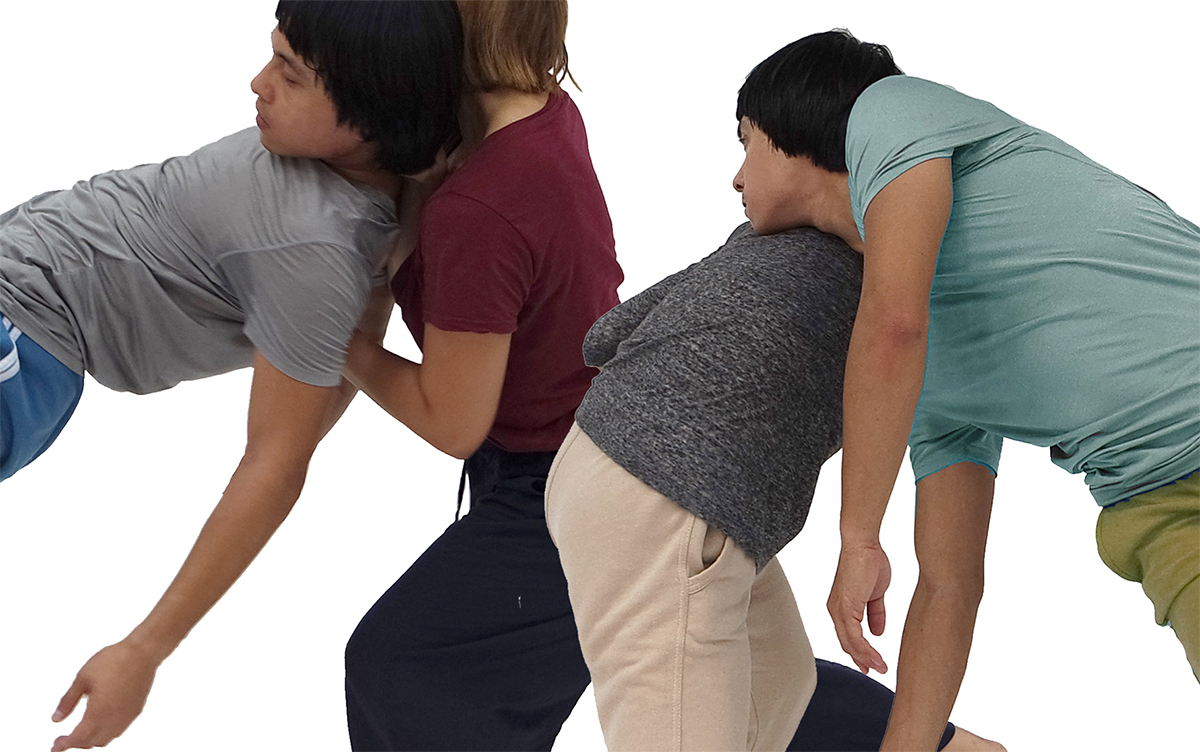
Close Company, Alison Currie & RAW Moves, image courtesy the artists and OzAsia 2018
RAW Moves and Alison Currie, Close Company
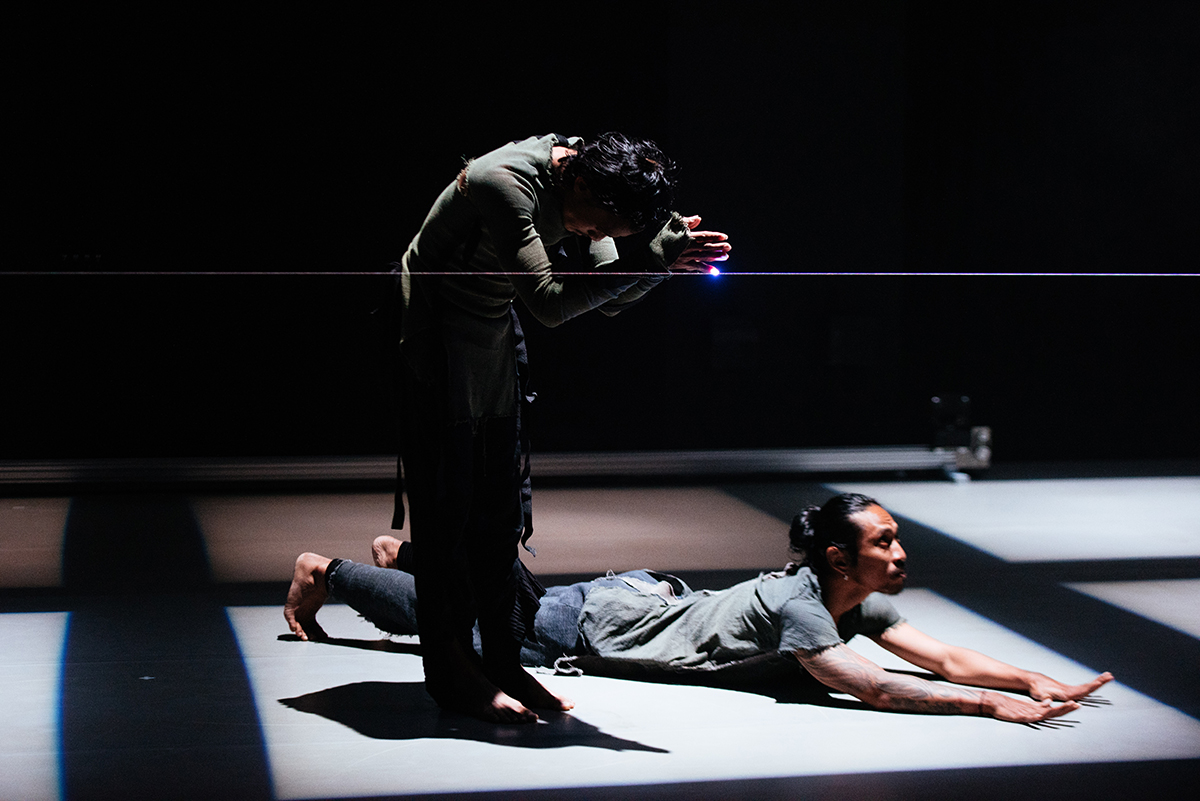
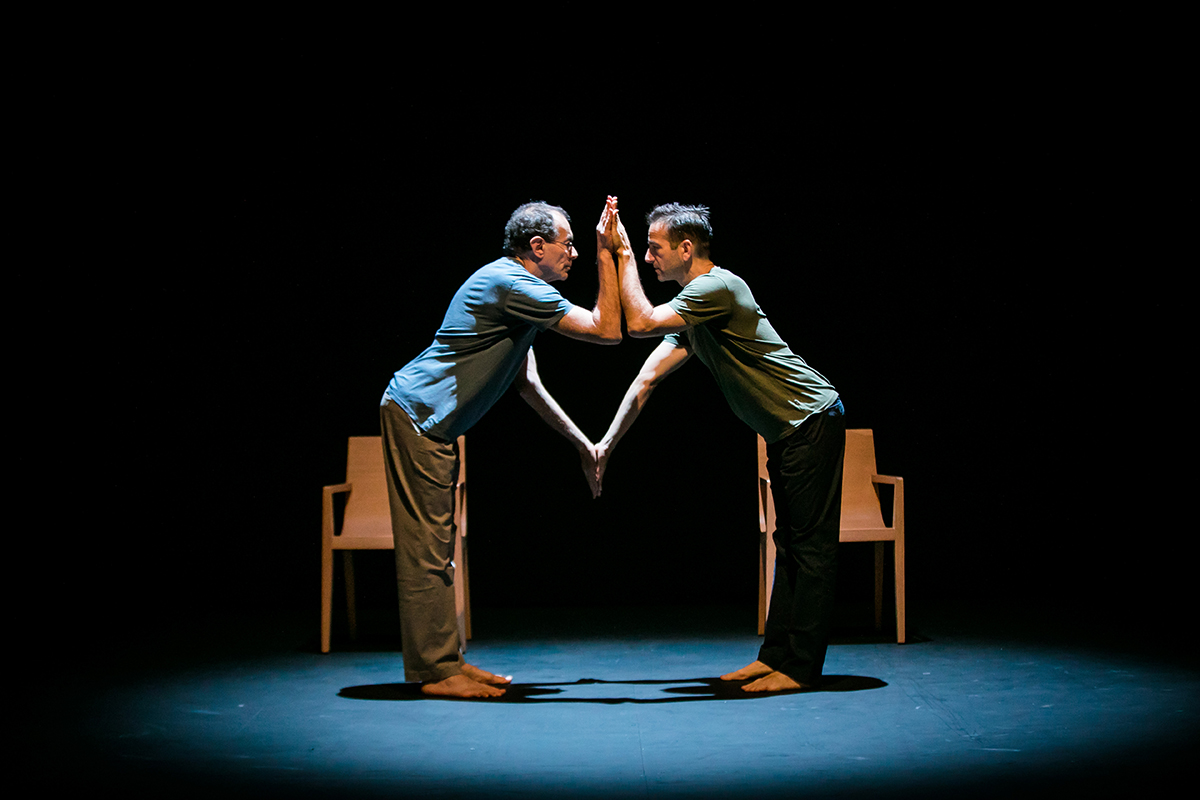
In Adelaide choreographer Alison Currie’s Close Company, a collaboration with Singapore’s RAW Moves and developed as part of OzAsia’s Asia-Australia exchange program Dance Lab, two dancers, Matthew Goh and Stephanie Yoong, undertake a ‘series of tests’ exploring the idea of co-dependency. Across three short but distinct parts they perform a restrained but dexterous choreography of connection and isolation, drawing together and pulling apart, mirroring each other from a distance or erotically embracing. Sometimes they simply observe or, for example when they check their phones, ignore each other. In the work’s final part the dancers thread their bodies into a single piece of clothing, something like an outsized T-shirt, and, in an arresting image of mutual dependence, take it in turns to carry each other around the space on their backs.
As each test is taken, bookended by the chiming of an iPhone alarm, Goh and Yoong — both the experiment’s facilitators and its subjects — gradually fill in a wall chart, each assigning a number from one to 10 to a range of variables: connection, intensity, pace, pressure, softness. As its name suggests, the work is an intimate experience, the dancers performing in close proximity to audience members who are able to move freely around the space, and are at one point invited to illuminate Goh and Yoong with the flashlights on our phones. Close Company is a modest work but one that, through its balanced modulation and effective twinning of the analytical and sensual, rewards the close attention it quietly urges.
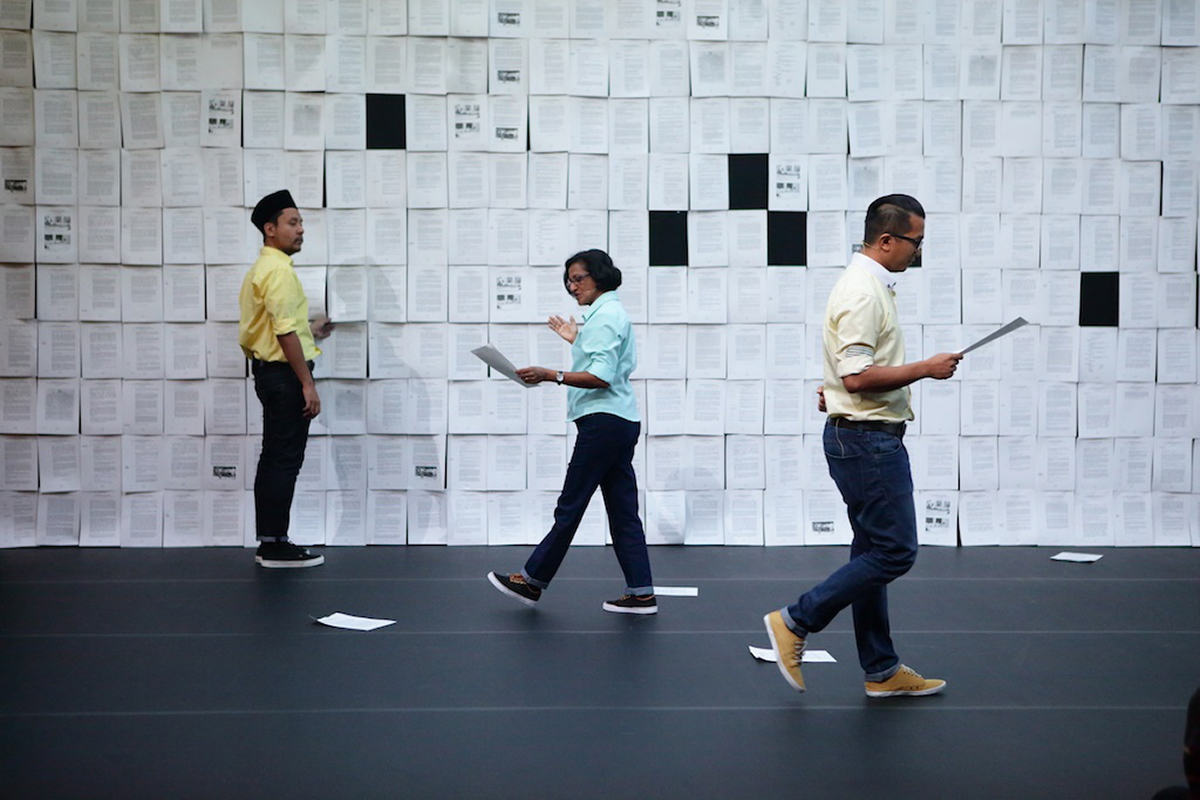
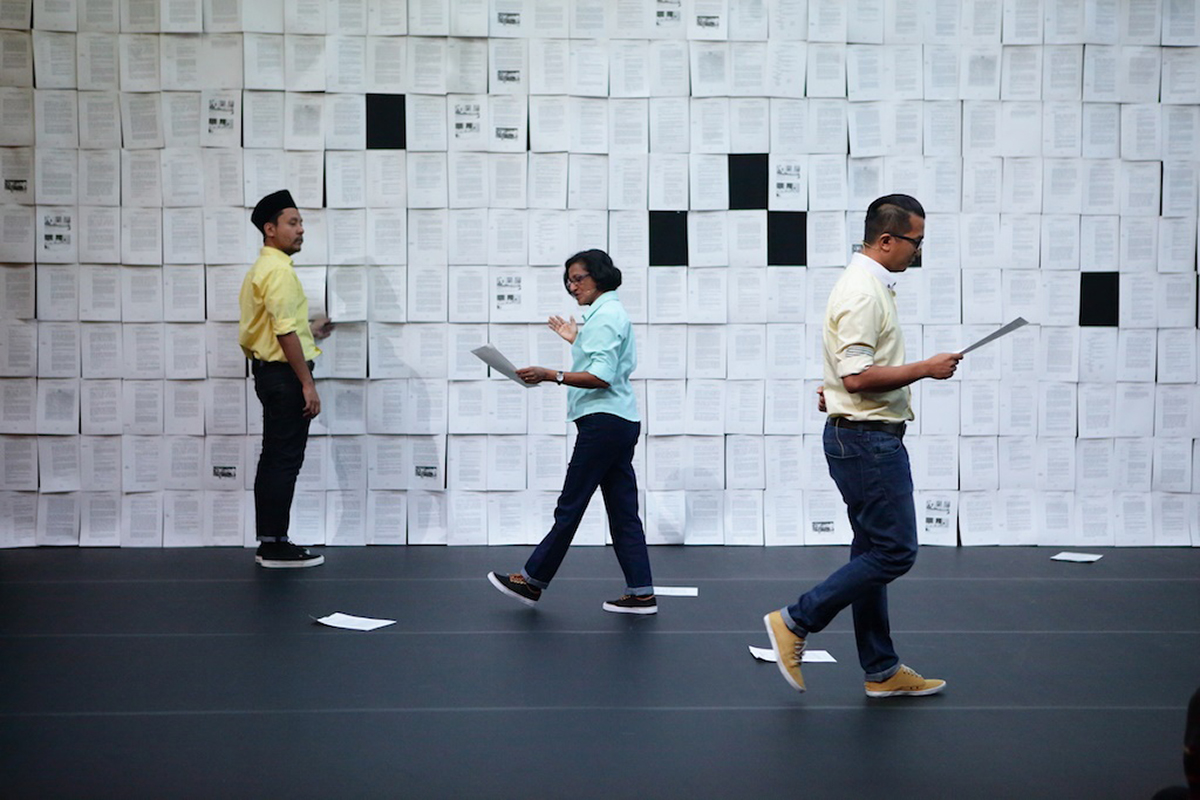
Baling, Asian Culture Centre, photo courtesy the artists and OzAsia 2018
Five Arts Centre, Baling
In December 1955 in Baling, a small north Malaysian town near the border with Thailand, British officials hosted a series of secret talks between Malayan Chief Minister Tunku Abdul Rahman, his Singaporean counterpart David Marshall, and communist leader Chin Peng, formerly a hero in the war against the Japanese, then the ‘most wanted man’ in the British empire. The aim of the talks was to end the seven-year-long revolutionary war dubbed the ‘Malayan Emergency’ by the colonial government, but they ended in a deadlock, albeit one that prefigured Malaysia’s independence from British rule two years later.
This fascinating if byzantine and largely forgotten episode in the mid-20th century’s wave of anticolonial and pro-communist insurgencies is, in Five Arts Centre’s Baling, transfigured into a measured documentary theatre performance based on publicly available transcripts of the talks, hundreds of printouts of which adorn one wall of the space from floor to ceiling. In a vivid illustration of the necessarily selective and incomplete nature of historical reconstruction, actor-researchers Anne James, Imri Nasution and Faiq Syazwan Kuhiri pluck individual pages down, reproducing the formal but impassioned tone of the talks, the participants in which they perform interchangeably.
In this way, and in the periodic moving of the audience to different parts of the space, our perspective on the theatricalised events is constantly shifting. The work’s interest, even when its textual and historical density threaten to overwhelm, lies not so much in its form — although, under Mark Teh’s astute direction, it’s enlivened by the projection of photographs and newsreel footage, and the interposing of the actors’ personal connections to Baling and its repercussions — but rather in the studious way it reanimates the gravity of the events. At stake is the fate of a nation, poised between violently opposed ideologies, and to be decided by charismatic men.
If Teh has an agenda it’s to rehumanise Peng, long made a bogeyman by the nationalists and still a contentious figure in present-day Malaysia (Kuhiri recounts an earlier performance of the Baling transcripts he was involved in that was monitored by Malaysian Special Branch, and afterward being attacked online as a communist sympathiser). The work’s quietly moving climax sees Nasution, also a documentary filmmaker, revisit footage of an interview he recorded with Peng, close to death and living in exile in Thailand. The clips were never used; in them, the old Malayan patriot seems far-gone, responding to Nasution’s questions with long, rambling answers or simply silence. One thing is clear: he aches to return home, a wish that was never granted but feels, however partially, redeemed by Baling’s sympathetic but never hagiographic portrait.
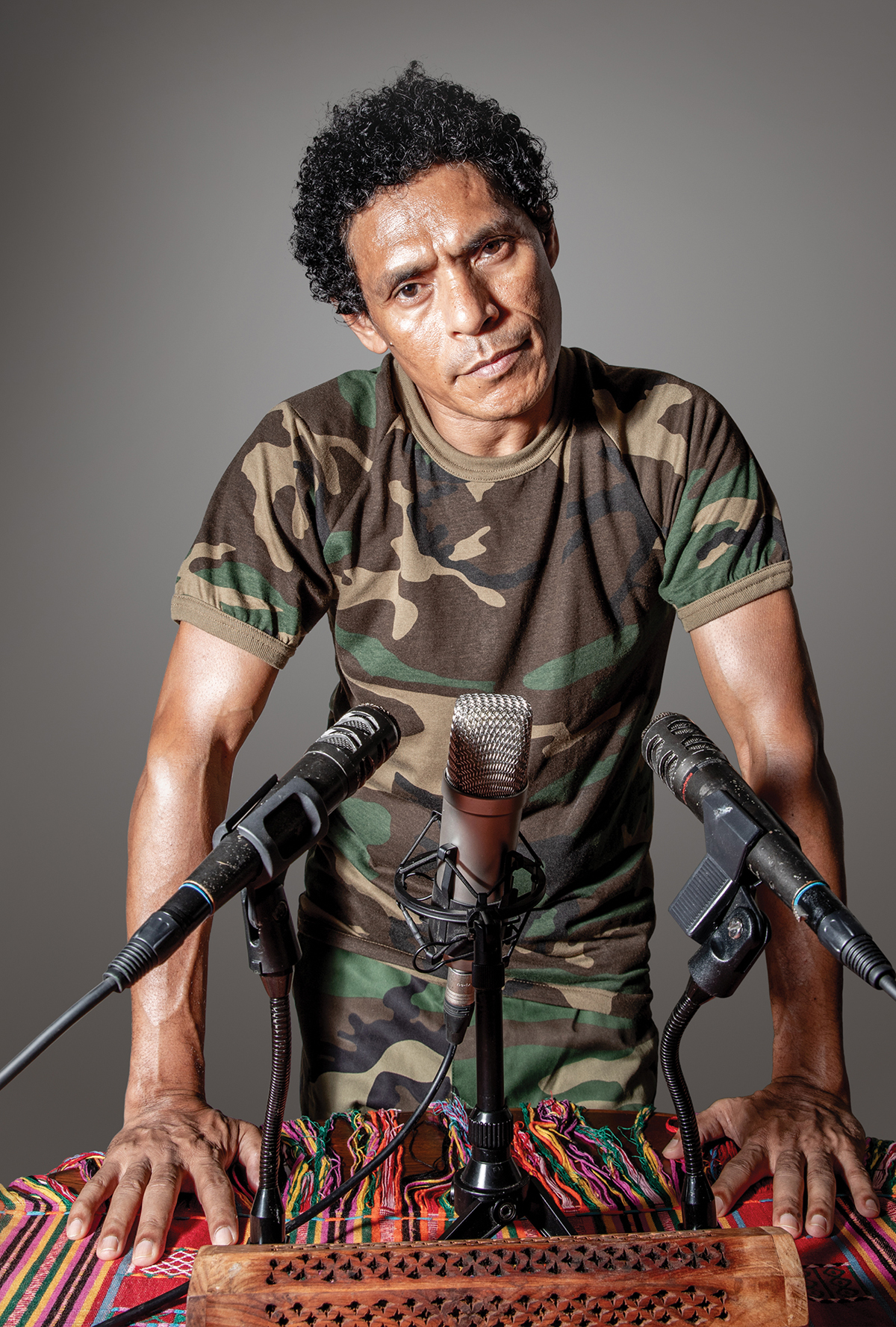
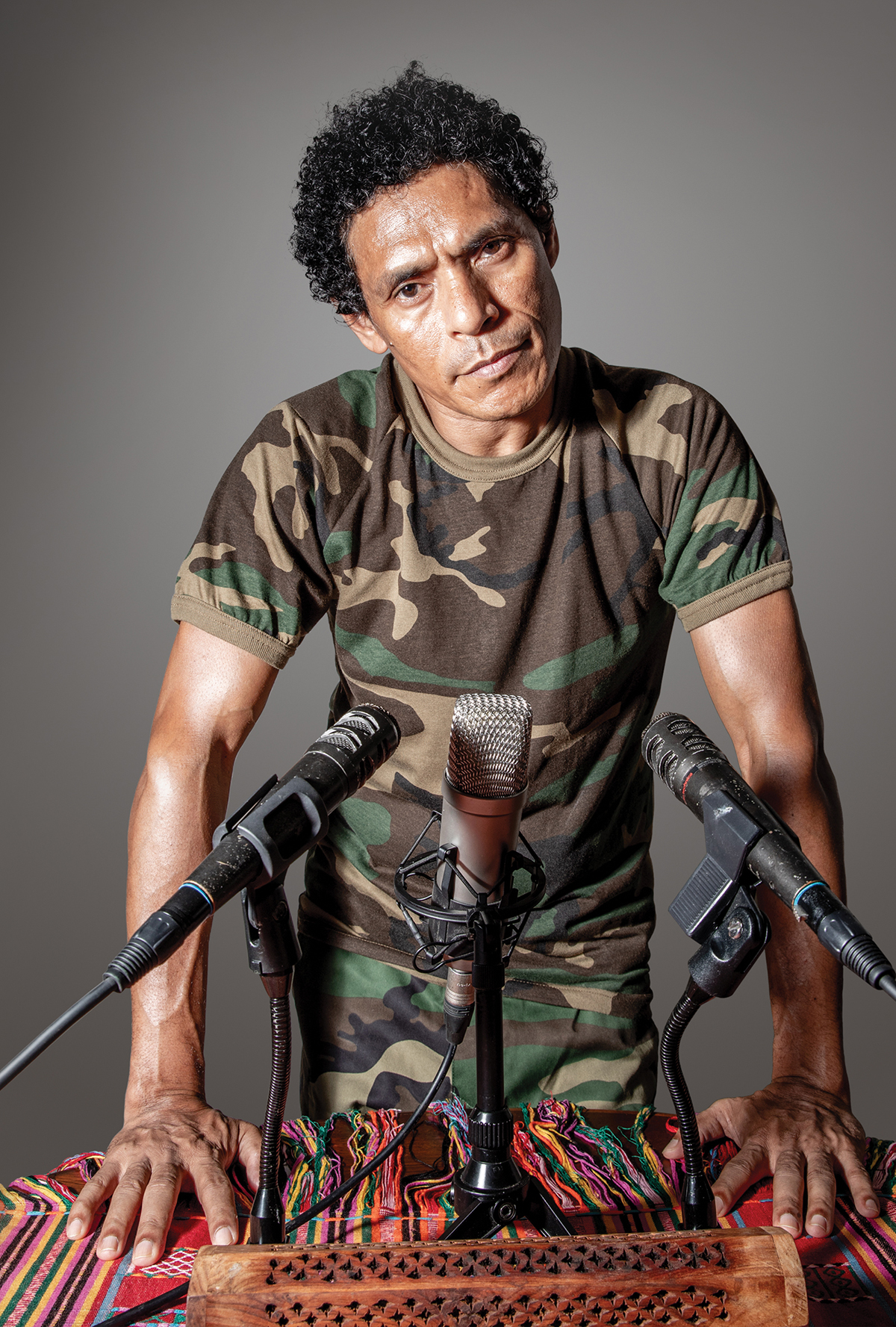
Jose Da Costa, Hello, my name is …, photo courtesy the artists and OzAsia 2018
Paulo Castro, Hello My Name Is
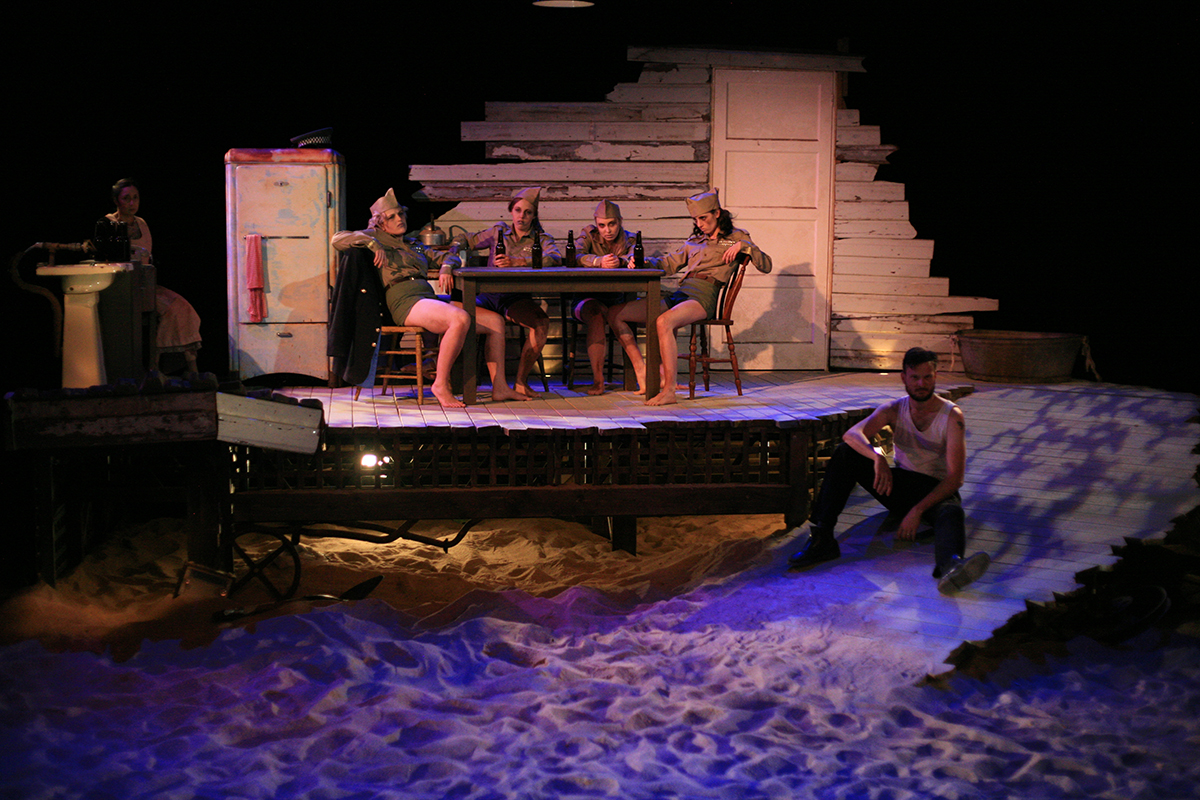
Adelaide-based director Paulo Castro’s Hello My Name Is… also shines a light on a little-known but still reverberating regional trauma, Indonesia’s bloody occupation of Timor Leste and particularly the 1991 Santa Cruz massacre in which 250 East Timorese pro-independence demonstrators were gunned down in a Dili cemetery. Similarly to Baling, the work resonates with personal connections to the events it depicts: actor Jose Da Costa survived the massacre and was imprisoned in its wake while, more distantly, Castro is implicated in the violence via the role of his home country, the former colonial power Portugal.
The work’s text, sitting somewhere between a polemic and a eulogy, is drawn from Edward Bond’s Choruses After the Assassinations, a brutally poetic treatise on the aftermath of war. “Children lose their parents,” says Da Costa, his delivery both haunting and haunted, “parents lose each other.” In a commendably restrained solo performance, he also gives voice to the forces that kill and destroy: “I am the army. My feet are tanks, my arms are guns.” He brandishes a pistol and wields a wooden cross like a machinegun.
But it is state rather than military actors that are painted most darkly here. Da Costa, dressed in army fatigues, sets up the stage like a meeting room for an international conference, assigning name plates to tables for the political figures involved in the events: Ali Alatas and Gareth Evans, the then foreign ministers of Indonesia and Australia respectively, and Xanana Gusmão, the Timorese resistance leader and later Prime Minister. Places are also reserved for ‘Independent Anonymous,’ represented by a human skull, and current UN secretary and former Portuguese Prime Minister António Guterres, an anomalous nod to Timor’s colonial past and, perhaps, a comment on the occupation’s ongoing significance. Da Costa scatters bones around the tables, and, with black irony, places an oil drum on Evans’ desk, and toasts the relationship between Australia and Indonesia with champagne. Finally, having wrapped himself in and then cast off both the Timor and Portugal national flags, he zips himself into a skeleton hoodie and lies down next to a makeshift shrine in solidarity with the dead.
Castro’s direction is deftly imagistic (he also designs the show’s lighting and sound, the latter comprising a repeated fragment of post-rock) but, as in much of his self-devised work, Hello My Name Is… feels dramaturgically flat, individual moments strikingly composed but failing to cohere into stronger narrative or thematic purpose. Nevertheless, it’s a work, anchored in Da Costa’s fine performance, that potently expresses the moral bankruptcy at the heart of empire-building, and the violent oppression and exploitation that continues its legacy in all but name.
Hotel Pro Forma, War Sum Up
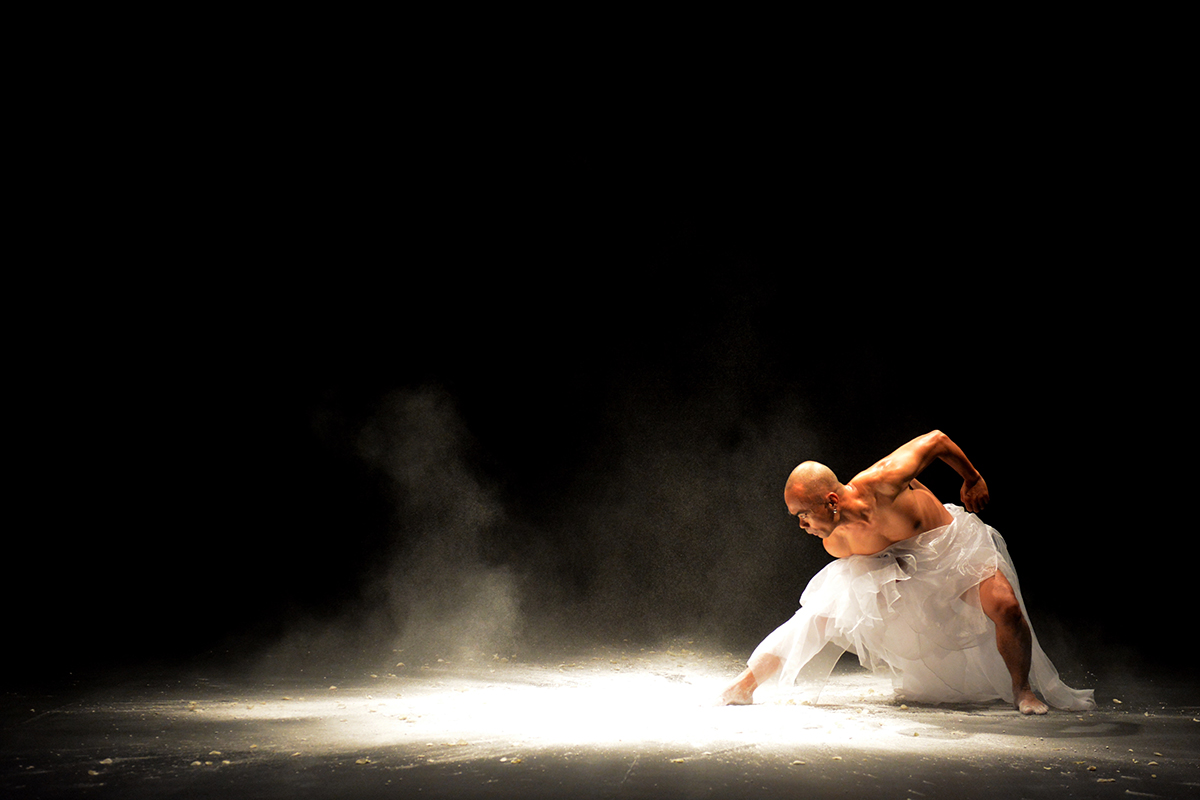
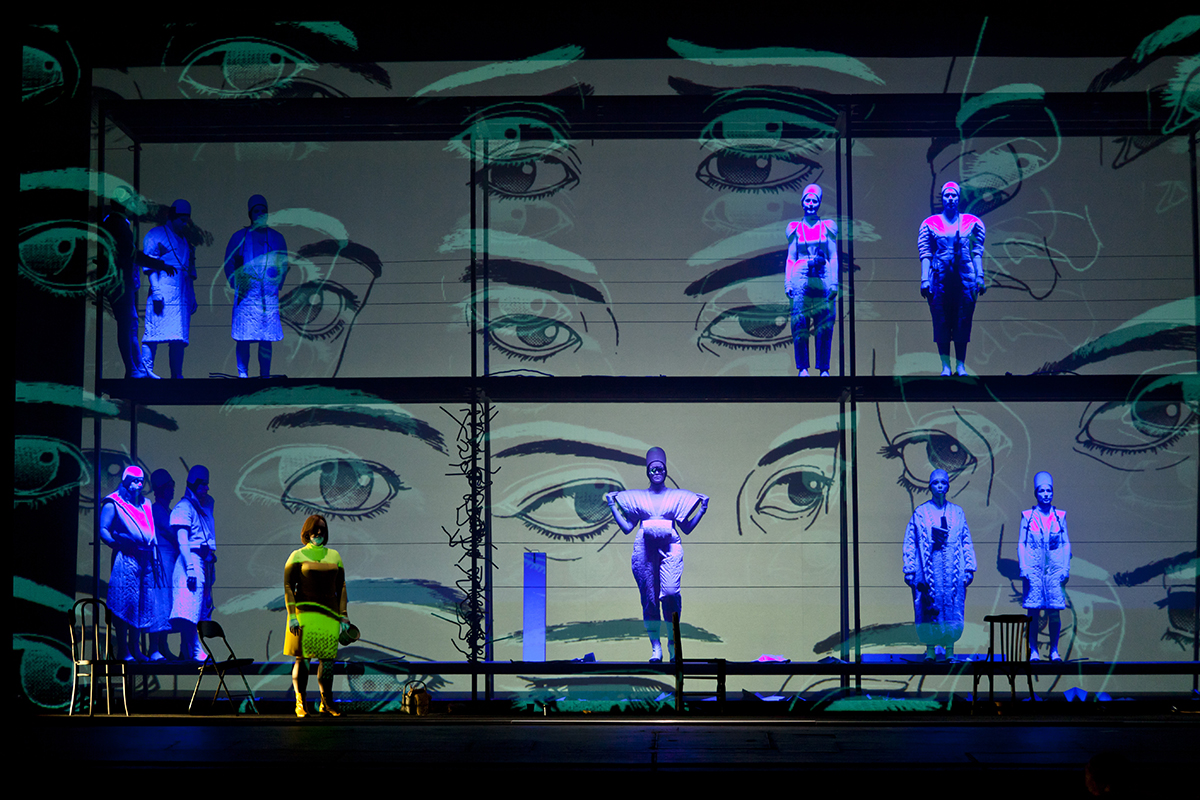
Also a meditation on destruction and loss, War Sum Up by Danish company Hotel Pro Forma was, for many, the high watermark of this year’s OzAsia Festival. Reaffirming Joseph Mitchell’s interest in showcasing contemporary Asian opera — Japanese composer Keiichiro Shibuya’s ‘vocaloid’ opera The End appeared in last year’s program — it’s a work of considerable scale and interculturalism, requiem-like in its sustained atmosphere of grief and dread but thoroughly modern in its pop art-inflected hybridity.
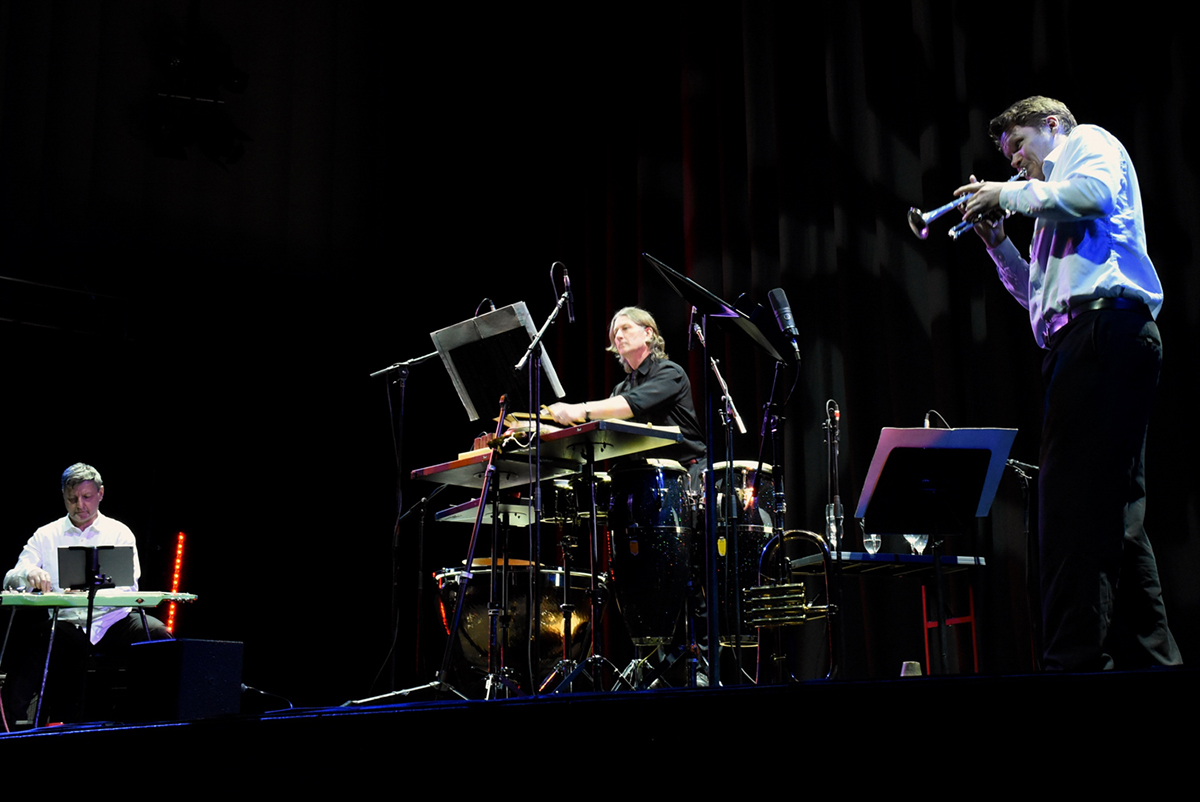
Musically, the opera is elegiac, its score — the fruit of a seemingly unlikely collaboration between Latvian composer Santa Ratniece, French sound artist Gilbert Nouno and UK electro ensemble The Irrepressibles — feels indebted to sonorism, the tonal style typified by Henryk Górecki, György Ligeti and others, and often used (as in the films of Stanley Kubrick) to convey a sense of the horrific or numinous. Performed via laptop, with the Latvian Radio Choir under the baton of Sigvards Klav, the score is rich, textural and varied, cluster chords on violin blending seamlessly with electronic elements, cartoon sound effects and the voices of the 11 singers, plus solo soprano Ieva Ezeriete, who wear microphones.
Willie Flindt’s sparse, Japanese-language libretto (English surtitles are provided) makes use of Noh theatre archetypes, each emphasising the physical and spiritual desolation of war: the Soldier (Aigars Reinis), the Warrior (Gundars Dzilums), and the Spy (Ilze Berzina). Ezeriete, who sings with impressive strength and clarity, portrays the Gamemaster, a sort of power-suited politico who initiates the action by cranking out a sentimental melody on a music box; though the narrative is nonlinear and sharply modular, the harrowing stories of each character never meaningfully connect. The chorus — costumed by Henrik Vibskov in a kind of soft armour reminiscent of both Japanese warrior culture and the aesthetics of Steampunk — remains more or less static throughout, the four principals stepping out of tableaux-like groupings to sing their laments.
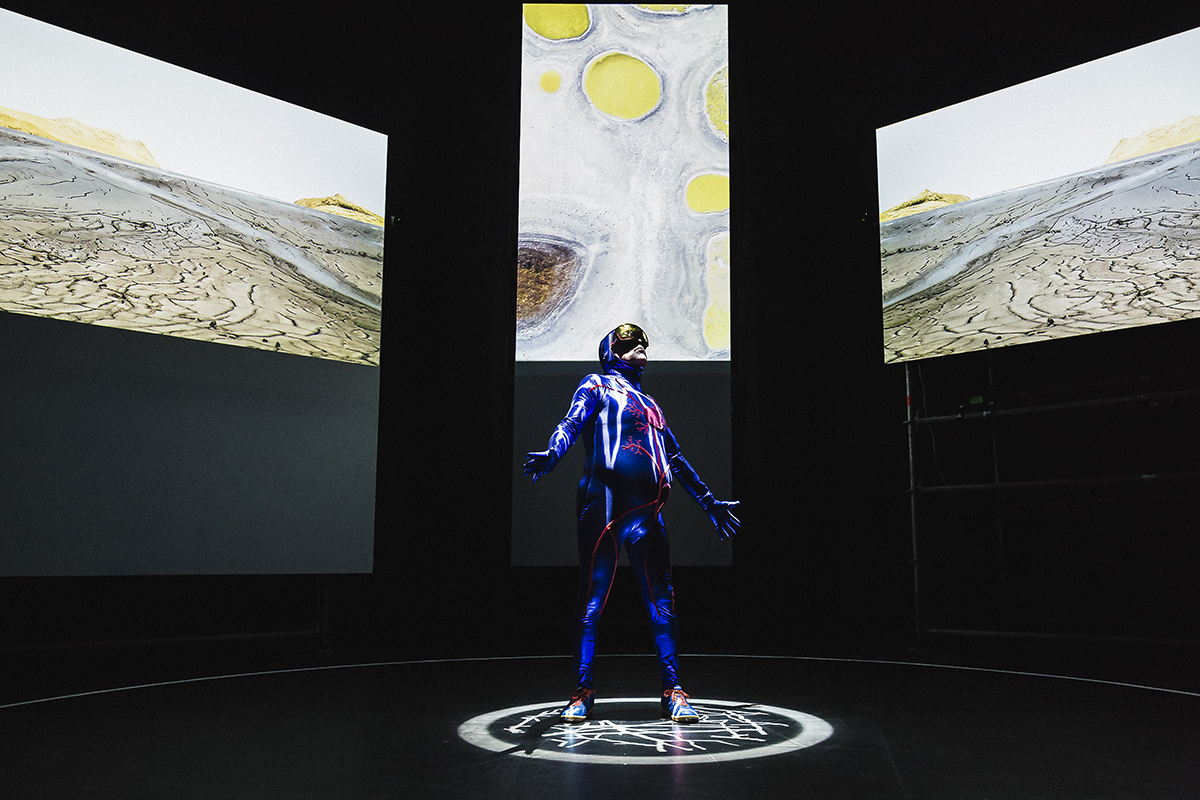
The work, staged on a two-tiered platform, is a visual cornucopia. Vast back-projections feature Hikaru Hayashi’s manga illustrations, diagrams of weapons and military vehicles, and, perhaps superfluously, gruesome black and white battlefield photographs. Projected text, slickly integrated with Jesper Kongshaug’s monochromatic lighting design, effectively undermines the libretto’s spare poetics with matter-of-fact litanies of PTSD treatments and spy lingo. Director Kirsten Dehlholm of Hotel Pro Forma assimilates it all superbly, and leaves us with a disquieting image of horror wrought from the everyday: the silhouette of a tank formed by a spotlight cast on a jumble of furniture. In such moments the work’s message doesn’t feel reducible to a simple ‘war is hell;’ it’s freighted instead with ambivalence, eliciting a kind of terrible wonder.
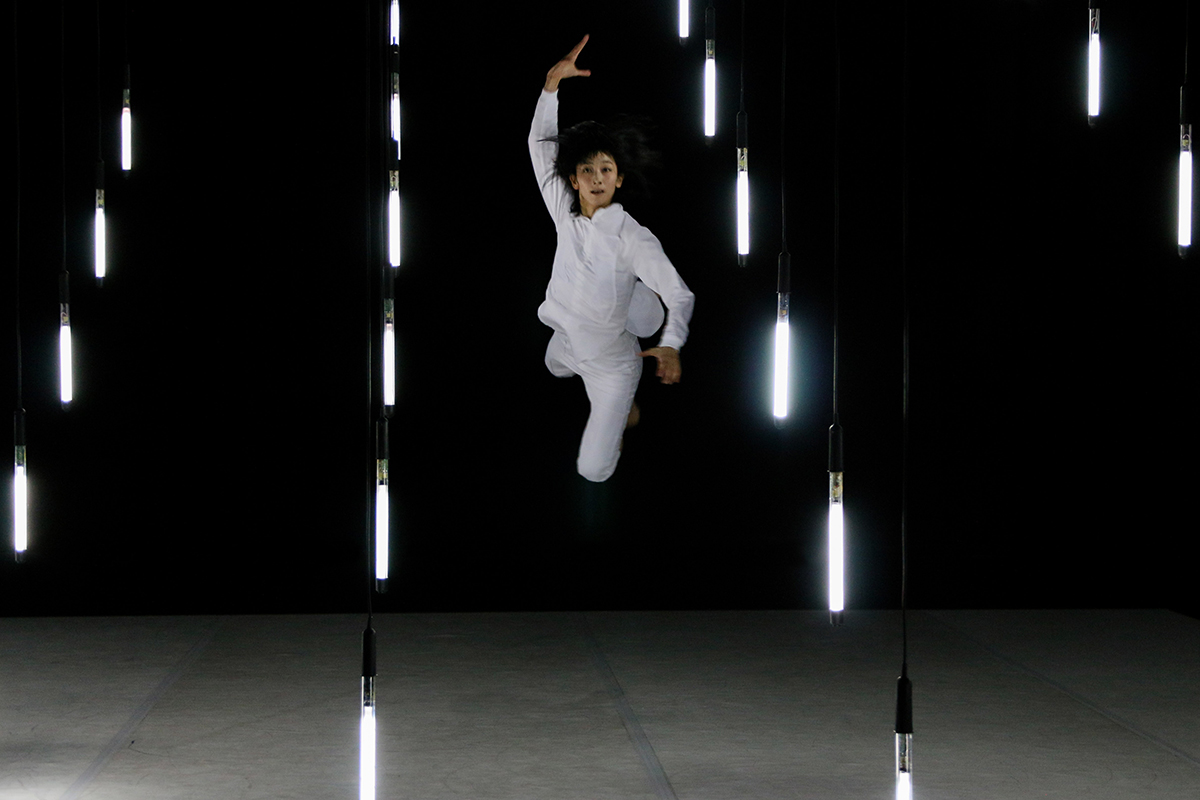
In Andropolaroid 1.1, Berlin-based Japanese choreographer Yui Kawaguchi also explores the intersection of the human and nonhuman, the potential for both transcendence and brutalisation in their meeting. Dressed in white and moving among husband Fabian Bleisch’s installation-like array of vertical neon light tubes suspended in two slanting planes, Kawaguchi performs a sort of duet with herself, imbuing the space with a sense of two distinct presences, one implacable and machinelike, the other all too human.
In the first part of the work Bleisch’s lights, synchronised with electronic pings, snap on and off singly and in clusters, creating shifting visual fields for Kawaguchi’s athletic, ballet- and hip-hop-inflected movements. Impeccably timed jumps under strobe lights leave her seemingly suspended in mid-air. A section set to announcements in Japanese and German, as in some uncanny transit lounge, hints at Kawaguchi’s growing estrangement from the world around her.
In the work’s second part she seeks something — shelter, comfort, a sense of belonging? — in a red hoodie dropped from the ceiling, alternatingly embracing and discarding it as pulsating dance music erupts with every touch. Having donned the hoodie she becomes manic, the formerly restrained choreography opening out into a new expansiveness as she wheels about the space (somehow mostly avoiding the overhanging lights) before finally becoming exhausted, or perhaps short-circuited, by it. Kawaguchi’s suddenly expressive face suggests a newfound oneness of the body — albeit, perhaps, still a post-human one — from which she had seemed perilously dissociated. It’s a quietly hopeful image.
–
OzAsia Festival 2018, Adelaide Festival Centre, 25 Oct-11 Nov
Top image credit: War Sum Up, Hotel Pro Forma, photo courtesy the artists and OzAsia 2018
Chiharu Shiota
I first encountered Chiharu Shiota’s dramatic artwork at the 2001 Yokohama International Triennale of Contemporary Art. Her Memory of Skin comprised a row of five muddy-brown dresses suspended from the high ceiling, each dress 13 metres tall and with a water pipe above it pouring cleansing water down its length. Standing at the foot of these dripping dresses that towered over the exhibition was a humbling and unnerving experience and it has haunted me since. So it was with great interest that I explored Embodied, the survey of her work shown at the Art Gallery of South Australia in this year’s OzAsia Festival.
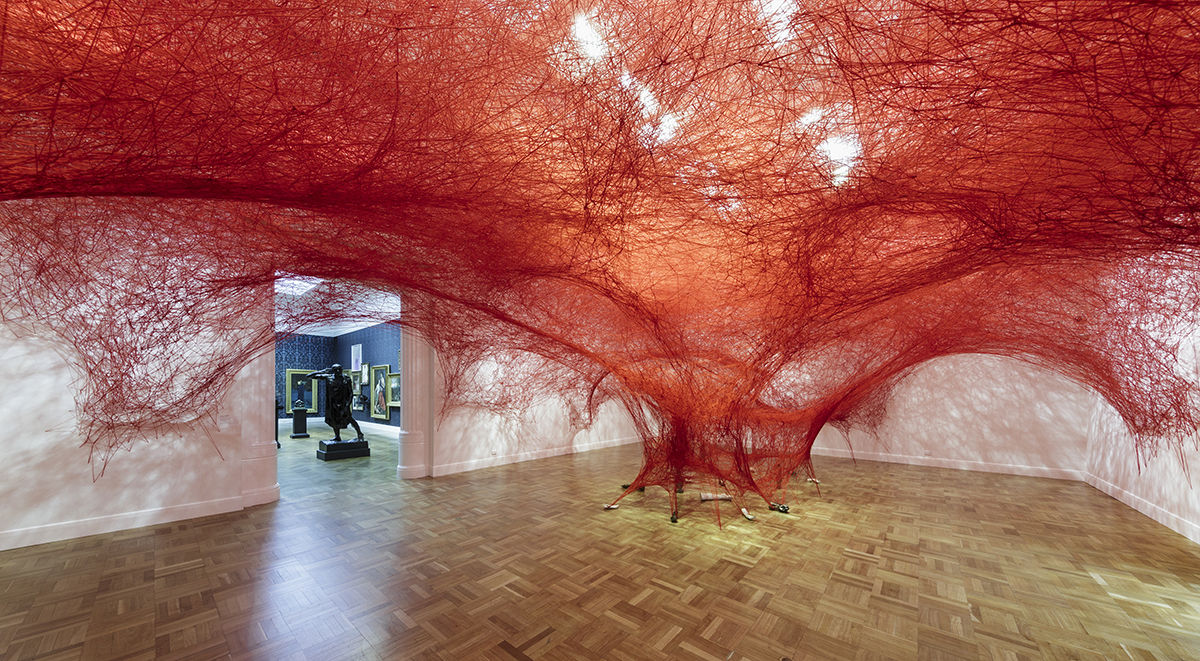
Chiharu Shiota installation, photo Saul Steed
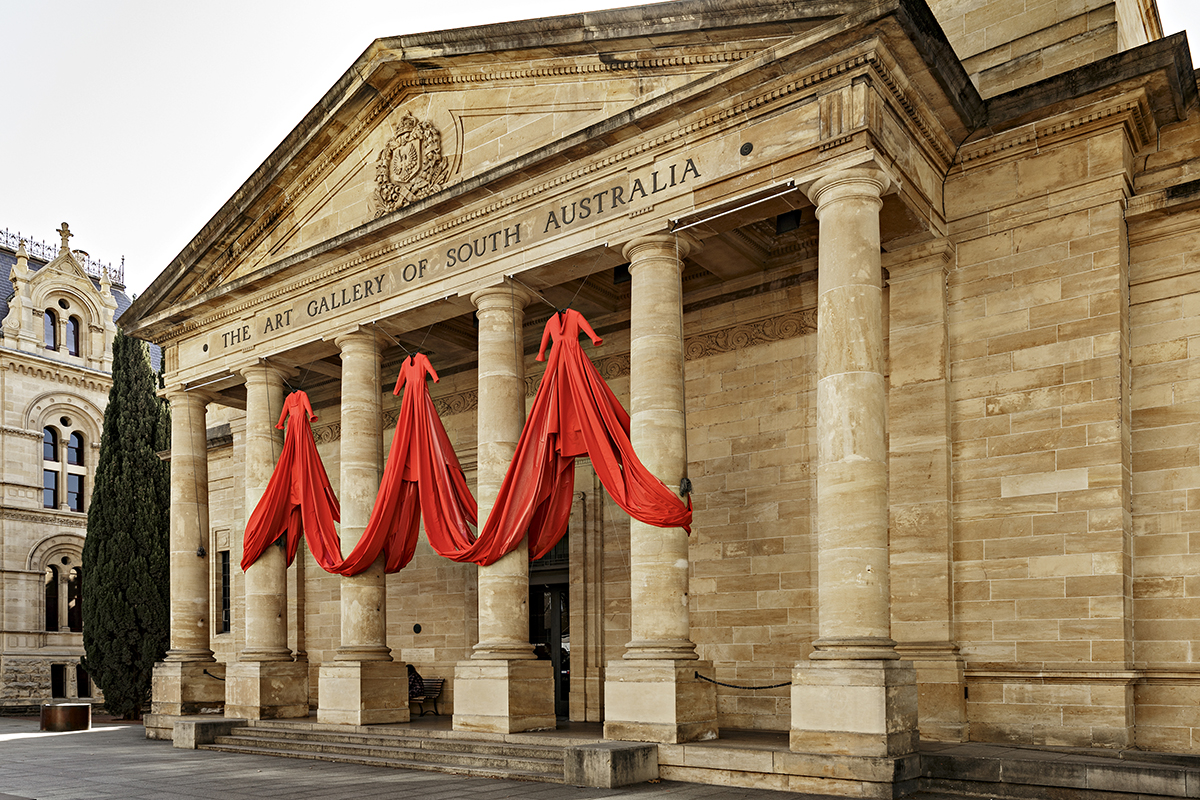
The survey, including a newly commissioned installation, forms the centrepiece of OzAsia’s visual art program, exploring the 24 years since her seminal performance piece Becoming Painting — made in Canberra in 1994 — in which she wrapped herself in canvas and was splattered with red paint. The AGSA has documented her career with a substantial publication, Chiharu Shiota: Embodied, which contains insightful essays by AGSA curators Russell Kelty and Leigh Robb and independent curator Anais Lellouche, together with an interview with the artist. The book, bound with red string to echo Shiota’s use of such material, includes an image of Memory of Skin and other early work including drawings and video stills. A new work, entitled Internal, accompanies the AGSA survey — an array of three, six-metre long red dresses draped across the pillars of the AGSA’s neo-classical façade, again dwarfing the viewer and offering an irresistible taste of the extraordinary work within.
Chiharu Shiota installation, photo Saul Steed
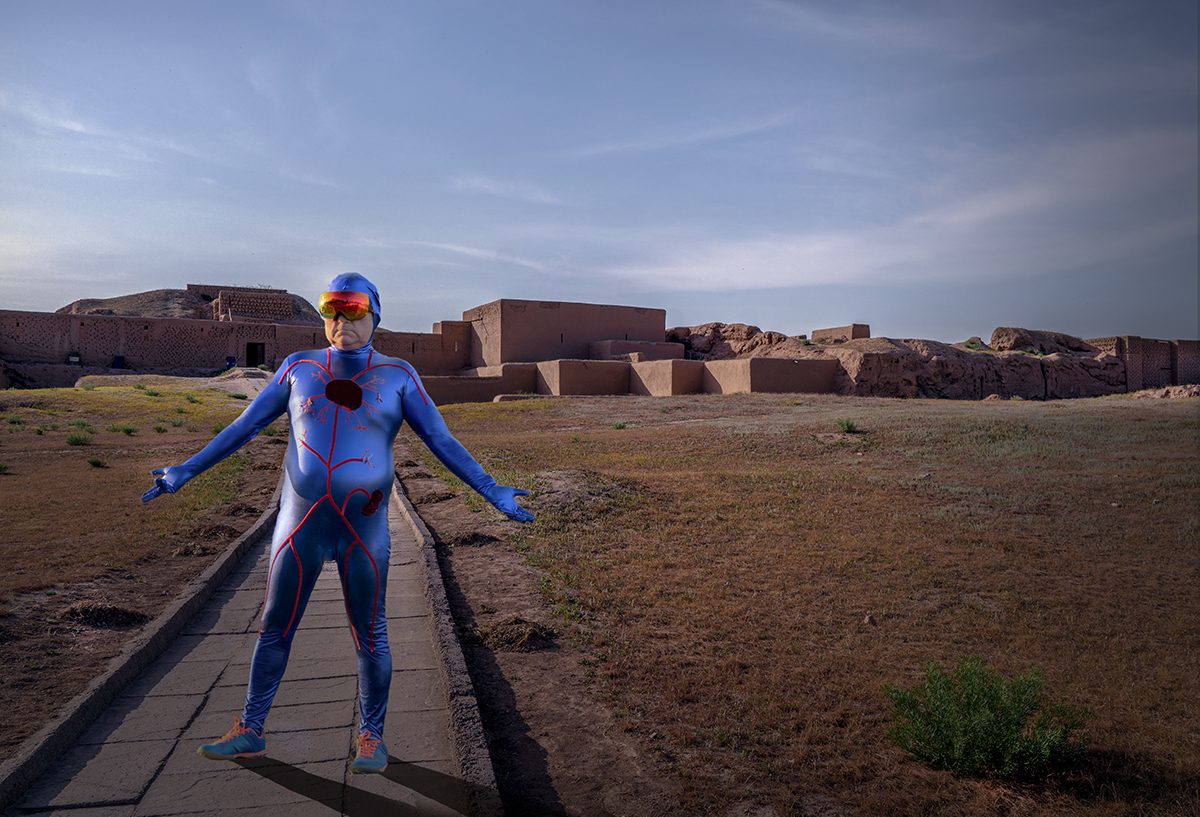
Chiharu Shiota was born in Japan and studied art there but reconsidered her work following subsequent study at the ANU School of Art in the early 1990s, moving away from traditional forms of painting with which she had become disillusioned and into the field of performance and installation. Based in Berlin since then, her oeuvre has expanded over the years to encompass video and more recently bronze casting. The most overwhelming work at the AGSA is her Absence Embodied, a site-specific installation commissioned by the gallery and occupying an entire room, comprising a dense web woven from 180 metres of red woollen thread suspended from the ceiling and walls. The web is anchored to the floor by castings of body parts of the artists herself and family members including a bronze of three hands — her daughter’s, her partner’s and her own — clasped together and entitled Belonging (2017). She had been invited to make a work responding to the AGSA collection and, as that room is normally hung predominantly with figurative paintings, her intention with Absence Embodied was to evoke the absent figure. Shiota indicates that her string installations, which she first developed in Canberra, are a form of drawing in space and the colour red, which she uses frequently, suggests blood vessels. Absence Embodied envelops the viewer, creating the feeling of being inside Shiota’s circulatory system, the castings of limbs marking the extremities of her body; suggesting to me a body being torn apart.
Among the videos in the exhibition is Shiota’s 2010 performance Wall, in which she is shown lying naked and twitching on a bare floor smothered in many metres of clear plastic medical tubing filled with red liquid and accompanied by a soundtrack of a heartbeat, the work referencing her pregnancy. At times, her work suggests she feels trapped by the limitations of her body, and her health has evidently been an ongoing concern. Shiota says that her work cannot be separated from her body: “It is always the balance of this triangle of the art, the body and myself from which I am always making work” (Chiharu Shiota, Embodied, AGSA 2018). Her intensely personal and visceral work suggests an alternative awareness to Descartes’s “cogito ergo sum,” as if she is saying, ‘my body exists, therefore I am.’
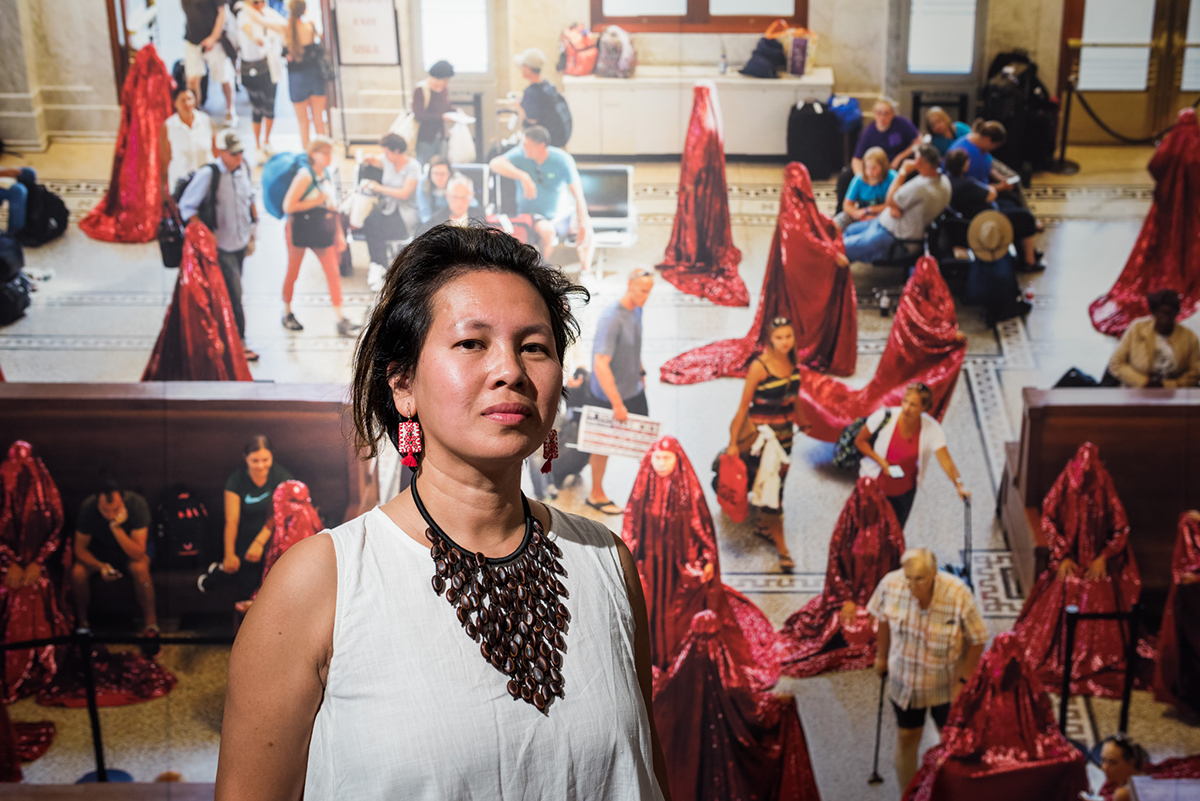
Opening, AGSA installation The Red Chador, Anida Yoeu Ali, OzAsia 2018, photo Daniel Purvis
Anida Yoeu Ali
Shiota is one of five female artists in OzAsia 2018 who originate from Asian countries and who consider the self and especially the body in widely divergent ways. Cambodian-American artist Anida Yoeu Ali’s The Red Chador: in Memoriam is an ongoing activist performance that has evolved since its inception in 2015. Ali created the Red Chador — a full-length chador covered in red sequins and sometimes masking her face — for public performances, drawing attention to the anxieties that the Islamic religion and dress codes provoke in the west. The chador’s colouring and the use of sequins are inconsistent with typical Islamic dress, distinguishing the artist’s appearance from that of other Muslim women and offering a conceptual challenge to curious onlookers. Over the course of Ali’s performances, the Red Chador has become a character, the personification of a refugee or a victim of authoritarianism or racism — a creation intended to mobilise opinion. She has enacted numerous performances around the world in which she appears silently in public wearing the chador. Having originated in Paris after the Charlie Hebdo incident, the Red Chador was well-received there but provoked often very negative responses in the US — in one instance, Ali had to abandon the performance, such were the threats to her safety.
The Red Chador subsequently disappeared (presumably confiscated) in transit from Israel in 2017 and her performances now take the form of memorialising its loss. For her Adelaide exhibition, Ali showed videos including The Red Chador: The Day After, which documents a performance in Seattle the day after the 2016 US Presidential election, together with a series of photos of herself wearing the chador in public performances and a series of framed texts such as “Ban Me” and “I am a Muslim” used in placards in those performances. Her installation included memorial wreaths and an altar, copies of a newssheet reporting the history and loss of the Red Chador were available and at the exhibition opening she delivered a eulogy for it
and invited audience participation by making offerings of incense. Presumably Ali could make a new garment but instead has used the Red Chador’s mysterious disappearance, equating to the abduction of a person, as an extension of the original concept, now evidencing an attack on free speech.
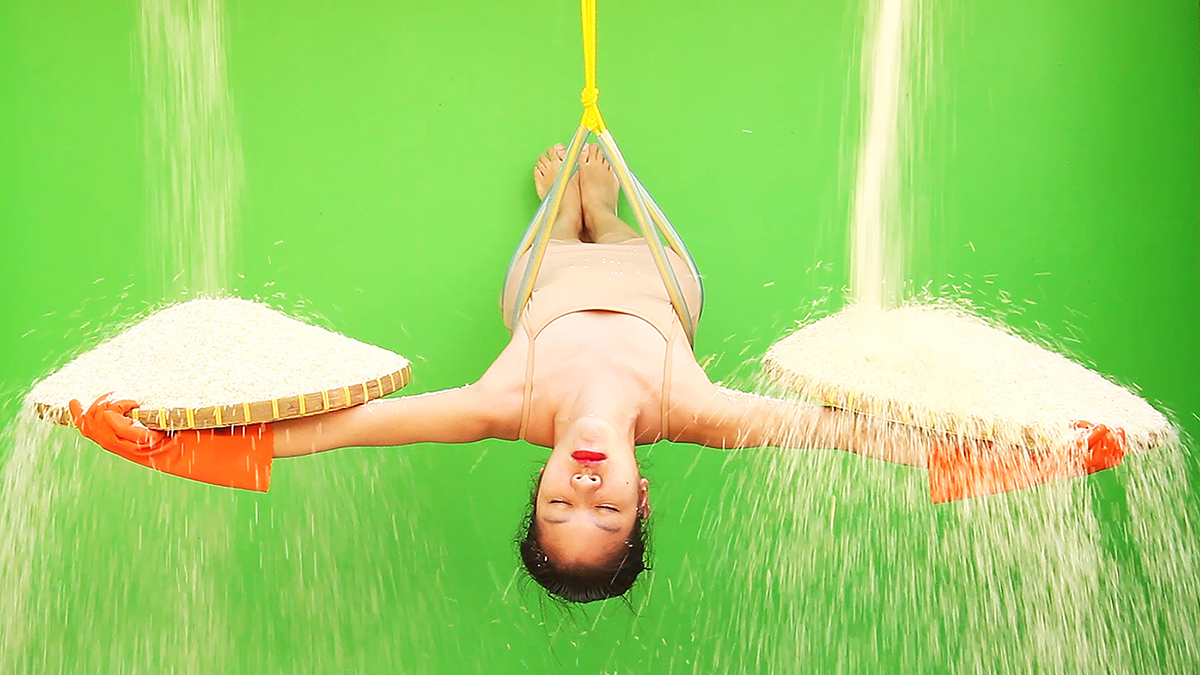
The Scale, Kawita Vatanajyankur, OzAsia 2018 photo courtesy the artist
Kawita Vatanajyankur
Thai-Australian performance artist Kawita Vatanajyankur uses her body in physically demanding ways to characterise Thai women’s oppressive working lives. Her exhibition, The Scale of Justice, comprises a series of short, visually arresting and highly compelling videos in which she deploys her body to represent objects or tools used in mechanical processes, for example as a set of scales to weigh rice or vegetables (The Scale 2, 2016) or as a juice squeezer (Squeezers, 2015). In The Scale of Justice (2016), she balances her outstretched body on a horizontal beam and supports a basket of vegetables hanging from her neck and another basket hanging from her feet. As more vegetables are thrown from off-camera into one or other basket, her body tilts one way or the other. Vatanajyankur sees her performances as a form of meditation, pushing her body through pain limits to lose herself and merge with the objects and processes being depicted. Her extreme form of performance raises issues beyond the exploitation of labour or gender, asking what it is to be human, and recalling the exhaustive performative efforts of artist Marina Abramović. However, Vatanajyankur does not have to labour to survive as do the exploited women labourers to which her work refers — she does so by choice rather than necessity. Her work condemns exploitation — the invisible, controlling forces off-camera — rather than labour itself, and she implicitly invites viewers to empower themselves by transcending physical pain and their own sense of self. (See selected video works here.)
JeeYoung Lee
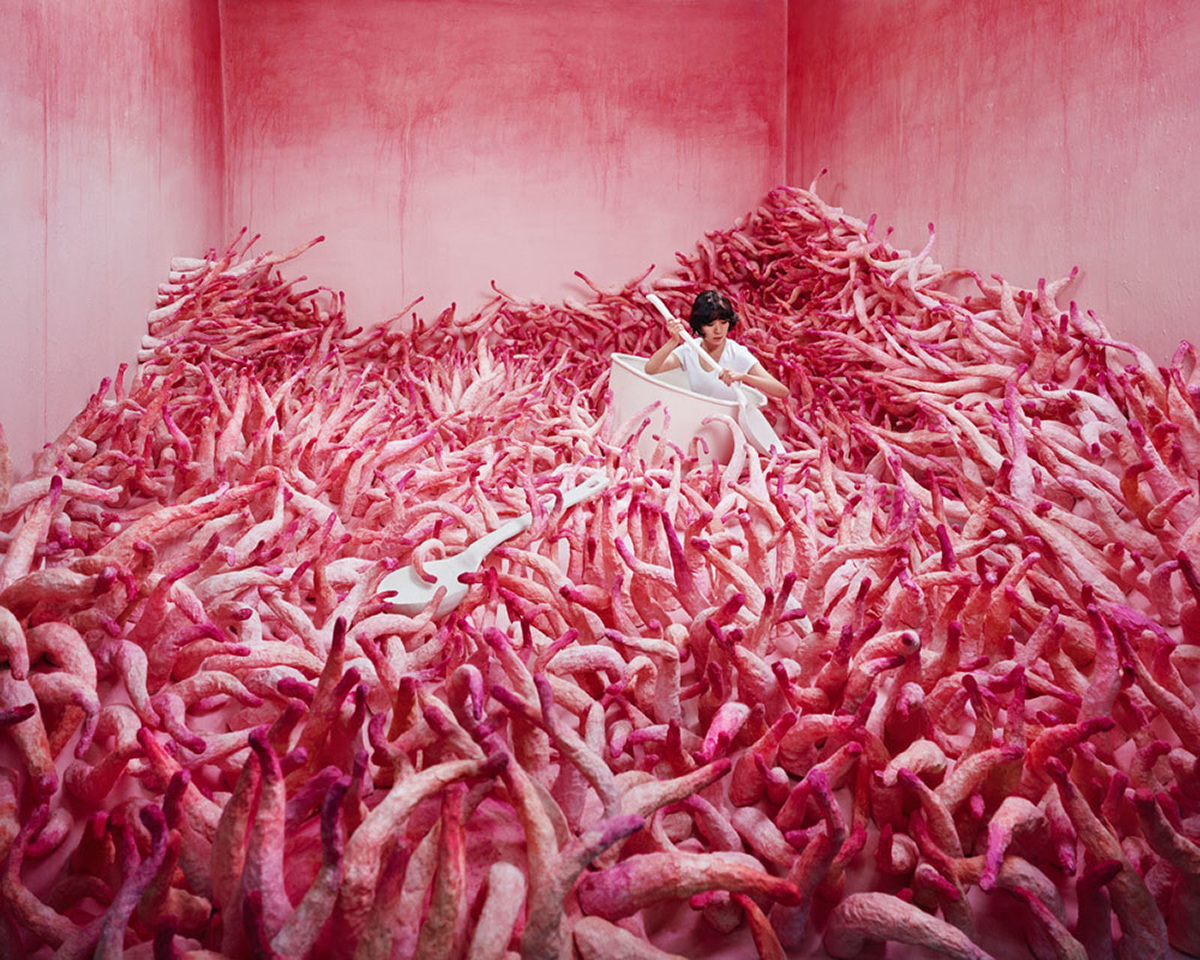
South Korean artist JeeYoung Lee exhibited a series of large-scale images that take tableau photography into new territory. She creates imaginary scenes and then photographs herself within them, her scenes suggesting bad dreams in which the dreamer is lost in a strange world and faces imponderable conundrums or existential threats. In My Chemical Romance (2013) she is seen trying to find her way through a forbidding maze of steaming water pipes painted in the black and yellow colours of construction-site barriers, as if she is lost in an industrial plant. In Resurrection (2011), she sits inside a flower in a pond looking like a newborn water sprite, the image suggesting she has escaped civilisation and returned to nature. In Gamer (2011). a male figure is dwarfed by oversized Lego bricks with which he is building a structure, suggesting that he is the artist’s online avatar, creating his own world. While her work may appear whimsical, it offers metaphors for the difficulties of contemporary life. Positioned opposite the display of JeeYoung’s photos is an installation — a double bed in a field of pink cotton-ball flowers above which hover artificial butterflies — that resembles the kinds of scenes created for the photos. The empty bed invites us to imagine occupying this fantasy space and her other spaces and to reconsider the world we have created for ourselves.
The titles of JeeYoung’s works are crucial to their appreciation and unfortunately the Festival Centre did not provide a caption or plaque indicating the title of each work, obliging interested viewers to search for the works online to discover their titles. Some of Kawita Vatanajyankur’s videos were also shown at indoor and outdoor locations around the Festival Centre, extending their public visibility, but they too were uncaptioned and were screened alternately with material publicising other events, risking their significance being lost on passers-by.
Yee I-Lann
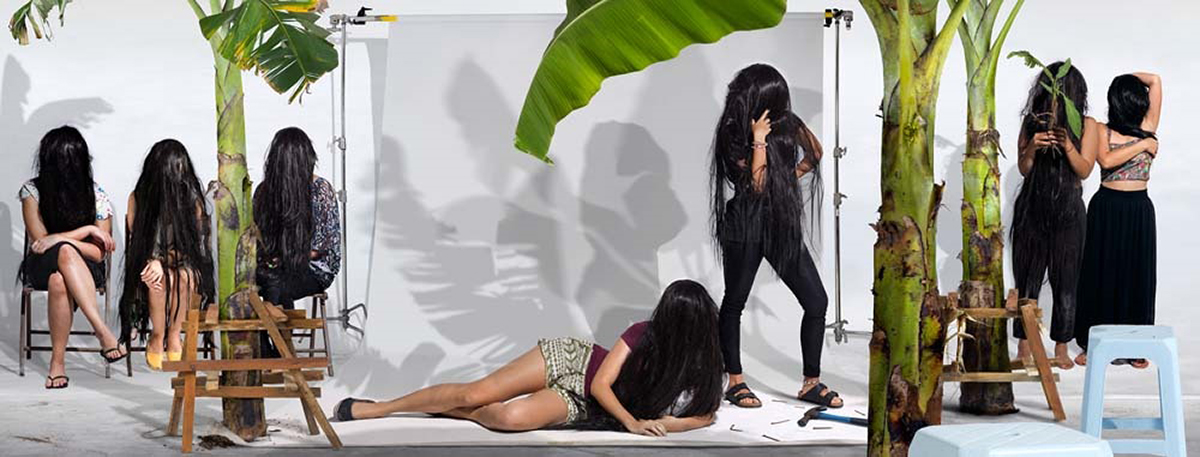
Kuala Lumpur-based Yee I-Lann’s Like the Banana Tree at the Gate (2016) is a photo-collage showing a row of standing and seated women in various poses, some holding banana palm leaves and all with their faces obscured by very long hair. Some figures appear more than once as if they are doubles or multiples of the same individual. Yee’s work references traditional folklore to create a general metaphor for female power and more specifically for feminist movements in Malaysia and elsewhere in Southeast Asia. The catalogue essay informs us that these female figures each represent a Pontianak, a female spirit of Yee’s native Borneo that inhabits banana trees, and that the work’s title refers to “a 17th century sultan in southern Borneo who advised his subjects not to plant a banana tree near their front gates so as not to advertise their wealth to potential colonial exploiters,” the story have since been cited as an early form of resistance to colonisation. The figures in the photo-collage are in western-style casual dress to which viewers can easily relate and suggests that these female spirits are ubiquitous. Collectively they can be seen as a defensive force guarding traditional Bornean culture and sovereignty.
Performative unanimities
The female artists selected for this component of OzAsia all have major international reputations and showing them together enables illuminating comparisons, with a primary focus on performance and on the female body as a site of self-understanding and self-realisation. Shiota’s cathartic 1994 performance Becoming Painting was a turning point for her and resonates with the meditative performance work of Kawita Vtanajyakur, which involves risk-taking as a pathway to personal transformation. Anida Yoeu Ali’s daring public performances involve risk-taking as a means of encouraging social transformation. JeeYoung Lee’s performances in her imaginary spaces may be less risky physically or politically but equally encourage viewers to consider the controlling forces of their own worlds.
Edo Style 1615-1868; Ryoji Ikeda, data:tron [3K version]
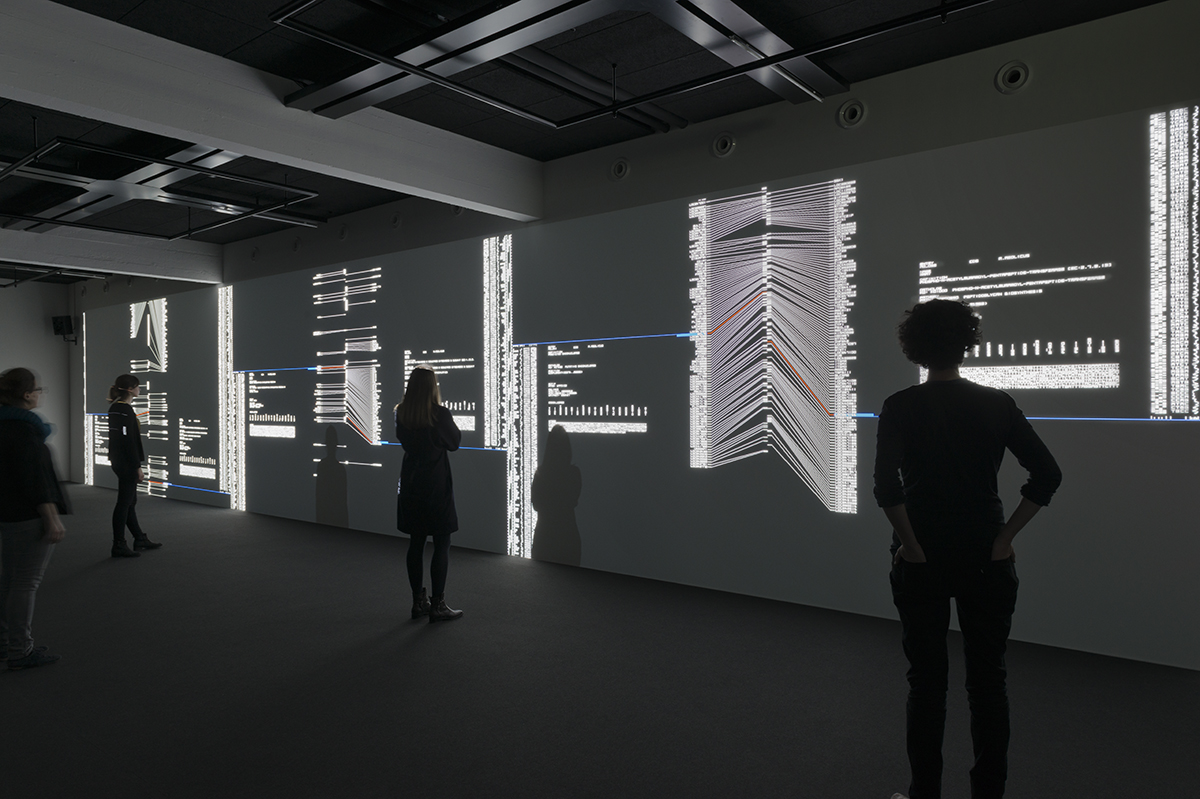
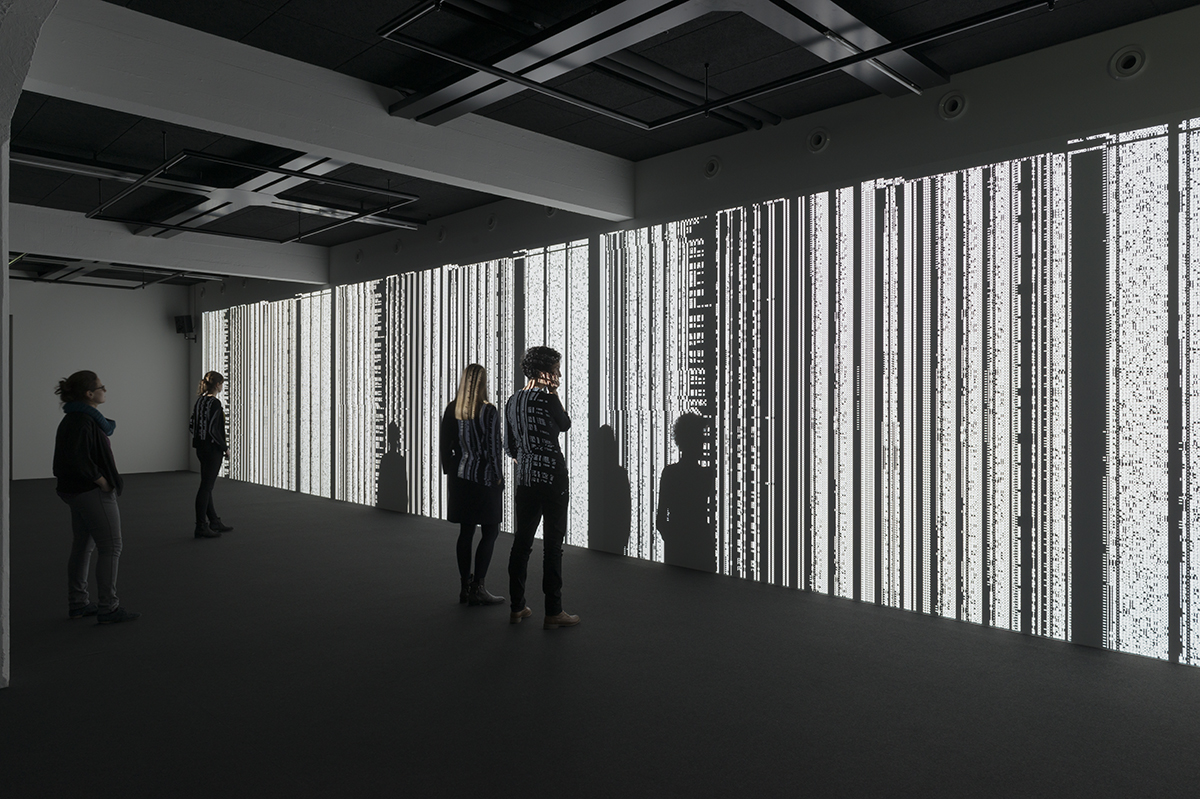
The OzAsia Visual art program also included two very different exhibitions providing notable contrasts to the work of the five female artists — Edo Style: 1615-1868, an exhibition of Japanese art of an era that provides a window to a long-lost, isolationist culture in which social customs and women’s roles were very different from those of today’s Japan; and renowned Japanese artist Ryoji Ikeda’s visually overwhelming and highly cerebral video and sound installation data:tron [3K version], which presents at hypnotic speed a seemingly infinite amount of numerical data, as if everything in the universe is ultimately reducible to numerals, codes or mathematical formulae. The inclusion of these exhibitions creates a sense of historical development, showing where we have come from and where we might be headed. While the OzAsia visual art program has no overarching theme and sensibly does not attempt the impossible task of surveying the art of the Asian region each year, it does highlight its breadth and depth, and in this program, it especially highlights the concern of women artists with female identity and empowerment and the evolving roles of women in increasingly globalised cultures. OzAsia reveals this cultural and political evolution through the inclusion of exemplary exhibitions by leading contemporary artists.
–
OzAsia Festival, 2018: Chiharu Shiota, Art Gallery of South Australia, 24 Aug-28 Oct; Kawita Vatanajyankur, Nexus Gallery and Adelaide Festival Centre, 11 Oct–9 Nov; Anida Yoeu Ali, JeeYoung Lee, Yee I-Lann, Adelaide Festival Theatre Gallery, 24 Oct-30 Nov; Edo Style: Art of Japan 1615-1868, David Roche Foundation, 5 Sept–1 Dec; Ryoji Ikeda, Artspace Gallery, Adelaide, 24 Oct–11 Nov
Top image credit: Opening Art Gallery of SA, installation by JeeYoung Lee for OzAsia 2018, photo Daniel Purvis
Drama to postdrama
I cut my teeth for RealTime with an interview with playwright Deborah Levy (RT 11, p6 1996). Levy, who has since gone on to a successful career as a novelist, had reached a personal crisis point in theatre. “Theatre is obsessed with explaining every moment and its causation in a way that doesn’t interest me much,” she explained. “I’m not in the least bit interested in narrative in the theatre. I really don’t come to the theatre to be told stories that the playwright already knows.” These insights may seem outdated now but in the 90s they were still challenging. She veered away from the naturalistic, political dramas of her early career and wrote a series of non-naturalistic texts, such as The B-Files, in which, as I wrote, “any sense of gender essentiality or an individual authentic self are undermined during the fluid investigations of identity.”
Born in South Africa of Jewish and Protestant parents, brought up in England, Levy saw herself as “stranded between all those points with all of them trying to claim me as theirs. The idea that there is a pure culture in our contemporary world is totally untrue. Our society is impure — no wonder cultural identity is what everyone is talking about.” She was driven to jettison both ‘narrative’ and ‘character’ as being too overdetermined for her shakily determined world. “Naturalistic characters always come on the stage with too much baggage. They rarely allow the audience space to project onto. That’s why I prefer working with persona.”
These shifts in focus in theatre — from dramatic narrative to ‘distilled images,’ from deep character to swiftly transforming persona, from coherent identity to fluid multiplicity, from representation to presentation etc — were not new. Artists in Europe, Britain and the US had been moving in this direction for a couple of decades. By the time of my interview with Levy it was becoming clear that, as she put it, drama was a “dead and dying form that sits very uncomfortably with any kind of expression of the contemporary world.” However, in looking back at the shows I watched and wrote about for RealTime over the following 14 years, it seems to me that this uneasy terrain was still the one being explored and fought over in most of the works; and that the ones I found the most interesting included within their dramaturgy the terms of the conflict they engaged.
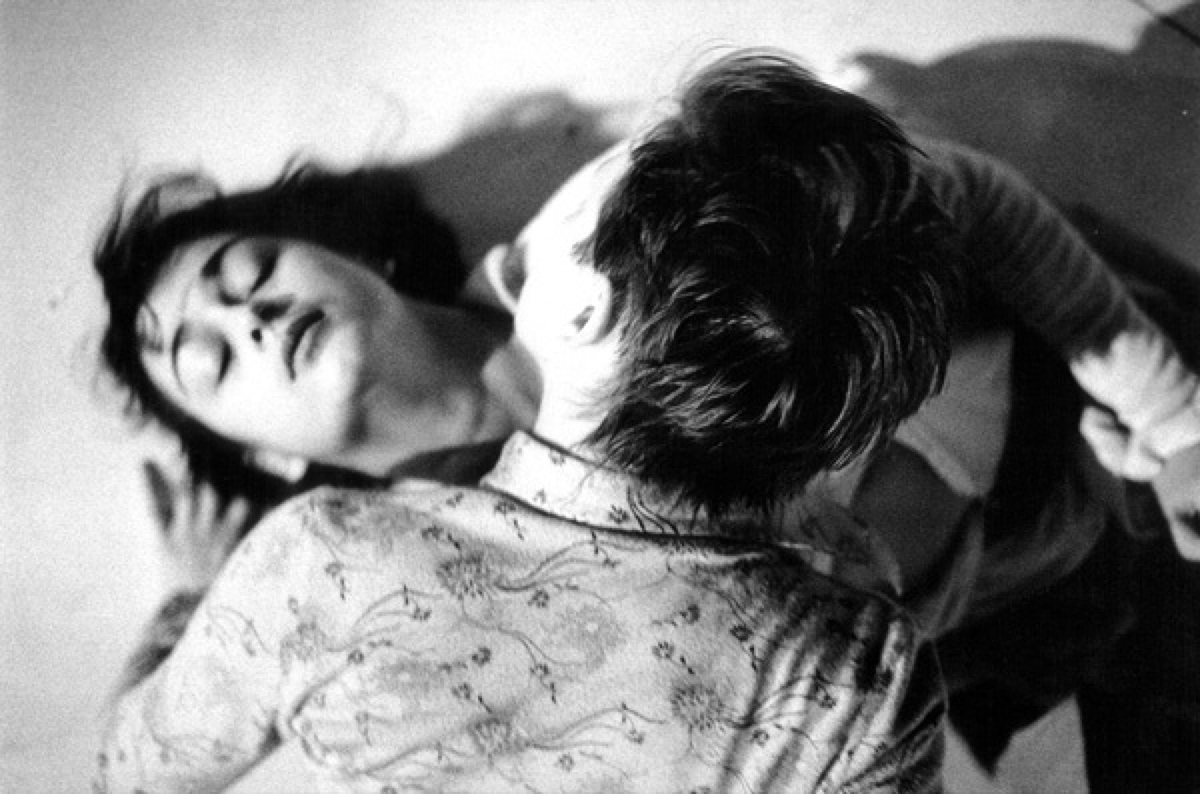
No-one is Watching, Meg Stuart & Damaged Goods (1996), photo courtesy the artists
Meg Stuart, No-one Is Watching; Saburo Teshiwagara, I Was Real — Documents
It’s not surprising that my first two examples come from that liminal world where dance approaches theatre (“Tanzteater,” Pina Bausch called it in the 80s), avoiding theatre’s ‘dead and dying form,’ bringing to it fresh investigations of the human through a heightened sense of the power and fragility of the body in space, and the perspectival shift of alternating stillness with barely controlled action-image. “Meg Stuart and Damaged Goods’ No-one is Watching takes place in an epileptic world,” I wrote from the 1996 Adelaide Festival. “The psyche, the society, the civilisation has been seized and is convulsing. Attempts are made by one or occasionally two of the figures within to connect with another, to express an emotion which has something to do with tenderness. Unfortunately, at the time, the intended receiver is not watching, possessed by a force that has little to do with love.”
The performance balanced on the fine line between the representation of a human condition and the shock of clear and present actions. “The dance for me was at its most powerful either in the fragments of states of being when no complete image was achieved or in the moments of suspension of action when the stage was filled with the memory of past events, or with the threat of what was to come. It was least interesting when dance became representational and traded off the audience’s empathy with what was being represented. It is always hard to watch madness being acted.”
Even the title of Saburo Teshigawara’s I Was Real — Documents (London International Festival of Theatre [LIFT] 1997) flirts with the desire for personal narrative (is this to be a story of someone’s life?), the promise of the real in an arena of pretence, and the confusion between represented past events with palpably present actions. “Documents of the time when I was real — for I am no longer?” I mused at the time. My memory of the piece now (and it has had a lasting effect upon me) is of its spareness, its sense of extended time and space, its magical configuration of human figures seemingly out of emptiness. “There are many dancers in Teshigawara’s company but the stage never seems crowded, the tendency always is towards emptiness, or clear focus upon one or two items. As a viewer, I am gently given the choice of entering and following, so that imaginatively I am travelling too.”
The work began simply and instilled its surreal world without effort. “Four men enter, put on berets then leave, enter, put on berets then leave, enter, put on berets then leave — no, one stays behind, fascinated with the moment of picking up the beret, bends, holding pose. This is the telescopic process that dream and memory utilise.” Teshigawara’s dancers were not dancing in any way that was familiar as dance. They were humans occupying space and forming images that triggered fleeting memories, and that suggested for performance ways of being present without needing justification from a rational narrative context.
Jan Fabre, I am Blood
Jan Fabre’s I Am Blood (Melbourne Festival, 2003) proved to be the extreme measure of the disturbance that the postdramatic could stir in the defenders of a coherent dramatic world view. I entitled my response to the show “The Anxiety of Formlessness,” and quoted the reviewers from the Melbourne dailies who reacted in horror, accusing it of lacking “any sense of selectivity, of form and structure, resulting in an indulgent presentation” (The Age), so that it presented only “a spectacular display of chaotic nastiness…poorly choreographed…a bloody shambles” (The Sunday Age). I agreed that I am Blood, and the shows by Teshigawara, Needcompany and Romeo Castellucci, works that I had written about for RealTime over the preceding years, “are not easy to absorb, impossible to fit into any recognisable structure. They feel carefully fashioned but without any underlying form; and maybe (horror!) this equates to surface without soul.”
My response was to meditate not upon the elements of traditional drama that the show was missing but upon what we saw before us and what it might provoke in us: “The show seems as much as anything to be a meditation upon the act of shedding and covering. The bodies cover themselves with armour, wedding dresses, ordinary clothes, only to take them off again and again revealing the vulnerable flesh (and blood) underneath. Steel tables are alternately used as platforms for human display and surgical benches for bodily desecration. I think of the jeeps and tanks and helicopters in Iraq, supposedly providing armoured protection to the ‘invulnerable’ US troops, but ripped away increasingly by bombs and missiles to expose the flesh of the soldiers underneath.” There was careful dramaturgical choice here in its “images and sequences of exquisite formality, set against sequences of seeming chaos.”
In his response to the irrational juxtaposition in shows such as this, Hans-Thies Lehmann coined the term “the aesthetics of poison.” He intended the term in a homeopathic sense: “An image of beauty, craving and desire is presented, but with the addition of a disturbing element, a vivid poisonous green tinge of colour…(which) spoils my enjoyment, while at the same time stimulating it to reach a different level of reflection.”
Being a Writer for RealTime
I had avoided reviewing theatre before I started with RealTime. How could I as an artist struggling to get my own stuff on the boards presume to assess the work of my fellow-artists? Keith and Virginia had from the outset cleared me from that concern: writing for RealTime was not to be a judgement of the work but a writerly response to it, allowing the show’s affect upon me to challenge me to write to it and thereby to open out into new associative musings. I learned on the job, mainly through the models provided by Keith and Virginia and other key writers in their own articles through the 1990s, particularly in the hothouse that was the RealTime daily response to the proliferation of the shows at LIFT97.
“I am aware of the ‘narrow grooves’ of my responses to the body of LIFT,” I wrote at the time, borrowing the metaphor from Paul Carter, “and of the danger that will drain its spirit. I see the inflexible fences I build across the irregular surface of a show, enclosing it in a way that is never healthy because it halts the drifting quality of a work of art.” It was the co-presence of other writers writing on the same shows (and others) that heightened my awareness. “As I read the articles of my fellow writers on the same event, I am led to reflect again upon what I might have written (or might have seen). ‘How do I see?’ has been ‘How do I write?’ for all of us as we steer clear of trenches already dug. We are saved by the diversity of cross-opinions. In fact, the writing of Linda [Marie Walker], Zsuzsanna [Soboslay] and Virginia [Baxter] often has for me the quality of a drift lane, not digging anywhere too deep, more interested in the ground beneath their feet as they travel.” Two thoughts arise from this experience.
1. Community
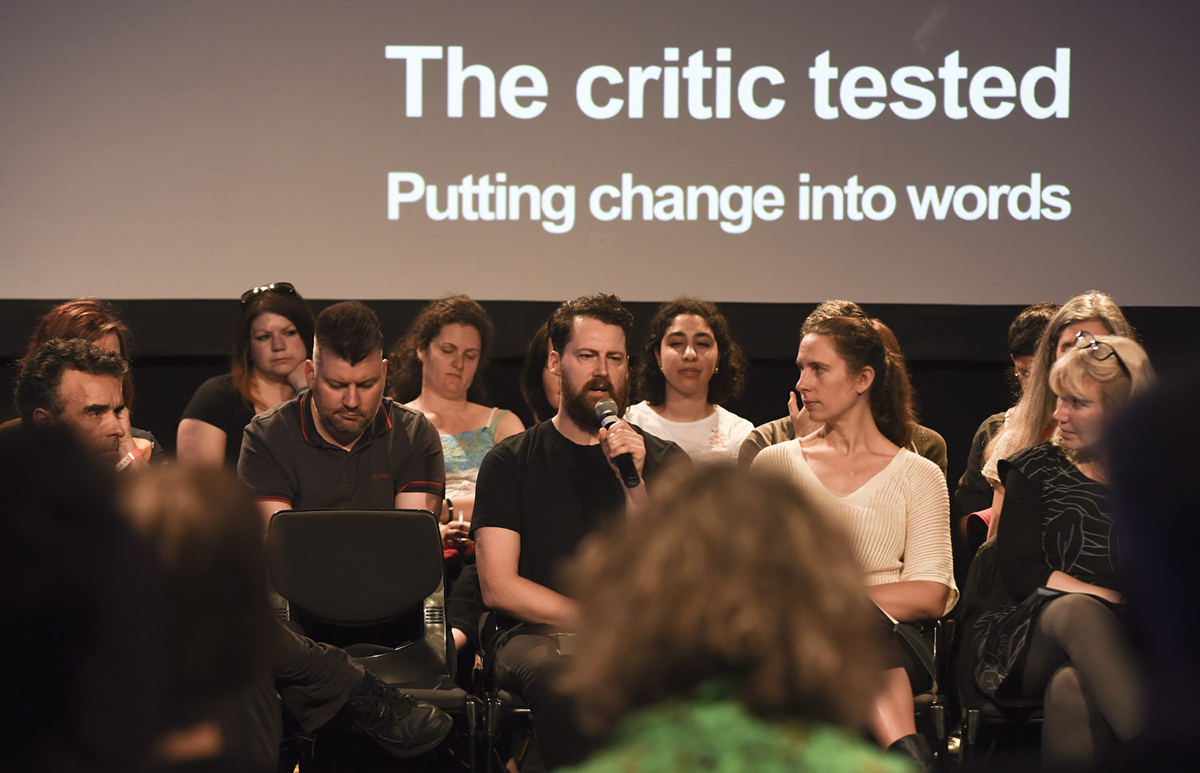
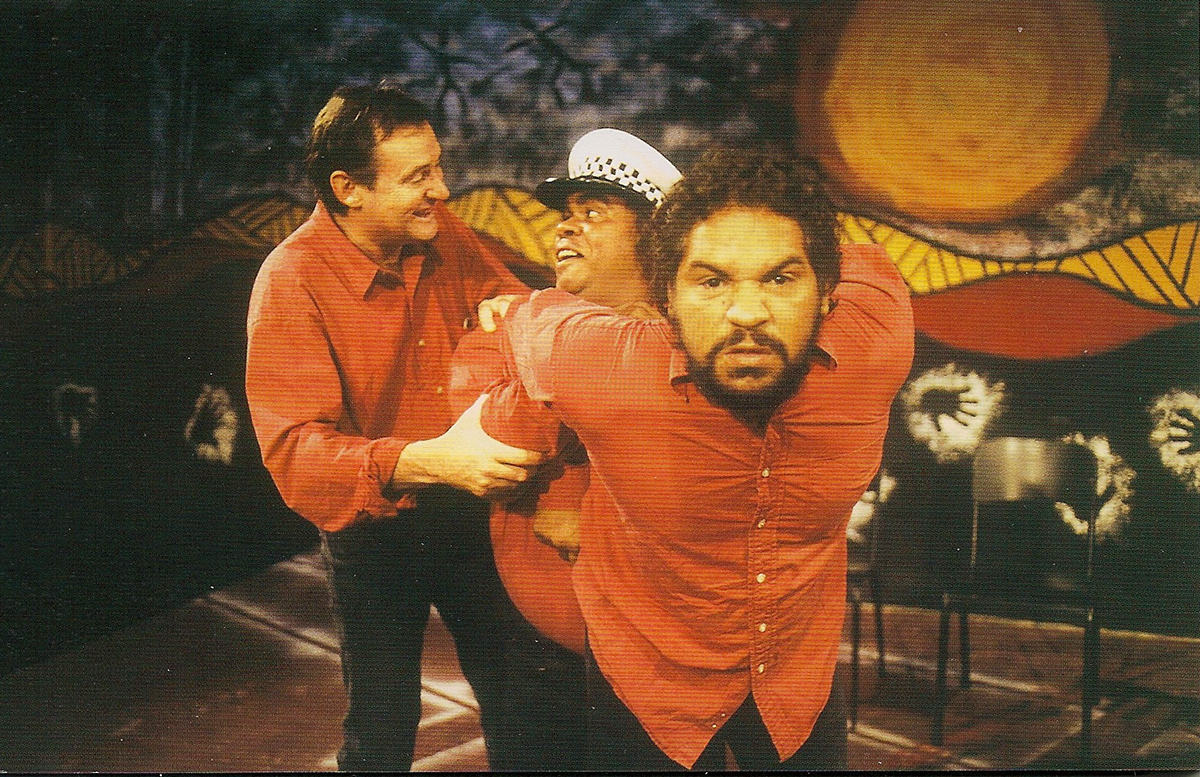
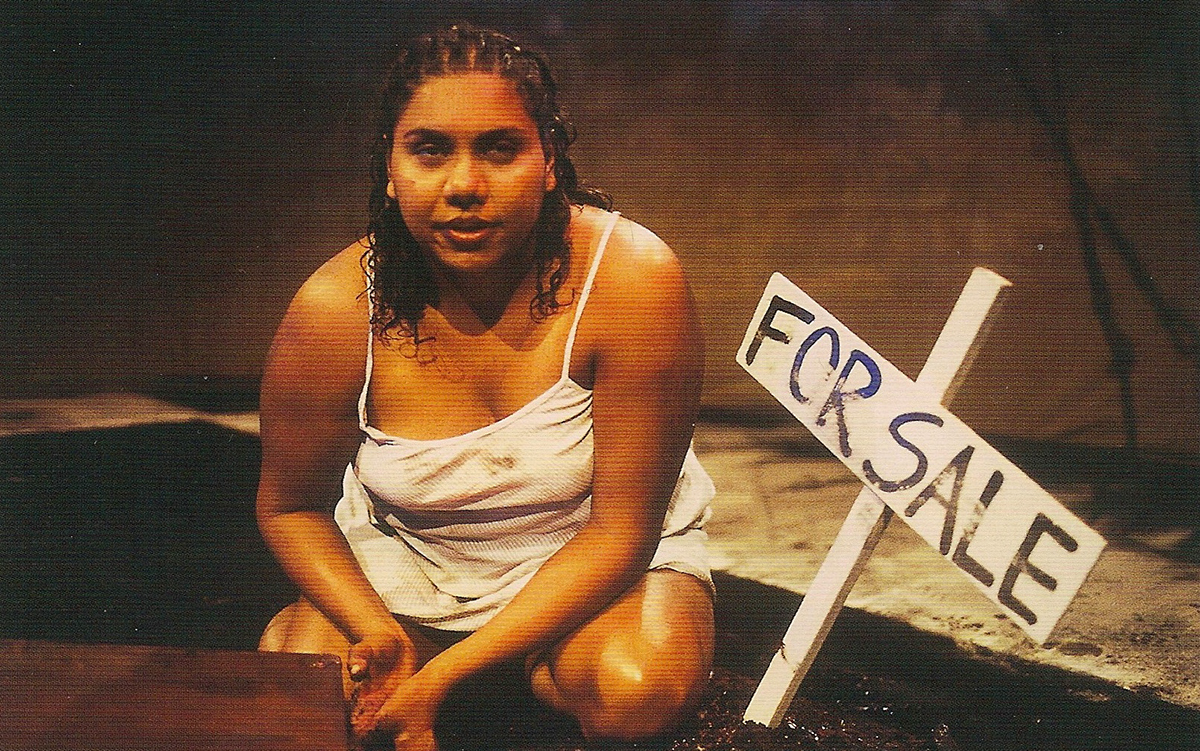
First, I felt again the power of community in art at the five-hour conversation between writers for the paper and artists at RealTime in real time at Carriage Works in October. I felt it for the first time as a writer at LIFT97 when our group of Australian writers joined up with several British writers to respond to the festival. More than anything, it was the opportunity to publish alongside one another a variety of responses to many of the shows: four different responses, for example, to Deborah Mailman and Wesley Enoch’s overwhelming 7 Stages of Grieving set alongside one another, each one a gem of writing, each finding new insights into the show to bring forth. What more could an artist want?
When occasionally I found myself disliking a particular show and trying to write to that response, I would discover in the same issue, several other articles discovering in the show delights and insights I had completely overlooked. One of the British writers (Gabriel Gbadamosi) attacked the Australian writers for their “hunger for an aesthetic” in our mainly positive responses to the German show Stunde Null. Whereupon, the following article by Keith included, in his positive response, a comment on Gabriel’s “quotable, cutting, epigrammatic style more in line with conventional British theatre reviewing.” These good-natured disagreements and agreements created within the paper the kind of productive dialogue out of which new ideas and new work can arise. Such a community of arts writing is to be treasured as our culture atomises by the day. In RealTime, the possibility was fulfilled.
2. Art and writing
The second thought has to do with the interplay between art and writing about art; or more specifically, the effect that a show could have on the very writing style of the responder. This was true throughout RealTime’s history — films, visual art, sound installations, performances: all drew from the writers writing that may not have been possible without the show as stimulus. In other words, what RealTime encouraged was not to trap every artwork in the tight, narrow language of ‘the review,’ or even ‘the academic interpretation,’ but to broaden the scope of the language of response in the light of the artwork’s unique act of communication. Many of the writers come to mind, but as an artist my joy has been that my own works have stimulated, for example, Jonathan Marshall to such powerfully poetic prose in his responses to two of my works, The Inhabited Woman and The Inhabited Man.
Ian Scott, Anne Browning, Slow Love (2002), Chamber Made Opera, photo courtesy the artists
My favourite example, however, has to be “From the cutting room floor”, the response penned by Virginia and Keith to the production of my play Slow Love at the Adelaide Festival in 2000. The play consists of hundreds of very short images separated by hundreds of blackouts. It is fragmentary and impressionistic and was my attempt at what I called “epileptic writing.” Their written response is a remarkable piece of epileptic writing in its own right. I delight in the article not because it simply praises the show; they include across the range of their fragmentary thoughts their own responses, the moments that remain with them, the lacks in show and production that they felt throughout, the associations they make to the wider culture, the responses of other writers, quotes from the show etc. It is an article that responds to the show by putting itself in the frame of mind that infuses the show itself. As co-writers, they transformed their style of writing; they allowed the art to create the language with which to write about it.
Politics and art/Politics in art
The conversation at the end of the afternoon at RealTime in real time ended on a rather sombre note — participants filled with trepidation about the future of art, especially performance, in these days when the political scene admits less and less room for Art in considerations of state. I thought back to other periods in my life when this had seemed to be the case: the Menzies years, the Fraser years, the Howard years, even the Hawke years. And my mind was drawn to certain of the shows that I have seen for RealTime, and the ways in which they have pushed politics to the forefront of the art in the face of lack of heed or outright hostility towards Art on the part of the politicians in power.
In 1996, shortly after THAT election when Howard defeated Keating, the Maly theatre from St Petersburg arrived at the Adelaide Festival with Claustrophobia. “On the night of the election,” I reflected (March 1996), “we were urged by politicians of both sides to count our lucky stars that we lived in a smoothly functioning democracy where a change of government can take place peacefully and without a drop being spilt. Well, yes. But something in me screams that we have allowed the reactionary party to crunch into power without a bang and with hardly a whimper.” Enter the young performers from the Maly, caught at a point when Russian society was going through its own painful transition from Communism to…what? “The overwhelming feeling,” I wrote, “is of a trapped generation, weighted down by the past, trapped in the present.” The point is that this lost generation took it on: tried to find a way artistically to express the disconnect between them and those in power, “beating out through the walls only to climb back in again to continue the fight.”
I remembered, too, the determined commitment of Australia’s Not Yet It’s Difficult (NYID) with their terrifying version of state control in K, and their chilling depiction of surveillance techniques in Scenes of the Beginning from The End. I subtitled my article on that company “The Danger Zone,” and marvelled at its consistently “merciless exposés of certain tendencies in contemporary civilisation.”
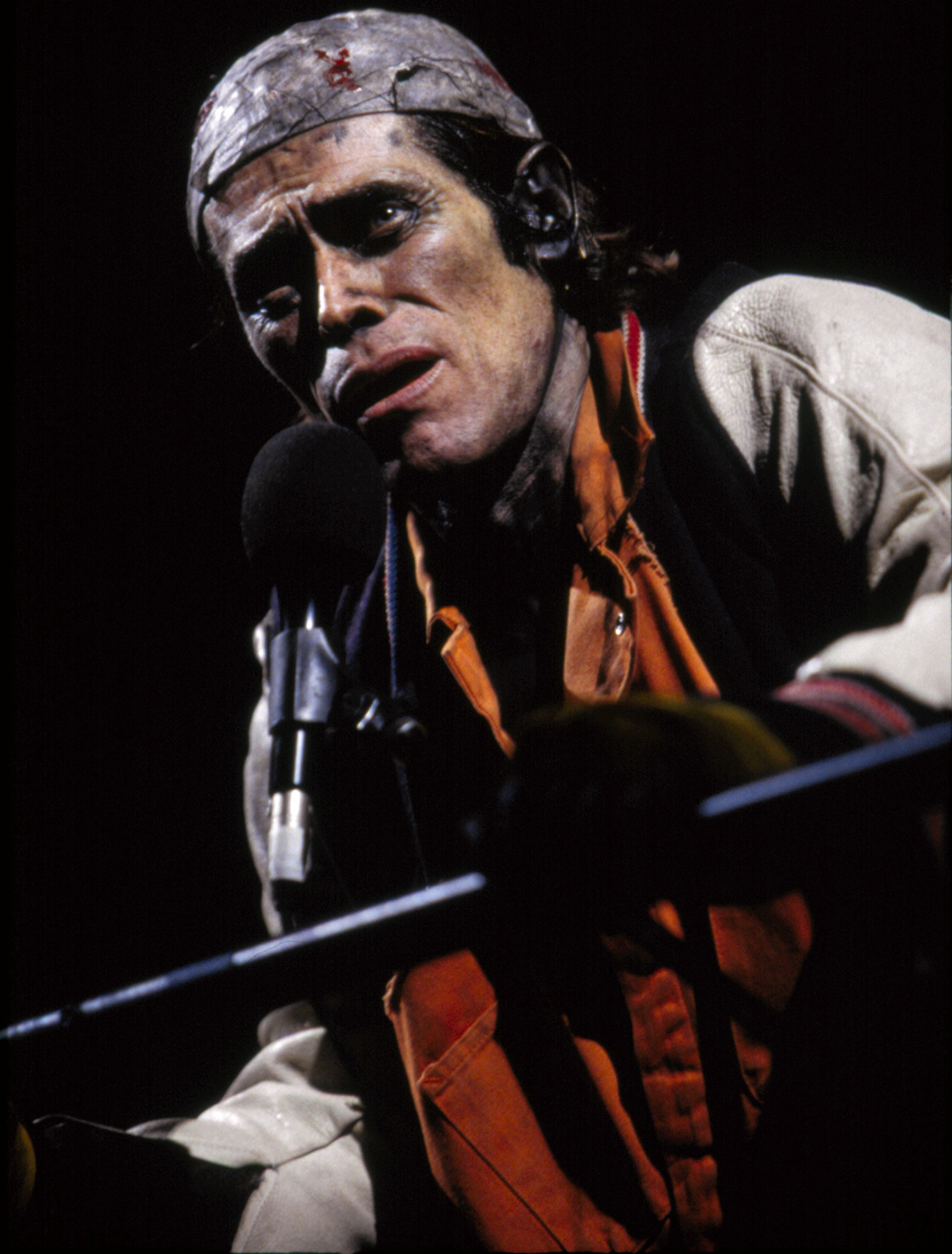
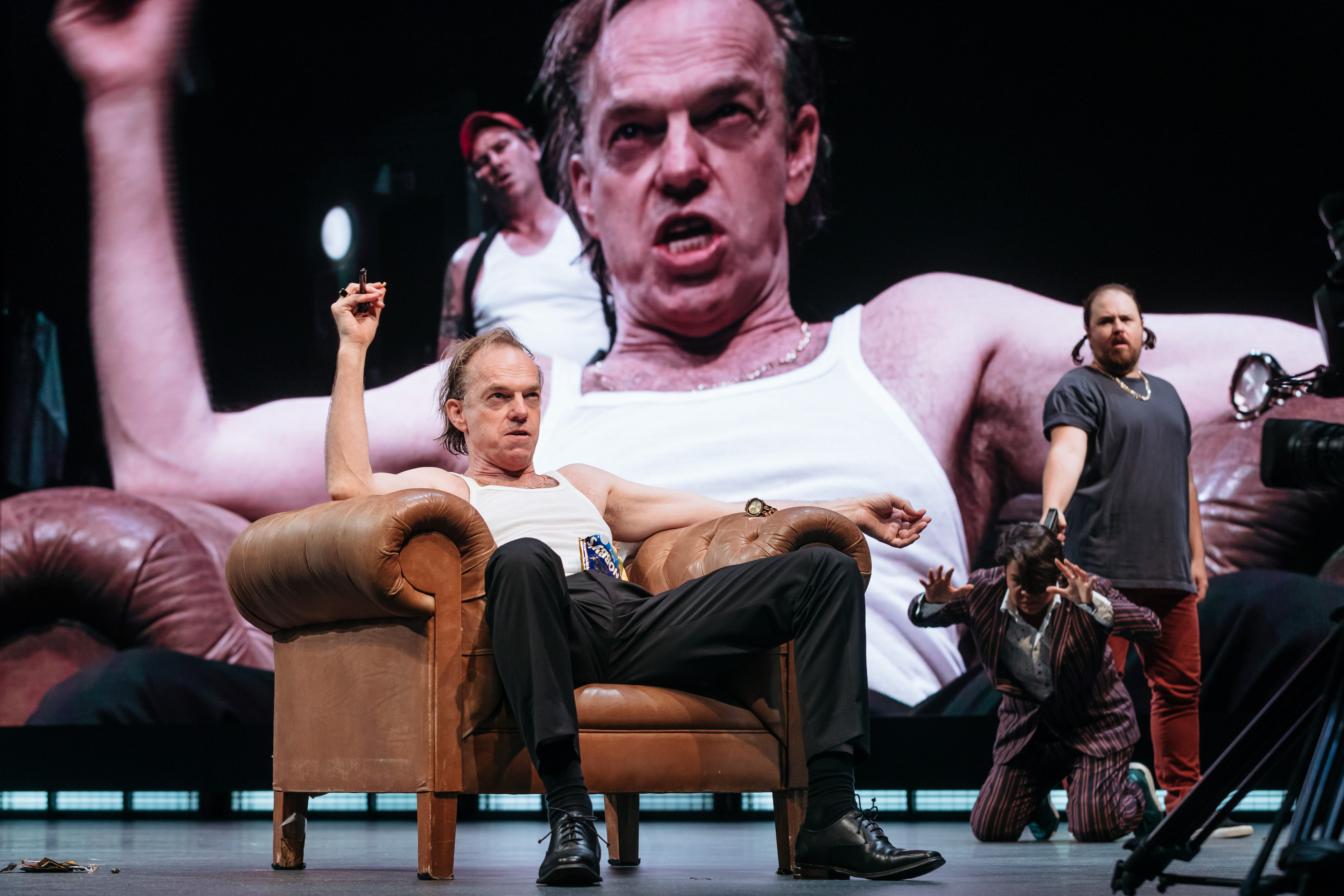
Willem Dafoe, The Hairy Ape, The Wooster Group, (2002), photo courtesy the artists
I wrote about The Wooster Group’s The Hairy Ape (“Terror, Theatre and The Hairy Ape,” February, 2002) five months after the attack on the World Trade Centre. The group’s version of O’Neill’s play highlighted the insurmountable disparity between those who work to keep the wheels of society moving (the ordinary workers), thinking that they therefore move the world, and those who wield the real power invisibly behind doors in board rooms and drawing rooms. I read the production through the lens of a remarkable book by Anthony Kubiak called Stages of Terror. “The book is an attempt,” I wrote, “to write a history of theatre as terror. More than that, it argues that theatre’s ability to name that terror at the base of life has always been one step ahead of the society in which it has played. That the culture of perception which it has engendered in all its forms has, far from mirroring its society, found ways of developing for that society an understanding of the terrifying interplay between power, production, coercion, ideology and identity—an interplay that is based upon the application of terror and its close allies, violence, pain and panic. This may seem to be a bleak reading of theatre and of history itself. I don’t think so. It is bracing to witness with clarity the powers that cloak themselves in all sorts of coercive masks within our society and it is true that theatre above all is the artform that can, that has and that should reveal those masks — even if it does so (as in Restoration comedy) by applying them even more rigidly.” The Hairy Ape revealed the masks cloaking the State terror.
So too did Schauspielhaus’s Stunde Null which I saw at LIFT in 1997. It was among other things a play about a school for politicians, who act like children and are treated as such as they learn the gobbledygook language of politics. “What do politicians really expect us to believe?” I asked. “They lie, they know they lie as they lie, and they must know we know. And the media is complicit in this constant rending of language and meaning. They make the show of attempting to reveal, they push so far but they never never tip the bucket. Someone needs to tip the bucket. Stunde Null does so.” And it did so through laughter, unstoppable laughter. “Politicians have been attacked with laughter and corroded with irony since Aristophanes. Laughter in that form is a revolutionary force. It refuses to accept the world on the terms that the politicians or the daily media present it to us. It turns the world upside down, allows us another way of looking at it.”
And this in the end is my feeling about theatre in a time when politics takes no notice. What all these companies did was to force politics to take notice because they spoke to politics, rejected being a ‘mirror’ for society, refused to turn inward, remained aware that theatre’s blinding vision is a revelatory force. “Just as pain and terror both cause and effect each other,” wrote Kubiak, “so, in its articulation of terror, theatre operates as both cause and resistance to that terror and oppression.”
Top image credit: I Am Blood, Jan Fabre, photo courtesy the artists
I have been working in theatre now for over four decades: as actor, director, playwright and teacher. Theatre in its infinite diversity has provided an ongoing structure to my life, not the only one but a significant one. Doing, viewing and thinking about theatre has deepened my understanding of myself, of others and of the life we lead as social beings. I am totally grateful for it. But I have only written about theatre since 1996 when Keith asked me to interview a British theatre writer, Deborah Levy, then on tour in Australia. As a practising artist, I had always found it impossible to write in judgment of other artists (as the act of reviewing is usually conceived). RealTime offered another way of writing: in open, not necessarily judgmental response to a work or an artist, revealing as much about my own self in the process, and associating out from the work to wider social issues. My final piece for RealTime in 2007 was an obituary for Lindzee Smith, one of the great unsung champions riding the waves of change in theatre/performance that took place in the final decades of the 20th century. Somehow his death seemed the right time to move on. Since then I have completed my PhD on late-modernist theatre practitioners, many of whose peers and successors I witnessed in my years watching for RealTime. I continued reading RealTime until the very regrettable end. I present new works yearly on a blissfully small-scale at the incomparable La Mama Theatre in Melbourne.
Exposé
My trajectory in theatre has been such that I have known I could never survive financially from my projects. I was blessed for a quarter of a century to work at the Victorian College of the Arts, training generations of directors, writers and performance makers. They kept me alive financially and artistically; their constant curiosity and need to speak anew never allowed me to stand still. Art changes: that is its beauty. It is alive to the times. The exciting artists are those who discover how to express that aliveness for this moment now. Writing about theatre needs to take this into account. For each artist, the work that they are making matters, and the energy and time expended deserve their due in our responses. RealTime provided sufficient time to reflect deeply upon a performance and sufficient space to voice those reflections. To be written about in RealTime was to know that the work I produced was taken seriously, and that at the very least the article would reveal to me something I didn’t know about my work. As a writer, I could only hope to do the same for the artist and for the readers into the future. Four out of five stars and a paragraph listing the ‘good’ actors is an insult on all sides. My only constant predilection as a viewer and as a writer has been that the performance (or film, or painting or installation etc) does bring to me a new revelation, however small, about the life I am living, the times I live in, the times I have lived, and/or what lies ahead. Otherwise, what’s the point?
One of the hardest things to pull off when performing live experimental music is a dramatic hard stop, so I offer my last piece of writing for RealTime as a long slow fade…
Naive states
When RealTime started in 1994 I was a budding performance artist, passionate about all things corporeal, the performing body in all its fleshiness and transgression. I didn’t take much note of the articles about sound in those early years; however, I felt the same tinge of guilt as others who would feel compelled to confess to Keith and Virginia in theatre foyers, “Thanks for the latest edition. I’m sorry I haven’t read all of it yet!”
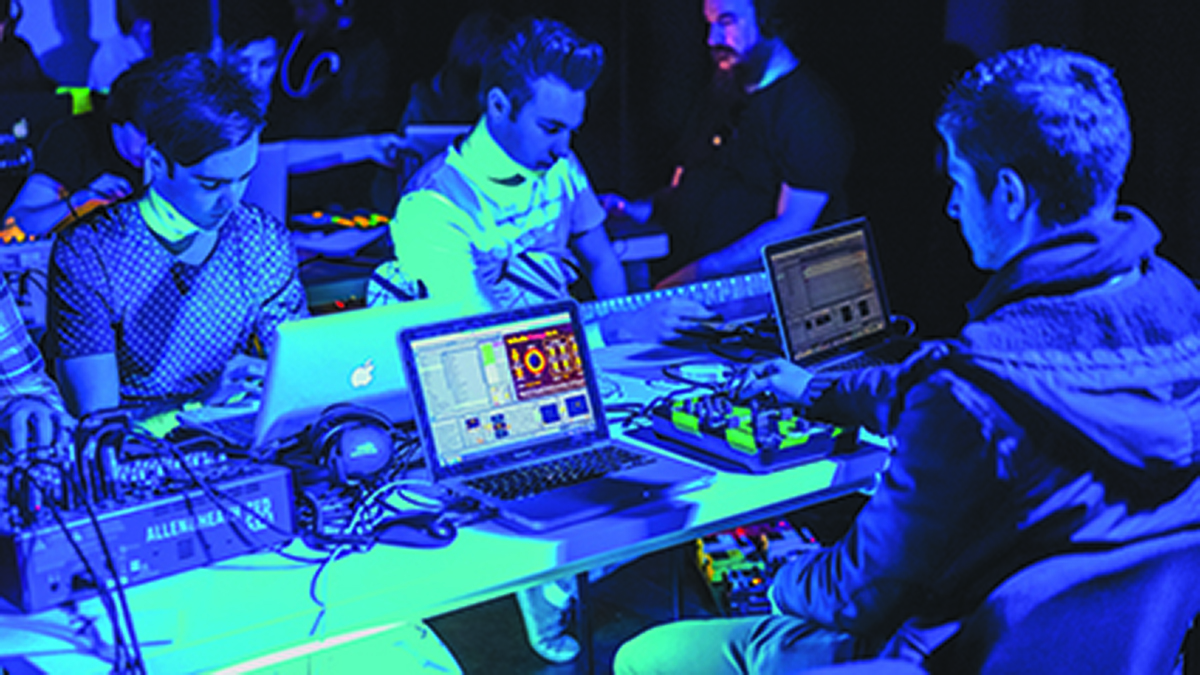
Somewhere between 1994 and 2001 I underwent a conversion of sorts, gradually bowing my body out of performance and replacing it with the visceral invisibility of sound. I hadn’t written much for RealTime at this stage, contributing a few pieces to the coverage of 1998 and 2000 Adelaide Festivals where I subbed in an all-hands-on-deck affair. The first piece I wrote in 1998 was about the Australian Art Orchestra’s Into the Fire, which aptly describes my experience. It felt terribly presumptuous to critique Paul Grabowsky and the Sruthi Laya Ensemble, so I opted for description and anecdote, equating cacophony and noise with childlike naughtiness — dear me, I’m sorry. In the early 2000s the experimental electronic music and sound scene was gathering momentum. Caleb Kelly (then caleb.k) had been contributing reviews on events such as the reasonably established yet forever renegade What is Music? festival and some other Sydney gigs and conferences; but as he was actively involved as curator there was scope for a new contributor. I’d always felt like I couldn’t review performance in Sydney because I was too amicably embedded in it. But as I was transitioning from a performance to a sound-based practice, Keith suggested that I might try writing about some of these sound events.
The wonderful thing about RealTime was that it was okay to learn on the job. While not an excuse for ignorance, this position offers an ideal phenomenological opportunity, the experience of being ‘bracketed,’ as they say, from encultured assumptions, dealing with what you are given as it is given. In her 2010 book Listening to Sound and Silence: Towards a Philosophy of Sound Art, Salomé Voegelin suggests that a listening experience is not “a receptive mode but a method of exploration…What I hear is discovered, not received.” This describes my first forays into reviewing the experimental audio scene. I was discovering this practice piece by piece, gig by gig. I’d like to think that this opened up the activities to a wider readership who were invited to stumble with me into this dimly lit but gloriously sonorous world.
Of course, I was not devoid of all assumptions. My review of Static Museum, curated by Garry Bradbury at Artspace in 2001, “Boys, toys and pleasing noise” (RT45), opened with the oft-heard gripe around the lack of performativity of laptoppery — though I stressed that this was not the case with this event, a point I’ve since come to care little about as long as the sound itself performs. I also concluded with a complaint about the absence of female artists, framed by a personal, techno-reactionary position that I was someone with no inclination to explore sound from a ‘scientific’ perspective. While the issue of gender still hasn’t gone away (the reason for starting my online directory of female artists working with sound, Audible Women), I wish I had framed that argument with less arrogance and more nuance about the interplay of aesthetics and technology.
Machine for Making Sense, 2002, photo courtesy the artists
Early epiphanies
As an emerging sound artist with no formal education in this mode, writing for RealTime offered the best education. Beyond my own creative adventures, it allowed me to find my way into sonic art through writing, discovering the pleasures, pains and complexities of experimental audio as it manifested in seminal gigs and events such as the What is Music? festival (RT51), the Machine for Making Sense (you can listen to the Writers Read RealTime version of my review here), Electrofringe (of which I later became a co-director, RT52) and impermanent.audio, curated by Caleb Kelly. My review (RT50) of the latter serves as a kind of turning point in my appreciation of experimental music practice, evidencing when I begin to let go of a performance mindset and start to understand the poetry of sonic processes:
“I see the electric transmission beaming out into the ether and [Kaffe] Matthews catching the loops in a digital butterfly net. I get a real sense of the structure of her improvisation — sending the sound out there, and then plucking it back, remolding it, sending it out again. She has a light touch, mixing only a few chosen elements, teasing them out, dropping them. All her butterflies beautifully controlled and musically combined create an intense and rewarding sonic vision.” Like her sound, I too was captured in the butterfly net of sonic possibilities.
Lindsay Vickery, your sky is filled with billboards of the sky, image courtesy the artist
Networked learning
Of course, it wasn’t just Sydney that was developing a vibrant scene and the opportunity to attend interstate festivals and do larger overviews allowed me, and hopefully RealTime readers, a sense of the activities and the artists practising around Australia. A piece commissioned for New Media Scan (RT51) provided one of the most challenging writing experiences, requiring me to quickly come up to speed with the rapidly shifting technological developments influencing sonic art practices. The article features an overview of Ros Bandt’s excellent book Sound Sculpture (1999) as well as works by Nigel Helyer, Joyce Hinterding, Camilla Hannan and Phillip Samartzis; sound and screen intersections in the works of Andrée Greenwell, Lindsay Vickery, Tesseract Research Laboratories and Wade Marynowsky; pure audio events such as impermanent.audio, Small Black Box and fabrique in Brisbane; and the individual practices of artists Jasmine Guffond, Greg Jenkins, Garry Bradbury and Julian Knowles. It concludes with discussion of new modes of distribution, featuring excited millennial talk about the potential of DVDs to distribute 5.1 surround sound and the new possibilities of MP3 downloads. Having always said that my strength as a writer is in description, rather than argument I was surprised to see that I made an attempt at the latter, quoting Heidegger no less:
“When I commenced the research for this article, I unwittingly set up a determinism/voluntarism polarity which, as with most dichotomies, has proven itself too inflexible to be of value. The reality is that people will continue to hunt for their sonic substances in the areas that are available to them, some old, some new. Perhaps it is best to approach new media with Heidegger’s view of technology — “not as a tool or machine, but rather a process, a dynamic of ‘revealing’.” The older media supply the foundations for the new and the new creates perceptual shifts and ways of reconfiguring the old. And the loop goes on…”
Beta Erko, Liquid Architecture 6, 2005, photo courtesy the artist
Quint de Loupe, Nigel Helyer, photo courtesy Totally Huge New Music Festival
If I had to pick a favourite article I’d nominate my coverage of Tura’s 2005 Totally Huge New Music Festival in Perth, titled “Totally Huge: knots and flames” (RT70). I used William Blake’s poem The Tyger as an extended literary reference with which to draw together the ambitious sound art exhibition, You are here…entangle (curated by Kylie Ligertwood, featuring works by Nigel Helyer, Cat Hope, Kieran Stewart, Alan Lamb, Rob Muir and Hannah Clemen at the highly atmospheric Moores’ Building, Fremantle) with the ritual catharsis of Annea Lockwood’s Burning Piano:
“Annea Lockwood (NZ/UK), renowned for her ‘piano transplants’…provided a very public face for the festival by installing a baby grand on Bathers Beach in Fremantle. The piano in fact went missing, only to be found a few days later at a local backpackers where they were trying to repair it! Lockwood also provided the highlight of the festival, recreating her Burning Piano performance. Despite the chattering crowd gathered in a paddock ready for a bonfire it was a beautiful meditative event, as the tongues of flame burning rainbow colours penetrated the instrument, skittering across the keys faster than fingers have ever managed, eating away at the backboard so that we could see through the body, until the unavoidable total collapse. A worthwhile sacrifice for art.”
From the horse’s mouth
As well as reviewing, or offering commentary as I prefer to say, there was also the joy and terror of interviewing artists. ‘Terror’ because I was always intimidated by the prospect that my lack of formative sound art education would make a fool of me. However getting directly acquainted with artists’ ideas made the terror more than worthwhile, and it was an honour to be able to commune with great minds, many through interviews including some for RealTime TV; to name a few: Robin Fox, Cat Hope, Lawrence English, Marina Rosenfeld, Pia van Gelder, Kusum Normoyle, Ben Frost, Michaela Davies, Matt Warren, Garth Paine, Eugene Eughetti, Sarah Last and more.
Lucas Abela, Rice Corpse, tour of China, November 2008, photo courtesy the artist
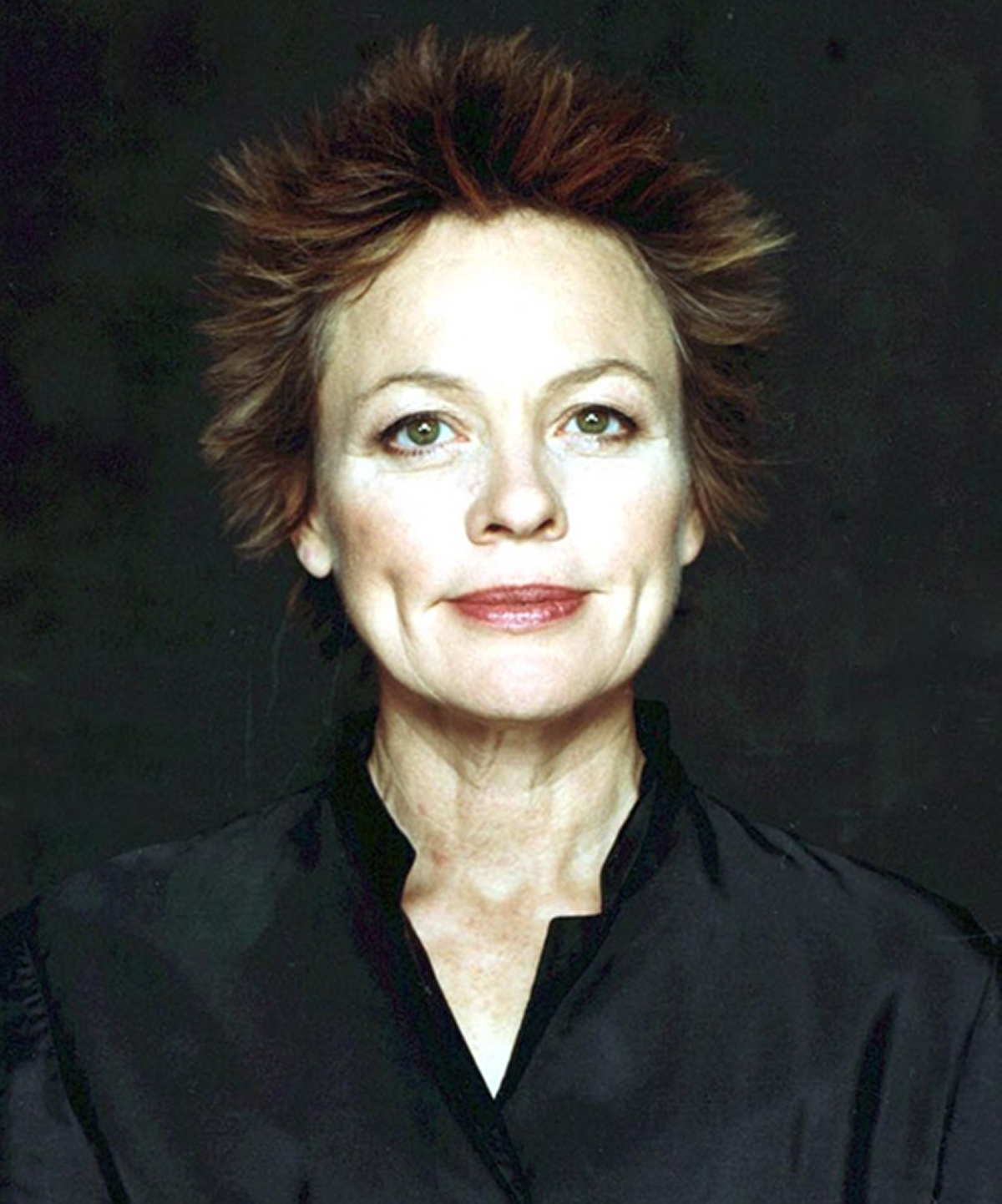
A notable interview highlight (RT92) was a co-authored affair with former RealTime Assistant Editor Dan Edwards, then our ‘man in China,’ who interviewed improvising musicians Yang Yang and Li Zenghui in Beijing, while I interviewed broken-glass noise virtuoso Lucas Abela in Sydney, about the three artists’ collaborative outfit Rice Corps. The article’s title was particularly special, “that was shit!,” reflecting the literal translation of the Chinese character for the band name doubling as shit. However I could pretty much hang up my interviewer hat and die happy after I was given the opportunity to talk to my all-time inspiration, Laurie Anderson, in the lead up to her appearances at the 2013 Adelaide Festival. To this day, I have never been as nervous as I was dialling her phone number. I thought I would have trouble trying not to babble hysterically over the top of her measured and thoughtful responses describing her upcoming collaboration with the Kronos Quartet; but in fact I found myself uttering few words, so read Ms Anderson’s (I was also obsessed as to whether or not I could possibly call her Laurie) in RT 112.
Laurie Anderson, photo courtesy the artist
The past before my past
While dwelling mostly on the distant past of my writing for RealTime, it’s important to acknowledge that there was a past before this. Leading up to the recent RealTime in real time event at Performance Space’s Liveworks, I read many of the sound articles from those early editions, those ones I passed over at the time. Articles, such as Tony MacGregor’s account of Sound Culture Japan ’93 and Australian Sound Art Meridian Kobe (1993) (RT1, p20) and Annemarie Jonson’s 1994 preview of Sydney’s Sound Studio — curated by Alessio Cavallaro at Performance Space — and Melbourne’s Earwitness (RT 3) — curated by Sonia Leber as part of Modern Image Makers Collective/Contemporary Music Events Company (later to become Experimenta) — reveal a thriving sound culture with exhibitions and events of scale such as the ambitious and contentious Sounds in Space (RT8, p13) at the MCA curated by the late Rebecca Coyle (1995).
Sound installation and sculpture were the predominant forms discussed, along with what was then a thriving radiophonic culture centred on ABC programs Surface Tension, The Listening Room and Radio Eye, driven by producers and creators such as Tony MacGregor, Kay Mortley, Virginia Madsen, Roz Cheney, Jane Ulman, Brent Clough, Sherre DeLys, Sophea Lerner and RT’s own Keith and Virginia. There was also the Contemporary Sound Arts group lead by Alessio Cavallaro, Shaun Davies and Annemarie Jonson publishing the Essays in Sound series — Cavallaro and Jonson not soon after taking on the mantle of editors for RealTime’s OnScreen section. While there is some mention of more experimental electronic music practice with Machine for Making Sense and Jon Rose appearing quite frequently, it is the live performance of sonic art (appearing as something not quite like new music/contemporary classical) that seems to come more to the fore in editions from the late 1990s/early 2000s, the era in which I enter.
Sonic art in three movements
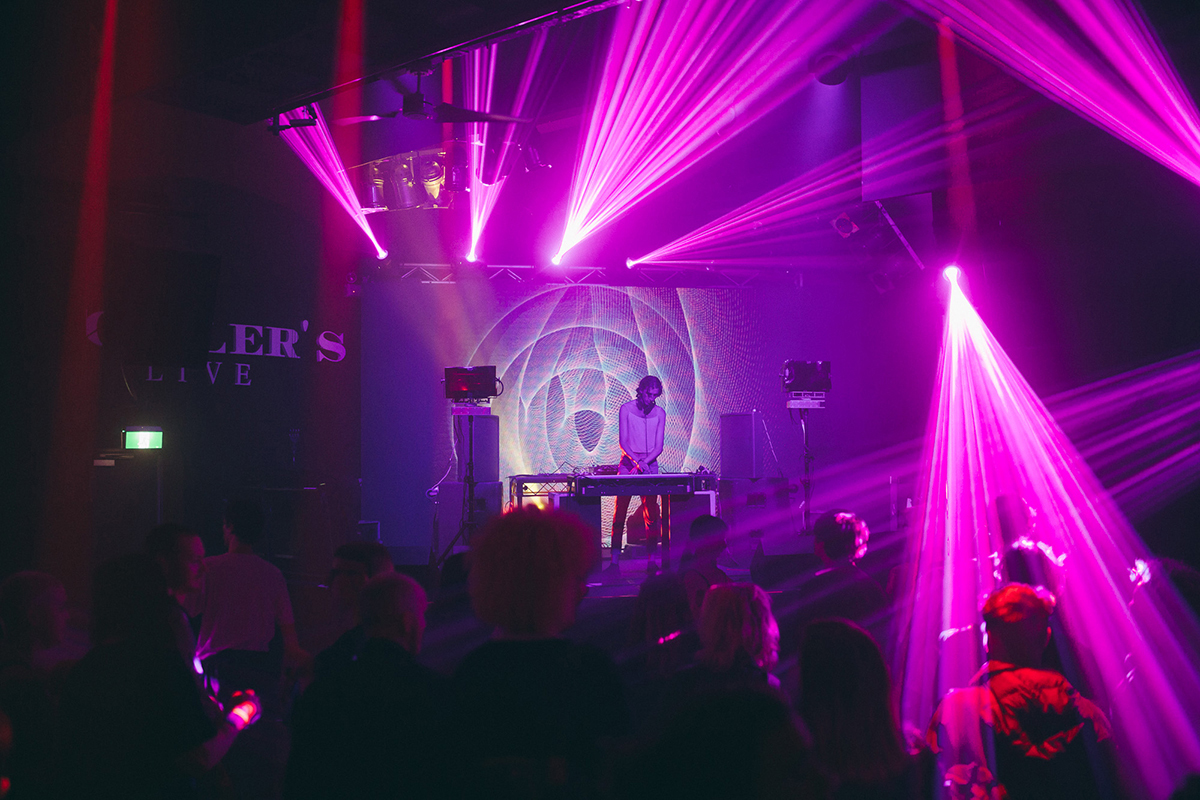
Across the pages of RealTime, I see sonic art having three, not distinct, but certainly recognisable phases. The first until around 1999, summarised above, is focused on sound within gallery culture, radio art and emerging collaborations with screen media. In this way it was engaged with institutions and organisations. The second stage is from around 1999 when the live sector strengthens, made possible by the development of more portable equipment and digital audio accessibility. With roots in post-punk art rock it is a decidedly DIY scene, taking place in illegal warehouse venues and inappropriately reverberant artist-run spaces, occasionally making guest appearances in the institutions that had previously housed the aforementioned mid-1990s sound art events. That said, What is Music? made incursions into the Sydney Opera House in 2002 while still keeping it real with concerts in underground venues (see above) — that’s how curators Oren Ambarchi and Robbie Avenaim roll. Interestingly this was also the heyday of ‘new media art;’ many sound-oriented installations and interactive works actually moved over to be considered within this context (see the sound section of RT’s Media Art Archive).
Daisy Buchanan, Ladyz in Noyze, photo courtesy the artist
Within this live scene there have been ongoing waves of activity, the occasional lull making us nostalgic for the early 2000s. From the Sydney perspective alone, as late as 2011 there were enough events for a three-part overview series (RT103, RT104, RT105), admittedly some on their last legs. But today (Nov 20, 2018) I noticed that Sydney offers at least one event a night this week, if not two, for those interested in the pointy end of experimental practice.
Meagan Streader installation for Soft Centre, Casula Powerhouse Theatre, photo courtesy the artist
We are now in what I suggest is a third phase, one in which the boundaries between new music/contemporary classical and the experimental electronic scene have blurred. This has long been the case in Perth for example, where a smaller population and genre-fluid artists like Cat Hope ensured a certain kind of slippage. In Sydney it has occurred as younger electronic music-literate artists have emerged from more traditional music schools, not just from art schools, and contemporary music ensembles such as Ensemble Offspring have actively pursued all manner of collaborations and genre experiments. Perhaps it has also occurred as funding sources have become scarcer and the new music scene has started to adopt a more DIY approach. However it has come about, the live experimental music scene has continued to grow, and even spread to outer suburbs with programs at Western Sydney Arts centres like those in Campbelltown, Blacktown, Bankstown and the latest ambitious adventures at Casula Powerhouse with the Soft Centre festival (18, Oct 2017).
All this is to say that RealTime’s coverage, above and beyond my contribution, offers an inevitably incomplete, yet amazingly varied account of sonic art which, although I have focused on the live side here, also encompasses gallery-based sound art and media art. (For a rousing definitional debate see Nigel Helyer’s provocation in RT70 and Ben Byrne’s response in RT72). It is hard to imagine how we will be able to get a sense of upcoming developments without RealTime, an incredible source of documentation and commentary. There will be blogs (or is that already over too?), there will be Tweets and Facebook rants (if people can take time out from signing petitions for every other horrible thing going on in the world), but we will keenly feel the loss of that special space where not just the sonic arts, but all the innovative arts in Australia could be reflected on in depth and, equally importantly, be celebrated.
–
Top image credit: Merzbow performs at Riverside Theatres, Parramatta, Aurora Festival of Living Music, 2012, photo Matthew McGuigan
When it was announced in December 2017 that RealTime was drawing to a close, we received hundreds of heartfelt messages expressing gratitude for the magazine’s unique coverage of innovative art and sorrow at its passing.
We’ve gathered together those messages in a single document which will become part of the RealTime archive.
Top image credit: Keith Gallasch, Virginia Baxter, masks made from pages from RealTime by Beatrice Chew, photo Su-An Ng, art direction Graeme Smith
In 2009, my interview for RealTime with Bangarra Dance Theatre Artistic Director Stephen Page ended thus, when he asked, “I don’t know why there are no sister dance companies for Bangarra across the country; why no Bangarra theatre, no Bangarra music? Why am I one of so few who are fortunate enough to be able to create in my own cave, with a stream of youngsters wanting to tell their own stories to me, now that I’m the elder?”
And those are still excellent questions today. For, with less than 3% of Australia Council funding going to Indigenous arts, Bangarra Dance Theatre is still the only dance company recipient of ongoing Major Organisation funding from the Australia Council. Somehow, eight other Indigenous dance companies exist on project grants and individual funding. But this is a situation which BlakDance — self-described as, “We’re a national organisation that provides managing and producing artist and presenter services and sector advocacy … prioritising independent artists and emerging small to medium companies” — is determined to change.
“We’re aiming for a deep dive into the future,” declares Merindah Donnelly, Executive Producer of the Brisbane-based BlakDance. “In the light of questions raised by the Australian Major Performing Arts Group (AMPAG) Review, we’re advocating the states and territories and the Federal Arts Minister consider funding any of the eight or more small to medium emerging Indigenous dance companies”.
Thomas E.S. Kelly, Misconceive, image by Simon Woods
Individual artists who’ve been involved in mentoring, training and choreographing for these companies include Vicki Van Hout, Joshua Pether, Katina Olsen, Ghenoa Gela, Amrita Hepi. Joel Bray, Mariaa Randall, Jacob Boehme and Carly Sheppard. Most are better known than the companies — and it’s an anomaly that someone like Van Hout — who’s been around the dance traps since performing with the Aboriginal Islander Dance Theatre (AIDT) in 1989 — hasn’t formed a permanent company.
Carly Sheppard in Crackers n Dip With Chase n Toey, image by Bryony Jackson
Could BlakDance, founded by Marilyn Miller in 2005, have facilitated that? It has led a five-year project which will see many of those individual dancers performing in New York in January during the 2019 First Nations Dialogue which will give the Big Apple more First Nations art than it’s ever seen. “It’s been 40 years in the making,” suggested Donnelley. “Uncle Bob Maza went there all those years and met with Spiderwoman Theatre — the Native American company named for a Hopi goddess.”
A key linkage here is Emily Johnson, a Yup’ik woman from Alaska who runs the longstanding Catalyst company offering “body-based work.” When Catalyst was programmed for festivals in Australia she learnt about our Indigenous scene. What emerges from the [Catalyst] website is that her collaborators are principally but not exclusively Indigenous, and her work is firmly based in her culture. Is this a model for Australia’s young Indigenous dancemakers?
What I gleaned from my conversation with Merindah Donnelly was the sense that the current, scrambling generation has clearly moved on from the models created by the Aboriginal and Islander Dance Theatre (AIDT, 1976-1998) and Bangarra whose leaders believed in the essence of traditional or classical Aboriginal and Torres Strait Islander cultures from the remote north as the root from which their work should grow. Stephen Page may have complained a decade ago about the effort required to conform to ancient protocols, but he shows no sign of throwing out that baby even today.
This week, Bangarra’s Dubboo at Carriageworks pays tribute to the personality of Page’s late brother David and to the 27 scores he wrote for the company, “licensed,” as Page said recently on the ABC, “by Djakapurra (Munyurryun) to fuse traditional and contemporary music.” Djakapurra’s earth-shaking Yolngu chants have grounded many a Bangarra score. And his dancing and choreography appeared as recently as 2016 in One’s Country, featuring Arnhem Land, TSI and urban responses to the land beneath the dancers’ feet. While historical works like Dark Emu, Bennelong, Patyegarang and Macq seem to have predominated of late, Bangarra hasn’t ignored the Indigenous present in Blak, Belong and the feature film Spear.
It’s a broad church that satisfies the AMPAG agenda and makes it easy for the federal government’s Department of Foreign Affairs and Trade (DFAT) to present Bangarra around the world as artistically exciting and a valid representation of Indigenous culture in Australia.
“But has Bangarra made it challenging for the small to medium First Nation dance sector and independents to come through,” asks Donnelley at BlakDance. “Because of racist stereotypes there can be an expectation that all our work needs to be recognisably Indigenous; and most are a mile away. Our independents are not offering large-scale mainstage productions, they’re experimental and multidisciplinary. A dance may contain the same values and process as a female ceremony. Is it more Indigenous than a potentially out-of-context cultural/traditional performance of dance?”
Who would know, I wonder? Tribal dance is so rarely seen in the cities of the south; though you could have found some at the Sydney Opera House’s recent Dance Rites, just over for this year. Donnelly continues: “I do think the younger generation have more freedom to work with whoever they want, however they want — thanks to the trailblazers”. And here she wants to make it clear: “I don’t want to come across as a Bangarra naysayer. As someone who trained in ballet I considered joining them and I love and respect Stephen. The size and scale of the Indigenous dance sector today is not unrelated to Bangarra showing young people themselves as dancers on stage and no one can underestimate the impact Bangarra has had on hundreds of thousands of audience members over time. The company is significant and should be upheld as such.”
But Donnelly has to argue that what might well be the largest Indigenous dance sector in the world is unfairly dominated by one company when it comes to funding, which determines the curatorial practices of presenters. And in terms of training, “We’ve got NAISDA Dance College (Gosford, NSW) and ACPA (Brisbane) — the two dedicated Indigenous training schools for performing artists — pumping out 30 graduates a year; where do they go? Bangarra might take two! Why train unemployable dancers?”
It’s contestable that there was ever an intention to have two complementary training schools for Indigenous artists. When Paul Keating brought down his Creative Nation cultural policy in 1994, he made it clear that he’d deserted the classical cultures of the north for urban Indigeneity and NAISDA was intended to move to Brisbane to match NIDA as a national centre for Indigenous performance training. Somehow NAISDA refused to bow. Its emotional hold on the industry was too great.
Fortunately, Bangarra has managed to contextualise tribal dance in its work in a way that doesn’t happen in the visual arts. There, an uncrossable divide exists between Western trained Aboriginal artists in the cities and the ‘untrained’ artists of the north who just have to make do on 40,000 years of visual mnemonics to tell their stories. Yet the politics of the situation insist they’re both ‘Aboriginal art.’
In my writing, I identify the urban work as Blak art, and therefore see sense in BlakDance’s separation argument. Of course, tribal dance and ceremony were defunded in the 90s, forcing Nugget Coombs’ Aboriginal Cultural Foundation to close down and the great inter-tribal dance festivals on Groote Eylandt were no more. Arguably, this was contributory to the troubles that incited the Intervention! But, coincidentally, both Stephen Page in his 2009 interview and BlakDance’s report of its 2017 National Indigenous Dance Forum seem to agree on a concept that wouldn’t be out-of-tune with the ACF’s raison d’etre, “The purpose of dance is not just about art — it’s also about culture as medicine.”
–
Jeremy Eccles is an arts journalist, theatre, opera and dance critic, writing for RealTime from 2000. In later life, he’s specialised in Indigenous arts and cultural commentary in art magazines, newspapers and online as editor of Aboriginal Art Directory.
As Bangarra presents Dubboo — Life of a Songman, a tribute to the late David Page this week in Sydney, we return to Jeremy Eccles’ 2009 interview with brother Stephen Page who delivers frank observations about sustaining culture, dealing with protocol challenges, skin politics and his role as elder. Read the interview here.
Top image credit: Stephen Page, photo courtesy Bangarra Dance Theatre
Featuring eight new Australian works speculating on how we might commemorate the climate change era, Climate Century is the culmination of a five-year process undertaken by Port Adelaide-based experimental art organisation Vitalstatistix. The three-week festival, comprising talks and workshops in addition to the main program’s suite of performances and installations, comes at a darkly propitious moment. Last month’s Intergovernmental Panel on Climate Change (IPCC) report warned we have only 12 years in which to cap global temperature rise at 1.5C, while last week over Thanksgiving the denialist Trump administration buried its own study — forecasting worsening and more frequent natural disasters and existential risks to human health and the economy. As I write these words in late November, Sydney is experiencing a ‘once-in-a-lifetime’ storm while, in Queensland, a similarly unprecedented spate of ‘catastrophic’ bushfires rages across the state.
In the absence of cogent policy to avert such cataclysmic developments it’s possible, and perhaps even necessary, to take heart in initiatives like Climate Century and its inventive explorations of climate grief and memorialisation through frameworks — speculative, post-colonial, queer, and body-centred — pushing beyond, in the words of Vitalstatistix Artistic Director Emma Webb, “small-l liberal climate change messaging.” With multiple performances cancelled and rescheduled due to erratic weather, the festival took on an eerily fitting atmosphere of disruption and uncertainty. Its concluding event, Unbound Collective’s Sovereign Acts III: REFUSE, relocated from an outdoor location to Hart’s Mill Flour Shed, proved an affecting, ritualistic finale. Blending poetic and political song, spoken word and traditional ceremony, and drawing together the physical and spiritual traumas of climate change and British nuclear testing in a quietly powerful repudiation of colonial brutality, the work returned us, all too briefly, to a “time before concrete waters and polluting visions.”
Pony Express, Raft of the Medusa
Of Raft of the Medusa’s first iteration, performed as part of Vitalstatistix’s annual artist hothouse Adhocracy in 2016, I wrote on my blog: “Intended by its creative team of Ian Sinclair and Loren Kronemyer to finally be performed on a life raft, the blackly humorous work is a commentary on rising sea levels, the titular watercraft — inspired by Théodore Géricault’s infamous depiction of the wreck of the French naval frigate Méduse — pitted against a dilapidated yacht in a ‘mid-apocalyptic’ contest.” The yacht, as it turns out, is the Archie Badenoch, an ex-naval cruise boat more used to hosting school groups than participatory performance art audiences.
From the boat’s cramped cabin we witness Sinclair and Kronemyer adrift on a canoe, the performers swathed in thermal blankets as though anticipating rescue rather than any on-water skirmish. Has the Port, apparently second only to Bangladesh in terms of its vulnerability to climate change-induced sea level rise, flooded? Are these the only survivors? Eventually we draw up alongside them and they clamber aboard, dressed only in their underwear. I immediately note the red welts that cover their bodies, the source of which remains obscure — some kind of squid? — until Sinclair prostrates himself on the cabin floor and Kronemyer begins to apply suction cups to various parts of his body, a ritual evoking both the camp and the uncanny. They begin a conversation about failed relationships and use our suggestions to create a list, later transposed to Spotify, of good breakup songs (Cher, that ageless queer icon, features heavily). We fill a notebook with (un)romantic clichés: “it’s not you, it’s me; I need to find myself; this is goodbye forever.” Champagne is passed around to toast new beginnings, and I wonder if this is what I have inadvertently signed up for — a ceremonial uncoupling from the anthropocentric past as we have known it.
As our playlist reverberates around the cabin, Sinclair and Kronemyer return to their canoe, instructing audience members to empty a crate of potato chips onto them. As they drift away in the late afternoon sun, seagulls swarm, an enormous flock taking off from a nearby hill in a strangely beautiful image of human-animal cohabitation, a sign, perhaps, of the shape of things to come.
Deepspace, James Batchelor, Amber McCartney, photo Jennifer Greer-Holmes
James Batchelor and collaborators, Deepspace
Developed from choreographer James Batchelor and visual artist Annalise Rees’ two-month residency at sea aboard the RV Investigator, an Australian marine research vessel deployed to the barren Antarctic islands Heard and McDonald, Deepspace locates the bodies of its performers — Batchelor himself and Amber McCartney — “between extremities of remoteness and proximity, connectedness and isolation, certainty and uncertainty” [program]. The work’s venue is the cavernous Hart’s Mill Flour Shed, within which the audience is able to move freely as the performance plays intriguingly with our sense of perspective, by turns demanding our full awareness of the space, and drawing us in for moments of deep intimacy as the dancers’ bodies themselves become sites of exhibition.
The work begins with the dancers — both androgynously lean and shaven-headed — in the centre of the shed, hunched over as though fearful of taking up too much space. They uncoil in slow unison, then reveal palm-sized globes swirling through the air before gently releasing them to roll to the edge of the space’s concrete floor. Next, they begin a duet reminiscent of that old drama game in which two actors mirror each other’s movements as closely as possible, imperceptibly switching who is leading who at given intervals. The movement has an improvisational quality, the dancers — clad in head-to-toe black — alternatingly entwining and disentangling themselves from one another across both horizontal and vertical planes. Limbs nestle against limbs, relenting and pushing, as the dancers gradually spin out of each other’s orbits, Batchelor’s contemporary choreography taking on the more expansive movements of classical ballet.
We discover the space with them, as well as the scattered objects with which they seem to be gathering spatial and personal data: a length of rope, tied to one wall of the shed and used as ballast for experiments in weightlessness; curious, sculptural props that one moment pin the dancers to the ground, the next act as conduits for a marbles-like game. All the while, Morgan Hickinbotham’s ambient sound design pulses and thickens without ever resolving into a discernible beat.
In the work’s final, mesmeric sequence, the shed’s lights are switched off and a narrow wash of orange-coloured light illuminates the dancers, now back in their starting positions. We gather round as Batchelor removes his shirt and lies flat on his stomach, McCartney placing a handful of smaller versions of the globes along his spine. Arching his back, Batchelor sends the globes up and down, pooling them with exquisite physical control between his shoulder blades and in the small of his back. Eventually he allows the globes to spill out across the floor, a random constellation that seems to defy the dancers’ earlier attempts to bring a kind of order to the space. In a final, lingering image of personal and spatial oneness, Batchelor holds up a small mirror, reflecting light that suddenly seems golden, sun-like, onto McCartney’s face, dissolving its features.
Despite its surfeit of ideas, and occasionally arch conceptualism, I found Deepspace to be a beautiful, quietly urgent provocation to rethink our relationship with the world as we both find and remake it.
Sandpit, Eyes
Founded in 2012 as a collaboration between Creative Directors Sam Haren and Dan Koerner and Technical Director Robin Moye, Sandpit is known for its experiential, technology-focused projects in both theatre and non-theatre settings. Its latest work, Eyes — the result of a three-year research project with the Digital Theatre Initiative, and first performed at Mount Gambier Fringe in 2017 — is an immersive audio recreation of a fictional apocalyptic catastrophe, “The Great Event,” in which a terrorist dirty bomb has triggered a nuclear disaster.
The audience, situated as survivors who have signed up for an audio tour simulating the catastrophe, meets guide Matt (Antoine Jelk) in a military-style tent erected in the suitably desolate surrounds of the South Australian Aviation Museum. We are promised an exciting journey through the post-apocalyptic landscape — “the following hour of your life,” Matt tells us, “will see you asking yourself, do I have what it takes to survive? — and each handed a hessian “survival kit” containing an audio device, a blindfold and a plastic rain poncho. Putting on our headphones, Matt’s voice is suddenly underlaid with Brendan Woithe’s dramatic, Hollywood-style score. He greets each of us in turn, holding our gaze until it becomes uncomfortable. As he repeats my name back to me, a voice whispers disconcertingly in my ear: “I have a special feeling about you.”
A light drizzle is falling as we begin the tour but I don’t put on my poncho, feeling acutely conscious in a festival focused on climate change art of its wasteful disposability. We proceed among industrial refuse and abandoned railway tracks, Matt “deactivating” force fields and booby traps and guiding us across mutant-infested rapids, miming impeccably to sound effects triggered over Wi-Fi by an unseen stage manager (Lachlan Martin). Also on the tour is James (James Paul), the work’s technical manager and a target of Matt’s increasingly paranoid speculation. We’re led to a locked industrial building — Matt is in constant communication via walkie-talkie with one of his superiors, who believes a guard will let us in — but it’s unattended. Rounding the building, we find the guard, conjured via more miming and sound effects, who has been shot by a terrorist, and who Matt tries but fails to resuscitate (cue wincingly lifelike SFX of ribs snapping, flesh and blood squelching and slopping). The guard’s death, and an evermore ominous sonic landscape of distant gunfire and explosions, triggers in Matt a full-blown psychotic break. He rants about a conspiracy, and wrests a purportedly controlling implant from his own body.
Despite an impressively committed performance by Jelk, and Woithe’s slickly evocative aural design, Rachel Perks’ text and the work’s narrative framing more generally, prove both confused and confusing. With little visual information to go on, the audience is often left to disentangle its layers, both meta and otherwise, diminishing our ability to stay fully immersed. Loose threads remain — what was the source of the voice I heard in my headphones at the tour’s beginning, and what narrative purpose did it serve? — while individual moments, such as Matt’s breakdown, defy interpretation. I wondered if it was real for him or a part of the tour’s simulative framework, a question with the potential to change my reading of the work’s representation of self and agency at the end of days.
In the finale, Matt leads us to an empty field, setting off a flare and instructing us to put on our blindfolds. Emotive music swells in our ears as he speculates, in a long, existential monologue, on humanity’s place in the natural order, and our ultimate disappearance from it. “Apocalypse doesn’t mean the end,” he tells us, “but uncovering. An understanding.” In their divergent speculative futures, the works in Climate Century prompted new ways of thinking about what it means to live in the Anthropocene, a time of profound loss but also resistance and reinvention.
–
Vitalstatistix, Climate Century, Waterside, Hart’s Mill and surrounds, Port Adelaide, 8-25 Nov
Top image credit: Eyes, Sandpit for Climate Century, 2018, promotional image courtesy Vitalstatistix
Top image credit: L to R: Jonathan Marshall, Rachel Fensham, Philipa Rothfield, Greg Hooper, Andrew Fuhrmann. Background: Karen Pearlman, RealTime in real time, Session 1.
As part of Performance Space’s Liveworks, RealTime writers from around Australia gathered with artists and readers to consider the enormous changes in the arts 1994 to the present in an informal five-hour conversation that variously free-floated, hit home and entertained. We’ll soon publish a distillation of the audio-recording, including the words from some very funny performances about performance. In the meantime there’s a selection below from the photographic record of the event with more to come.
RealTime in real time was a wonderful coming together of people who had rarely or never met face to face over 25 years, who’d read each other’s writing to learn what was happening from northern Queensland to Hobart and from Sydney to Perth and many places in between. The event quickly became as much a celebration of RealTime as of the art the magazine had critiqued and supported.
Our thanks go to Heidrun Löhr (Sydney’s beloved photographer of all things performative was interviewed as part of RealTime in real time) for the images and Performance Space for commissioning them. Thanks also to the Guardians of RealTime committee for their support for the event, to Caroline Wake, who presented the third of the event’s sessions and to Gail Priest for the theme ‘tune’ and technical know-how. And a big thanks to Jeff Khan, Artistic Director of Performance Space, for including RealTime in real time in the 2018 Liveworks Festival of Experimental Art program.
Session 1, RealTime in real time, Keith Gallasch (R) facilitates discussion, photo Heidrun Löhr
L-R: Richard Allen, Mathew Lorenzon, Felicity Clark, Gail Priest, Kate Richards, RealTime in real time, photo Heidrun Löhr
L-R: Russell Milledge, Darren Jorgensen, Jonathan Marshall, photo Heidrun Löhr
L-R: Caroline Wake, Keith Gallasch, Kate Richards, RealTime in real Time, photo Heidrun Löhr
Amanda Stewart, RealTime in real time, photo Heidrun Löhr
L-R: Ben Brooker, Caroline Wake, Chris Reid, Andrew Harper, Keith Gallasch, RealTime in real time, photo Heidrun Löhr
L-R: Justine Shih-Pearson, Virginia Baxter, Erin Brannigan, Richard Murphet, Cleo Mees, Sarah Miller, Clare Grant, RealTime in real time, photo Heidrun Löhr
L-R: Stephen Jones, Ben Brooker, Caroline Wake, Chris Reid, Keith Gallasch, RealTime in real time, photo Heidrun Löhr
Performer: Malcolm Whittaker, RealTime in real time, photo Heidrun Löhr
Performer: Andrew Harper, RealTime in real time, photo Heidrun Löhr
L-R: Richard Allen, David Williams, Mathew Lorenzon, Felicity Clark, Gail Priest, photo Heidrun Löhr
Foreground: Martin del Amo; background: Stephen Jones, Katerina Sakkas, Caroline Wake, Keith Gallasch, photo Heidrun Löhr
Nikki Heywood, photo Heidrun Löhr
L-R: Ben Brooker, Gail Priest, Caroline Wake, Keith Gallasch, photo Heidrun Löhr
–
Performance Space, Liveworks Festival of Experimental Art 2018: RealTime in real time, Carriageworks, Sydney, 21 Oct
Top image credit: Foreground: Nikki Heywood, Tony Osborne; Mid: Greg Hooper, Andrew Fuhrmann, Jana Perkovic, Background: Angus McPherson, Kathryn Kelly; RealTime in real time, photo Heidrun Löhr
In this second instalment of Writers read RealTime we bring you four more of the actual voices of our contributors reading reviews of favourite works: Ben Brooker, Erin Brannigan, Urszula Dawkins and Zsuzsanna Soboslay.
Ben Brooker takes you deep inside four works in the 2015 OzAsia Festival, the first under the direction of Artistic Director Joseph Mitchell whose focus on cross-genre and cross-cultural performance and transnational engagement was immediately evident. Audiences live out Indonesian street life with Indonesia’s Teater Garasi, grapple with an overwhelming flow of digital data in Ryoji Ikeda’s Superposition, ponder the metaphysics of the collaboration between Australia’s Dancenorth and Japan’s Batik in Spectra and, raincoated, are awash with water, tofu, seaweed and everyday junk in a “spectacle of self-eviscerating excess” in Miss Revolutionary Idol Berserker from Japan.
Top image credit: The Streets, Teater Garasi, photo courtesy the artists and OzAsia 2015
Julie-Anne Long, Kathy Cogill, The Nuns’ Picnic, photo courtesy the artists
Erin Brannigan: Nunsense in Hill End
In 2005 in Hill End, five hours out of Sydney, Erin Brannigan is continually surprised and thrilled by Julie-Anne Long’s The Nun’s Picnic, encountering in the tiny town a flock of nuns (with sexy underwear and travelling to “Like a virgin”), evocations of inner spiritual life and an hilariously provocative, and locally controversial, night-time performance by a stellar cast.
Feeling at first outside her comfort zone when having to review a musical —Thea Constantino’s Heart of Gold at PICA – Urszula Dawkins is quickly taken with this allegory of a quest for independence staged in the town of Paucity. The luscious writing, fine performances and direction that stretch the musical form yield, more than madness and satire, a bleak poignancy in a world where patriotism runs riot.
At LIFT (London International Festival of Theatre) in 1997 as part of a joint RealTime-British reviewing team, Zsuzsanna Soboslay incisively conveys her experience of Christophe Berthonneau and Group F’s, Un Peu Plus de Lumiere (a little more light), a fireworks creation in Battersea Park, as a work at once “awful and aweful,” conjuring, beyond beauty, “Vietnam with napalm, London with firebombs.”
The RealTime LIFT 1997 coverage, including this review, will soon be available in our archive.
Of the eight shows I saw, the greater part of this year’s Liveworks Festival of Experimental Art, I was most taken with two that most palpably extended form and response: Branch Nebula’s High Performance Packing Tape and Rianto’s Medium. I also greatly appreciated works by John A Douglas, Appelspiel and Asuna that took me to unexpected places.
Shortage of time, however, did not permit me to respond at length to the following works. I admired Angela Goh’s cool, witty, allusion packed Uncanny Valley Girl (see reviews in Running Dog, Runway Conversations and Art and Australia). I was bemused by Nicola Gunn’s sardonically quizzical Working with Children if wondering why, on the night I saw it, it didn’t commence with the artist sliding across stage on water as reportedly she did in the Melbourne season (it happened towards the end here). I suspect this undid the thematic and physical tension provided by a slippery surface undercutting the bland, repetitive movement of the work’s first part (see Jana Perkovic’s appreciative review for The Guardian). Tawainese choreographer Su Wen-Chi’s Infinity Minus One was meticulously performed by pairs of Indonesian musicians and dancers, the latter performing precise worshipful supplication and obeisance and then warrior-like aggression towards each other in a universe perhaps something other than Buddhist, its nature characterised by laser beams which never quite meaningfully intersected with the performance in this art-science exercise. All of these works tested me in ways that experimental art should, making for yet another fine Liveworks.
Infinity Minus One, Su Wen-Chi, Liveworks, photo Etang Chen
Branch Nebula, High Performance Packing Tape
In Sydney company Branch Nebula’s High Performance Packing Tape a bespectacled man (Lee Wilson or Lee Wilson as worker) in shorts and t-shirt shifts and stacks empty boxes. He carries an incredibly tall, tilting pile from one space to another. Collapse seems inevitable. He’s indifferent. He neatly piles five or so layers of empty boxes and attempts to climb the whole, twice crashing to the floor — not from a great height, but dangerous enough. He moves on, rigging a tightrope between two poles, the ‘rope’ manufactured live (more work) from large rolls of clear packing tape screechingly and rapidly unfurled between the poles, over and over and, amplified, generating a tense musicality, reinforcing the suspense as the worker executes this task atop a row of barely stable plastic chairs. A mass of noisily inflated balls provides a substitute safety net beneath the taut tape and the walk is embarked on with spectacular results and escalating risk as a box cutter comes into play. Work has thus mutated into circus and will ultimately evoke performance art at play with bondage: not done with the packing tape, the worker, now naked and suspended, cocoons himself in it into a ball of flesh. Done, he one-handedly hoists himself high on a length of woven tape. The box cutter blade slashes (men in the audience wince at the proximity to the scrotum). Incredible, unexpected release. You had to be there.
But it’s not all hard work. In an intriguing earlier scene the worker totally armours himself with bubble wrap, tops it with a milkcrate helmet and wreaks havoc on the boxes with his tape-made whip. Curiously, it’s the one scene in which health and safety are granted palpable priority and playfulness is allowed the worker as action hero defeating the evil that is cardboard (metaphorically all that is dangerous in the workplace). Otherwise he utterly subjugates himself to and tests his capacity to dominate the materials (there are many more than tape and cardboard in this production) and working conditions to which humans have tortuously bound themselves.
For a company committed to explorations of the nature of work and of play as art, High Performance Packing Tape represents a superb synthesis of these preoccupations and the apotheosis to date of Branch Nebula’s creativity. Lee Wilson’s worker is indefatigably industrious, skilled, inventive and risk-taking, facially expressionless, never a clown in this serious circus of the working life. Mirabelle Wouters’ design conjures monumentality out of boxes, air-pumps and exercise balls as does Phil Downing’s amplification and manipulation of the sounds found in Wilson’s labours.
Rianto, Medium, photo Wannes Cré
Rianto, Medium
Well into his performance of Medium, Rianto, suddenly directly in front of us, sweating, for the most part naked, arches forwards, chest and groin pushing out, head back, arms wide, hands sweeping, as if urgently in search of breasts and womb that cannot be found. The act is impassioned but seemingly unconscious. Rianto is in a trance state, self-induced in the performance’s commencement and from which spring the key motions of Lengger, a Javanese dance in which men perform as women. It’s a folk dance, but one richly and exactingly imprinted with the steps and highly articulated gestures of courtly dance; within it Rianto becomes a princess but also her long-awaited warrior prince lover. None of this is literalised; rather it is embedded in a contemporary dance performance.
For those lucky enough to have seem the Indonesian artist’s performance lecture in 2016’s Liveworks, in which, at first fully costumed, Rianto illustrated each aspect of Lengger choreography, much of Medium’s dance was thrillingly recognisable. In that performance, removing masks and layer after layer of deep-folded costuming, he also revealed the inherent ambiguity of his private relationship with a female self, but not with the seismic intensity of this twice enacted moment of fraught possession in Medium. Medium also took us deeper into Lengger’s transformative potential as a shaman-like Rianto becomes a bird, finely mimed and vocally articulated. Further ambiguity ensues when Rianto’s superb collaborating musician, Cahwati, casually takes to the stage as princess to his prince, passing her string bow across his body — either erotic stroking or defiant distancing.
Rianto’s meticulous, highly engaged performance, its sustaining and expanding of tradition and that deeply strange feeling of entering a less than conscious world in which the dichotomies of gender dissolve, re-form and dissolve again, these make a for a great work. For a more detailed account of Medium and its context, see Ben Brooker’s review for Witness.
John A Douglas, Circles of Fire: The Amphitheatre, Liveworks, photo Gotaro Uematsu
John A Douglas, Circles of Fire: The Amphitheatre
John A Douglas’ Circles of Fire represents, in its collective modular forms (installation, durational performance art, VR and performance), a provisional triumph over disability in a body bearing a transplanted kidney and requiring constant medication, exercise and psychological assimilation. In the durational Cannulation Performance we witness a totally white-bandaged Douglas administered an intravenous drip by nurse and performance artist Stella Topaz. Douglas’ movement is limited to a slow downward tilt of the head while his free arm travels almost imperceptibly down across his torso, evoking the body at its most damaged and vulnerable, but cared for with a simple touch from his nurse. What plays out on the three screens suggests that this almost stilled being has a remarkable interior life — vast deserts, volcanoes, salt lakes, lush forests, ancient ruins variously evoking phases of agony, comfort and transcendence. These images of sites that seemed for the artist “to resonate as places of solace and healing,” were taken from around the world by the artist himself.
The 30-minute Amphitheatre Performance is a complex creation structured around the stages of Douglas’ illness, its viral beginnings (“Nausea”), the nearness of death (“L’Eclisse”) and the battle to live, venturing on to “Normalising the Body” and resolving in a climactic “Victory Lap.” On the trio of screens the landscape images recur, Douglas occasionally appearing in the distance or racked with nausea between the columns of a Roman ruin. New images appear: threatening eclipses, a contrasting, otherworldly floating iridescent ball. Onstage, Douglas struggles to merge with the projections, leaning with slow turns, arms raised, into the lower ones and scaling the scaffolding of the high central screen. But in the performance’s final stages, newly attired in a dazzling blue Lycra bodysuit on which is vividly embroidered in red the replacement kidney and connecting artery, Douglas appears as a triumphant super hero, astride a wide circle, at first a black hole, but then patterned and around which he runs with agility and a sense of security. He remains masked and wordless, but the expressivity of body, imagery and soundtrack suggest a newly found well-being and oneness with the body (even one inhabited by alien DNA) from which he had been so brutally distanced. The power of Circles of Fire: The Amphitheatre resides in the dynamic interplay between a singular, suffering body and the cosmological totality of images resonant with the artist’s pain, expressing it but also offering consolation and a place in the universe. Douglas’ extensive creative team, led by producer Bec Dean, has done the artist proud in assisting him to realise a magically enlightening phantasmagoria. (Read an interview with John A Douglas.)
Return to Escape from Woomera, Applespiel, Liveworks, photo Alex Davies
Appelspiel, Escape from Womerah
In Escape from Woomera, Sydney performance ensemble Appelspiel engagingly fuse computer gameplay with a talk show format over several hours. As individual players attempt, one at a time, to assist a video game refugee to escape the infamous Woomera detention centre (projected onto a large screen), amiable Appelspiel members host a discussion with guests: on the night I attend they are Australian barrister and refugee advocate Julian Burnside and writer Creatrix Tiara, who, among other things, has made games about immigration. The conversation is rich in anecdote and alarming information, frequently focusing on Australia’s failure of empathy and the illegality of our treatment of legitimate asylum seekers as “illegals.”
Our attention switches between panel and screen; alert audience members are quick to point out progress and on this night there was near success. Appelspiel fill us in on the 2003 video game, Escape from Woomera (makers Mark Angeli, Julian Oliver, Ian Malcolm, Stephen Honegger, Kate Wild and Morgan Simpson), much more sophisticated than I’d imagined, and the then Coalition Government’s objections to its Australia Council funding (the council disowned the work) and alleged potential to trigger an actual escape. As players finish their games, Appelspiel members interview them about the experience. The player who nearly succeeded admitted that he had to put aside feelings for the characters he was engaging with in the detention centre in order to play the game as hard as he could.
Although it could be argued that Return to Escape from Woomera is one for the converted, it’s vital that the assumedly converted become more deeply informed, see the issue from a wider range of perspectives and, for younger audiences, be mindful how little has changed since 2003. Appelspiel offered us that opportunity, especially for those prepared to stay for an hour or two or three of dialogue, including with the audience (with reflections on this night from Yana Taylor, one of the creators of Version 1.0’s A Certain Maritime Incident) and contemplation as an alternative to ingesting a few daily news bites.
Asuna, 100 Keyboards, photo Ritsuko Sakata
Asuna, 100 Keyboards
Japanese sound artist and experimental musician Asuna, like Lee Wilson in High Performance Packing Tape, is another man tirelessly at work, in this case revealing the collective potential of his battery-operated keyboards, mostly toys and other portables. The instruments are packed into a large circle through which the artist delicately moves, turning on one at a time, setting controls, locking keys into place with wooden ice cream sticks, returning obsessively to particular machines, leaning in and listening attentively, making adjustments, moving on. The first sounds are predictably thin, reedy, buzzy, but as more machines are activated the sound grows denser seemingly filling with incidental chords and harmonies. According to Asuna, “Multiple sound waves on the same frequency are disseminated in multiple directions, creating a complex distribution of acoustic pressure” (program note). Consequently he encourages us to wander the space to register “subtle variations of sound interference and resonance.” The shifting coalescence of humble sounds assumes an immersive, richly textured orchestral presence exuding, unlikely as it would seem, deeper notes and hinted rhythms. In the final phase, Asuna slowly reduces volumes, unpicks sticks and switches off his devices down to the very last, but unlike the beginning where the sounds seemed innocently toy-like, notes now sound substantial and complex resonances linger like a beatiful haunting. A weary Asuna tosses us ice cream sticks as mementoes.
–
Performance Space, Liveworks Festival of Experimental Art, Carriageworks, Sydney, 18-28 Oct
Top image credit: Lee Wilson, High Performance Packing Tape, Branch Nebula, Liveworks, photo Heidrun Löhr
I am a failed novelist who was always too distracted to complete a full draft. My unfinished and unpublished novels include Brian and the War of Stillness, The Captain: An LSD Story, and Travels of a Tasmanian Tiger in an Age of Extinction. Eventually, it became too difficult to be a failed novelist and still receive unemployment benefits, so I went to university and stayed long enough to do a PhD on Immanuel Kant and science fiction. While doing a PhD my friend and former Papunya Tula field worker Chris Durkin came to visit and was trying to impress my housemate with his collection of Papunya Tula paintings, rolling them out on my bedroom floor. This was a turning point for me as I realised that art was being produced in Australia of a quality to compare to any made in New York or Paris. I then got a job at the University of Western Australia and have since focused on writing about visual art from remote Australia, including co-authoring Wanarn Painters of Place and Time (with David Brooks, UWAP, 2016), co-editing Indigenous Archives (with Ian McLean, UWAP, 2017) and editing Bush Women (FAC, 2018).
I think my writing has become a lot better since writing for a readership rather than for my housemates, and especially since RealTime gave me my first chance to write regularly in 2008. Since then, I’ve reviewed and written on Australian visual arts for Artlink, Eyeline and other arts publications, as well as for academic journals, most recently especially for World Art. Working for a University is a real luxury as I can support a family while working on what I love to do, which is to read, write and research, as well as talk about art and the way that it opens up possibilities for seeing the world anew. At the moment I am focused on drawings and carvings from cattle and sheep stations in Australia, dating back to the 19th century. Sometimes, these possibilities for seeing the world anew lie not in the future but in the past, that is often as science fictional as anything from outer space.
Exposé
In my day job I work as an ‘art historian,’ which means trying to write artworks into their contexts. Such writing means that you place a certain distance from yourself and the art that you are writing about. This kind of practice has been critiqued for its ‘mastery’ both of art and of history, for its claims to the ‘truth’ of art. Previously I’ve been a newspaper art critic, a classic case of ‘mastering’ art as week after week I judged exhibitions, arguing in a few hundred words whether they were good or bad or a mix of both. A third kind of writing (next to art history and art criticism), and one that RealTimehas long fostered, is ‘art writing,’ a nebulous sort of practice that tries to stay with the experience of the artwork, becoming a part of its life and its memory. I always appreciated the way that RealTimewanted to collapse the distinctions between art and its representation as much as possible, as well as those between types of art, whether it be writing, performance, exhibition, or whatever. After all, the difference between a gallery and a theatre is a way of keeping art in its place, of keeping ideas from changing people, and people like artists from changing the world.
I wrote around 40 reviews for RealTime between late 2008, when I was finishing a grad dip. in journalism, and early 2016, when a bicycle crash changed the shape of both my left hand and my working life — though, thankfully, not permanently. In that time, I accepted RealTime commissions that exposed me to singing sausages [Heart of Gold The Musical, RT94] and ‘cyberdada’ [Cyberdada Retrospective, RT110], cocktails made of snail foam [Wilderness Adventures for the Palate, RT107] and high Romanticism with animal costumes [NDINAVIA, RT89] — all in the service of documenting Australian hybrid and experimental arts.
What ties all these articles together? Ruminating at length on this, I finished up with two threads: my abiding interest in how we inhabit, explore and generate places and their atmospheres; and, obviously but not insignificantly, a habitual commitment to ‘saying yes’ to whatever Keith and Virginia asked me to do. So, below, some organising of the resulting ‘landscape’ — a three-part reflection on works that took me places, metaphorically and literally; immersed me in atmospheres both environmental and digital; and carved out spaces for both the marginal and the personal.
Naomi Francis, Skye Gellmann, Bodies over Bitumen, photo Ponch Hawkes
Place/space/ritual
Taking up space, messing with and re-presenting it, site-specific works are both demarcations and modifications. At Melbourne Fringe 2015, Skye Gellmann, Naomi Francis and Alex Gellmann took their circus skills into the back streets of North Melbourne in a subtle, fugal reclaiming of the built environment, Bodies over Bitumen RT [130]. “With histories spanning homelessness, squatting and street daredevilry, [the] creators are credentialled with lived understandings of space and who it belongs to, as well as how to claim and disrupt it. With a shared language born of past collaborations, they create a mood sometimes of aimlessness, sometimes of interrupted purpose, and equally of experimental occupation.” From virtuosic pole work (on a parking signpost) to “space-eating” aerials and a nerve-racking scene in which the performers lay spread-eagled on the road in “a poetic and visceral pause,” Bodies over Bitumen took purposeful ownership of the site; walls, fences, roundabouts, tarmac and all.
Intervening rather than occupying, Gabriella Mangano and Silvana Mangano’s Hidden Spaces, Ready Stages [RT116] seemed to attempt to turn bodies into space, as the artists explored and exposed the labyrinthine recesses of Melbourne’s Arts Centre. Large video screens set inside the cavernous, raw-concrete shell of the Arts Centre’s Riverhouse displayed vents, pipes, tunnels and columns, in which human figures appeared almost “as if…trying to ‘be’ the space.” James Brown’s groaning, clanging, pulsing soundtrack felt both industrial and “uncannily evocative of nature,” by turns “palpating the air” and “seemingly sucked down through the vents from foyer to pit to boiler-room.” Hidden Spaces, Ready Stages “inserts the human into the void, the artists spelunking into spaces designed never-to-be-seen-or-heard,” as these bodies attempted to meet the “impenetrable (though now-penetrated) edifice.”
Tom Davies, PUBLIC, concept/direction Tamara Saulwick, video still courtesy the artists
Sound was a crucial element in the transformation of another cavernous space — the Highpoint Shopping Centre food court, in Melbourne’s inner west — when Tamara Saulwick, with sound designer Luke Smiles, presented PUBLIC, also in 2013 [RT119]. Issued with closed headphones, audience members were sent into the food court, where the soundtrack – partly live and partly pre-recorded – provided clues to where each of four performers moved. We eavesdropped as they came together to talk about chatbots, girls getting engaged and guys on late shifts…with the dance track “I Feel Love” providing a steady, heady backbeat. “Hundreds of unpaid extras” added their noodle-slurping, ice-cream-licking, napkin-crumpling gestures to the scene, “the rhythms of banal exchange [elevated] to the level of music or poetry.” And yet, despite an increasingly surreal feeling as the performers’ actions escalated, “the work strikes me as almost ‘representational’ — ‘depicting’ the space, if you will, in larger-than-life tones.” Place and people, public and private all merged; location and community still felt strangely fused well after the ‘performance’ was over.
Zoe Scoglio’s MASS, part of Field Theory’s Site is Set 2015 [RT129], extended ‘location’ to take in the cosmos, transforming the crumbling Calder Park Raceway into an auditorium fit for a ritual reflection on consumption, connection and our place in the universe. MASS centred our attention on cars — in Scoglio’s words “metal shells, fleshy inside, shiny outside, fossil-fuelled,” under a rising full moon. Sixty carloads of spectators followed an ‘Order of Service’ that included choreographed parking on a shabby backblock, and an ascent and descent of the raceway embankment on foot to view weed-covered seating banks on one side and darkening city skyline on the other. Via a soundscape played on car radios and through mobile headphones, we were indoctrinated on our “anthropogenic impact” and our relationship to the rocks of the earth itself. At the height of the ritual, “[s]winging censers exhale clouds not of frankincense, but the scent of burning rubber. As MASS ends, we’re reminded of our collective intimacy: we are connected, geological objects whose mutual gravitational pull will now begin to weaken.”
Art in the Age of Nanotechnology, in particular, immersed visitors in the super-high-technology of nanoparticles, observed, harnessed and explored in artworks that included Victoria Vesna and James Gimzewski’s hypnotic Nanomandala. To create the work, monks from the Tibetan Gaden Lhopa Khangtsen monastery in India worked full-time for a month building a richly coloured sand mandala, which Vesna and Gimzewski then photographed at various scales, including with a Scanning Electron Microscope. The result is a seamless, slowly zooming projection that conveys viewers, over 15 minutes, from the “intricately rendered geometric patterns, human figures, tiny creatures and curling clouds” of the mandala towards “ever-growing grains of brightly coloured sand…a micro-landscape of boulders and edges, before the rich hues fade and we begin to ‘see’ at the nano-level — a scale at which colour itself ceases to exist and the sandscape becomes flakes and mounds of rippled grey and white” [RT96].
Interviewing ice, Arctic Circle Artist Residency, photo courtesy the artists
Later in 2010, I was lucky enough to take part in The Arctic Circle international artist residency, logging a report for RealTime from high-Arctic Svalbard [RT100], where 20 artists gathered to make sense of a place that seemed boundless and remote in the extreme. On-the-ground interventions (at times in thigh-deep snow) included Rebeca Mendez’s staking of a territorial claim for Mexico via a hapless, flag-posting ‘explorer’; Chad Stayrook’s ubiquitous appearances with foolishly gigantic cardboard ‘survey tools’; Carrie-Ann Bracco’s intrepid plein-air oil painting sessions, often undertaken amid blizzards; and Teng Chao-Ming’s marking out of an apartment-sized ‘home’ in the uninhabited ‘Advent City’, an utterly deserted mining town at around 78° North.
Ikeda’s video work datamatics (ver.2.0) was “[a] near-monochrome diamond-cut of ones and zeros flying faster than the eye can grasp; an hour of heartbeat-paced, Morse-toned pips and subliminal surges.” “[B]lack screen, white bars, barcodes, churning letters and numbers, an infinite, ever-changing scroll of data” morph into spatial landscapes: “a mapped-out universe whose anonymous stars are sequentially named and positioned…What emerges from it is a profound representation of the impact of mathematics on the world, the endless grid of ‘knowledge’ that positions everything from clustering stars to swarming starlings.” In datamatics (ver.2.0), location existed in brilliant coordinates, as an architecture both minutely drawn and infinite in scope, “an almost tangible spatial realm between the data and its representation.”
To call Theta Lab an insight into ‘place’ is a stretch, admittedly; the ‘place’ experienced was the mind itself. “[A] real-time interaction between participants’ brainwaves and a responsive soundscape”, Theta Lab took place on a futon-like bed, in a darkened ‘pod’ that felt “like a monastery or a health retreat, minus the whale music.” Wired to an EEG monitor, my mission was to relax; my changing brainwave patterns — ideally producing what are called Theta waves —influencing a responsive soundtrack. The experience was “challenging, illuminating and intensely interactive…It’s just me and the neurofeedback system: a half-hour mental dance of confidence, calm, impatience, frustration, surprise, wonder and occasional self-punishment.” The resulting sounds, far from indicating inner calm, ranged from “a constant, throbbing murmur that travels through my whole body, to bell-like tones that seem to call a higher consciousness…[a] loud crackle…[and] beating bass tones… [A]t the end, feeling a little like I can’t drum up a Theta wave to save myself, I can only think, wow, is that what it’s like inside my head?”
Stereo 2011, Terry Williams, private collection Melbourne, photo courtesy the artist
Carving out a place
Some of the most gratifying artistic ‘spaces’ are those that privilege the intimate, the personal and the marginal. For Everyday Imagining: New Perspectives on Outsider Art at the Ian Potter Museum of Art [RT125], curator Joanna Bosse brought together seven ‘outsider artists’ — so named as part of a tradition that has “embrace[d] the art of makers variously perceived as untrained, self-taught, intellectually or physically disabled, or otherwise marginalised from either mainstream society and/or the mainstream art world.” Paradoxically carving out a place ‘inside’ the art establishment, via this very status as ‘outside,’ these artists explored “the same everyday world that we all live in: a world of things, people, obsessions, doodlings, abstractions, patterns and geographies.” Their renderings ranged from uncannily accurate re-creations of household objects as fabric sculptures to intricate, flawlessly executed, hand-drawn patterns on graph paper that “shimmer like snowflakes or starfields.” They made new spaces as artworks always do: “shaping form out of chaos (see Elizabeth Grosz’s Chaos, Territory, Art); exploring representation, abstraction, topography.”
In Amelia Ducker and St Martins’ Genius [RT131], a group of children often labelled similarly as ‘outsiders’ — all on the autism spectrum – invited audiences into purpose-built, circular booths where they shared their expert knowledge and skills with their visitors, on topics as diverse as endangered Australian animals and the rhetoric of Gough Whitlam. In Genius, “the predictability of the format supports the possibility of our interaction; we are asked to [the creators’] worlds on their terms, not ours.”
The first work I reviewed for RealTime was Simon Terrill’s Crowd Theory – Port of Melbourne [RT87], a large-scale, community-focused photo shoot in which a ‘crowd’ formed by “locals, interested ‘outsiders’, port workers…and sundry others” got to “stake its tenuous claim…behind the wire fences.” The last was young Palestinian-Australian artist Aseel Tayah’s you are not a boy [RT131], a short outdoor performance in which Tayah told stories of women “mutilated, verbally abused, chastised or prohibited from speaking out” because they were ‘not a boy,’ while pinning squares of fabric inscribed with the Arabic word for ‘taboo’ onto onlookers’ clothing. Saying ‘yes’ to these and so many other commissions, over almost a decade, meant participating in worlds, and sometimes being drawn into making them: transformed sites, ephemeral destinations and the intimate landscapes of difference and togetherness in the places so created.
Top image credit: Crowd Theory – Port of Melbourne, 2008, Simon Terrill, produced in association with Footscray Arts Centre and Port of Melbourne, photo Matt Murphy
Threshold 1 (ageing):
Justus Neumann’s Alzheimer Symphony (2016) cuts to the heart of what we fear as we emigrate from one part of our lives to another — in this instance, crossing into old age and forgetfulness. For what is the value of a man, when his mind slips, his memory sags, his world becomes a cage?
The protagonist of Alzheimer’s Symphony is both King Lear, mad on the moors, and Vladimir (or is that Estragon?) in Waiting for Godot, but he is also, brilliantly and painfully, an ageing Neumann, contemplating his inevitable decline. As we do ours, in watching.
Despite the smell of on-stage cooking of toast, and eggs burning in overheated oil, his Shakespearean “Blow, winds, and crack your cheeks” is electrifying. Grasping for mnemonic objects such as a hairdryer and balloons (representing wind and cheeks respectively), he crows, “I can do it; I can still do it,” with desperate bravado.
Justus Neumann, Alzheimer Symphony, photo courtesy the artist
But as the piece progresses, and such mnemonics fail, we are left with the enactment of a concrete poem of spatula, eggs, balloons, photographs and the wrinkles of Neumann’s face, shifting and re-forming like seismographs of a life still worth living. These, however, constitute an alternate, and alternative, virtuosity.
Threshold 2 (soporifics):
Trevor Patrick in Wendy Morrow’s Sleep (2002) hangs, suspended in a space between walls (where two walls fail to meet, or have just parted). There is an illumination from behind his body – in this gap, from whence he’s come. His bony cheek rests against an edge. Is this the beginning, or the end, of his life? Is this — the in-between (sifting, sorting, re-conditioning our worlds) — the more real (world), that needs our attention?
Amongst all my comings, doings, namings, is this piece (of dust, to which we all return) the most important one?
Threshold 3 (a very particular dream):
In London with RealTime for LIFT (London International Festival of Theatre), 1997. In Queen Elizabeth Hall for Saburo Teshigawara’s I was Real-Documents. Dusk. A terrace, a dusk that crawls. The parterre moves; furry figures rearrange themselves. Night birds crackle; wings stutter. A trumpet sounds a modal corridor. Four men enter, soundlessly, bend down to pick up soft sailor hats. They wear them, remove them, exit silently. They are hardly here, have hardly been. One; two; three more. One; then three more. Night slides further in.
This bending (to retrieve, then disappear) becomes a motif: to enter and to bend is an honouring. They are supplicant: remembering a meaning. Pate vulnerable, neck low, laid bare to the axe-man. To whom is this sacrifice laid bare.
And I am here. Where are we, collectively. Is this, or not, my own dreaming.
Rebecca Hilton, Trevor Patrick in Lucy Guerin’s Heavy, photo Ross Bird
Threshold 4 (measurement):
Lucy Guerin’s Heavy (1998) challenges me differently, with bodies slipping, dissolving and then jerking half-awake, juxtaposed against the steady constant of an EEG print-out falling from the ceiling. The printout, a long and continuous cascade, is science-as-waterfall: inexorable, as is science in contemporary consciousness, asserting its measures upon us.
In the review Philipa Rothfield and I discuss the difference between representations of sleep from inside-out, or outside-in. Like a tempestuous goat, I assert: “This is not how I dream,” insisting that a dream’s slipstream can never be measured via a polygraph machine. I write:
“Touch me with silk, I will chant you my palaces. Dip me in quicksilver, I will chart you my night escapades. Knights and dreams and flossy places. I know exactly where I don’t know where I am.”
We are “the stuffings of sleep”, I say, “Shakespeare’s pillowslips.” Oh, if only — as, in years since, I have followed my two children into worlds where the black seams of sleep provide not such comforts as this. My soft poetic polluted dreams.
But, at the time of watching Heavy (cocksure) I write: “you forget the science of it, the opening night crowd of it; you see patterns (e)merge, patterns of patterns, pairings, shiftings, allegiances that betray you, or stay loyal. They are our sanity, these re-patternings, as limbs stretch and reclimb the vine and beanstalk that’s been commanded to regrow.’
At the time of viewing, “the edge of my tongue itches at a fairy-tale. A Luna Park smile appears in sinister bones.” It is now 20 years, and two children, since I wrote this piece. Do I still believe the same?
David Corbet, Jacob Lehrer, Excavate, photo by George Kyriacou courtesy Australian Choreographic Centre
Threshold 3 (digging):
During Excavate (2006) — an examination of Australian masculinity — David Corbet climbs up Jacob Lehrer’s body as if it were a mountain, or an elephant. High-seated as a rajah, Corbet blinds Lehrer with his hands, steers his face. Lehrer also self-directs, propelling the double-bodied monster into the audience. This is both filmic hyperbole, and real-time fright. An arch combination of (pro)positions.
There’s plenty of ‘men’s business’: jamming fists, noir back-alley brawls, bam, smash, pow. But what troubles me is not this overt violence [faked, though it is].
But where do these men’s hands go and not go? What and how do they not touch? What is more violent than completing a violent action? What multitude of qualities, dialogues and choices is in those hands before they smash the other player into the wall?
In a post-show forum, Lehrer dismisses (but Corbet is fascinated by) the challenge posed in these questions. So many in the audience later tell me they are so very glad I asked. It seems that near-violence touches us, so many, I had not realised quite how many. The forum’s audience seems relieved to have the questions opened, if left unanswered. Our troubled speculations go out with us, into the night.
Australian Percussion Gathering, Brisbane, 2010
Threshold 4 (silences):
Percussion performance of course requires the touch of skin, or mallet, against membrane. As does caressing, child-rearing, boxing and punch-outs.
In 2004, I witness Steve Schick perform Iannis Xenakis’ solo Psappha as if he were strung and pulled with high-tension wires. In 2010, he performs the same piece, in what he estimates is his 250th iteration. The piece still holds a violence; he kicks the side drum like a tempestuous goat, obsessive, seething. His master class at the first Australian Percussion Gathering, Brisbane, 2010 shared techniques with students, on how to help keep oneself fresh and able to surprise oneself in performance.
Schick emphasised percussion’s humble, tribal origins: the contact of skin-to-skin, hand to drum membrane, our bodies as membranes and mediators of the world. He even quietly threw the challenge to younger students to consider the shamanic origins of performance, a player perhaps passing through membranes to other or hidden worlds. This provocation matched the tone of the conference as a whole, which was remarkably uncompetitive and non-aggressive — in part, in honour of Australia’s earliest percussion mentor, Barry Quinn, who would apparently teach anyone who could throw a stick at a wall and catch it on the rebound.
But as Artaud wrote, “Being has teeth,’ and “Being” can be both encouraging and fierce. There was nothing quite like witnessing Sylvio Gualda (for whom Xenakis wrote his exacting percussion solos) demonstrate “not ffff [quadruple forte] but energy” with barely a flick of his wrists. It was like the Concorde’s sonic boom at 10 paces within two seconds (moments Corbet and Lehrer, for example, did not understand). Gualda holds this split-second ignition in his ribs. Boom Crash Kapow.
However, other acts of percussion do other things in term of bodies in place/space and membrane, potentially enacting a dialogue between our bodily fluids and the rivers, our bones and the soil formed over our lifetimes and beyond.
In a day of listening and playing in the forests of the Sunshine Coast hinterland,
“A young woman suddenly starts walking on all fours, boots on her hands (becoming animal); a senior percussionist rustles a tree (becoming mantis); two young men rumble a dying branch to its sonic death. Drums become insects and call to invisible partners across the mountainside. A song is improvised beside a Bunyip’s waterhole. Jan Baker-Finch rustles her body like leaves, moving, being moved by the winds of other improvisers.”
Threshold 5 (fireworks):
And finally there’s another side, to the impact of performing, making, being seen. Boom Crash Kapow. 1997 London International Theatre Festival: Christophe Bertonneau’s Beautiful Violence: Un Peu Plus de Lumiere (a little more light) in Battersea Park. I write for RealTime:
“Every time I see fireworks, I remember Guy Fawkes, who tried to blow up British Parliament in 1605… I have a suspicion of spectacles. All the marshalling of forces and finances, titillating toy wars removed from the battlefields. Guy Fawkes was a thug, an extremist, a separatist, celebrated annually in a fizz and pop night with various safeguards (in Australia now, illegal in one’s own backyard).
“At LIFT’s fireworks, torches spiralled in the sky. We are in Vietnam with napalm, London with firebombs. Is it the shape of the burning dragon that appeases us? The ground-level ritual most of us couldn’t see, an attempt to change meaning/appease us with paper baubles? Am I just a killjoy?
“No, of course, I too gawped and craned and wondered how much further they could go, how much higher, brighter, more audaciously changing night to day (as do poets and lovers, more frequently, cheaply, intimately), but this is awful and aweful, the crowd impatient with the in-betweens and jeering and leering and panting for the explosions once more. Our public hangings now going off with a bang.
“We are cruel masters and cruel livers; we beat dogs and wives. Fireworks express and contain our violence, colouring in hues that make the skies incarnadine or dappled green or white like stars that couldn’t possibly cluster as closely, brightly. It is very strange to be here.”
Wendy Morrow, Blue, photo Pling
Threshold 6 (futurism, and fear):
Finally, a piece that (quietly, soft-violently) talks to some of the greatest vulnerabilities in our time. In the hall of the Canberra Contemporary Arts Space, Manuka, 2004: Wendy Morrow and Leigh Hobba recreate Blue, a piece that premiered near the first anniversary of 9/11.
On screen one: a still-frame of a naked toddler with curly hair (Hobba’s son), lying asleep on his side. His hair is a halo almost larger than the rest of him. Slowly, we perceive his small wrist flicker, breath fluttering his bones.
On screen two: a streaming jet, slowed to quarter-time and travelling left to right, disappearing before reaching the edge of the screen. Repeated: travelling; a quiet implosion. The tension this creates — the long journey, the disappearance before impact renders the image a rehearsal for a fate we now know (post 9/11), and of what we then, in this piece’s first showing, anticipated as the about-to-become, the always-capable-of-happening.
We are always already capable of this: violent, violating of the inviolable. Morrow’s body knows all this; her breath holds against it (even in its release): knowing, storing and re-creating the fears and the horrors, the memories and the capabilities of attack.
Her dance represents the movements of a mother in history, mutely rehearsing a defence. It evolves from somewhere beneath the brickwork of the body’s structure — softly, fiercely, yet also, we suspect, is capable of knocking down a mountain.
A pixelated image depicts a line of national flags waving in a night sky. It is a horrible sight. So self-certain. To paraphrase TS Eliot, post-World War 1, so “unreal.”
Morrow’s partnership with Leigh Hobba has produced a subtle, complex, startling piece, full of the yearning for protection and sanctity that any parent knows, and that anyone in the West post-9/11 world has come to understand, was always fragile.
Mea culpa, mea culpa, mea maxima culpa
In the end of all these performances, is my beginning…
–
Top image credit: Trevor Patrick, Wendy Morrow, Sleep, photo courtesy the artists
Horror was my entrée into writing for RealTime. In fact, an interest in the horror genre opened the door for me to write film criticism in general. In 2010, seeking a change in direction from the customer service work I was doing to support my painting, I sent my CV around to various Australian arts publications with a request to be considered for proofreading positions. In my submission to independent film magazine Filmink, I added as an afterthought, “And if you ever need a horror reviewer…”
Filmink wasn’t hiring proofreaders, but the editor Erin Free wrote saying actually he could use a horror DVD reviewer — much to my amazement (it still gives me an imposterish frisson). RealTime in turn invited me to join its bi-monthly production days as a proofreader. Jumping forward a year or so, I was well into my side-career reviewing innumerable indie zombie and found-footage DVDs (as well as the occasional theatrical release) for Filmink, when RealTime’s designer and online producer, Gail Priest, generously suggested to the editors I might write every so often about my pet subject for RealTime.
Black Water (2007)
Keith and Virginia then commissioned “The horror: how Australian?”, a substantial two-part account of the Australian horror film boom that had taken place over the first decade of the 21st century, ignited by the success of Saw (2004) and Wolf Creek (2005). The resulting article, a lot of fun to research, gave me the chance to sink my teeth into notable Australian-directed horror of the period and assess its ‘Australianness’ [Part 1; Part 2]. I watched and re-watched Saw, Wolf Creek, Andrew Traucki’s understated croc thriller Black Water (2007), Jody Dwyer’s cannibal-convict extravaganza Dying Breed (2008), the Spierig brothers’ zombie and vampire outings, and The Loved Ones (2009), Sean Byrne’s maniacal coming-of-age scenario.
If writing the same article now, I would have further probed the concept of ‘Australianness’ as it applied to each film. The two-part article is introductory and descriptive in form, an indicative but by no means exhaustive guide to the main players of the decade in question; but it was a solid beginning for me in considering the impact of socio-cultural conditions, identity and market forces upon cinema, especially in the context of a genre that had been dismissed, until very recently, by Australian film funding bodies.
So why my fascination with the horror genre? From a critical perspective, I love horror because it is such a fertile field, supplying endlessly varied material to think and write about. Fear is a shapeshifter, assuming numerous monstrous forms according to the traditions and cultures in which in arises, mirroring societal anxieties. I love analysing the cinematic language different filmmakers use to convey horror; to create that very particular sharpening of the senses conducive to dread, visceral repulsion or stark beauty (the awe-inspiring sublime). On a deeper, more personal level, horror draws me with its promise of a darkness rarely glimpsed; a hint of the Mysteries. My definition of horror is broad; probably too broad to be strictly accurate, though I consider the opposite opinion, that horror is inherently crude and vacuous, to be just as inaccurate. Horror is a mood, a physical feeling that transcends genre parameters.
The works appraised in The horror: how Australian? all fall uncontroversially into the horror bucket (though The Loved Ones messes with the feminine ‘princess’ narrative with insight and wit), but I’m alert for elements of horror in all sorts of films. In fact, while I still appreciate a straightforward horror flick, I’m increasingly drawn to films that take an experimental, lateral approach to horror, something that dovetailed with RealTime’s focus on risk-taking and innovation. Enter a singular horror film festival that embraces this kind of cinematic ambiguity. A revelatory experience of my RealTime years has been covering the remarkable Stranger With My Face International Film Festival in 2014, 2016 and 2017. Founded in 2012 by Hobart-based filmmakers Briony Kidd and Rebecca Thomson, the festival showcases women working in the highly male-dominated domain of horror and dark genre filmmaking; this in a field where women are already grossly underrepresented. (Note that none of the directors in my “The horror: how Australian?” is a woman.)
Promotional poster for Celia (1989)
Taking place at Salamanca Arts Centre in wintry Hobart’s historic quarter (fully living up to its Tasmanian Gothic promise), each festival ran for about four days, plunging participants into a stimulating miscellany of films, talks, play-readings and informal chat where horror was the order of the day: horror you weren’t used to seeing; horror that sprang from women’s experiences and perspectives; horror that forced you to reassess your assumptions of what it was; horror reconstituted, reappraised. It was a forum for recognising seminal works from past decades by writer-directors like Gaylene Preston (Mr Wrong, Perfect Strangers) and Ann Turner, and hearing them talk about their experiences as female filmmakers. Of Turner’s Celia (1988), I wrote:
“Celia is a remarkable evocation of an Australian childhood whose terrors, enmities and fantasies transform, in response to 1950s political paranoia, into something jagged and dangerous…Chris Neal’s chiming score contributes strongly to the sense of an eerie childhood underworld. The film’s detours into fantastic surrealism, gradually dovetailing with moments of real-world violence, led Kidd in her introduction to name Celia as a precursor to Peter Jackson’s Heavenly Creatures (1994).”
“It is hard not to be reminded, while watching Kept and Evangeline, how completely they upend conventional crime/horror narratives where an unformed female character is raped or murdered purely to drive the plot and further the character development of an often male protagonist and his antagonist. In Lam and Mizui’s scenarios, the viewer must remain with the victim; there is no escape from the suffering she endures, nor its consequences.”
The Man Who Caught a Mermaid (2017)
SWMF introduced me to the quietly ominous films of Mattie Do, Laos’ first female director and maker of its first horror film, who spoke of “the pressures and pitfalls of making a horror film in Laos…”; Lucile Hadzihalilovic (Evolution, 2015, France); Anna Biller (The Love Witch, 2016, US); newcomer Elizabeth E Schuch (The Book of Birdie, 2017, UK); and Australians Donna McRae, Katrina Irawati Graham and Megan Riakos. Films in the 2017 festival shorts program made powerful political statements, including Luci Schroder’s grimly realistic Slapper (2017, Australia), Kaitlin Tinker’s unsettling modern fable, The Man Who Caught a Mermaid (Australia, 2017) and Kristy Guevara-Flanagan’s What Happened to Her? (USA, 2016), “a startling assemblage of film and TV clips demonstrating the sheer proliferation of nubile female dead bodies on our screens.”
Stranger With My Face further demonstrated to me the potential of the genre. As Briony Kidd said when I interviewed her for the 2014 festival, “I’m looking for films that have something to say. There’s an assumption that genre is mainly escapism but, to me, there’s so much scope in horror to be provocative or extreme or personal or original, so why wouldn’t you take advantage of that?”
Horror indeed gives filmmakers leeway to tussle with complex themes in a heightened, symbolic way. Before The Babadook (2014) attained international cult status, I interviewed the film’s director Jennifer Kent in some depth about the themes underlying this folkloric tale of a storybook monster tormenting a mother and child. Kent explained:
“Motherhood is a big taboo, isn’t it? It’s a thing we can’t really discuss in regards to not being good at it, or not wanting to do it sometimes, or not liking your child, sometimes even wanting to kill your child on certain days…that’s why I wanted to put it into the horror genre and not just a drama, and to take it further, and it’s worked in that it helps some women connect to it.”
A Girl Walks Home Alone at Night (2014)
Some horror struck me with its sheer beauty. Watching Ana Lily Amirpour’s debut film A Girl Walks Home Alone at Night (2014) is to enter a “shadow world” that “floats in time as well as geographically,” through which characters move with silent-film intensity and the languid grace of dancers, the locus of fear pinpointed in the small, chadored, mesmeric person of the titular Girl. In It Follows (2014), “the viewer is enclosed in a big, sublime world encompassing unfathomable terrors,” pushed into an awed state of hypervigilance through the repeated use of exquisite figure-in-landscape longshots, crystalline close-ups of nature and 360-degree rotating shots, combined with Disasterpeace’s shimmering soundtrack.
Looking back on the past decade or so of reviewing, I appreciate the way Filmink taught me the knack of the short, rapid-fire review, with an eye to — sometimes jokily — assessing the film for fellow horror buffs. With RealTime, I could get expansive; slow down and contemplate the nuances and ambiguities. I had moved from a critical position of sitting outside the space of the film, to fully immersing myself and reporting back from within. I think I brought similar convictions to both publications — I’ve always had scant tolerance for the lazy deployment of violence against women, for example, but the years at RealTime increasingly opened my eyes to the depth and variety of women’s independent horror (and conversely to the ways in which standard horror falls short); I saw that horror can be done differently.
RealTime’s encouragement of writer individuality is evident in the way the editors have indulged and fostered this niche interest of mine with characteristic humour, perspicacity and an openness to the possibility that this type of cinema might be “serious horror indeed: multilayered, rich and strange.”
–
Top image credit: The Babadook (2014)
If memory serves me correctly, it was Alessio Cavallaro [co-editor with Annemarie Jonson of the OnScreen supplement] who approached me to write something for RealTime on soundtracks. I had known Alessio since the early 80s through his key involvement in Sydney currents of experimental music through his 2MBS-FM radio show, releases and events. He effectively brokered my entry into RealTime, and I was warmly welcomed by Keith Gallasch and Virginia Baxter.
At that early stage, RealTime – in my view — was not something I would have considered for two reasons. One, it was very strong on its coverage and writing on the live performative arts; and two, its adoption of a transformed Filmnews in the guise of its OnScreen section. Throughout the 80s, my critical interests in cinema and music had led me to find various niches, nooks and crannies for publishing articles, running a synchronous though far less rigorous line engineered by my colleague Adrian Martin. While Adrian occasionally published sharp and incisive critical pieces in Filmnews, I had mostly found that newspaper’s writing socio-politically oriented, and somewhat defensive and divisive in its support of Australian independent filmmaking.
My view then (as now) was that the cultural binaries which hold ‘independent’ and ‘mainstream’ in place forge segregational liabilities in fostering a deeper understanding of the complex ambiguities, contradictions and simultaneities which make film culture a fascinating mess. Having had no connection with the 70s counter-cultural avenues which created and nurtured ‘Australian independent filmmaking’ (the film co-ops, government lobbying, distribution networks, etc), I shared few of its values or ideals – which were intoned through much of what I regarded as an anti-intellectual bias in Filmnews. Maybe it worked well for originating filmmakers with those values and ideals, with Filmnews operating as a galvanising newspaper for a community of like-minded artists, but it simply wasn’t for me. When I made Salt Saliva Sperm & Sweat in 1988, the film inevitably flowed through the paper’s channels and was critiqued not as something different and alternative, but as something wrong and unwarranted. All I did was make a film which demonstrated one of a million ways in which one could produce ‘Australian independent filmmaking.’ Its reception in those quarters reinforced my views of that context: when writing pays lip-service to ideology rather than the cultural object at hand, the velocity of ideas withers.
Sooooo, when Filmnews transitioned into the RealTime’s OnScreen, I would have to admit that while comprehending the importance of creating a communal/industry organ for independent filmmaking was important for its practitioners, I still found the critical writing lacking in breadth, flexibility and case-by-case evaluations which could augur a rethink of ideological mandates on ‘Australian independent filmmaking.’ Counter to my prejudices, broader and tangential currents of film cultural discourse gradually seeped into OnScreen, and in this softening of didacticism I assume Alessio saw the opportunity for it to encompass what by the 90s had become numerous tentacles of media intervention, artistic reformulation and critical practices to do with ‘the moving image.’ With a strong background in audio arts, Alessio tagged me as someone to bring some noise to the proceedings.
Film as experienced, in the cinema
Superficially, the articles for Cinesonics were directed toward surround-sound production done for feature films, evaluated as experienced in cinemas. But the articles were also inevitably contextualised by (a) the state of this thing called cinema at that millennial point in time, and (b) how critical rigour could be applied to theorising ways in which sound/image, music/narrative, psychoacoustics/character and other audio-visual compounds were being developed in current films of all stripes. Like unpacking a matryoshka doll, there was always something else rattling inside any element I analysed. Sitting in the auditorium, I would be excited by some sonic or aural moment in the film, but when I returned that night to write the article, I found I would have to laboriously contextualise why that moment was noteworthy.
A shattering crash in The Haunting (RT33); a drone of nothingness in Lost Highway (RT19); Eddie Murphy interacting with composited/post-dubbed stand-up lines in Doctor Doolittle (RT26); the absence of music and the roar of air-conditioning in Contact (RT24); New Orleans Gothic swamp funk in Michael Jackson’s GHOSTS (RT20); the aural hormonal bombast of teen energy in Bring It On (RT41). Each of these moments — lived in the present while auditing the films — was like a lock to comprehending the what, how and why of the film soundtrack’s greater potential. But each sentence I wrote was snared by assumptions that I was somehow addressing notions of ‘the film industry,’ ‘quality movie-making,’ ‘professional craftsmanship,’ ‘technical standards in mixing,’ ‘good film music’ and so on. In attempting to address cinema at its most experiential moment of occurrence, I was confronted with the overwhelming thrill of matching my chosen film analysis with how cinema was forming itself then and there. The Cinesonics articles were exploded diagrams of these theoretical matryoshka dolls — and their wooden box, the bubble wrap, the cardboard package, and the way it had all been damaged in transit.
Indeed, a running thread through the articles traces an aversion to condescending humanist proclamation, bordered by an attraction to post-humanist sonority and musicality. The more a movie asserted its hand-wringing, globalised anguish or fluffed-up its poeticised, narcissistic moralism, the more disdain I coughed onto its whimpering candle. The more a movie moved past humancentric posturing and patronising concern for ‘the world,’ the more I fanned the flames of its meta-discourse of non-holistic characterisation, conflicted ethics, ambivalent tone and psychological displacement. Why? Because while so much of the supposedly ‘informed/committed arts’ aspire to the latter, they end up too often voguing PC altruisms against a backdrop of naive utopian wishfulness. Personally, I don’t care at all how pathetically humanist and self-centred films like Armageddon and The Truman Show are, or whether such films continue to be made. I am more concerned when half-baked ‘art’ — as in ‘arthouse cinema’ purportedly opposed to ‘Hollywood fodder’ — replicates the same sappy greeting card sensibilities.
Yeah, but even when I think about it, this approach smacks of its own moralism. Fortunately, RealTime overlooked these infractions of authorial solidity. Keith and Virginia would usually query me over a lava stream of literary vitriol and request better justification for my assertion. This was always appreciated, because the core aim of Cinesonics was to be ‘hyper material’: each and every assertion had to be qualified by an adequate description of how the soundtrack materialised the moment under scrutiny. Prior to hitting the send button for each submission, I would often open the article and randomly highlight a small section of the text: whatever I picked had to have verbs and nouns strictly associated with describing sonic and aural phenomena. (I just tried it on some of the articles. It still works.)
Magnolia (1999)
Real time writing
The Cinesonics articles were written usually a few hours after seeing/hearing the film in the cinema, and were drafted to capture the isolated, episodic or continual flow of the film soundtrack’s eventfulness. On reflection, it makes sense that RealTime — with its roots in the performative arts — welcomed this approach to critical ‘real time’ writing on the cinema. I can’t think of any other film-related publication — then, before or now; indie, alt, industry or mainstream — that would get what I was after with this approach. I don’t care whether the Australian film industry and the various government, departmental, officiated, privatised, gonzo, alternative, advocated, sharing or streaming tentacles of its ‘moving image culture’ wither and die. I’ll always find some speaker cable in its viscera. I’ll hook it up to a sea-soaked battery and connect it to my pelvic bone. And I’ll still find plenty of cinesonic moments to thrill me.
In some fact-checking for this reminiscence, I stumbled across this:
“The relationship between sound and image in film has always presented filmmaking with interesting effects and problems. Probably the most primary source of textual conflict (where conflict generates meaning) is the sound/image relationship: an inexhaustible dichotomy in the construction of a film text. (…) The sound and image texts feed and feed off each other. Through modes of deconstruction, these texts can be dislocated, scattering the meanings contained within them.”
That’s me, 21 years old in 1981, writing a program note for my Super 8 film The Opening Ceremony Of The 1980 Moscow Olympics As Televised By HSV Channel 7. If I thought I’d changed much over the years, it seems I really haven’t. And if you don’t share my formative values and ideals (Count Yorga Vampire, Iggy Pop’s The Idiot, Roland Barthes’ S/Z, Straub & Huillet’s Othon, Lipps Inc.’s Funky Town) then feel free to dismiss all you just read – and start something new.
Top image credit: Room 1526, Mercure, Sydney, Jodi, Robyn Stacey, image courtesy the artist and Stills Gallery, Sydney
As a key part of our 2018 project to complete and celebrate the RealTime archive 1994-present, we’re presenting a very special event. We’d like you to be there for part or all of it. It’s free (register here).
Unfolding over 5 hours, 1-6pm on Sunday 21 October at the Liveworks Festival of Experimental Art in Sydney, RealTime in real time will be a continuous, informally-facilitated open conversation that will evolve, via chat and micro-performances, charting the remarkable transformation of the art experience over the last quarter century. How have we responded as audiences and, in RealTime the national arts magazine, as writers?
Join the RealTime Editors, writers from across Australia, artists and readers for this all-too-rare opportunity to drop in any time, stop the clock and reflect on where we’ve been.
RealTime in real time will unfold in phases of very approximately the following durations:
1.00-2.00pm: What was that: 1994-2018? Active recall, telling moments
2.00-3.00pm: The critic tested: putting change into words
Dialoguing with artists and readers, writers reflect on adapting to the demands on their knowledge and responsiveness made by mutating artforms and emergent issues.
3.00-4.00pm: RealTime and the place of the space
Prompted by visiting the Performance Space archive, this exchange gauges the critical role of contemporary art centres across Australia as homes for and agents of change.
4.00-4.20pm: Eat/drink/talk
4.20-6.00pm: The big picture 1994-2018, the real story?
In the face of art done over by politics, diminished reviewing and archival challenges, how deep, enduring and sustainable are the innovations and cross-cultural engagements of 1994-2018? What to regret, what to celebrate? And more eating, drinking and talking.
HOSTS:
Virginia Baxter, Keith Gallasch, Caroline Wake, Erin Brannigan, Gail Priest & Katerina Sakkas
WRITERS:
SA: Ben Brooker, Chris Reid; WA: Darren Jorgensen, Jonathan W Marshall; TAS: Andrew Harper, Lucy Hawthorne, Briony Kidd; QLD: Kathryn Kelly, Greg Hooper; Rebecca Youdell, Russell Milledge [Cairns]; VIC: Jana Perkovic, Andrew Fuhrmann, Philipa Rothfield, Rachel Fensham, David Williams, Richard Murphet; ACT: Zsuzsanna Soboslay, Jane Goodall; NSW: Vicki Van Hout, Julie-Anne Long, Virginia Baxter, Keith Gallasch, Martin del Amo, Sarah Miller, Matthew Lorenzon [ex-VIC], Gail Priest, Tony Osborne, Cleo Mees, Fiona McGregor, Jonathan Bollen, Bryoni Trezise, Nikki Heywood, Caroline Wake, Katerina Sakkas, Felicity Clark, Djon Mundine, Karen Pearlman
PERFORMERS:
Vicki Van Hout, Julie-Anne Long, Andrew Harper, Martin del Amo, Emma Saunders, Nikki Heywood & Tony Osborne, Cat Jones and more
RealTime in real time, Performance Space, Liveworks Festival of Experimental Art, Carriageworks, 245 Wilson Street, Eveleigh, Sydney, 1-6pm, Sunday 21 October
Top image credit: Keith Gallasch, Virginia Baxter, masks Beatrice Chew, photo Su-Ann Ng, art direction Graeme Smith
As part of our celebration of the RealTime Archive, we thought you might like to hear the actual voices of our contributors, so we’ve invited them to record readings of reviews of favourite works.
Given the tyranny of distance and the ubiquity of recording technology the writers have made their own recordings and sent them through — a little like calling in from the front — offering extra real-ness to the RealTime experience.
You’ll find these and recordings to come in Writers read RealTime in the RealTime Audio section of our online archive.
Our thanks to Gail Priest for initiating and managing this project and providing the title music.
Dan Edwards: Australian Western: Fear on the frontier
Dan’s eloquent reading captures the vividness and thematic cogency of his review of director John Hillcoat and writer Nick Cave’s feature film The Proposition (2005), a seeming Western that tests white Australian myths.
Embracing the work’s disturbing structure, Jonathan applauds writer and co-director Richard Murphet’s The Inhabited Man as a “dense, beautiful yet traumatising dramaturgical essay” about the psychological damage imposed by war.
In her first review for RealTime, in 2002, Gail alertly captures the dynamic intricacies, the sounds and sense of immediacy that is a Machine for Making Sense performance.
Chris appreciatively describes an intimate live art walking event that takes him along a suburban Adelaide creek, revealing subtly installed artworks, distinctive flora and recollections of Aboriginal heritage.
Jim Denley, Stevie Wishart, Amanda Stewart, Rik Rue, Machine for Making Sense, 2002
Embed, 2017, site-specific ephemeral work, Laura Wills, Creek Lore, commissioned by Open Space Community Arts (OSCA), photo Juha Vanhakartano – Valo Productions
I started working at RealTime in my twenties from 1998 to 2002, fresh out of university and a background steeped in cultural studies, film production and poststructural theory. I was a closet writer, drawn to arts and publishing, but uncertain in those first steps you take into a possible career. I was also new to Sydney, having abandoned Melbourne then Queensland where the recession meant no jobs for graduates in media or communications. When it came to the arts, I was more mainstream than Keith and Virginia might have imagined, but with a sense of the obscure and abstract ignited by a major in cinema theory at RMIT with Adrian Miles and Mike Walsh, who went on to write regularly for RealTime.
In the interview for the assistant editor position, they asked me if I liked opera. I said I liked everything. This was pretty much true and hasn’t changed: I’m open to the elements. To apply for the job, they asked for examples of my writing. I sent miserable poetry, a couple of early short story drafts I’d never shown to anyone else and an essay about Chris Marker’s Sans Soleil. Or perhaps it was David Lynch’s Blue Velvet. I remember Keith’s response clearly: “You were chosen on the potential of your fiction.” It struck a chord and inspired me to action in terms of my essay skills. Keith and Virginia commissioned me to write 1500 words per edition for four years. One hundred articles later, it was the best education in the Australian arts scene, arts writing and editing I could have imagined.
I put my hand up for any free ticket. I saw dance, performance art, digital media, sound installations, documentary festivals. I was often afraid and bewildered as an audience member — the only person in the room who didn’t get it. I initially preferred the boundaries of stage and performer (gasp!). But I learnt to love crossing this line and many others. A highlight was attending the 2000 Adelaide Festival as a roving arts commentator, responding daily and on the go to produce mini-editions; I loved the thrill and risk and the intense immersion — and how the writing seemed to stand up to the task. It was in the process of subediting each edition of RealTime that I came to understand how to get it. It was a massive job putting an issue together: intellectually rigorous, stimulating, finding depth in the new.
Clara Law directs The Goddess of 1967, 2001
A number of artists stay with me years later: Lucy Guerin, Les Ballets C de la B, Justine Cooper, Kate Champion, Ross Gibson, Legs on the Wall, Martine Corompt, Ivan Sen, Not Yet It’s Difficult, Cate Shortland, Clara Law. And a number of writers too, those who I always put on the bottom of the pile to be read, a reward at the end of the day: Phil Brophy, Erin Brannigan, Simon Enticknap, Melinda Rackham, Mike Walsh, Mireille Juchau, Bec Dean, Daniel Palmer, Josephine Wilson and Adrian Miles (a sad farewell, Adrian). But I can’t actually guarantee that I saw the above artists’ work IRL. Sometimes the writing by RealTime writers was so evocative I now remember it as if I was really there.
Looking back on my fledgling articles, I see all the mistakes of a beginning writer: the need to impress, the need to obscure, the need to show off style for no apparent reason, the need to endlessly repeat words to go on the rhythmic road with Kerouac and Burroughs, the redundancies (that was a new word I heard often, ouch!) and the tendency to use the form of wit as cruelty — something I’d never do now. Much of it was obfuscation but as the articles progressed, I began to experiment and found I was in the right place to test things out. I liked how the real time idea infused the writing, the sense of experiencing the show as keen as the show itself. It was an exciting discovery, fictocriticism, and one I have enjoyed since. I recently followed Laurie Anderson around HOTA (Home of the Arts) on the Gold Coast for a week and as soon as I arrived I felt this kind of RealTime-comfort-zone, the space of the lyrical essay laid out before me.
A couple of years into my life at RealTime, I became Editor of OnScreen, the film and digital media section. Film remained my passion. At the media screenings — sitting next to David Stratton towards the centre with his umbrella perched on a seat or Margaret Pomeranz laughing in the front row — the reviewers were given champagne and snacks in penthouse suites. After a good film all the reviewers were silent in the lift down. I couldn’t really believe I got paid for such pleasure. But with all the genre-bending and boundary-pushing going on around me, I found it hard to return to traditional forms. When Keith asked me to write editorials for OnScreen, I’d spend months trying to work out how to subvert this idea: an editoral about why no-one reads editorials?
There was a great sense of possibility in film culture at the time, especially in shorts, documentaries and Indigenous filmmaking or films about Indigenous stories. Ivan Sen, Rachel Perkins, Beck Cole, Warwick Thornton, Catriona McKenzie and Darlene Johnson were starting to make evocative films. Highlights for me were Ivan Sen and Cate Shortland experimenting with form and narrative style in shorts (Sen’s Tears, Dust and Wind; Shortland’s Pentuphouse, Flower Girl), before going on to make features, while in documentary Dennis O’Rourke’s Cunnamulla was bringing similar themes to the surface in his exploration of teen girls in a small country town and their (lack of) options. I received only two pieces of fanmail working at RealTime and both were about this article: Mark Mordue wrote to encourage me re style; O’Rourke wrote to thank me for getting it:
“The annual lizard race features on the Country Link brochure. ‘The most boring entertainment I’ve ever witnessed,’ according to Neredah, who’s seen a lot; she observes for a living. Local contestants are rounded up and placed in a large circle. First to the line wins. No worries, this’ll be a quickie, but what happens? Overcome by collective inertia, they will not, cannot, move. A man stomps. Nothing. Is it lethargy, fear or an attempt to fit in that’s holding them back? Cara and Kellie-Anne know the answers but they’re in a bus heading to the big smoke…”
Shelley Jackson, Patchwork Girl
My years at RealTime, both in day to day work and content, were mostly about the slow dawn of the digital, the melding of text and screen. It felt like everything was new but looking back it was ponderous. I did the RealTime website using only HTML coding which took days and days, I didn’t have a mobile, there was no social media, and all the images in the paper — “must be from the performance, not publicity shots“ — were beautiful black and white photographs, sent by publicists or artists between flat bits of cardboard that I scanned and posted back. I thought CD-Roms were going to revolutionise storytelling. I became interested in the intersections formerly known as hypertext and wrote a regular column called Write Sites, as far as I know the only one in Australia devoted to this genre. I interviewed Eva Gold about the world-first inclusion of hypertext Patchwork Girl in high school curriculum.
“Patchwork Girl looks at the act of writing as much as text itself, ‘tiny black letters blurred into stitches,’ as a creation process not full of Mastery; this is a woman making a monster, this is Mary/Shelley. The metaphors of quilting and patchwork have been consistently used for hypertext writing (eg TrAce’s Noon Quilt project), sewing together nodes, acknowledging the process as much as the outcome, its made-ness.”
Many digital media artists covered, like Mez and Jason Nelson, went on to become internationally renowned practitioners. But it wasn’t a genre that captured much attention in Australia. Looking back, there was a stiltedness to the text, the visuals and process, the merging of the fields, as compared with video games, covered by the brilliant Alex Hutchinson:
“An important thing to remember is that video games were born on, and exist only on, computers. Unlike pure text, they are the rightful heirs of the digital age, not its bastard children. The ‘links’ between text fragments become the doorways between rooms rendered in 3D. The text ceases to describe or refer to the image, and begins interacting with it, fleshing it out, giving it greater depth. Your average game player becomes blind to the fact that s/he is making choices between fragments, and their reinterpretation of the game becomes fluid. S/he ceases to be an external force acting on the text and becomes another facet of it.”
In terms of my own writing experiments it was hard to know when to stop. To their credit (arguable) and my surprise, Virginia and Keith often went with it. One of my strangest memories is of writing about digital porn (gasp!) under the avatar Ivana Caprice with her husband Art, new to the internet. I have no idea why. I thought this was the most hilarious thing I’d ever written until I watched the faces of the proofreaders when they came to this article. They didn’t smile. Once. They just didn’t get it.
“Art tries to download Jessica’s shoot right to our computer. Here’s Amy, ‘wild crazy…watch her lean back and piss into a glass bowl.’ Look at the quality of that scan, Art cries, zooming into a pierced nipple. They use digital cameras, the site says proudly, giving a quick plug to the Sony VX 1000. See pissing, fisting, bottle and veggie insertions, and a speculum … I have to certify that ‘anal sex, urination, vegetable and bottle penetration and fisting, do not violate the community standards of [my] street, village, city, town, country, state, province or country.’ I am nervous about this …Aaaah, ooooooooh, 2 girls are engaged in a lip pulling contest and then there’s the carrots. Eggplants. Zucchinis. Squash. Art reckons this site’s so hot he’s going to cook a stir fry tonight.”
With a small team (Keith, Virginia, Gail Priest and I), RealTime felt like family for many years. Passionate, hard-working and unconventional, Keith and Virginia had a strong sense of vision and support for innovative artists and writers. And it was a publication I leant on heavily even as I stopped working there. If I had an unusual idea about a new TV show or a regional artist/event to cover they were always keen. Sometimes, years later, when I’d take the train in from Castlemaine and pick up the paper at a café in Melbourne, I’d think ‘who are all these artists?’ Many amazing practitioners flying under the radar except for Realtime. It now feels like there’s a large gaping hole.
But one thing Keith and Virginia were always good at was archiving. I spent a lot of time setting up FileMaker databases and entering data. Being able to see all this content online now, at least in terms of my earlier writing, has been a wistful, revealing and sometimes excruciating experience. But more wonderful has been the chance to revisit the RealTime writers and artists we nurtured along the way, many still thankfully going strong 25 years later.
–
Kirsten Krauth is a writer and editor based in Castlemaine. Her first novel just_a_girl was published in 2013 and her second in progress is based around the twilight worlds of the early 80s Melbourne music scene. She is editor of Newswrite for Writing NSW and her writing has appeared in The Saturday Paper, ABC Arts, Good Weekend, The Australian, SMH/Age, Island, Australian Author and Empire.
Top image credit: Cunnamulla
Fiona McGregor is a Sydney writer and performance artist. She has published five books, including Strange Museums, a travel memoir of a performance art tour through Poland. Her most recent novel Indelible Ink (2010) won Age Book of the Year. McGregor writes essays, articles and reviews for many publications including RealTime, Overland, The Monthly, The Saturday Paper, Runway and Running Dog. Her photo essay A Novel Idea, an exploration of the process of novel writing under the rubric of endurance performance, will be published by Giramondo in March 2019.McGregor’s performance has been shown internationally. From 1998 to 2005, she worked with collaborative duo senVoodoo, then went solo. Her intervention Dead Art saw her carried from the Museum of Contemporary Art by NSW Police. You Have the Body, a meditation on unlawful detention, toured Australia 2008-09 and was voted Show of the Year by theatre critic James Waites. In 2011 McGregor created the multidisciplinary Water Series at Artspace, a collection of durational and endurance performances with trace installations, as well as video.
Since the 90s, Fiona has been involved in Sydney’s queer alternative performance and party culture. She co-produces annual fundraiser dance party UNDEAD for grassroots organisation Unharm, which campaigns for drug law reform and de-stigmatisation.
She is currently working on a collection of non-fiction, a trilogy of novels based on the life of Iris Webber, a busker and petty thief, set in the criminal milieu of 1930s inner Sydney, and a large collaborative performance project.
I’ve come a full circle with criticism. As a young writer I believed in the pejorative, Those that can’t do it, talk about it. Then, when RealTime commissioned an article in 1994 on Dyke Performers, I began to see things differently. It was a culture that I lived and breathed, and I saw the value of interacting with it as a writer. I could bring the work to a wider audience, observe and analyse it in a way the artists couldn’t due to proximity, and extend myself as a writer. Once I began to practise as a performance artist myself the exchange was enhanced but it was another 10 years before I could write about my own work. Over the decades I’ve become an avid reader of critical writing and I now think it’s invaluable. As an artist I’m grateful when someone engages critically with my work. It’s tricky in a small beleaguered community to strike a balance between being supportive and being honest. I can lie awake worrying about reviews that take days to write and pay $120! The best critical writing doesn’t necessarily come from the best art. It’s serendipitous. The critic needs to pay attention, dig deep, hang onto their humour and most of all be brave, be honest. Dare to say the stuff nobody else does. Don’t deny your personal take but also don’t get blinded by it. Not that dissimilar to tenets for the artist. I’ve developed a strong sense of cultural custodianship, which fires both my criticism and my art.
Fiona’s first RealTime article appeared in RT 2, p4, 1994
Photography has always been integral to RealTime, something instantly apparent in the considered and arresting series of cover images that signal the magazine’s commitment to boundary-pushing art. From RealTime’s inception in the mid-1990s, when photography was coming to dominate contemporary visual art, the editors closely followed developments, particularly in an Australian context, in this medium they saw being used in compelling, exploratory ways.
As I researched my recent overview of RealTime’s visual arts coverage during its first decade (1994-2004), I witnessed a medium in flux (particularly with the advent of digital technology) that lent itself to a multitude of approaches and discourses as it grew beyond the confines of conventional categorisation: documentary and ‘fine art’ photography, advertising imagery, snapshots. At the end of RealTime’s first decade, photography was clearly established as a contemporary artform, one uniquely placed, given its reputation for veracity, to be used by artists as a means of manipulating, subverting, interrogating or distorting ‘reality.’
Laying a solid, scholarly foundation for RealTime’s photography coverage post-2000 was novelist and assistant editor (c.2001-2004) Mireille Juchau, whose affinity with the medium is striking across a range of photography-related articles, including book reviews, interviews and responses to exhibitions both large-scale and intimate. In her review of two major photography exhibitions, at Sydney’s Museum of Contemporary Art and the Art Gallery of NSW, she takes on an eclectic array of artworks via a richly visual analysis synthesising the medium’s historical underpinnings and the manifold discourses and meanings to which it lends itself. “Photographs are not presented in either exhibit as a means for capturing ‘the real,’ but as a springboard for contemplating the internal life of dreams, the imagination and subjectivity within specific historical, cultural and political contexts.”
Her observations bring out photography’s enigmatic, paradoxical character, its propensity to render that which it captures, elusive. Looking at Polixeni Papapetrou’s series Phantomwise at Stills Gallery, Juchau finds herself scanning the works for a hint of the four-year-old child, Papapetrou’s daughter Olympia, behind the masked, archetypal guise she adopts in each image.
“Why do we search these deathly pictures for signs of life? Perhaps because as Papapetrou’s title suggests, the frozen charades in each photo seem less like child’s play than a phantasmagoria, less like performance than stasis: a series of lifeless caricatures.”
Hyper No. 04, Denis Darzacq, Perth Centre for Photography
Playing with documentary
Darren Jorgensen’s 2008 and 2010 reports on Fremantle’s eclectic biennial photography festival, Fotofreo, are superb contextual overviews, explaining photography’s documentary roots, and its current ubiquity, before presenting a selection of festival artists self-aware enough to rupture our assumptions of the medium.
Steering away from an illusionistic presentation of reality, Jorgensen finds artists in the 2008 festival who draw attention to substances and surfaces, like Perth-based Alex Bradley, “merging the televisual and biological” by swamping Hitchcock film images and TV visuals in close-ups of blood and sperm; or those who “play with our naturalistic expectations of the medium,” like France’s Denis Darzacq with his gravity-defying dancers suspended above supermarket aisles. Through photographing the passports and possessions of victims of the Rwandan massacres, London-based Adam Broomberg and Oliver Chanarin “in an exhibition that defamiliarises and makes radical the naturalising function of photography…show how the evidence of violence is not always violence itself.”
The Healing Garden, Wyabalenna,Flinders Island, Tasmania, from the series Portrait of a distant land (2005)
In 2010, Jorgensen writes of “category confusion,” observing slippage between conceptual and documentary forms in Tasmanian photographer Ricky Maynard’s diptychs featuring Tasmanian Aboriginal portraits and landscapes, unremarkable on the surface but unsettled by captions detailing historic atrocity. “The haunting of Tasmania appears to bleed through the image, as Maynard brings his documentary mode of photography to life with conceptual information.”
The Three Sisters, Katoomba, 1898, Ernest B Docker, stereograph, Macleay Museum, University of Sydney, The Photograph & Australia, Art Gallery of NSW, 2015
Histories
“Photographs have become a way of seeing ourselves. They’ve become a way of being ourselves. From the beginning, the photograph was taken up into real life, capturing imaginations.” Viewing a major historical exhibition at the Art Gallery of NSW in 2015, The Photograph and Australia, writer Robyn Ferrell is presented with a singularly neat example of symbiosis between photography and history, given colonial Australia and photography’s shared time frame. “The two have grown up together, so that now to display a history of photography in Australia is to display a history of Australia, and likewise a history of the photograph.”
Ferrell considers photography’s inherent characteristics and the way these influence our conception of reality. “It reproduces reality in a specific way — it renders it two-dimensional, it confines it to a frame, it edits out all senses but the visual. These critical elements shape our vision of what there is.” Taking this into account, can all photographic histories be considered in a sense alternative or parallel to the events they document; altered and influenced both by the formal qualities of the medium and the perspective of the one behind the lens?
Poles Apart (2009), r e a, Breenspace
RealTime explored the work of various Australian conceptual artists who exploit photography’s association with the recording of history to present alternate histories that illuminate what has been omitted from the official record. In her photographic series Poles Apart at Breenspace (2009), Indigenous media artist r e a flees in 19th century garb through a charred bush landscape, her narrative scenes deliberately collapsing the pioneer paintings of the Heidelberg School – to whom “Indigenous people were invisible” – into the artist’s familial history of enforced separation and displacement. Virginia Baxter writes, “The artist takes colonial and art history, personal memory, painful lived experience and distils them into a powerful exhibition, which expresses the frustration and anxiety of living in a country that refuses to truly acknowledge its Indigenous history and heritage.”
Pilar Mata Dupont, Tarryn Gill, Blood Sport (2010) detail, photo courtesy the artists and Goddard de Fiddes Gallery, Perth, photo Kim Tran
Multimedia art duo Tarryn Gill and Pilar Mata Dupont also take a performative role, in their signature camp set pieces parodying the artifice of nationalistic propaganda. A decade into the artists’ successful career trajectory, Laetitia Wilson vividly analyses their oeuvre through the lens of a large 2011 survey show at PICA entitled Stadium, where the artists pose as Riefenstahl-like athletes, surf lifesaver-pinups and the 1968 heads of state of their respective birth countries, among other personae. “The seductive glamour, burlesque, kitsch-Australiana and Hollywood styling is adopted with a wry stare derived from a deeper critique of issues anchored in nationalism, militarism and patriotism…Gill and Mata Dupont demonstrate just how easily a golden propaganda machine can mask sinister realities. They dance through the games of the art world distracting and seducing onlookers with their rich and glittery aesthetic.”
Fever Dash, Adelaide (2014), Trent Parke, Black Rose exhibition, image courtesy the artist and Art Gallery of SA
Waking dream
Photography’s believable façade can also be manipulated to conjure otherworldliness, as experienced by Virginia Baxter and Chris Reid in the epic, autobiographical installations of Australian photo-artist Trent Parke. Parke is a master of chiaroscuro, the interplay of light and dark at the heart of photography. His imagery explores photography as a kind of shadow form, both literal and figurative. “In the series of large, unframed photographs that follows, Parke works the film to its limits, employing his trademark wide-angle slabs of black intersected by myriad patterns of light to powerfully reveal a shadowland of violence and unease,” Baxter writes in her 2005 review of Parke’s road-trip exhibition Minutes to Midnight.
And of a later (2015) installation, Black Rose, Chris Reid writes, “The exhibition is set out as a personal retrospective whose elements are stitched into a narrative, a journey of memory, imagination and dreams like a story told in cryptic vignettes.” Parke, the only Australian member of the prestigious Magnum Photos collective whose founders included Robert Capa and Henri Cartier-Bresson, also calls attention to the technical processes of analogue photography; Baxter describes images from Minutes to Midnight in which Parke washes rolls of film in a grimy shower block. In Black Rose, Reid notes, “the last room of the exhibition contains hundreds of rolls of developed film, hung like a curtain against bright light for our inspection, representing not only the vastness of his oeuvre but Parke’s commitment to continuous observation.”
Twins, Pat Brassington, 2001, series Gentle, Fotofreo, image courtesy the artist and Stills Gallery, Sydney
The surreal manipulations of another prominent Australian contemporary photographer, Pat Brassington, also transport RealTime reviewers across the threshold of consciousness, to an uncanny world of warped domesticity and discombobulated femininity, “the haunting material of dreams,” as Darren Jorgensen puts it in his RT 97 Fotofreo overview. “Her renderings of torsos, tongues and limbs in pink, brown and orange exposures have the mark of a suburban imagination gone strange.” Responding to Brassington’s 2005 exhibition at Stills Gallery, Virginia Baxter is characteristically evocative: “Entering her latest exhibition, You’re so Vein, feels like falling into some powerful infantile fantasy. Here are partial views of the body, sensuous and disturbing maternal images from the subconscious rendered in soft focus, like dreams.”
People who look dead but (probably) aren’t, Patrick Pound installation, image courtesy the artist and Stills Gallery Sydney, 2014
Vernacular
In more than one of RealTime’s photography reviews, the ubiquity of the medium is remarked upon as a complicating factor for photography-as-art. Across three Sydney exhibitions in 2014, Sandy Edwards examines a new trend towards the re-evaluation and embrace of ‘vernacular’ photography – “commonly interpreted as photography of everyday life, frequently produced by amateur photographers and often described as snapshots” — within visual arts discourse, to liberating effect.
“To collapse the snapshot aesthetic with the broad intentions of documentary photography performs a radical shift in perception benefiting both forms. It allows us to re-evaluate the rigid conventions of fine art photography, which needed to be in place to get photography seen as an artform in the first place.”
Increasingly used by postmodern artists like Patrick Pound, and Thomas Sauvin in his magnificent installation of more than half a million discarded photographic negatives, Beijing Silvermine, mounted at 4A Centre for Contemporary Art, the personal snapshot is naturally elegiac, possessing the death-in-life quality Roland Barthes identified in Camera Lucida. As Edwards expresses it: “Somehow this powerful metaphor for the brevity of life sums up the significance of photography in general and positions the vernacular photograph right at the heart of it.”
Kate Champion, About Face (2001), Heidrun Löhr, Parallax, The Performance Paradigm in Photography Australian Centre for Photography, 2012, image courtesy the artist
Collaboration and performativity
Capable of creating moments of exquisite stillness, as in the images of English photographer Craigie Horsefield, whose subjects are rendered quintessential, monumental, timeless (see Mireille Juchau’s review, Conversation in Slow Time, RT 79), photography conversely lends itself to dynamism, in truly collaborative projects that exist both as object and performance, stillness and motion. This characterises the practice of Heidrun Löhr, whose documentation of performances runs vitally through RealTime’s existence. In her review of Löhr’s 2012 solo exhibition, Parallax, at the Australian Centre for Photography, Sandy Edwards highlights Löhr’s talent for evoking movement through a still form, pushing the limitations of the medium in suggestive ways, experimenting with blur, mastering sequential photography.
As well as documenting staged performances, Löhr works in highly collaborative ways with performers who improvise for her camera. Most exciting for Edwards is an animated work involving 2,500 still images:
“In an improvisation staged solely for Löhr’s camera, performer Nikki Heywood enacted a work about her mother’s bouts of dizziness and falling in the now empty Edgecliffe apartment where she had lived. Captured in five days by Löhr’s camera and edited into a stunning animation, we see Heywood embodying her mother’s vulnerability. The pacing of the editing speeds up and slows down to emphasise the emotionality of the relationship.”
True collaborations too are Italian photographer Manuel Vason’s performative portraits of live artists, captured in five shots only, described in a vivid review by Tim Atack: “…these are performances for the camera, unique and brief—as brief as the snap of a shutter.”
Shan, from the series Primal Crown, 2012, Shan Turner-Carroll, HATCHED National Graduate Show, 2013, PICA, image courtesy the artist
Identity and self-portraits
The cover of RealTime’s 2013 education issue (theme: Utopias and Horrors) displayed an image from that year’s HATCHED National Graduate Show: Shan Turner-Carroll’s Shan, from the series Primal Crown. Cast into relief against a black background like one of Arcimboldo’s cornucopian portraits, the artist’s elaborate headdress, face paint and introspective stance carry the weighty suggestion of a personal mythology. “In a new take on the portrait, Turner-Carroll displayed a series of ‘makeshift crowns for his family made from found objects that hold personal significance —relics embedded with present memories and future thoughts’ (catalogue).”
There’s a resonance here with the photographic self-portraits of Indigenous multimedia artist Christian Thompson, whose work appears regularly in RealTime. In a comprehensive review of Thompson’s 2017 survey exhibition Ritual Intimacy at Monash University Museum of Art, Andrew Fuhrmann responds to Australian Graffiti, a series of head-and-shoulders self-portraits in which the artist is garlanded in Australian flora, face partially obscured. “In the present context, however, the images seem also to participate in a rite of personal mythmaking. The floral ornaments start to look like sacred headdresses or the paraphernalia of a private cult; the fierce eyes staring out from the shadows, behind the bright flowers, are like those of a zealous new initiate.”
Para-Selves #4, Gwan-Tung Dorothy Lau, HATCHED National Graduate Show 2017, PICA, digitally manipulated photograph courtesy the artist
Citing Thompson as an influence, young multimedia artist Gwan Tung Dorothy Lau is interviewed in the 2017 education feature about her arresting series of digitally manipulated self-portraits, Para-Selves, in which the artist is kept in check by various doppelgangers. Born and raised in Hong Kong and possessing dual Australian citizenship, her work is a metaphor for the at times oppressive nature of negotiating cross-cultural identity. “I examine the way my actions oscillate between conforming to and excessively defying generalised portrayals of East-Asian culture. By figuratively depicting that observation, I attempt to evaluate and critique the influences of Western social expectations on cultural minorities.”
Some artists confound our expectations of photography, using it to create immersive installations that transform the medium from 2D ‘window’ onto an environment into an environment itself, simultaneously material and illusory. In a substantial 2012 interview, Keith Gallasch delves into the complex sculptural/photographic practice of German artist Thomas Demand, who reproduces “the everyday (houses, garages, bathrooms, kitchen implements, lawns, buildings, a pipe organ even) as life-size sculptures in paper and card, eerily stripped of surplus detail and commercial branding, getting down to some kind of worrying essence.” Demand achieves this through a process of turning 2D photographs into 3D sculpture, which he in turn photographs. He describes photography, the raw stuff of his work, as “a great commonplace…a global agreement on how to recognise the world in a representation.”
The interview is conducted in the lead-up to Demand’s installation The Dailies, at the idiosyncratic Commercial Travellers’ Association hotel in Martin Place, Sydney. Graeme Smith’s subsequent review in RT 109 unrolls in a series of elegant vignettes paralleling his experience of the exhibition. Smith is struck by the impression Demand creates, along with his collaborators, novelist Louis Begley and designer Miuccia Prada, of the sort of ‘non-places’ typified by hotel rooms, with their in-between quality; the sense of combined presence and absence that pervades not only hotel rooms but photographs themselves.
“Thomas Demand seemed to be provoking a type of reflection, and presumably insight, that only comes about through displacement. Demand gives, prescribing the vision, as he says, and Demand takes, handing you the moment and at the same time cutting it away. The subject in the photograph is a construction. It has an aura of reality but at the same time it doesn’t add up. It’s the slightly disturbing, preternatural silence of the spaces that exist either side of these disconnected moments that I find overwhelmingly seductive.”
Another disorienting photographic incursion into “that familiar otherworld of the hotel room” is witnessed by Keith Gallasch and Virginia Baxter in Guest Relations (Stills Gallery, 2013), a series of photographs by Robyn Stacey where “inverted cityscapes hover spectacularly over human figures at rest,” with a marvelous sci-fi strangeness wrought by the ancient pinhole camera technique. This review shares with other RealTime responses to photography a powerful immediacy, a sense that the writers are engaging with something beyond mere representation. It stems perhaps from photography’s basis, however attenuated, in reality; the fact that light must hit something material in order for a photograph to exist. It’s also a testament to the magazine’s encouragement of reviewing that, while thoughtful and analytic, derives from personal experience.
RealTime’s general focus on interdisciplinary artforms also serves its critiques of photography well, given the fascinating slipperiness of the medium (Jorgensen’s “category confusion”) as well as the prominent performative element in much contemporary photography. Broader overviews from writers highly literate in the form (Sandy Edwards, Darren Jorgensen, Robyn Ferrell) provide valuable context, while profiles of individual artists show how the medium continued to be extended and manipulated, producing startling perspectives on history, identity, materiality.
Top image credit: Christian Thompson, Purified by Fire from the Lake Dolly series, 2017, image courtesy the artist
A critic sits reflected in the eye of the artist. Each review is a fragment of autobiography, if it is honest. “My face in thine eye, thine in mine appears and true plain hearts do in the faces rest,” wrote John Donne in The Good-Morrow. The more one writes, the more complete the self-portrait. What can I say about myself that can’t already be deduced from the criticism? What else do I need to say?
I write about dance, books, theatre, music, visual art and who knows what else. I teach at the VCA and am a researcher at the University of Melbourne. I began writing about art as a blogger, a proud amateur, and I suspect that there will always be a trace of ineradicable crudity about my writing, something imperfect and unprofessional, no matter how much I try to smooth it out.
I began writing for RealTime in 2012 and I’ve had some of my happiest art-going experiences as a RealTime correspondent. This is an incredibly important publication, perhaps the only masthead in Australia that is meaningfully committed to engaging with the messy multiplicity of contemporary art, across walls, screens, stages and everywhere else, here and around the world.
There are always plenty of people standing on the sidelines, shouting about the ethics of arts criticism and the responsibilities of the reviewer. I’ve done a fair bit of this myself. Over the years, I too have proffered many (often contradictory) opinions about what criticism should or should not be. For the moment, I feel like the best thing is simply to get on with doing the criticism.
Of course, it’s good to do the basics well. It’s important to name as many of the artists involved as possible and to pay attention to their different contributions. It’s good to give a sense of what it was like to actually be there, in the same room as the performers. And it is good to describe the bigger cultural picture, and the way that the performance resonates with that in terms of its value and meaning.
Yes, all of that should be sufficient. But the trick is to be more than sufficient. The trick is to say something really true, something about the work that is not easily sayable, that needs to be wrestled with. Does this mean that the critic should also be an artist, or like an artist? I don’t know. It’s a thing that people say. But I really don’t know.
I’d gone to university in my 30s — family man student — and was now into a PhD in Psychiatry (not Clinical). My supervisors used to scrutinise my writing for signs of something interesting and get me to rewrite again and again and again until anything that could in any way engage a reader or indicate human thought was expunged. Old school behaviouralists, as against new school materialists like me.
Then the first call came from RealTime asking if I’d like to review a couple of books themed with AI and neuroscience for their online-only section. I think I wrote about 1500 completely over the top thank-god-for-creative-writing words which were politely returned with a request to cut it to 500. Hooray — not a rejection ?. So I did the cut and from then on, through most of my time as a RealTime writer, I made significant efforts to hit the word count spot on — which I did within a word or two for most of my reviews. I took the word limit as a deliberate constraint, like writing without using the letter “e” (which I could not possibly do, lacking all motivation for such a task, although, in truth, my ridiculous curiosity has a way of driving my working habit toward such goals. Is this a sign of mistrust in individual worth — giving up on a natural flow of words for artificial and binding constraints…who knows?)
Figure 1 Histogram of number of RealTime reviews per year
The above histogram has a mean yearly number of articles of 3.41 with a standard deviation of 1.77 and is essentially meaningless without knowledge grounded in the way in which RealTime decided on the need for a review from Brisbane and the types of work being shown in Brisbane. Having that knowledge would make the histogram redundant.
To the writing
It begins with email: Greg, would you like to review concert/exhibition/festival, xxx number of words by xxx date for xxx dollars? Sure, I reply. Then I look to see what it is I will be reviewing. Accepting everything recommended gave me the opportunity to see something new, to get out from behind the computer and to escape the tedium of my academic life.
[Aside] I was not always successful getting to a performance — I once missed a one-on-one narrow timeslot of what looked like an interesting piece of installation theatre when I could not get a park within a kilometre or so because there was a community festival on that I had no idea about. Another time I couldn’t even find the venue (semi abandoned shop in a light industrial wasteland) — and I tried hard to find it, so I don’t know who got to see the performance, outside the friends and family set. [/Aside]
On the way-more-often-than-not times I made the show I’d sometimes bump into artists and chat, but mostly not. The Brisbane art world is small and many a time I felt a little socially awkward as “the reviewer.” I know some thought I was being standoffish, but it was just embarrassment. Some artists — particularly musician Erik Griswold — were open and chatty. Most are focused on setting themselves up to perform.
Once I was chatting to an artist — not even at one of their shows — and the person I had come with said afterwards, “Wow, they were really sucking up to you.” I had not noticed and still don’t think it true. Only a couple of times did I feel someone was being a bit of a jerk and trying to smarmy up for a review. Shame I was so obtuse, as I might have been able to leverage that to my own advantage if I hadn’t grown up in the old days, before the state-sponsored conflation of self-seeking and What would Jesus do?.
The bell rings and in we go: writing in the dark, notebook on lap, eyes on the stage is an acquired skill. As is the subsequent reading of notes.
First printed review was in RT34, p22, about Sci-Art ’99, which included a work by Adam Donovan (see top image). The event was an offshoot of MAAP 99 (Multi Media Australia Asia Pacific), an adjunct to the Third Asia Pacific Triennial (praise be to the APT). So long ago I could write about the curator: “Paul Brown is the only person I’ve met with a domain name: paul-brown.com.”
And couldn’t help myself with: “Of course soon everything will have a domain name. Then the fridge can tell us there’s a rotten tomato stuck in the frost at the back. A future of inescapable home truths. The phone will ring, ‘Who is it?’…’It’s the fridge’.”
ELISION Ensemble rehearsal, Wreck of Former Boundaries, 2016
A year or two later and I reviewed the contemporary music ensemble ELISION for the first time, in RealTime 49. I was stunned by the virtuosity of the performers, with “a failure rate any machine would envy. It’s easy to get used to the enormous polish that excellent performers have.” — a feeling that has never left me. But I was also critical of a couple of pieces for lacking coherence: “There’s that whole old school avant-garde thing: which of these two random sequences do you prefer? It’s an approach to composition that runs through the entire concert program. From an information/theoretic point of view, there’s a lot of information in random sequences. From a musical point of view, there’s none.”
That’s a view I’ve maintained and is supported by quite a bit of academic research — music plays with the creation of patterns of expectation, it’s probabilistic and if the music is just one thing after another, without any internal or external referencing, there is little probability of it working.
There were a few concerts I did not enjoy. Nothing to do with the style or my taste or a few mistakes but more to do with that artist not respecting the audience’s time. Respect needs to go both ways (the reciprocity/golden rule/civil society thing). I get annoyed taking time to see someone who isn’t trying or presents with contempt (perpetuating the artists-are-so-special trope) or has not done their homework to give credit to those who went before. This is as much to do with curators as artists — curators should weed out the most obvious crap and consult with others where their own expertise is lacking. I find a lot of science/art trite. My medico colleagues would say they did more interesting body work every week — and they did – or ethicists would point out that unnecessary operations in bio-art are unethical as they tie up resources that could go to people who actually need medical care to relieve harsh and overwhelming suffering. Grrrrrrr!
Figure 2. While the artistic intentions may be clear their reception is not always positive.
The critic may respond to a poor performance by writing something critical, avoiding saying much about that particular piece, trying to find something nice to say (perhaps about the venue or the finely tuned motor skills of the performer) or, rarest of all, apologising to the editors for not submitting — perhaps the reviewer left early, fearing the onset of overwhelming fatigue and the ebbing tide of joy.
Overwhelmingly I loved reviewing and the worst thing was not always being able to immerse myself in some astonishing work or other but instead be trying to think of something to note down. “Sometimes reviewing a concert can be a drag — maybe the work is just not that interesting, or the performances not that good and it is hard to think of anything to say. But sometimes reviewing is difficult because the concert is such a pleasure that I really don’t want to be listening-to-write, I just want to sit back and enjoy the unfolding moment. This was that sort of concert.”
By the latter part of my reviewing I was recording concerts so that I could enjoy the moments then go back and listen to the (pretty crappy) recording again as a reminder. Occasionally I revisited video works or borrowed a copy from the gallery to look at at home but I do wish I had thought of recording/revisiting/borrowing earlier. More than that I wish art videos were not restricted to galleries. There are so many wonderful videos that are not out there in the world — not on Vimeo or SBS or the mainly full-of-shit YouTube. But I understand the commercial imperative.
Here’s a joke the artist Richard Bell cracked the other day at the opening of the new Josh Milani Gallery:
“Do you want to hear a joke?” Sure. “Capitalism”
Opening lines
I started every review in the hope that an opening line would fall onto the page with so much momentum the rest would write itself. Never happened but every so often I managed to come up with a decent opener, or even a whole paragraph. This one for the music ensemble Topology in RealTime 51 is probably my favourite.
“Lordy, Lordy, Praise be to Jesus. Cut your throat now life doesn’t get any better than this. Topology. Corridors of Power. Brisbane Powerhouse.”
At the time I was sure it was a reference to Aristides the Just. His two sons had won at the Olympic Games and the crowd called this out. But scanning the net today it seems it refers to Diagoras of Rhodes, a boxing legend of the 5th century BCE, whose fame is so enduring he has both a footy club and an airport terminal named after him. One lucky year two of his three sons won at the Olympics, and he was carried around the stadium on the shoulders of his victorious sons. Someone in the crowd called out “Die, Diagoras; you will not ascend to Olympus besides,” meaning he had hit peak happiness for any and all possible mortals. Diagoras took that wise advice and died on the spot and has evermore been considered the happiest man who ever lived.
And he left a tomb which was worshipped as the resting place of a Holy Man. Until about 40 years ago the locals discovered it was in fact not the tomb of some worthy holier-than-thou but instead the tomb of Diagoras, The Happiest Boxer. Naturally the locals took umbrage and looted the tomb. But the Diagorian contribution to history does not end there. His tomb had an inscription that read “I will be vigilant at the very top so as to ensure that no coward can come and destroy this grave.” A Mighty Oath! But not effective, so now we know there is an upper bound of about 2500 years to the power of a Mighty Oath. Something to keep in mind for the future.
Terry Riley
Another opening
“There’s a certain kind of person who likes to ride in the bulletproof car, look out on the squalor and the roadside lifers, the trash-pile pickers and the sump-oil gleaners and think, that’d be me if I wasn’t so good. Terry Riley is from the other end of the distribution.” Hear and now: Terry Riley in Australia, RealTime 73
This little intro takes me back to my teenage years and going to a school friend’s house for the first and pretty much only time. The place was clean with biblical tracts upon the kidney-shaped timber side tables. Dad was conventionally chubby, bald and glad-handed. Middle manager worked his way up in Sales. Mum was tall with tightly controlled hair, fully buttoned clothing. They’d just got back from the Philippines and anecdoted the story of travelling in limousines through the rubbish dumps filled with children, the streets with distraught beggars. They loved it. Finally they were rich, no longer the ones on the bottom of the pile, surely a sign of God’s grace. They were heading off to church as I arrived and after they left we went in to the kitchen to get a drink. It was the classic kitchen, benches along the walls, cupboards above the benchtops. And all around, shoved between the cupboards above and the benchtops below, was years of kitchen rubbish. Old tins, empty Wheaties packets, wads of stained paper towels, thin hard plastics. Wedged in hard and tight until not a crevice was to be found.
My friend went on to become a junkie, did time, died alone on his remote bush block. His brother became a sniper for the ADF.
More openings
Science & the fear of art, RealTime 60: “Paul Virilio, culture theorist, architect, claustrophobe and asthmatic, sits high on the ridge, communing with the supernatural and looking down on the herd below. He sniffs the wind, scouts the boundaries, stares into a wide open sky that’s blue as the eyes of the white-boy Jesus. ‘They don’t know what’s a-coming,’ he thinks, looking down on the brutes below. ‘There’s poison up ahead’.”
Hybrid reading, RealTime 68: “There’s a standard in detective shows — bring in the Profiler, get inside the criminal’s head, root out that psycho-consciousness. ‘See those bite marks, that misplaced shoe-tree. We’re looking for someone who loves their mother’.”
Syzygy Ensemble
Nice Endings
With all the freedom RealTime offered a writer I still missed the boat with a catchy opening more often than not. Which doesn’t segue all that well into….Nice Endings, of which this from a review of a Syzygy concert RealTime 122 is my favourite by far:
“To finish is David Dzubay’s Kukulkan — six short movements programmed around the structure and use of a Mayan temple. Program music can sometimes get a bit stolid and prog rock or sentimental and twee, symbols grinding away as surrogates for far too fraught emotions. I don’t get that with Kukulkan. Instead, there is more of a cinematic wash to each movement. Forbidding piano and spooky clarinet sound like a 30s mystery, dimly lit passageways, a man with a hat, a door opens and the glimpse of a gun. Or next movement and switch to light, joyful 60s and the end of austerity Britain — young love at Oxford, the student and the shopgirl ride through the square and scatter the pigeons, punt along the river, plop down on the grassy bank for that very first kiss. Except it’s Mayan, human sacrifice, hearts held aloft.”
Kukulkan was played in a concert in a coffee shop and had within it much that has been good about the evolution of musical performance in Brisbane — performance as a genuine and natural social occasion. In this case a bit of show-and-tell at the start from two of the performers:
“In the neat preparatory talk, Harrald and Khafagi play us the original tunes Charles Ives used for each of the three movements: ‘Tell me the old, old story,’ ‘Yes, Jesus loves me’ and ‘Shall we gather at the river?’ Performers often introduce pieces with a short description of the composer’s intent or perhaps a formal aspect of the music, but this is perhaps the first time I’ve seen performers actually play examples in their discussion.”
Topology
Topology were big innovators in approachability in Brisbane — Rob Davidson led the way in the first concert of theirs I reviewed: “One of the things I like about Topology is their insistence on communicating with the audience. Their program guides have notes on every piece, and URLs for some of the composers and also for the band. Often one of the performers will speak a little about the piece they are going to play, but chatty, not too Adult-Ed. And because they premiere a lot of works (tonight is no exception) it is often useful.”
Art and Fear, Paul Virilio
Big Themes
Having a science background I could not resist a little Adult-Ed myself, trotting out my thoughts on cognition whenever I found the tiniest crack to jemmy them into. Not so hard to manage in this review of Virilio’s Art and Fear, and Stephen Pinker’s The Blank Slate. Specifically dealing with art and science the entire review is pretty much a personal take on how art works (as well as poking fun at Virilio).
“Virilio senses that the absence of the body in Abstraction leads to the absence of the living body through suicide, and the distorted images of the body in Expressionism encourage the torturer to distort the body of the victim. It’s the slippery slope argument, and for Virilio that slope leads art down into suicide, torture and genocide, so that ‘The slogan of the First Futurist Manifesto…led directly to the shower block of Auschwitz-Birkenau.’ If he is right and art after Impressionism is responsible for all these things one wonders what the causes of suicide, torture, and genocide were during the long years before the 20th century and in populations completely isolated from European art history.”
Pinker is much more reasonable but confuses his taste for a Universal. How many times does this happen (roll eyes and groan — use denial to pretend I don’t do this myself).
“Pinker’s use of behavioural genetics and evolutionary psychology to shed light onto the existence and function of art production and consumption is pretty interesting. But then Pinker goes too far and claims it all went horribly wrong with modernism and postmodernism. Artists stopped pandering to the evolutionary limits of perception and cognition. They stopped going for realism, started painting outside the lines, that jazz don’t swing no more and who can find a tune worth whistling. Besides, art theory is for wankers and nobody listens to the critics anyway. As is common in arguments touting the ‘Once was an age of gold but now is in an age of mud’ theme, there is a whole lot of edited highlights of history going on. Pinker has found a bunch of art that doesn’t communicate to him and then generalised that to elite art doesn’t communicate to anyone worth knowing because elite artists flout evolutionary constraints on communication. He has oozed over from science to taste without noticing the transition.”
Perlonex, LA 10, Brisbane, 2009 (RT92)
Ethics & loud music
As part of my science/academic career I sat in on/set up/chaired ethics committees and that, plus my association with medicinel got me irked at how loud a lot of concerts were; some performances were way over the threshold for damaging hearing. But I noticed a change starting around 2002, when I introduce another theme that stayed with me across the years: ethics of performance:
“Warning signs plaster the theatre doors ‘This is going to be loud.’ Now I’m a big fan of ethics in performance and don’t see why tissue damage should be a part of the audience experience.”
It gradually improves, in RealTime 92 to venues offering earplugs: “A woman at the front desk asks my son if he wants earplugs. He leans over to me and asks, ‘What sort of concert needs earplugs?’ One that is, at times, far too loud. Maybe at times loud enough to constitute assault and loud enough to contravene appropriate codes of conduct as laid down by somebody somewhere. I don’t know. When it got loud I closed my ears, all the better to hear another day.”
Although I am not sure they were available for Liquid Architecture 13: “but then it gets stupid loud and sensible types in the audience all start shoving fingers in their ears — which would make a nice photo.”
Preamble to The Quick Ending
Staying on topic can be a struggle — not just in reviewing but in conversation and not just in conversation but also in thinking. Which brings me to Star Trek — original and Next Generations where timing was everything. Forty five minutes building up an interesting, seemingly insoluble conundrum, military or ethical, and then suddenly, like a man on the building’s edge, Kirk or Picard or whoever had the chair would look at their watch and go, “Oh my goodness is that the time, we only have five minutes to get this show finished,” and the story would collapse into an heroic and virtuous solution with merest seconds to go before the credits rolled. ” It’s the same with reviewing, although I am not sure why.
Bentham’s statement of compassion: “The question is not, Can they reason?, nor Can they talk? but, Can they suffer?”
The variously attributed idealism of “There is another world, and it is in this one.”
The consumer materialism of “no deposit, no return” (and the corollary “self-serve”).
The Italian village critique of history and culture “New wave, old water.”
My father’s observation that whilst growing old was no joke, dying young was not appealing either.
And my current favourite for critics, pundits, public intellectuals and personal optimisers everywhere
“If you can’t think of anything nice then don’t think of anything at all.”
–
Top image credit: Phase Inversion, Adam Donovan courtesy the artist
Embracing a 1997 proposal to eliminate ugliness from public spaces in time for the 2000 Olympics, RealTime columnist Vivienne Inch proposed sport take a good look at itself.
Tee Off with Vivienne Inch
Teeing off with Councillor Sam Witheridge at the Kogarah course this week, I was effusive in my praise for his magnificent solution for bringing our embarrassingly untidy city up to par for the 2000 Olympics. The Councillor will be seeking support at the Local Government Association conference in October for all councils to impose fines up to $10,000 for illegal postering on public buildings. Brilliant! We need more ideas like this. I suggested that Sam have a yarn to Olympics Minister Michael Knight who is, of course, desperate for a revenue grabber to offset the miserable sales of his corporate boxes. The “Green Games” concept is clearly an albatross. What about the “Tidy Games?” It’s so Australian. I can’t wait for them to move from ugly posters to ugly corporate logos, ugly merchandise and, inevitably, ugly sports. Weightlifting, for instance, seem to attract a short-arsed, hairy sort of a person, sprinters are all skin and bone and have no dress sense; rowers go red; swimmers get wet; the marathon is a disgusting display of human indignity. Let’s face it, only golfers know how to show off a range of co-ordinated sportswear while remaining viciously competitive.
I contributed to RealTime Australia from 1998 up to the present, with a dip in contributions while I worked in New Zealand, 2009-15. Looking back over my involvement, I am struck by the diversity of work, style and material which both I and the magazine encompassed. While RealTime had stylistic trends, there was a notable period where meditations on one’s personal psychophysical response as an audience member were common though I myself only rarely embraced such an approach (as in RT 35 in 2000).
The magazine was a Catholic church. As such, it offered myself and others opportunities to not only author close-study, expert reviews, but also to regularly tackle the near impossible writing challenge of drawing together in one thematically-linked article six or so disparate works within, for example, the Melbourne Festival, or of the last two months of dance in Perth, all in less than 1,800 words! I also had the opportunity to write occasional features and opinion pieces. These longer works arose less as editor-led commissions and more out of what I, as a contributor, thought might be useful to add to arts discussion in Australia. Because of this, those pieces were very important for me, typically coming out of major developments in my own career as a critic and arts researcher.
Because of this tendency for my work in RealTime to function more as a form of dialogue, than as definitive statements, I have in retrospect noticed that quite a number of the shows which I remember best today were not in fact the ones I actually wrote about directly myself. Rather these productions tend to be ones for which I knew the reviewers, or the artists — often because I had covered their work elsewhere (most notably in the Melbourne street press, specifically IN Press Magazine, for which I authored material 1992-98).
Looking back now therefore, it seems to me that while the reviews that I and others wrote for RealTime provide an indispensable archive on the performing arts in Australia, I have always thought that what we were contributing to was principally more of a contingent, multi-directional conversation — rather than these pieces functioning as definitive records as such. Through my work as a critic, I met and spoke with a range of artists, many of whom I am still in correspondence with today, and quite a number of whom are now friends. My academic work dovetails closely with these relationships and with those thoughts which I developed through my involvement in RealTime. All of this led me — and probably some of the artists I encountered —to where we are today. This might be related to the rather opaque relationship RealTime had with its readership. It was never an academic magazine, but it was not an entirely non-academic one either. A great many of its writers (myself included) had worked within the university sector. I have always hoped that my work would be read by deeply interested laypeople, though not necessarily the general public per se. RealTime’s house style was not typically an “easy read”; closer perhaps to Laurie Anderson’s wonderful championing of the “difficult listening hour” in art music. I always felt therefore that RealTime was principally addressed to those who followed the arts closely, those who had already decided that they needed to know what the next cutting edge dance piece, or challenging sound installation, might be. Consequently, many of these readers were in fact the artists themselves, and this is often what made writing for RealTime — and indeed my ongoing arts criticism in Limelight and Seesaw magazines — so exciting and rewarding. One felt part of an often fractious and certainly opinionated, but wonderfully interactive, community of individuals who were collectively engaged in a complex series of debates and exchanges regarding the nature of Australian culture and its place in the world. While the vital contribution RealTime makes in the present to this important project now proceeds via a an historiographic encounter, rather than directly commenting upon the now we currently inhabit, it is no less important today.
Falling Petals, Ben Ellis, promotional image Jeff Busby
FAVOURITE & PROBLEMATIC WORKS/EVENTS
Ben Ellis, Falling Petals, 2003
An important part of RealTime’s function has been to cover that which then still powerful mainstream media did not, or to provide added depth to such coverage where the major daily newspapers were either unable or unwilling because of editorial constraints. Ellis’ remarkable play Falling Petals (see my review), together with his earlier piece Post Felicity (2002), were savaged by several major critics as too nasty and too unlikely. How could people really behave this way? Surely drama needs “relatable” characters? This was shortly after the Children Overboard incident (so well dramatised in Version 1.0’s A Certain Maritime Incident), which had many in theatre calling for the “great Australian play” that would deal with the topic of refugee rights and loss of liberty due to anti-terrorism legislation — failing to note the obvious contradiction of writing a “great play” about something so hateful, complex and over-determined as the decline of political empathy in a nation beset by fears of outsiders, disease, a potential drop in the balance of trade and other issues.
The quality of the play that I strove to capture in this piece (which I still think reads well today) is that illogic, contradiction and a blasé approach to the rise of hate and self-interest, which not only lay at the heart of this play, but at the centre of the new Australian malaise we had all come to live with at that time (and still do today). Within Ellis’s insightful, dark vision, a country town and its school leavers are thrown on the pyre of political and economic expediency and no one really cares. The production also featured one of the most fabulously Surreal scenes in Australian theatre, where the doctor treating the strange disease which emerges within the school is himself turned into a giant walking vagina, cruelly and erotically sensitive to all he had previously striven to deal with in an objective, distanced fashion. It is only the unscrupulous protagonist who survives. Who knows, maybe he went on to become prime minister?
Ben Ellis’s play therefore not only turned a wickedly distorting carnival-house mirror onto the Australian cultural and political scene, but also challenged me in how to respond, how to sum up its manifold contradictions and its deftly handled conflation of horror cinema and Australian domestic drama. In the end, I chose to go with the rage which I felt the piece epitomised, the angry, violent sense that something horrible is ripping through my country and no one can stop it. I’m not sure things have changed that much since.
Michelle Heaven, Brian Lucas, Tense Dave, Chunky Move, photo Anthony Scibelli
2003 Melbourne International Art Festival dance program
In 2003 I reviewed the Melbourne International Arts Festival program, which included works by Gideon Obarzanek’s Chunky Move, Sandra Parker, Tony Yap and Yumi Umiumare. I have been privileged to be on hand during several important developments in dance in Australia. In Perth I saw exciting early works from Aimee Smith (now no longer making dance), Paea Leach, and Olivia Millard, while in Melbourne I witnessed the evolution of Lucy Guerin, Ros Warby, Phillip Adams and Rebecca Hilton after they renewed their Australian careers with the landmark mixed bill of Return Ticket, reviewed by Zsuzsanna Soboslay.
Helen Herbertson‘s fabulous productions became more installation-based and episodic, swimming within designer Ben Cobham’s great swathes of blackened space and punctuated by indistinct penumbral realms into which bodies infiltrated themselves (Descansos, Delirium, Morphia). Gideon Obarzanek’s Chunky Move came to Melbourne. Shelley Lasica staged her truly jaw-dropping and inordinately thoughtful Situation studies, reviewed by Philipa Rothfield, while Yumi Umiumare and Tony Yap — both together and in isolation — emerged as leaders of a multicultural, multiethnic Australian post-butoh movement. I reviewed works by Umiumare and Yap here, here, and here. See also John Bailey’s review of Umiumare’s DasSHOKU Hora!.
And then there was Sandra Parker. Sandy’s choreography immediately sat apart from those I list above, despite the fact that she, Shelley, Lucy and Gideon would all come to choreograph on some of the same dancers. Sandy’s work was usually more lyrical and curvilinear — although her choreography certainly had spikey moments of rapid, harsh shifts and aggressive folds. In retrospect, I wonder if it was more overtly feminine somehow (though I admit this only makes sense according to a rather conventional model of gendered antitheses). More significantly, the wider reception of Parker’s work always had a certain coolness to it. She had the unenviable task of replacing Herbertson at the helm of Danceworks at the point that the company’s financial status and home venue were in question, and Sandra’s own work was very different from Helen’s. Nor did her practice quite fit into the rising trend of bony articulations, together with highly muscular and virtuosic movement, which characterised the artists in Return Ticket as well as the rising force of Chunky Move. Sandy’s work just didn’t seem very postmodern, or even post-postmodern either. But it was still extremely good.
The article I have chosen here therefore draws together this rather disparate range of trends within Melbourne dance to examine one of Gideon’s most dramaturgically challenging works with Chunky Move, Tense Dave (co-choreographed and directed with Lucy Guerin and Michael Kantor), as well as briefly analysing the astonishingly intimate and nuanced collaborative work Yumi and Tony were doing at that time. But my article also highlights one of Parker’s masterful and to my mind still insufficiently appreciated works, Symptomatic. While I still consider In Absentia (evocatively performed in the now vanished industrial venue of Melbourne’s Economiser building) together with In the Heart of the Eye to be Parker’s masterworks, what challenged me about Symptomatic was the fusion of earlier physical concerns within an increasingly opaque yet still compelling dramaturgy — in this sense thematically far closer to Chunky Move’s Tense Dave than I had anticipated, even though the actual movement of the two pieces had almost nothing in common.
Symptomatic is an unusually aggressive work in Parker’s canon, providing compelling evidence of how she and the others I have cited above often suddenly produce something one did not expect (I recently saw Attractor, the wonderful piece from Lucy, Gideon and Indonesian musician Senyawa, featuring Dance North, in the 2018 Perth Festival, and I’m still struggling to reconcile its chaotic choreographic pulses with the cool formalism which previously characterised Guerin’s work. The idea of choreographers striving to develop with a singular, characteristic physical style could perhaps have faded today.
Symptomatic may not have fully resolved the ancient problem of how to suggest drama and emotion in movement without explicitly stating it in words. Symptomatic nevertheless retained an austere and evocatively unsympathetic mode of execution in its sound-and-movement configurations which paradoxically was quite moving. As I noted earlier, the best art is not in fact about producing gleaming, well-oiled machines which tell us little that we do not already know. Rather it should pose unresolved questions and promote interactions between audiences and others. My festival review captures to some extent this exciting and at times slightly fervid set of still-evolving exchanges, while also emphasising and paying homage to a dance-maker whom I for one would like to see more of today.
Jandamarra, 2008, Ningali Lawford, Margaret Mills, Kelton Pell, Tony Briggs, Jimi Bani, Yirra Yaakin Theatre Company, photo Gary Marsh
Learning from WA
Any meditation on my association with RealTime must acknowledge the profoundly personal, formative influence of my move from Melbourne to Perth in 2004. What I learned from this was that almost no one, not even many of our artistic peers on the eastern seaboard, really gave a damn what happened out West, just so long as we kept digging things up out of the ground and providing Australia with a good balance of payments. I discovered that I too was woefully ignorant of West Australian arts, history and culture.
With the generous assistance of peers and institutions like Cat Hope and her then new Decibel group, sound archivist Rob Muir), Tos Mahoney and Tura New Music, as well as seeing shows from Yirra Yaakin — an often underrated group of warriors on the cutting edge of Indigenous theatre in Australia (see reviews here, here and here) — I learned more about what it means to be in Australia, and what the arts may or may not add to that conversation, than I had ever known before. On the sandy grounds of Whadjuk Noongar country, art at times seems like an absolute necessity, a great, drunken, celebratory mace with which to dong the counteracting forces of isolation, economic rationalism, and of neglect. But refined art can also sometimes seem like an imposition, a horrible grotesque trick pulled on a land which even today is steeped in blood and death (West Australia still leads the nation in Indigenous deaths in custody).
Clyde McGill, Mark Parfitt, Instruction Action Space, Putting on an Act, PICA, 2006
Putting on an Act
While it might seem paradoxical to include a review of Putting on an Act, a program I never really liked, it seems to me to aptly sum up the profound unease mixed with a sense of community and celebration which I came to feel in Perth, and which Australia as a whole might learn from. The focus is the then annual Putting On an Act season run by the Perth Institute of Contemporary Arts, 1994-2009. While PICA vetted applications from the artists asking to be programmed, the evening was essentially uncurated, and hence would always include some pretty dire works-in-progress. Yet it is of course precisely within such a context that one can come across some of the most striking and amazingly novel inventions, those works which challenge, and which only RealTime tended to report on.
I had never before encountered Clyde McGill or Mark Parfitt, and at first glance their simple set-up of slides of instructions which competed with near simultaneous voice-over instructions seems unremarkable. But the wonderful everyday comedy, the realism (a phrase I normally hate) of their reactions, the way in which it sent up the ever-popular idea of the “instruction-based artwork,” while producing a glorious cacophony of improvised responses and failed attempts to satisfy the dictatorial offstage force (a metaphor for government?), still resonates with me today. Although I could not discuss Abe Sade’s bass noise segment of that evening in the review because of a conflict of interest (the chief architect of that work, Cat Hope worked with me at WAAPA) this tumultuous improvised contribution was also fabulous (even better though was Cat’s collaboration with Chris Cobilis in 2008). For all its faults, the program did offer a great snapshot of interesting WA artists and some of their more quirky, one-off outputs. For that, I still cherish this review today.
–
Top image credit: So Long Suckers, performers: Emmanuel James Brown, Peter Docker, Ian Wilkes, Yirra Yaakin Theatre Company, photo Simon Pynt
Cricket season, late 1997, finds RealTime sports columnist Jack Rufus maddened by a strange linguistic condition afflicting Australian cricket captain Mark “Tubby” Taylor.
Tooth and Claw with Jack Rufus
As I said, sportspeople speak their own peculiar version of English. And, like I said, the oddities they use when speaking to the media tend to replicate, until all sports people employ the same strange, mouldy expressions. Language, like a virus? More like a fungus in this case.
For some years now, the leading figure in sport-speak has been Australian cricket captain Mark “Tubby” Taylor. As he holds the most important post in the nation, that’s only natural. Tubby long ago popularised the trick of talking about himself in the third person, then moved on to splitting himself in two. “I have to concentrate on Mark Taylor the captain and Mark Taylor the opening bat,” he is fond of telling interviewers.
Now he regularly inserts “as I said” into his monologues, even when he hasn’t actually said anything. Following his lead, sporting personalities across the land begin their interviews with “Like I said,” with no-one bothering to ask what it is they actually think they’ve said. And frankly, the two Jack Rufuses are getting pretty sick of this nonsense. Like we said, if it doesn’t stop soon, Jack Rufus 1 and 2 might just march over to their TV sets and put their boots, as we didn’t say, straight through their screens.
Spring brings promise in the shape of highly focused, inspirational arts festivals of the ilk of Performance Space’s Liveworks Festival of Experimental Art (image above), Adelaide’s OzAsia Festival and the recent Extended Play Festival of Experimental Music in Sydney. South Australia’s artists and audiences, however, are set to endure a wintry slashing of art funding and unified portfolio support. The restructure, as reported by AICSA (Arts Industry Council of South Australia), includes the reduction of Arts SA staffing by nearly half (the director had already been removed before the budget announcement), a $1m grants funding boost (as promised) rendered a nonsense by $4.9m ‘savings’ cuts 2018-19 across the board, Arts SA responsibilities (SA Film Corp, Adelaide Film Festival, Jam Factory) delegated to the Department of Skills & Development and, astonishingly, the renowned Windmill Theatre, among others, to the Department of Education.
At the federal level, we learned from the Brandis-Fifield Excellence/Catalyst assault that no amount of self-justification (employment and income generation, educational and community benefits) by the arts community could save the arts ecology from ideological intervention. That depredation is now echoed in the South Australian Government’s utterly functional, neoliberal dispersal of responsibility for the arts, amazingly in a state with a significant reputation in the field. Meanwhile the Commonwealth simply has no arts policy. Bring on the next election. Keith & Virginia
–
Top image credit: Daniel Kok & Miho Shimizu, xhe, image Ryuichiro Suzuki
Spring for ravenous culture vultures means Liveworks, the annual, two-week feast of seductively challenging live art presented by Sydney’s Performance Space with Asian and Australian artists working side by side.
Artistic Director Jeff Khan has once again curated an artform- and ideology-testing program in which Australian and Asian artists work side by side. Experience, Khan writes in the program brochure, “bodies at the edge,” bodies as “powerful agents of change,” “transcending narrow definitions of gender, sexuality and identity.” Elsewhere, it’s dress to be “immersed” and invited “inside the works.” Anticipate “collisions” and, of course, plenty of “celebration.” It’s a wonderful opportunity too to experience a fully art-activated Carriageworks, often the province of corporate gigs, art fairs, food, fashion and writers’ weeks.
Female artists feature prominently in this year’s program as does the solo, though the lone performer is often supported by multiple sound and design collaborators onstage and off. Here are just a few of the highlights in a proliferation of possibilities.
Nicola Gunn, Working with Children, Liveworks 2018, photo Justin Ridler
Nicola Gunn, Working with Children (Australia)
A new work by this wildly inventive Melbourne artist is always eagerly anticipated. If you saw the wondrous Mermermer, Nicola Gunn’s collaboration with dancer Jo Lloyd at last year’s Liveworks, you won’t want to miss this new one, which begins with a monologue about teenagers asking adults questions about sex and, as always with Gunn, veers from witty digression into “ethical minefields and moral ambiguities.” Jana Perkovic reviewing the work for The Guardian sees Working with Children as “a startling multi-stranded work” and “a mature work of an artist who has defined her terms.”
Angela Goh, Uncanny Valley Girl (Australia)
Another idiosyncratic performance-maker, dancer and choreographer Angela Goh, tackles fear of machines in the context of an increasingly empowered female body in Uncanny Valley Girl. I first encountered Goh’s work at Dance Massive (2016). RealTime writer Elyssia Bugg described her solo work Desert Body Creep as “(performed on) a half-way to nowhere landscape where mundanity merges with the otherworldly…a land forsaken, where life slithers through the cracks, coiling and recoiling beneath the almost too bright light.” More recently, in Scum Ballet, which Goh choreographed and performed with four fellow dancers at Campbelltown Arts Centre, we were tempted once more into Goh’s measured, sensual realm with its haunting images and an atmosphere of subtle menace.
Su Wen-Chi, Infinity Minus One, Liveworks 2018, photo Etang Chen
Su Wen-Chi, Infinity Minus One (Taiwan)
In the second of two works inspired by her month-long residency at CERN (European Centre for Nuclear Research) in Switzerland, Taiwanese choreographer Su Wen-Chi throws up some BIG questions, eg “Can infinity itself be sensed or is it simply a feeling of uncertainty?” Reflecting the scale of the enterprise, Chen and a fellow dancer are joined by a seven-strong design, AV and installation team. The live music by Indonesian experimental duo Senyawa (Rully Shabara and Wukir Suryadi) alone is, by all accounts, worth the visit.
Daniel Kok & Miho Shimizu, xhe, image Ryuichiro Suzuki
Daniel Kok & Miho Shimizu, Xhe (Singapore/Japan)
Singapore-based Daniel Kok spends quite a bit of time in Australia, most recently working with Melbourne dance artist Luke George on the hugely successful bondage performance event Bunny, since widely seen, here and internationally. In XHE (pronounced Jee) Kok teams with with visual artist Miho Shimizu who works with an eclectic range of forms and materials including painting, costume, sculpture and film. Unfolding over an evening, the theme here is fluidity of identity, gender and otherwise, with three dancers exploring “how a singular body might already be an expression of multiplicity, moving,” says Kok, “between a square and an octopus.”
Lee Wilson, Branch Nebula, High Performance Packing Tape, photo Tristan Still
Branch Nebula, High Performance Packing Tape (Australia)
Sydney’s fearless Branch Nebula team now turn their hands to product testing with co-artistic director Lee Wilson as the nominated crash test dummy. Flouting all sorts of OH&S regulations, High Performance Packing Tape will deploy a range of disposable hardware items to place the performer in “a series of mind-bending planes and predicaments.” Given the plethora of product recalls of late, Branch Nebula may have hit on a nice little side-line to the art business as they push “the tension of cheap materials to breaking point.” As in much of this hardworking ensemble’s body of work, in High Performance Packing Tape, they’ll “face fear, self-preservation and risk management to create enthralling new possibilities for physical performance.”
Game still, Escape from Woomera, Liveworks 2018
Applespiel, Return to Escape from Woomera (Australia)
In 2003, a group of gamers (Mark Angeli, Julian Oliver, Ian Malcolm, Stephen Honegger, Kate Wild and Morgan Simpson) created the video game Escape from Woomera that put players in the shoes of a refugee held in immigration detention. Melanie Swalwell, reviewing the work for RealTime that year wrote, “Evidence that it has fired imaginations is contained in the witty suggestions for sequels posted to newspapers: Escape from Nauru and Manus Island and Escape from Camp X-Ray. We might not have known it, but we needed an Escape from Woomera. It broadens the field of what can be said, thought and felt about Woomera, refugees and detention. That is where the art lies.”
The “witty” suggestion is now, of course, stark reality. Seventeen years later, we’re still trying to escape the cruel politics of mandatory detention of asylum seekers.
Applespiel is a Sydney-based company specialising in generating innovative and dynamic audience experiences. Let’s hope they can shift collective thinking beyond the obscene “Pacific Solution” in this live version of the Escape game in the company of the original game-makers, refugees and their advocates.
John A Douglas, Circles of Fire: The Amphitheatre, Liveworks 2018, photo courtesy the artist
More Liveworks
There’s so much more to Liveworks including the return of Indonesian dancer Rianto (exploring trance and the dynamics of cross-gender Javanese dance in Medium); Japan’s Asuna in 100 Keyboards (cheap plastic instruments yielding an unexpected sound world); Indigenous artist Hannah Bronte in Fempre$$ Wishwitch (an epic club performance-cum-installation); SJ Norman’s Rest Area (15 minutes in the embrace of the artist “in a meditation on longing, comfort and the melancholy eroticism of loneliness”); John A Douglas’ Circle of Fire: The Amphitheatre (a sci-fi-ish installation-performance inspired by the artist’s experience of a life-saving kidney transplant); 110%’s mysterious Sweating the Foundation, a revisioning of the Carriageworks building); and a keynote lecture from leading artist, curator and director of TheatreWorks and the Singapore Festival, Ong Keng Sen. There are artist talks, workshops and the queer art party of the year, Day for Night.
Oh, and we’re also on the bill this year with RealTime in real time, a rolling discussion over five hours, interrupted by micro-performances, on the transformation of the art experience over the last quarter century with the writers, artists and audiences who were there. More details soon. Join us.
Performance Space, Liveworks Festival of Experimental Art, Nicola Gunn, Working with Children; Carriageworks, Sydney, 18, 19, 20 Oct
Top image credit: Nicola Gunn, video still: Piece for Person & Ghetto Blaster, Liveworks 2016, Kelly Rhyall
I recently met with OzAsia Artistic Director Joseph Mitchell in our Sydney office to discuss his expansive and thematically rich fourth festival. Mitchell’s knowledge of his field is deep and his enthusiasm contagious. In our 18 July edition, Ben Brooker spoke with Mitchell about several of the major works in his program: Danish company Hotel Pro Forma’s response to Japanese popular culture, War Sum Up, South Korea’s Dancing Grandmothers and Taiwan’s Secret Love in Peach Blossom Land. Mitchell introduces me to a substantial part of his program allocated to five female visual artists: Jeeyoung Lee (South Korea), Yee I-Lann (Malaysia), Kawita Vatanajyankur (Thailand, Australia), Anida Yoeu Ali (Cambodia) and Chiharu Shiota (Japan).
Jeeyoung Lee, Monsoon Season, photo courtesy the artist and OzAsia 2018
I see that Jeeyoung Lee, whose creations are about revealing an inner sense of self, graces the cover of the festival brochure.
It’s a good cover shot for the festival because it’s beautiful but at the same time it’s other-worldly, open to interpretation. Jeeyoung Lee puts either herself or models into her installations to complete them. Her primary art form is photography but really she spends 98% of her time physically building her sets. In Adelaide she’ll build a brand new one the public can enter and be photographed in.
Thai-Australian artist Kawita Vatanajyankur’s wonderful Scales of Justice series has a similar approach, with the artist’s body in the frame undergoing some surreally strenuous tests.
It’s very much about representations of the burden of women’s labour.
Yee I-Lan, Seated Women series, photo courtesy the artist and OzAsia 2018
Tell me about Yee I-Lann’s Like the Banana Tree at the Gate; its images also feature photographs of women performing.
Yee I-Lann’s three big digital collage prints are about a vengeful witch figure, the Pontianak, that exists all across South-East Asia and Japan. Using models in a studio, she re-imagines this spirit as a contemporary woman, addressing issues of gender and power. All of these five artists deal with how, as contemporary women, they’re recalibrating perspectives of certain narratives around female identity, most of which have been created by, framed by men in previous times.
The festival brochure tells us about Anida Yoeu Ali’s Red Chador: In Memorium that “on April 6, 2018 Ali publicly announced the death of The Red Chador following an incident in Palestine where the artist’s original trademark costume went missing under suspicious circumstances.” What is the significance of the costume?
Anida has been working on her Red Chador character for six or seven years. She created a big red, sequined chador and wears it in public places as a kind of provocation, a live art work. She’s done it in places like the Smithsonian and elsewhere in the US and in Paris. She’s addressing the idea of a Muslim woman in contemporary society, saying, “I’m not invisible. I’m here and I choose to wear this chador. I’m not a problem. Accept me for who I am. And that’s that.” Of course, it is provocative, one, because of the places she chooses to perform in and, two, I think there is still a long way to go to reaching harmony between our cultures. It’s not often you see a Muslim woman in contemporary society being so radical in terms of how she’s presenting herself. I think, whether she says it or not, she’s almost trying to normalise her identity, her culture, by provoking discussion —a lot of her work is photographed because it’s so visually appealing. She’s passionate and strong and very much sees herself as a political activist as well as a visual artist.
We’re really thrilled about this part of our 2018 program. Anida is looking at dress and visual appearance as a tool to re-present perceptions of contemporary female Muslim identity. Yee I-Lann is doing something similar but using mythological figures and updating them for contemporary identity. Jeeyoung is very much about looking at her own internal psychology. She says, “These are my dreams, and this is how I interpret them and some of them are beautiful and some of them are scary and others are surreal. I’m in control of my own internal narrative for better or worse. This is what I see.” And then there’s Kawita’s work about women’s labour. The five pieces are all dealing with similar matter from different perspectives.
What about Shiota’s work, which appears to be more abstract, but similarly existential.
There are three parts to Shiota’s exhibition. This is the first big retrospective of her work. She really made it onto the scene with her [blood red] string installation Uncertain Journey (2016). The new work looks prior to that, to a turning point when she dreamed she was covered in string. In classic Art Gallery of SA style — a bit of the legacy of what the director Nick Mitzevich did for 10 years — they’re not going to create a discrete space for the installation. It will be positioned in the heart of the permanent collection. This is about disturbing the status quo as represented by the well-known works on display. I really admire how the gallery will never shy away from that. I’ve worked with them every year since I’ve been in Adelaide.
One thing that’s immediately striking about your program is the number of countries represented and reaching beyond Asia. While some commentators worry at the increasing reach of China, some more broadly discern the rapid growth of a revitalised Eurasia. You have works from Syria and Iran, a Danish company responding to Japanese popular culture and Belgian choreographer Sidi Larbi Cherkaoui’s latest collaboration with China’s Shaolin monks.
Yes, and it also works in the opposite direction in works like Andropolaroid 1.1 where a contemporary Japanese dancer Yui Kawaguchi, who has located herself in Berlin and whose solo work is about the journey of displacing herself from her home culture into another. There’s a heading-in-both-directions narrative. Sidi Larbi spent three months in a Shaolin temple, immersing himself. I don’t think he even went there to create a show, he just went and now he can’t stop. There’s a sense of displacement going on across the program. Artists sometimes voluntarily do that to open up their eyes. And, of course, some artists don’t have a choice.
What kind of dancer is Yui Kawaguchi?
She has a hip-hop/street style, a bit of classical ballet training, and contemporary. She merges all three, which is what’s interesting about her. At the same time, you could almost call her work an installation. Her husband is a lighting designer and the set comprises about 100 specifically placed drop lights all programmed to the nth degree. The work is a dialogue between her as a body in space and this extremely complex lighting arrangement…and a few other things that I won’t divulge. This is a really good example of how we break down perceptions of genre. You can look at it as a lighting installation that just happens to have a dancer moving through it, or as a dance piece.
Here is the Message You Asked For… Don’t Tell Anyone Else, photo courtesy the artists and OzAsia 2018
Tell me about the production from China, Here Is The Message You Asked For…Don’t Tell Anyone Else ; -)with a group of girls onstage living out their social media lives.
Director Sun Xiaoxing is really the next big thing to come out of China. Here Is… is in the Theatre section of the program but it’s performance art. There’s structure but no narrative. The girls mumble in Mandarin but they’re not saying anything of narrative relevance, so we’re not doing surtitles. We want people to watch and read in the same way they’d watch contemporary dance. I was spellbound when I saw it. What’s so great about it is that it’s about a culture of young people — and I hate to generalise about generations — choosing digital existences in their bedrooms where they can live off their computers, social media, the internet, chatting with friends, eating chips and drinking Coca Cola and that’s it. And dressing up. The influence of the whole cosplay movement from Japan is also big in China and other parts of Asia.
You watch a fishbowl of girls in their late teens to early 20s choosing not to engage with the world, or not in the way you or I might have [at their age], but to engage in a digital narrative that’s a reconstruction of their own lives based on the way they might want to see themselves. What’s so great about this is the director is making zero judgment. That’s completely up to the audience. You can see this as a valid existence or think, ‘Get a job!’ That’s what makes the work soar. You can also just watch or download WeChat and engage with the performers. Essentially, if you want there to be some form of connection, understanding and narrative you have to do it on the performers’ terms as fellow digital beings. There’s more to it than that but I don’t want to give too much away.
A surprising presence, given the ongoing war, is a Syrian work, While I Was Waiting, by director Omar Abusaada and writer Mohammed Al Attar.
It’s a really strong, solid piece of theatre from Syria that toured the big festivals in Europe last summer. I thought it was a really important piece to do. Syria and the Middle East are a part of the Asian continent. There have been two waves of Syrian immigration to South Australia, one in the 1980s and, of course, now because of the refugee situation. This is a large-scale company, 14 people, including seven actors and a big, two-tiered set in a major presentation by a group of artists who are telling a story of an average middle-class family living in Damascus in the middle of a horrific civil war. It’s set in 2014 and the premise that it’s based on is that a young friend of a friend of the director — in what is sadly not an uncommon occurrence — was beaten up at a security checkpoint by President Bashar’s men, is in a coma and found after going missing for six months. His family have to come back Damascus to see if he’s okay, if he’s going to live or die.
Essentially, While I was Waiting gives us insight into the everyday experiences of people living in Damascus. What we get on the other side of the world on the nightly news is cities flattened by bombs, ISIS, corrupt governments, chemical warfare. But Damascus is still a fully functioning city with people going to work, going home. You can still see plays, movies, go on holidays. The play gives us an insight that we don’t otherwise get into one of the most highly talked about countries in the world — not for the right reasons, unfortunately. Again, it’s a very powerful piece in that the director sees the boy in the coma as a metaphor for his country, as neither alive nor dead…in a state of purgatory.
Baling, OzAsia 2018, photo courtesy Asian Culture Centre
The Malaysian play, Baling, has a political scenario drawn from the transcripts of an historic meeting between a British Government representative, the Malaysian leader and the Communist leader held on 25 December 1995 after seven years of civil war.
This is immersive verbatim theatre. You’re not in a seating bank; you enter and move through rooms into different experiences. For the younger generation, it offers a fascinating insight into the complexity of the region and the world post-WWII as colonialism was basically being overthrown, and the role and impact that Communism had at the time. For the older generation who understood the withdrawal of the colonists it’s a recalibration, asking was the Communist leader Ching-pen trying to do something good or was he nothing more than a terrorist? The cast get divisive about it, take positions and audience too. This is real life drama.
It could make an interesting comparison with Wild Rice’s HOTEL, a vibrant account of 100 years of Singaporean culture and politics very successfully staged at last year’s OzAsia .
There’s a generation in South-East Asia now who feel comfortable going back, revisiting the narratives created by their parents’ generation and using the tools of contemporary theatre and performance to open up questioning so that history is not just clear-cut but open for debate.
Where does the New Zealand-based Indian Ink Theatre Company’s The Guru of Chai fit in your program?
It’s just a riveting piece of theatre with one actor and one musician but so much more than that. Jacob Rajan is a phenomenal actor who gives you a direct line into the extreme diversity of contemporary life in a large modern Indian city. Everything from poor street tea-sellers, such as his central character, to abandoned children begging in the street and corrupt politicians, government officials and local beat cops. It’s a no-holds-barred insight into contemporary India.
Nassim, from Iranian writer Nassim Soleimanpour, will doubtless attract a large audience after the success of the widely travelled White Rabbit, Red Rabbit.
This is one of my personal favourites. When I spoke to Nassim about the work he said, quite bluntly, that when White Rabbit, Red Rabbit went all around the world, he had to stay put. Of course, it was never performed in Iran. Since then, he’s moved to Berlin and has citizenship there. He thought, next time I write a play, I’m going to write myself into it and I might get to have some of the experiences that my play has had. It’s an interactive performance about language, Nassim wanting to let us know how important his mother tongue is to him and that he wrote this play with his mother in mind, as something she would understand and be proud of. Your mother tongue defines who you are and why those personal close connections are so meaningful.
Eko Supriyanto, Salt, photo courtesy the artist and OzAsia 2018
I see Eko Supriyanto, the maker of Cry Jailolo and Balabala, is back in Australia with a new solo work, Salt, exploring “the duality of the tensions between life-giving water and caustic salt” in the island cultures that make up Indonesia.
Eko is essentially an exceptionally strong dancer as well as a choreographer. Salt is his physical response to life-changing experiences. What’s really wonderful about it is that the first half is about him exploring his upbringing in Solo with Central Javanese dancing and then merging into the life-changing experience he had when he went out to North Maluku.
We see Eko playing out these two completely different backgrounds. When he went from Solo to Maluku it really changed him as a choreographer. Sidi Larbi went to China and Yui Kawaguchi went to Berlin. Nassim talks about displacement of language in our modern society and how we have to go back to our mother tongues and not forget who we are. And the Taiwanese production Secret Love in Peach Blossom Land is about displacement because of the Cultural Revolution. In the Syrian work the characters are all displaced. Many come back to Damascus but some escape to Lebanon and Europe and some escape by smoking pot. Then you’ve got the Chinese piece with girls moving away from reality into a digital existence.
Jose Da Costa, Hello my name is…, photo courtesy the artist and OzAsia 2018
OUT OF ADELAIDE INTO ASIA
Among Adelaide companies and artists, Tutti Arts are working with a large group of female artists from Malaysia and Indonesia, Alison Currie is collaborating with Singaporean dancers and Paolo Castro with a Timor Leste performer, while David Kotlowy, whose work I don’t know, is creating Patina, featuring dancers Ade Suharto and Shin Sakuma and visual artist Juno Oka.
David Kotlowy is an Adelaide-based artist specialising in Indonesian and Japanese music. This year we’ve commissioned five productions by Adelaide artists collaborating with artists from other countries. Because I’ve been in Adelaide for three years now, it’s given me a chance to get to know local artists very well. Because we’re a festival, we can reach out to other festivals and producing partners so that these newly commissioned works aren’t simply produced once in Adelaide but have ongoing presentation possibilities around the world.
So we’re doing Patina and Tutti Arts’ Say No More, and Alison Currie-Singaporean dance collaboration, Close Company, Paolo Castro directing actor Jose Da Costa from Timor Leste in Hello, my name is… And there’s Flower, a work for infants aged 4-18 months created by Sally Chance Dance and Korea’s Masil Theatre. Alison Currie’s show will do Singapore and then come back to Adelaide in September-October. Tutti Arts are doing Penang, then Adelaide, then Yogyakarta so that’s a three-way presentation. Hello my name is… will do Adelaide and then Portugal.
****
As well as developing and touring Australia-Asian collaborations, Joseph Mitchell has invited the Borak Art Series — South-East Asia’s major performing arts conference and performing arts market — and the Jaipur Literary Festival to be part of OzAsia 2018. He says, “while there’s a strong track record of artist-to-artist engagement between Australia and Indonesia and quite strong institutional links between Australia and Singapore; beyond those two countries, not as much. Hopefully the three-day Borak Art Series conference will lead to some fruitful collaborations over the next few years. I also thought that it would be a really refreshing point of difference to do a literary festival from the perspective of contemporary culture in India and South Asia and looking out. What makes it really strong is that it is not about people talking about their books; there are only panels on broader topics, which spark more debate.”
There’s much more to OzAsia 2018: numerous forums, film (including a celebration of Thai film director Apichatpong Weerasethakul) and popular music outdoor concerts. Once again Joseph Mitchell has created an enticing program drawing on an expansive vision of Asia and delivering idiosyncratic regional creations and cross-cultural and often experimental works that further our sense of what is artistically possible, what is mutually advantageous and where displacements signal challenges that must be addressed.
Top image credit: Anida Yoeu Ali, From The Red Chador series: Smithsonian Arts & Industries Building, 2016, Washington DC, photo courtesy the artist and OzAsia 2018
The curious and the committed crowded into Sydney’s City Recital Hall on 25 September to explore the range and depth of contemporary experimental music and were rewarded with superb performances midday to midnight by leading Australian artists and ensembles alongside America’s Bang on a Can All-Stars. The Extended Play Festival occupied the hall’s auditorium, studio and multiple foyer spaces yielding continuous action and a sense of intimate communality and celebration.
ELISION, Extended Play, City Recital Hall, photo Poppy Burnett
ELISION Ensemble
Extended Play opened explosively with ELISION Ensemble Artistic Director Daryl Bucklely, on electric lap-steel guitar with electronics, powering his way through Aaron Cassidy’s fiercely swooping, subtly looping and frenetically buzzing The wreck of former boundaries. I first heard this as a half-hour work for large ensemble at the 2016 Bendigo International Festival of Exploratory Music (BIFEM) and subsequently on CD (NMC Recordings). The wreck… is modular, yielding short solo outings like this one and various instrumental combinations. You can hear an earlier account of Buckley’s riveting solo posted by Cassidy on YouTube.
In stark contrast, Graeme Jennings performed Liza Lim’s ethereal The Su Song Star Map for solo violin, musing, conversing, growling and soaring with an ear-ringing cosmological purity. It was written for Ashot Sarkissjan, who plays it here. Buckley, Peter Neville on percussion and Tristram Williams on trumpets performed Richard Barrett’s world-line (hear an earlier account here) with fascinating variations in instrumental interplay yielding a performance akin to watching an intensively communicative jazz ensemble. I was entranced, again, by Buckley’s playing: rapid high-note plucking, powerful attack and swirling, gliding notes produced by the brisk rotating of the steel slide. ELISION provided a perfectly head-clearing, provocative introduction to Extended Play.
Lisa Moore, Extended Play, City Recital Hall, photo Poppy Burnett
Lisa Moore
A tight schedule, some poor door management and over-crowding in the small studio denied me New York-based pianist and vocalist Lisa Moore’s rendition of Philip Glass’s Piano Etude No 2 and most of Randy Newman’s “I Think It’s Going to Rain Today.” But the balance of this intimate recital was richly rewarding. New York composer Martin Bresnick’s Ishi’s Song was inspired by the story of the last remaining Yana-Yahi Native American, Ishi, who walked off the land in the early 20th century speaking a language no-one understood but which was phonetically transcribed and recorded on an Edison cylinder by anthropologists. The opening sung melody of the piece is based on Ishi’s singing of a healing song, for which there is no translation. The piano then gently ripples and flows on without the voice with a late increasingly dance-like intensity only to ebb with Debussyan depth and delicacy into poignant silence. Once contextualised, Ishi’s Song speaks with specific eloquence of loss of culture, of language and lives — Ishi’s people had been massacred, their land ruined.
In Sliabh Beagh, Moore as commissioner-performer and Australian composer Kate Moore inhabit their long-ago Irish origins, lyrically at first but then with a tad melodramatic forcefulness resolving into an emphatic Irish folk dance (you can see this work’s Mt Stromlo Observatory premiere here).
The highlight of Moore’s recital was American composer Frederic Rzewski’s De Profundis, a dramatic rendition of excerpts from Oscar Wilde’s anguished prison letters to his young lover. Spoken text, sudden gasps, cries, song fragments, roars, fearsome body slapping and head-holding are tautly meshed with dramatic pianism revealing Moore’s talent as a pianist-vocalist; definitely one of Extended Play’s highlights. Moore’s performance celebrated Rzewski’s 80th birthday.
Ensemble Offspring
Ensemble Offspring enthralled its auditorium audience with a celebration of 82-year-old composer Steve Reich, juxtaposing two relatively recent works, Double Sextet (2008) and Radio Rewrite (2012) for large ensembles, with a percussion version of Vermont Counterpoint (1982), the recorded percussion component arranged, with Reich’s permission, by performer Claire Edwardes. Originally composed for alto flute and 10 recorded flutes, Edwardes’ bravura account conjures a ringing, crystalline world of escalating accumulations and magical gear-shifts, realising a memorable real/virtual dialogue. In contrast to the rigorous intricacies of this mid-career work, Double Sextet and Radio Rewrite have a distinctively more lyrical feel, not least in their reverie-like slow movements.
The ensemble opened its program with the immediately deeply engaging electric bass- and piano-driven Radio Rewrite, with the other instruments soaring. The work borrows from, if deeply embedding, the Radiohead songs “Jigsaw Falling into Place” and “Everything in Its Right Place.” Reich has explained that the former’s opening chords provided the impetus for the work’s three fast movements and the harmonics of the latter the two interpolated slow movements. Whether or not you know the songs, Radio Rewrite is a beautiful standalone work, the sparely scored slow movements particularly affecting, the second one, even more spacious than the first in the ensemble’s sensitive reading, is imbued with a dark melancholy from which we are released with a final joyous dance.
The ensemble’s performance of Reich’s Double Sextet granted us the luxury of two live sextets — flutes, clarinets, violins, cellos, vibraphones and pianos. Often performed by one sextet against a recorded part, here we witnessed the subtle interplay between the two groups with minimalist big band verve. Again there were oscillations, quite rapid, between fast and slow passages with a melodically plangent slow movement dominating the central third of the work, before the pounding ride home, interlocking percussion and pianos driving hard, fractionally slowing and pushing ahead — all credit to Edwardes on vibes and Zubin Kanga and Sonya Lifschitz on pianos, and superb ensemble playing all round.
Gabriella Smart, Extended Play, City Recital Hall, photo Poppy Burnett
Gabriella Smart
The South Australian pianist and leader of the Soundstream Collective talked us through and played piano works for the most part commissioned for her Of Broken Trees and Elephant Ivories project, inspired by colonial pianos and, in four pieces, the no-longer playable instrument housed behind glass in the old Alice Springs Telegraph Station, originally installed, no doubt, for the pleasure of the station master and family. De-commissioned, the station was then used to incarcerate Indigenous people including as an orphanage for Stolen Generations children. David Harris’ Station Chains unfolds like an unstable dance with alternations between anger and elegy. In Picnic at Broken Hill, Jon Rose has MIDI-converted into a piano score the written protests in 2015 of Afghan cameleers over the attempted World War I invasion of Turkey. After attacking locals, the two men killed themselves. Smart retained the vocal renderings of the text adding them to the performance, with one voice declarative and the other a reverberant whispering.
Luke Harrald’s Intensity of Light deploys a recording of the artist Hans Heysen celebrating “the intensity of the light” in Central Australia while fearing it being forgotten. Harrald breaks up and repeats fragments of the tape of Heysen’s warmly resonant eloquence to suggest fragility and a sense of loss. It’s eerily evocative if, for whatever reason, at times dramatically overwrought.
James Rushford’s Haunted Place is the least literal of the commissions, quietly and lucidly suggesting the beauty of the old piano even though, as Smart reminds us, it sits behind glass. Elena Kats-Chernin’s Piano Memories evokes the instrument brought to life with a lilting old-world expressiveness that reminds us of the cosmopolitan spirit the piano, along with the telegraph, could bring to even the remotest of places.
Other pieces included Cathy Milliken’s Steel-True Gold-Sole, celebrating the culturally adventurous novelist Robert Louis Stevenson with piano and flageolet and concluding with a brief recording of the one opportunity Smart had to record the writer’s piano at Sydney’s Powerhouse Museum before the instrument was suddenly declared unplayable.
Cat Hope’s The Fourth Estate was palpably experimental. Composed for solo piano, AM radios and Ebows (hand-held, electronic bows applied to the piano strings) it’s a generative work of variable ordering. This is the second time I’ve seen it performed (experience Zubin Kanga’s account here); it continues to be mysterious, yielding moments of lyrical pianism, neat piano and harpsicordish unison, keyboard fury and passages of hum and radio static. While there’s nothing seemingly literal about the work if you don’t know its purpose, Hope’s agenda is explicit in its defence of an embattled democratic media: “As the Fourth Estate is thought to be an element of society ‘outside’ official recognition, here the electronics attempt to pull the piano into a different sound world outside its usual realm.” The Fourth Estate was best experienced with eyes shut, eliminating the various visual machinations of its making.
Bang on a Can All-Stars, Extended Play, City Recital Hall, photo Poppy Burnett
Bang on a Can All-Stars
In another Extended Play highlight, the Bang on a Can All-Stars program celebrated early works by the band’s founders — David Lang, Michael Gordon, Julia Wolfe — and aptly added Philip Glass to the roster alongside the UK’s Steve Martland and Australia’s JG Thirlwell, revealing the incredible diversity of what can be limitedly labelled as post-minimalism.
David Lang’s Cheating Lying Stealing successively orients and disorients the listener with its spacious, tense beat, disturbing hesitancies and a mournfully growling cello, expressive of guilt and regret. Overtly and playfully Reichian, Michael Gordon’s Gene Takes a Drink was inspired by the wanderings of his cat and originally accompanied by a delightful cat POV film (a cut above the usual kitty videos, it can be found on YouTube). Conflicted with internal tensions, Julia Wolfe’s Believing is furiously paced from the start, but with cellist Ashley Bathgate’s long-noted wordless singing the work suddenly achieves a kind of transcendence without surrendering propulsion. Philip Glass’s aetherial Closing provided easeful counterpoint, and was in turn countered by JG Thirlwell’s riotously Grand Guignol Anabiosis. The late Steve Martland was celebrated with a powerful rendition of his Horse of Instruction imbued with rock and jazz drive. In the spirit of that work, the band encored with the quick-fire fifth movement of American composer Marc Mellits’ Five Machines. As ever Bang on a Can met complex challenges with precision and pristine clarity, complementing Ensemble Offspring’s equally illuminating performance of Steve Reich works earlier in the day.
Topology, Love Stories, Extended Play, City Recital Hall, photo Joan Shortt-Smith
There were other engaging dimensions to Extended Play, including a theremin workshop, a much-lauded Brett Dean-Zubin Kanga collaboration (which I missed as the event’s schedule became more complex), and numerous small group performances as well as an event-long exploration of Erik Satie’s Vexations by numerous participants in the hall’s main foyer. I also caught Love Stories, a collaboration between filmmaker Trent Dalton and Brisbane’s Topology, in which the director documents homeless people and staff at Brisbane’s 139 Club (now 3rd Space) talking about love. Topology, with guitarist Karin Schaupp provided affecting live accompaniment (composers Robert Davidson, John Babbage) to already emotionally rich material while avoiding the darker specifics of their subjects’ lives, which are largely taken as a given.
Although needing a little fine tuning of its scheduling (it’s frustrating when you purchase a day-pass but can’t access preferred events) and crowd and space management, Extended Play proved to be an exhilarating festival, wonderfully supportive of local artists and ensembles, emerging talent and an audience eager to engage. Sydney needs more Extended Plays.
–
City Recital Hall, a co-production with Lyle Chan and Vexations840, Extended Play; City Recital Hall, Sydney, Aug 25
Top image credit: Ensemble Offspring, Extended Play, City Recital Hall, photo Poppy Burnett
“They are 50 drawings / taken from exercise books / containing notes / literary / poetic / psychological / physiological / magical / especially magical / magical first / and foremost. / So they are mixed up / with pages / laid down on pages / where writing / is at the forefront / of vision, / writing, feverish notes / effervescent, / ardent / blasphemy / imprecation.” Antonin Artaud, 50 drawings to murder magic, translator Donald Nicholson-Smith, Seagull, NY, 2004
When I briefly explained the story below to a friend he asked if I knew “how to travel with a salmon.” No, I said; it’s a book by Umberto Eco, he said, you should read the chapter about writing an introduction to an art catalogue. I did; and discovered a ‘uselessness’ to writing about art; a ‘uselessness’ based on the time of one’s life, or rather the ideas of note (or fashion) at the time of one’s life when one is writing about the particular art (a review or an essay); a ‘uselessness’ in time and over time, as time holds dear its own time; or, a ‘uselessness’ based on tense and clever proposals of meaning. Writings are works in miniature; like drawings on a page, they have a formal order to them in the formal dimensions of the book or magazine. They could be all the same; they ‘look’ all the same. Their differences, their energy and their composition lie internal to their look; it’s in their way of saying what they say that one can sense the writer and their world, the singular person writing.
Interpretation (in writing) is useless too, although there is always interpretation. It’s the thing that remains, when all is said-and-done; the description of the thing, the ‘thing’ as description; the emotional experience of looking at the thing-in-itself; the thing-in-itself being anything, not just art, or art-like, or isolated out, special, and displayed. That is, I think, that one can cut-into the thing, shift the thing (the meaning of the thing); the “passage from the felt to the perceived is activity, being-in-the-world as construction of Abshaetungen cut deliberately in the very flesh of the thing-in-itself” (Umberto Eco, “How to Write an Introduction to an Art Catalogue,” in How to Travel with A Salmon & Other Essays, Harcourt Brace & Company, Orlando, 1994). The thing is as it is; it is its own sense — and then there is everything else.
I was relieved then (or less dejected) after reading Eco, about the rejection (the story below), as I’d written in close proximity to the work (and perhaps done little damage to the work), writing what I saw while looking at the work, and what I imagined while looking at the work, and about the space of the gallery where the work appeared — that is, the work’s appearance in space, precisely positioned, and acting upon and acted upon by that space. However, writing is never ‘the thing’ being written about; writing raises its own issues, internal, nebulous and additional to its communicative role; it follows thought for instance (and thought is primed and tempered and composed), and uses words with varied (and interpreted) meanings. Writing is influenced; and Eco’s message has a salty mocking tone; does Eco mean (seriously, that is) that writing about art is a cut into (and out of) the art-itself, into and out of the thing-in-itself, into and out of its own sense; that writing about art removes (deports, exiles) the art from itself?
Writing usually doesn’t happen as Antonin Artaud’s did in his “drawings from the exercise books” — pages of notes and sketches and holes and erasures, deliberate fields of contrary internal forces. In his last text, 50 drawings to murder magic, he wrote: “When I write, / I generally write / a note all / at once / but that / is not enough for me, / and I try to extend / the acting of what / I have written / into the atmosphere, so / I get up / I look for / consonances / aptness / sounds, / for attitudes of the body / and limbs / that testify, / that call upon / surrounding spaces / to arise / and speak / then I come back / to the printed / page / and …” Still, one is (or tries to be) in this process, calling upon surrounding spaces, dwelling on any flickering light, any “rush of feeling / that has occurred / and magnetically / and magically / worked its effects …”
…
This story is a response to Katerina Sakkas’ article titled Convergence & Resurgence (Part 2), recently published in RealTime, and it’s also in response to what is termed ‘house-style.’ Katerina’s article crossed paths with a comprehensive rejection I received for a new piece of writing about an exhibition. Her article looks back at visual arts writing published in RealTime between 1994 and 2004. I wondered whether I’d written anything for RT during that decade, and if so, would it be mentioned. Near the end of the piece I found I’d written about Rick Martin’s Maria Ghost (RT 23, Feb-March 1998, p31) and Jonathan Dady’s Construction Drawings (RT 42, April May 2001). Katerina has summed up my writing in such a way (using some of my words) that I felt “understood” (and instantly cringed at that tiny moment of relief/encouragement). She wrote:
“…(the two reviews) are little artworks in themselves; text-based analogues of the original installations. Her meditation on drawing in the latter review could apply equally to her reviewing: “Is drawing an after-effect in its own right? Does a drawing make its subject (overall) a completely different thing — a thinking thought-of thing, a point of transition, from which it desires to be the effect of ‘afterwards’; after-the-fact of presence comes another presence (over and over) from which the thing cannot recover, it’s there anew, however slight the change may be – perhaps changed only by acts of thought.”
It was good to have the intention of the writing’s form, its investment in being a particular and tenuous voice/body, recognised; in other words, recognised for being writing that was ‘with’ its subject. Anyway, acknowledgements of one’s small contributions are rare, and gratefully accepted.
*********
Linda Marie Walker, Image courtesy the artist
It was a commissioned text about a significant exhibition/installation that was comprehensively rejected. The writing was assessed unsuitable from beginning to end. I had not observed the ‘house-style’; I should have, I was told, understood the ‘house-style’ from reading reviews previously published by the magazine; and, some writers diversify their writing to fit different commissions; as well, there were inconsistencies, contradictions, multiple entry points, multiple theoretical agendas, and the political issues were considered ‘a given.’ In fact, it was unredeemable; its ‘approach’ was fatal.
I went to bed very early. I was overwhelmed by the magnitude of the text’s faults. I was embarrassed too, as the work I had written about was strong and considered and subtle and beautifully installed, and its concerns were of contemporary cultural relevance; it deserved to be written about.
I was lucky to have read Katerina’s article shortly before reading the rejection. Suddenly I could reflect on what it was that RealTime had provided for me, as a writer; what sort of venue it was for writing compelled by the visual arts (and by other art forms, in my case, dance and theatre), and how it encouraged writing that engaged with work as if the work was ‘part’ of the world not ‘apart’ from the world. It believed in art, trusted art, had faith, which is probably why it allowed writing about the work to be personal, fluid, emotive and strange. Writing was not just information about the ‘work’ and ‘meaning,’ but ‘work’ itself. And what’s more, the ‘work’ emerged from someone who was singular and responsive, someone who had experienced something. In other words, inconsistency, or variation, of voice was core to the venture — the art of the publication.
I imagine that my writing is not ‘glum’ or dour. I imagine that it is ‘light,’ kind, and mostly tenuous and undetermined (with tiny blue wings). I imagine my writing as a ‘community’; and as a community that starts (up) again, or stops and starts, takes a breath, as it goes; then takes another track, then another, slowly getting home (and praying the weather will hold); and, during this ‘following’ process, other writers offer (to the writing) insights that help it out.
If I chose to rewrite the rejected text I was advised to introduce the “poetic language” gradually; I have no idea what this means. Firstly, I don’t set out to write “poetic language.” That is, “poetic language” is not a strategy or a desire of mine. Secondly, how does one write gradual “poetic language,” or gradual anything-else language — theoretical, philosophical, whimsical, ironic, funny, literary etc. There is a ‘general reader’ at large, somewhere, who is thought to need gradual introductions to notions such as “poetic language,” and therefore to what is held (and assumed incomprehensible) within “the poetic” relevant to the artwork or the garden or the landscape.
There are questions of function that confuse me: does a reader read for ‘house-style’ or does a reader read to discover what is being said by the writer, or is a (general) reader only able to understand a writer’s writing if it is filtered by ‘house-style’; is the benefit (usefulness) something to do with excision or re-arrangement or modification — from one condition or presentation (of self, let’s say) to another (still it’s not the ‘thing’ pursued); therefore, what is ‘house-style,’ what does it do, what ‘good’ does it bring the reader or the writer?
What is it (then) when ‘house-style’ is ‘not-a-house-style’; when it’s every voice for itself, for its own worth and vulnerability, in the same way that the performer/artist is their own voice for themselves (in public); their own body making their own work and showing that, being on-show for others to see (as that body); the writer, on their own (in a manner of speaking), stumbling along, looking this way and that, tripping, getting up, falling, laughing and so forth, says what they saw, in this strange abstract non-material material called language; it’s weird and demanding and often frantic.
I’d written in the review Katerina mentioned: “Architecture is a poetry of joining, an awkward, difficult, demanding, beautiful engagement. It’s messy when you build something. And what is an ‘overall effect’? Can there be such an effect, overall, after? Is there ever a single unified thingness about ‘the thing’? Overall.”
An overall unified effect in writing is an illusion. There is always a dim corner, a dead end, a broken window. Writing holds together by fine soft threads. For me, and once again it’s imagined, writing is a kind of building/assembling activity; and ‘poetry’ here is ‘making’ (as in the Greek ‘poiesis’: making a new thing). The text looks ‘overall’ on the page, but it’s word-by-word, thought-by-thought. One comes upon, while writing, the writing; it’s prompted by, and emerges from, the encounter with the art. It’s not a neutral encounter; all types of memories kick in — from other art works, from books, conversations, wonderment, childhood, and so on (and from my dog or new rose bush).
Reflection here is driven by age as much as event, and by what seems like dwindling opportunities for gatherings of voices; there’s demand for everything to be the same (bureaucratic forms, institutional agendas, party politics, fruit and vegetables: phrases, figures, slogans, accusations, sizes), to be of-a-kind, or understandable even (obvious, immediate, black-and-white, large, blemish-free). The world is layered and surprising and nuanced; sometimes it takes a long time to think about ‘things.’ There are minds of infinite kinds in all directions, yet writing is beaten into submission, into tortured ordinariness — as if its job is to transmit at speed an easy, painless, linear, ‘leap-off-the-page,’ doubtless message, and without ceremony.
RealTime editors Keith Gallasch and Virginia Baxter are interested (and have been from the start) in how writers respond to, and express, the experience of being in the middle, or along the edge, of creative works as critics, participants, visitors, fans and fellow artists; and how they make connections to other art-forms of different yet resonant, textures and sensibilities — that is, how they make work (writing) as themselves (making writing a life-event, alongside the work being written about). They give/gave writers confidence to swing-out, rack their brains, be ridiculous, or reserved; writing could be enthusiastic, positive and supportive, on the side of art rather than at a remote (or discreet) distance; writing could be small, slow, meandering; it could get lost and emerge dishevelled yet still in the presence of the work (and with an uneasy inkling of something until then unknown (to oneself)).
Each article in a publication can have an entirely different ‘approach’ — as do collections of poetry, essays or short stories. Readers of art-writing do not have special needs that require writing to be reined-in, or ‘gradual’, or noiseless (do they even know they are thought of this way; and I’m being a bit over-the-top, a bit graphic, but the ‘general reader’ might be me or you or our artist/writer colleagues). Editing is still necessary in terms of the text’s own character, in fact it’s ongoing, never finished, and valued; perhaps editing is charged with being open to unlikely possibilities and unfamiliar forms (after-all the natural world is pretty amazing, and crammed with extraordinary living structures, patterns and colours); perhaps a reader has to make adjustments to the voices as they shift from one writer to another (from speaker to speaker, as we do in the everyday), but that’s hardly gruelling (Eco’s essay “Editorial Revision,” on editing, is short and sweet).
Reading might not then be such a smooth affair, or such an effortlessly consumed product; and might not give up, surrender, its subject without loose ends — it might have moments of pause or puzzlement. Although, and simultaneously, a noticeable framework is wonderful, a structure and/or a folly, that concentrates, focuses, and helps carry subtle insights and forensic dreams. Regardless, as readers we can be physical and flexible in reading, in being ‘at home’ in a field of differences, conscious of the ‘voice,’ and of other planets and creatures and perspectives (“surrounding spaces”); hearing and adapting to slight or sudden shifts, or broad sweeps, in words, sentences, and paragraphs, and trusting (or taking the chance with) links (or jump-cuts) between disparate references; ‘at home’ without the consolation of flattened-out idiosyncrasies and obsessions and plain old playfulness and joy. Writing is hard work, but it’s also fun and absorbing and worrisome; sometimes it comes as one-thing-after-another; sometimes further reading is necessary, and the views (counsel) of others come and go — not as revelations/opinions but as company for oneself, and as company for the ‘work/subject’ too. The written ‘work’ is a minor act on paper, a pack of good/bad cartwheels that never reach their full potential; nevertheless, they all belong (even when they collapse in a heap and disappear), these odd and jerky movements with glints of drama, mischief and darning.
RealTime let me write as I could, which is an important point; it did not attempt to have me write another way: as I couldn’t. (It did not say to me: you’re no good at writing because you can’t write ‘properly.’) “As I could” and “as I couldn’t” are a little too bare and raw though; their opposition is not quite true, having written for academic publications with all their impossible criteria; and having studied for a journalism degree way back in the olden days, and having been a good student of literature, writing practices, and contemporary philosophy. Slowly, and, to more or less extent, without design, I came to an ‘approach’ (faulty and frail as that might be); an approach without formula or template — conditional, interdependent, circumstantial.
(I told this story to another friend who was responsible for exhibition texts and he said he was urged “to make essays on exhibitions…simple so that the community could understand them. My response was that the writing was straightforward English and I expected most people to understand if they put their minds to it. I really thought that there was an arrogance in thinking people weren’t intelligent enough to engage.”)
RealTime purposely (willingly) understood that a magazine could reflect a way of being in the world; it could be an assemblage of various expressive modes; its writing could say things differently; it could show how something is seen/experienced oddly, excitedly, politically; it could practice multiplicity, contrariness, tenderness, pleasure; it could give space to small and new performances and events, as well as major festivals and the machinations of arts education; and could be, as a place, plural, an actual location of ‘many.’
‘Overall’, writing is political. How it’s thought about by a publication, how its thoughts are enacted, is political; different engagements, experiments and observations, modestly accept the world as transient, fragile, composite, colourful, discordant and infinite.
I’m not complaining about the rejection, I’m trying rather to dissolve the bodily (gut) feeling of shock or dismay (as one can stay silent for two reasons: accusations of thin-skin and sour-grapes); I did take it to heart though; and, it’s been difficult to read the text again as I’ve found myself chastising myself, reproachfully examining the relationship between my (rejected) ‘approach’ and my encounter with the work and with the artist’s practice over the longer term. I do though stand by the text in terms of its written-shape (and its relation to the work’s arrangement, sculpturally, in the gallery); the writing is something-in-itself, mildly textured, and made so as not to cut too deeply into the flesh of the work. (Susan Sontag wrote, and it’s salutary to be reminded to stay with the ‘image’: “leave the work of art alone”, “show…that it is what it is”, “(i)nterpretation makes art manageable” (Against Interpretation, Farrar, Strauss & Giroux, 1966).) It was, actually, rather understated, and ‘useless’ in terms of explaining (away) the ‘meaning’ of the artist’s work. But, as is always the case, a transformation takes place — from ‘work’ to ‘work’; writing can only be another work, literal and measured, a present-tense act, an invention, while appearing otherwise.
Postscript
The rejected writing about Aldo Iacobelli’s A Conversation with Jheronimus, titled “Strangeness is not so far away“, unexpectedly found a home on the Samstag Museum website. Another writer was commissioned to write about the exhibition by the same publication and her text too was comprehensively rejected.
–
Linda Marie Walker is an Adelaide-based writer, artist and independent curator.
Top image credit: Linda Marie Walker, image courtesy the artist
In her new work, plenty serious TALK TALK, reviewed in this edition, Vicki Van Hout humorously addresses the issue of appropriation in dance with serious intent. In 2012 for our Burning Issue series, Vicki wrote “Authenticity: heritage and avant-garde,” an essay on the challenges faced by an artist of Wiradjuri heritage when making use of dance steps from other Australian Indigenous peoples in experimental hybrid dance works with a growing expectation that permission for borrowing had to be sought at every turn.
Top image credit: Vicki Van Hout working on installation for Briwyant, 2012, photo courtesy the artist
Vicki Van Hout’s new dance theatre work, plenty serious TALK TALK, is wickedly funny, existentially intimate, culturally complex, bitingly political and superbly danced. In the persona of Ms Light Tan, Van Hout is trapped between black skin and white, between heavily marketed Indigenous culture and an ambivalent relationship with her ‘appropriation’ of traditional Indigenous dance. We are the confidantes for a woman on the edge, “a middled-aged dancer with OCD problems,” tipping a glass of water to the floor from her talk show desk, dangerously tilting a large, old cassette recorder (not working but she madly stabs away at its keys) and transforming into a vicious three-legged mongrel. We’re all off-kilter.
Commencing in a mood of wicked irreverence about welcomings to country (ably abetted onscreen by Cloé Fournier and Glen Thomas) and followed by an hilariously brilliant display of hybridised dance forms (including flamenco-Aboriginal and “a moggy with wings”), the work palpably darkens as Ms Light Tan lives out awkward phone conversations about style and appropriation and a series of stressful experiences, the entrapments that close in on her. There’s intense emotional pain realised as a dance that excruciatingly hovers between seemingly real physical sensation and highly crafted choreography. A nasty hospital experience where she’s treated as if she’s an addict morphs into a nightmarish drug deal, a metaphor (“I do contemporary”) for the ambiguities suffered in pursuing one’s craft (the dealer offers her clap sticks). It’s a chilling piece of writing, powerfully realised as Van Hout plays both self and dealer, the transformations accentuated here by lighting designer Frankie Clarke’s moody framing.
Vicki Van Hout, plenty serious TALK TALK, FORM Dance Projects, photo Heidrun Löhr
In the work’s moving penultimate scene, Van Hout writhes, teeters and staggers near collapse but gradually transforms pain into manageable shape to rise above crisis. The show concludes with an overtly political, bitterly funny onscreen suburban land grab juxtaposed with phone cold-selling of Indigeneity, typical of the opposing pressures imposed on Ms Light Tan. The pulsing of the lighting and the replay of voice-over from earlier on somewhat over-literalise the already intensely meaningful final dance and elsewhere there is room for some judicious editing; otherwise the dance/theatre interplay and the calculatedly disruptive “where are we now?” structure feels organic.
With stand-up comedy verve, skilful acting and multimedia dexterity, engrossing, illuminating dance, an eerily spare music score (in an era of sonic lambast in dance) and, above it all, the artist’s glowing woven-grass sculpture-cum-screen suspended centre-stage, plenty serious TALK TALK is a wonder, revealing the complex entwining and unravelling of race, craft and culture in one fraught soul querying her courage to persist against the odds.
–
FORM Dance Projects & Riverside Theatres, Dance Bites 2018: plenty serious TALK TALK, director, performer Vicki Van Hout, dramaturg Martin del Amo, videographers Marian Abboud, Dominic O’Donnell, screen performers Vicki Van Hout, Cloé Fournier, Glen Thomas, sound designer Phil Downing, lighting design Frankie Clarke, stage manager Gundega Lapsa; Lennox Theatre, Riverside Theatres, Parramatta, 30 Aug-1 Sept
Top image credit: Vicki Van Hout, plenty serious TALK TALK, FORM Dance Projects, photo Heidrun Löhr
In 2003 Migration Minister Phillip Ruddock and Arts Minister Rod Kemp were furious with the Australia Council’s New Media Arts Board for funding the video game Escape from Woomera. Woomera was then a refugee detention centre. In anticipation of Sydney performance collective Applespiel’s revival of the work as a live gaming and performance experience, we’re linking you to Melanie Swalwell’s fine account of the saga in our archive.
While Ruddock thought the game would encourage a refugee breakout, some refugee advocates thought it trivialised the plight of refugees, but others saw it as encouraging empathy: “Rather than being a game ridiculing the situation of detainees, EFW will enable those who are unlikely to ever get inside a detention centre, to imagine themselves there. Virtually recreating these sites elegantly undermines their ‘no go’ status, simultaneously shrinking the space between ‘us’ and ‘them’.”
With the cruel treatment of refugees escalating in Australia, Return to Escape from Woomera is a timely addition to the Liveworks program from an ever-inventive ensemble with participants including refugees and advocates.
Performance Space, Liveworks Festival of Experimental Art: Applespiel, Return to Escape from Woomera, artists Nathan Harrison, Nikki Kennedy, Emma McManus, Rachel Roberts, Mark Rogers, Simon Vaughan, dramaturg Paschal Daantos Berry, technical Director Solomon Thomas; Carriageworks, Sydney, 24-27 Oct
Top image credit: Video game still, Escape from Woomera
“Occasionally (The Democratic Set) is like a dream sequence in a David Lynch film, disturbing, unstoppable. Sometimes it reeks of loneliness, people going about their business in some seriously fucked-up economy hotel. But mostly it’s full of laughter and hope, a feeling very much helped by the wide demographic of its contributors.” Timothy X Atack, RealTime, 2010
Eight years ago Back to Back Theatre made a Bristol version of The Democratic Set which had premiered in the 2009 Castlemaine State Festival in Victoria. Osunwunmi, who has been a regular contributor to RealTime since participating in a 2006 RealTime-In Between Time Festival review-writing workshop, was intrigued to see how the work had evolved in Back to Back Theatre’s return visit to her city. She spoke with the festival’s Artistic Director Helen Cole and Back to Back creator-performer Simon Laherty, artistic associate Tamara Searle and producer Alison Harvey at the making of a new Democratic Set at the Filwood Community Centre with the original 2010 Bristol performers.
Within the work’s frame individual Back to Back artists provide as prompts examples of what can be done, Simon explaining, “That’s what all of us do, like a small performance to show what we saw, sort of like to give the guys another go, show them what I can do; then they have their turn.”
This is what Osunwunmi witnessed as new episodes of The Democratic Set took shape.
Light fills the box, gorgeous and peachy with seaside colours: yellows, pinks and turquoise. A golden woman stands inside telling a risqué story. She’s not actually in a bikini though I remembered her so before checking the photos. She’s in jeans, and two shiny beach balls in the corner add luminous splashes of light.
A man is juggling. He and the director decide what lights to have on, whether to use purple or blue gels. Should there be a chair in the box? A projection? Someone throws single clubs into the frame at him from the wings — badum tish! It’s like he and the director are playing.
A pure-voiced youngster sings his own composition, meaningful rock-accented pop. Outside the box in shadow his mother shushes his baby sister.
An old clown — actually I think he was the Centre’s caretaker — has a whole 20-minute routine worked out but his collaborators haven’t turned up. Seventeen-second puppetry improvs follow, waspish, earnest, corny and hilarious. (“Let’s do another take.” “Are you sure? People have lives you know.”) Alison encourages him in the same innuendo-ridden music hall vernacular he uses himself. On the floor afterwards to be cleared away: the bowler hat, the pink wig and the flat cap, reminders of old variety in this community arts setting.
Behind the scenes a couple return to the Set eight years on, explaining that their no longer biddable sons, now teenagers, have better things to do this afternoon than collaborate with parental whimsy. The Fly Family are back! They have morphed into giraffes! They enter the box from opposite sides to negotiate a kiss, very much hampered by their heavy necks. The crew speculate whether puppeting, puppeteering or puppetry is the right word for these moments.
People come with punchlines that must be worked up to, with aphorisms that must be demonstrated, with crafted mini-dramas, with simple presentations: “Hello, I’m (Person) and I work at (Place) and I’d just like to tell you what we do, and we welcome everyone…” Some people come with just their name and where they live. A woman comes in with a bunch of golden shoes on her head. New people are always surprised that they’ve only got 17 seconds. Old hands from eight years ago find that their time has expanded.
The crew are smart, kind and super-efficient, expert at encouragement, at coaxing content out of small beginnings and at trimming content into crafted packages. They are also expert at knowing when not to push it, and I suspect in the final film some of the less shaped material may stand in its own truth, as compelling as anything. That is because I’ve seen the outcomes of this process before.
That last time I was struck by the edges of the performance frame, the places where light from the box leaked into non-performative space. The edges were like marginalia to the main event, discursive, full of possibility and of people waiting and geeing themselves up. Now the edges have been tidied up. The plywood performance box is guarded on all sides with a structure covered in blackout curtains. The Set is less accidental, eight years on. But what it is now, is stable, streamlined, mature and adaptable.
Boy Scouts came over after their meeting down the corridor to show off their routine: teaching the crew how to floss (that arm-swinging dance adults are incapable of.) Squeaky little, I mean irrepressible, young persons. I don’t know how the crew kept their energy up. Two people tried to keep their little dogs playing in the Set with a basket full of balls. Small plastic balls tipped slowly out of the box and rolled all over the hall, where the dogs followed. They were wary of the brightly lit space anyway, and there may be some footage of timid dog refusals at the edge of the frame. Or coaxing cries of “Come here boy!” from invisible sprites.
It was a long day: a bunch of artists turned up as it was growing dark and the crew would be working till past 10pm. They may have been sustained by cake, because there was cake in the kitchen (there were flowers in the garden, sun on the railings and hot air balloons sailing over the roof —we were having a heat wave) but all the packed lunches I saw were alarmingly, frugally, healthful. A description I’d been given of company members checks out. As Simon Laherty says, “When we go on tour, work hard, be on time, and don’t slack off, just keep going, just work, work, work, work, work.”
Talking about The Democratic Set: Helen Cole, Tamara Searle and Alison Harvey
HC Back to Back had originally been experimenting with film: what happens with using a simple frame, the same frame for everybody? What if you pass a lot of people through that frame and they all have the same democratic conditions: time — 17 seconds — and a box? I instantly thought, I really want to make something like that in Bristol. And I said, maybe we can look at whether it is tourable? Thirty shows later, it certainly is tourable! It’s worth considering that when they did it with us it was really the first time outside their Australian home base, whereas now they’ve done it in 30 different countries.
TS Our technology has gotten better. We’ve gotten fancier with the way that we run it. We’re always looking for different ideas to be in it so that’s always pushing us to explore what else it can be as a form. Since that first iteration now we light it and we project into it, we project behind it, we take the back off the box and we use the sides of the image rather than just the box so sometimes we shoot outside or around the sides of it. What’s changed, I guess, is that originally we were trying to make perhaps the perfect kind of frame. But now we’re just as interested in exploding the frame, as in what the frame can give us.
AH We also have taken it and worked with specific groups and remained with them for the whole three days rather than just having that 20-minute sweet spot with people. The difference there is that we get to explore, we get to break, explode the box a little bit more because we’ve got more time to play. So it becomes a different film but still very identifiable as the Dem Set.
It has an ever evolving and ever growing audience which is the beauty of the project and why it continues to expand in what it is and how it can work, and how it can reach its own community and its own audience. It actually inspires us to experiment with other models.
TS I tell you there’s quite a lot of formal facilitation here in terms of providing this quite strong offer. And beyond that it’s up to the person what they want to do. But the frame is quite strong. There are discussions about the Democratic Set, creating it as a model for giving it over to communities to do it for themselves rather than us having to be there to curate or produce it.
HC There’s something interesting for me about what it means to work with an artist or company from the other side of the world and have a 10-year relationship with them. There’s something about that company having a knowledge of this place because of the people they’ve met — and they’ve properly met them, they haven’t just done a show in front of 150 people and been there for two days and left. They’ve been in Bristol for two to three weeks each time. We ensure that we’ve got people for the project beforehand, some who wouldn’t normally come into an art space. It means the company is seeing a picture of Bristol that probably most of the artists we work with don’t have. It’s part of We Are Bristol, a three-year program to bring international artists into direct collaboration with people from the city, creating a community of people with international links — people who want to present a picture of Bristol that includes them.
Helen Cole, program launch In Between Time, 2017, photo Jack Offord
Postscript: on RealTime
HC Of course there are more academic publications and then there’s the more populist culture-vulture kind of publications; but RealTime is something very specific. It’s also specific because it’s been part of a practice in one country that has lasted decades. So they’ve been the witness and the critical friend of an entire community of practice in Australia. That’s the thing I think is incredible: that longevity.
Also I think it’s really important in a country like Australia that that publication has existed. Coming at this as an outsider, what I can see is a country that’s massive. So the cultural communities congregate in the key cities like they do in all places, but those key cities are a long distance away from each other. Often artists don’t spend time with each other, they don’t see each other’s shows. Times are changing of course: social media, technology, have changed how we experience any kind of artistic experience, and any experience is mediated in different ways now. RealTime has been a part of that, of mediation of experience. Mediating the sense of value in a type of practice that often falls outside of mainstream media, they’ve done that brilliantly.
That’s looking in to Australia, but I’m very aware of what they’ve done for In Between Time, since that amazing workshop that we did in 2006. That was utterly them, their selection of writers, working with writers in an intense workshop situation and then retaining these relationships with people. When we did it I thought it would just boost some writing for that festival and be brilliant professional development for people from Bristol. But actually as a result of that deep connection between the writers and RealTime, they have covered every festival ever since, independently of In Between Time, completely.
Not only that but they’ve published my writing on occasion. What I know that has done for In Between Time is raised its profile massively in Australia. Now we have artists and producers — usually but not just professionals — coming to IBT, attracted to IBT because of that writing. And it’s not just In Between Time that has a high profile in Australia, I think there are significant artists from the UK who are known in Australia because of that relationship.
O At that first workshop Keith expressed very particular things he wants as an editor. One of them is precision, and one of them is vividness. Write about it so that a person who wasn’t there gets as good an impression of what it was like in a sensory way as you can possibly do. What did you think and feel as you were looking?
Since there’s such a bias towards academic writing, which can be incredibly dry, I always think it was a wonderful direction to have at the beginning of writing about art, and I’ve kept it to heart. Because art doesn’t work with words. It works beyond words when it’s proper, it’s a different thing. If you could just write an essay about it we wouldn’t need artists.
You don’t process art all at once, it stays with you. I think for that reason, describing an artwork conveys stuff beyond words that gives someone who wasn’t there, who then reads it, a chance to understand the work perhaps a little bit better.
Also I think there’s some realisation of the point of view of the practitioner by doing this. The question for a practitioner is How can I bring this out? A critical review asks, Do you want to go and see this show, or not? But what RealTime did was ask, What’s this show about, what do you think they were trying to get at? Did they make it? Did anything get in the way from the point of view of practice?
HC Sometimes the artists themselves don’t know the answers to all those questions and possibly having that writing about it helps them see it.
***********
In the room for The Democratic Set and making it work at Filwood Community Centre were all the people who came to make art and be visible including Dans Maree Sheehan, Rod Machlachlan and Sera Davies, and Tamara Searle, Alison Harvey and Simon Laherty from Back to Back Theatre, Helen Cole and Juliet Simpson from In Between Time, and Paul Blakemore, photographer.
–
We Are Bristol, In Between Time Festival: Back to Back Theatre, The Democratic Set, original concept, design, direction Bruce Gladwin, design, original set construction Mark Cuthbertson, original videography Rhian Hinkley
Previews of The Democratic Set video will take place at Trinity Centre, Easton on 4 October, and at Filwood Community Centre on 12 October. We Are Bristol is produced by In Between Time and developed in partnership with Knowle West Media Centre, Up Our Street, Ambition Lawrence Weston and UWE Bristol.
Top image credit: The Democratic Set, Back to Back Theatre, photo Paul Blakemore
RealTime will take performative shape on 21 October. Titled RealTime in real time and part of the just launched 2018 Performance Space Liveworks Festival of Experimental Art program, it’s a five-hour open conversation focusing on a quarter of a century of extraordinary change in the arts — for artists and audiences and not least reviewers. Writers from around Australia will gather with local reviewers, artists, RealTime readers and performers to map out where we’ve been and might be going. In this edition, Ben Brooker and Zsuzsanna Soboslay (along with Chris Reid, Philip Brophy, Virginia Baxter and Katerina Sakkas in recent editions) provide preludes to RealTime in real time. Ben reflects on the works that mattered in his years with RealTime and the negatives that continue to limit bottom-up arts development in South Australia and which are met by artists with resilience and a commitment to nurturance. Zsuzsanna recalls from her decades of writing for RealTime, overseas and around Australia, pivotal experiences that are telling about the complexities of a writer’s responsiveness to art. We hope you’ll join us for RealTime in real time and will tell you more about it in our next edition. Good reading and recollecting! Keith & Virginia
–
Top image credit: Jeremy Broom, Catalogue of Dreams, Urban Theatre Projects, photo Fred Harden
In her much-viewed 2009 TED Talk, Nigerian writer Chimamanda Ngozi Adichie spoke of “the danger of a single story.” How then to sum up a time or a place to do justice to a culture’s multiplicities without resort to the constricting cliché, the sweeping overview that brushes them out of sight? Adelaide is a small city but that makes the summariser’s task no easier. The endless push and pull between progress and regression, largesse and meanness — evident anywhere the arts are a political plaything — is, if anything, more keenly felt in a city of this size, more resistant to abbreviation.
Braving institutionalised disadvantage
The story of the arts in Adelaide has really always been two stories, a double helix of conservatism and innovation, retreat and growth. Plans are revealed for a new contemporary art gallery while the Contemporary Art Centre of South Australia (established 1942) and the Australian Experimental Art Foundation (est 1974) are forced to amalgamate, having lost operational Australia Council funding, along with key small to medium companies Brink, Slingsby and Vitalstatistix, in then Arts Minister George Brandis’ cuts in 2015 with which he funded his Excellence in the Arts (subsequently Catalyst) program. Independent theatre companies come and go, initiatives flare and then burn out. Artists take flight to Melbourne, chasing a slice of that city’s comparatively munificent arts funding arrangements, or else Berlin, or Athens.
Adelaide is an amnesiac, often parochial city in thrall, largely, not to culture but to festivals (yet another one, Australian Dance Theatre’s Adelaide Dance Festival, was added this year), and where four weeks of intense cultural activity across February and March can feel offset by 11 months of small-town torpor. Millions of dollars pour into capital investments and major institutions — Her Majesty’s Theatre, Adelaide Contemporary Gallery, Adelaide Festival and Adelaide Festival Centre — while generators and incubators of new work, starved of funds, scrabble for the few spaces that are available to them. Vocational education teeters on the edge, its creative art courses written off by the Federal Government as “lifestyle choices” unworthy of public subsidy (the current intake to the Advanced Diploma of Arts [Acting] at the Adelaide College of the Arts, which I wrote about in my interview with Head of Acting Terence Crawford in 2016, numbers a mere six students). It’s widely expected that this year’s State Budget, to be delivered in September by South Australia’s first conservative government in 16 years, will see a further depleting of the already meagre arts funding pool.
Tim Overton, Emma Beech, Life is Short and Long, photo Heath Britton
Emergence & renewal
And yet, throughout the period 2011–2017 in which I wrote for RealTime, artists emerged, consolidated and renewed, all the while pressing at the boundaries of form and theme. Enterprising small players abounded: Emma Beech, Tessa Leong, Gravity and Other Myths, Larissa McGowan, Jason Sweeney, Stone/Castro and Restless Dance Theatre, which, under PJ Rose’s transformative Artistic Directorship (1997-2016), was a model of growth and engagement in one of the sectors most strained by funding cuts. Windmill, with its distinctively design-focused brand of children’s theatre under Artistic Director Rosemary Myers, Australian Dance Theatre (now finally given its own venue after years of limited funding ‘shared’ with Leigh Warren and Dancers and others) and the State Theatre Company’s support of local writers — chief among them Phillip Kavanagh, Emily Steel and Elena Carapetis — produced similarly energising work.
Eamon Farren, Ellen Steele, Girl Asleep, Windmill Theatre Company, photo Tony Lewis
Meanwhile, arts organisations forged new partnerships, found unexpected camaraderie in the face of loss. As I wrote in RT in June 2017, “…it strikes me too that one of the few good things to have come out of the funding crisis has been a refreshed sense of industry solidarity, of people and organisations reaching out across artistic divides — perhaps not as wide as we had first thought — in ways that have not, or only fitfully, happened before.” One such organisation, whose Artistic Director Emma Webb I interviewed for that piece, is Vitalstatistix, which – along with the Adelaide Festival Centre’s inSPACE program — has proved a necessary incubator of contemporary, multi-disciplinary art of national as well as local significance.
Crawl Me Blood, Aphids, Adhocracy 2015, photo Bryony Jackson courtesy Vitalstatistix
Vitalstatistix: exemplary incubator
The list of artists Vitalstatistix has worked with in the past six years, as both a presentation and development partner, speaks to the company’s animating commitment to furthering experimental modes of performance and engagement. Above all, Adhocracy — the company’s yearly national artist hothouse — has stood out for me, shifting from a daylong to half-week format the year I began writing for RT. I won’t soon forget Cat Jones’ Somatic Drifts (2014), a “full body experience for one person at a time…proving unexpectedly affecting in its therapeutic, closely guided dislocations of sense and self as well as its emotive engagement with ideas around the fostering of empathy between species” or Crawl Me Blood (2015), a multidisciplinary work-in-development drawn from Jean Rhys’ 1966 postcolonial novel Wide Sargasso Sea and led by Halcyon Macleod and Willoh S Weiland of large-scale arts project specialists Aphids.
In attempting to convey the effect of its hybridity and immersiveness, I wrote on my blog: “Almost all of the human senses were played upon in vignettes, redolent of the novel’s setting, that had us gently assailed by the Flour Shed’s massive industrial fans (the Caribbean’s famous trade winds?), handed cups of rum punch as we entered a room imbued with a tropical atmosphere, and situated us as witnesses to monologue-as-autobiography, the construction of a pineapple sculpture, and the loud, unnerving intrusion of a ute into the space. All the while, the distinctive chiming of steel drums teased the edges of our hearing, not to mention our wintered faculties with evocations of warmer climes. What a joy and a privilege to see a work of such scale and lightly worn ambition so early in its life, and at a time when economic and, concomitantly, aesthetic austerity, is the name of the game.”
Emma Webb introduces Climate Century 2016, photo Tony Kearney
This year saw Vitalstatistix present Joan, the first plank of a multi-year partnership between the company and Melbourne-based feminist experimental theatre collective THE RABBLE that will also include a durational performance event inspired (and ‘repulsed’) by James Joyce’s Ulysses and developed in collaboration with a group of South Australian artists. Remarkably, just as Adelaideans had to wait until this year’s Adelaide Festival to finally see the Hayloft Project’s dynamic reworking of Seneca’s Thyestes — one of the key recent pieces of Australian independent theatre, first performed in Melbourne in 2010 — THE RABBLE’s work had not come to Adelaide before, despite the more than 10-year-old company having been commissioned and programmed by the likes of Melbourne and Brisbane Festivals, the Malthouse and Belvoir Theatres, Dark MOFO and Carriageworks. As the multi-million dollar projects to expand Her Majesty’s Theatre and redevelop the Festival Centre promise fewer commercial musicals will pass Adelaide by, there is no guarantee at all that THE RABBLE’s brand of formally experimental and interrogatively charged work, and others like it, will, in good time, find a place here but for the determination of small, under-resourced arts organisations such as Vitalstatistix. As I said, retreat and growth.
Adelaide Festival: flashes of life
While small, idiosyncratic festivals like Performance Art and Development Agency’s (PADA) Near and Far — curated by Emma Webb and Steve Mayhew — showcased “new works of wide-ranging and resonantly contemporary form and theme by Australian and international artists” (RT130), no doubt some of this dissident energy has infiltrated mainstream arts festival programs too. Of David Sefton’s 2013 theatre program for his first of four Adelaide Festivals, I noted “its emphasis on the interactive and interdisciplinary. Belgian company Ontroerend Goed’s immersive trilogy — The Smile Off Your Face, Internal and A Game Of You — came to define the program in the eyes of many, its intimacy challenging long-established expectations to do with the size and spectacle of the festival’s offerings (RT120).”
Michael Noble, Intimate Space, Restless Dance Theatre, Adelaide Festival 2017, Restless, photo Shane Reid
Under Neil Armfield and Rachel Healy, the Adelaide Festival’s co-Artistic Directors since 2017, new music has been deemphasised — Sefton’s Unsound programs, as my colleague Chris Reid noted in RT in July, having “extended contemporary music’s reach beyond its typical niche audience” — while disability theatre and dance, a perennially vibrant though traditionally under-regarded part of Adelaide’s arts ecology, has penetrated both the Adelaide Festival (Restless Dance Theatre, Intimate Space, RT137) and OzAsia (Tutti, Shedding Light and Beastly, RT134). Of the former, “a promenading, site-specific work that situates the company’s performers with disability in various quarters of the Hilton Hotel in Adelaide’s CBD”, I wrote: “…we are all subject to the gaze here, to a Lacanian anxiety that comes from looking, and being looked at. It is in this ‘play of light and opacity’ that Intimate Space revels…emphasis[ing] the significance of both locating bodies with disability in spaces that they are all too often absent from, and the powerful effect of the return of the gaze to its subject.”
Roman Tragedies, Adelaide Festival 2014, Toneelgroep, photo Jan Versweyveld
It will be interesting to see what the remainder of Armfield and Healy’s record-breaking five-year tenure will bring (just announced as the centrepiece of 2019’s Festival is Barry Kosky and Suzanne Andrade’s Magic Flute). While I anticipate with diminishing enthusiasm a consolidation of the festival’s historically Eurocentric, shopping trolley programming model, works of redoubtable scale and vision by Pina Bausch (Nelken, RT131), Romeo Castellucci (Go Down, Moses, RT131), and Ivo Van Hove (Roman Tragedies, RT120), especially will nevertheless long remain emblazoned on my mind. Of the latter, I wrote that it, “…eschewed critique, paring back the poetry of Shakespeare’s Roman histories to plain, contemporary English (via Dutch) and rendering the plays with the urgent, pummelling aesthetic of the 24-hour news media. Audience members will recall for a long time performances, especially those by Gijs Scholten van Aschat, Frieda Pittoors and Hans Kesting, of a rare intensity — Shakespeare given back to us by way of nothing more alchemical than the actor’s craft in unencumbered motion” (RT Profiler 8).
This is to say nothing of the powerfully intimate (and sometimes implicating) solo works, Cristian Ceresoli and Silvia Gallerano’s La Merda (RT126) and Danny Braverman’s Wot? No Fish!! (RT137) among them, that left similarly enduring impressions. Despite a glut of variously confessional solo shows in recent years, such boldly imaginative works — along with UK performance artist Bryony Kimmings’ Fake It Till You Make It and Sex Idiot, which I wrote about for Daily Review — suggested the monologue form is far from exhausted. (Although, conversely, it has also been interesting in the same period to witness a ‘scaling up’ of Indigenous work from the influential one-person shows of the 1990s and early 2000s, chief among them Wesley Enoch and Deborah Mailman’s 7 Stages of Grieving, to works of considerable size and ambition like the Malthouse Theatre’s Shadow King, Enoch’s Black Diggers, and Deborah Cheetham’s Pecan Summer, which I also wrote about in the Daily Review).
Luke George, Daniel Kok, Bunny, OzAsia 2016, photo Chris Frape
OzAsia: festival of the cultural moment
More so than the Adelaide Festival, however, it is OzAsia, reinvigorated since 2015 under the artistic directorship of Joseph Mitchell, that has engaged with innovative live and media arts, “Mitchell’s adventurous programming,” as I wrote in RT July 18, “representing the formal and conceptual breadth of contemporary Asian performance.” Featuring work from Israel, the United States, and elsewhere, Mitchell’s programs have sought to reflect the increasing global influence of Asian art rather than simply offer a sort of lazy susan of geographically and culturally discrete works. Springing to mind are encounters memorably queer (Luke George and Daniel Kok, Bunny, SoftMachine: Rianto, RT135), immersive (Teater Garasi, The Streets, Toco Nikaido, Miss Revolutionary Idol Berserker, RT130), and communitarian (600 Highwaymen, The Record, RT October 2016) and Cry Jailolo, “Eko Supriyanto’s enthralling take on North Maluku tribal dance”).
Locating the contemporary in Asia, as opposed to the exotic in Australia, this is, as Keith Gallasch wrote in RT in June 2016, “the OzAsia Festival many of us have been waiting for, to see work we’ve only ever read about, glimpsed while travelling or, eager to learn, have never heard of, such is the paucity of contemporary Asian performance reaching Australia despite the dedication of a handful of producers.” This is changing — “more and more dance, theatre and cross-artform work from Asia is being programmed by Australian festivals and flagship companies, often off the back of seasons at OzAsia,” as I noted in RT in July — but perhaps not as quickly as we would wish.
The Record, 600 Highwaymen, OzAsia 2016, photo Claudio Raschella
In want of a rehumanising spell
If anything connects the works I have mentioned here — and it is a necessarily selective record, not even broad enough to encompass contemporary dance’s embrace of science and technology or the resurgence of performance art, two recent trends I have observed with fascination — then perhaps it is captured by British writer and critic Olivia Laing’s idea of the “rehumanising spell.” As the world’s collective heart hardens towards the displaced and the different, the single story will simply not do to foreground our humanity or our diversity — a buzzword now, yes, but no less powerful for it. In these times of austerity and “efficiency,” I fear a relapse into an enervating conservatism by our major performing arts companies, a failure to assimilate the quiet revolutions of form and feeling taking place all about the mainstream. In this respect, Adelaide may well prove the canary in the coalmine.
Top image credit: Kialea-Nadine Williams, Larissa McGowan, Mortal Condition, photo Daniel Purvis
Although the following represents hours of gonzo research, the names, dates and some concepts have been changed to protect the writer.
There’s a shop on Oxford Street, Paddington which sells party decorations. Its doorway is a popular hang-out for pink-faced men with paper bags.
On this particular day, the window display consists of pink elephants sliding back and forth in front of a sea of pink tinsel. The old man in the doorway is killing himself laughing. I assume he cannot believe it.
“They’re really there,” I tell him, trying to be helpful, imagining that swooping pink pachyderms might produce certain cognitive dissonances for the inebriated older person.
The man appears to look at me, but does not respond to my revelation. He continues to laugh, to rock to and fro, more or less in rhythm with the movement of the mechanised elephants, clutching a bottle of methylated spirits. Our relationship is of actor to audience: we can speak across this divide to each other but we cannot converse. I cannot figure out which is my role.
***
At a party, in the corner, a close friend is holding a half-bottle of red wine very close to his eyes. He is reading the label loudly. He tilts the bottle and some red wine spills onto the purple, green, red and blue striped rental carpet. “Enjoy wine to excess!” he yells. Another friend guffaws expansively. He is attempting to make a pun about rumours/roomers and how he is scotching those in his stomach. I am drunk enough to try anything (served to inmates in the closed bedroom). The music is 70s for some reason. A small number of shirtless men are dancing with their arms raised in ‘I-surrender-to-the-music’ poses, the floor having mysteriously cleared of the fully dressed.
I am explaining this gregariousness as ‘research.’ No one is too friendly or too snooty about this claim. It is as if the limits of the Theatre of Soak are constantly re-negotiating and no one wants to appear too surprised by new directions.
***
At another party, someone on the lounge suite is saying “thub, thub, thub.” A woman is explaining to me that her boyfriend is not a “testosteronic moron” despite his habit of flinging her and other people around the dance floor. I am suggesting alternative descriptions. Someone else is listening to our discussion, tilting her head from side to side instead of rotating it to face each speaker. She hasn’t yet said a word. I am conscious of playing to her, projecting my voice more than is conversationally necessitated. I am slurring and so is the woman with whom I am shpeaking. I try to shay things properly but I can’t.
“He’s just a prick,” I tell her. “Tell him to fuck off.” “He’sh OK,” she claimsh.
I hope that my voice sounds concerned, but I can hear it squeaking a little with righteousness. I am trying not to lean forward. Later, the boyfriend is gone and I feel vindicated. “Good on you,” I tell her. But I find him on the front steps wiping his eyes. I kind of remember saying to him, “Well, you stay away from her” and him saying, “You wouldn’t know.” Anyway, we don’t have a fight or anything so gauche. I walk back in and try to find a mixer. A computer science postgraduate is trying to make a spinach daiquiri. There are toothpicks installed all over the kitchen floor, stuck down with something clear and viscous.
I discover that people are anxious to share their own performances. It is a generous research area: I have had to make no promises of gift co-authorships.
“I was so drunk on Mescal I couldn’t throw up,” a friend tells me over dinner at the Old Saigon in Newtown. “The others left the room from time to time, but I stayed put.”
I think I probably respond to this description rather mean-spiritedly, kind of “aww, I dunno.” It’s seeming to me like more of an epiglottal non-performance. I get no sense of contraction and expansion, which means no characterisation. Inadequacy. Exclusion. Later, I realise I had misread the anecdote. My reading had lost the anecdote’s anecdoty. I had over-theorised my area of study, made its parameters too narrow. I had failed to picture the choreographic diagrams, the exits and entrances. The patterns of potential eye-contacts. Stillness as performance retains representational axes: conjuring a sense of liquidity in a dry setting (very Australian), the inner struggle. Anyway, I am not so discouraging that others at the table are dissuaded from describing their own endeavours.
“I was seeing a band and I was projectile vomiting. Someone took a photo,” says someone else. Now this was immediately Theatre in that it was valued in another medium.
“Do you have a copy?” I ask, “for the article,” but she didn’t. (Note the Theatre’s expressionist stream).
The restaurateur — a former foreign correspondent for Newsweek — is getting me to ask for our BYO in a growlier and more aggressive manner: “More beer.”
***
In another restaurant, I am waiting for a friend to return with wine. Because Sydney restaurant tables are too close together, a huge drunken man at the next table with his back to me is coming very close to upsetting the vase of plastic baby’s breath on my table. There are four people at this other table. They are telling short anecdotes which I cannot quite hear. After each anecdote, the person who has spoken laughs loudly and the others join in briefly and then drop off. Each of them has a distinctive laugh, which I imagine resembles a specific piece of light artillery. I quickly become irritated and am thinking of asking to change tables, despite the terrible snub this would be, when my friend returns. Suddenly I hardly notice the other table any more. Our chardonnay has a lifted passionfruit nose and a melon/citrus middle palate with a dry, clean finish.
Bernard Cohen is Director of The Writing Workshop, which he founded in 2006. Previously, he taught creative writing at all educational levels from kindergarten to university, and to all ages from five to (approximately) 75. He has held writer’s residencies at Sir John Soane’s Museum and Peckham Library in London, as well as in Nottingham, Worcester, Taipei and Wagga Wagga. You can read Cohen’s amusing and insightful account of his 1999 Nottingham trAce residency and a widely shared ambition at that time for online writing here. He is the author of five novels including the 1996 Australian Vogel Prize winner The Blindman’s Hat and of The Antibiography of Robert F Menzies for which he received an Arts Council of England Writer’s Award and won the 2015 Russell Prize for Humour Writing (State Library NSW).
Top image credit: DV8, Enter Achilles, 1996, from the film adaptation of the 1995 dance work that Zsuzsanna Soboslay recalls from the 1996 Adelaide Festival in her reflection, in this edition, on writing for RealTime.
Being has teeth
To be touched by art is to be hurt — sometimes bitten, buffeted, brought to the edge of the cliff of how we know ourselves. Born again, or for a first time, wishing for less, wishing for more.…
“To see, to have seen a performance in such circumstances… puts pressure on a work’s tone and meaning; but perhaps all theatre events, to be deeply of relevance and value, need to match and meet this pressure…In life, we are already asked to see more than enough.”
At times, we are led like hopeful brides to the altar of special events, but find instead “gaudy spectacles, shuffled performances, screeching microphones (in) nostalgic serenades for the ethnic hordes” (Canberra Multicultural Festival, 2007), or quasi-participatory journeys into psychic ‘undergrounds’ (“now everybody dance, everybody sing,” Real Time@London International Festival of Theatre, 1997).
Jouissance, photo courtesy Canberra International Festival of Chamber Music, 2010
At times, the “endurance of seeing too little is sometimes as difficult as viewing too much” (RT 53 again). On the other hand, I have had moments where a performance encounter “reminds me that every act of seeing/listening can remake the world”: where music group Jouissance’s proto-Byzantine prayer “breaks, dives and flutters” in “an almost archaeologic examination of the breadth and depth” of human soul (RT97); or where the “huge beauties” of Jiri Kylian’s Bella Figura and La Petite Mort reveal “trouble thrumming along skirt-swept courtyards” and rapiers drawn “like floss through teeth” in a “delicate hunt of ordered passion” — a piece on Renaissance court intrigues (Melbourne International Arts Festival MIFA 1996).
These are voices, organs, bodies, doing vital things in the world. Performance sits at the very edge of our face-to-face encounters, where the ethics of our actions — and our looking — come under heightened scrutiny. Spectatorship engages all our viscera: if I sit in proximity to someone’s body I can hear their organs chugging, their lungs respiring, veins, bubbling, stomach twisting, skin composing, decomposing, all in different rhythms, and at the same time.
Seeing impels me to feel, feeling impels me to speak — and to hope that art respects my seeing. I try to look both ways — as a maker, at the possibilities of a circumstance; as a seer, at what enables (or disables) visions to be realised.
Festivalities
There’s an intensity to festivals — surviving the trek to Adelaide Festival 2000 “after a night in Motel Hitchcock — Baygon and brick, my restless child turning circles into sharp walls” — or making it to London in 1997 with RealTime at the London International Festival of Theatre (LIFT), and living for 5, 7, 28 days in an arts avalanche. At LIFT, troubled currents stirred the silt of the Thames, in cultural essays from the colonies (7 Stages of Grieving; the Geography of Haunted Places), and an account of the collective amnesia of a nation (Germany after 1945) trying to bury and clean-slate its history in a “zero hour” — Berliner Schauspielhaus’ Stunde Null). A huge block of ice slow-dripping grief, a chimpanzee “advisor” and a chorus of grown men in pyjamas crooning folk hymns play the nexus between sleeping, wakening and complacency. We are made by all the waters we swim in, read about and see on stage.
“…the ideal location for head (butting), ear (holding), shoulder (shoving), chest (puffing), bellies (sleeking), thighs (crunching, mocking, smooching), knees (jiving), ankles (flicking), soles (crushing). It is a piece full of vomit, brawn, competitiveness, the demeaning of women, hyperbolic Superman fantasies — and just plain showing off…
“The dancers execute everything so well, from punch-ups to push-ups, from piss-ups and pissing in pints to a red-hot rope act and fucking an orgasm-painted plastic doll until the doll is slaughtered and the men shed crocodile tears.
“These guys are heroes with great arses (and) the audience loves it. Just like life, they say, when the final’s over, and they begin their response replays. We have to watch from the sides of the football field, and cheer on.”
In the current #MeToo context, this conversation is now, and always.
Similarly — and pre-empting the Royal Commission into the Institutional Abuse of Children — what plays in the shadows of Alain Patel’s lets op Bach (Adelaide Festival 2000) carries eternal significance:
“Tumbling, juggling: there’s a toddler — a real 0ne (as in a family circus) — tricycling the stage amidst roastings, lechery, lynchings, wildfire. Her constancy touches me as I touch soil under crisis: her ribboned presence a continuobeneath the carryings-on. I weep, often, wet and long, throughout this work: when the man leers at the fully-dressed pubescent dancing amongst half-naked women, as if she, what is beneath this pointed, long-sleeved she, is an easy hamburger for the taking.
“This raucous, bloodied work makes me glad to be alive to see this mirror back on myself. I recognise: where I fear life, what contradictions, imperfections I don’t like to see. They’re up there dancing, baby. Sometimes from such places of grief we can come to looking.”
Bodies, coping, crying, wounding, wounded. I ask, “Do I write better whilst lactating?” Does it make a difference that I am in the zone of breastfeeding over this year’s viewing? At MAP in 1998 in Melbourne, “I go weak at the knees without my baby daughter in the room.” Is compassion only dictated by circumstance?
In our current, ‘post-truth’ moment, raw and prophetic reflections on the fluidity of meaning in a world-without-foothold reallymatters.
“Shatter acid: Men magically slide up walls with desire, tubas leap through a window. A rake grows from watering (but love does not). A tuba examines a dead body which begins to sing. Does it matter to be alive? Does it matter than I ever had a soul?
“David Toole uses his elbows like knees, his arms like levering cranes, his tumbles and turns somehow turning the earth like an earth-moving machine. Most of the fully-able-bodied dancers feel static beside him.”
And while “wheelchair-bound Jon French’s angularity was given wonderful space,” his qualities “could have been better threaded and echoed… throughout the piece.” I note that “working against isolation and exclusion” includes bringing different abilities into a shared vision.
Similarly, Entelechy, a company based in south-east London whom I first met at LIFT, includes people of multiple and severe disabilities and also works with people with dementia or Alzheimer’s disease.
“Their process creates a nexus between movement, music and sensory-based experience: ‘She likes soft cakes, not biscuits, rice on hands, African spices, the sound of water pouring.’ Their outcomes make apparent the moving beauty of thoughts and ideas at work beneath the skin. It makes you think how often our ideas of ‘dance’ come pre-fixed, limiting what we see, how we see it, and what we choose to show.”
Quantum Leap ensemble, photo Lorna Sim
The genre of youth dance, too, can be straitjacketed by the limited perceptions of its own audience, as evidenced in repeated criticism of Quantum Leap ensemble’s Canberra Playhouse seasons. Select Option — a vibrant, inventive, often stunning show — was berated for failing to display any ‘real’ choreographic pizzazz, collaboration or participant autonomy: “It was evident that the young performers did their very best to keep the grown-ups happy…doing what they were told to do and saying what is expected of them to say” (Arts Hub, July 31, 2013). I responded:
“The criticism is curious, as all QL projects — and especially this one — incorporate a considerable degree of…collaboration in terms of research, subject matter and choreography.”
I wonder at the level of narcissism in any audience. Does the performer ‘move me,’ or ‘move for me’? And is that all we’re there for?
“It probably takes a lifetime to understand our own sense of agency and relative freedoms. I think we can make a better attempt to appreciate what is there, not just what we expect to see, and try and examine more deeply the cultural imprimaturs we unconsciously bring with us every time we enter the theatre.”
Jeremy Broom, Catalogue of Dreams, Urban Theatre Projects, photo Fred Harden
Weapons of minute destruction
Urban Theatre Projects Catalogue of Dreams (2013) was a delicate show about bureaucracies, and children in custody and foster care. We move from a finely crafted scene of missed understandings, from “…the dinner-table scrape of cutlery, cutting, slicing, measuring all the unspeakable, the gaps in experience between the order and routine of ‘normal’ lives and the disorder that must have thrown a child into this circumstance” to the incredibly moving image of the social worker — a huge man trying to cast a very small shadow, sitting on the floor beside the troubled boy. This work — performed in a doughnut-shaped stage lined with lever arch files — managed to combine intergenerational and cross-cultural issues in a humane construct with sharp political edge. I’ve not often seen as delicate a representation of traumatised silence.
Decibel (Louise Devenish, Cat Hope, Lindsay Vickery), After Julia concert, photo Lucy Parakhina
Other silenced voices now speaking
As late as 2017, ANU convened a special conference to address the global paucity of opportunities for performances of work by female composers (Composing Women, 2017). This event was prefigured by the National Festival of Women’s Music in 2001 and a special concert, After Julia (2014), centred on the Prime Ministership of Julia Gillard and the discrimination to which she was subjected. Cat Hope—formerly director of the group Decibel, now head of Music at Monash, “…offered seven composers the opportunity to ‘give voice’ to their responses to this aspect of [Gillard’s] term in office. Parallels and interplay between visible and invisible, spoken and unspoken or muted forces at play, both politically and musically, were appropriately matched.
“Cathy Milliken’s piece, through its textural contrasts — rattles, rolls, chips and gliss that thicken and thin — insinuates a ‘court of intrigue,’ while Kate Moore’s Oil Drums, in cross-rhythms between piano and violin, “suggested tribal antagonisms, battles in vast desert, shattered horizons. I’ve never heard a high ostinato before but the keyboards play it, high-flying sand blinding the air.
“Her ‘contemporary Apocalypse Now’ plays in contradistinction to Andrée Greenwell’s melodic sprechgesang for six teenage voices: Gillard’s Prime Ministerial acceptance speech peppered with invectives, delivered from ‘the mouths of babes.’ How conscious or unconscious is misogyny?”
These are women grappling with the forces that drive politics, seeing and listening. Can we please have Milliken or Moore — or for that matter, Liza Lim — engaged as composer laureate to the Australian people?
Learning in other climes — from the LIFT experience
Forever, I am grateful to RealTime for taking me to London in 1997, to both experience and write about LIFT in a city that felt and still feels comfortable talking about art.
I learnt diplomacy from Keith Gallasch’s response to a backhanded swipe from a London team member, who found it easier to criticise colonial ‘plebs’ than to countenance multiple perspectives and experiences. Keith’s response emphasised the difference between diatribe (a kind of rubbing out) and dialogue (a conversation on equal footing).
The progeny of my time there carved out a future I had not yet imagined: devotion to CACD work and equity of access for people from many backgrounds and of many abilities.
It was a full 18 years before I could revisit London, those artists and places. The broad vision afforded me by writing for, and travelling with, RealTime, has allowed me to sharpen the ethics of my seeing and intention.
Endnote: archives.
An archive talks forwards and backwards through time. It prompts memories and highlights discrepancies of recall; but as Baxter and Gallasch have always insisted: keep describing the moment. What is happening before your eyes and in your ears?
To return to the archive is to rediscover and again be surprised.
Top image credit: Raoul Craemer, Pigman’s Lament, photo Shelley Higgs
H Lawrence Sumner’s The Long Forgotten Dream is ecumenical in spirit, honoring and counterpointing Aboriginal and Christian faiths, each under duress. As a child, the now painfully embittered Jeremiah Tucker (Wayne Blair) lost his mother in an accident, his mourning father to alcohol and was consequently denied his Aboriginal culture. His plight is paralleled with that of an older English woman, Gladys Dawson (Melissa Jaffer), a jillaroo and partner to an Aboriginal stockman whom she failed to follow when he was sacked over their relationship. Having abandoned their child, she felt compelled to return to her native country, but her guilt-riven ghost, dialoguing with an angel, returns to Jeremiah’s world.
Jeremiah and Gladys are in desperate need of salvation, but while she acts to reveal their connection and erase his pain, Jeremiah is obdurately cynical, fixated on his mother’s death, his hatred for local whites and disdain for Indigenous urban activists and his anthropologist daughter’s retrieval of her great grandfather’s bones from a British museum. When not caustically blunt he is infuriatingly incommunicative, until, constantly pressured to represent his people on the occasion of the return of his grandfather’s bones, he erupts into a tirade, a litany of suffering, that makes shocking sense and with which we are granted the beginnings of empathy. Blair growls and roars with intimidating intensity. Even when Jeremiah can live anew, release coming in the speech honoring his forbear, Blair’s delivery is tautly pitched, fiercely intoned, his grim expression unyielding, as if the need to join the world of family and ancestors can be loudly admitted but is only just able to be spoken. At first I thought it too harsh, a misstep. In retrospect, it speaks to me. It’s salutary to be tested by Jeremiah. Salvation can be a work-in progress.
Blair and Jaffer’s performances (not least in Gladys’ desperate struggle to speak to Jeremiah across the dividing line between the living and the dead) render The Long Forgotten Dream an unnervingly powerful work, abetted by Jacob Nash’s country-as-cosmology stage design, Mark Howett’s lighting and composer William Barton’s live performance of his score.
Melissa Jaffer, Wayne Blair, The Long Forgotten Dream, photo Heidrun Löhr
The set is a vast open space in which the sky is a huge billowing cloud, rising, falling, becoming one with the earth, folding into eerie three-dimensional Rorschach images and forming a fiery veil inhabited by Gladys’ shadow-play angel. Barton’s otherworldly didjeridu, synth and vocal score and Nash’s set design eschew the use of recognisable Indigenous imagery, which is important for a work in which belief is unformed or fragile.
The play’s strengths, however, are severely undercut by lumbering exposition, pallid dialogue alternating with incisively articulated pain and bitter wit, underdeveloped characters, a momentum-stifling intermission and an unnecessary late scene with new characters. The Long Forgotten Dream warrants further substantial crafting.
This might be unlikely given the Sydney Morning Herald front-page report of playwright Sumner’s dissatisfaction with a “whitesplaining,” “politicised” production of his play. Aboriginal theatre artists came to the support of the Sydney Theatre Company and director Neil Armfield in The Guardian, if simultaneously favouring the development of an Aboriginal national theatre. While a national theatre might not reflect Indigenous cultural and regional diversity (Bangarra Dance Theatre is an interesting case, not national but seen as representative), the sentiment is understandable. Melbourne’s Ilbijerri and Perth’s Yirra Yaakin are the country’s only long-lived Indigenous theatre companies, and this in 2018, long, long after the great emergent artists and works of the 1990s (see Virginia Baxter’s account of RealTime coverage of the period) and since.
Ningali Lawford-Wolf, The Long Forgotten Dream, photo Heidrun Löhr
There have been wonderfully fruitful collaborations between black and white artists over some four decades — from Andrew Ross’s direction of the plays of Jack Davis in the 1980s to John Romeril’s co-writing of Jack Charles v The Crown (2011) and Big hArt’s work with Trevor Jamieson and the Maralinga Tjarutja people on Ngapartji Ngapartji (2005-2010). It hasn’t happened for The Long Forgotten Dream, despite director Armfield’s record of working successfully with Indigenous artists and the involvement of a large number of Aboriginal theatre-makers in this production (Nash, Howett, Barton and all but one of the actors). I can’t concur with the reviewers who fulsomely praised the play and its production while admitting but making little of the considerable faults that deny the work its full potential. Armfield and the STC have misjudged The Long Forgotten Dream’s readiness for the stage. If the play is to grow, is it likely Sumner will accede to more of what he already sees as interference with his vision and his craft, or has the opportunity for conciliation passed? That would be a pity.
Sydney Theatre Company, The Long Forgotten Dream, writer H Lawrence Sumner, director Neil Armfield, performers, Wayne Blair, Nicholas Brown, Brodi Cubillo, Melissa Jaffer, Shakira Clanton, Ningali Lawford-Wolf, Wesley Patten, Justin Smith, Ian Wilkes, set designer Jacob Nash, costumes Jennifer Irwin, lighting Mark Howett, composer, musician William Barton, sound designer Steve Francis; Drama Theatre, Sydney Opera House, 28 July-25 Aug
Top image credit: Wayne Blair, The Long Forgotten Dream, photo Heidrun Löhr
The utterly distinctive artist and radically dissenting thinker Philip Brophy, pictured above, is one of RealTime’s most popular writers, his words spilling from our pages over the decades, demanding to be read aloud given their inherent rhythms and oratorical drive. In the 1990s and early 2000s his RealTime column Cinesonic (which triggered the 2004 book 100 Modern Film Soundtracks for the British Film Institute) was a virtuosic exploration of the relationship between film image, score and sound design. Brophy will reflect on writing Cinesonic in a coming edition. In this one he reflects on writing the Audiovision column this decade “close to the body,” advancing “illiterature” and embracing “randomised uncontrolled occurrences.”
The Create NSW Round 2 project grants debacle — unapologetically delayed results, meagre funds — and the ongoing effects of the Coalition government’s Excellence in Arts and Catalyst — demand that art policy and funding take centrestage in the coming NSW state and federal elections. Will the Myer Foundation/ Tim Fairfax/Keir Foundation’s promised arts think tank finally emerge to give artists of the small to medium sector the support they desperately and urgently need? The time is ripe, the situation stinks. Keith & Virginia
–
Top image credit: Philip Brophy, photo courtesy the artist
Over the past 35 years or so, I’ve wildly grabbed at any metaphor to describe “audiovisuality” — mutant, simultaneous, corporeal, anti-literate, bisexual, immersive, post-human, alien, orgasmic, overloaded, matrixed, hyperreal. I’ll never define it, mostly because its phenomenal nature is defined by its deep subsumption of multiple disconnected operations which divisively manipulate two of our sensory modes (seeing and hearing) of comprehending the world in which our bodies exist.
If there is one concept threaded through my fluid play with words in articulating audiovisuality it is a staunch rejection of the oft-deployed metaphor of synaesthesia. I’ve never been one for holistic approaches to anything — mainly because such discourses tend to universalise, humanise and essentialise by utilising often pseudo-scientific rhetoric (ie over-extended applications of empirical observation in the name of logical assessment) to posit the human entity as a single throbbing receptor. It actually sounds great put that way — but synaesthesia is mostly deployed as an anti-critical measure: all experience is explained away as mere brain processing. Like, duh. We’re still left with how to analyse the means by which audio-visual things get constructed, the ways in which they fuse multiple and contradictory lines of production, and the experience one undergoes in digesting, parsing and comprehending the purpose and effect of one’s encounter with the things themselves.
Meshuggah live
Writing close to the vibrating body
This I feel is the true challenge of writing: to hold an experience close to one’s vibrating body without resorting to overlaid semantic or analytic scaffolding (prime symptoms: sociology, anthropology, ideology). That’s like talking about the new Twin Peaks season by explaining it all through the spectre of Donald Trump. My rubric for analysis is “hyper materialism” — a way of never forgetting how anything one encounters and experiences is nothing but abject matter — stuff full of its own “thingness.” Ever since the Enlightenment, the waking dream of using language to describe everything in the world and how humans occupy the world in relation to others had by the 19th century fostered a weird delusional belief in language’s capacity to somehow explain everything. Of course, we all know that anyone in the “literature industries” would counter this with numerous alternative examples — but their examples will invariably fall within validated and self-supporting channels of “literate discourse.” It’s like novelists who write allegorical narratives about a writer who loves books and libraries, and who navigate their world to experience how important and wonderful literature is. Like, duh.
A passion for illiterature
My disdain for literature, the literate and (especially) the literati is not simply because I find them boring, pompous, self-centred and passive-aggressive, but because they unconsciously and collectively block ways in which “illiterature” might bloom and flourish in order to expand the very terrain they so cherish. For me, ideas — born of weird insight, unexpected consciousness and solipsistic analysis — always trounce writing. Like I could gives a toss bout how da fuck me sentences go. For these reasons I’ve always been attracted to the Joycean linguistic peripheries of any media or multi-media artefact which exhibits its own internal flagrancies of grammatical, syntactical and symbolic conveyance. The more multiple, messy and maligned, the better.
I also covered movies. The sound of Her, World War Z, The Tribe; the music of Django Unchained, Death Race 3, Inherent Vice. Documentaries also got a look-hear: the ethno-sensory Manakamana and Laibach’s North Korean concert film Liberation Day. But in fact, cinema was writ small in the Audiovision columns. Two reasons might account for this. One is cinema’s own entropic mechanisms, wherein sound-image innovation has become so established and overwrought that innovations could only come through sophisticated and knowledgeable practitioners. Quentin Tarantino and PT Anderson’s “re-scorings” exemplify this: they didn’t attempt to re-invent the film-score wheel, and instead chose to mine cinema’s musicological and psychological catalogue of musical narrativity to construct new ways of hearing and interpreting.
These practices stand in marked contrast to the modish audiovision of 21st century darlings like Sofia Coppola, Wes Anderson, Darren Aronofsky, Chan-wook Park, Edgar Wright, Michel Gondry and Lars von Trier. Admittedly, the number of times people have assumed I would love those directors’ works because they do ‘amazing things with music’ has not made me appreciate them any better. But the important point here is the difference between two critical modes: one seeks audiovision that is inventive, radicalising and lopsided in its experimentation (er, that’s me), and the other uses the most boring conservative cinema to define the slightest hipper-than-thou one-upmanship through the ‘outrageous’ use of a song on the soundtrack (er, that’s the bulk of film festival goers).
The other reason why cinema did not figure strongly in Audiovision is that truly exploratory critical writing on cinema has for the most part withered in this wonderful new century of access to ‘all movies’ (bogans with Netflix) and internet listicles (IMDb contributors with really boring jobs). Film Comment convened a panel on the state of criticism over 10 years ago, debating the pros and cons of peer-reviewed journals, tight and punchy newspaper columns and flabby flapping blogosphere missives. Little did they all realise how each would shortly dissolve into the one singular pool of opinionated drivel. The collective writing of ‘film criticism’ (despite the occasional deeper foraging in the sporadic Lola and the now-pro Senses of Cinema — which owes a heck of a lot to Adrian Martin’s critical prowess) currently persists in rationalised assessments of movies as either signs of societal activity or placards of political conditionality. Pertinently, when it comes to actual discussion of sound or music on the film soundtrack, things seem to evaporate. I’m usually left wondering: this writer might have a brain, but they sure don’t have ears. (For a Robbe-Grillet twist, you could now read the 2nd and 3rd paragraphs of this article in a continual loop.)
Time’s Journey Through a Room, Chelfitsch Theatre Company, AsiaTOPA, 2017, photo Bryony Jackson
Visual arts below par
Contemporary art got covered in Audiovision – mostly because I find it fun to bag dumb look-at-me grandstanding zeitgeist wannabes when they (artists and — maybe more so — curators) make such hysterical claims, they’re asking for it. Indeed, just as literature smothers critical writing, so has contemporary art become achingly obvious in its power-plays to inhabit the highest echelons of the institutionalised cultural industries. Indeed, institutional critique has become as rampant as the marketing of celebrity cooks. Often, I can’t tell the difference between the two.
Audiovision delighted in tearing not only into the obsequious Exit installation and its eco-boogie-man image barrage at the Palais de Tokyo in Paris, but also the Australian Centre for Contemporary Art’s pathetic crack at scooping up below-par “audio-visual art” for the Crescendo show. Yet I did counter these puddles of negativity with some jet streams of clear cold water with the exciting audiovision exhibited in Gertrude Contemporary Art’s Vocal Folds as well as exhibitions by performance artists like Cassandra Tytler and Sue Dodd.
A flow of unfinished discourse
This reflection on the Audiovision column inevitably contains the most important practical point of its practice: it would not have existed were it not for RealTime and Keith Gallasch and Virginia Baxter’s acceptance of my own pompous declarations. I’ve always gauged the value of any publication by its decision to commission something by me (though with Audiovision, I initially approached RealTime). This is not because I’m writing something so radical, or that one would be so bold to publish me, but more that accepting my writing accepts that it is a flow of unfinished discourse feeding into whatever critical swamp might grow from it. The Audiovision pieces cannot be stitched together to make a grand theory about ‘how sound and image work and why.’ Explaining that — or having that as the main purpose — seems daft: I only ever transcribed the conceptual indentations left by the material presence of the work being discussed. Usually the pieces were written in one to two hours (with Keith correcting my raced grammatical flourishes), and always within hours (if not minutes) of encountering the subject of each review. Think of it as “Move Fast and Hear Things.”
Comebacks in sport are often ill-advised. Muhammad Ali came back when he should have stayed retired; even Mike Tyson came back when he should have stayed at home looking after the pigeons. On second thought, comebacks in sport are ALWAYS ill-advised, with some very rare exceptions.
A great champion may be cut down in his prime, depriving the world of his best achievements — surely he should make a comeback, if he can? I was at the top of my game in the late 90s, but the architects of the neo-liberal conspiracy saw me as a threat and had me silenced. I was torn down and ploughed under. I was buried under tonnes of land-fill, comprising mulch, peat and old issues of New Idea.
I was left for dead and largely forgotten. Now, decades later, I’ve managed to claw my way back to the surface. Sure, there may be the whiff of decay about me, maybe mulch as well. I may not be as pretty as I once was. But I tell you this: I will not be silenced again. Let the dim corridors of power know this truth: Jack is back!
The recent expulsion of Frenchman Eric Cantona from English football has exposed a crisis in the contemporary world: the incompatibility of philosophy and sport. Cantona was well-known in Britain for his television appearances off the pitch: dressed in a black polo-neck skivvy, glass of red wine in hand, he extemporised on aesthetics, he held forth on ethics, pontificated on existentialism. “I am a philosopher,” he proudly told bewildered Brits, who were as ill-equipped to understand him as if he had zoomed in from Mars.
Contemptuous of the prosaic English game, with its plod and graft, Cantona was the complete continental footballer. Unfortunately, this poet of the pitch carried his mastery of 20th century thought into his midfield strategy. Annoyed by the persistence of an irritating off-side trap, he lashed out at his nearest opponent with a ferocity worthy of Bataille. Sent off one time too many by uncomprehending Anglo-Saxon referees, he responded to the barbaric goading of opposing fans the only way he knew: with a flying drop-kick to the head, followed by a series of robust jabs and uppercuts. This perfectly Artaudian performance was, need it be said, too profound for the English orthodoxy. The dour overseers of the game sent the brilliant Frenchman into exile.
In hindsight, Cantona’s final performance can be seen as the last act of his own Theatre of Cruelty. His savage onslaught on the crowd exploded the dialectic of performance in front of horrified spectators around the world. In one last heroic gesture, he hurled himself boots-first into the Nietzschean vortex — and as he well knew, there could only be one outcome. Footballing Dionysus, Cantona paid the ultimate sacrifice: himself. Farewell, Eric. This world was never meant for one as intellectual as you.
Garry Kasparov and Chung-Jen Tan, manager of Deep Blue project (1997), photo: Adam Nadel/Associated Press
Of all the no-hopers and deadbeats in the history of sport, the biggest loser of them all must be … Garry Kasparov. Sports stars have cracked up under pressure before, but nobody has disappointed more people than this so-called champion. Not only did Kasparov let down all chess players, and all Russians, but he let down the entire human race, over its four million years of evolution.
When he threw up his arms and ran off stage after a 19-move whipping from Deep Blue, Kasparov shamed us all. His tearful press conference only made it worse. If he was any kind of sportsman he would have retaliated, McEnroe-style, by smashing into that bloated box of circuitry with the nearest axe or sledgehammer. At least bad sportsmanship is something we can all respect.
What are we to do now? If we’re stuck with Kasparov for the re-match, we need to toughen him up. He should do what humans do best: cheat. He could soften up Deep Blue early by “accidentally” spilling his glass of water into its mainframe or while the minders aren’t looking, yank out a few circuits or sabotage its program. With Deep Blue reduced to the level of a dolt, even Kasparov could trounce it and give us back our self-respect. Only then will Garry Kasparov shake off his title as the greatest loser of all time.
Next in Tooth & Claw
Jack asks what are the career options beyond rugby union for ear-biting boxer Mike Tyson during his 12-month suspension; and what are we to make of Australian cricket captain Mark “Tubby” Taylor’s peculiar sport-speak in which he schizoidly refers to himself in the third person.
–
Top image credit: Poster, Eric Cantona
As the deadline for this edition of RealTime loomed, I seized time enough to be absorbed by and write a few words about a new digital album from ever adventurous Australian composer Andrée Greenwell. Prompted by the debate around gendered violence, she has made Listen to Me with a host of largely female collaborators.
Very much of the moment but blessed with artistic and political durability, Listen to Me is an integrated, dramatic and poetic mix of many voices and instruments in a blend of art music, pop and music theatre of a kind that Greenwell has made distinctively her own over two decades with works like Laquiem, Dreaming Transportation, The Hanging of Jean Lee and Gothic, alongside the music for Bell Shakespeare’s Venus and Adonis.
L-R: Ruth Wells, Andree Greenwell, Candy Royalle, recording session, Listen to Me, photo courtesy the artists
Greenwell alternates Listen to Me’s intensely lyrical, inherently dramatic songs (composed by her to words by Donna Abela, Eunice Andrada, Ali Cobby Eckermann, Alison Croggon and Candy Royalle) with readings of statements from a variety of women accompanied by treated instrumental improvisations. Autobiographical, political and theoretical, these provide the overall work with a documentary edge.
The songs above all warrant repeated listenings. A very welcome presence among the collaborators is visual artist, poet and performance artist Ania Walwicz with her unaccompanied, eerily voiced and grimly funny Doctor Proctor. The late Candy Royalle is heard reciting Fire to Ruth Well’s warbling tenor sax with words of pain but also of forgiveness.
Elana Stone, recording session, Listen to Me, photo courtesy the artist
The impressive singers are Melanie Horsnell, Elana Stone, Jessica O’Donohue, Louise Nutting and Greenwell herself; the accomplished musicians are Alana Blackburn, Louise Horwood, Rose Foster, Jessica Ling, Ruth Wells, Tristan Routh, Tonestar Leru, Novak Manojlovic, Jessica Dunn and Holly Conner. Playwright Hilary Bell was Listen to Me’s dramaturg.
Top image credit: album cover art, Katerina Stratos
Small to medium sector artists in NSW anxiously awaited Round 2 grant application results in April. Nothing. For months. They complained, despaired and now, en masse, are protesting not just the intolerable, art-wrecking delay but also the cruelly meagre 2.7% success rate outcome — six successful projects from 222 applications.
Given the grant outcomes, the Create NSW Assessment Meeting Report reads like a bad joke. Its panels were “impressed with the amount of high quality applications coming through in this round.” It observed that “[performing] artists either do not pay themselves appropriately, or the support networks available to artists do not have the capacity to include fees as part of the benefits that they achieve for their artists.” And, “the visual arts, literature and museums panel would encourage more experimental/creative applications and encourages applicants to take more artistic risk.”
Neoliberalised governments have long expected their arts “clients” to be business-like, but what of governments that can’t manage to be so themselves? In 2015 the small to medium arts sector fell victim to the federal government’s incoherent and utterly destructive Excellence in the Arts and subsequent Catalyst programs. Now NSW Arts Minister Don Harwin and Create NSW have disrupted timetables and imperilled or killed off projects altogether.
The Sydney Morning Herald revealed Create NSW’s rationale for the delay: “(it) had received a very high volume of applications which skewed the results and delayed assessment.” Rather than a confession of poor management, the excuse implicitly lays the blame on artists for daring to apply in large numbers. Like federal government Arts Ministers George Brandis and Mitch Fifield, Don Harwin has shown a profound disrespect for the artists of the small to medium sector. Much better is expected of Harwin, and Create NSW, beginning with an apology.
–
Top image credit: Wrecking ball, Rhys A. via Flickr, CC-BY-2.0
Top image credit: War Sum Up, Hotel Pro Forma, artist image courtesy OzAsia 2018
This is Part 2 of a two-part look at RealTime’s visual arts coverage. Read Part 1 here.
In the second part of this overview of RealTime’s visual arts coverage during its first decade (1994-2004), I’m struck by how deeply the magazine’s writers engage with their material, keenly examining it from a range of angles. Here, they illuminate the complexities of cross-cultural exchange arising from new waves of contemporary Asian art; contextualise the millennial flourishing of photography, painting and video art; and bring linguistic playfulness to idiosyncratic installations.
For access to reviews in RealTimes 1-40 I’ve provided links to each edition and page numbers for you to scroll to. Reviews in editions 41 to 64 are directly linked.
Asia, Australia & cross-cultural complexities
A tendency towards glib globalisation is critiqued in several RealTime analyses of cross-cultural initiatives, particularly those involving Asian cultures.
“[T]o go beyond the simplistic essentialising of other cultures, a process of continual cultural contestation must take place,” writes Christopher Crouch in his report on the Symposium on Urban Dynamism in Asian Art, convened by the Art Gallery of WA to accompany the touring exhibition Contemporary Art in Asia: Traditions and Tensions [RT 24, p 43]. Crouch recounts the conference’s unintentional – yet fortuitous – demonstration of the ways in which cross-cultural negotiations fall down, resisting attempts to unify via a “coherent cultural structure that could encompass the different contexts of production and consumption of the works in the show.”
In “Tran’s Emporium opens up” [RT 28, p 29], Jo Law incorporates her own experiences as a Hong Kong-born Australian artist in an excellent overview of the problems underlying ‘multiculturalism’ as it manifests in marketing campaigns, cultural exchange programs, appropriative art-making and showcase exhibitions. In the pursuit of superficial feel-good results, too many factors that should be inherent to the process of cross-cultural collaboration are neglected:
“Doubtless, cross-cultural activities are invaluable in many ways, but it is important to establish a structure that will allow us to benefit from interacting and learning from different ways of life. The process of cross-cultural reading and practice needs to be more autonomous, more democratic and less institutionalised; independent initiatives should be welcomed and supported. Furthermore, the very notion of cultural exchange should be interrogated and this process should be a central objective in such activities.”
From Sonamu, series B 1992-97, Bae Bien-u, The Slowness of Speed – Contemporary Korean Art, National Gallery of Victoria, 1998
In her review of the exhibition of Korean contemporary art at the NGV, The Slowness of Speed [Cultural pace and individual acceleration, RT 30, p 42], Lara Travis notes, “It is a relief to visit an exhibition of contemporary Korean art and not be bombarded with rhetoric about cultural exchange and the diaspora, which has surrounded so many Asian art exhibitions and has, through overuse, acquired a diplomatic tone too expedient to be fully credible.”
Li Ji Warrior Girl, Kate Beynon, 2000, courtesy the artist, Australian Perspecta 1999 featured on the cover of RT #32
On the same page, below Travis’ review, Hong Kong-born Australian artist Kate Beynon enacts a personal cross-cultural negotiation in a series of comics-style drawings of a pregnant action-heroine alter ego, depicted through a fusion of Chinese and Western iconography [Fluid significances, RT 30, p 42; see also cover image RT 32 above]. Reviewer Sandra Selig points out the simultaneous harmony and dissonance resulting from Beynon’s hybrid approach: “Beynon’s drawing finesse produces a seamless intersection of particular Eastern and Western graphic styles while retaining a stylistic incompatibility or difference.”
Semena Santa Cruxtations, 2001 (detail), Alwin Reamillo, courtesy the artist
In late 2001, another artist embraces hybridity as a means of expressing his own cross-cultural identity and experience. In a vivid review, Anne Ooms [Filipino high kitsch with crab creole and politics, RT 45] evokes Perth-based Manila-born Alwin Raemillo’s enjoyable multi-sensory installation Semena Santa Cruxtations, showing at 24HR Art, Darwin, a lurid performative mashup of food, Catholic iconography, fast food advertising and Australiana that lampoons the Catholic Church and globalised business. In responding to Raemillo’s work, Ooms underlines the difficulty that attends this collision of cultures: “In the modern world radical differences are clustered together, constructing irresolvable contradictions. An ethics embracing cultural diversity becomes a necessity.” (Note the shift away from the use of “multiculturalism.”) She identifies Tropical Darwin as the perfect location for the exhibition, being “on the edge, where the complex and brutal consequences of colonisation are daily confronted and a migrant sensibility seems the norm.”
Djon Mundine in 2002 is inspired to write about VietPOP, an exhibition of seven young Vietnamese-Australian artists at Liverpool Regional Museum [VietPOP: a new generation speaks, RT50]. The exhibition tackles a number of intercultural issues, including the core refugee experience that nonetheless leads to a range of disparate relationships with homeland, adoption into white families, critiques of globalisation and the differences between these artists and their parents’ generation. International Vietnamese-Japanese art star Jun Nguyen Hatsushiba, included in the exhibition as mentor and counterpoint, provides other sources of cross-cultural conversation, by virtue of his dual heritage and the subtle ways in which his background differs from his fellow exhibitors. In his review Mundine broadens the conversation to include comparisons with Aboriginal communities.
Banner, Kevin Vo, VietPOP exhibition
Photography: analogue, digital & the natural
RealTime’s extensive coverage of photography reveals the way this multivalent medium came into its own in the 1990s, with its importance and centrality to contemporary art cemented by the 2000s. Large-scale surveys of the form were mounted at state galleries while pioneering contemporary Australian photomedia artists rose to prominence. RealTime writers examined photography’s mutable identity, its tendency to complicate the relationship between the natural and the artificial, the ethics of representation, and the gradual shift from analogue to digital technology.
Responding to The Power to Move: Aspects of Australian Photography, an exhibition of photographs from the Queensland Art Gallery collection [The death of (the) art (of) photography, RT 12, p 41], Peter Anderson traces the relatively recent trajectory of photography as an artform in Australia. Quoting from curator Anne Kirker’s catalogue, he notes that the period of active collecting of photography in Australia, dating back to the early 70s, coincides with “the period when photography became recognised as an artform appropriate to a culture searching for a democratic alternative to the traditionalism of painting and sculpture.”
Anderson finds diverse iterations of ‘art photography’ in the exhibition: archetypal Modernism as practised by Max Dupain, Olive Cotton et al; the photographer as artist/anthropologist, slipping into photo-journalism (Sue Ford, Micky Allan, Ponch Hawkes); and more conceptually-based work (Tracy Moffatt, Julie Rrap, Anne Zahalka). While the dialogue around the exhibition positions photography as new kid on the Australian art scene, Anderson posits that conceptual photography “has been at the leading edge of contemporary art practice in recent times, rather than at the margins.”
Writing about a symposium on the history of photography held at the Art Gallery of NSW in May 1998 [Shadow pictures, words of light, RT 26, p 46], Cassi Plate considers photography’s plurality of discourses: “…one of the organisers, Helen Grace, pointed out that at the last event of this kind in the 80s, photography was discussed strictly within art discourse and that now it clearly exceeded this ‘connoisseurship of art history,’ drawing instead on a richer mix of anthropology, media and cultural studies.”
Weegee, At the movies – sleeping vendor (1940), The J Paul Getty Museum, LA
Continuing this theme of photography’s multifariousness, in 2001 Mireille Juchau addressed two major photographic exhibitions in Sydney — Veronica’s Revenge: Contemporary Perspectives, at the MCA, and World Without End: Photography and the 20th Century at the Art Gallery of NSW [Veronica’s revenge and Judy’s dream, RT 43]. Here more than ever, the many guises of the medium are displayed, from the extravagant postmodern roleplaying of Cindy Sherman and Yasumasa Morimura to the explicit, intimate — yet contrasting — photo essays of Nan Goldin and Larry Clark. “Goldin’s work has all the tender empathy that Larry Clark’s Tulsa (1968-71) lacks in its frank sequence on heroin addiction.”
Tulip, 1998, Robyn Stacey, UTS Art Collection, purchased 1999
The transformation of photography by digital technology is touched on in 1997 and 1999 reviews by Jacqueline Millner of two exhibitions by Robyn Stacey, an Australian photomedia artist who “pioneered some important trends in the field” [Lush life, RT 17, p 34]. In the 1997 article [Artificial blooms, animated stills, RT 32, p 40], Millner highlights the blurring of the artificial and the natural in Stacey’s botanically themed exhibition, Blue Narcissus: “Stacey’s images are digitally manipulated, abstracted from the ‘natural’ to varying but unspecifiable degrees. While recognisable as flowers, these images may well have been entirely generated by a computer program (although we are told in Stacey’s program notes that many derive from the scanning of actual flowers). The animation of her creations by means of lenticular screens further complicates the distinction between the natural and the artificial, the living and the dead.”
The digital takeover of the medium is specifically tackled in Mitchell Whitelaw’s review of Tekhne, the August 2000 edition of Photofile magazine exploring the transition to digital technologies in contemporary Australian photomedia [Post-photographic Photofile, RT 41], while the impact of rapidly changing technology on Australian photomedia schools is examined in Mireille Juchau’s interviews with Australian curators and teachers in RealTime’s 2003 education feature [The adaptable, ethical artist-technician, RT 56].
The ethics and the psychological power of photographic representation comes into reviews of portrait and body-focused exhibitions. Virginia Baxter is both impressed and discomforted by Ella Dreyfus’ Age and Consent [RT 30, p 43], an exhibition focusing on the naked bodies of women in their 70s and above, some taken in aged-care facilities. And following a night viewing of historic crime scene photographs curated by Ross Gibson and Kate Richards at Sydney’s Police and Justice Museum, as well as having seen Denis del Favero’s large-scale installations titled Yugoslavian War Trilogy [Did we dream this? RT 34, p 32], Baxter and RealTime co-editor Keith Gallasch find certain images seared into their subconscious: “the photographs, in their simplicity and their immediacy, are scanned onto your wetware and over the coming days they’re impossible to delete. An uneasy feeling follows you about, like the day after you dream that perhaps you’ve murdered someone, that somehow you’ve been implicated…you are complicit.”
The Frog, 1997, Pat Brassington, Stills Gallery
In her response to Telling Tales: the child in contemporary photography, a group show including work by Polixeni Papapetrou, Tracey Moffatt and Bill Henson among others [The child photographed, the child apart, RT 39, p 9], Zsuzsanna Soboslay picks up on the strange ambiguity that can result when children are captured behind the lens: “The camera, identified as anything from a tool of policing (Sontag, Foucault), to one of democracy (Bourdieu), is often laid open to accusations of veiling its interpretive manipulations under the guise of objectivity.”
Interfaces: painting and screen
Two significant trends in the early 2000s owed a debt to photography: the burgeoning of video art and the rise of postmodern figurative painting. Both movements were characterised by the influence of different media and the sense that the barriers between mediums were becoming less rigid and defining. As Darren Tofts noted in RT 63 [2004: unexpected innovations], “Screen-based media art and painting might not occupy the same physical space, but in 2004 they certainly occupy the same conceptual space, in conversation with, and informing, one another.”
In November 2000 [Against the wall: the art of Anne Wallace, RT 39, p 41], Maryanne Lynch interviews the painter about her somewhat lateral relationship to the precepts of figurative art and the very act of producing paintings, on the occasion of Wallace’s survey show at Brisbane City Gallery. Striving for the jewel-like colours of Hitchcock’s Vertigo and The Wizard of Oz, Wallace’s still, disquieting images draw heavily upon reference photos. Viewing oil painting as “the closest thing to a pure commodity these days and therefore totally kitsch,” she seeks to create “something that is almost like an alien infestation, an alien occupation, that takes over the painting.”
Interestingly, in 2002 both Maryanne Lynch and Anne Wallace appear together in a portmanteau exhibition at Brisbane’s Institute of Modern Art, also featuring mini-solo showings by Anne Zahalka and Annette Bezor [Film thematic at IMA, RT48]. Though the shows are ostensibly discrete, reviewer Barbara Bolt finds Lynch’s short film Pyjama Girl, in a nice example of the slippage between different art forms, “had escaped the confines of the projection room and implicated itself in the life of the other work.” Bolt recalls “Zahalka’s light box images of Sydney became more alienated and Wallace’s paintings attained a state of high anxiety.” She aligns Wallace’s work with film noir and sees in it an unfolding drama.
Trigger Happy II, Guo Jian, Private Collection, USA, courtesy Ray Hughes Gallery, Sydney
Painting flourishes within RT 42, beginning with pieces by Linda Jaivin [Liberating the artist from the revolution] and Trevor Hay [Sex, drugs and revolutionary ballet] on the Chinese counter-revolutionary Pop art explosion as exemplified in the work of Chinese-Australian painter Guo Jian. Further on, Chris Reid looks at Painting, the Arcane Technology [Reinvigorating the arcane], an exhibition of 12 Australian artists, whose curators Natalie King and Bala Starr note a resurgence of painting “after the 1990s infatuation with installation art, object-making, photography and multimedia practices.” The exhibition offers further evidence of cross-pollination of artforms, with the catalogue acknowledging “the influence of new media — cinema in the case of Wallace and Louise Hearman, photography in the case of David Jolly.”
Lily Hibberd, Blinded by the Light, 2002, reproduced on the cover of RealTime #57 courtesy of the artist, Art+Film exhibition, Centre for Contemporary Photography, Melbourne
To round off the painting/screen culture nexus, the paintings of Lily Hibberd are singled out by Daniel Edwards in a review of the multidisciplinary exhibition Art + Film at the Centre for Contemporary Photography (CCP), examining cinema’s infiltration of contemporary Australian art [The art of in-between, RT 57]. “The oil and phosphorescent paintings captured the hypnotic illumination of the cinema screen, as well as cinema’s reliance on the ephemeral qualities of light to bring its images to life. More crucially, at the level of form and content, these two paintings illustrated the concerns running throughout Art + Film.”
Video art rising: the body, the everyday
RealTime’s documentation of a decade of flourishing video art evidences a form every bit as diverse as photography, ranging from grainy anti-aesthetic VCR pieces to the grandiose visions of Bill Viola and Lyndal Jones. In 2003 [Video goes big time: some crucial questions, RT 56], Blair French provides a terrific overview of the form, from its roots in experimental film to the great scope and variety of contemporary practices, and usefully wonders what critical approaches are best equipped to deal with such formal and conceptual diversity – something further complicated by video’s ubiquity outside of the art world. It’s a great reference for anyone seeking to grapple with what precisely constitutes video art.
In 1999, Edward Scheer is impressed by the power of work by four major women video artists in The 5th Guinness Contemporary Art Project, Voiceovers, at the Art Gallery of NSW [One day all headstones will be electronic, RT 34, p 13]. Works by Nalini Malani, Shirin Neshat, Mariko Mori and Lin Li produce an empathetic response that signals video’s potential to “effect the rescue of our tired media and our exhausted senses and re-humanise aesthetics as an experience of the body.”
(Detail) Aqua Profunda installation, Lyndal Jones, courtesy the artist
Bec Dean’s experience of Bill Viola’s installation The Messenger, viewed on this occasion at St George’s Cathedral, and The Interval, at John Curtin Gallery – both part of the 2000 Perth International Arts Festival – is of immersive work that knowingly deploys Renaissance pictorial conventions and the symbolism of religious architecture to “force the body into feeling” [Perth Festival: breaking surfaces, RT 36, p 7]. An interview with Lyndal Jones on her work Aqua Profunda, representing Australia at the Venice Biennale [Aqua Profunda: art in the deep end, RT 43], reveals a similar desire to immerse the viewer: “I work with video from a subjective, experiential position for the viewer. Consequently, a certain type of critic has difficulty with it because they can’t stand outside it and analyse it. But for a lot of people just watching it, it’s quite straightforward. They’re just in it.”
From Custom Made, David Rosetzky, courtesy the artist
At CCP’s installation of David Rosetzky’s standardised set of video confessionals playing with both banality and intimacy, Ned Rossiter is another RT writer prompted to assess the emotive power of video art [Custom made confessions at CCP, RT 38, p 35]. The simultaneous artifice and directness of Rosetzky’s work raises a question about what factors make a filmed confessional credible. Undercut by the instability of their display (fleeting projections on cheap wood veneer), the earnest monologues suggest “our sense of reality is constituted precisely in the refigurings we make of mediatised commercial culture.”
Writing in 2004 about video works “bridging the worlds of art and daily life” [Video, medium of the moment, RT 62], Rachel Kent unequivocally positions video bang in the centre of Australian contemporary art practice after a decade of significant employment – a decade that fortuitously coincides with RealTime’s own first 10 years. She considers two Sydney exhibitions: Mix-Ed: diverse practice and geography, at Sherman Galleries, and Interlace at The Performance Space. In Mix-Ed, she finds emerging Australian video artists (Emil Goh, Shaun Gladwell, Daniel Crooks, Daniel von Sturmer) making a kind of poetry from the everyday, urban environment, and in Interlace (featuring Goh, Gladwell and Kate Murphy), the “role of performance in daily life is a recurrent theme.”.
Kent also mentions video’s propensity to absorb other artforms: “Drawing upon conventions of documentary and portraiture, and referencing art history as much as cinema and pop culture, [these works] bring the city and its inhabitants to life in often unexpected ways.”
Time Slice, Daniel Crooks, image courtesy the artist and Centre for Contemporary Photography, 2002
The art experience captured in words
As I wind up this overview, having looked at broader trends and scholarly surveys, it would be remiss not to mention RealTime’s attention over the first decade to small, off-beat exhibitions, which it approached through a range of personal, equally idiosyncratic responses.
Virginia Baxter’s reviews are characterised by an elegant, experiential quality that’s wittily evocative. Her 1997 [RT 19, p 14] response to Incognito, an exhibition of women installation artists, is a sort of dance through the Performance Space Gallery, tracking the movement of her body, eyes, feet as she’s alternately drawn to one work before being distracted by another. “Suddenly someone else enters the room. Caught screen hogging, I scramble up from the floor. Is that the time? Easily an hour has passed. I scuttle backwards through the exhibition, nodding to the coloured messages, still pulsing a pink ‘Don’t’. Darting a parting glance at the still jumping girl with the fans, hair flying, I fall into the street.” The experience is indivisible from the artwork, and the review is richer for it.
Domus 1, Jonathan Dady, Construction Drawings (detail), photo Alan Cruikshank
Linda Marie Walker’s elaborations on Rick Martin’s Maria Ghost [RT 23, p 31] and Jonathan Dady’s Construction Drawings at CACSA [So close to the thing itself, and not], are little artworks in themselves; text-based analogues of the original installations. Her meditation on drawing in the latter review could apply equally to her reviewing: “Is drawing an after-effect in its own right? Does a drawing make its subject (overall) a completely different thing (?) — a thinking thought-of thing, a point of transition, from which it desires to be the effect of ‘afterwards’; after-the-fact of presence comes another presence (over and over) from which the thing cannot recover, it’s there ‘anew’, however slight the change might be —perhaps changed only by acts of thought.”
In a similarly inventive way, Russell Smith approaches Shaun Kirby’s installation Gasfitter [RT 39, p 43] as a list of clues through which one might decode the artist’s “minimal”, “signlike” objects. “Like words they’re empty, arbitrary, and meaningless as things-in-themselves, intelligible only through their relationships. But rather than the jokey challenge of the riddle, Kirby’s is the creepy syntax of the enigma.”
Demonstrating the stylistic possibilities of arts writing, these lively snapshots join RealTime’s bigger-picture analyses to form a considerable breadth of visual arts coverage, affording readers the opportunity to delve deeply, gaining an insight into movements, mediums and makers; and a vivid sense of the cultural landscape of the time.
–
RealTime Assistant Editor Katerina Sakkas is a Sydney-based writer and visual artist. You can read about her here.
Top image credit: Springtime, 1999, Anne Wallace, courtesy the artist
Partway through my interview with Joseph Mitchell, now overseeing his fourth OzAsia Festival as Artistic Director, I observe that more and more dance, theatre and cross-artform work from Asia is being programmed by Australian festivals and flagship companies, often off the back of seasons at OzAsia. He seems genuinely pleased. “I’m glad you noticed that, Ben,” he says in his briskly efficient but always impassioned manner, “I really appreciate it.”
Since Mitchell took over from Jacinta Thompson as OzAsia Artistic Director in 2015, the landscape for Asian performance in Australia has undergone significant change. Before OzAsia, the only major celebration in Australia of Asian art was Brisbane’s Asia-Pacific Triennial, commenced in 1993 and principally a large-scale visual art exhibition but also including cultural performance and performance art. Commencing in 2007 and once the country’s sole festival focused principally on Asian performance, OzAsia now rubs shoulders with Melbourne’s Asia TOPA Triennial of Performing Arts, first staged in 2017, and, in Sydney, Performance Space’s annual Liveworks Festival. Meanwhile, organisations such as Contemporary Asian Australian Performance (CAAP, formerly Performance 4a) and Playwriting Australia, through its multi-year Lotus initiative, are fostering a new generation of Asian-Australian artists like Michelle Law and Katrina Irawati Graham.
This year’s OzAsia will be held a month later than usual but there’s an early program announcement to whet the appetite: three Australian premieres in dance, theatre and opera spanning South Korea, Japan and China, plus two major contemporary art exhibitions at the Adelaide Festival Centre and Art Gallery of South Australia. For the first time, the festival will also host the Jaipur Literature Festival, a South-Asian institution and purportedly the largest free literary festival in the world. The works announced so far attest to Mitchell’s adventurous programming and commitment to representing the formal and conceptual breadth of contemporary Asian performance. He explains that, unlike in previous years in which a geographical focus shaped his programming decisions, 2018’s festival has been more broadly conceived to showcase the global influence of Asia and its diasporas.
“In my first festival,” Mitchell tells me, “we had a country focus on Indonesia but for the last two I’ve tried to veer away from specific identities because I really think our message is solely that we’re a festival celebrating contemporary arts from across Asia. So this year our program, which we’ll release in about four weeks, is very broad. We’ve got work from East Asia, South Asia, South-East Asia and across the Middle East and the Arab world as well. So we’re looking at a broad continental perspective as well as works that are borderless or come from other regions of the world but that are driven or inspired by, or in some way taking consideration of, the impact of contemporary Asian art.”
Eun-Me Ahn,Dancing Grandmothers
I begin by asking Mitchell about Dancing Grandmothers by prolific South Korean choreographer Eun-Me Ahn. Watching clips online, I’m put in mind of other contemporary dance theatre works by the likes of Jérôme Bel (2015’s Gala) and 600 Highwaymen (2013’s The Record) that foreground and celebrate non-professional and mixed-ability performers. “Dancing Grandmothers definitely continues that narrative,” agrees Mitchell. “Eun-Me Ahn asked herself, how do I create an ode to the women who founded Korea? So she jumped in a car with a video camera and drove all around South Korea trying to capture a sense of how South Korean women express themselves through their bodies. She took that footage back to her company of 10 dancers who created a response to it, which forms the first part of the work — a fun, frantic 45-minute sequence on its own. But then you are shown some of the footage Eun-Me Ahn took and you see the grandmothers dancing in their small villages and the like.
“After that, the 10 grandmothers” — Mitchell explains that the group changes every time the show goes on tour — “and the 10 company dancers come out on stage and the 20 of them all dance together, fuelled by disco-inspired Western-Korean pop music. It’s a really quirky series of songs with crazy lights and projections, which reflects Eun-Me Ahn’s personality, but also the vibrancy and energy of these women. Finally, the audience is invited up on stage, and the work becomes a huge disco rave with the grandmothers in the middle of it all. The work is a wonderful celebration of these women, most of whom have never before had the chance to leave Korea and explore the globe.”
War Sum Up, Hotel Pro Forma, artist image courtesy OzAsia 2018
Hotel Pro Forma, War Sum Up
In addition to dance, this year’s program also continues Mitchell’s interest in presenting contemporary Asian opera via War Sum Up, a 75-minute electronic opera directed by the renowned Kirsten Dehlholm from Denmark-based company Hotel Pro Forma. Mitchell describes the work as a “powerful, short, sharp, visually striking and musically robust 21st century opera.” He explains, “It forms part of a bigger framework we kick-started last year (with Japanese composer Keiichiro Shibuya’s ‘vocaloid’ opera The End), where we’re thinking about opera not in the context of the traditional Chinese canon but from a global 21st century contemporary perspective. War Sum Up,” Mitchell continues, “is a good example of what I was saying before about moving beyond a geographical definition of Asia and thinking more about what is the influence of Asian contemporary culture globally in the 21st century. With this work, you’ve got a Danish director, a Latvian choir, Japanese Manga for the design, and the libretto, sung in Japanese, is based on traditional Noh texts.
“As a piece of staging,” Mitchell says, “it’s highly visual and the musical range is extremely dynamic. While it’s an opera, there’s no live orchestra, it’s all electronic music, and the actors have microphones, which are used for all kinds of effects and distortion. It’s a work that really pushes against and blurs the boundaries of opera as a form, one that should continue to be rethought and experimented with.”
Promotional image, Secret Love in Peach Blossom Land, Stan Lai and the Performance Workshop, image courtesy OzAsia 2018
Stan Lai, Secret Love in Peach Blossom Land
Relative to War Sum Up, Chinese playwright and director Stan Lai’s Secret Love in Peach Blossom Land looks decidedly traditionalist. 30 years old, the Mandarin-language play is now widely considered a canonical work of contemporary Chinese theatre (though it has not been seen in Australia before). “Stan Lai,” Mitchell tells me, “is a household name in China, much as someone like Baz Luhrmann is here, but for 1.2 billion people. And Secret Love is really the show that broke him and his long career trajectory when it was first staged in 1987.” Not unlike Michael Frayn’s 1982 play Noises Off —Mitchell endorses the comparison — Secret Love is a meta-theatrical comedy about two theatre companies booked by mistake into the same rehearsal space.
“What’s fascinating is that it’s surprisingly fresh and modern,” Mitchell says, “because it’s got a whole meta-theatre narrative running through it, a trend that Lai was way ahead of in my opinion. Part of the reason it looks a little bit traditional,” Mitchell explains, “is because you’re watching two companies stage very traditional shows. You end up watching three plays. One is a kind of memory play where the director is staging something that seems quite biographical around lost love and separation as a result of the Chinese Revolution. On the other hand, there’s a group of young actors, probably not far off graduating from university, who have found an old Chinese text and they’ve decided to reinterpret it as a farce with clowning and sexual innuendo. So, as these troupes try to navigate sharing the rehearsal space, you see their respective plays in the making but also see the backstage circumstances, which include the stage and theatre crews figuring out how to settle their tensions as opening night gets closer and everyone becomes more and more stressed. While it’s farcical, it’s also quite moving and resonant because it touches on themes such as family separation and displacement across borders.”
Mitchell is also promising a strong visual arts program this year, tantalisingly hinting at “some very strong links sitting across the various solo exhibitions so that audiences who love the visual arts will be able to look at a bigger emerging thematic picture.” Announced so far are solo exhibitions by two Japanese artists known for their large-scale installations, Ryoji Ikeda — making a welcome return to OzAsia after presenting the intriguing Superposition in 2015 — and Chiharu Shiota, from whom the Art Gallery of South Australia has commissioned a new work, to be exhibited alongside what Mitchell describes as “the first major retrospective of her work.” Ikeda’s data.tron, part of his datamatics series that renders raw data in spectacular 2- and 3D computer-generated patterns, will take up an entire wall of the Adelaide Festival Centre’s Artspace gallery. Shiota’s newly commissioned work, Mitchell explains, will “disrupt one of AGSA’s existing galleries and works by being a significant installation that traverses through the space and around other works in very unexpected ways. It will be very exciting.”
The overall scale of the festival promises to be impressive, reflected in the diversity and richness of work on offer — much of it boundary-pushing or engaged in revitalising conversation with inherited forms. “We’ve got 57 events this year,” Mitchell tells me, “Last year was 50, so it’s our biggest festival yet. 798 artists are coming.” There’s the prospect of another show being “squeezed into the program at the last minute, which I’m quite happy about because it means we’ll end up having over 800 artists. I think we’re in a really good place, particularly with the addition of the Jaipur Literature Festival, which ensures that literature becomes a more significant part of the program.”
While Joseph Mitchell anticipates a more robust conversation about the integration of Asian arts and culture in the Australian mainstream — a grappling with “the multicultural diversity of this country and the place of Australia geographically at the southern tip of Asia” — the OzAsia Festival, under his venturesome direction, continues to point the way forwards.
Top image credit: Eun-Me Ahn’s Dancing Grandmothers, photo Eunji Park
Great composers, transcendental music
Nineteen years ago, I heard Adelaide pianist, lecturer, critic and composer Stephen Whittington perform Morton Feldman’s For Bunita Marcus (1985), a work for solo piano of over an hour that takes you into another realm of musical and meditative experience. “Sounds do not commence but seem always to have existed…”, I wrote. “Awareness is heightened. The paradoxical notion of infinity in a moment is understood, even attained” [RT 32, p43]. For Bunita Marcus is gentle yet absorbing music, as is Feldman’s Triadic Memories [RT85] which Whittington performed nine years later at the only ever Melbourne International Biennial of Experimental Music, curated by the redoubtable duo of Anthony Pateras and Robin Fox.
Whittington’s performance of For Bunita Marcus changed my life by changing the way I listen. Feldman’s unique and wondrous music is a constellation that illuminates the night sky, and together with the keyboard music of Schubert, Beethoven, Liszt, Chopin, Shostakovich and of course the galaxy’s hub, Bach, Feldman’s music helps me navigate both the musical world and my own soul. There have been revolutionary compositional and technical developments in music throughout the 20th century, many of which I have been privileged to write about for Real Time, but the music that so often turns me into a rabbit-in-the-headlights is music for the solitary pianist — a high priest/ess who sits alone at the 88-note portal to the composer’s universe. I never learnt the piano, nor any other instrument. Wish I had.
Christopher Roberts, Stephen Whittington, John Cage Day, 2012, photo Justin Phelps
Whittington has been a champion of all kinds of contemporary music and is a pivotal figure in the Adelaide scene, bringing us many delights besides Feldman, for example his John Cage Day [RT111], his homage to experimental film-maker Stan Brakhage [RT102], and his performances of the music of Georgy Kurtag (RT40, p35), Erik Satie and other eccentric innovators. “Whittington’s solo performances typically take the audience, and himself, on a journey… Often, both performer and audience enter what Whittington suggests is ‘a certain mental space—you become attuned to a certain state to experience something unusual’” [RT111].
Daniel Matej and pianist Marianna Grynchuk, Daniel Matej in Perspective, Soundstream 2012, photo Keith Halden
Soundstream Ensemble’s Artistic Director, pianist Gabriella Smart [RT106], has also introduced audiences to some wonderful music by little-known modern composers through performances by the Ensemble [RT52] and through her Adelaide New Music Festivals of 2008, 2009, 2010 and 2012 [RT99], which brought much new music to Adelaide, for example the Spectralists [RT52], Sofia Gubaidulina and Hanna Kulenty [RT93] and Daniel Matej [RT112]. Smart curates programs of wonderful but rarely heard music that provide great insights into the evolution of composition and performance. Most importantly, Soundstream regularly commissions new work, and commissioning is vital to fostering development.
Alvin Curran, photo Marjorie Rose Butler
Smart undertook her own herculean solo piano performance in realising Alvin Curran’s five-hour work Inner Cities in 2013. “In rendering his own lifetime as composition, Alvin Curran shows how composition is inevitably an extension and exploration of personal experience” [RT 117].
In Melbourne composer and performer Anthony Pateras’ various performances, I’ve been seduced by a very different form of pianism. John Cage brought the prepared piano gently to prominence but Pateras’ elaborate piano preparations coupled with his high-energy approach elevate solo piano music to theatrical drama in his Continuums and Chasms (2005-6). In RT 76 I wrote, “Pateras’ modifications generate rather claustrophobic sonorities—the whole top octave of strings is heavily gaffer-taped to make a sound like closely miked marbles cascading onto a concrete slab. In the lower registers, Pateras employs the usual bolts and screws and also cardboard wedges and other soft material to damp the strings, producing overall the sound of a percussion orchestra.”
At MOFO in 2017, Pateras played an old upright piano with the front removed in an improvised performance with Erkki Veltheim (amplified violin) and Scott Tinkler (trumpet). Such was the ferocity of Pateras’s playing that he broke three piano hammers which went flying over his shoulder towards the open-mouthed audience standing behind him. Afterwards Tinkler photographed the hammers as they lay on the floor — a musical moment to remember.
Gabriella Smart has gone so far as to remove the frame from an old, disintegrating upright piano and play the strings with her hands and with mallets in several performances in her Unpiano series of group improvisations in 2017. In these performances, Smart also performs on prepared piano and keyboard synthesiser. The trio of Smart, together with visiting German performance artist Johannes Sistermanns, who generates resonances from the auditorium walls, the piano soundboard and other vibrating surfaces using iPad-controlled transducers, and saxophonist Derek Pascoe, might seem an unlikely grouping, but such music and such instrumental combinations no longer seem as far-fetched as they did 25 years ago.
Smart’s performance on the trashed piano frame isn’t only about capturing the fragile sound that rusty, out-of-tune piano wires make, it is about foregrounding the iconic status of the piano and its place in the history of western music since the 18th Century. The piano’s gutting is symbolic, and its innards are ceremonially probed like a saint’s vital organs removed from their reliquary. Conceptually, as well as musically, the Unpiano concerts were deeply involving.
Electronics: possibilities, more icon-busting & the apotheosis of the mixer
Over the last 25 years, the use of electronics, pioneered in the 1960s by the likes of Karlheinz Stockhausen, Delia Derbyshire, Daphne Oram and Tristram Cary, has become commonplace in all sorts of manifestations, such as pre-recorded and synthesised sounds, live sampling, combinations of electronic and acoustic instruments and spatialisation of the sound through multi-speaker arrays to create immersive experiences. Live performance has been transformed forever with the introduction of the laptop, which can be used alone or in partnership with other devices and instruments. Musicians using acoustic instruments have replaced the paper manuscripts on their music stands with iPads. And they might wear earbuds to hear click-tracks, dispensing with conductors.
The use of electronics to mediate the sound of an acoustic instrument has been pushed to extreme levels. At Tectonics in the 2016 Adelaide Festival of Arts, “The evening closed with legendary US minimalist composer Phill Niblock’s dramatic work Vlada [RT 131], performed by Eyvind Kang on viola with electronics. The sound gradually built polyphonically until it reached the proportions of a cathedral organ with all stops out, saturating us with harmonics and microtones.”
Speak Percussion’s Glass Percussion Project, in which two percussionists played on a vast array of glass instruments inside the wall cavity of Melbourne’s Federation Square atrium, was also highly conceptual and involved visual art and craft, the exploration of the architecture and electronic manipulation. “The sound the audience hears is at times heavily mediated through Myles Mumford’s live processing. The computer processor is an essential component of the instrumentation, and the performers are cued through click tracks to coordinate their playing with the processing. In effect, two people—the performer at the glasswork and the performer at the computer—are playing some of these instruments” [RT83].
Mimic Mass, photo Ben Mastwyk
In Mimic Mass’s performance of Split Radio at Conical Gallery in Melbourne in 2007, three singers each covered a sequence of well-known pop songs, all three singing different sequences simultaneously, so the experience was like listening to three radios tuned to different stations. You could listen to all three at once or to one or other individual through headphones. The voices were transmitted to a PA in a smaller room via a mixing desk through which the voices were morphed, fragments repeated and effects such as drum and bass accompaniment were added. “To transmit is to transmute,” I suggested in RT 78.
The mixer has long become a performer, and the re-conception of the mixer’s role has been enabled and encouraged by technological innovation.
Music as conceptual art — think while you listen
Electronic mediation shifts the performance into another realm of experience and ideas — music as conceptual art. “Mimic Mass’s Split Radio could be described as a performance-installation involving the rendition and electronic mediation of iconic musical and textual material within an overarching compositional structure that unfolds exponentially and that requires the listener to be a mobile, active interpreter. It references DJ-ing that melds musical fragments into a new whole, and mimics the cultural and mental saturation of contemporary life. It breaks the spell of pop music, offering an alternative, oblique aesthetic. It’s iconoclastic and demanding but ultimately it’s a fun event.”
Australian Art Orchestra, Miles Davis: Prince of Darkness, photo courtesy Adelaide Festival of the Arts, 2012
Perhaps the most overwhelming musical performance I have experienced was the Australian Art Orchestra’s Miles Davis Prince of Darkness concert in the 2012 Adelaide Festival of Arts. The concert’s second half featured Anthony Pateras’s composition Ontetradecagon. “Knowing that Davis’ late work, particularly his On the Corner album (1972) was influenced by Karlheinz Stockhausen, Pateras pays homage to the experimentalism of both Davis and Stockhausen by exploring the conjunction of jazz improvisation and experimental music. AAO members were located in six groups around the auditorium — on stage, on either side, at the back and on the balcony — with Pateras strategically positioning himself in the centre aisle facing the stage. Pateras uses a Revox B77 to replay fragments of On the Corner and process elements of the live performance, while the AAO play from Pateras’ score which is orchestrated from On the Corner pitch elements and structured to allow improvisation. The spatialisation immerses the listener — I felt as if I were inside Davis’ and Stockhausen’s minds simultaneously” [RT 109].
Ontetradecagon was a consummate performance of great music by a great composer, Pateras, and great performers, the AAO. I was catapulted into an exponentially enlarged sonic, conceptual and compositional universe. I couldn’t have absorbed this music or appreciated its significance without the benefit of my expanded ears — you can’t navigate this universe just by sighting the old constellations.
Darren Moore playing with cellF, Guy Ben-Ary & collaborators, photo Yvonne Doherty
Human or inhuman music?
The synthesiser itself has been developed way beyond anything Stockhausen & Co might have wished for, as was evident at MOFO 2017: “The cutting edge of technical development in the field of electronic music currently seems to be Guy Ben-Ary’s cellF described as the world’s first neural synthesiser, which he developed in cooperation with a team of scientists, technicians and musicians. CellF comprises a small ‘brain’ —biological neural networks grown from Ben-Ary’s own stem cells in a Petri dish — that controls a series of analogue modular synthesisers. It functions autonomously and can perform solo or with other musicians to whom it responds” [RT 137].
Skeleton, Ishiguro Lab, Osaka University, Adelaide Festival of Arts, 2017, photo Steph Walker
Could an android perform? In the 2017 OzAsia Festival, composer-pianist Keiichiro Shibuya performed with a singing android named Skeleton and the Australian Art Orchestra. “Skeleton’s voice suggests some human characteristics…The android’s actions are driven by algorithms based on emergence theory and chaos theory giving it control over its limbs and facial expressions. Electronic sensors detect and process the pitch and amplitude of ambient sound, light and movement to generate autonomous and very realistic gestures and expressions.”
At a seminar during the OzAsia Festival, Skeleton’s Japanese designers considered whether “an android [could] go beyond autonomous physical and facial expression and develop emotional sensitivity, empathise with humans, demonstrate artistic ability and perhaps coexist with humans on equal terms? In short, could androids replace humans in a post-Anthropocene world?”
Zephyr Quartet, Music for Strings and Things, photo courtesy the artists
The audience — how to be a musician without really trying
The relationship between the traditionally passive audience and active performer has evolved into a partnership. Zephyr Quartet, another of Adelaide’s new music champions, experimented with direct involvement of the audience in their 2014 concert Music for Strings and iThings, which followed logically on the near universal uptake of that revolutionary device, the smart phone. They invited audience members to download and play loudly over their phones fragments of pre-recorded music to accompany the Quartet’s playing.
The concert encapsulated many emergent strategies for music-making: “Zephyr’s relentless quest for musical and compositional originality and their work with diverse collaborators continues to position them at the forefront of innovation, involving in this concert appropriation, field recording, live processing, pre-processed sound, visual art, aleatoric elements and directed and spontaneous audience participation. The concert is perhaps a wry commentary on the way in which new technologies have invaded our lives and come to dominate communication and thought processes, but it also demonstrates the way in which contemporary culture can condense so many sonic, musical and cultural traditions and ideas into a new paradigm” [RT125].
Stephen Whittington with a daruma illustration, Japan, photo courtesy the artist
Education — training musicians in an electronic world
For her Honours project in Sonic Arts at the University of Adelaide in 2015, composer, musician and sound engineer Iran Sanadzadeh revived and extended the work of Australian dancer Philippa Cullen, who, in the early 1970s, began experimenting with theremins to produce sound through dance movement. Sanadzadeh’s If/Then is an improvised work for several performers who dance on movement-sensitive panels to trigger shifts in pitch in a theremin-like drone that runs throughout the performance. Her work is, “about exploring a range of possible actions with indeterminate outcomes, suggesting the influence of John Cage. And as well as demonstrating and extending Cullen’s original idea of reversing the relationship between movement and sound, Sanadzadeh’s concept also inevitably speaks of the new era of electronic surveillance and prosthetic technology” [RT 129].
Laptop Orchestra, Electronic Music Unit, Elder Conservatorium of Music, Adelaide, Tectonics, photo Dr Sebastian Tomczak
Stephen Whittington’s work with his students in the Sonic Arts program at the University of Adelaide shows how musical training has not only accompanied but generated musical evolution. He and his students regularly conduct concerts such as the 2014 concert, Stockhausen, May 1968: Intuition and Liberation, where 47 Bachelor of Music (Sonic Arts) students realised Stockhausen’s Aus den Sieben Tagen (1968). “The students work in groups of four or five with an array of synthesisers, the ubiquitous laptops, a tape-loop, the occasional electric guitar and even voice…[The] script is almost a blank canvas for the performer, and can be seen both as a form of spiritual liberation and the ritual abandonment of conventional composition…That the performers can make such interesting music with so little direction indicates the depth of their creativity and their technical, improvisational and ensemble skills” [RT122].
And then, perhaps inevitably, came Whittington’s laptop orchestra of 2015 — the 65-member Electronic Noise Orchestra, piloted by two mixers and a master-mixer. “The resulting sound was characterised by dense musical layering that made full use of the eight loudspeakers placed around the perimeter of the auditorium to create a sense of swirling movement. Hearing it was an incredible experience as the complex sound patterns developed and intersected in kaleidoscopically fascinating ways” [RT128].
Whittington has a clear educational and musical philosophy: “I see sonic art as a category that is larger than music — though music is a part of it — a category that embraces every kind of art activity that uses or references sound… My approach is phenomenological — my students are forced to come to grips with ideas from Husserl and Merleau-Ponty at some time or other…” [RT128].
Club Sync, Unsound Adelaide, photo Andre Castellucci
Mainstreaming new music
It was also inevitable that the latest in musical developments would be showcased through mainstream arts festival programs. Sydney’s NOW Now, Perth’s Totally Huge New Music Festival and the almost national Liquid Architecture series (sadly, LA never reached Adelaide) have brought us the newest musical developments for some years, but the Tectonics programs of 2014 [RT120] and 2016 [RT131] and the Unsound programs (2013-2106) that David Sefton featured in the Adelaide Festival of Arts have extended contemporary music’s reach beyond its typical niche audience. From 2017, Unsound has become a separate festival, bringing to Adelaide world class performers, composers and cutting edge experimental music. “Unsound Adelaide was outstanding in its conception and delivery, adding a crucially important dimension to musical programming in Australia.”
In the quarter-century spanned by Real Time, we have witnessed a revolutionary transformation of musical composition, performance and reception. Additionally, you can now access almost any music through the internet, anywhere, anytime. One even wonders if some form of bio-electronic telepathy will soon replace the smart phone + earbuds. The pace of musical change parallels the evolution of technology and the way in which audiences apprehend and interact with the world around them. The future of music is already being encoded. Forget the stars and navigate with your cursor.
–
Chris Reid is an Adelaide-based writer who has reviewed visual arts and music for RealTime since 1999. Read about him here.
Top image credit: Eugene Ughetti, Speak Percussion, The Glass Percussion Project, 2009, photo Andrew Barcham
I confess I was surprised to receive an invitation from the publishers to choose for you archival cave divers a couple of examples from my insanely popular sports column Tee Off with Vivienne Inch. Despite repeated attempts to convince the publishers of this trendy rag we deserved better placement, fellow sports writer Jack Rufus (Tooth & Claw) and I for many years (1994-99) languished at the scrag-end of the publication spinning sporty bon mots from the news of the day.
Why golf? Well as I answered in fielding a question from a young high flyer in 1996 about the popularity of the sport among artists and arts bureaucrats, “The etiquette of the game demands restraint. The desire to wallop your opponent with a nine iron is kept constantly in check. And despite the bunkers and the sand traps and the impossible holes, it’s a numbers game where you can still look your opponent in the eye, face the same hazards and expose your handicaps. Golf is the closest thing we have to the level playing field.”
Teeing off this week with Muffin Spencer-Devlin I was paged by the selectors to score at the State Opens for this year’s Shakespeare Competitions. I jumped at it, of course. I am a stickler for diction and pleased to be able to give an ‘Inch-along’ to an under-reported sporting activity. How widely known, for example, was the recent win at the Metropolitan East regional finals of the Globe Centre Shakespeare Festival, by two Year 11 Cranebrook lads who took out the dialogue section for their delivery of a scene from Julius Caesar, defeating 15 older competitors? These boys are now heading for the State Finals. Teachers report overwhelming demand for drama in the classroom since the introduction of the Competitive Shakespeare. State netball and hockey selectors report massive drop-offs as girls set their sights on outings such as the Desdemona Open and the Ophelia Handicap. In the latter category, players will be battling to better last year’s flamboyant display by Rosemary Wu, a young prefect from Wilberforce who hurled the bouquet a record 6.7 with a showy, “Here’s Rosemary for you!” before executing a perfect triple turn with pike. One troubling aspect of the sport, however, is the incursion of the corporate sector. Unconfirmed rumours of Bell Shakespeare’s young King Lear in hessian and Nike Airs and Viola sporting a prominent Libra Whispers logo are just scary enough to be true.
Wherever I have teed off this month, the unsettling matter of mergers has been on my mind and what we might be in for at the end of the path to total convergence. On the bright side, I suppose you’d have to count the hybrid art experience of the Rugby League grand final last month. There were the predictable pieces from Futurist sports writers but something Baroque in the photographs of naked footballers cradling infants, and matching commentary: “Little Logan Ainscough won’t remember the 1999 Rugby League but one day his dad will be able to tell him he was there when history was made” (Sunday Telegraph). Only an Expressionist could have brought together a football team and a weather pattern to create Melbourne Storm. On the day, averring Minimalism, Lazarus raised his whole team from the dead at half-time. Dadaists shouted “Ceci n’est pas une goal” from the Dragon camp at the penalty try and later we watched a Symbolist outburst of blubbing from the losers on the lawn. Lazarus, holding aloft the three-dimensional object, took a postmodern cut-up approach in his victory speech, referring to our boys in Timor while reserving the catch in the throat for the wife and kids. Dragons captain Paul McGregor called the loss “surreal.” Meanwhile, in another of his unconvincing ‘Man of the People’ performance pieces, John Howard on the winner’s dais, you’d have to say, was entirely Conceptual.
–
Top image credit: US golfer Babe Didrikson, winner of 31 professional golf tournaments 1948-55
Hot off the press!! At long last RealTime print editions 1-40 are available in our online archive. PDFs of each edition preserve the look of RealTime and each is searchable — treasure chests of highly responsive reviewing, critical thinking and, yes, humour (we even had ‘sports’ columns in those days).
With today’s edition we proudly commence our series of Archive Overviews by RealTime writers. Virginia, addressing RealTime responses to Australian Indigenous performance 1994-2000, and Katerina, surveying our visual arts coverage 1994-2004, have invested many weeks delving into the magazine’s inky pages to produce comprehensive accounts detailing key emerging artists and forms and political, cultural and funding challenges. These provide excellent pathways into our archive.
Our archiving is in transition. We currently have two websites, 2001-2015 and 2016-present. The former is about to be incorporated into the latter, providing one access point. Until that happens, our Archive page includes all 1994-2000 and 2016-present editions while 2001-2015 editions can be accessed by going to RealTime’s original website.
Dive into the 1994-2000 archive and let us know what you think. Keith, Virginia, Katerina
–
Top image credit: RealTime Promotional image, 2002, photo Heidrun Löhr
In 1994, the year we launched RealTime, I was Chair of Playworks, the national development organisation for theatre and performance works by female writers. That year Playworks’ Director Clare Grant and I attended the Third International Women Playwrights Conference in Adelaide. A range of works were showcased with a focus on the relationship between traditional ritual or storytelling and contemporary theatre created by women. One performance that left a strong impression was by a group of women from Ngaanyatjarra, Pitjantjatjara, Yankunytjatjara Women’s Council in Central Australia.
The first part of the performance was for women only and required us to keep secret. What followed featured song, dance and what appeared to be impromptu commentary from a chorus stage left. There were soft ripples of laughter as the women encouraged one another to take centrestage. As some performed simple movements, others sang in unison and then casually returned to the sidelines, promptly dropping all sense of occasion and then repeating the pattern.
As casual as this performance appeared, I subsequently learned that it had a serious function, as “an expression of Jukurrpa, a term that can apply to individual ancestral beings, or to any manifestation of their power and nature, ie knowledge of their travels and activities, rituals, designs, songs, places, ceremonies. The Jukurrpa provides the ‘Law’ for all human and non-human activity and, because it is not fixed in any temporal sense, it is conceived as a continual living presence” (Women’s Intercultural Performance, Julie Holledge and Joanne Tompkins, Routledge, 2000).
At the time, I sensed in this performance with its easy synthesis of elements a certain resonance with much contemporary performance I’d been involved in making and observing throughout the 1980s and early 90s with its emphasis on the fluid combination of artforms (image and sound, movement and speech). This link, of course, has been explored by Performance Studies theorists since at least the 70s but I think this was the first time I’d actually felt the connection. I also sensed an affinity with its framing of time. The imaginary time inhabited by actors spinning narratives in conventional theatre had been replaced in much contemporary work by performers embodying or enacting states of being in real time.
So central was this latter idea to our thinking that we chose “RealTime” as the title for the publication in which we intended to expose to a wider audience the breadth of what came to be called ‘cross-art form’ and later ‘hybrid’ and thence ‘multi- or interdisciplinary’ practices and to dialogue with artists and their audiences through writing that conveyed a strong sense of the experience of the work. This brought us into contact with the innovative ways many Indigenous artists were dealing with ideas of tradition and contemporaneity in the creation of new works and how they reflected the changing politics of black and white Australia. We observed Indigenous artists drawing on and sustaining traditional cultures, integrating them with Western art forms in which many had been trained or finding ways to work when they were distanced or displaced from those cultures.
Indigenous writers published in RealTime in this era included Catriona McKenzie, Walter Saunders, Lester Bostock, Archie Weller on film, Terri Janke on multimedia rights, Djon Mundine on visual arts. Indigenous writers on theatre and performance were not prominent save for Wesley Enoch, then Artistic Director in Brisbane of Indigenous theatre company Kooemba Jdarra and who would become in this period an important contributor to RealTime, bringing his sharp intelligence to the discussion around definitions of form and indigeneity.
The Cherry Pickers
About his 1994 production of Kevin Gilbert’s classic play The Cherry Pickers (1971), Wesley wrote: “The further appropriation of [Western] performance form joined with Kevin Gilbert’s appropriation of English and conventional playwriting format basically facilitates the storytelling and in no way undermines its credibility as an Indigenous story. The script is used as a vehicle to publically discuss issues of traditional cultural appropriation, health and mortality, alcohol dependence and economic disempowerment” [RT4, p 15].
The Aboriginal Protestors…
Another bold experiment which, inexplicably, was only briefly previewed in our account of The Performance Space’s 1994 program was Mudrooroo’s The Aboriginal Protesters Confront the Proclamation of the Australian Republic with a production of The Commission by Heiner Muller, directed by Noel Tovey. A play within a play, it was heralded elsewhere as “one of the great landmarks of black theatre in Australia and performed to capacity houses throughout the Sydney Festival…an extraordinary confluence of texts of Aboriginal political activism and the grand master of avant-garde theatre, Heiner Müller. The Aboriginal Protesters… is set in Canberra on the eve of the declaration of the Australian Republic [AusStage].
Bindjareb Pinjara, Black Swan Theatre Company, photo Tracey Schramm
Bindjareb Pinjarra
Back then, and still, reconciliation was high on the agenda and a strong focus in much Indigenous work, even when the subject matter was genocide as in Bindjareb Pinjarra produced in Perth in 1995. Sarah Miller, our Perth correspondent at the time, wrote, “From the outset the performer/devisors of this work (Geoff Kelso, Trevor Parfitt, Kelton Pell, Phil Thomson with set paintings and graphics by Ron Gidgup) committed themselves to creating a work which gave Nyoongah (SW Aboriginal Australians) and Wedjella (European Australians) equal power and ownership over the product…[while] enacting racism’s fundamental absurdity” [RT8, p 4].
Deborah Mailman, The Seven Stages of Grieving, Kooemba Jdarra, photo Tracey Schramm
The Seven Stages of Grieving
In 1996 Wesley Enoch with co-writer and performer Deborah Mailman conceived, in collaboration with visual artist Leah King-Smith, their ground-breaking work The Seven Stages of Grieving, comprising text, image and movement integrated as in traditional Aboriginal performance and, importantly, as the creators described it, specifically devised with Aboriginal audiences in mind. Elaborating the grief of dispossession, Seven Stages also spoke to a wider audience though surprisingly, its radical model was largely not to be repeated. Josephine Wilson previewing the work in 1995 noted: “The Mabo decision and the agenda of reconciliation place the question of historical truth at the centre of Australian national identity. Seek[ing] to assert for Aboriginal people that it is not yet time to forgive and forget, the performance sets out to enact what has historically been denied Aboriginal and TS-Islanders: the right to public mourning and personal grief. This denial was explicitly under the doctrine of terra nullius…how can you mourn that which never was?” [RT#8, p5].
In 1997, the work toured to the UK as part of the London International Festival of Theatre (LIFT). RealTime was also a guest of the festival, assembling a team of Australian (including Wesley Enoch) and British writers to cover much of the program. One of our British writers, performer Zahid Dar, described The Seven Stages… as “a hybrid of Indigenous oral and physical storytelling traditions mixed with the multi-layered textuality of current Western theatre practice. There are many stories entwined in its collage of visual, vocal and movement imagery. Deborah Mailman’s performance becomes a collective grieving: it explains the grieving stages of Australian Aborigines and at the same time, allows the audience to personally experience that process of pain, loss and sorrow, not as some kind of denial of history and oppression or even suppression, but as catharsis. It allows us to engage with history and the experience of a people and to believe that there is a recuperative dimension which enables reconciliation” [RT20, pp 45-46].
MIMI
Another significant work, this time involving Indigenous and non-indigenous artists and with a traditional creation story at its centre, first appeared in RealTime in 1996 [RT12, p 15] MIMI, a collaboration between two Sydney-based companies Stalker and Marrugeku featured five stilt dancers, three Kunwinjku musicians from Arnhem Land and was narrated by traditional storyman Thompson Yulidjirri. Performed under the stars at the 1996 Perth Festival, MIMI caught the imagination of many, touring extensively to Australia’s cities and Aboriginal communities to become one of our most successful cultural exports on the international festival circuit, as was the 2001 work Crying Baby (see image). Currently based in Broome and led by Artistic Co-Directors Dalisa Pigram and Rachael Swain, Marrugeku has expanded its intensely collaborative team to include composers and filmmakers and, reflecting the growing international interest in Australian Indigenous performance, European performance theoreticians and artists.
Festival of the Dreaming, 1997
MIMI also featured at the hugely influential Festival of the Dreaming in 1997 prominently covered in our pages. Curated by Rhoda Roberts this was the first of three major festivals in the lead-up to the 2000 Olympic Games in Sydney. Roberts’ program celebrated the considerable achievements of Indigenous artists in a wide range of theatre, performance, dance, film and the visual arts.
These were politically dark times. In the opening address of the Reconciliation Convention, John Howard deemed centuries of dispossession and violence insignificant. In protest Indigenous delegates in the audience turned their backs on the Prime Minister.
Box the Pony
Within the Festival of the Dreaming, the Wimmin’s Business program showcased a number of solo works that expanded on the autobiographical storytelling form. Reviewing Leah Purcell’s Box the Pony (co-written with Scott Rankin), I was taken with the way the performer “move(d) rapidly through personifications of character and self without the constraints of tight theatrical framing…from rural roughhouse to city savvy. ‘Bullshitting is basically what I’ll be doing here tonight,’ she confessed” [RT21, p 4]. Purcell’s style mixed pride and self-deprecation, at turns baiting, cajoling and charming her audience. Box the Pony marked the beginning of a stellar career for Leah Purcell.
Ningali Lawford, Yirra Yaakin Indigenous Theatre, photo Kevin O’Brien
Ningali
On the same program, Ningali Lawford excited us with her mix of English, Aboriginal English and Walmajari in her eponymous show, co-devised with Angela Chaplin and Robyn Archer and premiered in 1995 by Deckchair Theatre in WA. “These are not my stories, they are mine through my eyes, what I saw through my eyes but they are the stories of all the people that have lived the way I’ve lived: stations. People that got taken away, everything. They are stories for those people and worth being told. Aboriginal people have always been visual people, physical and oral people and that’s the way I wanted to present my story. Straight. Straight from the heart” [RT21, p4].
This form of direct-address performance including Deborah Cheetham’s White Baptist Abba Fan was soon taken up by other Indigenous artists sharing personal stories. These included Tammy Anderson (I Don’t Wanna Play House), Noel Tovey (Little Black Bastard), David Page (Page 8), Tom E Lewis (Thumbul), Jack Charles (Jack Charles vs The Crown, with John Romeril) and most recently, Jacob Boehme (Blood on the Dance Floor).
Critical dialogue: off with the kid gloves
“I think there’s a level at which a lot of Kooemba Jdarra’s work escapes the level of criticism that it really needs to survive. The biggest problems are those of being smothered with kindness. Some people put on their kid gloves to talk to us and any kind of discussion comes from a place of white guilt. I think the challenge is to say, ‘What questions does the work raise?’ and allow people to answer them. Often I find that opinions that are given come from assumptions we don’t share” Wesley Enoch, [RT18, p 27].
Non-indigenous RealTime writers responding to work by Indigenous artists have always done so with a heightened sense of responsibility but this has never prevented our publishing constructive criticism or the expression of misgivings about a performance. In a 1997 article headed “The history of our dancing bodies is becoming hot,” Eleanor Brickhill had reservations about Bangarra’s production, Fish: “On stage the negotiations seem formal, distant. But the traditional material, both dance and music, is totally compelling and the effect is quite unlike watching the predictable paces of the western trained dancers in the group. Fish features Djakapurra Munyarryun, a performer whose physical language gives purpose and weight to the work. His gestures are mercurial and his meanings seem rich and clear, sharpened perhaps by unfamiliarity, hiding no clichés” [RT22, p 33].
In a robust exchange in 1997, EC Brown questioned Wesley Enoch about the director’s production of Radiance in which he sensed “the cultural autobiography [of playwright Louis Nowra] writ so large upon the story that it rendered the core of the play impenetrable.” He put it to Enoch that the anthropological reality had been overshadowed by the author’s own cultural baggage. This prompted Wesley to argue, “I think the first point is to interrogate the assumptions with your reading of the piece, in terms of what is the Aboriginal experience. The argument comes down to authenticity and who holds the forms of representation and in this case we’ve allowed Louis Nowra to create these characters for us to play. One of my big arguments is that as Murri people we must control our forms of representation. But what makes an Aboriginal work? Is it the writer? The director? The actors? Is it something like Bran Nue Dae or Corrugation Road which are actually written by Aboriginal writer Jimmy Chi but directed and designed by non-Aboriginal artists? When is it a creative position and when is it an interpretive one?” [RT18, p 27].
Erin Hefferon, The Geography of Haunted Places, photo Stephen Smith courtesy Perth Institute of Contemporary Arts
A non-Indigenous voice: The Geography of Haunted Places
Works by non-indigenous artists also contributed to the debates concerning Australia’s reconciliation with its past. The 1997 national tour produced by PICA in Perth of Josephine Wilson’s The Geography of Haunted Places, a solo performance by Erin Hefferon about colonisation, domination and memory, coincided with the launch of Pauline Hanson into the world of federal politics. Writer Barbara Bolt commented, “Written in 1994, Wilson had imagined she was laying ghosts to rest, that in talking about the brutality of the events we could take stock of our past, in preparation for a ‘better’ future. But the hope for a talking cure has receded rapidly and The Geography of Haunted Places has become prophetic.” [RT19, p 3].
In 1997, the work was performed at the London International Festival of Theatre (LIFT) and among the surprising UK responses was one from The Independent’s Adrian Turpin who confessed that he “couldn’t give a monkey’s” for the work’s “attempts to tell a few home truths about colonialism and white bread Ozzie culture,” to which I responded, “…in restaging this work, LIFT 97 has given Britons a chance to share images of Australia that they might easily disown at this distance. Here for a brief visit is your wayward daughter, ours too, wanting you to see just what the racist impulses of our white forbears have fathered” [RT20, p 44].
Looking for respect, sharing pride
In 1998, a year in which the rapid rise of Indigenous filmmaking also vied for our attention, we consistently covered Indigenous issues. Jo Holder reported on creative responses to the government’s overturning of the High Court’s Wik decision, including the formation of Australian Artists Against Racism or AAAR! “pronounced as a pop-art roar” [RT25, p 3]. An article from leading visual arts curator and regular RealTime correspondent Djon Mundine vividly elaborated on the history of the struggle for land rights and identity in relation to Indigenous art, finally calling on all Australians to take pride in our Indigenous heritage: “We need to see the real contribution Indigenous people are making through their art, not only economically (which is considerable) but spiritually. The struggle of the Yirrkala people for land rights and the survival of Tiwi identity through their cultural expression enrich the lives of all of us” [RT25, p 3]. This idea is yet to be wholeheartedly embraced by white Australia.
In the same issue Georgina Clarsen reported on the Fullbright Symposium with its theme of Tolerance and Cultural Diversity, Pluralism and Human Rights: “Adelaide was a particularly poignant location, given that the High Court had ruled only days before against the Ngarridjeri challenge to the Federal Government’s Hindmarsh Island Bridge Act. To add to that the shameful scenes in Canberra as the Government’s 10 Point Wik Plan was debated and the haste with which it was conducted to fit in with the Easter break, left many of us feeling that the chance for reconciliation was slipping away perhaps for another generation. The mood was heightened by Cherie Watkins when she did more than welcome us to Kaurna country, but asked how reconciliation was possible without fundamental respect for Aboriginal knowledge and law. Ronald Wilson reminded us, we don’t have to wait for governments, we must do it as a people’s movement…Reconciliation, after all, is not an end (since what is considered reconciliation may change) but a continuing process which needs constant re-assessment and affirmation” [RT25, p 8].
Reconciliation action
In this period, a tremendous amount of the work of Reconciliation was taken on by artists. EC Brown spoke with Lafe Charlton, the new AD at Kooemba Jdarra about his 1998 program which was heavy on training, workshops and regional development. Charlton reported: “An ongoing component of the company’s work, the workshop and training program operates as an outreach facility to schools and community groups to promote cultural awareness through the arts. The aim of this self-funded component of the program is to promote that most nebulous of terms, reconciliation” [RT25, page 6].
In 1998 Melbourne company Not Yet It’s Difficult in collaboration with Theatreworks and academics from the Koori Research Centre at Monash University organised a Reconciliation & Theatre Forum, stressing the importance of consultation to avoid misrepresentation so commonly experienced by both whole communities and individuals [RT26 p16]. In 2002, the Australia Council was prompted to publish a detailed set of protocols for working with Indigenous artists.
Youth theatre companies across the country devised all manner of programs to encourage emerging Indigenous artists. Responding to an Australia Council program funding Aboriginal skills development, Port Youth in South Australia instigated a rigorous process of consultation in their work with young Nunga people. Director Ollie Black, interviewed by Anne Thompson, stressed “Employing Aboriginal workers (important it’s more than the token one) they found they needed to be open to the social networking which is a crucial part of life in a community. ‘What we might call ‘gossip’ works as a survival strategy. This networking and their kinship system are the traditional things that are extraordinarily strong, even in an urban Aboriginal community. Auntie Josie works here three afternoons a week, but a vital part of her job is going for a walk in the mall at lunchtime so she can hear what’s happening’” [RT27, p 32].
Stolen lives: King Hit, Stolen, A Life of Grace & Piety
In 1997 Perth’s Yirra Yaakin production of King Hit marked the maturation of the company after their first ‘professional’ production that same year when they ceased to be a strictly youth theatre company. Of King Hit (by David Milroy and Geoffrey Narkle) based on the life of Aboriginal tent boxer Geoffrey Narkle, a member of the Stolen Generations, Sarah Miller wrote, “Its extraordinary achievement was to build the narrative so transparently from beginning to middle to end so that there could be no mistaking the locus of the pain, but more importantly the anger, the rage and the seemingly incomprehensible self-destructiveness. No Pauline, No John, there are no neat clean white middle-class answers to this one but an apology might be a start down a different road” [RT22, p 16]. This would not come until 2008.
1998 marked the premiere production of Jane Harrison’s powerful play Stolen staged at Malthouse and directed by Wesley Enoch. Based on the lives of five Indigenous people dealing with issues stemming from forceful removal as children by the Australian government, the play has since toured extensively within Australia and internationally and is studied widely in schools. In 2016 we reviewed the National Theatre of Parramatta’s production of the play directed by the ever inventive Vicki Van Hout who expanded on the narrative by texturing the production with a meld of naturalism and the mythic. As in all of Van Hout’s work, design was an important element. She described designer Imogen Ross’s cardboard objects being used, “like we would dancing feathers which when finished with are tucked back into the folds of our skirts, to be replaced by leaves or small branches acting as spears or the beaks of cranes, perhaps the motion of the west wind or of the fog rolling off the mountains” [RT 133].
Lafe Charlton’s 1998 program opened with A Life of Grace & Piety by writer-director Wesley Enoch, a collaboration between Kooemba Jdarra and Cairns-based JUTE. Our writer Julie Goodall described the experience as “transcendental” and went on to say “Enoch touches on issues surrounding the Stolen Generations without attempting to play on our guilt or pity. It is as if life is too important for such negativity…The different kinds of writing in the play provoked strong opinions among the theatregoers on opening night at the Cairns Civic Theatre: its wordless scenes, its sparkling naturalism, its poetic monologues gave it a rich texture and for me it was a thrilling use of the theatrical medium, of space and movement and image. I particularly enjoyed John Kelly’s sound design which gave the production great subtlety and richness” [RT26, p 38].
United voices
Experimentation with form by Indigenous performance-makers continued throughout the 1990s as did the critical dialogue with RealTime. The 1998 New Narratives program at Performance Space included performance poet Romaine Moreton’s United Voices of which Keith Gallasch wrote: “It’s a simple website where you get complete poems performed with a percussion track. In My Genocide you can call up a word or phrase from one of Moreton’s poems and get information on, say, media responses to an event like the killings at Port Arthur and their implicit erasure of black history. It exploits existing formats on the net such as the 60-second rock clip and uses hypertext for good political ends. It will be interesting to see where it goes from here. What’s clear is that the technology of the net is not yet able to convey the power of the live performer. Romaine Moreton performed three of her poems at the launch with percussionist Jan Goldfedder. She’s a dynamic performer who needs technology to match” (RT25, p 13). She achieved this synthesis in 2016 with her show One Billion Beats at Campbelltown Arts Centre.
Cruel Wild Woman
“History threatens to repeat itself in Yirra Yaakin’s Cruel Wild Woman,” wrote Josephine Wilson in 1999. Ethel (Lynette Narkle) is worried about Wik, she’s worried about the 10-point plan and she’s worried about her husband Charlie (Kelton Pell) who can’t let go of the form guide, and whom she suspects of pawning the vacuum cleaner at Cash and Carry. And then there’s that Woman in Red, Pauline Hanson, who keeps popping up everywhere.” (Written by Sally Morgan and David Milroy) Cruel Wild Woman manages to parody both paranoid politics and complacent responses to contemporary Aboriginal-Australian relations in a situational comedy in which the ‘local situation’ counts for everything and in which politics is enmeshed in the domestic drama of everyday married life … In this lounge-room, history is the place of bad dreams, from which we wake, thankful” [RT30, pp 8-9].
King for This Place
Grisha Dolgopolov’s 1999 article “Beyond the Black and White,” hinted at some of the complexities of collaboration. Reviewing non-indigenous writer Neil Murray’s play King for This Place he comments on the strength of its well-rounded performances (Trevor Jamieson, Melodie Reynolds, Sher Williams-Hood, Phillip McInness, Kelton Pell, Stephen Baamba Albert). Of the play’s political ambitions, he cautions: “Murray wanted to show how Aboriginal people and their cultural heritage can enrich white Australians. Although there is nothing new in this message it is certainly worth repeating and exploring at length. His second claim that spiritual sensitivity and attachment to land are not exclusively the preserve of Aboriginal people, while refreshing, is somewhat at odds with his first and requires some elaboration” [RT31, p 32].
In his 1999 review of Kooemba Jdarra’s first musical production, Therese Collie’s Goin’ to the Island, a play that “peers deep into the troubled eyes of a young Murri hothead,” Brad Haseman was impressed with the versatility of the five performers “adroitly handling multiple roles and easily swapping naturalism for song and dance and then back again” but unconvinced by an ending that resisted resolution. “In the move to closure, the defiant struggle for survival and recognition dulls into a mere celebration of optimism…Hopes seem contrived, cosy but celebrating the end of the play rather than the ongoing complexities and ironies of victory and defeat. After five years of destructive, mean-spirited public policy and apology-less regret, this ending seems to belong to another age, one whose time is yet to come” [RT33, p 27].
Casting Doubts
Another regular commentator on Indigenous issues, Suzanne Spunner at the 1999 Indigenous Arts Festival, reports, “Issues of identity were a primary focus and [urban Aboriginal] artists tackled them in many different ways. Koori Aboriginality is fluid, multifaceted, negotiable and often problematic and this was reflected in the works presented.” Heralding an issue that would become critical in the noughties, Suzanne reported on a promising work by Maryanne Sam titled Casting Doubts in which five struggling Indigenous actors are caught between ‘no more lap lap and spear’ and not looking Aboriginal enough” [RT33, p 9].
Triple Alice
Among the collaborative ventures involving Indigenous and non-indigenous artists, the Triple Alice project was one of the more ambitious. Poet and teacher Martin Harrison participated in this unusual meeting of Body Weather methodology and Indigenous culture staged in the Central Desert, and wrote about it for RealTime [RT35, pp 8-9]. It involved a collaboration between Tess de Quincey, Desart, the peak body for Central Australian Aboriginal Arts and Crafts Centres, Sydney University’s Centre for Performance Studies and Sydney’s Performance Space. Spanning three years (1999-2000), it included a forum, three performance sites and laboratories staged over three weeks of each year accessible through an interactive website. Triple Alice 1 (1999) focused on contemporary arts practices of the Central Desert and brought together non-indigenous and Indigenous artists (among them Dorothy Napangardi and Polly Napangardi Watson) and local guest speakers to contextualise the site. In a three-week intensive Body Weather workshop participants made sensory and experiential mappings of space – in this case the landscape 100 kms north west of Alice Springs at Hamilton Downs in the MacDonnell Ranges.
The Sunshine Club, Queensland Theatre Company, photo Rob MacColl
The Sunshine Club
Excited at signs of a new Indigenous musical theatre, Keith Gallasch wrote of the 2000 production of The Sunshine Club, “Wesley Enoch and John Rodgers’ The Sunshine Club politicises the musical form with wit and subversive complexity, making marvellous demands on its singers and giving its musicians moments of the avant-garde abandon Rodgers is famous for…It’s another sign that the musical, so long denied to be a natural or indigenous Australian artform has proved itself in its Indigenous manifestation here and in a very different way in its precursors Jimmy Chi’s Bran Nue Dae (1990) and Corrugation Road (1996)…The Sunshine Club is political music theatre driven by a disturbing dialectic of hope and despair, of the fantasy that is the musical and the real that is the history it elaborates in such loving and telling detail” [RT35, p6].
When we were able to do it in RealTime, we paired reviews of a work. Eve Stafford in the same edition [RT 35, p26] saw The Sunshine Club as “tell[ing] a Murri story to a largely mainstream audience…the creative team proves that Murri stories can fit the genre like a glove. Through ironic laughter owing more to Murri sense of humour than Broadway, the audience digests the bitter pill, the unfolding injustices of barred entry, legislated discrimination in rights of access, passage, association and assembly.”
Nura Ward and Nelly Patterson, Ochre & Dust, photo Lisa Tomasetti
Ochre & Dust
At the end of this period, at the 2000 Adelaide Festival I saw Ochre & Dust, a moving performance by Nura Ward and Nellie Paterson directed by Aku Kadogo, and responded: “Within an installation by Fiona Foley, from a large central mound of red earth the women tell their stories. Alongside is a scatter of shiny white bone-like sculptures and behind, a set of five elliptical screens projecting Heidrun Löhr’s atmospheric projections of the desert (many in black and white subvert the postcard familiarity of locations like Uluru). The power of the story of enforced departure and fragmentation in the community of Maralinga holds in the spare telling in Pitjantjatjara language translated by Ruth Anangka. Two strong women speak quietly and seriously in turn (“I’ll let this lady speak now”) eyes downcast, tapping lightly on the earth with spindly sticks. They sing with sadness about a community disabled by one thieving act that saw families split, relocated in country for which they had no language” [RT36, p 23].
Six years of experiment, growth, despair & hope
So in a mere six years, a period of political heavy weather, amid signs of hope and despair, we saw the emergence of a courageous generation of Indigenous artists many of whom were to become key players throughout the succeeding decades. This was an era of boldness and experiment from Indigenous performance-makers working independently and in collaboration with non-indigenous artists, going solo or forming Indigenous companies, some of which survive to this day. Much of the impact of this work relied on powerful performances, strong integration of visual, musical and linguistic elements and fearlessness in making strong political statements. Above all, Indigenous artists displayed a deep generosity in sharing the experience of contemporary Aboriginal and Torres Strait Islander life in all its complexity.
–
Top image credit: Crying Baby, The Marrugeku Company, photo John Green
An email exchange with Hobart-based RealTime contributor Lucy Hawthorne incidentally revealed that she was in New York “doing a two-week performance art residency with an emphasis on social engagement” and that she’d “just seen Shaun Leonardo’s Primitive Games performed at the Guggenheim. It was pretty spectacular, transforming the Guggenheim’s massive atrium into an arena. This first iteration of the work focuses on gun violence, bringing together police officers, people affected by gun violence, recreational firearms users and veterans.”
The New York Times previewed Primitive Games revealing the work to be inspired by Calcio Storico (“historical football”), a violent community ‘sport’ — often a no holds barred physical fight — mixing soccer, rugby, wrestling and boxing. Held once a year in Florence, possibly from the 14th century on, when not occasionally banned, it was initially a game for aristocrats until becoming broadly communal with four teams representing the quarters of the city.
Primitive Games was commissioned by the Guggenheim’s Social Practice initiative and aims to defuse violent situations in various circumstances and escalated by the violent, un-nuanced use of language in current public and political discourse. In the ArtNet interview, Leonardo argues, “So if we can more carefully read how our bodies move during these times, during these experiences, these memories of conflict, how is it that we can use that skill to better read someone that we’re perceiving to be ‘other’?”
I’m intrigued by Leonardo’s phenomenological strategy at a time when protests against gun violence in the USA are increasing on the street and in the lobbying of politicians. I wonder what art, other than plays and television series, can bring to the issue, even on small and, optimistically, viral scale. Lucy’s response is not encouraging:
“The arena floor and participants’ clothes are the same white as the museum’s walls, and the result is visually slick but also somewhat sanitising. As with many such projects, the success of Primitive Games cannot be measured purely in terms of the end performance, but I do question whether performing the work for a relatively small art world audience at the Guggenheim can really effect cultural and political change. Addressing gun violence in the USA through socially engaged art while guns are so readily available seems akin to trying to fix a life-threatening wound with just a flimsy bandaid.”
Whatever its limits, the project is appealing as perhaps one of a number of potential strategies to engage creatively with violence in unexpected ways. I’m curious to see how it evolves.
This is Part 1 of a two-part look at RealTime’s visual arts coverage. Read Part 2 here.
As Assistant Editor this year for RealTime, I’ve had the enviable role of sifting through all 64 editions from the magazine’s first decade in order to survey visual arts coverage during this period. While RealTime is perhaps best known for its documentation of experimental performance and media arts, I found such an abundance of visual arts material that one of my biggest challenges was deciding which pieces to highlight in an overwhelmingly erudite and thought-provoking collection.
My own relationship to RealTime, and to visual arts, is a close one. I’ve proofread the magazine since 2010, started reviewing films for it shortly after and joined the in-house staff in 2012 as Advertising Sales Manager. As a reader, I first picked up a copy at a dance studio in the early 2000s. Before that, in the late 90s, I was a fine arts student at COFA (now UNSW Art and Design), a member of the generation of young artists that figures in RealTime’s often bleak coverage of the impact of economic rationalism on tertiary visual arts education and artist-run spaces in Australia at that time.
Being propelled through these articles back to the world of a younger self was disorienting yet illuminating; seeing the period encapsulated and analysed here gave a wider context to personal memories. Something that struck me particularly was how RealTime’s first decade coincided with a period of transformation in the arts: technically, with the rapid onset of digital technologies, politically, with economic rationalism, and culturally, with Indigenous and Asian-Australian artists gaining prominence.
In Part 1 of my two-part overview of the decade 1994-2004, I look at coverage of the structures and institutions that facilitated new developments in contemporary art — tertiary education, the alternative gallery scene, state-funded festivals of contemporary art, and, in a wide-ranging historical overview by Djon Mundine, the Aboriginal art “industry.” I then move on to discuss other surveys of Indigenous art.
Interconnectivity & emergence
RealTime’s Managing Co-Editor Keith Gallasch has described Sydney’s contemporary arts scene during the 1990s as a golden age of interconnectivity between art forms. From the magazine’s inception in 1994, RealTime reflected and promulgated this sense of hybridity in a national context, enticing readers to traverse artforms rather than sticking to their primary interest areas. Amid the vast array of practices reviewed, the visual arts were no exception, with works and exhibitions typically complex, multilayered and resistant to categorisation.
A selection of artist interviews is illustrative: UK-based Crow, whose grunge installations encompass performance, text, photography and site-specific histories related to mental health [RT 17, p 35]; the elegant sculptural installations and public artworks of Robyn Backen, exploring technologies of vision [RT 24, p 41]; multimedia artist and lecturer Leigh Hobba, with a background in video art, sound, photography, drawing and collage [RT 33, p 29]; Indigenous artist Fiona Foley whose diverse practice includes community projects, public art, set design, and traditional batik and dying techniques [Living the red desert, RT 35, p 34]; and Ruark Lewis, with work ranging across installation, performance, text, sound, public art and collaborative projects [RT 38, p 33].
RealTime’s editors and writers sought out the places where ground was being broken across both old and new media; the sense of the experimental and untried emanating from emerging artists, including fine arts graduates, new cross-cultural conversations, multidisciplinary approaches, new media and the transformative potential of more traditional forms.
Bolstered by funding from the Australia Council’s newly formed New Media Arts Board from 1996 on, the cutting edge field that included digital art, hypertext, gaming, web and bio-art received an enormous amount of coverage from RealTime from its first edition to the NMAB’s dismantling in 2004 and thereafter. A forthcoming overview will address this significant field and its influence on other practices.
From the mid-90s onwards, RealTime was committed to covering the trajectory of the emerging artist and the sorts of spaces and conditions that formed ‘laboratories’ for experimental contemporary art. Articles explored tertiary fine arts education, graduate exhibitions and artist-run spaces and initiatives which were gaining currency in the 90s as venues for contemporary artists to kick-start their careers, while also offering a more liberating alternative to the private gallery system. The writers who focused on these issues were frequently visual artists themselves, sometimes also working as university lecturers, bringing to light in their coverage a sympathetic picture of the predicament of both art institutions and emerging artists.
RealTime’s responses to the annual Hatched: Healthway National Graduate Show and Symposium at PICA (Perth Institute of Contemporary Art) reveals tertiary fine arts departments forced to perform a precarious balancing act following the newly elected Howard Government’s university funding cuts in 1996, between adopting an increasingly cautious managerial model and fostering risk-taking and adventurousness in new generations of contemporary artists. Dean Chan noted the negative impact of economic rationalism on the work produced by visual arts students in his report on Hatched 1997 [Panic (at) Hatched, RT 20, p 41], “when funding allocations more than ever before require qualification and quantification in terms of performance measurement criteria,” though a notable exception was a series of paintings of digitally manipulated imagery by SCA (Sydney College of the Arts) graduate Sean Gladwell.
The following year, in an article ominously titled “The brave and the brutalised,” [RT 26, p 11], Perth correspondent Sarah Miller puts the beleaguered state of visual arts education into context:
“…over the past decade, and particularly since the amalgamation of art schools into the university system, arts education (both creative and liberal) has been under increasing attack. Such attacks have been compounded by the restructuring (downsizing) of the university sector and the reintroduction of fees. It is argued that universities (including their poor art school cousins) have never suffered so much. They are ridiculed in the press, sneered at by politicians and dismissed by industry (the real world) and are under increasing pressure to perform in an economically rational climate (ie without any money).”
Despite these grim conditions, the 1998 Hatched exhibition and symposium leave Miller with a tentatively optimistic view on “the persistence and power of artmaking and the value – not simply fiscal – of an education in the arts.” In the same edition, her article is complemented by an eloquent overview by art and architectural lecturer at UWS, Philip Kent [Grading the making of art, RT 26, p 12], of the issues arising from the absorption of many art schools into Australian universities in the late 1980s – an initiative that had a clear impact on the way a new wave of fine arts graduates conceptualised the art they were making.
Jump ahead a couple of years to RealTime’s 2000 education feature, and artist and lecturer Barbara Bolt highlights the predicament of the “Art teacher as anxious manager,” [RT 38, p 12] in the lead-up to an ACUADS (Australian Council of Art and Design Schools) conference that year. The ACUADS newsletter prompts Bolt to analyse the use of corporatese in relation to visual arts education, and to consider its impact on lecturers and students alike:
“Like all university departments and faculties, art and design schools took on the language of managerialism in order to “get bums on seats,” to be accountable and satisfy the number crunchers. But has this effort led to greater self determination and leadership or to an increase in creative achievement and satisfaction? It seems not.”
Contrasting the “fearful anxiety” of art school administrations with the more positive “playful anxiety” required of art students, Bolt rallies art teachers to shake off “static and rigid representational concepts” that engender “fear and trembling.” She urges, “We should leap into the void and become chameleons for the day. Otherwise, what sort of leadership can art and design schools provide?”
The galleries: ARIs and alternatives
Subject too to the forces of surging neoliberalism were the artist-run spaces and alternative galleries that were often the first port of call for newly minted art school graduates, including Sydney’s First Draft, Hobart’s CAST (now CAT) and Adelaide’s CACSA (now closed). RealTime articles of the 90s and early 2000s chart the shifting fortunes of Australia’s vibrant alternative exhibition scene, providing a valuable snapshot of venues that prevail, and those that now exist only in documented form. A selection of Sydney-focused articles provides a good sense of the history. Jacqueline Millner begins a 1997 report on Sydney’s alternative gallery scene [New guard avant-garde: Sydney’s alternative gallery scene, RT 19, p 9] by noting the recent loss of spaces like Selenium, Airspace, Toast and Particle, before profiling the emergence of new ones. Of these galleries in their infancy, Gallery 4A (now 4A Centre for Contemporary Asian Art) still thrives, while 151 Regent St, Side-On Inc, Raw Nerve and Room 35 have fallen victim to the rising value of real estate.
In RT 23 [p 32], Millner visits First Draft’s last exhibition of 1997, at a perilous time when public funding for the 11-year-old gallery had been withdrawn. “Considering the vital role the gallery has played over the last 11 years to nurture a wide spectrum of emerging contemporary artists, this is very bad news for Sydney’s visual arts community,” writes Millner while noting that the incoming directors were determined to continue running First Draft, albeit with the added complications of having to secure sponsorship and raise exhibitors’ rents [The gallery survives to this day]. In an acute critique from 1998, Alex Gawronski examines the effects of neoliberalism and gentrification in the lead-up to the Olympics, on Sydney and Melbourne’s artist-run spaces as soaring rents forced gallery tenants out.
In an echo of the education article themes, Gawronski writes, “Beyond such prosaic issues lies evidence of a deeply rooted attitude to contemporary art at social and governmental levels. In certain ‘official’ contexts contemporary art is regarded with suspicion as a type of luxurious, irresponsible hobby, largely because of its apparent disregard for profit.”
He concludes, “Thankfully, artist-run spaces continue to emerge,” though this “is testimony more to the determination, commitment and faith of artists and gallery supporters than an informed cultural, social consciousness regarding contemporary art practice in Australia today.”
Post-Olympics, Gawronski returns to the alternative gallery theme to contrast two Sydney galleries exhibiting “distinctly hybrid tendencies,” but possessing markedly different management styles [Bridging the divide: gallery developments, RT 41, p 29]. Grey Matter, “located in the modest Glebe residence of its tenant, Ian Gerahty,” is a one-man operation, cosmopolitan in outlook (bringing in overseas as well as local artists); grassroots and exploratory in practice. Gallery 4A, five years on from Millner’s report on its early days, receives both corporate and Sydney City Council funding, offers art in exchange for patronage and fulfils an important role in promoting contemporary Asian art. Gawronski documents a moment when 4A was moving away from its smaller, communal beginnings towards a museum-like model. “The centre’s increasing success as a quasi-corporate entity has made its role vaguely ambiguous.”
Was the artist-run space/alternative gallery scene becoming too much a part of the system to generate truly experimental work? In 2001 Gawronski considers the suggestion, floated at a forum on artist-run spaces, that such venues have lost their radical potential and now merely mimic the commercial model [The outsider gallery, RT 45, p 26-27]. He presents a handful of alternatives that deliberately confound conventional exhibition structures, including the Glovebox series of temporary carpark exhibitions and Squatspace on Sydney’s Broadway. “Such efforts promise to render the exchange between artist, gallery and public venue and community more fluid and, at the same time, less definable.”
Say Ahh (detail), Sherre DeLys and Joan Grounds, Australian Perspecta 1997, cover RT#20
Bigger pictures: contemporary art festivals
As well as following the fortunes of small, grassroots projects and spaces, RealTime devoted significant attention to major festivals of contemporary art. Under the incisive visual arts editorship of Jacqueline Millner, the magazine ran features in partnership with Australian Perspecta, the NSW-based biennial festival of contemporary Australian art that ran from 1981-1999. RealTime writers tackled the grandiose themes of Perspecta 1997: Between Art and Nature [RT 20, p2-6], and Perspecta 1999: Living Here Now: Art and Politics [RT 32, p3-9] through a range of long-form theoretical responses considering aspects of Australian art.
Sue Best uses the Art and Nature theme to discuss why the work of Sydney women installation artists (Joan Brassil, Joan Grounds, Robyn Backen, Joyce Hinterding, Anne Graham, Simone Mangos, Janet Lawrence) has persuaded her “that installation is the artistic form or practice most suited to a reconsideration of our environment.” In “Artful protest,” Julia Jones explores the potential for art as activism through an examination of environmentalist actions in Australia and beyond.
The Man in White, Adam Cullen, 1999, image courtesy Yuill Crowley Gallery
Art and Politics elicited a number of disapproving responses to its theme, which was seen as tautological and a reflection of the lack of self-awareness characterising much Australian culture. Adam Geczy articulates the main concerns in “Art and politics: a tautology” [RT 32, p 4]:
“We forget that art is about giving recognition to a sensibility, that it is about ownership of a history – although Aboriginal art in general is highly cognisant of this. Art is about resistance, it salvages something that would otherwise have gone unnoticed or forgotten.”
“My real concern with the theme for this year’s Perspecta is that it reflects the torpid face of Australia’s arch-liberalism (attacks on the present government notwithstanding), for it turns politics into an option, instead of the epicentre of art’s vitality.”
Art and politics are intertwined in RealTime’s extensive onsite coverage of the third Asia-Pacific Triennial: “Beyond the Future” at Queensland Art Gallery in 1999 [Feature: RT @ APT3 & MAAP99, RT 34, p 20-24]. The collection of 15 reviews are a wonderful example of the way RealTime partnered with festivals to produce detailed, on-the-ground reporting that gave a sense of the character and shape of an event. Virginia Baxter’s review offers a window onto Small Worlds, the APT’s opening event – a panoply of spectacle, ritual and protest art, offering “another kind of geography” where installations from different regions are placed shoulder to shoulder, creating unexpected dialogues.
“Gordon Bennett’s powerful totems glance sidelong at Jun-Jieh Wang’s pink neon Urlaub. Within the sites of Katsushige Nakahashi’s crashed fighter plane made of 10,000 photographs, Xu Bing’s silkworms slowly spin.”
Baxter conjures an experience both exhilarating and troubling, given grim references in many artworks to oppressive conditions in their creators’ countries of origin.
In their assessment of APT3, Going Glocal, Jo Holder and Catriona Moore note various strands of political comment, though in some cases the message is minimised through poor placement, or “that curious re-separation of form and content, spectacle and information that characterises many contemporary art events.” There are critiques of globalisation and cultural commodification, a “cautious re-writing of the Universal Exhibition’s legacy of an idealist (though historically imperialist) space of communication across cultures,” and “Indonesian installations dealing with organised violence and militarism.”
At a critical moment when East Timorese were being massacred during the struggle for independence against Indonesian occupation, however, Holder and Moore feel the festival lost an opportunity to make a stronger statement in protest at Australia’s inaction: “This APT is long on artistic creativity but short on political imagination.”
As was evident in the APT coverage, RealTime was attuned to both celebratory aspects and complexities of the manifold cross-cultural conversations happening on the festival and exhibition circuit. Exhibitions and symposia on Indigenous Australian art (both traditional and contemporary) were documented, migrant experiences were shared, and the flourishing of Asian contemporary art was given serious attention.
Indigenous visual art vs the canon
RealTime’s coverage of Indigenous visual art in the 1990s reveals a dynamic, multifaceted body of work encompassing the increasing prominence of Indigenous contemporary artists and nuanced contextualisation of traditional forms. Exhibitions and articles looked at copyright issues, protocols, commercialisation, women’s artistic practices, political satire, appropriation and, of course, the impact of colonialism.
As part of the 1998 Festival of the Dreaming, Sydney’s Museum of Contemporary Art mounted two historically significant exhibitions: Bark Paintings from Yirrkala and Tiwi Prints: A Commemorative Exhibition 1969-1996. The June-July RealTime contains an edited transcript of a talk given by Djon Mundine (former Senior Curator at the MCA) in connection with the exhibitions [We are not useless, RT 25, p 4-5]. It’s a standout piece tracing the intertwined histories of bark painting at Yirrkala and the land rights struggle that culminated in the 1976 Land Rights Act in the Northern Territory. Mundine goes on to chart the impact of missionaries, the Australia Council and tourism on the Aboriginal art “industry” and Indigenous fine art, including pressure to produce saleable “suitcase art”. The Yirrkala and Tiwi exhibitions however signal a return to large-scale abstraction, in paintings and prints that Mundine presents as powerful evidence of Indigenous culture’s enrichment of Australian life.
No less vital, though less conciliatory, are the works in Black Humour, an exhibition of Indigenous satirical art reviewed by Cate Jones in the same year [Distinctly Black, RT 26, p 49]. Paintings by Gordon Hookey and Harold Wedge lampoon the Howard Government and Pauline Hanson, as does the Campfire Group’s installation representing a Pauline Hanson fish and chip shop with “crumbed aboriginal artefacts” on the menu.
In the wake of September 11, Suzanne Spunner reports on a week of Indigenous-focused visual arts events in Darwin, including the NATSIAA Aboriginal Art Award as well as a forum organised by 24HR Art at NTU on “Criticism and Indigenous Art, or Sacred Cows and Bulls at the Gate” [Darwin: Hot enough for ya? RT 46, p 10]. Here, speaker Djon Mundine problematises the very action of attempting to interpret Indigenous art through a Western critical lens, insisting that, “until Western art critics learnt Warlpiri as routinely as they might learn French, there can be no real progress in their understanding of Indigenous art.”
“Mundine raised the difficulties of situating the subject amid the territorial imperatives of the two great houses of academe, Anthropology and Fine Arts, and argued that most Indigenous art doesn’t fit the canons of Western art, and to talk in a colloquial style smacks of colonialism and simplification, and to be a Modernist or Post-Colonialist tends to lead to mere comparison viz Aboriginal Cubism and other nonsenses.”
From: Show Me the Way to Go Home, 2002, Christian Thompson, RT#48 cover art, Gail Priest
Post-2001, RealTime looked increasingly to emerging multidisciplinary and new media practitioners like r e a (whose work had appeared on the cover of RT 3 and on p 8 and in RT 52, p20], Christian Bumbarra Thompson [RT 52, p 20] and Brook Andrew [RT 54, p 28], recently appointed Artistic Director of the 22nd Biennale of Sydney, the first Indigenous Australian artist to assume the role.
The range of authoritative voices responding to visual art for RealTime gave a clear and compelling sense of the wider conditions influencing the scene in Australia around the turn of the millennium. Perhaps because writers generally worked within the visual arts community, as practising artists, academics and administrators, a strong current of advocacy comes through; a belief in the value of the visual arts ecology at an inimical time.
–
Part 2 of this overview will expand on complex cross-cultural conversations that arose from the wide field of contemporary Asian art, and will look at three multifaceted mediums that captured the zeitgeist: photography, video art and painting.
Baz Luhrmann’s Australia premiered in 2008. In RealTime 95, Robyn Archer challenges director Baz Luhrmann’s use of music “deeply tied to an unreconstructed dependency on our colonisers,” while Philip Brophy in RT89 says blame the country, not the film.
Archer’s angry if often witty response, “The sound of some other Australia,” is an edited version of her Manning Clark Lecture, “The price of survival,” which she delivered in 2009. Archer opens with a provocation posed by the great historian, “Would the price of survival as a people be the shedding of that attempt to preserve a European society?” In 2018, the question still needs to be posed — vigorously and just as passionately. Dealing with the film’s music, which she felt that reviewers had neglected to warn her about, provides Archer with a springboard to addressing key cultural issues raised by this “queer and kitsch film.”
Brophy, in a departure from arguing via his usual analysis of a film’s music and sound design, urges that Luhrmann’s Australia should be addressed as symptomatic of the context that created it — the broader culture and, specifically, the Australian film industry: “The film is inevitably an easy target — but using a narrow-gauge shotgun is an ineffective critical strategy when aimed at the nationalist mirage within which Australian cinema’s self-image has shimmered for over quarter of a century.”
Like Archer, Brophy detects shadowy forces embedded in the present: “unexpectedly, I find the film to be addressed to the dead: to speak to the ghosts of this thing called ‘Australia,’ who haunt the psyche, the mediascape and the political forum…”
–
Australia, director Baz Luhrmann, writers Stuart Beattie, Baz Luhrmann, Ronald Harwood, Richard Flannagan, cinematography Mandy Walker, editing Dody Dorn, Michael McCusker, production design Catherine Martin, 2008
Top image credit: ‘Australia’ promotional poster
We’ve scanned the 40 print editions of RealTime’s first six years, making available online a fascinating record of a period of wildly intensive creativity, new and fervent preoccupations, humour and angry arts politics. And lots of great writing.
The PDFs of editions 1-40 (1994-2000) are each searchable and, significantly, preserve the look of the magazine. For a long time, we were limited to one-spot colour throughout, black and white photographs and ink that imprinted itself on readers’ hands. A plan to provide a pair of white gloves with each copy never came to fruition. You can read an account of the early years of RealTime that we penned for our 10th birthday, describing how we worked and detailing the staff and contributing editors so significant to RealTime’s growing reach in this period.
In some ways the early RealTime was quite different from the magazine of 2001-2017. Art in the period 1994-2000 was very fluid with cross-artform practices that had evolved in the 1980s becoming more prevalent. This was one of the principal reasons we established the magazine, to draw public attention to innovative emerging and established artists, although our second edition revealed tensions between older performance artists and younger contemporary performance makers at the Ivan Dougherty Gallery and The Performance Space’s 25 Years of Performance Art (RT2, p9-11) held in May 1994.
In the spirit of the times RealTime content wasn’t initially divided into artform sections though we gradually succumbed under pressure from advertisers in particular, but without ever surrendering our focus on the interplay between practitioners and forms. In 1996 we formally brought film and media arts into the fold with our 12-page OnScreen supplement, though we had covered these regularly from our very first edition.
As well as previews and reviews there were epic editorials about contentious issues, copious listings and brief film, CD and book reviews. And there was humour from novelist Bernard Cohen and our back pages sports columns: Tee Off with the mysterious Vivienne Inch who viewed the world of arts politics through the eyes of a keen (alleged) golfer, and Tooth & Claw with Jack Rufus (a team of two arts scholars incisively applying art principles to football, soccer and cricket). We’ll soon run a selection of the best of Cohen, Tee Off and Tooth & Claw.
We hope you’ll enjoy browsing editions 1-40 whether you read them at the time or they’re a new experience of an era that seems to us now at RealTime even more diverse and spirited than we remembered.
First, an organ, a dark sacred warbling juxtaposed with an ominously modern buzzing. In the dark, a dazzling down-light illuminates a lone knight in shining armour refracting blues, flashing silver. The world brightens to grey, the colour sucked out. Her armour removed, a young woman, Joan of Arc (Sarah Snook), sits silent, expressionless in an abstracted evocation of the ground level interior of an intimidatingly huge mediaeval castle tower, its high semi-circling wall comprising long, seemingly soft, narrow strips of grey cloth, the hard floor lightened with the sheen of polished concrete, each aspect of this place a coherent melding of architectural past and present, hauntingly illuminated from a narrow palette of muted greys, blues and greens.
Likewise, the costuming of Joan’s male interrogators, all in black, evokes chic Edwardian elegance while appearing fashionably current, including French knight Bluebeard’s stylish folds, otherwise not out of place in a Velasquez painting. Joan’s attire however is markedly modern, soft, grey and white, as if exercise-ready. She’s at first glance a 21st century woman. She is anything but.
In director-writer Imara Savage’s shuffling of scenes from George Bernard Shaw’s St Joan (1923), she opens with his fourth, staged effectively as the first of a series of arraignment and trial scenes which provide the production’s core. Here Joan sits in silence while the English and French authorities engage in testy debate, with clever sparring between Bill Zappa as a sharp Jesuitical Bishop of the Holy Roman Empire and David Whitney as the blunt Earl of Warwick. The production’s other scenes are realised as interpolated flashbacks: edited key moments from Shaw and new scenes by Savage and playwright Emme Hoy in which Joan communicates with her voices — St Margaret, St Catherine and the Archangel Michael.
The English want Joan dead, the French clergy for her to repent and be saved. But they do find common ground for their prosecution — each has much to lose. Joan’s vision challenges the authority of the Holy Roman Empire with both heresy and nationalism, while for the British (nationalism they like) it eliminates the feudal aristocracy from the chain of command between God and King, on the one hand, and, on the other, Joan and the people. We sense already that Joan’s fate is sealed, with even the seeding of the final rationale for her execution — heresy. The positioning of the scene is a clever move by Savage, establishing a thematic framework and underlining Joan’s inevitable helplessness. The same group of men will appear in the end in a semi-circle around her, delivering to us as much as to Joan their pulsing litany of reckoning.
When it comes to the fraught mediaeval notion of the divine right of kings Joan is an absolutist; not for her the subtleties of power, hierarchy and religious law. These she can ignore with tunnel vision purpose that first wins the day — her successful lifting of the seige of Orléans and enabling the coronation of the Dauphin — but then loses the war with her failed siege of Paris and subsequent capture. In her unwavering support of the monarchy — absolute, masculine — Joan is no feminist (and in France a hero of the left and right), but nonetheless Shaw, an ardent feminist, and moreso Savage and Hoy see Joan’s life as the tragedy of a lone, powerful idealist destroyed by male pragmatists.
The ingredients are apt and plentiful, Shaw’s Inquisitor grumpily foreseeing the unfolding of a Greek tragedy. Joan’s rapid rise to power is countered with her equally rapid fall to defeat in war, her profound vulnerability in the face of torture and a sudden loss of faith when deserted by the voices of saints whose predictions were not realised. The latter is a wrenching, pivotal moment in Shaw’s play, as it is in this production, when Joan’s sheer aloneness (pinpointed by her accusers) and fear of pain compels her to sign a confession, only to tear it up when she is told she will be forgiven but imprisoned forever. Once more her spirit soars defiantly, but now with a rare, flowing poetry evoking all that she will lose:
“I could let the banners and the trumpets and the knights and soldiers pass me and leave me as they leave the other women, if only I could still hear the wind in the trees, the larks in the sunshine, the young lambs crying through the healthy frost, and the blessed church bells that send my angel voices floating to me on the wind. But without these things, I cannot live …”
Joan’s sudden shifts of mood and temper, from flailing depression to spirited anger, are realised by Sarah Snook with wrenching acuity and lucidity, revealing the complexities of Joan’s embrace of her fate — to die in fire, despite her voices having told her she would not, but maintaining her faith with fervour. The sense of tragedy is given even greater weight by Joan’s hubris; though ever denying vanity, she brooks no contradiction, however well-reasoned, for herself, her voices and her unwise military strategy.
Savage’s ambition is to transform Shaw’s St Joan into a full-blown tragedy in the great tradition. She senses one in Shaw, but his subject is often more argued about than seen and we sense little of Joan’s voices. Savage has felt compelled to grant herself and co-writer Emme Hoy licence to shear away great swathes of Shaw and run with the poet in Joan, drawing on a variety of historical and other sources. In these eerie moments, the dark closing in with an intense blue around an awed Joan, Max Lyandvert’s score elevates the sense of mystery, sadly beautiful with melodic harp and strings in a moment in which Joan expresses her great fear of pain, contrasting with the recurrent slow, grim bell-tolling that frames the interrogation scenes (ironically she tells her General —Brandon McClelland — that it’s in the sound of bells that she hears her voices).
Snook’s possessed Joan speaks in her own voice as both herself and her saints. With a cruel litany-like insistence, the voices demand she recall returning to her empty family home to find the footprints of enemy soldiers who might have even touched her bed. The sense of personal invasion is palpable. The enigmatic question the voices repeatedly pose, “Are you an empty house, or a burning house?” commences here and is iterated to the very end of the play. Elsewhere Joan argues anxiously with the voices, desperately doubting her capacity to lead, to fight, to succeed.
If Shaw deftly created a Joan who seems to be part divine fool — a logic-bending scourge of political and religious convention — and part plain-speaking, enthusiastic youngster, Savage and Hoy allow Snook to bracingly embody her possession, cross-legged, rocking, eyes closed, hands clapped to ears, or engaging wide-eyed with her saints, her voice lyrically transcendent. She is more complex, more believable if stranger than Shaw’s Joan and undeniably tragic.
Snook and fellow performers comprise a taut ensemble, the characters’ antagonisms contained for the most part by a quasi-formal courtliness in diction and movement. Any exception stands out — Joan in every respect, Gareth Davies’ pragmatic Dauphin with his run-on whingeing and slumped posture, and the English Priest’s (Sean O’Shea) rabid testing of decorum in debate and effective prosecution with his 56 ridiculous claims against Joan, reduced by John Gaden’s coolly practical Inquisitor to 12. There are frequent pointedly humorous moments like the Priest’s claim, “No Englishman is ever fairly beaten” and his irritation that Joan’s voices don’t speak in English.
As often with adaptations, the cut and pasting of original and additional material can at times lose a production its sense of cohesion. Those unfamiliar with Shaw’s play with its epic expositions and relatively straightforward narrative might be hard-pressed to clearly grasp Joan’s story in this version. Among other things, her defeat at Paris is glossed over and the merging of the General Dunois and Joan’s soldier ally (Jack in Shaw’s play) into one character results in his inexplicably abrupt turning against her. And I didn’t know what to make of Snook’s Joan seated clutching her side in the last trial scene, as if perhaps wounded. If performed in full, Shaw’s play can run to three hours; this version comes in at 110 minutes and could benefit from a little more detail from the original including what precisely enthralled her followers. At moments the production has a rather peremptory feel, for example when Joan shortens her hair, and even in the staging of the production’s final image, which — going into metaphorical overdrive — abruptly if strikingly declares that Joan’s fate is solely in her own hands. Despite these hesitations, overall the rhythm of the production’s alternation of three timelines — arraignment and trial; earlier events; Joan’s encounters with her voices — is deeply engaging and rich with further potential.
This Saint Joan is not Shaw’s, although advertised as such. It’s an insightful adaptation, a powerful convincing standalone work finely directed, written and designed and blessed with Sarah Snook’s account of a Joan who is by turns heroic, proud and truthful, doubting, confused and agonisingly distraught, and finally, defiantly tragic. Imara Savage writes in her program note, “We want to show a young woman who is flawed but filled with conviction to the very end, someone who insists on living on her own terms, no matter the cost.”
In the abstract this is fine, but as Savage asks earlier, “How is Joan a hero if we take both her religious fundamentalism and her nationalism seriously?” Which we have to. The advantage of the Savage-Hoy-Snook Joan is that she embodies more otherness than Shaw’s and is not simply reducible to 21st century individualism or idealised feminism. She is stranger than that, and better for it.
–
Sydney Theatre Company, Saint Joan, writers George Bernard Shaw, Imara Savage, Emme Hoy, director Imara Savage, performers Gareth Davies, John Gaden, Brandon McClelland, Sean O’Shea, Socratis Otto, Sarah Snook, Anthony Taufa, David Whitney, William Zappa, set designer David Fleischer, costume designer Renée Mulder, lighting designer Nick Schlieper, composer, sound designer Max Lyandvert; Roslyn Packer Theatre, Sydney, 9-30 June
Our grand archiving project is well underway. For the first time online you’ll soon be able to browse RealTime editions 1 to 40, a telling record of 1994-2000, years of creative ferment when hybridity took root, new media technologies were embraced, the not-so Creative Nation cultural policy took effect and the Australia Council extensively supported innovation if at one point creating a storm by attempting to rid itself of funding allocation via peer assessment. Coming up shortly, we’ll overview the rise of Aboriginal theatre 1994-2000 and map visual arts trajectories 1994-2004.
In this edition we pay tribute to the late Tom E Lewis. We review Theatre Kantanka’s Obscene Madame D and reflect on the company’s idiosyncratic productions over its long history. The appointment of Fiona Winning, ex-Performance Space and Sydney Festival, as Head of Programming at Sydney Opera House, raises hopes that Sydney’s beleaguered independent dance and performance community might gain more visibility. The SOH’s new Unwrapped program prompted us to look back to 2002, to the beginnings of the halcyon days of SOH’s The Studio. Jon Rose and Chris Abrahams have released an adventurous new CD, titled Peggy and referencing both the violin’s tuning pegs and Rose’s residency at Peggy Glanville-Hicks’ home where the album was recorded. It proved an opportunity for us to update RealTime’s extensive Jon Rose archive. Much more from and about the archive in our next edition! Keith & Virginia
“Tom E Lewis as Lear first appears in white suit, black cowboy shirt and golden crown, playing straight to the audience like a club entertainer, charming, volatile, his anger really felt, the cracks in his composure rapidly widening, his movements increasingly manic… (Later, he) is wonderfully affecting when, with flowers in his hair, he recognises his failings.” RealTime 119, Feb-March, 2014
Returning to my review of The Shadow King upon hearing of the death of Tom E Lewis at 59 years of age on 10 May triggered vivid memories of the actor’s bracing account of Lear in this production at the 2014 Sydney Festival. Lewis co-created the production with then Malthouse Artistic Director Michael Kantor in English, Aboriginal languages and creoles, subtly varying Shakespeare’s plot to reflect tensions within an Aboriginal community in northern Australia internally conflicted over country and mineral wealth. Lewis and Kantor speak about the production here alongside brief excerpts from a performance. Lewis had also played Othello in a 2006 Darwin Theatre Company production.
Tom E Lewis, Frances Djuilbing, Damion Hunter, The Shadow King, Malthouse, photo Jeff Busby
I recalled too Lewis’ impressive film debut in the culturally challenging lead role in Fred Schepisi’s The Chant of Jimmie Blacksmith (1978) and his subsequent appearances in the miniseries A Town Like Alice (1981) and We of the Never Never (1985), and in the films The Proposition (2005) and Goldstone (2016), the latter directed by Indigenous filmmaker Ivan Sen.
Sen’s Yellow Fella (2005) incisively documented Lewis’ painful search for the grave of his white Welsh father who separated from the actor’s mother Angelina when his son was a baby. Angelina, a traditional Nunggubuyu woman of southern Arnhem Land, appears in the film, along with 16mm footage of the 1950s Roper River mission in Ngukurr in south-east Arnhem Land where Lewis grew up.
Sen’s cinematography dances between intense close-ups and the wide landscapes of Lewis’ country. A brief but representative excerpt from the film can be seen on YouTube.
Tom E Lewis was also a richly expressive singer and songwriter as heard on his solo albums Sunshine After Rain (2005) and Beneath the Sun (2013). Both were produced by Darwin-based Skinnyfish Music, so integral to the creative life of Geoffrey Gurrumul Yunupingu (the must-see documentary Gurrumul by Paul Damien Williams is another example of culturally empathetic filmmaking).
As Artistic Director, Lewis also played a key role in establishing the Djilpin Arts Cultural Foundation an hour south of Katherine for Beswick and Arnhem Land communities. In 2006 he was presented with the Australia Council’s Red Ochre Award for lifetime achievement in Indigenous arts.
For over 40 years in diverse ways, Tom E Lewis significantly enriched the lives of many Australians with his art. Ours is a great loss, lightened a little by film, CD and recollection of a vivid stage presence.
–
The family of Tom E Lewis (Balang T Lewis to his community) have granted the media permission for the use of images and the voice of the artist.
Top image credit: L-R: Jada Alberts, Rarriwuy Hick, Tom E Lewis, The Shadow King, photo Prudence Upton
Once again, Theatre Kantanka, led by Brazilian-Australian director-designer Carlos Gomes (he’s written about scenography and about Brazilian theatre for RealTime), has created an idiosyncratic work that entices its audience to brave an unfamiliar world, this one conjured from the writing of Hilda Hilst (1930-2004), a Brazilian whose work is only beginning to appear in English translation.
A poet, novelist and dramatist, Hilst was above all an experimenter who defied the formalism of the patriarchal literary order, writing from a distinctive female perspective: sensory, corporeal and aching to know “the sense of things.” All of this is evident in Hilst’s short novel Obscene Madame D and Kantanka’s account of it. The subject’s stream of consciousness engagement with the past is fused with intimations of mortality and an intense focus on the body and the world of the senses. Madame D (Katia Molino) obsessively relives her late husband Ehud’s repudiation of her urgent philosophical querying and his reduction of her to mere sexual being.
Aggressively reclusive, the ageing Madame D bares her bottom at the window to passersby, dons monstrous masks, frightening the locals, cruelly refuses the sympathies of a neighbour and immerses herself compulsively in recalled dialogues with her husband. The interior world of Madame D conjured in the book’s poetic prose is rendered vividly theatrical by Gomes and his team. Save for a few pieces of furniture, Madame D’s home is a spectral space; large painted drops hung at each end are screens onto which are projected images cast by her psyche, drawn and animated (Gomes and Sam James), sometimes abstract (geometric steps), sometimes concrete (a sketched stairway).
Eerily mutable, Madame’s home is ours, her eyes ours, our earphones her ears, open to the soundscapes of memory and curiosity: “What is a wing?” triggers the flap of wings, mention of the heart brings its beat. Ambiences are woven through with music (Gail Priest). As Madame recalls tender erotic times with Ehud, a soft organ melody underpinned with a slow pulsing is counterpointed with a clock ticking like dripping water. Elsewhere the sounds of sucking mud, insectile skitterings and a lava burst of noise conjure fear and primal states. Image and sound in Obscene Madame D come together to create a quasi-cinematic experience at the centre of which is an actual body (Katia Molino). Her hair wild and red, face obscured, private, she is a restless soul, fascinated with but taxed, as she ages, by a wealth of sensory recall and ever horrified by the banality of the everyday.
When Ehud (voiced by Arky Michael), sounding as ever gentle and reasonable, blocks Madame D’s existential probing and insists she make him coffee, her limbs turn rigid, arms full-stretched, the task long and tortuous, the accompanying sound like a compulsive scratching in a vast, humming emptiness. When Ehud, an animated silhouette at the top of the stairs, is caught in a loop as he’s about to enter his room, Madame’s imitation of his movement is like a little dance of perhaps empathy or short-lived longing. But when the voice of Ehud attempts seduction, Madame seated, masked like a bizarre fish, responds, her body arching, desire rippling through her until she rejects it. She “is not at service” to Ehud, dead or alive. Countering Ehud’s objectification of her, Madame reduces him to mere trousers in mocking play with his pants.
Madame D is also wracked with fear and explosive anger. Windows crack, the hands of a clock run backwards and then float freely; a herd of wild pigs thunders across the walls. She declares herself a pig sow and invokes a porcine god, an animist creator that inhabits everything. In her resistance and questing, Madame has created her own metaphysics, unconstrainedly natural, malleable (the creatures she becomes in her expressive mask-making), free of the culture represented by Ehud. She might not find the answers she seeks, nor happily face the abyss, but she makes a start at it, obscenely upending convention with a once constrained body and a once repressed imagination.
Blending tense stillness and violent release, Katia Molino realises Madame D as a volatile presence, extrovert when masked, regressive when hidden beneath a table or a lampshade, there and not there, resonating with the magical, sometimes nightmarish instability of the production’s finely crafted aural and visual imagery. To inhabit Madame D’s world with her is a mysterious and rewarding experience, an immersive sharing of the sensibility of a woman making a cosmological home of her own.
A long-remembered reviewing highlight for me is a Sidetrack Performance Group production, The Bookkeeper of Rua dos Dourados (RealTime 52, 2002), adapted from the writings of Fernando Pessoa by Don Mamouney and Carlos Gomes and directed and designed by Gomes. It brought me into contact with the great Portuguese writer, just as Obscene Madame D has introduced me to Hilda Hilst, the only Brazilian female writer I’ve encountered other than Clarice Lispector. I’m grateful for the cosmopolitan spirit of this production in an Australian theatre culture gradually becoming more diversely Australian, more female, more Aboriginal and connecting with Asia, but beyond the UK and occasionally the US, too rarely engaging with the rest of the world..
–
Theatre Kantanka, Obscene Madame D, adapted from the novel by Hilda Hilst, director, designer Carlos Gomes, performer Katia Molino, composer, sound artist Gail Priest, video artist Sam James, lighting designer Fausto Brusamolino, producer Harley Stumm, Intimate Spectacle; 107 Projects, Redfern, Sydney, 23-27 May
A video interview with Carlos Gomes and Katia Molino about the 2014 production Club Singularity with excerpts from this cosmologically preoccupied performance.
Caroline Wake delights in Bargain Garden, Theatre Kantanka’s evocation of the seduction, repulsion and regret that come with our culture of excess. A collaboration with the contemporary music Ensemble Offspring.
Keith Gallasch on the PACT-Theatre Kantanka Crime Site, a show about the murder of babies with a cast that included young performers Mish Grigor and Zoe Coombs Marr.
Keith Gallasch is taken with Theatre Kantanka’s Innana’s Descent, an immersive psycho-cultural evocation of 5,000 year-old Sumerian culture played out deep below Sydney’s CBD in 2002.
RealTime issue #50 Aug-Sept 2002 p36
There was a time when Sydney Opera House’s The Studio under Executive Producer Philip Rolfe and with vigorous programming by Virginia Hyam working with Craig Donarski consistently featured local, national and independent performers. NSW Premier and Arts Minister Bob Carr (1995-2005) had been heavily lobbied to make The Studio a home for local artists and new music in particular. A couple of years after its opening its scope was widened. A 2002 RealTime interview with Hyam, a former Melbourne Fringe Festival Artistic Director, opened optimistically: “Hyam’s program for the first six months of 2002 is a strong one, filling a significant cultural gap in Sydney’s artistic life between the mainstream and the cutting edge of Performance Space.”
This and subsequent wide-ranging programs included hip hop, physical theatre, contemporary classical (Ensemble Offspring, Synergy, Taikoz) and experimental music (The Machine for Making Sense), cabaret (Paul Capsis, Christa Hughes), comedy, dance (local and Indigenous artists in Lisa Ffrench’s Dance Tracks series plus Phillip Adams’ BalletLab), contemporary performance and, significantly, the commissioning of new works. There were many good years in which popular (with a difference) and experimental artists shared a common space even if there was never enough room to meet escalating needs. But in the current decade few such opportunities have been consistently offered independent performers. That might be changing at Sydney Opera House.
Jodee Mundy, Personal, photo Anna Kucera
Fiona Winning, former Performance Space Artistic Director 1999-2008 and Sydney Festival Head of Programming 2012-17, has recently been appointed Head of Programming at the Sydney Opera House, overseeing some 700 productions and events annually but finding time and space for Unwrapped, a program of four works per season scheduled for May and August each year and presented in The Playhouse. On being appointed to her new role, Winning said “I especially look forward to collaborating with the vibrant local arts community —alongside Australian and international artists and partners — to engage our audiences with brilliant contemporary ideas and performances.”
The first Unwrapped featured two works from Melbourne, Jodee Mundy’s Personal and Two Jews Walk into a Theatre… created and performed by Gideon Obarzanek and Brian Lipson with choreography by Lucy Guerin and developed at the Sydney Theatre Company when Gideon Obarzanek was a resident artist there. Sydney choreographer Kristina Chan presented a new season of her solo performance A Faint Existence and cabaret artists Maeve Marsden and Libby Wood performed Mother’s Ruin: A Cabaret About Gin, much lauded here and overseas.
Brian Lipson, Gideon Obarzanek, Two Jews Walk into a Theatre, photo Anna Kucera
I caught two of the shows on one night of the season, each reflecting on their creators’ lives. Personal, an amiably played multimedia autobiographical account of growing up as the one hearing person in a deaf family engagingly revealed the perceptual tensions and ramifications of the experience. Mundy’s hyper-articulation and Auslan gesturing placed her hearing audience in the realm of her own experience as a youngster while communicating directly with her non-hearing audience who found themselves unusually advantaged with signed commentary just for them.
Two Jews… is laidback with the performance score spread across the floor before the seated artists, rare moments of ‘where are we?’ with recuperative improvisation, and a fascinating dynamic generated between Obarzanek’s simply spoken, careful delivery and actor Lipson’s slightly more theatrical inclinations. The pair become their fathers in an imagined encounter just prior to seeing their sons perform. Expectations about art, careers, onstage nudity — hilarious — and politics — disastrous — underline differences between cultures and generations. The work is bravely self-deprecating and touchingly revealing, ending with the fathers entering the theatre in which their sons perform a simple dance, uncompetitive, lyrical, melancholy in mood and gently funny in its innocence and the differences between the performers’ grasp of Lucy Guerin’s choreography. These men are very different beings, alone and together in a mutually shared emotional space. Two Jews Walk into a Theatre… is an engaging and memorable probing of masculinity with no need of a punchline.
.
–
Sydney Opera House, Unwrapped: Personal, artistic director, writer-performer Jodee Mundy, director Merophie Carr, design Jen Hector, sound Madeleine Flynn & Tim Humphrey, video Rhian Hinkley, dramaturgy Sandra Fiona Long, movement Jo Dunbar; Two Jews Walk Into a Theatre, devisor-performers Brian Lipson, Gideon Obarzanek, director, choreographer Lucy Guerin, lighting designer Bosco Shaw, music Oren Ambarchi; Playhouse, Sydney Opera House, 9-13 May
Top image credit: Brian Lipson, Gideon Obarzanek, Two Jews Walk into a Theatre, photo Anna Kucera
In 2017 Jon Rose enjoyed a year-long residency at Peggy Glanville Hicks’ Paddington home in Sydney, programming highly regarded regular concerts and putting the last onto CD — keeping one 20-minute track from it — Peggy 6 — and recording the other performances, under better technical conditions, the next day.
I recently attended the launch at Foundry 616 of the CD, titled Peggy. Violinist Jon Rose and pianist Chris Abrahams improvised for an hour, very much in the form and spirit of the CD, yielding angular tonalities heightened by tuning differences, exhilaratingly taut asynchronous patternings and passages that transcendentally melded piano and violin into a bigger instrument.
For subsequent home CD listening I warmed up with a brace of Ornette Coleman tracks; there’s something quite propulsively sax-y about Rose’s way with a violin … or three — one violin, one tenor violin and “The Bird,” a darkly humming Hardanger tenor fiddle. Abrahams at a Steinway Grand elicits ripples, waves and thundering floods of notes, barely a discernible chord in ear-sight.
A first listening to the album reveals Peggy 1 (9’26”) opening spaciously with small independent musings moving gradually towards longer more expressive phrases in a performance that suggests exploratory co-existence in contrast with Peggy 2 which is a short, fast and dance-like, neatly formed duet kicked off with pizzicato and tapping on the violin over a rippling piano flowing into wild bowing and keyboard licks, trills and runs. Exhilarating.
From muted piano mutterings and briskly plucked and brushed strings and tapping Peggy 3 evolves magically in its first four minutes or so into a dense, buzzing hive, a pulsing ecosystem. On Peggy 5 (10’26”) the players are in tight, swirling sync, the full range of their instruments exploited, the violin siren-like, signalling, piano chugging, keyboard danced across, yielding moments of high intensity, especially around the five-minute mark, and ending in soaring flight, deep reverberation and then matching fast high-range forays on the way to delicately sweet final notes.
Peggy 6 (22’26”) opens with mezzo violin phrases against a deep, dark mass of piano murmurings recalling Abrahams’ playing with The Necks. The duetting breaks into discrete stuttering from which emerges a sustained stream of rapid multi-voiced violin bowing with bursts of song-like utterance alongside the piano’s restless questing. This subsides into a ruminative phase that in turn transmutes into a mysterious soundscape at the 10-minute mark, pulsing at 15 minutes into a wonderful deep-noted recurrent piano swagger with violin emerging low, buzzing then softly squeaking like an old wirescreen door in the wind. Darkness dissipates into discrete but simpatico utterances and silence. Recorded before a live audience, Peggy 6 is quite a sonic adventure.
The recording is lucid and immediate, equally capturing delicate exchanges and the drama of full-bodied passages with a well-weighted balance of piano and strings. In an interview in Cyclic Defrost, Rose expressed concern that the violin too often plays second fiddle in a piano-dominated Western musical culture: “we are always trying to get in tune with the piano.” The imbalance is nowhere evident on Peggy. He actually looked forward to “[playing] lots of open strings, which I do on two tracks, [then] the piano actually starts to sound out of tune, I get a great kick out of that.” Jon Rose and Chris Abrahams have made wonderful music out of such differences.
–
Jon Rose, Chris Abrahams, Peggy, ReR CD, launch Foundry 616, Ultimo, Sydney, 7 May
Top image credit: Jon Rose, Chris Abrahams, photo courtesy the artists
Jim Denley speaks with Jon Rose, Don Banks Music Award Winner 2012
RealTime issue #108 April-May 2012, web
Post impressions
http://www.realtimearts.net/article/issue82/8794
RealTime: Hollis Taylor’s book about an epic fence-playing journey
RealTime issue #82 Dec-Jan 2007 pg. 40
The sound of bicycles singing
http://www.realtimearts.net/article/issue90/9432
Shannon O’Neill: Jon Rose & Robin Fox, Pursuit
RealTime issue #90 April-May 2009 pg. 48
Vigorous exercise & a well-balanced diet
http://www.realtimearts.net/article/issue96/9829
Gail Priest: The now now festival 2010
RealTime issue #96 April-May 2010 pg. 39
http://www.realtimearts.net/article/issue49/6759
Gail Priest surveys the issues and events of the REV Festival
RealTime issue #49 June-July 2002 online exclusive
In three gripping performances artists embodied strangely mutating personae, intriguing their audience in the intimate Readymade Works studio in Sydney’s inner city Ultimo. Curator Julie-Anne Long (and Co-director with Sam Chester of the space) programmed highly experienced artists, feeling, as many of us have, she’d been deprived of seeing them in performance of late: Martin del Amo and Anton, Kathy Cogill, and Nikki Heywood and Tony Osborne (read about the artists and their extensive careers here) .
Anton, performing a segment from ARENA, a collaboration-in-progress with choreographer Martin del Amo, conjures a series of disparate characters, at first largely verbally and then by building distinctive bodies with specific trajectories, each returned to in a whirlwind of exacting movement — including a wild horse ride. The next stage in the work’s evolution, said del Amo in his introduction, will unfold startling connections between the characters. In the meantime, Anton delivers superb comic timing and deft characterisations while del Amo’s shaping of the idiosyncratic movement recalls his own solos in which quite lateral dance springs out of walking. I long to see the completed work.
Kathy Cogill, The Levitation Act, Happy Hour, photo Martin Fox
In the delightfully perplexing The Levitation Act, Kathy Cogill traverses a variety of states of being, first quivering and glittering, folding deep down into herself, seemingly earth-bound, and subsequently manifesting as an agitated, declamatory French speaker, and then a mysterious trench-coated figure unloading a swathe of material and small objects. Somewhere in the mix is a lyrical passage of Strine and finally a brief sinuous duet in which, on her back, Cogill lifts her willowy daughter Clara Louw with elegant ease. It’s as if having progressed from the inability to leave the ground in the piece’s opening Cogill is now lovingly enabling the girl’s dancerly levitation. If fragmentary, the work has a kind of cogency wrought, like Anton’s, by charisma and felicitous movement.
Nikki Heywood, Tony Osborne, Sound & Its Double, Happy Hour, photo Martin Fox
In the engagingly enigmatic Sound & Its Double, “a spoken sound dance duet” performed in traverse, a Beckettian Nikki Heywood and Tony Osborne gather up and select from piles of seemingly identical books in bright red covers. The couple, close to but facing away from each other, angle the books as they bend towards limited light, muttering urgently and incoherently from the pages with a seemingly incidental musicality. When seated opposite each other, the books gradually set aside, it’s as if whatever was sought in the couple’s mouthings has not been found and a danced and raw vocalised hostility ensues, erupting against the self, against the other. Perhaps it’s cathartic: the couple find brighter light with which to read and, though seemingly oblivious to the other, their words make limited sense, the lyrical duet of alternations and overlaps suggesting a state of being at once together and apart. With further development Sound & Its Double could make a welcome return.
This showing was the first Happy Hour of three this year in a Sydney desperate for independent dance opportunities, for artists and audiences alike. The impressive list of artists who presented last year includes Timothy Ohl, Benjamin Hancock, Rosie Dennis, Raghav Handa, Sara Black, Lucky Lartey, Vicki Van Hout and Matt Cornell, and Heidrun Löhr and Hans Bildstein. Happy Hour is an admirable venture, bolstering a challenged Sydney dance ecology, remunerating artists and welcoming audiences with affordable ticket prices and access to artists. There should be more of it.
–
Readymade Works, Happy Hour, curator Julie-Anne Long, artists Martin del Amo & Anton, Kathy Cogill, and Nikki Heywood & Tony Osborne; Readymade Works, Sydney, 21, 22 April
Top image credit: Anton, ARENA, Happy Hour, photo Martin Fox
An ironically irresistible Hugo Weaving stars in Kip Williams’ thrillingly propulsive, politically gripping production for the STC of Bertolt Brecht’s The Resistible Rise of Arturo Ui, an unnervingly funny, relentlessly incisive parable of a thug-cum-demagogue rising to absolute power. He achieves it with the complicity of a corrupt politician in an all too familiar “infrastructure government” in league with a green grocery cartel. They quickly lose control of their gangster agent of change (whose initial goal is control of the vegetable market), then the courts, the press and ultimately the democracy they have hitherto expertly manipulated.
Though casually evoking 1930s Chicago and the gangster movies that inspired Brecht, director Kip Williams and translator Tom Wright infuse the production with a sense of our own troubled times via an artfully choreographed interplay of stage performance and live video feed with drolly deft deployment of the clichéd and distorting language of Australian and international politics and economics. The effect is to render contiguous the 30s rise of fascism and the current illiberal push to the right in modern democracies. Past and present become chillingly inseparable.
This world (designer Robert Cousins) is realised within a capacious studio with open dressing and green room spaces to either side and a huge upstage screen fed by a busy camera team working initially in movie-making mode and subsequently, as politics turns overtly criminal, delivering with television news urgency, intrusive vérité shooting and propagandistic pomposity. It’s not a simple trajectory: in a funeral scene late in the work there’s a highly effective return to an intimate cinematic vision, at once compelling but perhaps also mockingly arthouse.
Dressed and masked in black, the camera crew moves about unobtrusively, the numerous set-ups with actors seamlessly realised and the tracking trajectories marvellously patterned so that Kip Williams’ direction and Justine Kerrigan’s cinematography is realised as a swirling dance of cameras and actors. The director’s well-known choreographic-cum-cinematic facility is frequently evident, for example when Ui threatens the politician Dogsborough (Peter Carroll). The latter is seated downstage, back to us, facing Ui who delivers his intimidating spiel moving on and about an axis between his victim and the screen on which we see Dogsborough writ large in anxious profile. It’s a perfect fusion of stage and screen, heightened by Weaving’s cajoling ‘dance,’ exploiting oscillation between safe distance and threatening proximity. As ever, the actor moves with great verve, from an initial pugnacious, prowling swagger to the elegant, confident stride of the demagogue. When one of his gang earlier dares to suggest how he might present himself, Ui retorts, “What the hell is ‘natural’?” Unfortunately for his victims, Ui is, in another sense, a natural, and a quick learner.
True to Brecht’s wishes, the makers admirably avoid the literalising of Ui, whether as Hitler or any other demagogue, such as Donald Trump. There is however an hilarious lesson in Hitler-ish posturing — desultorily taught by a campy failed actor (Mitchell Butel) — and a brilliant one-off sight gag involving Ui toying with but dismissing the fascist leader’s moustache and hair style. Weaving’s Ui is utterly his own man, one with limited intelligence but blessed with tunnel vision and escalating narcissistic self-belief, incanting a narrative of heroic emergence melded with paranoia. This is realised brilliantly in Brecht’s echoing of Shakespeare’s Richard III in a confrontation between Ui and Betty Dullfeet (Anita Hegh), the combative wife of the newspaper publisher Ui has had murdered.
As rain falls steadily on the funeral gathering, Ui delivers a seemingly sincere self-account, impassioned and highly convincing, replete with cosmic metaphors, bewildering an angry but vulnerable woman suddenly confronted with the unexpected. As the staging reveals the scope of the gloomy, black umbrella-ed funeral, the screen close-ups of Ui and Dullfeet provide a cinematic intensity, yielding one of the few moments of heightened realism in the production if shot with a wry arthouse verve. Weaving invests all his considerable craft in the scene, the closest we get to empathising with Ui, momentarily understanding the depth of his self-belief, however fantastical, and in himself as a performer. When we next see Ui, he is a fully realised, coolly intimidating demagogue, terrorising a vast (cinematically multiplied) public into voting for him.
With Brecht’s hyperbolic text and a production excelling at the playwright’s notion of distanciation, the funeral scene is a thrilling disruption, as are the scenes in which Peter Carroll’s Dogsborough is granted a palpably intimate presence. In part driven to corruption by the need to support a son with a disability and by Ui’s thinly veiled threats directed at the child, the politician becomes increasingly guilt-ridden, creating a moral counterpoint to Ui’s career, strongly felt in a scene in which Dogsborough quietly ponders his crime and Ui’s rise while face to face with himself in a dressing room mirror, one of a number of mirror images in the production that query the nature of performance of the self.
Another scene tellingly focused on the face has Ui’s gang members spread about the stage bitterly challenging each other while a camera operator peers up between the boss’s knees. Weaving is slouched in a lounge chair, Ui’s usually hyper-animated features shut down, his heavy brow creased with introspection as he nibbles from a packet of Nobby’s Nuts. The close-up stillness exudes danger as much as comedy, indicative of a new stage in Ui’s rise, a contemplative prelude to murderously taking firm control of his own immediate realm.
Williams’ production busily fills the stage with evolving political ferment, first evident in a Senate-type enquiry scene (with Anita Hegh doing a Michaelia Cash microphone grab) overseen by Arturo Ui (think President Donald Trump’s destructive appointment of Scott Pruitt as Environmental Protection Agency Administrator). Later, a courtroom trial turns to farce as Ui’s thugs take control. Staged as a series of brief scenes punctuated with a repeated dance of pulsing spotlights as the performers reconfigure, it’s rich in comic detail, including Peter Carroll as an enthusiastic female courtroom stenographer rendered deliriously helpless as characters and cameras swirl about her.
Throughout, Brecht’s rich language is inflected with familiar contemporary utterances: “with respect, you’re not listening,” Joe Hockey’s “leaners, not lifters,” Ui’s plagiarising of the lyrics of John Farnham’s “You’re the Voice,” and much more — “slush funds,” “positive mindsets,” and a green grocery variation on John Howard’s “We will decide who comes to this country and the circumstances under which they come.” And then there’s the fun of invention: “Even the gravy train finds itself stopping at honest stations.” The apparent silliness in the recurrence of the names of vegetables — cabbage, cauliflower, kohlrabi — in a political scenario gets continued laughs but also underlines the banality of corruption and an everyday route to power, and profit — think Coles and Woolworths’ relentless manipulation of what they pay dairy, fruit and vegetable producers.
Williams’ performers, often in multiple roles, create strongly etched characters including Ui’s gang members: Roma (Colin Moody), Giri (Ivan Donato) and Givola (Ursula Yovich). Stefan Gregory’s bracing compositions, with recurrent driving drumming and a film-noirish gravitas sound gives over to Wagner at a critical moment and a melancholy wordless chorale at another. An affecting harp piece underlines the apparent idyll of Givola’s florist shop in which Betty Dullfleet’s husband’s throat is cut by the owner. This setting is one of the few instances in the production where spectacle, multiple long strands of flowers luxuriously filling the stage, supersedes distanciation, if meeting the challenge of Brecht’s construction of the scene with two pairs of characters, oblivious to each other, wandering the shop. Another superfluity is the use of projected animated drawings — a row of poplars, a burning market building, a woman in a street. Elsewhere the production, including its deft use of intertitles, is tightly conceived and executed.
Ui’s chilling speech to the masses at the play’s end recalls Donald Trump’s dark account of the state of America in his inauguration speech. Ui spells out a vision of human savagery against which he will defend the people (dissidents are meanwhile casually shot) while offering them freedom of choice. Ui’s cool, formulaic manner recalls Betty Dullflet’s earlier defiant charge that Ui is “a meat machine trying to believe it has a self.” Now she stands beside him, defeated. The chaotic dance that prefigured Ui’s ascension is over, resolved into fascist order, overseen by a man who had declared to Betty, “I am a fanatic – I have faith.”
Our own liberal democracy is under less corrosive threat than that depicted in Brecht’s parable, and is therefore easy to underestimate or ignore, while in Turkey and the newer democracies of Eastern Europe human rights are rapidly eroding. It’s surprising and fascinating that an emerging wing of the American Democrats is the defiantly titled Democratic Socialists of America. In Australia’s parliament, we have proliferating right wing party representatives, a conservative often reactionary Coalition government and a Labor Party largely driven by its right wing. How long will it be before a defiant assertion of democratic socialism emerges in Australia to defend and build on public utilities and rights? Better that than a slow dance to death. But it is resistible.
–
Sydney Theatre Company, The Resistible Rise of Arturo Ui, writer Bertolt Brecht, translator Tom Wright, director Kip Williams, performers Mitchell Butel, Peter Carroll, Tony Cogin, Ivan Donato, Anita Hegh, Brent Hill, Colin Moody, Monica Sayers, Hugo Weaving, Charles Wu, Ursula Yovich, set designer Robert Cousins, costume designer Marg Horwell, lighting designer Nick Schlieper, composer, sound designer Stefan Gregory, cinematographer Justine Kerrigan; Roslyn Packer Theatre, Sydney, 21 March-28 April
A dauntingly large, acutely white picture frame proscenium looms steeply before the audience. Within, a radiantly sheened black velvet curtain; behind, a depthless darkness populated from time to time with barely moving ghostly figures. From within this pictorial framing of director Adena Jacobs and composer Damien Ricketson’s The Howling Girls emerges a wordless reverie-cum-nightmare theatre of image, vocal and electronic sound staged by Sydney Chamber Opera at its boldest, probing trauma symptomatology and “female hysteria,” channelling the mysterious suffering of five New York girls in the wake of 9/11.
In an enduring initial blackout I hear breathing like my own on a still night bereft of moon and stars. Though sonically wrapped around me, it’s not mine, this slow, slightly urgent inhalation, a click in the throat and then exhalation, regular and insistent and subsequently textured with a whispering whistle and the light slap of saliva. I’m in the dark, inside another’s head, while before me the breather (soprano Jane Sheldon) is slowly revealed, reclining in the deep distance in a thin sliver of light, her breathing now voiced, possibly faster, possibly anxious, with a soft rasp.
An intense white light appears across one end of her body and repeatedly tracks down its length, like an MRI scanner, suddenly literalising Sheldon’s character as suffering a condition under investigation, increasing the sense of anxiety. At the same time, repetitive vowel series slowly take shape, evolving into soft chant-like sequences from which eventually comes a surprising, full-bodied, sharp-edged ‘naaaahh’ and the beginnings of a haunting emergent musicality.
Intermittent, otherworldly rumblings and dark glissandi hauntingly punctuate and weave into the increasingly reverberant, amplified voice, intensifying the drama of its evolution from low, tense respiration into seemingly unconscious ritualistic invocation. On the other side of the stage stands a barely perceptible cluster of shadowy figures, forming a piercing chorus of young female voices extending in substantially long notes Sheldon’s urgent utterances. What commenced as a single state of individual being now assumes a larger if mysterious import in which others give empathetic voice to the woman’s condition and perhaps express their own.
The Howling Girls, Sydney Chamber Opera, photo Zan Wimberley
Sheldon rises from her bed and moves forward onto the wide lower edge of the picture frame attired in a lightly furred, seemingly armless garment with a hint of straitjacket. Standing still, she is suddenly rendered breathless and voiceless, choking, gasping and coughing, raw, guttural and profoundly discomfiting for an interminable few minutes. The effort invested in trying to communicate in The Howling Girls’ first movement, Summoning, is devastatingly undone in this second one, Blockage. It simultaneously evokes the symptoms of the young women who inspired director Jacobs to make this work. In the wake of 9/11, five New Yorkers from different parts of the city and unknown to each other, but admitted to the same hospital, believed they had ingested flesh and debris from the explosions. They hadn’t. Their throats constricted, none could eat, seemingly suffering what once would have been labelled collective hysteria.
Emerging eerily from the dark, Jacobs’ howling girls are alien creatures, wrapped in long-stranded, shiny black fur, black hair flopping over faces, their hands clutching tiny skulls (Aztec death whistles), like a cult born of 9/11. Appearing to be naked beneath the fur, they are calm, neither overtly howling nor “hysterical,” but vocally mournful even though their presence is possibly playful, maybe dangerous. Whatever, they abet Sheldon in giving voice to trauma.
In the opera’s final scene, the girls appear in body stockings, simply themselves, constructing a language from scratch from seemingly random syllables in a collective, melodic warbling (bar some eerie, rhythmic stutterings), their choralling in sync with Sheldon, who in glorious melancholy voice (evoking multiple idioms and voice types) moves into the distance towards a thin vertical line of bright light and disappears. The title of this final movement, Broken Aria, suggests the defeat of an operatic “hysteric.” Even so she leaves us with a new generation who should no longer be clinically labelled. Amid their singing the girls play simple instruments evocative of communality and ritual while the overarching score utters frantic electronic signals and industrial growls, countering any too easy idealism.
Kittu Hoyne, The Howling Girls, Sydney Chamber Opera, photo Zan Wimberley
In a scene prior to this conclusion, Sheldon vocalises wordlessly into a large, long megaphone-cum-finely styled horn, duetting sublimely with a theremin player, their faces unseen in a passage of calm but short-lived transcendence erased by a monumental sound and light drama. The picture frame is bathed in deep pinks and reds; the theremin glides and swoops, electronics thunder, voices scream and a massive crash leaves us quivering in silence. It’s as if a trauma (the soprano’s or the New York girls’ 9/11 experience) has been unwillingly revisited as a cathartic prelude to the final scene of loss and new generation.
With strictly limited movement and an intense focus on sound, each scene in The Howling Girls is abstractly pictorial. But light and its absence, the emergence of bodies from darkness and their disappearance into it, limited but stark colouration and effects like the tight lighting of instruments (a drum in one scene, a theremin in another) suggesting suspension in a dream space, coalesce into an engaging visual dynamic that courses from claustrophobia to shock, to the bright, warm openness of the opera’s final moments with the girls in a welcoming semi-circle before us.
Despite a high level of abstraction, The Howling Girls is a bracingly cogent work (though the significance of the megaphone-cum-horn eluded me) with an implicit narrative trajectory as indicated by the titles of the work’s movements, the literalness of the scanning light in the first, the direct referencing of New Yorkers’ trauma symptoms in the second and third, the vocal symbiosis between Sheldon and the girls, the return of the traumatic experience, and the final image of the passing of a lone Everywoman and the emergence of a new generation of women functioning collectively to create an incipient lyrical language of free-floating vowels and syllables.
The production’s focus on listening is richly rewarding. Jane Sheldon’s virtuosic performance in unchartered territory and Damien Ricketson’s meticulous, fluent scoring reveal the voice in all its staggering dimensions, ranging from its origins in breath, from high soprano to deep mezzo, from head to chest and edging into throat singing. Stress, bordering on hyperventilation, is rendered musical and contemplatively resolved. Jack Symonds’ theremin, keyboard and electronics and Bob Scott’s sound design sustain the material viscerality of the voice while simultaneously enlarging it on an orchestral scale that speaks of its magnificent expressivity. The synthesis of Eugyeene Teh’s set design and Jenny Hector’s lighting evokes a world at once rigidly restraining, nightmarishly depthless and expansively open to possibility. The Howling Girls is a memorable opera without words, sparely physically animated, pictorially and sonically immersive, a remarkable celebration of the voice and, with a utopian aura, a continuation of the feminist project to de-pathologise and give voice to the extremes of women’s experiences.
–
Carriageworks & Sydney Chamber Opera, The Howling Girls, composer Damien Ricketson, musical director Jack Symonds, director Adena Jacobs, set & costume design Eugyeene Teh, lighting design Jenny Hector, sound design Bob Scott, performers Jane Sheldon with members of The House that Dan Built: Grace Campbell, Kittu Hoyne, Kiri Jenssen, Emily Pincock, Jayden Selvakumaraswamy, Sylvie Woodhouse; Carriageworks, Sydney, 28 March-7 April
Top image credit: Jane Sheldon, The Howling Girls, Sydney Chamber Opera, photo Zan Wimberley
Happy May Day — International Workers’ Day! And welcome to our 2018 series of occasional reviews and, soon, copious surprising highlights from and reflections on 24 years of RealTime publishing, culminating later in the year in a number of open forums. We and our writers will be assaying what happened in the arts in Australia over the last quarter of a century, registering huge shifts in ideas, forms and engagement with audiences, science and new technological tools. To be able to look back in a society so preoccupied with the present is an all too rare opportunity to gauge in a considered way just what comprises ‘now’ and what might come next. We hope our reflections will encourage your own and that you’ll share them with us. Soon we’ll be posting searchable PDFs of the first 40 editions of RealTime, 1994-2000, on our website, providing an opportunity to browse a period of remarkable cultural ferment. In the meantime, in the first of our occasional reviews we applaud Sydney Theatre Company’s The Resistible Rise of Arturo Ui, Sydney Chamber Opera’s The Howling Girls and Readymade Works’ Happy Hour. Keith & Virginia