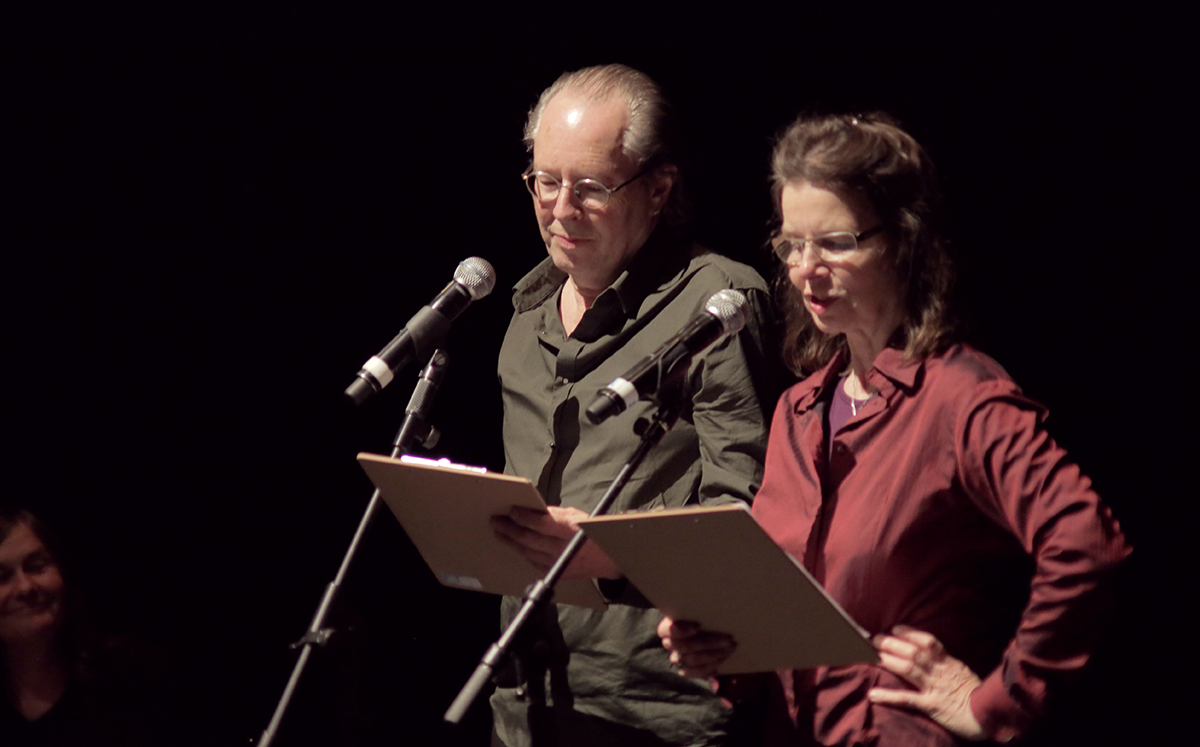
Australian
and international
exploratory
performance and
media arts
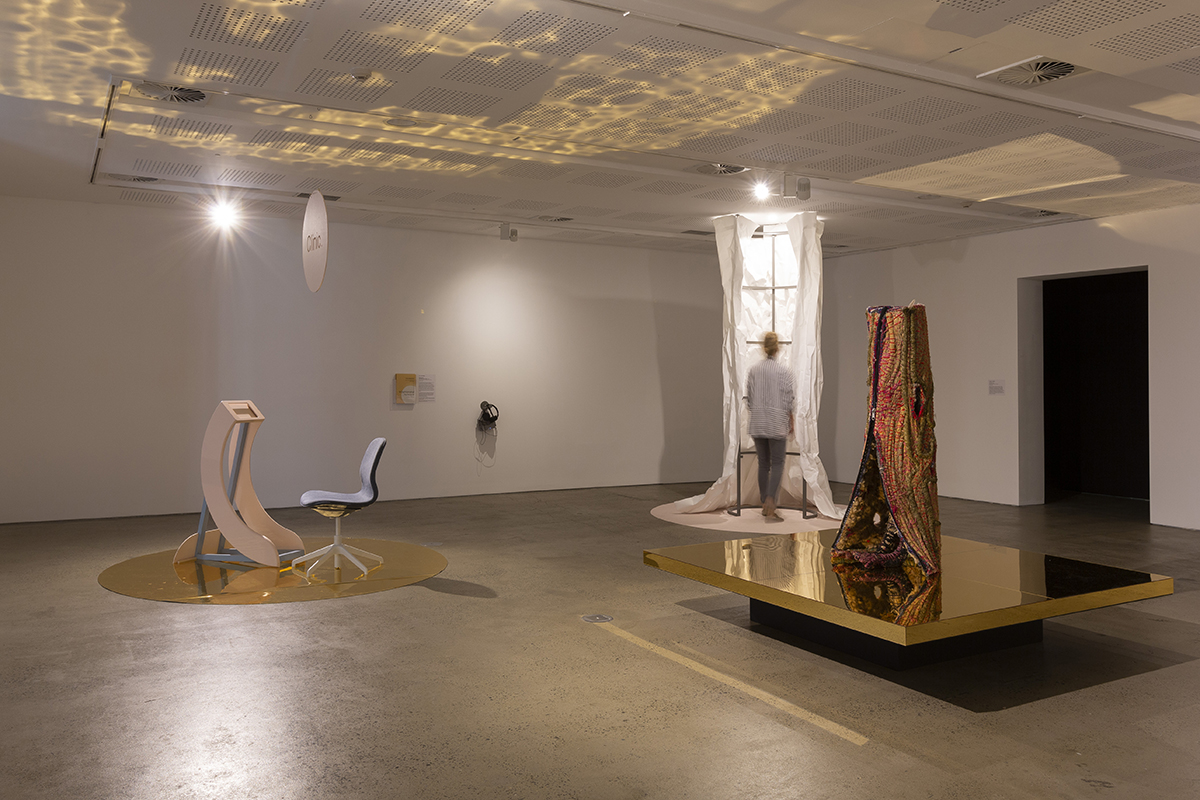
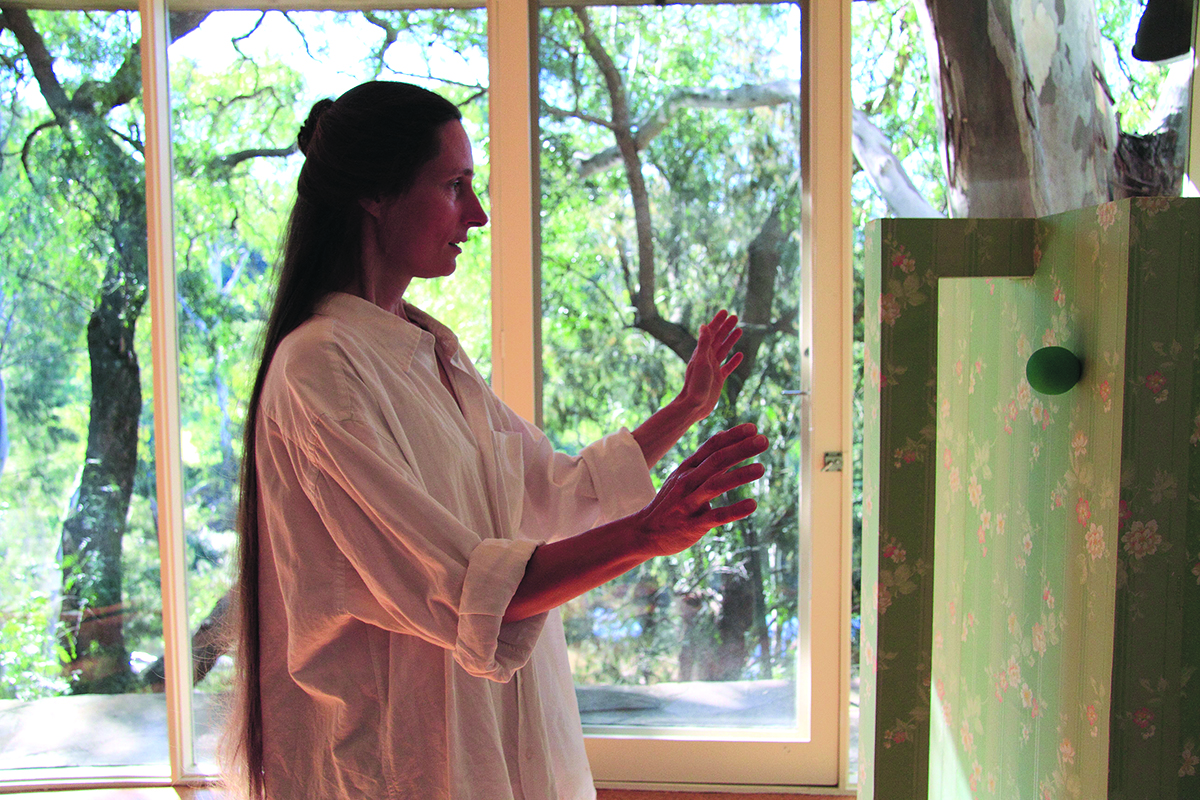
In this edition, a focus on anxiety. At worse, it’s the kind triggered by a dictatorial Australian Government’s sudden erasure of the Arts from the title of a new mega-department (see below). At best it’s in the form of The Big Anxiety. It’s a bold, even risky title for a festival that “brings together artists, scientists and communities to question and re-imagine the state of mental health in the 21st century” (website). But far from inducing anxiety, the recent UNSW event is liberating, bringing to bear new thinking, strategies and technologies with which to address trauma, depression, panic and pain across a broad spectrum of physical, mental and cultural conditions, not least in the event’s The Empathy Clinic (image above). Curation by Jill Bennett and Bec Dean is superb, as is the spacious yet intimate exhibition design by Anna Tregloan. Focusing on r e a and Judy Atkinson’s listen_UP, Eugenie Lee’s Breakout My Pelvic Sorcery and a selection of other challenging creations, Keith recounts his experience of immersive artworks that test preconceptions, heighten the senses and expand the capacity for empathy, often in works made by sufferers themselves. Also in this edition, Ensemble Offspring supports bold new Australian compositions with inventive staging, and Branch Nebula brings spectacle to public space with DEMO.
Very big anxiety. With Stalinist verve, Prime Minister Scott Morrison has disappeared the Arts, calculatedly refusing to name them as part of the new Department of Infrastructure, Transport, Regional Development and Communications; instead they are buried in the latter portfolio. This is perfectly in sync with secret trials, a secret Senate deal over Medevac, increasingly limited Freedom of Information access and suppression of unions and a free press. A government that cannot say to the world, proudly, we have a Ministry of the Arts, is in denial of art, possibly in fear of it. Let your anger be heard. Have a safe and happy holiday season. Keith & Virginia
–
Top image credit: Entrance to The Empathy Clinic, The Big Anxiety, design by Anna Tregloan, photo Jessica Maurer
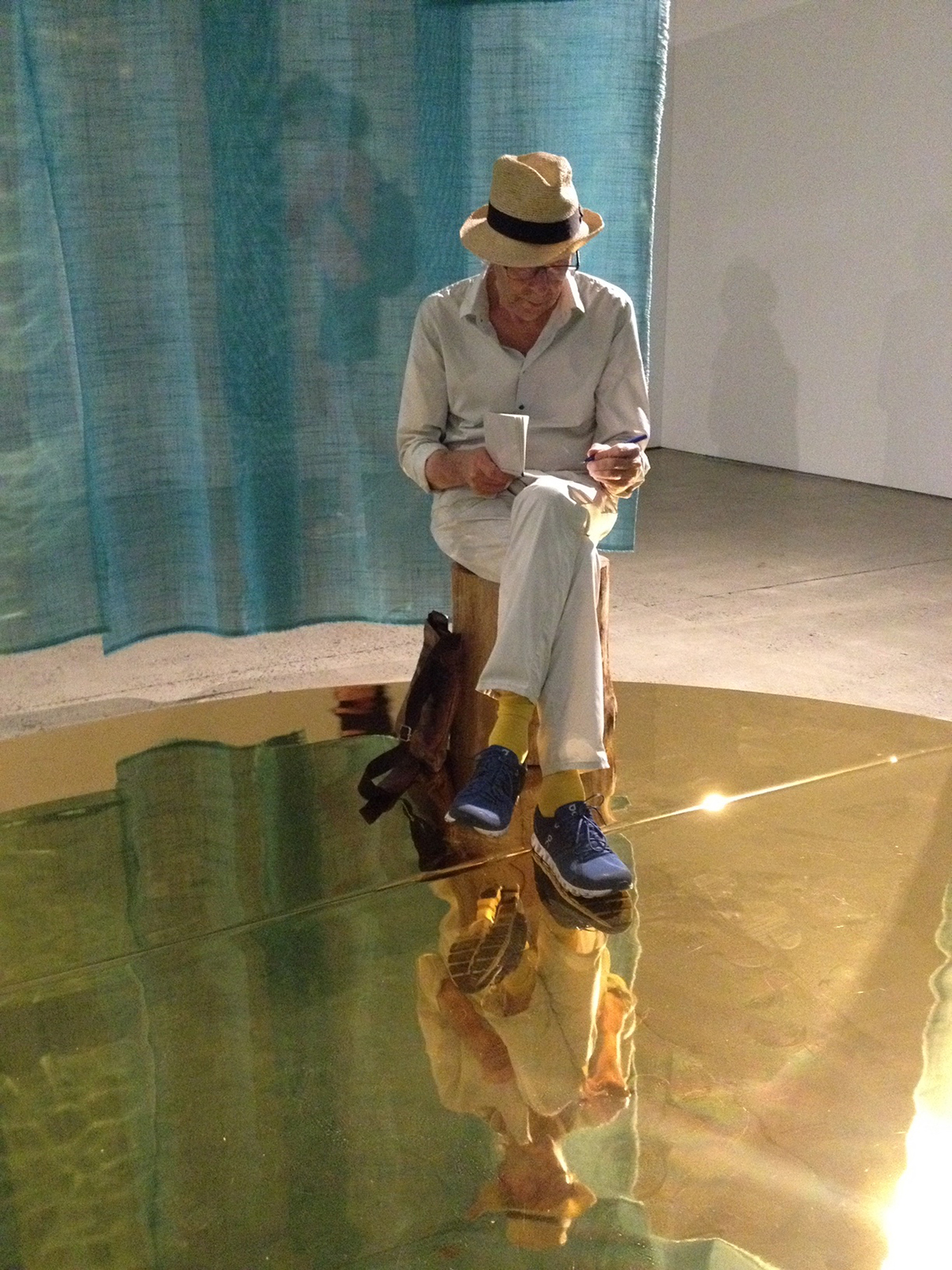
On a reflective golden floor, six tree stumps for sitting. Above, six small boat-like objects crafted from paperbark float serenely. A soft, blue cloth curtain gently encloses the intimate, circular space. The floor dips deep beneath the sitter, mirroring all that is above in the contemplative space that is listen_UP, an installation in The Big Anxiety’s Empathy Clinic. The work advocates and induces deep listening with which to understand the anger and underlying grieving born of serial trauma suffered by generations of Australia’s Indigenous peoples. As a soft crackling suggests a gentle fire at listen_UP’s centre, a very present, lone female voice, pondering inherited and personally experienced suffering, is textured with heartbeat, the rumble of restless weather and a singer expressively uttering a mutating syllable sequence emotionally in tandem with the speaker’s narrative in a sound world of gently shifting perspectives.
The speaker struggles to begin—“I am… I am…”—but the words come—“I am without hope, without future”—revealing “a pain so deep, shame of what I am, what you have made me.” She is “a child unloved,” who has introjected her oppression: “I knew that I deserved not to be loved.” She briefly proffers an explanation for white listeners’ inability to empathise: “You cannot see me… because I mirror your pain.” While her plight is existential—“To be nothing would be preferable to being”—she is compassionate for children “raped in welfare, in a world where multinationals trade in weapons.” Unable to wait for revolution, she declares she will start with herself. The singer intones “reya, reya…”
Suddenly there’s particularity, the speaker revealing her profession, declaring “university a prison without walls.” As an academic, “I build walls of paper to bury my grieving soul while children are dying.” These children are close by, “crying down the street.”
However, a sense of purpose emerges with metaphor enriching the sense of passion inherent in the quietly controlled voice: “I am fire… I am stinging nettle.” “Will you accept the need for this pain?” she asks the listener. “Illy, illy,” sings the singer. Moving beyond metaphor, doubtless drawing on her spiritual heritage, the speaker declares herself owl, spider and “goanna full of healing.” Perhaps we can now travel with her: “I hear so many songs, I will wait for you.”
Finally, the speaker, no longer “I” but “we,” celebrates “the bliss of being completely a woman” through, she says, women’s shared words, dance and song. The singer’s “eeya, eeya…” becomes “eeya, eeya, num, num…” conveying a sense of both completion and eternal duration. I have no idea what these syllables (loosely transcribed here) mean, if anything literal, but the beauty of the intensifying ritual framing they offer lends choral power to the speaker’s path from anger and despair to survival through art, amid resonating wind, thunder and rain, distant bird call and the rattling of cicadas.
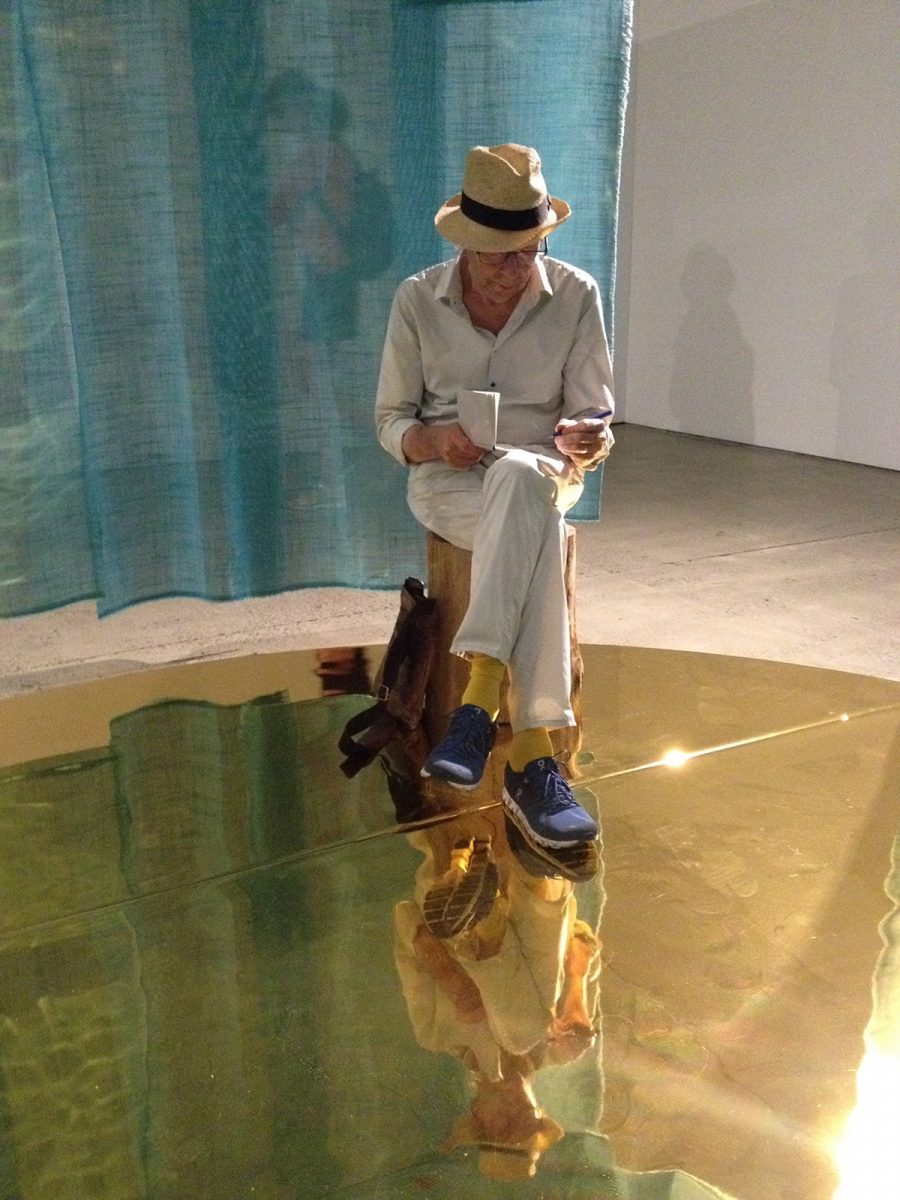
Keith Gallasch, listen_UP, The Big Anxiety, photo Virginia Baxter
The speaker is much admired Emeritus Professor Judy Atkinson AM, a Jiman/Bundjalung woman of also Anglo-Celtic and German heritage. She is the author of Trauma Trails—Recreating Songlines (Spinifex Press, 2003): The transgenerational effects of Trauma in Indigenous Australia, and founder of We Ali-li, a Culturally Informed Trauma Integrated Healing training organisation.
The pioneering visual and media artist r e a has worked with Atkinson “to create an aural campfire—a place where stories are shared, listened to, understood and then reflected or meditated on. In culture the campfire is a creative learning and teaching space where elders pass on their knowledge and stories to listeners young and old” (program note). To focus and intensify this listening r e a has textured Atkinson’s voice with the artistry of Nardi Simpson (composer and singer with Stiff Gins), Missi Mel Pesa (audio-visual artist, musician and composer) and Andrew Belletty (self-described “vibro-tactile sound artist”).
Andrew Belletty kindly spoke with me about listen_UP’s embracingly natural sound design: the six small directional speakers encased in paperbark, keeping the technology invisible; the “grounding campfire” centre speaker; the two gently enveloping sub-bass speakers outside the circle; occasional sounds—birds, insects—including those from field trip recording in r e a’s country; and a realised desire to have the listener feel intimately and directly addressed by Atkinson, mouth to ear.
Listen_UP is a generous invitation to sense, via a contemplative space (exhibition designer Anna Tregloan) and aural magic, how Australia’s Indigenous peoples, as a young We Ali-li participant has put it, “we use our anger, we recycle it, we use it as power for us… to make beautiful things out of your anger, out of your hate, out of your sadness” (We Ali-li website).
–
The Big Anxiety, first staged in 2017, is a festival that “brings together artists, scientists and communities to question and re-imagine the state of mental health in the 21st century” (website). Artistic and Executive Director Professor Jill Bennett (UNSW), Producer Tanja Farman, Senior Curator Bec Dean.
The Big Anxiety: r e a and Judy Atkinson: The Empathy Clinic, listen_UP, artists r e a, Nardi Simpson, Missi Mel Pesa, Andrew Belletty; UNSW Galleries, Sydney, 23 Sept-9 Nov
Top image credit: Installation, Listen_UP, r e a and Judy Atkinson, The Big Anxiety, photo Jessica Maurer
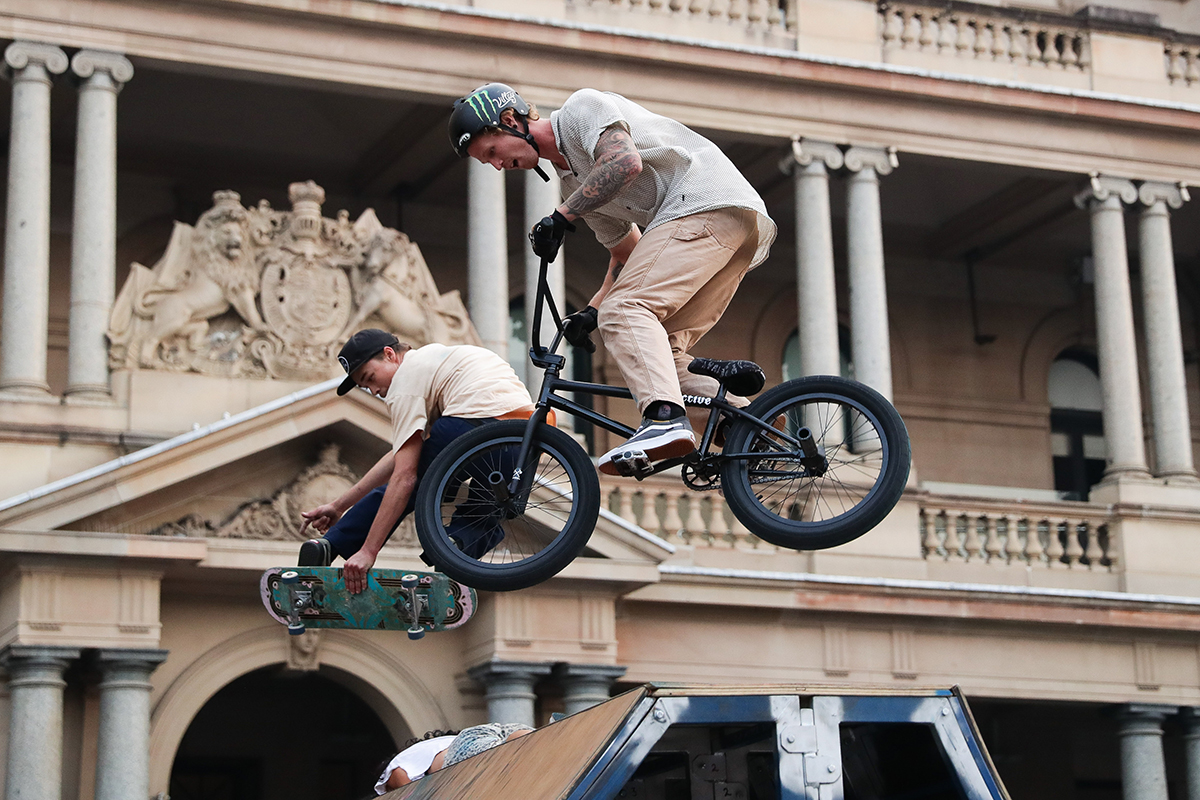
Two brute skateboard ramps dip face to face in the forecourt of Circular Quay’s elegant, mid-Victorian Customs House. Dimly visible beneath the slipways, squirming figures slither into harsh sunlight like emergent life-forms. Two merge organically with their boards, one with his BMX-bike. Three more emerge, one of them, entwined in black concertina-ish plastic tubing which she vigorously sheds, joins another as fellow dancer while the third is a parkour traceur. They learn quickly to athletically and aesthetically duck and weave between and beneath the increasingly dangerous speedsters, who fly high and swoop like predators to Lucy Cliché’s pulsing electronica.
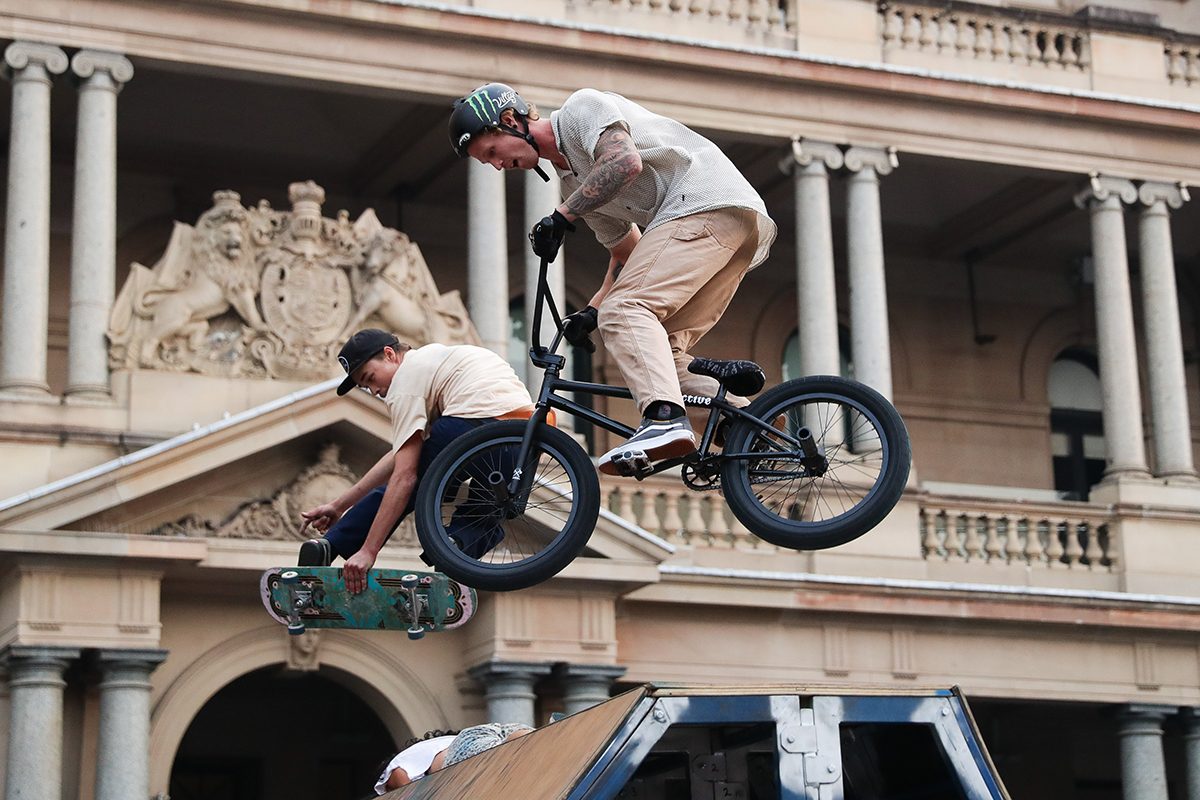
DEMO, Branch Nebula, photo Mark Metcalfe
Once individual skills, male and female, have vigorously displayed genetic advantage, it’s time for emergent mutualism—paired flight high above the ramps for those on wheels, while the movers catch rides, share risk and celebrate collaboration with proud, cheesy tableaux straight out of circus. Suddenly, pink smoke pours apocalyptically from the BMX (scarily apt on a bushfire haze-filled Sydney day), the soundtrack roars and this seemingly robust world collapses. But out of stillness and silence, life resiliently returns in a series of virtuosic turns. At half an hour, DEMO is a brisk, cheerful, frequently thrilling parable of hope realised—with the most basic of technologies—by young bodies with trust in their collective strength.
–
City of Sydney: Branch Nebula, DEMO, co-directors Lee Wilson, Mirabelle Wouters; performer-devisors: dancers Marnie Palomares, Kathryn Puie, skater Sam Renwick, Aimee Massie, BMX Brock Horneman, parkour Antek Marciniec, composer Lucy Cliché, producer Intimate Spectacle (Harley Stumm); Customs House Square, Sydney, 30 Oct-3 Nov
Top image credit: DEMO, Branch Nebula, photo Mark Metcalfe
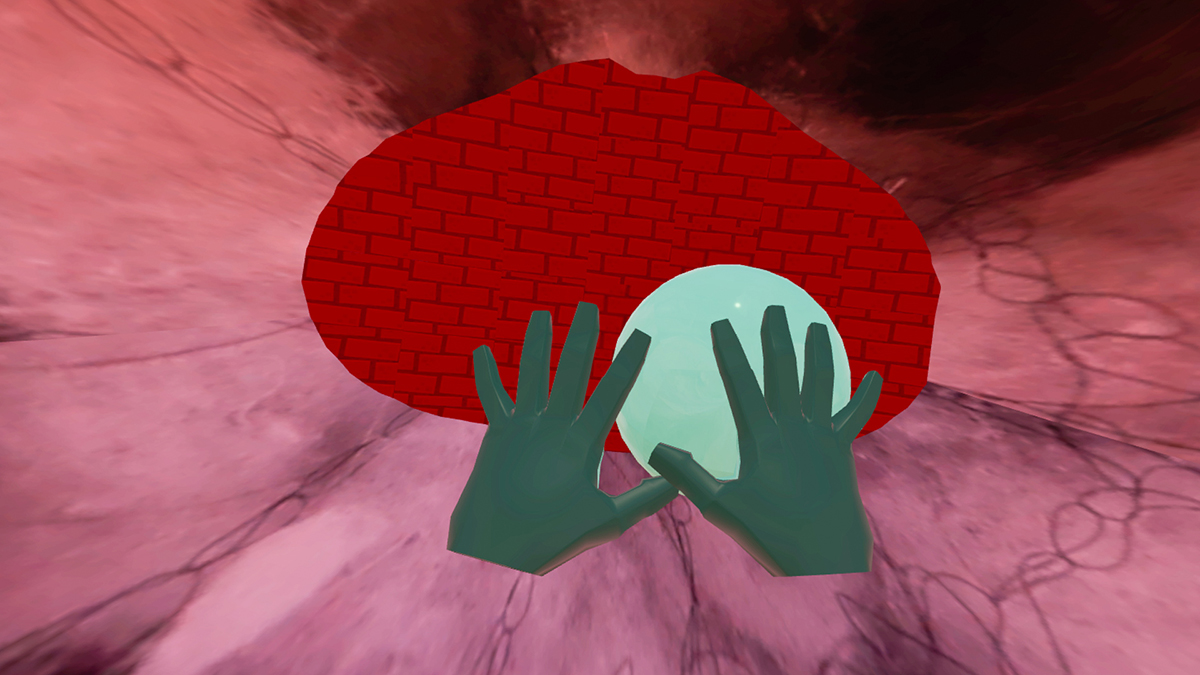
In front of me, a red brick wall. Nearer, hovers a large green ball. I hit it. It flies to the wall, knocking out a single brick and bounces back. I hit again. Another brick goes down. But the return is too fast, the ball flies past and I experience a sudden high frequency pulsing in the groin, not exactly painful, but certainly uncomfortable and even moreso each time I miss the ball and the vibrations escalate. I endure for only a few minutes (10 is the maximum), doubling up as what now feels like pain (the ‘cramping’ and ‘hammering’ sensations reported by pelvic pain patients) triggers body memory associated with hernia and prostate operations. The wall and the ball are components of an interactive animation inspired by the Breakout video game. I’m wearing a VR headset and, around my pelvis, a pumped-up inflatable belt holding two nodes to the lower abdomen. I’m spared simulated back pain because, on my visit, the tech is playing up. A blessing.
The work is Eugenie Lee’s Breakout My Pelvic Sorcery, part of The Big Anxiety’s The Empathy Clinic at UNSW Galleries. It’s an artistic creation rooted in solid multidisciplinary science exploring the experience, understanding and communication of chronic pain. Lee’s earlier works focused on externalising and objectifying it, crafting material metaphors with which to manage her own suffering. Now she offers others the opportunity to experience simulacra of chronic pain. At the first Big Anxiety in 2017, I experienced Lee’s Seeing is believing, a VR work conducted within in a padded anechoic chamber. I found myself suspended in a red void with an intensifying, grating soundscape, a barbed wire coil slowly descending around me and finally a large nail passing through the palm of my hand (wired for low-key vibration and heat). A subsequent conversation with the artist, as part of the work, involved putting the unnerving experience into words. The new work has none of the Gothic horror aesthetic of its predecessor, instead the participant is active, attempting to physically and mentally function in a simple physical-virtual game scenario while suffering ongoing and escalating bodily discomfort.
Breakout… is designed to help doctors, nurses and other health and related professionals to understand the nature and impacts of chronic pain: it’s an empathy training machine addressing the suffering regularly experienced by 20% of Australian women and possibly 8% of men. Lee’s collaborators are multidisciplinary, addressing the whole person: Dr Susan Evans (physician, pelvic pain specialist), Emeritus Professor Roland Sussex (linguist, University of Queensland), Dr Claire Ashton-James (social psychologist, empathy expert, University of Sydney), Peter de Jersey (mechatronic engineer), Warren Armstrong (VR media artist) and Big Anxiety producer Bec Dean. Lee has been aided by data from a scientific survey by Sussex, Evans and Ellie Schofield titled The Language of Pelvic Pain, produced by the Pelvic Pain Foundation of Australia.
Empathy: art & transfer of learning
We humans are innately empathetic—without fundamental mutualism, for example, our species would have been short-lived—but for the most part within highly determined cultural boundaries. It is often assumed that education and art in particular loosen those limits by nurturing understanding of others’ emotions and cultures. In recent years, there’s been a preoccupation with the virtues of storytelling, backed by data and theorising of various kinds, but short on an understanding of the transfer of learning required to convert empathy into application, let alone any acknowledgment of the devious narratives inflicted on us every day. The arts can arouse our sympathies, but to what extent? Nigerian-American novelist and essayist Teju Cole, while applauding the risks taken by many of his writer peers, believes only that “literature can save a life. Just one life at a time.” He writes, “After observing the foreign policies of the so-called developed countries, I cannot trust any complacent claims about the power of literature to inspire empathy. Sometimes, even, it seems that the more libraries we have over here, the more likely we are to bomb people over there.”
In her essay “The Banality of Empathy” Zambian writer Namwali Serpell also acknowledges literature’s limits: “Narrative art is indeed an incredible vehicle for virtual experience—we think and feel with characters. It simulates empathy, so we believe it stimulates it.”
Citing Paul Bloom’s complexly argued Against Empathy: The Case for Rational Compassion (Bodley Head, 2016) in which the author argues for cognitive empathy (“understanding what’s happening in other minds and bodies”) over emotional empathy (“trying to feel like or even as someone else”), Serpell writes supportively, “Bloom shows that emotional empathy is often beside the point for moral action. You don’t have to feel the suffocation, the clutch of a throat gasping for air, to save someone [from drowning].” And, as Bloom argues, too much empathy may inhibit a doctor from taking radical action which will induce pain in order to save life.
However, this either-or argument would eliminate Lee’s and a growing number of projects like those encountered in The Empathy Clinic. Surely a synthesis of ‘understanding’ and ‘feeling like’ would be an ideal goal. Pain is intensely private but we constantly share what it is like, comparing another’s with our own experience. The notion that cognitive empathy is somehow free of the traps of emotion seems untenable.
The semantics of pain
One way of coming to understand others’ pain is through attentive listening to the vocabulary and narratives with which sufferers attempt to describe (to themselves, friends, doctors) and take some control of their condition. It’s long been recognised that using metaphor is the commonest means of describing pain (transferring associations from one domain to another). Susan Sontag invaluably challenged the use of metaphor in Illness as Metaphor (1978) for its reduction of the sufferer to Other (clinically and socially objectified in terms of their illness) and the deployment of emotionally negative analogies, especially stigmatising ones to do with cancer. To achieve this, she deployed numerous metaphors herself while, critics argued, denying those in pain the same means of managing it (see Richard Gwyn, Communicating Health and Illness, Sage Publications, 2002, an excellent account of professional medical and patient metaphors and narratives).
For Lee’s Seeing is Believing, psychologist Ronald Melzack’s McGill Pain Questionnaire (1975), which mapped sensory, affective, evaluative and other descriptors used by patients to describe their experience of pain, was a touchstone. However, in Australia Professor Roland Sussex and associates have freshly researched this terrain, surveying over 1000 women about pelvic pain in The Language of Pelvic Pain study, focussing, as Sussex says in a talk, “on the guts of the language itself.” The team discovered, surprisingly, he says, that conjunctive simile usage (eg “a stabbing pain that feels like a hot barb”) was the prevalent means of description.
The researchers also learned that certain sets of similes complemented specific pelvic conditions, be they period, endometrial, ovulation, bladder or vulval pain, the latter, for example, having no “cramping” descriptors common to the other categories, let alone being the most difficult to describe. It was this new study that Lee turned to formulate the kind of discomfort she would induce in her subjects.
The sharability of pain
In her classic work The Body in Pain: The Making and Unmaking of the World (OUP, 1986), Elaine Scarry wrote of the existential “unsharability” of pain and its resistance to language, if not necessarily to art. Pain itself cannot be shared, but the McGill Questionnaire and The Language of Pelvic Pain project point to the capacity of sufferers to use metaphor and simile as a means of sharing expression of their pain and to have their need to be heard acknowledged. It crucially underlines commonalities of experience between sufferers. For health professionals attentive to language this sharing provides indicators of the whereabouts and nature of certain conditions and the qualities of the pain, yielding a rational understanding, Bloom’s ‘cognitive empathy.’ But metaphor is potent; it’s only a short step to the listener drawing on their own experiences of pain to becoming ‘as if’ the sufferer, just as we can have a visceral response to hearing about bodily damage or seeing operation scenes on screen. We can move quickly from understanding to emotional empathy with little or no conscious effort, but to what degree comprehended and how enduring?
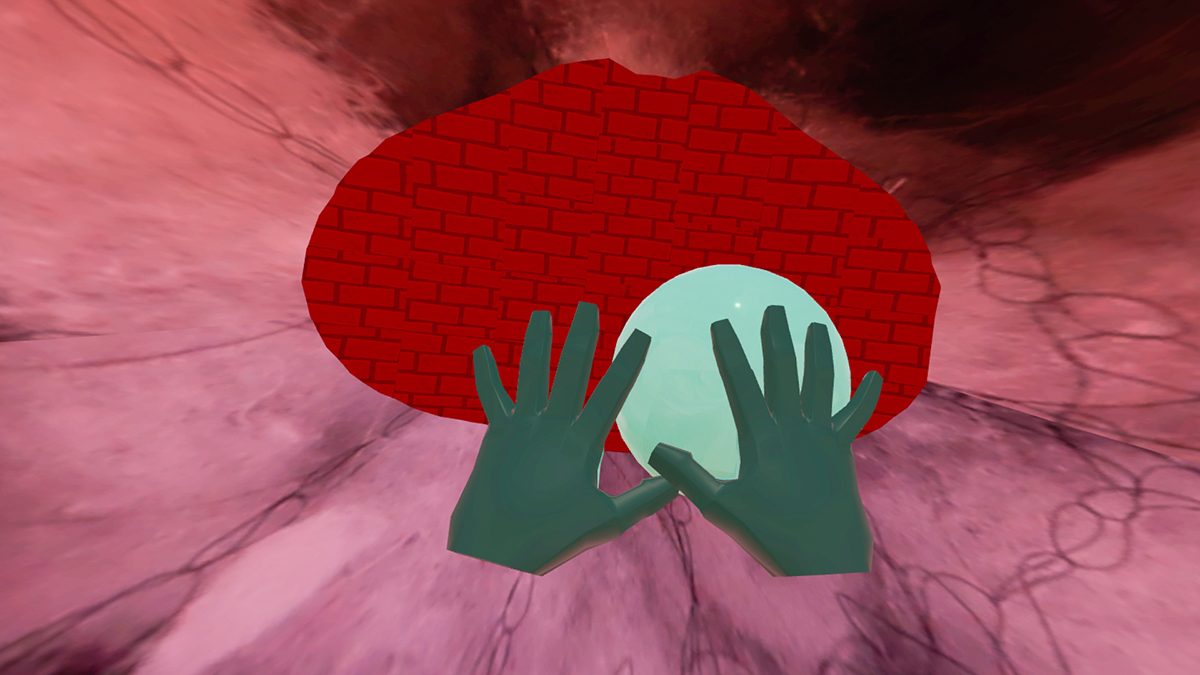
Screenshot of Animation (in development), Breakout My Pelvic Sorcery, Eugenie Lee
Metaphor, magic & science
With her VR translation of sufferers’ metaphors into very convincing simulacra of pain for non-sufferers of pelvic pain, Eugenie Lee synthesises rational understanding and affective experience, most tellingly for me when I attempted to describe what I felt, for a moment completing a loop between myself and those whose suffering prompted the making of Breakout My Pelvic Sorcery. In a video accessible on Lee’s website, gynaecologists testing Breakout My Pelvic Sorcery, speak enthusiastically of the value of the VR’s enabling them to feel something akin to their patients’ suffering.
Like a metaphor, Breakout My Pelvic Sorcery, stands in for and expresses Eugenie Lee’s own experience of pelvic pain as well as for the women who contributed their own metaphors to The Language of Pelvic Language project. Lee’s art is informed and driven by multidisciplinary science. For much of the 20th century, positivist science saw metaphor as being loosely associative, subversive even and having no cognitive value; only literal language would do. The “sorcery” of the work’s title evokes Lee as VR conjurer of ‘pain’ and effector of balm, and a cheeky promulgator of a productive, magical tension between art and science, encouraging a potent dialectic of emotional and cognitive empathies. With further testing and collection of responses from participants, this work-in-progress seems, from my relatively innocent vantage, very promising. As Lee is aware, Breakout My Pelvic Sorcery not will not suit everyone; for some it will seem invasive. But for those happy to brave temporary physical or cultural discomfort it might be a venture into newly found or deeper empathy.
–
The Big Anxiety, first staged in 2017, is a festival that “brings together artists, scientists and communities to question and re-imagine the state of mental health in the 21st century” (website). Artistic and Executive Director Professor Jill Bennett (UNSW), Producer Tanja Farman, Senior Curator Bec Dean.
Breakout My Pelvic Sorcery, artist Eugenie Lee, physician, pelvic pain specialist Dr Susan Evans, linguist Emeritus Professor Roland Sussex, social psychologist, empathy expert Dr Claire Ashton-James, mechatronic engineer Peter de Jersey, VR media artist Warren Armstrong, producer Bec Dean; The Big Anxiety, The Empathy Clinic, UNSW Galleries, Sydney, 23 Sept-9 Nov
Top image credit: Eugenie Lee and Keith Gallasch, Breakout My Pelvic Sorcery, photo © Cynthia Sciberras
Lone Hemispheres, the curious title of Ensemble Offspring’s recent concert of works for solo performance at Carriageworks, suggests separation anxiety—what defines a hemisphere but a whole? The featured southern hemisphere composers—Australians Elizabeth Younan, Tristan Coelho and Damien Ricketson—are perhaps more akin to young planets in the gravitational pull of older ones—the Italian modernists Franco Donatoni and Luciano Berio—divided by some 50 years of negligible time-space. Whatever the significance of the metaphor, designer Michelle St Anne emphasises isolation with, in turn, each soloist half-shadowed at the base of a high cone of misty light and each of the six performances newly positioned amid small softly lit sculptural forms, lending the space a cosmological ambience, apt for lone voices in the vastness of the universe.
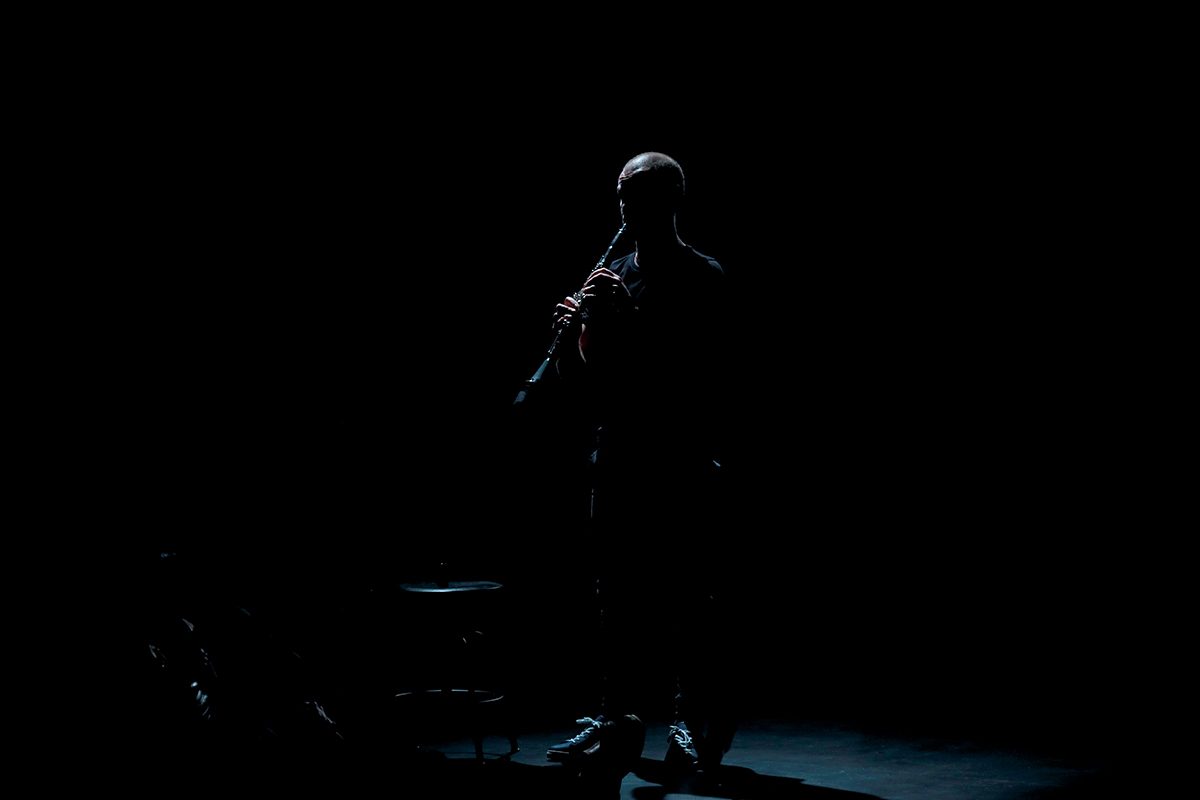
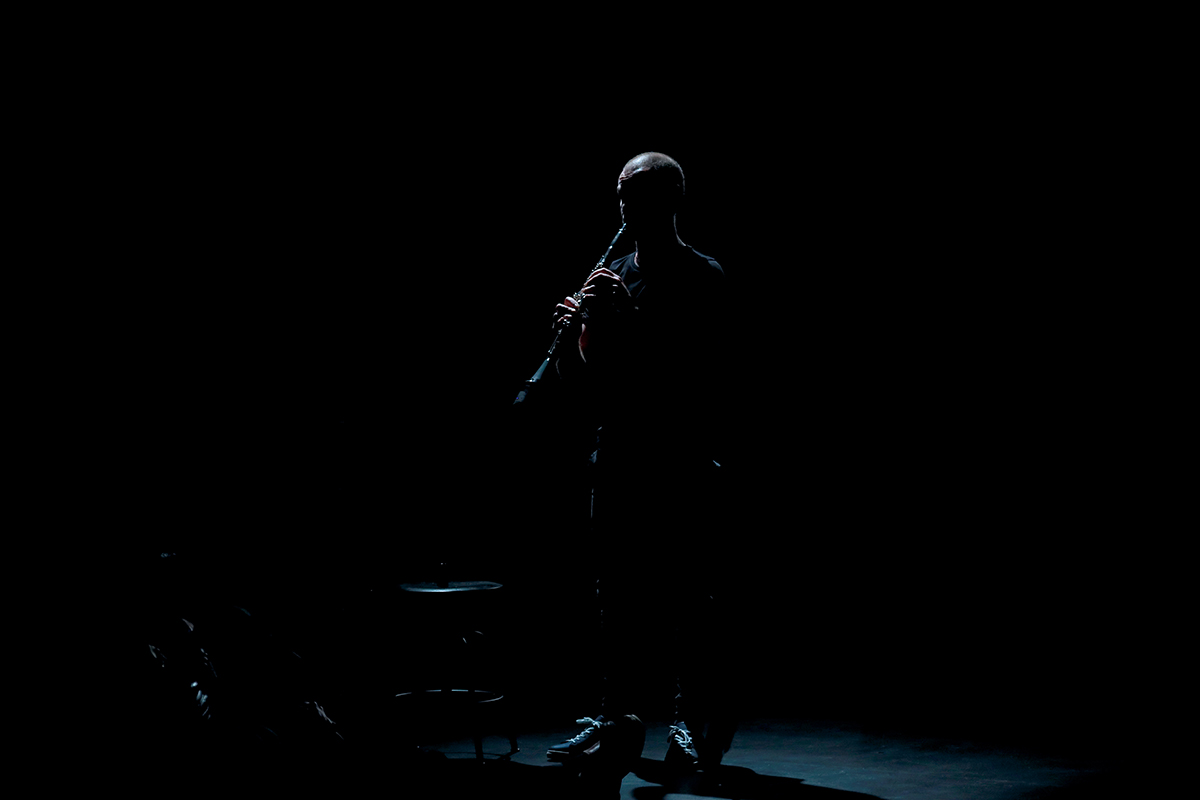
Jason Noble, Lone Hemispheres, Ensemble Offspring, photo Nathaniel Fay
The organic naturalism of the cellular growth of Donatoni’s Soft (1989) for bass clarinet—warm, velvety, brief utterances, each progressively more expressive, with small swellings, flourishes, deep recurrent punctuations, numerous rippling ascents and a final vertiginous ride down—is deeply engaging in Jason Noble’s riveting performance. Later in the program Noble premieres Damien Ricketson’s Borderlines (2019) for clarinet, a very different work, although seemingly akin to its Italian forebears in its conversational ease, this time with much longer utterances but each, it seems, returning in chorus as the work progresses via a small blue tooth speaker placed in the bell of the clarinet and activated by Noble via the iPad graphic score. This other ‘voice’ is texturally unusual, soft, distant and haunting. In his program note, Ricketson describes this short composition’s structure thus: “A thought twists and frays, tangling in a lump. Knotted like a skein, the line coils against itself in search of open passage only to grind its body into wisp-like filaments. Permeable, formless and free.” The effect seemed less busy than suggested here, but the composition is quite magical, perhaps warranting greater duration so the listener might more fully register the performance’s internal dialogue.
True to the tenor of the concert’s Italian modernist influences, Elizabeth Younan’s Fantasia (2019) for flute, premiered by Lamorna Nightingale, has, writes the composer, a “free and improvisatory construction. The manipulation of small musical cells and their gradual development form the modus operandi of the work.” Fantasia flows like a burbling stream, bounding cell to cell and rising in sprightly ascents even when joined by asynchronous bass drum kicks (from the flautist’s heel) to evoke something like a quirky pipe band. Later, Nightingale eloquently met the challenging pace and pitch changes of Berio’s Sequenza I (1958), not least in the deep trilling and high fluttering, amid lucid long notes, in the thrilling last third or so of the work.
Claire Edwardes performed Tristan Coelho’s A line is a dot that went for a walk (2018) for vibraphone and other percussion. The title is a sentence from painter Paul Klee that inspired the composer; it fits well with Younan and Rickertson’s notes on structure. Coelho writes, “The piece, in two movements, counterposes a meditative and spacious style of music linked with nature against a groove/loop-based feel, playing with glitches and ‘hard cuts’, aligned with technology.” He adds “a nod to the classic vibraphone solo, Omar (1985), by Donatoni,” with which Edwardes will complete the concert. The first part of A line… feels gently conversational, lilting, sweetened with high note chiming and almost tripping into melody. It’s always spacious even when suddenly hesitant or urgent. Pronounced single drum beats, sharp loud/soft shifts and faster pacing make for a more driven, angular second part, until the last few minutes deliver a delicious return to the lyrical spirit of the contemplative first. Donatoni’s more wide-ranging Omar, a beautiful exploration of instrumental possibilities evident in Edwardes’ deeply engaged vibraphone playing, reveals Coelho’s ‘nod’ had been realised within a more formal structure, rich in variation, its dots walking and running in constellating lines.
Within the concert’s unifying stage ambience, Ensemble Offspring’s lone hemispheres were made whole with the soloists’ dextrous execution of Italian modernist classics and compelling Australian works by composers who embrace past innovations while cogently pursuing their own.
–
Carriageworks & Ensemble Offspring, Lone Hemispheres 2, composers Elizabeth Younan, Tristran Coelho, Damien Ricketson, Franco Donatino, Luciano Berio, performers Jason Noble, Lamorna Nightingale, Claire Edwardes; Carriageworks, Sydney, 7 Nov
Top image credit: Claire Edwardes, Lone Hemispheres, Ensemble Offspring, photo Nathaniel Fay
In addition to my accounts of experiencing r e a and Judy Atkinson’s listen_UP and Eugenie Lee’s Breakout My Pelvic Sorcery, here’s a cluster of other works in The Big Anxiety’s The Empathy Clinic by artists Sam Kerr-Phillips, Vic McEwan, Debra Keenahan and Jason Maling. In his clinic, The Physician, Maling wrily helps visitors find tools for coping with the challenges of the contemporary art experience; it’s not about empathy, but does reveal what we as gallery-goers can suffer. Elsewhere in The Big Anxiety at UNSW Galleries, Alex Davies and Michaela Davies’ VR work Edge of the Present also addresses coping, with the very struggle to want to live. At the Esme Timbery Creative Practice Lab at UNSW Kensington, Rupture, a performative installation, searches for agency in the face of urgency in catastrophic times.
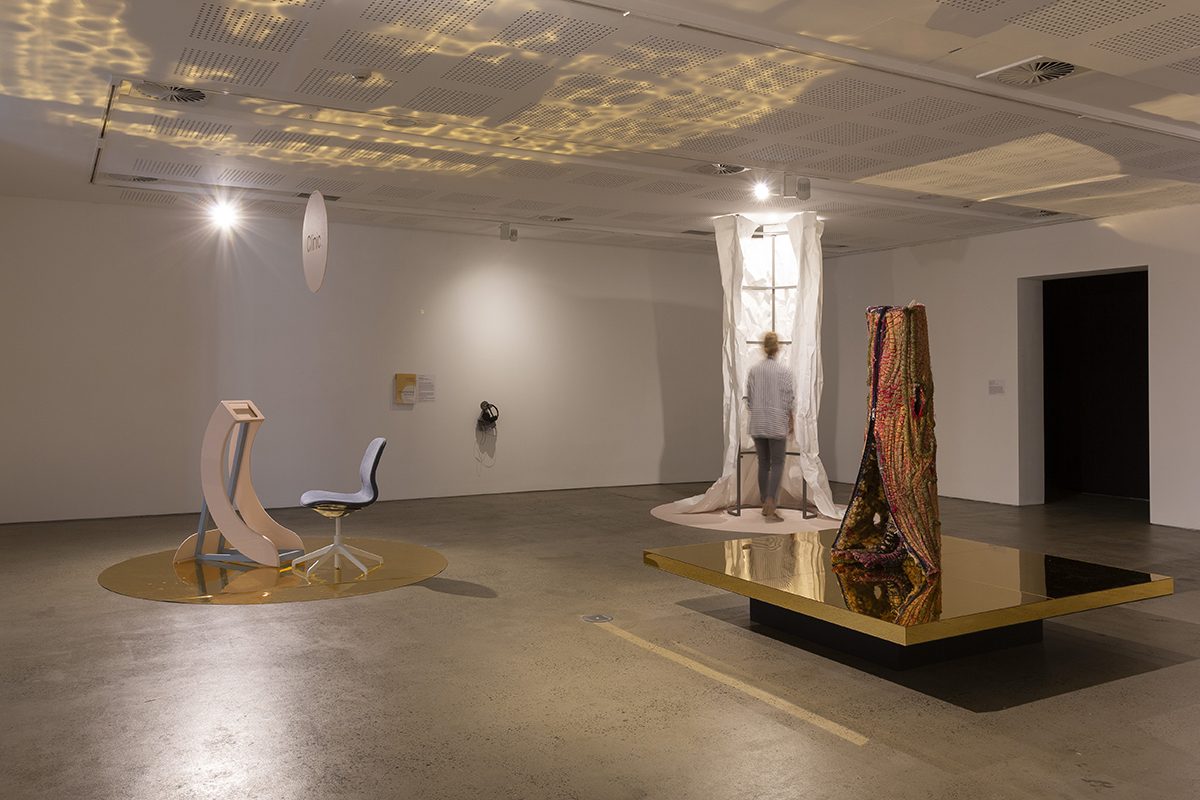
Foreground: Ngangkari Tjukurpa (Traditional Healer Tjukurpa), 2013, Ken and Naomi Kantjuriny from the MCA Collection, photo Jessica Maurer
Despite spending many hours engaging with The Big Anxiety, I regret being able to access only a little of two VR works by fEEL (Felt Experience & Empathy Lab UNSW) and Uti Kulintjaku “an Aboriginal-led mental health literacy project that takes its name from a Pitjantjatjara phrase that means ‘to listen, think and understand clearly’,” formed by Ngangkari traditional healers and artists of the NPY Women’s Council, Alice Springs. The project uses an old story of a man trapped in a hollow log who is rescued by his wives as a healing metaphor for dealing with male depression and contingent violence and alcoholism. As Kim Mahood has written in The Monthly, “Embedded in cultural memory, the story of The Man in the Log provides a psychological traction that’s missing from Western approaches to Aboriginal mental health.” Accompanying the VR work is another representation of the story, the exquisite sculpture Ngangkari Tjukurpa (Traditional Healer Tjukurpa), 2013, by Ken and Naomi Kantjuriny from the MCA Collection.
SO IT BEGINS
An intimate, curtained space. A single chair. To the left a video, SO IT BEGINS (2017); to the right a large printed copy of the poem haltingly heard within a deeply textured soundtrack. The 11-minute video comprises a stream of photographs of the complex life of the artist flowing rhythmically towards a bitter truth: “a boy loses his father and his own life as he knows it” (program); as the closing line of the poem puts it, “So it begins…” The WA artist-filmmaker Sam Kerr-Phillips, who uses a powered wheelchair for mobility, wins our deep attention to trauma and enduring but considered grief with the interplay between everyday screen images and a vivid evocation of a twilight motorbike ride that would end fatally: “Blood orange brushstrokes stole our attention./ Two suckers for sunsets round the bend captivated./ BAM! Kissed the arse of a stubborn four-wheeled rhino!”
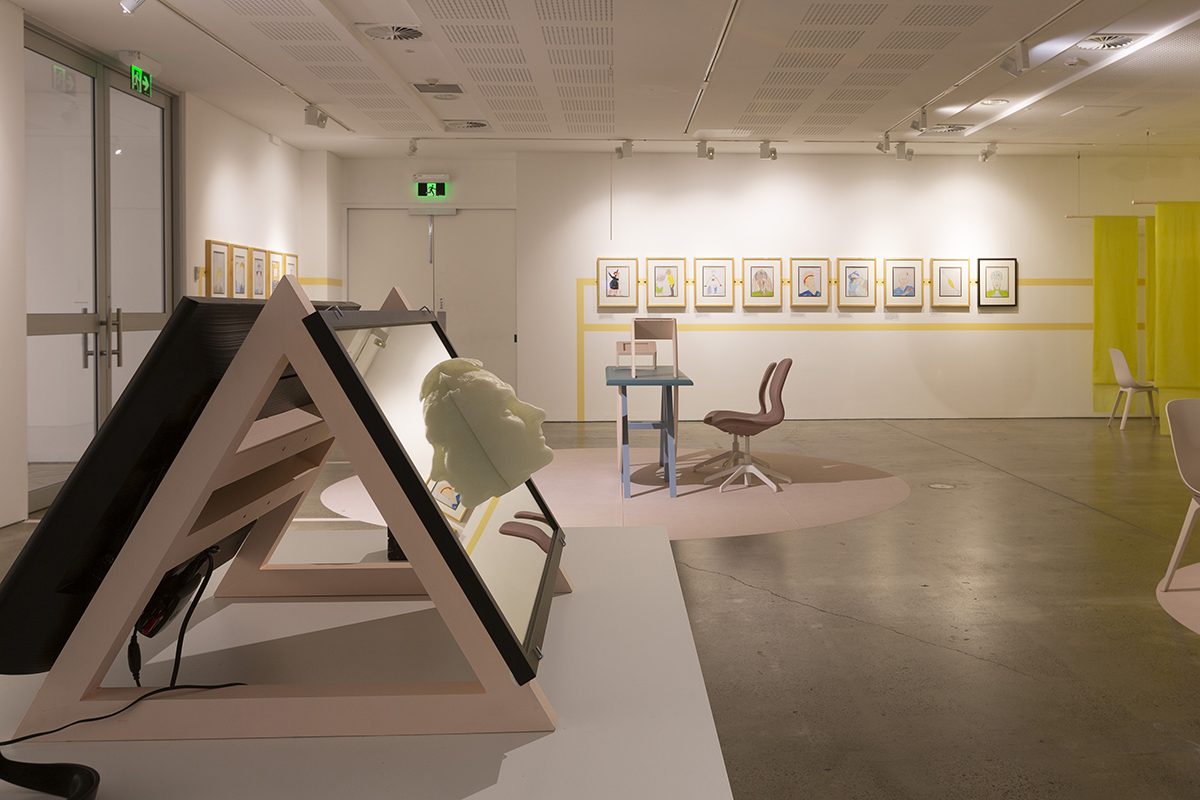
If They Spend Time To Get To Know Me, Vic McEwan, The Big Anxiety, photo Jessica Maurer
If They Spend Time To Get To Know Me
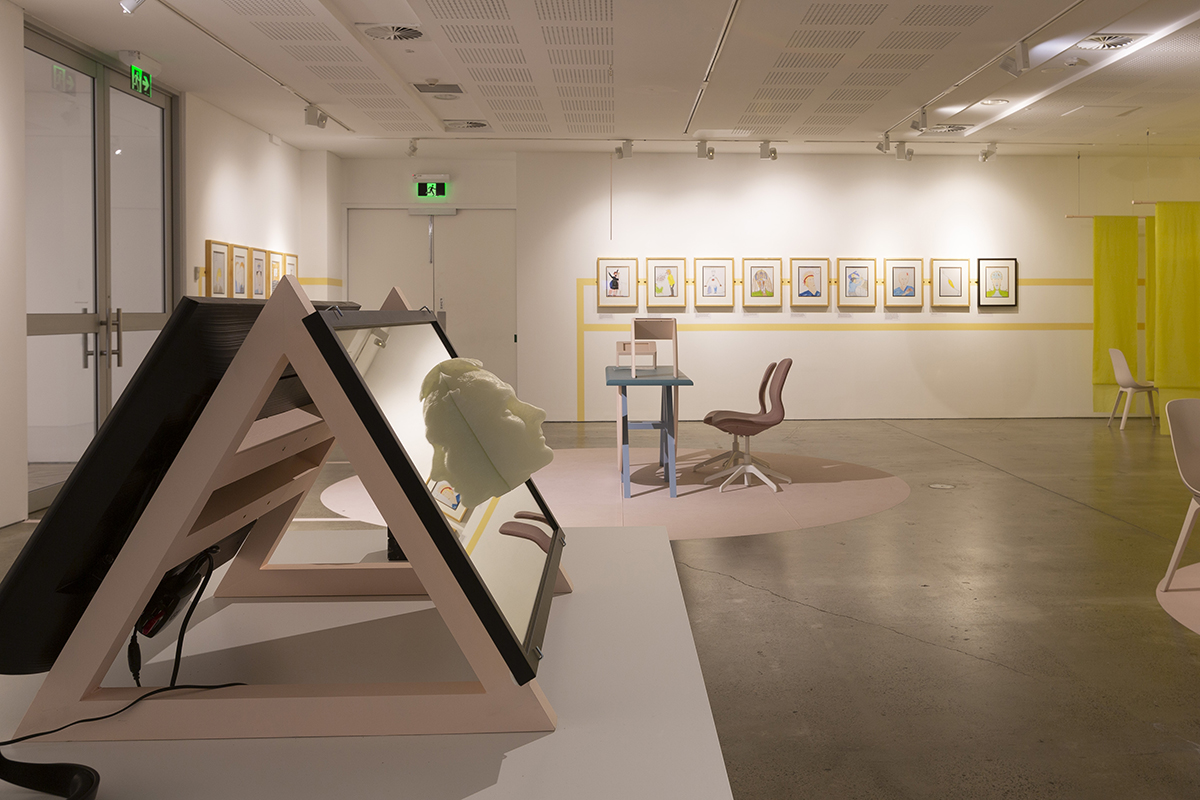
This intriguing installation, with its death mask-like sculptures, onscreen facial mappings and reflective voices, conveys a disturbing impression of the social stigma and psychological pain felt by sufferers of facial nerve paralysis. An apparent absence of responsiveness can be read as inattentiveness, indifference or hostility by those eagerly ‘reading’ for immediate meaning. If They Spend Time To Get To Know Me is part of PhD research by Vic McEwan, Artistic Director of The Cad Factory in regional NSW, in partnership with researchers, surgeons and patients from the Sydney Facial Nerve Clinic.
Arts, Health and Healing, a Sydney University Sydney Ideas and related Big Anxiety event held on 21 October, launched a major initiative, the NSW-ACT Arts Health Network with talks by Vic McEwan, Dr Clive Parkinson, Manchester School of Art, Dr Nicole Reilly, University of Newcastle (UON) and Akeshia Dart, mental health clinician and PhD candidate UON, chaired by Dr Claire Hooker, University of Sydney. These speakers provided fascinating perspectives on how artists work within hospitals, government misconceptions about what art can do, equity of (art) access issues for the ill, and strategies for improving the mental health of young Indigenous mothers through toy-making. Parkinson’s painfully personal, poetic account of the art and health terrain evoked hospitals as temples to culture, places where artists can provide succour if not cures, is especially worth a hearing. You can listen to the whole event here.
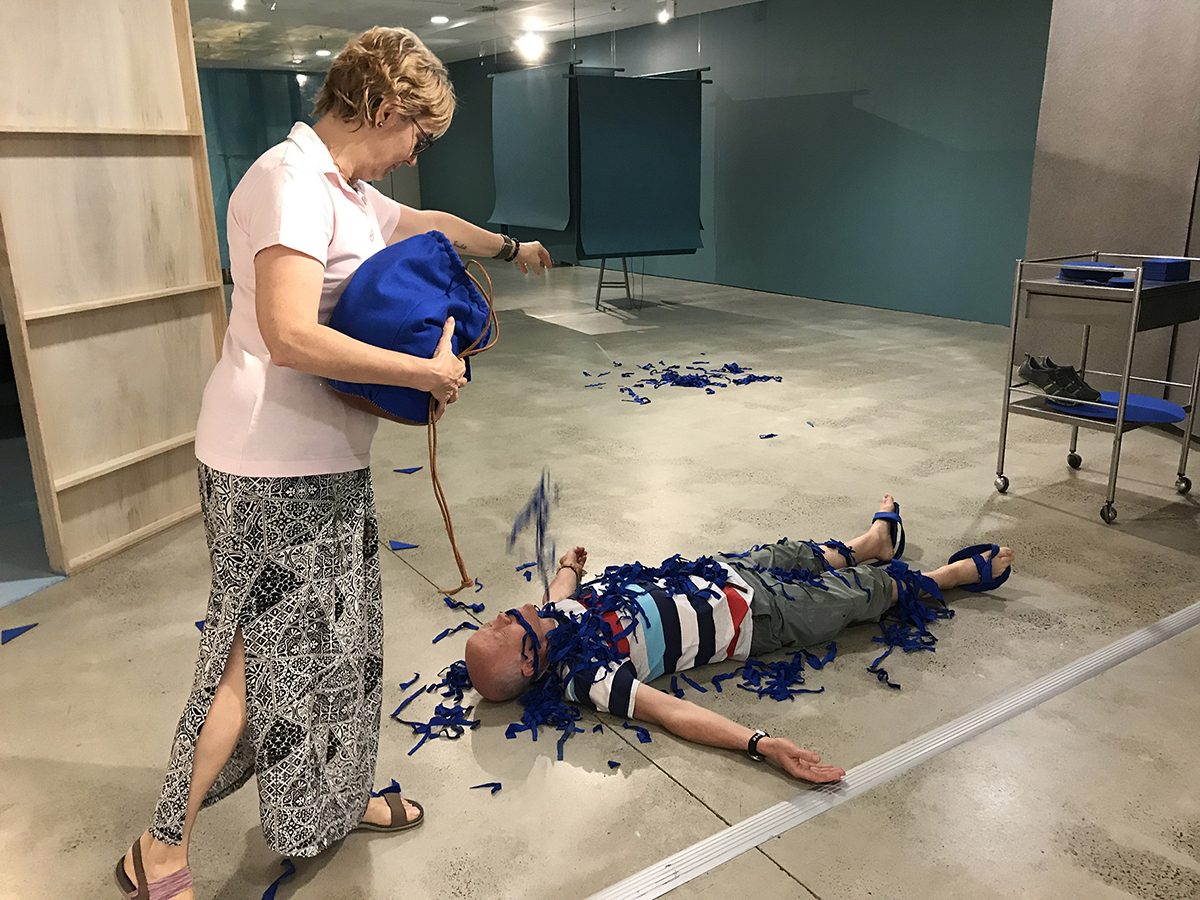
The Physician, Jason Maling, The Big Anxiety, photo courtesy the artist
The Physician
I’ve booked for a session with The Physician. The work is described as “a public health program developed and facilitated by artist Jason Maling. Through a client focused one-on-one process and utilising a set of bespoke tools Maling addresses latent issues of cultural anxiety.” At first sight the tools are a little alarming: a rich variety of straps, belts, pads, balls and tubes are laid out neatly on a table. And there’s a consulting room bed. Refined S&M? In the low-lit room these objects glow an intensely Kleinian blue, some reinforced with burnished leather, all crafted by the artist. On the desk are small, framed photos of the artist’s heroes, Yves Klein and Joseph Beuys, the eyes of each covered with a blue strip.
Maling, in Bueysean felt trousers, is a reassuring presence, eloquently introducing his tools and inviting me to feel their texture and shape and to try them out. Surprisingly, these are devices designed to help gallery goers cope with the art experience. As Maling writes on his The Physician page, “Contemporary Art Institutions are beginning to recognise the need to provide onsite services that address the gamut of contemporary anxieties, ranging from mild conceptual perturbation to severe relational deficiency.”
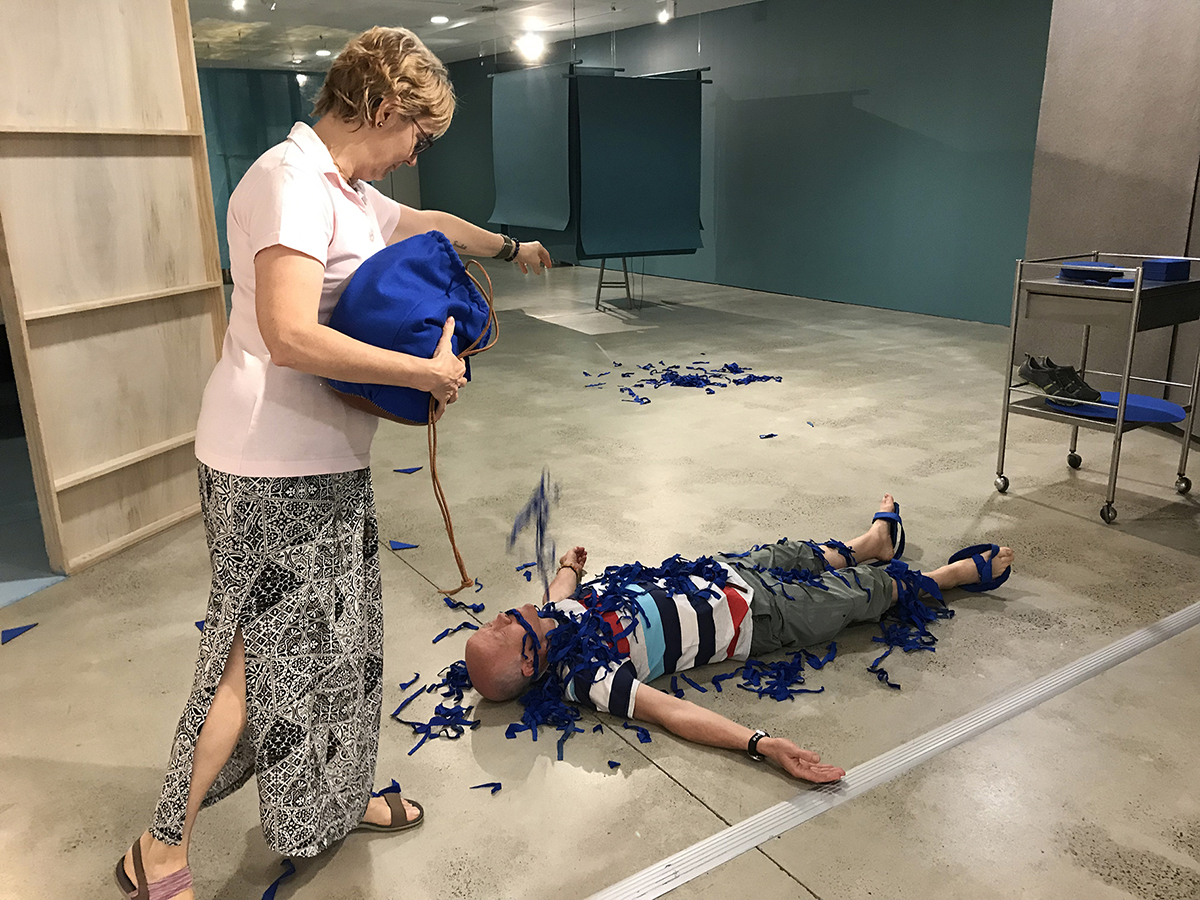
I admire a felt-padded leather headband with which, if distressed, you can lean your forehead against a gallery wall for pause. If meaning threatens to dissipate, with your foot you can push a roller ahead with a renewed sense of purpose. There are even soft hitting devices, presumably to encourage attentiveness, and a bag of offcuts (see image above). Unable to hit on any particular anxiety, I focus on the back pain inevitable in long gallery visits and choose a wide, tight tube with which I’m held erect and ready to go on an art stroll with the artist. We are linked by a skipping rope-like cord (blue handles) as we walk, discussing the meta-subjectivity of the already subjective aesthetic experience.
It should have immediately occurred to me that I’d been in the same Empathy Clinic room the week before with another belt around my waist, experiencing simulated pelvic pain in artist Eugenie Lee’s Breakout My Pelvic Sorcery. Perhaps Maling’s was the therapy I needed to “clear unwanted metaphoric deposits and restore full socio-poetic function.”
The same band can also be worn around the head to block out or restrict art intake. Photographs on Maling’s The Physican page and the one above reveal the extent Maling’s ‘patients’ will go to manage the contemporary art experience. Galleries and gallery-goers are taking on his “Beuysenklein voidal dematerialization.” Exquisitely crafted, The Physician, for all its drollery rings true as contemporary art grows more ‘experiential.’ Ironically, the work doubles as a gallery experience of that very kind and critique of same.
Being Debra
Debra Keenahan’s PhD research “focuses upon developing a Critical Disability Aesthetic through the representation of the female dwarf.” Being Debra offers users “an embodied experience of having dwarfism in contemporary Australian society, thus potentially increasing empathy for a physical difference not readily emulated.” It’s a VR work that reveals how vastly different the physical world and social relations are defined by height. In one frightening scene Debra is abused by a group of overbearing teenagers. In another, hospital staff discuss her in the third person. While in the previous scene we shared Debra’s eye-level point of view, here the camera is positioned at waist level so that her legs reach out before us as if they’re our own, an even more heightened subjectivity. With this comes a feeling of vulnerability that brings home Keenahan’s adroit use of VR to dramatically and, at times wittily, reconfigure perception and prejudice. Being Debra is doubly potent, as both an artistic expression of Keenahan’s experience and an invitation to enter a vivid simulacrum of it.
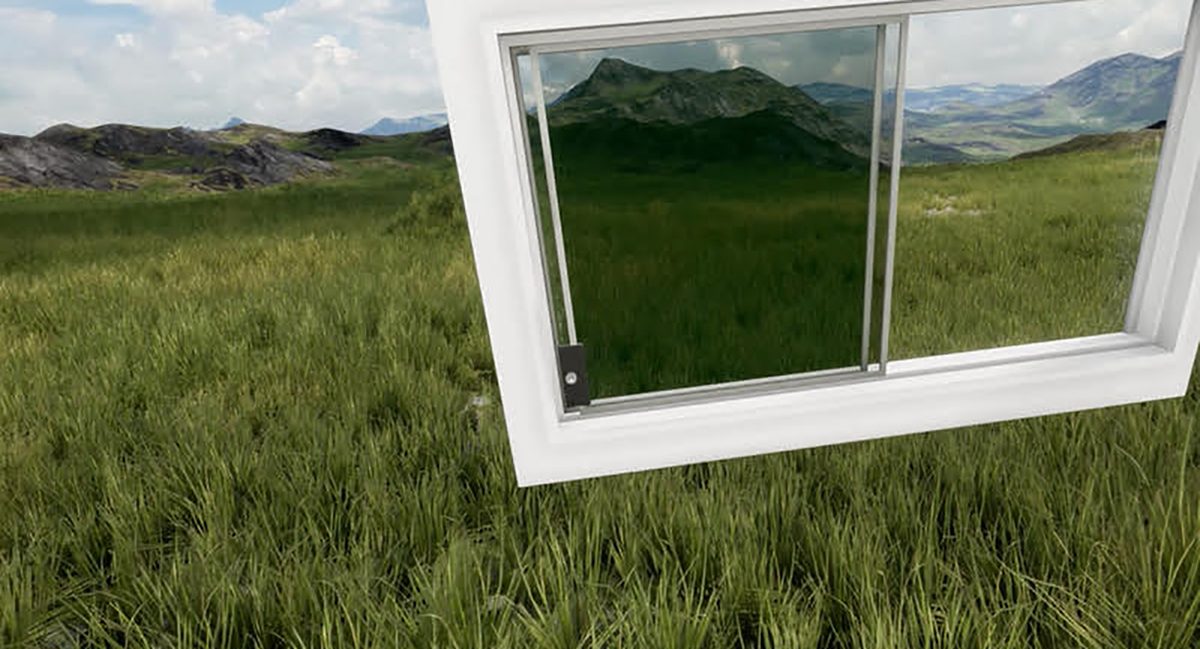
Promotional image, Edge of the Present, Alex Davies and Michaela Davies, The Big Anxiety, courtesy the artists
Edge of the Present
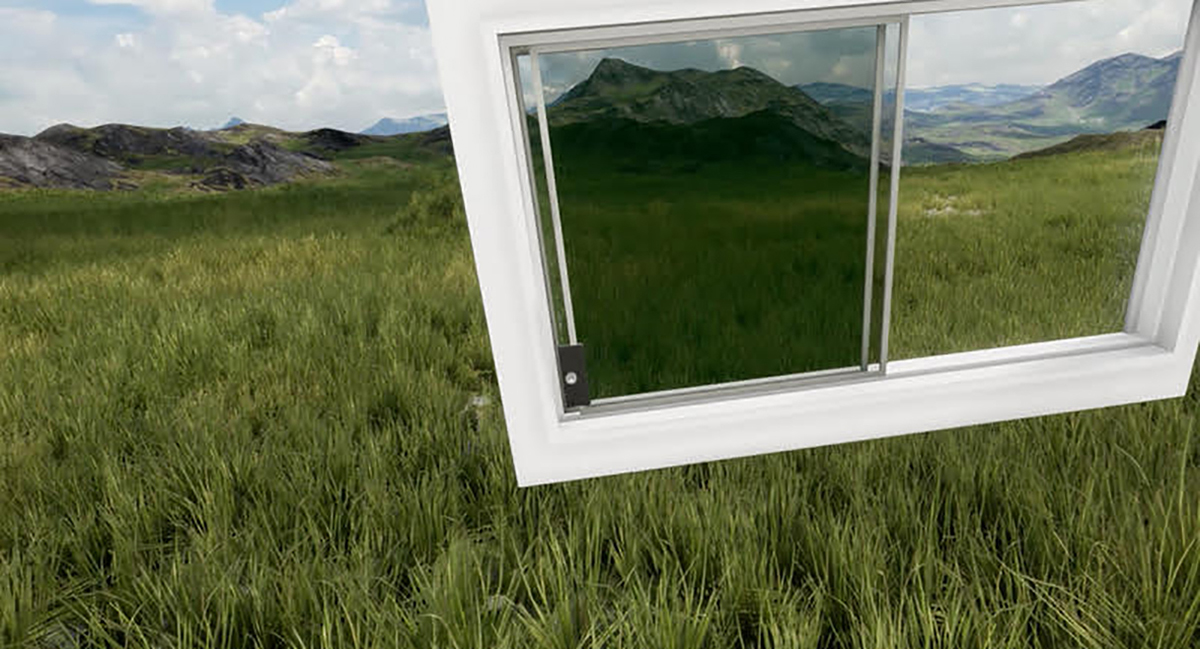
I enter a white room. VR gear is fitted and activated. It’s the same room, both actual and virtual. I open a real/virtual door to a not-real pine treed landscape; the scale and depth takes me by surprise. Back inside I notice rocks and growth on the floor. I look out a window at a similar view, turn and find the scattered grass is knee-high and denser. Snow is falling outside, and inside! I turn again and the room disappears. I’m fully outside on a vast snowy terrain. I gasp, briefly agoraphobic. Then comes exhilaration. An undefinable breakthrough. The work’s epic 10 minutes is over, but the sense of pleasure and release lingers long after.
The makers, media artist Alex Davies and artist and psychologist Michaela Davies hope that “by using technology in this novel [actual-virtual] way, the installation helps viewers to better engage with the present moment— and hence with the future—with openness, curiosity, and confidence.” They reveal a more precise goal: “[M]ade in collaboration with psychologists, mental health specialists and participants with lived experiences of suicide survival…this immersive experience invites us to ‘invent the next 10 minutes’—something that is a challenge when we find ourselves inhabiting the ‘edge of the present’.” The NHMRC Centre for Research Excellence in Suicide Prevention/Black Dog Institute also offered guided sessions of Edge of the Present. It’d be fascinating to hear what participants gained from this aesthetic experience, with all its multidisciplinary underpinnings.
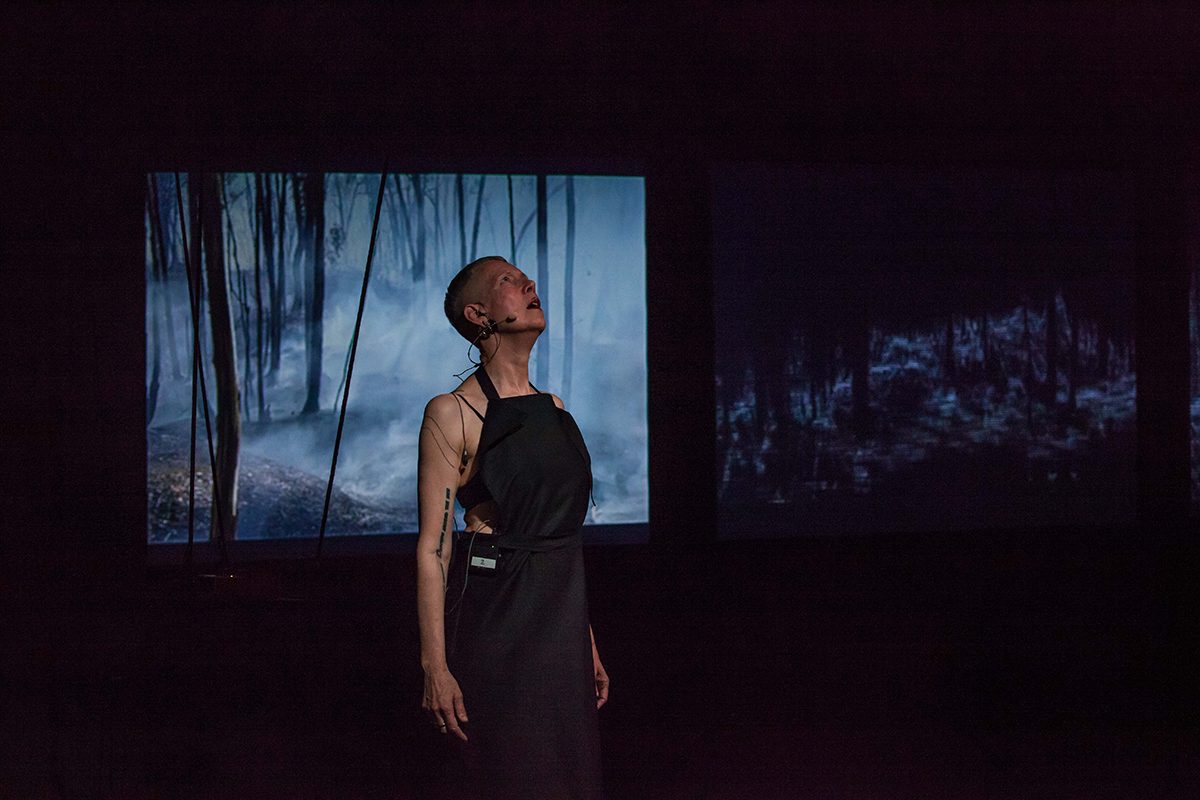
Virginia Barratt, Rupture, The Big Anxiety, photo © Cynthia Sciberras
Rupture
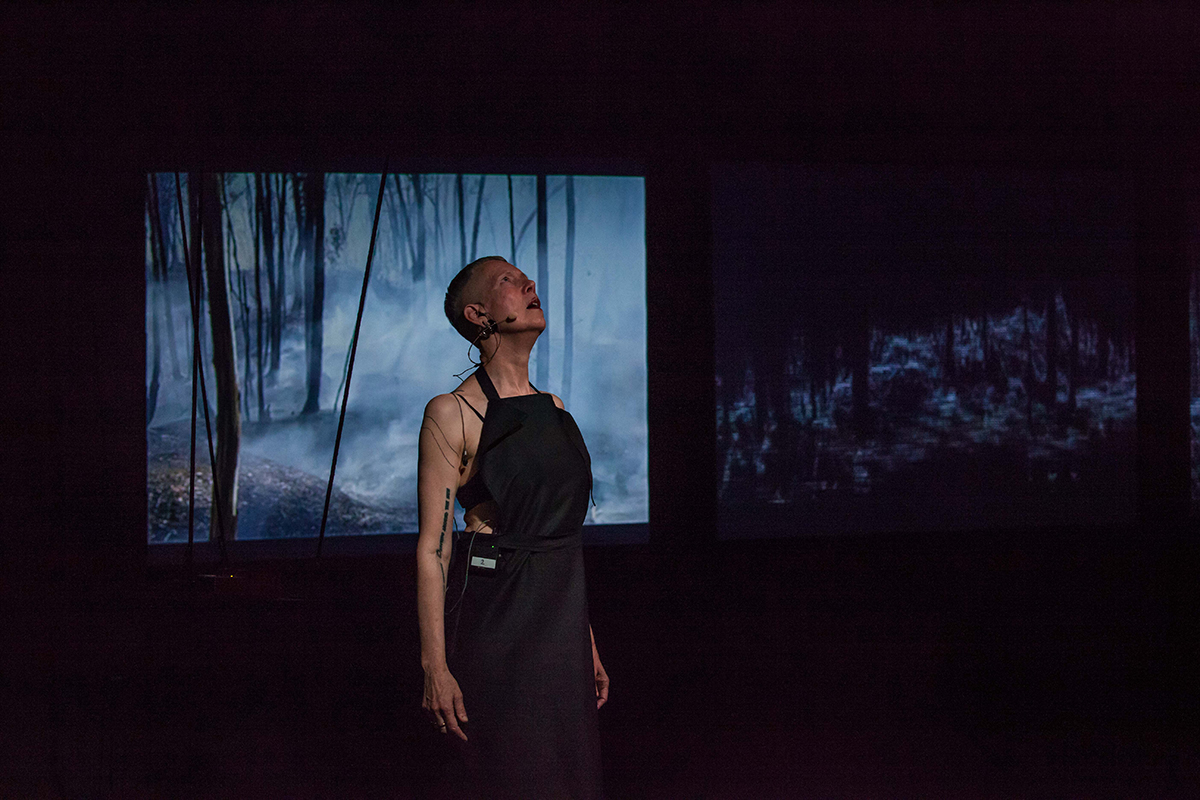
At UNSW’s impressive new Esme Timbery Creative Practice Lab, Virginia Barratt extended her text, vocal and physical presence on video in photomedia artist Jessie Boylan’s multi-screen installation Rupture (Bendigo Regional Art Gallery, 2018) into live performance as an unnerving shamanistic figure, eyes rolling up, the real body painfully in and out of sync with a quivering, unstable virtual self and in beautiful chorus with voices in flight. Made in collaboration with Boylan, media artist Linda Dement and trauma counsellor and psychotherapist Jenna Tuke, Rupture as performance dramatically evokes panicky transference between the individual and the natural and social world, each enduring serial trauma. Barratt roots her response in a recollection of her child self in horrified awe of the cosmos but feeling inextricably tied to it (“I am a star, the star is me”).
A sense of desolation, where not even friendship can console, is relentlessly evoked as smoke drifts through bush, hundreds of scrolling words spell out environmental and other horrors and we are drawn into an endlessly deep, metallic tunnel, while Barratt’s virtual body fragments and the real self fades into shadow.
What, in this panicky scenario, is the shaman’s message? I recall in particular one gnomic utterance: “Dissolution…is a gift that keeps giving but has to be taken.” Presumably, we surrender to our condition or learn from and manage it, as best we can. Revealing the extremity of that condition, a very personal one but shared to varying degrees, Rupture was cathartic for some in its audience, or, for all its hyper-expressiveness, was just too painfully real for others. I left oscillating between these states, unable to answer the question posed by the artists in their program note: “By considering panic as both urgency and agency, can we begin to see ways of engaging with our catastrophic times?” But I keep worrying at it; Rupture has that kind of power.
Andrew Stephens’ review for Artlink of the original installation in Bendigo will give you a more comprehensive sense of Jessie Boylan’s imagery than I have space for here. Take a look also at an excerpt from Ngurini (Searching), a collaboration between Boylan, Dement, Paul Brown and the Pitjantjatjara Anangu people about the legacy of trauma caused by Britain’s atomic testing at Maralinga in South Australia.
–
The Big Anxiety, first staged in 2017, is a festival that “brings together artists, scientists and communities to question and re-imagine the state of mental health in the 21st century” (website). Artistic and Executive Director Professor Jill Bennett (UNSW), Producer Tanja Farman, Senior Curator Bec Dean.
The Big Anxiety, The Empathy Clinic, curators Bec Dean, Jill Bennett, works by Sam Kerr-Phillips, Vic McEwan, Debra Keenahan, Jason Maling; Alex Davies and Michaela Davies, UNSW Galleries, 27 Sept-16 Nov; Rupture, collaborators Jessie Boylan, Virginia Barratt, Linda Dement and Jenna Tuke, Esme Timbery Creative Practice Lab, UNSW, Sydney, 31 Oct
Top image credit: The Physician, Jason Maling, The Big Anxiety, photo courtesy the artist
RealTime Extra. Performance Space’s 2019 Liveworks Festival of Experimental Art and Adelaide Festival Centre’s OzAsia (image above: audience playing bankers in Ontroerend Goed’s £¥€$) both kick off in coming days with programs of rare intensity and invention. We guide you through their programs. We recently saw dancemaker Rosalind Crisp at the Sydney Opera House in a deeply engaging account of connections between the building, the dancer’s body and a struggling Australian environment. For more on sustainability, dancemaker Sue Healey’s Platform Paper eloquently addresses dance ecology through her engagement with film. In September Sydney’s contemporary music audience was generously treated (a mere $35 a ticket) to the gripping 12-hour Extended Play event at City Recital Hall.
If you’re in Sydney, definitely don’t miss The Big Anxiety at UNSW Galleries in Paddington, a superbly curated collection of works and talks that help manage panic and concretely nurture empathy. Some of the standouts are VR works, not least Alex Davies and Michaela Davies’ magical Edge of the Present. It’s against the odds these days, but stay calm. Art helps. Keith & Virginia
–
Top image credit: £¥€$, Ontroerend Goed, photo Thomas Dhanens
From an expansive OzAsia Festival program, his fifth, Artistic Director Joseph Mitchell and I settle on a handful of works that test the limits of performance and intensify audience experience via, variously, food, social gathering and, scarily timely, playing at being global bankers. Some are also indicative of the importance of cross-cultural collaboration—between Belgian and Hong Kong artists in one, and between Australian and Asian artists in two others—making the festival more than a showplace for ground-breaking Asian performance. It’s also a program which allows Mitchell to give expression to his considered curation, bringing back key artists from his previous festivals who have created the terrain on which newer artists he’s presenting this year have found the space to innovate. Intellectually and experientially, OzAsia is much more the sum of its parts.
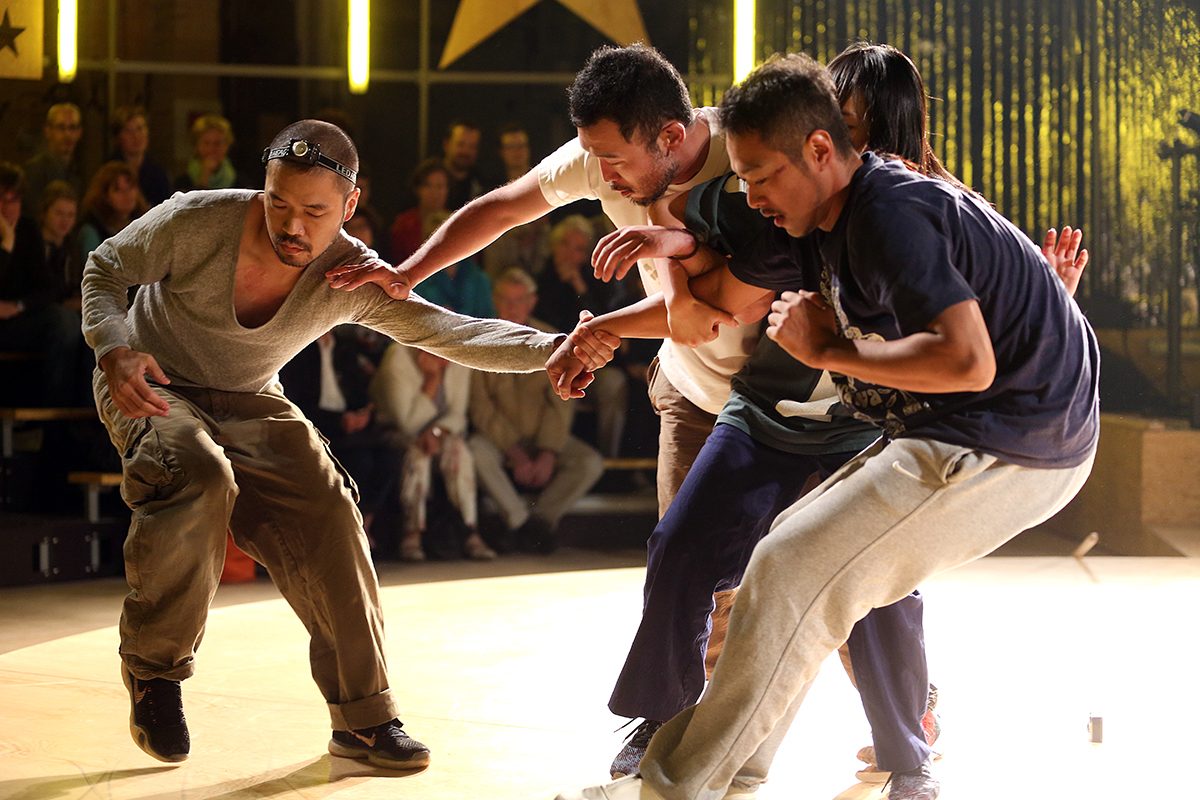
Stuck in the Narrowest Path, Contact Gonzo, photo courtesy OzAsia 2019
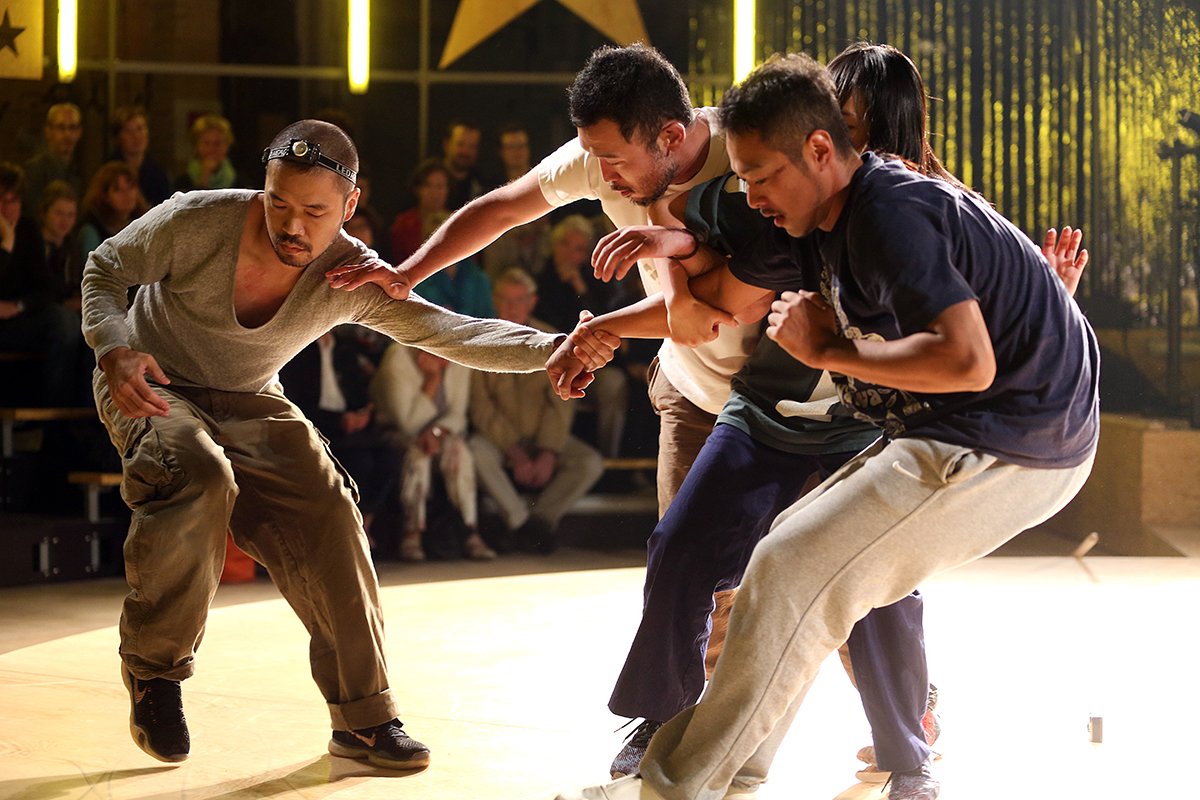
First up in my conversation with Mitchell is fighting: the raw, seemingly all too risky physical battles expertly executed by the performance artists who comprise Osaka-based Contact Gonzo—‘contact’ from the aikido-influenced Contact Improvisation developed for dance by Steve Paxton in the US in the 70s, and ‘gonzo,’ for crazy. A decade ago I experienced their wrestling, shoving and trepidatious clamberings close-up with a shocked and then thrilled street crowd in Jakarta. At another time, Mitchell, beer in hand, had witnessed them on a skyscraper rooftop in the same city, accompanied by a heavy metal soundtrack.
Why pair Contact Gonzo with Adelaide’s Zephyr Quartet?
Every work Gonzo makes is so wildly different. I didn’t know where to start, so I flew [company founder] Yuya Tsukahara and other members here and said, “I’m just going to walk you round Adelaide for two or three days and introduce you to a few artists. Just tell us which venues you like and the artists you think you’d like to work with, or if you just want to bring one of your existing shows.” They said, “Anything but a [real] ‘venue’ would be great.” They’re in love with the backstage and narrow pathways and how to move people through them. Gonzo loved the ideal of counter-balance with Zephyr string quartet. Because they’ve played with big post-rock groups from Japan, heavy metal bands from Indonesia and noise groups, a string quartet sparked their imagination. And also, my impression of Zephyr is that they’re up for anything. This is a world premiere. In my view it’s contemporary dance, but some people might be more comfortable with the term ‘physical theatre.’ They’re artists who are pushing the boundaries; that’s really all that matters to me.
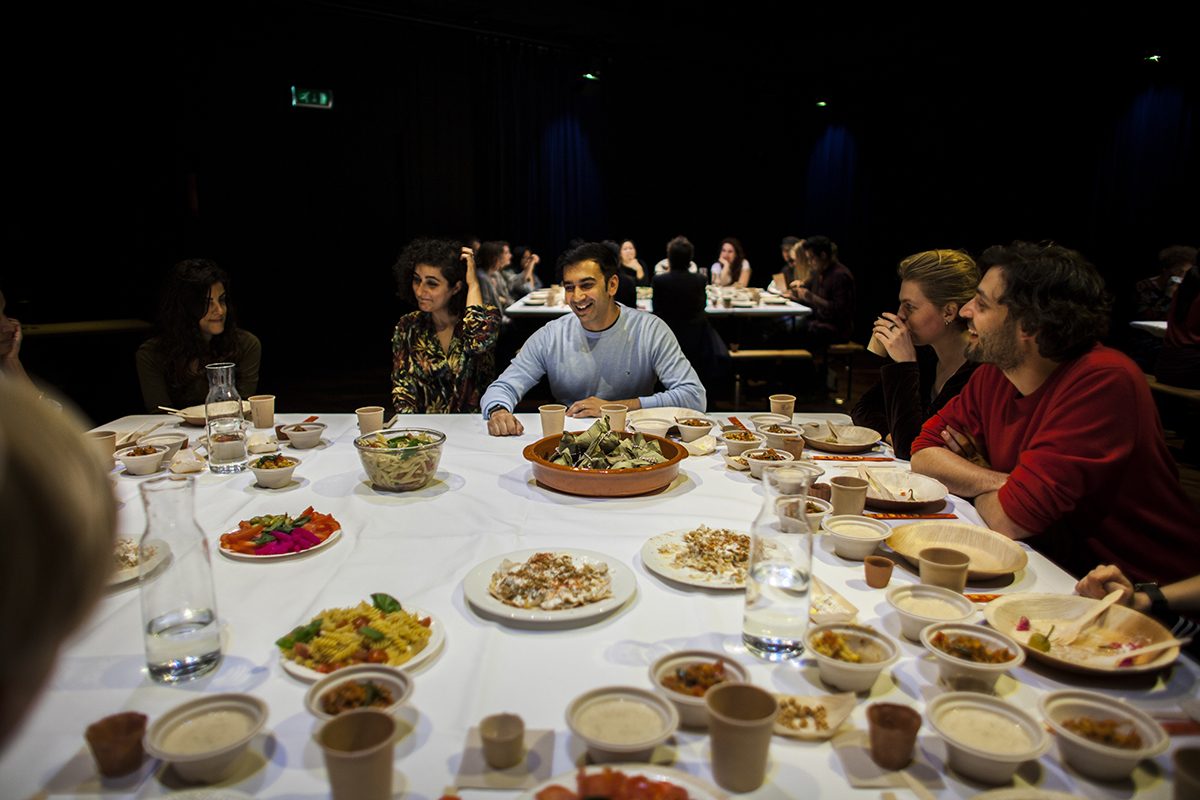
Surpassing the Beeline, Abishek Thapar, photo courtesy OzAsia 2019
Let’s talk about other works in your program that push at the edges of form.
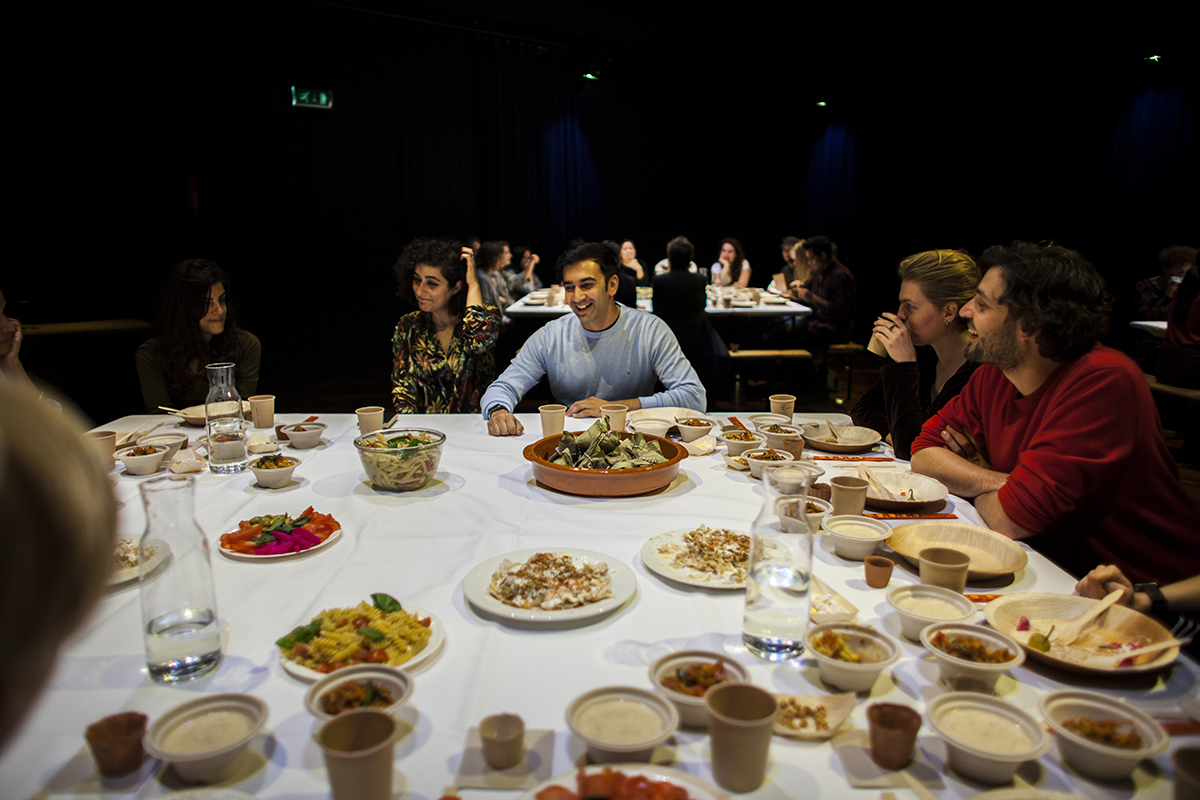
Two things. First, I wanted to look at artists who have been really well received over the past four or five years and [ask] how can we continue our audience’s relationship with them. Clearly, artists who are able to have a long-term impact in Australia can only do so because people see their work repeatedly. Secondly, how do we keep evolving the audience’s experience of the performing arts in OzAsia? There are quite a few shows where you won’t find yourself in a traditional theatre. Abhishek Thapar’s Surpassing the Beeline has the audience sitting around three dinner tables with migrants from six countries who have been working all day to prepare their national dishes. It’s a storytelling exchange around sharing a meal. The theme of the work is migration but while so much talk about migration seems to be in negative territory like [the treatment of] refugees, what this work is saying, actually, is that migration is a real part of the human experience. It’s really that simple, but I think we need that right now in a relaxed casual conversation over a meal. If we’re not migrants ourselves, we probably only need to go back one or two generations in our family to discover them.
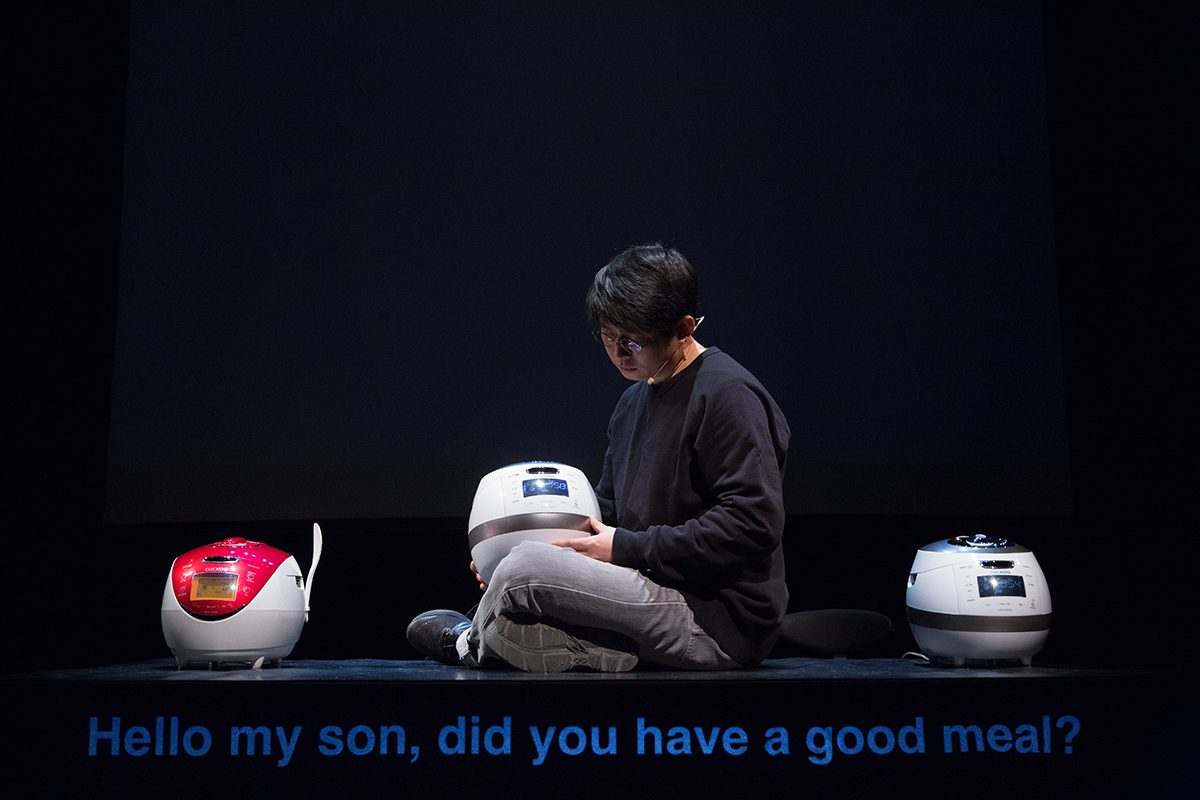
Jaha Koo, Cuckoo, photo Radovan Dranga
I see that food also features in the South Korean work Cuckoo.
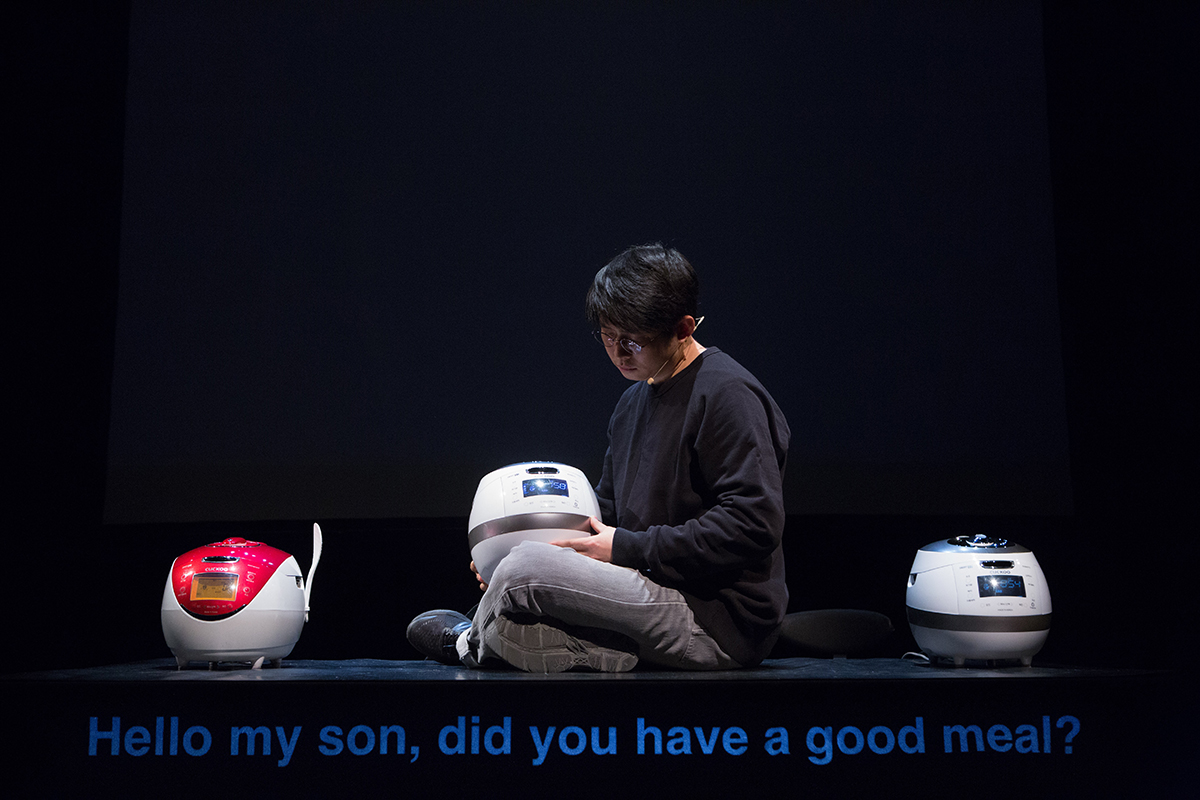
“Cuckoo” is the main brand of rice cooker in South Korea. Three telerobotic rice cookers talk about the history of South Korea over the last 20 years, particularly in relation to—to be very literal about it—the ‘pressure cooker’ society of that country and the challenges faced as a result of economic pressures and other extremes. Cuckoo starts out as a lecture and evolves into a dialogue between the rice cookers with the work’s maker, Jaha Koo, onstage with them and a big screen behind. The format is almost performance lecture, a form that has become reasonably prominent in the last five or six years.
Judging from performance lectures by Filipino artist Eisa Jocson and South Korea’s Geumhyung Jeong in Performance Space’s 2017 Liveworks, this is a form developing in Asia.
That’s right. I’m open to it if it really challenges the form and Cuckoo does this in a really interesting way. Jaha has a very dry delivery and lets the rice cookers fly with their personalities. There are fascinating insights about South Korean culture and some dark, unexpected turns.
The Belgian company Ontroerend Goed, true to form, will engage their audience directly in the performance. What’s the work’s connection with Asia?
When this show, £¥€$, was created, Ontroerend Goed also rehearsed—with the same director—a Cantonese-speaking company from Hong Kong who were performing in festivals in Hong Kong and Macau. I thought for OzAsia we should get half the cast from each of these companies and bring them together. We’ll basically have half the tables run by the Hong Kong performers and half by the European performers. It’s a wonderfully immersive show, about the most interesting experience I’ve had in the theatre over the past year. The performers are like very neutral facilitators, basically putting the show in your hands.
At the start, you hand over say 10 dollars and they’ll give you 10 million in chips; then you have to come up with the name of your bank. The performers will then guide you through how to run it. All the odds are explained and it’s up to you if you want to roll the dice and gamble to invest and make money. In the centre there’s a World Central Bank. £¥€$ gives you huge insight into the global banking system. What if you’re in control and the odds are in your favour, how do you behave [especially] when you can’t see anything outside the world you’re in? How does the world banking system create narratives for the public which are very different from reality? I didn’t want it to end and thought about it a lot afterwards.
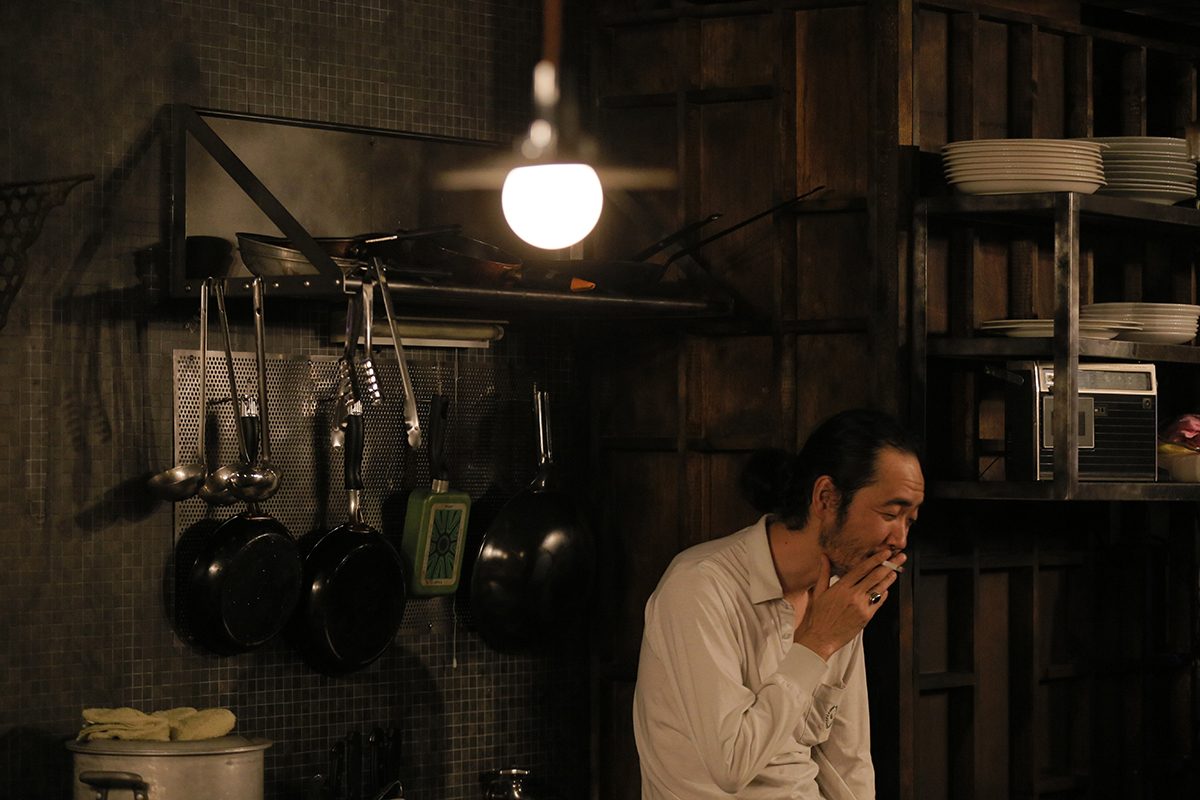
The Dark Master, Niwa Gekidan Penino, photo Takashi Horikawa
In terms of continuity, another show involving food comes from the company that brought the wonderful The Dark Inn to OzAsia in 2017. It was set in a very strange, remote Japanese regional hotel. In this latest work, The Dark Master, an unlikely person becomes a chef in a little café.
Again, this is really about works that veer off into different performance experiences. The premise is that a young backpacker comes into a restaurant and meets a chef who’s misanthropic but somehow still likes to cook. However, he’s decided he’s going to become a recluse and will instruct the backpacker how to cook via an earpiece; everyone in the audience puts headphones on, the chef disappears and we too hear his instructions. On top of that throughout the show there’s live cooking onstage with all the smells and atmosphere of the kitchen.
A kind of hyperrealism, as in The Dark Inn?
Yes. On top of all of that, there’s a slightly twisted, evolving narrative. Kuro Tanino is an incredible theatre-maker. I thought about programming The Dark Master because I was really keen to make sure, one, that most of the performative experiences had a certain uniqueness and, two, I was trying to find a nice balance in the fifth year of my festivals between a bunch of really new artists and some artists that everyone seems to have really admired before and whose careers we see evolving. The Dark Master fell into both of those categories.
What does this programming balance between established and relatively new artists tell us?
Soon we’ll be in 2020. It just rang a little bell in my mind. There was a really wonderful wave of artists that came through from the late 1990s and into the early 2000s who are still just as prolific and still exploring new ground today. I’m talking about artists like Akram Khan, Nitin Sawhney and Lee Mingwei (all three are in the 2019 OzAsia program) and who hit the global scene in the early 2000s and I think—and this is very much my personal point of view—paved the way for a lot more mainstream programming of multicultural stories drawing upon inter-cultural experience of a melding of heritage and contemporary performance to the point that we’re not even thinking about those things, you’re just watching really good work, which is how it should be.
And then there’s the young generation of artists who’ve really started to fly in the last couple of years, like Kuro Tanino and Miss Revolutionary Idol Berserker. Abhishek Thapar and Jaha Koo are super-hot now in the European and Asian art scenes. There’s Contact Gonzo, Omar Musa, Siro-A and the Australian Thomas Henning (ex-Black Lung) working with radical Malaysian theatre-makers TerryandTheCuz. They’ve all come to the fore but I think they’ve been influenced by the generation of artists who were pushing the boundaries in the early 2000s.
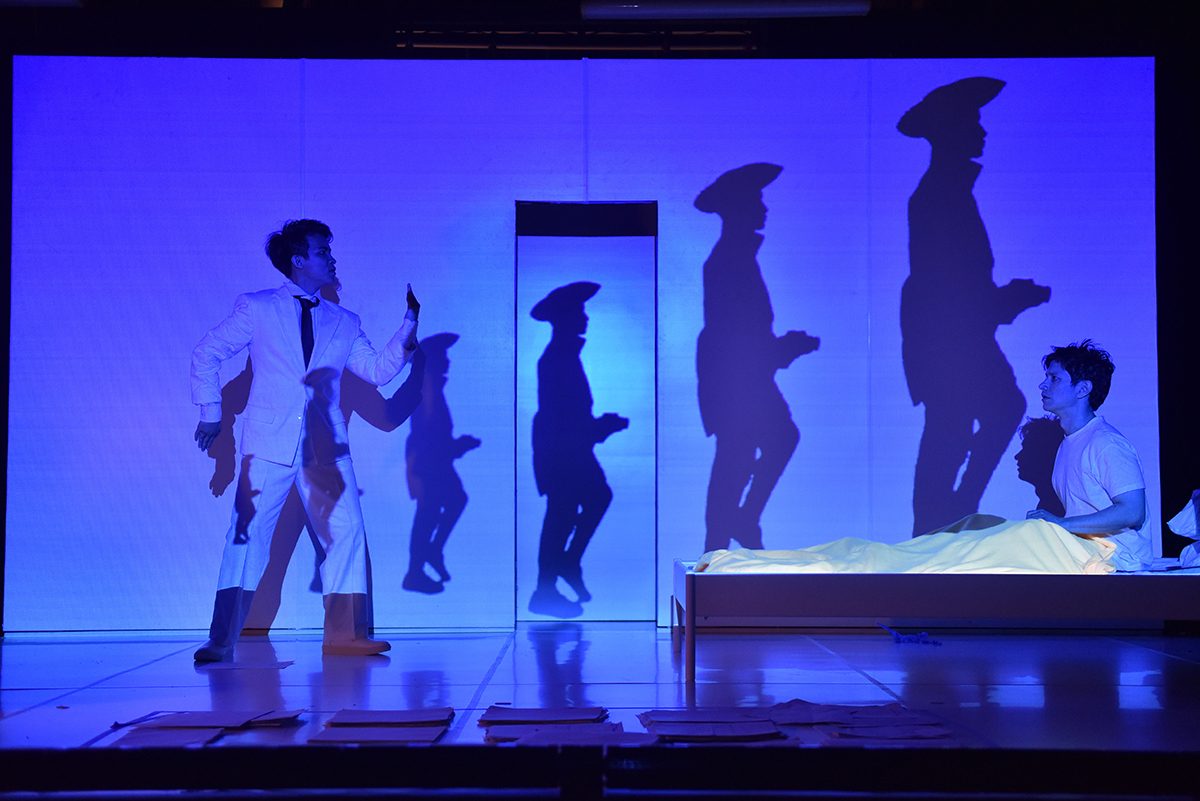
Light, photo Darshen Cheliah courtesy OzAsia 2019
Light, an experimental performance collaboration between Thomas Henning and TerryandTheCuz, has a very particular connection with Adelaide.
They’ve been developing Light over three years. It’s about Captain Francis Light and his son, the British-Malaysian Colonel William Light [the Enlightenment-influenced designer of the layout of Adelaide]. Doing a ton of research, Thomas has found what’s been omitted in their history. Martina Rosalls, Francis’s wife and William’s mother, is only referred to in papers as “half-Portuguese,” a refusal to acknowledge her Asian heritage. There are allusions to her having been a princess in the village she was from, but the marriage ceremony wasn’t recognised by the British. Consequently, William couldn’t access his inheritance and neither could Martina; it was mysteriously taken away. Nowadays, we’re more prepared to question our nation-building history in terms of racism.
OzAsia: visual arts
As usual, the visual arts program, in part in collaboration with local galleries, complements the festival’s performance components, this year featuring notable interdisciplinary artists: Amsterdam-based Indonesian-Australian Fiona Tan and, from Taiwan, Joyce Ho, Su Hui-Yu and New York and Paris-based Lee Mingwei.
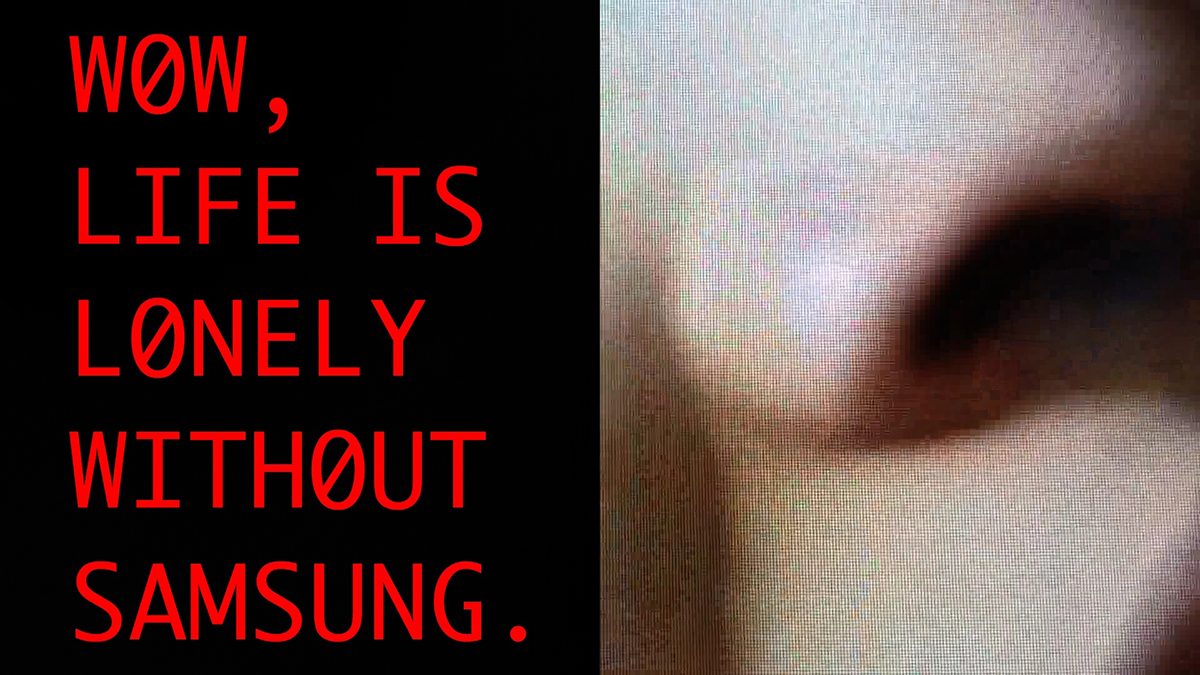
Young Hae Chang Heavy Industries, screen shot courtesy OzAsia 2019
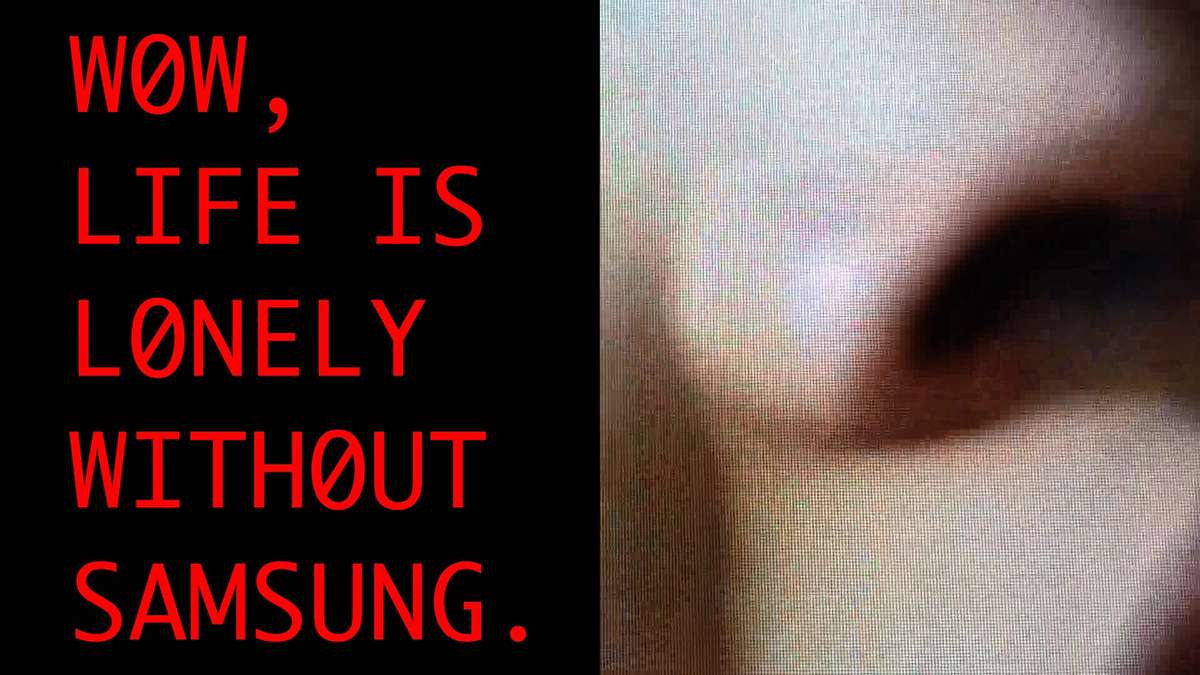
From further afield, In Sorry For Real, utilising light boxes and video, French Guyanese-Danish artist Tabita Rezaire has invented ironically telling “virtual apologies” from the West. Seoul-based duo Young-Hae Chang Heavy Industries will present their two Samsung videos, with a third commissioned by OzAsia to complete a Samsung trilogy. RealTime followers will recall Kim Machin introducing their work, with its dextrous text play and propulsive scoring, through her Multi-Disciplinary Art Asia Pacific (MAAP) festivals. Mitchell tells me that the first part of Samsung Loves Us All is about birth, the second midlife and the third, the new work, death. To explain this ‘life cycle,’ he puts the work in context: “In South Korea, you can be born in a Samsung hospital, you can have Samsung phones and get Samsung hardware your whole life and then be buried in a Samsung graveyard. It gives us a bit more insight into the impact of corporations.”
Reading the script of The Glamorous Boys of Tang, an infamous homoerotic 1985 film by Taiwanese director, screenwriter and poet Chui Kang-Chien, the widely acclaimed video artist Su Hui-Yu discovered scenes that hadn’t been realised and decided to make them himself in his own distinctively vivid style and with a slow, revealing pan. Mitchell says that the original “was about the excesses of sexual freedom and liberation, queer identity and revisiting themes from the Tang Dynasty through a part-sexualised lens of the mid-80s. The 15-minute video response, in four-panel, classic fan shape, is an amalgamation of the missing scenes and a re-interpretation of some of the existing ones, acknowledging the original but exploring the cult underground and sexual fantasies and identities of modern-day Taiwan at the same time as looking back to the sexually liberal Tang period. Su speaks about this really well, [asking], ‘Where did sex become so conservative?’” Much of the blame falls on the West. The Glamorous Boys of Tang was Winner of the Visual Arts Award at Taiwan’s 2019 Taishin Arts Awards; Joseph Mitchell was one of the judges. The freely accessible visual arts showings are a must-see part of OzAsia’s program.
You can see more of the 2019 OzAsia Festival program here. It includes Akram Khan, Nitin Sawhney, a large-scale theatre work, The Village, from Taiwan, Vessel, a collaborative dance work from Belgium and Japan, and, Japan again, the riotous Miss Revolutionary Idol Berserker who will pelt you (in a raincoat) with glitter and tofu, plus Malaysian-Australian rapper and poet Omar Musa who will perform his much praised solo reflection on his life and inspirer in Since Ali Died.
If you’re living in eastern or western Australia, you’re curious about Asian contemporary art practices rarely seen here and you’re especially open to the seductions and challenges of innovative performance, it’s time to make your way to Adelaide for a seriously distinctive festival over the next three weeks (and double the pleasure by taking in Australia’s premiere Aboriginal and Torres Strait Islander Art Event, Tarnanthi at the Art Gallery of South Australia).
–
OzAsia Festival, Adelaide, 17 Oct-3 Nov
Top image credit: The Glamorous Boys of Tang video installation, Su Hui-Yu, image courtesy OzAsia 2019
Unusually for a Platform Paper, Sue Healey’s Capturing the Vanishing: A Choreographer and Film, tells a fascinating life story. If not quite as personal as that might suggest, the essay is nonetheless an intimate tale of the organic, if sometimes chancy, evolution of an artist seeking unfettered creativity and career sustainability in the face of the predations of ephemerality. That’s a condition inherent to all creative acts but exacerbated in independent dance in Australia by cruelly short performance seasons, limited touring opportunities, declining arts funding and consequent invisibility and absence of agency: “The consequences are diminishing diversity and the reduction of new voices, as well as choreographic careers that do not find full potential.”
A multiple award-winning choreographer, Healey hybridised herself by becoming a filmmaker, finding new agency in translating stage performances into film, creating standalone dance films and installations and seeking out new niches, with notable success in Asia. Healey has not only strengthened the durability of her practice but in eloquent portrait series has generously preserved the creativity and legacies of fellow and elder practitioners. In doing so she has deftly managed the ephemerality anxiety that has driven her to adapt and which fuels this passionate essay, in which she asks, “How can film capture the visceral organic reality of live performance and take us beyond the vanishing point?”
Healey briskly evokes her emergence as dancer and choreographer prior to her filmmaking commencing with a 1980s New Zealand childhood (her father’s Super 8 films, her former ballerina mother’s magical dancing in the family home), finding the dance—not ballet— that works for her, training at Melbourne’s VCA, performing with Nanette Hassel’s Danceworks (to frustratingly conservative responses), in the studio with Merce Cunningham and other luminaries for several inspiring years in New York, returning to newly invigorated Melbourne dance and becoming director of Vis-à-Vis Dance in Canberra (1993–95), until a savage funding cut propelled her into the life of an independent choreographer.
The account of her subsequent career across the balance of the essay entwines Healey’s evolving attraction to filmmaking and her corresponding adaptation, via film, to a rapidly mutating contemporary dance world of cross-artform and new media-driven ventures, with dance more than any other artform leading the way in the 90s. Healey had sensed the change already in the dance and visual arts and experimental films of the American post-moderns in the 80s: “Meredith Monk, Trisha Brown, Steve Paxton and Yvonne Rainer. This made sense to me, as did the pioneering experimental films of Maya Deren, the New Zealander Len Lye and Merce Cunningham with Charles Atlas. My interest was there, I just didn’t know how I could achieve it.”
What’s particularly interesting in Healey’s evolution as dance filmmaker is its phenomenological dimension: her coming to precisely understand her engagement with movement, learning the value of new visual perspectives, putting herself behind the camera, sensing the passage of choreography to film as ‘translation,’ discovering editing as a form of choreography, learning what film can reveal and the stage cannot, and understanding that her filmmaking is a whole-body creative experience.
Healey’s connection with film began in the early 1990s working with experimental filmmaker Louise Curham who drew attention to both detail “at a deeper level” and framing: “I realised as a choreographer that I was more concerned with movement, my eye always moved quickly to the next shape rather than focusing on visual detail.” A workshop in New York with renowned American lighting designer Jennifer Tipton, in which “the choreographers had to design lighting states for the designers, who then had to choreograph and perform within our lighting,” taught Healey “the strategy of coming at creative ideas from a reverse perspective and realising the importance of widening my scope into other forms—a pivotal ‘aha’ moment for me.”
Another reversal of perspective, when a “constant switching of focus between dance and film became a necessary part of my process,” emerged from Microdance in 1996. In enlightened times by today’s standards, Healey and Curham were one of four teams granted $100,000 each by an Australia Council, Australian Film Commission and the ABC initiative: “Making Slipped was a watershed moment. I realised that to understand the process more fully, I would have to move to the other side of the camera. I began to make short films in conjunction with every live work I made, simply by using my own small camera. This way I was able to explore in the studio with the dancers before bringing in a professional cinematographer for the actual shoot.” In a crucial development, Healey’s collaboration with cinematographers in 2002-13 “also extended to dancers Shona Erskine, Lisa Griffiths, Nalina Wait and later Rachelle Hickson,” who, rather than being ‘choreographed on’, “quickly developed an ability to understand the dimensions of the frame from a dancer’s perspective, and how the camera saw the body in space, and choreographed themselves efficiently into a dialogue with the camera.”
Healey writes intriguingly of the act of dance filmmaking: “When it is working well, I enter into a non-verbal state akin to seeing with my whole body rather than just my eyes—of conjuring up the ‘right’ image in the ‘right’ place at the ‘right’ time, and always underpinned by the question—does it move me? Physically, emotionally and intellectually?” However, she also came to realise that film editors “held the choreographic power. I needed to become an editor myself and master this skill…”
Healey’s gradual transformation into consummate director and editor, in team with cinematographer, dancers and composer, has confirmed her “realisation that the screen could be a specific site” for dance, no mere substitute for the stage.
From 2000 to 2012 Healey and many other dance filmmakers had been supported in a significant niche, the Sydney-based Reeldance International Dance on Screen Festival, which encouraged innovation and provided a platform with international connections: “But funds were eventually cut and Reeldance ceased operations in 2012, just as many of us were ready to go further. The void left in the wake of this closure is still apparent today.”
in the current decade Healey has radically diversified the techniques, forms and scale of her creations. En route (2017) was a commissioned work for Wynscreen, a 22-metre wide by three-metre high LED screen in Sydney’s Wynyard train station. Virtuosi (2013), a feature-length “creative documentary” about dancers and place was created “akin to making dance—a situation is framed and investigations are undertaken through improvisation—in a sense, a controlled uncontrollability.” The Golds (2014), about notable dancers 60-90 years of age, offered revived visibility and creative opportunity. “These documentary films opened many doors for me internationally, screening in over fifty cities around the world and even subtitled into different languages: Spanish, Portuguese, Cantonese and Mandarin.”
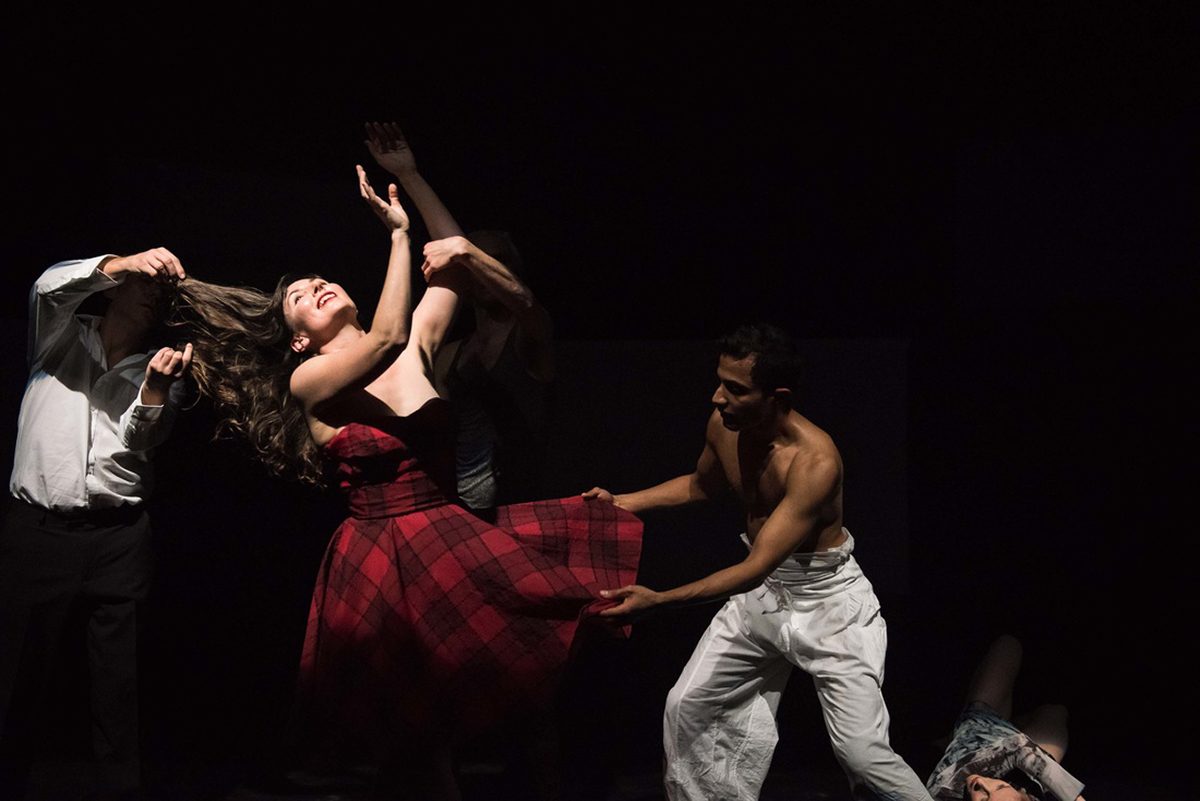
Nalina Waite, Raghav Handa, On View: Live Portraits, 2015, photo Heidrun Löhr
In her on-going ‘portraiture’ series, On View (2013-present), Healey has further pursued a phenomenological preoccupation: “dancers are intrinsically viewed in the course of their work, and they also see the world in a particular way. The idea of ‘seeing and being seen’ is embedded in the work, setting up an intimate and dynamic agency between the observed and the observer.” Having worked across Asia since the 1990s, Healey has extended On View into the region, to climax in 2020 with a production produced by West Kowloon Cultural District (Hong Kong), Aichi Arts Centre (Japan) and Performance Space (Sydney) which will then tour Asia and Sydney.
Healey says of the project that it “breaks the idea that an Australian independent artist must work at a small scale. It has given my work a visibility and viability beyond anything I have ever experienced before. I am also cognisant of the fact that without the interdisciplinary nature of this project, it simply would not have happened.” This acknowledgement underlines the organic evolution of Healey’s 30-year career, one utterly contemporaneous with a great shift in art-making in general and not least in dance, in which she had been both participant and generator.
Cognisant of the struggles ahead of her, her peers and especially a younger generation of artists, Healey concludes her essay with three necessary provocations, one urging equitable government support for independent dance artists, another encouraging debate about the relevance of dance in order to create a vision for sustainability, and this: “Dance must extend its boundaries without losing sight of its own intrinsic qualities as a discipline.” It’s a reminder that however far Sue Healey has taken her practice to the screen as a legitimate site for dance, the filmmaker is always first a choreographer—at one with her dance and screen collaborators.
Young artists, in particular, will value Capturing the Vanishing for its generous, engagingly crafted account of the challenges and breakthroughs involved in sustaining and expanding a career in dance. Emerging and established choreographers will find encouragement to boldly make dance in new ways by reaching out beyond their immediate discipline; Healey cites two younger artists already on this trajectory. As well, the many links to excerpts from Healey’s films that can be activated in the PDF version of the essay make for exciting reading, heightening the sense that Sue Healey has held the vanishing, of dance and career, firmly in check.
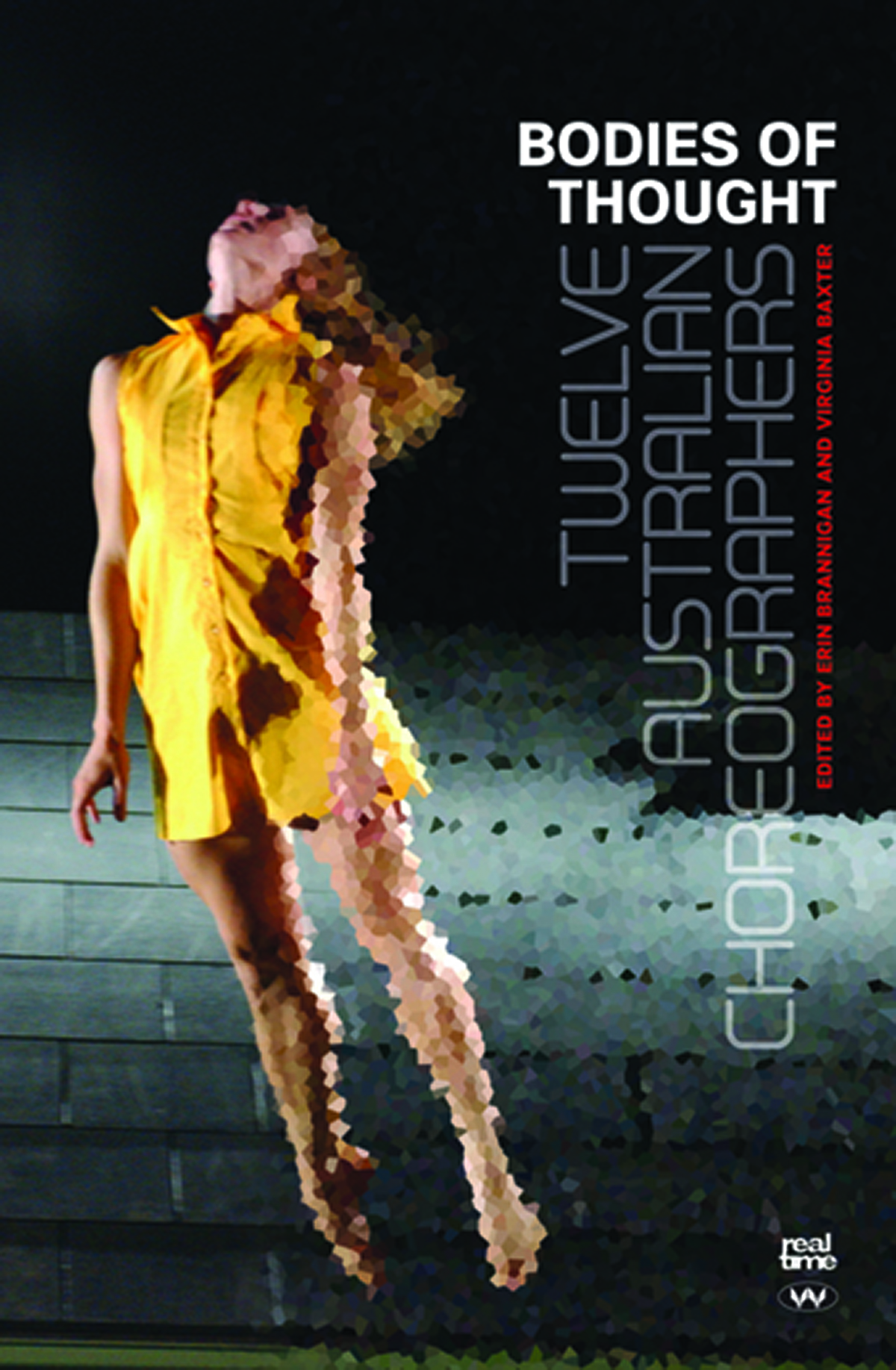
You’ll find more about Sue Healey on her extensive website and in RealTime. She is also one of the subjects of the book Bodies of Thought: 12 Australian Choreographers (Wakefield Press-RealTime, 2014).
You can purchase a hard copy or PDF of Capturing the Vanishing here.
For more on dance and editing from a dance filmmaker perspective see Anna Dzenis’ “Editing: beyond intuition,” a review of Karen Pearlman’s Cutting Rhythms: Shaping the Film Edit (Focal Press, Burlington US, Oxford UK, 2009).
–
Platform Papers, No 60, Sue Healey, Capturing the Vanishing: A Choreographer and Film, Currency House, Sydney, August, 2019
Top image credit: On View: Sue Healey (right) and crew on Japan shoot, Nagoya, photo Hatori Naoshi
In the introductory note to his program for an eagerly anticipated 2019 Liveworks Festival of Experimental Art, Performance Space Artistic Director Jeff Khan highlights two themes. First is “Feminist Sound featuring women and non-binary artists who champion the intersection of sound art, experimental music and performance,” and the second, with ample overlap with the first, is Culture Disruptors—makers of work arising from lives in which there is no divide between the personal and the political when it comes to body, race, gender and regional politics—as in New Zealander John Vea’s If I pick your fruit, will you put mine back, an account of the lives of exploited Pacific workers in Australia and across the region.
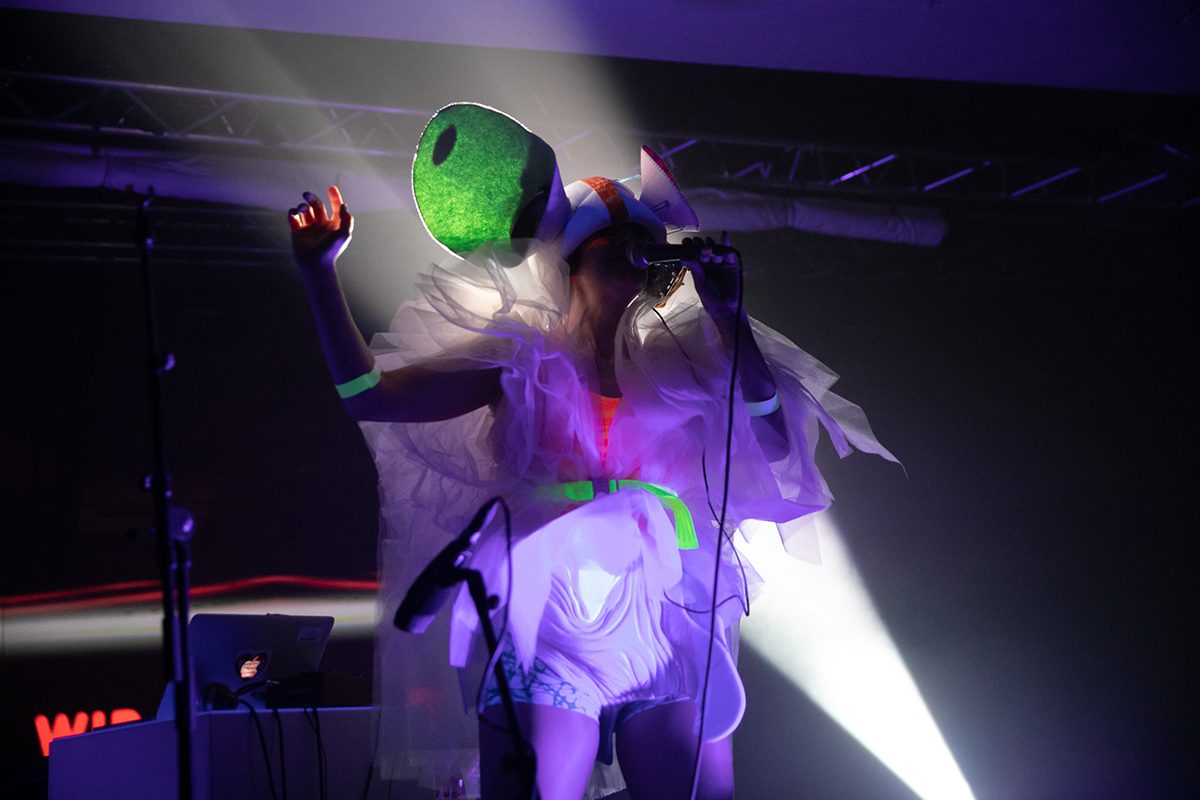
Chicks on Speed performance at Ars Electronica, Linz, photo courtesy Liveworks 2019
Instrumental liberation
The Feminist Sound theme will manifest in an array of fascinating forms—first via instruments. For the premiere of A continuous self-vibrating region of intensities, exploratory musician Gail Priest and designer Thomas Burless have crafted intriguing bespoke devices that will be activated by the voices of Priest and the powerful improvisatory artistry of Carolyn Connors and Sony Holowell. Vibrations from the singing will trigger visual realisations of the sound, a phenomenon revealed in the 19th century by the invention of the Eidophone by Welsh singer, songwriter and scientist Margaret Watts Hughes.
From the US, in I’ll be your body instrument, design and fashion-driven cult feminist pop group Chicks on Speed, founded in 1997, will be expanding their performativity via Objektinstruments which include suits that trigger audio and video, hats with speakers and wireless stilettos.
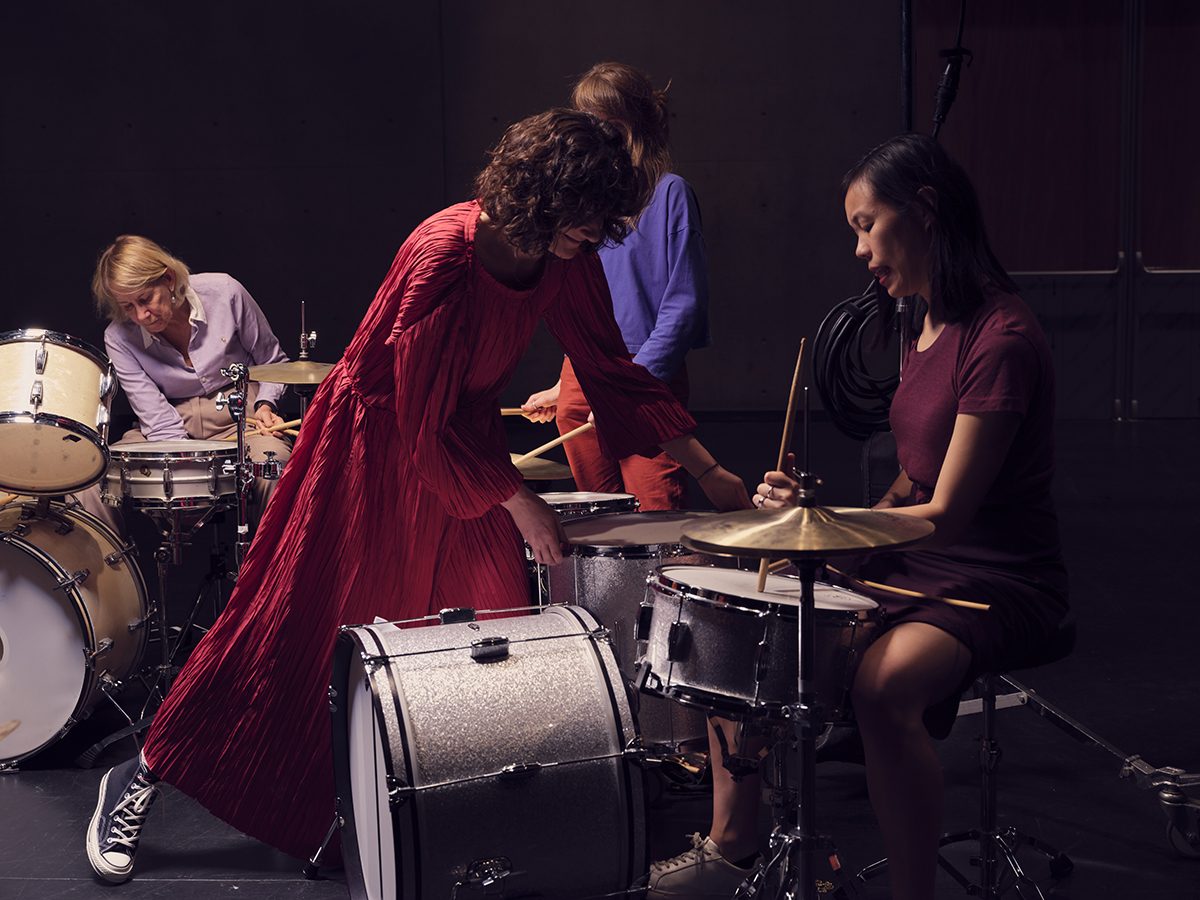
Other Tempo, Lauren Brincat (centre), photo Romello Paneira
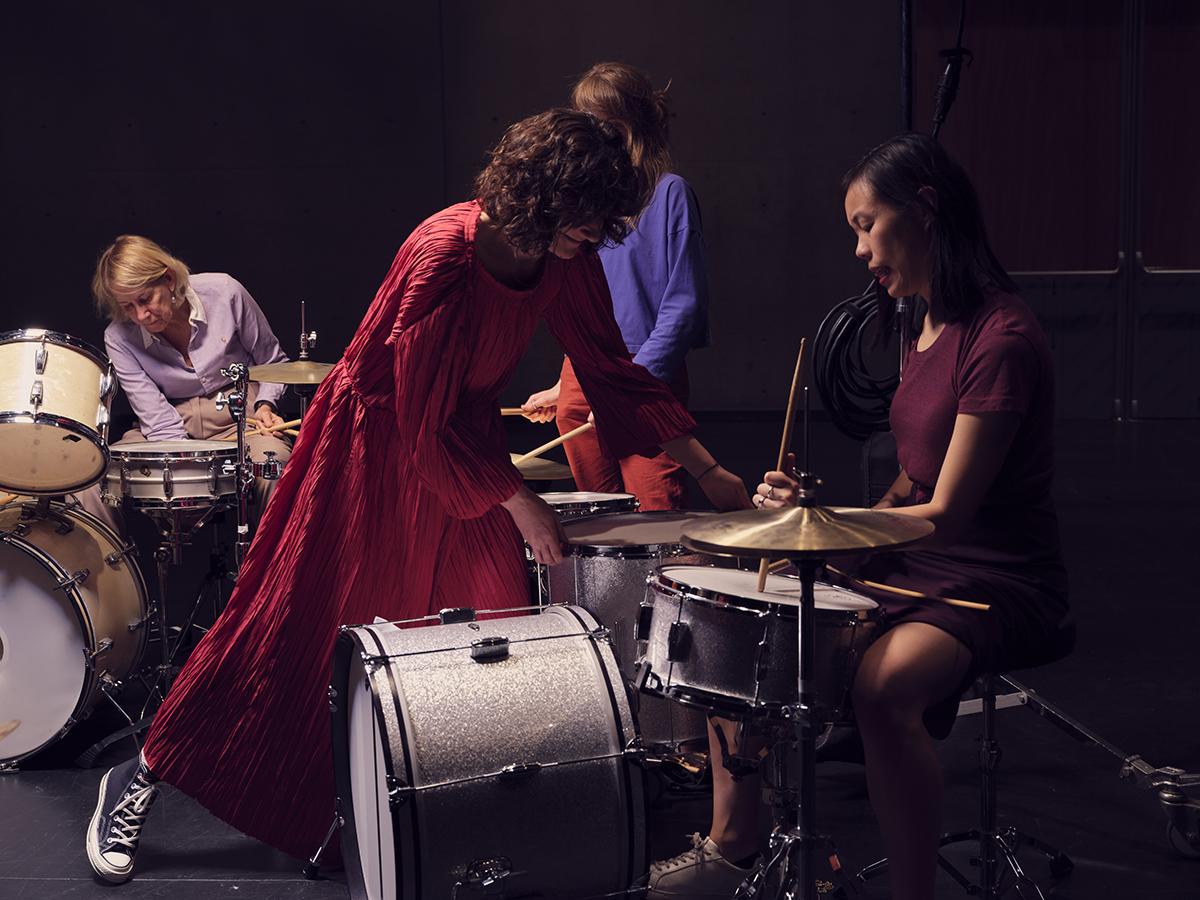
Drums feature dramatically in two works. In Other Tempo, interdisciplinary artist Lauren Brincat (with percussionist Bree Van Reyk for the 2015 Liveworks she marshalled the NSW Police Band into a stirring art ensemble in Social Dance) will transform a group of leading female drummers—including Alyx Denninson and Lindy Morrison on modified kits and prompted by the artist’s visual scores—into a living art work in a series of free performances in the vast Carriageworks public space.
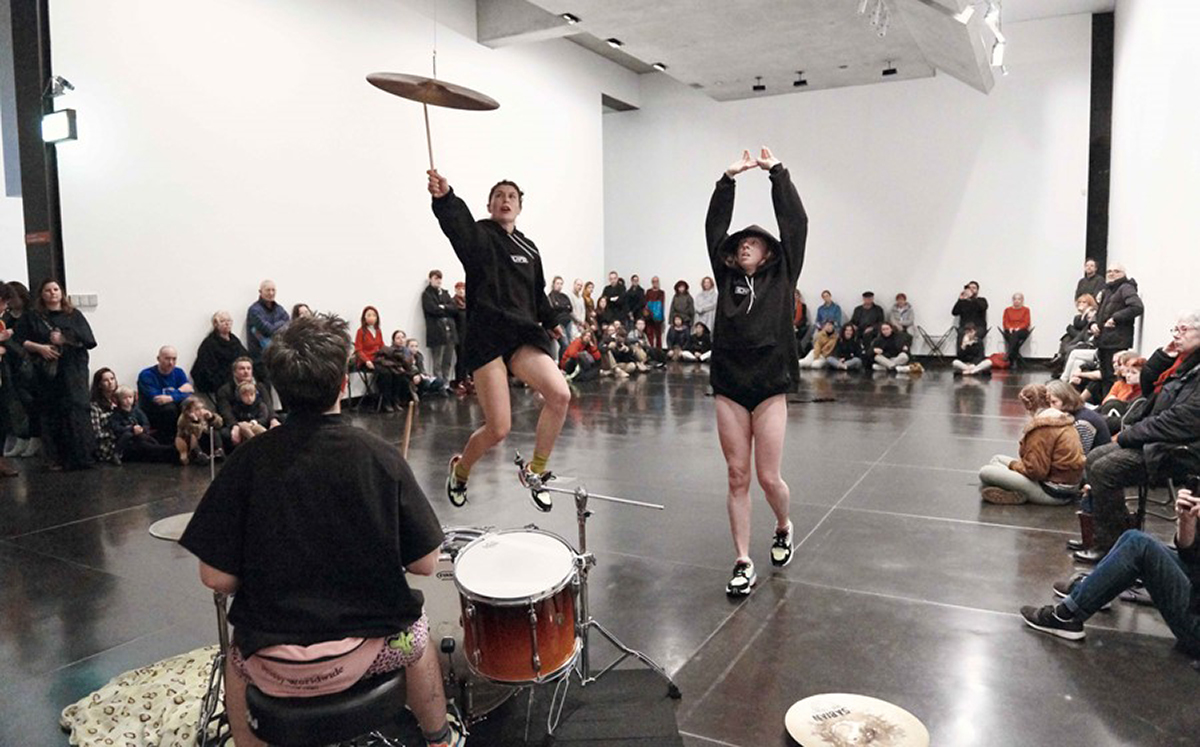
In Double Double, two drummers—media artist Tina Havelock Stevens (Liveworks 2016) and musician Evelyn Ida Morris—partner leading Melbourne dancer-choreographers Jo Lloyd and Deanne Butterworth for an acclaimed two-hour, open-ended exchange for an audience free to shift its perspectives on the aural and visual action.
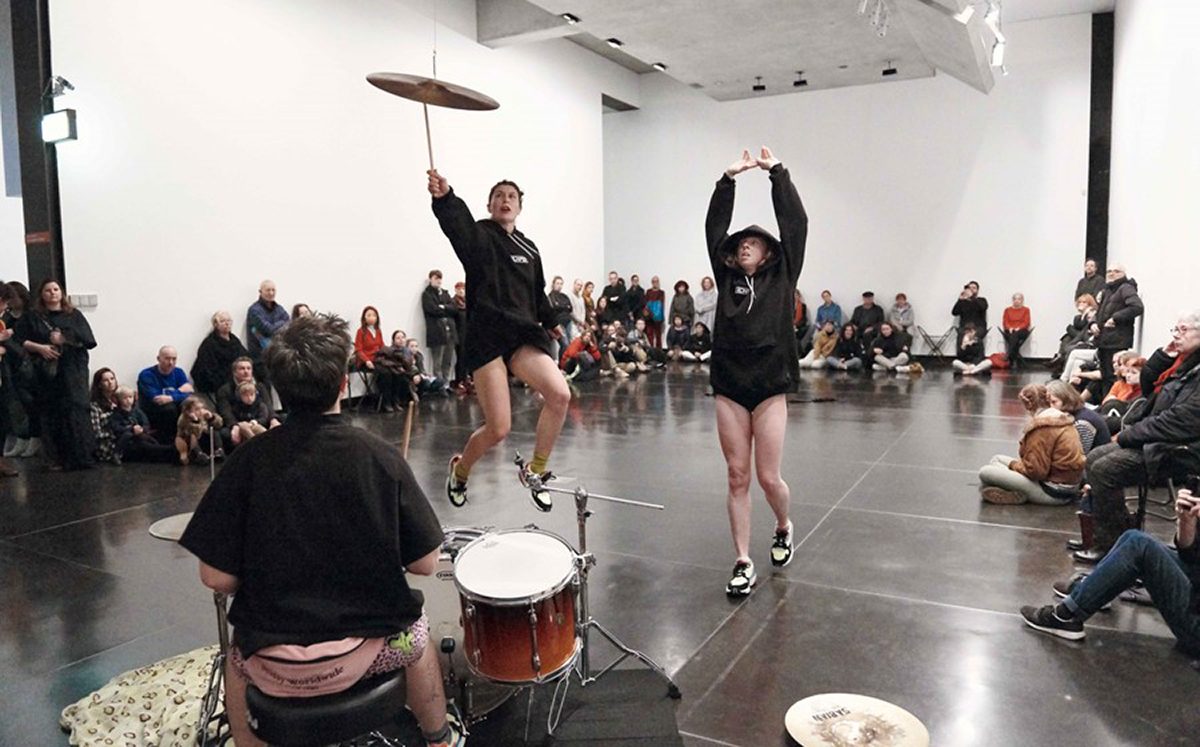
Double Double, photo courtesy Liveworks 2019
There’s more to be heard from the human instrument plus further prosthetics for making sound art in Liquid Architecture’s Tricks of the Mouth. Playing for two hours each night across the Liveworks season, it features strong representation of female artists focussing on “linguistic re-coding, verbalism, chatter, translation, transposition, impersonation, and noise” and includes among others Indonesian punk coder and designer Natasha Tontey, legendary Japanese musician Phew, Chinese Singaporean artist Zou Zhao, Australian overtone singer Sage Pbbbt and Sydney sound artist Alexandra Spence.
The talks component of Liveworks will include Feminist Sound Technologies, a keynote address as performance lecture by Chicks on Speed about their newest “body-centric” objektinstruments, and Shaping Sound, a conversation between Gail Priest, Lauren Brincat and Alex Leslie Murray (Chicks on Speed) about their practices and “what it means to create collaborative work that spans sound, installation and performance.”
Unbearable Darkness, Choy Ka Fai, photo courtesy Liveworks 2019
Ghost who disrupts
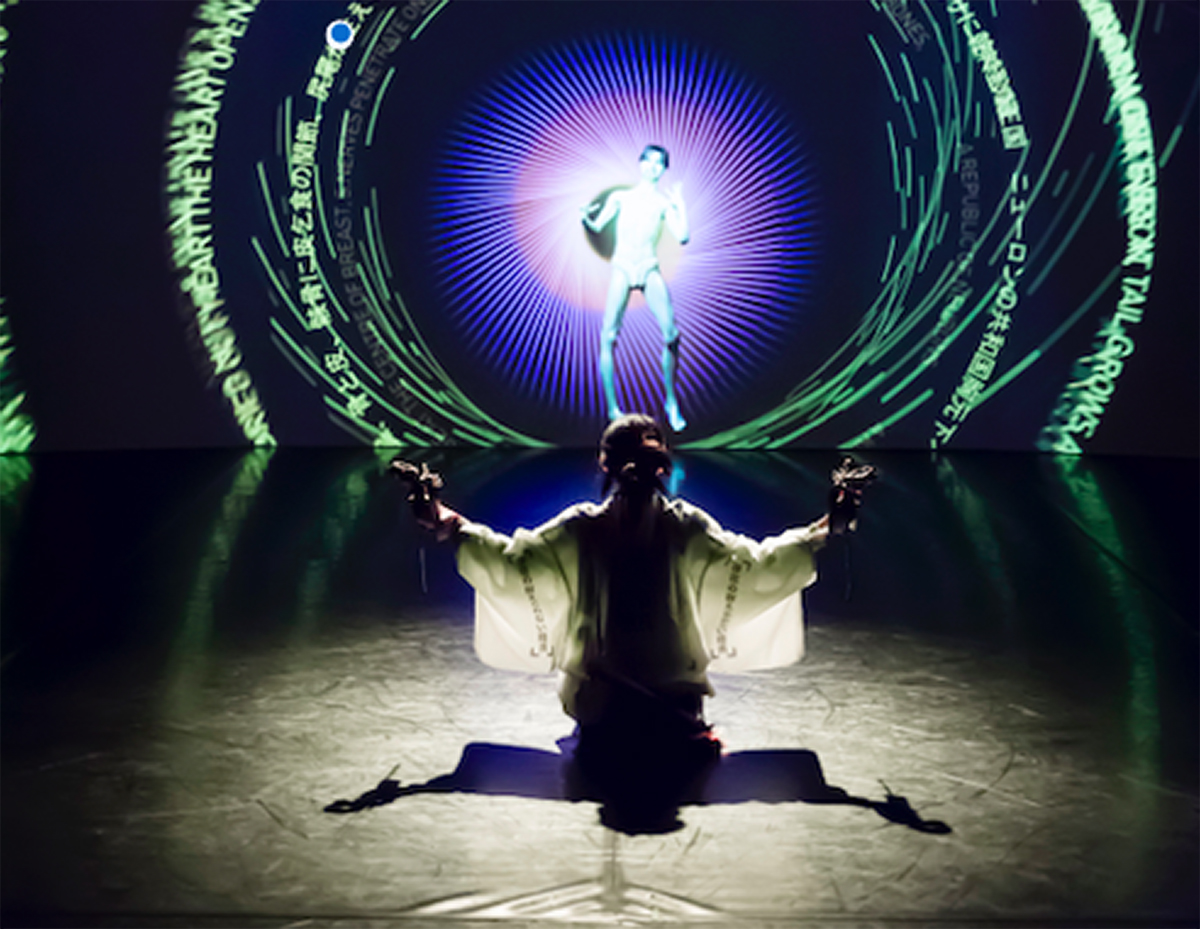
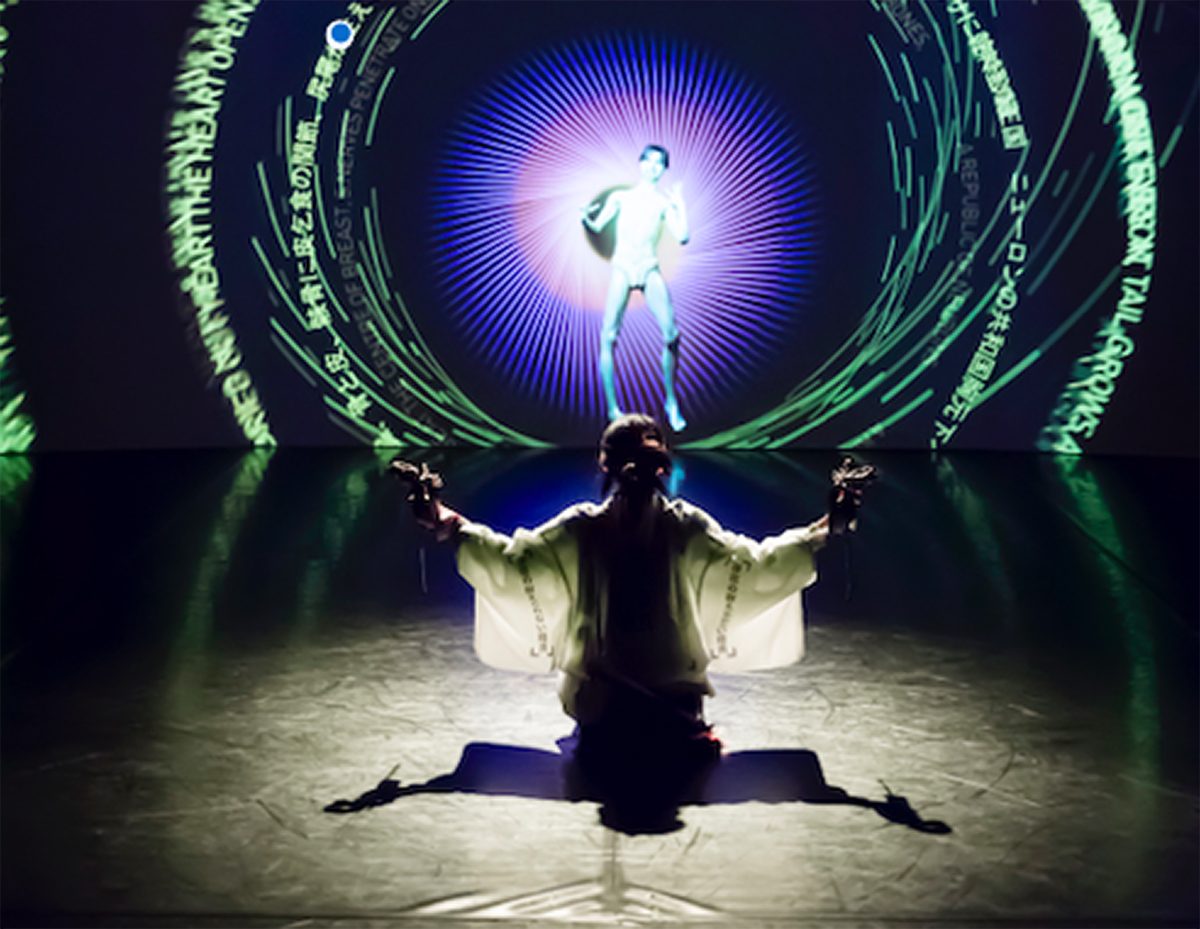
The second theme Jeff Khan identifies in his introduction is Cultural Disruptors. Tatsumi Hijikata’s invention of Butoh in the late 1950s erupted in Japan and spread around the globe and its influence is still felt. Singaporean director and curator (Liveworks 2016) Choy Ka Fai’s Unbearable Darkness, described as “an uncanny cybernetic dance experiment,” “investigates the choreographic process of a ghost through live dance, motion capture technology, digital avatars and a spirit medium. As part of developing the work, Ka Fai visited an itako, or blind medium, on Mt Osore in Northern Japan and invoked the spirit of Tatsumi Hijikata.”
In 2013, Takao Kawaguchi controversially ‘resurrected’ the spirit of Kazuo Ohno (who emerged shortly after Hijikata), copying his “dance of soul” from video tapes and subsequently touring the world in About Kazuo Ohno, including Melbourne’s AsiaTOPA in 2017. In the West, elder performance artists, like Marina Abramovic, have delegated their works to younger practitioners, without mystical resonance (to date); there is perhaps a shared sense of looking back in order to move forward, or as the Liveworks program puts it, “questioning [Butoh’s] appropriation in Western culture while searching for a new choreographic language for the Asian body.” Hijikata and Ohno, though, were skilled absorbers of Western literature, music and dance; is Butoh an innocent artefact? I’m really intrigued by Choy Ka Fai’s project, its bringing together video of Hijikata and a dancer wired as one with him. I’m curious too about the ‘unbearable’ in the title; Hijikata titled his performance ankoku butō—“dance of darkness.” Doubtless the eloquent Choy Ka Fai will have answers in his keynote lecture, How does a ghost choreograph?

plenty serious TALK TALK, Vicki Van Hout, photo Heidrun Löhr
Dance as resistance & assertion
Vicki Van Hout’s plenty serious TALK TALK is wonderfully disruptive, challenging dance to meet equally, as it too rarely does, the demands of both the personal and the political. As I wrote in my review of the 2018 premiere, “With stand-up comedy verve, skilful acting and multimedia dexterity, engrossing, illuminating dance, an eerily spare music score (in an era of sonic lambast in dance) and, above it all, the artist’s glowing woven-grass sculpture-cum-screen suspended centre-stage, plenty serious TALK TALK is a wonder, revealing the complex entwining and unravelling of race, craft and culture in one fraught soul querying her courage to persist against the odds.”
Daddy, Joel Bray, Daddy, photo James Henry
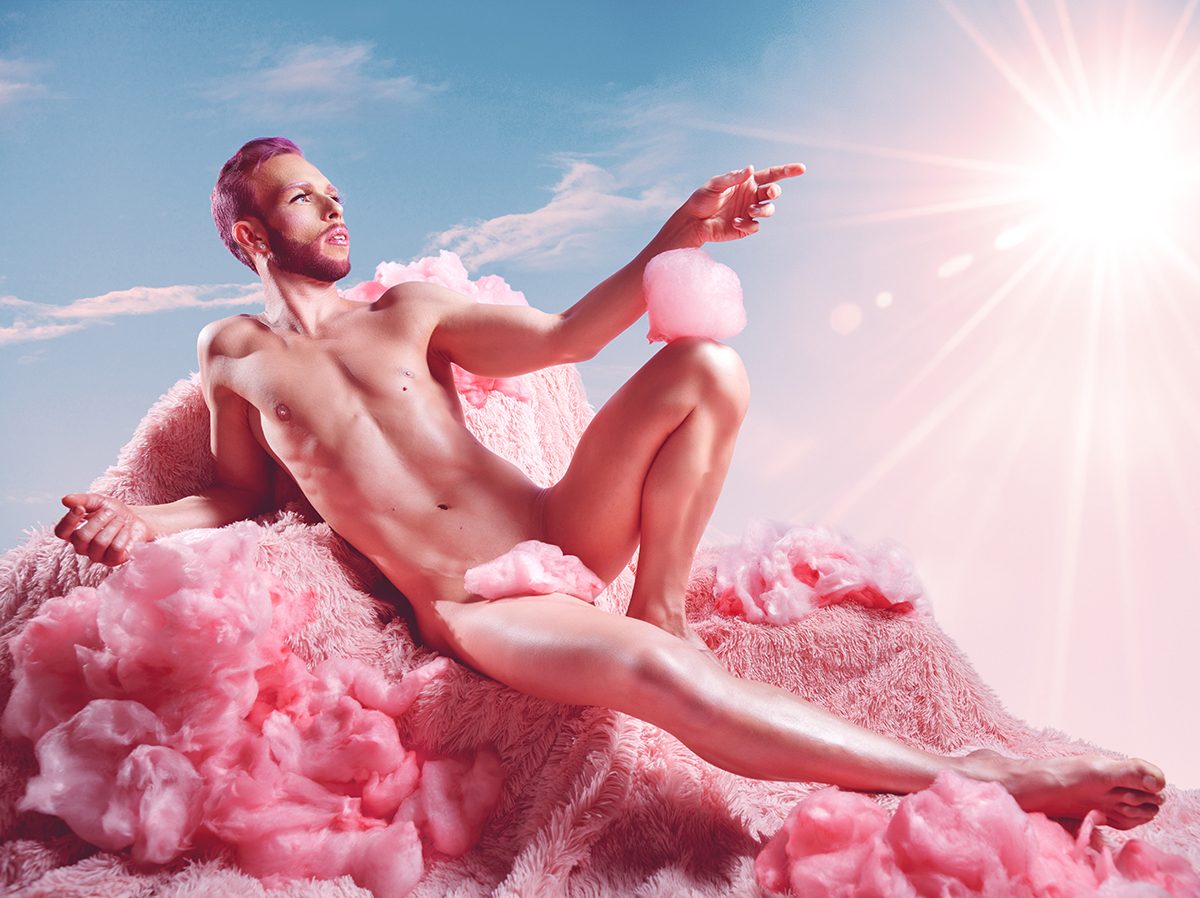
Another Indigenous dancemaker, Melbourne’s Joel Bray looks set to wow us with his much acclaimed Daddy, a sad-funny queer assertion of the inseparability of the personal and the political when it comes to love, executed with a deeply ironical if very literal application of the sugar with which Western civilisation coats its colonising brutality; to say more would give too much away.
Add Double Double, which I’ve already mentioned, and you have four must-see dance works, all displaying contempoprary dance’s ongoing, expansive engagement with ideas and other forms.
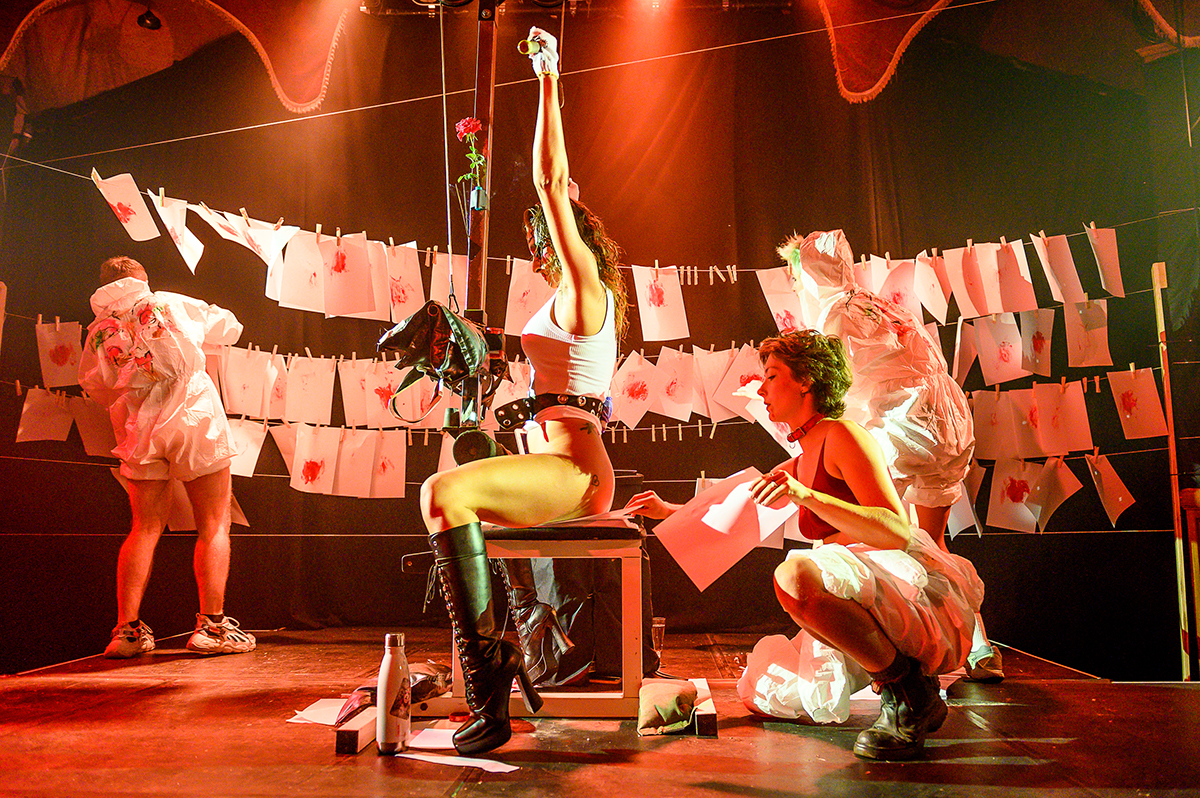
The Unshame Machine, Betty Grumble, photo Sean Breadsell
Out of the underground
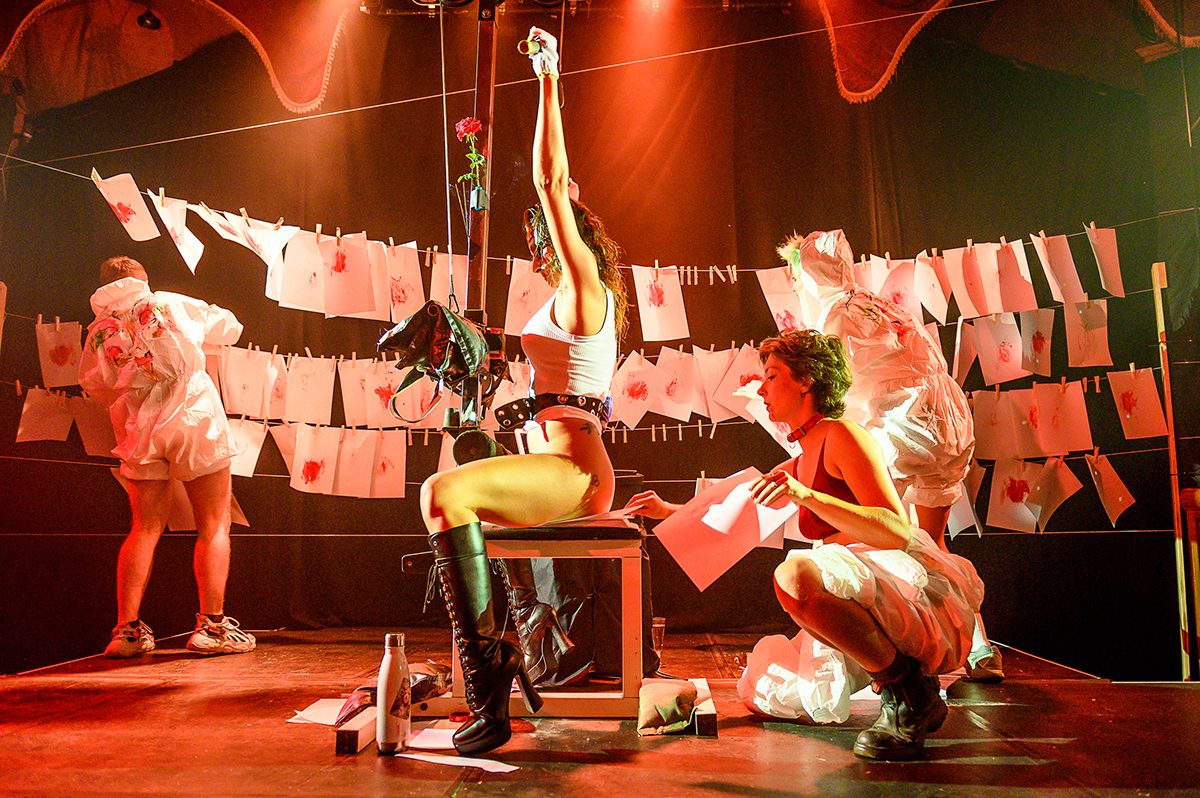
Another disruptor is Betty Grumble (Emma Maye Gibson), whose The Unshame Machine makes an art of “pussy printing” in a “deep squat disco” setting. Gibson, who emerged into prominence from the queer underground cabaret scene this decade, and has appeared on Q&A and this year at Griffin Theatre, describes Grumble as, “This freakish exhibitionist who gives it all yet seems only to be seeking something everyone needs: understanding and acceptance.” She told the Guardian, “I want to tell stories ferociously, from my guts, and the body was an immediate site for that excavation.”
John Vea, If I pick your fruit, will you put mine back, photo courtesy the artist and Liveworks 2019
Pacific fightback
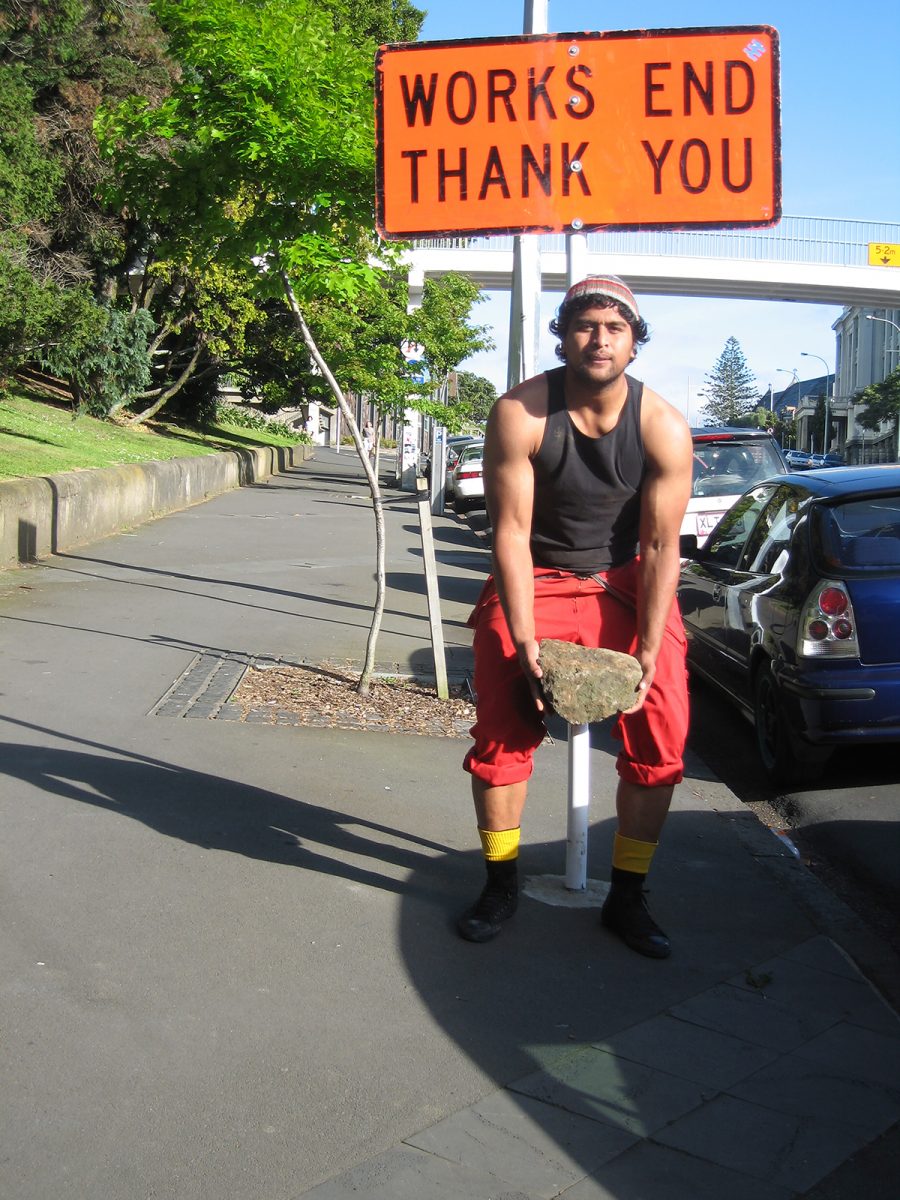
I’m particularly attracted to John Vea’s If I pick your fruit, will you put mine back, which will be exhibited at the 4a Centre for Contemporary Art while the performances will be presented at Carriageworks. Vea’s focus is on the experiences and especially the exploitation of the migrant workers of the Pacific. With incisive humour and apparently journalistic rigour, Vea, a Tamaki Makaurau (Auckland) based sculptor and video and performance art maker, will present stories he’s gathered from people in New Zealand and across the region. The title of the work of course alludes to Deputy Prime Minister Michael McCormack’s recent outrageously callous claim that the Pacific Islands will survive climate change because their workers will be able to come here and “pick our fruit.” Vea’s performances, which are free, will take place 8.00am-1.00pm at the Carriageworks Market on both Saturdays of Liveworks.
Talking the limits
Samara Hersch, whose Body of Knowledge invites teenagers to phone in their thoughts about sexuality, pleasure, shame, consent and more to Liveworks in “a meditation on age and change” will join Joel Bray with host Roslyn Oades, a verbatim theatre specialist, in a conversation about the limits of contemporary performance in respect of consent and the participating audience. Also on the program is writer and scholar Theron Schmidt, in a discussion with artists Brian Fuata and Sarah Rodigari on issues arising from his LADA (London’s Live Art Development Agency) commissioned book AGENCY: A Partial History of Live Art “exploring how and when we make possibility for action in the face of what oppresses us.”
Jeff Khan’s 2019 Liveworks program, which also includes the epic performative Day for Night party and the new nightly live music Sonic Nightcap program, is packed with works that should delight and challenge, an invaluable focus on women artists working in sound, four hugely attractive dance works, and plenty of opportunities for artists and audiences to talk through issues and responses. Intimate, talkative and provocative Liveworks will be a vital restorative in these tough times.
–
Performance Space, Liveworks 2019, Carriageworks, 17-27 Oct, 2019
Top image credit: Gail Priest, A continuous self-vibrating region of intensities, Gail Priest & Thomas Burless, image courtesy the artists
To begin at the end, the body tiring, ears ringing, the mind busy. It’s around 11pm when Decibel New Music plays its final piece, Lionel Marchetti’s subtly ravishing 25-minute Inland Lake, 11 hours after the 2019 iteration of Extended Play’s new music epic commenced in Sydney’s City Recital Hall. I’m revived and inspired. As in 2018, Extended Play has again wrought its festive magic with composers and musicians from across Australia alongside Singaporean New Yorker Margaret Leng Tan, a key exponent of major works of George Crumb.
Decibel
Marchetti’s lake seems a vast salt expanse across which murmurs a deep wind, recurrently whistling like a lost soul in the French musique concrète composer’s enveloping sound world. The softly intoned utterances of the acoustic ensemble pass from cello (Tristen Parr) to viola (Aaron Wyatt) to clarinet (Lindsay Vickery) to bass flute (Cat Hope). Within an aurally complex ecosystem, including Louise Devenish’s intimately engrained percussion, each arises gently and evaporates, as if breathed. Entrancingly minimal development, including each player on chiming metal bowls, belies a steady intensification of inherent pulsing and rising pitch until an almost monstrous state of being is evoked. Not quite-Morse Code signalling is distantly heard and—in the ensuing calm—fragmented broadcasting as players wave small devices over their instruments. The cello alone, with the seemingly same bowed phrasing of the opening, plangently raises its voice before exiting, leaving the ensemble and Marchetti’s sound world with an ominously final, noteless exhalation from the flute.
The composer (at the sound desk to the rear of the auditorium) and Decibel deliver an exquisitely detailed and effectively restrained creation, an otherworldly experience born of worldly human makings and the sounds of Nature. Inland Lake was preceded by exquisite premiere performances of Leah Barclay’s all too timely Fire Atlas (with aerial video featuring forest fires) and Loren Holmes and Rosie Halsmith’s Transect (a natural landscape viewed sectionally from above), the images in each case working as a graphic score for players and audience, with each of the musicians prompted by the motion of hovering circles.
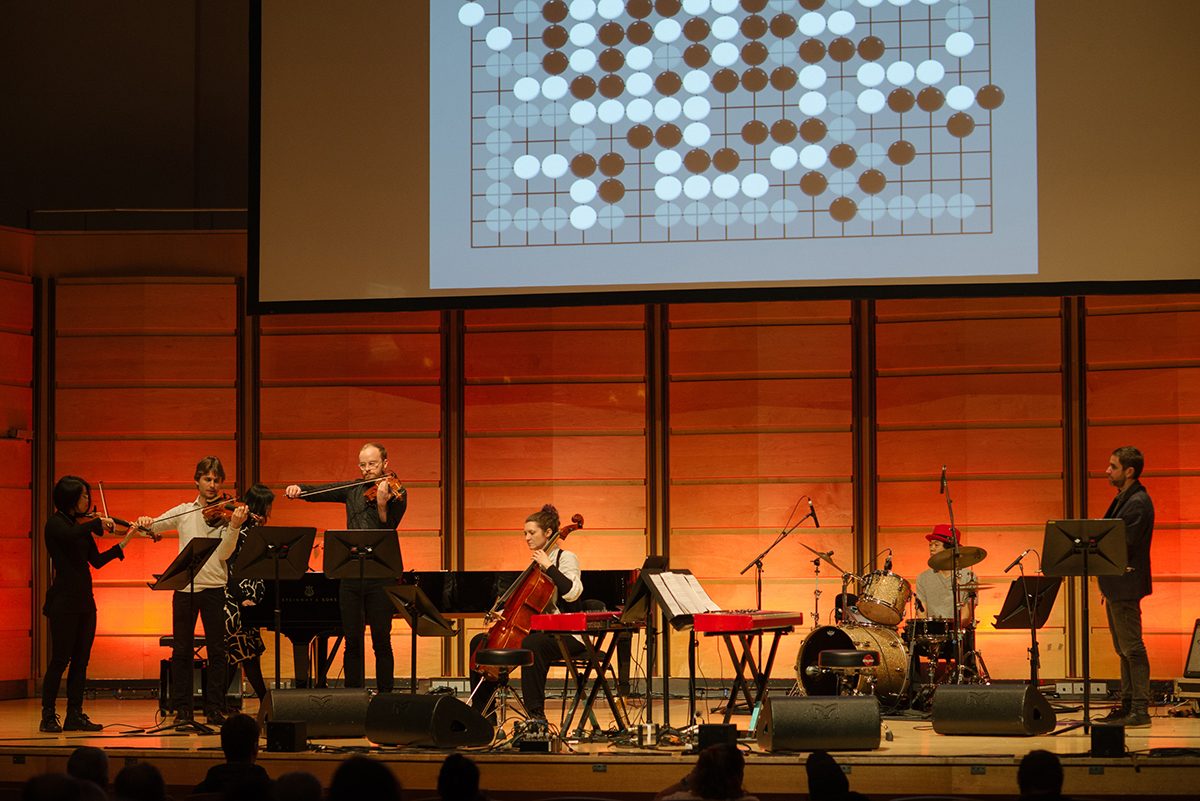
Nonesemble, Go Seigen vs Fujisawa Kuranosuke (2014), Extended Play, photo Katelyn-Jane Dunn
Nonsemble
Back to the beginning. At midday, my passion for cinema, not least Japanese, is indulged as Toshiro Mifune and Tatsua Nakadai in Samurai Rebellion (Masaki Kobayashi, 1967), swords drawn, face off onscreen to the engrossing two-piano (Cara Tan, Sam Mitchell) and clattering sticks electronics score of Chris Perren’s 9-minute Samurai Loops (2015) made for his impressive Brisbane-based Nonsemble. In a series of increasingly complex animations created by the composer, the characters are digitised into multi-layered cut-outs posturing in abstracted motion and then released into action, drawing us into the middle of a deep line of combatants. They move in taut correspondence with the music, highlighting and amplifying the inherent dancerliness of the warriors with dextrous visual and aural looping and a compelling not-at-all-orientalist melody.
Perren’s 30-minute Go Seigen vs Fujisawa Kuranosuke (2014) for ensemble (piano, strings, drums and electronics and composer on electric guitar), uses “the moves of the 1953 championship game of Go as stimulus for harmonic, rhythmic and melodic material” (program note). But, unlike Samurai Loops, there is no cited correlation between musical movements and actions—the actual Go game as it was played in 1953. Likewise, Jaymis Loveday’s projected images of Go stones (turning, shining, merging, constellating) and the game grid (dissolving into floating sticks) while sometimes beautiful in themselves, sometimes surplus to effect, don’t tellingly correspond with the score. As for the music, finely acquitted by Nonsemble, a shimmering, contemplative piano-led opening precedes striding minimalism—with a midway passage of minor key reflection worthy of repetition—and a subsequent movement with surging and darkly dipping glides. Perren’s minimalist-cum-rock aesthetic is most evident in the next movement (although his guitar was too recessed in the mix). A subsequent, koto-like plucking against quiet piano and plangent viola anticipates the final delicate, reflective string movement. Something has played out quite beautifully, but what? The stages of a game, its players’ changing moods? (You can hear both works on SoundCloud and see Samurai Loops on Vimeo.)
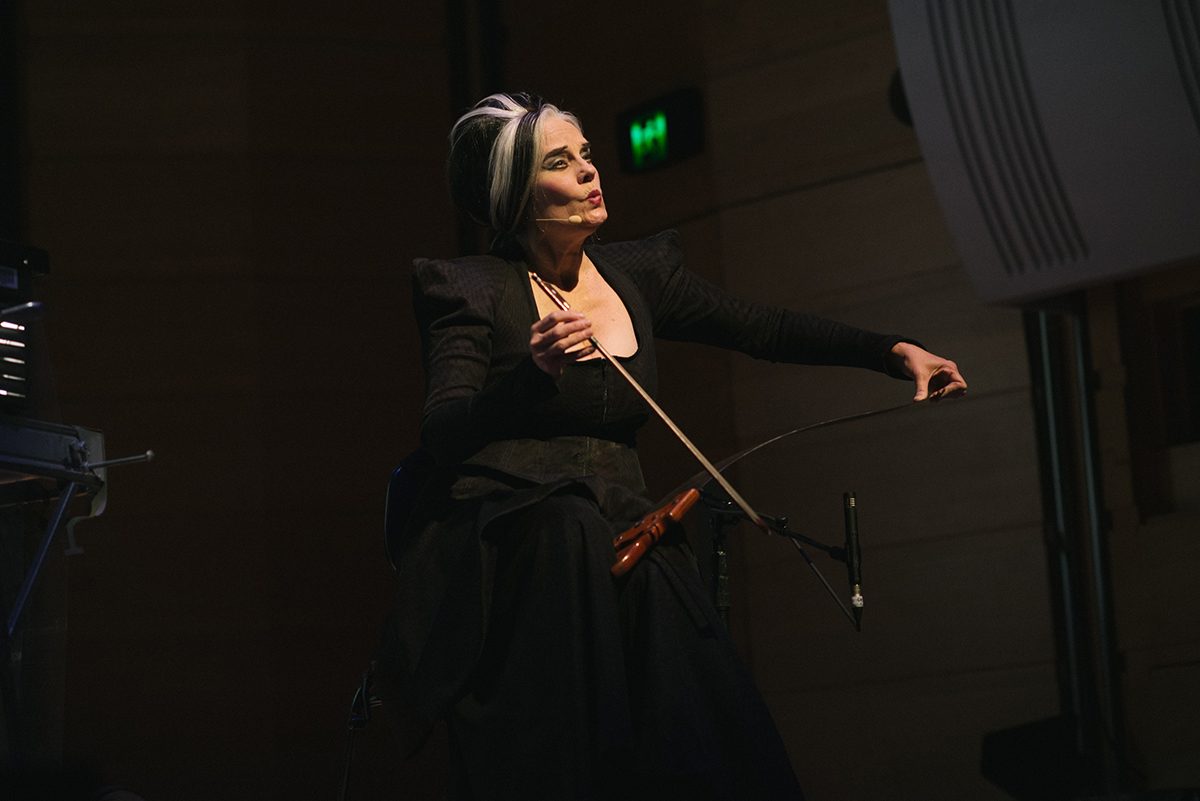
Christine Johnston, Makrokosmos Book 1, Extended Play, photo Katelyn-Jane Dunn
Sonya Lifschitz & and Christine Johnston
Sonya Lifschitz (piano, voice) and Christine Johnston (voice, musical saw) transform George Crumb’s still surprising 1972 work Makrokosmos Book 1, Twelve Fantasy Pieces after the Zodiac for Amplified Piano, into a witty and instructive music theatre work, the singer drolly scene-setting the 70s and beyond with reference to her childhood (‘singing’ objects with her sister), hair styles, music and politics. She then interpolates among Crumb’s movements introductions that include how to sing graphic scores and wryly performs examples of exquisite Australian birdsong including, astonishingly, the kookaburra. In her Gothic Slavic persona, Johnston (a member of The Kransky Sisters and collaborator with dancer Lisa O’Neill, among others) utilises a hand-wound overhead projector, aptly pre-digital for Crumb’s creation, a work, she declares, ahead of its time.
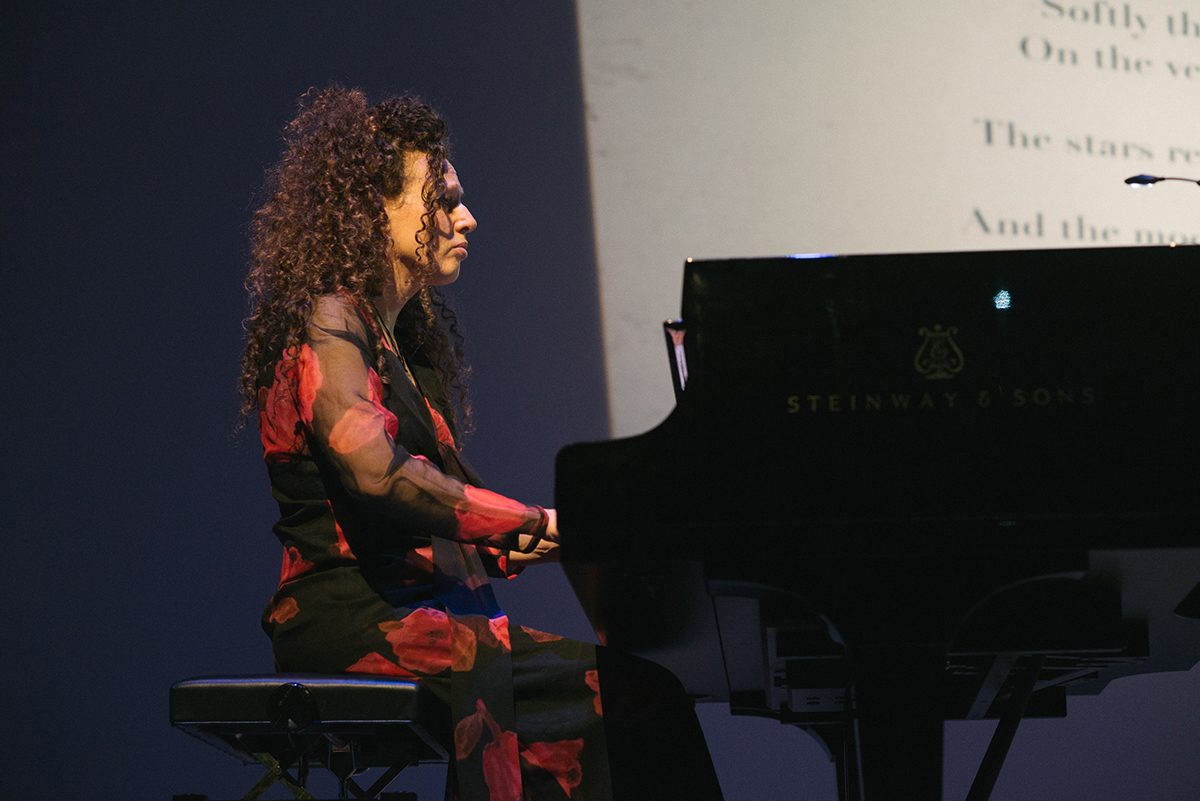
Sonya Lifschitz, Makrokosmos Book 1, Extended Play, photo Katelyn-Jane Dunn
In a parallel universe, Lifschitz, sits at or hovers over or invades her grand piano, stroking, plucking and muting strings, uttering cries and isolated words, magnificently unleashing the full range of the thunderous keyboard and its finer capacities, generating, as Crumb intended, a cosmos beyond conventional pianism. The two universes come thrillingly together when Johnson gently echoes Lifschitz’s phrasing with exquisitely controlled vibrato saw and, elsewhere, when the performers’ voices become one. This is quite a collaboration: long may it play.
Synergy and Polymorphic Orkestra
Sydney’s Synergy invited the electroacoustic art music trio Polymorphic Orkestra to respond to the percussion ensemble’s account of leading US composer and Bang on a Can co-founder David Lang’s So Called Laws of Nature (2002), which I know from Spotify and YouTube and eagerly anticipated. Each of the three movements (rising in pitch) provides the performers with limited tools, from four woodblocks each for the first movement to, in the third, metal bars, small chimes and crotales (Lang’s original score for a cash-strapped ensemble proposed using found materials). The impression is frequently of unison within which there are delightfully mind-bending tonal and rhythmic shifts as in the first with its wavelike structure, the briefest of recurrent silences, solo ‘voices’ and sudden rippling rushes. The delicacy of the spacious, bell-like second movement is suddenly countered with each player dextrously adding cumulatively propulsive left-hand drumming, while the third movement sparkles with long high discursive notes and the eerie makings of a melody, reverberating against a relentlessly fast, vibration free ringing. It’s not exactly foot-tapping music, but I’m swept along with it, embracing the gear shifts, evolving modulations and surprises in Synergy’s excellent account of a work that looks daunting to play.
If fine in themselves, the improvised responses from Polymorphic Orkestra (trumpet, drums, vibraphone, malletKAT, audio data) at the end of the each of the first two movements (but, oddly, not the third) diminished the cogency of The So Called Laws of Nature. Thrilled by Lang’s creation, I may well have not been open to the dialogue.
So Percussion, for whom the work was written, suggest the title of the work expresses Lang’s unease with the absolutism of dogma, common sense, religion and science. It seems to be a work in which the logic of its construction is meant to unsettle any sense of a fixed order; despite the tight, close scoring, there’s a bracing restlessness, a never quite resolvable dialectic admirably captured by Synergy.
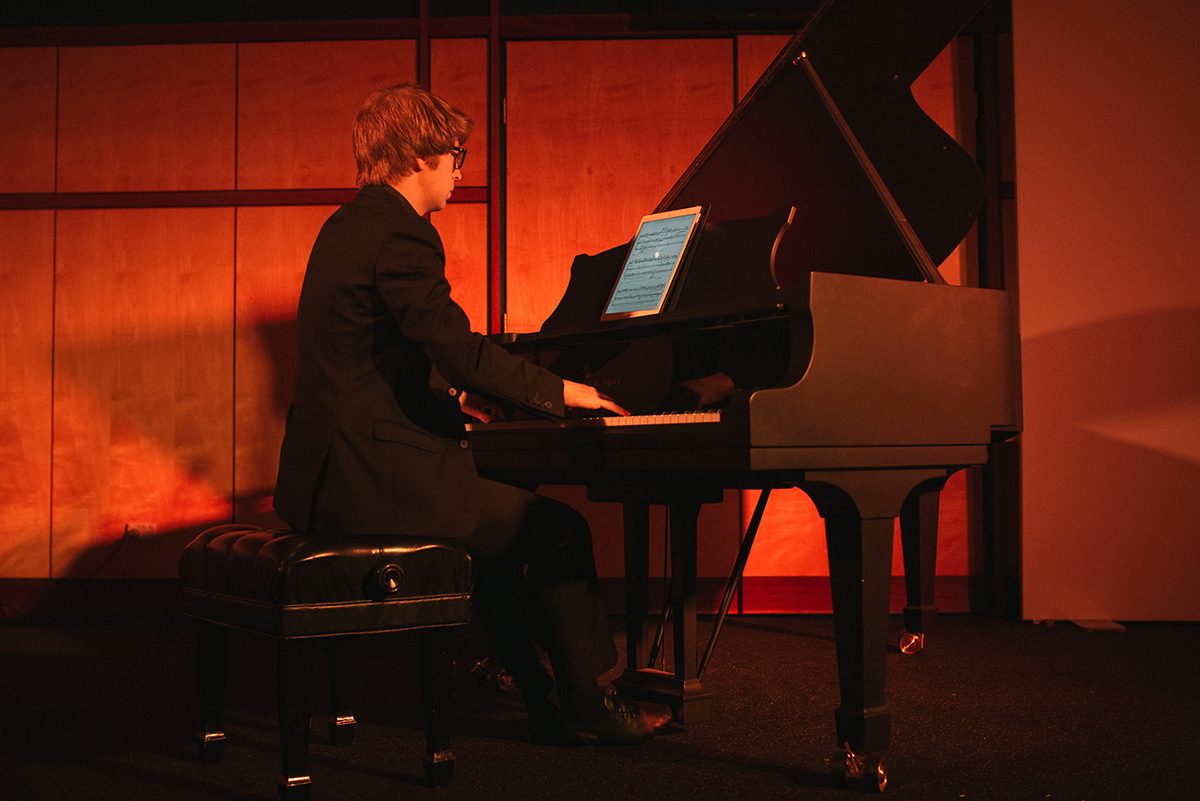
Alex Waite, Extended Play, photo Katelyn-Jane Dunn
Alex Waite
Squeezing into a crowded studio space, I caught the tail-end of Alex Waite’s account of Tristan Murail’s haunting La Mandragore (The Mandrake, 1993). Amid the many comings and goings at the rear of the room of an audience uncertain of its tastes in new music, I focused hard on Thomas Adès’ Traced Overhead (1996) which, in its first movement, commences as if a continuation of the Murail, with a liquid juxtaposing of restless high and reverberant low notes, and then becoming overtly lyrical, dramatic and expansively multi-voiced. Waite lucidly captures the work’s sometimes hesitant, sometimes striving aspiration; Adès was apparently inspired by the columns of light depicted in sacred paintings.
Liza Lim too took her cue from painting, one by abstract expressionist Cy Twomby (“My line is childlike but not childish,” he reputedly said of his art) for her The Four Seasons (2009). If engaged moment by moment (when not distracted by a couple of picnickers to the front of me) by Waite’s delicately precise realisation of the work’s almost stream-of-consciousness open-endedness (an aural equivalent to Twombly’s diffuse markings), I struggled to grasp the whole, with its rapid mood shifts, against which Murail and Adès felt quite neat. Subsequent listening to the work on Soundcloud, as played by its first performer Marilyn Nonken, has granted me better sense of the work’s cogency, but equally confirmed that the composition’s demanding emotional restlessness, Lim’s self-described “climates of feeling,” is its great strength.
Lim writes that she was inspired “in particular [by Twombly’s] massive four-panelled work Quattro Stagioni [Four Seasons]. The combination of ecstatic saturated colour, linear calligraphic dynamism and paint washes veiling poetic commentaries scrawled on canvas, gave me many ideas for a piano cycle in four parts. These ‘seasons’ are seasons of an inner life—they are made up of ‘climates of feeling’—weather patterns that are sometimes extravagantly baroque in expression or shot through with an elegaic sense of the passage of time opening out to a ceremonial dance: a Sema or the Sufi’s meditative whirling dance of union.” In Alex Waite’s hands, that dance at the work’s end ripples, sparkles and chimes, all the while as if suspended, beyond time.
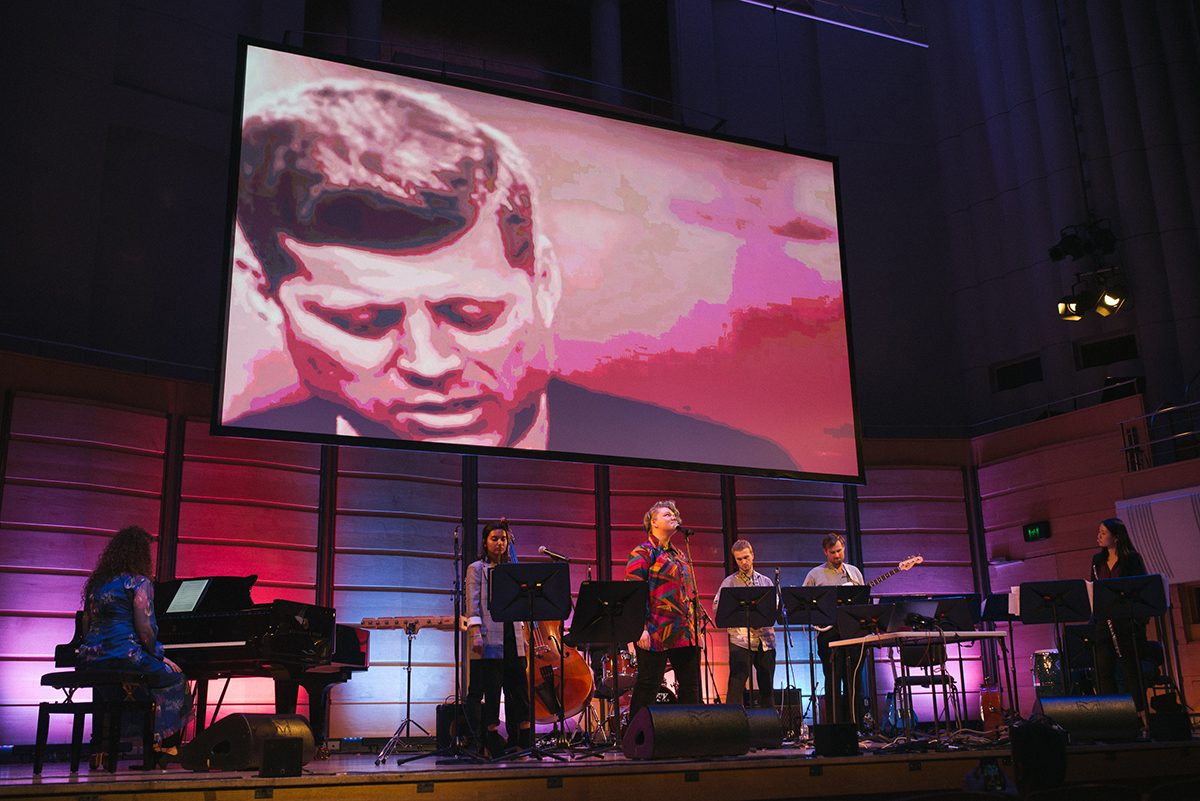
UNSW New Music Collective, Speech Music: JFK secret phone call (Cuban Missile Crisis), Extended Play, photo Katelyn-Jane Dunn
UNSW New Music Collective
UNSW students lead by their teacher Dr Sonya Lifschitz vigorously embraced us with Louis Andriessen’s rousing if famously difficult Workers Union (1975), a rhythmically but not tonally prescribed work for any number and kinds of instruments, in this case flute, double bass, electric bass, voices, saxophone, electric bass, piano and percussion. The performance exuded commitment, wit and power. Erik Griswold’s Action Music II (2017), also open to any number of musicians and rhythmically taut but variously melodic, proved an agile companion to the Andriessen. The projected, partly notated score glowed with paint splashes inviting the players to choose their means of interpretation and to respond to instructions such as “with a sense of existential dread,” “irritated,” “furious,” “ambivalent” and, finally, “over the top.” From a burbling, growling opening to squealing upglides, staccato strides, rock band drive and jazzy lugubriousness the work alternated between moments of beauty and anxiety and sax-driven (Alistair Johnson) passion.
Electric bassist Luke Gerber took to the electric guitar for Steve Reich’s Electric Counterpoint (1987), a rewardingly demanding work composed for Pat Metheny playing to an ‘ensemble’ of multi-layered, pre-recorded guitar tracks. Jonny Greenwood is the latest of a number of interpreters (on the Radio Rewrite CD and live at Glastonbury in 2014), bringing to the work a sharper-edged, less a consciously melodic imperative; Gerber, a fan, played to the Radiohead guitarist’s ensemble fusing playful ease with excellent execution (though there’s no denying the sway of Metheny’s influence on the composer in the glorious, fast third movement).
The concert also included three all too evanescent, whimsical duets for voice and instrument by Brisbane composer Robert Davidson and several of his famed minimalist musical and visual cut-ups, the best of which is his account of Prime Minister Julia Gillard’s “Not Now, Not Ever!” (2014) riposte to Tony Abbott’s misogyny, powerfully performed by the UNSW New Music Collective which proved to be a fine addition, instrumentally and vocally (Kit Spencer especially), to Extended Play’s dextrous programming.
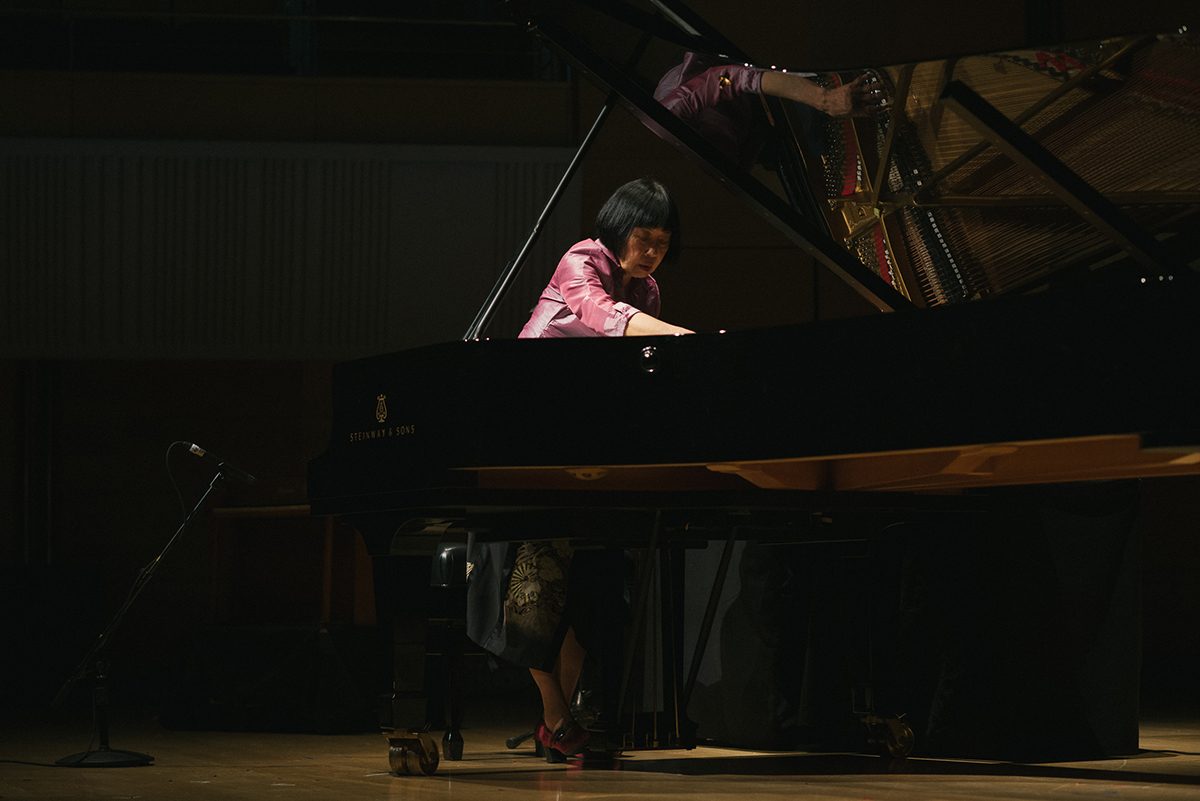
Margaret Leng Tan, Extended Play, photo Katelyn-Jane Dunn
Margaret Leng Tan
The leading global exponent of the toy piano as an instrument for adult play and composition opened her extensive program with some nine short works, childlike, ironic and fantastical and deploying, here and there, whistles, wind-up toys and a jack-in-the-box (determining performance duration). The sublime An American in Buenos Aires (Blues Tango) (2002) by US composer Toby Twining combined softly striding grand piano (left hand) and glittering toy piano (right hand). The Australian contribution to Tan’s international repertoire came from Erik Griswold with two pieces from his Old MacDonald’s Yellow Submarine (2004), first Chooks with its rapid woodblock pecking and then the wickedly demanding Bicycle Lee Hooker, with whistle, hooter, bike bell and rolling John Lee Hooker-style boogie blues on the tiny keyboard, both realised with amused aplomb.
Re-enter cosmologist George Crumb, this time with Metamorphoses Book 1, Ten Fantasy Pieces after celebrated paintings, for amplified piano, toy piano, auxilliary percussion and voice (2017) written for Margaret Leng Tan. These fantasies are personal responses to the paintings, but correlations between image and sound are easily made when the paintings are screened above Tan and her piano; none, bar Jasper Johns’ Perilous Night (and even here stick figures cavort near the bottom of the frame), are simply abstract; we see faces, figures, landscapes, Klee’s goldfish, Van Gogh’s crows, Chagall’s clowns, Kandinsky’s Blue Rider. Tan plays, sings, groans and whistles, ducks under the piano’s lid to stroke and strike the strings, crawls beneath the instrument to make pedal adjustments and works the toy piano. It’s incredibly labour-intensive playing.
Paul Klee’s Black Prince oscillates between dark turbulence and calm; the artist’s Goldfish is still, but on the keyboard moves with sparkling energy. Van Gogh’s crows (Wheatfield with Crows), on the other hand, have little sense of sudden flight; rather, with Tan’s voicing plangent cawing against softly brushed strings, there’s a sense of uneasy night-time recollection rendered in spare pluckings and odd flashing notes. Chagall’s The Fiddler has a lilting folk melody rising to a dance, while Clowns at Night spookily juxtaposes toy piano, the deep end of the grand, Tan’s ghostly cries, windchimes and woodblocks within the body of the piano. Paul Gauguin’s Contes Barbares (Against Barbarians), depicting two Polynesian women and a demonic white male, evokes a dark, pulsing ritual with Tan uttering recurrent indigenous phrases and rattling sticks before driving the piano into a grand, if uncertain melody (perhaps, like the painting, casting doubt on Gaugin’s dream of an uncorrupted South Pacific).
For Dali’s The Persistence of Memory with its melting timepieces, Tan whispers and bends strings. For Kandinsky’s The Blue Rider (the image associated by the artist with aesthetic revolution and also the title of the group of Munich-based like-minded artists), initially hesitant, the music quickly rises to a questing gallop, stormy string flashes and thundering bass clusters that envelop the whole instrument, with Tan hammering keys and simultaneously assaulting strings. Revolution accomplished. Tan’s sustained performance unleashes a grand nocturne, an enveloping night world, of dreams and nightmares, fears and wish fulfillments triggered by the imaginings realised in great paintings.
Like Marchetti’s Inland Lake, later this night, Crumb’s Metamorphoses works wonders, musically and on the imagination in the tradition of some of Modernism’s 20th century beginnings—the synaesthesia felt between music and visual art by Kandinsky, his Blue Rider companions and Schoenberg, painter and composer, who exhibited with them. Crumb himself attributes an earlier influence, Modest Mussorgsky for the “invention of the idea of transforming visual art into sound in his Pictures at an Exhibition. [Metamorphoses is] a direct descendent of Mussorgsky’s hauntingly beautiful piano composition.” It’s a reminder of Crumb’s radicalising of a Romantic legacy.
At the end…
At the end of Extended Play, I looked back on an extremely generous program, grateful for its celebration of George Crumb (he’ll be 90 in October and is still composing) with major works brilliantly realised by Sonya Lifschitz and Margaret Leng Tan, and for its confirmation of the excellence of adventurous ensembles—Decibel (WA), Synergy (NSW), Nonsemble (QLD) and a welcome student group, the UNSW New Music Collective. Hard choices and some schedule delays meant that I missed Adelaide’s Zephyr Quartet (who impressed at Ensemble Offspring’s Kontiki Racket in June), Perth’s Intercurrent, Sydney’s Kammerklang and Brisbane’s The Australian Voices.
For seven of the 12 hours of Extended Play, a performance (building cumulatively in musician numbers) of Terry Riley’s In C was realised on the ground floor of City Recital Hall, pleasingly resonating in the upper foyers. Again, Extended Play has proven itself an invaluable champion of international and Australian new music, generating a heightened sense of community across Australia and beyond, between composers, musicians and a passionate audience. Thanks to Extended Play and to Ensemble Offspring’s excellent new music micro-festival Kontiki Racket (held over two days in June this year) new music is granted the standing it deserves in a challenging market.
My review of the 2018 Extended Play focused on performances by Lisa Moore, Bang on a Can All Stars, Elision, Ensemble Offspring, Topology and Gabriella Smart.
–
Extended Play, co-produced/curated by City Recital Hall and Lyle Chan & Vexations 840; City Recital Hall, Sydney, 31 Aug, 2019
Top image credit: Terry Riley’s In C, photo Krista Tanuwibawa
Dancers are space-makers—generators of dimension, ‘drawing’ with bodies in motion felt lines of containment and expansion, wherever they might be performing. They are equally transformers—redelineators of stages, galleries and public spaces. In DIRtywork in the Sydney Opera House’s Utzon Room, Rosalind Crisp guides us through an estimation of the room’s architectural beauty but also the sheer weight of the environmental damage each element of its construction represents. Answering to a challenge she has set herself—how to make dance amid ongoing environmental destruction—the performance is autobiographically framed, inextricably melding personal and political, body of the dancer and body of the room. With wisdom and wit and a supple entwining of dance and word Crisp gives site-specificity a new vigour.
An initial dance in silence on the open floor thrills with recognition (it’s been a long time for me between Crisp’s dancing in Sydney)—the particularity of the body, its lightness, fluency, acute shaping and control, sudden weight and unnerving unpredictability: which way will Crisp’s body take her in moments of delicate suspension, on vertiginous tipping edges and in sudden leaps and turns?
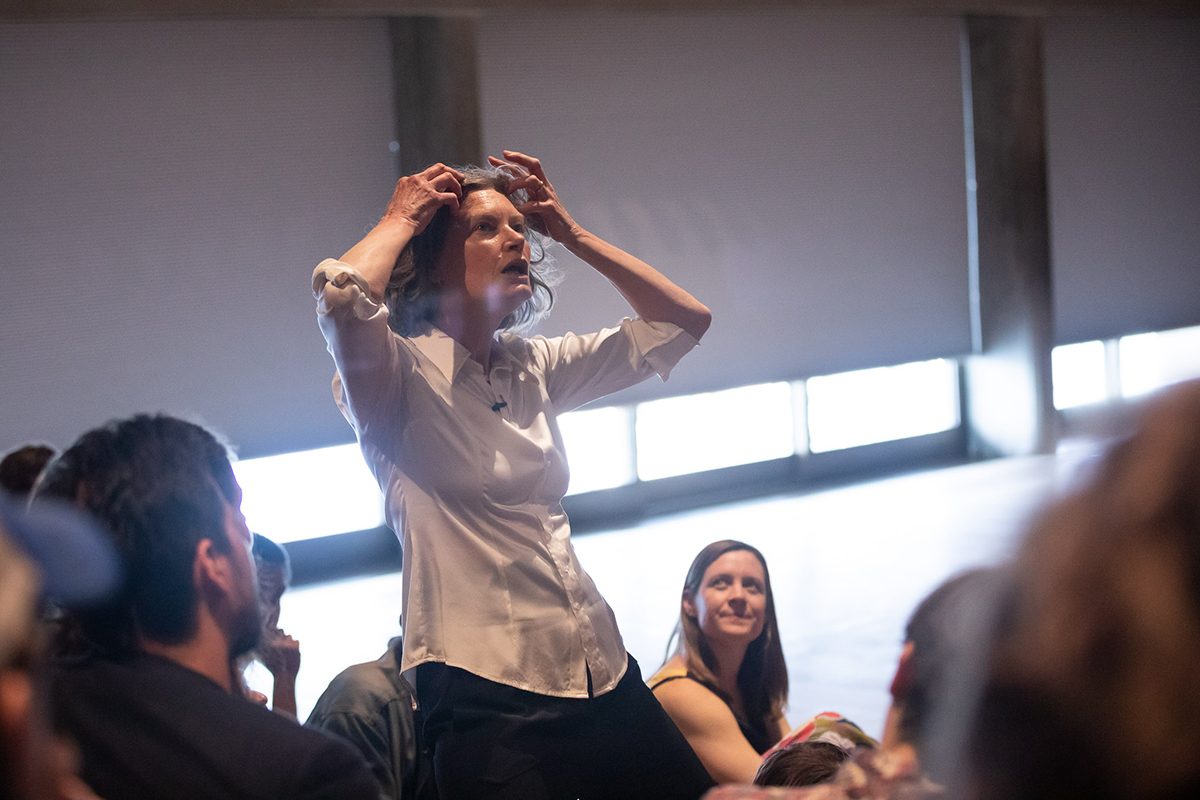
Rosalind Crisp, DIRTywork, UnWrapped, Sydney Opera House, photo Daniel Boud
After casually recounting family history—dissident Irish settlers arriving in rural Victoria in 1829, farming merino sheep, and her own return to the property in 2013—and stating the challenge the work represents—Crisp sits among us, sinking into herself, head down, murmuring, the breath voiced, random utterances in English and French that indicate what action her body is taking and what thoughts transpire: “a little pocket of Australia, keeping it for myself.” Straightening up, she moves back onto the floor, inviting us to stretch out and regard the remarkable, metre-wide concrete veins that rush the length of the room and dive, curving into the floor at the far end.
This engrossing guided tour of the room draws on research into the construction of the Sydney Opera House and species decimation in Australia. The concrete’s sand-fed beauty belies the loss of beaches. The hanging that graces the length of the western wall was made by the Victorian Tapestry Workshop from the wool of merino flocks that fed on high protein grasses that supplanted native ones, now 97% destroyed, Crisp says (to which we can add 30 hectares of the remainder illegally poisoned by Government Minister Angus Taylor’s family company. ED). Crisp punctuates her delivery with short bursts of movement, some recalling the opening dance. She tells us the floor is Southern Bluegum, much plundered and, with it, food for the Swift Parrot. She drolly turns on herself—her Murray-Darling-depleting cotton pants, a Turkish silk shirt (but great to move in), her soybean-fuelled calves and her oat-fed thighs. “The trouble with dance is that it sucks up so much water.” She wonders should she move less.
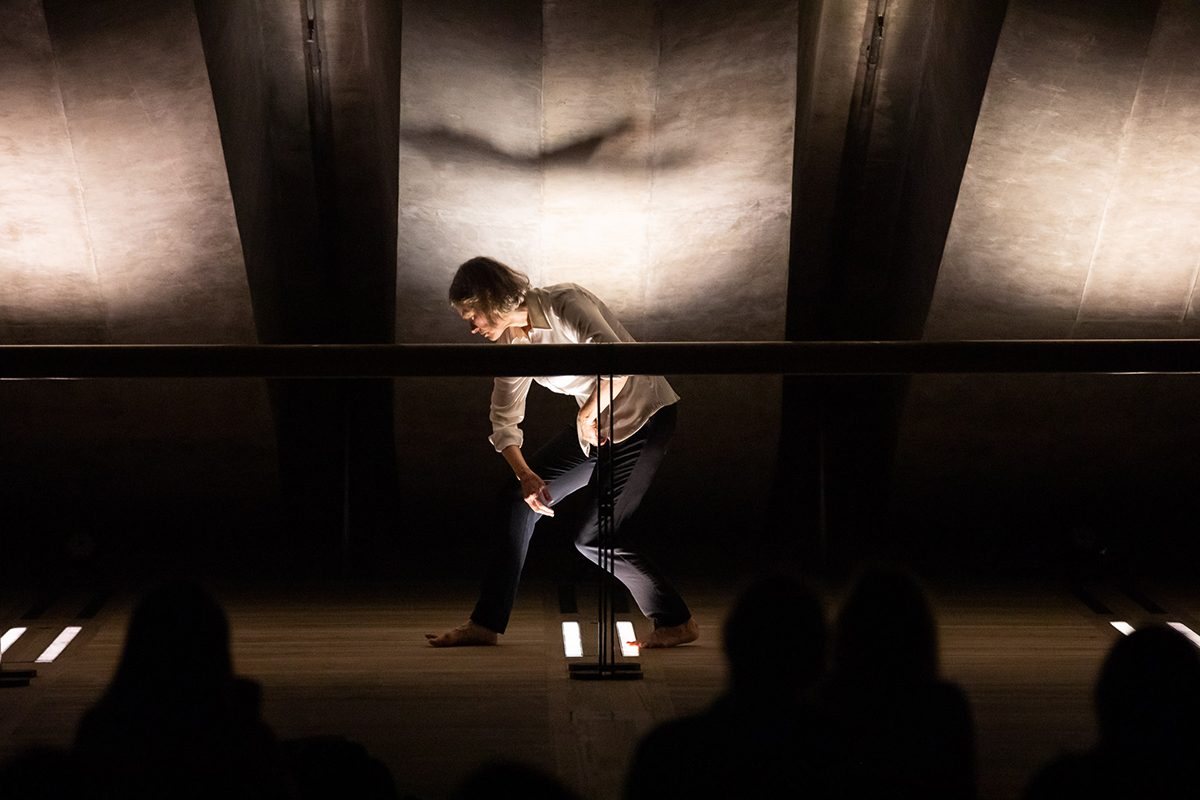
Rosalind Crisp, DIRTywork, UnWrapped, Sydney Opera House, photo Daniel Boud
A video of Crisp, slowly writhing on the ugly detritus of logging in the ancient alpine forest where she grew up and which is almost gone, preludes a final dance in which she moves to the southern end of the room. She is now a shadowy figure, still and at one with the architecture and then flowing out of it in an ambivalent meeting of artforms and a painfully lyrical embodiment of the many contradictions she has revealed and which we are living out every day. “Without contraries there is no progress,” wrote William Blake; Crisp brought them to bear on us in a wryly intimate performance that changed my perception of the Utzon Room, transforming it for the duration and beyond into Australia from the Murray-Darling to the Snowy to East Gippsland, to species depleted and extinct and, within it, our deeply implicated bodies.
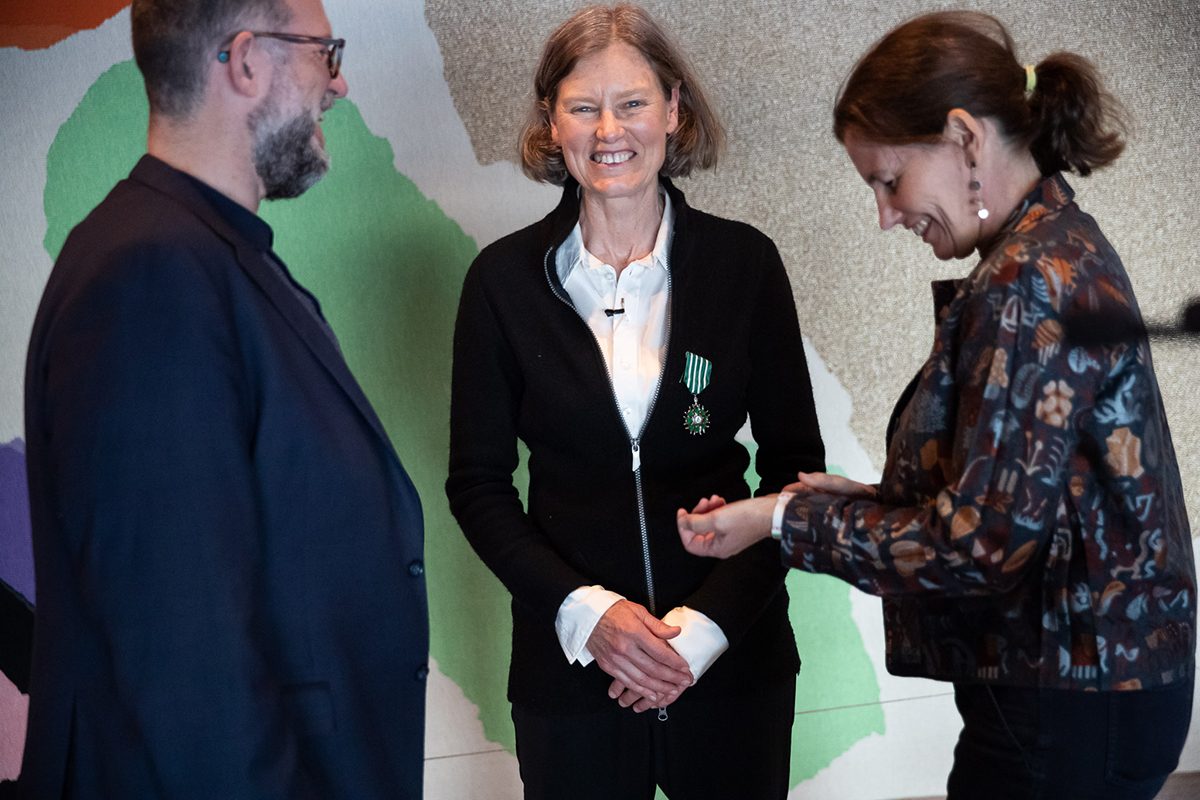
Philippe Platel, Rosalind Crisp and Anne Boillon, photo Daniel Boud
Rosalind Crisp, Chevalier de l’Ordre des Arts et Lettres
Rosalind Crisp was invited in 2003 to Paris by Michel Caserta, director of the Biennale nationale de danse du Val-de-Marne (2004 to 2012). In 2004 she became the first choreographic associate of Atelier de Paris-Carolyn Carlson. The Atelier managed and toured her French company for 10 years. In 2016 the French Ministry of Culture awarded her a Chevalier de l’Ordre des Arts et Lettres (Dame of the Arts) for her decade-long contribution to dance in France. The investiture, by Anne Boillon, French Consul in Sydney, with Cultural Attaché Philippe Platel, was witnessed by family, friends and fellow artists and took place immediately after the first DIRtywork performance in the Utzon Room.
DIRt
“DIRt (Dance in Regional disaster zones) is an ongoing research project with artists and ecologists, based in Orbost, East Gippsland, Victoria. We ask how dance and collaborative arts practice might embody, understand and connect to our deepening environmental crisis. The core group is myself, Vic McEwan, Andrew Morrish and Peter Fraser.” Rosalind Crisp, interview, UnWrapped program. See omeodance.com/dirt.
–
Sydney Opera House, UnWrapped: DIRtywork, creator, performer Rosalind Crisp; Utzon Room, Sydney Opera House, 15 Sept
Top image credit: Rosalind Crisp, DIRTywork, UnWrapped, Sydney Opera House, photo Daniel Boud
RealTime Extra. As we continue to refine and build on the RealTime archive, we thought you’d enjoy reading about the joyous launch at UNSW Library Exhibition Space by Professor Sarah Miller AM of the complete 1994-2015 print editions of RealTime on the National Library of Australia’s TROVE website. You can also read each of the excellent speeches by Sarah, UNSW Librarian Martin Borchert, Tony MacGregor, Chair of Open City, publisher of RealTime, and Jeremy Smith, representing the Australia Council for the Arts. It was a night of reflection, laughter and a few tears.
Adding substantially to the RealTime archive are contributions in this edition from long-time RealTime associates Caroline Wake and Erin Brannigan. Focusing on Sydney performance, art and refugees, and errant arts funding policies, Caroline looks back on the years she wrote extensively for RealTime. Erin, who commenced writing for us in 1997, bravely corrals RealTime’s enormous coverage of dance across Australia.
As well, we’re publishing two fascinating essays commissioned by RealTime towards the kind of book we need in this country. To be edited by RealTime contributors Jana Perkovic and Andrew Fuhrmann, the collection will focus on theatre and performance in Melbourne 2005-2015. Jana charts a diminishing preoccupation with ‘liveness’ across the period; Andrew personally grids the city according to his encounters with pivotal works at non-mainstream venues.
Although we’re working quietly and intermittently, we’d love to hear any queries or observations you might have about the RealTime archive. Special thanks to Sandy Edwards for the photographs of the launch. All the best, Keith & Virginia
–
Top image credit: Virginia Baxter, Keith Gallasch at RealTime Trove archive launch, photo Sandy Edwards
The launch of the 1994-2015 print editions of RealTime on the National Library of Australia’s TROVE website was a memorable night of performances, reminiscences and wise words about cultural memory and the importance of archiving, inflected with laughter and a few tears. It culminated with Professor Sarah Miller, wielding a giant pair of scissors, cutting a red ribbon—held at one end by ourselves and at the other by UNSW Librarian Martin Borchert—before a large monitor displaying RealTime on TROVE.
-
-
Martin del Amo, photo Sandy Edwards
-
-
Mirabelle Wouters (Branch Nebula), photo Sandy Edwards
-
-
Vicki Van Hout, photo Sandy Edwards
In the first part of the evening, Martin del Amo spoke to the value of RealTime’s analytic reviews and Heidrun Lohr’s photographs of his work and danced an achingly exquisite solo embodying the passion of Maria Callas in performance. Vicki Van Hout, accompanied by Henrietta Baird, resurrected in words and movement a fragment of Vicki’s vibrant Briwyant. Vicki then reflected generously on the significance of RealTime reviews for her career and for Indigenous dance. Mirabelle Wouters of Branch Nebula continued the dialogue with curator Erin Brannigan initiated in the second of the four events that comprised a significant part of the exhibition In Response: Dialogues with RealTime, observing that for part of the company’s career the magazine had alone provided vital critical support.
Virginia Baxter, Keith Gallasch, photo Sandy Edwards
Real time RealTime dialogue
We then presented our own response to RealTime, a dialogue addressing the magazine that we made, but which in turn made us—hitherto actors and writer-performers—editors, publishers and reviewers of often remarkable art, art that further transformed us personally, as we engaged for over two decades with works innovatively preoccupied with real time, bodies of all kinds, the senses and the interplay of actual and virtual, across artforms and across Australia and beyond in collaboration with a network of highly responsive skilled writers, many of them artists.
We quizzed each other about what we had experienced in those years of “tough but unalienated labour, doing our bit for cultural sustainability in the face of escalating neoliberalism” and revelling in “lingering over lush surfaces. Lost for words, aching to respond, to what just happened. Not jumping to conclusions; not rushing to judgement, entering the eternal loop. Embracing the work, taking it home, letting it in, like a lover, or Alien. Exercising the mirror neurons. Dancing the dance. Writing the dance. Keep talking to the work, talking to self. What happened to me this time? Is it still happening?” (You can read our Real Time Dialogue with RealTime in the attached PDF.)
Martin Borchert, photo Sandy Edwards
Martin Borchert, Librarian, UNSW Library
The second half of the event comprised a series of incisive, entertaining speeches culminating in the launch of RealTime on TROVE and celebrating the RealTime website. Martin Borchert, Librarian, UNSW Library warmly thanked the National Library of Australia and Dr Hilary Berthon for partnering the digitisation of the magazine, UNSW Library staff members Robyn Drummond, Megan Saville, Jackson Mann and Maude Frances. He especially thanked Erin Brannigan and Caroline Wake of the UNSW School of Arts & Media and Keith and Virginia for their collaboration with UNSW Library on the digitisation venture.
Martin Borchert spoke of two kinds of ‘value adding’ the exhibition offered: firstly a kind of ‘glamour’ thanks to the performative and installation components which enhanced visitor engagement for the new exhibition space, and secondly the ways in which the audio (artist interviews) and video (performance documentation) components made for the exhibition would be preserved and further the range and depth of the RealTime archive.
In the first edition of RealTime in June 1994, Borchert noted, “the editorial announced that RealTime ‘opens up the possibilities for writers and artists everywhere in Australia to contribute to the spread of information and ideas across artforms and distance.’ I think this archive really achieves that and it’s a long time since the journal started so it’s nice to re-visit that mission.”
Tony MacGregor, photo Sandy Edwards
Tony MacGregor, Chair, Open City Inc
Tony MacGregor, Chair of Open City, the publisher of RealTime, spoke to the power of archives, incidentally complementing Martin Borchert’s vision of more diversified preservation, by citing Jacques Derrida’s Archive Fever (1995) in which the philosopher argued “that archives both shape and reflect the way we think, the way power is structured, the way we imagine ourselves, and that archives are changing, no longer vast libraries of documents recording the machinations of the powerful. They are becoming—must become—porous, heterogenous accumulations of multimedia. The archive can no longer be made of paper, but as we see around us is made up of all sorts of stuff. And, as the performances of Martin Del Amo, Branch Nebula and Vicki Van Hout over the past few months have eloquently demonstrated, the archive is often stored in the body, written in the flesh.”
Tony went on to thank the Australia Council and peer assessors of grant applications for their enduring support for RealTime, and UNSW Library and the NLA “for their commitment to nurturing the cultural history of Australia, not just in this instance, but in an ongoing and generous manner.” He reminded those gathered that it “was important to remember that Real Time was—is—an artists’ project,” “a collective enterprise.” “RealTime—and its editors and writers—have done more than serve a community, they have, in so many ways, made it. That is their gift to us (readers, writers, makers, audiences), and I thank them for it.”
Jeremy Smith, photo Sandy Edwards
Jeremy Smith, Australia Council for the Arts
Jeremy Smith, Director Community, Emerging & Experimental Arts, Australia Council for the Arts, recalled his first encounters with RealTime, picking up a copy in 1995 at Perth’s PICA, where Sarah Miller was Director. Later, as a young lighting designer, he received a positive mention in a RealTime review: “that’s what set Real Time apart—its editors, writers and contributors saw and considered elements others didn’t. It was as if they were always searching for new ground and looking beyond the horizon—the as yet unseen. They saw and wrote about the new aesthetics and hybrid forms, the delights for us audiences long before others, helped promote and increase our enjoyment, cultural literacy, plus stimulated collaborations and conversations.”
Jeremy reflected on the “robust relationship” between the Australia Council and RealTime, citing “the crucial role Real Time—especially Keith—has played as a critical friend of the Australia Council…highlighting in the magazine the Council’s ‘mistaken’ arts practice restructure in 2004 and 2005” (the passionately resisted dismantling of the New Media Arts Board). He amusingly recalled Keith’s deployment, in the Sydney Morning Herald, of an ecological model of the arts, with the Council as a threatening monocultural omnivore and innovative artists as humble slime mold—networking and shapeshifting. Jeremy observed, “underpinning that funding partnership since 1994 has been the endorsement and praise of countless numbers of peers from around the country who have validated the continued support of this crucial part of our ecosystem. That alone speaks volumes.”
Jeremy also acknowledged the presence at this launch of Andrew Donovan, Director, Artist Services at Australia Council for the Arts, “a significant contributor to the RealTime-Australia Council relationship and indeed the contemporary and experimental arts sector over many, many years.” Andy was indeed very welcome.
While lamenting the current absence of a national across-the-arts magazine, Jeremy noted “seeing pockets of the contemporary and experimental arts sectors—organisations and independent artists—responding in small, unique, considered and important ways to fill this void. I genuinely hope this continues.
“It’s never an easy decision to call time, and to windup. It takes bravery. I commend Keith, Virginia, the Open City Board and all of the contributors to Real Time for 25 years of bravery, courage, fierce articulation, wisdom—and change.”
Sarah Miller, photo Sandy Edwards
Professor Sarah Miller AM
Professor Sarah Miller recalled reviewing Open City’s Photoplay in 1988 for Art Almanac and meeting us when, in the period of her directorship of Performance Space 1989-93, “Open City was one of the key ensembles working out of Performance Space. Ostensibly casual and chatty, but meticulously crafted, their work was distinguished by their collaborations with artists from a range of artform backgrounds, specialists from other disciplines and industries, and dealing with the politics of the everyday. Does this sound familiar?”
Sarah described the considerable challenges for artists in the 1980s and 90s in “refusing to conform to a bunch of fairly prescriptive ideas about what constituted real art, real theatre, real music, or real dance…” She recalled the Australia Council’s subsequent “establishment [in 1993] of the Hybrid Arts Committee—later the New Media Arts Board, now the Emerging and Experimental Arts Fund—which provided dedicated funding to artists whose work sat outside conventional parameters” (though not mentioning her own role as passionate advocate on Australia Council boards). Sarah then detailed outcomes of the RealTime vision: experiential writing, inclusiveness, free national access in print from 1994 and online from 1996, national and international perspectives for artists and readers, aided by review-writing workshops around the world.
Unable to resist the pun, Sarah described the NLA’s archive as a Treasure TROVE and thanked UNSW Library and the National Library of Australia for “making the TROVE RealTime archive an invaluable resource for Australian artists’ sense of their own and their collective histories, for inspiring students and emerging artists, for providing rich material for researchers and arts historians, as well as anybody curious about what happened.”
Before cutting the ribbon to launch RealTime on TROVE and our upgraded website, Sarah concluded her speech saying, “I really miss RealTime. It has been an essential part of my life for 25 years, and I know that’s true for everyone here tonight. There really aren’t the words—which is why I’ve used so many—to thank Keith and Virginia for their commitment, passion, rigour, tenacity and hard work, and above all for putting artists and their work front and centre. Absolutely mammoth achievement.”
Thanks
Sarah dextrously scissored the red ribbon, completing the launch, save for rapidly listed thanks from us to everyone who had performed or spoken on the night, to the NLA (and Dr Hilary Berthon) and UNSW Library (and Megan Saville), to RealTime website designers Graeme Smith and The Mighty Wonton, Open City Board members Tony MacGregor, John Davis, Julie Robb, Urszula Dawkins and Phillipa McGuiness, Assistant Editor Katerina Sakkas and Online Producer Lucy Parakhina, previous staff members (Gail Priest above all), to Erin Brannigan for In Response: Dialogues with RealTime and much else, Caroline Wake and, for creatively dialoguing with RealTime, special thanks to Martin Del Amo, Branch Nebula (Mirabelle Wouters and Lee Wilson) and Vicki Van Hout.
To all those who have contributed to RealTime over these many years—writers, artists, readers, supporters, advertisers and funders from across Australia and beyond—thanks for being part of the epic making of an intensely memorable, very much alive archive.
You can read the complete speeches and our Real time dialogue with RealTime here.
–
In Response: Dialogues with RealTime, Archive Launch, UNSW Library Exhibition Space, UNSW, Sydney, 17 April, 2019
Top image credit: L-R: Katerina Sakkas, Virginia Baxter, Gail Priest, Tony MacGregor, Keith Gallasch, Erin Brannigan, Sarah Miller, photo Sandy Edwards
From 2007 to 2017, over the course of roughly 50 issues (RT82-137), I wrote approximately 50 articles and 50,000 words for RealTime. I edited hundreds more in my capacity as proofreader and, later, online producer. No wonder I recall the theatre and performance of that decade with such clarity: they were formative years, yes, but made moreso because the experiences and memories were processed within the highly informative context of RealTime. Politically, these years coincided with the arrival of Kevin 07, the rise and fall of the Rudd-Gillard government (see my “review” of the 2010 election in RT98 Aug-Sept), and the rise and improbable rise of the Abbott-Turnbull-Morrison governments. Personally, they marked the shift from student to lecturer, which is to say from performing in youth theatre (RT88, Dec 2008-Jan 2009), through reviewing youth theatre at PACT (RT100, Dec 2010-Jan 2011), Shopfront (RT105, Oct-Nov 2011), and Tantrum (RT95 Feb-March 2010, RT98 Aug Sept 2010, RT99 Oct-Nov 2010), to teaching youth about theatre at UNSW. Theatrically, the decade was associated with several trends outlined below.
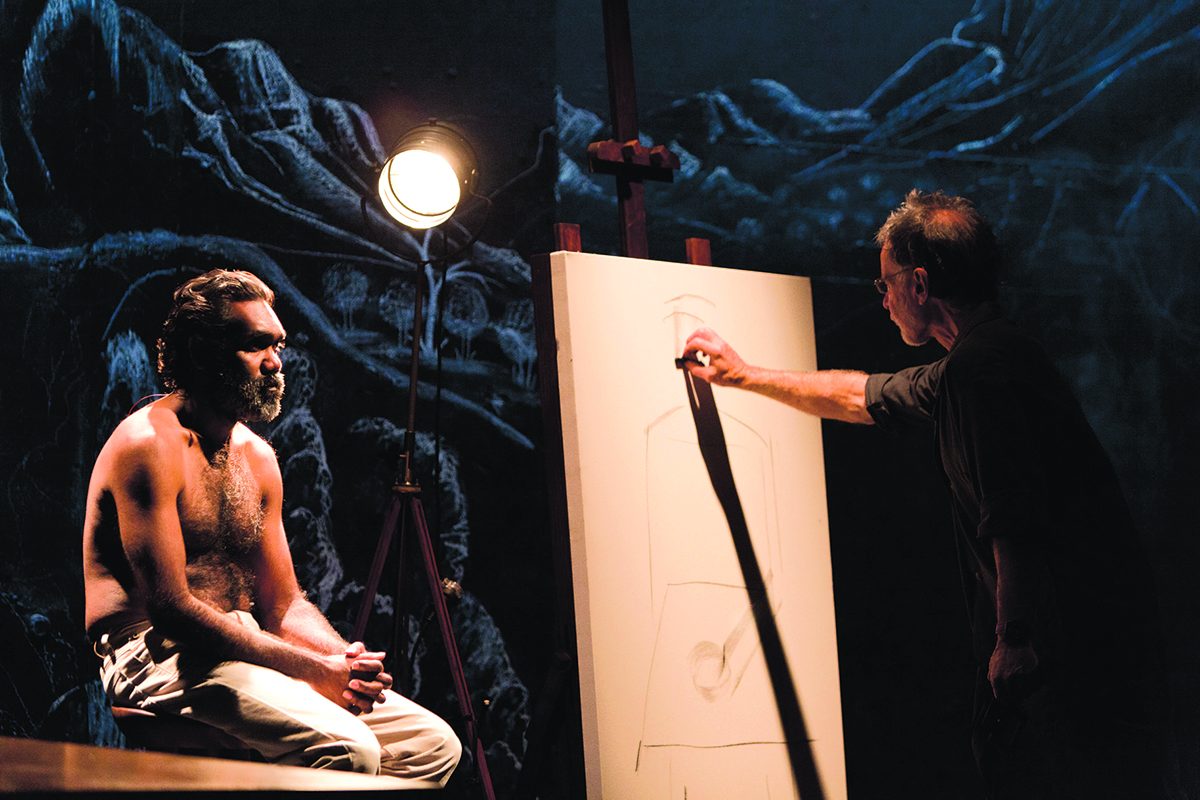
Trevor Jamieson, Robert Hannaford, Namatjira, BighART, 2011, photo Brett Boardman
Theatres of the real
One of the major trends captured in my reviews is the popularity of “theatre of the real”— Carol Martin’s broad term for the genres of autobiography, verbatim, documentary and tribunal theatre. Within the category of autobiography, I reviewed everything from Mayu Kanamori’s performance about the plight of Chika Honda (RT84 April-May 2008), Ahilan Ratnamohan’s meditations on playing professional soccer in The Football Diaries (RT91 June-July 2009), Paul Dwyer’s investigation into his surgeon father’s past in The Bougainville Photoplay Project (RT 94 Dec 2009-Jan 2010), Kim Vercoe’s “ambivalent entanglement” with Bosnia and Herzegovina in Seven Kilometres North-East (RT 100 Dec 2010-Jan 2011), and Belvoir and Big hART’s collaboration Namatjira (RT100 Dec 2010-Jan 2011).
Within the category of verbatim, I enjoyed Roslyn Oades’ Stories of Love and Hate (RT89 Feb-March 2009), later interviewing her about the practice of “headphone verbatim” (RT123 Oct-Nov 2014). If we were to stretch to the definition of verbatim, then Elevator Repair Service’s word-for-word delivery of The Sound and the Fury might count too (RT128 Aug-Sept 2015). Within the categories of documentary and tribunal theatre, I saw but rarely reviewed Version 1.0’s many works within the genre—this was mainly left to Bryoni Trezise, whose review of CMI (A Certain Maritime Incident) (RT61 June-July 2004) is still cited. I also enjoyed The Argument Sessions, based on the Supreme Court of the United States’ deliberations about marriage equality (RT128 Aug-Sept 2015). More broadly, I witnessed several works by Alicia Talbot for Urban Theatre Projects, including The Fence, which dealt with both the Stolen Generations and the Forgotten Australians, in a review I titled “Home is Where the Hurt Is” (RT 95 Feb-March 2010). I also watched several community-based projects like Minto: Live (RT 101 Feb-March 2011) and Women of Fairfield (RT Online 9 Nov 2016), led by two experts of the form: Rosie Dennis and Karen Therese respectively.
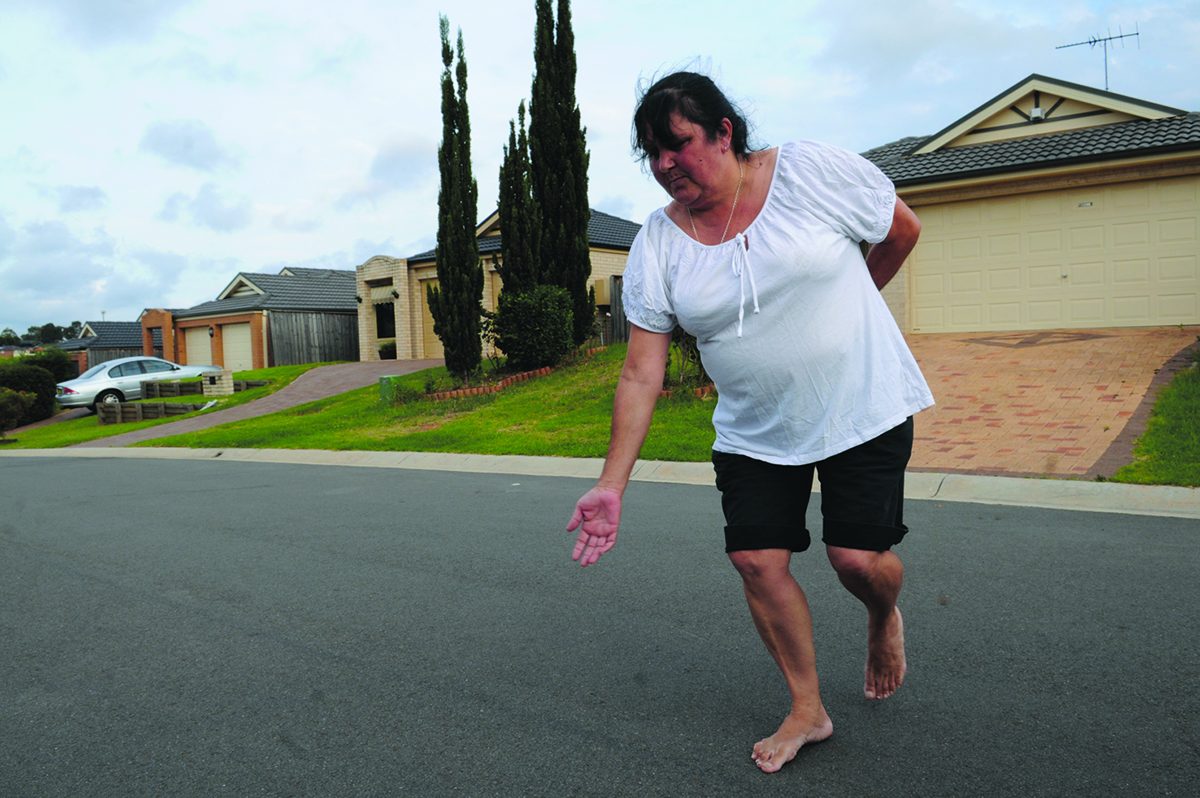
Kaye, Streetdance, Lone Twin, Minto Live, 2011 Campbelltown Arts Centre, photo Heidrun Löhr
If there weren’t real people on stage, or real stories being told, then we were often in real places rather than in a theatre. I watched performance in carparks and RSL clubs, on riversides and roundabouts, in deserted shopping malls and on jam-packed buses. Tellingly, one of the final reviews I wrote deals with performance in the gallery, via three retrospectives on Yoko Ono, Joan Jonas and Mark Rothko (RT129 Oct-Nov 2015). That was a rare review for me, filed from overseas. There are only two others: one from Germany (RT82 Dec 2007-Jan 2008) and another from the Netherlands (RT104 Aug-Sept 2011). Otherwise, I attended performances in Auburn, Bankstown, Brisbane, Campbelltown, Darlinghurst, Darlington, Fairfield, Marrickville, Minto, Newcastle, Redfern, Surry Hills and Villawood. Once I even made it to the Sydney Opera House, for Back to Back’s Food Court (RT92 Aug-Sept 2009).
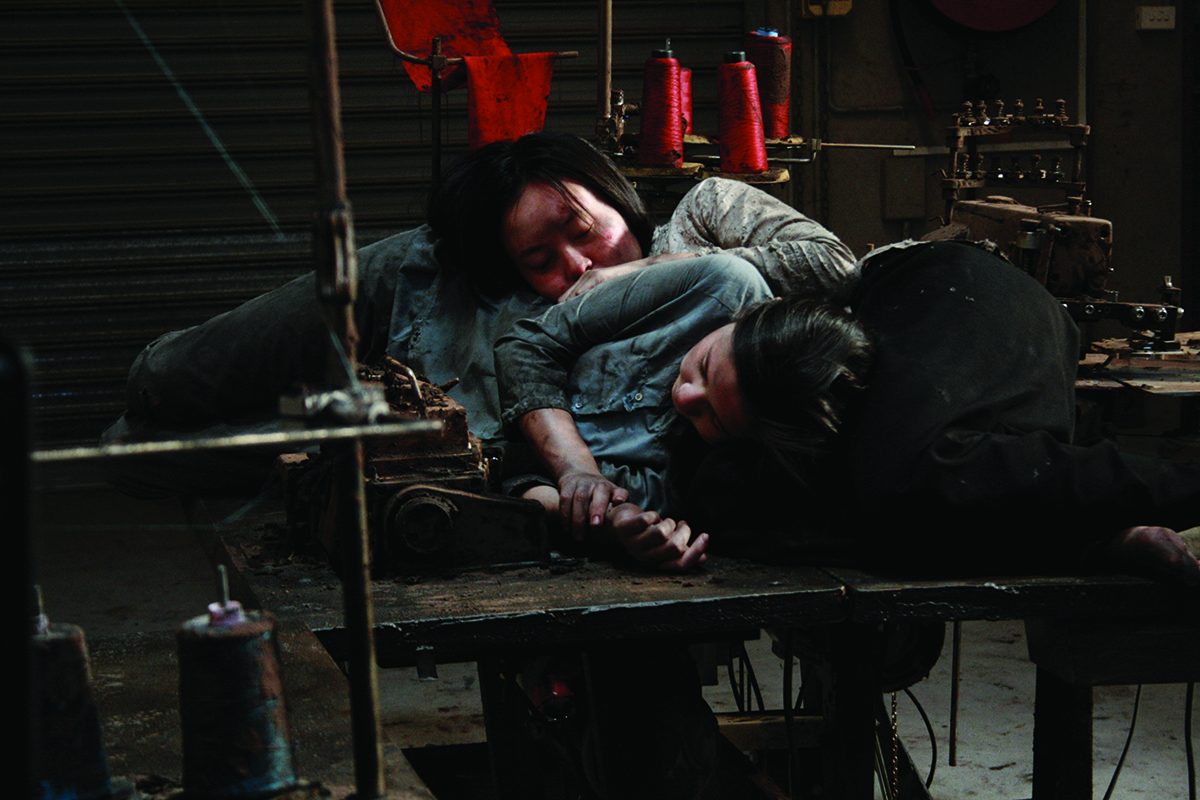
Still from the film “Mother Fish”
Theatres of ‘the refugee’
The figure of ‘the refugee’ continues to haunt the national imaginary and as a result, our stages, screens, galleries and literature. One of the first Archive Highlights I assembled was Art & Asylum: Politics, Ethics, Aesthetics in 2010 (RT Online Sept 7 2010), which gathered artistic responses to the first Pacific Solution (2001-08). It includes reviews of Urban Theatre Projects’ performances Manufacturing Dissent and Asylum, Nazar Jabour’s No Answer Yet, Mike Parr’s Malevich, Ben Ellis’s These People, Version 1.0’s CMI (A Certain Maritime Incident), the Department of Human Services’ Outside In, Towfiq Al-Qady’s Nothing But Nothing, Ros Horin’s Through the Wire, the Théâtre du Soleil’s Le dernier caravansérail, Bagryana Popov’s Subclass 26A, Kit Lazaroo’s Asylum and Mireille Astore’s installation Tampa. It also included reviews of the controversial video game Escape from Woomera as well as the films Escape for Freedom (2016), Anthem (2005), Molly and Mobarak (2003), Letters to Ali (2004), Fahimeh’s story (2004), and Lucky Miles (2007) and the SBS TV series Tales from a Suitcase, While the first Pacific Solution officially concluded in 2008, the artistic work continued. I reviewed Khoa Do’s Mother Fish twice, first as a rather cinematic play in 2008 (RT86 Aug-Sept 2006) and then as a rather theatrical film in 2010 (RT98 Aug-Sept 2010). In 2011, I reviewed three exhibitions at the University of Queensland Art Museum: Waiting for Asylum: Figures from an Archive; Collaborative Witness: Artists’ Responses to the Plight of the Asylum Seeker and Refugee, and John Young: Safety Zone against the background of SBS’s Go Back to Where You Came From (RT105 Oct-Nov 2011) as well as Ferenc Alexander Zavaros’s play Lucky (RT105 Oct-Nov 2011).
The second Pacific Solution effectively started in mid-2013, when Rudd resumed the Labor leadership and reneged on his previous promise to end offshore processing, not only reintroducing it but adding regional resettlement as well. Once again, artists felt compelled to respond. One of the earliest responses came in 2015 from Apocalypse Theatre Company through their remarkable Asylum season. The program included 29 short works, which ranged from the habitual genres of documentary and verbatim to the less familiar ones of physical theatre, comedy and a thriller (RT 126 April-May 2015). That same issue, I also reviewed the mobile performance Origin-Transit-Destination (RT126), provided an overview of the Moss, Mendez and Triggs reports (RT126), and drafted a national apology to survivors of immigration detention for when the time inevitably comes (RT126). (One of the most discombobulating things about the Rudd-Gillard government is that it delivered no fewer than three official apologies—the Apology to Australia’s Indigenous Peoples (2008), the Apology to Forgotten Australians and Former Child Migrants (2009) and the National Apology for Forced Adoptions (2013)—while pursuing policies that will necessitate another.) Later that year, I also reviewed a Sri Lankan Tamil Asylum Seeker’s Story As Performed By Australian Actors Under The Guidance Of A Sinhalese Director, which used comedy and metatheatricality to great effect (RT130 Dec 2015-Jan 2016).
Perhaps the most striking shift has been in the conversation surrounding these works, as it has moved from the politics of representation, through the ethics of participation, to the right to self-determination within an artistic project. Tanja Cañas’ blistering “10 things you need to consider if you are an artist—not of the refugee and asylum seeker community—looking to work with our community” was not published by RealTime, but I wish it had been.
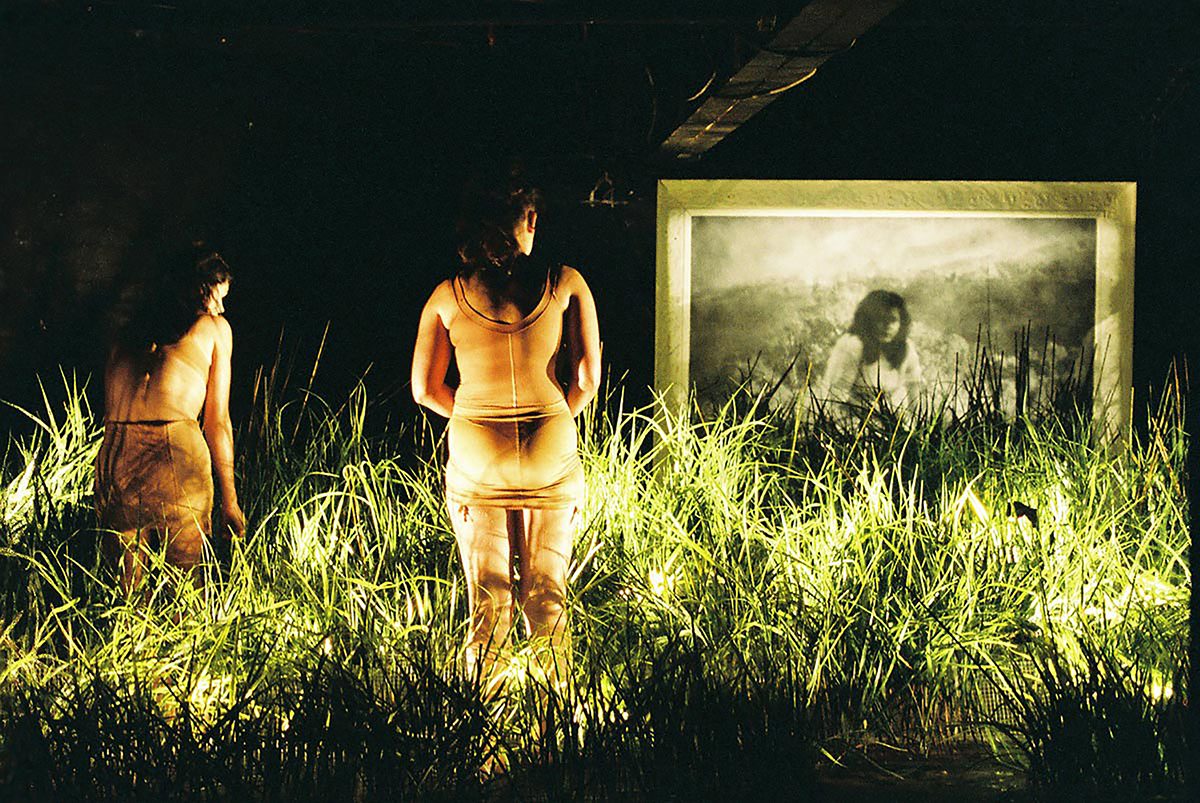
Politely Savage, My Darling Patricia, photo Heidrun Löhr
The fall of ensembles, the rise of live art
One of the other trends that has unfolded over the past decade is a decline in the number of artists working in ensembles. When reading the reviews from the 1990s, I have the impression that to be a “constant spectator” in Sydney—as a profile of inveterate audience member George Papanicolaou (RT2 Aug-Sept 1994) was titled in the second edition of RealTime—was to be in constant conversation with a series of ensembles including Entr’acte, Gravity Feed, Open City, Sidetrack and The Sydney Front. I caught the tail end of this trend, witnessing one generation of ensembles—Version 1.0 and Theatre Kantanka – joined by the next—My Darling Patricia, Post, Team MESS and Applespiel. In recent years, however, my sense is that I am in conversation with fewer ensembles.
The diagnosis is difficult. The fall of the ensemble could be due to the state of arts funding, which is generally down as well as decentralised. Or, it could be due to the rise of live art and the associated rise of festivals. (Sidenote, farewell to the beloved event-based ventures Tiny Stadiums and, my personal favourite, Imperial Panda which Adam Jasper described as the “barometer of a generation” in RT90 April-May 2009 and which I delighted in, in RT102 April-May 2011.) It’s not that ensembles don’t work in live art formats; Perth’s pvi collective, for example, are masters of the form. However, the ensemble functions as an enabling structure or infrastructure rather than as a spectacle and as a result they are not visible in the same way.
One other explanation would have us dig deeper and contemplate the possibility that ensembles may have depended on a degree of cultural homogeneity. That is a polite way of saying that many ensembles were predominantly white and that as the arts have become more diverse, ensembles and their audiences have had to work harder to find common cultural and theatrical languages. Speaking of representation, one of the joys of reviewing has been documenting the work of women: those already mentioned above as well as Zoe Coombs Marr, Nicola Gunn, Mish Grigor, Victoria Hunt, Jane McKernan, Nat Randall, Talya Rubin, Lara Thoms and so many more—“Live work, women’s work,” as the title of my female-focused review of Performance Space’s Liveworks Festival had it in 2011 (RT101 Feb-March 2011).
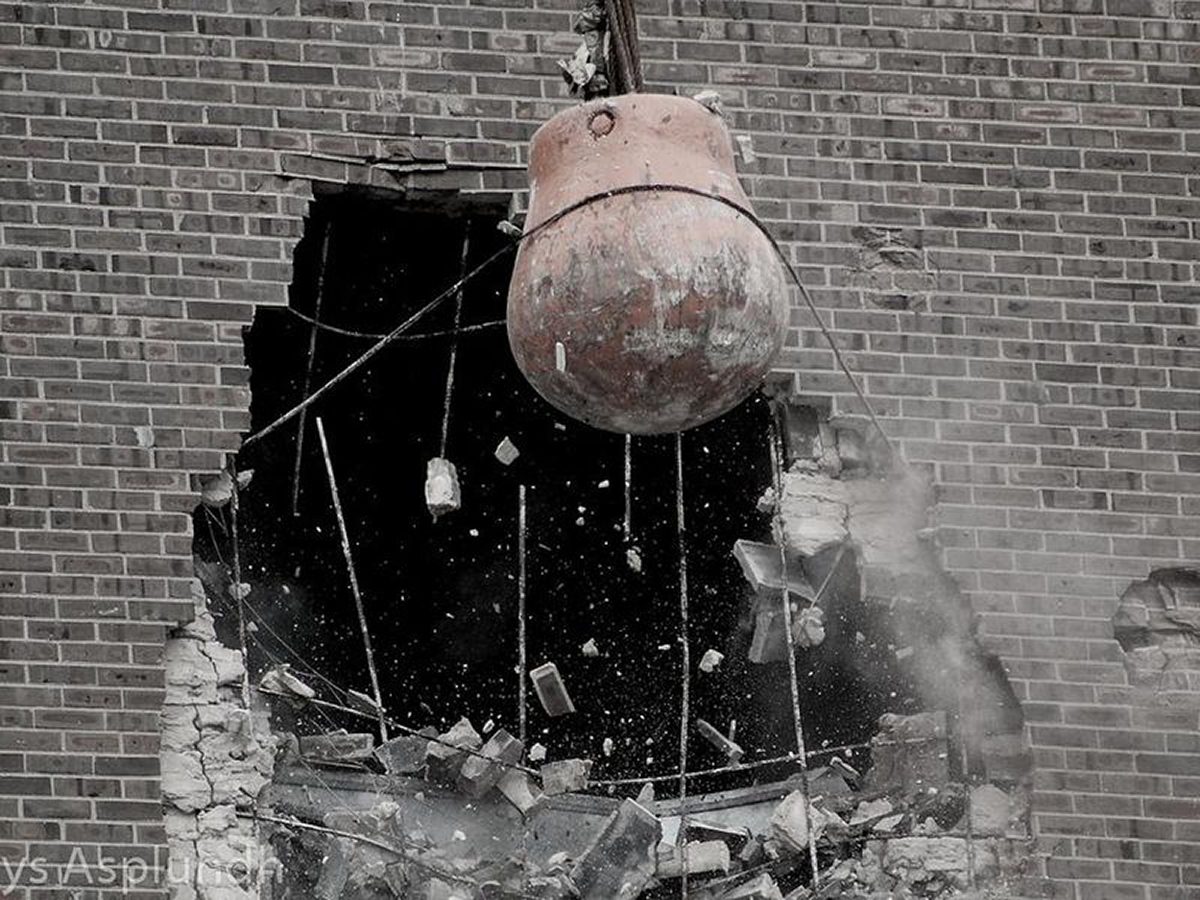
Wrecking Ball, Rhys A via Flickr CC-BY-2.0
The dearth of government arts policy
Perhaps the thing I will miss most about RealTime is its passion for critiquing arts policy. While I didn’t write any of these articles, I read them all as I became increasingly interested in the material conditions underpinning the work I saw. Together with Platform Papers, RealTime recorded a decade of policy false starts and failures. There are analyses of arts policy—or its lack—during the 2010 election (RT98 Aug-Sept), in 2011 when Labor was drafting a National Cultural Policy (RT105 Oct-Nov), and again during the 2013 election (RT116 Aug-Sept 2013). In 2014, there is a stunned response to the Abbott Government’s first budget (RT121 June-July), followed by an attempt to engage with the Five-Year Strategic Plan for a Culturally Ambitious Nation in 2014 (RT123 Oct-Nov). In 2015 and 2016, RealTime records the Brandis “Arts Heist” (RT126 April-May 2015) as well as Catalyst aka the Fifield Fund (RT Online 27 Jan 2016). There are also astute engagements with Platform Papers by Justin O’Connor (RT Online 1 June 2016) and Ben Eltham (RT Online 26 Aug 2016).
Lately, I have been missing this sort of analysis. For it is now three years since the announcement of the first round of Australia Council four-year organisational funding post-Brandis. That round had a 49 percent success rate (128 of 262 applications were funded). Since then multiple companies have folded, merged or restructured. Incredibly, the forthcoming round is expected to be even more competitive because the total amount of money available has stayed the same ($28 million per annum according to the Council’s Four Year Funding for Arts Organisations document, page 3), but the amount that companies can ask for has risen from $300,000 per annum to $500,000. To invoke the pie metaphor so beloved of economic rationalists: the government has now grown the pie, but the slices might well be bigger, and therefore the number of those sustained by it will be smaller.
When conducting information sessions in Sydney in February, Australia Council staff stated that they are expecting a success rate of around 15% for Stage 1: Expression of Interest and 80 to 85% for Stage 2: Full Applications. Elsewhere, they have been more cautious about predicting success rates, saying of Stage 1, “you can expect it to be challenging,” and of Stage 2, “we are aiming to have a success rate of somewhere around 80 to 85%.” This, in turn, is likely to result in a halving of the number of small-to-medium arts companies the Council supports via this mechanism. In other words, whereas in 2016 the Theatre panel funded 24 companies, they might now be able to support, say, 12 or 13. The Emerging and Experimental panel funded five companies and is now expecting to support approximately three. The Community and Cultural Development panel supported 15 organisations and expects to sustain eight or nine. The Multi-Arts panel supported 11 organisations but will fund possibly six this time around. Meanwhile, the Majors go untouched. The very body that is supposed to support the sector is slowly strangling it. If you live in Victoria, then Creative Victoria might pick up the pieces but if you live in NSW, where Create NSW recently ran a project round with a 2.7% success rate, the situation is increasingly desperate.
In the absence of RealTime, I had hoped that a new supportive venture, titled A New Approach, would step in but it is moving at glacial pace. The timeline is thus: in December 2016, the Myer, Keir and Fairfax Foundations called for Expressions of Interest that would “address the critical need for an informed, independent entity which has the necessary resources and public authority to advance a coherent, comprehensive policy position to help build better political and institutional settings and promote the benefits of Australia’s arts and cultural sectors as critical to our nation’s future.” In August 2017, they announced that the $1.65 million grant was going to the Australian Academy of the Humanities and Newgate Communications. Neither is noted for their arts advocacy, but hopes were still high that the combination of a learned academy and public relations firm would bring both weight and reach to the debate. In December 2017, they, in turn, announced that they had recruited Kate Fielding to lead the initiative. In April 2019, they revealed that they had assembled an advisory body to meet for the first time in May 2019.
Two-and-a-half years have elapsed since the EOI and not a single report, policy recommendation or piece of research has been released. Nor has anyone appeared on Q&A, at a writer’s festival, or even in the op-ed pages. In the meantime, several state elections (Queensland and Western Australia in 2017, SA, Tasmania and Victoria in 2018, New South Wales in 2019) and now a federal election have passed without comment or advocacy for the arts. In addition, agencies like the Australia Council have been consulting on a range of initiatives but A New Approach has stayed silent. On the highly problematic Major Performing Arts Group Framework? No public comment. The Australia Council’s new Strategic Plan 2020-24? No public comment. The consultation on a National Indigenous Arts & Cultural Authority? No public comment. This could be because the Chair of the Reference Group for A New Approach, Rupert Myer AO, was previously Chair of the Australia Council for the Arts from 2012 until mid-2018, but no public statement about this potential conflict of interest has been released.
Ordinarily, I am all for slow scholarship but the arts sector in Australia does not have this sort of time. I hope it’s worth the wait, and that A New Approach releases some ground-breaking research and policy papers shortly, but I worry that by the time they are ready, the arts might be all but gone. And it’s hard to explain just how far a resourceful arts company—or publication—could have made that $1.65 million go.
Performance futures
When contemplating the recent four-year funding round, I mused that it would be great if the publications Running Dog (Sydney), Audrey Journal (Sydney), Witness (Melbourne) and Seesaw (Perth) could apply as a consortium. None has the national reach or diversity of artform coverage of RealTime, but together they would come close. Do national conversations matter? In the wake of the most recent election, the answer can only be yes.
More than any other artform, performance pushes my thinking about what it is to assemble, to represent, to embody and to enact. Long before Roslyn Helper had announced her inspired A Government of Artists for Next Wave 2020, one had already been assembled in the pages of RealTime. I am grateful to have been a member of this parliament and to have served alongside the honourable Keith Gallasch, Virginia Baxter, Gail Priest, Felicity Clark and Katerina Sakkas.
–
Caroline Wake is an Australian Research Council DECRA Fellow and Lecturer in Theatre and Performance at UNSW Sydney, focusing on politics and performance, theatres of the real (documentary, verbatim and autobiographical performance), and the cultural afterlives of performance. Caroline worked for RealTime as proofreader, online producer and writer from 2007.
Read about Caroline here.
Top image credit: Executive Stress/Corporate Retreat, Applespiel, Tiny Stadiums Festival 2011, PACT, photo courtesy the artists
RealTime’s coverage of Australian contemporary dance was unprecedented. Until their first edition in 1994, the major papers mainly covered established companies and artists presented in ‘legitimate’ theatres, and Dance Australia magazine rarely veered beyond major dance organisations in preview or review. There were very few other outlets for dance criticism so that, more often than one might expect, RealTime was the only place that independent work (the largest sector in the field) was reviewed. This was recently pointed out by Branch Nebula who have depended on RealTime’s support as their only review outlet since 2008 (Brannigan, Interview with Branch Nebula Part 1). Due to the commitment of editors Keith Gallasch and Virginia Baxter to this breadth and depth of coverage, RealTime has been pivotal in writing the story of Australian contemporary dance since the 1990s, mapping national trends by carefully holding ephemeral works in excellent writing that speaks to us across decades. The discourse has fed the form, filling in blank spaces in the mediascape and the archive, and giving voice to artists themselves.
Following the trend that emerged from the critics imbedded in the New York experimental art scene in the second half of the 20th century, local writers responded to the work of peers and colleagues in the supportive context of RealTime where the review form’s documentation function was taken seriously. As I’ve noted elsewhere, RealTime offers readers consistent coverage of an artist, tracking their ‘moves’ over a number of years (Brannigan, Introduction: RealTime Dance).
Key fellow-writers over many years have included Jodie McNeilly, Pauline Manley, Julie-Anne Long and Philipa Rothfield—all involved in our local scenes as dance artists, dramaturgs, curators and pedagogues—writing alongside journalists, academics and freelancers like John Bailey, Maggi Phillips, Ben Brooker, Jana Perkovic, Anne Thompson, Varia Karipoff, Linda Marie Walker, Carl Nilsson-Polias, Kathryn Kelly, Jonathan Bollen, Rachel Fensham, Douglas Leonard, Sharon Boughen, Sarah Miller, Andrew Fuhrmann and Jonathan Marshall, as well as Gallasch and Baxter. Artist-writers were a part of the mix, such as Eleanor Brickhill, Zsuzsanna Soboslay, Martin del Amo, Vicki Van Hout, Nikki Heywood, Tony Osborne, Bernadette Ashley and Jane McKernan. RealTime’s commitment to developing a field of criticality for dance through numerous workshops and masterclasses has also paid off with a new generation of dance writers emerging in the 2000s, including Jessica Sabatini, and Cleo Mees.
The local activities in each Australian state and territory have also met on the pages of RealTime, a rare thing given there is no national dance festival and despite strong links between individual artists across state lines. In 2010, Sophie Travers surveyed the issue of national touring, a huge deficit that has unfortunately only worsened in the last decade (Australian Dance: Unseen at Home, RT95 Feb-March 2010). While Dance Massive as been touted as an Australian dance festival, it remains Melbourne-centric and thus hasn’t solved the problem of repertoire mobility. Andrew Fuhrmann’s review of the 2017 festival included two Melbourne artists of the four he covered, however Melbourne artists actually made up three quarters of the Dance Massive program (Experience into Dance: Translation and Failure, RT38 April-May 2017).
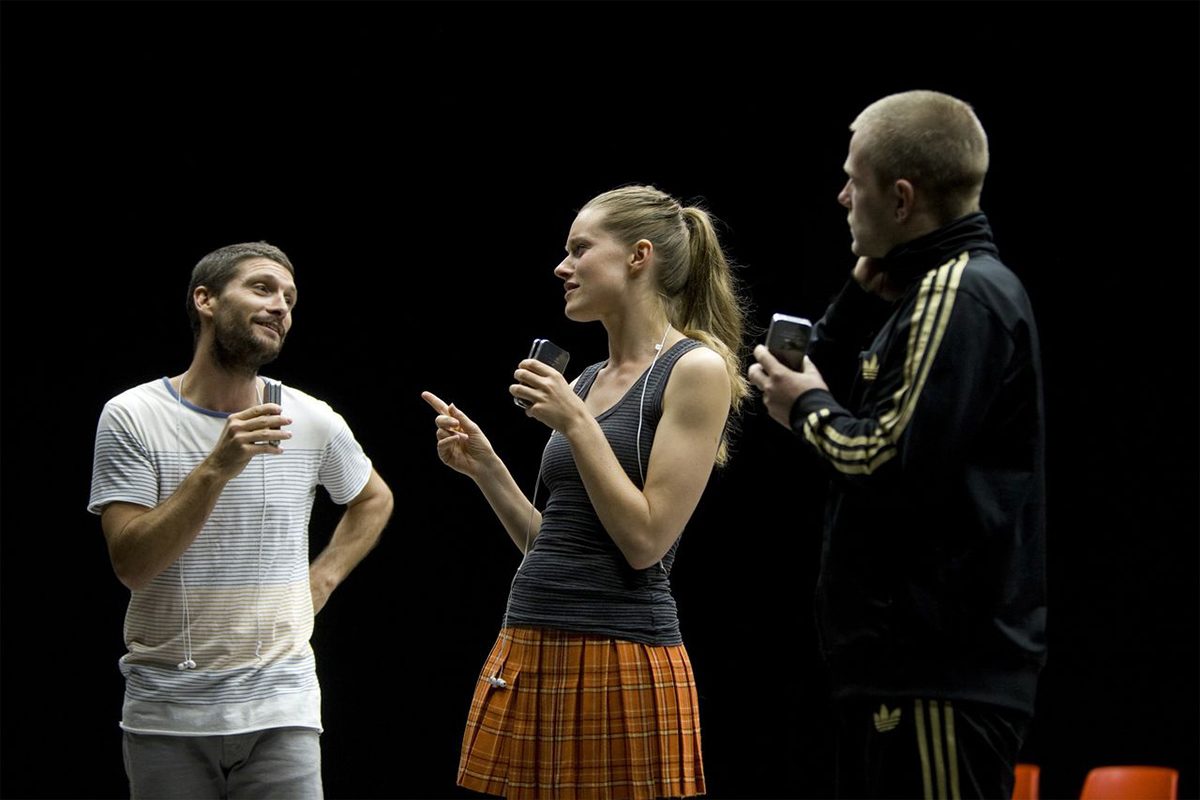
Byron Perry, Stephanie Lake, Alisdair Macindoe, Conversation Piece, Lucy Guerin Inc, 2013, photo Ponch Hawkes
Victoria
Melbourne has a reputation as the spiritual home of dance in Australia, housing the Australian Ballet and its school and the Dance Department at the Victorian College of the Arts which established the first conservatoire model dance degree in Australia, producing some of our best dancers and choreographers, alongside the Deakin University dance program which established the first Australian Dance BA focusing on Education. There is no doubt that the city has the busiest dance scene and RealTime has documented the institution of Chunky Move (1995) (Chunky Move, Wet and Bonehead, RT24, April-May 1998) and Lucy Guerin Inc (2002). Jonathan Marshall surveys Guerin’s body of work on the cusp of this change (Between Temperature and Temperament, RT52 Dec 2002-Jan 2003) as a hub of opportunity and resources for the community. Lineages flowing out of this infrastructure are recorded in reviews of the second generation choreographers such as Stephanie Lake (Marshall links her style to Phillip Adams in Stephanie Lake, RT57 Oct-Nov 2003), Antony Hamilton (Jessica Sabatini, Breaking Through the Fog of Myth, RT122 Aug-Sept 2014), Byron Perry and Jo Lloyd, whose early work was supported by Guerin (Philipa Rothfield, Lateral Moves, RT70 Dec 2005-Jan 2006), Lee Serle (see Bernadette Ashley on his The Three Dancers for Dancenorth, From Picasso to Music to Dance, R134 Aug-Sept 2016) and Luke George (Virginia Baxter matches the energy of George’s Now Now Now in her response, Present Tense, RT102 April-May 2011). Strong links with visual arts venues and post-conceptual tendencies have distinguished the Melbourne field of work and shaped the emergence of the Keir Choreographic Award, Australia’s first choreographic prize.
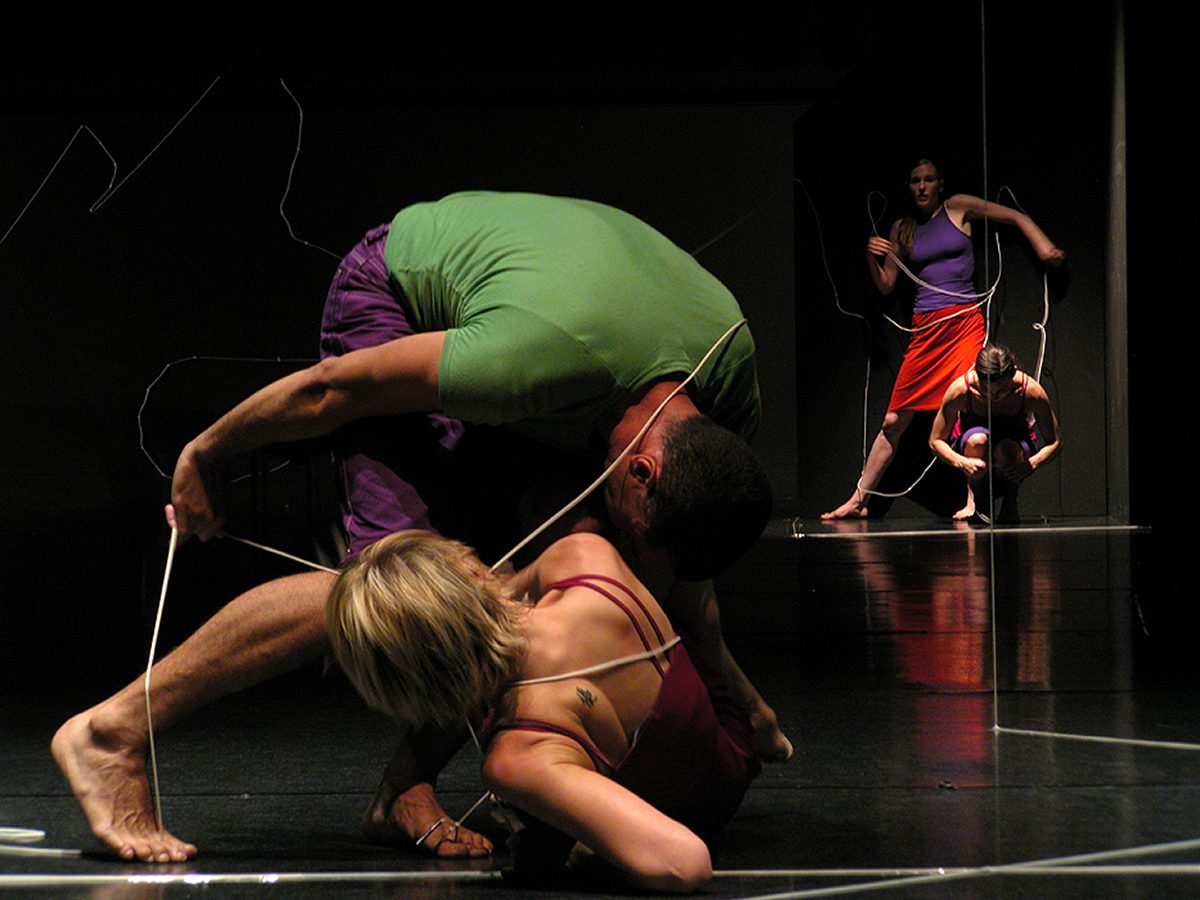
Victor Bramich, Lisa Griffiths, Shona Erskine, Nalina Wait, Fine Line Terrain, Sue Healey, 2004, photo Alejandro Rolandi
New South Wales
The Sydney dance scene encompasses Sydney Dance Company, Bangarra and the independents, the latter being strongly linked to Performance Space historically. Performance Space and RealTime were synonymous for me in the 1990s and early 2000s and One Extra (directors Graeme Watson, Julie-Anne Long), Dance Exchange (Russell Dumas) and Rosalind Crisp’s Omeo Studio completed the picture. As well as reviewing works made by Sue Healey, Rosalind Crisp, Shaun Parker and Martin del Amo, RealTime has since tracked the shift to a fragmented but exciting diversity of venues alongside the demise of access to the larger presenting venues in Sydney, not just for the small-scale works but our major dance companies also. (Gallasch comments on the ecological challenges in Sydney in Readymade Work’s Very Happy Hour, RT Online 1 May 2018).
After a series of Spring Dance programs (2009-2012), the Sydney Opera House closed its doors on Australian contemporary dance (except for Bangarra) until Fiona Winning’s arrival there in 2017 as Director, Programming. A modestly numbered, but highly proactive new generation of artists including Ivey Wawn, Angela Goh, Bhenji Ra, Rhiannon Newton and Amrita Hepi, have occupied galleries, clubs, and public spaces (Cleo Mees on Rhiannon’s work at Firstdraft, Dancing into Infinity, RT Online, 29 Aug 2017 and Laura McLean on Goh and Ra at the same gallery, Techno-Shapeshifting, RT Online 26 April 2017).
Beyond the inner city, Western Sydney’s FORM Dance Projects at Parramatta Riverside, Campbelltown Arts Centre and Newcastle’s Catapult Dance nurture and present important new work. See Pauline Manley’s comments on culturally sharp programming at FORM (Common Anomalies: Dancing with Difference, RT Online 21 November 2017), the editorial Growing Choreography in Newcastle (RT Online 16 Nov 2016), and my interview with then Campbelltown Arts Centre CEO Lisa Havilah and curator Emma Saunders (RT93 Oct-Nov 2009). Havilah’s collaboration with Saunders and Susan Gibb in 2009, What I Think About When I Think About Dancing, set the scene for this expansion of dance in Sydney and pioneered new curatorial directions across dance, performance and the gallery.
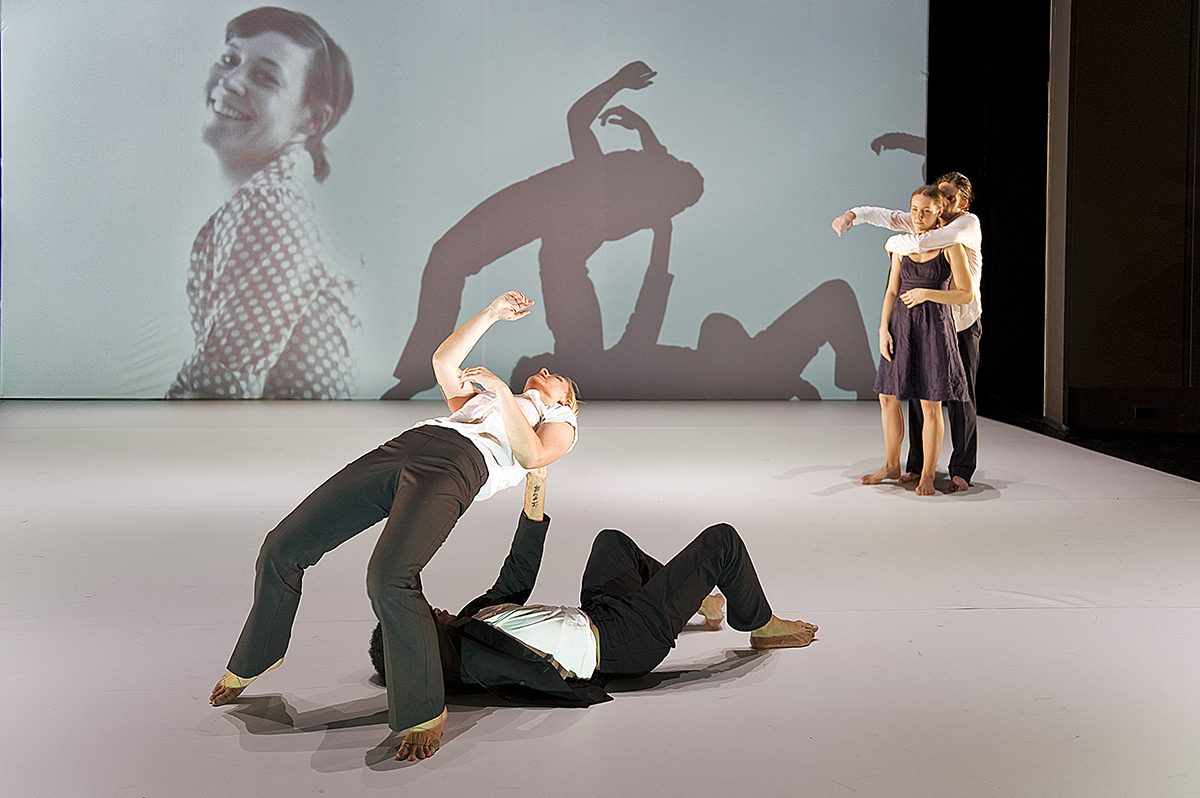
Reflect, Sue Peacock choreographer, 2013, photo Christophe Canato
Western Australia
In Perth Sarah Miller’s tenure as Artistic Director at PICA (Perth Institute of Contemporary Art) imbedded contemporary dance in that institution’s programming. Dancers Are Space Eaters, launched in 1996, was perhaps Australia’s first contemporary dance festival (Rachel Fensham and Sarah Miller, For the Thinking Dancer, RT 11, Feb-March 1996; Grisha Dolgopolov, Who Said? RT34 Dec-Jan 1999). Miller was also a reviewer of dance for RealTime; her 2001 review (RT 37 June-July 2000) of a Paul O’Sullivan and Sue Peacock double-bill mentions other key figures of a generation: Stefan Karlsson, Olivia Millard, Sue Peacock, Sete Tele and Claudia Alessi (and I would add the important Chrissie Parrott). The Dance program at the West Australian Academy of Performing Arts supports local artists with teaching and is another source of new generations of dancers and makers.
Coverage of Perth artists by Jonathan Marshall, Maggi Phillips and Nerida Dickinson saw the emergence of a new generation including Paea Leach, Aimee Smith, Laura Boynes and Olivia Millard, and the MoveMe Festival (Marshall, MoveMe Festival 2016: The Call to Dance, RT Online, 24 August 2016). Strut Dance, established in 2003 by Sue Peacock and Gabrielle Sullivan, joined Dancehouse in Melbourne and since then, Critical Path in Sydney to create a network of like-minded organisations servicing artist development.
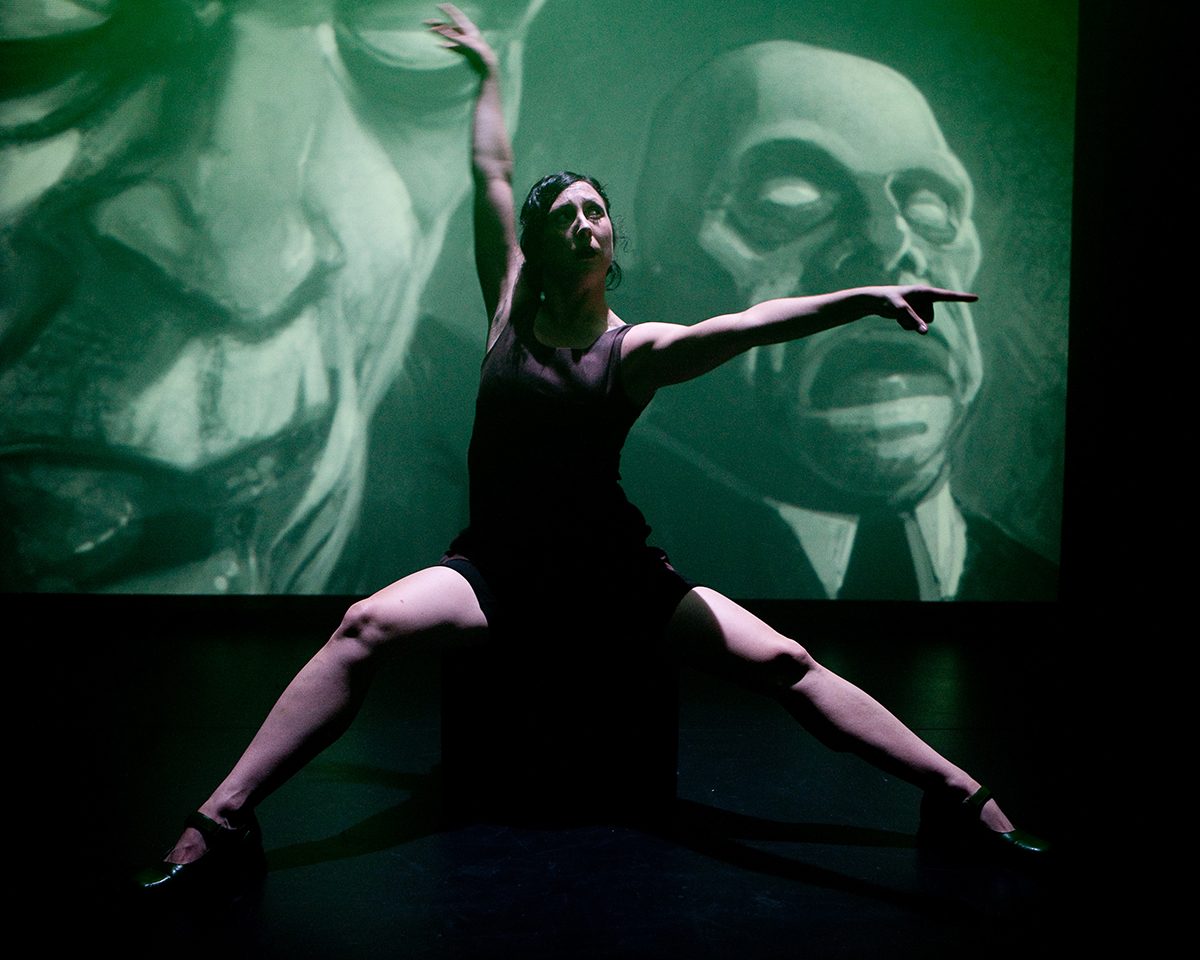
Lisa O’Neill, The Pipe Manager, 2010, illustrations XTN (Christian Ronquillo), photo Sean Young
Queensland
The Queensland scene has been diverse geographically, culturally and generically, with Dancenorth, directed by Kyle Page, touring internationally and operating from Townsville, Bonemap in Cairns and Gavin Webber and Grayson Millwood with their company, The Farm, on the Gold Coast, bringing a European style of dance theatre to the state and beyond. Dance reviewers included the late Doug Leonard, Julia Postle, Shaaron Boughen, Bernadette Ashley (responding to Dance North over many years), Rebecca Youdell and Kathryn Kelly.
In Brisbane, from the 1990s on the Suzuki Method was influential via the companies Zen Zen Zo and Frank Theatre (John Nobbs, Jacqui Carroll), as have been circus and performance. Lisa O’Neill (ex-Frank) and Brian Lucas (including his work with Expressions Dance Company) have been key players, and mentors, alongside newcomers like choreographer Lisa Wilson, while QUT dance graduates feed the local dance scene. The influence of South Pacific cultures is felt in the work of Polytoxic (Efeso Fa’anana, Leah Shelton, Lisa Fa’alafi; see Unpacking South Pacific fantasies, RT72, April-May 2006) and Indigenous culture in the works and advocacy of Marilyn Miller and BlakDance, the Brisbane-based peak body for Indigenous dance in Australia. 2017’s Supercell Festival of Contemporary Dance revealed the potential of a much-needed international dance event.
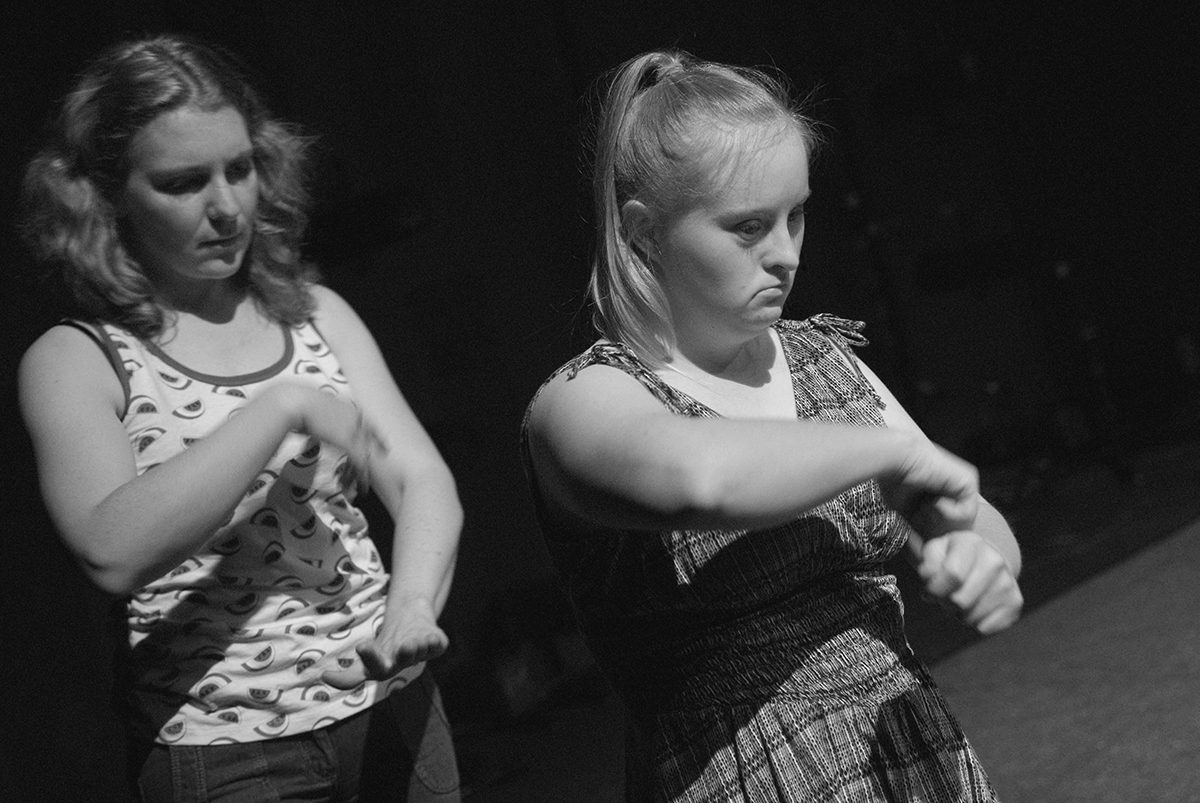
Zoe Barry, Anastasia Retallack, Safe from Harm, choreographer Ingrid Voorendt with Restless Dance, 2008, photo David Wilson
South Australia
Writers Anne Thompson, Helen Omand, Linda Marie Walker, Jonathan Bollen and more recently Ben Brooker have covered dance in Adelaide where ADT (Australian Dance Theatre) has held its ground for decades. The company entered a new phase, extensively covered by RealTime, when Sydney-based choreographer Garry Stewart took on the directorship in 1999 and engaged with, among others, scientists and media artists. Leigh Warren and Dancers has also played a key role in Adelaide’s dance ecology, including collaborations such as Philip Glass’ opera Akhnaten with the State Opera of South Australia.
A local independent scene has produced notable female dancemakers such as Astrid Pill, Katrina Lazaroff, Fleur Elise Noble, Helen Omand and Alison Currie, Ingrid Voorendt, Gabrielle Nankivell and Larissa MacGowan (the latter two ex-ADT). Restless Dance Theatre, a rare disability arts company rooted in dance, was founded in 1991 by Sally Chance who was interviewed about its origins by Anne Thompson (Enabling Dance, RT22 Dec-Jan 1997). Subsequent artistic directors have included Voorendt and Michelle Ryan.
Adelaide is also the home of the OzAsia Festival which has recently come of age with a strong dance focus, connecting local artists such as Alison Currie with peers in the region (Brooker, OzAsia 2018 Performance: More Than Cultural Diplomacy, RT 5 Dec 2018).
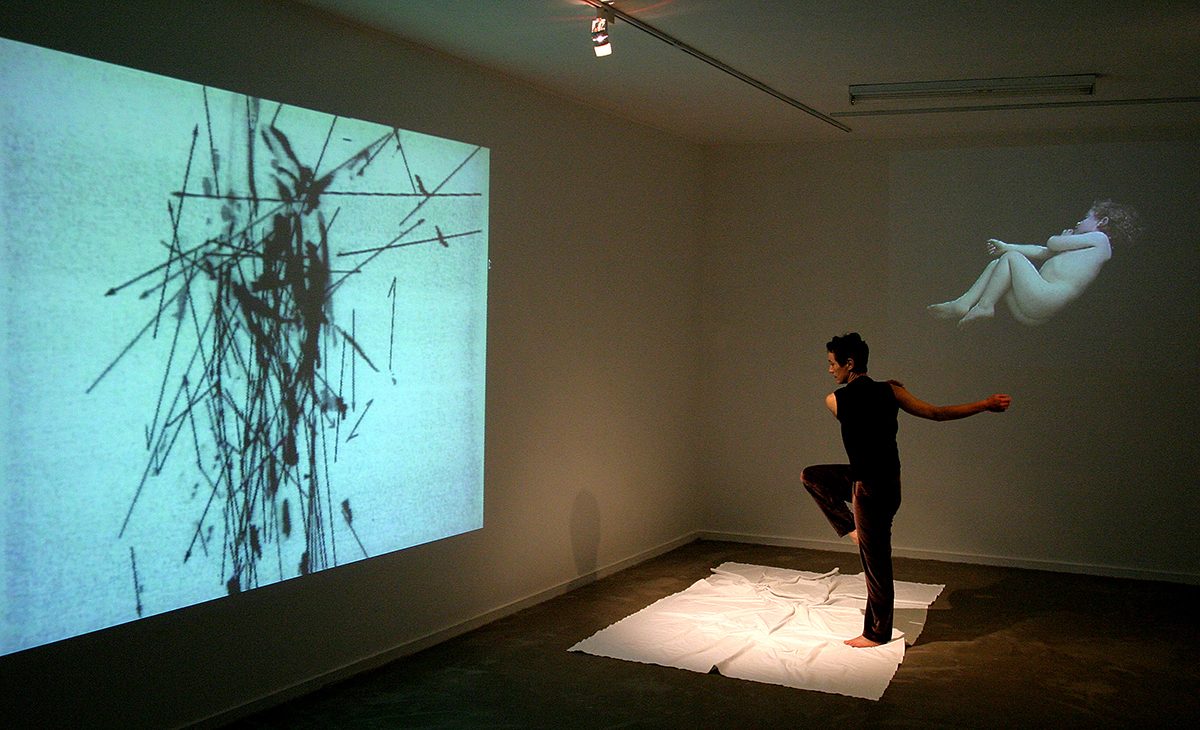
Wendy Morrow, Blue, 2004, photo Pling
Tasmania
Salamanca Moves 2016 in Hobart, covered by Lucy Hawthorne, showcased the local scene alongside international acts, putting local artists into dialogue with significant internationals such as Liz Aggis (Internationals, Locals, Any Body and Every Body, RT Online 19 Oct 2016). Tasdance, Second Echo Ensemble, and MADE (Mature Artist’s Dance Experience) and, at various times, independents like Wendy Morrow and Wendy McPhee, have all kept contemporary dance humming across generations, as reviewed by Sue Moss, Judith Abell and Diana Klaosen. Tasmania is also home to youth-focused companies Stompin and DRILL. Many emerging Australian choreographers have cut their teeth in our most southern state with Tasdance and Stompin in particular.
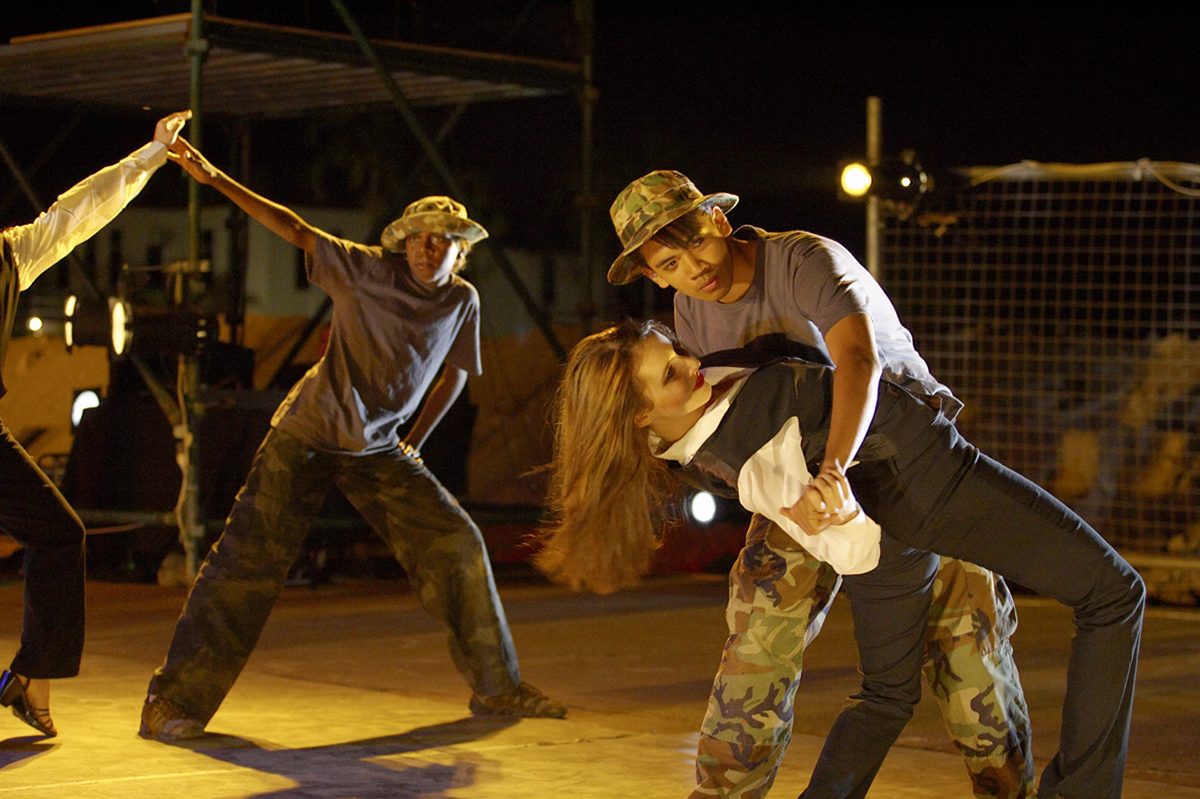
Mr Big, Tracks Dance Company, 2006, photo courtesy Tracks
Northern Territory
RealTime has followed Northern Territory’s community-based dance company Tracks, which consolidated under the name in 1994, the same year as RealTime’s founding (Joanna Barrkman, Tracks: New Venue, New Artists, RT57 Oct-Nov 2003). Tracks has featured strongly in many Darwin Festivals including a collaboration with Darwin-based choreographer and Larrakia man Gary Lang (Malcolm Smith, The riches of rusting RT64 December-January 2004). Lang is artistic director of NT Dance Company; Fiona Carter reviews his work Mokuy (Healing the Pain of Loss, RT121, June-July 2014).
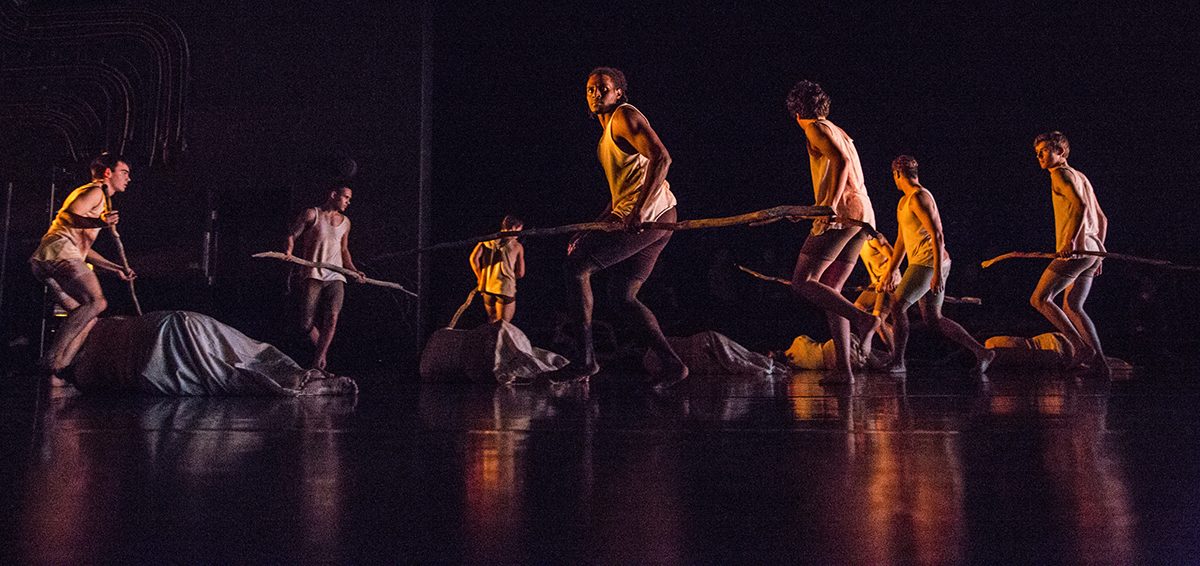
Hit the Floor rehearsal, QL2, photo courtesy the artists
ACT
Coverage of dance in Canberra (from 1980 to 1996 once home successively to Human Veins Dance Theatre, Meryl Tankard Company and Vis-a-Vis Dance) was largely limited to reviews of QL2 Dance and its impressive youth group Quantum Leap (Zsuzsanna Soboslay, Sharing Country, RT117 Oct-Nov 2013.
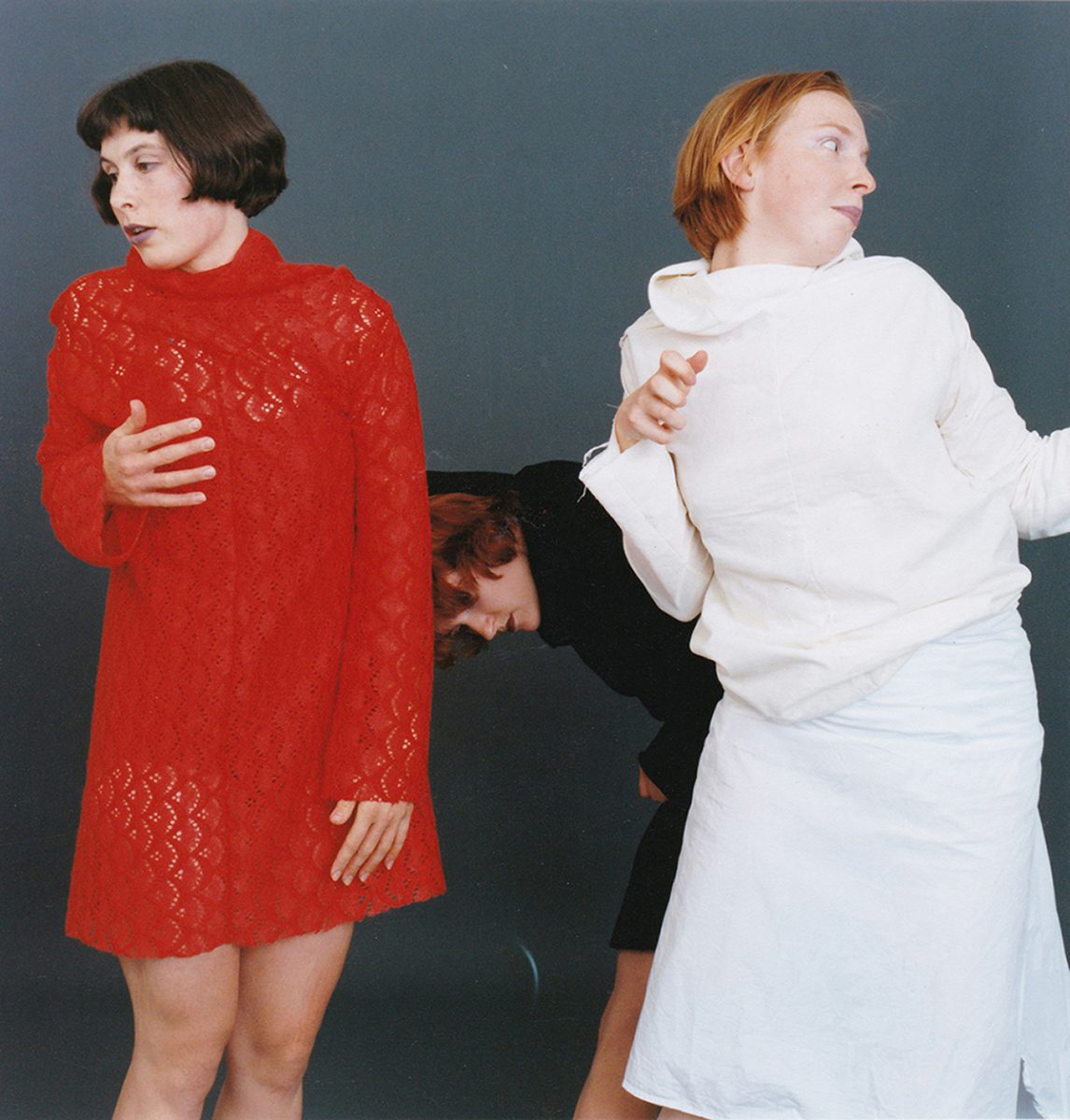
Deanne Butterworth, Kylie Walters, Jo Lloyd, Shelley Lasica’s Action Situation, 1999, photo Kate Gollings
A visual arts dance paradigm, Keir Awards & Post-Dance
The Keir Choreographic Awards were established in 2014 though a partnership between philanthropist Philip Keir and the Australia Council for the Arts. Some of the teething problems were recorded in RealTime; Keith Gallasch documents the controversy over ‘form’ that the first iteration precipitated in an article that called for a public discussion that has never happened (Was There Dancing?, R123 Oct-Nov 2014). That the judging panels have included so many visual arts specialists indicates the current liaison between dance and the visual arts, a tendency that emerged from the intermedial hotbed of Brussels in the early 1990s in the pre-‘conceptual’ work of Meg Stuart. Since then, it has been connected to a trend towards ‘non-dance’ led by primarily male French choreographers and expressed fully in Boris Charmatz’ Musée de la danse. This has resulted in many and varied experiments across disciplinary borders, including local artists such as Lizzie Thomson, Matthew Day, Brooke Stamp and Angela Goh. Shelley Lasica has occupied this terrain since the early 1990s and RealTime has covered her body of work extensively, with special attention to her work from Philipa Rothfield (see for example, A Differential Tale, RT30 April-May 1999).
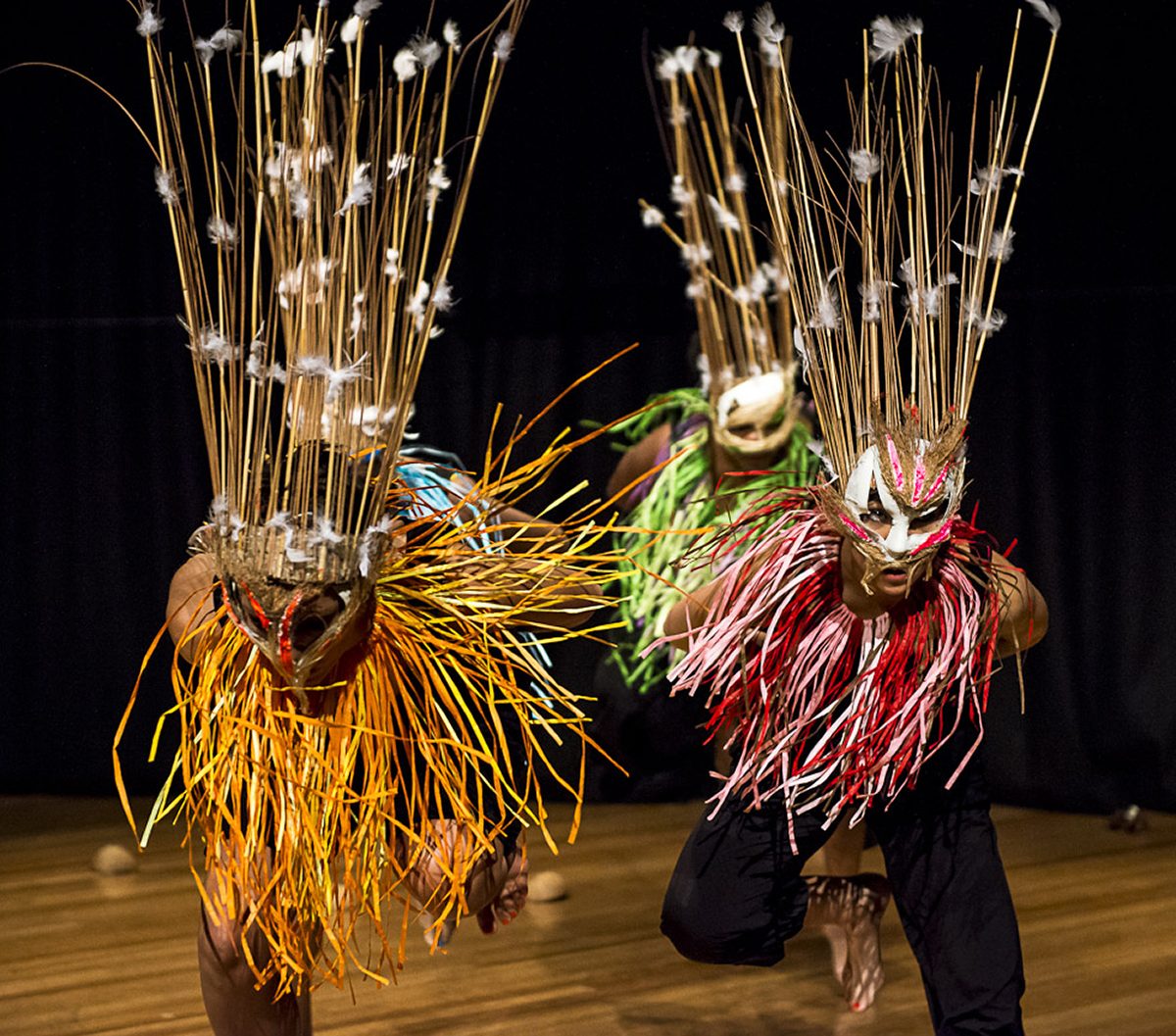
Winds of Woerr, 2014, choreographer, Ghenoa Gela, photo Gregory Lorenzutti
Contemporary Indigenous Dance
RealTime’s coverage of contemporary Indigenous dance has consistently identified exciting new artists in the field, and recognised the achievements of established ones. The editors’ support of artists such as Vicki Van Hout has done much to encourage and disseminate their work, as was recently recounted by the artist (Brannigan, Interview with Vicki Van Hout, Part 1) Keith Gallasch’s reviews of Van Hout’s work are exemplars of the role that the reviewer can take in bringing to light new artists and uncovering their innovations (Brilliance, Shimmer, and Shine, RT103 June-July 2011). Van Hout has gone on to write pieces for RealTime and her blog for FORM, providing an important Indigenous voice on dance, including her musings on an issue close to her heart: the tensions between Indigenous cultural protocols and innovative arts practices (Burning Issue—Authenticity: heritage and avant-garde, RT111 Oct-Nov 2012).
Torres Strait Islander Ghenoa Gela, winner of the 2nd Keir Choreographic Award in 2016, was reviewed by Andrew Fuhrmann who saw promise in the artist amongst stiff competition, and an investment by Keir in choreographers exploring non-Western cultural forms was continued with the excellent Javanese-Australian choreographer Melanie Lane taking the award in 2018. Broome-based Dalisa Pigram, co-artistic director of Marrugeku with Rachael Swain, has also been followed closely in RealTime (video interview by Gail Priest, We Can All Dream, RT125, Feb-March 2015). The magazine has also covered high profile artists such as Stephen Page and is Bangarra Dance Theatre artists Patrick Thaiday and Elma Kris. (RealTime mentored young Indigenous writer Rianna Tatana through her interview with Kris, Elma Kris: From a Torres Strait Islander Perspective, RT124 Dec 2014-Jan 2015.)
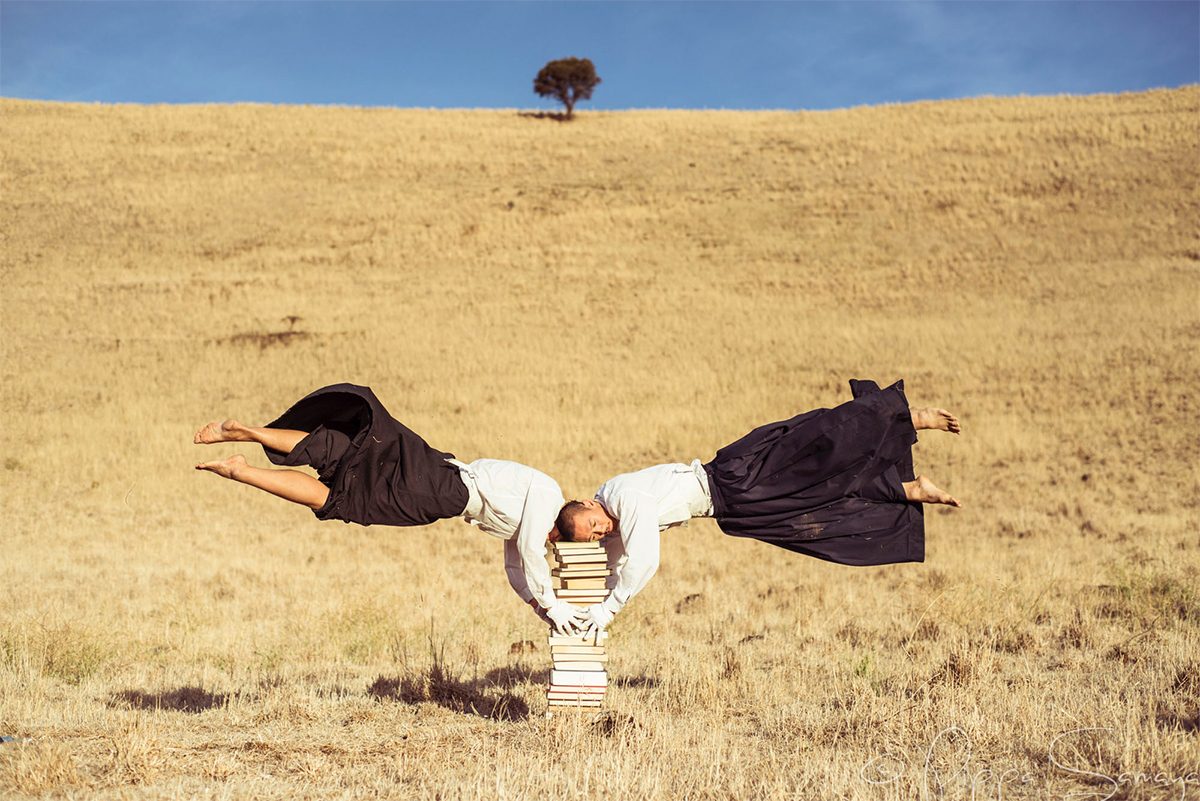
The Knowledge Between Us, Samaya Wives, video image courtesy the artists
2000s and screen dance
I think my first article for RealTime was written in 1997 on the Microdance series of shorts made for ABC TV. RealTime already loomed large as my window onto the experimental arts in Sydney, Australia and the world. I transferred information in their advertisements into my diary diligently, and followed the careers of dance artists through the thick descriptions encouraged by a nebulous ‘house style’ that privileged careful accounts over reductive judgments. In RealTime I also found somewhere open to publishing articles emerging from my burgeoning interest in intermedial practices across dance and film/video. The magazine maintained a commitment to covering this niche field of practice, commissioning myself and writers overseas to cover the international field, supporting events closer to home through smart critique, and running a workshop for aspiring writers alongside the 2008 edition of ReelDance International Dance Screen Festival in Sydney (RT85 June-July 2008).
Interest from Australian funding bodies in the dance-screen nexus waned after the first decade of the 21st century, and the international scene slowed down as artists across the world seemed to shift away from this expensive mode of choreographic production that requires serious resources. The most recent coverage was of Samaya Wives’ (Pippa Samaya and Tara Jade Samaya) The Knowledge Between Us (2017), which won the Australian Dance Award for the awkwardly named Dance on Film or New Media prize (Gallasch, Samaya Wives: One-Minute Dance Award Winner, RT Online, 26 Sept 2017). Young artists do seem to be returning to the form, and there has been renewed talk of screenings at ADT in Adelaide and Lucy Guerin Inc in Melbourne.
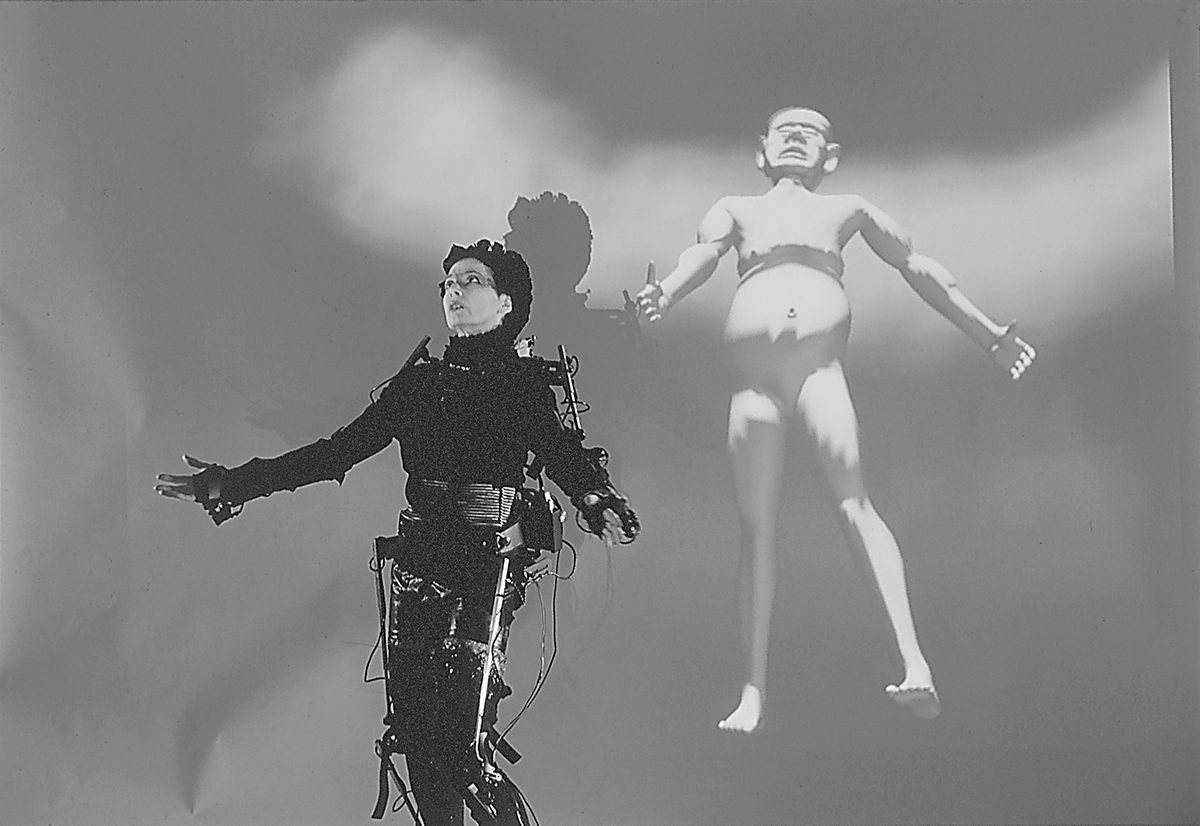
Hellen Sky, CO3, 2001, Company in Space, photo Jeff Busby
Dance and new media technologies
The investment of funding bodies in the dance-technology interface resulted in a flurry of activity across the end of the 1990s and beginning of the 2000s. Leaders in this field have been Company in Space (Hellen Sky and John McCormick) and Margie Medlin. Medlin joined temporary Australian resident Gina Czarnecki in scoring the prestigious Sciart award from the UK’s Wellcome Trust for her work Quartet (Brannigan, Music Makes Moves, RT 76 Dec 2006-Jan 2007).
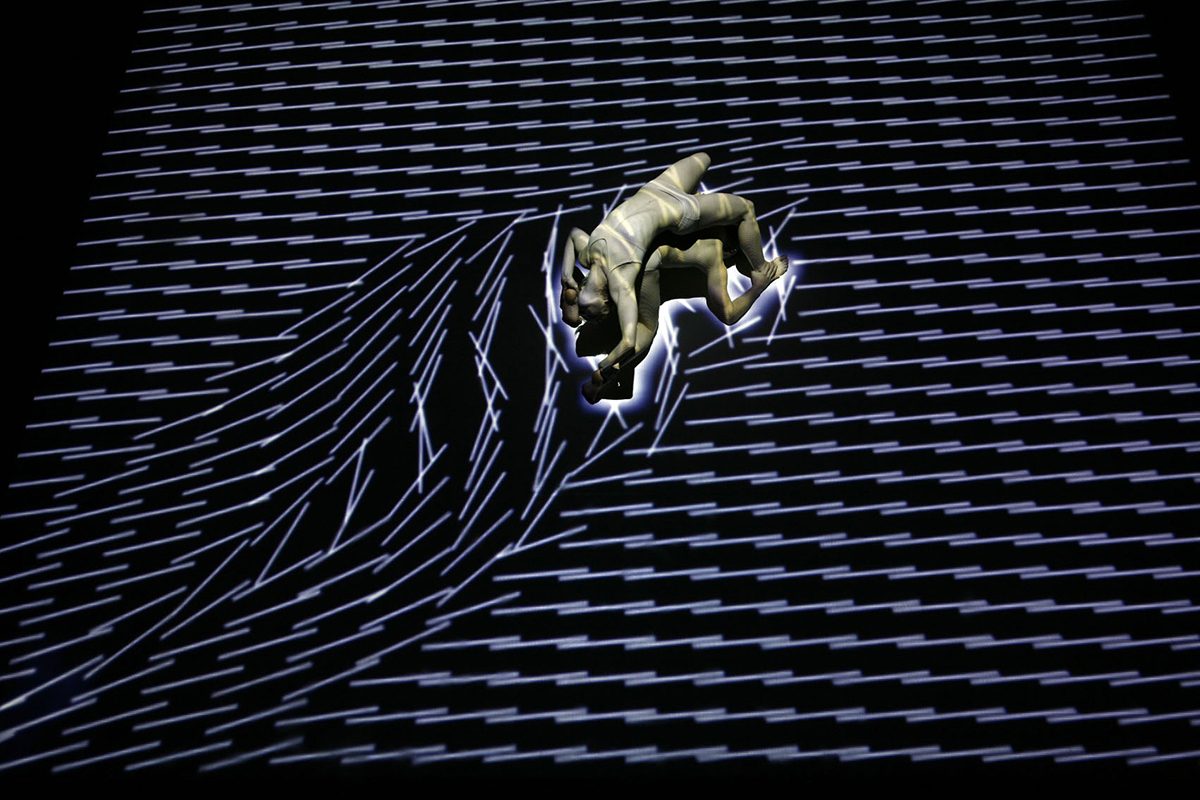
Kristy Ayre 2008, Glow, Chunky Move, video still courtesy Chunky Move
RealTime traced the development of the sub-field, and one of the most positive reviews was Gallasch’s snappy response to Gideon Obarzanek’s simple and moving Glow (Doubly Emergent: Chunky Move’s Glow at The Studio, RT78 April-May 2007). He writes: “The emergent art tool is at one with the dancer’s body in an account of an emergent organism, a huddled inhuman shape inching across the screen-floor.” In her role as Director of Critical Path, Margie Medlin championed this work. Her SEAM conference of 2010, sub-titled Agency and Action (the series running 2009-2014), was a singular event combining a new media performance program with a rigorous conference (Rackham, Mind, Play, Empathy and Machines, RT100 Dec 2010-Jan 2011).
Cover: Bodies of Thought: 12 Australian Choreographers
Other publications
The booklet In Repertoire: A Guide to Australian Contemporary Dance (RealTime for the Australia Council, 1999, revised 2003) and the book Bodies of Thought: 12 Australian Choreographers (Ed. Erin Brannigan and Virginia Baxter, Wakefield Press-RealTime, 2014) are publications that draw on the magazine’s dance content as consolidated in RealTime Dance, an online resource established in 2014. In Repertoire is an Australia Council-commissioned snapshot of Australian choreographic works ready to tour in 2003. In RealTime Dance, Dance File lists Australian artists and companies alphabetically, with links to relevant RealTime articles as well as a considerable catalogue of international artists and companies.
Bodies of Thought is the first publication to bring works of key Australian choreographers together to map common approaches and themes nationally, combining interviews with critical essays supported by the RealTime archive. In this case, RealTime reviews are supplemented online with external reviews, putting RealTime into critical dialogue with other reviewing outlets. Added to this is RealTime TV which features interviews with Lee Serle, Anouk van Dijk, Dalisa Pigram, Tim Darbyshire and many others, and Dance on Screen which brings together writing on this genre.
Conclusion
Even with a most optimistic view onto the new era of democratised, online arts reviewing, it is hard to imagine another publication that could put contemporary dance into dialogue with the other arts in the same way RealTime has done. RealTime seemed to understand the leading role dance has taken, quietly and persistently, on numerous fronts; in innovating the review format, engaging with other media in an inclusive choreography with whatever materials were necessary, and the modelling of community practices so integral to the art form. The strength of the magazine in following the art form in its interdisciplinary adventures is dependent upon an editorial scope that takes it all in. For this reason RealTime’s editors Keith Gallasch and Virginia Baxter, and their vision for a publication where dance took centre stage, will be sorely missed by Australian dance artists and aficionados alike.
–
Erin Brannigan has written for RealTime since 1997, was the founding Director of ReelDance (1999-2008), has curated dance screen programs and exhibitions for international festivals, programmed and commissioned works for installation exhibitions and led Choreography and the Gallery: A One-Day Salon (Biennale of Sydney 2016, Art Gallery of NSW and UNSW). Erin is a Senior Lecturer in Theatre and Performance Studies at UNSW.
Top image credit: Be Your Self, Australian Dance Theatre, photo Chris Herzfeld, Camlight Productions
Looking back on the decade or so of Australian performance that I witnessed between 2005 (when I moved here) and today, what struck (and has long been striking me) as most notable has been the slow retreat of liveness—both as an aesthetic, dramaturgical concept, and as an understood fact of life.
I cannot say much about the 1990s: I wasn’t here. But the performance I grew up on was a theatre that increasingly poked holes in its own fiction: the Forced Entertainments and Martin Crimps of this world were reflecting on stage the self-referentiality that Tarantino, Fincher and, later, Kaufman brought to film. The 1990s story-telling existed between inverted commas: referencing tropes and genres while knowing full well that they were untethered from ‘real experience,’ whatever that might be. The artists who left the biggest impression on me at the time were feminist playwrights Sarah Kane, Ivana Sajko and Biljana Srbljanović, who were consciously using the frame of a stage performance to deconstruct national and patriarchal myths, all while deconstructing mimesis. Alongside them, body art and physical theatre, with echoes of Pina Bausch’s Tanztheater, were trying to bypass mimesis altogether, and find some sort of truth in pure co-presence of performers and audience.
In Europe, two overarching concerns were challenging mimesis in a kind of counterpoint: on the one hand was a sense of profound unreality of mass media. Every day, we were receiving our news through the one-way stream of television images, images without context and without potential to anchor themselves in our daily reality: wars, famines, oil spills, distant lands, all disappearing at the click of the red button. We were being told, through the same small box, that ‘we’ as a ‘nation’ were responding to these events with armed forces, aid convoys or disinterest. The overarching affect was of a complete lack of a sense of agency. The war in Bosnia exacerbated this cynicism pecisely because it was happening so close, yet there was no way to make sense of it on TV. Mass media was creating a type of situation in which bearing witness to atrocities, instead of enabling us to intervene, was being used to create a kind of spectatorial event. Is it any wonder that we responded with a profound sense of detachment from storytelling?
An antidote to this sense of profound unreality of mass media was the undeniable, unshakable reality of live performance. Writing about this moment in performance, Hans-Thies Lehmann would later note that while a flickering image of a chair is a material sign of sorts, it is precisely not a material chair. In theatre, the sign and the thing are as close as they can be: on stage, a real chair is representing another real chair, a real person another real person. When the performer is tired, they sweat real sweat. When they are cut, they bleed. As Heiner Müller said, “And the specificity of theatre is precisely not the presence of the live actor but the presence of the one who is potentially dying.” This was a comforting thought, given the context.
Melbourne theatre lagged behind. In 2005, when I landed, mimesis was still going strong and going unquestioned. This seemed strange and not quite right, given the political context. The Australia that I arrived in was John Howard’s country, and it occurs to me now that during that time we witnessed Australian media’s own precipitous divorce from fact-based reality. Rewriting of lived experience with the Children Overboard scandal, rewriting of international law with multiple innovative ways of locking up refugees, rewriting of legal process with the Australian Wheat Board affair this was top-down postmodernism of the highest order. (It was also gaslighting on a national scale, but we didn’t then have the word.) I knew this sense of unreality; that was why theatre had become such a cultural force for my generation in Croatia. And yet, Melbourne Theatre Company was staging West Wing entertainment. It was staging Don Juan in Soho… It was Sydney that responded most ferociously to John Howard, probably thanks to its long history of mixed-media live performance. Version 1.0 created theatrical reenactments of these implausible television performances, turning them on themselves with something between detached puzzlement and burning rage (A Certain Maritime Incident and Deeply Offensive and Utterly Untrue). Early post and Team MESS followed on, challenging the mainstream semiotic constellations of the time.
There was no such rage in Melbourne, but something else was emerging. From 2005 until 2010, Kristy Edmunds’ Melbourne International Arts Festival (MIAF)and Arts House recently established by Steven Richardson brought in a short, sharp dose of postmodernism: British live art and American postmodern performance. Within just a few years, Melbourne had its first appearances of Ariane Mnouchkine, Romeo Castellucci, Jérôme Bel, Ontroerend Goed, Dood Paard, dumb type, Forced Entertainment… Within a year or two, their methods percolated through Melbourne’s independent theatre, always vibrant and increasingly fed up with MTC.
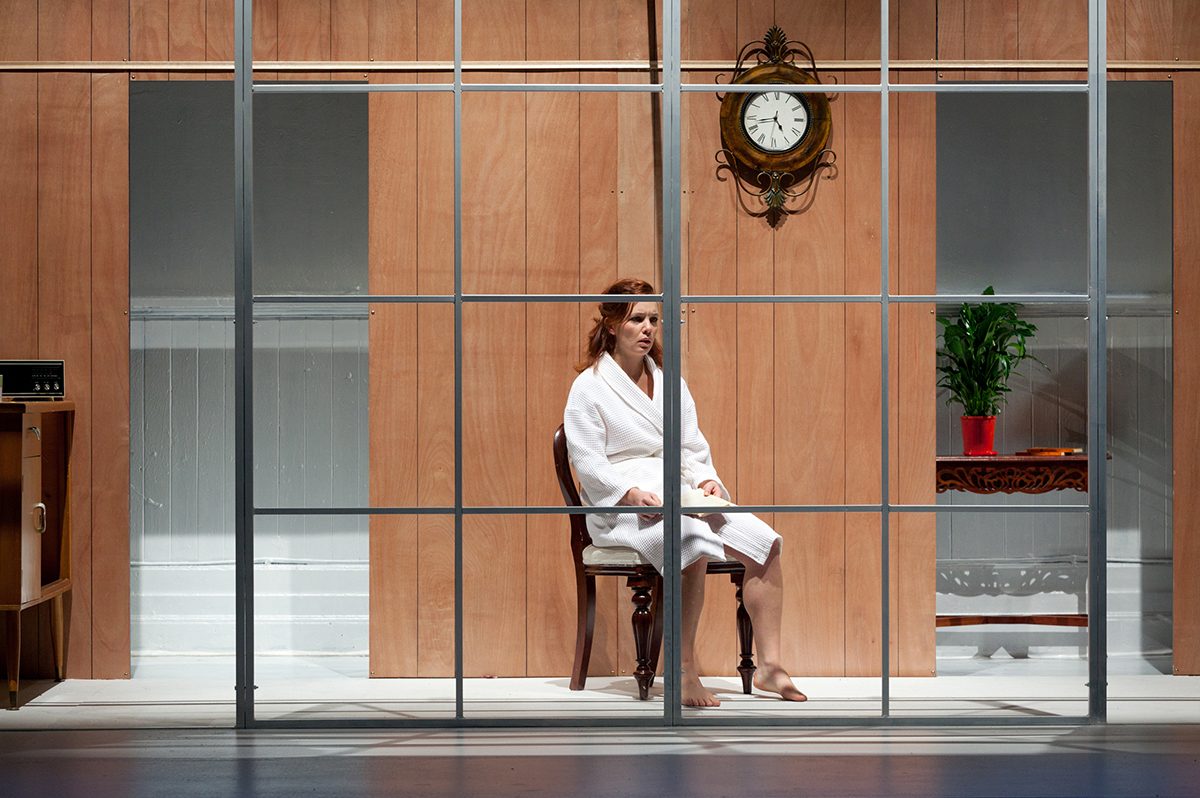
Persona, dir Adena Jacobs, Fraught Outfit, 2012 photo Pia Johnson
Melbourne’s theatre at the time seemed to me strongly influenced by lyrical body work that I associated with Grotowski and Bausch’s Tanztheater, grounded in an echo of Appia’s symbolism, with emphasis on controlled presence in performance and otherworldly sets. That mode of performance never changed; Melbourne theatre never collectively discarded mimesis. Small independent companies, such as Hayloft Project, Black Lung, Adena Jacobs’ Fraught Outfit and the work commissioned by Malthouse Theatre under Michael Kantor and Stephen Armstrong, instead absorbed the selective breaking of illusion they saw in overseas work and responded by widening the gap between the signifier and the signified. ‘Theatre theatre’ found its inverted commas.
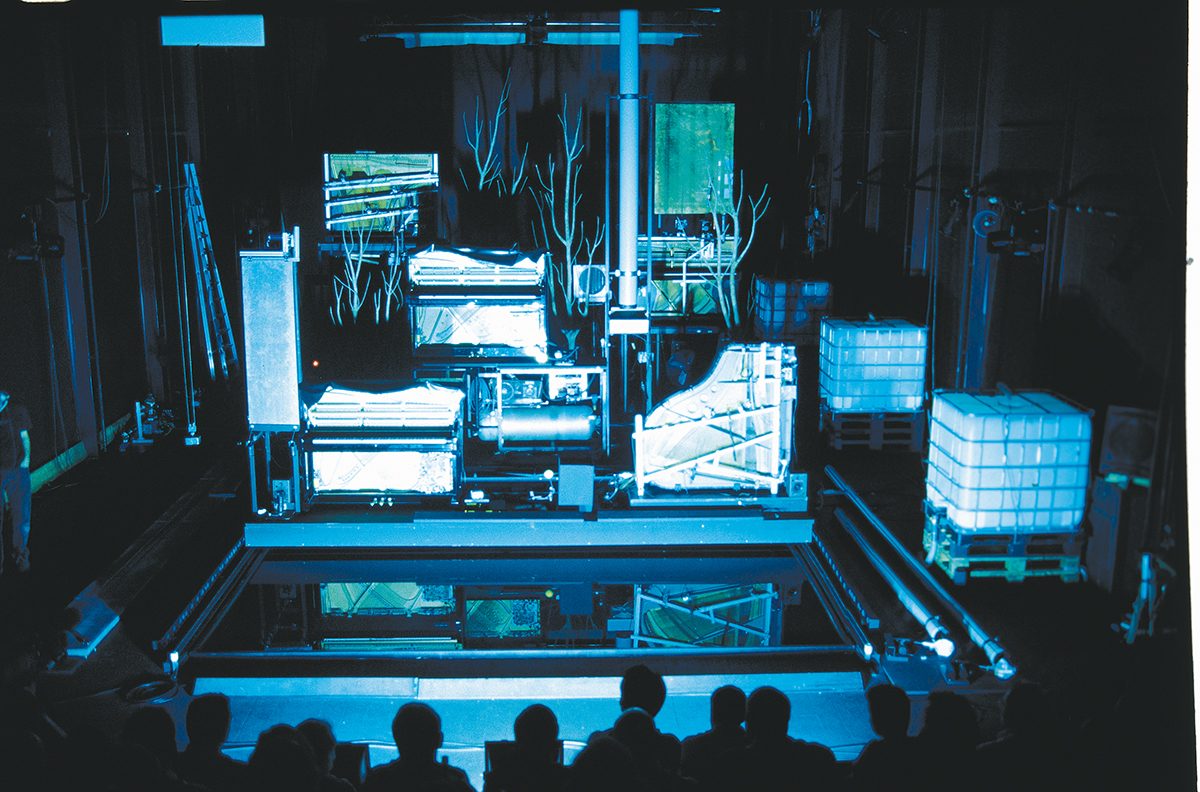
Heiner Goebbels’ Stifters Dinge, 2010, photo Mario Del Curto
The years that followed saw a rich exploration of illusion in narrative story-telling. Directors turned to playwrights such as Ionesco, Beckett, Bergman and Marius von Mayenberg, framing their exploration more as broadly existential than narrowly political (less ‘mass media is lying to us’ than ‘what is real anyway?’). There was also a marked shift towards retelling Jewish and central European stories, as if in an attempt to restore something missing from the Anglo-Australian narrative of who we are. Forms from puppetry, circus, dance, physical theatre, and visual installation, video art and sound art all entered theatre, as did carnivalesque as a mode of event presentation. This dovetailed interestingly with an international shift towards materiality and the performance as a social event. Pivotal here, I think, were the first appearances of Heiner Goebbels (MIAF 2010) and Ontroerend Goed (Arts House 2009): the latter for incorporating children, the former for its lesson in using props. (Suddenly, everyone was working with children, everyone’s sets were artfully collapsing.) Relational performance came out of this: Melbourne’s interest in live art coalesced seemingly entirely around participation, with significant works created by one step at a time like this, Triage Live Art Collective, Aphids, Field Theory, Lara Thoms, Tristan Meecham, and Luke George and BalletLab in dance. By 2013-4, there was a sense that every theatre outing might involve being asked to climb into bed with the performer. Some had very tangible social outcomes, such as Tristan Meecham’s series of dance classes for LGBTI elders, and the Coming Back Out Ball.
The playfulness of this wave of participation was not apolitical, though it was profoundly unrelated to national politics. Melbourne is a large town, rather than a sprawling metropolis, and the sense of a localised community is strong. Works such as one step at a time like this’s en route or Triage’s Take To Your Bed seemed to strive to create a small, tangible time-space in which participants could have a genuine encounter. Live art became a world designed at a human scale, a series of comfy rooms in which a chair was not only a real, material chair, but it was a site of a real encounter, not a representation of one.
At that same time, smartphones and social media were becoming ubiquitous, and virtual and embodied forms of sociality were starting to bleed into one another. The first flash mobs appeared, coordinated on the Internet. 2011 saw London riots, the first in which communicating via social media made it possible for the protesters to disperse at will and regroup once the police had passed. Soon thereafter, there was Occupy Wall Street, and then Twitter. The relationship between one’s virtual persona and your material, ‘real’ behaviour was revealed as deeply unstable. The comforts of relational performance were perhaps less about the beds and the cups of tea and more about affirming one’s undivided, individual identity—identified not by an avatar, date of birth or IP address, but by a smile and a stroke of the hand.
In 2012, at SXSW, Bruce Sterling spoke about his frustration at retro-ness (“the belief that authenticity can only be located in the past”), which he saw exemplified by the then-trendy aesthetic of op shops, artisanal fashion and blackboards in cafes. Rebelliously, he proposed the New Aesthetic, a unifying term for a culture he saw emerging, of 8chan memes, pixelated sculpture and ubiquitous GPS driving directions. What if the digital is erupting all around us and should be embraced, rather than feared, he asked.
Wrapped in my live art cocoon, I did not notice the New Aesthetic, but in 2013 I became fascinated by dancer Angela Trimbur on her YouTube channel. Trimbur created a series of short videos titled Dance Like Nobody’s Watching, in which she dances to a song in a public space: an airport, a laundromat, shopping mall. We and she can hear the music; the passers-by, however, can’t and are confused as to what she is doing—their reactions are indispensable to the video’s effect.
Trimbur had been called ‘a one-woman flash mob,’ which struck me as unnervingly accurate. By this time, flash mobs had lost much of their original Dadaist joyfulness, becoming heavily rehearsed performance with a view to a long shelf-life on social media. What had started as an intervention into public space became smiling into the camera. Trimbur, too, was smiling at the camera at the expense of any meaningful engagement with the people and places in her surroundings, which in the videos became flattened into signifiers of themselves: interesting to Trimbur only as representing the ‘people’ and ‘public space.’
Here we had a complete reversal of the relationship between ‘reality’ and live performance than I had long taken for granted. In the 1990s, it was understood that our physical reality was unmediated, and its media representation was, well, mediated. But Angela Trimbur danced in public not as a way of creating a live performance, but as a way of creating an intended viral video. The mall, the street, the people of her city were only interesting as props: the real social interaction that Trimbur was attempting would be in the hundreds of loading bars on hundreds of viewer screens. If the aim of political art not long ago was for us as citizens, as artists, to engage with cameras, television and newspapers because of an effect we hoped to achieve in the real world, that aim was here fully reversed.
Trimbur is not a performance artist (I last spotted her as an actor in a Netflix film), but her work heralded a shift away from liveness and towards the internet that has gradually spread through the performing arts. Not long ago, the very essence of live performance was considered to be the unmediated co-presence of performing and spectating people in one room. Now, creating work for Instagram or Facebook is seen as indispensable. In Melbourne, it has led to a gradual shift towards a theatre where the live component seems to matter a lot less than the digital record that the performance creates. It has also meant that, increasingly, ‘participation’ involves the audience’s smartphones, not hands and feet. Around the world, it has meant a pivot to video.
It does sometimes feel like we’re living in a time where live performance has been eaten alive by its own documentation; or perhaps marketing. Unfortunately, as Peggy Phelan has pointed out, performance’s only life is in the present, and once it’s gone it’s gone; whereas websites, YouTube videos and photographs live on. For the coming generation of artists, there may be anxiety in the idea of working hard to create complex works that disappear at the end of the night. However, it is this excess of effort and labour that gives value to this artform. A live performance is a heightened unit of reality, made tighter, denser, richer in meaning. It is a singular event, bracketed by the words ‘you had to be there.’ The low-temperature plug-and-play of social media, with the ‘repeat’ button at the end of each short experience, is not something that one will ever describe with ‘you had to be there.’
–
Commissioned by RealTime, this essay will form part of an upcoming book by Jana Perkovic and Andrew Fuhrmann critically documenting the period 2005-2015 in Melbourne theatre and performance.
Read about Jana Perkovic here.
Top image credit: Thrashing Without Looking, Aphids, photo Ponch Hawkes
The way across the bluestone cobbles was lit with dozens of flickering tea candles. A man stood at the corner of Clarke Street and Little Bakers Lane in Northcote, holding a lantern. Bicycles were chained haphazardly to street signs and old gas pipes jutting at crazy angles into the narrow laneway. Shadowy figures and groups of figures, hunched against the cold of the night, made their way toward a small door in a plain redbrick wall.
It was the sort of door that brings to mind the small entrance that Herman Hesse’s Harry Haller notices one cold and wet evening in a dark lane—the door to a secret world:
MAGIC THEATRE
ENTRANCE NOT FOR EVERYBODY
And truly this was a kind of magic theatre. The show was Orpheus, presented by junkyard minstrels the Four Larks in July of 2010 in a warehouse in Northcote. This little opera was spectacular, an enchantment of music and poetry and immersive design; but, really, the event began long before we passed through that unremarkable door. Advertisements for the show described the venue as a secret location in Northcote. The operation of getting to the show, and the excitement of not knowing exactly what we would find, was all part of what made the evening so theatrically interesting and so memorable. The emotional experience of the play blended—and was an extension of—the experience of navigating the city.
Every city contains a multitude of cities. There are subcultures within subcultures. Social scenes stacked within social scenes. And every level has its own particular urban vision. As Rebecca Solnit says, there are infinite ways of mapping a city. You discover a new scene and you enter a new city, one with its own landmarks and its own centres, its own thoroughfares and desire lines, and its own wastelands.
The word “scene,” of course, has negative connotations. The scene is where the scenesters want to be. It’s where the fashionable and the hip congregate. The scene is a place to be seen. But it can also denote, more simply, a shared sense of place based on common interests. We often hear about the performing arts community, but for me it was a scene in this psychogeographical sense before it was a community. It was a particular image of the city: the scene as a place where a particular activity occurs.
In the early 2000s I was fascinated by and deeply invested in Melbourne’s live music scene. Or, to be more specific, Melbourne’s indie rock scene. The landmarks that orientated my experience of the city were places like the Tote, the Empress of India, Good Morning Captain, Arthouse, the Punters Club, the Corner Hotel, the Rob Roy, the Town Hall Hotel and perhaps a dozen or so other regular haunts. Some of them are gone, some are unrecognisable and some are still powering on the same as before.
I had a map of the city that I shared with—or partially shared with—hundreds or perhaps thousands of others who were into making or listening to the same kind of music. The scene was navigated by word-of-mouth, of course, but also email lists, community radio and street press. That was how I mapped the city, quantified it, orientated myself and aligned with others.
Although it was—and probably still is—a uniquely vibrant scene, by the mid-2000s I was losing my passion for the music. My enthusiasm shifted toward theatre and performance art. The door to a new city opened. My collection of mental maps rapidly altered. There were new backdrops and new feelings about both unfamiliar and familiar parts of Melbourne. As a way of extending my knowledge of this new scene I turned to RealTime. I recognised it as the performing arts equivalent of the free rock music-focused street press. It had the same tabloid format and glossy full-colour cover. And like those music magazines —Inpress and Beat were the dominant mastheads at that time—its physical presence on the streets meant something. A bundle of RealTime in the foyer or near the bar or by the door was like a newsprint trail marker, signalling that this venue was a significant location, that it was part of the scene.
For me, however, what was really exciting about the live performance scene in the second half of the 2000s was the amount of work being made outside of those venues.
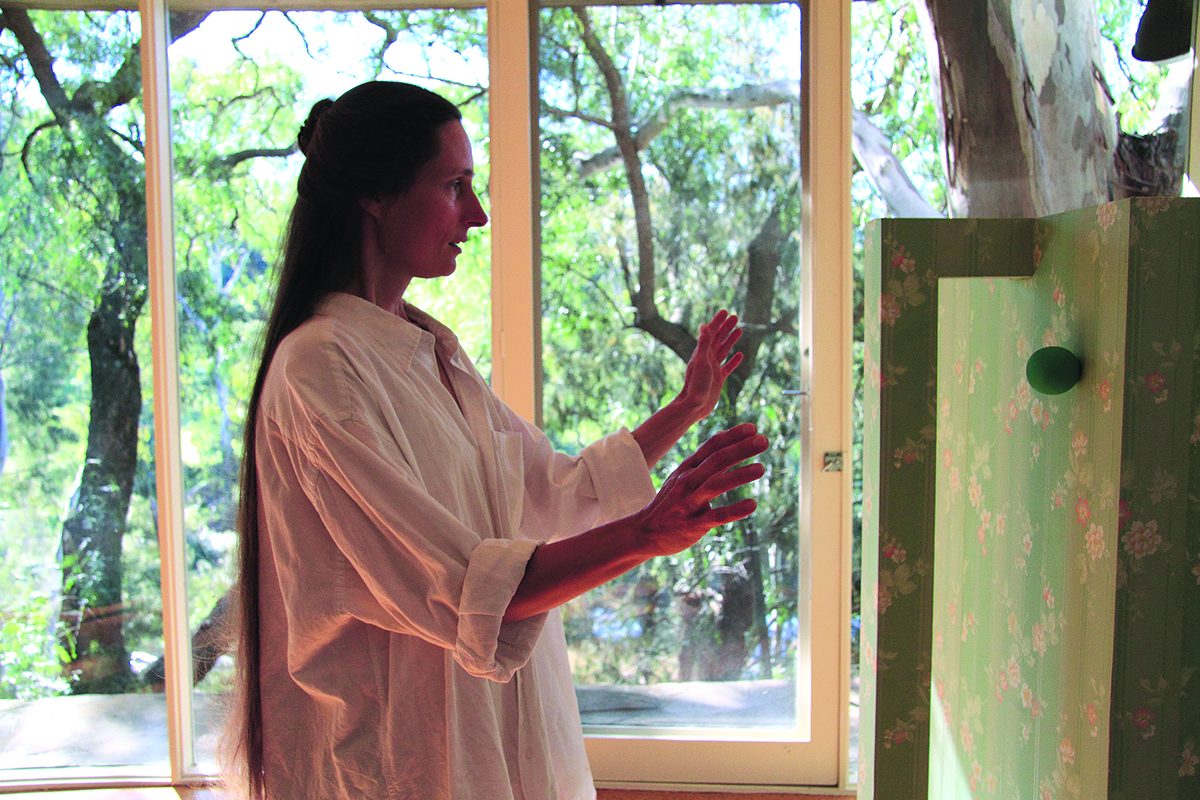
Deborah Kayser, The Box, Chamber Made Opera, 2010, photo Daisy Noyes
There were shows in private homes—in garages and lounge rooms and backyards. Some of these were, essentially, site-specific, engaging with the semiotics of domesticity and reflecting on themes of homeliness. Others, however, treated the home as just another empty space in which any sort of drama might be imagined. Those were the ones that really thrilled; there was a scrappy do-it-yourself ethos I recognised from the live music scene. There were shows by groups like the Melbourne Town Players, Four Larks, Sisters Grimm and I’m Trying to Kiss You. In 2010, stalwart experimentalists Chamber Made Opera, under artistic director David Young, even launched a critically successful series of performances staged in private living rooms around the city.
Many of these events were programmed as part of city-wide festivals like Next Wave or the Melbourne Fringe or, more recently, the Festival of Live Art, umbrella events that aim to transform the city by supporting venues in new and unexpected locations. These festivals with their sprawling programs undoubtedly help shift ideas about where the performing arts belong; but what really excited me in the second half of the 2000s and the early part of the 2010s was the independent DIY attitude of performance makers who created new venues without festival support.
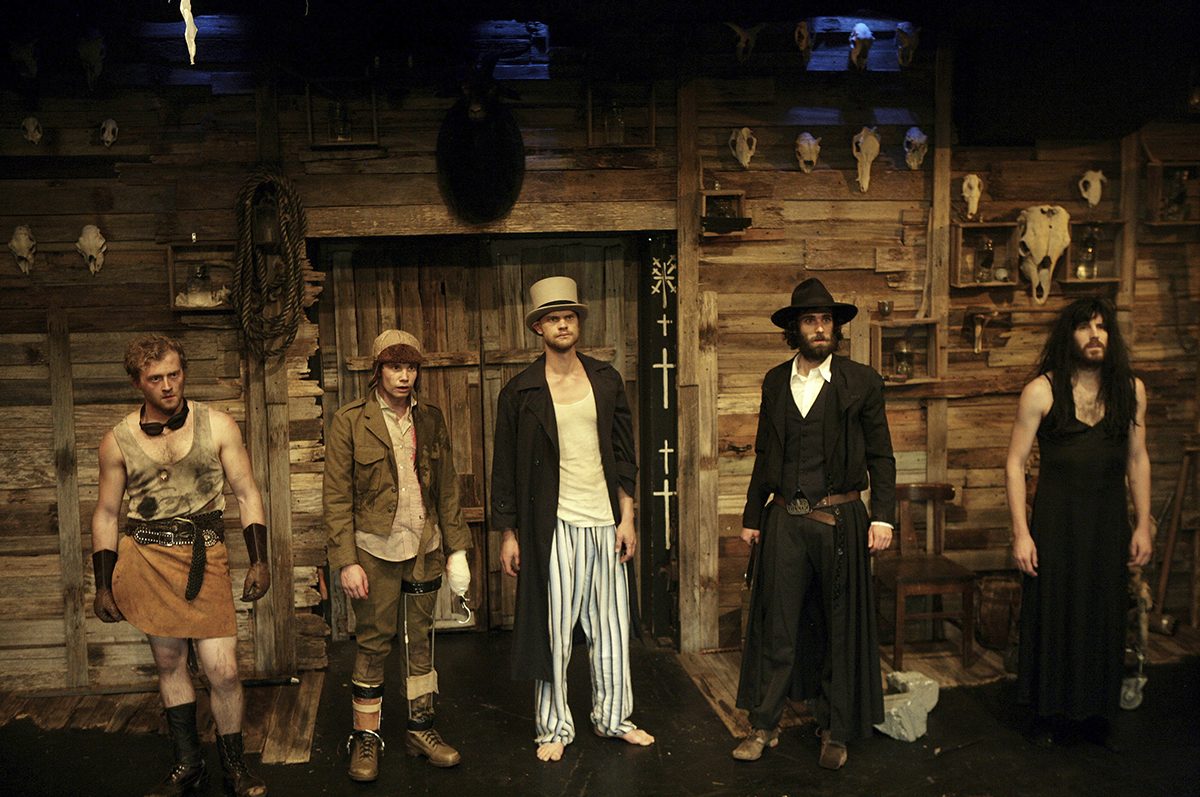
Cast, Avast: A Musical Without Music, Black Lung, 2006, photo Ari Wegner
There was Black Lung, who opened a theatre above Kent Street Bar in Fitzroy. (They also created a temporary venue under the Hindley Street ice rink for the 2007 Adelaide Fringe.)
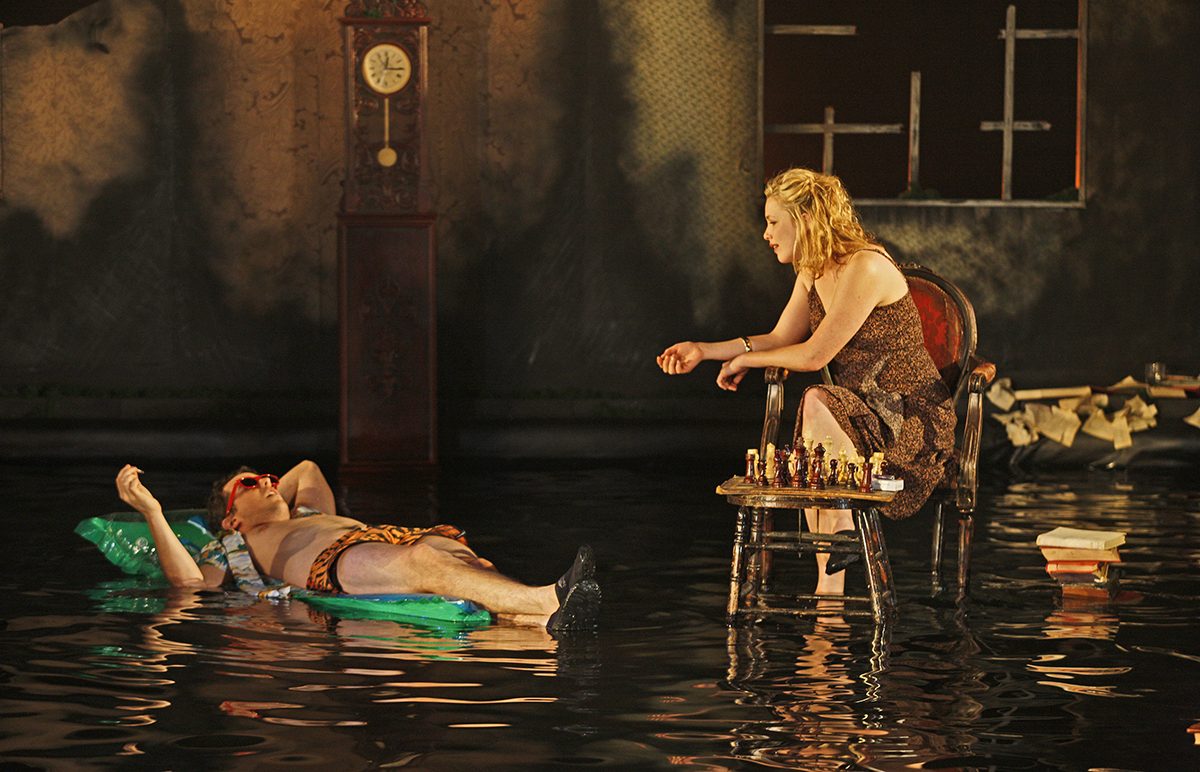
Chris Ryan, Meredith Penman, Chekhov Re-cut: Platonov, 2008, The Hayloft Project, photo Jeff Busby
The Hayloft Project lavishly did up a theatre space in Footscray for their Chekhov Re-Cut: Platonov. The Sisters Grimm built a theatre in the Collingwood Underground Carpark for their productions of Cellblock Booty and Little Mercy. Mutation Theatre briefly worked out of a space above a café on Smith Street. And the entrepreneurial MKA colonised multiple spaces across Melbourne with their pop-theatres. And then, of course, there was Four Larks, who transformed warehouse spaces in Richmond, Northcote and Brunswick.
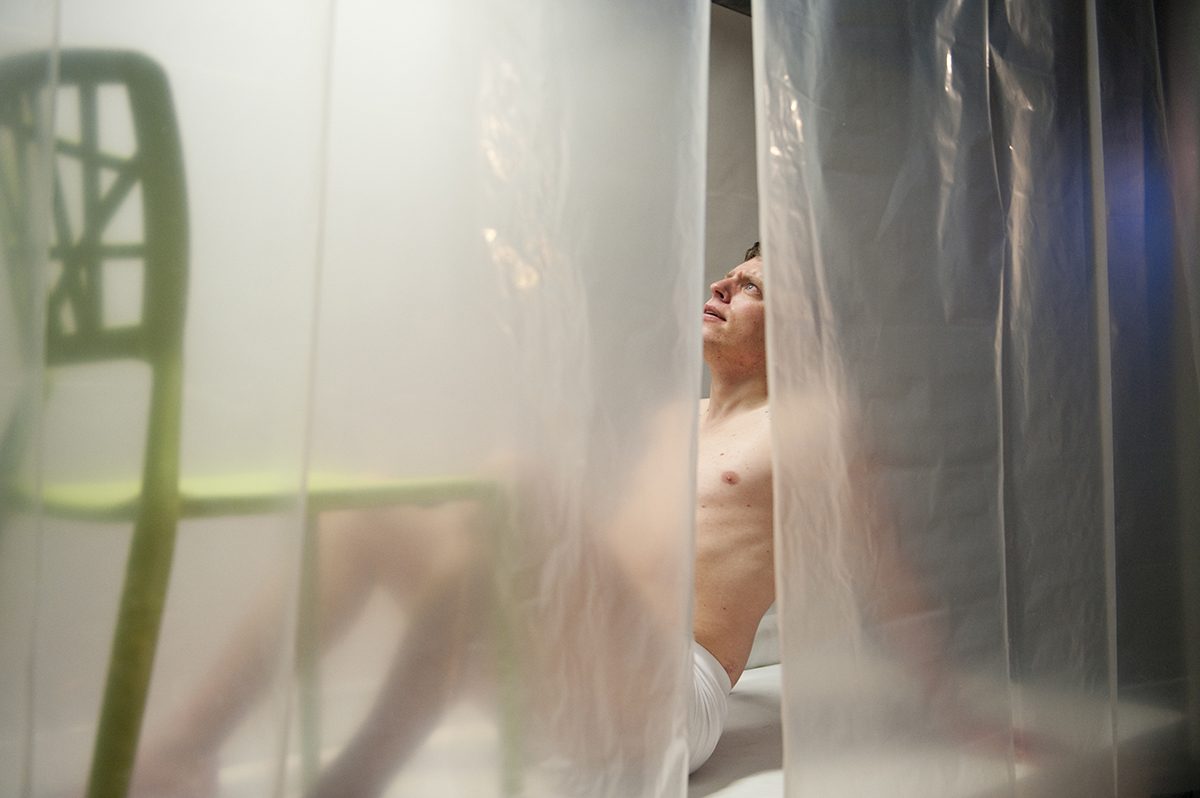
Matt Young, The Horror Face, MKA Theatre, 2011, photo Sarah Walker
I won’t claim that Melbourne’s independent theatre makers are or were any more adventurous or pioneering than independent theatre makers in other cities, but there was something about seeing vacant urban spaces not simply reanimated for a one-off site-specific event but, in some important way, reclaimed in a way that felt specifically Melbourne. It was like we—the audience and the theatre maker—were participating directly in the mythology of the city’s theatre past. As I wrote in 2016:
“For anyone who first started seeing independent theatre in Melbourne in the mid 2000s, the names Daniel Keene and Ariette Taylor loomed large. Even half a decade after their last collaboration, people were still talking. The Keene/Taylor Theatre Project, a small ensemble established in 1997, was the default comparison for those who knew. It was a template for what independent theatre should feel like, the aura it should create: audiences thrilled by the discovery of a hidden artistic world outside the usual institutions. It gave us, the ones who weren’t there, something to look for, a feeling intimate and direct.
“And when we made our own discoveries—in warehouses in Northcote, above bars on Smith Street, or wherever—what we felt was not only a sense of excitement and community but, too, a sense of continuity with the past. The scene was larger and more alive and more significant for the recognition. It felt more like a real culture.”
And so, a tradition can be traced from Black Lung or Hayloft or Four Larks back through the Keene/Taylor Theatre Project to Gilgul and their shows at Town Hall Motors, then back further to the Pram Factory and then to the little theatre scene of the 1940s and 1950s. The do-it-your-self ethos is not an exclusively Melbourne phenomenon, but it is a major part of the story we tell of the performing arts in this city.
Of course, the independent performing arts scene in the decade 2005 to 2015, like every scene, had its centres and therefore its peripheries. For me and many others, the centre was undoubtedly the inner city and northern suburbs. Unless it was for the Big West Festival or Next Wave, I rarely crossed the Maribyrnong. There were a couple of exceptions, however. Peta Hanrahan’s Dog Theatre in Footscray was launched in 2008 with an ambitious series of short Daniel Keene plays directed by Matt Scholten. And 2008 also saw the opening of The Substation in Newport. Similarly, Melbourne’s east was a bit of a dead zone, though MKA tried (very briefly), as did the Owl and the Pussy Cat, also in Richmond.
What I remember is forever travelling north to south, south to north. Today, the idea of pedalling from Brunswick to Prahan or St Kilda for a theatre show seems absurd; and yet in those days I did it regularly. I imagine those north-south routes as corridors lined with archive boxes where—in bedrooms, galleries, basements, foyers, nooks, chambers, belfries, halls, loungerooms, garages—a collection of memories is stored.
There was one particular Mutations Theatre show called Habitat in a room the company was using for a while above a café on Smith Street. It was a small talky sort of show in the Ranters Theatre mould. What I remember most clearly now, however, is the moment at the end, after the talking stopped, when James Tresise opened the sash window of the small room overlooking Smith Street. Opening the theatre to the outside world is an old device but it can be effective. A theatre must provide a kind of frame and must, in a sense, be a closed-off territory; but there also needs to be some way of letting in the great muddle of the world, with its bustle and noise. It was March and it was warm and still bright outside. A tram rumbled past. The roar of the street filled the room, connecting with the reality of the play. The habitat of the theatre was for a moment infinitely expanded.
During this time, in the decade between 2005 and 2015, social media decisively replaced print media as the key channel through which audiences learned about new shows and shared their experiences. And one thing these companies—Hayloft, MKA, Black Lung and Four Larks—shared above all was social media savvy. The buzz they generated was palpable. I remember, for example, the absurd hype around Glassoon, one of Black Lung’s last shows in Melbourne. It was impossible to find a substantial review of the production; but everyone was talking about the afterparty. I also remember the speed with which Four Larks, advertising on Facebook, would sell out their seasons. At one of their sold-out performances of The Temptation of Saint Anthony in the old Body Corp garage in Brunswick, one disappointed punter watched the whole show from the laneway, peering through a gap under the door.
The last print edition of RealTime, 2015
The shift toward online marketing and reviewing was of course a small part of larger tectonic upheavals in the media landscape. Those upheavals eventually led to the end of RealTime’s print editions in 2015. The magazine carried on for a few years as a digital masthead, but it was no longer a street press paper and that meant something. It wasn’t just the look and feel of the magazine that changed; the nature of its connection with the performing arts scene also changed.
In any case, by 2015 the scene was not what it had been. That was the year of the final Neon Festival of Independent Theatre at the Melbourne Theatre Company, which, in retrospect, marked the end of a particular attitude to making theatre in Melbourne. As I later wrote in an article for RealTime:
“Looking back, I think the signal moment was probably the Melbourne Theatre Company’s three Neon seasons (2013-2015). Billed as a festival of independent theatre, this short-lived program in fact announced the end of independent theatre. It was an acknowledgement that separateness from large cultural institutions was no longer regarded by theatre makers as something in itself desirable. It was no longer us and them. The Neon Festival was the dream of a single integrated performing arts ecology with clear career pathways from the fringe to the centre, gleaming like emerald-coloured bike lanes.”
A theatre culture that had not only worked in the fringes but revelled in them, one that had created its own public spaces and demanded attention, had at last been recouped by the subsidised establishment and placed back into the official or designated space of the arts precinct. Whether or not that’s a fair assessment, it is nonetheless true that there are currently very few theatre makers taking control of the apparatus and building their own temporary venues.
And yet – there are always exceptions. That punter in the laneway at the Four Larks show is now making her own work with her own group which is, if possible, even more radically committed to independence than the Larks were. And so the tradition continues, quietly, secretively.
–
Commissioned by RealTime, this essay will form part of an upcoming book by Jana Perkovic and Andrew Fuhrmann critically documenting the period 2005-2015 in Melbourne theatre and performance.
Read about Andrew Fuhrmann here.
Top image credit: Peer Gynt, Four Larks, 2010 photo Stephanie Butterworth & Zoe Spawton
Welcome and farewell. Farewell to RealTime, a 25-year publishing adventure that has come to a celebratory conclusion and welcome to the RealTime Archive, a massive documentation of a period of remarkable transformation driven by the artists who inspired us and to whom we and our many writers creatively responded. This will be a living archive with new overview essays and content guides coming online and enriched by UNSW Library’s wonderful exhibition In Response: Dialogues with RealTime, which features in this edition.
This final edition of RealTime celebrates the launching on 17 April of the archiving of the complete print editions 1994-2015 on the National Library of Australia’s TROVE website. The digitisation was initiated by UNSW academics and the UNSW Library which formed a partnership with the NLA, both institutions recognising the cultural and historical value of RealTime. We are deeply grateful for their support.
Improving the overall archive, we’ve upgraded the RealTime website, a treasure house of all editions placed online 1994-present, numerous features, a host of audio and video delights and some new content.
RealTime has been a way of life for us, of deep immersion in worlds conjured by adventurous artists across Australia and beyond. As art wondrously and radically mutated over the last 25 years, via experiment, hybridity and reaching beyond itself into science and numerous other fields, it changed the ways we receive and respond to it and, as writers, how we expressed the experience. We write about this in our essay for the In Response: Dialogue with RealTime catalogue. Our thanks to everyone who has been involved in RealTime — writers, artists, staff, Board members, funders and readers. Enjoy the archive and let us know how we can help you explore it. Virginia & Keith
–
Top image credit: Vitrine containing copies of RealTime print editions, In Response: Dialogues with RealTime, UNSW Library, 2019, photo Keith Gallasch
Staged in the UNSW Library Exhibitions Space, In Response: Dialogues with RealTime is a unique exploration of the relationship between art and reviewing. It features Sydney-based artists who have been extensively covered in RealTime: Martin Del Amo, Branch Nebula (Lee Wilson, Mirabelle Wouters) and Vicki Van Hout.
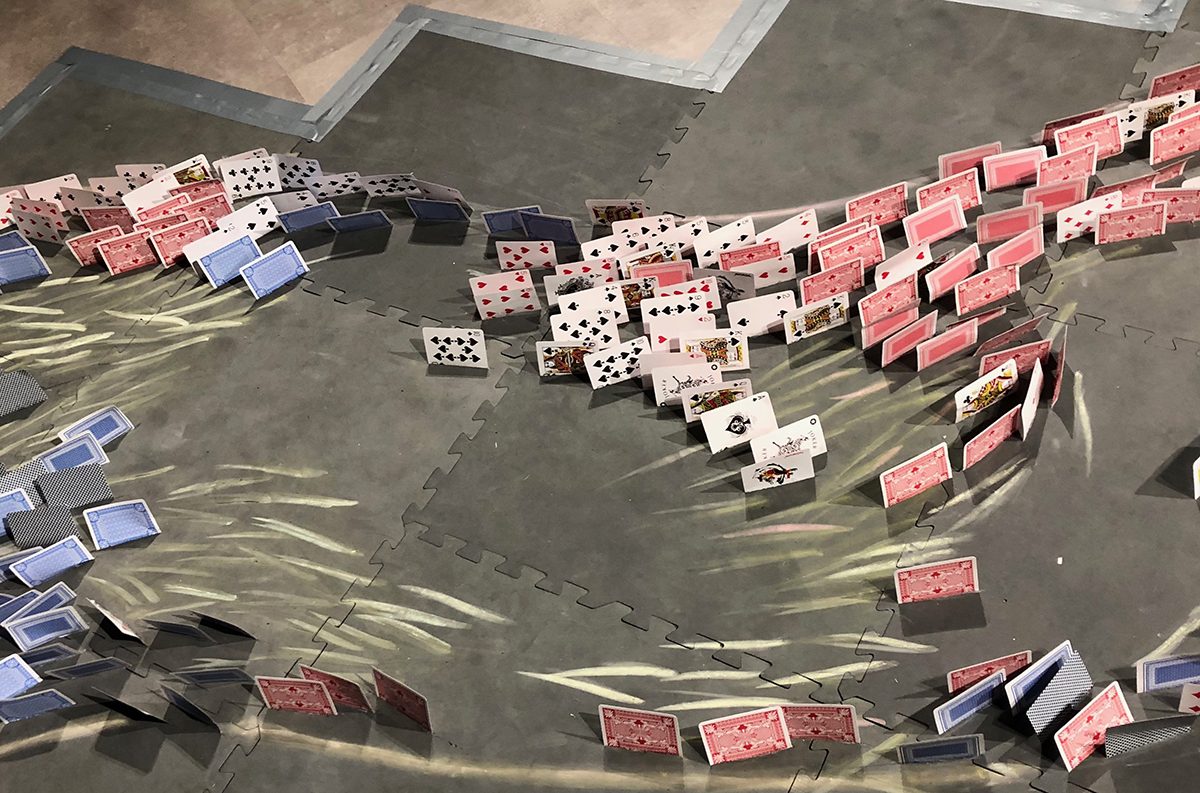
River of playing cards from Vicki Van Hout’s Briwyant (2011), In Response, Dialogues with RealTime, UNSW Library, 2019, photo Keith Gallasch
Van Hout has recreated her striking river of playing cards set from Briwyant and invited her audience to engage with it; Branch Nebula has provided visitors with pencils to write on the walls their recollections of the works alongside vivid production photographs; and Martin Del Amo has juxtaposed memorable images by Heidrun Löhr of his works with reflections on the performances, including fascinating responses to RealTime reviews. As well each of the artists has made a live presentation which has been recorded for future open access. There are audio recordings of the artists being interviewed and RealTime writers reading reviews selected by the artists, alongside other archival material.
Exhibition signage and vitrine containing print editions of RealTime magazine, In Response: Dialogues with RealTime, UNSW Library, 2019, photo Keith Gallasch
Cases display copies of RealTime open to the pages where works by the artists were reviewed, while others house artefacts from some of the productions. The mix of installation, performance and online material makes for an exhibition with depth and, given the online record, durability.
For a more detailed account of the exhibition and the artists’ presentations, go here.
We at RealTime are deeply grateful to Erin Brannigan and UNSW Library and staff for an exhibition which complements and enhances the impact of RealTime archive.
Audience members write comments, Branch Nebula artists’ presentation, In Response: Dialogues with RealTime, UNSW Library, 2019, photo Jackson Mann
Here, from the UNSW Library website, is the background to the mounting of this exhibition and the crediting of the large number of contributors to its success.
“In Response: Dialogues with RealTime is an exhibition marking the closure of RealTime art magazine and the launch of its archive. RealTime was Australia’s critical guide to national and international contemporary arts 1994-2018 and has played a crucial role in documenting and providing critical commentary on innovative work in dance, performance, sound, music, film, digital media and visual art that carved out new terrain in those fields.
“Academics at UNSW have been working with the editors of RealTime Keith Gallasch and Virginia Baxter, UNSW Library and the National Library of Australia since 2017 to secure the RealTime archive in both its physical and digital form. The collaboration between UNSW and RealTime is celebrated through this exhibition that contributes to innovations at the interface between performance, the archive and the gallery.
Erin Brannigan introduces Martin Del Amo performance, In Response: Dialogues with RealTime, UNSW Library, 2019, photo Jackson Mann
“The exhibition is presented as part of UNSW Library’s Exhibitions Program. It is co-curated by Dr Erin Brannigan (Senior Lecturer, School of the Arts & Media) and the artists in consultation with Jackson Mann (Curator, Special Collections and Exhibitions, UNSW Library), RealTime founders and editors, Virginia Baxter and Keith Gallasch, and fellow RealTime Guardians, Dr Erin Brannigan, Dr Caroline Wake, Gail Priest and Katerina Sakkas.
“The RealTime Archive is a collaboration between Open City Inc, National Library of Australia, the School of the Arts and Media, UNSW and UNSW Library.
“The artists involved took part in pilot archival projects at Critical Path, Australia’s centre for choreographic research and dance development, as part of Dancing Sydney: Mapping Movements: Performing Histories. This research project is led by Dr Erin Brannigan, Dr Amanda Card (University of Sydney) and Dr Julie-Anne Long (Macquarie University) and is supported by Critical Path and the NSW State Library.”
–
In Response: Dialogues with RealTime: Exhibition, 25 Feb-25 April, UNSW Library Exhibitions Space; performances: Martin del Amo, 28 Feb, Branch Nebula, 20 March, Vicki Van Hout, 10 April; RealTime Archive Launch, Wednesday 17 April, 6.00pm; UNSW, Kensington, Sydney
Top image credit: Mirabelle Wouters, Lee Wilson (Branch Nebula) in artists’ talk, In Response: Dialogues with RealTime, UNSW Library, 2019, photo Jackson Mann
Across 2018 and into 2019 we’ve been building and reflecting on the RealTime archive, an exacting, exhilarating and moving experience. The process is largely complete, but we’ll keep adding to the website reflections, overviews and guides to content.
RealTime 1994-2015 on TROVE
We were excited and honoured in 2017 to be asked if we’d like UNSW Library to approach the National Library of Australia to form a partnership to digitise the RealTime print editions 1994-2015. The scanning of thousands of pages is expensive so we also welcomed UNSW Library’s financial investment and accepted the invitation for a major part of RealTime’s history to be preserved on the NLA’s Trove website. Dr Erin Brannigan, Senior Lecturer, School of the Arts & Media, UNSW, played a key role in negotiations. The recognition by NLA and UNSW Library of the cultural and historical value of RealTime is deeply satisfying.
You can find RealTime on TROVE here https://nla.gov.au/nla.obj-733140625.
The great value of the digitising of the print editions is that not only the content of the magazine but also the design is preserved, as are the advertisements which in themselves from a valuable part of the historical record, and the editions are searchable.
The RealTime website
We’ve upgraded the RealTime website and substantially improved its Search facility. We’ve added Team to our menu, which will have entries for key staff and Board members over the years. New overview essays by writers reflecting on their years with RealTime are coming up as is a personal history of RealTime — you can read a sketch of it by Keith and Virginia here.
While TROVE archives the RealTime print edition 1994-2015, the RealTime Archives house:
RealTime 1994-2000: digitised print editions 1-40
RealTime 2001-2015: edition contents online without print layout or print advertisements
RealTime 2016-present: exclusively online editions
You’ll also find Features, which includes RealTime Dance, Media Art Archive, Video, Audio, RealTime Traveller and Special Editions.
New to the website: Special Editions
Special Editions includes digitised copies of RealTime onsite festival editions for Barrie Kosky’s 1996 Adelaide Festival and the 1998 and 2000 Robyn Archer Adelaide Festivals; the London International Festival of Theatre (LIFT) 1997; and the MAAP/Asia Pacific Triennial of 1999. These make for fascinating reading.
Also in Special Editions you’ll find the In Repertoire series of beautifully designed booklets 2000-2004 promoting internationally tourable Australian art, performance in particular. These were commissioned by the Australia Council for the Arts, edited and produced by RealTime and designed by Peter Thorn.
Also designed by Thorn is Dreaming in Motion, Celebrating Australia’s Indigenous Filmmakers, edited and produced by RealTime for the Indigenous Unit of the Australian Film Commission. It surveys a generation of filmmakers who emerged in the 1990s, many of whom are now leading practitioners. This small book is still the only one on the subject.
You’ll also find in Special Editions RealTime 1994-2017 Tributes, a collection of messages received and articles published when we announced at the end of 2017 that RealTime would cease regular publishing and focus on completing its archive before closing.
More…
Visit our website in coming months as we post further archival features. The RealTime website is a great portal to remarkable art and writing and an invaluable source for research.
In the wall notes below, written for his exhibit in In Response: Dialogues with RealTime in the UNSW Library Exhibitions Space, award-winning Sydney-based dancer and choreographer Martin Del Amo intimately and extensively reflects on works he’s made across his career alongside his responses to RealTime reviews of them. The juxtaposition of these with superb performance photographs, all by Heidrun Löhr with whom Del Amo has had a successful collaborative relationship, is a rich addition to the archive, for Del Amo himself, the dance community and RealTime. Eds.
Piece (1996)
The first solo I ever presented in Sydney was a Butoh-inspired piece set to Giacomo Puccini’s aria O Mio Babbino Caro sung by Victoria de Los Angeles. It was just under 3 minutes and I performed it on the final night of Performance Space’s Open ’96. The performance garnered me my first mention in RealTime. Caitlin Newton-Broad wrote: “Martin Del Amo gave a treasure to his audience, set simply to the ubiquitous opera number Oh my beloved father.” Only one sentence, but not a bad start!
–
Piece, Open ’96, Performance Space, Sydney, 1996; performer Martin Del Amo
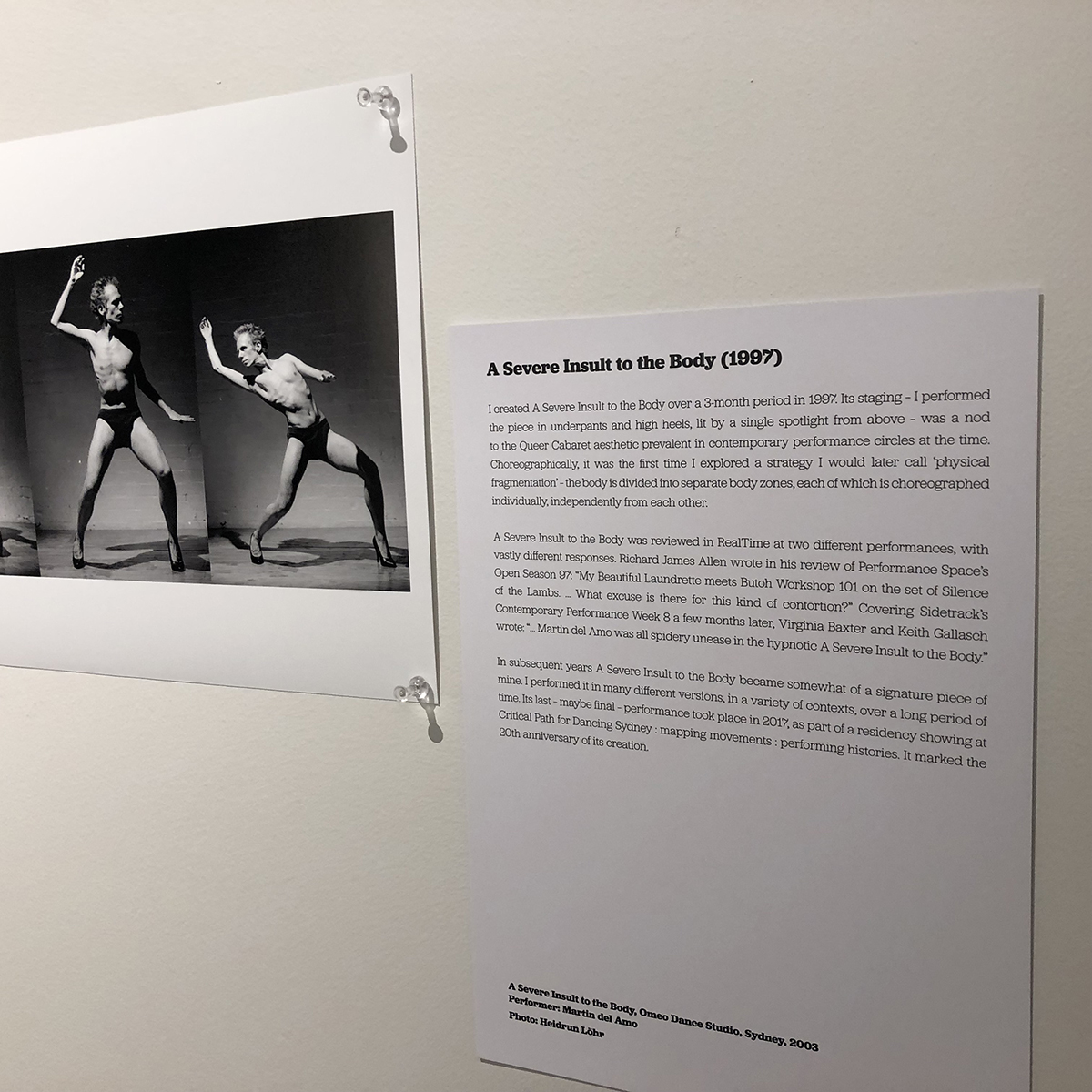
Martin Del Amo, A Severe Insult to the Body (1997), In Response: Dialogues with RealTime, UNSW Library, 2019, photo Heidrun Löhr, installation photo Keith Gallasch
A Severe Insult to the Body (1997)
I created A Severe Insult to the Body over a 3-month period in 1997. Its staging – I performed the piece in underpants and high heels, lit by a single spotlight from above – was a nod to the Queer Cabaret aesthetic prevalent in contemporary performance circles at the time. Choreographically, it was the first time I explored a strategy I would later call ‘physical fragmentation’ – the body is divided into separate body zones, each of which is choreographed independently from each other.
A Severe Insult to the Body was reviewed in RealTime at two different performances, with vastly different responses. Richard James Allen wrote in his review of Performance Space’s Open Season 97: “My Beautiful Laundrette meets Butoh Workshop 101 on the set of Silence of the Lambs. … What excuse is there for this kind of contortion?” Covering Sidetrack’s Contemporary Performance Week 8 a few months later, Virginia Baxter and Keith Gallasch wrote: “… Martin Del Amo was all spidery unease in the hypnotic A Severe Insult to the Body.”
In subsequent years A Severe Insult to the Body became somewhat of a signature piece of mine. I performed it in many different versions, in a variety of contexts, over a long period of time. Its last – maybe final – performance took place in 2017, as part of a residency showing at Critical Path for Dancing Sydney : mapping movements : performing histories. It marked the 20th anniversary of its creation.
–
A Severe Insult to the Body, Omeo Dance Studio, Sydney, 2003, performer Martin Del Amo
Unsealed (2004)
Unsealed is a 40-minute piece fusing idiosyncratic movement and intimate storytelling. Exploring the concept of ‘losing it,’ its aim was to playfully jump-cut between literal and metaphoric states of desire and deterioration. It was presented as part of a dance program at Performance Space called Parallax. Even though my work had been mentioned in RealTime before, it was the first time that I received a full-length review. What set it apart from the extremely positive reviews published in daily newspapers such as The Sydney Morning Herald and The Australian, was that it moved beyond mere evaluation and actually discussed my piece as a work of art, analysing and interpreting it. After months in the studio by myself, spending countless hours imagining what the work’s impact might be on an audience, I strongly appreciated a critical approach that seemed to enter into a direct dialogue with my practice. In his concluding paragraph, Keith Gallasch wrote: “At 40 minutes, Unsealed is a complete, quietly disturbing, confiding and important work from Martin Del Amo that makes an art of walking, invites our empathy and offers a sad paean to the virtues of melancholy.” Even though these sentences clearly demonstrate Gallasch’s appreciation of the work, what makes them stand out for me most are their interpretive insight.
–
Unsealed, Parallax, Performance Space, Sydney, 2004, performer Martin Del Amo
Martin Del Amo, Under Attack (2005), In Response: Dialogues with RealTime, UNSW Library, 2019, photo Heidrun Löhr, installation photo Keith Gallasch
Under Attack (2005)
In 2003, my partner of many years – Benjamin Grieve – tragically died. This event plunged me into a prolonged state of grieving. In the following years, I worked feverishly, creating at least one work a year, alongside numerous studio showings and countless appearances in short works programs. Even though many of these works explored themes such as trauma, loneliness and instability, I was adamant that none of them were actually about my grief per se. I was aware, of course, that a lot of people interpreted it that way.
Needless to say, I found fault with the opening sentence of Keith Gallasch’s review of my 40-minute work Under Attack, presented at Performance Space’s Solo Series #1, produced by Onextra. The piece addressed the fragility of the human body under constant threat of aggressive forces – from digitilisation to decomposition. Gallasch wrote: “Following his Unsealed of 2004, Martin Del Amo’s Under Attack is another utterly engrossing solo, the second part in a trilogy, this one moving in even closer on the first part’s grief (the artist’s for the death of a lover) …”
It took me a long time to understand that maybe artists are not always the most reliable to comment on what motivates them to create work, as they aren’t always fully aware of what drives them. Now, years later, I still maintain that I never deliberately set out to make work that would help me process my grief, but I can accept Gallasch’s interpretation as a valid one.
–
Under Attack, Omeo Dance Studio, Sydney, 2005, performer Martin Del Amo
Martin Del Amo, Can’t Hardly Breathe (2006), In Response: Dialogues with RealTime, UNSW Library, 2019, photo Heidrun Löhr, installation photo Keith Gallasch
Can’t Hardly Breathe (2006)
Can’t Hardly Breathe was conceived as a darkly humorous exploration of the relationship between obsession and trauma. It ran at about 25 minutes and was presented at Performance Space as part of a double-bill with spoken word performer and writer Rosie Dennis, with whom I shared a regular improvisational practice at the time.
When working on my solo Under Attack the year before, I decided to call it the second part of a trilogy with Unsealed being the first. Once Under Attack was completed, however, I realised that it made for a perfect companion piece to Unsealed and that a third piece was not needed. By the time I presented Can’t Hardly Breathe, I had begun preparations for a new full-length work set to premiere the year after and which would take me into new thematic territory. As a result, Can’t Hardly Breathe became a transitional piece – thematically related to its predecessors but already employing devices that I intended to explore further in the new work.
Unfortunately (and characteristically attentively), Keith Gallasch had not forgotten my talk about a trilogy and introduced the piece in his RealTime review as “the third part of Martin Del Amo’s trilogy (the other 2 are Unsealed [2004] and Under Attack [2005]) …” About the work, he said: “While not as structurally satisfying as its predecessors, Can’t Hardly Breathe is nonetheless memorable.” I admit that it’s a bittersweet experience when a review of your work is partially critical and you have to concede that the criticism is warranted. Luckily, the review ended on an encouraging note: “The desire to see all 3 works on the same program is unlikely to be met given the demands on the performer of just one of them—a pity, so let’s hope they’ve been seriously documented.”
–
Can’t Hardly Breathe, Mixed Double, Performance Space, Sydney, 2006, performer Martin Del Amo
Never Been This Far Away From Home (2007)
Never Been This Far Away From Home marked a thematic shift in my work as solo artist. Previous pieces had explored themes of physical and mental instability, presenting the self as a direct target of uncontrollable forces. This work introduced a more active, adventurous persona, keen to navigate both the exhilaration and dangers that come with moving away from ‘home’ beyond one’s comfort zone, into uncharted territories.
Produced by Performance Space and presented at its new home at Carriageworks, the piece was my first full-length solo work, shown outside the context of a double- or triple-bill. Not sharing a program with other artists guaranteed more creative freedom but also added pressure. Audiences would come to see my work and my work only. The success of the piece – or its failure – depended entirely on me and my creative team. What increased the pressure even more was that Never Been This Far Away From Home was the first piece to be presented at Carriageworks’ Bay 20. These circumstances mirrored the themes the work purported to explore in a scary way. This was definitely a journey into the unknown …
RealTime reviewer Jan Cornall seemed to be reading my mind: “The work of the solo performer is always risky. What if the telling fails, what if the audience doesn’t get it, what if they fall asleep—what if they want me to shut up and just dance?” To my great relief, Cornall concluded that I mastered the challenge. “Del Amo doesn’t falter over such concerns, but methodically carries out his set task—to share with us the journey of his explorations: notions of home, the void of fear, danger and the unknown, where the edges of dreaming and reality meet.”
–
Never Been This Far Away From Home, Clare Grant’s home and Carriageworks, Sydney, 2007, performer Martin Del Amo
Wall text (quoted from Pauline Manley’s RealTime review of Martin Del Amo’s It’s a Jungle Out There, 2009), In Response: Dialogues with RealTime, UNSW Library, installation photo Keith Gallasch
It’s a Jungle Out There (2009)
By 2009, I had consistently presented solo works for over five years, becoming somewhat of a fixture in the Sydney dance and performance scene. It slowly dawned on me that it wasn’t as easy to surprise audiences as it used to be, let alone ‘make a splash.’ People seemed to have formed a clear idea about who I was as an artist and what kind of work I would make. I realised that in order to grow as an artist and not constantly repeat myself, I would need to keep questioning my approach to creating and presenting work. While developing It’s a Jungle Out There, a new full-length work investigating the modern-day city as an ever-changing organism, I decided to conduct a series of research excursions. They were designed to heighten my perception of the city’s impact on the body, and included walking backwards through Sydney’s CBD, moving blindfolded alongside Parramatta Road during rush hour and crawling on all fours in The Rocks.
This set of circumstances was not lost on Pauline Manley, who wrote in her review for RealTime: “Martin Del Amo is ubiquitous. He pops up wild haired and undie-clad so often on the Sydney underground landscape that expectation is fashioned by familiarity. Yet he surprises. His insouciant belief in the inherent worth of what he has to say gives his work a trademark intensity that results from the piquancy of fascination and research. Whatever Del Amo is investigating, it is done with a ferocious and meticulous attention that is a lust to discover, uncover and reveal.”
It is probably also worth mentioning that in the late 2000s, Sydney’s independent dance and performance landscape started to rapidly change. Suddenly presentation opportunities were more likely to spring up in Western Sydney than in Sydney’s metropolitan area. Tellingly, It’s a Jungle Out There was the first work I did not premiere at Performance Space in over a decade. Instead, its final development and presentation were commissioned by Campbelltown Arts Centre. The piece, however, was presented by Performance Space at Carriageworks a year later as part of a tour that also included seasons at Dancehouse Melbourne, and Perth Institute of Contemporary Arts (PICA).
–
It’s a Jungle Out There, CBD Sydney, 2009, performer Martin Del Amo
What Good Is Sitting Alone In Your Room? (2010)
Around 2010, the focus of my choreographic practice started to shift as I gradually made the transition from solo artist to choreographer of works for others. Even though I did not create any new long-form solos for myself after 2009, I never gave up performing. Occasionally, I even presented a new short piece. What Good Is Sitting Alone In Your Room is a case in point. Originally created for Dance History at Campbelltown Arts Centre in 2010, the piece is both a tribute to and a deconstruction of the famous Bob Fosse style. It is set to a track from Gail Priest’s album Presentiments of the Spider Garden and contains the only high kick I have ever performed. Publicly that is …
Keith Gallasch and Virginia Baxter reviewed the work for RealTime when I performed it as part of the IOU Dance Solo Series in Spring Dance 2012 at Sydney Opera House. They wrote: “Del Amo’s trademark ambulatory movement is replaced by a series of poses that evoke the choreography of Bob Fosse but without the steps from which they would usually resolve—it’s funny, quite sexy, eliciting amused recognition from the audience.” I remember being surprisingly pleased with the review, especially because it described the piece as “sexy”—not an adjective I had ever come across in previous reviews of my work. It temporarily alleviated my anxieties around being an ageing dancer.
–
What Good Is Sitting Alone In Your Room?, IOU Dance, Io Myers Studio, Sydney, 2011, Martin Del Amo
Mountains Never Meet (2011)
The idea for Mountains Never Meet dates back to 2008 when I was commissioned to create a work for LINK, West Australia Academy of Performing Arts’ graduate dance company. The point of departure for the piece was to investigate the difference between walking and dancing and if, in fact, it was as significant as often perceived. The resulting work featured simple physical actions such as walking, running, skipping, standing, lying and jumping on the spot. Simultaneously it retained a maximum level of complexity in terms of choreographic devices related to speed, direction, levels and patterning. A few years later, when collaborating with footballer-turned-performance maker Ahilan Ratnamohan, I decided to remake the work but this time with a cast of untrained young men from Western Sydney. The idea was to see if, by relocating the original material within a diverse and dynamic community such as Western Sydney, the work would gain new layers of meaning. I was also interested in playfully challenging the notion of what dance can be and who can be a dancer.
Even though I had previously created group works for tertiary institutions and youth companies, Mountains Never Meet marked my official debut as a non-performing choreographer. It was also the first time in seven years that a work of mine did not receive a review in RealTime. In the lead up to its premiere, RealTime did, however, publish an interview with me. It was aptly conducted by Gail Priest who, up until then, had been my key collaborator, composing the soundtracks for all of my works as well as performing them live. Not surprisingly, the interview turned out to be rather candid: “Discussing his reasons for the transition from solo performer to director-choreographer, Del Amo cites Kate Champion from Force Majeure who was also, at one stage, best known for her solo works. ‘Kate said you can only mine yourself for material for so long and at some point you get more interested in other people’s backgrounds, stories and ideas. I think this is exactly what happened to me. I’ve always really enjoyed working by myself and having that freedom but sometimes I thought it would be nice to work with other bodies and have another input on that level’.”
–
Mountains Never Meet, Riverside Parramatta, Sydney, 2011, performers Ravin Lotomau, Frank Mainoo, Benny Ngo, Kevin Ngo, Ahilan Ratnamohan, Mahesh Sharma, Nikki-Tala Tuiala Talaoloa, Carlo Velayo, Dani Zaradosh
Paul White, Anatomy of an Afternoon (2012), choreographer Martin Del Amo, In Response: Dialogues with RealTime, photo Heidrun Löhr; installation UNSW Library, 2019, photo Keith Gallasch
Anatomy of an Afternoon (2012)
Anatomy of an Afternoon started life as a choreographic research project. In early 2011, I undertook a residency at Critical Path, collaborating with dancer Paul White and Dr Amanda Card in the role of research consultant. The aim of the project was to investigate how the practical exploration of an extant choreography would affect me as a choreographer creating original work. As the vehicle for this enquiry I chose Vaslav Nijinsky’s Afternoon of a Faun, a work that had fascinated me ever since I first became aware of it more than 20 years ago. Now considered an early modernist masterpiece, Afternoon of a Faun was first presented during the 1912 Ballets Russes season in Paris. At its premiere it caused a major scandal because of its overtly sexual nature.
Shifting the focus away from the faun character and seeking to physically capture the elusive nature of the afternoon, Anatomy of an Afternoon aimed to reimagine Nijinsky’s legendary choreography for a new century, exactly 100 years after its premiere. During its development phase, Paul White and I conducted a series of research excursions including visits to the zoo and task-based exercises outdoors. This was in keeping, we felt, with the spirit of experimentation that had fuelled the creation of Afternoon of a Faun. The approach proved to be controversial. At its premiere in the 2012 Sydney Festival at Sydney Opera House, Anatomy of an Afternoon prompted a series of audience walkouts. Reviews were rather mixed. Paul’s and my decision to stick to our guns was later recognised at the Helpmannn Awards. The piece was nominated for Best New Ballet or Dance Work, and Paul won for Best Male Dancer. In 2014 the work successfully toured to Southbank Centre London.
Like many critics, Keith Gallasch ‘wrestled’ with the work in his review for RealTime. He remained characteristically gracious though, querying the circumstances in which he saw the work: “I saw Anatomy of an Afternoon at a disadvantage, from the back of the Opera House’s Playhouse auditorium, deprived of the intimacy the work seemed to warrant and not terribly aware of White’s facial expressiveness mentioned by other audience members. However, White, as ever, moved superbly in a work that perhaps evolved too slowly to be consistently immersive and was curiously lacking a third dimension usually evident in the creations of choreographer (and RealTime correspondent) Martin Del Amo. But I’d love to see it again, up close.”
–
Anatomy of an Afternoon, Sydney Festival, Sydney Opera House, 2012, performer: Paul White
Slow Dances For Fast Times (2013)
Even after making the transition from solo artist to choreographer of works for others, the solo remained my preferred form for a long time. Nowhere was this more evident than in Slow Dances For Fast Times, presented by Carriageworks and produced by Performing Lines. Conceived as the dance equivalent of a concept album, the work comprised 12 short solos performed by 12 different dancers. The cast included some of the most highly regarded contemporary dancers from across Australia. It showcased the diversity of the sector – cultural, geographic, artistic and in terms of age and body type. For each piece, I closely collaborated with the solo performer in the creation of a unique choreographic portrait. The work was set to a series of recorded tracks, ranging from pop favourites and dance anthems of the last 50 years to a Spanish torch song and operatic arias. It culminated in a ‘bonus track’ finale involving all twelve dancers.
In some ways, Slow Dances For Fast Times was an extension of a strand of work that I developed as a solo artist. In addition to creating full-length works, I would also regularly perform short solos set to pop songs. This allowed me to show work outside of the conventional dance presentation circuit – in clubs, at parties, short works nights and festivals. Many of them originated as birthday presents for my friends, presented one-on-one in the studio first. On the other hand, Slow Dances For Fast Times also marked my most ambitious work to date in terms of scale, logistics and production values.
In her review for RealTime, Pauline Manley wrote, “certain recurrent physicalities reveal Del Amo’s choreographic proclivities: the gentle distortions of discomfort as bodies are drawn away from graceful wholeness … then there are those floating arms that trace, dangle and sway as body parts with mind. These arms are what most conjured the choreographer-body, making me miss Martin.” At the time, I felt that Manley’s compliment for me as a performer overshadowed not only my achievement as choreographer but also that of the other dancers. I was intent on establishing myself as choreographer and only too happy for people to forget my past as a solo artist. A few years on, with the benefit of hindsight, I have to say that I appreciate the notion that my work as a choreographer did not cancel out my work as a solo artist.
–
Slow Dances For Fast Times, Carriageworks, Sydney, 2013, performers Sara Black, Jade Dewi Tyas Tunggal, Benjamin Hancock, Raghav Handa, Julie-Anne Long, Jane McKernan, Sean Marcs, Kirk Page, Elizabeth Ryan, Luke Smiles, Vicki Van Hout, James Welsby
The Little Black Dress Suite (2013)
Sometime during 2012, it occurred to me that the Little Black Dress had become a recurring costume in my work. Within a period of two years, I had used fashion’s iconic garment for three separate pieces – always a different version of it, and always to a different effect. In one piece the LBD stood for show biz glamour. In another, it lent its performer a diva-like allure. In the third piece the dress was decidedly at odds with the performer’s actions. Before long I hatched the idea to draw these pieces together in a ‘suite,’ add another two, and present them all as part of the same program.
One of the things I most enjoy about being a choreographer is that I have the opportunity to regularly collaborate with other dancers. The Little Black Dress Suite was especially exciting in that respect. It allowed me to work with three dancers whom I greatly admire and whose performance skills I’m in awe of – Kristina Chan, Sue Healey and Miranda Wheen. Best of all, in one of the pieces, we got to perform together.
Not surprisingly, given the subject matter, Virginia Baxter’s review in RealTime was peppered with fashion references and sartorial puns: “T-dress, V-dress, vintage bandeau, slimline, full-skirted, reverse wrap, Audrey style, whatever, I know that the trick with the LBD is simply to wear it well. Here Martin Del Amo is the tailor and each of the dancers adds her/his own personality to the outfit to bring off the elegant display.” Baxter seemed to have as much fun with the work as we did performing it. “Finally all four dancers join in a careful pattern of slow, weaving movements in and around each other in a narrow horizontal plane to the aptly haunting song “Like An Angel Passing Through My Room.” In the end, like the iconic dress, it’s all about line and grace and these dancers, each in their own idiosyncratic way, appear to have that sewn up, carrying off the choreographer’s premise with aplomb.”
–
The Little Black Dress Suite, Riverside Parramatta, Sydney, 2013, performers Martin Del Amo, Kristina Chan, Sue Healey, Miranda Wheen
Songs Not To Dance To (2015)
My collaboration with Phil Blackman, a Lismore-based dance artist, started as an artistic ‘blind date’ as part of an exchange project, initiated by Campbelltown Arts Centre in partnership with NORPA (Northern Rivers Performing Arts). The aim of this initiative was to stimulate collaboration between metropolitan and regional dance makers. Over time, and after several development stages, Phil’s and my professional relationship grew into a committed artistic partnership, culminating in the presentation of full-length dance work Songs Not To Dance To at Parramatta Riverside. The piece was supported through FORM Dance Projects and produced by Performing Lines.
In Songs Not To Dance To, Phil and I set ourselves the challenge of performing to a series of ‘undanceable’ pieces of music. In attempting to do something seemingly impossible, we endeavoured to acquit ourselves, against all odds, with as much dignity, resilience and humour as possible. The soundtrack of the work included Whitney Houston’s And I Will Always Love You, Enrique Iglesias’ Hero and Jimmy Barnes’ Working Class Man. Those pop songs were interspersed with tracks from the album Book of Ways by legendary jazz pianist Keith Jarrett.
The final version of Songs Not To Dance To was not reviewed in RealTime. An earlier development, presented as part of Campbelltown Arts Centre’s Oh, I Wanna Dance With Somebody! was, however. Virginia Baxter wrote: “The two well-matched dancers are restrained as the airwaves fill with that orgy of self-affirmation, Christine Aguilera’s ‘Beautiful.’ This time, movement comes from the diaphragm. Unlike the calculated stiffness of the first piece, here the dance is angular, ungainly and then fluid; the performers working in close proximity developing a distinct weave of bodies, nearly entwining, almost but never quite intimate. Words won’t bring them down.” And later, summing up the work: “In this collaboration between region and city we experience another fulfilling engagement between two different but simpatico dancing bodies.”
–
Songs Not To Dance To, Campbelltown Arts Centre, Sydney, 2012, performers Martin Del Amo, Phil Blackman
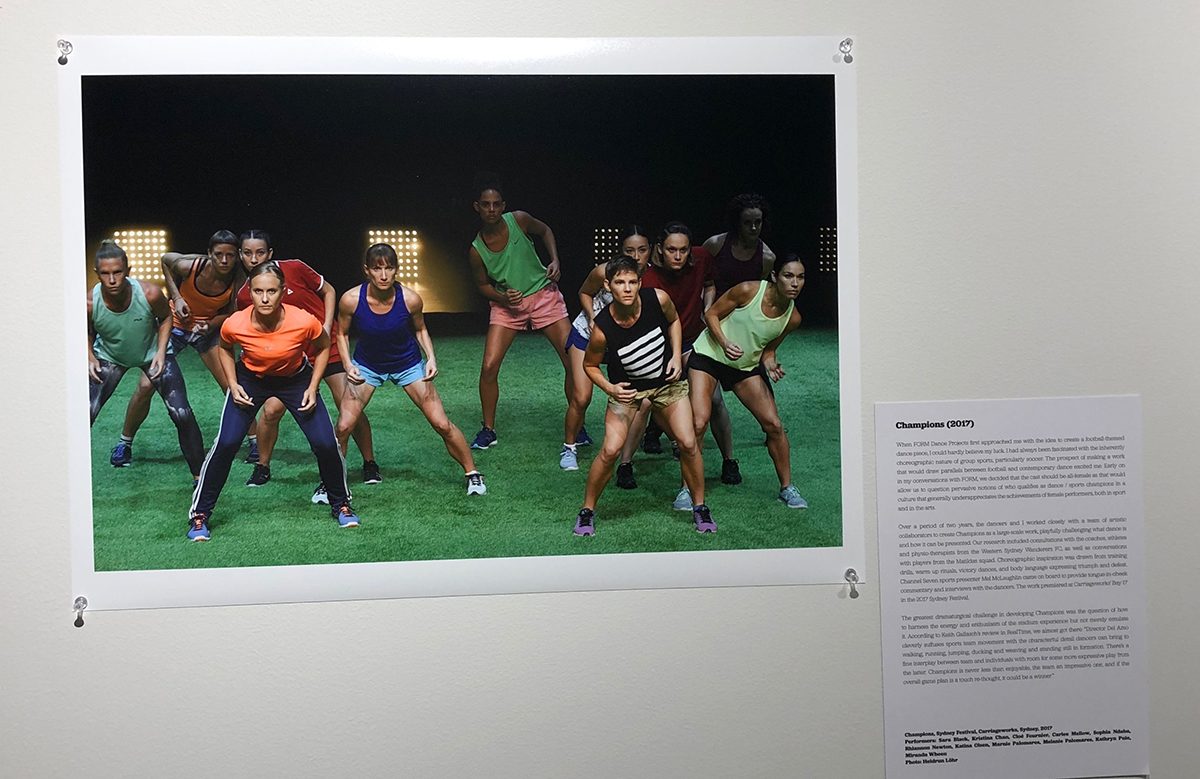
Champions, Force Majeure (2017), choreographer Martin Del Amo, In Response: Dialogues with RealTime, UNSW Library, photo Heidrun Löhr, installation photo Keith Gallasch
Champions (2017)
When FORM Dance Projects first approached me with the idea to create a football-themed dance piece, I could hardly believe my luck. I had always been fascinated with the inherently choreographic nature of group sports, particularly soccer. The prospect of making a work that would draw parallels between football and contemporary dance excited me. Early on in my conversations with FORM, we decided that the cast should be all-female as that would allow us to question pervasive notions of who qualifies as dance / sports champions in a culture that generally underappreciates the achievements of female performers, both in sport and in the arts.
Over a period of two years, the dancers and I worked closely with a team of artistic collaborators to create Champions as a large-scale work, playfully challenging what dance is and how it can be presented. Our research included consultations with the coaches, athletes and physio-therapists from the Western Sydney Wanderers FC, as well as conversations with players from the Matildas squad. Choreographic inspiration was drawn from training drills, warm up rituals, victory dances, and body language expressing triumph and defeat. Channel Seven sports presenter Mel McLaughlin came on board to provide tongue-in-cheek commentary and interviews with the dancers. The work premiered at Carriageworks’ Bay 17 in the 2017 Sydney Festival.
The greatest dramaturgical challenge in developing Champions was the question of how to harness the energy and enthusiasm of the stadium experience but not merely emulate it. According to Keith Gallasch’s review in RealTime, we almost got there: “Director Del Amo cleverly suffuses sports team movement with the characterful detail dancers can bring to walking, running, jumping, ducking and weaving and standing still in formation. There’s a fine interplay between team and individuals with room for some more expressive play from the latter. Champions is never less than enjoyable, the team an impressive one, and if the overall game plan is a touch re-thought, it could be a winner.”
–
Champions, Sydney Festival, Carriageworks, Sydney, 2017, performers Sara Black, Kristina Chan, Cloé Fournier, Carlee Mellow, Sophia Ndaba, Rhiannon Newton, Katina Olsen, Marnie Palomares, Melanie Palomares, Kathryn Puie, Miranda Wheen.
In Response: Dialogues with RealTime, Martin Del Amo, photographer Heidrun Löhr, UNSW Library, Sydney, 25 Feb-25 April
Martin Del Amo, originally from Germany, is a Sydney-based choreographer and dancer. He started out as a solo artist, acclaimed for his full-length solos fusing idiosyncratic movement and intimate storytelling. In recent years, Martin has also built a strong reputation as a creator of group works and solos for others. His most recent production, Champions (2017 Sydney Festival, FORM Dance Projects), was awarded the 2018 Australian Dance Award for Outstanding Achievement in Independent Dance. Other works include Songs Not To Dance To (Parramatta Riverside, 2015), Slow Dances For Fast Times (Carriageworks, 2013) and Mountains Never Meet (Parramatta Riverside, 2011). Martin’s Helpmann Award-winning Anatomy of an Afternoon, a solo for Paul White, which premiered at the Sydney Opera House in the 2012 Sydney Festival, was presented with great success at Southbank Centre London in 2014. Martin regularly teaches for a wide range of arts organisations and companies, and has worked extensively as mentor, consultant, dramaturg and dance writer. His work has toured nationally in Australia and internationally to the UK, Japan and Brazil. Martin is a 2015 Sidney Myer Creative Fellow.
–
Top image credit: Martin Del Amo, performance lecture, In Response: Dialogues with RealTime, UNSW Library, 2019, photo Jackson Mann
You’re invited to the launch of RealTime on TROVE at 6pm, Wednesday 17 April, UNSW Library Exhibitions Space. In recognition of the cultural and historical value of the magazine, the 130 print editions of RealTime 1994-2015 have been archived on the National Library of Australia’s TROVE website, the result of a partnership between the NLA and UNSW Library Sydney. We’re also upgrading the RealTime website with its massive documentation of responses to 25 years of transformative art-making.
There’ll be presentations by Martin Del Amo, Branch Nebula, Vicki Van Hout, Virginia Baxter and Keith Gallasch and the archive will be launched by Professor Sarah Miller AM. Refreshments will be served.
We hope to see you there to farewell the magazine and welcome the archive.
It’s also an opportunity to see the In Response: Dialogues with RealTime exhibition in the UNSW Library Exhibitions Space before it closes 25 April.
–
RealTime Archive Launch, 6pm, Wednesday 17 April, Exhibition Space, Level 5, UNSW Library. Access via UNSW Gate 8, High St, Kensington
Top image credit: Vicki Van Hout performs an excerpt from Briwyant (2011), In Response: Dialogues with RealTime, UNSW Library, photo Keith Gallasch
The artists participating in In Response: Dialogues with RealTime each made a presentation talking and performing to the photographs or other images they displayed in their discrete exhibition spaces within the overall UNSW Library Exhibitions Space.
Martin Del Amo commenced his presentation amiably guiding us through the photographs by Heidrun Löhr that have dynamically documented his dance career since 1996. At one point he narrated, while performing, his motivations for a series of movements from a work in which parts of the body moved, counter to expectation, in opposition to each other. The telling took his breath away, and ours.
Martin moved into the larger forward space of the gallery with another engrossing performance. You see him here hovering over a vitrine of RealTime magazines folded open to pages where the In Response… artists had been reviewed. Next to each photograph in his exhibition space was commentary on his recollections of the works and his finely tuned responses to RealTime reviews by Keith Gallasch, Pauline Manley, Jan Cornall and Virginia Baxter.
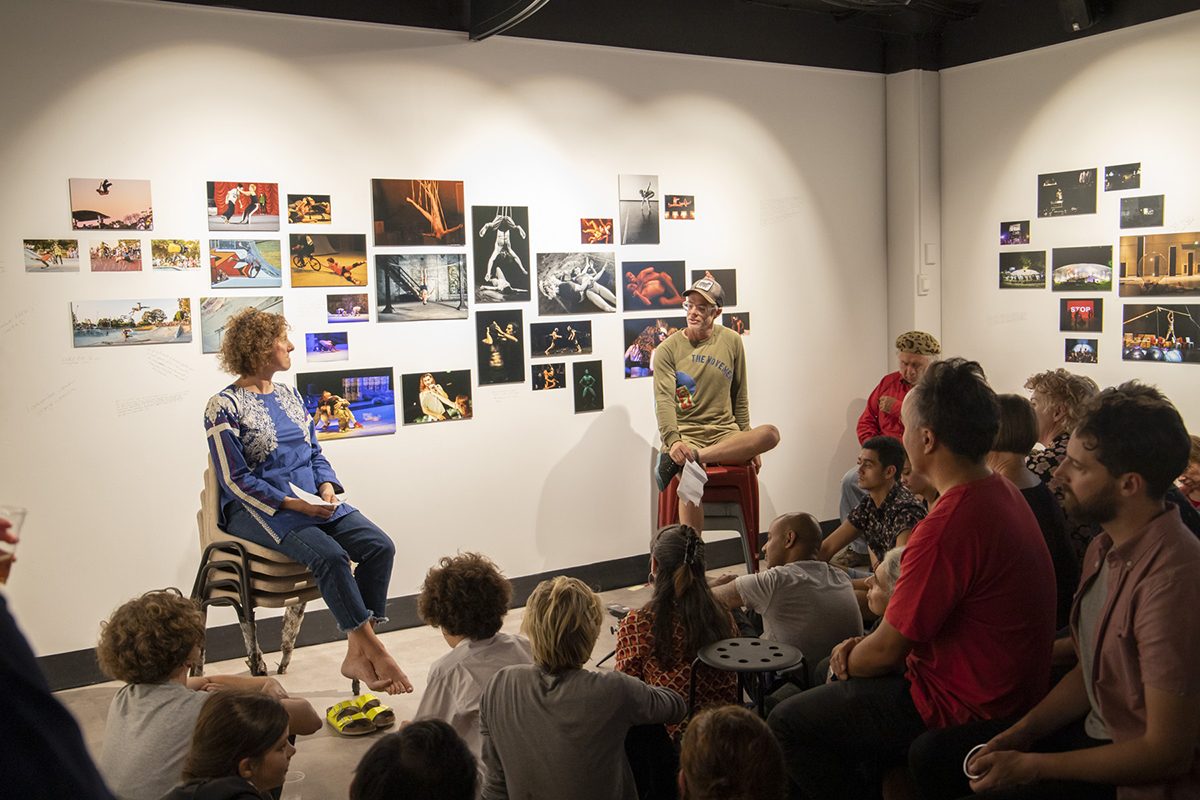
Mirabelle Wouters, Lee Wilson (Branch Nebula), artists’ talk, In Response: Dialogues with RealTime, UNSW Library, 2019, photo Jackson Mann
With a participatory spirit, Mirabelle Wouters and Lee Wilson, the Artistic Directors of Branch Nebula, canvassed audience memory, asking us to write on the walls with pencils responses to the many works featured photographically and arranged in fascinating constellations. Beneath this image an audience member wrote: “Intimate duo that gutted me.”
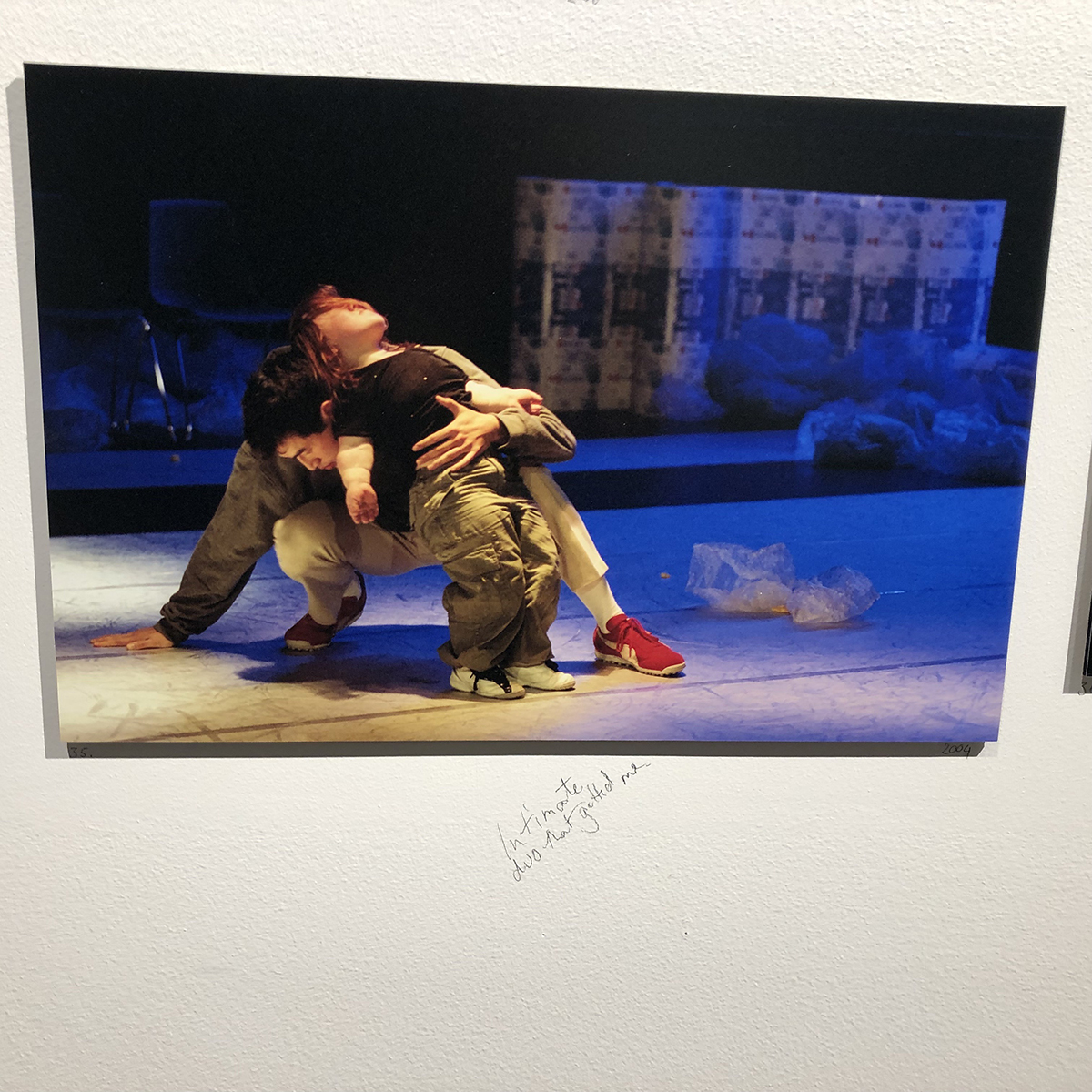
Installation image: Plaza Real, performers Keith Lim, Emma J Hawkins, Branch Nebula and Urban Theatre Projects, 2004, photo Heidrun Löhr, In Response: Dialogues with RealTime, UNSW Library, 2019, installation photo Keith Gallasch
The couple then quizzed each other about the joys and tribulations of their joint career and their creative communication and then invited some of their collaborators to speak from the floor about their joint experiences. Expertly produced video projections furthered the sense of this company’s distinctive performance style and design.
Mirabelle and Lee thanked RealTime for consistent attention to their work, not least earlier on when mainstream media found it difficult to categorise their practice or confined them to “physical theatre.” Mirabelle recalled that in her home country Belgium, where she and Lee met and worked together, that “anything that moves” was claimed for dance, but not in Australia. Anyone who’s seen Branch Nebula at work knows that there’s a distinct choreographic impulse at work, not least in the company’s skateboard park creations.
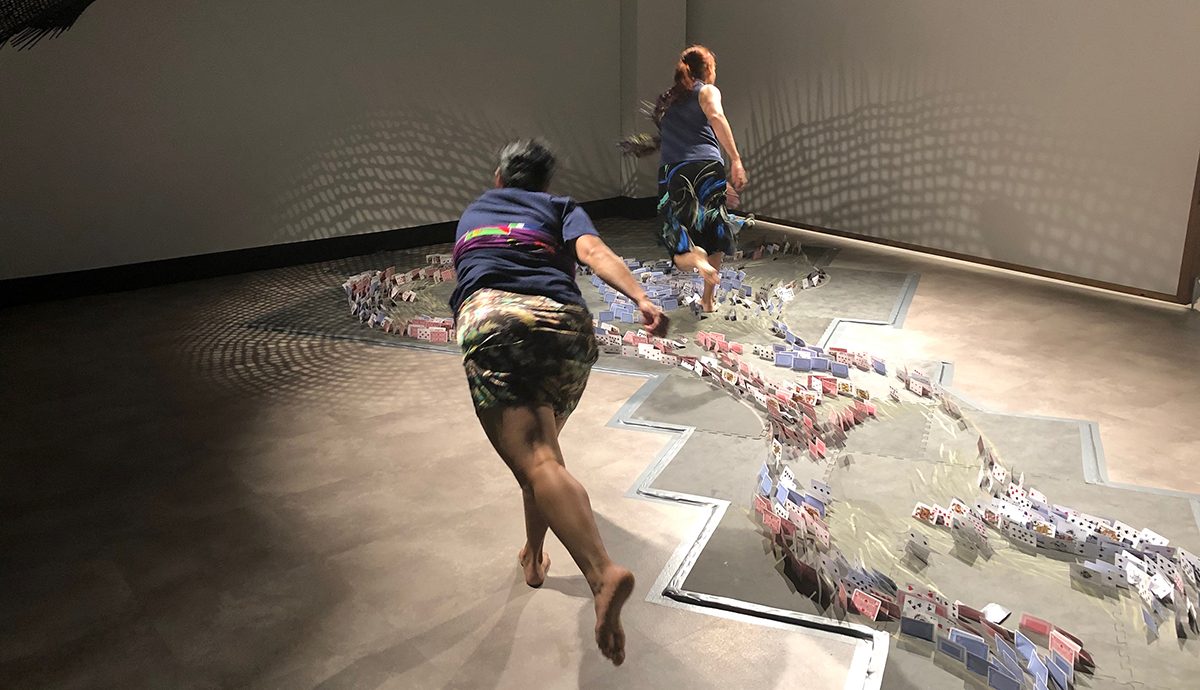
Vicki Van Hout, Henrietta Baird perform an excerpt from Briwyant (2011), In Response: Dialogues with RealTime, UNSW Library, 2019, photo Keith Gallasch
For her presentation, Vicki Van Hout was joined by Henrietta Baird for a vigorously danced conversational duet from Vicki’s major 2011 work Briwyant, performed here on Vicki’s recreation of the river of playing cards set she’d made for the production. The fast-paced, highly articulated performance was a pleasure to experience in the intimate space beneath a shadowy web cast wide by a suspended hand-woven sculpture, a new version of one made by Vicki for her work plenty serious TALK TALK.
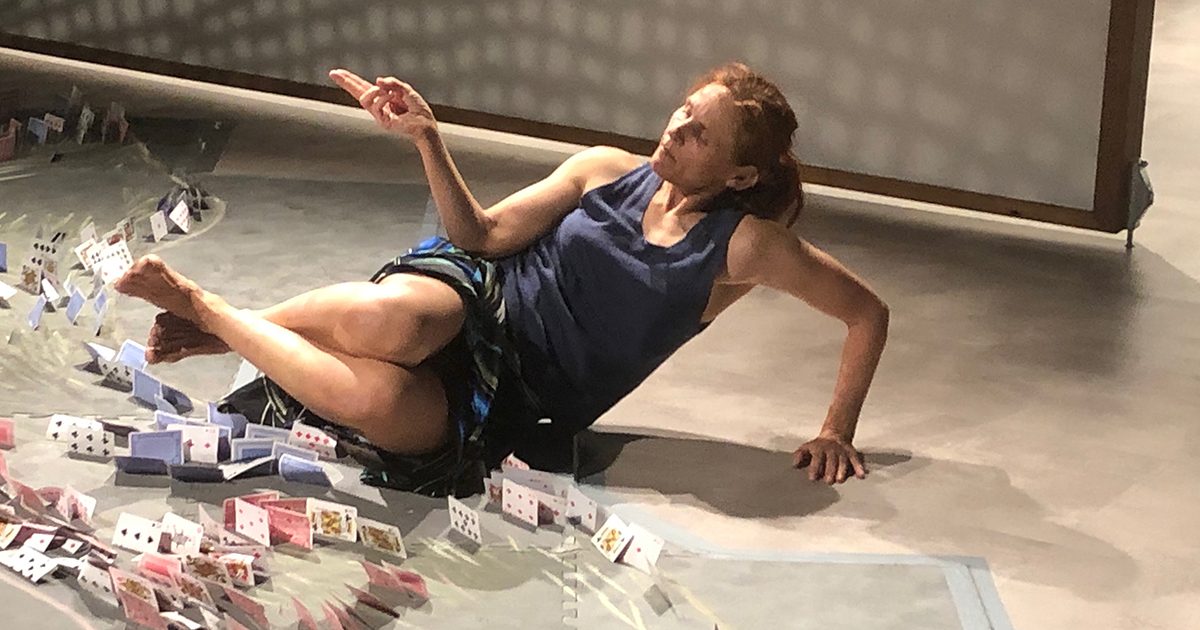
Vicki Van Hout performs an excerpt from Briwyant (2011), In Response: Dialogues with RealTime, UNSW Library, 2019, photo Keith Gallasch
Vicki spoke eloquently of how important RealTime reviews had been for her career as artist and also writer. She spoke of how the reviews seemed especially not to speak from outside the experience of the works reviewed. She then invited the audience to meticulously replace the playing cards dislodged or bent by the dancing while telling of the design’s original epic making, her mother’s committed if drolly ironic help with the task, and the meaning of the river the cards.
–
In Response: Dialogues with RealTime: Exhibition, 25 Feb-25 April, UNSW Library Exhibitions Space; performances: Martin Del Amo, 28 Feb, Branch Nebula, 20 March, Vicki Van Hout, 10 April; RealTime Archive Launch, Wednesday 17 April, 6.00pm; UNSW, Kensington, Sydney
Top image credit: Martin Del Amo at vitrine, lecture performance, In Response: Dialogues with RealTime, UNSW Library, photo Jackson Mann
“It’s thrilling that the artists in this exhibition are responding to our attention to their creations, years and even decades after their making and our reviewing. This is strange, rare and welcome: ephemerality suspended and hitherto unspoken dialogues given new voice and longevity. The loop formed between reviewer and work (implicitly the artist) is being regenerated, experiences recalled in vivid detail and estimations reconsidered: the loop keeps turning.” Keith Gallasch, Virginia Baxter, catalogue essay
The UNSW Library exhibition, curated by Dr Erin Brannigan with the participating artists Martin Del Amo, Branch Nebula and Vicki Van Hout, features installations by each of the artists and live presentations. The latter have been video recorded and will become publicly available. As well, Erin Brannigan has recorded interviews with the artists, writers reading their RealTime reviews and other archival material.
Edited by Erin, a writer on dance for RealTime since 1997 and a Senior Lecturer in Theatre and Performance Studies at UNSW, the catalogue features essays on the relationship between the exhibited artists and reviews that appeared in the magazine.
Dramaturg John Baylis writes about Branch Nebula, dancer Lizzie Thompson on Vicki Van Hout and dance scholar Amanda Card on Martin Del Amo. Keith Gallasch and Virginia Baxter delineate their vision of the art of reviewing.
The exhibition, the performative presentations and the associated online material helps sustain the RealTime archive while simultaneously furthering its reach and cultural value.
Read the catalogue here.
–
In Response: Dialogues with RealTime: Exhibition, 25 Feb-25 April, UNSW Library Exhibitions Space; performances: Martin Del Amo, 28 Feb, Branch Nebula, 20 March, Vicki Van Hout, 10 April; RealTime Archive Launch, Wednesday 17 April, 6.00pm; UNSW, Kensington, Sydney
Regeneration
It’s thrilling that the artists in the In Response: Dialogues with RealTime exhibition are responding to our attention to their creations, years and even decades after their making and our reviewing. This is strange, rare and welcome: ephemerality suspended and hitherto unspoken dialogues given new voice and longevity. The loop formed between reviewer and work (implicitly the artist) is being regenerated, experiences recalled in vivid detail and estimations reconsidered: the loop keeps turning.
Bodies & languages
In RealTime we have tracked the careers of Martin Del Amo, Vicki Van Hout and Branch Nebula. We have learned the language of each — images, movement, sometimes words. We know their bodies of work, if never utterly, for, being risk-takers, they always surprise with new works, as they did at first meeting when we entered their worlds and were changed, compelled to re-think possibilities of form and embodied thought.
Close encounters
In our RealTime review-writing workshops both here and overseas we propose that encountering an artwork should be like meeting a stranger — a possibly intriguing, charismatic, complicated, unpredictable, difficult person — requiring patience and generosity to understand, let alone empathise with. Each work, after all, is an artist’s avatar. The encounter requires openness and self-awareness, knowing one’s own desires, limitations, aversions and prejudices, especially when dealing with the unusual works we were attracted to and which were burgeoning in the 1990s, if then being granted little serious critical attention.
Looping
Borrowing from phenomenology, we see this encounter as a loop formed between audience and artwork, not only in the moment but in subsequent recollection, discussion with friends and, of course, in reading reviews and other writings. The more subtle or powerful the encounter, the more enduring the loop, with other opinions and responses fuelling it. The more deeply imbued in body and psyche, the longer the work is remembered, but it is also simultaneously subject to change as aesthetic, intellectual and political values evolve.
Temporal disparities
As actors, writer-performers and producers for the two decades before we initiated RealTime, we knew what it was like to create a work over, say, a year or two, perform it for a few hours nightly for several weeks and to have it reviewed in considerably less time; the very real time of the work reduced to 300-500 words in a newspaper, sometimes insightfully, sometimes not. These disproportionate time-scales seemed profoundly unfair. As reviewers and editors we wished to compensate for this inequity with more generous deadlines, longer reviews, where possible, and an honest disavowal of critical ‘objectivity’ in favour of considered and informed subjectivity.
Openness & real time
RealTime has been published by Open City, a company we formed to produce collaborative performances and other works in 1987. The name reflected our desire to be open to new art experiences, to collaboration, and to generating a sense of community. In 1994 we launched RealTime, the title indicative of a focus on live performance in music, sound, dance, opera, theatre, contemporary performance and performance art at a moment when cross-artform practices were beginning to flourish and new temporalities were being generated by new media art, often at the intersection of the real and the virtual. These works required increased attentiveness from reviewers dealing with multiple artforms and having to find the language with which to express unprecedented experiences.
Present tense, fidelity & judgment
We often encouraged our writers to compose in present tense in order to evoke a sense of immediacy. And, forestalling a rush to judgment, we also asked for vivid, concise evocations of what the reviewer saw, heard and otherwise sensed — attentive to a work’s surface, comprising as it does much of the evidence with which the reviewer plays prosecutor, defense, judge and juror, whether a final judgment is made explicit or is implied. We hoped that each review would draw the reader into that same experiential loop, providing a palpable sense of works often unlikely to be seen by many readers across Australia and beyond. Above all, we sought fidelity to the work, a descriptive evocation, regardless of final judgment.
The art affect
Reviewing demands heightened sensory awareness. There is nothing passive in being fully open to a performance. Engaged, we seem to forget our bodies and conscious selves, but contrary to this apparent emptiness we loop with the work, interiorising bodies and voices and design, a dancer’s sway, an instrument’s reverberance, the deep pull of gravity and release from it in circus, and in dance and music too. Visceral art hits the gut, sensual art brushes against the skin without touching. We shiver with fear, we sweat, hold our breath. Ideas delight, thrill, inspire, frighten or offend with palpable force. New media works test, disorient and expand our perceptual abilities. Relational art places our bodies inside the art, sometimes as co-creators, radically reducing the space between work and audience in the art-making loop.
Time is felt: the near-indescribable tension between moment and momentum in much art. Elsewhere we treasure the moment, welcoming imagistic works that refuse narrative compulsion, or, in recent dance and performance, seek transcendence and authenticity in ecstatic states and the ‘now.’ A vast number of works from at least the 1990s to the present have focused on the complexities of body, mind-body and perception in all their physiological, social and political dimensions, requiring of reviewers unprecedented attention to the work, self- awareness, and the demands on knowledge brought on by proliferating cross-artform and hybrid practices.
Reviewing the self
One of our occasional workshop exercises involves participants self-reviewing (how they see themselves, how they engage socially). As the learner-reviewer grows cognisant of the workings of the loop, registering each intellectual, perceptual, visceral response, they learn there will be moments when the exchange between reviewer and work falters or the loop locks or breaks. Often the first impulse is to blame the work. A better response is to first query one’s attentiveness or courage to risk the vertigo of new experience, to put oneself in the way of risk-taking artists, to become a risk-taker, share in the ways a body can say, think, be.
Reviewing in real time
Unless the response is hurried, formulaic and premediated, the real time of writing a review is intense, the work experienced is re-lived and newly imagined; one’s preconceptions have to be denied, ignorance acknowledged, vocabulary tested and expanded, the means to address work, artist and reader grappled with — review as statement, essay, prose-poem, combinations of these. As the loop turns, as images settle and the work’s shape becomes clearer, the reviewer can be surprised at their re-estimation of the initial response, partly rational, partly as if the review is writing itself, partly like dream work — making sense of why elements of the work provoked feelings of discomfort, unlikely pleasure, or of a haunting.
Reviewer as sharer
Artists are profound sharers. Whether seen as conduits, gatekeepers or judges, reviewers too are sharers. Ecologically, they might be seen as parasites (sometimes advantageously for art, as per Darwinian mutualism) or pollinators (attracted to art they spread its affects, at best making ‘honey’ of their writing) or, alternatively they are inhibitors and predators. In the era of YouTube and video documentation, reviewers are potentially supplantable, but the screen cannot tell what it was like to ‘actually be there’ and, when art and reviewer are as one, becoming part of an enduring loop.
Responsibility & humility
The reviewer’s compulsion to share their responses publicly is driven by considerable self-belief, varying degrees of expertise, and a passion to understand, belong to and have free access to an artistic milieu and its works. It might be driven by a felt need to support a particular form, a group of innovators, or specific communities. Whatever the motivation, the responsibility is enormous, not least now as reviewing is reduced to likes and blunt opinion-making while seeking new forms and platforms. Given the enormous temporal disparities between the making of a work and the execution of a response, the review must above all be humble before art, address it with fidelity and openness, alert to the workings — aesthetic, intellectual, intuitive, instinctive, perceptual and corporeal — of the loops that bind us enduringly to art and which represent the ways art transforms us, perhaps temporarily, possibly permanently.
The artists: agents of change
The works of Martin Del Amo, Vicki Van Hout and Branch Nebula (Lee Wilson, Mirabelle Wouters) have become a part of our lives. They have changed us in the ways we experience and understand the expressive potentials of dance and contemporary performance. Each of these artists has a very special sense of space and design. Collectively, they bring unexpected subject matter to performance — the everyday, sport, play, work, cultural heritage, and idiosyncratic personal and political concerns. They are also intensely collaborative, working at various times with suburban and regional communities, sometimes with those seemingly unlikely to associate with art. The experiential loops they generate go well beyond individual works. It has been our honour and pleasure to engage with their creations and bring our readers to recognise their enduring importance.
Thanks
This essay appears in the catalogue for the UNSW Library exhibition In Response: Dialogues with RealTime and is reproduced with thanks to the library,
We are deeply grateful to Erin Brannigan for initiating and co-curating In Response: Dialogues with RealTime with the participating artists, to UNSW Library for presenting the exhibition, and to the project’s other partners. We thank UNSW Library and the National Library of Australia for partnering to place RealTime print editions 1994- 2015 online on the TROVE site. We also greatly appreciate the Australia Council for the Arts’ decades of support for a bold publishing project, Guardians of RealTime members Erin Brannigan, Gail Priest, Caroline Wake and Katerina Sakkas for their passion to preserve the RealTime legacy, and Open City’s Board, Tony MacGregor, John Davis, Julie Robb, Urszula Dawkins and Phillipa McGuinness, for their collective wisdom and unstinting encouragement.
–
In Response: Dialogues with RealTime: Exhibition, 25 Feb-25 April, UNSW Library Exhibitions Space; performances: Martin Del Amo, 28 Feb, Branch Nebula, 20 March, Vicki Van Hout, 10 April; RealTime Archive Launch, Wednesday 17 April, 6.00pm; UNSW, Kensington, Sydney
Top image credit: Keith Gallasch, Virginia Baxter admire Unicorn (1984) by Bronwyn Oliver in performance titled Small Talk in Big Rooms, Writers in Recital, 1991, Art Gallery NSW. Sculpture collection of and image courtesy Art Gallery of NSW.
This is a factual history; a personal one will emerge once we’ve had time to reflect on the experience that has been RealTime, taking us across Australia and overseas, producing associated publications and enjoying the pleasure of being part of a far flung network of writers alert to innovative practices predominantly in the small to medium sector but also the mainstream when it took risks.
Before RealTime
In 1987 in Sydney, writer-performers Virginia Baxter and Keith Gallasch formed the performance company Open City, producing works 1987-1996 principally at The Performance Space as well as appearing in and collaborating on experimental radio works for ABC radio. [See Team for more biographical detail.]
The making of RealTime
In 1994, with Open City as publisher, Managing Editors Virginia and Keith boldly launched RealTime as a free national arts magazine, focused on innovation in the arts and countering limited mainstream media attention to a wealth of emerging experimental and hybrid arts practices. The first edition, seed-funded by the Australia Council for Arts, was passionately welcomed by artists and readers. Securing ongoing funding, the magazine grew in print numbers and distribution reach, peaking in the 2000s with 56-page tabloid bi-monthly editions, 27,000 copies delivered to 1,000 locations across Australia.
From the beginning, contemporary performance, adventurous theatre and innovative dance featured strongly in RealTime alongside contemporary classical and experimental music, sound art, film, video and emerging digital media art which quickly pervaded most other practices. RealTime also focused on Indigenous art, innovative regional practices and the work of artists with disability. Australian writers travelling to overseas arts events provided RealTime readers with an international perspective. Only in RealTime could coverage of innovation of this scope and across the arts be found under one cover, alerting local artists to the work of their peers across Australia and beyond.
RealTime quickly became a highly trusted journal of record and critique, producing responsive, much quoted reviews and maintaining long-form reviewing as it otherwise diminished in Australia’s newspapers.
RealTime writing, RealTime writers
Central to Keith and Virginia’s editorial vision was that the reviewer vividly evoke each work under review, to do justice to the work as a real time experience. It forestalled a critical rush to judgement, asking the reviewer to take the reader with them on the path to making it, or a provisional evaluation. This ‘experiential’ reviewing was formed under the influence of Susan Sontag (Against Interpretation, On Style), American dance reviewers (Deborah Jowitt, Sally Banes) and the field of perceptual phenomenology. The editors encouraged constructive criticism from a position of “considered subjectivity.”
RealTime writers have been artists of many kinds, artist-academics, curators, novelists and a variety of arts specialists. The editors encouraged and mentored numerous artists to write, to draw from the deep knowledge of their practices. RealTime editorial, sales and technical staff have also been predominantly artists, working part-time while pursuing their practices and writing extensively for the magazine.
Online in 1996
In 1996, with considerable foresight, Virginia and Keith established the RealTime website, publishing online reviews in response to Barrie Kosky’s Adelaide Festival. From that year on every bi-monthly print edition was also published online, reaching a greater range of readers, some 35% of them overseas. In 2009, an online producer was appointed to deliver more frequent emailed editions, paving the way to sole online weekly publishing in 2016-17.
Workshops around the world
From 1995-2017 RealTime received 35 commissions from international and local art festivals and arts organisations in London, Bristol, Vancouver, Jakarta, Singapore and Lyon, every Australian capital city and Darwin, Bendigo, Cairns and Albury to run review-writing workshops or reviewing teams, often publishing daily online. These were variously conducted by Keith, Virginia and Associate Editor Gail Priest, a key RealTime staff member in layout, sales, writing and online production 1997-2014, as well as by music reviewer Matthew Lorenzon in 2015-17, often yielding new writers for RealTime.
The knowledge: other publications
Drawing on RealTime’s archive and the extensive knowledge of its editors, the Australia Council for the Arts commisisoned the highly respected and internationally distributed In Repertoire series (1999-2004) promoting tourable Australian art. For the Australian Film Commission’s Indigenous Film Unit, RealTime edited and produced Dreaming in Motion, A Celebration of Australian Indigenous Filmmaking (AFC-RealTime, 2007), the first and, currently, only account of a generation of now acclaimed filmmakers.
In 2014, RealTime and Adelaide’s Wakefield Press co-published the Australia Council-supported Bodies of Thought: 12 Australian Choreographers, essays and interviews focused on a generation of independent choreographers who emerged in the 1990s and came into prominence in the 2000s. The book is one of the very few on contemporary Australian dance. Bodies of Thought was edited by Dr Erin Brannigan, UNSW, a long-term RealTime contributor, and Virginia Baxter.
The final years
By 2014, after many years of successfully publishing RealTime in print, the media marketplace had changed radically. Social media substantially diminished advertising sales income, rendering the printing of the magazine (with its huge carbon footprint) unviable. The printing of the magazine ceased with the December 2015 edition. In 2016-17 RealTime was published weekly online, featuring many online-friendly and often labour intensive innovations, but with little benefit for selling advertising. The Editors and the Board of Open City decided to cease publication at the end of 2017 and, with the support of the Australia Council, commit the 2018 program to building and celebrating the archive. A saddened readership sent hundreds of messages (you can read them here) of condolence and congratulation for a near-quarter century of uninterrupted publishing and wonderful support for artists and readers, charting a period of enormous change in the arts.
The Archive: TROVE
In 2017, UNSW Library approached Open City, publisher of RealTime, via Dr Erin Brannigan, a Real Time contributing editor and Senior Lecturer in Theatre and Performance Studies, School of the Arts and Media, UNSW, to propose the archiving of the 130 editions of the print magazine 1994-2015 on the National Library of Australia’s TROVE website. The proposal was gratefully accepted.
Open City signed an agreement with the NLA to digitise the editions and the UNSW Library and NLA agreed to partner the archiving, with UNSW Library and Open City contributing to covering the costs of the digitisation.
The searchable NLA digitisation wonderfully preserves not only the content of RealTime, but also Graeme Smith’s design as it evolved over the years from 1994 onwards, but also the advertising which is often historically informative in itself. Visit the archive here https://nla.gov.au/nla.obj-733140625.
The Archive: RealTime website
Redesigned in 2017 by Graeme Smith and built by Melbourne’s The Mighty Wonton, the RealTime website houses digitised print editions from 1994-2000 and all editions as they appeared online 2001-2018, plus a multitude of video interviews, sound art, video art, travel features and festival reports.
Thanks from the Managing Editors
From seed funding in 1994 to project and then triennial and four-year funding, as well as from VACS [National Visual Arts and Crafts Strategy], the Australia Council has consistently supported Open City for the publishing of RealTime, an indication of responsive policy-making and the continuing high regard of artist peers on assessment panels have had for the publication. Arts NSW also funded Open City for much of RealTime’s history until grants became sporadic and were no longer pursued. Vertel, a Sydney-based telecommunications company, provided welcome substantial technical sponsorship in recent years.
Thanks go to Keith and Virginia’s fellow Board of Management members — Tony MacGregor, John Davis, Julie Robb, Urszula Dawkins and Phillipa McGuinness — for their constant encouragement, understanding and friendship.
Also greatly appreciated is the genius of Graeme Smith for providing RealTime with a distinctively lucid visual identity over the decades, and The Mighty Wonton’s Lee Wong for her patient and inventive realisation of the latest manifestation as our new website.
RealTime staff of many years have fuelled the magazine with passion, loyalty and creativity: most recently Katerina Sakkas, Lauren Carroll Harris and Lucy Parakhina and, above all, Gail Priest who joined RealTime 1997 and left in 2014 but has continued to contribute and advise, drawing on her vast knowledge of the workings of the publication.
The Guardians of RealTime committee (Erin Brannigan, Caroline Wake, Katerina Sakkas, Lucy Parakhina, Gail Priest) have helped maintain the RealTime vision in its archival stage. Erin has initiated and superbly curated In Response: Dialogues with RealTime, an exhibition in the UNSW Library Exhibition Space featuring installations and performances by the artists Martin Del Amo, Branch Nebula and Vicki Van Hout, subjects of many RealTime reviews and articles.
We thank the many artists who have inspired us, and the writers who have contributed to RealTime, some since the 1990s to very recently, many for five to 10 years or more, for their commitment, skill and judicious insights. As not a few writers have said, a sense of community was shared across artforms and across the country. And finally, we extend our gratitude to our readers, the greater part of that community.
Virginia Baxter & Keith Gallasch
Managing Editors RealTime
–
Top image credit: From Sam James’ video documentation of RealTime coming off the presses at Spotpress, graphic design Graeme Smith for RealTime 101 Feb-Mar, 2011
Above – The RealTime team in 2014: Managing Editors Virginia Baxter and Keith Gallasch in 2014 with Associate Editor and Online Producer Gail Priest, Sales Manager Katerina Sakkas and Administrative Assistant Felicity Clark photographed by the doyen of performance photographers in Sydney, Heidrun Lohr.
This page, a work-in-progress, will feature entries about key staff and Board of Management members from over the years. We’ll soon be adding entries to Team about key RealTime staff.
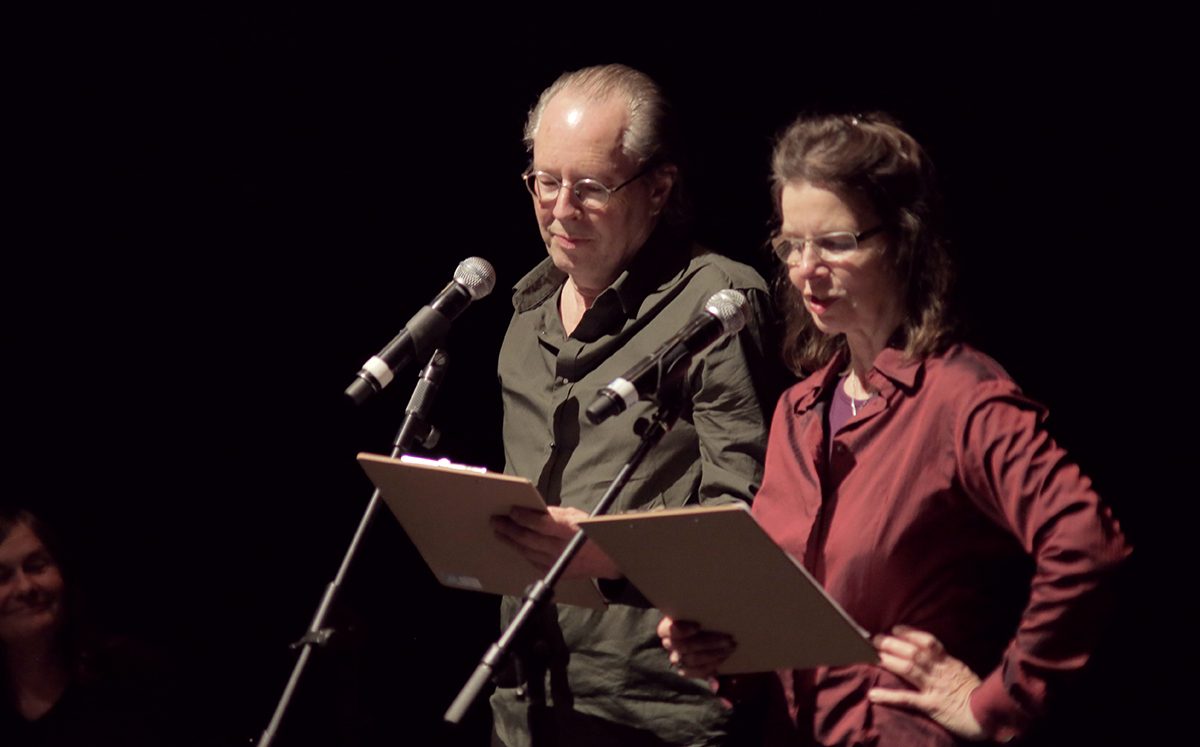
Keith Gallasch, Virginia Baxter, RealTime 20th Birthday celebration and launch of the RealTime-Wakefield publication Bodies of Thought: 12 Australian Choreographers, 2014, photo Sandy Edwards
Virginia Baxter & Keith Gallasch
Virginia Baxter & Keith Gallasch. Theatre and contemporary performance practitioners, Virginia and Keith founded RealTime in 1994 as Managing Editors, editing, writing, running the business, producing specialist publications and conducting review writing workshops here and overseas.
This is a biographical sketch which we’ll flesh out once we’ve had time to sit back and reflect on our 25-year RealTime adventure.
We are Directors on the Board of Management of Open City Inc and Managing Editors of RealTime. Open City Inc was founded by us on the principle of openness: free access, collaboration, critical responsiveness, both as a performance company, 1987-1996, and as the publisher of RealTime, 1994-present, other publications and books, in forums and writers’ workshops.
Prior to forming Open City, we had been members in the 1970s of Troupe, the first independent Adelaide theatre company committed to nurturing Australian playwriting. Keith acted, directed and wrote for Troupe and subsequently wrote for youth theatre companies in the early 80s and Legs on the Wall in the late 80s. He was a member of the Literature Board of the Australia Council, 1983-5. In the 1990s and early 2000s Keith was dramaturg for four productions by Griffin Theatre Company (including for two AWGIE-winning scripts) and one for Vitalstatistix.
In the early 80s in Adelaide, after acting with Troupe, Virginia wrote and performed two solo works, Just Walk and What Time Is This House? She was the Chair (1992-99) of Playworks, the National Women Writers’ Workshop and edited the collected papers and performance texts of Playworks’ 10th anniversary event in 1995 as Telling Time (Playworks, 1997; revised 1999). She has worked as a dramaturg on performance and dance projects and was co-curator of the 2002 Antistatic contemporary dance event at Performance Space.
For 22 years, we have written, commissioned, managed RealTime’s production, finances, distribution and sales, and conducted workshops here and overseas while maintaining the collaborative and responsive vision that is our own. In this we have been supported by committed and creative staff who are also writers.
Drawing on RealTime’s archive and the extensive knowledge of its editors, the Australia Council for the Arts commissioned the highly respected and internationally distributed In Repertoire series (1999-2004) which we edited, promoting tourable Australian contemporary performance, music theatre, dance [two editions], Indigenous arts, new media art and theatre for young people.
For the Department of Foreign Affairs and the Australian Film Commission (AFC) Keith and Virginia edited and produced Explorations: Films Indigènes d’Australie (2002), a catalogue accompanying a set of films gifted to the French Government in celebration of the voyage of Nicolas Baudin to Australia. For the AFC’s Indigenous Film Unit, RealTime edited and produced Dreaming in Motion, A Celebration of Australian Indigenous Filmmaking (AFC-RealTime, 2007), the first account of a generation of now acclaimed filmmakers.
In 2014, RealTime and Adelaide’s Wakefield Press co-published Bodies of Thought: 12 Australian Choreographers, edited by Dr Erin Brannigan, UNSW, a long-term RealTime contributor, and Virginia; the project was managed by Keith. This collection of essays and interviews focused on a generation of independent choreographers who emerged in the 1990s and came into prominence in the 2000s. The book is one of the very few substantial volumes on Australian dance.
We are currently working with co-editor SJ Norman (a leading Indigenous interdisciplinary artist) on a book about innovative Aboriginal art across the last two decades.
Looking for an engrossing adventure that tests you perceptually and temporally, taking you deep into The Rocks as both an actual and virtual space? The City of Forking Paths is a “physical cinema” work commissioned from Canadian artists Janet Cardiff and George Bures Miller by the City of Sydney for the 2014 Biennale of Sydney. It’s now part of the Council’s permanent collection and currently available to experience for free from now into April. Book on the website.
I start out at Customs House clutching a small digital device and am soon treading cautiously down an alley where the audio instructs me to sit on an empty bench. On the simultaneous, pre-recorded screen image of the seat rests a copy of Philip K Dick’s The Man in the High Castle. I like this little parallel universe joke, but am also a tad spooked; I’d re-read the novel just a couple of days before and was currently immersed in the Amazon Prime series. Early in this hour-long wander through both familiar and quite unexplored places in The Rocks in a warm, humid twilight, I’m also struggling to achieve perceptual equanimity, eyes swivelling between real and virtual, mind noting curious, sometimes weird 2014/19 disparities and registering physical risks on stairs, cobblestones and busy roads.
Cardiff’s voiceover gently guides me through the streets, reflecting from time to time on the city, personally, historically, whimsically and metaphysically. Musicians appear onscreen, as does an actor, evoking some of the tensions of the darkening streets, while other sounds—birds, bats, waves, rain—double the aural world, juxtaposing phantom past and ephemeral present. There are forbidding laneways, vertiginously steep steps, sudden new perspectives on the looming Harbour Bridge and, on this night, an ochre-red Opera House, conflicting aromas issuing from eateries, a damp, cave-like early Sydney dwelling, boarded-up public housing lost to developers, and onscreen swathes of tourists sweeping by me on actually empty streets. I’m fascinated and disoriented. I get lost, wind back and set off again. After the 60-minute walk I carry away with me a satisfied sense of heightened alertness and a new awareness of The Rocks, doubling my sense of time and place and their fluid interplay. What parallel realities might The City of Forking Paths conjure if repeated in 50 years?
It’s ideally a solo experience, but works for groups as well. I went with three friends, each of us commencing the adventure alone at intervals of several minutes, but nonetheless meeting at various stages as we corrected our paths or lingered over striking finds, in the end hastening to a local alehouse to collectively muse over a fascinating experience. Keith
–
Top image credit: photo courtesy of The City of Sydney
“My obstinate elder sister, my fragile little sister. Alone in a world that was decomposing…” (libretto, La Passion de Simone)
As we currently experience the decomposition of democracy, civility and privacy and the destruction of nature, it’s timely to reflect on the life of a thinker who in the 1930s and 40s engaged with trade unionism, the Spanish Civil War and the French Resistance while wrestling with her faith and the remoteness of God and who was embraced by socialists, Christians and atheists, Camus among them. To tackle the hard realities of the world and simultaneously seek transcendence, seems an increasingly daunting task. An opera in the 2019 Sydney Festival illustrates the challenge with a searing sense of emotional and spiritual turbulence leavened by moments of glorious musical flight.
A lone Singer addresses the philosopher mystic Simone Weil (her ‘sister’ in spirit), grappling with the seeming contradictions and revelations engendered by this confounding Jewish-French, left radical, baptism-refusing Christian whose legacy of gnomic utterances has entranced generations since her death in 1943. In Finnish composer Kaija Saariaho’s cantata-like La Passion de Simone, the singer “travel(s) with you, in my mind/ The way of your agony” in 15 ‘stations.’
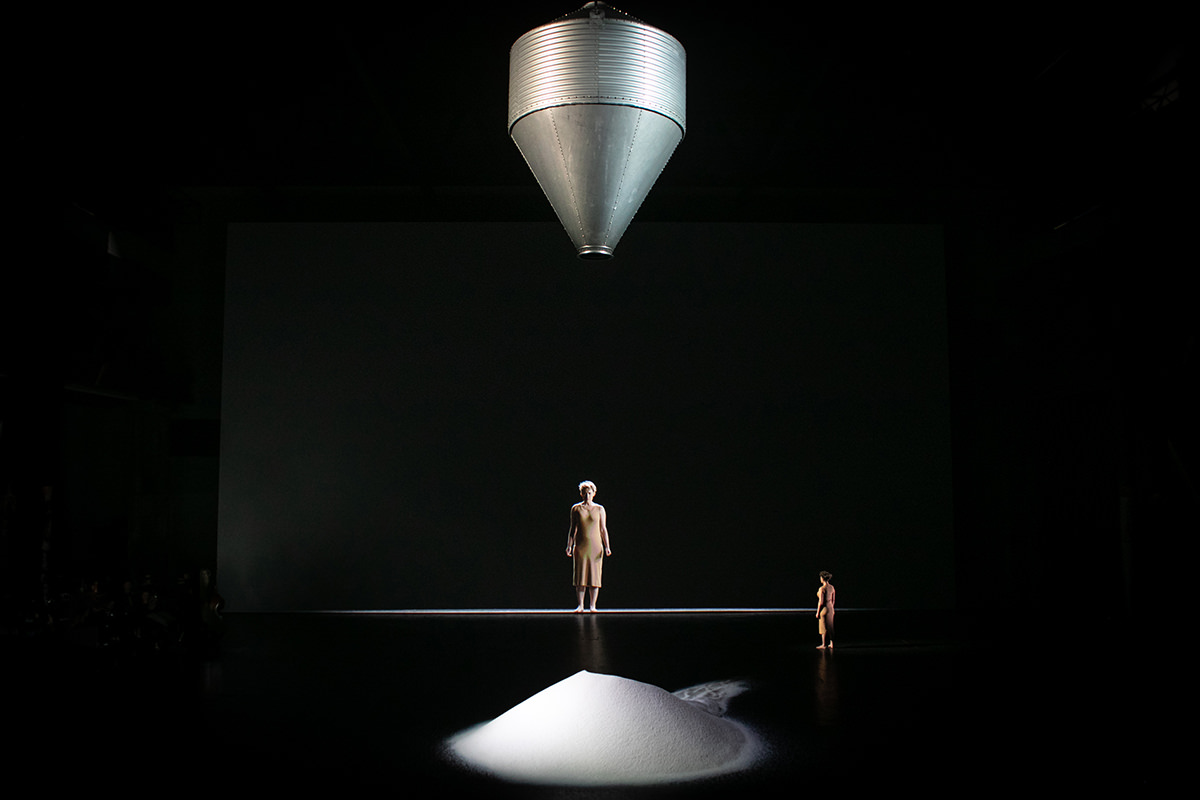
Jane Sheldon, La Passion de Simone, Sydney Chamber Opera, photo Victor Frankowski
But before the words and music, we ponder in silence a striking large-scale installation. In the foreground is a conical, human-height mound of white rice. High above it is a gleaming metal hopper from which we imagine the grain has been poured. Behind, a vast stage-wide screen; to one side, a plainly attired woman, hair cropped short, facing it. Silence. The same woman, now a giant presence, appears on the screen walking slowly towards us until halted by the fierce downpour of a column of rice (think Bill Viola’s The Crossing [1996] in which a man gradually disappears within a descending rush of water) striking head and shoulders with visible impact as it accumulates around her.
At once, Simone Weil’s philosophising is given body: the sheer, unremitting force of Gravity in the form of the falling rice is literally indicative of the weight of unavoidable human suffering and, as we’ll learn, a metaphor (the hopper a human construct) for institutions — the church, political parties — that oppress. For Weil, Gravity denies us Grace with which to ascend into the Light, the capacity to surrender ourselves utterly, with love, to an absent God in a theology without miracles or a life hereafter.
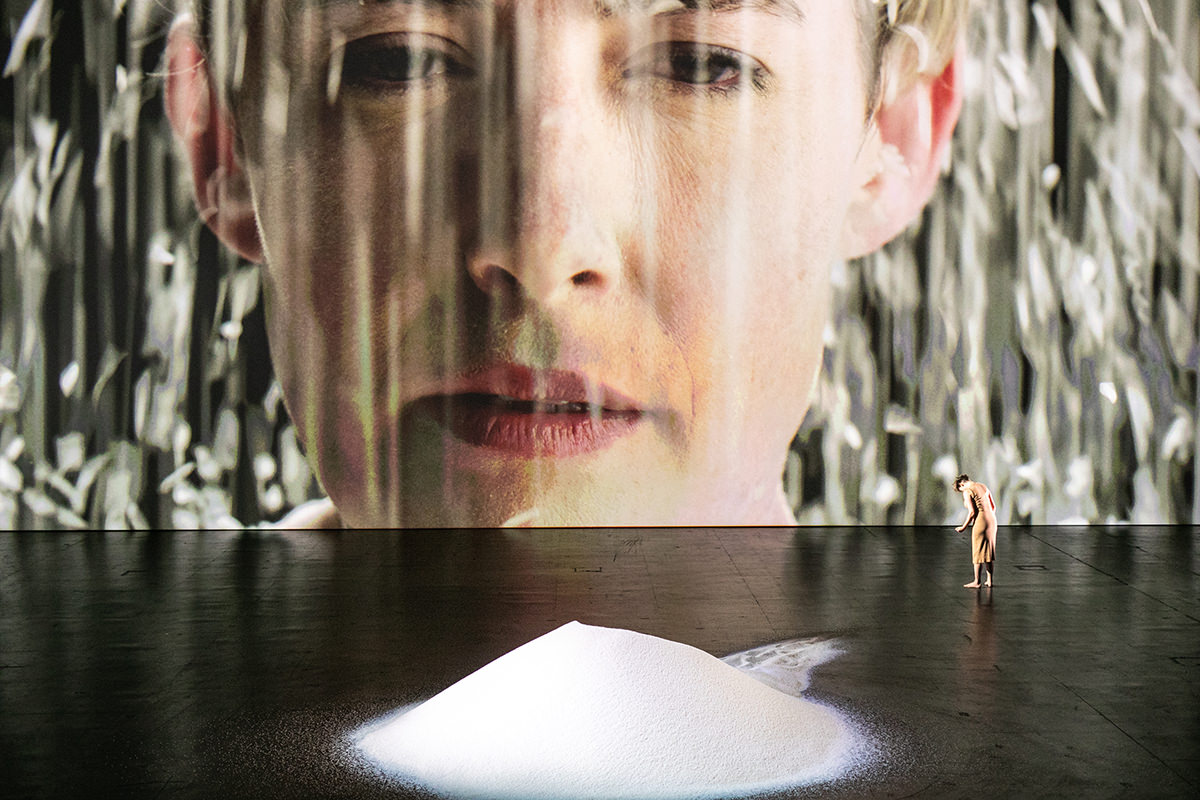
Jane Sheldon, La Passion de Simone, Sydney Chamber Opera, photo Victor Frankowski
When Weil’s compassion for the poor and oppressed everywhere (if neglecting herself and her immediate family) is invoked, the column of falling rice is multiplied immersively across the full width of the screen. When we are told Weil dies of starvation in London (the result of minimising her eating in sympathy with the war-time French population), her face, eyes meeting ours amid the tumbling rice, fills the screen with seeming serenity. The grains flurry, their increasing density evoking atoms, stars, a depthless cosmos into which Weil disappears, at one with the Light. At the very same time, orchestra and singer counter with unease as Weil’s spirit departs.
The Singer laments, “Your Grace was liberated/ from the Gravity of the world/ but the Earth where you abandoned us/ is always full of deceit/ where innocents tremble.”
Video artist Mike Daly’s series of continuous, evolving images provides a simple structure against which the complexities of Weil’s life and her vision play out in the queryings (in French) of the Singer (soprano Jane Sheldon), Weil’s own words (spoken by Sheldon; in the original production in Vienna delivered by a Reader), a Chorus (The Song Company, resonantly echoing telling phrases like a fascinated public) and, above all, the voice of the orchestra, a grand narrator conjuring machines, war, the hocketings of a wracked soul, recurrent slides into despair, moments of contemplation, flight and provisional transcendence, generating a fraught cosmos within which the soprano soars and falls between Gravity and Light. Moreso than Saariaho’s other operas, La Passion de Simone bristles, shimmers and thunders; above all it is percussively propulsive, conductor Jack Symonds perfectly capturing the alternations between Weil’s manic sense of urgency, sinking defeat, floating release and the Singer’s querulous probings. This provides La Passion de Simone with an emphatic dramatic pulse.
Opera as installation
In her program note, director Imara Savage writes that the makers of this production of La Passion de Simone decided to realise it as an art installation. The minimal sculptural and screen imagery and the Singer fixed to one spot compel a heightened focus on the interplay of words and music. Since at least Robert Wilson and Philip Glass’s Einstein on the Beach (1976), use of installation has been a viable means of reinvigorating opera, not least where conventional dramatic composing and libretto-writing have vacated the idiom. Amin Maalouf’s libretto for Passion is minimally dramatic, sparely focused on ideas and offering little detail of the life of its subject. If the libretto inclines to abstraction, Kaija Saariaho’s intensely vivid score induces a profound listening experience, if bound by Maalouf’s text; but Sydney Chamber Opera shows how a satisfying dynamic between words and score can be realised.
In the poorly received 2006 premiere production (full orchestra, large Chorus and Reader, the latter onstage) in Vienna, director Peter Sellars added a dancer who moved in tight, angelic sync with the soprano. In his tauter 2016 chamber version (Ojia, California), minus the dancer, a physically vigorous Singer also recites the Reader’s words from a book while a human-scale screen reveals abstract light images behind her, suggesting varying emotional and spiritual states. A Chorus of four stands close by, like a panel of alert commentators. As the production progresses, the Singer, despite her doubts, increasingly identifies with Weil and with physical consequences, including falls.
In Sydney Chamber Opera’s La Passion de Simone the Chorus sits amid the low-lit orchestra, which is positioned to one side of the stage image, while a pre-recorded Sheldon is heard as if Weil herself is speaking rather than via a Reader. The visual absence of Chorus and Reader as palpable presences (though aurally substantially felt) narrows this world to one in which the singer and her identical screen-self, face to face, become a complex, tormented entity, true to Weil’s state of being. This Singer is no interlocuter on our behalf. The result is a closed circuit, a visual and aural monodrama, a minimally performative installation, the action essentially onscreen.
Just as the onscreen Weil is realised in terms of durational performance with the punishing fall of rice on a vulnerable but unyielding body, so too does the Singer, locked in her sole standing position for 75 minutes, display the effects of unremitting force; but the source is internal, requiring the soprano to empathically quake from the very first scene on and with escalating force. This is accompanied by recurrent gasps that cut across mood and music, underestimating the capital S stoicism that is integral to Weil’s vision. The passion in the sung score is superbly conveyed by Sheldon without needing this pre-emptive excess of sound and movement (some simple physical patterning mapped in the way the video is structured might have offered the singer and audience a subtler responsiveness). Inevitably, it feels that the wracking of the body is more acted than felt, a theatrical impulse at odds with the makers’ non-dramatic conception.
Despite this, Sheldon won me, her singing at once crystalline and impassioned, plangently lyrical and passionately operatic, evoking the sheer intensity of the Singer’s quest to understand and empathise with Weil.
Representing Weil
The boldest aspect of Sydney Chamber Opera’s La Passion of Simone has been the decision to actually represent Weil, onscreen and, in the mirror-imaging of Singer and philosopher, onstage. Simone Weil would likely have been appalled at the prospect of being literally represented — which she is not here; the images are symbolic of passages of her life. The libretto mentions a particular photograph of Weil, but this production wisely refuses to show it (some have not).
On the page and in other productions, the opera belongs to the Singer, not to Weil whom we can only sense from snippets of her life, fragments of her writing, the choral underlining of her utterances. The drama that plays out is the Singer’s quest to understand Weil; it cannot fully succeed, ending with almost numb acknowledgement. In this production the Singer is turned away from us, locked, quivering, in one position for the opera’s entirety, minimising our direct identification with her, but underlining her problematic identification with Weil, with Sheldon as both Singer and the object of her projection. Sydney Chamber Opera’s risky decision to represent Weil, even if abstractly, and make her the focus of our gaze, is a bold one and a significant departure from previous productions I know of. On the night it somewhat diminished for me the sense of the Singer’s presence and her striving, if nonetheless feeling the intense stress of her quest in the singing. Now, on reflection, I vividly and satisfyingly recall, as one, the sad beauty of the Singer’s anguish and the transformation of Weil into Light, merging with cosmos, a decomposition with Grace, if leaving us too forsaken in troubled times. Once again I’m deeply grateful to Sydney Chamber Opera for staging a work I knew of but never expected to see and which has provoked thinking about opera and form, politics and faith.
–
Sydney Festival, Sydney Chamber Opera with The Song Company, La Passion de Simone, music Kaija Saariaho, text Amin Maalouf, conductor Jack Symonds, director Imara Savage, soprano Jane Sheldon, vocal ensemble The Song Company, set and costume design Elizabeth Gadsby, lighting design Alexander Berlage, video artist Mike Daly, film producer Sarah Nicholls, sound designer Bob Scott; Carriageworks, Sydney, 9-11 Jan
Top image credit: Jane Sheldon, La Passion de Simone, Sydney Chamber Opera, photo Victor Frankowski
A New York Times report on a massive cinematic installation by Russian film director Ilya Khrzhanovsky inspired by the life of Nobel Prize winning theoretical physicist Lev Landau grabbed our attention. With 13 feature-length films, performance and much else, it’s about to open in Paris, a police permit pending.
After the premiere season of DAU — a 24 hours a day, seven days a week multiple theatre experience of 13 feature-length films, video streaming, talks and performances — was postponed in Berlin, the Paris opening has been cancelled this week pending the granting of a police permit. Will it go ahead, let alone go to London in April?
DAU, the creation of Russian film director Ilya Khrzhanovsky, was originally planned to be a large-scale film about the life of Nobel Prize winning theoretical physicist and free love exponent Lev Landau. 700 hours of film was initially shot in the Ukraine in 2009-11 on a massive live-in set — a very realistic version of a 1950s theoretical physics institute in which the performers precisely lived out their roles, apparently without scripts. The film features one professional actor, hundreds of non-professionals and thousands of extras plus celebrities from a range of fields including Marina Abramovic, Peter Sellars, Romeo Castellucci, theoretical physicists David Gross and Carlo Rovelli and, as Landau, one of Europe’s leading young conductors, Teodor Currentzis. The installation includes its 13 feature length films, personalised interactive additional story lines and performers living out Soviet-era lifestyles.
The sheer scale of the work as described is breathtaking, let alone the magnitude of its evolution as revealed in the London Review of Books by novelist James Meek. We’re waiting for DAU!
Discover more about DAU on the project’s website.
–
Top image credit: Still from DAU