The Hobart Fringe Festival was set up several summers ago as a means for performers and practitioners in the experimental and non-mainstream arts to gain greater exposure. Tasmania has a rich vein of talent, across all the arts, but rather too few opportunities for these talents to be showcased. This goes for the experimental arts in particular. The entire Fringe Festival functions on a lot of enthusiasm and goodwill and a limited budget. Happily, the organisers are able to bring together a variety of smaller arts events, some of which would be taking place in any case, giving them a wider profile by including them within the Fringe, which runs for 2 weekends and the intervening week.
One of the best resolved and most professional events within this year’s Fringe Festival was the Multimedia Mini-Festival, curated by local video and performance artist and musician Matt Warren. Warren, current recipient of a Samstag Scholarship, will soon undertake MFA studies in Canada. Over the past few years he has been very active, statewide, in presenting individual, collaborative and specially-commissioned innovative public arts events combining elements of performance, sound, video and installation.
With few film events currently being held on any regular basis in Tasmania, the Mini-Festival was a terrific opportunity for artist-exhibitors and audiences alike. We have only limited opportunities to study film and video making in any depth—and professional openings are rare—so the existence of an enthusiastic culture of film and video artmaking and appreciation is doubly impressive.
One of the highlights was Film & Video on the Fringe, a well balanced evening screening of short films and videos, by mostly local artists, held at the theatre at the Hobart School of Art. (At the School of Art itself, the popular and well equipped Video Department, run by highly regarded video artist and musician Leigh Hobba, has been for some time teetering on the brink of threatened closure, ill-advised and unpopular though such a move would be.)
The stand-out works included the video Where Sleeping Dogs Lay by Peter Creek, looking at the consequences of domestic violence. Its absorbing 2-hander dialogue format is jeopardised by a tacked-on bit of drama, designed (probably) to provide some visual variety and ‘action’, but not a total success. Tony Thorne’s amusing animation Serving Suggestion is a subversive piece about consumerism and physical stereotypes. Its humour is from the South Park bodily fluids and functions school of wit, but it manages to present its own, original take on this well-worn theme. The closing credits are amongst the most fascinating and well executed I’ve seen.
Prominent emerging local filmmaker Sean Byrne’s Love Buzz takes a familiar if far-fetched plot device and makes it fresh and credible. There is some interesting—and deliberately self-conscious—dialogue, marred, however, by the technical limitations of the soundtrack. Dianna Graf’s short (3 min) video-collage of still photographic images is a simple idea seductively brought to fruition. But perhaps the most engaging work is Matt Warren’s short video, Phonecall, another very simple concept actualised, in this case, into something Kafkaesque in its disturbing unreadability.
It is night and a pyjama-clad Warren has clearly been woken from sleep by the ringing phone. The audience then simply listens as he responds; warily, laconically, impatiently and so on, to whatever is on the other end of the phone (which is never revealed). Something a bit suspect seems to be being discussed, but we can never quite tell; nothing is spelt out or explained. As in a genuine phonecall, there is no concession made for eavesdroppers; we get this tantalising, one-sided conversation, a monologue in effect, delivered by Warren in exasperated tones that hit just the right subtle comic note. The work is at once cryptic (in its spoken content) and familiar (the scenario of being summoned to the phone at an inappropriate moment, or for an unwelcome encounter). A minor masterpiece of observation and commentary.
Another interesting festival event was the setting-up at Contemporary Art Services Tasmania of a small video/digital art space, to remain in place after the festival, with a changing program of high-tech work. For the Mini-Festival, this multimedia room presented interactives and a quicktime movie along with examples of websites, all by local artists. For artlovers less than familiar with new media, this engaging program was a good introduction to the web and to computer-generated and interactive works. It is pleasing that CAST has taken the initiative to provide permanent exhibition space for this popular artform which is rarely shown at commercial or major public galleries. In its main gallery, CAST featured a challenging group show, Transmission, with the high-tech arts represented by Matt Warren’s hypnotically atmospheric video, I Still Miss You, minimalist digital prints by Troy Ruffels and intriguing lenticular photography from Sarah Ryan.
Arc Up, a rave party featuring a multimedia presentation It felt like love (music and film projection by Stuart Thorne and Glenn Dickson, with animations by Mark Cornelius and ambient video by Matt Warren) completed the main Multimedia Mini-Festival, but a Super 8 Film Competition and the event Celluloid Wax, held at the quirky cabaret-style venue Mona Lisa’s, also helped ensure that media arts had a high profile as an important component of the Hobart Fringe Festival.
Festival curator Warren observes, “I jumped at the chance when I was asked to curate the multimedia segment of the 1999 Hobart Fringe Festival because it’s my area of expertise and I thought it would allow me to check out lots of new stuff I hadn’t seen before. This new work needs to be seen and a festival is the ideal way to draw attention to it. The Film and Video on the Fringe screening attracted a full house and the Mini-Festival at CAST had a steady stream of visitors, so I believe my area of the festival—like the Fringe overall—was a success.”
Despite the difficulties confronting new media in Tasmania, the outlook is encouraging: connoisseurs can look forward to the Australian Network for Art and Technology’s 2-week masterclass/seminar in new media curating and theory to be held in Hobart in April. A highlight will be the associated exhibition of work by up-and-coming Tasmanian multimedia artists curated by Leigh Hobba, for the Plimsoll Gallery at the Centre for the Arts.
Film and Video on the Fringe: The Fringe Multimedia Mini-Festival, curated by Matt Warren, various venues around Hobart, January 30 – February 7.
The laugh starts somewhere deep in the body and you can hear it on its journey through the chest and throat before it bursts out of the mouth of the artist like an alien creature. Then it vanishes and you wait for it to re-appear. The famous laugh of Stelarc has a life and reputation of its own, paralleling that of the artist himself. It seems natural enough but can he produce it at will? Is it the body’s natural expression surfacing or a performative behaviour designed to counter the expectations of a contemporary audience desiring outrage, extreme technical detail, physically dangerous actions and any of the other provocations associated with Stelarc’s work over the last 20 years. These questions of the performative are repeatedly raised in his work and they surfaced again at his presentation to the recent dLuxevent at the Museum of Sydney where Stelarc presented elements of his most recent work and offered the assembled a reading of it in his offhand, almost apologetic way (maybe it’s because he knows that the laugh is imminent…).
Despite such a distinctive laugh, Stelarc always depersonalises the experience of his body; he always refers to it as “The body” rather than “My body” and this is consistent with his sense of it as an organisation of structural components infused with intelligence, a smart machine. But what separates his thesis from, say the discourse of VW Kombi owners, is the idea that the body is not simply a vehicle to transport a disembodied consciousness through space/time. As Stelarc said, “We’ve always been these zombies behaving involuntarily” and this is partly why we have such endemic fears about the discourse of the body that his work opens up as it exposes the primal fear of the zombie, bodies animated by a distant alien intelligence (Descartes for example) in our imagining of the body and its function. On the other hand he raises the anxiety of the cyborg, for instance in his most recent explorations of the physical system in his Exoskeleton project which features “a pneumatically powered six-legged walking machine actuated by arm gestures.” The clumsy but alarmingly sudden movements of the machine compose the sounds it makes with those of the body into a kind of live soundtrack. This merging of the body’s sounds with those of the mechanical milieu into an ‘accompaniment’ to the performance is a signature element of Stelarc’s aesthetics in recent years and underscores his interest in the cybernetic potentials of art and behaviour.
One of the topics raised in the panel discussion (Chris Fleming, UTS; Jane Goodall, UWS; Vicki Kirby, UNSW; Gary Warner, CDP Media) following Stelarc’s presentation centred on the anxiety his work seems to provoke in audiences. Both the figure of the zombie and that of the cyborg disturb insofar as they seem to displace our sense of the humanistic self. Stelarc relentlessly pushes this concept to the margins and the space he opens in the field of body imaging and performance is breathtaking and a little scary for humanists because it is a field of future possibility and becoming rather than being and nostalgia.
Stelarc’s ideas were presented to his usual packed house—no doubt attributable to a combination of his appeal and the dLux organisational flair—who were shown video footage of recent and projected future work including Extra Ear. Much more will be said of this extremely controversial project which involves the ‘prosthetic augmentation’ of the human head (Stelarc’s) to fit another ear which could speak as well as listen by re-broadcasting audio signals, or just “whisper sweet nothings to the other ear” as Stelarc said so disarmingly. His other work-in-progress is the Movatar project which is an attempt to extend the use of digital avatars (virtual semi-autonomous bodies) to access the physical body (Stelarc’s) to perform actions in the real world. In this event, the body itself would become the prosthetic device. Yet none of this would be the same without the presence of the artist himself, with the big charming smile and booming laugh, animating a discussion which is sometimes too close to a tech-head’s wet dream. There is a necessary embodiment here of which Stelarc, as a performer, is acutely aware: “These ideas emanate from the performances. Anyone can come up with the ideas but unless you physically realise them and go through those experiences of new interfaces and new symbioses with technology and information, then it’s not interesting for me.” For Stelarc it is the task of physical actions to authenticate the ideas.
In her excellent and encyclopaedic study of contemporary performance art in Australia, Body and Self (OUP), Anne Marsh situates Stelarc in the recent history of the body in Australian performance in terms of a deconstructive journey from the opposition of body as truth/body as artefact, based on a dichotomy separating the natural from the cultural, to the place where these boundaries blur. From catharsis to abreactive process, from technophobia to the cyborg. In fact Stelarc is emblematic in this trajectory. Yet he has been widely misunderstood and misrecognised: as an uber shaman, who talks of the end of the organic body while performing elaborate rituals of pain and transgression of pain on the body in his 25 body suspension events (“with insertions into the skin”) of the 70s and 80s; a kind of electric butoh practitioner in his Fractal Flesh and Ping Body events; and more recently a “nervous Wizard of Oz strapped into the centre of a mass of wires and moving machinery.” (The Age, January 1 1999)
Stelarc has consistently challenged the way our culture has imagined the body, whether it is seen as a sacred object, a fetish of the natural, an organic unity…and the culture hasn’t always kept pace with him. Marsh’s book is also guilty of this as it attempts to situate Stelarc in terms of an enunciation of a particular subjectivity rather than reading it in its own terms. While Stelarc is certainly of the generation of major artists who have used the body as the work of art itself (Jill Orr, Mike Parr), manipulated it as an artefact rather than as a biological given (and therefore a kind of destiny) he is more concerned with the cybernetic body than with subjectivity, and more involved with pluralising and problematising the ways we speak of bodies and imagine them, and how we get them to do things and how they might move differently.
But I wanted to ask Stelarc and the panelists about what animates us? What of the emotive as well as the locomotive? These are questions of affect and energy which this type of work cannot really address and maybe we shouldn’t insist that it does because in so many other ways it is pushing us into new territory. Instead Jane Goodall raised the notion of motivation in relation to movement and suggested that Stelarc disconnects the links between them, so that motion becomes mechanical rather than psychological and does not reflect the motivation of the mover. A manifestation, she said, of the unravelling of evolutionary thinking.
So is Stelarc a post-evolutionary thinker? Well perhaps he is a post-evolutionary artist…As he is fond of saying, Stelarc is interested in finding ways for the human system to interact more effectively with the increasingly denaturalised environment this system finds itself in, and extending the body’s capacities for useful (and useless) action. And don’t forget this latter point. It’s easy to get caught up in Stelarc’s spiel, brilliant and provocative as it is; it is nonetheless an artist’s statement and the suggestive utility of much of his thinking should not stop us enjoying the spectacle of a genuinely creative mind at work and a laugh which is so richly suggestive of Stelarc’s profoundly ambiguous view of the world.
The laugh returns us to the basic contradiction of all Stelarc’s actions in their return to the image of the artist’s body in a way which reinforces the effect of its presence and its adaptive capacities. If the body really were obsolete, Stelarc would be of no greater ongoing cultural relevance than Mr. Potato Head. Adaptivity is the real message but Stelarc knows that obsolescence is a better long term sales strategy.
Stelarc: extra ear | exoskeleton | avatars, presented by dLux media arts and Casula Powerhouse Arts Centre, Museum of Sydney, February 20
A major aspect of technoculture comes from “mystical impulses behind our obsession with information technology.” That, in essence, is the central thesis of an ambitious tome entitled TechGnosis by San Francisco writer Erik Davis. Davis has written numerous snappy articles in this field for Wired, The Village Voice, Rolling Stone, 21 C, Lingua Franca and The Nation. However in TechGnosis he attempts to touch upon the entire history that connects the spiritual imagination to technological development, from the printing press to the internet, from the telegraph to the world wide web.
In the process Davis discusses in detail myriad cultural and religious figures and movements, from Plato to Marshall McLuhan, from Jesus Christ and Buddhism to Timothy Leary and Scientology, from Pierre Teilhard de Chardin to William Gibson. What is surprising is that, despite the density of ideas in this tome, it is always readable, inspiring The Hacker Crackdown author Bruce Sterling to comment that “There’s never been a more lucid analysis of the goofy, muddled, superstition-riddled human mind, struggling to come to terms with high technology.”
According to Davis, “TechGnosis is a secret history because we are not used to dealing with technology in mythological and religious terms. The stories we use to organize the history of technology are generally rationalistic and utilitarian, and even when they are cultural, they are rarely framed in terms of the religious imagination.”
On a general level, says Davis, this has to do with modernity’s “ultimately misguided habit of treating religious or spiritual forces solely in terms of the conservative tendencies of various institutions, rather than as an ongoing, irreducible, and indeed, irrepressible dimension of human cultural experience, one that has liberatory or avant-garde tendencies as well as reactionary ones.”
Davis’ ability to shift from popular culture to historical fact peppered with pop terminology fits an intriguing trend in cultural studies. TechGnosis sits comfortably alongside such books as Greil Marcus’ Lipstick Traces, Mark Dery’s Escape Velocity, Mike Davis’ City of Quartz, Andrew Ross’ Strange Weather and Darren Tofts’ Memory Trade. In this regard TechGnosis narrowly escapes the categorisation of being a book about ‘spirituality.’
“Although I deal more sympathetically with religious material and ideas than most of those authors, I feel far more affinity with their approach than with more self-consciously ‘spiritual’ books, which tend to deny the role of historical, economic, and political forces”, says Davis. “I just happen to be drawn to that peculiar interzone between popular culture and the religious imagination.”
That interzone inevitably draws Davis towards some dangerous realms where ‘popular culture’ and ‘imagination’ are all too prevalent. While Davis carefully explores the genesis of such movements as Scientology or the Extropian movement and points out the totally bizarre substance (or lack) of both, he manages to avoid the pitfall of making harsh value judgments. “When I embarked on this project, I decided that developing a cogent critique of spirituality would add yet another layer of complication to an already dense investigation”, he says. “Confronted with a curious belief system, I am more interested in how it works than I am in criticizing it; I wanted to allow the power of the various world views to arise as fictions.
“It’s like camera filters: what does the world look like if you momentarily wear the lenses of a conspiracy theorist, a UFO fanatic, a conservative Catholic? By allowing eccentrics and extremists their own voice, I hoped to lend TechGnosis a kind of imaginative force that more explicitly critical works lack.”
In the burgeoning world of ‘secret histories’, the shadowy figure of ‘sci-fi’ author Philip K. Dick looms as a major influence. Dick’s work, riddled as it is with visionary belief systems tinged with perpetual paranoia, never sat comfortably in the cliche-ridden world of pure science fiction. “I emphasize the visionary acuity of his works, which have influenced me as much as McLuhan or Michel Serres or James Hillman”, says Davis. “I am especially drawn to his ability to treat religious ideas and experiences in the context of late capitalism and our insanely commodified social environments.”
Similarly, McLuhan is a “complex figure, full of bluster and brilliance”, says Davis. “He deserves a complex engagement, and I certainly distinguish myself from Wired’s simplistic recuperation of McLuhan, which turns on the same sort of selective sampling of his work, only in reverse. For one thing, McLuhan nursed vastly darker views about electronic civilization than most people believe—his global village is an anxious place. But unlike most of today’s media thinkers, he considered himself an exegete rather than a critic or theorist. That is, he wanted to uncover the spirit of electronic media rather than provide the kind of structural political critique that people are more comfortable with these days. To do that, he used the imagination of a profoundly literate (and religious) man, allowing analogies as much as analysis to lead him forward. He read technology, whereas most critics describe or deconstruct it. And though he said a lot of stupid stuff, and participated too willingly in his own celebrity, he laid the groundwork for our engagement with the psycho-social dimension of new media.”
The power of the word runs throughout TechGnosis—from Guttenberg’s printed Bible to the study of the Kaballah, from Gibson’s Neuromancer to the use of hypertext on the net.
“A troubling aspect of the new technologies of the word is the invasion of technological standardisation into the production of writing”, says Davis. “Behind this problem lies an even larger one: the invisibility of the technical structures that increasingly shape art and communication. As we use more computerized tools, we necessarily engage the structures and designs that programmers have invested in those tools. Then there is the issue of the internet; an immense writing machine that, for all its creative power, encourages sound-bite prose, superficial linkages, and the confusion of data and knowledge. The Gutenberg galaxy is finally imploding, and we have yet to come to terms with the psychic and cultural consequences of our new network thinking.
“Of course, invisible structures have always been shaping thought and expression, in one form or another. The trick now is to explore ways to let the creative, recombinant and poetic dimension of language express itself in an electronic environment where the monocultural logic of a Microsoft can hold such enormous sway. I still think that hypertext and collaborative writing technologies have enormous potential, but in the short term I see a rather disturbing dominance of standardisation, as American English continues to transform itself into an imperial language of pure instrumentality.
“It’s my hope that the net will enable us to move through the gaudy circus of superficial relativism into a more serious engagement with the ways that different institutions, practices, and cultural histories shape a truth that nonetheless hovers beyond all our easy frameworks”, says Davis. “The way ahead, to my mind, involves the synthesis or integration of many different, sometimes contradictory ways of looking at and experiencing the world. The endless fragmentation of (post)modernism is boring: we ourselves are compositions of the cosmos, a cosmos we share in a manner more interdependent than we can imagine, and that cosmos calls us to construct new universals. Perhaps they will be universals of practice rather than theory; if you do certain things, certain things will happen. A new pragmatism. If we need religious forces to bloom in order to feel our way through this highly networked world, so be it.”
Erik Davis, Techngosis, Harmony Books (Grove Press), 1999
Retarded Eye Team (Vikki Wilson and Cam Merton), Radium City: Harvesting the Afterlife
“The only living life is in the past and the future…the present is an interlude…[a] strange interlude in which we call on past and future to bear witness we are living.”
Eugene O’Neill, Strange Interlude, 1928
In the 1970s, “Suture” was a popular term for procedures by means of which cinematic texts would confer subjectivity upon their viewers. Not only a medical process, it was also a way for thinking through constant audience reactivation through sequences of interlocking shots. Although no one doubts the capacity of new media art to activate an audience, that activation has all too frequently been one-dimensional: either cool data processing or hot-palmed mouse clicking. The Future Suture exhibition at PICA (Perth Institute for Contemporary Arts) for the Festival of Perth was surprisingly different. This engaging, difficult and exciting web art installation by 4 Perth artist collectives took an unexpected turn into humour. Clearly that is their bandage for the haemorrhaging hubris of our strange interlude.
Future Suture is no eye candy, but hard chew multi-grain mind cookies. Audiences had to work hard and fast to make sense of and gain enjoyment from the work that was interlocking the old into the new. With imaginative stitching all 4 installations explored ways of sewing previous subjectivities to the gash opened by the technological transformations of future horizons.
Horizons (http://www.imago. com.au/horizons – expired) was minimalist in terms of room decoration, but big on intertextuality and cultural resonances. Malcolm Riddoch, one of the artists, explained that “the site’s basically a self-reflexive boys’n’their toys kind of thing, linking militarism with a specular approach to knowing and perception through a games interface, but fully web functional.” The project works on a number of levels and has some fascinating things to say about time, indiscriminate targets and horizon theory. On one level this is a simulated geo-scopic rocket launching game resplendent with nasty voiced instructions for nose-coned views of hyper-intertextual destructive scopophilia—part Operation Desert Storm with hay-wire meteorology, and part firecracker home video—with a fair whack of Heideggerian theory as payload. Yet this rocket game also resonates with the naturalised absurdity of scud missile video playback and so-called radar targets that are in fact schools. Participants select a site on mainland Australia and launch a rocket at it gaining a view of the world from the rocket’s nose cone at 500m. The indeterminacy of the target acquisition is sublime. The program blurb proclaims, “Horizons is a non-profit public service funded by the Federal Government of Australia and freely available to all Internet citizens world-wide.” This is satanically perceptive. The Federal Government does in a sense facilitate the technology for launching attacks on Australia from anywhere in the world. But of course we can now stand proud that the attacks are self-inflicted and that our technology still calls Australia home.
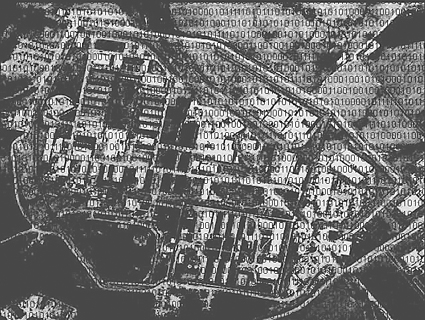
In contrast, Radium City (www.imago.com.au/radium_city – expired) by the Retarded Eye collective achieved a funky juxtaposition between installation and screen. The setting was welcoming techno-boudoir baroque. In one corner sat a little Mac storyteller, the rest was dominated by an enormous Italianate bed with mirror and 2 TV monitors showing male and female soap stars getting deep, while below them the electronic bedspread pool was swelling with aerial urban images stitched through with endless binaries. The project sought to position the viewer as a sleepwalking flaneur via science fiction scenarios of the virtual future city that continually re-wrote themselves via a digital process of automatic writing. Here new technologies were mixing it with old techniques on a constantly refurbished palimpsest. The ideas were a heady mix. The pull of binaries was a buzz. The bed and the multi-plot storybook became 2 magnets. The interlude between was strange, but the text kept rewriting itself, mutating over time.
Of all the installations, Project Otto (http://www.imago.com.au/otto – expired]) was the most dependent on physical presence and manipulation of the environment. This huge and hungry hardware project was a dynamic bandaging of an unusual combination of old and new technologies. The networking interactions spiralled through radio, image, sounds, web and the tactile stimuli of a metal trolley on a rough-hewn floor. The stunning images of bodily close-ups sprawled across the wall like a Persian rug were activated by a mobile antenna trolley that picked up different radio frequency emissions from seven overhead disks that in turn generated sequences of deeply textured soundscapes. The images could be further engaged via a Dr Who-like console box. This was a good sweaty interactive space. It was damn sexy the way the installation totally activated a tactile, aural and intimate subjectivity that stimulated the imagination. The mix of radio and web, the old and the new, people in the gallery space and the site on the web, was tangible. As is the enormous potential of this project.
Tetragenia is aptly described as a “trojan web site that accumulates consumer profiles under the guise of ‘caring’. Participants are harassed in a prolonged, strategic email campaign.” Our hell is excess data, corporate-speak, dietary ethics, common sense advice for life, electronic surveillance and technological abuse. Tetragenia turns this into an art—ridiculing the new human face of corporations, the wealth of waste and electronic intrusions. At the same time, it offers eminently reasonable nutritional and ethical suggestions that loop in on themselves showing something a little less benign. It’s a call to the consumers of the world to unite to promote ethical trade practice; and it cuts a fine line between a new seriousness and a classic piss-take. This absurdist installation tests the limits of the traditional ethics of privacy and marketing with harassing emails and data-frenzy. It is exciting to finally come across web art that not only engages with the contemporary info-excess but also does so with great comic timing. However, the timing of constant server breakdowns was deeply aggravating but, as Marshall McLuhan once said, “If it works, it’s obsolete.”
When it comes to imaging future horizons, as Malcolm Riddoch ruminated, the “horizon is the rocket eye view of the world. The spatial limits of the horizon is carried with us so that the horizon can never be reached.” This can be seen as a cautionary metaphor for rocketing into future shock. But if we consider that by looking back, the past becomes another horizon—does this mean that we can never remember the point at which we were, or at which the horizons looked broad and welcoming? Or that history’s horizons are carried with us but cannot be seen from the present and can never be reached in the future? This made me wonder, what’s the big deal of getting to the horizon? Then again no one is happy to stick around in the strange interlude of the present. The problem is that if the future is not sutured to past horizons, sun-blindness is inevitable. Future Suture’s solution is to bandage these wounds with some serious humour.
Future Suture, curator Derek Kreckler, joint initiative between FTI (The Film and Television Institute) & IMAGO Multimedia Centre Arts Program, Perth Institute of Contemporary Arts, February 11 – March 7; links to 4 projects at http//www.imago.com.au/future_suture [expired]
As I have noted elsewhere: “Screen Culture—the nomenclature is out there. A conjugation designed to expand the parameters of moving image organisations and their exhibition practices to incorporate multimedia and the digital arts and to encompass the output of all practitioners ‘working within the screen frame.’” I confess to an unhealthy predilection for creating and dissecting definitions. Seeking out ‘screen’ in a (generally less preferred) lexicon, I read: “a smooth surface, such as a canvas or a curtain, on which moving images etc may be shown.” I become obsessed with the idea that the subject of my current project is this ‘etcetera’. It troubles me, I lose sleep over it. I consider that Funk and Wagnalls may have put the etc in the wrong place. It is my goal to reposition it. So, I’ve packed up my theoretical premise and hit the road. I have named my axiom expandingscreen and I’ve just spent 30 hours on the way to Helsinki cleaving the title.
Subject: Muu, Helsinki; Date: Oct 17, 1998
Happy to discover that my visit coincides with Helsinki’s annual herring festival, I cross the marketplace each morning on my trek from Katajanokka island to Kiasma for the MuuMedia Festival.
Muu (‘other’ or ‘something else’) is staged by AV-arkki, an organisation which provides facilities for Finnish media artists and represents their work. The event began a decade ago with the Kuopio Video Festival in eastern Finland and has developed into one of the largest events of its kind in the Nordic countries. Like many organisations and festivals originally intended to represent video art, MuuMedia and AV-arkki are in the process of expanding their program in order to accommodate web art, CD-ROMs and interactive media installations. The necessity of creating appropriate exhibition environments is accentuated by the location of the festival within several spatial realms: museum space (Kiasma: Museum of Contemporary Art), gallery space (Otso), collective art space (Cable Factory) and continuously contested urban space (Mobile Zones). The special focus of MuuMedia 1998 is ‘global and indigenous’ a framework addressing issues of globalisation, indigenous culture, power and networked information.
The prominent and dynamic architectural design of the newly opened Kiasma provides the festival with its centre. A contemporary art museum, purpose-built in an age where exhibition practice is undergoing considerable transformation, Kiasma attempts to reorder art and information hierarchies by creating a responsive, anticipatory space for the reception of art in all its forms. The emphasis on communication flow and active or dynamic reception is conceptually expressed in the name itself which has its roots in chiasm: the intersection of 2 chromosomes resulting in the blending and possible crossing over at points of contact and also the X-like commissure which unites the optic nerve at the base of the brain. Despite its desire to embody these forward thinking principles, Kiasma in operation is not proving adequately equipped as the site for the screening component and the digital gallery. Dreadful acoustics (which equally impact on the media art in the permanent collection), bad projection design and handling, and an under-informed staff are resulting in loss of audience—the hundreds of visitors drawn to the building each day are not made properly aware of the festival and the committed audience are battling through a haze of interruptions and cancellations.
The Mobile Zones project is proving to be the most successful component of the festival. Curated by Heidi Tikka, the various works explore the possibilities of art as activism, examining the urban landscape and its transformations. Helsinki is busy with preparations for 2000 when it will simultaneously celebrate its 450th anniversary and its reign as European capital. Nick Crowe’s deliberately lo-fi community web project A Ten Point Plan for a Better Helsinki (find link at Kiasma site) required the participation of citizens who contributed proposals for the redesign of a controversial public space near Kiasma, while Adam Page and Eva Hertzsch investigated anxiety zones in urban space with their demonstrations of Securoprods, a transfunctional security gate/revolving door.
Subject: ZKM, Karlsruhe; Date: Nov 8, 1998
Three hours in the gardens surrounding Karlsruhe’s Schlossplatz (the only site to recommend the town aside from ZKM and a temporary beer exhibition) and I am still scrawling notes on Pavel Smetana’s The Room of Desires. Images in a darkened room are generated in response to information received from sensors bound to my wrists and forehead. Something allows me to recognise the constructedness of it, but this just serves to increase my anxiety at seeing my ‘psyche’ projected. Though private, the zone has the potential to become public, and the sense of surveillance is heightened by those white-coat clad attendants who swabbed me and taped me up.
The Room of Desires is one among many interactive installations that comprise the temporary exhibition Surrogate, the first showing in situ of work by artists in residence at ZKM’s Institute for Visual Media. The ZKM (Zentrum für Kunst und Medientechnologie | Centre for Art and Media, www.zkm.de) is the realisation of an 8-year development project whose premises in a transformed munitions factory were opened in 1997. Consisting of 2 exhibition departments (the Museum of Contemporary Art, the Media Museum), 2 production and development annexes (the Institute for Visual Media, the Institute for Music and Acoustics) and an integrated research and information facility (the Mediathek), ZKM adopts an interdisciplinary approach to the presentation, development and research of visual arts, music and electronic media. Ex-Melburnian, artist and director of the Institute for Visual Media, Jeffrey Shaw, tells me that the departmental proximity “creates an environment where the museums reflect an ongoing, inhouse creative identity”, a dynamism enhanced by the potential for “the production zone to be transformed into a public space.”
I find pleasure in the Mediathek, a veritable treasure chest for an archive rat. A centralised database establishes instant access to 1,100 video art titles, 12,000 music titles (with an emphasis on the electroacoustic) and a comprehensive collection of 20th century art and theory literature. Download from what is probably the world’s largest CD-ROM jukebox system (soon to be converted to DVD) and receive at any of the 12 viewing stations (designed by French-Canadian media artist Luc Courchesne) or the 5 historically significant listening booths designed for Documenta 8 in 1987 by Professor Dieter Mankin. After indulging myself on a self-programmed Bill Viola, Tony Oursler, Gary Hill retrospective, I took some literary time out to read Donald Crimp’s On the Museum’s Ruin. In a study of Marcel Broodthaer’s Musee d’Art Modern series of installations/exhibitions which radically investigate the position of the museum, Daniel Buren is cited as claiming, “Analysis of the art system must inevitably be undertaken in terms of the studio as the unique space of production, and the museum as the unique space of reception.” ZKM is an institution formally enacting this kind of analysis.
Subject: AEC, Linz; Date: Nov 17, 1998
Watching snow fall on the not-so-blue Danube from the offices of ARS Electronica Center in Linz (www.aec.at). Spent the train trip from Karlsruhe to Salzburg reading Derek Jarman’s (sort-of) autobiography, Kicking the Pricks (Vintage 1996). Speeding through the Black Forest on his accounts of making-out at the old Biograph watching German soft core featuring semi-clad damens running through said geographical terrain. In 1987 Jarman says: “the Cinema is finished, it’s a dodo, kissed to death by economics—the last rare examples get too much attention. The cinema is to the 20th century what the Diorama was to the 19th. Endangered species are always elevated, put in glass cases. The cinema has graduated to the museum, the archive, the collegiate theatre…”
Jarman argues the case for the cheapness and immediacy of video. What strikes me, is the degree to which the moving image has impacted on the tenets of museology in the decade since Jarman establishes the museum as a static place. Paradoxically, the contemporary art museum is precisely the location of video art and media installations, and (in most cases) instead of the museum subduing media art, the development of new technological forms has necessitated a vast rethinking of the museum as a space of reception.
ARS Electronica Center is conceived and operates as the antithesis of Jarman’s museum. It services local and global industries, artists and educational institutions in addition to presenting and maintaining a museum space designed to anticipate the future of what commentators (and I guess that includes me) like to call “the information age.” Its integrated approach, which actualises the whole concept of convergence, produces an environment where the application of everything from virtual reality through computer animation to video-conferencing is applied in all disciplines in a manner that promotes practical and theoretical discourse between commerce, media art and education. Co-director of this ‘Museum of the Future’, Gerfried Stocker, tells me that the emphasis here is on process and “how to give things a value without a history.”
This radically challenges traditional systems of value and analysis in a manner that is arguably appropriate to the rapidity with which new technologies emerge. I find it difficult to assess a lot of high-end media art, and this has never been more the case than both here and at ZKM where the technology is so impressive in itself that the core elements of a work may indeed be the science of its construction rather than its artistic endeavour. I still favour works which don’t foreground the technological achievements over content. At ARS Electronica, a work like World Skin (winner of the 1998 Golden Nica for Interactive Art in the Prix ARS Electronica) by Maurice Benayoun and Jean-Baptiste Barriere will endure the potential redundancy of the environment within which it is conceived and produced. Enter the CAVE (AEC’s permanent 3-walled virtual reality environment) armed with a stills camera and move through a virtual landscape—a photo-real collage of images from different wars. Start to ‘shoot’, take images with the camera like a ‘tourist of death’ and you (visually) tear the skin off this world. It transforms into a white void, only shadow traces like cardboard cutouts remain. The experience is strangely connected to and distant from the bloody (non-virtual) reality of war.
Subject: etc; Date: Dec 6, 1998
I am allowing myself to be in process. There are not yet conclusions to be drawn. Perhaps the etc would be better positioned after “or a curtain.” Halfway through my research tour and I am suffering from the desire to see the debate which should be surrounding the planning of 2 moving image centres in Australia (Cinemedia at Federation Square, Melbourne, and the Australian Cinematheque at the Museum of Contemporary Art, Sydney) become more urgent and more public. In the meantime, I am expanding my waistline on gluhwien, cheese and root vegetables.
Clare Stewart is Exhibition Co-ordinator, Australian Film Institute. Expandingscreen has been enabled by funds from the Queens Trust For Young Australians, the Australian Film Commission, Cinemedia and the Australian Film Institute.
Of related interest, see “Finnish shortcuts”, Melinda Burgess, RealTime 28, December 1998 – January 1999.
When I spoke to Javier De Frutos he had just finished his season of The Hypochondriac Bird which was part of the Sydney Gay and Lesbian Mardi Gras Festival. Our discussion covered the production itself, his career as a London-based artist with Venezuelan origins and seemed to constantly veer back to what he sees as a crisis in dance at the end of the millennium.
Geography—Community
A lot of people who see my work find it difficult to place as a product that has come out of England. Although I am an unequivocal member of the British community I am an outsider—all communities have outsiders and all immigrants, no matter how hard they try, are always outsiders. Countries need that. I don’t know if it’s an outside perspective—I never pass judgement on the things that I am experiencing. I’m very direct so I’m always at odds with ‘Englishness’, yet I think that is the very reason why I have remained in England, even while not liking it—the confrontational nature of my work and people who cannot deal with it.
I think I understand the pace of a country like Australia that has more beneficial weather. I’ve never produced my work in Venezuela, my native country—always in cold countries and I think that conflict shaped the work. The tension works because the work is so autobiographical. I’m not very happy about sharing happy things but dealing with more anguished moments. Then somehow the work becomes an outlet. Happy moments are so few I don’t know if I would share those.
In the context of Mardi Gras I’m becoming more aware of how diverse as a community we are. I had a great big sense of pride when I came—I caught the launch at the Opera House and I was surprised at how political it was and how attentive and interested those 20,000 people were. I am also surprised at how—mainstream is not the right word—it is a major festival in this city.
The Hypochondriac Bird
I’m actually sorry that it was the first example of my work here because it comes without any preparation. It’s probably the least direct work that I have produced. But there’s a line in the work that deals with the absolute boredom of a long term relationship. As Wendy Houstoun commented, it really looks like the 2 of us had different books of instructions for this relationship and suddenly, having read the books, we realise we’re not even in the same library, the same bookshop.
I think there is a threshold of pain in (the sex scene) that one has to go through because we [De Frutos and Jamie Watton], as performers, go through that in the work. The more we did the sex scene the more bored we were with it and we started to match the way the audience felt. The audience is a very contagious source of energy. Together, we had to reach that level where nothing is happening any more, which happens to relationships when they are on their way out. Someone commented on the structure of the piece where the climax of the work is not a climax, or such a long climax that it stops being a climax and becomes an anti-climax. It introduces a new sense of structure. So the work starts as representational, becomes high melodrama, then the ‘installation’, then the drama again. That meant you had to pace yourself which caused problems with the audience.
It’s also quite brutal and realistic—when you look at the vocabulary we had to go for a more realistic range and it’s tough because it doesn’t necessarily satisfy dance-goers. And it goes back to the whole question of what is dance anyway? This is probably one of the most danced works I have ever done. From beginning to end it’s non-stop dancing. It might not be recognisable as that qualified thing that we know as ‘dance’, which is frightening in itself—that we cannot move on.
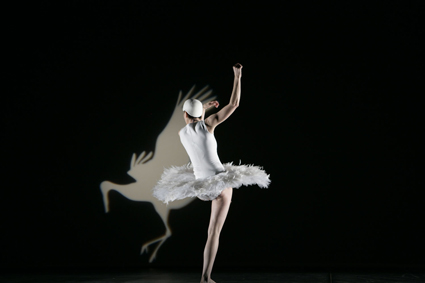
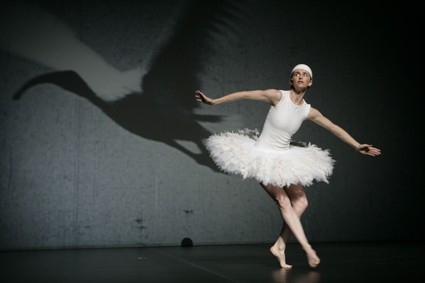
I think there was a mistake in the Mardi Gras’ publicity. I never did a version of Swan Lake—it was a piece that used Swan Lake’s score because those ballet references are close to me—the sound. Music is very much like perfume. My mother used to wear Yves Saint Laurent Rive Gauche in the beginning of the 70s, and when I smell it my mind just goes back—I see the bottle, I see the bedroom…the music does that to me. What does it do for the audience? If you have a sound that is immediately recognisable like Swan Lake you go for the narrative you know and the layers start—you try to match what you see with what you think you know—and it becomes an interesting exercise for those who allow it to happen. The Mardi Gras adds another layer——the choreographer is gay and what you’re seeing is a gay love story. So you go to the theatre with all that information—perhaps too much.
Design
The Hypochondriac Bird was the first time I was working in a very clean, clear looking space—I always work in very black spaces. My partner, an Australian Terry Warner, is the set and costume designer and Michael Mannion is the lighting designer. They are the oldest members of the company and it was something we wanted to work on. When you work in a black space you have the possibility of making the space smaller or bigger with lights—the magic of the black box. When you work on a white space you never forget how large the space is and psychologically it gives it a grander context, emphasising how irrelevant to the order of the world the lives of these 2 people are.
The point with the design (a aquare of illuminated clear plastic pillows) was to make things that could be everything and nothing and it was up to the audience to decide what they were seeing. I realised that the works I had done in the past had a sort of half-finished architecture. (I studied architecture for about a year and abandoned it.) There are always marks on the floor that could be a laid out plan. The original design was a half-finished house—every clear plastic pillow becomes a brick.
Movement and Meaning
I’m a great believer in first of all creating an atmosphere—the movement can be quite unimportant but if the atmosphere is right then the movement can be right. In a workshop years ago this playwright got this actress to do the same scene, peeling potatoes, in many different places in the house. It became so clear. Dancers say ‘my character wouldn’t move that way’ or ‘that movement doesn’t mean anything, doesn’t signify’—like 32 fouettes signifies a lot anyway—like, ‘thank god for the 32 fouettes, now I get it, now I know what she’s feeling!’ So suddenly it was clear to me that the movement wasn’t important but the context of the movement and the intention of how you did the movement. So describing it means nothing—she’s peeling potatoes—and suddenly the physical action changes in her muscles and peeling potatoes becomes the medium to express something else—she could be stabbing someone in the stomach. I can’t bear the idea of trying to find a movement that’s going to mean something. What’s the point of looking for something that’s going to look like a kiss when the kiss is such an effective thing to do?
Dance
This piece has been a major turning point for me in regard to the effectiveness of dance. At one point we have to stop looking at the museum pieces and the function of the body. I’m so terrified now that most dancers I know are concerned about whether their lower back is aligned with their neck and there’s nothing else. Something that was only meant to be a tool for you to feel better physically suddenly became an aesthetic goal. It seems to be the only branch of the arts that doesn’t want to suffer. If you’re really worried about a healthy body and healthy mind you’re not an artist any more—just let it go. Go and teach aerobics or something, but you can’t just go on stage and tell me how aligned you are because I’m not going to connect with you at all—certainly not with my own alignment.
What happened with the underground scene—it’s just completely gone. Some of the so-called underground productions that are happening in London are frighteningly similar to commercial productions but with less money so they don’t look as good. Does anyone have anything to say for themselves any more? Who wants to be second best? Is it some kind of millennium bug that suddenly we have to go into more direct ways of communicating, that dance is starting to lose its touch? People don’t read poetry any more, they read newspapers.
The Hypochondriac Bird, choreographer, dancer and music Javier De Frutos, dancer Jamie Watton, music Eric Hine, lighting design Michael Mannion, set and costume design Terry Warner; The Seymour Theatre Centre, Sydney, February 10 – 14
Trotman and Morrish are like those old couples who have cohabited for decades—they know how to share a bed (read stage). Although they are very different performers, they slip in and out of each other’s narratives with ease, turning the tables and reversing predicaments. Each successive performance extends the work of the previous night (the season runs to 6 performances). The spoken commentary by Morrish proceeds like the automatic writing of the Surrealists, uncensored, and full of free associations. Morrish happily assumes maniacal, arch and eccentric characters and does so in this somewhat apocalyptic piece. By contrast, Trotman’s guileless persona creates trouble and amusement only indirectly. His speedy movement is light and elfin, his little looks to camera are wide-eyed and open.
Avalanche has much more ‘dancing’ than their last piece, The Charlatan’s Web, perhaps because there is greater usage of music. Trotman and Morrish are not trained dancers but they move with commitment and personal style. In fact, their lack of training produces a certain sort of critique of masculine ways of moving—they are not sporty men, they are not men ‘doing’ dance, they are happy to be laughed at, and they cover space in unusual ways, neither seeking nor rejecting grace. The effect is of seeing men work together and co-operate with a mind to the work at hand. Avalanche will be shown as part of Sydney’s antistatic dance event this year.
Avalanche, Peter Trotman and Andrew Morrish, Dancehouse, Melbourne, March 5 – 14; antistatic, The Performance Space, Thursday March 25, 8pm.
How did you define yourself when you were starting out in dance? What points of reference did you use? Who was there to help you with your next move? There can be significant turning points for young dancers which either assist to transform them into professional dance practitioners or help them to realise a life of dance may not be quite what they had expected. Ausdance responded to these issues in youth dance in 1997 with the inaugural Australian Youth Dance Festival.
Creating the right environment for the facilitation of creative development is an important emphasis of the Australian Youth Dance Festival which this year is being held in Townsville, Queensland from June 27 to July 2. The initiative brings together youth interested in or already practising dance to gain further knowledge and to formulate networks of peers across Australia. The program is based on workshops, forums, discussions and performance.
Catering for all levels of dance, the festival has 3 major strands; one for young dancers who are still students, one for new dance graduates and independent artists, and one for youth dance leaders and teachers. Youth, for the purpose of the festival, is defined as being anyone from 10 to 30 years of age.
Festival tutors have been selected firstly for their specialised knowledge in a certain field and secondly for their ability to work with people of differing age groups and dance knowledge. Students who have had little dance experience will be able to participate and enjoy the festival equally with those who have studied dance technique intensively. Technique sessions will be available every day in many different dance styles.
Some of the festival’s scheduled workshops cover dance education for teachers; skills development for young dance writers and youth dance leaders; and choreographic, film and new technology workshops for independent choreographers and dancers. Panel discussions and forums will be presented by emerging artists on such topics as the processes behind choreography; how cross cultural works fit into the landscape of Australian dance; gender in dance; the moving body in relation to film; the importance of dance research; the relationship between traditional and contemporary dance practices; and dance and meaning. As well as emerging artists, more established artists such as Chrissie Parrott will deal with topics like Motion Capture and the use of technology in dance.
To play host to a major national youth dance event is an exciting prospect for the Townsville dance community. For this reason the Festival’s performance component has been integrated into the local community as much as possible.
Local residents and the many tourists in the region will be able to enjoy free lunchtime outdoor performances presented by young people, in the centre of the town throughout the week. The Townsville Civic Centre will host 2 large public performances on June 28 and 29 featuring the Festival’s resident professional dance company, Dance North and its youth counterpart, Extensions Youth Dance Company and international and interstate dance groups like Steps Youth Dance Company from Perth. A range of new work by independent choreographers will be presented on a daily basis.
Young dance students (10 to 15) will be involved in a special component of the program, the Community Dance Project which will focus particularly on dance and art making processes. Victorian choreographer Beth Shelton and visual artist from Tracks Dance in the Northern Territory, Tim Newth, will lead this project with the participation of the Mornington Island Dancers. Beth and Tim have previously worked together on large-scale community projects with young people and are able to work with students at many skill levels. Other dancers and visual artists will assist them in making the work, which will be shown on Magnetic Island on the last afternoon of the Festival, Friday July 2.
As its contribution to the celebrations for Dance Week 99, One Extra Dance presents Inhabitation II directed by Tess de Quincey with sound design by Panos Couros. This is a work for a company of young performers, in which “the environment of the body negotiates and uncovers the structure and sensibility of the site, investigates a sensory level of existence.” It has grown from de Quincey’s investigations into the process called Body Weather which she is exploring with the group in a series of workshops organised by One Extra in partnership with the Seymour Centre. For DeQuincey, the project builds on the 12 hour performance, Epilogue and Compression with Stuart Lynch at the 1996 Copenhagen International Dance Festival and her choreography for 24 dancers on the chalk cliff coastline south of Copenhagen as part of Transform 97, a festival of site specific dance works. The performance of Inhabitation II is a free event and will be held in the Seymour Centre Courtyard, corner City Road and Cleveland Streets, Chippendale on Saturday and Sunday May 1 – 2 at 6.30 pm each evening.
Dance Week (organised each year by Ausdance) grew from a celebration of International Dance Day observed throughout the world on April 29. Other highlights of this year’s event in NSW include the outdoor dancing extravaganza Streets of Dance in which 100 tertiary dance students join professional artists in an “audacious outdoor program.” Another 200 will take to the football field for the Sydney Swans home game. There’s lunchtime dancing in Martin Place and a Festival of Dance at Darling Harbour. All the major companies will be contributing works and the ever expanding Bodies program kicks off on April 28 with work from contemporary and classical contemporary choreographers as well as a week dedicated to Youthdance. The Australian Institute of Eastern Music’s 3 day Festival of Asian Music and Dance at the Tom Mann Theatre (April 22 – 24) includes eminent South Indian dance specialist Dhamayanthy Balaraju performing for the first time in Australia.
Dance Week 99, Sydney, April 24 – May 2. For further information on Dance Week activities in your state contact Ausdance.
Action Situation, Deanne Butterworth, Kylie Walters, Jo Lloyd
photo Kate Gollings
Action Situation, Deanne Butterworth, Kylie Walters, Jo Lloyd
Ideas are multiplicities: every idea is a multiplicity or a variety…multiplicity must not designate a combination of the many and the one, but rather an organisation belonging to the many as such, which has no need whatsoever of unity in order to form a system.
Gilles Deleuze, Repetition and Difference, Athlone Press, London
I cannot tell you what this piece is about. I can only write and in so doing produce another text: a re-iteration destined to become something other than the work itself. Action Situation foregrounds the fact that repetition becomes, inevitably, a moment of difference. Not only was there little replication between the 3 performing bodies, but the work itself highlighted the gap that lies between different, yet related, artforms.
Action Situation is an assemblage of music, script, movement, lighting and space. Each of these forms retained an integrity such that they did not blend into homogeneity. Not only was the music, for example, a distinct yet influential strain but the script also held its own character quite apart from the movement. In other words, Lasica does not choreograph to the ‘beat’ of the music, nor is her movement a mime of an underlying narrative. And yet, the differential participation of these elements did not lead to cacophony. There was a certain cohabitation between sound and movement. Similarly, there was a sense that some kind of narrative was manifest in the dance.
Were we archaeologists, we might be able to unearth the original script that instituted the narrative structure of the work. The ordinary viewer, however, is offered little by way of clues or references. No Rosetta stone is offered to translate from the hieroglyphs of moved interactions into some sense of the everyday. For example, there were times when one, sometimes 2, of the performers trod on the prone mass of the third. Was this a gesture of dominance, aggression, dependence or something else entirely? We will never know. Similarly, movements were performed under the watchful eye of one or other of the performers. There was a sense of bearing witness to an activity, that the performers shared a world, but what that world consists of is anybody’s guess. The only signification I can be certain of was when the 3 held hands during the curtain call. That gesture of naked camaraderie contrasted with the complex, interesting, detail of movement and interaction which comprised the substance. As far as movement is concerned, this is a very dense and satisfying work.
Although there were a variety of actions which could be interpreted as derived from some human strain of interaction, the work had an anti-humanist character, almost post-human. Rather than inhuman, it did not subscribe to any lyricism nor make reference to an instantly recognisable world. Although the audience has to work hard to take the work in (like looking at abstract painting), this is also its strength. Were there to be obvious references to ‘relationships’ or ‘communication’, the central premise would be lost, for Situation Live is about the abyss which lies between different modes. The music interacts with the movement; it does not mirror it. By the same token, narrative is not something to be illustrated by dance. Dance is able to form its own narrative, to be both inspired by the script, but not a servant to it.
Mimesis presupposes a sameness across forms. Action Situation is about difference. Even the language we use to speak of it becomes alien to the work itself. It cannot emulsify the disparate elements. Rather, the textuality of the written or spoken word can only add another layer to this already complex work.
Action Situation, directed and choreographed by Shelley Lasica, performers Deanne Butterworth, Jo Lloyd and Kylie Walters, music Francois Tetaz, script Robyn McKenzie, lighting design John Ford, costume design Kara Baker; Immigration Museum, Melbourne, February 12 – 20
There are those who have seen Deborah Hay perform and wondered why others in the audience seem to be getting something they do not. A recent review of Hay’s solo, O; The Other Side of O, noted that “Australia’s numerous devotees appreciate her ability to be absolutely present in a theatrical moment” (Kim Dunphy, The Age, December 8, 1998). Even though I would count myself as one of these “numerous devotees”, I do understand why her work leaves some people unmoved. I have, at times, been unmoved. It has to do with looking, how one looks, and what one looks for. We watchers of the dance are used to the corporeal delights of kinetic display. Dance is, more or less, a kind of physical action, a nuanced flow of bodies in movement. What, then, are we to make of a performance which offers so few physical tidbits to its audience?
Hay’s performance work is totally stripped of dancerly display because she wants something else to shine through. That something is the bodily manifestation of an intense form of perceptual practice. Although some people might call it a play of consciousness, I think this detracts from the bodily aspect of her work. The meditational quality of her perception and the mantra-like status of her utterances should not lead one to think her work is not in and of the body. The title of Hay’s forthcoming book, My Body the Buddhist, gives an indication of the sense in which the body is seen to be the ground and source of her work. But it is in the context of her teaching that these matters attain clarity.
Whilst Hay is utterly committed to the experiment of her own learning, it is her teaching which has made the greater mark in the world. This is partly because of her own immersion in the practice that she tries to convey. She is not someone who knows so much as someone who tries and is willing to share in that trying. Over the years, she has worked with and on certain epithets—the body as 53 trillion cells at once perceiving; the whole body as the teacher; invite being seen; now is here is harmony. Whatever constitutes her own practice is offered to her students. In turn, they attempt to make sense of these thoughts in action. One of the features of her workshops is the effect of working in a group. Her community dances are often very large, and the experience of working with so many people creates a certain energy. Added to this is Hay’s exhortation to observe others as if they are similarly committed to the work.
This leads me to another issue: the question of truth. Hay does not claim that her utterances are ultimate verities. Rather they are strategic puzzles which may or not be productive. This rather postmodern approach—that practice is strategic rather than representing some essence—nevertheless aims towards particular goals with rigour. It is not a case of anything goes. Rather, that which is aimed at is a quality of perceptual engagement within movement (and utterance). There is an attempt to de-centre subjectivity (imagine your body is 53 trillion cells changing all the time), to multiply the number of perspectives which may attend movement, and to be utterly present, focused and open to inspiration wherever it may come from. Of course, no one manages this all the time. There are frustrations, disappointments, at best an intermittent focus. Hay herself claims there is nothing (no-thing) to “get.” Rather, we are all students of this kinaesthetic form.
That said, Deborah Hay does seem to maintain her own focus more often than not. Her dancing often inspires others, and the workshop sessions can become very charged. It is not particularly easy to keep with one’s movements, not to daydream, fantasize, let alone remain open to change at any point, whether initiated from the multiple sources in the self or inspired from beyond. Nevertheless, this is what she attempts in her solo work. No attempt is made to distract her audience from the perceptual, kinaesthetic, focal nature of the work, resonating Yvonne Rainer’s “No to spectacle no to virtuosity…no to seduction of spectator by the wiles of the performer” (TDR, T30). Having cleared the space of these expectations, Hay hopes to be seen dancing to another tune.
Deborah Hay Returning, A series of workshops held in and around Melbourne, including The Art of the Solo, Zen Imagery Exercises, Conscious Community Dance and Choreographic Theatre, October – November 1998
West Ryde. Sydney. Australia. Noon.
Through rented white lace to a clumsy rusted clothes line. Dark colours in a harsh New Year’s light. Petunias fighting with weeds. A roaring herb garden, salad smells, lemon balm, Vietnamese mint, laksa dreams, pennyroyal. Green tomatoes staked yesterday and zucchinis big enough to kill. Milka’s beans snaking through from next door. Our garage roller door is shut. Hiding unused, secretive, bought-on-a-whim things. A brick barbie covered in Wandering Jew, native trees—bottlebrush and banksia—give no shade. Green lawn as long as a terrier’s fringe. Still. Waiting for cool change.
The Noon Quilt, trace online writing community, (http://trace.ntu.ac.uk/quilt/info.html – link expired) is a java patchwork of time impressions, a delirium of techno-hippiedom, the irresistible idea of words and moments linked around the globe. Singapore. Brisbane. Arizona. Paris. Brazil. Japan. Manchester. I am touched and transfixed at noon on this hot day.
A world view made of little windows: Trevor Lockwood sees a “fat publisher” who confronts writers at the end of his driveway, begging to be seen in print. Simon Mills writes from the basement. No windows. About his cat who fell off the window ledge. Fell a few storeys, “landed unscathed yet embarrassed.” Val Seddon sees the bench on the patio, where her father used to sit, “lit and warmed by memories that are my protection too.” The teenager forgets to do his English homework and creates a funny and dark view. Phil Pemberton feels like a detective, “Marlowe-like observing the crowds but never getting no closer to the girl.”
There are many women contributors; quilting was always women’s work and there is thought in these patches, a binding of stories, of light and dark shades. I am careful unravelling this hand-me-down, slowly savouring the stitches of time and memory
Helen Flint. Bournemouth. UK. Noon.
At exactly noon, Bournemouth this Seagarden Paradise is upright, shadowless; my front Boycemont Ericstatue and goldeneyed fishpond proscenium the porch I sit on, ten doors from the Channel between fuschia chapters I have just written. And parading past me go paleskin families or solitary on-the-prowl bods dragging huge inflatable plastic moulded floats; oh, 4 hours later they will much slower return floating back up my road, their angry red skin deflating and scorching them.
Some writers, like me, take the view literally, wanting to preserve my frame, where I am right now, my nondescript backyard. Others move cleverly to other frames, the television set, the photograph, a computer screen or a fictional window onto other lives. People use constricting wall views to leap off into imaginative air. Sue Thomas constructs her view in a LamdaMOO, floating “adrift in the endlessly shifting landscapes of a thousand virtual imaginations.”
Characters emerge and re-emerge. An old man drags his feet. Drags cartons of beer. Drags a trolley loaded with corrugated iron and timber. Where is he going? JD Keith finds “empty buildings, idle trucks, and peopleless homes indicat[ing] the Exodus.” Where have they gone? There are unresolved narratives…and notes of new beginnings.
Riel Miller. Paris. France. Noon.
At noon I see tomorrow forming, a tear drop shaking its way down, nourishing the earth, feeding the sky, rushing along twisted pipes, quenching desire, a trickle of satisfaction.
The Noon Quilt trace online writing community, http://trace.ntu.ac.uk/quilt/info.html [link expired]
And then Princess Di is barrelling towards me, head down, Uzi cocked, the veil of her coronation dress streaming back from her face like a dirty grey curtain. There is death in her pixilated eyes. And I know: She’s gonna wax my republican ass. So I panic. I’m not afraid to admit it. I slap the keyboard, switching from a pistol to something with a little more visceral kick: something involving missiles. I punch the space bar. The launcher exhales. But Di is too close, and even as she detonates (tiara spitting jewellery and giblets in equal amounts) my modem disconnects. I’m dead. (Again). I’ve been soundly thrashed by some 10 year old kid from Arizona. (Again). My only satisfaction lies in the thought that at least I took the ‘People’s Princess’ with me.
It’s about 5 a.m. I’ve been online for almost 3 hours, alternately trudging through the occasionally (read: hardly ever) interesting Australian arm of Ultima Underworld online and slaughtering foreigners with portable artillery in Quake 2. To most people, no part of those last 3 hours had anything to do with hypermedia, the arts, or (worse) self-expression. To me, electronic entertainment is as valid as any other art. To a trained psychologist, thundering about a 3D maze dressed up as a deceased member of the royal family has a lot to say about that 10 year old kid from Arizona.
The idea that hypermedia is limited to extensions of the (more) traditional arts is to limit an already excruciatingly misunderstood idea. Hypermedia as an ‘interactive’ medium which offers the reader/user pathways as opposed to linear narrative should be more than a series of static pages connected like a Choose Your Own Adventure novella. Add pictures and we still haven’t gone very far. Even a Quicktime movie and a soundtrack are nothing but bells and whistles on what is essentially still a piece of ‘straight’ fiction with pretensions.
Hypermedia should give the user a new way of interacting, not merely a new way of reading.
Note: This is not a complicated way of redefining the question so that I can shoehorn video games into a discussion of hypermedia. I can do that easily enough under current definitions. Here goes: Online capabilities in video games are fast becoming standard on the PC, even beginning to bleed over into the lower-end game systems. Sega’s upcoming 128 bit console, the Dreamcast, will have in-built online capabilities allowing users to network and play anywhere in the world.
An important thing to remember is that video games were born on, and exist only on, computers. Unlike pure text, they are the rightful heirs of the digital age, not its bastard children. The ‘links’ between text fragments become the doorways between rooms rendered in 3D. The text ceases to describe or refer to the image, and begins interacting with it, fleshing it out, giving it greater depth. Your average game player becomes blind to the fact that s/he is making choices between fragments, and their reinterpretation of the game becomes fluid. S/he ceases to be an external force acting on the text and becomes another facet of it.
Moreover, unlike hypertext, more than one user can be involved in the same piece at one time. The user passes other users. Their experience is altered by the experiences of others, the ‘text’ moves in more than one direction at one time. The screen updates—unlike new ‘scenes’ created by following links—are invisible, and choices are made on the fly.
To an extent, video games become more hyper than hypertext. As well as offering users the chance to interact with a text/art ‘world’, they allow them to redefine themselves and re-experience it. That kid from Arizona may go for a mock-up of Prince Charles next time. He not only chooses how to interact with the text, but who interacts with the text.
Note 2: Most new first-person shooters (Unreal, Syn, Dark Forces 2, Quake 2) allow the user to download or create their own ‘skins’ for online characters. Fan sites offer homebrew characters for other players to use. (I once saw a naked man streak past me, weapon at the ready. I once saw Gandhi.) These alterations come complete with changing in-game perspective, weapons and sound effects. A selling point of these games has become their flexibility and user definability.
However this choice of personal representation can become far more complex than what ‘skin’ to use. Ultima Online, although flawed, expensive and generally tedious, is a prime example. It allows players to create a character and then ‘live’ it for as long as possible, in real time. The world inside their computer progresses, unlike traditional role-playing games, at the same pace as our own. If you don’t go online for a month, you’ll miss a month of activities. Your house could be burned to the ground by brigands. Your pewter Royal Wedding souvenir mug stolen. The attractive element of the exercise is that you don’t have to follow traditional role-playing staples. You don’t have to be a ‘thief’ or a ‘brigand.’ You could play as a farmer. You would have to buy seed, plant crops, work the field, harvest them, and then find a real person to buy your food. All in real time. Hopefully someone else has chosen to run a shop.
Ultima Online has been heralded as the first of a new generation of games, but it isn’t. It’s really only a step up from the MUDs (Multi-User-Domains) of yesteryear, in much the same way that hypertext is a step away from pure text. MUDs were/are text based adventures which allowed players to move freely, with other users, through a world based around blurb-style descriptions of places and events. Like Ultima Online, there are people, ‘Avatars’, whose job it is to make sure that people a) play in character and b) don’t play like jerks unless (of course) their character class was ‘jerk’, in which case they have to make certain that they play like jerks.
To that extent, MUDs can also be seen as among the earliest and best exercises in hypertext. Their stories are alive, active, and involve hundreds of other players concurrently. I had friends who disappeared into the weird innards and politics of MUDs, never to return. Testament to their addictive qualities and, better yet, to how real a few lines of fictional text (when typed by some ‘real’ kid in Arizona) can become.
Video games in hypertext, like genre fiction in mainstream literature, will probably always be a little uncomfortable. More people may use them and they may often do a better job than their bigger brothers, but that same popular appeal means they’re unlikely to be acknowledged. Perhaps hypermedia, populated as it is by the (hopefully) techno-literate, will take the opportunity that any discussion of ‘new media’ brings, go have a look at their kids playing Nintendo in the basement, and see it as something that could be a little more than a drain on the Christmas budget.
I’m back online. I’ve been doing finger weights. I’ve had a lot of sleep. There are 3 empty coffee mugs beside the monitor. Out of the corner of my eye I see the Queen Mother. She has an anti-tank launcher taped to the crossbar of her walking frame. A bald globe swings back and forth overhead. She looks left and right down a deserted intersection, undecided. The chrome on her walking frame catches the light. She hasn’t seen me. I swing around behind.
The Ultima Online website can be visited at: http://www.owo.com/ [link expired]. There are a slew of online gaming sites; one of the best, Heat Net, can be salivated over at: http://www.heat.net/ [link expired]. Get yourself some new skins, mod files (levels) and patches for your favourite games at http://www.fortunecity.com/underworld/quake/370/filez.html [link expired] (for Quake 2) and http://www.geocities.com/Area51/Dunes/6250/downloads/index.html [link expired] (for Dark Forces 2).
You could never envisage all the camera has seen, countless images scattered at random in time and space like the fragments of a vast and ancient mosaic…you will never comprehend the totality of such a fabulous and excessive montage…
Scott McQuire, Visions of Modernity, Sage Publications, London, 1998.
It is hard to think of this year’s Dance Lumière program as a totality. So different were these shorts that I started to wonder what it is that characterises the “dance film.” This year’s curator, Erin Brannigan, spoke briefly before the showing, delineating 2 forms of classification. One of the categories is a performance which has been filmed, a dance documentation. Many of the films in this category were reminiscent of those Royal Shakespeare Company films of plays staged on sets. The setting is usually the original performance space, the staging the same as that for the performance. An exception to this was Scenes in a Prison (Jim Hughes, Graeme McLeod). This work was (re)located in a prison, admitting a plurality of perspectives upon the unrelenting nastiness committed by its “inmates.” Another notable exception to the staged paradigm was Falling (Mahalya Middlemist and Sue-ellen Kohler) which played with the temporality of the movement, turning the work into something quite different from live performance. Falling comprised a sepia tinted fractal of movement, progressing as if frame-by-frame, the fluidity of movement reduced to staccato images. What I loved about this film was the space for thought created in its snail-like progress. The rest of the filmed performances—Elegy, Body in Question, and Subtle Jetlag—were interesting because the performances looked interesting, not because of their being films.
The other espoused form of classification was the “Dance Film”, that is, a film specifically made with dance. One would expect these films to offer more in terms of a cinematic aesthetic. Perhaps so, but they certainly did not ascribe to the same cinematic values nor to the same interpretation of dance. Some of the films shared a sense of dancerly composition: Sure (Tracie Mitchell, Mark Pugh) showed a beautiful warp and weft of dancing bodies, and Dadance (Horsley, Wheadon, and Elmaz) a surreal 1930s play between visual art and dance. But others, such as Hands (Jonathan Burrows, Adam Roberts) and Greedy Jane (Miranda Pennell), involved urbane forms of movement which were carefully crafted and represented.
What is it that film brings to dance? Film can do things performance cannot. The perspectival nature of the camera, the suture of film montage, the reduction to black and white (Sure), the enhancement of particular colours (Greedy Jane), the distortion of time and motion (Falling, Dividing Loops) are specific features of the filmed image. Added to this is the fact that we are viewing a conjunction of dance and film. Perhaps alchemy is a better word, for it suggests that a transformation has taken place. Film is not merely the camera ‘recording’ dance. As a medium, it has its own character, its own form of corporeality, texture and temporality. It is out of this body, the body of the film, that the more familiar dancing body emerges—perhaps defamiliarised, transfigured, hopefully enriched.
Dance Lumiere, Luminous Movement: Dance Created for the Camera, curated by Erin Brannigan, Dancehouse, Melbourne, Dec 12, 1998
EB Through your experience travelling and collaborating with people around the world, how do your experiences in Australia differ? In your Writings On Dance article (Issue #14), you talk about travel as an opportunity to test the flexibility of your perception. What “new muscles” of perception did you have to flex here?
LN My work explores how we use our senses, how we have built our survival skills, how these habits influence and underlie our movement, our dancing, our appetite for moving, for being seen dancing, and how we develop our opinions, what we like to see and do, how we compose our realities. In the exotic (to me) dance subcultures that I’ve had the good fortune to share this questioning with, this dialogue has been met with enthusiasm. I’m always fascinated when there appears to be a consensus of desire or opinion in a temporary, incidental group of dancers.
For the most part I dare not make comparisons, for each gathering is so context-laden. Yet I can’t help but notice…One thought I had on my return trips to Australia was how a people who perceive themselves as living in a relatively isolated culture make a lot out of a little. I’ve run into that cultural self-image in various parts of the world, in Hungary and East Germany shortly after the walls came down, in the Midwest and rural US, in Argentina and mainland China just last year.
We can imagine that ‘having little’ can lead to a habit of mining a deep mine, going way behind or beyond the surface of things. And it can provide a vast, blank canvas for the imagination. I found that willingness to dig and the facility to imagine striking in the students I worked with in Australia each time, in 1985, in 93, and 97. This was a great pleasure. As was speaking English to English speakers for a change.
EB I’m particularly interested in your thoughts on performance—the engagement between performer and audience. How did you feel this engagement differed, if at all, in Australia?
LN My visits have been very short, and until last year I’d had little exposure to performance work down under, other than the work of Russell Dumas who I first met in Europe in the early 80s. I have seen his work on 3 continents and think of him, most certainly, as a dance artist with a thoroughly international perspective. I was curious, in 1997, to see how the perceptual flexibility and imagination I enjoyed so much in the workshops would manifest in performance, and I got my chance during the Festival of the Dreaming and Sidetrack’s Contemporary Performance Week in 1997. However, in this first exposure, I found it hard to look beyond my own familiar Western references and sources—which is not a surprise—but I am curious to see more…to begin to perceive the character, direction and purpose of Australian dance and audience behaviour in relation to its own history.
EB We recently had a conference in Melbourne where the hegemony of ballet in this country was discussed—a notion that makes Writings on Dance and antistatic rare public forums for discussing ‘alternative’ dance practices in Australia. Did you have any sense of this situation during your visits here?
LN A quick note about dance thinking and support for the arts: I’ve been co-editing and publishing an alternative dance journal, Contact Quarterly, out of the US for 22 years now. The writings all come from dancers and movement artists themselves, and except for a very few years, the readership is the sole support for the magazine. The labour for producing it has almost been entirely volunteer and it seems to sustain itself by the unflagging need for dialogue outside of the institutions.
I always have my eye out for writings by dancers and have been reading Writings on Dance (WOD) probably since the first issues when one of its editors, dancer Libby Dempster, whom I met in the mid 70s in England, sent me one. I’ve found it to be a remarkable archive of analysis of the new dance practices which have been, and continue to be, extremely marginal, and at the same time significantly influential to the mainstream Western dance over the last 20 years or so. In WOD, it has struck me, that often (not always) the source or tools of analysis are semiotics and feminist criticism, both academic approaches and somehow a very narrow base when applied to dance. I often wondered why this emphasis and yearned for more personal and wider sources in this elegant publication. I gathered on my last visit how much dance comes out of the university system in Australia, and that dancers learn to validate their work based on these systems of analysis. I imagine, somehow, this dominant way of thinking enters the work they make. Yet there is also something that has come through WOD’s effort to put dance in print that is helping to create a body of thought and stimulate the field beyond the continent of Australia.
I read RealTime for the first time on my last visit and noticed a similar language in much of the writing, however I was thrilled by the range of voices and sheer volume of activity and desire to be heard. These are precious publications, evidence of passion, discipline, self-criticism, and practice “in the face of…” It seems that personal voices and developments in dance, theatre and performance in the West have demonstrably not developed through institutionalised training and support.
Young artists usually have enough fuel to push through lack of support. The tragedy comes when artists have to quit before developing into maturity, leaving few models, few inspirations, and all that implies for the culture. We try to survive the same stupidity in the US.
Bodyworks is Dancehouse’s annual curated event, a 3-week season of works by established choreographers. The content of each season ensues from a set of choices made on the basis of applications, many of the works not yet made. As such, Bodyworks has the ability to take risks, and the works themselves the opportunity to achieve a range of outcomes. There are many ways to look at a work and the notion of outcome—the work as a completed entity—is only one of them. I found that some of the works this year invited a perspective more related to their sense of project than of outcome.
The Castle of Nothingness, by Zjamal Xanitha was one such work. Coming from a deep place, both personal and spiritual, this piece attempted to convey the profound nature of ritual, quest and journey. The dilemma that the piece faced was how to achieve such a goal: whether to give the audience an experience or description of such matters. Zjamal’s intentions seemed to waver between these 2 poles. In experiential terms, this work tended to leave its audience behind. I don’t think people actually felt they were taken on a journey. There was, however, a certain richness which came from observing Zjamal’s own journey. In the end, the work was the journey of making a work, one both heartfelt and revealing.
The other piece which communicated itself most strongly in terms of its endeavour was Negative Space by Deanne Butterworth and Alicia Moran. The title derives from the visual arts, where negative space is the field which surrounds a drawn subject. In this work, negative space was the space not occupied by the simultaneous performance of 2 solos. The aim of the work was to somehow transform our sense of negative space in virtue of that which is performed within, as it were, positive space. An alluring idea, a great deal of effort was required of the audience in order to comply with the intentions of the piece. There was, by and large, a lack of synergy between the 2 solos, leaving the viewer to do the sums to work out the negative space. More time and direction could develop a piece yet in its infancy into something quite remarkable.
The last piece which suggested itself as a project was Rosalind Crisp and Ion Pierce’s Proximity. Emerging from a sustained period of improvisation, Proximity purported to play between proximal (near) and distal (far) forms of motion. Proximity consisted of a series of kinaesthetic essays which played with various points of the body compass. For example, one section involved rotations around a spinal axis, ending with a meditation upon the peripheral play of fingers. The proximal or distal character of the various body parts was partially conveyed by the dancer’s facial forms. This led me to wonder whether the head itself is considered distal, away from the trunk, or proximal, a centre of movement. Our head is so central to where, how and who we are, not to mention its housing for the brain. Yet, nowhere is the entire body more a multiplicity of centres than in dance.
The Long March, by Sally Smith, juxtaposed the uniformity of a calisthenics team with the conformity and dissent of a singular body. These Foucauldian, docile bodies were both hilarious and fascinating. I found myself drawn to one member of the team who kept looking at the audience when all but she looked straight ahead. Such inadvertent non-conformity was even more intriguing than Sally’s own conscious departure from the group because it challenged the apparent stability of calisthenics’ universal sameness from within.
Watershed by Sue Peacock and Bill Handley was a polished, entertaining duet on and around a bed. Its most exciting moment was at the start when a film projection of Handley was superimposed upon his actual body; a virtual Doppelganger sprung from loins made of flesh. What followed was a series of carefully crafted, beautifully timed and danced interactions. Plots, Quartered and Suspended was a group work (Whitington, Santos, Davey, McLeod, Papas and Corbet). This was a landscape of simultaneous performances, each interpreting “plot” in its own fashion. On a pleasant stroll around the space, between the works, moving on at will, the audience itself was given a great freedom to make choices about viewing, walking, resting and chatting. Finally, Silent Truth, a posthumous exhibition of the life’s work of Jack Linou who died of AIDS, curated by his brother, Christos Linou. Paintings, video clips, even a notebook placed under perspex, the pages turned daily. What to make of a life lost, of the remnants of creativity, frustration and despair?
Dance works generally invite viewing somewhere towards the end of their lives. Or at least that is what the idea of the work as a product would lead us to believe. Some works, however, convey a sense of not yet being fully developed. Others look like they have changed pathways from different modes of presentation, perhaps more improvisational. On the one hand, performance is a finality, a presentation but, on the other, as a representation, it is just one facet, whether in the lifework of its maker(s) or in the more complex setting of danced culture.
Bodyworks 98: Festival of Moving Arts: O and The Other Side of O, Deborah Hay; The Castle of Nothingness, Zjamal Zanitha; Watershed, Sue Peacock, Bill Handley with Graeme McLeod; Negative Space, Deanne Butterworth with Alicia Moran; Plots, Quartered & Suspended, Cherie Whitington, Tim Davey, Nick Papas, Shaun McLeod; The Hard March, Sally Smith; Silent Truth, Jack Linou, Christos Linou, Dancehouse, Melbourne, Nov 26 – 29, Dec 3 – 6, Dec 10 – 13.
Viewing a lot of dance videos while in London recently, I decided that solo dance on film was my favourite. The intimacy specific to the camera is best employed dealing with these discrete subjects, who may not have spatial relations to anything but the camera (become its very own creature). Seeing Wendy Houstoun perform her new show, Maid to Drink presents Happy Hour, first at Jackson’s Lane and then at the Purcell Room at Royal Festival Hall in London, I realised that solo dance itself is the intriguing thing, with or without the camera. A spoken monologue on film or stage has words hanging in the-space-between; the solo dancer, particularly the performer/choreographer, invites you in closer to where, in the best examples, the body cannot lie. By the end of the show, I had Houstoun’s particular physicality tucked away as if we had actually spent endless nights making the most of Happy Hour. She had become my very own creature.
Houstoun had me peering through the dark, straining to close up the space in an effort to catch every nuance of her intricate dance. As has happened before, my eyeballs dried out with looking. Choosing the theme of drinking, she is able to explore a range of movement that is located beyond normal motor-sensory activity. A technically virtuosic performance, Houstoun recovers and plays with action from the place beyond physical control.
What is also remarkable about Happy Hour is that the spoken word dances as well, has the same qualities—half-formed, murmured, lost phrases and words, carefully chosen and deployed. When Houstoun invites us into the piece—“what’ll it be…what’s your poison…?”—her eccentric barmaid gestures swing and bounce along to the rhythm set by her words. These same gestures repeated with different dialogue become, not the habits of work, but a struggle; the ‘job’ becoming a problem under the weight of new discordant words. At another time, the precarious joke-telling skills of the inebriated give Houstoun a spoken rhythm of joke fragments that accompany her hysterical poses—“no…wait…wait… wait”, “this one’s going to kill you”, “what do you get…”, “this one will make you scream.” The failing, senseless joke ‘bits’ create a tragic pattern, an eternal parade of misplaced punchlines accompanied by desperate postures.
Like alcohol, Houstoun mutates from seductress to mate, from abuser to comforter, from sentimental to political. This happens as quickly as a drunk can ‘turn’, but it’s never as simple as this either. It’s always the transitory moment, the where-did-that-drink-go moment when logic dissolves and anything is possible. The improvisatory nature of the show heightens this giddy feeling. In Happy Hour, inebriation provides a model condition in which to move between these various states. Houstoun’s physical mastery recreates the malleable moment between confusion and realisation. A sentimental Houstoun builds up her friend—“you’re so lucky, you’ve got everything”—falling to pieces herself as she works through the list. A dance sequence with accompanying bites of conversation is repeated with reducing facility, Houstoun never losing control of her movement but the character losing a grip on her life.
In one of the final scenes, humanity’s ambiguous relationship to alcohol is given a striking image. Houstoun bounces herself out of the bar—“who do I think I am”, “if I knew what was good for me I’d head out that door right now”, “what do I think I’m looking at?”, “I’m not going to tell myself again.” At the Purcell Room, this scene was stretched to the limit, as was the joke scene, the discomforting pathos becoming painful in the way only a drunk can be.
The observational backbone and kind of realism that this brings to Happy Hour is shunted sideways by the sophisticated and intricate use of movement and text I’ve described. But, while the spoken word intrigues, it is Houstoun’s movement that seduces. The loose, malleable body of the drunk is combined with a skilful crafting of each ‘character’ that creates an uncanny effect—lost and found all at once. The peculiarities of Houston’s physicality carried across the work make this a journey and it’s our increasing familiarity with, and investment in, this particular way of moving that takes us with her. A delicate and minimal Hawaiian dance with a gentle rocking rhythm and repeated, intricate gestures that swing softly now, unlike her rather frantic barmaid dance, is dropped into this ‘bar scene’, as a quiet oasis. There is also a disturbingly lonely disco dance at the periphery of a spotlight.
When Houstoun announces that the bar’s closing and we have to leave, no-one wants to for fear of missing something. I’ve never felt an audience so caught in indecision. Should I stay or should I go? Maybe just one more for the road.
Maid To Drink presents Happy Hour, created and performed by Wendy Houstoun. Royal Festival Hall, London, September 28 – 29. Invitation-only performance, One Extra Dance Company, Ice Box, Sydney Jan 23.
The last decade has been marked by the convergence of many things, but one of the most interesting has been the convergence of art and digital technology. Artists working with new technologies have sought to familiarise themselves not just with the technical apparatus but with scientific theory as well. More generally, the explosion of interest in popularised science—including evolutionary theory, physics, neuroscience, chaos/complexity—has intensified awareness within the humanities of recent developments in science and technology. While academic post-structuralism now seems dated, lacking the persuasive power to reach a broader community, many non-science-based readers have at least a passing knowledge of debates within the scientific community on the nature of consciousness, or of time.
Various organisations have sought to facilitate the interaction of artists, theorists, scientists and technicians. Conference events such as the International Symposiums on Electronic Arts (ISEA) and Ars Electronica have drawn exponents together to show work and discuss ideas; in Australia, smaller-scale groups such as the Sydney-based New Media Forum have attempted a similar synthesis of art, theory and technology. In all these instances, ambition has been high, expectation even higher…and the realisation often not quite as elevated.
Perhaps the project has been simply too ambitious, or perhaps there exists a gulf between the artistic and scientific community that will never be breached (Einstein much preferred the music of Mozart to that of his Modernist peers Schoenberg and Stravinsky, while Cage, who dared to play dice with the musical universe, must have been a big no-no). Whatever the reason, none of the broad-based forums could be called an unqualified success, although they can produce stimulating, even exhilarating moments (ISEA’s best year was probably the Third International Symposium, TISEA, in 1992 in Sydney). Often the problem is that the open-minded approach of humanities exponents is not matched by the scientists, whose disciplines tend to be more narrowly defined.
A recent attempt at the art/technology synthesis was made by dLux media arts in the Immersive Conditions forum, held at the Powerhouse Museum, Sydney, in November. As part of dLux’s larger futureScreen program, which included exhibitions of new media works, this one-day forum concentrated on immersive technologies: virtual reality, artificial life, and various forms of interactive technology. The scope of the forum was admirably ambitious, bringing together artists, scientists, theorists and educationalists. Although virtual technologies no longer claim the media spotlight (now well and truly switched to the internet), there has been a long and fruitful intersection of artists and scientists in the field of computer-generated 3D technologies. Immersive Conditions was a successful attempt, for the most part, to illuminate the important aspects of this intersection.
A great strength of this forum was its structure. The proceedings took their cue from opening address by Dr Darren Tofts, Chair of Media and Communications at Swinburne University. Tofts’ presentation was that rare thing: a discussion of contemporary technologies within a historical and philosophical context. Moving from the familiar metaphor of Plato’s cave, Tofts traced an intellectual history of eidetic spaces, expressed in the mental constructions of the Roman ars memoria, and the inner spaces of memory related by St Augustine. This long theoretical tradition left Tofts impatient for a more fully realised immersive experience than the often clunky VR technology can generate; the goal is “the immediacy of the experience without the boredom of the conveyance” (Valery). Looking ahead, he advocated the pursuit of more elegant solutions to technological problems, with the fictional vaporware of “The Wire” in Kathryn Bigelow’s film Strange Days as a useful heuristic device; in theoretical terms he took a lead from the breakdown of the spectator/spectacle binary in quantum physics.
This presentation was an excellent opener for a forum of this kind, attentive to technology and aesthetics, machines and philosophy. Its hybrid approach embodied the potential of this convergent area. Almost as an aside, Tofts also questioned the helpfulness of the term “virtual reality”, suggesting as an alternative “apparent reality”: the substitute term embraces the sensation of presence, while acknowledging the awareness of “a here and there.”
Multimedia artist Justine Cooper followed with a discussion of her work within the theoretical context outlined by Tofts. Rapt comprises a virtual body generated by Magnetic Resonance Imaging, a technique which represents the body as axial slices (see RealTime 26, page 27). The various formats of Rapt (an installation version was exhibited at Artspace) allow the virtual body to be experienced both internally and externally. Cooper provided a useful interrogation of her work’s relation to contemporary medical science and technology, while positioning the objectification of the body within an historical framework (the mirror is a technology 5,000 years old).
The middle section of the forum was devoted to the benefits of research into computer-based technology. Dr Henry Gardner from the Computer Science department at ANU spoke wittily and enthusiastically about the “hot area” of immersive technologies, showcasing the WEDGE, Australia’s first walk-in VR theatre, installed for futureScreen in the Powerhouse. Sean Hart, on behalf of Professor Paula Swatman, represented RMIT’s I-cubed (the Interactive Information Institute), which pursues research projects in partnership with commercial ventures. While this presentation held limited interest for a general audience, it provided valuable information for artists working in multimedia and immersive technologies.
One such artist was Troy Innocent, who gave an enlightening account of his latest interactive work ICONICA. This work attracted much attention when exhibited at Artspace, although few users would have grasped its complexity. Innocent revealed some of that complexity, describing the work’s basis in artificial life research: the constructed world of ICONICA builds entities like DNA strings, comprising specific languages or codes. Intriguingly, users can ask these lifeforms what they are made of, and the creatures are only too happy to reply.
Not everything in Immersive Conditions gelled with the overall format. Dr Anna Cicognani from Sydney University missed an opportunity to develop the notion of cyberspace as a linguistic construct, which would have resonated with Troy Innocent’s work. However, dLux media arts director Alessio Cavallaro ended the forum on a high note, introducing fly-through video documentations of the Canadian artist Char Davies’ works Osmose and Éphémère. Davies’ sophisticated immersive virtual environments are probably the most celebrated achievements of this emerging art form; the insight into the recent Éphémère was particularly appreciated by the audience.
Immersive Conditions was a rewarding forum, certainly more successful than most attempts at the art/science synthesis. It also served to highlight the impressive level of achievement by Australian artists and scientists in this exciting field.
Immersive Conditions forum, presented in conjunction with the Powerhouse Museum, November 21; ICONICA, Troy Innocent, Artspace, Nov 12 – 28; part of futureScreen, organised by dLux media arts, Nov 12 – 28, 1998
A popular means of grasping life online has been via the lexicon of architecture. Given the overwhelming presence of architectural metaphors in describing cyberspace, it is inevitable that architectural critics should in turn reflect on the extent to which cyberspace is transforming architecture and its relationship to the human body. Digital Dreams by Neil Spiller (1998) is one of a growing number of architectural texts that maps this change.
Spiller is unequivocal in his assessment of this change. The architectural profession, he argues, is facing a future in which “advanced technologies, such as cyberspace, molecular and tissue engineering, genetics and the theories of complex systems, will drastically change our environment—and therefore our architecture.” However, unlike more skeptical architectural critics, such as M Christine Boyer, who regard this future as something of a crisis for architecture, Spiller embraces it as an “opening-up of a series of new spatial frontiers.” Moreover, in sketching these frontiers, Spiller foresees a range of metaphysical philosophies as the keys to building a future ‘online.’
Digital Dreams is Spiller’s ‘laboratory’, a textual space in which to examine this technologised future. Yet, like so many books purporting to chart a future in which “technological advances are currently contorting space beyond all recognisable limits”, Digital Dreams must first come to terms with the technologised space of the book.
Digital Dreams is structured in a ‘dialogic’ format with intersecting textual strands. The intention is a symbiotic relationship between the textual strands, with the meaning of one strand informed by a reading of the other. Unfortunately, though, for the most part the dialogic structure of the book does little in the way of “blurring the conceptual boundary between the two texts”, as is the stated intention. Even the overlaid titles sometimes read like naff Gen-X anti-advertising slogans—“Meaning in architecture is dead.”
The images that accompany the text are more successful. While primarily architectural in content, stylistically these images approximate digitally created Manga illustrations. This correlation is interesting in the light of Steven Johnson’s observation that computer games (and here one can add Anime) are where the future of virtual reality technologies are located. Whether or not this affiliation was a conscious design choice, the result is suggestive of Spiller’s greater comic book vision—the convergence of the technological and the biological in a future world, however absurd this vision might be (“nanotechnology will be able to produce Spidey and the Hulk for real”).
Like the formal aspects of the book, the content of Digital Dreams offers the reader a similarly mixed bag. As a commentary on future challenges to existing tenets of architectural theory and practice, Digital Dreams offers much that is thought provoking and fresh. For example, Spiller claims that the architect’s ability to “morph, mutate and hybridise” three-dimensional representational images in the ‘cyberspace’ of computer software renders obsolete the ‘form follows function’ dictum of architecture.
A second, equally charged suggestion is that emergent spatial environments (and architectures) will ultimately explode the classical notion of the Vitruvian ideal of the body. “Architecture as we know it is to a large extent influenced by the scale of our bodies,” he writes. “In the future this scale will not remain consistent.”
While the challenges faced by architecture in a technologised future are ostensibly the topic of the book (and one that, for the most part, is competently handled), the real theme is actually the technologised future itself. Digital Dreams is in equal parts a prediction of the manifold and untold ways in which ‘advanced technologies’ will transform the future, and a celebration of these changes. Unfortunately, however, it is as a soothsayer of a technologised, cyberspatial future that Spiller is at his least convincing. Spiller’s position on spirituality and cyberspace is a revealing example.
It is a curious irony of the computer age—an age closely aligned with postmodern philosophies that blithely proclaim the ‘death of (Enlightenment) God’—that so much attention should be paid to defining some sort of metaphysical, or spiritual dimension to cyberspace. Much recent work explicitly examines this, including critiques by Barry Sherman and Phil Judkins, Michael Heim, David Whittle, Douglas Rushkoff, and the more traditional Douglas Groothius. Add to these Spiller’s Digital Dreams.
The (non)place of traditional, Western religion in a post-human digital future forms a leitmotif in Digital Dreams. “As the body changes, so will religion”, Spiller claims. In rejecting traditional, organised Western religion, Spiller (after Rushkoff) suggests that the best (spiritual) guide to cyberspace is nevertheless one who is fully immersed in some sort of transcendental aesthetic. Unfortunately, however, all that Spiller can offer as a religious alternative amounts to little more than a cobbled-together amalgam of voodoo, shamanistic teaching, Aboriginal Dreamtime mythology, and alchemy. As a paradigm for a new metaphysics (read religion) of cyberspace, it is ill conceived and unconvincing—little more than a high-gloss, repackaged form of pop religious pluralism. For a new and uniquely ‘cyberspatial’ religion, we are still waiting.
Moreover, Spiller merely pays lip service to the aforementioned philosophies. The true religion of Digital Dreams is Spiller’s unabashed ‘techno-boosterism’ (to borrow Steven Johnson’s phrase). And, if techno-boosterism is the religion, then nanotechnology is the church, Eric Drexler the prophet, and Drexler’s Engines of Creation the bible through which Spiller divines the future. Spiller believes that when it comes to the future of architecture and humanity “Nano holds the key.”
Indeed, the second half of Digital Dreams reads like a veritable nano manifesto in which Spiller extols the virtues of nanotechnology for shaping the future. “We are on the cusp of the Nanolithic Age: at the beginning of Nanotime.” The transformative potential of this technology reaches its apotheosis in the end-time—what Spiller terms the Protoplasmic Age, a Promethean vision: “when virtual reality becomes real, the liberation of the bit is complete.”
Spiller’s ‘digital dreams’ openly embrace the possibility of a post-human, cyborgian future—even to the point of describing those who balk at some advances in surgery and robotics as ‘flesh chauvinists’ and ‘flesh Luddites.’ Needless to say, according to Spiller such a post-human future will only be possible if we are prepared to participate in “visceral escapology”—escape from the prison of the flesh.
Digital Dreams is not short on dogma or polemic. While certain minor qualifications are made, the fiercely techno-boosterist line that is pushed in Digital Dreams leaves little room for critical evaluation or circumspection; it is this lack of critical distance that is the book’s main weakness. As an architectural text, Digital Dreams offers much; as a blueprint for the future, it leaves a lot to be desired.
Neil Spiller, Digital Dreams: architecture and the new alchemic technologies, Ellipsis, London, 1998
No matter how hard one tries to ridicule multimedia, interactivity and online presence, there are trillions of real estate agents, CompSci students, Star Trek fans, cyberpunks, digital artists and WIRED subscribers to whom such sarcastic folly falls on deaf ears. To the list of Christians, parents and junkies, we now must add ‘digitalists’ as yet another sub-species of rabid, compulsive fundamentalists whose enlightened state is “I just don’t understand.” Like, if I don’t believe in God, how can I understand Christianity? If I haven’t had a kid, how can I really speak about social concern? If I haven’t taken smack, how can I say it’s bad?
Ian Haig’s Web Devolution—subtitled a “Digital Evangelist Web Cult Project”—firmly and deftly targets this incredulous mania of belief which has caused otherwise rational persons to make the most outrageous, extravagant and embarrassing claims for ‘new technologies.’ Presented as an installation, Web Devolution set itself up as a crackpot media station positioned in the centre of the gallery. Its ugly vertical assemblage resembled a mutation between a monstrously customised ghettoblaster, a Santiero altar, a Christian zealot’s placard and a homeless person’s commandeered shopping trolley. Cheap loudspeakers played a barrage of digitally processed noise (expertly crafted by electroacoustic composer Philip Samartzis) which served to intensify the effect of the station being a broadcast beacon desperately drawing all toward its higher cause of cyberbabble. Festooned with grafittied slogans and scraps of logo images, this was less an art object offered to further creativity in new technologies and more a piece of junk vomited forth from the overproduction of crappy new media art.
Ian Haig, Web Devolution, 1998
The actual online project lay buried in a maze of frantically flashing links displayed on a monitor nestled amongst this noisy pile of garbage. Once online, one truly gets lost in a world of sloganeering that evokes the balderdash of everyone from Negroponte to Stelarc to Leary to Lucas. The targets are obvious—Star Wars, Heaven’s Gate, Mastercard, Yahoo—but it truly is fun to know that when you click on a link labelled “Chewbacca” that right there is the punch line. You either get it or you don’t. Similar dumb jokes are embedded in the visual/iconic/linguistic hyper-narrative of the project: links go nowhere, images are grunge-res, mystical passwords are void, pull down menus give absurd options, animated GIFs flash their nothingness. All these non-sequitur pathways constitute a colon of digital Babel which is less concerned with contemplating the higher states of consciousness achieved by online/interactive exchange and more intent on reflecting the deluded aimlessness so typical of web navigation. Referencing Devo’s theory of devolution and its sardonic reflection of cultural exchange, Web Devolution celebrates the retrogressive puerility which lies at the heart of the nerdy ponderousness we call ‘being digital.’
But don’t miss the point here. Like anyone who has looked realistically at the digital and/or online technologies we have used for at least 8 years (and sound people have the jump on all you eyeballers), Haig is not a Neo-Luddite. Technology is all around us. Plumbing, road maintenance and air travel are complex marvels of human ingenuity and chaotic organisation—but I ain’t signing up for a 3-day conference on radical re-inventions of S-bends. Whereas so much New Media Art quite pathetically imports some ‘heavy concept’ via a few scanned images and hypertext links with hot buttons (take your pick of ‘hot topics’: surveillance, the body, medical science, glitches, crash, viruses, genetic engineering, artificial intelligence, the city, consumerism, corporate control, ecology, etc), Web Devolution astutely probes the hysterical and frighteningly uncritical support of the most banal effects of new technologies.
Ian Haig, Web Devolution, game theory, Experimenta, Span Galleries, Melbourne, July 6 – 18, 1998
It was another strange Canberra summer’s evening. The sun was hanging low in the sky and there was a strong cooling wind as we drove along the lane to the Old Canberra Brickworks. We were given a map and a torch for our journey, and so set off to experience Spices—the latest project for Clare Dyson and Rachel Jennings. It began with sustained stillness. Five individuals sat, backs to us, on an old pergola-like structure; their visual backdrop the trees and their aural backdrop the rustling leaves and bird calls prompted by the setting sun. Beneath them: still water and a line of brick stepping stones through the pool. When movement began, it was slow and gentle—rolling, torsos hanging over the edge, a lifting of legs. Then one of the more resonant motifs of the work—the kicking and dropping of stones into the pool below. From here, the work heightened our awareness of the workings of our senses and the relationship between sense and memory. We later moved through a brick passageway and passed by a series of isolated vignettes: a representation of lust and desire, with a blindfolded woman caressed and whispered to by 2 others; a woman sucking from passionfruit, spitting the luscious flesh onto her thigh and then smearing it over her skin. It is the communication between artist and audience that is so well-developed in Spices. The use of water and fire, the fresh smells of passionfruit and lemons, and the placement of voice and song, light and darkness. Our journey is a completely sensory one. It is Dyson and Jenning’s keen awareness of the power of detail through these elements that connects with their audience. With its combination of superb design by Jennings—so well-placed in this setting—and Dyson’s interrogation of movement and gesture, Spices has a deeper, more personal connection. This is soul food.
Spices, created and directed by Clare Dyson and Rachel Jennings, a choreographic fellowship with the Choreographic Centre, old Canberra Brickworks, Yarralumla, Dec 9 – 13, 15 – 17
The biennial antistatic dance festival will be held March 24-April 11 at The Performance Space and is curated this year by Sue-ellen Kohler, Ros Crisp and Zane Trow.
antistatic 99 aims to foster critical debate and enquiry into contemporary dance practice in Australia. In particluar it looks at differences between practices and the values that underpin them. What kinds of work do dancers and choreographers want to make and why? And what is the cultural, historical and international context of their work?
Artists presenting work at the event include Trotman & Morish, Helen Herbertson, Jude Walton, Rose Warby, Alan Schacher, Rosalind Crisp, DeQuincy/Lynch, Jeff Stein, Tony Yap, Yumi Umiumare, Susie Fraser, Julie Humphreys and Helen Clarke-Lapin. International guest artists Jennifer Monson, Ishmael Houston-Jones and Lisa Nelson will all present workshops and performances. The Oaks Cafe/Cassandra’s Dance, a new work by Russell Dumas’ Dance Exchange kicks off the festival at The Studio, Sydney Opera House.
–
Forum talks will be presented by artists, writers and academics including Sally Gardiner, Susan Leigh Foster, Julie-Anne Long and Virginia Baxter, Anne Thompson, Eleanor Brickhill. There are also installations and screenings from Margie Medlin, Adrienne Doig, Tracie Mitchell and others.
Aether is a full-length dance work which explores the integration of projection, sound and movement. Guerin generates intricate and chaotic dance that exists in a medium of signals, messages and data by award winning motion graphics designer Michaela French. It examines the overwhelming sophistication of contemporary communication and the problems that still remain with expressing ourselves in simple human interactions. [Text courtesy of Lucy Guerin Inc.]
Kirstie McCracken, Aether, Lucy Guerin Inc
photo Rachel Roberts
Kirstie McCracken, Aether, Lucy Guerin Inc
credits: choreographer Lucy Guerin, motion graphic designer Michaela French, composer Gerald Mair, costume designer Paula Levis, lighting designer Keith Tucker, dancers from premiere production Antony Hamilton, Kyle Kremerskothen, Kirstie McCracken, Byron Perry, Lee Serle
performances: premiere North Melbourne Town Hall, Melbourne, March 2005; Merlyn Theatre, November 2007; Pittsburgh, US, November 2007; Sydney Festival, January 2008
(l-r) Kyle Kremerskothen and Kirstie McCracken, Aether, Lucy Guerin Inc
photo Rachel Roberts
(l-r) Kyle Kremerskothen and Kirstie McCracken, Aether, Lucy Guerin Inc
related articles in realtime
moving and shaking
sophie travers, realtime 82, december 2007-january 2008
Triple Alice was a gathering around the Central Desert of Australia—a gathering of a hard space and in virtual space. Triple Alice engages with the nature of artistic practice for the new millennium and takes the Central Desert as fundamental in its mapping of the future of artistic, cultural and media practice.
Held over three consecutive years, Triple Alice convened a forum and three live, site- and temporally-specific laboratories staged over three weeks each year. The forum and laboratories were accessible through a website which was integral to the event. Triple Alice is an open-ended project that took place at Hamilton Downs on the edge of the Tanami Track in the Northern Territory. Over the three years of the project, Indigenous and non-indigenous performers, visual artists, scientists, writers, web designers and theorists converged on Hamilton Downs for the Triple Alice Forum and Laboratory to hothouse a wide range of conceptual, cultural and critical issues. Out of these interdisciplinary, collaborative laboratories new works emerged, combining dance and movement, installation, text, photography, A/V and electronic media. These works were developed and presented both on location and also at arts institutions and cultural events around the country to generate further dialogue and exchange within Triple Alice.
Triple Alice 1 brought together more than 85 artists on site each day over the three weeks of the laboratory. There were three laboratories operating simultaneously—BodyWeather, an open ended physical research workshop; Writers—poetry, literature, text and theory; and local Territory Artists & Guest Speakers—from a range of different fields. Exchanges between the laboratories and each of the disciplines represented occurred via cross participation in each others labs and via collaborations between individual artists and groupings, while a range of poetry readings, discussions, slide-showings and performance events show-cased the work of those present and engendered dialogue, discussion and the initiation of processes that fed into and between each lab.
Triple Alice 2 was a small and intimate meeting. It comprised the Alice Springs Hothouse which included a performance in the Ilparpa claypans, followed by presentations, slide showings and discussions at the Watch This Space Gallery—as well as the on-site lab at Hamilton Downs. Triple Alice 3 was the third in a series of on-going forums and laboratories to be held in the Central Desert. The purpose of the laboratories is to draw on a fertile bed of cross-cultural, interdisciplinary practice from both Indigenous and non-indigenous traditions in relation to the Central heartland of Australia. It embodies a sustained commitment by a core group of artists to uncover a new cultural practice. It was held over a three-week period. Three simultaneously interlocking laboratories brought together different bodies of practice in relation to the place, focussing on visual, physical and textual disciplines whilst building on the experiences and information gathered during the first two years. (Text courtesy of De Quincey Co.)
credits: Triple Alice 1: The BodyWeather Laboratory facilitator Tess de Quincey, participants more than 50 from all over Australia as well as from Denmark, France, Holland, Germany and the UK. The Writers Laboratory participants Martin Harrison, Gay McCauley, Ian Maxwell, Peter Snow, Julia White, Angelika Fremd-Wiese, Gerd Christiansen. The Central Australian Laboratory facilitators Watch This Space, Desart, Christine Lennard and Gallery Gondwana, participants Cath Bowdler, Marg Bowman, Joy Hardman, Pam Lofts, Kim Mahood, Pip McManus, Ann Mosey, Rodd Moss, Dorothy Napangardi, Polly Napangardi Watson, Ann Oooms, Kirin Finane, Terry Whitebeach, Michael Watts, Nokturnl and Frank Yama, Denise Allen, Peter Latz, Dick Kimber, Arthur Ah Chee, Peter Toyne and Steve McCormack. Triple Alice 2 participants Francesca da Rimini, Sam de Silva, Sarah Waterson, Sophea Lerner, Michael Schiavello, Mari Velonaki, Peter Snow, Karen Vedel, Russell Emerson, Amanda MacDonald Crowley, Essar Gabriel, Kristina Harrison, Victoria Hunt, Marnie Orr, Lee Pemberton and Tess de Quincey.
performances: Triple Alice 1, September 20-October 10, 1999; Triple Alice 2, November 10-20, 2000; Triple Alice 3, September 17-October 7, 2001
reviews/articles – realtime
triple alice
realtime, realtime 30, april-may, 1999
About Performance devoted an entire issue to Tess de Quincey’s Triple Alice project, Each of the three laboratories was facilitated and documented by staff and students from the Department of Performance Studies, University of Sydney. The issue contains essays and other artworks by participants and observers, casebooks and a photo-essay.
About Performance 5: Body Weather in Central Australia, editor Gay McAuley
introduction
gay mcauley
from observer to participant: reflections on the triple alice experience
kristina harrison
burning point: overview description of triple alice
tess de quincey
edge, desert, reticulation, information
martin harrison
triple alice 1: a participant’s perspective
sarah dunn
performance making in alice
peter snow
access all areas: reflections on triple alice 1
ian maxwell
how to say (roughly…very roughly) what sort of a thing a triple alice 3 is, having attended one
stuart grant
drawings and texts
julia white
sky hammer
martin harrison
body weather at hamilton downs: a photo essay
russell emerson, gay mcauley, garry seabrook
With absolute simplicity, two performers create a living portrait that illuminates the shape and rhythms of our inner life.
Drawing together work from three continents—Japan, India and Australia—dancer/choreographer Tess de Quincey and actor Peter Snow negotiate the eight states of human emotion, as outlined in The Natyasastra —the cornerstone of artistic practice in India.
For a captivating and intensely intimate hour, two performers are literally ‘framed’ as they create a fascinating living portrait, playing out various heightened states of emotion. The production is part of De Quincey Co’s ongoing ‘embrace’ exchange between international artists, exploring eastern and western performance vocabularies. Integral to the piece is Michael Toisuta’s evocative Homage to Ligeti which takes its inspiration from Gyorgi Ligeti’s Poeme Symphonique for 100 Metronomes.” (Text courtesy of De Quincey Co.)
credits: created and performed by Tess de Quincey and Peter Snow, set design Russell Emerson, Steve Howarth, lighting design Travis Hodgson, sound design Michael Toisuta
performances: premiere Richard Wherrett Studio, Sydney Theatre, February-March 2008; La Mama Theatre, Melbourne, December, 2009
Stuart Shugg, Stephanie Lake, Alisdair Macindoe and Talitha Maslin, Human Interest Story, Lucy Guerin Inc
photo Jeff Busby
Stuart Shugg, Stephanie Lake, Alisdair Macindoe and Talitha Maslin, Human Interest Story, Lucy Guerin Inc
Using image, sound, language and movement Human Interest Story explores the affects of the news cycle on our psyche and questions our ability to accept the reality of distant tragedy into the daily routine of our lives. Shifting between humour and anxiety it shows our varying responses to the stream of information that reaches into our domestic environments about newsworthy events in other places.
Is the news a consumer product that neutralises our ability to have a genuine reaction to the world’s suffering? Or does it permeate our lives in a deeply affecting way? Human Interest Story attempts to comprehend our responses to current events that range from switching off to heartbreak, and how this unending flow of words and images shapes us.
Presented initially as rote text where natural disasters, wars, riots and environmental collapse are interchangeable with celebrity updates, the language of news presentation devolves into a driving utterance which propels movement into a visceral reimagining of the impact of reports from around the globe. [Text courtesy of Lucy Guerin Inc.]
Jessica Wong, Alisdair Macindoe, Stephanie Lake, Talitha Maslin, Stuart Shugg and Harriet Ritchie, Human Interest Story, Lucy Guerin Inc
photo Jeff Busby
Jessica Wong, Alisdair Macindoe, Stephanie Lake, Talitha Maslin, Stuart Shugg and Harriet Ritchie, Human Interest Story, Lucy Guerin Inc
credits: choreographer Lucy Guerin, performers Stephanie Lake, Alisdair Macindoe, Talitha Maslin, Harriet Ritchie, Stuart Shugg, Jessica Wong, set designer Gideon Obarzanek, realising designer Anna Cordingley, costume designer Paula Levis, lighting designer Paul Jackson, composer & sound designer Jethro Woodward, very special newscast by Anton Enus (World News Australia, SBS)
performances: premiere Malthouse Theatre Melbourne, July-August 2010; Perth International Arts Festival March 2011; Belvoir, September 2011
l-r Stephanie Lake, Harriet Ritchie, Jessica Wong, Talitha Maslin, Alisdair Macindoe and Stuart Shugg, Human Interest Story, Lucy Guerin Inc
photo Jeff Busby
l-r Stephanie Lake, Harriet Ritchie, Jessica Wong, Talitha Maslin, Alisdair Macindoe and Stuart Shugg, Human Interest Story, Lucy Guerin Inc
Ros Warby and Stephanie Lake, Melt, Lucy Guerin Inc
photo Virginia Cummins
Ros Warby and Stephanie Lake, Melt, Lucy Guerin Inc
Melt was part of Love Me, a program of three works—Reservoir of Giving I and II, On, and Melt—which explore relationships in projected environments. Melt describes a rise in temperature from freezing to boiling with each degree explored temperamentally and physically. It is a highly focused duet for two women whose detailed movements are intensified by the mercurial medium of motion graphics. [Text courtesy of Lucy Guerin Inc.]
credits: choreography Lucy Guerin, motion graphics Michaela French, music Franc Tetaz, cast Stephanie Lake, Kirstie McCracken
Kirstie McCracken, Stephanie Lake, Melt, Lucy Guerin Inc
photo Jeff Busby
Kirstie McCracken, Stephanie Lake, Melt, Lucy Guerin Inc
performances: (with The Ends of Things) premiere On the Boards, Seattle, USA, March 2003; PICA, Oregon, March 2003; Duke University, Durham, North Carolina, USA, March 2003; Diverseworks, Houston, USA, March 2003; Miami Light, Miami, USA, April 2003; National Arts Centre, Ottawa, Canada, April 2003; Dance Theatre Workshop, New York, April 2003; Perth Institute of Contemporary Art, November 2003; Sydney Opera House, Sydney, November 2003; Zurich Festival, Switzerland, April 2003; Zurich Festival, Switzerland, August 2004;
(as part of Love Me) Contact Theatre, Manchester, UK, October 2005; Belfast Festival, Ireland, November 2005; Mobile States tour to Salamanca Arts Centre, Hobart; Performance Space, Sydney; Visy Theatre, Brisbane; Perth Institute of Contemporary Art, Perth, August-September 2007; Seoul Performing Arts Festival, October 2007; Southbank, London, UK, May 2009; Arnolfini, Bristol, UK, May 2009; Dance Week Festival, Zagreb, Croatia, June 2009
love me
stephanie glickman, herald sun, july 31, 2007
mesmerising
julie huffer, sun herald, august 12, 2007
exploration of relationships
shoba rao, daily telegraph, august 14, 2007
love me: lucy guerin in
oliivia stewart, the courier mail, august 24, 2007
the dancing body as a screen: synchronizing projected motion graphics onto the human form in contemporary dance
angela barnett, computers in entertainment, 7.1 (february 2009), pp. 5-5.32
Byron Perry and Kirstie McCracken, Structure and Sadness, Lucy Guerin Inc
photo Jeff Busby
Byron Perry and Kirstie McCracken, Structure and Sadness, Lucy Guerin Inc
The collapse of the West Gate Bridge in 1970 is an event that remains imbedded in the public psyche of Melbourne. Thirty-five men lost their lives when a span came down during its construction. Structure and Sadness examines the bridge as a supporting and connecting structure. Its concrete and definable form contrasts with the unknowable grief and chaos brought about by its failure. On stage, the performers construct a precarious world teetering on the point of collapse. The work shifts between practical building of supportive structures and the impressionistic portrayal of disintegration and sorrow. Structure and Sadness is a complex dance work, which examines the impressionable human body contending with the unyielding inanimate world that surrounds it. It explores an event in recent history not as a factual narrative, but through physical, emotional and visual responses to a devastating accident. [Text courtesy of Lucy Guerin Inc.]
Antony Hamilton, Structure and Sadness, Lucy Guerin Inc
photo Jeff Busby
Antony Hamilton, Structure and Sadness, Lucy Guerin Inc
credits: director Lucy Guerin, choreographer Lucy Guerin with dancers from the premiere production: Fiona Cameron, Antony Hamilton, Lina Limosani, Alisdair Macindoe, Kirstie McCracken, Byron Perry, composer Gerald Mair, motion graphics Michaela French, set, lighting designers Bluebottle: Ben Cobham and Andrew Livingston, costume designer Paula Levis, dramaturg Maryanne Lynch, producer Michaela Coventry
performances: ppremiere Melbourne International Arts Festival, Malthouse Theatre, October 2006; Sydney Festival, January 2007; Perth International Arts Festival, February 2008; Dublin Dance Festival, Ireland, May 2009; Schloss Festspiele, Ludwigsberg, Germany, June 2009; Kunstlerhaus Mousonturm, Frankfurt, Germany, June 2009; Dance Theatre Workshop, New York, September-October 2009; Malthouse Theatre, Melbourne, November 2009; Jacobs Pillow Dance Festival, Becket, US, August 2010
Sudden, unexpected events, accidents, the accumulation of fear brought on by irrational obsessions, the inability to let go of the moment when everything changed. In a place where grief becomes a way of life, life still has a way of going on.
Already Elsewhere is set on the roof of a submerged house surrounded by grass—a time capsule of buried histories. Did the roof land there? Was the house buried? What disastrous event brought this about? Seven people, seemingly unrelated, emerge on the scene each haunted by unexplainable events. A man obsessed by his role in a fatal accident…A woman bewildered by the sudden disappearance of her child…A young woman’s growing paranoia of everyday life…The guilty survivor…Why her and not her friends? The man who doesn’t trust anyone, anywhere…He doesn’t even trust the dead.
The cast of actors and dancers take command of the show’s material with equal physical and theatrical skill, negotiating the steep incline of the roof with fatalistic determination. The roof is multifaceted, at once benign and playful it also acts as a projection surface relaying images in real time that occur ‘out of sight’ to the naked eye. Finally it erupts tile by tile as an explosive metaphor to a life lived in fear.
Already Elsewhere’s aesthetics pays homage to the work of renowned American photographer Gregory Crewdson. Ingeniously designed (both lighting and set) by Geoff Cobham, this intensely atmospheric work mixes idyllic suburban states with the heightened world of unexpected disaster. With text by the acclaimed Sydney writer Brendan Cowell, sound and music composition by the versatile Paul Charlier and direction by resident artistic director/choreographer Kate Champion, Force Majeure has created a work of world class dance-theatre that doesn’t shy away from exploring the disturbing symptoms of our chronic post-September 11 state of fear. In 2005, Already Elsewhere received the Australian Dance Award for Outstanding Performance by a Company.” (Text courtesy of Force Majeure.)
credits: director Kate Champion, performers Fiona Cameron, Sarah Jayne Howard, Kirstie McCracken, Veronica Neave, Nathan Page, Byron Perry, Lee Wilson, Tom Hodgson, designer (set and lighting) Geoff Cobham, composer, sound designer Paul Charlier, writer Brendan Cowell, assistant director Lisa Ffrench, artistic associate Roz Hervey; tour to Lyon, performer Narelle Benjamin
performances: premiere Sydney Festival, January 2005; Biennale de la Danse, Lyon, September 2006
It’s not how old you are, but how you are old. Force Majeure’s The Age I’m In is a poignant, witty and revealing portrait of how we inhabit the age we’re in throughout our lives. Woven together and brought to life by Force Majeure’s distinctive dance theatre language, a diverse selection of Australians aged between 14 and 80 offer astonishingly personal responses to a range of emotive issues, creating an intimate and warm-hearted snapshot of the aging process. Directed by Kate Champion, this performance—which won Outstanding Performance by a Company at the 2009 Australian Dance Awards—skillfully combines audio visual technology, real-life interviews and a distinctive physical language to take a fresh and humorous look at generational clichés, family interactions and the complexity of human relationships. (Text courtesy of Force Majeure.)
Byron Perry, Kirstie McCracken, The Age I’m In, Force Majeure
photo Heidrun Löhr
Byron Perry, Kirstie McCracken, The Age I’m In, Force Majeure
credits: director Kate Champion, performers Marlo Benjamin, Samuel Brent, Annie Byron, Tilda Cobham Hervey, Alexandra Cook, Macushla Cross, Vincent Crowley, Daniel Daw, Penny Everingham, Brian Harrison, Roz Hervey, Kirstie McCracken, Josh Mu, Veronica Neave, Tim Ohl, Byron Perry, Ingrid Weisfelt, designer Geoff Cobham?, artistic associate Roz Hervey, composer Max Lyandvert, costume designer Bruce McKinven, sound editor Mark Blackwell, photographer William Yang, audio visual producer Tony Melov, audio visual designer Neil Jensen, producer Karen Rodgers
The Age I’m In, Force Majeure
photo Heidrun Löhr
The Age I’m In, Force Majeure
performances: premiere Sydney Festival, January 2008; Adelaide Festival, March 2008; CarriageWorks, Sydney, November-December 2008; International Tour to Dublin, Seoul and Montreal 2009; Australian Roadwork Tour (five states,16 venues), 2010
Same, same But Different takes its inspiration from our enduring ability to keep on struggling for love… whether from one relationship to another or in one, the same, relationship. The work creates lasting imagery of various states of co-dependence, frustration, tenderness and humour through a dexterous blend of film, dance and theatrical virtuosity. Within a moving set of frames, the action is exposed and edited before the audience’s eyes. Live action interacts with life-sized film imagery evoking the multiplicity of thought within each character…their fleeting desires… their unfulfilled expectations. Giant giraffes tangled in a mating ritual are background to a couple’s antagonistic, counterbalanced dance. A human race that runs in circles is a metaphor for our more desperate efforts to survive…and a marathon dance of repetition reveals nuances of intimacy that only exist through the stamina of emotional endurance. Drawing inspiration from diverse sources including the film They Shoot Horses Don’t They?, the Margaret Attwood short story “Happy Endings” and our own personal lives, the work uses movement/dance/physicality as its driving force. Same, same But Different defies categorisation with dancers who act, actors who move and film that lives and breathes through the flesh of the performers. In 2002 Same, same But Different received the Helpmann Award for Best Physical Theatre or Visual Performance and the Australian Dance Award for Outstanding Performance by a Female Dancer (Roz Hervey). (Text courtesy of Force Majeure.)
Same, same but Different, Force Majeure
photo Heidrun Löhr
Same, same but Different, Force Majeure
credits: director Kate Champion, performers Arianthe Galani, Brian Harrison, Roz Hervey, Kirstie McCracken, Veronica Neave, Nathan Page, Shaun Parker, Byron Perry, Ben Winspear, designer (set and lighting) Geoff Cobham, composer, sound designer Max Lyandvert, filmmaker Brigid Kitchin, associate producer Karen Rodgers
performances: premiere Sydney Festival, January 2002; Brisbane Festival, September-October 2002; Melbourne Festival, October 2002; Sydney Opera House, November 2002
One-minute compilation of already elsewhere and same, same but different
Same, same but Different, Force Majeure
photo Heidrun Löhr
Same, same but Different, Force Majeure
reviews/articles – other
same, same but different
hilary crampton, the age, november 1, 2002
agenda: melbourne festival: same, same but different
neil jillet, sunday age, november 3, 2002
something in the way they move
jill sykes, sydney morning herald, january 17, 2002
Same, same but Different, Force Majeure
photo Heidrun Löhr
Same, same but Different, Force Majeure
cast changes in the power of walk off
alison cotes, courier mail, october 4, 2002
love’s beautiful dance survives many pitfalls
stephanie glickman, herald-sun, november 1, 2002
it’s the same difference, isn’t it?
deborah jones, the australian, january 18, 2002
‘the play’s the thing’ no longer: non-linear narrative in kate champion’s same, same but different
rosemary klich, australasian drama studies 46, april 2005, pp.58-69
Weaving between the work of three of Australia’s most acclaimed women artists and around writings by Julia Kristeva, dancer Tess de Quincey invites you into a feminine space, an environment where body and textuality coexist. This is a raw and edgy layering where resonances of women’s culture and female sensibility are assembled in a crosscultural, interdisciplinary synthesis.
This collaboration brings together breathtaking and provocative poet Amanda Stewart with the intense, monumentality of digital sequencer Debra Petrovitch and the subversive trajectories of new media artist Francesca da Rimini. Other contributors bring elements from Turkish, Iranian, Indian, Chinese, Arabic, French, Chilean and Balinese female forms. Visual and sonic poetry is interwoven with a choreography that is based in a synthesis of Eastern and Western dance traditions. (Text courtesy of De Quincey Co.)
Tess de Quincey, Nerve 9
photo Russell Emerson
Tess de Quincey, Nerve 9
credits: dance and direction Tess de Quincey, visual and sonic poetry Amanda Stewart, audio visual sequencing Debra Petrovitch, text Francesca da Rimini, design and image editing Russell Emerson, lighting and digital design Richard Manner
performances: premiere, Performance Space, Sydney, May 2001; Dancehouse, Melbourne, February 2002; Perth Institute of Contemporary Arts, Perth, September-October 2005; Salamanca Arts Centre, Hobart, October 2005; Performance Space, Sydney, October 2005; North Melbourne Town Hall, November 2005; Brisbane Powerhouse, November 2005; Brown’s Mart, Darwin, November 2005
Triptych examines three elements—air, electricity and water.
Through dance, sonic and visual structures, framed by three large-scale video screens which envelop the audience, the piece explores the elements as fundamental modes of physicality and being in the world. This in turn reflects the contemporary and ancient spectrum of human experience spanning war and peace; the survival of species.
Linda Luke, Triptych, De Quincey Co
photo Mayu Kanamori
Linda Luke, Triptych, De Quincey Co
Triptych invites audiences into an immersive multi-dimensional, ‘holographic’ matrix of body and space. Breaking open the simple, it explores the nature of perception and relationship. It generates a tactile and richly sensorial world, an environment which touches the nonverbal, sensual knowing. (Text courtesy of De Quincey Co.)
credits: performers Peter Fraser, Victoria Hunt, Linda Luke, Lizzie Thomson, sound Chris Abraham, video and visuals Sam James, lighting Travis Hodgson, choreography, direction Tess de Quincey
performances: Performance Space, Sydney, November 2008
Peter Fraser, run—a performance engine, De Quincey Co
photo Mayu Kanamori
Peter Fraser, run—a performance engine, De Quincey Co
Run—a performance installation by De Quincey Co that explores extreme energy and motion. Run invites audiences into an unpredictable space, where objects and bodies become integrated elements of a massive, warping environment; where suspended objects oscillate between stability and chaos.
Building on De Quincey Co’s renowned site-specific performance The Stirring performed in November 2007, in Run elements from the CarriageWorks building are incorporated to create a mobile structure which is driven by, and affects, the movement of the performers. The mobile is a reflection of CarriageWorks’ history which invites a new set of relationships to the place, its origins and its future. As a study of locomotion, the performers generate movement on different planes, actually defying gravity. Media and video images create layers of meaning, while live video cameras capture, edit and project the subtle, elemental relationships of motion in space.
De Quincey Co’s ensemble of highly skilled physical performers are joined by some of Australia’s leading artists for this bold and awe-inspiring new work. (Text courtesy of De Quincey Co.)
Linda Luke, Peter Fraser, run—a performance engine, De Quincey Co
photo Mayu Kanamori
Linda Luke, Peter Fraser, run—a performance engine, De Quincey Co
credits: performers Tom Davies, Peter Fraser, Victoria Hunt, Linda Luke, musician Jim Denley, Dale Gorfinkel, media artist John Tonkin, video artist Emmanuela Prigioni, lighting designer Travis Hodgson, sculptural installation Garnet Brownbill, Bernie Regan
performances: premiere August 2009, Performance Space, Sydney
d a n s e is a project that Rosalind Crisp has been developing continuously since 2005 between Australia and France in collaboration with her company and other artists.
The d a n s e project deals with a volatile group of choreographic principles which guide the way movement is produced by the dancer. The practice is not about memorising movements, but rather, about practicing ways of sourcing movement from any part of the body, at any speed or level, with any force or direction, for any duration … at any time. It is about the body dancing.
Three fundamental scores or attention tasks are:
– As soon as one notices the beginnings of an habitual movement pathway, redirect the attention to another part of the body or employ a different speed, direction, size or effort in that movement.
– Practice constantly changing the speed, level, direction, effort or part of the body which is initiating the movement (an impossible task but one which constantly awakens one to the potential of each moment).
– Practice delaying the beginnings of movements or suspending momentarily during a movement. In this brief space one has time to notice, and potentially to make, a different movement choice than the one which was about to be fulfilled.
dance
photo Heidrun Löhr
dance
With her attention on how the movements are forming, the dancer is constantly in the present – that is, in the moment of making the movement. Through practice, as the dancer embodies these and many other choreographic scores, they become anchors for her attention, particularly when performing. The scores imprint multiple ways of exploring each moment of the dance. As the dancer’s body awareness becomes myelinated with ways of finding movement in any part of the body, at any speed, level, direction, effort,… at any time, this inevitably informs the way she perceives herself dancing and generates a fluid interactivity between the body and the imaginary, ultimately giving her a lot of freedom to play beyond the rules.
In the beginning I called it ‘not dancing’. Later I realized that this was simply a necessary process of positive discrimination towards movements of lesser ‘value’. Now any-thing is permitted, even ‘presentation’ if it comes along. Everything IS something
‘d a n s e is a modality of work that Rosalind Crisp has been developing since 2005. It is about a way of working with the body and an ensemble of unstable principles which guide the production of movement by the dancer. These principles are continually transforming, constituting a language that is both rigorously identifiable and constantly mutating.
d a n s e is not a piece but a world in constant evolution. This process of work is the basis from which pieces or performances crystallise, reflecting different moments or facets of the process, and which we term ’sites’. Each piece or performance is born of the confrontation between the practice of d a n s e , other artists, a particular space, or a specific question. Each of these meetings carves a new direction for the work, giving the particular form and substance to each site ….’ Isabelle Ginot, dance researcher
The history of the d a n s e project is inextricably linked with the first performances that emerged from this research. dance was developed in 2005 at Omeo Dance studio in Sydney and presented at Performance Space. It was the first public ‘site’ of this project.
Each dancer independently sustains a fifty minute journey through an open space. Stools are placed throughout the space for the audience. The four dancers work in silence for thirty-eight minutes. This is broken suddenly by loud rock and roll music, for 3 minutes. They keep working, the visceral impact of the music impacting on their dancing, they continue afterwards, again in silence.
‘The structure of this piece is the lightest I could find. It brings the four of us into close proximity at times, without ever addressing directly any harmonious composition of two or more bodies in the same location. The turning point for me in making this work was breaking away from frontal presentation, not a new concept at that time, but something that had not been relevant to my work since the view from here (installation piece for galleries, 2001)’. Rosalind Crisp
dance
photo Heidrun Löhr
dance
credits: choreographer Rosalind Crisp, dancer/collaborators Lizzie Thomson, Joanna Pollitt, Olivia Millard, Rosalind Crisp, video Eric Pellet, lights/production Simon Wise
performances: Performance Space Sydney November 2005, Dancehouse Melbourne (duet version Lizzie and Rosalind) November 2005
danse (1) is a fifty-minute solo journey through a large non-frontal space with five different “stations” or environments. Rosalind is concerned in this work with how the body in d a n s e is transformed over a duration of fifty minutes, in response to different textural environments and in close proximity to the public.
The piece commences with a projection on a giant screen (or wall) of the video d a n s e by Eric Pellet. Rosalind then proceeds to inhabit the space which is installed with a large open raised stage, a light box 2m x 2m lit from underneath, a place for Isabelle Ginot with her real-time writing responses to Rosalind’s dancing projected either side of her two laptops, a rock and roll scene, and the spaces in between…
These “stations” give the audience different frameworks through which to perceive the dancing. The public can move about or sit on benches placed in and around the various “stations”. Rosalind composes the dance in the presence of the spectators, working with different modes of relationship to them, …distant, direct, indirect, peripheral, in a constant state of listening.
A very personal voyage, this solo is saturated by its environment and influences it in turn. Isabelle Ginot dialogues “live” with the dance on her portable computers. Her texts – at times commentary, at times fictional responses to the dancing – are simultaneously projected on two screens (or walls) during one part of the journey. The public thus has access to multiple points of view, both in the space and by following the view of Isabelle.
In the final minutes of the piece, the space is invaded by powerful rock and roll music, which gives yet another perspective on the dance, underlining its visceral dimension. www.omeodance.com
credits: conception and choreography Rosalind Crisp, dance Rosalind Crisp, assistant Andrew Morrish, text and ‘inside’ eye Isabelle Ginot, music Jimi Hendrix or Janis Joplin, lights and technical direction Marco Wehrspann, video Eric Pellet, Le Fresnoy, stage design Rosalind Crisp, Marco Wehrspann, Andrew Morrish
performances: Mains d’œuvres Saint-Ouen, October 2006; Taichung Culture Centre Taiwan, November 2006; Greenwich Dance Agency London, February 2007; Biennale nationale de danse du Val-de-Marne, Centre des Bords de Marne Le Perreux, March 2007; Performance Space, Sydney, May-June 2007; Dancehouse, Melbourne (extracts), June 2007; Soirées MC2, Grenoble (extracts), June 2009; Platform, Zagreb, September 2009; Zodiak, Helsinki, Finland, February 2010
In danse (4), Rosalind Crisp expands her project by inviting three French dance artists, Céline Debyser, Max Fossati and Alban Richard, to appropriate her choreographic materials and processes of research. Her intention was to develop multiple registers of d a n s e , renderings of the work that are very different to her own and that can co-exist. For this she immerses the dancers in her choreographic world, at the same time constantly inviting them to effect it, to transform it in their own way, and even to reinvent it.
The structure of danse (4) builds on that of dance. The work is performed in an open space with benches for the audience to sit on and move between as they wish. The dancers inhabit the space one by one. Each of them composes according to their individual relationship to the practice and within the shared parameters of the “world” of d a n s e . It is a very personal journey experienced in the immediacy of the moment. The work is structured to bring the four dancers into common spaces at times, without ever imposing a dramaturgy. Swiss rock musician and composer Hansueli Tischhauser, plays live guitar at the 38 minute mark, and later, at the end, delicate ukulele as he wanders nonchalantly through the empty space.
With this work Rosalind Crisp also extends her investigation into perception, taking the public into an experience of dance that is sensitive, visceral, alive and in close contact with the dancers. The proximity to the dancers intensifies the proprioception of the spectators, eliciting in them an interior movement. Reciprocally, this effects the proprioception of the dancers, making them porous to the presence of the people around them. The spectators are free to move through space and take different points of view on each dancer, or on the group. The dancers develop a subtle listening in relation to one another, with the public and with the space.
(Text courtesy of Omeo Dance.)
credits: conception and choreography Rosalind Crisp, dancer/collaborators Rosalind Crisp, Céline Debyser, Max Fossati and Alban Richard, assistant Andrew Morrish, live music Hansueli Tischhauser, lights and technical direction Marco Wehrspann, costumes Maeva Cunci, stage design Rosalind Crisp, Marco Wehrspann and Andrew Morrish.
performances: premiered at the June Events 08 Festival, Théâtre du Soleil, Atelier de Paris-Carolyn Carlson, June 2008; Les Plateaux de la Biennale nationale de danse du Val-de-Marne CDC, September 2008 (extracts); Condition Publique Roubaix, Decembre 2008; Festival Artdanthé Vanves, February 2009; festival Biennale nationale de danse du Val-de-Marne, Centre des Bords de Marne scène conventionnée du Perreux, April 2009
These works deal with time and timing; how we sense time, never seem to have enough of it, how we deal with the inevitable passing of it. The series comprises film, live performance, gallery installation and international collaboration; all works are choreographed by Sue Healey in collaboration with performers.
In the film Three Times (7:30 minutes) three women inhabit their own sense of time. It is a trio of temporal intrigue. Rhythm, repetition, glitching, looping—the three solos play with the slipperiness of the subject. Special mention Napolidanza Competition, Italy (2005), nominated Best Dance Film, Ausdance (2005), finalist ReelDance (2006).
The film Once in a Blue Moon (12:30 minutes) deals with themes of life-times, memory and genetic ties. This work was created for three performers and their mothers. It is linked thematically with the film Three Times.
Nalina Wait, Shona Erskine, Tom Hodgson, Inevitable Scenarios
photo Alejandro Rolandi
Nalina Wait, Shona Erskine, Tom Hodgson, Inevitable Scenarios
Inevitable Scenarios (2006) is a 60-minute live work, which was performed at the Studio, Sydney Opera House,and the North Melbourne Town Hall.
Will Time Tell? (2006) is a film (12:30 minutes) dealing with the fact that while travelling one’s sense of time is inevitably altered. This is a short story of an Australian in Japan. Each frame is choreographed with tempo and duration in mind. Will time ever tell the dancer-traveller what she needs to know? Finalist in the Dance on Camera Festival, New York (2007), VideoDansa, Barcelona (2007), VideoDance, Greece (2007), Cinedans, Amsterdam (2007), Dance Camera West Festival, US (2007).
credits: Three Times: Film (2005), performers Shona Erskine, Lisa Griffiths, Nalina Wait, director of photography Mark Pugh, composer Ben Walsh, editor Sam James, designer Sue Healey; Once in a Blue Moon: Film (2006), performers Enid and Shona Erskine, Dianne and Lisa Griffiths, Marion and Nalina Wait, director of photography Mark Pugh, editor Sam James, designer Sue Healey; Inevitable Scenarios (2006), performers Shona Erskine, Lisa Griffiths, Craig Bary, Tom Hodgson, Michael Carter, Nalina Wait, James Batchelor, Rachelle Hickson, composer Ben Walsh, lighting designer Joseph Mercurio; Will Time Tell?: Film (2006), performers Shona Erskine, Norikazy Maeda, Yuka Kobayashi, Ryuichi Fujimura, Mina Kawai, Makiko Izu, cinematographer Mark Pugh, composer Ben Walsh; As You Take Time: Installation and Performance (2007), performers Shona Erskine, Rachelle Hickson, Lisa Griffiths, Kei Ikeda Norikazu Maeda, cinematographer Mark Pugh, media artists Jason Lam and Adam Synott, composer Ben Walsh
performances: Inevitable Scenarios, premiere Studio, Sydney Opera House, April 2006; As You Take Time, Gallery 4A, Sydney, August 2007
Lisa Griffiths, Nalina Wait, Shona Erskine, Three Times Film
photo Alejandro Rolandi
Lisa Griffiths, Nalina Wait, Shona Erskine, Three Times Film
Fine Line (2004) and Fine Line Terrain (2004) are both part of Sue Healey’s Niche Series (2002-04).
Fine Line is a nine-minute dance film, which won the Best Dance Film Ausdance (2003), ReelDance Australia New Zealand (2004), and Il Coreografo Elettronico, Napolizdanza, Italy (2004).
Fine Line Terrain is a 60-minute live performance for five dancers, which explores the spaces we inhabit. The performance space becomes dissected with white lines, creating geometric ‘houses’ that connect, entangle and ultimately collapse. Intimate relationships are framed and mapped by lines, highlighting the precariousness of our relationship to the world and to each other. This is dance that explores the subtle intricacies of our relationship to the space around us. Fine Line Terrain was nominated for Outstanding Achievement in Choreography and Outstanding Achievement for Performance by a Company, Ausdance 2004. [Text courtesy of the artist.]
Victor Bramich, Lisa Griffiths, Shona Erskine and Nalina Wait, Fine Line Terrain
photo Alejandro Rolandi
Victor Bramich, Lisa Griffiths, Shona Erskine and Nalina Wait, Fine Line Terrain
credits: Fine Line (2003), director of photography Mark Pugh, composer Darrin Verhagen, editor Sam James, designer Sue Healey; Fine Line Terrain (2004), performers Shona Erskine, Lisa Griffiths, Nalina Wait, Nelson Reguera Perez, Victor Bramich, Jacob Lehrer, director of photography Mark Pugh, composer Darrin Verhagen, lighting designer Joseph Mercurio, desig Michael Pearce, Sue Healey
performances: premiere Dancehouse, Melbourne, March 2003; Choreographic Studio, Canberra, November 2003; the Studio, Sydney Opera House, June-July 2004
Victor Bramich, Lisa Griffiths, Shona Erskine and Nalina Wait, Fine Line Terrain
photo Alejandro Rolandi
Victor Bramich, Lisa Griffiths, Shona Erskine and Nalina Wait, Fine Line Terrain
training wheels
alison barclay, herald sun, march 26, 2003
a season of research into how dance is created and perceived
larry ruffell, canberra times, november 3, 2003
no emotional traction on overworked ground
deborah jones, the australian, july 2, 2004
Fine Line Terrain
photo Alejandro Rolandi
Fine Line Terrain
navigating fine lines
sue healey, thinking in four dimensions: creativity and cognition in contemporary dance, ed. robin grove, catherine stevens and shirley mckechnie, melbourne: melbourne university press, 2005 (e-book version here, courtesy of ADT)
The Curiosities, commenced in 2008, so far consists of four works. In 2008, Healey made a six-minute film Reading the Body, a duet for dancer and animated anatomical imagery, based on a poem by Jenny Bornholds (New Zealand Poet Laureate). In 2009, Healey created a performance installation, also titled The Curiosities, in collaboration with leading scientists, new media artists and dancers. Inspired by the processes of biological development and evolution, The Curiosities evokes the feeling of a surreal natural history museum, where the body is presented as a specimen for scrutiny—homo sapiens, exquisitely adapted but curious on its fringes, fragile and flawed, ever-evolving. The following year, Healey staged Reading the Body Installation (2010), a six-minute loop as part of ReelDance installations #04. Later that year, she presented the first stage development of a major work, Variant, as part of Liveworks at the Performance Space, Carriageworks. [Text courtesy of the artist.]
Lisa Griffiths (centre), The Curiosities
photo Heidrun Löhr
Lisa Griffiths (centre), The Curiosities
credits: Reading the Body (2008), performers Rachelle Hickson, animator Adnan Lalani, cinematographer Judd Overton, composer Darrin Verhagen, choreographer and editor Sue Healy; The Curiosities (2009), performers Lisa Griffiths, Rachelle Hickson, Adam Synnott, Nalina Wait, animator Adnan Lalani, digital artist Adam Synott, composer Darrin Verhagen, lighting designer Joseph Mercurio, choreographer’s assistant Joseph Simons; Reading the Body Installation (2010), installation Adam Synott and Sue Healey, film Sue Healey and Rachelle Hickson, animation Adnan Lalani, music Darrin Verhagen, cinematography Judd Overton; Variant (2010), James Berlyn, Narelle Benjamin, Benjamin Hancock, Rachelle Hickson, Kiruna Stamell, Nalina Wait and Pat Wilson
performance history: Reading the Body, Io Myers Studio, University of New South Wales, August 2008; The Curiosities, Performance Space, Sydney, October 2009; Reading the Body Installation, Io Myers Studio, University of New South Wales, June 2010; Variant, Liveworks, Performance Space, Sydney, November 2010
Rachelle Hickson, Lisa Griffiths and Adam Synnott, The Curiosities
photo Heidrun Löhr
Rachelle Hickson, Lisa Griffiths and Adam Synnott, The Curiosities
A poetic dance and theatre essay of the schism and slippage between reality and the imaginary world as two figures slide between entrapment and freedom. [Text courtesy of the artist.]
credits: conception Helen Herbertson, realisation Jenny Kemp, Trevor Patrick, Ben Cobham, Simon Barley, performers Helen Herbertson and Trevor Patrick
performances: premiere National Theatre, Melbourne, August 1999; New Moves Festival, Glasgow, March 2000; Adelaide Festival, March 2002
Helen Herbertson, Trevor Patrick, Delirium
photo Jeff Busby
Helen Herbertson, Trevor Patrick, Delirium
reviews/articles – realtime
delirium
helen herbertson, realtime 32, august-september, 1999 (preview piece)
delirium ends at the foot of the stage
jane howard, sunday herald sun, august 22, 1999
dark depths enlighten
stephanie glickman, herald sun, august 17, 1999
herbertson’s illusions of grandeur
don morris, the scotsman, march 24, 2000
glasgow’s dance fest puts a load of emotions in motion
don morris, the scotsman, march 27, 2000
reviews
christopher bowen, scotland on sunday, april 2, 2000
adelaide festival & fringe 2002 stories of hope and healing
lisa mcintosh, craig clarke, rachel hancock, david nankervis, matt byrne, michael hill, sunday mail, march 10, 2002
nice, but what was that bit with the eel?
alan brissenden, the australian, march 11, 2002
From Morpheus, son of Hypnos and the God of Dreams, Morphia Series is a delicious morsel of text, sound, image and performance for audiences of 12 only.
A series of visual haiku, richly phantasmal and intimate, the piece works with the notion that life hovers somewhere between the ordinary and the metaphysical.
“enter pitch black, silent, an exotic treat to eat and drink
as light grows a figure in the distance, every shift exquisitely visible
a moving, audible body in the gleaming stillness of a subterranean world”
[Text courtesy of the artist.]
credits: design concept Ben Cobham, Helen Herbertson, performance, text, sound concept Helen Herbertson, light Ben Cobham, sound assistance Livia Ruzic, David Franzke, Byron Scullin, morsels John Salisbury
performances: premiere Melbourne International Arts Festival, October-November 2002; Singapore Arts Festival, August-September 2002; Glasgow, February 2003; Dublin, October 2003; Adelaide Festival of Arts, February-March 2004; Dance Massive, Melbourne, March 2009; Performance Space, CarriageWorks, Sydney, August 2009
Helen Herbertson, Morphia Series
photo Rachelle Roberts
Helen Herbertson, Morphia Series
reviews/articles – realtime
hybrid yield
keith gallasch, realtime 31, june-july, 1999
Inside a landscape of isolation and absence, two dancers inhabit a series of interconnected, physical scenes. A dense interrelationship of body/landscape, people/place mixes with the glorious sounds of live cello and violin in an intimate performance experience rich with resonance.
Long time collaborators Helen Herbertson and Ben Cobham join forces with some of Australia’s finest artists in a performance structure to challenge their collaborative history. Ever changing, unique to each performance, an active score unfolds and adjusts in front of you. Like a dream half remembered, a future half imagined, Sunstruck is a poetic elegy for light, dance and sound to slide into the imagination. [Text courtesy of the artist.]
Trevor Patrick, Sunstruck
photo Heidrun Löhr
Trevor Patrick, Sunstruck
credits: concept collaboration Helen Herbertson, Ben Cobham, devised and directed Helen Herbertson, design, light Ben Cobham, physical realisation Helen Herbertson, Trevor Patrick, Nick Sommerville, performance Trevor Patrick, Nick Sommerville, set realisation Alan Robertson, soundscape Livia Ruzic, violin, cello Tamil Rogeon, Tim Blake, production Bluebottle-Frog Peck, management Moriarty’s Project
performances: premiere Melbourne International Arts Festival, October 2008; Performance Space, CarriageWorks, August 2009; Performance Space, Sydney, August 2009; Dublin Dance Festival, May 2010; Dance Massive, Melbourne, 2011
Luke Smiles, Kristy Ayre, Brian Carbee, and Michelle Heaven (foreground), Tense Dave, Chunky Move
photo Basil Childers
Luke Smiles, Kristy Ayre, Brian Carbee, and Michelle Heaven (foreground), Tense Dave, Chunky Move
Tense Dave can be seen as one man’s moment of crisis blown apart like an exploded diagram; each of its components are separated and pushed out to their extremes. Dave journeys through strange and fractured versions of a recognisable world distorted by fears, paranoias and unfulfilled fantasies. Created by some of Australia’s most celebrated artists, Gideon Obarzanek (Artistic Director Chunky Move), Lucy Guerin (Choreographer) and Michael Kantor (Theatre Director), Tense Dave is Chunky Move’s most theatrical work to date.
The initial inspiration of the work came from the idea of simultaneous narratives, as seen in films such as Time Code, Mystery Train and Short Cuts, or in Tom Stoppard’s, Rosencrantz and Guildenstern are Dead, where other narratives unfold simultaneously around the story of Hamlet. It is a way of seeing the world, where many things are happening and overlapping with each other.
Set on a continually revolving stage, the work has a certain cinematic quality, as personal spaces and domestic scenes are revealed and then obscured and Dave stumbles from one space to another, drawn into the dramas and confusion of the characters he encounters. There is a strong sense of time passing, a fear of not being able to control one’s unforeseeable future, of not knowing what is around the corner.
Sharp, edgy and darkly humorous, Tense Dave is a world in motion created by one of Australia’s boldest contemporary dance companies. [Text courtesy of Chunky Move.]
credits: choreography, direction Lucy Guerin, Michael Kantor, Gideon Obarzanek, dramaturg Tom Wright, designer Jodie Fried, composer, sound design Franc Tetaz, lighting design Niklas Pajanti, inital design collaborators Bluebottle (Andrew Livingston, Ben Cobham), performers Kristy Ayre, Brian Carbee, Michelle Heaven, Brian Lucas, Luke Smiles
performances: premiere Malthouse, Melbourne, October 2003; Sydney Festival, January 2004; Perth International Arts Festival, February 2004; Whitebird, Portland, Oregon, US, June 2005; American Dance Festival, Durham, North Carolina, US, June 2005; Jacob’s Pillow, Becket, Massachusetts, US, June-July 2005; Malthouse Theatre, April 2007; Adelaide Festival Centre inSPACE program, Adelaide, May 2007
Lee Serle (foreground), I Want to Dance Better at Parties, Chunky Move
photo Igor Sapina
Lee Serle (foreground), I Want to Dance Better at Parties, Chunky Move
I Want to Dance Better at Parties begins as a live documentary about five individual men’s relationship to dance. These men are represented on stage by five dancers and also appear on film projected on screens suspended above. From interviews originally conducted for a television documentary in the making, the men talk about dancing, their lives and more private thoughts and experiences.
The work begins as a factual and informative demonstration about the men and the place dancing has in their lives and gradually evolves into a more subjective and expressive work about who they are. As they divulge information of a much more personal nature the dancers on stage create physical, dynamic portraits of each subject. The piece thus moves out of the realm of documentary into being a highly impressionistic dance work, composed of a series of imagined private dances representative of the subjects’ inner lives. [Text courtesy of Chunky Move.]
credits: choreography, direction Gideon Obarzanek, video projection Michaela French, original music, sound design Jason Sweeney, Cailan Burns (PrettyBoy Crossover), lighting designer Niklas Pajani (trafficlight), costume designer Paula Levis, design realisation Donna Aston, performers Kristy Ayre, Anthony Hamilton, Martin Hansen, Jo Lloyd, Lee Serle, Delia Silvan, Adam Wheeler
performances: premiere at Chunky Move Studios, Melbourne, November-December 2004; Melbourne International Arts Festival, October 2005; Brisbane Power House, October 2005; Sydney Festival, January 2006; Frankston Performing Arts Centre, Melbourne, September 2006; Whitehorse Theatre, Melbourne, September 2006; Clocktower Centre, Melbourne, September 2006; Monash University, Melbourne, September 2006; West Gippsland Arts Centre, Warragul, September 2006; Warrnambool Entertainment Centre, Warrnambool, September 2006; Golden Grove Arts Theatre, Adelaide, October 2006; Darwin Entertainment Centre, Darwin, October 2006; Chicago Museum of Contemporary Art, Chicago, March 2007; University of California, San Diego, March 2007; University of California, Santa Barbara, March 2007; University of California, Santa Cruz, March 2007; Dancing on the Edge Festival of Contemporary Dance, Vancouver, July 2007; Jacobs Pillow Dance Festival, Becket, Massachusetts, July 2007; Christchurch Festival, August 2007; Pittsburgh Australia Festival, November 2007; Flynn Center for the Performing Arts, Burlington, Vermont, March 2009; Crash Arts, Boston, March 2009; Dance Victoria, Victoria, Canada, April 2009
Stephanie Lake, Wanted: Ballet for a Contemporary Democracy, Chunky Move
photo courtesy of the artist
Stephanie Lake, Wanted: Ballet for a Contemporary Democracy, Chunky Move
Australia’s Most Wanted: Ballet for A Contemporary Democracy was inspired by the experimental works of Russian visual artists Komar and Melamid. The work evolved from Chunky Move’s survey of 2,800 members of the public about their preferences in contemporary dance in respect of style, numbers of dancers, gender, themes, narratives, costumes, lighting and viewing positions.
credits: choreography Gideon Obarzanek, set, lighting Bluebottle, composition, sound Luke Smiles, costume Jane Summers-Eve
performances: premiere The Workshop, Melbourne, May-June 2002; Energex Brisbane Festival, September 2002; Melbourne International Comedy Festival, Melbourne, April 2003; Sydney Opera House, Sydney, April-May 2003; Glen Street Theatre, Sydney, May 2003; Westside Performance Arts Centre, Shepparton, May 2003; West Gippsland Performing Arts Centre, Warragul, June 2003; Monash Performing Arts Centre, Clayton, June 2003; Klapstuk Festival, Leuven, Belgium, October 2003; Le Belluard Bollwerk International (BBI) Festival, July 2004; TANZ theatre INTERNATIONAL, Hannover, Germany, September 2004; Ludwigsburger Schlossfestspeile, Ludwigsberger, Germany, June 2005;Berner Tanztage, Bern, Switzerland, June 2005
Glow is an illuminating choreographic essay by Chunky Move artistic director Gideon Obarzanek and German interactive software creator Frieder Weiss. Beneath the glow of a sophisticated video tracking system, a lone organic being mutates in and out of human form into unfamiliar, sensual and grotesque creature states. Utilising the latest in interactive video technologies a digital landscape is generated in real time in response to the dancer’s movement. The body’s gestures are extended by and, in turn, manipulate the video world that surrounds it, rendering no two performances exactly the same. [Text courtesy Chunky Move.]
Kristy Ayre, Glow, Chunky Move
photo Rom Anthoni
Kristy Ayre, Glow, Chunky Move
credits: concept, choreography Gideon Obarzanek, concept, interactive system design Frieder Weiss, music, sound design Luke Smiles (motion laboratories), additional music Ben Frost, costume design Paula Levis, multimedia operator Nick Roux, performers Kristy Ayre, Sara Black, Amber Haines, Bonnie Paskas, Harriet Ritchie
performances: premiere Chunky Move Studios, Melbourne, September 2006; International Dance Theatre Festival, Lublin, Poland, November 2006; Sydney Opera House, Sydney, March 2007; Nooderzen Festival, Groningen, the Netherlands, August 2007; Darwin Festival, Darwin, August 2007; Melbourne International Arts Festival, Melbourne, October 2007; Chaoyang Cultural Centre, Beijing, China, November 2007; Shanghai Dramatic Arts Centre, China, November 2007; Byham Theatre, Pittsburgh, US, November 2007; Awesome Festival, Perth, November 2007; Cynet Festival, Dresden, Germany, November 2007; PuSH International Performing Arts Festival, Vancouver, Canada, February 2008; The Kitchen, New York, February 2008; Adelaide Bank Festival of the Arts, Adelaide, March 2008; New Zealand International Arts Festival, March 2008; Arnolfini, Bristol, UK, May 2008; Brighton Festival, Brighton, UK, May 2008; Dance Week Festival, Zagreb, Croatia, May 2008; National Performing Arts Convention, Denver, US, June 2008; New Haven Festival of Arts and Ideas, Connecticut, US, June 2008; Geelong Performing Arts Centre, Geelong, July 2008; Fundaco Calouste Gulbenkia, Lisbon, Portugal, August 2008; Todays Art Festival, the Hague, Netherlands, September 2008; Springboard and Fluid Festival, Calgary, Canada, October 2008; Norfolk and Norwich Festival, Norwich, UK, May 2009; Cinedans and Julidans Festival, Amsterdam, the Netherlands, July 2009; RADIALSYSTEM V, Berlin, Germany, October 2009; 4 + 4 Days in Motion 14th International Theatre Festival, Prague, October 2009; Experiment Media and Performing Arts Centre, Troy, US, December 2009; Street Theatre, Canberra, Australia, May 2010; La Biennale di Venezia, Venice, Italy, June 2010; Salihara Festival, Jakarta, Indonesia, October 2010; Seymour Centre, Sydney, Australia, October 2010; IDN Festival, Barcelona, Spain, January 2011
Mortal Engine is a dance-video-music-laser performance using movement and sound responsive projections to portray an ever-shifting, shimmering world in which the limits of the human body are an illusion. Crackling light and staining shadows represent the most perfect or sinister of souls. Kinetic energy fluidly metamorphoses from the human figure into light image, into sound and back again. Choreography is focused on movement of unformed beings in an unfamiliar landscape searching to connect and evolve in a constant state of becoming. Veering between moments of exquisite cosmological perfection and grotesque evolutionary accidents of existence, we are driven forward by the reality of permanent change. [Text courtesy of Chunky Move.]
credits: direction, choreography Gideon Obarzanek, interactive system design Frieder Weiss, laser and sound artist Robin Fox, composer Ben Frost, costume designer Paula Levis, lighting designer Damien Cooper, set design Richard Dinnen, Gideon Obarzanek, multimedia engineer Nick Roux, performers Kristy Ayre, Sara Black, Amber Haines, Antony Hamilton, Marnie Palomares, Lee Serle, James Shannon, Adam Synnott, Charmene Yap, Jorijn Vrisendorp
performances: premiere Sydney Festival, January 2008; Edinburgh International Festival, August 2008; Noorderzan Festival, Groningen, the Netherlands, August 2008; Malthouse Theatre, Melbourne, March 2009; Festival De Mexico, Mexico City, March 2009; Tanzhaus, Dusseldorf Germany, June 2009; International Festival of Arts, Salamanca, Spain, June 2009; Philadelphia Live Arts Festival, September 2009; Next Wave Festival, BAM, New York, December 2009; Malthouse Theatre, Melbourne, March 2010; Sydney Theatre, Sydney, May 2010; New Vision Arts Festival, Hong Kong, October 2010; National Chiang Kai-Shek Cultural Centre, Taipei, Taiwan, November 2010
Fish continues the story of the earth and the power of the elements that began with Ochres, taking the journey to the vast bodies of water. As disparate, as diverse as Aboriginal identity itself, Fish celebrates the seas, the rivers, the swamps and the wealth of life and mystery they contain.
Swamp: The swamps and the mangroves are still waters, deep, murky and mystical, sites of great sacredness and spirituality. Drawing on stories and traditions from Dhalimbouy, Swamp imagines the great swathes of life in the silent depths, fish as unborn souls—fearful of pain, ready for birth, awaiting their moment in the sun.
Traps: Traps juxtaposes Western ways with the ancient, challenging the notion of hooking and gutting with the slow lure and catch of old. Inspired by the craft and the intricate workmanship of the grand fishing traps from Ramingining, this most contemporary of ballets traces the fishing cycle—the drawing of fish from the water to the restoration of remains to the earth. Stark consequences flow from disruption to such a cycle, to tradition born in the time of the Dreaming. Without the ritual of return the soul is lost in time and place, grasping after stolen memories with no way of getting home.
Reef: Inspired by the Torres Strait, the vibrant blues, the rich purples, the deep dramatic greens of Reef evoke the clash and contrast of culture and colour found at the water’s edge. The salt in the air and the strength in the waves, the breath of the wind and the beat of the earth merge into one majestic whole. The exhilaration and energy of life and love are blended in a rich simplicity, as Australia’s two Indigenous peoples, the Aboriginal and the Torres Strait Islanders, celebrate the windswept tenderness of the reef. Stephen Page later adapted Fish for the screen, with the film showing on SBS in January 1999. [Text courtesy of Bangarra Dance Theatre.]
credits: director, choreographer Stephen Page, original score David Page, cultural design Djakapurra Munyarryun, set design Peter England, costume design Jennifer Irwin, lighting design Mark Howett
performances: Edinburgh, August 1997; Sydney Opera House, September 1997; Enmore Theatre, Sydney, March 1998; Playhouse, Canberra, April 1998
reviews/articles – realtime
timely dreaming
keith gallasch, realtime 20, august-september, 1997
Ochres, first performed in Sydney in 1995, proved a watershed production for Bangarra, leading to sell-out shows around the country and more invitations to perform overseas than the company could accept.
Stephen Page writes: “Ochres play an essential part in traditional life. Working with cultural consultant/dancer Djakapurra Munyarryun has provided us with valuable insight into the presentation of traditional paint-up and preparation.
As a substance ochre has intrigued us. Its significance and myriad purposes, both spiritual and physical, has been the driving force behind this collaboration. The portrayal of each colour is by no means a literal interpretation, but the awareness of its spiritual significance has challenged our contemporary expressions.”
Ochres is a work in four parts which explores the mystical significance of ochre, inspired by its spiritual and medicinal power: Prologue, Yellow, Black, Red and White. [Text courtesy of Bangarra Dance Theatre.]
credits: co-choreographers Stephen Page, Bernadette Walong, composer David Page, cultural consultant Djakapurra Munyarryun, lighting design Joseph Mercurio, performers Albert David, Gary Lang, Marilyn Miller, Djakapurra Munyarryun, Russell Page, Kirk Page, Jan Pinkerton, Frances Rings, Gina Rings,Bernadette Walong
performances: Sydney, Canberra, Perth, Berlin, Tokyo
In 2004, fusing contemporary and traditional dance, Bangarra Dance Theatre premiered Clan—two spectacular works, Unaipon and Reflections. Unaipon, choreographed by Frances Rings, is inspired by the life and vibrant intellect of Aboriginal inventor, writer and philosopher David Unaipon who is featured on the Australian $50 note. Reflections brings together the best of the award-winning choreography of Artistic Director Stephen Page. Excerpts from milestone works such as Ochres, Fish and Skin are woven together into one sensual and emotive theatrical experience.
In 2006 Clan returned as Frances Rings’ double bill Unaipon and Rations. Rations explores mission life in colonial Australia and a remarkable history of struggle and survival. [Text courtesy of Bangarra Dance Theatre.]
credits: choreographers Stephen Page, Frances Rings, set design Peter England, lighting design Nick Schlieper, costume design Jennifer Irwin, music & sound design David Page, performers Timothy Bishop, Jhnuy-Boy Boria, Victor Bramich, Deborah Brown, Yolande Brown, Chantal Kerr, Elma Kris, Kathy Balngayngu Marika, Rheannan Port, Frances Rings, Sidney Saltner, Patrick Thaiday, Sani Townson
performances: Adelaide Festival, March 2004; Queensland Performing Arts Centre, Brisbane, April-May 2004; the Arts Centre, Melbourne, June 2004; Drama Theatre, Sydney Opera House, June-July 2004; Glen St Theatre, Sydney, February-March 2007
Elma Kris, Patrick Thaiday, Mathinna, Bangarra Dance Theatre
photo Jeff Busby
Elma Kris, Patrick Thaiday, Mathinna, Bangarra Dance Theatre
Inspired by a young girl’s journey between two cultures, Mathinna traces the fragmented history of a young Tasmanian Aboriginal girl removed from her traditional life and adopted into Western Colonial society, only to be ultimately returned to the fragments of her original heritage.
Young Mary was born on Flinders Island, Tasmania, in 1835 to the Chief of the Lowreenne tribe, Towgerer, and his wife Wongerneep. As a young girl, Mary captured the hearts of Governor Sir John and Lady Jane Franklin and was adopted into their household at Government House in Hobart. Mary was renamed Mathinna. Somewhat of an educational and charitable project, Mathinna was raised with the Governor’s daughter Eleanor and was described as a “very nice, intelligent child.”
When Governor Sir John and Lady Jane Franklin returned to England, Mathinna was sent to the Queen’s Orphan School in Hobart where she struggled to adjust. When Mathinna was sixteen she left the School to rejoin her people at an Aboriginal station at Oyster Cove, south of Hobart. At this settlement Mathinna’s life came to a disheartening end.
Mathinna became the archetype of the ‘stolen child.’ Bangarra Dance Theatre recreates her powerful story of vulnerability and searching in an era of confusion and intolerance. [Text courtesy of Bangarra Dance Theatre.]
credits: choreography Stephen Page, music David Page, set design Peter England, lighting design Damien Cooper, costume design Jennifer Irwin
performances: the Arts Centre, Melbourne, May 2008; Queensland Performing Arts Centre, May-June 2008; Canberra Theatre Centre, June 2008; Illawarra Performing Arts Centre, Wollongong, July 2008; Civic Theatre, Newcastle, July 2008; Sydney Opera House, July-August 2008; Parramatta Riverside Theatre, Sydney, February 2010; Arts Centre, Frankston, October 2010; Geelong Performing Arts Centre, October 2010; Theatre North, Launceston, October 2010; Theatre Royal, Hobart, November 2010; Karralyka Centre, Ringwood, November 2010; Westside Performing Arts Centre, Shepparton, November 2010; West Gippsland Arts Centre, Warragul, November 2010; The Capital, Bendigo, November 2010; Esso BHP Billiton Wellington Entertainment Centre, Sale, November 2010; Drum Theatre, Dandenong, November 2010
Pulling no punches, The Age of Unbeauty twists through an avalanche of potent images and unanticipated moments of quiet, sad tenderness and shattering vulnerability.
The dancers draw upon their disciplined and extreme training in gymnastics, breakdance and the martial art of Hapkido to bring Garry Stewart’s stark and heart rendering vision of a haemorrhaging world reeling under a barrage of violence to the stage.
Incredible movement, sound, lighting and lush film effects earned this work the highest accolades. The Age of Unbeauty is risky, technically demanding dance that is at once wrenching and riveting to watch. (Text courtesy of Australian Dance Theatre.)
The Age of Unbeauty, ADT
photo Heidrun Löhr
The Age of Unbeauty, ADT
credits: devised and directed by Garry Stewart, choreographed with the company, dramaturgy David Bonney, set design Garry Stewart, Gaelle Mellis, Geoff Cobham, costume Gaelle Mellis, sound design Luke Smiles, lighting design Damien Cooper, video artist David Evans
performances: premiere Scott Theatre, Adelaide, February-March 2002; Sydney Opera House, Sydney, June-July 2002; Scott Theatre, Adelaide, October 2003; Playhouse, Melbourne, October 2003; Magdalenazaal, Brugge, Belgium, January 2005; Snape Maltings Concert Hall, Suffolk, UK, February 2005; Queen Elizabeth Hall, London, UK, March 2005; Notthingham Playhouse, Nottingham, UK, March 2005; Schouwburgring Tilburg, Tilburg, the Netherlands, April 2006; Schouwburg Alphen aan de Rijn, Alphen aan den Rijn, the Netherlands, April 2006; Stadsschouwburg Utrecht, Utrecht, the Netherlands, April 2006; Stadsschouwburg Eindhoven, Eindhoven, the Netherlands, April 2006; CC Hasselt / De Doos, Haaselt, Belgium, April 2006; Stadsschouwburg Sint-Niklaas, Vlaanderen, Belgium, April 2006; CC De Werf, Aalst, Belgium, May 2006; CC De Spil, Roeselare, Belgium, May 2006; Schouwburg Zoetermeer, the Netherlands, May 2006; Chasse Theater Breda, the Netherlands, May 2006; De Flint, Amersfoort, the Netherlands, May 2006; Schouwburg den Bosch, Den Bosch, the Netherlands, May 2006; Theater de Vest, Alkmaar, the Netherlands, May 2006; Schouwburg Kunstmin, Dordrecht, the Netherlands; Theatre de Sete Scene Nationale, Sete, France, May 2006; L’Esplande, Saint Etienne, France, May 2006; Theater de Veste, Delft, the Netherlands, June 2006; Goudse Schouwburg, Gouda, the Netherlands, June 2006
ADT does not sell DVD recordings of any of its works due to copyright laws. The company does have a system for lending DVD kits to educational institutions. The DVDs currently available for loan to educators are: Birdbrain, The Age Of Unbeauty, HELD and Devolution.
DVDs are loaned out with a $15 postage and handling fee plus an $85 deposit. The deposit is fully refunded upon the return of the DVD. For further information and to organise a loan contact ADT.
HELD is a dance performance about photography, time and perceptions of reality. Embodying the dynamic tension between the action of Garry Stewart’s ballistic choreography and its ‘fixed’ capture by American photographer Lois Greenfield, HELD juxtaposes solidity with liquidity, heaviness with lightness, stillness with flow, clarity with illusion into an extraordinary live performance.
Using electronic strobes to photograph the dramatic explosions and propulsion of Garry Stewart’s signature kamikaze style, Lois Greenfield created the illusion of weightlessness by freezing these dynamic moments at 1/2000 of a second, projected instantaneously, revealing to the audience a moment that exists beneath the threshold of perception. (Text courtesy Australian Dance Theatre.)
Held
photo Lois Greenfield
Held
credits: concept and choreography Garry Stewart, photography Lois Greenfield
performances: premiere Her Majesty’s Theatre, Adelaide, August 2004; Sydney Opera House, Sydney, August 2004; Monaco, December 2004; Discovery Theatre, Anchorage, Alaska, US, April 2005; The Joyce Theater, New York, US, April-May 2005; Paris, France, November 2005; Wonderland Ballroom, Adelaide, September 2006; Saitama, Japan, September-October 2006; Noisey-le-Grand, France, October 2006; Bourges, France, October 2006; Turnhout, Belgium, October 2006; Tarbes, France, October 2006; Martigues, France, October 2006; Annemasse, France, October 2006; Seville, Spain, October 2006; Champagne, France, October 2006; St Polten, Austria, October 2006; Echirolles, France, October 2006; Tilburg, the Netherlands, October 2006; Alphen aan den Rijn, the Netherlands, November 2006; Groningen, the Netherlands, November 2006; Sadler’s Wells, London, UK, February 2007; City Hall, Sheffield, UK, February 2007; Theatre Royal, Glasgow, UK, March 2007; Wales Millenium Centre, Cardiff, UK, March 2007; Derngate Theatre, Northampton, UK, March 2007; Wycombe Swan, High Wycombe, March 2007; Alhambra Theatre, Bradford, UK, March 2007; Hall for Cornwall, Truro, UK, March 2007; New Victoria Theatre, Woking, UK, March 2007; The Lowry, Salford, UK, March 2007; Edinburgh Festival, Edinburgh, UK, March 2007
pathos, pathology and the still-mobile image: a warburgian reading of held by garry stewart and lois Greenfield
jonathan marshall, about performance 8, 2008, pp. 180-208
dvds
ADT does not sell DVD recordings of any of its works due to copyright laws. The company does have a system for lending DVD kits to educational institutions. The DVDs currently available for loan to educators are: Birdbrain, The Age Of Unbeauty, HELD and Devolution.
DVDs are loaned out with a $15 postage and handling fee plus an $85 deposit. The deposit is fully refunded upon the return of the DVD. For further information and to organise a loan contact Ros Heard.
Garry Stewart has built a reputation for pushing dance beyond convention into new realms. In Devolution he collaborated with Canadian multi-disciplinary artist Louis-Philippe Demers, UK video artist Gina Czarnecki and London based costume designer Georg Meyer-Wiel to create a unique world. Situating humans in communion with multiple robotic machines of both large and medium scale, kinetic set and lighting design, a multitude of robotic prostheses and ambulating robotic constructs as well as extraordinary video art, Devolution explores the relationship between machine and body.
Filled with symbolism and ritualised process Devolution highlights the fact that that for all of our technology we are still primitive, of the flesh and live as instinctive biological beings. (Text courtesy of Australian Dance Theatre.)
Larissa McGowan, Daniel Jaber and Tim Ohl, Devolution, ADT
photo Chris Herzfeld
Larissa McGowan, Daniel Jaber and Tim Ohl, Devolution, ADT
credits: direction and choreography Garry Stewart, robotics Louis-Philippe Demers, assistant director Carol Wellman, projections Gina Czarnecki, cinematographer Tony Clark, composer Darrin Verhargen, costumes Georg Meyer-Wiel, dancers Shannon Anderson, Daryl Brandwood, Danny Golding, Daniel Jaber, Paea Leach, Glen McCurley, Larissa McGowan, Tim Ohl, Xiao-Xuan Yang, Paul Zivkovich
performances: premiere, Her Majesty’s Theatre, Adelaide, March 2006; Sydney Festival, Sydney, January 2007; Her Majesty’s Theatre, Adelaide, August 2007; Théâtre de la Ville, Paris, France, November 2007; Annecy, France, November 2007
even better the second time around
peter burdon, the advertiser (adelaide), august 8, 2007
maybe we’re not human: translating actions and affects between humans and machines in australian dance theatre’s devolution
jonathan bollen, brolga 31, 2009, pp. 9-18
dvds
ADT does not sell DVD recordings of any of its works due to copyright laws. The company does have a system for lending DVD kits to educational institutions. The DVDs currently available for loan to educators are: Birdbrain, The Age Of Unbeauty, HELD and Devolution.
DVDs are loaned out with a $15 postage and handling fee plus an $85 deposit. The deposit is fully refunded upon the return of the DVD. For further information and to organise a loan contact Ros Heard.
In 2000 Garry Stewart premiered his seminal dance work Birdbrain—a wry, action packed deconstruction of Swan Lake. Birdbrain has gone on to be the most performed Australian contemporary dance work in history. In 2008 Stewart continued his use of iconic ballet works with the debut of G, a powerful reworking of Giselle. G fuses the technical prowess of classical ballet with explosive and enthralling choreography.
Sex, death, hysteria and gender, the central themes of the work, are expressed through an eclectic choreographic approach that seamlessly interplays the body in dark collapse, teamed with full tilt athleticism and rapid fire deconstructed classicism. Dislocating and transcending the ballet’s romantic narrative, G converts the dancers from characters into visceral explorations of the emotional motifs found in Giselle.
The score was created by Luke Smiles, one of the luminaries of music composition for the new wave of Australian contemporary dance.
G was co-commissioned by The Joyce Theater’s Stephen and Cathy Weinroth Fund for New Work (New York), Southbank Centre (London) and Merrigong Theatre Co. at Illawarra Performing Arts Centre (Wollongong). G was co-produced by Theatre de la Ville (Paris).” (Text courtesy of the Australian Dance Theatre.)
G, ADT
photo Chris Herzfeld
G, ADT
credits: G, conception, direction, choreography and set design Garry Stewart, performers Chris Aubrey, Emee Dillon, Amber Haines, Troy Honeysett, Daniel Jaber, Lauren Langlois, Lina Limosani, Larissa McGowan, Kialea-Nadine Williams, Kimball Wong, lighting design Geoff Cobham, composer Luke Smiles/motion laboratories, costumes Daniel Jaber, Gaelle Mellis,
performances: premiere ADT Studios, Hawthorn, March 2008; Wonderland Ballroom, Hawthorn, September 2008; Stadsschouwburg Utrecht , Utrecht, the Netherlands, October 2008; Parktheater Eindhoven, Einhoven, the Netherlands, October 2008; Het Zaantheater Zaandam, the Netherlands, October 2008; Theater de Vest, Alkmaar, the Netherlands, October 2008; Schouwburg Arnhem, Arnhem, the Netherlands, October 2008; Goudse Schouwburg, Gouda, the Netherlands, October 2008; Schouwburgring Tilburg, Tilburg, the Netherlands, October 2008; Stadsschouwburg De Harmonie, Leeuwarden, the Netherlands, October 2008; Theater de Veste, Delft, the Netherlands, October 2008; Mercat de les Flors, Barcelona, Spain, October 2008; La Rampe, Echirolles, France, October 2008; Le Toboggan, Decines, France, October 2008; Schouwburg Kunstmin, Dordrecht, the Netherlands, October 2008; CC Cultuurcentrum Brugge, Brugge, Belgium, October 2008; Teatro Central de Sevilla, Seville, Spain, November 2008; Bonlieu Scene Nationale , Annecy, France, November 2008; Le Rive Gauche, St Etienne, France, November 2008; Teatro Sociale di Trento, Trento, Italy, November 2008; CC Hasselt / De Doos, Hasselt, Belgium, November 2008; CC De Werf , Aalst, Belgium, November 2008; Stadsschouwburg Groningen Theatre, Groningen, the Netherlands, November 2008; Southbank Centre, London, UK, November 2008; Theatre de la Ville, Paris, France, December 2008; Relais Culturel Chateau Rouge , Annemasse, France, December 2008; Espace des Arts, Chalon, France, November 2008; Grand Theatre de Luxembourg, Luxembourg, December 2008; Dunstan Playhouse, Adelaide, August 2009; Cergy-Pontoise, France, November 2009; Poitiers, France, December 2009; Nimes, France, December 2009; Saint Quentin-en-Yvelines, France, December 2009; Nantes, France, December 2009
the g-spot is missed by a mile: the terrible and wonderful things done in the name of dance
louise levene, sunday telegraph, december 7, 2008
life on the ocean wave: dance
david dougill, the sunday times, december 7, 2008
G, ADT
photo Chris Herzfeld
G, ADT
geed-up giselle stretches pointe
alan brissenden, the australian, august 17, 2009
reaching new heights
peter burdon, the advertiser (adelaide), august 28, 2009
g-force pushes the boundaries of dance
matt byrne, sunday mail, august 30, 2009
G, ADT
photo Chris Herzfeld
G, ADT
dvds
ADT does not sell DVD recordings of any of its works due to copyright laws. The company does have a system for lending DVD kits to educational institutions. The DVDs currently available for loan to educators are: Birdbrain, The Age Of Unbeauty, HELD and Devolution.
DVDs are loaned out with a $15 postage and handling fee plus an $85 deposit. The deposit is fully refunded upon the return of the DVD. For further information and to organise a loan contact Ros Heard.
Songs with Mara featured Bulgarian songs sung by the company and led by Mara Kiek. The original cast featured five female dancers joined by musicians Mara and Lew Kiek. Through its fusion of dance, song and imagery Songs with Mara evoked the spirits and traditions of Eastern Europe. The work was revived in 1995 for Meryl Tankard Australian Dance Theatre when it featured an enlarged cast of both male and female dancers. [Text from Australia Dancing.]
credits: Meryl Tankard Company, choreography and direction Meryl Tankard, original performers Meryl Tankard, Paige Gordon, Amanda Rogers, Tuula Roppola and Michelle Ryan, design Regis Lansac, musicians Mara Kiek Lew Kiek; initial season was dedicated to the memory of Kelvin Coe.
performances: premiere Gorman House Arts Centre, Canberra, July 1992; Barossa Music Festival, October 1993; Playhouse, Adelaide Festival Centre, August 1995; Sydney Festival, January 1996; Playhouse, Melbourne, November 1997; Geelong, November 1997; Ballarat, November 1997
mara marches on
alison barclay, herald sun, october 29, 1997
meryl pushes the boundaries
blazenka brysha, herald sun, november 8, 1997
perfect full circle for tankard
alan brissenden, the australian, august 10, 1998
a seduction of the senses
michelle potter, canberra times, august 19, 1998
the impossibilities of the dance body: the work of meryl tankard
adrian kiernander, body show/s: australian viewings of live performance, ed. peta tait, amsterdam: rodopi press, 2000, pp. 205-216
Meryl Tankard’s Furioso premiered July 8, 1993 at the Playhouse, Adelaide Festival Centre for Meryl Tankard Australian Dance Theatre.
Furioso was choreographed shortly after Tankard became director of Australian Dance Theatre at the beginning of 1993. With its aerial choreography in which the dancers were attached to ropes and harnesses and were airborne for large sections of the piece, Furioso reflected Tankard’s interest in the new space available to her in Adelaide after the small, confined area in which she had worked as director of the Meryl Tankard Company in Canberra. Furioso was toured nationally and internationally between 1993 and 1999. [Text from Australia Dancing.]
credits: choreography and direction Meryl Tankard, set design Regis Lansac, costume design Meryl Tankard, lighting design Toby Harding, assistant to the artistic director Janet Bradley-Bridgman, music Arvo Part, Elliot Sharp, Henryk Gorecki, photography Regis Lansac, Original cast: Prue Lang, Mia Mason, Rachel Roberts, Tuula Roppola, Michelle Ryan, Vincent Crowley, Grayson Millwood, Shaun Parker, Gavin Webber and Steev Zane. Subsequent performers: Victor Bramich, Peta Bull, Sarah Jayne Howard, Mia Mason, Kate McIntosh, Shaun Parker, Michelle Ryan, Peter Sears, Luke Smiles, Gavin Webber, Steev Zane
performances: content forthcoming
articles/reviews – realtime
free from steps
anne thompson, realtime 21, october-november, 1997
basic instinct on the loose
debra craine, the times, may 6, 1999
dancers offer a galumphing bore
clement crisp, financial times, may 6, 1999
dance: furioso
judith mackrell, the guardian, may 6, 1999
give her enough rope…and she’ll tie herself down
jann parry, the observer, may 9, 1999
all hanging in the balance
david dougill, sunday times, may 9, 1999
subtle satire
giannandrea poesio, the spectator, may 15, 1999
circus gimmicks
giannandrea poesio, the spectator, may 22, 1999
the impossibilities of the dance body: the work of meryl tankard
adrian kiernander, body show/s: australian viewings of live performance, ed. peta tait, amsterdam: rodopi press, 2000, pp. 205-216
Original Home was developed by Ros Warby, Shona Innes and Graeme Leak. It is a choreography of movement and sound sculpted within an enclosed environment. The piece invites a return to original home. It is concerned with the notion of one’s place, one’s original nature. Beauty and simplicity are hallmarks of the work. Stillness and silence act as a backdrop to a collection of sounding objects that have a primal resonance (rock, plank, drum, string, stick).
Warby, Leak and Innes are mature performers who share a deep interest in improvisation in performance and are respected soloists in their own right. They also share a dry and understated sense of humour, which brings a quirky and unexpected edge to their collaboration. Years of performing experience allows them to play not only with each other but also with some of the traditions and conventions of their art forms. Warby and Medlin’s design for Original Home exhibits their understanding of the theatrical space and flair for framing the dance/performance.
As a musician, Graeme Leak is distinguished by his ability as a performer. His warm and open presence and curious physical rapport with objects provokes a bizarre sense of play for performers and audience alike.
Shona Innes is well known for her solo dance improvisations and her off-beat interpretations. Her idiosyncratic approach to movement reveals itself in her play with the rhythm and inflection of gesture.
As director of this work, Ros Warby goes more deeply into the choreography between movement and sound, to reveal the fundamental beauty of this relationship. [Text courtesy of the artist.]
Swift is Ros Warby’s internationally acclaimed solo dance work depicting the multifaceted layers existing simultaneously within a female character. Created in collaboration with her artistic team, designer Margie Medlin and composer Helen Mountfort, Swift has been developed into various incarnations over the past six years and has been hailed by critics as an elaborate choreography between theatrical elements, described by the New York Times as a “seamless blend of dance, film and music.”
Humorous, elegant and startlingly original, Swift is a kaleidoscope of fanciful characterisations, choreography and music. The solo dancer transforms from gremlin to gentle diva, exposing complex physical, psychological and emotional states experienced by the female protagonist.
Ros Warby, Swift (film) photo courtesy of the artist
photo courtesy of the artist
Ros Warby, Swift (film) photo courtesy of the artist
Stylistically Swift is a blend of filmic and theatrical aesthetics that plays with perspective and the scale of the characters. The musical score defines the rhythm of the performance. But it is the dancers’ understanding of timing, between music, film, dance and space that creates the seamless integration of all the elements. Swift premiered in Melbourne 2003 and has since toured to Europe and the US to critical acclaim. The work was adapted into a smaller gallery style version, Swift re-frame, for the Melbourne International Arts Festival in 2003 before being adapted into a 15-minute cinematic version commissioned by ABC (Australian Broadcasting Corporation) Television. The film premiered on ABC TV March 27, 2007. [Text courtesy of the artist.]
Helen Mountford, Ros Warby, Swift
photo courtesy of the artist
Helen Mountford, Ros Warby, Swift
credits: direction, choreography, performance Ros Warby, lighting, projection, set design Margie Medlin, composition, performance Helen Mountfort, cinematography Ben Speth, costume Mila Faranov, production manager Richard Montgomery, performer Ros Warby, designer, operator Margie Medlin, performer Helen Mountfort, stage manager Jean Margaret Thomas
performances: premiere Arts House, Melbourne, February 2003; Melbourne International Arts Festival, October 2003; Time-Based Art Festival, Portland Institute for Contemporary Art, US, September 2003; Theatrespektakkel, Zurich, August 2004; Dance Theater Workshop, New York, January 2005; Dance Umbrella, London, October 2006; Dartington College, UK, November 2006; The Point Eastleigh, UK, 2006; Trafo, Budapest, November 2006
The main inspirations for Meryl Tankard’s The Oracle come from the haunting work of Scandinavian painter Odd Nerdum, Nijinsky’s traumatic life and the experience of choreographing Stravinsky’s Rite of Spring, and the powerful images and spirit of Ingmar Bergman’s 1960 film The Virgin Spring.
A lone performer (Paul White) is revealed centre stage holding a long brown velvet cloak and wearing only white underpants and a small white medieval style cap/bonnet. He is the Oracle, the Augur in touch with the vital forces of Nature: the Seer and the Medium. But he also undergoes transformations.
Paul White, The Oracle
photo Regis Lansac
Paul White, The Oracle
He shows his adoration of the Earth. It is dawn, the dawn of humanity; a time when harmony reigned between the forces of nature and man. He is the protector of the Earth; the medium who can interpret the signs of nature. He is also the youth, the young maiden, the spring and the hope for renewal. But he has premonitions, apocalyptic visions: war, devastation, famine, drought, climate change. He becomes the earth but then he knows that he has to sacrifice himself to save the world, to bring another spring. The Oracle is a metaphor for our present time. Meditative and sensual, disturbing and wise, he is the Oracle, the interpreter of signs we cannot afford to miss. What sacrifice will nature require to renew a harmony squandered by greed and indifference?
credits: concept, direction Meryl Tankard, choreography Meryl Tankard, Paul White, set design, video Regis Lansac, lighting design Damien Cooper and Matt Cox
performances: premiere Playhouse, Sydney Opera House, September 2009; Malthouse Theatre, Melbourne, December 2009; Brisbane Festival, September 2010
Paul White, The Oracle
photo Regis Lansac
Paul White, The Oracle
articles/reviews – realtime
dance bites
keith gallasch, realtime 94, december 2009-january 2010
Enso is a trio for dance, cello and voice. The work was developed from an improvisation practice developed over eight years between Ros Warby and cellist Helen Mountfort. The work focuses on the choreography between improvised movement and sound, refining and tuning this relationship to produce a carefully crafted work, simple and sparse in structure allowing the subtle complexities of movement and sound to resonate in intimate ways with the onlooker.
In Enso, the performers are tuning to one another and the space, composing spontaneously, responding to what the environment offers, and exploiting its haunting acoustics and unusual spatial dimensions. Their journey is a meditation through movement and sound. The nature of this performance practice offers an immediacy and presence to the work that stimulates and surprises both the performer and viewer simultaneously.
Designers Ben Cobham and Simon Barley collaborate in housing this delicate trio in the Wesleyan Hall, suitable for its acoustic and spatial splendour. Directorial consultant, Helen Herbertson, brought her experience and sensitivity to help tune and craft the work. [Text courtesy of the artist.]
credits: choreography Ros Warby with Helen Mountfort, performance Ros Warby (dance), Helen Mountfort (cello), Jeannie Van De Velde (voice), design Ben Cobham and Simon Barley
performances: Danceworks, the Wesleyan Hall, Melbourne, March 1998
Monumental is Ros Warby’s award winning solo dance work, developed in collaboration with her long standing artistic team, designer Margie Medlin and composer Helen Mountfort.
Monumental is a richly layered movement piece, continuing to refine Warby’s integration of the solo dance form with 35mm film projection and solo cello. It draws from the iconic symbols of classical ballet, the swan and the soldier, bringing focus to our own sense of strength and dissolution, amidst the often irreconcilable tragedies and the sustaining power of beauty in the world today. The audience is invited to engage, through the solo dancer, with the innocent bird, and the brave, sometimes tainted soldier embedded within us all. [Text courtesy of the artist.]
Ros Warby, Monumental
photo Jeff Busby
Ros Warby, Monumental
credits: conceived and directed by Ros Warby, created in collaboration with Helen Mountfort and Margie Medlin, choreography, performance Ros Warby, lighting, projection, set design Margie Medlin, music Helen Mountfort, cinematography Ben Speth, film editor Martin Fox, costume design Ros Warby, costume design consultation Jan Whitcroft, Mila Faranov, sound design Time Cole, production manager Kerry Ireland, stage manager Bronwyn Dunston
performances: premiere Melbourne International Arts Festival, October 2006; CarriageWorks, February 2009; Dance Theater Workshop, New York, April-May 2009; Miami Light Project, Miami, April 2009; Society for the Performing Arts, Houston, April 2009; Weber State University, Utah, April 2009; Irvine Barclay Theatre, University of California, April 2009; Le Biennale de Venezia, June 2010; Linbury Studio, London, October 2010
A commuter concourse. Functional space, neither here nor there but on the way. New concrete, acrid sweet. Jackhammer chatter, rhythmic rumble. Slap of thong sandals on tile. Cough, shuffle, fit of girlish giggles, exclamations in multiple languages. Floating above, synthesised piping tones, a descending melodic phrase with creeping overtones sweeping and glancing off highly polished surfaces. The phrase repeats with intricate variation of harmonics, encroaching from above and below, rubbing up against the fundamental. Notes are suspended, break apart and shimmer through the fluorescence.
The Gravities of Sound Audio Tunnel pipes audio works from Singapore, Japan, Myanmar, Phillipines, Korea and Australia through a 10-speaker system in the Esplanade Theatres on the Bay transit tunnel. The pace at midday on a Monday is relaxed and the commuters seem ambivalent, though the sound gently permeates consciousness, at least enough for people to realise they are not listening to Doris Day or some ubiquitous generic electro-beat. The curious linger over the posters explaining the soundworks adorning the pristine white walls.
The selection for Monday October 25 is from the Philippines, Myanmar and Singapore. From the creations experienced over 30 minutes, the tonal piece described above seems to do best, the harmonic manipulations bending and bouncing around the tunnel, the work differentiating itself from the sonic artefacts of the space itself. Though the various compilations are indicated by a wall poster it's not possible to tell which work you are experiencing–which artist from the Philippines, Myanmar or Singapore? This is a common dilemma in sound exhibitions that run sequentially and over which the listener can exert no choice or control. While it works on a particular experiential level for the general public, it is a frustratingly passive experience for the more engaged listener.
Just around the corner in the vestibule between carpark and escalators to the Esplanade, Annie Wilson's video Fight or Flight plays as part of GRAVITY extended. Bodies tumble (a little too) dimly down a black screen. The choreography of flailing limbs is slower than reality, but faster than acceptable slow motion so you never feel like you have grasped the whole image. Falling is a familiar image in video works (UK video artist Steve McQueen's Carib's Leap/Western Deep a stunning example), though Wilson's work differentiates itself in the perceived casualness of the “fallen.” Some look as though they have willingly leapt, some allow forces to tumble them through the air, but no-one seems alarmed. The work is engaging in the improvisatory/involuntary responses of the body. Arms fly up whether willed or not, feet kick at the invisible, legs bend at angles only achieved when loosed from the constraints of earth, centres of gravity tip and torsos topple over delicate heads. They can be casual as the inevitable consequences of the descent are not acknowledged—these bodies exist quite contentedly in a transitional zone, like that of the Audio Tunnel concourse—in a state of process.
Both spaces occupied by the exhibitions offer significant opportunities and challenges. The Audio Tunnel functions well within the constraints of the environment—the works sometimes sympathetic, sometimes antagonistic to the site. The installation is well designed with the sound clear, loud and consistent through the 80-metre tunnel (though louder would be better). The site for Fight or Flight is less functional and thus more banal—begging for something to augment it. The installation is quite prominent although the overhead lighting diminishes its effect somewhat. But perhaps the washed out nature of the video, along with workmen's jackhammer improvisations near the Audio Tunnel on the day we visited, are the price of placing art in external contexts where it must do battle with the urban elements. Though both involve a compromise, the effect is still enlivening. More on the sound works later as they're exhibited.
Directly framed by Sherry J Yoon’s straightforward announcements as herself to the audience, My Dad, My Dog presents a fragmented story about a Canadian woman of Korean descent (Yoon) imagining how one of her North Korean cousins might live. Yoon once had a dog who, she was convinced, was her reincarnated father. She wonders what her unknown North Korean cousin would do if she experienced the same thing.
Yoon appears as herself several times, emphasizing a (possibly false) truth-fiction distinction – “It’s not a real story, but every detail in it is true.” As the Korean cousin (all characters are unnamed), she presents a slide show about North Korean culture. A Canadian filmmaker (Billy Marchenski) worries that he’s been kidnapped; his monologues are rapid. Another Canadian, a professor (James Fagan Tait) who seems to have minimal knowledge of the birds he’s supposed to be studying, develops a flirtatious but awkward relationship with the Korean cousin by talking about his obssession with pigeons. Cuts from the original Godzilla backdrop the filmmaker’s thoughts about monster movies. Sound is mostly live: performers stand stage right by a microphone to provide voiceovers for hand-drawn animated scenes; Alicia Hansen plays gentle rills on an upright piano, stage right, silent movie style.
The play is a comedy, ranging from dreamy scenes of feeding (animated) pigeons to insightful comments on Kim Jong Il’s obssession with cinema to hilarious moments of non-communication sparked by differences in Canadian and Korean expectations. But it doesn’t find its focus in the story. The filmmaker overcomes the fear that he may be kidnapped and learns that he may be too presumptuous, but what does it mean to learn something so general about oneself? The pigeon-man remains a flat character whose role is to urge the Korean cousin to talk about herself. She becomes somewhat personal with him, but gives no specifics about who her father was, or why it would matter for her dad to appear as a dog. If that conversational distance is meant to reflect to opaque North Korean privacy habits, then the significance of the dad-dog needs to appear in another way. And the dad-dog, one of Jay White’s gentle, hand-drawn animations, doesn’t get enough stage time to become anything more than entertaining (there’s a great scene where the dad-dog confesses to another animated dog that he thinks the Korean woman has bad plans for him, but he can’t really tell because she keeps speaking English).
Because the storytelling style skips all over the place – the flow between scenes is almost, but not quite tight – the set and the layers of technical innovation take over and become the heart of the performance. In a high-tech culture increasingly devoted to all things digital, it is a pleasure to enter the well-crafted world of low-tech projections that White uses to create the whimsical set for My Dad, My Dog. White’s hand-drawn animations fill a movie-size screen, so images are large enough for the performers to walk around in or, suprisingly, for White to animate around the performers. In one scene, for example, White pans down an image of a tall elevator while a performer stands still. Elsewhere, the projection is set up so he can draw a backdrop live: as he sketches on a glass panel, the lines gradually form a restaurant and fellow patrons around the two performers sitting centre stage at a three-dimensional dining table.
The simple animation techniques are deft and playful, innovative in how they surround the performers. My Dad, My Dog is fun to sit through but ultimately remains sketchy, leaving the audience charmed by literal drawings instead of metaphorical ones.
Articles & Reports
Justine Shih Pearson reports on Dance on Camera, New York, and explores the new Curtis R Priem Experimental Media and Performing Arts Centre (EMPAC)
Erin Brannigan interviews dance filmmaker David Hinton about his work including his latest film Nora.
Keith Gallasch talks Gideon Obarzanek of chunky move about the interactive video potentials in glow and mortal engine.
Keith Gallasch talks with Richard James Allen about his dance film Thursday's Fiction
Erin Brannigan talks with Margie Medlin about the Sciart-funded Quartet
Erin Brannigan interviews choreograher/filmmaker Sue Healey
http://www.realtimearts.net/article/issue62/7553
An archive of the the Portal feature that ran from 2007-2012 featuring critical guides to the very best websites in performance, hybrid and media arts.
Includes surveys of online resources for New Media Arts, Sound, Contemporary Classical Music, Dance film and more.



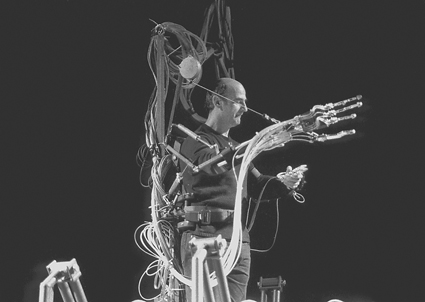
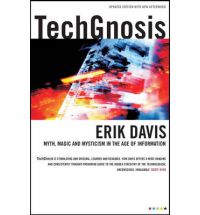 A major aspect of technoculture comes from “mystical impulses behind our obsession with information technology.” That, in essence, is the central thesis of an ambitious tome entitled TechGnosis by San Francisco writer Erik Davis. Davis has written numerous snappy articles in this field for Wired, The Village Voice, Rolling Stone, 21 C, Lingua Franca and The Nation. However in TechGnosis he attempts to touch upon the entire history that connects the spiritual imagination to technological development, from the printing press to the internet, from the telegraph to the world wide web.