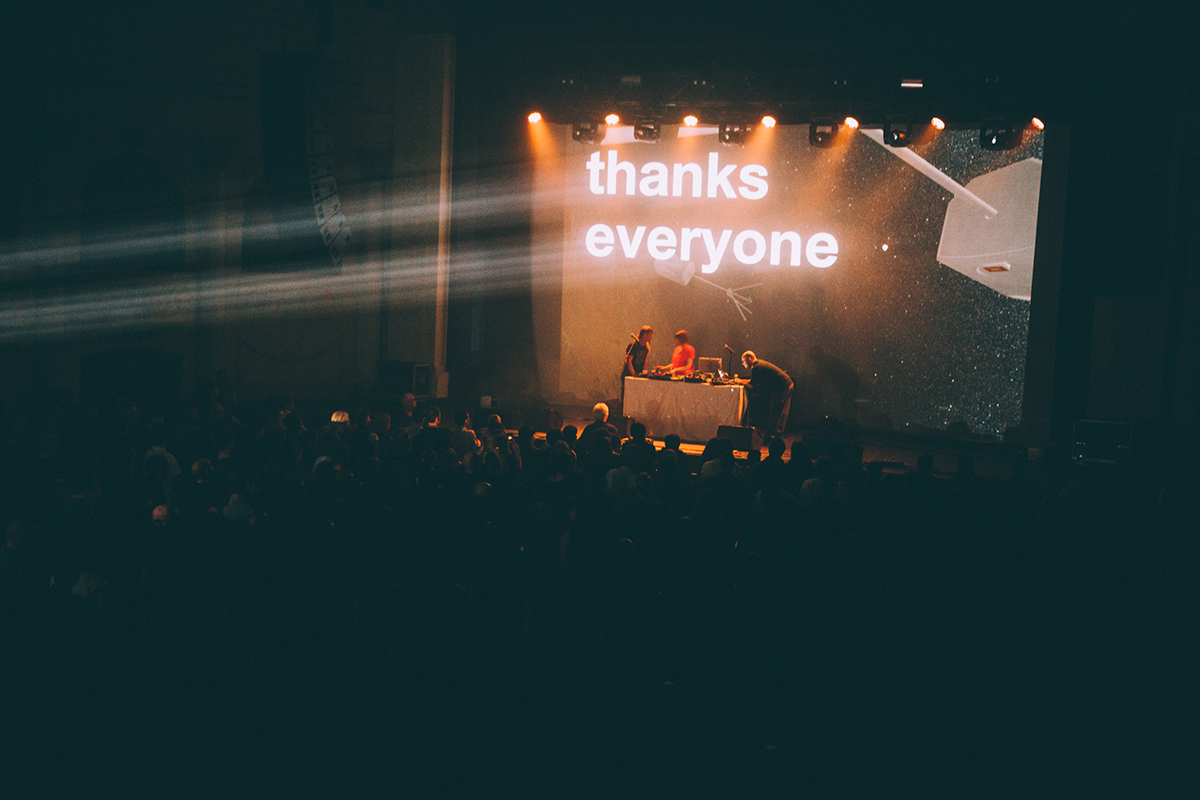
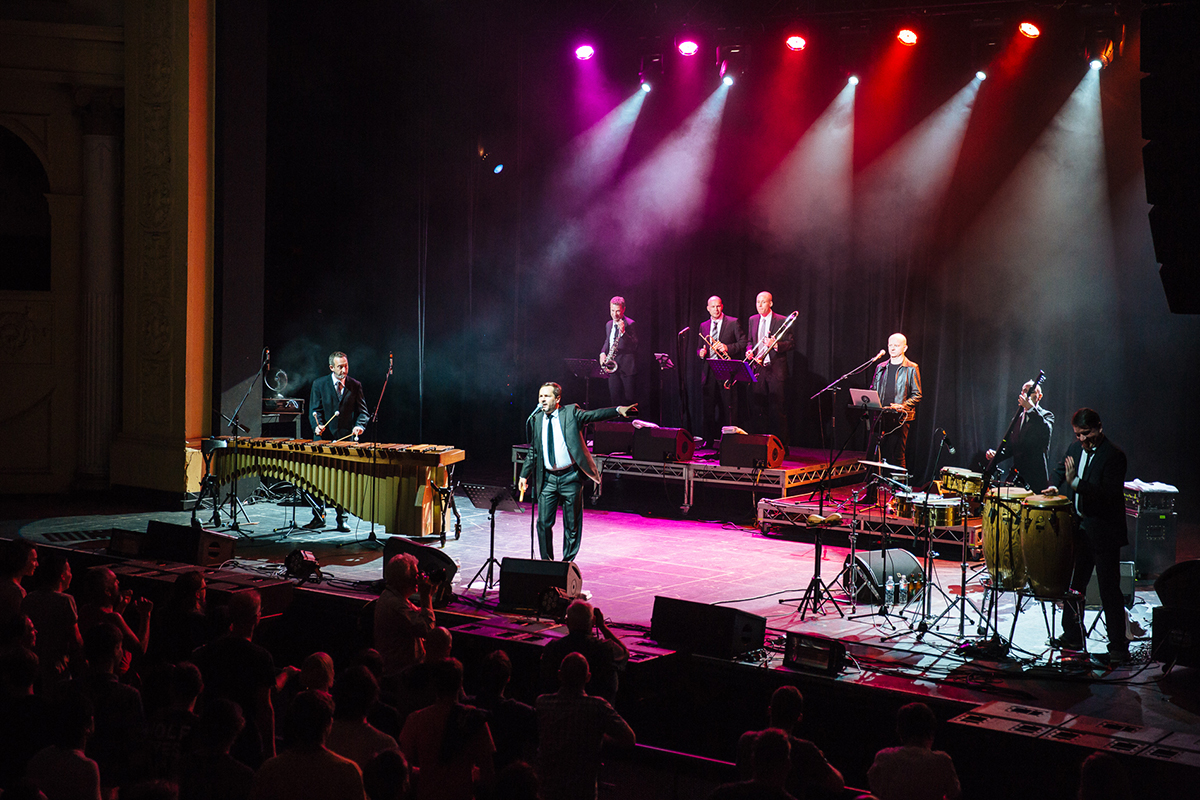
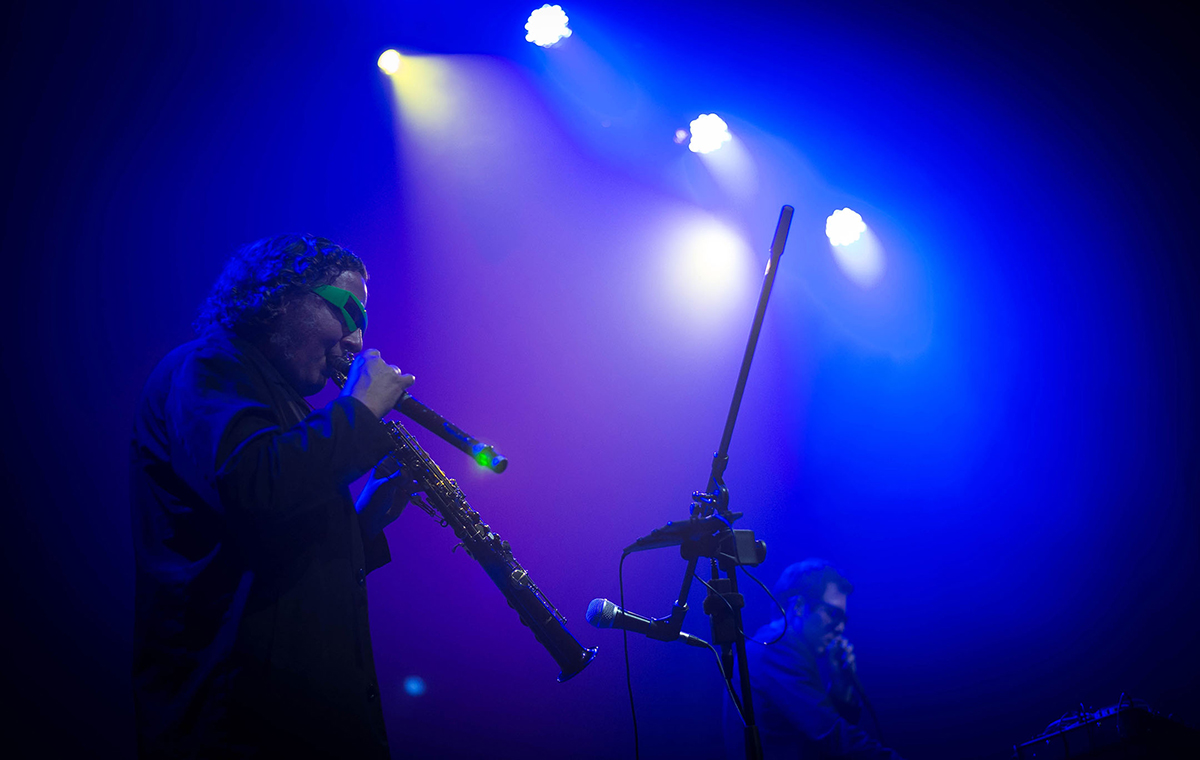
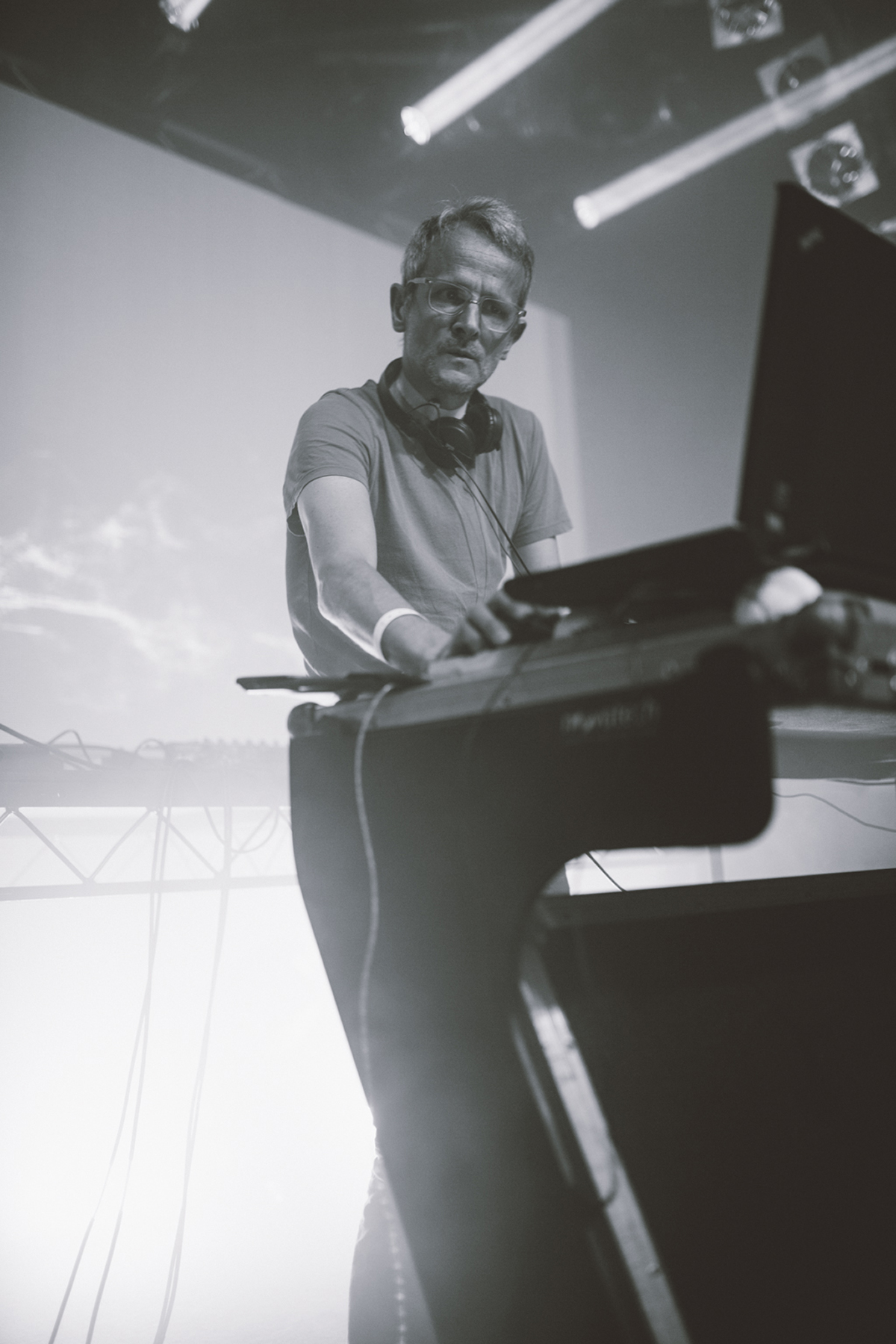
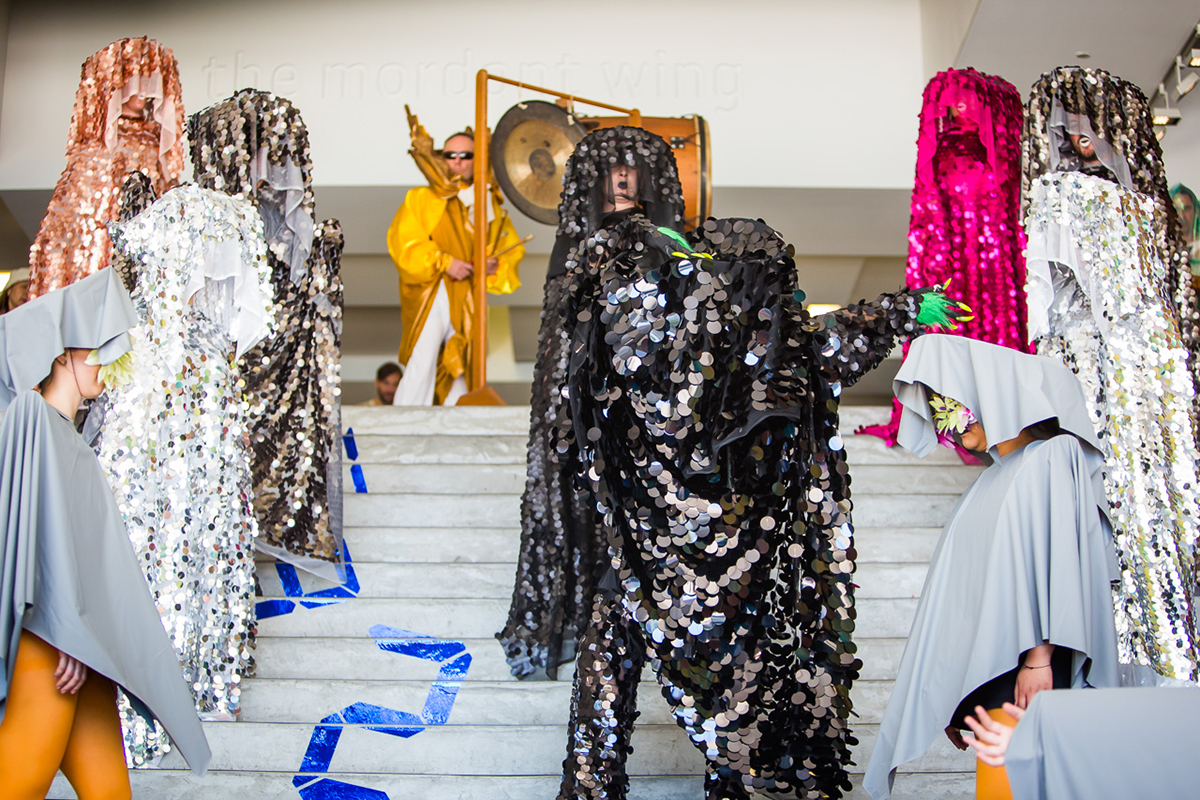
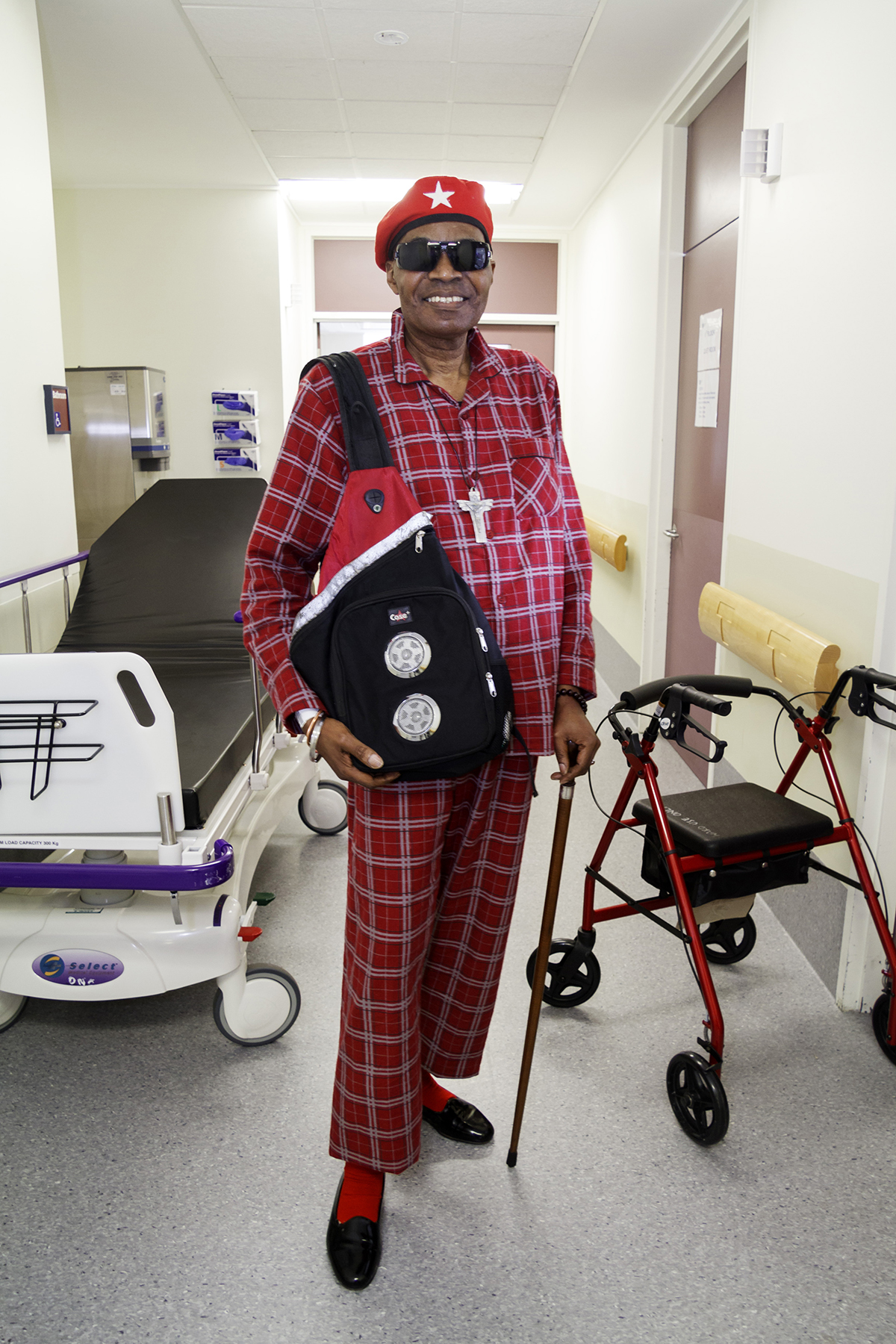
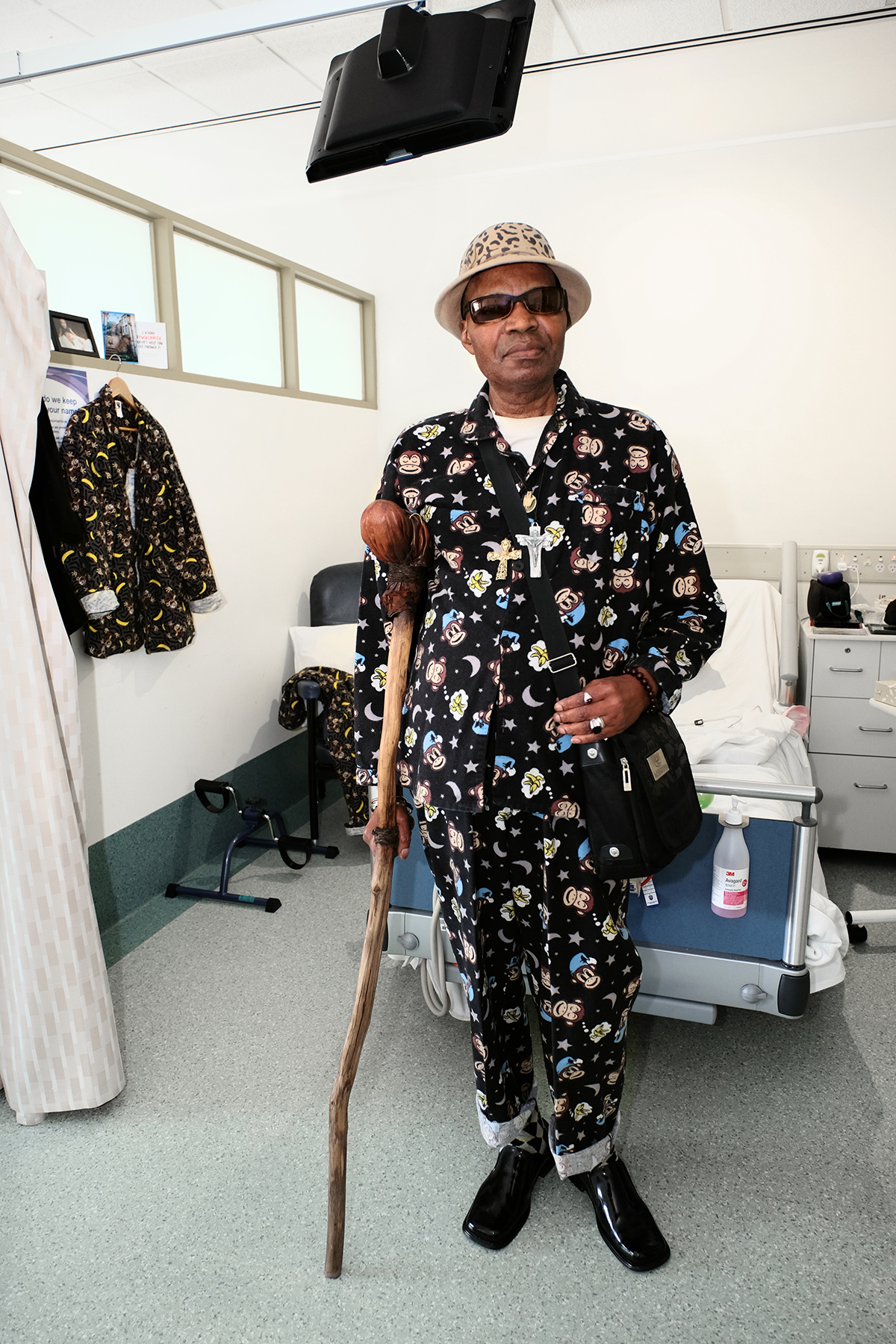
A huge thank you for the multitude of phone calls, cards, emails and ever-escalating social media messages responding to the announcement that we’ve ceased regular publishing of RealTime. Some of you were “shocked,” “stunned,” even “gutted,” feelings we understand, but mostly, like us, you were sad but looking forward to the completion in 2018 of the enormous RealTime archive and a celebration of 25 years of freely accessible arts reportage.
The response — from arts audiences, artists, arts companies, organisations, publications and educational institutions — has been infinitely larger than anticipated and very rewarding, coming after years of never being sure how many of you were on track with us. Clearly more than we suspected.
It was especially gratifying to hear from non-artist readers for whom RealTime has provided awareness of works they would not otherwise have encountered from across Australia and beyond. Artists whose careers were supported or influenced by RealTime have expressed their gratitude.
Writers reflected on their years, in some cases decades, with us. Our special thanks to Ben Brooker and Matthew Lorenzon who posted affecting accounts on their blogs about working with RealTime, capturing some of the essence and joy of our collaborative venture. Former Assistant Editor and OnScreen Editor Kirsten Krauth who worked with us 1998-2002 posted a fond recollection on Facebook.
Very special thanks to our wonderful staff — writer and sales manager Katerina Sakkas, online producer Lucy Parakhina and writer and acting assistant editor (February-September) Lauren Carroll Harris — and our wise and compassionate Board of Management — Tony MacGregor, John Davis, Julie Robb, Urszula Dawkins, and Phillipa McGuinness. And to the Australia Council for the Arts its long-term support and understanding. We’ll be in touch in 2018.
Happy holidays, Keith & Virginia
From the Managing Editors and the Board of Management of Open City, publisher of RealTime.
RealTime is now ceasing regular publishing and will embark in 2018 on the task of completing its online archive and publicly celebrating its legacy of 25 years’ coverage of innovative Australian art.
“Reality check. This is the last edition of RealTime. It’s been an extremely difficult and a very sad decision to make to draw the magazine to a close — to cease weekly publishing at the end of 2017. In 2018, the magazine’s 25th year, we will complete the archiving of the deeply personal, totally consuming project that the magazine has been for us. It’ll be a year of reflection and celebration for RealTime’s many contributors, readers and supporters and, we hope, provide an enduring legacy — a unique record of a period in which the arts have radically transformed.” Virginia Baxter & Keith Gallasch, Managing Editors
RealTime, the national arts magazine uniquely focused on innovation and experimentation in the arts across Australia and beyond, is coming to an end. In 2018, its 25th year, the magazine will be published informally, but no longer on a weekly basis. Staff will focus on completing and making publicly accessible the enormous RealTime archive from 1994 to the present.
The decision: social media vs sustainability
This decision, made by the Board of Management of Open City and the Managing Editors and in close consultation with the Australia Council for the Arts, the association’s key funder since the magazine’s inception, was not an easy one. But it was a necessary one. Despite considerable creative and technical effort — and achievement — in 2016-17, it was clear the operation would soon become unsustainable, a result of the widely felt negative impact of social media on advertising sales.
2018: Archiving RealTime & celebrating an era
Across 2018, the Managing Editors will complete the magazine’s invaluable online archive, issue a number of special editions, commission historical overviews and conduct public forums surveying the period from the mid 1990s to the present of monumental change in the arts, much of it not easily accessed or otherwise on the public record. The archive, including digitised print editions of 1994-2000, will be freely available to artists, audiences, students and researchers with a plan to house it within a major arts institution.
A tribute toartists
Above all, the archive pays tribute to the work of the thousands of artists who inspired RealTime’s Managing Editors and writers with their bold reshaping of forms and genres, their experiments in hybridity, their embrace — and critiques — of new media technologies, cross-cultural exploration, art-science cross-pollination and the complexities of ethnic and gender identity.
…and to writers
The archive will equally pay tribute to the contribution of hundreds of writers, many of them artists and arts specialists, who have written generously for RealTime, some of them for over two decades, responding constructively in creatively turbulent times. We deeply regret we can no longer commission them to review new work by emerging and established innovators that warrants serious attention at a time when arts journalism is seriously threatened.
…and to readers, funders and supporters
The archive also represents a record of RealTime readers’ keen embrace of experimentation in Australian art. Our supportive advertising clients allowed us to commission extensively and our sponsor Vertel provided us with several years of superior network capacity.
The Australia Council for the Arts, from a seeding grant in 1994 for RealTime to its funding of Open City as an ongoing key organisation, has been a consistent and responsive funder of the magazine, its support allowing a significant breadth of national coverage and a focus on art that often defies categorisation and is ever enquiring.
…and our staff
The Board and Managing Editors pay particular tribute to the staff of RealTime who, across the decades, have been hard-working, generous, loyal and committed to supporting innovation in the arts.
Looking forward to the retrospective
The Open City Board, Keith and Virginia proudly welcome the opportunity to complete the RealTime project in 2018 and look forward to engaging with artists, writers and supporters in our grand retrospective of 25 years of transformed and transformational art.
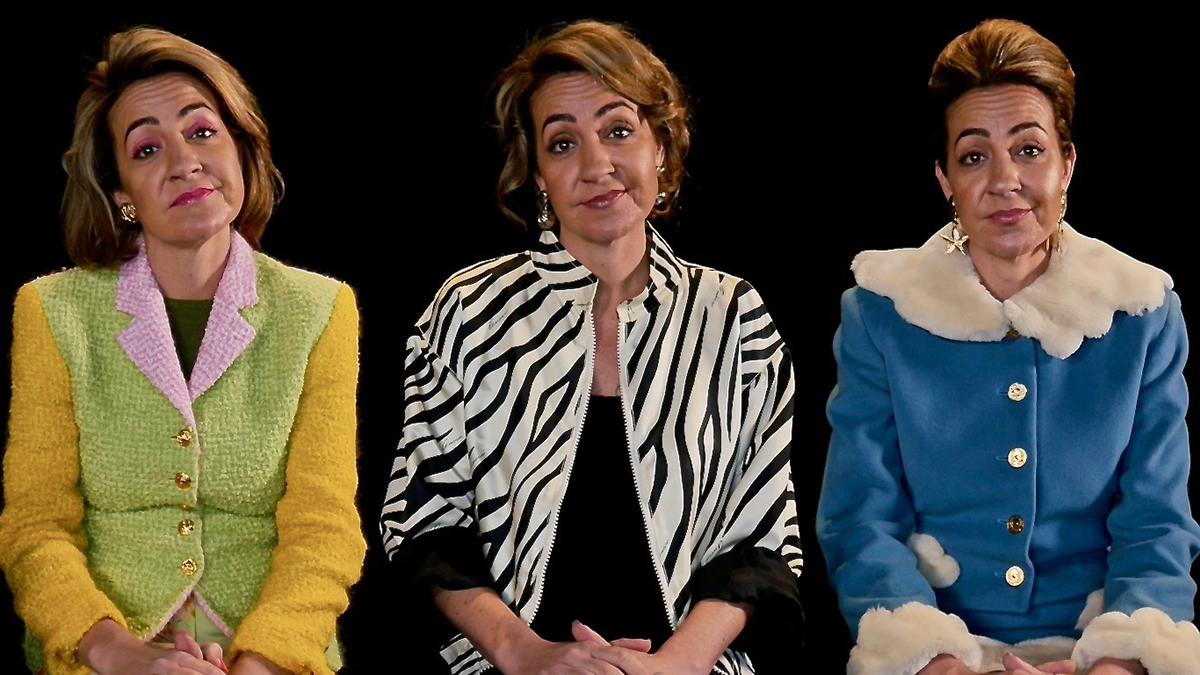
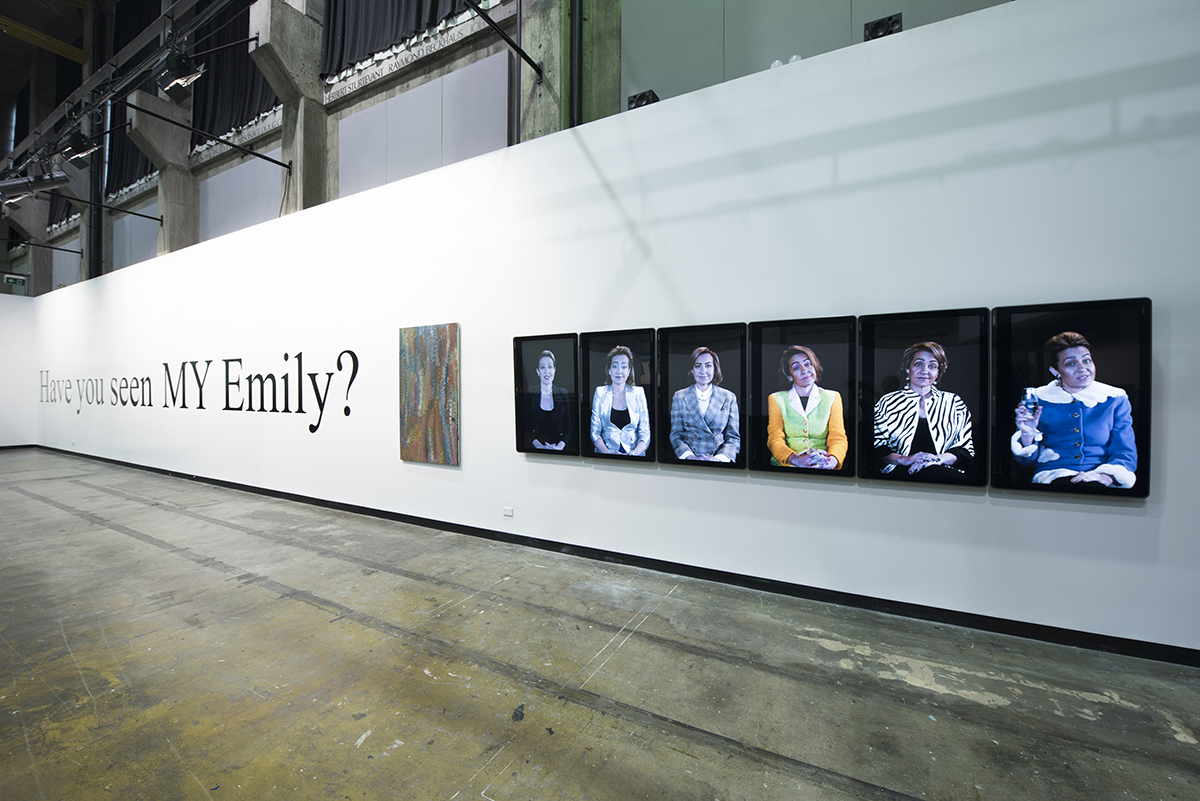
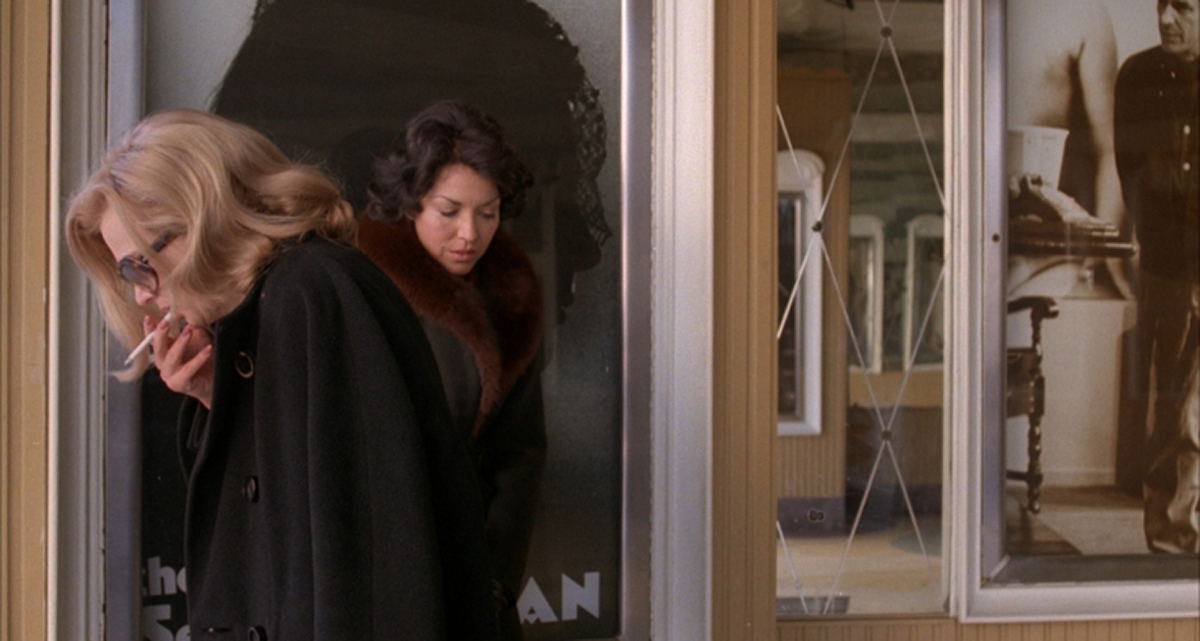
Unmissable from the floor of the main hall of the Casula Powerhouse, the words “Have you seen MY Emily?” stretch grandly the length of a long mezzanine wall. On approach, you find it ends with a painting by Emily Kame Kngwarreye (Untitled, 1994) followed by six vertical video screens — a playful, experimental performative video work by Wiradjuri artist Amala Groom.
On each screen a woman speaks directly to you — as her partner in conversation or confidante as she comments on the exchange. It’s like arriving at a party and being rapidly addressed by a succession of eager strangers, six of them, taking turns that require you to shift attention from screen to screen, person to person and from a position of ignorance (especially if you arrive part way through) that requires you to piece together this reconstruction of an unsettling encounter. But this fascinating challenge for the viewer doesn’t stop there.
Glasses of champagne in hand, the women are elegantly outfitted and coiffed as discrete individuals — all of them played by Groom. But as the words flow, it dawns on you that three of these women, though differently attired, represent just one — the hostess for a reception — and that the other three are variations on Groom herself, the guest. What you are witnessing is in fact a dialogue but one distributed and multiplied to amplify a sense of party ambience, tension and subsequent reflection. It’s a cleverly immersive and simultaneously disorienting device.
Even if you take in the work at its starting point (not common in the weird world of video viewing in art galleries) where Groom’s personae lay the groundwork for the narrative, there’s still work to do, to accommodate the diversity of voices and the dispersion of the narrative and ponder their purposes. The narration, delivered by Groom in present tense by all six characters at once, reveals that she is the guest of the wife of a former Prime Minister of Australia (the artist declines to name her). Groom, one of a number of Indigenous representatives to a UN event, is immediately wary:
“Me 1: This is my job as the performance of my cultural sovereignty to follow my feelings which have led me here to New York. [….]
Me 3: I fear this to be an opportune escapade for the former Prime Minister to shower us, the ‘Indigenous Australians,’ with alcohol and pleasantries so that he may exploit us in furthering his ever ambitious career pursuits. This is politics. This is all about optics. Do not be swayed; there will be photographs, there will be videos. Be diplomatic but do not leave the room empty-handed.”
The former Prime Minister’s welcoming speech, focusing on American race relations “in a room full of Aboriginal and Torres Strait Islander delegates,” is for Groom, “not only distasteful but offensive.” She turns her attention elsewhere: ” Only minutes after arriving at the event, the artist, already frustrated to the point of exasperation, focused her attention on [the former Prime Minister’s wife] who was conveniently sitting next to her.”
Amala Groom, Have you seen MY Emily? 2017, Casula Powerhouse, production still, courtesy the artist
Chorally, Me 1, 2 and 3 announce, “We are me,” and Her 1, 2 and 3, “We are her” and the discussion commences with a “quite robust conversation spanning both religion and politics.” But it quickly falters at the mention of political art, Groom’s writing deftly gear-shifting between speech and reflection with comedic and satirical verve.
“Her 1: So what do you do for a job?
Me 1: I make political art.
Her 2: I need to change the subject.
Me 2: I would normally just say I am an artist, but I am provoking this lady into having a semi-uncomfortable conversation with me.
Her 3: How do you contribute to the Gross Domestic Product?
Me 3: I still subscribe to the Black Tax which means that Aboriginal peoples should be receiving a percentage of the Gross Domestic Product to support our own political, social and economic independence so that we may be self-determining on our own lands which the Colonial Project has stolen from our Ancestors and continues to steal from us.”
The discussion grows particularly tense when it turns to the ex-PM’s wife’s proud ownership of the Emily Kame Kngwarreye painting referred to in the work’s title.
“Her 1: Have you seen my Emily?
Her 2: I own a very expensive painting.
Her 3: I cannot pronounce Kngwarreye.
Me 1: In the sitting room? Yes, it’s beautiful.
Me 2: Did she really just say that?
Me 3: And the world just stopped.”
The repetition of “her Emily,” “my Emily” and “Have you seen my Emily?” morphs into a grimly comic litany amid the ex-PM’s wife’s increasingly insensitive utterances.
“Her 2: This painting is ‘authentically Aboriginal’ and therefore is an extension of my own personal authenticity.
Her 3: I own a piece of your culture, can’t you see? Have you seen my Emily?”
Me 3: One cannot purchase culture, it’s not a materiality. Yes, I have seen ‘your’ Emily.”
Preferring traditional Aboriginal art, the ex-PM’s wife is afraid of political art. Me 2 comments, “She equates political and social commentary on contemporary society and race relations as being ‘angry,'” adding and later repeating, “Hmmm, does she know the revolution is coming?” while Me 3 wonders, “Does she think ‘angry’ art is going to jump off the wall and go at her?”
Amala Groom has taken a conversation she experienced and elaborated on it to make explicit what she thinks the ex-PM’s wife actually believes, rendering the woman’s utterances ignorant, cruel and sometimes just unbelievably silly — as in Her’s opening lines, ” I am rich …. I am so rich” and when she sings:
“Her 2: I think you are also really angry, why are you so angry? Can’t we all just get along? ‘Kumbayah my Lord, kumbayah… ‘”
Amala Groom, Have you seen MY Emily? 2017, Casula Powerhouse installation view, photo Hamish Ta-mé
The viewer doesn’t know which of the Hers’ words are actual and which invented, but Groom adopts a tonal strategy that keeps all utterances on a similar plane with a simple vocal realism in which there is no mimicry, no differentiation between voices, little exaggeration, just a gentle flow of casually uttered sentences of largely similar length, the rhythm reinforced with the raising and lowering of champagne glasses. This approach tempers the sheer bluntness of the lines I’ve quoted, allowing them room to correspond with the laid-back, ironically well-mannered demeanour of all the women in this work. It allows us to be amused, shocked here and there and yet contemplative. Have you seen MY Emily? might come from a place of anger (at the ex-PM’s wife’s comments) and it might well engender anger, but Amala Groom has fashioned a seductive video installation that implicates the viewer with face-to-face engagement in a casual conversation which seduces us into becoming attentive listeners and amused observers.
One of the most striking characteristics of innovative Indigenous art practice over recent decades has been the extent of artists’ inclusion of images of themselves in their works (Fiona Foley, Christian Thompson, Warwick Thornton, r e a, Tracey Moffatt to name a few working in video), not simply as self-portraiture but as personal statements of connections with country, culture, history and community, as well as satire, as in the video works of Richard Bell. In her first major commission and institutional solo exhibition, Amala Groom has extended this practice with a work that is at once personal, satirical and formally innovative.
–
Have you seen MY Emily? (2017), artist Amala Groom, curator Adam Porter, commissioned by Casula Powerhouse, 6-channel digital video, 9′ 56″; Casula Powerhouse Arts Centre, 30 Sept-19 Nov
Amala Groom is a Wiradjuri conceptual artist whose practice, as the performance of her cultural sovereignty, is informed and driven by First Nations epistemologies, ontologies and methodologies and articulated across diverse media. In 2017, Groom’s work has appeared in The Public Body .02, Artspace; System of Objects, National Art School; Moving Histories Future Projections, a dLux Media Arts exhibition toured by Museum & Galleries of NSW, 2016-17; and in Visual Bulk, Hobiennale 2017.
Top image credit: Amala Groom, Have you seen MY Emily? 2017, Casula Powerhouse, production still, courtesy the artist
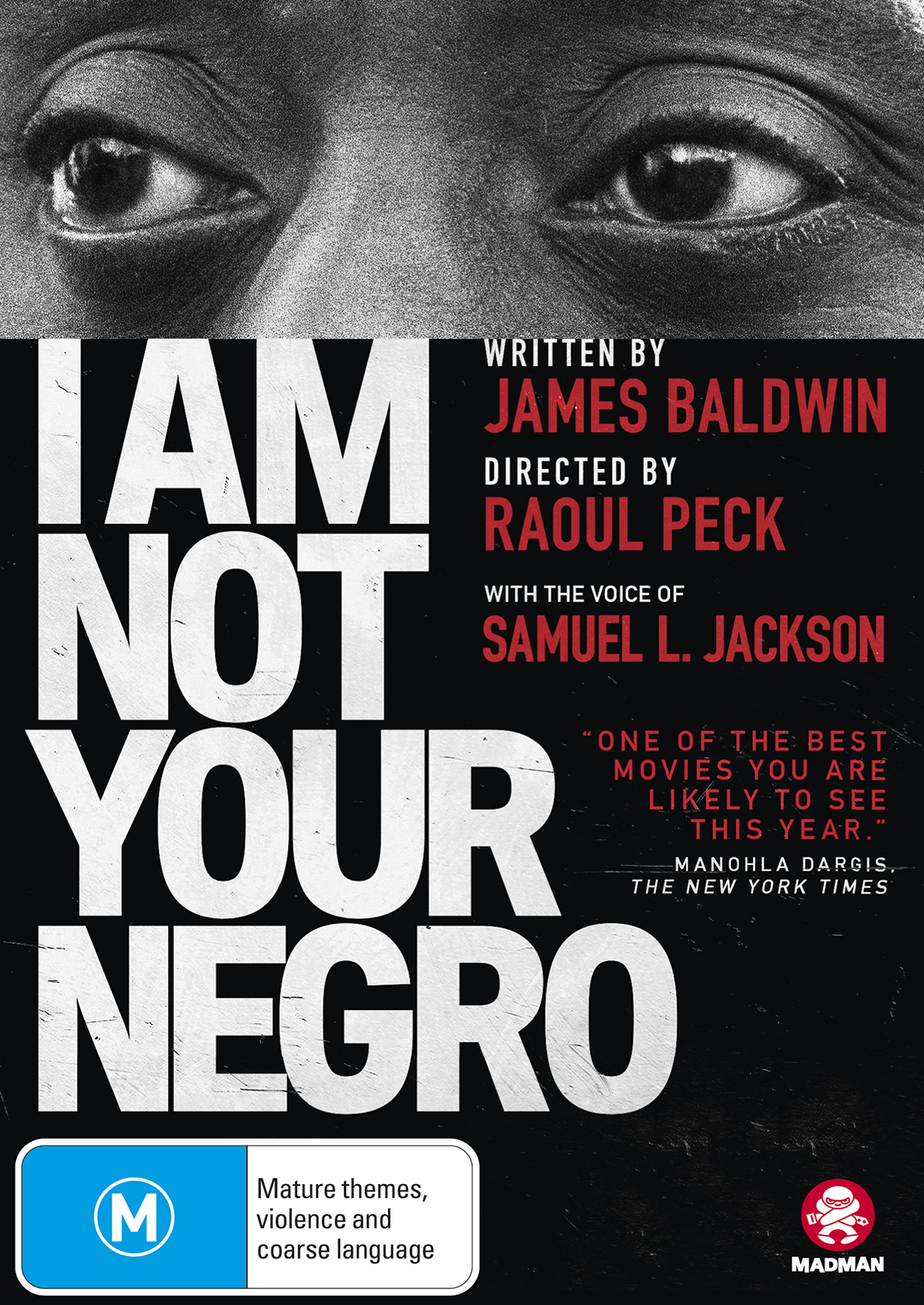
Raoul Peck’s documentary about James Baldwin, titled I Am Not Your Negro, has won unanimously high praise from critics and audiences but been limited in Australia to short cinema seasons. Now it’s available on DVD from Madman and is a viewing opportunity not to be missed.
Lauren Carroll Harris, who saw I Am Not Your Negro at this year’s Sydney Film Festival, wrote on Junkee, “What sets this film apart from other political docos is its profound emotionality. Spoken in melodious, low tones by Samuel L Jackson, Baldwin’s words ring out with an eloquent rage and passion that cannot be contained by the film frame. Peck pairs the sound with montages of the Black Lives Matter protests and portraits of Trayvon Martin and black youths slain by police in the last five years.”
The power of the film as a reflection on the inadequacies of the American psyche (and, by analogy, our own) was captured by Siddhartha Mitter on Hyperallergic:
“In the film, [Baldwin] refers to white America as ‘monstrous’ at least three times. He explains why: because people in the US are caught between narratives as to who they actually are and who they want to be, and narcotising, populist television circulates a story that always emphasizes the latter…The film left me with questions that I suspect won’t be answered in my lifetime, because successive generations of Americans have been brought up with the conviction that they need never understand anyone, not even themselves. How do I live with that?”
We have 5 copies to give away, courtesy of Madman Entertainment.
Email us at giveaways [at] realtimearts.net by 5pm 19 December with your name, postal address and phone number to be in the running.
Include ‘Giveaway’ and the name of the item in the subject line.
Giveaways are open to RealTime subscribers only. By entering this giveaway you consent to sometimes receiving updates from us. You can unsubscribe at any time.
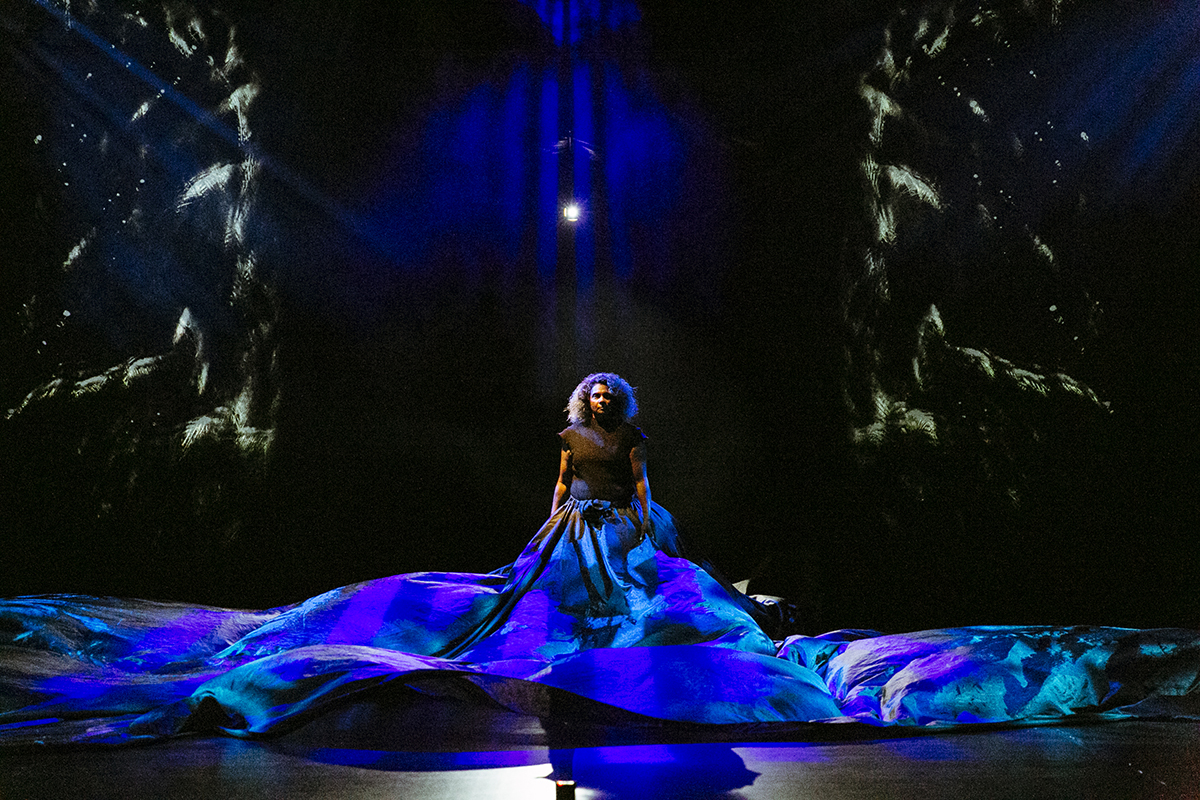
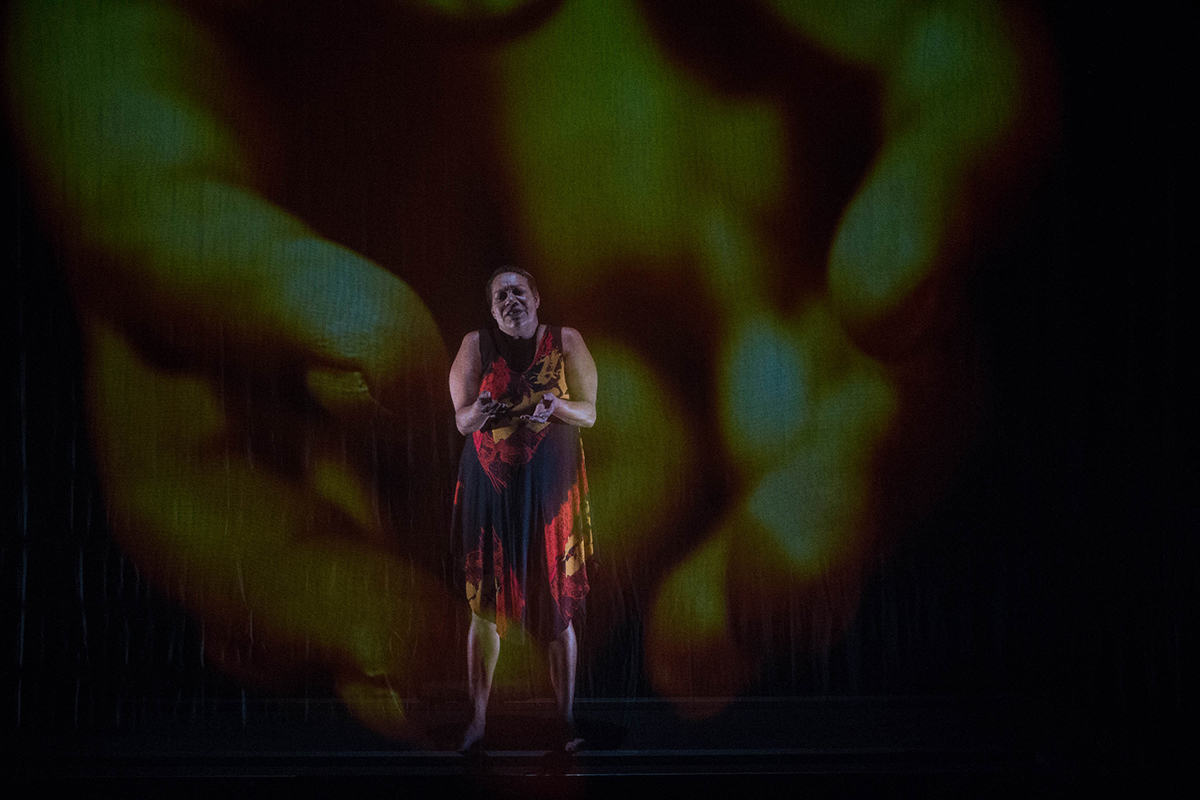
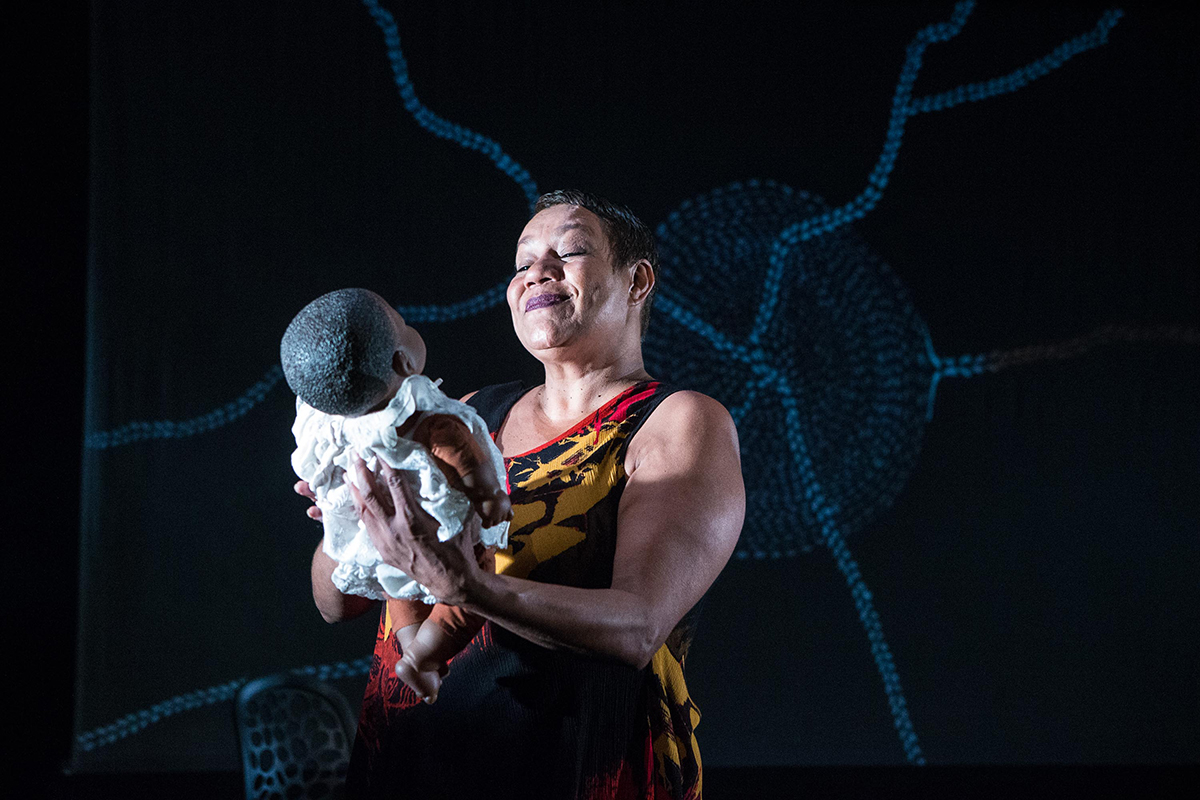
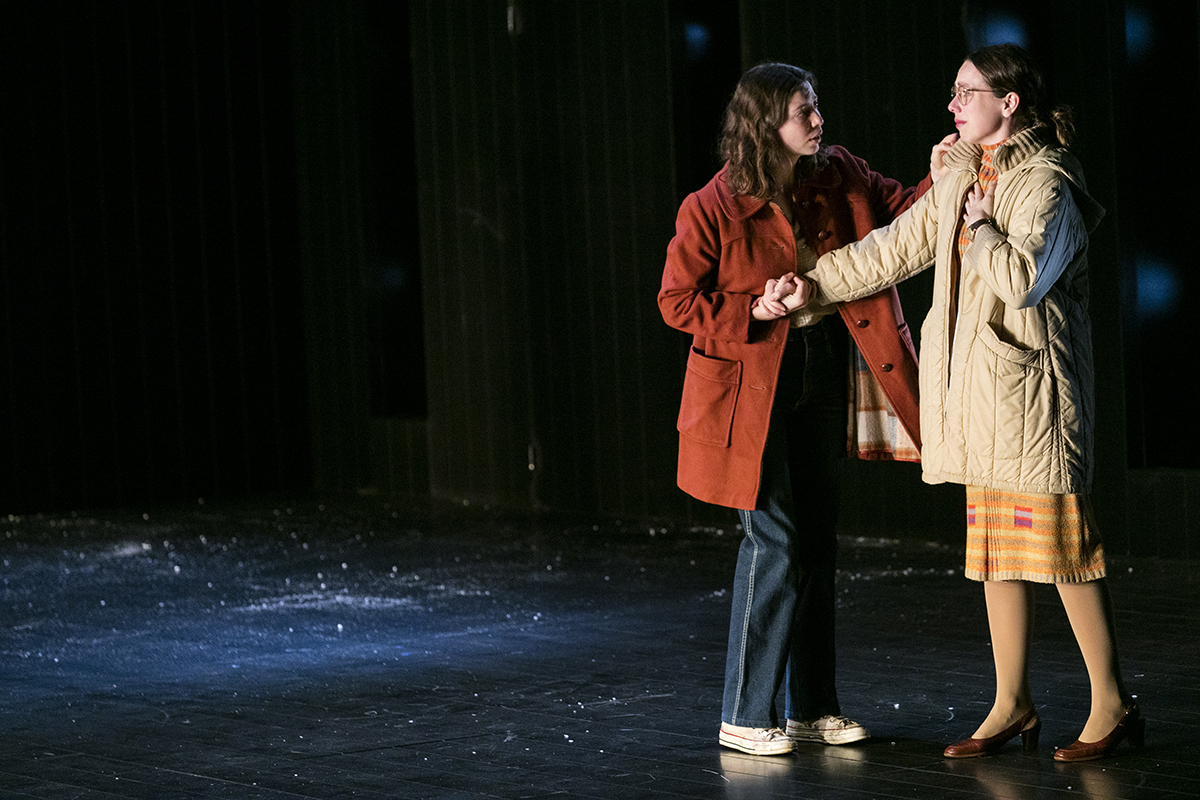
The backlit silhouette of a lone female figure appears centrestage in a voluminous skirt of billowing waves. A soft light shines on her face as the sound of a turbulent current escalates around her and we are introduced, via recorded voiceover, to the Djurra Dreaming narrative of the Bundjalung nation of north-eastern NSW, of the mother summoning her sons from the sea, to the shore, to her, for she is also the headland.
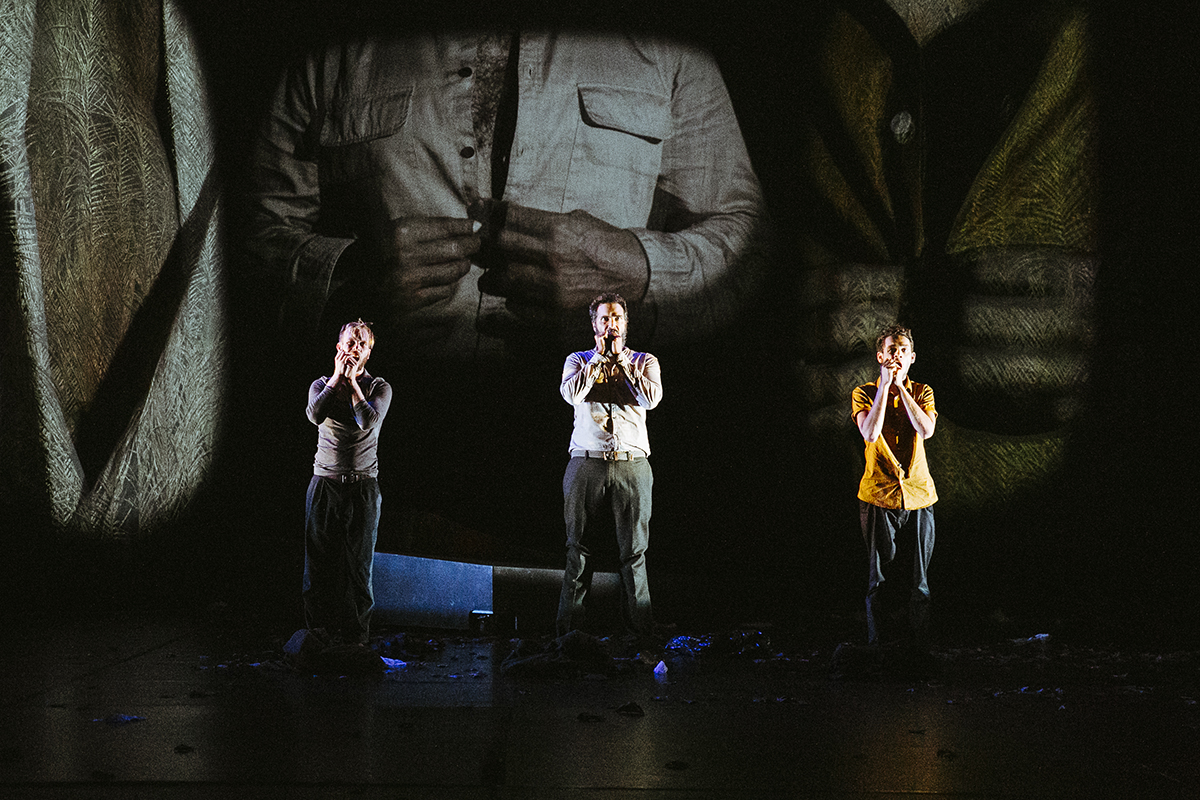
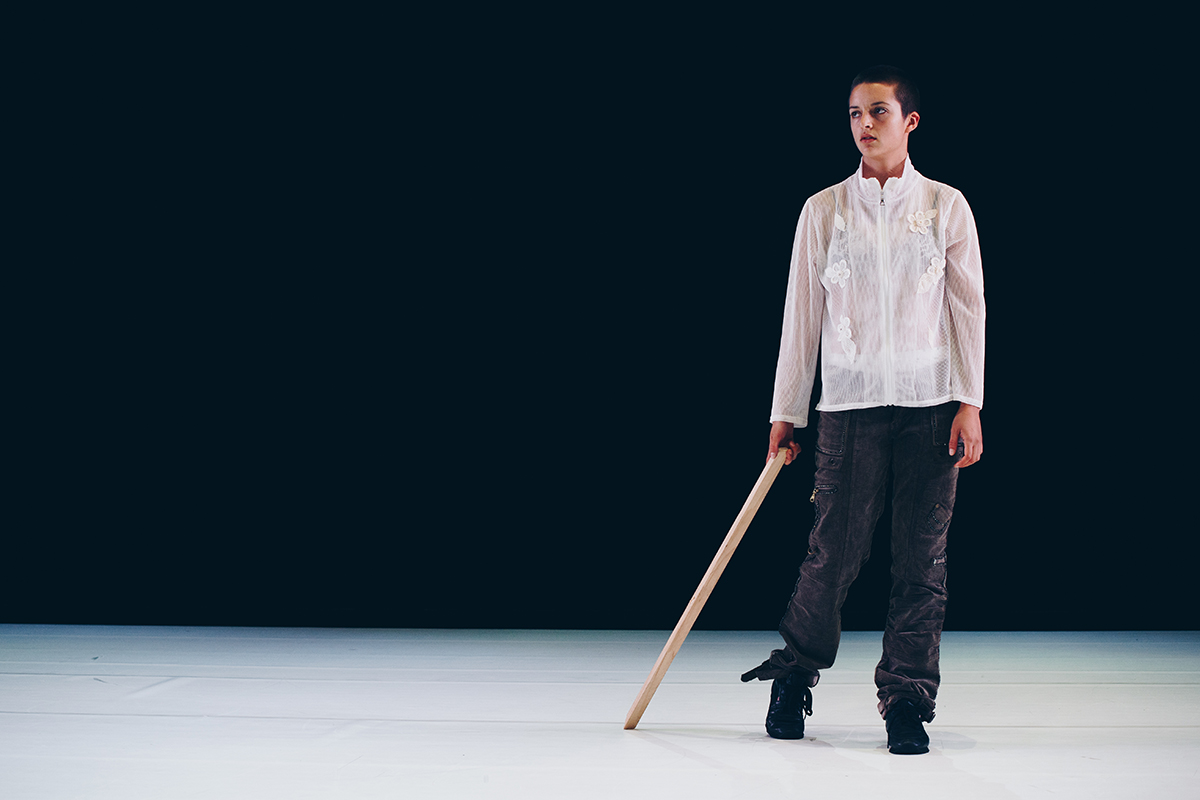
This arresting image is immediately followed by the entrance of the three sons sliding on their backs to emulate the watery expanse from which they’ve come. The brothers, dancing with sticks which are at once paddles and subsequently spears, are depicted as archetypal men of the Dreaming. Featured solos set them apart as individual characters, while also serving to subtly shift us from the Dreaming into the here and now. A chair is placed on stage and the woman (Sarah Bolt) is reintroduced as a frail patient in aged care. We discover the three men are also her sons, who will also return, as her death is imminent.
Director Kirk Page’s Djurra is important for so many reasons, first and foremost as a multi-disciplinary performative ceremony including dance, spoken text and physical theatre in which ritual is enacted.
On opening night Djurra is framed by coinciding events, the first of which is a large-scale sand painting created by local artist Digby Moran. The mandala’s repetitious squares within squares act as a meditation, gently guiding the observer to quiet contemplation.
Damion Hunter, Djurra, NORPA, photo Kate Holmes
Immediately preceding the performance, at the base of the steps of the Lismore City Hall a large crowd gathers to witness a performance by local Indigenous girls’ dance group Nini Ngari-Gali, organised by Sarah Bolt through NORPA . This is followed by a Welcome to Country ceremony in English and in Bundjalung Widjabul language given by Roy Gordon, who along with Rhoda Roberts is one of the cultural consultants on the production. One of the speakers was from a group of weavers commissioned to respond to the Djurra Dreaming history by creating a collection of traditionally woven artifacts installed in the foyer directly opposite the entrance to the theatre.
By the time we take our seats we have unwittingly processioned to our modern day dance ground.
Edward Horne’s set is spare, uncluttered, rendering the stage space flexible. Two large woven mats hang as textured curtains upstage, utilised as vertical projection surfaces on either side. The large horizontal space between also serves as a projection surface, creating a triptych effect with images softened around the edges like floating thought bubbles. A large roving platform is manipulated by the cast to emphasise distance, from one continent to another, from one state, one room or one bed to another, while also serving as the mother’s eventual deathbed — the exposed innersprings of a mattress, suspended directly above, appear to emulate that in-between space otherwise known as purgatory.
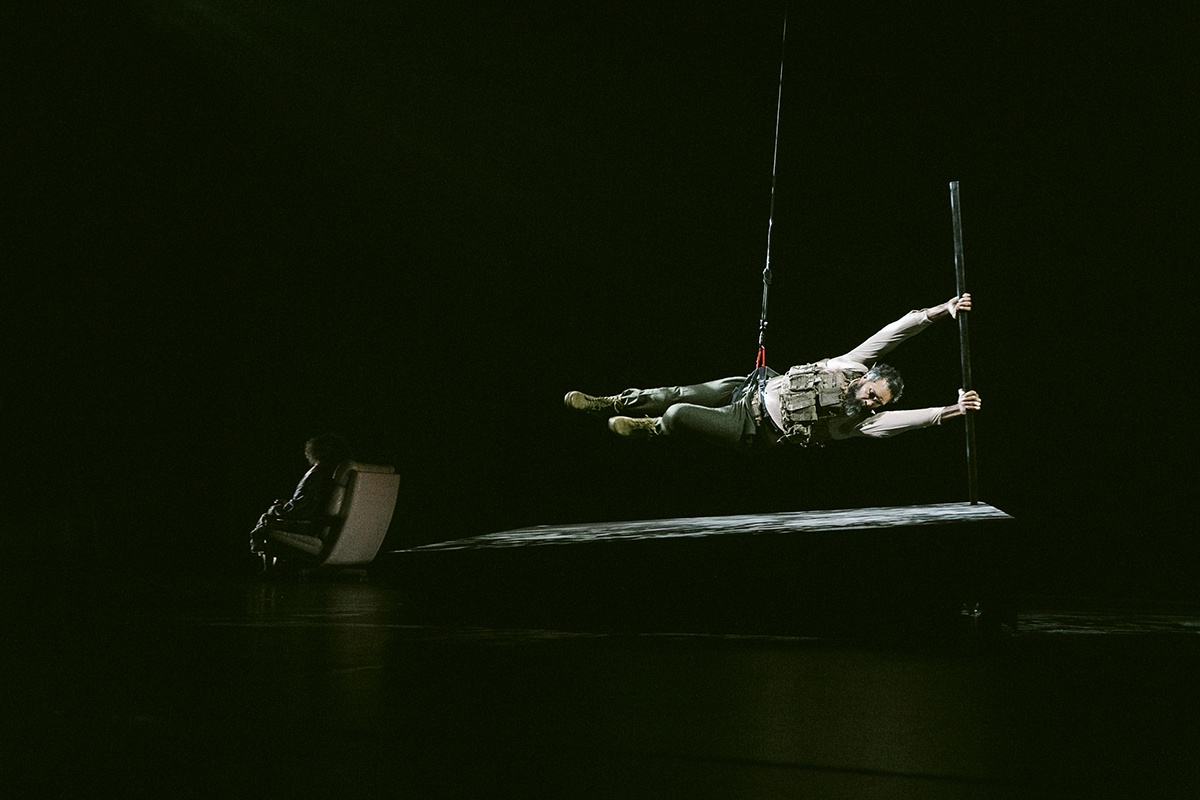
This deathbed image is augmented by a captivating dance momentarily taking us out of the narrative. Performed by Joel Bray it begins on the floor, gradually ascending through deft harness work. Bray embodies the spirit through a series of circular movements growing ever more expansive, from smaller sequential isolations, progressing to floor rolls, graduating to larger and larger leaps until he eventually takes flight, eschewing his (and presumably the woman’s) mortal body.
Joel Bray, Damion Hunter, James Slee, Djurra, NORPA, photo Kate Holmes
In an earlier scene, the eldest brother played by Damion Hunter, introduces the harness by emulating the whirligig motion of a helicopter’s rotating blades. By holding onto a short pole attached to the floating platform while directly addressing the audience, Hunter succinctly embodies the precarious dangers of combat his character has left behind.
This transcendental approach is extended to the execution of text, to varying degrees. Not quite abstract nor surreal but not entirely literal, the text was subtly stylised in places, notably by James Slee who plays the youngest brother, who has never ventured far from his childhood roots. With an obvious hip hop background Slee includes the odd quick alliterative analogy accompanied by equally subtle changes in a rhythmic delivery indicative of rap.
In Bray’s first soliloquy I recognise substantial autobiographical elements meshed into his onstage persona as the middle brother who has purposefully distanced himself from, yet is staunchly proud of his familial origins — evidence that the text has been developed through a collaborative devising process.
In another of Bray’s soliloquies — delivered after his mother’s funeral and about men and mourning and upholding a code of male stoicism — I witness something deeply poignant followed by a sense of missed opportunity. This brief scene is framed by a ritual of funereal preparation performed in unison, of shaving, combing and donning the multi-purpose suit jackets that in this instance serve to speak of solemn resignation. It’s followed by Bray’s reminiscence of his mother’s description of a cry. His physiological recollection of a lament as consisting of five short inhalations followed by a long exhalation as having the inverse properties of a laugh — five short exhalations and a long inhalation — so succinctly describes the way in which men are programed to compartmentalise emotion and distance themselves from attachment. As one of the most universally topical issues, this beat is over all too soon.
Sarah Bolt, Djurra, NORPA, photo Kate Holmes
Djurra’s text doesn’t preach declarative fact at the audience, telling them what it is to be Aboriginal in any generalised sense. Rather, its potential strength lies in its revealing the Blackfella condition through character content, through circumstance. For Bray, it’s what it is to be a white Blackfella when having to explain his race to each person he meets while travelling abroad. For Slee it’s the significance of staying on country and maintaining kin connections, and for Hunter it’s the obligation to share personal wealth with community while secretly paying for his mother and brother’s upkeep while he’s on tour in the armed forces.
The text became problematic where it felt simply under-rehearsed or broken in mid-sentence, forcing the audience to work harder than it needed to stay on track and when its delivery was not sufficiently well modulated to get a sense of the work’s dramaturgical arc, ultimately compromising levels of intimacy and audience access. This could also be said of transitions between scenes, which were at times slow and clunky.
As an actor in the inaugural Black Playwrights Conference of January 1987, I can attest that even this raw state Djurra is testimony that we have come a long way from the early days where we were trying to establish an Indigenous vernacular within mainstream theatre. The use of parallel narratives is becoming a more widespread technique, illustrating the element of embodiment, of actually ‘becoming’ in order to access the Dreaming and using the theatrical space to sing those histories alive as seen in Bangarra Dance Theatre’s Bennelong which features a vignette where all of the male performers declare, “I am Bennelong.
Kirk Page’s strength as a director lies in his physical performance history and the inclusion of the harness work, aided by the continuity provided by Jade Dewi’s choreographic hand. Video artist Rohan Langford consolidated images rather than introducing new information, while at low levels, Karl Johnson’s lighting provided an atmospheric quality to the Dreaming scenes, in juxtaposition with the present day narrative, which was imbued with a bright clarity of the everyday. Composer Ben Walsh was also able to work across a broad emotive range without overpowering the work, lending an almost cinematic structure in the versatility of sound the work demanded. I feel this short season is not the end for this production. It would be good to see the actors given the chance to truly inhabit Djurra and for the production to continue to evolve.
NORPA, Djurra,director, devisor Kirk Page, cultural consultant Roy Gordon, performer-devisors Joel Bray, Sarah Bolt, Damion Hunter, James Slee, choreographer Jade Dewi, composer Ben Walsh, contributing artists Mitchell King, Blake Rhodes, set & costume designers Charlotte Hayward, Edward Horne, video artist Rohan Langford, lighting designer Karl Johnson, cultural consultant Rhoda Roberts, dramaturg Julian Louis, Lismore City Hall, 29 Nov-2 Dec
Independent choreographer, performance‐maker and teacher, Vicki Van Hout is a Wiradjuri woman born on the south coast of NSW. Vicki travelled to Lismore courtesy of NORPA.
Top image credit: Damion Hunter, Djurra, NORPA, photo Kate Holmes
In the second of two articles on experimental music in Adelaide — the first featuring Dan Thorpe — Chris Reid interviews Stuart Johnson aka Wolfpanther, curator of Metro Experimental Night. RT
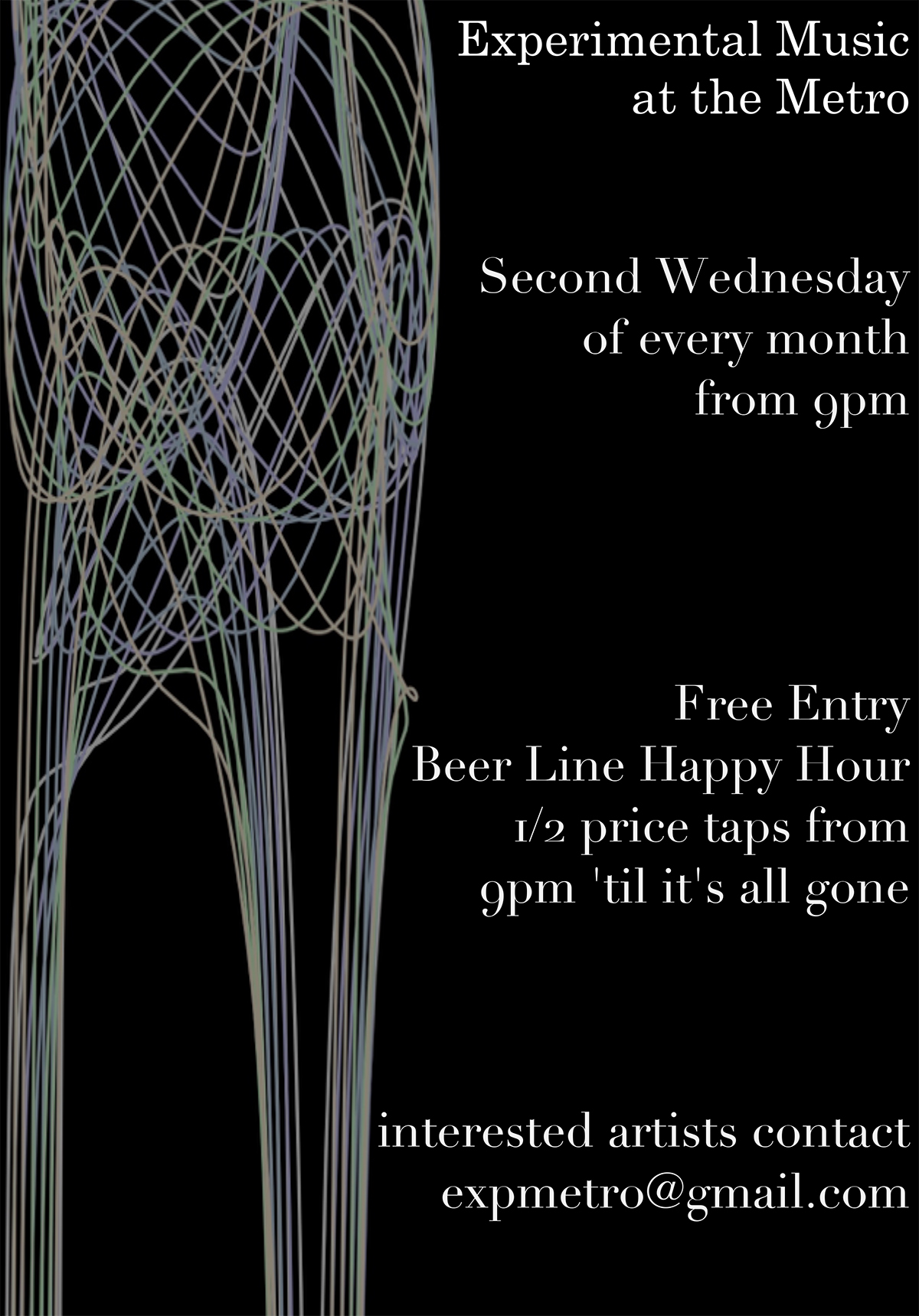
A cornerstone of contemporary and experimental music in Adelaide is the series of monthly concerts titled Metro Experimental Night held at Adelaide’s Hotel Metropolitan. Stuart Johnson curates evenings of mainly electronic music that can range across ambient, drone, noise and all kinds of instrumental work. Importantly, Metro Experimental Night is open to a variety of performers and thus encourages emerging artists and new developments. Three acts featured on 12 July this year are good examples: sympathetic | DIVISION using synthesisers and electronics, Little-Scale also using synthesisers and electronics but stylistically quite different, and a high-intensity solo performance on guitar and effects pedals by Insomnicide.
On another evening, Wolfpanther himself performed — on miked banjo mediated through an array of electronics —with Melanie Walters on flute. Walters has a significant profile in the Adelaide scene, works with Dan Thorpe in the duo Stereo Mono and was a member of the Australian Bass Orchestra in the workshop production of Cat Hope’s new opera Speechless. The 8 November Metro Experimental Night program included a stunning solo recital by Walters who alternated between bass flute, flute and piccolo in works by German-Australian composer Felix Werder (on whose music she is writing her doctoral thesis) and Finnish composer Kaija Saariaho. Wolfpanther pointed out that it is unusual to include composed music in a Metro Experimental Night program, but the audience was enchanted.
The music in the program can be variable in quality but is always interesting and sometimes exhilarating. I spoke to Wolfpanther about Metro Experimental Night, his own work and Adelaide’s contemporary and experimental music culture.
Outline for me your curatorial approach to your program.
I took over the Experimental Night from the previous organiser in early 2016, so I inherited something of the approach it already had and particularly the name. Of course the question of what “experimental music” means is not necessarily a simple proposition; my approach was to have a very broad interpretation. I don’t have a clear-cut definition but generally it’s about genres that aren’t usually well represented in a pub live music environment, uncommon instruments; improvisation, genuine experiments… There is likely a bias towards the sort of things and people I’ve been involved with, for example a bit of modular synth, but I try to keep the nights open to as many different approaches as possible. Certainly if someone approaches me with a genre that hasn’t been represented before I’m very keen to get them involved. My aim is to be very inclusive. Doing somewhat unconventional music in a regular pub show can be pretty daunting, so I think it’s good to have a chance to get people to play to an audience open to different kinds of music and understanding that occasionally a performance might not be particularly polished. I think it’s also interesting to get people from the academic side of music to come and play a pub show.
I gather you receive no government funding for the show, but the hotel does pay the performers?
The event exists thanks to the ongoing support of the Metro which provides a guarantee that goes to paying the artists [which] allows the event to be free, and it pays for a sound tech which makes a big difference. Sometimes there are fairly straightforward setups which I could probably handle myself, but when instruments, particularly drum kits, need to be miked up it is great to have someone who knows what they are doing.
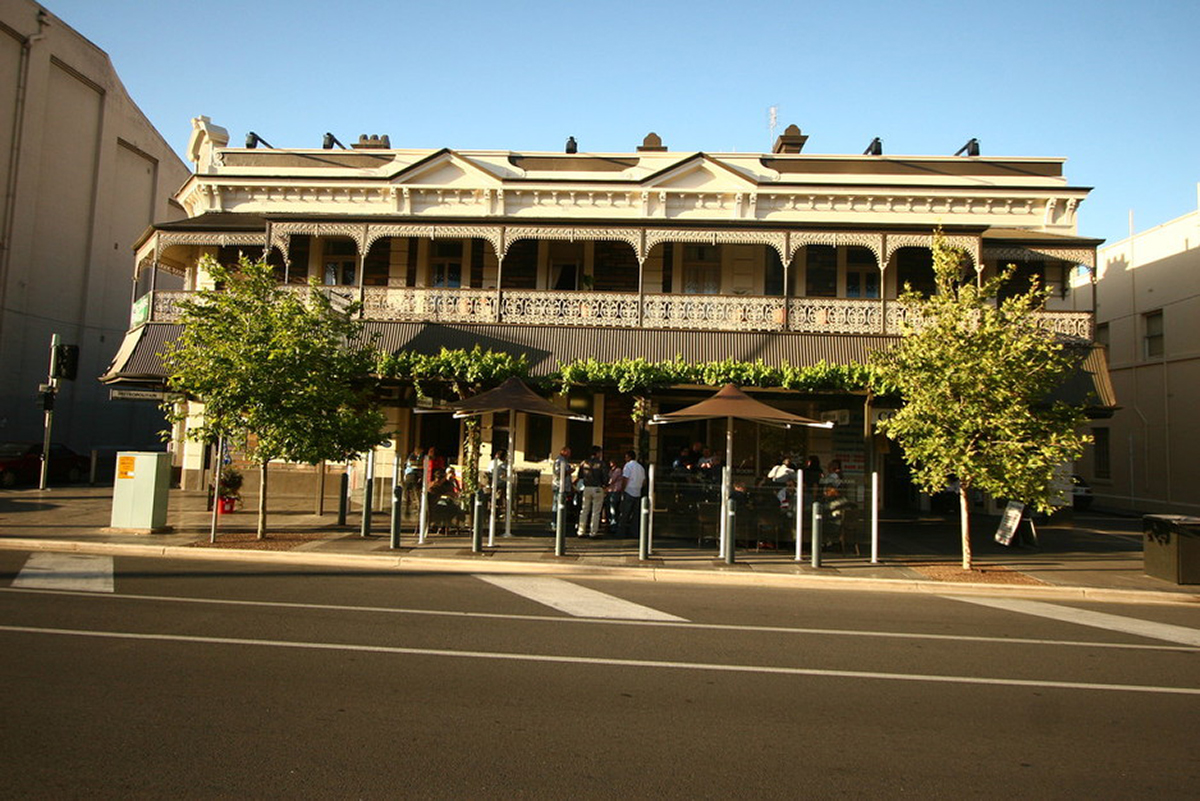
Hotel Metropolitan, Adelaide
Tell me about your own work: your ensembles and musical interests.
In the last few years I’ve played in about a dozen or so groups, ranging from Thom Bordism Group — who played regularly for a couple of years and released an album — to bands which existed for one or two gigs. I can’t really settle on one particular approach to playing music so instead I try to do lots of different things with lots of different people. Not all of it is particularly experimental; I spent some time in the Loose Cannons, a singing group which sang traditional sea shanties, and I’ve played lead guitar in a rock band, Stable Vices. I’ve also played solo, mostly in an exploration of various electronic instruments I’ve been collecting for a while, though occasionally on guitar as well. Often I’ll develop an approach for a particular show and work on that before moving on to something else immediately afterwards. Most recently I played a no input effects loop at Metro Experimental Night, which is about the most literally experimental thing I’ve done.
The experimental scene in Adelaide is small and rather fragmented. Do you think that it has the potential to develop, perhaps with targeted funding of some kind?
I guess my approach to music is as a sort of folk art. I’m not looking to do it professionally; I just think it’s really good to be involved with a community of artists and listeners and I always try to encourage a strong participatory aspect to the scene. But I acknowledge I am in a privileged position to be able to have this attitude. I would like better support for experimental music, but it’s difficult to make a living even in more popular forms of music.
The helpful thing for musicians is to be able to perform, to record, to have the opportunity for those recordings to be heard. While anyone can release online this also means everyone does and it’s hard to get noticed, so radio stations and record labels are still important. Being able to have a regular event is a big benefit since most gigs get an audience by advertising a genre, like jazz, or an established name, whereas we have a mix of genres and quite often a whole lineup of musicians almost nobody has ever heard of. Being on every month has meant being able to build a regular audience.
I think it could be nice to have funding to help bring interesting acts from interstate and have them play with locals, which would be good for creating networks for Adelaide artists to tour. We’ve had a couple of interstate acts just through good luck and with local support, for example Ancient World, an artist-run venue, brought over Helm/Croatian Amor who otherwise would have only toured the east coast and put them together with a lineup of great local acts. There have also been great small-scale festivals like Lost City, Half Strange and Bungsound bringing interesting interstate acts together with locals. These sorts of endeavours are always pretty risky and some financial support would be beneficial. I think the Adelaide Festival under Artistic Director David Sefton has done a lot for the local experimental scene — exposing audiences to very interesting music and inspiring musicians with the Unsound program to try new approaches.
Top image credit: Bhenji Ra, Interchange Festival 2017, Critical Path, photo Matthew Syres
Critical Path’s Interchange Festival, held over a weekend from Friday evening to Sunday night, invited guests and participants to share experiences of working across and between cultures as part of choreographic practice via forums, workshops, performances and talks by international guests. Cleo Mees reported on the second day, themed The Political Body, while Nikki Heywood focused on the third, The Start and the End of the Body. RT
Where is the body in interdisciplinarity?
Over the course of the third day of Critical Path’s Interchange Festival 2017 we discussed a diverse selection of works, witnessed small showings, participated in workshops and snacked on a veritable degustation of interdisciplinarity: 22 artists/presenters over five sessions and 12 events.
It is true that Mornings are Difficult (the title of Sunday’s first session), especially so when the question “Where is the body in interdisciplinary work?” is posed before the caffeine has kicked in. Our morning convenor dancer Lizzie Thomson instinctively (and wisely) invites us up onto our feet for a short and sweet exercise. We’re asked to place any surface of our body against any in the room where we’re gathered. My senses start to wake up as pathways of sensation, beginning where my forehead is in contact with the doorjamb, spread to spine and limbs, small shifts of my weight suggesting the potential for further movement. Something so simple as the conscious meeting of fleshy and inanimate surfaces is an effective interruption to the normal arrangement of seated or standing bodies, our usual modes of occupying social place and time. This short awareness task somehow sets the tenor of the day, where the intelligent vehicles of our bodies and our bodily senses are foregrounded as the surface of interchange between self and other, be that other objects, environments, cultures, stories, systems…
Back in a seated position, alert for conversation, Lizzie makes a short introduction to interdisciplinarity. Describing her experience of being a living/talking book in the Newtown Library for the 2016 Biennale of Sydney in Mette Edvardsen’s time has fallen asleep in the afternoon sunshine, Thomson riffs on being subject to the tidal rhythms of Virginia Woolf’s The Waves. The “pauses of forgetting” and then the feeling of “words rushing toward” her, highlight for Thomson the “magical force of memory” as well as the labour of embodying and conveying language and the kinetic quality of remembered story.
The theme of the kinesis of language continues as performance-maker Brian Fuata plays on bringing together his parallel practices of ghostliness — where he literally occupies space in various venues covered in a sheet — and his more remote email performances, where curtains of text rise and fall on a scrolling page for an audience in isolated darkness as BCC (blind carbon copy) recipients. Here in the morning sunlight, framed by the open double doors against a backdrop of swaying masts in the harbour, Fuata stands wavering on one leg, interrupting his own stories about performing and accidents, as his ghostly white sheet and large pieces of paper are lifted by the wind. Notions of ephemerality underlined by his descriptions of what might happen are such that I drift in the vestiges of possibility, glimpsing the ghost of a performance that may never appear.
Missing body construction instigated by Joshua Pether, Interchange Festival 2017, Critical Path, photo Matthew Syres
What is the body?
The session continues with two breakaway groups (about eight people in each) tasked to tackle the morning’s question headlong. Our group’s captain Justine Shih Pearson lobs a small grenade; she asks us to consider “What is the body?” Ouch! More coffee anyone? In contemplating the different conditions in which we ascribe its value and whether indeed there is a shared consensus on the nature of the body, I quietly ruminate on why we use the distancing and generic definite article for ‘the’ body? Why not a body, my body, our body? How does our language determine our proximity to the subject in the terms under discussion, such as vulnerability and care? Does the general term “the body” reduce our complexity and objectify our understanding of what it is to be human? We duck and weave amid unsettling notions, pondering the uncertainty of bodies impacted by the forces of power and labour. The tantalising threads of content that we generate are impossible to contain in the short time available to us.
For me, the profusion of thoughts echoes Lizzie Thomson’s earlier proposition of “story as excess,” connecting with threads of my own thinking and research around dance and creativity more broadly as a form of excess. Not in terms of waste product but rather, at times, as an offering or outpouring, even a gift to be bestowed. The creativity that Australian philosopher Elizabeth Grosz refers to in Chaos, Territory and Art: Deleuze and the Framing of the Earth (2008) as the excess of our (and other animals’) being. As to the overarching question “Where is the body in interdisciplinary work?” I also wonder if interdisciplinarity is something existing in the body of the viewer. As a consumer of less determinate forms of art practice, I may be called upon to harness my own understanding of history and its codes, my visual acuity, my ability to listen and translate sound and language, my sense of touch and empathy for movement and, possibly primarily, my willingness to suspend knowing and desire for certainty. The synthesis of disparate elements, or crossover of inter-related disciplines, takes place in my body, your body, our bodies, as we participate in art as a form of exchange.
The body on-site
Our next session continues the theme of interdisciplinary work, as architectural theorist, designer and UNSW Art & Design Senior Lecturer Sam Spurr facilitates a conversation between performance ensemble Branch Nebula (Mirabelle Wouters and Lee Wilson) and Rochelle Haley, an artist and researcher working with experimental drawing, movement and spatial performance practice. The common link between these artists is their work in site specific contexts, often with untrained performers; Branch Nebula have worked in shopping centres and skate parks, while for Afterglow, Haley used an empty gallery as a site.
Wilson and Wouters have taken the choreography of skateboarding, BMX-riding, parkour and dance into the realm of the virtuosic and along the way struggled with the paradox of locking out locals from the park, while they make art with the express intent of community inclusion. They have actively engaged with this problem to develop strategies of infiltration, gaining acceptance and subtly challenging territorialism by involving local park users and infecting them with the spirit of collective creation. They embrace anarchic tendencies by making improvised performance with whoever is there.
Haley’s strategies are of a more overtly aesthetic nature. She enlists young Physical Education participants to create a type of expanded painting across a space with moving bodies attending to line, colour and drape of cloth; filling and emptying rooms and corridors with simple choreography, movers and viewers all wearing the same pale mantle of costume. While Branch Nebula and Rochelle Hayley are mutually interested in collectives and bringing people together, and perhaps — Spurr introduces the term — in “the care of looking” and audience behaviours, I am most struck and amused by the stark contrast between Branch Nebula’s gritty, sweating, risk-taking bodies and the apparent cool effortlessness of Haley’s timeless, gliding maidens.
Philippe Blanchard: sensitivity to proximity
Our post-lunch convenor Adelina Larsson introduces two international artists. Sweden-based French choreographer Philippe Blanchard outlined the parameters of his current project, also in terms of bringing bodies closer together. He is generally interested in the experience of migration and uncertainty, literally reflecting destabilisation through practices such as jumping and shaking to exhaustion. Scale and space in Australia provoke questions for him that relate to synchronising impulse and sensitivity to proximity, describing how doing away with the sense of his own body as a personal entity has led him to ask rather, “How do our bodies function together?” This inquiry seems to readdress concerns that have been investigated by practices such as BodyWeather, Body Mind Centering and Contact Improvisation among others across decades.
I-Chin Lin: language unleashed into dance
Taiwanese dancer I-Chin Lin speaks about the recovery of her culturally suppressed ancestral language, when at the age of 26 she experienced heartbreak and found herself swearing in her native Holo. The cathartic explosion of energy brought about what she describes as a connection to her core and to something fundamental to her own culture. For I-Chin the energetic force of passionately expressed language allowed her to newly identify the distinct character of her Taiwanese-ness, such as the inter-related qualities of humidity and the salty sweet nature of Taiwanese cuisine. The inner and outer climates as conditions of influence, embedded in the sound and feel of Holo language, now infuse her choreography in subtle ways. It was refreshing to hear about an artist, triggered by a visceral life event, turning inward to savour the nuances of her own culture. This highlights the tendency of many of us, myself included, who have scanned and sampled the depths of exotic art forms that are not our own, which can of course by its problematic nature be quite creative… notwithstanding our capacity for integration and hybridisation.
Matt Shilcock, Interchange Festival 2017, Critical Path, photo Matthew Syres
Matt Shilcock: The bones of truth
The late afternoon offerings are less talk, more action but here, as always with parallel sessions, the problem is making a choice, with the inevitable FOMO.
Having had a brief chat with Adelaide artist Matt Shilcock about alchemy and essences, I found his session, Osteogenuine – Alchemia Exteriores, intriguing. His own story of transformation, from wheelchair and a propensity for broken bones, to martial arts and the dance floor as a way of staying alert to his body’s capacity, is inspiring. He is interested in how desire and intent can inform his own and others’ embodiment and ensuing choreographic patterns. I marvel at how his circumstance and awareness of his own bony anatomy has carved his approach to conceptual structures, reinforcing the ways in which the architectures of body and mind are intrinsically entwined. I enjoy hanging out in the unknown, in a room with a young choreographer who is finding ways to simultaneously articulate and evolve his process.
To the session’s task. Each of us distils a statement of intent down to an absolute sentence, which is then deconstructed by creating a pattern across a circular arrangement of letters (an alphabetical clock or prima figura) transposed over a diagram of Leonardo’s Vitruvian man. In this way we configure our own 3D movement score in a process that is both mysterious and pragmatic. I am reminded of Surrealist procedures that rely in part on chance, in part on assemblage, as I swing my right outstretched Vitruvian arm from letter N at 10 o’clock diagonally across to Y at 2.30 while lifting left foot from the central V at 6 to G at 4ish, and other variations on that theme. As in alchemy there is a combination of the abstract and the concrete in such processes that I find appealing. Mostly I am left with the memory of Matt Shilcock stating that he is “not so interested in being seen” but in engaging with the osteo genuine or the bones of truth.
Julie Vulcan, Weizen Ho, Interchange Festival 2017, Critical Path, photo Matthew Syres
Performances: exchange, alchemy & ritual
In the curated evening session Julie Vulcan presents six artists under the title Continuity. Transgression. Interruption. Two of the artists are not present, their work shown in absentia. However, dancer Kathryn Puie and Lux Eterna using live camera and projection are in the building and fully fleshed. Their field of enquiry circles the ambiguity of prosthetics and their use to enhance capacity or to replace what is missing, and they propose that prosthetics are already ubiquitous in our lives in the form of spectacles, appliances, furniture, even cars. When Kathryn straps on her stilts and Lux her steadycam apparatus and they take over the space, they demonstrate, via shifting speeds, proximities and angles, the potential for exchange enabled by their individual prostheses. I was particularly interested in the video document showing them both blindfolded, taking the sighted camera for a walk, and also Lux’s developing facility to follow movement with her camera through enhanced awareness of her own body shifts and adjustments in dialogue with her ocular attachment.
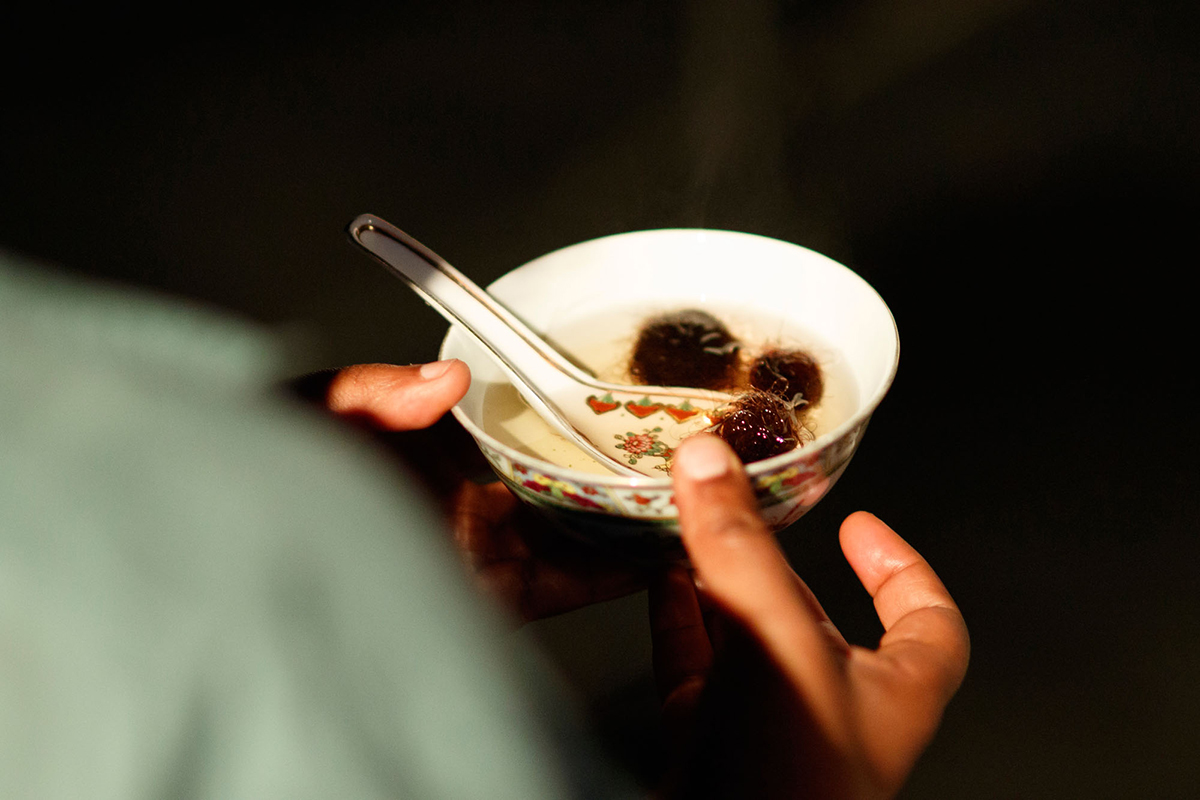
Engaging in another kind of alchemy, indeed sorcery, Vulcan presents absent performer Weizen Ho’s work. Vulcan and Ho share an interest in hair as both debris and artefact for rituals of grief and memory. In this instance we are served with Chinese bowls containing a blend of tea and a tightly wound hair ball (blatantly disguised to look like tea) which connects to a ritual involving a slowly brewed herbal concoction that mothers and their children partake in after arguing. There is something of the abject in this offering that elicits a mix of disgust and curiosity in those assembled. Who will partake? As I tentatively sip, a person nearby asks, “How is it? Taste like forgiveness?’ Hmmm…more like green tea shampoo.
In a room upstairs. Alison Pevey, accompanied by the curtained darkness, a rumble of low sound and then a flood of natural light through the window, employs her “body as site” to bring attention to global and human energy cycles. As she expands and contracts in building waves of motion toward a short explosion and then exhaustion, I ponder the evident futility for Pevey as a single body/human to speak of excess and consumption. The collective of bodies stand idly at the sidelines while the cycle continues.
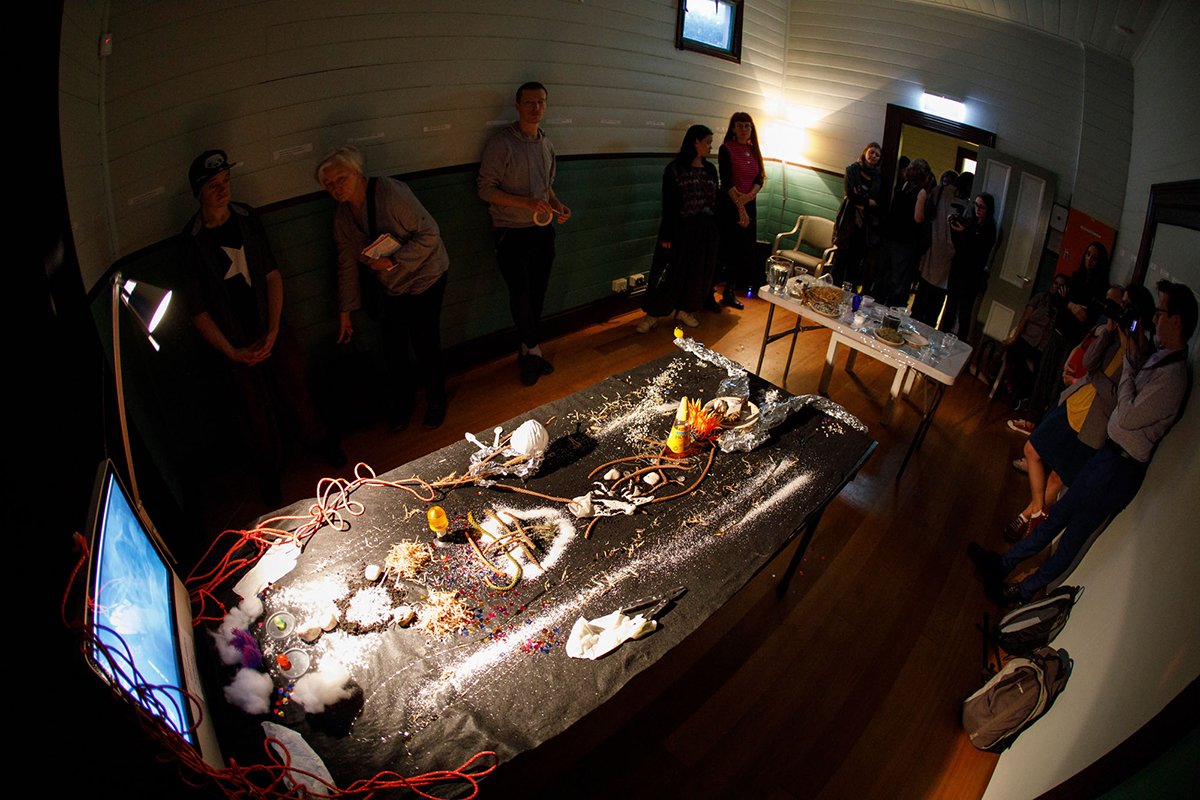
In the next room, the absent artist Joshua Pether is represented by a video screen displaying an x-ray of a spine affected by scoliosis as a kind of headstone atop a slab-like table. We are invited to read aloud the fragments of his text that forms a frieze around the walls, and then to construct the missing body out of an array of available ingredients. Cotton wool, stones, wire, a small light, bright plastic objects, organic things are all arranged by us, the collective, into a spontaneous humanoid assemblage to the repeating distortions of Kate Bush’s “Wuthering Heights” and white noise. I was reminded of William Forsythe’s more sophisticated participatory work seen in Berlin, 2005 where “You made me a monster” involved a hanging cardboard anatomical assemblage and the tracing of the moving shadows. Like Forsythe, Joshua Pether evoked a sense of memorial and an energetic ritual dispersal of grief.
For the day’s finale and in the fading light, Rakini Devi is laid out ceremoniously in black beside a long piece of cloth that stretches almost the entire length of the Drill Hall. There is an ambient gurgling sound and I am drawn to the blood-red stain on her feet, chin and décolletage. An undulating movement rises in her torso and Devi begins her slow worm-like passage up the space. Her obeisant form rises at the end to invoke the spirit of Shiva in a short series of words and gestures before turning with a lifting of the cloth that now becomes her long train. We form her retinue and fall in line to carry the diaphanous cloth out into the evening air and further still some 250 metres to a jetty. I have little idea what this ritual signifies, but the soundtrack now is of bird call, clanging masts and voices of fishermen. Finally Devi/Shakti turns, her face wrapped in a red flower garland, and walks blindly toward us back up the rocking jetty. Not your usual Sydney Sunday by the harbour, beginning with a white-sheeted babbling ghost and finishing with a dark queen of the night — the start and end of the/my/your/our body are slippery co-ordinates.
–
Critical Path, Interchange Festival 2017, The Start and the End of the Body; Drill Hall, Sydney, 12 Nov
Nikki Heywood’s response to The Start and the End of the Body was jointly commissioned by Critical Path and Open City, the publisher of RealTime.
Top image credit: Rakini Devi, Interchange Festival 2017, Critical Path, photo Matthew Syres
Critical Path’s Interchange Festival, held over a weekend from Friday evening to Sunday night, invited guests and participants to share experiences of working across and between cultures as part of choreographic practice via forums, workshops, performances and talks by international guests. Cleo Mees reported on the second day, themed The Political Body, while Nikki Heywood focused on the third, The Start and the End of the Body. RT
The second day of the Interchange Festival, The Political Body, yields robust conversation and sharing. In all five sessions I attend from those scheduled, questions and propositions are offered with both candour and care. Morning sessions consider the complexities and political implications of intercultural creative practice.
Mornings are difficult: protocols vs appropriation
The breakfast session, Mornings are Difficult, is facilitated by Raghav Handa in conversation with Tim Bishop, Rakini Devi and Liz Lea. Handa asks how we might think about protocols that seek to prevent cultural appropriation in performance-making. If we accept that culture is not immutable, and doesn’t exist in an airtight container, then where is the line between “appropriate experimentation” and “appropriation,” as Bishop puts it?
Several propositions emerge: one is that intercultural work should, by definition, involve a commitment to deep, extended research and training in all the cultural practices involved. Devi proposes that the term “intercultural work” should describe a methodology, not a product, and that a methodology should come from more than a two-week residency.
Other recurring ideas include the crucial importance of genuine respect for collaborators and cultural materials, and the importance of acknowledging when one has has appropriated something, or acted inappropriately. We talk, too, about what materials one can or cannot touch when making intercultural work, and what audience members can or cannot “read” in performances that draw on specific cultural vocabularies.
This last question has particular relevance for me as a writer reporting on this day. I am a Dutch-born immigrant to Australia, and my life experience has always been one of white, middle-class, colonial privilege. I am queer, I am cisgender (to my knowledge) and I currently do not identify as having a disability. An awareness of what I might not be noticing as a result of my position comes up again and again throughout the day — and I feel it is important to note it here.
Caroline Garcia, Paschal Daantos Berry, Interchange Festival 2017, Critical Path, photo Matthew Syres
Cultural identity: what can & cannot be claimed
Related questions come up in the following morning session I choose, which is a discussion between facilitator Paschal Daantos Berry and artists Caroline Garcia, Amala Groom and Martin del Amo, about how ancestry and a sense of cultural identity inform their practices.
Two hours of rich discussion pass quickly. Wiradjuri visual artist Amala Groom explains how spirituality and Aboriginal law live in her body, and how they inform her working method — from instances of spiritual inspiration that reveal the beginnings of a new work she should make, to questions around when she works, and at what pace. This gives rise to a discussion about how one structures one’s time as a performance-maker, and about the decolonising of one’s own working methods as an Indigenous or a Filipino artist working in an environment that preferences what we might call ‘Western’ approaches to time-management.
Performance-maker Caroline Garcia says that her Filipino heritage is not so much something that she references explicitly in her work, but something that informs process or “how she puts things together.” Among other things, Garcia’s work explores the complexity of both feeling that she is, and is not Filipina as she was born in Australia and has lived here all her life. The experience of travelling to the Philippines — a place that wasn’t so much “home” as a place “of ancestry” — was valuable as a process, too: it was an occasion to explore her “non-belonging.”
Something Garcia has grappled with is the question of what she can and cannot take, or claim, in relation to Filipino culture. A similar question about what can and cannot be “claimed” has come up for German-born dancer and choreographer Martin del Amo, who confronted the question of whether or not to call himself a Butoh dancer at a time in his life when he had trained extensively in BodyWeather and his work lent itself to associations with Butoh, but he had never been to Japan.
The conversation grows to include other people in the room. We work our way into meaty questions. Where does ‘whiteness’ live? When you claim a certain heritage, are you ever at risk of stealing something, or can we say that your ancestry lives in your bones, and that you always get to say who you are? Who in your world receives the authority to establish your mythologies, your identity? Under what creative or performative circumstances can you claim the authority to call something a truth (even if that truth is only a temporary, local one)?
Bill Shannon, Interchange Festival 2017, Critical Path, photo Matthew Syres
Bill Shannon: skateboard, crutches & perceptions of ability
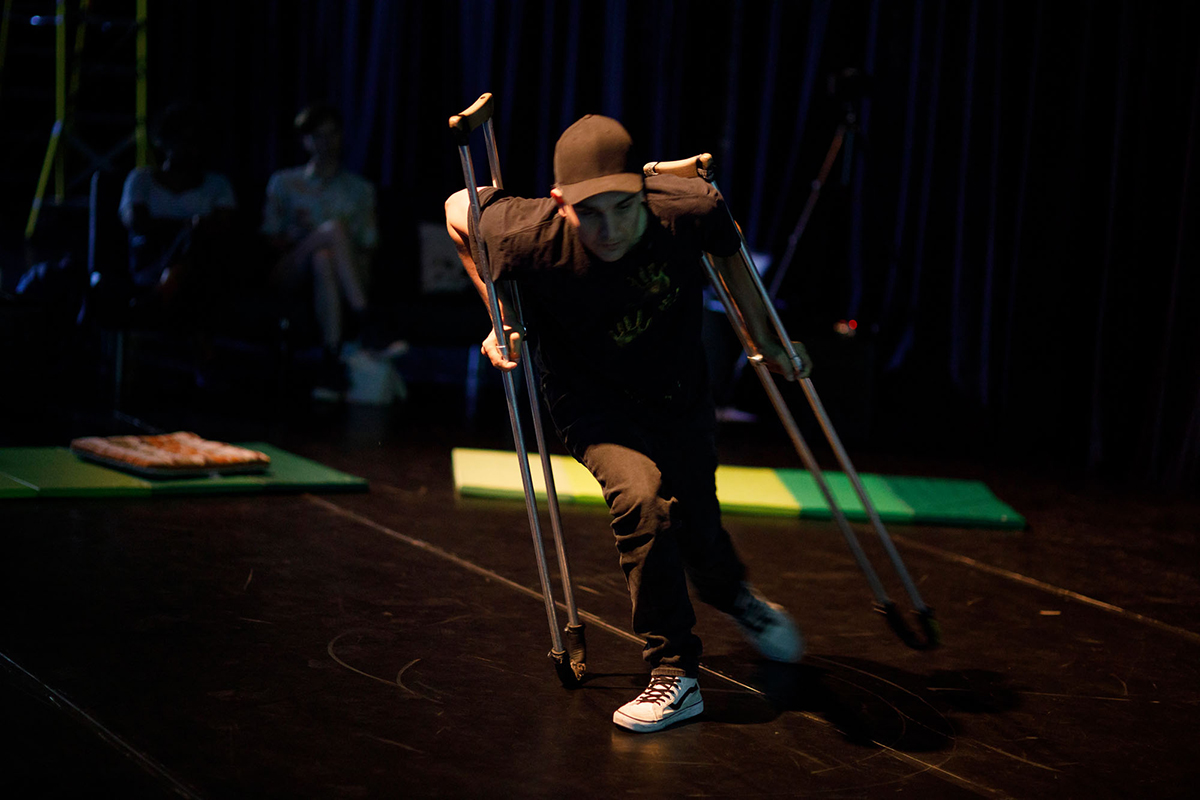
After lunch, we move into a presentation by American choreographer Bill Shannon. Shannon has moved and danced on crutches since he was young. He talks and dances us through key aspects of his practice, in particular those that relate to the theme of the political body.
He discusses the oft-perceived disjuncture between his tools — his skateboard and crutches, often used simultaneously — as the former connotes a radical, transgressive relationship to architecture and the latter tends to be associated with a need to cling onto the built environment, to avoid falling.
He speaks about others’ scepticism about his condition; some fellow nightclub-goers, for example, doubt that he actually needs his crutches. Shannon shows us a dance move with which he fakes being a fake, and thereby playfully and transgressively instantiates a shift in power relations, turning himself from the subject of this idea of fakery, into its host.
He also introduces the idea of his “condition arriving,” that his “condition” (of being on crutches) always “arrives” in a space before the rest of him does. To many, he is first a man on crutches, and then everything else. Caroline Garcia said something similar earlier in the day: that her body is always already politicised, because it is brown. This notion of the politicised body comes up again in the following session.
Bhenji Ra, Interchange Festival 2017, Critical Path, photo Matthew Syres
Bhenji Ra: patience & disruption
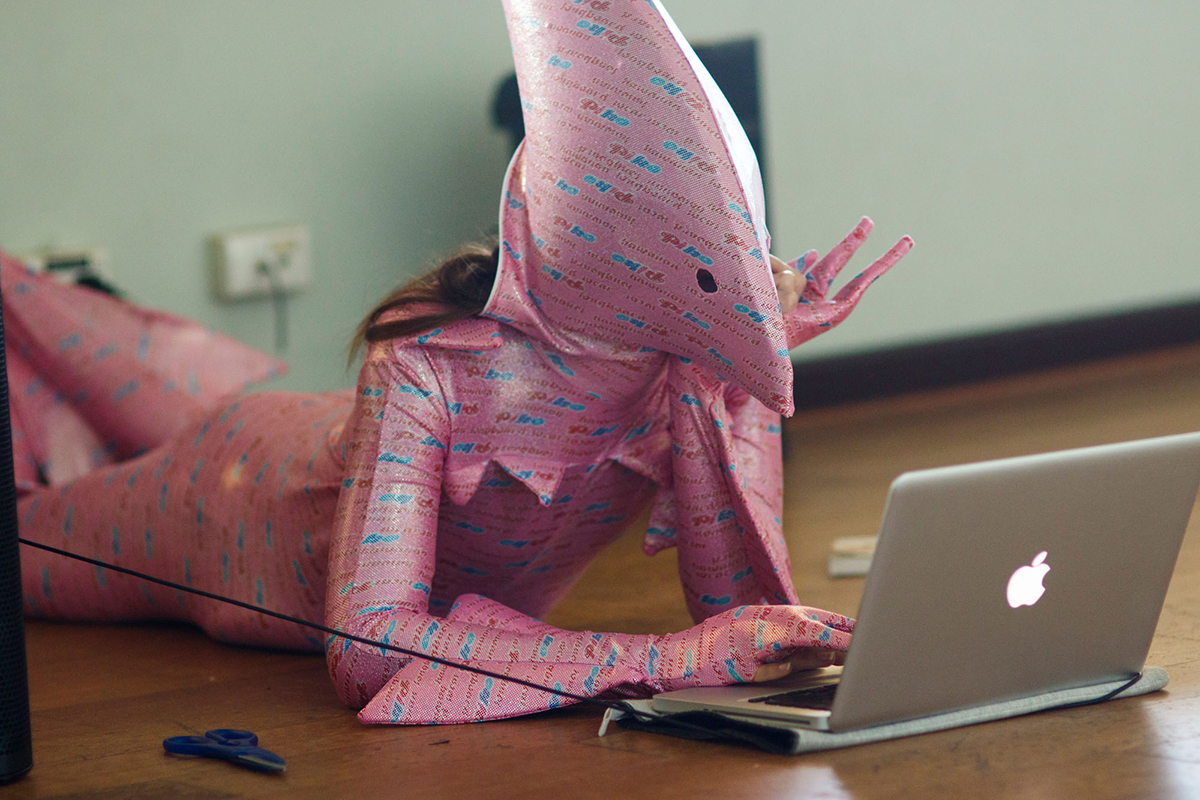
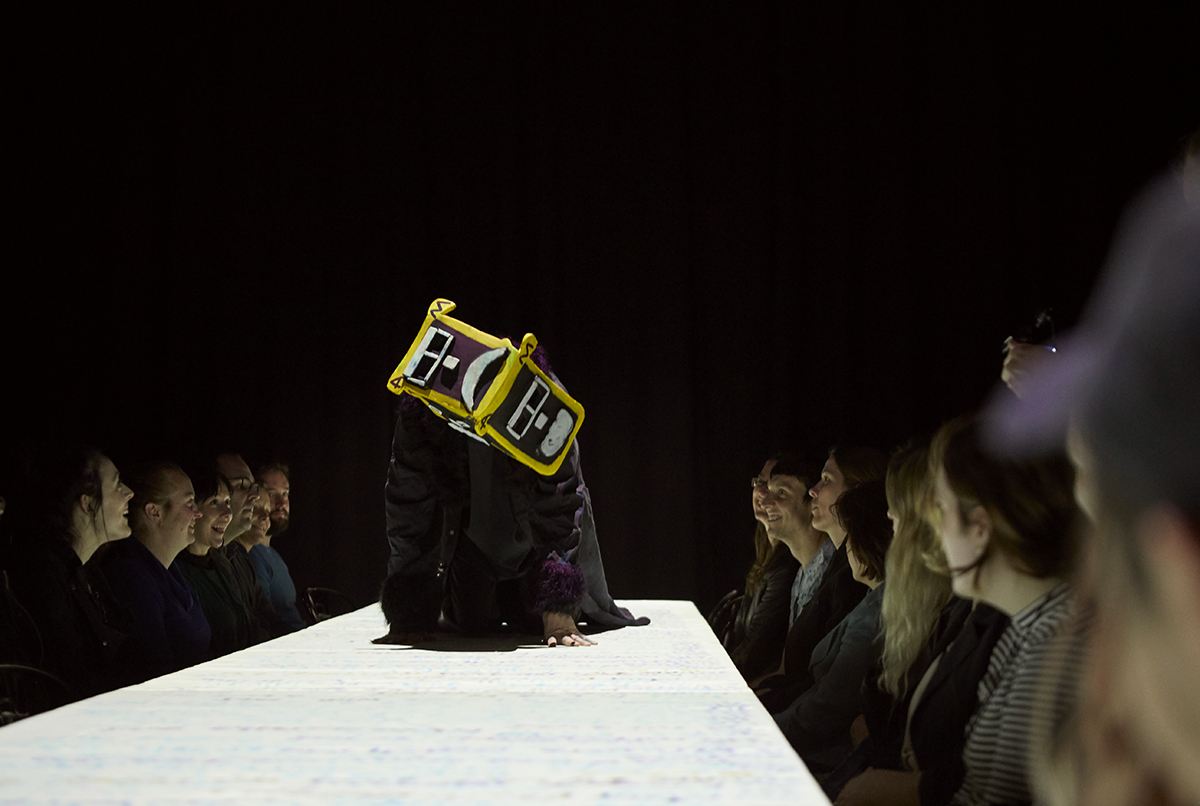
Trans Filipinx-Australian artist Bhenji Ra’s afternoon lecture explores disruption on many levels, the performance itself shaking up what a performance lecture could or should be. Before it starts, we wait outside a closed door until Ra steps out in a shiny, head-to-toe alien costume and casually waves us inside.
She sprawls on her belly in front of a laptop, a few other necessities spread about (a book, a phone, audio speakers), and communicates with us through the laptop’s text-to-speech function. As she types, a computerised voice delivers poetic introductory thoughts about disruption and our being here together.
The typing takes time, and Ra jokes with us that “today is all about patience.” It feels like we are hanging out in Ra’s bedroom, on her terms. It’s a given that we’ll pay attention, and it’s a given that we’ll take our time. I think of all the cisgender heterosexual white male film directors whose work I was expected to give my time to as an undergraduate student — the many hours spent watching and analysing their films, many of which were, in retrospect, misogynistic — and think to myself that there is literally no one I would rather be giving my time to right now than Bhenji Ra chilling on the floor in an alien suit, suggesting to me via text-to-speech that we listen to her playlist.
Later the suit is peeled halfway off so we can see Ra’s face, and she continues to talk, or think out loud, about disruption. She talks about the disruption of heteronormative desire — “how could something as delicate as my Adam’s apple disrupt your desire?” — and describes knowing from a young age that her ethnicity would be disruptive in her rural suburban surroundings. Later, the conversation opens up to include the rest of the room. As has been the case several times today, the discussion is at once forthright and careful.
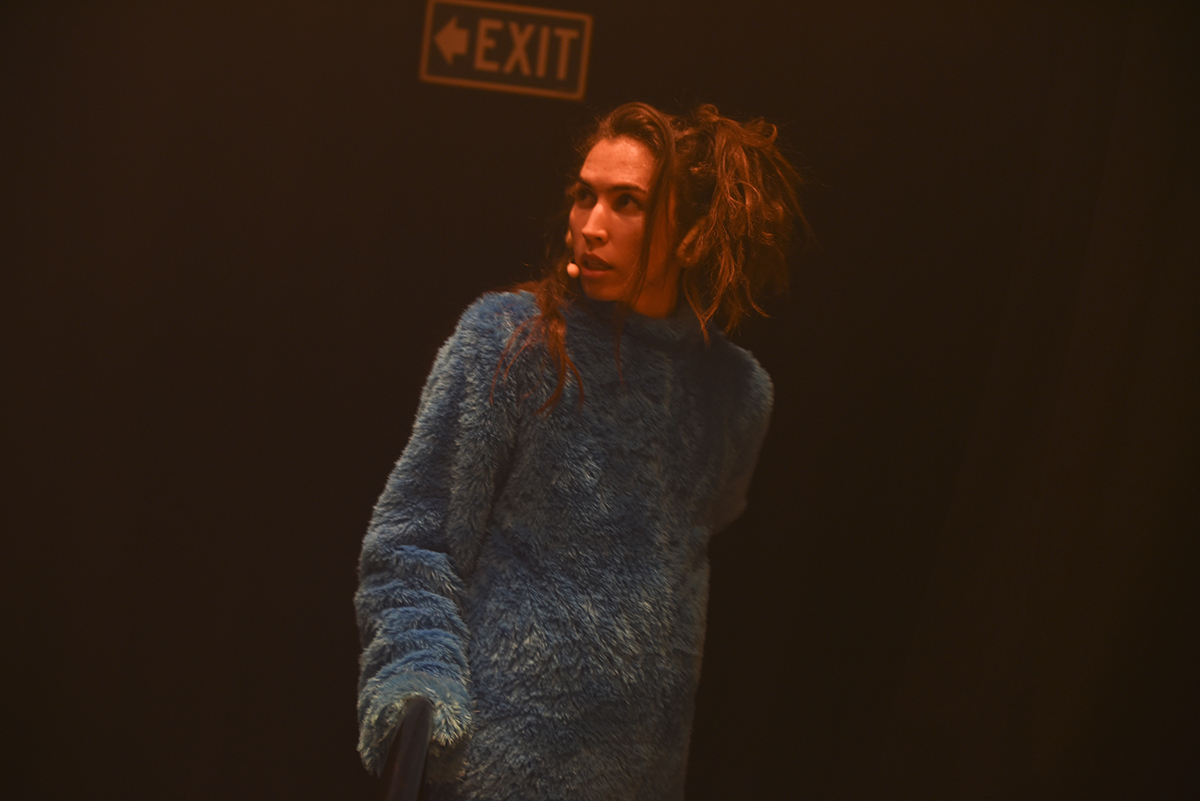
Exit, Bhenji Ra, Interchange Festival 2017, Critical Path, photo Matthew Syres
Acts about change: Newton, Crisp, Ra
The evening program considers the dancing body’s potential to act politically. Curated by Adelina Larsson, it features works by Rhiannon Newton, Ros Crisp and Bhenji Ra.
Sydney dancer and choreographer Newton begins by sharing two scores from her recent work, Bodied Assemblies. Through group improvisations that require listening, collective responsibility and a capacity for working in the face of the unknown, these scores ask both how we can come together and how we can change together.
The scores are attempted in pairs, in a group of four, and then, eventually, with everyone in the room — 40 or more people. As we all attempt to change together, the question of how to do that in a wider political sense — and the complexities, the requirements, the difficulty of doing that — begin to become apparent to me.
Ros Crisp shares fragments of DIRt, a work in progress that addresses her grief and perplexity at witnessing the environmental destruction of the land she grew up on after returning home from a career in Europe. There are video excerpts; there is a lamp-lit reading (an extended barrage of facts about the devastation of the planet); there are bursts of dancing; and there is Crisp’s distinctive way of talking to us — wonderfully loose, but also precise.
Overwhelmed with the question of what to do, and of what (if anything) dance can do about this ecological devastation, Crisp describes a process of “crashing around” — of “crashing back and forth” between dancing and the problem, or between dancing and activism. Crashing around to find, perhaps, a productive relationship between the two. We witness a problem unresolved, and a state of mind very much politically alive.
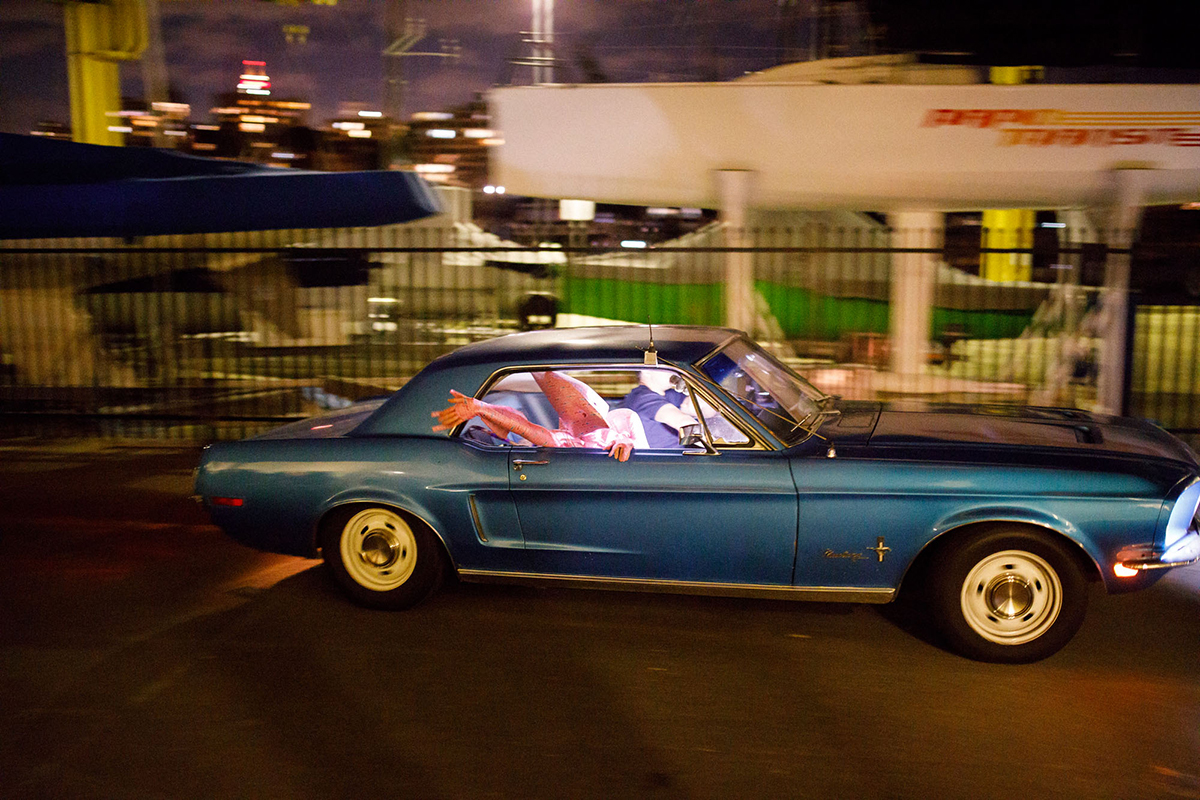
Finally, Bhenji Ra returns to wrap up the day. She slinks into the performance space in the alien suit I saw this afternoon. As she moves on all fours towards and through the audience, she begins to speak, rhythmically. Together, movement and speech (or is it a chant? or a song?) raise questions about power with both humour and a serious, darker edge. Again, we are in Ra’s space, even as she leads us out of the Drill Hall, through the foyer and into the warm evening, where she disappears into a roaring blue Mustang that tears off into the night.
I have been at the Interchange Festival for 12 hours, and I go home not tired, but satiated — full of food for thought.
Cleo Mees’ response to Political Body was jointly commissioned by Critical Path and Open City, the publisher of RealTime.
Top image credit: Rosalind Crisp, Interchange Festival 2017, Critical Path, photo Matthew Syres
Disruptive Critters
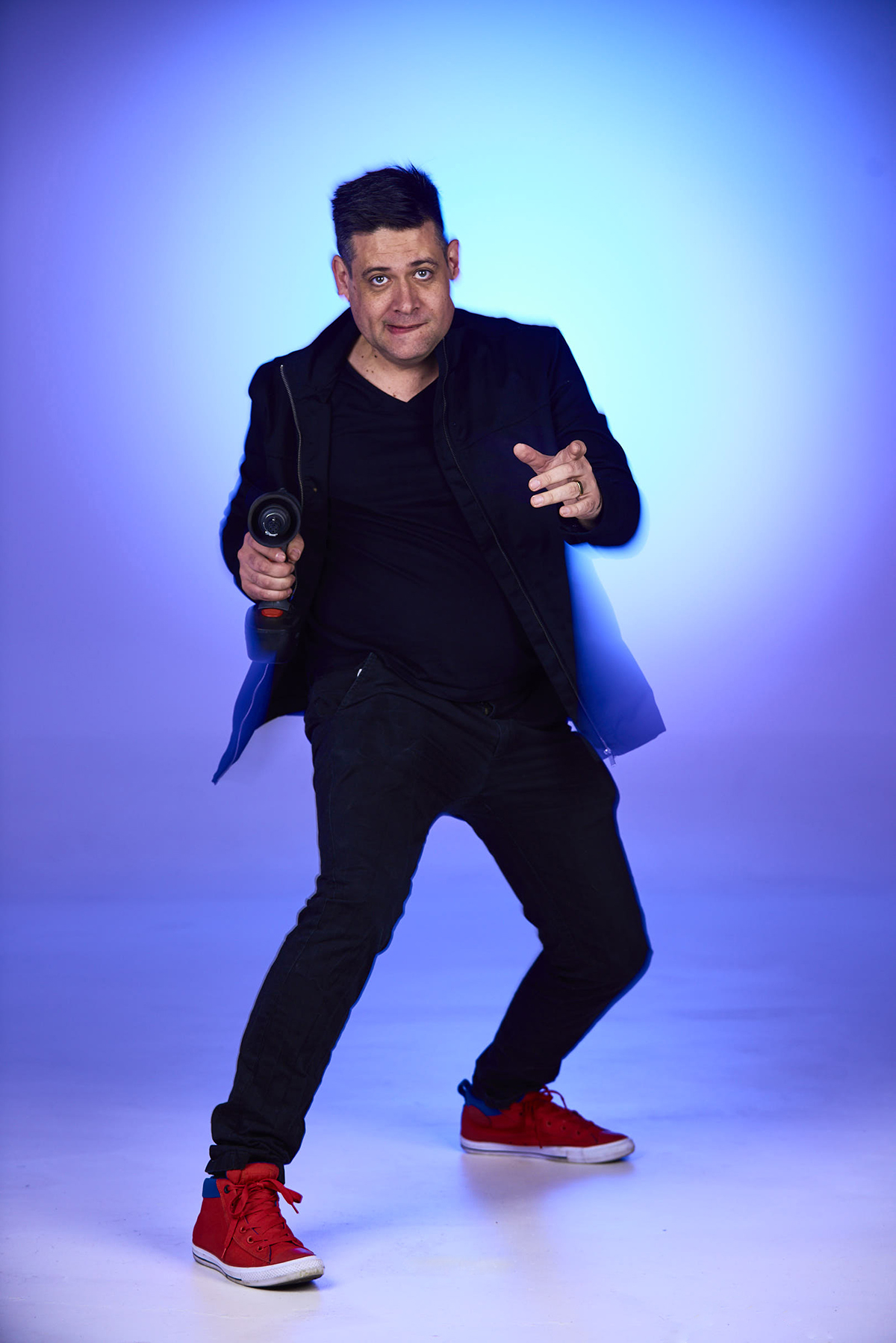
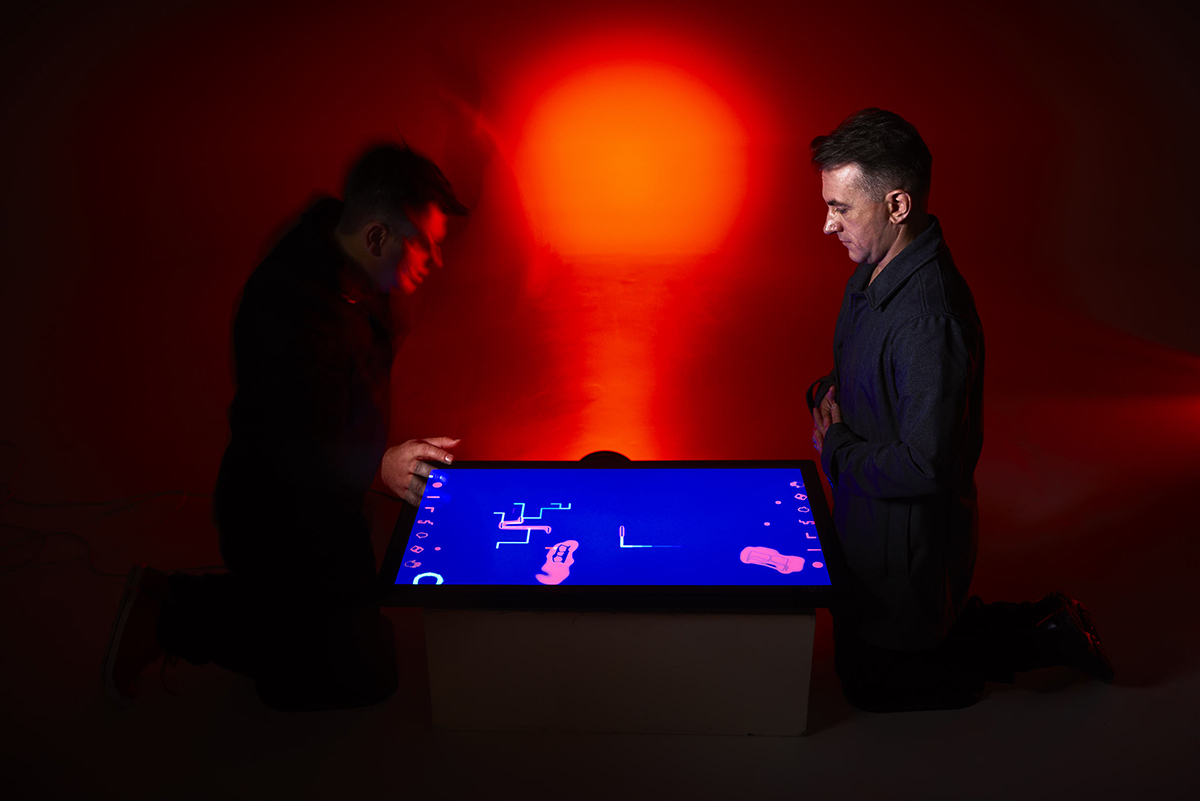
The game has rules but no stakes. Two men kneel either side of a digital interface, the display projected on a large screen for the audience’s benefit. On the screen, a series of dots and dashes each emit their own particular squeal, sigh or belch when set in motion. The men take turns tapping the interface, dragging the geometric flotsam and jetsam from the margins to sonically cross-contaminate. This produces a human-sounding hubbub that distinguishes the shapes as the Disruptive Critters of the work’s title.
The result of the Duckworth Hullick Duo’s collaborative practice, Disruptive Critters is presented in a double bill for Melbourne Music Week with City-Topias. Sharing performers and a childlike sense of wonder, both shows foreground play as a fundamental mechanism of the creative process. In Disruptive Critters this delights the children in the audience, who respond positively and audibly to the humorous grumbling and groaning that the shapes’ interactions and combinations generate. This gleeful response is perhaps further provoked by the framing narrative that features a child protagonist (Astrid Bolcskey-Hullick) in the role of the god-figure from whose mind and whims the game and the critters seem to emerge.
James Hullick, Jonathan Duckworth, Disruptive Critters, photo courtesy JOLT
However, it’s ultimately these efforts to frame the interface at the centre of the work with external theatrics that sees the appeal of the performance eventually wane. Between each level or scene of the work’s game, the three performers enact rituals, carefully laying pebbles out across the stage and walking slowly with arms outstretched from station to station. These actions, with their measured speed and air of importance, perform purpose. But their inclusion implies a lack of faith in the interface’s ability to immerse the audience. The intent here, in cloaking the technology in a narrative of gods toying with their creations, is not misplaced, as without it the show is, in effect, just two people playing a videogame for 45 minutes. But the performative elements appear to be the afterthought of the work’s digital world-building, and consequently the piece’s creation myth lacks visual sense.
At work’s end, the theatre fills with a thunderous rumble, as the digital imagery zooms out from the flat field of play, contextualising the many writhing, squeaking, growling shapes as specks collectively comprising a much larger globe. This image brings unity to the piece’s themes of disruption and creation in a manner that circumvents clumsy theatrics in favour of a clear graphic statement. And while the message is not earth shattering, the revelation of some bigger picture provides Disruptive Critters with the meaning it elsewhere failed to locate.
James Hullick, City-Topias, photo courtesy JOLT
City-Topias
City-Topias continues the mythological premise of its precursor, albeit in an expanded form. Featuring the Bolt Ensemble, in collaboration with Jonathan Duckworth, James Hullick and Milica ZZAA, the work is an 80-minute orchestral rock odyssey that claims to investigate “modes of social organisation and disorganisation.”
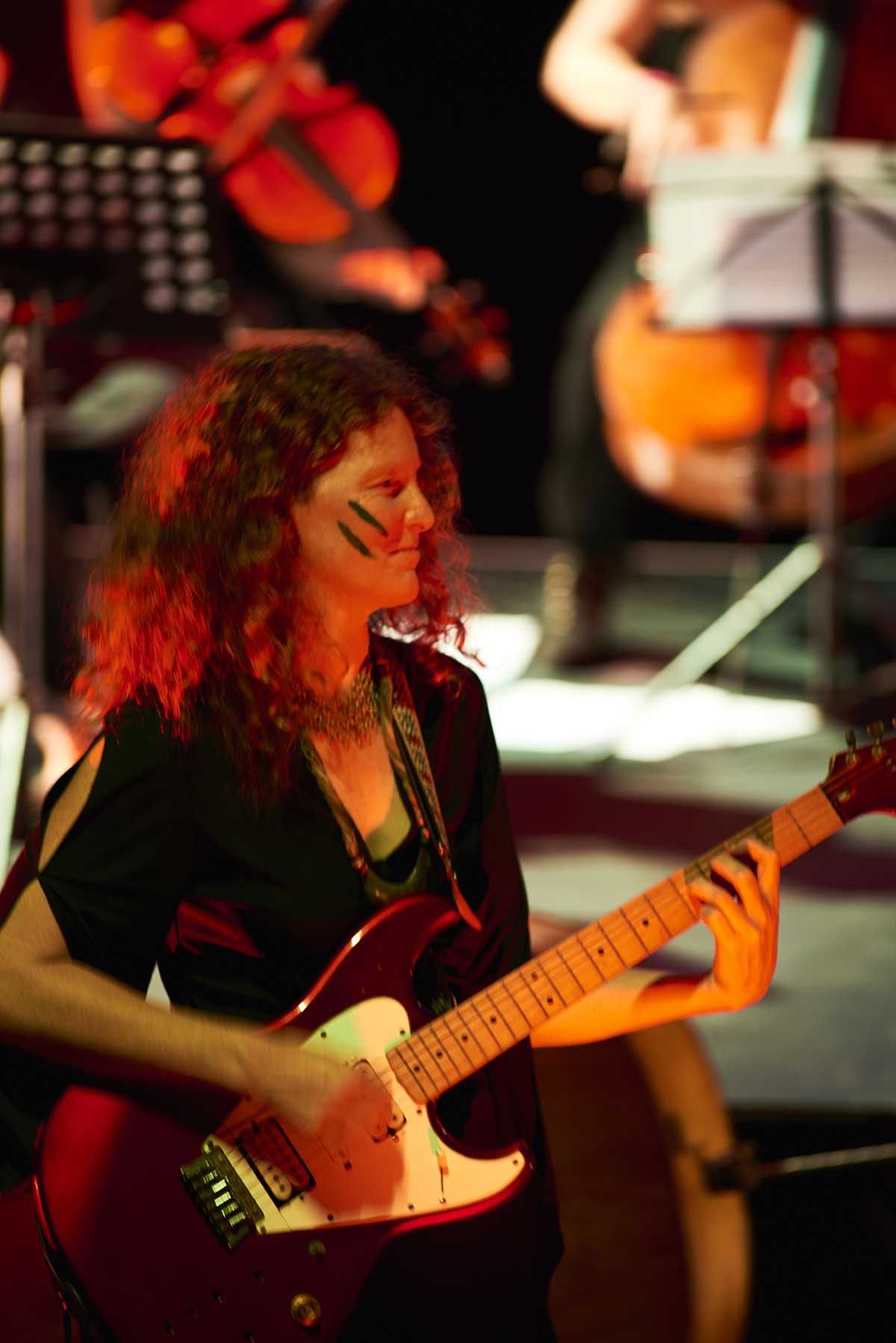
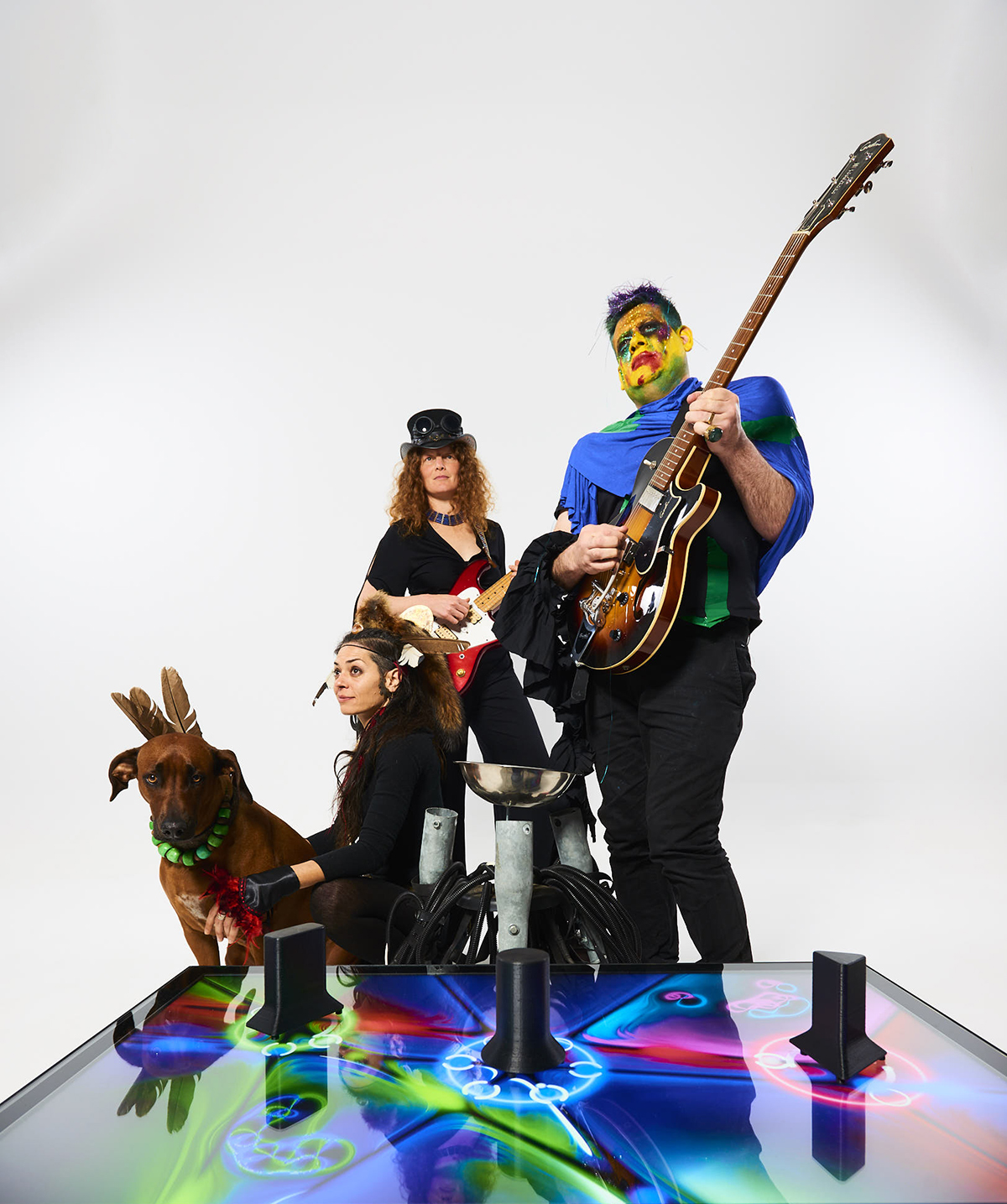
To this end, City-Topias, like Disruptive Critters, employs the ritualistic as an organising principle. Dressed in a fur and feather headdress, Zzaa initiates the show by wafting pungent incense throughout the performance space. She then assumes her position as VJ behind an audio-visual desk, projecting mystical imagery of labyrinths and stars and nebulously philosophical lyrics onto the big screen for the duration of the performance. Entering the space, the musicians also assume the pose of the ceremonial, their faces painted with colourful slashes of war-paint.
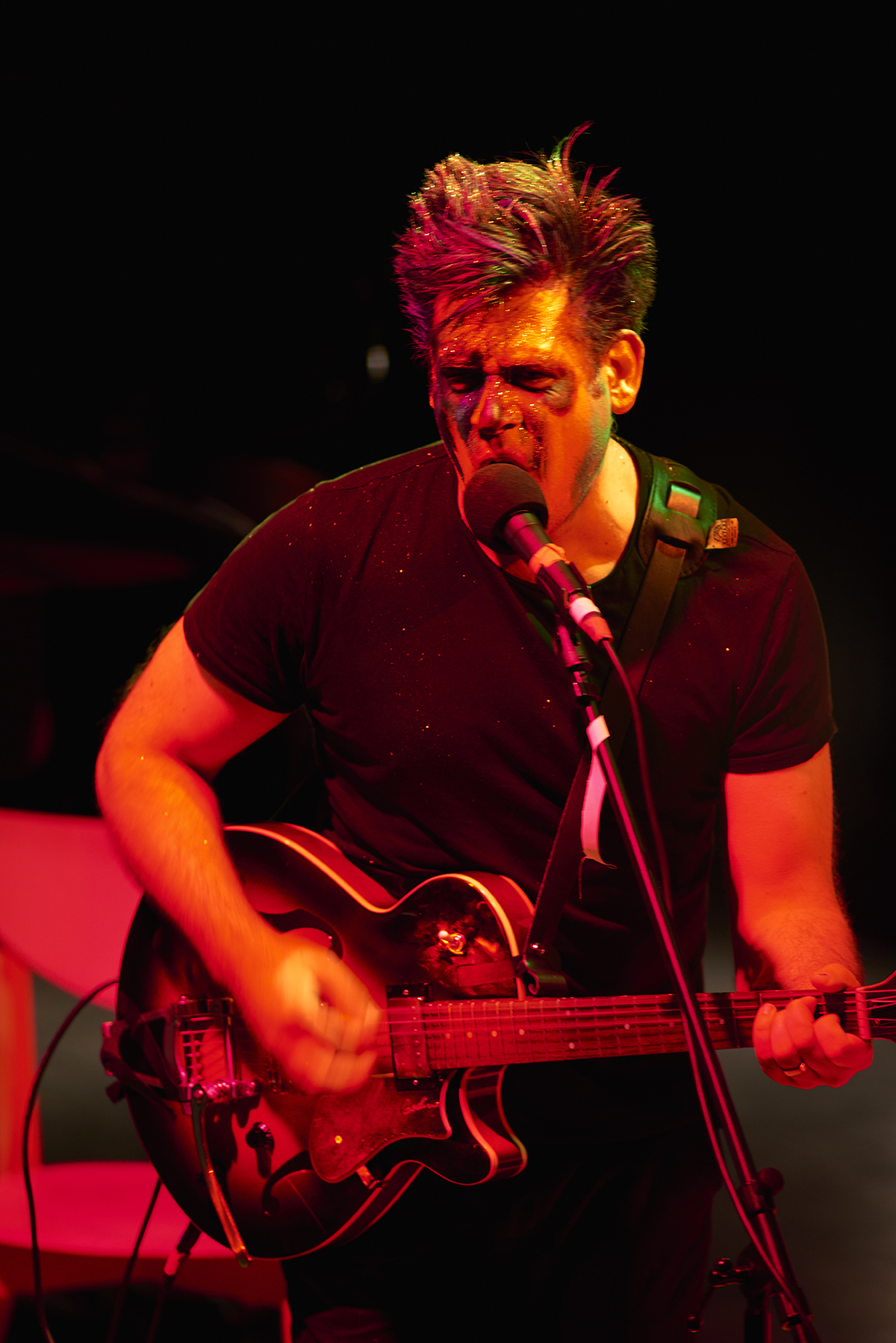
Flautist Belinda Woods sits before the digital interface with her flute, playing short, breathy notes that fill the space with anticipatory tension. Hullick, face smeared with glittering paint, takes his place as frontman, emitting a guttural drone at the microphone and intermittently plucking at his guitar. Amid the swelling commotion there is a suggestion of the carnivalesque, discordant sonic and visual elements uniting in a manner that renders the absurd significant in the work’s exploration of social configuration.
This thematic focus on rituals and organisational methodologies is realised more fully in the diverse modes of instruction that shape each of the atonal pieces that make up City-Topias. At times an onscreen interface is employed with various members of the ensemble spinning, aligning and highlighting a series of circular graphics complementing the movement of the composition. In one piece, Woods conducts the ensemble with an enchanting physicality that characterises her as sorceress or sibyl with her sweeping numerical gestures. Yet often the musical content is less remarkable than the means by which it is being produced. In particular the more lyrical songs tend to invoke the mythic, building to electrifyingly cacophonous summits only to be flattened by the vocals steering the work into the predictable territory of maudlin rock opera.
Everyone involved appears to have been given the opportunity here to play out their distinctive contributions, the joy apparent in the multiplicity of ideas and methods that have been implemented. Indeed, there is pleasure to be found in watching people revel in the creative process, but what is missing in City-Topias is a cohesion that the vague thematic arcs cannot bring to the performance’s disparate elements. Trying to strike a balance between order and disorder, disarray and design, the performance regularly falters either side of this equilibrium.
Belinda Woods, City-Topias, photo courtesy JOLT
There are moments though when this balance is achieved, as in Heterotopian Manifesto. Here the score is projected onto the screen, letting the audience witness the performers’ interpretation of a series of colour-coded brushstrokes spattered and slashed across the musical stave. The dissonant outbursts and frenetic spates are thus visually contextualised as part of some grander plan in a manner that reflects the heterotopia of the title, and touches upon notions of the polyphonic. If this piece is indeed the performance’s manifesto, then it realises the chaotic cohesion it preaches in a way that the rest of the program’s works don’t quite manage.
There is great value in the sense of fun and experimentation that both City-Topias and Disruptive Critters bring to the field of sound-based performance. Experimental practice is often imbued with a tone of high seriousness, as if to justify its divergence from established norms; the inherent exuberance and wonder of noise-making sometimes seems sorely lacking. On the flipside, that wonder can be denied an audience when the performers become enraptured by their own delight. I leave City-Topias glad to have witnessed skilled performers ply their craft with great joy, but am left wishing I could access their sense of revelation from my place up in the bleachers.
For a different response to Disruptive Critters and City-Topias go here.
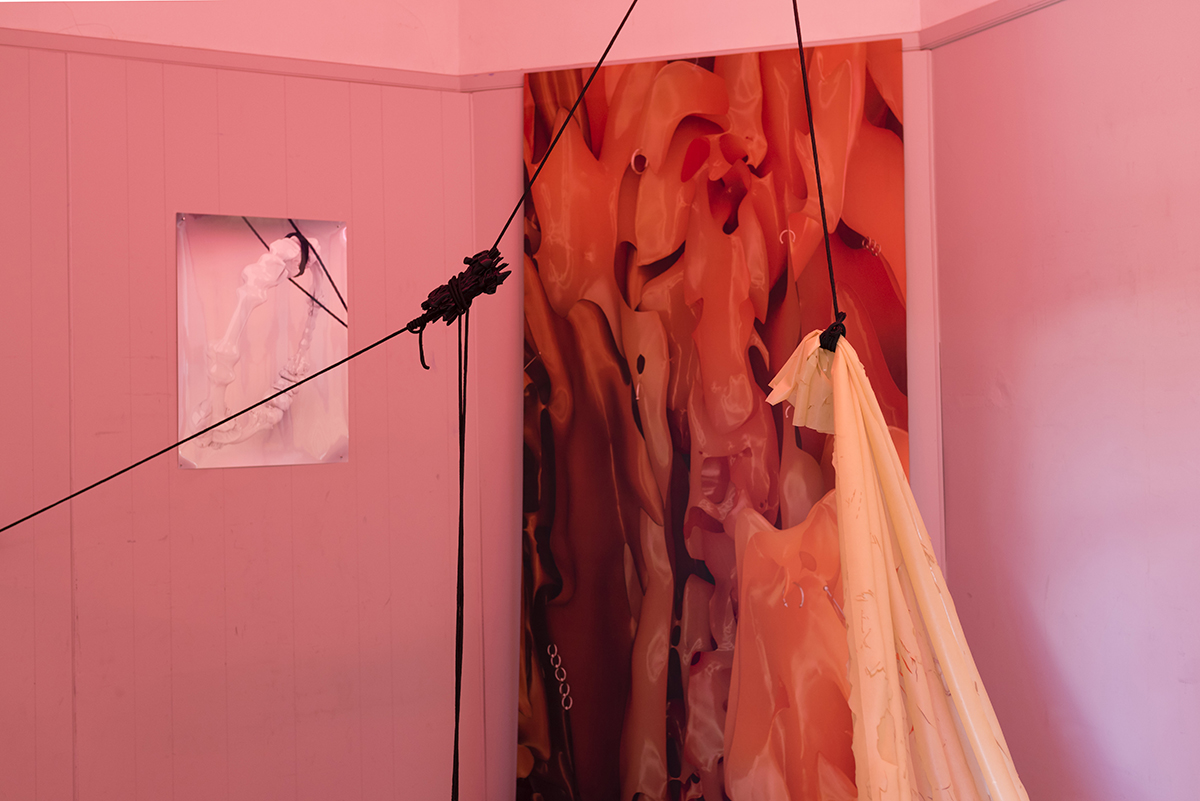
Responding to a current MoMA exhibition of works by Louise Bourgeois, American visual artist David Salle, a superb arts writer, declares her evocation “of the female body as having an inside might be her greatest legacy”.
“One drawing — Hair (1948) — lays out the vocabulary that would remain in place for more than sixty years. Using a brush and ink, Bourgeois draws a female figure as two vertical columns of sacks topped by a featureless oval head, the whole figure enveloped in a cascade of hair that flows down both sides of the body, from the top of the head almost down to the feet. The roughly almond shape of the streaming-out mass of hair that frames the pod shapes, all seamed down the middle and topped off with a little button head, give the image another, labial reading. It’s like going inside Courbet’s The Origin of the World (1866) and coming back out again as a doppelgänger in disguise. The detail contains the whole, like an image out of Nabokov — the world reflected in a soap bubble.”
Top image credit: Louise Bourgeois. No. 5 of 14 from the installation set À l’Infini, courtesy of MOMA
Two works presented by Sydney’s PACT in its Afterglow series — the organisation’s principal program of works from emerging artists — offer distinctive visions. Thomas E S Kelly’s Shifting > Shapes is a contemporary dance theatre exploration of the drama of shape-shifting in Aboriginal culture, and Fishhook’s FEMMENACE is a contemporary performance work in which women face fears that are embodied in disturbing stage imagery.
Karul Projects, Shifting > Shapes
Choreographer Thomas E S Kelly takes a multifaceted approach to the subject of shape-shifting commencing with a mockumentary in which he interviews a trio of people who reveal that they have other selves — fish, cat and gorilla. Intermittently funny, the video conjures everyday fantasies of transformation and then moves on to something more serious: a solo dance performance imbued, at first impressionistically and then quite specifically, with Dreamtime shape-shifting.
The first stage of NAISDA-trained Taree Sansbury‘s performance is relatively abstract, drawing on but not mimicking traditional Aboriginal dance. Holding her centre of gravity low, she articulates her hands sharply at the wrists, steps firmly and becomes recurrently animal-like — but not literally —whether crouching, moving on all fours or dragging herself across harshly lit terrain. Kelly’s soundtrack evokes desert — a bell, clanging metal, a hollow distant wind — but with urban beats, amplifying the sense of an ancient culture’s timelessness.
With pronounced spinning and stamping (to an emphatic drumming), a sense of determination in the movement emerges, but oscillating with bouts of involuntarism — the body freezing or arms flicking forward. Hands now and then flutter over the heart, evoking depth of feeling in what looks like incipient, compulsive transformation, the body low, elbows reaching out, a finger drawing a snaking line in the dust. A voiceover tells a Dreamtime story of Dirawong, a totem lizard, protecting its people from the Rainbow Serpent and in the process becoming a headland. In a final phase, Sansbury stands still before us, struggling to name herself and succumbing to forces that recall the push and pull and trajectories of the earlier dance — crawling, rolling, arms thrusting, the body locked — but now as if possessed, while eerie electronic birdsong underlines her otherness. Finally, Sansbury utters calm acceptance of her shape-shifting being.
Sansbury’s shape-shifting performance, made in collaboration with Kelly, is earthed, fluent, tautly controlled and convincingly driven. Shifting > Shapes is another fascinating work from Thomas E S Kelly, the maker of (MIS)CONCEIVE (seen in Next Wave 2016) in which Sansbury also appeared and, like it, exudes relentless energy which can at times blur the clarity of the choreography, as it did in Shifting > Shape’s overlong centrepiece. Next to the rest of the work, the introductory mockumentary seems an odd fit, tonally and conceptually, but, strongly danced, Shifting > Shapes has the makings of an economically expressed and even more powerful work.
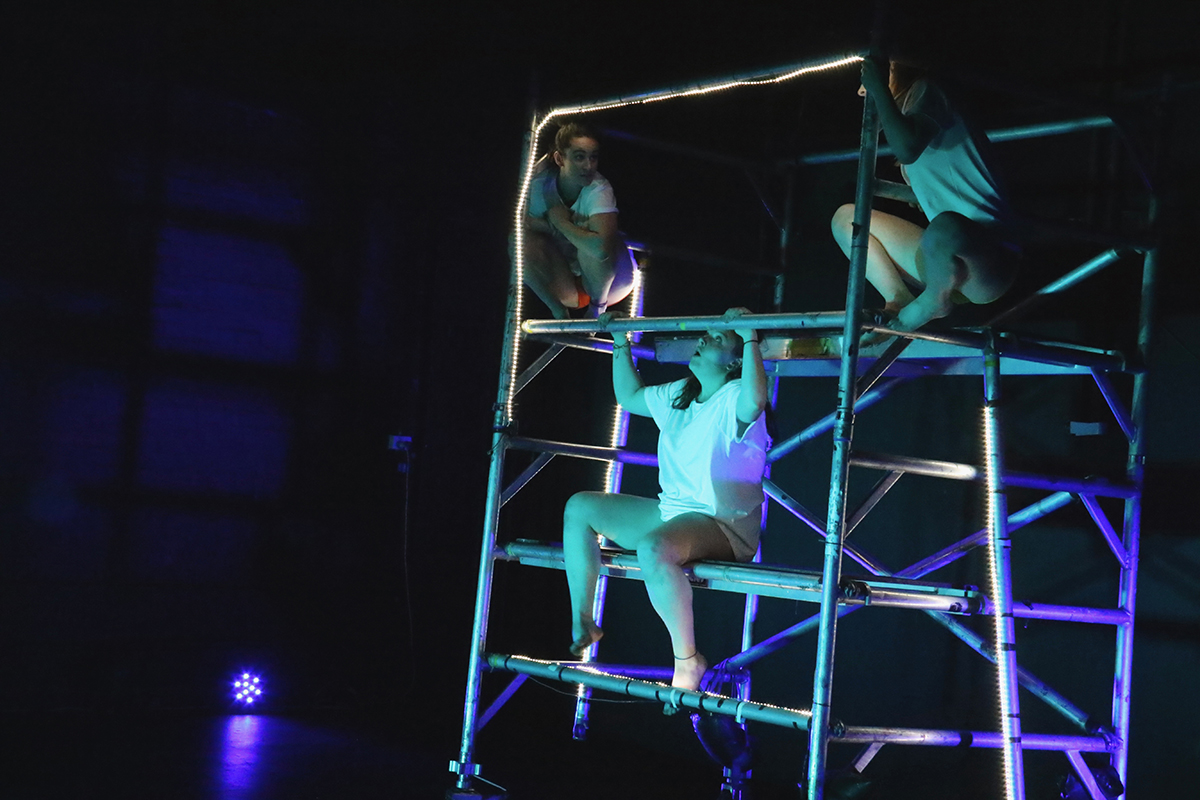
Three long illuminated poles dance in the dark. Light flares, No Doubt’s “Just a girl” blasts forth and a trio of young female performers advance on the audience before roosting in an upstage scaffolding tower. This opening assertiveness of sexuality in Fishook’s FEMMENACE is immediately put to the test in a string of quickfire exchanges that recall post’s laterally logical way with words. Each, between Cheryn Frost and Cath McNamara, is speculative — What would I do if trapped by an Uber driver, was followed on the way home, attacked at home? Crash the car, scream…? — and complicated with the repetition in each of “What if it was a woman?” “What if there was a gun?” “A gun changes the whole situation.” The first menace faced by women in FEMMENACE is essentially male and the conversation, even though delivered drolly, is a kind of panic control, subsequently played out by the trio leaping about on the scaffolding.
Menace is not felt in Tahlee Kiandra Leeson’s langorous recital of an erotically witty account of a teenage sexual encounter in which personal euphemisms dominate — pinecones for breasts, lunchbox for knickers — followed by regret that “I was too much in the moment to see how he touched my body. Jesus Christ, my cunt hurts.” This time an aura of sexual pleasure is followed by greater threats.
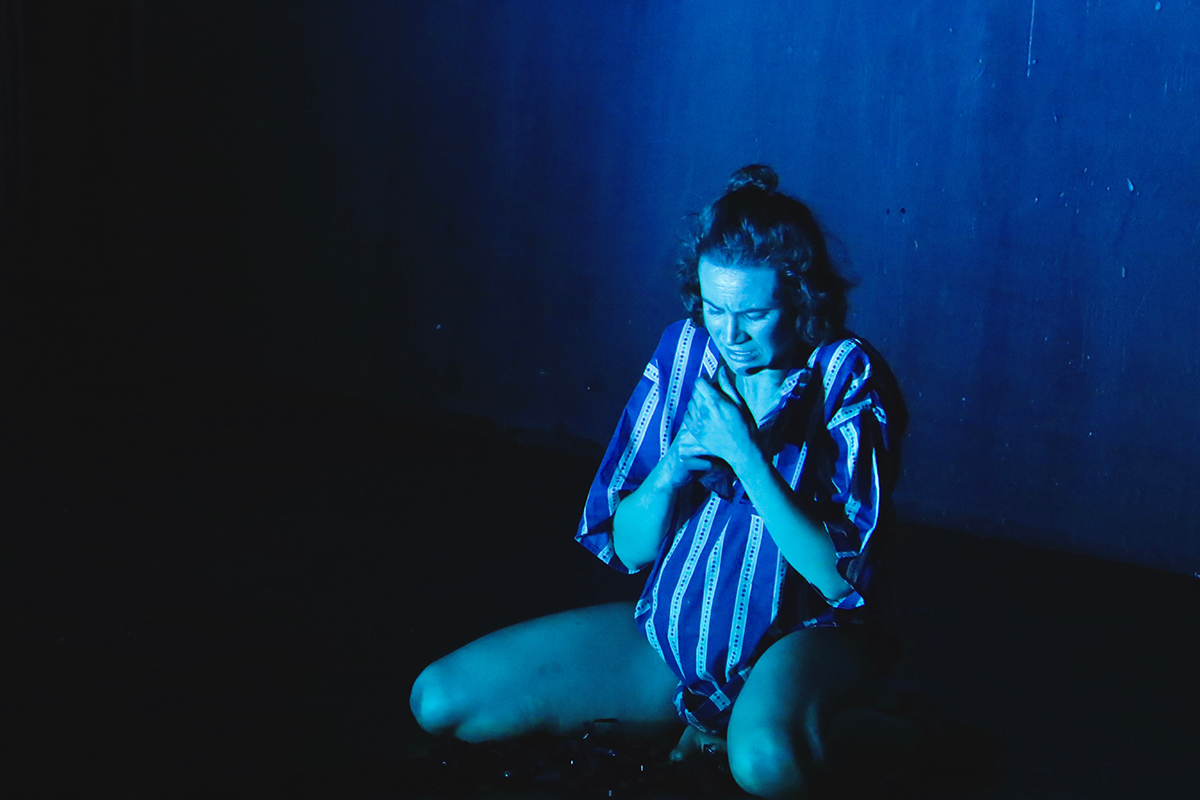
In the work’s major scene, Frost in a totally consuming HAZCHEM outfit adjusts and breaks down the scaffolding. Leeson is locked in a black bag from which she eventually struggles barely free, swathed in black and aglow with tiny lights while a voiceover reflects anxiously on love — “we fit together and fall apart.” McNamara appears modelling a glittering, sexy bridal outfit, adorned at crotch level with a sparkling, mysterious sculptural extension. In stark contrast, from bride to mother, she returns in a pyjama top, heavily pregnant, squats downstage and proceeds to pull out innards of cloth while slowly backing up, leaving a dark trail. The combination of sustained images of, I’m guessing here, suffocating love, fear of pregnancy and a singing HAZCHEM worker cleaning up in its wake made for a grim if not altogether cogent spectacle. The menaces evoked are multiple — including relationships and women’s own bodies — transcending the work’s opening bluntness and evoking a more complex womanhood.
FEMMENACE is a raw work from an emerging ensemble (the trio are recent University of Wollongong graduates) capable of creating striking images and delivering idiosyncratic writing. Once Fishhook achieve greater clarity in their image-making and tauter structural cogency, FEMMENACE will become more than a recollection of vividly provocative moments from bold performers.
–
PACT, Afterglow: Karul Projects, Shifting > Shapes, choreographer, composer Thomas E S Kelly, collaborator, performer Taree Sansbury, lighting designer Gigi Gregory; Fishhook, FEMMENACE, creator, performer Cheryn Frost, co-creators, performers Cath McNamara, Tahlee Kiandra Leeson, lighting designer Gigi Gregory, sound design Stephen Kendrick; PACT Theatre, Sydney, 22-25 Nov
–
Here are brief profiles of the emerging artists appearing in Shifting > Shapes and FEMMENACE.
Thomas E S Kelly, a Bundjalung and Wiradjuri man of Queensland and New South Wales, studied at NAISDA Dance College, graduating in 2012, and went on to work in dance, theatre, puppetry and as a choreographer ([MIS]CONCEIVE and 1770: A Tale Not Often Told with Founding Modern Australia) and composer. He appeared in Vicki Van Hout’s Long Grass and Les Festivités Lubrifier and Shaun Parker & Company’s Am I.
Taree Sansbury, a Kaurna, Narungga and Ngarrindjeri woman from South Australia is NAISDA Dance College graduate who performed in Force Majeure’s two-year Culminate/Cultivate program, undertook an internship with Australian Dance Theatre in 2014, appeared in Vicki Van Hout’s Long Grass, Victoria Hunt’s Tangi Wai: a cry of water, Martin Del Amo’s Champions, Thomas E S Kelly’s [MIS]CONCEIVE and Branch Nebula’s Snake Sessions for the Artlands Festival in Dubbo, NSW.
Fishhook’s members met while studying at the University of Wollongong and developed a partnership for devising experimental theatre, prizing physicality in performance given backgrounds variously in gymnastics, contemporary dance, ballet, and BodyWeather.
Cheryn Frost, a Yuwaalaraay woman and lead-artist on FEMMENACE graduated in 2015 with a Bachelor of Performance (Acting) from UOW, co-devised, co-wrote and performed Smut & Half Truths (2016 Melbourne Fringe Festival), collaborated on and performed in PACT Collective’s iDNA (2016), and wrote and performed Confessional in PACT’s Salon #2: Possible abilities (2017).
Catherine McNamara has a Bachelor of Performance (Acting) from UOW and Communications and Media (Journalism) degrees, studied ballet and contemporary dance for many years, recently trained in BodyWeather, collaborated on and performed in ERTH’s Prehistoric Aquarium and was a dancer/company member of Victoria Hunt’s Tangi Wai: the cry of water.
Tahlee Kiandra Leeson has a Bachelor of Performance (Acting) degree from UOW, performed in young Australian playwright Ava Caruso’s The History of the World From Now (Adelaide Fringe Festival 2016), collaborated with Bonnie Cowan on Two Marbelous Girls, a performance action at the Ultimo Community Centre, and recently appeared in re:group performance collective’s Route Dash Niner Part II.
Chauka was furtively shot on a mobile phone from inside detention on Manus Island and sent to Iranian-Dutch filmmaker Aras Kamali Sarvestani. This important 90-minute film by Kurdish-Iranian refugee and journalist — and honorary Australian Media and Entertainment Alliance [MEAA] member — Behrouz Boochani, shows us something of what life is like for the 600 people held hostage to our Government’s failed “Pacific Solution.” They have been imprisoned in indefinite detention for over four years now and with no end in sight. Co-director Sarvestani was a student of Iranian auteur Abbas Kiarostami and that experience strongly influenced his collaboration with Boochani.
Special screenings have been organised by the Refugee Action Coalition which continues to build pressure on the Government to safely re-settle these people.
Watch the trailer below:
–
NSW: 6.30 Tuesday, 12 December at Dendy Cinema, Newtown
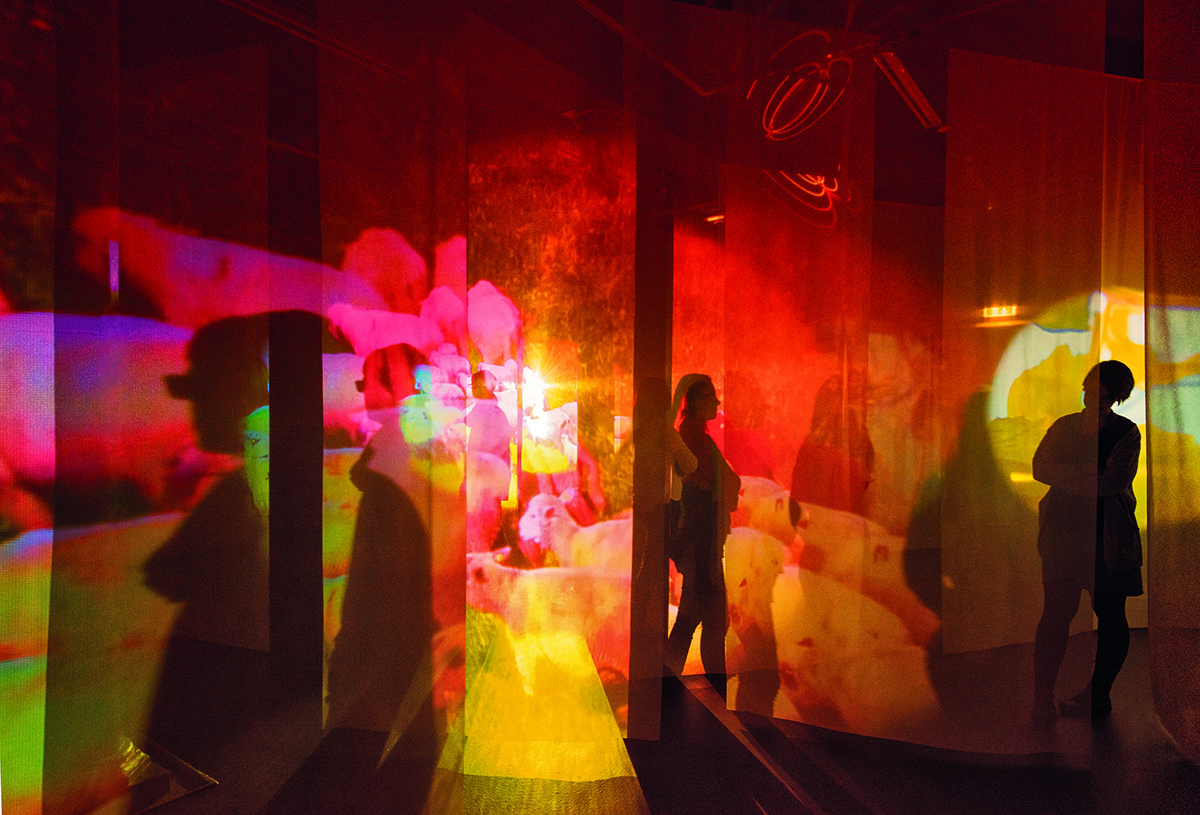
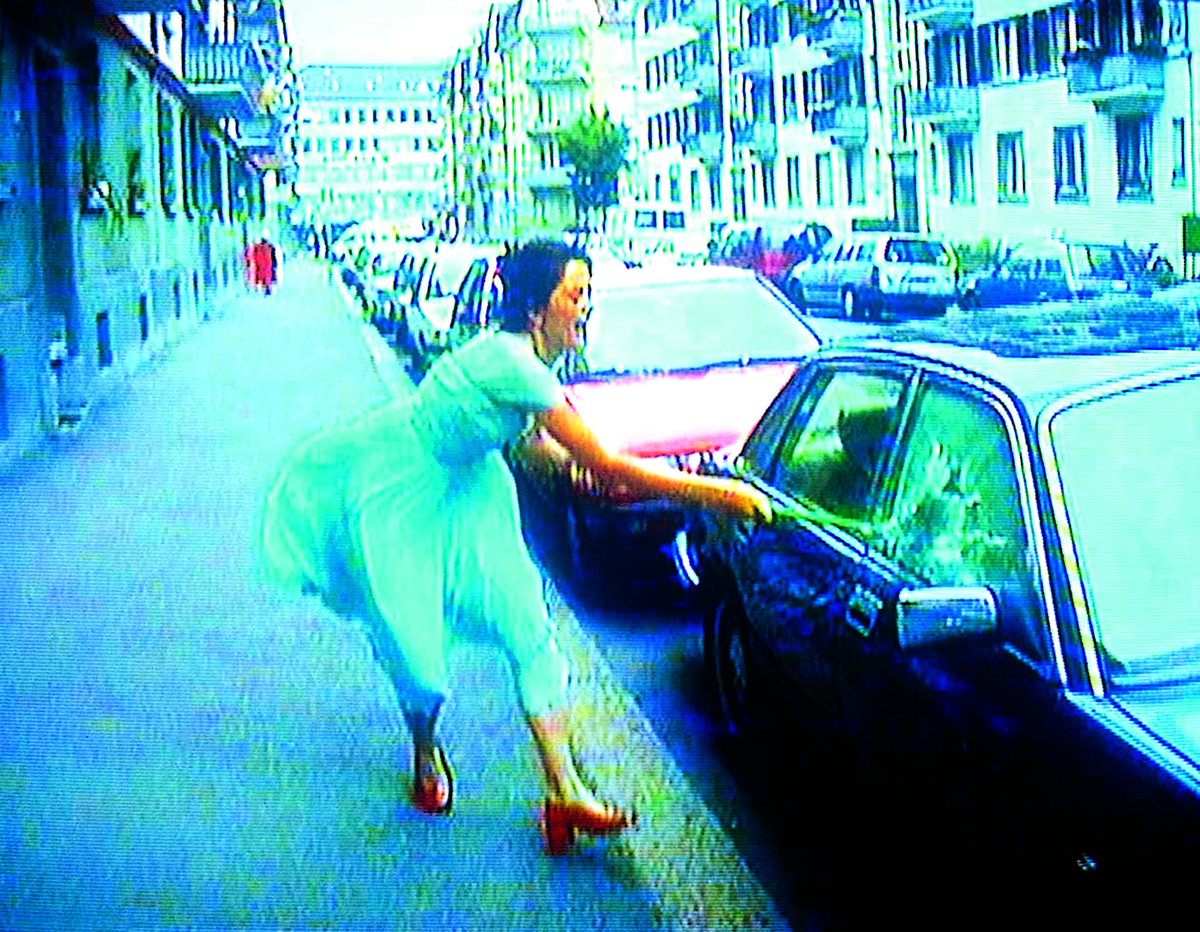
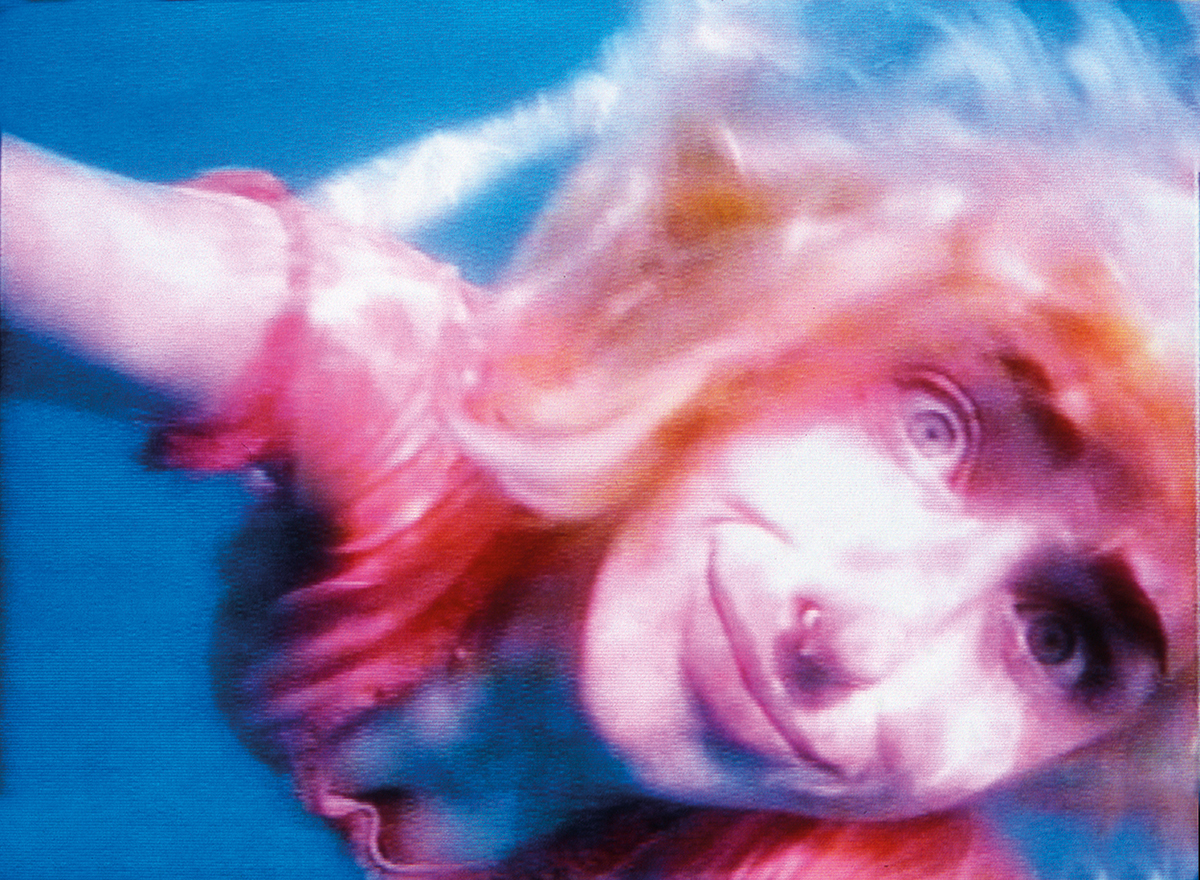
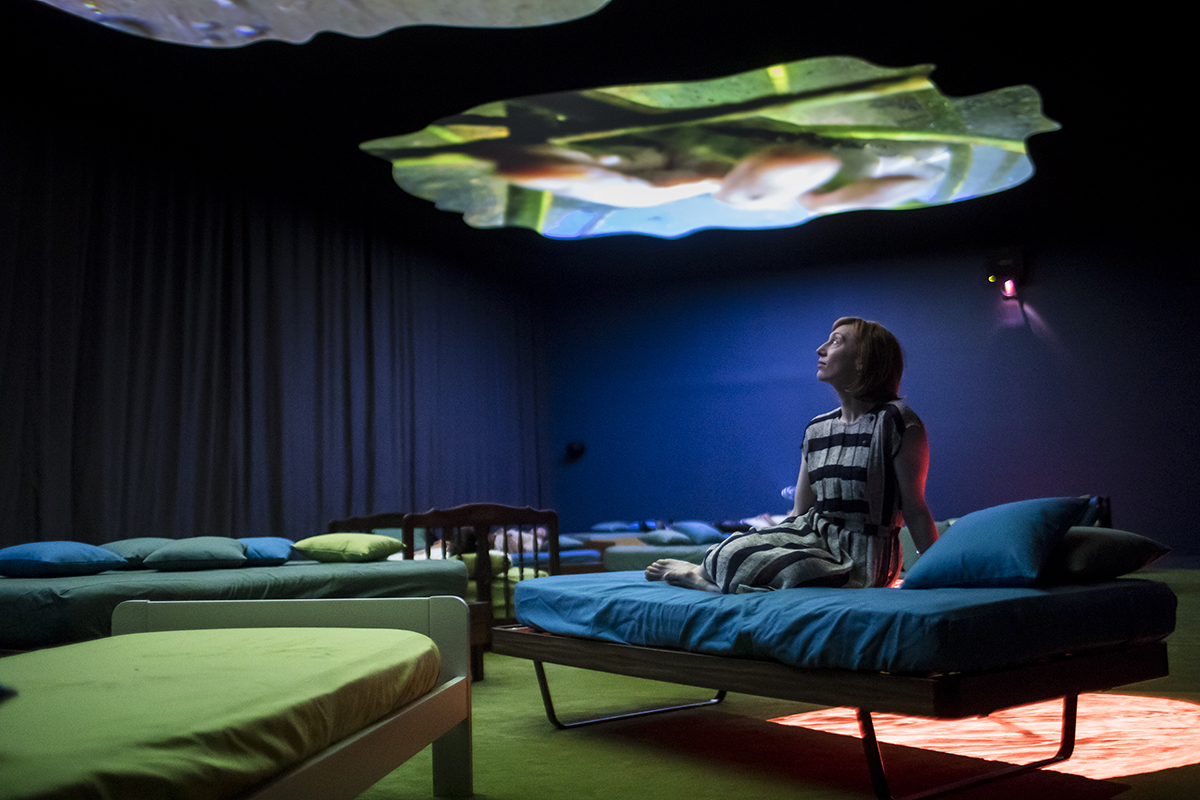
Sip my Ocean marks the first major retrospective of the Swiss artist Pipilotti Rist in Sydney. Ironically, prior to this we have only been offered “sips” of her gently transgressive, colour-saturated dream worlds in which the human is playfully reintegrated into nature, but in this current exhibition we are invited to utterly slake our thirst.
At the entrance is Meditation for Suburbbrain (2011), a two-channel work comprising a small projection of the artist, in super close profile, in front of motion-blurry scenery, the details of which are subsequently projected, floor to ceiling, onto the adjoining wall. The projection surface is covered, bas-relief style, in a series of white objects — boxes, packaging, tattered underwear and baby clothes — aesthetic detritus that Rist has titled The Innocent Collection, dating from 1985 to approximately 2032 (the artist’s predicted retirement or demise?). We don’t hear her words but subtitles indicate she is talking about relationships: “All this overblown romanticism,” “Should one end the relationship at its best?” The tone of this work is surprisingly sombre, the colours muted, the text tinged with pessimism — not what we have come to expect from Rist. It introduces a curious melancholy early into the otherwise positively pleasurable sensorium that is the rest of the exhibition.
Pipilotti Rist, Administrating Eternity, 2011, image courtesy MCA Sydney
Video hits
Beguiling soundtracks lure us around the corner to experience two of Rist’s best known early works. The video from which the exhibition takes its title, Sip my Ocean (1996), introduces us to the artist’s fondness for underwater scenography, showing a water-baby in sunny yellow bathing suit frolicking among the swirling verdant plants of an azure ocean. It’s bright, idyllic and joyous even as we see plastic cups tumble in the currents and hear the guttural wail of Rist as she reinterprets the Chris Isaak hit “Wicked Game.”
The same jubilance is present in Ever is Over All (1997), in which a gorgeous woman in a 1950s pale blue frock and Dorothy-in-Oz red shoes, skips in graceful slow motion down a sidewalk, joyously smashing car windows with her long-stemmed Kniphofia flower. Fields of these flowers, also known as red hot pokers, streak across the adjoining screen, blurry oranges and reds bleeding onto the edge of the other image. In Rist’s world we will destroy oppression with grace and natural beauty, a secret to which a passing, winking female policewoman is privy. In these works we see the key elements of the artist’s thematic and stylistic oeuvre: the natural world represented by water and flora; smashing of gender constraints and social mores; colour as content; and sound as seduction.
Pipilotti Rist, Ever is Over (still), 1997, image courtesy MCA Sydney
Single channel histories
In a small room on the other side of the entrance is another slice of Rist’s history, Das Zimmer (1994/2017), a selection of 15 single-channel video works and excerpts. Ever attentive to the way in which we watch, she invites us to clamber up onto giant couches and channel-hop via an enormous remote control. I notice many people eschew this room, preferring the more spectacular treats that await further into the exhibition space, but for me these works such as I’m Not the Girl Who Misses Much (1986), PickelPorno (1992) Sexy Sad I (1997) and Open my Glade (1997, the Flatten series), are integral to reading greater depth into Rist’s work as a whole. In these pieces we see the strength of her feminist beliefs and her battle against sexual and moral convention, leavened with a strong dose of play. Perhaps it is the self-conscious quality of early video and its clunky and limited compositing techniques, but in their rawness these works show Rist’s agenda at its most charged and defiant.
Pipilotti Rist, Sip my Ocean, video still courtesy MCA Sydney
Behind the eyelids, beyond the beauty
Heading further into the exhibition we move away from the flatness of single channel into greater degrees of immersion and three-dimensionality. Marking this shift is the 2011 work Administrating Eternity. For a moment, amid multiple screens made of sheer fabric, fragmenting and diffusing the projections of psychedelic sheep, plant life and geometric patterns, I feel quite happily lost. The gallery walls recede and I am simply surrounded by diaphanous abstractions made from floating colours. For this brief moment I say, yes, this is enough, Rist has succeeded in conjuring the stuff of which dreams are made.
In contrast to the amorphous nature of Administrating Eternity is Sleeping Pollen (2014). While maintaining all Rist’s main concerns in terms of subject matter (the almost excruciating beauty of plant life) and form (fully integrated installation systems with projectors placed inside large mirrored baubles hung like pendulous fruit around the space), this work is startlingly different for its sense of reduction and restraint. Here the plants float in isolation from their environment, as precious, highly detailed specimens on black backgrounds. It is a darkly seductive environment but I struggle to find more meaning beyond the beauty.
Similarly overwhelming is Pixelwald Motherboard (2016). It seems every contemporary art exhibition has to have a work that is perfect for visitor selfies, and this is the one. Three thousand LED lights in sculptural shades (made in collaboration with Kaori Kuwabara) represent pixels of a video image. We are offered a stunning cascade of shifting colours and patterns that Rist intends to appear as an exploded screen or a simplified brain. Though rendered even ‘cooler’ by the (once again) accompanying Chris Isaak cover from Sip my Ocean, it’s another work that fails to resonate beyond its remarkable aesthetics and technical execution.
Pipilotti Rist, Sip my Ocean, installation image Ken Leanfore courtesy MCA Sydney
Worlds made of worlds
At the end of the gallery space a small neon sign implores “help me” and we proceed through a maze-like curtained corridor to emerge into a massive assemblage of works collected under the title Your Room Opposite the Opera. Comprising 14 pieces made between 1994 and 2017, this room alone represents a Rist retrospective. More than a wunderkammer it is a wunderzimmer: a dining table becomes a kaleidoscope; a gin bottle glows with botanic lifeforms; a bed is blanketed with a whole universe; a mobile of underpants whirls with colour; no surface is safe from projection. Beneath our feet, in a tiny hole in the floor, a miniature, naked Rist looks up, yelling to us from the depths of hell (maybe this is the origin of the call for help?). These moments of magic are scattered among books, vases and knick-nacks and we are invited to sit in lounge chairs to become part of the decor.
At the far end of the space, the perpendicular walls form a screening space for Another Body from the Lobe of the Lung Family (2009). The segment I view involves a very cute piglet gambolling in a meadow in extreme close-up on one screen and a naked, nubile young woman doing the same on the other, I witness a toddler, around 18 months old, run screaming with joy towards the enormous piglet. At that moment the screens swap. He stops for a minute, looking at the enormous woman, and then resumes his joyous squealing — it’s all the same to him. A little later I notice what I think is a curious sea slug, and then realise it is in fact a bobbing penis and testicles. In this video Rist has certainly achieved her ongoing aim of fusing the human and natural world.
Following the neon sign to “trust me” we negotiate another curtained maze to encounter 4th Floor to Mildness (2016). We are invited to kick off our shoes and lie on beds to look up at the ceiling projections. A kind of sequel to the video Sip my Ocean, here we are under the Old Rhine rather than the sea. It’s a slightly more fetid world of slimy weeds and tattered lily pads, yet no less visceral and sensual. At times flesh pink pigment is introduced into the water, swirling in clouds through which a breast may emerge, or Rist’s more mature face, or her slightly more weathered hand. In Sip my Ocean the camera follows behind, chasing the image, but 4th Floor to Mildness (2016) is filmed from below looking up at a liquid sky, with little camera movement. This allows us to float, peacefully, almost ambivalently, as we become one with the primordial soup. The soundtrack is also more melancholic. Mixed in with bubbles of submersion are two wistful folk-pop songs by a group called Soap&Skin that allude to lost childhood, memory and nostalgia.
Pipilotti Rist, Selfless in the Bath of Lava, image courtesy MCA Sydney
A crack in the oeuvre
It’s in 4th Floor to Mildness that I find the connection to the discord sensed in Meditation for Suburbbrain. This is an older Rist with a touch of disillusionment perhaps, or simply resignation to being one who sees differently. And this is perhaps what I’m seeking more of in the exhibition as a whole — more of a sense of stress fractures in this fantasy world. Sip my Ocean is indisputably a stunning exhibition full of sensuousness, beauty and wonder, but reflecting on the development of Pipilotti Rist’s oeuvre, as the exhibition deftly allows us to do, leaves me feeling that as the works get bigger and the technology more complex, the more abject aspects, the dangerous ideas, so clear and raw in the earlier works, become codified and aestheticised.
Listening afterwards to the artist’s commentary on the excellent online guide, I am enlightened as to the deeper intentions of Rist’s later works, which at the time of viewing read to me as variations on a theme. Perhaps in seeing such a generous selection of works there’s a danger that, easily overwhelmed by the accumulation of style, we are left with a simplified impression.
By Rist’s own admission, her work is primarily about fantasy. In the audio guide she says, “I don’t think artists have more fantasy than no[n]-artists, but it’s our job to take it seriously and to try to materialise it.” Judged on these terms, there is certainly no denying that the Pipilotti Rist catalogue exhibits seriously fantastic(al) art, offering undeniable sensory pleasures.
–
MCA, Pipilotti Rist, Sip my Ocean, curator Natasha Bullock; Museum of Contemporary Art, Sydney, 1 Nov 2017-20 Feb 2018
Top image credit: Pipilotti Rist, Sip my Ocean, installation image Jessica Maurer courtesy MCA Sydney
Kirsten Johnson has spent a career behind the camera as a documentary cinematographer. Her 2016 film, Cameraperson, is built from decades of footage from films she shot like Citizen Four for Laura Poitras and Fahrenheit 9/11 for Michael Moore. “Here, I ask you to see it as a memoir,” Johnson tells us in an intertitle at her film’s beginning.
How exactly does a filmmaker build a memoir from the material of other peoples’ films and lives—from scenes as diverse as a Nigerian birth unit to a strolling street-side conversation with Jacques Derrida? How does Johnson use the dialogue of her subjects to give herself a voice?
Critics and editors such as Matt Zoller Seitz, Koganada and Kevin B Lee have produced video essays, an experimental form of audiovisual criticism currently blooming in the digital sphere and all manner of academic and popular circles. In this video essay produced especially for RealTime, Sydney-based critic and video editor Conor Bateman shows how Kirsten Johnson has hijacked conventional forms of editing, montage and dialogue to contribute something entirely new to documentary cinema. Lauren Carroll Harris
Credits: All music used in this video essay was licensed under Creative Commons:
“Ocean Day,” written and performed by rin ishi, is licensed under an Attribution 3.0 Unported license. You can listen to “Ocean Day” here.
“Sayonara,” written and performed by rin ishi, is licensed under an Attribution 3.0 Unported license. You can listen to “Sayonara” here.
“White,” written and performed by rin ishi, is licensed under an Attribution 3.0 Unported license. You can listen to “White” here.
“don’t worry about it,” written and performed by [ocean jams], is licensed under an Attribution 3.0 Unported license. You can listen to “don’t worry about it” here.
Despite its provocative title, referencing Valerie Solanas’ Scum Manifesto of 1967, which advocated the elimination of the male of the human species, and the invocation in the performance of the Wilis, the ghosts of betrayed young women in the ballet Giselle (1841) who force men to dance to their deaths and throw their bodies in a lake, Scum Ballet is largely contemplative, focused on female being, imbued with a sense of ritual and magic and endowed with symbolism that is variously literal and elusive.
Five casually attired female performers stand in a cluster on a stark white floor, expressionlessly regarding the arriving audience. They exit to appear in various locations on the grid high above, leaning or seated, legs swinging, looking down on us. In a sustained blackout they fragilely harmonise a gently melodic, wordless chant. As our eyes adjust to the dark, the voices draw closer and we see shadowy figures crawling onto the floor. The careful shaping and the sense of time suspended at the beginning of Scum Ballet transport us to what will prove to be a most unusual realm.
Ivey Wawn, Scum Ballet, Campbelltown Arts Centre, photo Catherine McElhone
In the ensuing scenes, the women configure themselves in ways that largely suggest a deep unanimity, at first seated in a diagonal across the space, gently sliding, touching, reversing direction, pairing and resting heads across each other’s shoulders before once again gazing at us. An early exception to this togetherness arises in the subsequent scene performed against music that threatens with heavy beats and the startling crash of metal and glass. While others watch, performers face off in successive, circling pairs, dragging long strips of wood — weapons never wielded and only borne when wearing the heavy trousers the performers take turns at sharing. It’s a strange ritual, the tension heightened by the intensity of locked gazes, arms loose but bodies in readiness and a slow, heavy pace barely varied. Is this a ritual refusal of violence? Are the trousers adopted meant to represents a male animus? Blackout and the sound of sticks dropped.
The sense of threat returns. The performers collect short blades, ply them between their fingers, modestly evoking Edward Scissorhands or Wolverine, and, gathering, seat themselves centrestage in an engaging, slow-moving tableau of touching and stroking. The painterly image successively suggests power, danger, intimacy, care and fond togetherness. Subsequently the dancers adopt loosely balletic poses, the blades now eerily extending the natural gestural reach, a variation on the power of Giselle’s Wilis?
Eugene Choi, Angela Goh, Scum Ballet, Campbelltown Arts Centre, photo Catherine McElhone
A burst of song, percussion and roaring drives the performers across the stage, each adopting a distinctive shape, step or momentum — together but apart. This brief surge, later repeated, is quickly countered by formal balletic groupings, three dancers to one side, two to the other in an evocation perhaps of the Wilis but without any intimation of threat, or perhaps it’s simply an expression of harmony through formal dance. An ensuing cycle of intensely coloured lighting cast across the empty stage is attractive but indecipherable, perhaps designed to extend the calm before a new mystery emerges in a scene that suggests ecstatic ritual.
The dancers carefully build a large mat from interlocking segments, on which they sit close in various positions which allow them to each discretely bounce with rapidity and force, Angela Goh facedown, fully extended, body rippling and pounding like a caught fish. This strange violence is self-inflicted but is also a collective expression of strength and considerable endurance, recalling and contrasting with the earlier image of the tender stroking with blades. I did fleetingly wonder if this floor dance correlated with the men danced to their deaths in Giselle, but the connection was slender and identification with the men seemed unlikely given the “scum” in the work’s title. The mind is busy when engaging with image-based works.
Ellen Davies, Verity Mackey, Scum Ballet, Campbelltown Arts Centre, photo Catherine McElhone
Finally, venturing a kind of magic, the performers slide the mat about while one of their number slowly traverses it, all the while our expectation building that the segments will disjoint beneath the weight of the body; they don’t. Scum Ballet might not offer the kind of dance that defies gravity with propulsive steps and giant leaps, but the deeply earthed pounding of the previous scene and the victory over friction in the next exhibit in different ways dancers’ capacities to unsettle expectation, here in the service of metaphor-making to illustrate female strength through collaboration. A similar, perhaps less necessary and less collective, though dextrously executed, routine follows using a door-sized plank in place of the mat. In the end, there is darkness and song, lines gently overlapping, the ritual completed.
Though from time to time experienced as a series of disparate images, welcome in their strangeness, Scum Ballet coheres more memorably on recollection. The strength of female collaboration is evident in strong performances that exude the sense of building “intimacy, love, care and magic between us” that Angela Goh writes of the work’s making, but it’s made even more fascinating by the tensions and ambiguities conveyed in the most potent of her images.
Angela Goh’s intruiging solo work Desert Body Creep is programmed for New York’s PS122 13th Annual Coil Festival, 10 Jan-4 Feb, 2018. Read reviews by Elyssia Bugg and Alison Finn of its 2016 Next Wave premiere.
–
Campbelltown Arts Centre: Scum Ballet, choreographer Angela Goh, performers Angela Goh, Eugene Choi, Ellen Davies, Verity Mackey, Ivey Wawn, lighting consultant Mirabelle Wouters, outside eye Sarah Rodigari; Campbelltown Arts Centre, Sydney, 24-25 Nov
Top image credit: Scum Ballet, Campbelltown Arts Centre, photo Catherine McElhone
This week we report on two important festivals that feature spheres of often underrated artistic activity, one drawing together artists from across the country, the other making global connections. The Hobiennale Arts Festival, a gathering of Australian and New Zealand Artist Run Initiatives (ARIs), exhibited over 100 artists in and around Hobart, and Unsound Adelaide, an experimental music event springing out of Poland, featured international and Australian artists. For our report on Hobiennale, Lucy Hawthorne takes in a wide swathe of the festival and Lucy Parakhina aims her video camera at artworks, events and participants. You can also watch our streaming of NAVA’s forum on the state of ARIs. Chris Reid applauds Unsound Adelaide’s intelligent programming in a country in which experimental electronic music events of scale are far too rare. Amid generic arts festivals, Hobiennale and Unsound yield idiosyncratic pleasures for audiences and hope for artists. Keith & Virginia
–
Top image credit: Greta Wyatt and Grace Marlow perform Theia Connell’s work as part of Greater Union, Sister ARI’s exhibition at Cinema One, Hobiennale 2017, video still Lucy Parakhina
The catchy title for Tasmania’s inaugural Hobiennale festival references the recurring exhibitions that have become ubiquitous around the world as a form of cultural capital. But this is not the Hobart Biennale — it’s not a big budget, state-run event, but a festival that celebrates the humble ARI, the Artist Run Initiative. The festival’s name is a composite that in some respects parodies the scale and seriousness of the biennale as institution, replacing the national pavilions of the Venice Biennale with local ARIs that are more likely to collaborate than compete. Each ARI represents a community, a model of working and a significant contribution to the art scene. Staged just as this year’s trio of internationally dominant art festivals — the Venice Biennale, Documenta, the Munster Sculpture Triennial — draw to a close, the Hobiennale is a reminder of the importance of supporting local, experimental events at the bottom of the world.
The ARI writ large
With 18 participating ARIs from Australia and New Zealand, over 100 artists, dozens of exhibitions, performances, critical discussions and participatory events, Hobiennale was always going to be a busy and ambitious event. It also turned out to be one of the most exciting I’ve ever attended, with unscheduled performances, an interested and engaged audience and an evolving and nimble program that reflected the energy and excitement of the artist organisations involved. The inaugural event was curated by Liam James and Grace Herbert and facilitated by Hobart’s Constance ARI, an organisation that (like many ARIs of late) has shifted from being a physical space with a regular gallery program to a project-based model.
Hobiennale inhabited everything from existing art galleries to underground heritage sites and public spaces, many of them usually under-utilised. The 19th century neo-Gothic Domain House held exhibitions curated by FELTspace, Moana, Success and The Curated Shelf + Radio 33. The house is still undergoing vital repairs, but compared to the last time it was open for a one-off exhibition, there was significantly less rot. Eloise Kirk’s installation of paintings picked up on the colour scheme of one of the upstairs annex rooms: the flaking spearmint upper coat and the pink layer underneath. Her paintings were installed upright, the front surface deliciously shiny, the back uncoated wood, picking up on the patchwork of raw timber covering holes in the dilapidated walls.
Xindian Boys’ Lost in Interstellar Space as part of Archive Fever, presented by Success ARI, photo Lucy Parakhina
Admin, instruction & installation
Adelaide artist Monte Masi’s recitation of the text-based work, IN-SPI-RAY SHUN-SHUN APP-LI-KAY SHUN-SHUN (2017) at Domain House was not listed on the official program, yet it was one of the best performances of the festival. The artist’s words were rhythmic, relentless, interweaving the administrative language of applications with absurd statements laced with a mixture of artspeak and lyrics: “describe how you envision the work will be installed in the space / for example / zero visibility / large scale paintings occupying the / south wall / everywhere is hot.” Drawing frequent laughs, he spoke to a specific and very sympathetic audience for whom the language is very familiar.
The work was shown as part of the FELTcult exhibition at Domain House presented by Adelaide ARI FELTspace, which explored the notion of ARI culture as “cult,” and given the knowing glances passing between audience members during Masi’s performance, the point was well made. Also drawing on ARI administration was Jenna Pippett’s Doing Stuff with Anne.J: Episode 6 — How to Volunteer at FELTspace (2017), which used the language of 1980s instructional videos to draw attention to the unpaid labour upon which ARIs (and the arts sector more broadly) rely.
While the FELTspace exhibition was conceptually tight, the install was disappointing and the works seemed to float in the centre of the room, detached from the aesthetically noisy surroundings. By comparison, Perth-based ARI Success, inhabited the basement level with a layout that emulated an archaeological museum – an apt layout for an exhibition interrogating cultural assets and the production of history.
Teen witchiness & play
Light as a Feather… by another Perth ARI, Moana Project Space, also seemed appropriate for the dilapidated neo-Gothic house. The exhibition celebrated the enduring influence of the “teen witch” as a feminist symbol of strength. At its centre was a rather crude wunderkammer that unfortunately received fewer donations of curious objects than it deserved. The shrine by Grace Connors combined 21st century technology with references to the cult 90s movie, The Craft (1996) — a movie that had (from personal experience) many teenagers of the time in search of magical distraction, chanting, “Hail to the Guardians of the Watchtowers of the East…” Between the installation of mood rings and chewing gum by Oliver Hull and Celeste Njoo, the knitted jumper dress “witch kit” by Emma Busswell and Lyndon Blue’s naïve painting of a Fiat perched atop an open fireplace, the Moana exhibition was a little haphazard. Indulgently nostalgic, it nonetheless succeeded with its strong sense of play.
An element of play could be seen again in the work by Theia Connell, performed by Greta Wyatt and Grace Marlow as part of the Greater Union exhibition curated by Sister (a relatively new Adelaide ARI). In the basement of an abandoned cinema, the duo caressed a ribbon of electronic text in a careful dance of negotiation. The bottom half of the ribbon was dead, although the text would occasionally flow through as the kinks in the wiring were manipulated. While unintended, the anxious energy of the performers trying to coax the text past the faulty connection made for fascinating viewing.
Julia Drouhin’s performance as part of Sonic Systematics, video still Lucy Parakhina
Quoll resurrection
Another favourite performance was Julia Drouhin’s interaction with a taxidermied quoll as part of Sonic Systematics, curated by Pip Stafford. Sitting cross-legged in the corner of the convict-era Bond Store and surrounded by vitrines of specimens, Drouhin treated the animal with an antique Provita Generator or violet ray — an early 20th century device used to address everything from spinal conditions to dental abscesses. Borrowed from the Tasmanian Museum and Art Gallery’s (TMAG) education department, the quoll was taxidermied in a way that rendered the Tasmanian carnivore cute, domestic and even a little bit cool, making Drouhin’s pseudo-ritual all the more curious and absurd.
TMAG also played host to Makiko Yamamoto’s outstanding Utterly Silent, Utter Silence, Utterly Something, Thinking Thinking, Utterly Listening, Utterly Umm… (s 2 ep.1), which used the spoken word as its medium. Presented by Bus Projects (Melbourne), the installation of sound-based works has changed my attitude towards headphones in galleries forever. The artist arranged and lit the headphones in a way that the figures listening with them became a key aesthetic element, and in many respects, the presence of the visitors was as important to the overall experience as the primary soundtracks — something I only truly recognised when I returned to the space after the opening and found myself alone.
ARIs as a social system
Hobiennale was as much about celebrating ARIs as it was exhibiting the work curated by them. Although the forums addressed problematic issues, the exhibitions and openings, parties and performances were largely celebratory events. The NAVA forum, I Don’t Work for Free: Tensions in Artist Run Initiatives could have gone for days, the one hour time-slot barely scratching the surface of this broad yet important topic. However, the issue was continually (and probably better) discussed during the informal conversations that took place throughout the festival. These incidental discussions were particularly evident at events like Frontyard’s (self-described as a “Not-Only-Artist Run Initiative”) potluck dinner and book launch, the culmination of a series of open conversation sessions at a local community arts centre.
FELTspace might have put forth the notion of the ARI as cult, but Hobiennale demonstrated that the ARI is very much a social system, and one that is central to the contemporary art scene. At every event, artists were exchanging ideas, planning new projects and comparing and debating models of funding and programming. Artists might have bemoaned the lack of funding, obstructionist authorities, as well as the difficulties of finding free or low-rent spaces, but the mood among participants seemed largely enthusiastic and positive.
Opening up the city
As noted earlier, few of the spaces Hobiennale inhabited were white-walled galleries. It gave visitors to Hobart and locals alike an opportunity to experience places usually closed to the public, such as Domain House and the underground magazine rooms of the early 19th century Princess Park Battery. It reflects the current popularity of unusual and meaningful sites as exhibition spaces, as well as the make-do attitude of many artists, who can and will do incredible things with just about any space if only they are made available. The Hobart ARI, Visual Bulk, for instance, exists within a tiny city garage/basement, hosting a fast-paced exhibition program that consistently shows some of the best experimental art in Hobart. Another participating ARI, Alaska, operates out of a carpark in Sydney’s Kings Cross, and the before-mentioned Success ran a program underneath a former department store in Fremantle before recently switching to an off-site model.
Te Ara Te ao Hauāuru, Kauri Hawkins, presented by Meanwhile, Hobiennale 2017, photo Lucy Parakhina
NZ on-site
Of course, when exhibiting stand-alone work (as opposed to work made specifically for a site), there’s a significant difference between a garage and underground fortifications. Yet, when sites are used strategically — as in the case of Christopher Ulutupu’s The Romantic Picturesque (presented by New Zealand ARI, Playstation) — they can enhance certain aspects of place and alter our reading of pre-existing works. On entering the dank underground battery space, visitors could hear the soundtrack of Ulutupu’s central karaoke video work, including the upbeat pop song “Brown Girl in the Ring,” which contrasted with the shadowy environment. The act of entering such a space prepared the viewer for the darker side of Ulutupu’s videos, which evoke romantic ideals of landscape, family and place with an uneasy twist. On first glance the video painted a rosy picture of two women singing karaoke in a forest. However, there’s an unmistakable tension created between the women and the white man being groomed off to the side, his eyes on the women, his gaze unreciprocated.
Representing Meanwhile (the other New Zealand ARI), Kauri Hawkins’ public artwork combined the familiar language of street signage with contemporary kowhaiwhai (Māori painting). Hawkins described a kind of new colonisation in which Māori are moving to Australia from New Zealand seeking wealth. The sculpture was naturally flashy, made from highly reflective signage material and shaped like wings. The initial location was a little odd, awkwardly tucked in among the Glenorchy Art and Sculpture Park pavilion. It was later moved to the colonial era Rosny Schoolhouse complex, which gave it a little more space, although I felt it demanded still more.
lump, Grace Blake, as part of Surface World, presented by ANCA, photo Lucy Parakhina
ACT in The Commons
Surface World, the excellent exhibition by the Australian National Capital Artists (Canberra), took advantage of a half-renovated building, The Commons, to produce installations that worked with the crumbling walls and mis-match of doors. Patrick Larmour’s intricate paintings were hung on bubble-wrap coated walls — a textural lead-up to Grace Blake’s gloriously silky and suggestive web of latex. Cat Mueller’s geometric paintings drew attention to the patterning of the partly exposed lath walls, and Tom Buckland’s tiny peephole dioramas gave us a glimpse into intriguing and sometimes disastrous technological scenarios.
A festival to learn from
There were far too many excellent events in Hobiennale’s demanding program to cover in a single review. The festival was rightly supported by a range of funding bodies, including the Australia Council for the Arts, yet existed on a relative shoestring, relying (as most ARIs do) on volunteer labour and the goodwill of artists and curators. Despite these challenges, it was a festival with a distinct personality, and one that larger biennales could learn from for its experimentation and nimble programming.
Watch a visual overview of the Hobiennale, featuring interviews with festival directors Grace Herbert and Liam James, and participants from Brisbane, Sydney and Alice Springs, below.
–
Hobiennale Arts Festival, directors Grace Herbert and Liam James, facilitatorConstance ARI; Clarence, Glenorchy, Hobart, 3-12 Nov
Top image credit: The Romantic Picturesque, Hobiennale 2017, photo courtesy Play_station and Christopher Ulutupu
“The Daly River Girl began its life in 2013 over a cup of tea with a fellow arts peer,” says Tessa Rose in her program note. The making of the performance has taken four years and includes several creative development periods; one with the Yellamundie Writers Festival in Sydney and another in Darwin supported by Brown’s Mart where the play’s director, Alex Galeazzi and Tessa Rose worked intensively on the script to balance the painful stories with lighter moments from Tessa’s extraordinary life. This development resulted in a work-in-progress showing which, even then in its raw state, showed clear signs of the powerful piece to come.
Tessa Rose is a warm and compelling performer who speaks directly to the audience, telling her story in non-linear segments that move fluidly across her life. The audience follows her journey — her early childhood with a Seventh Day Adventist foster family in Perth, her failed fostering with three other families, her adult career as a successful stage and screen actor in Australia and on tour in Europe, her teens as she is reunited with her Aboriginal family in Daly River, her excruciating experience of domestic violence as a young woman. Tessa Rose bares it all in a scrupulously honest exposé of her life.
The play opens with Naina Sen’s video projection of a group of young girls laughing as they sing “Ring a ring o’ Rosie” and dance in a circle with hands held. Backing this is Panos Couros’ gently eerie, suspense-filled soundtrack which evokes the essence of this play — the melding of horror and laughter in the life of a resilient survivor who recounts her stories with wry insight.
Tessa Rose, The Daly River Girl, artwork Jacqueline Marranya, photo Glenn Campbell courtesy Brown’s Mart
As the film ends, the lighting changes to reveal Tessa behind a scrim, her face framed in the centre of a projected artwork by Tessa’s sister Jacqueline Marranya — a circular pattern of dotted pathways with tendril paths branching out, each animated with a colour reflecting the story being told. The animation is subtle, almost slow motion so that a path is often fully coloured in before being noticed and then fading to black and white only to be coloured in again, while the evocative soundtrack both punctuates and links the various segments of story.
Standing before a projected photograph of her younger self, Tessa recounts the experience of her first Shakespearean role in A Midsummer Night’s Dream, reciting her lines as Titania. Phil Lethlean’s lighting design and Jessie Davis’ lighting operation are seamless as action shifts frequently from behind to in front of the scrim, into film projection, into images of Tessa’s past theatre productions, into animation of Jacqueline’s artwork. The technical complexity is smoothly done but Tessa Rose’s charisma is such that some of the most powerful moments occur when she appears in front of the screen with nothing but herself and her extraordinary life story and addresses the audience directly.
Tessa Rose, The Daly River Girl, artwork Jacqueline Marranya, photo Glenn Campbell courtesy Brown’s Mart
Tessa Rose has performed with Sydney Theatre Company, Queensland Theatre Company, Belvoir Theatre, Adelaide Festival and Darwin Festival. She has featured on the ABC’s award-winning show Glitch and Glitch 2, as well as Cleverman 2 and Redfern Now, but this is her first time as playwright. As she says in a press release, “One of the hardest experiences of writing my play was bringing up all the years of pain and anger inside me.”
She does not shy away from embracing the hardships and trauma of parts of her life. There is the repeated refrain “falling… falling” backed by a teeth-gritting soundtrack as Tessa clasps her head in response to cruelty from a violent partner, a bully at school, a casually cruel family member and rejection by her Daly River family for “not being black enough.” It is a story that is unfortunately all too familiar, but Tessa Rose’s humour and extraordinary resilience offset the darker moments.
The Daly River Girl is a brave and engaging solo show from one of Australia’s known and loved performers. The NAISDA-trained performer (National Aboriginal and Islander Skills Development Association) sings, acts, dances and she and director Alex Galeazzi weave these together with great understatement, not simply as a showcase of Tessa Rose’s skills but instead as a journey through a varied life and performing experiences. The Daly River Girl is a great piece of story-telling by a compelling performer. I anticipate that it will continue to develop and refine and will captivate audiences around Australia and overseas.
–
The Daly River Girl, writer, performer Tessa Rose, director Alex Galeazzi, lighting designer Philip Lethlean, sound designer Panos Couros, video projection artist Naina Sen, artwork Jacqueline Marranya, animation Kingdom of Ludd; Brown’s Mart Theatre, Darwin, 8-26 Nov
Top image credit: Tessa Rose, The Daly River Girl, artwork Jacqueline Marranya, photo Glenn Campbell courtesy Brown’s Mart
Lucy Parakhina provides a visual overview of the Hobiennale Arts Festival, which brought together artist-run initiatives and emerging artists from across Australia and New Zealand for 10 days of exhibitions, music, performance, parties and talks, across Hobart and surrounds in November 2017.
Featuring interviews with festival directors Grace Herbert and Liam James, and participants Llewellyn Millhouse (Outer Space, QLD), Julia Bavyka and Connie Anthes (Frontyard, NSW) and Beth Sometimes (Watch This Space, NT).
Founded in Krakow, Poland, in 2003, the Unsound Festival is a series of concerts and talks foregrounding new electronic music that has expanded into an international network. The Unsound Dislocation Project 2016-2018, developed in cooperation with the Goethe-Institut, now takes Unsound into numerous locations including Russia, Belarus, Ukraine and Central Asia as well as the UK, the US and Canada. Unsound programs have been a welcome inclusion in four Adelaide Festival programs under former director David Sefton (see my review of the 2013 music program and Gail Priest’s review of Unsound 2015), but they were limited in scale. Sefton and Unsound co-founder and Artistic Director Mat Schulz have now established Unsound as a stand-alone festival in Adelaide, the new event involving a diverse range of high-level international and local artists in concerts at Thebarton Theatre, club nights at Fowler’s Live, the Discourse Program at the University of South Australia and sound installations at the Botanical Gardens and Adelaide Railway Station.
Sound Installations
Unsound often locates events in prominent architectural spaces, and Unsound Adelaide this year opened its program with three unobtrusive but immersive sound installations totalling two hours in the tropical plant conservatory at the Adelaide Botanical Gardens. Renowned UK wildlife sound recordist Chris Watson’s 55-minute Mare Balticum-Narva Wall Mix is a blend of field recordings from the Baltic sea with the sound of waves lapping the shore, sea birds, seals and the rumble of fracturing ice transporting the listener to a very non-tropical world. Australian Leyland Kirby’s How Deep is Your Love takes the listener underwater, creating a sound world that sits between music and field recording. Rainforest Spiritual Enslavement’s (USA) work Shield Ferns/Brown Ferns Magic, commissioned by Unsound, is another gentle piece based on what are described as synthetic field recordings. Listening while studying botanical specimens is a meditative experience that focuses the mind on our perilously fragile environment.
Robin Fox, Unsound Adelaide, photo Andre Castellucci
Thebarton Theatre, Friday
The first concert opened with a mesmerising sound and laser light show, Euclidian Drone, by regular Unsound performer Robin Fox (Australia) in which he projected dazzlingly coloured geometric shapes through haze. The visual display is synched with a densely layered composition, and in a talk the following afternoon, the artist revealed that he uses drawing software to create the imagery and takes a live feed from it to the sound system, his drawings triggering unexpected and exciting musical effects.
Legendary US band Wolf Eyes delivered a stunning performance, the trio now including an unnamed cellist to accompany John Olson’s array of wind instruments, maracas and tambourine and Nate Young’s vocals, samples and electronics. Blending electronic noise, vocals and acoustic instruments (Olson sometimes playing two wind instruments simultaneously), and recalling free jazz, Wolf Eyes’ music has a humorous edge and otherwise defies categorisation.
Fowler’s Live, Friday
Following the concerts at Thebarton Theatre, Fowler’s Live nightclub hosted Unsound performances until 4.00 am on Friday and Saturday catering both to electronic music and club audiences. The night opened with Adelaide ensemble Club Sync — Rosa Maria, Baby Angel and Sacrifices) alternating back-to-back on the desk. The set was highly involving, the performers successively creating individual musical languages that melded into a wonderful composition.
Club culture is the engine room of much musical evolution, generating consumption and informing aesthetics. Dance brings people together, although, as Nate Young observed during his Saturday talk, “people go to clubs to be alone with other people,” perhaps a characteristic of contemporary society. Sometimes the music is overly loud, even disturbingly nihilistic, but it creates a community to which people relate and there is a feeling of being-in-the-present in such relational activity. Importantly, Unsound acknowledges the culture that has emerged in parallel with the evolution of instrumental and communications technologies dating back to disco.
Holly Hernden, Unsound Adelaide, photo Eddy Hamra
Thebarton Theatre, Saturday
The evening began with an exquisite performance by classically trained pianist and church organist Kara-Lis Coverdale (Canada) on electronics. In her talk later, she indicated that most of her sounds are sampled from a variety of organs, including some dating back centuries. Her set was like an extended, deeply layered organ symphony, recalling the powerful organ symphonies of French composer Charles-Marie Widor (1844-1937) as well as choral symphonies. Thebarton Theatre was transformed into a cathedral.
Berlin-based, American musician Holly Herndon’s set contrasted with the long instrumental sets of many Unsound performers, being built around shorter songs and creating a hybrid pop-electronica sensibility, the songs articulating concerns about the impact of technology in everyday life. The video for Chorus, from Herndon’s 2015 album Platform, shows desks on which sit the laptops that she suggests contain and transmit one’s existence. The video accompanying her Unsound set shows figures floating about in virtual space, another metaphor for contemporary life. As she and band-member Colin Self sang, Mat Dryhurst overlaid the video projections with a live feed of SMS-style texts such as, “leave facebook srsly its ruinin yr life,” and an image of Dryhurst captured by his laptop camera, as if he were carrying on a live conversation with the audience.
Senor Coconut, Unsound Adelaide, photo Andre Castellucci
Thebarton Theatre, Sunday
As the first performance of the evening was about to begin, I overhead an audience member behind me remark, “A grand piano at an Unsound concert? That’s unheard of!” Unsound has traditionally focused on electronic music, so the piano did seem unusual, but bringing together a trio comprising Chris Abrahams of the Necks (piano), Oren Ambarchi (guitar and electronics) and Robbie Avenaim (percussion, including his lap-top driven motorised percussion) turned out to be a marriage made in heaven. The effect was magical, like a Necks concert glistening with the complex sonic colours generated by Ambarchi’s instrumentation.
The performance by Señor Coconut was a significant innovation. Sunday’s concert embodied two essential characteristics of Unsound — the willingness of the artistic directors to experiment and create a program appealing to a wide audience, and the capacity of musicians and composers to collaborate to create wondrous new musical forms. Señor Coconut is German artist Uwe Schmidt (who has appeared under the name Atom™ in a previous Adelaide Unsound program) on electronics with an ensemble comprising brass, percussion, bass and vocals. They rework as cha-cha dance music such classics as The Doors’ “Riders on the Storm,” The Eurythmics’ “Sweet Dreams (Are Made of This),” and Deep Purple’s “Smoke on the Water,” as well as several Kraftwerk numbers, humorously subverting the character of the originals. The music is a delight and suddenly audience members are no longer dancing alone but joyously engaging with one another.
Wolf Eyes, Unsound Adelaide, photo Rob Sferco
Discourse Program
Unsound Adelaide’s Discourse Program addressed the revolutionary impact of new technologies not only on music production, performance and aesthetics but on distribution, consumption, monetisation and income generation. Other themes included the difficulties of being a travelling performer (including the carbon footprint that travelling generates), instrument building, the social impact of new technologies and the communities that music creates.
Adelaide’s Gabriella Smart opened with her paper, From Daleks to Noise, by summarising the work of Tristram Cary, a pioneer of electronic music in the UK in the 1950s and 1960s and a composer of film scores and incidental music for Dr Who who relocated to the University of Adelaide in 1974. Without pioneers such as Cary, the kinds of music heard in Unsound might never have developed as they did, Smart noting that much needs to be done to preserve Cary’s legacy. University of Adelaide lecturer Christian Haines demonstrated the VCS3 synthesiser which was co-designed by Cary and used by many notable musicians.
In a discussion on communities, Giuseppe Faraone of Club Sync joined Colin Self, who performs with Holly Herndon and is involved in community practices in Berlin, and Adelaide artist Matea Gluscevic who manages WildStyle which supports emerging artists and performers. They discussed the need for and creation of cultural centres, Faraone describing how Club Sync facilitates musical development through the provision of a performance venue and a record label. Unsound believes it has an important community engagement role, moderator Gosia Płysa (Unsound’s Executive Director Global) indicating that Unsound can now engage more directly with Adelaide music communities as an independent festival.
Robin Fox moderated a revealing discussion on technology and performance with Nate Young of Wolf Eyes, Kara-Lis Coverdale and Errorsmith (Erik Wiegand, Germany), who has created his own synthesiser, Razor. The discussion examined issues such as the definition of electronic music, Coverdale pointing out that organ builders throughout history were designers of sounds. The discussion also raised the question of the extent to which some performers actually perform or, as Nate Young suggests, just press “play;” many performers such as Wiegand set up broad sonic parameters and then work within those when performing. Musical quality was highlighted, Fox acknowledging that some performers substitute high volume for compositional strength.
Errorsmith, Unsound Adelaide, photo Eddy Hamra
David Burraston (aka Noyzelab, Australia) gave a lecture on DIY construction of budget modular synthesisers and passed sample components around the audience, revealing how Unsound’s musical magicians do their tricks. There remains strong interest in DIY modular construction, despite the advances made in midi-controlled software such as Ableton.
In her interview with Gosia Płysa, Holly Herndon spoke of how technology and social media shape our lives and how she addresses these issues in her music. The artist expressed her mixed feelings concerning social media, which she acknowledges can bring people together, but has discontinued her personal Facebook page while maintaining a professional one. As well as addressing issues relating to technology and social media, Herndon has produced a track intended to induce autonomous sensory meridian response (ASMR). She indicated her interest in the online community evolving around ASMR. And she revealed that the images of desktops in her videos were drawn from invited public submissions — they thus constitute a relational artwork, such activity clearly an important characteristic of her work. Finally, she acknowledged Ableton’s contribution in developing compositional platforms and suggested she and they were almost collaborators. Ableton has posted Herndon’s 2016 talk on her compositional process on YouTube.
The Discourse Program concluded with a talk by Mat Dryhurst, titled “Ideologies on the Blockchain,” addressing the use of emergent technologies to support online music. He highlighted the disruptive and perhaps democratising potential of cryptocurrencies to support Soundcloud. Herndon, who has taught at Stanford, and partner Dryhurst, who teaches at New York University, added an important theoretical dimension to the Discourse Program that contextualises the evolution and consumption of contemporary music and especially emphasises the need for consumers to be wary of an online world dominated by commercial interests and surveillance. Smart and Haines’ talk on pioneer Tristram Cary and Dryhurst’s discussion of the technological future bookended the evolution of electronic music production, distribution and consumption over the last 60 years.
Unsound Adelaide was outstanding in its conception and delivery, adding a crucially important dimension to musical programming in Australia. With a recurrent Unsound, Adelaide is now more firmly positioned in a growing world-wide circuit that focuses on and stimulates experimental composition, performance, technical development, discussion and criticism and supports local performers and communities. It is to be hoped that Unsound continues to flourish.
–
Unsound Adelaide, Artistic Directors David Sefton, Mat Schulz; venues Thebarton Theatre, Fowler’s Live, the University of South Australia, Adelaide Botanical Gardens, Adelaide Railway Station, 16-19 Nov
Top image credit: Club Sync, Unsound Adelaide, photo Andre Castellucci
The body of our mother (In Utero) is an unaccountable memory. Our first house or home, how strange to imagine this memory. The further we travel from the nonsense of babydom, through ideally, the magic of childhood, to the here and now, the literate, logical, discerning world, the further away we get from this memory and the grainier the image becomes. If this imagining is a memory, it is a sense memory, embodied but forgotten. It is perhaps our most sensuous memory in a literal context, the memory of before thought. Children are atemporal, free of time, but mothers mostly are not. Perhaps this partly explains the sometimes horror of children/motherhood in our present time-structured, machine world.
The maternal body, rapidly colonised by the disciplines of medical science and technology in this century, is still intriguingly absent in the world of art. This body is a place where nothing is sacred or profane, the abject and strange up for grabs by the most everyday of artists. It is as magnanimous and invisible as the red-cloaked Bush Mary in Teena McCarthy’s self-portrait found in the Realising Mother exhibition curated by Zorica Purlija — undeniable, omnipresent yet cloaked and indiscernible. In major galleries and ARIs alike, where Sex and Death lurk around every corner, the subjective maternal body is absent, but not in Realising Mother.
As Serafina Lee elucidates in her catalogue essay, “Realising Mother articulates a critical subjectivity [and has us] question notions of autonomy and agency as a socially selective privilege granted to specific bodies. We consider our own relations and involvements with these bodies. We are urged to adjust our own position, to afford an expanded logic, one that realises the maternal body as unmoored from its genealogical and representational constraints.”
During the exhibition opening I occasionally managed a whole adult conversation (despite the fact that my date for the night was my three-year-old son) thanks to the artistic creation and ritualistic documentation of 02-02, 2014-15, a live performance and video by Rafaela Pandolfini; Claude was mesmerised! Did he intuit his own journey in a pregnant mother giving form to her formlessness through visual documentation of a ritualised dance or just find this uncouth display of animated pregnant dancing as liberating as Pandolfini did herself? This artist elegantly jitterbugs to the intimacy of a body within a body, perhaps an artwork in itself!
Deborah Kelly, The Miracles After after del Sarto, from series: The Miracles, 2012, Realising Mother, Kudos Gallery, Sydney
Deborah Kelly takes on the miraculous family of the Bible, creating new permutations in her Miracles series, wonderful adaptations of paintings by old masters. Kelly’s 35 miracle portraits (three of which were on show) are of simply anything but the hetero-normative and biological baby-making families of history. With the advent of ART (Assisted Reproductive Technology) we have seen an expanding of the scope of family; Deborah Kelly uses a different art to make these new family forms boldly visible.
Raphaela Rosella busts open a different part of the dominant discourse on family with her divinely luminescent and proud portrait of Tricia and Ty-Leta (2016): a young Aboriginal woman breastfeeding her baby in the light of a staticky television screen. It was my favourite image in the show; shocked by its beauty, I was not surprised to read how Rosella had spent time with Tricia breastfeeding their babies and that she photographs women she is connected with. This begs the question of gaze, and how the photographer sees, being implicit in what is depicted. Rosella’s role as an embedded storyteller, a mother herself, is a defining factor in her capacity to capture the resilience of the young mothers in her photographs.
Raphaela Rosella, Tricia and Ty-Leta, 2016, Realising Mother, Kudos Gallery, Sydney
Anguish might seem to be a recurring motif when one turns the lens on mothers. Anne Zahalka speaks of an unbridled bond in relationships between mothers and daughters in her heartbreaking exploration of her grandmother’s letters to her daughters before her murder in Auschwitz. Having left their family home in Vienna in 1938 following persecution, the daughters fled to Czechoslovakia, eventually finding safe passage to England. Zahalka uses a collection of artefacts including letters, photographs, postcards and archival documents left to her after her mother’s death, to construct a textual still life which, hanging like an artwork of seemingly random points of connection, mapping chronological intersections, overall has a breathtaking beauty. Alongside it is a video work comprising letters written by the mother to her children after their separation, transcribed from German to English and, embedded in a table top, viewed from above. This translation gave the artist historical insight into this very poignant love between mother and daughter over 70 years ago, and makes it available for reinvention and interpretation by the artist and her own daughter in the present day.
Anne Zahalka, Rewriting, 2017, video production Orson Heidrich, pinboard: letters, photographs and other ephemera, Realising Mother, Kudos Gallery, Sydney
These are just some of the powerful and unexpected works exhibited in Realising Mother. Sally McInerney’s photographs capture everyday moments in the lifespan of motherhood including her own mother, renowned photographer Olive Cotton with Sally’s own daughter. Denise Ferris developed a technique of using breastmilk in screen printing to ruminate on ambivalence and resistance, death and nurturance in motherhood. Sarah Rhodes explores how language and place connect child and mother in embodied learning in Indigenous culture. Clare Rae charts the literal territory of the maternal body, photographed in a series of juxtapositions in Sutton Gallery, before and after birth. The exhibition also included variously explosive, dynamic, playful and remarkable works by Ella Dreyfus, Lottie Consalvo, Theresa Byrnes, Donna Bailey, Julie Sundberg, Miho Watanabe and Anke Stäcker.
Never has an art exhibition been so embodied, the body so present, even if reflected through the lens. Absent/hidden bodies, dancing bodies, clutching/bonding bodies, performed/artifice-d bodies, collaborative bodies, lesbian and gay (or LGBTQI) bodies, single, Blak, social, historical, cultural, child and maternal bodies. A body in which something may or may not grow but assumes this indiscernible yet vast conception of the maternal. This vision of the maternal body I now ponder deeply, is so expansive! Unlike the m(other) body of the Male Gazing Art Canon, the meanings alchemised in Realising Mother explode open a sentimentalised, infantilised, worshipped even, other body and restores agency to the lens. The exhibition puts this real and messy, imperfect and beautiful, often unexpected maternal body back front and centre.
–
Realising Mother, curator Zorica Purlija, artists Denise Ferris, Sally McInerney, Julie Sundberg, Ella Dreyfus, Anke Stäcker, Deborah Kelly, Raphaela Rosella, Miho Watanabe, Sarah Rhodes, Teena McCarthy, Clare Rae, Donna Bailey, Anne Zahalka, Rafaela Pandolfini, Theresa Byrnes, Lottie Consalvo; Kudos Gallery, Sydney, 1-13 Nov
Jasmine Salomon is a mother of four, a scholar of the maternal in art, a midwifery graduate and a curator who has no formal childcare and is re-wilding and unschooling her two youngest children on a headland in mid-north NSW. Her praxis centres around presence, she is investigating several philosophical propositions including the idea that all humans are artists (especially children), that children inherently collectivise for the positive, that genuine collaboration in art (especially with children) is a powerful tool for social change.
Top image credit: Rafaela Pandolfini, 02- 02, 2014-15, a dance for every day of my pregnancy, live performance and video, Realising Mother, Kudos Gallery, Sydney
I have been without a phone since August this year. The transition was awkward at first, requiring some adjustment. However, I have since come to enjoy the sensation of being “off the grid” and the time and space opened up to me in everyday life. Of course, this is much to the ire of friends, family, colleagues and the odd curator who has had difficulty contacting me. It was not a political decision, or at least not at first. What happened was this: the Nokia 3210 I was using became inoperable when the provider I was connected with turned off their 2G service. I had been moved on from another service, also closing, not long before, and simply gave up the chase, deciding to go without. I believe there is now only one telecommunications provider left in Australia that offers a 2G service, and this will become inactive shortly, making all the phones on that platform inoperable in the process. It will be the end of an era.
Aphids’ Artefact provides a memorial service for this sort of orchestrated obsolescence of technology. Originally a ceremonial event staged at the 2016 ANTI Festival in Kuopio, Finland, the project has now taken the form of a video work that had its premiere at a one-off event at the Australian Centre for the Moving Image (ACMI) in Melbourne on 3 November, the same day that Apple released yet another iPhone. The video primarily comprises documentation of the original event, but in such a way that the eulogy it delivered is retained, continuing the memorialisation. The video is more than typical self-mythologising in which documentation provides a trace of the artists’ cultural capital for posterity. Admittedly, it does this as well. It is aesthetically very pleasing and creates a longing to have been at the event. More than this, the video expands the world of the project, in which the death of technology is acknowledged, celebrated and reflected upon.
When we enter the ACMI cinema, an usher warns strobe lighting will be used and hands out a program that asks phones be left on in order to communicate with the audience during the screening. We are requested to text the message “I’m here” to a provided phone number and reassured that we will not have to participate directly. Rather, we are invited to “contemplate the ideas present in this ceremony: technology, obsolescence, death.”
The screening begins with a series of shots of individual children wearing veils and staring forlornly into the camera. One shot is of a baby lying on its back, against a background of seemingly infinite blackness. The sound of old-fashioned mobile ringtones humorously offsets the moody footage. Segue to a church in Kuopio, where something akin to a funeral ceremony is taking place accompanied by a death-metal choir conducted by a figure with a pixelated face. Artist Willoh S Weiland, black-clad and veiled, leads the ceremony in a procession from the church to the nearby Technopolis Park. There, mourners from the local community, somewhat directed by the choir leader, dig a hole as a base for a 15-tonne grey granite monument — a cross between a gravestone and a featureless mobile phone or tablet. The scene brings to mind 2001: A Space Odyssey, but where the Stanley Kubrick film focused on progress, here the emphasis is on obsolescence.
Artefact, Willoh S Weiland and JR Brennan, Aphids and the ANTI Contemporary Art Festival, photo Pekka Mäkinen
During the screening video artist Emile Zile sent texts at opportune moments to audience members (a friend shared their phone with me), triggering a cacophony of digital ringtones and creating a makeshift orchestra. These contrasted with the sounds of the old mobile phone featured in the screening, making them seem ridiculous in comparison. The texts frame the content of the screening and facilitate its transcendence beyond documentation into an ongoing memorial service. They achieve this with dramatic allusions that, for example, connect the emotional pain of losing a technological device with the experience of sensing a phantom limb, or nostalgically recall the feeling of playing Snake, as well as providing information about the history of Nokia and its commercial standing.
The screening of Artefact sheds light on the economic and environmental consequences of manufacturing for obsolescence. Progress has brought great precarity to brands like Nokia, a Finnish company with a 152-year history and a staple of the country’s economy. Zile texted, “Nokia 3310… lest we forget…. requiem for buttons and keypads laid to rest… please recycle thoughtfully.”
Artefact is wonderfully timely, positing the value of farewelling devices with which we’ve formed intimate relationships, whether your old mobile phones or gaming platforms.
During a post-screening Q&A, Weiland wondered if Artefact could have been made here; would we have been able to take the subject seriously? But this wonderful tension between seriousness and silliness is the strength of Artefact, which is simultaneously ironic and sincere. During the Q&A a child cries and has to be carried out of the auditorium, the parent explaining that the tears were caused by the screen of her phone going dark, adding a final ironic touch to the requiem. Coupled with the release that morning of iPhone X and the impending end of 2G service in Australia, it added a further sense of timeliness to the project.
Over drinks after the screening, ANTI Festival Director Johanna Tuukkanen informed the artists that a gravesstone, a button with an ‘x’ on top and installed with the commemorative monument in Technopolis Park, had somehow been moved to a skate park next to the site. The artists were thrilled to hear it was now being skated on.
–
Aphids Artistic Director Willoh S Weiland received the 2015 ANTI Festival International Prize for Live Art — a commission for the Artefact project.
To watch Artefact, send an SMS to 0437 839 625 saying: Yes, please.
Artefact: concept Willoh S Weiland, creators Willoh S Weiland, JR Brennan music direction, original composition JR Brennan, cinematography Kim Saarinen with Matthew Gingold, Lasse Hartikainen, editor Kim Saarinen, video editing Matthew Gingold, Artefact design Willoh S Weiland, Susan Cohn, presented by Aphids and the ANTI Contemporary Arts Festival; ACMI performance text Willoh S Weiland, Emile Zile; ACMI, Melbourne, 3 Nov
Writer, performer and a founding member of the performance collective Team MESS, Malcolm Whittaker is completing a practice-based PhD at The University of Wollongong. Titled “An Intellectual Adventure in Ignorance,” his thesis centres on the Ignoramus Anonymous project which takes the form of a support group for the ignorant, with meetings held since 2013 at festivals and in galleries, libraries and community centres across Australia.
Top image credit: Artefact, Willoh S.Weiland and JR Brennan, Aphids and the ANTI Contemporary Art Festival, photo Pekka Mäkinen
Spoiler alert: this review includes key plot details from writer PJ Hogan’s adaptation of his screenplay for the film Muriel’s Wedding (1994) for Sydney Theatre Company’s Muriel’s Wedding, The Musical.
Friday night, 17 Nov: Muriel’s Wedding, the film
Watching PJ Hogan’s Muriel’s Wedding for the second time in two decades, I’m impressed, moreso than on first viewing. I recall my surprise at how grim it was, funny but painfully frank about parental psychological abuse, peer group bullying, compensatory escapism (via wedding fantasies and the music of ABBA), political corruption, sexism, suicide and a devastating brain tumour. On second viewing the film was as bleakly funny as ever, but revealed itself to be far better scripted, shot and acted than I remembered. Not only did it face full-on the issues it confronted, but was largely and very effectively unsentimental. The moment when Muriel announces that she’s taking her wheelchair-bound erstwhile best friend Rhonda with her back to Sydney, is near-teary but brisk and funny and deftly counterpointed with the tense scene between Muriel and her unrepentant father in which she firmly rejects pressure to take on responsibility for her emotionally damaged siblings. Muriel might not be bright, but she’s a far better person than she ever thought, and now she’s wise, leaving behind the self-obsession into which her tyrannical father and helplessly complicit mother had driven her and committing to caring female friendship.
Saturday night, 18 Nov: Muriel’s Wedding, The Musical
Attending the red-carpeted opening night of Muriel’s Wedding, The Musical, I’m apprehensive. How much of the film’s spirit, especially as embodied in the screenplay — adapted from his screenplay by Hogan and with lyrics by the musical’s composers Kate Miller-Heidke and Keir Nuttall — would be retained? I needn’t have worried. And, would the film’s incisively drawn principal characters be reduced to all singing and dancing sketches? They weren’t. Muriel and Rhonda, though more broadly characterised than their film counterparts, are convincingly realised.
Muriel Heslop, a most unlikely lead character, is Hogan’s genius touch. A slow thinker, often unaware of her impact on others, Muriel is slow to pick up on insult and rejection and all too easily slips into her fantasy world. Maggie McKenna acquits herself in the role admirably with a toothy goofiness and a slack-lipped, innocent stare, extra-rounded vowels and vocal register lower than her sharply articulated singing — a quite different voice. Madeleine Jones’ quick-witted, sexy Rhonda perfectly and compassionately counterpoints Muriel, while her descent into pain and bitterness is keenly conveyed. The pair’s soaring, nigh operatic duet, “A true friend,” is a passionate expression of friendship.
I had wondered if the musical would underplay the darkest dimension of the film — the suicide of Muriel’s mother, Betty. It didn’t in one way, but did in another, which I’ll return to. Justine Clarke’s sensitive portrayal of the woman as an emotionally befuddled, physically disoriented, lost soul is acutely felt, if modified by new additions to Hogan’s narrative. Gary Sweet as Muriel’s father is more ebullient than Bill Hunter’s sinister original, a bigger performer on the business stage and given his own number with an enormous regional development maquette to romp about on. A re-write of the screenplay’s final scenes unfortunately undercuts any opportunity for Sweet to deepen his characterisation; I’ll come back to this too.
Sizeably enlarged is the role of Muriel’s Sydney boyfriend Brice (Ben Bennett), transformed into an embattled parking inspector and a more likely romantic prospect for her affections than in the film, if still a tad defeated by life, as expressed in a witty take on “pessimism, the ointment for the rash of disappointment” in the song “Never stick your neck out,” performed with the male cast. The other key character in the narrative, an Olympic swimmer, Alexander (Stephen Madsen) looking for marriage with which to gain Australian citizenship, is this time not South African but more aptly Russian and given a new dimension, very much of the moment. Other characters, like Muriel’s cruel peers, remain outright satirical creations granted additional force through superbly harmonised singing and frantic team dancing, while her siblings, Joanie (Briallen Clarke) and especially the slightly deranged Perry (Michael Whalley), are immediately familiar variations on the originals and truly memorable, the audience erupting with laughter and applause the first time Joanie utters, “You’re terrible, Muriel.”
In the film, Muriel’s escapism is restricted to taking refuge in the music of ABBA, holidaying with stolen money, running away to Sydney and visiting bridal shops; in the musical it’s given fantastical dimensions, the most deftly realised of which has been to turn ABBA, who astonishingly pop out of Muriel’s wardrobe, into a glitteringly costumed, supportive chorus who ultimately attempt to keep the immature Muriel all to themselves. When she goes serial shopping for wedding dresses, Muriel’s fantasising is fast running out of control, her neglect of the crippled Rhonda irresponsible. The stage, in the manner of Hollywood musicals of especially MGM in the 1940s and 50s, swells with parading models and swathes of cascading soft curtains washed in pastel lighting, with Muriel as the glorious bride, adored by ABBA.
It’s not just Muriel’s fantasies that are writ large, the whole world is, whether a Chinese restaurant evoked simply with an arc of huge red lanterns or Sydney with a stage-filling Harbour Bridge and, seen beneath, the Opera House which later, courtesy of the revolving stage, arrives before us, revealed to be of human scale and great to loll about on. Muriel’s meeting with Alexander is akin to an Esther Williams’ (MGM again) swimming pool sequence, the dancers on their backs semi-circled across the stage, miming water ballet kicks.
The power of musical theatre and of opera resides in a shared acceptance of distortions of scale — amplification of character, place, sound, movement and everyday behaviour — with roots in ritual and a search for transcendence. In Muriel’s Wedding, The Musical we are implicated far more heavily in Muriel’s fantasising than in the film — the escapism is ours as much as hers with scene after scene of engrossing invention and spectacle. But, for all the excess, the musical feels emotionally true to Hogan’s original vision, with Kate Miller-Heidke and Keir Nuttall’s dramatic fusion of contemporary pop with the idiom of the musical (more Lloyd Webber than Sondheim) providing rich counterpoint to the sheer pop pull of the ABBA songs.
There is however, a point when excess turns bad. The first sign is the disdainful Alexander finally having sex with Muriel (as in the original some kind of limited affection grows between the two, and even there it felt odd); but then reveals he’s gay. Then Hogan’s script and the composers let rip with Betty’s funeral, at which Muriel heroically makes public her father’s sins, rendering him supine and abandoned by his girlfriend and associates. An apparition of a now happy Betty appears, professing, out of the blue, her own love for ABBA, effectively uniting her with her daughter. Muriel breaks into an adoring eulogy, the mawkish “My Mother,” in which Betty’s maternal support and love is applauded. As in the film, and the musical up to this point, unconditional love has not been evident — it’s Betty’s tragedy that she has always capitulated to Bill, never defending Muriel.
As if this sentimental overload isn’t enough, at the very moment that the bond between Muriel and Rhonda is restored, a triumph for female friendship, Muriel is reunited with erstwhile boyfriend Brice — to what end, Muriel’s wedding? Hogan and his lyricists’ additions do pass by in a tumult of high drama, song and dance, but on the morning after I wake to that queazy feeling of a sugar overdose.
Muriel’s Wedding, The Musical was in many ways a special experience, expertly directed by Simon Phillips, deftly choreographed by Andrew Hallsworth, with excellent musical direction and arrangements by Isaac Hayward and endlessly witty inventive set and costume design by Gabriela Tylesova. The play between ABBA songs and new ones validated the update of Muriel’s Wedding to the present alongside a plot strand in which Muriel becomes a short-lived social media sensation (shutting down her fantasies she simultaneously closes her account). The story of the redemption of a psychologically damaged outsider rings as true in the musical as in the film, but an unwarranted turn to high melodrama and blatant sentimentality, the excesses common to the form, made for a magnificent but imperfect musical.
In Adelaide and Melbourne in the 1970s and 80s, the hard talking, hard living poet Christopher Barnett was a force to be reckoned with — socially, artistically, politically. A charismatic public performer, this self-styled “cultural Bolshevik” — after his hero, Russian poet, playwright and propagandist Vladimir Mayakovsky — was a key collaborator with Nicholas Tsoutas and Peggy Wallach as a writer for the groundbreaking All Out Ensemble. Barnett left Adelaide for Melbourne and then in the mid-80s relocated to Nantes in France where he co-founded a highly regarded experimental company, Le Dernier Spectateur, working to enable performances by the disenfranchised.
Adelaide-based filmmaker Anne Tsoulis’ Heathen Dreams is an admirable introduction to Barnett, a significant if underrated figure in Australian cultural history. Tsoulis writes, “To understand what shaped the artist, we explore his formative years, raised in poverty in a dysfunctional Adelaide family to becoming the teenage poet and enfant terrible. We discover that, at an early age, his Communist ideals helped him to survive his own challenging circumstances.”
The 53-minute documentary includes footage of readings, reunions, a rare homecoming to suburban Adelaide after a 20-year absence and an exacting visit by road in a European winter to visit an unwell Thomas Harlan, radical documentary filmmaker and translator of Barnett’s The Blue Boat (1994).
Email us at giveaways [at] realtimearts.net by 5pm 5 December with your name, postal address and phone number to be in the running.
Include ‘Giveaway’ and the name of the item in the subject line.
Giveaways are open to RealTime subscribers only. By entering this giveaway you consent to receiving our free weekly e-dition. You can unsubscribe at any time.
The resounding ‘yes’ vote for marriage equality legislation came as a great relief, until those same politicians who instituted the postal process (avoiding parliamentary responsibility and hoping for an indifferent public response) commenced demanding discriminatory, theocratic rights out of place in a democracy. The fight continues. Keith & Virginia
–
Top image credit: A Wave and Waves, Totally Huge New Music Festival, photo Bohdan Warchomij
Something in the lone, three-legged photo-boxes straddling the landscape speaks of dystopian invasion: the spindly War of the Worlds tripods landed here in a remote paddock as forerunners of a semi-remembered technology, an unravelled history of the photograph. The farmland gullies outside Cootamundra have been abruptly colonised by the unknown, the weird and the naggingly unnamed familiar.
On Saturday 21 October, the Wired Lab artist-led organisation, as part of its platform for evolving interdisciplinary art practices in rural Australia, staged the agri(culture) project as “a participatory landscape-scale and omni-sensorial exploration of rural and agricultural phenomena with regional and metropolitan audiences.” Twelve interdisciplinary Australian and international artists and collectives presented creative outcomes, with the viewer/participant trekking into and through site-specific landscape installations, from early afternoon until 11pm — the art-walker on an experiential tour.
Installation view, Green Ant Gin Jellies by Soon Lee Low, Insecta Delecta by Cat Jones for The Wired Lab, 2017, photo courtesy the artist
The experience of lying flat, pressed to the earth, on grassy hillocks teeming with insect forms, is the core of Julie Vulcan’s DARKbody, an immersion chamber with headphones and sonorous, wry narrative of descent into sleeping pits in the earth. It is a contemplative sound-dive into a recited tale of “humans sandwiched between literal darkness above and beneath us” — of scotobiology (the biology of darkness) as affective encounter with non-human agency. It is a profoundly meditative slumbering encounter with grass, earth and a slipping away into myriad tiny deaths of darkness within the earth hidden beneath us.
Several other site works are part of the late afternoon land-walk, from Cat Jones’ Insecta Delecta — gourmet helpings of edible insects, served up by a chef to walkers thrown into a sudden field-based Blade Runner future of insectivorous farming — to the rampant honesty of Kids vs Art’s podcast critiques of the varied artworks [hear Kids vs Art’s vivid response to Insecta Delacta, shared with a local farmer. Eds]. I had this firmly in mind as a well-intended community art means of engaging kids, an arrogance of mine rapidly dispelled by not only the sheer clarity and insight involved but by the kids’ astute interviewing of UK sound artist Chris Watson, among others. Here was art shoved off its white plinth and viewed through a child’s lens, a finely attuned crapometer, asking ‘Why are you doing this, and why should we give it value?’
Kids Vs Art, Wired Open Day, presented by Field Theory, photo Joshua Thomas courtesy The Wired Lab
I was most taken by Beggan Beggan (created by NSW regional artists The Ronalds, David Burraston and Wired Lab’s Sarah Last), how it constructed and navigated a traditional shearing shed viewed on blank, undulating land through the simple, stolid device of viewing boxes seemingly left idle in a paddock. The tiny dioramas seen in the boxes ‘mapped out’ the spaces and evoked a sense of a ghost-shed, resonating strongly and endemically with the land and place preoccupations of Wired Lab’s focus on agri-culture. Even with the lineage of an eroded technology faded into history, the boxes reminded me of speaker-stands littered around an abandoned drive-in theatre, awaiting some invitation to rise from sleep. At once inert and motionless, these are brown bones of time lost in history’s sepia photobook pages and the disappearing wash of darkroom trays of arcane liquids.
The installation made dramatic use of the spectral histories of landscape to evoke what once was likely roped off with now invisible builder’s string, charting the dormant, heritage-listed shearing shed on Beggan Beggan station near Jugiong. Each almost childlike diorama with its squat, singular scope of one curved viewing lens in a wooden box on legs akimbo is the simplest puppet-show of perception; yet there is a granular, modulated tone to the images that requires the viewer to walk, and tilt and reconstruct in both mind’s eye and memory the spaces and assembled views — the walker in the paddock rebuilding The Ronalds’ images back into the light. The installation is consciously low-tech. According to Shannon Ronald, “We wanted the experience to be as immersive as possible. We designed each of the boxes with peephole lenses so your vision is completely encapsulated by the scene inside the box… We liked the sensory experience of looking around inside the box and straining to see the detail that each vignette presented.” And it is this series of frosted plays, frozen in time as tiny, self-contained vignettes that are so elementally reconstructive of walking through the landscape to pace out the presence of its use, its shearing history, as the viewer/participant becomes an active bricoleur, reassembling footfalls of the past.
Beggan Beggan installation, The Ronalds, David Burraston and Sarah Last, photo Joshua Thomas courtesy The Wired Lab
David Burraston’s sound sensibilities glide in and under most aspects of the sensory experience of this depiction of the recreated shed in Beggan Beggan — albeit as thin echoes emerging from partially concealed speakers near the boxes or in his soaring co-composition at night with Chris Watson. Watson’s Beyond Ol Tokai multi-channel sound recording is of a herd of African elephants in the Olodare marshes of Kenya. He specialises in natural history and location sound recording but “documentary” would be a limited categorising of his post-production ability to create engulfing soundscapes which not only sample, but echo the presence of animals as overheard monoliths encircling us. In the shivering, jet-black night, we unwittingly join a herd of African elephants lumbering across blackened marshlands.
There is a forlorn edge to the surrounding sounds of elephants snorting, rolling or careening weightily through the brush, coming at the listener from all directions on a stony hill, overseen in the deep dark by a bright roof of stars. We stand rigid on the sloping farmland, alongside cut logs, huddled against the night’s rapidly creeping cold, caught and dipped in liquid sound, a medium usually thought of as background rather than narrative driver. It is the late-night bookend to the earlier visual field full of wooden camera-boxes. As a biting frost begins to cut across the still, darkened treetops, we are left with the curious thought-pictures prompted by Chris Watson’s sounds of looming elephants in an imagined Kenya — beneath an all spangled sky.
–
Read an interview about the Wired Open Day Festival with Wired Lab, Artistic Director Sarah Last here.
Dr Neill Overton is a Senior Lecturer in Art History and Visual Culture at Charles Sturt University, Wagga Wagga. He has worked extensively as a newspaper illustrator, exhibiting artist, art reviewer and novelist. His critical essays address the relationship between contemporary regional and urban art.
Top image credit: Participants experiencing DARKBODY, Julie Vulcan, agri(culture) project, photo Joshua Thomas courtesy The Wired Lab
Tura New Music’s biennial Totally Huge Festival of New Music is a major event in Perth. 2017 was notable for two immersive works which offered what one might call a “phenomenal” experience — DCC: Glitch and A Wave and Waves — which provided a combination of felt sound, perception of duration and the sonic dramatisation of space. Featured artist Anne LeBaron was also superb, mixing an arguably more conventional concert model with outrageous fun in open-ended, semi-improvised provocations closer to her early work with avant-garde rabble rousers Raudelunas.
DCC: Glitch
Early in the program, DCC: Glitch featured Mitsuaki Matsumoto on amplified biwa (a Japanese lute-like instrument), accompanied by Kouhei Harada on laptop, while Shohei Sasagawa managed projection. Although the soundscape certainly had glitchy elements akin to say Fennesz and Frank Brettschneider, the broad palette was closer to the razor sharp, bleeping tones and punctuations of minimalist electronic compatriots such as Ryoji Ikeda. Matsumoto led with fairly distinct, harshly plucked notes, initially on his own, before being joined by Harada. The use of a wonderfully precise surround system made sitting in the centre, as I was, an almost hyper Wagnerian experience in the heart of a clinical digital maelstrom. Sounds moved about, at times crossing at angles before engulfing one from all sides. The graphics initially consisted of a shifting architecture of white lines against a black background, with various arcs hinged at rounded joints where they coalesced. With different intensities and configurations of sounds, the armatures expanded and reconfigured themselves, before turning into coloured spots which gradually covered the wall, recalling painter Georges Seurat’s pointillism. The biwa playing was especially pointed, providing a useful counterpoint to a sound world which at times became more like an awesome textured mass, than a blending of distinct tones. The suite was broken midway by a silence of 4 minutes, 33 seconds (pace John Cage) and it was at this point that the audience discovered that exclamations and claps from them rendered the projected lines wavy as data from the room was fed into Sasagawa’s laptop. In short, it was a remarkably varied piece which by and large maintained a sense of exacting minimalism, that nevertheless delivered quite a dense wallop.
DCC:Glitch, Totally Huge New Music Festival, photo Bohdan Warchomij
Ross Bolleter, Quarry Music
Ross Bolleter, a WA legend who plays “ruined” or severely damaged pianos, gave what was promoted as his “final public performance” at PICA, although at his artist talk there seemed some ambiguity regarding what constitutes either a “performance” or a “public” one. It was perhaps not surprising then that his presentation in the theatre of Quarry Music reflected a similar ambiguity. The work consisted largely of pre-recorded text which related tales of rummaging through a quarry for recyclables after World War II and the figures one might meet there, while the playback of plangent strumming of ruined pianos filled things out. Bolleter himself largely acted as a living sculpture, seated on the ground, back to the audience, his head against the piano frame, fingers occasionally stretching towards the strings or keys, but, more often than not, halting before playing. More frequently, Bolleter joined us in listening. While the presentation lacked the joyous sense of sharing in a moment of spontaneous sonic creation which characterised the last of Bolleter’s improvisations I attended, his outdoor concert at the York Ruined Piano Sanctuary for the 2005 Totally Huge New Music Festival, Quarry Music came across as a session of communal listening to a well presented CD, played back in a space populated by three restive sculptures: Bolleter and his two pianos.
Ross Bolleter, Quarry Music, Totally Huge New Music Festival, photo Bohdan Warchomij
Mississippi Swan: Daybew
Composers Rick Snow and Chris Tonkin collaborated on the installation Mississippi Swan: Daybew into which they fed a diet of chart-topping songs, as well as text from international news streams and tweets. An algorithm then crafted an EP of stylistically related songs. Although programmed to leap from genre to genre when visitors hit a button, the algorithm is also meant to gradually acquire trends and tendencies. At the Totally Huge New Music Festival Conference, Tonkin played the first track it composed, a rather interesting skewed piece of techno music with angry, scrambled vocals, but this appeared to be a one-off. The program does indeed spit out songs which exhibit some recognisable stylistic features (the bouncing beat and echo of dub, for example), but after listening to about 30 tracks, I lost interest. The material is too stylistically inconsistent and weirdly jarring to work as generic pop or techno. Other than the first track, none seemed sufficiently way-out to offer an alternative. The screened video of a multicoloured glass swan tumbling along beside the abstract EP covers (the latter all using the same basic coloured roundel design) had a curiously hypnotic appeal, but if Mississippi Swan represents AI in music, then artists will depend on genius producers like Stock, Aitken & Waterman, Giorgio Moroder, Pharrell Williams and Timothy “Timbaland” Mosley, well into the future.
Infrathin II, Totally Huge New Music Festival, photo Bohdan Warchomij
Anne LeBaron
A festival high point was the retrospective of American composer Anne LeBaron’s compositions for harp and other instruments. After the composer performed the solo prepared harp piece Doggone Catact, Perth harpist Catherine Ashley joined LeBaron for the duet Infrathin I, which explored more extended playing techniques, including agitating rubber balls across the sounding box and frame. Doggone especially offered a series of discontinuous miniatures, with slack sounding twangs as well as sharp attacks.
LeBaron, who has been producing works since the 1970s with both playful and demanding specifications, performs in a remarkably light and relaxed manner. Her notes seem to gently bend into the ear. The relatively young Ashley on the other hand performed with an intensity and hard grasp on the mechanics of the compositions which contrasted well with LeBaron.
I Am An American… My Government Won’t Reward You was a well-balanced but nevertheless angry denunciation of “blood chits” — printed offers in multiple languages of rewards for those in foreign countries who assist downed US airmen but which have been rarely honoured. Performed here on amplified solo harp accompanied by a recording of LeBaron’s premiere of the piece, it commences by evoking Jimi Hendrix’s famous shredding of the US national anthem, and then moves into spooky, scraped, echoed string sounds, together with a reading of the text of the chits, sounds of warfare and other material. Outside of this sense of fury and use of literal noises of destruction, I Am An American… is quite open and meditative, suggesting a metaphysical journey through modernity in its use of train whistles (shades of Steve Reich’s Different Trains), moving in an unhurried way towards a disappearing, bassy thrum at its end.
LeBaron also conducted re-workings of two other pieces, the structured improvisation Infrathin II (slightly marred by a tendency of the performers to rather urgently attempt to foreground their own signature sounds) and Concerto For Active Frogs. The latter was composed by LeBaron for Raudelunas — a Midwestern equivalent to Fluxus, Neo-dada and the Mothers of Invention. It employs a Folkways recording of frog calls as a sort of score. Here performed by a garbage-bag clad choir of singers, set against the extraordinary Perth experimental vocalist Sage Pbbbt as soloist, the piece was enormous fun, performatively engaging (Pbbbt’s grimacing producing a wide range of expressions from schizophrenic joy to grief) and quite acoustically complex. Highlights were the direct call-and-response sections between Sage and the choir, with the two groupings staring intently across at each other as croaks ping-ponged between them. A great piece of po-faced fun which also made for provocative listening.
A Wave and Waves, Totally Huge New Music Festival, photo Bohdan Warchomij
A Wave and Waves
The festival concluded with the Speak Percussion ensemble leading 96 lay performers in Michael Pisaro’s suite for quiet percussion, A Wave and Waves. Originally produced as a multi-track recording for Greg Stuart, who radically reconceived his practice after an illness left him only able to perform small movements and quiet, subtle noises, Speak Percussion staged the work for the 2015 Melbourne Festival at the Meat Market with players spot-lit in a smoky room as audience sat on the periphery. In Perth however, Wave was presented as a kind of gentle equivalent of DCC Glitch, with listeners seated among a grid of standing performers, dressed in black, and all facing a set of screens which counted down numbers to cue their actions. The audience sat at right angles to this, in two blocks facing each other, intermeshed within the performance space itself: namely the spacious, aircraft-hangar-like former Midland Railway Workshops. Where the Meat Market performance was enhanced by the sound of proximate cars and inner city nightlife, Midland’s vast creaking venue cracked, expanded and breathed in the sun, as changes in temperature caused its aged metal shell to flex. The distant rumble of planes alternated with birdsong. The performed sound itself was a phenomenal, low key experience over an extended duration. Divided into two halves with a silent interlude, the second movement was relatively more active and noisy, and after the deep immersion in small sounds during the first movement, seemed if anything too much.
As fellow audience member and local sound personality Rob Muir explained to me, the title A Wave and Waves refers not just to the sounds themselves, which accumulate very slowly in slightly irregular masses spread about the venue before they ebb and rise, but also to the audience’s attention, which similarly comes and goes, making the perceived noises at times seem much louder than in fact they are, before one falls again into blissful, curious somnolence. An exquisite work at every level, in terms of its elegantly simple and immersive staging and its mysterious sound palette (I later identified a steel bowl filled with gum leaves in addition to rice on drums and gongs of various sizes, bowed cymbals, sandpaper on various surfaces, and more), A Wave and Waves was not only experientially superb, but visibly well attended by diverse audiences from young families through to ageing sound junkies like me; an ecumenical way to end the festival.
Top image credit: Anne LeBaron, Totally Huge New Music Festival, photo Bohdan Warchomij
North-eastern New South Wales is the home of the Bundjalung nation. Djurra, the title of a new stage work produced by NORPA (Northern Rivers Performing Arts) and directed by Kirk Page, an Indigenous actor, physical theatre artist, dancer and choreographer, means “lore.” For Aboriginal and non-indigenous audiences, Djurra’s talented creators will conjure a Bundjalung Dreamtime creation story entwined with contemporary domestic reality. The generous sharing of culture is a hallmark of Indigenous art, but so too is communication of the pain and anger felt over a culture betrayed.
Djurra features artists with considerable experience and culturally diverse backgrounds: dancer Joel Bray, a Wiradjuri man, Bundjalung dancer Sarah Bolt, actor Damion Hunter, actor James Slee, originally from Kuku Yalanji and Goa clan group lands, Lismore-based Indonesian choreographer Jade Dewi, visual artists Charlotte Hayward and Edward Horne designing set and costumes, musician and composer Ben Walsh with Mitchell King, a Yaegl Bundjalung man, and Blake Rhodes, video artist Rohan Langford and lighting designer Karl Johnson. A key role has been played by cultural consultant Roy Gordon, a Bundjalung Elder, actor and teacher who began his acting career performing in Waiting for Godot, performed entirely in Bundjalung language with English subtitles, during the Festival of the Dreaming in Sydney in 1997.
NORPA Associate Director Kirk Page is a descendant of Mulandjali people in south-east Queensland, Badu Island in the Torres Strait, Germany and Wales. His credits, spread across a 20-year career in the arts, are considerable, including acting (Redfern Now, My Place, Bran Nue Dae and Krush), movement consultation, involvement in Bangarra Dance Theatre’s Rekindling Youth Dance Program, as Assistant Director for Sydney Theatre Company’s Bloodland and My Darling Patricia’s Posts in the Paddock, and as an emerging choreographer in Force Majeure’s 2013 Cultivate program. During rehearsals for Djurra I spoke by phone with Page. He was clearly excited by the scale of the work, its cultural resonances and a distinctive collaborative process.
Kirk Page, photo Kate Holmes
Kirk, tell me about the cultural sources for Djurra.
Djurra is inspired by a creation story from this area, from Bundjalung country. The way I’m approaching it is to create a highly visual, image-based experience of an epic dream state, a liminal space. So one line is the creation story and running through it is another line, a real-time family domestic story. In the dream story there’s the Gami [grandmother] who created the three brothers whose families eventually populate the country. The story goes that she was on the mainland — we’re not quite sure if she was grandmother or mother; there are different versions of the story — and that the brothers who can’t find her have left in their canoes. She finds she’s been left on the shore and calls out to the men. Essentially, she conjures up the waves and the wind and brings the men back. So they return home. We also found in our research a story of one of the men returning from a war at the centre of the Earth. Each of the men has experienced conflict. So we found strong themes around return — returning home and, quite simply, listening to your mother.
What will your audience see and experience of this departure and return?
There are moments of abstract image-making that relate to the elements — fire, water, wind. We’re also working with the men to create personas inspired by elements — wood, metal, air. Djurra’s like a contemporary dance piece with some theatrical scenes. I’m really interested in the audience feeling they’re being taken somewhere.
Describe to me some of the stage action.
We’ve built a rostrum on wheels that moves around the space. It provides us with a domestic space and it’s also an island — a sort of floating, liminal space. We have some rigging so there’s flying, ascending and descending. We can tip gravity off-centre and have the men function in the space where they’re not exactly upright. There are also some great scenes in which the men remember their youth; this week we’ve been looking at just what lore means and how it plays out in our lives and the extent to which we follow it.
How do you dramatise something like that?
At this point it’s essentially storytelling, the men recalling moments in their lives when particular things happened. Were they signs, or callings? There are ideas around listening to the environment, having that ‘bigger listening’ to the world and the Earth and the elements.
How do you portray family life?
The men return, appearing one by one. There’s also some really great audio and visual material. We’re signalling the elements and the men with big video moments (Rohan Langford) and some incredible sound design (Ben Walsh). Ben really wanted to create all of the sound material from the earth, on country. So he’s gone out to Evans Head and Lennox recording wind and trying to create the female whose voice is the wind.
Damion Hunter, Djurra rehearsal photo Kate Holmes
How do you represent modern life in this interplay between contemporary life and the heritage of the Dreaming?
We’ve done it [in part] through the costuming. The men appear in suits. There are also scenes of death and the cycle of life. The men are returning dressed as if for a funeral. Or the suit is the colonisers’ skin or a layer of protection or a way of creating status or being accepted through the formalising of attire.
You’re directing a work with a lot of elements — music, sound, video, a set designed by visual artists, and Dreamtime and dance and domestic scenes performed by two actors and two dancers. But although a choreographer you’re not credited as one for Djurra.
We started with tasks and building images. Jade Dewi, a local Javanese lady who’s a contemporary dancer and choreographer, is really putting the performers through their paces and having them create personas and building on their capacities.The dancers are spectacular and I really like the way an actor’s body interprets. We’ve been getting them moving, getting them confident first and building scenes.
When you say ‘personas,’ do you mean the performers are playing particular characters?
I’ve tried to steer away from the idea of character; it conjures up the false creation of an empty body. They are sort of characters — youngest brother, middle brother and the eldest. But really it’s what they represent as archetypes rather than being naturalistic characters
Is the choreography influenced by traditional dance?
These are Indigenous bodies so they interpret and have a sense of movement that is their own. Some have performed cultural dances in the past. The movement will be contemporary dance — everything from walking to being quite still to quite virtuosic. It’s not going to be beautiful, flowing movement.
In the press release for Djurra, there’s mention of brokenness, eulogies and rage. How central are these ideas in a work in which you’re sharing culture with a racially mixed audience?
In the black community there’s often tragedy and lots of death, whether it’s from suicide or substance abuse. We’ve tried to frame it as a metaphorical war. One man is returning from overseas where he’s been fighting a war for another country. There’s also the rage that comes from inherent anger around the position of a lot of black men in this country, whether they’re on the bottom rung or at the top. There are problematic elements for both. If you’re successful you have a voice but then there’s judgement at community level that says, “Oh, you don’t get to speak for us!” And there’s the rage about our history. That’s been a difficult thing to handle, so that we don’t just have screaming heads on stage. [LAUGHS]. We’re composing a journey through the story so it’s not just angry. But you’re definitely going to see people talk about what it feels like.
Joel Bray, James Slee, Djurra rehearsal photo Kate Holmes
What will an Indigenous audience get from Djurra?
I’d really like them to see themselves onstage, to see their stories, especially the local people from this area, to see their own culture, their own history played out and having that put to the forefront on a platform that is magical and beautiful and heart-wrenching. It’s really about inviting these people into the theatre space to see a story that’s not someone else’s; it’s theirs.
And what might it mean for a white audience?
I’d like them to walk away with some insights and understanding about the day to day to lives of Aboriginal people and what lies beneath the rage and the hardness. And to also experience the beauty of these stories and our culture and who we are as people.
So it’s celebratory as well as critical. What has making Djurra meant for you?
It feels like I’ve been having my own initiation of sorts. It’s a really wonderful opportunity to have a voice and to work in an artistic realm in a way that I wouldn’t usually do. Over the years, I’ve enjoyed the experience of devising theatre and I like sharing that skill and [at the same time] sharing another way of working with Aboriginal and TSI artists.
–
NORPA, Djurra, director Kirk Page, cultural consultant Roy Gordon, performers Joel Bray, Sarah Bolt, Damion Hunter, James Slee, choreographer Jade Dewi, composer Ben Walsh, contributing artists Mitchell King, Blake Rhodes, set and costume designers Charlotte Hayward, Edward Horne, video artist Rohan Langford, lighting designer Karl Johnson; Lismore City Hall, 30 Nov-3 Dec
Top image credit: Roy Gordon, Kirk Page, Djurra rehearsal photo Kate Holmes
Presented by FORM Dance Projects and Parramatta Riverside Theatres, Common Anomalies is a triptych of solos produced by Carl Sciberras for “young performers” to investigate “cultural identity.”
Imanuel Dado, What We Don’t See
Imanuel Dado begins his solo in a pool of light, dancing a softened krump. While the music mechanically clangs and jingles, a stylish black-on-black costume flows and clings. From internal to external, from contraction to extension, these hydraulic legs, up and down, lever the dance in and out, as Dado leaves and re-enters the light. His hands and face are mobile as he swivels and slides, making circles in discrete body regions until he is wrapped in himself, scared.
White powder breaks the black. Showering in whiteness, creating clouds, Dado smears the black back wall with curves, hand prints and shadows. An ashen man making mess. Drugs? Flour? Washing powder? Ashes?
Forces gather. He is battling, leaning, pounding, hitting, hitting, hitting. Then upside down, fluttering. Where am I? In a solo about choices, Imanuel Dado asks; who are you? Why do you matter? His answer? Listen. Just Listen.
Bhenji Ra, Approaching Gone (#ytfingers), Common Anomalies, FORM Dance Projects, photo Heidrun Löhr
Bhenji Ra: Approaching Gone (#ytfingers)
Bhenji Ra is a trans Filipino-Australian performer who adopts the third person plural pronoun ‘they’ to embody a gendered multiplicity and to politicise experience. Quietly, stealthily they appear in a dark corner of the external courtyard, in a costume that is a love child of the Cookie Monster and a Smurf. Big, blue, with bulbous white eyes atop a round head, the Cookie Smurf treads tenderly. Pudgy blue hands carve calm gestures in a cartoon tai chi. With blue back to the audience, the round belly and soft floppy feet make pelvic sways cutely amusing. But then hip hop Smurf appears, down low. Ra is stripper, sorceress/sorceror, sista/bro: multiple existences that shyly comment on themselves.
They lead us into the theatre slowly, calmly. No rush here. What began in open air silence has become a noisy, smoky, enclosed world. A screen shows rotating two-dimensional figures of goddesses or devils, all horn and tongue behind dripping rain. Where has Cookie Smurf gone? There, in the back corner, doing a half-arsed, almost non-existent dance, mouthing words that cannot be heard amid the din. But words are coming.
The stripper returns, squashing the space between performer and spectator: approaching, touching and sitting, asking to be disrobed, but only a little. The big head is gone. Big sharp ears of wisdom revealed. The miked voice whispers and repeats: “Now that I’ve got you in my space, can I ask you a question?”
The din has subsided, and this slim, breast-less body breathes out, “Can u see it? Can u know it? Can u take it?” Laughingly “Can u rate me” turns into the horror of “I’m a 10” into the even more horrible “Can u kill me” with “ur fat white fingers.” Darker and darker they disappear.
Carl Sciberras, Gbejniet, Common Anomalies, FORM Dance Projects, photo Heidrun Löhr
Carl Sciberras: Gbejniet
Gbejniet is a traditional Maltese cheese. During Gbejniet, Carl Sciberras cooks a soup with this cheese, adding, stirring, smelling, eating. Like the soup and the constant returns to the kitchen, this solo relies on admixture and repetition.
A screen hangs like a framed picture in a living room. Todd Fuller has created animated drawings of departure, travel and arrival. An Italian-esque rolling piano soundtrack travels along with the scenes of hillsides and ships, of land and sea. Meanwhile, the chopping of parsley crunches.
Scriberras frees himself from the kitchen to dance, assembling a quirky circle of standing spoons, pulling each from a holster like a gun. He spins and whisks himself, becoming busier, bolder and bigger, his arms slicing and carving, so fast they become a blur where… he is lost. He returns to his soup.
Balloons, tethered to the Earth with weights, sway and lightly bob like comic sentinels. Sciberras dances a waltzy folk dance, circling a balloon ballroom round and round with an absent partner. Then down he goes, into a rolling set of released floor movements.
An occasional microwave ding humorously breaks up the now laboured piano music as the pot steams and aromas spill. He returns to his soup.
Now he dances alone. He is heating like the soup. The once separated elements are becoming entangled and meshed.
His red and white shirt stained with sweat, he has one last dance. Turning turning turning. Music dissolving. He returns to the soup. He blows to cool it. He eats.
–
FORM Dance Projects & Riverside Theatres: Common Anomalies: Approaching Gone (#ytfingers), choreographer, performer Bhenji Ra, composer Negroma, visual artist Tristan Jallah, costume Matthew Stegh, lighting Mitchell Kroll; What We Don’t See, choreographer, performer, Imanuel Dado, music Ori Lichtic, Olafur Arnalds, Nils Frahm, lighting Mitchell Kroll; Gbejniet, choreographer, performer Carl Sciberras, composer Mitchell Mollison, visual artist Todd Fuller, set, costume design Carl Sciberras, Tricia Cooney, Arnaldo Giordano, lighting, Mitchell Kroll; Lennox Theatre, Parramatta Riverside Theatre, Sydney, 2-4 Nov
Top image credit: Imanuel Dado, What We Don’t See, Common Anomalies, FORM Dance Projects, photo Heidrun Löhr
My interview with Jackson Davis, a member of the re:group performance collective, took place via email in two stages. I’d heard early in 2017 that re:group were to stage a sci-fi work, Route Dash Niner: Part II, in September, a fascinating prospect for a genre fan like myself. In August Davis replied to my request for an interview from Japan where he was performing in Erth’s Dinosaur Zoo. Subsequently I was in Adelaide for the OzAsia Festival and missed Route Dash Niner, but in my stead Nikki Heywood provided an evocative account for RealTime, describing the group’s dextrous deployment of props and cameras:
“Dizzying sequences and scene cuts abound as live camera feed is projected onto multiple projection screens. Instead of CGI animation re:group makes hilarious and inventive use of toy spaceships moved by hand across black cloth to simulate space cam footage, creating the impression of an extensive craft by filming in corridors, broom closets and barely concealed behind pillars.”
Heywood concludes her review, asking, “when will we see Route Dash Niner: Parts I & II staged as an epic double, on tour or programmed into a major arts festival?”
When Davis next communicated he was again with Erth, this time in Abu Dhabi. I was keen to know about re:group’s influences and aspirations. The collective, comprising Davis and fellow core collaborator Carly Young along with Stephen Wilson-Alexander and Solomon Thomas, all University of Wollongong graduates in performance, had gripped me with their 2014 work Lovely, a hugely inventive tribute to the late Philip Seymour Hoffman. In an attempt to conjure the actor’s spirit, the performers recreate scenes from films he appeared in and which are clustered according to characteristic tropes — Hoffman on the phone, Hoffman smoking, etc. Individual performers variously become the actor against manually wielded cardboard cut-out backdrops while the rest work as film crew operating cameras and microphones in a deft dance of furious studio production. We simultaneously see the original film scenes on monitors suspended across the performance space. My immediate response was that Lovely, with its telling portrait of an actor’s idiosyncracies and an evocation of his charisma, along with its deft use of humble means, warranted a larger audience. Although formally influenced by the work of UK live artist Richard DeDominici’s The Redux Project, Lovely stood out as a highly original work.
I was also intrigued that Davis and re:group are part of a steady stream of UOW graduates in performance from over the last decade who have continued to mount distinctive productions, individually and collaboratively, including Team MESS, Appelspiel, Nat Randall, Malcolm Whittaker and Mark Rogers. One-time Team MESS collaborator Georgie Meagher is Artistic Director of Melbourne’s Next Wave and, in April this year at Belvoir, Shopfront Arts Co-op presented, in a double bill, The Carousel, a sharply observed account of the travails of teenage sisters written by Pippa Ellams, directed by Hannah Goodwin and performed by Alex Francis and Tasha O’Brien, all recent UOW graduates. Jackson Davis attended UOW from 2008 to 2012.
Route Dash Niner, re:group, photo courtesy the artists
How would you describe your own and re:group’s approach to making work?
Our projects are experimental, exploring pop culture and videography through hybrid art forms. Personally I like the internet, video games and electronic music. At best my work should be fun, new, harsh and should cast its net as broadly as possible. I want to spend as much time not doing art as I spend doing it. For the benefit of both.
Who are your most significant influences?
At university I loved Societas Raffaello Sanzio, The Wooster Group and the writing of the Slovenian Marxist philosopher Slavoj Zizek. Now I like pretty much anything from digital content juggernaut Adult Swim. The more time I spend online, the more I appreciate its fever dream-like body of work. Richard DeDominici’s The Redux Project has been a big influence on my approach to pop culture and videography — he’ll go to the locations of iconic Hollywood blockbusters and re-shoot sequences starring himself and his friends. Lovely borrowed heavily from Richard DeDominici’s style, as well as my lifelong crush on the now dead Philip Seymour Hoffman. I also think a lot about Christian Marclay’s The Clock, how it uses that one cinematic trope to engineer a functioning machine.
Tell me about the successive stagings of Route Dash Niner.
The idea was to do a sci-fi work in two parts, separated by a year. The first, performed October 2016, was staged as a press conference announcing the discovery of a mysterious signal coming to us from a distant pocket of the universe. We declared our intention to investigate it, saying goodbye to four brave friends who had volunteered to commandeer the mission. Family members were invited to say their goodbyes and give parting gifts. Now, one year later, we are on-board the ship just weeks from the crew’s destination.
Part Two is a celebration of the making of an ambitious home video and DIY-interstellar wonder — the shooting of a sci-fi film in real time before a live audience. We wanted to build on the trashy cinematic aesthetic we had developed in Lovely, with its bustling performers jumping between actor, cinematographer and prop. And sci-fi felt like a good genre, bouncing around in your seat to simulate meteors hitting the solar array; that kind of thing.
What did your years at UOW give you?
I got a lot out of student-initiated projects during my time there. These allowed my peers and me to put into practice the performance-making skills we had been learning in class. Surrounding myself with a crew of passionate artists of equal inexperience was a really exciting and enriching opportunity. We got to play performer, director, writer, designer and dramaturg, mostly in response to whatever problem a project faced. Being given the freedom to work in this way, under brief and enabling mentorship, gave me a strong sense of experimentation, allowing me to test what worked and what did not, helping my peers and me develop our taste and style. Without these opportunities my first attempts at performance-making would have occurred post-degree, with my resources greatly diminished and my self-discipline a few grits rougher than it should be.
Lovely, re:group, photo Heidrun Löhr
What are you currently working on?
I’m at the end of a tour performing with Erth. It’s a puppeteering first for me, and a really rewarding environment to develop that craft. And kids give very clear feedback. I’m now collaborating on a new piece called UFO Play (working title) that uses tabletop miniatures to stage an alien landing.
Does Lovely, which I’m keen to see again, have a future? And what kind of future do you see for re:group?
We would really love to bring Lovely to a broader audience; I think people would really enjoy it. The dream for now is to give the work the time and production it deserves, getting it up somewhere in Sydney then touring it nationally. A remount is inevitable. I’m confident the work is solid, it just needs an equally solid pitch. Long-term for re:group is to keep making performance works that innovate with videography.
Top image credit: Jackson Davis, Lovely, re:group, photo Heidrun Löhr
Based on the survival experience of Israeli-Australian Yossi Ghinsberg, Greg McLean’s sixth feature film Jungle is in some respects a departure from the horror in which the Wolf Creek director specialises. But while the genre might differ, there are clear stylistic and thematic affinities with his previous work. Jungle’s motifs of adventurous travel, wilderness, isolation, suffering, endurance and the simultaneous beauty and horror of the landscape are also present in McLean’s Australian-set Wolf Creek opus and monster croc movie Rogue (2007).
Jungle begins in 1981, as Ghinsberg (Daniel Radcliffe), a footloose 21-year-old “desperate to escape the well-worn path” and “experience the extraordinary,” travels to Bolivia. After a carefree sojourn in the country’s capital La Paz, Yossi, along with two friends, is enticed away on a makeshift expedition into an uncharted region of Amazon rainforest by an enigmatic Austrian ex-pat, Karl Ruprechter (Thomas Kretschmann).
Jungle
There’s a light-hearted, faintly unreal quality to the prelude in La Paz, where Yossi and his friends, Swiss school teacher Marcus (Joel Jackson) and aspiring American photographer Kevin (Alex Russell), camp with others in a forest of stupendously tall trees, wander the streets to gently twanging Bolivian guitar music and wind up in picturesque bars. The yellow-hued, soft-edged cinematography has a nostalgic Kodachrome quality that underlines the fact we’re viewing events through the idealised lens of Ghinsberg’s memory. At this point the Bolivian landscape, soon to become a formidable player, is still picture-postcard territory: an idyllic playground for the Western traveller.
The tonal shift away from this happy-go-lucky introduction is deftly negotiated. Accomplished horror director that he is, McLean cannily teases out the tensions that arise when people are stripped of their usual comforts, individual quirks suddenly thrown into relief. As the four go further off the beaten track, giving the impression of playing at being explorers, a less than appealing aspect of traditional masculinity is brought to the fore, with the sensitive, easily rattled Marcus acting as foil to the aggressively capable Karl, while Yossi and Kevin distance themselves from the former in order to emulate the latter.
The misguidedness, delusion and extravagant, hallucinogenic madness evoked in Jungle recall the benighted expedition taken down the Amazon River in Werner Hertzog’s Aguirre: The Wrath of God (1972), in which a crazy, messianic Klaus Kinski leads his followers on a futile search for El Dorado (in Jungle, Karl also holds out the lure of gold and an undiscovered tribe to the three younger men). McLean has a talent for intimately portraying humans in extremis, alone in indifferent or hostile environments, dependent solely on fortitude and their wits. In Jungle, the landscape becomes an inexorable antagonist at the point Yossi is swept into river rapids, in a chaotic sequence skilfully (and courageously) shot and edited so as to throw the viewer helplessly into the turmoil both above the churning water and below, dragged under with Yossi, never allowing an opportunity to fix on one position — until all sound is hushed in submerged unconsciousness.
Jungle
An elemental quality also pervades the jungle scenes following Yossi’s escape from the water, as he is drenched by storms, bogged in quicksand and, sanity disintegrating, clutches a tree trunk covered in fire ants and runs burning back to the river. Having visibly lost weight to play the starving Ghinsberg, Radcliffe shoulders the physically demanding performance persuasively, making the transition from an unassuming yet adventurous young backpacker to a filthy emaciated figure running the gauntlet of torturous nature (which McLean not unexpectedly punctuates with strategic moments of body horror) before seemingly attaining a state of spiritual transcendence. Much of Jungle is a one-man show; Daniel Radcliffe’s intensity easily commands attention for the duration.
As Yossi fights for survival within the jungle, reduced to pain, memory fragments and hallucination, the film becomes an almost purely sensory journey, conveyed through a delirious sequence of images collapsing one into the other, underscored by a cacophonous collage of sound. McLean does not shy away from grandiose cinematic language, and it’s this willingness to break away from realism into bold expressionistic territory, without ever losing sight of the real humans behind the drama, that makes the film striking,
–
Jungle, director Greg McLean, writers Yossi Ghinsberg, Justin Monjo, performers Daniel Radcliffe, Thomas Kretschmann, Joel Jackson, Alex Russell, cinematographer Stefan Duscio, editor Sean Lahiff, composer Johnny Klimek, production design Matthew Putland, art direction Diana Trujillo; distributor Umbrella Entertainment, 2017
Top image credit: Daniel Radcliffe, Jungle
I tried hard to forget Chekov’s Three Sisters and see Andrew Upton’s adaptation, directed by Kip Williams, on its own terms. It’s not easy, not unlike seeing double; the better you know the play, the more giddying the experience when seeing a production that throws an image of the audience back at itself and mirror doubles its players.
Olga (Alison Bell) is filling balloons for a party on the first anniversary of her father’s death. Life, death, inflation, deflation, hope and despair. From simple beginnings, Williams and Upton vigorously ramp up tensions and mood swings. Desires are stalled, blocked and defeated and resilience severely tested as the limited culture of a regional town erodes the sisters’ hopes, especially the desire of the youngest, Irina (Miranda Daughtry), to return to their beloved Moscow. Words are not enough: the third sister Masha (Eryn Jean Norvill), is verbally and physically volatile, so too her speechmaking lover Colonel Vershinin (Mark Leonard Winter).
Passions are expressed with physical heft, conversations overlap, partying borders on cacophonous, “Shut up!” is wielded like an axe. In loose configurations, characters stream casually about the house (simple table and chairs before a huge glass wall, at once mirror and window). Complications ensue; the brother Andrei’s (Brandon McClelland) vulgar wife Natasha (Nikki Shiels) initiates her takeover of the household and an affair commences. Years (number not specified) pass, the world narrows, after a fire, to a small room claustrophobic with despair; more years on, it enlarges to a wide outdoor space with a single tree with barely a leaf. Long gone is the relatively convivial sense of community: the open stage is a closed space of reckoning, tortured separation and a limited future for the sisters. This overall trajectory and the performances in particular deeply engaged me, whatever misgivings I had about the adaptation and design — a disjunct I’m compelled to worry at.
Alison Bell, Miranda Daughtry, Eryn Jean Norvill, Three Sisters, 2017, Sydney Theatre Company, photo Brett Boardman
Upton’s Three Sisters transmutes the playwright’s original, albeit constantly recognisable, into a new play, grimmer, fevered and largely stripped of the gentility of its end of the 19th century regional middle class milieu. Masha demands of her lover Vershinin, “I want to see you while you fuck me” and impresses on her romantically fixated sister Irina the joys of sexual penetration. Old folk songs, Pushkin and Tolstoy, who unite the lovers, are replaced by Bob Dylan, whose songs, according to Upton in an interview in the program, tally with director Kip Williams’ desire to set the play in the 1970s, a period of intense sexual, social and political instability in the West and gradually felt in the Soviet Union. The songs are an awkward fit and not all the most recognisable of Dylan’s output.
Far more challenging is Upton’s excision of the sisters’ final words, Olga’s above all, in which, shortly after the death of Irina’s fiancé in a duel, the sisters sadly rise to the challenge of their limited prospects. It’s an authorial decision that denies director and actors to likewise rise to a challenge — how to balance the sisters’ stoic determination with the sheer weight of pain so recently inflicted on them. Presumably Upton felt the original insufficiently hard-nosed for the 1970s and our own times. In doing so he ignored the rigour of the play’s emotional ebb and flow in which a pattern of crisis, acceptance and resilience plays a key role in the overall arc of the work.
Although the Baron Tusenbach (Harry Greenwood) is killed in a duel with the jealous Solyony (Rahel Romahn), Irina had accepted him as her husband, taking to heart Olga’s counsel, “Love is not an idea” and abandoning her romantic idealism — “I let go.” She can now face life more openly. Miranda Daughtry’s performance is an exquisitely delineated journey from optimism to bitter despair and numb acceptance. She is adroit at catching sudden mood swings: from the child-like joy of mocking her brother (who has mortgaged their home without consulting the sisters) with a pillow stuffed up her jumper to seconds later — hating work, lonely — uttering fiercely, “I want to die!”
Harry Greenwood, Miranda Daughtry, Three Sisters, Sydney Theatre Company, 2017, photo Brett Boardman
The production’s most affecting scene is played out between Irina and the Baron (played by Greenwood without bluster as an awkward, sensitive soul, judicious to a fault) as they hesitantly reach an agreement about marrying without guarantee of anything more than affection; it’s in stark counterpoint with the rough separation of Masha and Vershinin, but both exemplify the taut emotional push and pull of the production at its best.
Masha proves to be a surprising realist, admitting her love for Vershinin to her sisters, but with a caveat: “I always knew the crash was coming.” Her determination to live in the moment is thrillingly realised in Norvill’s hyperactive portrayal. It’s hard to imagine that this Masha will ever settle, regardless of the hopes of her accommodatingly optimistic husband Kulygin (Chris Ryan’s fine performance, part witless joker, part empathic observer, dextrously sidesteps pathos). The sexual attraction between Masha and Vershinin is overt, manifesting as a dance-like interaction of people with excess energy resulting in a risky sexual encounter replete with an irrepressible erection and, at the play’s end, a moving departure with Masha clinging desperately to her lover, he stumbling backwards, until Olga intervenes, Kulygin watching on. For Olga, resilience and wisdom are all she has in a town that, as Masha says, can never acknowledge or nurture her brilliance. She is bound to accept an unwanted promotion to headmistress, if with Irina as a fellow teacher. The surface calm and reasonableness of Alison Bell’s Olga barely belie a tremulous psyche and deep disappointment.
Vershinin too is on a path to acceptance of his circumstances. Initially this is expressed as fatalism induced by the burden of a suicidal wife, two small children and the sorry state of the world. But the colonel is also an optimist; whenever he despairs or the conversation slumps he swings into vigorous speechmaking, taking centrestage or standing on a table, speculating on the emergence of a benign society some 200 to 300 years hence (a position Olga takes at the end of the original play). It’s a compensatory hopefulness. When the town is badly damaged by fire, Vershinin’s despair is tempered by his pride in his soldiers’ firefighting and his growing sense of familial responsibility. Mark Leonard Winter fully embodies the drive of a man keeping anxiety at bay — “If I don’t talk I’ll die”. Masha, however, knows that words can be “precious life talked into a stew of blather.”
The sisters, Vershinin, the Baron and Kulygin, in one way or another, adjust as best they can to the cards that personality, class, culture, the state and fate have dealt them, opportunistically in the case of sister-in-law Natasha — pure pragmatist, happy adulteress and unashamed of her vulgarity. Nikki Shiels plays her with escalating force, climaxing in her unrelentingly cruel treatment of the elderly maid Anfisa, affectingly realised by Melita Jurisic. The other characters are beyond change. Already failures, Solony (clearly dangerous from the outset in Rahel Romahn’s performance) and the doctor Chebutikin (Anthony Brandon Wong in an intense, low-key performance) are absolutists, utterly dismissive of others’ concerns; the former is responsible for the Baron’s death, the latter for not preventing it. Upton elaborates on Chebutikin’s cynicism (“Do we exist?”), amplifying the doctor’s sense of professional helplessness with disturbing images: guts described as “a bag of cats.” Andrei is also beyond help. Revealing his suffering, he crawls into Olga’s bed to be comforted, but is not saved from Natasha or himself. All the gradations of hope, despair, denial and acceptance are finely wrought across the ensemble.
Miranda Daughtry, Alison Bell, Three Sisters, Sydney Theatre Company, 2017, photo brett Boardman
Performance in Three Sisters is disadvantaged by the production’s framing. For a director who is usually rigorous with design and screens, the deployment of the wall/mirror seemed limited, providing brief forays outside the house and, for whatever reason, reflecting the audience and doubling the actors, yielding a complex space and reducing focus. Perhaps it aimed to provide a sense of intangibility on the one hand and denser communality on the other. As for implicating the audience, our reflection would need to be put to further use to make a point, but it was abandoned in the second half, as if we no longer counted.
I’ve already mentioned the problematic use of Dylan songs, to which should be added the bridging music of the moment, not of the 70s, provided by The Sweats especially when juxtaposed with a Soviet Union army choir heard within scenes. As with the design, this was indicative of a failure to run with the 70s concept, or whenever, say up to the fall of the Berlin Wall. The uniforms worn by Vershinin and the Baron appeared to be Soviet, a newspaper read by the doctor possibly Russian. The samovar given to Irina in the original is replaced with a doll (hardly of the same order). There is little in this Three Sisters that generates a palpable sense of place or time as the years go by uncounted. The 60s and 70s in the USSR saw the emergence of significant dissidence, for example Shostakovitch’s Symphony 13, Babi Yar, a protest against anti-semitism, and the hugely popular and publicly performed poetry of Yevtushenko (whose lines appear in part in Babi Yar). Using these or like materials might have made better sense of an era. The previous Upton adaptation for the STC, The Present, from Chekov’s Ivanov, conveyed at least an apt sense of the brash, corrupt nouveau riche that emerged from the collapse of the USSR. Without sufficient texturing this adaptation fails to evoke an era, let alone correlate relationships between the 1890s, 1970s and now. As it stands, Three Sisters offers moving performances from actors who have embraced the overt emotional range and trajectory of the adaptation and direction, but within a framework that is conceptually underdeveloped.
–
Sydney Theatre Company, Three Sisters, writer Anton Chekhov, adaptation Andrew Upton, director Kip Williams. designer Alice Babidge, lighting designer Nick Schlieper, composer The Sweats, sound designer Nate Edmonson; Drama Theatre, Sydney Opera House, 20 Nov-18 Dec
Top image credit: Three Sisters, Sydney Theatre Company, photo Brett Boardman
This week we offer our third and final set of reviews of the Liveworks Festival of Experimental Art, an invaluable event in a city where independent contemporary performance, live art and dance often seem scattered and sparsely programmed across the year. Alongside reviews of works by Justin Shoulder and Geumhyung Jeong, Keith completes his series of responses focusing on the expectations raised by the use of the descriptor ‘experimental’ and how it might be more meaningfully engaged with in future Liveworks. Rounding out our Liveworks coverage, we bring up from our Deep Archive a wonderful article about Gena Rowlands, the film actress whose role-within-a-role Nat Randall adopts in The Second Woman, a great Liveworks success. This week we’re streaming via Facebook forums featured in Hobiennale, the current gathering in Hobart of ARI representatives from across Australia and New Zealand. We’ll report on the event’s exhibitions with images, video and a review in coming weeks. After a short break, we’ll be back on 22 November. Keith & Virginia
–
Top image credit: 7 Ways, Geumhyung Jeong, Liveworks 2017, photo Wooshik Lee
I learned from reading and listening to interviews with Justin Shoulder that his practice was formed in community — in queer clubs, and in association with queer, activist and diasporic performance collectives. The prominence of community in his work is reflected in the turnout at this evening’s performance, and in the appreciative roar from the audience even before CARRION has begun.
I have previously seen images of Shoulder’s costumes (made in collaboration with Matthew Stegh), but have never seen them animated by a performer. While the costumes possess a transformational power all of their own, one of the aims of CARRION was to explore how the body could become more deeply engaged in these transformations — how the body itself might also transform. What I sense, in CARRION, is a profound melding of costume and body, a mutual transformation which produces creatures that feel real, through and through.
The creatures both are, and are not, recognisable. They possess multiple qualities that flicker in and out of sight, depending on how they move. The effect is mirage-like. A giant, innocuous-looking grub or butterfly pupa has a sensual cleft running down its centre, which folds open to reveal a smooth human back. A long-limbed, masked figure that wears its bones on the outside is simultaneously endearing in its curious exploration of the stage, and somehow sinister, with its gash-like smile and croaky, staccato vocalisations. I often don’t know quite what I’m seeing, sometimes don’t even know if it’s possible to be seeing what I’m seeing. I have had this sort of experience in recent work by choreographer Victoria Hunt (artistic collaborator on CARRION) — it turns my stomach.
CARRION, Justin Shoulder, Liveworks 2017, photo Alex Davies
The piece takes us through an epic progression of different states, as Corin Ileto’s musical score drives emotion through the performance space in big, vivid strokes.
A costume of bones is prepared in reverent solitude, knuckles clattering on the floor in the quiet. That endearing yet unsettling masked figure becomes riotous, and tears down a cloudscape so that it lies in a heap in the rising smoke. A pink, flouncy enormity rises up, the size of a house, burping, gluttonous, like a spirit gorging itself, and then sinks back down into the earth.
Throughout, a set of small plastic birds is arranged and rearranged on the stage. They shunt their necks mechanically from side to side, spurting erratic squawks, whistles, and the sing-song phrase, “I see you!”
This artificial birdsong takes on a particularly eerie resonance at the end of the work, when only one lone, plastic bird still sputters, and a big, bird-like creature with a long neck emerges from the debris of all that has gone before. This bird-like being strikes me as a lone survivor lost in a destitute landscape. It takes in its surroundings and releases a devastating, otherworldly howl. Mourning. Panic. In this moment, all feels lost in the world.
CARRION presents something like a dream-space – an allegorical space, a space of in-betweens and of fantastical proportions – in which critical questions about contemporary humanity present as vivid, amorphous emotions. It feels apt that this world should disappear the way it does at the end of the work: that, as our lone survivor releases a final wail, it is all whisked away into total, inky blackness.
–
Performance Space, Liveworks Festival of Experimental Art, CARRION, lead artist, performer Justin Shoulder, composer Corin Ileto, mentor, artistic collaborator Victoria Hunt, costume, set design Matthew Stegh, Justin Shoulder, lighting, visual design Benjamin Cisterne, sound mastering Bob Scott; Carriageworks, Sydney, 25-28 Oct
Top image credit: CARRION, Justin Shoulder, Liveworks 2017, photo Alex Davies
Once again Liveworks provided us with a concentrated gathering of Australian and Asian performance constellated around the notion of experimental arts — the kinds of mind- and formula-bending works we’re desperate to see at Carriageworks year-round. Works this year proved to be experimental to greatly varying degrees — sometimes simply evoked as such, sometimes actual. A virally pervasive preoccupation with transformation, thematic and formal, offered clues as to how we might test for experimentalism.
Of course, transformation is one of art’s commonest themes, but we largely look to changes in form for signs of innovation and evidence of the experimentation to which Liveworks lays claim. One-on-one works across the last decade have generated numerous performative possibilities, engaged intimately with topics often unlikely to be dealt with in theatres (see our review of the 2017 Proximity Festival) and made members of the public ephemeral co-creators. Nat Randall’s innovation is to have taken the private one-on-one model and made it simultaneously a theatrical experience. Male participants have spoken of how little sense they had of the audience because the room in which they met Randall was so self-contained. The Second Woman exudes a sense of experiment, with its 100 samples over 24 hours (the men I called lab rats in my first review of Liveworks), a strict methodology, performer endurance witnessed by audiences often staying over many hours, all heightened with intimate camera close-ups.
Mark Harvey’s Helping Hand — a mix of one-on-one and group conversations in various spots in and around Carriageworks — also evoked experiment, one doggedly exercised across the two weeks of Liveworks. Video documentation and an artist’s report on how his chance participants responded to his amiable presence and physical discomfort (eg lying down on stairs headfirst while conversing) might make for interesting sociological study in the tradition of Erving Goffman’s investigations into everyday behaviour. Not that such a report is necessary, but like much innovative art today Helping Hand prompts that kind of R&D thinking.
The experiment that is Jen Jamieson’s Let’s Make Love has been encouraged by recent scientific research about self-generated oxytocin’s influence on our sense of wellbeing. The outcomes are necessarily impressionistic but, as with any artwork it’s the degree to which those feelings are shared in post-one-on-one word of mouth that determines if the experiment has worked or not. Lz Dun’s AEON, also inspired by scientific research, had participants mimicking bird behaviour in a work that says much about our own at a time when the human/animal divide is steadily eroding and biomimicry is vital to our future. In these two works, form and content appear to be satisfyingly in synch, however nebulous the outcomes — feelings, impulses, urges (see Cleo Mees’ account of AEON).
Eisa Jocson (Corponomy) and Geumhyung Jeong (Oil Pressure Vibrator) took the lecture-performance model up a notch with their carefully calibrated, personal accounts of vision and the process for its realisation. Jocson’s was quite political, Jeong’s more personal, both delivered precisely and with an air of almost clinical detachment (until Jocson became Snow White and Jeong lay spasming before a screen image of an earthmover probing a sand model of her naked body), each evoking an investigative science of performance. In her review of Jeong’s performances Nikki Heywood applauds the artist’s obsessive artistry and the rigour of her process.
CARRION, Justin Shoulder, photo Alex Davies
Justin Shoulder’s CARRION, a personal account of stages of human/animal evolution if without Darwinian logic, was strikingly imaginative. Shoulder and his collaborators’ design sense is superb. As Cleo Mees writes, there is “a profound melding of costume and body, a mutual transformation which produces creatures that feel real, through and through.” However, while Shoulder’s experiments in design are undeniably ingenious and his movement skills strikingly improved since I last saw his work, CARRION remains a series of images that don’t cohere. A creature is birthed from a carapace, sits in the dark transforming at length into an indigenous male figure (why are we not to see this?) and is absorbed into a huge gut-like inflatable, his head impossibly poking minutely from a pulsing protuberance. The carapace becomes the body of a monstrous beast which emu-like inspects its terrain and dances its way to apparent extinction. Transformative images and movement (when not interrupted by inexplicable wanderings) are memorable and the sense of a dark, maturing vision palpable, but the work is not compellingly organic, rather it recalled an older model of contemporary performance, as did Agatha Goethe-Snape’s Rhetorical Chorus and Christian Thompson’s Tree of Knowledge, works fascinating in themselves but falling short of experimental.
New to Liveworks this year were two keynote addresses. Tang Fu Kuen, a renowned dramaturg, curator and now Artistic Director of the Taipei Arts Festival, and r e a, a leading Australian media artist. Tang’s overlong address (leaving little time for discussion) focused on the challenges he faces in leading a very large arts festival and dealing with a huge, not yet completed art venue, one of many of such scale that are springing up across Asia ready to house major performances, often without considering the profusion of smaller, innovative works. We learned little of the kinds of work Tang will program at a moment when we’re fascinated with innovative and experimental Asian performance and its connections with Australia through Liveworks, OzAsia and Asia TOPA. R e a delivered a succinct, deeply personal account of her emergence into experimental media practice in terms of her engagement with technology, her Aboriginal heritage and the challenges that come with being adequately acknowledged (if at all) in visual arts discourse simply as an “Aboriginal media artist.” Performance Space needs to rethink the staging of these talks in terms of its experimental credo and build an audience for them.
Either we accept “experimental” as an umbrella term for contemporary performance, live art, one-on-one performance, performative installation, relational works et al, or we get serious about it. Performance Space needs to engage its public in a discussion about the rationale for the festival’s being. Its audiences are the intelligent, supportive subjects of its experimental testings. Q&As for individual works don’t have the scope. During Liveworks, the Australia Council for the Arts and Performance Space held a very welcome one-day forum on experimental performance for practitioners from around Australia and several international guests. Unfortunately, I couldn’t attend, but it prompted thoughts of such a forum shared in part with the Liveworks audience and, far more important, another which, late in the festival program, would draw together Artistic Director Jeff Khan, artists and audience in a substantial discussion on the state and calibre of experimental art as evidenced by the current festival. That would be serious.
–
Performance Space, Liveworks Festival of Experimental Art, Carriageworks, Sydney, 19-29 Oct
Top image credit: Ringo, Tetsuya Umeda, photo Alex Davies
One characteristic of improvised music in this century has been a growing commitment by some practitioners to engage with outback Australia. The last time I experienced Warmun (in a remote part of the East Kimberley) was with my partner Hollis Taylor. We’d just endured a night of hell when our campervan was overrun with hundreds of creeping, crawling, biting critters that had joyfully hitched a ride with us (evidently caused by accidentally parking on the site of a dead kangaroo). The following bright Sunday morning found us waiting for the petrol station to open with the hope of a new day. The most endearing quality of that place was that the petrol pumps were all painted up in traditional iconography — as were the rocks nearby. The rocks are still there, but the petrol pumps have been replaced with some corporate logo horror which shall remain as nameless as it deserves.
The relationship of white Australians to their Indigenous brethren remains a permanent news item — an open sore that never heals. The recent debate about colonial statues is typical of how contemporary a trauma it remains — certainly for blackfellas, and for many whitefellas too (see Stan Grant’s “Between catastrophe and survival: The real journey Captain Cook set us on“). The early thugaroo Lachlan Macquarie, whose ubiquitous name is impossible to escape in NSW (he plastered it over everything he could get his hands on), had a new statue plonked down in Hyde Park as recently as 2013 under the watch of no less than Lord Mayor Clover Moore. Clover, how could you?
I arrived in Sydney in 1976 and a few years later I ran into one of the many contradictions of our confused Australian culture. While playing in a country and western band (covering completely ludicrously displaced tunes like “I’d rather be an Okie from Muskogee”) in outback Queensland, I was gobsmacked to realise that, along with white audience supporters of small-time dictator Joh Bjelke Petersen, there were many groups of Aboriginal fans of country music. They loved the stuff. I couldn’t, or wouldn’t, put the cultural ramifications of that together, and so determined that I best stay clear of working with Indigenous culture as it would most likely turn out for the worst (not that there is anything inherently wrong with country music as originated and played well in the USA by citizens of that country; it was the unquestioned import that disturbed me).
In Warmun
And now here I am in Warmun, deeply involved with a regional residency organised by the intrepid Tos Mahoney of WA’s Tura New Music. Tos has been building relationships with remote communities of The Kimberley for most of this century, and based on the trust he has nurtured, some extraordinary results are showing. I am contributor and beneficiary of this ongoing work.
The first thing that has to be asked is why anybody from Warmun would even talk to a whitefella, let alone collaborate on a musical adventure. Like many outback communities, Warmun is something of a refugee camp, with survivors of various nations who have had their land first stolen, then have been subjected to employment as feudal serfs, then kicked off their land again when the white owners were legally obliged to pay a living wage. In addition, Warmun was wiped out by catastrophic flooding in 2011 (there is a large fridge still sitting in the branches of a tree six metres off the ground) followed by the crooked activities of a builder and serial conman. Contracted by the WA Department of Housing, Craig Dale allegedly embezzled $3 million of federal money in the rebuilding of the town.
Earlier, in 2001, something similar happened when phantom payments amounting to thousands of dollars were made under the stewardship of convicted criminal Kevin Maxwell Curnow, causing the town’s corporation budget to collapse with $1.5 million of debt. Somehow, the Gija people are a forgiving lot. It is a privilege to work among them.
So what’s the project? It’s another manifestation of The Wreck — the transformation of a car wreck into a musical instrument [a project commenced by Jon Rose in 2012 and continued with Tura New music in 2016-17]. Wrecks are iconic markers of the outback. While mapping this continent performing the Fence Project, I started photographing the hundreds of wrecks that I came across. Leave a wreck long enough and it morphs entropically into the landscape, indeed eventually bedding down in company with the raw red constituent chemicals from which it originated.
You can’t just rock up to an Aboriginal community and pick out your wreck and go to work; that would be a non-starter, as all the wrecks belong to someone. They are not simply detritus; former objects of mobilisation that have themselves become immobile are, once the spare parts have been selected, too expensive to destroy or move to an official dump. These wrecks are family. They signify a personal and sometimes painful set of stories. In an odd and contemporary linking between the natural and the supernatural, they are kin containing stories, travels, temporary shelter, memories of love, children, accidents, dogs, disasters and hope down the road.
Once a suitable wreck has been negotiated, there has to be interest and desire from the community to set the project in motion. Every move is one of consultation; otherwise there will be no community project — just a classic case of whitefella toiling in the sun with blackfellas standing around in general amusement waiting for whitefella to leave, maybe leave some money, probably not come back.
Lindsay Malay is our next door neighbour. He is part Aboriginal and part Afghan and very keen on this project, providing all kinds of help and practical assistance. But first things first: we gotta get smoked by Gabe. I’m wanting to get on with the project, but Tos assures me, no smoking, no project. He is right. I’m still not in tempo. So we get smoked and welcomed to country as it should be.
The white house
We are staying in the “white house.” That’s not an ironic political name; it just happens to be painted white. The structure is also built on stilts to accommodate the heat and the wet; this also means snakes and other inquisitive animals are unlikely to visit. Wrong. On the second day my shoes are stolen from the balcony. A quick survey of the surrounds around Lindsay’s house finds dozens of single shoes masquerading as dog bones. Well, I find one shoe but the other remains missing (or dismembered). Our two canine crims turn out to be simply curious. They follow us around, more interested in displays of fighting than taking chunks out of our legs. “Us” is the excellent photographer Bohdan Warchomij, who has had guns pointed at him in his line of work in war zones, so deranged dogs amount to trivial pursuits. Despite signs in town demonstrating success with the de-sexing program, shoes and dogs become a running sub-plot over the next weeks.
Two days later, the sole of one of my “tough Australian made” work boots falls off. Much to my amazement, Steve (who runs the East Kimberley Job Pathways workshop) has half a shop’s worth of work boot replacements right there in Warmun. The same cannot be said about the availability of functioning tools. It’s a challenge. As foreman Kevin explains, “someone has greater need than we do for functioning tools” and who’s to argue with that philosophical view on reciprocity? Barry, Walter and Glen are the Pathways home team and we get on well. Barry is completely skilled up on welding and unorthodox use of the Bobcat forklift, and he takes a keen interest in the redesign of the wreck. It is hard to assess what they really make of the project — possibly a passing apparition.
An available wreck
Initially, we ask about two suitable wrecks but for logistic reasons they are not available. Lindsay introduces us to a local man who has ‘the’ Wreck beyond the beyond. Ceremonially burnt, no wheels, engine rusted to chassis, barely any floor left, the panelling decorated with dot paintings and representative Rainbow Serpent generated not by human hand, but by 20 years of weathering. We could have it, but how to get our beautiful Wreck to the workshop? From out of outback central casting steps “Chook.” With an excessively long white beard, ruddy face and an avalanche of expletives, Chook offers to bring it via the biggest forklift in town to the workshop and stick it…where was that? Somewhere dark where the sun doesn’t shine, if I remember right.
Meanwhile, the temperature has risen to 34C in the shade, but the Wreck is not in the shade. I’m trying to show positivity by getting stuck into removing the drive shaft with an angle grinder. With sweat pouring off my face, extremely poor vision (due to a recent unsuccessful cataract surgery) and the thought that my left violin hand could be severed and sent flying across the yard at any moment, Kevin and Steve suggest we wait until the oxy-acetylene cutter is fixed — eh, maybe next week with a bit of luck. Whenever I see Tos, we break out with the Bernard Cribbins classic “Right Said Fred,” a 1960s pop song about a hapless gang of British workers under-employed in the piano moving business. Our piano is the Wreck. Days start to tick by and our time in Warmun is limited by all kinds of parameters, a performance date being the key one. Such linear materiality is not much of a currency in a community such as Warmun, but they humour us. Enter Dallas and Deno. They have the tools, they will do it, they need to be paid. And verily it was done upon the next day. No surprises there as Dallas and Deno have the government contract for fixing most of the roads in the East Kimberley and are the proud owners of the biggest wreck site and car spare parts in Warmun. They know their stuff.
Last year’s Wreck was converted by the Bardi people of Lombadina and Djarindjin (170 kilometres north of Broome). An old Toyota ‘Troopie’ was selected, the engine removed (to be replaced by loudspeakers in the form of a V8) and a mass of ringing exhaust pipes welded to the side — it looked like a stunt vehicle from a Mad Max movie. A ladder and rack provided access to the roof and rotation hub section for players with the nerve to get up there. The bonnet (hood) was removed and welded to the side of the engine area for ease of access and was played as a large gong. Inside, the Toyota was stripped out of soft fittings, thus increasing the volume and depth of the principal resonating chamber. As is becoming de rigueur in these wreck projects, fence wire and strainers converted the vehicle into a formidable string instrument. More by neglect than design, all the doors of the Troopie still functioned, so cathartic door slamming became the thematic material for the whole three-week experience at Cape Leveque. Amplification, smoke and lights completed the show, which took place in front of the school, exactly on the border between the two communities (who very much run separate agendas).
This year’s model
This year’s Wreck, by comparison, is a tougher proposition, as it is literally a rusted bucket with no working parts (e.g. doors). But if the last one took after Mad Max, this one is clearly influenced by the sails of the Sydney Opera House — an institution with which I have had a special relationship at times!
There are three bonnets welded to the top of the cabin — clearly the Sydney Opera House! The hope is to encourage some of the exceptional painters at Warmun to get up there on a Bobcat and paint ’em up. There is a hinged percussion section bolted onto one side of the Wreck, and an abundance of 44-gallon drums in Warmun adds an auxiliary percussion section. The four fence wires are accessible both front and back of the Wreck. The engine and drive shaft have been removed to make way for speakers and other gear.
Despite the ruthless attacks and wilful stupidity of its CEO Michelle Guthrie, the ABC remains a central conduit to a functioning community here in the Kimberley. Morning show host Vanessa is following the wreck story from last year’s manifestation at Lombadina Djarindjin to this year’s project with genuine interest and curiosity. I demonstrate some of the sonic qualities down my phone live on her show. Later that day, my two constant canine companions produce a stirring performance of my latest composition, “Sonata for two crazed fighting dogs and violin obligato.”
The Wreck: neutral cultural zone
Wreck could be a neutral cultural zone in which to create connections between European and ancient Indigenous vocabularies and avoid such trite Jindyworobakism retrofitting orchestral works with a didgeridoo or simply cutting-and-pasting the exoticism of Aboriginal culture within dominant practices such as jazz or opera. Composers of popular and unpopular music have eaten out the supermarket of exoticism in any case; there is nothing left on the shelf that is not tainted. A car wreck is so far removed from an accepted musical practice that it allows a return to first principles and little in the way of baggage — or maybe it’s just a piece of sonic detritus (finally an end point to Cage’s love of traffic sound).
The development of a music that discards much of the baggage of European and American cultural empire building is probably impossible to achieve in an internet age. But to my knowledge, there is no tradition of wreck music stretching back to the Renaissance and beyond; there are no popular music genres with car wrecks in the feature role like the electric guitar. (There have been performance art events with car wrecks, but these do not constitute an ongoing tradition.) In the context of Indigenous society, wrecks become the containers for a collection of embedded contemporary stories (I hesitate to use the word “dreamings” as I don’t want to push a whitefella’s presumption onto this proposition any more than I want members of the Warmun community to stand around singing “Kumbaya” or droning away on “Om”). The wreck is a canvas ironically clean of presumptions.
But why don’t you just bring in some decent musical instruments for them to play? The arrival of a musical instrument in a remote community brings forth an ownership conundrum. It’s either owned by no-one or by everyone (or at least everyone related through the kinship system of moiety). Apart from the pressure of humbugging, there are problems: who will replace the strings on the guitar, where are the drumsticks, how to fix the amp? A wreck is already part of the community — it can be transformed, but it doesn’t need fixing.
Gabe gives us permission to set the Wreck up on the Joonba ground. This is the community place of spiritual and celebratory dance gatherings. Gabe, not knowing what wreck music is going to sound like, is hedging his bets: we are allowed on the edge, not the centre, of the space. Over the next days, we are visited by various age groups from the school; the teenage boys’ class goes wild. They reduce some of the side drums to crumpled metal. Their teacher controls them with an ear-shattering cyclone whistle. Straight out of Picnic at Hanging Rock, a visiting party of Perth private school girls try their hand: they push the violinist in the class forward to bow the amplified fence wires. I have made samples of every aspect of the Wreck, including the non-existent motor and horn; with these well-audible in the live mix, and some quick demos of technique from time to time, the music just goes off.
The concert
The first half of the advertised concert features a junior class playing homemade harps designed and instigated by Catherine Ashley. Not your average symphony harpist, Catherine is up for all things challenging beyond the concert hall. Now it is common knowledge in the music business, don’t go on stage with children or animals. Catherine’s tiny tots have the audience hooked, oohing and aahing in seconds; then, almost on cue, it’s time for the wild dogs to attack and all hell breaks out with screaming kids running helter skelter. Like a tropical downfall, it’s all over as quickly as it commenced and the Wreck is cranked into action. Soon enough the energy of metal, fence wire, smoke and lights takes centrestage. As with last year’s manifestation, after some initial shyness, it’s often unclear who is in the tag team and who’s just hanging out. Eventually the smell of food wafts into the performance area and…enough of all that wreck stuff. Everyone rushes to fill their stomachs. Food is a big drawcard.
On the second night of performance, kids of ages 5-12 play for several hours, in the course of which they go from beginners who have never held a drumstick or a bow in their hand to some sort of self-educated, fresh, joyful yet incomprehensible system, with waves of sound penetrating the night air. Some might say a music of chaos; others would say a music of polyrhythms. Intense, yes. They play long and hard. There’s no food tonight. The power goes down and sound man Guy Smith disappears into the darkness under the gallery director’s house to wade through all the squelchy cane toads to re-connect. The smoke machine is still pumping and Catherine, playing fence wire, looks like she is about to pass out. Meanwhile, the talented dancer who had committed to performing around the Wreck shows up on crutches, injured in last night’s basketball contest.
The morning starts in Warmun at 5am with raucous mass fly-pasts of ravens, cockatoos, corellas and a host of other hyperactive avians. Amid the mayhem, pied butcherbirds start up a golden duet in the nearest highest tree (song post). Blinding sun reveals the day.
The symbiosis of staggering beauty and piles of trash is a common enough outback trope in both white and black communities. In Warmun, there are grey-haired nomads and the odd big art sale to think of, so large signs point to the trash bins. In the traditional way that South Sea Islanders left their pre-industrial trash on the beach and let the tide take it away, so the original inhabitants of Australia let nature take its course. It’s just that with plastic, tin and wrecks, Nature needs a lot of years to take its course. Many inhabitants of Warmun simply don’t see trash, and after a few weeks here I’m not sure I’m seeing it either. Aboriginal people have a casual disregard for the tenets, products and detritus of capitalism. It is not that they are wilfully refusing economic orthodoxy, they simply have another take on what’s important, another take on ownership — a 65,000 year point of view linking the critical animate and inanimate forever. Things can be discarded, kinship cannot.
–
The Wreck Residency has been produced in 2016 and 2017 by Tura New Music in association with the Warmun Arts Centre and with the support of the Ian Potter Foundation and Healthway. The first Wreck performance took place in 2012 in White Cliffs, NSW. In 2013 a wreck was hauled 1,000 kilometres from White Cliffs to Carriageworks to be performed as part of the Sydney Festival.
After the first of South Korean choreographer/performance artist Geumhyung Jeong’s two interconnected performances for Liveworks, she left some audience members underwhelmed, pronouncing they’d seen it all before. Maybe they had. Jeong began work on 7 Ways in 2004 and premiered it in Seoul in 2009, and many artists before and since have mined the territory of object-based performance. However other spectators, like me, were fascinated with Jeong’s eccentric dive into human and non-human interaction.
After performing 7 Ways in Liveworks, Geumhyung Jeong presented Oil Pressure Vibrator, a performance lecture that artfully revealed something of the artist’s process and self-examination in the making of 7 Ways and the rigour invested in her ongoing exploration. Oil Pressure Vibrator takes her obsession with objects into an astounding new partnership with an earth-moving machine; it is literally groundbreaking.
7 Ways, Geumhyung Jeong, Liveworks 2017, photo Wooshik Lee
7 Ways
White light on a white floor, no music and no pretence. Geumhyung Jeong waits watchful and still as the audience enters. There are objects scattered about, the most prominent being a robed mannequin, sitting close to centre stage. The inanimate female looms large in this work, beginning with a featureless dummy and ending with a brief appearance by an open mouthed plastic blow-up sex doll inflating from a suitcase, bookends to Jeong’s strangely compelling performance.
Nonchalantly undressing and then donning a concealing black body-hugging suit, Jeong becomes … a Ninja? A hooded puppeteer? A void? A white masculine mask, placed on her foot, takes on a life of its own, rising from the floor supported by its long leg/neck and compelled by a magnetic attraction toward the pale mannequin. The creature plays with a threatening proximity, and hovers about the female figure.
Jeong’s dark form is contorted and reshaped as the other leg becomes a hand, stroking, undressing and then detaching the upper half of the dummy and making off with it, like a mutant body snatcher, only to return for the lower half. Torso and legs are reconfigured horizontally and the sequence concludes with the lifeless figure being humped by a shadowy ghoul that climaxes in a whimper of vibration and pathos.
A subdued tone persists throughout, yet Jeong undercuts any sense of mundanity with a series of manoeuvres that verge on the sexually macabre. Her disquieting assemblages confound the senses to create uncanny acts of puppetry between the body and unlikely apparatuses, such as a small electronic organ and later a masted galleon that sails across the ecstatic turbulence of the performer’s body now covered by a sea of blue cloth. Many of Jeong’s manoeuvres involve vibration, pumping or sucking of air, and her understated depiction of female sexual excitement is itself closer to the elements of air and water than the qualities of fire or earth.
The central disturbing sequence features Jeong at her most visible and vulnerable lying across an industrial vacuum cleaner cylinder, manipulated by a shaggy haired male visage attached to the end of the suction hose. Like a mad professor in an act of necrophilia, he comes to life as a long-necked molesting incubus, and she is a rag doll under his leering control. Evoking a sense of menace, as the masculine/alien/machine and prone woman/puppeteer are artfully conjoined in one image, the performer becomes a victim at the behest of her own lamprey-like creation.
Woman as still life, woman dismembered, woman in a suitcase, woman as prey and object of sexual gratification all evoke a passive lack of agency — problematic images that Jeong resists and yet persists with inventively in her revealing performance lecture.
Oil Pressure Vibrator, Geumhyung Jeong, Liveworks 2017, photo Gajin Kim
Oil Pressure Vibrator
In contrast to the brightness of the first work’s white space, Oil Pressure Vibrator is staged on a black floor in low light, with Jeong seated at a table with laptop. And now we hear her voice, speaking live in native Korean with succinct English subtitles projected on screen behind her. She presses ‘play’ on a reprise of the blue figure with the ship moving on waves of her breath. This was the image that seemed less congruent with the palette of mechanical objects in 7 Ways, yet there is something delightful and liberating in this version of elated anthropomorphic coupling.
Jeong’s ‘lecture,’ along with video footage of sequences we have seen in 7 Ways, outlines the evolution of her thinking. Most illuminating is her decision to split herself in two in order to become a hermaphrodite. We learn that she wants to become sexually independent by creating new partners for herself and to enjoy the liberty of isolation in a closed feedback loop. It is at this point where it becomes difficult to discern the person from the artist and where I become intrigued with her long-term commitment to this demanding (and one might say onanistic) project.
When people/friends told Jeong of concerns that within her work she was always playing the passive female character, she decided that being passive was unattractive to her. It became imperative to actively play both roles, and to incorporate the characteristics she finds most desirable in men — their hands and mouths. She chose to employ more objects to perform her sexuality at a distance, and we see the example — a vibrating electric toothbrush penetrating the mouth of one of her masks. These playful experiments are humorous and intriguing and also involve other constructions with long flexible necks and “better suction.” We watch on screen as she creates and trains her perfect lovers, but even so, with time and too much familiarity she claims “the orgasms decreased” in intensity. Even resorting to “cheating” with a real life man, she could get no satisfaction. The sheer mechanics of sex are not enough.
Jeong’s resourcefulness knows no bounds (or boundaries) when “destiny” and her quest for total union draw her toward the ultimate apparatus, something huge with the requisite “long neck and flexible joints,” “strength in motion.” Something to satisfy her desire for “orgasm unto death” — a giant, multi-attachment earth-moving machine. Gasps of disbelief and hilarity from the onlookers. But Jeong is serious.
Determined to perform the role of and with this perfect being, she engages in the logistics required to meet the machine. The only woman in the heavy equipment training program she undertakes, she is exultant to learn it moves by the flow of liquid and internal oil pressure. “Breaker” her favourite attachment, a sharp beak-like drilling tip, could fulfil her fantasy: “one gentle touch would melt me away.” After passing the written exam and three attempts at the difficult practical test she is qualified to become one with the machine.
A ritual is prepared and on an empty beach, the perfect venue for a wedding, her proxy sand sculpture woman and giant drilling partner are aligned. With initial gentle strokes from Breaker’s tip — like a tongue or finger — she is ready to be tenderly pierced. In an extraordinary act of puppetry (and hermaphroditism) the larger than life sand Jeong does indeed melt away, finally flattened by machine driver Jeong. “Orgasm unto death,” behold. The climax was also the end of the lecture-performance, and I needed a cigarette.
Both works are exemplars of Geumhyung Jeong’s obsessive artistry, they are skilful and well resolved in ways that were not visible in some other offerings I saw in this Liveworks. Evident depth of thought and aesthetic cohesion surely come with time and the support to experiment and fully develop ideas into action that is satisfying for both artist and audience.
–
Performance Space, Liveworks Festival of Experimental Art: 7 Ways, creator, performer Geumhyung Jeong, 25 Oct ; Oil Pressure Vibrator, creator, performer Geumhyung Jeong, cinematographers Geumhyung Jeong, Hoseung Jeon, Bongwoo Park, Youngkyo Choi, video editing Geumhyung Jeong, Younghyun Jeong, 29 Oct; Carriageworks, Sydney
Top image credit: 7 Ways, Geumhyung Jeong, Liveworks 2017, photo courtesy the artist and Liveworks 2017
JOLT are offering readers of RealTime two tickets to City-Topias for the price of one. Simply email: charlotte.bolcskey@joltarts.org with your full name and the code “We love sound!” and what date you would like to book for, to redeem.
–
With concerts titled City-Topias and Disruptive Critters, Melbourne’s JOLT is about to deliver a substantial dose of excitement to the forthcoming Melbourne Music Week. I had a taste of it when JOLT Artistic Director James Hullick recently performed his new work Were/Oblivion on electric guitar with the Sydney Symphony Orchestra in its Dream Sequence concert, drawing on the Jimi Hendrix legacy to unleash a powerful instrumental and vocal epistle to daughters Astrid and Scarlet.
For Were/Oblivion Hullick’s visage was painted with bright colours and a touch of glitter and will be again for City-Topias in which he figures as one of the god-like presences visiting Earth in the concert’s fantastical scenario. Were/Oblivion is one part of City-Topias, an 80-minute audio-visual spectacle promoted as “a wild sci-fi sound art/acousmatic/chamber music/pop art experience.” It’s an unusual claim to make for a work even in the rapidly morphing contemporary classical field, but Hullick is emphatic, he wants sound artists, and audiences, to have fun — seriously realised fun. His use of “sound artists” to cover a range of practitioners, composers and players reveals an integrative vision and reflects the functioning of the musical organisation he heads.
JOLT is a production house that presents performances by the BOLT Ensemble (contemporary music, often with a technological dimension), The Amplified Elephants (a sound art ensemble featuring performers with Down Syndrome), Noise Scavengers (a group of young sound art and experimental music makers) and James Hullick himself. JOLT has staged performances in the UK, Europe and Asia and in Melbourne in 2016 an ambitious three-day event, The Book of Daughters, celebrating International Women’s Day and inspired in part by Hullick’s concerns and hopes for his two daughters.
I spoke with Hullick by phone about this year’s event in which he and Jonathan Duckworth will perform at 7pm on 17 and 18 November in Disruptive Critters and then join the BOLT Ensemble and special guest, the VJ Milica ZZAA, for 9pm performances on the same nights.
James Hullick, photo courtesy JOLT Arts
City-Topias
Where did the alien-god that featured in City-Topias come from?
It was sparked by my daughter Astrid, who is nine. She came home from an art class with a statue that she had painted. When I asked who this fabulously glam rock character was she said, “Dadda.” I laughed of course, because one’s mind tends to gravitate to the flaws in oneself rather than the positives. But I thought about it later, and about her seeing the best in me, and how kind that was of her. I thought, “Wouldn’t it be a loving gift if I could give her that — to be philosophically realised in this way — like the god in this sculpture?” My personal growth — through Astrid’s insight and encouragement — has been significant since that little sculpture came home. And the art has become much richer.
I’m one of the aspects of that entity but another is the BOLT Ensemble themselves and Milica ZZAA who is the VJ for the show. These god-like characters, though they’re not necessarily enlightened, come to communicate with the humans about various facts of life. One of the influences is David Bowie’s Ziggy Stardust and the culture of bringing performance art to pop culture and, in City-Topias, to sound art and seeing how they can co-exist in entertaining and, hopefully, enlightening ways.
Promotional image, City-Topias, photo courtesy JOLT Arts
What instruments will you be playing and in what way god-like?
Electric guitar and keyboards. There are other machines. This god character I’ve been building doesn’t necessarily operate in human ways. The show’s designed so that things manifest rather than being consciously or deliberately delivered, which plays out, for example, in the scores, which are graphic; that hands a lot of interpretation and creativity over to the players. There’s an emphasis on spontaneity, though there is some notation so it’s quite clear what needs to happen at each point in time — an interesting balance with the moments of freedom. [This corresponds with] the god-like characters who have to work out ways of making themselves comprehensible to human beings who just don’t get it.
The visual artist Milica ZZAA is collaborating with you. How will her VJ-ing contribute?
She’s always the smartest person in the room. At one point she said, “Well, if these gods were trying to communicate with humans they’d probably have to use the languages of symbols and sounds because words are too slow for them and humans can interpret a lot of artistic symbols and sounds much more quickly than they can words.” I thought that was actually a lovely thought about the value of art to culture.
A lot of imagery will be galactic as well as from nature, elements of the performers themselves, projected live, words from the songs in the show and my graphic scores.
How is City-Topias structured?
There are four sections. The god is saying, “You’ve got these options for how you can live. There’s Dystopia, Utopia, Heterotopia and Ecotopia, each commented on in song. Were/Oblivion, which I performed in Sydney, is in Dystopia. About Utopia he basically says, “it’s going to require you to simplify and detach yourself from your material possessions, but you can’t do that, so you need to find something else!” (LAUGHS). This god does not have a polite button. He just carries on. It’s up to you to decide what you’re going to do. In the end, he’s saying to the humans, “Maybe the best you can hope for is some kind of Ecotopia where you’re attached to nature and somehow melding your cities more with nature.” And this is happening. There’s a beautiful building in Sydney covered in vines. Urban design is really changing along those lines.
What duration is the work?
About an hour and 20 minutes. It’s become bigger and the reason is that it’s sort of writing itself. We’ve been rehearsing and engaging and adding new thoughts and moments. It’s been lovely to see it develop organically which is not easy in the current arts-funding environment.
As well as an eight-piece chamber ensemble, vocals, guitar and prepared piano, video projection, there’s a Resonance Table. I saw the Amplified Elephantsperform with the table at the Bendigo International Festival of Exploratory Music (BIFEM) in 2015. It’s quite magical. How have you integrated this and other machines in the work?
The Resonance Table is basically a large, horizontal touch-screen, hand-made by Jonathan Duckworth who has been making the interfaces with RMIT. You place objects on the table which can read them and as you move the objects around you change the sound. It’s spatialised with surround sound and features in two scenes in City-Topias. There’s another sound machine in one scene, the Gotholin: a robotic violin that plays in grungy industrial and simple ways; it doesn’t sound like a violin at all. And we have the “whirling dervishes” — literally, re-purposed power tools with spinning bowls on each end. The idea with these devices is that the gods are manifesting material things at will. If something pops into their heads, then it’s there.
Would you say City-Topias is fundamentally optimistic?
There’s optimism mixed with a bit of annoyance. The solutions are there; so what’s the problem?
James Hullick, Jonathan Duckworth at the Resonance Table, photo courtesy JOLT Arts
Disruptive Critters
These gods are disruptive; are they companions to the Disruptive Critters in your second program?
The whole point about City-Topias and Disruptive Critters — and this is something I’d like to emphasise — is my feeling that sound artists just aren’t having enough fun. So the work is playful and still highly skilful and refined in, say, the way the technology is used and the techniques involved. That’s a magical combination that doesn’t often happen in sound art, to be brutally honest. It’s difficult to get all those elements together and it costs money. Sound artists generally don’t have a lot of money to spend on their shows. So the bottom line was why not have fun and at the same time include some hard-core kind of philosophical enquiry within the humour? I love stand-up comedy; there’s not nearly enough of it in sound art!
Disruptive Critters has ended up being like the prequel to City-Topias. It’s like a creation myth that plays out in hilarious ways. Jonathan Duckworth and I are onstage characters who play the Resonance Table, which looks like it has the same interface but runs a different program — Disruptive Critters — which has little avatars and creatures running around that we can control. It’s very simply designed and it’s as if we’re playing with the building blocks of life. There’s a subtext in the form of an emergent female child, voiced by my daughter Astrid. It becomes apparent that she hasn’t emerged out of our Disruptive Critters, it’s the other way around — she made us; she is the elemental force. So we end up as the Disruptive Critters because we’re fools. Initially I was a bit concerned about how these shows would speak to each other. We really didn’t know at the start but it ended up emerging quite effortlessly. I think that’s a really important point about this whole project. It’s not the product of a rational, corporate plan. LAUGHS. I think our audiences will feel like they’ve had a real experience, in the Jimi Hendrix sense of the word.
City-Topias was commissioned by APRA Australian Music Centre Art Music Fund; Were/Oblivion by the Sydney Symphony Orchestra. Read more about JOLT here.
–
Melbourne Music Week: JOLT : City-Topias, artists James Hullick, The BOLT Ensemble, VJ Milica ZZAA, Jonathan Duckworth, Meat Market, 9pm, 17, 18 Nov; Disruptive Critters, artists Duckworth Hullick Duo, Meat Market, Melbourne, 7pm, 17, 18 Nov
Top image credit: Dadda doll, Astrid Hullick, photo courtesy the artist
What a match: neo-fascist industrial band Laibach will play a concert in North Korea. Clickbait aggregators, news-bite feeds and lame TV comedians with late night talk shows devoured it following Laibach’s media missive in June 2015. Typically, it added to the centrifugal force field of disinformation encasing the Democratic People’s Republic of Korea (DPRK) since Kim Jong-un’s bloodline ascendancy to Supreme Leader in late 2011. Superficially read, Laibach’s touting of a tour to the demonised North perfectly synchronises with a slew of pseudo-investigative, morally outraged anti-nuclear projects claiming to ‘expose’ in some way the terror and insanity of North Korea. Everyone (especially those with young families) seems to be teetering on the edge to see whether the DPRK will become the ultimate demon of the new millennium by launching a nuclear war.
While many regard this as an urgent topical issue for global responsibility, the urge to anxiously respond to any floating news node relating to the DPRK’s official proclamations is reflexively powered by irrational fears and fantastical projections. Some readers may be signing off here, but my point is to clear some critical ground to consider (a) how Laibach — a notoriously misunderstood highly-politicised collective addressing radical notions of national identity — have articulated a contentious yet rational relationship with the DPRK, and (b) how the documentary of their concert seems oblivious to both entities’ ‘post-political’ stances and in place replicates the lazy assumptions people hold of each.
The documentary is Liberation Day (2016), directed by Ugis Olte & Morten Traavik. In standard fashion, it follows the travails of Laibach attempting to perform a concert in Pyongyang. The bulk of the footage captures the protracted protocols which seem intent on retarding Laibach’s genuine desire to play there. While the documentary notes how the mostly non-music press had largely treated Laibach’s strategic event as either comical, absurd, duplicitous or delusional, Olte and Traavik unfortunately do little to support or clarify the seriousness of Laibach’s intentions or aims. Some comment on Laibach is therefore warranted.
The collective has long traded in seemingly offensive presentations designed to affront liberal sensibilities. At least, such was a punkish prankster guise in the early 1980s when Laibach became critical darlings in the UK and later were signed to Mute Records. Filed under “Industrial Music,” the band’s presence within English-speaking channels of performance and distribution was submerged by a glut of similar fetishistic bands, ranging from Throbbing Gristle and SPK through to Depeche Mode and Rammstein. Within this milieu, pre-WWII iconography was furiously and — in most instances — naively appropriated in an oil-and-water swirl of Teutonic, Aryan, Gothic, Neo-classical, Supremativist, Bolshevik and Proletariat imagery.
Conversely, Laibach were always specifically engaged with the pre-Modernist pre-globalising historical specificity of their home turf of Slovenia (Laibach is the German name of the country’s capital Ljubljana) and how their identity had been rerouted by both Yugoslavian and SFRY formations since 1918, and further detourned through NATO interventions and manoeuvres since 1991. Indeed, Laibach — and their link to the art collective Irwin (part of the broader grouping of the umbrella organisation Neue Slowenische Kunst) presage much of the cultural identity politics which have excited contemporary art’s global biennale grandstanding in the 21st century. Watching Liberation Day reminded me of this, but also made me realise how Laibach have been hiding in the light ever since the Bosnian/Serbian conflicts of the early 1990s. To still treat them as a cabaret band posturing politics (which, admittedly, is a governing aesthetic for the Mute roster) implies a dismissive reading of their pop/rock status while ignoring the hardened seriousness with which Laibach have expressed their own globalist critique.
Laibach concert in Pyongyang, 2015
Everything I am asserting here is neither visible nor audible in Liberation Day. Yet I remain confused as to why this is the case. On the one hand, the documentary is yet another insensitive incursion into a foreign culture while laying great claim to understanding that culture. The film abounds with moments where — in my view — Olte exhibits arrogant attitudes towards both the people of DPRK and the hapless go-between assigned to handle these strange foreigners as they attempt to implement their grandiose scheme. But is this all staged? Is Olte deliberately characterising himself this way, as part of an elaborate Banksy/Jackass/Vice-style media gag? And is there a specific reason why the key Laibach musicians remain largely silent throughout the film (apart from officiated interjections by original group director Ivan Novak)?
I’d like to think that in some measure, Laibach actually let their art speak for itself — such as when they perform a special mock-concert, sampling some of the tracks for the forthcoming one. The fiery hoop set for the band is that the DPRK censorship board wish to see and hear the concert themselves so they can decide whether or not it can proceed for the public. Frustrations abound in the preparations for this contrived and stressful event, and this constitutes the central core of the film. But stepping back from the obvious, anyone who has engaged in mounting largish theatrical productions in foreign countries can attest to this being the norm in the trade. Liberation Day’s framing of this as a distinctively DRPK tactic is a bit disingenuous.
The key song Laibach performs here — which is disallowed in the final concert — is a mind-boggling mash-up of “Do-Re-Mi” from The Sound Of Music and the unofficial ‘anthem’ for DPRK, the winsome folk song “Arirang.” Laibach perform it in their distinctive morbid militaristic dirge style, with Milan Fras intoning the former’s lyrics like a lowlands Bohemian behemoth, while a truly innocent young girls’ choir generates dulcet tones of the latter. Adding to this, Mina Spiler admirably attempts to sing “Arirang” in Korean to provide a Bach-like counterpoint. It’s a weird moment. On paper, it reads simultaneously as a glib Pop-ist gesture and an earnest symbolic statement of cross-border unification (which, lest we forget, has been at the core of Laibach’s poetics, aesthetics and politics). In the film, it’s magical: all discursive and contextual framing evaporates into air — not the politicised air preferred by Marxist apologists, but the culturally dense noise field which defines the terrain of popular music. It’s a world away from the camp cynicism which would normally frame any reference to Julie Andrews warbling in The Sound Of Music. Under Laibach’s reterritorialising gaze, the original Broadway play and the subsequent Hollywood film’s (1965) bizarre meld of musicalized Aryanism and corporatised Zionism are recalled rather than repressed. Milan’s voice sounds tender; the girls’ chorale sounds ghostly; Mina’s enunciation sounds forlorn. It is the sad tonality of de-unification.
For all its quasi-interventionist chutzpah, Liberation Day comes nowhere near the committed staging of this performance’s transnationalist punch. Fortunately, the film attests to the power of music, sound and song despite a documentarian’s attempt to rationalise their effects. Director Olte pontificates on-camera in numerous interludes, set against brutalist architectural backdrops of the DPRK, but his rote sociological quips about art and society quickly pale. Again, this could be a deliberate pompous tick, but when Laibach pulls out their “Do-Re-Mi,” Olte’s journalistic rhetoric sounds banal and trivial in comparison. Ultimately, the film is full of suspect sleight-of-hand in its editing and narrative framing which obfuscates the contextual truths which shape DPRK in ways beyond our outsider wishful thinking. (The edits of the audience’s reactions while Laibach finally perform seem suspicious and over-weighted to me.) One of the most powerful aspects of the DPRK is its unknowable logic, its holistic otherness, and its political anti-contemporaneity.
For those who think they ‘know’ North Korea through our available media channels (especially those bent on investigative exposes of “the insanity of the North”), Liberation Day will reinforce the terrible clichés born of ‘weirdising’ another world. I sense that Laibach truly identify with the DPRK due to the meta-linguistic disinformation which decontextualises both parties’ discourse to the world. Therein lies Laibach’s presence: uncomfortably grappling with their performance in Pyongyang, while trapped within this documentary’s journalistic dance.
Top image credit: Promotional poster for Liberation Day, 2015
When we’re ill, worrying about the wellbeing of our doctors and nurses is far from our thoughts, unless we sense in them signs of anxiety and exhaustion which, in turn, exacerbate our own stress. Grace Under Pressure, a verbatim theatre work by David Williams and Paul Dwyer, and directed by Williams, incisively probes the experiences and attitudes of nurses and doctors working in hospitals, essentially 19th century institutions which persist unchanged in some fundamental ways into the 21st with class- and role-bound hierarchies, complex bureaucracies, eternally long surgery waiting lists and punishing working hours. We hear about these matters regularly in the media, along with occasional reports on bullying and suicides. As one of the workers quoted in Grace Under Pressure says, “It’s not as if the public doesn’t know.” But news bites are not knowledge, let alone tools with which to understand and come to the aid of beleaguered hospital staff, adding to an increasing sense of our public powerlessness in the face of inflexible institutions and reform-averse governments. Grace Under Pressure is a corrective, drawing directly on the lives of healthcarers and directed and performed with a sense of intimacy, immediacy and urgency.
The striking set comprises a circular, bright white floor populated with black microphones and stands over which hovers a large white disk. The outer area is emphatically black in contrast with the vivid performance space, underlining the binary tensions that emerge when the four performers seated at the rear periphery enter to deliver the words of ambulance staff, nurses, interns, doctors, surgeons and consutants drawn from extensive interviews for this project. The stylishness of the design recalls new and upgraded hospitals with their sleek facades and reception areas and artworks exuding a sense of wellbeing. But not all is well within. The suspended disk also chillingly evokes a large light suspended over a surgeon, nurses and patient in a white operating theatre. As Grace Under Pressure unfolds, the light on the disk is systematically infused with a variety of colours and shapes reflecting the growing complexity and emotional tension embodied in the utterances delivered by the performers. The set also doubles as a media space, the performers weaving to and from microphones as if speaking publicly for radio or TV, or even a government enquiry, and with minimum need to project, so that intimate engagement with the audience is sustained. The accompanying music, heard cinematically behind the dialogue, quietly doubles as ambient hospital foyer music and a provider of subtly varied emotional subtext, soothing, then quietly haunting and becoming expressively emphatic in the work’s final painful moments.
Renee Lim, Sal Sharah, Grace Under Pressure, photo Heidrun Löhr
Williams and Dwyer have structured their expert cut-and-paste of the recorded interviews to move broadly from short utterances, recollections and observations to longer anecdotes, exchanges between speakers, intensely private revelations about suicidal impulses and finishing with a conversation about the final moments of life. The first words come from nurses, then a variety of interns, doctors and surgeons, whether in large hospitals or a small, under-resourced rural one, but in a cumulative weave so that there’s always a sense of many voices and roles, intricately but often problematically connected.
The tales of insult, humiliation and abuse, of overwork, compromise and failure are cumulatively challenging, but full of idiosyncracies which make the four performers distinctively personable even though each never plays a sole character throughout. Captured speech rhythms, hesitations, interruptions and cadences abet differences in attitude from amused to resigned to cynical and despairing. Williams and Dwyer have good ears for specifics that will fascinate us as well as speak to workplace challenges — a nurse who sees herself as a sociologist; another who does ambulance duty on her hospital days off; the first experience of laying out a body; knowing when to declare a person dead and having the authority to do it when a doctor is slow off the mark; and an experienced nurse who speaks to the dead. A soft pink suffuses the rim of the overhead disk and the rippling organ-like music now lingers with sustained notes and light phasings. Death is no longer a horror, but a young nurse is advised that it’s a good idea “to check your own pulse.” Once again, there’s been no time for dinner.
The light now blue, the music lightly warbling, the words from an older nurse firmly assert that she’s there to help her patients, not the doctors whom she sees as always confused about the role of nurses, who often save them from terrible errors. A female intern refuses to join the orthopoedic surgeons’ rugby and booze club. The blue intensifies: an intern learns not to address consultants, not to burst into tears. A senior nurse has finally had enough and “doesn’t give a shit.” An older male nurse is wrongly castigated by a doctor, apologised to not by the offender, but by that doctor’s senior and not in front of the shocked patient and other staff. Someone asks, “Was anyone ever praised?” Staff complaints when made singly or collectively about bullying are ignored. Long notes exude melancholy. Working hours are astonishing: 80 to 120 per week. The rationale, “We pay you for 55, you do 100 because you’re young and lazy.” Suicidal thoughts loom.
Rose Maher, Grace Under Pressure, photo Heidrun Löhr
What grace remains is now lessening under severe pressure. Beneath an eerie greenish hue, the tale is told of a surgeon who is an hour late for an operation and becomes furiously abusive in front of patient and staff when he finds an associate, a friend, has taken over. They later restore the friendship, but the speaker admits “no-one defends the abused” because the offending doctor, who behaved “like a psychopath,” is regarded as “the greatest surgeon who ever lived.”
The light in the disk mingles darkening colours as authority in the hospital is revealed to be absolute and the emotions constellating around it fraught. A nurse tells of a surgeon quizzing her at “so low a level and so constant” about her sex life over a long operation and his laughing it off as “just joking.” She says of him, “He’s not a great person, just good at his job.” A moon-like cusp forms on the curve of the disk and doctors talk with grim humour of repeated driving accidents, one caused by tiredness from performing an all-night organ transplant. The sheer enormity of the risk taken is breathtaking. Why is it then that “in no other industry are these hours allowed?” This is the knowledge we have, but is never acted on and, says one speaker, is held in check within the system by an “audit culture” and the need to keep the Minister of Health happy.
This hospital world grows nightmarish beneath the disk, hued an ominous orange. Having dealt with a family of car crash victims without sufficient assistance, food or sleep, a traumatised young doctor in a regional hospital registers a complaint. Subsequently appearing before an employment panel she is identified as “that whinger” and decides to leave the profession. Those who don’t can be prone to suicide. The disk becomes an intense blue halo, the music a deep slow pulse and a corridor of white light cleaves the floor. A young doctor on the edge of suicide steps along it and out beyond the frame, to kneel among us, beyond understanding that she could have found help within a system that clearly didn’t vigorously proffer it.
Wendy Strehlow, Renee Lim, Grace Under Pressure, photo Heidrun Löhr
It’s asked, “Are there any good stories?” There are, of course; for example the strange things that can go on in a maternity ward under a full moon. Another, in the work’s final scene, turns to the relationship between patient and healthcarer in the face of death. Can the final minutes or hours of life be made less painful and how is this decided and performed ethically? We hear talk of the slow morphine drip and the agonal breathing (irregular and sometimes with unusual vocal sounds) that might signify imminent death; we hear it in the deep, grinding, slow, sometimes fluctuating pulse of the music. We hear the relatives ask if they can wash the body. Yes, they can, beneath a benign blue halo.
Grace Under Pressure is greeted with passionate enthusiasm by its audience who have been amused, informed and moved. It is a work with a clear sense of social purpose, complexly enriched with the observations of those who are responsible for us in hospitals and whose own lives are subject to often inordinate pressures. We need to care for them.
Isabel Hudson’s set design, Richard Manner’s lighting and Gail Priest’s music serve David Williams and Paul Dwyer’s script and Williams’ direction admirably in a finely integrated production, performed with conviction and conversational ease by Sal Sharah and Wendy Strehlow, who bring great gravitas to their roles as senior hospital staff, and Renee Lim and Rose Maher, who convey the youthful potential of those who should never be driven to contemplate suicide. Grace Under Pressure should be seen widely, so that what is often just news becomes knowledge, becomes action.
–
Seymour Centre & The Big Anxiety — Festival of Arts+Science+People: Grace Under Pressure, writers David Williams, Paul Dwyer, with Sydney Arts & Health Collective, director David Williams, performers Renee Lim, Rose Maher, Sal Sharah, Wendy Strehlow, dramaturg Paul Dwyer, lighting designer Richard Manner, sound designer Gail Priest, set and costume designer Isabel Hudson; Seymour Centre, Sydney, 25-28 Oct
Top image credit: Cast, Grace Under Pressure, photo Heidrun Löhr
Australian theatre director Benedict Andrews’ feature film debut is a tense, chilling account of a young woman, Una (Rooney Mara), vengefully confronting Ray, a former neighbour (Ben Mendelsohn), who sexually abused her when she was a child (played by Ruby Stokes in flashbacks). The encounter is staged within a huge, sleek factory, a symbolic labyrinth underlining the film’s moral ambiguities, in which Ray, a foreman on the way up, has been tasked by his bosses to choose who of his workmates should be sacked as the company downsizes. Austerity economics and sexual abuse make a double villain of Ray, but writer David Harrower and director Andrews want us to think better of him, a fascinating test of Mendelsohn’s calculatedly low-key characterisation and the screenplay’s logic. Coolly shot by Thimios Bakatakis (cinematographer for The Lobster and The Killing of the Sacred Deer by director Yorgos Lanthimos), Una is well worth seeing, not least for those who know Harrower’s play Blackbird from which the film has been adapted. KG
5 DVDs courtesy of Madman Entertainment.
Email us at giveaways [at] realtimearts.net by 5pm 14 September with your name, postal address and phone number to be in the running.
Include ‘Giveaway’ and the name of the item in the subject line.
Giveaways are open to RealTime subscribers only. By entering this giveaway you consent to receiving our free weekly e-dition. You can unsubscribe at any time.
Top image credit: Rooney Mara in Una
In the wake of Nat Randall and Anna Breckon’s success with The Second Woman, it’s time to consider the film and the performance that inspired it, celebrated in a superb article from 1994 about performance and identification by Lesley Stern.
Perhaps I Want to be Gena Rowlands
Lesley Stern on film performance, audience engagement and histrionic cinema
RealTime 4, December-January 1994-95
“I’m not me. I used to be me. I’m not me anymore,” says Myrtle Gordon, extemporising freely and playing for laughs. Or perhaps it’s Gena Rowlands who speaks here — acting out for all she’s worth and upstaging her own character. It’s the Broadway opening night of a play called The Second Woman and she, the famous actress, has arrived late and gone on stage so drunk she can hardly stand. But we are not actually at the theatre — we are watching the final sequence of a film called Opening Night (John Cassavetes, 1978) which tells the story of Myrtle Gordon (Gena Rowlands) and the difficulty she experiences in playing the part of a woman unable to come to terms with ageing.
Opening Night a film is pertinent to current interests: it theatricalises the body, particularly the female body, and dramatises the self — as performance. But to tell the truth, I’m only writing this because I want to contemplate the incomparable Gena Rowlands, to watch this movie over and over again so I might come to know through her many faces, her every quizzical gesture and gut-wrenching grimace, each goofy trick she plays, how it is she’s so sublime. Perhaps I want to be Gena Rowlands. Well yes, but not entirely, for part of me wants her to remain other, out there, up on the screen. I want to watch her again and again because of this: for all the harrowing intensity that frequently accrues to her presence I emerge from her films exhilarated and invigorated — always it is as though I have been taken by surprise, have seen and experienced something new.
In performing, Rowland enacts the declaration, “I like to act” — and this makes me believe that I too can be an actor. Yet it isn’t simply a showing off of pleasure that is inspiring, it is as though the history of herself as a performing body, the skills that have been learnt in her previous stage and film incarnations — in earlier Cassavetes’ films for instance, such as Faces (1968), Minnie and Moscowitz (1971) and Woman Under the Influence (1975) — are written into each role she plays — who knows — there is the possibility that I too can learn those skills, can aspire to a more decidedly nuanced body and way of being in the world.
Gena Rowlands is an actress who particularly foregrounds acting as a process of production (as an engendering of the body) and Opening Night is a film that is particularly concerned with various regimes of fictionality (film, theatre, the quotidian) and also with the very question of identity and identification. It explores the question of how to act: on the most mundane level — how to act when the world and self are disintegrating; and on a more specialised level — how to act on the stage, how to perform a fictional identity, how to seduce an audience.
Gena Rowlands, Zohra Lampert, Opening Night
How to act: for Myrtle this problem is acutely professional and therefore practical, but insofar as it is a matter of identity, it is not separate from her personal or ‘private’ life. It has to do with the troubled relationship between character and actor and with the way in which fictional energy exploits this tension to generate belief and knowledge (and love and despair). Likewise, the film struggles to find a way of articulating this tension. The film itself and the filmic body are both subject to disintegration and marked by resilience. This tensile reciprocity characterises what I call histrionic cinema.
While ‘histrionic’ denotes something about film that is actorly, I use the notion to refer to more than the register of acting. Rather, we might say that in the histrionic a particular relationship exists between the actorly performance and the filmic; the film is conceived within the parameters of a dramaturgy that is not centred on character, but this is nevertheless charged by an intense investment in acting. The cinematic codes tend to be ostentatious and their very amplification owes something to the theatrical imagination — not theatre in terms of staging or even representation, but in terms of an enactment, a fictionality realised through a world that is acted out, in the process of acting up. This suggests the creation and mobilisation of a world that is fraught with surplus value, a world in which objects, scenic terrains, the cinematic landscape itself, are charged as if by the supernatural, as if possessed.
Myrtle Gordon is faced with a conundrum: if she identifies with the character Virginia, with the role she has been assigned (and everyone attempts to persuade her that this is her life), if she plays the part well she will then be identified by her audience as old and her career will be severely limited. If she plays the part badly then her career and identity are also likely to be ruined. The suspense of the film hinges on the question of how and if this conundrum can be resolved. Narratively, it hinges on the question of whether Myrtle — given that she seems to be finding it harder and harder to stay in touch, is drinking excessively, prone to hysterical outbursts, haunted by a malevolent ghost and on occasion herself possessed — will make it to opening night at all. However, there are trajectories here other than narrative ones. One of the major questions is that of how to play. “I’m looking for a way,” Myrtle tells the playwright Sarah, “to play this part where age doesn’t make any difference.”
There are two pivotal ‘events’ in the film. Firstly, what I refer to as the “slapping scenario” — there is a scene in The Second Woman where Virginia has to be hit across the face; Myrtle simply cannot play the scene, and a great deal of drama is generated around her struggle to play and simultaneously resist. Secondly, Myrtle is haunted by a ghost, a young girl fan who is initially comforting but turns extremely nasty so that Myrtle eventually has to exorcise her in an extremely violent encounter. Myrtle’s problem is not that she confuses on-stage and off-stage activities but that she condenses two moments: the girl being hit by a car in the street and herself being hit on stage. The difficulty she has in playing the slapping scene is not to be construed simply as a refusal of violence; more profoundly — and less coherently — it is a resistance to passivity and resignation. It is not the slap in and of itself that troubles and confuses her; in fact the condensation she performs (and the film enacts this cinematically) poses the slap as a gestus that actualises the discursive violence she is experiencing. And her conjuring up and eventual exorcism of the ghost is a way of transforming the scenario.
Gena Rowlands, Opening Night
It is often unclear — during all the rehearsals, improvisations and enactments — whether we are watching, in Myrtle’s hysterical reactions, a consummate drama queen going over the top, or simply a woman cracking up. I think both. At once. Myrtle refuses the terms of the transaction, the brutality of the representational act, but her refusal is not considered, not subject to planning and judgement; something in her refuses — to grow old gracefully, to submit to passivity and being without weapons — but her refusal is inchoate, non-discursive, primarily somatic. It is however a process of improvisation, of working out how to play this part. And it absorbs us because of Gena Rowlands’ acting, her fictionalisation, and the way this is articulated by and with the cinematic codes.
Her ‘crack-up’ is made manifest through a skilful deployment of energy, of bodily rhythms, of shifting vocal intensities. And these modalities are echoed by the camera’s insistent unblinking attention, the long takes often in extreme close-up, hovering and hand-held, the juxtaposition of angles and the sudden recourse to extremely distanced long shots. We know that she (Myrtle) is playing a part or parts, and we know that the identity between the actor (Gena Rowlands) and the character/s (Myrtle and Virginia) is precarious, yet the more we know “the more difficult it is to believe and the more it is worth managing to do so.” (Jean-Louis Comolli).
What Myrtle does, in the end, after exorcising the ghost, is to turn the “slapping scenario” into slapstick. She turns the drama of identity (and age) into hilarious farce. As she goads Marty (played by Cassavetes), as she sends him up by making faces at the audience behind his back and gesticulating with hyperbolic abandon, so he rises to the bait, gets the giggles and enters the game of upping the ante. He becomes the one who is turning grey and becoming anxious about ageing — jumping up and down and thumping his chest like a chimpanzee — “I am Superman! I am Superman!”
Somewhere between Gertrude Stein and the Marx Brothers:
Myrtle: Well, I am not me!
Marty: And I know that I am someone else.
Myrtle: Do you think I am too?
Marty: Yes!
Myrtle: OK, it’s definite then! We’ve been invaded. There’s someone posing here as us. And you’re right, there is definitely something wrong with your smile!
What I have referred to as the “I like to act” dynamic opens a space both of identification and contemplation. When Gena acts out the trope “I like to act,” I believe for a moment or more that I too can be an actor; I don’t primarily believe that I am her — Gena or Myrtle or Virginia (though I might get caught up in various regimes of fictionality) — but I know that I too can act differently, be somehow other.
–
Three films by John Cassavetes featuring Gena Rowlands — Faces (1968), A Woman Under the Influence (1974) and Opening Night (1977) — are included in a 2004 Criterion DVD box set. Minnie and Moskowitz (1971), Gloria (1980) and the sublime Love Streams (1984) are individually available on DVD.
Lesley Stern is a US-based Australian film scholar, writer and academic, author of Dead and Alive: The Body as Cinematic Thing (2012), the Scorsese Connection (1995) and The Smoking Book (1999).
Top image credit: Gena Rowlands, Opening Night
Performance Space’s Liveworks Festival of Experimental Art proved once again that it can challenge and exhilarate, generate intense debate, and party. This week we look at Eisa Jocson’s Corponomy, LabAnino’s This Here. Land (image above), Tetsuya Umeda’s Ringo, Mark Harvey’s Helping Hand, Lz Dunn’s AEON and Jen Jamieson’s Let’s Make Love, a fine constellation of works that expanded our sense of what is possible, formally and emotionally. Next week we’ll conclude our Liveworks coverage with responses to Justin Shoulder’s remarkably inventive Carrion and Geumhyung Jeong’s challenging 7 Ways and her strangely enlightening Oil Pressure Vibrator. While Liveworks offers hope through creativity, the Australian Government delivers despair, whether in its escalating, utterly callous maltreatment of refugees and those refused that status, and its nonsensical clinging to the Adani Carmichael coal mine venture. As we head towards Christmas, there’s no time to party. Art is not enough. Make your voice heard now. Keith & Virginia
–
Top image credit: Andrew Cruz, This Here.Land, LabAnino, Liveworks 2017, photo Heidrun Löhr
In the era of digitally generated dopamine as stimulant of choice, are we losing the ability to manufacture our own oxytocin? This is a question that has enthralled Jen Jamieson, who greets me in hard yakka overalls lying on a small waiting room couch next to the Carriageworks box office. This and many other questions populate a 20-minute interaction that invites me to consider rebalancing this bonding hormone within my overall biological functioning. Having been temporarily separated from my partner for a month, I am attuned to how I might redress my oxytocin deficiency.
We kick off with a clinically orchestrated hug in view of patrons criss-crossing to various Liveworks events. In any theatre foyer, this first act requiring us straddle the tension between accepting intimacy and being offered up for incidental gawking. Armed with our first dose of oxytocin, we wander the backstage area like a pair of cells navigating the hidden bloodstream of Carriageworks, while Jamieson foregrounds her obsession with oxytocin from different angles. She asks me to consider the differences in male and female responses to the post-coital release of oxytocin and informs me that synthetically concocted volumes of it are used to strengthen tribal ‘in-group’ morale to aid effective military aggression, but also used in shopping centres to establish a warm emotional link with the act of consumption. Jamieson wears her uber-objective on her denim sleeve to help build resistance to these dehumanising actions.
Jen Jamieson and participant, Let’s Make Love, Liveworks 2017, photo Heidrun Löhr
Outdoors, we role-play a shared sense of adventure and, in the process, of building our trust; we pause to literally smell the flowers — a pinch of calming lavender leaves from pots placed strategically around the harsh concrete perimeter. Jamieson signals for us to walk past a metal scaffold structure that reaches a single storey high into the Redfern night sky. She indicates that we would be up there if not for gusty winds threatening the security of some of the props. Instead, I am ushered back into another corridor where a mattress wrapped in silk is installed. We lie side by side, hands held and I stare up into the cavernous space, allowing the shared silence to wash over me as I watch for any feeling of closeness. The rolling of trains punctuates this final meditative embrace. Head rested, I stare in to the distance until “Songs to the Siren” blasts from Jamieson’s phone to bookend the experience. Surely, the feeling of calm that washes over me indicates that oxytocin levels have been raised.
Jamieson leads me away from the space and gently informs me that it is time to disconnect and return to my own life, leaving mind, body and heart mildly discombobulated.
Jen Jamieson’s heartfelt mission acts like a soothing balm alongside Nat Randall’s marathon of tense gender micro-invalidations in The Second Woman. Let’s Make Love is spartan and seeks to unsettle the very forms that it attempts to engage with along the way — interactive biochemistry lecture, guided meditation and mini-date — all unfolding to allow moments of confected intimacy to spread through the concrete box that is Carriageworks. I walk away, still wondering if oxytocin alone can bridge the void we have blown open with our ubiquitous embrace of technology.
–
Performance Space, Liveworks Festival of Experimental Art and Proximity Festival: Jen Jamieson, Let’s Make Love, Carriageworks, Sydney, 11-29 Oct
Top image credit: Jen Jamieson and participant, Let’s Make Love, Liveworks 2017, photo Heidrun Löhr
In the foyer, like a shrine, looms a Hills Hoist, suspended upside down. Pegged on its sagging, rusty lines are photo negatives from the Filipino-Australian Berry family album alongside other bicultural paraphernalia — a serpentine jade-tinted Catholic rosary, a takeaway box from the Philippines’ own multinational fast food company Jolibee, an errant strip of a plastic doily and a single child-sized gumboot.
When the doors to the performance space open for LabAnino’s This Here. Land, a collaboration between Filipino-Australian and Philippines-based artists, Andrew Cruz’s welcome reminds us to keep our belongings close before crossing into yet another Manila migratory transplant. Unlike the interactive cardboard city of LabAnino’s 2011 production Within and Without at Blacktown Arts Centre, this Manila aspires to Instagrammable cultural cache, dotted with white gallery plinths, red carpets and golden bollards. Our first stop is at large double doors thrown open to reveal more Catholic imagery — a tableau comprising audience members from the previous performance crowded around as Kenneth Moraleda and Valerie Berry recreate an iconic image of one of Rodrigo Duterte’s drug-dealer widows cradling her bullet-ridden partner on the street.
Members of Anino Shadow Play Collective, This Here. Land, LabAnino, Liveworks 2017, photo Heidrun Löhr
It is an image that Cruz instructs us to illuminate with our phone torch apps before ushering us into the next area. There, in a graphic description of poet Jose Rizal’s execution, he energetically provides the bloody historical context of Filipino independence before splitting us into groups to experience stories that take place either in the heart of Manila or the hearth of the Berry household in Western Sydney. I end up at a street hawker stall where I’m served an instant coffee while listening to a working class man (Cruz) ranting in Tagalog (with Hazel Gutierrez interpreting) his begrudging working class approval of the killings, wishing to dissociate himself from what he perceives as the more criminal elements of his milieu.
Later, Gutierrez performs what could be termed an ultrasound-monologue, broadcasting her unborn child’s heartbeat from her pregnant belly. We also read its worries in a simultaneously projected text, lamenting being born to artist parents in tumultuous times.
This Here. Land, LabAnino, Liveworks 2017, photo Heidrun Löhr
Next, Berry whisks us away from manic Manila to peaceful corners of South Australia, reminiscing about many a family excursion aided by projections of old photos and Anino Shadowplay’s exquisite sand-based animation. When the Berrys move to Sydney, Moraleda, repeating the granular motif by cutting up a long coke-line made of Epsom salts, recalls bohemian life in 1990s inner city Redfern, where stereotypes of the suburb’s downtrodden residents abound, linking Australian and Filipino attitudes to drugs.
We wrap up our journey with a karaoke-soaked candlelit memorial for the fallen in Duterte’s war and are ushered into the foyer to form the tableau that greets the next audience.
This Here. Land presents an engaging collage of stories with a sense of continuity that evokes, if on a smaller scale and at some 35 minutes, Alexander Sokurov’s breathtaking Russian Ark (2002), its 96-minute continuous camera shot taking viewers through Russia’s tumultuous history reflected in St Petersburg’s Hermitage Museum collection. LabAnino is a dynamic ensemble. If at the time of viewing, This Here. Land narrowly subordinates the Berrys’ Australian suburban narrative, the sense of urgency expressed in highlighting contemporary Filipino social upheaval is palpable.
–
Performance Space, Liveworks Festival of Experimental Art, LabAnino, This Here. Land, artists Kenneth Moraleda, Valerie Berry, Teta Tulay, Datu Arellano, Andrew Cruz, Toni Muñoz, Hazel Gutierrez, Paschal Daantos Berry, with contributions from members of Anino Shadowplay Collective, lighting designer, Frank Mainoo, outside eye Paschal Daantos Berry, Deborah Pollard; Carriageworks, Sydney, 19-22 Oct
Top image credit: Hazel Gutierrez, This Here. Land, LabAnino, Liveworks 2017, photo Heidrun Löhr
The second week of Performance Space’s Liveworks had a more pervasive sense than the first of creative processes on show, experimentation and fascinatingly indeterminate outcomes. Next week, Cleo Mees will respond to Justin Shoulder’s remarkably inventive Carrion, and Nikki Heywood to Geumhyung Jeong’s challenging 7 Ways and the strangely enlightening Oil Pressure Vibrator.
One-on-one works yielded a strong sense of participants being intimately engaged in events quite out of the ordinary, if at the same time intricately tied to the everyday. Teik-Kim Pok experienced Jen Jamieson’s Let’s Make Love as “interactive biochemistry lecture, guided meditation and mini-date,” with each form now viewed from a new perspective. In Mark Harvey’s Helping Hand, Pok felt that the limits of everyday political conversation had been revealed by the amiable artist’s physical risk-taking. AEON, in which a number of participants and performers opt to engage in flocking behaviour, produced complex feelings and urges in Cleo Mees: “Questions thump in my chest: ‘What is happening? What will we all do? Also, what will I do? Will I run? Should I run? I really, really want to run.‘” The mark of each of these works, is the option for participants to decide the degree to which they will engage, although art’s seductiveness might well rule out a rational response.
Eisa Jocson’s Corponomy and Geumhyung Jeong’s Oil Pressure Vibrator were enlightening lecture demonstrations about process and vision. 7 Ways, which read like performance art staged as theatre and requiring the requisite audience patience, had the artist engaging erotically with everyday devices and sculpted heads given great agency via Jeong’s sometimes basic, sometimes virtuosic puppetry. Oil Pressure Vibrator revealed the artist’s astonishing rationale for her body of work with brief accounts of episodes seen in 7 Ways and, climactically, in a filmed work about her relationship with an industrial excavator.
Jocson, seen in a previous Liveworks, as well as in Adelaide’s OzAsia Festival and Melbourne’s Asia TOPA, exercises gently on the floor to one side of the stage, stretching limbs before standing, facing a large screen and then vibrating furiously. She stops and moves to a table on the other side of the stage where she sits at her computer triggering a scrolling text that lists her productions and reveals Corponomy to comprise ‘corpus’ and ‘economy’ — a coinage complementing the artist’s consistent preoccupation with exploitation of the body, especially among poor and migrant workers. She will also (in tandem with an offstage technician) trigger videos that reveal an artform that attracts her, herself being taught and mastering it, and a glimpse of the finished work. The videos are incrementally added until they collectively fill the screen. Until the final episode Jocson does not speak.
For Death of the Pole Dancer (2011) we see Jocson watching, learning, performing dextrously and then, in the highly abstracted finished work, moving slowly and sinuously before plunging dramatically down the pole. Onstage she puts on boots and engages in new exercises to prepare her body for Macho Dancer (2013) where we witness her onscreen observing the young men, often from poor backgrounds, who perform erotically for both men and women. Poster images of them in embrace or in the role of St Sebastian flicker by before we see Jocson being vigorously instructed and then, her musculature more pronounced, performing the resulting work. There’s reference to her Philippines Macho Dancing Academy and manual of 2014. Onstage Jocson echoes what we’ve seen onscreen, flexing and breathing emphatically, her body now that of a macho dancer.
Host (2015) addresses the role many Japanese women no longer wish to commercially enact and which Filipinos, female or transgender, will, often in Japanese guise. We see Jocson observing and being taught traditional dance with fan and umbrella by a Filipino transwoman entertainer, performing Filipino Sexbomb dancing and moving to K-pop. In an interview Jocson calls Host “a one-woman-entertainment-service-machine” with which she investigates “how these women negotiate their femininity, or their Filipino identity, in relation to the idea of the female-male identity in Japan.”
For the final episode of Corponomy, Happyland Part 1: Princess, Jocson gathers up her hair in a girlish bob with a red ribbon, slips on red shoes (but not the costume seen in the photograph from the actual production) and shows a scene from Walt Disney’s Snow White and the Seven Dwarfs, the excerpt opening with the princess saying to the dwarfs, “I didn’t mean to frighten you…I was afraid.” Jocson and another performer, her collaborator on the project, learn a song and choreography for the Snow White role but, as we are told, “In Disneyland Hong Kong, a legion of dancers from the Philippines are employed as professional entertainers to repeat formatted performances of ‘happiness’ as their daily labour. Excluded from the main roles reserved for specific racial profiles, they are assigned anonymous supporting roles.” In response, “two Filipino performers hijack the white-skinned princess, the archetypal model that dominates the narrative imagination of children while excluding their context, bodies and histories.”
Jocson becomes Snow White; adopting a cute falsetto and sweet giggle she moves among us, asking, “What’s your name?” and, in one instance, “What food do you like?” The answer, “Apple pie,” prompts the only near break in the facade: “I like adobo, which is chicken marinated in vinegar and soy sauce, and I miss it.” Jocson returns to the stage, gradually dismantling her role and becoming, among other things, the Macho Dancer, fake innocence turning muscular and ambiguously sexual as her version of herself and the words, “I didn’t mean to frighten you…” ever so slowly fade. It’s a chillingly triumphant conclusion.
Jocson’s commitment to researching and coming to understand the economic necessities that can drive art-making and, in some forms, the exploitation of that human capacity, is palpably felt because she is willing to embody and, where necessary, critique those practices. Corponomy is an admirable summing up of an evolving body of work, adroitly constructed to delineate the subject, the body regime, the learning, the work, and, not least, though few words are spoken, the thinking and its incisive delvery, as in the interview cited above: “The entrenchment of American culture in the psyche of the Filipino people has produced disciplined bodies suitable for affective labour in the happiness empire.”
Tetsuya Umeda, RINGO, Room 40 presentation at IMA, Brisbane, photo Louis Lim courtesy Liveworks 2017
Tetsuya Umeda, Ringo
Compared with Eisa Jocson, who finds and fashions movement forms she has encountered and which intrigue her politically, and Geumhyung Jeong, who anthropomorphises domestic and industrial devices to calculatedly erotic and self-transformative ends, Osaka-based sound artist Tetsuya Umeda is an artist whose work brings to mind Alexander Calder’s dictum on abstract art: “This has no utility and has no meaning, it is simply beautiful. It has great emotional effect if you understand it. Of course, if it it meant anything it would be easier to understand, but it would not be worthwhile.”
An apparent experimenter, Umeda is an artist at work in his lab — the space we share with him. Expressionless, casually attired, tool belt around his waist, he restlessly manipulates the lights, objects, liquids, wiring, switches and strange devices littered about the floor. When not triggering or layering sounds or setting up for cause and effect (adding liquid or chemicals or a tiny microphone to containers), he’ll occasionally step back from the attention-demanding minutiae to gauge the space or the evolution of his sono-kinetic creation. Early on he generates a big picture by hoisting high a partly filled, spinning plastic water bottle, angling light to project it onto a wall, later adjusting it so the image becomes a huge abstract whirlpool. Umeda persistently balances small aural and visual detail with his overarching building of a sculpted space and a musical composition.
On the floor are littered myriad devices including small gas cookers, buckets, rubbish bins, conjoined tin cans, a wine bottle, a large hollow glass ball, a car battery and a block of dry ice, which Umeda chisels and hammers. He casually strokes a thin metal pole releasing high harmonics and by turning the pole rapidly in the dry ice block unleashes an elephantine trumpeting. Ringo is full of such surprises — unusual sounds from unlikely sources — some short-lived, some enduring and accumulative, building texture and structure. A suspended horn speaker with a small screen attached picks up a voice which gradually becomes chant-like, growing deeper and increasingly guttural, yielding a persistent sense of ritual.
As Umeda moves among his devices, he takes precautions, puts on gloves (if not always with the dry ice) and mops spilled liquids, enhancing the sense of risk and experiment (and playing the audience with a repeated party trick). Lighting flickers inexplicably. Some things look risky, but are doubtless not. In dimmed light, Umeda adds more and more water to the glass ball, which has within it a pulsing, glowing filament. Reaching in, he places a small device, a microphone perhaps, at the base, instantly triggering a vigorous boiling motion and corresponding burbling. It’s a memorable image in a work with many striking moments, small and large, and an arc that moves from quiet subtleties to a climactic passage — the voice agitated, siren ringing, horn trumpeting and a deep pulsing, from who knows where. It completes itself with a long, sustained, grainy note, interrupted by odd outbursts of cracked dialogue. Umeda switches on the room lights. Illusion over.
Though an improvised composition with many instrumental variables, Ringo has a pleasing cogency, as does the overall audio-visual shaping of the performance: fluent, cumulative and reforming organically after absorbing a plethora of surprises. Tetsuya Umeda is a humble magician, trickster, visual artist, sound artist, composer and ritualist of the everyday.
The extent to which Ringo is experimental, given that its form is of a kind Umeda has used regularly and travelled widely with, depends on the performance spaces he must adjust to, new elements and devices he chooses to add to his collection, and the inevitable variables introduced by often lo-fi devices that are not necessarily stable. The work seems more improvisational than strictly experimental, the outcome broadly predictable, but full of invention and potential in its detail. It’s interesting to note that in other works Umeda has collaborated with the faux violent ensemble contact Gonzo who tussle around his music-making and a large scale work in Korea that includes strings, brass and architectonic lighting. It would be good to see more of his work in Australia.
The commemoration of actor-comedian John Clarke’s passing and the ascent of film director Taika Waititi (Boy, 2010, and Hunt for the Wilderpeople, 2016) has thrust irreverent Kiwi humour back into the public consciousness in its dealing with dark worldviews with warmth and laconic resilience. In a similar spirit, the series of public exchanges that Aotearoa artist Mark Harvey offers in Helping Hand may raise chuckles at first, but his personal charm merges cheery humour with acts of dogged openness. The work aims to address the effects of decentred, social-mediatised discussion and asks us to question the ideological filter bubbles through which we conduct political discussion with strangers.
Out of seven different exchanges on offer, I make it to three: Thought Leader, Backward Conversation and Face Down Projections, each occupying or traversing various Carriageworks spaces.
There are no bookings to be made with Harvey. I find him by spotting a festival minder who keeps a respectful distance. Harvey is either waiting for someone to make the first move or is already deeply engaged in conversation with participants, which I am invited into as soon as he catches my eye.
In Face-Down Projections, the artist invites participants to stand on his back while he lies flat on his stomach on harsh concrete and during which he claims to be able to measure our individual carbon footprint. With the help of the artist minder, I take a moment to stabilise my position on the artist’s back before heading into a discussion about climate change and energy policy, checking my balance every so often. Mostly I am concerned about my daily energy consumption converted into body mass and the force I’m placing on his coccyx.
Mark Harvey & participants, Upsidedown Life Tips, Helping Hand, Liveworks 2017, photo Lucy Parakhina
For Thought Leader, I find the artist blindfolded and being led by another participant, who clocks my approach and hands him over. I am instructed to steer Harvey on a walk around Carriageworks by placing my hand on his back while simultaneously offering some thoughts on, well, thought leadership. Initially stumped, I offer a half-baked TED talk impersonation on embracing failure and change as I navigate the physical obstacles ahead. I query Harvey as to why he’s seeking my advice; he simply replies that “as a white male, I feel like I just need to receive.”
For the last encounter, Backwards Conversation, a small group of us discuss the Australian Government citizenship debacle of the day while following the artist who leads us by walking backwards, tracing the entire, vast Carriageworks foyer. We continue without a hiccup, only momentarily interrupting the conversation to warn Harvey of any obstacles behind him. Sadly, my progressive cultural bubble isn’t challenged in this conversation with other live art afficionados. Instead, what Mark Harvey manages to illuminate is that by making physical peril a prerequisite to conversation, we are forced to consider the stakes of voicing our opinions to each other. If passionate disagreements arose at any point, would we have been thrown off our emotional centres and stopped looking out for our own and the artist’s safety? At what cost and risk are we prepared to voice those views?
–
Performance Space, Liveworks Festival of Experimental Art: Mark Harvey, Helping Hand; Carriageworks, Sydney, 10-20 Oct
Top image credit: Mark Harvey & participant, Face-Down Projections, Helping Hand, Liveworks 2017, photo Lucy Parakhina
I’m hearing my voice played back, out of context, asking, “What’s meant to be happening?” According to the instruction manual, the headset I’m wearing records the sounds of the exhibition space, delaying them by two, four or six seconds. The participant can choose in which of these time differences they will experience the space by pressing a series of buttons on the side of the recording device.
This experience comprises the audio component of Antoinette J Citizen’s multiplatform work Apparatus and Method for Time Displacement (2017), exhibited in the multimedia triennale, Experimenta: Make Sense. The exhibition contains 19 works that employ technology as a means via which to explore an overwhelming array of political, social, scientific and personal subject matters. The result is an immersive sense of disorientation that vacillates between gratifyingly deliberate and unfortunately inadvertent.
Particularly powerful is Robert Andrew’s installation Moving from the Binary (2017), exploring the loss of context and autonomy that colonisation inflicts upon Indigenous cultures. In a complex process of translation, Yawuru phrases and their English equivalents are coded mechanically as a machine processes the textual information as temporal action. This takes the form of a pair of rocks grinding slowly across the surface of a metal table covered in a layer of red dirt. Over time, the movement pushes away the dirt, allowing light to filter through holes in the table onto the floor. The negative space here slowly pieces together shards of light onto dirt residue to form the word “buru,” meaning land, country, time and space. In this way, the machine reveals what is lost in colonial translation. As it converts the difference between the Yawuru “marlu milarrjin,” and the English, “don’t forget,” into the frictional slide of the rocks, the encompassing notion of being and place is written in fragments, and can be viewed only in absentia. In this sense, the repetitive three-hour process of Andrew’s work draws attention to the dispossession of land and cultural sovereignty that manifests in language as a silence and a silencing, but which is present nonetheless in the gaps between the binary of coloniser and colonised.
Lauren Edmonds’ work also enacts a loss of context via the medium of the mechanical. A cardboard Rube Goldberg machine, the piece invites viewers to stamp a piece of paper with the phrase “I DUN GOOD.” This action propels an implement forward to click an oversized and alternating “SIGN PETITION” or “LIKE” button on a touch tablet. The work’s comment is sardonic and self-evident, asking the viewer to participate in a hollow gesture, void of direct action in a manner that mocks the kind of hashtag activism saturating social media platforms. Disappointingly, though amusing in its interactivity, the farcical mechanism fails to transcend the self-satisfaction that it satirises. The work has no function outside of the spoof it performs. Because of this, the viewer’s interaction with the work produces a smugness akin to that which the piece is positioned to skewer.
In contrast to Edmonds’ interest in actions of little consequence, Matthew Gardiner’s The Folded Geometry of the Universe (2016) attempts to visually encompass a sense of infinite expansion. Taking the form of a 3D-printed sculpture, curled nautilus-like atop a plinth, the piece employs mathematical modelling to represent the series of space-time folds that constitute our universe. These folds are apparent on the outer-surface of the sculpture, which recedes elegantly in on itself in a jagged whorl. Prompted by the wall text, we are invited in looking upon the work, to “contemplate an infinity of folds as time oscillates between being and nothingness.”
Without this context, the work would perhaps have appeared simply as an example of the sculptural grace that may be born out through the medium of 3D printing. However, the ideological grandiosity the work strives for is in some ways hindered by its visual humility. As the most static work in the exhibition, the piece struggles to bear out the sense of motion implicit in its thematic concern with time folding and unfolding. The empty space that constitutes its core hints at simultaneity, at presence and absence, “being and nothingness,” and its coiled form and repetitious shape touch upon notions of endless iteration. Yet as exhibits all around it seek to expand our sense of the world — visually, temporally, spatially, sonically — the investigation taking place in The Folded Geometry of the Universe appears comparatively unresponsive.
There is a tendency in an exhibition like this for the novelty of sensory experience to overwhelm ideas that are less tangible than the technological means used to illustrate them. Though visually compelling, Gail Priest’s installation SonoLexic (2017) is challenged in this way. Entering the space, the viewer comes to stand in a spot-lit circle at the centre of a darkened room. Here they are faced with a thin tube, across which holograms of neon-coloured light waver, peak and flow in accordance with a soundscape that rumbles and hums ominously. At different moments throughout the 26-minute cycle the sound morphs into short breathy notes or a textural hiss, and the hologram responds by mapping out a delicate pink staccato across the length of the tube. There is text too, that scrolls by at intervals, posing questions such as “where do the words go after they have been read?” The text fundamentally serves the work’s examination of how words echo and resonate, how sound is internalised and described, or externalised and embodied. However, the lasting impression of the work is of having been transported to the set of a science fiction film, and while this is a joy in itself, Sonolexic perhaps falls short of the artist’s searching. (You can see Sonolexic here.)
Shuffling between the screens and soundscapes and switches and dials, my experience of the exhibition is shadowed by the pervading sense that technology is as much a creator of distance as it is a means of engagement. I feel this acutely as I adjust the headset for the visual component of Citizen’s Apparatus… and try to make out half-formed figures on the dim VR-screen. They’re sketchy impressions of visitors moving through the space throughout the day, recorded by an overhead monitor, then played back. I catch glimpses of people putting on the headset, as I just have, but the rest is a blur.
After a moment, I put down the headset and puzzle over whether the experience, of the work and the exhibition as a whole, is truly engaged in an enactment of the digital’s fragmentation of context. This seems to be the case, as the shared medium of the technological, in conjunction with the exhibition’s theme, sees all of the works, directly or tangentially isolate, manipulate or dislocate the contextual information that ordinarily constitutes our perception. Yet, this feeling of disorientation and distance could just as easily be the result of something vital having inadvertently slipped my grasp in the deluge of information and sound and images. For the most part, I want to believe that it’s the former, as it’s in this way that Experimenta makes sense.
–
Experimenta: Make Sense: International Triennial of Media Art, artists Robert Andrew, Keith Armstrong with Luke Lickfold and Matthew Davis, Ella Barclay, Michele Barker and Anna Munster, Briony Barr, Steve Berrick, Antoinette J. Citizen, Adam Donovan and Katrin Hochschuh, Lauren Edmonds, Matthew Gardiner, Jane Gauntlett, Liz Magic Laser, Jon McCormack, Lucy McRae, Gail Priest, Scale Free Network: Briony Barr and Gregory Crocetti, Andrew Styan, Judy Watson, Katarina Zdjelar; RMIT Gallery, Melbourne, 2 Oct-11 Nov
Two pieces of information return to me throughout the experience of AEON and the hours that follow: that flocking birds work in a context of uncertainty, and that flocks are physically a bit like “flying avalanches.”
These facts are written on cards that we, a group of eight participants, read out to each other at the beginning of our journey. The other key piece of information we receive at this time is that there are no leaders or followers, and no right or wrong ways to experience this work. With a portable audio speaker in hand and no further instructions (except to refrain from speaking), our facilitator turns us loose into Sydney Park.
It strikes me immediately that what happens next — what we do next — is potentially in all of our hands. I have agency, and I have responsibilities: to find a listening place between leading and following, to remain open to possibilities on all sides.
We drift over open grasses, filter through banks of trees. We snag and billow, form momentary intimacies that swiftly dissolve. Our portable speakers emit unique streams of sound that feel both electronic and organic. Together we tick, rumble and caw — a haunting, syncopated chorus. Eventually, we see it: a much larger flock of people, up against a hillside. It is clear that this is where we are headed.
Aeon, Lz Dunn and collaborators, photo Bryony Jackson
We meet, and merge. A sea of half-strangers, weaving, feeling each other out. Unique soundstreams moving in and out of earshot. In this slowly churning mix, something starts to shift: individuals break into sprints, running for their lives in great, swooping arcs, and then return to walking. The running feels urgent, and looks delicious to do. Questions thump in my chest: “What is happening? What will we all do? Also, what will I do? Will I run? Should I run? I really, really want to run.”
Flocks are like flying avalanches, and these runners feel like an avalanche. The vivacity of their movement tugs at me, pulls me toward flight. But most people are not running, and there are no instructions to run (or not to run), and is it really my place to run? I recognise, somewhere in this mix of intense longing and uncertainty, something that relates to emergent frontiers in my own desire and becoming. I also reflect, later, that other responses, including the desire not to run, might have been just as compelling.
I give it a go: I run as fast as I can over the sloping grass. The running feels full, energising. I try again — longer this time. And again.
As the crowd drifts on through the park, those who initiated the running (and who are gradually emerging as AEON’s collaborating artists) start to do other things. They bounce rhythmically on their haunches, rub up against trees, balance experimentally on rocks and logs. Later, their movements evolve again: they become bolder, more sexual. The expanding, expressive vocabulary of this group throws into question what is okay for me to do, and simultaneously floods me with longing and awe, so that by the time we reach the edge of the park, I am brimming with feeling.
This is what AEON, a study of flocking and queer ecologies, facilitates so effectively: an immersive encounter with the feelings of these phenomena — uncertainty, agency, desire, becoming — which have both personal and wider ecological significance.
–
Performance Space, Liveworks Festival of Experimental Art: AEON, lead artist, concept, performer Lz Dunn, choreographer Shian Law, sound artist Lawrence English, performers Carly Sheppard, William McBride, Kieran Bryant, Bonnie Cowan, Leila El Rayes, Caroline Garcia, Loren Kronemyer, Rhiannon Newton, Sue Reid, Ian Sinclair, Dinda Timperon, dramaturg Lara Thoms; Sydney Park, 19-22 Oct
Top image credit: Aeon, Lz Dunn and collaborators, photo Bryony Jackson
Leading Australian sound artist, composer and curator Lawrence English once described to an interviewer the origins of his passion for field recording, an art that has taken him around the world to many a unique location, as you’ll gather from sampling his works on SoundCloud. In the 1980s, his father would take him and his brother bird-watching or, as instructed in the case of the reed warbler, bird-listening — to first close their eyes in order to locate the hard-to-find bird: “It sounded incredible, like a modular synthesizer on steroids,” writes English.
For his performance in the Cleveland Contemporary Music Event (CCME), English will present Viento: Blizzards of Antarctica and Beyond, mixing sounds he recorded at Argentina’s Antarctic Station. He writes, “The wind battered the base structures and telecommunications equipment, making a range of unusual tonal phase drones, which you can hear in the recordings… Listening back to these recordings I am struck by the sheer physicality of the wind. It’s rare that you feel physically reduced by the motion of air, but in both Patagonia and Antarctica that is just how I felt. A small speck of organic dust in a howling storm.”
Rather than a documentary, Viento is field recording as visceral poetry and it’s about the intersection between what English heard, recorded and will mix in the theatre and what each listener in the audience will experience, refracted by their own associations when the Antarctic blizzards buffet their ears, as the artist explained to me by email while on a European tour.
Viento, Blizzards of Antarctica and Beyond, Lawrence English, photo courtesy the artist
In the festival press release, you describe your concerts as “innately synaesthetic.” In what sense are they synaesthetic?
That statement applies more to my solo musical works such as Cruel Optimism. There is a point of nexus where sound transgresses audition and becomes ‘physical,’ where I think a point of synaesthetic realisation can and does occur. This ties into the work I am doing in performance around the concept of the body as an ear — recognising the notion of vibration, more broadly, as an approachable material comprehension of sound.
Will the audience, as you did, feel the force of the winds and sense being reduced to a speck?
With Viento I think the experience is more personal and interior. I think with sound, especially field recordings, there’s an invitation extended to the audience to invest themselves in the sound and complete their understanding of those sounds based on their own experiences and memories. I’ve performed this piece many times now and after almost every performance I’ve had people come up to me and explain where the sounds took them. Some people have told me about memories of being children during big storms or one person recounted being trapped on a boat during a hurricane. Sound is so very pliable in a sense and that opens it up to people, giving them an opportunity to connect to it in ways that can be very direct.
Lawrence English, photo Tralanos Pakioufakis
What form will the concert take in terms of structure and the placement of your audience and the sound system?
Viento is in two parts: two distinct storms or blizzards that were recorded in the summer of 2010. It’s essentially a diffusion piece in the classical sense. I use as many speakers as possible to route the work throughout the space, moving around the sound and highlighting certain qualities of the room, the speakers and the piece. It’s very dynamic in that sense. It’s about playing with the space and dimensions of the room and also the system itself. The mixer is the instrument.
For an audience unused to this kind of work, do you encourage ‘eyes shut’? And do you provide an introduction, for example about field recording?
I think concerts like this are a wonderful excuse to reject ocularcentrism for sure. That said I do introduce the piece and explain how the work happened and some of the experiences I had in Antarctica making the pieces. I think it’s important to create a doorway through which people can approach the work. Once you let yourself walk into the room, a universe of possibility opens up and I know from personal experience the beauty that lies within that place.
–
Playing this week in the Cleveland Contemporary Music Events are concerts by Kupka’s Piano (Friday, 3 November) and ELISION (Saturday, 4 November). Read about these concerts by leading, adventurous Australian musicians and local and international composers here.
Cleveland Contemporary Music Event: Lawrence English, Viento: Blizzards of Antarctica and Beyond; Redland Performing Arts Centre, Cleveland, Brisbane, 10 Nov
Top image credit: Viento, Blizzards of Antarctica and Beyond, Lawrence English, photo courtesy the artist
Spread over three days and two venues — the Adelaide Festival Centre, including the Space Theatre and Dunstan Playhouse, and the Queen’s Theatre in Adelaide’s west end — and presented as part of the 2017 OzAsia Festival, the biennial Australian Theatre Forum was held in Adelaide this year for the first time, attracting nearly 300 delegates from every state and territory (and one from Canada). In keeping with previous forums (the last was held in Sydney) co-curators Alexis West and Steve Mayhew, in their program note, described this year’s conversations as “an opportunity for a sector and those present to find out more, to feel connected, to rally, to identify, to feel heard, to impart knowledge, guidance and much more.”
Real diversity
In low-key introductions, West called for utopian visions, tolerance, diversity and access while Mayhew reflected on the “devastated and devastation” of the last two years [Vitalstatistix Director Emma Webb’s paper incisively revealed the extent of the damage. Eds], describing ATF 2017 as “a love letter, a suicide note and a freshly written to-do list.”
Some numbers give a sense of the diversity of the forum’s delegates, who self-identified as Aboriginal and Torres Strait Islander (31), culturally and linguistically diverse (47), disabled (25), deaf but not disabled (3), them or they (5), LGBTQI+ (58), regional (70) and young or emerging (78). Perhaps, as I heard a few delegates grumble over the three days, the only underrepresented group was the major performing arts companies.
Jacob Boehme, Australian Theatre Forum 2017, photo Ben Searcy
Learning to listen
Each day saw a mix of events adding up to a more conversational approach than in previous forums — fewer panels, Q&As and roundtables, and more informal discussions, surrounded by scattered keynotes, sector updates and “considered responses.” Many of the conversations were organised around a model — a little unwieldy at times — whereby an inner circle of chairs was reserved for those who wished to speak, and an outer circle for those who preferred to listen. The importance of listening, flagged by the forum’s motto, “listen, examine, speak, celebrate,” became a recurring theme. Director and dramaturg Sarah Dunn, in her day one considered response, told us “I don’t know; I’m listening” were “words to speak over and over,” while, in what was billed as a “provocative pep talk” on day two, South Australian Dignity Party representative Kelly Vincent asserted that there is “no such thing as voiceless groups — just stories we haven’t learned to listen to yet.”
Sharing in silence
Additionally, over the course of the three days a “keynote project” unfolded, an iteration of Performance Encyclopaedia by Toronto-based experimental performance collective Public Recordings. The project saw six Australian writers collaborate with co-creators Tomoyuki Arai, Shannon Cochrane, Ame Henderson and Evan Webber to create, print and bind a text featuring reflections on keywords selected by the writers before the forum, as well as responses to the various conversations. The performance itself took place on the forum’s final day during which delegates read the text in silence for one hour before it went “out of print,” providing a welcome moment of shared experience and stillness within a crowded, often intense program designed to be navigated individually.
Printing of Performance Encyclopaedia, Australian Theatre Forum 2017, photo Ben Searcy
Timeliness and its limits
The theme of this year’s forum was “About Time,” aptly chosen for its suggestion of live performance’s temporality but more significantly for its intimations of change, too long delayed, perhaps finally having come. Conversations around diversity and the problem of cultural homogeneity in arts practice and governance have figured heavily, albeit sometimes divisively, at events of this kind for some time, but their deep integration in this year’s program felt new, a sign perhaps of an emerging paradigm. In her day one keynote responding to the theme “Our Status Quo,” Indigenous designer Linda Kennedy called for a decolonisation of our theatre, an idea that manifested throughout the forum in conversations that touched on non-Western dramaturgies, colonialist myth-making and best practice for arts organisations working with Indigenous artists who have inherited a legacy of dispossession. In his day three keynote, “Possibilities and Futures,” Indigenous performer and curator Jacob Boehme urged artists and organisations to embrace “60,000 years of dramaturgy rather than performed culture on stage.”
There were designated safe spaces for First Nations and people of colour, and for women (a third, for LGBTQI+ people, was also mooted) while the forum was bookended by irreverent, politically charged opening and closing ceremonies led by Aunty Katrina Karlapina Power, the first, memorably, held at dawn on the Festival Centre’s Bistro balcony and concluding in several dozen sleepy-eyed delegates dancing to Yothu Yindi’s “Treaty” as the sun rose over the Torrens River/Karrawirra Pari. If the framing of the forum in this way signalled a timely corrective to the predominance of straight white male perspectives at previous national theatre sector gatherings — one need only glance back at the first ATF program in 2009 to see how much things have changed — then it perhaps came at a cost. The political tenor of many of the conversations risked exhausting and discouraging us, and failing to acknowledge the progress — however tenuous or incomplete — that has taken place since previous forums.
Reading of Performance Encyclopaedia, Australian Theatre Forum 2017, photo Ben Searcy
Making room for optimism
In counterpoint to the ‘heaviness’ of these conversations, others were conducted in optimistic, even visionary terms. In his keynote, Forest Fringe’s Andy Field exhorted us to take care of ourselves and each other, and to conceive of the works we make as “versions of the world we want to live in” and as “fragments of utopia.”
In her sector update, the Australia Council for the Arts’ Marion Potts, while acknowledging “undeniable inequities” in the states, the ongoing issue of gender parity and the risk aversion of the major companies, nevertheless insisted we have “a responsibility to be hopeful.” Drawing on a “desktop analysis” of 2018 theatre company seasons, she cited the burgeoning of a more nuanced conversation around regional performance, the positive reception of Australian work overseas and the “pushing up” of small to medium companies as reasons for hope.
I also detected a utopian strain in the conversations I joined, as well as a desire to embody hope in our processes, practices and politics. A range of both individual and collective measures to address the global ecological crisis were canvassed in a session titled “Imagination for Adaptation,” co-facilitated by producer Pippa Bailey who argued that, while individual artists were “doing great things” in this space, the cultural sector “has its head in its hands.” We discussed how cultural organisations could reduce their carbon footprint and mooted the creation of a body that could oversee this. In “The Spaces We Create to Create,” a conversation facilitated by the Malthouse’s Mark Pritchard, State Theatre Company of SA’s Elena Carapetis and Black Swan’s Jeffrey Jay Fowler, positive noises were made about improvements in diversity, access, and the representation of women in these companies, as well as their relationship to smaller arts organisations and artists working in the independent sector.
Any single view of a program as far-ranging as this forum’s is bound to be partial and highly subjective. It’s also true, as is often observed of such events, that many of the most interesting conversations happen informally, in the cracks of the official schedule — the meal breaks and after hours meet-ups when the pressure is off and guards are lowered. Unlike in 2015, too, there was no grand concluding gesture (however symbolic) at this year’s ATF, no lens with which we could look back on the previous three days with a sense of unified purpose. Instead we were left with echoes. As Jacob Boehme, looking forward two years in his keynote, implored us “to be, embody, and to do,” I found myself thinking back to UK performance artist Jo Bannon’s presentation on the first day, and her provocation that seemed to ring throughout the forum: “How can we unfuck the world?” By talking, yes, but by doing too, and through the embodiment of a politics of the radical.
–
2017 OzAsia Festival: Australian Theatre Forum 2017, About Time, curators Steve Mayhew and Alexis West, producer Theatre Network Australia (TNA), Space Theatre, Dunstan Playhouse, Queen’s Theatre; Adelaide,3-5 Oct
Top image credit: Steve Mayhew, Alexis West, Australian Theatre Forum 2017, photo Ben Searcy
In Danny Wild’s Around the Block (2014) discrete images are packaged up and reproduced as flow. Dimensions are rendered flat, yet they are layered. Distinct timescales are interlinked, while also giving narrative the slip. I am thinking about the American architect Greg Lynn and his articulation of a “smooth” theory of architecture. Smoothness, he writes “does not eradicate differences but incorporates free intensities through fluid tactics of mixing and blending.” Expanding on Deleuze and Guattari’s theory of the fold, Lynn’s aim is to argue an alternative position in the longstanding deadlock around the two poles of unity and contradiction within architectural theory.
The unities and contradictions of a suburban block are turned into collage, which is turned into diorama, which is turned into a cul de sac. Here then we turn to detournment, the Situationist’s protocol for walking the streets. There we find Danny Wild with his camera. The shape of the cul de sac forces a turning. And turning predetermines volatile change — a known thing can and will morph into something unrecognisable. We have seen this in the case of Ramsay Street, our most famous cul de sac, which has delivered over 30 years of surprise twists.
Brick work, garden plants, carports, front lawns, powerlines, garbage bins. These are the kinds of free intensities that Wild makes smooth. Laid out in flat, postcard-like shapes, as if cut out from a newspaper, it’s as much the intricate affiliations of surface that create the smooth effect as it is the video’s visual spin, a streaming alliance of colours and shapes. As the single Australian flag in the video reminds us, unity is a troubling position to take. Contradiction, meanwhile, can easily be just another kind of holding pattern. So as viewers we are turned to a different, smoother mode of thinking where place remains particular as well as part of a greater sum. Emily Stewart
–
Sydney-based Danny Wild is a multidisciplinary artist, musician and curator who explores routine and repetition through audio, video, performance, installation and intervention. Since completing a Bachelor of Digital Art at the Australian National University in 2013 he has curated screenings, events and exhibitions nationally and internationally, exhibited in the Sydney Biennale, Tokyo and New York and is a founding member of audio-visual collective Zonk Vision.
Adelaide’s Her Majesty’s Theatre, built in 1913 and Australia’s last remaining Tivoli theatre, was aptly chosen for the premiere of Angelique by local all-female ensemble isthisyours?. The company, comprising graduates of the Flinders University Drama Centre, has been around for almost 10 years, producing work that is distinctively playful, audience-focused and formally experimental and staged in small venues and on the fringe festival circuit. The site-specific Angelique, however, is markedly more ambitious than the company’s previous offerings, and benefits from the scale of Her Majesty’s proscenium arch, expansive auditoria and faded elegance (the theatre is currently undergoing a major redevelopment, expected to be completed by late 2019).
As the small audience is herded into one section of the stalls by energetic ushers — who, we will learn, are integral to the performance, later assisting us at various moments to promenade through the theatre’s backstage spaces — a letter descends from the ceiling on a red ribbon, and an audience member is instructed to read it out. “Think about why you are here,” it says. “You imagine you are one thing but really you are something else.” The work’s concerns with the slipperiness of identity and the unreliability of appearances thus flagged, a scene of domestic disquiet begins to unfold on the stage against the backdrop of Jonathan Oxlade’s characteristically retro-flavoured design: big velvet drapes, daggy furniture and a large gilt mirror.
Schoolgirl Angelique (Jude Henshall) writes in her diary, mother Carole (Anna Steen) pores over an ‘improving’ book, while father George (a moustachioed Louisa Mignone) huffs and snipes ineffectually. There is an elephant in the room — the disappearance of Angelique’s sister, Evelyn — and, soon, a ‘real’ animal in the form of a blue parrot. Captured and caged, the parrot begins to speak a strange language that fascinates Angelique but seems to threaten her father, who — in a moment of rupture pitched somewhere between horror and farce, and reminiscent of Ionesco or Frisch in its darkly comic absurdity — wrings the life out of the bird. In subsequent scenes, the parrot’s spirit returns in human, English-speaking form as the flamboyant Birdy (Ellen Steele), who is like a cross between a life coach and a sleazy variety act.
It’s not easy to summarise what follows. The audience is, at first, taken backstage in two groups to view the remainder of the scene from the wings — decentralising our perspective on the unfolding family drama, and evoking for me the idea of the mind as a sort of ‘backstage’ space — and then ushered past the dressing rooms as the actors await their cues. We are led up and down various fire escapes, and return several times, at the behest of a bell, to a classroom located behind the theatre drapes, where Angelique’s teacher (Nadia Rossi) facilitates a series of student presentations responding to the theme “Your Career.” When, at the show’s dénouement, Angelique has to make her presentation, she tells us, cryptically, that she wants to be an anaesthetist. It seems partly a joke, perhaps on the conformism of her classmates, or does she just want to numb the pain — of her sister’s disappearance and her family’s slow breakdown — and continue, like everybody around her, to elide and supress? What does Angelique really want, and how can she know at an historical moment in which, as playwright Duncan Graham observes in his program note, quoting Italian theorist Bifo Berardi, “we have entered into the field of chaos” in which humans struggle to “critically decide between good and bad, between true and false.”
There is a stimulating, if ultimately frustrating, elusiveness in Graham’s script — co-written with isthsyours? and realised with flair by director Tessa Leong — as well as a great deal of both humour and cruelty. A critique of the hypocrisy of bourgeois values runs through several scenes, such as one in which a Dadaist, life-sized lobster is ‘painlessly’ boiled alive at a party for Angelique’s mum (the lobster, despite Carole’s assurances, screams theatrically as it dies). There are echoes of the films of Michael Haneke and Luis Buñuel, as well as Henri-Georges Clouzot’s 1943 film Le Corbeau in which anonymous poison pen letters signed “The Raven” are sent to various residents of a small, unnamed French town.
Steered back out into the foyer at the end of the work, the ushers encourage us to read one of several dozen letters suspended from the ceiling on red ribbons. “Thank you,” the letters read, and tell us we have been “anxiously suspended in the mirror of [our] choices.” We are on the threshold of the world again. The blind master awaits us.
–
inSpace: isthisyours?, Angelique, writer Duncan Graham, director Tessa Leong, designer Jonathan Oxlade, lighting Chris Petridis, composition, sound design Alice Keath, performers Jude Henshall, Louisa Mignone, Nadia Rossi, Ellen Steele, Anna Steen; Her Majesty’s Theatre, 13-21 Oct
Top image credit: Jude Henshall, Angelique, isthisyours?, photo Cynthia Gemus
Top image credit: The Ride, Cigdem Aydemir, Proximity Festival 2017, photo PAVLOVA
Located in the newly developed complex near St George’s Cathedral, with restored and reinvigorated Treasury Buildings and the architecturally-celebrated new City of Perth Library clustered around Cathedral Square, Proximity Festival 2017 sends participants on a walking tour of discovery.
A whirlwind of experiences takes each participant through the festival’s diverse offerings. Jen Jamieson generates oxytocin with her participants in a re-working of Let’s Make Love, first presented at Proximity Festival 2014. In Tresse // Passing — Don’t Touch My Hair, Hannah Brontë weaves together hair, personal and political reflections in a poetic braid. The Trees of St. Georges Square has Mike Bianco making horticultural digs at Australia’s immigration policies. Liam Colgan hides in plain sight while sharing his daily experience of invisibility with Reflex of a Blush, and Nat Randall perseveres with an extended cultivation of celebrity in Exclusive.
This Little Light of Mine, Rachael Dease, Proximity Festival 2017, photo PAVLOVA
This Little Light of Mine
In This Little Light of Mine, Rachael Dease uses silence, darkness and the evocative experience of lighting and extinguishing candles to present the perspective of a lifetime. Following the concise written instructions within a progression of gift boxes, I light a row of 83 candles, in line with statistical data for Australian average life expectancy, before extinguishing one for each complete year that I have lived. The process creates time for silent contemplation in the flickering light. When I’ve exited through blackout curtains into a bright, colourful space, Dease slowly walks toward me while singing; asking what would I choose to do if this were my last day, if this were my final candle? Departing with a candle labelled with my expected remaining years, I am left shaken and thoughtful.
Consent
Through dance, Tyrone Robinson challenges our self-perceptions and sense of compassion in Consent. A slightly opaque plastic sheet and cumbersome headphones detach me from the world as Robinson, covered in white paint, scampers around with animal motions, including cute and endearing mannerisms. A red lanyard strapped onto his head and face becomes a muzzle as an assistant, concealed in a whole body suit and mask, attaches a carabiner and tether. Restrained, Robinson rears upright, reminiscent of a dancing bear. On my cue, I take a seat in front of him and Robinson, seemingly nervous and unbalanced, holds my attention with his staring dark eyes emphasised by the white paint. Disconcerted, my headset silent, I rise and detach the tether. Returning to all fours, Robinson scampers until again restrained by the assistant. Trembling, he faces me, as recorded instructions direct me to the table next to my chair. By marking the creature’s white body with powders and dye provided, I am promised qualities such as “strength,” “grounding” and “wisdom.” Unable to proceed, I listen to instructions to run a coloured line across “its” chest” and rub dye into “its” mouth, while Robinson shivers and watches me. Each moment is confronting, intense and distressing, later reflection further questioning my sense of privilege, ownership and self.
Shell Game, Martyn Coutts, Proximity Festival 2017, photo PAVLOVA
Shell Game
Meeting on the street at the corner of Treasury Building, Martyn Coutts in Shell Game engages me in ice-breaking small talk, sharing stories of recent life experiences and our hopes for the future. He skilfully moves the conversation to developments in the South China Sea while we adjourn to the atrium. Coutts produces a deck of cards to scry the fortune of the Spratly Islands. Each card depicts an island, with a satellite photo, its name written in the language of the occupying nation and a simple symbol. Coutts explains the symbolism as we examine the cards, lending context to the shape, vegetation and facilities of each island. My three chosen islands are all claimed by China, each displaying extensive development and fortifications, indicating a Chinese influence in the Spratly Islands’ future. Geopolitics has never been so convivial.
The Ride, Cigdem Aydemir, Proximity Festival 2017, photo PAVLOVA
The Ride
The Ride transforms a church hall into a movie set. Industrial fans are arranged in front of a motorcycle which is ‘posed’ for a camera that sits before a screen with an image of the Australian outback. As I don a jacket and sunglasses, Cigdem Aydemir briskly puts on a black hijab, tucking excess cloth into her black leather jacket that co-ordinates with her form-hugging black trousers. An extra, I wait for rescue by the main character. After a brief practice run, we record. With slow graceful movement, Aydemir steps lightly onto her bike. I follow, ungainly in comparison, mounting the pillion seat. She starts the bike and we move along the road, the fans blasting as we accelerate and the scenery rolls past. The calm hero, Aydemir, is in control, as the wind unfurls her hijab and its magnificent length trails us across the desert. She points as we pass something and we turn our gaze before the ride ends and she leaves without a word. The screen replays Aydemir rescuing another extra, the glamorous star creating an iconic image of machine in the vast red landscape framed by the fluttering hijab flying free, a breathtaking rebuttal to white masculinity’s likely attempts to monopolise a heroic narrative like this one.
Let’s Make Love, Jen Jamieson, Proximity Festival 2017, photo PAVLOVA
In 2017, Proximity Festival continues to celebrate ideas and innovative communication where intimate collaborations between artist and audience create unique and memorable experiences. Blurring the lines between artistic disciplines, with no fourth wall and focusing on the individual in each moment, Proximity Festival challenges boundaries, creating art that defies neat categorisation while expanding personal horizons.
In moving from an annual to a biennial performance schedule, Proximity Festival has been able to grant nine artists longer sessions and greater resources for each work than in previous festivals, which each comprised 12 performances. For 2017, curators Sarah Rowbottam and Kelli McCluskey invited artists with unique ideas, fresh perspectives and the courage and enthusiasm to push the comfort zones of their participants. Provocateur Jeff Khan, with Rowbottam and McCluskey, ran a two-week Proximity Lab in December 2016, assisting artists to develop their presentations. With a longer lead time between the Lab and performances than in previous festivals, artists have been able to develop mature works.
Listen to Claire Nichols’ interviews with Proximity artists here.
–
Proximity Festival 2017, director, curator, mentor Sarah Rowbottam, curator, mentor Kelli McCluskey, provocateur, mentor Jeff Khan, artists Cigdem Aydemir, Mike Bianco, Hannah Brontë, Liam Colgan, Martyn Coutts, Rachael Dease, Jen Jamieson, Nat Randall, Tyrone Robinson; Perth, 26 Sept-7 Oct
Top image credit: Consent, Tyrone Robinson, Proximity Festival 2017, photo PAVLOVA
As host and co-producer of FBi Radio’s experimental music program Ears Have Ears, I listen to new releases by innovative artists every day. And even though our team is sent mountains of music from city acts, it has been vital for us to recognise and appreciate the exciting sounds coming from Australia’s regional areas. This playlist features artists outside the city creating interesting audio — from coastal creatives reimagining local histories, to statement makers whose music is a form of activism.
Jason Campbell, photo courtesy the artist
Jason Campbell (Newcastle, NSW) has delved into concentrated synthesiser studies under aliases Stitched Vision, Collector and most recently, J.Campbell. When J. Campbell’s debut cassette A Death At The Steelworks landed on my desk earlier this year, I was thoroughly impressed. The heavy, melancholic 8-tracker — released by Canadian label Summer Isle — offers a uniquely Australian take on musique concrete. Each soundscape features fragments of piano, organ, viola and, of course, synthesiser. Added to the mix are field recordings from Newcastle’s ill-fated and abandoned BHP Steelworks. The piece is a striking reflection on Newcastle’s industrial past and Jason’s familial connections to it.
Some time ago, I interviewed Kris Keogh (Nhulunbuy, Arnhem Land, NT), about his choice of instrument. He told me that the harp is a reflection of its regal past and he wanted to destroy that concept. After all, why should a certain pocket of society own this instrument’s history? What happens when you take the harp outside its usual context and subvert it even further using home-made software, drawing inspiration from Debussy and Atari Teenage Riot? You’ll find the answer on Keogh’s delicate, shimmering release Selected Harp Works II, from Provenance Records. He has rewritten the harp’s history, much to his delight, I’m sure!
Monica Brooks (Blue Mountains, NSW) is an accomplished and prolific artist whose musical collaborations include Great Waitress, West Head Project and Electronic Resonance Korps. Whenever I listen to Monica’s solo piano work I get the sense that time is elastic because there is fluidity and space in each and every note.
Leah Barclay, photo courtesy the artist
Leah Barclay (Noosa, QLD) is a sound artist, composer and researcher whose art intersects with science and technology. Instead of watching static performances, her audiences are invited to explore Queensland’s coastline through a river listening phone app, or hear the impact of climate change through an installation. Barclay’s fascinating studies have taken her from Noosa to Vanuatu, New Zealand and Canada to explore the sounds and science of very different environments.
Warren Burt (Daylesford, VIC) has shaped Australia’s experimental music landscape since the 70’s. I’m struck by his creative flexibility, which veers into electroacoustic, installation and text-based music.
In the remainder of this mix you’ll also hear dizzying soundscapes from Bateman’s Bay NSW duo School Girl Report alongside electronic, almost interplanetary music by Lismore NSW’s Tralala Blip. Finally, there’s a track by UK-based, Australian artist Kate Carr who has fastidiously captured and released sounds from the farthest reaches of Australia (and beyond) since 2011 through her label Flaming Pines.
–
Brooke Olsen in a Sydney based broadcaster and curator. She’s been involved in experimental and innovative music for a decade — curating, writing, documenting and broadcasting across multiple formats. Currently Brooke hosts and co-produces FBi Radio’s award winning music and soundtrack program Ears Have Ears.
Top image credit: Brooke Olsen, photo courtesy FBi Radio
Oh to be in Cleveland, Brisbane, for the Cleveland Contemporary Music Event (CCME) which features concerts by ELISION and Kupka’s Piano, ensembles foregrounding electric guitar in works that are visceral and haunting.
Every now and then in new music the electric guitar is allowed out to play. James Hullick in Were/Oblivion, which he performed in the Sydney Symphony Orchestra’s recent Dream Sequence concert, drew on the Hendrix legacy to unleash a powerful instrumental and vocal poem-letter to his daughters. In the 2012 Aurora Festival of Living Music in Sydney’s west, Zane Banks, grippingly focused and passionate, performed George Lentz’s 60-minute Ingwe (available on Naxos CD and on Spotify), part of a body of works with a cosmological drive. In a review, I described the experience as “an epic coursing through the dark night of the soul for solo electric guitar with the doubt, passion and wit of a metaphysical poet cut adrift from his god.” As in the Hullick, the scoring drew on a heritage of popular and jazz electric guitar techniques to powerful effect.
And now the electric guitar is to be let loose in two concerts in Brisbane’s Cleveland Contemporary Music Event. ELISION Ensemble Artistic Director Daryl Buckley on lapsteel with electronics will perform solo Aaron Cassidy’s short but exacting The wreck of former boundaries (the title too of the concert), while in a Kupka’s Piano concert, Hauntology, Co-Artistic Director Liam Flenady will play electric guitar with the ensemble in the premiere of his own work, Hauntolgy (also the concert title). Electric guitar takes the lead!
ELISION, The wreck of former boundaries
Australia’s leading new music ensemble is a force to be reckoned with, as demanding with audiences as it is with itself in concerts that have a visceral intensity.
Cassidy composed the 33-minute Wreck… so that it can be played in full by the ensemble or in short modular units. Daryl Buckley will be playing one of these, described as “music that sets movement, energy, force and velocity against various states of friction, resistance, viscosity and elasticity. Its material bends and grinds, wobbles and pulls, flickers and swerves, leaps and twists, gurgles and coils. And erupts and explodes.” It does so, epically in a mere seven minutes with a nuclear fusion of guitar and electronics. In a video trailer where you can glimpse some of the playing, Buckley says, “The wreck’s notation inscribes itself into the body of the player.”
One of my favourite 21st century works is UK composer Richard Barrett’s Dark Matter, a massive cosmological creation written for ELISION and performed and spectacularly staged by the ensemble in Brisbane in 2001 (you can read my description of the experience here).
Seek out the work on Spotify, listen to track four and feel the power and the textural subtlety of Buckley’s playing which will also feature in one of two Barrett works in The wreck… concert, world-line (2012/14; 35 minutes), for electric lap-steel guitar, piccolo trumpet/quarter-tone flugelhorn, percussion and electronics. The tuning and setup was devised by Barrett in collaboration with Buckley, to whom world-line is dedicated.
Daryl Buckley, ELISION, photo Nico Keenan Lichen
ELISION says of the work that, drawing on the Theory of Relativity in which a “world-line” denotes the history of a particle passing through time-space, “the music could be thought of as a miniature universe, whose matter and energy are composed of sound, which expands (from low pitches) and recontracts (towards high pitches)…”
After grunting and growling in world-line’s opening like a demented power tool, Buckley’s guitar loops and soars in spectacular slides over a murmuring sea of sounds and impressively engages in a sustained dialogue with Tristram Williams’ eloquent trumpet. Elsewhere it’s one sinuous voice amid others in a sublimely extended, quiet soundscape.
Also in the program is Barrett’s codex III (2003; 16 minutes) for trumpets, percussion, violin and electronics and James Gardner’s Torc (2016; 12 minutes) for violin and trombone. Playing alongside Daryl Buckley will be Benjamin Anderson on alto trombone, Graeme Jennings on violin, Peter Neville on percussion and Tristram Williams on trumpets, all superb musicians. The wreck of former boundaries promises to be a very special experience.
Kupka’s Piano, Hauntology
Kupka’s Piano, the Brisbane new music ensemble have garnered praise in RealTime in recent years and today in Matthew Lorenzon’s report from BIFEM2017. They’re presenting a concert in CCME titled Hauntology, featuring works that are variously eerie, weird, bizarre and strangely beautiful, as in American composer John Luther Adam’s mesmeric Red Arc / Blue Veil. I spoke about the concert program by phone with ensemble member, Co-Artistic Director, composer and guitarist Liam Flenady.
The title of the concert, Hauntology, is also the name of work that you’ve composed.
It’s the first piece I’ve written that’s semi-improvised — sliding between fully-notated sections and guided improvisation sections. It’s for a quintet, a bit of a strange one: two flutes, clarinet, percussion — mostly vibraphone and glockenspiel — and the electric guitar.
Where did the idea for the composition come from?
Well, it’s a nice title! I’d been reading books by Mark Fisher who wrote about hauntology, a concept he borrowed from Jacques Derrida. It’s about the persistence [as, for example, in the case of ghosts, ideas etc] of traces of absence as in the presence of [a sense of] absence or the absence of presence. That’s what I’m trying to deal with, at least vaguely.
How have you realised that play between absence and presence musically?
The difference between the electric guitar and the other instruments is dealt with in a way that sharply highlights rather than disguises the difference between them — like putting the guitar in a completely reverb-saturated space while the other instruments are very present, and then switching the guitar to a fully brittle, in-your-face sound while the other instruments are more mellow. These are ways of generating the sense of a trace of something that’s absent or distant from the room, but also actually supremely present.
It’s more than a theory inspired notion then?
Its about the affect that you get when you have an eerie feeling that something is there but it’s not.
Is Hauntology a dialogue between the guitar and the other instruments, between the present and the absent?
There are moments of dialogue, like communicating via Ouija board — the idea that you might commune with a spirit that’s not actually there but nonetheless some kind of interaction takes place.
I wasn’t suggesting it’s a concerto. Tell me about your guitar playing.
LAUGHS No, not a concerto; that would put the pressure on me and my guitar skills. So ideally not. I studied jazz guitar and played a lot of rock music and only in the last year or two have I started playing with Kupka’s Piano even though I’d been composing for them and have been co-Artistic Director for a long time. I’ve recently plucked up the courage to be a new music guitarist.
What other works are in the program?
We’re playing the Australian premiere of a duo for flute and clarinet by Israeli composer Adam Maor. It’s a beautiful, I guess, Giacinto-Scelsi-inspired dialogue between the two instruments with extended techniques and very subtle microtonal interplay between. We’re playing a short very enjoyable piece by US composer Natacha Diels for piccolo and audio playback. It’s quite bizarre and virtuosic. We’re also playing John Luther Adams’ Red Arc / Blue Veil, something of a departure from Kupka’s normal aesthetic, but we thought it would provide an interesting counterpoint to some of the more European Modernist sounds we normally go for.
We’ll also play Adelaide composer Dan Thorpe’s false cognate for flute and electric guitar [hear a version of this other-wordly creation here. Eds] and Olive, a flute duo, composed by Hannah Reardon-Smith, one of our ensemble members. Olive appears on our new album, Braneworlds; it’s a gorgeous, haunting work.
Next week RealTime will preview another of the CCME concerts, Lawrence English’s immersive sound work, Viento: Blizzards of Antarctica and Beyond (10 November).
Top image credit: Kupka’s Piano, photo Jai Farrell
The first busy week of the Liveworks Festival of Experimental Art is over, leaving in its wake recollections of excitement and foyer debate over “experimental” as a valid descriptor, and if so, which works warranted it. The adjectives alternative, hybrid, multidisciplinary, exploratory and experimental have been deployed since the 1970s to distinguish emergent modes of performance from traditional mainstream practices. Experimental currently enjoys common usage, reinforced by some funding body criteria and doctorates in creative practice research.
If a work is to be experimental, we expect it to pose a question and come up with an answer, but a conventional play can also do that. The actual expectation is that the work challenges not only mainstream forms but prior experiments in its own field — modernist or postmodern, in contemporary performance and dance or live art — and makes new the art experience. These days the experimental and the experiential are bound together in a culture forever in love with the new, setting a high bar for any artist who lays serious claim to experimental practice. Any formal regression or standing still will be criticised, as if the artist has failed to shake off the past, their work helplessly haunted by ghosts with their own agenda.
Rhetorical Chorus, Agatha Gothe-Snape, Liveworks 2017, photos by Document Photography
Agathe Gothe-Snape, Rhetorical Chorus
We enter the vast Carriageworks Space 17 via the stairs to find ourselves suspended high above a deep stage and before a huge screen, either side of which are monitors, small at this distance, on which appear in particular the gesturing hands of American artist Lawrence Weiner, often called a conceptualist and who himself creates works of scale and believes art to be a language. Clearly, from Gothe-Snape’s program note, Weiner has been influential for her own practice. Onscreen, he speaks (unheard) and gestures (mostly in close-up). Onstage, two dancers ‘become’ his hands, left (Lizzie Thompson) and right (Brooke Stamp). In solo forays and bursts of synchronicity, the arms of each arc and shaped hands touch — the choreography’s most interesting moments residing in the upper body as much as the lower.
Renowned American singer Joan La Barbara (The Transmitter) sits to one side while The Rhetorical Chorus of six populate the floor in various permutations and vocalise with La Barbara to composer Megan Alice Clune’s gradually intensifying and increasingly layered score in Benjamin Carey’s wraparound sound design. On the screen large regular slabs of colour — a reddish orange and blue — persistently glide, rearrange themselves and ultimately fuse, in part, into a vivid purple. This geometric abstraction, reminiscent of Elsworth Kelly’s Colour Field paintings, seemed an apt pairing with Weiner’s conceptualism.
That’s the picture, but chronologically the work opens grandly, like a movie, with projected credits identifying the participating artists with letters that slip and fall, signifying the instability of language and the difficulty of linguistic representation that we associate with conceptual art (this is writ large in a video sequence within the body of the work with words falling from and returning to columns with fluid ease). We are suddenly lit and performance artist Brian Fuata (The Prologue) appears among us delivering Weiner utterances collated by Gothe-Snape. Fuata speaks the enigmatic text eloquently, but it’s his intensifying dance of arms and hands that makes “gesture become language,” of a kind. In the work’s final passage, La Barbara will sing the same words, “transmitting” them to another aesthetic plane, rendering them quite beautiful. The music reaches a new level of intensity and the hard edge of conceptualism is softened. Or, as Gothe-Snape puts it in her program note, the work’s trajectory “fragments the singular, rhetorical voice, dissolving it into a spectacle of transmission.”
Her purpose, inspired by Weiner when she met him briefly in an airport, is essentially to humanise the artist, to separate him from his artwork, or a standard view of it, by “transforming his rhetorical delivery into new forms.” She writes, “The sense of hierarchy that I had inherited and so willingly accepted — centre/periphery, old/young, male/female — dissolved. This was replaced by the reality of physical, temporal and visceral proximity: hair, bones, skin, sweat, aeroplane smell.” This hierarchy is not necessarily, however, dissolved by The Rhetorical Chorus, a work of such scale that its stage performers remained distant figures and a new form hard to discern. While the dancing was engaging from time to time, the choreography and the deployment of the chorus lacked palpable overall shaping or a sense of collective being — heard in the singing but not otherwise experienced. The middle of the work felt increasingly amorphous, improvisational and distended. I’ve been told that in subsequent performances, the work’s sequence durations, which are directly controlled by Gothe-Snape, were shortened, but this would address little of the work’s spatial and focal problems; a work of this theatrical scale demands a stronger directorial and choreographic vision.
As to its standing in a festival of exploratory art, Rhetorical Chorus is, in terms of its staging and theatricality, in the lineage of what was once American experimental performance, from Cage and Cunningham to Glass and Wilson and Robert Ashley — with whom Joan La Barbara worked — and the image-makers of American contemporary performance, like Mabou Mines. Consequently, Rhetorical Chorus felt familiar. Though the work failed to surprise, I was intrigued by its subject, Weiner, sadly minus the promised “bones, skin, sweat,” and what little I could grasp of him; by the alchemical transformation of rhetoric into song; and by an enduring, confounding, uncommunicative distrust of language. Weiner is still alive, but the ghost of his cool project is no less present, however warmed up by Gothe-Snape. That said, I admire the artist’s ambition — works of scale in contemporary performance are, sadly, rare these days. I thought her staging striking, although overblown (including glossy cinematic framing). I relished the superb singing from La Barbara (why wasn’t her presence trumpeted about Sydney?) and the Chorus and in particular the magnificent mutation of Brian Fuata’s prologue into La Barbara’s finale. Something of Rhetorical Chorus has stayed with me, like a dream memory, a keeping and compacting of the best bits into a memorable if fragile whole, while feeling haunted by a sense of a vision that looks further back than forward.
In her “transmission” experiment, Gothe-Snape has asked if she can ‘dissolve’ the influence of a dominant artworld figure on herself, and presumably her generation, and see him as a fellow skin and bone human. In the work’s own terms, she achieves some of that, but without breaking from the constraints of a conceptualist vision (she well might not want to) and without rigorously addressing an inherited postmodern form.
Christian Thompson, Tree of Knowledge, Liveworks 2017, photo Heidrun Löhr
Christian Thompson, Tree of Knowledge
Tree of Knowledge commences in the dark with a growled, quickfire voiceover, an epic litany of words attached to “Aboriginal” — “black Aboriginal, gay Aboriginal, Nicole Kidman Aboriginal, pussy Aboriginal” and on and on. A reclining Christian Thompson is a barely discernable silhouette in the performance space. On the opening night, a spotlit white Auslan interpreter (Neil Phipps) gestures the words with a brilliant dance of hands, arms and facial expressiveness that gave the stream of utterances added lyricism, heft and humour.
Christian Thompson onstage and off is funny. His remarkable body of photographic and video works too are laced with wit and irony, but there’s an essential seriousness allied with pristine image-making. But in Tree of Knowledge the performance is raw, the images roughly hewn, blackouts clunky, presence casual. Initially ignoring us, Thompson, in a face-obscuring, bulky hoodie, reclines on a bed, smoking and flipping over the pages of a magazine. We’re here on his terms and in his real time.
Thompson turns to a screen above him and activates in turn images from a video album of a white cat observed, a small child the artist greets, queuing for the cash register in a supermarket. He’ll consider one or two of them again. From then on the work comprises a series of discrete scenes in which Thompson peels off layers of hoodies (the designs unreadable in dim light) to reveal a glittering Aboriginal flag top; brutally brushes out his abundant hair as we hear his complex DNA delineated, not a lot of it Aboriginal it would seem; appears on screen singing gloriously in the language of his people; undresses a Boy George Barbie doll, sucks the head and spits it out. And there’s more glorious singing, again untranslated.
Tree of Knowledge is brash and elusive, funny and irritating. It recalled contemporary performance works of the 1980s and 90s that frequently left the audience to make of them what they would, which is why Thompson’s artist talk suggested a work that could give a little more, without becoming too literal, and with some force. The talk revealed that the video album reflected his life in Amsterdam when studying for his MA at DAS Arts in Theatre: an outsider, he identified with the cat which knew nothing of life outside the apartment. When a child, the Boy George doll was allowed him by his father, but not a desired black Barbie doll. When asked about the songs he’d composed, the words not translated for us in performance, Thompson said he simply preferred his listeners, and all Australians, to grow used to hearing Aboriginal languages. Point taken, but even so. Together the performance and talk added up to a more complete experience. Without surrendering his idiosyncratic presence, Thompson needs to work at reducing the distance between himself and his audience and create a form of performance that is as individual as his constantly evolving photographic and video work with its inherent sense of relentless experiment.
It was clear from the talk that Thompson felt the move to the stage and its three-dimensionality liberating. It’s not surprising then that he’ll be making a commissioned VR work over the next 12 months, which will inevitably be, he says, performative, and shot in the western Queensland landscape he grew up in, one location in a peripatetic childhood with an RAAF father.
The Second Woman, Dark Mofo 2017, still from production
Nat Randall, The Second Woman
Nat Randall’s The Second Woman looked like a real experiment. The 100 men who perform in the work over 24 hours, one after the other without rehearsal, just lines learned and instructions absorbed, are lab rats, with Randall effectively the stand-in for the cheese — the chance to perform publicly and for a $50 fee. The audience observe closely each iteration of the brief scene, aided by intense video feed close-ups, get to know the lines and the moves and look for any telling variation — aggression, apparent rule-breaking, overacting, being funny — and what it says about the men individually and collectively. The easiest assumption to make is that most of the men will run with Marty’s indifference to Virginia when it come to the subject of love, which he deflects back to her; the blunt force of the line itself is inescapable. But there is some room to move at the end: the man can choose from the available options to profess or reject love and/or perhaps even refuse the money. Or, while following the rules, possibly texture the scene with palpable affection. A very hard call in tightly constrained conditions. It’s pretty much inevitable that the men’s responses read as callous and sexist. In her Guardian review, “Stunning endurance theatre takes aim at patriarchy,” Stephanie Convery describes, in some detail, most of the men as playing to form, which is what I witnessed in a small sampling of performances.
Is The Second Woman a rigged experiment? In part, and it has to be, but there are other variables. Randall herself is an experimental subject: how will she endure over 24 hours, responding, for example to varying degrees of aggression and, representing womanhood across history, for just how long? She becomes, against the odds, a survivor, a heroic figure, however abject. And there’s the audience, wonderfully patient and observant or variously looking for laughs and too easily mocking the men, or enjoying Virginia’s abjection or her drunken collapse (which man will restrain her fall more than any other?) or relishing the moment when she dismisses Marty, or tensing for his last words.
There’s no doubt that works that fall within the field of relational aesthetics, where the public become participants or co-creators in the moment and outcomes can be unpredictable are ideal for experimentation. I hope Randall will at some time give an account of how she felt the men and the audiences for The Second Woman performed, what the experiment revealed of herself and how it might shape future work.
The ghost of performances past in The Second Woman, resides in Randall’s source, a stage play within a 1977 film written by a male director, John Cassavettes, featuring his wife and collaborator Gena Rowlands, whose remarkably ambivalent smile (which can turn feral or hilarious in an instant) Randall expertly reproduces, especially in exquisite close-up. Postmodern theatre and performance works have mostly tackled familiar classics, making for public dialogue about legacy and hegemony. Few in The Second Woman audience would know the film or the traumatising stage slap which is pivotal to this scene and the whole film, wisely not retained in Randall’s edited version. But for those of us who do know the film, The Second Woman conjures briefly the spirit of the original, but, understandably, with little but a hint of its complexity — felt here in that smile, the falling down and the messy mix of abjection and assertion. I was agreeably spooked by Nat Randall’s dreamlike condensation of a scene from a film that ever haunts me. Randall looks back to the past with little to say about Opening Night, doubtless not her aim, but deploys it to conduct a telling experiment, which might not reveal much more than we already know about male behaviour, but, like any good experiment, in testing volunteers, audience and the artist herself The Second Woman opens up myriad possibilities for performances to come.
Performance Space, Liveworks Festival of Experimental Art: Rhetorical Chorus, lead artist Agatha Gothe-Snape, 19-22 Oct; Tree of Knowledge, artist, performer Christian Thompson, 19-22 Oct; The Second Woman, concept, performer, Nat Randall, script, direction Anna Breckon, Nat Randall, 20-21 Oct; Carriageworks, Sydney
Top image credit: Christian Thompson, Tree of Knowledge, Liveworks 2017, photo Heidrun Löhr
A staticky, granulated landscape, foliage blotched into opaque black. A touch of Australian painter Louise Hearman in the lone car, road off kilter, the whirling trees. Ghost tape, mangled documentary. An artefact of colonisation, corrupted by trauma.
Like the weird VHS tape in Japanese horror film The Ring, Matthew Berka’s sinister, melancholy video, responding to a particular place and the colonialist narratives that have shaped it, has the quality of being sentient in itself, born of terror or rage — or shame. It’s a filmic badland, the kind Ross Gibson talks about in Seven Versions of an Australian Badland: a place that’s become a no-go zone, charged with fear for colonising populations due to deliberately concealed histories of atrocity. Uncanny, alien; the sort of place that can swallow you up.
It’s a piece of found footage where fragments of meaning swim to the surface, coming in the form of intercepted wireless signals, of repeated phrases thrown up on the screen, of the soft strains of convict folksong “Botany Bay,” of abstracted landscape resolving Rorschach-like into faces. The male narration (Bill Peach, maybe?) from some 20th century documentary about Hume and Hovell’s 1824 expedition across the Great Dividing Range tries to assert itself over the landscape only to be intercepted by scratchy, hissing grabs of image and sound, the tape fracturing as though besieged by what has been suppressed.
But this is not merely a haunted historic document. Amid the buzz of imagery imprinted on the tape there’s that one car fuzzily driving through the bush, ultimately vanishing into the video’s pale ether. A warning, perhaps, to us onlookers: drive into the badland at your own risk, for here is emptiness. Here is absence. Katerina Sakkas
–
Matthew Berka is a London-based artist and curator from Melbourne who works with film, video and sound. Through audiovisual assemblage he creates speculative films that explore associations between place and the unknown. You can see more of his works on his website.
Matthew Berka, Hume’s Disappointment, Super 8mm transferred to 2.5K video,
colour, b/w, stereo, 11’00
Top image credit: Hume’s Disappointment
Hold on to your plastic safety helmets, fasten your fantastical seat belts, you are in for an epic cosmic ride! Route Dash Niner: Part II, by Re:group Performance Collective, picks up where their 2016 Part I left off. A fast initial recap of Part I’s Earthbound press conference heralds the group’s intention to launch an intergalactic investigation to find the source of a mysterious signal emanating from “the deepest corner of the universe,” somewhere in the vicinity of Absconsus.
Despite the fake media briefing, when the lights go out for the start of Part II, Australia’s first interstellar mission has already departed and the “brave souls” bade a fond farewell to seek contact with alien life forms. Aboard their transport vessel, Hat-Thrower, the valiant crew surf the celestial slipstream of Route 9 toward an uncertain destiny. They stretch the umbilicus of live video feedback to the blue planet for as long as possible and, as reception fades, they keep filming nonetheless. The pacey action of preparing the scenographic tricks, and then shooting live film onstage, is what drives the quirky spatial choreography of this inventive and deftly handled work.
Route Dash Niner Part 2, re:group, photo Jackson Davis
Successfully creating a live performance experience while focused on the camera is no easy feat, but the clunky playfulness the performers employ is what makes this work such a delight. A seemingly random scattering of tables, monitors, shonky modules made of cardboard and styrofoam and a staircase going nowhere transform the wood panelled Wollongong Town Hall into something resembling an early set from Lost in Space. As Hat-Thrower ventures beyond contact with Earth, the question is, can this foolhardy group of space cadets really “trust the universe to take care” of them. Indeed, who or what can they trust at all?
Twelve months into the voyage it is the task of Mark (Rogers), a bearded human-like-machine (part nerd, part spooky hipster embodiment of HAL) to wake the crew, somewhat early, from cryogenic slumber. One of those woken, Carly (Young) is a drily downbeat version of Princess Leia. Together, across the breakfast table, they need to deal with some unexpected technical “anomalies” and the impending threat of collision with a random neutron ball — a wobbling maquette made of aluminium foil.
Hurtling at great speed among comets and arguments, crunching numbers, obscure formulae, floating breakfast cereal and existential angst, the cast deftly slide between tasks as paranoid astronauts and film crew. Employing “acceleration” and a “bypass,” they narrowly miss a suction event into the oblivion of a black hole.
Route Dash Niner Part 2, re:group, photo Jackson Davis
Dizzying sequences and scene cuts abound as live camera feed is projected onto multiple projection screens. Instead of CGI animation Re:group makes hilarious and inventive use of toy spaceships moved by hand across black cloth to simulate space cam footage, creating the impression of an extensive craft by filming in corridors, broom closets and barely concealed behind pillars.
Sitting near the control desk I could see how dextrous the vision switching needs to be and how tight the sequencing of action. At times it’s breathtakingly fast and very impressive for this group of distinguished University of Wollongong grads, who claim never to have made a film before. In the few years since university they have however made some memorable theatre across a number of configurations and artist collectives. These are fresh and unafraid voices.
Re:group gorges with relish on the innate human desire to scout the stars, to hitchhike across the pearly galaxy. They take the piss, they re-invent. They manage convincing scene shifts as one brave soul must make the narratively inevitable excursion outside the craft to repair the engine — with a rubber hose and a hammer. Dripping heavily with irreverent borrowings from and spoof-like tributes to all the sci-fi movie blockbusters, Route Dash Niner Part II conjures moments of suspense and mystery as well as some pathos associated with the loneliness of the long-distance voyager, the abject ennui of one-way travel into the as yet unknowable. The long muffled goodbye. Can you hear me Major Tom…?
The next question is, when will we see Route Dash Niner: Parts I & II staged as an epic double, on tour or programmed into a major festival? Don’t miss the next smoking orbit of this eccentric craft. No doubt, they’ll be back.
Re-group Performance Collective, Route Dash Niner Part II, creator-performers Jackson Davis, James Harding, Tahlee Leeson, Mark Rogers, Steve Wilson-Alexander, Carly Young, director Jackson Davis, camera operators Tahlee Leeson, Harry McGhee, sound design Tom Hogan, lighting design Taryn Brown, producer Merrigong Theatre Company, Wollongong Town Hall, 29 Sept
Top image credit: Carly Young, Route Dash Niner Part 2, re:group, photo Jackson Davis
The 2017 Bendigo International Festival of Exploratory Music’s Music Writer’s Workshop for emerging critics was conducted by Matthew Lorenzon and Alistair Noble. You’ll find links to Partial Durations reviews by Joel Roberts, Kishore Minifie Ryan, Lewis Ingham and Simone Maurer in Matthew’s overview of the festival below.
Plank Rodeo
The festival began with four of its most virtuosic soloists balancing atop a pile of amplified wooden planks. In Plank Rodeo, Jacob Abela, Matteo Cesari, Jessica Aszodi and Jane Sheldon share each other’s weight, bending and swaying according to a series of performance directions devised by the composer Jenna Lyle. At times, they hold one another as though they are delicate musical instruments; at other times they stomp around the planks, which explode in loud pops and creaks. The planks and bodies are echoed in the frames and figurative paintings adorning the walls of the performance space, a small room in the Bendigo Art Gallery. An opening ceremony of sorts, the inextricably linked sounds of bodies and wooden instruments echo out of the room and throughout the gallery’s collections.
Plank Rodeo, Argonaut, BIFEM 2017, photo Jason Taverner Photography
Already known for her physically demanding performances of contemporary opera and concert music, Aszodi has opened a rich seam of physico-vocal exploration through her partnership with Lyle. Their co-devised work Grafter saw Aszodi and Lyle intertwine into one sound-producing body by muting, resonating and modulating each other’s sounds. Aszodi convened the BIFEM Composer Colloquium around the topic of Author/Agent/Process/Frame, where much was made of the festival’s role in mediating the audience’s experience of such performances. Whereas the BIFEM audience seemed happy to perceive Aszodi and Lyle’s works as primarily musical, this was apparently not necessarily the case in prior showings within visual art and dance contexts.
You who will emerge from the flood
US singer Juliana Snapper and UK composer Andrew Infanti’s underwater opera You who will emerge from the flood continued the theme of vocal exploration. The modular work incorporates video, pre-recorded audio and live singing above and below water (see excerpts from earlier productions). BIFEM got the budget version, which is performed in a dunk tank, but the work can also be performed in a swimming pool with the audience’s ears submerged. The context informs the work so profoundly that I doubt one can really compare the two. Atop the tank in a black dress and with long blonde hair extensions, Snapper cuts a carnivalesque figure.
A dunk tank is an instrument of ritual humiliation and frames Snapper as an object of sexualised humiliation. However, she is not dunked, but enters it willingly, lying on the platform and singing just above the water before slipping in as if as an afterthought. As she explores the tank with her voice, a close-up video feed is projected onto two large screens. Snapper forms striking and beautiful tableaux, as when, floating face down, curled in a ball, the hair extensions protruding from between her legs fan out symmetrically. Her movements become gradually more frantic and a video appears of two men repeatedly holding her underwater, letting her rise to the surface briefly to breathe. In the tank the power relationship is more nuanced. She dives to the bottom, holding herself underwater by pressing her foot into the cage above. The audience feel empathy with Snapper, holding its breath as she dives. However powerful the performance as a work of theatre, the phenomenon of underwater singing sounds exactly as you might expect.
Juliana Snapper, Illud Etian Concert, BIFEM 2017, photo Jason Taverner Photography
Illud Etiam
Strip the stage back to a music stand, four speakers and some atmospheric lighting, and Juliana Snapper is able to sing with her full terrestrial force, accompanied on electronics by Miller Puckette (inventor of the ubiquitous Max/MSP software). Their program provided a panorama of possible interactions between the voice and electronics from the unobtrusive background of Philippe Manoury’s En écho to the fire and brimstone of his Illud Etiam, after which the concert was titled. In a simple but powerful gesture, Snapper lights a match as bells toll at the end of this arcane work. The small flame seems to banish all the water of the previous night.
Argonaut String Quartet
The almost universal appeal of the string quartet makes the Argonaut String Quartet’s program a favourite each year. This year saw the premieres of new works by Samuel Smith and Caterina Turnbull next to works by Clara Iannotta and Anahita Abbasi. I wasn’t sure whether Turnbull’s quartet was animal, vegetable or mineral. Eminulos (a Latin adjective describing a slight projection) was commissioned by Julian Burnside QC, and is a menagerie of bird-like chirps and call-and-response. The repeated gestures fork and grow organically between the instruments. On the other hand, the stratification of instrumental effects folding into one another gives the sense of aeons of geological activity. Smith’s BIFEM Box Office Commission, Dead Oceans, is a dense microtonal flow of harmonics, rocketing glissandi and wood-on-string death rattles. Nothing stays still, but the audience catches glimpses of harmonic repose that founder and disappear from sight. While the composer claims the work is only tangentially related to climate change, it is one of the most devastating environmental works of recent years.
Matthew Horsely
BIFEM’s coveted solo recital series was back with concerts by Matthew Horsley on uillean pipes, Mauricio Carrasco on classical guitar and Anna Kwiatkowska on violin. The odd one out in this list is clearly Horsley, a proponent of contemporary music for the Irish bagpipes. His performance of Liam Flenady’s A Book of Migrations for electronics and uillean pipes involved the composer wayfinding through Horsley’s own catalogue of almost 200 fingerings on the instrument. The microtonal part is supplemented with electronics and readings in medieval English and Gaelic from the Seamus Heaney poem Buile Shuibhne. Kwiatkowska’s survey of contemporary works for violin by Polish composers was a welcome link between present and past in a festival that focuses on the bleedingly new.
Kupka’s Piano
This festival saw the Victorian debut of Brisbane’s Kupka’s Piano, the most exciting contemporary music ensemble north of Sydney. Their program included Elliott Gyger’s first thoroughly microtonal work, a double concerto for flutes entitled Fray. So finely managed were the microtones that the piece did not sound very microtonal at all. Instead one was lost in the thoughtful and restrained atmosphere as Gyger carefully worked his way through all the possible permutations of two players and bass flute, alto flute, treble flute and piccolo.
Matteo Cesari performing with the Argonaut Ensemble, photo Jason Tavener
The Argonaut Ensemble
Never a festival to shy away from political or controversial works, BIFEM’s house band The Argonaut Ensemble performed provocative works by the Israeli composer Adam Maor and the Argentinian composer Fernando Garnero. Maor’s BEYROUTH15072006 takes as its inspiration the recorded improvisation of the Lebanese trumpeter Mazen Kerbaj during the bombing of Beirut in 2006. The trumpet is here transformed into the trombone played by Charles MacInnes, which slides anxiously among samples of bombs and car alarms from the original recording.
Garnero described Neon Pig as a work “with no historical depth,” but he began the concert with a speech about the disappearance of the indigenous rights activist Santiago Maldonado. It was particularly alarming given he was one of over 30,000 people “disappeared” during the Dirty War of 1974–83. At the end of the oinking and snorting work, Garnero stood up from the electronics desk at the back of the stage and ‘withdrew’ each performer one by one with a grasping hand gesture. Far from a work with no historical depth, in this performance context the work was a warning against ahistoricity.
More BIFEM
An endless stream of events including the Monash Composers’ Concert, the tape duo Sultan Hagavik, Erkki Veltheim’s late night Ganzfeld Experiment, a concert and forum dedicated to the Australian composer Keith Humble (1927-1995), Miller Puckette’s computer music workshop, a concert for massed clarinets, an electroacoustic listening room, a children’s concert by the percussionist Madi Chwasta, the Music Writers’ Workshop (linked liberally here) and a pre-concert analytical lecture from the Melbourne Music Analysis Summer School (by yours truly) ensured that festival goers were both entertained and exhausted throughout the weekend.
This year’s concert program was perhaps most interesting within the context of Australia’s wider contemporary music culture. Despite the privileged place of percussion music in Australia and all the clichés of sports-loving Australians, contemporary performers remain stubbornly glued to their instruments. The occasional scored physical gesture or sprinkle of dramaturgy usually suffices to signal a boundary-breaking work. I don’t think anyone really minds an excellent performance stock-still in front of a music stand, but if you’re going to move you might as well somersault with a partner, jump in a water tank, or make an overt political statement.
BIFEM 2017, Bendigo International Festival of Exploratory Music, Bendigo, 1-4 Sept
Top image credit: Juliana Snapper, You who will emerge from the flood, photo Jason Taverner Photography
The plain fact is that a lot of what we call independent theatre in Melbourne is actually subsidised by one government arts funding program or another. Not always well subsidised, but subsidised nonetheless. This is widely known and not generally regarded as incongruous. It has been the reality for many, many years.
So, no, the word “independent” does not imply a commitment to financial self-sufficiency. In the Australian context it in fact implies dependence. For most independent theatre makers, subsidies are not only desirable but necessary. And everyone, it seems, or practically everyone, is comfortable with this. Within the industry, anxieties about grant reliance and application fatigue are focused more on the inadequacy of available funds and the bureaucracy associated with their administration. The importance of subsidies is not in question.
Enter local government. Despite intensive recent debate about federal and state government support — or lack of support — for independent artists, the important role of local government has gone largely unremarked. This is curious because local governments, which are only relatively autonomous from state governments, are in many ways the perfect friend for the independent performing arts sector. And over the last 20 years they’ve been getting a whole lot friendlier.
Take the City of Darebin, in Melbourne’s inner north. In addition to dealing with roads, rates and rubbish, Darebin also has its own arts agenda, part of a broader cultural engagement plan for a more vibrant, more innovative local economy. And independent theatre and dance artists have a significant role in this. Since 2013, the council has funded the Darebin Arts Speakeasy, a performing arts program at the Northcote Town Hall that develops and presents new work from Melbourne’s independent performing arts community.
Speakeasy has partnered with many leading independent companies and artists, and has also provided an opportunity for new artists to show their work in a professional context. Their 2017 season is typical of the kind of work they support, opening with productions by two stalwart independent companies. First, Elbow Room presented Niche, a new play created by Eryn Jean Norvill and Emily Tomlins. And then Little Ones Theatre, led by director Stephen Nicolazzo gave us an adaptation of Christos Tsiolkas’ Merciless Gods.
Underworld, Sarah Aiken, Rebecca Jensen, Darebin Arts Speakeasy, photo Gregory Lorenzutti
Underworld
Then, in September, there was a new dance-theatre work by Sarah Aiken and Rebecca Jensen called Underworld, described as a companion piece to the enormously messy and involving OVERWORLD (2014, reviewed here and here). Underworld translates an obscure Australian thriller called Long Weekend (1978) into an agitated, at times frantic, procession of shadowy images and fragmentary scenes. The movie tells the story of a couple who are attacked for no obvious reason by an army of demoniac marsupials while on a camping trip somewhere north of Sydney. It’s a badly made film, but the idea of malevolent natural forces thrumming beneath a picturesque landscape is intriguing.
In Underworld, the four dancers manage both to parody the trashier aspects of the film and also to amplify its supernatural thrills. The performance maps fairly closely to the film, responding scene by scene, beginning to end, but gives everything a darkly surreal twist. It’s certainly a more concentrated theatrical experience than OVERWORLD. But while the dramaturgy is tighter, I feel as if Underworld is too restrained, lacking something of the hugger-mugger madness and originality that made OVERWORLD so irresistible. It seems less ambitious, less motivated and overall less energetic.
The Sky is Well Designed
Also in September, the Speakeasy presented two shows as part of the Melbourne Fringe Festival. The first was The Sky Is Well Designed by Fabricated Rooms, an intimate work of eco-critical science fiction written and directed by Patrick McCarthy. This is the story of two scientists, played by Emily Tomlins and Ben Pfeiffer, who journey to a remote corner of the world in order to establish a dialogue with the Earth’s atmosphere.
This is a serene but melancholy work, brightening at the edges, full of subtle implications suggesting a great variety of ideas about our relationship with the environment. It alternates between meandering conversations about life, death and the mysteries of the cosmos and musical passages featuring unique instruments designed by Robert Jordan. These instruments are the devices by which the scientists attempt to make contact with the Earth — to speak, to explain and to beg for help.
It’s a polished piece of theatre with many thought-provoking details, but I don’t admire McCarthy’s so-called hyper-realistic writing style: to me, all those phatic asides and mumbled circumlocutions sound like the most unnatural kind of prattle.
Too Ready Mirror, Darebin Arts Speakeasy, photo Greta Costello
Too Ready Mirror
The second Fringe Festival show was Too Ready Mirror, directed by Rachel Baring and written by Jamaica Zuanetti. This is a sharply intelligent play: political, confessional, poetic and formally daring. It has a strong feminist theme — announced in the title, a quote from Simone de Beauvoir — but also an earnest personal quality that gives it a kind of understated authenticity.
There are three separate narrative strands that come together in a tight collage-like structure. There’s the real-life story of Nell Gwynne, English actress and royal mistress who was famous during the Restoration. There’s a young couple living in Melbourne who squabble and fight and tear each other down. And then, in the not-so-distant future, there are two students at an ominous-seeming institute for girls.
It’s a play that makes visible a web of labile connections between gender, sex and class, and points to the ways in which these constrain our everyday behaviours and interactions. I taught Zuanetti for a semester at the Victorian College of the Arts and I’m impressed with how far this play has come since I first encountered it at a reading almost two years ago. This is her first play and has many of the flaws of a first play, but this is a more than encouraging debut.
The production itself is very sleek and slick, albeit the tempo being a bit on the slow side. Indeed, all the productions I saw as part of the Speakeasy season were very slick. It is not simply that they were artfully produced. They also had a cool, polished quality to them that seems almost – dare I say it – mainstage.
Again I find myself worrying about that word “independent.” I’m not talking about the money. I’m talking about the ethos. The look of the work. The ambition. The politics. Do the works featured in the Speakeasy program suggest a relationship of alterity with main-stage tastes? Would we be surprised to see these works, say, at the Malthouse Theatre? Or even — God forbid — the Melbourne Theatre Company? If not, well, what value does the word independent have? Is the rhetoric of independent now obsolete? Is it time to put it back on the shelf next to alternative and experimental?
Perhaps a more appropriate term for the kind of dance and theatre at the Speakeasy is “emerging.” No doubt this observation is belated. Looking back, I think the signal moment was probably the Melbourne Theatre Company’s three Neon seasons (2013-2015). Billed as a festival of independent theatre, this short-lived program in fact announced the end of independent theatre. It was an acknowledgement that separateness from large cultural institutions was no longer regarded by theatre makers as something in itself desirable. It was no longer us and them. The Neon Festival was the dream of a single integrated performing arts ecology with clear career pathways from the fringe to the centre, gleaming like emerald-coloured bike lanes.
“Emerging” means not yet completely institutionalised, but oriented in that direction. It has little to do with age or experience. It is a relative term. Some theatre makers will always be emerging. It is worth pointing out that both Elbow Room and Little Ones Theatre participated in the Neon program. Are they still emerging? Can we describe them as stalwarts of Melbourne’s emerging theatre scene? Why not? Deferral of the desire for institutional acceptance bestows even greater significance on the dream of what it would be like to work with — or to work for — a major cultural institution.
Anyway, that’s what I saw at the Northcote Town Hall. Emerging artists. The Speakeasy project gives artists a taste of what institutional acceptance feels like. And it shows them, and their audiences what their work might look like if it were produced on a main stage. In this way the Darebin Speakeasy feels like a rote perpetuation of that Neon dream.
This article is a review of two fringe shows and a dance work that happened to be subsidised by a local government organisation. It is not a developed reflection on the role of government subsidy in the performing arts. And it is not a proper survey of the independent scene. I offer it only as a provocation, a starting point for thinking about the discourse of creativity and the growing significance of local governments in shaping that discourse.
–
Darebin Arts, Speakeasy, Underworld, 1-9 Sept; The Sky is Well Designed, 15-28 Sept; Too Ready Mirror, 15-28 Sept; Northcote Town Hall, Melbourne
Top image credit: The Sky is Well Designed, Fabricated Rooms, Darebin Arts Speakeasy, photo Greta Costello
Early this year, artist Georgie Pinn was awarded a three-month residency at The Cube, in Queensland University of Technology’s Science and Engineering Centre, to develop and exhibit her interactive artwork Echo, which was shown in QUT’s Robotronica. The Cube brings together researchers from the STEM disciplines and the Creative Industries.
Echo is a singular experience of interpersonal portraiture and narrative that attempts to engender responses of empathy and identification. In a media culture dominated by sound bites, tweets, Instas and Snapchats, Echo swims against the tide, revealing deeper potentials for human and transhuman interaction.
Taking a form similar to the photo-booth, the work links back to older technologies — to an era of pre-digital images where photos were arguably more intimate, precious and less disposable. Photo-booths were designed for taking official headshots for passports or other identification documents, but were popularly used for taking photos of friends and couples play-acting and pranking. This booth calls herself Echo and offers to “help you connect.”
Leaping from the daggy analogue past to an AI future, you sit down and touch the screen as instructed. Echo takes your photograph, placing it centre screen, and brings up a side menu of other people’s faces. When selected, each still portrait then plays as a short film, telling a highly personal story of an important life experience. The booth is now a confessional, linking back to even older technologies and social relations. The interface’s aesthetic mix of popular entertainment, official surveillance, retro and sci-fi is tightly controlled, seamless and original.
While a film plays, Echo gradually maps your face onto the narrator’s, so that by the time the story is finished it is still your own face, but slightly distorted by the speaker seen behind. You select other characters, all quite different in age, race, gender and appearance with no hint of what their story might be. Each time your face meshes with theirs, as though listening were a transformative act of absorption. The stories are intimate in nature, often dealing with difficult life experiences that relate to the person’s appearance, including experiences of discrimination. These are stories that would only be told to a trusted friend, someone who would listen with sympathy and understanding. The meshed portraits are uncanny and watching yourself tell their story, wear their account, is unnerving.
Echo, Georgie Pinn, photo courtesy the artist
Echo works to suspend judgement and urge reflection, prompting thoughts such as, ‘What if this story were mine?’, ‘what if this had happened to me?’ The filmed subjects are not the characters of a game, their stories are not clues for a puzzle-solving exercise, they are not your friends or part of your social circle. Echo is a relational archive that can potentially teach the value of intimacy, the value of listening to those unlike ourselves in a way that allows us to experience that difference safely. Such acts of identification, however mediated, may expand identity formation and build tolerance. Pinn’s use of technology may potentially foster a deeper sense of inquiry into what it is to be human.
The next phase of the work is more playful. In real time, sections of your face on screen can be selected and replaced by the facial portraits in Echo’s gallery. These include more characters than the narrators, and even animals. The hybrid portraits animate in real time by mirroring your facial movements through facial tracking technology. When the portrait play is completed, there is an option to upload the portrait to Facebook. This stage of the work is perhaps not as successful as the first, but it nevertheless continues to build the interpersonal, allowing the viewer to feel the slippage between identity and appearance, raising awareness of the constructed and fluid nature of both. The mirroring and tracking technology intensifies the experience of the uncanny and turns the viewer’s gaze inwards via self-portraiture. Echo’s dynamic unpacking of self and other pivots beautifully around the stranger without and the stranger within.
Interestingly when Pinn was developing the work, she initially produced the confessional stories as fictional narratives, based on real accounts, written and acted with QUT drama students. However, this proved a degree of mediation too far. In the end she approached her friends to participate, drawing on an existing platform of rapport and trust. Echo certainly relies on the authenticity of the first-hand accounts, but it also succeeds through Pinn’s masterful editing which makes the accounts sharp, compelling and sometimes confronting. You are not being asked to bond with these individuals; their stories are for you, to bear and understand, and that emphasis offers a critical perspective on the nature of media communications. The mediascape is undoubtedly becoming more intensely personalised and predictive, as consumers are profiled and targeted ever more closely and competitively. Echo pursues an alternative line of transhuman communications, deeply invested in a feminist ethics of care. It is Pinn’s intention to keep developing Echo and build the archive of intimate confessions. Perhaps Echo might one day become a real AI, directing us to the stories that really open our eyes, saving us from narcissism’s curse.
QUT, Robotronica: Georgie Pinn, Echo, commissioned by The Cube; The Cube,Brisbane, 20 Aug
Beth Jackson is an independent arts writer and curator based in Brisbane. She is the owner and Director of Artfully, an arts consultancy with a focus on art for the public realm.
Top image credit: Echo, Georgie Pinn, photo courtesy the artist
This week we look forward to the Wired Open Day Festival with its art and agriculture synthesis, including Cat Jones’ participatory, diet-changing edible insect installation (image above), and we complete our extensive coverage of a thrilling 2017 OzAsia Festival with, among others, reviews of works that forecast radical change, featuring a tragic virtual pop star in The End and an autonomous singing android in Scary Beauty. Also this week, more change: Experimenta: Make Sense, an exhibition of the latest in experimental media art, and Soft Centre, a successful foray into expanding the creative dimensions of an electronic music event. And we look forward to Perth’s ever provocative Totally Huge New Music Festival, which includes a sublime 100-performer percussion work. All change for the better. Now, we’re off to Performance Space’s Liveworks. Keith and Virginia
–
Top image credit: Cat Jones, Insecta Delecta, Wired Open Day, promotional image courtesy the artist and Wired Lab
Tucked away in the rear of Experimenta’s current installation of its International Triennial of Media Art is a modest video installation titled Shoum. Created by Dutch artist, Katarina Zdjelar, the viewer first encounters a blank screen while Tears for Fears’ “Shout” plays on the soundtrack. Hands appear, writing in a notebook, an old iPod player occasionally in shot. The hands, we are told by the didactic panel adjacent to the video screen, belong to two Serbian men who speak no English. They are transcribing the song’s words (“Shout, shout, let it all out”) phonetically: ŚHON ŚHON LAJDI O LAU.
The words are not a translation of what is being sung but a new language based instead on a perception of what is being heard. It is an elegant enactment of an idea Jonathan Crary describes in his Techniques of the Observer (1990). Writing of the attempts by philosopher Maine de Biran (1766–1824) “to grasp the density and the immediacy of the ‘sens intim’ [‘inward sense’],” Crary notes that de Biran “began to blur the identity of the very inwardness that was his original object. He employed the term “coenesthesis” [“coenesthesia”] to describe “one’s immediate awareness of the presence of the body in perception” and “the simultaneity of a composite of impressions inhering in different parts of the organism.” In other words, de Biran and others, were coming to see that a new multilayered and temporally dispersed perception made “a soul reduced to pure receptivity” an impossibility. Subjective observation, Crary continues, is not the inspection of an inner space or a theatre of representations. Instead, observation is increasingly exteriorised; the viewing body and its objects begin to constitute a single field on which inside and outside are confounded.
Sense, in this sense, is co-constituted. It is from this place that Make Sense as an exhibition mounts its first question. How do we, or can we, make sense of the world? Works like Anna Munster and Michele Barker’s Pull play with our sense of temporality, forcing us to rethink our experiences as they relate to time through our immersion in the instance of the breaking of a wave overhead. One large screen slows down the moment, drawing the experience out over roughly seven minutes. The other screen renders the GPS-tracked movements of the underwater cinematographer as a 3D animation. Both renderings simultaneously resemble and dissemble that moment when a force of nature renders the body mute against it. The work is both sublime and serene. It is also a subtle commentary on the relations between our own inflated human sense of time and the magnitude of geospatial time at a time of ecological crisis.
Keith Armstrong’s collaboration with Luke Lickfold and Matthew Davis, Eromocene (Age of Loneliness), takes its title from the work of Harvard biologist EO Wilson who coined the term in his book The Meaning Of Human Existence (2014). Noting that “Earth relates to the universe as the second segment of the left antenna of an aphid sitting on a flower petal in a garden in Teaneck, NJ, for a few hours this afternoon,” Wilson’s view of the fate of humanity as no more or less important than any other species is given life in Eromocene as an ephemeral, chimeric projection in a totally blackened space. The work asks us to consider a world of perception without human perception because humanity has ceased to exist. It is delicate and beautiful and reminiscent of something made from smoke and mirrors.
Similarly mesmerising is Scale Free Network’s A Hierarchy of Eddies, an art-science collaboration staged to capture the materiality of turbulence. Small foam balls, like those that endlessly escape from bean bags, are housed in a large glass box. Two fans, placed at different heights from the floor, engage intermittently, sending the balls into the characteristic whorls that make turbulence both an essential but mysterious force in nature from blood flow to tornadoes to the smoke rising from a cigarette. Changing patterns of light capture the movement, rendering it improbably beautiful. Unlike other works in the exhibition, A Hierarchy of Eddies celebrates perception without any consequent demand to make sense of it in the vernacular use of the expression.
Other works play less directly with our perceptions and more with perceived norms of communication. In The Thought Leader, Liz Magic Laser takes the now somewhat prosaic form of the ubiquitous TED talk and twists it into a bizarre and menacing visual spectacle. The video features a young boy delivering a monologue adapted from Fyodor Dostoevsky’s novella Notes from the Underground (1864). He delivers his lines with the same idealistic blandness that characterises many such performances while his audience remains quietly hostile and unmoved. Only when he encourages them to poke their tongues out at him do they become animated and the initially child-like gesture grows more and more grotesque.
Jane Gauntlett’s In My Shoes: Intimacy takes a similarly familiar technological form and subverts it into an uncanny encounter. Wearing a Samsung Gear VR headset, the viewer is invited into three intimate scenarios — two strangers, two comrades and two lovers — alongside another viewer similarly equipped with a headset. Once inside the virtual space, you encounter the other person as a character who is engaged in a dialogue with the character you are inhabiting. What is surprising is that there is not that much to see. The development of virtual reality has been so heavily invested in visual mimesis that the absence of a sense of visual immersion is disconcerting. The connection to the world is predominantly auditory as you try to follow both the internal commentary of your own character alongside the often awkward interactions they are having with the other person present in the space. Given the confessions of Occular Rift’s creator, Palmer Lucky, that VR is still a long way from being able to craft stories using the technology, Gauntlett’s foray into this space is intriguing.
Materialisation is a constant connective theme in the exhibition. In some works, we are reminded of the material basis for our perceptions while in others we are able to see materialised worlds that alter our perceptions. Judy Watson’s two works — The Names of Places and The Keepers — both render visible the repressed and repressive histories of European colonisation. The Names of Places is a web-based work which seeks to collaboratively document the massacres of Aboriginal people following the invasion of this continent. The Keepers documents the artist’s encounter with stolen Aboriginal artifacts now housed in the British Museum. As the camera moves over the objects, the viewer is invited to contemplate what it means for them to be far from their own place and what it would mean for them to be returned. The violence of their removal from an ancient, living and continuous human culture is made stark in the sterility of the images of blue plastic gloved hands moving across them.
There are many other works in Make Sense deserving of comment (19 in all) but not time and space to make sense of them all. Experimenta continues to strive to make these kinds of works and ideas accessible and interesting to a wider public. In an age of such austerity, as it relates to arts funding, it’s refreshing to see that some attempt is being made to keep Australia’s rich media arts legacy alive and to showcase artists who help us make sense of what is an increasingly fragile and chaotic world.
–
Experimenta Make Sense: International Triennial of Media Art, artists Robert Andrew, Keith Armstrong with Luke Lickfold and Matthew Davis, Ella Barclay, Michele Barker and Anna Munster, Briony Barr, Steve Berrick, Antoinette J. Citizen, Adam Donovan and Katrin Hochschuh, Lauren Edmonds, Matthew Gardiner, Jane Gauntlett, Liz Magic Laser, Jon McCormack, Lucy McRae, Gail Priest, Scale Free Network: Briony Barr and Gregory Crocetti, Andrew Styan, Judy Watson, and Katarina Zdjelar; RMIT Gallery, Melbourne, 2 Oct-11 Nov
Lisa Gye teaches media and social impact at Swinburne University. She is also a member of Memefest, an international collective of activists, artists and academics who are interested in socially responsive communication and art.
Top image credit: Hierarchy of Eddies, Scale Free Network, image courtesy the artists and Experimenta
Tos Mahoney, Artistic Director of Western Australia’s Tura and its annual Totally Huge New Music Festival has come up with a highly attractive program for the 2017 event, revealing the extraordinary range of today’s contemporary music-making and featuring works with wide appeal. Leading American composer Anne LeBaron will be in residence; Melbourne’s award-winning Speak Percussion will present their compellingly crafted creation Fluorophone and lead the 100-piece performance of American composer Michael Pisaro’s A wave and waves. These are works that will be as exciting to watch as to listen to and, in A wave and waves, to sit amid.
I spoke with Mahoney by phone, asking him about the choices he’s made. He’s emphatically open to chance, telling me, “the process ends up being curatorially improvisational. Taking clear intention out of it ends up making for more interesting connections and juxtapositions not necessarily planned for.” The important thing, he says, is that each of the choices “has its own story.” I ask what the story is behind the programming of LeBaron, whose operatic works, easily accessed on YouTube, have impressed me with their inventiveness and accessibility.
Anne LeBaron, photo courtesy Totally Huge New Music Festival
Anne LeBaron
Mahoney explains that he’d long known of LeBaron’s work as an expander of harp technique and as a composer, but that the connection with her came through a young Perth musician, experimental harpist Catherine Ashley who, he says, “has been developing her own work with electronics and improvisation with the harp and has worked with Tura both last year and this on Wreck projects in the outback, including the recent one in Warmun with Jon Rose [read about Wreck in a forthcoming edition of RealTime]. Out of that collaboration with Catherine we thought it would be fantastic to invite Anne to Perth for the whole festival to be artist in residence. She’s not just a harpist but a composer, thinker and philosopher. She was the obvious choice for the keynote for the festival conference as well.”
Mahoney’s looking forward to LeBaron’s semi-improvised Concerto for Active Frogs, which is for a large ensemble (with Perth’s iMprov Collective), vocalist and field recordings of frogs. (LeBaron’s concern over the widespread reduction of frog populations and their diversity led to the making of a music theatre piece titled Croak, or The Last Frog.)
Speak Percussion, Fluorophone
A festival highlight is bound to be Speak Percussion’s Fluorophone in which music and visual components strikingly synthesise in works composed for what is effectively a quite theatrical installation using an array of percussion instruments, fluorescent lights, lasers and matches too. Video excerpts, Gail Priest’s review of the performance at SONICA and an interview with Speak Percussion provide ample encouragement for audiences to experience this ensemble’s radical expansion of the realm of percussion.
A wave and waves
That realm is huge in a Speak Percussion-led performance of American composer Michael Pisaro’s A wave and waves, a work for 100 musicians in which, writes the ensemble, “the audience sits among the performers to experience the music as if part of an ocean of sound. Colossal percussive waves are created by layers of imperceptibly soft sounds — sandpaper on stone, seeds falling on glass, bowed bells — forming a textural landscape bristling with detail.”
Mahoney tells me that “after two full weekends of rehearsal,” the work will be performed at the Midland Railway Workshops, an ideal place for a work of this scale. He explains that A wave and waves is not conducted as such: instructions are followed from large screens. A musician who participated in the Australian premiere at the 2015 Melbourne Festival, has written a vivid account of what it feels like to be part of this musical organism.
Ross Bolleter, Quarry Music
One of WA’s most significant musical figures is Ross Bolleter whose works with and for ruined pianos are legendary. In what he says will be his final appearance, he’ll perform Quarry Music with pianos “in surround and with other sounds,” says Mahoney. “The work is inspired by the Claremont Dump, which no longer exists but is the site of new sports arenas and the state swimming centre, and the gas from the dump provides energy for the sporting activity.” Quarry Music will be recorded and placed in the West Australian New Music Archive.
Rick Snow & Chris Tonkin, Daybew
New Orleans artist Rick Snow, another international guest of the festival, has been working with Chris Tonkin, Head of Composition at the University of Western Australia, on a most unusual project, Daybew, which promises to generate a new music album at every push of a button. As to how this device, named Mississippi Swan works, the festival’s program notes give some indication: “Beginning with the notion of ‘originality as synthetic’— a fusion of existing ideas and information — the artists implement custom text-to-speech algorithms, assembling lyrical material from tweets and news feeds originating in Mississippi Swan’s home cities of New Orleans and Perth. This vocal content is accompanied by algorithmically generated rhythmic and harmonic musical structures derived from popular electronic music idioms.”
Callum G’Froerer, photo courtesy the artist and Totally Huge New Music Festival
More Totally Huge
For a very different take on the use of information, in a concert titled DDC: Glitch, Japanese artists Kouhei Harada (electronics), Mitsuaki Matsumoto (prepared biwa) and Shohei Sasagawa (experimental video) creatively embrace the loss of data and its effects. Mahoney tells me that these artists have a strong connection with the Perth ensemble Decibel whose own concert Electronic Concerto will feature co-composed works for solo electronic musicians and ensemble, including one by Catherine Ashley. Callum G’Froerer, a Western Australian composer and trumpet player based in Berlin since 2015, will present a recital of new electro-acoustic works featuring the double-bell trumpet, “an instrument never seen on Australian stages.” A program note explains, “A second bell allows for graceful transitions between different tone colours, new methods of articulation, and for allowing acoustic and electronically processed systems to occur simultaneously within the one instrument.”
Gathering to face the big questions
The festival conference, provocatively titled Embracing the Irrational: The Sonic Arts in a Post-Factual World, says Mahoney, “runs for a full day with Anne LeBaron as keynote speaker and about 15 papers being presented across the day.” Speakers include Adelaide’s Melody Watson and Dan Thorpe whose paper, “A Discourse Analysis of Wikipedia’s LGBT Composers Category,” posits them as “Candidates for Deletion.”
“Without being clichéd, Keith,” says Tos Mahoney of Totally Huge, “it’s the notion of a festival being much more than all the individual parts that counts. It is about that gathering, that energy, that exchange, the things that come out of a festival like this as much as the actual events and performances themselves.”
Top image credit: Fluorophone, Speak Percussion, photo Robert McFadzean
In several RealTime articles over the last few years I’ve bemoaned the lack of a Sydney-based experimental electronic music festival of scale. We have been fortunate to have Brisbane-based Lawrence English presenting Open Frame at Carriageworks ove the past two years and the large attendances illustrate that there is an audience, but there is still the issue of the right multi-room venue and, more importantly, the right promoter willing to take the risk on such a venture.
Then a few months ago word got around of an ambitious all-day festival slated for Casula Powerhouse in Sydney’s South-West. The Soft Centre producers publicised the event as taking inspiration from international activities such as Unsound, Berlin Atonal and Norbergfestival. As I haven’t haven’t had the pleasure I can’t make a comparison but I can say that Soft Centre was a vibrant festival with an impressive selection of local, interstate and international artists from various bands of the experimental spectrum, with a clear emphasis on cross-disciplinary collaboration and multi-sensory stimulation.
Meagan Streader installation, Soft Centre Festival, photo Charl Anfield
Inhabiting the whole of Casula Powerhouse, one of Sydney’s first industrial art space conversions, Soft Centre offered two music stages. The cavernous Turbine Hall was home to the more large-scale dance-oriented acts such as Made Up Sound, Simona, Various Asses, hndsm. and Harold (beyond the scope of my review but who certainly had the crowd moving) as well as performance/music collaborations. The smaller Hopper Gallery offered the experimental, less party-focused artists, or at least it was so in the earlier stages of the day, getting progressively more beatsy as the evening progressed.
The gallery adjoining the Turbine Hall was handed over to visual artist Meagan Streader. Her installation Response VI (Partition II) comprised long lengths of electroluminescent wires tracing the perpendiculars of the space to create a series of suggested rooms and corridors. It was an elegant and immersive intervention into the site, well suited to the dance party context. In a smaller chamber by the side of the stage was ASTERISM’s Desire//Loss, a four-screen video installation showing large glowing objects, reminiscent of both magnified cells and floating asteroids. These masses pulsated and changed colour with shifting levels of saturation, subtly interacting with the sounds floating in from the main stage. Best experienced lying on the huge bed made of Koala mattresses, this space served as a very popular chill-out room.
Asterism Desire Loss, Soft Centre Festival, photo Jordan Munns
Another light installation formed the set-piece for the Hopper Gallery. Hyper Reelist’s Helixis featured a floor-to-ceiling strand of DNA that appeared to be sound responsive. It served as ambient lighting for the music acts as well as holding its own as an impressive luminous sculpture. Given the experimental nature of the acts in this space, this was where I felt most at home. The impressive sound system allowed the complex textural and interlocking rhythms of Jasmine Guffond’s music, drawing on her recent impressive release, Tracings, to really reach full intensity. Lawrence English’s dense curtains of sound fully bathed the audience who lay supine on the concrete floor, offering more tonal ascension than previous performances of his I’ve experienced. Half High’s set presented some satisfying semi-chaos, a kind of sonic stream of consciousness, replete with whispered poesy and unexpected noise ruptures. The non-metric tone of the space started to shift with the mesmeric minimalist beat studies of Matthew Brown that got the crowd moving. This transition continued through the set by Makeda, a hybrid between DJ set and delicate textural electronica, so by the time DIN (Rainbow Chan & Moon Holiday) took to the stage, the dial was well and truly turned to party. (Alas my end of winter illness meant I could not stay to experience it all.)
House of VnHoly, Soft Centre Festival, photo Sean Foster
While the Hopper Gallery was my natural habitat, I popped into the Turbine Hall occasionally to get a feel for the full flavour and scale of the event and to check out the specially commissioned performance collaborations. Catching only the second half of The House of Vnholy & waterhouse collaboration, I missed how the semi-naked body became slathered in white clay, but the subsequent performance image of the black-sheathed archeress with beams of light scattering from the tube of reflective material covering her head, was particularly powerful. The moody reverb-drenched tones of waterhouse were well-matched to the neo-gothic image-making.
Hossein Ghaemi and Jannah Quill’s collaboration also made for some strong visual stimulation. Inhabiting the floor of the space, Ghaemi’s choir wore hooded white robes with neon-light trimmings and the accompanying dancers were in bronze spangled dresses and veils. The choir’s ecstatic dronescape, and occasional flute bursts were difficult to hear in the mix with Jannah Quill’s hard-edged alterna-techno, but a certain level of ironic ritual ecstasy was unlocked.
Hossein Ghaemi Choir, Soft Centre Festival, photo Sean Foster
Deliberately less ecstatic was the collaboration between Melbourne’s Divide and Dissolve and Sydney’s phile. Divide and Dissolve have an unabashed political agenda attempting to “abolish white supremacy” through their wall of noise conjured up from guitar, drums and saxophone. Matched with the dark machine drones of phile, the instruments were once again slightly lost in the mix but the power of the message was certainly not, reinforced by powerful words from Divide and Dissolves Takiaya Reed.
In fact, it was this commitment not just to music and partying, but to larger social issues that created the unique tone of Soft Centre. With behavioural guidelines posted around the space it was very clear that this was to be an event that strongly encouraged individualism but also insisted on mutual respect. Perhaps this next generation of producers and audiences has learned that if you want a safe space, you need to actively construct it — you can’t assume it’s going to manifest on its own. This attention to social responsibility was in every detail of the event, from the impressive ratio of non-male artists programmed (with no calling to be congratulated for it), to the gender-neutral toilets, the use of local Turkish and Egyptian vegetarian food vendors, down to the not-for-profit ticketing company, a portion of the proceeds going to Women’s Community Shelters. The producers of Soft Centre succeeded not only in presenting an impeccably organised electronic music festival that reached locals but also got people out of the inner city to Sydney’s South West, building a little temporary world where things could actually be better for everyone, if only for a little while.
Read an interview with Alice Joel who commissioned Soft Centre’s music and performance art collaborations.
–
Casula Powerhouse, Soft Centre, curator-producers Jemma Cole, Thorsten Hertog, Sam Whiteside, commissioned collaborations Alice Joel; 23 Sept
Top image credit: Cassius Select with Hyper Reelist’s Helixis sculpture, Soft Centre Festival, photo Jordan Munns
Near Cootamundra in South-West NSW, the Wired Open Day Festival, a much loved, adventurous open-air celebration of place this year features performances, installations, photography, sound art, edible insects, Indigenous weaving, insights into the characterful architecture and sounds of the shearing shed, immersive listening to a body-quaking elephant herd on the move, the murmur of mycelium networks, young people podcasting urban/rural viewpoints and great local food and beverages. It’s an art event with a distinctively experimental edge, rooted in the region but with far reaching appeal.
Festival host Wired Lab is a significant regional arts venture and an idiosyncratic one. Located on the farm that Artistic Director Sarah Last grew up on and now runs, it enjoys a long-term national and international reputation for its focus on sound and site. The Wired Open Day Festival hosts leading multidisciplinary artists who engage with the local environment, the region’s community and visitors who come to the event from afar. It’s a festival that celebrates not only place but reveals the extent and range of the organisation’s commitment to environmental and cultural sustainability via a range of exploratory art practices and its projects with local Aboriginal communities and young people.
Currently central to Wired Lab’s activities is the agri(culture) project, “a participatory landscape-scale and omni-sensorial exploration of rural and agricultural phenomena for regional and metropolitan audiences.” The project makes its inaugural appearance in this year’s Wired Open Day Festival, featuring 12 interdisciplinary artists. I spoke with Sarah Last by phone about the open day and Wired Lab’s current projects.
Tell me about the aims and the scope of the agri(culture) project.
It’s a long-term focus and a lot to do with the location of Wired Lab on a working farm and my background as a fourth generation farmer. I want to have a very deep engagement with the agrarian sector over coming years. This first iteration takes a very broad look at the theme — agriculture past, present and future.
Cat Jones, probably best-known for Scent of Sydney, an aroma-driven participatory work in this year’s Sydney Festival, is “working with Soon Lee Low, an internationally trained molecular chef [to] create a human-scale terrarium of edible ‘exotic’ delights.” I asked Cat via email, to tell me a little about the Insecta Delecta experience. She wrote, “Audiences will enter the vivarium of live insects and begin a graded exposure, an aesthetic sensory transition, towards eating (them).” She added that “Bogong season has just begun and The Wired Lab is very close to a migratory site. The vivarium will become a giant moth trap after dark.”
Cat’s been meeting with entomologists and is addressing future agriculture in terms of edible insects. We need to diversify our protein sources and Cat’s research reveals what an incredible source they provide, they’re small and they can be farmed on a large scale without needing large areas. If I’m mustering cattle, I’m doing it at landscape scale; with insects it’s at a very human scale. The problem is how to overcome resistance in Western culture to eating insects.
DARKbody, Julie Vulcan, photo courtesy the artist and Wired Lab
In your notes to the festival, you mention participants “lying down on a fungal super-highway” in a work by performance artist Julie Vulcan.
For her new installation, DARKbody, Julie has been doing a lot of work around scotobiology, the biology of darkness. Darkness and light are such fundamental elements — we need both for growth. Julie is fascinated by the idea that we’re sandwiched between darkness above and below us. She’s built full-scale mounds on the farm using mycelium that we sourced from local mushroom farmers — it’s compost off-casts. People will lie down on the mounds and via an audio work they’ll meditate on a mycelium super-highway. We’re only just discovering how remarkable mycelium is, including as a communication network for plants and trees.
UK sound artist Chris Watson, who has worked extensively with David Attenborough, is promising the experience of a herd of elephants. At first, I thought “agrarian?” but then I recalled that one of the major wildlife problems in Africa is that farms and wilderness adjoin.
Exactly. As soon as human management of wildlife comes into the picture, it becomes an agrarian practice issue. To maintain elephant population and the pathways they’ve walked for who knows how long needs human intervention to take into account all of the considerations that good farming would do — maintaining a habitat for survival of the animal you’re wanting to preserve.
Beyond Ol Tokai, Chris Watson, photo courtesy the artist
Watson’s work, Beyond Ol Tokai, is described as “a multi-channel sound diffusion which follows a herd of African elephants across an equatorial sunset after a day in the Olodare marshes of the Amboseli National Park, Kenya.”
Chris is working with a sound system that we’ve developed for the performance. The audience will deeply feel these elephants as well as hear them. It’s going to be very spatial. We have eight channels, eight speakers and huge sub-speakers.
Human culture is the subject of another part of your project, the Melbourne company Field Theory’s Kids vs Art Podcast Seriesin which “kids from a small rural school (pop. 19) meet urban counterparts to survey rural living and review contemporary art.”
There have been a number of residencies led by Jackson Castiglione from Melbourne’s Field Theory working with young people from rural NSW. He has [a group of] city-based young people he worked with in the first iteration, which was a Melbourne Fringe commission. It’s about capturing the rural context and the honesty with which these kids convey [their experience] that is quite wonderful. We forget the way they grow up in the country — the embededness of the world around them is very distinctive and different from what we might stereotypically expect a young person to experience. They have an environmental intelligence; the way they talk about the seasons is completely different… and the kinds of activities they’re involved in. I think the city kids found [the rural kids] quite wild, but it’s just their normal state: they ride motor bikes and go off on their own for hours; they help their parents in hard manual labour; they have an acute understanding of primary production and where food comes from; some of them even have gun licenses.
There’ll be six episodes all up and the kids have started interviewing artists. Because of the expansive art forms that we work in there’s some rich material. The way Jackson’s editing tells a story, capturing the counterpoints between the kids. The first episode really sets the scene, with the kids getting a feel for each other. It’s kind of amusing. The country kids are expecting the city kids, in their words, to be “really soft.” One says, “They’re gonna run for the hills!” It’s sweet but I think there’s a real poignancy to it as well.
Kids vs Art, Wired Open Day, photo courtesy Wired Lab
What are the regional visual arts pair, The Ronalds [read the RealTime profile], contributing?
The Ronalds are collaborating with David Burraston and myself. I really wanted to capture some of the vernacular architecture in Australian agrarian practices and a really good example of that is the shearing shed. The way they’re built, their appearance and the materials they’re built from have not changed in 200 or so years. We got access to a heritage-listed shearing shed on a property called Beggan-Beggan and The Ronalds have done a sort of forensic photographic documentation. We’re working similarly with sound; David in particular has been recording the shed when it’s in use and highly productive. He also captured the auditory signature of the building when it wasn’t in use, the changes due to environmental conditions. As the day warms up, it creaks and wonderful wind patterns pass through because they’re highly ventilated spaces. That will be an audio-visual presentation. We’ve developed lovely little boxes with lenses, each for viewing a sort of diorama of the shearing shed. The installation will be laid out in the footprint scale of the shearing shed.
Where does the performer Bronwyn Batten fit into your program?
I asked her if she’d be interested in adapting her show On Stage Dating, because I wanted to play on the way that the farming community is often negatively portrayed in popular culture. It’s important to set up projects like this so the event doesn’t seem entirely earnest. We’re calling it On Farm Dating, like Farmer Wants a Wife — it’s a play on that, drawing out the men or women who are of that agrarian background and vernacular.
A really diverse audience that represents where we live attend Open Day. I’m proud of that. We program quite expansive contemporary art works and these people often say, “I never thought I’d like something arty,” but then they realise it’s actually about them and that’s the point of connection.
Tell me about another of your projects for young people, The Edge.
That’s been a two-year community-based project with photographer Tamara Dean working with young people from Cootamundra and Tumut. Cootamundra is a farming town and Tumut is an alpine town at the foothills of Kosciusko, very different places for young people. We’ll be screening the stunning images they made with some recordings of them talking about the experience of the project and then their work will be shown in Wagga Wagga Art Gallery next year.
Aunty Anne, Sarah Last, photo courtesy Wired Lab
Lastly, the Wiradjuri Grasslands Project provides you with a focus on the Aboriginal communities in the region. In what ways and why “grasslands”?
It’s another ongoing project. In the Wiradjuri community in recent years there’s been a lot of cultural rejuvenation activity around language thanks to Uncle Stan Grant Snr. Charles Sturt University now has a Graduate Certificate in Wiradjuri Language, Culture and Heritage. As well, a lot of activities have been happening around weaving and other cultural practices.
One way I engage with the Indigenous community is through native grasses and pastures which I’m interested in and that relate to what I do as a farmer. As people learn to weave we’re bringing in grasses from surrounding areas which are known to be good fibres. We have two weavers, Melanie Evans and Harriet Gould, leading the project. Harriet is based in Robertson, but is originally from the Wired Lab area, and Melanie is an Indigenous curator who’s done a lot of work with the Indigenous community in the South-West region.
The weaving also relates to a project about managing country. We’re establishing a grassland and learning about plant identification — how to re-establish native grasses using different ways of planting, growing and harvesting techniques.
There’s also interest in learning natural tanning because possum-skin cloaks were part of Indigenous culture here. Possums are protected so last weekend we ran a kangaroo-skin tanning workshop. With each of these projects, I’m really aware of how culture evolves over time and cultural progression correlates with growing the grasslands, with the natural cycle.
–
Read more about Wired Lab from Sarah Last here and here, and about earlier Open Days from our archive here and here.
Wired Lab is offering a special discount to RealTime readers and subscribers: $60 tickets for $45. Enter the promo code EARS at Wired Lab’s trybooking checkout.
Top image credit: Beggan Beggan shearing shed, The Ronalds, photo courtesy the artists and Wired Lab
In the second of his reviews of OzAsia performances, Ben Brooker embraces works by Hot Brown Honey, Joelistics and James Mangohig, Darlane Littay and Tian Rotteveel, and Aakash Odedra, their performances revealing the complexities of cultural heritage and exchange.
Hot Brown Honey
“Moisturise and decolonise” is the catch cry of Hot Brown Honey’s MC Busty Beatz (Kim Bowers), who presides, resplendent in oversized afro, over Black Honey Company’s ensemble of “black, brown and mixed beauties” – six female performers of Indigenous Australian, South African, Maori, Tongan and Samoan heritage. The work, which has toured extensively since 2015, defies categorisation. Intensely politically charged, it is burlesque-like in its parodic treatment of popular forms, especially those reliant on racist stereotyping, but hews closer to the Victorian era idea of burlesque as extravaganza. Routines draw on circus, cabaret, stand-up comedy and striptease.
The aesthetic is similarly mixed, heavily inflected by vintage hip-hop but spruced up with designer Lisa Fa’alafi’s glittering costumes, their multiple layers frequently cast off in ways that suggest the performers’ disavowal of imposed identities. The stage is bare except for “the hive,” a honeycombed, open-sided gallery — designed by Tristan Shelley and vibrantly lit by Paul Lim in a way that synchronises with much of the action — that serves as Busty Beatz’ base. From here she musically directs the work, marshalling the performers around her own compositions and delivering short, sharp sermons on feminist theory, quoting, among others, Chimamanda Ngozi Adichie: “The single story creates stereotypes, and the problem with stereotypes is not that they are untrue, but that they are incomplete. They make one story become the only story.”
Hot Brown Honey is an unapologetically didactic, rallying work. Sequences touch on and subvert the longstanding typecasting of women of colour as maids, the casual racism of white Australians on holiday and stereotypes of the dusky maiden/noble savage variety that have long been the source of sexualised European fantasies. Some scenes are more abstruse, such as those including Ofa Fotu’s scorching torch song-like reclamation of James Brown’s “It’s a Man’s Man’s Man’s World,” and Crystal Stacey’s aerial routine that serves as a powerful metaphor for intimate partner violence. Underlying all of this is a discourse — sometimes edgily evoked, as in a scene in which Torres Strait Island performer Ghenoa Gela pointedly casts off the Australian flag —on the rights of indigenous peoples in a post-colonial world. While the tonight’s predominately white audience is implicated in the intersecting oppressions exposed, the atmosphere remains unifying and celebratory. Everybody is clapping and dancing by the end, some spilling onto the stage to mingle with the performers as the last of Busty’s pounding, soulful grooves reverberate around the theatre.
Joelistics, James Mangohig, In Between Two, Contemporary Asian Australian Performance, photo William Yang
In Between Two
In Between Two, a collaboration between Asian-Australian musicians Joelistics (Joel Ma) and James Mangohig, also recuperates the political charge of early and alternative hip-hop. In the opening song, Ma raps about what the form means, or rather doesn’t mean, to him: misogyny, homophobia. His political awakening was concomitant with the rise of Pauline Hanson and her infamous warning that “we are in danger of being swamped by Asians.” Ma informs us he and Mangohig — both ‘mixed race’ with Asian fathers and white mothers — have been long-term friends since meeting under a tree in Darwin during a music festival. There, they bonded over their shared status as outsiders in a majority white music industry and their worship of Brisbane band Regurgitator, led by Asian-Australian multi-instrumentalist Quan Yeomans.
Produced by Contemporary Asian Australian Performance, In Between Two is the latest iteration of a performance model developed by theatre-makers William Yang and Annette Shun Wah. Here, as in The Backstories, which premiered at this year’s Adelaide Festival, Yang and Shun Wah provide dramaturgy with Suzanne Chaundy directing. The setup is simple and effective: against visual designer Jean Poole’s backdrop of sensitively curated archival photos and videos the performers share stories from their lives and family histories in a series of direct address monologues. The stories are interspersed with songs that utilise both live and recorded instrumentation, Mangohig occasionally taking up his bass guitar, Ma rapping and playing a variety of instruments including keyboards and samplers. As performers, Mangohig and Ma have an abundance of chemistry and charisma. “Each of us,” Ma muses, “is a vast archive of our family stories.”
And what stories they are. Ma’s grandparents — the beautiful, Australian-born Edith and the handsome Charlie from Hong Kong, who chose her from a photograph to be his bride when she was just 17 — were well-known identities in Sydney’s Chinatown. Charlie ran a fruit and vegetable business. In the 1960s, Edith was a partner in the glamorous Chequers nightclub, mingling with the top entertainers of the day (in one photograph she poses with Bob Hope) as well as assorted gangsters. Ma’s parents were bohemians, setting up for a time in a London squat before returning to Australia and separating by the time Ma was two (“I grew up between two households,” he says).
Mangohig’s story contrasts sharply. His father was a preacher from rural Philippines, his mother the daughter of conservative Dutch migrants. Pen pals at first, the two eventually overcame parental objections to their marriage and settled in Darwin. Mangohig was a “pastor’s kid,” playing in a Christian rock band and seemingly headed for the ministry until experiencing a crisis of faith. He marries and divorces, earning the wrath of his father and his church. Ma, too, has a dark night of the soul, his dislocated adolescence resulting in truancy and drug abuse, a collapse of purpose. Both are troubled by racism and alienation, and locate music as a potential site of redemption. “So what was mine to embrace?” asks Ma rhetorically. “Music.”
For Ma, the arrangement and telling of these stories is in itself a kind of sampling, wherein “little nuggets of gold” are unearthed to construct new ways of knowing. “We are [our family’s] wildest dreams and their most elaborate remixes,” he says. In their careful crafting of these dreams and remixes, Ma and Mangohig, and their skilful collaborators, provide fresh insights into the nature of multicultural identity, and the power of meaning-making — whether through music or theatre — to suture and transcend.
Darlane Litaay, Tian Rotteveel, Specific Places Need Specific Dances, photo Tian Rotteveel
Specific Places Need Specific Dances
In Specific Places Need Specific Dances, Papua-born, Indonesia-based dancer Darlane Littay and Netherlands-born, Berlin-based composer and choreographer Tian Rotteveel take as their starting point the idea of waiting — for inspiration to strike or, more prosaically, simply for something, anything, to happen.
It’s an idea embedded in the form of the work, which is structurally loose, and presumably largely improvised (I say presumably because, though the work often feels extemporary, videos available via Google show marked similarities between this and earlier productions).
Littay and Rotteveel chat with each other, sometimes inaudibly, both in English and their native languages. They wander around the space in everyday clothes, show us a little bit of what looks like rehearsal footage on a TV monitor they wheel on and off. Eventually Littay picks up his mobile phone and inserts it into a cardboard cup for amplification. He plays snatches of music. Some of it sounds like it might be Papuan — traditional, ethereal —some of it Western, beat-driven. Rotteveel moves a little to it; nothing too defined. He sways, fans his arms out slowly. Mostly I think he is just listening.
The roles are reversed to no particular effect, Rotteveel eventually finding his way to a mixer attached to a subwoofer on castors. He pushes it around the space, manipulating a sonic pulse that becomes steadily louder until we can feel it in our bodies. Rotteveel wields a shaker in time with the pulse. Both he and Littay vocalise synchronously with it, sometimes grunting, sometimes seemingly issuing short injunctions to each other. They undress fully, and individually don koteka, elaborately decorated penis sheaths of Papuan origin. Also applying luridly-coloured face paint, the two dancers become strikingly ‘other,’ a process complicated by the cultural reciprocity – or is it appropriation? — underway. We may speculate that Littay has given Rotteveel permission to enter into this highly specific tradition, that he is even suitably placed to do so, but we can’t be sure.
Littay and Rotteveel continue their meandering explorations of the space, and each other’s practices, replacing all of the theatre’s lighting gels with red ones, holding a sheet of plastic over the subwoofer to create a startling buzz saw-like effect, and making each other dance to Empire of the Sun’s “Walking on a Dream.” Finally, Rotteveel reads from a long, rambling letter detailing the daily rituals — most of them a kind of waiting or delaying — that surrounded the duo’s working together. It’s a fittingly offbeat conclusion to a work that, despite its title, engages less with the idea of site specificity in performance than with the complexities, both banal and unexpected, of creative process and cultural exchange.
Aakash Odedra, Rising, Photo Chris Nash
Rising
The work of British-Bangladeshi choreographer Akram Khan bookended this year’s OzAsia Festival, which opened with Khan’s momentous Until the Lions and concluded with British dancer Aakash Odedra’s suite of four solo works, Rising, featuring Khan’s In the Shadow of Man.
The first solo is choreographed by Odedra himself, and takes its names from nritta, a ‘pure’ version of the classical Indian form Kathak that emphasises footwork, gestures and turns, all gradually increasing in speed and energy. Barefoot and dressed in traditional dhoti and loose-fitting trousers, Odedra uses the full depth and breadth of the Playhouse stage to execute a mesmerising series of pirouettes, turns and leaps accompanied by a soundtrack of tabla and drone in traditional 16-beat time. He spins on his knees, so rapidly that the eyes can’t keep up and his whole body blurs, in a partial deconstruction of Kathak’s characteristic verticality. Elsewhere the solo is more traditional, Odedra’s face retaining Kathak’s expressiveness, and sharp turns of his head indicating shifts in speed and motion.
In Khan’s In the Shadow of Man, atmospherically lit by Michael Hull, Odedra is transmuted into a monstrous figure. He crouches in the near-dark, emitting an animalistic howl, bare-chested with his back to us, his shoulder blades flexing grotesquely. As Jocelyn Pook’s ominous electro-acoustic sonic landscape builds, Odedra starts to move, arms bent back behind his body, reminiscent of a newborn animal learning to walk, conscious and frightened of its vulnerability. In a move that will be replicated in the following piece, Odedra — supremely confident and supple — extends backwards onto his hands, his face leering horribly at us from floor level.
In the third solo, Russell Maliphant’s Cut, Hull’s lighting is used to create columns, walls and washes of sometimes diffuse, sometimes tightly focused white light that Odedra manipulates — casting shadows that create the illusion that his hands are growing in size, or that sand is running through them — in a choreography that is fluid, controlled and deeply sensuous. In a repeated gesture, something like cradling or praying, and sonic and choreographic references to the movement of clock hands, I detected themes of entropy and the inexorability of time.
The final piece, Constellation, choreographed by Sidi Larbi Cherkaoui and lit by Willy Cessa, brings the evening, and the OzAsia Festival, to a reflective, quietly transporting close. Fifteen light globes hang above the stage at different levels. Odedra moves slowly, gracefully among them, activating each in turn with his touch, and setting them in motion with gentle pushes that have unpredictable results. Sometimes the lights merely bob up and down, gradually expending their kinetic energy, and sometimes they careen erratically through the space, narrowly avoiding each other and Odedra. Olga Wojciechowska’s cascading, reverberant score for piano adds to a sense of the numinous, of a cosmos in perpetual flux, moving out of darkness, into light, and finally — as Odedra floats and whirls among the lights, extinguishing each one — returning to its germinal, pre-time state.
–
OzAsia Festival: Black Honey Company, Hot Brown Honey, creator, musical director, composer, sound designer Busty Beatz, creator, director, choreographer, designer Lisa Fa’alafi, lighting designer Paul Lim, set designer Tristan Shelley, Space Theatre, 26-30 Sept; Contemporary Asian Australian Performance, In Between Two, writers, composers, performers Joel Ma, James Mangohig, director Suzanne Chaundy, visual designer Jean Poole, Space Theatre, 5-6 Oct; Darlane Litaay and Tian Rotteveel, Specific Places Need Specific Dances, choreographers, dancers Darlane Litaay, Tian Rotteveel, Nexus Arts, 27-28 Sept; Aakash Odedra, Rising, Dunstan Playhouse, Adelaide, 6-7 Oct
Top image credit: Busty Beatz, Hot Brown Honey, Briefs Factory, photo courtesy OzAsia
The End is a highly unusual meditation on mortality in which a virtual pop star suffers intimations of her coming death. The eternally 16-year-old, 3D-animated vocaloid singer Hatsune Miku (literally “the first sound from the future”) has a huge following in Japan and Southeast Asia, appearing on large screens in concerts and singing to live musical accompaniment. In The End, composer Keiichiro Shibuya, himself famous, and his team emphatically duplicate the concert feel with a big screen and powerful wraparound sound, but lift Miku out of the pop realm into an existentially fraught cosmos. She looks similar to her pop self — skinny, wide-eyed, ribboned turquoise hair flying wide — but the calculated cuteness and sexy teen moves have gone. So have the sexy outfits, replaced with a Louis Vuitton-designed range patterned with large and larger checks in a limited set of colours. Gone too are Miku’s multitudinous songs about love, replaced with recitatives and arias of contemplation and internal conflict. Also missing is the stable animated world that sustains her in manga and anime worlds. Instead, in fragile spaces that blur and fade, she is subject to ominously recurrent transmission glitches. And unlike her in-concert self, she rarely moves with simulated human agility; save when running though outer space, she is frequently still, seen in radically shifting perspectives, often face to face with us, or floating.
Shibuya and team have thus created a Miku who is transparently a virtual human, akin to Skeleton, the android who performed in response to the music of the composer and the Australian Art Orchestra in OzAsia’s Meeting Points: Scary Beauty. And akin too to the replicants in Blade Runner and so many other sci-fi creations, artificial beings for whom sudden awareness of mortality, in the face of their apparent perfection, is overwhelming — hence the play on “perfect”/’imperfect” in The End’s libretto.
The End, image Kenshu Shintsubo
Miku’s self is as unstable as the world around her — other figures appear, evoking other dimensions to her psyche. The End is not a monodramatic opera. Miku’s companion is a cute, tubby cartoon cat fixated on being her guardian, desperately hanging onto their bond as the singer slips from it: another instance of Miku’s removal from her teen world. More demanding is the arrival of a stranger emerging from the deep distance, at first glance another Miku but naked and with a skull face. The cat nervously exits and an exchange ensues between our heroine and her doppelganger to the opera’s end, face to face and then, curiously, by phone. At first Miku thinks the woman an imitator — “Are you on a diet, like me” — but reality gradually takes hold — a dry, musty, powdery odour, which prompts the donning of a gas mask. Miku’s other says, “When in the end they die [humans] smell the most.”
However, rather than being repelled, Miku needs to connect with her effectively dead self to learn about dying, until she is ready to let go of her living self. The two engage in lyrical half-sung dialogues, voice pitches barely distinguished, heightening the sense of interior crisis.
The opera’s stage design lends weight to Miku’s plight. As well as a large forescreen, there are three more angled behind it providing gripping depth-of-field with projected images on each amplifying the play of intense intimacy and profound distance. It’s most powerful when, in a burst of emotional strength Miku becomes a universe-traversing dragon, her face staring out from between the beast’s open jaws as Shibuya’s score thunders with bracing prog rock grandiosity. Elsewhere the screens reveal depthless spaces in which undetailed Miku models or dummy body parts slowly tumble, painfully underlining her artificiality. In a fantasy of an imagined bodily self, we are plunged into Miku, coursing down the oesophagus and up to the heart, a jewel-like sculpture which, stuck with forks, transforms into the singer’s face as she asks herself “Why are you so scared?” and recalls a cut finger which she worries is a false memory.
The End, image Kenshu Shintsubo
The genius of the stage and projection design lies in its creation of an entirely abstract space — a white box, a perpetually transformable tabula rasa for the projections of the artists, Miku and ourselves. Within it floats another box, itself a screen, and within it in turn, the composer-performer, barely visible, the consciousness from which The End emanates.
As Miku’s end looms, running through space as if suddenly free to face death, she yearns nonetheless for connection: “I’d like you to watch me and I will watch you too,” and some kind of eternity: “A melody to sing over and over.”
The cat returns, huge, looming over Miku in a final effort to hold onto her (“You’re much too cute for a human being” and, contrarily, “Remember when we were one? You were much closer to a human being”), but, glitching, floats helplessly away like a balloon. To complete her individuation, Miku then breaks off a phone conversation with her doppelganger but not before the pair entwine, drifting in space, the skull face of her other becoming her own before dissolving into nothingness, the richly layered music speeding with the emotion of union and separation.
Miku appears to be about to take flight but disappears into total whiteness from which dark shards surge as Shibuya’s score with organ churns relentlessly. Miku reappears, floating on her back: head, arms, legs hanging limply — “Do I look like I’m dead or only asleep. It makes no difference for you.” In a series of single utterances she sings movingly of her self rapidly departing — she cannot see, turn, touch, grasp…
In the opera’s last phase the meaning of “you” becomes richly ambiguous – the ‘you’ that is her doppelganger, which is herself; the ‘you’ that is us, her audience; and some other ‘you’ — “You’ll be in my memory forever,” “I’ll scream your name but not be able to call you,” “I’ll no longer have to keep you behind my eyelids.” It’s known that the opera was composed in the wake of the suicide of Shibuya’s fashion designer wife, Maria, adding another layer of emotional response to The End’s sad tale of a puppet given provisional life. Doubtless for Shibuya, as for Miku,”Dying was disappearing for other people. But not for me. Dying was the furthest thing from my mind.”
The script was written with Shibuya by playwright and novelist Toshiki Okada, Artistic Director of the theatre company chelftisch (God Bless Baseball, OzAsia 2016; Time’s Journey Through a Room, Asia TOPA, 2017), an ideal librettist given his incisively spare and quite lateral approach to dialogue, which here conveys the naivety of not merely a 16-year-old, but a virtual one. The limits of Miku’s reality are occasionally underlined with the cat’s report of rubbish piling up in the streets or by the sound of a helicopter thundering over us, but otherwise the singer’s world is a small one if metaphysically big.
The End might work for Miku’s pop fans (the few I saw appeared fully engaged) given the creative boldness of much manga and anime. The composer also works within careful limits, with hook-like recititatives that almost bloom into song and with songs that resonate closely with each other, as if to leave us with one haunting melody, richly and variously textured with beats, electronics, piano, organ, strings and enveloping spatial flow. Miku’s voice (built from an actual one) sits on the borderline of real and synthetic, but inclines deliberately to the latter — complexly tuned and textured by Shibuya and his vocaloid programmer — than to her often quite realistic pop singing. This again gives strength to Shibuya and Okada’s vision of an innocent technical intelligence burdened with the weight of mortality in a work that simultaneously resonates with our own experiences of facing death, our own or of others, at whatever age. Miku invites and warrants empathy in Keiichiro Shibuya’s splendidly realised virtual opera, growing more human the closer to death she comes.
OzAsia: The End, performer Hatsune Miku, performer, director, concept, music Keiichiro Shibuya, original book concept Toshiki Okada, Miku costumes Mark Jacobs (Louis Vuitton), visuals YKBX, stage design Shohei Shigematsu, spatial sound design evala, vocaloid programming PinocchioP, lighting Akiko Tomita; Dunstan Playhouse, Adelaide, 30 Sept-4 Oct
Top image credit: The End, image Kenshu Shintsubo
The Australian Art Orchestra — Meeting Points
The Australian Art Orchestra (AAO) is acclaimed for its musical inventiveness and openness to collaboration. Their Meeting Points series, a highlight of this year’s OzAsia Festival, comprised three unique and captivating performances: Seoul Meets Arnhem Land: Ecstatic Voice, for voices and percussion; Cocoon, for guzheng and chamber ensemble; and Scary Beauty, an opera with an android as the solo vocalist.
AAO composer/trumpeter Peter Knight tells me that the AAO’s strategy is to establish “spaces of potential” for musicians from around the world, and for OzAsia 2017 it focused on meeting points between Asian, Indigenous and Western music. Such collaborations, which are workshopped through the AAO’s annual intensive program, produce significant developments in composition and performance. The three works in this Meeting Points series, each of about 35 minutes, are unique and wonderful world firsts.
Bae Il Dong, Meeting Points, photo courtesy OzAsia 2017
Seoul Meets Arnhem Land: Ecstatic Voice
Featuring Bae Il Dong (South Korea), Daniel Wilfred (Arnhem Land) and Jenny Barnes (Melbourne), Seoul meets Arnhem Land: Ecstatic Voice is a unique exploration of the power and the traditions of the human voice. The concert juxtaposes two of the world’s most distinctive vocal practices: Yolngu manikay from Arnhem Land and South Korean p’ansori or street opera. Bae Il Dong and Daniel Wilfred were joined by vocalist Jenny Barnes, whose Western experimental vocal practice recalls Cathy Berberian, and drummer Simon Baker.
P’ansori singers spend years developing their voices outdoors, using techniques such as singing into waterfalls to develop their power. UNESCO has declared p’ansori a Masterpiece of the Oral and Intangible Heritage of Humanity and South Korea has declared p’ansori a National Intangible Cultural Property. Yolngu manikay is one of the oldest musical traditions still practised, and like p’ansori is about story-telling. Drawing on pre-existing forms and motifs, the three performers alternately sang solo or together, generating a visceral response as we felt the ecstatic power of the voices deep inside us.
Significantly, Seoul meets Arnhem Land: Ecstatic Voice brought out the essential features of both manikay and p’ansori oral traditions rather than creating any kind of diluting hybrid. Heard and seen together, we appreciate how important it is to preserve the forms. The addition of Barnes’ unique oeuvre added to the effect by demonstrating an even wider range of vocal techniques and concepts. Peter Knight told me that there was a natural rapport between the three singers when they began their collaboration, and an organic, spontaneous vocal arrangement emerged. This concert is an exhortation to maintain our significant oral traditions and above all to experience them in the presence of the singers.
Daniel Wilfred, Meeting Points, photo courtesy OzAsia 2017
Cocoon
Guzheng virtuoso Mindy Meng Wang‘s Cocoon, her first major composition to feature the guzheng with a chamber orchestra, is an autobiographical musical journey that takes listeners across half the world. Wang’s enchanting work traces her life musically from her childhood in Lanzhou, which lies on the Silk Road, to her subsequent involvement in the new music scene in London and her arrival in Australia in 2014.
Scored for guzheng, violin, bass, electronics, brass, shakuhachi and percussion, Cocoon shifts through many styles, from the music of the Uighurs of Western China to Chinese royal court music to jazz, and includes field recordings of Tibetan monks chanting. There are monastic gongs and the sound of the kind of frame drum common across the Middle-East. We feel as if we’re traversing the countries that lie along the Silk Road and hearing Asian-inflected Western music along the way. Orchestrated by the AAO’s Jem Savage, Cocoon is wonderfully coherent and engaging musically, despite the frequent shifts in musical style and genre. Starting with the gentle sound of the solo guzheng, a series of musical forms unfold. The sound of the Tibetan horn, produced by the bass trombone, competes with jazz saxophone as if the composer is being pulled musically in different directions. All kinds of musical dialogues develop between instruments and cultures. The bass trombonist, Adrian Sherriff, who doubles on shakuhachi, is outstanding in this performance and his dual role also embodies an East-West musical duality.
Mindy Meng Wang considers that the use of the guzheng, its history spanning over 2,500 years, should not be limited to traditional music. “It has much more potential and I want to explore all its different aspects,” she says. “I use modern composition methods, Western musical instruments, electronic music samples, Chinese folk music, religious music, ancient court music and local opera elements. [Cocoon] seeks true harmony and connection of Eastern and Western music by taking elements of Chinese philosophy and arts into a contemporary context that reflects my cross-cultural life experience.”
The video Silk Road Metaphor, made jointly with dancer Victoria Chu, depicts some of Meng Wang’s travel and research for Cocoon. Cocoon is the first element of what will be a longer work entitled “I am the Silk Road,” a trilogy that “chronicles the past/origins, the present/transformation and the future/evolution.” She says that the first part, Cocoon, intended to symbolise origins, gestation, tensile strength and growth, responds to the ancient Silk Road cultures and ethnic tribes from North West China. Mindy Meng Wang is looking for a new identity where East meets West and for there to be acceptance of the differences between them.
Mindy Meng Wang, photo courtesy OzAsia 2017
Scary Beauty
Can a startling vision of the future be found in an opera? Scary Beauty is a short operatic work for android and orchestra by Japanese composer and pianist Keiichiro Shibuya, featuring an android named Skeleton that has neural networks corresponding to human ones. Shibuya composed three songs to be performed by Skeleton with the Australian Art Orchestra, and developed the work as the next logical step beyond his vocaloid opera The End It is not unusual today for vocalists to be accompanied by electronic devices, but Scary Beauty’s inversion of this paradigm, to require an electro-mechanical vocalist to be accompanied by humans, reminds us that fully autonomous androids may one day be members of society. The opera’s title reflects its dual character — it is both frightening and beautiful.
The orchestration combines strings, brass, piano, percussion and tape loops to produce music expressing the emotions normally associated with opera. Shibuya conducts from the piano, next to which Skeleton stands in red robes and Doc Martins. Skeleton’s voice suggests some human characteristics — it can be soft, loud or breathy — though for the third piece, it’s distorted. The android’s actions are driven by algorithms based on emergence theory and chaos theory giving it control over its limbs and facial expressions. Electronic sensors detect and process the pitch and amplitude of ambient sound, light and movement to generate autonomous and very realistic gestures and expressions. By comparison, the experimental Swiss-designed robot conductor Yumi was not designed to respond to external stimuli. Yumi seems little more than an evolved metronome.
Though by no means a full-scale opera, Scary Beauty is a fine composition that would still work wonderfully if a human singer were substituted for Skeleton. Shibuya has set to music compelling texts selected from Michel Houellebecq’s The Possibility of an Island, which considers a future world that includes human clones; Yukio Mishima’s The Decay of the Angel, which muses on a deteriorating society, one of his last works before he committed seppuku; and William S Burroughs and Brion Gysin’s The Third Mind, a cut-up novel. The articulation of these texts by an android amplifies these writers’ concerns and the work may be seen both as a prediction and a warning.
Skeleton is the creation of Professor Hiroshi Ishiguro and his team at Osaka University’s Intelligent Robotics Laboratory. The presentation of Scary Beauty formed a central element of the 2017 Australasian Computer Music Conference program as well as the OzAsia Festival. In a discussion session (part of Adelaide’s Open State Festival), the conference’s keynote speaker, Professor Takashi Ikegami of Tokyo University, joined Shibuya, the AAO’s Peter Knight, OzAsia Artistic Director Joseph Mitchell and Kohei Ogawa of the Intelligent Robotics Laboratory in a talk on Scary Beauty. The discussion ranged around the future of android development — could an android go beyond autonomous physical and facial expression and develop emotional sensitivity, empathise with humans, demonstrate artistic ability and perhaps coexist with humans on equal terms? In short, could androids replace humans in a post-Anthropocene world? To answer such a question, robotics research must consider what a human being really is psychologically and emotionally and must consider what elements of human society we value and how they might be retained in the presumably inevitable post-Anthropocene era to come. Unless we can define what makes us human, we cannot protect and maintain our humanness.
The AAO’s Meeting Points program demonstrated the potential of music to highlight the most fundamental issues of contemporary life. In a post-Anthropocene world, how would the intangible heritage of Korea, Arnhem Land and the Silk Road be retained and appreciated?
–
OzAsia Festival: Australian Art Orchestra, Meeting Points: Cocoon, performers Mindy Meng Wang, AAO; Seoul Meets Arnhem Land: Ecstatic Voice, performers Bae Il Dong, Daniel Wilfred, Jenny Barnes, Simon Baker; Scary Beauty, composer, Keiichiro Shibuya, performers Keiichiro Shibuya, Skeleton, AAO; Space Theatre, Adelaide Festival Centre, 30 Sept
With three excellent concerts — a stunning combination of electronic music and dazzling visuals, a biographical portrait of a great painter and a revival of a classic 1960s rock album — this OzAsia Festival covered the widest range of musical and artistic territory.
Regurgitator — The Velvet Underground and Nico
Renowned for reviving great hits, Regurgitator is a rock trio with two regular guests, German-Australian singer and keyboard/synth player Seja, and guzheng player Mindy Meng Wang. 2017 marks the 50th anniversary of the seminal 1967 album The Velvet Underground and Nico and this extended Regurgitator line-up has performed this album many times in different contexts, for example at MOFO this year.
In the musical arrangement they have developed, drummer Peter Kostic uses a kit typical of Velvet Underground drummer Moe Tucker’s set-up, emphasising tom-toms and bass drum, frequently using mallets and making little use of cymbals. The significant change to the original arrangement is the introduction of the guzheng, which adds a sonic and cultural dimension to what by 1967 standards was already an experimental sound. The guzheng’s delightful tone lifts the music out of the New York underground and renders it more universal. Presumably the addition of the guzheng provides the Asian link that prompts the inclusion of this production in the OzAsia Festival. In her contributions to this festival, Mindy Meng Wang demonstrated great versatility, and for her work with Regurgitator she creates a unique vocabulary of sound, adding swirls and gestures to the rock arrangement, playing the equivalent of a guitar solo on one track, and contributing an ethereal headiness that gently transforms the music.
The essential strength and character of the original album lies in Lou Reed’s intense and insightful songs such as “I’m waiting for the man,” and many tracks are now considered all-time rock classics, variously musing on drug addiction, sadomasochism, sexual promiscuity and other aspects of 1960s New York life — themes still relevant today. Regurgitator give a fine performance, Seja engagingly delivers Nico’s three songs, and the final track, “European Son,” in the original version of which the musicians really let their hair down, is an invitation to Regurgitator and friends to do likewise. The audience is delighted.
Music in Anticlockwise
Energetic Hong Kong composer, performer, instrument inventor and visual artist GayBird (Keith Leung Kei-cheuk) produced one of the most optically involving concerts I can recall, as much a visual art experience as a musical one. Working with a team of video, illustration and lighting artists, he uses lasers and a huge LED screen covering the rear of the stage to create a mesmerising cascade of fantasy-inducing visual imagery.
In the first half of the concert, GayBird performs to one side of the stage on synthesisers and voice, creating a web of rhythmic, danceable sound, the music and visuals closely synchronised, creating parallel languages. There are sound samples including one of Stephen Hawking’s computer voice declaring he was born 300 years after Galileo. The screen displays cartoons, abstract imagery and geometric forms, while red laser beams move through the air. This concert bears out GayBird’s statement that, “I don’t divide sound, music, art and technology in my creations, in fact I can’t. I am one person, all my ideas are united as one in my head.”
For the concert’s second half, Zephyr Quartet members were positioned on stage in front of the LED screen while GayBird on the auditorium floor worked at a table of synthesisers, a shallow box with springs stretched over it that he bowed or plucked, and an old manually operated siren. In contrast with the advanced technologies he used in the first half of the concert, some of the devices deployed in the second, never intended as musical instruments, reminded us that interesting sounds may be made from simple means.
GayBird said in a RealTime interview that he chose the concert’s title, Music in Anti-Clockwise, to indicate that he was starting the concert with the future of music and working backwards to early forms, here Haydn’s first string quartet. The version presented here is dramatically reworked and blended with other sounds, perhaps suggesting that our idea of the past is imaginary. The dazzling mix of sound and imagery in this magical concert continued, with added images such as ticking clocks, floating musical notation and keyboards.
GayBird’s performance was preceded by a fine set by Adelaide singer, songwriter and multi-instrumentalist Tracy Chen. Her unobtrusive but sophisticated use of digital technologies to sample and loop her own soft voice and her instruments made for a seductively layered sound. She refers to her creations as ‘bedroom music’ — it can be made at home and has an introspective, melancholic feel, but its complexity and coherence suggest a clear musical vision, perhaps reflecting the direction of future music production. Her gentle sound proved a well-chosen curtain-raiser to Music in Anticlockwise.
Zephyr Quartet, Fairweather, photo Erik Griswold, OzAsia 2017
Fairweather
Legendary Scottish-born painter Ian Fairweather (1891-1974), who spent the latter part of his life in Australia, is revered today as one of our pioneering abstractionists. Dramatically evoking Fairweather’s life, this production combines visual art, music and spoken text, and was developed collaboratively by video artist Glen Henderson, composer Erik Griswold and writer Rodney Hall.
Hall’s narration eloquently captures the central characteristics of Fairweather’s history. The artist spent many years travelling through Asia, particularly China and Indonesia, studied drawing and Japanese language during and after his time as a prisoner in World War I and, later, Chinese visual art and language, also spending some time living in a temple. “China was the nearest place he ever came to home,” says Hall. These experiences deeply affected his thinking and his art. Hall notes that calligraphy, which is central to Fairweather’s art, is “a journey manifested by the hand alone.” In his last years, living on Queensland’s Bribie Island, Fairweather became a scholar-hermit, perhaps in the manner of Chinese antecedents. Such a life story seems surreal: “This is not a life you choose, nor did I,” he had said.
The performance of this 2013 creation is compelling, the images and music subtly underscoring Hall’s text. Griswold’s music is scored for koto, bass koto and string quartet, the opening passages have a Chinese flavour and dramatic passages relating to the war years suggest the psychological disturbance of war. Performers Satsuki Odamura and Adelaide’s much-in-demand Zephyr Quartet are outstanding. At one point, Odamura brushes the bass koto with a small eucalyptus branch, making a soft sound like wind in the island’s trees that is symbolic as much as musical, and she uses the bass koto to suggest swelling ocean waves to accompany the description of Fairweather’s raft journey across the Timor Sea. Griswold’s score for The Raft part 1 (“Epiphany”) is marked ‘hypnotic’ and the music takes us into that dreamy state.
Glen Henderson’s video sets the tone, using layers of imagery in the manner of Fairweather’s paintings. One scene shows an image of the sea through mangroves, the swirling lines of the branches resembling Fairweather’s sinuous drawing. A photographic portrait of the artist can be seen faintly hovering through the branches over the sea like a spirit and it returns regularly to haunt the story.
Following the performance, there is a Q and A session in which Art Gallery of SA curator Tracy Lock introduces the three collaborators and provides important insights into Ian Fairweather’s artwork. Evidently, one painting was found to comprise 70 layers of paint, the layering of imagery becoming a metaphor for the aggregation of life experience. Griswold says that the rhythmic flow of Fairweather’s paintings suggests the flow of music — it inspired his composition and was the genesis of the production. He describes this production as, “a poetic homage to Fairweather… We are trying to create a very immersive experience that will hopefully take you into that psychological mindscape.” Hall, Henderson and Griswold’s Fairweather succeeds wonderfully in this endeavour and is a magnificent portrayal of an artist’s life.
–
OzAsia: Music in Anticlockwise, composer, performer GayBird, Nexus Arts, 6 Oct; Fairweather, Zephyr Quartet, Satsuki Odamura, Space Theatre, Adelaide Festival Centre, 23 Sept; The Velvet Underground and Nico, Regurgitator, Space Theatre, Adelaide Festival Centre, 29 Sept
Top image credit: GayBird, photo Cheung Chi Wai, OzAsia 2017
OzAsia Artistic Director Joseph Mitchell’s third festival featured three superb theatrical works — W!ld Rice’s Hotel, Keiichiro Shibuya’s The End and Niwa Gekidan Penino’s The Dark Inn — making my one-week visit supremely worthwhile, with the bonus of the Australian Art Orchestra’s Meeting Points series of wonderful cross-cultural collaborations. Fellow RealTime writers Chris Reid and Ben Brooker have made clear their praise for much else in the three-week festival that opens us up to works made here and in Asia that expand our sense of what is possible artistically and what we can learn culturally.
Two men, a son and his dwarf father, arrive at a remote hot springs country inn, named Avidya (ignorance), located, a narrator tell us, in Hell Valley. The pair have been invited to entertain the inn’s guests with their puppetry, but it turns out they’re not expected and that the owner is not present. An old woman is unhelpful, though father and son seem unfazed, even when they discover they’ve missed the last bus. The woman relents and offers them a room. Action to this point, and for much of The Dark Inn, moves at a leisurely, often less than everyday pace. The acting is low-key, voices quietly projected. We are compelled to look in on an unfamiliar world with few signs of the present, despite our being told it’s 2013.
The Dark Inn, Niwa Gekidan Penino, photo Shinsuke Sugino, OzAsia 2017
The intricately realistic timber-framed set revolves with cinematic verve from reception to bedrooms on two levels, to a changing room and then a rock-girded, steaming hot spring bath. Seen though a rear window is a persimmon tree, its leaf fall and flowering indicating the seasonal change pivotal to the play’s meanings, first unhurriedly revealed as the characters observe the social niceties; when they don’t, physical and emotional chaos ensue. While first expectations are that the father, Momofuku Kurata, and son, Ichiro, will fall prey to whatever absurdist situation they’ve found themselves in, in fact they will be catalysts for change, some of it already brewing.
The two-and-a-half hour play is not easily summarised, so I’ll follow one thread. A sense of growing unease is triggered in small increments. Kurata and Ichiro find a guest in their room, the blind Matsuo, who believes the hot spring will cure him. His earnest soul-seeking is deflated by the pair, Kurata bluntly hinting that masturbation might help and, before they are interrupted, asking if would he like to be touched. Matsuo wishes he could see the father and son; Kurata says, “I’m horrible, my son’s even more so.”
When father and son are cajoled into performing by two drunken geisha (resting at the inn in the off-season) who have entertained them with a “snappy” shamisen duet, the bright yellow puppet — a little larger than Kurata and with a big head and outsize hands — is slowly revealed. Kurata activates it, lunging about, mounting and being mounted by the creature and gasping with post-coital relief. Everyone’s shocked — the geishas, the bathroom assistant peering through the window, and Matsuo, who doesn’t like what he hears and flees the room. However, his curiosity persists; he seeks out the puppet and, horrified by what he finds, screams and curls up naked in the bathroom. But Matsuo’s already been dealt a blow by Ichiro when he tries to draw the young man into a discussion, in Buddhist terms, about escaping ignorance. Ichiro cuts him off; abstractions will not cure Matsuo. In the play’s climactic scene, Kuratu and Ichiro, about to leave the inn, invade the bathroom, where the guests are recovering from their diverse crises, with the puppet, revealing its huge penis. Matsuo vomits.
Takiko, the old woman, will call Ichiro “lightless” (effectively” ignorant”) for his treatment of the blind man, but come spring, Matsuo has left the inn on which he had become helplessly dependent. Ichiro reveals his own plight — “a life without choices,” he’s unschooled and unable to abandon his father, whom he treats with utmost deference. A rare smile passes between them as they leave the inn — perhaps a kind of ‘mission accomplished’ by two tricksters.
The Dark Inn, Niwa Gekidan Penino, photo Shinsuke Sugino, OzAsia 2017
Each of the inn’s residents has problems to resolve. The elder geisha plays mother to the younger but knows she must let her go, into the arms of a traditional bath attendant, a Nagashi (one of a dying breed), a giant, bumbling sexually repressed mute who has to comically fan his erection when Kurata undresses to bathe and lets down his long black locks. Takiko wanted to become a geisha in the 40s, learned the shamisen but WWII eventuated, she wasn’t pretty anyway and grew old and envious. We know least about the elegant, self-contained Kurata (Mame Yamada), but his liberating provocations are central to The Dark Inn. Ignorance of the body — a form of self-deception — and its needs are as fateful as ignorance of mind. Though not a Buddhist, writer-director Kurô Tanino said in an interview, “the characters are based on 12 Buddhist ideas, such as Avidya, ‘no light,’ which can mean no knowledge or being lost.”
The Dark Inn’s larger picture entails not only the ritual renewal of Spring — the younger geisha and the bath attendant have a baby and the other residents have returned to the world. However, there are no new guests and a new railway line threatens demolition; geishas, bath attendants and travelling puppeteers perhaps barely belong in the play’s 2013. The Dark Inn is neither defeatist nor wilfully optimistic; it is playfully pragmatic.
The production’s pacing is deeply engaging, its incremental surprises and escalating shocks bracing and rich in meaning. The performances are subtly informal and beautifully shaped across the play’s uninterrupted two-and-a-half hours. Set, lighting and sound design are superbly integrated. Director (and psychiatrist) Kurô Tanino’s cogent assemblage of the complex components of The Dark Inn yields a deeply memorable experience in which time is tellingly distended, opening up our attention and incisively putting ignorance to the test.
–
OzAsia: Niwa Gekidan Penino, The Dark Inn, writer, director Kurô Tanino, design Kurô Tanino, Michiko Inada, lighting Masayuke Abe, Kosuke Ashidano, sound design Koji Sato, Yoshihiro Nakamura, technical director Isao Hubo; Her Majesty’s Theatre, Adelaide, 3-4 Oct
Top image credit: The Dark Inn, Niwa Gekidan Penino, photo Shinsuke Sugino, OzAsia 2017
We return from Adelaide, bearing delights and insights granted us by the artists whose work we experienced in just one of the three weeks of OzAsia Festival. Singapore’s Hotel, reviewed this week, and Japan’s The Dark Inn, expanded and deepened our sense of time as well as sharpening our cultural awareness. Also from Japan, Keiichiro Shibuya’s opera The End for virtual pop star Miku transcended its pop sources with tragic heft. Reviews of this and The Dark Inn next week. Ben Brooker welcomes OzAsia performances by Akram Khan, Eisa Jocson and Checkpoint Theatre that spoke powerfully to the complexities of gender, and Chris Reid embraces the festival’s visual arts program. Now it’s Sydney’s turn to enjoy the growing Australian-Asian symbiosis in Performance Space’s Liveworks which features works from Japan, South Korea and the Philippines alongside Australian creations, including Justin Shoulder’s Carrion [image above]. Art that unites in a time of division! Keith & Virginia
–
Top image credit: Justin Shoulder, Carrion, 2017, photo courtesy Performance Space
At the opening of W!ld Rice Theatre’s Hotel and from time to time between episodes, performers in black fill the stage as if citizens (singing “Rule Brittania” or Singapore’s national anthem), travellers (the nation state’s influx of diaspora) or hotel staff — unpacking their livery or practising routine tasks. Two walls and assortments of furniture draw in to complete a room with two entrances. Changing rear-projected wall-paper and costuming deftly signify eras, as do documentary photographs, film footage and other images, such as for The Good Manners Campaign accompanied by the singing of “Stand up for Singapore.” It’s a space cleverly designed for a close encounter with a culture unfamiliar to most Australians, but in many ways close to home.
Hotel comprises 11 plays, each around half an hour, each with a bracing sting in the tail, all linked by being set in one hotel room à la Raffles and unfolding over the course of 100 years in one nation state, Singapore, from British colonial rule to independence from Malaysia in 1965 and on to the present, and performed in two gripping two-and-a-half hour instalments.
An ensemble of 14 role-changing, sometimes gender-swapping performers virtuosically engage in situation comedy, wild farce, high drama and song and dance. What unites all of these apparently disparate components is an unremitting focus on Singaporean culture in terms of race, class, religion and gender, evoking at once rich diversity and unresolved tensions. What makes Hotel deeply fascinating is its dramatically rich account of the escalating complexity of Singapore’s racial and cultural diversity, unforgettably felt not least in the production’s last scene. But I’ll begin at the very beginning of Hotel and then jump to the end.
Hotel, W!LD RICE, photo courtesy the artists and OzAsia 2017
From first to last: the drama of diversity
In the first scene, in 1915, the Eurasian and devoutly Christian wife of a racist, sexist and bullying English planter is shocked when he delightedly insists they attend the public execution of some 50 Sepoys: Muslim Indian soldiers in the British army who had violently mutinied in protest at being sent to fight against Muslim Turkey. She defiantly refuses to attend, her husband departs, she communicates sympathetically in Malay with a Muslim bellboy who admits a desire to “kill every white face,” gives him a valuable necklace (a gift from her husband a short while before) and, deciding to leave her husband, exits for the Sepoy lines. Her act won’t upset the status quo but it indicates the depth of the tensions that will drive Hotel. Shots are heard, the cast sing “Land of hope and glory” at the end of a scene that commenced with “Rule Britannia.”
The scene plays out tensely, the wife reserved, consistently insulted for being a woman and of mixed race and then nervously frantic under pressure. But in her husband’s absence, a sense of resolve firms. It’s a surprisingly rapid but convincing release, in a scene already focused on power, class, gender and the ‘otherness’ of being Eurasian and, under British rule, Malay. That ‘otherness’ will play out across the hours in many permutations as will the role of language in throwing up barriers or allowing alternative expression.
While this might seem like a thematically complex beginning, compared with what’s to come it’s relatively simple if true to the way most scenes play out: a social binary will be met with a third element, either from within the pair, or from without, in a recurring dialectical dynamic.
In Hotel’s final scene, set in the present — if with an air of prophesy — an elderly man (Ivan Heng, one of Hotel’s two directors) and his wife have installed themselves in the hotel room, with a nurse, as long-term residents. Because he’s ill, management are not keen on having the hotel treated like a hospital. The scene is built around the seemingly well-to-do Singaporean Chinese couple’s resistance to being moved out. As pressure builds, what commenced as comedy — including the wife’s blunt sexual comments and her husband’s curmudgeonly casual racism towards his daughter’s Mauritian husband (who fights back) — turns ever so gradually dark. Under pressure from management, he reveals he’s dying of prostate cancer and asks to see the hotel staff whom he thanks and quizzes about their origins, revealing diversity beyond the anticipated Chinese, Malay and Indian mix and including two mainland Chinese workers who, to his surprise, speak no English. “What’s the need?”, is the response, an indication that Singapore is changing beyond the comprehension of a member of a cultural group that comprises 76% of the state’s population and whose first language is English.
Even the man’s economic standing has been undermined: he reveals that his and his wife’s properties have been sold out from under them by developers, that the couple have tried unsuccessfully to live with their adult children in Australia and returned home to enable him to die in peace and comfort in a hotel room. This revelation tempers our dislike for the man and we’re amused by his allowing the staff to take selfies with him and shake his hand, but it’s his words to them about “home” that cut deep and shift the play’s mood into sadness. Asked why he decided to spend his last days in a hotel room, he says, underlining the many different periods and states of being in Hotel, that the room is “a temporary space” and that “home” is “all an illusion.” He feels, in effect, that his kind are on their way, sooner or later, to becoming the ‘others’ he has mocked. This final scene — typically compact, linguistically sharp and deft at briskly changing the emotional temperature — tautly draws together the thematic threads of Hotel’s rich weave. It acknowledges a persistent preoccupation, as one character in this scene puts it: “We don’t even know what to do with diversity,” while revealing an already arriving future of even greater diversity, something in an era of globalisation we can all recognise, but more overtly experienced in a small nation state. The one connection to the past is a benign Indian woman who has worked at the hotel for 30 years and assures management that, yes, other people have died in the hotel over the decades.
Issues and eras
The nine scenes between the first and the last accommodate a vast range of characters, historical events and issues. In a comic scene set in the 20s, a housemaid, caught out in a hotel guest’s dress, is confronted by a nun and two policemen, little knowing that she’s adopted the role of a woman who has beaten her fellow maid and that the nun, in response to new legislation forbidding the abuse of maids, is following up on a reported crime. In 1935, a scene is built around a spiritualist who anticipates a coming war in the face of British indifference; in 1955, a famous filmmaker, P Ramlee, battles to make a socially conscious film without singing and dancing and focused on Malay culture.
In 1975, in an hilarious drug-fuelled farce (the wallpaper warps) a Eurasian transgender person, Brigid, is confronted with the Virgin Mary, giant walking penises and angels arguing for commitment to one gender or another. It’s revealed that the first sex reassignment operation in Singapore took place in 1971 and that by 1973 identity cards reflected the transition. But Brigid declares love for both her/his breasts and cock and is determined to be a different kind of ‘other.’ This passion is juxtaposed with the sudden appearance from a wardrobe — at the mention of God — of the nation’s founding Prime Minister Lee Kuan Yew, railing against men with long hair spoiling foreign investment in Singapore and opposing ambiguity in general. Brigid and the US Viet Vet who provided the drugs have sex, she mounts him, and in a segue we see them celebrating marriage.
Hotel, W!LD RICE, photo courtesy the artists and OzAsia 2017
Across generations: continuity & disruption
Occasionally, characters in one scene reappear in a later one. The perky aspiring film starlet of 1955 reappears, now devoutly Muslim, in 2005, travelling with her businessman son from Malaya, but Singapore is not what it used to be. Worse, post 9/11, her angry son is an easy target for over-zealous security forces and is arrested. Her grandson comments that although his father has no bomb, “the bomb is in the minds” of the Singaporeans. This was the one scene, that although painfully tense, lacked the telling extra dimension common to the others.
In 1945, a Japanese captain, Matsuda, is told by his senior officer that the army is leaving Singapore and that he can bring his son with him, but not his non-Japanese wife Sharifah. The separation is brutally painful, especially when we learn that Matsuda, in act of unexpected kindness, had rescued her from working in a “comfort station,” where women were forced into sexually serving Japanese soldiers. Her anger is unforgiving. In 1985, in Hotel’s most moving and emotionally complex scene, the son, Natsuo, nervous to the point of vomiting and struggling to practice his limited English, has returned to Singapore to meet his unsuspecting mother, now considerably aged and confined to a wheelchair and assisted by her English-speaking grand-daughter who translates for her into Malay. The barriers to communication are many, until Sharifah in anger, leaps up from her wheelchair and yells “Inu!” (dog) at Natsuo, and then a string of other words in Japanese that she explains, “feel like blood in my mouth.” He’s profoundly shocked, falling back as if hit, but persists, offering a recording of his father, who “wanted to come back,” singing for her. In a wrenching exchange Sharifah declares this will be their only meeting and, as he bows low before her, acknowledges him as her son, though she cannot forgive her husband. The full weight of the impacts of war and racism are conveyed in nuanced performances of awkwardness, stuttering hesitancy, misunderstanding, unleashed pain and provisional conciliation.
Another scene, set in 1995, plays out as a classic wedding farce awash with complications around Chinese and Indian intermarriage which, if difficult enough in themselves, are exacerbated by the Chinese bride’s decision to wear a sari for the second stage of the ceremony, to the unyielding resistance of her mother who walks out on the event, just when you expect accommodation. It’s a chilling end to an otherwise riot of contrasting characters — an overly accommodating Indian aunt, a stereotypical gay makeup artist, a sniping Chinese sister of the bride, the wearied father of the bride, an indifferent groom and his understanding mother who comments wryly to her Chinese counterpart, “Yes, the sari is a little too Indian.”
Hotel, W!LD RICE, photo courtesy the artists and OzAsia 2017
Close to home
In many respects, Hotel offers a conventional theatre experience, but provides evidence aplenty that with ambition and vision there is still life in an often tired model. With its two writers, two directors and 11 substantial episodes it’s akin to contemporary television series with their heightened creative teamwork and their appeal to sustained audience engagement. The OzAsia Festival audience met Hotel and its talented cast with unbridled enthusiasm, including the local Singaporean diaspora, some of whom were heard singing along with the national anthem and others, too long away from home, rumoured to have been surprised that the production could get away with the God/Lee Kuan Yew moment.
Although Hotel might not have addressed continuing constraints on democracy, including on the arts (read an interview with leading theatremaker and Director of the Singapore Festival 2014-17 Ong Keng Sen), it was nonetheless disarmingly frank on key matters and admirably culturally self-critical. As our own country increasingly inclines to authoritarianism and struggles to deal with expanded multiculturalism, Hotel’s Singapore feels close to home. OzAsia Festival Artistic Director Joseph Mitchell’s decision to program was bold, apt and timely.
–
OzAsia Festival: W!ld Rice Theatre, Hotel, writers Alfian Sa’at, Marcia Vanderstraaten, directors Ivan Heng, Glen Goei, set designer Wong Chee Wai, lighting designer Lim Woan Wen, multimedia designer Brian Gothong Tan, composer, sound designer Paul Searles, The Gunnery, costume designer Theresa Chan; Dunstan Playhouse, Adelaide, 28-30 Sept
Top image credit: Hotel, W!LD RICE, photo courtesy the artists and OzAsia 2017
For his third year as Artistic Director of Adelaide’s OzAsia Festival, Joseph Mitchell promised a “large focus on very personal and intimate stories told from Asia“. Two productions exemplify his approach: Filipino contemporary dancer and choreographer Eisa Jocson’s solo work Macho Dancer and Singaporean company Checkpoint Theatre’s two-hander Recalling Mother. A third production, British-Bangladeshi choreographer Akram Khan’s Until the Lions, is epically scaled, but shares with the other two works a theoretical framework that explores the constructed and contestable nature of gender.
Eisa Jocson, Macho Dancer
Performed by young men, often of low socio-economic status, to mixed audiences, macho dancing is unique to the Philippines, a distinctive though largely underground subculture of, especially, the capital Manila’s nightclub scene. Borrowing the iconography of normative Western masculinity, macho dancing performs a complicated deconstruction of gender. Unlike other forms of strip dancing, its movement vocabulary is slow, almost viscid, and heavily grounded. Its soundtrack ranges from American heavy metal to Asian power balladry, with performances working up a palpable sense of camp in the space between.
Eisa Jocson wears khaki hotpants, a black singlet, kneepads, a necklace in the shape of a cross, and cowboy boots — black, with chunky heels and steel tips – which she frequently and commandingly raps on the floor. She makes her entrance onto the thrust stage through a fug of dry ice, accompanied by Metallica’s Devil’s Dance (“snake, I am the snake/ tempting, that bite to take”). Removing her singlet and stripping down to her underwear, Jocson exposes her breasts as the outline of a phallus becomes visible, unsettling our perceptions of her gender. Her body is muscly, athletic. Its energy is concentrated in Jocson’s thighs and legs, and expended in a series of impeccably balanced squats, knee-bends and lunges. We are invited to admire her ‘masculine’ physique, just as Jocson herself spends time flexing her biceps seemingly for her own edification. During a sequence that takes place in silence, she patrols the edge of the stage, fixing audience members with a hard, inculpating stare that suggests the performer’s complete control of the space.
Jocson has written that the work activates a “gender loop,” contradictorily framing the dancer as a powerful physical presence while acknowledging the limitations of this power. Unavoidably situated within macho dancing’s socio-economic context, Jocson’s body remains both objectified and of uncertain social capital due to its transgressive nature. Her stage persona is grim-faced — a mask of dispassionate heteronormative masculinity — but Macho Dancer is a thoroughly playful work, locating joy as well as critique in its subversions. Bookended by aggressively posturing heavy metal and George Michael’s breathy, saxophone-drenched ballad “Careless Whisper,” it could hardly be otherwise.
Musicians, Until the Lions, OzAsia 2017, photo Jean Louis Fernandez
Akram Khan, Until the Lions
Having performed as a child in Peter Brook’s landmark production of The Mahabharata in the 1988 Adelaide Festival, choreographer Akram Khan returns to both the city and the Sanskrit epic with the large-scale dance-theatre work Until the Lions. Khan’s point of departure is Paris-based Indian poet Karthika Naïr’s 2015 collection of the same name — the title references a Nigerian Ugbo proverb, “until the lions have their own historians, the history of the hunt will always glorify the hunter” — which retells episodes from The Mahabharata from the perspective of various marginalised characters, many of them women. The woman at the heart of Khan’s work is the princess Amba (Ching-Ying Chien), abducted by the warrior Basheema (Khan himself in the original production, here portrayed by the Lengger-trained Indonesian dancer Rianto). Rendered unmarriageable, Amba kills herself and is reborn as the male-gendered Shikandi (Joy Alpuerto Ritter) who, as the “incarnation of penance,” ultimately slays Basheema in battle.
Tim Yip’s set is a vast cross-section of a tree trunk. Prefiguring the battle ground it will become, it appears at first more grey than brown and ash- or bone-like rather than wooden. The trunk’s thick rings suggest deep history, its roundedness the Hindu conception of time as cyclical rather than linear. As the lights rise it is stuck with a dozen or more spears, one bearing the decayed head of an old warrior to which Basheema repeatedly genuflects. Perhaps, in its dead eyes, he glimpses his own fate reflected back at him. During the work’s dénouement the trunk will spectacularly split into three sections, smoke billowing from the fissures, as though Shikandi’s victory over the prince has upended the natural order, shaking the world itself.
Incorporating Western contemporary dance and the classical north Indian form Kathak, Khan’s choreography is varied, emphatic and steeped in ritual. It is also sharply individualised. Rianto’s Basheema is unerringly vertical and straight-backed, an authoritarian figure. His limbs punch out like weapons from a body that moves — in tightly contained leaps and whirls —with military swagger and precision. Chien’s choreography compellingly tracks Amba’s journey from princess to warrior, the angles of her body sharpening, an initial fluidity hardening into something indomitable, almost machine-like. Ritter, meanwhile, registers the strangeness of the character of Shikandi — the progeny of a demon as well as the gender-shifting re-embodiment of the princess — in a series of remarkable disarticulations, limbs at odd angles, crab-walking or on all fours like a dog, scuttling around the stage at speed.
Vincenzo Lamagna’s cinematic score effectively underlines the work’s sense of mythical struggle while four musicians seated around the edge of the trunk provide a mighty wall of percussion, sometimes using traditional instruments, sometimes pounding the stage with their fists. They sing, too, conjuring evocative atmospheres of war, loss and even celebration. If the work’s narrative sense is occasionally compromised by Khan’s febrile kinaesthetics, then its vivid and quietly transfiguring world-building — shaped, no doubt, by Khan’s grasp of our deep-rooted receptiveness to the mythic — is never less than compelling.
Claire Wong, Noorlinah Mohamed, Recalling Mother, OzAsia 2017, photo Jack Yam (Lime Pixels) courtesy of Esplanade – Theatres on the Bay
Checkpoint Theatre, Recalling Mother
During the Q&A that followed the performance of Recalling Mother I attended, an audience member asked writer-performers Claire Wong and Noorlinah Mohamed if, in making a show about their mothers, they had set out to explore notions of gender. They replied that they hadn’t — resisting, I think, the question’s political overtones — but acknowledged that the experiences of women, especially in the realm of labour, were reflected in the stories of their mothers. “We’ve always felt,” Mohamed told the audience, “that the more particular the story, the more universal it can be.”
On the surface, Recalling Mother is an unassuming, simply staged piece of autobiographical theatre. Petrina Dawn Tan’s set comprises two chairs and a back projection screen, its trapezoid shape reflected in the muted, two-tone linoleum that covers the stage. There is no music or, perhaps more accurately, the music is entirely verbal, the work’s text woven from the performers’ interviews with their elderly mothers. Wong’s — who is not biologically related — is Cantonese-speaking and fiery, Mohamed’s Malay-speaking and mulish. Wong describes both as “complex and contradictory.”
Mostly told in the first person and past tense, the work’s storytelling mode is demotic and conversational, firmly rooted in the oral tradition. Layers of theatricality — such as the performers’ occasional slippages into physical and verbal imitation — are gently and sparingly applied. Personal histories are sketched out in relatable vignettes seamed with humour and melancholy (Mohamed’s mother was diagnosed with dementia in 2010 and Wong’s father died in 2016, both events worked into the show over successive iterations since 2006). Quotidian routines, especially those revolving around food preparation — the Malay rice dish nasi lemak, a popular school snack, is especially laboured over — are recalled in loving, fine-grained detail.
For all the work’s lightness of touch, however, the shifting idea of ‘women’s work,’ as shaped over time by culture, class and generational divides, is central to Recalling Mother. Unsurprisingly, it is the mothers who perform most of the unrecognised labour, emotional and domestic. We learn that Mohamed’s mother, an uneducated former metal worker, is illiterate and that her first husband was abusive (“he was no good for us,” Mohamed says matter-of-factly). As the mothers grow old and infirm, the caretaking roles are reversed. At one point, Mohamed, now with a PhD, cradles her sobbing mother in her arms. Elsewhere, Wong traces her adoptive mother’s progression from “elegant, stylish” office worker to an old woman who struggles to get out of bed and watches too much TV. Even in the poignancy of such moments we are reminded of the distant place of men in these stories, an absence that hangs like a pall over these impressively resilient women.
In her introduction, Wong describes Recalling Mother as a project of “honouring and remembering.” At the end of the night we are told the mothers’ names as the cyclorama fills with a close-up photograph of their aged hands, pale and bony, the skin coarse and flecked with liver spots. It’s an image of endurance, tender and tough at the same time — much like the play itself —that speaks to the too little acknowledged work of women, as makers of the home and of the world.
–
OzAsia Festival: Macho Dancer, choreographer and performer Eisa Jocson, lighting design Jan Maertens, coach Rasa Alksnyte, dramaturgy Arco Renz, Nexus Arts, 21-22 Sept; Akram Khan, Until the Lions, choreographer Akram Khan, set design Tim Yip, lighting design Michael Hull, performers Ching-Ying Chien, Rianto, Joy Alpuerto Ritter, music Vincenzo Lamagna, Dunstan Playhouse, 22-23 Sept; Checkpoint Theatre, Recalling Mother, writers, performers, directors Claire Wong, Noorlinah Mohamed, set design Petrina Dawn Tan, Space Theatre, Adelaide, 22-23 Sept
Top image credit: Ching-Ying Chien, Until the Lions, OzAsia 2017, photo Jean Louis Fernandez
In our concern with the negative effects of colonialism, we often overlook the enrichment that cross-cultural intercourse can bring. Macau Days offers a glimpse of that enrichment by illuminating the history and mythology of Macau, a 500-year-old European outpost and the first European settlement in Asia. A collaborative work by visual artist John Young, author Brian Castro and composer Luke Harrald, Macau Days includes a book of the same title by Castro (himself of Portuguese, Chinese and English parentage) and Young (Chinese and French-Dutch). All are Australian residents, and both Castro and Young were born in Hong Kong which neighbours Macau. The exhibition demonstrates the human need for travel and migration in personal and spiritual growth.
The beautifully produced and illustrated trilingual book is itself an art object, comprising poems by Castro and Paul Carter inspired by Macau’s colonial history, an introductory essay by Art + Australia editor Ted Colless, and images of Young’s artwork. Castro’s delightful and darkly humorous poems, collectively entitled Macau Days: or Six Poems in Search of a Dish, bring to life six characters he has discovered who exemplify Macau’s history — the Chinese sea goddess Mazu (originating c 960, and whose name may have been the source of the name “Macau”), the Portuguese poet Luis Vaz de Camões (born c 1524), Chinese poet and painter Wu Li (born 1632, an early convert to Christianity following the arrival of the Jesuits), court artist and Jesuit Giuseppe de Castiglione (born 1688), Portuguese writer and Japanophile Wenceslau de Moraes (born 1854) and Portuguese poet Camillo Pessanha (born 1867).
Castro includes recipes that reflect Macau’s multicultural nature and invites readers to prepare their own dishes to recreate the character of Macau on the premise that food is emblematic of culture and identity. He researched his subjects closely and these recipes were evidently the favourites of the six characters — it’s as if we could enter their hearts and minds or become Macanese by eating these tantalising concoctions.
Mazu, Goddess of the Sea, John Young, Macau Days, image courtesy 10 Chancery Lane Gallery, Hong Kong
The visual component of the exhibition, John Young’s outstanding Macau Days series (2012), comprises several paintings in which images resembling photographic negatives or digital prints of old photos are overlaid with coloured abstract imagery. The figure of a woman in these paintings evocatively represents the goddess Mazu. A series of digitally reproduced historical photographs evoke the history of Macau with, for example, images of significant buildings such as Jesuit churches and a photo of Wenceslau de Moraes in Japanese garb with a small child. And there are texts chalked on paper painted with blackboard paint, as if lessons were being learnt (perhaps in a Jesuit school). These texts are personal musings, for example “to the ends of the world to find my anima,” “our souls meet here” and “absolutely foreign — see how I became.” Some of these chalk-on-paper works bear erasures and re-inscriptions, as if thoughts have been corrected. Young’s layering, corrections and juxtapositions symbolise the layering and juxtaposition of cultures found not only in Macau but throughout the world.
Luke Harrald’s meditative sound installation is a 21-minute tape loop of voices reading Castro’s poems in Mandarin, Portuguese and English. Depending on where you stand in the gallery, you hear each reader separately and quite distinctly. In the background are field recordings of splashing water, bells, street noises, voices and horses’ hooves evoking old Macau’s aural character. The whole exhibition is an immersive and enchanting experience, part history and part magic realism, and it could only be improved by adding servings from Castro’s menu.
The crucial point of the exhibition is that our subjectivity determines our response to colonisation, migration and cultural hybridisation. Of Young’s artworks, Castro writes: “Having studied Ludwig Wittgenstein/ you know that culture determines/ the way we see; that a person’s name/ is, has to be, the picture of a situation./ Doubled and tripled we crossed borders/ easily; but now the paranoia of ignorance/ has folded up your tapestry/ and it’s a DNA test for ancestry/ which supposedly clarifies how/ humanity runs in generations/ alongside insanity/ depending on the periodic flood/ that brings on the clash of blood.”
The colourful history of Macau shows how travel and migration are long-standing human traditions, precipitating enrichment and development. As Ted Colless puts it in his introductory essay: “In this spectral and sensual liquidity of Macau — a version of the city not so much groundless but ungrounded: a city (as one tourist brochure puts it) with no flora and fauna to speak of — borders become porous or ebb and flow, and the earnest chauvinism of identity politics can be supplanted by mashups and medleys.”
–
OzAsia Festival: Macau Days, artists John Young, Brian Castro, Luke Harrald; Migration Museum, Adelaide, 23 Sept– 8 Oct
Top image credit: Marienbad, John Young, Macau Days, image courtesy 10 Chancery Lane Gallery, Hong Kong
Jeff Khan’s in high spirits about the imminent opening of the 2017 Liveworks Festival of Experimental Art and his programming tells me why. The works he conjures are fantasias, at once beautiful and disturbing, and political provocations embodied in intimate close-ups and works of scale. Liveworks artists are experimenting with contemporary performance, performative installation, lecture-performance, one-on-one interaction, environmental dance, live art and a visual art exhibition that entails performance. Cultural representation in the program includes Japan, South Korea, the Philippines and Indigenous and other Australia. An influential Singaporean curator and dramaturg, Tang Fu Kuen, will deliver one of two keynote addresses (a new initiative for the festival), the other by Indigenous artist r e a, a leading figure in Australian new media art. I met with Jeff Khan and asked him to guide me through his 2017 Liveworks Festival program.
What’s your big picture for Liveworks in 2017?
It’s our third festival and we’ve established Liveworks as an Asia-Pacific festival and it feels like that aspect of the festival is really hitting its stride. It features the largest contingent from Asia that we’ve had and a first tentative step into the Pacific with Mark Harvey who’s from New Zealand — not a broad reach into the Pacific, but a start. All of the relationships we’ve been developing with artists in the region have come to fruition though research and Performance Space being present at festivals, platforms and events in Asia over recent years.
LabAnino, Liveworks 2017, photo Toni Muñoz
Let’s talk about those Asian artists. From the Philippines you have Eisa Jocson, who appeared in your 2015 program with Macho Dancer, which provoked strong responses and has just been well-received in Adelaide’s OzAsia Festival.
There are three Philippines-related projects this year. Eisa is returning with a brand new lecture-performance work, Corponomy, in which she’ll reflect on her works and demonstrate systems of physical exercise that transform the body. We also have LabAnino, a collective of Filipino and Australian artists who’ve been practicing for over a decade: Valerie Berry, Paschal Berry, Kenneth Moraleda, Deborah Pollard and the Anino Shadowplay Collective from Manila. Performance Space has presented both of their previous collaborations and hosted them in our Liveworks Lab last year. We’re spotlighting what is a really enduring and very exciting collaboration
Who is the third Filipino artist?
Justin Shoulder, whose new work is Carrion [a post-human spectre that has the ability to shapeshift into multiple forms and speak multiple languages] is an Australian artist with Filipino heritage. Much of his creative development over the last few years has involved going back and forth, first from the Philippines to Australia and recently to Hong Kong and China.
Geumhyung Jeong, Oil Pressure Vibrator, Liveworks 2017, photo Gajin Kim
And from South Korea?
Geumhyung Jeong who was also involved in the Liveworks Lab last year is a solo artist whose work crosses the borders between dance, puppetry, performance art and sculpture. It’s idiosyncratic work and very weird in a really interesting way. She’s an extraordinary performer and all the work is driven by her physicality. In the suite of two works we’re presenting, [she focuses on] the relationship between her body and a series of inanimate objects. Seven Ways, an iconic work and her first full-length production, is a duet between her body and seven very carefully chosen domestic appliances or objects including a vacuum cleaner, a mannequin and a suitcase. These encounters are very charged, highly eroticised and overtly sexual. It’s a unique depiction of a side of human sexuality that we don’t really explore much on stage. Her most recent performance work, Oil Pressure Vibrator, takes this idea several steps further in a performance-lecture that describes her relationship with and her lust for a huge industrial earth excavation machine. She looks back at Seven Ways, the relationships she’s had with objects, explains the rationale and then moves on to this idea of falling in love with the excavation machine and applying for a license to drive one in Korea. There’s footage of her lining up with construction workers of Seoul to test and fail, test and fail, until finally she gets her license to drive the machine so that, essentially, she can “commune” with it.
I wonder what this says about her view of South Korean culture.
I guess because South Korea is so technologically driven by the merging of the human and technology.
And perhaps too an extension of the kind of animism afforded nature in that culture.
She has such a singular vision about this. In Seven Ways she operates all of the inanimate objects almost as puppets in their interaction with her. So she’s performing as herself and the objects.
Who do you have from Japan in your program?
Osaka-based Tetsuya Umeda will present his installation Ringo. He’s a sound and installation artist coming from a long tradition of experimental sound practice in Japan that’s been pioneered by people like the legendary sound artists and instrument builders Akio Suzuki and Aki Onda. Tetsuya is an artist I’ve wanted to work with for a long time. He also works with mundane domestic objects — lampshades, tin cans, Bunsen burners, plants — and arranges them into quite elaborate installations which he activates through performance, where he either sets up chains of cause-and-effect or manipulates objects live to produce quite fantastical light- and soundscapes. There’s a beautiful respect for objects both in Geumhyung and Tetsuya’s practices that re-orient our own relationship to things around us and the world.
I see that Ringo is a ticketed event, but you describe Tetsuya Umeda as an installation artist.
Ringo is a ticketed event in the form of an installation performance. Tetsuya sets up a series of scenarios in a very low key way, wandering through and activating the installations, transforming them to produce quite magical sound and light effects.
Christian Thompson, Purified by Fire from the Lake Dolly series, 2017, image courtesy the artist
Let’s talk about Indigenous Australian artists in the program. Christian Thompson is a highly performative visual artist who’s often been the subject of his own work in quite unusual ways in exquisitely staged and costumed photographic and video works, and now in live performance.
Christian has maintained a live performance practice. I remember working at Gertrude Street in Melbourne and organising a few live gigs where Christian performed punk music/performance art. He also has a Master of Theatre degree from the Amsterdam School of Arts, Das Arts, which he received in 2010. He’s very comfortable in the world of performance but those works are rarely seen or given equivalent recognition. This work, Tree of Knowledge, was originally seen at the Art Gallery of NSW for the Anne Landa Award exhibition in 2012, but performed in the foyer with a transient audience. We’ve supported him to redevelop it into a full-scale performance work and also introduced Christian to Claire Britton who, of course, is a much loved and well-known designer who stands between the visual and performing arts worlds with her practice. She’s coming in as an outside eye to help adapt the performance for a theatre context.
Another Indigenous artist, r e a, a leader on the Indigenous new media front, is to give a keynote address.
This is the first time we’ve had a keynote lecture component to Liveworks. R e a is a pioneering new media artist in Australia and she’s also about to finish her PhD. She’s been doing fascinating research into the relationship between technology and the construction of the Indigenous body. This has obviously informed her own work but is also really relevant to the work of artists like Christian and others of our leading Indigenous artists. Also, r e a’s newer work is [dealing with] the intersection of indigeneity, gender and sexuality — exploring fluid gender identities in indigenous cultures and the transition between male and female, which reflects much of the work we present at Performance Space and the increasing national and international interest in gender and sexuality in contemporary culture.
The other keynote will be given by the Singaporean Tang Fu Koen, a well-known curator and dramaturg in Asia.
He was involved in the early Time_Place_Space creative laboratory initiatives, a really important moment for Performance Space, before my time here. As well as being a dramaturg for artists like Eisa Jocson and Thailand’s Pichet Klunchun, Fu Koen has recently been appointed Artistic Director of the Taipei Arts Festival in Taiwan. It’s always been an interesting, outward looking festival and Fu Koen is certainly one of the foremost curatorial experts in SE-Asian performance practice and how traditional cultures are finding contemporary expression through experimental work. His perspective on practice in the region will be a real boon for the Liveworks audience.
Let’s talk about other Australian and New Zealander works in your program. You’ve just returned from the Proximity Festival in Perth where you’d been one of the provocateurs assisting artists in developing their performances.
Jen Jameson’s Let’s Make Love was one of the Proximity performances. It’s a really beautiful 20-minute encounter between Jen and one audience member at a time, in a real time attempt to generate oxytocin, the hormone that produces the feeling of love, which, one might argue, we need more than ever in the world right now. The capacity to have very intimate encounters alongside large-scale works like Agatha Gothe-Snape’s Rhetorical Chorus or Justin Shoulder’s Carrion is very exciting
Mark Harvey, Three Stages to Turqoisation, Blue Oyster Gallery, 2016, photo Chloe Geoghegan
Does New Zealander Mark Harvey’s work fit as an intimate work?
Yes. Mark is almost like an artist in residence because his series of free performances will happen in and around the Carriageworks precinct over the two weeks of the festival. He’ll set up quite physically absurd situations in which he’ll invite conversation with passers-by about politics. For example, one of his works is called Face-down Projections. He will lie face-down at the threshold of the entrance to Carriageworks and invite you to step on his back so he can telepathically intuit your carbon footprint and then broadcast it to everyone else in the building. In Backward Conversations, he walks backwards for two hours through a space and invites people to walk backwards with him and have a conversation about what they find frustrating or immoveable about the politics of the day. It’s a very disarming way to try to crack open conversations about politics.
Nat Randall’s The Second Woman is both intimate, with its one-on-one encounters, and epic, because they are watched by a large audience over 24 hours.
There’ll be 100 ‘co-performers’ over the 24 hours of the performance. Like Mish Grigor’s The Talk in last year’s program, this is a work by a local artist that belongs at Performance Space and Liveworks. It’s a real thrill for us to present the Sydney premiere of The Second Woman.
Lz Dunn’s AEON impressed our Hobart reviewer when it premiered in the Salamanca Moves dance festival last year and has since been shown in Melbourne.
It’ll be presented in a secret location in the Newtown vicinity not far from Carriageworks. It’s a beautiful walking and sonic experience of nature.
A flocking experience, based on bird behaviour I gather.
Yes, the participants flock. AEON was commissioned by Mobile States consortium which is great for Performance Space to be part of and to be able to present the Sydney premiere before it then goes to PICA.
Rhetorical Chorus, Agatha Gothe-Snape, 2017, Liveworks 2017, photo courtesy the artist
Tell me about Rhetorical Chorus.
We commissioned Rhetorical Chorus alongside The Keir Foundation for the Performa Biennial in New York in 2015. It’s a really wonderful large-scale performance work by Agatha Gothe-Snape based on the hand gestures of Lawrence Weiner, the legendary conceptual artist from the 1960s. Weiner’s text-based work has been a major influence on Agatha’s practice. She chanced upon him in 2011 while in transit at LA airport where they had an encounter in which their hands touched. It was a very arresting moment for her. She was amazed at the softness and sensuality of his hands as opposed to the very hard-edged, masculine rhetoric of his work. She’s compiled a dictionary of Weiner’s hand gestures, which are interpreted by Agatha’s long-time collaborator, performance artist Brian Fuata in choreography by Brooke Stamp and Lizzie Thomson, alongside a choir of experimental vocalists led by local composer Megan Clune and by Joan La Barbara, the internationally renowned vocalist and composer from New York who’s visiting Australia.
And lastly, the intriguingly titled The Future Leaks Out.
Our Program Manager Tulleah Pearce has curated this exhibition, which looks at the future as this contested site and the contrasting utopian and dystopian narratives that we’re currently facing, largely around the relationship between humans and the environment — all of these science-fictive narratives that are starting to become real in our lives. The centrepiece of the exhibition is a huge 10-metre waterfall of mist in the Carriageworks public space by Emily Parsons-Lord [see a video of the artist speaking about the air we breathe]. The waterfall will release distressed plant pheromones into the air throughout the festival.
Literally?
Literally. The pheromone can be chemically replicated.
It should be beautifully disturbing.
Exactly — much like our obsession with the future with apocalyptic fantasies that are both beautiful and disturbing at the same time. This undercurrent runs through the exhibition, which includes works by Angela Goh and Tully Arnot that will be activated at times with performances by the artists.
Thanks, Jeff. I’m ready now to give myself over to Liveworks’ cultural adventuring and speculative questing, the beauty and the disturbance. Bring it on.
Top image credit: Geumhyung Jeong, 7 Ways, Liveworks 2017, photo Wooshik Lee
The 2017 OzAsia Festival’s visual arts program takes viewers into magical worlds of history and legend and worlds of harsh reality. In telling of catharsis, identity crises and soul-searching and of the need for both travel and home, these well-chosen exhibitions reveal much about Asia and about ourselves. I review three of them here and the impressive Macau Days in a separate response.
A place never been seen is not a place
You enter Doris Wong’s installation through a black curtain to find yourself in a place resembling a street at night. There is brick paving with weeds poking through, a litter bin, a street lamp, a phone box and just enough illumination to allow you to navigate. But inside the litter bin is a repeating video of a light bulb glowing brightly and then exploding. The street lamp is upside down and in place of its globe is a small moon. The weeds are painted silver and there are two more videos on large screens, one showing planet Earth rotating and then suddenly being snatched away by a child’s hand, and the other showing a passenger jet also rotating as if controlled by unseen forces. The phone in the phone box rings and when you answer you hear a voice ruminating on why life seems so miserable and how you might move from a negative to a positive frame of mind.
Doris Wong is an established Hong Kong artist whose work has always been strongly conceptual, but in recent years it has exhibited a mystical quality (read an interview with the artist). Her exhibition, A place never been seen is not a place, represents a shift in her work, and it’s accompanied by a small bilingual booklet in which she sets out the thinking behind each of the five works in the installation. Each has a sentence as its title: “A place never been seen is not a place” is also the title of the moon suspended in the inverted street lamp. Wong is concerned with the proposition that “space and time do not actually exist, but are tools to understand ‘reality’.” By offering us a reality that does not conform to our understanding of it, she provokes us to rethink our perceptions. What is the right way up? How does the moon affect our lives?
“You have already heard the most important story in your life” is the title of the phone box component of the installation. It refers to an occasion when Wong was staying in a hotel room and the phone rang. She heard voices, and though the call was presumably the result of a technical fault, she wondered if she had missed an important conversation. Subsequently the event became imbued with mystical significance since it prompted her to question her own awareness of potential communications with inner or other worlds.
A place never been seen is not a place, Doris Wong, photo courtesy the artist and OzAsia 2017
“What lies inside you is not a person, but personality,” is the title of the exploding globe in the litter bin, a metaphor suggesting we are all repositories of discarded ideas. Doris Wong also suggests that some people have different personalities in their dreams. They have no fixed identity; their identity is their own creation. The video of the spinning world grabbed by a child’s hand, entitled “Since you were born, I have realised the universe is full of kindness,” is a reference to the birth of her son, the day of his birth being the only one when the universe seemed kind. The spinning passenger jet, entitled “You choose the safer side,” mimics the spinning Earth but also suggests a plane crash. Wong cites an American hypnotherapist who believes that souls choose their destiny, while the two videos placed opposite each other collectively suggest that supernatural powers control our lives.
Wong’s installation is a stage with you, the visitor, as the actor, inviting you to rethink your beliefs. Her work recalls various New Age philosophies and an essay by Anthony Yung in the booklet discusses the aesthetics of occultism. For me, Wong’s exhibition is about the unreliability of perception and comprehension, and the human tendency to fill gaps in understanding with imaginings. We explain what we don’t understand as being the work of god or some other paranormal force and Doris Wong’s exhibition obliges us to admit to this tendency.
Zhang Kechun, Yellow River series, image courtesy the artist and Chengdu Blur Roof Museum
Shifting Permanence
This absorbing group exhibition, curated by Ding Fengqi of the Chengdu Blue Roof Museum, showcases performance art in Chengdu, a city of over 10 million in China’s Sichuan province. Artists there have been leading the development of performance art in China, and the exhibition’s works dwell on the personal and social impact of rapid social change, urbanisation and evolving personal values and customs.
Tong Wenmin captivated the opening night audience with a live performance entitled A Silent Discourse, in which she grasped a hot light bulb with a hand covered in honey, the softening substance dribbling onto the floor. She then ground charcoal into powder, smearing herself with it. The catalogue quotes the artist as saying, “Language cannot fully express ideas, and sometimes becomes a trap in itself… Through the exploration of the body movement and physical structure, in a specific time and place, we may be able to search and approach the truth, where we can seek peace and retrieve origins.” This view seems to characterise many of the works in the exhibition and the idea of performance art generally.
Tong’s video, Flying Wind (2016), shows her standing bowed forward on a windy, desolate, rocky mountain ridge. Her long hair — barely visibly weighted with stones on the ground and connected by threads to her hair — becomes a part of the arc of the body, a living sculpture until she walks off into the distance. The work apparently expresses the artist’s interest in wilderness and its contrast with the urban environments to which she is accustomed. Wong also showed two juxtaposed videos from her HW Factory Project (2016): Factory Program. Forge Iron shows her in a range of simultaneous screen images hammering hot iron at a blacksmith’s anvil. In Sleep, again in multiple frames, the artist rests, sleeps on and rises from beds made in the factory. These works perhaps suggest the exploitative nature of intensive industrial labour and the use of outdated technologies. Next to the videos are photos of the work produced — the ‘products’ are pieces of mangled iron, suggesting the futile nature of earlier industrial production.
Zhou Bin’s two works are compelling. His Diary (1986-2015) features a video of the artist cathartically pulping the diaries he kept from 1986 to 2015 and converting them into fresh paper, available for reuse, as if he is turning himself into a tabula rasa. The resulting stack of fresh paper is displayed in the gallery beneath the video, symbolically inviting us to overwrite his life. Zhou Bin’s use of traditional papermaking methods speaks of occupations that are disappearing and the video also evokes the erasure of the self in an online, non-paper based world. For his other video work, 4000 Miles (18-23 August 2015), Zhou Bin made a bronze cast of his own head and then dragged it behind his car as he drove 4000 miles from Chengdu to Xi’an, one the city he was born in and one where he now lives, and back again. As the bronze head scrapes along the road, it slowly wears down on either side, leaving only a thin outline of his head in profile. The resulting object is displayed adjacent to the video, the journey and its outcome symbolising the wearing down of the self by the contemporary world.
Li Liang’s work Father 1927.12.03 – 2010.08.27 is a sequence of photographic images of the artist’s father, including images of him as a boy and as a frail old man facing death. The artist was concerned that his father’s life — all 30,219 days — should be remembered as more than the hyphen connecting his dates of birth and death. So, in a painstaking homage, he carefully wrote all the dates of his father’s life in tiny print over the photos.
Award-winning Photographer Zhang Kechun’s Between Mountains and Rivers is a sample of four colour images from a large-scale series that documents changes to the Chinese landscape resulting from development. His documentary photography represents a personal journey and the compositional style and flavour of his work recalls the romantic sublime of European artists such as Caspar David Friedrich, except that here we see humans dwarfed not by virginal, awe-inspiring nature but by an environment disrupted by human intervention. One image is of a group of people gathered in teams beneath a gigantic but incomplete bridge, a freeway that abruptly ends in mid-air — its construction presumably discontinued sometime before. Zhang’s eloquent art comes at a time when despoliation of the planet has reached crisis point.
The exhibition attests to the strength and insightful nature of Chinese performance art and its title, Shifting Permanence, embodies a contradiction increasingly evident throughout the contemporary world. [The exhibition also included the seriously engaging performance artist He Liping who, in four spirited video encounters, delivered in rap rhythm his thoughts on the importance of performance art and the possibilities/difficulties of art/life relationships while submitting himself to a range of bodily challenges including some conspicuous consumption and a marathon smooch in a moving vehicle. Eds.]
Home, Gaybird, photo Keith Gallasch
Gaybird, Home
Hong Kong musician, composer and inventor of musical instruments, Gaybird (Leung Kei-Cheuk), is also a visual artist, and his installation Home, on the Goodman Lawns outside the University of Adelaide’s Elder Hall, is a delightful but telling statement about what home might be. The installation comprises 72 tiny houses of reflective red plastic set on springs on the lawn, their neat rows suggesting tidy suburban streets. The houses are shaped to mimic the roof-line of the Elder Hall and each contains a white toy pig facing the street. Beneath each house is a wind chime, and if you gently push a house the chime rings, representing the sound of a doorbell signalling arrival and hospitality. Gaybird says that his “intention in making new instruments is to explore how to use bodily gestures to create sound.” Home invites us to make sound by activating the houses on springs, and at the exhibition launch, adults and children alike enjoyed playing with the sculptures.
But the work has a serious side. Gaybird says that it is inspired by a visit to Adelaide earlier this year — “It is a peaceful city, well-balanced between urban and suburban areas,” he says. Each little house represents the ancient Chinese ideogram for ‘home,’ a roof with a pig or boar underneath representing the owner’s wealth, security and food. “All that is needed to make a home is a roof and food.” His simple work asks us to think about what we genuinely need to make a home. In the context of this OzAsia Festival, which explores issues of migration and cultural identity in many performances and artworks, Gaybird’s installation asks us to consider the meaning and importance of having a home, something we should not take for granted in our peaceful, welcoming city.
–
OzAsia Festival: Doris Wong Wai Yin — A place never been seen is not a place, Nexus Gallery, 7 Sept-8 Oct; Shifting Permanence, Artspace Gallery, 7 Sept-7 Oct; Home, Goodman Lawns, Adelaide, 3-15 Oct
Top image credit: Tong Menwin, Play with the Wind, 2016, Shifting Permanence exhibition, image courtesy the artist and Chengdu Blue Roof Museum
Entering the mysterious world of birdfoxmonster, we are encouraged to wash our hands before eating, which we duly do on moist, warm towels handed through an opening in a black wall by unseen persons. Then, all 30 of us gradually file into a darkened space towards a spotlit pumpkin stuck with forks wrapped around with spaghetti and spinach, which we pull out and eat. A soft, rumbling voice, somewhere between the Cookie Monster and (as a fellow audience member observes) Tom Waits, riffs upon the delights of spaghetti smothered in melting butter.
We are here for an unorthodox dinner designed by artists from Studio A (a Sydney-based organisation that fosters the professional development of artists living with an intellectual disability) and Erth, the live-theatre company known for creating up-close, exhilarating puppetry encounters for children. Gathered in this dimly lit space, with its promise of anthropomorphic characters, there’s more than a hint of having fallen down the rabbit hole.
Entrees eaten, our attention is drawn through a subtle adjustment in lighting to a long, narrow table that bisects the rectilinear room, with projected text on either side directing us to take a place, to sit, to reach for our glasses and raise them in a toast. And so, with a sense of occasion, the performative dinner begins. Black-garbed and masked wait staff issue plates from opposite ends of the table to be passed from person to person until all are served; a nice touch that fosters a communal atmosphere among the participants. But there isn’t much time to talk, as three striking, even somewhat sinister, figures appear at the far ends of the table.
birdfoxmonster, Erth and Studio A, photo Zan Wimberley
The first I see is red-robed, with a broad-brimmed hat framing a white fox-mask with dark eye holes. Then I become aware of a bridal figure in a white, sequinned owl mask, and an imposing black-clad monster with a boxy, geometrically patterned head. During the three-course meal, the table will by turns function as a canvas for projected animations, a dancefloor and a ceremonial aisle. As we work our way through dishes chosen for their significance to the three performers – fillet mignon for the Owl (Meagan Pelham), seasonal vegetables on seaweed for the Fox (Skye Saxon) and “Thom’s Burgers!”, slapped together at the behest of the Monster (Thom Roberts) – each of us will experience birdfoxmonster differently. There is so much to take in: a wealth of sensual clues with which to decode this immersive work of live art.
Early on, the Owl Bride and her Monster fiancé climb onto swings rigged either side of the table and crest languorously back and forth through the darkness, as if to hypnotise us into entering their personal fantasy realm. From this point on, I experience the work as a series of impressions that seem to mix memory, imagination and desire.
While we eat, the Bride dances down the length of the table repeatedly stamping, booty-shaking and descending into a graceful back arch, one arm extended. Animated flying hearts dance along the table too, as the music (composed by James Brown) pulses. For a little while, there’s a soundtrack of heavy rain, with a recorded conversation between two performers about the experience of being in the eye of a storm. The Fox circles the diners, howling. The table swims sinuously with digital artist Elias Nohra’s projections of animated fish, owls, romantic text and geometric patterns, all of them derived from the three artists’ drawings.
birdfoxmonster, Erth and Studio A, photo Zan Wimberley
The event climaxes in a wedding, with Fox officiating as the lanky Monster and petite Owl Bride step in stately time-honoured fashion to organ music along the wedding aisle of the table. Ceremony over, the Bride primal-screams hip-hop into a mike in the centre of the table, music pounding: a triumphal, full-bodied response to the solemnity of the occasion. Then, the guests wash the dishes at the same table, inhaling drifts of, alas, a purely olfactory dessert of blueberry pie.
Dining here was like entering some shadowy Max Ernstian realm where animal-headed gods conduct strange rituals within a formal setting, or perhaps the world of Australian artist Vali Myers, who decamped to Positano and adopted a large number of stray animals, developing a folkloric narrative of her life through her paintings and personal style. Through their three alter-egos, Pelham, Saxon and Roberts created an idiosyncratic mythology of self that imbued every last detail of the production, from the costumes to the delicately hand-painted crockery, resulting in a wonderfully rounded and transportive experience.
–
Erth and Studio A, birdfoxmonster, artistic directors, collaborators Scott Wright (Erth), Gabrielle Mordy (Studio A), artists, performers Thom Roberts, Meagan Pelham, Skye Saxon, principal support artist Emma Johnston, digital artist Elias Nohra, sound designer James Brown, lighting designer Frankie Clarke, production manager Solomon Thomas; Carriageworks, Sydney, 21-30 Sept
Top image credit: birdfoxmonster, Erth and Studio A, photo Zan Wimberley
This video essay by Conor Bateman parodies the film Turkey Shoot by recutting it as a fight between man and nature. This video has been made available for study purposes only. Eds
Brian Trenchard-Smith’s 1982 Ozploitation spectacle Turkey Shoot was widely panned on its original theatrical release. Writing for Variety, David Stratton said that “nobody connected with this travesty can take any credit,” while Michel Cieutat, in the cinephilic Postif, argued that “aside from the beautiful Australian forests and Olivia Hussey’s inexpressive visage —- which looks both youthful and wizened — there is nothing to be saved from this array of varied incompetencies.”
Overcoming the hurdle of critical sniping, the film went on to be released worldwide under a variety of new, region-specific titles, like the prescient Escape 2000 (US) and the politically subtle Blood Camp Thatcher (UK). The film’s broad appeal is fairly self-evident; Trenchard-Smith crafted an absurd bloodbath, one which dispensed with the complexities of plot fairly quickly. The political struggle the film depicts is as follows: a totalitarian government (uniformly white) rounds up any potential dissidents (uniformly white) and detains them in an off-shore labour camp run by a prison warden named Thatcher, where a select few inmates are offered a chance at freedom if they can survive a day in the scrub, on the run from heavily armed VIP guests, most of whom are decked out in British colonial khakis.
Many Australian films of the 1970s and 1980s depicted landscape as a mysterious unknown. Academic and filmmaker Ross Gibson has written extensively on the depiction of the Australian landscape in film, photography and painting (and even made an essay film about it, Camera Natura, in 1984). Many of the films he wrote about are now widely celebrated — Walkabout, Picnic at Hanging Rock, Mad Max — and feature a dwarfing of human figures within the landscape, which is seen as a hostile and unknown environment.
In a shift from this approach, Turkey Shoot depicted the northern Queensland landscape as an impassive backdrop to human conflict. The camera leers at exotic locales, attempting to convey a sharp contrast between natural beauty and man-made horror. The only point at which these two notions converge is in a sequence where a field is burned down, though here the emphasis is entirely on the people trapped inside the blaze, rather than the destruction of landscape itself.
In this video, I have taken sequences from Turkey Shoot which involve the hunting of prisoners but have cut out the prisoners entirely. What remains is a series of comedic vignettes where the colonial powers attack the landscape, seemingly without purpose. And, since the original film sees prisoners rise up against their captors, I ensured that the landscape got that same opportunity.
Notes
This video features text from Ross Gibson’s article “Camera Natura: Landscape in Australian Feature Films,” which appeared in 1983 in issue 22/23 of Framework, a journal published by Drake Stutesman and Wayne State University Press.
Turkey Shoot was directed by Brian Trenchard-Smith. It was produced by Filmco, Film & General Holdings and Hemdale Film Corporation. It was distributed in Australia on VHS by Roadshow Home Video (circa 1982) and on DVD by Umbrella Entertainment (2003). There is no local Blu-Ray release of the film.
Thanks to Ivan Čerečina for translation assistance in this piece.
Editors’ note
The title of Bateman’s video essay is also that of the 1989 Elvis Costello song which anticipated that when Prime Minister Margaret Thatcher died, “They’ll stand there laughing and tramp the dirt down.”
At its most transformative, the camera has the capacity to shape both time and space, preserving a simulacrum of life that will eventually supplant the real with the dream. “The eye,” avant-garde jazz musician Cecil Taylor warbles midway through a performance caught in The Silent Eye, is “the indivisible subterranean matrix.” The new work from filmmaker Amiel Courtin-Wilson is all about that lucid eye, the spectral death dance that cinema orchestrates between the physical and the spiritual.
Filmed across three days in early 2016, The Silent Eye captures the legendary pianist and poet Taylor, 88, and Japanese Butoh performer Min Tanaka, 72, friends and artistic kindred collaborating free form in the former’s Fort Greene brownstone. Loosely demarcated into several improvised tracks and a spoken word interlude, it’s an ostensibly casual performance piece that comes to resemble less an informal session between two old pals than the communion of slippery entities on astral terrain.
The performance takes on a familiar rhythm: Taylor, expressively freestyling at his careworn piano while Tanaka responds in movement, weaving and contorting to the sounds, face fixed in motion rapture. It’s a game of tag in which Tanaka is alternately the jazzman’s cosmic marionette and his playful tease, each inviting the other into guessing the form the other will take. Taylor might grin as he maniacally pounds the keys, watching Tanaka bob like a demented meerkat, or ease back into reflective pause, drawing out the Butoh artist’s paradoxical capacity for stillness and grace.
Min Tanaka, The Silent Eye, Amiel Courtin Wilson
Courtin-Wilson’s gift for capturing the tension between the corporeal and the spiritual — honed across films like Hail (2011) and especially the woozy, somnambulist Ruin (2013) — is in full flight here, alchemising Taylor’s Brooklyn residence and ascribing an otherworldly aspect to these physically ageing men. Viewed in abstract silhouette, Tanaka throws celestial shapes; with his out-of-focus form; he might be stepping down the gangway of the alien mothership from Close Encounters of the Third Kind.
Though the film never leaves Taylor’s apartment, the space feels unbounded by walls. Director of photography Germain McMicking works with the natural winter light to suggest parallel dimensions bleeding into each other, the handheld camera pushing into corners of the apartment only to find untethered pockets of nothing, like a video game avatar gone off grid. At one point he stays transfixed on the tiny splinters in a double-glazed window, and the cracks form a circular portal to the sun that beckons us to head toward the light. Elsewhere, the camera catches glimpses of the pictures on Taylor’s wall, which serve as a kind of shrine to other ethereal spirits: Billie Holiday, Michael Jackson, Eartha Kitt, smiling in collusion from the other side. The tableau also conjures the spectres of history: faded portraits of long-gone jazzmen, a lithograph of a native American leader, and the weight of 20th century Japanese tumult on the lines in Tanaka’s face and gestures.
Shooting digitally on a 2K ARRI Alexa Amira, McMicking and Courtin-Wilson’s camera has the effect of transforming the intimate into the infinite, where a brief image of the outside skyline somehow feels diminished in comparison to the dance that plays out inside. A macro-tight shot on Tanaka’s profile collects a single drop of falling sweat that forms a refracted diamond, while what sounds like a passing subway car — a ghost train, perhaps — rumbles offscreen, spirited to another realm.
Amiel Courtin-Wilson, photo courtesy the artist
The film’s non-performance breaks are almost primal. In a disorienting sequence, the frame goes tight on Tanaka’s hand swaying in some phantom breeze, while the feedback of disembodied chords swirls around it like an ancient volcano threatening eruption. These aural interludes come not from Taylor but sound designer Rosalind Hall, whose collages — strangled, discordant saxophone set to exaggerated heartbeats and ambient noise — loom like some studio applause track that’s just reached the Earth having been dispatched a hundred million years ago.
Courtin-Wilson has developed an ambivalent relationship to narrative, from the subjective immersion of Hail through the disorientating audio-visual passages of Ruin and his recent video art piece, Charles (2015). Indeed, The Silent Eye is born of the art world: the project was funded by the Robert D Bielecki Foundation and premiered at the Whitney Museum of American Art last year. Courtin-Wilson has called it an in-between work, anticipating what he’s described as a time travel sci-fi biopic of Taylor. The Silent Eye’s transformative power certainly bodes well for that project. Courtin-Wilson gets cinema as art’s temporal vessel, the craft that navigates dimensions and disrupts our learned cognition.
That sensation of moving through time and space extends to the players themselves, whose physical forms can barely contain the spirits shimmying to bust loose. In one of many extraordinary scenes, Min Tanaka’s head tilts back to the sky mid-film, and Cecil Taylor’s chords recede into the sounds of heavy, overdubbed breathing, as though the weight of the physical realm is finally about to be lifted. It’s followed by a cut to a simple shot — ever so brief — of an empty chair and piano. In that moment, it’s enough to believe that Cecil Taylor has ascended.
–
The Silent Eye, director, producer, editor Amiel Courtin-Wilson, line producer Kate Laurie, director of photography Germain McMicking, editor Alena Lodkina, sound designer Rosalind Hall; Antenna Documentary Film Festival, Museum of Contemporary Art, Sydney, 14 Oct
Top image credit: Cecil Taylor, The Silent Eye, Amiel Courtin Wilson
Until recently I wasn’t aware that the glaring gaps in my worldly education included the Hungarian uprising of 1956, the cinema genre of football comedy and the family history of Canadian-born artist Deborah Pearson. But in the lead up to her performance lecture History History History I realised just that. Review praise and strong word-of-mouth won me over despite a lack of anchor points, and I now have both a working knowledge of all three subjects and a fine appreciation of Pearson’s very considered practice.
For those who haven’t seen it, a primer: one night in October of 1956 a black-and-white football comedy due for a screening in a Budapest cinema was cancelled due to revolution. Local students and, later, much of the remaining population rose up against USSR rule, and one early base of resistance was in the Corvin movie house, whose curved architecture made it an ideal place for defence against siege. The resulting civil conflict led to one of the century’s largest refugee crises, and among those who fled the country was Pearson’s own grandfather — who, coincidentally, was the star of that very same football comedy. Or not so coincidentally. History History History is a remarkable and nuanced meditation on connection and chaos, how history is both constructed and out of our control, both ever-present and irretrievable.
Deborah Pearson, History, History, History, photo Paul Blakemore
Pearson spends the duration behind a small desk with minimal props, while behind her the screwball caper The Wonder Striker (Márton Keleti, 1956) plays in its entirety. Pearson explains the story as it unfolds, but since she speaks no Hungarian the subtitles are provided by her mother. It isn’t long before our trust in the faithfulness of the onscreen translation is made to falter, as Pearson’s mother’s voice arrives in the audio mix, stumbling over a particular phrase and trying to find the best way to render it in English. Pearson’s pre-recorded words appear in the mix, too, and when The Wonder Striker disappears from the large screen (though it continues to play out on a smaller monitor) the film is replaced by documentary footage and archival images that tease out the movie’s context in both public and personal ways.
The Wonder Striker is a precious example of the precarious situation of popular entertainment under oppressive regimes — like most cultural work produced in such situations, it doesn’t fit into the dichotomy of propaganda versus sedition, but is somewhere in between. It was created during one of the thaws that saw Soviet censorship somewhat relaxed, but even so its outright political content is a surprise. It follows a bumbling low-level grifter (Pearson’s grandfather) as he travels to a soccer-mad South American republic that has just experienced a coup. He’s mistaken for a real-life Hungarian football star and press-ganged into playing during a match whose sidelines prove to be the stage upon which the political future of the country will be decided.
Deborah Pearson, History, History, History, photo Paul Blakemore
That this goofy work of Billy Wilder-esque comedy itself preceded real world revolution is fascinating enough, but its star’s life is just as compelling. An earlier, minor role as a character named Swing Tony had been an unexpected hit with the public and elevated him to national attention, but such attention isn’t so desirable when the cultural and political landscape is undergoing seismic upheaval. After fleeing as a refugee, he frequently returned to Hungary over the years but never seemed to resolve his own relationship with it. Pearson herself met him only on a few occasions, too, so there is a distinct sense that he is both a central figure in her family mythology while remaining as elusive and untouchable as the figure projected on the screen.
Whether it began as such I don’t know, but finally this is a work about translation, as hinted at early on by Pearson’s mother. As the film progresses, the subtitles begin to reflect contemporary reality, or fictions invented by Pearson, or take on a performative aspect that calls into question the whole work. This could seem an entertaining cop-out — the historian giving up on the task of inquiry — if it wasn’t such a strong reflection of how different kinds of history are themselves formed. Pearson doesn’t need to put too much overt emphasis on the fact that her mother and grandmother’s recollections of both The Wonder Striker and the man at its centre will never be purely objective, and that this part of her own history will always be seen through a distorted lens. So too will the circumstances of a cultural artefact’s original context be approachable only to a limited extent — this doesn’t invalidate the historian’s project, or make history purely subjective, but it’s a reminder that there’s no definite version of personal history, a “time that is frozen and moving,” as she puts it. Why should capital-H history be any different?
–
History History History, writer, performer Deborah Pearson, dramaturg Daniel Kitson, producer Greg Akehurst; The Substation, Newport, Melbourne, 19-23 Sept
Top image credit: Deborah Pearson, History, History, History, photo Paul Blakemore
Reveries and dreamlike game-playing populated Ensemble Offspring’s Who Dreamed It?, a concert of five fascinating, formula-bending works by female composers. Three of the compositions were inherently theatrical, ensemble members engagingly meeting the demands with their usual casual aplomb, while the other two works were immersively contemplative.
Irish composer Jennifer Walshe’s contribution to the program, titled Everything you own has been taken to a depot somewhere, features flautist Lamorna Nightingale and percussionist Claire Edwardes glitteringly costumed in contrast with clarinettist Jason Noble attired for baseball. The work mysteriously progresses through a series of states in which the performers exercise their arms, variously gesture, speak or sing chorally in short bursts, as in part two, titled “Views On Computerwork Romance” in which, stretching vowels, they deliver the text “OK /Bye/Who.” Elsewhere, cards with words are held aloft while Noble signals, lines from a movie are performed, bubbles blown and, finally, any sense of cohesiveness dissolves, bringing home, if lightly, the sense of loss and delirium prefigured in the work’s title — although the name of the last piece, “His seizures stopped when he started collecting rocks,” is reassuring. I couldn’t possibly deliver a cogent interpretation for this calculatedly discombobulating 10-minute work, one that might have come out of Fluxus and is performed with a conviction that strengthens its evocation of a frustrating dream state. Walshe, a composer-cum-performance artist has made works for herself and others (many available on YouTube) with titles the likes of Language ruins everything, which are well worth a look.
Veronique Serret, James Wannan, Who Dreamed It? Ensemble Offspring, photo Heidrun Löhr
Taiwanese composer (educated in Australia and New Zealand) Annie Hui-Hsin Hsieh’s Half-Open Beings and Australian Lisa Illean’s Cantor (After Willa Cather) proved to be quite complementary, both long-noted and suggestive of interior worlds. Over 14 minutes, Half-Open Beings, largely soft-edged and abstract, sinuously weaves its way to a rush of vibes, cowbell, high-calling clarinet and, via pizzicato strings and plucked double bass, dips back into a soft musing. I’d need another hearing to grasp its totality, but it stays with me like a half-glimpsed modernist painting.
Illean’s 13-minute Cantor is also ethereal, but warmer, romantic even, in its evocation of twilight via words from three poems by American poet Willa Cather, gloriously sung by Jessica Aszodi entirely at one with a large instrumental ensemble. Vowels are sensually extended, the voice glides up from mezzo depths to moments of passion and down, in the end, to lingering sadness. It’s a memorable work, not least for the “infusion” (as Illean calls it and reflecting the call-and-response cantor-led choral singing that inspired her) of sounds between instruments and between instruments and voice. I was surprised that I could barely detect the audio file of folk song, commentary and radio broadcast Illean had told me about when I interviewed her. I heard nothing other than a rustling and another distant soprano voice. Perhaps the ABC recording of the concert will reveal more; I wasn’t sure if I’d experienced the work in its totality.
Zubin Kanga, Who Dreamed It? Ensemble Offspring, photo Heidrun Löhr
Incipio, Bibo for soprano, clarinet and percussion by US-based Iranian composer Anahita Abbasi — performed between Half-Open Beings and Cantor — was another work for trio: Edwardes, Noble and Aszodi, each additionally equipped with a small bell with which they rang for tea, in the spirit of Lewis Carroll’s Alice books which had inspired the composer and provided the work’s text. Aszodi exuded child-like excitement in tightly scored, witty vocal and instrumental exchanges that climaxed existentially with Alice’s “Who in the world am I?”
Berlin-based Korean composer Unsuk Chin’s Akrostichon-Wortspiel (Acrostic Wordplay) shared the playfulness of the works by Walshe and Anahita Abbasi, and like Illean and Abbasi’s provided Aszodi with wonderful challenges, here not only with nonsense words (“a tool for singing,” and largely minus consonants, says Chin) but also with demanding flights across registers and styles of utterance — snarky, aggressive and supremely high-flying soprano. The large ensemble provided multiple contexts — ripplings running from harp to piano, mandolin and percussion; fabulous outbursts and deep song glides akin to falling into Abbasi-Carroll’s rabbit hole; and rapid rustlings in an eerie night-time soundscape (to Aszodi’s half-whispering). The wonderfully romantic 5th movement comprises a repeated sung motif descending in steps and taken up by the harp and others, the long notes drawn out by bowed vibraphone. In “A Game of Chance,” a rattled-off alphabet seemingly evoked a child learning with gritty gusto, while the final wild movement brought with it a voice rising from the depths, a trumpeting clarinet and a surging ensemble.
The 16-minute Akrostichon-Wortspiel — full of play and reverie — was an apt finale for an embracingly cogent concert, one too that premiered commissioned works from Abbasi, Hui-Hsin Hsieh and Illean. Ensemble Offspring performed superbly, playing the game with Aszodi with observable watchfulness between members, whether as a trio or, wonderful to witness, a sizeable team admirably coached by Roland Peelman.
Carriageworks & Ensemble Offspring, Who Dreamed It?, soprano Jessica Aszodi, conductor, Roland Peelman, violin Veronique Serret, viola James Wannan, cello Blair Harris, double bass Kirsty McCahon, mandolin Michael Hooper, percussion Claire Edwardes, clarinet Jason Noble, piano Zubin Kanga, flute Lamorna Nightingale, oboe Ngaire de Korte, harp Rowan Phemister; Carriageworks, Sydney, 23 Sept
Top image credit: Who Dreamed It?, Ensemble Offspring, Carriageworks, image Zan Wimberley
Stories about actresses have been a favoured mode of self-examination for the film industry since the earliest days. Going beyond meta commentaries on the artistic life, the archetype began to stand in for ‘woman’ herself. Fragile yet strong, mysterious yet overflowing with emotions, beautiful and yet ugly, the actress on screen became everything men wanted to say about women, in one alluring bundle of contradictions.
As searingly revealing as these portrayals were, with stars like Gloria Swanson, Bette Davis and Gena Rowlands offering up some of their greatest performances, male artists framed and directed the work. Men chose when to move in for a close-up, how to light the face, when to cut away. They chose how ‘messy’ to let things get, and where to end the story. If an actress wanted to say something that was not on the page, she could do so in the subtext, with her skill, but always within a framework established for her by others.
The star
The Second Woman responds to that tradition by placing performer Nat Randall in a box on stage, playing a woman who’s waiting for her lover to visit. A single scripted scene is repeated over and over, with a different man playing the lover each time. The all-female production team, led by Randall and her co-director and co-writer Anna Breckon, includes two camera operators who are live-capturing everything so that it appears on a large screen next to the set. The sound is mic’d so Randall and guest can speak at a conversational level. We are given very little information about the character played by Randall but her glamorous 1960s style (messy yet fabulous hair, perfect make-up) tells us she belongs on screen. As she stands waiting, music swelling, we see her in glorious close-up, glowing with charisma and vitality despite her tortured circumstances. She’s a star.
The performance is scheduled to last for 24 hours, from 3 pm Saturday until 3 pm Sunday, but we have no idea if there will be any particular ‘ending’ to it. With a rolling audience of stayers and newcomers, it’s a popular event even in the early hours of the morning. By the time the last hour begins on Sunday afternoon the theatre is packed, with a line out the door of the Arts Centre and onto the footpath. Most won’t get in; there’s no way those inside are going to give up their positions now. There’s a sense of being part of something special.
Nat Randall, The Second Woman, photo Zan Wimberley
Repetition compulsion
The scene is inspired by lines and characters from the 1977 John Cassavetes film Opening Night, which starred Gena Rowlands as an actress in crisis. The story in The Second Woman is simple but idiosyncratic. A man named Marty arrives to visit a woman, bringing takeaway Chinese food. They talk and drink J&B whisky, although she’s already drunk. She draws him out on his feelings for her (“What a mess I am, begging again”) and he responds, listing some of her admirable qualities. But what she most wants is not something that occurs to him: that he would think of her as “capable.” Frustrated, she throws food at him and turns on the stereo. They dance for a minute to a disco song (“Taste of Love” by Aura), until she falls down drunk and then tells him to leave, handing him $50 that is perhaps for the meal or perhaps an insult (in reality it’s the man’s fee for performing in The Second Woman). They share a final moment and he leaves her alone. To clean up the noodles. To think. To wait. And then it all begins again… with the same words and actions, more or less, but with a new Marty.
The men
Short, tall, young, old, suave, awkward, cynical, sentimental; Randall encounters men of many varieties. Some are actors, some are obviously not; with others it’s hard to tell. One wears a suit, one a huge colourful sweater, the next a cape. One man has only one hand. One man brings flowers. One tucks the $50 into his hatband as if to say, “I will make lemonade from the lemons of your rejection.” Each has memorised the same script and is operating from the same set of instructions, although able to deviate in certain moments, such as whether he chooses “I never loved you” or “I always loved you” as his last line.
Trust
But Randall owns this space. She’s calling the shots, no matter how much her character’s behaviour might imply otherwise, and the audience’s appraisal of each performance is subtly dictated by hers. But this is not a study of subjugation. Acting doesn’t work like that. For something interesting to happen — something usable, in film terms (although that’s a complicated notion here, where every ‘take’ is shown and has an intrinsic value) — there must be mutual trust. Even the most unlikely of acting partners must be taken seriously, his oddest choices honoured, or it all falls apart. Randall is the star of the show, but it’s also her task to allow each man who enters the room his moment to be seen. In this, and in the careful calibration of her own performance in response to each scenario, she excels, never losing sight of what is being created.
Audience variables
There’s a discipline to this work that can’t be easy to maintain in the face of exhaustion and in front of a festival audience looking for a good time and not always capable of appreciating nuance. Even from the first few iterations of the scene on Saturday afternoon there was laughter where none seemed particularly warranted (maybe some of the audience knew the men on stage, maybe they’d already started drinking) and by the time day turned into night a carnival atmosphere took over, with cheers and laughter flowing freely. By around two in the morning things got a little wild. T-shirts were torn off, dancing got sillier, noodles were flung more exuberantly. The men on stage, and the men in the audience, it has to be said, became increasingly competitive. When a man seemed to win over Randall, and win over the crowd, it became a badge of honour. “That’s our boy, a fine ragout,” I heard a guy in the audience say proudly at one stage. Later, another man waiting for his own performance timeslot muttered to his friend, “This is my moment. I’m scared now though. How do I follow Diamond Shirt Guy?” How indeed.
In-jokes developed: how weirdly will she eat the noodles this time? How could we be surprised by that moment where she totters in her high heels again? The cult of The Second Woman grew at an astonishing rate. By noon on Sunday it would have hardly been surprising to go out into the foyer to find festival-goers wearing “What a mess I am” T-shirts and swigging from ironic bottles of J&B.
Nat Randall, The Second Woman, photo Zan Wimberley
Men and being
But through all the fun Randall and team, led by Breckon behind the scenes, maintain the integrity of their experiment. Patterns emerge. We see that the same moments — the paying of a compliment, a kiss on the cheek, the slow dancing — are uncomfortable for many of the men. Some of them struggle to express emotion of any kind, and we recognise how vulnerable they are. We begin to understand their attempts less as good or bad acting, but as either honest or dishonest. We’re not looking for gimmicks, we’re looking for something elusive and yet irrefutable. We’ll know it when we see it. Hence the work’s addictive quality, and the danger of binge-watching. (Thought you’d drop in for half an hour? Why not stay for six?).
Women and being
The Second Woman offers a fascinating insight into craft. You’d be hard pressed to find a film about filmmaking, for example, that so cleverly takes you inside the experience of directing (although the show’s live vision-switching can only roughly approximate actual editing). On a deeper level, it’s an exploration of the barriers of behaviour that divide us as human beings, and those too rare, brief moments when we let them go. The work’s feminist perspective allows us to challenge our preconceptions. Could it be that it’s more powerful to ‘beg,’ after all, than to stay silent and ask for nothing?
Happy ending
And, oh yes, the ending. The final Marty is the only female Marty. She brings champagne, and she pours it out too quickly so they have to drink a lot of froth but they enjoy it and the scene is strange and tender and undeniably something. Only some of those watching know that this is Anna Breckon, Randall’s partner as well as collaborator. It doesn’t matter. The audience, by now, is well versed in paying attention to important things that remain unspoken. And as they stand to applaud they’re happy because their actress is happy and can finally rest. And that last bit sounds like a dream but it really happened.
–
Dark Mofo 2017: The Second Woman, concept, performer Nat Randall, script, direction Anna Breckon, Nat Randall, video direction EO Gill, Anna Breckon, lighting design Amber Silk, sound composition Nina Buchanan, camera operation EO Gill, Lewa Pertl, Ella Richmond, Amy Brown, lead vision-switcher Anna Breckon, set design Future Method Studio, hair artist, make-up Sophie Roberts; Peacock Theatre, Salamanca Arts Centre, Hobart, 17-18 June
Top image credit: Nat Randall, The Second Woman, photo Kate Blackmore
This week we sadly farewell Lauren Carroll Harris who has completed her contract with us as Acting Assistant Editor. Lauren realised our ambition to incorporate video and sound works into RealTime, built new content into our redesigned website and initiated, among other things, the commissioning of video essays. Her sharp editorial skills, fine writing and constant stream of exciting ideas will be missed. Keith & Virginia
–
Top image credit: Jo Bannon, Alba, photo Paul Blakemore
I place the plastic clip on my finger and wait a few moments for the soft rush of sound to find its base rhythm. Soon, the wash begins to swell, remixing the resonant pitch and drop of my own heartbeat. Changes in movement and heart rate cause subtle shifts: the soundscape dips, stretches, slows down, speeds up. In George Poonkhin Khut‘s work, collaborators Gail Priest and James Brown have written music designed for augmentation by the listener’s own body. Simple instructions, asking the participant to take long, deep breaths, align the work with mindfulness principles, prompting thoughts about our biological responsiveness to sound and the kinds of bodily effects we might be subconsciously craving when we reach to put our headphones on.
Geared towards sonic futures of various kinds, those that like Khut’s work feel tantalisingly close to being an everyday reality, and those which are much more speculative, Gail Priest’s interactive and well researched exhibition is especially interested in what future artworks may sound like, and the role art can play in generating new sound-driven ecologies. The intimate and sensual cocoons of bio-remixed sound that Khut’s work generates — there are extra headphones so that others can listen in to your own unique soundscape as it unfolds — offer an exemplary response to Priest’s prompt, and a gentle introduction to the exhibition as a whole.
Shelter Fallout/Spark Harvest, 2017, installation view, Peter Blamey, Sounding the Future, UTS Gallery, 2017, photo David Lawrey
Central to the exhibition is Priest’s own project, also titled Sounding the Future, a mothership-like chair and control pad via which users can explore a range of future sound scenarios, falling into three key categories — the speculative, the scientific and the anecdotal. Sit on the stool at the centre of the space and you can lightly spin at 360 degrees, using a trackpad to click through a series of hypertexts as they light up on the floor around you. Here, the visual effects of blue and green text and a voiceover with subtly robotic inflections recalls 1990s cyberpunk aesthetics. I click through the option “city futures” then “sensory stack overload” and listen to a sci-fi scenario written by Priest where overexposure has led humans to develop sound allergies. Clicking through a different way, I learn about a problem that scientists are currently researching, where older railway workers have no noticeable hearing damage yet demonstrate trouble understanding speech. This is perceived as a reverb issue, with researcher Hamish Innes Brown describing it as a signal feedback glitch, the signal becoming “smeared in time.”
To be smeared in, or by, time is the universal fate of all entities living and otherwise, as Pia van Gelder and Tom Smith explore in their work Iron Star. Here they deliver an impossible scenario sounding the future of iron to its total demise a star’s death-state before becoming a supernova, at a time well beyond human existence; beyond the sun, beyond sound. Two screens sit side by side, the first telescopes out from what can be doubly read as iron ore and the universe itself at a close distance then scaling up in magnitude: delicate markings on a black background hand-drawn by van Gelder repeat to an awesome expanse. On the second screen, small stock photos flash in serial repetition through different categories: anchors, nail scissors, helmets, engagement rings. Smith’s score coldly inquires outwards; moments of intense rupture are bracketed by provisional calm. In one corner of the space, a small pile of iron filings grounds the work, and in the other, a wavelike sheet of chain metal drops from above creating a magnetic interplay between audio, image and object that transports gallery-goers to a richly evoked no-place at the dark fringes of philosophical and scientific understanding.
Iron Star, 2017, installation view, Pia van Gelder & Tom Smith, Sounding the Future, UTS Gallery, 2017, photo David Lawrey
The dual meaning at play in the exhibition’s title, where “sounding” can mean to produce sound as well as to test or ‘sound out’ an idea or concept, holds true in all the works. Peter Blamey’s installation Shelter Fallout/Spark Harvest presents a post-apocalyptic scenario where minimal wooden shelters — including a kennel for the dog, a welcome nod to the necessary centrality of non-human species in any conversation about futurity — are paired with solar technology, allowing possibilities for the manipulation of sound and light even in the barest circumstance. What kinds of cultures could develop from this starting point? Blamey’s work brings to mind media theorist Jussi Parikka’s concept of “medianatures” in its neat distillation of inseparable yet distinct conditions: biology and technology bound in an eternal state of coproduction. Developed from Donna Haraway’s “naturecultures,” medianatures help us to understand that the technology we use to produce sound is always at the same time matter from the Earth as well.
The documentation for this project, over three hours of material in all, is a substantial fictocritical project in its own right, available in an enhanced ebook that reproduces the hypertexts of Priest’s title work and as an adaptation on Radio National’s Soundproof program. The focused contributions of Khut, van Gelder and Smith, and Blamey offer three distinct sonic futures that illuminate aspects of this research; bio-sonic for George Khut, geo-sonic for Pia van Gelder and Tom Smith, eco-sonic for Peter Blamey — there are countless more. Gail Priest’s surprisingly upbeat show successfully expands possibilities for art-making and begins to redress the historical sidelining of sound across disciplinary fields.
Sounding the Future, curator Gail Priest, artists Gail Priest, George Poonkhin Khut, Pia van Gelder & Tom Smith, Peter Blamey; UTS Gallery, Sydney, 1 Aug – 22 Sept
Top image credit: Sounding the Future, 2015, installation view, Gail Priest, Sounding the Future, UTS Gallery, 2017, photo Gail Priest
Early in Second Chance Theatre’s Laika we hear yips from the eponymous dog calling out from her space capsule via the radio to her Soviet masters. In 1957, Laika became one of the first organisms launched beyond Earth’s atmosphere and the first to orbit the planet. She came to a sad end, terminally overheated by a technical malfunction, pre-empting plans to euthanise her.
Laika’s fate forewarned of the brilliance and brutality of the Soviet space program during the early years of the Cold War. Amid failing Five Year Plans for economic development, widespread goods shortages and faltering attempts to govern and modernise the then world’s largest nation — still recovering from 20 million war dead — Soviet scientists achieved incredible feats, regularly venturing into space years before their counterparts in the ‘free’ world. However, Soviet idealists proved the superiority of their regime by skimping on safety procedures and treating cosmonauts as no more than cargo.
Space is an inherently radiophonic subject, full of waves, including radio and the thermals that killed Laika. Communication with satellites was via radio and the majority of audiences for space travel feats (even for the Moon landing) heard about them via wireless. Not surprisingly then, the drama of apparently free-floating voices and sound effects features heavily in ‘space’ art, ranging from David Chesworth’s meditative opera Cosmonaut (2015), works by Laurie Anderson (USA Live, 1984), David Bowie (Space Oddity, 1969) and George Clinton (Chocolate City, 1975) and his techno successors.
Laika: A Staged Radio Play, Second Chance Theatre, photo David Cox Media
The director and author of Laika, Scott McArdle, lines his performers along the front of the intimate Blue Room stage, each standing crooner-style before a large valve microphone. Most dialogue is delivered directly forwards to the audience, with side glances and interjections serving to punctuate and further dramatise the writing. When Yuri Gagarin (St John Cowcher) — the first man to travel beyond the Earth’s atmosphere – comes on the scene, his helmet illuminated green and red from within, he sits to the side and slightly to the rear of the other performers, as the stage goes to black and they are individually spot-lit.
Although live foley sounds are employed for footsteps, clinking glasses and so on, McArdle and his ensemble largely eschew sound processing or spatialisation, which would be difficult in such a small space. There is none of the foley-making as theatre such as that superbly rendered by the Ennio Morricone Experience and Chamber Made Opera’s Phobia (2004). By contrast, microphone placement itself provides the scenographic structure. By having the actors simply stand at their microphones, the piece attains a certain abstract and Brechtian quality, while nonetheless feeling intensely personal.
Although Laika chronicles key events, sketching Machiavellian conflicts and moral challenges, the focus is on our dream of being embraced by space itself. The protagonist (Taryn Ryan) dreams of flying into the blue rim of the planet, while her boss (Arielle Gray), before a glowing projection of the Moon relates how, when interred in a gulag, he was hypnotised by this orb and determined thereafter to work to consummate his rapture. These small touches of melancholic reverie complete Laika as a compact, well-judged production — an immensely enjoyable example of how to modestly evoke sublime spaces.
–
Second Chance Theatre, Laika, writer, director, lighting designer Scott McArdle, performers Taryn Ryan, Daniel Buckle, St John Cowcher, Arielle Gray; foley Andrew David & cast, designer Sara Chirichilli, projection George Ashforth; The Blue Room Theatre, Perth, 12-30 Sept
Top image credit: Laika: A Staged Radio Play, Second Chance Theatre, photo David Cox Media
Singapore has just celebrated the 52nd year of its independence as a nation, it’s a multicultural society of immigrants and their descendants and its music draws on many traditions, particularly Chinese. The three members of SA the Collective grew up experiencing a mélange of musical traditions, not only from within Singapore but across the globe. They especially look to their Chinese ancestry in developing their music, which embraces experimental as well as classical Chinese styles.
Formed in 2011, SA the Collective comprises Andy Chia on dizi (Chinese flute), dijeridu, vocals and electronics, Natalie Alexandra on guzheng (Chinese zither) and electronics and Cheryl Ong on drums, percussion and electronics. All were trained from an early age on their Chinese instruments. The band’s name includes SA, which in Chinese means three, is from a northern dialect and was chosen to evoke the artists’ origins.
The ensemble travels widely, performing in locations as diverse as Museum Siam in Bangkok and the International Society for Music Education’s 32nd World Conference (Glasgow, 2016). They blend dijeridu and overtone singing with modified versions of traditional Chinese and other instruments, all of which they mediate electronically to create a unique and compelling sonic tapestry. A blend of genres, their music hints at rock, jazz and ambient drone, and can involve multiple rhythms and a blend of chromatic and pentatonic scales, often in long, swirling improvisations. Their use of looping to add layers of sound and extended instrumental techniques, such as bowing or tapping the guzheng instead of plucking, and channelling it through effects pedals, broadens and enriches their sonic palette. Their music can be quietly meditative, hauntingly beautiful, joyously danceable or overwhelmingly powerful and complex.
SA (仨 ) photo courtesy OzAsia 2017
The instrumentation is significant for the trio, not just for its sonic potential but for the mixing of musical traditions. Andy Chia said that while they are aware of the cultural significance of particular instruments and musical forms, “For us [in Singapore] everything is borrowed, the language we speak is borrowed… Our ancestry might be from China but we are not really connected with and are constantly borrowing from it.”
Cultural identity seems a perennial issue in Singapore. Cheryl Ong feels that Singaporeans are more Southeast Asian: “although we are by race Chinese, because our ancestry came from China, we don’t really carry that baggage of tradition anymore.” Their intention, as outlined on their Soundcloud page is “to create Musical Art that represents their modern identity as Chinese from a diaspora.” Their latest release, titled Flow, demonstrates how the trio weaves new music out of traditional forms and aesthetics, reinventing traditional Chinese music and bringing it into a high-tech, globalised world.
In planning their program for OzAsia in Adelaide, Cheryl says the trio will play some of their current repertoire and perform some improvisations. Andy suggests, “a lot of it has to do with the people that are there, the environment and of course ourselves, and in that sense these three elements will mix to create the sonic experience you will hear.” Their forthcoming OzAsia perfomances will be their only Australian appearances.
OzAsia Festival: SA the Collective, Moon Lantern Festival, Elder Park, 1 Oct, 5pm; Lucky Dumpling Market, Convention Centre Lawn, Adelaide, 2 Oct, 7pm
Chris Reid spoke to SA the Collective in Singapore courtesy of Culturelink and the Adelaide Festival Centre.
Top image credit: SA (仨 ) photo courtesy OzAsia 2017
These are challenging times for young graduates emerging as performers from our universities into a highly competitive market. Performing arts departments have become increasingly focused on preparing students with more than skills training, encouraging independence, business alertness and investing in self-devised graduating performances that might well go on to become fully-fledged professional productions shortly after graduation or fuel the creation of new works. This is especially the case for students who take to contemporary performance, physical theatre and live art.
I approached Frances Barbe, Lecturer and Course Coordinator for the Bachelor of Performing Arts degree at the Western Australian Academy of Performing Arts, to talk in particular about the Performance Making course subsequent to our review of Blueprint, a production created by three recent graduates staged at Perth’s The Blue Room Theatre in June. Jessica Russell, Phoebe Sullivan and Sean Crofton made Blueprint as their graduating production in 2016 and had now, as theatre professionals, re-mounted it. I was interested in the continuity between course work and ‘real world’ practice, and interviewed Wallace and Sullivan as well.
Frances Barbe replied to my invitation to talk, writing, “I think there is really interesting potential in courses like ours at WAAPA being incubation chambers for new Australian work. Particularly as artists struggle more and more to get support, the universities can be places that offer it.” Each year original, self-directed third year student works are shown at The Blue Room Theatre and now, Barbe writes, “we have a new partnership with Fremantle Arts Centre, a four-week residency offered to graduates to use in their first crucial year out. We are trying to find ways within the course and beyond it to support artists in ways that are meaningful.” I then spoke by phone with Barbe about the structure of the Performance Making course.
Breeding independence
Students continually develop and expand their skills across the three years, says Barbe, “initially learning how to perform from existing texts and study traditional works and artists. But I’d say over 50% of their work is about creating their own work — having a go at it, finding out how hard it is, failing at it and getting feedback in a relatively safe environment.” Students evolve towards becoming truly independent practitioners. Barbe explains the trajectory. “There’s a real progression. At the end of first year they do a group performance, typically directed or co-directed by staff in which we introduce the devising process. They research a theme, pitch a lot of ideas, observe how we shape those ideas and workshop a scene from a rough improvisation into a more developed scene. But we also at some point say, ‘No more ideas; now we’re going to direct you.’”
Students from WAAPA BPA Performance Making 3rd year end of year production TILT 2017, photo Stephen Heath
Going solo
“In second year, they create a solo and while we scaffold them through that creative process, they really find out if they have enough fire in the belly to create a seven-minute solo — a very much independently driven project. One might make a monologue, another a movement piece. We try not to prescribe style and once we see how a work is developing with one staff member taking them through the process, we might bring in mentors from different areas for a few extra sessions. In order to be non-prescriptive, we have to be very responsive in the Performance Making course.”
Site-specificity
In the second semester of second year the students make site-specific works with a professional guest director. “At this moment, our students are working with Barney O’Hanlon from the SITI Company from New York. They’re at Wireless Hill in Perth, a very important Indigenous site but it’s also linked to Morse Code transmission in World War I and later radio developments. The students are going through that process of listening to a site and creating a response to it.” Created by Anne Bogart, SITI Company combines teaching of the Suzuki Tadashi method which Barbe trained in, and Bogart’s Viewpoints improvisation methodology. “It’s really exciting to see the students doing Viewpoints with someone from the company who developed that for performers.”
Pitch, develop, show
Barbe says the three productions in first and second year “really set the students up for the third, in which is they spend much of it creating their own work, either alone or mostly in small groups. At the beginning of the year they pitch an idea and they’re assessed on it. The pitch can be a talk or performative or the showing of stimulus images. They get feedback from teachers but we also invite industry professionals — Blue Room staff, writers, directors and scenographer Zoe Atkinson. After the pitch there’s a creative development phase, a presentation of a certain percentage of the work and an assessment before going on to production.”
Once the works are finished, they appear at The Blue Room Theatre “where staff and audiences gather around and support the students and let them know how the industry works. It’s a really good way to get students thinking about their working lives after graduation.”
Skilling
I ask Barbe about skills training, having noticed in the course outline mention of directing, puppetry and Butoh. She explains, “acting, voice and movement run through the whole three years. There are units called Movement Fundamentals and Devising Physical Performance. In other semesters they do Directing and Playwriting as well. And I embed a series of master classes alongside the productions. In any one semester where there isn’t a unit on Voice, for example, I focus the master class series on vocal technique. The challenge with performance making is depth alongside diversity.”
Students from WAAPA BPA Performance Making, Noh Theatre Workshop, ITI Singapore, photo courtesy WAAPA
ITI, Singapore
One of the most attractive aspects of the Performance Making course is the opportunity to visit Singapore’s Intercultural Theatre Institute (ITI) and participate in a 10-week intensive exploration of a performance practice. Barbe, a specialist in Butoh, Japanese Theatre and intercultural performance, says it’s a transformative experience for students. “Typically, we go in January. In 2017, we focused on Noh Theatre with a master from the Kanze School in Tokyo. In 2018, it will be Kutiyattam, really beautiful Sanskrit theatre storytelling from Kerala in the south of India. The solo performer principally uses eyes, face, gesture. This stylising of emotion will encourage students to explore how to authentically convey heightened feeling.”
The students don’t become expert in a form that takes some 15 years to learn, but, says Barbe, over an immersive 10 weeks, 2-6pm daily after training all morning in voice and movement, it opens young Australian contemporary performance makers to thinking about presence, space and time and other ways of storytelling.”
Frances Barbe teaching, photo courtesy WAAPA
About Frances Barbe
Having viewed Fine Bone China (2008), a haunting work by Frances Barbe available on YouTube, I asked her about her own practice. She taught at the University of Kent from 2001 to 2010 and various training institutions as well as working as a freelance performer, choreographer and movement director in the UK and beyond, including Australia, where she made her last work, Exquisite (2016), performed at Brisbane’s Metro Arts. Working at WAAPA, she says, “is the first time I’ve really committed to teaching and working with emerging artists full-time.” Now in her 40s, she says she’s no longer impatient about making new work: “I’ll typically have two-week intensive creative developments in between semesters. The upside is having incubation time for your ideas and working with collaborators which I love to do.”
Of former Performance Making students Jessica Russell and Phoebe Sullivan, Barbe says, “They both had real strengths when they came to us but we’ve just seen them grow so much.”
Top image credit: Students from WAAPA BPA Performance Making 3rd year end of year production TILT 2017, photo Stephen Heath
Jessica Russell, Phoebe Sullivan and Sean Crofton’s Rocketman was the trio’s graduating performance for the Bachelor of Performing Arts in Performance Making degree in 2016. Further developed and retitled as Blueprint it excited interest when staged at Perth’s The Blue Room Theatre in June this year.
Our reviewer, Nerida Dickinson, outlined Blueprint’s fascinating scenario. “Successful in a competitive selection process, three candidates undergo a series of experiments to enable space travel and eradicate all the afflictions that have ever plagued humanity. Volunteering to establish the first colony on Mars, Alex (Russell), Lewis (Crofton) and Jane (Sullivan) maintain strict physical discipline while undergoing enhancements in breathing efficiency, boosted skin resilience and bones made unbreakable. Impatient for the application of genetic modification improvements, bickering and plagued by nightmares and regrets, the rigours of the enforced artificial confinement prove too much for Lewis and Jane, leaving a determined Alex to join candidates trained elsewhere.”
Dickinson praised the blend of physical theatre and text: “Impressive extended skipping rope sequences feature the performers delivering text without a hint of breathlessness, while vigorous, stylised aerobic workouts immediately precede extended ethical debates, the onslaught of words and scientific concepts mirrored by punishing physical exertion. The ensemble’s careful choreography offers visual impact from all directions.”
Via email, I asked Jessica Russell and Phoebe Sullivan about their training, their aspirations and the experience of mounting the self-devised Blueprint at The Blue Room.
Russell writes that after working together for a year and a half on Blueprint, “Phoebe and I have this running joke that we can’t get rid of one another. So while (for now, never say never) Blueprint has been put to bed, I’m sure we’ll work together again soon. Phoebe’s an incredible collaborator, but we also respect each other’s interests and practices as individual artists.” Sullivan thinks that Blueprint, a work about adaptations for space travellers’ bodies, might have a longer life: “The bio-engineering technology which the show refers to is constantly developing, and because of this, so too can Blueprint.”
After working behind the scenes on three productions at The Blue Room, Russell writes, “rather than becoming trapped solely in the arts, I’m taking some time out to read and research a whole array of ideas beyond theatre. Work comes from the world around us, you have to stay connected. Also, I’m trying to remember that making work takes time, rather than falling into the trap of making work solely for the purpose of making work.”
Sullivan is likeminded: “For me, trying to create anything semi-decent while stressed is like slowly pulling splinters out from underneath my fingernails, and I absolutely refuse to have a mental breakdown at the age of 25 and burn out completely by the time I’m 30.” She’s landed a three-month residency from pvi collective for the development of a new physical theatre work with “a lot of on-the-floor improvising to generate material… It’ll be exciting to fall back into a familiar process and refine it for myself even further.”
Learning from the work
I asked the pair about what they learned from mounting Blueprint. Russell writes, “It was an invaluable experience. Throughout the run, Phoebe and I had plenty of ‘Ohhh, it’s so obvious’ moments when we realised exactly where we’d edit or add to the work. We accepted those moments for the incredible learning they provided.” Sullivan believes “the show could definitely have done with more refining structurally in terms of the play’s narrative and the journey it needed to take our audiences on. Though, this is borne out of a personal response to the work, as opposed to being influenced by public opinion. Although I agree with some audience feedback from an artistic point of view, I’m not really looking to make a crowd pleaser; the same goes for reviewers.” Russell likewise thinks that taking on responses “is a fine balancing act,” but helpful in respect of achieving clarity: “What ideas are not translating to the audience, and what could be causing it — scene structure, character narrative, physicalisation?”
Preparedness
I asked about the pair’s preparedness for their first professional production. Russell writes, “WAAPA’s training was invaluable, I found myself putting teaching into practice almost subconsciously. I still carry my third year notebook, still filling it with notes on process and work, continually going back to the earlier pages to reread notes from my mentors. More than anything, WAAPA gave me a hunger to continue to learn in this industry, to take up opportunities that challenge me.” Sullivan says of the third year of her course, “It was thrilling being given free rein to tackle such large scale ideas concerning humanity, the environment and the survival of a species. The course certainly prepared me to be flexible and adapt to the oncoming changes. As well as being cost efficient in the process! The transition was made so much easier by the supportive team at The Blue Room Theatre.”
Jessica Russell, Phoebe Sullivan, Sean Crofton, Blueprint, The Blue Room Theatre, photo Marshall Stay
Skills & attitude
On the subject of the skills and the attitudes developed at WAAPA, Russell writes, “Apart from the drive to continue learning my craft, WAAPA has improved upon my skills tenfold. I have a much stronger sense of my work ethic and process, a belief in my abilities as both maker and performer, but also the self awareness that this is a long journey.” Sullivan comments, “It’s so funny how many conversations I’ve had with friends, who have also graduated with similar performing arts degrees, about how drama school fast-tracks your personal development so that you leave with a much more informed opinion of who you think you are. I only say ‘think’ because every time I claim to know who I am, I then do something which proves me wrong. Skills, resilience and courage are certainly tools you gain while studying at WAAPA and that really does set you up for the industry.”
Into the future
I wondered if the two performance makers saw their careers as developing in Perth or beyond. Russell, who trained as a dancer for a number of years, says that thanks to the course, she “became passionate about how movement interacts with text, how in contemporary theatre practice a movement director is an invaluable presence in any rehearsal room. I’m inspired by companies such as Punchdrunk and Frantic Assembly, so, with any luck, one day I’ll be at the helm of a similar company. I’m personally really drawn to the UK, but I believe there’s a huge stirring in Perth for physical theatre. Audiences are becoming hungry for new practices and styles, which both The Blue Room Theatre and WAAPA are accommodating so wonderfully.” Sullivan, attracted to the programs offered by STRUT Dance in Perth and inspired by the likes of Force Majeure and Chunky Move in Sydney and Melbourne, hopes “to create work that positively contributes to the discipline.” A Queenslander, she is now committed to Perth; “it’s transformed into home for me,” though London and Berlin and postgraduate study there beckon, if a while off.
For 18 months, Alvin Ng has sequestered himself in his studio apartment stuffed with panda bear paraphernalia. Much like his favourite animal, he’s a loner with doleful eyes. At least one of his friends is concerned, pushing Alvin to leave the house in a stilted Skype conversation. Defensive, Alvin retorts, “I’ve just started meditating.” It’s a strange response — his friend wants him to go out, not further in. But in Alvin’s Harmonious World of Opposites, the latter just might lead to the former. The debut feature from Sydney independent filmmaker Platon Theodoris — here, writing and directing — is a precisely executed character study with a comic and darkly fantastical bent. Shot on location between Sydney, Kalgoorlie and Jakarta, but essentially set in Alvin’s apartment, the film is every bit as curious as its protagonist.
Sydney performer and artist Teik Kim Pok plays Alvin, who spends his evenings scouring eBay for 1970s bakeware, drinks tea out of his commemorative Princess Di and Prince Charles mug, and goes to sleep in a bunk bed made up with panda printed sheets. He owns enough collectible spoons to max out one of those wooden display racks shaped like Australia. They say that a person’s home is a reflection of their personality, and this is perhaps especially true in the case of cinema; between all the panda plush toys and the retro knick-knacks, Alvin’s décor suggests that he is equal parts overgrown schoolboy and retiree. And his apartment is more than a quirky backdrop — it’s his whole world.
Well, not quite. Although Alvin hasn’t left his apartment in 18 months, he has found ways to access spaces that exist beyond its four walls. A hole in the floor, for instance, becomes a portal into the bedroom of the young woman who lives downstairs, Alvin nursing his crush on her in secret. Meanwhile, the internet enables him to talk to friends and work as a Japanese translator from the comfort and safety of his own home — but Alvin interacts with others only on highly idiosyncratic terms, carefully controlling the flow of the outside world into his own. When Skyping his client, he dons a button-up shirt and tie and uses a retractable white backdrop to simulate an office environment. The pair deliberate over the nuances of particular words with great earnestness, his client unaware that, just outside the webcam’s scope, Alvin is sitting on a big green exercise ball surrounded by panda plush toys.
Alvin can’t hide behind these elaborate mechanisms forever, though — something’s gotta give. When the sanctity of his world does come under attack, it’s on two fronts. First off, his foul-mouthed and vitriolic neighbour Virginia (Vashti Hughes) keeps banging on his door, wanting to complain about an apparent flea infestation. What’s more, her visits frequently interrupt him in the middle of his Peeping Tom routine, functioning as a kind of karmic comeuppance. Alvin might shut the door on her, but that doesn’t cease her ranting, nor does it stop her from coming back. And he must reckon with another, decidedly more mysterious intruder: a brown sticky substance that has begun dribbling from the ceiling of his apartment. He is curious and perturbed, the vaguely sinister goop an affront to his fastidious nature. It’s when he starts to search for its source that things start to get weird(er).
Teik Kim Pok, Alvin’s World of Opposites
His investigation leads him up into the attic and, it seems, another dimension — a neat plot twist borrowed from Being John Malkovich (1999). Alvin suddenly finds himself in a cluttered shanty, where a short-statured woman (Indonesian singer Dessy Fitri) sings and coos contentedly as she potters around with a crutch, keeping house. She becomes Alvin’s tour guide through her otherworldly realm (actually Jakarta), clutching his wrist and leading him across a rocky landscape and through an abandoned carnival — these wide open spaces appearing all the more bizarre after being cooped up with Alvin in his cosy, cluttered apartment for almost the entire film. The woman appeals to him with gesticulations and her singsong babble, but he stares blankly at her, uncomprehending. He nevertheless lets himself be dragged along, a mute tourist way outside his comfort zone, unknowingly moving towards the ooze’s origins, revealed to him in a satisfyingly surreal — and oddly uplifting — climactic sequence.
Alvin crawls through his roof cavity and into the fertile recesses of his psyche, escaping the toxic solitude of his apartment through a new, meditative mode of introspection. In Alvin’s World, confined spaces open up to reveal larger ones, Theodoris (harmoniously) blurring the boundary between physical and metaphysical. The film makes manifest the Tardis-like nature of the mind — its capacity to contain huge expanses; to become a mode of transport.
–
Alvin’s Harmonious World of Opposites, writer, director Platon Theodoris, performers Teik Kim Pok, Vashti Hughes, Dessy Fitri, cinematographers Hari Bowo, Vanna Seang, Platon Theodoris, editor David Rudd, production designe Mas Guntur, Shin-Shin, screening now on REVonDemand.
Keva York is a film critic and a PhD candidate at the University of Sydney, writing her thesis on Crispin Glover’s It trilogy.
Top image credit: Teik Kim Pok, Alvin’s Harmonious World of Opposites
“Oh, hasn’t she got really, really, really bright hair.”
In Alba, performer Jo Bannon unfurls herself into a dark physical and imaginative space humming with hinted presences of ghosts, angels and monsters, cathedral vaults and the massed attention of the faithful, the intimate space between a mother and child and the snug refuge of a hiding place under a table. She holds the contradictions of the work within her body: ritual versus gentle humour, high drama versus mundane domesticity, her many small, careful movements versus her few wide and stylish declamatory gestures. She is luminous. So are her props: a piece of cloth, a kettle, an iron, a puff of dust.
“You and the Pope was coming together.”
Bannon’s birth coincided with the Pope’s visit to Coventry and her mother constructs a family story where both these events are part of the same miracle. In Alba, Bannon gently martials religious inducements to wonder, faith and spectacle into markers of her own physical and familial identity. She uses her mother’s voice retelling the birth and associated visit as the armature on which she builds her provocation, presenting her self and her bodily difference from within her own sensibility, making her world ours. By the end, we have spent 35 minutes watching a woman wash and dry her hair. It has been enthralling, shot through with a gleaming electric turbulence, and we are left shimmering in the afterglow.
A productive Q&A after the performance touched on investing the ordinary with myth; the white-bread comforts of a working class home; problematics of presenting whiteness as an issue in identity and bodily difference. The audience had felt, in the simplicity of what was visually presented on stage, that they had seen something elemental. Jo Bannon mentioned that even though light feels like the main language of the show, bright light is problematic for her and there is friction and difficulty in her experience of its beauty.
The following are Jo’s words from our subsequent interview.
Jo Bannon, Alba, photo Paul Blakemore
There was always this intention of humour in the work but I didn’t, I wasn’t, I hadn’t landed in the work because I hadn’t performed it enough, I didn’t know its scope. And it was much more tentative when it was performed for the first time. Space has a lot to do with it. When we do it in a big venue it looks really beautiful and it has this feel of being more meditative, more discursive. On the spectrum of one end being that high mass church, quiet and lofty; the other end is domestic, kitchen, Mum. When we’re in a small venue there’s much more of that world. In big venues it’s much more of the church world. And for me there’s always a thing in the work of trying to perform it, pitch it, so that it slips around those two modes. How often that happens I suppose is open to interpretation. For me the interest in the work is something that’s between mundane and miracle and can’t quite settle in one tone or the other.
If I think about how I move about in that piece there’s a few references and one is Child. Like doddering about with my Mum at home just idling time away, these kinds of quite ordinary things. And then the way you operate in a home, which is ‘oh I’ll just get that and then I’ll go and…’ You’re quite precise but you’re also taking your own time and there was a hope or a proposal in the work from me to myself which was to make a stage world that I felt I could inhabit. And maybe a provocation there of turning a black space white. And so when I perform the work, when I’m doing it well or when it’s clicking in for me, I do feel very much like this is my white world and I can take my time and move this and this will go exactly there. So I guess there’s a friction between doddering and exactness.
For me there’s something about creating magic or miracle: like when you see magicians they have to be absolutely precise — that kettle has to go there, otherwise that beam of light won’t hit the smoke and it will be nothing. You wait for five minutes for this kettle to be placed and boil and whatever. And something about the labour of that feels the same as this decision of my Mum’s to do the labour to tell the story and to tell the story and to tell the story and imbue it with this kind of meaning. There’s something hidden and magical (hopefully) in the way things appear like the smoke. But also you’ve watched every step that leads to that point.
Also the other thing about the doddering is, it’s a practical thing in that I was also interested in how my body, how albinism within my body affects how I am in the world and therefore on stage. And I do have really restricted vision. Okay, I don’t have a Scoobydoo sheet over me; I can see more than under a sheet. But there is a way that I move in the world that is often about touch and knowing how far things are. It’s a way I’ve learned to navigate and it’s kind of subconscious. I was interested in exploring that skill or ability. And so it doesn’t feel surprising to me that I end up bobbing about the stage under a sheet because it’s quite a natural way of being, in a weird way, for me, because of my less accurate vision.
The biographical work I’d made before was Exposure and that was the first quite delicate, tentative foray into how I look in and how I look out. I never mentioned the word ‘albinism’ in that work although it’s implicit within it. Maybe I’m interested in my Mum’s story because it’s her words, her description, of this experience. So it felt useful to kind of go into my identity and how that feels to have albinism through someone else’s story of it.
Jo Bannon, Alba, photo Paul Blakemore
I worked probably for a year, off and on, researching and sitting in studios and not really making anything on stage, just thinking and writing, and there were some images that kept coming up. One was this image of a head on the table with the hair in front and as the head rises the hair covers the face. I kept thinking about this and then I made this silly Pope mitre hat. So these kind of fragments of visions happened but I didn’t really know what it was, their sitting together, but I continually kept working with white objects. It’s funny when you make a process when you look back. I look back at the beginning, at little videos I took in studios or things in notebooks and it’s very clear; it’s almost like a description of what the work is now. But, of course, you don’t know that then, you have to go through this kind of circular journey.
I think I was always aware of fighting this interpretation of albinism — if looking in the media, for instance, for examples of people with albinism — or depictions of albinism like The Ghost, The Monster, The Alien, The Vampire; we get into The Bullied, The Victim; and we get into The Angel, The Savant, The Mystical. And there’s not room in any of that for the human.
I remember working in the studio and thinking I’m gonna put this sheet over me and do some hoovering. And film it and see. Really like, I think I’ve gone mad, I don’t know what I’m doing here; and that doesn’t happen in the show but I think there’s an echo of it somehow. To literally embody this idea of a ghost, with a white sheet over yourself but then do something that cuts against that, of something funny and normal and boring like hoovering. So yeah, it starts with weird fragments, things like that.
Then I was on a residency in Belgium and I went to this big cathedral and there was this huge High Mass with seven priests, it must have been some saint’s day or something. They were carrying these objects, books and bowls, all the things that are used in a mass. And there was this kind of click: these are some of the same objects that I’m using in the studio.
As soon as that idea came, in my mind it was like, ‘Oh, you’ve been making a Mass.’ Not, ‘I will make a Mass,’ but ‘That’s what these things are, that’s why they’re here.’ And then there’s quite conscious decisions about, well in that case, what we have to start with, Communion comes near the end, so the sandwich comes near the end. Then things get filled in. I find it really satisfying making it like a puzzle. Just keep waiting and waiting and waiting to see the picture, like you’re putting a jigsaw together and then suddenly you can see what it is.
–
Alba, Jo Bannon; toured by In Between Time; Arnolfini, Bristol, 8 Sept
Top image credit: Jo Bannon, Alba, photo Paul Blakemore
On a chilly spring night in September, two tall churches blaze out from the dark in the town centre of Launceston, Tasmania. The first, St John’s Anglican, houses two participatory artworks. In one, Launceston Queen Bee performance artist Edwina Blush drops beads of honey into audience members’ palms. In the other, for local artist Kirsty Máté’s Knit, audiences sit in a circle knitting plastic bags into sleeping mats for the homeless. The second, the deconsecrated Presbyterian Chalmer’s Church, across the block, is lit with blue and purple and cast with the shadows of the young performers of Launceston’s Stompin interacting with the church facade twice nightly in Brisbane choreographer Liesel Zink’s site-specific SYCP2017.
The sight of these churches, otherwise conventional, Gothic spaces, repurposed for ephemeral, whimsical, site-specific contemporary art projects and thrown with vivid coloured light, perfectly captures the essence of Junction Arts Festival. Not merely staged in Launceston, it comes directly from the small but engaged community of its valley town. Junction is a grassroots festival that feels genuinely alive and without the PR gloss of many of its mainland counterparts.
Stompin Youth Choreographic Project 2017 developed with Liesel Zink performed at Chalmer’s Church, Junction Festival, photo Jacob Collings
The festival takes place at a moment when the state of Tasmania is at its own junction. As Australia’s poorest state, one third of the island’s residents rely on some form of welfare and the workforce is split largely between tourism and hospitality, logging, mining, and government (over 50% of the state budget comprises public service wages). While uber-rich arts patron David Walsh’s Museum of Old and New Art has tilted Tasmania’s reputation (and economy) into a more positive space, continued mining and logging threaten to extinguish the very environmental beauty that the state’s growing tourism sector is founded upon, not to mention its ecological equilibrium. In a place where colonial history feels close to the present and the contradictions of late industrial capitalism seem more visible than elsewhere in Australia, the thoughts and actions of artists — and the broader arts community — have surfaced as genuine stabilisers of the economy.
Where the impact of arts festivals in the major cities can be diluted by sprawling urban populations and competing events, regionally focused ones have the potential to really electrify their communities. Walsh’s Dark MOFO pitches itself as a Gothic festival at the end of the world, while Ten Days on the Island festival also draws international and local artists into its program. Junction has no such pretensions — it locates Launceston’s local community at the centre rather than the edge of the world. The difference is about more than marketing speak. Junction has strategically switched from spending money on mainland and international acts to largely filling its program with local, Tasmanian artists. Though this year’s program is smaller than before, it’s oriented directly to Launceston citizens, whose demographic seems to be distinctively family-oriented. By basing itself in the centre of Launceston, with a large program of free events (nightly music, live comedy, self-guided art tours, light shows, a big public bar), Junction has been able to draw to it a reservoir of goodwill from local artists and community members.
Paul Murphy, Traces, Junction Festival, photo Jacob Collins
Paul Murphy, Traces
The Nightlight program — a self-guided tour of site-specific art happenings in shops and other spaces surrounding Prince’s Square — provided the most interesting glimpses into Tasmania’s visual and community arts, including a wonderfully loopy community-photographic art project by Team Textiles called Masked Family Portraits, which lined the square’s north-eastern fence in a strange, friendly greeting to passers-by. In St John’s Church, the treatment of young Tasmanian designer and architect Paul Murphy’s Traces, hewn from styrofoam resembling delicate rose quartz and rendered in homage to seastack (geology) formations in Lake Pedder, was an illuminating example of how site-specific context can bring an artwork fresh energy and meaning. Cast with red light, the crystalline pillars formed their own, new conversation with the church’s vertical columns, and it became impossible to think of them installed conventionally in a pristine white cube gallery.
Uta Uber Kool Ja, Junction Festival, photo Jacob Collings
Uta Uber Kool Ja
Uta Uber Kool Ja provided the most lasting impression of the festival — of solidarity and community through live art. The concept, by actor Georgina Symes and performer and activist Nic Holas, is to use a hotel room as the stage for a new kind of intimate and immersive participatory performance, hurling the audience into an after party in the private suite of a rock star at Launceston’s Hotel Grand Chancellor. Desperately glamorous Uta Uber (Symes) is the centre of attention, and our host is her manager and confidant George (Holas) whom we meet in the hotel lobby before shuttling upstairs to the suite. We’re given glasses of bubbly and a warm welcome, but rather than the glitzy affair that’s promised, Uta has passed out behind the bedroom door on the other side of the suite. Once she rouses herself, it becomes clear she’s not the star she imagines herself to be. As she nostalgically recalls lost relationships with those more famous and important than her (Michael Hutchence), shines the dull glitz of her once-almost-sparkling career (her biggest hit made the top 20 behind the Iron Curtain) and launches a new remix with the lights out (dancing to the DIY strobe of a torch held by an audience member), we realise that Uta is a lot like a former child star — someone who’s been told she’s very special, only to be left dejected and prone to inflated overcompensations.
But the show has the utmost respect for Uta’s has-been status: a theme of overcoming failure — by building resilience and stitching together your family — comes into focus as the audience is brought into the bedroom, the suite’s inner sanctum. Uta’s journey is honourable for the very fact that she attempted it.
Given feather boas and trashy sunglasses to don, our transition into full-blown characters within the fantasy is complete. As we all pile onto the bed, Uta and George reveal themselves as Georgie and Nic, a breaking down of character that allows for a wonderfully self-reflexive epilogue in which Nic espouses the show’s values in a kind of late-night party polemic. “We’ve been telling people to ‘say yes’ at parties in every state in Australia for the last six years,” he says, addressing the ‘respectful’ debate around a certain postal vote at present. “And right now, at this moment in history, it may seem like all anyone is talking about is saying ‘yes’ or saying ‘no.’ I don’t assume what your politics are when you come to our party. If you’re a ‘no’ person, you are welcome here with Uta and I. If you are a ‘no’ person, I would like to let you know that standing in front of you is a person who would like you to say ‘yes.’ You’ve just met one, you can’t say you haven’t ever again. There are far more people who look and sound nothing like me, who don’t have the same freedoms and privileges I do, and they want you to say yes, too.”
Just as Uta Uber Kool Ja’s staging has changed as it has inhabited different hotel rooms across Darwin, Melbourne and Adelaide, its creators are nimble and responsive enough to allow each new moment to shift the show’s content. This particular installment of Uber became a declaration of love and togetherness — of uniting and saying (and voting) yes, even when failure is possible or the outcome you crave is not assured. A hit at mainland fringe festivals, Uta Uber Kool Ja showed me that contemporary performance can be presented to broad audiences in unusual spaces without sacrificing rigour or depth for funny, feelgood vibes. Launceston’s audiences were as respectfully disinhibited and keen to participate as any performance artist could wish for.
Hanky Map, Nightlight, Junction Festival, photo Jacob Collings
Local emergence
In his capacity as Creative Director, former Adelaide Fringe director Greg Clarke’s focus is on an outward-looking approach to programming that brings in the general public — indeed, most of the ticketed events sold out. It goes to show that there’s space in the arts ecology for all kinds of curatorial approaches. The mandate here is not a rigorously conceptualised and academic orientation to the insider art world, but a whimsical focus on fun, public-facing art projects that also relate directly to those making work in Launceston. That means for example, that Pronoun, an amateur theatre production of a fairly conventionally conceived stage-play about a trans teenager emerged from the work of students at Launceston College and was as rough-and-ready as you’d expect. But that’s where its charm lay — a more professional production would have likely used polished actors in their 20s rather than the actual teenagers who gave Pronoun its authenticity and rawness. In that sense, Junction has a more inclusive view of the arts ecology — including its local schools, colleges and high school teachers, and a brand new theatre company, Pronoun’s producer Relevant — than many big-city cultural events.
Earlier this year, Junction Arts Festival secured $1.25 million in state government funding until 2021. It’s good to know that Prince’s Square will light up again in September for the next four years. Illuminated in fluoro each night and designed by local emerging lighting designer and Launceston College student Ethan Stanley, Prince’s Square didn’t have anything as high-tech as Vivid Sydney, but it’s nice to think of its rainbow-lit trees as emblems of what small Australian cities could more frequently accommodate in terms of welcoming, lively art events, with the will and inclination of councils and policy makers and those within the arts keen to look beyond the east coast metropolis.
–
Junction Arts Festival, creative director Greg Clarke; Prince’s Square and surrounds, Launceston, 6-10 Sept
Lauren Carroll Harris was a guest of the festival.
Top image credit: Nightlight with Masked Family Portraits, Junction Festival, photo Jacob Collings
Conor Bateman observes how analogue and digital, real and constructed, bleed into a paranoid, video-game vision of 1970s San Francisco in David Fincher’s classic crime procedural, Zodiac.
Conor Bateman’s previous video essay, Cameraperson, can be watched here.
An urban Kali? What’s in it for me? Very briefly a student of Indian history, I read of Britain’s suppression in the 19th century of the thuggee, a 600-year-old cult whose members murdered, often for profit, in the name of a four-armed, variously black or blue-faced, bloody-tongued Hindu goddess wearing a necklace of skulls. At her grimmest in black, Kali is at her most radiant when glitteringly bejewelled and frocked in swathes of colour. She is, alternatively, a demonic figure driving us unsparingly into the void, or a glorious generator of new life, though her eyes are as piercingly fearsome in both incarnations. Like many an ancient god, she is, of course, both destroyer and maker, inherently spinning the wheel of life and encouraging philosophical acceptance.
An ancient diagram turns slowly in the film that opens the performance of Urban Kali, at its centre images of the goddess, each embodied by Rakini Devi, staring eyes and dancing fingers in close-up, all veiled behind shooting flames. This is Kali as mutable and mysterious and, ever so briefly, literally urban. Garbed in black, she stands against a building as passing cars blur ephemerally. The accompanying music too is contemporary urban, not faux Indian; it breathes like an agitated monster, signalling this is our Kali, now, but irrevocably ancient, as the ritualistic stage framing suggests. A lone skull sits front and centre. To one side is a vivid installation — a miniature pandal, a temporary street temple made for festivals — built around a tiny statuette of Kali. Mid-left, is an enigmatic tall fabric cone, dressed with a chain of skulls and red thread evoking the blood often seen on Kali’s tongue.
Rakini Devi, Urban Kali, photo Heidrun Löhr
Devi/Kali steps into this ceremonial space, hands aloft, drawing behind her a long swathe of red sari cloth. The thump and soft belling of the music confirm that hers is a procession in which the sari is laid as a path along which she treads with gentle steps and spare gestures before gathering it up as if, like blood, it’s a sacred substance. In tandem, the music intensifies, chugging, rattling, grinding and introducing the first of a series of unnervingly shrill chords alongside fluted cosmic winds. Kali, in black save for a gold-threaded skirt, features invisible, is still remote, elegant, but the sounds that surround her intimate danger. In the film that ensues, we are in jolting proximity with the goddess in close-ups of demanding eyes and red-daubed dancing feet juxtaposed with a growling meditative “Ommmm…” Devi’s voiceover celebrates love for the goddess — her feet, her skin (the deepest of close-ups) — and the void, the blackness, she embodies. We have come closer to Kali, and Devi, and nearer again when the goddess dances. Bands of soft colour vibrate across the screen before which Kali stands, one focused solely on her eyes. Staccato drumming settles into a regular pulse and the body, covered in black, breaks into wide-stanced, right-angled articulations, stampings, red-palmed hands turning in and out.
Kali might symbolise the inevitability of death, but not the rightness of murder. In an utterly chilling film sequence a pair of bloodied hands are suspended directly above a bucket of water in a dance of guilt-laden anguish as Devi explicitly details the horrors of female child murder in India, including the words of some of the perpetrators, victims of another kind. The ensuing dance, with Kali/Devi sliding on her back to the stage and writhing, seems to become a restorative expiation when she sits centrestage, the opening diagrammatic image projected onto the floor from above and her hands and feet turning eloquently in and out. The goddess turns slowly, rolls onto her front, feet and legs rise behind and head and torso lift to create an image of yogic grace. This might be Kali, the mother her many followers believe her to be, and whom we finally meet fully face to face in the last scene in a blaze of glory, framed by a huge image of an eternally deep cave — not black, but a soft haven, a macrocosm seemingly made from a close-up of gently ruffled cloth and textured with a lovely half-melody. Urban and atheist as I am, I might not believe in Kali, but I welcome the emotionally complex connotations that swirl about her and acknowledge that for a secular society she has the power to evoke the sheer scale of the epic recurrency, individual and social, of the glory and the trauma that constitute life and death. Rakini Devi has given me a Kali to keep and reflect on.
Rakini Devi, Urban Kali, photo Heidrun Löhr
Urban Kali is a voyage from dark into light, wonderfully costumed and filmed, finely scored (if at times overwrought) and quite delicately performed by Rakini Devi for all the work’s inherent drama. Not everything felt right. Several segues felt perfunctory and a too-long interlude before the final scene — with music angsting and an indeterminate image flickering on the conical sculpture — proved taxing. The sculpture itself seemed inadequately integrated into the production. I’ve since learned that the projected image in Urban Kali is a yantra, a sacred diagram, and that yantras integratively manifest across architecture, art and science as well as in religion and that the conical sculpture and other elements of the work are also yantras, at once sacred and secular. Devi writes of the cone: “The Kali yantra serves as both ‘receptacle’ and symbolic manifestation of Her attributes. The cone, as the central triangle diagram of many yantras, is symbolic of the female energy personified as the black void of Kali.”
While Devi’s approach to Urban Kali has been to provide a richly impressionistic, if deeply informed, encounter with the goddess, one from which I made my own sense of her, I think that the artist could have provided more information in the program for the audience to take away with them to meaningfully reflect on this fascinating work’s iconography and cosmology and share more of the extensive research Devi has generated for her Doctor of Creative Arts degree. We’re up to it.
FORM Dance Projects & Riverside Theatres, Urban Kali, creator, performer Rakini Devi, sound, film designer Karl Ford, lighting Frankie Clarke; Riverside Theatres, Parramatta, Sydney, 22-23 September
Top image credit: Rakini Devi, Urban Kali, photo Heidrun Löhr
The Samaya Wives’ wittily inventive The Knowledge Between Us, performed by Tara Jade Samaya and James Vu Anh Pham and filmed by Pippa Samaya took out the Outstanding Achievement in Dance on Film or New Media in the 2017 Australian Dance Awards this week. It had already won awards in Scandinavia’s 60secondsdance 2016 competition. I spoke by phone with Pippa.
Congratulations on the award. How did you come to making dance film?
I’m a photographer and I shoot a lot of dance. When I first discovered dance it was through Tara Jade, before she was my wife. I’ve known her since 2006, the beginning of her time as a dancer with ADT. I’d taken some photographs of her just out of interest and what I discovered blew me away and definitely started a journey. What really took me as photographer is that dance allows me to capture things that are outside of myself and it’s purely visual. Dance provided me a visual language for all those complex, inner emotional states of being human. It enabled me to express things that words can’t and allows a level of empathy that’s otherwise difficult to find. So I became somewhat obsessed with dance, and still am. Being a moving form, I think it was a pretty natural progression for me too to move into film.
Tell me about your first videos.
The very first was with Tara and I think it was for one of the first Rough Draft seasons at ADT. We put together, quite impulsively, a little half stop-motion, half film, called No Ordinary Moments. We just naturally went on from there. I’ve made a few things without Tara as well but we work together really well and increasingly we’ve made things together. That’s how Samaya Wives was formed very organically — just out of passion and love and curiosity.
I guess the name Samaya Wives is self-explanatory. You are each other’s wives?
Yes, exactly.
How did you come to make The Knowledge Between Us?
I’ve become increasingly interested in a more surreal approach to imagery. I think that’s where the idea of having a ridiculous number of books in it came about. We wanted to explore humankind’s obsession with knowing everything, the constant hunger for knowledge and how it can also stand in the way of that beautiful state of wonderment and awe of not-knowing. So we were sort of bouncing between those two things.
The making of it must have posed some interesting challenges.
Yes, very interesting. I researched all the area within a six-hour radius of where we were and I found this incredible location, a young volcano basin. I don’t know if we were technically allowed to go in there but we did, and as soon as I saw it, I said, “That’s the place. It has to be there.” Naturally, the dancers [Tara Jade and James Vu Anh Pham] were uncertain at first because they have to protect their precious bodies. There was a very, very steep descent to the bottom, so I had to do a bit of persuading and we all had to muster a bit of courage. We had massive suitcases full of books, which I ended up rolling right down to the bottom. It was quite an adventure but such an incredible natural space.
How long did it take to film?
Till sunset. Probably about three hours.
Was it improvisation-based, trying to find out what could be done or did you have a storyboard?
It wasn’t completely mapped out. We had some images we wanted to find: a few sketched out images like the one of Tara and Jimmy facing each other with the books between their chests. That and the one of them flying out from the stack of books turned out to be practically very difficult. But then there was a bit of task-based improvisation.
Why the short duration?
We made it specifically for a 60-seconds dance competition, which is held in Scandinavia It’s quite an incredible competition. That was what inspired us to make something so short. Before that we’d always made works of four minutes minimum. It’s quite a challenge to get something that’s poignant and has depth and flow and has a completeness about it and all in 60 seconds.
And it’s done really well, which must be very satisfying.
We won the 60secondsdanse award this year in the Denmark and Sweden sections. It’s extremely satisfying and very humbling as well.
That’s another of our favourites and, again, made with our good friend Jimmy. That was definitely a lot more improvised and shot in a studio, so I got to play with my lights. We had the idea about using paint and the concept itself was born of an actual experience of Jimmy’s. He’d gone through a very difficult break-up and it was essentially based around his process of picking himself back up, as the title suggests.
Beautiful filming of the footwork.
Thank you. I do love the macro-lens shots in that film.
The flared contrast between hands, the flow of the paint on skin and the fall of the black cloth on the body look digital at first glance.
That’s all for real, actually. There’s nothing added in. Obviously, I’ve edited it quite a lot but there are no added elements. It’s all in-camera.
When did you make it?
That’s quite a while ago, in my last year at university, 2014, doing a Bachelor degree in Commercial Photography at RMIT, which was very spread out because I kept having to take time off to travel and learn in that way, which I think is equally important. In the last year I came back and my major project was making the full-length documentary about contemporary dance, Dancing in the Now. It won an award last year. We shot Pick Yourself Up in one of the holiday breaks.
Read a 2015 article in which I respond to Pippa Samaya’s documentary Dancing in the Now and interview Tara Jade Samaya about its making.
Samaya Wives, The Knowledge Between Us, makers Pippa Samaya, Tara Jade Samaya, performers Tara Jade Samaya, James Vu Anh Pham, film Pippa Samaya; An Ubuntu Samaya Production
Top image credit: Samaya Wives, The Knowledge Between Us
It’s 1949 in fascist Chile, and the communist poet Pablo Neruda — an excellent performance from Louis Gnecco conveying affection, charm and arrogance — is on the run. He’s pursued by Gael Garcia Bernal’s opportunistic police detective whose near misses at capturing the lazily elusive poet only exaggerates his belief in imminent success, but delusion ensues. Pablo Larrain’s critically acclaimed film is a thoroughly enjoyable, big screen experience, intimately observed and fascinatingly opened out from claustrophobia political and domestic interiors into a snowy landscape that offers freedom, but at the loss of home.
Email us at giveaways [at] realtimearts.net by 5pm 8 September with your name, postal address and phone number to be in the running.
Include ‘Giveaway’ and the name of the item in the subject line.
Giveaways are open to RealTime subscribers only. By entering this giveaway you consent to receiving our free weekly e-dition. You can unsubscribe at any time.
In a world steeped in cynicism and buffeted by escalating crises, it’s difficult to fantasise peaceful and socially equitable futures. Too Close to the Sun’s The Bluebird Mechanicals [image above] conjures an exquisitely beautiful world, a museum-ish miniature of our own, doomed by hubris to imminent destruction, but blessed with the fertile imaginations of the production’s numerous makers.
The Singapore Art Museum’s After Utopia, about to open as part of Adelaide’s OzAsia Festival, creatively puts speculation back on the agenda at a time when rising inequality is met with growing arguments for a universal basic wage and entrenched homophobia must give way to marriage equality — utopianism by democratic degrees. In our ongoing Arts Education feature we focus on the influence of the Adelaide Central School of Art and on works by five luminous graduate filmmakers — kick off your watching with Michael Candy’s amazing Esther Antenna. Keith & Virginia
–
Top image credit: Talya Rubin, The Bluebird Mechanicals, photo Samuel James
As I write, I’m listening to works by Australian composer Lisa Illean. The music is long-lined, indeterminately ambient and its spare layering seemingly simple but quietly gripping in its yield of resonant, sometimes microtonal, complexities. The first work I heard by Illean, Lands End, was performed by the Sydney Symphony Orchestra in the first of its twice-yearly contemporary music series at Carriageworks in 2016 under the baton of the SSO’s principal conductor, David Robertson.
Robertson is known internationally as a supporter of new music for orchestra, but not in Australia, where the SSO program is infuriatingly backward looking. The two one-night contemporary offerings annually offered by Robertson and collaborator Brett Dean attract a large, eager audience, just as Sydney Chamber Opera does with new works in lieu of Opera Australia’s unstinting taste for the past.
Although so much smaller in scale than the SSO, and braver than the Australian Chamber Orchestra, Ensemble Offspring offers a more incisive vision, consistent commissioning and engagement with new media and theatrical idioms that an increasing number of composers see as part of their remit. Equality of opportunity figures strongly too, evident in the ensemble’s 2017 program, entirely comprising works by female composers.
The ensemble’s latest concert — Who dreamed it? — features world premiere performances of Cantor by London-based Australian Illean, Half-Open Beings by Taiwanese-born and Australian and New Zealand-raised Annie Hui-Hsin Hsieh and Incipio, bibo by Iranian-born Anahita Abbasi. These will be heard alongside Acrostic-Wordplay by Berlin-based South Korean composer Unsuk Chin, a major figure in contemporary music, and the enigmatically titled Everything you own has been taken to a depot somewhere, by radically innovative Irish composer Jennifer Walshe. An 11-strong Ensemble Offspring joined by the wonderfully adventurous, Chicago-based Australian soprano Jessica Aszodi, will be conducted by Roland Peelman.
Illean’s new work Cantor, looks likely to match the concert’s title; not only is there an etherial quality to her compositions, but as she told me, “I have three musical interludes which sit between the [three] songs and have quite a dream-like quality, and slip quite quickly into a very strange sound world and then back out again.” As well as vocal and instrumental components, Cantor includes a variety of sounds from field recordings and radio. Illean writes on the Ensemble Offspring website, “I will be probing the ways in which meaning can be quietly accrued through a piling up of sound scraps — borrowing from Paul Celan’s term ‘hoerreste’ (which one might roughly translate as ‘scraps of heard things’).”
I spoke by phone with the composer who had just arrived from London — where her career is burgeoning — for rehearsals with Aszodi and Ensemble Offspring, for the world premiere of Cantor.
Lisa Illean, photo courtesy the artist
What’s motivated you to write for voice?
This is the first time I’ve worked with voice. It’s something I find deeply fascinating, the way voice makes and un-makes itself and the way that it’s not entirely fixed. And it’s the way we communicate both with ourselves and with other people. It’s by far the most difficult instrument to write for, because each voice is very particular for a particular person, and it’s their body. So there’s a lot to consider and be sensitive and attentive to — particularly with this piece, which although it’s being performed next week by Jessica, who’s incredible, there’ll also be other singers [Cantor is soon to be performed by ensembles in the Netherlands, Canada, United Kingdom and New Zealand. Eds]. I always had her in mind, but I also wanted to create a piece that when others came to it there was space for them to bring their imagination and their voice and their person to it as well.
When composing Cantor, what were you looking for in the voice, what characteristics?
My main approach in this piece was to think about how porous the voice is, which is something I’ve been observing and experiencing in my own voice, thinking about how different mannerisms and subtle inflections are folded or absorbed into an individual voice. The parts of Cantor are essentially songs, kind of drawing on a very ancient tradition of songs of twilight, something like nocturnes. But I wanted to find a way where I could explore subtlety in the voice, which is something different, to do with subtlety of pitch. The texts for Cantor come from a collection of poetry by American writer Willa Cather and the poems I selected from her April Twilights [1903] are set where she was growing up, which was Nebraska at the end of the 19th century. What I’ve done in an imaginative way, and in no way comprehensively, is to draw on some of the vocal traditions which were brought by a huge wave of transatlantic migration to Nebraska in the 1890s. It’s a way of opening up the possibility for exploring traces of these in the voice.
Do you mean folksong traditions?
Yes, exactly.
And how do you evoke these?
It’s not mimetic. Some of it is wound into the musical line and into the notation. There’s also an audio file that accompanies the score that opens up an imaginative territory and gives quite a lot of space for the vocalist to find their way through what I’ve put down on the page.
So is the audio file scored into the work? What kinds of things does it include?
It’s not so much scored as including examples of these folk traditions, with me talking about particular aspects and where they relate to things I’ve notated in the score. It’s kind of like having a long conversation with someone. I’m reticent about being too specific about what they are because there’s quite a lot of space for that to change from performer to performer. To give one example, part of this arose out of a quite organic thing from the text as well. There’s one part of a poem which is set at dawn but has these very specific phonemes — a lot of ‘aaah’ sounds. There’s a connection between that use of sounds and a kind of holler [field worker songs. Ed].
These occur at particular times in the performance?
It’s more subtle than that; it’s woven throughout the entire line of the work.
Jessica Aszodi, photo courtesy the artist
What is the instrumentation?
It’s quite standard: flutes, alto-flute as well, clarinets, piano, percussion and one of each of the strings — violin, viola, cello, double-bass.
It’s notable in some of your work that you contrast tempered and microtonal tunings. Does that kind of layering occur in this work?
There are definitely microtonal aspects to the work but unlike some of my others, the instruments are largely not specially prepared, if a little on some of the strings. What you might have heard is more to do with the way that I tend to set up very simple lines within each of the instruments so there’s a sort of convergence of quite simple elements but creating a much more complex sonic result.
With the instruments there’s often also an idea that they’ve been coloured by something else. So, for example, in this work, the piano is still very much a piano but within it is an allusion to hammered dulcimer sounds, which I think is a particular characteristic. So each instrument brings its own voice to this sound world.
The works of yours I’ve heard seem fairly long-lined. You said in an interview I read that, atypically, there are sudden shifts in Cantor.
Well, I like how when you have a long line it has its own sense of drama in the way it unfolds and I guess, to use a visual analogy, imagine if you set up a film camera with a fixed gaze and allowed the world to move in front of it. You need a patient eye to watch something like that. Similarly, I think, when you’ve got long [musical] lines it encourages a patient form of listening. I was also interested with this piece in the idea of moving quite quickly into a territory and then snapping out of it. So I have three musical interludes which sit between the songs and have a dream-like quality and slip quite quickly into a very strange sound world and then back out again. I was also interested in sharp shifts between tempo and between rhythmic ideas. So there’s something which starts off sounding like it could be a fragment of a polka but very quickly becomes something much slower and more haunting.
It sounds like it will be quite beautiful. I’m intrigued by the title. A cantor, of course, is a singer but also a leader of singers. Does that relate at all to what you’ve written?
The title came first and when I first spoke to Ensemble Offspring about it, I had a strong image of someone throwing their voice out into the world. In working over the course of a year, on and off, on Cantor and thinking about texts and changing tack a number of ways, I think it’s shifted much more to do with a sense of throwing the voice out and then also of repetition. Obviously, there are a lot of different cantorial styles and one that comes to mind as a good analogy might be the tradition of Gaelic psalm-singing. There’s a cantorial voice and then congregational singing. You get an incredible swarm of responses and a very unusual, haunting sound.
So I started to think more about how it is when you try to respond to a voice. The response contains a kind of almost empathetic mimicry but also [represents] your own voice. Then it shifts into what it is for different traces of voices to find their way into another voice. That’s a line of thought from where Cantor started.
Having created a work for voice that will go on to be sung widely, have you other prospects in store for writing more for voice?
Yes. My next project, which I’ll begin when I get back to London, is for London-based soprano Juliet Fraser. I think that will be quite different in that it definitely won’t be a song-based exploration of voice, but it will be a kind of very deep, collaborative process, making something specifically with her voice in mind and also electronics and moving image. It’s fantastic having thought about voice quite a lot, to immediately be able to keep thinking about it and deepen my idea of how I approach it, working with another person and asking them to use their voice in particular ways, with all the dynamics of that relationship.
Carriageworks & Ensemble Offspring, Who Dreamed It?, soprano Jessica Aszodi, conductor Roland Peelman; Carriageworks, Sydney, 23 Sept
Top image credit: Ensemble Offspring, photo Ponch Hawkes
Nestled in the leafy suburb of Adelaide’s Glenside is a not-for-profit private school with a principal aim: to produce visual artists. Founded in 1982 by artist Rod Taylor and led by Ingrid Kellenbach, Adelaide Central School of Art (ACSA) has established itself as an institution of distinction in both teaching practices and student success. I spoke with three generations of graduates about their experience at the school and its enduring impression on their practices: Julia Robinson (Class of 2002), Anna Horne (2008) and Andrew Clarke (2015).
Approaches to teaching and learning that consistently arise at ACSA align with “growth mindset,” a concept developed by US psychologist Carol Dweck (Mindset: The New Psychology of Success, 2007), who suggests the way we approach challenges has an impact on how much we learn from them. Robinson, Clarke and Horne all point to the following as pivotal to their education and their careers since graduating: an intimate and collaborative environment that promotes creativity; the encouragement of experimentation, with the recognition that failure is part of learning; and, to build aptitude, the freedom and flexibility of choice when it comes to method and medium.
A sprat to catch a mackerel, 2017, Julia Robinson, installation view, Versus Rodin: bodies across space and time, Art Gallery of South Australia, Adelaide, photo Saul Steed
Julia Robinson
I meet Julia Robinson in her studio at Switchboard Studios in Norwood, where she works alongside other ACSA alumni and staff including Deborah Prior, Luke Thurgate, Zoe Freney and Jess Mara. She is stitching one of the Elizabethan era garments that cloak the sculptural gourds of her recent work. Robinson is best known for meticulously constructed works of art that reflect a history of ritual and religion across culture, time and place. Her work stems from an enduring interest in human responses to sex, death and the afterlife and she draws inspiration from a multitude of sources including myth and legend, poetry, the Bible and European folklore.
Since graduating from Adelaide Central in 2002, Robinson has been positioned at the forefront of Adelaide’s contemporary art scene, while gaining national acclaim. Already this year she has featured in a major exhibition, Versus Rodin: Bodies across space and time at the Art Gallery of South Australia, and a solo exhibition, Long Ballads, at Artspace’s Ideas Platform, Sydney. She is currently working towards the upcoming Tamworth Textile Triennial. Robinson’s conceptually and materially ambitious approach to art making is evident in her output. She attributes this to ACSA, proposing that her education afforded her “a strong framework for a rigorous practice.”
The school forms a significant part of Robinson’s life and practice, as both a former student and current lecturer. For her, “[ACSA] offers a strong sense of reality in regards to the life of an artist.” The diverse yet tight-knit community, the encouragement of critical thinking and verbalisation of ideas and the dynamic multidisciplinary approach by the teaching staff are, she says, defining elements of the school. The significance of being active in the wider arts community becomes evident to the students through the school’s dedication to employing practising artists as lecturers and supervisors. Seeing her teachers at work on site between classes and visiting their exhibitions at major institutions helped shape Robinson’s understanding of the ways to sustain a life in the field and aided in her motivation towards her own making under their direction.
A resistance to labelling was also important for Robinson, who was encouraged to relax a self-imposed definition of herself as a “painter” and embrace a broader approach to making. “I was creating these elaborate sewn sculptures but still identifying myself as a painting major on my enrolment form,” she says. “When Anna Platten, my supervisor, suggested I didn’t need to label myself that way, it was a freeing moment.”
Robinson says that ACSA has a strong reputation for building technical skill as the cornerstone of an artist’s practice. However, the school is also keenly focused on conceptual thinking, operating under the premise of the artist “thinking through making.” Since 2004, Robinson has helped build upon this dynamic firsthand through her involvement in the development of ACSA‘s Contemporary Studio Practice curriculum.
A Balancing Act, 2017, Anna Horne, installation view GAGPROJECTS, photo Grant Hancock
Anna Horne
Fellow graduate Anna Horne is an artist exploring materiality and process through sculpture. Her practice plays with balance and the force of gravity and focuses on the interplay between the familiar and the strange. Horne’s forms exist in a precarious state, possessing both an intense physicality and a latent energy: they are at once soft and hard, light and heavy.
In the artist’s studio, Horne gives herself over to the process of making. She works on multiple sculptures at once, allowing the forms to shape her direction. Industrial techniques such as fabricators are relied upon sparingly as Horne prefers to use her own hands in a manner that, she tells me, allows for a “certain amount of individuality and emotion to find its way into the work.” This process of repetition with subtle variation began during her time at the ACSA under the supervision of artist Roy Ananda, who promoted experimentation, autonomy in problem-solving and the creation of a visual language that was truly her own. “[Ananda] helped me tease out my personal process”, says Horne. “Nearly 10 years later, I still tap into ways of making that feel familiar from my time at ACSA”.
Much like Robinson, the shared studio has been critical for Horne. Along with fellow ACSA affiliates Amy Joy Watson, Mary-Jean Richardson and Roy Ananda, she shares a space at Fontanelle studios, now located across Port Adelaide and Bowden sites. Here, the artists continue the community experience of art school, sharing and talking through ideas and approaches. This environment naturally lends itself to collaboration, as evidenced in Horne and Watson’s 2017 exhibition in Adelaide’s Art Pod gallery, The Collaborators, curated by ACSA supervisor Andrew Purvis.
Horne has exhibited frequently since graduating. This year she has shown a body of work titled A Balancing Act at Greenaway Art Gallery and participated in the group exhibition Soft Spot, Hard Feelings at the artist-run Holy Rollers Studios, both in Adelaide. In 2016 Horne undertook an Asialink residency in South Korea, culminating in the exhibition Between the Lines at Gachang Art Space. The artist says that she owes her diligent work ethic to ACSA. The training taught her to be determined, stay focused and to make, exhibit and apply for as much as possible.
The Azure Alchemist, Andrew Clarke, 2017, image courtesy the artist
Andrew Clarke
2017 has been a similarly prolific year for 2015 alumnus Andrew Clarke. He has exhibited at BMG Art and Hill Smith Gallery in Adelaide and continues to operate Floating Goose Studios Inc, a studio and gallery space he founded in 2014 with fellow graduates Chris Carapetis and Leah Craig. Clarke creates large-scale figurative paintings that re-investigate the historical phenomenon of the grand narrative. Making use of a hybrid gestural language derived from a multiplicity of sources including the commedia dell’arte, baroque and 19th century French history painting, Clarke presents circumstances in which the characters performing the history become cognisant of their involvement in a fiction, subsequently acknowledging the audience and at times suffering existential crises.
Hearing of the school’s focus on technical skills, Clarke enrolled at ACSA with a keen interest in drawing and painting. He did not anticipate the intellectual rigour with which he would learn to approach his medium. “Drawing became a mechanical function, a universal system that anyone can learn to use. Once equipped with this skillset, we were taught how to operate that function on an intellectual level,” says Clarke. “We were encouraged to look at drawing as proposition, as poetry and as a form of language.” This approach was evidenced in the recent exhibition, The Drawing Exchange, curated by ACSA drawing lecturer Luke Thurgate and held across Adelaide Central School and the National Art School, Sydney. The exchange saw student and lecturer alike experiment with drawing next to each other in the space and across the spaces via the internet.
The focus on propositional works and the ability to verbalise ideas with his peers has been key to Clarke’s life as an artist beyond art school. “The critique process set me up for self-criticism and idea generation. I began to call my own ideas into question and learnt not to run with the first idea but to delve in deeper and to find complexity.” Positioning himself within a history of art was another revelation. “We were learning art history and practicing art history at the same time — learning divine proportion while measuring boxes with a stick; learning about Modernism while experimenting with Expressionist painting; learning about conceptual art while building a thoroughly conceptual practice”.
The growth mindset is about fostering a way of thinking that allows for constant development. For Robinson, Horne and Clarke, this came in the form of being thrown into a space where lecturers and peers alike were experimenting, problem-solving and proposing ideas. As Julia Robinson says, “you have to be a bit of a romantic to be an artist” and at Adelaide Central School of Art, students are with others of the same mind.
Joanna Kitto is Curatorial Researcher at the University of South Australia’s Samstag Museum of Art. She is co-founder and co-editor of fine print magazine.
Top image credit: Long Ballads, 2017, Julia Robinson, installation view, Ideas Platform, Artspace, Sydney, photo: Jessica Maurer.
Soft Centre, a new, big, bold 12-hour festival of electronic music programmed by Jemma Cole, Thorsten Hertog and Sam Whiteside has added depth and scale with light works commissioned by Whiteside and collaborations between musicians and performance artists curated by Alice Joel at the Casula Powerhouse Arts Centre in Sydney’s west.
A Made Up Sound, from the Netherlands, Brooklyn’s Via App and Australian artists Jasmin Guffond, hndsm/Louis McCoy, Harold, Makeda and Lawrence English are some of the experimental electronic musicians who will be performing in Soft Centre. As well, Jannah Quill and waterhouse will collaborate with performance artists while groups phile and Divide and Dissolve will play as one.
The festival draws together a wide range of experimental, queer, underground and politically conscious artists and promises to transform the building’s interior with “the extremities of electronic music” (press release) and rare works of scale. I spoke by phone with Alice Joel about her curation of the collaborative performances.
How did you go about forming the collaborations?
The Soft Centre team booked the music and DJ line-up and then gave me free rein to choose four artists from the line-up and curate collaborations between each of them with artists from other fields.
What’s your background that’s brought you to this kind of project?
I originally built sets and props for film and TV but got a bit disillusioned and started building things for live events in both galleries and music festivals. It’s always been about facilitating and building for artists, be it performance artists or dance troupes or DJs and I guess doing this for Soft Centre is the next logical step towards not just building spaces for artists but more about curating them into each other’s spaces, so to speak.
That’s a fairly exciting development for you, I imagine, bringing the artist out in you.
I have a vision about who might successfully collaborate with who, who can vibe off each other, whose practices complement each other and now it’s about facilitating whatever resources and ideas that they need. So I’m less of an artist and more of a producer, but definitely needing that bigger vision to see where everyone slots in and how it works in this unique space — Casula Powerhouse is so beautiful.
Sam Whiteside, who’s one of the directors of Soft Centre, has booked three light installation artists. So that’s a whole other element for all the artists to work within as well. There are so many variables.
Vanishing Point, House of Vnholy, photo courtesy the artists
Let’s talk about the House of Vnholy who will stage a performance with the live music of waterhouse. What prompted you to put those two together?
Most of the other artists I have a bit of a relationship with, but these two, both Melbourne-based, I’ve never met. It was really a leap of faith in terms of whether they could collaborate, because it’s not just about concepts of work, it’s also about personalities and working styles.
I had listened to everybody on the Soft Centre line-up. I listened to waterhouse (Jade Foster) and I was really familiar from Dark MOFO with the work of Matt Adey, the creative director of House of Vnholy. Even at a distance I could see that there were some things that definitely connected. Both are really occupied with rituals, with epic myths and with the Gothic. You can really feel that in waterhouse’s work. I had a feeling she might be up for a collab because she has a lot of accompanying visual material with her tracks online. I got in touch with Matt and he jumped at the chance. They had a few preliminary conversations and got along really well. Of all the collaborations they spent the most time in conceptual territory. Their relationship with Greek mythology will interpreted through music, dance, props and light, which is Matt’s forte. It’ll be a very striking and a quite still performance.
Passing Within & Singing for New Stars, Hossein Ghaemi, photo Anna Kucera
Where will that be staged?
In the main Turbine Hall, the biggest space at Casula. In so many raves or music events, the visual focus is so much on the front stage, whereas, particularly with waterhouse and House of Vnholy, we’re putting collaborations on a raised platform in the centre of the room to play with and distort the sense of the venue. The eyes of the audience will be drawn all over the space. It’ll re-address what it means to be at a gig. Matt and Jade are really playing with that.
The musician SIMONA is collaborating with Adonis and Beau Kirq in a performance described in the festival’s press release in terms of “The Dames of Dungeon Kink and two Cyber Goth Queens armed with boxing gloves.” Tell me about it.
SIMONA (Simona Castricum), Adonis (video, photo and performance artist Anastasia Zaravinos) and Beau Kirq are champions of queer underground culture — techno, party, kink and fetish culture. SIMONA is the DJ but she also does a lot of live drumming so Adonis and Beau will take their cue from her heavy beat in a very jarring, very physical performance.
Hossein Ghaemi, an artist who makes remarkable costumes, and his choir are collaborating with musician Jannah Quill.
Jannah‘s a DJ and a noise artist. Hossein has 10 dancers and 10 singers he’s costumed and has created a choral arrangement with Jannah who’ll be providing a techno soundscape for the collaboration. I’ve watched the work come to life over the past couple of days and it’s really incredible. Hossein is larger than life, crossing the line into very theatrical territory which, I think is pretty unique in a techno or electronic music festival space. There’s a real sense of play and scale and colour and light. It’s very joyful.
Tell me about phile’s collaboration with Divide and Dissolve, an unusual combination.
Divide and Dissolve [Takiaya Reed, guitar, saxophone; Sylvie Nehill, drums] are an incredible punk doom band who spend their time between San Francisco and Melbourne. They’re collaborating with phile [Hannah Lockwood, musician, producer; Gareth Psaltis, electronic musician, DJ] from Sydney. They’re very different music acts and will be creating a whole new sound together. We’ve scheduled them for five days of rehearsal. Divide and Dissolve are incredibly politically charged. Their whole thing is black supremacy as a response to white supremacy, but with black supremacy being a message of hope and reclamation for minorities and Indigenous peoples all over the world. Their performance will be very politically charged and, I think, a sombre moment in the festival. It will be less about the light and the space and a lot more about creating walls of sound that might be quite confronting for an audience, more a moment for reflection rather than partying.
Let’s talk about the light works commissioned for Soft Centre. Meagan Streader is one of the artists and has created some remarkable sculptural, installation and site specific light works over the years.
There are three light installations. The two by Sam Whiteside and Hyper Reelist [Jobe Williams] act as stages, not traditional stages but using the industrial interior of Casula to create really immersive light spaces. Meagan’s work will be installed in a wholly discrete, immersive space between the stages where people can be quiet and contemplate where they are.
Hyper Reelist is playing with the height of the space with light helixes that twist down and around the artists playing on one of the smaller stages, really connecting the audience with the players, erasing the line between them. Sam has built a giant six by four metre illuminated scaffold, very industrial and illuminated with white LED lights and strobes. It’ll be in the Turbine Hall with a lot of the DJs working from it.
What’s important to you and the Soft Centre team about the way you’ve worked with your collaborating artists?
It’s about giving them space to do whatever they want. They have full autonomy over their sets and what kind of noise they want to make and the space they want to take up. None of us is really 100% sure how this collection of live acts is going to pan out and that’s part of the allure.
Let’s hope it’s the first of many more such events. It could be a great template.
I hope so.
Obviously “soft centre” evokes “softcore,” in opposition to “hardcore,” but was there a more particular reason for the naming of the festival?
This is co-director Thorsten’s explanation: “I guess it’s kind of tongue in cheek. We push what most people would call ‘hard’, ‘challenging’ music and experimental performance/light art, which usually exist on the fringes because they aren’t easily digestible or don’t fit politically polite norms. But our community finds solace and peace within that. Spaces that champion the strange, murky and ‘hard’ are inviting, inclusive — it’s our ‘soft spot.’ I also think about lava cakes and how you have to dig to get to the delicious, gooey centre. The good stuff isn’t found on the surface, it isn’t always visible, you only find it if you dig.”
Are you expecting a good turn-out?
Yes, ticket sales are great. I think people are excited about the venue, about being out in Liverpool and Casula, which is a really beautiful area, and I think they’re excited about a gig that’s not only 12 hours, but really, really immersive.
–
Soft Centre, Casula Powerhouse Arts Centre, Casula, Sydney, 23 Sept
Top image credit: Sylvie Nehill, Takiaya Reed (Divide and Dissolve), photo courtesy the artists
The P J Kool images were made while the late Congolese musician Passi Jo was undergoing treatment for cancer at St Vincent’s Hospital in Melbourne, Australia, his adopted home. Passi Jo’s Congolese heritage, his affinity for dressing well and the unfortunate circumstances that necessitated him virtually living in his pyjamas for most of 2016, gave rise to this unique project.
We collaborated to create a series of playful images referencing La Sape, a sub-cultural movement that Passi Jo was a part of in his homeland and in Paris. Having been embraced by the Congolese community via marriage, it provided me, as his wife, with an opportunity to highlight this ‘cloth’ movement. Followed mostly by urban men, it is little-known locally but representative of many in the Congolese community in Australia and abroad.
La Sape is an acronym for the Society for the Advancement of People of Elegance, from the French La Societé des Ambienceurs et des Personnes Elégantes — those who create ambience, the atmosphere-makers. Passi Jo grew up in the Bacongo district of Brazzaville, Republic of Congo, “the true birthplace of Sape, the religion of style” (Daniele Tamagni, Gentlemen of Bacongo, 2009).
P J Kool: Red Suited Super Man, photo Pam Kleemann-Passi
The movement spread across the Congo River to Kinshasa, Democratic Republic of Congo (DRC, formerly Zaire) and was closely aligned with the Congolese music scene, especially in the 1970s and 80s. Sapeurs work hard to save their earnings so they can dress resplendently in expensive designer attire. This allows them to rise above the harsh daily reality of political, social and economic upheaval from years of civil war and oppression. They don the uniform of the international fashionistas in order to survive and feel inspired.
In this spirit, Passi Jo rose from his hospital bed and dressed for the camera to reconnect with and celebrate his culture, and be transported from a life defined by cancer to one of feeling the joy, style and swagger of living again. P J Kool showcases Passi Jo styled-up in checked and somewhat irreverent, politically incorrect pyjamas with affordable K-Mart and Target labels and price tags. Rather than being bed-rumpled, they were well-pressed and accessorised with sunglasses, walking sticks, hats and other flamboyant accoutrements not usually associated with sleepwear, but essential to complete the Sapeur look.
Because the pyjamas have the initial appearance of many of the expensive colourfully patterned designer suits worn by the Sapeurs, the images are imbued with a lightness of touch and subtle irony. It is a gentle humour, seeking the attention of audiences with a wish to extend engagement between and within the myriad cultural threads that make up Australia’s “kitendi,” a word meaning fabric in Lingala, a Bantu language of the Congo.
P J Kool: Monkey Business Suit, photo Pam Kleemann-Passi
Participating in the creation of these photographs enabled Passi Jo to share his culture with the hospital staff and other patients. Like the Sapeurs, he created atmosphere, ambience and colour in an often confronting and emotionally fraught medical environment. Though the images were carefully planned, they embody a more organic photographic process common to my work as an independent documenter of live performance, and as the rehearsal photographer with the Melbourne Theatre Company for 15 years. We both felt the strong performative element revealed Passi Jo’s vulnerability as well as his strength under exceptionally distressing circumstances.
Sadly, exactly three months after these photographs were made, Passi Jo died.
They are a true testament to his mental discipline and courage as he faced increasing physical fragility, and to a life dedicated to the arts of music, performance and personal style.
The P J Kool exhibition aligns creativity for both the subject, Passi Jo, and myself as the photographer. It combines illness and creative practice, highlighting the crucial role the arts can play in health and wellbeing, disease and illness. It’s an area of increasing interest for me as an artist, ripe with opportunities for others across the creative spectrum, but particularly in music, and greatly deserving of ongoing and sustained levels of funding and support.
This exhibition is dedicated to the life and work of a complex man, a devotee of Congolese Rumba and Latin rhythms, a born soukous star who lived to sing and perform, radiating joy globally on stage and in his recordings. Just like La Sape, Passi Jo was full of “contradictions and paradoxes.”
–
This essay by Melbourne artist, photographer and lecturer Pam Kleemann-Passi comes from the catalogue accompanying her exhibition of photographs and memorabilia, P J Kool — Dissecting Culture, Cancer and Cloth which she collaborated on with her partner, the late Passi Jo.
For more about the project and Sapeur culture, download the catalogue and visit the exhibition.
Top image credit: P J Kool: Fear No Evil, Seek No Evil… photo Pam Kleemann-Passi (Background painting: Candy Street, Bruce Earles, from the St Vincent’s Hospital Collection)