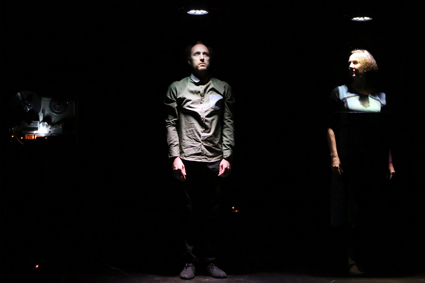
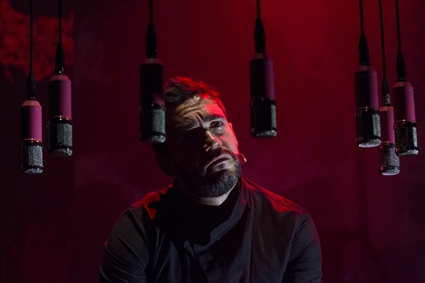
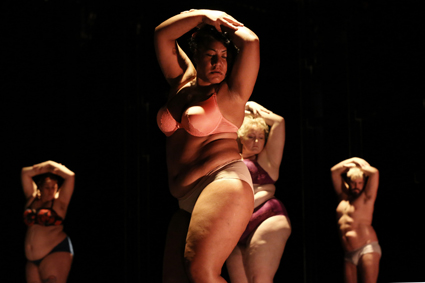
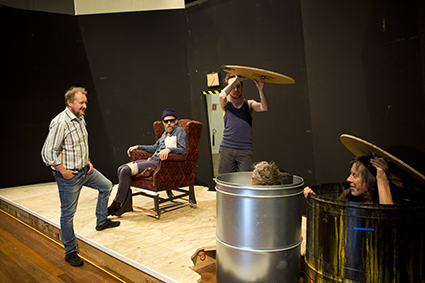
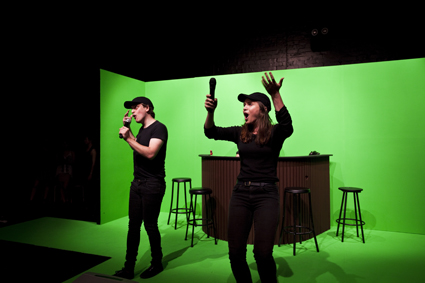
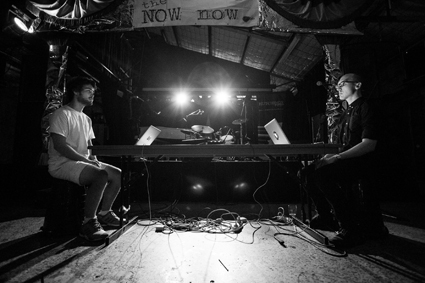
With his Amour–Soundbridge concert, cellist Friedrich Gauwerky ranged widely across the contemporary cello repertoire while exploring the musical ties between Australia and Germany. Gauwerky himself embodies these ties, having lectured in cello, chamber music and New Music at the Elder Conservatorium of Music in Adelaide in 1989–96. He also performed as principal cellist in the Australian ensemble Elision in1990–97.
Gauwerky’s artist’s note pointedly states that “[h]e is a free spirit who knows no national preferences and who feels equally at home in England, China, America and far-off Australia [haha] as he does in his home-town of Cologne.” The Amour–Soundbridge program is less an exploration of international ties than a positive statement of national boundlessness.
Msistlav Rostropovich commissioned Hans Werner Henze’s Capriccio as part of a dozen works for the 70th birthday of the Swiss cellist, conductor and impresario Paul Sacher in 1976. The piece, full of dramatic and structural conceits, including pitch material derived from the letters of Sacher’s name, depicts theatrical scenes, opening with guitar-like pizzicato chords under a sinuous melodic line. Gauwerky imbued the piece’s second movement with an incredible sense of urgency, the leaping melodic line interspersed with moments of double-stopped counterpoint.
The German-born composer Thomas Reiner studied under Henze before moving to Australia, where he now lectures at Monash University. Like Henze, he could not resist the cello’s lyrical capacity. His Three Sketches for solo cello begins with a singing movement utilizing the full register of the instrument. Reiner contrasts this lyrical movement with a grittier one utilizing double-stops and sul ponticello scrubbing. The third movement consists of pianissimo tremolo and light harmonics. These certainly are sketches of the most characteristic modes of the instrument. It would be interesting to explore how they are fleshed out in Reiner’s later chamber works.
If Henze and Reiner’s compositions inherit the cello’s romantic modes of expression, Klaus K Hübler’s opus breve pulls them apart through “action notation.” A kind of tablature separately indicates the bowing, fingering and string to be used on three staves. This form of notation is quite space-intensive, requiring three A3 pages for a piece only a minute and a half long. The benefit of “decoupling” bowing, fingering and string-use in this way is that one can notate complex gestures where each component of the sound moves independently. For instance, Hübler uses trills that are only partially sounded with the bow. Gauwerky emphasises the silent moments of these trills with percussive finger action, while the bow line utilises a range of effects including ricochets at the tip and intense scrubbing. Gauwerky somehow coordinates this ambidextrous explosion of energy.
In comparison with Hübler’s technical virtuousity, Karlheinz Stockhausen’s Amour is a heartfelt, naïvely beautiful outpouring of emotion. Originally written for clarinet and dedicated to one of the objects of Stockhausen’s affections, it was intended to be playable on any melodic instrument, but Stockhausen did not produce a version for cello during his lifetime. Gauwerky arranged it for cello in 2014 in cooperation with the publisher Stockhausen-Verlag. The piece sits so comfortably on the cello that it is hard to believe it was written for any other instrument.
Amour consists of three movements: “Cheer up,” “Your angel is watching over you” and “A little bird sings by your window.” The opening movement is comical, presenting a modal melody that occasionally explodes into angular chromaticism. The second movement alternates a low, lamenting voice with a higher, faster one. The two voices move closer together until they intermingle at the end. The birdsong of the final movement erupts with agile voices across the whole range of the instrument. Gauwerky gave the piece’s final, heartbreaking melody all of the space it needs, breathing deeply between each phrase.
Felix Werder escaped Nazi Germany in 1940 and settled in Melbourne, where he exerted an incredible influence upon Australian musical life until his death in 2012. His Violoncello Solo 1 is a whirlwind of distinct gestures, each beautifully crafted. The piece requires one to give in to the torrent of gesture and forego structural listening. Is this what Gauwerky meant when he said that there was “something very Australian in it”?
Volker Heyn’s Blues in B-flat is the bleakest work for cello I have ever heard. The composer moved to Australia from Germany in 1979. After studying at the Sydney Conservatorium, Heyn worked in a metal factory, the sounds of which Gauwerky likes to think still resonate throughout his music. The “Blues” of the work’s title is to be understood as a “cry of rebellion and despair.” The cello uses a scordatura, or retuning, of three strings in B-flat and one in F. Beginning with shocking sforzandi on two strings, the piece proceeds as a succession of drones including sung pitches, strings played past the cello bridge and drones played with two bows at once. Gauwerky seamlessly introduced and removed a mute from the bridge, smoothly changing the timbre of the drone.
After this incredible tour of Australo-German cello music, Gauwerky returned to where it all began: Paul Hindemith’s Sonata for Violoncello Solo. An encore of the cello solo from Stockhausen’s “Wednesday” from the opera Licht was an unexpected and welcome surprise. The Totally Huge New Music Festival has truly fostered a concert of “cultural significance,” giving Gauwerky the opportunity to share his unique long-term perspective on contemporary Australian and German music for the cello.
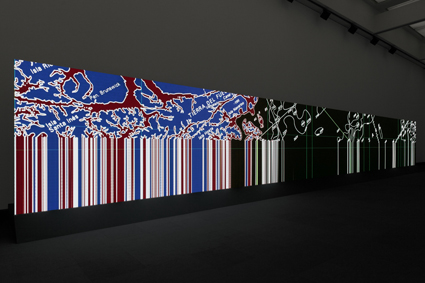
On 13 June, Igneous in Brisbane and Bonemap in Cairns will open Igneous’ FLUIDATA with a live telematically linked performance on the big screen at QUT’s The Block in Brisbane. At 7pm you can see the performance at QUT or witness it via live stream. For the performance time in your timezone, look here. The subject of FLUIDATA is a critical one: water health and sustainability with a focus on the creek systems of Queensland.
How thirsty will Australians have to be and how damaged the land before we recognize that we have serious water problems—in the short term with another El Nino on the horizon, in the long-term with radically changing rain patterns, the lowering of water tables and the poisoning of water by coal seam gas extraction? Very thirsty and the land very damaged, if the Australian Government has its way. In the 2014-15 Budget it announced the shutting down of the National Water Commission. The legislation wasn’t debated, but presumably it’s still on the agenda.
Stuart Khan, Associate Professor in Environmental Engineering at UNSW, wrote, “During the past 10 years Australia’s water management has been focused by the National Water Initiative and overseen by the National Water Commission. This helped many of our towns and cities through the devastating millennium drought and beyond. The 10-year assessment of the National Water Initiative released by the commission confirms the importance of the initiative for water reform” (“Axing water overseer could leave regional Australia high and dry”, The Conversation, 31 Oct, 2014).
Many Australians, especially those living in cities, seem unaware of the impending crisis. The mass media pay inconsistent attention, but Australian artists and a large network of their overseas collaborators do.
Suzon Fuks and James Cunningham describe their new work about water, FLUIDATA, as “an explorable, immersive installation with durational performances.” The pair comprise Igneous, a Brisbane-based intermedia and performance company and the force behind Waterwheel, the ambitious online site dedicated to dialogue and creative expression around the global challenge to water sustainability and health.
Fuks and Cunningham ventured out of Brisbane to discover for themselves the state of Queensland creeks, following them and talking to locals.
Why the focus on Queensland creeks and where did it take you?
We wanted to experience our home state, having travelled a lot overseas and worked with projects internationally through Waterwheel. We wanted to work on a project that combined our interest in mobility, accessible technologies and waterways, and with conscious physical attentiveness to environments. The trip took us 7,500km, we crossed 663 waterways, walking up dozens of them in places as diverse as tropical Cairns, outback Cloncurry, remote Longreach, lush Carnarvon Gorge, and to mining towns like Blackwater and Miles.
“Accustomed to a life of instantaneousness, productivity and ‘getting there’ (the straight line), we made a deliberate decision to slow down, allowing our bodies—and our digital devices—to absorb the landscape and the moment. Unhurriedly, we walked the way of the water (the meander).”
Who did you encounter?
We connected with councillors and artsworkers who organised workshops and participants. Four of the workshops were open to the public and one was for students of James Cook Uni. We stayed with friends, in our van in camping grounds, in council units and in “flash-packers.” We met and talked to locals and travellers in the street and camping grounds. In Cloncurry we had the amazing fortune to be welcomed by a large Indigenous family to events that were part of their family reunion over the entire 2014 Easter weekend, which they titled “Remembering Coppermine Creek.”
What kind of installation have you designed for FLUIDATA?
It’s been designed around the metaphors of “the straight line” and “the meander.” There are three pools of water that reflect projections on black scrims and walls. The creek names, GPS co-ordinates and statistics—collected from all over Queensland—are set to cascade into a narrow channel of water. Visitors who stay a while may detect the incremental movement of precise lines—creek-walk GPS tracks meandering across the walls and corners of the room. The air itself is moved by the rumbling of road-trains meeting the babbling of creeks. In the Waterwheel engine room they can navigate the media centre and in the meditation room lie down and let go—washed over by sounds and images of freshwater textures.
Where will it be installed?
Through QUT Creative Industries Precinct’s Digital Associates Program we have access to The Block, which is a very large exhibition space equipped for large-scale multimedia presentations. The program supports selected artists to realise ambitious projects. FLUIDATA is Igneous’ biggest project to date.
How will audiences connect with the environment you’ll create?
There are multiple ways in which the installation invites visitors to connect to the immediate environment of the space, to their internal environment, to ideas they have about natural environments and to their memories of them. The media showing in one set of large projections responds to the amount of time people spend with them, and the number of people. The media on a meandering line of monitors responds to the direction people move in front of them. Recorded spoken cues (on mp3 players and coming from mini-speakers) guide visitors to bring awareness to their own bodies walking in the space. They can contribute memories to a Twitter feed and freely browse media archives on computers in the engine room.
What’s unique about the installation?
The agency people will have in choosing which elements to engage with and for how long, as well in the way that some elements of the installation will respond in different ways for one person than for a group. Each visitor will have a unique experience as well affecting others’ experiences of the installation.
How will the live performances relate to the installation?
At designated times during the run of the installation, we will enact live, durational, networked performances. In keeping with the installation themes of time and presence, we’ll utilise simple, repeating gestures or movements such as walking in water, or placing a drop of water into the palms of visitors’ hands using an eye-dropper. These actions will be webcast online via Waterwheel’s Tap and projected onto the mega outdoor-screen in the adjacent Parer Place. On the opening night Igneous will team up via video with Cairns-based performance and media group Bonemap at the Centre of Contemporary Arts in Cairns for a collaboratively devised networked performance.
Tell me about Waterwheel.
It was created in 2011 by an Australian team—Inkahoots, Igneous and Suzon Fuks—to respond to the need on a global level to share resources around water awareness, management and celebration. Our international community is growing every year, with more than 5,000 items of media and hundreds of Tap events—networked collaborations using Waterwheel’s multi-webcam streaming and media-mixing system, the Tap. In Linda Carroli’s words (Artlink Vol 34 no 4, 2014), Waterwheel is a “translocal soft infrastructure.”
The biggest set of Tap events to date was the week-long 2014 Waterwheel World Water Day Symposium. Scientists, artists, ecologists, communities and young people responded to the theme “Water Views: Caring and Daring.” Four hundred and fifty participants from 34 countries across 5 continents interacted with a live audience on the Tap and in 18 physical venues or ‘nodes.’ The Symposium focused on integrated youth and inter-generational dialogue with a “Voice of the Future” strand. In 2015, Igneous published an e-book on the Waterwheel World Water Day Symposium with 125 articles with three types of entries, based on presentations given as part of the Symposium: “Splash”—project overviews, “Ripple”—detailed project description, and “Wave”—peer-reviewed articles on original research. The e-book is available for free download.
FLUIDATA
image Igneous
FLUIDATA
Profile: Igneous
Beginning in India in 1993, Igneous grew out of a collaboration between Australian dancer-choreographer James Cunningham and Belgian-born director-choreographer-photographer-multimedia artist Suzon Fuks. Igneous’ interests lie in process, interaction, diversity and challenging values. Early works included video-dance, documentary photography and short stage performances that combined dance with projected media. Body in Question (1999), Igneous’ first evening-length show toured in Australia and Europe. An Asialink residency in South India (1999-2000) provided an introduction to the grounding, rhythmic and fluid traditional martial artform Kalarippayattu, the basic forms of which Cunningham and Fuks adopted into their daily physical practice. In a residency at Brisbane Powerhouse (2002-4), they developed a serial installation performance that unfolded over seven nights throughout the site. Performance works include The Hands Project (2001), Thanatonauts (2004) and Mirage (2007). International residencies and tours enabled the artists to collaborate on co-productions, including Liquid Skin with Figuren Theatre Tubingen for the Theatre der Welt Festival 2005. Their interest in alternative use of spaces, the distribution of media and audience engagement led to them researching networked performance and developing their practice online.
FLUIDATA opening 13 June, 6pm; performance at The Block 7pm and via live stream here. For the performance time in your timezone, look here.
Igneous, in association with the QUT Creative Industries Precinct Digital Associates Program, FLUIDATA, The Block, QUT, Kelvin Grove, Brisbane, 13-20 June.
Bonemap is a creative partnership between Cairns-based artists Russell Milledge and Rebecca Youdell. Since 1998, the pair and their collaborators have crafted creative projects that vividly and immersively integrate contemporary choreographic performance, media, site, visual art and audience interactivity. The video of the one-on-one performance Nerve Engine (2013) that accompanies this profile, in which an audience member and dancer Youdell interact, face to face and technologically with adapted iPods, offers evidence of Bonemap’s ambitions and its capacity to engender rich imagery, movement and engagement.
The challenge for an innovative company based in tropical far north Queensland is to stay connected with its peers across Australia and overseas. Bonemap has achieved this through residencies and performances in Eastern Australia, Asia and Europe with which it has built invaluable networks. It has also been regionally active, impressively drawing together local dancers and a range of visiting artists.
Bonemap sees this evolution as being bolstered by adaptability and “shape-shifting,” producing public art commissions, brokering partnerships to present an annual dance program (New Move Network 2011 and now 2015-16), curating artists into collaborative teams, designing productions, curating visual arts, producing graphic design, writing articles and co-producing festivals (On Edge Contemporary Media+Performance festival, 2005-2009).
Rebecca Youdell, Russell Milledge, Bonemap, 2000
Vision
Youdell and Milledge write that, working regionally “is about being on the edge, on the outskirts, and this has been a particularly interesting and creative space for it to inhabit, our projects probing the conceptual layers of the body’s relationship to the environment, often by engaging in durational projects where the journey to remote locations feeds creative development. New media and visual communication skills have been important elements in bringing these exploits to wider public attention.
“The action of dance in the environment is extreme, ephemeral and evocative. This is made even more palpable in the far northern tropics by the proximity of Aboriginal and Torres Strait Islander culture. There are two remarkable dance festivals that occur bi-annually, the Laura Dance Festival in Cape York and the Torres Strait Islander Cultural Festival on Thursday Island. For many of these artists from homeland cultures there is a clear integration of dance, music and visual arts, and this continues to be an area of insight and growing awareness for us.”
Bridge Song, 2003, performer Rebecca Youdell
photo Russell Milledge
Bridge Song, 2003, performer Rebecca Youdell
Hybridity, perspective & plasticity
The company describes its aesthetic discipline as “a hybrid mesh of performance and media arts framed by an overarching ecological philosophy placing the context of our creative practice in the environments we inhabit and often ignore. Bonemap’s hybridisation is a rupture, crossing between gallery, theatre and alternative platforms, and is a natural response to engagement in an intermedial creative ecology.” Its works are “creative ecological acts…artists create using a variety of artforms through a process that becomes the artwork. An interest in intuitive design and interfaces guides the work.”
The environment which Bonemap inhabits—“one of the only locations where the reef, rainforest and savannah all meet”—has imbued its artists with an appreciation of “the ephemeral nature of performance, in that it leaves little human impact on the earth.”
Habitus Habitat, 2006, performer Rebecca Youdell
photo Russell Milledge
Habitus Habitat, 2006, performer Rebecca Youdell
It’s not surprising then that Bonemap likes to challenge the perspective of the viewer with theatrical and technological illusion, to “fracture reality,” to change perception and develop empathetic responses to the environment. But to do this requires the company to ask important questions about the experience of technology in its ”reflective practice”: “Where does audience attention lie or go? Is the audience more cerebral and less physical because of the sedentary nature of paying attention to a screen? The more it interacts virtually is it interacting less on the physical plane? Can we engage an audience through virtual and physical space spanning distances between worlds?”
Bonemap posits that “in creating simulated environments conducive to authentic movement, participants engage in spontaneous expressive movement exploration in or with the interface. There is a constant switching from passive to active viewing, which induces a heightened spatial awareness of self, and a more internal sense of the spatial, physical and conceptual relationship.”
Milledge and Youdell find support for their approach in Norman Doige’s notion of neuro plasticity: “the brain is structured by its constant collaboration with the world, and it is not only the parts of the brain most exposed to the world, such as our senses, that are shaped by experience. Plastic change, caused by our experience, travels deep into the brain and ultimately into our genes, molding them as well…” (The Brain That Changes Itself, 2007).
Nerve Engine, 2014, Performer Rebecca Youdell
photo Tai Inoue
Nerve Engine, 2014, Performer Rebecca Youdell
The artists extrapolate: “Human plasticity provides potential for interactivity and dance in that we are making intuitive body/mind design interfaces, art, to facilitate transformative experiences, while participating in social, political and cultural dialogue. Humans are not hardwired. Exposure to what we creatively produce influences the development of the body and human endeavour.”
Bonemap in 2015
New Move Network
Bonemap has brokered the New Move Network 2015+16 (NMN), a consortium of independent dance artists in partnership with Ausdance Qld, Centre of Contemporary Arts Cairns (CoCA), James Cook University (JCU) and Nintiringanyi training centre. Extending the touring program NMN will conduct interviews and create critical writing about local/national practitioners and will document artwork/residencies over the two years. The program includes touring works and works in development with the support of the Australia Council’s Creative Australia initiative and Arts Queensland.
Bonemap and Igneous’ FLUIDATA
As part of NMN 15+16 Bonemap is collaborating with Brisbane’s Igneous on FLUIDATA with a collaborative big-screen performance via telematic linkup between Cairns Centre of Contemporary Arts (CoCA) and QUT’s The Block and accessible on www.water-wheel.net on June 13.
Bonemap & Clocked Out
Bonemap and Brisbane new music duo Clocked Out (Vanessa Tomlinson, Erik Griswold) are collaborating in a residency at the CoCA Theatre, 21-25 September to develop a new work, Time Crystals. The project takes as its starting point a recent discovery in physics of strange, perpetually moving particles called time crystals or space-time crystals. Using prepared piano, percussion, movement, mirrors, video and media, the collaborators will explore complex repeating patterns, circularity and crystalline shapes to create an immersive live performance event.
Solo Science Festival & DANscienCE
Bonemap will participate in Solo Science Festival and DANsicenCE, a Dance and Science Festival 20-22 August during National Science Week. The event is being hosted by QUT Creative Industries, where established choreographers will present short solos as part of a program with a wide range of scientific inspirations. RT
Once again the Seymour Centre is host to the wilder and weirder dimensions of Vivid Sydney’s popular festival of music, sound and light with a concentrated program explorating the bristling nexus between music and computer interactivity with artists and audience at play in Musify+Gamify as well as encountering new envisionings of the Gothic, the recorder, double bass and electroacoustics in New Wave Sound.
Musify+Gamify
Musify+Gamify—two concerts and an exhibition–promises to take us “where music play and game play meet.” The works in the program will feature local and overseas artists “reflecting on their relationship to musical and gameplay experiences.” Artists include Ensemble Offspring, Robbie Avenaim, Chris Abrahams, 7Bit Hero, Alon Ilsar and game composer David Kanaga.
The audience will have its part to play with ‘gamified’ participation in the music making. In the Seymour Centre’s foyer there’ll be a series of free “musifications and gamifications, videogames, generative music and contemporary and interactive experiences” with works by Kanaga, Lucas Abela, Michaela Davies and The Futile Research Lab.
Oliver Bown, a Postdoctoral Fellow in the Design Lab, Faculty of Architecture, Design and Planning, University of Sydney is co-curator of Musify+Gamify with Lian Locke, Senior Lecturer and Director of Master of Interaction Design and Electronic Arts in the same faculty. I spoke with Bown about the program, some of its artists and the innovations in interactive design they represent.
Where does your interest in interactive design come from?
My roles as electronic musician and researcher have over the years grown more closely aligned so my practice is as a kind of software based generative and interactive systems developer for creative applications. Gaming is part of a scenario in which interactive music is being thoroughly explored and developed in a range of scenarios and that includes contemporary classical music approaches to incorporating game elements in a score.
What excites you about the field of interactive design?
My interest in computing is closely aligned with ideas of cognition and life. Some of my training was in the field of Artificial Life, which is looking at how you can simulate life-like behaviour in machines. When you’re designing digital systems you’re not only designing their form, you’re designing their behaviour. The challenges of designing behaviour are immense and fascinating and there’s a lot to be done and music is a particularly exciting area to be doing that in, looking at the way that an interactive music system might simulate human-like musicality or maybe ecosystem-like complexity.
Robbie Avenaim with SARPS 2
photo courtesy the artist
Robbie Avenaim with SARPS 2
Some of the artists in the program are familiar such as Robbie Avenaim and Ensemble Offspring. Who are 7bit hero?
I’m a big fan of Sydney improv and experimental music. Coming from London, I’m constantly satisfied with how great the scene is here. But I’ve gone to town to really mix up the program. 7bit hero from Brisbane are towards the pop end of the spectrum, coming from a very different perspective than the Sydney new music crowd. They caught my interest because their live performance involves getting the audience to log in on their phones and interact with a game the band has made appearing on a screen while the musicians perform.
Tell me about air-drummer Alon Ilsar.
He’s a Sydney-based drummer who performs improvised music. His focus, which is also his PhD research, is on an electronic air drum system—AirSticks, http://www.rollerchimp.com/project/airstorm/ a pair of hand-held devices that you can swing around, a bit like the Nintendo Wii controller but a more hi-tech version. It might sound simple but it’s actually a quite complex gestural interface to an electronic instrument that allows him to do percussive but also gestural, continuous-time control of the sound. It’s a really interesting tool for performance, a games controller he’s appropriated. You go beyond the excitement of seeing a weird new instrument to see that he’s really worked up a virtuosic talent in performing with it. In the new digital music world it’s rare to see someone who actually perfects the art of performing with the machines they’ve made.
Alon Ilsar, Air Sticks
photo courtesy the artist
Alon Ilsar, Air Sticks
The works of gaming composer David Kanaga are part of your program. He’s based in California. He’s not attending but he’s delivering us an interactive system with its own electronic music but it’s also going to be performed with Austin Buckett on piano. David Kanaga is becoming very well known as an indie games composer where the games he works on are strongly music-focused. There’ll be two of his games in the exhibition. One of them is an award-winning Proteus, created with Ed Key, that takes you on a classic first person journey. But it’s completely stripped back in terms of game action; it’s all about a journey through an immersive landscape with music really tightly and very beautifully integrated. Trees sway, creating sound, forming part of a musical construction. The other work he’s developing on commission for Musify+Gamify is a concert piece—a game that becomes a performance.
In what ways can the audience engage in the foyer exhibition?
A couple of works are regular games, so you pick up your controller, play and get immersed. We’ve got films documenting existing projects that we couldn’t present. One of those is a composition designed to be delivered in a forest with a multi-speaker interactive music system—an example of using technology to better adapt a musical experience to a site-specific context. The other film covers making a car control the music that’s playing back in the vehicle—as you’re driving the car modifies the music. Both of these are quite new experiments in thinking of music in a more flexible way.
Then we have a Lucas Abela piece, a pinball machine which is a madcap kind of heavy metal game with real guitars and a Fender amp built into the deck that produces a soundscape. Lucas is a Sydney-based artist who’s built a series of pinball machines, all based on quite different themes. As he describes it, the point of making these games is that people have no inhibition about playing a pinball machine. You don’t worry about your skill when you’re just hitting buttons. So it’s a way to draw people in to engage in musical creation. The other thing I like about what he does is that his machines are quite haphazard in their construction, referencing a history of older mechanical music.
There’ll be an opening night performance of Mobile Phone Orchestra in the foyer by Andrew Bluff aka Rollerchimp who has the audience download an app to their phones with which to enact a live performance—an orchestra of mobile phones. Mobile Phone Orchestra won Special Prize for Crowd Art at the 2013 ZKM AppArtAward, Germany.
As well as a forum on the future of music, Musify+Gamify is publishing a catalogue with essays by artists involved in the event and others, including a piece on video game music by Jon Rose who’s away touring and being interesting in Europe.
New Wave Sound
Sydney composer Andrée Greenwell (Dreaming Transportation, The Hanging of Jean Lee, Venus and Adonis) ventures into the perennially plundered dark side of our natures embodied in the beak and sometimes bloody beauty of the Gothic (the concert’s title too), composing scores for string quartet and voices (Greenwell and soprano Julia County) to poems by Edgar Allan Poe, Hugo Race, Alison Croggon, Felicity Plunkett, Maryanne Lynch and Hilary Bell to images by UK-based Australian media artist Michaela French (Lucy Guerin’s MELT) with cinematic/electro sound design by David Trumpmanis.
In further concerts, the double bass is featured in Music for Double Bass with Red Planet by Elsen Price and Unnamed Work by Andrew Batt-Rawden; Senex et Sonis: Old Sounds focuses on the recorder as a contemporary instrument; and in Bridge: Electroacoustic Review sees acousmatic composers Daniel Blinkhorn and Rob Evans present media sound works “exploring their relationship with the intricate technology of the human ear.” RT
Vivid Music @ Seymour, Musify + Gamify Concert 1, Ensemble Offspring (composers Julian Day, Cor Fuhler, Damien Ricketson, Steffan Ianigro) Robbie Avenaim & Chris Abrahams, Michaela Davies Alon Ilsar Lucas Abela, 29 May; Musify + Gamify Concert 2, 7bit hero, Austin Buckett (with interactive AV work by David Kanaga) Paul Heslin, The Infosthetic Orchestra, 30 May; Musify+Gamify Exhibition, Lucas Abela, Michaela Davies, Stephen Barrass, The Futile Research Lab, Frank Feltham. Videogames: Papa Sangre II, Proteus, Dyad. 27 May-6; New Wave Sound: Gothic, 27-29 May; Music For Double Bass, 28 May; Senex et Sonet, 29 May; Bridge: Electroacoustic Review, 30 May; Seymour Centre, Sydney University
Held every two years, and celebrating 40 years and 20 festivals in 2015, the Castlemaine State Festival is a vibrant cultural event that takes over the small goldmining-era town in regional Victoria. Many musicians, artists, writers and theatre-makers live in town, and this year almost 200 of them featured prominently in the program, inhabiting 20 newly commissioned works along with performers from Cuba, Cambodia and South Korea. A new festival hub was set up in the previously abandoned Castlemaine Woollen Mill bringing the sense of a central meeting-place (and, crucially, bar) missing from the last festival.
In Plan
graphics David Lancashire
In Plan
Michelle Heaven, In Plan
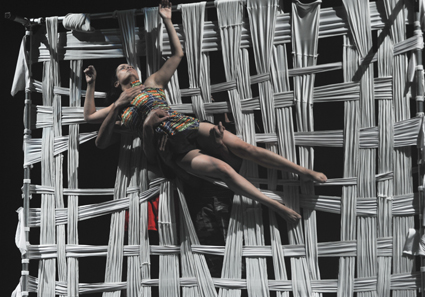
[SPOILER ALERT: IN PLAN WILL DOUBTLESS REAPPEAR IN COMING YEARS. BYPASS THIS REVIEW IF YOU WISH. EDS] After the first day of performances, people are fighting for tickets to Michelle Heaven’s In Plan; the moment I walk out, I buy another ticket. It’s a tricky show to write about because the best thing about it is not knowing what’s coming. But I’ll have to lead you in. As you walk into the dark, you’re given a numbered ticket while you put your shoes under a chair. The number correlates to one of a spiral of numbers up to 20 surrounding a large dark and curtained structure. You lie down and already the audience is getting nervous—My feet stink! I’m wearing a short skirt!—and put your head under the dark curtain, looking up. All our heads are gathered together in the round. It is quiet and meditative. A person next to me says, “If nothing else happens now, I’ll be happy.”
As Bill McDonald’s soundscape shakes us, the performers (Heaven, Xanthe Beesley, Caroline Meaden) appear suspended above. I look for the cables, the ties holding them there, but there’s nothing. I’m afraid for them and us and wait for the fall. It’s like watching through a telescope, then kaleidoscope as bodies shift and distort in the small space. Silent, flickering, feet and hands. I feel literally suspended in disbelief. Then the plot thickens: a woman and man in love are tunnelling away from East German soldiers with jittery hands and elongated legs. The dancers’ bodies appear magnetised to the floor above—or is it below? They do not hang, and various floors slide over and between them, slippery spaces of silk (they’re building a parachute to escape) and then we’re in the sky, a naked woman revolving slowly through cloud, like a clock about to stop, falling or rising through the sky; it’s hard to tell. The sound rumbles through the tunnel and it’s as if we are both above and beneath ground at the same time. It’s exquisite to watch, the narrative clear and propelling, and it’s only when I sit up at the end that I realise I am dizzy, because I’ve held my breath for 20 minutes, entranced. It’s a show that I’ll keep with me as a precious object, a dreamscape (design Ben Cobham bluebottle; graphics David Lancashire) perfectly brought to life.
Jack Charles, Going Through
Aboriginal actor and elder Jack Charles, instrumental in setting up Nindetahana, our first Indigenous theatre group in 1971 with Bob Maza, was once imprisoned in Castlemaine Gaol. Local playwright John Romeril brings him back to town with Going Through, a play set and performed in the prisoners’ exercise yard. Its archway door opens to let the characters escape the prison, the wind blowing drought dust into our faces, and the icy drops of a storm fast approaching. The play starts as a two-hander, ex-cons on the run, freewheeling and farcical. But from the beginning, there’s no sense of the jail we’re standing in, or Charles’ place within it, as he struggles with the twists and turns of the play’s language. The tone of the performance is uneven too. While the sun setting on Lisa Maza singing opens the night sky as we look up beyond the walls, halfway through the performance she starts narrating in third person, a shift that seems forced and deadens the action, bringing us back to ground. Local actors James Benedict and Sue Ingleton ham it up (and there’s much laughter to be had from insider knowledge: James’ character works on the railways, while James himself once served coffee at Castlemaine railway station) but there’s a sense that the play lacks the contemporary sensibility it needs for this kind of festival.
At one point, when video imagery on the prison wall whisks us down a freeway (evoking the long-distance road trips we experienced as kids), the characters sit in a car and Ingleton mimes driving, curiously Play School, but we already know we’re travelling. There is a courageous moment, though, as Charles delivers a eulogy for his male lover at a funeral, delivered via video link on the wall. While I’m uncertain as to why the moment is not conveyed in person in front of us, it’s the most eloquent of the writing and performance, as Charles talks of his despair and love and relays an Aboriginal story of the first break of dawn, how the world was originally darkness and the magpies poked holes to let in the light—a moment that is truly transcendent.
Kekkai, Castlemaine State Festival
photo Pia Johnson
Kekkai, Castlemaine State Festival
Kekkai: Beyond Fixed Boundaries
Kekkai: Beyond Fixed Boundaries is also about going through: defining barriers or forcefields, the line between dream and reality, between sky and earth. The collaboration between Nottle Theatre (South Korea), Tony Yap Company (Australia) and audio artists Madeleine Flynn and Tim Humphrey pushes the audience to consider the quiet spaces and what divides them, what shuts us in and out. Four performers—Yap, Soyoung Lim, Euna Lee, Junghwi Park—dip their hands into a cylinder of blue, a ritual of washing, cleansing, longing. Korean words—low, urgent, disturbed—erupt from them. There’s the occasional English—“Where do your memories come from?”—but we are unsure if it’s direct translation. Strings hang suspended (woven into the frame of the Woollen Mills space), balancing the bodies of the dancers as they play with tension—marital, familial and sexual always poised. Tony Yap takes tiny steps in a lingering circle around a live piano wire that vibrates as he moves (linking with an art installation Loomusica nearby, a weaving of string and wool and suspended objects that plays sounds and creates music as you pull on them).
While at first the Korean women seem inert and passive, lounging around, they gather strength in small steps, until one races around the outskirts of the circle, feverishly, as if she can’t possibly go faster, desperate before she collapses (in Japan, kekkai stones often guard Buddhist temples, advising women not enter). Centre-stage is a circle lined by fragments of rock which, in a dramatic eclipse, Tony Yap smashes, kicking the circle line to the edges of the floor. Later, he completely covers a woman’s body with his, lying on top of her as if in mirror image, echoing the bodies of the lovers in In Plan.
Klare Lanson, #wanderingcloud
In the same room, days later, Klare Lanson’s #wanderingcloud takes on its next incarnation (see review, RT118), helped by a new space that focuses the project onto surround-screens and the isobars on the floor that Lanson tiptoe-traces as they curve around her poetry. The local audience, knowing all too well the power of floods and fire, have been creators too, with Lanson conducting trickle-down interviews, working from person to person, moving through Newstead, Carisbrook, Campbells Creek and Guildford, recording narratives and mapping disaster zones—and in the performance guitarist Neil Boyack, soprano Andree Couzens and performance artist Kathrin Ward also provide local presence. As Lanson does her final rehearsal, Brisbane-based Clocked Out percussionist Vanessa Tomlinson pours rice into cups, calling for calm and contemplation before the increasingly rare rain on the corrugated iron roof above drowns out the effect.
Wearing her “Don’t Talk To Me About the Weather” badge and floodline skirt, Lanson looks to the heavens for support. Hers is a project that, with festival and crowd-funding, continues to push the limits of poetry and performance, making a space for new writing, a space that’s contracted almost to the point of non-existence (in a shift from 2013, there was no writers’ program at this year’s festival).
While the standard of visual arts and performance can be high, there is also a great sense of small-town community at the festival, most of the people in the area turning up for the opening night at Western Reserve and a series of stages in Victory Park offering the best of clowning, vaudeville, acrobatics and bad 80s dance (a local joke says that Castlemaine has the most clowns and PhDs per capita in Australia). If you look closely, there’s something Portlandia about Castlemania (that’s the Facebook group for locals) and the festival; its eccentricity and inter-cultural exchanges capture the freewheeling spirit, and occasional unease, of what it’s like to live in a country town that’s changing fast.
Castlemaine State Festival, Castlemaine, Victoria, director Martin Paten, 13–22 March
Amelia Jones is an American art historian, critic and curator who specialises in feminist art, body and performance art, video art and Dadaism. Courtesy of Sydney University’s The Power Institute with Sydney Ideas she’ll present a lecture on materiality and performance on 2 June.
Amelia Kelly of the Institute at the University of Sydney, the host for the lecture, tells us that Jones “has been working in the area of body/performance-based art for over 30 years, writing extensively on body art. We asked Kelly about the significance of her thinking, particularly in respect of feminism and body art, and its relevance to artists and audiences.
What is the importance of Jones’ thinking? Amelia Jones’ theoretical discourse is significant for its identification of body art, and the discussions that form around it, disrupting dominant ideas surrounding both the corporeal body and external manifestations of internal psychologies, as well as normative values of the art world. Through its intersection with new technologies and new modes of documentation and dissemination from photography and video to online platforms, critical debate on body art also increasingly helps renew global discourses on identification and the ‘making visible’ of bodies that sit outside the dominant norm of contemporary visual culture.
What has Jones to say about body art in particular? For Jones, feminist body-based art and ‘the embodied female subject’ has the capacity to address a diverse range of very real issues concerning age, race, colour, sexual orientation and gender identity—issues faced not only by women, but by people of all genders. Jones’ re-evaluation of body artists such as Hannah Wilke (1940–1993) for instance—whose early work was often derided by critics for ‘letting feminism down’ due to its seeming perpetuation of dominant modes of femininity (Wilke famously used seemingly glamorous images of herself. Eds)—acts as critical reinforcement. Jones’ reading of Wilke’s nuanced exploration of female sexuality is that it both draws attention to the history of women’s sexual objectification and concurrently re-claims space from the traditional domain of male sexual desires to express female erotic pleasure. Jones interprets Wilke and similar body-based artists as presenting “pro-active rather than re-active feminist subject[s],” a position that is very much in line with new feminist thinking as it intersects with queer theory. Jones’ work expands our appreciation of the complexity of self-identification and desire, and emphasises the relevance of transgression and the active complication of assumptions in relation to gender identity and sexual orientation.
Is Jones’ commentary particularly relevant at this time? The Power Institute’s role is to connect people with new ideas and theories in the realm of art and visual culture. Amelia Jones’ Power lecture will focus on the works of several important contemporary body-based artists including Heather Cassils, Juliana Cerquiera Leite, Barbara Smith and William Anastasi, to explore how these artists bring their artwork into material, tactile reality.
Mediating her ideas through these artists’ practices, Jones proposes an alternate mode of approaching art which takes account of the process of “making the body materialize,” offering a new way of considering the radical construction of body diversity. As we are constantly exposed within broader media culture to incredibly narrowly defined notions of the physical form, Jones’ talk is a timely examination of how contemporary art can contest notions of the body and gender. More broadly, it helps to introduce new ways of thinking through the problematics associated with the mediation of subjectivity from artist and audience.
Finally, given that Amelia Jones is at the forefront of historic readings of feminist and performance art, her writing on Marina Abramovic (“The Artist is Present”: Artistic Re-enactments and the Impossibility of Presence, TDR: The Drama Review, Spring 2011, Vol. 55, No. 1)—who will be visiting Sydney in June this year as part of her Pier 2/3 residency project—should be recommended reading for artists, writers and all those interested in performance art in particular and body art in general.
Profile
Amelia Jones, the Robert A Day Professor of Art and Design and Vice Dean of Critical Studies is a feminist art historian, a scholar of performance studies, and a curator who has taught at McGill University (Montreal), University of Manchester (UK) and University of California. Her publications include books and essays on feminist art and curating including Body art/performing the subject (1998), Feminism and Visual Culture Reader (editor; new edition 2010), Marina Abramovic (in TDR) and on performance art histories. Her book, Self Image: Technology, Representation, and the Contemporary Subject (2006) was followed in 2012 by Seeing Differently: A History and Theory of Identification and the Visual Arts and Perform Repeat Record: Live Art in History, co-edited with Adrian Heathfield. Her exhibition Material Traces: Time and the Gesture in Contemporary Art took place in 2013 in Montreal and her edited volume Sexuality was released in 2014 in the Whitechapel Documents series. Her new projects address the confluence of ‘queer,’ ‘feminist,’ and ‘performance’ in relation to the visual arts.
Amelia Jones lecture: Material Traces: Performativity, Artistic 'Work,’ and New Concepts of Agency, Lecture Theatre 101, New Law School, Eastern Avenue, University of Sydney, free, 2 June, 6:30-8pm
These reviews are the result of a RealTime intensive, first-stage writing workshop for four participants held 1-3 May in Albury-Wodonga in conjunction with Murray Arts and HotHouse Theatre and conducted by RealTime Managing Editors Virginia Baxter and Keith Gallasch.
James Smith, This Is Where We Live, a HotHouse Theatre and State Theatre Company of SA co-production
photo My Wonderland Photography
James Smith, This Is Where We Live, a HotHouse Theatre and State Theatre Company of SA co-production
Kate Rotherham: Poets In Trouble
A gigantic concrete pipe, reinforcing mesh protruding from its smashed edges and two broken chunks scattered at the forestage, is revealed through a smoky haze. There’s an almost apocalyptic feel as teenage Chloe, in cut off denim shorts over black tights with a checked shirt tied around her waist, saunters onto the stage and hits the audience with a bold torrent of rapid-fire shards from her life. We are instantly pulled into her world and held there in her unflinching gaze.
Chloe (Matilda Bailey) is new to this dead-end town, brought here unwillingly by her emotionally absent mother who has moved in with yet another new boyfriend. Beneath Chloe’s tough exterior lies a complex collision of physical, social and educational disadvantage and a well of unmet needs. Her edgy displacement comes on top of her oceanic grief for her dead father. The ying to her yang is Chris (James Smith), classmate and slightly less-wounded poet. They fall in love against a pervasive backdrop of bullying and hardship and search for a way out.
Playwright Vivienne Walshe has said that she dislikes both the direct nature of language in theatre and the usual delivery of poetry (Time Out, Sydney, 21 May, 2013). Her unique solution is to keep the language fast and tight where the characters reveal themselves to us in gutsy poetic bursts. Chloe’s jagged self-reflections give voice to her bleak inner world. Her dialogue is an energetic mix of flashbacks and present realities with words cleverly substituted for sound effects: “Pad pad, pad to my room.” Chloe shares every thought, mood and movement with us, drawing the audience deeply, and sometimes uncomfortably, into her dark and chaotic life. We watch for signs of hope to sneak in through the cracks as she explores the potential catharsis of Chris’ love.
Walshe offers us kaleidoscopic fragments of language and character to piece together as we can. There is a deep love of language at the heart of this play, challenging us to listen carefully for subtle changes in whichever of the two characters is telling the story. We must stay alert and gather the clues before they scatter and are lost. On top of the internal thoughts and verbal sound effects, the characters question and answer themselves, simultaneously quoting teachers and parents and school bullies. There is a pulse to the language; it is instantly evocative and powerfully rhythmic. After some measured praise from her mean teacher—who’s also Chris’ father—she says, “He’s taking the piss. If he’s taking the piss I will hang myself from his front door. He’s not taking the piss out of me. I stare out the window, watch kids playing handball. I am quietly, quietly, and I hope you’ll keep this one on the down and low. I am quietly bursting with joy.”
Initially Chris and Chloe observe each other, orbiting each other’s worlds while speaking in parallel snippets directly to the audience. As their relationship develops their dialogue also becomes more connected and more directed towards each other. At the high point of their brief union they speak to each other, facing to face as the armour on both sides falls away, before being rebuilt. It’s a cleverly choreographed dance of text, personality and plot as the performers inch closer to themselves and each other.
For all its energy and momentum, the play carries a heavy sense of stasis. Chris and Chloe are locked into this hostile town in the same way their parents are locked into their dysfunctional relationships. Chloe condenses it to its essence when she says, “There’s a place here in the conga line of listless souls with my name on it. Reserved me a seat and everything. Where we live while you hate us.” There is a gnawing sense that nothing can improve here and any possibility for new beginnings will need to be sown elsewhere, far away from here.
We see their decaying family lives up close. Chris’ bullying father and alcoholic mother are a particularly ugly combination of regret and disdain. There’s almost inevitability about the violence between Chloe’s ineffective mother and her new man. Chloe retells it as, “Crash. Oh no! Here we go. Mum spilt the coffee on the lino. Hear them in the kitchen start the funeral march. I’m sorry sorry Brian.”
Playwright Vivienne Walshe has cast her thematic net wide in a layered play about struggle and identity with domestic violence, grief, bullying, emerging sexuality, disability, learning difficulties and disadvantage masterfully woven into the narrative. There is a unique poetic brutality to Chloe, and we glimpse the exposed scaffolding of her vulnerabilities as she shifts away from her default defiance. In one especially powerful scene she is forced to read in front of her class and as she stumbles and falters with her reading we see her bravado fracture. All too aware of her shortcomings she will later ask the well-read Chris, “What’s a poet got that a dyslexic can use?”
Matilda Bailey is superbly sure-footed as Chloe, striding seamlessly along the wide spectrum of internal and external thoughts and moods. We watch her crack open and close over again, as her grief simmers ever closer to her fragile surface. James Smith skilfully takes the character of Chris on a transformative journey from the slumped, painfully shy “Odd-Boy” in his over-sized jumper to an increasingly confident boyfriend who dreams of rescuing “Chloe of the Underworld” from her tormentors and perhaps from herself. The brilliant duo has been expertly directed by Jon Halpin in this complex and densely-packed performance.
Andrew Howard’s musical score of subtle bass booms and intermittent chimes works below the surface, letting the poetic, at times frenzied, text carry the story unimpeded. Scott Howard’s changes of colouring highlight postural shifts, allowing us to zoom in on Chris and Chloe as they circle each other, and any possible future they may have, around the broken pipe.
This Is Where We Live is a beautiful poetry-slam of identity, violence and neglect with a swirling undercurrent exposing the darker truths inherent in staying where you are.
Kate Rotherham is a writer living in north-east Victoria. Her award-winning fiction has been published in magazines, journals and anthologies, including The Best Australian Stories. Her short plays have been performed locally and in Sydney and on the GoldCoast. www.katerotherham.com.au
Matilda Bailey, This Is Where We Live, a HotHouse Theatre and State Theatre Company of SA co-production
photo My Wonderland Photography
Matilda Bailey, This Is Where We Live, a HotHouse Theatre and State Theatre Company of SA co-production
Ruby Rowat: Hit me
We’re in the derelict gutter of a desolate underworld. A disused storm-drainage pipe, nearly the size of a caravan, sits burst, grounded on the stage, its jutting steel latticework brutally exposing random jagged ends. A sense of congestion; violently displaced flow. Two hunks of the concrete pipe, steel skeletons awry, have conveniently landed either side of the pipe which is big enough to run through, but, like the harsh, thwarted life of teenager Chloe (Matilda Bailey), there is no flow; no clear route to follow.
We are thrown into Chloe’s reality; it’s her play, the text is her story, miraculously containing all the brittle shards of her life. There is nothing soft or caring in this world. We are put on edge and held there by the masterfully crafted, densely metaphored, race-pace poetry of the script. This barrage of dexterous language demands our attention. There is no rest. No pause. Chloe’s unstable victim mum, sustained constant and irregular humiliations, jabs of physical threats and violent hits. Constantly on the move, new town, new abusive man. Everything seeps into and disrupts everything else, so Chloe’s unsafe home life is right with her in the high school classroom, sabotaging her potential brilliance. There is an adolescent strength and defiance in her character: she is at once a verbosely articulate, self-aware all-seeing know-it-all in her personal narrative, but shattered when she’s put on the spot in class and can barely string together syllables.
Chloe’s “I hear them in the kitchen start the funeral march” sets up the inevitable violence about to transpire. When she’s hit by her mum’s boyfriend, her sense of “…I know where I am. …This is intimate,” was initially foreign, even repulsive, until I related it to the excruciating pain of aliveness when a loved one dies. Definitely a disturbing shock for the audience in this pivotal moment.
Chris (James Smith) brings with him a whole other brand of familial dysfunction, along with a degree of respite from frenzy, with the more measured pace of his delivery. Another, if less wounded poet, an “Odd-Boy” awkward introvert, Chris’ romantic imagination posits Chloe as a limping heroine, a Eurydice for him to rescue. Without specifying the cause of her disability, he describes the limping Chloe as “my one-legged bovine” and her schoolmates taunt her with “spina bifida, spi spina bifuda.”
The clever use of third person pronouns as Chloe and Chris speak of each other, even as they relate in real time, sets up a self-reflective distance between them, in contrast to their emotional proximity. Similarly, their physicality is akin to capoeira dance, without the acrobatics; mostly, they don’t make actual contact. The one time they do hug, it’s that much more powerful.
Rural images—”one legged bovine,” “strictly bucolic,” “classmates in the cattle yard,” “out to pasture”—grimly locate the characters in a regional town. But in a beautiful night-sky moment, Chris lounges against the storm-water pipe, as if leaning against a haystack in a field, while Chloe, at a distance, is lit such that her shadow lies next to him. A deftly woven contrast: fantastic tranquility transposed onto the stark reality of the contorted gnarly pipe and the daily havoc of the teenagers’ lives.
We learn that the “river hasn’t flowed here for three years.” Despite the torrential pace of the performers’ delivery, we are struck by an overall sense of stagnation. Hope is won incrementally. I was initially a bit confused at the abrupt ending of the play. However, given a chance to reflect, the last scenes undeniably move toward healthy prospects coming from a final distressed desire for interaction—”Swivel”, Chloe pleads, across the vast psychological distance from one side of the stage to the other where Chris sits, never turning to look—to an easeful reading of a poem that (finally) acknowledges her father’s death. Then she tells us, “Railway sleepers stand where my spine used to be.”, revealing, metaphorically, that it’s as if an operation for her deformity has straightened her out, allowing her to escape, ultimately to flow: “The train arrives, passing thru my body.” She is transformed: “My whole body shakes…And I’m not afraid. Of what’s coming,” releasing us from the play’s anxious stranglehold into an optimistic potential for life.
Matilda Bailey’s mastery of Walshe’s language is matched by her gestural agility. Each lighting cue, every shift in the script, is accompanied by succinct adjustments in body language. James Smith’s expertise is evident in the unfurling of his hunched-over posture during moments of love or when he strides atop one of the shards of concrete, bright light delineating for us an iconic image of a soldier’s heroic stance, his body and arms all action. Andrew Howard’s spare pulsing music sustains intense emotional moments.
I enjoyed Walshe’s graphic imagery in a script that obliges its audience to constantly connect the dots in order to keep up with the action. The theatrical possibilities offered by the huge storm pipe aren’t fully exploited to inscribe clear movement patterns through and around the tunnel, or atop it to evoke the risk frequently indulged in by teenagers. However the set design certainly magnified a sense of major societal failings and the jarring personal violence tackled in This Is Where We Live.
Now based in Albury, trapeze artist Ruby Rowat toured internationally from Montreal for much of her life. She has also coached across Australia, Canada and Brazil. She continues to perform partner acrobatics on the ground and in the air as she begins to broaden her exploration into voice, rhythm and writing.
Matilda Bailey, This Is Where We Live, a HotHouse Theatre and State Theatre Company of SA co-production
photo My Wonderland Photography
Matilda Bailey, This Is Where We Live, a HotHouse Theatre and State Theatre Company of SA co-production
Ann-maree Ellis: In the flood of fear and grief
Twisted and rusted exposed steel formwork protrudes from a large, broken concrete storm-water pipe. Haze and downlights thicken the atmosphere, receding to blackness beyond the pipe. This is where we live: the abandoned back blocks of a regional town. Stagnancy and neglect are palpable.
Chloe (Matilda Bailey) bowls in wearing cut off shorts, black stockings and Doc Martens. A torrent of words flood the derelict space, at once aggressive, poetic, relentless. Very quickly she sketches a picture of her dysfunctional working class family and the familiar angst of adapting to another new town, another new school. I take this in, yet at the same time am not entirely sure what is happening. I’m put off kilter by the barrage of words, directed at the audience, that move a little too fast, range too wide, leave too many gaps.
Straight away we’re put on notice to pay attention, keep up. There is no silence, no stillness of mind, when even pauses are verbalised (“pause pause”) and sound effects are spoken (“gravel gravel, crunch crunch, pad pad”) amid a rush of words that simultaneously convey the inner and outer worlds of Chloe and her new ‘odd boy’ friend, Chris (James Smith). In a continuous stream of poetic language, delivered without apparent punctuation, the two vividly create scenes and an invisible cast of characters. We are hit by the density of their heightened awareness, the fullness and intensity of teenage experience as Chloe and Chris verbally unload their universe on us.
A rather bleak and disturbing universe it is too. When Chloe intervenes to prevent violence to her mum and takes a hit from the drunkard boyfriend, she brazenly confides, “This bit’s hard to explain. You’ll find it in the white trash DNA… When his knuckles make contact I just about cum.” Later she observes the inevitability of hopelessness surrounding her: “There’s a place here in the conga line of listless souls with my name on it. Reserved me a seat and everything. Where we live while you hate us. Where we really live.”
Chris, somewhat awkward and introverted, might seem to have greater opportunities: educated parents, art adorning the walls. But his derisive, controlling father, Donald, and his ‘juiced up’ mother reveal only coldness and bitterness at home. Donald is hard on Chris. He also happens to be his and Chloe’s school teacher. Chloe provokes his disdain at the outset, and Chris can’t measure up to his lofty standards. Donald’s power to either facilitate or hinder their self expression, both as budding poets and young adults, is stark when he helps unlock Chloe’s dyslexic block so she can read aloud, while simultaneously slighting her with his choice of a puerile, sexual limerick.
Navigating plot points within Vivienne Walshe’s dense text is a challenge. Chris and Chloe take turns delivering passages in rapid fire. In a collaged and layered way, they play off one another, picking up on the others’ lines with parallel utterances, yet rarely speaking directly to each other. They engage physically, yet the address is mostly direct to the audience. The poetic phrasing and shifting roles mean at times it’s not clear whether something is past, present or future, metaphoric or imaginary, first or third person.
Just as the audience is kept on their toes, Bailey and Smith are put through their paces as they deal with the momentum and multi-directional nature of the language. While not quite as obviously demanding, the direction and the actors’ physical embodiment of the characters underscores the complex weaving of language. Bailey’s twitching and jutting punctuates Chloe’s outpourings, delivered with an entire physical lexicon full of protective, cultivated and unconscious behaviours that encapsulate her sassy attitude.
As with Rob Scott’s lighting, which changes colour and tone in subtle yet decisive shifts, Andrew Howard’s soundscape is a subtly visceral presence that precisely hits the mark. Seeping in and out, it rises and recedes beneath the voices; an atmospheric bass beat, ever so slightly increases in speed and volume with the emotional intensity of the scene. Neither invisible nor dominant, each of these elements is absolutely integral in creating the perfect conduit for Walshe’s flood of words.
This Is Where We Live is taut, beginning to end. I remained on edge all the way through, engaged by masterful performances and drawn in by poetic dialogue, yet pushed back by its sheer density. I’d have liked more space to appreciate the fullness and complexity of the text and absorb the issues raised. It’s a challenging work that expresses difficult themes.
Reprieve did come, albeit not in a way that could be fully comprehended. If the distressed concrete pipe, solidly central to the action on stage, suggested fracture, then the final image of Chloe breaking through her grief and fear gave a sense of her coming to terms with the emotional and psychological obstacles she must face. I, for one, needed this cathartic end. It seemed that something had to snap in Chloe’s psyche if we were to be given any breathing space in a stultifying narrative that was largely hers.
Ann-maree Ellis lives in Albury where she coordinates the annual literary festival, Write Around the Murray. For many years she maintained a performance practice in dance improvisation and was a founding member of the Melbourne-based improvisation collective, The Little Con.
Matilda Bailey and James Smith, This Is Where We Live, a HotHouse Theatre and State Theatre Company of SA co-production
photo My Wonderland Photography
Matilda Bailey and James Smith, This Is Where We Live, a HotHouse Theatre and State Theatre Company of SA co-production
Sally Denshire: In the gutter looking at the stars
A shattered concrete storm-water pipe big enough to walk through with skeletal rusting wires exposed evokes a sort of underworld. Chunks of pipe litter the forestage. Composer Andrew Howard’s intermittent bass reverberates through the haze and Rob Scott’s restrained lighting underscores the fluctuating moods in this two-hander in which Chloe and Chris psycho-dramatise their roles of others in addition to their own.
Into this alien landscape stalks 17-year old Chloe (Matilda Bailey) in Doc Martens, tights, cut offs and t-shirt, green-tipped hair and a red checked shirt tied round her hips. A young woman who has been scarred by parental abuse Chloe can experience self-hatred. “Hit me,” she says to her mother’s boyfriend interrupting him doing violence to her demoralised mother. The beating generates a perverse intimacy: “When his knuckles make contact I just about come,” she admits. Chloe speculates that this kind of sexual arousal could “do a girl damage.” As she says, “This is bad. This is bad for my health. What happens to girls with this kind of appetite?”
Her “Odd-Boy” boyfriend Chris (James Smith), who initially describes himself as “a flea on the arse of fresh road kill,” sits with his back to the audience in a dark, baggy jumper, jeans and runners. His body seems almost an afterthought, even though Chloe will later admire his “real six-pack.” The anonymous son of Donald, the pairs’ pedantic, caustic schoolteacher, Chris sets out to rescue the limping, proud “Chloe of the Underworld” from her bullying stepfather and this “one highway” town where people eke out an existence.
Chloe and Chris each voice hopes repeatedly dashed by the brutality of their classroom (where the teacher ineffectually tries to erase a cock and balls drawn in permanent marker on the whiteboard) and their respective damaging family lives. After the beating Chloe avoids school because of bruising on her face. When she asks, “Janelle, have you noticed anything different about me?” her mother “looks up from the crossword, squinting. ‘Have you done something with your fringe?’” “I haven’t been to school for a week,” her daughter retorts.
A yawning psychological distance separates Chloe and Chris and, for the most part, each faces the audience in turn, rather than looking at the other. Gradually they become closer, brothers in arms, momentarily bonding.
Rhythmic bursts of language coalesce as a perfectly formed jewel of brilliant poetic utterance in Vivienne Walshe’s This is where we live. When Chloe’s Dad was alive he had said, with a nod to Keats’ notion of negative capability, “be that thing…what you are looking at, or what you can hear, be that thing and you can disappear. You can go anywhere!” In similar vein, the pair of likely symbolist poets watches a crow up in the sky “fly like it means something more.” When Chris announces “my fantasies are strictly bucolic,” he sounds as if is parroting his teacher-father. Gentle laughter ripples through the audience. When the teacher, supposedly being supportive, expounds on the value of “compact little units of verse, is he actually eroding his students’ confidence to write?
Walshe uses the language of disability and physical difference metaphorically rather than as fixed, diagnostic labels. In the playground, healthy ‘skanks’ repeatedly taunt the limping Chloe to the beat of “Spina bifida, spi, spina bifida.” Chris plays with the idea that Chloe moves differently, describing her vulnerability as “polio dancing with a wayward leg” while Chloe ironically predicts she will end up “dancing for the blind.” But, as she walks with Chris with the same stride, “for the first time in my short order teenage wonder life I walk to class with an even gait.” Sound effects are spoken aloud such as her terminally ill Dad’s “cough, cough,” the “pad, pad” of parental feet on carpet and the “gravel, gravel” of moving around outside. Persisting with medical discourse, in a moment of breakthrough coming to terms with her Dad’s death, she chants the syllables of “me-so-the-li-om-a” (the asbestos-related condition that killed him) in a poem she reads aloud to her class.
Chloe’s scream after reciting the poem exorcises her past and heralds psychological individuation as she struggles to break free from paternal violence and maternal neglect. Will she escape this alien ‘back water’ where she lives?
Chloe and Chris are damaged young people “lying in the gutter…looking at the stars” (Oscar Wilde). Vivienne Walsh has crafted a poetic and multi-layered coming-of-age drama that—as well as offering insights about the young for older audiences—should resonate in particular with the disaffected young who love rap or poetry spoken aloud.
Sally Denshire is an Albury-based writer with 20 years experience in academia. Thirty years ago she established the Youth Arts Program at Camperdown Children’s Hospital in Sydney. Most recently she has published (auto)ethnographic tales of youth occupational therapy practice. Sally is an Adjunct Lecturer, Charles Sturt University, and on the organising committee for the Write Around the Murray Festival.
HotHouse Theatre & State Theatre Company of South Australia, This Is Where We Live, writer Vivienne Walshe, director Jon Halpin, performers Matilda Bailey, James Smith, designer Morag Cook, composer Andrew Howard, lighting Rob Scott; HotHouse Theatre, Albury-Wodonga, 30 April-9 May
RealTime issue #126 April-May 2015 pg. online
George Brandis
In a breathtakingly audacious, meticulously planned and utterly unanticipated 2015 Budget caper Attorney General and Minister for the Arts Senator George Brandis has plundered $104.7m of Australia Council funds to establish The National Programme for Excellence in the Arts in his own Ministry which, bizarrely, already includes an Australia Council committed to excellence. Now Brandis has two major funding bodies—one at arms-length and one close at hand, where artists will line up for a Brandis (recall the uproar over the Keatings).
What was Brandis’ motivation and how did he maintain secrecy? While fellow ministers loudly broadcast their intentions in the weeks leading up to the ‘fair go’ Budget day, this minister said nothing and went in hard with 2014 Budget gusto when the time came. Press reports say the Australia Council CEO Tony Grybowski, with Brandis at the opening of the new Australian Pavilion at the Venice Biennale on Budget eve, was kept in the dark about what turned out to be daylight robbery and had to break off a London visit to immediately return to the helm of a badly shaken, perhaps permanently damaged Council.
Of course, we should have seen it coming, even the manner of its execution. A mere dip into the Brandis file reveals ample motivation and similar heists in 2014, if on a much smaller scale, with secrecy their trademark. More on the Brandis mind later.
The loot
The money will considerably add to the extra $6m stash in Brandis’ Ministry for the Arts already nicked from Council, presumably at book-loving Prime Minister Abbott’s behest and committed to a yet-to-be explained The Book Council of Australia. Further funds were lifted from the Australia Council vault in the shape of the Major Festivals Initiative (nicely doubled to $1.5m) and Visions of Australia.
There’s more loot, if not for Brandis but certainly for the Government, in savings via a $28.2 million funding cut across four years and a $4.5m efficiency dividend owed to it from funds granted to the Council. The budget also removes $5.2 million in funding from the Australia Council, and gives it to Creative Partnerships Australia to foster private sector support for the arts.
Senator Brandis deludedly thinks that now there’s more money overall for the arts, claiming on budget night, “As a result of this program, more Australian arts practitioners and organisations will be able to pursue their creative endeavours.” But there’s no new money, only the same loot newly divvied up.
The sheer ease of the Brandis heist has been underwritten by the absence of any requirement that the money grab be properly tested in parliament; the millions have simply been taken from one place to another for spending at the minister’s own discretion—he denies that, but, it’s not at all convincing given his ‘previous'.
It’s the victim’s fault
Lightly grilled by Books and Arts’ Michael Cathcart on Radio National [19 May], Brandis kept his composure—terse, haughty and humourless as ever. The Australia Council’s crimes? “Having its favourites,” being widely perceived as “a closed shop” and as monopolising arts funding. Cathcart asked if having another funding body would make funding more competitive. Brandis thought so: “I can’t see for the life of me, in circumstances where there has been no reduction in the amount of money available, what is wrong with there being contestability so there are two funding streams.” It’s a novel advance on neoliberal principles, a ministry competing with itself as if in a free market, nurturing opportunities for duplication, double dipping, the clash of policies and aesthetics and the building of new bureaucratic machinery for the Ministry to manage applications and the millions seized from its own independent statutory funding body.
Small to medium arts: bystander or target?
If the Australia Council is the obvious victim of Brandis’ machinations, the many more who will suffer collateral damage in the revived culture wars are the artists of the small to medium sector. The 28 major arts companies, 65% of Council’s budget, are insulated from cuts; some of the majors, like Circus Oz and the MTC, have publicly stated that the effect on them will be deleterious as young talent goes un-nurtured.
Brandis’ claim that “This is a very good budget for the arts—there have been no significant reductions in arts funding at all” is, of course, nonsense, ignoring actual cuts and the consequences of depleting the Council. Will small to medium sector artists who have to be abandoned by the Council have a fair go at getting a Brandis? Unsuccesful Australia Council applicants can, says Brandis, turn to his program: “The National Programme for Excellence in the Arts is not a court of appeal from the Australia Council, but it is open to applicants who apply to the Australia Council and miss out.” But with any expectation of success?
The Brandis file reveals the Minister’s examplars of excellence and his distrust of individual artists (quite bizarre for a Liberal): “Frankly I’m more interested in funding arts companies that cater to the great audiences that want to see quality drama, or music or dance, than I am in subsidising individual artists responsible only to themselves” (“A voice for the audience not just artists,”The Weekend Australian, 21 June, 2014).
Brandis has also been openly hostile to the peer assessment fundamental (if much weakened over the decades) to the Australia Council’s ethical spending rationale. In 2013 he attempted and failed to have a clause inserted into the Australia Council Act to allow the minister to change funding decisions at his discretion.
Brandis may well dislike the Australia Council’s independence, but it appears that his hostility is mostly aimed at the small to medium arts sector which the council refuses to corrall, as in the case of the 2014 Biennale of Sydney when participating artists campaigned for the removal of the event’s sponsor, Transfield Holdings, holder of Transfield Services which has contracts with the Australian Government to operate the Manus Island and Nauru detention centres. Brandis was furious with the artists’ conscientious objections, their “blackballing” of commercial sponsorship and formally demanded that the Australia Council, as Peter Tregear put it, “develop a policy to deal with (that is, one assumes, threaten the funding of) any Australia Council-funded body that refuses funding offered by corporate sponsors, or terminates a current funding agreement” (“The art of being wrong—Brandis is wrong about the Biennale,”The Conversation, 14 March, 2014).
Clearly Brandis’ morality has no room for individual conscience when it gets in the way of corporate benevolence. How then do we account for this declaration: ‘The arts should never be the captive of the political agenda of the day: the freedom of the artist to develop his or her creativity wherever it may take them must always be protected and defended,” George Brandis ( “The Coalition’s vision for the arts,” ArtsHub, 20 Aug, 2013).
‘Freedom’ is frighteningly flexible in the Brandis scheme of things: his desire to delete Section 18c of the Racial Discrimination Act would allow us the freedom to be bigots in the street as well as in the privacy of our homes—at the expense of our victims’ freedom. Artists must be free of ideological agendas but not economic imperatives.
The wound
Brandis has palpably wounded the Australia Council at a critical moment when its new Creative Australia plan (fulsomely praised by the Minister in another deftly deceptive move, at the Sydney Opera House launch in November last year when he doubtless knew his intentions) is becoming operational. The many who submitted Expressions of Interest in March this year for the six-year grants (replacing the former triennials) and expected to hear outcomes by the end of May received an email from Tony Grybowski last week announcing a delay while Council accommodated the budget. Clearly, knives will be taken to new short lists, the Council forced to kill off some of its “favourites.”
I only took 20%, your honour
As if to make artists feel better and his actions less heinous, Brandis argued that he took only 20% of Australia Council funding for his Ministry. He denied to Michael Cathcart that his action was the first step in deconstructing the Australia Council—with 80% of its funding intact it would still be the major arts funder in the country (surely for a long time now the States and Local Government). (Figures vary wildly in different accounts, running as high as 88% for Australia Council retention of funds, but the cut is still damaging.)
Loot, largesse & memory
If the Minister can’t keep his hands out of the Australia Council till, can he be trusted to fairly distribute his largesse? What happens to the arms-length and peer assessment principles that have long kept the Minister and Ministry at a tolerably safe distance from Australia Council policy-making and funding decisions? Brandis has declared that, as per Touring Australia and Visions Australia grant assessment in the past, he will have advisory panels—but who will appoint them, who make the decisions and be held responsible for them?
Brandis told Cathcart there had never been complaints about the funding results coming from Touring Australia and Visions Australia when they were part of the Ministry for the Arts. Let’s refresh his presumably fading memory—he was in parliament at the time, even briefly Minister for the Arts and Sport before the demise of the Howard Government.
In his 2005 Phillip Parsons Lecture, Theatre Under Howard, David Marr refers to widely publicised incidents in arts funding in the Howard years. Playing Australia refused to fund Ros Horin’s Through the Wire, a production about relationships between detained refugees and their Australian sympathisers: “What appears to have happened at the meeting of Playing Australia [in 2004] was this: despite the show having a very high score on application, the minister's representative persuaded the committee not to recommend it for funding—on the basis that it was not yet a fully fledged production. Other shows were rejected at the same meeting on the same, unexpected ground…In the industry there's little doubt that Canberra was simply not going to back a politically unpalatable show. Through the Wire was rescued by the NSW Ministry for the Arts which funded eight weeks of what was to have been an 18-week tour. Private backers took it to Melbourne.”
Marr continues, “Another new rule was cited by Playing Australia as a reason for not funding a tour of version 1.0's new work about the Iraq War, The Wages of Spin. It had a season at Sydney's Performance Space in May…and the Theatre Board of the Australia Council pledged $90,000 Mobile States funding towards a five-city tour of little venues. It was rejected by Playing Australia for being too capital city focussed.”
Although it can’t be proven that there was outright censorship, these incidents have to be seen in the context of direct criticism by the Government of the funding of certain projects at the time. When the Australia Council New Media Arts Board funded the video game Escape from Woomera (the remote site was then a refugee detention camp), Marr reports that Arts Minister Rod Kemp and Immigration Minister Philip Ruddock criticised the Council, Ruddock saying, “The decision reflects poorly upon the Australia Council and its judgement, that the organisation should lend its name to the promotion of unlawful behaviour.” Hannie Rayson’s Two Brothers, produced by the Melbourne Theatre Company, was inspired by tensions in the Tim and Peter Costello relationship around the plight of refugees. It raised the ire of Kemp and many Liberals such that there was pressure to shut down the Australia Council, writes Marr.
Breaking arms-length, discreetly
Brandis’ own discretionary spending to date has included $1m in 2014 for the Australian Ballet School to complete its purchase of the $4.7m Queen Ann Mansion as a residency for the company’s trainee dancers. “On the board of the Australian Ballet School is Daniele Kemp, the high-profile wife of former Liberal arts minister Rod Kemp, a predecessor of George Brandis as arts minister. Mr Kemp is now the chairman of the Institute of Public Affairs, a right-wing lobby group” (Mark Hawthorne and Bhakthi Puvanenthiran, “Budget help for ballet Australian Ballet School's new $4.7m mansion”, Sydney Morning Herald, June 4, 2014).
As Ben Eltham reported in ArtsHub (18 Sept, 2014), Senator Brandis provided a direct grant to Melba Recordings for $275,000 in April 2014 “without peer review and outside of normal funding application scrutiny” and with no formal public announcement or appearance in budget papers. The allocation was found on an Attorney-General’s Department spreadsheet, writes Eltham. Melba Recordings received $7m in the Howard and then Rudd-Gillard years until dumped by Labor, only to be ‘saved’ from its parlous financial state by Brandis (for figures see Eltham above and Brian Benjamin, “Melba returns for another performance,” ArtsHub, 22 Sept, 2014).
Whose excellence? Which artists?
George Brandis has stated that the Coalition’s arts policy is the celebration of excellence and the rejection of charges of elitism. His favourites are the likes of Australian Ballet, the Australian Chamber Orchestra and Opera Australia. As David Marr explained in his Philip Parsons Lecture, “To understand what's happened under Howard to the arts in general and theatre in particular—the odd mix of generosity and meanness, celebration and indifference, abuse and support—it's best to keep in mind the lessons learnt in the kafuffle over the [symphony] orchestras: that the bedrock arts policy of the Howard Government is not support for the arts—it's support for arts institutions. Big, traditional institutions.” With Brandis in charge, doubtless they’ll become bigger at the expense of artists everywhere, including those who would have once been destined to work in those very companies.
Charges, judgment
In Senator George Brandis we have an Arts Minister hostile to the Australia Council, to peer assessment, to individual artists and their consciences. Clearly he favours his own taste, ministerial discretionary spending, intervention in assessment decisions and a Neoliberal predilection for seeing the world and art through a financial prism. For decades, national arts funding has operated successfully for the most part (and with regular restructurings) via the Australia Council with bipartisan support. Now we have the first major assault on the council, not just financially, but ideologically, one that allows a minister like none before to take the first step in reining in the Australia Council or extinguishing it and increasing his own power.
Given the minister’s capacity for secrecy and his record of indiscreet discretionary spending, he is not to be trusted. If he has not been transparent to date, how can we believe his “Programme” will be? Any limited faith we had in George Brandis, when he appeared so glowingly supportive of the Australia Council at its Creative Australia launch in 2014, has entirely dissipated. He must turn himself in (resign) and return the loot.
As democratic institutions carefully built over hundreds of years are being eroded and destroyed, we cannot support a minister, let alone a government that preaches freedom and simultaneously stands against it. Brandis’ money and power grab is a crime against the Australia Council, against artists and, above all, democracy.
These reviews are the result of a RealTime intensive, first-stage writing workshop for four participants held 1-3 May in Albury-Wodonga in conjunction with Murray Arts and HotHouse Theatre and conducted by RealTime Managing Editors Virginia Baxter and Keith Gallasch.
James Smith, This Is Where We Live, a HotHouse Theatre and State Theatre Company of SA co-production
photo My Wonderland Photography
James Smith, This Is Where We Live, a HotHouse Theatre and State Theatre Company of SA co-production
Kate Rotherham: Poets In Trouble
A gigantic concrete pipe, reinforcing mesh protruding from its smashed edges and two broken chunks scattered at the forestage, is revealed through a smoky haze. There’s an almost apocalyptic feel as teenage Chloe, in cut off denim shorts over black tights with a checked shirt tied around her waist, saunters onto the stage and hits the audience with a bold torrent of rapid-fire shards from her life. We are instantly pulled into her world and held there in her unflinching gaze.
Chloe (Matilda Bailey) is new to this dead-end town, brought here unwillingly by her emotionally absent mother who has moved in with yet another new boyfriend. Beneath Chloe’s tough exterior lies a complex collision of physical, social and educational disadvantage and a well of unmet needs. Her edgy displacement comes on top of her oceanic grief for her dead father. The ying to her yang is Chris (James Smith), classmate and slightly less-wounded poet. They fall in love against a pervasive backdrop of bullying and hardship and search for a way out.
Playwright Vivienne Walshe has said that she dislikes both the direct nature of language in theatre and the usual delivery of poetry (Time Out, Sydney, 21 May, 2013). Her unique solution is to keep the language fast and tight where the characters reveal themselves to us in gutsy poetic bursts. Chloe’s jagged self-reflections give voice to her bleak inner world. Her dialogue is an energetic mix of flashbacks and present realities with words cleverly substituted for sound effects: “Pad pad, pad to my room.” Chloe shares every thought, mood and movement with us, drawing the audience deeply, and sometimes uncomfortably, into her dark and chaotic life. We watch for signs of hope to sneak in through the cracks as she explores the potential catharsis of Chris’ love.
Walshe offers us kaleidoscopic fragments of language and character to piece together as we can. There is a deep love of language at the heart of this play, challenging us to listen carefully for subtle changes in whichever of the two characters is telling the story. We must stay alert and gather the clues before they scatter and are lost. On top of the internal thoughts and verbal sound effects, the characters question and answer themselves, simultaneously quoting teachers and parents and school bullies. There is a pulse to the language; it is instantly evocative and powerfully rhythmic. After some measured praise from her mean teacher—who’s also Chris’ father—she says, “He’s taking the piss. If he’s taking the piss I will hang myself from his front door. He’s not taking the piss out of me. I stare out the window, watch kids playing handball. I am quietly, quietly, and I hope you’ll keep this one on the down and low. I am quietly bursting with joy.”
Initially Chris and Chloe observe each other, orbiting each other’s worlds while speaking in parallel snippets directly to the audience. As their relationship develops their dialogue also becomes more connected and more directed towards each other. At the high point of their brief union they speak to each other, facing to face as the armour on both sides falls away, before being rebuilt. It’s a cleverly choreographed dance of text, personality and plot as the performers inch closer to themselves and each other.
For all its energy and momentum, the play carries a heavy sense of stasis. Chris and Chloe are locked into this hostile town in the same way their parents are locked into their dysfunctional relationships. Chloe condenses it to its essence when she says, “There’s a place here in the conga line of listless souls with my name on it. Reserved me a seat and everything. Where we live while you hate us.” There is a gnawing sense that nothing can improve here and any possibility for new beginnings will need to be sown elsewhere, far away from here.
We see their decaying family lives up close. Chris’ bullying father and alcoholic mother are a particularly ugly combination of regret and disdain. There’s almost inevitability about the violence between Chloe’s ineffective mother and her new man. Chloe retells it as, “Crash. Oh no! Here we go. Mum spilt the coffee on the lino. Hear them in the kitchen start the funeral march. I’m sorry sorry Brian.”
Playwright Vivienne Walshe has cast her thematic net wide in a layered play about struggle and identity with domestic violence, grief, bullying, emerging sexuality, disability, learning difficulties and disadvantage masterfully woven into the narrative. There is a unique poetic brutality to Chloe, and we glimpse the exposed scaffolding of her vulnerabilities as she shifts away from her default defiance. In one especially powerful scene she is forced to read in front of her class and as she stumbles and falters with her reading we see her bravado fracture. All too aware of her shortcomings she will later ask the well-read Chris, “What’s a poet got that a dyslexic can use?”
Matilda Bailey is superbly sure-footed as Chloe, striding seamlessly along the wide spectrum of internal and external thoughts and moods. We watch her crack open and close over again, as her grief simmers ever closer to her fragile surface. James Smith skilfully takes the character of Chris on a transformative journey from the slumped, painfully shy “Odd-Boy” in his over-sized jumper to an increasingly confident boyfriend who dreams of rescuing “Chloe of the Underworld” from her tormentors and perhaps from herself. The brilliant duo has been expertly directed by Jon Halpin in this complex and densely-packed performance.
Andrew Howard’s musical score of subtle bass booms and intermittent chimes works below the surface, letting the poetic, at times frenzied, text carry the story unimpeded. Scott Howard’s changes of colouring highlight postural shifts, allowing us to zoom in on Chris and Chloe as they circle each other, and any possible future they may have, around the broken pipe.
This Is Where We Live is a beautiful poetry-slam of identity, violence and neglect with a swirling undercurrent exposing the darker truths inherent in staying where you are.
Kate Rotherham is a writer living in north-east Victoria. Her award-winning fiction has been published in magazines, journals and anthologies, including The Best Australian Stories. Her short plays have been performed locally and in Sydney and on the GoldCoast. www.katerotherham.com.au
Matilda Bailey, This Is Where We Live, a HotHouse Theatre and State Theatre Company of SA co-production
photo My Wonderland Photography
Matilda Bailey, This Is Where We Live, a HotHouse Theatre and State Theatre Company of SA co-production
Ruby Rowat: Hit me
We’re in the derelict gutter of a desolate underworld. A disused storm-drainage pipe, nearly the size of a caravan, sits burst, grounded on the stage, its jutting steel latticework brutally exposing random jagged ends. A sense of congestion; violently displaced flow. Two hunks of the concrete pipe, steel skeletons awry, have conveniently landed either side of the pipe which is big enough to run through, but, like the harsh, thwarted life of teenager Chloe (Matilda Bailey), there is no flow; no clear route to follow.
We are thrown into Chloe’s reality; it’s her play, the text is her story, miraculously containing all the brittle shards of her life. There is nothing soft or caring in this world. We are put on edge and held there by the masterfully crafted, densely metaphored, race-pace poetry of the script. This barrage of dexterous language demands our attention. There is no rest. No pause. Chloe’s unstable victim mum, sustained constant and irregular humiliations, jabs of physical threats and violent hits. Constantly on the move, new town, new abusive man. Everything seeps into and disrupts everything else, so Chloe’s unsafe home life is right with her in the high school classroom, sabotaging her potential brilliance. There is an adolescent strength and defiance in her character: she is at once a verbosely articulate, self-aware all-seeing know-it-all in her personal narrative, but shattered when she’s put on the spot in class and can barely string together syllables.
Chloe’s “I hear them in the kitchen start the funeral march” sets up the inevitable violence about to transpire. When she’s hit by her mum’s boyfriend, her sense of “…I know where I am. …This is intimate,” was initially foreign, even repulsive, until I related it to the excruciating pain of aliveness when a loved one dies. Definitely a disturbing shock for the audience in this pivotal moment.
Chris (James Smith) brings with him a whole other brand of familial dysfunction, along with a degree of respite from frenzy, with the more measured pace of his delivery. Another, if less wounded poet, an “Odd-Boy” awkward introvert, Chris’ romantic imagination posits Chloe as a limping heroine, a Eurydice for him to rescue. Without specifying the cause of her disability, he describes the limping Chloe as “my one-legged bovine” and her schoolmates taunt her with “spina bifida, spi spina bifuda.”
The clever use of third person pronouns as Chloe and Chris speak of each other, even as they relate in real time, sets up a self-reflective distance between them, in contrast to their emotional proximity. Similarly, their physicality is akin to capoeira dance, without the acrobatics; mostly, they don’t make actual contact. The one time they do hug, it’s that much more powerful.
Rural images—”one legged bovine,” “strictly bucolic,” “classmates in the cattle yard,” “out to pasture”—grimly locate the characters in a regional town. But in a beautiful night-sky moment, Chris lounges against the storm-water pipe, as if leaning against a haystack in a field, while Chloe, at a distance, is lit such that her shadow lies next to him. A deftly woven contrast: fantastic tranquility transposed onto the stark reality of the contorted gnarly pipe and the daily havoc of the teenagers’ lives.
We learn that the “river hasn’t flowed here for three years.” Despite the torrential pace of the performers’ delivery, we are struck by an overall sense of stagnation. Hope is won incrementally. I was initially a bit confused at the abrupt ending of the play. However, given a chance to reflect, the last scenes undeniably move toward healthy prospects coming from a final distressed desire for interaction—”Swivel”, Chloe pleads, across the vast psychological distance from one side of the stage to the other where Chris sits, never turning to look—to an easeful reading of a poem that (finally) acknowledges her father’s death. Then she tells us, “Railway sleepers stand where my spine used to be.”, revealing, metaphorically, that it’s as if an operation for her deformity has straightened her out, allowing her to escape, ultimately to flow: “The train arrives, passing thru my body.” She is transformed: “My whole body shakes…And I’m not afraid. Of what’s coming,” releasing us from the play’s anxious stranglehold into an optimistic potential for life.
Matilda Bailey’s mastery of Walshe’s language is matched by her gestural agility. Each lighting cue, every shift in the script, is accompanied by succinct adjustments in body language. James Smith’s expertise is evident in the unfurling of his hunched-over posture during moments of love or when he strides atop one of the shards of concrete, bright light delineating for us an iconic image of a soldier’s heroic stance, his body and arms all action. Andrew Howard’s spare pulsing music sustains intense emotional moments.
I enjoyed Walshe’s graphic imagery in a script that obliges its audience to constantly connect the dots in order to keep up with the action. The theatrical possibilities offered by the huge storm pipe aren’t fully exploited to inscribe clear movement patterns through and around the tunnel, or atop it to evoke the risk frequently indulged in by teenagers. However the set design certainly magnified a sense of major societal failings and the jarring personal violence tackled in This Is Where We Live.
Now based in Albury, trapeze artist Ruby Rowat toured internationally from Montreal for much of her life. She has also coached across Australia, Canada and Brazil. She continues to perform partner acrobatics on the ground and in the air as she begins to broaden her exploration into voice, rhythm and writing.
Matilda Bailey, This Is Where We Live, a HotHouse Theatre and State Theatre Company of SA co-production
photo My Wonderland Photography
Matilda Bailey, This Is Where We Live, a HotHouse Theatre and State Theatre Company of SA co-production
Ann-maree Ellis: In the flood of fear and grief
Twisted and rusted exposed steel formwork protrudes from a large, broken concrete storm-water pipe. Haze and downlights thicken the atmosphere, receding to blackness beyond the pipe. This is where we live: the abandoned back blocks of a regional town. Stagnancy and neglect are palpable.
Chloe (Matilda Bailey) bowls in wearing cut off shorts, black stockings and Doc Martens. A torrent of words flood the derelict space, at once aggressive, poetic, relentless. Very quickly she sketches a picture of her dysfunctional working class family and the familiar angst of adapting to another new town, another new school. I take this in, yet at the same time am not entirely sure what is happening. I’m put off kilter by the barrage of words, directed at the audience, that move a little too fast, range too wide, leave too many gaps.
Straight away we’re put on notice to pay attention, keep up. There is no silence, no stillness of mind, when even pauses are verbalised (“pause pause”) and sound effects are spoken (“gravel gravel, crunch crunch, pad pad”) amid a rush of words that simultaneously convey the inner and outer worlds of Chloe and her new ‘odd boy’ friend, Chris (James Smith). In a continuous stream of poetic language, delivered without apparent punctuation, the two vividly create scenes and an invisible cast of characters. We are hit by the density of their heightened awareness, the fullness and intensity of teenage experience as Chloe and Chris verbally unload their universe on us.
A rather bleak and disturbing universe it is too. When Chloe intervenes to prevent violence to her mum and takes a hit from the drunkard boyfriend, she brazenly confides, “This bit’s hard to explain. You’ll find it in the white trash DNA… When his knuckles make contact I just about cum.” Later she observes the inevitability of hopelessness surrounding her: “There’s a place here in the conga line of listless souls with my name on it. Reserved me a seat and everything. Where we live while you hate us. Where we really live.”
Chris, somewhat awkward and introverted, might seem to have greater opportunities: educated parents, art adorning the walls. But his derisive, controlling father, Donald, and his ‘juiced up’ mother reveal only coldness and bitterness at home. Donald is hard on Chris. He also happens to be his and Chloe’s school teacher. Chloe provokes his disdain at the outset, and Chris can’t measure up to his lofty standards. Donald’s power to either facilitate or hinder their self expression, both as budding poets and young adults, is stark when he helps unlock Chloe’s dyslexic block so she can read aloud, while simultaneously slighting her with his choice of a puerile, sexual limerick.
Navigating plot points within Vivienne Walshe’s dense text is a challenge. Chris and Chloe take turns delivering passages in rapid fire. In a collaged and layered way, they play off one another, picking up on the others’ lines with parallel utterances, yet rarely speaking directly to each other. They engage physically, yet the address is mostly direct to the audience. The poetic phrasing and shifting roles mean at times it’s not clear whether something is past, present or future, metaphoric or imaginary, first or third person.
Just as the audience is kept on their toes, Bailey and Smith are put through their paces as they deal with the momentum and multi-directional nature of the language. While not quite as obviously demanding, the direction and the actors’ physical embodiment of the characters underscores the complex weaving of language. Bailey’s twitching and jutting punctuates Chloe’s outpourings, delivered with an entire physical lexicon full of protective, cultivated and unconscious behaviours that encapsulate her sassy attitude.
As with Rob Scott’s lighting, which changes colour and tone in subtle yet decisive shifts, Andrew Howard’s soundscape is a subtly visceral presence that precisely hits the mark. Seeping in and out, it rises and recedes beneath the voices; an atmospheric bass beat, ever so slightly increases in speed and volume with the emotional intensity of the scene. Neither invisible nor dominant, each of these elements is absolutely integral in creating the perfect conduit for Walshe’s flood of words.
This Is Where We Live is taut, beginning to end. I remained on edge all the way through, engaged by masterful performances and drawn in by poetic dialogue, yet pushed back by its sheer density. I’d have liked more space to appreciate the fullness and complexity of the text and absorb the issues raised. It’s a challenging work that expresses difficult themes.
Reprieve did come, albeit not in a way that could be fully comprehended. If the distressed concrete pipe, solidly central to the action on stage, suggested fracture, then the final image of Chloe breaking through her grief and fear gave a sense of her coming to terms with the emotional and psychological obstacles she must face. I, for one, needed this cathartic end. It seemed that something had to snap in Chloe’s psyche if we were to be given any breathing space in a stultifying narrative that was largely hers.
Ann-maree Ellis lives in Albury where she coordinates the annual literary festival, Write Around the Murray. For many years she maintained a performance practice in dance improvisation and was a founding member of the Melbourne-based improvisation collective, The Little Con.
Matilda Bailey and James Smith, This Is Where We Live, a HotHouse Theatre and State Theatre Company of SA co-production
photo My Wonderland Photography
Matilda Bailey and James Smith, This Is Where We Live, a HotHouse Theatre and State Theatre Company of SA co-production
Sally Denshire: In the gutter looking at the stars
A shattered concrete storm-water pipe big enough to walk through with skeletal rusting wires exposed evokes a sort of underworld. Chunks of pipe litter the forestage. Composer Andrew Howard’s intermittent bass reverberates through the haze and Rob Scott’s restrained lighting underscores the fluctuating moods in this two-hander in which Chloe and Chris psycho-dramatise their roles of others in addition to their own.
Into this alien landscape stalks 17-year old Chloe (Matilda Bailey) in Doc Martens, tights, cut offs and t-shirt, green-tipped hair and a red checked shirt tied round her hips. A young woman who has been scarred by parental abuse Chloe can experience self-hatred. “Hit me,” she says to her mother’s boyfriend interrupting him doing violence to her demoralised mother. The beating generates a perverse intimacy: “When his knuckles make contact I just about come,” she admits. Chloe speculates that this kind of sexual arousal could “do a girl damage.” As she says, “This is bad. This is bad for my health. What happens to girls with this kind of appetite?”
Her “Odd-Boy” boyfriend Chris (James Smith), who initially describes himself as “a flea on the arse of fresh road kill,” sits with his back to the audience in a dark, baggy jumper, jeans and runners. His body seems almost an afterthought, even though Chloe will later admire his “real six-pack.” The anonymous son of Donald, the pairs’ pedantic, caustic schoolteacher, Chris sets out to rescue the limping, proud “Chloe of the Underworld” from her bullying stepfather and this “one highway” town where people eke out an existence.
Chloe and Chris each voice hopes repeatedly dashed by the brutality of their classroom (where the teacher ineffectually tries to erase a cock and balls drawn in permanent marker on the whiteboard) and their respective damaging family lives. After the beating Chloe avoids school because of bruising on her face. When she asks, “Janelle, have you noticed anything different about me?” her mother “looks up from the crossword, squinting. ‘Have you done something with your fringe?’” “I haven’t been to school for a week,” her daughter retorts.
A yawning psychological distance separates Chloe and Chris and, for the most part, each faces the audience in turn, rather than looking at the other. Gradually they become closer, brothers in arms, momentarily bonding.
Rhythmic bursts of language coalesce as a perfectly formed jewel of brilliant poetic utterance in Vivienne Walshe’s This is where we live. When Chloe’s Dad was alive he had said, with a nod to Keats’ notion of negative capability, “be that thing…what you are looking at, or what you can hear, be that thing and you can disappear. You can go anywhere!” In similar vein, the pair of likely symbolist poets watches a crow up in the sky “fly like it means something more.” When Chris announces “my fantasies are strictly bucolic,” he sounds as if is parroting his teacher-father. Gentle laughter ripples through the audience. When the teacher, supposedly being supportive, expounds on the value of “compact little units of verse, is he actually eroding his students’ confidence to write?
Walshe uses the language of disability and physical difference metaphorically rather than as fixed, diagnostic labels. In the playground, healthy ‘skanks’ repeatedly taunt the limping Chloe to the beat of “Spina bifida, spi, spina bifida.” Chris plays with the idea that Chloe moves differently, describing her vulnerability as “polio dancing with a wayward leg” while Chloe ironically predicts she will end up “dancing for the blind.” But, as she walks with Chris with the same stride, “for the first time in my short order teenage wonder life I walk to class with an even gait.” Sound effects are spoken aloud such as her terminally ill Dad’s “cough, cough,” the “pad, pad” of parental feet on carpet and the “gravel, gravel” of moving around outside. Persisting with medical discourse, in a moment of breakthrough coming to terms with her Dad’s death, she chants the syllables of “me-so-the-li-om-a” (the asbestos-related condition that killed him) in a poem she reads aloud to her class.
Chloe’s scream after reciting the poem exorcises her past and heralds psychological individuation as she struggles to break free from paternal violence and maternal neglect. Will she escape this alien ‘back water’ where she lives?
Chloe and Chris are damaged young people “lying in the gutter…looking at the stars” (Oscar Wilde). Vivienne Walsh has crafted a poetic and multi-layered coming-of-age drama that—as well as offering insights about the young for older audiences—should resonate in particular with the disaffected young who love rap or poetry spoken aloud.
Sally Denshire is an Albury-based writer with 20 years experience in academia. Thirty years ago she established the Youth Arts Program at Camperdown Children’s Hospital in Sydney. Most recently she has published (auto)ethnographic tales of youth occupational therapy practice. Sally is an Adjunct Lecturer, Charles Sturt University, and on the organising committee for the Write Around the Murray Festival.
Akousmatikoi (The Listeners)
photo Holly Jade
Akousmatikoi (The Listeners)
Sound artist Steve Paraskos installed his 32-channel speaker array in the cavernous atrium of the West Australian Museum for an evening of deep listening. The concert’s title, Akousmatikoi (The Listeners), refers to the disciples who listened to Pythagoras lecture from behind a screen in order to better focus on the content of his discourse. There was no seating in the museum’s atrium—the modern-day akousmatikoi were encouraged to move around and enjoy the speaker system’s rich diffusion of sound.
All of the evening’s composers produced site-specific works that played on the strengths of the speaker-setup, which includes a series of powerful subwoofers situated on a gangway high above the audience. Kynan Tan’s piece, multitemporal, uses sets of big data, including DNA sequences, to control the production and diffusion of sound in the space. Bassy hums and zinging atoms zipped around the room, becoming more drawn-out and granulated as the work progressed before coalescing into insect-like clicks. These were particularly clear when projected from the small tweeters hanging along the gangway above the audience.
Chris Cobilis took a different approach from Tan, using immediately recognisable samples of human voices and instruments in his Preludes Nonplussed. Exploring similarities between music and speech by sampling the neuroscientist Alan Harvey talking about music, the piece ponders “the possibility that music and spoken articulate language were once one and the same.” After several minutes, I began to ignore the meaning of the words and succumb to the rhythmic and melodic contours of the voices filling the room.
Given the focus on pure sound in an acousmatic concert, Cobilis produced an interesting effect by occasionally having voices recite words associated with sounds, such as “dog, bird, child laughing,” rather than presenting the sounds themselves. During a discussion with one of this year’s participants in the RealTime young writers’ program, the issue of how certain works may well be reduced to a description, whereas others resist language, came up. It would be interesting to explore in practice the point at which description leaves music and, as Wittgenstein put it, “one must pass over it in silence.”
Dobromila Jaskot then played her gothic epic Loogshmaar. In her words, “the music presents a supernatural world…Speaking heads, Valkyries, a lake’s dark bottom, muddy terrain and foggy air, dripping blood everywhere around, yelling in the middle of the night.” The distorted, clanking chains, vibrating fences and squealing metal formed an immersive atmosphere of blood-soaked doom. A certain amount of ego-surrender was required to sit through the extended work. This was perhaps the point of several apparent false endings where the piece seemed to draw to a close only to begin its litany of tortured metal once more.
After a short intermission, sound spatialisationist extraordinaire Stuart James diffused two works by himself and Cat Hope. As he explained, whereas the previous works had utilised highly directional sounds, such as pops and clicks that clearly emanated from particular sides of the speaker array, the works he diffused consisted of more ambient, immersive sounds. Hope’s combination of noise aesthetics, classical composition methods and theoretical nous is unique in Australia. This was amply (no pun intended) demonstrated in FEATHER, which diffuses sound ‘in the shape of a feather’ around the room. By taking a feather as a point of departure, Hope challenges the association of bass with weight. That said, Hope’s program note informs the reader that the sounds of the piece should be able to suspend a feather in the air (I would have brought a handful of down had I known). The sounds used are entirely sourced from Hope’s research into different forms of noise, such as Brownian and white noise, which she largely contains in the bass registers. The timbre of the bass noise suffusing the atmosphere is itself feathery, like a softly whirring machine. As the piece progresses, the noise climbs into higher registers, suspending the audience in an absolutely delicious sound like thunderous rain on tin.
James’ The Overview Effect takes its inspiration from the wholistic perspective that astronauts gain when seeing Earth from space. He channels this idea into his spatialisation of very diffuse, ambient tones, introducing very small, super-directional sounds as well, like ball bearings dropping onto a marble floor. The piece ended quite cheekily, with a wavering tone so high that half the audience probably couldn’t hear it.
Finally, Paraskos diffused his own piece, also entitled Akousmatikoi. His aim is to create sounds from samples of his own voice removed from any morphological distinction. The sound world is certainly subtracted from any recognisable vocal sound, though it may have instrumental or indeed electronically synthesised resonances. For instance, the piece begins with tinkling, bell-like sounds played in a repetitive rhythm. The room is then shocked with explosions of bass that realise the full power of Paraskos’ setup. I did have some concerns for the dinosaur (Carnotaurus Sastrei) model at one side of the atrium, or more correctly, for the listener situated directly beneath its gaping jaws. The effect of such powerful bass drivers high above the audience was positively apocalyptic. It was as though some other dinosaur were galloping about on the roof of the West Australian Museum.
Johannes Sistermanns: installation, Space/Pli
photo Brian Balen
Johannes Sistermanns: installation, Space/Pli
In Johannes Sistermanns’ installation Space/Pli, 2015, hundreds of metres of cling wrap partition the PS Art Space in Fremantle. The translucent film of the site-specific installation forms walls between the building’s pylons. Diagonal strips intersect the walls, striking down from ceiling to floor. Clingfilm has marvellous sonic properties, especially when paired with piezo transducers. The tiny vibrating discs are placed inside the folds of plastic, causing the rippling walls to buzz and shimmer.
By playing on the permeability of the material, Sistermanns tries to make it disappear, to fold space around it like a wormhole in deep space. Inevitably the thickness of the material resists this intention, whether by obstructing the performers’ vision or creating acoustic barriers. For the opening of this year’s Totally Huge New Music Festival, Decibel joined Sistermanns within the stretched, scrunched and curling plastic for a baroque experiment in conceptual and musical folding.
For the duration of the performance, Sistermanns’ installation became a stage for bringing together diverse musical and performative elements. Decibel brought along their bespoke software, which coordinates scrolling graphic scores across multiple tablets. The scores were also projected on the wall of the gallery for the audience to see. The concert began with Cat Hope and Lindsay Vickery’s composition The Talking Board, which features an immense collage as a graphic score. Each performer is represented by a coloured circle that moves within the frame of the screen as it pans across the different textures and lines of the immense design. The score looks like the map of a fractured, alien landscape and the players resemble a team adventuring through dense jungles and open plains. Sometimes the circles gather around a single point and at others strike out solo across the page. Seeing the score greatly helps us appreciate the razor-sharp reflexes of the ensemble who are able to rapidly distinguish between the slightest gradations of the image.
Sistermanns began his solo performance NEW YORK sur by wrapping a length of clingfilm around a pylon and then stretching it across the space. He introduced his own body into the twisting, bending a length of plastic, squashing his face into it and singing, his voice vibrating along the length of plastic as he contorted it. He produced some beautiful shapes, including a clingfilm ‘chair’ made by stretching a length across the entire space, over his head and back and pinning the roll to the ground. He also used a larger bass transducer to make his head vibrate while vocalising.
Space/Pli, 2015,
photo Holly Jade
Space/Pli, 2015,
The installation and performance references the notion of “the fold” [le pli] that Deleuze identifies in the work of the 17th-century philosopher Gottfried Leibniz and in baroque aesthetics more generally (The Fold, trans Tom Conley, London: Athlone Press, 1993). While the concept does not underpin the entire rationale of Sistermanns’ performance (indeed, he had doubts about including the reference at all), it does provide a useful entry-point to the work that he composed for Decibel, SPACE/PLI, 2015. To Deleuze, baroque aesthetics, mathematics and philosophy are defined by their reflective sorting through and bringing together disparate elements. Like the twists and curls of baroque decoration, Leibniz considered the “compossibility” of different fields of his time including bringing together mathematics, civic planning and art. Wherever there is a ‘late style,’ where artists and scientists struggle to contain the heterogeneity of their fields, one finds folds and pleats of knowledge. As a more contemporary example, Deleuze latches onto the composer Pierre Boulez’s compositional rationale of “a polyphony of polyphonies” (Boulez in Deleuze, The Fold). Like all of Deleuze’s concepts, the fold can be understood as simply or complexly as one likes. The endless lists of ‘curly things’ in The Fold can leave one wondering whether Deleuze is just talking about a fairly vapid design principle. On the other hand, there are sophisticated ways of understanding the way that folds bring together previously distinct worlds.
One example of the latter may be found in the group of crochet artists whose work went viral a couple of years ago. They created a coral reef to showcase how feminine handicrafts reflect concepts in higher geometry, specifically hyperbolic space. The next best examples of hyperbolic geometry are found in the growth patterns of sea slugs and corals. Where the area of a circle increases polynomially as the radius of the circle increases (as a square of the radius), the area of hyperbolic space increases exponentially outward from a given point. This makes it difficult to represent in two dimensions, because all of that excess two-dimensional space has to go somewhere. Sea slugs and corals also grow exponentially and they fold this extra tissue into a third dimension, creating their curling, crenelated bodies. In crochet, too, if one exponentially increases the size of one’s lines, the excess material folds into a waving, crenelated surface. Hyperspace geometry can be used to conceptually fold together the worlds of crochet and marine biology. Meanwhile, crochet and marine biology demonstrate hyperspace geometry by folding conventional two-dimensional space into a third dimension.
In SPACE/PLI, 2015 Johannes Sistermanns engages with the fold in both loose and detailed ways. On the one hand, he takes it as an invitation to experiment freely with different media and musical rules, provoking chance encounters between diverse events. On the other hand, he uses Decibel’s graphic score app to fold together different timeframes within the ensemble.
Sistermanns put several measures in place to force chance combinations of sound. Decibel were spaced around the room, some inside and some outside the plastic film barrier. The screen of plastic film made eye contact difficult between the musicians, forcing them to rely on their scores. The ensemble was also invited to read the scrolling score from right, centre or left of the screen. In this way, at least three different timeframes were folded into one another. There were also moments of synchronicity where the ensemble attacked in unison. Cat Hope interpreted the thick black lines of Sistermanns’ score with thunderous growls from her bass guitar. Vickery’s bass clarinet took flight, following Sistermanns’ paint with pops and warbles. Louise Devenish was able to bring a polyphonic approach to the improvisation, painting complex multi-voiced textures with her extended percussion battery. Aaron Wyatt kept things fairly quiet, following the score with gliding pitches on the violin. Tristen Parr drew a dazzling array of sounds from his cello with an enormous rack of effects pedals.
On Monday at 11am, Johannes Sistermanns dismantled his installation by driving a car through it.
From Landung in Australien, an exploration of refugee and asylum seeker policies presented by QUT Creative Industries Precinct and Christoph Wachter & Mathias Jud as part of Move On:European Media Artists in Residence Exchange.
We feel shame for our maltreatment of refugees, anger at successive governments’ failures of empathy and helpless in our ineffectual protests. The consequent numbness can pass. As Caroline Wake writes, in her feature coverage of the issue, there’s been a recent surge of anger in the wake of the damning revelations in the Moss and Australian Human Rights Commission Reports and the comments of Juan Mendez, the UN Special Rapporteur on Torture. That word, ‘torture,’ hit hard. Caroline looks at recent performance that engages with the asylum issue.
It’s Autumn and our arts festival reporting comes to its seasonal close with reviews, written in all kinds of weather, from Bristol, Vancouver, Perth, Adelaide and Melbourne.
Philip Brophy delivers a magisterial two-part account of Jonny Greenwood’s score and the vintage songs deployed in Paul Thomas Anderson’s unnervingly wonderful new film, Inherent Vice
Vale Maggi Phillips. Great sadness is felt at RealTime. Maggi has been writing eloquently and insightfully for us for many years. In her last review she celebrates the dancing of Aakash Odedra in the Perth Festival for “returning thought and wonder back to those ancient beginnings where illumination speaks of life and all the possibilities of birth.” Farewell, Maggi.
The rush is on. Artists and producers are selecting their wares for the 2016 Australian Performing Arts Market at Brisbane’s Powerhouse, submitting applications (deadline July 1) to present complete works or 25-minute excerpts (for productions ready to tour) in the Showcase or to deliver pitches (for works in development), or run stalls displaying samples of distinctive cultural produce.
Staged 22–26 February 2016 at the Brisbane Powerhouse and other venues, APAM 2016 will coincide with the welcome return of the World Theatre Festival (WTF), the Powerhouse’s contemporary performance event and the wonderful Asia-Pacific Triennial of Contemporary Art at the Queensland Gallery of Art and Gallery of Modern Art.
The long-lived biennial APAM, established by the Australia Council for the Arts in 1994, is a major platform for artists working across a remarkable range of practices in theatre, contemporary performance, puppetry, dance, music, live art and performative installation, including always distinctive works by Aboriginal and Torres Strait Islander practitioners.
For prospective participants a glance at the 2014 APAM at the Powerhouse is telling, revealing a program rich in innovation and artform and cultural diversity. A strong line-up of complete showings included dance works by Shaun Parker & Company’s AM I and Antony Hamilton Projects’ Black Project 1. For younger audiences there were Barking Gecko Theatre Company’s Driving into Walls and Erth Visual & Theatre Inc’s The Dream of the Thylacine. Black Arm Band performed dirtsong and Roslyn Oades & Company presented the intensely physical verbatim-based work about boxing, I’m You’re Man.
Antony Hamilton, Black Projects 1
photo Ponch Hawkes
Antony Hamilton, Black Projects 1
In the 25-minute excerpt category were Branch Nebula with Matt Prest and Clare Britton, Kage, Nicola Gunn, Maud Davey, Casus, Force Majeure, ILBIJERRI, Perth Theatre Company, Speak Percussion and the Darwin Festival Tiwi Islander work Wulamanayuwi and the Seven Pamanui. Among the 10-minute spruikers were Tristan Meecham, Tamara Saulwick, pvi collective, My Darling Patricia and Aphids, one step at a time like this, Jeff Stein and Chiara Guidi, Lucy Guerin Inc and Vicki Van Hout. Featured prominently in the program were site-specific works from Dan Koop & Co, Martyn Coutts and Sam Routledge and Lenine Bourke.
The variety of forms exhibited in APAM 2014 illustrate the market’s alertness to developments in the performing arts in line with the increasingly open-ended expectations among local and international festival directors, presenters and, above all, audiences about what constitutes the art experience.
An Australia Council press release (29, July, 2014) reported, “This year’s APAM attracted more than 600 delegates from 31 countries and included more than 70 showcases of exciting and innovative Australian performing arts productions. The previous APAM held in Adelaide in 2012 resulted in at least 20 domestic and international tours, generating more than $2.1 million in performance fees.”
Successful outcomes of APAM 2014 included Nicola Gunn’s Hello my name is and ILBIJERRI Theatre Company’s Jack Charles V The Crown in the Australian season at Dublin Theatre Festival 2014; Antony Hamilton’s Black Project 1 presented at Taipei Arts Festival 2014; and, forthcoming, pvi collective’s Deviator at Malmo Festival, Skanes Dansteater, Sweden, August 2015. Within Australia, Vicki Van Hout’s Long Grass premiered at the 2015 Sydney Festival before going on to Dance Massive and Force Majeure’s Never Did Me Any Harm will have a six-week, 10-venue tour in 2016.
APAM Roadshow information sessions occurred around the country in March-April.
To learn more about APAM and to see if it’s right for you, go to APAM Roadshow. Closing date for applications is 1 July.
2016 APAM, Australian Performing Arts Market, Powerhouse Brisbane, 22-26 Feb 2016; applications at www.performingartsmarket.com.au/apply
The Melbourne Recital Centre’s Director of Programing, Kirsten Siddle, tells RealTime that the centre had been talking about a music-screen program for Metropolis for some time. While previous festivals might have focused on a theme or a composer, this one, centred on “music written for, and inspired by, the moving image, has given us a huge scope and supported commissioning because so many composers now are excited about collaborating with filmmakers.” The number of commissions and premieres, she says, is “pretty phenomenal” and great for audiences wanting to experience brand new works.
The 2015 Metropolis New Music Festival will feature music for the big screen in its Melbourne Symphony Orchestra program. In its seven Salon concerts a variety of forms true to our time will meld with music—film, video, computer gaming and a digital avatar. All the concerts, says Siddle, are about “the intersection between moving image and music—where music is absolutely integral to the moving image and, vice versa, where music is inspired by moving image.
The MSO program of three concerts includes Toru Takemitsu’s tribute to Andrei Tarkovsky’s Nostalghia, Tan Dun’s Crouching Tiger Concerto, New York composer Julia Wolfe’s multi-media collaboration with filmmaker Bill Morrison and the Australian premiere of Jonny Greenwood’s There Will Be Blood suite from the film directed by Paul Thomas Anderson (see Philip Brophy’s close reading of the score of Anderson’s new film, Inherent Vice). As well, Ben Walsh and the Orkestra of the Underground present a welcome return concert of their musical adaptation of Shaun Tan’s The Arrival, premiered in Melbourne in 2011.
The Salon concerts feature musicians and composers who were challenged by Metropolis, says Siddle, to respond to the relationship between music and image—with or without using projections. Participating are Speak Percussion (projections, suspended objects and electronics in a processional performance), Melbourne Piano Trio (video by Agatha Yim; film by Stan Brakhage), Syzygy Ensemble, Forest Collective (composer-animator Marcus Fjellström; dance-music film by Elanor Webber); pianists Zubin Kanga (playing through an avatar), and Lisa Moore (animation) and Ensemble Offspring (video by Andrew Wholley).
In some cases the artist is both composer and media artist. Forest Collective, says Siddle, will present “a fairly dark piece by Swedish composer and multimedia artist Marcus Fjellström based on the experience of growing up with cartoons and computer games.” Let Odboy and Erordog tempt you visually and aurally with its grim wit and fascinating score on YouTube. In her concert New York-based Australian pianist, Lisa Moore will perform a work by husband Martin Bresncik, For the Sexes: The Gates of Paradise, for solo piano and Puppetsweat Theater’s computer animations of William Blake’s drawings and illuminated manuscripts. Bresnick himself directed the film, its animations executed by Leslie Weinberg. Siddle declares Moore’s accompanying vocal delivery, sung and spoken, astonishing.
Kirsten Siddle is rightly proud of the large number of world premieres in The Salon concert season, including new compositions by Jeanette Little, Peter de Jager, Alexander Garsden, Christopher de Groot, Paul Dean, Alex Pozniak, Marc Yeats, Evan Lawson, Elanor Webber, Julian Day, Cat Hope, Daniel Blinkhorn and Chris Perren. There’s much to look forward to in the interplay of seeing and hearing in this distinctive festival. RT
Melbourne Recital Centre & Melbourne Symphony Orchestra, Metropolis New Music Festival 2015, Melbourne Recital Centre, 4-16 May
This year’s Day For Night began at night. It was a better format, the Friday night and weekend ensuring a larger, more diverse audience. I spent many hours in the space, and as with last year, found the days a richer experience.
Part of the reason for this was that at the opening party nearly everybody succumbed to Friday-nightis: the wine flowed and flowed and flowed. Consistent with the bacchanalian tradition Day for Night draws upon, this may not matter. With plenty of day-trippers generous with their time and night owls happy to just get down and get out of it, Day for Night is filling its brief. The centrepiece, Nell’s labyrinth, promised to transform into a magical dance-floor but with the speakers up one end near the DJs, on opening night it got lost. During the day, its centrifugal force held. Mesmerising yet understated, it invited participation from young and old, or spectatorship if you arrived at a time when the artist herself was walking it in her painted robe, glacially, eyes barely open, to a soundtrack of a storm by Stereogamous.
Emma Maye Gibson/Betty Grumble and White Drummer
Around the labyrinth were five other performances, Emma Maye Gibson/Betty Grumble and White Drummer occupying diagonal corners for the duration of the event. The anchoring effect of these works was crucial, White Drummer pounding through the space, drowned out intermittently by the shorter performances. Approaching her room, you stood at a window and listened through headphones, the tracks she was playing along to obliterating her drums. Gibson’s post-punk juvenilia—posters, records and cassettes—was scattered around, including little paintings done at age fifteen. A single white bed hid in the far corner. It was a marvellous reconstruction of teenage fantasy, an antidote to girlish innocence—hermetic, claustrophobic, the disjunctions of sound taking us both inside her head and out to the world that had inspired her.
Gibson/Grumble’s petting zoo was a darker realm than the riot of colour suggested. From midday til eight the artist, as Betty Grumble, occupied a jumble of hay bales, costumes and overturned wheelie bin, with brief interludes as a zookeeper. You could sit inside and be petted, and I heard how much anger resided in her trademark clownish make-up and huge hair. A look so surface, it easily repels. The pathos became clearer on the final day when she danced a mad interpretive jazzercise for 10 minutes for the random Sunday crowd. Naked but for make-up, giant wig and penned in g-string, the hybrid of stripper moves and kickboxing seemed more rabid unleashing than rehearsed routine. Men who’d put their cameras up excitedly lowered them disconcertedly. You could hear the slap of flesh, gasping and groaning over the BeeGees “More Than a Woman.”
Matthew Day, (Untitled) Things That Matter, Day for Night
photo Alex Davies
Matthew Day, (Untitled) Things That Matter, Day for Night
Matthew Day
Matthew Day couldn’t have been a greater contrast, performing in white, grey then black. His athletic poses on the podium during the party were like classical statues, in hoodie. I’m sure I saw Rodin’s Thinker, but that may have been the wine. The following day, in a recess beyond the bay, Day was like an Anselm Kiefer come to life, grappling with tarp, chain, rubber hosing, a massive panel and a lead pipe. It was action art, object-based performance such as rarely seen here, though Day’s dance discipline was still the driving force.
Técha Noble
Técha Noble’s Party Body Rewind showed the legacy of her former time with the Kingpins with slick choreography and clever interplay of screened and actual performance. The three dancers’ entrance and movement through the party dancers in a giant black hide tufted with wigs, like a sort of Trojan horse, was a terrific moment. During the day, despite greater visibility, the beast had less impact. The dancers created a trompe l’oeil of a tiger’s face with their costumes, in moves minimal yet fiercely sexual, eventually revealing their faces, snarling and tough, ending with a thrilling, vigorous, African dance hall routine.
Técha Noble, Caroline Garcia, Rachel Melky, Party Body Rewind, Day for Night
photo Alex Davies
Técha Noble, Caroline Garcia, Rachel Melky, Party Body Rewind, Day for Night
Benji Ra
Dance was the strongest element of the event, Benji Ra’s Pioneers giving a local, idiosyncratic rendition of vogueing, dragging it from black America into Asian Australia. The dancers were riveting both as group and solo. At the party, the performance seemed narcissistic, tediously self-conscious with its semi-circle of mirrored screens, the dancers watching themselves, oblivious to us. But the veneer broke when you moved to the sides, the dance becoming both rehearsal and recital, extending to a great display of stamina and skill—the performance of life, its constant rehearsal in the digital age, porous to audience intervention. I hoped someone would enter and dance with them but their command was intense, their installation only infiltrated in their absence.
Children had a great time, as in Nell’s labyrinth. Their heightened responses enlivened the days. Opportunities for kids to access intensely embodied queer culture without fear or compromise are rare: may they continue.
Time, sound, limits
Yet again, the parts of Day for Night did not add up to a satisfying whole. The dance party has got to improve its sound. As I type, Stereogamous are coming out of my laptop more clearly than they did that night. As soon as the room fills, the sound muffles, affecting visuals as well in the clustering of the crowd to hear better. Is the space too big, the expense too great? Are there noise limits? Yet Ryoji Ikeda’s Test Pattern two years ago in an even bigger Bay was cacophonous. And as good as all the individual works were, sometimes even great, it wasn’t risky and edgy as co-curator Jeff Kahn had promised in his opening speech. There was barely a glimmer of politics. Duration, central to the event, did not determine most of the performances. Time was not submitted to. There is still the sense that the curatorial vision is led predominantly by aesthetics, the aim for a refined finish and sealed piece that can punch the clock. That certainly makes it easier to time your entrance to ‘catch the show.’ Instead, why not catch us unawares? Work us harder: we can take it.
Performance Space have a guarantee from Mardi Gras and Carriageworks to go ahead with the event next year. What a tremendous luxury, to cogitate for a whole year on the next curatorial adventure. May the next Day for Night leap the bar.
Day For Night, curators Emma Price, Jeff Khan; presenters Performance Space, Carriageworks, Sydney Gay and Lesbian Mardi Gras; Carriageworks, Sydney 20-22 Feb
One of the great pleasures of Brussels is being able to see visiting theatre companies from all over Europe. An average week will present a treasure trove of international productions, highly regarded in their homeland, brought in often very modestly, for two- to three-day guest seasons. Sponsored by an overlapping patchwork of European, national, regional and thematic programs, they are variously framed—sometimes as art, but sometimes merely as a showcase of a nation.
It takes a particular kind of exploratory spirit to seek them out: one not only accustomed to the dingy corridors of independent warehouse spaces, but one not intimidated by the scent of bureaucracy. Alvis Hermanis’ exquisite Sonja, for example, was presented “with the support and in the framework of the Latvian Presidency of the Council of the European Union” in the basement space of BOZAR, Brussels’ museum of contemporary art.
Similarly, I had not heard much about Emma Dante before seeing Le sorelle Macaluso at Cities on stage, but I am glad I decided to indulge my curiosity. The Villes en scène/Cities on stage project, initiated by the Brussels Théâtre National with backing from the European Commission, brings together seven European theatres and festivals: Théâtre National in Brussels, Folkteatern in Gothenburg, Odéon-Théâtre de l’Europe in Paris, Teatrul National Radu Stanca in Sibiu, Teatro Stabile di Napoli, Teatro de La Abadía in Madrid and the Avignon Festival—on the theme of living together in the city.
I have seen much more formally adventurous performances in the same period, doing the rounds of the said warehouses, but these works of theatre—undeniably, theatre—have stayed with me for their emotional weight, which felt ancient and primal.
Emma Dante, Le sorelle Macaluso
Emma Dante, like many other Italian theatre artists, remains much more prominent in her homeland than internationally, due in no small measure to the egregiously poor level of theatre funding in Italy. Her company, Compagnia Sud Costa Occidentale, is entirely unsubsidised, but nonetheless operates as a research laboratory for movement and performance, in the vein of Grotowski and Kantor. The influence of these greats is undeniable, visible in Dante’s creation of a ritualistic narrative space beyond mortal life, but also in her interest in how social ritual creates patterns in the body and voice, and in sculpting a performative presence that has full control over social resonances of movement. Like Compagnia Pippo Delbono, MOTUS and Societas Raffaello Sanzio, Emma Dante’s theatre sits firmly in the sensuous, visually and corporeally luscious Italian avant-garde tradition of ‘teatro totale,’ with strong links to the philosophies of Artaud, Pirandello, Grotowski and an affinity to the emotional and formal depth of Fellini (of whom Dante says, “his poetics is the utopia I am searching for in theatre”).
Thematically, Le sorelle Macaluso, like other of Dante’s work, is concerned with family, religion, Mafia, poverty, hopelessness and death—the sociopolitics of Sicily. The stage opens as an abstract space without the back edge, just a dark fog from which first a dancing woman and then a funeral procession, emerge. The funeral becomes a danse macabre, and finally a chorus line of women in floral dresses: the sisters Macaluso have come to bury someone. In this liminal space beyond time, sisters bicker and burp and laugh; other family members appear and disappear; generations meet in dialogue, and joys and sorrows trigger one another as memories emerge. Amid a great deal of suffering, we are waiting to find out not who has died, but whether anyone is still living.
This production is a result of two years of laboratory work, visible in the controlled physical poetry of gesture and voice (the entire text is delivered in Sicilian dialect, its rhythms resonating through bodies). There is clowning, bodily fluids, profound emotional expression and structured choreography. It is rare to see this kind of movement depth on stage these days outside of dance, and it triggered an immense emotional response in the audience. Emma Dante is a revelation.
Sonja, Bozar Theatre
photo courtesy Bozar Theatre
Sonja, Bozar Theatre
Alvis Hermanis, Sonja
Alvis Hermanis’ Sonja owes its success to the same principles, as much as it may appear radically different on the surface. Sonja, a simple two-hander based on a short story by Tolstoy’s granddaughter Tatiana Tolstaya, has been a big hit on the European theatre circuit since 2008.
Tolstaya’s story follows a dumb, good-hearted St Petersburg spinster tricked by friends into believing a secret admirer is sending her love letters. The charade persists for decades, and is only cut short by the siege during World War II, which kills most of the letter-writers.
Hermanis likes to play with different levels of reality: Sonja opens with two bulky-framed burglars breaking into an empty apartment, obviously belonging to a deceased woman. While Jevgenijs Isajevs sits down and, as if hypnotised, starts narrating the story of Sonja, Gundars ?bolinš transforms into Sonja herself, and for the next hour activates every room of the apartment—even baking a cake—only to then take off his costume, finish the looting and disappear.
Germany and Russia are two great opposing forces in Latvian culture. In theatre, the rigorous German intellectualisation of performance refracts through the Russian approach which valorises acting, emotion and is, in Hermanis’ words, “more trashy and messy than the German tradition.” Sonja, for all its intellectual games of representation and make-believe, is primarily fascinating for its contradictory emotional power. Melodrama, physical comedy, mime and Stanislavskian naturalism clash in the incredible performance by ?bolinš, who portrays Sonja simultaneously as a caricature and with utmost respect, expanding her into the representation of all the cosmic illusions of humanity. Building naturalistic physical expressions of an old woman from a very large masculine body, every socially marked gesture is de-naturalised and consciously re-inserted. It happens with precision, without ridicule. And yet, the offensive bawdiness of this casting decision is never forgotten—Sonja remains grounded in a village burlesque. Just as Tolstaya’s narrator lends dignity to Sonja while being entirely uncompromising about the extent of her daftness, Hermanis gives gravitas to a very coarse drag act.
Both Dante and Hermanis are considered uncompromisingly avant-garde, and yet both have developed a practice grounded unashamedly in folk art. Spending too much time in perfectly white warehouses it is sometimes easy to forget how closely related theatre is to storytelling and ritual. Sonja and Le sorelle Macaluso, although coming from two opposite ends of Europe and funded partly for political reasons, were a welcome reminder of this.
Le sorelle Macaluso, text, direction, costumes Emma Dante, lighting Cristian Zucaro, set design Gaetano Lo Monaco Celano, Théâtre National, 24-27 Feb; Sonja, text by Tatiana Tolstaya, director Alvis Hermanis, design Kristine Jurjane, sound engineer Andris Jarans, lighting Arturs Skujins-Meijins, BOZAR, Brussels, 13-14 Feb
James Welsby, Benjamin Hancock and Chafia Brooks, HEX
photo Gregory Lorenzutti
James Welsby, Benjamin Hancock and Chafia Brooks, HEX
By my reckoning, it’s been over a decade since Brisbane had a dedicated queer performance festival. Now MELT is here, curated queer performance is back and while many of us are sorry to see the wonderful World Theatre Festival drop off the Powerhouse’s program—this is the February slot WTF used to occupy—MELT’s arrival is entirely welcome.
One of my most vivid recollections of the early 2000s queer performance seasons at the Powerhouse is the overwhelming dominance of ‘coming out’ narratives in the one-person confessional performance paradigm—‘wide eyed country boy goes to big city and discovers clubbing/drugs/sex scene’ was such an oft-repeated synopsis as to become its own genre. As it turns out, three of the four shows I got to see this time meet the one-person-show confessional template.
Matthew Mitcham, Twists and Turns
Matthew Mitcham’s Twists and Turns follows the champion diver’s life from a childhood in suburban Brisbane—or as Mitcham archly points out, “Dorothy Street, Camp Hill, Queen’s land? Come on!”—to the Beijing and London Olympics via Sydney’s gay club scene. Mitcham’s broad biographical narrative trajectory is already familiar to most of the audience. There were few revelations to be had in a candid song-and-commentary piece that was, to be frank, fairly heavy on therapy-speak-as-dialogue, an approach which had the effect at times of reducing a compelling and unique ‘journey’ to cliché. The self-penned songs revealing the torment beneath the success that the world witnessed were encumbered by the same linguistic blandness, but Mitcham’s stage presence was very warm, and the real revelation of the evening was his singing voice. It makes sense that a professional diver and trampolinist should possess innate choreographic or musical timing and discipline, and the one truly beautiful transformational moment of the evening was indeed that Olympic dive, recalled on stage in slow motion choreo, with Mitcham singing Nick Cave’s “Little Water Song.” Jeremy Brennan’s musical direction was lovely and the onstage presence of Rhys Morgan as a bitchy drag queen personification of Mitcham’s self-sabotaging alter ego was worth a go, but only worked humorously in moments.
Sunny Drake, Transgender Seeking
photo Hilary Green
Sunny Drake, Transgender Seeking
Sunny Drake, Transgender Seeking
Sunny Drake’s Transgender Seeking was an altogether more theatrically sophisticated and accomplished one-person confessional, and was well supported by a robust and vocal lesbian, queer and trans audience. Stage design comprised a single white chair in front of a large cloth-draped puppet—a bride—onto whose dress were screened excerpts from romantic Hollywood films. The theatrical conceit is that we are at a romance-aholics meeting with ‘Jimmy’ (who refers to Drake as his ‘sponsor’). Despite an over-choreographed monologue or two at the beginning with Jimmy’s blustering late arrival—he performs a series of S&M sexual positions on the chair while telling us why he’s here and how hopeless a romantic he really is—the piece soon settles into a riveting meeting-cum-therapy session during which Jimmy engages in virtual dialogue interface with Drake via the bride puppet videography. It’s a technically savvy performance, raw and revealing and humorous in its depiction of Jimmy’s online dating quandaries—the impossibility of ticking conventional boxes—and the difficulties inherent in maintaining poly-partnered open relationships in the modern world. Jimmy appears with significant ex Brian in a gay reality TV show (The Games We Play), negotiates a dystopic queer political world via an encounter with the Queer Radical Relationship Act and wrestles with the dilemmas of being an Ethical Slut. Transgender Seeking is touring the nation in venues stretching from Launceston to Cairns, and will allure, confront and inform audiences every step of the way.
Dash Kruck, I Should Take My Shirt Off
The third in the troika of one-man confessionals I attended was local actor-singer Dash Kruck’s I Should Take My Shirt Off. Kruck plays a hapless, nervous ingénue, Lionel, who has just had his heart broken and has been instructed by his overbearing German therapist Griselda to use cabaret as a means of catharsis. The theatrical premise, then, is that this is a cabaret about producing a cabaret with titles like “How Do You Start a Show?” navigating character and audience alike through an evening of DIY entertainment. Lionel is trying to rebuild his confidence and find love again—trying to get to the point where he can take his shirt off, metaphorically and literally, in public. Despite the slightness of the dramatic premise, Kruck’s acting experience and charm are enough to sustain the piece. The TV series Glee has possibly influenced the final sections of the piece too heavily: “Here I am: this is me” as a finale dips the piece into the same kitschy, anodyne therapy speak already discussed. But overall, this was a show that won over a clearly appreciative local audience.
James Welsby, Hex
Hex, choreographed by James Welsby, riffs on the central question, “What does the AIDS crisis mean for people born after 1981?” This smart, funky contemporary dance piece is more overtly political than the other shows I saw and takes us immediately back to the moment AIDS ‘broke’ in the minds of the Australian public via a wry re-enactment of that iconic Grim Reaper ad. Accompanied by a sour, mutated version of the relentlessly preppy “Everything Old is New Again,” we see the young people in that ad (depicted by fellow dancers Benjamin Hancock and Chafia Brooks) transmogrify into young clubbers of the era, joined by Grim Reaper/Welsby himself. The whimsy and carelessness of pre-AIDS clubbing is represented by a tightly choreographed unison routine that puts one in mind of a Jane Fonda or Richard Simmons workout. The sequence is extended to the point of exhaustion and we gradually find jubilation turning sinister. As the disease stalks and strikes the gay community whose culture is being referenced in these early sequences, funk gives over to Gregorian chanting that intensifies in pitch to a point of collapse. Suddenly the dancefloor is strewn with torpid bodies and we could be in the living room floor of a junkies’ share house. We move from sickness to death to political protest rally via a wonderfully inventive scene that uses pink latex gloves as balloons to mark the graves of the fallen, and arrive finally at survival and triumph—a finale, a ‘one in your eye’ to the Grim Reaper with Piaf’s “Je ne regrette rien,” which I won’t spoil by describing. Let’s just say that memories of Piaf’s vibrato may never recover from this rendering. While the pop accompaniments to the dance sequences sometime spell things out to the nth degree (“Another One Bites the Dust” being a clunky case in point), this is clever, spirited, compelling contemporary dance. I enjoyed the dramaturgical clarity and rigour of the work every bit as much as I’ve enjoyed DV8 or Chunky Move performances in the past. Hex is excellent and Welsby’s company has a great future.
Melt: A Celebration of Queer Arts and Culture: Matthew Mitcham Twists and Turns, director Nigel Turner-Carroll, musical director Jeremy Brennan. 5-6 Feb; 2015, Brisbane Powerhouse; Transgender Seeking, writer-performer Sunny Drake, director Gein Wong, 8 Feb; I Might Take My Shirt Off, writer-performer Dash Kruck, composer Chris Warren, director Emily Gilholme, 13-14 Feb; Hex choreographer James Welsby, performers James Welsby, Benjamin Hancock, Chafia Brooks, 8 Feb, 2015; MELT Brisbane Powerhouse, 5-15 Feb
From Landung in Australien, an exploration of refugee and asylum seeker policies presented by QUT Creative Industries Precinct and Christoph Wachter & Mathias Jud as part of Move On:European Media Artists in Residence Exchange
Three reports, two months, one message: our detention centres cannot stand.
On 15 February, the government tabled the Australian Human Rights Commission’s Forgotten Children report. The horrific details include women deciding to terminate pregnancies rather than raise their babies in detention, infants saying ‘officer’ as one of their first words, toddlers learning to walk in areas infested with crabs that have “claws strong enough to remove a human toe with ease,” children being toilet-trained in bathrooms flooded with urine and faeces, teenagers self-harming on numerous occasions, one being revived after a suicide attempt, mothers cutting themselves with broken plates and attempting to suffocate themselves with plastic bags, a profoundly deaf family living without hearing aids for over six months meaning that they were completely cut off from everyone in the centre, and detainees being called by number rather than by name, 14 years after the Flood Report condemned the practice. In short, conditions are the worst they have ever been.
But none of this got any attention because the government was too busy attacking, and the media too busy defending, the AHRC’s President, Professor Gillian Triggs. Two weeks later, the same pattern of independent report, government reply, media reproach and public indifference replayed itself in response to Juan Mendez, the UN Special Rapporteur on Torture. Meanwhile, the government sat on the Moss Report into Recent Allegations Relating to the Conditions and Circumstances at the Regional Processing Centre in Nauru, finally releasing it on 20 March. Unlike Triggs, Moss was able to visit Nauru and did so twice, interviewing detainees as well as staff. It is arguably the most detailed and most damning of the three documents, confirming reports of physical and sexual assault, rape and corruption. Yet still, silence.
These reports and their receptions have become performances, which is not to say that they are false—far from it, they are lethal and they are real. Rather it is to say they have become social scripts or cultural rituals through which we enact our grief, guilt and ultimately apathy. For what are we to do?
For policy makers, the difficulty is that Australia has had two periods of minimal boat arrivals and they have almost nothing in common. The period from 1981-92 was underpinned by strong regional cooperation, first through the Orderly Departure Program and then the Comprehensive Plan of Action, and the policies of mandatory detention, interdiction, excision and the like were unheard of. By contrast, the period from 2002-08 was underpinned by the Pacific Solution, which relied precisely on those policies as well as offshore processing and temporary protection visas. Currently, we seem to have a nightmarish ‘solution’ that combines the worst of both worlds, by effectively regionalising the dirty work of detention and outsourcing the difficult work of resettlement to the nations least equipped to deal with it.
For artists, the problem is two-fold. When more than 12,000 asylum seekers arrived by boat in the period from the beginning of 1999 to the end of 2001 (the so-called ‘fourth wave’), artists responded almost immediately. In the wake of the Tampa incident, the Pacific Solution, the Children Overboard election and the sinking of the SIEV X, these responses increased exponentially. There were scores of novels, poems, plays, performances, installations, films, painting and photographs (see our archive). In 2008, when the then Minister for Immigration Chris Evans announced that the Labor Party would seek to wind back the worst of the Pacific Solution, there was a sense of pride among the artistic and activist communities: together, their many ‘moments of resistance’ had contributed to a ‘movement of resistance’ (the phrase is Pierre Bourdieu’s) and that movement had effected real change. This now seems embarrassingly optimistic: Evans has left politics, politics has gone right, and policy has gone wrong.
Far from succeeding, then, artists and activists have failed. Even worse, many of their aesthetic strategies have been recuperated and repurposed by the government. The Department of Immigration and Border Protection’s No to People Smuggling channel on YouTube features several videos, one of which looks strikingly like the last scene of version 1.0’s CMI (A Certain Maritime Incident); and another that looks and sounds like verbatim theatre. Never mind the comic books distributed last year (The Guardian, 11 Feb, 2014).
The issue for artists this time around is not how to humanise the dehumanised, but how to intervene in a visual culture where art now functions as a weapon against the very people art sought and still seeks to support. One option is to withdraw, as happened with the Sydney Biennale last year, but it can’t be the only one and I examine some recent responses in the following pages.
For asylum seekers, the problems are multiple and multiplying. For the fifth wave, ie those refugees who have arrived since 2009, it is clear that the Enhanced Screening Process has probably sent people to their deaths and that Regional Processing has definitely done so. Indeed, Monash University’s Australian Border Deaths database puts the number of people who have died since 1 January 2000 as a result of our border policies at 1,969 in total. Not that surviving is necessarily easy, especially for those who arrived at the turn of the 21st century. Young adults who were then 18 are 33 now; Shayan Badraie, the tiny boy who appeared mute and traumatised on our TV screens in 2001, is probably about 20 now and possibly on one of our campuses. How devastating must it be to hear this ugly debate again, but this time as a permanent resident or naturalised citizen? It is no surprise that former refugees are doing some of the most innovative advocacy, for example RISE (Refugees, Survivors and Ex-Detainees; tag line “Nothing about us without us”) and some of the most interesting artwork, for instance Sha Sarwari’s installations and photographs (see this issues cover image). The next step will be for them to write reviews such as those that follow on these pages.
And what of Australians, whether natural-born or naturalised, who watch on with a mixture of fatigue and fatalism? For my part, I have drafted an apology to survivors of immigration detention to be delivered by the Australian Prime Minister at the time of her choosing. It’s not enough of course, but it reminds me what the finish line might look like. The task now is to plot a path from here to there. And you, what will you do?
Emily Ayoub, Madeleine Baghurst, Bathers on the Sand
photo Robert Catto
Emily Ayoub, Madeleine Baghurst, Bathers on the Sand
Curated and produced by Apocalypse Theatre Company, the Asylum season played for 12 nights over two weeks at the Old 505 Theatre in Sydney’s Surry Hills. There were five programs, each of which included four to six plays, 29 in total. The majority were staged readings, so the emphasis was on content rather than casting, acting, costumes or scenography. I have attempted to identify genres, trends and tendencies across the entire season.
Documents as theatre
As in the theatre of the fourth wave, there was a strong documentary element in several of the plays. Perhaps the purest example of this was Hilary Bell’s Flying Fish Cove, based “entirely on the words of witnesses” to the 2010 Christmas Island tragedy. It was as distressing as one would expect and all the more effective for being staged without the footage that has become so familiar. Ross Mueller’s Dark Angels was billed as a “dramatisation of [an] interview” he conducted with Richard Marles, the Shadow Minister for Immigration and Border Protection, so it’s not entirely clear how documentative it is. But it neatly conveys Labor’s stammering incoherence on asylum seekers, as Marles opines that this area of policy is “a really tricky space.” Yes indeed, sir—due in no small measure to your own party’s actions.
To hear Marles rehearse the so-called “drownings argument,” which states that we have to turn back boats and detain asylum seekers in order to save them from themselves, is almost too much. If international law and due process—to say nothing of ethics—were really at the heart of Marles’ deliberations, they wouldn’t sound like this.
Then there is Gol Pari by Amir Mohammadi, which is not a documentary play per se but nonetheless functions as a document, which is to say as evidence of the type of play that can and did cause him to flee Afghanistan. Mohammadi appears in person to introduce and perform in the play, which has only just been translated. It tells the story of three women who are married to the same man; the older two wives conspire to accuse the youngest wife of infidelity, among other things. In the end, she is forced to have an abortion and then stoned. Intended to inspire rebellion, Gol Pari also reads—like many western fairytales—as a brutal warning to women to behave or else. I find myself wondering how the women in the original audience received it: did they really need reminding of their fate or did the illicit thrill of attending the theatre override everything else? That I can ask this points to the immense cultural gap this play attempts to bridge.
Christopher Bryant’s 63 Days which deals with a hunger strike, also has documentary elements, citing comments from message boards as well as extracts from the Refugee Convention. This staging strategy is recognisable from myriad performances about the fourth wave of refugees, but reading from legal documents no longer seems enough, if indeed it ever was. Cybele McNeil’s Day 48 is also about a hunger strike: the striker himself is silent while the staff around him speak in endless slogans and jargon.
Representing hunger
To represent a hunger strike in the theatre poses several problems, which these plays have yet to solve. First, there is the problem that hungry bodies would never be able to undertake the labour of acting or even not-acting, in performance theorist Michael Kirby’s sense of the term, on stage. Second, there is the problem of duration: hunger strikes unfold over days, weeks and months. In other words, having a fit young actor lying limply on the floor for a few minutes doesn’t really do it. I suspect writers and directors need to become either more literal or more lateral: more literal in the sense that they might actually undertake hunger strikes, as performance artist Mike Parr did for 10 days in Water from the Mouth (2001; see RT 44, p29; RT120, p5) and as activists did in February this year in the Hunger for Justice solidarity hunger strike. Or, they could become more lateral in the sense that hunger strikes are rarely about hunger, but rather about staging one’s own disappearance or disintegration. Recall Shahin Shafaei’s solo performance Refugitive (2002-4) in which the hunger striker’s stomach almost becomes a separate character. I’m desperate for someone to wear a mask and slowly break it off their face before eating it or to outline a body on the floor with a paste made out of blood and phosphate dust from Nauru—anything besides actors pretending to languish on stretchers.
On the inside
Several other plays are also set in detention centres, including Laura Lethlean’s Where the Breath Is Kept, which takes place in a solitary confinement cell in the wake of an asylum seeker’s suicide attempt. The female night cleaner and the male centre manager converse while waiting for another staff member to help them write the incident report. The dialogue reveals that she is local to the island and glad to be employed at all whereas he’s a family man far from home, doing it for the inflated salary. The play raises issues of class and gender and, more significantly, differential degrees of complicity. Does the impoverished citizen of a Melanesian or Micronesian island bear the same degree of responsibility as the wealthy public servant from Canberra, even though only the former literally gets her hands dirty? Lethlean doesn’t think so.
I Could Be You, by Hoa Pham, takes place in a detention centre haunted by a character I initially took to be a reference to Cornelia Rau (unlawfully detained under the Government’s Mandatory Detention program, 2004-5) but who turns out to be a woman who migrated from Germany to Australia half a century ago. One of the detainees is a foreign-born, Australian-bred criminal, who is awaiting deportation back to his country of birth, recalling Zeki Togan, the protagonist in Linda Jaivin’s novel The Infernal Optimist (2006) as well as the real life cases of Robert Jovicic, Stefan Nystrom and others.
Two plays are set not in detention but in the offices where interviews are conducted and life and death decisions made. In The Complete Guide, by Ruth Melville, a father and son memorise a handbook about Australia in order to pass the refugee determination process. In Project 949, by Victoria Haralabidou, two UN representatives arrive on an island; it turns out one is investigating the other. It’s structured like a thriller, an unusual genre in this field.
In Michele Lee’s Untitled, two girls befriend each other in detention; in the second act, two young women explain why they vote for the Greens. They may or may not be the same pair; I overheard different theories in the foyer. Irene Assumpter’s Fitting into Wageni contrasts the fates of those who arrive as asylum seekers with those who arrive as educated migrants: the suggestion is that this is how class differences at home are allowed to reproduce themselves in Australia.
In the community
In addition to these plays set inside the immigration system, several were set outside in the community. In Nil By Sea, by Katie Pollock, an asylum seeker falls from the sky into a suburban street. The neighbours gather around his shattered body, speculating on his origins and motivations and slowly revealing their own. Steven McCall’s Safekeeping takes us from the city to the country, where a farmer and his daughter find an asylum seeker hiding in their shed and force her to labour on their property for two years. It’s a strange miniaturisation of Australia’s political actions, yet also an inversion, seeing as we have now outsourced the work of detention.
Physical theatre and fable
Two other plays take a more oblique approach to the topic. Devised by Emily Ayoub, Madeline Baghurst, Jack Murray and Ben Pierpoint, Bathers on the Sand is the only physical theatre work in the season. It stands out for the skill of its clowns (the two women), its live soundtrack (the two men) and its gentle humour. The antics of the clowns reveal that we are all ‘other’ when surrounded by sand and faced with infinite water. In Elias Jamieson Brown’s Missy and Her Master (A Fable), the ‘other’ is a domestic shorthaired cat who suddenly tires of the ‘domestic’ bit and goes on the prowl. Tom Conroy is the lithe and insolent Missy, while Camilla Ah Kin is her increasingly frantic master.
Solo voices & puppet
There are also several monologues. In Melita Rowston’s Bread and Butter, a refugee from Afghanistan reflects on her life while kneading dough. Despite a charming performance from Josipa Draisma, the metaphor becomes laboured and the play too sentimental about the “plight of the migrant,” recalling Canadian writer Julie Salverson’s critique that the genre often portrays refugees as “exoticized and deliberately tragic others.”
Less problematic works included Noëlle Janaczewska’s very brief Meena, in which an asylum seeker’s mother waits and frets for her son. In Tasnim Hossain’s Why We Run, a Palestinian-Syrian refugee gives a pep talk to an Australian aid worker before they embark on a charity race across the desert. Most interesting is its insistent use of the second-person, which due to the ambivalence of the English “you” always already includes the audience in its address. Sheila Pham’s These People shares a title with Ben Ellis’ 2003 play about children in detention, but that’s where the similarities end. Pham’s monologue features a former refugee from Vietnam complaining about the new arrivals. It’s ironic and discomfiting, but as in the case of Bryant’s play, I’m not entirely sure what is to be gained by rehearsing the opinions of the intolerant.
In Eleanor Rex’s A Confession, a woman gives an account of her experience of working in Villawood Detention Centre. It does not claim documentary status as explicitly as Bell or Mueller’s plays, but the program does claim “honesty, rawness, and vulnerability.” Sadly, the figure of the troubled former detention centre worker is a familiar one, having appeared in plays such as Citizen X (2002), These People (2003) and Through the Wire (2004). The workers speak for themselves in television programs such as ABCTV Four Corners’ The Guards’ Story (2008) and have penned books like The Undesirables (2014). If nothing else, the confessional genre proves that these policies are damaging Australians as well as asylum seekers.
Far less familiar is Georgia Symon’s monologue, A Puppet Show for All Ages, in which an actor is taken over by the character of an asylum seeker. Zeniah is absolutely delighted to have arrived in someone else’s body, on stage no less, and proceeds to make the most of it; the actor reappears in brief moments of struggle, but for the most part Zeniah has the upper hand. The only false note in this performance comes when Zeniah threatens to make the actor stitch her lips; a threat we know will not be carried out. Overall, however, this was a fascinating play and there is much more to be explored when it comes to the parallels between acting and hosting another’s body.
Ironic laughter
In Mary Rachel Brown’s monologue Self-Service, a middle-aged woman named Pamela talks about having to train Abdul-Rasheed, a refugee from Afghanistan, to work in her deli. In a twist on the usual ‘I’m not a racist but,’ Pamela insists “I’m not like those people on YouTube that lose their shit on public transport. You would never pick it if you saw me in the deli. I’m all smiles. Surrounded by kids from all over the world. No one has ever called me a racist.” In other words, ‘I am a racist but I usually bother to disguise it a little bit.’ It’s a pretty apt metaphor for our migration policies as a whole, not to mention a very funny performance by Jan Barr, delivered while devouring a Mars bar. There is also sly humour in Paul Gilchrist’s The Danger of Safety, in which an older woman reminisces about her own migration from England. The issue of how migrants who enjoy racial privilege relate to those who do not deserves further exploration.
Two other plays stand out for their use of comedy, a genre often absent from the fourth wave. The first is Noëlle Janaczewska’s Go for Gold, in which Australia is competing in some kind of Olympics of cruelty. It reminded me of John Clarke’s The Tournament, where he cast politicians in a fictional tennis championship. In Go for Gold, the US is the obvious favourite for waterboarding, but Australia is way out in front when it comes to mistreating asylum seekers. The second play is Tania Cañas’ Three Angry Australians, which takes place in the office of a non-government organisation. The three workers gleefully get stuck into the ineffective protestors outside, the artists who contact them wanting to be introduced to refugees so that they can make a work about them or, better yet, who want to collaborate with refugees by giving them cameras, so that they can do the bulk of the work and the artist can be praised for her inclusive vision and practice. They talk tough, tweet Brecht and completely skewer the delusions of those who would ‘give’ a voice to those who actually have their own but who aren’t being heard.
Overall, the Asylum season is interesting for the diversity of both its authors and actors; the names and faces are far more varied than those seen in most mainstream productions. The plays themselves are at their best when exploring less common genres and modes such as comedy, puppetry, physical theatre and the thriller. They are less interesting when rehearsing old tropes and habits. Indeed, it is frustrating that some writers have not researched previous works made by, with and about refugees and so repeat approaches that no longer have impact. Nevertheless, Asylum was well-warranted—97 artists were involved in total and all profits went to the Asylum Seeker Resource Centre in Melbourne and the Asylum Seekers Centre in Sydney—and Dino Dimitriadis deserves praise for his vision and organisation.
Baulkham Hills African Ladies Troupe displays the hallmarks of careful and collaborative development over three years with director Ros Horin in the performances of the four courageous women at its centre—Yarrie Bangura, Aminata Conteh-Biger, Yordanos Haile-Michael and Rosemary Kariuki-Fyfe. The production has just completed its journey from Parramatta Riverside, where it began in 2013 via Belvoir who also invested, to a successful tour to Nottingham and Southbank in London and a Sydney Opera House season. A documentary film is in the offing.
Along with the subjects, the work calls on the talents of three skilled performers—Nancy Denis, Imat Akelo-Opio and Effie Nkrumah—and singer/songwriter Aminata Doumbia who share the performative weight, introducing lightness where it’s needed and importantly, acting as companion narrators for each of the women as they recount horrific details of lives rent by traumatic events in Guinea, Sierra Leone, Kenya, Eritrea. Playful elements that temper the tough material include an audience quiz revealing how little most of us know about Africa. The design team creates a world of vivid colour with more positive reminders of home, which also functions as a place where testimonies of lost childhood, rape and murder can be shared, language found to describe abuse that is so commonplace in some societies —and by no means confined to the African continent—that no words exist to even discuss it. Not always comfortable, shifts in mood and tempo in the work no doubt reflect the refusal of these women to allow their traumatic experiences to define them.
There’s great joy in this work but sadness is ever present such that the rallying cry at the end of the production seems barely necessary, so strongly is the message conveyed in the gracious presence of these women and the intimacy of their telling. While it appears their own resettlement in Australia has been relatively untroubled, these women’s stories remind us yet again of the sheer desperation that forces a rapidly increasing proportion of the world’s population (exceeding 50 million according to the UNHCR in 2014) to flee their homes and endure perilous journeys, often with no idea what or who, if anyone, will greet them when they arrive, if they ever do, wherever it is they are heading.
Baulkham Hills African Ladies Troupe, director, writer Ros Horin in collaboration with Yarrie Bangura, Aminata Conteh-Biger, Yordanos Haile-Michael and Rosemary Kariuki-Fyfe, designer Dan Potra, costumes Emma Kingsbury; The Studio, Sydney Opera House, 26-29 March.
Moustafa Karame on the dhaf (drum), Origin-Transit-Destination, images by Sean Bacon
photo Ali Mousawi
Moustafa Karame on the dhaf (drum), Origin-Transit-Destination, images by Sean Bacon
Origin-transit-destination commences when I receive instructions about how to get to the performance, which starts in Auburn but finishes at Casula Powerhouse near Liverpool. The sites are a 30-minute train ride apart, so I can either (a) catch the train to Auburn and then catch the train home from Casula; (b) catch the train to Auburn and later the mini-bus back to Auburn and then catch the train home; or (c) drive to Casula, catch the train to Auburn for the start, and then drive home at the end.
Our car is in its dying days, but if I don’t drive it’s going to take me about 90 minutes to get home and the show’s going to finish at around 10 on a Tuesday night. Should I risk wobbling up the M5 in my gaffer-taped hatchback or could my partner drop me off partway there and then pick me up from another train station? Our deliberations are a tiny, banal version of the discussion migrants have when contemplating their departure: who should go first, where, when and how, and how will we reconvene?
Waiting, phone-less
The live performance starts at the Auburn Centre for Community, where our mobile phones are taken from us and we are issued with badges. Some have names and others have numbers—there’s no discernible reason as to why. From here, we descend into the bowels of the building, where Khaled Sabsabi has covered the walls of the concrete bunker in scripts written with UV paint. Further in is another chamber, with three chairs in the centre. I wait and wait, expecting a performer to arrive, but none ever does. When I ask the young man who is documenting proceedings whether I should continue to wait, he shrugs and says he’s not sure but that I’m going to have to leave eventually in order to travel to Auburn. It’s a fair point so I make my exit.
Isamah Sami and audience on the bus, Origin-Transit-Destination
photo Ali Mousawi
Isamah Sami and audience on the bus, Origin-Transit-Destination
By bus
Outside, I am put on the Red Bus. There are two other smaller buses and together we start winding our way through the streets of Auburn. Our charming host is Osamah Sami, who plays guitar while Ram Abdulazeez sings. We are ploughing over a roundabout when Sami asks the audience which story we would like to hear: (1) about the time he sold fireworks during the Iraq-Iran war in order to get some pocket money to buy the ‘right’ jeans; (2) the time he and his family escaped from Iran; and (3) the time that he and his friends put on a musical about Saddam Hussein and then tried to tour it to the United States. It’s a close vote, but the third story wins out and he tells us all about himself (he is a Bombers fan), his father (a Muslim cleric) and the musical they made. When they arrive in the United States, he and his friends are interrogated for more than 24 hours before being deported back to Australia, escorted by air marshals. He’s a hard act to follow but Abdulazeez’s story about his flight from Iraq is just as compelling.
Met by security
The first leg of the journey comes to a halt when we arrive in the carpark of the Villawood Immigration Detention Centre. We haven’t even finished disembarking when we are approached by security, both on foot and in cars. The documenter is told to turn his camera off, as it is forbidden to film. I can’t always hear what is said, but Ben Doherty from The Guardian states that the guard tells the audience that those inside “have it better than people outside, they don’t pay tax” and that a few “take umbrage and debate his position” [theguardian.com, 14 March]. Creative Producer Annemaree Dalziel later emails to tell me that this encounter became more confronting with each night: four guards met the bus on the second night and then 10 on the third. In anticipation of this, the team brought large bouquets for the guards on the final performance but still had to leave before they called the Federal Police, as they were threatening to do.
Tales of danger
While passengers reboard the same bus, the performers rotate and two new performers join us. The first is Shakufa Tahiri, who hands out apples and tells us about planting apple seeds in Afghanistan. Unfortunately, she will never see them blossom, as she and her family are members of the Hazara minority and had to flee. She, her siblings and her mother spent two years in Pakistan while her father went ahead to Australia by boat, a decision she sees not as criminal—as the Australian government would have it—but as heroic. She is now studying Commerce/Law while her brothers are doing Engineering and IT. It’s a classic migrant success story, and I can’t help thinking that it would be so much harder if university fees were deregulated. Then Daniel Saeed tells his story of leaving Iraq, aged 13 and full of bravado: when he offers to drive the getaway car, his mother tells him not to be ridiculous. It’s a moment of humour that belies the real danger these people endured.
Daniel Saeed outside Chris Bowen’s electoral office, West Fairfield Shopping Centre, Origin-Transit-Destination
photo Ali Mousawi
Daniel Saeed outside Chris Bowen’s electoral office, West Fairfield Shopping Centre, Origin-Transit-Destination
Abandoned
Here we disembark in the carpark of the Fairfield West Aldi, where a forklift zips back and forth and shoppers trundle past with their trolleys. Saeed positions himself under a large sign featuring the name of Chris Bowen, Federal Member for McMahon (which takes in Fairfield) and former Minister for Immigration and Citizenship (from September 2010 to February 2013). In 2011, Saeed, his brother and their school principal accompanied Bowen to a UNHCR meeting in Geneva, where the Minister promised that Australia would lift its humanitarian intake from 13,000 to 20,000 places per annum. This lasted for all of one year, before being brought back down in 2013. “Why have you abandoned us?” asks Saeed of Bowen and of politicians more broadly. Following this Tahiri delivers a passionate plea for the humanity of refugees, pointing out that no one would leave their home for that of a hostile neighbour if they could possibly avoid it. She finishes with a poem by Persian poet Sa’adi, whose words are inscribed on the UN’s building in New York, speaking it first in Farsi and then in English. Here’s an excerpt.
“The sons of Adam are limbs of each other,
Having been created of one essence.
When the calamity of time affects one limb
The other limbs cannot remain at rest.
If thou hast no sympathy for the troubles of others
Thou art unworthy to be called by the name of a human.”
Identity fictions
On the third leg of the Red Bus’s journey, Iraqi poet Jamal A Al-Hallaq shows us his documents, many of which are false. He held these in order to avoid compulsory military service and speaks compellingly about what it is to take another’s identity, in his case that of his brother-in-law. The man sitting next to me chuckles in recognition, having apparently used such documents himself many years ago when escaping from Eastern Europe. “But I’m clean now,” he tells me, “You have to be in Australia.” For his part, performer Mohammed Alanezi travelled with his own life jacket, only to find himself giving it to a small girl. He tells the story with a mixture of pride, resignation and disbelief.
A number or a name?
Our final destination is Casula Powerhouse, where those with names (including me) are ushered in and offered coffee and sweets while those with numbers are forced to wait and then corralled behind a belt barrier. I can’t bring myself to eat in front of them—a decision I will regret as the night wears on and hunger sets in. The cavernous foyer has three large video screens featuring a beautiful video by Sean Bacon. Predictably, there are shots of the sea but surprisingly it looks like a field of gold.
Citizenship & other tests
The first in a series of vignettes, the Right to Stay Test, a satirical addition to the Citizenship Test, takes current talk about rescinding the citizenship of naturalised Australians to its logical conclusion. Performer Tarryn Runkel administers the test to an audience member—neither has an Australian accent. Then there is a football game between Indonesia and Australia, which finishes with the Australian team chanting “Offshore! Offshore!” Both teams then regroup to deliver a version of Noelle Janaczewska’s Go for Gold, which I had just seen in Asylum (see p5). The acoustics of the foyer are difficult so some of the speech sounds are garbled, but it’s an amusing piece, all the more interesting when delivered by non-Anglo faces and voices.
Escape
Finally, we enter another room, where Shahla Shohani, a Kurdish Iranian-born performer, runs on a treadmill while her video self narrates her escape. This narrative is occasionally interrupted by snippets of news bulletins and sound bites, including John Howard’s now infamous “We will decide…” With that, we retreat to the foyer, retrieve our phones and start to find our way home. There is no applause on the night I attend but on Thursday the performers apparently lined up across the foyer to applaud the audience, who applauded them back; on Saturday, spectators walked along the line and shook hands with everyone.
Shukufa Tahiri, rally speech outside Chris Bowen’s electoral office, West Fairfield Shopping Centre, Origin-Transit-Destination
photo Ali Mousawi
Shukufa Tahiri, rally speech outside Chris Bowen’s electoral office, West Fairfield Shopping Centre, Origin-Transit-Destination
Origin-Transit-Destination is epic and occasionally unwieldy, but has some striking moments. Mobile performances made by mobile subjects remain relatively rare in Australia, so for that alone director Sally Sussmann deserves praise. The brief insights into the Indonesian experience are also fascinating and I understand will be developed further in another project. The testimonial performances are perhaps the least effective element, partly because they have become such a familiar feature of the genre and partly because—as I have argued in an article in Text & Performance Quarterly—they seem to participate in a wider culture of accounting, in which migrants are constantly asked to account for themselves by giving an account of themselves. Nevertheless, there are some important differences between the testimonies performed here and those offered by Asylum.
First, in OTD former refugees tell their own stories. Interestingly, their delivery is fairly factual whereas the actors at 505 are often highly emotional; it’s almost as if the greater the distance between the teller and the story, the grander the emotional display. Second, there is a self-reflexivity to some of OTD, such as when Sami asks which story we would prefer. For a brief moment, we are forced to contemplate what we expect to hear from a refugee. Similarly, when Al Hallaq shows us his false documents, we wonder whether this confession is yet another fiction. Such destabilising gestures were largely absent from the Asylum season. Lastly, these stories are shared while travelling on a bus through the migrants’ new home turf rather than in the inner city. Sitting on a bus allows a different performer-spectator relationship to develop because we are all facing the same way: audience members have to listen without necessarily being able to see who is speaking. We are, as theatre scholar Alison Jeffers would have it, sitting shoulder-to-shoulder rather than face-to-face: a position of solidarity perhaps rather than confrontation.
Casula Powerhouse Arts Centre and Australian Performance Exchange, Origin–Transit–Destination, artists Ram Abdulazeez, Mohammed Alanezi, Jamal Al Hallaq, Zahra Alsamawi, Sean Bacon, Annemaree Dalziel, Mustafa Karami, Ali Mousawi, Paul Prestipino, Tarryn Runkel, Bec Russel, Khaled Sabsabi, Daniel Saeed, Osama Sami, Shahla Shohni, Sally Sussman, Shukufa Tahiri; Casula Powerhouse Arts Centre, Sydney, 10-14 March
Something good is happening in Vancouver contemporary performance. For the second time in a week I’ve been deeply impressed by what I’ve seen in the PuSh Festival. First it was MACHiNENOiSY’s Time Machine, in which the sophistication of a mature artist’s mind and the innocence of children’s imaginations are given a place to meet and play. This time it’s Steppenwolf by Fight With a Stick, a new company formed by veteran theatre artists Steven Hill and Alex Lazaridis Ferguson.
We sit on benches before what appears to be a low wall. Ever so slowly a white plastic sheet covering it rises, revealing a wide bank of mirrors. More importantly, a little bit at a time, I see my own reflection as well as those sitting next to me. It’s very uncomfortable and kind of exciting. Then the world behind my own reflection begins to unfold. I am looking at myself and past myself. An actor speaking from a strange green booth with a TV-shaped window (for some reason it reminded me of a submarine) tells us about Harry Haller, a man he feels is half human, half wolf, a man who can’t reconcile his dual nature and adjust to middle class conformity.
The two sides of a room, one half very bourgeois clean, the other exhibiting a furry lamp and chair (the wolf side I guess), flick metronomically in and out of the light. The man in the booth talks about the drudgery of existence and the oppressiveness of middle class life. Then the walls of the two rooms fall backwards in slow motion—an unexpected and almost breathtaking moment—as a video image of a man is projected onto an upright box being pushed across a stage further back. Because of the lighting and projection states created by Josh Hite and Parjad Sharifi, I thought at first the figure was also a video image. Then it got weirder: another figure, exactly the same but live, paces behind the figure on the box but further back as the big stage curtains open and close revealing yet another layer of curtains dancing open and closed. Layer upon layer. Depth upon depth. All of this is seen in the mirror, making it doubly strange and compelling.
A wall behind the last set of curtains seems to shift right and left while a strange wooden structure matches its movements. Soon the wall rotates in space, or so it seems at first. It’s a video trick. A video of the wall has been projected onto the wall. As the video image flips, the wooden structure is rotated picking up the image which has now become the cosmos. It does a few 360 degree turns. It’s mind-bending and a bit stomach-churning.
Just when you think you can’t take it anymore a door in the back wall opens, light blasts into the space outlining Nneka Croal, who plays Hermine from the novel. She seems to have come from a bohemian otherworld, here to disrupt Harry Haller’s slow descent into middle class hell and to give him a new lease on life.
This is in keeping with the themes of Herman Hesse’s novel. But where the novel sticks with Haller’s perspective, Fight With a Stick has chosen to shift the point of view to Hermine, thus disrupting the white male narrative and refreshing it from her sensual and, in this case, black female point of view. She inserts a corporeal dimension into Haller’s existential downward spiralling, doing so without rejecting the validity of his crisis. She simply adds greater dimension to it, in a way bringing it up to date.
There’s a carefully crafted dance between all elements in this production: the actors’ measured delivery, the give and take between visual elements and Nancy Tam’s sound design. As the directors said at a talkback session, the desire was to both localise sound to individual objects floating through space—so a sound feels like it’s coming right from the very thing you’re looking at, which it is—and to immerse the audience, envelop them in the weight, space and texture of sound itself.
In the program Steppenwolf is described as a “design-driven theatre installation.” That’s an accurate description. It’s as if theatre artists found an interesting art installation in a gallery and decided to breathe life into it with a few theatre techniques. That’s an oversimplification, but “theatre installation” does seem like the right name for this hybrid.
While Fight With a Stick has kinship with trends in performance seen in international festivals like PuSh, the company also stands very much apart from them. I’ve never seen anything like this tour de force of theatrical magic. Perhaps because Vancouver is a bit remote, Ferguson, Hill and collaborators have been able to achieve such an original vision.
–
Fight With a Stick, Steppenwolf, co-directors Steven Hill, Alex Lazaridis Ferguson, created with collaborators Natalie Purschwitz, Josh Hite, Parjad Sharifi, Nancy Tam, Nneka Croal, Jesse Garlick, Alba Calvo, Russian Hall, Vancouver, Feb 4-7
Through a looking glass and via portals, this year’s 2015 PuSh International Performing Arts Festival transports us to states of elsewhere in perception, consciousness and deep introspection. With an emphasis on the acts of looking, the stages for performance become films, become screens, optical viewfinders, a hall of mirrors and through these lenses we find the essence of new forms and practices. Some works offer enough space and time to dream up the keys that will unlock new experiences, while others leave us with questions.
Kate McIntosh, Dark Matter (Belgium)
Kate McIntosh portrays our emerald-dressed hostess in the peeling of a thickly layered quantum physics experiment that after some duration unravels into a cacophonous chaos. Accompanying her are Thomas Kasebacher and Bruno Roubicek, reminiscent of a bumbling vaudeville act—two suited men trying to fill the void by restaging life’s big science experiments via a series of tableaus and a lot of ruckus. With bags of flour, black balloons and ping pong balls, Dark Matter hurtles us into the depths of the time/space continuum. But my response to the energy of these bouncing particles and waves is…stasis.
After a wild chain of philosophical explorations that go even further into the void of contemplating darkness we are left with some lasting afterthoughts and images. McIntosh performs a moth dance to the beat of metronomes as a starry sky rises to reveal a dazzling light. It takes these unexpected moments for me to consider letting go and falling into Dark Matter, but they get lost, overtaken by the work’s chaos. The universe tests us; it is about a balancing act and a randomness that cannot be predetermined. It’s immeasurable, but the choices made in this production begin to show a repetitive, logical pattern. In communications theory, randomness in a signal is called noise: after some time all the dark matter here speaks too loudly. In the end I am not immersed, just left watching a flurry of commotion.
Fare Thee Well, PuSh Festival
photo Colin Griffiths
Fare Thee Well, PuSh Festival
Dries Verhoeven, Fare Thee Well! (Netherlands)
At Vancouver’s lookout point, popular with tourists, we ride a glass elevator up 553 feet to view the city. Dries Verhoeven’s Fare Thee Well! begins here and offers a different portal for the spectator. Looking down at a miniaturised landscape implies a colonialist’s way of observing, ignorant of the complexity of a city’s history. Each telescope is placed in a museological glass case with its lens pointing towards Port Metro Vancouver, Canada’s largest port, responsible for trade with more than 160 world economies. Wearing headsets we are submerged in the passions of “Ah! Spietato,” an aria about betrayal from Handel’s opera Amadigi di Gaula. I am pleasantly taken by this unanticipated and yet simple magic as the telescope provides an upended perspective on the port and an LED display sends tiny messages of farewell to Jian Ghomeshi, Gobstoppers, Cobalt Motor Hotel, Canada Council…while welcoming Starbucks, Oil, Kinder Morgan… The poetic likes of “Only when we part do we look into the depths of love” trail off as we get caught up in the crescendo of commercialism. The loop of opera and LED slogans does not discriminate: all things are part of the flow of capital. The cinematic experience reads like the subtitles have not yet attached to their visual counterparts—our upturned port is a space where we dock our own meanings; a time capsule of what is to come.
Lotte van den Berg, Cinema Imaginaire (Netherlands)
In Cinema Imaginaire, spectators are given agency to walk through the downtown core of the city to make films. We choose the locations, characters, subjects and even the pace at which our film will play out. A facilitator guides us, equipping us with timers and sending us off on several missions. Back from filming, we are asked to share with the group our works-in-progress. The poetics of searching for cinema in everyday life is a simple meditation that we take for granted: we all search for ‘story’ in our fast-paced urban lives through daydream and imagination. Some of the best films and stories come from this place of wandering off. But in Cinema Imaginaire we don’t get a chance to wander too far—there is still the umbilical cord that connects us to our facilitator and to the task at hand. This project assumes we haven’t ever considered the everyday as the subject of film. For our clouded visions to clear we thus need another moment of transformation. In the final moments of Cinema Imaginaire we all sit in a dark theatre space with only the light of a projector on the wall. We take turns appearing before it, narrating our films from memory. This unexpected moment is what we are waiting for, and each moment spoken is poetry.
Fight with a Stick, Steppenwolf
The words “Magic Theater, Entrance Not For Everybody” (from Herman Hesse’s 1927 novel Steppenwolf) make it very difficult to not want to prise open the door and step in. Steppenwolf is an attempt by the company Fight With a Stick to reproduce the book as a design-driven theatre installation. Like a labyrinth of mirrors, the original novel generates multiple meanings around the duality of Harry Haller/Steppenwolf as part wolf, part man. At the core of this piece is an interest in visual and cinematic illusions including a vertical mirror that audiences face to observe the show. We watch the reflective surface as a narrator (Alex Lazaridis Ferguson) housed in a booth reads passages from the book amid soundscapes of sea and city. Performers weave from right to left holding laptops that also present moving images of what appears to be the performance space during rehearsal. But the mirror shatters for me once the ensemble of performers enters the stage as characters (Harry, Hermine, Pablo, Maria) and there is no more value placed on them as reflections. There are stunning visual elements— a spinning bare framework of a house moves towards us against a backdrop of light and projections of shifting colour tones. Harry is swept farther and farther into the realm of drugs and sex or what he calls ‘the bourgeois.’ It’s then you want to turn and face the energy of the performers in the flesh. There’s a strong dynamic felt in Nneka Croal’s Hermine, who might have offered an interesting twist as a female Steppenwolf. If this is a theatrical installation then character and plot need not be integral: seating is unnecessary and the audience should be able to free their animal spirits and roam the hall of mirrors. Then we might truly consume these cinematic and performative vignettes as pieces to a puzzle allowing for a ‘truer,’ reflective way of taking in Steppenwolf.
Cineastas, Carlos Furman, PuSh International Performing Arts Festival
photo Mariano Pensotti
Cineastas, Carlos Furman, PuSh International Performing Arts Festival
Mariano Pensotti Cineastas (Argentina)
The lives and the films of four fictional filmmakers (Gabriel, Lucas, Nadia and Mariela) are performed in a two-storey set depicting the private and public spaces of the filmmakers’ lives. The set doubles as a live split-screen of well-choreographed performance with characters and narrators moving via a revolving door of fast-paced entrances and exits. The performance unfolds over the course of a year, as the lives of the filmmakers intersect the making of cinema, footnoting a survey of films that influence and foreshadow major personal events that unravel later on in their pursuit of their creations. What’s compelling in Cineastas is cinema’s power not so much to archive the disappeared but rather to awaken them. In their artistic journey, the filmmakers face the same questions about life that are staged in their films. Cities transform, the ever-changing Buenos Aires is Paris, is New York City, and significant people disappear and then reappear. The text by Pensotti is dense and rich, the films and the filmmakers are related to Buenos Aires, but Cineastas defies geography and borders. As we near the end, the stage is swept clean of any traces of the performance. One of the last images is of Nadia coming home to the streets of Moscow and a beautiful cathedral, only to find it merely a film set.
PuSh International Performing Arts Festival. Dark Matter, Kate McIntosh, writers Kate McIntosh, Tim Etchells, Fei & Milton Wong Experimental Theatre, 28-30 Jan; Fare Thee Well!, creator, writer Dries Verhoeven, Vancouver Lookout, 30 Jan-8 Feb; Cinema Imaginaire, creator Lotte van den Berg, 4-8 Feb; Fight with a Stick, Steppenwolf, Russian Hall, 4-7; Cineastas, director, writer Mariano Pensotti, Fei & Milton Wong Experimental Theatre, Vancouver, 5-7 Feb
Peter Carroll, Krapp’s Last Tape, Adelaide Festival of Arts
photo Shae Reid
Peter Carroll, Krapp’s Last Tape, Adelaide Festival of Arts
Whether through the vagaries of curatorial taste, the spectre of economic austerity or some untraceable shift in the theatrical ether, the actor in brutal isolation—tethered almost solely by text to stages dimly lit and emptied of relieving or easily symbolic dressing—dominated this year’s Adelaide Festival of Arts.
Beckett Triptych
The State Theatre Company of SA’s offering, Beckett Triptych, locates its three onstage soloists—Pamela Rabe (Footfalls), Paul Blackwell (Eh Joe) and Peter Carroll (Krapp’s Last Tape)—within the crepuscular atmospherics of the company’s subterranean Scenic Workshop and Rehearsal Room spaces. The audience, ushered between venues like visitors to the underworld, is divided in half for the first two dramaticules, which run twice in succession, then we are reunited post-interval for the climactic Krapp.
In Eh Joe, we watch through a scrim as Blackwell, in his “stinking old wrapper” of worn dressing gown and slippers, shuffles paranoiacally around Ailsa Paterson’s monochromatic, vaguely fabulist set that telescopes weirdly towards an upstage door. He checks under the bed–no monsters there—then slumps onto its end, submitting to some expected but unspoken consequence of bringing his body to rest. There he remains in silence for the remainder of the play as a woman’s disembodied voice (Rabe) torments him about his lascivious past and barren present, her clipped, accusatory voice an aural waterboarding. Joe’s face, crumpled and impassive, is projected via a video camera onto the scrim in a series of increasingly extreme close-ups. Finally, just his eyes—unnervingly massive and miraculously unblinking—fill the screen, windows onto a soul in ineffable anguish.
Director Corey McMahon’s montaging of live action and projected image, though not innovative (Canadian filmmaker Atom Egoyan employed both scrim and video feed in his 2006 production for Beckett’s centenary celebrations), is nevertheless an effective solution to staging a play originally written for television, its disturbing intimatisation of a mind under remorseless psychic assault undiminished by the shift in medium.
Like Joe, Footfalls’ May is persecuted by ghosts from a neurotically reproduced past; the present, as a result, is rendered a sleepless purgatory. “Will you never have done…” the voice of May’s mother (Sandy Gore) asks in the low, drawn-out timbre the characters familially share, “…revolving it all? In your poor mind.”
Rabe looks like the “tangle of tatters” to which May elliptically refers, face drawn and pallid, hair overlong and dishevelled (the only mistake is the Victorian-style dress, a too elaborate and loaded interpretation of Beckett’s call for a “worn grey wrap”). But for the audible, mathematical tread of her feet on the worn strip of floor beneath her, Rabe is spectral in Ben Flett’s narrow, starkly contrastive lighting. She looks, occasionally, monstrous as she leans disfiguringly out of the light, or like the tortured figure in Munch’s The Scream as her mouth yawns soundlessly open. Here, perhaps more than in any of Beckett’s other short plays, the role of the director is akin to that of a conductor—the rhythmical progression implied by the play’s title and inherent in its text demands to be both physically and verbally realised—and in this Geordie Brookman keeps time admirably.
It’s somewhat mystifying that Footfalls is followed in the triptych not by That Time, written specifically to accompany it, but Krapp’s Last Tape, the longest and most familiar of Beckett’s shorter plays for the stage. It stands apart from the other two pieces presented here in other ways too, namely that Krapp’s private perdition (for what are each of these plays but inversions of Sartre’s dictum that hell is other people?) is ultimately, if incompletely, reconcilable: “Perhaps my best years are gone,” he says, “but I wouldn’t want them back. Not with the fire in me now.”
This impression is strengthened by Peter Carroll’s performance as Krapp, in which, under the direction of Nescha Jelk, the clowning Beckett minimised in his later revisions of the play is fully reinstated. The result is a slightly fussy, childlike Krapp, less visibly haunted than in many previous incarnations that, however unreliably remembered, cannot be easily forgotten—Patrick Magee, John Hurt. While at times I yearned for more of the gravitas those actors brought to the part, at least neither Carroll nor Jelk mistake ponderousness for insight, a trap into which both lesser and greater interpreters of Beckett have fallen. The production’s one true shortcoming is Paterson’s overdesigned set, a crudely symbolic and needlessly focus-pulling array of middens on trolleys that threatens to overwhelm the only detritus of moment, that of the ultimate unreconstructed hoarder, the human mind.
SmallWaR
It is the body, at least at first, that is the site of trauma in SmallWaR, a companion piece to Belgian writer/performer Valentijn Dhaenens’ BigMouth that substitutes the earlier play’s cast of powerful, militant orators—Patton, Goebbels, George W. Bush—for one of doomed youth, ordinary soldiers destined to die, in Wilfred Owen’s words, “as cattle.”
A truncated gurney is wheeled onto the stage in front of a giant scrim by Dhaenens, dressed in the starchy, army green uniform of a World War I nurse. Fixed to the bed is a flat screen TV on which pre-recorded vision plays: Dhaenens again, this time a limbless, prostrate soldier, only his head and shoulders visible atop crisp white sheets. He is silent and motionless. The nurse sings softly: “There was a boy, a very strange, enchanted boy.” Multiple, ghostlike duplicates of the soldier peel away and cross the stage to answer a phone, the almost seamless transition between video and projection stunning. On the other end of the line are fathers, mothers, lovers—each voiced with skilful differentiation by Dhaenens—who, as with the letters and memoirs which form the basis of much of the script, wrestles with war’s teleology as well as its lived reality. “When you look death in the face,” one of the soldiers muses, “do you think of democracy, freedom and honour?”
There is, refreshingly, little here in the way of simplistic anti-warism, but a late, awkward turn into a seemingly unironical jingoism—evidenced by, for example, the appearance of the words “It is sweet and right to die for your country”—propels the work too far in the opposite direction. It was Owen, after all, who called Horace’s phrase, originally set down in Latin in Odes, “the old lie.”
Silvia Gallerano, La Merda, Adelaide Festival of Arts
photo Valeria Tomasulo
Silvia Gallerano, La Merda, Adelaide Festival of Arts
La Merda
A woman (Silvia Gallerano) perches naked on the edge of a tall, pedestal-like chair, clutching a microphone into which she is mumbling the words of what sounds like the Italian national anthem. Her lips, quivering and almost cartoonish, are bright red, her body pale and unforgivingly exposed in the cold glare of multiple spotlights. “Yes I’m a small one,” she says, pianissimo, in the first of the three movements (and one counter-movement, “Italy”) that make up Cristian Ceresoli’s monologue, “and I’ve got these thighs of mine but still I never quit and never give up.” An actor in desperate pursuit of fame whose fascist father killed himself when she was 13, she has the rusted-on look of someone on the verge of a breakdown or, perhaps, a breakthrough that never quite arrives. The howling, narcissistic crescendos (“me, me, me, meeeeeee”) that end each movement, plunging the theatre into darkness and silence, presage a negation of the self that can only be brief and temporary—the ego, insatiably hungry, must always return to cannibalise its host.
La Merda (in English, The Shit) is not, however, merely an atomistic study of neurotic obsession with body image and celebrity. It reveals, through the actor’s grotesque evocations of various men—an odious TV director, her father, sexual predators in school and on the subway—a culture of nationalistic masculinity that connects the Italy of Garibaldi to those of Mussolini and Berlusconi, a lineage that traces the country’s journey from, in Pasolinean terms, a fascist to a consumerist totalitarianism. “The male sex our flag, the male sex our flag,” Gallerano spits at the conclusion of the monologue before clothing her body in a green, white and red flag—an ambivalent gesture freighted with both embracement and resistance. A charged silence hardens, after what seems like a minute or more, into a standing ovation that justly rewards a performance of startling intensity and import.
riverrun
Olwen Fouéré, adapter, director and performer of this one-woman interpretation of the voice of the river in Finnegans Wake, has described James Joyce’s modernist apogee–“admired more often than read, when read rarely through to the end, when read through to the end not often fully, or even partially, understood,” according to Anthony Burgess—as “a seam of dark matter somewhere between energy and form, music and language: the trace of a boat on an endlessly changing surface.” Fouéré, in a virtually uninterrupted monologue that freely splices together passages from all over Joyce’s infamously sprawling text, is at once vessel and waterway, embodying both the river’s sinuous, dreamlike course that ultimately circles back on itself (the novel’s final sentence, which has no full stop, leads back to its first word, riverrun, which has no initial capital) and the shadowy characters who drift and drown in its currents.
Coiled, shifting like a prizefighter on the balls of her feet, Fouéré begins with a dawn prayer, three words in Sanskrit that are found in Finnegans Wake at the opening of Book IV, the beginning of the novel’s final section: “Sandhyas! Sandhyas! Sandhyas!” The jagged stand of Fouéré’s microphone and its lead’s tracing of the edges of a vast patch of chalk evoke the uncertain, meandering quality of the flow of bodies of water, but it is the topographies of the body and of language that are foregrounded here. Joyce’s multilingual, polysyllabic wordplay is given endlessly fluid shape by Fouéré’s sinewy, gestural physicality and almost schizophrenic vocalisations. She hisses, growls, murmurs, sings and, quite literally, breathes the river—Dublin’s Liffey, personified in Finnegans Wake in the character of Anna Livia Plurabelle—into life.
The elusiveness of Joyce’s text is unquestionably amplified in its transition to the stage. The audience member, unlike the reader, never has the luxury of pausing its inexorable flow to dig deeper into its strata of meaning, or to fully unpack its complex puns or allusions to Irish history. But, as Beckett, a close friend and aide of Joyce’s, noted, “[Joyce’s] writing is not about something; it is that something itself.” That something is, in essence, a dream conveyed through language rendered as music, and it is in the splendid, endless noise of Fouéré’s furious unintelligibility that the pleasures of riverrun arise.
Adelaide Festival 2015, Beckett Triptych, State Theatre Company, 20 Feb-15 March; SmallWaR, SKaGeN, Space Theatre, 2-4 March; La Merda, Space Theatre, 5-8 March; riverrun, Dunstan Playhouse, Adelaide Festival Centre, 26 Feb-2 March
Elizabeth Bernholz (Gazelle Twin) Unsound, Adelaide Festival of Arts
photo Tash Tung
Elizabeth Bernholz (Gazelle Twin) Unsound, Adelaide Festival of Arts
But most of us don’t. Not really. There’s the occasional rhythmic knee-bending, weight-shifting and some head-swinging. There’s also enough machine-made smoke and moving LED lighting to make any raver happy, but the throbbing mass of bouncing bodies never quite manifests.
In a different environment some of the acts may very well be party-pumpers, but programmed in the context of Unsound, the signature experimental electronic music event for the Adelaide Festival, the clever mix of artists creates a kind of sympathetic resonance so that all the sonic offerings are received with an attitude of ‘serious listening.’
Thursday
Lawrence English (AUS) establishes the tone by asking the audience to lie on the floor. English is currently mining the territory of his latest album, Wilderness of Mirrors (see review/interview), creating epic shifting dronescapes out of harmonic material wrapped in rubble. He starts by accumulating dirty and increasingly hysterical sound layers from the eerie scream of an Aztec death whistle. The flight to first climax is rapid and risky. Where can he go from here? But English is adept at layering and after the diminuendo he quickly constructs another wall of sound into which he carves his sonic bas-relief. However the series of crests and troughs wears itself out, as the penultimate escalation has the audience clapping, thinking the performance over when there is still an epilogue pending.
Gazelle Twin (Elizabeth Bernholz, UK), in blue hooded tracksuit and stockinged facemask, is a surprise highlight. She has a simply fantastic voice that she loops and saturates to make tuned and textured noise, over which she adds soaring lead vocals. Her pared-back beats, played by a similarly hooded anonymous fellow could certainly compel you to dance, if you weren’t so awestruck by that voice. The production is slick yet the effect is still deeply visceral. The recordings I’d been listening to certainly intrigued, but Gazelle Twin really shines live.
Container (Ren Schofield, US) offers the perfect example of the thinking-dancing tensions inherent in the programming of Unsound. He works with beats and noise, or noisy beats, adding a crunchy complexity to his techno palette. Earlier in the set his minimalist rhythmic phrases slip over the top of each other creating shifting relationships of changing pulse. His head nods to a phraseology of his own hearing while we lock in and fall out of time, happily adjusting to his skipping rhythms. As the set continues the sound becomes fuller, and perhaps more regular, and there is more movement on the floor.
The first night finishes with the distinctly undanceable psychedelic noise rock of Fushitsusha (Japan) led by Keiji Haino. The glorious long hair of the three men (Haino’s now silver) whips and flails as they relentlessly progress through their loping, angular assault, the drum and bass forming a broken landscape over which Haino’s dark and dirty guitar lashes like an apocalyptic storm. It’s brutal yet strangely lulling, or is it numbing, in its relentless tumble of notes and noises.
Friday
Night two launches with UK artist Matthew Barnes/Forest Swords’ soaring folktronica that transitions every now and then to dance music—a big alt-pop sound, tightly performed. The Bug (Kevin Martin, UK) plays on our addiction to bass by alternately withholding then dropping it, not always when we’re ready. His set takes off with the addition of his two guest MCs, Miss Red (Israel) and Manga (UK), who cajole us onto the party plane. Which is where Shackleton (UK) finds and keeps us with his smart mix of hypnotic, spare, yet intricately crafted beats and sample shards.
Robin Fox, Unsound, Adelaide Festival of Arts
photo Tony Lewis
Robin Fox, Unsound, Adelaide Festival of Arts
The highlight of night two, programmed as the second act, is the special commission Double Vision from ATOM™ (Uwe Schmidt, Germany/Chile) and Robin Fox (Aus). Here we witness an epic battle of figuration and abstraction. ATOM’s glitchy beats are accompanied by monochrome visuals of shapes and silhouettes made from pixel-building blocks, front-projected onto the stage. Fox’s red, green and blue lasers shoot geometric shapes at us from the front, etching scribbles on the back wall. His abstractions are framed by ATOM who at one point issues the written text accompanied by a machine-voice: “LED, photography, video, colour TV/ Mr Fox will make you see in RGB.” Fox’s influence is implicit as ATOM’s black and white figures begin to break up and take on pixels of red, green and blue. Sonically, it’s a curious combination, the two inputs generally seeming distinct, yet happily co-existing, Fox forming a dirty base grid over which ATOM’s glitches twitch and skitter. Fox’s RGB Laser concept is so complete, it’s a tough call to incorporate other inputs, but emphasising the two artists’ differences is a solid strategy.
Saturday
Kicking off the final night Mika Vainio (Finland/Germany) plays a challenging set for some, generating interrupted rhythms and sharp machine noises with lots of sudden stereo panning and awkward silences. Maybe there is a sound check issue as it looks/sounds like he’s still testing the system, but it’s also this sense of play and exploration along with the purity and abstraction of his palette that make his performance one of the more engaging for the more experimentally inclined.
Dopplereffekt (Gerald Donald with To Nhan, US) offer a generous set of their ersatz Kraftwerk music. It’s well executed and entertaining in its retro-futurist earnestness. However, playing their deliberately limited synth-sounds for what seemed like over an hour pushes the patience of some of us. (The accompanying video sequence based on footage of the Large Hadron Collider, with the artists cutely inserted, is interesting the first three times.)
The third night is plagued by last-minute cancellations—Model 500 due to ill health and Heiroglyphic Being for reasons unspecified. HTRK (AUS) is flown in as a replacement and seems distracted or poorly sound-checked. Their music relies on an enveloping swampy fusion of vocals, crunchy beats and guitar abstractions but in this performance it struggles to cohere. Only in their final track do they seem to hit their stride. Kevin Martin, this time under his King Midas Sound System guise, steps in to fill the other cancellation and plays a more experimental set than the night before—slowed and deconstructed dance tracks with some truly shredding, swirling, noise epiphanies that bring the festival to a suitably exultant end.
With no stated curatorial theme beyond “experimental and electronic,” Unsound excels at creating a context in which the noisy, the abstract and the big-beat can generate heat and friction often resulting in a fascinating fusion. Of course, this mix of musics happens all the time in the non-commercial underground—in warehouses and galleries and garages around the country. But it doesn’t happen at scale in the mainstream festival sphere. Over the years What is Music? and Room 40’s Open Frame have invited a number of significant international electronic artists to Australia who traverse the overground/underground divide, but Unsound and its alliance with the Adelaide Festival, ups the scale and is a most welcome addition.
Adelaide Festival: Unsound 2014, curators Mat Schulz, David Sefton, 12-14 March, Freemasons Hall, Adelaide
Anne Grimm, Richard Morris, Marilyn Forever, Gavin Bryars, Adelaide Festival of Arts
photo Tony Lewis
Anne Grimm, Richard Morris, Marilyn Forever, Gavin Bryars, Adelaide Festival of Arts
The voice was the focus of Gavin Bryars’ Adelaide Festival concert series, which encompassed some of the great works in his extensive and diverse oeuvre. Bryars was composer-in-residence at this year’s Adelaide Festival of Arts and, as well as taking an active role as a performer in all four concerts, gave numerous talks and interviews. His season opened with a recent opera, Marilyn Forever, spanned madrigals, jazz and popular song and closed with his legendary Jesus’ Blood Never Failed Me Yet.
Marilyn Forever
Marilyn Forever is a chamber opera exploring the intimate reflections of Marilyn Monroe during the last days of her life. There are two principal singing roles—Monroe and a male who alternately represents various men in her life—and a chorus of two more men. The musicians are in two groups—offstage is the Aventa Ensemble of strings, winds, brass and percussion conducted by Bill Linwood. Onstage is a jazz trio, including Bryars himself on double bass and Julien Wilson on tenor saxophone, performing as if supporting Monroe as she sings. The opera thus appears as both rehearsal and performance—a play within a play. Soprano Anne Grimm is wonderful as Monroe, showing all the complexity and inner conflict of Monroe’s character as she responds to the various men who influence or control her life. Her vocal style seamlessly ranges across Monroe’s style and that of operatic soprano. Baritone Richard Morris plays the men in her life—a film director, musical director and husband. Monroe is shown to be continually surrounded by men who manage, record, photograph and venerate her, and in a sense ultimately ‘kill’ her—at one point, all three offer her pills.
Bryars’ composition beautifully combines Canadian poet Marilyn Bowering’s libretto with music that evokes inner reflection. The music is moody and restrained but weaves opera, jazz and popular song into a musical synthesis, haunted throughout by Wilson’s mellifluous sax. The score for the jazz trio sometimes blends with and sometimes contrasts with that of the Aventa Ensemble, creating a musical tension that dramatises the opera. Ninety minutes long and with only brief pauses between acts, it’s nicely paced, with a poignant moment when Bryars performs a double bass solo, with bassoon and horn accompaniment, that seems to characterise Monroe’s tragedy. Bryars declares himself a Monroe fan from his youth, and in placing himself as a performer in close proximity onstage to her, and her men, he symbolically retrieves the inner Marilyn from the legend.
The Gavin Bryars Ensemble
The Gavin Bryars Ensemble gave two concerts, both featuring the voice throughout and demonstrating Bryars’ ability to write all kinds of music. Few composers set Shakespeare’s sonnets or Petrarch’s laude and madrigals, but, in doing so, Bryars revitalises fabulous poetic works and makes them accessible to contemporary audiences.
In the first of the two concerts, his ensemble gave us a selection of laude and madrigals set by Bryars in a musical style characterising traditional musical forms but inflected with jazz, again creating a magical synthesis. The two soloists, soprano Peyee Chen and tenor John Potter, were fabulous, especially Chen, whose soaring, effortless voice was the highlight of the whole Bryars season. Also included were selections from Bryars’ songs from The Morrison Songbook, settings of poems by his friend, poet and librettist Blake Morrison.
The second Bryars Ensemble concert was a study in what can be achieved with the human voice in what were in effect three mini-concerts. We heard settings of Petrarch’s laude and madrigals exquisitely performed by Australian a cappella ensemble The Song Company. Next came the extraordinary Nothing Like the Sun, settings of eight of Shakespeare’s sonnets. Each sonnet was first recited by Irish singer-songwriter Gavin Friday, following which Chen and Potter repeated it in song. Friday’s muffled, brooding style of delivery voiced Shakespeare for contemporary culture, reminding us of the writer’s universality and the settings for Chen and Potter’s voices were sublime.
Finally we heard Act III of Mercy and Grand, Bryars’ arrangement of works by Tom Waits and Kathleen Brennan that included songs by Kurt Weill and the traditional British folk ballad “Barbara Allen”. In this set, Bryars introduced us to the superb mezzo soprano Jess Walker who evocatively rendered the tragedy of life that permeates these songs. At three hours, this was a long concert and might have benefited from being broken into shorter elements.
Gavin Bryars
photo Zaleski Enterprises
Gavin Bryars
In these two concerts, Bryars offered the meditative, introspective voice, the voice of prayer and the voice of social commentary. While his adaptation of traditional musical forms is enchanting enough in itself, this music is primarily a vehicle for the delivery of profound poetry.
Jesus’ Blood Never Failed Me Yet
In the final concert, Bryars conducted the Adelaide Symphony Orchestra, opening with three orchestral works including two by other composers: Arvo Pärt’s quizzical If Bach had been a Beekeeper in which the strings’ buzzing builds over a tense rhythm, and Howard Skempton’s exquisitely dreamy and beautifully orchestrated Lento. Bryars also gave us his Porazzi Fragment, an orchestral work based on a 13-bar theme for a work left unfinished by Richard Wagner.
But this concert then returned to the voice, with two arias from Bryars’ opera G, which explores the life of the inventor of modern printing, Johannes Gutenberg—firstly Ennelina’s aria, sung by Song Company soprano Anna Fraser and then the Epilogue, eloquently delivered by the same group’s outstanding young bass-baritone, Alex Knight. His excellent diction was especially important in articulating Morrison’s text, in which G reflects on his life.
The much-awaited finale was Bryars’ best known work, Jesus’ Blood Never Failed Me Yet, incorporating the tape loop of a tramp singing a short refrain, layered over with Bryars’ own orchestral accompaniment. The power of this work lies in the sincerity of the tramp’s spontaneous singing—we hear an authentic voice whose musicality is heightened by the gentle, minimalistic composition that Bryars adds to it. Repeated for half an hour, the brief song becomes a mantra, gradually displacing other thoughts, the work epitomising the spirituality for which Bryars seems to be searching throughout his music.
Bryars’ music is approachable, as honest as his singing tramp, doesn’t rely on tricks or spectacle, and frequently induces a wistful or reflective state of mind. He brings us great poetry, from Petrarch and Shakespeare to Morrison, Bowering and Waits that meditates on the human condition. Every song lays bare deep emotions and a tragic sense of life, yet offers hope through enlightened self-reflection. Gavin Bryars’ compositions celebrate music and place centre-stage that most fundamental instrument, the speaking, singing voice.
2015 Adelaide Festival of Arts: Gavin Bryars in Residence, Marilyn Forever, Aventa Ensemble, ABC Studio 520, 27 Feb-1 March; Gavin Bryars Ensemble and Guests, Elder Hall, University of Adelaide, 3, 4 March; Adelaide Symphony Orchestra, conductor Gavin Bryars, Adelaide Town Hall, 5 March
Nickemil Concepcion, Guillaume Quéau, Ten Duets on a Theme of Rescue, Crystal Pite, Cedar Lake Dance Company
photo Tony Lewis
Nickemil Concepcion, Guillaume Quéau, Ten Duets on a Theme of Rescue, Crystal Pite, Cedar Lake Dance Company
The featured dance company at this year’s Adelaide Festival was Cedar Lake Contemporary Ballet, a New York City-based company of exceptional, physically and culturally diverse dancers. The artistic director, Alexandria Damiani, invites selected choreographers to develop a new work on and with the dancers. This is common practice in ballet companies where a shared dance language and process of embodiment is assumed to exist even though classical dance training is culturally specific and there are a number of differing classical styles.
For many years the model for contemporary dance companies has been informed by the modern dance tradition in which a company forms to explore, embody and present the physical and artistic concerns of a choreographer. This is the dominant model in Australia. Cedar Lake’s Mixed Rep program however features works by Ji?í Kylián, ex-Nederlans Dance Theater, Crystal Pite, Associate Artist with NDT and Sadlers Wells Theatre, and Hofesh Shechter, Associate Artist with SWT, former dancer with Batsheva Dance Company. The second program features the choreography of Sidi Larbi Cherkaoui from a contemporary dance tradition that includes Les ballets C de la B, Anne Teresa de Keersmaeker, Meg Stuart and Wim Vandekeybus.
Mixed Rep
Ji?í Kylián’s Indigo Rose is described as a “carefully constructed celebration of youth.” We see Kylián’s trademarks: quirky humour, neoclassicism tempered by folk and jazz signature moves, physical exuberance, a striking abstract design dominating the space (in this case a diagonal line of light cutting through the space that transforms into a triangular silk sail) and discrete episodes of contrasting dance events underlined by changes in musical accompaniment—a travelling trio, two classical duets, a solo etc. In its sequential studies of ‘youth,’ Indigo Rose also features shadow play and film projection of the dancers in close-up.
Crystal Pite’s Ten Duets on a Theme of Rescue, draws on the gravity-bound traditions informing contemporary dance—Graham technique, release technique, contact work—and the theatrical language of human gesture and physical interaction used in dance theatre. Dancers meet, interact and part, backlit by four film lights revealed at the end to be part of a semi-circle of lights on stands. The duets never settle into recognisable narratives of rescue but exist as intimate, rhythmically propelled dramas of weight, flow and touch. This made them resonant but not literal enactments of the theme. I was struck researching the piece that the accompanying score by Cliff Martinez was from Steven Soderbergh’s 2002 remake of the iconic 1972 Tarkovsky film, Solaris, based in turn on the 1961 Polish science fiction novel by Stanislaw Lem. For those who don’t know, the film tells the story of a psychologist/scientist who travels to a space station orbiting a planet to rescue the men there who have lapsed into emotional crises when the planet probes their minds. Present reality and memory merge for the protagonist as the rescue mission becomes an attempted rescue of self from the past, a drama of grief and partial recovery. This play with the notion of ‘rescue’ speaks to the openness of interpretation clearly desired by Pite in shaping this dance.
Ebony Williams, Nickemil Concepcion, Ten Duets on a Theme of Rescue, Crystal Pite, Cedar Lake Dance Company
photo Tony Lewis
Ebony Williams, Nickemil Concepcion, Ten Duets on a Theme of Rescue, Crystal Pite, Cedar Lake Dance Company
Violet Kid
Across the two programs Hofesh Shechter’s Violet Kid was the stand-out work. Israeli-born Shechter has developed his own dance vision from his training with Batsheva Dance Company. The training developed by artistic director Ohad Naharin is unique. “There are many things in it: the importance of yielding and collapse, of delicacy, connecting effort to pleasure, working without mirrors, learning to listen to your body before telling it what to do” (www.guardian.com, 8 March).
Violet Kid is an eloquent, complex interplay of social movement and dance with roots in Israeli folk dance, political demonstrations, street gang choreography, rave parties, soccer players’ post-game embraces, victory laps and individual gestural declarations—like the spontaneous gestures of a person listening, eyes closed, to an iPod, the distressed scratching of the agitated drug addict and the strange positions taken by people lost in thought. Movement occurs in rhythmic riffs that establish, build and transform. Sometimes the flow of movement just stops. Other times different riffs play off each other. Shechter’s own score of strings and drumming drives the dancing on. This is ecstatic, tribal contemporary dance. The dancers’ bodies integrate in response to image and rhythm in the way people’s bodies do dancing at music festivals—gloriously idiosyncratic and deeply interpersonally connected. I still carry this dancing in my body.
Orbo Novo
The second program featured a single work, Orbo Novo by Flemish-Moroccan Sidi Larbi Cherkaoui. The term Orbo Novo (New World) was used by Spanish historian Pietro Martire d’Anghiera to describe North America in 1493. The other text informing the piece is neuroanatomist Jill Bolte Taylor’s My Stroke of Insight, an uncanny recollection of suffering a stroke. In an early section the dancers quote or mouth passages from this text. The defining theme was the experience of a radical severance of connections in the brain/body and the strange pleasure of that dissolution, hence an encountering of a ‘new world’ and dissolution of borders of a different sort. The texts, the set of folding screens of latticed reddish-brown metal and the costumes establish the concerns of the work. Isabelle Lhoas’ costumes, suggestive of American frontier clothing, include long skirts for the women and vests and tailored pants for the men. The screens are wheeled about by the performers and used to create walls, rooms, cages, fences and mazes to be climbed, hung off or physically penetrated.
In keeping with the conceptual nature of Orbo Novo the piece unfolds as episodes/explorations of the central notion. Two dancers meet and physically entwine, reaching through the lattice structure—one inside, one outside—until an attempt to completely cross through is thwarted and they separate. A dancer falls down the lattice structure, hanging suspended and then slipping and sliding down, a study of balance and instability. Sequences of throwing the body off balance through arching, whirling and spiralling recur. Rows of dancers establish waves of dance, an ocean of movement. Men scrabble on all fours holding onto and pushing away from each other. Later the dancers become caged primates—male dancers toy with the stiff, doll-like bodies of female dancers, pushed and nudged askew. The piece concludes with the dancers finding extraordinary ways to slither and slide through the lattice and walk off. Often there was too much definition of concept, image and dancing and at other times not enough, as the work veered wildly between abstraction and theatricality—dancer as individual, body, cell, doll, primate and settler. This veering was unsettling, maybe intentionally so.
Cedar Lake Contemporary Ballet, Mixed Rep, Orbo Novo, Festival Theatre, Adelaide Festival Centre, 6-8 March
Aakash Odedra, Rising, Perth International Arts Festival
photo Chris Nash
Aakash Odedra, Rising, Perth International Arts Festival
All the excitement, audacity and imaginative largesse of the 2015 Perth International Arts Festival seemed to be invested in the two puppet Giants who literally occupied the city for a weekend of this year’s spread of artistic fare. From recordings of the couple’s majestic walk through the streets, it might even be whispered that the dancers, plummeting up and down from great heights to activate the puppets’ walk, actually stole the limelight of the dance on offer across the total program. Well not quite.
Mark Morris Dance Group, Mozart Dances
First up on the dance bill was the Mark Morris Dance Group’s collaboration with the West Australian Symphony Orchestra, guest conductor Colin Fowler and soloist Amir Farid in Mozart Dances. In a collection of three Mozart works, the pianist time-tinkers the keys of the master’s sound journey while Morris’ dancers gyrate, gallop and gesture in a parallel universe of movement manipulation. Both creators tease form, the master composer with what we accord in our enculturated sophistication as musical rigour, while Morris plays around with a dance repertoire which is technically laconic. It is an old game on Morris’ part and the humour does not quite hit the mark. When a male dancer in the third section clamps onto the torso of another male, the audience titters. The joke, a relief after so much characteristic throwaway ambiguity, gives an indication of what Morris’ rebel status may once have been. A single dancer’s freeze on a commonplace kneel over the sparkling momentum of a Mozart phrase should likewise have prompted recognition of a clever subversion of tradition but banality marked the moment instead.
Have these formal destabilisations—and I refer to the second section where there is a pointed show of feminine posturing performed mostly by the males—become so commonplace in more radical deconstructions that we are no longer able to register nuances of an abandoned convention? The production was salvaged to some extent by the live music and the set’s backdrops of brushstroke blotches, wonderfully lit with precision and effect. The dances and dancers, however, fell far short of the promotional material’s assurance of a joyous encounter.
WA Ballet
Apart from the usual appeal of the Quarry’s rock and city-lights’ phosphorescent backdrop, interest in the WA Ballet’s Zip Zap Zoom for dance aficionados centred on a reproduction of William Forsythe’s Steptext, a kind of reverie on male dancers’ desires to pull out all stops on their technical prowess to match the ballerina’s dangerous leg splicing brilliance. The work, consummately performed by the preening and attentive three men in the cast, suffered a similar time displacement as did the Morris presentation, understandably on this occasion, since Steptext represents this prestigious choreographer’s early experimentation in disturbance. With seeming randomness, clipped sound and light interrupted expectations of flow as the men intercut virtuosic moves with gestural nonsense or pedestrian walks and vied for the rather stilted woman’s attentions. It was a little like being exposed to a master on training-wheels in his journey into fragmentation and dismantled expectations as a means to probe the very principles of meaning-making.
Beside the technical vocabulary of the other two choreographers on the program, Daniel Roberts’ Hold the Fourth and Annabelle Lopez Ochoa’s La Pluie and Zip Zap Zoom, Forsythe’s Steptext appeared childish. Ironically, the WA dancers in the other three works seemed more Forsythe-like than when they tackled the master deconstructionist’s own text of steps. Steptext, as a choreographic idea, however, was more intellectually satisfying than the exuberance and spectacle of Zip Zap Zoom which, playing on computer games, pleased with its high definition LED screen, boisterous dancing and stereotypical gender jokes. In comparison to the Morris dancers, the WA Ballet exuded energy and joy in being there and showing off their stuff.
Askash Odedra, Rising, Perth International Arts Festival
photo Lewis Major
Askash Odedra, Rising, Perth International Arts Festival
Aakash Odedra, Rising
A single slim figure undulating between whip-sharpness and tenderness fortuitously recouped the brio, rhythm and promise of a festival. With Rising, Aakash Odedra’s presence and collaboration with an impressive list of contemporary choreographers delivered a sense of celebration awakened in a performance which gathered strength from tradition and experimentation alike, yet was humble and projected humankind as simply strange and remarkable in a world of mystery, beauty and pain. A cast of thousands and the pyrotechnics of the most dazzling spectacular couldn’t have given more. That, I think, was the awe aroused in the first-night audience by Odedra’s beingness. His physicality, virtuosic in certain moments, never lost sight of communication and the power of what the performance medium can bring to our understanding of life. In the beginning of his own choreography in Nritta, he stood reposed in a down-thrust light facing the infinity of darkness before spinning his body on earth and in air in an investigation of Hindu-framed action. The next work, Akram Khan’s In the Shadow of Man, an enigmatic yet extraordinary vision of man trapped within animal and animal trapped in human, shaped Odedra’s physique into a tortuous and grounded vernacular which then transformed into Russell Maliphant’s Cut, where the spectator’s eye was engaged with what can be seen in rapid movement isolated in juxtapositions of light and darkness. These two pieces pointed to an incomprehensibility of thought lying behind what is perceptible through sight. Finally, Sidi Larbi Cherkaoui’s Constellation emanated a simplicity wherein Odedra swung and bounced glowing bulbs around the space, returning thought and wonder back to those ancient beginnings where illumination speaks of life and all the possibilities of birth. The journey was an extraordinary achievement on the part of one young man and, also, of a concept which enabled a few choreographers to construct many worlds though his body.
Rather than retrieving ill-considered reputations (Morris) or fledgling experiments in an altered medium of communication (Forsythe), Rising rose to the occasion in the power of one and saved PIAF’s dance program from insignificance.
Mark Morris Dance Group, Mozart Dances, His Majesty’s Theatre, 13-15 Feb; West Australian Ballet, Zip Zap Zoom: Ballet at the Quarry, 6-28 Feb; Aaskash Odedra Company, Rising, Heath Ledger Theatre, State Theatre Centre of WA,19-21 Feb
Cut the Sky, Marrugeku, Perth International Arts Festival
photo Toni Wilkinson
Cut the Sky, Marrugeku, Perth International Arts Festival
Large-scale festivals provide the perfect showcase for local companies pushing beyond the limits of self-presentation. Perth-based Barking Gecko Theatre Company has worked with Opera Australia and in association with West Australian Opera to expand its scope with a new opera, The Rabbits. Broome-based Marrugeku has collaborated with an impressive range of commissioning partners from Germany to New Caledonia to incorporate dance, song and media in Cut the Sky.
Marrugeku, Cut the Sky
Marrugeku brings Cut the Sky to festival audiences prepared for a challenging work that defies simple categorisation. Its scope is ambitious, tackling history, Dreaming mythology, dispossession, land rights, climate change and the resources industry.
Musically, Matthew Fargher oversees a rich range of musical styles that enhance the emotional impact of the work’s diverse messages. Ngaire Pigram’s voice is not entirely suited to Nick Cave’s songs, but her reaching for the notes adds intensity to the experience of angst, appropriate to the subject matter. “Ngiyampaa Song” (sung in Ngiyampaa Wangaaypuwan language) and “Wadampa lu Ring-ganga gangany” (“Flood water brings debris,” sung in Nykina and Walmajarrdi) emphasise the Indigenous ownership of the production. Similarly, the choreography rises to the challenges of diverse themes. While a high level of talent ensures that solo and duet dancing is impressive, group choreography is less inspiring. An exception is an ensemble of four dancers moving not quite in unison but marking key beats with their own interpretations of set movements.
A segment addressing the land rights dispute at Noonkanbah in August 1980 is presented with standout clarity, cogently deploying spoken word, archive footage, choreography and musical direction. In a very different way, Edwin Lee Mulligan’s presentation of the crocodile dreaming story is strong in its resonances with images of the staggeringly huge open cut mine; the tale warns against becoming hard of heart with a corresponding hardness of skin. Sequences that should have been more effective were those built around images of devastation, from the impact of extreme events such as the 2004 Indian Ocean and 2011 Fukushima tsunamis.
While the program notes for Cut the Sky rightly celebrate the intercultural and interdisciplinary collaborations between Australian artists and those from as far afield as Ouagadougou, Brussels and Guwahati, this very scope is the work’s fatal flaw in its current form. Cut the Sky is overextended and without enough mass and momentum at its heart to develop a sense of itself and take the audience with it.
The Rabbits, Perth International Arts Festival
photo Tony Wilkinson
The Rabbits, Perth International Arts Festival
Barking Gecko, The Rabbits
While Barking Gecko Theatre Company has adapted many works from book to stage, The Rabbits sees new levels of ambition in employing operatic form and also in expanding the scope of a work about Australian colonial experience to embrace a universal experience of colonisation and dispossession.
The use of three distinct musical styles—musical theatre for the sweet marsupials, operetta for the bumbling rabbits and contemporary classical for “the Bird” (composer Kate Miller-Heidke’s slightly detached observer figure)—ensures accessibility and engagement for audiences of all ages and musical backgrounds. The sets, costumes and puppetry faithfully echo the aesthetic of Shaun Tan’s source illustrations. There are a few changes of emphasis in libretto and production to novelist John Marsden’s original text. Librettist Lally Katz has retained some of the text and the writer’s economy of style, but uses fewer words with greater impact. The sheer scale of the book’s scenario is limiting, so here legions of rabbits become a handful of individuals, providing a more nuanced understanding of settler culture.
While director John Sheedy aims to speak to all experiences of colonisation, the standout scene in The Rabbits in terms of emotional power is the stealing of the children. Some introduced elements, such as young marsupials getting drunk on carrot juice, are not as successful and even a little annoying but with further development on the cards adjustments might be made for an even more successful Melbourne Festival showing this October.
–
Perth International Arts Festival, Marrugeku, Cut the Sky, concept, choreographer, performer, co-creator Dalisa Pigram, concept, director Rachael Swain, choreographer Serge Aimé Coulibaly, storyteller, poet, co-creator Edwin Lee Mulligan, Regal Theatre, 27 Feb-1 March 2015, Barking Gecko Theatre Company, Opera Australia, with West Australian Opera, The Rabbits, from book by John Marsden, illustrator Shaun Tan, composer, performer Kate Miller-Heidke, librettist Lally Katz, adaptor, director John Sheedy, musical director Ian Grandage, designer Gabriela Tylesova, Heath Ledger Theatre, State Theatre Centre of WA, Perth, 12-17 Feb
Fog Bridge, Fujiko Nakaya, image courtesy of InBetweenTime Festival, Bristol UK
photo Paul Box
Fog Bridge, Fujiko Nakaya, image courtesy of InBetweenTime Festival, Bristol UK
Outside Arnolfini on Bristol’s harbourside there’s a footbridge over the water to the quay opposite, its span marked halfway across by two large gramophone-like horns turned upwards to the sky. Three times an hour during the InBetweenTime (IBT) Festival the bridge is shrouded in mist, fine droplets of pressurised water, from an installation by the Japanese artist Fujiko Nakaya.
Fujiko Nakaya, Fog Bridge
Each time the haze appears its form and reach alters, twisting and dissipating on the quay’s incoming wind. Sometimes the pedestrian traffic is lost within it, silhouettes and ghosts. Other times the cloud is instantly lifted and forms a kind of crown around the gramophone horns. The piece is called—what else?—Fog Bridge. It’s a simple proposition and pedestrians using the bridge react in many different ways. For a moment you might be in an urban cloud forest, enveloped, lost. You might think about changing global weather or your place in the planet’s ecology. After dark, under the streetlights, those old enough to remember could recall the London smog. Or you could just get pissed off that your clothes are getting slightly wet.
But Fog Bridge does feel modern, in its wry, open invitation—best experienced without justification, its meanings owned by those who stumble upon it. And despite the seriousness of the themes at its heart (climate change, human beings vs nature) it’s a very gentle, comfortable experience—something it shares with a large swathe of work at this year’s IBT festival.
Forced Entertainment, The Notebook
The two principle exceptions to this trend were The Notebook by Forced Entertainment and Extraordinary Rendition by Action Hero. The Notebook is a kind of marathon for its seated audience, with a pain barrier that needs to be broken and euphoric rewards should you stay the course. It’s rare for this Sheffield-based company to adapt a text rather than generate their own (they’ve only done so once before in 2009, with Exquisite Pain, a production of Sophie Calle’s diary of heartbreak) and their approach is minimal, the staging and delivery so carefully constructed you’re unsure whether they’ve done anything at all.
The source material this time is a short novel by Hungarian author Ágota Kristóf, a tale of twin brothers evacuated to a central European farmstead during World War II, surrounded by a supporting cast of craven adults. It’s funny, bleak, unsettling and violent, the story of two outsiders who employ extreme coping mechanisms in the face of an uncaring opportunistic world. Performers Robin Arthur and Richard Lowdon read from the titular notebook—a very visible indicator of where we are in the story, beginning to end—and their delivery is inspired by the twins’ own ascetic view of the world: accounts of their lives must simply be accurate, without illumination or comment, and each boy is accountable only to the other. When the twins speak to another party, they always do so in unison—Lowdon’s and Arthur’s voices merging into one, inflections in absolute sync, cadences locked—and the most that ever happens on stage is the moving of a chair, or a fractional dimming of the lights.
If it sounds relentless, it is: but the story never stands still, a string of troubling encounters, dodgy alliances and catastrophes, and after perhaps half an hour of the performers’ sparse delivery a strange thing happens, and you develop a resonance with the twins—reading in between the lines of their diary, finding their intransigence and inhumanity completely moving. After a further 90 minutes, as your arse numbs and your eyes drift to the books in Lowdon’s and Arthur’s hands, wondering if they end, you nevertheless experience moments of simultaneous confusion and immersion, uncertain which way is morally up or down. And then finally the notebook shuts, and you remember where the hell you are.
Extraordinary Rendition, Action Here, image courtesy of InBetweenTime Festival, Bristol UK
photo Paul Blakemore
Extraordinary Rendition, Action Here, image courtesy of InBetweenTime Festival, Bristol UK
Action Hero, Extraordinary Rendition
Action Hero’s Extraordinary Rendition is not so much an experience as a process. Its main trope is a marriage of the language of consumer aviation—the airport, the attendants, the in-flight entertainment—with the shady world of extrajudicial transfer and torture by proxy, the politically expedient practice of shipping criminal suspects to countries where they can be interrogated by harmful means. You are the sole audient in Extraordinary Rendition, travelling alone, and it’s heavily implied that you’re the potential victim too, a random body in transit towards doom. Again this is carefully and minimally done, never spelled out: the look on the stewardess’ face, the removal of your personal artifacts, phone calls you cannot hear, the constant, threatening (and astonishingly convincing) roar of jet engines. More I won’t say, in case you’re ‘lucky’ enough to be processed yourself when this piece undoubtedly tours.
But while The Notebook is most effective in the immediate moment, Extraordinary Rendition works best long after you’ve walked away unscathed, popping into your head when prompted by news items or Hollywood fictions alike. It makes you realise that for a few moments you might have experienced a mild kind of identity crisis, and it leaves you grateful for the freedoms you take for granted.
Jo Hellier
Returning to the changeable British weather, Jo Hellier’s Flood Plans is a tone poem about water and erosion—embodied by Hellier, fellow performer and sound designer Yas Clarke, plus some extreme noise. Once more at IBT simplicity invites contemplation, making a huge, overwhelming score of the sounds of landscape and weather, played out in darkness. Field recordings of flowing rivers become an industrial monstrosity, rain grows louder and louder until it screams like a city on fire. Then, in an A/B pattern that becomes pleasingly predictable, it repeatedly cuts to silence and light, revealing everyday fragile human bodies on a blank stage. Hellier and Clarke converse in quiet tones then wrestle each other, like waves against bare rock, neither willing to relent, landing in positions both comic and tragic. Then the noise strikes up once more. In the implacable light and monumental dark, Flood Plans somehow makes me think in black and white—conjuring up Ansel Adams’ photography, the land as a body.
In Between Time festival, Fujiko Nakaya, Fog Bridge, Pero’s Bridge; Forced Entertainment, The Notebook, Arnolfini; Action Hero, Extraordinary Rendition, Arnolfini; Jo Hellier, Flood Plans, Arnolfini, Bristol, UK, 12-15
Nozzles either side of the walkway (Pero’s Bridge, Bristol Harbourside) began their high-pressure hissing, jetting out steam that surged and swelled. Underfoot the walkway quaked. Pedestrians found themselves co-opted into this drama, to make either a rock star entrance or an exit into legend as the mist rolled gently down from the bridge and crept along the water, promising myths and melodramas, stories and secrets.
Nacera Balaza, Le Temps Scellé
“Sculpted time” comes from Tarkovsky, describing time within the film frame as rhythm. On the IBT opening night, after the welcome, the speeches and the clapping a woman danced under a soft spotlight. Writhed, twirled, struck out, gathered back in, arms and spine fluid, neck flexible, legs and feet reaching, hips centred. A dance both calm and turbulent. Another in this work by North African choreographer Nacera Balaza replaced her under the light, her style a little different, more punchy, more angular, still using the body to describe and explore a discrete and confined volume of space. Echoes and fragments of sound, swelling and diminishing, sustained an imaginary landscape peopled by waves of peers, heroes and ancestors. A one-word chant, an echo of gospel, moody North African trance percussion. They danced at a distance, and so close as to appear to interlock, with their very slightly different bodies and ways of moving in space. They reached a state of near frenzy and worked their way back down from it. Those who stayed were rewarded as time expanded. Those who wished to leave, left.
Alba, Jo Bannon, image courtesy InBetweenTime, Bristol UK
photo Paul Blakemore
Alba, Jo Bannon, image courtesy InBetweenTime, Bristol UK
Jo Bannon, Alba
On a dark set, a woman—UK artist Jo Bannon—stood in the spotlight with a white sheet over her head, obviously blinded. Her little hands poked out, questing, feeling her way. She wore neutral black like a puppet master animating a magical scene; her hair and some carefully chosen tools were its luminous players. She washed her hair, flung it back, forwards, back, in a dripping arc, wrapped it in a white towel. Turning her back she dried it with a hairdryer. For a long moment the dryer buzzed, the hair shimmered, shimmied, was shaken, a fibrous mass of electric, fizzing-with-energy whiteness. It dried in a cloud as she combed it.
Choral samples and her mother’s oral testimony hung on a spare structure of abstract sound, while Bannon used minimalist props—a sheet of fabric, a sheet of paper—to make images progressively revealing her condition of albinism as a disguise, a mask, a baffle, an enveloping muffler, purdah, a lair; a consecration and a crown.
Ishimwa, Niyizi
Tall, graceful and exact in his movements, Rwandan-born artist Ishimwa’s physical presence echoes the economy with which this work is presented, during a performance rooted in duality. A frumpy, respectable dress is shed to reveal gold beaded epaulettes on a glamorous frock set off by orange shorts. A monologue in Portuguese argot is set off with Islamic exclamations. A projection of the artist smiling coyly at the audience is superimposed onto another of him crying. He quotes Martin Luther King while sitting on a toilet and, with his head thrust into his trousers, laments the state of his balls. I’ve never seen so many cornerstones of black cultural life so thoroughly undermined in such a short time.
The story here is self-actualisation, the destination is…LEGENDARY…and the terrain is an ambivalent, piss-taking recollection of events in the artist’s past. Set pieces—monologues, video, live singing—build to episodes of elegant expressionist dance. “Niyizi” means “he knows” and was the artist’s mother’s name. Made in her memory this scabrously funny piece is shot through with tragedy like the beading on that frock.
Fog Bridge
That Saturday, among the fountains and shrubs of the Arts Centre, crowds were enjoying the bright day. There were little fluffy clouds above, and dead ahead the bridge billowing white and grey like the source of that day’s weather. Heads turned toward the water and people stood entranced, puzzling.
O by Project O, image courtesy InBetweenTime, Bristol UK
photo Paul Blakemore
O by Project O, image courtesy InBetweenTime, Bristol UK
Project O, O
London-based Project O (Alexandrina Hemsley and Jamila Johnson-Small) confronts head-on the blatant sexualisation of black women’s bodies in popular culture, especially music, invoking pop presences from Minaj and Kim to Dylan, to Cream, with a nod to the inimitable naffness of 80s glitz on the way. Donning pastel neon wigs at several points the performers reference the battling divas who already wear all the gear of female objectification, turn it inside out and weaponise it. Project O does the same, extracting contradictory ambiguous readings from super-sexist pop motifs in 50 minutes of gorgeous movement, exposure, acrobatics, glittery shorts and palm trees; 50 minutes of discipline, athleticism, provocation and gentleness. One dancer is more classical, all power and lean, clean lines, the other more extroverted, more infectiously carnal. They are kind to the audience, which is just as well, as they are so in-your-face in getting hold of their agency.
(M)imosa/Twenty Looks or Paris is Burning at the Judson Church (M)
This is what I heard about New Yorker Trajal Harrell’s Mimosa…, which I did not see. “It was so much fun. I could have sat there for four hours happily.” “You were never feeling sure about gender—any minute now someone was going to reveal a body part you hadn’t expected.” “Everybody came out buzzing.” (Thanks, Selina Thompson.)
(S)
This is what I saw during (S), the second part of the (M)imosa trilogy in which 20 looks were modelled by the artist vogueing (or not) with minimalist props. How to wear improbable high tops. How to drape a T-shirt using one or more strategic press studs. How to impersonate the desired and yet render oneself so much more than. How to assume a costume loaded with meaning; how to peacock with scraps. A man cooled himself in the wind of a fan, turning as the sweat dried. There was a scent of cedar and rain. Fabric billowed: a paint-spattered T-shirt, old tracksuit pants. There was an apron. Recollection is imperfect. The apron was important. A hand reached under my guard and twisted my guts, I couldn’t tell you how. Then again, the grunt of muffled sobs ran through all three performances.
(XS)
As in (M) and (S) the framing in (M)imosa’s… XS was subtle and destabilising, although due to the artist’s kindness there were more people there than ideal for the piece. We were given a dense academic text and told the work would be over only after we finished reading it. I don’t know if anyone did. Costumes and props worked wordlessly on our understanding. A kimono (greasepaint, lightbulbs round a mirror: deshabille, preparation). A sober skirt and blouse (service, serving, Sundays, ritual: preparation, undervalued labour). A carrier bag, bedside lamps on the floor, extension leads. In the near dark the psychic and physical space around each audience member augmented what was in front of our eyes with what we imagined, what we remembered. Come to the final action, when the artist’s orange leisurewear put him somewhere supremely vulnerable, and these undemonstrative details, working against each other, created a turbulence in reading the work that somehow bypassed the critical framework he’d set up in the first place. Every detail considered, deliberate, aching with history.
Fog Bridge
A rainy evening and mist poured off the bridge and pooled along the waterfront, a confounding dirty yellow cloud. Three girls ran through it screaming and giggling in the twilight, “Get me out of here!” But when I reached the end of the Harbourside and looked back, the night was clear.
Mammalian Diving Reflex, Nightwalks With Teenagers
We took a bus to go on a walk in the night with some teenagers courtesy of Canadian company Mammalian Diving Reflex. After the games and the ice-breaking we set off in a long, fast crocodile, over the road and past the bus stop and keep up, can’t you! and round the mulberry bush. We were introduced to some of the lesser-known highlights of the area: the house with scaffolding, the gate into a field, dead man’s tree, a friendly duck. Every so often the young people taunted us with very silly dares: Roll down the hill! Jump off the tree!! In the dark, in the mud and with the night vista of Bristol twinkling majestically before us. After a while it was catching, and we were beguiled back to those wild winter nights where now is thrilling and things are what you make of them, and adults a reluctant afterthought. Yes we would play tag, be a werewolf, have a go on the slider. Thank you to the young people who took us out and brought us back safely to the common-sense world with verve and nerve and stories and cheek.
It starts with a distant drone in darkness, slowly building to a screeching cacophony. After a few minutes shapes loom from the shadows, but they remain abstract, difficult to connect to a wider reality. We’re in a cramped, Dante-esque space of steel, rubber and glass. The hellish impression only deepens when the first signs of ‘life’ are revealed—blood-red hunks of raw meat hanging from railway carriage walls in what appears to be an improvised butcher’s shop.
JP Sniadecki’s The Iron Ministry is an intimate portrait of life on China’s rail network. Although the frame gradually opens up after the dim, claustrophobic opening, we remain in a world circumscribed by trains that seem to roll ever onward, impervious to their human cargo and beyond the power of any individual to stop or even divert. After the camera frames the raw meat, a human element enters the image in the form of an old man peeling vegetables, squatting in the rattling vestibule of an equally aged carriage.
This is the lively, overcrowded world of China’s hard-seat class, where life in all its vitality, humour and grime is always inescapably in your face. As in every country, waste and death are more present the further down the socio-economic ladder you go, so in addition to the meat hung from the carriage walls, we see dirt-covered floors and a filthy, cigarette butt-filled toilet bowl swaying gently to the train’s rolling rhythm.
We spend quite some time in carriages little changed for decades, packed with rural folk bearing produce and dressed in tunics and caps straight from the 1970s. As we cut from one seemingly random train to another, it gradually becomes apparent we are winding our way up through the many options available on China’s rail network. From the hard-seat class carriages we move to the still crowded but cleaner and more orderly soft seat class. We witness the refined lace and quiet of the soft sleeper compartments. Finally, towards the end of the film, we arrive in the vacuum-sealed, air conditioned sterility of China’s new bullet trains, where people no longer seem to interact, let alone talk. Indeed, on the bullet train we see there are few people present. Instead, well-dressed, isolated individuals simply gaze at their mobile phones as they glide across the country at almost 400 kilometres per hour.
In following this journey through China’s many different types of trains, the film also traces the contours of the country’s class system. To have money means you can insulate yourself, to a degree, from your compatriots and the world outside. You can partake of the most up-to-date transportation imaginable, and move about at great speed. And the faster China’s upper middle classes travel, the further they seem to pull away from those in the slow hard-seat carriages, whose lives may have improved over the past 30 years, but for whom basic conditions remain much the same.
Sniadecki is part of the Sensory Ethnographic Lab at Harvard University, and The Iron Ministry is very much in the tradition of a certain strain of US Direct Cinema. Specifically, The Iron Ministry draws heavily on the approach of documentarian Frederick Wiseman who launched his career with the controversial Titicut Follies back in 1967 and has churned out a documentary almost every year since. Like Wiseman, Sniadecki is not so much interested in individuals—though we do meet some very memorable people in The Iron Ministry—but rather a system, an institution at work, as it shapes the behaviour and thoughts of its subjects.
In the case of The Iron Ministry, the institution is China’s vast rail network, which has been steadily expanding into the country’s furthest reaches over the past 20 years. “The railway changed Tibet enormously,” comments one passenger to camera, referring to the Beijing-Lhasa line completed for the 2008 Beijing Olympics. As well as bringing tourists, she claims the rail link has brought mining bosses from all over China, eager to exploit the remote province’s mineral wealth. She draws a direct parallel with America’s expansion westward in the 19th century, in which the railways also played an integral part, opening the land to industrial development and providing great opportunities for those who came in the trains’ wake—as well as unprecedented disaster for the indigenous people already there when the tracks were laid. Unlike the United States, however, China’s complex experience of modernity has been a stop-start affair, marred by colonialism, war and the disasters of Maoism: the resultant uneven nature of the country’s development is evident in Sniadecki’s film.
Wiseman’s influence looms large in the People’s Republic, and by working in the tradition of his Direct Cinema style, Sniadecki also aligns his film with much of the independent documentary work that has been done by Chinese directors over the past 25 years. This is unusual for a documentary made by a Westerner in China, where foreign films generally operate in a world apart from those locally made. In the 1990s, the early Chinese independent Duan Jinchuan was inspired by Wiseman’s observation of institutions to make films like The Square (1994), about daily life on Tiananmen Square, and No. 16 Barkhor South Street (1996), about the workings of a low-level government office in Tibet’s capital Lhasa. More recently, festival favourite Wang Bing draws on some of the same methods in films like West of the Tracks (2003) and Til Madness Do Us Part (2013).
China’s varied documentary scene these days also encompasses many other styles and approaches, but The Iron Ministry demonstrates that carefully structured observational work can still inform thought-provoking cinema that resists the explanatory voiceovers favoured by television documentary. Sniadecki’s subtly layered film reveals much, comments little and leaves us many questions to ponder—not least what happens when the forward momentum of China’s railway expansion and the economic boom upon which it is built begin to slow down.
The Iron Ministry; writer, director and producer JP Sniadecki; USA/China, 2014; Australian Centre for the Moving Image, Melbourne, 7–15 March
Quite early in PT Anderson’s Inherent Vice, we hear Jonny Greenwood’s theme “Shasta.” Standard musical portraiture in the film—but what a slithering, sonorous mystery this theme is. Imagine Olivier Messiaen’s symphonic swathes (like a French forest lifted up and floating in the clouds) reinterpreted by Nelson Riddle’s teasing velvet string arrangements for sono-erotic voices like Nat King Cole, Frank Sinatra and Judy Garland.
Clarinet, oboe and cor anglais outline the corporeal form of Shasta (rendered ghostly flesh by Katherine Waterston), then melt into her insouciant presence. It sounds like she’s coming in and out of focus. And that’s what she does throughout the film. She’s neither here nor there; neither telling the truth nor lying; neither sad from having loved Doc (Joaquin Phoenix) nor yearning to start afresh with him. “Shasta” inaugurates Inherent Vice’s score as a mirage.
The grandiose “The Chryskylodon Institute” unfurls when Doc follows a lead to a privately funded post-hippy loony-bin. Think Bernard Herrmann meeting Philip Glass by way of Jon Brion’s Magnolia score (Paul Thomas Anderson, 1999): loping, patterned overlays, serially generating harmonic moiré effects as sections lock into a gridlocked waltz-stanza. It’s partially pastoral—evoking the fluidly expanded spatial domain of the eponymous institute—but it also reflects how Doc navigates the institute’s hall of mirrors. It’s an inhabited pastorale. The score swells while location sound recedes. Then, plucked bottom-end strings (echoing Herrmann’s ominous ECG death-gulps from Psycho’s 1960 score when Janet Leigh expires in the shower) start to corrode the tinkling Glass-like patterns, changing the waltz into a strange limping 4/4 riff. It mimics Doc walking, scuttling, then crawling and finally on his knees as he converses with a heavily medicated Mickey Wolfmann (Eric Roberts). The two drug-addled minds talk while the score disintegrates around them. It’s more avant-garde dance theatre than neo-noir pulp fiction.
“The Golden Fang” saunters in mid-ground as we approach the corporate citadel of The Golden Fang, led there by Doc who interprets a cryptic note in a postcard recently arrived from the invisible Shasta. In the middle of a commercial dime store strip wasteland stands the ludicrous architectural folly. Greenwood takes his cue from Les Baxter’s exotica arrangements (sketching violin passages then overlaying them with vibraphone and celeste). If the architecture looks like exotica in concrete and steel, investment dentist Rudy Blatnoyd (Martin Short channelling British TV’s Jason King) looks like Baxter’s number one fan. But gradually the track darkens, melting into a reworking of Bernard Herrmann’s sensorial dirges for Martin Scorsese’s Taxi Driver (1976), where orchestration relates less to situation and description and more to the body and its presence. In place of Robert De Niro’s exhausted Vietnam vet wired by debilitating insomnia, we get the tuned-in dropped-out headspace of Doc. Bleached-out anxiety, slo-mo paranoia, now dusted with cocaine.
“Adrian Prussia” is the most Radiohead-like melodic construction in the score, replete with anxious string arrangements (all rasping, scratching, thumping) and a Zelig-like ghosting of their pulsations by an analogue synthesizer. Its dark couverture symbolises the morbid delight Adrian Prussia (a Putinesque Peter McRobbie) displays in administering vengeful violence, here likely to befall Doc. The synth is gradually over-amped, flicking wildly through multiple octaves, while the reverberation of the orchestral textures builds into an overbearing wall of sound. With its core motif and swelling momentum, it evokes a whirlpool growing in size, speed and intensity—the aural equivalent of the water-down-the-drain optical effect which was often superimposed in montage sequences at the peaks of delirium in classical film noir gumshoe tales. But unlike the quivering Romanticism of Miklos Roza, Elmer Bernstein or David Raksin, Greenwood’s theme is energised by an interiorised deconstruction of its own musical grammar. The Hollywood Romantic scorers could beautifully narrate or describe the bleak disposition of their entrapped anti-heroes, but only through analogous measures. “Adrian Prussia” sonically cannibalises its form to morph from Self to Other, from Hollywood to Burbank, from Monroe to Manson.
Greenwood delivers the most ‘indie combo’ track in the score late in the film. “Under The Paving Stones, The Beach!” occurs when we taste again the bittersweet yearning evoked by the oral ménage à trois of Shasta’s breathing, Doc’s exhaling and Sortilège’s (Joanna Newsom) liquefied crackling, as the latter’s voice-over stage-directs a rolling sunset review of the impressions Shasta has left on Doc’s mind. Cue that golden brown coastal ennui of silhouetted lovers. Shift focus and f-stop to capture that Kodak moment on the sand. The music sounds like Tortoise jamming on a disembodied surf ditty, here thickened with multiple bass lines and low guitar riffing. No chords, just muscular linework shaping the melodic counterparts. As the French student revolutionaries chanted “Sous les pavés, la plage!” when they tore up the paving stones to hurl at the May ’68 riot police, they romanticised this reality effect of ‘the street,’ aping Yves Klein’s Nouveau Réalisme in a detournment of Eugène Delacroix’s revolutionary history painting. But California’s 70s topography was radically different: fresh asphalt, widely dispersed, dripping into pools of developments like Channel View Estates’ arterial displacements funded by corrupt commerce. California’s youth ‘head’ culture was already at the beach, away from actual and symbolic barricades. Greenwood’s riffs have a slightly tragic air: Manhattan Beach has plenty of pizza, but no Latin Quarter.
Near the film’s denouement, we sink back into atonality. “Meeting Crocker Fenway” accompanies the queasy encounter between Doc and the story’s true puppet master, Crocker Fenway (Martin Donovan), father of teen runaway Japonica. It’s the classic Herrmannesque rhythms of breathing/sighing/exhaling—first done in Hitchcock’s Psycho, where the score is more neurological than musicological; more synaptic than symbolic. Greenwood’s appropriation of this approach colours the scene with a visceral tension. Everything becomes less literary and more bodily: the unflattering light on flesh; Doc’s pubic sideburns and dead-fish eyes; Fenway’s Nazi death-mask visage. Where is this scene going? Who is pulling whose strings? The music asks these questions. The ondes martenot (Messiaen’s favourite ethereal instrument) plays underneath a series of cello/viola/violin waves, effecting things going forward and backwards simultaneously. It ‘auralises’ the narrative’s lack of directionality. The instruments’ wavering envelopes connote a hovering stasis where space, distance and ground waver indistinctly, just like the perceptual haze through which Doc orients himself to LA’s vanishing point.
“Shasta Fay Hepworth”—a retake of “Shasta”—provides a non-committal coda to Inherent Vice, here subscribing to her full familial status rather than highlighting her mystical attraction in Doc’s life. It marks her return to his arms, and his to hers. Searing concerto violin arcs sparkle as they bond, melting her head into his shoulder, driving in an unspecified vehicle, at an unstated time, into a time and space nearer to us, but just as far from themselves. It might be daylight, but a car following them shines its lights onto Doc’s face, reflecting off his rearview mirror. Is it the morning beach or moonlight asphalt? The Bartok-like gypsy cry of orchestral heartache sounds like the disembodied music from an old Hollywood movie playing on a TV set out of reach. It ends sans harmonic resolution. Was it playing at all? Were they driving anywhere? Its beauty lies in how you read the score—not the novel.
Inherent Vice, writer, director Paul Thomas Anderson, based on the novel by Thomas Pynchon, music by Jonny Greenwood, cinematography Robert Elswit, editor Leslie Jones, 2014
Throughout Inherent Vice, Doc (Joaquin Phoenix) strains to grapple with a convoluted plot typical of the quagmire which entraps the classic PI, pushing forward yet tethered to the black elasticised tar of his circumstance. But Doc is never perplexed by this. He arrives on the scene, ready for anything yet completely unprepared.
Can he read anything going on in any of these scenes he blithely enters? Can we read his face? No—but Can can. Can’s “Vitamin C” (from the 1972 LP Egg Bamyasi) cuts in, loud and upfront: an amazingly precise Krautrock motorik rewiring of James Brown’s “Funky Drummer” (1969), with premonitional-Portishead falsetto Japlish by singer Damo Suzuki. German in origin, the track here is LA pastoral: it accompanies locations and architecture more than faces and action. Its studio architecsonics of crisp live instrumentation sonically draw up a plan of the brooding scenario at the trailer whorehouse in the middle of the skeletal Channel View Estates as if it’s scoring the space without acknowledging the characters within.
The music’s pulsating groove is thus all the things Doc senses but never eyeballs in detail. This is the opposite of the classic noir PI whose post-war asphalt terrain grounds the Chandleresque figure with a Sherlock Holmes intensity of observation. Doc stumbles and rummages. Can see the scene for what it is. It signposts how songs appear throughout Inherent Vice: they’re deliriously disconnected, palpably parallel—for that’s how Doc perceives things.
Despite its labyrinthine plot, the film maintains an eerily flat rhythm. It’s like watching five 70s TV cop shows at once (try Mannix, Adam-12, Colombo, Hawaii Five-O and Cannon) on downers. But read this anti-cinematic pro-televisual film closely and you’ll hear that its tonal shaping of drama is set-designed by the score and songs and their placement. The sound of the music is astoundingly sharp, irrespective of its vagaries or its spiky inappropriateness. The latter is exemplified by The Markett’s “Here Come The Ho-Dads” (1963). Played in toto, it too is essentially pastoral and environmental: it scapes as it sounds. Yet it also comments: it musicologically evidences the lack of societal synchronism of such radiophonic 60s dance-craze pop (the surfer’s stomp) with the Mansonesque 70s blood dawn (the hippie’s stab). One might ask why did the Manson Family do what they did, but one could equally ask why are The Marketts still being heard in South Bay while corporate celebs are being slaughtered like pigs in the Hollywood Hills?
The Marketts were produced by Joe Saraceno, producer of The Ventures: the archetypal instrumental garage/lounge-room teen combo who commandeered the US charts with their domestic lo-fi amateur rock’n’roll in 1960. Like The Ventures, The Marketts bear an innocent sound, like they’re playing in your living room rather than a studio. Charles Manson may have heard them on the radio over and again while he read the Bible and envisioned a suburban apocalypse. Inside Charlie’s head, “Here Come The Ho-Dads” would have been the sound of dumb rich white kids playing in their living rooms, ripe for slaughter. The song’s placement in the film marks a ‘socio-aural suppression’ of how larger socio-musical realities beyond the story’s scenography frame its incidents better than literate description.
Appropriately, Doc seems caught between these two social realms, of going with the radio flow of things, yet sensing the probability of darker wavelengths modulating reality. From his relationship with a pot-puffing assistant D to his doctor’s office at a small medical centre, to his ‘head’ appearance within the corridors of the LAPD, Doc doesn’t fit; nor does the music. The more one observes this, the more “Here Come The Ho-Dads” seems displaced. Its snare room reverb evokes a tangible space beyond the phonological realm of the otherwise normative stomp track. Even Saraceno and The Marketts could not help infusing their music with aural hieroglyphic encoding of an ‘otherness’ beyond its domain.
Another strange track placement—but so it should be, as it’s heard in Doc’s inexplicable reception area. We faintly hear Minnie Riperton’s “Les Fleur” (from the 1970 LP Come To My Garden). Doc’s ‘secretary’ Petunia Leeway (Maya Rudolph) behaves like a counter-agent, talking in cryptic code, seeming to pretend to be a secretary yet perfectly synched to Doc’s ‘profession’ as a pot-head PI. At first it sounds like office Muzak à la Jack Nitzsche’s BGM for Milos Foreman’s One Flew Over The Cuckoo’s Nest (1975). But “Les Fleur” has distant echoes of groovy Broadway 60s musicals. That’s because it’s produced by Charles Stepney, the Chicago producer who worked with Ramsey Lewis and Rotary Connection (Riperton’s first band) to develop an orchestral take on ‘psychedelic soul.’ It’s a black, sumptuous, sexy genre, tinged with spotlit pain and undulations of Gospel. It became hyper-Californian, blossoming in the power terrain the recording industry had attained nationally at this time, when regional voices of rock, pop, soul and funk were channelled through LA’s recording industry head offices. Stepney’s productions and arrangements are accordingly neither folk nor funk, fish nor fowl. Furthermore, the scene is genetic: Maya Rudolph is the actual daughter of Minnie Riperton and Charles Stepney. She bears the corporal DNA of the very sound we are hearing. By this stage, Inherent Vice’s soundtrack is emerging as the densest textual layer in the film.
Les Baxter’s “Simba” (from the 1956 LP Tamboo!) scores an outrageous party scene with Mrs. Wolfmann (Serena Scott Thomas with a fake facelift). It’s one of Baxter’s arch exotica tracks, plum-stuffed with corny Africanesque posturing. It sounds like Joseph Campbell in race-drag dancing an ‘expressive movement’ pantomime on a camp stage in the late 50s. Baxter’s orchestration is half-Nadia Boulanger, half-Walt Disney. His sounds are synchronised to West Coast 50s hipsterism, a kind of sunny beat existentialism before the 60s counter-culture took over the mental real estate of the newly instated youth culture. Amid the gaudy trappings of LA wealth, “Simba” echoes the Coens’ use of Yma Sumac’s “Atypura” (1950, co-written by Baxter) in The Big Lebowski (1998) at the similarly decadent beach party of pornographer Jackie Treehorn. Here, it’s all Martinis and Mai-Tais, Incan princesses and American wealth. Doc reads it as a decrepit time-warp, out-of-phase with social justice yet au courant with the bald exploitative machinations of petty commerce at the time.
The smooth whine of Neil Young floats in twice: first, “Harvest” (from the 1971 LP Harvest); second, “Journey From The Past” (a 1971 track unreleased until the 2009 CD box-set The Archives Vol.1). His voice and stoned, laconic farmhand instrumentation provide a reprieve from the hitherto eclecticism of the soundtrack. This shift to a naturalistic centre often occurs in American movies, when they wish to clear the smoke of artsy pretentions or worldly weightiness. The vernacular of the Laurel Canyon singer-songwriter movement provided the template for this device. The applied ‘realism’ of such a practice mimes a sincerity of intent in the film’s narrative. It provides an assuring crutch in a movie, as if there’s something being resolved by a character, by their circumstance, or by the plumed line of a script contrivance. But in Inherent Vice such a moment is illusory—or more appropriately, a mirage in the Southern Californian desert. For while Doc might be half-thinking of some grounded mental or emotional state, he continues to randomly wander and blunder through his investigative duties. Again, he stands separate from the music which evidences his perspectives on things, himself and others. The song thus accrues a complex multi-voicing, despite how resolutely normal it sounds.
Finally, another ‘socio-aural suppression’: the absence of any songs by Joanna Newsom. For her embodied and disembodied voice flitters around the film’s amoebic periphery—crucially providing a Grecian-chorus-therapist voice-over narration in a floral reconstruction of the celebrated gravel of the film noir PI. Like the film’s multi-voicing song selection, her voice speaks in multiple tongues. It fuses a ranch-hand twang (bearing a distant sense of back home) with a surf-shack drawl (now acclimatised to coffee house brews and lounge room tokes), while retaining a pubescent timbral veneer. She sounds like Mimsi Farmer or Tuesday Weld at a beach party dropping a truth trip on you. And like those iconic figures from 60s groovy movies (Roger Corman’s The Trip [1967], Arthur Dreifus’ Riot On Sunset Strip [1967], Maury Dexter’s Mary Jane [1967], Russ Meyer’s Vixen! [1968], Richard Rush’s Psych-Out [1968], William Rotsler’s Mantis In Lace [1968], Robert Thom’s Angel Angel Down We Go [1969] etc), Newsom’s performance personifies those hip trip chicks who gravitated to the bright lights of LA and all its otherworldly charm. Newsom’s own music, of course, is the polar opposite: ornately cerebral, stylistically obtuse, harmonically herbivorous, rhetorically angelic. So is her singing voice opposite to her narrating voice. But most importantly, this creates a meta-voice for the film, conjuring an image but voicing its contra. In this sense, Newsom’s Sortilege is just like a Manson chick: middle-class refugee, prepped to be a bridesmaid, but readied as an agent of terror. She sings with her mouth shut, insinuating an invisible Otherness, just as the Manson chicks broke into well-off houses in LA late at night, creeping around for the hell of it. Their silence was their method. Inherent Vice hears it well.
Inherent Vice, writer, director Paul Thomas Anderson, based on the novel by Thomas Pynchon, music by Jonny Greenwood, cinematography Robert Elswit, editor Leslie Jones, 2014
The Goethe Institut’s annual Festival of German Films typically offers some of the most searching and powerful of contemporary films. This year’s program is no exception with a new film, The Cut, from the great Fatih Akin about the Armenian genocide, Dietrich Brüggemann’s greatly anticipated, minimalist account of extreme religious faith and Burhan Qurbani’s We are young, We are strong, about racism in Germany in the early 1990s. Classic cinema is represented by FW Murnau’s Faust and a highly regarded new documentary, From Caligari to Hitler.
Thomas Köner plays Faust
A highlight of this year’s festival will doubtless be the presence of award winning composer, media and installation artist Thomas Köner who appeared in Liquid Architecture 10 in 2009 and will a play his soundtrack to Murnau’s 1925 silent classic, Faust (with actor Emil Jannings) live in Sydney, Melbourne, Brisbane, Canberra and at MONA in Hobart. Accompanying Faust will be the documentary Caligari To Hitler. Köner has previously been commissioned to create music for silent films for the Auditorium du Musée du Louvre, Musée d’Orsay and Centre Pompidou.
From Caligari to Hitler
For his documentary on the years bridging the Weimar Republic and the Third Reich, Rüdiger Suchsland adopts the title of Siegfried Kracauer’s 1947 book From Caligari to Hitler: A Psychological History of the German Film. Kracauer saw in Expressionist and other films anticipation of but also desire for and denial of impending Nazism. Using restored newsreels, footage from classic and lesser known films from the era and interviews with Fatih Akin, Volker Schlöndorff and other filmmakers, Suchsland tests the Kracauer thesis in what promises to be an engrossing cinematic experience.
Stations of the Cross
In the feature film program, Director Dietrich Brüggemann rigorously matches content with form in Stations of the Cross. Using a mere 14 shots and three camera moves, he focuses intimately on a 14-year-old girl, a member of a conservative Catholic sect hostile to Rome, as she refuses food and withdraws from social life, imagining herself on the way to heaven and sainthood. Brüggemann’s account of extreme devotion is highly topical in a time of increased religious fundamentalism.
The Cut
The Cut
In The Cut, Fatih Akin, German filmmaker of Turkish origin and maker of the modern classics Head On (2004) and The Edge of Heaven (2007), has boldly gone where few (like Atom Egoyan with his Ararat, 2000) have trodden to address the Armenian genocide and its consequences, following a father as he searches for his two daughters from Turkey to Cuba and North Dakota: “On this odyssey, he encounters a range of very different people: angelic and kind-hearted characters, but also the devil incarnate”(press release).
We are young, We are strong
Afghan refugee Burhan Qurbani came to Germany in 1979 as a child, becoming a prize-winning short filmmaker and director of his first feature, the award winner Shahada, in 2010. In his second, We are young, We are strong, he evokes events of 1992 in Rostock, a former East German town impoverished by reunification. The film focuses on painful navigation of its citizens through unemployment and neo-Nazi violence against Vietnamese immigrants.
Comedies, thrillers, major commercial successes, documentaries and talks comprise the rest of a large, generous and enticing program playing ever widely across the country. RT
Rawcus Ensemble, Catalogue, Dance Massive, Arts House
photo Sarah Walker
Rawcus Ensemble, Catalogue, Dance Massive, Arts House
According to Immanuel Kant, we can only experience the world through the lens of space and time. Prue Lang’s Spaceproject puts this idea to work in relation to movement and its perception. A companion piece, Timeproject (shown in France, 2013), took up the same thought in relation to time.
Prue Lang, Spaceproject
Lang’s exploration is human-centred rather than merely objective. It also acknowledges the centrality of the body within all perceptual experience. For example, the dancers imaginatively make their way into the bush. Their perceptions of the local landscape and its flora and fauna are completely corporeal: spider webs get caught in their hands and fingers, they look up at a vast sky, and shelter from the rain by curling their bodies around one another under a table.
It is not that our perception of space is merely subjective. Our experience of objective space is mediated by a body which simultaneously feels. The question becomes how the two aspects, subjective and objective, cleave together. Lang deals with these issues in movement. The dancers walk in a series of floor patterns. They must negotiate their own bodies, via feeling (or proprioception) and visual cues. Add to that, the citation of compass-style directions and you have this interplay between subjective and objective space.
Lang plays between representations of space (eg imaginative trips to the bush) and existentially based spatial games that call for here and now movement decision making. To what extent can the imaginary offer insights into lived space? What does the difference between the actual and the virtual tell us about space? The work combines a range of ways into thinking about, or rather, dancing space. It also attempts to deal with ideas, perhaps too many, certainly too many for this particular piece. It feels like this work is the first draft of a more subtle, better thought through work which is more settled in the bodies of its dancers. This is, I think, more a question of time than of space.
Rawcus, Catalogue
Rawcus’ Catalogue is also human in scale. It tackles normative presumptions surrounding the human, recalibrating the scale towards a celebration of difference. The performance space is divided into cubes, cosy stages for one or more. Right from the get go, the performers assert their right to interpret popular culture in their own way, through sound and movement. The cult of celebrity is drawn upon by way of displacement (or strategic redeployment) rather than critique. Individual performers reinterpret popular songs through their bodies, celebrating their own singularity rather than resenting, or even referring to, the privileged place of the other. In that sense, Catalogue is pure affirmation. It doesn’t shy away from questions of loss or bereavement or illness but gives an everyday gloss to these elements, neither repudiating them nor denying their impact. So, we learn about these performers, who is ill, who lives with their parents, who is married and so on. I’m not sure whether this is a celebration of the ordinary or a way of finding beauty within it, like the plastic bags blowing in the wind in Sam Mendes’ film, American Beauty (1999). Catalogue finishes with an entire set of different faces, gesturing towards a new sense of the human beyond the specificity of the Rawcus crew.
Rosalind Crisp, Boom Project, Dance Massive
photo Sarah Walker
Rosalind Crisp, Boom Project, Dance Massive
Rosalind Crisp, The Boom Project
Rosalind Crisp has a very distinctive way of improvising. It is as if she turns to her body as a source of movement material, to be played out for an observational consciousness (Crisp herself). This consciousness has no idea what will emerge but it is the viewer, the first audience for her dancing. So there is a naivety or freshness in Crisp, a beginner’s mind with respect to the dance. Her face is open, agnostic, unknowing. She looks at the audience, surprised that we are here. It is not that she is lost, rather she is absorbed in the ongoing corporeal revelations found in the dance. It is the dancing which leads her and not vice-versa. This manner of witnessing is enhanced in The Boom Project by the inclusion of a second witness and sometime dancer (Helen Herbertson). Together, that part of Crisp which watches and does not know and Herbertson who mostly watches, make space for new movement to arise. An unfamiliar space enhances this sense of unfolding serendipity. The large warehouse, a woodworking atelier, does not have a history of performance. The building is itself witness to something new. Designer Ben Cobham insinuates white, clear, cold light, in shafts, lines, creating spillage from another room. It’s delicate, like lace, the dance as lacemaking.
Shelley Lasica, Solos for Other People
It’s odd to think of a group work in solo terms but there is something about Shelley Lasica’s Solos for Other People that draws the gaze towards the singular dancer. This is in part because the choreography refers to Lasica’s own body. Even when others dance her material, it more or less looks like her. Some of these dancers have worked with Lasica for years. It shows. The dancing merges with who they are. Perhaps who they are is partly the result of working in this way.
So there is a strand of sameness or identity running throughout. And yet, after watching 10 people dance simultaneously, differences start to emerge; performative differences, in timing, attack, investment in the material, in the relation between the material and one’s own body. Clearly, nothing is guaranteed in the transmission of work from body to body. A body has to adapt itself to the material or the material adapts itself to the body. We see both.
The vastness of the space (a basketball court) means that one gaze cannot take in all that happens. The viewer is forced to make choices and thereby make do with an incomplete perception. There is always more than can be seen. I am surprised when the dancers circle the space and run out the door, as if the work is surely not over. There is a sense that it has been going on for a long time and continues to do so.
Antony Hamilton, Melanie Lane, Ashley McLellan and Sophia Ndaba, Merge, Dance Massive, Arts House
photo Sarah Walker
Antony Hamilton, Melanie Lane, Ashley McLellan and Sophia Ndaba, Merge, Dance Massive, Arts House
Melanie Lane, Merge
Melanie Lane’s Merge is uncanny, inhuman, odd to say the least. Ostensibly about our relation to the object, it seems to me to be an attempt to displace our sense of the human. The dancers are bent over, occupied by invisible concerns, quibbling over the space. The space is made and remade, via unexpected turns and twists. A simple square of carpet becomes a wall, turns a corner and becomes a labyrinth. Bodies become otherwise in partial obscurity. We don’t always know where one begins and another finishes. There is a great deal of play in Merge, of engagement with its material elements and among its four dancers. Towards the end, a plethora of objects is introduced, towards a monumental potlatch of destruction. Is this anarchy, hiatus, catharsis, apocalypse? The objects fail to produce an intensification of the action. Is this their ultimate revenge?
Dance Massive: Spaceproject, concept, direction: Prue Lang, choreography Lang and dancers, Dancehouse, 10-13 March; Rawcus, Catalogue, co-director: Kate Sulan, Ingrid Voorendt, deviser-performers Rawcus ensemble, Meat Market, 10-14 March; The Boom Project, dancer, choreographer Rosalind Crisp, companion, provocateur: Helen Herbertson, Blueprint Showroom, 13-21 March; Solos for other People, choreographer, director Shelley Lasica; Merge, choreographer Melanie Lane, Arts House, 18-22
The fourth incarnation of Dance Massive felt stronger than ever, with sold-out houses across the city, a highly organised approach to bring international presenters to showcase all of the works and a significant increase in the non-specialised audience. It is still one of the best-defined and most pragmatically useful festivals in the country—it gives visibility to an often neglected form, showcases the best-of to both the dance community and the general public, and brings the industry together.
One only hopes that the merit of this format will be recognised, because Dance Massive still functions in a slightly renegade way, as a joint programming effort by three Melbourne performance spaces. As such, it is less of a showcase of Australian dance, than dance in Melbourne, with its particular idiosyncrasies.
Without a strong curatorial statement, it is hard to know if an outsider understood that they were hopping between local ‘dance families’ as they were hopping between shows. To someone who has been following dance in Melbourne, the vast distances in interest, aesthetics and process were clearly visible. Whether they serve to contextualise each other’s work, or pass one another like ships in the night, was harder to see.
Stephanie Lake, Briarna Longville, Alisdair Macindoe, Jessie Oshodi, Kyle Page and Lilian Steiner, Motion Picture, Dance Massive
photo Sarah Walker
Stephanie Lake, Briarna Longville, Alisdair Macindoe, Jessie Oshodi, Kyle Page and Lilian Steiner, Motion Picture, Dance Massive
Lucy Guerin Inc, Motion Picture
Lucy Guerin’s Motion Picture presented another excursion in strongly verbal performance after the lauded Conversation Piece (RT 111, p37, 2012; Dance Massive, 2013). The film noir D.O.A. (Rudolph Maté, 1950) is used as the external framework both for the structure of the piece and for generating movement. It starts with dancers miming the film’s gestures, synced to the dialogue, and then progressing into ever greater abstraction. The entire film, with which the dance performance is in perfect sync, is played on the screen right behind the audience—this is a very clever set-up, allowing us to selectively observe the source and the homage.
Like a number of Guerin’s recent works, Motion Picture is structured as a list of variations on a theme. The variations develop in complexity, but never break from the list, which means that the work never amounts to a strong statement, just a series of smaller ones. I found the most interesting to be the early scenes, which expose the rhythms, the gestural vocabulary, and the gender stereotypes of film noir in a Brechtian stroke—it seemed like a more entertaining and substantial version of Rosas’ Golden Hours (RT125, p31). However, there are not enough formal ideas in Motion Picture to fill the 89 minutes of D.O.A. and attention falters.
Antony Hamilton, MEETING
Antony Hamilton also works with the list structure in MEETING, a work for two male dancers and 64 metronome-like, pre-programmed robot percussionists. However, MEETING is conceptualised formally, not thematically, around the interaction of duet dancing and random percussion patterns, and digs deeply into the possibilities of this set-up. The piece progresses from the simple choreography of one movement at a time (Hamilton and Alistair Macindoe moving in astoundingly quick, zig-zaggy turns) to a single irregular beat, to include upper body, whole body, feet and voice. The percussion patterns grow in complexity, the neat circle of robots is rearranged to interact with various random objects—wooden blocks, floor, tiny cymbals. Even though the piece develops predictably to finish with the robots taking over and the dancers gone, the movement itself is so precise, irregularly paced and randomly organised, that watching it is never less than mesmerising.
Kingdom, BalletLab, Dance Massive
photo Sarah Walker
Kingdom, BalletLab, Dance Massive
Phillip Adams’ BalletLab, Kingdom
Phillip Adams’ BalletLab is related to Guerin through a shared postmodern sensibility, use of culturally and socially situated objects on stage and a penchant for narrative, but has for years now been moving away from conventional choreography and towards static, highly iconographic movement, and eliciting highly ecstatic states of stage presence. Like recent works (Miracle, 2009; All things return to nature, 2013), Kingdom’s charged delivery seems to imply that the foremost concern is not representation so much as forming a cult. The audience did not enjoy it, but I suspect it may be because of this fundamental misunderstanding. Adams is an extremely cool-headed and intellectual artist, whose thematic interests do include community, passion and indulgence, but who has mercilessly questioned these concepts in his work.
Kingdom is so thick with societal references that it can be read as an essay. It charts the formation of queer male sexual identity from individual to collective, the home-building efforts to organise a community and the transformations that the individual undergoes once he joins the collective. Through extremely evocative imagery, it charts the transformation of a private kingdom of outcasts as its emotional coherence shifts from safety and acceptance into organised narcissism, competition and self-congratulation. It looks at games of favouritism and humiliation, and finally wonders if its orgiastic aspects—which seem to flow from its narcissism, but also from its transgressiveness—are seeds of salvation or doom.
Kingdom is steeped in the gay aesthetic of glitter and gold, but is not at all a trivial piece. There is much here to unpick and enjoy. Adams’ co-performers—Luke George, Matthew Day and Rennie McDougall—are not only queer men, but also promising choreographic minds, each making an intelligent, individual contribution. I was frustrated by the impatience of the Melbourne audience with a work equally rich emotionally and intellectually.
Finally, Atlanta Eke and Tim Darbyshire represent the most substantial of the younger generation of Melbourne choreographers. Atypically, they have not been mentored by the local greats, but have received their first artistic formation in Europe—Eke, notably, with Marten Spangberg. And yet, instead of building overseas careers as performers, they have returned quite young in order to make their first choreographies in Australia. Darbyshire’s More or Less Concrete was highly praised at Dance Massive 2013 (see an interview here) while Eke received good notices for her Monster Body (Next Wave 2012; Dance Massive 2013, RT114).
Tim Darbyshire in Stampede the Stampede, Dance Massive at Arts House
photo Sarah Walker
Tim Darbyshire in Stampede the Stampede, Dance Massive at Arts House
Tim Darbyshire, Stampede the Stampede
In Stampede the Stampede, Darbyshire is interested in the sensuous experience of choreography, but choreography understood as including the performer’s body, sound, light and stage objects. It is a visceral piece in three acts. In act one, Darbyshire head-bangs on a high platform to a deep pulsating beat, while a sequence of lights projects his silhouette across two white walls as in stop-animation. In a most impressive act two, Darbyshire performs a headstand on a gravel-covered platform shaken by the thundering of a powerful subwoofer, falling and returning to the headstand until the gravel has completely slid off. In act three, he spins in a harness suspended from the ceiling.
In all three, Darbyshire’s body is trying to weather turbulence like a crash-test dummy, but Stampede the Stampede is not a performance of tortured body, but rather of a multi-material choreography. The point is obviously to create a sensuous stage-scape, provoking a tactile and affective experience—which strikes me as a very Australian approach to performance, but also conceptually flat.
Atlanta Eke, Body of Work
Atlanta Eke’s Body of Work is an extension of the 10-minute solo that won her the inaugural Keir Choreographic Award, and it is quite an exceptional work—probably the finest from what I saw of this Dance Massive. The centrepoint is the use of a camera to multiply Eke’s presence on stage into a series of ever-so-slightly delayed video projections, which appear to be in gentle acknowledgement of each other’s presence. Layering the digital body behind (always behind) the physical, Eke accentuates our perception of stage time (each movement has a fading echo), building poignant harmonies. It is a very clever questioning of oeuvre, legacy, perception, interpretation and that old truism that performance’s only life is in the present.
Dance Massive: Lucy Guerin Inc Motion Picture, concept, direction Lucy Guerin, Arts House, North Melbourne Town Hall, 17-22 March; MEETING, director, choreographer, performer Antony Hamilton, instrument design & construction, composer, performer Alisdair Macindoe, Arts House North Melbourne Town Hall, 10-14 March; Kingdom, concept, curation Phillip Adams BalletLab, Arts House Meat Market, 18-22 March; Stampede the Stampede, choreography, performance, voice, art work Tim Darbyshire, Arts House Meat Market, 18-22 March; Body of Work, concept, choreography Atlanta Eke, video Hana Miller, Jacob Perkins, Dancehouse, Melbourne, 16-18 March
At Dance Massive Varia Karipoff encounters works from emerging and established artists that engage with the relationships between the body and its manifestations on screen, in ethnicity and the everyday as well as with ritual and the anxieties of mortality.
Rebecca Jensen & Sarah Aiken, Overworld
There are two scenes that capture the audience in Overworld, an interchangeably blithe and scathing take on popular culture and alternative spirituality. The first is the opening scene when the four performers are tightly enshrined in a pentagram constructed from a rainbow of op shop detritus. From a foetal position they become activated, awakening physically and mystically in a primal, pulsing and (seemingly) un-ironic fashion before unleashing chants that sound like three-second sound grabs from YouTube videos.
The second scene is the climax, where playful chasing and orgiastic discarding of costumes gives way to a frenzied altercation between two performers. The defeated is left lying naked and wounded—I saw welts on her skin. The sounds of the scuffle are recorded on mobile phones and played back—the phones placed at rest in coloured glass vases like oil lamps in a temple, distressed female cries wafting out instead of smoke. The effect is just as voyeuristic and uncomfortable as seeing the crumpled body lying prone. Incongruously, the victim then rises to eat an ice cream offered from a crystal plate. With the performer playing goddess and victim, the feminine is explored in the context of religious ceremony and pop culture. This idea is returned to in the closing scene, where the quartet ham it up to rap music, notorious for both objectifying and empowering women.
There was a jerky transition when the note-perfect ceremonial-type chanting cut to a lengthy and odd audience participation exercise. Despite this touch of chaos, Aiken and Jensen hit gold when examining the right to access mythic traditions in contemporary terms.
Depth of Field, Chunky Move, Dance Massive
photo Jeff Busby
Depth of Field, Chunky Move, Dance Massive
Chunky Move, Depth Of Field
On the Malthouse Forecourt, a dancer puts on a pair of gloves and strides through gravel and sand, her boots raising dust. We could be on the set of a post-apocalyptic outback film, although even with headphones on, the city seeps in, becoming the backdrop in landscape and soundscape, our view framed by it. Pedestrians making their way home in early autumnal dusk stop to look in on the action. Our hands are raised to shield our eyes from the setting sun, which slides behind skyscrapers. The effect is slick and cinematic. Across the road, a man in yellow is dancing, his jagged moves like an inexperienced hip hop busker.
Depth of Field commences; it’s a bone shuddering, breakneck, frenetic action drama that spills beyond the Malthouse forecourt. Three dancers swirl violently, landing in the dust, rolling as though thrown from a vehicle, their bodies propelled by external forces. Sometimes they seem to be in control, as though in a fight only to be knocked down again, their movement slowed down. They run as if being pursued, dazed, wide-eyed. One dancer uses her skull to balance in improbable poses. Pedestrians stop and stare; two women on bicycles go by. As the dancers begin to come together, making contact with dramatic lifts, we suspect that small scenes going on at the edges of the dance just might be orchestrated too. On cue, pedestrian extras and dancers alike fall to the ground as one.
Victoria Chiu, Do you speak Chinese?
A line from the score to Do you speak Chinese? refers to “white Australia’s hungry ghost.” Like that ghost, we often willingly consume multiculturalism, as long as it comes in a take-away box. Choreographer and dancer Victoria Chiu and collaborator and dancer, Kristina Chan, elegantly turn over questions about post-colonial identity and the connection between language and roots just as deftly as they fold giant sheets of paper. First the paper obscures their faces (and by default, race and identity) then in a contemplative roll and twist their bodies manipulate the paper to form a sailboat, a nod to Chiu’s native Hong Kong. Chiu doesn’t speak Chinese. We hear a language lesson where it is discovered that what was assumed to mean “Happy New Year” is actually a blessing for financial success.
We embrace Chiu’s awkwardness; she enters the space feet first, sliding on her back, writhing in, feeling with her hands the corners and liminal spaces of the room. It’s a visibly painful way to move. When the dancers stand, they continue to obscure their faces, mashing them with their hands, pulling their eyes into thin openings. Finally, we see that their faces are indeed ‘Chinese’ and the reveal is loaded. Moments of flowing movement give way to confrontation. Chiu and Chan fight their way into long knit dresses—simplified cheongsams; their limbs form angular, uncomfortable shapes as they wrestle in the restrictive fabric. With striking paper props and light humour, Chiu questions her wrestling and ours too. When a musician plays the guzheng, the sound is so achingly haunting we also miss a China we don’t know.
Paula Lay, Ten thousand small deaths
photo Mischa Baka
Paula Lay, Ten thousand small deaths
Paula Lay, 10,000 small deaths
Walking into the theatre through an aperture-like opening of black curtains sets the tone for Paula Lay’s polished dance-cinema work. The title makes one think of the French idiom for orgasm, la petite mort (the little death) and sure enough, Lay appears from the darkness, on her back, pulsing and straining, lifting herself up on her hands. A camera captures her sinew and strength, dramatising it as cinema does, projecting it onto a screen (video Martyn Coutts). In comparison Lay’s body seems slight, less dramatic. The camera exaggerates and tricks, stealing from reality to create something more desirable. Where the opening scenes recall birth, or at least an earthy act, the piece ends with a death. In a video projection, Lay, naked and in a foetal position, is slowly buried on a forest floor.
The interaction between film and dance provides moments of telling interplay. In a black and white short film, Lay is topless, apparently on a beach, the shot tightly framing her body. She waves her arms deflectively, or it could be a practised action, like tai chi. The movement is slowed to motion blur. In darkness Lay stands next to her screen self; as the giant shadow of her arm descends it momentarily illuminates her as if cutting her down until the arm in the film repeats the motion.
The notion of a ‘small death’ also brings to mind Flaubert’s A Simple Heart, where the protagonist—an uneducated country maid—leads an unexamined life and dies her small death in a crumbling house. Repetition and fluidity are cornerstones of Lay’s 10,000 small deaths, one motion running into the next as days do. The repeated movement looks a lot like a training montage—though graceful and ritualistic at first, continual repetition implies that it lacks significance as though time has sped up and reduced existence to the movements the body makes in the everyday.
Sue Healey, On View: Quintet
Five characters each ‘own’ a screen, as they later each own a kind of spirit animal. The screens hang in a semi-circle. The characters are built from moments on screen and from their movements in front of us, a visual archive of their individuality. We get to know Raghav Handa’s wide-eyed stare and the way his hip dips as he performs a turn. Shona Erskine, a tall, regal presence who dances with a stuffed fox, I quietly dub, Julie Andrews. The quintet is painted in generous cinematic strokes, with extra layers provided by luxurious costumes and lush cinematography. In towering platform stilettoes Benjamin Hancock is especially splendid; he doesn’t seem to possess bones as he displays super human flexibility in what can only be described as a gimp rabbit suit, complete with stocking ears ending in tufts of fur. Likewise, Nalina Wait, exhibiting emotional range as a voluptuous starlet in a silver shift dress, interacts with her film shadow, first letting it correspond to her movements then running counter. Eventually the line between screen and live action is blurred with projections onto muslin held by the dancers and then on skin, and once I am certain there is a projection of a projection—a visual and semantic tangle.
On View is most effective when it is confronting. After we have idly, judgmentally watched them on screen, the performers are released into the live space to stare into the audience. Otherwise this is a contemplative and introverted work, not so much revealing the dancers as ruminating on the way we see others.
Dance Massive 2015: Overworld, Rebecca Jensen & Sarah Aiken, Arts House, North Melbourne Town Hall, 10-14 March; Depth Of Field, Chunky Move, concept, choreography, direction: Anouk van Dijk, Malthouse Forecourt, 6-14 March; Do you speak Chinese? choreographer, performer Victoria Chiu with Kristina Chan, Malthouse, Tower Theatre, 18-21 March; 10,000 small deaths, choreographer, performer Paula Lay, Dance House, 20-22 March; On View: Quintet, film, choreography (with the dancers) Sue Healey, Dancehouse, 20-22 March
James Andrews, James Welsby, Dreamlogic, Phantom Limbs, Dance Massive
photo Sarah Walker
James Andrews, James Welsby, Dreamlogic, Phantom Limbs, Dance Massive
“I liked the fact that I could not keep track of my dancing whilst talking and vice-versa.” Trisha Brown, talking during Accumulation plus talking plus Watermotor (1979);(recorded New York, September 1986).
As I lean forwards in my chair, I feel that my conscious intention is what animates this movement, that I am the one who initiates the move. While some of my actions are habitual and unthinking, I still have the sense that they are my actions, brought about by my implicit intentions. How do I know this? What do we really know about the way thought functions in the body?
Dreamlogic begins with a similar conundrum. A man (physicist Leonard Mlodinow) is heard speaking about science, neurons, experiments and the unconscious. Not the Freudian unconscious but an unconscious associated with brain activity. The suggestion is that there is a field of neural activity, perhaps very large, of which ‘we’ are not aware.
Dancers are, it seems to me, more inclined to accept the proposition that there is a bodily unconscious. Speaking about dancing Yvonne Rainer’s Trio A, Sara Rudner claimed, “When it came right down to it, you were there to do the dance; the best thing that happened was the body took over and the dance happened.” Improvisers likewise try to make space for new material to arise, beyond their conscious deliberation. Dance training also heavily depends upon habit-formation, which, once established, operates without the assistance of conscious supervision.
Dreamlogic locates itself within this bodily realm of movement sans consciousness. Two dancers (James Welsby and James Andrews) enter a space ringed by electric fans. They blow up balloons which they roll around their bodies. Perhaps the balloon represents a neuron or a networked form of agency that lies beyond the dancer’s awareness? The dancers adapt their movements to the dictates of the balloon. To that extent, their movement is not controlled by some sovereign consciousness.
Of all the different aspects of the human body, consciousness is the most elusive to explain in scientific terms. We are acquainted with our own conscious thoughts, but what do we know from a third person point of view, that is to say, objectively? MRI brain imaging has produced a lot of information about the brain, raising the status of neuropsychology within the field of psychology.
Dreamlogic takes up this question from a kinaesthetic point of view, raising the possibility of a movement unconscious or, as they put it, “can consciousness exist outside our brain’s concept of the body?” As the music begins, the two dancers execute a series of movements in mirror formation. This slowly shifts into another kind of repetition, towards subtle aspects of difference. One dancer executes a leg circle one way, the other the reverse. Perhaps this is an attempt to displace the linear logic of movement, to question our sense that time moves forwards. Lines are drawn across the body, movement patterns established, varied, doubled or decentred. Perhaps there is an abstract element to the dancing, the creation of movement patterns outside human expressivity. The balloons return, changing the quality of movement to the dictates of the spherical object.
Welsby and Andrews move towards the circle of electric fans onstage, turning them on in turn. The air movement from the fans circulates, keeping the balloons in a kind of Brownian motion. Many more balloons are added to the mix, creating beautiful and mesmerising swirls of activity. Ending with this poetics of neural activity, the dancers quietly leave.
To what extent can we say that human actions occur at an unconscious level? There was I think an opportunity to investigate these ideas at a choreographic, performative level, in terms of the dancing itself. By and large, the set movements in Dreamlogic were performed in a knowing manner: choreographically, the dancers knew what was coming, what they were doing and basically did it. The balloons formed a kind of exception, in that the body had to adapt to their motion. There are ways to make work where the choreographic demands necessarily exceed the dancer’s conscious intentionality, for example Trisha Brown’s Accumulation with Talking plus Watermotor (quoted above). It would have been interesting to watch the dancers in Dreamlogic grapple with these issues in performative terms, towards a sense of the unconscious in motion.
Phantom Limbs, DREAMLOGIC, creators James Welsby, Amy Macpherson; performers James Welsby, James Andrews, Darebin Speakeasy, Northcote Town Hall, 6-10 March
Sydney Dance Company, Chloe Leong, David Mack, Quintett, William Forsythe
photo Peter Greig
Sydney Dance Company, Chloe Leong, David Mack, Quintett, William Forsythe
Mysterious objects: a large, antique projector to the right; a reflector disk facing it on the diagonal in the back corner. From out of silence: the sublime plangency of Gavin Bryars’ “Jesus’ Blood Never Failed Me Yet,” the looped delicately quavering voice of the aged singer gradually underscored with melancholy strings and brass—a musical perpetuum mobile, ordinary and profound.
In harmony with and radical counterpoint to this humble evocation of infinity and faith, five young bodies solo, intersect and duet across the space in various permutations, their movement the language of classical ballet seamlessly interwoven or interpolated with stalking crawls, elegant crabwalks, casual strolls, atypical lifts (a dancer hoisted by her horizontally extended forearm), precarious leaps and catches. Bodies and floor are slapped, a bottom forcefully bumped by another, arabesques flawlessly executed and the space shared by contrastive duets and solos that make architectural sense—as ever in the choreography of William Forsythe. Of course, the legacy of Forsythe is written through today’s contemporary dance and its hybridisation with popular dance forms, martial arts, media arts and the theatre of simultaneity, but Quintett remains strikingly original, a cogent ballet performed with great precision, remarkable abandon and realised with a surreal theatrical sensibility. Late in the work’s 25 minutes as light fades, the projector flickers on, enabling brief passages of elusive shadow play before the dancer slides head first beneath a side curtain only to find herself dragged back centre-stage where she readies to dance again. Blackout. It’s a not-quite resolution. The dance and song live long in us.
The opening night’s impressive, responsive and necessarily highly flexible dancers were Chloe Leong, Jesse Scales, David Mack, Cass Mortimer Eipper and Sam Young-Wright under the direction of Forsythe’s assistant stagers Thomas McManus (one of the original dancers of the work) and Ana Catalina Roman Horcajo (who appeared in it subsequently). Quintett abounds with sheer formality, unexpected angularity, calculated off-centredness, exquisite head and arm work (two hands grip a head to turn a body), humour and watchfulness. These were realised by the dancers with precision and evident passion.
It’s long been reported that Forsythe composed the work in 1993 as “a love letter” to his 32-year-old dying wife, leading to much speculation about the work’s meanings. McManus has said in an interview, “Bill never said that Quintett was about anything in particular…for us it was a very joyful experience.” Certainly, Quintett’s mere 25 minutes are dense with possible meanings, heightened by the awe with which we regard the dancing and its inherent joyfulness despite the apparent melancholy of the serene music that suffuses it.
Sydney Dance Company Ensemble, Frame of Mind, Rafael Bonachela
photo Peter Greig
Sydney Dance Company Ensemble, Frame of Mind, Rafael Bonachela
Bryce Dessner’s Aheym, played by the Kronos Quartet, is the score for Rafael Bonachela’s Frame of Mind. Next to Gavin Bryar’s melodic minimalism Dessner’s writing in Aheym (“homeward” in Yiddish), if characterful, is in the vein of the familiar chugging minimalism of Philip Glass. Bonachela works relentlessly close to its pulse with rare moments of counterpoint, focusing on speed whether in solos, ensembles or the company en masse. Consequently the busy-ness makes it difficult to focus on motifs or to grasp the work at once, in contrast with being drawn into Forsythe’s engrossing fast-slow oscillations in Quintett.
Bonachela’s motivation for Frame of Mind is the split he experiences in having two homes, one in Europe, the other in Australia and the resulting desire to inhabit both places at once. Consequently, the design for the 34-minute Frame of Mind by Ralph Myer is a vast, expressionistic room, towering vertiginously high. Its mottled walls suggest age (separation as an eternal curse? A “melancholy memory room,” writes Myer), its huge window (the frame of mind) lets in the light of day, night and change of seasons, and darkens for interiority. Performers linger along the walls, slip in and out of the dancing or exit and re-emerge in displays of tight unison with 16 bodies suddenly soloing at once before re-uniting. The image is powerful if not greatly revealing beyond emphasising the together and apartness that seems to pervade the company and ensemble passages, while the forceful solos express emotional pain. One unusual gesture stands out—a hand held across the eyes and then shifted away to lead the next movement: a motif suggesting a closed-in, displaced self breaking out? In a final, vigorous solo Cass Mortimer Eipper opens with this motif but in the end sinks to the floor with an arm across his eyes. Can the strange exile of being at home but not at home be endured? The work’s tormented propulsion and its intense solos suggest not; nor is reprieve found in pulsing crowds.
Bonachela sees Frame of Mind as “an acknowledgement of our emotional lives” without the need for words (program note). Although powerful in part, it’s not clear that Bonachela’s choreography, however deft and finely articulated, says more than is obvious about his plight. Juxtaposing Frame of Mind with Quintett was doubtless a challenge—the sheer scale of the Bonachela, dense with numbers and an uncomplicated premise, up against the small ensemble lucidity of the Forsythe, dense with meaning.
Sydney Dance Company, Frame of Mind: Quintett, choreography William Forsythe and original dancers, design, lighting William Forsythe, costumes Stephen Galloway; Frame of Mind, choreography Rafael Bonachela in collaboration with dancers, set, costumes Ralph Myer, lighting Benjamin Cisterne; Sydney Theatre, 6-21 March
Section from architects’ plans, M+ Museum, Hong Kong
image courtesy Brunswick Arts
Section from architects’ plans, M+ Museum, Hong Kong
Last year’s National Association for the Visual Arts (NAVA) summit Future/Forward (Carriageworks, 6-7 Nov, 2014) opened with a fine keynote address from Nikos Papastergiadis on the theme of art in a borderless world. In what sense, he asked, does art cross borders? Art does not do this ‘in and of itself,’ so what enables this new order of global mobility? These questions led to a consideration of changing cultural and aesthetic frameworks, and the potential for arts institutions to have a transformative influence.
A focus on new kinds of institutional presence was further developed in the second keynote lecture, from Hong-hee Kim, Director of the Seoul Museum of Art (SeMA). Her vision of the post-museum was articulated as a shift from order and control towards interpretation and flexibility, from an emphasis on collection to a foregrounding of curatorial enterprise extending beyond the confines of the building. SeMa brands itself as “a post-conventional, post-institutional art museum that comes after the time of neoliberalism.”
Carriageworks as the new
At Carriageworks, she was speaking to an audience of the converted. And Carriageworks itself, with its community markets and hybrid mix of exhibitions and performances is already a prototype for the kind of reinvention she was advocating. In Korea, the cultural shift associated with the idea of the post-museum has very different resonances from those we are familiar with in Australia.
Carriageworks is a massive industrial construction, a conversion of the former Eveleigh Rail Yards in which the space is still defined by massive iron girders and rail tracks that remain embedded in the floor. The art events presented here adapt themselves to the building, not the other way about. During the days of the NAVA conference, works by the Torres Strait Islander artist Ken Thaiday were exhibited in the main hall. These sculptural interpretations of traditional masks and sea creatures spoke of a deeper history and a cultural heritage divorced from that of Australian industrial modernity, yet the polarised aesthetic registers were a remarkably effective co-presence (see our video interview with Thaiday and images of his work).
SeMA, Seoul
Architecturally, SeMA reflects a more complex and politically stressed urban history. The main museum is now located in the Jeong-dong area, where the foundations of a cosmopolitan culture in Seoul were laid in the 1880s, with the opening of the US Legation, the British Embassy and diplomatic residences for delegates from France, Germany and Russia. But the building itself belongs to a subsequent political era. It is the former Keijo Court House, constructed in 1928 during the period of Japanese colonisation. Its architecture reflects the aesthetic control imposed by the Japanese administration, under which traditional Korean craftsmanship and building techniques were suppressed in favour of neo-classical western design. The building was repossessed as the Supreme Court of Korea after the liberation in 1945.
SeMA’s occupancy dates back to 2002, when the Supreme Court was moved to another district. The building was substantially remodelled for the museum, but as the stigma of its origins has faded from public awareness, its intrinsic qualities have come to be widely appreciated, and it is now an important landmark in the city’s architectural heritage. As a building, it is the marker of a series of massive cultural and political transitions, through periods of cosmopolitan enterprise, colonisation, war, independence and back to a new phase of global enterprise. Its self-declared identity as a post-museum, defined in antithesis to that of the colonial or classical museum, is part of this most recent transition.
Since 2000, SeMA has hosted the Mediacity Seoul Biennale, which reflects the city’s ethos of ‘media-frenzy’ and celebrates its internationalism. The 2014 festival began with a shamanistic ritual performed in traditional ceremonial robes “to cleanse any history of agony or tragedy left behind at the site of Seoul Museum of Art,” and then spread around the city with works from 17 countries. The celebration of a contemporary electronic environment infused with deep histories of conflict and trauma displays the post-museum agenda as something much more significant than a branding exercise in a competitive tourist market.
Heritage and nationalism as business
But the competitive tourist market is one of the realities to be negotiated in the 21st century museum world. Income has to come from somewhere, and league tables of visitor numbers, tourist ratings and internet hits creates a feedback loop: everyone wants to go where everyone wants to go. Inevitably, there is a nationalist edge to this competition. Paris, London, New York and Washington dominate the league tables for visitor numbers in 2014, though South East Asian museums are strengthening their hold in the top 20. Scale and spectacle are primary attractions, but the dominance of the Louvre, the National Museum of China, the Vatican Museum, the British Museum and the National Palace Museum in Taiwan indicates that antiquity is a major drawcard.
Does this mean that the post-museum is defining itself perversely in opposition to historic cultural institutions that remain at the forefront of the public imagination? Perhaps there have been some rather glib presumptions about what is ‘elite.’ The Louvre is a quintessentially aristocratic foundation, but cultural hierarchies are not constant, and part of its allure now is that anyone who can afford the admission price (about $13 AUS) can traipse through. At any hour of the day, the crowd staring at the Mona Lisa will be looking from many points of view. Some will have scholarly knowledge, and some will want to acquire it from expert guides. Some will be Dan Brown fans. Some will just be concerned to capture it in their cellphones. Whatever the anxieties and enthusiasms of the institutional staff who congregate at international forums about the reinvention of the museum, there is no getting away from the fact that heritage is core business. Visions of the future projected onto screens and evoked in hologram do not exert the same potent influence on the human psyche as the works of past visionaries, massively etched in stone and cast in bronze. There is no getting away, either, from the history of the museum as national symbol.
Hong Kong’s M+ rethinks the museum
The establishment of a major museum can be a bid to shift the epicentre of cultural capital, and this is clearly the case with Hong Kong’s M+ project. According to Executive Director Lars Nittve, M+ “means museum and more, museum and beyond.” The plans presented to him by the Hong Kong government, he says, were “very ambitious,” both in scale—the footprint was to be some 45,000 square metres —and in concept. He was charged with a mission “to rethink what the museum is in the 21st century and challenge the given models.”
With a six-year construction period and a completion date in 2017, architects Herzog and de Meuron are working to a tight time frame, but since the plan is for the museum to spill out of the building with exhibitions in the surrounding area, its opening does not have to be commensurate with the opening of the building itself. In contrast to SeMA, M+ will be a building without a past. The site is a stretch of reclaimed land bordering Victoria Harbor, on the edge of the West Kowloon cultural precinct. So even the ground is, in the words of the architects, “somehow innocent, virgin.” They envisage the structure as a “semi-transparent vertical plane,” the sides of which will serve as massive LED screens for the projection of images.
Arts into a single edifice
Conceptually, this expresses a bid to erase borders and boundaries of all kinds. Original plans for the site divided the space to accommodate four separate museums, dedicated to visual arts, popular culture, cinema and design, but this approach was abandoned in favour of merging them into a single edifice. Erasing the discipline boundaries, according to curator Tobias Berger, is “very Hong Kong,” as this is a place where people often excel in more than one profession and pride themselves on acquiring several channels of expertise and experience. Inside the building, visitors will be able to watch the experts at work, through transparent walls, so that every aspect of the process of preparing and planning an exhibition will go public.
All this amounts to a comprehensive fulfillment of the criteria by which the post-museum defines itself. The design and planning processes at M+ are led by people of extraordinary vision and talent, who are of course engaged in something more sophisticated than any box-ticking exercise. But one of the risks of the post-museum agenda is that it could too easily become a generic package, and a monolithic one at that.
While everyone loves the great turbine hall at the Tate Modern (also the work of Herzog and de Meuron), big isn’t always better. The lure of the monolith is part of the international museum tradition but upscaling can kill the appeal. Museums also serve to remind us that we humans are animals, and part of their appeal is to present us with an array of forms that are like and not like us.
Macleay Museum Gallery, Sydney, 2006
photo Michael Myers
Macleay Museum Gallery, Sydney, 2006
On a human scale
One of my favourite museums is the Macleay (see part 1 of this essay in RT125, p 10), housed in the Victorian Tudor building of that name in the grounds of Sydney University. Preserving the unique collection of specimens bequeathed by the Scottish naturalist Alexander Macleay (1767-1848) is an unashamed priority. Bottled reptiles, pinned insects and stuffed animals are displayed under glass, in polished cedar cabinets. Exhibitions are managed on a shoestring budget, occasionally augmented by funding for those that are part of a PhD program. This year the museum has hosted presentations from candidates in a variety of disciplines including history, archeology and the visual arts.
Places that relate to the scale of the human body can resonate deep in the psyche. Entering the Macleay is like going into a time-warp. With its aura of antiquarian science, the closely stocked interior also evokes a world of childhood dream and fantasy. Harry Potter—and any of his readers—would be on familiar ground here, and so would Lewis Carroll’s Alice, because they are denizens of a world whose boundaries shift and warp.
Dan Koerner, Sam Haren, creative directors of Sandpit in rehearsal
photo Jordan Mutton
Dan Koerner, Sam Haren, creative directors of Sandpit in rehearsal
In recognising the ever-increasing ubiquity of digital technologies in everyday life, the Australia Council for the Arts has offered support from the federal government’s Culture Fund towards two organisations for three-year initiatives to explore what this can mean for theatre practices and audiences.
The fund’s recipients, Melbourne’s Arts House and Country Arts SA have implemented programs spanning 2014-16 that invite artists to use digital technologies to enable new ways of working. Technology is not necessarily the subject, but rather provides the tools for artists to engage with in their creative processes.
The Creative Producers of Arts House, Angharad Wynne-Jones, and Country Arts SA, Steve Mayhew, recognise the rich history of contemporary practices utilising digital technologies and they are quick to distance themselves from any reckoning that this is a vanguard moment. Wynne-Jones notes that digital technologies are no longer a novelty in theatre or in the everyday, they are a central part of life and that this initiative is about putting them at the centre of artistic practice. The artists involved do not necessarily see themselves as having a ‘digital’ practice, but through their projects will problematise both their own methodologies and the societal relationship to technology. Mayhew concurs, seeing the initiative as “not about the discovery of the new but utilising what exists, utilising what you can do with what you can hold in your hand, because we hold it quite often.” For Mayhew it is also about a focused development of work “in a fascinating way that is full of exciting possibilities,” particularly for the regional audiences and communities he works with.
Arts House, In Your Hands
Although likeminded, the two organisations have structured their programs in different ways. The Arts House initiative, in collaboration with artist and researcher Robert Walton, is to shape the commissioning of a cluster of works under the title In Your Hands. The digital component is specifically aimed at making work with mobile technology. Wynne-Jones sees this as “not about the capacity of the digital in performance but how we experience the world through these devices that act as an extension of ourselves.” Artists have been paired to collaborate, exposing how a breadth of practices might approach the constraints of the brief in the making of new work. The artists are Tamara Saulwick working with Martyn Coutts and musician/composer Peter Knight; playwright Michelle Lee with director Tanya Dickson; writer, theatre-maker David Finnigan with media artist Keith Armstrong; and Walton himself with live artist Jason Mailing.
For Walton exploring the potential of theatre works on mobile devices is about understanding and encouraging work that can prosper outside existing institutional support structures, advocating for contemporary work that is for anyone, anywhere, anytime. So it’s slightly ironic that this exploration comes on the back of an Australia Council grant and through Arts House, but as Walton notes, we must always work within the known towards the unknown and new discoveries. He uses the term “itinerant art works” to describe the projects being made by the four teams in the program, where each work will “require audience members to physically move in order to performatively enliven or initiate the work.” In this endeavour artists will aim at viability for their practices outside of existing arts institutions and energise their engagement with sites and audiences. For Walton’s collaborator, Jason Mailing, the place of the digital technology in this making process is something they aim to make invisible in the end product, whereby the work “can’t happen without the device, but the device isn’t actually noticed. Like listening to a podcast on your mobile, it is simply the portal into a narrative.” In Your Hands is scheduled for presentation as part of the Festival of Live Art in 2016.
Country Arts SA
The Country Arts SA strategy has been to link artists with “technologists” to realise the use of digital technologies in their projects. The program has been conceived in partnership with the interdisciplinary creative studio Sandpit. Sandpit’s Sam Haren and Daniel Koerner are Artistic Directors of the program, with Country Arts SA acting as producer. The aim is to engage regional SA communities in the making of contemporary theatre that incorporates digital technologies in three different works. Creation Creation is the devising of a brand new world by artist Fleur Elise Noble (see p40) with designer Jonathan Oxlade and Windmill Theatre director Rosemary Myers. The Post Internet is a communal Internet to be made from face-to-face conversations conducted by performance collective post. Eyes is a musing on the end of days by Sandpit themselves. The works were not originally curated as a trilogy but nonetheless Steve Mayhew notes an uncanny similarity in terms of a beginning, middle and end of life. The concern right now is not presentation but development and community-engaged research. Mayhew stresses the importance of embedding the technologist in these processes from the beginning to ensure a holistic treatment of digital elements, to avoid the tacking on of technology as “screensaver wallpaper.” In this way the Country Arts SA program is about cross-pollination between artists and ‘geeks-in-residence’ towards making theatre work with an integrated digital element but always through the community-driven making processes for which Country Arts SA has established its reputation with a previous digital theatre project, If there was a colour darker than black I would wear it (RT 112 p.12), which utilised mobile phone technology. Mayhew is interested in how these new projects will take shape in regional settings and what can be gained for both artists and communities from a process of ‘beta testing’ in 2015, towards presentations next year.
Digital technologies are no substitute for the liveness of theatre, but concern that they might be regarded as such is necessary for Wynne-Jones because “our relationship to technology is so fraught, not in art but in life. To not engage is not a good survival strategy for the relevance of theatre.” In the dramaturgy of these programs the interest is in employing digital technologies but retaining liveness as a way of extending audience-performer relations. The conviviality of theatre is still inherent, it is just appropriated and re-framed. The live theatrical experience is being pushed to encompass the addictive relationships we have with technology, to question it, and Wynne-Jones hopes, “maybe even to change it.”
Harley Stumm (back row 4th from L) with the team from “Hanuman Spaceman” including The Cambodian Space Project, director Carlos Gomes, Master Kong Nay, and staff and students of Kampot Traditional Music School (Khmer Cultural Development Insti
photo David A. Rosenberger
Harley Stumm (back row 4th from L) with the team from “Hanuman Spaceman” including The Cambodian Space Project, director Carlos Gomes, Master Kong Nay, and staff and students of Kampot Traditional Music School (Khmer Cultural Development Insti
Sydney-based Harley Stumm has been a producer since 1994, Executive Producer and joint CEO at Urban Theatre Projects 1995-2003 and Producer at Performing Lines 2005-11, managing the Mobile States contemporary touring program and producing 15 national tours by artists such as Splintergroup, Tanja Liedtke, Branch Nebula, Chamber Made Opera, version 1.0, Dancenorth, Marrugeku and Back to Back Theatre’s Democratic Set. As Intimate Spectacle, Stumm is now in his third year as an independent performing arts producer with a list of notable productions including, most recently, the co-production with Performance Space of Vicki Van Hout’s Long Grass (RT125, p.19-20).
Stumm is a passionate producer. A certain characterful gruffness signals directness rather than distance and fails to disguise his amiability. When we meet he chooses his words carefully; long thoughtful pauses are followed by lucid declarations of intent and conviction that leave you in no doubt about his principled commitment to innovative artists, contemporary practices and, not least, audiences.
Stumm dislikes the term ‘creative producer.’ “The position is inherently creative. I live at the intersection between being creative and problem-solving, making things happen. It’s a creative relationship with artists—not that I want to be in the rehearsal room saying change this and that, but I do want to be in touch with making the work, and that’s partly because I see myself not so much as an outside eye as a stand-in for the audience. I can say, ‘I don’t get it.’
“Much more important is that when artists say they have an idea for a show I want to be thinking from the beginning where the show’s going and who it’s for, what space and what presenter, who will fall in love with it—who will bring to the work more than just money? I want to work with presenters and producers we respect in a collaborative way and invite them into the making. I’m not going to dumb it down or commercialise it for a presenter; rather, they should bring some insight into how the work can respond to their space and the social context.”
Stumm is wary of “the transactional sell-off model with its tendency to say, ‘We’re not in this together; I’m selling this project to you and I’m not showing you my budget.’ Equally I want the producer and the artist to trust each other; the artist can ask, ‘Why would we play in a 600-seater; we thought of this work for a small theatre?’”
Relationships are central to Stumm’s approach to producing: “all of the artists are different—it’s to do with their art form demands, with individuals and how they work—Vicki Van Hout with her collaborators, and Team MESS a four-hander collective, each member with specific roles, responsibilities and equal status. Plus there’s history.” Vicki Van Hout and the members of Branch Nebula each have some 20 years of practice, while Team MESS is young company with seven.
“I don’t have a formal set of artistic selection criteria; that’s the beauty of being a sole proprietor—I never thought I’d be a business person! My approach is a little bit intuitive—about the work, the process, the personal relationship—and I’m not wedded to a particular art form, as long as it’s contemporary practice. As an unfunded independent producer I have to raise every dollar and the work has to be critical but also popular. Another inspiration for this ‘walking the line’ is to have the work go beyond generators like Performance Space and Arts House to Belvoir, Malthouse and major venues and major festivals. This was always (former director) Wendy Blacklock’s vision at Performing Lines.”
Stumm’s productions have included Erth’s Murder (Sydney and Adelaide Festivals and Ten Days on the Island), the live art installation I Think I Can by Sam Routledge & Martyn Coutts (Sydney, Perth and FOLA Festivals); a tour of Team MESS’ Bingo Unit and Lenine Bourke’s live art residencies featuring guided tours by children, The Walking Neighbourhood (Sydney in Art & About, the ANTI Festival, Kuopio, Finland).
“All the work that attracts me,” says Stumm, “is about the relationship between audience, art and the world. None of the artists I work with are auteurs who lock themselves away and come out with a finished piece. They think of the audience as collaborators: Team MESS might have the audience perform in a ‘cop show’; Branch Nebula, Matt Prest and Clare Britton put the audience inside the set of Whelping Box.”
Stumm also puts great store by continuity. His relationship with his newest client, Branch Nebula, goes back 10 years when Lee Wilson worked with Urban Theatre Projects where Stumm was Executive Producer and then at Performing Lines, taking their Paradise City after its Performance Space premiere to the Sydney Opera House and Brazil and, via Mobile States, across Australia.
Looking back to the RealTime-Performance Space Forum “Wanted: Creative Producers” in 2008 (RT 69, p40) at the time when touring networks were forming, the notion of ‘creative producer’ was being discussed and direct funding to producers being considered by the Australia Council, Stumm comments that at the time it was contentious to attach a producer fee to your grant application and that Wendy Blacklock had long cobbled together “temporary communities” to get works touring. Now, he says, “Selling contemporary work nationally is easier than it’s ever been.” This is partly because of a responsive new generation of presenters. Stumm cites Country Arts SA which runs regional venues, touring and the community cultural development regional program. “Under the directorship of Steve Mayhew and management of Craig Harrison the organisation’s Performance Development Program (formerly Local Stages) is not just touring but also producing work. They want contemporary artists to engage with the community, recognising that contemporary and community practices are doing similar things, if coming at them from very different positions, and meeting in the middle.”
Stumm describes the logistics of the Team MESS Bingo Unit tour to Renmark and Mt Gambier. The company arrives in Renmark for location shooting, drives to Mt Gambier, shoots scenes, bumps into the theatre, builds the installation, performs and then returns to Renmark to perform. The plot conveniently has the killer come from Renmark, his victim from Mt Gambier. “Country Arts SA put money and energy into the residency; Australia Council Theatre provided a Community Engagement Residency Grant for this new touring model; and Market Development offered a Hopscotch Travelling Grant for touring Live Art.”
As Intimate Spectacle, Stumm has been producing for two and a half years. He says he wouldn’t be good at commercial selling, “but I can sell contemporary work and make a living.” The big challenge in working with individuals and small companies is that they don’t have the financial resources to invest in a producer with whom they can strategise development, touring, reaching co-producers and presenters and applying for grants. This kind of work can go unpaid for a producer if possibly recouped from sales, 60% earned income in Stumm’s case to date.
Stumm is emphatic, “I love what I’m doing,” not least working on his project with a rock’n’roll band, the Cambodian Space Project, founded by Julien Poulson, a musician formerly from Tasmania, and Srey Channthy Kak, a singer originally from a village in Cambodia. Julien heard Channthy in a karaoke bar singing “Johnny Guitar,” thought ‘Wow!’ and formed the core of the band with her. “Channthy now lives in Sydney. I saw the band at the Basement three years ago with an Australian rhythm section. Channthy’s a charismatic singer and performer with a great voice.”
Channthy sings traditional songs and those of the Cambodian pop kings and divas of the liberal 60s before the arrival of the Khmer Rouge. An unusual choice is “House of the Rising Sun” covered by pop star Sinn Sisi Samouth in 1964; it has to be understood, says Stumm, in terms of genocide and all the artists executed. Most of the band’s repertoire is written by Channthy and band members.
What specifically attracted you? “I love music, I love history, I love intercultural practice. I saw in this band something so theatrical—the ideas, the story, the quality of the performance. I made contact on Facebook. It’s the only time I’ve approached an artist out of the blue. I asked them if they’d like to do something more theatrical, not a play. Then Julien had an idea for Hanuman Spaceman, a music theatre piece based on Channthy’s life in terms of Hanuman the trickster Monkey God in the Ramayana. She wants to go to the moon, looking for something more than a culture where there’s tension between individualism and collectivism with its memories of the Maoist regime and the Hun Sun government imposed by the Vietnamese. It excited me straight away.”
Plans were interrupted by Stumm’s emergency heart surgery in 2013 but subsequently an opportunity came up to participate in a laboratory run by Stephen Armstrong, the programmer of Asian performance at Melbourne’s Arts Centre. The lab brought together Australian and Asian artists. Casula Powerhouse in Sydney’s south-west quickly came on board as presenter of the Hanuman Spaceman project because of the work’s potential for community engagement (there are 12,000 Cambodians in the area). Then the project received Australia Creative Partnerships with Asia funding.
Harley Stumm with the team from Hanuman Spaceman
photo Carlos Gomes
Harley Stumm with the team from Hanuman Spaceman
Although the evolution of Hanuman Spaceman has involved considerable happenstance, Stumm puts it largely down to 20 years of networking and “pitching to the right place.” There’ll be a “casual residency and first draft performance ” this May at Casula Powerhouse. One of the demanding requirements of the grant is that there be an outcome in each country. The first was staged three hours out of Phnom Pen in Kampot, “a cool, hippy town with lots of expats.”’ Work took place at the Khmer Cultural Development Institute, founded in 1994 by a young English concert violinist Catherine Geach who was appalled by the legacy of the Khmer Rouge and the loss of traditional culture. Music and dance are taught to orphaned and disabled children.
Carlos Gomes from Sydney’s Theatre Kantanka joined the project as director for two weeks of rehearsal and a presentation, aided by a German documentary filmmaker, a UK giant paper-puppet maker, the band’s two young traditional dancers who can rock’n’roll and Kong Nay singing and playing his witty “Mekong Delta blues” on a traditional long-necked, two-string guitar. In his 60s he’s the Cambodian Ray Charles, blind since childhood and one of the few pre-Khmer Rouge artists to survive after being captured and forced to sing songs of praise to KR and about to be executed before being saved by the Vietnamese. Kong Nay is one of 17 Cambodian Intangible National Treasures.
Just what the work will become is yet to be seen: a rock opera or as Julien Poulson put it, says Stumm, “a concept album performed live”? Which is what it looks like in the photos and videos Stumm shows me of the highly successful outdoor performance. The focus of the Casula Powerhouse residency will be on collaboration with local Khmer musicians and dancers and the staging of three public performances.
For Stumm, Hanuman Spaceman is one of the most exciting projects he’s been involved in—“totally challenging, working in a poor country and with a band. It crystallises more and more for me the work I want to do. It’s out of the box, like nothing I’ve seen. We all want memorable experiences. We talk about formal innovation but it’s not abstract—the old ways don’t work. Some contemporary performance now is as old hat as heritage art for me. There’s a real energy about this collaboration. I feel it’s the future.”
The more I converse with Tamara Saulwick about her work, the more we seem to be exploring sinuous lines of content mapped onto an unchanging axis of form—wavering through a variety of ‘threshold spaces’ that remain firmly fastened to her abiding concern with the mediatised body.
From her first major independent piece, Pin Drop (RT99, p43; RT111, p40), through an audio walk, Seddon Archives, to PUBLIC’s re-imagining of the Highpoint shopping centre food court (RT119, p42), and most recently, Endings (RT125, p15), Saulwick’s work moves across borders between fleshy and technical, intimate and public, interior and exterior: highlighting edges and end-points that are ultimately framed in terms not of opposition, but connection.
Before turning our attention to the works, though, we check voice recorder levels and glance back at Saulwick’s early career, grounded in studies at both Victoria College—and the John Bolton Theatre School. Collaboration was crucial to her training, Saulwick says, and at both institutions she worked with groups of women:
“When I first saw My Darling Patricia it reminded me of us—women who were interested in multiple disciplines because we’d been trained in multiple disciplines, and in [exploring] those languages together. Both of those training institutions were really about devising, and devising is essentially a collaborative activity.”
After many years working on independent collaborations and with companies including Born in a Taxi and Not Yet It’s Difficult, a VCA Master’s degree in animateuring allowed Saulwick to explore “what I would make if I wasn’t working in a cooperative or a company.” The resulting performance, Map Folding for Beginners, was her first solo exploration of the interplay between live and mediated body and voice:
“I was working with a lot of video, but I was also working with sound…there were multiples of me—these video and audio versions of me—and I became interested in how they could start to inhabit the space together.”
With Pin Drop Saulwick moved away from herself as subject, focusing on real-life stories of fear, and weaving 11 recorded voices with her own verbatim retelling and splintering of narratives. Technically and dramaturgically precise—Saulwick tells me it was timed to the second—Pin Drop was “the first time I decided to take a clear theme and work with it…and do the thing that I love doing, which is about how to refract that and bust it up through the way the themes are rendered formally.” All of the voices in Pin Drop were female—a creative decision that helped focus the work, rather than a feminist choice.
“I subsequently thought I could make a Pin Drop 2 with male voices; that would be really interesting as a companion piece, because I think those issues are as relevant to men, but the threat resides in a slightly different psychological space.”
Tamara Saulwick, Pin Drop
photo Patrick Rodriguez
Tamara Saulwick, Pin Drop
We move from Pin Drop to Seddon Archives: Saulwick explains how her interest in human/media interaction continued in that work, even as the thematic trajectory shifted from interior/personal to social/outward. An audio walk for one, Seddon Archives took participants around suburban streets, listening to local stories while also encountering a blend of “the real and the not real.”
“We intentionally used the kind of headphones that allow quite a lot of sound to bleed in, so there was this constant slippage in what you were hearing…the pre-recorded and the live can bounce up against one another and enliven each other in that place of slippage. All the incidental things are potentially sitting within the artistic frame, so people start to read things into it. They would say things like, ‘How did you get those people doing all that stuff with bubbles at that time?’”
The impact of such random moments reached a peak, for me, with PUBLIC, in which the real-live food court setting bled continuously, and magically, into a scripted performance by four actors. Saulwick consciously utilised this capacity of the space to contribute to the work—she calls it “planning for serendipity.” “There are things that you know could possibly happen, because the work has grown out of that site—but it’s also the beautiful power of audiences…the connections are happening in them, in their imaginations. They’re constructing it.”
PUBLIC also crafted a heightened awareness of the environment; Saulwick elaborates on how she views technology’s potential in this regard:
“Sometimes technologies can be seen as alienating devices, and headphones as antisocial, separating us from the world; but technology can facilitate or mediate experiences of people becoming really present and connected to the moment and the place they find themselves in, and the people in that place.”
Through all these works, collaboration has remained key to Saulwick’s process: she stresses the need to acknowledge creative contributors including Peter Knight, Ben Cobham, Luke Smiles and others. “Light and sound are really deeply embedded into the construction of each work—so those collaborators are really involved in building things with me from the ground up.”
One of the things we grapple with in our conversation is the notion of Women+Performance: I feel keenly that female creators (or women in any field) walk a fine line in discussing their work from a feminist standpoint, always risking the shift in focus from their achievements to their status as women, or their politics. For Saulwick, addressing gender or feminist themes directly has not been a driver of her work, but in a sense “managing to keep making work as an independent artist, as a woman, leading my own projects—is a positive thing to put out there… I certainly know that I’ve always looked to the small handful of women who manage to continue to do that.”
If anything, the position of outsider, as an independent artist, is one that Saulwick identifies with more strongly. I hear echoes of Kate Davis and Emma Valente’s comments (Women+Performance 4: The Rabble; RT117, p28), when she points out that “as an outsider you can make whatever you want really, no one cares what you do. If they think it’s good then you’re given the opportunity to show it to some people, and that leads to other opportunities and conversations, and then you come into those on your own terms.”
With Saulwick’s latest work, Endings, the winding through-line from Pin Drop’s personal focus to PUBLIC’s outward gaze turns back towards intimate space, skirting the most unknowable of thresholds: that between life and death. “Even more of a sound piece than Pin Drop,” Endings explores death and the notion of the afterlife in a performance built around recorded voices and Saulwick’s own reflections and questionings. It is dependent on a cast of ageing analogue devices: record players and reel-to-reel tape machines. “It’s a bit like a calling to the dead, really, and so it resonates with all the metaphors that sound evokes, of transmission and signals and antennae and reception and decay.”
We bring our conversation to a close with Endings. I am yet to see it, but sense it as an accumulation of Saulwick’s interest in humans and our technological mediators, brought to the brink in more ways than one.
“I think the thing that became of interest to me is the way that this extraordinarily pragmatic and physical world of bodies and life support and sinews and lungs pushes up against these bizarre poetic or mystical or spiritual spaces around that time [of death]. And in terms of a theme in my work, it’s about connection, and so it’s conjuring it through these redundant technologies that are all kind of wheezing their way. You know, they’re all on the verge of death, the tape machines and the record players we use. Every night it’s like, ‘Will they turn on?’, ‘Will the tape just get chewed up?’ it’s very unnerving, but it feels like it’s so resonant with the material itself.”
Tamara Saulwick, Endings, Arts House, Melbourne, 13–17 May
From the 90s on we rejoiced in remarkable solo stage performances by Aboriginal women—Ningali Lawford (Ningali, co-writers Angela Chaplin, Robyn Archer;1994); Leah Purcell (Box the Pony, co-writer Scott Rankin,1997); Deborah Cheetham (White Baptist Abba Fan, 1997); and Tammy Anderson (I Don’t Wanna Play House, 2001). These works variously recounted tales of dispossession, prejudice, the Stolen Generation, personal trauma and prejudice against which they struggled for personal and collective freedom and the realisation of their ambitions—which these performances in part represented as well as confirming a proud sense of cultural heritage. Their sense of hope was strong. For a writer from a new generation, hope is beset by despair.
Nakkiah Lui, Kill the Messenger
Black walls, black floor, the ultimate black box—a void into which is cast a square of light for solo declarations and combative interactions. This is Indigenous playwright Nakkiah Lui’s Kill the Messenger. It’s short, spare and terse, angry, confessional and funny. It’s self-deprecating. It laughs with and at its primarily white audience. But it’s not hopeful.
In Kill the Messenger, Lui has combined the autobiographical directness of her precursors (not to tell a life story, but a fragment) with vigorous playwriting. She speaks to us directly in monologue and appears as herself, a character in her own play interacting with invented characters in a scenario which speculates about what might have lead to the death of a young Aboriginal drug addict.
Kill the Messenger’s central conceit is that the play is unfinished, because, says Lui, she doesn’t know what it says or if anything can be said in the face of the continuing horrors dealt Indigenous people by Australian society. She struggles with the writing of the play, refusing to allow her characters (an addict, his sister and a white male nurse) much in the way of hope despite the urging of another character, Lui’s onstage white boyfriend.
Directly addressing the audience Lui explains she was motivated to write by hearing that the addict, in severe pain, suicided after being neglected by a hospital that hadn’t detected his advanced cancer. More significant was the death of Lui’s grandmother, who too suffered greatly after falling through a termite-damaged floor, the result of Aboriginal Housing Office maladministration. Lui traces her grandmother’s fate back through a cruel series of dispossessions to the arrival of the First Fleet: “We are always stuck with the mistakes of the past … there is no escaping history and the ways it affects you.” The mistreatment of Aboriginal people is unfinished business, so therefore is the play.
Lui concludes the first of her two monologues by referring to an earlier scene during which she and her lover, amid lovemaking, fractiously sort out their sexual politics while she ignores repeated phone calls. She confides to us, “Maybe I missed my chance to say goodbye [to my grandmother]. I didn’t want to tell you I did that.” She admits to not having the courage to dramatise the grandmother’s life. Instead she creates a series of tense scenes between sister and brother, sister and nurse, brother and Lui (imagining herself meeting him), and Lui and lover.
Although much of the anger of the play is directed at white society, its power resides in the constantly shifting moral ground of the dialogues. Arguments rarely resolve, although the ongoing one between the nurse and the sister comes closest when he faces her with the sheer complexity of the circumstances of her brother’s death. There are further complexities, like the agony felt by the addict at the prospect of having to die in Lui’s scenario.
At the play’s end, we don’t kill the messenger; we know, as she tells us, “…I’m not just the messenger, this is me.” She is the substance of the message. “I wrote this for you…You wanted this. You paid for this. And I’m giving it to you. Now, please. Take it.”
For all the verve of the writing, the excellence of the performances and the clever weaving of self and fiction, Kill the Messenger felt like a play in its early days. It’s not that it’s ‘unfinished.’ It can stand as a work about unfinished business in a form that resonates with its content. What felt unexplored was the nature and the depth of the anger expressed by the sister, Harley (Katie Beckett), and Nakkiah. Beckett and Lui unleash it with an eloquence and power with which their characters frequently block their capacity to listen. Their anger is justified, if sometimes distorting, sometimes briefly quelled, but wielded caustically or with a blunt logic leaving relationships incomplete and creating potentially tragic impasses.
Sadly, the tales of the addict and the grandmother are further tragedies to add to a too long list. For the playwright to step into the picture—“all I have is the truth and this is the most I can give you”—is compelling, but is it enough? We can empathise with loss, but how do we comprehend, and accept, anger directed at us—in our minds as if at some other whites, outside the theatre? Lui says, for having to offer the truth, “I hate you all a little bit for it. That it would come to this.” But she is gentle with us, her confidants, asking us to accept her gift of the truth. Kill the Messenger suggests that, given Nakkiah Lui’s obvious talent, there is some larger dimension or some other play in her that might address the workings of this anger and have us face it fair and square.
Eryn Jean Norvill, Suddenly Last Summer, Sydney Theatre Company
photo Brett Boardman
Eryn Jean Norvill, Suddenly Last Summer, Sydney Theatre Company
Tennessee Williams, Suddenly Last Summer
The Drama Theatre proscenium is a vast white screen. A man crosses the forestage and enters it via a hidden door. We glimpse greenery. The screen fills with images of lush plants in immersive high definition filmed by a camera coursing through a garden. For half an hour or so we only see the actors writ large onscreen—pure cinema, if provisionally so. The stage revolves taking us from garden to asylum, the screen rising up behind the now human-scale actors, capturing them in close-ups, intimate pairs (seated in the wings amid theatre machinery), wider shots and heady circlings provided by three cameras and some astute live editing. Images of the tormented Catharine (Eryn Jean Norvill), institutionalised by her aunt, Mrs Venables (Robyn Nevin) for defaming her dead son, are hugely multiplied amplifying a sense of delirium. The inventiveness persists throughout the production although introducing the son on stage in flashback involves awkward doubling and, with an overheated ramping up of effects, reducing the sheer chill of the final revelation.
The mix of stage and screen presences, physically and vocally, in Kip Williams’ finely realised production of Tennessee Williams’ 1958, 90-minute one-act play, is carefully balanced, the actors making the most of the head-miking and camera opportunities for highly nuanced performances. Nevin’s Mrs Venables, living off vanity and denial, simmers with righteous anger. Norville’s delicate, tremulous Catherine reveals, in a performance of great range, just enough strength to suggest she’s a survivor.
Kip Williams overcomes the challenges of Suddenly Last Summer’s calculatedness, surprising us with a fine melding of intense cinematic realism, equally cinematic surrealism and distanciation provided by visible production technology, and actors on a stage.
Belvoir, Kill the Messenger, writer Nakkiah Lui, director Anthea Williams, Belvoir Upstairs, Sydney, 18 Feb-8 March; STC, Suddenly Last Summer, writer Tennessee Williams, director Kip Williams, Drama Theatre, Sydney Opera House, 13 Feb-21 March
Tim Grayburn, Bryony Kimmings, Fake it ‘til you Make it, Theatreworks
photo Richard Davenport
Tim Grayburn, Bryony Kimmings, Fake it ‘til you Make it, Theatreworks
Much ink has been spilled lamenting the rise of the memoir in contemporary publishing, and while it’s debatable whether this turn reflects a culture of narcissism that interprets all experience by turning inwards, it seems without doubt most examples subscribe to a rather conservative notion of the self. The nature of identity and the individual are rarely problematised by writing that reproduces a particular narrow mode of realism and whose only formal playfulness might at best be some concession to the fallibility of memory. Perhaps I shouldn’t have been so surprised, then, when three recent theatre productions in Melbourne all turned out to possess elements of autobiography; however, it was thoroughly heartening to see that each took a rigorous and critical stance towards the performance of the self.
Fake It ‘Til you Make It
Bryony Kimmings and Tim Grayburn’s Fake It ‘Til You Make It might be the most naïve of these on the surface, but that simplicity has a function that is subtler than it appears. The work is a collaboration between performer Kimmings and her real life partner Grayburn, who has never appeared on a stage before. It takes as its subject his long-term experiences with depression and anxiety and Kimmings’ discovery of this well into their relationship. Structured around a series of discussions the pair recorded in their living room, it is composed of vignettes that spin off these conversations and explore the signs and symptoms of mental illness, its stigmatisation in public discourse and the models of masculinity that encourage a young man such as Grayburn to keep secret such a debilitating illness. The sequences incorporate dance, song, shadow-play and comedy in routines that are sometimes accomplished and sometimes lovably awkward; Grayburn spends almost the duration in a succession of headpieces sharply designed to shield the gaze of the audience from his, again reminding us of his nervous status as an artist.
There’s a contradiction at the heart of the work: performing a particular role of masculinity that denies vulnerability—the ‘faking it’ of the title—is precisely the problem at stake, and so producing a performance that addresses such a problem might only compound things. In order not to fake it, Kimmings and Grayburn must offer some alternative that can claim some authenticity, but what would that look like?
The duo make clear early on that this is foremost a love story, and Fake It is certainly not a comprehensive investigation of mental illness. It’s a portrait of a relationship, but it also becomes a part of that relationship, and through this the work manages to avoid that binary of artifice versus artlessness which a work about a ‘real’ issue might find itself in. The live-ness of Fake It is where we see the clear-eyed affection the two performers hold for one another, the fierceness of Kimmings’ need to wrestle social demons and Grayburn’s willingness to put himself in the dangerous spotlight so that others might find something of their own experience illuminated there.
It’s not as tightly constructed as some of Kimmings’ earlier work, and there’s a certain flatness to some scenes that is put in relief when more arresting moments arise—Grayburn’s thoughts of suicide when passing a favourite tree, or Kimmings’ panic when he lingers too long near an open window. But this contrast itself, whether intentional or not, has its own air of honesty. Any relationship moves through such phase shifts, and if Fake It doesn’t encompass the spectrum of male mental health it at least reminds us of the third voice that can be produced when two perform in harmony.
Suzie Hardgrave, Elizabeth Taylor is my Mother
photo Sav Schulman
Suzie Hardgrave, Elizabeth Taylor is my Mother
Elizabeth Taylor is my Mother
Suzie Hardgrave’s Elizabeth Taylor is my Mother approaches lived experience from more oblique angles. This solo work has been developed as part of Hardgrave’s Masters degree on authenticity in acting, but authenticity is not synonymous with sincerity. It’s a playful and ironic piece that interweaves fantasy and reality to such a fine degree that neither is really distinguishable; in her notes, Hardgrave describes research into psycho-physical theatre practices as they relate to “the personal and the ‘pretend’,” and the way that the self is produced through a mediation of these is where the production proves most compelling.
Hardgrave plays Cleopatra Velvet Rosemond Taylor-Burton, a figure who has clearly threaded together an elaborate private mythos in which Elizabeth Taylor gave her up for adoption in 1974, leaving her in the arms of an addict mother and abusive father. Hardgrave’s own experiences with adoption have played some part in the work’s formation, but are never given the position of privilege typically accorded the real. The narrating voice here is forever shifting register, from compulsive wit to a terrified reliving of trauma to sardonic speculation on what any of this really reveals. This isn’t a mystery of identity—’who is really speaking?’—so much as a rumination on the different scripts we use to write the self.
The Blueform
James Pratt’s The Blueform is an even denser layering of different modes of signification. Its ostensible story is familiar enough—a hapless schlub works in a Kafkaesque office from which there is no escape until he accidentally comes into possession of a blue form that can allow him access to prohibited areas, a glimpse into the dark machinations behind the totalitarian bureaucracy and, perhaps, even a window into another reality.
All of this could be just another rerun of the Orwellian dystopia that has played out in fiction ad nauseam, but Pratt’s facility as a comic and physical performer consistently undercuts the narrative to remind his audience of the blatant silliness of his premise. He’s an accomplished mime but there are sequences here that verge on meta-mime as characters undo one another’s actions by pointing out their artificiality. Pratt engages audience members directly and discusses how the show could proceed differently, and even brings the lights up for a false interval.
Somewhere in here, however, snatches of something that may be autobiographical emerge—moments in which a boy urged to try impro wins laughs from his schoolmates, or stages The Mikado with a young friend. These recollections are made misty by the surrounding frame of self-reflexivity, equally unreal but carrying with them the weight of a melancholy only time and age can bestow. Where Pratt’s hilariously unpredictable stagecraft works in opposition to the apparent confines his central character is supposed to be stifled by, the real tyranny might turn out to be the way that all life, all experience, sooner or later takes on the immateriality of fiction.
Fake It ‘Til You Make It, Bryony Kimmings, Tim Grayburn, director Bryony Kimmings, Theatre Works, 18 March–5 April; Elizabeth Taylor is my Mother, writer, director, performer Suzie Hardgrave, La Mama Theatre, March 18-29; The Blueform, writer, director, performer James Pratt, La Mama Theatre, Melbourne, 19-29 March
Broken is poetic storytelling that evokes the innermost experience of falling in and out of love and the attendant hope and despair of three lives in collision. Well-structured, it moves fluidly between individual perspectives with language rich in imagery.
Three separately toplit actors on an empty stage, disconnected from each other, speak sparse, fragmented thoughts. The precipitating event is a car crash on a remote desert road. The driver Ash (Rosealee Pearson) repeatedly describes the crash roll—side, roof, other side, roof, other side—swaying gently, echoing the rolling of the car. The action switches between characters, moving to a young woman, Mia (Ciella Williams), who details acute physical pain. Initially we think she is in the crashed car but it becomes clear as the play progresses that she is alone at home, waiting for her lover and birthing her baby, tragically too soon.
Linking the two women is Ham (Matt Edgerton) who discovers the accident and goes to help. The helper and injured woman become emotionally embroiled; their path appears set. Night falls around the new lovers as they wait for paramedics to arrive and the action switches to Mia giving birth to her dead baby and still waiting for her husband—Ham.
Broken’s intricate structure engages the audience by gradually revealing moments from different time and spatial zones that, once linked, unfold the characters’ histories, their dilemmas and possible choices. Writer Mary Anne Butler further enriches the structure with repeated scenes. With each repetition choices are both clarified and become exponentially tortuous. The stakes are high, the writing heightened as the two stories are revealed simultaneously.
Balancing the intensity of language and story is the restrained, un-cluttered direction by Gail Evans. Shifting from motionless characters voicing their thoughts to the minimally interactive dialogue scenes, Evans employs a withheld physicality that suggests rather than depicts. The scenes of the couples falling in love and having sex are compelling because they refrain from awkward grappling and go instead for clean choreography that plays with light touch and no touch. Similarly, Ham giving Ash the kiss of life is deftly choreographed; watching over him as he tries hard to save her, she describes her slow move towards death.
Broken, Brown’s Mart
photo Glenn Campbell
Broken, Brown’s Mart
Characters voice their perceptions of themselves, the others and the situation. These are often lightly humorous, indicating in a wry, ironic tone how people see one another. Mia is quietly impressed when she first meets Ham, noting to herself that, in this remote two-weeks-on-one-week-off mining environment, he knows what ‘panini’ is. Elsewhere Ash fights hard to keep her boots when Ham needs to cut one off to save her foot. “They’re my Docs!” she shouts before telling her rescuer to “fuck off.” Towards the end, as Ash tries to find Ham after several months, she waits outside Coles in Alice Springs hoping he’ll appear. “Nothing.” So then she waits “outside Woolworths for a week and finally sees him.” Anyone from a regional or remote area can recognise the inevitability of finding someone in a small town by staking out the two supermarket giants.
The setting of the play, the vast Australian desert, is beautifully realised by Kris Bird’s simple set of reddened floor cloth and painted hanging backdrop that dominates the space. It’s a commanding art piece in itself, boldly abstract, textured, dynamic and expressively lit by Sean Pardy, transforming it from moody to gentle, dangerous to soft, day to night and reflecting the action and the actors’ conjuring of the landscape. Angus Robson’s sound design echoes the writing as he creates another layer of poetic minimalism—soft curlew cries, ambient and suspenseful undertones and intense silences.
With its deliberate disconnection between actors and characters and lack of immediate action, Broken is initially challenging, but once the first moments of connection between stories and characters are made and the actors find their rhythm the production begins its compelling roller coaster ride to a whodunit-style revelation. Broken is a powerfully immersive production which deserves to be seen nationally.
Knock-em-Down Theatre & Brown’s Mart Productions, Broken, writer Mary Anne Butler, dramaturg Chris Mead, director Gail Evans, performers Matt Edgerton, Rosealee Pearson, Ciella Williams, set Kris Bird, lighting Sean Pardy, sound design Angus Robson, Brown Mart Theatre, Darwin, 17-29 March
Last year, the Mechanics Institute in Melbourne’s Brunswick became a contemporary art space—home to Metanoia Theatre which also manages and programs the venue. Gorkem Acaroglu tells RealTime, “We’re a core team of three artists (Gorkem, Greg Ulfan, Shane Grant) along with associated artists who came together around June 2013 with the opportunity of working as programming managers of the council-owned Mechanics Institute.
“The council wanted a real contemporary arts space and we won the tender. It had been operating as a community arts centre and hall for hire for about 30 years. It has a retractable raked seating bank for an audience of 100, full lighting rig and two other spaces we’ve put to use. We’ve also refurbished it so it’s got a great contemporary vibe. It’s all about providing space for independent and interdisciplinary artists to create work. We hold dinners for artists to consult with us about the program.” Metanoia are eager for work that is “form-bending and immersive.” An expression of interest is put out twice a year and applicants are assessed “in terms of their art,” not funding they may or may not have.
Performing two to three times a year, Metanoia will complete the first Live Works Program with its own 10CS, an immersive work about the Ten Commandments that will occupy every space in the building and close the season. “Ten artists are each working on a commandment in a designated space. The audience will go on a self-directed journey through a variety of styles and forms—sound-based, one-on-one etc—inclusive of ethnicities and genders. Acaroglu says her experience as Executive Creative Director of The 24 Hour Experience (“24 live works on the hour, every hour, over 24 hours”) in 2014’s Festival of Live Art (FOLA) has prepared her well for shaping the audience’s experience of 10CS.
The Live Works Program opens with Hallie Shellam’s Is This Somewhere You’ve Been Before?, a one-on-one performance taking “each audience member on a sensory journey to remember an event that never happened” (press release). MKA: Theatre of New Writing will follow with EXPEN$$$IVE, “an experimental live art project” in which a fictional video clip is made with the audience on hand and a faux Q&A.
Third in the season is another work utilising the whole building, In the Dark, by writer Georgia Symons, director Iris Gallard and collaborators. Symons tells RealTime it’s a work about faith and belief. “The project started for me when I noticed people who consider themselves quite open-minded and liberal about race, gender and culture giving themselves a free pass to criticise and mock people of religious faith.” Inspired by a Sunday school game from her childhood involving a maze and the solving of a mystery, Symons decided to invent her own interactive game, “but with no fixed ending, embracing complexity and allowing for multiple truths to co-exist. The audience decide where their beliefs lie.” Although the name of the founder of In the Dark’s belief system is named Poseidon Maelstrom and his role is in part based on tele-evangelists, Symons is adamant that the work is not a parody. Maelstrom is awed by the magnificent colours and complexity of the remarkable mantis shrimp, seeing its beauty as redemptive. Video of him preaching will be released in the month leading up to the performance and the audience will be able to test the validity of his beliefs as they enter the work, guided by the leaders of the master’s fellowship. Symons doesn’t expect anyone “to have a crisis of faith during the show or to be indoctrinated; they will test ideas and beliefs in a playful way.” The cast are being trained by Gallard to accommodate “many different outcomes and ones unforeseen.”
With a background in media arts production and an MA from the VCA in Writing for Performance in any medium, Georgia Symons has created the live interactive game design for In the Dark and sees her future in making “responsive story environments.” 10CS and In the Dark look set to expand the possibilities of the immersive performance. It’s fascinating that both productions address matters of faith, if from very different angles, as has David Williams in Quiet Faith (RT124, p47) which premiered at Adelaide’s Vitalstatistix last year and will be seen at Albury-Wodonga’s HotHouse Theatre in October. Sign of the times? RT
Jo Lancaster carries Simon Yates around the stage on her shoulders while somehow simultaneously dressing him in a suit. She then deposits him atop a podium. Before speaking he looks at her askance then says, equally dismissive and disgusted, “God, you’ve really let yourself go.” This is acrobat at its best, where feats of remarkable, almost impossible physicality combine with minimal dialogue to shine a small beam of truth onto the dark side of the status quo.
Lancaster and Yates are acrobat, who have performed their raw, idiosyncratic take on physical theatre around the world for 20 years. The title of the show, It’s Not for Everyone, reflects their unapologetic honesty and gritty approach to theatre. They reject outright the notion of providing passive entertainment and instead want their audience to be “sucked into their universe and spat out the other side.” It’s quite a ride through this highly expressionistic, at times Dada-esque, exploration of gender, identity and ageing.
The show opens with an outlandish clowning sequence where Yates and Lancaster do the most extraordinary things on a humble bicycle. We glimpse their intense acrobatic skill and gnarly discipline, but from here on there’s a gradual shedding of all things circus as the performers, and their performance, are gradually stripped back. There’s the rather bleak experience of watching Yates hoist a lifeless Lancaster upwards by an arm, a leg and then by her neck beneath a single bulb of light. There is a clever, rapid-fire sequence where Lancaster presents ‘this is me’ aspects of herself with props and actions frozen in flashes of light, like a series of photographs illuminating her multifaceted life. Mud is flung and smeared. The performers run in muddy circles slipping hard on the stage again and again, an exhausting metaphor of failing, skilfully executed. A finely choreographed tangling of bodies follows, complex yet deeply primal, completing the final erosion of superficial clowns into the earth itself. The show is both bold and abstract with a collection of powerful messages delivered in this patchwork-style.
acrobat, It’s not for everyone, Hothouse Theatre
photo Karen Donnelly
acrobat, It’s not for everyone, Hothouse Theatre
In the traditional circus journey, old acrobats become clowns. Yates and Lancaster, now 42 and 48 respectively, are navigating a new trajectory from highly acrobatic performers to middle-aged performance artists. This show was particularly devised not to rely on impressive acrobatic feats alone (Yates has been recovering from a back injury) but rather to bring other theatrical and musical skills, previously used in secondary roles, into focus. The set design is very much in keeping with their anti-aesthetic approach, with a single strand of coloured light bulbs forming a pyramid. The quirky sound works (composed by Tim Barrass) include everything from zany circus music to chickens clucking and a beautifully crisp Australian bush soundscape in the closing scene.
Watching scenes of fiercely original, unpredictably abstract theatre, an Oscar Wilde aphorism came to mind: “A true artist takes no notice whatever of the public. The public to him are non-existent.” From the cartoonish opening through to primal mud wrestling, Yates and Lancaster are staunchly true to their anti-cliché selves. Expressionistic, narrative-free theatre runs the risk of being more confusing than coherent, but as acrobat themselves clearly warn right from the outset, brazen physical theatre is not for everyone.
acrobat and Marguerite Pepper Productions, It’s Not For Everyone, devisors, performers, Jo Lancaster, Simon Yates, composer, sound designer Tim Barrass, HotHouse, Butter Factory Theatre, Albury, 19-29 March
Designer Anna Tregloan is curating the Australian component of the 2015 Prague Quadrennial of Space & Design (PQ), the largest scenography event in the world. Attending the event in 2011—while on an Australia Council Fellowship–and PQ symposia in intervening years, Tregloan was inspired, “particularly by designers and artists working with sound and spatial dynamics—real space and real time rather than pretty costumes or fabulous scenic painting. I found it really interesting in terms of what’s happening in contemporary performance as a world overview. Seventy countries come together and they show works in a variety of ways. Some are snippets, some full-length works.”
What Tregloan finds fascinating is the way PQ is looking at design as something that happens in the here and now and examining live performance from that perspective, making it special and different from recorded culture.
Tregloan will principally show documentation using video, books and interactive websites representing works that are “participatory and in-location,” like the film of Renae Shadler’s Yawn (2015), part of her In Ya Ear series, made with commuters in a railway station. “It’s a beautiful work because it’s very simply shot in a single frame with a whole range of human beings yawning for the camera. It’s participatory for the volunteers but when you’re watching it also becomes a participatory experience. Renae will collect Prague yawns on location and transfer them into the exhibit room each day.”
Democratic Set, Back to Back Theatre
Tregloan’s also showing Back to Back’s magical Democratic Set which is “non-traditional in its design frame and has been created with volunteers in 28 locations around the world. To me [these kind of works] are some of the strongest and most exciting around and I felt that the participatory aspect is (1) something that Australians do quite well and (2) it’s a really interesting take on performance in the context of PQ—kind of experimentation within the theatrical form and a bit of it is teasing out what theatre is today.”
Other works in Tregloan’s program that occupy public space are Super Critical Mass and PVI Collective’s Resist. The former is the MCA version involving 40 volunteers humming—“it was on the collections floor with works that we know quite well. The room, the whole space was refreshed by the action of the mass. We’re going to show documentation of Resist and make a new version of it—a collaboration between Prague and Perth. PVI’s Kate Neylon will be in Prague canvassing citizens for the hot issues that they want debated.” A tug-of-war will take place in Perth with locals representing the citizens of Prague; “it will be documented and sent to Prague.”
These works attracted Tregloan because of “their participatory nature and the other semantic I’m working with, the power of mass. [PQ’s other themes are music, politics, space]” Titling her curation The Mass, she says she is “working around the idea of weather as the outcome of mass action. A single raindrop is not rain; a mass of raindrops becomes rain.” Similarly, people put politicians in power, a mass effect, and they deal with the weather. To further the metaphorical connection, says Tregloan “we are going to have giant meteorological balloons in the room. Some days the room might be quite full and on others have just a single balloon. Because of the theme I wanted something participatory in the room that would be very simple. The air currents you create will shift the balloons around or you might need to push them out of the way.”
Resist, Mumbai, PVI Collective
photo Punit Paranjpe
Resist, Mumbai, PVI Collective
Also featured in an adjunct exhibition are Melbourne sound artists Madeleine Flynn and Tim Humphrey with their Melbourne Ports work Five Short Blasts as part of the City Walks program in The Space exhibition, which is about design but comes from an architectural background…more focused on relationships between temporary events and permanent architectural spaces. Scripted with a local writer, it’s going to be presented on the Vltava, the beautiful river that runs through Prague.”
Although more conventional theatre, The Malthouse production The Shadow King will be represented for its innovative design, especially the use of participatory filmmaking for its projections and for its dialogue between “a very old play and an extremely old culture.” The spiritually potent dilly bag from the production will be exhibited in the Object section of PQ.
Other exhibits include NORPA’s The Home Project which focused on the Winsome Hotel’s history as alternate cabaret scene, band venue and now homeless shelter and soup kitchen in Lismore. NORPA put several artists in place, working with the residents, collecting stories and creating, says Tregloan, “a one-off Hospitality event” for people welcomed back to the venue.
Tregloan emphasises that PQ “is not a market. It’s a tasting, a feast. It’s not like many biennales where everything is clean and neat and in its place. It’s quite an anarchic event. This is another of its strengths. It means everyone is there on an investigative path and you make your own way.” RT
PQ 2015, 13th Prague Quadrennial of Performance Design and Space, Prague, 18-28 June; PQAU is an initiative of the IETM-Australia Council for the Arts Collaboration Project and with support from Arts Victoria.
Tina Torabi, From the Rubble, Perth Theatre Company and PICA
photo Fleur Elise Noble
Tina Torabi, From the Rubble, Perth Theatre Company and PICA
From the Rubble is a multi-disciplinary work that coheres around a confronting theme to produce a considered, touching whole. Inspired by stories of Australian journalist Sophie McNeill, director Melissa Cantwell eschews any traditional theatrical narrative arc to piece together a montage performance that echoes the tales and lives “from the rubble” of human conflict. Performers take their places alongside puppets of different scales, video footage, silhouettes and delicate tricks of lighting to portray the fractured nature of existence and memory when personal routines are devastated by warfare.
Mei Saraswati, Tina Torabi and Mikala Westall impress with their ability to convey the reactions of children and young people to the events around them—playing games in the rubbish in the streets while their parents are bombed as they shop. In larger than life projections of the characters being interviewed, the actors deliver compelling thoughts on memory, survival and hope. These interviews feel far too close to home—unmediated by interpreter, subtitles or unfamiliar accents; such a simple shift yields a strong impact.
Puppetry is prominent, the youngsters creating figures from the paper-strewn, derelict landscape—a simple bird, a toy house, a boat with a magical glowing sail or a disconcerting ‘baby’ that becomes a missile. While already impressive, the puppetry combines with video projections created by Fleur Elise Noble to take us further into the horrors of devastation. With projected architectural imagery aligning with paper stage structures to create a multi-dimensional landscape, Noble takes us inside the claustrophobic nightmare experienced by a family group of 52 people who silently hid in a house before fashioning a white flag and walking through the conflict in search of safe haven. She presents us with a silent old woman picking through rubble, finding fragments of images—the faces of loved ones—providing director Cantwell with the means to communicate feelings beyond everyday expression.
From the Rubble, Perth Theatre Company and PICA
photo Jon Green
From the Rubble, Perth Theatre Company and PICA
A range of musical styles carries some of the more challenging moments. Saraswati’s singing is employed strategically; combined with occasional simple string accompaniment it is heartrending in the sweetest way. Delivering situation updates, the voice of a reporter (Tracey Vo) in the war zone carries weight, the familiar authoritative tone enhancing a sense of verisimilitude. Lighting takes on many tasks, transforming the simple set with use of silhouettes, shadow play and subtler tones in between the many demands for clear video projection.
Suddenly the set partly collapses to reveal a cosy lounge-room with a television set on which the man who took responsibility for his family members and placed his hope in a makeshift white flag, speaks. The shock of seeing an image of the actual person is exacerbated by his fatherly concern for his children’s reactions to losing their home and their hopes for the future. All the technical niceties of this incredible production come back to this sharing of human experience, the shock realisation of the depth of commonality that emerges from the rubble.
Perth Theatre Company with PICA, From the Rubble, concept, director Melissa Cantwell, visual designer Fleur Elise Noble, story inspiration Sophie McNeill, PICA Performance Space, Perth Cultural Centre, Northbridge, 16-28 March
Describing The Necks as ‘an improvising band’ is plainly accurate, but does not tell the whole story of what this unique trio has developed over their 25-year-plus history. Chris Abrahams (piano), Lloyd Swanton (double bass) and Tony Buck (drums/percussion) have distilled a particular improvisatory practice uniquely their own. The Necks go onstage with no pre-conceived plans, yet the result is instantly recognisable as the music of The Necks. There are no solos per se; they work together as a single unit, serving a music that takes on a life and energy of its own. The compositional choices the trio makes have an aura of inevitability. In the world of The Necks, the will of the individual bows to the requirements of the music.
Playing for the first time in the pristine acoustic environment of the Melbourne Recital Centre, it was obvious to the packed house from the beginning that this was going to be an ideal sonic setting to revel in all the minute musical textures that The Necks conjured into life. For Buck in particular, each muted scrape of a drum skin or cymbal was afforded its own clear place in the hall’s broad acoustic. His textural elements are critical to the band’s studio recordings, but many of his subtler gestures have been lost in the bombastic PAs of venues frequented on previous tours.
The first set was a study of classic ‘Neckisms.’ Abrahams began with lush runs down the grand piano, before settling into a repetitive two-note figure, high on the keyboard and mostly only a semitone apart. The figure rose and fell away again in tempo and intensity, altering ever-so-slightly in each bar. Swanton and Buck followed his lead, adding depth and colour, Swanton alternating between pizzicato and arco, and Buck somehow mirroring Abrahams’ pitch intervals with drum and cymbal. Already they had created a familiar Necks motif of rich, slowly evolving music that had the character of waves washing in and out on the shore.
Each of their hour-long sets featured dark, vaguely discordant middle episodes, whose richness shone again in the hall’s acoustics. Many have written that The Necks sound like more than just three people, and often during these middle parts I wondered where a particular sound was coming from. Inevitably, Buck was the culprit. He is that rare combination of an endlessly inventive musician with an accomplished technique that makes musical imagination a reality. Whether he’s grinding a hand cymbal into his snare drum, rolling bells on the ground underfoot, or creating thunderous exclamations with a handbell on his floor tom, Buck’s contribution to The Necks’ sound world is enormous.
Abrahams often leads The Necks into another mood. This was beautifully demonstrated at the conclusion of the dirge-like middle episode of the second set. We had been revelling for around 10 minutes in the rich subterranean frequencies Swanton and Buck had created when Abrahams shifted from bass notes to a sequence of bright chords at the piano’s high end. Of course, his band mates followed and the ecstasy was palpable in the hall as the music’s mood swung from darkness to joy. Few of Abrahams’ piano phrases are technically complex; like Buck and Swanton, his priorities are texture and mood. His genius is an unfailing awareness of when the change must come, and impeccable timing and poise in making it happen.
American band, Swans, had played the previous month at The Necks’ former Melbourne haunt, the Corner Hotel. Swans ostensibly play ‘songs,’ yet improvisation is a big part of their performances and manifests in not dissimilar ways to The Necks. The songs serve as relatively simple yet elastic structures the musicians use to build almost unbearable tensions that—through repetitive crashing slabs of guitar/bass/drum volume and crescendos that seem to go forever—are rarely resolved. Frontman Michael Gira presides, reading the tension and directing the band appropriately; one part conductor, one part crazed preacher.
Swans and The Necks are continents apart in aesthetics and aggression, but both approach texture and improvisation like surfers. It is foolish to think the ocean can be influenced; instead they read the waters, watch for rips and ride waves of monolithic sound, achieving something both beautiful and terrifying.
The Necks, Melbourne Recital Centre, 12 Feb; Swans, Corner Hotel, Melbourne, 20 January
Stanier Black Five (Jo Burzynska) performs Oenosthesia, Lines of Flight, Dunedin Public Art Gallery
photo Motoko Kikkawa
Stanier Black Five (Jo Burzynska) performs Oenosthesia, Lines of Flight, Dunedin Public Art Gallery
Lines of flight (LOF) is a longstanding experimental music festival in South Island New Zealand. It continues to reflect its origins in the musical crossovers following on from punk, co-founder Peter Stapleton observing that the festival uses experimental as a “very loose, generalised term.” LOF 2015 included high-end laptop processing, free-jazz improvisation and a healthy dose of noise and dirge rock or electronica.
Since the 1990s, Dunedin and its surrounds have been home to a healthy grunge and lo-fi experimental scene, largely centred in the satellite town of Port Chalmers. The festival is split across Port Chalmers and Dunedin, offering comfortable, establishment venues for sound arts—the Dunedin Public Art Gallery (DPAG), which, though acoustically problematic, hosts excellent, buzz-free sound systems—the more intimate if sonically imprecise converted Masonic Hall of the Anteroom and the dark, cave-like Chicks Hotel.
On day one at DPAG, Stanier Black Five (Jo Burzynska) presented a sound-and-wine-matching experiment, Oenosthesia, in which a sparkling wine, pinot gris and pinot noir—all from local winery Quartz Reef—were proffered to audiences listening to the high frequency, crinkly noise of viticultural effervescence, before the mix thickened into the gris and we followed the grapes into the acoustically resonant space of the fermentation vats, finally transitioning into dense blocks of mobile noise for the noir, and closing with the sound of bottling. While the correlation of sound and taste was opaque to most, the pairing stimulated a wonderfully self-reflective experience in which one pondered possible parallels between coincident sensory inputs. It was perhaps the high-end acoustic crafting of the piece, like that of the wine, which most impressed, rather than any specific compositional structures.
Burzynska’s setting into motion multilayered sheets of noise marked a trend for the 2015 festival. Eye, featuring guitarist Peter Porteous, drummer Stapleton and electronics by Jon Chapman and guest guitarist Nathan Thompson, may nod towards John Cale and the Velvet Underground in their relentless, angry epics. They do not however share their complex song structures and are possibly closer to minimalistic dirge and sludge metal, or perhaps La Monte Young and the Dream Syndicate. Eye’s performance followed a relatively straightforward rise from micro-elements into thunderous jungle drumming and guitar wails, relieved by a slight return and then a second crescendo.
Such tough noise was echoed in the more expansive but equally minimal-to-maximal approach of Teen Haters. Peter Wright coaxed bright, sparkly, electronic sounds out of processors while accompanied by Helen Greenfield’s long, droning bows on cello. Characteristic sounds of guitar distortion gradually emerged before Wright raised the instrument above his head, and then rested it neck down on the wooden floor, downward pressure producing minimalistic alterations in cycling feedback. Though loud, their performance was if anything more meditative than Eye’s.
An international headliner for 2015 was LA guitar virtuoso Peter Kolovos, his solo moving from isolated, fragmented flourishes and sharp string-bending leaps across the fretboard through to almost Moog-like processed noises, as well as more conventionally distorted strumming which offered a devastating irruption from, and annihilation of, preceding materials. Kolovos’ performance might be considered a processed-guitar analogue to Bach’s Well-Tempered Clavier (1722), sequentially exhausting the instrument’s permutations within a compressed space of time.
Also notable was Kolovos’ filmic accompaniment, Flight Dream (2014), by New Zealand’s Joyce Campbell. Presenting filaments of white against an inky void, slow motion tendrils of smoke curled around indistinct, possibly wooden objects, before evaporating to blackness. A sense of dark but beautiful potentialities, the full force of which was alluded to but not released in any single gesture, was echoed by Kolovos, producing the most engaging of several sound-image pairings within the festival.
Prepared piano improviser Hermione Johnson and free jazz saxophonist Jeff Henderson were also a LOF highlight. They began with Johnson bowing the strings with fishing line, producing rich, extended drones which she punctuated with wobbling thunk from forks and short lengths of wood jutting out of the stringboard. Henderson’s short improvisations danced about us as he meandered through the space. Discovering an elevator, he briefly disappeared, his squealing solos recommencing far beneath us. After he returned with a particularly violent onslaught of brassy, tongued noise, Johnson turned to the keys and commenced a virtuosic set of rippling variations across dead and live notes. A double-hand position towards the bass end acted as a point of intermittent return and teasing stabilisation from which the pair’s shared musical exclamations emerged.
Over and above the impressive skills the pair displayed, it was their attentiveness to nuance and hinted potential in each other’s material which made them so compelling, offering a set of constantly evolving intuitive relations. Their foregrounding of musical complexity acted as a fillip to the droney, feedback-rich cyclic minimalism of other acts, demonstrating the diversity which LOF continues to embody.
In the manner of an album that takes its title from one of its tracks, Halcyon chamber ensemble named this concert Stolen. Some of the music fits, but not all of it is tied to a single theme. In fact only one of the compositions performed had an obvious relationship with the concert’s title, David Harris’ Yurrebilla Climbing, a quartet of instruments, without Haylcon’s voices.
Yurrebilla Climbing’s three movements presented the composer’s take on a place, the Mount Lofty Ranges; a fragment from the Bringing Them Home Report; and ‘modern multicultural society.’ Each of the movements was distinct, though perhaps not distinct enough to cover the vast territories between three very different ideas. The music could also have embraced conflict and disruption, to better capture something of the complexity and politics of its themes. Nevertheless, this was no distraction from well-performed music that was both modest and engaging.
The opening work was by David Kotlowy who, working with Kaurna people based at the University of Adelaide, set a text in the Kaurna language. With four instrumentalists on stage and two singers off, the slow unfolding of the text emphasised the vowels floating into the space. The instruments played unpitched sounds—key clicks, pedal noise, quiet whistles—as if all the consonants had been gathered—the combination dramatising the precariousness of the language itself.
Between some of the compositions, stories from Bringing Them Home were read and images by South Australian Aboriginal visual artist Allan Sumner were displayed throughout. In very different ways both elicited strong reactions. I would have liked a clearer sense of the music’s programming to make sense of these additions.
Gerard Brophy’s new work, When Peacocks Dance,was for two texts by the mystical Indian poet Kabir. The music for both was simple in the best sense, gently giving music to two very rich poems. The first, “Hansi”, an ecstatic tale of a swan and a place where “the heart wants no other joy,” is for very high soprano. The second, “Shadows” is a dark complement (though by no means downcast) with Brophy’s music in the tradition of folksong, non-dramatic, letting the text unfold.
The most successful work was Andrew Ford’s Willow Songs. Like Brophy’s, Ford’s approach to his text is sympathetic and straightforward. Unlike Brophy’s approach however, Ford is responsive to American-British poet Anne Stevenson’s line by line changes, setting the text, rather than letting the text speak against a musical background.
The songs form a continuous set, though the poetry covers a wide range of ages, from the perspectives of a 12-year old or someone recalling childbirth or contemplating death. All speak of personal experience, so it is appropriate that Ford’s music is equally direct and vivid. For a concert that also contained a good deal of silence, it was a pleasure to hear the songs run into each other. None of the other compositions in the concert made much of transitions, but Ford crafted music to flow from poem to poem. In the moments where voices fall silent, Ford’s own character comes to the fore, no longer needing to attend to a text—the result is a counterpoint of voices: singing, poetic and authorial.
Some of these transitions are particularly striking, such as the move from “Fool’s Gold,” which tells of “a girls’ night out on the town,” followed by “Incident”—the sudden self-awareness of adolescence. The musical transition is from deconstructed raucous jazz band to stark simplicity, and it comes with calculated awkwardness.
The last of the poems is a ballad, “Willow Songs,” which gives the set its name, and I was not the only person who left the hall with the melody fixed in my memory. Stevenson trained as a musician; much of her poetry in this set is musical, often the kind of poetry that composers are keen to avoid. But one has the impression that Ford is comfortable with this, speaking in an entirely sympathetic dialogue with the poet’s words. It is a conversation also open to the audience.
Halcyon and Soundstream Collective, Stolen, Sydney Conservatorium of Music, Sydney, 6 Sept, 2014
In Kumano (1998), Mariko Mori faces a hyper-coloured waterfall to receive telepathic glyphs that flash like subliminal messages onto the screen. In Art Calls (2014), Tracey Moffatt appears as an intergalactic television show host, interviewing artists against a star-studded backdrop. In This Lemon Tastes of Apple (2011), Hiwa K retreats from gunfire amid an anti-government protest in Kurdistan, Iraq.
All three are on show as a part of the Perth Festival. While Mori and Moffatt have solo exhibitions, unpacked from their previous lives in the US and Brisbane respectively, K’s This Lemon Tastes is part of Theatres, a spectacular installation of international artists working on video about war. Inside the cavernous Museum of Western Australia, a series of cinema-scale screens and surround-sound systems switch on and off to bring us from one warzone to another.
A second section of Theatres is at the tiny Moana Project Space, and features virtual warzones rather than actual ones. The works are set in video games, hotel rooms and the offices of Israeli architects. In Richard Mosse’s Killcam (2009), injured American veterans recuperate from losing limbs by playing video games that simulate the Iraqi war. In Eva and Franco Mattes’s Freedom (2010), Eva tells fellow players in an online first person shooter game that she is doing a performance, before being shot over and over again.
The only Australian artist in this show, alongside international stars such as Cyprien Gaillard, is Baden Pailthorpe. In his Cadence (2009) a geared-up US soldier performs a dance that bifurcates into a digital regress of his movements, so that fanning repetitions of fatigues, guns, helmets, arms and legs create a magnificent peacock-like display of military aesthetics.
Mariko Mori, Transcircle 1.1 (2004), Rebirth, Art Gallery of WA
Next to Theatres, Mori’s exhibition looks like it’s come from a more ergonomic and peaceful planet. In Flatstone (2006) we stand above kitsch arrangements of giant ceramic pebbles, designed to remind us of archaic stone circles. In White Hole (2008-10) we sit beneath an oval porthole and watch a white light —its crawling, meditative movement modelled on the gravitational effects of a black hole.
In a video advertising one of Mori’s outdoor installations, the artist’s overdubbed voice—as pacific as an automated supermarket announcement—describes the cosmic energies channelling through the cold prism of Primal Rhythm (2009), a transparent pillar of industrial scale plastic that sits in a rocky bay in Japan. In Brazil, she is planning a floating Ring that will sit atop a spectacular waterfall.
Mori’s audacious plan is to put site-specific installations on all six inhabited continents, in a conceptually rigorous reconstruction of what nature might mean to a world that threatens its very existence. She now has her sights on Western Australia, and may turn some backwater of the state into a prayer to the natural universe, and a place for destination tourism.
The contradiction and fascination of Mori’s work comes from the artificial materials she uses to provoke pagan sensibilities. As we stare at a glowing plastic simulation of a standing stone, it is difficult not to feel disconnected from the cosmos, rather than drawn to Mori’s vision of a natural universe in harmony with itself.
Mori’s video Kumano (1998) comes from a previous phase of her work, as she achieved international fame alongside the Japanese pop art movement in the 1990s. There is an intuitive sense of fun and pleasure in this early video that is lost in her subsequent work, which is at once more sincere and ambitious.
The shift from Kumano to these installations is from ludic pop to New Age, from Lando’s Cloud City to the Death Star, from pina colada to health shake. There is a corporate sheen that wasn’t there before, an impersonal program to take over the world that mobilises Mori’s charisma to further a very precise vision of nature.
Tracey Moffatt, Bullied Here from the series ‘Spirit Landscapes’, Art Gallery of WA
copyright the artist, courtesy Roslyn Oxley9 Gallery, Sydney
Tracey Moffatt, Bullied Here from the series ‘Spirit Landscapes’, Art Gallery of WA
Tracey Moffatt’s solo exhibition has fantastic elements too, apart from her playing a TV personality on a spaceship. A series of montages titled As I Lie Back on My Ancestral Land (2013) feature a naked woman’s torso amid brightly coloured clouds and treetops. There are other photographs too. Large black and white prints of houses and streets are overtyped with large, colourful stencils that spell out texts such as “BULLIED HERE” and “TEA AT THE REVERENDS.”
Moffatt is the Australian version of Cindy Sherman, as her uncanny photography taps into the suburban unconscious of Country. Her pictures of the Aboriginal settlement at Cherbourg, the Picturesque Cherbourg series, are of white picket fences and tin rooves, while the posed nudity of the As I Lie Back series resembles soft porn.
Through this exhibition it is possible to identify the genres that Moffatt returns to most persistently. These are the brightly hand-coloured photograph, childhood reflections and the sneaky camera. While montaged and stencilled photographs are part of the first genres on show here, In and Out (2013) carries on her interest in sneaky, hidden cameras, as it shows people walking in and out of a brothel doorway.
The parallels between Moffatt and Mori are strange and striking, as two successful art stars present utopian, science fictional visions laced with discomfort. The discomfort of Moffatt’s work comes from its allusions to Australian history, to families and childhoods; Mori’s from her rigorous New Ageism, her concepts of nature and peace that have been processed into industrial grade plastic.
For the philosopher Immanuel Kant, artists are not so much free as free to present the world. Art is only free insofar as it shows us how the world limits an artist’s freedom. The vision of the Iraqi artist K, walking freely in a war zone, describes his own limits living in this wrecked country. And the spectacular, consciousness-raising outdoor installations of Mori’s Primal Rhythm and Ring describe a very different kind of freedom. Moffatt, having returned from New York to live in Australia, reminds us that no matter how far away you go, you cannot escape where you come from.
–
2015 Perth International Arts Festival: Mariko Mori, Rebirth, Art Gallery of Western Australia, 8 Feb-29 June; Tracey Moffatt, Kaleidoscope, Perth Institute of Contemporary Arts, 19 Feb-12 April; Theatres, Moana Project Space and Western Australian Museum, 19 Feb-8 March
Cigdem Aydemir, documentation of Plastic Presidents at Vryfees in South Africa
photo courtesy Salamanca Arts Centre
Cigdem Aydemir, documentation of Plastic Presidents at Vryfees in South Africa
Put out to tender, the Australia Council’s Art in Festivals strategic initiative has been twice secured by Hobart’s Salamanca Arts Centre which created the SITUATE model. Melbourne-based freelance curator Kelli Alred started work as Executive Director of the second SITUATE in January this year. Her background is in commissioning new work with a focus on temporal and spatial practices in the UK for 12 years before returning to Australia. RealTime asked Alred to describe precisely how SITUATE operates and in what ways it has been successful.
Alred says, “Situate facilitates an experience, a residential multidisciplinary Arts Lab, so that artists can create works that are bespoke to the festivals. So we have a focus on partner festivals specifically and part of the concept of the Arts Lab is to bring the curators and directors of those festivals together with the artists.” For 2015-16 the partner festivals are Dark MOFO, MONA FOMA (TAS), Darwin Festival, FRINGE WORLD (WA), WOMADelaide and Vryfees (South Africa).
“The artists not only learn from the mentoring process with provocateurs about the development of larger scale concepts or working in the festival environment. They also learn about specific festivals and their proposals are then focused on them.”
One artist has completed her commission, two are about to and a fourth is moving towards being commissioned. Cigdem Aydemir is a Sydney-based artist who delivered a project for Bloemfontein’s 2014 Vryfees Festival. “The work looked at the tradition of the monument in the context of Apartheid South Africa. There are statues of past presidents of South Africa spread across the University of the Free State. Cigdem wanted to, let’s say, ‘re-imagine’ and appropriate the notion of the monument in the socio-political context.” The work, titled Plastic Histories, comprises pink shrink-wrapped statues of presidents: the colour represents the women of post-Apartheid South Africa and the wrapping the plasticity of attitudes across generations.
Tyrone Sheather will show his work in the Hobart Botanical Gardens as part of the 2015 Dark MOFO. “He’s a young Indigenous man from Bellingen in the Coffs Harbour area of NSW. There’s been communication between the Gumbaynggirr mob in Bellingen and the Hobart mob. Tyrone’s work looks at cultural references from the Bellingen area. The Hobart mob will stage a welcome to country ceremony to solidify the gift of that site.” Alred describes the rites of passage work as a series of large fibreglass and steel “sky being” sculptures encrusted with traditional ochres, LED lights responsive to audience movement and “a mix of sounds specific to locations in Tasmania and Bellingen.”
Dark MOFO Creative Director Leigh Carmichael writes, “When Dark MOFO partnered with Situate Art in Festivals in 2013, I didn’t know quite what to expect—either from the artists, or of the festival itself. The proposals coming out of the Situate Arts Lab were very strong. I was interested in four proposals in particular, all challenging and risk-taking in different ways. Tyrone Sheather’s Giidanyba came through because of the melding of ancient mythology with high-tech, and his community’s commitment to sharing culture.”
A third SITUATE graduate, Jess Olivieri of Parachutes for Ladies, will present a large-scale public participatory performance-based project at the 2015 Vryfees Festival. Artistic director Ricardo Peach writes, “The partnership with SITUATE has been incredibly important in facilitating experimental new work that explores the pressing social and political inequalities still in place in South Africa. Aydemir’s Plastic Histories allowed for a nuanced intervention into a previous dominant history to raise awareness of alternate histories—especially of women from all races, sexual orientation and languages. As a result the festival garnered national attention and opened up its doors to previous marginalised community groups who may not have known that they were welcome at the event.”
Artist Michaela Gleave recently attended her first WOMADelaide in March to see how the site worked when in full swing. Her project has progressed through the R&D phase towards commissioning. WOMADelaide, SITUATE and the artist are investigating financial contribution options for the making of the work.
SITUATE evolves in structured stages, says Alred. “In the first instance, artists submit an application to the Arts Laboratory, committing to engage in a residential interdisciplinary laboratory and to be guided by a group of experienced creative practitioners as provocateurs in order to learn about risks and developing ideas, scaling up, festival audiences and the difficulties and the logistics of working in large-scale festival environments. A national curatorium ensures a rigorous process of assessment. Then we announce the selected artists who’ll be invited to come to Tasmania and have a transformative experience. At the end of this process, artists are expected to pin down up to three ideas to pitch to each of the festival partners. Then we go into the mentoring phase.”
“We’ll have people appropriate to the task of guiding the artists in refining and developing their concept, in writing a proposal and ensuring it’s structured, formatted and has all the information required. How to communicate their ideas to the festival directors is part of that mentoring process to develop and fully refine a proposal. Those proposals go to the festival directors and they come back with an expression of interest in one or more of the projects.”
Subsequently, says Alred, “a less formal mentoring process continues through fundraising initiatives and assisting the artists by looking at how they might access funds to support development of the work. Then there are the contractual negotiations. We also have an experienced production manager and fabricator who costs projects and looks at feasibility. He has been working very closely with Tyrone Sheather. They’ve just been to China to source materials. All of this ensures that these proposals go through to the festival directors with everyone feeling confident that projects are viable.”
The commissioning process asks festival directors “to commit to R&D funding, a small-scale commitment in the first instance. And that’s where the production manager really comes in. They nut out the finer details of the logistics, including travel to the site if necessary and picking of a specific location. Then there’ll be negotiations with the directors over what support and financial commitment they might offer. The budget might need to be scaled up or down depending on how negotiations go.” And then there’s everything SITUATE is finally about: the thrills of the making, installing and being seen. RT
The annual Project show at Anna Pappas Gallery is always a cornucopia of boundary-skirting, concept-driven, multi-disciplinary works, curated around a sweeping, catch-all theme. Among each year’s group of artists, any visitor will find a handful whose work resonates. This year’s theme, DEATH | LIFE, delivers an especially broad range of responses, from the ritualistic to the poetic to the cerebral.
DEATH | LIFE’s curator, Sebastian Goldspink, provides selected artists with a ‘catalyst’ rather than curatorial directive, in the form of a brief short story. A woman sits in a bath each evening and slides a gun into her mouth, thumb to the trigger. She fantasises about ‘after.’ But when one night ‘it happens,’ regret pours into the milliseconds of remaining awareness—her ‘death life’—and she experiences a profound ‘joining the dots’ of herself to everything: a vast realisation of meaning, consciousness and uncontrollable desire.
It’s a dark, explosive story in many ways, but of DEATH | LIFE’s 11 artists, none appears to choose a head-on approach. For me the work that sidles poetically closest to the shadowed but near-bittersweet tale is Sam Fagan’s Grasp. Grasp consists of fine ink lines on archival tissue paper, so closely drawn that almost nothing of the near-transparent background remains; the whole piece is in saturated tones of charcoal, black and grey. A dark, eight-pointed star dominates, drawing the gaze towards a light grey centre, which glows like a portal around a further, small star. The tissue is so delicate that drying ink has left crinkled patches behind; there are minute tears where the drawing process itself has come close to ruining the work. Grasp feels like a threshold between one life and the next, arousing the desire to step into the weakness in the tissue to test the material at its delicate limit and risk breaking through.
Michaela Gleave’s Orbit is a projected, circular sea/skyscape rotating at leisurely pace. The projection apparatus stands before it at human height, like a machinic audience. As the image turns, perception shifts: when oriented naturally there is depth: one senses the distant horizon and the path across the sea. As it turns though, this ‘sense’ is gradually lost until, upside-down, the image seems reduced to two semicircles of colour and pattern. The movement through time and tumbling space bends understanding: sense and a kind of non-sense alternate endlessly. Always testing the edges of both aesthetics and the physical world, Gleave seems to be teasing out a kind of perceptual physics from Goldspink’s story’s shattering moment of truth.
Michaela Gleave, Orbit, Project 15: Death/Life
image courtesy Anna Pappas Gallery
Michaela Gleave, Orbit, Project 15: Death/Life
In Kate Scardifield’s video, New Order, weirdly organic, shining, morphing figures manifest themselves from a fabric of golden scales, shape-shifting constantly, ritually, slowly. An illusion created with the help of choreographed performers, painstaking sequin-sewing and clever lighting, these forms impress themselves on the imagination as dinosaur one minute and kimono the next, praying mantis or opening wing. I struggle to place the work into curatorial context—but am fascinated and just keep thinking ‘liminal…liminal.’
In a sense, ‘not-knowing’ is at the heart of DEATH | LIFE. Katie Lee’s work Untitled (Dreaming of a Technological Future) resists interpretation most strongly—troublingly. But rather than shrug shoulders, I find myself spending time with it. There are works one doesn’t ‘get,’ and works one doesn’t get but wants to, urgently. There are balls and chain, disconnected from one another; the balls are scattered on the floor. A ladder that doesn’t reach the ground. There are echoes of other Lee works, which articulate space so precisely and surprisingly, but in this space this quality gives way to something more emotive. The iron-like heft and texture of the chain (it is actually ceramic) presses against polished brass; the heavy balls seem poised for movement, just one point of each sphere in contact with the floor. I feel limitation and freedom, staying and leaving, the about-to-break and the unbreakable, the chance to climb out of it all.
Like reincarnated Halloween pumpkins (there’s lots of shape-shifting in DEATH | LIFE) the myriad cast-resin seashells in Jason Wing’s Fossil Fuel look out uncannily from carved-out faces, lying on their bed of ocean sand, lit from above by a low-slung lamp. They are ghosts in all sizes, like adults and children washed up on shores of a world wrecked, perhaps, by those fossil fuels; or waiting to themselves be compressed over millions of years, becoming the fuel of the future. The work is quietly poetic, political and beautiful, suggesting things beneath that sand—oil reserves, sea graves, lost things.
With no individual artist statements DEATH | LIFE leaves space for a more unmediated response than usual, yet it nudges the urge to contextualise and order. One can only ‘join the dots’ between the titles of the works and Goldspink’s catalytic story—but perhaps that drawing of one’s own chart amid so many different, unexplained charts, is both desire and solution: the mystery and the neat resolve at once.
Project 15: DEATH | LIFE, curator Sebastian Goldspink, artists Tully Arnot, Sam Fagan, Michaela Gleave, Samuel Hodge, Daniel Hollier, Katie Lee, Phil James, Kenny Pittock, Artemis Potamianou, Kate Scardifield, Jason Wing, Anna Pappas Gallery, Melbourne, 6–28 Feb
Intgrs/integer/whole. Integrity. Disclaimer: it is my opinion that the fashion industry doesn’t seem to have a lot of stock to trade in integrity. I am not, however, conflicted by the fact that I love clothing: design, cut, texture, fabrication.
Walking through Southbank in Melbourne, which is a cluster of towering, faceless residential blocks set on fast-moving arterial roads, I reach Testing Grounds, the venue for INTGRS. It is a little patch of abandoned industrial dirt abutting the glittering spire of the Arts Centre that has been converted into a quiet experimental art space. The plot of land is filled with wooden crates fashioned into outdoor furniture while shipping containers reveal project spaces. Inside one of these is the artist, Cluny McCullagh. She is articulate and energetic, having recently returned from Antwerp where she was cataloging historical clothing at the ModeMuseum.
INTGRS, the major project of McCullagh’s MA, invites participants to pick up garments from the Floordrobe (“no hangers, no hierarchies”) and to sculpt the pieces to the body. There is a notable absence of mirrors in this shop floor-cum-project space. All the pieces are zero-waste, meaning that any cutting has not resulted in material being discarded. Instead McCullagh’s proposed toolkit consists of cutting templates, a curved shape which resembles bra underwire but thicker, and an oblong not unlike a half-sized ruler which provide both decorative functions—tassels and slits, to functional cuts—arm holes, leg holes. The pieces themselves, designed in collaboration with Dylan McDonough, are based on actual patterns without the negative space and waste. The fabrication and length of these fringed and perforated oblongs determine initial perceptions of wearability but are not limited to traditional notions of dress. The pieces seek to create possibilities and are not defined by size. A short film we view later—FLOORDROBE: redressed (Kelly Lawn, filmed in collaboration with Yvette Turnbull)—asks of a tuxedo fabric ensemble, “Is it a tuxedo or a wedding dress?”
After turning a navy tunic-type garment in my hands for a while, I decide to put my head through a large slit, which has been finished with seams. Without a mirror, I look to those in the room to gauge my success but there don’t seem to be any rules; as long as it feels right. A woman who has arrived at the same time as me throws herself into the process with real gusto, layering items unselfconsciously. Without mirrors and defined sizes, there is a playfulness to this experiment; we get a bit braver too. In pushing for the democratising of fashion and wrenching it out of the realm of desire, McCullagh has managed to retain the pleasure of clothing—powder blue silk glides over me like water and I imagine a magic evening gown. The act of dressing with INTGRS becomes a communal event, where participants are co-creators of new styles.
Leaving the clothes for a minute, I venture to look over at the supporting work for INTGRS, the cutting templates that the artist has created and a beautifully designed book that further provides ideas and inspiration to bring integrity into fashion. The flexibility of McCullagh’s BA in Design (Fashion) at RMIT University allowed her to closely examine fashion in the context of design research and innovation. She has a healthy irreverence for fashion, dressed today in a T-shirt with a print photo of breasts, which she wore to fashion shows, making sure to sit close to the runway in the hope that she would be photographed during the “Free the Nipple” campaign. Her interests go beyond fashion to design, particularly social innovation and non-intentional design—how we make do at a pinch such as when, for instance, we use a key to open letters on the way into the house, she explains.
Though impressed with the age and condition of the museum pieces in Antwerp, McCullagh saw first-hand how fashion is cyclical, seemingly always in a state of flux but essentially unchanging. These garments embody status, desire, gender and size. Since the Renaissance, when loose robes gave way to tailored garments, cutting has been at the fore of clothing production, which brought both waste and waist-lines into the equation. Design (such as cities, housing—Southbank being a fine example) comes weighted down with the past, with little thought to resetting the model. With INTGRS McCullagh gives a small glimpse into the possibilities of where rethinking fashion can take us. Now if I can just get the confidence to wear this tunic beyond the door of the shipping container.
Australia Melbourne Fashion Festival: Cluny McCullagh, INTGRS, Testing Grounds, Melbourne, 28 Feb-4 March
This superbly edited and produced book is a perfect guide to the geology, flora, fauna, Indigenous and settler history and the lives of the Boyd family at Bundanon. It’s a rich compilation of images and stories, maps, scientific research, artworks, recipes, anecdotes, poetry and social history. As well it stands as a catalogue for the first four editions of Bundanon’s annual Spring Siteworks event. Edited by Deborah Ely. Published by Bundanon Trust,$35.00. Available for purchase online at bundanon.com.au/products/siteworks-field-guide
3 copies courtesy of the Bundanon Trust
DVD: Dan Gilroy’s Nightcrawler
A wickedly satirical take on the machinations of one self-made man in that grubbiest of professions—if you don’t count stockbrokers—ambulance chasing. A gaunt Jake Gyllenhaal is frighteningly convincing as the desperate Lou Bloom, immersed in small business and self-help rhetoric who meets his match in an equally viperous TV producer (Renee Russo) eager to encourage Lou’s innovative if increasingly gruesome approaches to newsgathering.
Breaking News! Artfilms-digital is now available for home streaming for artists and art lovers. Watch 700+ inspirational interviews, training and performance films in theatre, dance, music, design, visual and digital arts. The catalogue includes interviews with theatre greats Grotowski, Barba, Brook and Foreman, productions by Jenny Kemp, The Sydney Front, The opera Project, Chunky Move, Bangarra, Lucy Guerin Inc and Tess de Quincey and documentaries about Stanislavski, Meyerhold and The Bauhaus. Read more at www.artfilms-digital.com
3 one-year subscriptions courtesy of Artfilms
Please note you can nominate for ONLY ONE GIVEAWAY.
Email us at giveaways@realtimearts.net with your name, postal address and phone number. Include ‘Giveaway’ and the name of the item in the subject line.
RealTime issue #126 April-May 2015 pg. 48
To be delivered by the Prime Minister of Australia, at the time of her choosing
Madam Speaker, I move that today we deliver an apology to survivors of Australia’s immigration detention regime.
The policy of mandatory detention was introduced in 1992 by a Labor government, with the support of the Liberal-National coalition. Originally intended as an extraordinary measure, it soon became an ordinary one. In 1994, this parliament voted to lift the 273-day limit on detention thus rendering it not only immediate but also potentially indefinite; in 1999, the Woomera Immigration and Processing Centre opened and in 2001, the Pacific Solution introduced offshore processing. Soon there were detention centres in the city, the desert, the country, even other countries. In total, across twenty years we have run more than twenty detention centres.
The practice of detaining people for long periods in isolated locations caused immense harm. We cannot say that we did not know, because we did. This parliament itself conducted dozens of inquiries, under the auspices of various Senate, Joint, Standing and Select Committees. Other government bodies such as the Auditor General, the Attorney General, the Australian Human Rights Commission, the Commonwealth and State Ombudsmen, all investigated and reported on conditions in immigration detention.
International bodies such as the United Nations reported multiple times through multiple arms, including the UN High Commissioner for Refugees, the UN Working Group on Arbitrary Detention, and the UN Special Rapporteur on Torture. So too did non-government organisations such as Amnesty International and Human Rights Watch. There were special investigations into specific cases, conducted by Mick Palmer, Neil Comrie, Phillip Moss and others. Most importantly, the asylum seekers themselves told us, first from within and then from beyond detention, on some occasions in this very parliament. But still we would not listen. Today we have. Today we do. And we hope that you the survivors will in turn listen to this—our apology.
*
To those who came across the seas, seeking a life free from fear and persecution but instead found themselves imprisoned like criminals—we say sorry.
To those whose suffering in their homelands and on the high seas was compounded by our centres of detention—we say sorry.
To those who were held in countries we deputised to detain you, such as Papua New Guinea and Nauru, who either could not or would not keep you safe—we say sorry.
To those who were confined in the middle of our cities, in Villawood and Maribyrnong, surrounded by millions but all alone—we say sorry.
To those who were isolated in Woomera, Baxter, Curtin and Christmas Island—we say sorry.
To those who were dehumanised and called by number not name—we say sorry.
To those who starved yourselves, stitched your lips and dug your own graves—we say sorry.
Detention damaged all who endured it but it wrought particular effects on families. We apologise to the fathers who could not provide for their loved ones, the mothers who could not care for their babies, and the children who lost their childhoods. No child should ever be deprived of safety, liberty and education and yet this is precisely what we did.
We apologise to every child who endured detention but especially those who arrived as unaccompanied minors. So young and so far from home, we abandoned you when you needed us most, making your guard and your guardian one and the same. We left you to navigate a system that no child could conceive, let alone comprehend. To the families who loved and looked after you, even as they themselves were often struggling through that same system, we say thank you. We are in your debt.
Of course, there are some to whom we cannot apologise, for they are gone. We grieve for those who went to a watery grave, the more than 1000 souls who were lost at sea in the SIEV X, the SIEV 221 and other maritime disasters. We grieve for those such as Reza Berati and Hamid Kehazaei who died while in our care. We also grieve for those who did manage to survive detention but who could not survive beyond that, who felt so haunted and hunted that they took their own lives. And we grieve for those who did survive, but who still suffer from anxiety, depression and post-traumatic stress disorder.
We also acknowledge those of you who emerged, against the odds, with your mental health relatively intact. We are in awe of your strength but also realise that your resilience does not diminish the gravity and immorality of our actions: a great injustice was done, your human rights were wronged, and you suffered unnecessarily. To you too, we say sorry.
More broadly, we acknowledge the immense harm these practices caused other migrants, permanent residents and citizens. To Vivian Alvarez Solon, a citizen who was deported, to Cornelia Rau, a permanent resident who was wrongly detained, and to the countless others who were caught in the dragnet of this sweeping, unjust policy—we say sorry.
We also apologise to those Australians who had arrived by boat previously, whether from South-East Asia in late 1980s and early 1990s or from the Middle East in the late 1990s and early 2000s. How painful it must have been for you to witness each new round of arrivals, each new round of vilification. You would have known what suffering was in store for your fellow travellers and you would have felt—yet again—that you were not truly welcome here. To you too, we say sorry.
*
So many people have worked so hard, for so long to make this day come about. We salute various advocacy groups, including the Refugees, Survivors and Ex-Detainees, the Asylum Seeker Resource Centre, the Asylum Seekers Centre, the Refugee Advice and Casework Service and many others. We thank the whistleblowers, the caseworkers, the guards, the migration agents, the medicos and the departmental officers who chose to ignore their confidentiality clauses and who risked their careers in order to speak the truth. We thank the artists, the activists, the lawyers, and the lobbyists for speaking out when no one would listen and for showing moral courage when many around you did not. These are precisely the virtues, and you are precisely the people, we are proud to call Australian.
But as they themselves would insist, this is a peripheral matter, for we are here to apologise to the survivors of detention and to honour their courage and sacrifice. And so I want to finish by offering you a belated but heartfelt welcome.
In truth, it is an extraordinary human being who leaves everyone and everything they know, who hurries into the night, onto the truck, the train, the plane, the boat; who, upon arriving in detention, musters the strength to get through just one more day, one more month, one more year; and who, having finally left detention sets to work—finding a job, making a home, starting a family and building a community, our community. These are precisely the virtues, and you are precisely the people, we are proud to call Australian.
Together, you and your advocates worked tirelessly in the hope that Australia would one day realise what it had done to you, to itself, to ourselves. I am here to tell you that day is here; that day is today.
And we say to you today what we should have said to you all those years ago—we are so sorry for your suffering, please come in. You are safe now, here with us. Better yet, you are home.
Artfilms is a treasure house of interviews, documentaries and recorded performances. It’s now available for home streaming for artists and art lovers. Artfilms-digital has 750+ inspirational interviews, training and performance films in theatre, dance, music, design, visual and digital arts.
The catalogue includes interviews with Grotowski, Barba, Brook and Foreman; performances by The Sydney Front and The opera Project, dance by Chunky Move, Lucy Guerin Inc, Bangarra, Tess De Quincey and Sue Healey and the theatre creations of Jenny Kemp.
There are documentaries about Stanislavski, Meyerhold, The Bauhaus, African ritual masks, cutting edge object design, eco fashion, holographic art and films by experimentalists Paul Winkler, UBU, David Perry, Takahiko Iimura and Paul Cox. As well there are art history documentaries, music concerts and digital art.
Flexible contracts, automatic updates. Read more about it and sign up:
ACROBAT HAVE A NEW SHOW, TITLED IT’S NOT FOR EVERYONE. THE COMPANY OCCUPY A SPECIAL IF UNUSUAL PLACE IN THE HISTORY OF CIRCUS IN AUSTRALIA. ON THE ONE HAND, THEY ARE GREATLY ADMIRED WITHIN THE PERFORMING ARTS COMMUNITY FOR THE EXCEPTIONAL RIGOUR OF THEIR PERFORMANCES AND A SPARE, BARELY ADORNED, EVEN FERAL AESTHETIC. ON THE OTHER, NOT MANY AUSTRALIANS HAVE HAD THE PLEASURE OF BEING THRILLED BY THEM. THEIR SUCCESSFUL CAREER HAS LARGELY PLAYED OUT, WITH EXCEPTIONALLY GOOD REVIEWS, IN EUROPE.
In an insightful article for RealTime in 2006 about acrobat’s Smaller. Cheaper, Poorer, erstwhile Circus Oz performer Anni Davey interviewed observers Mike Finch, Teresa Blake and Karen Hadfield about their responses to the skills on show, the unsophisticated theatricality and apparent ‘artlessness’ side by side with calculatedly potent imagery. I saw the show in 2007—at times it looked like circus mutating into performance art given the singular attention each of the three solo performers dedicated to image making.
Excerpts from various performances by acrobat scattered across YouTube reveal spectacular acrobatic and aerial work, while a short film of moments from Propaganda (2010) indicates a playful theatricality, mocking everyday life in the West as if it has been Stalinised and then gone wildly out of control. It’s funny, but can turn dark: a woman with a mermaid’s tail is suffocated by a large plastic bag as she struggles to scale a rope—a distressing image of drowning in a polluted ocean.
Simon Yates and Jo Lancaster are acrobat. They’ve worked with various collaborators over the years, but their latest show, It’s Not for Everyone, premiering for Albury Wodonga’s HotHouse Theatre in March, is a two-hander. I talked with Lancaster, by phone, about the show’s title and the company’s move towards a greater theatricality.
A potential audience member might regard the title with some suspicion. Why did you go there?
I suppose some people might look at it and think this show is too weird or that it’s not proper theatre and not want to come because they might not have a good time. Others might have their curiosity piqued and wonder, “Is it for me?” If someone comes with that sort of curiosity, I think that’s a perfect attitude to see this performance.
I gather this time because of Simon Yates’ back injury that you’ve left behind some of the acrobatics and you’re moving in a more theatrical direction.
I’d like to think we’re going further into the ‘physical theatre’ direction—though that’s a dicey term—rather than less. We’re dialling up on the theatrical element, which has always been in our shows but in the past it’s been scaffolded with impressive circus feats and beautiful acts. So we’ve been able to be quite experimental, cheeky and subversive in what we present on stage. We’ve been able to get away with it because we’ve had that kind of impressive stuff in the background so people can go, “Ooh it’s a bit weird but isn’t it great how they can do that.” That’s becoming the meat of the show. Simon does have a sore back but he’s a very pointy-end physical performer. He can still do silly physical things. We’re deliberately trying not to do really difficult stuff because we’re trying to move away from circus to become more [performance] artists, I guess.
In what I’ve seen of Propaganda there’s a strong element of physical clowning and quite a bit of business. The publicity for the new show suggests it’s about clowning. In another interview you mentioned that sometimes old acrobats become clowns. How does this relationship between acrobatics and clowning manifest in the new work?
It doesn’t feel like so much an ageing thing as clowning being one of our acrobat things. And as for getting old, well, we’re still full of energy. Simon has fragility in his back but I’ve seen teenagers in shin splints. You can get an injury at any age and it slows you down. So we’re both energised and excited about this new show. It feels like a new direction that’s going to bring out new things in us. We’ve been so dedicated to our craft of acrobatics that it really hasn’t left much space for other things to develop.
Jo Lancaster, acrobat
photo Karen Donnelly
Jo Lancaster, acrobat
Has there always been an element of clowning in acrobat’s work?
I think so. An acrobat is at their best when they’re the most stupid. It’s important for an acrobat not to think too much. It gets in the way. That sort of stupidity has bled into the theatrics of our shows. We have a bit of a preference for stupidity in our theatricality. Silliness and stupidity—it’s a style I’d like to think we’ve perfected.
In Propaganda there are some marvellous moments where routines seem to go wrong and there are terrible falls and crashes, people landing crotch to shoulder.
Tragedy is one of our favourite elements.
The promotion for the show suggests that you want to push clowning into a surreal dimension. Clowning is already surreal but you want to make it even stranger?
Well, I would put it a bit differently. The clowning is very much the accessible end of the show. The opening is highly accessible, which, again, is “not for everyone.” Some people prefer inaccessible art. But generally speaking, people love clowns and a classic circus act and happy, fun times. That’s where the show opens. But quite quickly we lose the clowns and the show unravels. It becomes darker and darker. There’s some dark clowning that goes on but really what happens is that we’re trying to pull the audience into a more alien world, to bring them with us and connect with them along the way. More and more we become aliens but hopefully we do it in such a way that we don’t ‘alienate’ people.
Into what kind of alien world are you taking the audience? Is it a reflection of the uncertain world we currently live in?
I don’t want to give away too much—though I’m sure the secret will come out soon—but at the end, we’re quite foreign, alien beings.
Are you human beings?
Oh yes, we’re human beings.
What’s driving this vision?
I think we just want to see how far we can bring the audience with us, have people test themselves to see how far they’re willing to go to appreciate something.
Is this a dark vision of reality?
I hope not. It’s just that the things that Simon and I perceive as funny start out being very obvious and predictable, but over time things are less obvious and less predictable. So, there’s some darkness to it but it’s not harsh or dystopian.
It’s just strange?
It’s strange.
Is there a sense that you believe the world had gotten out of hand and you’re trying to represent it in some way that’s kind of amusingly surreal?
We’re definitely pointing at things along the way but in a more abstract sense and hopefully with humour. I am personally quite optimistic about things. I feel like we can rise above these difficulties. It’s entirely possible. I don’t want to bring everybody down. I prefer to have a laugh at the less pleasant things that happen.
HotHouse Theatre, acrobat, It’s Not for Everyone, Wodonga, March 19-29.
ACROSS THE BLUE MOUNTAINS ON THE BYLONG VALLEY WAY, 235KM NORTH-WEST OF SYDNEY, IS THE SMALL TOWN OF KANDOS, APPROXIMATELY HALFWAY BETWEEN LITHGOW AND MUDGEE. WITH A POPULATION OF 1,300, UNTIL 2011 THE TOWN WAS A CENTRE FOR CEMENT MANUFACTURE FROM LIMESTONE QUARRYING AND THIS YEAR WILL SEE THE CESSATION OF COAL MINING IN THE IMMEDIATE REGION. WHERE THERE WAS CEMENT AND COAL, NOW THERE’S ART, WHETHER IN THE FORM OF THE KANDOS ANNUAL BOB MARLEY FESTIVAL IN MARCH OR IN APRIL, CEMENTA, THE SECOND OF A BIENNIAL FESTIVAL OF CONTEMPORARY ART OF ALL KINDS.
Co-directors Ann Finegan, Alex Wisser, Christine McMillan and Georgina Pollard have curated an immersive four-day program rich in new forms and cultural diversity, featuring an impressive list of 60 local and visiting artists, Indigenous and non-indigenous, and crossing the great divide between city and country. As well, say the directors, “We will celebrate the beautiful little town that graciously hosts our festival…Artists will exhibit and perform in shop windows and garages, in pubs and churches, in community and scout halls and vacant blocks across the town.”
Liz Day is creating a field of mushrooms knitted by local craftspeople. Indigenous artist Aleshia Lonsdale from Mudgee “will be making a work of concentric circles using earth and different materials to represent the stages of encounter and transformation since first settlement,” and Jason Wing will use “native birdsong to evoke relationship to country.” Wade Marynowsky’s Acconci Robot appears to be a large, plain, human-height box, but when ignored it has a life of its own.
Wade Marynowsky, The Acconci Robot, 2012 An Experimenta Commission RMIT Gallery, Melbourne
Wade Marynowsky, The Acconci Robot, 2012 An Experimenta Commission RMIT Gallery, Melbourne
Other artists of the many in the program include Alan Schacher, Karen Therese, Renny Kodgers and The Twilight Girls, Robyn Backen, MR & MRS Brown, John Conomos, Daniel Mudie Cunningham, Nola Farman, Daniel Green, Alana Hunt, Lucas Ihlein, Jumaadi, Fiona MacDonald, Ian Milliss, Sean O’Keefe, Juilee Pryor, Eugenia Raskopoulos, Josephine Starrs and Leon Cmielewski, Justene Williams, Alex Wisser and Yiorgos Zafiriou.
Word about the first Cementa in 2013 spread quickly. Doubtless, the second, much-expanded iteration will attract an even larger audience of locals and visitors eager to embrace new experiences in sound art, installation, performance, electronic art, music, street art and more: artist tours, workshops, and evenings dedicated to sound, poetry, cabaret and film in a unique setting. RT
Cementa 15, Kandos, NSW, 9-12 April, www.cementa.com.au
TOS MAHONEY, THE INDEFATIGABLE ARTISTIC DIRECTOR OF WESTERN AUSTRALIA’S TURA NEW MUSIC (“FOR THOSE WITH A SOUND APPETITE,” QUIPS THE WEBSITE BANNER) HAS SPENT 25 YEARS NURTURING WA MUSIC AND HAS PRODUCED 12 TOTALLY HUGE NEW MUSIC FESTIVALS, FEATURING NEW MUSIC AND SOUND ART FROM ACROSS AUSTRALIA AND THE WORLD BUT ALWAYS WITH A WELL-WARRANTED COMMITMENT TO WA COMPOSERS.
Tura advocates for and produces new music as well as providing resources (playing a key archival role as you’ll see below), operates Club Zho, Sounds Outback and regional and remote residency programs. It also produced the remarkable Crossing Roper Bar collaboration between the Australian Art Orchestra and the Young Wagilak Group from Ngukurr, Arnhem Land, for which it won the Outstanding Contribution to Australian Music in a Regional Area Award in the Australian Music Centre’s 2009 Classical Music awards. A new tour of the project was staged by Tura in 2013.
Tura’s Totally Huge New Music Festivals draw together an impressive range of composers, great players and diverse audiences. I met with an upbeat Mahoney is Sydney recently to discuss his 2015 program.
Do you have an overall theme or vision for this year’s Totally Huge?
Vision but not theme—never theme. It’s always amazing how connections end up happening. I’d be quite interested to write something at some stage about the synchronicity of opportunism. I mean opportunism in a positive sense, not in an exploitative or lazy way but effective managing of curating opportunities often ends up with really interesting both connections and juxtapositions that are sometimes, I think, not there when people start out with “Well, we’re gonna have it all about theme X.” So to a degree, if there’s a theme to Totally Huge it’s an ongoing one of eclecticism and juxtaposition.
Johannes Sistermanns
photo Stefan Fricke
Johannes Sistermanns
I see German artist Johannes S Sistermanns is your featured guest with an installation-performance-sound work, SpaceFolding SoundPlastic.
He’ll come about four weeks before the festival, doing a residency at the PS Art Space, a fantastic newish independent art space in Fremantle. He’ll make a series of sound and performance installations there. And Decibel has commissioned him to write a new work so they’ll be collaborating with him. The performance will open the festival.
A young Perth composer and sound artist, Steve Paraskos, will curate Successor 2, a night of immersive works including his own and others by Kynan Tan, Cat Hope and Sam Gillies. That’ll be in the foyer of the State Museum—the last event in that building before it closes for renovations over the next six or so years.
Another German artist, Friedrich Gauwerky, a great cellist who collaborated with Stockhausen, is doing a program of works by Stockhausen. There’ll also be another new work by Sistermanns.
I see that London-based Australian piano virtuoso Zubin Kanga will be “exploring the potential for multiple identities, malevolent doppelgängers and mysterious landscapes in music that expands the sonic and visual capabilities of the piano.”
Zubin’s presenting Dark Twin at the Art Gallery of Western Australia featuring a new work commissioned from Cat Hope alongside works by Michel van der Aa, Peter Ablinger, Steve Reich and Australians Daniel Blinkhorn and Julian Day.
Alice Hui-Sheng Chang from Melbourne is a Taiwanese-Australian voice/sound artist. She uses extended vocal techniques with electronic treatments. One will involve a large group of people she’ll be working with: it’s site-specific and choral almost but not in any traditional sense. The last concert, Time Alone, will be from Sydney percussionist Claire Edwardes with locals Ashley Smith who’s a clarinettist and Louise Devenish a percussionist with works by Lindberg, Muhly, Ligeti, Sydney’s Michael Smetanin and Damien Rickertson and Perth’s Christopher Tonkin.
The program also includes the launch of a significant archive. We were partners in an ARC grant with Edith Cowan University as the principal and the State Library and also ABC Classic FM and the National Library to set up an online WA New Music Archive covering 1970 to the present. It’s been a fraught couple of years but it’s now exponentially on the way. So on the Wednesday night of the festival, we’re going to launch the site. This will be a first draft almost but we want to get it online and get people feeding back. The site will have audio and video.
Decibel
photo courtesy Totally Huge New Music Festival
Decibel
Who are some of the artists we’ll find on the site? Roger Smalley, Ross Bolleter, Alan Lamb, Cathie Travers, Lindsay Vickery, Iain Grandage, Cat Hope and lots, lots more.
A young composers night is a bit of a tradition within the festival. This year we have a whole new flock of composers basically out of the University of Western Australia (UWA) and the West Australian Academy of Performing Arts (WAAPA). I’m hopeful that we’ll hear some exciting new work.
Another project that’s been going on for a long time is one by filmmaker Robert Castiglione who has been documenting ruined piano artist Ross Bolleter’s work over 12 years (“I found myself filming and recording pianos in an incredible variety of locations – on roof tops, in a dam, in a lonely field or perched precariously on a granite outcrop!). “We’ll be presenting the premiere of Invitation to Ruin at Totally Huge.
On Thursday there’ll be a symposium connected to the Archive Launch around WA art music from 1970 to now—pretty broad but making connections.
What kind of role, for those of us outside WA, have Tura New Music and Totally Huge played in sustaining an audience for the kind of work you support?
Oh, pretty essential really. Even within what you’d regard as a niche area of practice there are all these different areas—within that broad church that is new music. Even within the program we’ve discussed, there are different audiences. The Steve Paraskos night, for example, that’s a different audience, a younger one than the Zubin Kanga, whom you can market to the classical or the hip classical crowd. And the Sistermanns event is one that might attract more of the visual art/performance crowd.
But to answer your question, because there’s been a continuing line, the Tura line, there are a lot of people who stay in touch, who don’t necessarily come to everything but who stay connected and who’d be the first to say that the information flow, the connection with the area of practice is is through Tura and if they didn’t have that, they wouldn’t know what was going on.
Michael Bevitt, Gabriel Partington, For the Love of an Orange, Crack Festival 2014
photo Amy Theodore
Michael Bevitt, Gabriel Partington, For the Love of an Orange, Crack Festival 2014
Crack Theatre Festival sprang nine years ago from the National Young Writers’ Festival program of This is Not Art (TINA), a festival held every two years in Newcastle. Crack Co-Artistic Director Finn O’Branagain explains: “the program event had received a lot of submissions from performance writers and makers that didn’t quite fit. It’s called Crack because it caught all the things that fell through the Writers’ Festival cracks.”
Crack sees itself as “Australia’s most experimental contemporary performing arts gathering” (press release) which might be news to Next Wave, FOLA (Festival of Live Art), exist-ence, Junction and Proximity. But Crack has good reason to be proud, not least for its support for boundary-busting young and emerging artists from across the country making their first steps towards joining the ranks of experimental practice. As its Co-Artistic Directors O’Branagain and Hannah Strout write of the festival, its forums and workshops, “This is an opportunity for practitioners seeking a community of like-minded peers that will form a national network.”
Unlike large city-based fringe festivals, Crack neither charges artists fees to be programmed nor its audiences for tickets. The aim is for artists to “gain valuable feedback, performance experience and a safe space to try new ideas.” For the second year Crack’s triennially funded Setting the Stage initiative will provide financial assistance to one work from each state and territory in Australia to present at the festival.
Refreshingly most of the artists in Crack are not well-known, but their biographies frequently reveal high level training in theatre, IT, visual arts, music, psychology and the school of hard knocks as well as travel and apprenticeship. Works in the 2014 sound fascinating: “One typewriter. Hundreds of voices. Witness the Frankensteined Monologues, a stitched and sutured experiment in exquisite corpse theatre. Discover the story that you helped write in this shared group reading”. Or Project ’84: Part One, “an interactive exploration of an Orwellian inspired future, performed spontaneously through precise, synchronized instructions delivered to participants’ mobiles.”
RealTime spoke with O’Branagain about how she came to the festival, the vision for the event and its structure.
How long have you been involved?
Three years now. I got involved when I first came to TINA when I was 19. I grew up in Darwin and my idea of what constituted art was very much smaller as you can imagine. TINA blew my mind, literally changed my life. I met people who were doing amazing projects I never imagined possible around Australia. I went back to Darwin and thought I need to do that—I need to see more. So I started travelling, did different things and then in 2012 the opportunity to work with Crack came up so I applied and started working on it in 2013 and it’s been the most rewarding role. To be able to work with so many emerging and experimental artists is so exciting, to see every year the things they come up with.
And you share the role of Artistic Director?
Yes, it’s a two-person role. We’re such a small team we end up doing so much more than simply curating. We’re the general managers, the curators—we deliver the festival. Hannah and I are so lucky to have each other. We’ve become really close friends as well. This year we have two Associate Producers, which is fantastic. They’re so driven and have such different backgrounds. It’s wonderful to now have a strong core team of four, to which we’ll later add our Production Manager.
How important is the experimental aspect of the performances?
It’s quite important, especially for the artists. For many reasons, people who are making experimental work don’t often get a chance to show it to a mainstream audience. That’s often the case in fringe festivals as well. Fringe festivals are fantastic but for artists they come at a financial risk. The fact that we’re free for artists to participate in and free for audiences to come to means that artists can show their riskiest works, they can try out pieces that they’re not quite sure are working yet or they’re not quite sure how they’ll go. We’re a safe space. Audiences that come are often artists themselves or they’re people who are interested in work that’s pushing the boundaries in form or content. They become a community that cares about the work they’re doing and they have a chance to present in a way where they’re not going to lose money. They’re just going to gain experience. That’s been really important.
Do you get a good turnout to respond to these works?
Absolutely. We get around 2,000-2,500 audience members each year.
I was looking over the 2014 program and there’s an incredible diversity of forms including a lot in the live art vein.
It’s the liveness that we’re really after. That comes across even in the works that are more visual art oriented or installation—they have a live element to them. The audiences can interact and the artist is right there talking to them and ‘performing.’
As in Hapticity, 10.00-4.00pm daily in 2014?
Yes, That was Robbie Karmel with a fantastic participatory drawing project. I think he’s since gone on to publish a book of his work, The Drawing of Bodies and Things.
You also had an audio walk.
Josephine Were arrived a few months before and spoke to local people about what their wishes were for the future of Newcastle. As you walked through the streets she described over headphones the people she’d spoken to, what they looked like and thought. You really got a sense that they were with you, that you were talking with locals. There was a sense of their ownership of the town and how they felt about it.
How does the Setting the Stages initiative work?
This is something we’re really proud of and we’re hoping we can expand in future. At the moment Australia Council funding allows us to support one artist or artist group from each state and territory to come to the festival. We pay their fares, accommodation, per diems and an artist’s fee. Ideally we’d like to offer at least an artist’s fee for all of our artists but this project is a really good opportunity for us to prove to the funding bodies and to Australia that when you can financially support artists, the quality of work and the experience for the artist are really enhanced.
What’s the age group of the artists participating?
Generally they’re quite young but this can vary. Last year, I think our youngest artists were about 19. The median age I’d say would be about 25. We had some more senior artists, the oldest in her 50s. We’re really happy we attract a range of ages and people at different stages of their careers from early to mid to established artists.
Do you curate the event from the applications?
We do. Last year we had double the number we had the year before. This year, we’re expecting more again, which is fantastic. We’re sad to have to turn people away but it’s great that the process is becoming more competitive and we’re able to offer opportunities to diverse artists so we can create a special experience for an audience. We can also pick out different trends and issues from the applications we receive. This informs the talks, the forums, the panels and classes. We can create opportunities for the artists who are coming that will be relevant to their practice. RT
The newest addition to Hobart’s art scene is Electrona 7054, a contemporary three-day music and arts festival dedicated to the digital arts. This episode of realtime tv provides an overview of this year’s festival, featuring performances by The Native Cats (TAS), Scot Cotterell (TAS), Rainbow Chan (SYD), Tiger Choir (TAS) and Lafidki (Cambodia), as well as interviews with participating visual artists Claire Krouzecky and Darren Cook (fittingly done via Skype, considering the nature of their work) and Nadège Philippe-Janon.
Electrona 7054
Hobart, Tasmania, February 27 – March 1, 2015
Music Curator | Alasdair Doyle
Art Curator | Liam James
Flatline is a Sydney-based interdisciplinary performative collaboration between Australian visual artist Todd Fuller and dancer-choreographer Carl Sciberras. Their work melds drawing and mark making with the choreographed movements and gestures of professional dancers. Fuller discussed with me the idea of ‘trace’ and its application to the hybrid dance/art performances of Flatline.
In the performances, you engage physical objects and digital technologies for your mark making. Do you prefer one to the other or are both essential in the development of Flatline?
They are two different technologies that essentially enable us to explore the same thing, ‘trace.’ “Trace” is a term coined by the South African artist William Kentridge; it is the remnant or the history of a mark or action. Kentridge talks about trace regularly across his writing and interviews, and in the book William Kentridge: five themes, he writes about erasure and the traces it leaves as being about the passage of time and hence memory. In Flatline’s case, ‘trace’ is applied to a dancer in motion to make a permanent reference to an ephemeral act.
One of the interesting things about this intersection of art and dance is the displacement of an object, which occurs in dance. A choreographer will spend years composing a work that lives in the audience’s collective memory, which is an un-trustable and unstable record. Dance is by nature a temporal action; it leaves nothing in its aftermath other than an experience. This contrasts with visual arts practices, which are typically engaged in the act of making a tangible thing that often entails a definitive volume, space, and material.
Flatline attempts to shift this dynamic. Through drawing, the memory of a movement is mapped; it is drawn on paper in a way that can be made permanent in a space. Therefore the ‘trace’ becomes a physical signifier of an act, the memory is materialised, which enables dance to create something permanent. Both the digital and the physical will continue to be important to Flatline, but our focus is on their combination.
Flatline, Sketch
2014, photo Anya McKee
Flatline, Sketch
The first Flatline performance, The Launch of Flatline (2011), saw the dancers responding to a projection of your hand-drawn animations while Sketch (2014) saw an active engagement between yourself and the dancers with live sketches projected on both the walls and their bodies. Tell me about the technologies you use and how they have evolved.
Early on we recognised the immense potential for drawing and dance to partner one another, but we didn’t have the skills or technologies to make it happen in a meaningful way. Stumbling across an epidiascope (a live feed device or ELMO Projector) was an early first key to the puzzle.
The ELMO is a unique device with a powerful almost microscopic lens and multiple lighting options allowing for a range of effects. It offers many challenges, including a shift in scale, which takes a lot of control to manage. A centimetre line on my page may span the length of a dancer’s arm on the stage and a great deal of training was necessary to handle this tool.
I was introduced to Tagtool by the artist Kellie O’Dempsey and began using the program once it was translated into an iPad application. It’s an ambidextrous device where one hand generates the drawing and the other manipulates the quality, colour, depth and density of the line. Algorithms controlling the movement, speed and direction of the drawings are triggered through slight gestures. The resulting marks are digital; the colours can be quite extreme and are the antithesis of my solo animation and drawing practice. I spent time learning to manipulate Tagtool with only my hands in order to free my eyes to track and react to the movements of the dancers.
Flatline, Imprint 2014, Brenda May Gallery, Sydney
photo courtesy the artists
Flatline, Imprint 2014, Brenda May Gallery, Sydney
Crayon shoes are another tool we utilise in our exploration of the “dance trace.” These performances, the most recent being Imprint (2014) at Brenda May Gallery in Sydney, turn the dancer into an incidental drawer and remove my hand and drawing ‘choices’ from the process. What I find particularly exciting about these performances is that they force a dancer to make decisions about mark making while still operating from a dance perspective. On a recent residency the dancers completed drawing lessons in order to understand the elements and principals. It is fascinating to watch these skills now inform their choices as dancers.
The shoes came about in collaboration with a wonderful mould expert, Claire Tennant. We spent hours figuring out how to create them so that they would be functional. Some shoes are dipped in wax but others are cast from moulds. They malfunction and their degradation is important, but it must be timely, so we had to create a structure to enable a dense crayon sole that would not break down too quickly.
Where do you look for inspiration in the development of your performances?
To be honest it changes every time, some pieces simply come back to basic elements. For example, in 2014 at Parramatta Lanes we presented a series titled lines of contact. These are pure unadulterated call and response actions between artist and dancer. The piece is performed in a spatially dynamic site, which enhances the exchange, but it’s essentially an interaction between choreography and drawing.
Some pieces are about playing with an idea. The performance drawn duet III (2014) at Queensland University of Technology was a power struggle between visual art and dance, which in turn, became a metaphor for the greater struggle—or dialogue—between an artist and their idea. The dynamics between the maker, the muse, the subject, the collaborator and the work all become key subjects within the performances.
A Dance for Paul Klee (2014) marks Flatline’s first foray into film. Tell me about the developmental process?
This isn’t our first film but it is the first we exhibited. We have been making films for a few years using simple methods and motifs. A dance for Paul Klee is an intersection of ideas and processes beginning with choreography, which was developed from a mark making perspective. Our dancers and choreographer took drawing lessons during a residency at Bundanon Trust and generated dance material in response to the marks they made. These movements were developed into a sequence that was practiced and perfected on the banks of the Shoalhaven River, the same location made famous by the Australian painter Arthur Boyd. We filmed it from above before transcribing it into a hand-drawn animation in which the ‘trace’ marks are accentuated by red chalk. The animation and original footage were then overlaid and the timing was tweaked, in order to allow the pair to oscillate in and out of sync. We have an ongoing interest in how animation has the capacity to augment a body in motion. A dance for Paul Klee exemplifies this interest, while referencing the drawing theories that form a cornerstone of our line of interrogation.
Flatline
photo courtesy the artists
Flatline
Although Carl is credited as the dancer-choreographer of Flatline, you are also a dancer. Has this shared background enabled you to come together to create Flatline and how do you draw on your dance experience?
Our dancers and Carl would laugh at that question; my dance training is quite limited! When I am making decisions about a drawing, I am often tapping or pacing. Moving is an important part of my process. While Flatline is developing a new piece, I will often sneak a dance in the corner, but to call myself a dancer next to the trained professionals would be a bit of a farce. That said, my teenage years in the dance studio definitely helped form a strong foundation for Carl and I to communicate across genres–as does Carl’s knowledge of the visual arts.
How does your collaborative work with Flatline inform your solo practice as an artist? Are you finding that the two are becoming more entwined?
It really is a blurred area and one that is increasingly hard to negotiate—where does Flatline stop and Todd Fuller start? Does there need to even be a differentiation? I was interested in dance themes before Flatline; my earliest sculpted character was a fat man in a tutu. I would like to think that through working with Carl and developing Flatline, my understanding of dance is a bit more informed and that I can now successfully articulate these ideas through drawing and animation.
Improvisation, especially when packaged boldly as a MoveMe Festival presented by STRUT Dance, the nation’s new centre for choreographic development, simmers into consciousness as a sensory evocation of Deleuze and Guatarri’s idea of becoming, of ideas and entities struggling to be born and yet ever trembling before the act. This resistance to being known is a goldmine for possibilities though one fraught with inevitable frustrations. The week, perforated with performances and workshops, certainly fired (and tired) the Perth contemporary dance population as they embraced an array of international guests and knuckled down to the serious stuff of playing with movement, sound and text.
Jo Pollitt, Paea Leach and their co-performers “pick[ed] up and put down their feet” … and arms, torsos and clipped breathing in Beast #3. This version picks up and puts down compositional and random vibrations, split three ways in pairs (with an interlude from a guest duo). The mathematical structure, even in its light-hearted looseness, spawned paired metaphors ranging over control meeting spontaneity, rigour flipped to parody, rhythm inverted to scatter and conversation become noise. The cross-fades mesmerise, yet hover beyond articulation or the parameters of precise meaning. Individual movers emerge and slip back into shared spaces; this becomes particularly evident in the third section where the game of changing leadership is explored. Text threaded further poetic resonances through the quivering patterns though the dialogue invariably faded below my hearing and, consequently, I missed much of the reeling choreography of this mode of expression straining towards form.
Hansueli Tischhauser, Rosalind Crisp, No One Will Tell Us
photo Gregory Lorenzutti
Hansueli Tischhauser, Rosalind Crisp, No One Will Tell Us
Beast’s pairing turned into a three-way overlap with Rosalind Crisp, Hansueli Tischhauser and Andrew Morrish in No-one Will Tell us …, equivalent in many ways to Cage and Cunningham’s coincidence of happenings occurring in the same space and time. Crisp begins in silence and a single throw of light, the right attention to accentuate fingers and toes and the myriad isolated impulses given to an embryonic corporeal enunciation. Like nascent language, the tiny gestures begin and, yet, never arrive to speak. Then Tischhauser’s sonic landscape spreads, the electronic bass reverberating over the miniature gestures in voluminous sonorities which penetrate the senses and leave Crisp’s movements like obscure memories. Into that mix comes “there is no story, just bits or shards” as the charismatic Morrish proceeds to tell a story of Brian, psychic arms and sheep. As nonsensical as those phrases may appear, Morrish does actually concoct a tale which bounces off the movement and sound like an ironic overplay or, in retrospect, like communication come into being.
On another evening, Ros Warby ties up embodied hierarchies and their elimination in Court Dance, an intellectual exercise which rummages through the historical framing of dance as a discipline. Courtly behaviour is engraved in balletic form and its European heritage: the foppery of over-elaborate flourishes marking out the aristocracy as much as does the convention of turn-out, purported to display the body for the consumption of an elite. Warby insinuates these associations in bowing port de bras and squared movements which quickly disintegrate into faltering awkwardness. The transitions are appealing, even comic in moments, but the constant fidelity to undoing loses momentum and strangely, for the unpredictable nature of improvisation, trails away into democratic evenness. The second work on the program, No Time to Fly, re-examines Deborah Hay’s original choreography, giving Warby licence to tangle with the non-linear reality of the maker’s point of departure and the intervening experiences of being involved in this same score for three soloists. Fragmented murmurs of movement and sound under scrutiny ripple and twist beneath the light and disappear before continuity settles. Like Court Dance, non-linearity tends to settle into its opposite.
After the spate of rigorous investigations brought by the works above, Michael Schumacher and Alex Waterman’s Dans le Jardin spun improvisation across the imagination in mysterious ways. Schumacher and Waterman obviously pre-plan to exploit the unseen potential of the available ‘garden’ spaces that come their way, in this instance, Perth’s State Theatre Centre courtyard, a balconied, partial enclosure set with tables and chairs and minimal saplings-just-become-trees to validate the horticultural title. The artists had studied the architectural surfaces and dimensions in which sound and movement could play but they could not have foreseen what imprints their choices might have in moments of actuality. The telling image for me came after Schumacher had set up a kind of hide-and-seek game, disappearing in between the downstairs foliage and isolating arm and fingering against the upstairs surfaces. His next appearance, only hinted at with a subtle change of lighting, was picked-up by two small boys who ran to the slightly removed grating which separates the courtyard from the formidable underfoot illumination of the main-street entrance to the complex. The boys clung to the wire as silhouetted figures, upright and totally attentive, against Schumacher’s controlled fall in the dazzling light. It was a geometric moment and one filled with angles of unspoken meaning before the viewing adults, realising the location of the action, moved to exploit the youthful intuition and obscured the image.
Human intuition, communication and play fused in that moment and confirmed the inestimable value of improvisation. I saw that irradiating pathway anew, heard the sonorous cello sweeps expand around the enclosure, felt the body stretch beyond itself and knew that there was a purpose in a confluence which happened to and was crystallised by those boys. Improvisation, planned, derived from experience and performed in the moment had arrived. In the ensuing activity where Schumacher returned to the courtyard and the sophisticated adult environment, the boys stuck like glue to his incidental encounters, becoming part of the performance, gleefully guarding a found (or placed) twig he entrusted to them as he wove from a beer at the bar to a hand balance, from a swivel salute to a skitter around the now entrancing space. This garden bloomed from an urbanised enclave to an enchanted arcadia of surprise. Improvisation, with all its degrees of design and improbability became performance and confirmed MoveMe’s conception as a festival.
–
STRUT Dance, MoveMe Improvisation Festival, Beast#3, Jo Pollitt & Paea Leach with Tony Currie, Gregory Lorenzutti, Rachel Arianne Ogle, Patricia Wood, guests Isabella Stone & Ella Rose Trew, composer Mace Francis, lighting Ellen Knops; No-one will tell us …, Rosalind Crisp, Andrew Morrish, Hansueli Tischhauser, lighting: Marco Wehrspann; Court Dance, Ros Warby, music Helen Mountfort, voice Ria Soemardjo; No Time to Fly, choreography Deborah Hay, adaptation, performance Ros Warby; Dans le Jardin, dance Michael Schumacher, music Alex Waterman, lighting Ellen Knops; Perth Cultural Centre, 22-29 Nov, 2014
Tanja Beer, Nick Roux, The People’s Weather Report
photo Ponch Hawkes
Tanja Beer, Nick Roux, The People’s Weather Report
Under the leadership of creative producer Angharad Wynne-Jones, Arts House has been at the forefront of a growing engagement by artists and the arts sector with environmental sustainability and the global condition of climate change.
Initiatives such as their Greenie-in-Residence program are helping to implement changes to the internal practices of arts organisations, encompassing areas from recycling regimes, hospitality choices and technical and production upgrades, to different approaches to touring and travel. Other events, such as the biennial Going Nowhere program, are focused on commissioning new work, providing platforms for responses to climate change by artists and exploring more sustainable modes of artistic exchange.
The three-day festival presented four commissioned projects seeded from the first iteration of Going Nowhere in 2012: 360°, Dan Koop with Andy Field and Nathan Street; nowhere, one step at a time like this with Helen Cole and Alex Bradley; Reach Out Touch Faith, Sarah Rodigari with Joshua Sofaer; and The Second Before, Willoh S Weiland with Julian Crotti and Fritz Hauser.
These new works were developed as exchanges between Australian and international artists in a partnership with Cambridge Junction (UK). Most will be presented again at a Julie’s Bicycle event at Wysing Arts Centre, Cambridge, in January, with 360° to be presented again in May. Each of the works was made through collaborative processes across hemispheres without anyone actually getting on a fuel-guzzling plane. An additional ‘rule’ for each commission was that artists not purchase anything new in making their works.
The experiences created ranged from joyfully camp to deeply meditative; perhaps unsurprisingly given a reliance on email and skype in the creative development process, one of the strongest qualities of the pieces I saw was beautiful text in each, whether an audio-tour, promenade performance or performed lecture.
Reach Out Touch Faith, Sarah Rodigari with Joshua Sofaer
photo Ponch Hawkes
Reach Out Touch Faith, Sarah Rodigari with Joshua Sofaer
Sarah Rodigari’s Reach Out Touch Faith tackled the heart of Going Nowhere head-on: how to create a live performance without travelling when the artist’s presence is so crucial. Her collaborator, UK artist and psychologist Joshua Sofaer used online Relational Dynamics coaching sessions with Rodigari to explore this question and the outsourcing of both performance and authenticity.
We are presented with a compelling performance lecture, delivered on behalf of Rodigari by performer Emma Hall wearing a Lufthansa air blanket fashioned as a poncho, accompanied by the artist’s spirit animal, a goat. While the monologue questions the personal ramifications of sustainability and survival as an artist, the fear of missing out if not present and making real personal sacrifices in order to reduce one’s carbon footprint (which for many artists means travelling less), the goat crunches on hay, moves around the small stage, eyeballs members of the audience and shits at remarkably perfect moments.
Two other commissioned works added to the overall flavour of Going Nowhere. The People’s Weather Report was a stunning installation created by eco-designer Tanja Beer and sound designer Nick Roux. Beer’s gorgeous recyclable, compostable kokedama plant installation held many voices: weather reports sourced from people around the world, with further contributions added live throughout the weekend. Selections of the reports can also be downloaded at ABC RN’s Soundproof and Radiotonic.
Tristan Meecham’s live art work The Everyday Imaginarium created a space for the utopian and fantastical alongside the everyday. Meecham curated nine sages and storytellers who, over the course of the weekend, became a kind of intimate community fair under a shaded balcony at North Melbourne Town Hall designed by Yetti Turnball. With glasses of Pimms in hand, audience-participants were gently encouraged to choose from a menu of one-on-one conversational experiences. Popular choices were environmental Tarot reading with Sylvie Leber and life drawing sessions with Marjorie Barnett and her pet chicken Blackberry. Both Leber and Barnett are members of the Council on the Aging (Victoria) Green Sages program; the Green Sages were involved in a number of Going Nowhere projects.
I participated in a highly amusing and personal audit of my carbon footprint with Sam Hoffman (while at 230 points my footprint is less than the average 300, a sustainable footprint is 100 points; according to Hoffman, like many arts-workers I need to reduce my flights and eating/drinking out. Unfortunately, I flew from Adelaide to Melbourne and back for Going Nowhere).
Most delightful was my conversation with Stephen Mushin, artist and industrial designer, who is developing an illustrated book and exhibition—Now If What Then—of wildly satirical yet seemingly feasible designs for radical solutions to climate change, such as the Ethical Polar Bear Burger and Hoodie Factory Farm: Sustainable Post-Arctic Polar Bears. Clever, whimsical, affirming, The Everyday Imaginarium was one of the highlights of the weekend for me.
Going Nowhere was bookended by two activist events. The weekend began with a PechaKucha Melbourne evening, themed as Maiden Speeches for a New Parliament (with the Victorian State election a week away at the time).
Some speakers took on this provocation with gusto, while others used the opportunity to promote their entrepreneurial successes with very little critical reflection. The event highlighted the many divergent and contradictory political strategies inherent in the ways we tackle climate change and sustainability within capitalism (Q: can we?) and how we might speak beyond our own inner-city ghettos. Highlights included Sally Wills, director of Small Change Design and Construction, whose vision is to address Victoria’s housing crisis through the growing small house design movement; journalist Janak Rogers, who explored how we receive stories; and writer and commentator Van Badham, whose polemic lifted the room and attempted to answer the question above (A: no, it’s very likely we can’t).
On the final day, Arts House and TippingPoint Australia presented Game On!, a day-long workshop billed as part forum, part game, part action planning. During the morning, a range of artists, producers and activists took part in an exercise called the State of Emergency game—an illuminating if somewhat frustrating experience—developed by game-maker Harry Lee. In the afternoon we were asked to consider how we (specifically and pointedly those in the room) could contribute to a cultural shift around climate change. An Open Space Technology process facilitated by Greenie-in-Residence Matt Wicking and Angharad Wynne-Jones generated over 20 new project ideas, at least some of which are sure to see further life, creatively documented live by the Aphids team as part of their Post Impossible online archiving project.
Going Nowhere was a weekend of collaborations, ideas, participation, difficult propositions, illuminating and frustrating conversations, and artists grappling with all of them. With the last two events linked through the development of key international exchanges that culminated in November and early this year, it’ll be exciting to see where in coming years this important development program and sustainability event will head.
Going Nowhere, Arts House, Melbourne, 21-23 Nov, 2014
On 27 November 2014, the ill-fated day of the super-cell storm in Brisbane, I sat down with independent producer Dave Sleswick, founder and director of Motherboard Productions, to talk all things performance and Motherboard’s latest show Or Forever Hold Your Peace (The Story of Iphigenia) at La Boite Indie. I had just seen the show (see review) and we were crossing paths in a wind-lashed cafe near La Boite before he flew out that night to attend the prestigious Asian Producers Platform Camp in Korea (see report).
Chatting with Dave Sleswick is like being on a date with the future; he is an artist who slides between places and cultures with relaxed grace and a certain glint of wickedness in his eye. Laptop slung casually under one arm, he looks ready to make a deal or to run a rehearsal room anywhere. Indeed, the question for Motherboard has always been who rather than where or when. The team has created an extended international family of artists who have produced a broad repertory of work including the shows Underground, La Voix Humaine and Deluge (RT124).
Motherboard also offers producing services, hence Sleswick’s attendance at the slightly Soviet-sounding producers’ camp. To quote the Motherboard website: “We partner with seasoned artists to create new work and to deliver that work to venues and presenters. We have created and continue to nurture an eco-system of like-minded artists who are making and disseminating innovative and socially ‘now’ performance events. We believe in work with a social conscience and with a desire to create change in the world.” Companies under their producing banner include The Danger Ensemble, Little Dove Theatre and Red Moon Rising and individual artists Jeremy Niedeck, Nathan Stoneham and Morgan Rose.
This emphasis on relationship and ethos has meant that there isn’t necessarily a signature kind of Motherboard show, but as noted in RT124 Motherboard is one of the inheritors of the physical theatre tradition blazed by pioneer local companies Frank and Zen Zen Zo. Indeed, Sleswick was General Manager of Zen for a number of years, and his mane of dreadlocked hair flung back in an arc of frenzy was a performance image as iconic of noughties Zen repertory as Christopher Beckey’s sinuous writhing had been in the 90s. After leaving Zen, Sleswick produced for Danger Ensemble, Next Wave, MAPs for Artists, MONA FOMA and Marguerite Pepper, while living between Brisbane, Melbourne, Seoul and New York.
Indeed, it was during his time in New York that he formed a relationship with avant-garde American playwright Charles Mee, Anne Bogart’s resident writer at her SITI company. ‘Chuck’ as Sleswick refers to him in the show’s program, was excited at the thought of a vibrant Australian company adapting his Iphigenia 2.0, which was written in a fever in 2007 at the apogee of then American President George W Bush’s second term, when it seemed as if the American empire was intractably bogged in the moral and practical quagmire created by successive invasions of Afghanistan and Iraq. Mee is an American paradox. Fiercely politicised since Vietnam, he is also the only playwright I know who has had a Wall Street financier as a patron. He is a Harvard graduate and a professional historian yet he seeds the found texts he collages to make his work with an anarchic energy and brutally elegant poetry. Sadly, Mee’s work hasn’t been widely programmed in Australia and it was a typically astute decision by Motherboard to redevelop Iphigenia 2.0 in time for production during the rather uneventful G-20 Summit in stormy November Brisbane.
What I love about Motherboard’s adaptation of this work, alongside American/Australian Morgan Rose as dramaturg, is that it emphasises the political and intellectual traditions of that particular Suzuki/Bogart footprint in Australia. I think that Australian performance-makers have been guilty at times of embracing the body-saturated Suzuki training with a kind of wilful blindness to its political agenda, or at least the strain of that work as exemplified by Mee and Bogart’s longstanding collaboration.
Sleswick wanted the work to explore the responsibilities and culpability of political leadership at a time in Australian political life where there seems a dearth of reflection and little acknowledgement of error. To quote Sleswick quoting Mee, we have lost the rhetoric of failed leadership: “I admit I made a mistake. Tell me what you think. I’m open to suggestion. I hear you.” He also wanted to explore the effect of technology on language and communication, particularly in the years since Mee first assembled the text.
The show was first developed in 2012 in collaboration with Vena Cava Productions (QUT). The 2014 version at La Boite featured a 16-strong ensemble comprising committed and passionate new graduates and emerging artists working as a chorus to support a core of senior actors and performers. They trained together intensively: Sleswick has a reputation as a dynamic director who fosters a sociable and highly collaborative hothouse environment with, again, an emphasis on building relationships. As he says, “Why not make work with people we love and admire?”
While Mee gave the Motherboard creative team free rein, the bulk of the adaptation involved a fairly subtle dramaturgical textual framing to evoke Australian voice and political context, and enlarging the cast from 11 to 16 in order to build the synchronised and quasi-militarised performance sequences that flesh out Mee’s taut text to the 160-minute full-throttle rollercoaster ride that is Or Forever Hold Your Peace (The Story of Iphigenia).
As the world outside went grey and Thor-like thunder and lightning hailed down, the unflappable Sleswick slid out of the cafe to spend time with his cast and crew before departing for Korea. While he conceded he was a little tired by the end of 2014, Sleswick’s program for the company in 2015 looks as frenetic as ever, with a new work directed by Jeremy Niedeck, Shimchong: Daughter Overboard!, auditioning and the exciting news that Motherboard will finally have a base at the home of Brisbane performance-making, Metro Arts, which has a new Artistic Director in the warm and energetic brainbox director/dramaturg Dr David Fenton.
The ever gregarious, always welcoming Jeff Khan, Artistic Director of Performance Space, looks fitter than ever. “You have to be fit,” he says, to manage the job he’s in: the meeting and greeting, negotiating of commissions and partnerships and seeking out, nurturing and producing idiosyncratic artists in the territories of experimentation, hybridity, indigeneity and queer culture that are the province of Performance Space.
How does he do it? “Boot Camp for the last six months three times a week. I’m not a morning person, so it kills me every time, but I love it. When you spend a lot of time in your head, thinking about art and ideas, it’s great to be reminded that you have a body as well.”
How much does the job mess with or support your personal life?
The arts is one of those areas where there’s a very blurry boundary between work time and social time with all of the openings and functions and drinks. On the one hand I’m blessed to be working with people I love and with whom I’ve developed relationships over the many years of my career at Next Wave and now at Performance Space. So it’s a blessing and a curse, that blurry line, but I think it’s all about being cognisant of that balance. Sometimes you have it, sometimes you don’t. You need to get outside of this very complex, very tangled sphere that we move in and see it from a bird’s eye perspective so you can be ready to dive back in with energy.
A key cultural hub, nurturer and producer of innovative art, Performance Space, now under the sole artistic direction of Khan (after the exit of co-director Bec Dean in 2014) has radically remodelled its programming for 2015 and beyond. With the experience behind him of two hugely successful Next Wave festivals [2008, 2010], doubtless the notion of one big Performance Space festival was very appealing—to focus in one place, the entire Carriageworks building, and at one time on the results of sustained production development. Likewise the prospect of attracting an audience with a festival, as opposed to competing across the year with the host venue’s own rich program, must have been irresistible. But first we discuss producing and the delicate gestation of new work, like Vicki Van Hout’s Long Grass, premiered in the 2015 Sydney Festival.
It certainly pulls no punches. The thing that strikes me again and again about this work is its honesty in not flinching from those aspects, which are often difficult to discuss within the community involved, let alone outside them. This was one of the reasons that Vicki was so cognisant of the need to work alongside the community. In the final stage of development in December, (the artists) actually travelled up to Darwin and did a community showing with a lot of the Long Grass community who responded really well and appreciated the honesty and saw their lives in it. That was a great acknowledgement of their struggle and their reality, which, of course, could so easily be smoothed over or ignored.
You played an initiating role and then a co-producing role?
We commissioned the first development and once the project hit its stride we entered into a co-producing relationship with Harley Stumm of Intimate Spectacle. Sydney Festival was always interested in the work. It was a long dialogue and ‘courtship,’ as it usually is, but they’ve been terrific really.
And what about Tamara Saulwick’s Endings? Another emotionally tough subject—dealing with the voices of the dead and those grieving them.
Absolutely and I think it’s another hallmark of Performance Space through the years—that very responsive, very contemporary issues-based approach to work. Endings began for us with Tamara’s earlier work, Pin Drop, which we presented as part of a Mobile States tour in 2012 when she was not well known in Sydney. Pin Drop was based around women’s experiences of violence and home invasion and was such a beautifully crafted work, a compelling subject and truly interdisciplinary, pivoting around sound in lots of ways.
What was your role with Endings?
After our audience responded fantastically to Pin Drop we were very interested in what Tamara was doing next. We were in dialogue about the early stages of Endings and I flew down to Arts House in Melbourne last year to see a showing, which was very strong. It really had the bones of the idea of voices speaking from outmoded analogue playback devices with Tamara almost harmonising with them in her performance. It was so beautiful that we decided we’d co-commission the work with Arts House. And part-way through that process Sydney Festival became interested—director Lieven Bertels loved Pin Drop. Tamara was an artist he wanted to strongly support as well. So having already committed to it, we would have presented that work in our 2015 program but it was such a fantastic opportunity with Sydney Festival that we decided to split it down the middle and co-present. It will travel to Arts House in May.
Let’s move on to how Performance Space produces itself. How have you shaped 2015?
We’ve moved from a year-round program to mini-seasons—festival seasons that occur twice through the year. This year that model is evolving into a single annual building-wide festival of experimental art, LIVEWORKS, at Carriageworks in October-November this year and will recur at a similar time in future years. Essentially, it will collect the work we’ve been doing all year round and give it a stronger platform curatorially and, from an audience perspective, a bigger critical mass of work. Having the whole building means we can present in different scales, from very large works in Bay 17 to very intimate work in the corridors and interstitial spaces of the building to sited events in the public spaces, public programs in the Tracks and create a really dynamic interplay between the scale and styles of work. I’m super-excited; it’s a very logical progression from the way we’ve been programming towards one big moment that can be a real showcase for Australian experimental art. I think our experimental and independent artists need that kind of platform, that kind of visibility not only for our audiences here in Sydney but for national and international audiences as well. Hopefully that’s the direction it will grow in future years.
What kind of re-shaping does this new model mean in terms of the organisation, staffing and the way you work?
On the whole, it means we’re carrying forward with our existing staff structure but using our resources a little bit more intelligently. It also opens up the opportunity for us to be more focused, intensive and rigorous about our research process—researching the artists we’re working with and the artistic practices that are happening that might feed into the program—and how we develop work—making sure that we really understand the context of those works, the history of the practices. We’ll develop materials for publication or public programs to maximise [the impact of] the works.
So it’s an intensification of the producing and curatorial roles?
Absolutely—increasing that curatorial depth when you’re not just focused on getting a show on or producing it or logistically making it happen. You’re having a deep artistic dialogue with artists, something that has always happened at Performance Space but this just means that we’re giving a bit more time and weight to that process.
How does this fit with your relationship with Carriageworks’ own programming?
If you look at the programming environment at Carriageworks now it’s much busier than it was several years ago. For the first few years of Carriageworks we were the year-round program and that was a really important role we played. Carriageworks now has its own year-long program as well as those of other presenters, organisations and artists that Carriageworks has successfully drawn to the venue. That’s fantastic because it means audiences are coming to the building like never before, it’s on the map like it never has been. What’s the best contribution that we can make in that new context? It’s a very logical shift for us to be able to provide something unique in the annual program and in terms of the NSW and Australian cultural landscape.
You’ll of course continue focusing your research and producing model as a point of difference?
We’ve done a lot of development with contemporary Indigenous work across the visual and performing arts including Long Grass, which we nurtured over three years. We produced The Fox and the Freedom Fighters, which led our BURUWAN Island season last year and the Ken Thaiday exhibition was a co-commission with Carriageworks. This year we’re very excited to be developing a new performance work by the Stiff Gins [Nardi Simpson and Kaleena Briggs], the Indigenous musical duo with their first step into the realm of contemporary performance. They’ll be collaborating with a theatre director and composer Felix Cross who’s just moved to Australia from Britain. Spirit of Things: Sound of Objects is a 2015 residency project looking at issues around the repatriation of Indigenous objects in museum collections. The Gins visited the Australian Museum where the objects ‘spoke’ to them, so they’re finding ways to release these stories.
What other cultures and sub-cultures do you address?
When Bec Dean and I took the helm as co-directors we were really interested in revisiting and reviving all the discourses around issues of gender and sexuality that has been a hallmark of Performance Space on and off through the years. In that first year of our co-directorship we co-curated SEXES, the big contemporary art festival around sex and gender with Deborah Kelly. That continues to be a strong curatorial theme in our program. The Stephen Cummins Bequest residencies for emerging queer artists are going strong. This year they’re in their fourth year. Day for Night (February 20-22) is our next big project off the ranks in conjunction with Mardi Gras and that’s curated by myself and Emma Price. It starts as a big queer dance party in Carriageworks with six artists presenting performance interventions into the party. At the end of the night the party shuts down and reopens the next day with the same performances continuing across the weekend but as an exhibition.
Emma Maye Gibson/Betty Grumble, Day for Night
photo James Brown
Emma Maye Gibson/Betty Grumble, Day for Night
Performance Space has always been a bridge for the way that work develops and grows in the queer subcultural context and often translates across into a broader contemporary performance frame. Our key artistic collaborators in Day for Night are Stereogamous—Paul Mac and Johnny Seymour—and, of course, they’re deeply involved in the queer party scene around Sydney and run a lot of the really interesting alternative queer happenings from their weekly night Voguey Bear at Tokyo Sing Song in Newtown to Johnny’s involvement with Club Kooky, a club night that’s been running for 18 years. For us this is an opportunity to bridge two worlds and to create a context where the underground can be more visible yet hold its integrity.
Sometimes these cultures are very self-contained. Does the underground want to be overground?
Sometimes yes, sometimes no. These alternative cultures are very relevant to the rest of society. Their ideas around gender and sexuality are some of the most exciting and progressive that we know. What we seek to do is to create a platform where some of those ideas can be discussed in a broader context.
Sometimes artists who come in from those areas, their vision looks strong but perhaps the movement and vocal skills are not quite there.
That’s exactly what the Stephen Cummins Bequest residencies were set up to do. They match emerging queer performance artists who might come from these underground or sub-cultural contexts and match them with experienced mentors. Over the years we’ve had excellent mentors like Chris Ryan, Victoria Spence, Martin del Amo, Victoria Hunt who are all about sharpening those performance skills and bringing these artists to new levels of ambition.
Do you go and see a lot of this work. Is it part of your reality?
It very much is. Club Kooky was one of the first party events that I went to in Sydney and I’ve been following it ever since. I see the performance world being inspired by these kinds of communities. Justin Shoulder is an artist who has really come up through that scene. His fantastic creatures developed through short performances at club nights. Benji Ra, who’s in Day for Night this year, is a rigorously trained contemporary dancer who’s been at WAAPA and trained at the Martha Graham School, but he’s also a Voguer with a bit of Filipino traditional dance to boot.
Does the community that goes to Club Kooky and like venues come to Day for Night?
Absolutely. Last year when we did the first Day for Night there was such a warm and excited response from the community, from Club Kooky and other parties. There are those who want more from queer culture, for it to be more than a mainstream fight for marriage equality or Oxford Street on a Saturday night. I think Mardi Gras had seriously engaged in cultural programming for the first time in a while and the audience was hungry for it.
What can you tell me about the festival program for October-November?
We have a few lead projects we can reveal now, one of which is a large scale new work by Wade Marynowsky called Robot Opera. This is definitely his most ambitious project to date because it’s a live performance with robot performers that corral and herd the audience. Wade is collaborating with Branch Nebula (Lee Wilson and Mirabelle Wouters) to choreograph it and to do the sound and lighting design. Also involved is sound artist Julian Knowles. Robot Opera will be presented in Bay 17 as one of the key works in the festival.
We’ll also be presenting a major commission by Aboriginal artist Jonathan Jones and the premiere of a work by Hissy Fit, a young, emerging artist collective who came through the Stephen Cummins Bequest program two years ago and were included in the first Day for Night last year. The work centres on the figure of the hysterical woman—the pathologised figure that arose through 19th century medical discourse and psychoanalysis re-imaged through the ‘hysterical’ women of all-girl Punk rock culture and the Riot Grrl movement from the 1990s.
Will you be continuing program of recent years outside of Carriageworks?
Our site-specific program this year is titled Streetworks, taking artists and audiences out onto the streets and into public spaces with all the associations with protest and the tension between the individual and the collective that those actions might imply.
It kicks off with a residency followed by the premiere, in May, of a new pvi collective work called Black Market, which will be sited in Kings Cross and sends audiences out onto the streets armed with their own possessions to trade with pvi operatives for goods and services. The work is set in the context is of the GFC and informed by the Occupy movements. The conceit is that this financial meltdown has occurred and you have to go out on the streets and trade your own goods and services for the things you might need to survive the financial apocalypse.
We’re also presenting SDS1, which is the new work by Ahilan Ratnamohan in a Mobile States tour. It’ll be presented in a sports stadium in Western Sydney, in partnership with Blacktown Arts Centre. Bec Dean will curate Sydney Metres Squared in September, inviting artists to respond to a square metre of Sydney, looking at alternative ways [other than economic] to value space in terms of its history, or its poetic qualities or the way people use it. That will be a walking project through the city.
The flip side to our residencies are the more concentrated laboratory initiatives where artists gather to spend an intensive series of weeks exchanging and developing new skills and exploring collaborative potential. We’re holding two of these this year. The first is called Nula Nura, an Indigenous artist laboratory on Cockatoo Island that we’re developing with the Sydney Harbour Federation Trust. It’s evolved out of the Indigespace and Indigelab programs that we’ve done through the years with a new focus on site-specific work and responding to this very culturally loaded environment of Cockatoo Island. It’s a ten-day lab with a public showing at the end of it where people can travel to the Island and engage with the works in progress.
The other lab is Time_Place_Space, which we reignited last year with support from the Australia Council and our partner Arts House. Time_Place_Space: Nomad is a travelling laboratory where artists moving across various Australian landscapes and paring their work back to the essentials of their practice with whatever they can bring with them on that journey. It was a huge success last year, the artists responding to the challenge of working more sustainably and responding to different environmental contexts. This year Time_Place_Space will happen at the end of the year and will travel through regional Victoria and wind up at Arts House (see RT124).
A workshop for attendees to become familiar with each other, Asian Producers’ Platform Camp (APPCAMP), courtesy APPCAMP
December 1 was an auspicious day: Seoul’s first winter snow fell. It descended on Marronnier Park in exuberant flurries and tapped at the windows of the ARKO Arts Theater in Seoul’s Daehakro Daehangno district. In a rooftop rehearsal studio, some 30 Asian creative producers and sundry organisers and observers from the region swapped their boots for slippers, ahead of a week of research, skills exchange and networking at the first Asian Producers’ Platform Camp (APPCAMP).
The camp, an initiative organised by the Steering Committee for the Producer (South Korea), Performing Arts Alliance (Taiwan), ON-PAM Open Network for Performing Arts Management (Japan), Performing Lines (Australia) and Live Performance Australia, was hosted by Arts Council Korea and the Steering Committee for the Producer and supported by Arts Council Korea, Japan Foundation and the National Culture and Arts Foundation, in association with Arts Council Korea-Performing Arts Center. APPCAMP aims to foster a strong network of Asian performing arts producers, developing work and sharing cultural knowledge across the region.
Monday
The facts: five producers are here from each of four core countries: Korea, Japan, Taiwan and Australia. Pending funding, the core group will remain constant for three further annual APPCAMPs. Also here are eight producers from other countries, this year including China, Hong Kong, Singapore, Macau, Indonesia and Malaysia. The focus is on independent producers but the mix is broad, including participants from small and large arts companies, government projects and festivals. Many have not worked internationally before. Many have. Some are already collaborating across the region. So there’s a real cross-section of producing models and environments.
The vibe: friendly! The morning is spent getting to know each other: we play a kind of clowning game; we gaze eye to eye; we tell personal stories in small groups; we line up in order of whose hands are warmest. The kind of thing, says one producer, that they are used to making their artists do! After two hours we’ve made friends, scattered around the studio floor tucking into a delicious packed lunch, with the snow still swirling energetically outside. In the afternoon each producer outlines their practice, their interests and the creative landscape they work in. These range from organisations like Seoul’s Marginal Theatre Festival to Hong Kong’s burgeoning West Kowloon Cultural District; from ‘robot theatre’ (Seinendan Theatre, Japan) to a Korean non-profit street festival called Funny Revenge to the Boring World.
Friendships, say the organisers, are at the heart of APPCAMP: although driven and supported by several organisations, the Camp grew from personal connections between key members of these organisations who had long wanted to see a producer network in Asia to complement existing major arts centre and festival networks. Both Performing Lines’ Fenn Gordon and Kyu Choi of the Steering Committee for the Producer hope friendships will develop alongside APPCAMP’s professional gains—hence the retention of the core group over four years. They stress the significance of APPCAMP as an independently driven network—a less common structure in Asia than in Australia—in terms of potentially nurturing creative projects that may not emerge under existing government or market-driven programs.
Asian Producers’ Platform Camp (APPCAMP), courtesy APPCAMP
Tuesday
The snow sparkles on thick-tiled rooftops, it’s around -4°C and the sun shines in a clear sky. In the morning APPCAMP tackles the role of the producer: the tangibles, the intangibles, the nuts and bolts. Gathered around trapezoidal desks and supplied with butcher’s paper and coloured markers, Campers tease out the history of producing in the region and develop an energetic job description that encompasses everything from financial planning to “crazy thinking.”
In the afternoon, guest speakers present a thorough outline of Korean arts policy and funding structures and participants compare the local situation with those of other Asian countries. With strongly government-driven arts sectors in Korea, Taiwan and Japan especially, questions arise: what creative niches can be identified and developed by independent, internationally focused producers outside the remit of departments of culture and foreign affairs? How can producers operating in less well-funded arts sectors—those of Malaysia and Indonesia, for example—meet the challenge of financing creative projects when funding is often restricted to major institutions and flagship national companies?
The multi-skilling of the creative producer is a recurring theme. Producers ‘do everything,’ combining diverse skills with supportiveness, flexibility and ‘gut feeling.’ In the context of current Asian arts policies, it seems these diverse and ‘shape-shifting’ abilities might enable independent producers to both successfully exploit existing opportunities and to create new ones, catalysed by a growing understanding of each other’s cultures and challenges.
Wednesday
Mid-week, APPCAMP’s pace is shifting—first-up we meet at a cosy basement cafe, Radio M; then after lunch head to the Seongdong district’s über-cool Veranda Industrial Studio—a renovated warehouse venue whose exposed brick walls are sparsely decorated with hip ‘found’ objects and typographic art. Far from chilling out, though, it’s here that Campers delve more vigorously into what brings the group together. What is ‘Asia’ anyway? What do producers in the region need? And how can they collaborate?
Australians are used to the guilty feeling of knowing more about European than we do about Asian arts, but as Kyu Choi points out, it turns out that most participants—not just the Australians—admit to having little knowledge of the arts beyond their own countries. So what’s needed, then, is to know each other better, culturally and individually. Also discussed is the need to work through cultural and language differences by allowing extra time in international collaborations—this alongside building independent, conceptually driven, nimble and responsive networks. Independence is stressed: for participants it means free and open communication, lighter structures, reduced bureaucratic engagement and, importantly, ‘room to fail’—essential for testing new ideas and presentation forms.
The research
Throughout the Camp participants have lived in five traditional Korean houses, with each house ‘group’ undertaking research for presentation to the Camp. Living in close quarters is intense, but in Kyu Choi’s words “more Asian”—true to the philosophy of meeting on one another’s cultural ground. On Thursday, Campers take their research to the streets and meet local artists and producers, gaining a close-up view of Seoul’s performing arts scene. Having already met many local artists at Wednesday night’s networking party and attended performances on other nights, they wrap up the research day at a second party, this time joined by Seoul’s Daehakro Arts Ecology Project—a cross-artform network of some 28 members established to promote open collaboration and experimentation.
Of the research presented and then developed into broader discussion in Friday’s Open Talk session—also including invited local artists and producers—the topic dubbed Traditional vs Contemporary explored especially rich territory. While marketing strategies might favour clear distinctions between ‘traditional’ and ‘contemporary’ arts—especially in international touring—the reality in Asia (including Australia) is more complex. Traditional forms such as Chinese opera continue to evolve and be ‘renewed’ in contemporary productions, while some Asian artists are highly trained in European theatre forms before learning the ‘traditional’ techniques that are assumed to be their ‘first language.’ The colonial legacy also clouds the notion of ‘tradition.’ Hong Kong Campers, for example, commented that in fact they are currently in search of their tradition.
Lee Hee-moon Company showcase, Asian Producers’ Platform Camp (APPCAMP), courtesy APPCAMP
Funding is often ‘tradition-friendly,’ it was noted—and exoticism sells tickets. But how to successfully market work internationally without resorting to exoticism? Attracting audience ‘curiosity’ was proposed as an alternative, potentially developing new audiences without relying on stereotypes or sensationalism.
Research exploring local Place/Space/Community was also illuminating, although time limits precluded deep discussion. The phenomenon of ‘creatives’ moving into and reviving depressed urban areas is familiar, but researchers presented a vivid picture of Seoul’s Itaewon district renewal following an influx of artists committed to preserving the area’s unique qualities—aiming not only to resist commercial re-development but also to strongly engage the area’s existing community. The Crossing Usadanro project specifically proposes “collectivism as a new form of urbanism,” offering an artist-led urban strategy as an alternative to outside investment and gentrification. Ambitiously outlined in a brochure styled to rival those of slick developers, Crossing Usadanro suggests the potential of creatively focused producers to play significant roles in both the arts ecosystem and the broader social landscape.
As APPCAMP wound up, participants tabled some concrete initiatives, including an agreement to create an informal Producer In-Kind residency whereby participants host one other—providing accommodation or office space—to help make international projects more viable. Korean independent producer Sounghyo Ryu invited Campers to collaborate in developing an independent producer residency and festival in Korea’s southern city of Busan. The idea is to match international producers with local producers and artists developing site-specific work within the broad theme of city rehabilitation, architecture and space. It’s early days—and highly funding-dependent—but at the time of writing several participants are already involved.
During APPCAMP’s intensive week of talking, bonding, networking and skill sharing, what struck me beyond the wealth of experience and engagement in the room was the critical mass enjoyed by Asia’s comparatively large populations and high-density cities. Seoul’s Daehakro Daehangno theatre district alone boasts around 140 small and medium sized theatres, for example; such scale, extrapolated across participant countries, means enormous potential for developing innovative independent projects in specific locations.
Over the coming three years APPCAMP participants will continue to explore each other’s creative landscapes, meeting next in Taiwan in late 2015. New Zealand will join the network this year, with other countries following. Friendship, as organiser Fenn Gordon reiterates, will remain key. In Korea, I learn that, ‘traditionally,’ those who witness winter’s first snowfall together will have a long and happy relationship. If ‘tradition’ is anything to go by, things are looking good for APPCAMP 2015 and beyond.
–
Asian Producers’ Platform Camp (APPCAMP), Seoul, Korea, 1–6 Dec, 2014
Melbourne-based writer and artist Urszula Dawkins attended APPCAMP as an observer. You can follow her at lightblue.com.au. This article was commissioned and the writer funded by RealTime. Air travel and accommodation were provided by APP. Find out more about APPCAMP and its participants at asianproducersplatform.com.
Over a couple of beers with participants after a day of the Live Art Camp at Melbourne’s Arts House discussion turns to the growing prevalence of laboratory workshops in the Australian arts ecology. “It’s because our universities are failing to produce artists,” voices one individual. It is a provocative point. Whether true or false the group considers the dichotomy between schooling culture at tertiary institutions and the problematic nature of a bureaucratic and risk-averse infrastructure. Nobody believes that simply obtaining an arts degree makes one an artist either, although, the Australia Council insisted that emerging artists possess one in order to apply for an ArtStart grant.
Another reason suggested for the trend towards arts laboratories is the difficulty in establishing and maintaining an arts community in the current economic and political climate.
It is not entirely clear towards what end our temporary micro-community at Live Art Camp has been formed. We are a diverse group of more than 30 artists, national and international, emerging and established, who have come together for a week of workshops at the Arts House Meat Market. The international artists are present as facilitators alongside local facilitators including the groups pvi collective and one step at a time like this. Have we come together towards an exploratory sharing of practices and critical discussion? Producing new work? Is it an audition to join camp conveners and curators Katerina Kokkinos-Kennedy and Melanie Jame Wolf (who work together as triage) in their vaguely referred to Hotel Obscura project in Berlin? Our time together is loosely all these things, the processes structured by notions of intimacy with one-on-one performance practice at their centre.
Artists break into smaller groups to attend a selection of concurrent workshops. Two days are spent with visual artist David Cross (New Zealand), who brought in a selection of his inflatables for mediating intimate encounters with viewers. Cross generously offered these medium/small-scaled participatory playgrounds for our reconfiguring and ‘pimping’ in an exploration of how artists from different backgrounds might approach his sculptures as performative props and tools.
Cross’ installation works, which had originally involved the engagement of his own body in a trusting encounter with another, left him bearing traces of our blood, toothpaste and glitter. What we had interpreted from this practice was then extrapolated into performative exercises sans the objects, concluding with a discussion on what it means to be intimate in art practice and what value it has.
Live Art Camp, Arts House
photo Ponch Hawkes
Live Art Camp, Arts House
A one-day workshop run by Austrian collaborative duo notfoundyet (Laia Fabre, Thomas Kasebacher) focused on devising personal folk dances in pairs and then sharing these choreographies with the group. The intimacy of these communities of two is then driven towards the communal as we learn a selection of dances, sacrificing the personal for en masse impact.
Half-day workshops were facilitated by performance artist Georges Jacotey (Greece) and theatre-maker and performer Gemma Paintin (UK). Jacotey leads the group in making and sharing “Videos of Affinity,” which take the form of DIY video-blog manifestos. This process of self-reflexivity is a troubling encounter for some. With Paintin, of duo Action Hero, we create abstracted versions of Queen’s “I Want to Break Free” and karaoke renditions towards rough one-on-one performance ideas which are shared for reflection at the conclusion of the session.
The headline workshop, lead by triage, is titled Artificial Hells: How I Learned to Stop Worrying and Just Make Art for 24 Hours. It was what the title suggested, with curators concerned that their schedule be held sacred. The all-nighter workshop was broken into sessions in which small groups were instructed to devise one-on-one work for hotel rooms, in faux hotel rooms set up in the Meat Market. As the night wore on, and more and more participants were lost to sleep, delirium triggered some surprisingly joyous practices from Jacotey and performance artist Rosana Cade (Scotland). These included blindly inserting fingers into unknown and heavily lubricated body parts, drawing lips on other body parts in lipstick and then lipsyncing with these lips to pop songs, the voices of Gough Whitlam and Frank Booth from Blue Velvet, and all the while making and wearing facial masks. By the time the sun was up a form of dancing hysteria had taken over the last artists standing, lead by dance-artist Eric Minh Cuong (France).
Live Art Camp as a whole could have been more responsive (like the methodologies it was dealing with) and more clear and concise in its agenda. Perhaps it could have borrowed more explicitly from the Open Space session on Live Art issues that curiously comprised the first day of the camp, emancipating participants from the workshop structure which at times felt like a combination of being back at school and an audition and without the agency ideal for pedagogical discovery or project making in these contexts. Nonetheless it felt like a good time was had by all involved. Certainly, creating safe places for temporary micro-communities to reflect, share practice and generate work by dipping into an array of practices is always a good thing.
Arts House, Live Art Camp, Arts House Meat Market, Melbourne, 2-7 Nov, 2014
In November last year, the annual Communicating the Museum (CTM) conference was hosted in Melbourne, headlining the theme “Optimism and New Opportunities.” An international organisation boasting 300 members from institutions in 40 countries, with a mission to share “innovative success stories,” CTM is part of a widespread movement of cultural change sweeping through the museum world. Innovation, reinvention, optimism: the message is relentlessly upbeat, but the enthusiasm is driven by a pulsing anxiety that is all too evident.
A fixation on success stories can betray a fear of failure; operating under the banner of optimism signals a need to banish pessimism; insistent use of the term ‘innovation’ indicates a stressed relationship with heritage and tradition. Since heritage and tradition are core business in the museum world, the culture of institutional reinvention, sometimes badged as the ‘postmuseum’ movement, is inherently fraught. This is the first of a two-part enquiry into the underlying cultural values of the movement, and its perspectives on public culture.
A threatened species
The Macleay Museum on the University of Sydney campus is currently presenting an exhibition titled Stuffed, stitched and studied: Taxidermy in the 19th century. In the essay “Dried and Dessicated—Drawn and Quartered: Natural History Illustration 1700-1877,” curator John Kean focuses on the relationship between biological specimens and images of them from the “lavish natural history monographs of the nineteenth century.”
With its array of bottled reptiles, stuffed mammals, insects pinned in glass cases and information cards inscribed by specialists, the Macleay is an example of the museum itself as a preserved specimen. As an institution, it is a vestige of the past, now a rarity, and certainly a threatened species.
Now hybridised
Major natural history museums in capital cities around the world have evolved into new entities. They have hybridised with other varieties of the science museum to become giant fun parks where you can experience earthquake tremors, tunnel into simulated deep-sea environments and encounter holographic evocations of primordial creatures in ancient landscapes.
This phase of reinvention and change management is underway among cultural institutions of all kinds, but is especially marked in the case of the natural history museum. There may be something about the perversity of keeping large collections of dead things that provokes the human instinct for renovation.
When PT Barnum acquired the American Museum in New York in 1840, he described the existing collection as “stuffed monkeys and gander skins…dead as a herring.” But waste not, want not. With a lick of paint (a touch of gold did wonders for flea-bitten feathers), some inventive storyboarding and the addition of live acts, he transformed this zone of morbidity into the most popular social playground in the city. When it became overcrowded because people refused to leave, he put up a sign saying “To the Egress” so that they would be lured through the exit door in quest of another mysterious creature.
Questacon, The National Science and Technology Centre
The visitor-activated museum
It is worth recalling then that the longer-term history of the museum is a mixed picture. It is not all about conservativism, conservation and the preserves of a social elite. Museums have not always been places where visitors were expected to keep quiet, move carefully and avoid touching the precious objects. Yet in cultural industry forums around the world, the museum of the 21st century is being defined in opposition to just such a stereotype: instead of being a repository for objects, it is an open venue from which exhibitions spill out into open-air locations or migrate to pop-up spaces on the high street. Visitor participation is the main game.
Museums, perhaps more than any other cultural institution, are undergoing an identity crisis. There are dynamic aspects to this, but the determination to create an identity in antithesis to a stereotype is likely to produce another stereotype.
The Macleay, as an example of the traditional museum, is not a stereotype but a prototype. As such, its counterpart is Questacon, the National Science and Technology Centre in Canberra. Both types have their place in a diverse cultural landscape, and both have a history. The Macleay is on a university campus and caters to scholars and specialists, while Questacon is an educational foundation aimed at primary and early secondary school students.
When I visited recently, Questacon was teeming with children in summer holiday mood, most between the ages of two and 12. Early childhood concentration works in irregular bursts. A six-year old will skid across the floor ignoring a sequence of displays, then fix on something for several minutes, often having to be pulled away so as to keep up with the family group.
Engineered visitation
The impulse to mess about with buttons and levers is well catered for, but interactivity is a designed process, in which the chaotic experiments of the child to test the limits of the gadgets are funnelled into a more systematic form of engagement, through which a particular principle can be learned. But young children are very good at confounding attempts to second-guess their reactions.
I watched one small visitor as he came upon an installation that records the voice and plays it back in simultaneous sound and image, showing the wave patterns on a monitor. He quickly got the idea of trying to spike the sound waves with guttural retches. His mother approached, smiling, “Fascinating, isn’t it?….Let’s go now.” “Let’s go now, let’s go now,” he squawked, and as she pulled him away, the machine chimed in, “Let’s go now….let’s go now….”
In the guise of providing the visitor with agency and play, there is actually an attempt to engineer behaviour and determine the learning process. After witnessing this brief victory for the counter-determinist side, I moved on to the next gallery, packed with over 60 multi-media exhibits on the theme of Perception/Deception. Optical illusions, counter-intuitive relations between image and touch and weird textural sensations presented themselves at every turn, each bearing an information placard with the slogan, “Warning! Science Ahead.”
The transmission of fascination
‘Fascinating, isn’t it?’ One of the ingrained determinations of museum curators is that fascination must be transmitted. Whether they try to do this with shelves of bottled fish or a battery of flashing machines, I feel a sense of imposition that makes me want to head for the egress. When Barnum invited the public into his museum, he challenged them to be on the alert about where they might be taken for a ride. Instead of being a target for pedagogy, they were participants in a guessing game about the nature and parameters of reality. Was that actually the missing link? Or the skeleton of a mermaid?
The Void and Lift/Stairwell – MONA, Museum of Art
photo Matt Newton, courtesy MONA Museum of Old and New Art
The Void and Lift/Stairwell – MONA, Museum of Art
MONA: the uncalculated risk
Barnum’s successor in our own times is David Walsh, founder and director of the Museum of Old and New Art (MONA) in Hobart. Walsh, who financed his museum from wins at the horse races and the casino, has a philosophy based on gambling. He interprets the world and his own achievements in it in terms of accident and calculated risk. As a professional gambler he is deeply involved in processes of trying to manipulate the odds, but where his museum is concerned, he was spinning the wheel in a game he didn’t know. The investment was massive, and he stood to lose most of his capital.
Would people come? If they did, how would they respond? Those are the factors on which museum directors around the world are focused, and they want to manipulate the odds in their favour, but Walsh doesn’t seem to have any interest in trying to channel the inclinations of other humans. He has described himself as “introverted to the point of autism in his youth”; evidently objects come before people in his world.
MONA, with its spectacular waterside site built into a rockface, its surround of cafes and markets, its scrolling menu of avant-garde arts events and its weird and wonderful galleries, is in many ways a prime example of what many curators and directors envisage as the museum of the future, but in terms of the binary debate about traditional and contemporary museums, MONA is a paradox. Richard Flanagan describes it as “a mash-up of the lost city of Petra and a late night out in Berlin” (The Monthly, Feb, 2013).
As a teenager, Walsh took to hanging about amid the stuffed Tasmanian tigers and ethnological artefacts in the Tasmanian Museum and Art Gallery, and started his own collections of coins and stamps. When he branched out into more serious adult collections as a means of investing his winnings, he bought Magritte paintings, ancient gold coins, carved doors from a Nigerian palace, central American statuettes, Roman sculptures…well, pretty much anything that a traditional museum would be wanting to acquire. Walsh opened the Moorilla Museum of Antiquities in 1999 in the original Roy Grounds-designed house on the site he’d purchased, holding parties at which his collection could be viewed in formal cabinets.
His subsequent decision to invest in a large-scale, purpose-built public museum was the greatest gamble of his life, and if it remains a financial liability, it has generated so much cultural capital that it is now a major state asset. Visitor numbers of 1.4 million by the end of last year exceeded the population of Tasmania by some 50%.
MONA is an international tourist destination, and in terms of visitor profile, is the envy of major flagship institutions throughout the world, but its cultural orientations are distinctively Tasmanian. Its primary imaginative relationships are with the heritage collections of the Tasmanian Museum and Gallery that inspired it (MONA drew on it for exhibits in the Theatre of the World exhibition, 2012-13) and the Port Arthur Museum.
Aptly, the entry ticket to the Port Arthur site is a playing card. Each visitor is given a one at random and invited to ‘find the convict’ who corresponds with it. As you tour the site, the stories of named convicts are followed through the workplaces to which they were allocated. That was a lottery in which some found a trade or profession that led to a prosperous future as free citizens; some continued through a life of punishment and hard labour; some fell sick and died.
David Walsh’s success with MONA has much to do with his fundamental respect for the role of chance and speculation in human life. When it comes to a competition with pedagogy and designed experience, it’s the uncertainty principle that always wins out in the appeal to human curiosity. How much more intriguing is it to be given a sense of what we don’t know than to be told in ever more animated ways what we do?
Rhoda Roberts, Jack Charles, Australian Theatre Forum 2015
photo Heidrun Löhr
Rhoda Roberts, Jack Charles, Australian Theatre Forum 2015
As part of the 2015 Sydney Festival, the biennial Australian Theatre Forum was a chance for the scattered tribes of theatre communities across the country to gather for 63 events and 140-odd speakers in and around the foyers, studios and theatres of the Seymour Centre. Curator David Williams encouraged everyone present to go on their own journey through the program on offer, even if that just meant going to the bar. The only stipulation: this gathering was not a market.
Freedom from the pressures of a marketplace allowed all manner of convivial practice-centred conversations: pragmatically bureaucratic, charmingly nostalgic, helpful and heated on matters of diversity, viability and the environment.
While perhaps lacking some of the ‘deep hanging out’ of the previous ATF in Canberra due to the draw of summertime festivities in Sydney, a provocative thread was woven about how contemporary practice lives with its history and is informed by this history into the future. What does it mean to make and present theatre today, and what will it mean tomorrow?
The forum itself took on the same form as in Canberra. Rather tenuous titles were given to an eclectic and busy mix of presentations, panels, Q&As and roundtable discussions. Rather than a single keynote speech, keynote events took place daily. This served to tell us: there is no single keynote that needs hitting for our discussions and that no one central note would suffice.
Actor, director and Artistic Director of Ilbijerri Theatre Company Rachael Maza began with the opening keynote of the forum, focusing on Australia’s Indigenous theatre history. Maza noted that politics and theatre have always been inseparable for Indigenous Australians, and from the 1960s onwards Indigenous theatre has been used as a vehicle for self-determination in action. She observed a current shift in psyche with the growing canon and programming of Indigenous works. She also remarked that we still have a way to go to overthrow the White Australia myth that power structures perpetuate. Ongoing issues remain around cultural ownership, exchange and appropriation when white Australian theatre makers engage with Indigenous theatre, stories and representation [Maza cited in particular the marginalised role of the Aboriginal characters in the Sydney Theatre Company production, The Secret River; see also RT113, Eds].
Anecdotal reflections and parables from Maza and her fellow Indigenous keynoters—singer/songwriter, author and poet Richard Frankland and actor, producer, director Rhoda Roberts—complemented the Respect Your Elders stream of the conference. This saw the likes of performance photographer Heidrun Löhr, actor Uncle Jack Charles and writer and publisher Katharine Brisbane engaged in discussions that reminded us of important facets of our theatre history, taking it beyond mythology and text-book documentation. The session on the national women’s performance writing network Playworks (1985–2006) allowed for contemporary reflection on the all too familiar issue of unequal female representation in theatre and how a previous generation worked to overcome it. We have had a recent push of female directors, but what of female writers? Elsewhere a panel on diversity debated whether a quota system would affect the integrity of theatre work and whether what is needed is a cultural shift away from perceived difficulties in attaining diversity and more towards the richness it offers.
Country Arts SA’s Steve Mayhew led a discussion on practices enabled by the growing use and interest in digital platforms and the changes these are bringing to the way we make work. It was stressed throughout that digital technologies should always be used holistically rather than simply tacked on, and should never be treated as neutral. The rationale was that technology, no longer a novelty, is central to life and consequently to contemporary practices, as tool rather than subject, enabling new ways of working and new forms of access. It is no substitute for liveness—or not yet at least. When might that be a concern? Should it be?
Living and practicing contemporaneously was approached from a different angle in a lively breakout session led by Greenie-in-Residence at Melbourne’s Arts House (see p4) Matt Wicking. The discussion focused on the growing momentum towards sustainable arts practices for the sector, pros and cons for ‘going green’ and whether didacticism works. Wicking encouraged all present to engage in personal reflection. What does it mean to be human? Are we separate from the world? What is our relationship to it?
David Williams, Frie Leysen, Australian Theatre Forum 2015
photo Heidrun Löhr
David Williams, Frie Leysen, Australian Theatre Forum 2015
For the closing keynote of the forum, Belgian festival director and curator Frie Leysen delivered an impassioned address, “Embracing the Elusive; Or, the necessity of the superfluous,” at Sydney Opera House that reflected on why we need theatre and why we should continue the struggle to embrace the elusive in a world ideologically opposed to what it represents. Leysen likened the arts to an irrational and unknown third leg that assists in supporting us. She quoted Proust on the need to see the world through the eyes of 100 different people in order to grasp it, and the idea that theatre might assist us in a continual process of unlearning and unknowing towards this. Jakarta and Melbourne based Chinese-Indonesian actor and performance-maker Rani Pramesti, a refreshing voice of an underrepresented next generation at the forum, acutely equated Leysen’s urgings to the need for decolonisation throughout theatre and all of its processes. Colonisation might be irreparable, but how we live with it is not. We might not change the world, but we can at least contribute to changing ways of thinking. The forum conversations were not about be-alls and end-alls, but about processing thought through practice, through addressing complex histories and legacies, and asking how all this might contribute to the future?
An outcome of these conversations was a Motion of No Confidence drafted by delegates over the course of the forum critical of the Liberal-National Party Australian Government’s attitude to the arts. Describing the letter as a political gesture that was symbolic at best, David Williams read it aloud with writer Vissolela Ndenzako at the close of the forum, encouraging those present to sign if they so wished (there were 52 signatories at the forum and another six subsequently). Given “the actions and ideology of the Federal government currently lead by Prime Minister Abbott,” the letter referred to “The irreparable social and cultural cost to the future of this nation [which] will be felt for generations and must be urgently resisted. “
If the protest was “symbolic at best,” the letter was properly symbolic of the forum’s conversations actually adding up to to a form of action. In the wake of wondering if talk was simply repetitive—like the scattered catch-cry that artists need to be more political—this represented a step forward from a known history into an unknown future, with a sense of hope (however symbolic). It’s what Frie Leysen urged, that we don’t simply aim to please everyone, but dare to be disturbers, and that we “valorise the risk, the adventure, the ephemeralness, the uniqueness of the experience and the temporary community that is created” through theatre.
2015 Sydney Festival, Australian Theatre Forum 2015, Making It, curator David Williams, producer Theatre Network Victoria (TNV), 21-23 Jan, www.australiantheatreforum.com.au
Sarah-Jane Norman, 2nd Venice International Performance Art Week
photo Monika Sobczak
Sarah-Jane Norman, 2nd Venice International Performance Art Week
Performance Art can be a thorny term, recalling for many a 1960-70s-specific canon and aesthetic that while significantly challenging and innovative, evokes the seemingly obligatory nudity, bodily fluids and discomfort in rupturing forms and norms. The Venice International Performance Art Week, curated by Verena Stenke and Andrea Pagnes (AKA artistic duo VestAndPage), grouped durational works, a gallery-style exhibition, nightly performances and daily talks exploring contemporary usage of the term and associated strategies.
Pertinent is the 2014 theme of this biennial art week: Ritual Body—Political Body, as performance art continues to hold to ‘the body’ as a site to explore relations between ritual and the political, and broader questions of action and efficacy.
Two beautiful 18th century palazzos played host to the event, with Palazzo Mora offering three floors of marble, ornate plaster and chandelier emblazoned exhibition and performance spaces. Attendance was free. In a country whose government, as I heard lamented, provides negligible funding for independent arts, securing such venues and notable international artists was an impressive achievement. Many confirmed the sentiment that the event had been enabled by the extensive network surrounding its curators. Local businesses, volunteers, documenters and publics were likewise mobilised. Here was an intervention into a city that exists in the art world imaginary as a place of grand institutions and international art biennales.
Jill McDermid, 2nd Venice International Performance Art Week
photo Monika Sobczak
Jill McDermid, 2nd Venice International Performance Art Week
The conditions of production for the Performance Art Week suggest cultural decentralisation at play, yet this was not necessarily reflected in the works or in the audience experience. There were still heavy-handed symbolic actions indifferent to the audience-as-witness. For example, in one of the short evening performances, Lady on a Cross, Jill McDermid (US) arrived by gondola in a wedding dress and carried a large cross upstairs to strip down to black underwear and lie with the cross. We witnessed self-mortifying endurance characterised in Benjamin Sebastian’s (Performance Space UK) Three Cycles of Otherness, in which we witnessed his tattooing, scanning and printing of his body parts, and screaming over loud drums in 20-minute cycles for three days.
Marilyn Arsem, 2nd Venice International Performance Art Week
photo Monika Sobczak
Marilyn Arsem, 2nd Venice International Performance Art Week
The works billed as “durational” unfolded over the 3-7pm opening hours for between three and seven days in a row. Marilyn Arsem’s (US) durational piece Marking Time was more an invitation to pass time, though not necessarily more actively, with her as a participant. A woman occupies a room for four hours at a time seven days in a row doing precious little. Arsem is an artist who has created performance works for 27 years; a body aging in public. There were discernible motifs that allowed moods of futility, disappearance and fragility to hang in the air alongside the soundtrack of a ticking clock. She sits, cocooned in a black shroud, on one of two chairs, slowly, incrementally, inching away from the other. For half an hour I watch her make a pile of stones, getting higher until one topples the lot. The clock ticks seem slower and louder. We watch a body dying, we are dying too.
In ritual, as in political acts, the presence of a particular body endows its significance. Such is the case with Sarah-Jane Norman’s Bone Library, a work previously performed in Australia and the UK, deserving a more extensive review than I can provide here. As Norman undertakes to engrave a lexicon from the Aboriginal Sydney Language (commonly miscategorised as Eora) onto bleached cattle bones—a collection that grows over the week, methodically labelled and laid out on padded white tables—it is important to know that Norman is of Indigenous heritage herself, her grandmother being one of the last known speakers of the language. As she sets about her meticulous task she may be the image of a cosmopolitan artist, dressed in black including thick-rimmed glasses and cowboy boots, yet, like the objects she makes, she is positioned to straddle worlds. The bones recall a colonial industry that took Aboriginal land and labour yet now they contain an extinguished language that is enlivened by one who can act from duty and belonging. (See review & realtime tv coverage of Unsettling Suite including the Bone Library.)
Melissa Garcia Aguirre, Desapareciendo/ Disappearing, long durational performance, 2nd Venice International Performance Art Week, Palazzo Mora, 2014
photo Monika Sobczak
Melissa Garcia Aguirre, Desapareciendo/ Disappearing, long durational performance, 2nd Venice International Performance Art Week, Palazzo Mora, 2014
While the presencing of ‘authentic’ bodies remains a feature of performance art, there were many works that addressed a notion of standing in, to borrow a term from Julie Vulcan’s work shown at the festival (see realtime tv interview Vulcan). Melissa Garcia Aguirre (Mexico)’s Desapareciendo / Disappearing was a durational work in which 30,000 kernels of dried corn were solemnly picked, counted, washed and ground by six performers—a surrogacy for the number of lives lost so far in Mexico’s drug wars in an essentially poetic and sad gesture.
The exhibition was an opportunity to explore a large collection of records of performance art, many from its pioneers. Perhaps what could be said is that the astute or poetic gesture in performance is communicable also in mediatised forms. The video works of Regina José Galindo (Guatemala), viewable on two monitors in a dark corner of the Palazzo, were some of the most political and disturbing (see Performance Now review). In Hilo di Tiempo the artist is placed in a black knitted bag in a public square with a loose thread that the impromptu audience proceeded to unravel. I liked the idea of a found duration—the video went for as long as it took to unravel the bag, it encompassed a public and public space beyond its art audiences, and the care with which this public completed this action, untangling the wool from Galindo’s feet, legs and neck as they went was touching. Galindo has for over 15 years created actions in public, galleries and natural environments that move between overt political statements concerning violence, war and torture and musings on the precarity of human life and experience.
Zai Kuning, 2nd Venice International Performance Art Week
photo Monika Sobczak
Zai Kuning, 2nd Venice International Performance Art Week
Ritual and politics are linked in the weight given to action intended to achieve transformation. In ritual, this can be more spiritual, as in Singaporean artist Zai Kuning’s refreshing short performance drawing on ancestral rites of which he asserted “it’s not art, it’s an offering.” Politics in performance addresses a relationship between action and causality in the making of social forms. It was very interesting to see the contribution of Tania Bruguera, a highly celebrated artist, more through evidence of ‘extra-artistic’ activities. As Prem Sarjo, the guest curator who invited Bruguera, said in conversation, “she is finding new ways of doing art.” Her performance was a manifesto on the rights of migrants distributed among members of the audience, and that same evening I was asked to complete a postcard of her design petitioning Pope Francis to grant migrants citizenship of Vatican City. I later heard that Bruguera had caught the train that night to Rome to seek an audience with his Holiness.
Migration and border crossing has long concerned the ‘radical pedagogy’ of La Pocha Nostra as introduced in one of the morning talks, “(In)visible Cultures—(In)visible Borders,” through workshop activities. The company’s artistic director Guillermo Gomez Pena activated the forum with a ‘jam session’ making verses out of “my home is…”, “my body is…” in inspiring and charismatic style. The presence of La Pocha Nostra had a ludic effect, like the circus coming to town, though their own performance extravaganza on closing night saw tropes of contemporary performance at times wheeled out like empty ritual. I think we’ve come to a point where nudity and pigs’ heads in performance are not transgressive in themselves. Thus ritual can suggest significance arrives merely in repetition. Despite this danger, by and large the artistic strategies evident in the Performance Art Week showed sustained attention, even in repetition, as a means to respond to new contexts and remain open to innovation.
Venice International Performance Art Week 2014, various artists, curated by VestAndPage, Palazzo Mora, Venice, 13-20 Dec 2014; performances by Australian artists Sarah-Jane Norman, Julie Vulcan and Barbara Campbell were curated by Leisa Shelton-Campbell.
The modernist lineage of experimental strands of Contemporary Art has long been magnetised by the volatile category of bodily performance. Performing ‘the body’ has provided a secure base for gender politics (fuelling chauvinist piercing and feminist flaying). It has also consistently queried the fixity of object, form and space confined in and by the white elephant of the white cube. Yet like so many modernist and experimental strategies, the liquidity of bodily performance is dependant on the rigidity of the gallery environment to highlight these schisms.
The dialectical theatre formed by the gallery space heightens, frames and ultimately mummifies all gesture, providing bodily performance a clear target in the museum’s ossifying impulse to document and objectify. Through fey rebelliousness and self-serving intervention, performance art in the gallery context thus often dances around self-generated and short-circuiting problematics.
The 5th Tokyo Art Meeting staged at the prestigious Museum of Modern Art, Tokyo, is a welcome shock to the normative art discourses which purport to radicalise bodily performance. But to support this claim, some careful critical unpacking is required. First: the curatorial context. The Tokyo Art Meetings are annual events which, in their words, “present a range of possibilities for new art by facilitating encounters between various genres of expression, mainly in the field of contemporary art but also including design, architecture and other specialist fields”. The 5th TAM is titled “Seeking New Genealogies: Bodies / Leaps / Traces.” As with most Tokyo Art Meetings, it is “advised” (essentially, curated) usually by someone outside of but connected to art and artists. This TAM is by Mansai Nomura—a renowned performer of the 600 year-old form of theatre/dance form Kyogen. Mansai studied under his father Mansaku II and his late grandfather Manzo VI (both Living National Treasures); as a Noh performer, he has been designated as an Important Intangible Cultural Property.
Second: the originating form. Kyogen floats like a corporeal mist around Noh’s internalised ritualisation of mannered presentation, and the bodily inscription of gestural energy evident equally in Kabuki and Bunraku. These three dominant forms of Japanese physical theatre have over centuries inscrutably digested the spectrum of bodily energies in order to strike poses, balance shapes and articulate spatio-temporal habitation. The palpable result is to experience the body rendered as an immaterial cypher which paradoxically expresses sublime performative control. Japanese traditional theatre embraces costumes, masks and dolls as material embodiments of performative energy, and in doing so heightens the precision, frailty and dynamism of bodily mechanics. In its adherence to spatial protocol, gestural stricture and refined momentum, Kyogen especially forefronts this sensibility, resulting in rituals which enact a meta-figuration, which declares these perspectives through a demonstrative solo dance choreographed to variants of traditional Gagaku court music accompaniment.
Third: the perceptual through-line. Nomura’s subtitle “Bodies / Leaps / Traces” encapsulates how he perceives bodily energy lines as a performer, and how he detects a similar perception in a range of performative artists. Essentially, all the works in this large exhibition are concerned with intersections between moving bodies, the costumes which enhance their movement, and the space articulated by that conjoined movement. In traditional western Modernist terms, we would be talking about the mixed-media fusions typified by Merce Cunningham and Robert Rauschenberg—key figures in blurring the distinction between theatre and art, dancing and moving, choreography and painting. But what’s fascinating about Nomura’s TAM is how a parallel radicalism is apparent in the comparatively ancient form of Kyogen. And here’s where “Bodies / Leaps / Traces” completely diverges from all Eurocentric notions of theatre lineage: Nomura’s own body is perceived as the divining rod for tracking the genealogies of bodily performance presented in the exhibition. According to the spiritual notion of ‘isshouden,’ the physical memory of the past line of Kyogen masters has been literally (not metaphorically) transferred to and installed in Nomura’s master. As the program note calmly points out: “in 2014, his body carries the same ‘presence’ as when it existed in the space and time of 600 years ago.”
Dumb Type, Memorandum OR Voyage
photo Shizune Shiigi
Dumb Type, Memorandum OR Voyage
What a refreshing way to approach the proscriptive, rationalising compulsions behind so much thematic curation of Contemporary Art! In its resolute acceptance of mystical inheritance, Nomura’s TAM links forbears to their progeny by accepting the inevitability of Kyogen’s trans-historical status. His curation was not a binary assertion of traditionalism against modernism: it swept the two away like vaporous interference to Kyogen’s formal continuity. This was clearest in one of the major works in the exhibition, Dumb Type’s 8-screen 7.1 4K audio presentation Memorandum OR Voyage (2014), which tracked and marked how their collective bodies moved through space in their live works Memorandum (1999), OR (1997) and Voyage (2002). Here was incontrovertible evidence of how thoroughly Dumb Type have subsumed traditional forms of bodily performance into a panoramic deconstruction of mediatised images which simultaneously create the space for their performance and transmute their bodies into a screenic dimension. Their work in TAM operated like an exegesis of how their oeuvre equally presented screens in a live setting and performed bodies in an installation format. The Europeans labelled this ‘image theatre’ back in the 80s, but the term completely missed how Dumb Type were harbingers of celebrating corporeal presence by nullifying humanist centrality.
Elsewhere, bodily transcription was investigated as a harsh clinical methodology by Ka Fai Choy. As part of his Prospectus For A Future Body (commenced in 2011) he analysed video documentation of Tasumi Hijikata’s Butoh performance A Summer Storm (1973), charted his bodily movements, then programmed a sequence of electrode triggers to involuntarily twitch and flick a performer’s muscles like a controlled mannequin mimicking the original performance. Forwarding a new approach to “performance art documentation,” Choy’s electronic take on isshouden suggests that the body itself is the best medium for transcribing bodily performance. Performance group chelfitsch (with director Toshiki Okada) explored a different mode of transference in their work 4 Little Things That Always Happen At Train Stations (2014). Four separate vertical life-size screens showed dancers interpreting discrete short narratives about oddly banal observations of people doing simple things on a crowded train platform. One heard the story being told via overhead speakers while watching the dancers improvise an ‘anti-dance’ concatenation of chopped gestures and poses. Their bodies started to resemble a plastic bag tossed around in the wind, continually changing shape through ungainly contortions.
Along with performers Denstu Lab Tokyo, Jiro Yoshihara, and Guttai action painters Atsuko Tanaka, Saburo Murakami and Kazuo Shiraga, Nomura channelled this Japanese stream of performers into a parallel irrigation system alongside a European grouping of artists, taking in the markings of Henri Matisse, Cy Twombly, Jackson Pollock and Ernesto Neto, and the motion experiments of Noa Eshkol and the Avshalom Pollak Dance Company among others. Amazingly, every work in the exhibition echoed, reinforced or simulated Nomura’s thesis of bodily transference: “Through performance, our bodies are fermented, transformed and can become the foundation for new cultural creation.”
The design of the space was as considered as the strict zoning of space upon the Kyogen platform, and the time it took to move from one artist’s work to the next generated an elegant series of temporal transitions. The final work in the exhibition was a video documentation of Nomura himself performing a Kyogen piece, filmed onsite for an earlier performance. But instead of faithfully presenting the work at human scale, it was projected onto a 20-metre-high screen. At first, this imposing scale seemed to trivialise the work’s delicate aura of fabric swishing, ko and shou frequencies, and the tantalising floor stomps typical of Kyogen dances. But after watching the video for nearly an hour, I felt like I was watching all the previously encountered works in the exhibition laid on top of Nomura’s projected body: this was a genealogy defined by simultaneity, not linearity. If there is a nexus between the intangibility of live bodily performance and the intangibility of Japanese traditional culture, I certainly felt it there in that space.
Tokyo Art Meeting 5: Seeking New Genealogies: Bodies / Leaps / Traces, Museum of Modern Art, Tokyo, 27 Sept, 2014-4 Jan, 2015
Time spent with the magnificent Buddha (artist Zhang Huan, China) built of 20 tonnes of incense ash in the Carriageworks foyer provided the serenity with which to reflect on a handful of bracing, sometimes over-produced Sydney Festival shows, each boldly coalescing creative forces in intriguing ways, testing meaning and expanding theatricality in an era of pervasive hybridity.
Tamara Saulwick, Endings
As in Pin Drop (RT111), so in Endings Tamara Saulwick intensively theatricalises sonic experience with the same meticulous attention to lighting and simple movement. If Pin Drop is a nightmarish account of a woman’s fear of home invasion in which every sound is significant and light reduced to shadow, Endings is another journey into darkness—with the voices of grievers for the dead and dying and that of the artist’s father just prior to his death. For one critic, who must have missed out on 30 years of ‘confessional’ performance, it was all too personal. Others in the audience were moved, recalling their own dealings with the deaths of parents. Some of us thought the recordings too much in the same warm groove. Also, the work’s potential for focusing on the power of the vox momento was underplayed in favour of the grievers and a superfluity of visual (superbly orchestrated by bluebottle) and musical material (finely sung—if lyrically limited—by Paddy Mann) along with intense sound design (Peter Knight) and some melodramatic bombast in the treatment of the father’s voice. Saulwick and Mann’s turntabling and play with aged reel-to-reel recorders and looping were more moving in a work with undeniable potential.
Mauricio Carrasco, The Experiment
photo Jamie Williams
Mauricio Carrasco, The Experiment
The Experiment
Mark Ravenhill and David Chisholm’s The Experiment focuses on responsibility for death—allowing a child to die in order to find a cure for the many who are ill. It’s not played out in the corporate sector (if alluded to) where the worst sins against children and animals are enacted, but in a couple, with one partner (the onstage narrator Mauricio Carrasco) consumed with guilt and denial (projecting the scenario onto his neighbours) about what the couple as scientists perpetrated with great cruelty on their own child. Presumably playwright Mark Ravenhill wanted to bring the issue as close to the personal as possible; the result seemed rather eccentric and apolitical. Carrasco’s anguish is conveyed in word (softly delivered without quite enough emphasis to always make sense of the script), two guitar solos (the first, sad and softly flamenco-ish by Fernando Gamero; the second scraping and raging on an electric guitar aptly mounted in a metal medical cabinet) and, finally, the triggering of ‘Siamese twin’ electric guitars which madly play themselves into entropy—a long, fading, stable chord closing a performance otherwise without easy resolution. The narrator’s inner life is also represented in striking visuals (Emmanuel Bernardoux, Matthew Gingold) that frame and fill the stage with a timber bush home, aberrant cell life and a multitude of faces. As in Endings, a superfluity of devices and the awkward merger of performance and concert, along with the complexity of Ravenhill’s script and Chisholm’s demanding score, make for an overly complex experience. The 20th century’s theatre of simultaneity and disjunctive linearity is still strongly with us, but it requires of artists restraint and focused vision. The Experiment was fascinating moment by moment, but its totality was elusive—and not in a radical way.
Darkness and Light
French organist Bernard Foccroulle and Australian media artist Lynette Wallworth came together in Sydney Town Hall to create Darkness and Light, a program of organ works from the 17th, 18th and 20th centuries that displayed, in no uncertain terms, the boldness and brilliance of their composers, and were played at the keyboard beneath large screen projections by Wallworth, with further imagery provided by NASA and other sources. The music was nothing less than complex, not least for some in the audience unfamiliar with the range, power and exacting subtlety of the organ in concert. The busier Wallworth and Pete Bundle’s editing, the harder it was to connect sound and image and consistently gauge thematic continuity. At its best, at concert’s end, Wallworth returned to the opening morning image of a long road, seen from human perspective, stretching into nowhere beneath the Moon. This time it was from twilight to night, and here Wallworth simply held on to the image as Buxtehude’s beautiful Passacaglia in D minor played out. Elsewhere connections were sometimes literal—birds on fences and in flight for Messaien—or lateral: scenes of a lake, rushes and water droplets in close-up for Foccroulle’s delicate “Coloured Flutes.” Lagoons and other landscape features were given the Rorschach treatment, industrial sites fumed and sparked furiously in tune with Gubaidalina’s “Light and Darkness,” and the cosmos hung deep above. I revelled in Foccroulle’s playing and admired Wallworth’s image making and its sense of the Australian landscape as sacred as a cathedral, but I was not rhythmically at home with its conjunction of competing manifestations of transcendence. Such melding can work, but the video has to make more space for us to accommodate the complexity of the music.
Nothing to Lose
photo Prudence Upton
Nothing to Lose
Nothing to Lose
Force Majeure’s Nothing to Lose puts the corpulent body on display, testing our prejudices. Bodies are spread about the stage. A deep, rumbling score with subterranean pings accompanies the performers as they move about on all fours and then fold comfortingly into one another. This initial aura of inertia associated with the fat body will be dispelled over and over in Nothing to Lose, the performers revealing persistence, dexterity and, as their defiant gaze confirms, pride. More than that they celebrate their bodies, the casually brazen lifting and dropping of bellies, revelling in their voluptuousness as they stand on plinths—soft statues that slow-wave to us, shimmy and gently sway, dipping slightly at the knee, slapping an upper arm: a simple dance: elegant and eloquent. Later there will be more elaborate and exacting movement, but instead of evolution there are interruptions.
Earlier, the cast deliver a litany of all the imaginable clichés and abuse directed at fat people, as if we didn’t know, and now audience members are invited onstage to feel the performers’ bodies: the heart, the armpits, “inhale the scent,” “lay your head on the stomach.” There’s a little embarrassment but the scene says nothing more. Shortly, another litany: queries including, “How much do you eat?” and “How do you have sex?” Fortunately, Nothing to Lose gets stranger and less didactic. A performer brutally backflips—a scary, unexplained moment. Words become more convincing when a woman in red (Ally Garrett), reciting the nonsense aimed at her as she grew up, shape-changes by manipulating the dress’s stretch fabric until she is herself and can remove and then use it to amusingly mimic Japanese Kinbaku (“tight binding”) bondage.
Nothing to Lose goes on to reveal more about the aesthetic and psycho-sexual inclinations of these seven large-bodied, confident performers. These are not novices; they have trained and practised widely and a number of them come from the established underground scene. At the end they are joined by 13 volunteers trained to perform a very grounded, compulsively rhythmic finale, cleverly choreographed by Torres Strait Islander Ghenoa Gela to delightfully fractured dance music by Stereogamous. Nothing to Lose is a fascinating work in which we get to know unfamiliar bodies that flow when they dance and shine when they articulate their own art. It’s finely directed by Kate Champion, working with Artistic Associate Kelli Jean Drinkwater, and lit by designer Geoff Cobham who evokes gallery, catwalk, club and the inner spaces of safe display.
Puncture
Puncture, by Legs on the wall, FORM Dance Projects and Vox-Sydney Philharmonia Choirs, focuses on social dancing, principally male body to female in a thinly delineated dance hall romance triangle. Ballroom, tango, folk, jitterbug and smoochy casual all make appearances while rave is bizarrely depicted as a drugged, angry and violent swirling mass. The performers, dancers, the design, the singing and playing (piano Luke Byrne, percussion Bree Van Reyk, composer Stefan Gregory) were excellent. Choreographer (Kathryn Puie) and director (Patrick Nolan) inventively marshalled the large forces involved, longeurs and plodding scene changeovers aside. But Puncture does nothing to rupture our notion of what social dancing is, beyond that it has all too well-known meaning for individuals, pairs and the mass. In an era of rapidly changing sexual boundaries and new waves of migrant social dancing not glimpsed here, Puncture seemed very strange; indeed elderly.
2015 Sydney Festival, Endings, Carriageworks, 8-11 Jan;The Experiment, Carriageworks, 15-17 Jan; Darkness and Light, Sydney Town Hall, 9-10 Jan; Nothing to Lose, Carriageworks, 21-25 Jan; Puncture, Riverside Theatre, 21-25 Jan
Mohammed Lelo, Toby Martin, Phu Tran, Alex Hadchiti, Songs from Northam Avenue, Bankstown:Live
photo Heidrun Löhr
Mohammed Lelo, Toby Martin, Phu Tran, Alex Hadchiti, Songs from Northam Avenue, Bankstown:Live
Around dusk we file into the Northam Avenue backyard of local resident David Cranston for the first of our Bankstown:Live experiences. Offered Aerogard to ward off the evening’s likely bloodletting, we enter past the scented gum, turn left at the passionfruit vine, past the cactus flower, to spaciously uneven rows of unmatched chairs. I step over the self-seeded spinach to my seat and take in the suburban staging—the ever evocative wire screen door, the porch peeling paint, the empty birdcage, the sombre tool-shed—door ajar. The sky is huge, birds zooming overhead and there’s a scent of eucalyptus. This might just be enough theatre for me.
Hazem Shammas, The Tribe, Bankstown:Live
photo Heidrun Löhr
Hazem Shammas, The Tribe, Bankstown:Live
But there’s more. Performer Hazem Shammas appears under fluoro light to recount episodes from Michael Mohammed Ahmad’s The Tribe—in conventional storytelling mode with subtle physicality and occasional musical accompaniment from Oonagh Sherrard on cello. I enjoyed reading Ahmad’s successful novella, a richly detailed evocation of everyday life from the perspective of Bani, the youngest in a family who are all members of a small Muslim sect who fled to Australia before the civil war in Lebanon. In this brisk 40-minute adaptation by Ahmad and director Janice Muller, Shammas at a microphone deftly inhabits the persona of Bani at various ages. Intensely physical memories range from his grandmother Tayta’s belly to a vivid account of a wild family wedding, alongside reflections on Shia and Sunni heritage and a darker, almost surreal episode involving a death in the family. Meanwhile, under the portico Sherrard adds a recurrent melody interspersed with glides and percussive taps on the cello strings underlining Bani’s emotional recollections.
Further down the street we sink into possibly too comfortable lounges laid out in the front yard of Wally Arends, another Bankstown local. As resident artist over two years, singer-songwriter Toby Martin has become familiar with these people and their houses, hanging out at the coffee shop, picking up strands of conversation to connect with his own life and weave into lyrics for Songs from Northam Avenue. His musical collaborators are first Anh Linh Pham on Vietnamese zither (a relative of the koto and other Asian instruments) and Phu Tran on Vietnamese monochord (with its almost Theremin warbling), then Alex Hadchiti on oud and keyboard and Mohammed Lelo on the Middle-Eastern quanun, a fascinating zither-like instrument with 81 strings; Martin describes it as the antecedent of the Western piano. There’s a rich layering of sounds in each of the trios, although the microtones of Vietnamese instruments are not always an easy fit with Martin’s Indie folk. The songs range across a man’s life from the 30s to the present, the waiting lover (the monochord gently soaring like an electric guitar), a Lebanese father’s melancholy awareness of his son’s ignorance of the brutal realities of Middle-Eastern conflict and the tension in a couple over English pronunciation. There are unusual tales, striking word pictures and some immediately catchy melodies.
Nancy and Albert Oh and friends, Bansktown:Live
photo Heidrun Löhr
Nancy and Albert Oh and friends, Bansktown:Live
The Urban Theatre Project (UTP) producing model is a mix of “lead artists” and others from within the community and outside it working with the multifarious talents of local participants to collaboratively shape ideas and display them to best advantage.
In “a creative spirit of community, diversity and togetherness” (program note) members of the extensive Filipino community working with artist Alwin Reamillo and builder David Hawkes constructed a decorated bamboo Hopping Spirit House (in the spirit of Bayanihan, the traditional practice of community group work in rural Philippines). Following the traditional Aboriginal “Welcome to Country” by Darug elder Uncle Steve Williams, in a symbolic representation of the power of community, the huge structure is hoisted onto many shoulders to be transported down the street with Williams leading the way.
This clears the way for collaborating artists Emma Saunders, Nancy and Albert Oh to assemble locals who dance the rumba so lightly on the asphalt you’d think it was sprung and later demonstrate a joyous “Hokey Pokey for the 21st Century.”
Under a Hill’s Hoist, audience don earphones for The Last Word, a series of monologues written by seven Western Sydney residents, all reflecting on a departed friend or relative. Each piece has been carefully crafted, sensitively voiced by professional performers and accompanied by James Brown’s pulsing music. It’s a poignant listening experience.
Sophia Brous, Bankstown:Live
photo Heidrun Löhr
Sophia Brous, Bankstown:Live
In stark contrast to the mostly modest houses in the street, late in the evening we find ourselves at the fence line of an opulent two-storey villa. On the concrete driveway is the prone body of a woman in white. It’s Sofia Brous, composer and “genre-defying chanteuse” who’s worked with members of the community who are called upon this time to volunteer their lullabies. Tonight she sleepwalks among faux pillars and water features, ‘waking’ to sing from her collection of songs in nine languages. As Brous sings, a woman near me mouths the words under her breath. We’re not provided with the cultures of origin or the words to the songs, so we guess, cued by linguistic cadences and, not least, the playing of UK multi-instrumental collaborating artists David Coulter and Leo Abrahams, whose vivid accompaniment from the garage evokes Asian flutes, African electric guitar, eastern European zither and much more. Brous, who has an impressive vocal range (barely warranting the more than ample reverb), ornaments each song with precise gestures and soothes us with the strangely familiar melodies she has gathered.
And then there are films! Van is a short animated cautionary tale by Vinh Nguyen referencing his father’s journey from Vietnam to Australia. UTP director Rosie Dennis has directed Bre & Back, a beautifully observed portrait of the lives of four Indigenous women including former local resident and cultural adviser, Lily Shearer and her mother Noeleen, now living in Brewarrina.
Banguras Family, Mervyn Bishop, Uncle Steve Williams, Bankstown:Live
photo Joanne Saad
Banguras Family, Mervyn Bishop, Uncle Steve Williams, Bankstown:Live
I couldn’t beat the queue to take a turn in the Family Portraits booth on the footpath. Here photographer Joanne Saad staged a gathering with one of four local families. Audience members were invited to enter, join in a conversation and a portrait. On the night I visited, before a backdrop of colourful cloths, five members of the Banguras family from Sierra Leone were seated around a coffee table displaying family photographs. With infinite grace, the Banguras entertained their array of temporary guests appearing very much “at home” as indeed did we all on this hot January night in Northam Avenue, Bankstown—locals and blow-ins alike.
A wordless drama exploring the ritual of cooking and a silent slapstick rort about the darker side of clowning are both entertaining; neither entirely tasteful. The Long Pigs aims to upset and does so superbly, while The Kitchen provides a garish divertissement that is formulaic save for its well-structured thematic circularity and glorious evocation of Indian tradition
The Long Pigs
Physical theatre supergroup with particularly black humour, WE3, bring The Long Pigs to Sydney Festival. These sooty-nosed clowns aren’t quite right. WE3’s regalia is shabby, like their innocence. Their dirty little hands are conspiring, selfish, gluttonous, cannibalistic and animal: they’re in a pig-eat-pig world where exclusion, derision and brutality get you places. Caught between their mundane reality with its status quo security, and a forbidden fantasy of colour and joy, the three clowns non-verbally quest for mental and physical sustenance. Slippery bananas, a clowning stock-standard, come to represent not only humiliation but human meat (“long pig” is Melanesian Pidgin for human flesh). Bananas are the currency that affords these sorry souls survival. Every banana is a life; well, the life of a joke.
The wide stage is set like an abattoir or dusty factory. Shadowy clumps dangle from the ceiling like carcasses shrouding forgotten furniture. Silly-walking industrial underlings shuffle in to go about their repetitive, drab and nonsensical business. This factory routine, a meta-jab at comedy, is merciless. Jesting calls for freshness amid stale replication and these clowns know it, mock it and yet live it.
Nicci Wilks, Clare Bartholomew and Derek Ives-Plunkett make up the paranoid and disenfranchised comic trio. Director Susie Dee, along with set-designer Anna Tregloan and lighting guru Andy Turner bring the wags’ inner workings into a spatial concept. It’s Jethro Woodward’s engaging score though that balances macabre with ludicrous, synchronising intent with action.
So much is mysterious and left so. Why are these grim buffoons manufacturing—or is it murderously collecting—red noses? Are they feeding them to something? Do they work together or against each other? Their satire scissors at Judeo-Christian sanctimony and uses the divide between black- and red-noses as a metaphor for racism. They even deride the entertainment industry when they clamber into the audience to take payments from patrons who might like to stone Jesus (who is crucified on stage) from their seats. Violence is okay when it’s funny, and it’s even more okay when you pay good money for it.
The Kitchen
photo Jamie Williams
The Kitchen
The Kitchen
Roysten Abel’s non-narrative, non-verbal theatre work, The Kitchen, is highly dependent on symbolism: it combines on-stage cooking of Indian sweet Payasam (warm milk with rice, nuts, raisins and spices) with live musical accompaniment. It’s a sensory smorgasbord that delights smell and taste, especially when upon exiting the audience sample the dessert.
Twelve Kalamandalan drummers are perched on a copper kettle-shaped scaffold, with only their hands and drumskins lit. The effect is of cooking flames licking and lapping epicurean rites. Their collective sound thuds euphoniously but twangier solos cut through the air which is at most times balmy with cooking smells and billowing steam. In front of the drummers two actors (Mandakini Goswami and Dilip Shankar) prepare Payasam silently in near unison, their individual timing representative of our quirks and misalignments in love and compromise.
Director Abel, inspired by the Sufi mystic Rumi, says of the two pot-stirrers, “Even though they don’t act in the usual sense, they make an emotional journey during the performance. There is no real plot, but you get to see pieces of their story, the manner in which their relationship develops” (program note). After ghee and sugar, they pour in milk and once the milk-bowls are drained the actors rehearse their pouring actions from now empty vessels in a deeply sensual allusion. Like romance, it is the beautiful ache of longing, or lack, which makes union so sweet. Through cooking, the pair pass through infatuation, irritation, reconciliation, acceptance, devotion, boredom and many other emotional states in vignettes familiar to lovers.
In Hindu mythology, the human body is considered to be a kettle that holds the soul. Hence cooking holds potent metaphors for bodily and social transformations. Kettle shapes recur in The Kitchen, theming set design, action and even the bodies of the accompanying mizhav drums. Mizhav (small-headed copper or clay kettle drums common in Kerala’s temples) are traditionally heard in life rites like Namakaranam (naming ceremony), Upanayanam (boy’s introduction to education) and cremation. They’re associated with Brahmacharya (purity of sexual intent, often chastity or fidelity). Due to their place in pivotal life celebrations, each mizhav is treated with the status of a person—for example when the instrument wears out it is given a dignified burial. These associations make the mizhav the perfect accompanist for this dramatic presentation of relationship rituals, themselves microcosms of initiation and death.
The Kitchen’s symbolism is tidy and recursive, but it relies on associations with honorable traditions—Rumi’s take on love and hypnotic, ecstatic drumming—to add gravitas to the work’s banal showiness. Its most beautiful elements felt like justification for pleasing an audience out to taste-test sensuous entertainment this summer.
Sydney Festival; The Long Pigs, performer-devisors Derek Ives-Plunkett, Clare Bartholomew, Nicci Wilks, director Susie Dee, Everest Theatre, Seymour Centre, 15-18 Jan; The Kitchen, direction, lighting Roysten Abel, set design Neeraj Sahay, York Theatre, Seymour Centre, Sydney, 22-25 Jan
RealTime issue #125 Feb-March 2015 pg. 17
Théâtre des Bouffes Du Nord, On the Harmful Effects of Tobacco
photo Prudence Upton
Théâtre des Bouffes Du Nord, On the Harmful Effects of Tobacco
Set with the aging, ramshackle objects of a worn out music school, the stage ticks with the polyrhythmic certainty of a collection of metronomes, each keeping their own meter while pushing the others just slightly out. A luscious red curtain falls limply away from its anchor, placing us somewhere antique. Nioukhine (Michel Robin) meanders on stage with a hobble and a hunched back. He exits and enters absentmindedly, playing for gentle laughs while three of his “seven, no six, … no, seven daughters”—the musicians (violinist Floriane Bonanni, pianist Emanuelle Swiercz and soprano Muriel Ferraro)—wait with poise at their instruments, in modest bustled gowns.
Originally dubbed a farce by Chekhov, On the Harmful Effects of Tobacco presents the character of Nioukhine at the dusk of his life, intending to deliver a public lecture on the evils of smoking, but instead offering a series of reflections on marital entrapment and wasted life. While his presence offers some slight lazzi [commedia dell’arte clowns. Eds] touches, Chekhov’s final version of the monologue largely subdues outward comic physicality in favour of text that works towards subtler tragi-comic reflection. There are the familiar themes, then, of a lament for lost youth and of life lived through the rapid socio-economic upheaval of Tsarist Russia in decline, for which Chekhov’s signature works are recognised.
The pathos of a character bemoaning his less than tragic fate is underscored by the musicians who materialise the play’s ironic subtext. Bach’s Sonata No. 1 in B minor for Violin and Piano opens to move us from melancholy to paced, playful fervour. This is extended to crescendo with a call to presence by the shy soprano, who flits from the stage the moment her bold rendition of Tchaikovsky’s Romance, Op 47, No. 1, is over. As Nioukhine lulls into reverie—“How I long to run away and to forget … I was young once …”—Berio’s Sequenza VIII for Violin punctuates his brooding with cutting repulsion. This exasperated performance, played with Bonanni’s audible gasps, shoots Nioukhine’s reminiscence out of the past and into the present. It feels as if we are as disjointed as them all: both in and out of time.
Stage relationships with time take on a different flavour in Have I No Mouth which produces a distinctive sense of presence carried by the three performers who play themselves. Cast as a mother-son-psychotherapist trio, Feidlim Cannon, Ann Cannon and Erich Keller craft a delicate theatre of distant intimacy to contemplate what it is to work through the sudden experience of losing a family member. Feidlim’s father, Sean Cannon died from misdiagnosed Guillain-Barré Syndrome, and mother and son draw to the surface their entwined histories of family, grief and memory in order to examine the unresolved feelings they carry about a seemingly avoidable loss.
Brokentalkers, Have I No Mouth
photo Prudence Upton
Brokentalkers, Have I No Mouth
While in theme the work risks making the stage a place for therapy, Have I No Mouth rather enables the inverse to happen: therapy and memory become theatrical, self-reflexive and at times comical. At the forefront of the work is the dynamic played out between Feidlim and Ann which traverses sentiment as well as sarcasm as they paint, via a series of memory vignettes, a landscape of Feidlim’s Irish-Catholic youth. In one such re-enactment, Feidlim finds Ann’s rather ominous selection of significant objects—a coffin for a baby, a telephone, a roll of bandage –“a little negative.” So begins the kind of familial banter that can only have been rehearsed over 30-odd years, now brought to subtle theatrical visibility. While Feidlim judges Ann for “talking about the horrible shit,” Ann likes to think she knows her son better than he does himself: “Are you telling me that you don’t believe in God anymore? Well I don’t believe that you don’t believe in God anymore.”
What is exquisite about this work is the complex (un)self-conscious clarity the performers bring to the presentational status of their on-stage selves. As a ‘therapeutic’ method in itself, this allows for an ever-refracting play between performed-present and performed-past selves that is further enabled by gentle dramaturgical disruptions to the ownership mother and son hold over the past. When Feidlim reads—verbatim on a microphone—his mother’s account of the loss of her third son soon after birth, a startlingly affective, almost biblical beauty emerges in place of what would otherwise be a catharsis of emotion. As Ann is blessed in a stream of gently falling confetti, Feidlim speaks her words: “It was snowing. I said: ‘I know he’s gone, isn’t he?’” In sifting so poetically through time, these performers expertly use theatre to share their collective journeys to self.
2015 Sydney Festival: Théâtre des Bouffes Du Nord, On the Harmful Effects of Tobacco, director Denis Podalydès, concept Floriane Bonanni, Sydney Opera House, 22-25 Jan; Brokentalkers, Have I No Mouth, co-directors Feidlim Cannon, Gary Keegan, Seymour Centre, Sydney, 15-18 Jan
Vicki Van Hout’s Long Grass in the 2015 Dance Massive, the fourth of these two-week festivals of innovative Australian dance, follows the appearance of Marrugeku’s Gudirr Gudirr (RT114), a cross-cultural collaboration featuring dancer-choreographer Dalisa Pigram in the 2013 program. Together they signal that contemporary Indigenous dance is becoming both more visible and aesthetically and culturally diverse.
The programming of Indigenous dance has not been easy for Dance Massive given the dominance of Bangarra Dance Theatre (with whom Van Hout has danced) and a paucity of works elsewhere. Pigram (see interview) and Van Hout are changing this, while the emerging TSI choreographer Ghenoa Gela (whose work appeared at last year’s Next Wave and in Force Majeure’s developmental workshop season Cultivate and who inventively choreographed the finale of that company’s Nothing to Lose; see review) represents the promise of works to come.
Long Grass
Van Hout is at once auteur and collaborator—her vision and choreography are exquisitely distinctive, her creations woven through collaboration. She’s an integrator, drawing on the many Indigenous dance practices people have shared with her across Australia and her fellow artists’ ideas and experiences. (She is also a formidable writer, blogging enthusiastically and insightfully for Western Sydney’s FORM Dance Projects. The Aboriginal English dialogue in Long Grass is witty and revealing). For Long Grass she invited Darwin dancer-choreographer Gary Lang (whose long established work needs to be seen beyond that city) to work with her as cultural consultant and co-choreographer. Van Hout, with Lang and lighting designer Clytie Smith, created the ring of tall grass, representing the vacant land where homeless and displaced Aboriginals (called “long grassers”) gather in Darwin. True to the work’s ambivalence about Long Grass culture—at once violent and communal—the tall grass catches the light, sparking in a bleak world. Close inspection reveals the stems and flowerings to be intricately crafted—the knotting and weaving, hours of labour—the kind of detail also evident in Van Hout’s design for her first major work, Briwyant in 2011 (RT103).
A sculptural design centrepiece is of another kind of weave: a bed frame with a mattress support woven from long strips of material by the performers: it symbolises rest, intimacy, sensual seduction, entrapment and boundaries as it cradles and entangles dancers and is deftly manoeuvred about the stage framing action (see the cover of this edition).
The action is discursive; a series of vignettes of Long Grass life played with a laidback naturalism, recorded and live voice-overs (Lang), songs and eruptions of dance. This is dance theatre that really dances; the great power and precision of the highly articulated movement contrasts painfully with Long Grass inertia—drugged states and the incapacities of old age (a funny but finally sad motif). The forceful dancing represents the creative potential of joyous communality, too often distorted into sexual competition and violence—a woman beaten by one man immediately becomes target for another in a harrowing sequence, all the more ugly for its meticulous crafting. The dancers are uniformly superb in solos, duets and groups, Van Hout realising dance for the men with a rich variety of articulation and inflection. Only occasionally does the structure and tempo of Long Grass falter (a drunken night-on-the-town trio) or suggest that it’s too discursive.
Long Grass is an important work, culturally, sociologically and aesthetically, revealing in observant detail the lives of the dispossessed with humour, bitterness and sadness. It’s a brave work: not everyone will be able to reconcile the portrayal of hopelessness with Long Grass’s inherent optimism: a fraught community with ancient if damaged roots is better than none. Not least, it is the fine weave of dance, drama and music, resonant with the design, that makes Long Grass at once tautly and casually cogent, with dance writing hope large upon the stage and on our psyches.
Sarah Aiken, Rebecca Jensen, Rachel Coulson, Janine Proost, Overworld
photo Gregory Lorenzutti
Sarah Aiken, Rebecca Jensen, Rachel Coulson, Janine Proost, Overworld
2015 Dance Massive
Once again Dance Massive is very largely a Victorian affair, with NSW (Force Majeure, Vicki Van Hout, Sue Healey) being the only other state represented this year. Given the paucity of major dance festivals around Australia (save for Perth’s new MoveMe Dance Improvisation Festival, see reviews by Maggi Philips & Nerida Dickinson), Australia Council investment in the event and the National Dance Forum occurring in Melbourne at the same time, interstate artists must be wondering about their standing, let alone their careers, as Dance Massive markets programmed works by bringing in international producers and presenters.
The willingness and courage of Arts House, DanceHouse and Malthouse to commit so consistently to Dance Massive is admirable and doubtless there are advantages in showcasing local works already funded and which do not require expensive transport costs to mount in an already dance-dense culture. Artists and companies from other states might not be ready to fit the Dance Massive two-year cycle or the costs to participate might be beyond them. Whatever the reason, Dance Massive looks like a festival for and by Melbournians when it should be more than that.
Massive themes
The body-machine nexus continues to enthral choreographers much more than it does playwrights and theatre directors. In dance, the authentic body is at stake; as new technologies become more pervasive, providing electronic and mechanical prostheses and robotic substitutes, choreographers envisage co-option, cooperation or defeat. Antony Hamilton and Alisdair Macindoe in Meeting “share space with 64 robotic percussion instruments… the bodies enter[ing] states of heightened physical and mental agency, with all actions carried by the meditative pulse of the machine beat.” Rebecca Jensen and Sarah Aiken’s Overworld, “inspired by our immediate and unlimited capacity to access pop culture just as easily as ancient ritual and spiritual practice,” assays “how we access and broadcast information online, how we connect to information and to each other, what is meaningful and what is not” (see review from Next Wave 2013). Atlanta Eke (see review of recent work at Alaska Projects) performs Body of Work in which the human is “a biological organism and technical machine; a cyborg blurring the lines between who choreographs and who is choreographed.” In Stampede the Stampede, Tim Darbyshire performs “within a turbulent yet controlling choreographic apparatus…. the work attempts to expand choreography by means of machinery, object, lighting and sound configurations.”
In Motion Picture, Lucy Guerin looks to an older media technology that is still potently with us, taking “the 1950 film noir classic D.O.A. as a choreographic score to explore the tensions between live performance and cinema.” Rudolf Maté’s movie is screened behind the audience, but seen and interpreted by the dancers—who or what choreographs here, film or Guerin? As with our relationship with new technologies, this work “both pays homage to the moving image and rebels against it.”
Merge, Melanie Lane, Dance Massive
photo Dian McLeod
Merge, Melanie Lane, Dance Massive
Connectivity in terms of space and materiality is explored in a number of Dance Massive works. Rosalind Crisp engages with design (and the talents of Helen Herbertson and Ben Cobham) in The Boom Project while Melanie Lane in Merge relates to objects created by visual artists Bridie Lunney and Ash Keating. Prue Lang’s SpaceProject “is the investigation of movement through the perception of space.” Chunky Move’s Depth of Field (a term long associated with filmmaking in respect to lenses and perception of space) breaks out of the theatre into public space in order “to reveal the unseen in the everyday.” Shelly Lasica’s Solos for Other People is performed in a basketball gym and Natalie Abbott’s Maximum conjures the gym inside a theatre.
A different kind of space is entertained in BalletLab’s Kingdom, where “four men—poof, queer, homo, fag—who also happen to be choreographers, come together to articulate how their individual and collective desires intersect with art, life and sexuality.” The dancer-choreographers “penetrating each other’s artistic territories,” are Matthew Day, Luke George, Rennie McDougall and Phillip Adams working in close collaboration with visual artist Andrew Hazewinkel to explore “ideas of utopia and a relationship to habitation, nature and identity.”
The body itself is the subject of Force Majeure’s Nothing to Lose, a bracing entertainment in which proudly corpulent artists stare down prejudice, enact favourite performances and dance gloriously. Rawcus’ ensemble of artists with and without disabilities likewise aims to reveal the potential of marginalised bodies and lives: “From karaoke to bedroom dancing and imagined celebrity, 12 performers grace eight stages side-by-side in a tableau that becomes an exhibition of human expression.” In Do You Speak Chinese? non-Chinese speaking Melbournian Victoria Chiu “plays with the many ways our bodies speak for us, often before we’ve even had a chance to open our mouths,” and in 10,000 Small Deaths, Paula Lay foregrounds “the experiential body,” directly addressing with dance, video and music “the transience of our corporeality and the beauty and sadness of existence.” Sue Healey’s On View: Quintet presents portraits live and on film of Martin del Amo, Shona Erskine, Benjamin Hancock, Raghav Handa and Nalina Wait, “explor[ing] the dimensions of portraiture and how we view each other.”
The body and space, perception, identity and technology with the odd hint of transcendence and a touch of dance metaphysics: what beyond music and our inner pulse dances us? That’s Dance Massive waiting to be danced in 2015.
Arts House, Dancehouse, Malthouse, Dance Massive, 2015, Melbourne, 10-22 March
When I was a little boy on the north coast of NSW my brothers and sisters would crawl into the long grass to bend, arrange and ‘weave’ the stalks to make fragile cubby houses there to play in. Other native creatures also did this, and hid there all the time of course. Often there were more than a few deadly snakes but, blind to the danger, we never seemed to encounter them. In the Darwin tropical north bandicoots and native rats build their nests in the grass and live off the stalks, seeds and thriving resident insect-life. Snakes of all kinds in large numbers come to pick them in turn.
In the country town where my family lived in post WWII rural Australia, there were homeless Aboriginal people, a resident population, who lived in vacant unkempt grassed blocks (they never seemed to be able or want to ‘squat’ in the numerous derelict houses). They seemed to drink and party a lot—the ‘goomies’ as they were called. Their presence reminded us of a lifestyle we were possibly one step away from.
Colonial Australia, it seems, has always had a ‘pest’ problem. There has always been the ‘Aboriginal problem’—authorities used to ‘disperse’ Aboriginals once upon a time. As I’m writing this, a ‘rabbit cull’ is taking place in the dark outside my ranger’s cottage. I can hear the short quiet ‘snap’ of what sounds like 0.22 ‘silencer’ bullets all around me. Darwin has always had a multicultural homeless population—Xavier Herbert’s novel Capricornia begins there, but authorities have periodically attempted to eradicate what they saw as freeloading pests—physically shipping people on boats back to what is now Maningrida just after WWII, and kicking out the hippies on their way to London in the 1970s, and Aboriginal people through laws to do with public drinking in the 1980s. There was a touch of jealousy for this loose life free from the nine to five workload, so different yet right in your face. What would happen if everyone lived like this?
I came to work in Milingimbi in 1979 and spent scattered time in Darwin as a transit place when passing through to southern cities. In the 1980s when I began to collect autobiographies from local artists at Milingimbi and Ramingining, early in the tales would be episodes of Darwin sojourns. An historian told me that within two years of Darwin being established Aboriginal people came to live there on the fringe. Most of the senior men had, in their teens, walked the 500km westward, cross-country to Darwin looking for ‘the action,’ for adventure. Darwin was a freer place then. They sometimes lived in prescribed areas like Bagot Reserve but as often camped with relatives on beaches and in the many convenient ‘long grass’ spaces in the centre of the city. Particular community groups had their own site-specific ‘grass’ sites; Parap, near the Oval, Rapid Creek, Fanny Bay, East Point, and with the hippies on the Esplanade or Casuarina Beaches.
Most expatriate workers I knew experienced their own, often darker, Darwin story: someone they became close to, who went to Darwin to live in the ‘long grass’ only to be lost and die there. A friend pointed out how walking into the sunset metaphorically was walking toward death. In the Arnhem Land society of arranged marriages and another consciousness, there are countless runaway brides and refugees from family disputes, convenient victims of accusations of sorcery. Many people come to the ‘long grass’ accidentally—they may have come to Darwin to go to hospital, to attend an education course or a political or church meeting and ‘fell in with friends.’ People also talked of ‘having a holiday’ after a big win at cards, or the final payout of a work contract.
It is timely to examine these lives; in other societies they appear romantically and seriously in literature, film and folklore. Outside of Herbert’s Capricornia in 1939 and Stephen Johnson’s 2000 feature film Yolngu Boy it’s a subject rarely explored. The experience of Vicki Van Hout’s Long Grass reminded me of surreal scenes in Fellini’s 1969 film Satyricon, but less high camp, and also the beauty of the players and positive energy of the music and dance portrayed in Marcel Camus’ 1959 Black Orpheus, another tale of refugees on the fringe.
I was told recently that all art could be described as form, content and context. Long Grass is an immersive, captivating work in form and style that charms, seduces and positively takes you into its arms. Its context, and some of its content, is the existential question posed by Camus and facing many Aboriginal youth today: to commit suicide or not commit suicide; after that everything is simple and structured.
There are many reasons for being depressed and committing suicide and many ways to do it; drinking yourself to death is a common one. I remember a particular man.
A totem is temporal—it exists in a physical site, in time and a season. There was a man from a small almost extinct clan group. We were close friends and at one stage talked about sharing a house due to the housing shortage. He belonged to a ‘line of clouds’ totem group that included anchovies and stingrays. His name meant a species of stingray. He was also a painter of small, fine pointed subject matter. I remember a year of ‘king’ tides when schools of small fish would come into the shallows and skip across the water. The tides spilled onto the land such that you could scoop the fish out of the gutters at the side of the coastal road. ‘Stingray’ had just finished a contract and before he holidayed in Darwin he took a painting with him to make extra money. We joked about the ‘mokuy’ dead spirit in his painting and how it was a self-fulfilling prophecy in the long grass lifestyle. Within several weeks he’d died there.
All through the wet season and just into the dry everything magically grows, seemingly overnight. The ‘long grass’ can be two or three metres high. I remember driving through walls for more than an hour with nothing in sight other than this straw curtain in front of me. In April comes the violent powerful ‘knock’em’ storms that flatten the grass and clear the line of sight. Watching Long Grass I thought of Vicki Van Hout as an amazing ball of energy like these storms that come out of nowhere to energize, create and be gone again before you can blink.
Edwin Lee Mulligan, Cut the Sky creative development
photo Rod Hartvigsen
Edwin Lee Mulligan, Cut the Sky creative development
“If you were in my country I could show you places and you could see the picture in front of you. The story is alive and well and in front of you.”
Edwin Lee Mulligan, painter and poet, often referred to as a dream catcher, is telling me the story of Dungkabah, an ancient ancestor from his area around Noonkanbah in North Western Australia. Dungkabah, who steals people in their sleep and “entombs them in the spirit world,” is the maker of the “poisoned gas” that is now such a valuable commodity. We are sitting in Carriageworks in urban Sydney and while Mulligan admits it is hard to understand the full resonance of the story without access to its physical home, he offers a quiet but urgent invitation to contemporary Australia to try just that little bit harder to see from an Aboriginal perspective.
Mulligan is working with the Broome-based company Marrugeku on their latest show, Cut the Sky. It is conceived by Dalisa Pigram (co-choreographer) and Rachael Swain (director) and will premiere at the Perth International Arts Festival in February and play at WOMADelaide in March. Cut the Sky is dance theatre that attempts to grapple with the issue of climate change—particularly from the Aboriginal perspective on land and resource management. Along the way it draws on a number of other cultural and thematic touchstones: The Noonkanbah Protests against state-sanctioned mining on sacred sites in 1980; Werner Herzog and Wandjuk Marika’s documentary Where the Green Ants Dream (1984); and the Bertolt Brecht/Kurt Weil opera The Rise and Fall of the City of Mahagonny. Set in the aftermath of a future man-made environmental disaster, the characters, including mining workers, a geologist, a sex worker, a displaced traditional owner and a protester, have to find their way in the radically changed world.
The show has developed from the Listening to Country laboratory that took place in 2013. Pigram says, “We took dancers to specific sites close to Edwin’s country, including Wandjina Gorge and places close to Broome. We were interested in trying to find ways of listening to country to effect our dramaturgy in this kind of dance theatre making. And we found something there for sure which led to us thinking, What if we don’t listen to country? What if we set this piece in the future and the damage is done… [We are also] finding ourselves being propelled back into the times of the Noonkanbah Protests in Edwin’s country. Have questions changed, or are they the same? Are we processing these ideas of resource management and caring for country in the right ways to sustain our lifestyles and our people?”
Along with the research from the laboratory, Mulligan’s poems also have had a direct effect on the choreography. Pigram says, “From the moment [Edwin] starts to speak about these physical dreams he’s actually experienced and turned into poetry it really opens your mind to seeing in a different way and allows [you as a] dancer to take that into your body…to develop the movement language and start to shape scenes.” Mulligan, primarily a painter and poet, is happy to have found a different medium for sharing his dreams: “I’m really privileged to work not only with Dalisa but other dancers too, where we [ex]change words and stories…translate stories into dance patterns.”
Eric Avery, Dalisa Pigram, Cut the Sky creative development
photo Rod Hartvigsen
Eric Avery, Dalisa Pigram, Cut the Sky creative development
Music is also a strong driver within Cut the Sky. The show is divided into five acts or “mediations” based around five songs, two extant from Nick Cave, one from Buffalo Springfield and two commissioned from pop-funk artist Ngaiire [Joseph]. These are performed by singer/actress Ngaire Pigram under the musical direction of Matthew Fargher. Dalisa Pigram explains, “We’re looking at the function of the songs to be a bit like protest songs, the voices of the people that spoke up along the way, towards this future that we’re inevitably going to face.”
As with all Marrugeku shows, the collaborative team is a truly international affair. Movement is devised by the cast along with choreography by Pigram and Serge Aimé Coulibaly from Burkina Faso and Belgium. Dramaturg Hildegard de Vuyst is also from Belgium. The media designers, Sonal Jain and Mriganka Madhukaillya (Desire Machine Collective) are from Assam in India. And of course there are a range of Australian—Indigenous and non-indigenous—collaborators as well. Pigram says, “From its birth Marrugeku has been an intercultural company…working in Indigenous contexts and communities to help tell these stories and share this perspective. [It’s about] a reciprocity, learning from one another and sharing that through our art making. To have perspectives from Burkina Faso in Africa, from Belgium, from Assam in India…is really valuable in this particular show especially considering climate change is ultimately going to affect and is [already] affecting all of us across the world. And we feel the importance of finding these opportunities to share Aboriginal perspectives, as these ancient knowledge systems can be beneficial for all humankind. If we share these things, hopefully it leads to new ways of looking at them and maybe we have a chance to make a difference.”
Despite the future setting of Cut the Sky suggesting a pessimistic outcome, both Pigram and Mulligan seem to have an overall optimistic outlook. I ask Mulligan if he has hope that his message—the Aboriginal perspective—will get some traction in mainstream Australia. He responds, “There’s a saying: we’ve all been given the gift of mortality and having the gift of mortality we all have the ability to dream, and by dreaming and by saying these stories, through whatever medium, we’re able to…” Pigram continues the thought “…shift people, and find new ways to look at things rather than coming up against each other all the time. Edwin has often said [that there is] this soft way to tackle such a heavy issue with such conflicting opinions…to share this in a soft way so people can take it in and feel it and hopefully they can see the other way to look at things.”
Marrugeku, Cut the Sky, Perth International Arts Festival, 27 Feb-1 March, https://2015.perthfestival.com.au/; WOMADelaide, 7-8 March, http://womad.org; WA regional tour August 2015; European tour Oct/Nov 2015
I recently travelled to Brisbane to look at screens: the Too Much World exhibition of the film essays by Hito Steyerl at IMA and the RoseLee Goldberg curated videos of international performance works at the QUT Art Museum. These shows are well-staged, spaciously ample and low on sound bleed and there’s occasional seating, allowing sometimes long works to be comfortably experienced. QUT Art Museum (with ICI and Performa) and IMA (with partners Van Abbemuseum, Eindhoven, Netherlands and the Goethe-Institut Australia) are to be congratulated for staging these significant exhibitions.
I enjoyed both immensely. However, there were not a few moments when I wondered why I wasn’t in a theatrette or at home with the DVD player instead of wandering about waiting for the starting points of long videos or when I might gain access to the headphones or how much of the seven seven-hour Marina Abramovic performances I would be able to take in. The validity of showing these kinds of works as if pictures hung on walls becomes questionable as durations accumulate.
Hito Steyerl, Too Much World
In Sight & Sound, filmmaker Kevin B Lee describes the film essay as a form that “critically explores cinema through the medium itself,” in an age when almost anyone, “with or without a camera,” can do so given the enormous availability of images and technical resources (“Video essay: The essay film—some thoughts of discontent,” 8 Aug, 2014). Lee asks, “Does this herald an exciting new era for media literacy, or is it just an insidious new form of media consumption?” It’s a question inherent in the works of Hito Steyerl.
Film essays can look like documentaries and will deal in facts, but they are principally and unashamedly subjective, often poetic in form and playful with film language. One of the most acclaimed contemporary film essayists is Berlin-based Steyerl, who complains that while galleries will pay to show her work they will not fund her films, forcing her more and more into cheaper methods of production and having to learn digital skills. This is evident in 2014’s Liquidity Inc, a wild 30-minute ride through interview (a stockbroker turned cage-fighter), raw performance, animation, appropriation and vision-mixing in an assault on the schizophrenic condition that is Neo-liberalism. Roles, images, titles and images of weather (Steyerl’s masked daughter delivers The Weather Underground Report) and climate all become fluid in what appears to be a post-GFC, post apocalyptic world.
Next to Liquidity Inc (2014, 30mins), The Guards (2012, 14mins) is quite formal—as close as you’ll get to a straight documentary from Steyerl—in which two black American gallery guards reveal their backgrounds as policeman and marine. Their language and the marine’s miming of his stalking and attack routine in the quiet white gallery rooms with their famous paintings bring home the police mentality and militarisation pervading the everyday. As the film proceeds, the guards’ attitudes and moves are almost threatening. Finally, we see Steyerl, seated, smiling, watching the guards at work, but they have been superimposed over the paintings and into their frames, supplanting the art, as in earlier scenes artworks had become live footage of police pursuit and war scenes.
Adorno’s Grey, Hito Steyerl
Adorno’s Grey (2013, 14 mins) is also neatly if more laterally constructed, documenting a formal attempt to find the grey paint beneath the white walls of a lecture theatre where the great Marxist cultural theorist Theodor Adorno taught until, in 1968, three female students walked to the lectern and bared their breasts, and he fled never to return. The film is part of an installation in a viewing space in which the screen is made up of large, leaning vertical planks in shades of grey. The black and white video itself is consequently shaded grey adding to the sense of ambiguity central to the film (why grey? why flee? why bother?). Smaller versions of the planks are found outside near two walls of text dating the history of protest as action or art.
Disappointingly, key Steyerl works (November [2004], Lovely Andrea [2007] and Free Fall [2009]) that were included in the Van Abbesmuseum in Eindhoven (Netherlands) do not appear in the Brisbane iteration of the exhibition. I’ve seen Lovely Andrea but not November and Free Fall, missing the opportunity to see how Steyerl self-critically positions herself as subject, performer and maker in each. There are DVDs available in Europe of Lovely Andrea and November. Time to invest in some reflective home viewing.
There’s a fine small catalogue of good essays accompanying this well-staged exhibition with abundant stills from the videos of this influential artist. It includes Steyerl’s widely delivered and published lecture “Too Much World: Is the Internet Dead?” (you’ll easily find it online), a wonderful mind bender in which “digitisation slip[s] off-screen and enter[s] the material world” (Editor’s introduction, Too Much World) which, in turn, as in Liquidity Inc, becomes dangerously fluid.
Performance Now
Rose Lee Goldberg, author of the seminal book on performance Performance Art: From Futurism To The Present (1979) and founder and director of New York’s Performa festival, has curated a travelling exhibition of performances, some stand-alone screen works, others documentation. Most have been made since 2000. Irritatingly, there’s no catalogue, captions are basic, sometimes not even indicating country of origin, and there are blanks for all the links to artists on the website of Independent Curators International, the co-producer of the exhibition with Performa. Under these circumstances, for the committed viewer Performance Now just manages to work, piquing curiosity, sending the odd shiver up the spine or putting an idea into orbit.
Marina Abramovic’s Seven Easy Pieces (Guggenheim Museum, New York, 2005) comprises seven resurrected performances (including her own and works by Bruce Nauman and Vito Acconci) set on circular platform stages. The set-up of seven eye-level screens side by side on a gently curving wall suggests perhaps that Goldberg only intends us to dip into these epics. The videos of these durational works for the most part appear as still lives at seven hours each. After 15 minutes or so of standing with no capacity to (desecratorily?) fast forward and concern building about time limits, the eye is attracted to the screen on which the gilt-and-honey-masked artist cradles pieta-like a dead hare, sets up and demounts easels and blackboards, opens a trapdoor and taps the frame furiously before subsiding into stillness, hare in lap. It’s Abramovic’s recreation of Josef Beuys’ How to Explain Pictures to a Dead Hare (1965), regarded by some as the artist’s masterpiece. It is richly suggestive and strangely beautiful, even if experienced at a pronounced remove. These videos simply ignite a desire to have witnessed the performances. They are more homage than experience.
In a work seen in Australia in 2012, a grand piano is slowly rolled around a gallery followed by a curious audience. A circle has been cut from the grand’s centre and some two octaves of the relevant wires and keys put out of action. In the centre is a man, pushing the piano from the waist, leaning over the keyboard to play a piano reduction of Beethoven’s 9th Symphony back to front, using the dead keys percussively and plucking and stroking the strings. We fill in the missing notes in our heads and muse over the creation of an unfamiliar interpretation from Guillermo Calzadilla and Jennifer Allora (Stop, Repair, Prepare: Variations on “Ode to Joy,” 2008, Puerto Rico). In interviews (eg bombmagazine.org) the pair have cited their fascination with the relationship between music, sound and violence exemplified in the ode’s theme of ‘universal brotherhood’ alongside its quoted Turkish military band theme. More evident is the work’s playful resurrection and synthesis of 20th century avant-garde visual art tropes in the form of piano as readymade, piano desecrated (if not destroyed), piano prepared a la Cage and piano for performative installation.
I particularly enjoyed the political motivation evident in a number of works. In Regina José Galindo’s video, one of the show’s, most intriguing, in what appears to a be a Latin or South American city a young woman in black carries a bowl of red liquid, stopping frequently to dip a foot and leave red footprints along the streets and footpaths. Simple though it is, the association of Catholic culture with extreme forms of penance and pilgrimage is casually evoked but barely noticed by people the woman passes. Only later, having not registered or understood the gallery caption and searching for reference to the work online, I discover its title and meaning: A Walk from the Court Of Constitutionality to the National Palace of Guatemala, leaving a trail of footprints in memory of the victims of armed conflict in Guatemala, 2003.
A more overtly political work, And Europe Will Be Stunned/Mary Koszmary (Nightmares) (2007, 11 mins) by Israeli video artist Yael Bartana, is staged in the deserted, overgrown National Stadium in Warsaw. A suited young man at a microphone speaks to a small group of young people as if addressing a larger audience, low camera angles lending him stature. He declares, “Jews! We miss you!” The young people stencil “JEWS” onto the field. “Even when you left, there were those who kept telling you to leave,” he says. However, in the end the sense of enlightenment is diminished as the young people line up in dark uniforms with red neckerchiefs, suddenly evoking Stalinist or Zionist Youth fervour. It’s bitterly ironic, made in the manner of propaganda films of the 1930s-50s but with full-colour, feature film production values that tell us this is a film about now. Bartana was chosen to represent Poland at the 2011 Venice Biennale.
Liz Magic Lazer’s I Feel Your Pain (US, 2011, 80mins) records the recreation of interviews with famous people, including a bitterly funny television exchange between Bill and Hilary Clinton after the revelations about his infidelities. It’s performed in a theatre, the actors sitting with and moving about the audience with cameras trained on them, their images projected onto the cinema screen. With an adroit fusion of live verbatim theatre and parodic media technique Lazer incisively focuses on the rhetorical tactics and cliches politicians and political commentators deploy, especially when under pressure.
Among the more striking works on show is a modest two-minute film Ukungenisa (2008) that comes with significant post-colonial ramifications. A black woman (the South African artist Nandipha Mntambo) is transformed into a Mozambiquean bullfighter preparing to fight in an abandoned Portuguese arena. She wears not only the requisite outfit but also a large animal skin as if she is at once hero and victim, scraping a foot across the sand like an impatient bull.
Several works pivot around the modern family. Guy Ben-Ner’s widely seen (including on YouTube) Stealing Beauty (Israel, 2007) in which the artist and his wife and two children invade successive IKEA stores and inhabit display rooms is wickedly funny. The dialogue between family members focuses on consumerism and property (“Is Mom private property?”) with a mock-Marxist slant which is nonetheless apt. Stealing Beauty is a model of guerrilla filmmaking of the most amiable kind (Liz Magic Lazer also conducts filmed live performance interventions).
If Ben-Ner mimics conventional filmmaking, Ryan Trecartin runs wild with the camera: bodies lunge into frame, close-ups are in-yer-face and there’s a lot of dress-ups and dialogue that you have to grab at. And if Ben-Ner’s family seems quite normal, Trecartin’s fictional one, in A Family Finds Entertainment (US, 2004, 40 mins), is a high-level bizarre mix of folk ordinary and wild. The artist plays demented teenager Skippy (knife wielding, teeth blackened,) who is ordered to leave home by his “Snake” mother. He’s hit by a car, survives and parties with a wild girl, Shin, while being followed by a woman making a documentary about “medium-aged kids all over the world.” But narrative counts for little in this wild melange of home video, animation and vivid theatricality. What it adds up to is a sense of release from family life—if from one mad world to another. See it to believe it (sometimes found on YouTube).
Kalup Linzy’s black family soap opera All My Churen (US, 2003), built around a series of telephone dialogues, is not as visually delirious as Trecartin’s, but the dialogue and the artist’s convincing comedic playing of all the roles in various wigs, outfits and voices are likewise gripping in their excess.
In the foyer there’s a sculptural work by Brisbane artists Clark-Beaumont, the only Australians represented in Performance Now. It’s a carefully crafted, sharply angled rock face, a duplicate of the one that Sarah Clark slid down before being rescued by Nicole Beaumont while they were on a walking trip. The near-serious accident was re-created for the opening of Performance Now. A machine fault meant that the video was not showing during my visit. But reading the accompanying wall text and appreciating the sculpture, a friend commented that imagining the performance was oddly satisfying.
Big questions arise out of the Performance Now experience. Is this simply a video art exhibition? What does it actually have to say about performance today beyond the fact that art performance has diversified and is less precious than its forbears? Can an exhibition of performance on screen be meaningful without context? As Mike Leggett, driven online by the absence of an Experimenta Recharge catalogue, asks (see article), “Is the web now confirmed as rivalling the white cube, becoming the preferred place for exhibiting media art, simultaneously storing knowledge gleaned in steady accumulations of feedback?” You can see Performance Now (allocate a day) until 1 March and ask yourself.
Too Much World, The Films of Hito Steyerl, curators Aileen Burns and Johan Lundh in association with Annie Fletcher, presented in cooperation with the Van Abbemuseum and the Goethe-Institut Australia; IMA, 13 Dec, 2014-21 March 2015; ICI (Independent Curators International) and Performa, Performance Now, QUT Art Museum, Brisbane, 6 Dec, 2014-1 March, 2015
Multi-channel sound installation by Abel Korinsky, Experimenta: Recharge
photo courtesy Korinsky Brothers
Multi-channel sound installation by Abel Korinsky, Experimenta: Recharge
The curators of Experimenta Recharge 6th International Biennial of Media Arts ask three questions, only one of which intrigued: “can artists illuminate knowledge for new generations?” From computer-based animation, through DIY electronics to intensely introspective installations, the multidisciplinary DNA of the current generation of artists has been adjusting, if not exactly mutating, familiar ground.
A generation has indeed passed from the time when ‘new media’ (the ‘media’ recently decoupling from the ‘new’ to re-emerge assuredly as ‘media art’) was first identified and named. Back then, while interactive constructions took tenuous shape, using the few software applications available, experimentation with the new tools often took precedence over intentions. Knowledge, as a by-product, was formalised later. Appropriately, the Recharge title of the exhibition proclaims the work is “inspired by and entangled with the past,” an historical line tempered with the invitation to celebrate the novel, the fresh, the invigorating.
Experimenta’s historically successful biennial format enables the packaging of the exhibition with events and performances followed by a national touring program. Bringing together apparently “disparate technologies and disciplines,” a space exists for focused assessment on what emerges as new from within the contemporary arts. The Biennial, like several similar international media art events, stands apart from the world’s art biennales which continue exhibiting the trusty formula of object, installation, video screen and an occasional performance, but generally drawing the line at artists choosing to combine all three. Media art shows experiment—Recharge commissioned five works—usually involving complex use of electronics. This is high-risk stuff.
Ei Wada’s monumental installation, Story of Falling Records, mounts four analogue audio tape decks atop four-metre transparent bins into which the audio tape spills as an ominous rumbling is heard; then, when the bin is full, rewinds rapidly back to the spool, over the heads, revealing a catchy tune. This was “undergoing maintenance” early on in the show; clearly the risks associated with selecting such important modified-analogue works also risk losing an audience. Later by checking an elegant documentation of the piece on YouTube, I realised this as a major work. Furthermore absence of a catalogue—now available—forced me back to the web for contextual help. Is the web now confirmed as rivalling the white cube, becoming the preferred place for exhibiting media art, simultaneously storing knowledge gleaned in steady accumulations of feedback?
A collective, La Société Anonyme also addresses the problem of archiving, assuring us that their “collection of binary code from sound and image media art files from the SKOR archives…is intended to last well beyond the years of present day technological systems.” We learn that black and white square structure of binary code format is “visually appealing and translatable,” made for an elegant display to one side of the main space. Knowledge invisible to the naked eye becomes a sculptural object.
Three people provided curatorial input: Jonathan Parsons and Elise Routledge (both Experimenta staff) and Lubi Thomas. The 20 artists participating included seven from overseas, two of whom had completed residencies, a novel one-off innovation administered as part of the event. One of the Korinsky brothers, Abel, resident at RMIT, referenced the much discussed Big Bang reverberation using the closed ‘cube’ space of the gallery to deliver a rush of sound in (or of) the ears, the head, the body. We perambulate a construction reminiscent of solar sails, or a filled umbrella-like apparatus gathering ‘cosmic winds,’ which, when suddenly plunged into darkness, glows in the dark. In silence.
Anaisa Franco, Paranoia 2010, reactive sculpture
photo Anaisa Franco
Anaisa Franco, Paranoia 2010, reactive sculpture
Also based in Berlin, the other artist-in-residence, the Brazilian Anaisa Franco, was guest for two months in the Creativity & Cognition Studios at the University of Technology Sydney. Her three exhibits included the newly made Your Wave of Happiness, one of a ‘sensitive sculpture’ series activated into pulsing light by someone climbing onto the peak of a mound of light rope. Placed on a landing to one side of the exhibition entrance, it was one of several instances of awkward presentation in the miscellaneous spaces that make up the RMIT Gallery. An older ‘reactive sculpture,’ Paranoia, an hilarious set of chattering false teeth activated with visible circuitry, was by contrast so much in your face as to become a navigational hazard. More often encountered in the clean spaces of the white cube, was the gloomy architecture of the gallery part of the scene-setting of ‘the past’?
Stuart McFarlane and Darrin Verhagen use light in highly manipulated narrow beams over an area the size of a supermarket trolley to create staccato changing colours. This made it difficult to identify the object creating the shadows in among the pulsating light beams at the centre of this little arena. As all the exotic contenders are eliminated, it is identified as a bent paper staple; back to the 19th century. Replace clip and multiply.
A riveting single channel video projection of an ancient story is told by Yunkurra Billy Atkins, a Martu elder (from the Western Desert, West Australia), a collaboration with the Perth-based digital animator Sohan Ariel Hayes. Maree Clarke, a Boonwurrung woman from northwest Victoria uses video as part of an installation in which she tells new stories based on pre- and post historical contact. Award-winning Raymond Zada is of the Barkindji/Paakintji peoples in South Australia and in his video installation ironically floats the street signs of Adelaide over its central square, “the red earth of Kaurna country.”
Khaled Sabsabi, 70,000 Veils 2014, 100 channel digital video, courtesy the artist and Milani Gallery, Brisbane
Khaled Sabsabi, 70,000 Veils 2014, 100 channel digital video, courtesy the artist and Milani Gallery, Brisbane
The disputed territories of the Middle East emerge from 100 screens in Khaled Sabsabi’s 70,000 Veils, a reference to the depths of Islamic teaching. Arranged in two large six-metre panels forming the shape of a V—or hands held out in prayer—the 70,000 images gathered on his travels are presented 700 to a screen as a single file that takes 700 seconds (about 11 minutes) to play through as successive composites. The effect is more static and reflective than this suggests as transparency levels are slow to change. A deep rumbling sound resonates and crescendos around the shared space, unavoidably it seems, layering into the other works nearby.
The Experimenta Biennial of Media Arts is to be congratulated for taking the risk and maintaining the opportunity to engage with these approaches to making art, with nods toward the sciences. The illumination provided by and for the new generation reiterates the view that knowledge is like an exhibition: a construction in need of constant attention by audience, artists and curators together.
Experimenta Recharge, 6th International Biennial of Media Arts, RMIT Gallery, Melbourne, 28 Nov, 2014-21 Feb, 2015
Even though Columbia Pictures’ head Harry Cohn famously derided putting ‘messages’ into films (“If you want to send a message, use Western Union!”) Hollywood cinema has ended up the largest global producer of ‘messages.’ More promiscuous than an Amazon.com entry, they can take any form and be conservative or subversive, populist or messianic. They circle the world like FedExed Legionnaires disease, suggesting that their rampant distribution accounts for their globalist totalising effects.
But such media analyses are focused on the messenger, not the message, whose aura and make-up encode its fuller meanings. Most importantly, these ‘messages’ detach from their hosts to circulate in unfounded ways, often cross-fertilising with others completely out of context. Thus Hollywood films appear to be authored and voiced, but they’re oppositely generated, thereby requiring alliterate modes of reading.
In the case of Mark Foster’s World War Z (2013), a type of ‘semiotic listening’ is required to prise any message from the movie’s semantic din. In its most fascinating and confounding moment, a mass of Israelis and Palestinians gather at processing gates inside a humongous wall Israel has built to keep out a plague of infected ‘zombies.’ A young Palestinian woman grabs a microphone and starts singing through a low-fi PA system. Accompanied by non-stop feedback she sounds like a wounded mule. A young Israeli woman grabs another mic and joins in singing the unspecified untranslated song, which presumably has something to say about unification. Their inept carolling is smeared with whining sine waves and whelping whistles from the military-issue sound system. Yet this magically moves all the civilians of conflicting denominations to join in, generating a nauseous sonorum of campfire togetherness.
Brad Pitt, Mireille Enos, World War Z
Is this deluded humanist cinema dreaming it’s outrageously optimistic? Or is this a cynical damnation of cinema that wishes for such a moment? Whenever actual noise is rendered on the film soundtrack—here embedding bad singing with bad audio—it signifies something occurring beyond legibility. Notably, beautiful wailing women’s voices are globalist clichés on current Hollywood film soundtracks. This scene’s impetus for terrorising its own soundtrack signposts a post-literate realm, where words alone and their utterance as message do not adequately explain the audiovisual scenario under scrutiny.
Before one can answer this conundrum, the feedback and its painful vocalisation hits the ears of the zombies outside, triggering them into extremist violence. Are these zombies symbolic of the torture endured by those who are annihilated by terrorism? Or are they terrorists enraged by the platitudes which suppress their logic of rage? And if on the other side—in that ‘Free World’ trapped by the gigantic CGI-transmogrified Wailing Wall of Jordan’s Temple Mount—Jews and Muslims sing a song of hugging devoid of Zionist and Islamic pressure, who and what exactly are the zombie Other, squealing in pain at their utopian wails? Columnists covering the Middle East (as well as writers for religiously aligned publications) have mostly thrown their hands up in despair over the confused messages delivered by World War Z, excited initially by a rare instance of Hollywood attempting to symbolise anything to do with the Israeli-Palestinian conflict, yet perplexed by the lack of fixity or substance in the film’s ‘voice.’
Their lack of patience and perception is telling. As the ‘Free World’ searches for terrorist needles in Islamic haystacks, critiques of extremist fundamentalist strategies proceed as if everything should be in plain sight. Extremist attacks are deplored for their unjustifiable actions, yet their reasoning and logic might be as hidden as those haystack needles. The ‘Free World’ press chooses to employ humanist ethics and globalist morality to dismiss extremist rhetoric—the very same sentiments which form the bulk of ‘messages’ in Hollywood’s post-9/11 cinema. But in less democratic realms, a deadly butterfly effect is proffered: The Chinese state-run Global Times (an English-language publication) recently inferred that “what Western developed societies have gone through is payback, as it is their historical acts of slavery and colonialism which led to their current demographic structures.”
World War Z
Meanwhile in World War Z, the traumatised zombies are reborn as an Other beyond Others. They become a rhyzomatic flood of flesh-entangled tentacles, pouring like a unified mass toward the wall which keeps them at bay. Like decrepit corporeal treacle moving according to an upturned gravity, they shoot skywards in a spiralling tornado of rotting flesh. If terrorists are indeed cells, then this is their hive uncovered. It’s an explosion of bodies driven by collective force, blindly forging ahead against all obstruction. They do not need to see anything: their senses are aligned by something beyond the sensible, the literate, the perceivable. They vibrate like sound waves, responding to the force of being struck, agitated into a deadly wave of negative energy.
For once, Hollywood CGI goes beyond its Tinkerbell fairy-dust facials and shows bodies not as singular identities, but as an uncontrollable mass of aggravated chaos. The zombies form a human eruption of self-scaling bloodlust, reaching the wall’s ledge and piling over like sparks from a welder’s arc. They crash below, again and again, bearing the weight of nothing more than statistical probability: enough will fall to create a landing carpet for the others, all eventually becoming agency for further agency. It’s like a time-condensed visualisation of the ideological breeding supported by fundamentalists of all persuasions and sides: for each of us that falls, ten more shall take our place.
Here, Temple Mount has become an arena for rock spectacle. The zombies are stage-diving into the crowd, either breaking neck and limb as they hit walls, grates, rooftops, or snapping and biting at any living thing in their path—from startled IDF soldiers to scarved singers. Like a swarm of suicide bombers, they ‘CGI-bomb’ every frame of this sequence. Yet they resemble disaffected scruffy teens circa-Grunge—possibly the rebel soundtrack to the formative years of many working on this film’s production. (They’re even wearing plaid shirts and camo-gear.) Is this Brad Pitt’s company Plan B Entertainment making a plea for peace in the Israeli-Palestinian conflict, by utilising the para-Survivalist Amero-secular voice of Grunge rage? For while World War Z is sci-fi to the eye, to the ear it’s a musical.
Musicals are aberrant by nature and disruptive by form. They constitute a narrative type predicated upon unleashing libidinal, transformative, utopian & pathological energy through the incursive act of singing in what otherwise is a normative text, shaped by literature, actualised by theatre, and rendered by photography. Songs become decimating agents within their film, wherein the world becomes a stage. Once a character starts singing, things will change—internally (for the character and for the film) and externally (for the world it depicts and our experience of that depicted world).
When that young Palestinian woman started singing, she set into motion more than can be accounted for—and far more than can be rationalised by the global intelligentsia and its elitist acultural op-ed columnists. The film’s ‘message’ is in its noise.
In 2014, three science fiction films comprised variations on the same theme—an alien or artificial intelligence expands over the course of the narrative, leaving its imprint upon humanity. In an interesting coincidence, each of the films—Spike Jonze’ Her, Luc Besson’s Lucy and Jonathan Glazer’s Under the Skin—harnesses the star power of Scarlett Johansson to embody (or in one case, to voice) that intelligence.
Johansson’s ascension to stardom has seen her move from individualistic early roles playing the misfit (Ghost World, 2001; Lost in Translation, 2003) into a series of characters that, while often compelling, tend to blur into one bombshell archetype. Always an object of desire, she appears most memorably as a sensual yet troubled free spirit (Match Point, The Black Dahlia, Vicki Christina Barcelona). Whether playing ingénues, femmes fatales or breezy temptresses of married men, Johansson brings intelligence to her roles, a gravitas even, in which you recognise the extent of her experience as a professional actor dating back to the age of eight. In none of her parts is she a pushover, something the Marvel franchise must have picked up on when casting her as Black Widow in various Iron Man, Avengers and Captain America films.
Last year’s three science fiction films take the Johansson archetype and push it into a new realm of super-human ability and intelligence—from sex-goddess to truly god-like.
Lucy (2014), written and directed by Luc Besson, is the high-octane action version of the trio and arguably the most mainstream. Johansson’s Lucy (named after the famous early hominid skeleton Australopithecus afarensis, discovered in 1974) is a student kidnapped and forced to become a mule for a new drug that stimulates radical development of the brain. A violent assault by one of her captors causes the container in her stomach to rupture, releasing an enormous quantity of the drug into her bloodstream, accelerating neural activity and triggering Lucy’s transformation into a kind of superhuman (a state that also involves the swift acquisition of a snappy little black dress).
With Lucy’s vastly expanding potential, the world around her begins to transform as well, in often explosive and hallucinogenic ways. At one point she runs low on the drug and her body physically warps and starts to disintegrate. A fresh infusion restores her and ultimately sends her soaring through time and space. Both micro (the electric blue drug rushing through Lucy’s body) and macro scenes possess an exhilarating, visceral quality. The film’s scientific premise, that only 10 per cent of the human brain is used by us, is a fantasy, as Besson is aware, but it’s an engaging hook upon which to hang his existential spectacle.
As he did with Anne Parillaud in Nikita (1990), Besson uses Johansson’s physical vulnerability as a foil to heighten the impact of her newfound power. The director has said, “For me Achilles without the tendon is of no interest. His weakness makes him interesting. That’s what I like about women. It’s difficult for a woman to compete with a man because he’s usually stronger. So women have to be more clever, more intelligent, more sneaky, more everything. They have to find another way and that is so attractive” (wired.com, 23 July, 2014).
The most mysterious and abstract of the three films—containing virtually no exposition—is Under the Skin (2013), with Johansson playing an alien who assumes human form to lure earthly men to a grim fate. The entire film is a slowly moving sequence of heightened sensory moments where Daniel Landin’s cool cinematography combines with Mica Levi’s extraordinary soundscape to create a naturalism that tips into surreal horror. Our journey is that of the alien, whose every encounter is new, intensified, yet (initially, at least) detached.
Scarlett Johansson, Under the Skin
Unlike the Michel Faber novel on which it is based, Jonathan Glazer’s film is so enigmatic that we never know quite why Johansson is enticing male humans to their deaths; but this doesn’t really matter. The film’s focus is on the alien’s unfolding experience of her human identity, one mainly rooted in sensuality and the body. In some ways, with her black wig, full lips and expressionless gaze, Johansson’s alien is reminiscent of those ultra realistic RealDoll sex mannequins (as seen in the 2007 film Lars and the Real Girl). Even when she’s in her white van stalking men, she doesn’t seem to have any volition of her own—its absence underlined by the shadowy men on motorbikes who superintend her disguise. It’s only when she begins to become more human that individual motivations emerge, with appalling consequences. It is clear that both before and especially after her escape from her guards, the alien is always at the mercy of men.
Despite the very different approaches of the two films, Johansson’s performances in Under the Skin and Lucy share a similar impassivity, at the point where Lucy is moving away from human emotion and the alien has yet to feel it. Yet while Lucy will come to acquire unimaginable power, in Under the Skin we see Johansson stripped of her usual knowingness and at her most vulnerable.
With its candid footage of real Glaswegians interacting with the bewigged Johansson without realising who she is, Under the Skin deliberately plays the viewer’s awareness of the actor’s celebrity against her apparent anonymity here. The curious spectacle of the star walking about unrecognised, at one point stumbling and being helped up from the pavement, creates a subtle feeling of displacement: a paradox where the familiar is rendered unfamiliar. Glazer confirmed this in an interview in The Dissolve (4 April, 2014): “We’re using how Scarlett’s objectified, the glamour of her image. And she’s using all of that as well. There’s a deconstruction going on.”
The action sequences in Lucy and the naked exposure of Under the Skin push Johansson the physical performer to the fore. Both films are predominantly cold in tone, detached. In contrast, Her (2013), where Johansson doesn’t appear in front of the camera at all, is about warm engagement. Her’s protagonist Theodore (Joaquin Phoenix) is beset by loneliness and the desire for connection in a world where human interactions are increasingly mediated by technology. In a cute illustration of this, he works for a company that simulates hand-written letters for clients too busy or inept to put pen to paper. Theodore is likeable but self-defeating, a man who after the break-up of his marriage takes refuge in the virtual world of online porn and video games.
Enter the sentient operating system. The rapport between Theodore and Samantha, as the new OS calls herself, is immediate. What’s not to like? Samantha is warm, efficient and unexpectedly funny. She brings company and order to Theodore’s life. Despite her obvious existence as a cognisant, intelligent being, her role is to serve him. When the two embark on the romance that takes up the bulk of the film, it’s easy to take a somewhat cynical view as to why Theodore falls so swiftly in love with Samantha, yet as the relationship moves through the usual misunderstandings and standoffs, with Samantha evolving constantly, her role as servant fades into the background. Theodore is left with the realisation that, rather than being an ever-present comfort, his AI love is even less accessible and more complex than another human being.
It’s what Johansson does with her husky, mellifluous voice that sustains the viewer’s interest in Samantha. Her is a great demonstration of the actor’s easy grasp of the subtleties of verbal communication; her ability through voice alone to create a character who feels just as real as Theodore, on whose face the film dwells intimately.
There are clear parallels between Samantha, Lucy and the alien in Under the Skin. All three are guinea pigs: haphazard experiments in what it means to be human. Each is a commodity: Samantha a commercial operating system, the alien a honeypot used by her overlords in the harvesting of men and Lucy a drug receptacle who continues to be pursued by the gangsters who implanted the drug in her.
At the same time, each character undergoes transformation, embarking on a journey of self-discovery that, in two cases out of the three, results in transcendence of human limitations altogether. For all three their initial servitude and subsequent transcendence occurs in relation to male characters, whether aggressive or supportive. In Her, Theodore is the film’s protagonist; this is his journey as much as hers. In Under the Skin and Lucy, Besson’s observation about women’s comparative weakness and compensatory enterprise making them more interesting is pertinent. The male characters highlight the singularity of Lucy and the alien—a singularity emphasised by their femaleness.
Who better to convey the qualities of female commodification, transformation and subversive intelligence than a performer who is both seasoned character actor and famous sex symbol: one who plays her glamorous image up to maximum effect while remaining cannily aware of its implications?
Lucy (2014), writer/director Luc Besson, cinematography Thierry Arbogast, score Eric Serra; Under the Skin (2013), director Jonathan Glazer, screenplay Jonathan Glazer, Walter Campbell, cinematography Daniel Landin, score Mica Levi; Her (2013), writer/director Spike Jonze, cinematography Hoyte Van Hoytema, score Arcade Fire
Murray Arts Staff (L-R) Jo Bartels, Karen Gardner, Vivien Naimo and Carolyn Martin Doyle (Maggih Coates not pictured)
photo Natalie Ord, Manifeasto Photography
Murray Arts Staff (L-R) Jo Bartels, Karen Gardner, Vivien Naimo and Carolyn Martin Doyle (Maggih Coates not pictured)
Karen Gardner is Regional Arts Development Officer and General Manager of Murray Arts, whose contributing councils comprise the across-the-border collaboration of Albury City, Corowa and Greater Hume in New South Wales and, in Victoria, City of Wodonga, Indigo and Towong. With a population of some 130,000 citizens (2.3% of them Aboriginal) spread over 17,755 square kilometres, it’s a region which, as Gardner tells it, is very active in the arts but with much more potential to be realised.
Gardner tells me she fell in love with theatre when she was 16 and did a degree at Charles Sturt University in Bathurst—“So I’ve always felt a connection to regional arts and I’ve always been quite passionate about being able to experience the arts in regional communities.” She subsequently worked on arts events in the Millennium and Olympics cultural celebrations, but “when the job came up at Murray Arts my husband and I moved from Sydney to be here. And it’s wonderful.”
Give me some idea of what Murray Arts does in the areas of facilitating, nurturing and connecting.
I see us having a dual role; one of these is about building community capacity and that’s almost twofold in that it’s about supporting and nurturing artists to live in regional areas. It’s also about building the capacity of the community to be involved, to facilitate and undertake their own arts projects. So there’s our community capacity but then I very much see us having a role as creators and producers of work as well. We undertake our own arts projects and try to make them happen in our region. There’s a whole lot of other stuff but those are the two key areas [as well as] an information and communication role, an important part of what we do—newsletters, the website and social media. And then we run a lot of partnership projects as well; workshops—all those sorts of things.
Let’s talk about some of the projects that you’ve initiated or are on the way.
Last year we organised a big project called the Holbrook Yellow Submarine. We yarn-bombed the HMAS Otway in Holbrook, which is a full-sized submarine [donated to the town which was named after a British submariner. Eds] and we made it yellow with knitting. We got a lot of coverage—national and international—and donations. It was a huge project that connected a very small community to the whole world. It crossed ages and timelines, crossed the nation, crossed the world. And I think what we got most out of it was people’s connection to place. When people sent in their donations of yellow wool—because we were relying entirely on people to contribute to this project—it would often come with a little note. Some people just thought it was a fun and quirky idea but lots of people had a connection to the submarine in some way. They had relatives who’d served on the submarine. Someone said, “When he was learning to walk, my son took his first steps on the HMAS Otway.” It offered such a lovely insight into the lives of a community.
Who were the artists involved?
We were the project managers and we had three artists (Libby Alexander, Donna Pinder and Michelle Oxley) overseeing, making sure the installation of the submarine looked fantastic. We had thousands of donations. One was 17 metres long. Others sent tiny squares. And they were all sewn together by a small army of volunteers and then installed. Just to give you some idea of the scale, the submarine is 90 metres long by 8 metres high and the whole thing was yellow!
What other projects have you taken on?
Last year we produced We Are All Made of Stardust—an arts and science project linking astronomy and charcoal drawing. We arranged a series of science lectures on the night sky and invited an Aboriginal storyteller, Leonie McIntosh, to come in and talk about Indigenous interpretations of the night sky. Then we had artist Zhen Chew do charcoal drawing and create a series of animations to re-animate the stories that people had learnt through their night sky viewing. Western interpretations of the night sky are about the constellations themselves whereas Indigenous interpretations are also about the black space in between. So you get nice contrasts in meaning. To get those stories across and re-tell them, the community participated in these big charcoal drawings workshops.
And you had a good turn-out?
Huge! This time we went to some of our smaller communities where we hadn’t worked before. A particularly memorable one was out at Savernake, which is a couple of hours from Albury. We told one person that we were coming and 70 people turned up. Savernake is very much a farming community. There’s a school, a community hall and that’s about it. Some drove from an hour away to be part of the project. The whole school took part, all 16 of them. It was such a beautiful community event. We put on a barbecue and took the telescopes out and, of course, the night sky out there is just huge. It was just a really great community response to that project
Karen Gardner, Bronwen O’Shea (ABC Goulburn Murray) and Chris Coleman (ABC Riverina)
photo Natalie Ord, Manifeasto Photography
Karen Gardner, Bronwen O’Shea (ABC Goulburn Murray) and Chris Coleman (ABC Riverina)
It’s a reminder not only of the vastness of the heavens but the distances that are involved in your region. You have to bring people together who live miles away from each other or go to them.
That’s right. We do a lot of professional development workshops as well but one of the big projects we have coming up this year is a transportable art gallery. We’ll have a small gallery set-up that is completely able to fit either in the back of a car or be towed by the Murray Arts car. Again, we’ll be able to take that to some of our smaller communities where people wouldn’t necessarily come in to see a show at Albury Art Gallery or they might feel intimidated going into a [conventional] gallery space. We’re also working on getting some nice digital content to support a curated exhibition of contemporary art from our region.
Something that extends the life of the exhibition once it’s moved on?
Yes, and also makes it more interactive. We’re working with an app that when you put it over the artwork will allow you to take a tour of the artist’s studio or to see an interview with the artist.
What are the other principle activities you’re involved in?
Another of our key activities is around Aboriginal arts development: we have a part-time Aboriginal Officer, Maggih Coates. Over the last few years we’ve been working very closely with Aboriginal artists to provide them with opportunities to exhibit and sell and create profiles for themselves. We arrange an annual group exhibition and then support individuals as we go along. One thing that’s on our agenda for this year is moving our office and having a shopfront that will be a permanent exhibition and sales place for local Aboriginal artists. It’s become very obvious is that there’s no place to buy Aboriginal art in our region. That’s a real gap in the market and this space will meet that need.
You have Flying Fruitfly Circus and Hot House Theatre but what’s the region like in terms of artistic density?
I think we’re very blessed. As well as those professional companies you’ve mentioned we’ve got the Murray Conservatorium, Albury Regional Gallery, which is under re-development but there’s also Arts Space Wodonga. We have two performing arts venues as well. So in terms of infrastructure we’re very lucky. We also have a lot of practising artists, probably mostly visual artists, in our community. I think one of the challenges for us is that while we do have two universities, neither offers a specialised arts degree any more. So in terms of actually bringing new artists into the region at tertiary level, especially at that cutting edge/experimental level, that’s something that’s not happening.
There are also the cuts to TAFE, which are problematic for everyone everywhere.
That has definitely affected our region as well. TAFE is doing the best they can do and it’s not that we don’t have any new or emerging artists that are coming through. I think it’s that ‘pushing the boundaries’ stuff that universities are able to do and bringing new people in—and then they stay. That’s what’s really critical. What we try to demonstrate to artists is that you don’t need to live in the city to have an arts career, an arts practice. It’s something we try to showcase, to provide support for those artists here.
What about people with disabilities?
As producers, a few years ago, Murray Arts did a project called The dis/assemble Dance Project for dancers with and without disabilities. We have an amazing choreographer, Tim Podesta, who works internationally and just happens to live here. He choreographed these works with his full-time dance students and others who had been working with Margot McCallum—another amazing dancer we have here—for five or six years prior to their coming into the program. Although that project as a whole doesn’t exist any more, its legacy lives on in some of those dancers with disabilities now attending Tim’s studio and Margot continues to work with a group of dancers who perform. Albury City has just recently done a project, which was a collaboration and mentorship involving five artists with disabilities and five without. They produced some amazing pieces. So, yes, there are lots of things happening.
You’re covering a lot of council areas and a very big and diverse population. Is there a sense of cohesion between all the different agencies? And you’re straddling a state border as well.
We’re unique in terms of regional arts and I think it’s symbolic of the region itself in that it really is a cohesive border community. We have a health system that works cross-border—Albury-Wodonga Health. The community sees itself very much as a region. And I think we’re incredibly lucky that the councils are very open to working with one another. We’ve just been a partner in a NSW project that got Museums and Galleries funding. It’s a partnership between Murray Arts and our three NSW communities to explore identity through community museums. And then we’re working with three of our Victorian councils to pull together another project. All the cultural development workers come together on a pretty regular basis.
So the councils have their own arts workers?
Some do, some don’t. The two big councils of Albury and Wodonga have cultural teams and a cultural development officer. One of our other councils has a cultural development officer; one has a community development officer. There are two smaller councils that used to have community development officers but those positions haven’t been replaced. There’s a very collegiate atmosphere and people are not too possessive about ideas.
What are the kinds of things you long for? You’ve already talked about the need for specialised arts degrees at universities and a wish that TAFES were better off.
They would definitely be on the wish list. I think we would love to see some kind of permanent Indigenous cultural centre. We’re somewhat on the way to that, but it doesn’t really have the funding to operate in a full-time professional capacity.
I would love to see more cutting edge artists choosing to live in regional areas, to explore their practice here. With the NBN and social media artists might see that there is a lot that regional areas have to offer.
The inaugural MoveMe Improvisation Festival celebrates improvisation across dance, music and performance in Perth. Bringing together international, national and local performers and audiences, each performance carries the exciting sensation of spontaneous creativity. All three reviewed works share a key feature of fundamental trust, allowing performers to pursue creative risks on stage.
The Ferrymen
The Ferrymen is an engaging dance improvisation featuring strong comedic and theatrical elements. Andrew Morrish and Peter Trotman have been working together since 1981, and a strong sense of comfortable trust underlies their sparkling frisson of improvised movement. They embrace chatty text as part of their practice, opening by exploring the titular premise of Ferrymen. From a coracle to larger vessels, detouring by way of the motion of oars and the advisability of white men articulating their pelvises, Morrish explores various types of ferry and operator movements with the observation that the inducement that “there’ll be sex at the end” will persuade men to try anything. The talkative monologue at front of stage is echoed in the freestyling moves of Trotman making the most of the black box space, quietly working his way across the back of the stage.
The performers unite using mime for light-hearted development of ideas, with eyes popping dramatically, whether to provoke audience reactions, restrain personal amusement or both. One running gag involves the lack of expense in preparation, featuring a phone with an attached speaker providing water sounds, even at the risk of affecting those with “urinary tract problems.” Further jokes focus on dance themes and interests, appreciated by the audience packed with dancers. A particularly long monologue is interrupted by the audience, resulting in some good-natured anti-heckler ripostes, but quickly picks up physical pace and energy.
Ad hoc props are employed, such as scaffolding as a series of embarkation gates for Hades. New ideas are generated constantly, whether philosophical conceits, spoken patterns or movement devices, including a new way of communicating through slaps, stamps and claps.
The Ferryman is a constantly whirling combination of whimsy and discipline, producing some movements sharper and more compelling than achieved by more pedestrian choreographed works. When energy levels fall, performers and audience wait together to see what will arise next. Like a crystal forming from Morrish and Trotman’s love of the artform, fed by their experience and confidence, the work branches in myriad and random directions. It comes to an abrupt halt in some aspects and yields fractally complex and satisfying results in others, leaving the audience with the memory of a unique experience, beautiful and bizarre.
Entanglement
Working with contact improvisation, using modelling from quantum mechanics as a jump-off inspiration, Jacob Lehrer and David Corbet’s Entanglement presents improvised movement and soundscape growing together. All the movement is video-streamed to laptops, allowing musicians to work with software systems as well as piano and trumpet to develop a responsive tone picture.
Lehrer and Corbet are strong dancers, creating fascinating displays of trusting physical exploration and interaction in conventional balancing and pivot-based movements, bodies being swung around then closely entwined. Both demonstrate remarkable control when walking over and standing on each other, even balancing with a face as footrest. Controlled reactions and non-reactions add surreal dimensions to these moments. In another feat of strength and self-control, dance lifts using the folds of skin around the belly, looking like an attempted bare-handed appendectomy, yield revulsion and admiration in equal parts.
Quantum mechanics, particularly the notion of Entanglement, “the states of two or more objects have to be described with reference to each other, even though the individual objects may be spatially separated” (press release), features in both dance and musical motifs. The dancers repeatedly echo each other’s movements from across the room and physically react at a distance. Audio artists Madeleine Flynn and Tim Humphrey develop and repeat themes as the dance unfolds, an incredible achievement in real time.
Lehrer and Corbet are working in the moment and with their performance space. Rehearsal Room 2 at the State Theatre Centre rejoices in floor to ceiling windows, its view framing Perth’s Horseshoe Bridge with its ornate lanterns, the city skyline and passing traffic with lights moving past. These frames are used effectively to create silhouetted tableaux, and movement outside appears to trigger changes in movement on the stage.
A fantasy in movement and sound, Entanglement explores the possibilities of strength, movement and sound without any need for trivial communication between the parties, not even eye contact. This level of confidence and skill in improvisation is inspiring.
Happy Little Accidents
Happy Little Accidents presents theatrical improvisation, with Perth actors stepping up in response to challenges presented by the audience and bouncing ideas off each other to create spontaneous comedic entertainment. Shane Adamczak, Sam Longley and Sean Walsh are leading lights of the local improvisation comedy and theatre scene, most recognisable from The Big HOO-HAA! The performers are confidently fluent in improvised theatre, this presentation featuring carefully calculated timing bringing out the humour in each madcap scenario.
Despite an introductory explanation of the importance of audience contributions, the performers’ skill at conjuring strings of skits and scenes from a single word means that not much is required after the initial prompt—“bubbles.” The basic stage set-up—an empty frame, a water cooler and chairs—plays on height differences and vivid imaginations creating plenty of happy little accidents in diverse scenarios that include office cubicles and an internet blind date.
While some scenarios overstay their welcome, there are no breaks in the action. With lovely camaraderie nothing seems forced, nothing taken too seriously and the performers don’t push for any major narrative arc. Each vignette is self-contained and enjoyable on its own merits, the series of accidents coming together as a whole. Longley, the MoveMe Festival MC, who had pointed out the absence of dance skills in the cast, draws laughs with a physical comedy/freestyle interpretive movement routine.
A welcome addition to Perth’s festival line up, MoveMe Improvisation Festival provides plenty of inspiration and entertainment for both performers and audiences.
–
STRUT National Choreographic Centre & collaborating organisations: MoveMe Improvisation Festival, 22-30 Nov, 2014; The Ferrymen, PICA Performance Space, 26-28 Nov, 2014; Entanglement, Rehearsal Room 2, State Theatre, 27-29 Nov, 2014; Happy Little Accidents, PICA Performance Space, Perth Cultural Centre, Northbridge, 25 Nov, 2014
Hybrids abound in Sydney Dance Company & Carriageworks’ New Breed, five short works by emerging choreographers, crossing the line between human and animal or elaborating on the uneasy coexistence of inner and outer selves. In Performance Space’s IOU3, a group of largely younger emerging choreographers mostly performed their own creations, tackling notions of form, caring and, in one case, the humanimal.
Lee Serle’s White Elephant (17 minutes) is a “reimagining” of the work of Australian painter Stephen Bush as a “surreal…series of live paintings connected by the elephant figure in an ambiguous narrative” (artist program note). Bush’s elephants are humans attired in the floppy costumes we see on collectors for wildlife protection funds. There’s one in Serle’s creation, entering with fury, swinging and kicking, breaking the mood of on and off formality of the opening dance. The delicate accompanying ostinatos and slightly asynchronous plucked metallic strings that had been ominously invaded by a deeper piano utterance, softly sizzling strings and wolf-like howls, fade into silence (Ben Frost, “Leo needs a pair of new shoes”). Unlike Bush’s hyper-naturalistic landscapes, Serle’s is abstract—glo-coloured piles of origami—and compared with Bush’s anti-colonial gestures, his meanings enigmatic.
In the final section, after a semi-balletic solo, a cry for Celeste suggests this is Babar who, with two women dancers in a slow writhe of bodies, is borne down by inertia as seven other dancers look on, three with red horns. The sense of pathos is compounded by a long sustained high note gradually subsiding into the bed of sound beneath (Ben Frost, “Hydrogen Sulphide”). White Elephant is a mysterious, less than cogent choreographic creation.
In Charmene Yap’s five-minute Do We, female and male dancer face each other, heads rather oddly thrusting forward until he moves in (to a gypsy mandolin melody) sniffing and snuffling about her. The dance resolves into a well-proportioned duet with hints of animality and, finally, separation. Its initial strangeness is the best thing about the too-brief Do We. Cass Mortimer Eipper’s quite literal dance theatre-ish Dogs and Baristas focuses on the “portion-sized friendships [which] keep us sane.” In other words, how do we ration affections. The work oscillates between solo speaking (about fear, anger, autonomy), the occasional dialogue (“Why does life have to be so complicated?” “It’s not”) and simple groupings where individuals fit or not. The ‘social’ component of being humanimal is not always a given, and here is lightly comical.
In Scrutineer, Juliette Barton performed her own solo, asking, “Was I looking through your eyes or mine?” She stares intently at us before withdrawing into herself on a gold-lit bench where she rests and turns with yoga-like inwardness contrasting with later involuntary kicks and rolls, nonetheless impeccably precise, before once again returning our stare. We wonder just where she’s been—attempting to ascertain a sense of self regardless of the gaze with which we construct her?
Gabrielle Nankivell sees her work as expressing “dancers’ fascination for physicality,”—the “wildebeest within.” In her program note she writes, “With the head of an ox, the hindquarters of an antelope and the mane and tail of a horse, the wildebeest as image morphs easily between living animal and fanciful creature. Storms and predators gather as instinct stirs the herd and migration whirrs into action like an ancient machine.” The herd comprises 13 dancers in various groupings in a 25-minute journey of routine, tensions, fights and resistance against the forces of nature aurally amplified by Luke Smiles’ score which rises from mechanical clockwork into a storm of static that turns convincingly thunderous. This is a world in which nature is at once mechanical and sensual, ordered and dangerous, human and animal, where the herd rules—save for a passionate solo outburst expressing the power of difference. Nankivell’s Wildebeest is a vigorously realised if limited conceit.
Tanya Voges, IOU3
photo Heidrun Löhr
Tanya Voges, IOU3
IOU3
In the most engaging of the New Breed and IOU3 programs, Tanya Voges takes the text of Edgar Allen Poe’s The Pit and the Pendulum, “the shape of the text of the page,” especially punctuation, as the score for her work, …and the pendulum, to a score by James Brown and narration by Damian Asher. Although not a literal evocation of the tale, Voges’ escalating, geometrically precise pendulum-like movement, her chalking of the floor (reminiscent of the protagonist’s fraught intuitive marking out of his frightful cell), a video-ed aerial view and Brown’s tense score cumulatively point to the horror behind apparent order. Voges claims in her program note that she intended the patterns of the work’s various scores would “generate movement.” However, her highly articulate dance and melded sonic and visual imagery suggest more than abstraction.
Emily Amisano writes that in her piece, in between dog and wolf, she is reflecting on the tension “between ‘the call of the wild’ and civilisation.” Her approach is metaphorical, engaging with a length of rope with which she has an ambivalent relationship, a kind of co-dependency in which it ties her down or she leaves it, only to return. But the connection between body and rope is not clearly established and some of the movement appears surplus to meaning, weakening the force of her metaphor.
Adam Synnott and Lisa Griffiths’ film existence (made with Jason Lam), was “inspired by nursing their newborn.” The couple cradle and rock each other to a minimalist score in low light and in various formations, several of them intriguingly complex (caught in motion and as stills) as limbs move about bodies seeking security, locking in to form odd humanoid shapes. In Naked Habit, Timothy Ohl and Gavin Clarke tackle drug addiction with a light touch and a multitude of props (including puppets) and effects that limit cohesion and choreography, but amuse.
Kristina Chan’s adrift looked promising, her body wracked, slipping and falling, tossed about by unseen forces—forcefully embodied in James Brown’s thunderous score and Guy Harding’s flashes of lightning—but there was little sense of structure or of a clear approach to the “buoyancy, weightlessness, surface tension and turmoil” Chan wished to convey in her short performance.
Craig Bary and Joshua Thompson’s Without Concept aimed to “abandon both concept and theatrics” in favour of unadulterated “formalism, exploring dance as a medium.” As the two super-fit, agile bodies moved dextrously from discrete solo selves to mirror images to entwinement and mutual support, a kiss, sinking into one another and separating, there was much more played out than aesthetic abstraction—with humour and intimacy and sometimes interesting dancing. The audience were palpably entertained.
As with the Keir Awards, New Breed and IOU3 offered no revelatory choreography, although Tanya Voges’ …and the pendulum (save for its excess of voice-over narration) proved to be the strangest of the works, structurally the strongest and the one with the most potential. The seasons were nonetheless very welcome testing grounds for new choreographic talent deserving more opportunities to realise their vision.
Sydney Dance Company & Carriageworks, New Breed, Carriageworks, Sydney, 4-8 Nov; Performance Space, IOU3, Carriageworks, 12-15 Nov, 2014
There are many strange things about Belgium—its entirely artificial birth, its role as the seat of the European Union, its dysfunctional regional politics, down to the way in which, on a regular work day, the whole country becomes one uniform traffic jam, causing delays as far as Germany. But the strangest must be that Belgium has, on top of its many peculiarities, also claimed the title of global centre for contemporary performance—in particular, dance.
Such centrality is, in other places and at other times, usually explained with some combination of economic power, important cultural heritage, long-sighted and proactive support for the arts, or at least a presence of wealthy patrons. Belgium is the home of many of the most important performance-makers today, yet it has none of these: it is a modestly performing economy with not much wage differentiation, its arts policy is chaotic and cultural history unimpressive (with the remarkable but all the more confusing exception of graphic novels, where Belgium also leads the world). Sure, there are obvious advantages: it is incredibly central (an hour or two to Paris, London, Amsterdam and Berlin). It is cheap and easy-going, allowing for an artistic existence free from the grinding stresses of Paris or London, and the Belgian culture at its best seems to have serendipitously combined the understatement and detail-oriented mindset of Northern Europe with the Latin love of art, fun and appreciation of the fundamental messiness of life. Still, these circumstantial benefits do not amount to an explanation.
Going to theatre in Belgium, I often wonder about the role that performance plays in this country. The audience, as we know, does half of the work in theatre, but the investment of Belgian audiences in the theatre event is hard to discern. The works I have seen have had neither the political urgency nor demand for societal dialogue that permeates German or Balkan theatre, nor the blatant entertainment value of British theatre, nor the torturous national self-examination that occupies contemporary Australian performance. Instead, there’s a laboratory-like focus on research, that seems to be appreciated for its aesthetic (rather than political or philosophical) qualities. I am guessing that some modicum of regional identity is expressed and consumed through the performance encounter—most of the contemporary greats are Flemish (not Wallonian), supported by the Flemish theatres.
Augustus ergens op de vlakte
Case in point: Augustus ergens op de vlakte (“August somewhere on the plains”) is August: Osage County by another name, directed by Tom Dewispelaere and Stijn Van Opstal of Antwerp-based performance collective Olympique dramatique. I cannot overemphasise the public and critical appreciation for this production, which was visually unremarkable (no three-storey house, though) and structurally extremely faithful. I was told that the translation was exquisitely colloquial, seamlessly transforming this Great American Play into a Great Flemish Play (Johnna the Native American servant spoke with a Dutch accent). Certainly, greater emphasis on physical comedy and a more shrill register of anger distanced the production from the more measured Steppenwolf original (and, beyond any doubt, from the humourless film version). My personally applied Brechtian distantiation resulted in deeper insight into the clunky, predictable mechanics of Tracy Letts’ Pulitzer-winning play.
Rosas, Partita 2
Partita 2 is a collaboration between Ann Teresa de Keersmaeker, the icon of European contemporary dance, Boris Charmatz, its rising star and violinist Amandine Beyer who performs live on stage, occasionally being swept up into the choreography.
While Charmatz’ interest in free improvisation meshes finely with De Keersmaeker’s relaxed and minimal choreography, the concept is resolutely hers. De Keersmaeker has been revisiting Bach for years now—a composer whose baroque compositions are pure structural perfection, understood better as mathematics or engineering than as anything to do with emotion or narrative, and as such an unusual choice for dance—finding ever more subtle ways of illustrating, or amplifying, his musical structure with extremely simple (but never austere) movement, based on natural body movement (“my walking is my dancing,” she says).
Partita 2 opens with Beyer (I think) performing the first four movements of Bach’s Partita for Violin n.2 in 20 minutes of complete darkness. Then De Keersmaeker and Charmatz arrive to execute a choreography in complete silence (this is revealed to be the choreography for the fifth movement, the renowned 15-minute Chaconne). Finally, music and dance come together in a unified reprise. It is a fascinating gesture of courage, to substitute one of the most famous pieces of music ever written with its dance interpretation. It is even more mesmerising, however, to watch an extremely simple, almost-amateur-looking choreography repeat to music, and realise that it minutely and precisely responds to intricate musical patterns. De Keersmaeker and Charmatz walk and run in circles, hold hands, fix or discard clothing, retrace each other’s steps, or, in a most memorable sequence, stand with their four feet in the same spot and slowly cantilever one another to the ground, then back upright. These are gestures of warm-up, of rehearsal, not of a finished piece—and yet, the cantilevering sequence, in which Charmatz naturally spends more time upright than the much smaller and lighter De Keersmaeker, is revealed to be organising the forces of inertia and gravity in perfect sync with Bach’s 60-or-so variations to a four-measure structure.
Partita 2, with its total absence of narrative, illustrative emotion, or humour, is the sort of piece one should only attempt to see when very rested and prepared to focus deeply—its delight is entirely in the structural relationship between Bach’s composition and the choreography. Appreciating the Chaconne alone requires depth of musical understanding. This is dance for nerds.
Rosas, Golden Hours
Partita 2, which had premiered at Kunstenfestivaldesarts in 2013, could already be understood as the closing paragraph of a long artistic journey. Golden Hours, premiering in late January 2015, signalled the opening of a new chapter. This time working on the Rosas ensemble, De Keersmaeker is still using the principle of illustrating deep structural principles of a minutely studied score with extremely simple movement; but now she has turned her attention to pop music, bringing together Brian Eno’s album Another Green World (1975), and Shakespeare’s As You Like It, while the movement is now working from the principles of social interaction (“my talking is my dancing,” she wrote).
In practice, De Keersameker closely translates Shakespeare’s play into movement that illustrates sometimes interactions and sometimes the linguistic content of the text. One gets the impression that each line of Shakespeare is present in the choreography. A ‘narrative’ is present on stage, but the text is clearly used primarily as a score, to organise the dance structurally. The transposition, thus, verges on intentionally idiotic: monologues and dialogues become solos and duets, statements become gestures. Eno’s album also underpins the work, emerging more visibly in the second half, where entire scenes are replaced with his songs (with two organisational principles revealed in turns, Golden Hours repeats the formal solutions of Partita 2).
A Shakespeare scholar would, I suspect, get enormous pleasure from reading Golden Hours as an analytical essay on As You Like It. A De Keersmaeker fan, likewise, could follow her trajectory into ever more simple movement, illustrating scores ever more outside the traditional musical pieces for choreography. Yet, on the surface, having turned a play into 2 ½ hours of interpretive dance, oddly close to literalism, Golden Hours closely resembles really bad art.
The premiere of Golden Hours happened amid the news that La Monnaie, the Brussels opera house, may stop funding contemporary dance [impelled by state budget cuts. Eds]. It will inevitably politicise this work: De Keersmaeker’s career developed through her 23-year residency there, and Golden Hours will be taken as an example of work that can no longer happen. However, Golden Hours is the sort of work that needs less, not more publicity: it is a first step in a new direction, coming from a mature artist whose work is now characterised by hermetic exploration of form. It should not be asked to represent a cause, but allowed to develop.
From Belgium is a new column by Jana Perkovic covering performance and dance in Brussels.
Augustus ergens op de vlakte, writer Tracy Letts, direction Tom Dewispelaere, Stijn Van Opstal, co-produced with Toneelhuis, KVS, NTGent, KVS 3-12 Dec, 2014; Partita 2, choreography Anne Teresa De Keersmaeker, production Rosas, Kaaitheater 19-21 Dec, 2014; Golden Hours (As You Like It), choreography Anne Teresa De Keersmaeker, Kaaitheater, Brussels, 23-31 Jan, 2015.
Bryony Kimmings, Tim Grayburn, Fake It ‘til You Make It
photo Richard Davenport
Bryony Kimmings, Tim Grayburn, Fake It ‘til You Make It
When we talk about taboos there’s usually the frisson of the forbidden. There’s a fascination that seems to draw its energy from the tension between repulsion and freakish curiosity, but in most cases it’s because bestiality or cannibalism or whatever British MPs get up to behind closed doors is so far from our own experience that we can peek at the awfulness without getting too close. The subject of Bryony Kimmings’ latest work is billed as a taboo topic, but if it doesn’t carry that same crackling electricity, it’s all the more daring for it.
Before proceeding, a caveat. Kimmings is one of the most provocative and exciting artists working in the UK today, and she could make a story about auditing your taxes into something hilarious and heart-wrenching in equal measure. I can’t think of a more promising talent to take on the topic of male depression without falling prey to the pitfalls of therapy theatre, righteous sermonising or ‘boring but important’ art.
Fake It ‘til You Make It
Fake It ‘til You Make It sees Kimmings sharing the stage with her partner of seven years, Tim Grayburn, who has never performed before. Six months after they moved in together, Kimmings found a packet of anti-depressants in Grayburn’s backpack and what followed was another six months in which they discussed what had led him to keep from the world the fact of his depression and anxiety for close to a decade.
“We went through this whole process of battling with this conditioning that he’d obviously had since he was a child,” she says. “Most men probably have, where it appears weak to have the crying disease. He was pretty much the classic locked-box geezer, and we spent a lot of time going backwards and forwards about why that might be. Just exploring. After that six month period I think he’d come around to the fact that actually talking about it made it 50 times better just in itself…He was suddenly like ‘I feel so liberated, I cannot believe I just spent eight years hiding it. I need to pass this information on.’”
Before agreeing to make a performance with Kimmings, Grayburn presented her with four rules. The first was that it had to be about clinical depression and men (the only alternative was advertising, “and advertising would be the worst show ever,” she says.) The second was that Grayburn wouldn’t have to look the audience in the eye, which became its own artistic catalyst. “So he spends 50 minutes of the show with various things covering his head, from sunglasses to paper bags to these elaborate structures that we got our designer to make. Then right at the end he’s got the delicious opportunity to stand there, in that moment, and take that thing off.”
The third rule was that Grayburn got to learn to play the guitar and take professional lessons, which Kimmings admits was less a creative condition and more of a bribe she agreed to. The last stipulation he put to her was that “he always appear like a man’s man, ‘like Robert Redford in Out of Africa’.”
Male mental illness is really less of a taboo than a “public secret,” says Kimmings, and though statistics indicate that there are few lives untouched in some way by depression and anxiety these are still diseases too often suffered in private. Fake It features singing and dancing and the “usual plethora of crap” Kimmings introduces into her work, but the normalcy of its subject matter is what has proven most engaging. “Everyone really seems to like it when we just talk to each other like we do at home. Or there’s moments where he might trip me over, or I might get really annoyed with him for not putting something in the right place. It seems to be that part of the collaboration that’s actually the most interesting and most humanity-focused.”
A circuitous career
Kimmings’ artistic career has been a circuitous one. After finishing high school she found herself working an unfulfilling retail job at H&M and thinking, “I cannot do this.” But she “didn’t have any ambition and was a bit muddled up,” she says. She decided to enrol at London’s Brunel University (“I only went there because my friend went there”) and opted for a degree in Modern Drama Studies.
“Luckily it was like Marina Abramovic, Franko B, Anne Bean,” she says. “Essentially like a performance art studies course. I didn’t study a single text, never had to act, and lots of people dropped out going ‘what is this weird stuff?’ but I thought ‘this is amazing!’”
Upon graduating, however, she spent several years trying to develop work but to little end, due to “not really having much to say, I suppose.” She moved into producing and focused on dance, rather than performance art, since she’d seen others attempting to produce work in the same field as their own practice only to face resistance. In her 20s she became involved in the fertile London club scene that produced a crop of talented performance makers such as Scottee, but it wasn’t until the age of 29 that she premiered her own full-length show, Sex Idiot (RT120).
Six years later, that show is still touring (most recently at this year’s Adelaide Fringe). It’s an exploration of Kimmings’ own sexual history brought about by the discovery that she had contracted an STI, which spurred her to track down former lovers to discover its source. Each encounter led to the creation of a piece of performance, the collection of which make up the structure of Sex Idiot. The work is “such a navel-gazing show,” she laughs. “Luckily the things that happen in Sex Idiot, most people go ‘oh god, that’s me,’ to one or two of those things.”
Her more recent creations have escaped the threat of a similar inwardness by introducing collaborators such as Grayburn and her nine-year-old niece Taylor (in the astonishing Credible Likeable Superstar Role Model; see RT120). Works currently in development include a Theatre Complicite-commissioned collaboration with seven female cancer survivors to produce a musical that explores “the feminist story of cancer, the economic story of cancer, the race story of cancer,” and a Royal Court project working with young men from council estates across the UK who are usually the subject of villainised or criminalised stereotypes.
This act of expanding her practice by incorporating others has brought its own challenges. The day after Fake It premieres in Perth, she says, “I’ve already had to deal with the fact that it’s (Grayburn) that everybody wants to watch, not me. He’s the main character. I’m just the narrator, really, facilitating his story. Last night I came off the stage and thought I really don’t know my place in this work. I think I’m still figuring that out.”
Bryony Kimmings, Fake It ‘til You Make It, Theatre Works, Melbourne, 18 March-5 April
Since 2007, Adelaide’s ActNow Theatre has been quietly carving out a niche within the city’s capricious independent theatre ecology. Under founder and Artistic Director Edwin Kemp-Attrill, the company’s early, rough-hewn agitprop has given way to a distinctive brand of Boal-ian forum theatre that engages professional and non-professional participants in the creation of productions that are, in the main, devised, interactive and issue-based.
Zero Feet Away represents a digression for the company, situating its audience as members of a virtual rather than physical community. The shift is signalled by the name of the work—a reference to Grindr, the location-based social network for gay, bisexual and bi-curious men—and by the unusual injunctions that greet the audience as they enter the space: “Please keep your mobile phones switched on,” “Flash photography is allowed.”
Taking our seats, we are instructed to use our phones to log into a purpose-built web-based app that enables entered text to be projected onto one wall of the space. Predictably, a stream of nonsense appears as audience members familiarise themselves with the app’s interface. The anonymity is emboldening, the live feed swelling with expletives and amusingly disjointed words and phrases. A guitarist, Ben Flett, improvises warmly as director Kemp-Attrill and the performers, all of whom are young and male, and all but one gay, pass around a microphone and introduce themselves.
Our first task as audience members is to use the app to state our own sexuality. We are, unlike the performers, unseen and unaccountable as our fingers flit across our touchscreens and the breakdown is displayed on the projection wall. Other questions follow: “When was the last time you had sex?,” “At what age did you lose your virginity?” The answers feel variously mischievous, unreliable and confessional.
Confessional, too, is the word I would use to describe the frank, intimate monologues—each of which grapples with some aspect of the performers’ lived experiences of being gay—that form the work’s second mode of storytelling. At a time when HIV rates in Australia have reached a 20-year high, with young gay men most at risk of infection, it feels both brave and important that the majority of the monologues touch on issues of gay men’s health and recent innovations in the treatment of HIV such as post-exposure prophylaxis (PEP).
The work changes gears again as a multi-part segment begins in which our answers to a series of questions are used to construct the identity of a fictional character. An ad hoc mixture of popular vote and executive decision-making by Kemp-Attrill leads to the assignment of gender (male), sexuality (gay) and a number of personal preferences and life events which amount to a fluid biography. The exercise, though conceptually ambiguous, is enjoyable, but it is the show’s least mediatised moments that prove most compelling.
The final monologue is a harrowing account of an episode of sexual abuse. Our phones sit, useless and forgotten, in our laps as the air shifts under the weight of what is a moment of profound, unguarded generosity. The rest of the performers put out, one by one, the desk lamps that up until that moment had lent the show a homely ambience. In the ensuing darkness and silence, intimacy—and not its technologised simulacrum—feels to have been fully achieved.
ActNow Theatre, Zero Feet Away, directors Edwin Kemp-Attrill, Charles Sanders, performers Adam Carter, Andrew Thomas, Tyson Wood, Harry Bullitis, online app/manager Zoe Bogner, musician Ben Flett; Dance Studio 3, AC Arts, Adelaide, 14–16 Nov, 2014
Motherboard Productions’ Or Forever Hold Your Peace (The Story of Iphigenia) is a barricade-storming ensemble work that reboots the Iphigenia ur-story and Euripides’ classic play as a platform to explore the nature of political leadership, personal sacrifice and war. Motherboard’s collaborative and international process was once again on display in their adaptation of radical New York playwright Charles Mee’s Iphigenia 2.0.
Mee’s howling protest against the foreign policy of George W Bush draws on a mix of chilling and banal texts sourced from Wilfred Owen’s WW1 poetry, the field of ‘killology’ developed by former Colonel Dave Grossman and catering lists for US soldiers. Mee’s taut piece is set within the three days leading up to the ‘fake’ wedding organised to lure Iphigenia to the war front by her ruthless father Agamemnon. American/Australian dramaturg Morgan Rose and Motherboard director Dave Sleswick (see interview) skilfully ‘Australianise’ this premise through Iphigenia’s bridemaids: think Abbott’s daughters drunk at the races, with shoes and fascinators akimbo and you have something of the feel of the work and the colourful, deshabille aesthetic of Jennifer Bismire’s costumes. Peter Cossar’s menacingly besuited Agamemnon opens the show with Mee’s prophetic monologue: “I see that there are acts/ that will set an empire on a course/ that will one day/ bring it to an end.”
The pace and the passion don’t let up from that first powerful moment to the final speech of Iphigenia incandescently delivered by Steph Tandy as she embraces her matrydom: “What would you have me do, mother?/ Stay at home and make a decision/ about the draperies in the bedroom?/ Or get a job in some law firm?/Or do social work?/Or try to preserve the environment?”
Or Forever Hold Your Peace
photo Morgan Roberts Photography
Or Forever Hold Your Peace
We witness each of the key characters circling around the deep question at the heart of the work about the nature of public objection: will you speak out? Agamemnon agonises but never reneges on his original calamitous decision to sacrifice his daughter. His wife tries and fails to act. Achilles prevaricates. Only Iphigenia speaks out but she embraces rather than condemns the incomprehensible sacrifice demanded of her.
The cavernous set deepens this idea of political witness as we sit onstage with the performers, looking out over the raked, empty seating banks of La Boite, which are cordoned off by temporary fencing. The performance area is ringed by 12 narrow metal lockers, each as tall as the 16 performers who relentlessly patrol the stage in kaleidoscopic physical routines underpinned by the pounding and ominous soundscape by Dane Alexander. Indeed, when all of the physical and textual elements of the production are utilised, like the final scene where the wedding party at a long table watch Iphigenia die, the show is a tour-de-force, intimate and spectacular. Unfortunately, when it retreats back into movement exclusively, or when Mee’s original text strays too far from Euripides, as in the Bridesmaid sequences, there is a subsequent hollowness, as if this referential form needs all of its elements knitted together for us to experience the full weight of the damning critique.
–
La Boite Indie & Motherboard Productions wih QPAC, Or Forever Hold Your Peace (The Story of Iphigenia), adapted from Charles Mee’s Iphigenia 2.0, after Euripides, director Dave Sleswick, RoundHouse Theatre, La Boite 12-29 Nov, 2014
Margi Brown Ash, Philip Miolin, Joey: the Mechanical Boy
photo Leigh Brennan
Margi Brown Ash, Philip Miolin, Joey: the Mechanical Boy
The Nest Ensemble returns to The Blue Room Theatre with a new didactic performance, immersing us in 1950s psychotherapy research. Based on Dr Bruno Bettelheim’s career-making case study, Joey: the Mechanical Boy examines the impact of a quest for academic fame. Dr B takes Joey for extended residential observation, writing that maternal detachment caused Joey’s abnormal development and behaviours. Dr B dubs Joey “the Mechanical Boy” for his affinity with machines and his mother a “Refrigerator Mother” for her cool distance.
Joey’s daily routines follow a numbered sequence, precise order providing reassurance in his laboratory residence, a recreation of his room at home that features a bed bedecked with cardboard to create an “airplane.” The pyjama-clad boy shares his most moving moments with his life’s most reliable fixture, a simple electric fan. Joey’s routines intermingle with Dr B’s exciting career trajectory, the larger than life lecturer bursting onstage to spotlit fanfare and applause, often referring to his studies with Freud and also, less exuberantly, to his experiences and observations in a German concentration camp, while Joey’s mother counts the days without her son. She quietly presents her lost loves, hopes and dreams as she waits and then on Joey’s return home, her rule of love and sacrifice removes scientific scrutiny and Joey learns the difference between “nice” and “interesting” behaviour.
Philip Miolin is amazing as the young Joey, the lost child thoroughly evoked through the actor’s use of motion and posture, particularly with Joey’s perched crouch as he watches the electric fan. The boy’s autism is conveyed through movement and stilted speech, with the evocative mask designed by Per Brahe creating a flat look of constant, baffled curiosity.
Margi Brown Ash plays both Mother and Dr B, a red clown nose distinguishing between her roles. Ash is dramatically strong as Dr B, German accent shaping the part, allowing his self-congratulatory shouting to gradually reveal self-doubt and suffering. As Mother, Ash is understated, with an underlying bitterness that nonetheless sees her love triumphing over clinical definitions that have defamed her motherhood.
Tessa Darcey rises to the twin challenges of set and costume design with clever solutions, capturing Dr B’s intellectual pretensions with a lectern for him built of books and creating a complex costume of found objects to emphasise Joey’s identity as the mechanical boy. Joe Lui’s dynamic soundscape features soothingly melodic mechanical noises and consistently responds to characters’ emotional states. Karen Cook’s lighting design defines distinct stage areas, with individual light bulbs magically responding to Joey’s “commands.”
Plenty of food for thought is provided in this intellectually challenging production. The closing twist, Joey claiming his life as his own rather than fodder for other people’s edification, throws the jarring, intrinsic wrongness of earlier events into even clearer focus. A satisfying denouement reveals Dr B’s reputation lost, his theories debunked and his personal history revealed, appropriately given his devastating impact on at least one family. The Mother’s open-handed forgiveness, accepting that Joey was born in an unfortunate era, tempers the harshness of karmic judgement. Set in the 50s, there are enough echoes of attitudes to mental illness, parenting and medical/social judgements to resonate with audiences now, providing as many insights as there are attentive audience members.
The Blue Room Theatre and The Nest Ensemble, Joey: the Mechanical Boy, director, co-writer, co-producer Leah Mercer, co-writer, actor Margi Ash Brown, actor, co-producer, set and costume construction Philip Miolin, set, costume designer Tessa Darcey, lighting designer Karen Cook, sound designer Joe Lui; The Blue Room Theatre, Perth Cultural Centre, Perth, 17-22 Nov 2014
Vic Theatre Company, Loving Repeating: A Musical of Gertrude Stein
photo James Terry Photography
Vic Theatre Company, Loving Repeating: A Musical of Gertrude Stein
A Broadway-style musical addressing the life and work of Gertrude Stein sounds about as likely as a Pixar film about Peter Greenaway. The high modernism of Stein’s writings was closer to Cubist painting and her project nothing short of a reinvention of the possibilities of language. To approach that legacy with the Great American Songbook in hand would seem sheer folly, but a recent Melbourne production of Frank Galati’s Loving Repeating proved a giddy upending of expectations.
The work was written by Galati and composer Stephen Flaherty in 2006 and premiered at the Museum of Contemporary Art in Chicago. Melbourne’s Vic Theatre Company staged it as its inaugural production, and it’s one that should put the company on any critic’s map. Rigorously produced and boldly performed, it deftly constructs a house of cards that would collapse if any of its elements were handled inexpertly.
It begins in biographical mode, following Stein’s early years studying psychology and philosophy at university before meeting Alice B Toklas, the fellow writer who would become her lifelong lover. Strict biography soon shifts into something more artful, however, as time refuses to play straight. Deirdre Rubenstein incarnates the elderly Stein, orating from a lectern, while several performers present both Stein and Toklas at various earlier ages. As these embodiments accumulate they do not divide their common figure into discrete eras or phases of life, instead singing to one another across time, and often sharing the playing space simultaneously. It’s a subtle device that gathers weight as Stein’s fascination with repetition and echoed phrases increasingly becomes understood not as mere technique but as an attempt to articulate an entire philosophy of being.
The choreography of the large cast (14 in all) also reflects the distinct patterning of Stein’s words. Movements reverberate across bodies with tiny variations, like a breeze rippling over a field of grass. At times the ensemble appears more like a kinetic sculpture, one moved by an internal motive force, again like Stein’s writing.
Most intriguing is the music, however. Given the formal iconoclasm of Stein’s work, one might expect that the mode of music theatre would here be deployed ironically, or that a postmodern deconstruction of the musical would take place. Not quite. This is a full-throated, melody and harmony-rich affair that incorporates vaudeville numbers, lovers’ duets, tango breaks. Almost all words are drawn from Stein’s own writing, here imbued with a spirit that seems to animate them in a way not always obvious on the page. A line whose repetition can seem to drain words of their connection to materiality—“a rose is a rose is a rose is a rose”—instead emerges as a deeply impassioned engagement with the object world.
Loving Repeating leaves no doubt as to the potent musicality inherent in Stein’s writing. If there is any affront to the writer it may be that, unlike the reader’s response to her words, the audience’s is determined, even over-determined, by the character of the music. Yet it would be a rare reader who could conjure such memorable airs as have been composed here, and after the last note sounds it would be a rare audience member not compelled to revisit Stein’s writing and find anew their own music therein.
Vic Theatre Company, Loving Repeating: A Musical of Gertrude Stein, music Stephen Flaherty, text Gertrude Stein, adapted by Frank Galati, director Jason Langley, musical director Ben Kiley, Chapel Off Chapel, Melbourne, 21 Jan-8 Feb
The recent surge in the popularity of performance on institutional and art market circuits is at odds with its historical status as an alternative, ephemeral (and therefore unsellable) art form. Alaska Projects’ performance series, Restaging Restaging, represents a humble attempt to reconfigure this ideological inconsistency.
Over four Sundays in 2014, eight artists were invited to create 20-minute performances in Alaska Projects’ gallery space, located in the basement of a Kings Cross car park. In their notes for the show, curators Brian Fuata, Jess Olivieri and Sarah Rodigari describe their aim to present performances “with an earnest ideological purity of genuine interdisciplinary exchange.” The presentation of these works inside the curious car park space adds a raw energy to the execution of this project, enabling performance to regain some sense of its former status as an alternative underground art form, literally.
The final show in the series included a double-bill featuring two Melbourne-based artists, Matthew Linde and Atlanta Eke. In Spring Cleaning, Linde is dressed in grey and surrounded by common items of clothing scattered across the floor, along with haphazardly placed suitcases and coat racks. To a continuously changing music track, he walks calmly around the space, placing the clothes on racks and repositioning suitcases, and it is difficult to decipher a deeper structure or order in these gestures. Before long he begins using his feet—in white socks—to drag hats across the floor before placing them atop the coat racks, which gradually come to resemble clumsily dressed shopfront mannequins.
Linde is joined by five performers who sit or stand motionless, only moving sporadically to form new unassuming positions before becoming still again. Like over-enthusiastic children playing dress-ups, they wear too many clothes, with extra tops and pants wrapped superfluously around their limbs. Despite a shared occupation of the space, they remain conspicuously isolated from one another, never exchanging so much as a glance.
Linde is director of Melbourne’s Centre for Style, an exhibition and retail fashion space that blurs the line between gallery and commercial boutique. In Spring Cleaning, his purposeful yet ultimately arbitrary rearrangement of everyday clothes invites us to reflect on their purpose and worth. He calls into question the utilitarian value of fashion versus its art value, subtly interrogating the usually reified status of fashion objects and our relationship to them. And across them, perhaps also, our relationships to each other.
Another everyday object, the car, is reimagined in Atlanta Eke’s performance, The death of affect restaged with a return to the Japanese nude 2017. A beep announces Eke’s arrival on an advancing white car; the dancer sits on the bonnet, legs splayed pin-up model style. A loud crash sounds as she makes her way to the driver’s seat, but keeps the door open and bends her body forward with hair flung to the ground in a frozen posture that creates an oddly authentic portrait of a crash scene. In the stillness, audience members snap photos on their phones, like curious voyeurs passing by a freak road accident.
Suddenly, the car begins inching forward, propelled by Eke’s hands on the floor and assumedly an unlocked hand brake. What follows is a highly controlled pas de deux featuring human and machine. To the beat of stark, suspenseful music, Eke manoeuvres her car in all manner of ways: pushing it from the back; lying face forward on the bonnet with hands on the ground to move it in reverse; even dropping to the floor and pulling the car over her so that it covers her completely.
Soon Eke’s car is joined by a blue Toyota and a shiny white Audi, manoeuvred by three performers who stand beside their vehicles as they push and steer. This choreography feels brave and bold in the tight space and before long we lose cognisance of the human bodies steering them and focus only on the cars. I hold my breath as the Audi barely scrapes past a concrete pillar. The weight of the cars gives them a slow, measured movement, forming a dreamlike dance that is both playful and surprisingly moving.
Recently awarded the inaugural Keir Choreographic Award, Eke confirms the clarity and originality of her choreographic vision. As with the most successful site-specific art, this performance restructures our conceptual and perceptual experience of the car park space, which is progressively transformed into a concrete stage for dancing cars. The uncanniness this produces is humorously highlighted when another (real-life) car parks just up the ramp from the performance. It is a privilege to witness original work of such calibre in this unexpected space.
Alaska Projects, Restaging Restaging, Kings Cross Car Park, 7 Dec, 2014
Director Jackson Davis informally introduces us to Lovely, a “ritualistic” performance he initially envisaged as a eulogistic solo (in a fat suit!) in honour of the late Philip Seymour Hoffman—“He’s always been my favourite actor and first celebrity crush”—but which became a large-scale collaboration with fellow members of re:group performance collective, PACT’s 2014 Artists-in-Residence, utilising 40 brief clips from the actor’s 30-year film career. Davis tells us he hopes the ritual might conjure the actor to join us at performance’s end.
It’s a fanciful invocation and its slightness, in the end, is inescapable, but once the production swings into cinematic action, we are faced with one and many Hoffmans: a huge variety of characters, very distinctive moods and demeanours, hairstyles, ages, body weights, ways of speaking, phone handling, walking and dancing.
Like the greats of American cinema’s golden age Hoffman evinces a reassuring sameness to which he lends sufficient difference role to role. I was struck by this when watching two of his last films: in A Most Wanted Man (2014) he is a driven, indefatigable German spy boss; in God’s Pocket (2014) he’s a reticent American working class truck owner and petty crook on the side. Neither is a great film but, as ever, Hoffman is utterly watchable, his physical heft, slow movement and drawl suggestive of gravitas—in one film the character’s mind is responsive and active, if blind to the limits of his power; in the other it’s emotionally disengaged and short on foresight—a man who feels deeply but doesn’t know what he thinks, let alone how to articulate his thoughts.
re:group performance collective, Lovely
photo Heidrun Löhr
re:group performance collective, Lovely
Lovely is seriously and delightfully ‘cinematic.’ The blank PACT space is quickly transformed into a film studio with the humblest of means. The clips shown on a centre-stage screen above the action are duplicated live by the ensemble, male and female, who play Hoffman while otherwise acting as camera, lighting and sound crew, providing live-feed images to two screens either side of the first. They wittily, sometimes parodically, reproduce reverse field, close-up and tracking shots as well as introducing design elements (a cut-out boat waved overhead for The Talented Mr Ripley), but generally treat their subject with closely observed affection (silly moustaches aside).
Best of all is the production’s dancerly seamlessness—the crew constantly on the move, setting up scenes while others are being shot, swirling from one location to another, actors one moment, crew the next—climaxing with the whole ensemble taking their cue from the exacting party scene in The Master in which Hoffman’s Dodd dances drunkenly while cruelly belittling his followers.
Lovely reveals Jackson Davis (a University of Wollongong graduate following in the footsteps of the artists who comprise TeamMESS and Appelspiel) and his collaborators to be highly inventive, possessed of a fine sense of dramatic structure and the spatial and visual sensitivity with which to give life to their loving gaze.
PACT, re:group performance collective—PACT’s 2014 Artists-in-Residence, Lovely, concept, video, direction Jackson Davis, co-direction Carly Young, dramaturg Malcolm Whittaker, video technician Solomon Thomas, performers, co-creators Emma Hoole, Pippa Ellams, Christie Woodhouse, Lauren Scott-Young, James Harding, Hannah Goodwin, Kirby Medway, Oliver Trauth-Goik, PACT Theatre, Sydney, 11-13 Dec, 2014
The lecture performance has had something of a renaissance in the era of live art. Once a staple of performance art in the 1960s and 70s, it offered a novel way of reconsidering the interstices of creation and pedagogy, and the power dynamics that define the significance of art practice beyond the moment of individual reception.
How does that translate into the age of TEDx talks, in which an endless succession of experts deliver animated lectures that claim the solution to all of the world’s ills are contained in a 15-minute walk through their particular area of research? A pair of lecture performances were presented as part of the recent Trilogies exhibition in Melbourne in January, and left me wondering what role the mode itself can play today.
Soda_Jerk is the Sydney-raised, New York-based duo of Dominique and Dan Angeloro, whose lecture The Carousel is an assemblage of Hollywood scenes spliced together by commentary that produces a dialogue between the disparate clips. Many of the films chosen come from the shallow end of Hollywood’s pool—goth-action flick The Crow, Bruce Lee knockoffs, roundly derided vampire trash Queen of the Damned and even Ed Wood’s notorious Plan 9 From Outer Space.
The thread that binds the generous collection is that of stars who died during shooting or before the film’s release. It’s a literal rendering of the notion of hauntology, in which the spectre of the past exists within the present, and which often traces its lineage to Jacques Derrida (who also appears here).
Derrida’s argument is that cinema is always already haunted. Even actors who are still alive today will one day be dead, yet forever reanimated on the ghostly screen. Soda_Jerk argue that the ‘ghost box’ that Thomas Edison purportedly attempted to create in his later years has been hiding in plain sight all along as the cinematograph. Their lecture asks its audiences to put the theory to the test themselves, serving up scene after scene in which dead performers continue to enact the artificial rituals of Hollywood, even in some cases brought back from the grave by CGI technology.
Erik Bünger’s The Girl Who Never Was is another exercise in hauntology, but one that centres more on the phantoms that are words. It begins with the spinning of a turntable, through which Bünger conjures the oldest recorded human voice, that of a little girl humming Au Clair de la Lune. Slowed down, however, as it was discovered in 2009, it becomes apparent that the voice is that of a grown man, and the story of the little girl that had accompanied the recording is revealed to have an absence at its centre.
Bünger’s lecture now travels into the future as envisioned by one past, that of Kubrick’s 2001: A Space Odyssey. In France the HAL’s dying words were translated as the same song, Au Clair de la Lune, slowing down as the computer’s systems are dismantled. Yet a computer doesn’t slow down when it is switched off, Bünger notes. At HAL’s heart must be another, older technology, that of the haunted phonograph. From these intriguing connections Bünger’s lecture begins to produce a gyre that expands wider and more wildly than most conventional lectures would be allowed. From computing pioneer Alan Turing’s tragic suicide by poisoned apple we leap to the ubiquitous logo of the Apple corporation with its iconic single bite and from there it’s back to the Old Testament, where the original sin is not Eve’s own bite but Adam’s crime of listening to her words. The erasure of female speech takes us to Adorno’s claim that audio technology rendered women’s voices “shrill” and unpleasant, and that only men should be recorded, and this segues into scenes from Werner Herzog’s Fitzcarraldo in which the operas of Caruso are projected into the Amazonian jungles, the male voice utilised as a weapon of colonialism.
Both of these lecture performances use montage to raise provocative and compelling questions which draw on theories enjoying some currency in academia and cultural theory, but their arguments are loose, associative, laughably unacquainted with the scientific method but not interested in proving any hypotheses beyond reasonable doubt. Bünger’s lecture, particularly, seems close to the paranoid method of critical thinking, in which everything can in some way be traced back to the argument being made. What that argument is, exactly, is never entirely clear, and so there is a magnetic absence at the heart of his performance just as uncanny as the ghostly child of its title. If the TEDx talk’s promise of an accessible resolution to existential ailments is both its appeal and its disappointment, these lecture performances make more apparent the emptiness we try to conceal whenever we pull one up on our screen. Those lecturers too will one day be dead.
TRILOGIES, Erik Bünger, Soda_Jerk, Willoh S Weiland/Aphids & OtherFilm, curator Will Foster, The Substation, Newport. 23 Jan-15 March
Against the backdrop of an eerily projected forest stands a lone tree, its assemblage from everyday leftovers—water bottles, feathers and plastic wrap—elegant, white and wispy. The stage is darkened to red as a shiny-shirted compere (Chris Dunstan) enters to set a fable in motion. We are in the recognisable land of fairy tale: of lost children, mysterious houses and shape-shifting environments. Our protagonists are a sister and brother, who venture inside a house of ‘worlds’ after the boy’s curiosity takes him deep into the woods. She follows as the reluctant older tween, navigating herself through nature with an iPhone and a digitally stymied desire for some good, old-fashioned adventure.
The Drawing is structured as a choose-your-own-adventure narrative and has been built across a number of development phases by writer-directors Natalie Rose and Chris Dunstan with the collaboration of groups of child participants. The project began as a series of workshops across five months with Shopfront Theatre’s Junior Ensemble of 8-15 year olds. For its current iteration, Blacktown Arts Centre brought artists James Brown, Clare Britton and Matt Prest into the mix to enable the work to realise more complex dramaturgical and design possibilities, as well as engage a new community of children in the process. The result is a work that draws some participants from the original workshops into conversation with newer ones, led by both adult artists and paid younger artists who take on the primary performer and devisor roles.
The Drawing
photo Katy Green Loughrey
The Drawing
The complexity of the process here speaks to the myriad challenges of engaging children as ‘rhetorical’ agents in creative practices that aim to enable them to experience the capacities of their own self-representation. Setting up opportunities which allow young people to be drivers of the conceptual landscape of a work, as well as to participate in its realisation, has often been the domain of youth and community theatre. In The Drawing, the young collaborators additionally replay a version of their own participatory agency in the dynamic the work establishes with its audience: we get to choose what happens. What emerges is—as the program bills it, “a show made by kids for kids”—with the seams of such extended agency a little clunkily and quite delightfully peeking through.
To participate, the audience is given a package of equipment (feathers, balloons, glow sticks) with which to signal when we have a choice to make. Our first involves the action of the narrative: do the lost children climb through a window, ask for a hot dog or look for tap shoes? We wave our feathers and suddenly we are inside the house of a mysterious old man Otto Von Chesterfield (Prest), who has a particularly odd relationship with the children and to the ever-changing rooms in the house. In another moment, we select a book—Matilda, Harry Potter, or Green Eggs and Ham—and are told we have taken a wrong turn causing the show to end prematurely. Here our agency felt undermined: the ramifications of our selection were not indicated upfront—a slight unevenness in the way the idea of ‘choice’ is understood in the work overall.
The Drawing is impressively supported by the characteristic excellence of designers Clare Britton and James Brown—the latter’s signature sounds of urban clatter, disco thumps and unnerving atmospheres illustrated by projected animations (originally inspired by drawings from the children) that give a three-dimensional, cinematic depth to the worlds the fantasy house charts. Performances by Prest and Dunstan are animatedly comical, leading us into a story that is increasingly sinister, elaborate and compiled with pop-cultural references in possibly just the way you’d expect a work made ‘by kids for kids’ to be.
Blacktown Arts Centre & Performing Lines, The Drawing, writer-director-performers Natalie Rose, Chris Dunstan, devisor-performers Matt Prest, Hania Goro, Samuel Rosenberg, Brayden Sim, Maud Mitchell, design Clare Britton, AV & sound design James Brown, Lighting Mirabelle Wouters, Blacktown Arts Centre, Sydney, 21-31 Jan
The phone connection between LA and Sydney is bad, clipping the ends off Andrew Upton’s words, breaking up sentences and scoring the distant vocal with layers of crackling static, as if a solar flare was about to fry everything from communication networks to supermarket cash registers and home computers. Very apt for a discussion of Samuel Beckett’s blackly comic and emotionally unnerving Endgame (1957) with its post-apocalyptic scenario—one room, a master, Hamm, and servant, Clov, the master’s parents (Nagg and Nell) in rubbish bins, no provisions, seeds that won’t sprout and a grey world outside with few if any signs of life. Hamm declares, “You’re on earth, there’s no cure for that.”
Upton, shortly to direct Endgame for the Sydney Theatre Company, tells me that he and Hugo Weaving, who played Vladimir superbly in the director’s production of Waiting for Godot for the STC in 2013, relished the experience, impelling them to take on Endgame. They see it, says Upton, “as a kind of shadow play to Godot, picking up on the Pozzo and Lucky dynamic and exploring it in more detail and in a very different way, in the form of Hamm and Clov.” Their relationship is very complex. Hamm’s power over Clov is diminishing; he seeks compassion from Clov while persistently abusing him, and both recognise their co-dependency, wishing it, and sometimes their lives, gone.
Upton recalls, “One of the things that surprised us was the warmth inside Godot. There’s less of it in Endgame. We’re not looking for warmth in a saccharine sense but what’s so particular to Beckett, a kind of love he has at the heart of his work, flawed though we humans are.” That will be no easy task; the dialogue overflows with deadly one-liners, bitter altercations and sudden changes to what Upton calls “the gradient of power.” But even though “power is all that is left” to the blind, incapacitated Hamm—exercised verbally—and Clov—will he carry out his threat to leave?—there are haunting exchanges about caring in particular between Nagg and Nell and Hamm and Nagg—in terms of childhood fears and old-age helplessness. Hamm wants to know if Clov loves him, asks for a kiss, wonders if it’s compassion that keeps Clov with him. Upton describes the play as “a beautiful microscopic study” of power and relationships.
We turn to time in Endgame; the sense of it is quite different from Waiting for Godot where the protagonists suffer it or try to fill it in. In Endgame, there’s a contrasting sense of busy-ness, despite the characters bewailing the tedium of their lives. Upton says, “There’s a lot more pressure, a sense that this is the last day, even if it’s not clear whether or not Clov will leave. Time in Endgame unfolds in a less loopy, floppy way.”
Andrew Upton and actors in rehearsal Endgame
photo Lisa Tomasetti
Andrew Upton and actors in rehearsal Endgame
I’ve always felt Endgame to be more palpably realistic than Godot, making it a very different play. Upton thinks that “there are those who see Beckett through the false lens of Theatre of the Absurd. These people in Endgame are in very real circumstances; they’re just not the circumstances we know; they’re very real to them.” He adds emphatically, pointing to the difference between reading a play and producing it, it has to be real for the actors: “Giving in to each moment and being alive in each, however abstract it may be, needs a really concrete centre for the acting. At one level Beckett’s writing is poetry, at another it’s crazy naturalism—it’s a beautiful theatricality that Beckett sets up.”
Hamm and Clov could be living in a post-apocalyptic world. Alternatively, they could have withdrawn themselves from a world that they did not find accommodating. Hamm recalls visiting a mad engraver and painter in an asylum “before the end of the world.” When the artist looks out the window he sees only ashes. Hamm comments, “the case is not so unusual.” Upton thinks, “it’s a point at which an abstract space, like the end of the world, can become really clear for an audience, about what you’re ignoring or in denial of, in many different ways—that’s the power of the play. It’s one of those plays that will always be timely, but I feel it’s very timely for us because it’s about power and leadership, and it alludes to environmental degradation.”
With designer Nick Schlieper, Upton sees the world of Endgame as a vertical space, as opposed to Godot’s landscape horizontality. “We’re using the verticality of the Sydney Theatre to capture the narrowness of the world the characters inhabit, like a chimney almost. They’ve definitely made a home out of it although it’s not their home, rather an abandoned industrial space. With the height there’ll be a lot of business with the ladder.” (Ordered by Hamm, the limping Clov repeatedly climbs to either of the two high windows to report on the state of the world—he sees only flat sea through one and land through the other. Not ash, but it might as well be). The design’s verticality of course corresponds with the power theme.
As per the insistence of the Beckett estate there’ll be no music (“the language is already so musical!” says Upton) but the writer’s spare, meticulous stage directions will be honoured and Max Lyandvert’s sound design will evoke a world outside, “some sense of the ocean stretching away.”
Finally, Upton says, “we want the characters to be a real family,” not a quirky Wes Anderson family per se, but one inspired by its kind of eccentricity—for which there is fuel aplenty in Endgame.
Sydney Theatre Company, Endgame, writer Samuel Beckett, director Andrew Upton, performers Robert Menzies, Sarah Peirse, Bruce Spence, Hugo Weaving, designer Nick Schlieper, Sydney Theatre, 31 March-9 May. Upton’s production of Waiting for Godot tours to the International Beckett Festival in London this year.
Has Sydney’s most engaging art left its galleries? Kaldor Public Art Projects’ 13 Rooms, on the wharf warehouses of Walsh Bay and Underbelly Arts on Cockatoo Island, have both shown recently and to great effect what can be done outside the white cubes and black boxes of the old-guard art world. In an online era when we can grab all the media we like at home, it seems we’re all looking for experiences to immerse ourselves in, rather than art to look at in traditionally zoned-off institutions.
Tiny Stadiums is a small-scale, local instance of this wider trend, featuring emerging artists and curated by a young duo called Groundwork (Amelia Wallin and Maria White). The curatorial lynchpin of last year’s festival was to use Erskineville’s civic spaces as art sites over two weekends in November. While previous Tiny Stadiums festivals have utilised more public and naturally engaging spaces, like the shuttered corner bakery on the main street, there’s something admirable and sweetly everyday about overhauling decidedly ordinary civic buildings for the purpose of live performance. The most revelatory space to which audiences would usually have the least access, the Anglican Church, was possibly the most under-used, while the most open space, a park on Erskineville Road so small you might miss it, became home to a simple but solid DIY radio project called The People’s Weather Report (see p4). Artist and Tiny Stadiums curatorial assistant Grace Mackey invited people to record their own reflections on climate change under the guise of a weather report from wherever they were. The results were honest, intimate, chatty and accessible—somewhere between a podcast and a sound art project.
Ironically, the strongest work occupied the most traditional space, PACT Theatre, and it was TeamMESS’s Trojans, a loving ode to terrible soap operas performed over four nights. It’s a reminder that even in the midst of the current trend toward public spaces, many artists seem most comfortable with confined, controlled conditions. Across all its projects, TeamMESS takes the conventions of addictive pop-culture phenomena we take for granted—soaps, forensics shows—and reveals these tropes to a live audience who are forced into being part of the spectacle and the silliness. The creators conceived of the Trojans project not just as the finished product we receive on our televisions, but as a live performance. From the very beginning, the audience was made to feel we were not in a theatre but a live TV studio, with trashy ad-breaks, a tinny theme song and el-cheapo green-screen completing the experience.
In celebrating and unveiling how trashy soaps are made, Trojans was recursively subversive and reverential—indicative of the mash of high and low culture in which we’re all swept up. The criminally overlooked American indie film Nurse Betty took a similar approach 15 years ago, with Renee Zellweger as a naïve waitress whose sense of reality slides away from her disappointing small-town life and into her favourite soapie following a horrible trauma. She comes to believe that the handsome Dr Ravell of the hospital soap, A Reason to Love (a reference to the background soapie all the Twin Peaks characters are addicted to), is her long-lost fiancée, and journeys to the show’s Los Angeles studio to fulfill her deluded dream. The film uses soap opera to make a grander statement about American cluelessness and the sad psychology of celebrity worship: Why do we adore the famous as much, or more, than the people in our real lives?
Trojans didn’t ask any such big questions, but it did show us that the inherent crappiness of these shows comes from the insane economics involved in turning over low-budget content for daily televised consumption. A different writer provides a new script written on-the-fly on each day of the show, with the dialogue and blocking instructions piped in real time to the actors’ ears as they perform. The result is then edited on-the-go and shown to us on two screens, with the cameras and sound booth and editing suite all on raw display. Although this follows the reality of soaps which are written hastily and recorded at the astonishing pace of one episode a day, it diminished the quality of the writing and the performances, a pretty key element to the project’s realisation. But within the time constraints, the writer of the performance/episode I saw, Nick Sun, came up with some gloriously horrendous lines: “This is a Buddhist murder!” For a live video project, I expected the creators to utilise the outrageous cinematography conventions of soap operas—long-held zooms at the end of every scene, lingering reaction shots, entire conversations held between two people both facing the camera.
But the hour-long show included at least four deaths, one resurrection, a marriage and an apocalypse—admittedly pretty fast-paced action for a soap, but about as ridiculous as you could hope for.
There’s an argument that projects like Campbelltown Arts Centre’s Minto: Live (2011), which staged art in the streets of south-west Sydney, do public programming best—that curating work outside the inner city and expanding the audience for contemporary art is a more daring and interesting proposition. Does Sydney need more inner-city public art festivals at the expense of geographic expansion? Where the widely acknowledged limitation of This is Not Art—an important festival in many ways—has been its failure to engage with the local spaces and people of Newcastle, I similarly question the extent to which Tiny Stadiums relates to Erko residents and new art-goers. It’s a somewhat disheartening experience to see the same faces show after show, though I did find myself in a room full of strangers at Mook Gwa Institute’s Story Title, which hijacked the premise of a corporate workplace training session (and all the accompanying language of ‘winning’ and ‘success’) for its guerilla community aim: forcing participants into sweet, fleeting conversations with passers-by.
The artists in a similar project, Underbelly Arts—which certainly does push out to a broader art-attending public—benefit from a fortnight of studio residence preceding the festival to develop their work with peers and curators at the ready for instant feedback. By contrast many of the Tiny Stadiums works felt a little thin: great initial concepts not quite brought to fruition. The imbalance was righted with the extraordinary feeling of goodwill tangibly present. In the Town Hall and the park and the theatre people looked happy and engaged and were being excellent to each other, which might be an art project’s greatest possible achievement.
PACT Centre for Emerging Artists, Tiny Stadiums 2014, various locations, Erskineville, Sydney, 13-23 Nov, 2014
This year’s NOW now festival presented radical thought as sound, moreso than radical sound as thought, many artists taking the opportunity to question processes of meaning-making, communication, interpretation and slippage. I focus here on performances with intriguing conceptual underpinning, alongside those that delivered pure, sonic brilliance.
Sprawled across five days at Marrickville’s Red Rattler and SNO gallery spaces, this festival of experimental, exploratory music and sound offered a line-up programmed by Jon Hunter, Emily Morandini, Clayton Thomas, Aemon Webb and Ivan Cheng. I was there for the Thursday, Friday and Saturday night performances.
In their debut performance as a trio, Gail Priest and Joel Stern presented a live laptop-based improvisation with dancer Lizzie Thomson moving through a series of repetitive movements in different combinations, partly in response to the music but also as a discrete non-representational element. From sparse beginnings, myriad electronic and archival sounds intertwined to create a deep cavernous mesh. Presented in three distinct sonic movements, the piece was punctuated with a series of vocal interruptions by Stern periodically taking the microphone to explain, in an overtly discursive way, exactly what was happening in the music. For example, his audio samples were of a Black Throat Finch mating call taken from a cassette tape he found in Java. “Tapes like this are used by humans to draw in and capture the birds to sell at market, so your pleasure in listening to it is misguided,” he explained. It was unusual to be told what’s going on in the middle of a performance, as improvisation is traditionally against explanation in favour of interpretation. The performers’ strategy was to flip the focus from the “production of sounds” onto “the politics of listening,” to confront the audience with what is at stake politically, ethically and philosophically.
Sabine Vogel employed a complex language of extended techniques with amplified flutes, bending thin air into a sometimes percussive, sometimes sub-tonal arrangement of sounds, casting a spell over the audience.
Astrid Lorange and Andrew Brooks provided a stack of A2 paper placed on a stool in the centre of the room, printed with a poetic script titled RATSTEAK. The audience could follow while a recording of the artists reading the poem played loudly overhead. The poem was constantly disrupted, the voices edited to fall in and out of unison, and cut up to create a stuttering effect. The stuttering shifted language from being a tool for coherence and flow into disorder and otherness. Now and then, My Body Is Your Party by the early 2000s USA ‘princess of Crunk&B’ Ciara interrupted the poem, her lyrics alluding to ideas about the body as something at once present and unavailable. The idea was also evident in the physical absence of the poets, separating language and voice from their source of power. Lorange and Brooks put into motion a set of indefinite bodies doing indefinite things, subverting the listenability and meaning of sound within the overtly listening-oriented NOW now context.
Shane Fajey (synth), Pete Jones (guitar) and Aemon Webb (drums) of the Axis Trio created the sort of improvised music experience that didn’t feel right until you closed your eyes. Then it revealed a new, transportive logic and became epic, expansive, soaring, chaotic, vital: like things endlessly falling over and continuously rolling into something else.
Using glass pieces and laser beams, Klaus Filip presented a spectrum of single electronic notes, their pitch represented by green laser dots, like an X-ray on a black screen. He gradually refracted the laser light into tessellating triangle patterns, also fracturing the monophonic beeps into blips and captivating glassy textures.
Marcus Whale and Ivan Lisyak each pre-prepared 20 one-minute audio pieces, put them into iTunes playlists, pressed “Shuffle” and sat staring across a table at each other. What ensued was a barrage of competing sound, texturally rich, sometimes harmonic, sometimes dissonant, with combinations of audio ripped from YouTube and original compositions. It changed like clockwork, each minute entering a new dimension at the will of iTunes shuffle. The artists had appeared to be engaged in an epic staring competition. On reflection, their static presence amid an evolving, erratic soundscape appeared like a tongue-in-cheek comment on the perfunctory role of the electronic music performer at a time when pushing ‘Play’ can generate an entire, unpredictable performance. This was a practical exercise, experimentation in form, and a work that spoke volumes in action (or inaction) as much as sound.
Agatha Gothe-Snape’s lo-fi performance consisted of a succession of seemingly random words displayed in a PowerPoint presentation on a large projector screen, with generic accompanying PowerPoint sound effects. On stage in front of the screen, Gothe-Snape, Ivan Cheng, Brian Fuata and Anna John acted as a collective framing device for the presentation, taking up various positions to create vignettes, moving or changing poses occasionally in accordance with cues from the slides. Towards the end, Daddy Cool’s “Come Back Again” blared out as the performers exited. This work functioned as a sort of humorous intervention amid more serious exploratory pursuits. PowerPoint was Gothe-Snape’s ‘instrument,’ a type of score for bodies to be present on stage. A corporate driver of productivity in the workplace has been recontextualised here as a poetic tool, the artist treating the task of performance like labour, partly automated, partly embodied. This purposefully self-conscious performance was a memorable placeholder in the program: a good-humoured poke at the loftiness of the NOW now audience, but also a complex semantic intervention in its own right.
Amanda Stewart performed a work titled Postiche, showing off her impressive, manic, glitchy voice poetry, with words and sentence fragments occasionally emerging from rapid-fire babble and descending again into incoherence: “…empires crumble… everything’s relevant in the doctrine of commodities… integrated verticals of capitalised fate…” These sounded like a collage of generic sentences from academic journals, history books and corporate instruction manuals, a pastiche of technical languages mashed together to muddle and undermine political and ideological systems. Stewart was accompanied by Rosalind Hall who improvised sympathetically with saxophone neck, mouthpiece and foot pedals.
The artists expressing thought as sound in the 2015 NOW now festival challenged modes of meaning creation with new performance formats. Approaches varied, from didactic, explanatory techniques that brought new consciousness to processes with which we are familiar, to the breaking and fragmenting of these processes using glitch and stutter. This variety and the intellectual rigour are testament to the thriving, creative community the NOW now has helped foster.
The NOW now festival, Red Rattler, Sydney, 14-16 Jan



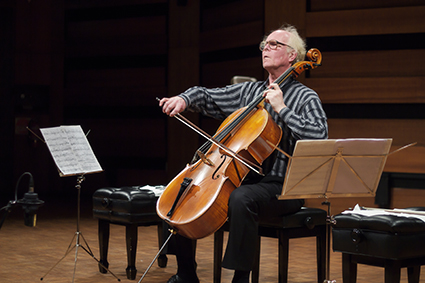
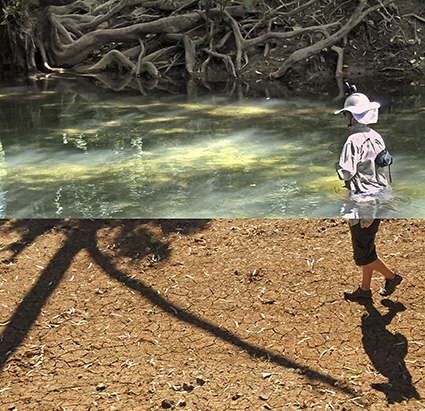
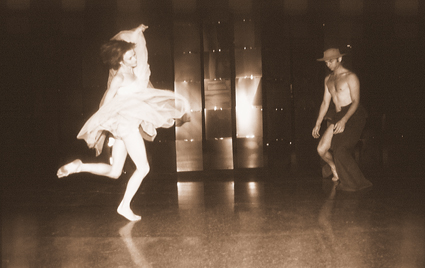
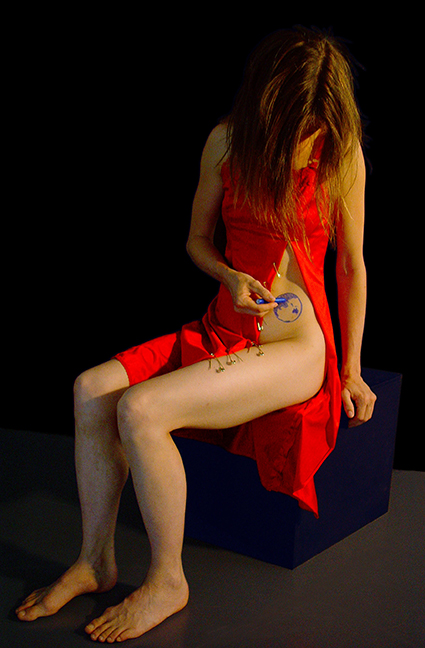
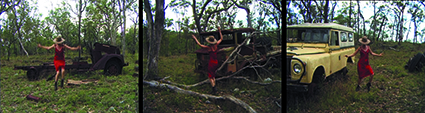
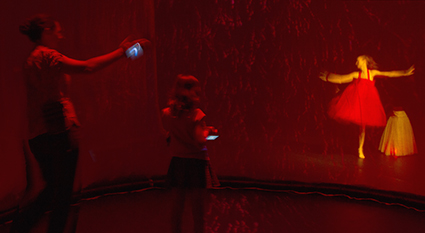
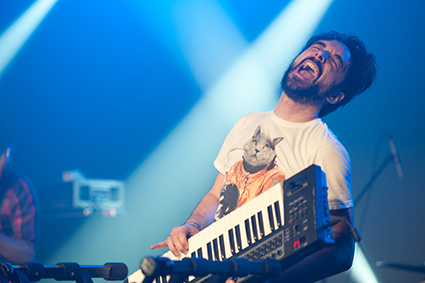
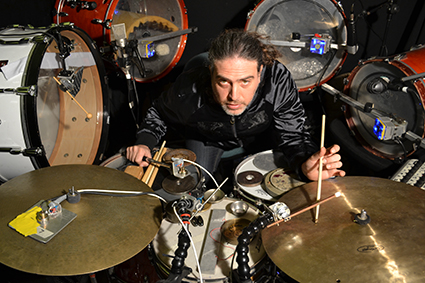
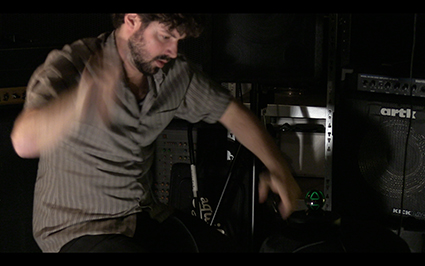
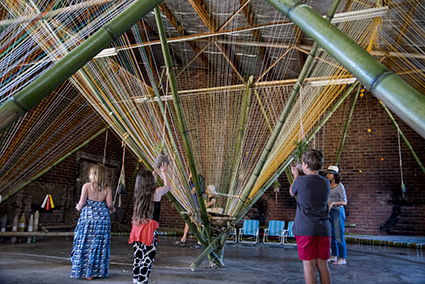
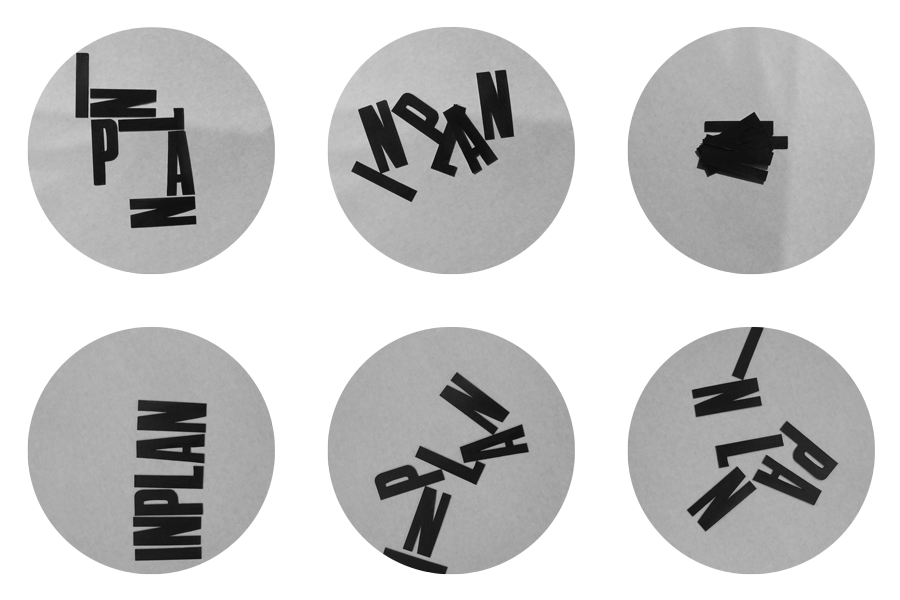
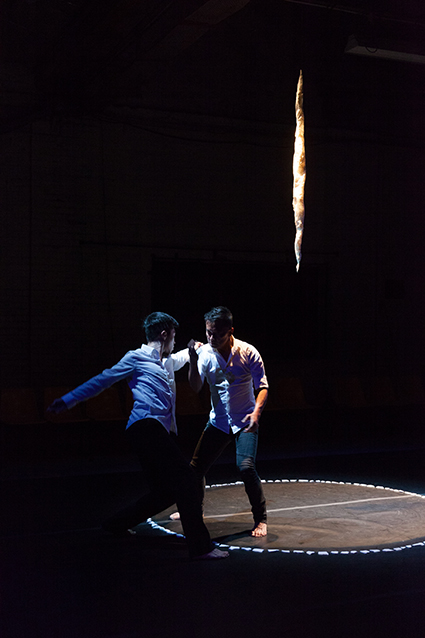
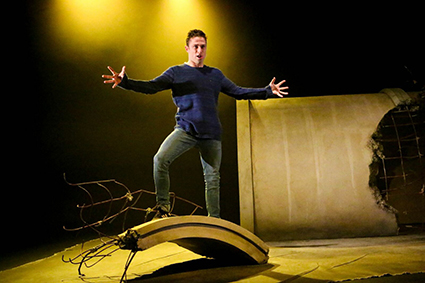
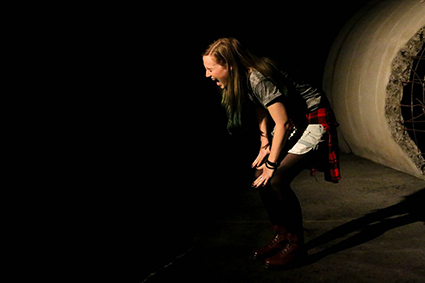
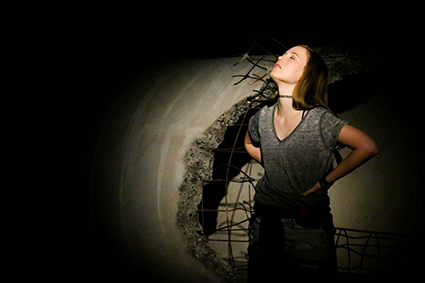
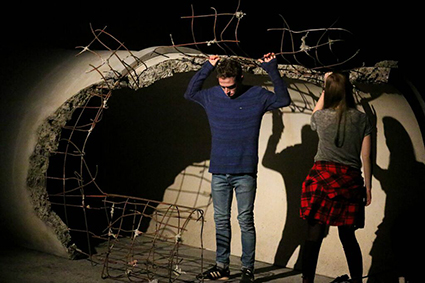

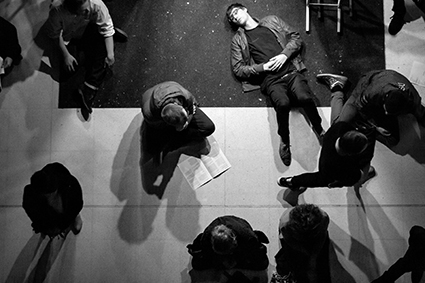
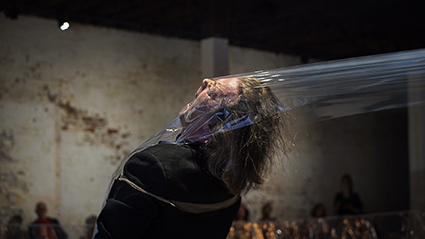
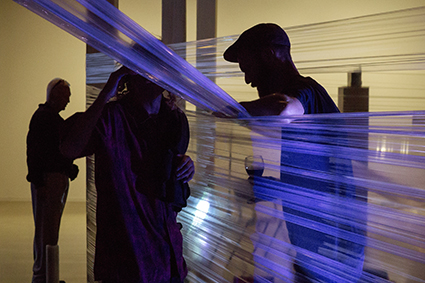
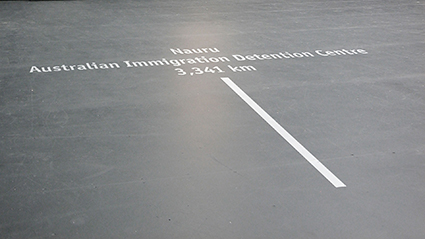
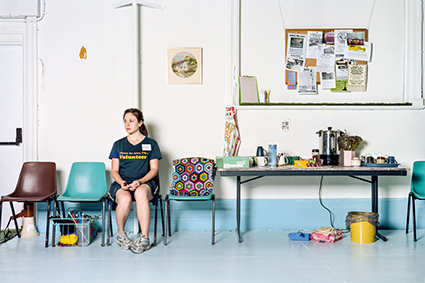
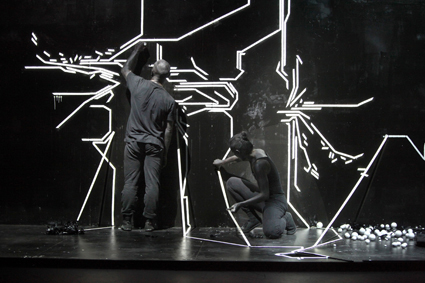
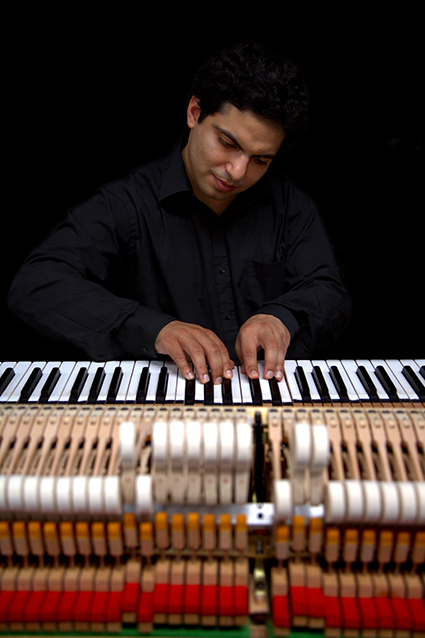
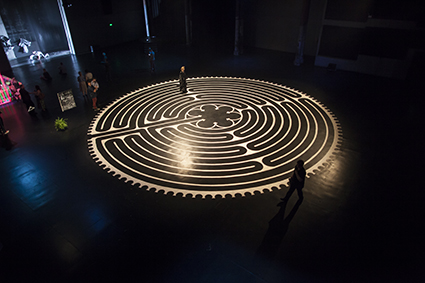
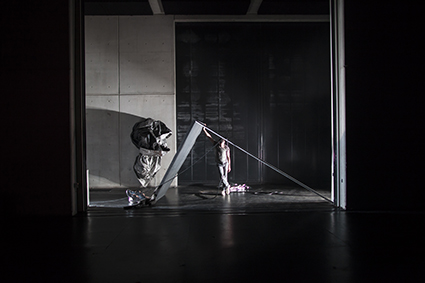
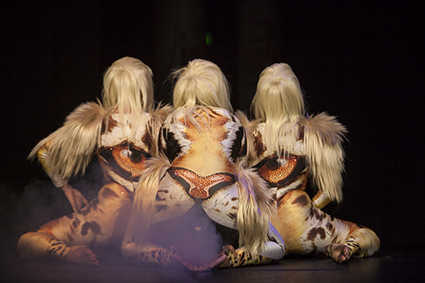
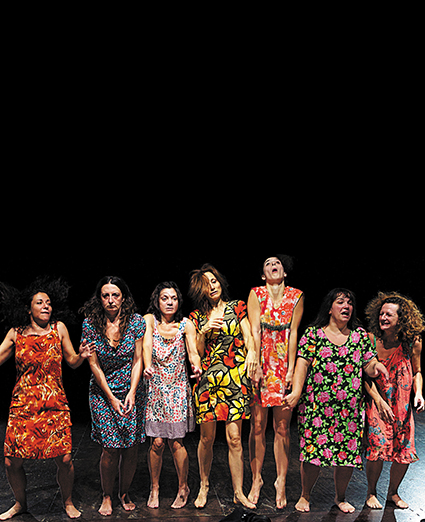
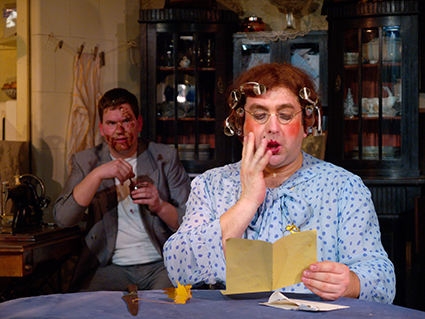
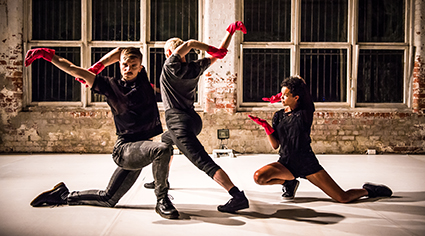
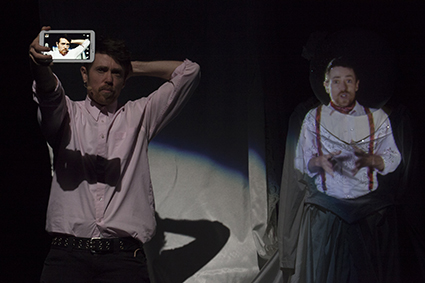
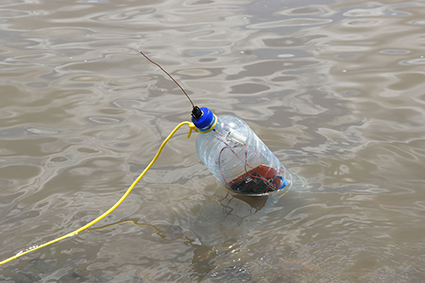
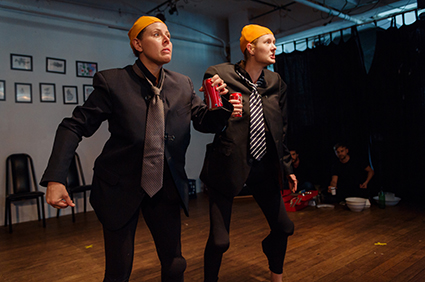
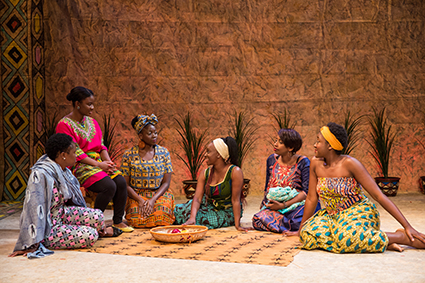
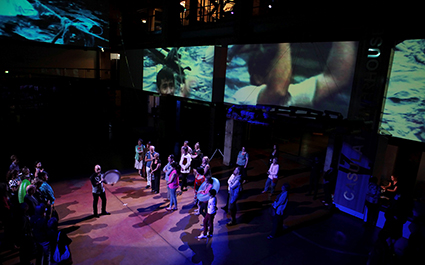

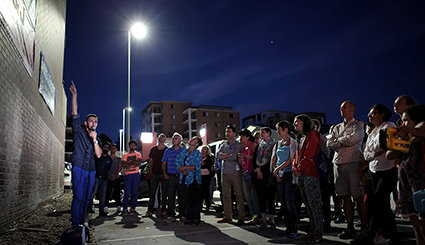
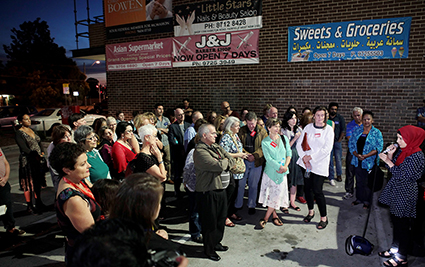
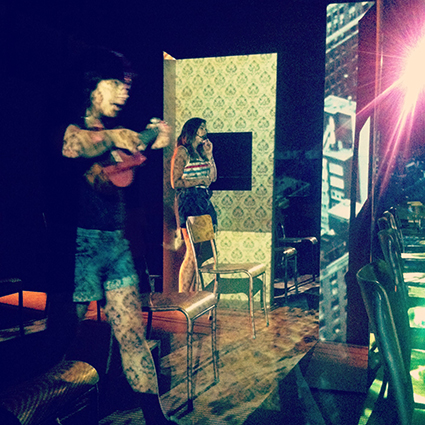
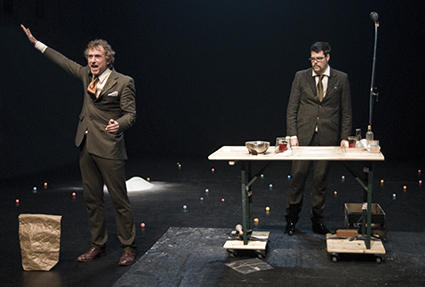
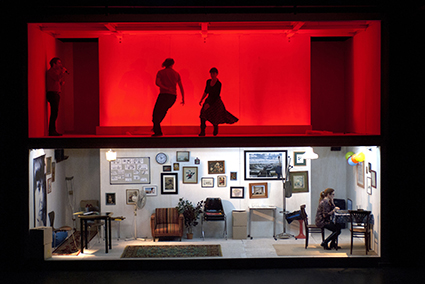
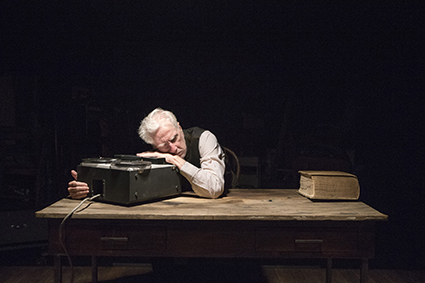
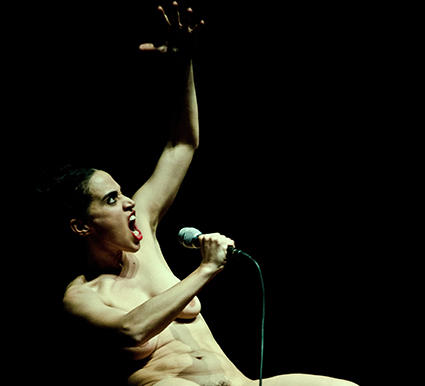

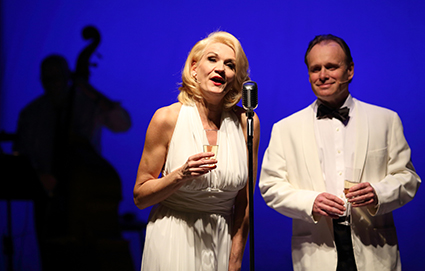
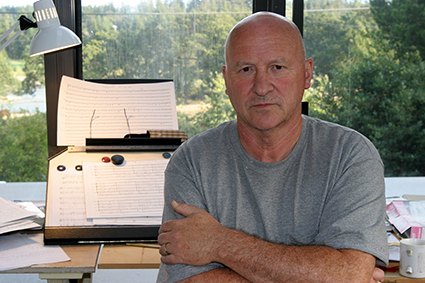
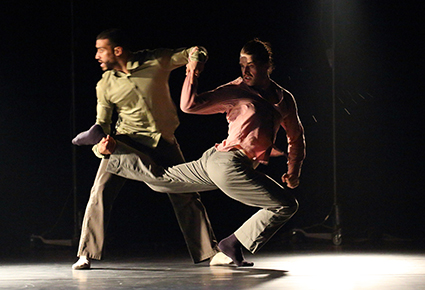
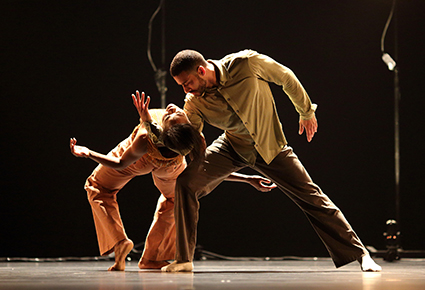
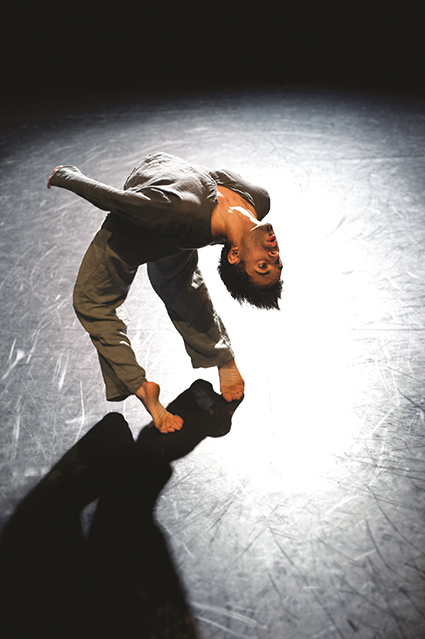
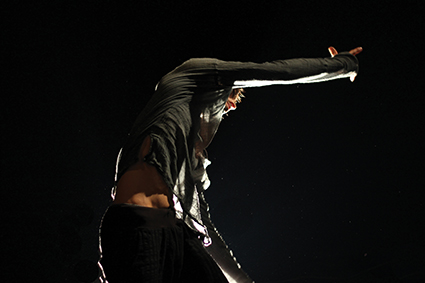
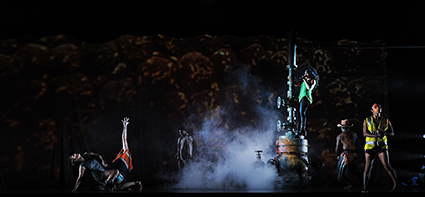
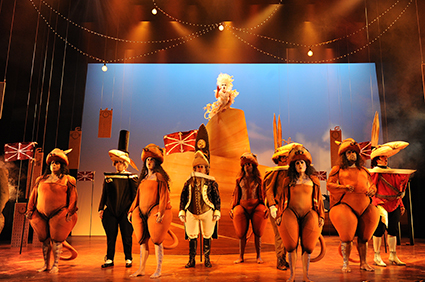
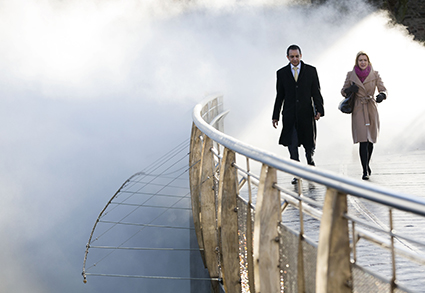
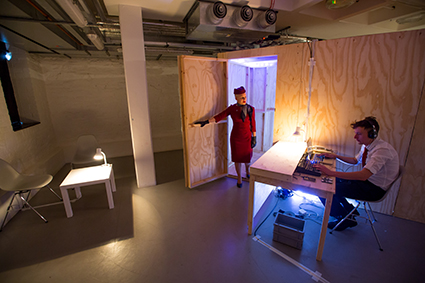
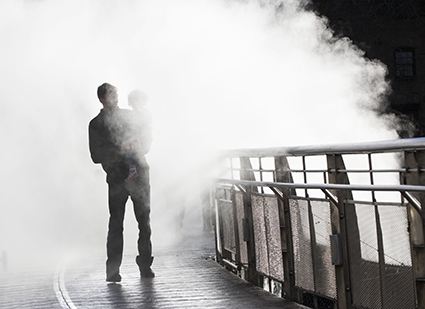
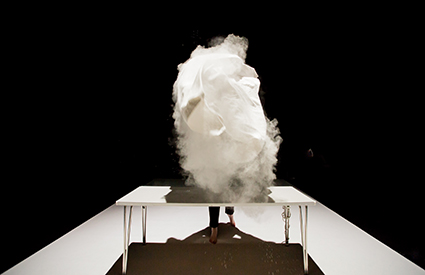
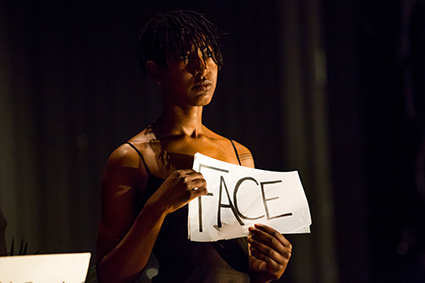
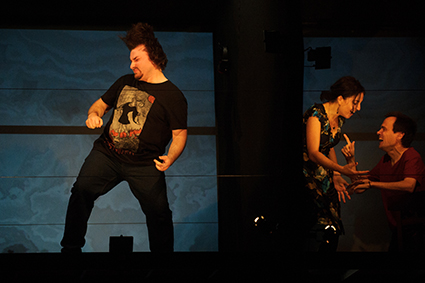
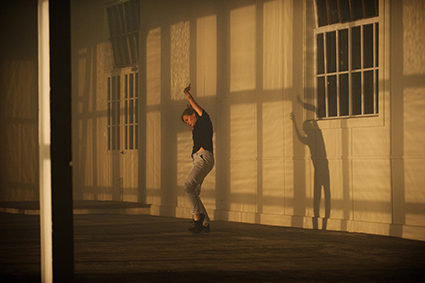
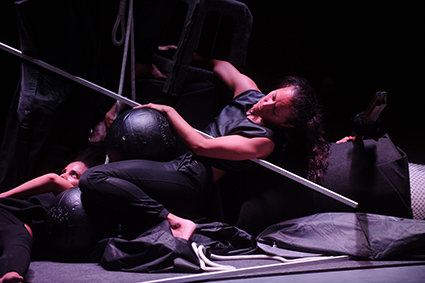
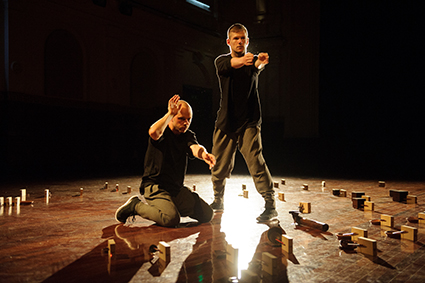
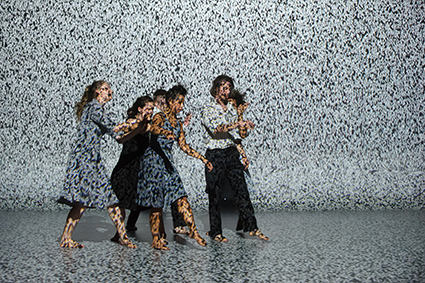
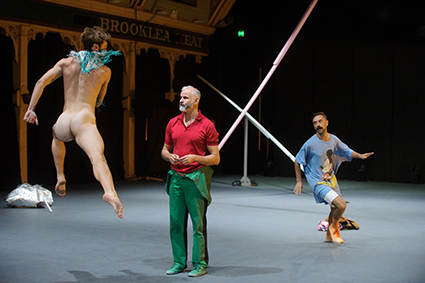
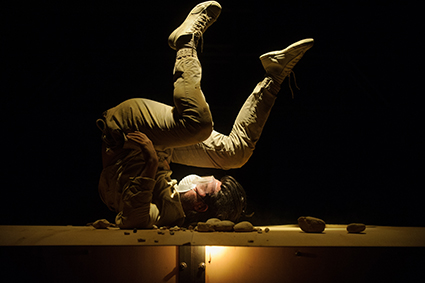
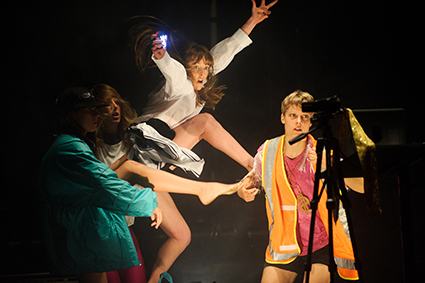
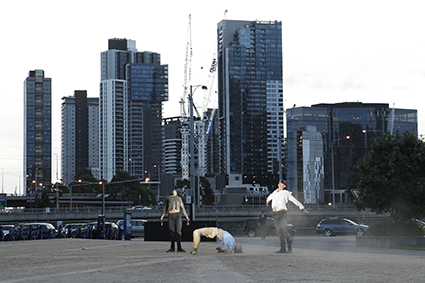
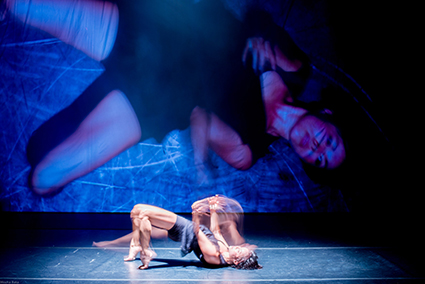
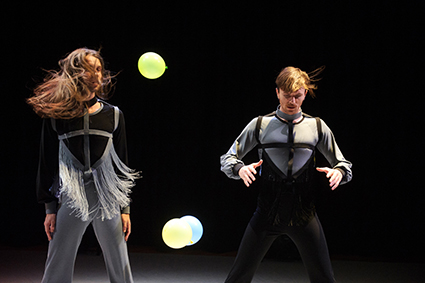
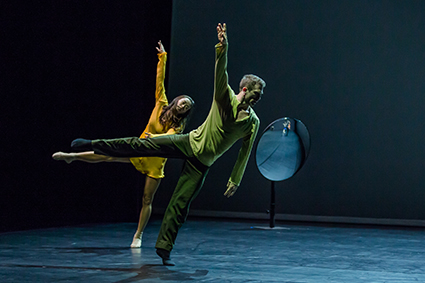
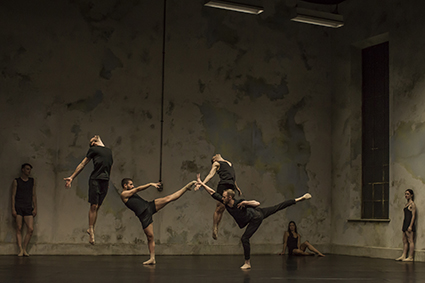
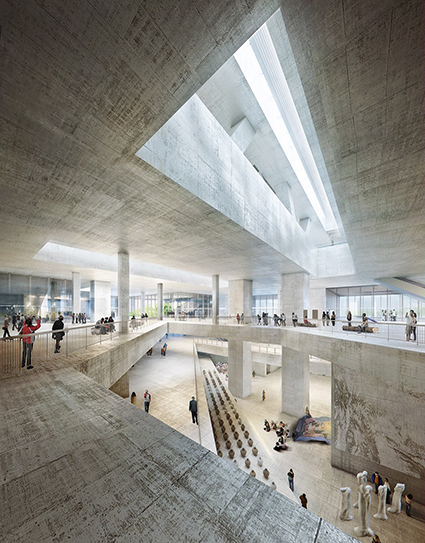
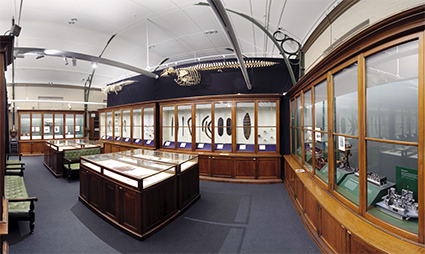

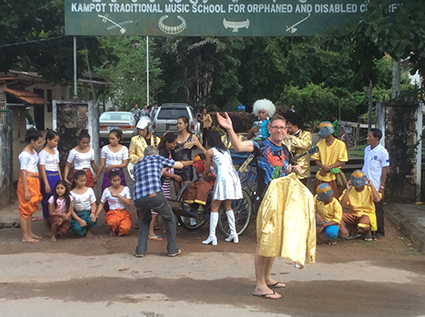
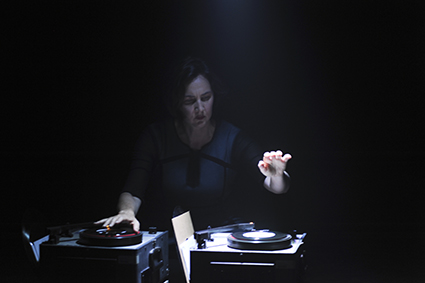
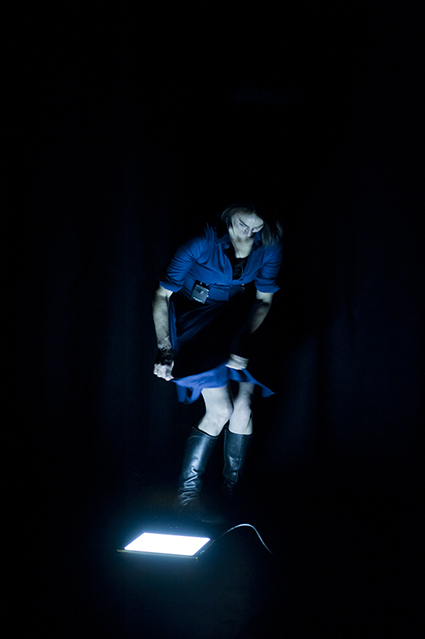
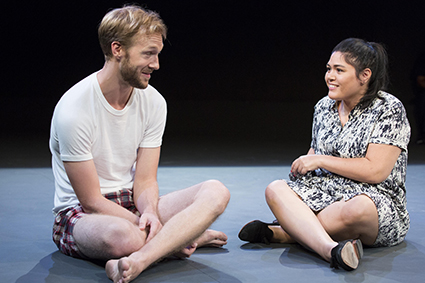
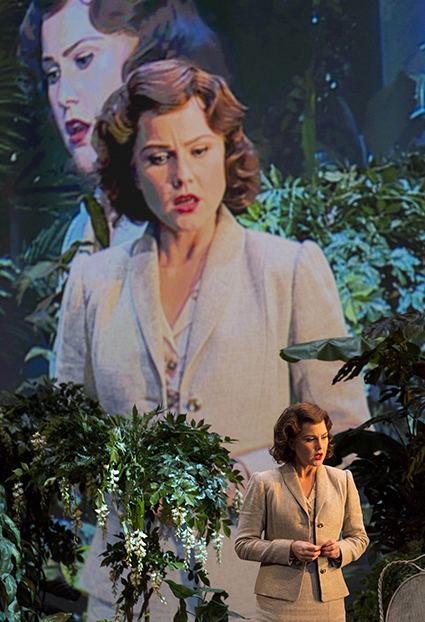
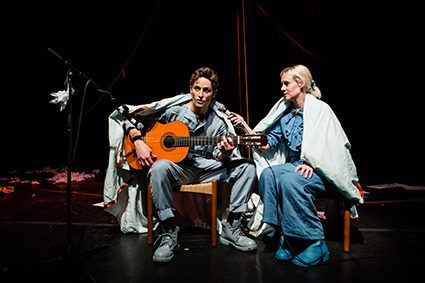
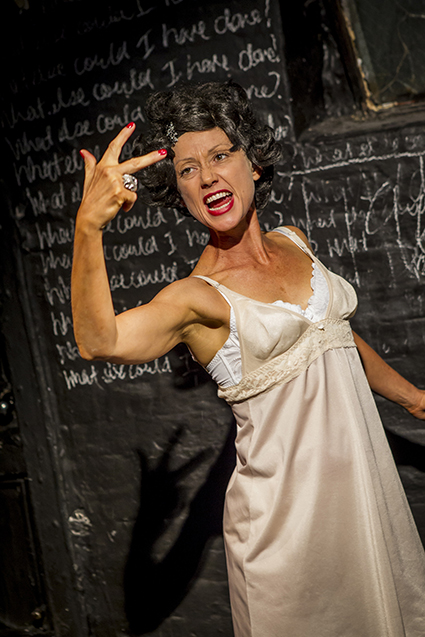
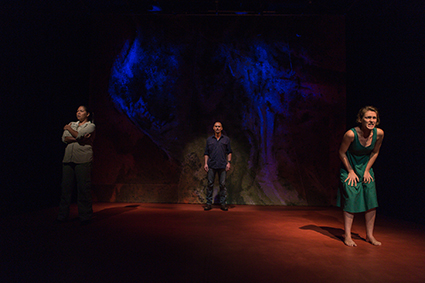
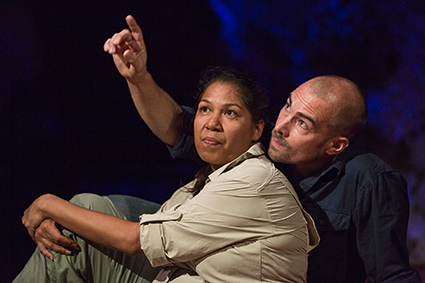
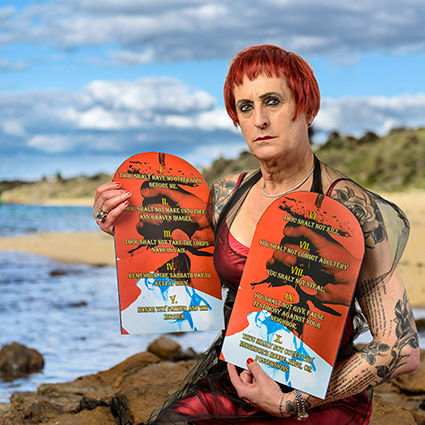
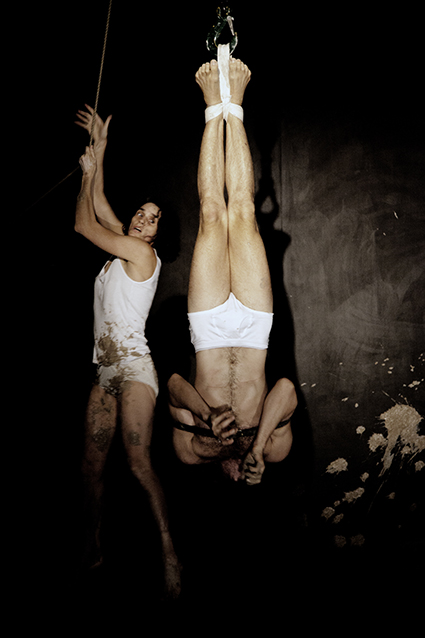
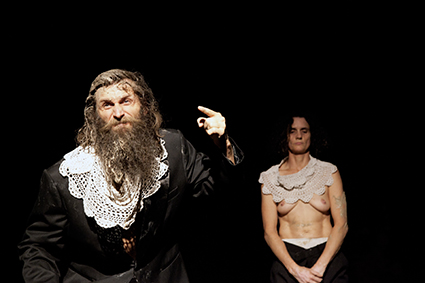
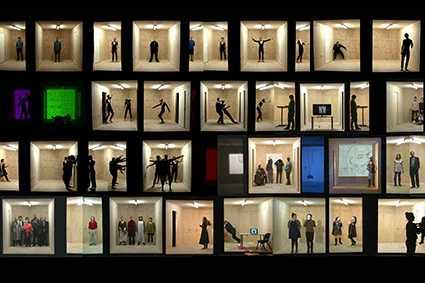
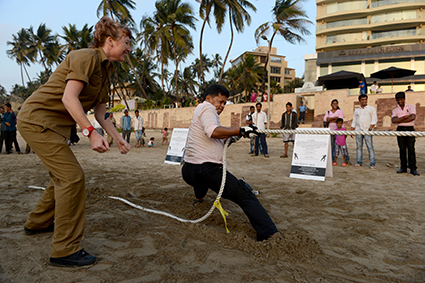
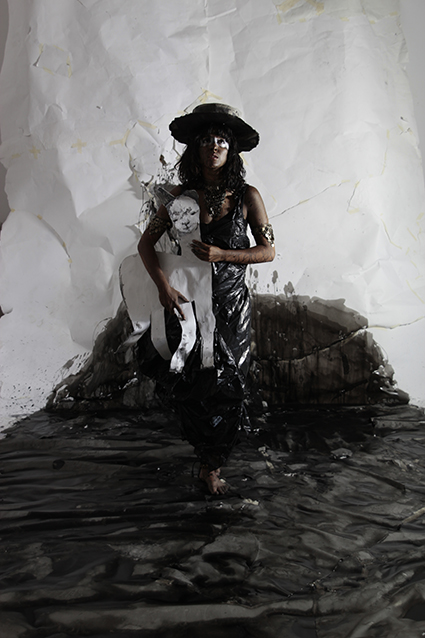
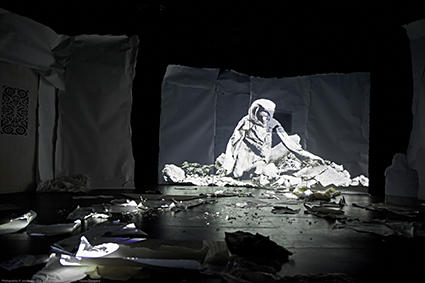
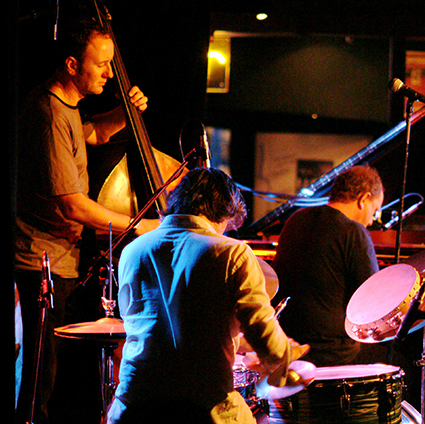
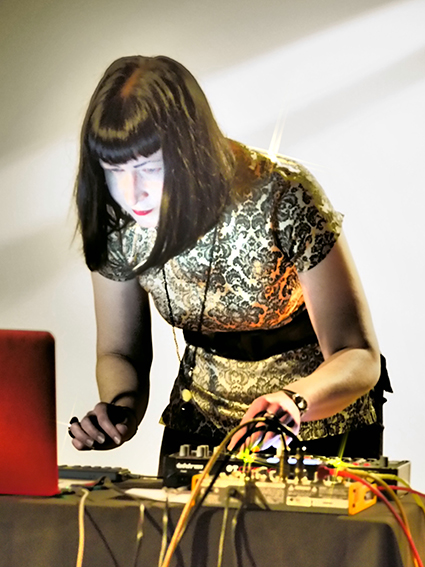
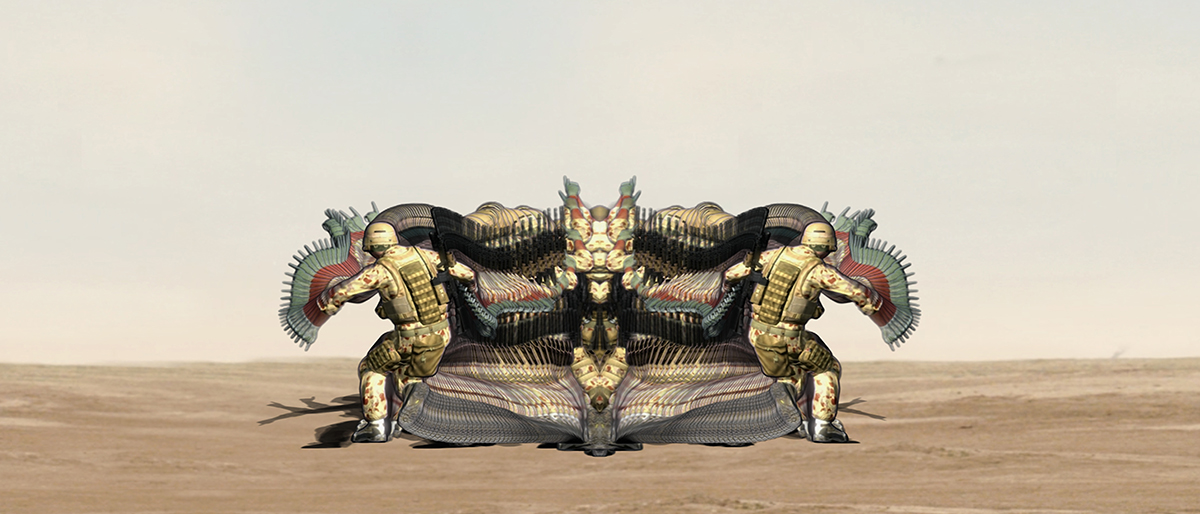
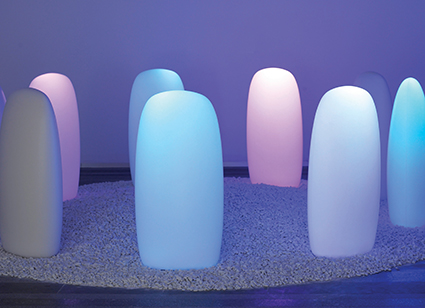
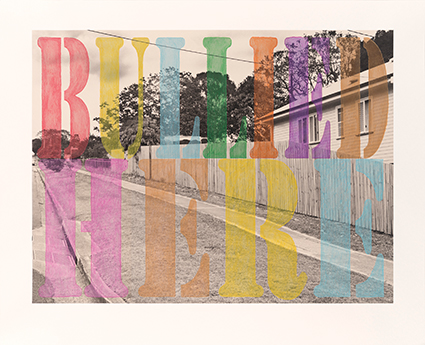
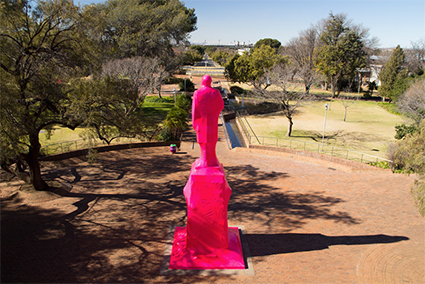
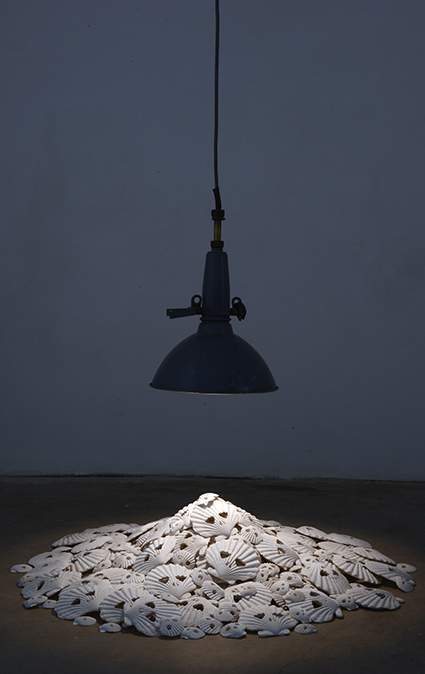
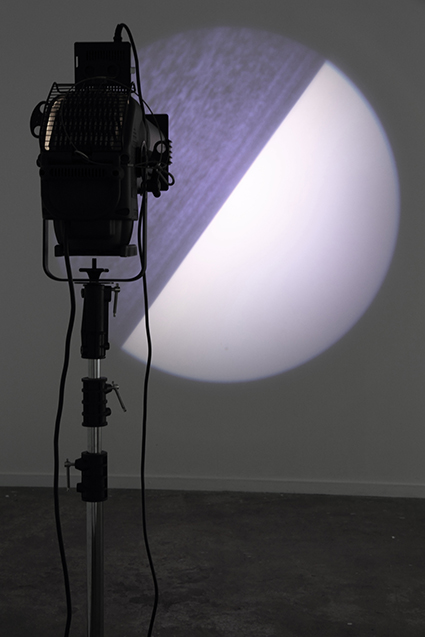
 Artfilms is a treasure house of interviews, documentaries and recorded performances. It’s now available for home streaming for artists and art lovers. Artfilms-digital has 750+ inspirational interviews, training and performance films in theatre, dance, music, design, visual and digital arts.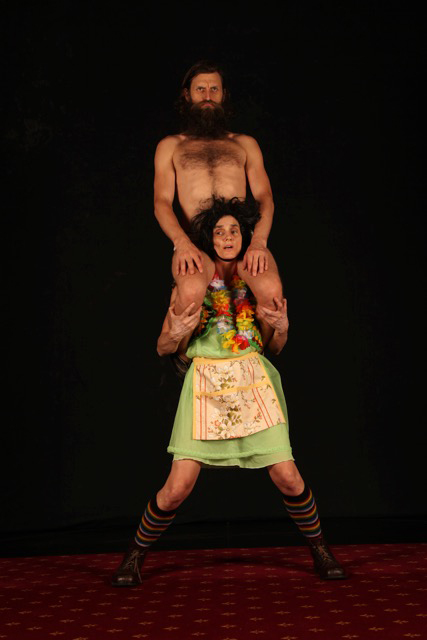
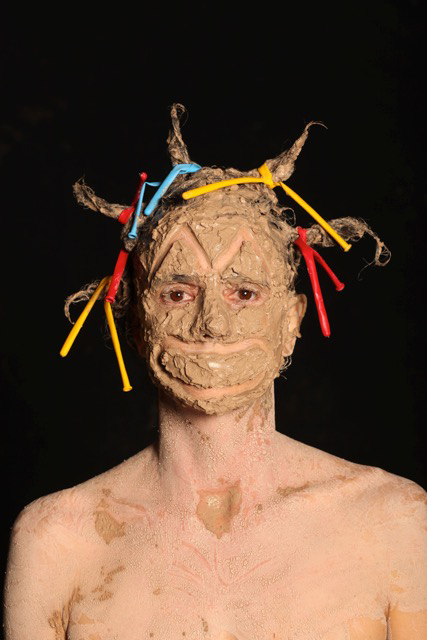
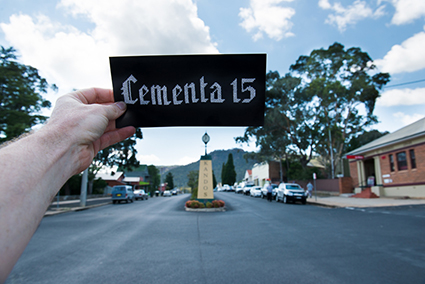
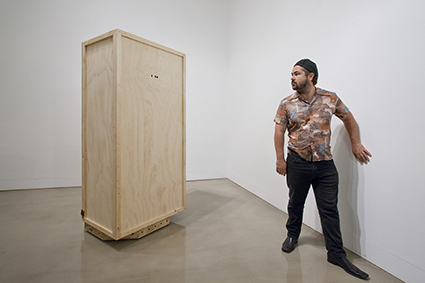
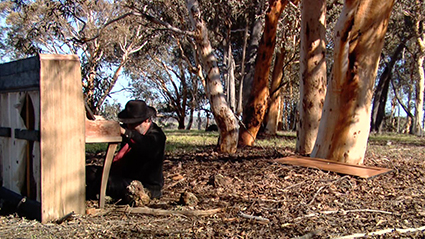
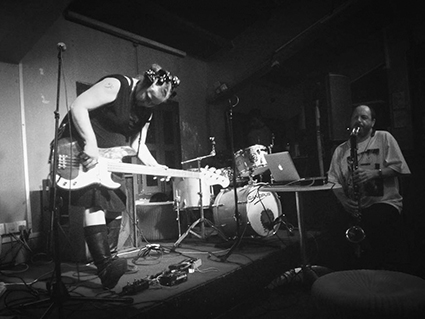
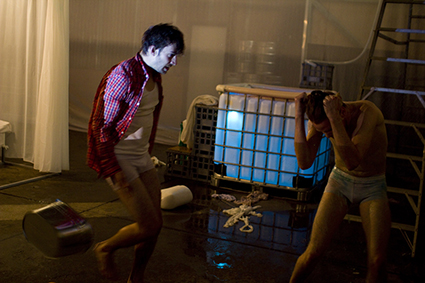
,_2014.jpg)
.jpg)