Australian composer Kate Neal’s Never Tilt Your Chair (2017), for which she also designed the instruments, was one of the two works that comprised Never Tilt Your Chair Back On Two Legs, presented by Tura New Music and PICA. It plays on the sense of ritual that surrounds the sanctified family dinner table. The performance space has an air of familiarity with three chairs on three sides of a centrestage table and the fourth side, without a chair, open to the audience, an invitation to be involved in this mealtime.
The performance is a humorous take on the rules that we face at the dinner table, hence the work’s title. The performers lick and kiss knives, put their elbows on the table, throw napkins to the floor, sniff, rub their noses and chew with mouths open. The work utilises ‘extended’ techniques for cutlery, like striking forks and letting them ring—producing tones similar to tuning forks—and then pressing the prongs into the table to bend the pitch and using the mouth to amplify the tone.
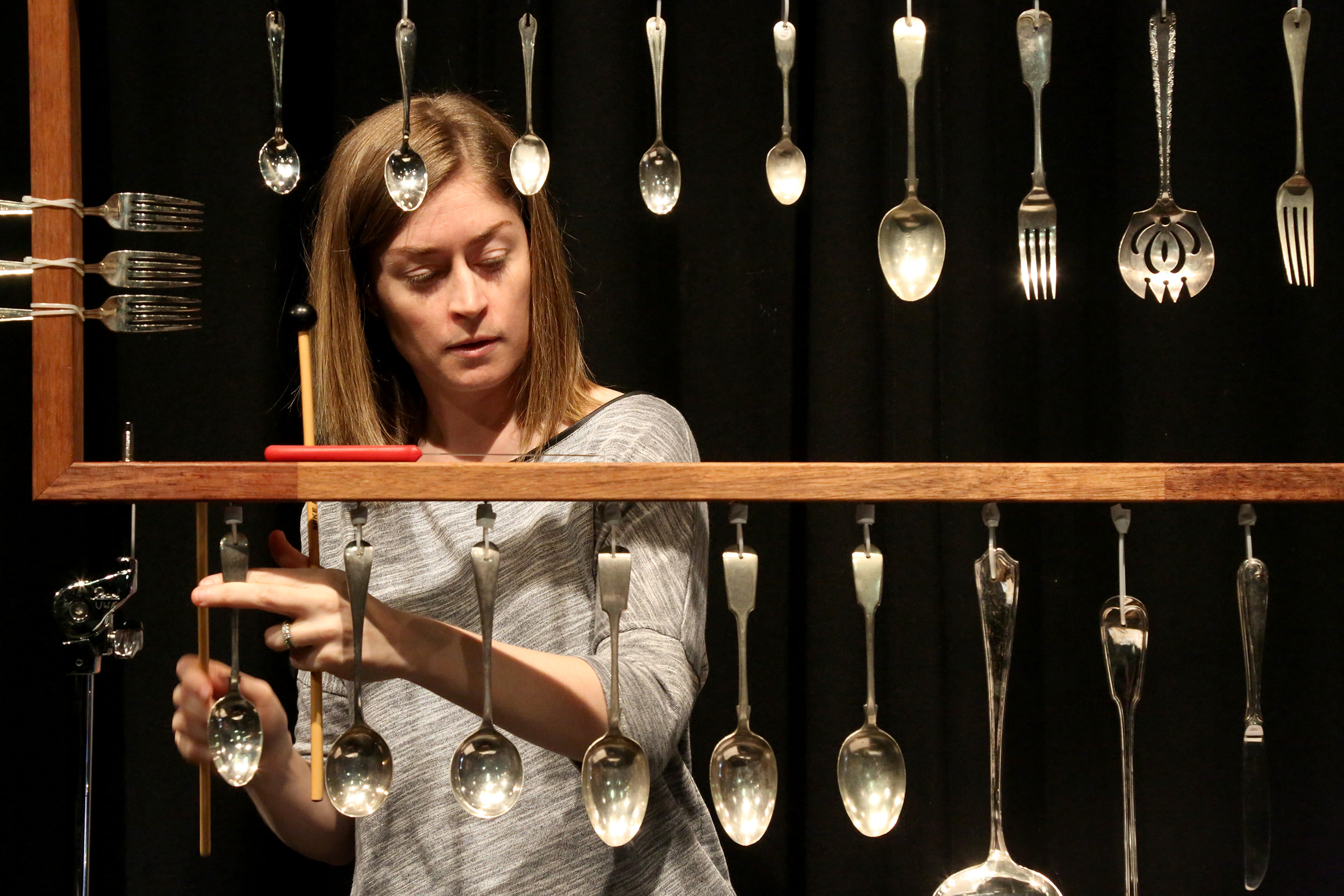
The highlight of the staging for this piece is the shimmering cutlery chandelier hanging above the table, with spoons, forks, knives and a ladle at its centre. Towards the end of the first movement the chandelier vibrates, becoming an instrument in its own right and producing a captivatingly eerie and omnipresent dissonant hum.
The second movement sees Louise Devenish, Leah Scholes and Vanessa Tomlinson each move to wooden frames from which dangle slightly different combinations of utensils arranged in ascending pitch order. The performers play these homemade creations as if they are metallophones, initially striking with hard mallets and then moving to a mix of skewers and knives. The sound of cutlery on cutlery evokes a homely feeling reminiscent of those times at the table when everyone is too busy eating to talk, and closes the piece in a very rounded way.
Never Tilt Your Chair, Tura New Music, photo Bohdan Warchomij
The concert’s programming is masterful in its combination of the bright metallic sound world of Never Tilt Your Chair Back, with its 100 pieces of tuned, often antique cutlery, and the warmth of the wooden instruments and objects deployed in the next work, Dressur (1977). These polar opposite sound worlds successfully complement and contrast with each other, the theatrical nature of the works being their point of connection.
Dressur, a 30-minute work composed in 1977 by Mauricio Kagel, combines visual and auditory elements in a theatrical space. The title comes from the German word for dressage, described by the International Equestrian Federation as “the highest expression of horse training where horse and rider are expected to perform from memory a series of predetermined movements” [program note]. To this end, Dressur features a series of quite complex musical and stage directions to be performed from memory, putting the performers in situations in which the seriousness of the task is juxtaposed with comic outcomes. The audience can’t help but laugh.
Dressur features a multitude of instruments and non-instruments laid out at three stations. Devenish begins at the marimba (the primary melodic instrument in the work) playing quick arpeggiac patterns akin to circus music, to which Scholes and Tomlinson in turn interject with a threatening chair and castanets. Though featuring a single instrument at a time, the work’s combination of sounds and performative elements creates an onslaught of aural and visual information that is incredibly entertaining.
Louise Devenish, Never Tilt Your Chair, Tura New Music, photo Bohdan Warchomij
Dressur is instrumental comedy of sorts; the instruments are played incorrectly drawing entertaining connections—for example, castanets used to imitate a typewriter. Devenish begins the work with quick arpeggiac patterns on the marimba (the primary melodic instrument in the work) which are reminiscent of circus music, to which Scholes and Tomlinson in turn interject with a chair and castanets. Highlights include Devenish dramatically up-ending a bag of wood chips onto the floor and Tomlinson unzipping the front of her dress in order to play coconuts positioned on her stomach and chest. Devenish interrupts her colleagues’ playing, dramatically tossing a string of wooden chimes about and, finally, slinging them over her shoulder. Auditorily, Dressur appears to focus on a single percussionist or instrument at a time, but after factoring in the performative elements of the work, the piece is experienced as an incredibly entertaining onslaught of aural and visual information.
Demonstrating their prowess—with dramaturgical assistance from Rèmi Deulceux for Never Tilt Your Chair—the trio delivered immersive performances of engaging, dramatic works executed with impeccable comedic timing, making for a memorable concert experience. With any luck this program will be performed again.
–
Tura New Music & PICA, Never Tilt Your Chair Back On Two Legs: Never Tilt Your Chair, composer, instrument designer, Kate Neal, dramaturgical consultant Rémi Deulceux; Dressur, composer Mauricio Kagel; musicians Louise Devenish, Leah Scholes, Vanessa Tomlinson; PICA, Perth, 10, 11 April
Top image credit: Vanessa Tomlinson, Never Tilt Your Chair, Tura New Music, photo Bohdan Warchomij
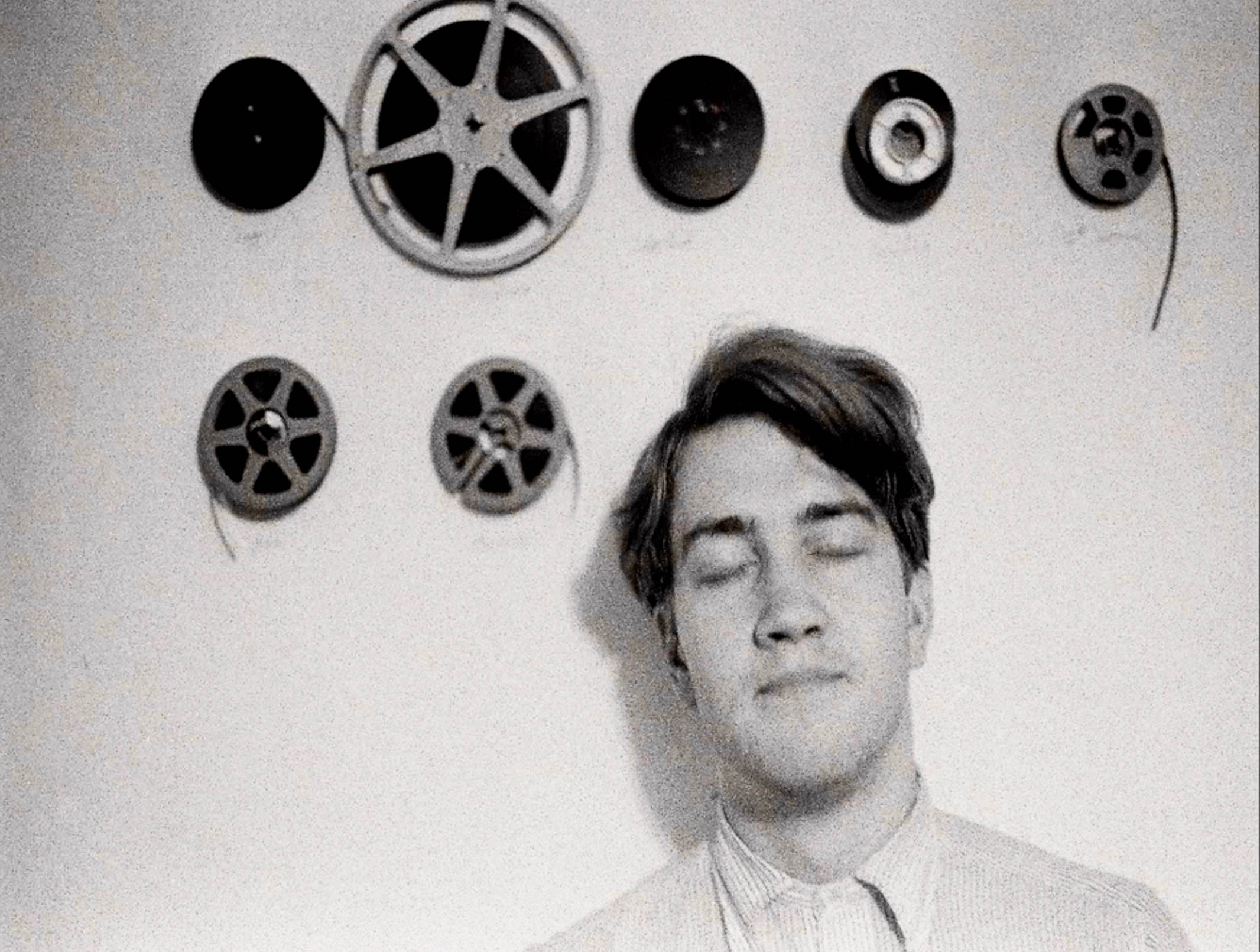
Now in its second year and launching in Sydney this week, the American Essentials film festival brings together an eclectic program of new features, documentaries and classic retrospectives. From Oscar winner Mike Mills’ 1970s-set family drama 20th Century Women, new South Korean-born auteur Kogonada’s intimate romance Columbus and the 1977 Jed Johnson New York comedy Andy Warhol’s Bad, to a new documentary on the visual art of David Lynch, the program traces a rich tradition of restless independent filmmaking. I caught up with American Essentials Artistic Director Richard Sowada to discuss the shifting landscape of festivals and independent cinema, and what the Australian film industry can take away from the work showcased in the program.
LG Like last year’s program, it seems we’re seeing smaller films here that tend to fall through theatrical and festival cracks.
RS They’re becoming rarer to see on any kind of release, these films, because the industry is perhaps losing a bit of trust in the audience, and wanting to take fewer and fewer chances.
LG Is it more economically viable for distributors to bundle these films into a festival, because individually they won’t make money? Is that the mandate?
RS Well, it’s not the mandate but it’s certainly the situation. The mandate behind festivals like this is to bring to light films that would not ordinarily be screened. Often what happens is that film festivals will find themselves going to the traditional marketplaces—Berlin, Sundance, Cannes, Toronto, Rotterdam—and then everything else falls in behind that. So the gene pool of films internationally, at film festivals, is largely from the same source.
LG Do you think these types of festivals are making up for a lack of local arthouse and repertory cinema, especially in Sydney?
RS Yes, the film festivals are filling that gap in screens around the country. There’s a film in American Essentials called Columbus, which is great; but because of its more niche nature [“an architectural appreciation symposium grafted onto the skeleton of a fairly typical Sundance drama,” Jordan Hoffman, Vanity Fair, EDs] I guess business backs away and it’s left for the festivals to screen. But what do you call ‘niche’? Is it the kind of person that you think will see the film, or is it the number of people who will come and see it? My general feeling, as a curator observing the industry, is that people in the industry—whether they’re producers, funding agencies, exhibitors, distributors or even punters—will call something niche if they don’t understand it. In my opinion, the more tailor-made you make the suit, the better it looks, and the more people look at it and go, “Oh wow, that looks cool.”
LG Shouldn’t distributors be creating that need for audiences to see the good films?
RS Yeah. It’s kind of a Catch-22 in many ways, in that these films aren’t being selected for commercial release because films like them have been selected before and failed. The next hit is based on the last success—not the current good idea. It’s a constantly backward-looking industry, and I think that the film sector is suffering from that to a degree, and has been for a little while—with the added pressure now of the Netflixes and the Amazons. The industry is going to have to retrain itself to change its perspective.
20th Century Women
LG You’ve talked in the past about the nature of these American independent films, and how they’re not defined necessarily by the size of the budget but by their spirit and ideas. There’s a through-line in American independent cinema that we see in the work here, from the micro- to mid-budget to everything in-between. What can Australian filmmakers take away from this? Why aren’t they making work in this tradition, irrespective of the smaller size of the country?
RS That’s a good question. One [lesson] is you’ve just got to take a risk. Don’t compromise on the idea thinking, ‘Oh, if I go too hard here people won’t get it,’ or ‘No one will buy it.’ People like to be looked in the eye and spoken to directly.
LG Do you think funding bodies affect that grasping for broad audience reach? Is that an outmoded thing? How does it change?
RS Yes, yes. It does come from the funding agents, but it’s not just their fault. It comes from the lack of motivation [from filmmakers], to a degree, or a lack of trust in themselves. And the way that it always changes, every single time—I’m saying with a very broad brushstroke—is by doing it, the breakthrough. As soon as there’s something that busts through with its chest out and its legs kicking, people look at it and go, ‘Oh fuck.’ And that becomes the new norm. And you can throw in so many American examples of that, be they Kevin Smith (Clerks) or Tarantino or Kelly Reichardt.
LG Reichardt’s a great example, because her films, especially the earlier ones, are very low budget—but the ideas are there and the filmmaking’s there. You can’t blame a lack of money or infrastructure or whatever; there’s something else going on.
RS No, you can’t. And when you look at them—we screened Reichardt’s first film, River of Grass [1994], last year—they’re fucking incredible. But that is part of a tradition that includes Dennis Wilson’s Two-Lane Blacktop [1971]. It’s a continuum that can be charted through the individuals and through their ideas.
David Lynch: The Art Life
LG Do Australian filmmakers lack that continuum to draw upon and be a part of?
RS Well, yes and no. There is a big gap, no question, in Australian cinema in the 50s and early 60s. But that’s its own wellspring as well; you don’t necessarily need the traditions of cinema; you need to be in tune with what is around you, in your environment, including cinema. But I think that in Australia—very broadly—there is a lack of understanding of the traditions of international cinema. You know: here are the masterworks—let’s look at the Capras, the Maysles and the Pennebakers, and let’s look at the Bergmans and the Wellses.
LG You do sense this a bit with Australian filmmakers. And again, it’s not their fault necessarily, it’s this culture that doesn’t encourage seeking things out. Although America has the benefit of having very rich cultural channels through which to investigate cinema history, I don’t know if that’s the result of training or schooling in cinema.
RS It’s a lot of everything. But ultimately it’s up to the individual. You can talk about the funding agencies and the educational institutions, but it’s up to the individual. If you are into it, then you are into it, and there’s no stopping access, and there’s no stopping reading about the history, and there’s no stopping experiencing or imitating it. All you need is the motivation to dig into the roots. Musicians do it all the time.
LG And we’re in a moment where you have access to more media than ever before.
RS True. I don’t know what it is; it’s kind of like second-guessing the audience, thinking, ‘How can we sell this film,’ rather than ‘What is this film about?’ Again, I think that filmmakers suffer from the same kind of things that distributors may—and I’m not saying that all do—in that the next film is about the next success, not the current good idea. So that’s one of the takeaways. And it’s easy for me to say, but I wasn’t given my life in the arts. I had to really live it. Don’t be afraid. And look at the traditions.
A leading film curator and screen culture advocate, Richard Sowada is the founder and director of the Revelation Perth International Film Festival (1997-present) and was Head of Film Programs at ACMI (2006-15).
Palace Cinemas, American Essentials Film Festival 2017, Artistic Director Richard Sowada, launching Sydney 9 May, Melbourne 11 May, Canberra 16 May, Brisbane 17 May, Adelaide 18 May
Top image credit: Columbus
Top image credit: Kip Williams in rehearsal, Chimerica, Sydney Theatre Company, photo Hon Boey
Based on the memoir by Saroo Brierley, Lion traces the trajectory of an extraordinary journey. A five-year-old boy, separated from his family, catches a train that doesn’t stop, and 1500 kilometres later he’s in Calcutta, adrift in a sea of commuters who can’t hear him and, if they do, can’t understand him. They mostly speak Bengali; he speaks Hindi. Lost in every sense, he has no option but to live on the streets, and makes do with the resourcefulness that small children have: surviving on gut-feeling to avoid harm, eating fruit offered to gods on the riverbank, running faster than the adults who steal away with the street kids when they’re asleep.
First-time film director Garth Davis frames much of the Indian action from a child’s height, adult torsos and heads chopped off, decapitated, giving a true sense of the powerlessness felt by a child when he’s not listened to, when the stakes are impossibly high; he’s unable to even reach the ticket counter at Calcutta station. The adults sweep him away with a flick of their hands. Davies comes to the film having co-directed Jane Campion’s Top of the Lake (2013), deftly handling a horror story of Dickensian proportions as Saroo moves through Indian institutions where children are beaten and disappear into the night. He is eventually adopted by a Tasmanian couple, Sue and John Brierley (Nicole Kidman and David Wenham) and grows up in a caring home. But he can’t forget where he’s from, the deep bond with his mother and siblings. When helpful adults in India, searching in newspapers, ask him his mother’s name, he says, “Mama,” a loving word—so resonant with futility and loss.
With no previous acting experience, Sunny Pawar’s performance is powerful and wrenches the heart. Chosen from 2,000 boys, at the beginning of the film shoot he speaks no English. Perhaps this helps him. After Saroo finds a large spoon in a deep pit of rubbish, a shiny treasure he hides in his clothing, he sits outside a café under a tree and pretends to eat with it, bringing the spoon slowly to his lips, copying a man sitting opposite in the café. This man sees the play and then sees the boy and how hungry he is. Luke Davies’ elegant script works well at conveying such scenes of exchange with few words spoken.
Saroo’s story is a tale of the times. Played as an adult by Dev Patel, he sets out 25 years later on an impossible quest. To find his Indian family, he starts to search on Google Earth. He has a name (that he pronounces incorrectly and can’t find), an icon (a water tower he sees from the station) and a memory of the landscape that weaves around him as his small feet move, nimble, across it. He has a radius of about 1,500 kilometres from Calcutta. He clicks along each train track, looking at the layout of each station, searching for the water tower. It’s difficult in film to convey the grinding boredom of this search, the obsessive-compulsive nature of the slow click, that keeps Saroo in lockdown in his room for years, losing a girlfriend, Lucy (the luminous Rooney Mara), and family in the process. But it’s a mark too of the resilience of a small boy, now fully grown.
Dev Patel, Lion
Hollywood film is always drawn to the fast pace of technological advances, the forensics, the nabbing of a criminal. Here, the film has to rely on the low-tech and stagnate for a while, and Patel goes for a sense of Saroo slowly breaking down, mind-numbed and exhausted by all-night searching, wandering malls, lost again among the familiar this time, snaps of memory filtering through. It’s the physical presence of objects that brings the past back to help him, sense-memories: the smell of the bright Saffron-red jalebi, a sticky sweet in his friend’s kitchen, and the weight of rocks that he helped his mother carry as she worked.Sometimes a story is so personal that as a viewer it’s impossible to stay outside it. My brother was adopted from Bangladesh when I was five years old. I met him at the airport: a six-month old, bundled in white, carried by my mother. He came with a doll and a name printed out, “Sony.” But the pronunciation (as with ‘Saroo’) was different, and so my parents changed it to be more like the name they heard; he avoided the branding. Like Saroo, he arrived with a story lost to us. Nicole Kidman was drawn to the role because she has also adopted children and the Brierleys are portrayed as caring, loving people whose desire is to help children without other means of support. The ethics of international adoption are left alone—although Saroo’s adopted brother, Mantosh, battling addiction and depression in Tasmania, is a counterpoint to any seductive happy-families reduction.
In the cinema, my mother and I do our best to keep ourselves together as we watch the film with my son. The memory mapping forces me to go back and recall my own tracks as a five-year-old, the year my brother arrived, no adults in sight, the steps to school, the round-the-block dawdle, the large trees you could climb as markers, the sounds of cars hooning around Mt Panorama, the cut through the neighbour’s backyard to a friend’s on the other side where a swing set beckoned.
I think of my own son, how he flits between the virtual and actual worlds, Google Earth and the ground between his feet. His parents wait at the school gates. The GPS talks to him in the car, mispronouncing streets and towns, giving him polite directions. His parents walk him, holding hands, across the street. Always holding hands. What paths has he forged on his own? What paths will he remember? And as I hold my son’s hand tight on the train home from the cinema, I wonder if he will really need to remember at all? Perhaps it’s a notion that will pass him by—this idea of getting lost.
–
Lion, director Garth Davis, writer Luke Davies from the book by Saroo Brierley, cinematographer Greig Fraser, editor Alexandre de Franchesi, production designer Chris Kennedy, producers Emile Sherman, Iain Canning; 2016
Top image credit: Sunny Pawar, Lion
Artlands is the new “brand” name for the bi-annual national Regional Arts Australia Conference and Festival which this year hosted international speakers alongside delegates from across the nation. Held in Dubbo, its ambitious and densely packed program was animated by the themes regeneration, connectedness and emergence. While it was possible to experience these in various combinations, this report reflects my own interests in the program, focusing on several highlights of its investigation into what we might mean by ‘regional’ in contemporary global culture.
A UK perspective: diversity and community
Skinder Hundal, Chief Executive, New Art Exchange, Nottingham UK spoke about New Art Exchange as a hub of cultural and social reinvention through diversity and experimentation in creative practice, focused on local/global interaction, and the engagement of local audiences by using local histories and practices. As well, he questioned our assumptions about how the arts ecology works, delivering a timely case study on the arts as a driver of inner city regeneration and bringing communities together. Rather than rethinking the idea of region, he proposed that we rethink the idea of centre. This was an exciting proposal, although the differences between UK and Australian regions are very marked.
Art practice and health
Focusing on ways to engage artists as agents of change in immediate and direct ways, exemplary presentations on this complex topic ranged from a discussion of art and social justice to art as a measure of quality of life, especially made meaningful through creative expression, including in the face of death and in tackling a serious crisis, such as HIV in the Free State of South Africa. When health funding is very limited, artists can be instrumental in creating strategies and discourse.
Here in Australia, Kym Rae, Director of the Gomeroi gaaynggal (Babies from Gomeroi lands) program, was very frank about the way fostering creative practice in First Nations communities could have a significant impact on mental health outcomes in much quicker timeframes than a solely medical approach.
Rural routes
On recasting art and theatre practice in rural communities, Henk Keizer, Co-Coordinator of Rural Routes in The Netherlands, spoke about long-term projects in the farming areas of the Netherlands that have needed, and employed, artists to articulate community experiences and concerns to government, commissioning theatre and performance to communicate more effectively. With regard to methodology, including in terms of research and development and the need to invest time in rural locations and communities, this was an effective lesson in the demise of fly-in-fly-out approaches to cultural production.
By contrast, even with a distinguished line-up of speakers—Michael Brand, Director, Art Gallery of NSW, Dolla Merrilees, Director, Museum of Applied Arts and Sciences, Blair French, Director Curatorial and Digital, Museum of Contemporary Art, Caroline Butler-Bowden, Director of Curatorial and Public Engagement, Sydney Living Museums and Steven Alderton, Director Programs, Exhibitions and Cultural Programs, Australian Museum—the institutional presence of large key organisations provided little more than animated press releases (albeit quoting some impressive regional audience numbers for their programs), but a dearth of considered embedding of cultural process over time. The MCA’s C3West, a long-term project in Western Sydney (in partnership with councils and businesses) was an example of artists working with communities to deal with urban social and cultural issues, but without necessarily serving as a transferable model for regional needs.
The exceptions here were Sydney Living Museums, clearly taking the initiative with ongoing programming, and the Australian Museum with its considered repatriation of Indigenous objects program and community building through working with families and in relation to artefacts in its collection. These programs seem symbolic of real institutional change, deep understanding of cultural issues and the inclusion of Aboriginal history.
Taken from Country, Jason Russell, Wala-Gaay, photo Liz Bradshaw
First Nations
The heart of the conference was without question the generous and rigorous presentations by First Nations speakers. I cannot stress enough the power of their direct address—based in personal experience—to move, inspire and galvanise.
In his opening keynote about sovereignty Mark McMillan, Associate Professor, Melbourne Law School invited us to consider creative making as a meeting place, where acknowledging sovereignty is a personal, transformative and mutual experience that takes place through culture and cultural production.
Lee-Ann Buckskin spoke eloquently about mentoring and agency, championing the expertise and experience of First Nations artists and arts workers; and Rhoda Roberts articulated the impact of institutional intent in including First Nations content and context across all aspects of cultural production. I particularly valued her impatience with ‘closing the gap’ rhetoric and her provocation that instead of First Nations people adopting Western cultural aspirations, that the broader population should “sit down with us.” I can only hope that these ideas are taken up by all who attended, and that this translates into action across the sector.
Wala-Gaay
A highlight of the Festival program was a small but coherent exhibition at the Fire Station Arts Centre. Wala-Gaay was an ambitious group show of artists who were part of the Orana Arts Left Field Project, a long-term creative mentoring program in its second year. It presented a collection of powerful, visceral, diverse works engaged with historical references, lived experience and culture in the present. All were by local regional artists who were encouraged throughout the project to work in new ways with previously untried materials.
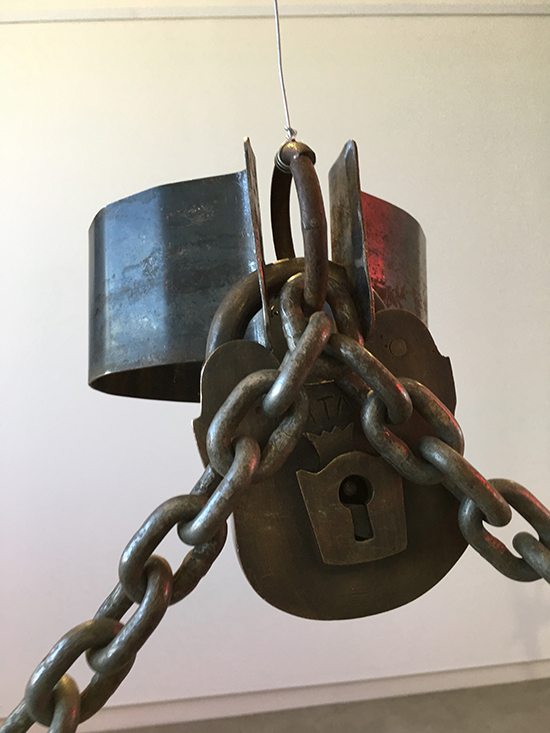
Jason Russell’s (Worimi) Taken from Country is both a visceral image of violence and colonial rule, and a highly resolved physical presence that brings the viewer into the work. Arresting from the moment you enter the space, neck irons hang in line in front of an old saddle, keys attached—symbols of imprisonment and subjugation, equal parts beauty and horror.
Locked up, by Dylan Goolagong (Wiradjuri), reflected on museum practice and its historical roots in theft and acquisition, asking who has access to and who act as gatekeepers for First Nations cultural artefacts. A series of crosses and carved wooden blocks hidden in a set of old steel lockers, the work questioned viewers’ notions of what is sacred by placing a physical barrier—a closed door—between us and some elements of the piece, while echoing the systems and structures of collection and display.
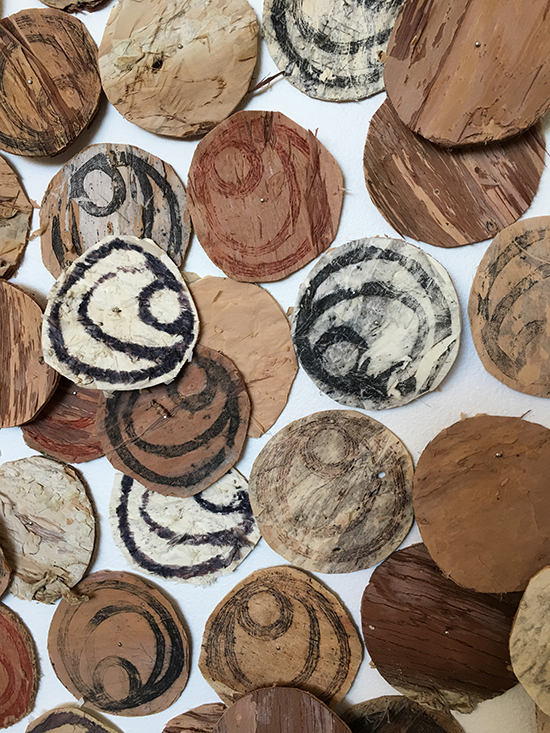
Our girls by Paris Norton (Gamilaroi) is a lyrical and painstaking memorial to young women who were stolen and taken to homes to be trained for a life of domestic servitude by the Aboriginal Protection Board. Each hand-painted and hand-cut circle of paperbark, as personal as a fingerprint, is an eloquent stand-in for records that were lost or destroyed, and lives profoundly altered, under this regime.
All these works are direct yet densely layered and moving. There is not space here to discuss the equally accomplished works by Aleshia Lonsdale, Alex Nixon and Robert Salt; and credit must also go to mentors Blak Douglas, Jonathon Jones, Chico Monks, Nicole Monks and Jason Wing, and curators Khaled Sabsabi and Emily McDaniel. While there were moments where the viewer could see the influence of a mentor, there was more a sense of artists entering into a field of practice rather than imitation, and the diversity of the work was testament to the benefits of structured support and creative dialogue. It was exciting to see a local event that so clearly stood out in an abundant program of interesting work from around the nation. This is a show that deserves to tour; and I hope to see more work – more bodies of work – by these artists in the future.
Our Girls, Paris Norton, Wala-Gaay, photo Liz Bradshaw
Conference/Festival divide
One of the troubling issues of the event however, was something of a separation between the conference and the festival. This was particularly visible for me as I spoke to local artists who felt ‘priced out’ of a conference where the frameworks and practices that shape the arts system with which they engage were up for debate. While being part of the festival was of course a valuable opportunity, and included artists from other regions as well, there still seemed an unnecessary and problematic divide between the makers and the decision-makers. Few artists were involved in articulating how to proceed in the cash-strapped present. (And if organisers think that the cost to attend was not prohibitive for many artists, then they need to get to know the reality of artists’ incomes a little better.)
Equally, given the ways artists were being recognised as the motor of engagement, community building and delivering outcomes, a dialogue with what artists need to produce these outcomes—over the long term, and with adequate remuneration—should have been an important inclusion. Austerity politics and diverted funding have devastated budgets within the arts, but also in arenas where artists are increasingly the service bearers of not just creative or cultural outcomes, but diversity, health and community outcomes as well. And in this context is it too much to expect inclusivity to extend to queer artists and artists with disability? Both were conspicuous in their absence from the programs I attended.
Rethinking ‘regional’
The conference concluded with a discussion of the future and a panel on thought leadership, bringing together Wesley Enoch, Artistic Director, Sydney Festival, Lindy Hume, Artistic Director, Opera Queensland and Mathew Trinca, Director, National Museum of Australia to imagine futures, collaborations and new approaches. While attempting to redefine the idea of what the regions are—in their diversity—there was a clear call for us as a field to name and promote and value what we already do, and to articulate that value more effectively in order to have it recognised.
I think Wesley Enoch queried the term ‘regional’ in the most productive ways: through speculating about working region to region, relocating large companies to regional towns and suggesting that large established institutions and organisations forego government funding. I took this to mean in favour of the smaller organisations that form such a significant testing ground in the arts ecology. He also proposed no longer taking culture to the regions, instead developing and supporting culture in the regions, and in a global not just national context. He also suggested how we can all take action in the current climate: go to more shows, practice your elevator pitch and meet five strangers and start a dialogue that lasts at least a year.
–
The next ARTLANDS will be hosted by Regional Arts Victoria in 2018.
At its most overt, Wesley Enoch’s 2017 Sydney Festival programming is about sensory engagement, indigeneity and innovative art-making. Alongside works that challenge the senses there’s a cluster of works by and about First Nations peoples and an overlapping one, principally theatrical, from independent Australian and visiting artists. These are complemented by discrete programs of contemporary circus and Canadian performance amid diverse festival fare from around the world, beyond easy summary.
Unlike most festival directors, Wesley Enoch is, expectedly, forthright about matters social, cultural and political. Although his festival might not be themed top to bottom and despite its considerable breadth, it has a core, the man himself. Towards the end of our conversation in the festival office in the Rocks, he asks rhetorically, how it could be otherwise: “How am I so of this place and of this time that I’m responding and reflecting what’s here?” It’s a question he thinks all festival directors should ask of themselves.
He adds, “When I look through the program, I think my politics are there for everyone to see—my way of seeing the world. The big thing I find challenging is going from being someone who makes theatre to someone who curates a festival. I still think like someone who’s got to make it. It’s not a curated experience this one. It’s about me going, this is what I want to happen; can we make it happen? It’ll succeed or fail or spark conversation or people will go ho-hum. This is what a festival is about.”
DIY festival
The large format program features the colourful festival logo breaking up over a lively black and white portrait of a Sydneysider. There are eight of these selected from public submissions and eight program covers to match, depending which one you pick up. As well as inviting the public to make art, Enoch says play with the festival logo is “all about extensions and connections; about it being broken apart and finding its own way back together again. It’s an invitation to the audience to make their own Sydney Festival, literally from bits and pieces, to have confidence in themselves as individuals now that everyone’s a maker—having at their fingertips the means of production to make a film or do whatever.”
Enoch hopes that the curiosity festivals can excite might counter “the fracturing of our body politic. Individuals are now tribal in the way they see the world and we get a lot of [self-reinforcing] feedback through social media or our choice of news media. Things get reflected back to us that an algorithm says we’ll like. I find that fascinating. It builds a confidence that I don’t always like…We really need to say, ‘Be creative in your own thinking, be curious in the way you see the world, engage with otherness, with difference, so that you bring a quality to your life that is outside your lived experience.'”
Enoch’s program, delineating the sensory, Indigenous, Canadian and circus/physical theatre mini-programs, provides festival-goers with clear starting points for entering what at first glance might appear to be a maze. He underlines the importance of clustering, arguing, “If you do one [of a kind of work], it’s saddled with the idea that it has to be representative of a whole practice. Once you do a number of them you have a diversity of approaches.”
The Encounter, Complicite, photo Gianmarco Bresadola
A festival of the senses
A featured festival work is conceptual and olfactory artist Cat Jones’ Scent of Sydney, to be staged at Carriageworks. I mention Indigenous artist Archie Moore’s ‘perfume portrait’ series, Les Eaux d’Amoore, with its robust scents. Enoch recalls, “One of them was stale beer and cigarettes wasn’t it? That was full-on! As we’re living in an increasingly digital, disembodied world in our leisure time, in our work, artists are asking, how do you get back into the corporeal, the body of things? I wonder if we have lost the subtle vocabulary for our senses.”
Cat Jones will tell us about Scent of Sydney in next week’s RealTime. In the meantime, Enoch explains that the scents will be made by the artist in response to the recollections of a small group of participants of the aromas they associate with subjects like democracy, resistance and landscape. Audiences will be able to experience the outcomes and ponder their own associations.
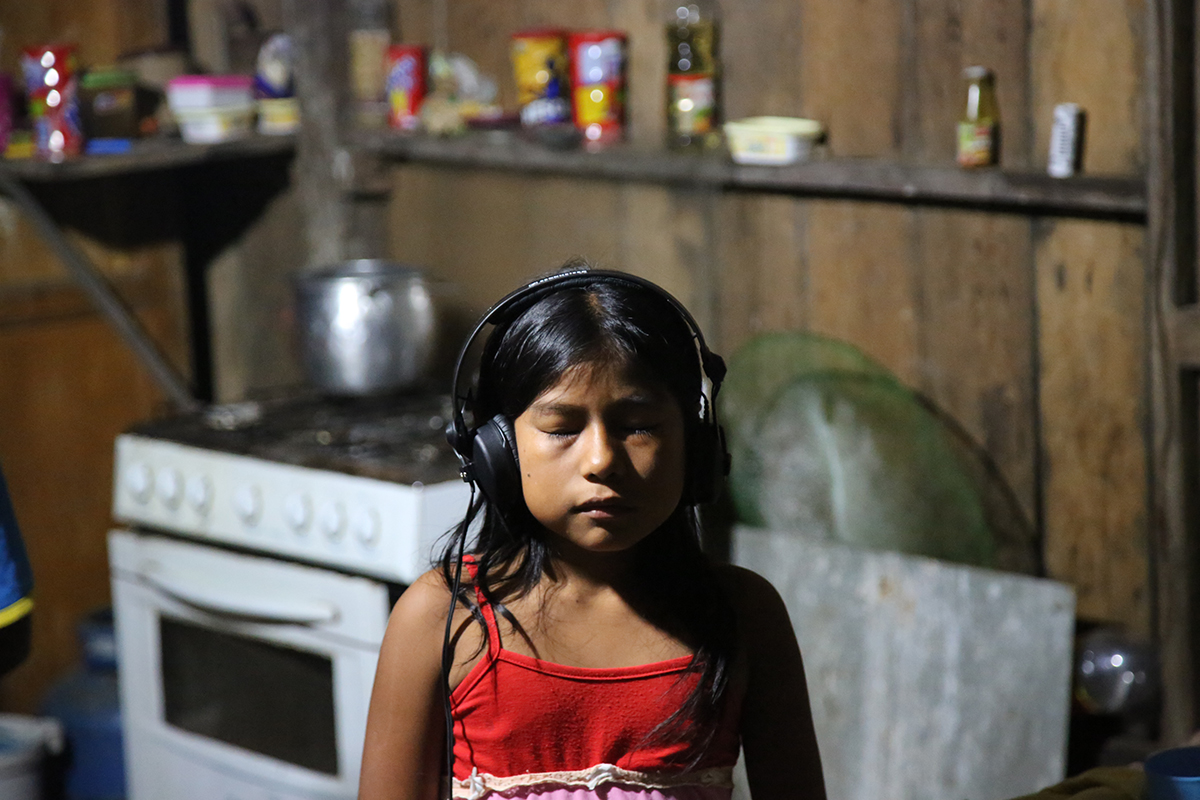
Also on the sensory front, in deafblind artists Heather Lawson and Michelle Stevens’ Imagined Touch the audience wear goggles and earphones to share a quiet, dark, complex world. It can be experienced as a performance or a free installation. House of Mirrors in the Festival Village offers another kind of sensory disorientation. In Encounter, the UK’s Complicite, utilising the depth of field and detail generated by the binaural microphone, takes its headphoned audience on a recreated journey up the Amazon.
Champions, FORM Dance Projects, photo Heidrun Löhr
Australia’s bold independents
Parramatta’s FORM Dance Projects is mounting Champions. Focused on women’s football, it’s directed by Sydney choreographer Martin del Amo whose engrossing signature works have often sprung from the act of walking—a short step to field moves. Created in consultation with Western Sydney Wanderers W-league, the work features 11 female performers enacting the drills, tactics and rituals of the game and expressing the joys of playing along with the frustrations of imposed gender limitations. We have an interview with del Amo in next week’s RealTime.
Enoch was keen to premiere Champions at Carriageworks: “It doesn’t have to be that Western Sydney is just a colony of Sydney.” Conversely, Ich Nibber Dibber by those proud Westies, post—featuring the astonishing trio reproducing excepts of conversations from their 10-year performance history—will open at Campelltown Arts Centre.
Prize Fighter, photo Dylan Evans
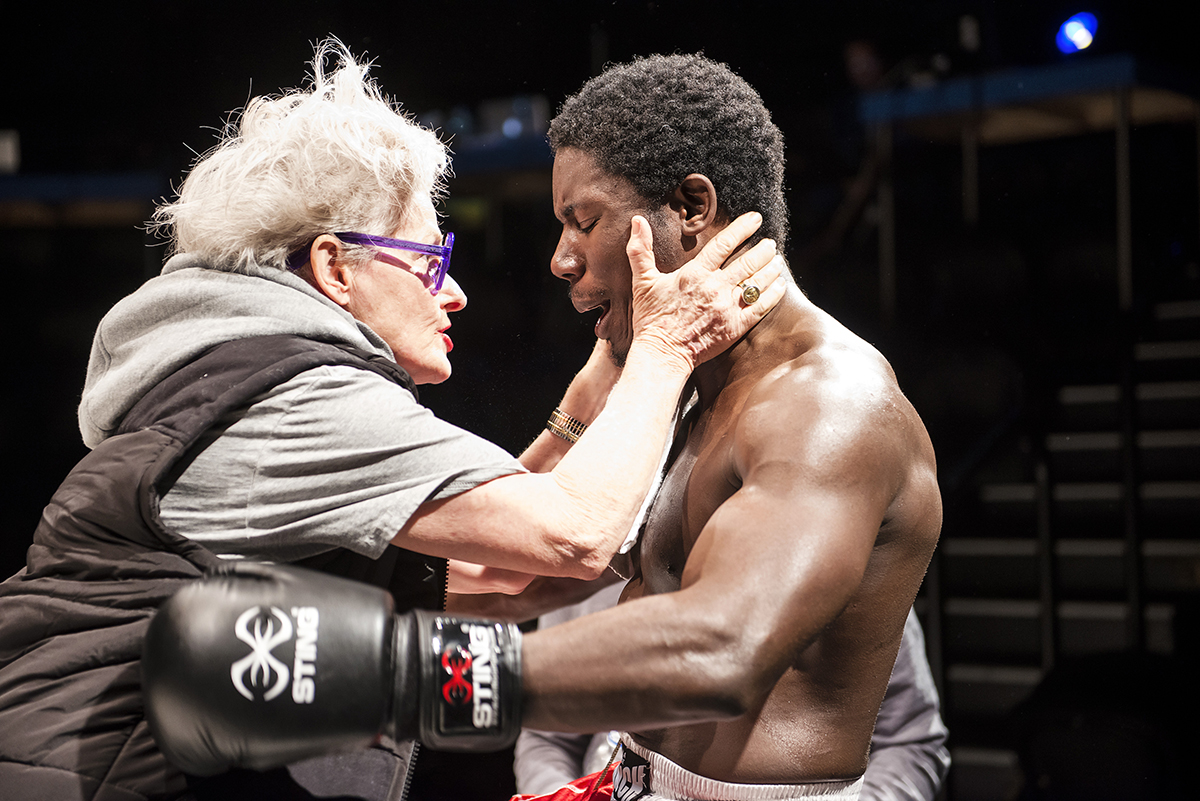
Prize Fighter from Brisbane’s La Boite plays out as a convincing real time boxing match in its telling of the life of a Congolese child soldier relocated to Brisbane. It was written by Future D Fidel, himself a Congolese refugee. Reviewer Kathryn Kelly wrote that it “showcas[ed] the breadth of African-Australian talent in this country with local performers Pacharo and Gideon Mzembe matched by recent NIDA graduate Thuso Lekwape…The opening night felt genuinely significant, evoking descriptions of the first night of Wesley Enoch and Deborah Mailman’s Seven Stages of Grieving at Metro Arts in the 1990s.”
Urban Theatre Projects and Blacktown Arts Centre come together to present Home Country, a work about intra- and cross-cultural tensions—Indigenous, Algerian and Greek—played out in a Blacktown car park from scripts by Andrea James, Peter Polites and Gaele Sobott. Also in Western Sydney is Hakawati from the National Theatre of Parramatta, featuring shared food and song from the Middle East.
Jacob Boehme, Blood on the Dance Floor, photo Bryony Jackson
Innovative Australian works from across borders include Melbourne’s Patricia Cornelius, with her play Shit (about class and misogyny), Jacob Boehme’s dance theatre work Blood on the Dance Floor from Melbourne’s Ilbijerri Theatre (read the review “To live, dance and love with HIV“), Brisbane’s Circa in Humans, from Tasmania, Terrapin Puppet Theatre’s You and Me and the Space Between and from Cairns, Dancenorth’s Spectra. Enoch says of the strong interstate showing, “I don’t think Sydney sees enough of the work that’s created outside of Sydney. Is that terrible to say?” I’m also interested in what happens when works like Prize Fighter get a rare second outing. There are things that can change, mature. Jacob Boehme’s Blood on the Dance Floor is another example. Aesthetically, it’s a real step on for Indigenous storytelling.”
Trevor Jamieson, The Season, Sydney Festival 2017, photo Simon Pynt
Indigenous culture: continuity, 1967, language
Enoch’s prominent Indigenous program ranges across theatre, play development, dance and visual arts. The Season, by Tasmanian playwright Nathan Maynard, a descendant of the chief of the Trawlwoolway Clan and of the North East Tasmanian Indigenous peoples, made its first appearance in the 2015 Yellamundie First Nations Peoples Playwriting Festival. I ask Enoch the writer’s age. “Oh, if you told me he was mid-30s I’d believe you; if you told me he was early 40s, I’d believe you—wise old man that he is. The writing reminds me of some of the early Jack Davis work where you have family environments in which cultural continuity is being expressed just through lived action. There’s a lightness of touch, of comedy, that belies a heavy burden, especially coming from Tasmania where the dominant myth is that all Aboriginal people were wiped out.” The Season addresses “cultural continuity around mutton-birding which has gone on for hundreds and thousands of years.” Also in the program is Ilbijerri Theatre’s “road trip comedy,” Which Way Home, by writer-performer Katie Beckett, about a daughter’s relationship with her single-parent father.
In Not An Animal Or A Plant, Vernon Ah Kee responds through drawings, paintings, text and projections to the 1967 Referendum which recognised Aboriginal and Torres Strait Islanders as citizens and included them in the census.”He’s bringing together his work as a conversation about that historical event. I don’t think this country’s even cognisant of the fact that this year is the 50th anniversary. It was such a successful referendum, 90.77% of the population voted. I wonder if it happened now, would it get through? What’s changed?”
The referendum will not be forgotten with the mounting of 1967, Music in the Key of Yes, in the Sydney Opera House Concert Hall, featuring film footage from the period and a stellar line-up of singers: Leah Flannagan, Yirrmal, Dan Sultan, Adalita, Stephen Pigram, Radical Son and Thelma Plum.
Bayala, Let’s Speak Sydney Language, is a very special component of the festival’s Indigenous program, an opportunity to become familiar with—through documents, classes and a “sing-up”—with the once assumed lost languages of the Eora and Darug peoples.
Meeting Canada
Enoch is pleased to be presenting “a big chunk of Canadian work, including Huff by writer-performer Cliff Cardinal from Native Earth Performing Arts [Canada’s oldest professional Indigenous theatre company]. There’s been a lot of exchange between Indigenous Australians and Canadians for quite a while now, especially the further north you go in Australia and through the tri-nation agreement between Australia, New Zealand and Canada over at the past decade.
“Huff literally means to sniff, as in solvent sniffing. It’s a multi-generational story where the performer plays all 20 roles. The youngest of three brothers has the gift from the Creator to make people feel good, and by the end, with all the tortuous things that he observes or that happen to him, he’s lost it. Huff marries the spiritual nature of a lot of First Nations storytelling with this story of growing up. It has a lot of black humour. The storytelling is both beautiful and tragic as you’d expect from any First Nations story. That’s where it works best: I’m laughing, but at the same time, I’m feeling like it’s dragging me under.”
Also from Canada is Company 605 in the dance work Inheritor Album; Tomboy Survival Guide’s words and music investigation into gender identity; Montreal composer Nicole Lizée’s form-bending Sex, Lynch and Video Games; and Anthropologies Imaginaires, Gabriel Dharmoo’s fictional chants and rituals which “examine Western culture and the way we look at others” (program). Also featured is iD by Cirque Eloize, the centrepiece in Parramatta’s Circus City, where all the circus works, associated workshops, forums and films will be presented. “Canada has a rich circus tradition but amazingly, we hear very little of it, except for Cirque du Soleil,” says Enoch.
Wesley Enoch, photo Prudence Upton
Remembering Myuran Sukumaran
Myuran Sukumaran was executed on 29 April, 2015 in Indonesia for drug trafficking. Sydney Festival, in conjunction with Campbelltown Arts Centre, is staging an exhibition of his paintings, curated by friend and mentor, the Australian artist Ben Quilty, and CAC director Michael Dagostino. Programming it makes a strong statement. “It’s important,” says Enoch. “Next year is the 50th anniversary of the Ronald Ryan hanging, the last legal execution in Australia. So there’s a sense of convergence. I think that as a festival we’re here to prod debate and discussion. There’ll be some people who’ll say, ‘How dare you elevate a drug dealer to the ‘hallowed halls’ of art!’ Well, if we believe that you incarcerate people because there’s a possibility of rehabilitation, there is the case to argue for the redemptive power of art. And after 10 years, my opinion is that those two people (Myuran and Andrew Chan) found a way to be rehabilitated. Capital punishment is such a final thing.”
We began our conversation with scents and senses and end with what is so evident about this Sydney Festival, its great sense of occasion—timely celebration of the 1967 Referendum, remembrance of the unnecessary death of Myuran Sukumaran, an embrace of Canadian art, and acknowledgment of the breadth and depth of Aboriginal culture and the innovative Australian art-making of which it is a sharer and driver. For all the breadth of its summer festival fare, Wesley Enoch’s 2017 Sydney Festival is a rarity among its peers for its sense of purpose, its aesthetics inseparable from its politics. It looks to be the festival Enoch sought of himself, “of this place and of this time,” of this city, of Australia in all its cultural complexity.
Originally published on Partial Durations, a collaboration between RealTime and Matthew Lorenzon.
Like all good neo-noir dystopias, the city of Michael Bakrnčev’s Sky Jammer has roots in contemporary urban life. In this episode I speak with Bakrnčev about property speculation, Macedonian folk dances, and conflicting advice in his Cybec 21st Century Australian Composers commission.
Thanks to the ABC and the Melbourne Symphony Orchestra for giving us permission to use their recording of Sky Jammer from the 2016 Metropolis New Music Festival.
Hear Keith Gallasch test his responses to the Sydney Theatre Company’s Arcadia and The Leaps’ Perch, playing at Belvoir for the Sydney Gay & Lesbian Mardi Gras.
Sydney Theatre Company, Arcadia, writer Tom Stoppard, director Richard Cottrell, performers Blazey Best, Ryan Corr, Honey Debelle, Andrea Demetriades, Jonathan Elsom, Georgia Flood, Julian Garner, Glenn Hazeldine, Josh McConville, Will McDonald, Michael Sheasby, Justin Smith, set designer Michael Scott-Mitchell, costumes Julie Lynch, lighting Damien Cooper, composer & sound design Steve Francis; Drama Theatre, Sydney Opera House, 9 Feb-2 April
Sydney Gay & Lesbian Mardi Gras & The Leaps: Perch, writers Brian Carbee, Sarah Carradine, director Sarah Carradine, performer Brian Carbee, design Julie Nelson. lighting Tara Ridley, sound design Lachlan Bostock; Belvoir Downstairs, 9-21 Feb
Top image credit: Georgia Flood in Sydney Theatre Company’s Arcadia, photo Heidrun Löhr
Ben Brooker takes you deep inside four works in the 2015 OzAsia Festival, the first under the direction of Artistic Director Joseph Mitchell whose focus on cross-genre and cross-cultural performance and transnational engagement was immediately evident. Audiences live out Indonesian street life with Indonesia’s Teater Garasi, grapple with an overwhelming flow of digital data in Ryoji Ikeda’s Superposition, ponder the metaphysics of the collaboration between Australia’s Dancenorth and Japan’s Batik in Spectra and, raincoated, are awash with water, tofu, seaweed and everyday junk in a “spectacle of self-eviscerating excess” in Miss Revolutionary Idol Berserker from Japan.
Top image credit: The Streets, Teater Garasi, photo courtesy the artists and OzAsia 2015
Interview with Cad Factory Artistic Director, Vic McEwan about A Night of Wonder, an evening of installation and performances onsite at the the Coleambally SunRice Mill in regional NSW.
Vic McEwan, Mayu Kanamori and visiting Japanese artist Shigeaki Iwai were in residence at the mill for three weeks developing responses to the site in consultation with mill workers and the local Coleambally community.
A Night of Wonder, 21 Sept, 2013
Video footage: Sam James
Editing: Gail Priest
Soundcapsule was a bi-monthly online feature offering free downloads of music by artists we had recently covered in RealTime.
Ensemble Offspring is a new music group performing works ranging from the 20th century masters to new commissions. They formed 15 years ago, originally under the name Spring Ensemble, the resident company for Roger Woodward’s Sydney Spring Festival. The group is led by percussionist Claire Edwardes and composer Damien Ricketson and has a core of regular musicians presenting an ambitious and plentiful program each year. They are well known for their eclectic approach to programming often collaborating across artforms, for example with contemporary performance group Theatre Kantanka (Sounds Absurd, 2010 and Bargain Garden, 2011), glass artist Elaine Miles (Fractured Again, 2010), scratch cinema expert and filmmaker Louise Curham (Waiting to turn into puzzles, 2008), video artists Andrew Wholly (Fractured Again) and Sean Bacon (Professor Bad Trip, 2011), and a host of specialist musicians including Halcyon vocal ensemble, improviser Jim Denley, experimental guitarist Oren Ambarchi, and electronica/noise artist Pimmon.
The track provided here is from their 2011 concert, Professor Bad Trip, highlighting the work of Italian composer Fausto Romitelli. Romitelli was inspired by the comic artist Gianluca Lerici aka Professor Bad Trip and poet Henri Michaux who both explored the effects of drug-induced hallucinations through their work (see our review in RT104).
Thembi Soddell is a Melbourne based sound artist and electroacoustic composer working across recording, installation and live performance often collaborating with cellist Anthea Caddy. She is renowned for working with dramatic dynamics that have a disturbingly visceral effect on the listener. Gail Priest described her performance at High Reflections in RT103: “Soddell, hidden from view, created an amazingly evocative soundscape of unspecified but terrifying dread coming towards us slowly from a distance. An intensifying rumble augmented by half-human, half-animal shrieks reaches its zenith and then sucks back down, vacuum-like, to a ringing almost-silence, only to begin again. With a fine balance between augmented field recording and machine noise Soddell perfectly controls this exhilarating journey into her unconscious—or is it our own?”
Her installation Window (2008) has recently been presented as part of Sound Full in Dunedin, described by Sally Ann McIntyre as “somewhat paradoxically leav[ing] its closeted participants in a state of heightened vulnerability and bodily awareness.” (Sept 5 e-dition)
related articles
the sound already present
sally ann mcintyre: sound full, dunedin public art gallery
RealTime issue #110 Aug-Sept 2012 pg. web
part 1: sydney scenes & sounds
gail priest: silent hour, ladyz in noyz, high reflections
RealTime issue #103 June-July 2011 pg. 40
Lawrence English is a Brisbane-based composer, media artist and curator. He is perhaps best known for his label and mulitarts organisation Room40 which has released CDs by a remarkable number of artists, both local and international. He has also presented a vast number of concerts, series and festivals in Brisbane such as MONO, Syncretism and the Open Frame festival. English is also the Brisbane-based director of Liquid Architecture and for the 2012 incarnation, he joined with Philip Samartzis to curate the whole festival focusing on the Antarctic. Of his performance with his trio Monolith (with Werner Dafeldeker and video artist Scott Morrison) Greg Hooper wrote in RT110: “Floes crackle, ice drips, trickles plop and burble. Thin overlays of surface water, wind blown ripples, soft unbreaking waves. Fade out. …One of the best Liquid Architectures I’ve been to (but do I always think that?) and, with Monolith, an exceptional performance that deserves much greater exposure.”
English also recently collaborated with Scott Morrison on a reworking of John Cage’s film for solo light One11, as part of Clocked Out’s The Cage in Us celebrations at the Judith Wright Centre. Drawing on this material and extending it further, English has release a new album through the Line imprint, For / Not for Cage, from which this track has been taken.
Room40 have also allowed us to giveaway a track from fellow Brisbane-based composer Eugene Carchesio. While perhaps better known as a visual artist, creating complex geometric works, Carchesio has always been active as an underground musician appearing in bands such as The Deadnotes, The Lost Domain and working under pseudo-names such as DNE. Room 40 is releasing his back catalogue over the next year and currently has on offer a free taster from which this track has been selected.
Feeling at first outside her comfort zone when having to review a musical —Thea Constantino’s Heart of Gold at PICA – Urszula Dawkins is quickly taken with this allegory of a quest for independence staged in the town of Paucity. The luscious writing, fine performances and direction that stretch the musical form yield, more than madness and satire, a bleak poignancy in a world where patriotism runs riot.
Top image credit: Heart of Gold, production photos Kim Tran
Embracing the work’s disturbing structure, Jonathan applauds writer and co-director Richard Murphet’s The Inhabited Man as a “dense, beautiful yet traumatising dramaturgical essay” about the psychological damage imposed by war.
Top image credit: Merfyn Owen (foreground), The Inhabited Man
Dan’s eloquent reading captures the vividness and thematic cogency of his review of director John Hillcoat and writer Nick Cave’s feature film The Proposition (2005), a seeming Western that tests white Australian myths.
In 2005 in Hill End, five hours out of Sydney, Erin Brannigan is continually surprised and thrilled by Julie-Anne Long’s The Nun’s Picnic, encountering in the tiny town a flock of nuns (with sexy underwear and travelling to “Like a virgin”), evocations of inner spiritual life and an hilariously provocative, and locally controversial, night-time performance by a stellar cast.
Top image credit: Julie-Anne Long, Kathy Cogill, The Nuns’ Picnic, photo courtesy the artists
In her first review for RealTime, in 2002, Gail alertly captures the dynamic intricacies, the sounds and sense of immediacy that is a Machine for Making Sense performance.
Due to recent developments in free software technology it is now possible to broadcast (‘stream’) audio and video material live over the internet from your home computer. net.radio is “desktop radio”; another triumph of software environments over arcane technologies. About 60 participants were brought together for 5 days of lectures and discussions on this exciting new field.
There are few intersections of purpose within the net.radio community. Its members are largely pioneers drawn together through a passion and fascination for exploring this exciting new medium. Hence the practice of net.radio is enduring a mildly uncomfortable adolescence, asking questions about the identity and purpose of the medium. There does seem, however, to be a very clear idea of what net.radio is not. It isn’t web radio, the practice of retransmitting commercial radio stations on the internet, and it is not simply net.art.
While the debate about exactly what makes net.radio distinct from these 2 disciplines is largely unresolved, it is possible to use 4 broad categories to describe net.radio. There are those such as Pararadio in Hungary and Backspace Radio in London, that utilise net.radio to contribute to inner city youth communities. Others such as Berlin-based Convex TV are ‘alternative’ radio practitioners, that value net.radio as an important distribution channel for their interviews and music. There are the radio.art and net.art practitioners who are drawn to net.radio because it is yet another opportunity the internet has provided to utilise new technology in broadcast art (Kunstradio and Radio Ozone). Then there are those who use net.radio (mostly where oppressive governments reside) to open channels for the expression of important political or counter cultural perspectives (B92).
In addition to live audio, it is also possible to add live video to internet broadcasts. There have been some forums such as the 1998 Art on the Net Awards that examine this practice, however most internet broadcasters confine their broadcasts to audio. Although free software such as RealVideo make it easy to broadcast video on the internet, the time and cost involved to produce the content is often prohibitive.
There were about 15 presentations over the 3 days in Berlin with lectures covering a broad range of topics including digital broadcasting, midi audio technologies, net.radio collaborations, historical perspectives on broadcasting, and streaming media software. I found all these presentations interesting but some were only obliquely relevant to the practice of net.radio. However some talks were wholly captivating.
My favourite was an extraordinary speech by Convex TV’s Martin Conrads on the intersection of net.radio and pop-culture, delving into many radio icons within popular literature. Included was Isaac Asimov’s Harmoniums, a story about birds which feed on radiowaves. This story led to a beautiful quote from Conrad that has given me much to muse on—“radio does not have to have content.” An interesting panacea to the belief that all broadcasting should be strictly about content.
There were also some astonishing live performances, one of them by XLR. They mixed live digital music, commentary, and additional nuances provided by the limitations of streaming media technology, together with audio provided live from Canada, Latvia and London. The experience of being immersed within this broadcast was incredible. If you add a beautifully clear Berlin summer night, 60 people who only wanted to talk radio, and cold beer on the banks of the canal, you can understand why it was hard to come back to Adelaide!
The conference also provided the opportunity for many debates including a public forum at the end of the last day. However, as with any conference, it was after the scheduled events that the really interesting discussions occurred. From these informal talks I feel my practice has been wholly altered. The most important consequence is that I now consider net.radio as an important broadcasting innovation. It has opened the door for many to experience the thrill of broadcasting and add an alternative voice to mainstream radio and television. While net.radio is still in its infancy it is rapidly maturing and I believe it is only a matter of time until it is an ingredient in many people’s daily media diets. Berlin net.radio days 98, though not a triumph of modern organisational practice, was one of the most efficacious and interesting symposiums I have attended.
–
The writer’s attendance at Berlin net.radio days 98 was sponsored by ANAT and ARTSA and assisted by the Media Resource Centre (Adelaide) and Virtual Artists. The Conference was held on June 10 – 15, in various venues in Berlin.
Adam Hyde is an online conference manager, web developer and artist in New Zealand where he managed several radio stations and established Australasia’s first free-to-air community television station. He recently moved to Adelaide to work as a business development manager for Virtual Artists, and to investigate online broadcasting.
–
RealTime 27, October – November 1998, p42
At LIFT (London International Festival of Theatre) in 1997 as part of a joint RealTime-British reviewing team, Zsuzsanna Soboslay incisively conveys her experience of Christophe Berthonneau and Group F’s, Un Peu Plus de Lumiere (a little more light), a fireworks creation in Battersea Park, as a work at once “awful and aweful,” conjuring, beyond beauty, “Vietnam with napalm, London with firebombs.”
The RealTime LIFT 1997 coverage, including this review, will soon be available in our archive.
Welcome to RealTime 11 incorporating our first screen culture supplement OnScreen. With support from the Australian Film Commission, OnScreen aims to bring you engaging, critical and informed writing on film, media and techno-arts from across Australia. OnScreen will reflect RealTime’s broader focus on mixing genres and blurring boundaries, especially appropriate as aspects of screen culture become increasingly interlinked in the wake of technological, aesthetic and policy developments. Our first issue gives some indication of OnScreen’s scope: Media analyst Gil Appleton clarifies the confusion around the interminable policy permutations in Pay TV; Balkans commentator Eddy Jokovich casts a critical eye over Kusturica’s Underground; John McConchie interviews director of Bad Boy Bubby Rolf de Heer about his new film The Quiet Room; John Conomos surveys CD ROM based artform practice in his preview of the MCA’s Burning the Interface exhibition; two writers coming from very different perspectives size up Larry Clark’s Kids, Boris Kelly visits Stelarc’s web site and Anna Dzenis engages with the textuality of Lesley Stern’s new book The Scorsese Connection. We also bring you reviews of recent new media conferences, Flickerfest, the recent UNSW College of Fine Arts screenings, and new interactive media installations, plus previews of the Adelaide Festival film program, the MCA’s major retrospective of early film and the Mardi Gras Film Festival. We’d welcome your feedback, and hope you enjoy OnScreen.
Realtime 11 is strong on process in performance, dance and music, whether it’s Jenny Kemp and Cath MacKinnon on preparing new works for the Adelaide Festival, Tess De Quincey and Stuart Lynch planning ‘to dance Sydney’ in 100 performances, John Nobbs and Jacqui Carroll discussing performance and training for their Suzuki Tadashi-inspired Frank Productions, choreographer Graeme Watson shaping Antwatchers for One Extra, Deborah Pollard describing the evolution of a work with Indonesian actors and farmers, David Harrington on the Kronos Quartet ‘as process’, Ion Pierce and Nicholas Gebhardt musing on the politics of composition and Alice Cummins on the contribution of her studio to her work, as well as Jan Cattoni reporting on the making and teaching of documentary filmmaking in the Marshall Islands.
On the arts politics front the concern among artists over the restructuring of the Australia Council persists. The issue of artist representation appears to have been resolved with the Australia Council confirming its commitment to peer assessment and the establishment of a range of artform funds in which artists will be represented in the majority, as they will be on Council. MOB has also become a fund (MOF) but its members still don’t have an artist among them they can talk to about art! The Foundation for Culture and the Humanities, on which artists were poorly represented, has parted company with the Australia Council, apparently on the grounds that its brief is broader—“heritage, civics, centenary and Federation”, said departing director Craddock Morton, to which we could add Fundraising. The issue now is the fate of specific artforms in terms of funding strategies and programs. The second round of the consultative Australia Council forums have been suspended until after the elections. Meanwhile the restructuring goes on and the new coverall Handbook will be released in April. So much for consultation. The pre-Xmas forums were hardly models of excellence—brief meetings crowded with more questions than could be answered. A day in each city would have been ideal with carefully planned agendas, brief keynote addresses and ample discussion time. Too much to hope for?
Hybrid artists were alarmed at the forums to find themselves missing from the list of Funds and the list of closing dates for applications for funding, and ‘their’ funds allocated to an Advisory Committee to Council. And they were not to be represented on Council. In principle, an advisory committee could encourage all funds to think in terms of innovative interdisciplinary work, even talk to each other. However the Hybrid Arts has been supporting distinctive work in sound, the body, multimedia and interactivity. As the funded area most directly and critically engaged with the issues of Creative Nation it seems shortsighted to fail to acknowledge Hybrid Arts as a growing area of activity (not a form), as a Fund and as worthy of representation on Council.
RealTime Issue 11, February – March 1996, p12
Is this man a kind of Midas turning whatever he touches into the (Black &) Gold of pure art? And the whole world consisting of latent artworks waiting, like the bread and wine of reality, to be transfigured through some dark mystery, into the indiscernible flesh and blood of the sacrament?
– Arthur C. Danto
What is it about inscribing some text on a yellow car, chopping it into little bits and calling it art that captures the imagination? Like all true feats of marketing, Black & Gold Art had something for everyone: violence, colour, action, drama, merchandising, father-son conflict and a bit of theory. It was literally art for the whole family.
There’s something perversely pleasurable in seeing a car (that seemingly indispensable symbol of success in the taken-for-granted world of suburban must-haves) being destroyed by an angle grinder. The media certainly thought so, with Channels 7 & 9 and The West Australian all poised ready to capture the best moments to include in their ‘zany’ segments.
In Black & Gold Art, the sensational aspect was really only a function of necessity: how to get a full sized 1975 Holden Gemini Fastback through the half sized doors of PICA and up the stairs (PICA has no lift). Anyone who followed the car (piece by piece) into the gallery might have noticed the transformative function of this process.
Of course, the other point of fascination was the relationship between artist-son and mechanic-dad. Few artists have not experienced the frustration of trying to explain just what exactly it is they do to bemused parents who only want what’s best for their kids (Surely you want to be a lawyer?). Beyond that, the necessity to defend, justify and name in clearly descriptive and easily understood terms that which is not ‘real’ art is a constant both within and without the family circle. Artist-son’s solution (if not resolution) was to involve his mechanic dad in the project in his own professional capacity.
Beyond which, Mick Hender (the son) discusses the function of objects and their names. What is it that gives a particular object its defining nature and how is this mediated by the packaging and labelling of consumer culture?
The primary gesture of this project was the inscription of the words, “Black & Gold Car” onto the side door and bonnet of a defunct yellow Gemini. Black & Gold (the company) markets itself as a “no frills” corporation. Its strategy is to declare on the packaging of a product exactly what the product is. The text is printed in bold, generic, stencil typeface, in black on a yellow background. No photographs or images embellish the packaging.
The Black & Gold Car, as opposed to regular Black & Gold products, didn’t have any packaging—the text was printed directly onto the surface of the metal bonnet and door. In a sense, packaging and object become one and the object’s name and physical presence become inseparable. The text inscribed on Black & Gold Car, rather than distancing the object itself from its linguistic referent, actually gave the car its essence. Similarly, the assistants working on the project wore Black & Gold overalls. The gallery was painted gold with black lettering. We’re talking Black & Gold in overdrive.
Black & Gold Art also involved the printing of t-shirts to specifications laid down by customer/gallery-goers. The idea began with the printing of Black & Gold T-shirts as a parody of those brand-name t-shirts which function principally to advertise the manufacturer, and rapidly developed into a means of involving people more directly in the experience of Black & Gold Art. Directed by an extensive instruction sheet and order form, customers could designate their size and weight and the title to be printed on a t-shirt. Titles ranged from “Black & Gold Alcoholic Fat Bastard, 90 Kg Nett” to “Black & Gold Fucked Up Homosexual, 69 Kg Nett” to the more straightforward, “Black and Gold Academic, 140 Kg Nett”.
The nature of an object is often defined by what it is not. Ian Ground, writing in Art or Bunk, gives the example of an imaginary meteorite thought to be identical to a Henry Moore sculpture. Ground asks the reader to consider a set of words and their possible application to both meteorite and sculpture. His selections include “witty”, “crass”, “simplistic”, “vulgar”, “original” and so on. He shows that most of these adjectives are inappropriate to describe the meteorite but could, quite plausibly, be used to describe the artwork. Ground’s conclusion, that two identical objects can be different things is effective precisely because of his concrete (albeit imaginary) example. Similarly, Black & Gold Art exists as an example in action: a proposal about the defining nature of objects, products and their packaging.
–
Black & Gold Art was the work of Mick Hender, the artist-son, assisted by Brian Hender, the mechanic-dad. Black & Gold Art was an umbrella project of the 1995 Artrage Festival at the Perth Institute of Contemporary Arts.
Lucas Ihlein, who assisted on Black & Gold Art is a recent graduate of the School of Architecture & Fine Arts, University of Western Australia.
RealTime Issue 11, February – March 1996, p11
In “Rave New World” (The Good Weekend, Jan 6, 1996), Stephen Spears, after a few “horrendous days” in contemporary showbiz, rediscovers vitality, his youth, memories of by-gone days and, it would seem, an illicit thirst for life—all of this at a rave. It is—without wanting to downplay the importance of these experiences for him—a romantic view of the rave scene, a view that comes from a person wanting to rediscover life and not discover it. It is ultimately an unreal and isolated picture of the scene portrayed as untouchable and inaccessible. With a few funky graphics and blurred photographs it appears dreamy and poetically chaotic. Anarchy runs happily rife in a psychedelic, sweaty, beautiful-bodied, isolated dance.
A person loyal to rave culture could see this article as a great advertisement for the scene, making it more user-friendly and countering bad publicity such as that surrounding the death of the Sydney teenager Anna Wood last year. Perhaps this is what we should learn from Spears’ article: that we should respect the two sides to every story.
However, the story of rave culture is complex and the fact is that raves move and change. Spears’ article focuses on a dance party but raving is a way of thinking that manifests itself in a person’s lifestyle. Ravers think in terms of the big picture. The body and technology are considered interacting forces. Technology helps the body move faster and further. To be a raver is to consume technology and ideas and redefine them in an interactive environment. A raver is conscious of the world, the universe, the past, the present, the future, nature, technology and how these affect each other – an interlocking network of ideas and philosophies that one may completely indulge in or simply pick and choose from.
The most prominent aspect of the philosophy behind raving is the relaxed, friendly environment which is usually violence free. Raves are not sleazy pick up joints, people are there to dance and go off on the music. This is the essence—release and escape.
– Emma, Mel, Boba and more, “Rave Special: Dissecting The Rave” Beat Magazine, 1994
Alternatively, the rave can exist as part of a philosophical system. Raving is part of a means to fulfil a role in the world wide web of Gaia that calls upon the depths of mathematical and computer science to develop a web of life and consciousness that stretches out from traditional forms of hierarchy.
The ravers see themselves and the creation of their sub-culture as part of the overall fractal equation for the post-modern experience. One of the principles of chaos math… is phase-locking, which is what allows the various cells of an organism to work harmoniously…A phase-locked group begins to take on the look of a fractal equation, where each tiny part reflects the nature and shape of the larger ones. The ultimate phase-locking occurs in the dance itself, where thousands of… like minded young people play out house culture’s tribal ceremony…They’re on the same drugs, in the same circadian rhythm, dancing to the same 120-beats-per-minute soundtrack…It is at these moments that the new reality is spontaneously developed…
– Douglas Rushkoff, Cyberia: Life in the Trenches of Hyperspace, Flamingo 1994
Rave music—or techno as it is universally known—does not have to be danced to. Like any other music it can simply be listened to. Trish, a DJ and journalist from Melbourne, said in an interview that she discovered techno after getting bored with gothic music. She appreciates its consistent originality. As DJ of a prominent techno show on Melbourne’s PBS radio station, she praises its accessibility for composers, producers, lovers of music or ravers. The rapid development in technology—particularly audio technology—has meant that people can create rave music easily. Making electronic music is not limited to the few who have connections in the music and recording industry. One can pick up an old Roland synthesiser or an apparently out-of-date Akai sampler, and with some imagination create sounds that are new, truly different and inspirational.
Ross Harley in an article on Volition Records recognises the creativity of techno and its romance with machinery and technology. (“Acts of Volition”, Perfect Beat vol.2 n.3 1995). In this essay on the history and development of one of Australia’s premiere techno music labels he writes of “the certain perversity that prevailed…for the original design and purpose of…machines” and how these machines could “easily be turned against the industrial uses they were made for”.
But there are other issues at stake in an understanding of the scene. The taking of drugs (whether smart-drugs, E, speed, acid, guarana) is an aspect of the rave culture that is so often held out to the public as the only exhibit in the case against the culture. The focus on the taking of drugs effectively casts a shadow on the ravers and parties that don’t use drugs. There is also the business of raves. What is the economic benefit of the scene to the promoters and the public? What about its history? The scene has moved from the ‘old skoolers’—who were just learning to integrate technology and this new way of being— to the recent split between ‘clubbers’—who go to mainstream clubs and don’t necessarily subscribe to a different way of viewing reality—and ravers.
The process of understanding the rave scene could lead to the development of discourses that would enable us to work on other contemporary sub-cultures, how they work and the interplay or non-interplay between them and how this effects the wider community.
–
S.C.A.N. is a group of interested people gathering information and ideas about raves and sub-cultures. Contact Dena Christy on 0416 092 372 or 03 9646 4467 or Kit McMahon 02 798 3378.
RealTime Issue 11, February – March 1996, p10
In a picturesque flamboyant port town, a West Australian theatre company has matured into a community asset of cultural significance. Fremantle’s Deckchair Theatre, currently under the artistic direction of Angela Chaplin, is passionately committed to the exploration of “exciting and sensual theatre concepts and cultural images”, with a particular commitment to nurturing women artists and artists from non dominant cultures, as exemplified in their 1995 program: Wildgirl, Sweetown, Diving for Pearls and Tiger Country. Their ground breaking production Ningali began touring both within Australia and internationally during 1995, culminating in a Fringe 1st award for outstanding new production at the Edinburgh Fringe Festival. Ningali recently performed to capacity audiences for the 1996 Festival of Sydney.
Deckchair Theatre was founded in 1983 by Di Shaw and Brian Pedie at a time when figures released by the Australia Council showed that less than 7% of the Australian population went to the theatre. “We felt that theatre wasn’t relevant to real people in Australia. Most plays were about white middle class people and most were written in England and white middle Australia,” remembers Di Shaw. “It was limiting because they didn’t reflect Australia’s cultural diversity. They were also performed in venues where a lot of people were uncomfortable simply because they didn’t and don’t understand the rituals—when to clap, what to wear—these are rituals that only certain people have access to.
“We wanted to avoid theatres and instead perform in public spaces where people already gather—spaces which were important to people—interesting spaces where people wouldn’t expect to see theatre so they would come with curiosity.”
Deckchair’s first major production, Fleets of Fortune, emerged out of the chaos that was the victory of ‘the winged keel’ in Newport, Rhode Island and the consequent refurbishment of Fremantle in 1983, and it was performed under the stars at the Fremantle Arts Centre. Di Shaw met with much opposition from the state funding body: “The drama officer at the time thought I was foolish to be using so much of the company’s resources on this production, feeling that we should do something safe—something we wouldn’t lose money on. But I wanted to express aspects of Fremantle’s local identity so we did it and it was a huge success”.
Each year since, Deckchair has undertaken a major production for, about, and involving their local community. Promenade theatre and the animation of public spaces have been effective tools for celebrating Fremantle’s cultural mix while effectively uniting its diverse demographics. Their community production for 1995, Cappuccino Strip, wove these transcultural threads into a dynamic piece of promenade theatre which explored “the wonderland of coffee cups and chaotic cafe culture”.
Di Shaw returned to Deckchair as the Associate Director (with Angela Chaplin) on Cappuccino Strip with a strong background in, and views on cultural community development. The merging of art, economics and public spaces—according to Di Shaw—has “injected profound change in the treatment of community based projects”.
Performers and audience met on the platform at Fremantle Railway Station guided by the glorious sounds of The Joys of the Women choir. Actors Rose Lenza, Steve Shaw, Peter Findley and Jackie Kerin led audiences on a historical, cultural and theatrical journey through the streets of Fremantle, weaving their way through plazas, malls and coffee shops.
Aside from the four professional actors and musician, this exciting piece of theatre featured three choirs, a young dance ‘crew’ and initiatory aprons for the audience (you had to be there…). Cappuccino Strip adopted an interactive, democratic and celebratory approach to contemporary theatre. Open community workshops and extensive research provided a richly textured script taking as one key focus the life of Italian immigrant, Nunzio Cumina, who introduced Fremantle to the art of drinking coffee on the sidewalk.
Cappuccino Strip concluded with a parade by audience and cast members through Cappuccino Strip itself—the main drag in Fremantle—carrying large papier maché coffee cups on litters and singing an ode to the joys of cappuccino, macchiato, cafe latté and the long black. Apart from the general silliness and fun of taking over the street, the parade made reference to three major cultural events in Fremantle: the Blessing of the Fleet, the Festival of Fremantle Parade and the May Day March.
The rewards of working with a community active in its own decision-making processes are both subtle and profound—celebrating the cultural differences but simultaneously bridging the needs of sub-cultures. Festivals, parades, performances are all cultural rituals which can reclaim the streets with dancing, laughter, and innovation—the taking over of space.
–
Veda Dante is an electronic media journalist and media consultant resident in Perth.
RealTime Issue 11, February – March 1996
Feminist Theaters in the USA: Staging Women’s Experience
Charlotte Canning, Routledge 1996
Confronted on the cover with the growling faces and bared claws of five women acting, I wonder what is in store inside. A quick flick reveals few photos but there is a caption for the cover image—Women’s Theatre Collective presents Sacrifices: A Fable About the Women’s Movement. And in those words is told a story or two about this book which is a survey of the American feminist theatre movement compiled from interviews. The documentary evidence provides a readable account of the many small and intense groups formed as a result of the women’s movement in the 1970s, covering not dissimilar ground to Peta Tait’s book Original Women’s Theatre which is quoted by Canning—a significant first for an Australian theatre academic to be acknowledged in the US.
Its primary contention is that feminist theatre is drawn from women’s experience, and reflects and affirms women’s experience to its audience. Instead of problematising the idea of authenticity or the category of experience, parts of the book sound like the confessional forums of Oprah Winfrey with an American privileging of the personal voice: “I remember feeling totally affirmed as a woman…”. But how can the primary interest of all the interviews be experience? What about style, passion, aesthetics, theatricality, history, performance processes, the language or theatre itself? For anyone interested in those questions, the book provides little access—the index is mostly a list of shows and names, such as the “Women’s International Terrorist Conspiracy from Hell—acronym WITCH” and the only general categories are ‘collectives’, ‘consciousness-raising’, ‘festivals’, ‘oral history’, ‘transformations’. And there lies another story which makes it seem ‘all wrong’ to praise, and not re-examine, the existence of an “It’s All Right to Be Woman” theatre.
–
RealTime Issue 11, February – March 1996
Teiji Furuhashi died on 29 October 1995 in Kyoto, Japan, of an AIDS related illness—he was 35 years old.
I first met Teiji in Kyoto when I was researching the exhibition Zones of Love—contemporary art from Japan which toured Australasia 1991-92. Although he always denied that he was the leader of Dumb Type (or that there was any leader in the group), he was very much the public, internationalist face of the group and his energy was palpable even if his authority within Dumb Type was more covert.
Dumb Type began, and continues, as a loose group of theorists, visual artists, architects and performers. Most met each other when they were students at Kyoto University. Bored by the contemporary scene of the early 1980s and the vacuousness of much of Japanese society, but energised by teachers such as artist Yasumasa Morimura and theorist Akira Asada, Teiji Furuhashi and Dumb Type began to make provocative installations and then performances which quickly propelled them onto the international stage.
When I met Teiji in 1989 and watched the documentation of Dumb Type’s work I decided immediately that they would come to Australia and perform as part of Zones of Love. It is unusual to meet people who are so young, so organised and so specific about what they are doing—and Teiji was that. The work crossed media boundaries (video, film, performance, sound, architecture…) in highly innovative ways, and it addressed the contemporary condition of both Japan and the technological world in which we now live. Teiji never quite believed that I could achieve my aim of getting the group to Sydney because it was such an expensive project and because of the difficulty of raising money (the Japanese government was most reluctant to fund such work), but with a lot of help and two months to go, assistance was found and Dumb Type performed pH in Sydney at the MCA.
This piece electrified the audience with its energy, technological expertise and enigmatic performance styles which presented a bleak and elegant view of contemporary life. And each night after the performance the members of the group would change into drag of one sort or another and go to perform in bars around the city as Julie Andrews or the OK Girls. These people knew how to party.
In 1994 Dumb Type returned to Australia and performed their new work S/N at the Adelaide Festival. S/N deals explicitly with sexual and racial difference in the Japanese context. For Teiji, this was a painful piece because it was about himself and his journey through one of the world’s most rigid and conservative societies as a homosexual and HIV+. Again after each performance the party would begin, and later in Sydney at Newtown and Oxford Street clubs the novel drag acts would utterly delight the audience.
Over the last five years Teiji’s bouts of illness grew longer and it was with great regret that Dumb Type had to cancel a tour to Brazil during Mardi Gras in 1995. Teiji and the group returned to Kyoto from North America where his solo installation Lovers was being exhibited to much acclaim in New York and Toronto. Lovers is an homage to the artist’s friends and lovers, a complex and elegiac piece where Teiji and eight other performers become projections of light in a dark room—their actions mingling with words, sentences and the music for which Teiji was also renowned.
Dumb Type will continue to tour S/N to Hong Kong, New Zealand and Europe through 1996. Lovers is currently touring France and thereafter other European venues until the end of this year. A new Dumb Type piece, Monkey Business, in collaboration with the Danish group Hotel Pro Forma (appearing at the 1996 Adelaide Festival in Orfeo) and New York architects Diller + Scofidio, will premiere next year. Most recently Teiji featured in the SBS documentary Hell Bento!!, and a compilation of Dumb Type’s music is available from Spiral Garden/Wacoal Art Center, Tokyo.
Teiji was a perfectionist, an innovator and highly creative in whatever form he worked. His credo was “try harder”, and people always did.
–
Judy Annear is Curator of Photography at the Art Gallery of New South Wales.
RealTime Issue 11, February – March 1996
Something that strikes me is that your work is very human, not abstract. In Inhabitation, at Sidetrack Theatre last year, the particular weight of those doors seemed very funny, because you had to wonder what these people were doing this for, carrying around these monumentally unwieldy objects. Similarly in D-VOID, recently shown on SBS TV, I liked the caricatures. I also wondered how aware you were of why people might find it funny.
AS I’ve been told that the concerns with which we’re working in the shows are not visible to the audience. Friends have commented that a Gravity Feed performance can be like watching the Twelve Tasks of Hercules, but that’s not the intention. In fact my interest is the opposite, to actually be anti-spectacular. Inhabitation demonstrated the effects of complying with or resisting gravity, of building and dismantling. It was about inhabiting the spaces that we built, the set and the theatre space, whilst in a constant struggle with that set.
There certainly was a struggle.
AS The weight was incidental, but it was real. The humour is partly in juxtaposing types, selecting people of different sizes, body build, ages. We’re not trying to pre-determine where it’s going to be funny but we already know it will be because of the structure, those five people, and how serious we are about doing it. My interest in random events supports a respect for humorous content.
What the caricatures create is about people living in the world, a very human thing. When you or Ari Ehrlich are on stage, I don’t get the sense that it’s an act, despite the artistry behind it.
AB I think that’s a good thing. The body itself is our material, stripped, but marked by history, culture and upbringing. We inhabit multiple bodies: traditional, emotional, physical bodies, imaginary bodies, bodies of knowledge. In terms of Butoh, we strive to speak to an original or pre-cultural body, loading it down with imagery. The images Ari and I negotiate are not for the body, but are about the situation, and the tasks being performed within that. We don’t think about it as imaginary. We’re trying to generate an atmosphere—the performance event—and that atmosphere is real.
The images are very dense, people seemingly victimised by situations.
AS Density is certainly something that interests me. The strongest image perhaps is as if the body were inside a slab of rock, vibrating ever so minimally, suspended inside, matter giving way to matter, bodies pitted against other bodies, raw material. If we use doors, the body is pitted against the doors. If we use fire or ice, it’s more than metaphor. It’s direct substance of which we and our small world are made.
When you talk about the work, it sometimes seems quite different from what it can be about for an audience.
AS From my point of view, the work is developed from an intuitive response to the possibilities of a space. Then comes a long process, sorting ideas, references, options, possibilities, readings and misreadings. When it comes back down to working, it does tend to be physical and intuitive again. I trust that source material has become deeper content.
Do the sequences of events arise from the physicality of it or from somewhere else?
AS The work is about the atmosphere it’s attempting to establish. It isn’t made purely listening to the body dialogue. The sound environments created for us by Rik Rue are basically synonymous with what we’re doing now, and make it real. His apprehension of the world complements mine. As soon as I have a structure that can be communicated, I take him to the space. We won’t discuss the sound. Sometimes he’ll ask me questions, but usually he stops me before I’ve told him as much as I want to. And he’ll go away and come back with a composition which seems invisible when you first listen to it on cassette because it already fits the space.
When you talk about the space, it’s something that’s a physical, dense thing, full of matter already.
AB Traditionally, Gravity Feed colonises, inhabits, impregnates, infiltrates, reinterprets the venue. We’ll bring the 24 doors to The Performance Space as a metaphor for the fabric of our built environment. In Inhabitation many of the tasks dealt with moving the doors or building with them. The new show is a continuation of this, and we’re editing quite severely because we felt we failed in our contract with the audience the last time.
The new show will be based on our response to the presence of an audience. Perhaps the contract I talked about is not with the audience, but with ourselves—that we will more fully address their presence as inseparable from the event. My sense of obligation to the audience is that I owe them an intelligence which may be enacted in any number of ways. I also operate within a history of performance art, where the primary concept is being demonstrated either on the body, spatially or temporally. For example, the artist is hidden under the floor, or the event has already happened.
At The Performance Space we know many of our audience, the history of the kind of shows that have been there, almost every nook and cranny, how it’s been used. There are certain foregone conclusions which we want to undermine. Our focus is in looking at old things afresh, overlooked things, until they spring out again.
–
The members of Gravity Feed are Alan Schacher, Ari Ehrlich, Dennis Beaubois, Tim Rushton, Jeff Stein. In the House previews at The Performance Space, Sydney March 16 and 17, then runs 20-31 March.
RealTime Issue 11, February – March 1996
Jacqui Carroll and John Nobbs of Brisbane’s Frank Productions talk with Julia Postle about performance and the classic text.
The reputation of Brisbane-based Frank Productions is slowly but surely spreading as they develop a body of work that includes The Tragedy of Oedipus, The Tale of Macbeth and Orpheus. The company is committed to careful development rooted in rigorous training and in sustaining an on-going ensemble, so it might be a while before an extended season of their work will be seen outside of Brisbane.
Why do you choose to combine the training method of Suzuki Tadashi with classical drama. Is it a logical relationship for you, or is it something more exploratory?
JC It’s pretty logical. To present the classics, the performers have to be, in a sense, as large as the material they’re presenting. But up there on stage you’re as tall as you are. To reach the audience, Oedipus has to be larger than life, the actor has to be totally convincing. Mr Suzuki was the first person who came into our lives who had investigated this and developed a series of exercises which made the actor physically more palpable for the audience. Instead of a person standing there, the actor was actually driving energy into the audience, occupying positive space, not negative space. And to do this you have to be amazingly energised, amazingly driven. You’ve got to wake the body up; you’ve really got to be there in the moment. At the end of the day, if you’ve got these actors who look like eagles, you can’t present works that belong to sparrows.
In your production of The Tragedy of Oedipus it’s that strength of the performers which is so powerful. It seems that the training is a really pervasive force then.
JC It’s not as easy as it would seem. Once you get it, you’ve got to keep working at it. If the body is not primed for action, then the voice isn’t. And the more we explore the text, we find it’s extraordinary how much more energised the actor has to be. You’ve got to do the training to get to that point, because you don’t even know you’ve got a body until someone forces you to do the training and makes you come up with answers to various problems. I wanted to develop the actor who could do it, and then I wanted to develop the works that would expose and reveal the actor who could do it. I was very much on a journey of not only getting into the body of the actor, but also making theatre works that would actually reveal what we have created.
The other thing we are very aware of is the audience. The only reason you stand on stage is for the audience. That sounds pretty obvious. But there’s often a feeling of people acting amongst themselves, to each other; as if somehow their personal exchange on stage will transfer across the footlights. But I’ve got to engage you. Mr Suzuki went back to the Greek ideal; that the actors were there to tell a good story, and to tell it to the audience. They were the ciphers through which the material of the story passed. That’s why they’ve got to be energised, because they’re carrying the weight of the text with them. You can’t just be casual about that; it’s got to be driven through the body to work. And nobody can just wander in and take a position with Frank Productions. They’ve got to go through the training, because they don’t even know what we’re talking about until they spend a year thumping the floor and standing on one leg, looking at you and engaging you. It’s extraordinary.
So how extensive is the research before the rehearsal process? You must really play with the texts?
JN You use many sources to gain different views of the work; rather than sticking to one thing we’re looking at all aspects of the myth. And Jacqui basically accumulates the text over many months and we then rehearse over a long period. It’s very important that it does take a long time so that we don’t have this last-minute rush business.
And we’ve come to believe in the power of repetition, because the more you repeat something, the more the false ornamentation falls away. So it’s very important to us that we do come back and do works like Orpheus —this will be our third performance over three years. We’re doing the same things we did before, but we’re making it interesting again. And most theatre groups eschew that, because they think it destroys the creativity. But if you look at something like the Dying Swan solo from Swan Lake, you’ve got to do the same thing that everyone else has done, but you’ve got to make it different.
JC You may say that you do a small work just to explore something because you’re on your way to something greater, but once you create the big work then you’ve got to hang onto that and keep exploring it.
JN Once you get used to the idea of watching the same thing, you can actually see something new each time. They might be very subtle differences, but they’re also strong at the same time. And then the audience gets a chance to see the same work again, with the same performers or new performers, and to watch people go through different journeys. So it’s about performing, it’s not about technology. And the text is the starting point for something. The text is the intellectual information, but the emotional and spiritual information comes from the actor.
And there’s also that idea of everything connected to the physical, which is probably related to your dance backgrounds.
JC We have a deep belief in that.
JN When I stopped dancing professionally, Jacqui said to me, “You should get back to the stage, it’s where you belong”. I couldn’t recapture my dance career because I was that much older. But I was looking for a way to amalgamate acting with dance. Suddenly we found a way to do that; to amalgamate the specificity of the text with movement.
–
RealTime Issue 11, February – March 1996
Richard Murphet meets visiting UK writer Deborah Levy.
Deborah Levy is a mongrel. “I was born in South Africa and we left the hideous apartheid regime when I was nine and I then grew up in England. My father’s Jewish, my mother’s Protestant. So there I am stranded between all those points with all of them trying to claim me as theirs.” Not that Levy claims this as an exotic or even unusual perspective from which to view the contemporary Western world. Far from it. “The idea that there is a pure culture in our contemporary world is totally untrue. Our society is impure—no wonder cultural identity is what everyone is talking about.”
It is of course a perspective with particular relevance to Australia and its increasingly complex cultural landscape. In that context, Levy’s visit to Melbourne, Sydney and Brisbane in late 1995 as part of the Playworks 10th Anniversary Festival, Playing with Time, was a welcome chance to encounter the writer and her work.
For what is fascinating about Levy’s recent theatrical work is not only that it celebrates cultural diversity on a social level but that it discovers that diversity within the individual herself. Any sense of gender essentiality or an individual authentic self are undermined during the fluid investigations of identity in The B File or in the careful and witty deconstruction of truth in relationships at the heart of An Amorous Discourse In The Suburbs Of Hell.
Theatre has long provided a stage for the interplay between truth and reality and Levy exploits this to its extreme. The B-File has a semblance of the form of personal confessional performances of recent years. But the kitsch costumes, the controvertible biographical facts of the five dramatis personae (all called Beatrice, although all supposedly of different cultural backgrounds) and the presence of an Interpreter as an unreliable bridge between us and them combine to make it clear we are witnessing not the tale(s) of a search for an authentic self but the careful construction of an image of inauthenticity in a world of difference. “A world without difference seems to me to be an appalling world.”
Levy’s fluid sense of identity has caused her, in her more recent theatre texts, to develop for each work a form that is an integral part of her “interrogation” of the themes that fascinate her. In other words, she has been forced to jettison both ‘narrative’ and ‘character’ as being too overdetermined for her shakily determined world. “I’m not in the least bit interested in narrative in the theatre (although interestingly she is becoming more so in her novels). I really don’t come to the theatre to be told stories that the playwright already knows.” This was not always the case. Her early work is structured along more recognisable dramatic lines. But Levy recounts with a mixture of joy and horror the experience of going to a performance of one of her plays—produced successfully by the Royal Shakespeare Company—and hating the result so much she realised she could never write like that again. In hindsight she realised how much the very form of the well-made play dictated the manner in which she could investigate her themes. “In my early days, when I called my texts ‘plays’, I was required to write scenes that I didn’t like and I had to write them in not because I wanted to but because the form of the play dictated it—and I used to dread it. And then I realised that if you wanted to zoom into someone’s head—their inner life—you could write that life and record it and present it as a part of the visual world of the text.”
In throwing off the cumbersome form of the dramatic play (a “dead and dying form that sits very uncomfortably with any kind of expression of the contemporary world”), Levy is able to concentrate on crafting distilled theatrical images that work simultaneously on several levels. The texts are closely choreographed visually in order to provide strict frameworks for her verbal language—a language both highly imaginative and filled with argot, advertising jargon and songs. This is the common language of the inter(mixed) nationalist. It is also a language of the eternal present and works with the eschewing of narrative and character to undermine the theatre’s obsession with cause and effect. “Naturalistic characters always come on the stage with too much baggage. They rarely allow the audience space to project onto. That’s why I prefer working with persona. It gives space for the audience to imaginatively construct and reconstruct what it is they are seeing. Theatre is obsessed with explaining every moment and its causation in a way that doesn’t interest me much.”
Levy, like her plays, is lively, inquisitive and, thankfully, full of humour. “My early plays were rather dour. I had this idea that humour was what you did in your life and in your art it shouldn’t be there. I find that absurd now. I think everything, even the saddest moments, should, perhaps in a dark way, be very funny.”
–
RealTime Issue 11, February – March 1996, p4
Deborah Pollard explores her ongoing relationship with Indonesian culture.
Performer Deborah Pollard went to Kalimantan and East and Central Java, Indonesia in 1993 with Canberra’s Jigsaw Theatre Company, performing Bruce Keller’s Treehouse, a play about environmental issues. In rural areas the company were mobbed by intrigued locals. The performances though were greeted with silence by children even though honey bears had been substituted for koalas and komodo dragons for kangaroos. The closer to the cities, the better the response. But what stayed with Deborah was a curiosity about audience response in a very different culture. “We couldn’t rely on our old tricks. They weren’t communicating anything to our audiences.
“I went back to Indonesia in 1994 on a quick self-funded tour to put my culture shock in perspective with a view to meeting contemporary artists and to see how their processes differed from mine and whether I would think that the work they were producing would translate to an Australian audience.”
Deborah asked to meet installation artists or performance artists. The latter didn’t mean anything. “Seni installasi” (installation art) was considered “a little bit wanky”, considered to be produced by “failed artists” who “have no skills”. “I said okay, I want to meet some of these failed painters. So I went to Jogjakarta, an arty city. It was fantastic. I met an abundance of installation artists and foremost, I would say, would be Heri Dono who’s visited Australia many times.
“As soon as I met Sutanto—he’s a journalist, a visual artist and a composer who works just outside of Jogjakarta in a little place called Mendut which is very close to the famous Borobodur Temple—I knew that he was the one that I could actually work with. Everyone had said ‘You must meet Sutanto. You must know, he’s crazy’. He’s eccentric but I wouldn’t say he’s crazy. He’s a very critical man and he likes to produce ‘happenings’, still pretty much an unknown form in Indonesia and seen as pretty bizarre. He’s out on a limb but because he’s a journalist, he has a huge press network. I went back in 1995 to work with Sutanto.”
Deborah also worked with Teater Byar in Pekalongan in Central Java, a town famous for its batik but not for performance. “I thought it might be interesting to work rurally as well as in Jogjakarta but it proved to be a very conservative, very Muslim town. We had to be very careful about what we put on so that it wouldn’t offend socially, politically or religiously. That’s one of the problems with working in Indonesia. The censorship is quite phenomenal. It’s embedded in the social fabric.”
She worked with an enthusiastic group including the local religious teacher, the tailor, the English teacher, someone who did batik, someone who sold chickens—a range of people. “There was no funding, of course, so they had to have a way to make a living outside of their art.” Before Deborah arrived, Teater Byar was doing text-based work in a culture committed to narrative. “After a month and a half I moved to Jogjakarta but the actors in Teater Byar were so overwhelmed with all the new information I’d given them in the workshop that they somehow found the money and a lot of them came to Jogja. They wanted to be in the next project. As a result of that, we had actors and farmers and visual artists working on a project with Sutanto called Postcards. It made a nice mix.”
In workshops Deborah offered Suzuki Tadashi training and drama games while the performers demonstrated how they created performances and the martial arts training base they used, probably learned from the military. “They loved the Suzuki. It felt very strange to me, teaching Asians another Asian form of theatre training.
“I wanted to introduce the idea of site-specific work which proved to be quite difficult. The performers were afraid of public opinion within such a small community. If they were seen doing strange things what would it mean? They wanted to use natural sites. I preferred the railway station but we used a waterfall: it was easy to reach from Pekalongan and was visually overwhelming. My role was to create a structure they could work in. They wanted to stand in the waterfall. We added umbrellas (I was encouraging them to think about irony and juxtaposition), and then they wanted to add choreography and beeps and whistles to go with the movements. The sounds were drowned out by the waterfall. They called the piece Nissa Hujan—rainy season—which is great because the work felt monsoonal. Their movement was influenced by traditional dance not because they’ve been trained in it but because traditional dance is still alive and kicking in Indonesia”.
The work Deborah created with Sutanto was Postcards. “I wanted to create a piece that was coming from me. I didn’t want to delve into cultural details that I didn’t understand or social issues that I could understand but felt I had no place in.” As an outsider she was always struck by the rice fields as beautiful and exotic even though they were part of her everyday life in Java. “I wondered how we might make the everyday activities of Mendut appear exotic or different to the local villagers and the first thing that came to my mind was changing the colour of their hats. They would stand out against the vibrancy of the green rice field. We thought this was a good starting point. One thing I learned immediately is that Indonesians don’t appreciate minimal art which is something I had picked up in Japan and quite liked. I was content to stick with the hats. When we tried them out, it worked. People stopped and looked and said ‘What’s this?’
“But everyone participating said, ‘Oh, but we’ve got to do more. We’ve got to entertain them. It’s boring’. I wanted to explain that I didn’t want it to be a theatre performance, it was an installation. They quite liked the idea and it fits in quite well with Indonesian audiences who are quite used to wayang kulit where you can scan, come and go and fall asleep. So we created a structure of three hours a day over three days and hoped that the local police wouldn’t shut us down. Every day Sutanto would come back and say, ‘Another day through. Aren’t we lucky’. We’d worried that the pink hats would be seen as Communist but the Indonesian flag is red and white, so the local police authorities could read the pink hats and white shirts as part of a patriotic performance celebrating 25 years of independence.”
Deborah gave the process over to the actors and to Javanese artists who embellished the work with everyday elements like traditional farming songs, the Islamic call to prayer, the formal rest time. Many villagers came to see the work and stayed a long time and tourist buses made quick stops to snap the eleven farmers and eight actors at work—like postcards.
“I don’t know if I had a higher purpose, other than my belief in being quite simple in the work and knowing that sooner or later it’ll have layered meanings. Other artists contributed, for example Untun who read the artists’ statement I’d prepared and said ‘That’s very different from the way that I work. I produce from here (pointing to his head)’. He talked about creating a farmer’s dream. He covered himself in mud and connected himself to a bamboo pole, which is what the water buffalo are usually tied to for ploughing the earth, to represent drudgery, while observing wealthy farmers singing and dancing, and speaking on mobile phones.
“Without Sutanto I don’t know how we could have done it. Many of these people speak Javanese, not Indonesian. Half the time they speak a dialect from Mendut. Sutanto had trouble communicating with them, let alone me. He ran workshops for certain sections of the installation in which the farmers would run riot with their farming implements, playing them like musical instruments, imitating animal sounds of the farm—Sutanto’s a composer and he loves working with sound—old farmers making frog sounds so different from our perception. Quite beautiful.”
Asialink, the Australian funding agency that provides artists and writers with, amongst other things, residencies and exchanges, is assisting Deborah to return to Jogjakarta for three months this year, to work with the Teater Asdrafi, something akin to a film and drama school—“some 20 very eager students, very creative in their movement and quite abstract, which I still find unusual when the main push within theatre is quite narrative”. She’ll work with Sutanto again and invitations will be sent to installation artists to participate. “The main thrust of this project is cultural perceptions about the sea in a site specific work delving into Javanese traditions, mythology and contemporary beliefs. I want to work with fishermen and streetsellers as well to keep contact with everyday life.”
Asked about the dynamic of her exchange with Indonesian culture, Deborah points out that “every familiarity is taken away from you, from language to food to how you sleep to your religious and cultural base—it’s all gone. You have to learn to go with the flow but at the same time you have to have a way of working as an artist: that’s what you bring and even that is challenged and that is good for an artist.” As for the influence of her Indonesian experiences on her work in Australia, she says that the brief work Mother Tongue Interference, with its dense context of 30 cups of Indonesian coffee, clove cigarettes, alien sounds and a litany of ‘copings’, is a precursor to her new, longer work coming to Sydney’s The Performance Space in May, Fish Out of Water. “I’ll be dealing with themes of culture shock and perceptions of the East from the West. I’m going to build a rice field on the proscenium arch of The Performance Space. It’ll be a cross between stand-up cabaret and performance art: a genre without a name—thank god!”
Deborah says that she’s not out to reproduce Asian culture, her work here is about the expatriate experience. “The radical pleasure of rootlessness?” “Exactly,” she says. Did she perform Mother Tongue Interference in Indonesia? “I was too scared. I performed it at an Indonesian Night in Australia and that was the scariest thing I’d ever done. I got out on stage with a basket on my head and I could feel the audience thinking, ‘What are you doing?’ But when I started speaking, in English and in my Indonesian bits, thank god there were people who could understand English. It took a while but when it clicked that I was making fun of myself, they found it hilarious, particularly the Balinese. They’d seen this batik clad person walking down their streets before.”
–
RealTime Issue 11, February – March 1996
Tess De Quincey and Stuart Lynch brief Keith Gallasch about 100 collaborative, free, unrehearsed performances scheduled for Sydney in May.
Posing the questions “Can a city be danced” and “To what extent do artists form the shape, sound and feeling of a city?”, two Butoh-trained performers will collaborate directly and indirectly with Sydney artists (performers, musicians, visual artists etc.) in one hundred performances and sites. The discussion began with Lynch and De Quincey describing where they are working now and why.
SL We had been doing many performances across Europe and Australia and it was becoming difficult to do certain choreographic projects that needed a firmer base. So in a way, the next step was to form one base in Sydney and one in Denmark, and to see if that could work.
TD We’ve wanted to bring our work into some kind of arena which makes sense in relation to an Australian content as well, so that an exchange can take place. I guess I’m fascinated by the sense of a global basis and having people from different nationalities working together. I’ve been doing this for a long time, but I want it to make more sense, with a rich load of cultural referencing. I can find all nationalities in Sydney.
SL The idea is also that the project could form a formula, a module. More like a circle, not so specifically focused on two people. So we are collaborating with many different Sydney artists.
Would the same approach translate to Copenhagen?
SL We’re not sure yet. Because of the ‘new’ Europe it’s in a very different frame of mind from Australia. On the other hand, very exciting things are happening in the arts in both places cutting across practices.
You’ve added a high level of chance by planning one-off spontaneous collaborations with a lot of artists.
TD This project is really built around people, artists from Sydney who represent varying aspects of artistic discipline and the city. They represent certain areas of language and definition. We wanted to get hold of this whole grid of what Sydney is and represents.
How well do you know Sydney?
SL I’ve been coming here since ‘89, My father lives here but I grew up in England and with the myth of Australia. I don’t know it as well as people born and bred, but fairly well.
TD My mother was born here and her family is here. I wasn’t born here but my knowledge is strongly affected by my family background.
It’s good sometimes to have a sort of semi-grasp of a place, that outside-inside thing. Even for locals, it’s a tricky city. Like many a metropolis, it’s highly pluralised, hard to define.
SL The most difficult aspect is the size of it. To what extent can we deal with that?
TD Of course, we’d like to take hold of the whole animal.
It’s a time of rich exploration of the city in literature, visual arts and performance. There’s the debate about the Burley Griffin vision of Canberra, Richard Sennet’s new book about cities, Peter Greenaway’s big city projects, the 1996 Adelaide Festival focus on architecture, Adelaide and Canberra. Your approach, though, is quite different—involving many locals, very open-ended and looking for spontaneous responses.
TD We’re talking about a compression, a combustion, by bringing many things together. The immediacy of meeting and the ‘non-preparation’ can offer an enormous space to the collaborators. When we work we often have long preparation of basic training but we’ll actually put a performance together almost instantly. So we wanted to see how this would work in terms of meeting other people, A musician might rock in without any preparation and just do their thing on the spot. A visual artist might spend months thinking about it, or as long as we can give them when we first make the actual initial contact. We don’t want to meet and define whole areas of—“Well, are we going to do this, or are we going to do that?” It’s a matter of how we can make this space come together and open up the space for meeting through our practices.
How important is your selection of the collaborators?
SL What we’ve done is ask several people to choose for us, adding to the element of chance. We don’t want to send out some stiff questionnaire: “Do you want to be involved in non-narrative/narrative performance? Please include a CV.”
So it has to be informal.
SL Yes and no. There’s got to be a middle ground. But I imagine each collaboration will define its own codes and parameters.
TD We did ask our consultants to choose on the basis of finding people who represent different areas, generations and practices. It has nothing to do with whether or not we relate to their work, absolutely nothing. That’s going to be the challenge when we meet these people.
What spaces will you meet them in?
SL We’re investigating different venues all around the city, and hopefully many of the artists will also want to choose a specific site particularly for this collaboration.
TD The cross-points that spark: “Oh, my grandmother’s bathroom would be fabulous to do something in,” or “There’s a nook just down the street that I’ve had my eye on for years”.
Will you begin these spontaneous collaborations with a performative element of your own which the other person slots into, or do you wait until you see what they do?
SL I think it’s going to depend on the relationships being made as we meet. Probably we’ll have to define new strategies for each collaboration.
You write about “assaulting the language of dance and performance’. Now, there has been an ongoing assault on the language of dance and performance in theory and especially in practice for many years. For example, you acknowledge there’s a lot of interdisciplinary work that has happened in Sydney. How will one hundred meetings with a wide range of artists intersecting by chance affect notions of performance and dance?
TD One of the things that sparked this project was talking with a sculptor whose work we were immensely impressed by. When we actually came to mention performing in that space she looked absolutely amazed and said she couldn’t possibly envisage it. Our jaws dropped because the possibility had been so obvious to us. Why is there this gap? It must be possible to bridge. Is the problem because sculpture is assumed to relate to inanimation? So we started out partly from frustration. The issue lies in the relationship and awareness between history and matter and space.
SL We want to work with people who might never have even considered it. Sometimes the practice and theory get lost, they don’t meet, and what we very much want is for the theory to come from the practice of working with these people.
So you’d rather work with those who don’t already have some kind of formulated notion of the interdisciplinary? Because in Sydney there’s such a strong interknit performance scene, it’s very easy to create self-fulfilling projects.
SL I hope it’s a danger that we will get over by asking others to choose artists who represent a broad range of language.
TD Yes, but on the other hand, the ‘assault’ is also on our practice: the reality of performing three times a day is a massive assault on us and our language. We’re really wondering what is going to happen.
SL Our language has developed not only from our work together, but also from our experiences in Japan, and from the people we’ve been working with over the past few years. For us it’s very much about how that language can define these collaborations, and meet each performance, but also how it can be changed. How strong is that language, and how will it meet and move with the challenge from artists coming to work with us?
There is a bigger question for us at the moment of the legitimisation of Europeans working within the Butoh tradition. What we see a lot of is European performers who copy the image of a Japanese making Butoh. Without being xenophobic, I think it necessary at present to cut out the middle man. The actual essence of the works can also be found in a non Japanese body.
You trained with Min Tanaka and the Mai Juku Performance Company. Did Tanaka’s performance Subject, where he travelled the length of Japan and performed every day for three months, inspire this event?
TD Laterally. This was 20 years ago. He was talking about “dancing the space” and “in the space in which you are the space”. There’s now a great deal of talk of kinaesthetics and the body in the environment. For us, it’s great. Suddenly we’re talking with people who hadn’t hitherto really understood how we work in terms of the body as environment and this is straight from the tradition of Min Tanaka and his company. To go back to your point about Compression 100 being done around cities and whether it’s a physical or architectural sense, I think the body is the city.
The word ‘dance’ crops up every now and again in your notes as distinct from performance. Do you make a serious distinction between performance and dance?
TD For me, performing in Japan has often been extremely different from performing in Europe. The nature of the language that exists around performance in Japan is different. There are things which are considered natural in Japan but for which there is no language in the West. If you’re working within a Butoh tradition it has another set of definitions. As soon as you move outside this tradition it can be immensely problematic: the whole question of nothingness and to dance nothingness and to be nothingness and to have emptiness. For a Westerner, there is no language around emptiness.
How does that relate to performance and dance?
TD What I would consider to be dance, my audience won’t necessarily consider to be so in Australia. On the other hand it shifts around. If you’re in Paris there’s a lot more language around it because they’ve had Butoh performances since the seventies. But again, this has its own limits and it’s also very Parisian.
SL What’s interesting is that I do know when it’s dance and when it’s performance—I can recognise the differences, and yet where do they meet and where are they totally different? Are they ever the same? It’s a question of semantics. I very much want to go back to Japan and talk with Min again in order to ask him these questions. He’s always talked about ‘dancing the space’, so intrinsically it was ‘dance’ although his relation to ‘performance’ is strongly defined by ‘performance art’. He says ‘I dance the space’ Well, do you not ‘perform’ the space also? Whatever, we’re asking “Can a city be danced?” Or performed.
RealTime Issue 11, February – March 1996, p3
Sarah Miller explores the relationship between politics, art and policy in WA.
Talking about state governments in terms of their artistic policies can seem like a contradiction in terms. Historically, their role has been the provision of ongoing infrastructure support for flagship institutions: state theatres, state operas, state ballets, state museums, state art galleries, state libraries and their regional equivalents. These are understood as the mechanisms through which mainstream Australia articulates its traditional (sic) values and aspirations. These activities receive dominant support (financial, political and media) as the constitutive identity process of the culture.
The nature of these ongoing commitments may differ in degree and emphasis from state to state but, generally speaking, there is little left in the budget to support the activities of individuals, groups and organisations whose interests and concerns—stating the obvious—are rarely at one with the interests of government. Hence the emphasis in recent months on the structural changes taking place at the Australia Council—historically at least understood as the major provider of direct financial support to artists and contemporary practice in general and, perhaps most importantly, at arm’s length from the interests of government.
In Western Australia however, separated from what are understood as the primary centres of power (Canberra, Sydney and Melbourne aka the Golden Triangle), the issues are perceived somewhat differently. It’s not uncommon, for instance, to hear the Australia Council referred to as the ‘NSW Council’, perpetuating a popular myth about financial benefits accruing to artists and groups living in NSW. Bitterness also attaches to the fact that so-called national institutions such as the Australian Opera and Ballet, resident in Sydney and Melbourne respectively, rarely (if ever) make their way across the Nullarbor despite the fact that WA tax dollars also support these institutions. West Australians tend to be cynical about the notion of national institutions generally, from which they perceive they derive little benefit. This rather begs the question of just who does benefit but more of that on another occasion.
In Perth where around 97 per cent of the population of WA live, artists, groups and organisations take for granted a rather more direct relationship to their Parliamentarians and understand the Western Australian Department for the Arts (WA DFTA) as their primary source of funding (at least potentially), of information and of mediation.
Funding occurs in two streams. On the one hand are those institutions—collectively known as the Arts Portfolio Authorities—directly funded by government through the minister’s office: the Library Information Services of WA (LISWA), the Western Australian Museum, the Art Gallery of WA, Screen West and the Perth Theatre Trust. It is perhaps worth mentioning in this context that the overall budget for arts and cultural activities in this state is around $59 million. Well over 50 per cent of these funds goes to the aforementioned institutions with LISWA picking up the lion’s share with core funding of more than $26 million.
This leaves around $13 million to be distributed by the Arts Investment Division of the WA DFTA in support of various infrastructure needs, individual artist support and projects. Their brief is enormous, encompassing Community Arts, Music, Dance, Literature, Visual Arts and Craft and Theatre as well as—under one heading—Multi-Arts, Marketing & Youth Projects, Regional Arts, Aboriginal Arts, Touring, Conferences, Seminars & Special Events, Creative Fellowships, Arts Agencies Program Funding and ‘Other’. It is true to say that Western Australia provides more direct support for the Arts than any other State in Australia.
State departments for the arts (DFTAs) are utterly dependent on their employer, the government of the day—in particular, the minister for the arts—and are bound to further that government’s interests. Unlike the Australia Council, a statutory body at arm’s length from government, a state DFTA must conform to the changing tides of political fortune. Peer committees are a courtesy and the minister for the arts has the right—albeit rarely exercised—to overturn any decision made by those peer assessment committees. It leads to a certain schizophrenia in both clients and staff, as staff seek to ensure the dictates of government are met while at the same time addressing the realities of the broader arts community. This slippery relationship, where the government purports to represent the needs of mainstream Western Australia, sits at odds with a frequently paternalistic and even punitive approach to artists and arts workers—never understood as bona fide—let alone to tax-paying members of the WA public.
I do not consider arts funding a right, nor is it to subsidise an industry, nor to ensure employment of artists and arts workers. It is to enable arts activities and product to reach the people of WA.
– The Minister for the Arts, the Hon. Peter Foss MLC, in a 1994 letter to WA arts workers
This message from the Minister (ironically) brings State Coalition Arts Policy into line with the rhetoric of a Federal Labor Government as demonstrated through Creative Nation and a restructured Australia Council.
A similar discomfort might be discerned in the relationship between the State Coalition Government—headed up by the ultra conservative Richard Court and with more than the usual number of rampaging Baptists on board—and the Department for the Arts itself with their rather closer relationship to the real needs and concerns of the arts community. Economic rationalism, wholesome family values and good clean fun are all emphasised by the current government with a special emphasis on law and order. While Richard Court continues to grandstand on the evils of Native Title and the need to undo the Mabo legislation, the Coalition arts policy prioritises Aboriginal Arts as “the great lost opportunity in WA tourism”! It is up to the WA DFTA to find a way to turn this exploitative approach into a working and consensual reality for Aboriginal peoples working within and without traditional communities.
The last 18 months have seen considerable changes at the WA DFTA, beginning, in 1994, with the introduction of a significant change in terminology. The State of Western Australia no longer funds or even grants financial assistance to individuals, companies or groups. Rather it ‘invests’ in a range of cultural activities and services. One well known arts identity in Perth has described this policy as the “open pit mining approach to arts funding”—investment as exploitation as opposed to sustainable development.
Underpinning this change lie several well worn but idiotic assumptions: first that artists, companies and arts organisations exist as bloated parasites on the emaciated body of the hard-working tax payer; second that the most urgent cultural imperative this country faces is weaning artists and arts workers off the ‘iron lung’ of arts funding; and third that the arts generally takes food out of the mouths of starving babies, hospital beds away from the sick, and resources away from the disabled. In the future, artists (presumably assumed to be white, middle class and able bodied) will be not only self-supporting but make a profit as well.
Further changes in 1995 came with the appointment of Dr Margaret Seares to the position of CEO at the DFTA. Seconded from the Music Department of the University of Western Australia, Dr Seares has already made her mark in the position, being seen as not only pragmatic but also even handed and accessible. Following the announcement of the 1995 Arts Investment decisions, the WA DFTA held a public meeting to explain the rationale behind the decisions and to announce its new priorities: Aboriginal Arts, Youth Arts, Country Touring and that new and nationally acclaimed artform area, Marketing. Given the uproar from the field, which generally did not feel increases to various flagships reflected these priorities, the DFTA acted quickly, initiating a series of working parties and strategies to address their concerns. A Youth Arts working party, a Research and Development Policy, strategies to support the development of artists working in multimedia and considerable rethinking on the proposed marketing consultancy, reflect a desire to engage with the arts community, an attitude somewhat at odds with that of government.
The relationship between government, the DFTA and the arts community—perhaps fortunately—is fraught with such contradictions. The issue, as with any policy, lies partly in the rhetoric but more importantly in the interpretation and enactment of that rhetoric. Whilst the DFTA has certainly not been so crass as to describe their new priorities in the language of the Coalition policy, it is interesting to revisit that policy, subtitled “More Jobs, Better Management”. For instance:
Recognise the role of the Family. The family is and will continue to be the focus for this awakening of interest [in the arts]. Artists and arts administrators should always provide encouragement to arts development through families. However, even the most artistic family cannot supply all needs in this area and our education system has a responsibility to help give children a grounding in the arts.
I am delighted to be able to say that the guidelines and policy are currently being rewritten.
So whilst the language of economic (ir)rationalism predominates and the flagships continue to dominate the fiscal and political playing field, it has to be said that moves are afoot to address some of the more outrageous omissions and blind spots. Beyond which, if it is true that the people get the government they deserve, perhaps the same can be said of artists and arts policy. If artists and arts workers in WA are committed to change, we will all need to work hard at what Rachel Fensham (RT 8) has described as “the collective process of imagining … determining what is exciting or important to do now” which lies beyond vested and parochial interests or the presumed universalism of a colonialist aesthetic.