2021
At first glance the tracklist for composer Andrée Greenwell’s Cinéaste suggests the album might be the soundtrack for a film, its 22 entries running from a mere 0’55” to a maximum of 3’03” with most unfolding in around a couple of minutes. It’s not, but it is in good part movie driven, featuring Greenwell’s own film scores, rescorings and pieces inspired by film composers as well as kindred compositions she has created for theatre companies and her own multimedia works. Perhaps music from her short films LAQUIEM and MEDUSAHEAD will find their way into Volume 2.
Cinéaste Vol. 1 is an assemblage that allows Greenwell to lovingly reflect on the idiom of film scoring and to inventively refract her own compositions, yielding aural gems that glitter then fade all too soon. Hit replay and they sparkle again: riffs, ostinatos, hooks and soundscapes, the stuff of movies actual and imagined.
Of course, such brevity can be a virtue, whether it’s in, say, the Preludes and Fugues of Bach and Shostakovitch or in scoring for film where tight cueing and desired immediacy of affect often require short, repeatable, mutable compositions which, at their best, have a cellular cohesiveness.
Discursion: soundtrack lover
A cinéaste is a cinephile is a film lover. According to Merriam-Webster, the term was borrowed by Americans in the 1920s from the French who had attached the -aste suffix (as in gymnaste and enthousiaste) to Ciné (cinema). Originally applied to filmmakers it was later extended to film lovers and buffs in general. Having scored films, including her own, Greenwell is a cinéaste insider. I’m an outsider, but a long-term soundtrack fancier (the term soundtrack was made common in the 1940s with the sale of records of film music minus dialogue and effects). One of my first 78rpm shellac disk purchases was of a rather grim, brief passage from the score of the three-hour (barely) historical epic Quo Vadis (1951), my first conscious taste of symphonic music. Its composer, the great American-Hungarian composer Miklós Rózsa (who scored everything from Double Indemnity, The Lost Weekend and The Killers to Ben Hur and El Cid), inhabited both film and classical music worlds. Sadly, someone sat on and broke the record. Mum, though a chronic film fan, thought the music depressing and wouldn’t have it played within her hearing.
I’ve felt attuned to film music ever since, to the scores of Herrmann, Tiomkin, Raksin, Legrand, Newman, Takamitsu, Morricone, Rota, Goldsmith and more recently, among others, Carter Burwell (for the Coen Brothers) and Mychael Danna (for Atom Egoyan). Burwell’s sometimes spare orchestrations and unusual choice of instruments have a particular appeal as do Matthieu Chabrol’s wry modernist chamber ensemble scorings, perfect matches for his father Claude’s many films from 1979 to 2009. Spotify has allowed me to revisit and expand my appreciation of many of these composers and to experience scores by newer ones for film and especially television, including the remarkably inventive Nicolas Brittell (Succession, The Underground Railroad — a superb exemplar of the intricate melding of composition and sound design) and the growing number of women writing for film and television in the UK and USA (Rachel Portman, Debbie Wiseman, Mica Levi [Under the Skin], Sophie Waller-Bridge, Tamar-kali [Mudbound]) and in Australia (Lisa Gerrard, Caitlin Yeo [Kriv Stenders’ Danger Close: The Battle of Long Tan], Elena Kats-Chernin, Bryony Marks [Noise] and Felicity Wilcox [Reindeer in my Saami Heart]). It’s a great time for soundtrack fanciers, for access and the thrill of hearing increasing experimentation in composition and sound design.
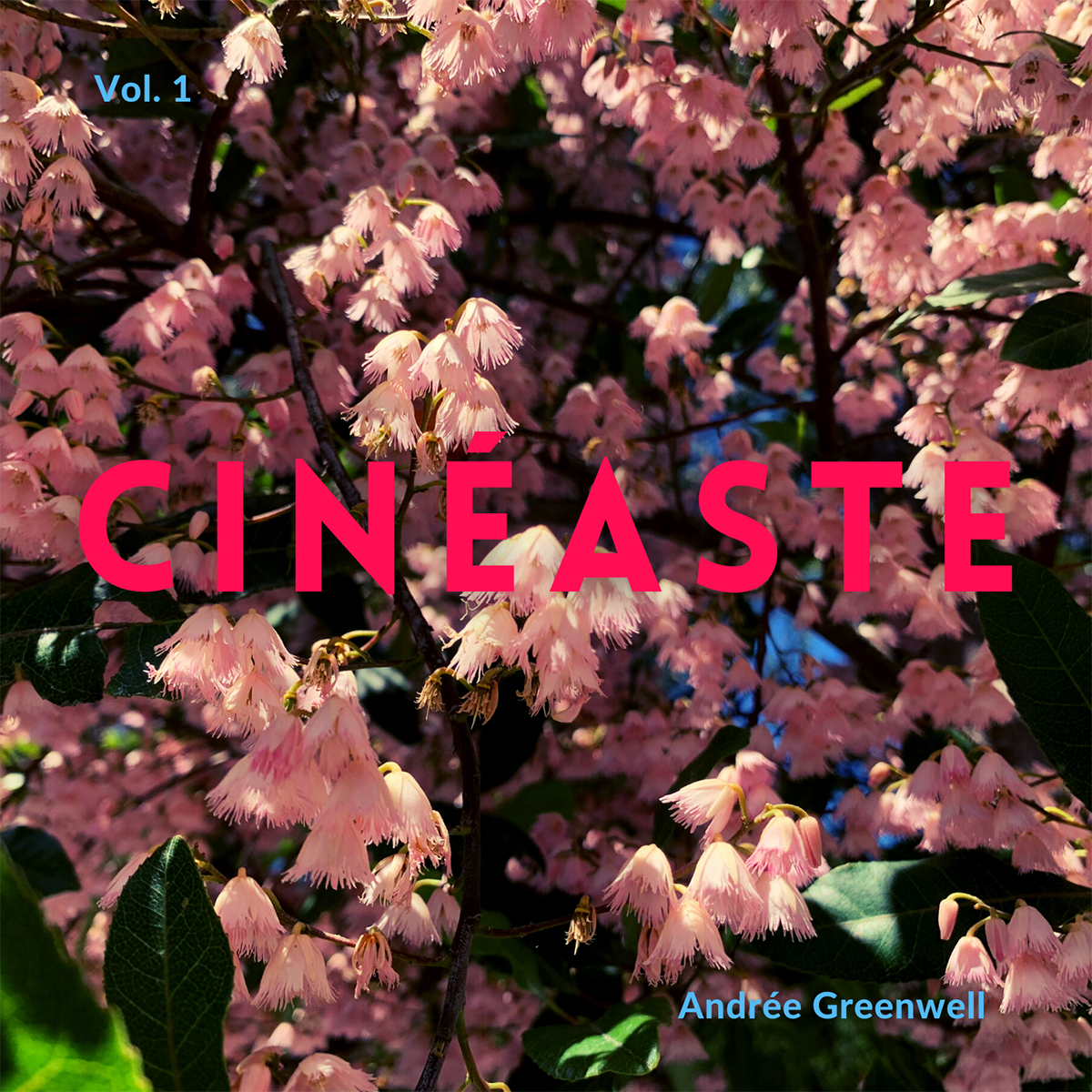
Cinéaste Vol. 1, album cover
What’s the score?
Full of variety, Cinéaste Vol. 1 comprises companion pieces and fascinating juxtapositions. The immediately engaging opening tracks, Trio and Outing, for example, share structural similarities, briskly if unhurriedly unfolding with simple ostinato overlays, including foregrounded musing strings, until dissolving into eerie electronic surge and fade — with a haunting, lingering piano and distant, distorting voices in the darker toned Outing.
In a reversal of process, Greenwell commissioned Sydney video artist John Gillies to respond to Trio with a film for the launch of the album (held over until 2022). The result is a precise and subtle engagement with the rhythms of the score (Gillies is also a drummer), surveying a rural landscape and the clouds above interpolated with closeups of white moths caught in a web, the last featuring the arrival of a hungry spider as the music turns eerie. While film music usually underlines, amplifies or even counterpoints intended affect, here it’s film illustrating to what end this music might be used, with moments of unsettling rapid cutting that presage the ending. This meshes with Greenwell’s own feeling about Outing, as she writes on the online platform Bandcamp: “I like the sense of motion and anticipation in this piece, and the instrumentation reminds me of [Michel] Legrand’s memorable score for The Go Between, through a palette of thistles and with a couple of sharp unexpected turns at its end.”
With its spacious droning, sweet piano-belling and folk-like intertwining violins (Veronique Serret), Cinéaste’s third track, Herding (at an all too short 1’19”), references Greenwell’s score for American indie director Anne-Marie-Hess’s feature documentary Refugio: TX. Greenwell writes, “There are gorgeous moody images of rural farms in Texas, and I recall the slow-mo trek of the cattle approaching the camera …” It’s the kind of music found in many a Western these days harking back to Appalachian, English and Irish roots, delivered here with a distinctive elegiac warmth. Greenwell tells me she met Hess in 2002 when in an artist residency at Château de La Napoule in France. They became friends and Hess came to Australia for the recording and mixing with engineer Shane Fahey.
Writing about Langour#1, Greenwell invokes a different kind of landscape, describing the piece as: “An expansive post-minimal track that suggests an epic poetic of landscape; so I am thinking about film makers I admire greatly in its writing — Gus Van Sant, Jim Jarmusch and Jane Campion.” A contemplative piano is joined with a distant, long-noted, raw-edged electric guitar (think early Terj Rypdal on ECM) played by David Trumpmanis and soft string phrasings, the overall tone ambiently in tune with the previous track, Herding.
With big brass chords (think Jeff Beal’s scoring for House of Cards) slowly sweeping from ear to ear over a pondering piano, neatly plucked strings and dark bass, Secret Theme sounds like the secondary theme for a big production TV series about power and politics. For all its orchestral feel it’s solely the product of Greenwell’s sequencing, keyboards, electronica and mixing. Search into the Eerie, which follows, is an apt pairing, darkening the mood with thumping drum, querulously riffing strings, sustained bass notes and nervy, rattling percussion. The bass climbs, then drops out leaving behind carolling strings and electronically chopped-up tinkling, like some powerful force dissipating into a vacuum.
With its unrelenting crashing percussion, scattering glass, high-reverb soaring and subsequent screaming (Ruth Wells tenor saxophone) over an anxious, almost heart-beat bass and a bed of spooky swirling electronics, Fire [Insto Redux] is the dramatic highlight of the album. Greenwell writes, “I really went with a literal violence in my use of sound and EQ’d bass in this one.” She tells me that it’s the music track for the Fire from Greenwell’s podcast Listen to Me (2018), originally with spoken word by the late Candy Royalle. It feels satisfyingly complete at 2’13” even if shorter than the original.
Lee McIver on flugel horn plays on the solemnly bugle-ish Flugel Haul and on Gentle Rise #1 in which an affecting melody — a sweet ‘rising’ seemingly plucked high on bass strings — and a pulsing female choral one-note la-la-la-ing are joined very briefly by horn and trombone (Jacob Parks) providing a melancholy ostinato. Greenwell, again alluding to “poetic landscape,” had been “thinking about Gus Van Sant and one of my favourite songwriters Beck, sunshine and flare, maybe peeping out from some twilight…”
In Languor #2 (Greenwell’s “cine-score reimagining of her music for 2071 – a performance about climate change, Seymour Centre, 2017”) the electric guitar heard in number #1 initially sings a ringing, widely-spaced four-note suspended phrase over a mesmeric slow, electronic swirl, then rises sweetly in pitch before dipping down into a lingering yearning. Deftly constructed and at 3’03” it’s one of the album’s most satisfying tracks. Greenwell’s reference points, she writes, are David Lynch (Eraserhead and the band Tuxedo Moon) and Angelo Badalamenti — hence Trumpmanis’s spacious, darkly ethereal guitar (Greenwell does an excellent, minimalist string-pulsed cover of Badalamenti’s Falling from Twin Peaks on her album Gothic on Bandcamp). The video for Languor #2, edited by James Manché from cinematography by Steve Macdonald, has the restless, swirling waters of the NSW south coast alternating with refracted, abstracted light.
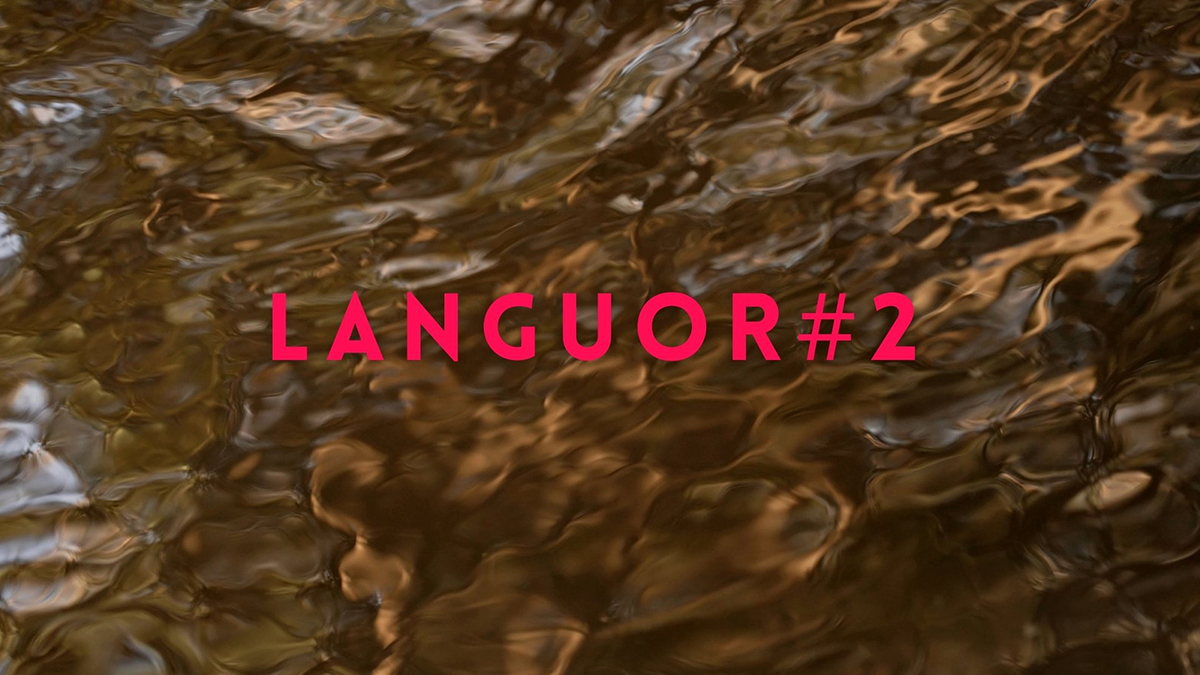
Watch the video for Languor #2 on YouTube
In Spanish Cowboy, another of her pieces for Anne-Marie Hess’s Refugio: Tx, Greenwell delivers, as she puts it, “a sultry-minimal-cowboy-new-folk piece with a little acidic electro turn.” A Morricone-ish warping electric guitar (lap steel, electric guitars Tim Malfroy) sings eloquently over a horse-plodding three-note acoustic guitar foundation and plangent brass until strings and trumpet take over in a brief Glassian exit. It’s a beautiful track, well deserving of more than its 1’48” playing time, but memorable nonetheless, especially for the guitar writing. The accompanying video (editor Manché) features brief, quick-paced glimpses of ranch labour taken from Refugio: TX counterpointed with the music’s leisurely unfolding. Meeting, which follows Spanish Cowboy, deploys the same guitar style, this time the instrument spaciously musing before dropping out for cello, then violin, then trumpet and drumkit warmly coalescing, the guitar then chording along.
Secret Texture, entirely produced and played by Greenwell in her home studio, was inspired by the score by Kyle Dixon and Michael Stein for the wonderfully bracing American TV series Stranger Things. When her foregrounded percussion kicks in at the one-minute mark and the electronics eerily ring in the ears on the way to the end, Andrée Greenwell’s version of this kind of sci-fi scoring feels fresher and sharper than the denser Stranger Things score.
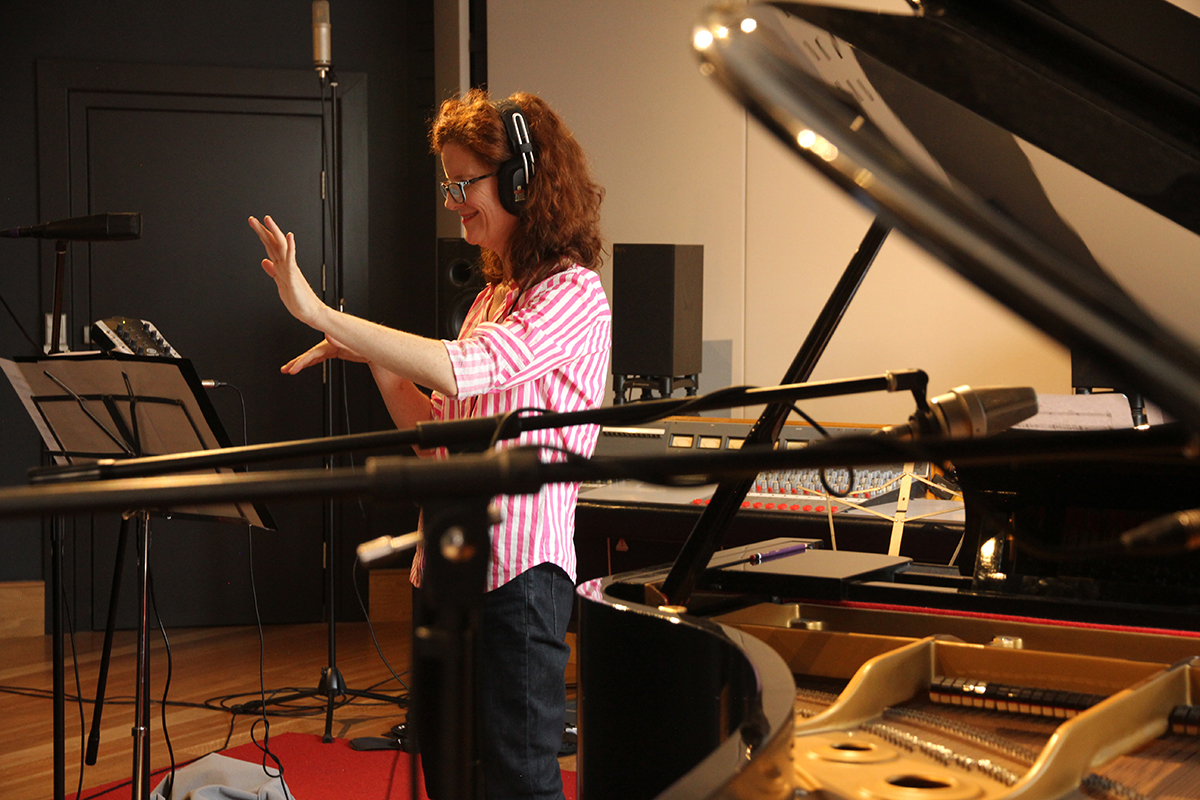
Andrée Greenwell, photo James Manché
Two of the most beautiful tracks on the album are Piano Tendrils and Gentle Rise #2, played, sequenced and mixed by Greenwell. The first is blessed with tender melodic writing for slowly paced, high, abstracted piano notes pinging against pizzicato and deep long-phrased strings and a bird-like flute hovering delicately above. The second deploys a similar melodic pinging, with McIver initially repeating single notes on trumpet before sketching a yearning ostinato as the piece closes.
Maria Walks (Instro Redux) comprises the instrumental and backup vocals from Maria Walks Amid the Thorns which was part of Greenwell’s Gothic album. Like Secret Texture and the endings of Trio and Outing, this track is on the cosmological scale with its insect-like electronic distortions and reversed, increasingly layered female chorus (from Julia County’s original vocals) and David Trumpmanis’s reverberant electric guitar texturing.
The original, Maria Walks Amid the Thorns, can be experienced on YouTube with its haunting singing and eerie motion graphics by the UK-based Australian media artist Michaela French.
Castlecrag and Steinway Hall, reveal a different compositional voice, demonstrating Greenwell’s range. They’re accomplished, acoustic string-driven post-minimalist tracks from Greenwell’s score for Belinda Mason’s City of Dreams (2000), a documentary about artist and architect Marion Mahoney Griffin.
The album’s penultimate track, a favourite of mine, the plangent Notre Père (instro) from Greenwell’s acoustic score for Sydney Theatre Company’s Cyrano (1999). As in Meeting, the cumulative interplay of solo musings and subsequent collective chording — here trumpet, violin, cello, double bass — evoke dramatic introspection and, as in Piano Tendrils, the piece is graced with affecting melodic invention.
Cinéaste is blessed with a cast of superior musicians and features tracks that, for all their brevity, are far more engaging than the predictable, often heavily textured ostinatos of many a contemporary soundtrack. Greenwell deftly layers her patterning, delivering spare, affecting variations and melodies made with intriguing instrumental, electronic and spatial choices. Cinéaste Vol 1 will doubtless serve as an excellent calling card for Greenwell to take to directors and producers while offering soundtrack enthusiasts much to ponder about the idiom and, for other listeners, the pleasures of the rural, poetic and theatrical vistas conjured, and films actual and imagined.
Andrée Greenwell, Cinéaste Vol 1 is available on Apple Music, Spotify and Bandcamp
From the Archive: RealTime reviews of works by Andrée Greenwell
Medusahead, Confessions of a Decapitated Soprano, RealTime 33, Oct-Nov 1999
Medusahead, Confessions of a Decapitated Soprano, RealTime 51, Oct-Nov 2002
Dreaming Transportation, RealTime 53, Feb-March 2003
The Hanging of Jean Lee, RealTime 75, Oct-Nov 2006
For STC’s Venus & Adonis, RealTime 90, April-May 2009
The Hanging of Jean Lee, RealTime 19, Feb-March 2014
For Decibel’s After Julia, RealTime issue 124, Dec-Jan 2014
Gothic, RealTime issue 28 Aug-Sept 2015
Listen to Me, RealTime online 1 Aug 2018
Top image credit: Andrée Greenwell, photo James Manché
I’m at The Studio in the Sydney Opera House. It’s the night of the premiere performance of Angela Goh’s Sky Blue Mythic; an expanded version of the 20-minute work that won Goh the 2020 Keir Choreographic Award, which I hadn’t seen. After the show I find a QR code for the program in the foyer. I decide to download but not read the artist statement, not until I’ve written my response.
I don’t want to mess with the disconcerting strangeness that was Sky Blue Mythic by being guided by what Goh thinks she’s made. I’m not altogether invoking the intentional fallacy: “Never trust the teller, trust the tale” (DH Lawrence). I don’t distrust this highly intelligent dancemaker. I am curious to know what she intends, but only after I put my experience into words, and consider what I’m bringing to, and perhaps projecting onto, Sky Blue Mythic. What follows is more essay than review.
Other than working from scribbled notes, recalling how Sky Blue Mythic unfolded was aided by the work’s quite musical construction. Recurrent motifs and their variations are frequently realised as sustained images, often indelibly rendered. But I can’t claim accurate reporting from one viewing. The description that follows might suggest Sky Blue Mythic belted along. Not so. Stillness and movements held in suspension, or obsessively repeated, warped all sense of time. Then there were the shocks: sudden, atypical actions and the sonic boom of Corin Ileto’s music, powerfully underlining the significance, albeit uncertain, of unfolding events.
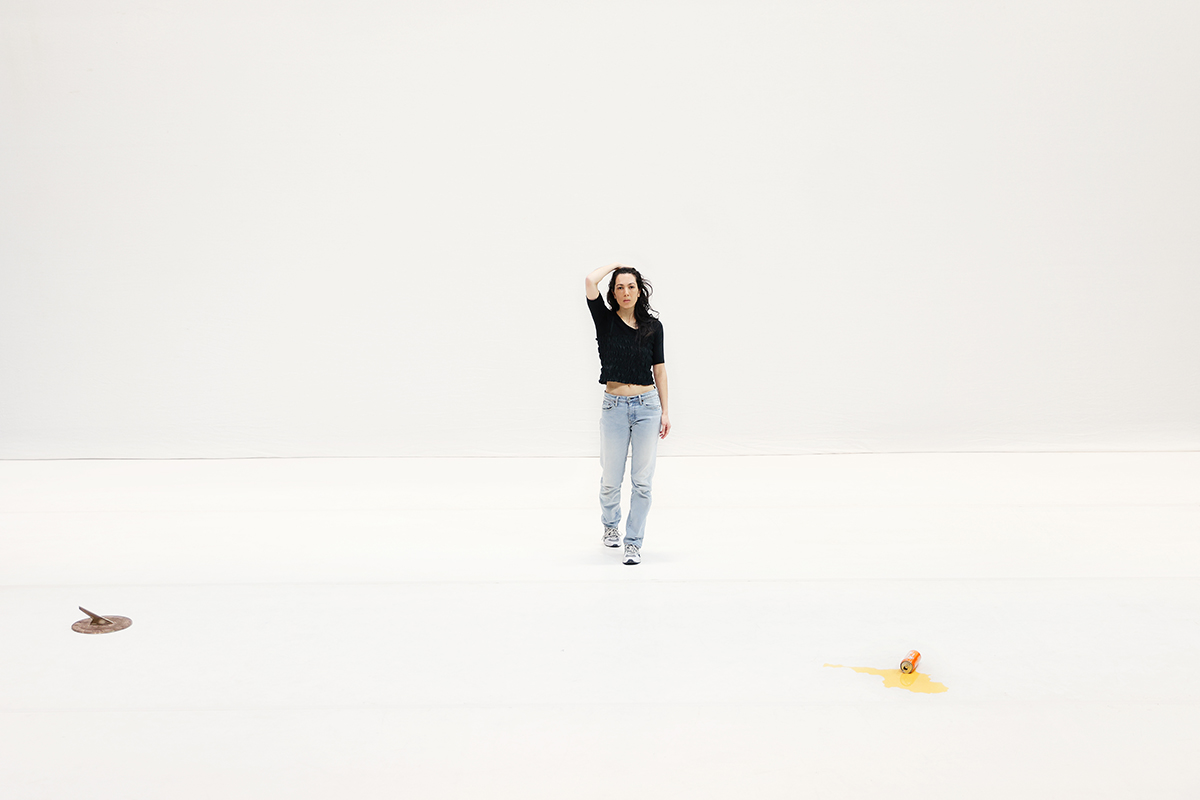
Angela Goh, Sky Blue Mythic, photo Prudence Upton
Seen from memory
A radiant white wall and white floor merge into a stark void. Off-centre left is a small, classic horizontal sundial, the arm angled up to cast its time-telling shadow when placed outdoors. The name of the arm is gnomon – “one that knows or examines,” from the Ancient Greek. A sign that we’re to witness a form of knowing, or an investigation?
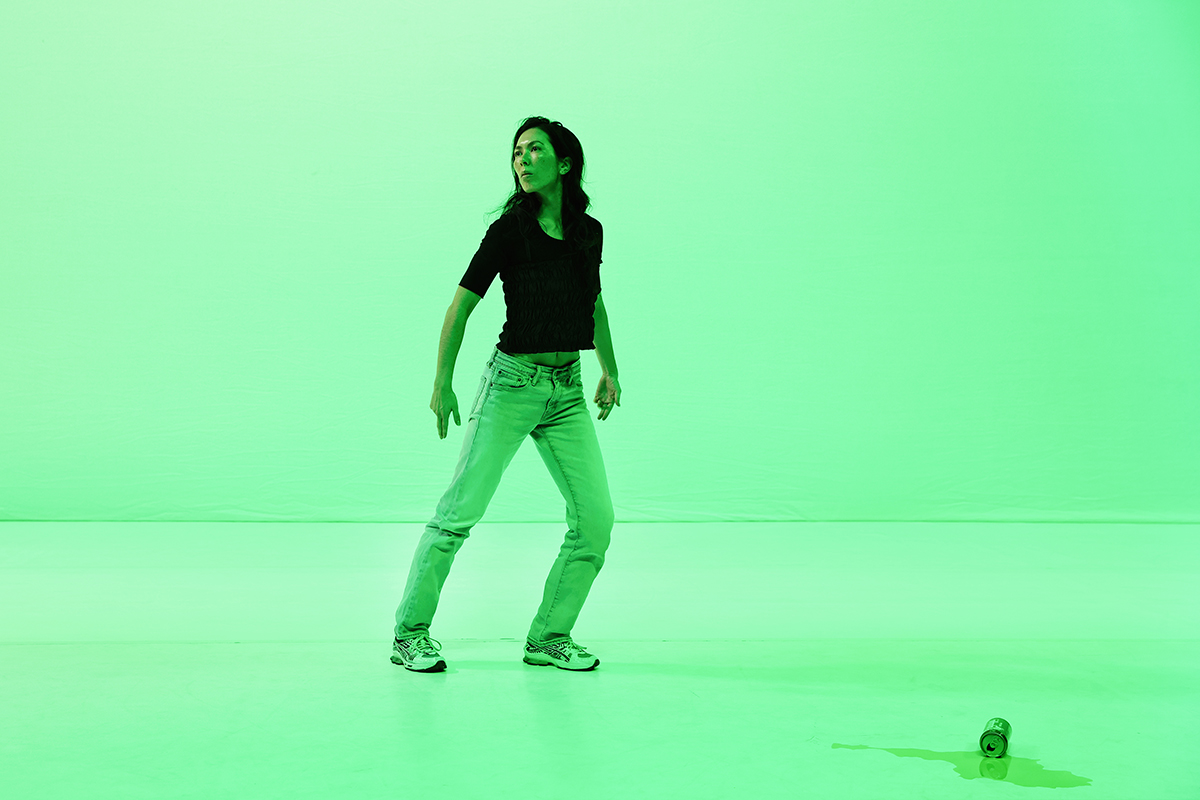
In the back left corner, Angela Goh, in a spare black top, pale blue jeans and cap, appears — an everyday presence holding a can of soft drink. A diagonal walk almost two-thirds the way across is broken by an artfully considered fall, almost slow, the can tipping and spilling. We’ve witnessed an ‘accident’ so calculated that it appears to be not the actual event, but rather a re-enactment. A necessary, rehearsed repetition?
Her hands and knees on the floor, Goh’s left arm lifts off, hovers, extends horizontally. With slow momentum the whole body, on three points, turns on an invisible axis, anti-clockwise; a little like a sundial, but reversing time’s passage, and casting no shadow.
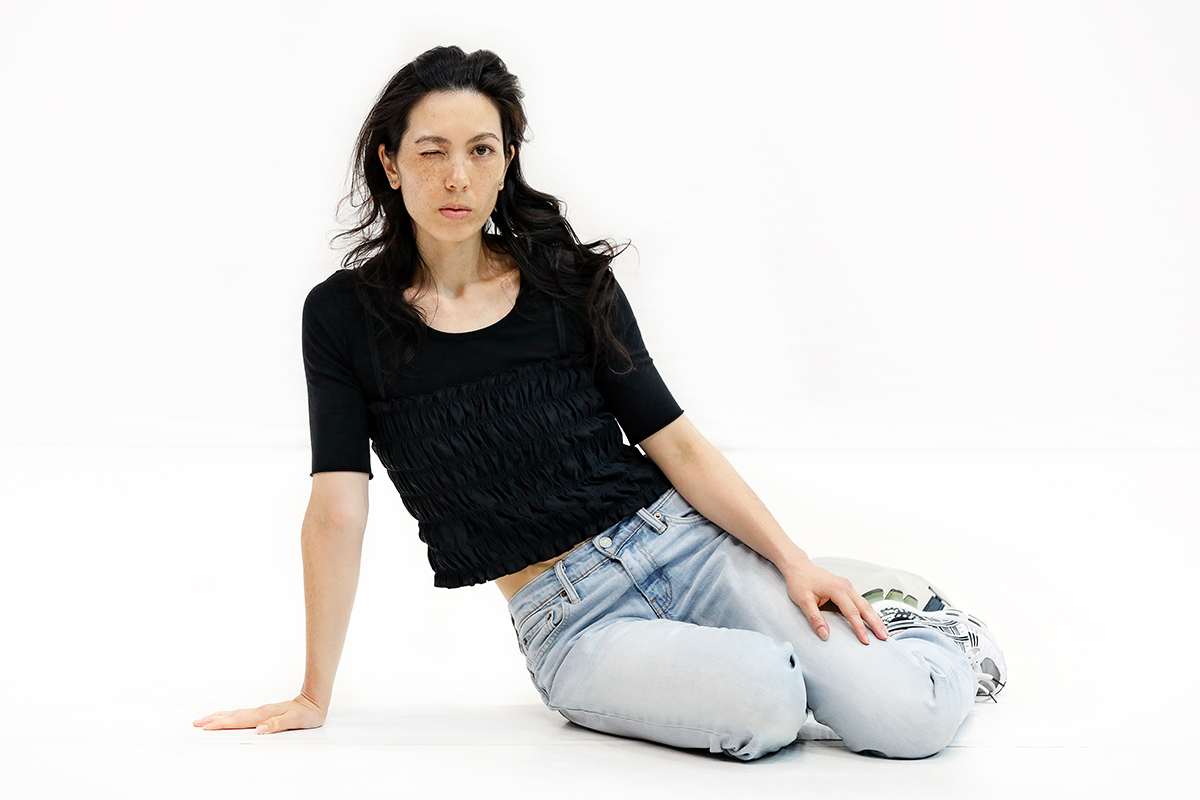
Sitting, Goh looks through, at, into us. After a slow blinking, she emphatically closes her right eye and looks with her left. Testing perspective, gauging us? She crawls forward, looking. What are we to do with this looking? Goh’s ever distinctive stare simultaneously establishes and pierces the fourth wall; we inhabit this stark landscape with her — we’re implicated, somehow, but we’re equally outside it.
Contemplating the sundial, she touches the gnomon, initiating a piercing music of metal abrading metal, a chilling circular sawing. She turns the dial anti-clockwise, releasing a primal thumping counterpointed with ascendent female voices. The sound, painfully loud, signals the enormity of this small act and, perhaps in the singing, its pleasure.
The music stops bluntly. Goh exits. Blackout. A stage hand clears the can and cleans the floor. Whatever the plan, has this reversal of time not done its work. Is it too hard?
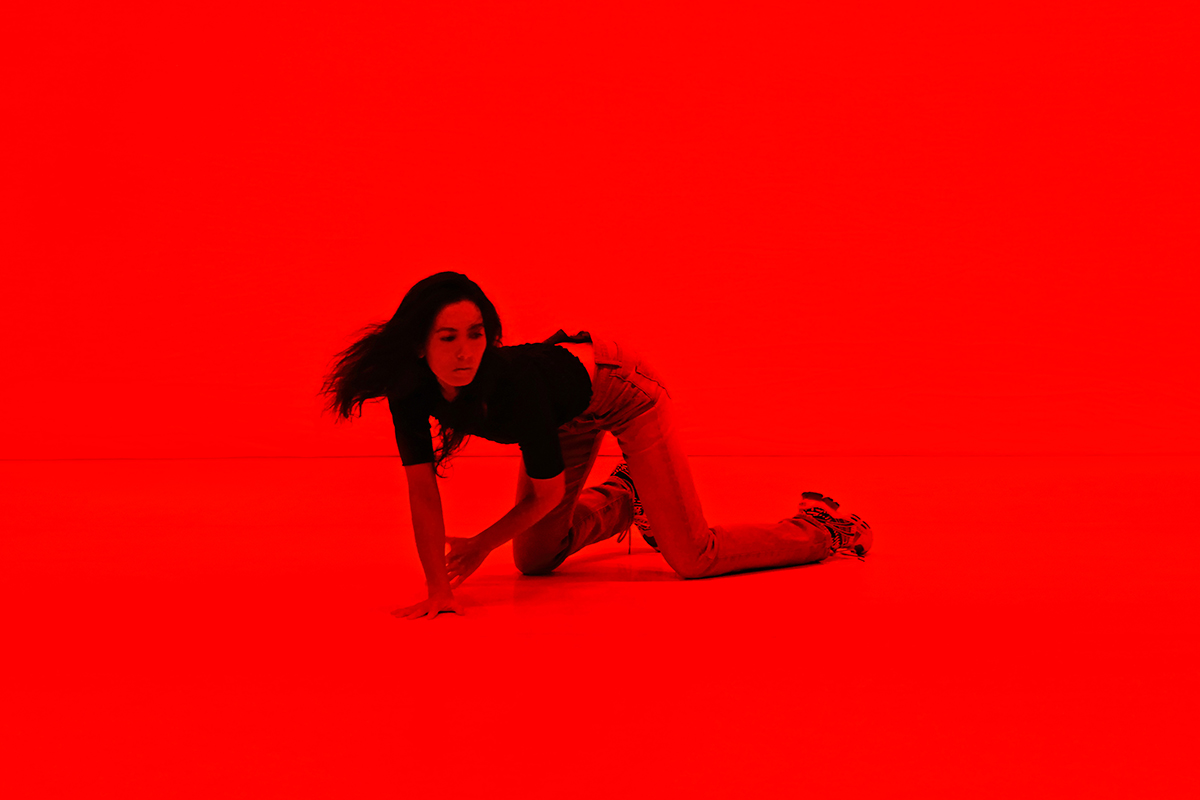
The void returns, dazzling. Begin again. The walk, fall and spill again. A fraction faster? On all fours again, head raised, Goh cries out in a rounded rising and dipping ‘o’, repeating and repeating, this time partnering her female chorus. To deeply reverberant, forcefully plucked strings, she backs up on all fours, reverses to her starting point. There’s something animal now about this still artfully human body and its cry.
Begin again. She walks slowly to the centre with a pronounced forward tilt, which she holds, making an image of off-centredness, as if something is not right with human erectness. The music snaps aggressively. She looks to her right, sensing what? In a flurry of little steps (a split-second reversal to a classical ballet body?) she backs up, again, to her starting point. The compulsive repetitions and ‘begin-agains’ start to suggest psychodrama on the one hand, or a vigorously formal experiment on the other. Perhaps both.
Centre again, on her back and in one of Sky Blue Mythic’s stranger images, Goh effortlessly flattens to the floor, knees forward, calves folded back tight under thighs. She’s a shape-shifting contortionist, dancer, she’s human and animal, straining to be other, and now other-dimensional.
A series of forms proliferate, oscillating between erect and earthed. She stands, neatly extending and angling her arms in a moment of geometric certitude. Then her right hand pushes her hair back; the hair falls heavily across, erasing her face. Arms again extended she turns anti-clockwise, dextrously on one foot with balletic poise, with a dance body’s certitude. She crawls. She repeats the episodic tilted walk in soft green light. These varied moves are variously bathed in colour washes, red, blue, mauve, suggesting possible states of being, possible choices. Her attention is suddenly caught, white light flares again, her companion female voices silenced. She is propelled backwards. What threatens?
Begin again. She is drawn to and picks up the drink can, memento of the fall. Unfinished business? She holds it, looks to us. Is it any longer recognisable? She puts it down, falls on all fours, repeatedly uttering a worrying new cry, sustained until briefly rising and weakening with a sudden fall. She stops. The stage hand reappears; removes the can. It’s finished with, but not the threat: she looks sharply to her right. Metal grinds metal.
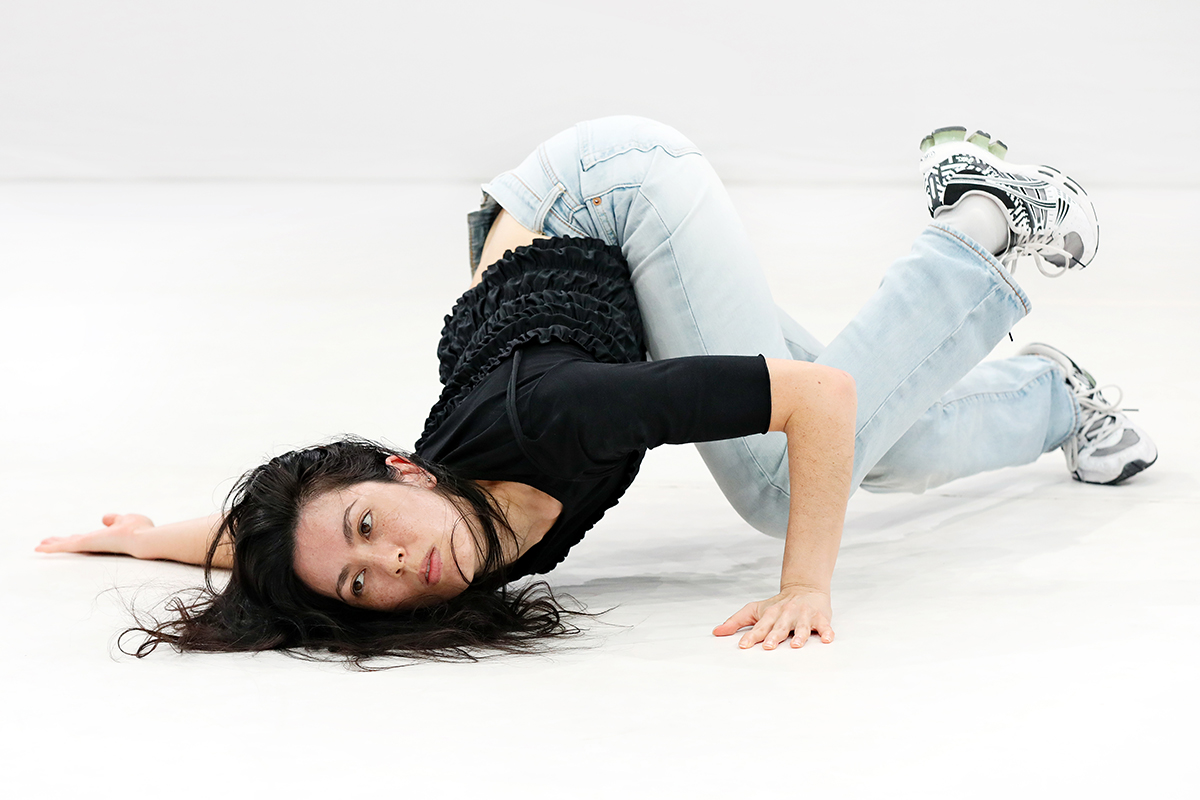
Angela Goh, Sky Blue Mythic, photo Prudence Upton
Begin again, with an even stranger development: on her knees, buttocks raised, back sloping to the floor, shoulders down, head weirdly contorted, facing us even as she spins slowly to a high keening and staccato thumping, again moving without apparent volition. A more extreme shape-shifting, organic but seeming even less human.
After being pulled to the right corner into another balletic flurry, she returns centre, the body flattened again, face up, calves under thighs, now pulled anti-clockwise over and over, until my otherwise rapt attention evaporates, the image, already deeply etched, seeming duplicative, no longer evolving.
She stands, falls, rolls, sits, her back to us, and, regaining my attention, to an eerie whistling she gestures upwards; to whom or for what? A hint of supplication? It seems antithetical to the downward push of her shape-shifting, as had the earlier rising female chorus.
On all fours, she moves on the spot, a leopard say, travelling but with forward motion suspended. Her back rounds, head and hair fall down, as she rhythmically flexes with feline ease. It’s a beautiful image, a resolved if temporary transformation.
Angela Goh, Sky Blue Mythic, photo Prudence Upton
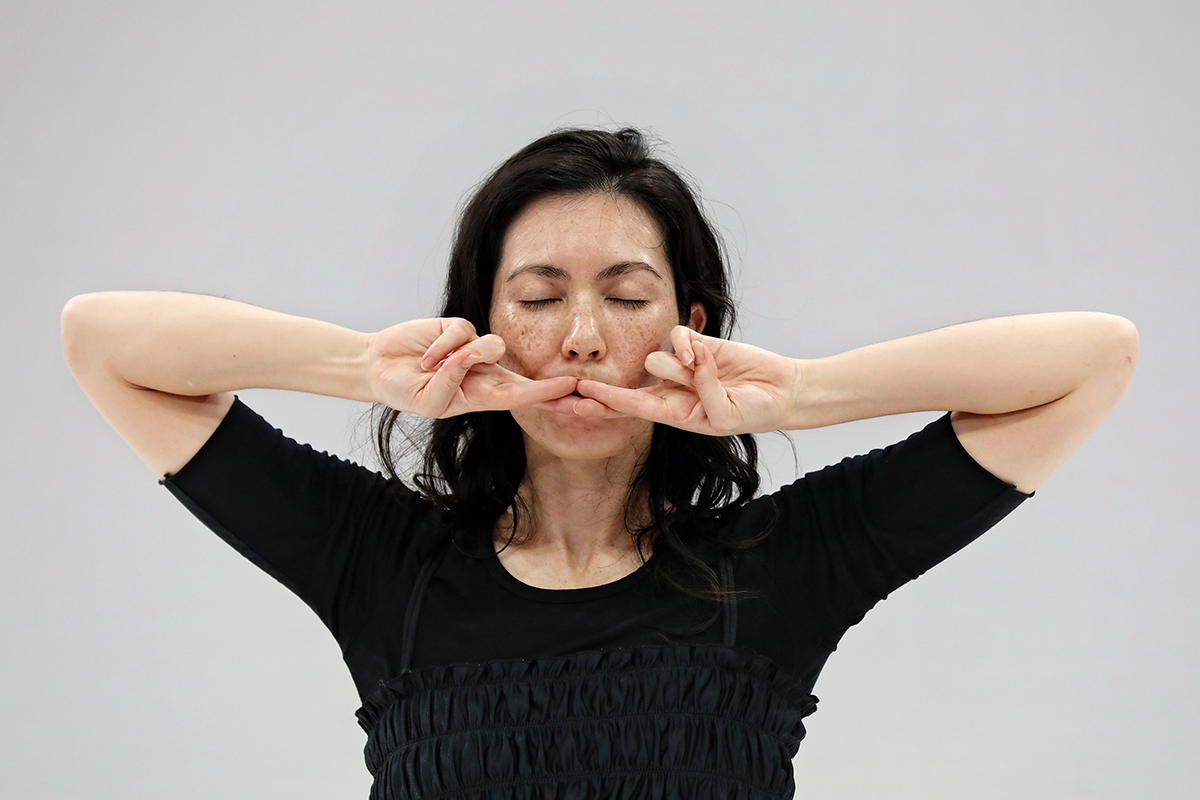
Begin again. She walks tilting to the centre and slowly turns, a hand raised high. She moves close, demanding we attend to an autonomous dance of hands, fingers coming together in sync with the gentle wave of lyrical metal-edged music. Hands dance high over and behind her head, cross in front of her face, where the fingers lace and then open and close as a single organ. Alien, they probe their way into her mouth. They withdraw, rising to the eyes and pointing upwards.
Music gently chimes from afar. The hands explore whatever this now seated body has become. They lift a leg, feel a thigh, cradle a foot. Goh looks at none of this, only forward. without willing the actions of her body. The music intensifies triumphantly. Fingers independently brush across neck, hair, then back and thighs and neck again as the light softens and withdraws, Goh’s gaze is ever with us, if not felt as quite human, curiously peaceful, if utterly strange, even alien. Darkness.
Angela Goh, Sky Blue Mythic, photo Prudence Upton
I say…
I experienced Sky Blue Mythic as a work of fraught progression towards achieving a body devoid of ego consciousness, a project that commenced with a seemingly innocuous (but already rehearsed) fall, a driven task abandoned and obsessively returned to in a host of permutations (the repeated fall, other collapses, the pondered drink can) and the many ‘begin agains,’ in shape-shifting experiments, balletic regressions, the adoption of animal-like forms (and their musical ‘humanimal’ crying), and recurrent tensions between erect, formal aspiration (very human) and a downward thrust into otherness.
Without conscious projection I read Sky Blue Mythic psychologically, as addressing and re-addressing trauma, developing tactics for release, often failing but finally succeeding in some way. The sheer weight and stress of the challenge was felt in the body’s anti-clockwise striving, its reversal of time triggered with the turning of the sundial and felt in the grating power of the musical score. I first thought the reversal regressive, especially in the animal-like transformations (an anthropomorphism eventually abandoned), but the repeated re-wind and starting again grew to feel more like resistance to time’s relentless forward thrust — a stilling of time in order to find another way to be.
The beginnings of Goh’s successful transformation into something a-human were evident in the ease with which the body at its most contorted could rotate without apparent conscious or evident muscular volition, in sharp contrast to those moments when it appeared involuntarily propelled backwards to a starting point. These were stages on the way to the final image of a body examining itself as if for the first time, regardless of its ‘owner.’
I couldn’t easily place those moments when Goh was suddenly alert to actions or sounds off that we couldn’t sense. I think of them now as threats to the project itself, a ‘real’ off-stage world momentarily intruding on a myth-like reverie (myths are full of transformations human to animal or tree or… and, always, an idea), threatening to break the “blue sky thinking” with which Sky Blue Mythic attempts to create a new way of being. While hinting at the meaning of the work, the ungrammatical title is typical of the work’s play with expectation. Sky Blue Mythic is a kind of myth-making, with Goh as the agent herself (no gods here) of potential transformation.
I could only guess at the nature and efficacy of Sky Blue Mythic’s final, seemingly ego-less state of being. Perhaps Goh’s program note would give me an answer. In the meantime, I was left with an acute sense of anxiety and urgency and an abstract sense of resolution. I fixed on the original fall and its permutations. Although ordinary, Goh’s fall momentarily evoked suspended time — falls can be like that: the centre of gravity gone, sheer helplessness (I know, I was recently upended by a bounding labradoodle), until it’s suddenly over. A fall is a crisis, a moment generating fear but also possible insight (into vulnerability, mortality), which is perhaps why Goh’s fall is so considered. What has it told her that drives an intensely physical project that possibly betrays deep anxiety and a woundedness that I’ll come back to?
Angela Goh, Sky Blue Mythic, photo Prudence Upton
Angela Goh says…
In her program note, Goh challenges “the arbitrary forms and expressions that structure our worlds” by “work[ing] from the inside, searching for the small opportunities where it might smooth the way for a slip or a glitch that might just open up something unknown from the inside out. Inside out. Upside down. Back to front. Inverted.”
These “arbitrary forms” doubtless range from how we think about and live with our bodies, to dance conventions and to political ideologies that hinder our own and the Earth’s well-being. The “slip or glitch” is realised as the fall that begins the work, freeing the way to an “opening up” of new forms — of dancing, thinking, being.
Goh’s staged fall then is a metaphor for this “slip or glitch,” prompting the sought “opening up.” My sense of a demanding quest full of false starts and seemingly compulsive repetitions suggested something more than a mere ‘slip’ that had to be worked through, underlined by the physical extremity of the movement and the intensity of the design and music. I was, of course, psychologising. But the goal of the quest, to achieve a state other than human, was confirmed by Goh’s note, and that it came from “inside.” Perhaps it’s not a psychological “inside,” but a cognitive or imaginative one, as the use of the word “thinking” suggests as her note goes on.
She writes, “One of the primary drivers for Sky Blue Mythic is to think and approach dance as an extra human sentience rather than a mode of human expression.” She argues that “[t]his requires the body to become an interface rather than a vehicle.” In other words, for the body to be in direct touch with, for example, nature. A larger aspiration follows: “It seems quite pressing to consider the systems that we are part of—ecological, social, technological. We must break from the dangers of human centrism in favour of caring for the tangled relations that make up our more-than-human worlds.”
How can we achieve this? Goh suggests, “Thinking dance as a non-human entity rather than human tool is a fiction that requires a leap into speculation, into imagination.” Some of this imaginative thinking, for example, has become easier with the growing knowledge and appreciation of animal emotion, play, song and culture. Can dance itself achieve this leap? We gratefully witness Goh’s attempt, giving way exactingly, but serenely, to an imagined extra-human selflessness. It’s a fascinating fiction with which to attempt an unmediated relationship with non-human ways of being.
For a non-dancing audience, unable to “de-centre” physically from the impeding weight of Humanism’s anthropocentric legacy, Goh offers some consolation, seeing the mind, not just the body, as an interface: “The mind is also a prehensile organ, grasping worlds that are just out of reach and pulling them closer into being.” As I sat, immersed in Goh’s fantastical vision and the sheer discipline and inventiveness with which she realised it, I was deeply grateful for a fiction with such stated serious intent.
Opposing the West’s relentless progress, Goh argues, “Continuity is our biggest planetary threat. When more of the same is catastrophic, Sky Blue Mythic employs methods of spatial and temporal discontinuity — to glitch, fork, bifurcate, and charter an unhinged journey outwards, from the inside.” Given the work’s almost surreal realisation I find “unhinged” really apt; but for all its quite palpable glitching, forking and bifurcating, the work seemed to me to have an inexorable drive.
The driver is global catastrophe, a fear felt “inside” by many of us every waking day, a woundedness with myriad attendant anxieties and concern for a wounded Earth and flailing social and other systems. It’s not surprising that Sky Blue Mythic exudes a sense of urgency and danger in its quest, via the body, to find a state of mind with which to begin to redemptively undo the damage we humans have done. It’s not surprising to me that I initially took Sky Blue Mythic to be, in some ways, an act of performative self-psychoanalysis, not least since Goh implicates dance, her medium, as part of the problem, for not interfacing with extra-human reality. I have no desire to impose an all-too-human narrative grid over Sky Blue Mythic’s fantastical glitching and looping, to reduce it to a convenient trope, but Goh’s is a human quest after all, leading us towards a sense of what we might be capable of becoming and the healing that might ensue.
After reading Goh’s statement I felt Sky Blue Mythic less perplexing, a sci-fi-like ‘What if…” project, conceptual at root but no less challenging and disconcerting in its attempt to move beyond conveying an idea (dance as vehicle) to rigorously giving body to that idea. And its incredible striving conveyed a deeply felt need, from the inside.
Angela Goh, Sky Blue Mythic, photo Prudence Upton
Artists & critics
I couldn’t altogether grasp what Angela Goh had created in performance, art is like that and never less magical for it, but I felt my response was open to her stated vision. Out of performance and reception something else had been created, a “third act.”
In Artforum in February 1985, Jeanne Silverthorne noted “the phenomenologists’ claim that ‘art is . . . not an object but an act.’ Acts are intended. But in the recovery of the artist’s intention, [the critic] both projects parts of [their] consciousness onto the work and makes that consciousness accept the points and barbs of an alien mind set, resulting in a third ‘act’ which opens everything up.” I’ve added a fourth act: my account of Goh’s statement, testing it against my response. Incidentally, “alien mind set” seems an amusingly apt descriptor for a work in which Goh becomes so other in the end.
Audiences and critics determine for themselves what a work means, regardless of the maker’s intention. In her five-star review for Limelight, Deborah Jones resolutely set aside Goh’s program note, writing, “To this audience member Goh is exploring precisely the boundaries of what the body can do and what it means to be human in an alien environment. The body and the humanity are one.” To which one might sadly add, “…and alone” if it means the disconnect between ourselves and nature is to persist.
Artists need to be listened to; innovators are often ahead of us and their words can prod us towards understanding the new experiences they conjure. But how seriously should artists take critics?
Silverthorne writes: “The critic’s abstinence from premature information provided by the artist has an analogue in the artist’s wariness of criticism. If the artist listens too religiously, he or she has no chance to work through a development, and whatever changes are made will never be profound. In a sense, artists have to ignore criticism, because they cannot arm themselves against hearing it and the useful remarks will make themselves felt only when the artist is ready for them. Criticism is not, in general, a way of making art behave. It is, however, crucial to art’s intellectual life.”
With reference to…
It’s fun (and meaningful) to dig into the first paragraph of Angela Goh’s artist statement which rattles off artworks, films and ideas that influenced the making of her creation, “all of which become arbitrary once Sky Blue Mythic begins to become a world of its own, and more than just its inspirations.”
Alongside popular culture references, there’s a noticeable preoccupation with time, not least in science and science fictions. These include Edward A Abbott’s Flatland: A Romance of Many Dimensions, a 19th century mathematical and social satire (one anticipating the theory of time as the fourth dimension) that depicts a two-dimensional world in which men are polygons and women line segments, paralleling Goh’s transformation into a ‘flattened’ form. There’s Giselle, who collapses and dies and defies time by returning as a ghost, and Walter Benjamin’s Angel of History, blown into the future by progress but facing the wreckage (imagine climate change, mass inequality etc) behind.
Also listed are the concept of Time’s Arrow and the novel Hard to be a God by the Russian science fiction writers Arkady and Boris Strugatsky Brothers’ (or is it Aleksei German’s film of the book?) about a culture in temporal lockdown. Xenofeminism, which embraces de-gendered science and technology, gets a mention. So does Thomas Moynihan’s spinal catastrophism (too difficult to explain here, but one of its key starting points is the ‘accident’ of human upright posture as “evolutionary trauma” in our relationship with nature) which might explain some of Goh’s tilted bi-pedal choreography. And there’s more. These references can’t define Sky Blue Mythic, but Goh makes the offer, implicitly encouraging us to consider them and, if there’s the opportunity to revisit the work, enjoy a richer reflection on the experience.
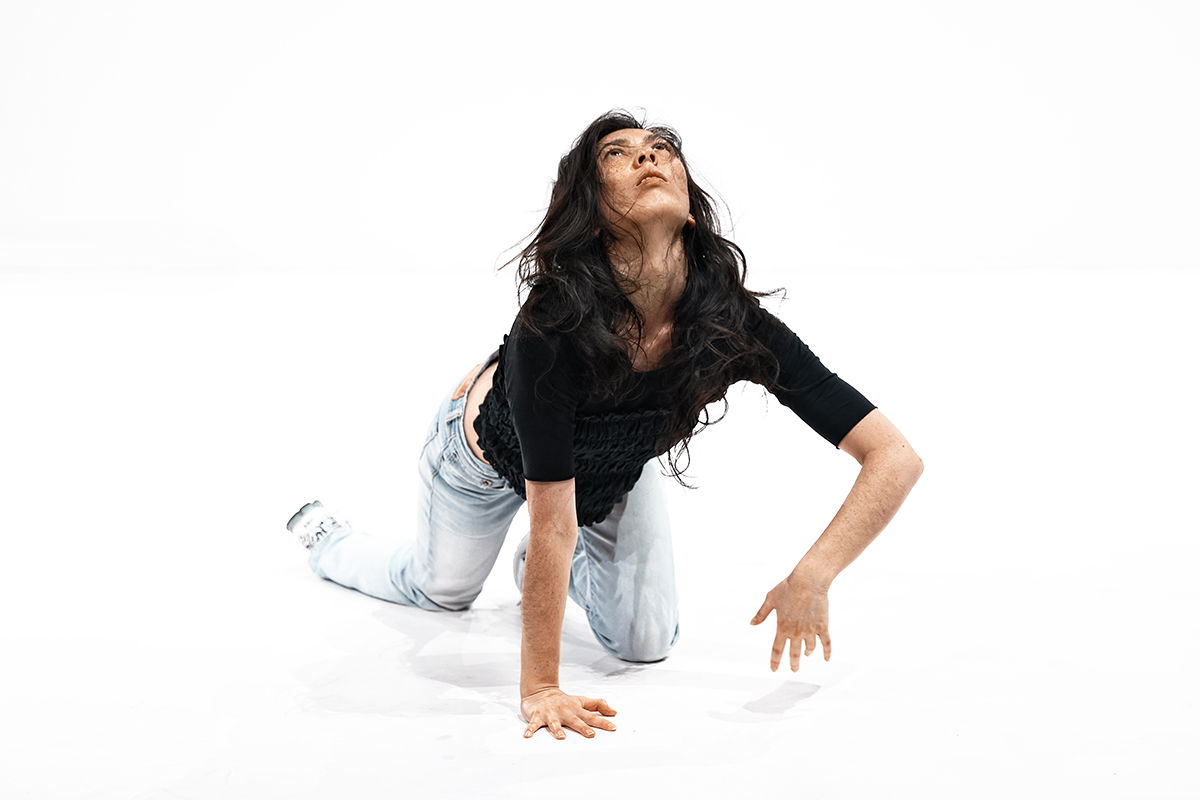
Angela Goh, Sky Blue Mythic, photo Prudence Upton
On reflection
I was open to Sky Blue Mythic’s visceral power and its sense of quest. After all, this was a rare visit to the theatre in COVID-time, I’d been ill and the Moon was red, so it’s not surprising I read the work as self-psychoanalytic, a projection encouraged by the work’s insistent glitching and looping. In Goh’s vision these are not metaphors for a psychological condition but for tech means with which to facilitate her avatar’s quest — with Goh doing a William Gibson, generating a performative zone equivalent to cyberspace on stage (also felt, if differently, in Goh’s allusion rich Uncanny Valley Girl with the performer as borderline cyborg).
Goh’s impressive repertoire includes Desert: Body Creep (2016) and Uncanny Valley Girl (2018), solo performances fusing performance art, movement and installation, and the fascinating Scum Ballet (2017), an emphatically danced ensemble work rich with moments of haunting stillness, threat and care. Compared with those solos, Sky Blue Mythic feels more palpably organic, its references deeply embedded, its sense of purpose more potent. It might not have yielded the dancing that some desire, but every movement is considered and can only come from a highly disciplined dancer with a creative imagination that can render the human body strange and newly oriented. I was gripped by Sky Blue Mythic, a work both coherent and continually surprising, its choreography, music and design coalescing to generate a provocative, utterly memorable otherworld I hope to enter again and, in the world outside, with my imagination, and senses, embrace the extra-human.
—
UnWrapped: Sky Blue Mythic, choreographer, dancer Angela Goh, lighting designer Ruben Govin, composer Corin Ileto, production manager Matt Cornell; The Studio Theatre, Sydney Opera House, 26-29 May, 2021. Winner of the 2020 Keir Choreographic Award, the full-length Sky Blue Mythic was commissioned by Sydney Opera House’s New Work Now initiative.
Reviews of other works by Angela Goh:
Desert: Body Creep (2016), “Next Wave Festival: Dance, decay & transformation” and “Next Wave Festival: Shaking loose the self”
Scum Ballet (2017): “Angela Goh, Scum Ballet: Female magic”
Uncanny Valley Girl (2018): reviewed in Running Dog and Art and Australia
Top image credit: Angela Goh, Sky Blue Mythic, photo Prudence Upton
This is a review that started out as a brief response, but its subject matter felt too important to treat lightly, a risk that Narcifixion itself takes as a stylishly propulsive entertainment with a simple message – in effect, ‘beware screen-driven narcissism, it’ll destroy you.’ I found myself wanting to honour the makers by detailing the logic, as I see it, of the work’s construction and the nature of its vision.
Mashing “narcissism” with “crucifixion” for his title, choreographer-director Anton readies his audience for Narcifixion’s account of self-crucifying self-possession. It’s a common belief that we’re living in an era of rampant narcissism brought on by the unfortunate co-emergence of me-first neoliberal capitalism and social media platforms. On the other hand, narcissism is a necessary and highly complex component of psychological development and survival, manifesting in many ways, good and bad and, in extremis, a serious affliction.
I wonder, therefore, where ‘on the narcissism spectrum’ each of us sits: from apparent zero in some to the uneasy balancing of self and other in many of us, to the deceptive cover that is passive aggression, to the “controllers,” to narcissism’s full-blown realisation in attention seeking, power grabbing egotism driven by fear, conscious or not, of utter inadequacy? What will Narcifixion tell me?
Sorry to miss the performance in-theatre, I nonetheless had the advantage of watching a live stream of the final performance as well as a subsequent re-viewing. Save for distant images of a very wide stage, the work on screen was delivered with a finely lit and shot intimacy highly apt for the subject and for observing the precision and dynamism of the dancing.
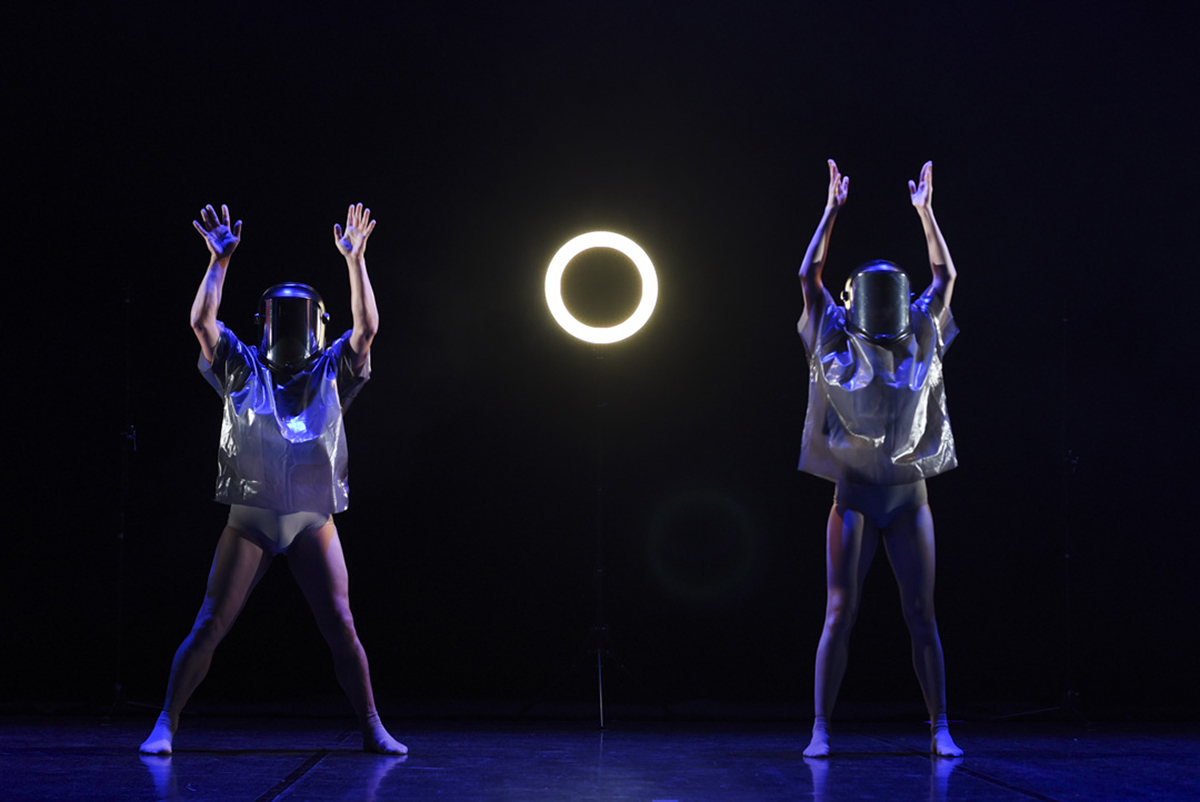
Narcifixion, Anton, Brianna Kell, photo Heidrun Löhr
NARCIFIXION AT WORK
From darkness, green warning beacons signal furiously, their agents barely invisible. From silence, one voice and then two intone ‘me’ in an impassioned string of distorting variations against a sustained grainy drone that soars into Vangelis-Blade Runner organ-synth that says sci-fi, confirmed with a flood of blue light revealing the two signallers (Anton, Brianna Kell) beneath an ominously pulsing electronic eye that presumably surveils them. Identically uniformed in flexible plastic tops and glass-visored helmets, the pair move in neat synch, the flow now and then interrupted by seeming mechanical faltering. Something is not right with these perhaps less than human beings, cyborgs maybe, and presumably the narcissists implied by the work’s title.
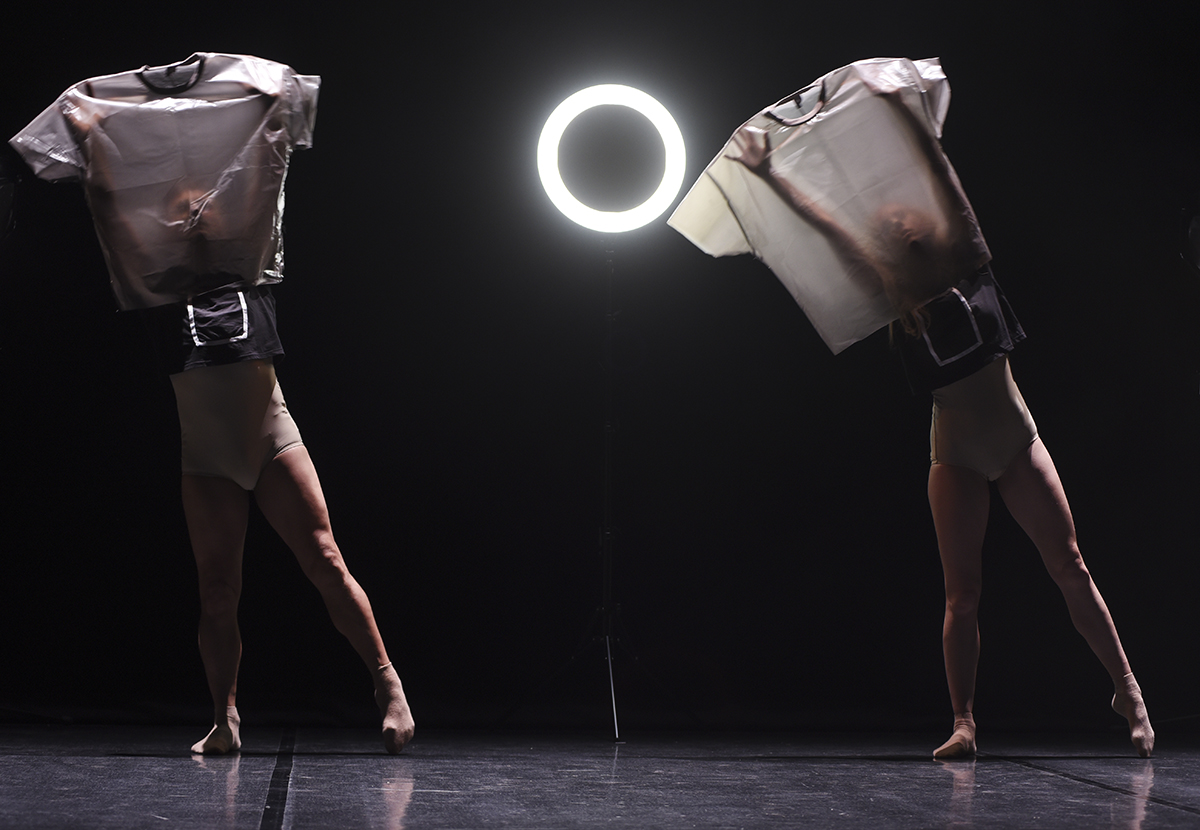
Narcifixion, Anton, Brianna Kell, photo Heidrun Löhr
They soon appear real enough. To a trumpeting fanfare and bathed in red light, they formally remove their helmets and wrap-around shades, briefly mirror each other with smiles, muscular posturing and outstretched fingers that agonisingly strain to touch the other. Failure results in jerky agitation. Peeling off their tops (like swaying, skin-shedding snakes), they are even further freed of the outward shell of purpose but, curiously, sink to the floor.
Immobilised, face-down they gradually revive in an elegant micro dance of fingers, new life that quite gradually extends to arms, to bodies sitting, swivelling, to bodies, unfortunately, on backs like upturned insects racked by passing tremors. The further the pair is removed from the protective anonymity of uniform, of routine, the more naked they are, the worse their condition — narcissists short of the fuel provided by admirers?
Seemingly half-conscious, the couple rise. Ambiguous poses (some heroic, some like beach fashion modelling) slip into supple movements, increasingly one-hand-led, and escalating manically — replete with indeterminate signalling and sporadic jerkiness — until pulled to a halt. They peer serenely into the palms of their raised hands as if into unseen mirrors, and then, in a gentle turn and sway, hands lowered, look down on them as if gazing into water like the Narcissus of myth.
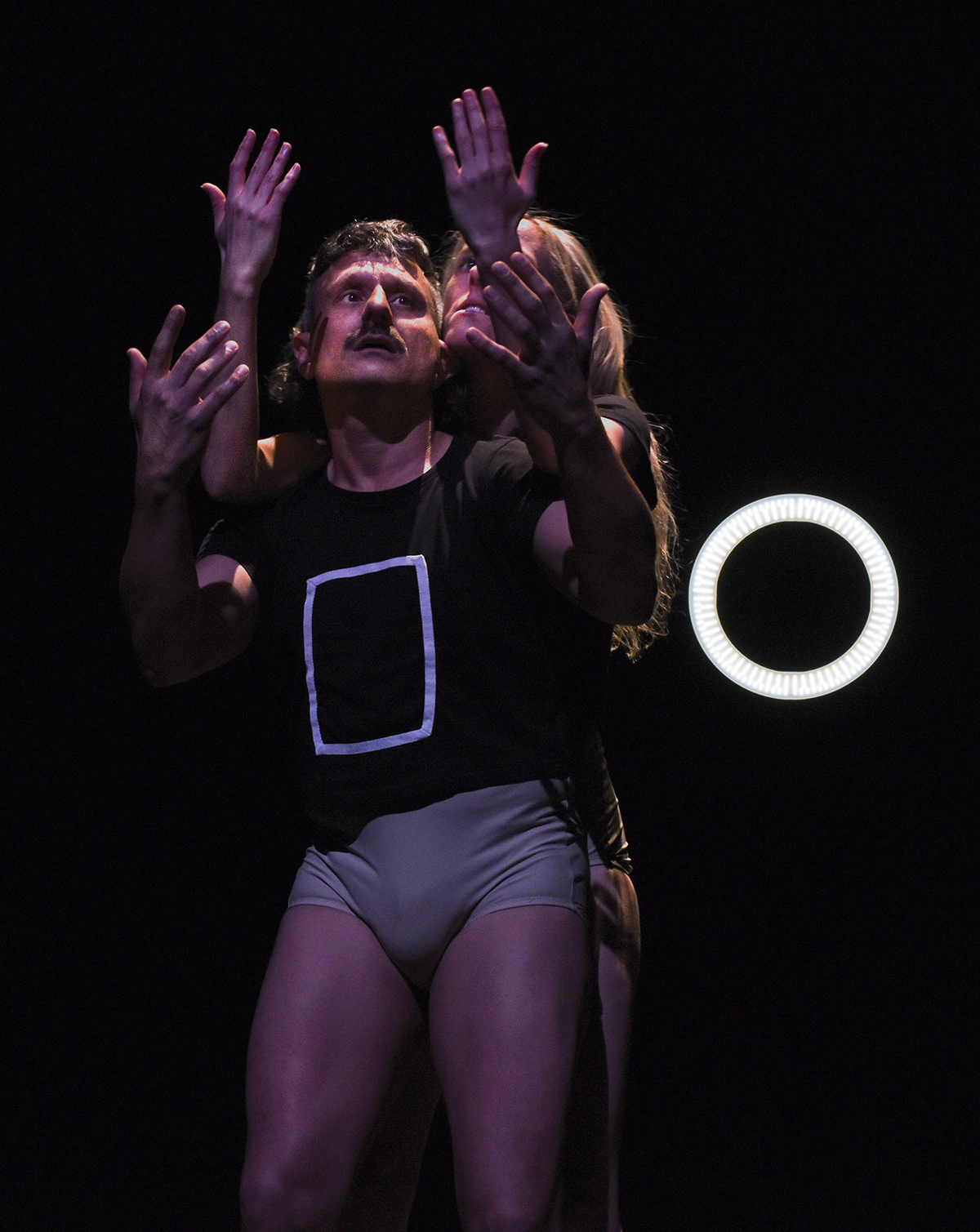
Narcifixion, Anton, Brianna Kell, photo Heidrun Löhr
The selfish pleasure of narcissism demands constant refuelling; if not met anxiety ensues. With shocking suddenness, the pair’s hands turn on them, striking, pulling, spinning, vibrating them, until two becomes one, a four-armed, strobed, panicked creature fixated on mirror-palms that yield no sustaining sense of self. Exhausted and entangled, body against body, in a slow circular walk the pair refuse eye contact and touching comes to nothing in a sad little disengagement.
A new phase ensues, one of individual endeavours. He tries to communicate with her. First, it’s casual, a smile, an ‘Aaaah,’ then an indecipherable deep-throated utterance, then a cocky little circular dance — an invitation? The display grows grotesque, his t-shirt pulled up, a cartwheel, high kicks, failure to connect, a tantrum — narcissistic rage. Exhaustion.
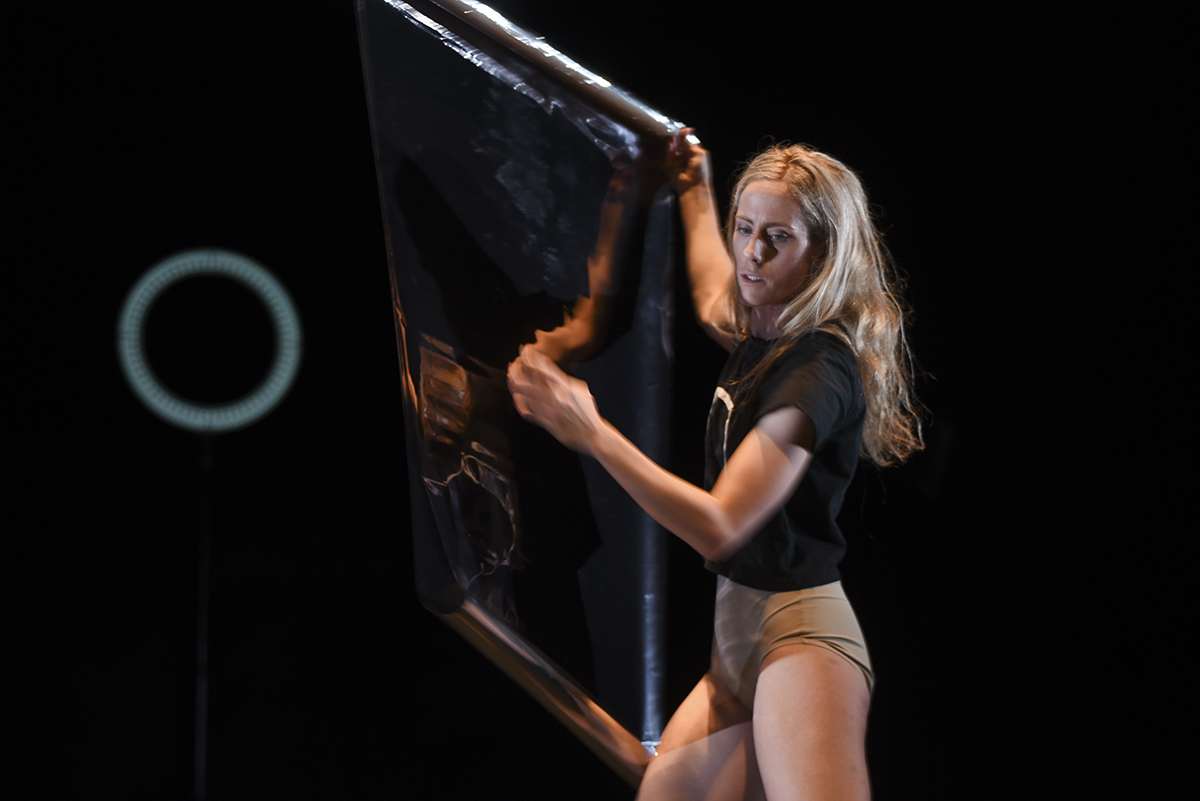
Narcifixion, Brianna Kell, photo Heidrun Löhr
It’s her turn. She carries a silvery, transparent plastic sheet the height and width of her body. It mirrors her gaze and movement in a slow, intimate dance between self and an image inviting curiosity and attraction, but then fixes stiflingly to her. The dark clattering of the amplified material is claustrophobic. There and not there, she is eventually nothing more than a fading image. Her mirror dance a narcissistic dead-end: a mere image cannot sustain self.
Another attempt to secure that self is announced with a darkly underscored, cicada-like beat. Standing before the ‘eye’ each neatens their hair, checks the other’s face, and together step into a spot-lit space, suddenly aware of an audience. Like fashion models they venture into a rehearsal of stylish strutting and then loping across the stage, hyper-smiling, pulling off t-shirts (branded with a square version of the ‘eye’) and settling into a ludicrous show girl promenade and, as the music dips away, embarrassingly exhaling overt groans of pleasure and self-congratulation, climaxing in an ‘Aaah!’ of joint approval, heads exultantly thrown back.
Such rare if empty success, free of now anticipated breakdown, prompts more exaggerated exertion, with a growing sense of omnipotence. A dark drum beat glides deep into a throbbing pulse introducing a protracted, bigger than life, hyper-articulated disco sequence that progresses with supreme confidence, faultless synchrony and increasingly expansive moves, dance as pure narcissistic display, with none of disco’s double offering of individual interiority and crowd communality.
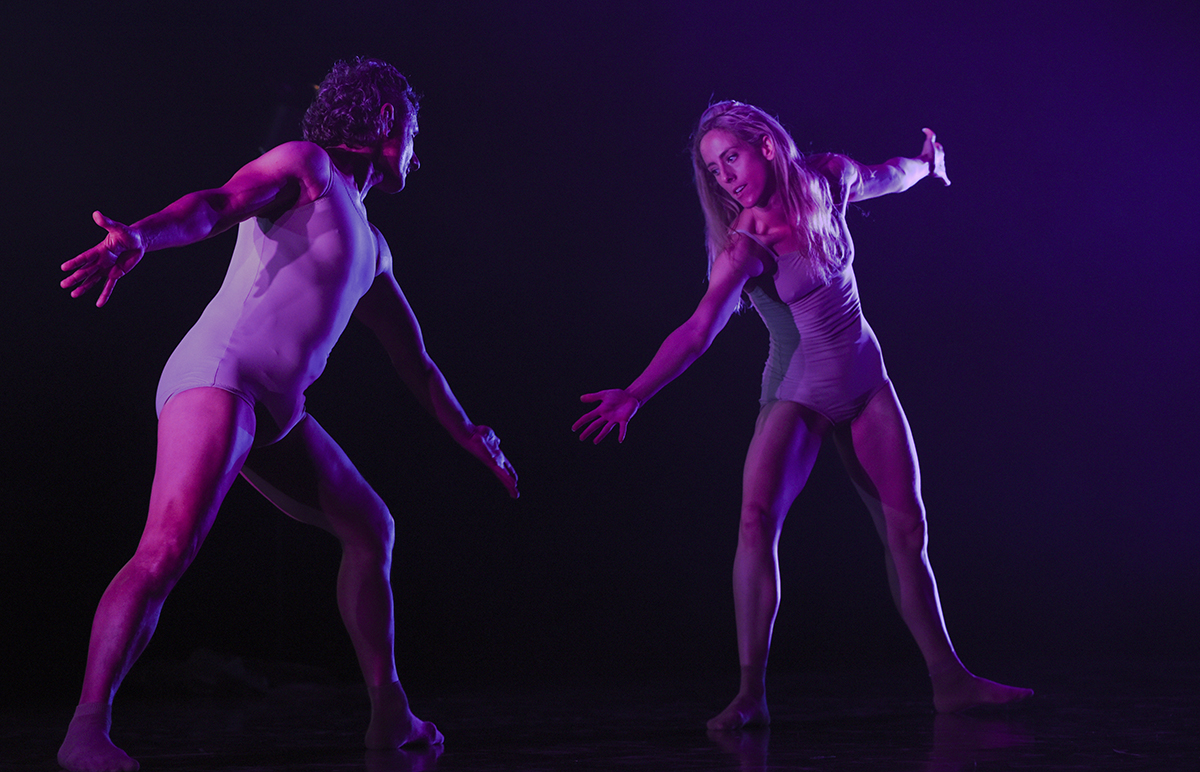
Narcifixion, Anton, Brianna Kell, photo Heidrun Löhr
The hand as mirror motif makes a brief appearance, integrated into the dance, before the desire to break out of the single self, to once more touch, recurs exactly as it first did, bodies awkwardly angled towards each other, fingers fluttering in near connection, stilled bodies helplessly vibrating. The pair break out, walking then dancing into proud recovery. But this too is doomed. They wind down, depleted, the world darkening around them, hands outstretched but palms now turned down, reaching out as if blindly into nothingness as a haunting oceanic swirling thins out into silence.
WORRYING AT NARCIFIXION
It’s a grim ending, this in-effect blinding, a cruel fate for a pair fixated on sight, on the gaze received from their mirror selves and imagined admirers. Are we complicit in this cruelty? While we’ve scrutinised and laughed at the pair’s self-crucifying behaviour, there is no way out for them in this scenario, or for ourselves.
Anton writes, “This union of words (Narcifixion) is a warning against getting too caught up in your ‘virtual’ identity.” But is this sufficient? If narcissism is a closed circuit, so is Anton’s critique of it, a vivid, exacting portrayal of a compulsive condition and its escalating pathology as the pair seek out new ways to reach impossible fulfilment, but throughout within that closed loop of grandiose effort and abject failure. What if one of the pair were eventually ‘unplugged’ instead of doomed? Which points to one of the stranger dimensions of the work, the absence of a dynamic between the two figures.
Anton describes Narcifixion as “a dance for two singular characters caught in a constant state of exhibiting and observing themselves.” Just how ‘singular’? Except for the conventional gender distribution of the two solos (the male as extrovert mate-seeker; the female locked in her mirror gaze), these narcissists are otherwise undifferentiated, save in appearance, dancing in exacting tight-knit harmony, in a duet of sameness without opposition or counterpoint (might one narcissist sooner or later strive to outcompete or demolish the other?). Is then the narcissism of our era exactly the same for one or two or three or more of us?
This absence of differentiation underlines the unresolved hybridity of a work that looks like dance theatre (the elaborate sci-fi-ish set-up of the opening, not returned to, the intensifying pattern of release and breakdown, the contrasting solos that have no other ramification) but inclines to a series of lightly themed, abstracted states of being, a relentless dancing for dance’s sake, which can at times be thrilling; at others it feels that Narcifixion could just keep going on.
Driven by the compelling logic of intensifying self-obsession and self-destruction, realised with meticulously executed dance, comic self-aggrandisement and the pathos of failed connection, Narcifixion is cogent and variously funny, acerbic and affecting, but too narrow in its vision of the condition it harshly critiques. What, in the end, are we meant to feel about its narcissists? That they deserve their doom? That we’re superior to them — because Narcifixion has refused to implicate us? That we see no way out?
I appreciate having been provoked by Narcifixion, and enjoyed the opportunity to view it more closely a second time. Viewed onscreen, the production’s eerie, no-where ‘set,’ comprising only highly effective lighting (Steve Hendy) and spare costuming (Brooke-Cooper Scott), was reinforced by composer Jai Pyne’s texturally rich, dance-triggering score and its chilling silences. Anton and co-choreographer Brianna Kell danced admirably as if their narcissists’ lives depended on it, in manic survival workouts with locked-in look-at-me smiles demanding infinite reward.
—
FORM Dance Projects & Riverside Theatres, Dance Bites 2021: Narcifixion, director, choreographer, performer Anton, choreographer, performer Brianna Kell, composer Jai Pyne, lighting designer Steve Hendy, costume Brooke Cooper-Scott, livestream team Denis Beaubois, Martin Fox, Dom O’Donnell, education consultant Shane Carroll, producer Anton; Riverside Theatre, Parramatta, May 13 – 15 2021
Top image credit: Narcifixion, Anton, Brianna Kell, photo Heidrun Löhr
Rakini Devi, dancer, choreographer, performance artist and visual artist, reveals that the multitude of small paintings that fill one long wall of Sydney’s Articulate gallery for her exhibition Inhabiting Erasures: Embodying Traces of The Feminine, “are what I call ‘dancing on paper.’ They’re everything that I want to express, in actual journals, from which I have ripped these pages. If I didn’t have this journaling practice, which I worked on every single night during COVID, I don’t think I would have survived.”
-
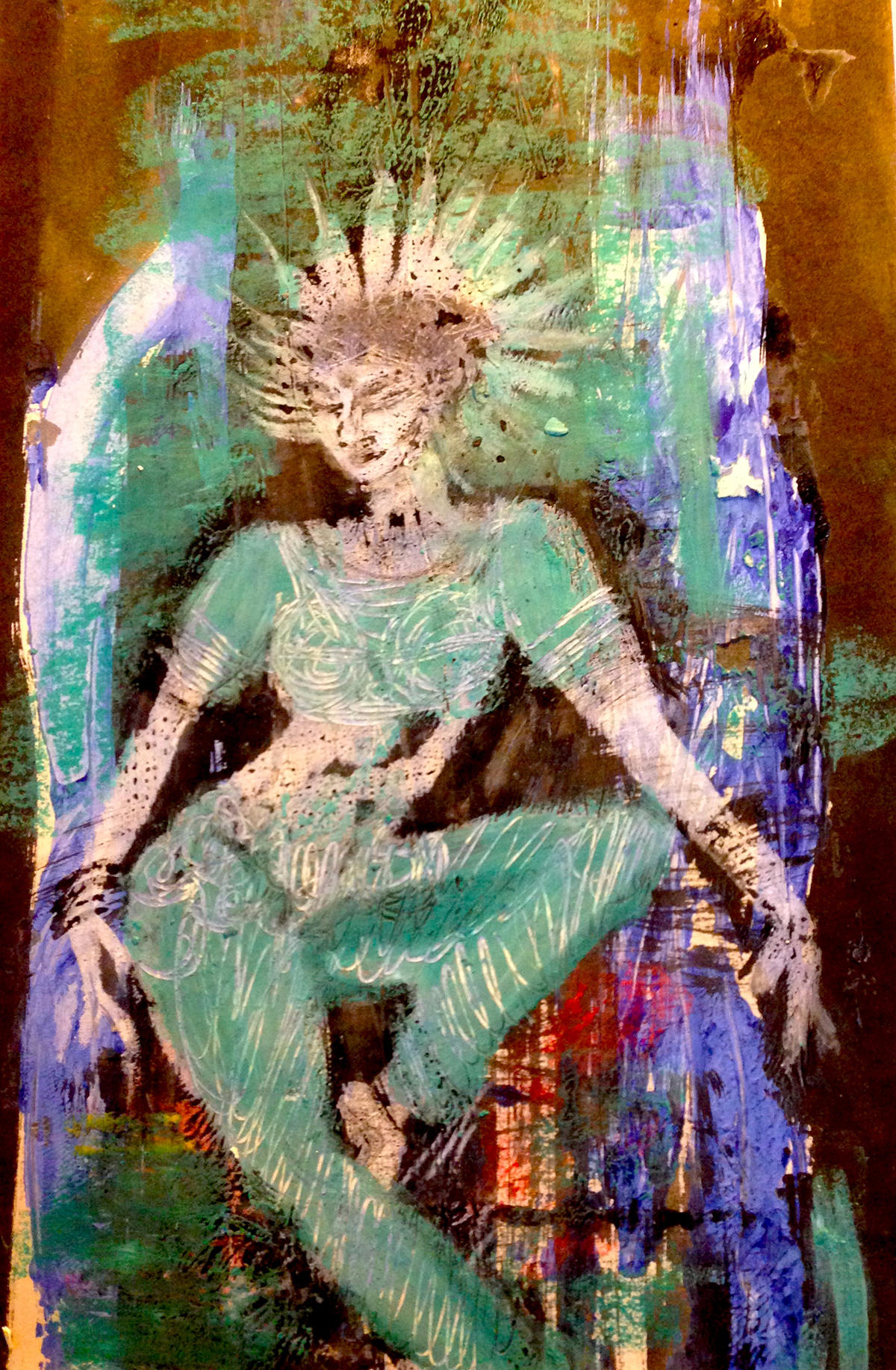
- Rakini Devi, Green Dancer, photo Rakini Devi
-
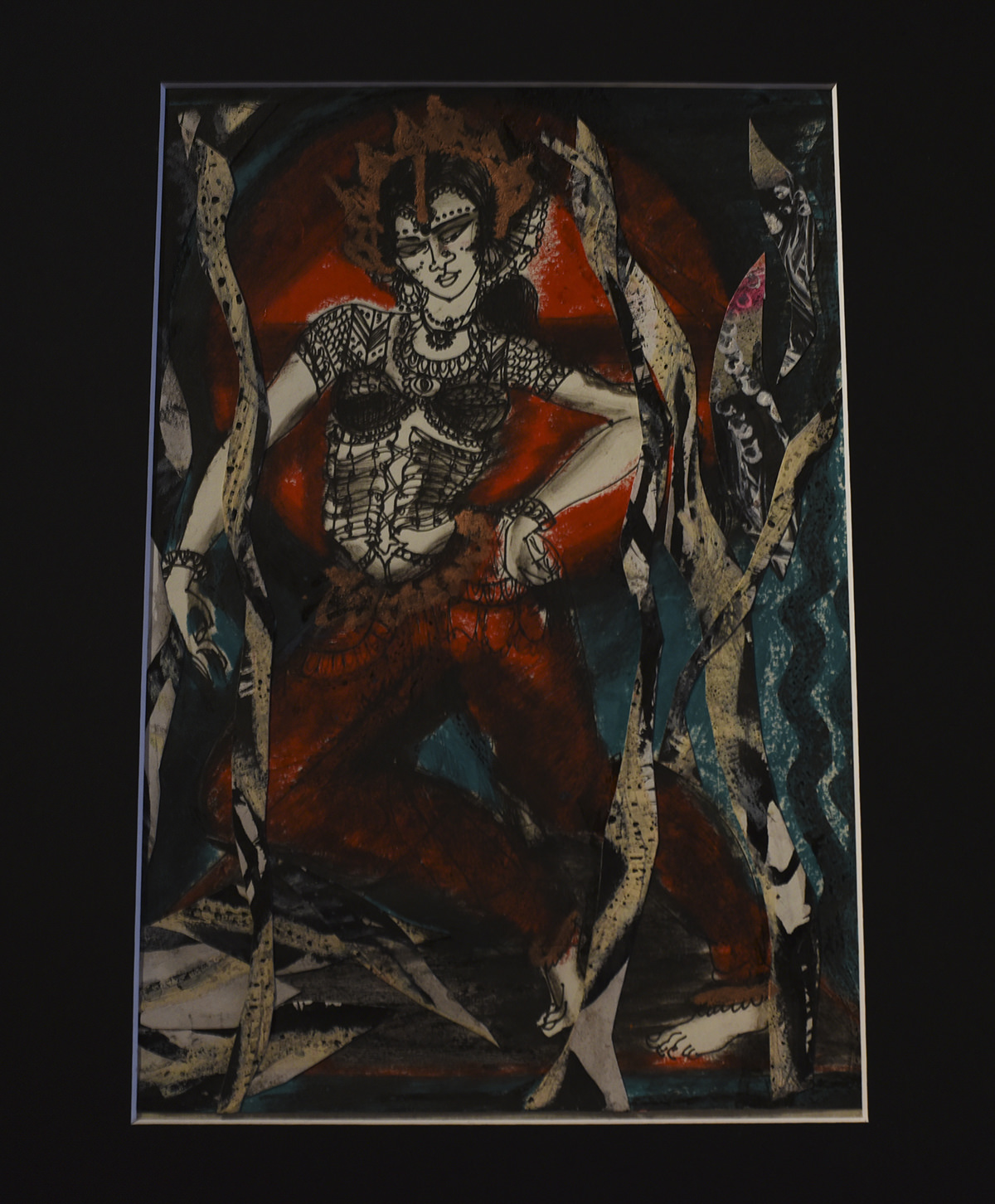
- Rakini Devi, Naga Devi (Snake Goddess), photo Heidrun Löhr
-
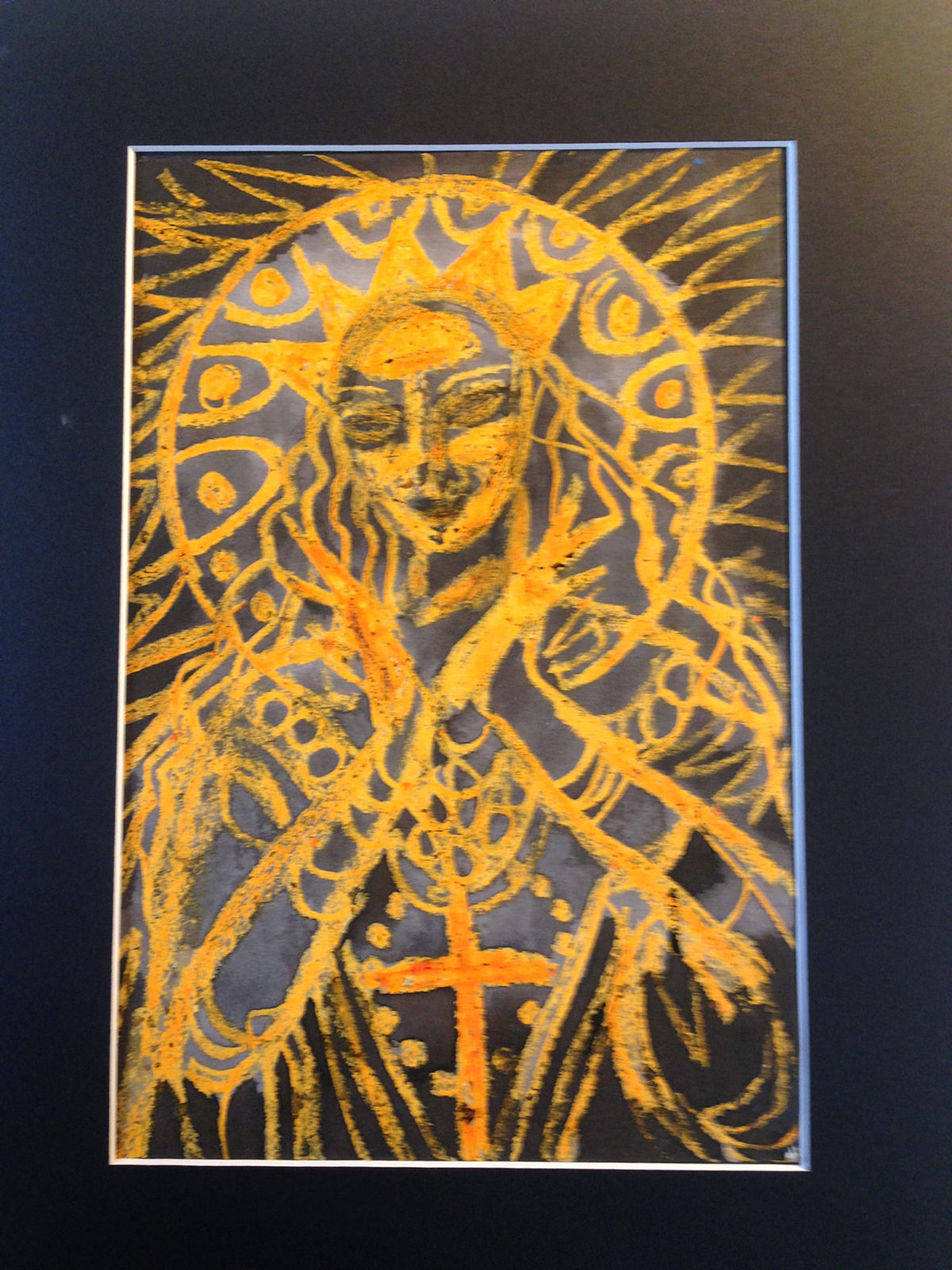
- Rakini Devi, Molten Madonna, photo Rakini Devi
-
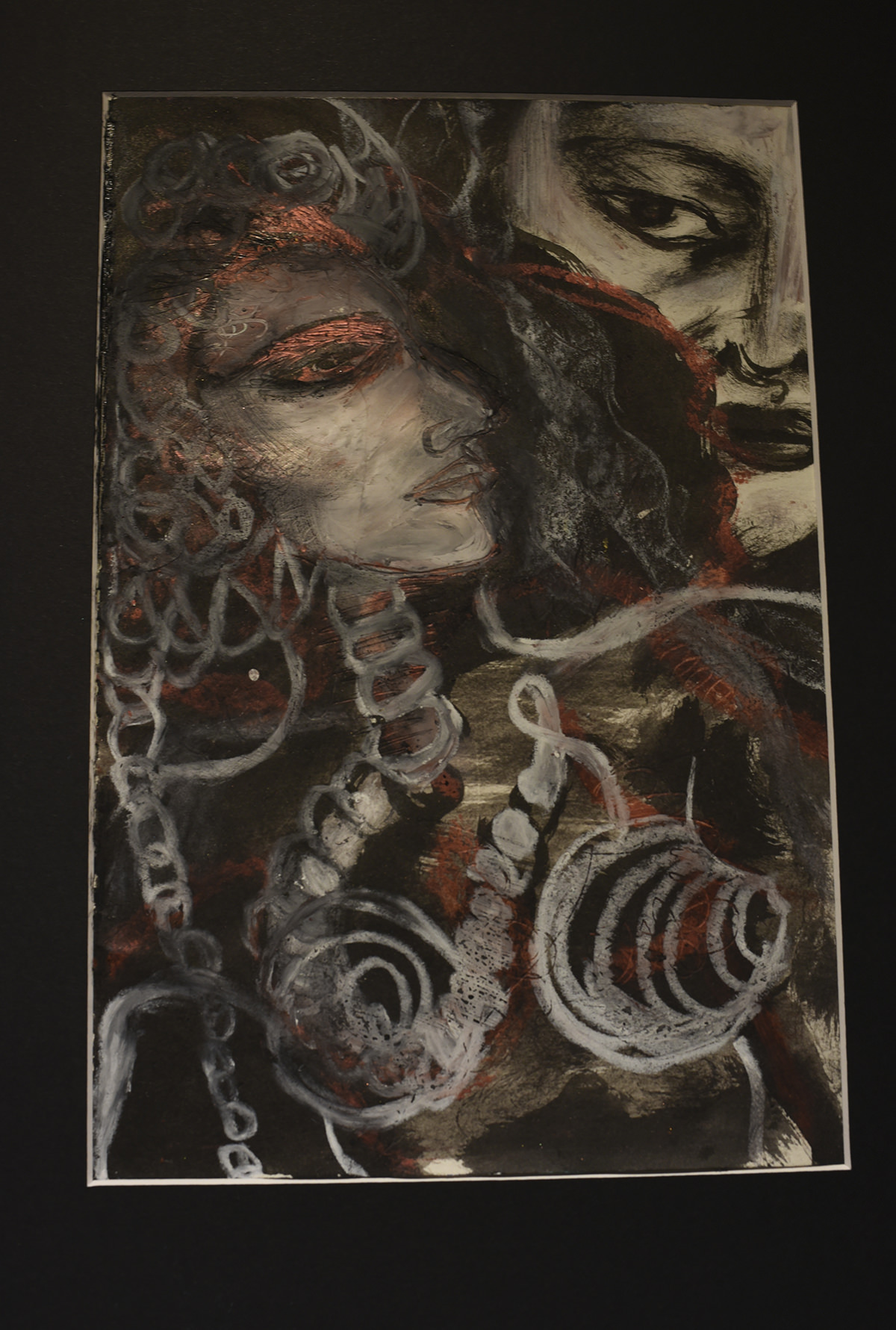
- Rakini Devi, Calcutta Manga #2, photo Heidrun Löhr
-
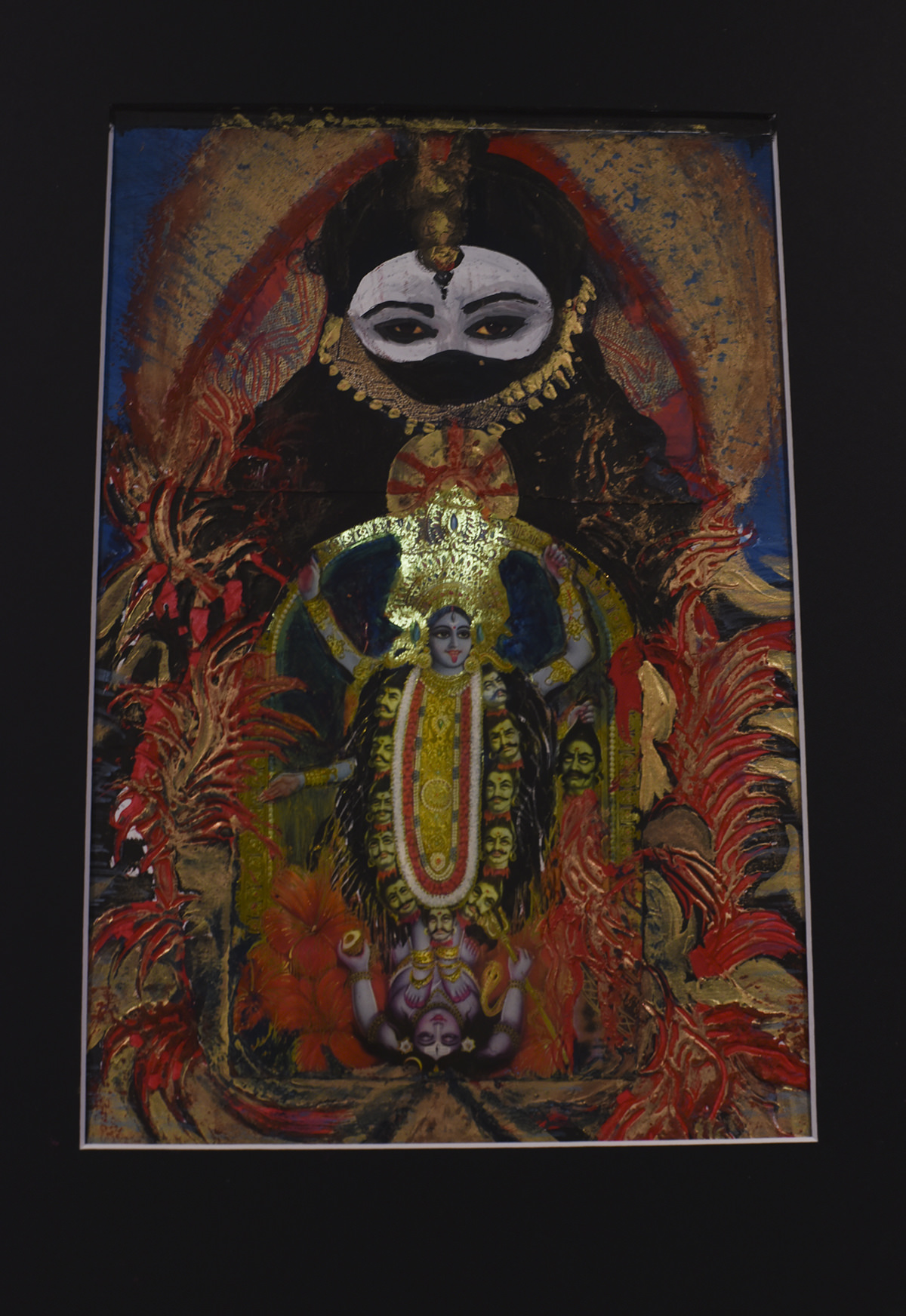
- Rakini Devi, Kali Shrine, photo Heidrun Löhr
Inhabiting Erasures hauntingly resurrects “erased” and violated women as “spectral residues” at the same time as it celebrates the artist’s 30-year career within the aura of a festival for Durga (the primary goddess of the Hindu universe), for which the long narrow ground floor gallery space on a crowded opening night evoked the ambience of a busy, narrow night-time street filled with devotional artworks.
Everything about Inhabiting Erasure evokes night labour, Freud’s dream-work, the shaping and managing of images conjured by desire, anxiety and trauma. Responding specifically to “the erasure of women through acts of misogyny and violence” in India and beyond, Devi has called up from the depths of her consciousness a phantasmagoria of fearsome goddess figures, Kali (the dark side of Durga) above all. Alongside are their cross-cultural correlatives: the Madonna and a Female Pope whom Devi has hauntingly and wittily embodied and hybridised with Kali in performance and installation. These are found in traces, including projections from performances and costumes and props on display, awaiting embodiment.
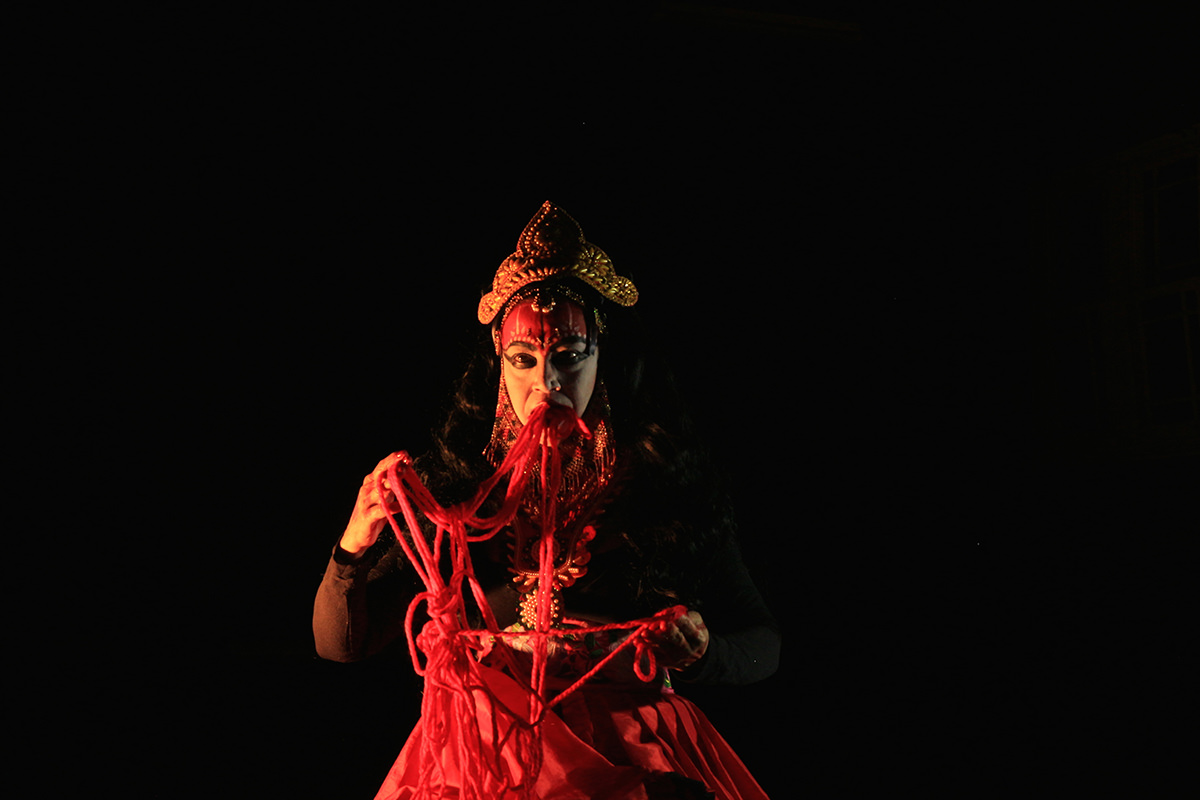
Rakini Devi, Karl Ockelford, Urban Kali, video still
Also on the left side of the gallery is a superbly produced film with Devi manifesting as a snakily-tongued Kali. At the other end, tall hangings from a 1991 performance (“on a Ben Hur scale,” quips Devi) by her company Kalika at Perth’s PICA portray other majestic female figures. In between are two cloth canopies. Inside one is a female figure painted on the floor, Devi’s body providing the template; in the other an outline, awaiting the artist’s actual presence for opening and closing night performances.
These canopies, Devi explains, are inspired by ‘pandals,’ celebratory roadside shrines made for the annual festival in honour of Durga, Kali and all the Hindu Goddesses including the goddess of learning and knowledge Saraswati and Laxmi the goddess of wealth. Pandals range in scale from small to massive, from humble to gorgeously extravagant, sometimes produced, and copyrighted, by major artists and greeted by coursing crowds. Devi’s canopies are modest, but rich in personal, mythological and political meaning.
When I next visited Inhabiting Erasure, I had the exhibition to myself before being joined by Devi. I was immediately responsive to the artist’s “dancing on paper,” to an air of ephemerality, of figures conjured in the night, phantom presences (in Devi’s words, “traces of the (absent) female body materialising as spectral residue”), of many bodies as one, sharing the artist’s personal mark-making, classical dance poses and gestures and ritual symbols. These recur in the paintings, canopies, costumes and video, generating a connectiveness that works cumulatively to transform exhibition into installation into vibrant archive.
A long-time performer learning how to use installation, Devi asks herself, “How can I embody a space without actually being there?” Using “my own body as a template I frame myself in my own aesthetic. In all my work I imprint on my body various Sanskrit markings of sacred sounds and syllables, like the snakes that represent kundalini energy. Each symbol represents the chakras rising.”
I ask Devi, who has been drawing since childhood, what she feels each night as she paints, aside from the solace of doing it. “I paint all the things I envisage in my mind and how I feel my body moving. I have journals extending over 20 years and sometimes just by looking at a painting that I’ve done, I remember exactly what I was feeling at that time — happy, sad, tragic.” As for movement, “Well, it really does feel like my body moving; the hands and feet usually reference Indian traditional dance. It’s something I think goes back to when I was eight years old. It’s still in my body and my mind.”
We discuss pandals. Devi recalls “growing up in Kolkata and from a very young age being fascinated with the temporary shrines made every year for the goddess festivals. They are basically constructed out of cloth and bamboo. Over the years, they’ve been elevated to absolutely incredible artworks that cost thousands of rupees. Every suburb has one. As a young girl, besides being in a Catholic convent and marvelling at the icons there, I would see 20-foot idols of the goddesses Durga and Kali, as well as Ganesha. It was fascinating: the priests, the smell of incense. And then, travelling through India, I would see the tiniest little roadside shrine under a tree, a piece of cloth tied around it. I’ve always loved the idea of the canopy and decided to use it to create environments in which to frame myself. I started with the Female Pope (2010) and then in Kali Madonna (2014) in The Rocks in Sydney I constructed and inhabited a pandal-styled canopy in a shop window. Last year when I was stuck forever at home during the pandemic, I started creating all these little structures in my back patio and then in a residency at the Rex Cramphorn Studio at the University of Sydney doing chalk drawings on the floor to give them some context.”
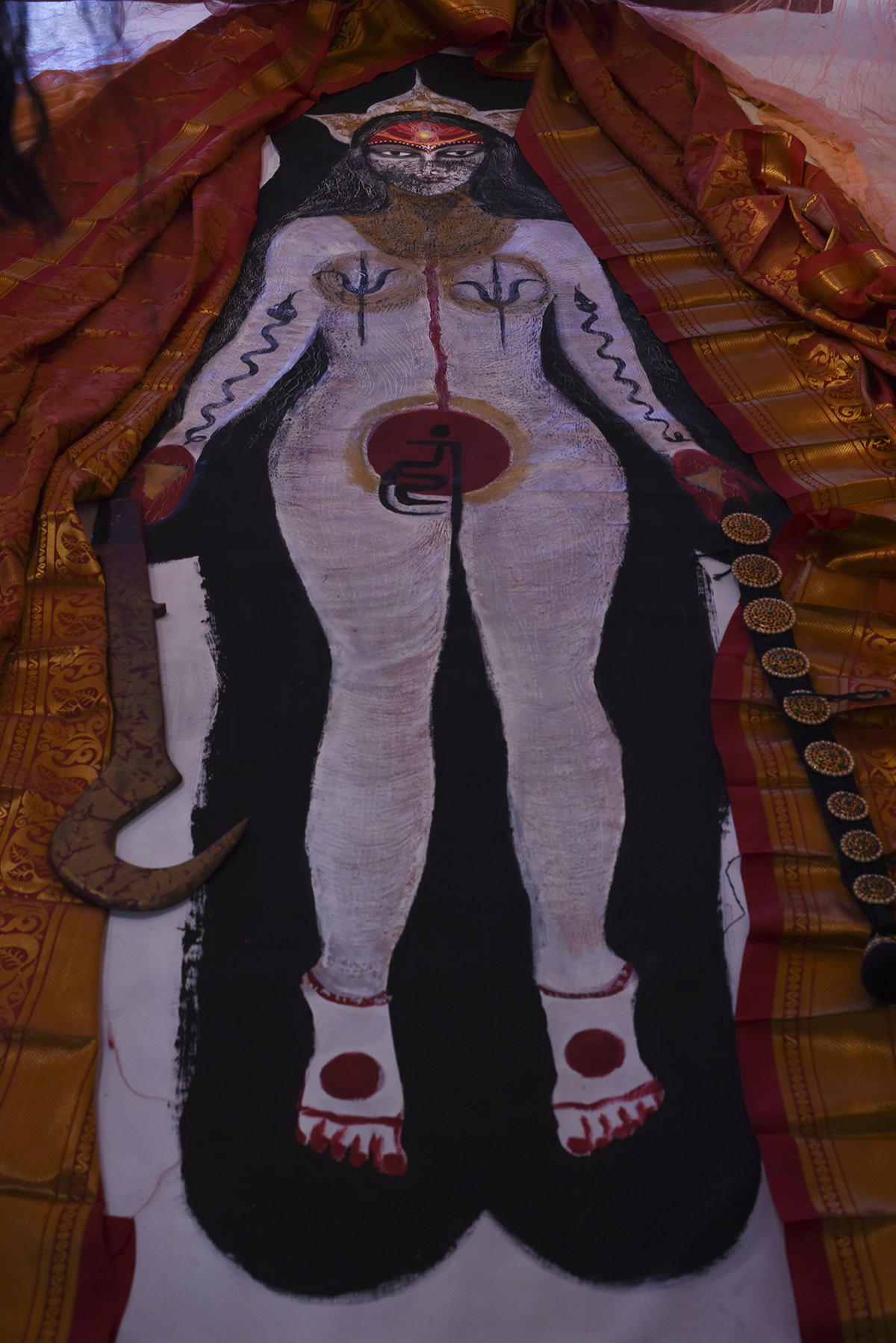
Rakini Devi, Canopy 1, photo Heidrun Löhr
The first canopy is draped in an attractive, embroidered pink mosquito net which, says Devi, “is of great sentimental value. It was sent to me by my aunt in Kolkata, because she knows I love mosquito nets. I love the colour. This canopy is a sort of satirical construction; it’s supposed to convey the gorgeous environment of a bride, but in fact, in India, there are dowry deaths, gender mutilation, suttee (the burning of widows) and other misogyny towards women — the stuff I’ve been researching since the early 90s. So I created this image inside. I’m actually quite attached to her. She’s not for sale.”
The figure within is white, as if naked, but not at all vulnerable. Accompanying it is “a replica sacrificial sword crafted for a 1995 show, representing Kali’s power,” and a classical hairpiece — “also worn by brides.” I also notice hair hanging eerily on the outside frame. On the floor are inscribed statistics: “2020 Australia: lockdown: domestic violence 55 deaths” and “50% of global femicides occur in Latin America.” The figure, although supine, exudes a sense of strength. Devi says, “My idea is to show that despite the misogyny and violence directed towards women, female strength is still evident. Also, I don’t want to simply house a victim. I want to really focus on and celebrate power and beauty.” The symbol at the womb-centre of the figure suggests a force field. “Exactly. You’ve got it,” Devi replies. “I don’t want to spell out everything, but people can sense it. The red sari is a typical bridal sari. Red is the colour of brides; also, for me, a representation of blood spilt. It has tragic connotations. I’m trying to show the beauty of the façade of culture that also has a darker side to it.”
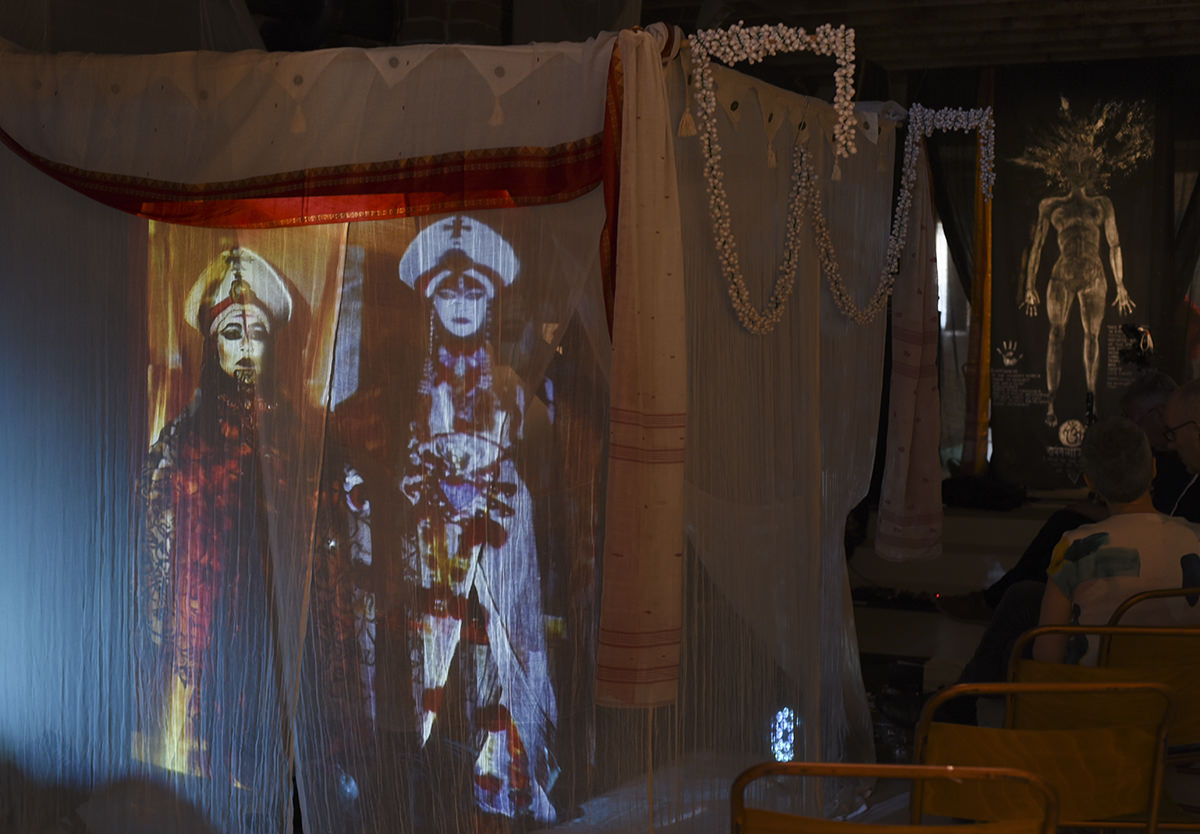
Rakini Devi, Canopy 2, photo Heidrun Löhr
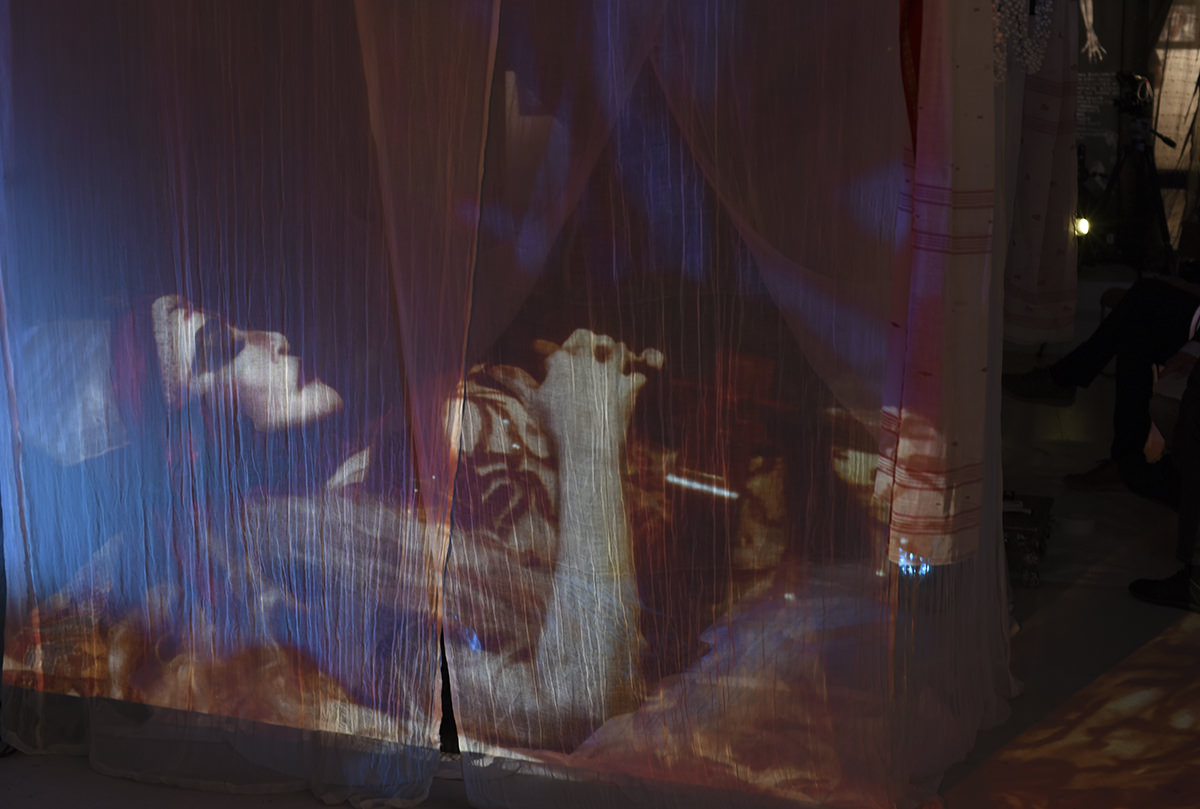
We come to the second canopy which, says Devi, “is more or less a documentation of all the Female Pope performances I’ve done all over the world.” Projected images of the artist as Pope eerily grace the canopy while inside is the outline of her body: “I can embody a space without actually being there.” The Female Pope, like Kali, carries a string of decapitated heads representing the evil she has defeated. Devi explains, “I made them myself for performances I’ve done in Europe and America. I suppose it’s no coincidence that they all happen to be male, but the head, of course, mainly represents the ego; so it’s not really violence towards men, it’s actually annihilating ego.”
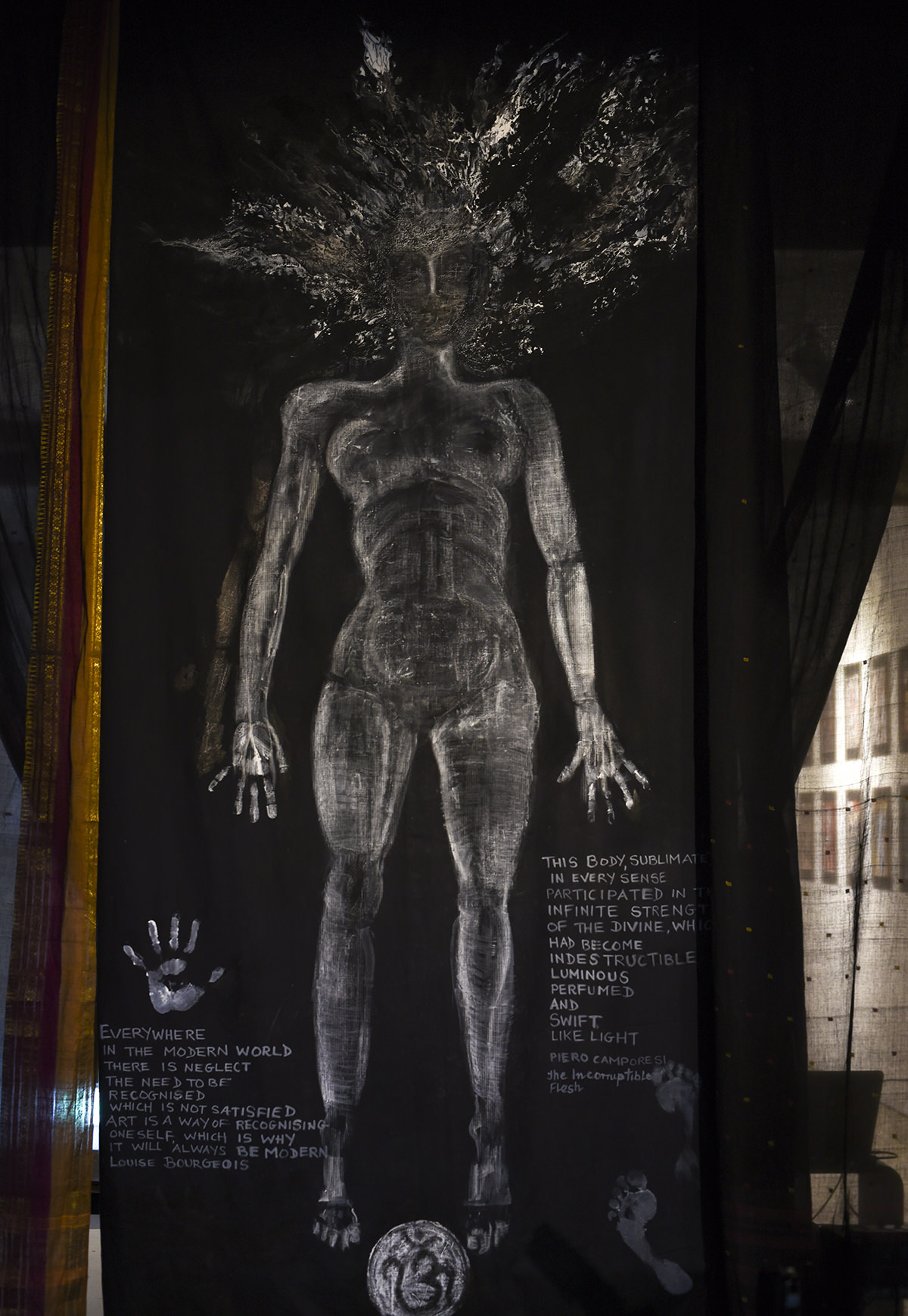
Rakini Devi, Shroud of Devi, 2021, photo Heidrun Löhr
We move on to Shroud of Devi, a large, striking life-size, black and white painting of a naked woman. Lines of energy radiate from the blurred head, “like an explosion,” I say [we both laugh], “a burst of ecstasy.” Devi recalls, “I managed to dig this material out of my storeroom and it just happened to be a piece of black cloth. I imprinted by painted body onto the cloth. All the canvases are black. I love working on a black surface. It also has a negative like X-ray feel about it.”
The texts inscribed on the painting assert a self that is “indestructible, luminous, perfumed and swift like light” (Piero Camporesi, The Incorruptible Flesh, Cambridge UP,1983) and that “Art is a way of recognising oneself, which is why it will always be modern” (Louise Bourgeois, interviewed by D Kuspit, in Bourgeois, Destruction of the Father, Reconstruction of the Father: Writings and Interviews 1923-1997, MIT, 1998).
This hanging is a bracingly powerful work that speaks of enormous creative and psychic release. Devi muses, “It’s a very personal sort of expression. I had all this pent-up feeling, just dying to express all these things. I hadn’t worked in large scale for a very long time. I thought, why don’t I allow myself to do large scale works anymore?”
The painting includes the words “I bow to the goddess who is the soul of all yantras.” Curious about the symbols that recur in the exhibition I ask Devi to elaborate the meaning they hold for her. She explains, “The yantra is a sacred diagram just as a mantra is a sacred incantation or prayer. They are from one of my favourite books, which influences all my drawings of yantras or sacred designs. According to a lot of tantric teachers, the body is a yantra; it’s also a sacred diagram; it has sacred points. These three paintings behind you, especially the blue one; I call them ‘yantra devis’ or ‘goddesses of the yantra.’ Since the 1990s I’ve been using these symbols — the circle, the triangle, the square. I wrote at length about this in my doctorate thesis. The yantras have been an inspiration for me over the last 30 years.”
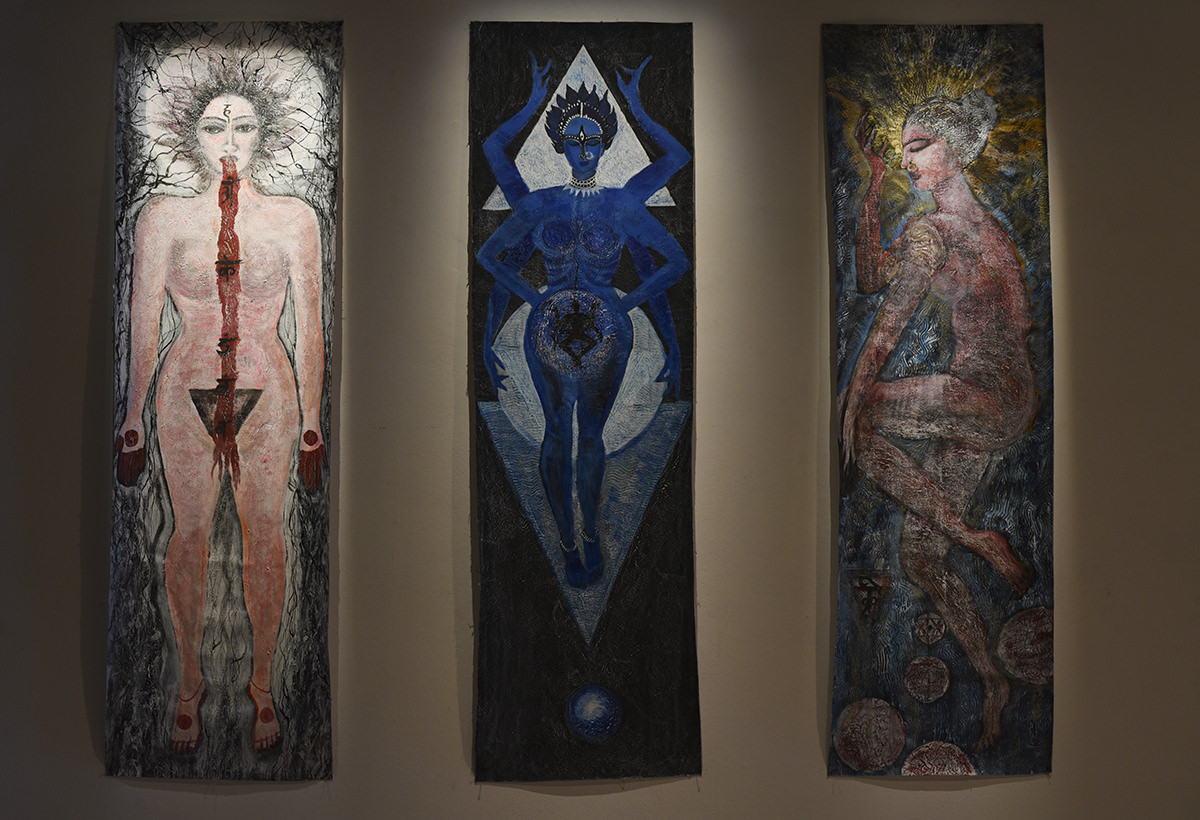
Rakini Devi, White Devi, Blue Devi, Dancer in The Dark, photo Heidrun Löhr
We turn to the trio of paintings. The central, intensely blue four-armed woman hovers serenely. I ask about the figure in her womb. “It’s a dancing four-armed Kali, the centre of her power. The downward triangle represents the female and the upward triangle is the male aspect/element.” She’s embodying both male and female? “Correct.” And the medium? “I always use a mixture of oils, pastels, inks and acrylics and a variety of different textures, pens, metal needles. I love layering textures.”
In the painting on the left, “A flow of red from the mouth down, represents the tongue of Kali, her energy,” says Devi. The figure’s hair too radiates with psychic energy. “It’s almost like a halo,” she adds. “There are references to the yantras and there’s my signature mark, which is the syllable or the Sanskrit letter for Kali. It’s called ‘kreem’ which is the mantra for Kali.” The symbol appears on the figure’s forehead and down the bloody flow from the mouth.
The relaxed woman in the righthand painting is endowed with an opalescent radiance, only the raised, slightly curled open right, hand perhaps evoking symbolic meaning: “This is way too pretty for my normal drawing. The face is very beautiful. I thought okay, I’ll leave her; I won’t put in any subversive elements.”
Rakini Devi, Dancer Mandala, Twisted Dancer, photo Heidrun Löhr
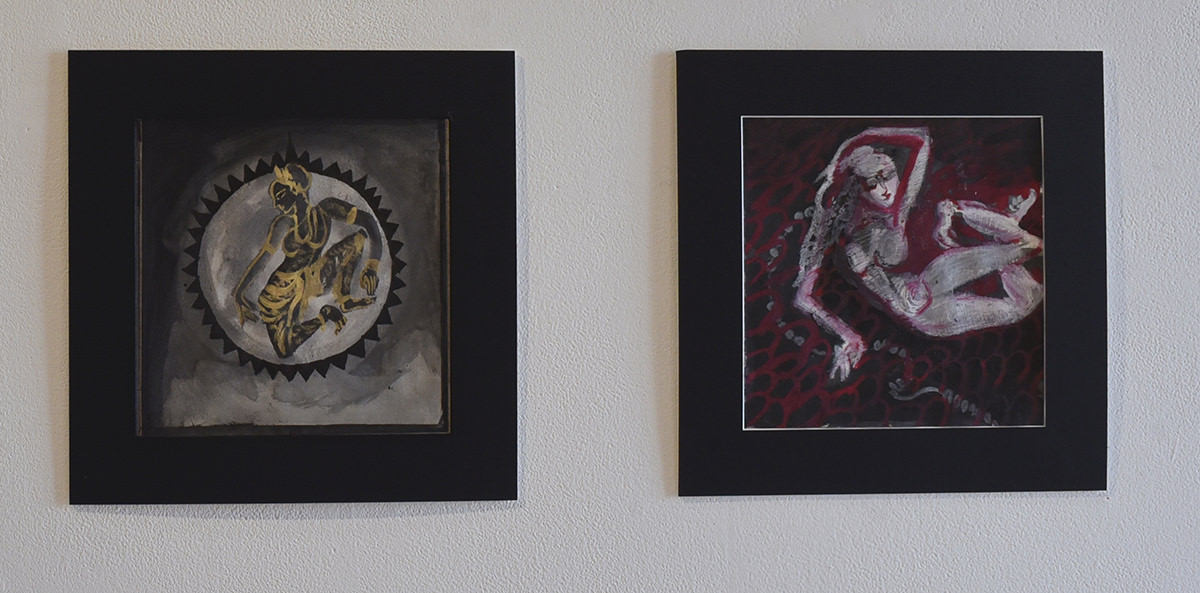
As we consider each of the journal paintings, Devi says, “Every work I’ve ever done starts off on paper, from costumes to texts, to stage setting, how the work will be framed.” Within these paintings the female body is often beautifully sinuous, sometimes a “a nude in movement…the most beautiful celebration of the feminine,” sometimes abstracted, and often referencing the poses and gestures of Bharatanatyam and Odissi classical Indian dance in which Devi trained, as in Dancer Mandala and Green Dancer. Juxtaposed with the latter is Twisted Dancer, a delightful casually contorted nude with hand and feet flexed, captured in the reverie of her movement, as if afloat. Devi is emphatic: “I’m not using actual sacred gestures. I’ve stylised them for my own art and choreography.”
Rakini Devi, Seed Mantra, photo Rakini Devi
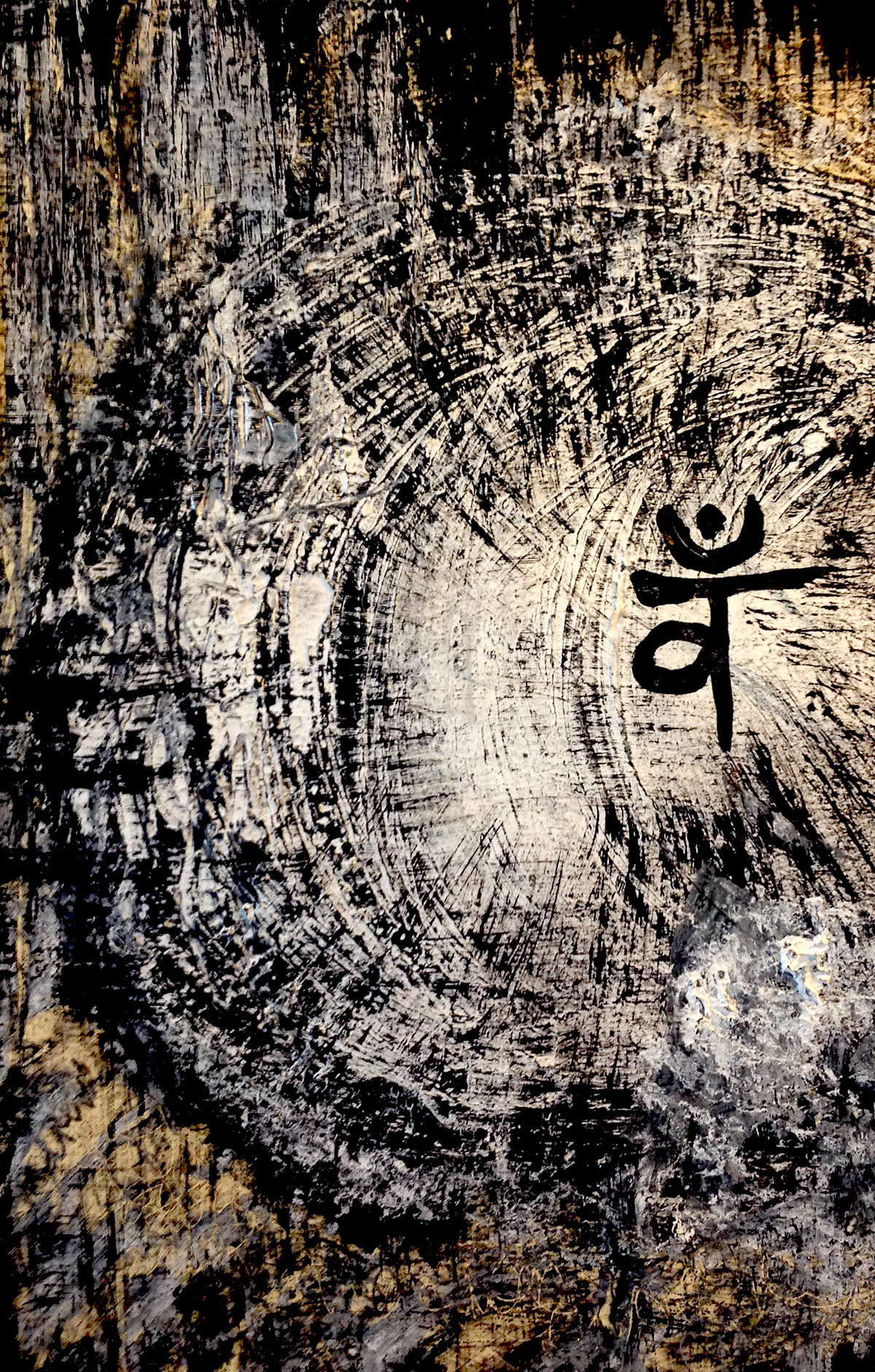
I return several times to Seed Mantra, one of the rare abstract images among the journal paintings. The symbol, says Devi, “represents the chakra that is the source of my name, Rakini.” It hovers over a deeply layered and etched surface that evokes the timelessness of ancient tree rings. Devi explains the appeal of focussing on a symbol: “Distilling one’s concentration into a single letter that holds power with layers of meanings, resounding with an aura of its own, is a practice I have done repeatedly over the years, a process that gives me much satisfaction. My love of abstract painting gives me another level of concentration. While referencing and immersing myself in yantra-inspired diagrams, the process of painting them is my form of meditation. Repetitious dance moves can also produce the same sensation of escaping the earthiness and gravity of the human body, with its burdensome ego, complex desires and angst.”
Rakini Devi, Female Pope in canopy projection, photo Heidrun Löhr
This magical host of small nightworks, the fragile beauty of the pandal canopies, the towering unframed paintings and the many residues of performances past not only collectively evoke the street art celebration of Hindu Goddess culture and “the absent female body materialising as spectral residue,” of women violated and erased, but also speak to art’s ephemerality. Inhabiting Erasures is an exhibition as installation as archive: “For me,” says Devi, “it’s about leaving a legacy. I felt this was the time to address that.”
In the face of ephemerality and its erasures, it is consoling to reflect that the richness and power of Rakini Devi’s Inhabiting Erasures emanates not only from three decades of practice, but sustainingly from a several thousand-year-old cultural heritage which the artist perpetuates and idiosyncratically opens out, defying transience. Her art is born of a culture often beyond my comprehension, but that’s not say it’s beyond meaning as Devi’s imagery incorporates itself indelibly into my own night work, where art is most deeply felt. This is art that is at once modern (full of self-recognition, as Bourgeois would have it), powerfully ancient (felt like a shock of the old) and compelled by compassion that both respects and challenges tradition.
—
For more about Rakini Devi’s practice and scholarship see “The goddess & the doctorate: Rakini Devi’s Urban Kali,” RealTime, 13 Sept 2017 and a review, “Urban Kali, Face to Face with Kali,” 26 Sept 2017.
See also an interview with Rakini Devi about Inhabiting Erasure: “Real presences,” Fiona McGregor, The Saturday Paper, No. 342, March 27- April 2 2021
Rakini Devi, Inhabiting Erasures: Embodying Traces of The Feminine, technical production Richard Manner, photography Heidrun Löhr, Urban Kali video (2017) Karl Ockelford; opening night performance Rakini with Cat Hope, closing night performance Rakini with Liberty Kerr; Articulate, Sydney, 27 March-11 April
—
Top image: Rakini Devi, Canopy 1, photo Heidrun Löhr