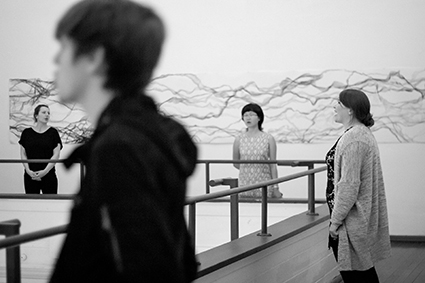
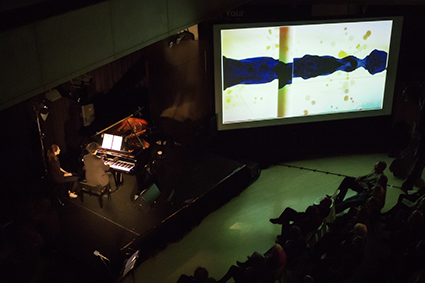
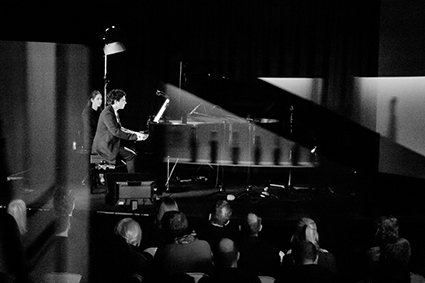
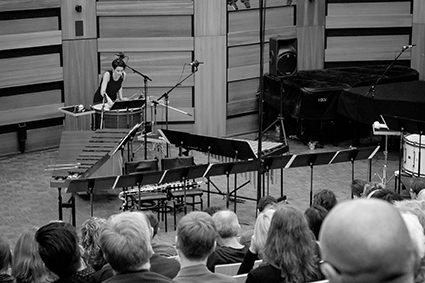
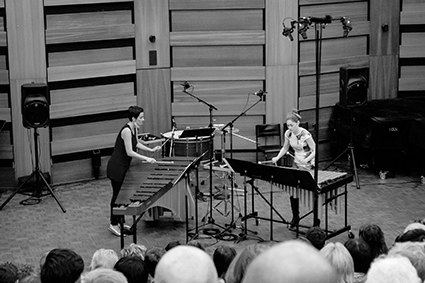
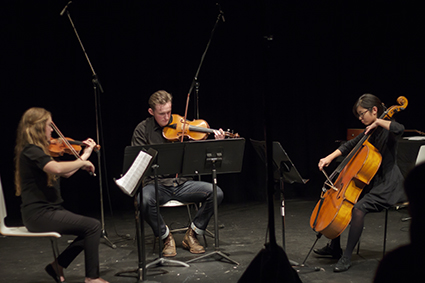
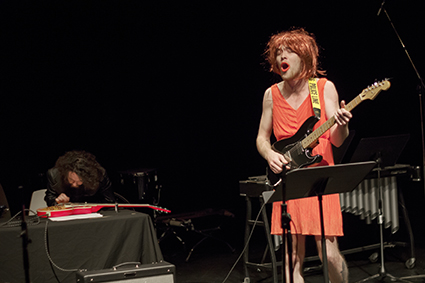
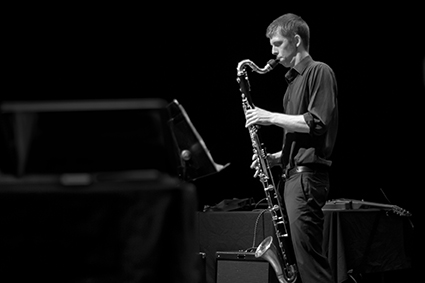
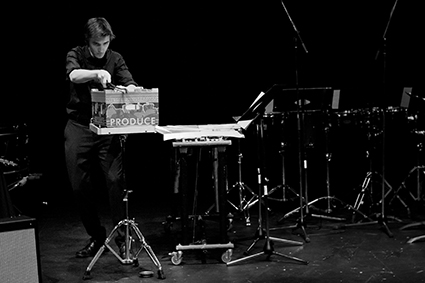
The Argonaut Ensemble perform Boulez’s Sur Incises
photo by Marty Williams
The Argonaut Ensemble perform Boulez’s Sur Incises
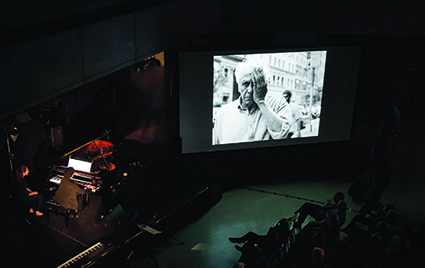
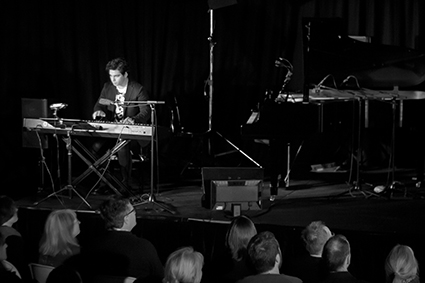
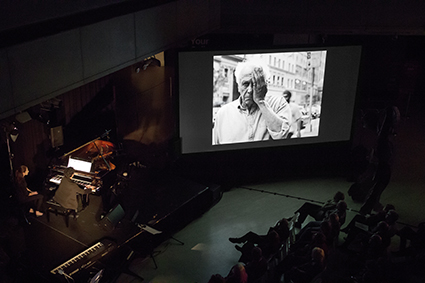
The stage layout for Argonaut ensemble’s performance of Boulez’s Sur Incises sculpts an image of the sound world to come. Three pianos at the front of the stage are shadowed by three harps—extensions of their resonant strings. Behind, three batteries of tuned percussion give physical form to that ringing resonance that hovers above the music. The lush garden of sounds Argonaut ensemble evoke in their performance of the 1998 work reflects with purity Boulez’s orchestration and texture. The eclectic instrumentation may limit performances of the work, but the collection of timbres allows for a distinctive fluidity between instruments, with harps and vibraphones becoming extensions of the piano.
Conductor Eric Dudley and the ensemble were clearly aware of the importance of decay throughout the work, and exploited this thematically. This is epitomised in the final moment of the concert, when Dudley holds the audience in silence until well after the last note dies out. There’s an ethereal harmony heard in the resonance of three separate chords ending each pianist’s run. The ringing tones of vibraphones, crotales and steel drums hang in the air in moments between dense activity. Boulez’s orchestration disguises the attack of one instrument in the decay of others, blurring the distinction between instruments. Dense piano clusters reduce to reveal a gentle harp melody or crotales take over to continue an ascending passage as a pianist reaches the top end of his range.
Alternation between precisely timed rhythmic passages and aleatoric gestures are a defining feature of the piece. At times, the music lingers in one mindset for a while, as in the fast, strict toccata of the first movement. The musicians in this performance perfected both technical rhythms and interpreted grace notes—unmeasured notes which allow for flexibility. On the latter, the conductor signals only a starting point after which each performer decides the timing of the notes, creating a gentle falling away of sound. The smooth contour of the work was not lost in these parts, a credit to the ensemble’s ability to give expression without hesitation while maintaining coherency.
The performers were not only individually virtuosic, but worked well as an ensemble. Moulding the individuality of their playing, the three pianists often worked to create the same kind of timbre, even at times sounding as one instrument. There was also a sense of timbral continuity between different instruments, with the pianists gently caressing the keys to evoke the sound of harp glissandi or playing low rhythmic passages to imitate marimba.
The ensemble lost no expressivity in this accurate performance of a technically demanding piece. The natural cohesion between conductor and all ensemble members was felt by the audience. A well-rehearsed and knowledgeable ensemble held together a piece that relies on moments of chance indistinguishable from strictly notated passages. Argonaut’s interpretation of ‘Sur Incises’ was a highlight of the festival.
Bendigo International Festival of Exploratory Music, The Argonaut Ensemble, Pierre Boulez, Sur Incises, The Capital Theatre, 5 Sept
This review initially appeared on Partial Durations, the new music blog produced by Matthew Lorenzon with the support of RealTime. Lorenzon and Keith Gallasch were commissioned to conduct a review-writing workshop as part of BIFEM 2015 for five emerging reviewers.
Glasgow is blessed with Sonica, an ever-growing international sonic arts festival that features UK and international artists, including this year Indonesian sound and installation artist Jompet Kuswidananto who will present Order and After in the Ladies Pool of Glasgow’s 18th century Govanhill Baths. As is increasingly common, sound art rarely stands alone; instead its relationships with light, the moving image, biological systems, electromagnetic fields, various digital platforms, non-musical performance and installation are being vigorously explored.
Sonica is presented by Cryptic, a Glasgow based production house that offers performances that fuse music, sonic art and multi-media. Launched in Glasgow in November 2012, Sonica has toured to Brazil, Denmark, France, Netherlands, Sweden and across the UK. Its 2015 festival features 30 international artists from five continents and 120 events and performances.
Featured artists include Australia’s Robin Fox with Fluorophone which “creates a kaleidoscopic sound world” in response to compositions by Richard Barrett, Juliana Hodkinson, Simon Løffler, Damien Ricketson, Eugene Ughetti and Fox himself: “Analogue and digital fluorescent lights, the naked flame, strobe lights and DMX controlled LEDs are combined with percussion to create a program in which the music and lighting design are one and the same” (press release).
Fox and Speak Percussion come together again on Transducer, “an electro-acoustic spatialised performance work, testing the limits of the microphone as an expressive musical object.” Matthew Lorenzon reviewed an early version of the work at the 2013 Totally Huge New Music Festival.
Quebec’s Herman Kolgen, a maker of unusual video/sound works (like the sensual and visceral Inject), will present LINK.C his “elliptical representation of urban areas, based on String Quartet No. 2 by Philip Glass,” alongside his acclaimed works AfterShock and Seismik. The 1927 William A Wellman silent aviation action film Wings has been set to an electronic score by Belgian composer Eric Sleichim, “interlaced with fragments and quotations from 20th century repertoire for percussion including Xenakis, Stockhausen, Reich, Cage and Wolfe.” The score will be performed live by Sleichim and Belgian percussionists Bl!ndman. Irish composer David Fennessy’s Caruso (Gold is the sweat of the sun), responds to Werner Herzog’s diaries of the making of the film Fitzcarraldo: “Scored for four samplers, the music is almost completely made up of tiny extracts from gramophone recordings made by the tenor Enrico Caruso between 1903 and 1908, and electric guitar.” For the public, there’ll be free access to the Glasgow Science Centre for Helmholtz by Wintour’s Leap (UK), an interactive installation using tiny LED lights—each with its own microphone—that interactively visualize sounds with waves of light as the audience whispers, speaks or claps.
Jompet, Order and After
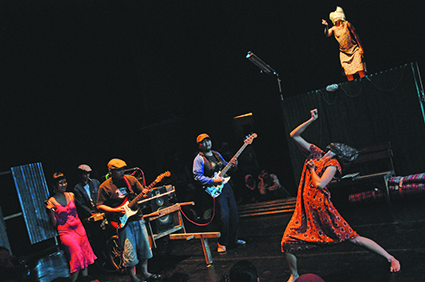
Jompet Kuswidananta’s works are striking visual and aural creations, often large, immersive installations featuring at their centre a company of military figures, Lombok Abang (‘red chili’ because of their costumes). These are palace guards of the pre-Indonesian Sultanate. Their outfits, a mix of Indonesian and European, are partly intact but the guards’ bodies have disappeared, as if they are form without content—just hats, boots, maybe a tunic, a gun, drums and Javanese kris daggers. Some guards are also mechanised, striking their drums with a Javanese rhythm, adding to the overall ghostly effect which is reinforced by sudden, loud, sharp beats.
Jompet sees this cultural mix as a sign of Indonesian adaptability, although he admits that much has been lost to colonialism and modernity, as seen in the ambiguous images in his accompanying video works, such as a man performing a traditional dance amid 19th century sugar milling machines.
Jompet’s guard motif first came to prominence as Java’s Machine: Phantasmagoria at the Yokohama Triennale in 2008. In the monumental Grand Parade (2014-15) the soldiers are joined by a line of horseless saddles bearing weapons and musical instruments, a tightknit row of motorbikes and much else— a demonstration comprising the heads of hooded figures with dangling loudhailers or large automated hands that almost clap. In an email exchange RealTime asked Jompet about the sources of both images and sounds in his installations.
The aural and visual sense of the parade in your work is very powerful—does it belong to the past or the present?
For the past several years I have been working based on my reading on the Indonesian history of cultural and social transformation, especially in Java. I collect many different kinds of clues, artifacts and evidence of how the transition has been carried on in poetry, folklore, folksongs, community performance, rituals etc. I have been inspired very much by the street parade culture of the royal army, communities, demonstrators and mobs. Through this form I share my reading on Indonesian cultural complexity.
Order and After is about the period known as Reformasi, after the fall of Suharto in 1998 with its new democratic freedoms and many competing forces—appearing as different kinds of parades in your work. You’ve spoken in interviews of the transient and fluid nature of Indonesian culture which you capture in the visual elements of your installations. Is that sense in the sound too?
I use various types of sounds, from abstract to narrative ones—folksongs, folklore and interviews. I also transform those materials into abstract soundscapes to create a dramatic mood. Sound for me has the power to deliver a certain imagining and I think the ambience in my works is created by the sound I make.
How important is the drumbeat for your musical conception?
It’s in street parades where it is useful for democratic mass/crowd mobilization but also as a tool of order.
You said in an interview, “Sound is the most contemplative work I make.”
Mostly, I create the soundscape after I finish the installation and all the technical work. It allows me sometimes to see my work from a distance, physically and conceptually, offering me another journey—to go beyond what I share through my installation.
You’ve spoken of an awareness in you of a fundamental sense of instability in Indonesian culture—of yourself as discrete from others and Java from the rest of the world. Are you hoping with your work to ease that feeling or simply to get fellow Indonesians to acknowledge it?
My work is my reading tool to understand my reality. I’d like to share my reading with anyone, not only Indonesians, who feel connected with my reality.
Jompet Kuswidananto, Order and After, Govanhill Baths, FREE, 12-8pm, 29 Oct-8 Nov; Sonica 2015, Glasgow, 29 0ct-Nov 8
Video still from work-in-progress, Zoe Scoglio, Iceland artist residency, 2015
courtesy the artist
Video still from work-in-progress, Zoe Scoglio, Iceland artist residency, 2015
Stretching from abiogenesis to the Anthropocene Age, Zoe Scoglio’s purview reaches across deep time and space and draws in ideas from the geological to the ceremonial. Running parallel to an obsession with the mineral, the human and the mysteries in-between is a gamut of formal interests: flatness and depth, synaesthetic effects and how juxtaposed forms can provoke new responses to the world as a whole.
Shifting Ground
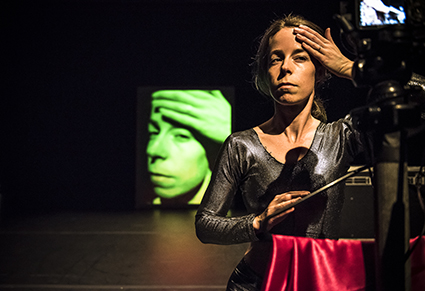
Scoglio’s recent major focus has been her Shifting Ground (Melbourne, 2012; London and Glasgow, 2014), a performed work for small audience that utilises video projections, the performer’s body, rocks, ritual, deeply resonating sound, a layer of salt on a table and some unique ‘geological’ headwear. In Shifting Ground, says Scoglio, “I animate the rocks through light, sound and gestural choreographies. I use them as instruments; use composed and vocal sonic vibrations to move them and create cymatic patterns in the salt.”
Created with sound artist Nigel Brown and interaction designer Chris Heywood, Shifting Ground both conflates and consummates the human and the geological. Scoglio says she is fascinated by our human relationship to the geological earth, often referring to abiogenesis in her works – “the process of biological life forming from non-living matter.” Seeing this phenomenon as evolutionary, Scoglio considers “rocks as our ancestors and us humans as their direct descendants.”
MASS
Scaling up dramatically from the intimate ritual of Shifting Ground, Scoglio’s most recent work MASS (2015) utilised Melbourne’s Calder Park motor racing circuit to enact a participatory full moon ceremony centring on “car bodies, planetary bodies and human bodies” [reviewed in RT129]. Held at twilight, moon ascending behind mauve and apricot clouds, MASS was “part drive-in, part-guided-walk; a car-gazing ceremony that illuminates the geological origins of the human, vehicular and celestial.”
MASS was created “in response to this proposed era of the Anthropocene”—the age in which climate change and human environmental destruction are delivering tangible impacts on the planet itself.
“I feel we need to create new cultural narratives that tell the story of our collective geological origins, of the interconnected nature of all things. Narratives that dissolve the borders between human and non-human, animate and inanimate worlds and that help us stop thinking of ourselves as atomised individuals but as societies and communities with global responsibilities.
“For a while now I’ve been interested in finding a human-made geological site to create a live work,” says Scoglio. Calder Park Raceway’s “giant man-made mountains, lone palm trees and massive pylons looking out over a horizon are very evocative…” MASS utilised Calder Park’s Motocross track. “It feels very post-apocalyptic, a world between worlds, a small example of a man-made mountain, of anthropogenic geological activity.”
In Scoglio’s installation and video works—a copious complement to her performance works of the past few years—her explorations of the human–planet relationship are amplified by formal experimentation.
“My recent video works often reference screen culture, the act of looking and framing, the way video is flat and that depth is forced; or the way a two-dimensional moving image can be restaged in a three-dimensional environment and talk to an understanding of deep time and deep space.”
Zoe Scoglio, Water Falls & Other Features
photo courtesy the artist
Zoe Scoglio, Water Falls & Other Features
Water Falls and Other Features
Water Falls and Other Features, her installation as part of The New Vanguard exhibition at this year’s Gertrude Street Projection Festival, juxtaposed sharp graphic forms, video of flowing water, a bubbling, rumbling soundscape and a display of plastic mineral water bottles. Housed in a tiny room at Seventh Gallery, the work held both the natural and the ‘designed’ and geometry and geology in odd, incalculable tensions, creating an almost counter-intuitively harmonious play of sound, colour and light.
“For Water Falls I was curious about the points between order and chaos, the natural and man-made, the controlled and uncontrollable, what is understood and that which is beyond our understanding. I was interested in notions of value and permanence… Part-shrine, part archaeological display, the work questioned how the objects and structures from our contemporary life will become the artefacts and ruins of tomorrow.”
Scoglio is interested in ‘synaesthetic aesthetics’ or deceptions in which video can become sculptural, sound can be physical and so on.
“My interest in finding crossovers between worlds and mediums is both a thematic and formal enquiry. This is to play with our sensory and mental perceptions and assumptions about the world we live in. It points to the world as a hybridised and interconnected set of materials and actions.
“I have a tendency to get lured in by the possibilities of trickery that can be created through the application of simple scientific principles and video magic, which can remind us both about our limitations of perception and the core rules of physics that govern our planet.”
Other creations
Zoe Scoglio’s many recent video and installation works include, in addition to Water Falls…, a series for the 2012 Melbourne Festival’s Place of Assembly; her Human Sundial project; Ungardened Horizons (with Liz Dunn and Rebecca Jensen) for Brisbane’s 2015 Underbelly Festival; and Inter-radiessence (with Cait Foran) in 2012. Scoglio found time to travel overseas during 2013, including the taking up of artist residencies in Turkey and, notably, Iceland where the geology is dramatic and humans represent a relatively recent incursion.
still from screen-based work, Land Forms, 2015
image courtesy the artist
still from screen-based work, Land Forms, 2015
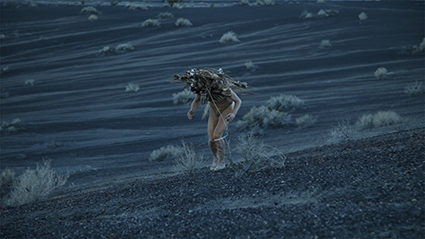
“While driving and hiking through [Iceland] I was surprised at how much I felt a non-human presence. Iceland has only been inhabited since around 900AD. It struck me how much I could sense that humans were still relatively new to this place… That’s where elves come in I guess. The hidden people. I was interested by the still-often-unspoken but commonly held belief in hidden creatures and the importance of planning around these invisible beings when creating new roads and infrastructure in the natural landscape.”
At MASS, as a couple of hundred of us stood in formation halfway up the outer rim of the Calder Park Raceway embankment; we were anything but ‘invisible beings.’ Part of Scoglio’s “mass choreography” we stood in perfect alignment with a row of monumental power pylons, sky above, low-flying aircraft shearing the air nearby, highways encircling us, city lights in the distance. Electric flickers sounded uncannily in our headphones; equally uncannily, flocks of twittering birds. We felt the hacked-up dirt under our feet and looked down to our cars, parked perfect as a crop circle in the paddock below. It was as Scoglio had hoped: “a new method of being together.”
Perched high on a bend of the snaking Shoalhaven River, the stunning grounds of Bundanon Trust’s Riversdale site will be the location for SITEWORKS 2015. The annual ‘welcoming of Spring’ gathering will host a range of artists, academics, environmentalists and horticulturalists for a one-day exploration of the theme and/or provocation “the feral amongst us.”
Chief Programs Officer John Baylis (founding member of the Sydney Front, dramaturg, executive producer, former Australia Council Theatre Board Manager and arts advocate) took up the post in 2014 after moving from Sydney. He directs this year’s event, having assembled a diverse set of artists and speakers to deepen the conversation on the ideas and situated realities of the feral.
In our phone conversation Baylis tells me that beside its literal meanings, ‘the feral’ provokes questions about “what is authentic, or inauthentic?” “What should, or shouldn’t be there?” This tension is obviously expressed in the landscape. Bundanon is a “living farm” carpeted with invasive plant species like lantana and fireweed. The external edges of the farm are a visible mausoleum dotted with impressive tabernacles of ‘land managed’ lantana bushes exposed to their bone. Removing lantana, Baylis explains, “can lead to new monocultures,” implying a precarious balance to maintain from both nature’s standpoint and how human beings decide to intervene.
The feral also introduces tension between what is universally “desirable and undesirable,” says Baylis, stretching the theme as a trope for those welcome and not welcome within our borders—not to mention our city limits and affluent neighbourhoods. Notwithstanding where the discussion could go, artists have been given the freedom to respond to the theme in-situ, transplanting themselves into “an inappropriate place” as alien-other (Rakini Devi’s U.F.O. Unidentified Female Object) or “being where they should not be” in the deeper bodily investigations of one’s moving skin (Rosalind Crisp’s Blast scum cull me dead in a body borrowed).
Others will deviantly strip the existing built environment via anti-context strategies: what emerges that is new? (Sarah Breen Lovett and UTS design and architecture students); or animate prehistoric beasts and the wilds of the imagination: what is lurking out there? (Erth’s Dinosaur and Beast). Some will invade with foreign or wayward emergent structures (Alan Schacher collaborating with NIDA stage design students and Amanda Parer with her large illuminated rabbits, cute and pestilent in her sculpture titled Intrude) or project onto derelict white goods for a mini bush-doof-cum-disco with Zender Bender.
The feral has given rise to an incongruent filmic collage of mammals who really do not belong together (directors Jamie and Aspasia Leonarder) and a filmic moment of male mammalians that do—with a fair bit of twisted gladwrap in between (Branch Nebula’s Whelping Box). There is the invitation to temporarily assemble and inhabit a pocket of bush with the bare and exhausted minimum (Brogan Bunt’s Flat Pack Feral) or enter and immerse oneself in the tiny Babylonian sonic spaces of Nigel Helyer (of floating biopod fame, Siteworks 2014) scattered high on the hilly lawn. Beyond the pasture into the plants, Diego Bonetto will lead others on a journey to fossick for the feral. Team Mess will be in ‘radio’ residence, speaking with performers, experts and punters, provoking conversation and gathering up all the discursive bits—performatively so.
When asked about the significance of the annual SITEWORKS for Bundanon’s program, Baylis answers that it is the “fundamental” moment in the calendar when “all the strands come together” in this, their “signature event.” SITEWORKS draws from the unique national artist-in-residence program where many come year after year—a gift from the Boyds: “a gift from artist to artist”. It also connects with the surrounding community of the Shoalhaven area, including the Wodi Wodi people of the Yuin Nation. This year Branch Nebula (Lee Wilson and Mirabelle Wouters) will be working with local community young people in Nowra on a parkour piece to take place in the bush during the event. Fences, concrete facades, lampposts and garbage bins give way to branches, logs and stumps. In the aftermath, Wilson and Wouters will hit the skate park in Nowra to collaborate with local talent. The outreach of the single day event lives on.
Since inception SITEWORKS has been a nexus of artists, scientists, horticulturalists and environmentalists coming together through research, presentation and conversation to address the future of the environment and the human race. This year, in a “non-deliberate shift” from the usual heavy program of star-studded scientists, the feral is calling on the expertise of well-known artistic director of large events: Robyn Archer; Professor Adrian Franklin, sociologist and prolific author of many books on the human, animals and nature; Dr Fiona Probyn Rapsey, specialist on race, species and gender; Richard Goodwin, architect, artist and theorist, known for his parasitic formations and interventions; and Clarence Slockee, a dancer, musician and Mindjingbal man of the Bundgalung tribe who will talk feral plants. The feral too calls out to biologist Tim Low, author of Feral Future and New Nature. These books offer a unique perspective on how invasive and native creatures co-create conservation problems in their antagonism: a collision and collusion well worth considering.
According to Aristotle those who live outside of society must be either a beast or a god. By the time we get to Hobbes’ and Rousseau’s diagnoses of human nature we are no better than beasts, and certainly nowhere near being gods. But we are tidily contracted with clear lines of civility and saved from our “brutish” selves as Lucas Ihlein so clearly “mind maps” with his handmade print The Feral amongst Us (pictured). Whether human, beast, native or invader, whether within society or on the margins, the feral is among us, reviled and celebrated; and in exaggerated measure this coming 26 September.
There’s a compelling array of features, documentaries, shorts and workshops in store at this year’s Sydney Underground Film Festival, which opens tomorrow at Marrickville’s Factory Theatre with Gaspar Noé’s explicit 3D chronicle of a youthful affair, Love (2015). The steadily expanding festival embraces the thought-provoking, experimental, subversive and visceral in a program whose generous scale is all the more impressive given the grassroots nature of the event.
Now in its ninth year, SUFF is one of the city’s longest-running specialist film festivals. Program director Stefan Popescu ascribes SUFF’s endurance, in a funding climate that doesn’t favour small film festivals, to a cultural shift over the past few years that has made Sydney-siders receptive to innovative art forms. “One of the things about our festival that sounds a little nuts but it’s true, is that if we didn’t have the community support, we couldn’t exist, because we don’t really get funding from anyone, so we have to respond to our audience…I think the general populace is becoming more adventurous: wanting to see art, giving performance art a shot, and it’s such a big city, I think [a festival like SUFF] is warranted.”
The festival’s eight masterclasses are part of a move by Popescu and co-director Katherine Berger to make SUFF into a multi-faceted experience. “One of our mandates is about creating community or culture around the experience…so we always try to have it in one location even though it ends up costing us more money that way. It’s good to get filmmakers involved but also educational institutions and fringe/cult film groups, so we try to bring them all together. If we have a ‘mentor’ festival to look up to, it would be something like [Austin, Texas’] SXSW: they’re not just a film festival, they’re a music festival; they have lots of media arts, which is something we would love to get into at some point.”
Alvin’s Harmonious World of Opposites
This year, two of the 19 feature films showing are Australian-directed: Rupert Glasson’s What Lola Wants, about runaway lovers crossing New Mexico; and the debut feature of Platon Theodoris, Alvin’s Harmonious World of Opposites, in which life takes a surreal turn for a sheltered Japanese translator. Theodoris, whose film premiered at this year’s Revelation Perth International Film Festival, has a comprehensive filmmaking background: “I think he’s gone from doing indie short films to commercials; sometimes he teaches, sometimes he does feature films; they’re all very different. I love directors like that who are jacks of all trades—they’ve run the gamut and learnt a lot. And Alvin’s quite amazing—it’s a gentle film, but it’s very well balanced. I would say it’s one of the best Australian films I’ve seen in a while.” Theodoris will lead one of SUFF’s masterclasses.
Though the directors don’t have a preconceived strategy for selecting SUFF’s documentary program, Popescu acknowledges certain patterns have emerged among the 19 showing this year. He and Berger keep an eye out for intelligent political content, something that’s evident in the pertinent tech-themed docos Deep Web (2015), Alex Winter’s investigation of the internet’s lawless recesses, and Killswitch (2014); Peace Officer (2015), about the increasing militarisation of the American police force; and Stanley Nelson’s eponymous history of the Black Panthers (2015). Documentaries about music (for example Salad Days, 2014, about the punk scene in Washington and Theory of Obscurity, 2015, about experimental art collective The Residents) are well represented, as are those about filmmaking, such as Kung Fu Elliot (2014), chronicling a hapless wannabe martial arts film star, and Raiders!, about friends who spent their childhood creating a shot-by-shot remake of Raiders of the Lost Ark (2015). Save for the Canadian-made Kung Fu Elliot these are American documentaries.
Amir Taaki and Alex Winter on set of Deep Web
Courtesy of Deep Web LLC
Amir Taaki and Alex Winter on set of Deep Web
Gaspar Noé’s distinctive style aside, most of SUFF’s experimental content is to be found in the shorts program—especially the LSD Factory session. Popescu, whose PhD is in experimental film, and Berger, an experimental filmmaker, try to program at least one experimental session per festival. “When it comes out in features we get really excited,” Popescu says, “but for the most part, yes, it’s in the shorts. And I guess experimental shorts are easier to fund, easier to produce as one person, filmmaker or cinema artist…We’re learning a lot about defining the ‘cinema situation’ as well, and it’s one of the hardest things to curate, that experimental session, because it’s not a video installation where people can walk in and out.”
SUFF caps off a fine selection of surreal, innovative horror features with its closing night thriller: leading US horror director Eli Roth’s Knock Knock, starring Keanu Reeves. Popescu welcomes Knock Knock’s blurring of genres. “One of our mandates is to ask ourselves, ‘What is the film doing differently? What makes this not just a horror film?’” He hopes the film will generate the “hothouse of debate” achieved by last year’s closing feature, The Canyons (2013), one of the festival’s biggest-selling films. “We want a film that will make people debate what they get out of cinema and this one certainly does that.”
Sydney Underground Film Festival, Factory Theatre, Sydney, 17-20 Sept
In Queensland Theatre Company’s foyer library, we are offered a choice of green or oolong tea and a home-made biscuit before entering Margi Brown Ash’s HOME, which had premiered in La Boite’s Independent season in 2013. This production is the first to use QTC’s intimate new performance space, the refashioned Diane Cilento Studio. The technical direction of Freddy Kromp, the lighting design of Ben Hughes and the visual artistry of Bev Jensen have converted this white box into a hearth, framed by video projections of lace curtains and filled with books, bespoke chairs of various sizes and hanging perspex picture frames adorned with quotes referring to memory, remembrance and the passage of time.
Travis Ash plays a piano score and Brown Ash enters and announces that this is a performance about storytelling—a telling of a version of her life that she will later conclude is underpinned by no assumption of an authentic or ‘real’ self. “I will play my part and dream this potential. I will ask some of you to join me.” She begins with a retelling of her favourite story—a foundational Egyptian myth about Set, Osiris and Isis treating each other appallingly. It is a story, ultimately, about family and betrayal and retribution and love and longing and remembrance. And we are launched into this warm, astounding, deeply idiosyncratic semi-autobiographical and un-pigeonholeable performance piece, swept up in the storytelling as though we are in fact sharing a magic carpet with Scheherazade herself.
The intimate studio space is a perfect home for this theatrical experience, premised as it is on sharing family stories with a complicit audience who are asked to join the performers on stage and substitute for Brown Ash, her mother, her husband and children at various points in their richly matrixed lives. While Brown Ash provides the confessional heart to the piece, composer and son Travis shares interspersing socio-political vignettes that link the family’s personal trajectory to matters of conscience in the outside world—Vietnam War protests, Palestinian resistance, Christmas Island refugee shipwreck survivors. The personal and the political are entwined here. Each of us has our own story and we are all interconnected, the piece seems to be telling us. Every family has its own mythology, and the public exchanging of these intimate revelations constitutes acts of bravery, acts of vulnerability and exposure that remind us how human and eternal we are.
It’s hard to do this entrancing work justice in a short review—the exposure to the way Brown Ash’s brain works (beautifully in tandem with director and long time collaborator Leah Mercer) is a richly rewarding experience. I wanted to share this experience with loved ones—my son, my mother. Margi Brown Ash is something of a state treasure and it is terrific to see experimental, thoughtful, interrogative and elaborately textured work like this sneaking into the QTC ancillary program.
QTC & Force of Circumstance: HOME, writer, performer, devisor Margi Brown Ash, devisor, director Leah Mercer, writer, performer, composer Travis Ash; Diane Cilento Studio, The Greenhouse, Brisbane, 14-25 July
Congratulations to Stephen Carleton on winning the 2015 Griffin Theatre Award for best new play by an Australian playwright, The Turquoise Elephant, an absurdist work depicting the chaos of a future world rapidly succumbing to climate change. Eds
Looking back to late April in Hobart, the summer festivals were over, Dark MOFO lay ahead, yet there was plenty to tempt the cultural connoisseur with a taste for theatre. When I say plenty, I mean three professional shows opening at once, but that’s a big deal here. The amateur theatre scene has dominated for decades, in terms of both the resources it commands and the audiences attracted. Professional theatre, by comparison, has struggled. One of the mainstays has been Terrapin Puppet Theatre, founded in 1981 and still going strong (although the effects of recent Australia Council funding cuts remain to be seen), delivering theatre for family and schools’ audiences. But others have come and gone, with artists segueing into related fields or moving to the mainland in search of that ever-elusive sustainable arts career.
In Launceston Mudlark Theatre has been producing outstanding theatre since the mid 2000s, leading the way in terms of commissioning—including plays by Tasmanian playwrights Carrie McLean, Stephanie Briarwood and Finegan Kruckemeyer. Its activities to foster the independent scene, such as its One Day 24-hour short plays project, are impressive. Their latest is The Possum, written by another local, Sean Monro, which, like many Mudlark shows, engages with the traditions of Tasmanian Gothic.
But what can the three productions in Hobart in April tell us about the character of Tasmanian theatre in 2015? This level of activity is unusual, but with a new company—The Southside Players—coming along with its first show this August, it may be the way of the future.
The Blue Cow Theatre presented 100 Reasons For War, a new play by Tasmanian playwright Tom Holloway, staged in the Theatre Royal with a cast of eight and one of those scripts where lines aren’t allocated to particular characters. Impressively staged by Robert Jarman, it featured the use of a video screen with text to underline story moments, eclectic lighting and intense sound design by Dylan Sheridan. There was an exuberant physicality to the piece, with choreography by Trisha Dunn, including a striking moment with the ensemble on a tilting revolve. Holloway’s script explores Anzac themes in a tangential way, reflecting on violence in the human animal while highlighting ideas around gender. It also references The Black War, a shameful chapter of Tasmanian history, as the conflict that has shaped the Australian national identity far more than the Gallipoli defeat—a provocative idea ripe for further exploration. The response? Audiences either loved or loathed it.
Founded by actor-director Jarman, actor John Xintavelonis and actor-writer Jeff Michel, Blue Cow Theatre launched in 2010 and has staged 10 productions since, with 100 Reasons For War being their third commission. The second appearance of their script development initiative, The Cowshed, in 2015 suggests there will be other original work to come. Whether the next will be in the vein of a Holloway or a Jonathan Biggins (Blue Cow staged his comedy The State of Tasmanian Economy in 2014) is the question.
Tasmanian Theatre Company staged Nassim Soleimanpour’s acclaimed allegory White Rabbit, Red Rabbit. Showcasing a different solo performer each night to preserve its spontaneity, it’s unrehearsed. There’s no director because the actor directs him/herself, or, to be more accurate, the playwright directs through time and space via the sheer power of words on a page (it was written in 2010 as Soleimanpour’s effort to connect with a world outside his restrictive life in Iran). The TTC line-up was diverse, with Hobart-based actors Anne Cordiner, Bryony Geeves, Ryk Goddard, Jane Longhurst, Katie Robertson, Mel King and Guy Hooper as well as Gavin Baskerville, who’s better known as a comedian, and fly-ins Samuel Johnson, Kate Mulvany and Hamish Michael (an expat Tasmanian). I saw it on the night that Jane Longhurst was in the hot seat and it was a powerful experience (although one niggling thought is that for a grassroots activist play it’s a shame that only those with a spare 40 dollars got to experience it).
Tasmanian Theatre Company was founded in 2008 when there hadn’t been a state theatre company for about a decade. It’s taken a while to find an identity for itself, and is perhaps still looking. Having lost state government funding last year, it has a hard road ahead. But it has certainly hit on something, with increasingly innovative approaches to staging, such as a very popular production of Who’s Afraid of Virginia Woolf late last year coinciding with Architecture Week. This took place in a 1960s Modernist house designed by Esmond Dorney and owned by the Hobart City Council. Audiences were ferried to the site at the top of Sandy Bay by mini-bus and compelled to face George and Martha’s shenanigans sitting right inside their living room.
Loud Mouth Theatre presented Theresa Rebeck’s Seminar, an incisive literary comedy that was a Broadway hit a few years ago. Directed by Maeve Mhairi MacGregor it was an entertaining, intelligent and well-designed production, although the script, for all its protestations to the contrary, is yet another take on the notion of ‘genius’ revolving around the male ego. Some fantastically overwrought moments included Jeff Keogh’s strong performance as the aforementioned archetype. This was also my first chance to see the newly built Moonah Arts Centre, with its Performance/Screen Studio offering a flexible new space.
Loud Mouth Theatre is a collaboration between three motivated twenty-somethings, MacGregor, Katie Robertson and Campbell McKenzie (MacGregor and Robertson returned to Tasmania post their training in Sydney). Loud Mouth is the new kid on the block, having launched in May 2014 with a production of David Ives’ Venus in Furs. They’ve achieved a lot in a short time, including a colourful response to Leo Schofield’s comment in an interview this year describing Tasmania as a land where “all the young people leave, and the only ones left are the dregs, the bogans, the third-generation morons” (Sydney Morning Herald, 4 April). MacGregor and co started a Leo’s Bogans campaign on social media profiling high-achieving Tasmanians under 35, of which there can be no better example than the trio themselves.
Leaving aside the fact that all three companies are under-funded and that the definition of professional here may sometimes include profit-share, here were three polished, ambitious productions—one was a new work, one (imported) written by a woman and one directed by a woman. One (imported) was by a ‘non-white’ playwright. One was staged in a pop-up theatre space (Red Rabbit, White Rabbit), one in the Theatre Royal, Australia’s oldest proscenium arch theatre (100 Reasons For War) and one in a brand new arts centre in the northern suburbs (Seminar). So whatever your aesthetic or critical response to the choice of material, there’s no doubt that what these productions represent is significant insofar as they embody a new spirit of experimentation. The experimentation might have been more around audience development and staging than about theatre-making on the deepest level, but nevertheless it’s promising.
But before celebrating, let’s remember that the effects of changes to Australia Council funding are about to bite. Tasmania will be disproportionately affected, because we don’t have any substantially supported theatre at the small to medium company level. The only Tasmanian organisation on the list of protected ‘majors’ is the Tasmanian Symphony Orchestra. On the upside, the so-called MONA effect will continue, with increasing activity around festivals creating opportunities for artists. But as is the case with the film sector in Tasmania, the balance of imported and local work needs to be spot-on if all this is to really build, instead of merely inflating the sector artificially at certain times of the year. Theatre in Tasmania is going through a crucial period of transition—in a climate of upheaval and opportunity perhaps the biggest risk of all would be to play it safe.
Nicola Gunn, In Spite of Myself, 2013, photo courtesy the artist
Nicola Gunn is a first-person performance artist. Since 2001 she has directed herself, performed herself and revealed herself. Sometimes she even tells the truth. But whether that truth belongs to her lived story or to the story of any number of Nicola Gunns in any number of alternative worlds remains uncertain. I don’t know. I am not Nicola Gunn. She has often talked about her mistrust of language, condemning its failures and inadequacies. Perhaps her inability to write narrative is why she chose performance art, as a kind of shorthand? She tells me, “My mother is a species of cat. She speaks a kind of cat language that not even the cat understands.”
Gunn works in an A5 black spiral notebook. She has a stack of 20, 30 maybe 50 of them in her IKEA Expedit. She uses a special pen in her notebooks: a .3mm black fineliner. People who know her know they must neither touch her notebooks nor use her special pen. “People often ask me when I’m writing in my notebooks, the pen in my hand, does it feel different? The answer is no. It feels like a pen.” She buys big rolls of newsprint, fills them with ideas and themes and then folds them up and puts them in a corner and doesn’t look at them again. She gets in a studio and generally spends three weeks in foetal position. She tells the girls in the waxing salon that she’s a graphic designer: “It’s difficult explaining to someone what you do when they’re looking at your arsehole.”
A woman of strong social ethics, yet very few personal morals, Gunn’s acclaimed body of work has always explored the role intimacy plays in geosituationalism. (I will discuss concepts of geosituationalism later on in this article.) And yet, pressed to define what she’s interested in, what she does and how she positions herself, she is enigmatically ambiguous: “I don’t know what I do or what I’m interested in.” The program notes to In Spite of Myself, her acclaimed work from 2013, offer some clues: “I spend a lot of time writing emails to community groups looking for old people. Last week I got in touch with Mary from the North Carlton Neighbourhood House and I told her I needed some old people for this show. She said, “What kind of show?” I said, “A show in a big theatre.” She asked me what was it about. I said invisibility, absence, irrelevance, the exploitation of marginalised sectors. She said old people don’t like going into the city at night. I said, have you asked them? She said leave it with me. At that point I realised I would not hear from her again.”
Further on, Gunn writes: “I’m concerned with social structures. I feel very strongly about working with real people and community groups, marginalised people and diverse demographics.” I’m not actually sure that is true. She has told me on numerous occasions that it was really really really really really really really really annoying getting the old women to commit and even more frustrating trying to schedule them because they never had their mobile phones on. She complained that they had their own logic for doing things that was totally out of step with the rest of the world. Like having mobile phones but not turning them on. Incidentally, old people do go out at night. I’ve seen them. They look like the visual representation of confusion.
By inviting the public into the act, Gunn is interested in subverting the economics of performance, where youth and celebrity determine interest. Her seminal 2012 work, Disappointment Mountain, continued the theme of cultural democracy evidenced in earlier pieces, such as Nicola Gunn Naps for Your Pleasure, in which an anonymous collector paid an undisclosed amount of money to have Gunn nap in their presence. Based on the success of the original performance, public demand to see the work and her commitment to dismantling the monetary emphasis throughout the performance art industry, she has repeated the event in various venues and continues to perform it regularly. (I was fortunate enough to see an impromptu performance myself during this interview.)
Nicola Gunn, Piece for Person and Ghetto Blaster
photo Sarah Walker
Nicola Gunn, Piece for Person and Ghetto Blaster
However, in Disappointment Mountain the audience is encouraged to make the work. The audience makes the art! It’s really exciting. The audience is content! Audience participants were encouraged to bring an object that represented a way in which they were unhappy in their life, or alternatively to create an unsatisfactory artwork and add it to the pile. They were then invited to take part in a one-off ceremony celebrating their dissatisfaction with the work. In this manner the artist reclaimed the theatre as a place where we form a temporary community and were inevitably let down by the experience.
Nicola Gunn says she hasn’t really thought about kids because she’s too busy. November will see her touring to Adelaide with a new work called Piece for Person and Ghetto Blaster. Except she didn’t get all the funding, so she might just call it Piece for Ghetto Blaster. She recalls how an ex-boyfriend once told her watching her make theatre is like seeing how sausages are made.
She describes the motivation behind I’m So Happy, the single-channel video work commissioned by Arts Centre Melbourne to activate its public spaces: “One morning, I was telling my flatmate about the Arts Centre and I realised what an aggressively inflexible building it was. As I was making my lunch for the day, I discovered a bunch of limp celery in the fridge. I didn’t think too much about it.”
Feeling that success might dull the critical edge of her work, Gunn continues to have a vexed relationship with the economics of the art world, an acknowledged ambivalence that has only become more felt as the artist increasingly receives commissions and financial support from major institutions. When you operate in the established system, somehow you have to maintain your ethics, integrity and most importantly, independence. Otherwise you face the threat of irrelevance. You’ll see it out the window and you’ll wonder if it’s lost but then you realise, no, no, it’s looking for a number. And then you realise it’s looking for your number and then you hear a knock on the door. “Success has in-built limitations,” she says. Coincidentally, this is what my change and transformation coach advised me this morning over coffee. (God knows my expectations have not been met.)
Gunn says she doesn’t plan what she is going to make next. To do so would be an exercise in hopelessness. She says it just comes, or it doesn’t. “I have to go through a kind of transformation or emptying in order for the idea to come. It can be very difficult and painful. It is rarely joyful. It can take a very long time, much to the frustration of my collaborators. I just know it will come because it must. I only ever work to deadline.”
Pressed to offer some kind of insight into this foray into the many worlds of Nicola Gunn, I find myself participating in what she has perceptively termed an exercise in hopelessness. ‘Hopeless’ because all writing, all thinking, all talking about performance that tries to capture its slippery character is a hopeless endeavour. And yet, I am hopeful that this attempt at a critical dialogue with one of the great mythmakers of the present will offer one more disappointment to celebrate at its end. Please allow me to add this to the pile with my sincere well wishes.
–
Nicola Gunn/SANS HOTEL, Piece for Person and Ghetto Blaster, Arts House, Melbourne, 11-15 Nov
Nicola Gunn is a performance artist, writer, director and dramaturg. She uses performance to reflect critically on its place in theatres, to examine power relations in existing organisations and to consider the relevance and social function of art itself. In August she premieres A Social Service at the Malthouse Theatre, a work set on a public housing estate. Her Piece for Person and Ghetto Blaster, commissioned by Mobile States and presented by Arts House, is described as “the story of a man, a woman and a duck…It is an attempt to navigate the complexities of trying to become a better person” (press release).
Pride shines through in intimate tales of love, loss, rejection and steadfast memory. Once We Were Kings presents a collection of richly evocative vignettes of life as experienced by gay Muslim immigrants to Australia. The fluent beauty of the language is a tribute, a call to bear witness and a seized opportunity to share stories.
Self-discovery takes many routes in these overlapping monologues, with specific details catching the heart and imagination—letters hidden in a pot plant, furtive holding of fingers under a pizza box (from the halal place) and the last memory of a grandfather. Common themes abound: rejection by fellow believers, rejection by lovers, loss of cultural identity with migration and loss of family connections. This small cluster of shared life experiences is marked by its acceptance of a diversity of voices. No single authoritative narrative dominates this sub-sub-culture, its commonality based in the suffering of social rejection and denial of personal validity.
Cashews and pomegranates—motifs of sweet and sour, pride and heritage—evoke memories flowing through more tangible recollections of regret and loss. Delivered direct to the audience in a stylised manner, the vignettes combine angst, nostalgia, anger, bitterness and humour. Concealing identifying details, names of people and places, dates and events beyond the confronting immediacy of the personal moments shared here, the stories’ contributors reveal the raw nature of their truths, still stinging nerves not yet ready for the bracing air of public scrutiny.
Three young actors, Angela Mahlatjie, Solayman Belmihoub and Naomi Denny, deliver demanding material clearly, without hesitation. The stylised manner of presentation removes some dramatic opportunities, but their delivery echoes the detachment necessary to survive some of the situations and frustrations. Director Mustafa Al Mahdi guides his cast to connect with the audience through a kaleidoscopic selection of abstractly styled, intimate moments—a challenge met with understated dramatic skill by the performers.
Using deceptively simple staging, Al Mahdi sacrifices potential dramatic vigour in favour of creating a visually arresting stage-scape. Dim lighting loses some details but conveys strong impressions, each performer’s body becoming part of the scenery, moving simply and deliberately. This overall stillness lends clarity to words, giving Dure Khan’s beautifully written free verse-script room to breathe, the strong, static stances impacting profoundly.
Thoughtfully composed projections enhance the sensation of large-scale installation with red drops pooling on a performer’s white gown, the recollection of a voice intermingled with water burbling from a corner and dimly traced dancers flickering on the wall—echoing the dim reminiscence of a first teen crush. The soundscape’s intense, rapid rhythms complement the pace of speech in some pieces with a pounding beat and amplify the angst in others with edge-of-awarness humming.
Khan’s richly lyrical script captures the difficulties of becoming a Crescent Moon-shaped peg in a Southern Cross-shaped hole and resolutely challenges norms of mainstream Australian society, the taboos of Islam and narrative expectations. Walking through the accompanying exhibition provides space for reflection and a continuing sensation of intimate and personal experience with childhood photos of the actors scattered through a pile of suitcases and belongings that evoke individual histories amid more abstract sculpture and photography.
Third Culture Kids have a voice, insistent to be heard. Once We Were Kings is a showcase of defiant pride, exploring artistic possibilities that challenge cultural and social expectations. Simply being part of the audience feels like witnessing a creative movement establish its own space in modern Australia.
Third Culture Kids and The Blue Room Theatre, Once We Were Kings, director, producer Mustafa Al Mahdi, writer Dure Khan, co-director Alex Kannis, lighting Devon Lovelady, sound design Thomas Moore, cinematographer Lincoln Russell, The Blue Room Theatre, Perth, 12-29 May
RealTime issue #128 Aug-Sept 2015 pg. 45
PQ Sign
photo Carlos Gomes
PQ Sign
Katia Molino and I navigate the flood of tourists in Prague, looking for the ‘blue chair’—the logo for the 13th Prague Quadrennial of Performance Design and Space 2015. PQ is the oldest symposium of its type. In the program, Artistic Director Sodja Lotker states, “PQ explores scenography as a strong and invisible force of performance; a power that influences us just like music, weather and politics.” This year PQ broke the record for participation, with more than 90 countries represented.
The program is organised by a diversity of curators and events divided into the categories Tribes, Makers, Workshops, Talks, Objects, Performance, Show and Tell, Sound Kitchen, Countries and Regions. Katia and I represented Sydney’s Theatre Kantanka. We were invited to participate in the Tribes program, with costume art from Bargain Garden, Kantanka’s performance-collaboration with Ensemble Offspring. I also gave a talk about our process for making this show.
I’ll focus on Countries and Regions, where curators for individual countries were invited to explore the theme Shared Space: Music, Weather, Politics. With exhibits housed in a variety of buildings, normal geographical relationships were ignored: Estonia was next to China, Russia and Uruguay shared the same room. There was a sense of pleasurable chaos as we wandered around exhibits amid grand Czech architecture. On show were maquettes, LED displays and multimedia images and at times designs were transformed into surprising concepts.
Australian Exhibit A-Mass
photo Carlos Gomes
Australian Exhibit A-Mass
A-MASS, Australia
Climbing the stairs inside the exuberant Colloredo Mansfeld Palace, you gaze upon white clouds made of helium weather balloons floating on the ceiling. Images of the Australian sky (collected by the curator and designer of the Australian program, AnnaTregloan) are projected onto the balloons. Lured in, spectators are treated to a panorama of diverse works projected onto a large screen. The exhibit includes multi-media presentations, interactive sites and live events. The works have, as a common element, a participatory aspect to their performance structure: The Democratic Set (Back to Back Theatre), Resist (PVI), Yawn (Renae Shadler), Whelping Box (Branch Nebula, Clare Britton, Matt Prest), The Home Project (NORPA), The Shadow King (Malthouse Theatre), Super Critical Mass (Julian Day, Luke Jaaniste, Janet McKay).
Five Short Blasts by Madeleine Flynn and Tim Humphrey, was originally created for the Yarra River in Melbourne. This elegant work was transferred to the Vltavu River in Prague where the makers collaborated with local Czech artists, including original interviews and text by Pavel Brycz and Tony Birch. We gathered early in the morning and boarded a rowing boat. Gliding down the river, we listened to composed sound as it blended with live music from the shore and the sounds of the waking city. This experience, with a surprise cup of tea and Anzac biscuit, was a delicious pay-off for having woken up at 5am to get a place on the journey.
M. Flynn, T. Humphrey, Five Short Blasts
photo Carlos Gomes
M. Flynn, T. Humphrey, Five Short Blasts
Theatre NO99, Unified Estonia
Entering a bright vanilla and beige room, you notice political posters and a party logo draped on the wall. As we step onto the shagpile carpet of a ‘stylish’ political party office, Estonia’s Theatre NO99 greets visitors and promotes their “How to take Power?” franchise (designed and directed by Ene-Liis Semper and Tiit Ojasoo): “Power is just lying there on the ground. Pick it up and make it your own.”
In 2010, NO99 created a fictional populist political party and convinced the nation that it would run for the national elections. The 44-day campaign was ‘reality theatre’ taking various forms—live appearances, media interviews, public interventions. Media interest in the ‘party’ sky-rocketed. The final performance was a ‘party convention’ attended by 7,500 people inflamed with nationalistic fervour—this despite NO99 openly saying their convention was a theatrical performance. NO99 attracted 25% of public support for their party in polls.
Estonia Exhibit, Unified Estonia
photo Carlos Gomes
Estonia Exhibit, Unified Estonia
The company had studied the techniques of political manipulation, copying the mechanisms of real politicians and applying them to their creation. At PQ, NO99 presented the results of their interventions: posters, videos and a ‘how-to’ guide to taking political power. This was clever, witty, humorous and ultimately frightening work. It is no surprise that Estonia won the Golden Triga for the best exposition—PQ’s top prize. [For excerpts of the subtitled performance see this and related links].
Post-Apocalypsis, Poland
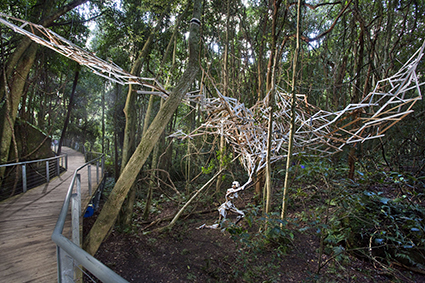
Poland’s exhibit was the atmospheric interdisciplinary work, Post-Apocalypsis, curated by Jerzy Gurawski with a team of composers and designers. The installation consisted of several lopped tree-trunks supported by metal rods, creating a strange, decapitated forest.
Weather data was streamed into the space from locations on Earth where energy-related disasters have occurred, as in Fukushima and Chernobyl. This data was transformed into a soundscape for the installation and could be manipulated by the visitors. Also inserted into the trunks of the trees were sound devices. Pressing your forehead on these, classic Polish poetry reverberated in your skull. You were invited to reflect upon the relationship between nature, and technology—combining human and non-human elements to create a unique eco-system. Post-Apocalypsis won the PQ Gold Medal for Sound Design.
Post-Apocalypsis, Poland exhibit with Katia Molino
photo Carlos Gomes
Post-Apocalypsis, Poland exhibit with Katia Molino
Between Realities, Netherlands
The Netherlands chose to locate its PQ entry, Between Realities (www.betweenrealities.nl), in a corridor between the exhibition spaces of other countries and a toilet. This interactive publishing room shared information about public interventions that its artists and designers were instigating in Prague with selfie-spots, images of the suburbs brought into the city, white blobs filling alleyways, cardboard waste sculpting and undercover games, collective mapping using apps to track the movements of certain kinds of people. Daily ‘instant magazines’ uncovered the multi-layered realities and functions of public spaces in the city, suggesting how to participate in new realities. Printers were running hot, producing reports of findings while raising questions about the new realities of public spaces created by the artists. This was impressive teamwork involving a large number of artists—and surely well funded.
PQ 2015 Artistic Director Sodja Lotker and her curators made it possible for artists to create spaces in Prague for rich, diverse and inclusive cultural experiences while questioning the responsibility of scenography in the process. It will echo with us for a long while and deserves a visit next time.
PQ 2015, 13th Prague Quadrennial of Performance Design and Space, Prague, 18-28 June; PQAU was an initiative of the IETM-Australia Council for the Arts Collaboration Project with support from Arts Victoria.
Vivaldi’s Bajazet is an opera you might be lucky to see staged once in your lifetime and there’s only one complete CD recording to date, but in the Pinchgut Opera production director Thomas de Mallet Burgess has radically changed the tenor of its ending to suit our own graceless times. Vivaldi’s ending is typically Baroque—after the playing out of jealousies, betrayal and violence, forgiveness and beneficence rule. For artists of the Baroque such endings weren’t simply feel-good clichés but reflections of belief and wariness of offending rulers in strictly monarchical cultures.
Not surprisingly then, 17th and 18th century English writers changed the endings (and more) of Shakespeare’s tragedies—most famously Nahum Tate, 1681, saves Lear and Cordelia marries Edgar. Adaptation is just as rampant today, with varying degrees of sensitivity. In Benedict Andrews’ Measure for Measure at Belvoir (2010), Isabella, about to be married to the Duke in a final tableau, steps outside the production’s video frame and runs for her life into the audience. The play, in the Andrews manner, is otherwise left pretty much intact unlike, say, Barrie Kosky’s radical rewrite of Lear for Bell Shakespeare in 1998 with evil absolutely triumphant. I welcome adaptations of classics—they’re well-known and we can respond to the intellectual challenges of directorial conceits. For lesser or barely known works ‘adaptation’ seems pointless. (I liked Thyestes [Belvoir, 2012], but what was it an adaptation of? Something far removed from the little known play by Seneca the Younger.)
Pinchgut’s Bajazet is faithful to the tenor of the libretto almost to the end, when Astrea, daughter of the defeated Turkish emperor Bajazet, and the Greek prince Andronicus, lovers hitherto under threat of violent deaths, are handed Greece and marriage by a suddenly benign Tamerlano. As everyone around them celebrates in glorious chorus, Astrea and Andronicus take poison, presumably unconvinced that the unpredictable Tamerlano’s beneficence is likely to be enduring. It’s an ending at once disturbing and irritatingly out of kilter with the strength of character revealed in the couple, particularly Astrea. Instead of fatalism the director might have opted for just as fanciful defiance with Astrea poisoning Tamerlano (the actual Timur was pretty much at the end of his nasty career). Who wants ISIS to win out over its courageous opposition?
I should have seen the ending coming. Looking pretty much like any number of Baroque opera productions of recent decades, this Bajazet is historically displaced, from 15th to 19th century, and given a quasi-Victorian look, the men in white and cream riding outfits, the women in (not very full) skirts, the simple set comprising a huge white bookcase on one side and an equally large double door opposite, both white. Furniture and statuary are scattered about and a high, wide red curtain hangs at an angle at the back—signs of pillage after conquest. There are oddities: Bajazet dressed in traditional Turkish attire, Tamerlano in European whites, not at all the Tartar, save the swagger.
However in Act II, the shelving has been cleared of books, the trophies of war displayed and Tamerlano, about to take action, dons Arabic head-dress and shortly appears entirely ISIS-like in black to condemn Astrea to rape and death by a mob. It’s a slow reveal of the extent of Tamerlano’s destructive vision from which Astrea and Andronicus feel they can never escape and therefore opt for death. The man they initially meet is not just another well-dressed conqueror. It’s not an altogether convincing logic. I would have preferred some consistency in costuming and an overall sense of clarity of purpose from the start as seen, for example, in Peter Sellars’ production of Handel’s Theodora—the conceit of the Texas capital punishment death machine is laid over the Roman persecution of Christians and immaculately realised, aesthetically and politically. (Theodora is scheduled for production by Pinchgut in 2016.)
Just what’s to be gained by setting Bajazet in the 19th century is never made clear. There are also plenty of distractions: Grand Guignol skeletons—Tamerlano’s victims—leaning in to watch from the balconies; too much dragging in, out and about of furniture by busy supernumeraries; a stuttering raising of the red curtain mid-aria in Act 1; and the sudden silhouetting and then tight spotlighting of singers as they hit the high notes of their arias—as if the singing could not carry the day.
Despite its conceptual and design flaws Bajazet nonetheless shone because of superb singing, acting, musical direction and period instrument playing. It’s to the credit of director de Mallet Burgess, conductor Erin Helyard and all the singers that the performances were so finely tuned, emotions clearly expressed and the oscillations between the private and public selves of the characters so well delineated. Despite the sprawl of the narrative and the too busy staging, the production dwelled intently on each moment while building tension towards a frightening conclusion, if one made fatalistically grim.
Orpheus Song, (L-R) David Trumpmanis, Ewan Foster, Stephanie Zarka, James Eccles, Geoffrey Gartner, Andrée Greenwell and Julia County
photo Matthew Duchesne, Milk and Honey Photography
Orpheus Song, (L-R) David Trumpmanis, Ewan Foster, Stephanie Zarka, James Eccles, Geoffrey Gartner, Andrée Greenwell and Julia County
Andrée Greenwell, Gothic
Since the late 18th century, the Gothic has never passed its use-by date, periodically rising wraith-like from the depths of the collective unconscious as high art, pulp fiction, fashion and youth sub-culture and nowadays overpopulated with vampires, werewolves, zombies and the common or garden ‘returned’ (see review of Glitch). One of the few practising stalwarts of Australian music theatre that is neither opera nor musical theatre, the ever-inventive Andrée Greenwell, premiered her Gothic during Sydney’s Vivid Festival. Hers is a quieter, subtler take on the genre than most, but still blessed with eeriness and occasional horror.
Gothic is a seamless theatricalised concert, its background three tall church windows (design Neil Simpson) which become screens for digital (and psychological) projections by London-based Australian media artist Michaela French. In the foreground is an ensemble of instrumentalists and two singers—Greenwell herself, often delicately ethereal, and Julia County, a soprano with a daunting range and enveloping delivery. I’ve limited myself to the songs and imagery which I thought represented the best of the concert.
In her folk/classical setting of Edgar Allen Poe’s Annabel Lee, Greenwell’s voice intertwines with violin as the land and seascape of “the sepulchre/in this kingdom by the sea” mysteriously mutates, the animation ‘panning’ from a small house on an island to a distant city to the accompanying lap of ocean waves as the teller “lies down by the side/of my darling…In her tomb by the sounding sea.” The Cure’s gothic rock “A Forest” (1980), one of the more frightening of the program’s songs, opens with the sounds of a child’s voice, crickets and “Where are you?” cries, conjoined with ghostly black and white etchings rhizomatically transforming into forest branches and shafts of light which seem to propel the accompanying strings.
Another lost soul—a child in the throes of being snatched away by a supernatural force —is the subject of Greenwell’s pulsing string quartet arrangement of Schubert’s The Erlking. Soprano and cello entrancingly share the melody while images of children in 19th century apparel appear and fade before the many windows of big city buildings—as if still with us as ghosts in our own century. Another lost to powers beyond the human is felt in poet Alison Croggon and Greenwell’s haunting The Orpheus Song, the composer adding the sound of responses to the 2011 Joplin Tornado in Missouri, USA as it struck, recorded on an iPad. A red line spreads and threads its way across the windows—a red path of destruction? Chosen Words by writer Maryanne Lynch and Greenwell is one of the strongest of Gothic’s compositions with its account of a woman kept in her grandfather’s cellar for 19 years. Greenwell and County vividly voice the sense of threat and the yearning for escape while a series of images of suburban houses flicker by, evoking a domestic banality of evil.
Gothic climaxed with Poe’s “The Bells,” the instrumentation resonating with the animations of huge bell mouths swinging towards us and then being rendered abstract, taking us with them into oblivion. Angelo Badalamenti’s Twin Peaks theme, “Falling” (1990), provided an apt coda to Gothic, a solo guitar arrangement with electronics for a composition as enticing as it is disturbing—which is the uneasy charm of the Gothic. Greenwell’s curation, composing and arranging made for a fascinating program not least in the engagement between live music and media art.
Pinchgut Opera, Bajazet, composer Antonio Vivaldi; City Recital Hall, Sydney, 4-8 July; Gothic, artistic director Andrée Greenwell, electronic processing David Trumpanis, Vivid, Seymour Centre, May 28-30
Attendees at the festival symposium were treated to accounts of Western Australia’s rich history of contemporary music-making, from the Noize Machin experimental warehouse nights to snapshots of composers, ensembles and the state’s contributions to contemporary percussion. The WANMA soft launch was an opportunity to reflect upon how best to capture the truly momentous amount of musical activity in Western Australia over the years. According to the project’s founder Cat Hope, the archive will eventually act as a curated repository for existing images, videos and information as well as cater for the increasing live performance documentation being produced every day.
The archiving of software involved in live performance was a recurring theme throughout the day, with no easy solution in sight. The ABC’s Stephen Adams remarked that a functional description of what a piece of software does may be more valuable than the original code in the long term. All the more reason to maintain a critical, written record of musical performances such as one finds in, say, RealTime. The day was rounded off with a beautifully sparse performance by Ross Bolleter on one of his famous ruined pianos.
Amour-Soundbridge
The cellist Friedrich Gauwerky’s Amour-Soundbridge program explored musical ties between Australia and Germany. Gauwerky himself embodies these ties, having lectured in cello, chamber music and New Music at the Elder Conservatorium in Adelaide, 1989–96. He also performed as principal cellist in the Australian ensemble Elision 1990–97. Gauwerky contrasted music by German luminaries Stockhausen, Henze and Hindemith with stunning works by composers of German origin who have lived and worked in Australia, including Thomas Reiner, Felix Werder and Volker Heyn. The concert showed that the distance between ‘historical’ European culture and contemporary Australian culture is not so great—just one or two generations, a teacher’s legacy, or a couple of boat trips.
Space/Pli
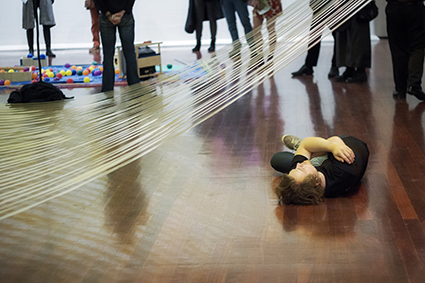
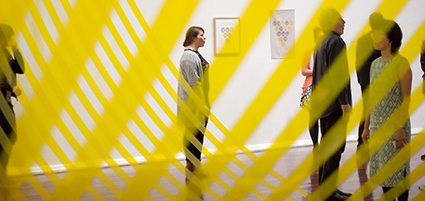
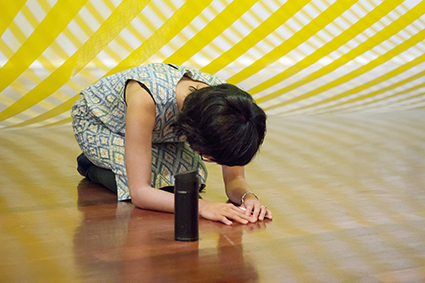
Johannes Sistermanns’ installation performance with the Decibel ensemble Space/Pli provided yet another German-Australian connection. In Sistermanns’ installation, hundreds of metres of clingfilm partitioned the PS Art Space in Fremantle, the translucent film forming walls between the building’s pylons. Diagonal strips intersected the walls, striking down from ceiling to floor. Clingfilm has marvellous sonic properties, especially when paired with piezo transducers. The tiny vibrating discs were placed inside the folds of plastic, causing the rippling walls to buzz and shimmer. Decibel performed a graphic score by Sistermanns while spaced around the room. Their view of the score and each other was distorted by the film, introducing unexpected coincidences and affinities in the ensemble.
Club Zho
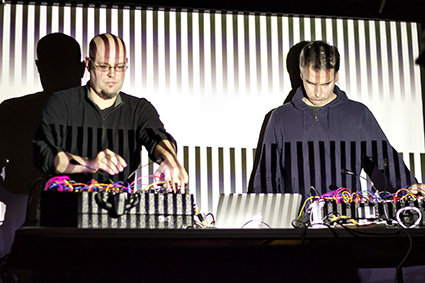
Tura New Music’s Club Zho program presents new music and sound art in a semi-formal environment, this time invading Jimmy’s Bar in Perth for a concert of escalating volume. Bass clarinettist Lindsay Vickery and percussionist Darren Moore performed as the duo Hedkikr. Despite the name, the duo are these days a picture of refinement and grace, crafting focused sonic duets of extended percussion and clarinet technique. Bassist Cat Hope and Vickery then defied all expectations of a polite classical duo. Performing under the moniker Candied Limbs, their 20-odd minute set was an explosion of irrepressible energy, featuring some truly unearthly screaming. Singapore-based modular synthesis duo Black Zenith (Darren Moore and Brian O’Reilly) conjured a staggering array of sounds and textures from their rats-nests of patch cables for the concert’s finale.
Zubin Kanga
I was fortunate enough to hear Kanga repeat the Dark Twin program at the Art Gallery of Western Australia two weeks after hearing it at the Metropolis New Music Festival in Melbourne. The electronic and live parts of Julian Day’s work Dark Twin were much more distinct under the soaring gallery atrium. Kanga’s interpretation of Hope’s score seemed much more fluid, like a Debussy Prelude flowing across the different registers of the piano. Hope’s EBows and radios also spoke louder than before. I don’t know whether these changes were brought about by Kanga’s gradual refinement of the pieces over time, my second listening or whether the composers altered the works themselves.
The Perth Institute of Contemporary Arts hosted two festival highlight concerts. The Breaking Out young composers’ night provided an excellent opportunity for Western Australia’s most promising young composers to test out new ideas. It was encouraging to see the level of mutual support between the young performers and composers as well as hearing the command with which the composers wielded their diverse musical styles. PICA also hosted the Melbourne-based vocal artist Alice Hui-Sheng Chang, who led Perth’s own iMprovisation Collective in a performance around PICA’s black box space before performing a solo concert in the venue’s dedicated concert venue.
Time Alone
Beginning shortly after the announcement of George Brandis’ cuts to the Australia Council for the Arts, the festival was peppered with the performers’ impassioned calls to action. The final concert, Time Alone, was no exception, featuring a stirring speech by Claire Edwardes. The concert was an eclectic tour de force for the percussionists Edwardes and Louise Devenish and the clarinettist Ashley Smith. With a well-known work by Ligeti next to works by Australian composers Michael Smetanin and Chris Tonkin, the concert captured the local-yet-international, looking-backwards-looking-forwards feel of the festival.
TURA New Music: Totally Huge New Music Festival, Perth & Fremantle 15-24 May
In one of nine Common Eclectic concerts staged by independent music promoter Places and Spaces in the refurbished Glebe Town Hall, Clocks and Clouds (Kraig Grady and Terumi Narushima) explored the sonic combinations available when an historic and now sound-proofed ballroom, metal bars and a homemade foot-pedalled organ meet. The instruments appear deliberately positioned to maximise resonance and audience interplay, the performance not so much ‘a work’ or series of pieces as a collection of structured soundscapes. My sticky-beak at their scores before the show revealed some written conventionally, albeit in shorthand, and others looking like pictograms and alphabetical pentograms. The music is theirs alone, in a language they have devised to facilitate experimentation in, and reaction to, their environment.
Grady only composes for instruments he himself has built, exploring ancient sacred scales, pure harmonic tuning and multidimensional geometries. Clocks and Clouds introduce us to a tree made of dangling metal chimes, a microtonally-tuned vibraphone and a set of seven bass Meru Bars that look like a plumber’s sculpture garden and sound as a glockenspiel must to a hummingbird. The music emanating from whooming, echoing bars—hung by elastic above vertical freestanding PVC resonators—induces a dull aching, if pleasurable vibration behind the eyes. Together with Narushima’s retuned and redesigned Meta-slendro Harmonium—a small foot-fanned keyboard instrument washed in pink and yellow paint—they interweave driving rhythms similar to relentless Thai court music or wind-chimes in a cyclone. The effect is glimmering and ephemeral—each vibraphone sound decaying so quickly that for the interplay of dissonances and aural-adjustments to take place, the pair must change pitches and rearticulate often. Pure harmonics glisten and bounce.
Grady knows his instruments inside out and uses their idiosyncrasies, particularly their harmonic interplay, to advantage. What’s special about this music is that while it is clearly mathematically and scientifically conceived, behind these calculations is a quest for aesthetic beauties and new frontiers of sonic sensation—it’s about the concept of perception before the abstractions and material manipulations that afford such perceptions come into play. The ways vibrations might feel are more important that the means by which they are harnessed. So while Grady and Narushima’s music looks and sounds very technical, pattern-laden and designed, its form is subordinate to the sensations it elicits—cloudy crepuscular impressions.
Though lyrical, Clocks and Clouds’ music had no words; Grady prefers listeners to infer what they will. Vocalist Karen Cummings of the duo A Body of Water says, “I look at the words first when I think about music, and am really interested in the intersection between ideas, music and politics. I want to perform music that speaks strongly to the world now.” She and Stephen Adams explored songs in many styles. They shared their passion for the intimacy and fragility of a song recital, “imagined as an exploration of the inner life through words, vocal resonance and breath” (program note). A Body of Water performed original compositions and re-workings of familiar tunes in unfamiliar guises. While Adams tinkered with mandolin, flute, piano, field recordings and electronic gadgets, Cummings’ soprano soared, her cross-genre specialisation and song-choices playing to her vocal strengths. She is an expert in cabaret song and is currently researching the impact of amplification on the performance of vocal repertoire.
Common Eclectic#6: Clocks and Clouds, musicians Kraig Grady, Terumi Narushima; A Body of Water, performers Karen Cummings, Stephen Adams; Glebe Town Hall, Sydney, 21 June
Carriageworks’ 24 Frames Per Second is immediately immersive. The foyer portal to this monumental exhibition of dance and visual art collaborations places the viewer between two huge screens on which football fans coalesce into swaying masses or lock arms and glide in a sideways dance at speed in Khaled Sabsabi’s Organized Confusion. They chant, sing, raise fists and strip off their tops at the urging of a muscular shaven headed leader—just another man in the crowd standing on a fence. The rhythms of sound and movement are mesmeric, although a sense of the restless power of the largely male crowd disrupts reverie in this record of crowd loyalty for its team, the Western Sydney Wanderers.
For all their activity, the fans are largely expressionless as they await play. For Sabsabi, their state is akin to trance. Bridging the screens with a series of engrossing near-still, black and white video portraits of Indonesian trance dancer Agung Gunawan, he creates a telling juxtaposition. Nearby, Brian Fuata’s mysterious Apparitional Charlatan…evokes in graphics, text and image fragmented memories from dance archives and of an empty, once-shared studio.
These three works prepare the visitor for the diversity of works that lie ahead in a vast, dark space lit only by the glimmer of screens near and far, lining walls and, in the centre, inhabiting an intimate labyrinth. The great space largely allows works to speak for themselves without interruption while occasional seating offers opportunities for restful reflection and earphones greater intimacy. The installation is a wonder, offering moments of discovery and fascinating juxtapositions.
Even after two visits for a total of some three and a half hours, I cannot do individual works in 24 Frames full justice nor can I cover all of them here. The number of works and their cumulative playing times prove a challenge, especially having to wait for long works to commence or finding one’s place mid-stream and returning later. Not all are narratives, but most have a structural logic which warrants sustained attention.
There are works I’m drawn back to. Singaporean media artist Ho Tzu Yen’s 1 or 2 Tigers (We’re Tigers) takes the form of a magnificent ‘weretiger,’ at once human and animal. Created from animation and motion and facial capture, it growls out animist and other philosophisings. Although the tiger’s movements are minimal as the camera turns slowly about it and we voyage deep into one of its seemingly sad eyes, the work’s thoughtfulness and focused imagery are deeply fascinating.
In White Record, Lizzie Thomson appears on an enveloping cluster of four screens. Accompanied by an engaging percussion track by Kevin Lo, Thomson offers a generous account of her personal archive of the jazz dance vocabulary in various permutations, from the intricately gestural to long loping walks captured in intimate detail by filmmaker Samuel James. The stark carpark setting and Thomson’s expression of deep concentration are reminders that jazz dance has long been abstracted into Modernist dance; but the artist’s movement subtly evokes the precision, energy and idiosyncracies of a vital legacy from black culture into white.
Sri Lankan Sydney-based artist S Shakthidharan’s Emergence celebrates female Yolgnu dreaming with layered cosmological imagery on a large wide screen divided at times into a triptych of dancing women and other maternal images evoking the giants who created the world and the sacred knowledge that men then stole from them. Young Indigenous men are portrayed as being at risk in Tony Albert and Stephen Page’s Moving Target. Inside a gutted car in the 24 Frames exhibition space, smoke drifts on the video screens which have replaced the door panels and the inside of the boot. A young Aboriginal man, a red target painted on his chest, dances—agile, finely angular, proud, defiant—and then falls.
The maintaining of cultural memory is also evident in the dancing of modern Berber women in Angelica Mesiti’s Nahk Removed, whipping their long hair to induce trance. Although the camera gradually pulls back to reveal limbs and faces, Mesiti is mesmerised by the hair—its length, textures, fluidity and especially its oceanic fullness when it fills the screen. Although beautiful in itself, the video might convey something trance-like but elides the real time power of the dance, the thrashing of the hair, because it’s shot in slow motion.
In Silence is Golden (cinematographer Bruno Ramos), Australian Aboriginal video artist Christian Thompson honours his English grandfather by performing a Morris Dance. Eye to eye with us and at near human scale, he dances with commitment, simply and subtly evoking overlapping indigeneities.
Challenges to the body are variously addressed. In Vicki Van Hout and Marian Abboud’s Behind the Zig Zag, glitches and stuttering pixelation yield richly coloured patterns. But these break up and compulsively loop the lyrical fluency of the sombre dancing. Projected onto the aged gallery wall, dance appears amid graffiti as just another piece of history done in by the digital.
Kate Murphy’s complementary large screen works, Lift and Push, juxtapose senior dancers Robina Beard and Patrick Harding-Irmer engaging with an automated body lift and commode wheelchair respectively. Beard appears to try to make sense of the device in which she is suspended, reaching out, touching its surfaces; Harding-Irmer assesses his, hits it and climbs atop its armrests as if the chair is something other than it appears. Murphy empathically and patiently portrays bodies and minds challenged by age.
Transferred from its performance staging to the screen, Branch Nebula, Matt Prest and Clare Britton’s Whelping Box expands, indeed queers, the realm of the Australian Gothic. Located in a mostly empty, aged house and surrounding claustrophobic bush, the film (cinematographers Denis Beaubois, Alexis Destoop) faithfully preserves the original’s brutal initiation of the human male into a surreal model of manhood. If less scabrously funny than the original, it’s a tense, finely crafted film with visceral impact.
Climbing challenges a dancer in Alison Currie’s I Can Relate for which the screen has been sculpted into rounded outcrops that synch with projections of rocky landscapes across which the dancer slides, stumbles and clambers, if sometimes with dancerly poise. It’s an engaging 2D/3D conceit. In filmmaker Sophie Hyde’s immaculately produced To Look Away, variously abled dancers from Adelaide’s Restless Dance Theatre adopt fantasy personae in meticulously matching furnished rooms pictured across five screens. These evocative live portraits entail sustained ‘at home’ stillness, restlessness and casual dance.
Of a small group of films in the documentary vein, James Newitt’s The Rehearsal, shot in a theatre in Portugal where the video artist from Hobart now lives, is the most interesting from what I manage to see of its 40 minutes. It records the making of a dance in which the bodies of trained and untrained dancers are subjected to increasing duress by choreographer Miguel Pereira. Positions are held and then slowly and sometimes agonizingly distorted. How the dancers accommodate this is revealing as is Pereira’s aim to create mental states to deal with the stress wrought by negative socio-economic conditions.
Natalie Cursio and Daniel Crooks, at least for a while anyway (still), 2015. Commissioned by Carriageworks for 24 Frames Per Secons
image courtesy the artists
Natalie Cursio and Daniel Crooks, at least for a while anyway (still), 2015. Commissioned by Carriageworks for 24 Frames Per Secons
Another senior dancer to appear in 24 Frames Per Second is Don Asker. In choreographer Nat Cursio and video artist Daniel Crooks’ at least for a while anyway, camera movement tracks left to right widescreen along a lakeside with its rushes and trees, until we reach a lone man, Asker, standing in the lake facing us. The camera moves on, the landscape gradually redistributed into striations of various greens, browns, blues and greys until the view is abstracted, although the water at times remains a ‘real’ if patterned presence. A hand pushes out between the lines and recedes, and then a leg, then head and shoulders, distorted like the melting limbs in Salvador Dali paintings but here coolly fluent, Asker stretching wide across layers of colour and over water in a series of supple moves. Asker’s dancing has been transformed, but the animation suggests agility, lyricism and even urgency. It’s one of 24 Frames Per Seconds’ best works. The ageing body emerging from and submerged in nature suggests a consoling and celebratory oneness.
Saburo Teshigawara’s Broken Lights engages me most of all, as both screen work and installation. It’s a work you step into to be enveloped by four screens—three walls and a ceiling—that reveal a field of sparkling, shattered glass on which the choreographer and dancer Rihoko Sato
perform. She is seen in the distance, then closer, human scale, elegantly poised in a supple, lean ‘vertical’ dance, feet shuffling ever so slightly over the glass in order not to fall. She then towers powerfully over the viewer. Teshigawara in black, mouth taped over, is a dark presence who breaks glass and executes an idiosyncratic little semi-crouched dance, the opposite of Sato’s. Broken Lights suggests much, for example evoking the creative risk shared by choreographer and dancer, if moreso physically for the dancer working with a choreographer who breaks rules—the fragile floor whereon new dance is made and performed.
24 Frames Per Second has delighted audiences but also provoked discussion that it’s principally a visual arts exhibition, with dance fuelling the making but being less than evident in the end result, where movement is fragmented, treated and often slow-motioned—phenomena, of course, not uncommon to screen dance, but felt in that field to be in the hands of choreographers and dance filmmakers. Discuss. Which we should do as time passes, allowing for reflection.
Congratulations to Carriageworks and its curators for an exhibition entirely comprising commissions of inventive collaborations and realised on a scale rarely seen in Australia, for installing it imaginatively and drawing attention to the multitudinous ways in which movement and screen can dance together.
Carriageworks, 24 Frames Per Second, Sydney, 18 June-2 Aug
Skunk Control, Gertrude Street Projection Festival 2015
photo Bernie Phelan
Skunk Control, Gertrude Street Projection Festival 2015
Google Maps reckons it’s a 10-minute walk, but with close to 40 light-based artworks floating, glowing or nestling along Fitzroy’s edgy and eclectic Gertrude Street, two hours was closer to the mark. And I’m sure I missed some. But playing ‘spot the work’ along the way, festival app in hand, was part of the fun. From seductive optical candy to the thoughtful, the political and the quietly sublime, this year’s Gertrude Street Projection Festival (GSPF) continued its development as a diverse creative platform for the conceptual, the spectacular and the collaborative across its 10 mid-wintry nights.
With civil twilight descending just after 5pm, mid-July Melbourne is perfect for an outdoor projection festival—wind, rain and single-figure temperatures aside. Gertrude Street is a concentrated location, the street itself providing some serious competition for the artworks. It’s a gritty, graffitied mix of hipster shopping strip and public housing precinct, dotted with bars, cafés, social services, galleries and hair salons, strung alongside a slow-flowing river of trams, bikes and cars. Lots of visual and aural distraction: moving headlights, constantly shifting noise and quirky store displays. But with a bit of online guidance, there was plenty of gold to be discovered within the busy substrate. Here are a few samples.
The Romantic
Brianna Hudson’s Place of Longing was arresting for both its subtle colour and shining Romanticism. Utilising light not to dazzle but to brush its pastel warmth against a pale laneway wall, Place of Longing depicted an ancient landscape slowly drowning in smoky, peachy skies. A near-static, painterly surface of shifting tones, it silenced the din of the street; inner-city grime giving way to Romantic nostalgia, lost forests and dissolving clouds.
Gabi Briggs, Urala
The Political
Gabi Briggs’ Urala, sited amid a group of gum trees at the frontage of the Atherton Gardens public housing estate, used video footage from the recent Forced Closure rallies, projected against a carpet of paperbark and sand. Subtitles were included in Vietnamese, Arabic and Mandarin, aimed at creating dialogue between these local communities, as well as in Briggs’ own Indigenous language, Anaiwin. Behind the horizontally projected video, large letter-signs spelled out “SOVEREIGNTY”—the only English word in the piece. In a location where a long history of urban Aboriginal community intersects with those of recent migrants, the disenfranchised and the upwardly mobile—under a stand of trees suggesting a time before white settlement—Urala was spot-on in calling attention to notions of place, community and ownership.
The Collaborative
Briggs was one of four artists involved in GSPF’s Mentorship Program this year; another was Atherton Gardens resident Guled Abdulwasi, who worked with projection artist Nick Azidis to create giant ‘dark’ images on the side of the estate’s multistorey apartment buildings. I spoke later to GSPF co-curator Yandell Walton about the festival’s aim to bridge the social divide between housing estate and café strip. She cited festival projects including the mobile exhibition space Artbox Truck, situated within the housing estate, and presentations of performance/projection installations as well as an open projection night, Video Jam—which “allowed the exchange of ideas on a public art platform from the local community.” A ‘choose your own adventure’ work was also created around the estate by local youth theatre company Uprising Theatre; sadly, I was unable to catch these works but their inclusion augurs well for increasing connections across Gertrude Street’s many communities.
The Gallery
The New Vanguard exhibition, at Gertrude Street’s Seventh Gallery, showcased the work of five artists; drawing some 4,300 visitors during the festival, according to Walton. She and exhibition co-curator Arie Rain Glorie were keen to encourage the general public into a gallery space. Walton said, “For visitors to the festival to be exposed to conceptual works…this show was also about embracing projection as more than a medium used as spectacle…” From Tara Cook’s hovering, saturated, shadowy figures on a portrait-format video screen—who turn out to be ourselves, the viewers—to Zoe Scoglio’s bubbling, rumbling electronic paste-up of geometric shapes, stone, water, grain and flow (titled Water Falls and Other Features), The New Vanguard expanded the festival’s brief to include the projection of ideas: a counterweight, as the curators’ statement suggests, to the constant projected suggestions of advertising, politics and the “busy world” we’re constantly caught in.
Ultradistancia, Federico Winer
photo courtesy of the artist
Ultradistancia, Federico Winer
The Polished
Amid mesmerising façades of swirling psychedelic colour and sneaky infiltrations into shop windows, two relatively ‘traditional’ works stood out while also fitting seamlessly into GSPF’s overall blend. Half-obscured inside a clothing store, Federico Winer’s Ultradistancia was no more than a vivid slideshow of enhanced aerial stills of cities, landscapes and roadscapes; studies in line and colour that were, nonetheless, just too good to pull away from. Similarly, in the front windows of Gertrude Contemporary, dance-filmmaker Sue Healey’s simply but perfectly realised film portrait of dancer Benjamin Hancock, from her On View series, drew a constant crowd of watchers, as Hancock moved and swayed like a tai-chi master or praying mantis, meeting our gaze as he floated, uncannily close to life-size, upon a dark and seemingly infinite background.
The Enchanted
And of course, there were the works, as always, that revelled in the mystery, pleasure, play and playfulness that participation in GSPF invites. Freya Pitt’s Fortune and Love Favour the Brave created a “Fake Hole” in a laneway wall: a metaphorical ‘lack’ into which was projected an animated reflection on desire—complete with photo-collaged angel lovers flexing their wings, riding on rocks and clouds and seemingly helpless amid their world of starscapes, graphics and flowing ribbons of text. Nearby, Victoria University’s engineering- and science-based collective Skunk Control utilised stark white light on black to create a magical, surreal grotto, Secluded Evolution, full of bizarre alien flowers in black metal, centres glowing with sharp monochromatic patterns. Upon them, black mechanised butterflies rested with transparent, stencilled wings pulsing, catching the light and splitting it into subtle prisms. Children and adults alike were transfixed.
The Couch Potato, Andre Fazio
photo Bernie Phelan
The Couch Potato, Andre Fazio
The Thematic
It’s impossible to cover even a substantial number of GSPF’s works in a short review, or to convincingly generalise on the themes and ideas at play. Walton saw, overall, a desire by artists “to investigate ideas related to technology itself,”mentioning works like Dalton Stewart’s painting/projection work Ontology, which “blurred the boundary between materiality and virtual space through the convergence of painting and projection.” I saw ideas-based work; work in which light was merely an element; work in which light was both primary medium and focus of investigation. The works that stood out for me were those that evoked other artforms, times, places; merged with and utilised the surfaces they played upon or the 3D spaces in which they sat; and gathered an energy—whether quietly or spectacularly—that overrode the peak-hour traffic and nippy weather. It’s a hard call to bring together the rough edges and consumer culture of Gertrude Street, but the high-rise flats, the bundled-up pre-schoolers, the commuters, locals and the dancing colours all seemed to be embracing a good time.
Gertrude Street Projection Festival, director Nicky Pastore, co-curators Yandell Walton and Kym Ortenburg, Fitzroy, Melbourne, 10–19 July
Matt Warren’s show Envelop(e) at Contemporary Art Tasmania is very much a culmination of ideas he’s been investigating for much of his career. His own work has long featured sound, so the move into curation in 2012 with A Silent Way seemed logical and has been revealed in Envelop(e) as a rich extension of his overall practice. Jason James, another Tasmanian artist who is at a much earlier stage of his career, contributed a new work to Envelop(e) while also debuting an ambitious installation, Angry Electrons, in a docking bay at the Centre for the Arts (see Profiler 11 at www.realtimearts.net for more on the artist and video of the work).
Envelop(e) comprises four sound works from Elizabeth Veldon, Christina Kubisch, Mick Harris and Julian Day, plus Jason James’ light installation Crevasse. While each has its own governing set of impulses and logical formatting, a powerful overall effect is realised by Warren’s careful arrangement of the works in a sparely lit space with open cubicles somewhat akin to listening stations—three of the four each with a small seat. The effect is monastic. Hanging at the centre is James’ Crevasse, a bank of 21 stage lights—1000 watt Par Cans—changing hue, seeping on and off. The overall arrangement of the exhibition implies ritual, attempting to slow viewers down—a seat probably helps, but it’s the setting that largely creates the palpably reverential tone.
Elizabeth Veldon’s The Tortoise History of Our Voyage stands out by breaking the sound-art mould, using texts gleaned from the journals of Charles Darwin on his visit to Hobart in 1836. Voices overlap and interlock, leaving potential for listeners to ascribe new meanings or just enjoy the cadences. Mick Harris, famed as the drummer for the extreme metal act Napalm Death, contributes two interwoven drone works that evoke the edges of dream worlds, while German composer Christina Kubisch presents sound from her installation Movements to Distant Places, an exploration of the sounds generated by the electromagnetic forces that shift around us. As with Veldon’s, both works create a spectral sense of the distances of history, geographic dislocation or the melting worlds of the subconscious.
Julian Day’s visually and sonically delicious Requiem features two identical “heirloom” synthesizers mounted on opposing walls and linked by eight silver rods which hold down keys, generating a drone. This sculptural work combines wit with a take on classic minimalism, becoming one of those ‘anyone-could-have-done-it-but-they-didn’t’ works that stand out as being in equal parts beautiful and clever.
Jason James writes, “Ever since hearing about explorers dying by falling into crevasses I have wondered what it must be like to be dying somewhere that is both beautiful and deadly”. An attempt to render the light seen from the bottom of an ice cave, Crevasse rolls slowly through cool and frozen light states: blues, stark whites, toxic lilacs. It felt cold, very cold. Its strongest effect is as a kind of visual subtext to the softly meshing sounds of the gathered art works that becomes the slowly pulsing centre of the room. The brazenly open display of the light source just above the heads of visitors, calls to mind a weird aircraft, possibly with occult or alien origins, its patternings reminiscent of coding or signalling—oddly triggering a desire to decode. Matt Warren’s art has long attempted this kind of evocation and it’s a fascinating eventuality that one of his most successful efforts should come from his work as a curator.
Jason James, Angry Electrons
courtesy the artist and Dark MOFO festival
Jason James, Angry Electrons
At a docking bay in the Centre for the Arts, James’ large-scale installation Angry Electrons marries motion sensors to a floating sea of 1000 light bulbs in a dance of glowing electricity that moves above in reaction to the audience moving below. Bristling with rude and lively energy, Angry Electrons successfully achieves something extraordinarily complex in technical terms if not in evoking the danger of electricity the artist intended. The many people who saw this installation almost universally played with it—children in particular ran about, delighted as they realised their movements were causing the brisk dancing above their heads. The potential for realising electrical terror might have been effected by hanging the bulbs lower, but practical issues of health (the effects of intense light on eyesight) and safety (the risk of someone touching and breaking a bulb) required the angry electrons to be contained by elevating their glass cages.
The stark concrete docking bay was transformed into a space of fleeting beauty, filled with excited, giggling shrieks; humans are possibly less predictable than electricity. Angry Electrons was not frightening, but thrilling, fun and incredibly engaging. James’ Crevasse felt far more sinister, conjuring up a sense of the irrational and the eerie.
Dark Mofo 2015: Envelop(e), curator Matt Warren, artists Elizabeth Veldon, Julian Day, Mick Harris, Christina Kubisch, Jason James, Contemporary Art Tasmania, 11 June-19 July; Angry Electrons, Jason James, Centre For The Arts, 12–21 June
photo courtesy Australian Experimental Arts Foundation
Alterland, Heath Franco
Video became established as an art form in the latter half of the 20th century, but in the 21st, the age of video games, virtual reality, YouTube, social media and phone cameras, video is a universal language. Performance art frequently explores identity and the self in interaction with the world, and in his review of PP/VT Performance Presence/Video Time, Ben Brooker notes the current resurgence of performance art, whose history is intertwined with that of video. Heath Franco’s work both extends the tradition of performance on screen, using himself as the actor, and addresses the ever-expanding field of visual media.
On entering Heath Franco’s Alterland, we first see Portrait (2010-2015), a three-minute looped video showing in rapid sequence the comically nightmarish characters he has created over several years. This sequence is framed by TV test-pattern colours as if TV or video portraiture has displaced painted and photographic portraiture. Sydney-based Franco plays every role, which he evokes with dramatic gestures, bizarre costumes, garish makeup and sometimes novelty-shop masks. His characters resemble caricatures from children’s stories, pantomimes and video games. There are many animal characters—cats, dogs, wolves and koalas, even a pig with a plastic roast chicken on its head. Sometimes Franco dresses as a woman, albeit with a beard. While there is a childish quality in this uninhibited foolery and dressing up, the characters represent personas we might encounter that can reveal the human psyche in all its manifestations. Franco says that they represent people he has met, or characters from TV and horror movies, and he cites David Lynch as an influence. His work brings to mind satirical comedy from Aunty Jack to Dame Edna Everage, Dada, Fluxus, Absurdist theatre and even the dissociative psychopathology of Jekyll and Hyde, as if Franco himself embodies a range of alter egos.
Having been introduced to the inhabitants of Heath Franco’s world, we then proceed to Wunder-Land (2011-2015), where we approach an archway on either side of which are video projections (from his Wunder Closet, 2011) showing a rapid sequence of images of Franco, trouserless and in various guises, leaping up with hands in the air as if to create a human tunnel, like a cheer squad encouraging players entering a stadium. As we walk through the archway, we see a semicircular array of TV monitors on the floor, showing more trouserless characters who applaud us vigorously. Behind the monitors a huge wall-projected image of a masked face stares at us, an Orwellian Big Brother welcoming us to an insane world through the archway portal to the acclamation of the half-naked acolytes on the monitors.
Beyond this ‘temple’ is Franco’s Static Spread (2013-2015), another installation of wall projections showing a four-second looped fragment from his 2013 video Televisions in which two characters magically emerge from an image of TV static. One is in sinister black and the other in angelic white like a high priest; they mockingly represent good and evil in combat. Both roles are performed by Franco in a well-crafted piece of digital manipulation that reminds us to beware of hidden messages in our media. The trance-inducing repetition of the imagery in Wunder-Land and Static Spread hammers home the message.
At the exhibition opening, Art Gallery of SA director Nick Mitzevich interviewed Franco before a large and enthusiastic audience. In noting Marina Abramovic’s view that performance art is hard work, Mitzevich places Franco’s work in the performance art tradition and acknowledges the effort involved in creating these roles. Franco’s Alterland is not simply a record of performances, but a complex montage of electronically mediated imagery that places the viewer within a multi-channel installation. As with many artists, Franco’s work also circulates universally through the internet. We recall Marshall McLuhan’s dictum of 1964 that the medium is the message.
As well as exploring the power of video and cleverly parodying human behaviour, Franco raises important social issues. For example, his Alterland installations address religion and the church, he considers gender identification through cross-dressing and he challenges authority by creating malevolent-looking authority figures who seem to talk gibberish. Abandoned, alienated misfits and outsiders are also among his cast of characters and in Alterland are valued members of society. In the interview with Mitzevich, Franco states that, in showing himself half naked, he is representing the childish fear of being caught naked, but in so doing he reveals our paranoid obsession with sexuality and appearance.
Viewers seem to associate strongly with Franco’s installation, many photographing themselves or each other against the backdrop of the wall-projected imagery and thus, paradoxically, documenting themselves within Franco’s theatre. Undoubtedly their images will also circulate further via the internet and become part of the video universe in which we live.
Heath Franco, Alterland, Australian Experimental Art Foundation, Adelaide,10 July-8 Aug
The core of the Imperial Slacks collective—Shaun Gladwell, Angelica Mesiti, Emma Price, Sean Cordeiro and Claire Healy, Wade Marynowsky, Alex Davies, Techa Noble, Michael Schiavello, Chris Fox, Melody Willis, Lea Donnan, Simon Cooper and Laura Jordan—have been reunited in Cosmic Love Wonder Lust: The Imperial Slacks Project curated by Campbelltown Arts Centre CEO Michael Dagostino and Nicholas Tsoutas, Lecturer at Sydney College of the Arts. RealTime spoke with Dagostino prior to the launch.
What can we expect to see?
There’s a combination of new and existing works and what we’re doing is treating both institutions, Campbelltown Arts Centre and Sydney College of the Arts, as one large venue and then spreading the works across them. It’s a very ambitious show with 15 artists, most of them still practising.
It was a very distinctive phase in the visual arts world.
What they were able to do in such a short period of time was actually quite dramatic. I remember going there just after coming out of art school. There was this really dynamic, fluid, almost hyperreal arts scene. We want to be able to profile that in a new light and also to dig down into the reasons why it was such an important part of the contemporary art scene at the time. In 2000 many things were going on—the city was in a state of flux. We were coming out of an economic bust. There was all the hype of activity around the Olympics. There was real focus on Sydney and these artists were able to counteract, to talk about and engage with everything that was happening. A lot of them have gone on to have very successful careers, others have moved into the academy. Imperial Slacks was a really dynamic hub.
What kind of work struck you at the time?
There were some really interesting works from Shaun Gladwell. We’re showing a number from his early painting series that he produced at Slacks and showed with the Boutwell Draper Gallery. He’s an amazing painter. There are early installation works by Sean Cordeiro and Claire Healy—we’ve been able to reconstruct some of those—and by Alex Davies, which are just mind-blowing! When you look at current practices in immersive and interactive work, Alex Davies was pushing the boundaries back then.
There was also the total democratisation of the video camera. You could walk into your local electronics shop and for $1000 buy a video camera that was totally inaccessible maybe 10-15 years ago. Consequently there’s a lot of video documentation from that time and a lot of video works being made by groups like the Kingpins, a really dynamic group of young female artists talking about gender politics, identity… That’s what I mean by ‘fluid.’ It wasn’t about one artist or movement; it was a really interesting communal idea of what art could be.
It was a fantastic time. It’s weird to think it was some 15 years ago but it still feels very fresh. There’ll be a mix of works from that time alongside new, commissioned works in each venue. As with any artists, you’ll see change but there are a lot of parallels. Wade Marynowsky is a fine example of an artist who was making really complex, detailed computer-generated artworks at that time. His work has evolved and is now more installation-based but still with the same core, which is really important.
Who are some of the other artists?
Emma Price, who has now taken the whole performative thing into the setting-up of a bar, The Bearded Tit. She was part of the Kingpins and the continuity is there. Chris Fox is still making large-scale installations but has moved more into drawing now, creating drawing machines that will blow people’s minds. There are also video artist Angelica Messiti, electronic artist Michael Schiavello and Monika Tichacek. Monika moved overseas and now does drawings of varying scales. For Cosmic Love… she’s doing a life-scale drawing of a seagull that’s been cut open and is full of plastic refuse. Her work is still very dark and abject but now with a very, very different aesthetic.
Will there be performances and talks?
There’ll be performances at both openings in August and an all-day forum at the Gunnery in Woolloomooloo in partnership with NAVA about artist-run spaces, using Imperial Slacks as a centre point and seeing where these spaces are now.
Campbelltown Arts Centre, Sydney College of the Arts, Cosmic Love Wonder Lust: The Imperial Slacks Project, Sydney and Campbelltown, 14 Aug-18 Oct
Nominate for ONE giveaway. Email us at giveaways [at] realtimearts.net with your name, postal address and phone number. Include ‘Giveaway’ and the name of the item in the subject line.
5 Copies of Citizen Four, the breathtaking documentary about Edward Snowden (courtesy of Madman Entertainment).
3 copies of Fairfax film reviewer Jake Wilson’s entertaining reassessment of Philippe Mora’s Mad Dog Morgan (courtesy of Currency Press).
RealTime issue #128 Aug-Sept 2015 pg. 39
Spectra, Dancenorth and Batik, OzAsia Festival 2015
photo Amber Haines
Spectra, Dancenorth and Batik, OzAsia Festival 2015
Alongside immersive works like The Streets and Japan’s Miss Revolutionary Idol Berserker —“a frenetic spectacle of hyper-real pop music and dance” [program] that will require audience members to don protective raincoats—another key feature of this year’s OzAsia program is an emphasis on cross-cultural collaboration.
One such work is Spectra, by Townsville-based contemporary dance company Dancenorth and Japanese Butoh collective Batik. Spectra is choreographed by Kyle Page, who became Dancenorth’s first Artistic Executive in January this year following a long relationship with the company. During the work’s first stage development in 2014 it was called Engi, a portmanteau combing two Japanese words suggestive of, according to Page, “this idea of causality, one thing leading to another.” It is this idea—the Buddhist precept of interdependent co-arising (Pratityasamutpada in sanskrit)—that is at the core of Spectra.
“I’m not a Buddhist in any sense,” Page explained to me, “but the philosophy really struck a chord. In very basic terms, dependent causality is about how one thing leads to another. The thing I find really beautiful is when you strip that notion back, or look through the history of your own experience of life, there are various points that I can clearly define—and I think everyone can—that have catapulted you or directed you towards where you are now, in this moment. From that, you can possibly imagine alternate options or decisions or collisions, relationships or experiences you may have had that you learned various things from that could have sent you on a different trajectory.”
I asked Page how this idea is reflected in Spectra’s form. “There’s kind of a full gamut,” he shot back in his curious way—somehow rapid and luxuriously considered at the same time. “The Japanese dancers have a really amazing creative capacity in a different way from Australians, so I think we explore pretty broad choreographic devices in the work—the Japanese dancers have classical and contemporary but also Butoh training, so we mesh those worlds and those physicalities. The thing I love about Butoh,” he continued, “is that we’re bringing into the work the idea of sourcing the material as well as the delivery from a place of intention as opposed to narration. So instead of saying ‘this is what you’ll do and you’ll do it like this,’ you say ‘this is what that feels like and that becomes this.’ That’s an interesting mechanism for delivering something that’s very true or real or raw.” After a brief pause, he added: “You can see a very clear thread through cause and effect which is a very basic choreographic principle, but it works well. There are also set design elements, we work with rope a lot and its rippling, coiling effect on stage is just amazing and really beautiful, a really simple and elegant display of the concept.”
The design is by the revered Japanese digital artist Tatsuo Miyajima, who, Page effuses, “is insanely famous. He’s got work in the Tate and the Guggenheim and all around the world.” Page first encountered Miyajima’s work at an exhibition at SCAI The Bathhouse in Tokyo where, having gained permission from the gallery director, he and his partner Amber Haines, who is also a dancer, improvised and took photographs in front of some of the artist’s installations. Impressed by the results, Page then spent three months persuading the problematically busy Miyajima to contribute to Spectra. Unexpectedly, and in an oblique reflection of the work’s theme, it transpired that Miyajima shared Page’s interest in the key Eastern philosophical idea of interconnectedness. “It’s kind of amazing,” Page commented, once again deploying his favoured adjective, “because that in itself is kind of the whole point of the work—that various collisions or chance meetings or relationships lead to your future experience of the world. There’ve been a lot of moments throughout the creative development that have highlighted what we’re trying to explore in the piece.”
Miyajima’s set—conceived, Page told me, during a “weird meltdown that lasted for about two minutes”—is called Forest of Time, and consists of fifty LED counters suspended from a single wire at various points and heights around the stage. These counters flick between the numbers one and nine (there are, in keeping with the belief that the idea of zero is a solely Western concept, no zeroes in Miyajima’s work) at a range of speeds, some so rapid they will be all but unperceivable to the audience, others sufficiently slow to convey the incremental passing of time.
Live music will be provided by another Japanese artist, Jiro Matsumoto, about whom Page was equally enthusiastic: “He’s a wonderful composer, classical guitar-trained but he’s also played in punk bands around the Japanese underground. He’s really virtuosic and very versatile in his range. He plays live with about six loop pedals and he’s got various things recorded that he interjects and plays with and manipulates live on stage. He creates a really cinematic experience, both for performers and audience. It’s always great dancing to live music and I think the audience will get to feel that direct interplay and exchange between the dancers and the musicians. While it’s fairly set, there is movement within the framework to extend or shorten things or change the dynamics in any particular scene.”
Spectra will play in the Adelaide Festival Centre’s Space, a small, flexible studio theatre that, nevertheless, seems far removed from Butoh’s more customary settings—unconventional spaces like skid rows, cemeteries and harsh natural environments in keeping with its essential subversiveness. “I think that’s exciting,” Page responded, “because we’re not delivering a Butoh performance but we’re using the intention or integrity of that practice to convey something powerful to the audience. I think the intimate setting of the Space Theatre is perfect for us to deliver that very tangible, very real sensation of exchange between the performers and the audience. Intimacy will heighten that exchange, as opposed to being in a massive proscenium arch where you’re projecting 80 rows to the back.”
OzAsia Festival, 2015, Spectra, Dancenorth & Batik, Space Theatre, Adelaide Festival Centre, 29 Sep-1 Oct
Igneous performance: James Cunningham and Suzon Fuks
photo Alan Warren
Igneous performance: James Cunningham and Suzon Fuks
Fluidata is the latest project by Brisbane intermedia artists Suzon Fuks and James Cunningham whose long-standing partnership Igneous produced this installation at The Block in the QUT Creative Industries Precinct. It’s the installation component of Igneous’ long-standing exploration of water as a topic and a metaphor through their Waterwheel project.
This is very considered and deliberate art-making and you feel that sense of solemnity and purpose in the installation. Walking into the black vaulted expanse of The Block you are first struck by a projection which cuts through the space at a 180-degree angle from ceiling to floor and then up the entire length of the opposite wall. It is an impossible river of scrolling encryptions, data recorded by Fuks and Cunningham as they traversed the 663 waterways, drove the 7,500km and walked the two dozen creeks that make up the entire footprint of this enormous project in Central Western Queensland.
You turn a corner and meet curving black flats and a small nook, which invites you to listen to a guided meditation. This entreaty to “slow down, to meander” is an essential part of the installation. Fuks and Cunningham clearly feel such a strong custodianship of the rivers they walked through so slowly and so carefully that they cannot bear the thought that you do not get to experience the sense of durational spirituality that they did.
This is reinforced by curator Rachel Parson, whose thoughtful and considered curatorial essay frames the journey of Fuks and Cunningham in the tradition of “the groundbreaking experimental soundwork of John Cage in the 1950s and 1960s.” She suggests that the artists’ slow and intricate walking “becomes a symbolic gesture, a way to absorb the memories, movements and scars of the landscape…that leaves no lasting trace, becoming another memory within the historical and ongoing shaping of the land by environmental and historical forces.”
There is a sound installation based on the nature of walking and balance in the larger dramatic space of the main exhibition which is dominated by the projected map of Fuks and Cunningham’s travels, a kind of twiggy, arching artery across the back wall. Beneath it, Cunningham performs live an ultra slow and stately walk. In the immediate foreground a wall of video monitors lights up on touch, offering elongated vistas of creeks. On the other side of the installation is a collection of tiny bottles with water from each of the creeks walked: Ross River, Coppermine, Cloncurry, Condomine, Emerald, Miles, Blackwater and Nettle Creeks. And there’s a small bed of sand with discarded objects collected along the way.
Parsons ends her essay by urging patrons to accept the strong invitation of the work to “take time…find a resonance between the body and the various technologies…to experience depth and details…to commit to the meander.”
Igneous performance
photo Alan Warren
Igneous performance
Indeed, while the large-scale installations that demonstrate the statistics and demographics of the project, like the map and the river of data, were genuinely impressive, the parts of the installation that truly resonated for me were not grand or cartographical. I fell in love with the tiny, intimate pieces of documentation that felt almost like secret insights or rewards for the patient endeavours of these two artists on their long and contemplative journey.
In the large square room, with its stations reminiscent of a regional museum display, a series of low-set black boxes curved a gentle path through the centre of the installation. Although square, these boxes felt like bird baths, or scrying bowls that glowed with light and sound. Some contained recordings of interviews with local farmers, councillors and other folks met along the way. I had no urge to actually listen to the stories, but I so enjoyed hearing snatches of their voices as I walked past.
Other bowls had iPads nestled inside, flashing close-up images of more tiny details of landscape like knots of wood that looked like horses’ heads. These smaller installations invited an embodied participation, a leaning in and sitting patiently; watching the tiny beauty of an unfamiliar landscape and engaging with it tipped me into a kind of reverie. I left the installation feeling as though I had received a massage. I suppose, to quote Suzon Fuks and James Cunningham, I had experienced what they wanted me to: deep time.
The Sound and the Fury, Elevator Repair Service, Public Theater, New York
photo Paula Court
The Sound and the Fury, Elevator Repair Service, Public Theater, New York
It’s summer in New York and all the locals are elsewhere, leaving the tourists to ask each other for directions. Pickings are also slimmer than you might expect when it comes to performance. Nevertheless, I manage to catch three shows that encapsulate trends within contemporary performance: immersion, interaction, adaptation and verbatim.
Punchdrunk, Sleep No More
Sleep No More opened in London in 2003, Boston in 2009, and then New York in 2011. It’s UK company Punchdrunk’s signature production and has become a touchstone within contemporary debates about immersive, participatory and promenade performance. It takes place in three converted warehouses that have been renovated and renamed the McKittrick Hotel, a fictional venue that was—so the story goes—completed in 1939 just before the war broke out and had to be closed.
Whatever else you may think of Punchdrunk, they have mastered the art of anticipation. Like a secret club, there is a long line, a surly security guard, a stamp on the wrist and a cloakroom. You are invited to leave everything behind except, of course, your cash or credit card, which you’ll need to purchase drinks at the bar. We are slowly ushered into said bar, where a band plays, another line forms and preposterous gentlemen introduce themselves as Balthazar and call you darling. It’s all very mannered so far. A small group is called forward into an antechamber, given white masks and escorted into the elevator. The operator goes through the rules of the game before stopping at one floor and shoving a female patron out the door, leaving her startled friend to ride on alone. Eventually we disembark into a dark, wordless world, loosely based on that of Macbeth.
It helps to be familiar with the play, but even without it the performance would register at the level of atmosphere and affect. The set is both impossibly large (multiple floors, over 100 rooms in total) and incredibly detailed (drawers full of detritus and letters on desks, all of which you can rifle through). I think I am on the fifth floor but, disoriented, not entirely sure. There’s a room of empty hospital beds, another with empty baths: both are staffed by attendants in black masks. In a tiny office, a nurse in a starched cap carefully scissors words from a medical dictionary. The white masks create a mobile fourth-wall: no matter how close spectators stand, she does not acknowledge or interact with us; when she moves, we are expected to get out of her way, a domineering dynamic that recurs throughout the performance. I leave to get lost in a forest.
On other floors (I lose track of which), there are bars, taxidermists and detectives. I miss some of the “moneyshot” scenes that the publicity advertises but I do catch a large and spectacular waltz. Elsewhere the choreography is muscular and athletic, reminiscent of contact improvisation: the dancers throw themselves at each other as well as against the furniture and the wall. It’s a bit repetitive and two spectators start mocking it in a corner, imitating some of the moves. Not for long though, as they are set upon by the black masks almost immediately.
Despite its dramaturgy of anticipation, seduction and immersion, I am not fully won over by Sleep No More. It seems to produce in its spectators a sort of performance of mindless pursuit, following where everyone is going. Several times I am engulfed in, trampled by or witness to a mob of spectators sprinting through the corridors. Despite advertising itself as a choose-your-own adventure affair, Sleep No More is immersive but not interactive. Finally, I found the production too similar to the company’s recent take on Woyzeck, The Drowned Man (2014). The plays share some similarities, but the Punchdrunk retro 1930s aesthetic renders them more alike than they actually are.
Elevator Repair Service, The Sound and the Fury
The Scottish play provides an unexpected link between Sleep No More and The Sound and the Fury via the line “a tale told by an idiot.” First performed in 2008 (also Adelaide Festival, 2010), this is the second in a trilogy of literary adaptations from Elevator Repair Service, the first being Gatz (2004) and the third The Select (The Sun Also Rises) (2010). Whereas Gatz performs The Great Gatsby in its entirety, The Sound and the Fury focuses on the first section, April Seventh, 1928, also known as “Benjy’s Chapter.” Benjy would be probably categorised as differently abled these days, but in Faulkner’s novel, published in 1930, he is described as a man who’s been “three for 30 years.”
The wide stage is almost cinematic in ratio and the set almost symmetrical, recalling Wes Anderson’s planimetric shots [as in non-topographic maps. Eds]. The action is framed by two wide architraves: on the left are a drinks cabinet and faded settee, scene of the occasional snuggle and nap; on the right, there’s a kitchen table, scene of many a messy meal, a birthday and a few showdowns between Dilsey the maid/matriarch and the Compson children. The middle of the stage is left empty but for a faded rug; further upstage are two armchairs, an assortment of floor lamps and picture frames hanging on a green wall.
The performance proceeds as the chapter does, out of chronological order. In addition, the actors rotate through various characters, with the exception of Benjy who is mostly played by Susy Sokol. It’s not hard to follow who’s who, firstly because they almost always follow their dialogue with “Caddy said” or “Lester said,” as in the book and secondly, because they are always wearing a signature garment, eg whoever is playing Mother wears a voluminous white nightgown and sunglasses. These are not the only gestures towards theatricality: the naturalistic action is also interspersed with stylised movement, including choreography that looks like a line dance gone wrong. When the frantic activity subsides there are also moments of still grace, such as when the family gathers around Benjy to calm him. For the most part, he stays silent, watching the family or the fire, which is in fact an image of a fire on a glowing LCD.
The Sound and the Fury is beautiful, mind- and time-bending: parts of it seem to stretch for hours, while other moments fly by. For me it doesn’t reach the heights of Gatz, but this might have more to do with the timing of the productions more than anything else. I saw Gatz in the Sydney Opera House in 2009, just as our own jazz age had come crashing down in the financial crisis. While Australia suffered moderately compared to the rest of the world, there was still a sense that the party was over and the reckoning was to come. Faulkner is probably telling older truths, or more timeless ones about family, memory, inheritance and history, but on this particular evening they seem less urgent. Perhaps if I had seen it in 2008, I might feel differently.
Ilana Becker, Argument Sessions
From a verbatim reading of Faulkner’s prose to a verbatim reading of SCOTUS (the Supreme Court of the United States) transcripts. Created and directed by Ilana Becker, Argument Sessions is part immersive and part tribunal theatre. It’s immersive in the sense that both the audience and the actors are in a cabaret setting, with the actors revealing themselves one by one throughout the performance, usually when they interject to counter another character’s argument. It’s tribunal in the sense that it takes the transcripts of the Obergefell vs Hodges (2015) case and delivers all of the arguments for and against same-sex marriage in all of their complexity.
There are both theatrical and structural difficulties to this task, which Becker navigates with finesse. The theatrical problem lies in how to present the arguments of the court without lapsing into documentary theatre’s more predictable and naturalistic tendencies. The production resolves this problem not only via the cabaret setting but also through the unexpected use of song and the occasional moment of spectacle. The political problem lies in that familiar accusation of “preaching to the converted.” I doubt that many, if any, audience members need convincing, so why are we listening to this argument? Perhaps, like preaching, the performance is rehearsing the arguments of the non-believers, partly to understand them and partly to refute them; these refutations, in turn, reaffirm a faith that might be waning in the face of frustrating opposition.
That faith is rewarded just two weeks later on June 26: Argument Sessions was performed on 15 June, two months after the case had been heard by the court on 27 and 28 April but two weeks before it had delivered its judgement that, yes, the US Constitution does guarantee the fundamental right to marriage to same sex couples. Staged in the liminal moment between hearing and finding, Argument Sessions takes its place as the latest in a long line of artworks that prepared the ground for this huge legal and cultural decision.
Performances: Punchdrunk Productions, Sleep No More, The McKittrick Hotel, from 13 April; Elevator Repair Service, The Sound and the Fury, The Public Theater, 14 May-12 July; Ilana Becker, Argument Sessions, Ars Nova, New York, 15 June
Making documentaries in Australia has never been easy, but the recent cuts to Screen Australia’s allocation for documentary funding must make it even more difficult. Earlier this year Screen Australia also changed the guidelines for its new suite of documentary programs, further disappointing the documentary community. The overall allocation for documentary has dropped by $1.1 million, but changes to programs mean that there is more competition for the reduced funding, with innovative documentaries with a strong creative vision having to compete with more mainstream feature documentaries and projects that have international finance. There is however more access for low-budget projects from early career filmmakers and works with low pre-sales from broadcasters.
Documentary makers are tough, enterprising and productive; the number of Australian documentaries screened at this year’s Sydney and Melbourne film festivals was impressive, as was the range of subjects and the way in which those subjects were approached. So it’s not really surprising that documentary is still a thriving part of film education, although just how documentary is defined seems to be constantly changing; as Dr Karen Pearlman, Lecturer in Screen Production, Department of Media, Music, Communications and Cultural Studies at Macquarie University says, “If you look at the history of what we know as documentary, you see that changes are constant; it both responds and creates in an ongoing process.”
At AFTRS, as part of the new, three-year Bachelor of Arts (Screen), now in its first year, the documentary strand has been re-named Factual, although Rachel Landers, Section Leader of Factual, has already discussed a further re-name, to Non-Fiction. As she says, “The term Factual is a bit problematic; it seems to define particular types of industry practice (including things like quiz shows) and it excludes as much as it includes. Non-Fiction is wider, more inclusive.” But, as Dr Peter Hegedus, Course Convenor of Master of Screen Production and Documentary Production, Griffith Film School, Queensland College of Art, points out, as many of the employment opportunities for students will be in the area of Factual TV, “it’s important for students to understand that to find a job, it’s better to look in that direction.”
While undergraduates tend not to come with pre-conceived notions about documentary, Karen Pearlman says that “a significant number not only discover documentary, but choose to embrace it.” And Dr Andrew Taylor, Discipline Co-coordinator & Senior Lecturer, Media Arts & Production, Faculty of Arts & Social Sciences at University of Technology Sydney, says that “one of the main things is to combine theory and practice—let them learn something about documentary by both seeing films and making things. We open their eyes to documentary; let them see what makes a documentary, that it’s not just television reportage.” Peter Hegedus says that many of his students initially see documentary as the poor cousin, “It’s our responsibility to outline the qualities and attributes of documentary, how it’s all about story, the creative treatment of actuality and to explore the possibilities of that.”
At AFTRS, Landers says that the BA is “about big ideas, big notions about storytelling modes—all kinds of storytelling.” And for documentary, which will be one element in the course that all students will take in their first year, “they will look at the big picture, about telling the non-fiction story, and why it’s important.” Where students who choose documentary (or Factual or Non-Fiction) as an elective in their second year, then go is still being discussed. “We’re developing courses as we go, but it will be much more practically oriented,” says Landers. She explains that all the different disciplines of the school are engaged in a debate—“we’re still thinking deeply about where our graduates will be going, where these still quite young students will fit in the industry. Are they going to be platform agnostic? Will they have multiple skills? The BA is about people wanting a rich, fulfilling degree. What’s exciting is that this is an opportunity to take stock and think about the future, about where the industry will be in 10 or 20 years.”
Andrew Taylor explains that this year UTS “has let in more students, so you have 120 students; how do you teach them? Open them up to new ideas, to the skills, the thinking, the theory. The knowledge that they learn through documentary will be useful in other areas. There aren’t going to be 120 jobs making documentaries, but those skills are going to be useful in all sorts of other areas, such as TV commercials, corporate work, animation, gaming, online and interactive material, music videos. There are all sorts of possibilities.”
He tells me how students—young, just finished school and entering university—start “by making a series of very low-tech, three-minute biographical documentaries, which could be very personal and poetic, and which are only shown in the safety of the classroom. They are about ideas, there’s no shooting, they just use archival material, but it gives them confidence, and we build towards group work, where they do more short docs, which could be online, or sound only, or even a photo essay—it’s about teaching ideas about working together, about collaboration.”
At Griffith, in documentary production, which has a research component but is very much practice-based, students also start making very short docs of 180 seconds, on the way to making six to ten minute docs which are an exploration of an individual’s life, working with very clear criteria. “They always work in groups that may differ in size but are usually of four or five, and the work is very much about interpretation,” Peter Hegedus explains.
Pearlman says that at Macquarie, “we teach core skills like observation, research, juxtaposition, articulating a perspective, finding a theme, and of course, storytelling.” Students can engage in internships outside the university; one recent project saw a group of students work with a local council having problems with racism, to produce a number of short documentaries on the subject that could be used by the council in a variety of ways. “The students got to deal with the logistics of articulating ideas, of working with stakeholders and of appealing to an audience, or audiences, as well as making contacts in the outside world. In such a project, they might find themselves working with archival material, and interviewing people with stories to tell.”
At Griffith, students are also encouraged to go out and make connections, to interact with the filmmaking community. Hegedus tells of a recent two-week intensive workshop given by Philippe Decaux, a French-Canadian filmmaker based in Queensland who makes newsreel-style news reports for French and German TV from the Asia-Pacific region, in which he encouraged the students to find stories that would work as short, punchy newsreels. “This interaction and connection with the industry is really important, and it’s our responsibility to make sure students understand this.”
At Macquarie, at the Masters level, as Pearlman explains, “we infuse the place with a lot of openness about the possibilities. Students don’t feel limited by ideas of what documentary ought to be. We’re quite focused on hybrids, cross platforms, creating and finding audiences in different ways than broadcast. Hybrids might approach telling a true story with a variety of approaches. Designed documentaries, reconstructions, setting up scenarios and observing the way they play out and montage films are just some of the possibilities. But ethics are also important; students are taught that it’s vital not to say something is real when it isn’t.”
Andrew Taylor sees “the area of postgraduate, research-based projects as somewhere where documentary is really thriving and changing,” explaining that “postgraduate documentary makers are developing ways to make films that are quite different from the increasingly strait-jacketed industrial model, and free from the requirements of broadcasters. It also provides the ability to research with much more depth and a chance to be more formally expressive and innovative.”
While Karen Pearlman refers to the current discussions about robots taking over jobs, and to the argument that the job that is safe is that of the artist, or the creative, she concedes that what we think of as a job is going to shift. “Our students could do lots of things; the skills they learn in documentary production could be important in education, in government, in all sorts of ways,” she says. Peter Hegedus is blunter: “making documentaries is not for the faint-hearted,” he says, “the rewards are usually small, but they can be great!”
For most people, silence happens when they become conscious of an absence of sound. This doesn’t mean that they have experienced ‘something’ (the presence of silence), but that they have experienced a ‘nothing’ (the absence of sound). Since John Cage’s famous anechoic chamber experiment in the late 1940s, the idea of magically having been born into aural consciousness through a moment of silencing, being silenced or confronted by silence has become a trope of expanded awareness.
A bevy of artistic projects extolling the revelatory powers of silence carry this legacy like sodden baggage, all joined in celebrating the marvellous things that can happen through being aware of the interrelationships between the sonic and the silent. Does Myroslav Slaboshpytsky’s unsubtitled film The Tribe (2014) featuring a group of deaf non-actors perform similarly? Yes—but let’s unpack its aural baggage regardless.
In many respects, The Tribe deserves its accolades. Like so many millennial-crossover neo-globalist critical movies, it is aimed squarely at a film festival context both to impart its message and lever a globalist power position. This is the realm where films defiantly retain regional dress (The Tribe is set in contemporary Ukraine, sited in a dilapidated boarding school for the deaf and the corruptive goings-on in its dormitories after hours) while imparting universalising positivist ideologies (its bleak portrayal of abuse embedded in the school’s educational and social regime is positioned to ‘ring bells’ in nations globally).
Millennial-crossover internationalist film festival cinema revels in the theatrics and hysterics of Dogme-style films bent on brutalising audiences to achieve prescriptive reality effects. The Tribe might have no subtitles and no voicing, but its artistic voice is vociferous in its channelling of ‘brutal’ auteurs like Lukas Moodysson, Vitaly Kanevski, Gasper Noe, Philippe Grandrieux, Michael Haneke, Jean-Pierre and Luc Dardenne et al. Accordingly, it plays out like a pantomime not of the deaf and their tragic circumstances, but of a director and his heroic logistics in staging long Steadicam-shots with a surfeit of choreographed action mostly using available light to label its cinematised results as Art Cinema.
While I could discuss how Miklos Jancso more elegantly deployed choreographed performers and camera tracks to construct metaphoric circles around his silenced/unspeaking actors and performers, I wonder how seriously The Tribe invests in the values and effects of silence. Though the film fascinates with the documentarian-dance of its non-actors whose physical tussling sometimes produces dramatic sparks, its base impulse in storytelling is anthropological. Even though its English title bears this out in contradistinction to the Ukraine title Plemya (meaning breed, race, stock—all with derivations from fire, source, origin), the film eventually resembles a rage therapy workshop conducted for disaffected teens. In this sense, vetoing the audience’s access to dialogue appears designed to symbolise both youth’s deliberation to not speak when spoken to and respectable society’s inability to listen to youth’s symbolic cries for help through destructive and self-destructive acts (numerous of which are catalogued throughout The Tribe).
But what precisely are the material effects of discounting an audience’s comprehension of dialogue in a narrative film? While The Tribe has been championed for its boldly supportive conceit in refusing to subtitle the characters’ sign language, I remain surprised as to how much was conveyed nonetheless by the performers and their direction. For while the cast comprises mostly non-actors, any serious actor would thrill at being handed the task of communicating without language (a thrill especially evident in the Dardennes’ Rosetta, 1999, Haneke’s Time Of The Wolf, 2003, and Grandrieux’s The Lake, 2008). Furthermore, bad acting is mostly signalled by poor, inept or ineffectual vocal delivery. The voice is an actor’s instrument: powerful when performed with masterly control, insipid when its power is ungrasped or unperceived by the performer. ‘Silencing’ an actor often uncannily imparts performative power.
Interestingly, The Tribe’s soundtrack allows us to hear the voices of the deaf. Their soft growling, hoarse rasping, breathy expulsions score their dramatic exchanges. It’s like porn, but (mostly) without the sex and the dialogue. Mixed with this is their bodily slapping, rubbing, grabbing, pushing. Normally, film dialogue recording attempts to minimise this noisy presence as it interferes with dialogue comprehension, but deaf people—not having recourse to audible directives—must tap, hit or thump someone in order to grab their attention. When an argument ensues—arguments being the primary mode of exchange between the school’s enrolees—there’s a lot of fabric-rustling and limb-slapping. A deeper aural symbolic becomes apparent as the film progresses: the deaf sound their world through percussive means, not through harmonic or tonal means. From their continual arguments, stair-trudging, van door-slamming, physical beating, wood shop working and apartment ransacking, they produce sound through violent sonic means. This has deadly repercussions, literally for newcomer Serge, who eventually murders using the blunt percussive instruments of a wooden hammer he made in the workshop and the wooden furniture of the unwelcoming dorm rooms.
But maybe The Tribe is evidencing the paucity of interpersonal communication and the debilitation wrought by social determinism irrespective of whether one is afflicted with deafness or simply unable to read the signs of the new world. The only time we see signs of education is in Serge’s first class early in the film. Tellingly, the teacher discusses the formation of the European Economic Community (the blue square with its twelve stars silently sits at the top right of the frame). For Russia and Ukraine, the EEC—especially since its absorption of the European Community in 2009—constructs a kind of ‘freeze war’ blanketing Eastern Europe, the Baltic States and the former Soviet Union. This is never mentioned again; the only sign of economic enterprise outside of the deaf school is the phalanx of semi-trailer trucks serviced by the deaf girl prostitutes late at night. Symbolically, the trucks transport goods and values neither glimpsed nor enjoyed by the students at the school. The deaf are thus symbols of isolationism and exclusionism as well as ostracism.
But deafness can profoundly exist beyond the determining symbolism of films like The Tribe. In November 2013, The Junior Eurovision Song Contest took place in Kiev, Ukraine. Ukraine’s own entry was “We Are One,” performed by Sofia Tarasova. The travelogue images projected onto HD multi-screen panoramas on the event’s stage showed a Ukraine quite unlike that depicted in The Tribe. As the youth of Europe sang on stage, outside the Euromaiden protests accumulated into divisive and violent foment, as Ukraine became divided on its future alignment with either the EC or the Russian Federation. Watching The 2013 Junior Eurovision Song Contest on SBS-TV in late 2014, I truly felt deaf.
–
The Tribe, director Myroslav Slaboshpytskiy, 132 mins, Ukraine, 2014
Documentaries often tell us something new—revealing this or that fact—but it is much rarer to find a film that makes us question, in provocative and productive ways, human nature itself. Joshua Oppenheimer has managed to do this twice over with a pair of films about the 1965 massacre of communists in Indonesia—The Act of Killing (2012) and his new work The Look of Silence (2015). And the questions he raises are intensely disquieting.
The Act of Killing (RT117, p 12) traced Oppenheimer’s interactions with various aging Indonesian gangsters who participated in the murder of around a million “communists”—a category that included intellectuals, unionists and ethnic Chinese, as well as actual party members—in a paroxysm of violence that ushered in General Suharto’s “New Order” in the mid-1960s. The gangsters proudly re-enacted their part in the slaughter for Oppenheimer in a bizarre series of scenes comprising Hollywood gangster flick clichés and kitsch musical interludes. The Look of Silence is stylistically restrained in comparison, but is perhaps even more unsettling in what it reveals about our relationship to the past.
The new film centres on Adi, an optometrist born several years after the upheavals of the mid-1960s, but bound to those events by a brother who was murdered by local militia. We see him early in the film watching a 1967 NBC news report about the massacre, in which an official explains that the communists in his village, realising “they were wrong,” had actually asked the village council to kill them. Even as the carnage was still sporadically playing across the archipelago, it seems, a self-justifying narrative was being forged by the killers.
Similarly, we see Adi throughout the film watching Oppenheimer’s contemporary footage of perpetrators proudly declaring their murderous actions half a century earlier. These images feed back into The Look of Silence, as Adi visits the killers from his local area to test their eyes, opening up chats about 1965 as he fits them with new glasses. It is an unsubtle metaphor that feels a little too perfect, even if contemporary Indonesia no doubt looks very different through the lens of those on the receiving end of the mid-60s violence.
As in The Act of Killing, most of the perpetrators initially brag about their deeds when Adi asks what they were doing in 1965, explaining that the nation—and, some add, the Americans—approved of their actions. One readily admits his obvious wealth was a direct reward for his butchery. As with the earlier film, we are left pondering what psychological scars lurk behind these enthusiastic declarations. One village head, for example, is a mess of facial tics as he tells Adi that he was only able to forestall a descent into insanity during the killing by drinking human blood. His disturbed demeanour and ongoing position of power reminds us of the extent to which ‘sanity’ is determined by social and political context.
In each of Adi’s encounters with the killers, he elicits boasts and blithe “explanations,” before calmly revealing that one of the local victims was his brother. It is in the responses to this admission that the film delves into some truly dark places. Several interviewees simply reply with threats. “Do the victims’ families want the killings to happen again?” asks one, now the speaker of the local legislature. “No? Then change! If you keep making an issue of the past it will definitely happen again.”
Much more disturbing, however, is the way most perpetrators shift in a heartbeat from celebratory descriptions of their leading roles in the massacre to denials of any involvement. The daughter of one killer even ends up hugging Adi and telling him, “Think of us as family,” after he reveals his brother’s fate. “None of his children knew,” she says of her father’s actions. “We were very young…He’s old and senile. He doesn’t remember much.” Moments earlier her father had lucidly described dumping a woman’s severed head in a rubbish bin and drinking human blood, while his daughter had commented, “I was proud my dad exterminated communists.”
The Look of Silence
Marxist philosopher Slavoj Žižek wrote that The Act of Killing was about “the ethical deadlock of global capitalism” (New Statesman, 12 July 2013), and it is true that the key ideological aim of Suharto’s New Order was Indonesia’s integration into the global capitalist economy, a move that had long been resisted by the two biggest losers in Suharto’s takeover—Indonesia’s first president Sukarno and the Indonesian Communist Party. But Žižek’s reading lazily assumes that the economic system is primarily to blame, and as such misses the more provocative implications of Oppenheimer’s work.
The events Oppenheimer delves into—like the Khmer Rouge’s genocide in Cambodia, Mao’s Cultural Revolution, Stalin’s Great Purge and the Nazis’ Holocaust—incontrovertibly demonstrate that humankind’s capacity for cruelty is limitless, whatever our political proclivities. The fewer restraints there are on power, the more power will flirt with mass annihilation. More shockingly, Oppenheimer shows us that human subjectivity is endlessly malleable, and that with very few exceptions, people adapt to the conditions in which they live. Many can and will participate in mass murder if society tells them that slaughter is necessary. And they can and will deny all responsibility—or even involvement—when circumstances change. The Look of Silence demonstrates this many times over.
So what does this mean for possible ways of moving forward in Indonesia, and for the process of “truth and reconciliation,” such as played out in South Africa in the post-Apartheid era? Confessions of atrocity and expressions of remorse perhaps provide a degree of closure for victims and their families. But when we are so easily able to slide between torturing, raping and killing and expressing regret when circumstances demand, do public displays of contrition mean anything? Would those who enforced Apartheid have been so publicly regretful if the political winds had not shifted? Or would they have been glibly celebrating their violence in the manner of Oppenheimer’s onscreen subjects? There is certainly scant historical evidence to suggest displays of remorse forestall further abuses, as South Africa’s example attests. The Look of Silence is so unsettling precisely because it makes us face these questions and destabilises easy assumptions about the positive effects of airing repressed historical trauma.
The one certain lesson contained in both The Act of Killing and The Look of Silence is that without the restraint of law, power of any political stripe inevitably drifts towards slaughter. Power will always be able to justify itself, but once the line of arbitrary violence is crossed and endorsed, no amount of contrition will bring back the dead. Just ask Reza Berati.
–
The Look of Silence; director Joshua Oppenheimer, producer Signe Byrge Sørensen; Denmark, Indonesia, Norway, Finland, UK, 2015; Melbourne International Film Festival, 30 July–16 Aug
It’s natural to wonder what a loved one who has died would make of trivial or significant changes that occur as life goes on without them. The ABC TV series Glitch makes these wonderings actual in a scenario that sees a small number of dead people returning to the Victorian country town in which they were laid to rest.
With a concept developed by executive producer Tony Ayres (Walking on Water, 2002, The Home Song Stories, 2007, The Slap, 2011) and writer-producer Louise Fox, whose resume includes popular TV series Love My Way and Round the Twist as well as the film adaptation of Christos Tsiolkas’ Dead Europe, Glitch is neither a remake of nor inspired by French series Les Revenants (2012), but external similarities between the two make comparisons unavoidable. Most obviously, there is the theme of the formerly dead returning to a small country town with every appearance of life, to the shock of those townsfolk forced to accept their miraculous restoration. The ‘returned’ in both series are unable to leave the town limits, in Glitch becoming obviously unwell if they try and ultimately disintegrating like vampires in sunlight if they do. Electric lights tend to flicker in their presence, though Glitch doesn’t use this trope as consistently as does Les Revenants. Both series contain a love triangle and a violent psychopath.
However, where Les Revenants was mysterious and surreal, Glitch is jokey and, aside from director Emma Freeman’s poetic opening titles sequence, prosaic. It’s earthier—in a very literal sense in the beginning as we observe the dead emerging from their graves, naked and grimy, in morbid mimicry of birth. From this opening, both spooky and intentionally humorous, Glitch is immediately engaging, its early scenes of the fictional town of Yoorana as atmospheric as a nightscape by Australian painter Louise Hearman.
The character who must deal with the bulk of the strange events, Sergeant James Hayes, sympathetically played by Patrick Brammall, is soon to be reunited with his recently deceased wife, Kate (Emma Booth). It is the challenge to Hayes’ integrity as decent husband and policeman, as well as the rapport between him and Kate, that anchors Glitch’s narrative. Genevieve O’Reilly lends a contrastingly cool authority to the doctor who assists James in the covert reception and care of the undead.
Elsewhere, characterisation is handled with a broader brush, despite committed performances. This is due largely to an ambitious attempt to corral multiple socio-historical aspects of Australian life into a mere six episodes, which inevitably leads to some stories feeling more trivial than others. Included are themes of Indigenous disenfranchisement, homosexual love, local prisoner-of-war camps, ANZACs, the immigrant experience, bushrangers and more. The diversity is interesting but stops short of being radical, given the central characters still reflect the straight Anglo-Australian mainstream (as a counterpoint, see the UK series In the Flesh, another drama where the lucid dead return, whose hero is presented as unremarkably gay).
Every character has a high-stakes drama attached (beyond the massive upheaval, in the case of some, of returning from the dead), but there’s not enough time to develop each of these fully. Those with more impact include the story involving Maria—a devout Italian immigrant whose miraculous return means a confrontation with grief—and the love triangle drama kicked into being by the return of James’ beloved first wife, though the confrontations caused by the latter devolve into protracted scenes bordering on triteness.
A major story thread involving a friendship struck up between the returning first mayor of Yoorana, Paddy Fitzgerald (Ned Dennehy) and local Indigenous teen Beau Cooper (Aaron McGrath) has serious underpinnings but is deliberately played for laughs. With McGrath playing a good-natured straight guy to Dennehy’s buffoon, their scenes suggest a strange blend of Banjo Patterson and the 1970s time-travelling childrens’ TV series Catweazle, in pronounced tonal contrast to all other narratives in Glitch. Stopping just short of being dissonant, this eccentricity leavens a certain soap opera-style earnestness that might otherwise threaten to dominate the show.
With the approach of the final episode, some intriguingly sinister plot ideas emerge to cast a shadow over the many relationship dramas. On a few occasions the pathos dips into genuine horror and the territory of the uncanny, particularly in relation to one character’s personality change, though unfortunately this is undermined by increasingly menacing delivery reminiscent of a pantomime villain.
But Glitch is, after all, more ripping yarn than dark psychological drama. It’s refreshing to see an Australian series for adults apply such enthusiasm to the supernatural—a genre prevalent in overseas television yet almost unheard of in our own TV productions. (Another exception, premiered at Dark MOFO and launching on Foxtel this year, will be The Kettering Incident (2015), on which Louise Fox also worked as a writer.) With its final episode closing on several cliff-hangers, Glitch should be granted the second series it requires to further explore its many narrative threads.
ABC, Matchbox Pictures, Screen Australia: Glitch, director Emma Freeman, writers Louise Fox, Kris Mrksa, Giula Sandler, cinematography Simon Chapman, ABC1 from 9 July and iview (complete series: 6 episodes)
An imposing shed-like structure cleaves down its middle into two cyclonic market stalls that spin on tiny roller-wheels. These steel-framed marquees skim through space, teasing and nearly engulfing us. The crackle of their gaudy plastic tarps evokes explosive elemental forces, transporting us to a netherworld. As these wind-devils come to rest in their respective corners, there is a brief lull before the ensuing storm of images to come.
This sense of chaotic, cracking-open expansiveness belied the small space of the studio-shed we had entered. We were seated close to red cloth-covered altars at either end of the room; one functioning as the sound artist’s table, the other laid with electric tea-lights and percussive bowls. This proximity, along with the authentic marquee, evoked the sense of being in the street. A rack of hefty martial arts robes hung on the back wall. Alan Schacher welcomed us briefly, and the work-in-progress showing began with a clap of hands.
WeiZen Ho and Aida Redza donned heavy white kimono robes and dropped into a low aikido-like stance, turning into curious, comic insects. Using small brass bells to cover their eyes, the wobbly red handles serving as quivering antennae, they peered inquisitively at us. Composer Robbie Avenaim launched into an accompanying loud percussive soundscape of temple bells and found saucepans.
The next instant we were in darkness with only handheld circular cellular projections for lighting, projecting obscure images onto headless, handless white robes animated by the wandering artists. Ethereal two-headed, multi-limbed creatures seemed to emerge and disappear. Projections of tree fronds, thick beds of blood-red sea kelp and rows of scientifically identified dead birds informed and contrasted the manipulation of robes and props by the artists, enhancing Unappeased’s clear sense of the spiritual, mythical and physical.
As with Mike Leggett’s projections, the soundscape delved deeply into the mythical recesses of nature. A small automated baton tapped away, like the wind playing with a loose twig or an open door. High-pitched bells and a droning rumble built in intensity as animated robes seemed to chase their hosts. As silence descended, the performers shed their skins, leaving the robes to stand alone in sculpted clumps.
The sense of Buddhist ritual, Asian street life, ghostly spirit imagery, mythological underworld antics and wild elemental forces conveyed in the showing were fleshed out in a fascinating video-showing and a Q&A with the artists.
In 2013, Blue Mountains-based collaborators WieZen Ho and Alan Schacher performed at the Melaka Arts and Performance Festival in Malaysia, a three-day contemporary arts festival initiated by Melbourne-based dancer Tony Yap in 2009. They brought with them scored improvisations which they performed in the evenings in evocative outdoor locations such as the stone ruins of Dutch colonial buildings. In the daytime, they scouted locations and improvised in a range of public spaces.
from Unappeased, Penang showing
photo Phin Oswald
from Unappeased, Penang showing
In Penang, on the same cultural exchange visit, Schacher and Ho attended the Hungry Ghost Festival, in which marquees pop up en masse to accommodate some 350 events over the month-long festival. The marquees contained a temple space on one side and space for performances of Chinese opera and pop music on the other. According to Chinese Buddhist and Taoist beliefs, the gates of Hell are thrown open and for one month the unappeased spirits of the departed wander among the community. The festival’s raison d’être is appeasement of these hungry ghosts.
The pair encountered trance mediums who enacted rituals to appease the spirits. They witnessed animistic rituals such as the drinking of blood from the necks of freshly beheaded chickens. They met genuine shamans who performed to small crowds that would assemble as ceremonies took place. It was here that the pair witnessed what felt like the ‘spirit dropping in.’
Interested in cross-cultural performance dialogues and in examining their own cultural origins (Ho’s Chinese and Schacher’s Jewish roots), a number of questions emerged which they are exploring in Unappeased, the central question to do with what it means to be unappeased in this lifetime. They are interested in the Hungry Ghost story not only as a representation of Taoist spiritual beliefs, but of the age-old human condition of insatiability that drives present day consumer culture.
Ho and Schacher are especially interested in the blurred boundaries between performance, ritual and healing arts, which are not discrete in Asia as they are in contemporary Western societies. Their Malaysian collaborator Redza brings her knowledge of pre-Islamic rituals (like the Malay horse trance dance) suppressed during the Chinese Cultural Revolution, but which survive and thrive in Penang. The artists’ dialogues with Chinese-Malay Taoists have been positive and fruitful for translating ritual material into contemporary performance. Even so, Ho reveals her cautious, respectful awe of these cultural practices when she wonders about the deeper powers of the material they are dealing with.
Certainly the pair are curious about what it is that ‘makes the spirit drop,’ and they question how that feeling can be achieved within the context and pretense of contemporary performance. Schacher is clear that they are not interested in going into trance. Ho stays open to the idea, noting that while it’s not something one can control, all performers tap into that possibility.
In more mundane terms, Ho says the idea of trance phases allows a consideration of how others in our cultural landscape can ‘take us over,’ and of how we are transformed by such interactions. Similarly, the pair see animistic practices as opening up ways of looking at how ‘the other’ is taken into oneself and what is ‘alive’ within oneself.
Each element of Unappeased—movement, lighting, sound, set, architecture, props and costume—interacts with the others to make the intangible tangible yet slips the seemingly known physical world into uncertainty. As Schacher and Ho bring their individual beliefs, cultural heritage and creative practice to bear on a work dealing with specific beliefs and practices, suspension of disbelief becomes a crucial element.
Theatre, like any ritual, relies on our willingness to make-believe, to dive in. What audiences might glean from experiencing their work is ultimately not the concern of these artists. As Schacher notes, their role is to create the conditions that will allow the audience to enter the work. At this stage of development, Unappeased certainly looks set to deliver an engaging and immersive meditation on the continuum and polarity between spiritual and material realms.
Gravity Research Institute, Unappeased, devisors, performers, collaborators WeiZen Ho, Alan Schacher, dancer, choreographer Aida Redza, percussionist, composer Robbie Avenaim, media artist Mike Leggett; Performance 4a, Albury City Council, HotHouse Theatre Month in the Country residence, Splitters Creek, Albury, NSW, 10 July
The first of three of Powerhouse Youth Theatre’s The Long Table gatherings was a gloriously celebratory cultural event. Titled Resilience and Rituals, it gathered together immigrant groups from across Iraq, each with their own distinctive culture—language, music, dress, cuisine—and exacting stories of loss and survival. This made for a uniquely cross-cultural event framed by the meeting of Iraquis with fellow Australians over a wonderful traditional meal.
The Long Table combined the sharing of food with live music, talks, films, poetry, song and conversation. Discussions bounced around the two tables in the crowded room or took place face to face between new acquaintances. Young poet Reewan Al-Mari, bringing together Arabic and English poetry and rap, declared himself “comfortable in both worlds, East and West.” From time to time, sitting among us, the stylish young Choir of Love (led by Bashar Hanna on keyboards with a very fine oud player) stood to sing with considerable verve traditional and other songs with the audience sometimes joining in.
A sense of generational heritage pervaded the evening. With her daughter translating, Suham Al-Sabti described her teenage desire to be an actress, only to be thwarted by her brother who broke the high heels off all her shoes and made her promise not to act until she’d finished her studies in three years’ time—which she did until becoming one of Iraq’s most famous actresses, frequently playing the ‘mother’ role. Her daughter, Yassmen Yahya, now president of an Iraqi religious minority association in Australia and a worker for STARRTS (NSW Service for the Treatment and Rehabilitation of Torture and Trauma Survivors), spoke with pride of her life in Australia but also of lives ruined by war in the Iraq she left behind as bombs fell every 10 minutes. Her own daughter, Sarah Yahya, spoke in turn of her grandmother’s life in Iraq’s golden age and the loss of careers for a generation of progressive women like her mother. She herself spoke ambitiously of a career in international journalism, observing that people still quiz her freedom to travel as a young woman.
Potent coffee and sweet tea were served by cheery middle-aged men in traditional costumes from a variety of regions. Food was provided by The Parents’ Café, a remarkable, small but highly effective organisation that assists newcomers to adjust to Australia with aged care advice, workshops, excursions and even lawn-mowing for men.
We watched a film by Iraqi-Australian Zahra Alsamawi, shot from within a car in Baghdad at night, passing from checkpoint to checkpoint, the places most vulnerable to bombings. As violence diminishes in the city, forgetfulness can creep in. Nonetheless she feels anxious. Later in the evening she speaks to us via Skype from Iraq (during Ramadan, in 50-degree heat, the streets empty) where she is spending time with other independent filmmakers.
Activist artist Zanny Begg leads us all in a drawing exercise in which, in threes, we create a hybrid beast, folding paper so we can’t see what the others have drawn save for the points at which the body points must join. The creature is meant to be inspired by a mythical legless “bird of compassion,’ the Homa, which, like refugees, is always in flight. Begg disappears with the results, returning later to project them as magical 3-D-ish figures, witty and weird. The format relates to drawing program, Undrawing Borders, the artist and collaborators have conducted in the area including in detention centres.
Little Baghdad
photo courtesy Powerhouse Youth Theatre
Little Baghdad
Hanging above the elegantly laid tables were beautiful letters made of organza and gold applique spelling out “Baghdad” in Arabic. These were made by a local sewing group, dressed in accompanying joyously bright colours, from The Parents’ Café. Each woman was responsible for the making of a letter true to her own handwriting, as we saw demonstrated on projections. In their midst sat a sombre woman in black, their leader, whose tale we now heard. In 2012, a terror bombing in a church killed her husband, son and relatives. With her three daughters she came to Australia, to a new life: “We have hope.”
Many stories are told on this night. I ask a man next to me the meaning of a song. He explains that he’s an Assyrian speaker with no Arabic. He tells me of his four-year journey as a boy to become an Iraqi-Australian.
It would be wonderful if more Australians could enjoy this kind of informally hosted, adroitly programmed coming together, this sharing of stories both sad and positive that raise cultural awareness and build empathy. Thank you, Powerhouse Youth Theatre.
Powerhouse Youth Theatre, The Long Table, Little Baghdad, The Choir of Love, Fairfield Arts Centre, 25 June
Kay Armstrong begins her solo show proper with a departure. We watch on a mobile phone screen held by Kay-who-is-not-Kay as the artist leaves the building in ‘real time,’ apologising that she can’t stay. Her protracted exit, as she negotiates several sets of stairs long after her script has ended, creates an awkward pause between us and the two Kays as we huddle around the mobile phone screen.
Prior to this we stood on a balcony and watched Kay Armstrong in the distance, dressed for a tropical holiday and swaying among the pot plants on a run-down rooftop in a grungy part of Surry Hills. Now we enter a theatre space by following footprints marked on the floor. Directed to sit apart from our friends by the other Kay, holding paddles as if signalling on a runway, we are spread across the seating bank. Presence/absence, fractured fictions, temporal dislocations and social isolation are all set out promptly and poetically.
Armstrong’s work combines monologue, stand-up, dance and a playful approach to objects and scenic design. Early on, the audience is given the impossible task of working in groups on a world map jigsaw puzzle. Establishing that we are not there to “make sense of the world,” Kay crams her tacky white skirt suit full of fluffy white stuffing, prosthetically adjusting her dancer’s body and performing a sequence of ungainly if virtuosic poses.
The closing section is a testament to Armstrong’s rigorous imagination and creative resourcefulness. We are all given potatoes and sticks with which to each create a creature. Using a version of the pornstar-name generator game to title them—your first pet’s name and the street you grew up on—Kay quietly records their bizarre entreaties (“Help, help, that hurts,” “Please don’t leave me here alone”). We are invited to place our potato creatures (mine being Ginger Concord) in the performance space. On the back wall, amid the white foam and projected shadows, an alien landscape inhabited by fat spikey creatures appears. Kay picks her way through them like King Kong as the little creatures’ cry for help from her iPhone.
This is personality-driven work, as the title self-consciously suggests, playing with this focus through the presence/absence of Armstrong across the hour. At one point Kay phones in instructions to an audience member from another room and at another she reels off adjusted song titles that are funny and downbeat (“What if Luca doesn’t live on the 2nd floor?” “What if I don’t want to know what love is?”). A self-deprecating, dark humour persists here as in all of Kay Armstrong’s solo works, combined with her unfettered joy in the possibilities of theatre and all of its trappings. [It was a wild night out! Eds]
An Hour with Kay, devisor, performer Kay Armstrong The Old 505 Theatre, Sydney, 30 June-5 July
Latai Taumoepeau, Dark Continent (2015), 4A Centre for Contemporary Asian Art, photo Zan Wimberley
If, like me, you are tired of continual references to Euro-America in local performance art discourse, then you would have relished 4A Centre for Contemporary Asian Art’s 48Hr Incident. Perhaps one day the notion of an Asian Australian gallery in Sydney’s Chinatown will be tautologous. More than 20 years after its inception, the gallery remains a vanguard, a much needed touchstone of the land we live on, its regional location and the specifics of art from these places.
From the incidental to the durational, via theatre, ritual and duress, 12 works unfolded over one weekend. The accent was on politics and the social frameworks constraining individuals. A broad theme, loosely applied.
The opening performance, Sydneysider Latai Taumoepeau’s Dark Continent, took place in the corner of the ground floor gallery to an audience that extended through the large vitrines to busy Hay Street. Taumoepeau sprayed herself with fake tan in half hour segments throughout the weekend. When I arrived 20 minutes into the first layer, her Tongan skin was already much darker. Seemingly insouciant, focused on the task, Taumoepeau led this benign procedure into ‘darker’ waters, shining a light on our absurd hypocrisies around skin colour. We want to be suntanned but privilege whiteness, a throwback to Europe where suntans signify wealth and health, not everyday life as they do here, even ill health in extremis. The darker the skin, the greater our discomfort, echoing Taumoepeau’s physical experience with the material, unforeseen.
A consultation with a beautician didn’t give her much idea. (“What do you want to do that for? You’re already black!”) She didn’t wash for 48 hours, the accumulated tan so uncomfortable it was difficult to sleep by the second night. From the pub across the road, we watched her unroll her swag on the little dais, the walls behind stained dark now as well. From one simple gesture, layers kept unpeeling: the variation in black, compelling us into the spectrum, away from spurious binaries; into the pain, the spectacle, the self-conscious crafting of this envelope, skin. The paradoxical desire for blackness in a continent whose greatest tragedy is its expunction. By Sunday, Taumoepeau was mahogany-black. Funnily enough, one person I spoke to, who did not know her, had no idea this was not the artist’s usual skin colour.
Artist Fran Barrett’s wrestle with curator Toby Chapman continued the sense of spectacle. On a blue and red square of padded mats, audience in the round, the wrestle was the culmination of 10 weeks training with an Australian champion. A woman of considerable strength and prowess, Barrett nevertheless was in a lower weight division than Chapman, even if the sport is skills-based. By nominating a doubled artist fee as her prize if she won, was Barrett giving herself an even chance? Or making a wry comment about the intrinsic vulnerability of the artist? Chapman, the curator, could only lose his honour.
Salote Tawale kicked off the Saturday program with an exuberant dance to a soundtrack of Fijian lali (wooden drums). Her troupe in casual black, with masks of cardboard, some with audio tape hair, had the audience whooping and rising to join them. A joyous reminder of the ancient, extant rituals that underpin so much performance here.
Dadang Christanto, For Those Who Have Been Lost (1993/2015), 4A Centre for Contemporary Asian Art
photo: Zan Wimberley
Dadang Christanto, For Those Who Have Been Lost (1993/2015), 4A Centre for Contemporary Asian Art
Northern Rivers-based Indonesian artist Dadang Christanto reworked prior performances. An interdisciplinary artist, and teacher, his work had a strong theatrical element. Tooth Brushing saw him dressed in white at a white table, cleaning his teeth with vivid red mash resembling gore. For Those Who have Been Lost commemorated victims of the Indonesian anti-communist purge which saw half a million killed. The artist daubed ‘1965’ in huge red letters on the black wall, covered himself in white clay, then strewed red petals onto the wet paint and across the floor.
Traces accumulated in the gallery, the most imposing from US-based Australian artist Tony Schwensen’s long durational performance Scabland. Schwensen’s performances often proceed through tasks enacted in a seemingly casual manner, crystallising in the memory with rare conceptual clarity. Scabland plied his erstwhile themes of labour, leisure and Australian working class masculinity. From sheets of plywood he cut two metre tall letters and screwed them to the wall, then painted around them in white. Over several hours, down the length of the gallery, he stencilled LABOUR IDEOLOGY. Schwensen inhabits his performances as an everyday bloke, open to the vicissitudes of the day, temporal and human. With the sawing over and our earplugs removed, he talked as he worked, about the best jobs often being those where you do nothing, such as one held with telco Optus: “Y’know, I’d work it so it looked like I was really busy, then I did nothing all day. ‘Maaate … flat out.’” “What was your worst job?” “Cleaning for the Navy. They inspected every toilet …”
Scabland unfolded as a paradox of futility, the labour of the artist evident all the same. There was a touch of nostalgia for the days of a working class skilled in fabrication, and a snook cocked at the dilettantish home improvers of real estate-mad Australia. I only wish Schwensen had continued til 1am as promised, but he had worked hard, mate, so an early knock-off was fair enough.
The following day, Pakistani artist Abdullah M I Syed ate money for lunch. His assistant Amanat Grewal served him two Pakistani rupee for entrée, 20 US dollars for main course and one Chinese yuán for dessert. In a sharp suit at a crisp white table, with a slightly overdetermined script, Syed diligently chewed his way through all the currency, the US notes proving especially difficult due to the sheer quantity. The inevitable retching and disgorgement was viscerally powerful and carried surprising pathos. The money was washed and distributed to the audience.
Returning to the gallery for the finale on Sunday night, I found the street echoing with music so loud I thought a band was on at the Capitol Theatre. Upstairs, in the black gallery with its punky stencils and Dadang Christanto daub, a Metallica covers band from the suburbs was going off. Wok the Rock, an artist from Yogyakarta, had commissioned them to play a set list, punctuated by his recounting of a riot at a Metallica concert in Jakarta. In 1993, incensed by exorbitant ticket prices, fans set fire to cars and a shopping mall, then stormed the stadium. Heavy metal concerts were subsequently banned.
Joko Widodo, the new president, is a metalhead—who knew?—and someone in whom both 48HR Incident’s Indonesian artists hold hope, despite the recent execution of drug traffickers (Wok hit a low point when he blamed Widodo’s decision on the president’s mother). The rock scene in Indonesia is massive and has liaised with Australian musicians for years, making Jakarta Whiplash an ideal finale. Part politics, part hedonism, it maintained ambivalence about the riot. The merchandise sold by Wok’s collaborator Lara Thoms, which included some of the rocks thrown, was a witty riposte to the commodification of activism. (Sydneysiders who paid $130 the same night to hear Grace Jones through a bad sound system could have done with those rocks—more to the point, the guts to use them.)
48HR Incident was the third and final—and for me most successful—component of MASS GROUP INCIDENT, a series of exhibitions that investigated the place of the individual in relation to the communal, with emphasis on political action and art with a social conscience. It was vibrant and provocative with an easy reach across region and generation. I can still hear Samson Young’s Nocturne, a soundtrack of war that ended the first day. From a large drum, and sundry materials including dirt, leaves and cornflakes, this Hong Kong artist generated eerie audio for video clips of Gaza and the Gulf War. Transmitted through little radios, unsettlingly beautiful, it stayed with me long into the night.
–
48Hr Incident, 4a Centre for Contemporary Asian Art, Sydney, 29-31 May
Ursula Yovich, Harry Greenwood, Love and Information, a Sydney Theatre Company and Malthouse production
War in Bertolt Brecht’s Mother Courage and Her Children, obligation in Aboriginal society in Kylie Coolwell’s Battle of Waterloo, the opposition between myth and science in Ryan McGoldrich’s The Great Speckled Bird and fragmented 21st century reality assayed in Caryl Churchill’s Love and Information remind us that we live and breathe culture, that it constrains and only occasionally liberates us.
PACT, The Great Speckled Bird
In The Great Speckled Bird, writer-performer-director-designer Ryan McGoldrich (a University of Wollongong postgrad) dextrously weaves together contemporary mathematics (where an X/Y point can be realised as a “dancing figure,” cosmology (Big Bang, chicken and egg, etc) and his Irish Catholic grandmother’s expansion of the Prometheus myth into parts 2 and 3 featuring birds (because they figure so little in the Bible). With limited means (a microphone and stand which deftly become a bird, automated Weazel Balls minus the weasels, projected charts) and two extrovert musicians (also as birds), McGoldrich quietly engrosses us with an expansive exercise in lateral thought that delightfully and quite personally eases the existential anxieties he initially induces.
STC, Battle of Waterloo
Kylie Coolwell’s The Battle of Waterloo might be conventional, but it is not just another play. The complexity of Aboriginal life in high-rise public housing in Sydney’s Waterloo is vividly and revealingly realised by Coolwell, director Sarah Goodes and a talented cast who perform with verbal and physical verve.
Not only is Coolwell, a Mulinjarlie woman from south-west Queensland and a resident of Waterloo, finely attuned to the communality and ruses of everyday conversation and the wit and economy of Aboriginal English, but she knows how to write dialogue that generates movement. There’s stolid stillness in Shari Sebben’s central performance as Cassie, the older sister sharing responsibility with her aunt (Roxanne McDonald) for her drug-addicted sister Sissy (Shareena Clanton) and young brother Jack (James Slee). But, save for her aunt’s calming presence, the other characters irritate Cassie with a mad dance of comings and goings—the sister demanding money, Jack hiding from his mother, Leon (Leon Simon) on the run and Cassie’s sometime lover Ray (Luke Carroll) back from three years in gaol and brimming over with restless energy, eager for work and a revived relationship. Then there’s the singing along to favourite songs on the radio, a vibrant scene where everyone dances, embracing and cuddling, football play (underscoring the dignity offered men—otherwise deprived of it—by participation in the Indigenous Knockout football round), a police chase and Sissy’s truly frightening drug-induced physical aggression.
Luke Carroll, Shari Sebbens, Roxanne McDonald, The Battle of Waterloo, Sydney Theatre Company
photo Lisa Tomasetti
Luke Carroll, Shari Sebbens, Roxanne McDonald, The Battle of Waterloo, Sydney Theatre Company
Cassie desires a life of her own, as a fashion designer, and knows that she mustn’t be pulled into Ray’s potentially criminal orbit, let alone the escalating demands of her family. Her sense of obligation and, later, guilt threaten to overwhelm her ambition and, above all, her sense of self. Only when everything comes undone, does Sebbens depart from her stable trajectory, unleashing Cassie’s pain—disbelief, denial, loss and guilt—as raw, frantic energy. It’s deeply disturbing and it’s Cassie’s tragedy, not Ray’s.
As true as it can be, there’s an almost melodramatic inevitability to Ray’s demise—one of many defeated, vulnerable young Indigenous men. He dies before he has to face the challenges Cassie represents. In the end, has she been cruelly liberated by Ray’s death or will an unwarranted sense of guilt and familial responsibilities overtake her? That’s where I would have liked Coolwell to take us.
Like Nakkiah Lui (Kill the Messenger, Belvoir, Feb-March, RT126, p32), Kylie Coolwell writes with impressive ease, wit and insight if with a vision more nuanced and expansive. Sarah Goodes’ taut direction yields a great sense of community as well as anxious momentum. Renee Mulder’s design captures something of the dark density and height of the housing commission tower, if looking generously spacious. Cassie’s fashion design, a critical element, disappointed, let alone needing a few other pieces and signs of her work.
Robyn Nevin and cast, Mother Courage, Belvoir Theatre
photo Heidrun Löhr
Robyn Nevin and cast, Mother Courage, Belvoir Theatre
Belvoir: Mother Courage and Her Children
Eamon Flack’s Mother Courage for Belvoir is Brechtian by the book but lacks the dynamic of tough intellect and emotional passion that might make it work in a culture like ours, often indifferent to the endless wars being enacted around the globe and their refugees. It’s a no-risk production, subtle in actorly detail—excellent for close-ups were it film—light-on musically and determinedly ordinary in appearance with its ‘we’re not having a set’ design and its ragbag of daywear costumes. This postmodern liminal ‘we’re not anywhere in particular’ universalism tells us nothing in a period of horrendous specificities. Nor is anything added by translator Michael Gow’s light dusting of the text with Australian English.
Brecht’s play warrants a production with gravitas, which when savagely undercut will catch us out politically as we swing between empathy and repulsion. From that should come a vision that is not simply a humanistic ‘people are like that’ response. Robyn Nevin’s Mother Courage is finely realised if not allowed great scope while Anthony Phelan as the Chaplain, who learns that he has become a better person the worse the circumstances, and Emele Ugavule as the mute Kattrin provide some of the emotional intensity which is otherwise intermittently felt from an essentially strong ensemble. These are not the times for a low church, user-friendly, Marxist-lite Mother Courage. And, lest we forget, Brecht wrote a tragedy.
STC: Love and Information
Kip Williams’ realisation of Caryl Churchill’s Love and Information is a far more disorienting experience if likewise short on extremes, so that the whole is more dream than the nightmare it could be, a condition exacerbated by having a small cast who quickly grow more familiar than would the at least 16 or many more actors that Churchill prefers. For a play so alert to the byte-size realities of the digital age, Williams’ production is charmingly ‘analogue.’ The design magic required to manage the huge number of brief scenes and segues is realised by the actors, tightly choreographed, sliding large blocks around the white-box stage into ever new permutations—from museum plinths to swimming pool to cemetery—and by the dextrous lighting, with its eerie pastels.
Churchill has provided director and actors with exquisitely crafted short, context free, realistic monologues and dialogues without character designations but with a disruptive, Zen-ish acuity of observation. The playwright has patterned her micro-fictions but allows the makers of her work freedom to cluster and juxtapose many of them. In this production, for example, there’s an unnerving series focused on memory (a key subject overall): someone whose memories are solely of television shows; another whose pop culture recall is astonishingly precise; a post-coital pair of ex-lovers whose recollections of their time together are totally out of synch; a woman who uses a Renaissance technique to organise her memory and suddenly has an unsettling vision of her father in a dressing gown when she was four (and she can see her own feet); a severe dementia patient who can’t speak but plays the piano; and someone who can’t shake a traumatic event. Other scenes focus on delusions: a roadworker who hears God is asked, “Does he speak with an English accent.” A man who receives messages via traffic lights in reminded that he’s ill. Another is castigated by his partner for having virtual sex: “She’s just information.” “But the sex is great,” he retorts. Elsewhere information is enigmatic; a woman going into hiding is told, “You’ll find you can feel when it’s raining.” There are passages about gene science, evolution and metaphysics (to which a worker retorts, “I don’t mind not meaning anything).”
Towards the end of Love and Information, Williams’ ramps up the intensity—an astronaut appears (to prog rock accompaniment), red flowers add alarming colour to a funeral in falling snow (“He must have been everything to you.” “I don’t know. We’ll see”). Barely explicable violence is enacted on a man whose only difference appears to be his affection for a stone. It’s not as if Williams is attempting to make one big conceptual picture (the modular set design offers the requisite cogency); that would, first, deny the audience the opportunity to step back and see more clearly what we are faced with every day in our culture and, second, limit the work we have to do to read the thematic threads of Churchill’s writing inventively realised by director and actors.
This production doesn’t electrify, as one feels it should, but it serves as an admirable introduction to the play, if only more companies would commit to playing more Caryl Churchill in Australia.
Love and Information is an important play that not only reflects the fragmented nature of our culture but also refuses to engage conventionally with the issue. Instead it makes sense of and takes advantage of that fragmentation by offering theatre artists, and thereby the audience, the opportunity of a grand collaboration.
PACT, Afterglow season: The Great Speckled Bird, direction, design, text, performer Ryan McGoldrich, performers, music Claire Stjepanovic, Steve Wilson-Alexander, PACT, Sydney 17-20 June; STC, Battle of Waterloo, writer Kylie Coolwell, director Sarah Goodes, design Renee Mulder, Wharf 1, 5-27 June; Belvoir, Mother Courage and Her Children, writer Bertolt Brecht, director Eamon Flack, designer Robert Cousins, from 10 June-26 July; STC Love and Information, writer Caryl Churchill, director Kip Williams, design David Fleischer, lighting Paul Jackson, Wharf 1, Sydney, 9 July-15 Aug
Is Australian set design having its Brutalist moment? Recent work has embraced a visual ugliness that can be surprisingly confronting—not the comfortingly artful messiness of so many post-dramatic works, or the stark but sensible abstraction of minimalism. It’s a blunt, crude, almost amateurish look that’s all the more brave given the imperative towards ‘excellence’ that emphasises gloss and prettiness and the sense that however dark things may get, at least someone spent a lot of money on it.
MTC NEON: Dee & Cornelius, SHIT
Dee & Cornelius’ SHIT is a case in point. A large grey edifice is punctuated by three square portals. To one side lurks a battered convex mirror, the sort you’d find at the end of a neglected surburban train station. That’s it. The set is less imposing than mutely oppressive, offering so little of visual interest that its effectiveness only emerges slowly, sidewise. It’s not a character, as so many sets today are often described. It’s more like a faceless institution, unquestionable and uncaring, and is the perfect space in which to situate this drama.
SHIT opens with a monologue that elevates profanity to Beckett-like wordplay (I’ve never heard ‘fuck’ used as noun, verb and adjective in the same sentence). It’s an immediate reminder of Patricia Cornelius’ versatility as a writer, able to produce poetry from vulgar argots without sterilising their power along the way. It’s also a potent introduction to the three protagonists, a trio of women who are the subjects and agents of violence, who inhabit a cruel and complex social sphere but who will not be written off as either victim or monster.
The subtle choreography of the work rarely makes explicit their situation, but sequences are redolent of holding cells, line-ups, dingy flats, dark streets. A narrative of sorts emerges elliptically, hinting at their incarceration after a vicious attack on a stranger at night. They speak of their own histories, too, making clear that each has suffered domestic violence and sexual abuse as foster children and adults (although their ages could be anything from late teens to middle age or older).
But this isn’t a work that seeks to pathologise its central figures, to explain how they have become the people they are. Neither is it a mystery, teasing out an act of violence and its causes. These women are victims of their circumstances, but are absolutely in control of how they present themselves to us. They enact for each other the way they fake crying to fend off an attacker, until one’s performance is so unsettling that the others are left open-mouthed. They reveal suicide attempts but in a manner so histrionic it approaches clowning. They put a cap on a heartbreaking recollection with “yeah well boo hoo never mind.”
It may be the unaffected brilliance of so many aspects of this production—the keen writing, coy direction and profoundly arresting performances—that caused the glum set to stand out so oddly. But as it unfolded, it emerged that these figures were performing their lives against these unforgiving surrounds, in defiance of their environment. It all makes most set design look like dollhouse construction.
Malthouse: Declan Greene, I Am a Miracle
Playwright Declan Greene and director Matthew Lutton’s I Am a Miracle presents us with another apparently naive spectacle, here co-designed by Marg Horwell and lighting designer Paul Jackson—a grey square archway on a grey square revolve, strewn with a few items of clothing and some overturned chairs. Three figures in prison jumpsuits squat in isolation from one another. There are no secrets here, nothing of eventual significance we can wonder about as we wait for the action to start. Indeed, almost nothing of what follows can be guessed at, since it again all takes place almost in opposition to its surroundings.
There are two main movements to the work. In the first, an 18th century Dutch soldier is enlisted to fight against rebelling slaves in the colony of Surinam, but quickly finds himself caught among the atrocities doled out by both sides. Melita Jurisic’s performance of the role here is mostly oration, arms held low and movement kept to a sluggish pace; the frenzied horror of her character’s environment is mostly left to the mind of the viewer as a result. The work’s second extended sequence shifts to a contemporary and more naturalistic register, as a man and woman struggle with the unravelling of his mind. She may be his partner, or his carer or something else. The audience is kept as bewildered and unanchored as he is, and this effectively makes his final violent outburst something sympathetic, if not exactly cathartic.
These two movements are situated in a frame that makes reference to the 2012 execution of Marvin Lee Wilson, whose death was Greene’s inspiration. For brief moments the audience is addressed as Wilson himself, the circumstances of his upbringing and turn to crime recounted and the possibility of finding some kind of grace in his existence at least suggested. Finding the threads that connect the various parts of the work isn’t easy—a common theme may be slavery of both material and metaphysical sorts, or the operations of power on both a state and personal level. There is a sense of impotence, too, on the part of artists trying to make something of a terrible injustice, and despite hints of transcendence—a kind of mystical closing sequence, references to performers as angels, and operatic interludes—the work’s inability to enact a transfigurative salvation that will make everything, indeed anything okay, is what makes for a puzzling, dispiriting experience that nevertheless lingers.
Which seems perfectly appropriate. I Am a Miracle struck me as a spartan melodrama, a work of great emotion and song stripped back to cold outlines. The set’s dumb blankness echoes this—it offers no escape, no tools with which to engage the world. It is a prison cell, like the work, which struggles to escape itself, and which confesses the futility of its own project.
MTC NEON: Dee & Cornelius, SHIT, writer Patricia Cornelius, director Susie Dee, set and costume design Marg Horwell, Southbank Theatre, 25 June-5 July; Malthouse Theatre, I Am a Miracle, writer Declan Greene, director Matthew Lutton, set and costume design Marg Horwell, set design and lighting Paul Jackson; Malthouse, Melbourne 22 July-9 Aug
Band? Check. Dynamic and sexy performers? Check. Serial killers? Check. The Sue Benner Theatre configured backwards and the seating bank covered with painters’ plastic made to look like angel clouds? Check. What more could you ask for? Dust Covered Butterfly is a new devised work by Thomas Hutchins and Michael Whittred which Hutchins describes as sitting in the ‘uncomfortable’ but arresting space between a rock concert and a contemporary performance.
It begins with a backlit male figure behind a sheet of plastic. He slowly emerges, clad only in coloured cotton Y-fronts and a full-length woollen coat. He elegantly descends the dozen stairs of the seating bank of a theatre reclaimed as vertical playing space. He is followed by two lissom she-bop girls and they blast out the first number of the night, “No Lies,” into the three awaiting cabaret mikes. The man then hands his electric guitar to our caustically camp Host who is decked out in three-quarter white-face. He asks us to choose: One, Two or Three? We pick number One, the man.
This triggers a sequence that delicately alludes to the first meeting of a serial killer and his female victim. Across the night, our deliciously mischievous Host warns us candidly about each section before it begins as he vividly describes the metamorphosis of a butterfly.
We learn of the vapid preoccupations of our female victim, The Captive, and her online blog, but also how she was tricked into the van of The Captor by the pleas of his female accomplice, the Bait. We learn of the deep obsessive love of the Bait for The Captor and, probably most deeply and disturbingly, in a final scintillating monologue by the Captor we hear his innermost thoughts and yearnings—the psyche of a deranged killer who cannot control his sexual and emotional impulses—and how they drive him remorselessly.
It is difficult subject matter to explore without being salacious. For me, there were some moments where the show verged towards violent chic, mostly because of the charisma of the male lead Michael Whittred. On the night I saw the show he was band-leader and killer, the women were exclusively victims and side-kicks, with no songs of their own to sing. However, I misunderstood the full weight of the choice we made in the first moments of the show. We got to pick which bodies would fulfil the archetypal roles and so audiences on other nights might have witnessed that last glorious monologue from the mouths of the women performers.
Full kudos should go to young Hahnie Goldfinch for a magnificent set design that reimagined the Benner with an eerie delicacy rare in budget-poor theatre-set-land. My only reservation really was about the sometimes awkward nature of the transitions from the rock concert set-up at the bottom of the set to the stand-and-deliver monologues scattered across the stairs—a small price to pay for a punch-in-the-gut night of adventurous independent theatre in Brisbane.
Dust Covered Butterfly, director Thomas Hutchins, producer Jake Shavikin, performers Bella Anderson, Katy Cotter, Chris Farrell, Michael Whittred, design Hahnie Goldfinch, songs Michael Whittred, text Katy Cotter, Sue Benner Theatre, Metro Arts, Brisbane, 2-20 June
photo Pekka Mäkinen, courtesy of Finnish House of Dance Association
DEEP Aerobics
Berlin’s youngest major festival, Foreign Affairs, has ambitions to become a definitive statement in cutting-edge contemporary theatre, but its identity keeps shifting, just like its calendar dates. It seems not quite sure whether it wants to be a really big festival with retrospectives of important names, a curated statement or just to show really good contemporary work. This year’s edition was well-timed, closing off the German theatre season just before the summer holidays, and its programming tended towards the retrospective and the definitive: the complete Tabletop Shakespeare by Forced Entertainment was sold out far in advance, Angélica Liddell was the artist in focus with four major works in the program and Jan Fabre’s Mount Olympus, if a single work, was 24 hours long and covered most of the Greek dramatic canon. (I missed Mount Olympus, later reported to be a masterpiece, and Fabre’s best and most mature work in a long time.)
Angélica Liddell, You Are My Destiny
After seeing You Are My Destiny (Lo Stupro di Lucrezia), the considerable reputation of the controversial, provocative Spanish performer Angélica Liddell remains a mystery. Liddell re-stages the Rape of Lucrezia and her suicide to restore the honour of the men in her house. In her interpretation, the “rape trauma is a love story,” the rapist a lover. This would be an extremely problematic interpretive key even in less progressive locales than Berlin in 2015. Liddell’s performance should require leaps of at least Žižekian intelligence to persuade. Instead, unfortunately, Liddell presents an overlong show (two and a half hours) that mixes and mashes—without a clear structuring logic—screaming women, a choir of semi-naked drummers, Christian imagery, Ukranian church songs, little children and Venetian architecture.
In the most successful sequence, the male drummers lean against the back wall in a half-squat that soon becomes uncomfortable to even watch, let alone endure. Liddell, the director of the piece, gently wipes their brows, kisses them and in other ineffective ways pretends to alleviate their suffering, all the while berating a female performer for forcing this ordeal. The manifestation of brute power is stark and chilling. Mostly, however, beer is poured over female bodies, panties are tossed into the audience, burly men sing. All is interminable, visually stale, dramatically imprecise, intellectually unconvincing. The final bow was followed, in the foyer, by a number of patrons selling off their tickets to Liddell’s subsequent shows.
Hofesh Shechter, Barbarians
Hofesh Shechter’s Barbarians was divided into three parts, of which the first two had already been shown in the UK while the third was a world premiere. The first, Barbarians in love, opens with already expected Shechter fare: strong lights, noise, earplugs freely distributed. Six dancers in white, Star Trek-like uniforms move to a blend of François Couperin’s “Concerts Royaux” underlaid with a metallic drone. Over the top, a gentle female robotic voice tells them that “they are one.” Ostensibly, it is the mermaid’s song of civilised society. Suddenly, the voice calls on Shechter himself, the dancers stop and an argument erupts, during which Shechter’s voice explains nebulously that he has turned 40 and wanted to talk about innocence, loss of innocence, love.
The first part foreshadows the struggle between Baroque and club music that is fully let loose in the second part. Now, eight dancers in extremely tight golden bodysuits move, with very fast cuts, from Baroque ballet to folk dance to classical ballet to urban club dancing, always again referencing the animalistic, masculine vocabulary so recognisable in Shechter’s style. The music cuts from Baroque to electro, industrial to jazz, “Pussy Crook” by Mystikal to the Sound of Shechter, dubstep to courtly dances and sudden silences. While choreographically tight and performed to perfection, dramaturgically it is about as sophisticated as Shechter’s jejune speech. This tight remix of courtly sophistication and the urban jungle may invoke a struggle between social form and pure hearts, but at 40 one expects slightly more nuance.
The last part, the shortest, unexpectedly saves Barbarians. Shechter’s habitual crowd disappears and a man and a woman, she in glamorous white shirt and trousers, he in full Bavarian lederhosen, do a monotone mumbo shuffle to Abdullah Ibrahim’s “Maraba Blue,” an easy jazz piece. A fight follows. Distance. Finally, she stands in front of him and performs an oriental-ish dance, light and seductive, later joined by the rest of the ensemble. Rather clichéd, but completely unexpected from Shechter, this statement resolves the nonsense question of whether it is better to be a member of the Borg or of a wild horde, by remembering that, even when we make clichéd life decisions, we remain individuals. After an evening of nebulous semi-politics, this gesture is elating.
Miguel Gutierrez, DEEP AEROBICS
Finally, Miguel Gutierrez’s DEEP AEROBICS (DEEP an acronym for “Death Electric Emo Protest”) snuck into the program as a late-night free event and floored me with its intelligence. It is a progressive political performance with an extraordinary capacity to both heal and mobilise. Gutierrez employs every weapon in the arsenal of immersive performance to create a collective dance experience: obligatory costuming (with a range of outrageous clothing, make-up and glitter provided), music, dancefloor/bar setting and aerobics-like instructions that soon have us rather un-self-consciously dancing, touching walls, rolling on the floor, fondling each other and undressing to a serious level of nudity as the space heats up. “Remember,” roars Gutierrez, an exceptionally skilled master-of-ceremonies, “self-consciousness is the illusion that this is only happening to me!” However, once the tidy theatre audience has transformed into a sweaty semi-naked mob covered in floor dirt and glitter, Gutierrez slowly starts introducing political anger—at lack of health insurance for the poor, at oppression of minorities, at the traumas of hardship.
The emotionally liberating experience of dance thus becomes a collective cleansing of pain. Instead of succumbing to the dangerous neo-liberal panacea of docile self-improvement, Miguel Gutierrez reminds us of our own political struggles, which we can, paradoxically, see more clearly in this elated state. We are made to chant, “I am alive and I’m not afraid to die!” and, towards the end, “This spectacle is becoming predictable. Turn off the internet and get on the streets.” In between, saving the Earth with sex, channelling the forces of the benevolent universe into our bodies and spreading love to one another are all enacted without an ounce of irony. We practice consent by screaming “Yes! No! Maybe!” with fist pumps; or “you can do my hair, but you can’t get married!” while on our backs, kicking our legs in the air. The effect is politically enlightening, yet empowering. We leave the theatre fully charged for the revolution.
–
Foreign Affairs: Angélica Liddell, Atra Bilis Teatro, You Are My Destiny (lo stupro di Lucrezia), text, direction, design Angélica Liddell, 30 June; Hofesh Shechter Company, Barbarians, choreography, music Hofesh Shechter, 3-4 July; Deep Aerobics, Miguel Gutierrez, 25 June; Foreign Affairs, 25 June-5 July, Haus der Berliner Festspiele, Berlin
Jade Suine, (detail) Random Generator Experiment 3: who changes more rapidly, me or the packaged meat?
Arts education is a vital part of the cultural and creative industries ecosystem. In this edition we celebrate diverse innovative approaches to the making of artists in secondary and tertiary education. The sequence of images above by UNSW Art & Design student Jade Suine represent a small section of her Wiki record of the experimental thinking she pursued in a one-week intensive Experimental Arts course.
Here, we reproduce the complete version of the artwork on our cover by another UNSW Art & Design student, Broc Webster whose work was Highly Commended in the 2015 HATCHED National Graduate Show at PICA.
Athanasia, 2014 (detail), Broc Webster, University of NSW Art & Design, Bachelor of Fine Arts, Honours
Artists of the small to medium sector are praying that the current Senate Inquiry into the impact of the 2014 and 2015 Commonwealth Budget decisions on the Arts will deliver salvation, ie enough pressure, alongside further protest, to compel Arts Minister Senator George Brandis to reverse his decision to take $105m from the Australia Council for his own department’s National Program for Excellence in the Arts. The very title of his program is an insult to the Australia Council and all the artists it funds. Brandis has effectively reduced by an enormous 28% the funds available to the small to medium sector, putting it at risk across Australia, from cities to the suburbs, rural and remote regions where art has been burgeoning in recent years. Doubtless it will take this inquiry and more to move Brandis, but it must be done.
Man from Earth, National Academy of Chinese Theatre Arts (China), 8th Asia Pacific Bureau Theatre Schools Festival and Directors’ Conference, Singapore www.crispi.com.sg
photo Crispian Chan
Man from Earth, National Academy of Chinese Theatre Arts (China), 8th Asia Pacific Bureau Theatre Schools Festival and Directors’ Conference, Singapore www.crispi.com.sg
“We’re hoping that someday Rosalie will be a major player in the creative economy.”
As their young child paints just another picture of a cat, her parents deploy the language of the moment to express their ambition for their budding artist (Koren, New Yorker, 23 Feb, 2015). Arts education is facing, sometimes embracing and increasingly initiating enormous change at a time when the relevance of universities as part of mass education is being debated around the world and as the notion of work (and what will be left of it after intensive roboticisation in nearly every industry and workplace by 2030) needs radical reassessment and planning to do battle with ever increasing social and economic inequality.
Many in the arts feel uncomfortable about being reduced to players in the ‘creative economy,’ instead distinguishing between themselves as free-agent artists and those in the ‘creative industries’ whose interests appear to be strictly market-place driven. The difference is, of course, not absolute. Only a small number of arts graduates will become artists while many will practice their art in a modified fashion in health, education, hospitality and, yes, the creative industries.
Artists in Australia have begrudgingly become used to justifying their worthiness in economic terms, but they might have to accept that the arts and the creative industries are one. As Bakhshi and Windsor write, “The Creative Economy stands out as a shining light. One of the UK’s unsung success stories, making up almost a tenth of value added, it is deeply rooted in national history and accounts for 2.6 million jobs, making it bigger than sectors like Advanced Manufacturing, Financial Services and Construction. 1.8 million of these jobs are in creative occupations from advertising professionals to computer programmers, and from actors to video games developers—who are highly educated, skilled and drivers of innovation.”
The like-minded Warwick Commission report, Enriching Britain (Warwick University), sees the cultural and creative industries sectors as one ecosystem and the UK’s Creative Industries Federation argues for including “cultural education” in that system: “It is time for the UK’s creative community to take control of its own destiny. There is an urgent need for the sector to speak with a strong, independent voice, bringing together the UK’s public arts, creative industries and cultural education”.
Meanwhile, federal Australian Government arts funding changes will diminish the role of innovation and experimentation in the arts, there is no uniform policy for the creative industries and the arts in the tertiary education sector are vulnerable to further government cuts.
For this year’s Arts Education feature we’ve departed from our usual surveys of the workings of tertiary education arts faculties, schools and departments to focus on specific examples of some fascinating developments. An exception is our coverage of the making of filmmakers where we’ve spoken with teachers in three schools, but even there our focus is solely on the education of the documentarian in a rapidly changing digitalised ‘factual’ industry, one with clear connections to the creative industries.
My thanks to Henry Boston for pointing me to the Nesta and Warwick Commission reports. We’ll have more on these soon. See also, Julianne Schultz, Where To From Here (SMH 13th Aug 2013).
Today’s environment, distinguished by an active hostility from government to its constituents in the public education and arts sectors, suggests that more than ever graduating students need great resilience to survive as artists, actors and performance makers. Consequently, our concern at the University of Wollongong (UOW) is to ensure that students know not only what it means to be in a show, but what it means to make a show, to produce, promote and resource the work and put it out there in the world. This year six UOW students crowd-funded their own airfares in order to travel their production to the Asia Pacific Bureau Theatre Schools Festival and Directors Conference or APB, accompanied by Lecturer in Theatre and Performance Chris Ryan and myself.
The APB was established in 2008 under UNESCO’s International Theatre Institute with the mission of embracing diversity and sharing theatre. Key to its inception and critical for Australian interest, is the contribution of well-known Australian and Singapore-based theatre director Aubrey Mellor and Vietnamese festival director, playwright and graduate of NIDA Directors Studio Lê Quý Du’o’ng, among other founding members. The APB, whose secretariat is hosted by the Shanghai Theatre Academy, has several key objectives including: opportunities for student and staff mobility, pedagogical exchange and, critically in this instance, an annual festival for theatre schools, and an annual regional conference for the directors of theatre schools in the region.
Hosted by institutions in the region, each iteration is different according to its location. This year’s festival was held at LASALLE College of the Arts, in their fantastic facility in the heart of Singapore. An astonishing 19 performances at various stages of development and 28 workshops took place over six intensive days, representing work and training regimes from schools in Australia, Bangladesh, Brunei, China, Hong Kong, India, Indonesia, Iran, Japan, Korea, Malaysia, Mongolia, New Zealand, Philippines, Taiwan, Thailand and Vietnam. A completely immersive experience, the festival began each day with a 9am warm-up, and ended more than 12 hours later, with the final performance of the day. The hospitality was sensational, but as always, it was the informal socialising between students staying in microscopic but impeccably clean hostels in Little India that was essential to this wonderfully student-centred, participatory event.
Workshop fever
This year’s festival was focused on the body and voice of the performer, providing an opportunity to foreground the multifarious training regimes and approaches. Workshops in Meyerhold’s Biomechanics, Butoh and Suzuki training and mask-work were on offer as were hip-hop and a workshop to unleash your inner pop star, as well as martial art forms including Chinese Wushu, Malaysian Silat and Indian Kalaripayattu. Somatic practices such as Tai Chi, Alexander Technique and Feldenkreiss, acting workshops in Grotowski, Viewpoints and Meisner ran in tandem with introductions to the role of spiritualism and/or traditional vocal and movement techniques from Indonesia and India and hybrid practices from the Philippines. With so much on offer, the students were spinning like tops.
The performances
And the shows—at least three a day, each no longer than 45 minutes—were each followed by a Q&A session thoughtfully facilitated by LASALLE’s Adam Marple, through which it was possible to see many of the workshop strategies in action, coming from an astonishing range of cultural and art-form perspectives. LASALLE’s 1st year Technical Production students, thrown in at the deep end, did a great job with only three hours to bump-in and plot each work under the expert guidance of lecturer Toby Papazoglou. Some of the productions relied on incredible virtuosity and skills-based training. I really didn’t expect to see impeccably performed corporeal mime using Etienne Decroux’s methodology emerging from the Korean National University of Arts (South Korea) although the outrageous double sword fighting by students from the Mongolian State University of Arts and Culture was, weirdly, perhaps more predictable. Sadly, flaming swords were not permitted.
Contributions from Malaysia and Singapore used forum theatre to focus on issues of violence and repression. LASALLE students invested in representing attitudes to violence against women in their work, Project Ram adapted from RAM—the abduction of Sita into Darkness by South African writer/director Yael Fraber, itself a contemporary retelling of the ancient Hindu text The Ramayana. Conversely, The Sound of Silence, presented by students from the Universiti Sains Malaysia in Penang, took a highly critical look at the workings of Malaysia’s security laws and the impact on a family of a death in custody. Interestingly, students from the MSU-Iligan Institute of Technology Integrated Performing Arts Guild in Mindanao, Philippines also undertook a ‘transcreation’ of The Ramayana. Their Sita: the Ramayana revisited, was a visually and theatrically rich reworking of the epic by a wonderful ensemble of young performers distinguished by both vocal and physical dexterity and vivid characterisation. Equally physically dynamic and visually stunning was Pembayun, presented by the Indonesia Institute of the Arts in Yogyakarta, which told a traditional story with a strong focus on female warriors and women of power, unsettling many audience members’ preconceptions about the role of women in Muslim society.
Of course, Shakespeare was in the house, but as is often the case, the play was not the thing. The Shanghai Theatre Academy presented a one-man version of Richard III, while the University of Tehran’s excellent offering explored the personal lives of two performers making a movie about their rehearsal of Hamlet’s Act III, Scene IV.
Christopher Aaronsen, Songs of an Electric Soul
photo Crispian Chan, www.crisp.com.sg
Christopher Aaronsen, Songs of an Electric Soul
Two impressive solo works were presented by Te Kura Toi Whakaari O Aotearoa: New Zealand Drama School: Gaggle—a tough, delicate, funny, creepily frightening take on femininity devised and performed by Ella Gilbert; and Perry, about an uproarious old man with no purpose in life except to make fun of himself, devised and performed by Tom Clarke. Impressive too was each performer’s ability to reflect on the importance of ‘purpose’ as understood in Maori culture, and understood as fundamental to the making of their work. Another great solo was Christopher Aronson’s Songs of an Electric Soul. A graduate of the Ateno de Manila University Theatre Arts Fine Arts program and a member of the Filipino ensemble Sipat Lawin, Aronson used electronic music via smart phones, tablets and the net to create an ecstatic shamanic persona, with the late Robin Williams as one of three spirit guides.
Two shows were set—albeit differently—in outer space. Beijing’s National Academy of Chinese Theatre Arts presented Man from the Earth, which saw Henry the astronaut arriving on the moon with “moon-landing dreams of mankind” only to unexpectedly encounter Chang’e, the goddess of the moon in Chinese mythology, and the jade hare Yu Tu. This ‘modernisation of traditional drama’ was beautifully performed and surprisingly moving. On the same day, students from Chulalongkorn University in Thailand presented 0110, the story of a lonesome star inhabiting the outer reaches of the universe, yearning for a moon to respond to her gravitational pull. In one of the few works to use digital projection, the relationship between the physical presence of the lonely star, the disembodied voice of the guardian of the universe and the scale of the projection was highly evocative.
India’s National School of Drama presented Silent Speech by four compelling dancer/actors moving from what my uneducated eye perceived to be traditional Indian movement into more contemporary forms. Melbourne’s VCA contributed a beautifully considered devised work titled Unplugged. Created by nine 2nd year performers, this work, “provoked by Chekhov, and fuelled by body, rhythm and vocal training,” was a tribute to the collaborative and generous working environment created by Rinske Ginsberg and Tony Smith. WAAPA’s intensely athletic contribution was UK playwright Philip Ridley’s Tender Napalm, co-directed by Andrew Lewis and Frances Barbe. The emphasis on Butoh and Suzuki training for the actors was evident in the virtuosic performances, and an indication of the potential of WAAPA’s new degree in performance-making. The Hong Kong Academy of Performing Arts presented an edited version of Kuo Pao-kun’s Descendants of the Eunuch Admiral directed and choreographed by Tony Wong. Using the metaphor of castration, this physically articulate ensemble animated the extraordinary story of the 15th century Muslim, Admiral Zheng He, commander of the Chinese Navy. A parallel is drawn between “the power struggles of court eunuchs and the displacement of modern Chinese who make enormous sacrifices to survive in a highly competitive and industrious society.”
From Wollongong, third year student Mark Churchill directed two short Daniel Keene plays. Both darkly intense, Duet is about two men living in a sewer while Bogeyman is about a farming couple dealing with the aftermath of a stillbirth. Watchtower presented by South Korea’s Hoseo University was a witty, sharply presented movement and sound work that imitated the fantasy logic of the computer game. Smart, cool and with a sound design that moved from darkly atmospheric to K-pop, the tension between the omniscient authority of the game and those determined by its rules played out. Darker still was the startling work from Taipei National University of the Arts. Come to Sleep is a two-hander set in an eponymously titled inn. A man with a broken leg arrives looking for somewhere to sleep. His cute, but increasingly disturbing landlady cohabits a single sleeping room filled with soft toys. They discuss a bombing from 30 years ago. By the end we understand that the soft toys represent the bodies of dead children. This impeccable production of a Japanese play apparently written in the 1960s paid tribute to the 2014 protest by Taiwan’s Sunflower Student Movement.
The liberating power of the level playing field
There’s so much more that could be said about this festival, but beyond the diversity of practice on display, what made it such a blast was the level playing field it established. Whether students came from elite training colleges or were working with the barest of resources, this event was about the calibre of the ideas, the inventiveness of their realisation, the high standard of movement and vocal skills and the intensity of creative and intellectual investment. These students work hard. The imbrication of traditional practices with contemporary concerns was arguably a determining characteristic, but the explosion of forms, concepts, themes, skills and generosity of spirit, made it a liberating, exciting and enriching event. Our students think it’s the best thing that’s ever happened to them!
The 8th Asia Pacific Bureau Theatre Schools Festival & Directors’ Conference, Body and Voice in Contemporary Performance Practices, LaSalle College of the Arts, Singapore, 6-11 June
Laptop Orchestra, Electronic Music Unit, Elder Conservatorium of Music, Adelaide
photo Dr Sebastian Tomczak
Laptop Orchestra, Electronic Music Unit, Elder Conservatorium of Music, Adelaide
The 65-member Electronic Noise Orchestra (ENO) is the brainchild of the University of Adelaide’s Electronic Music Unit director, pianist and composer Stephen Whittington together with the students in the Bachelor of Music Sonic Arts program. Their inaugural concert not only paid homage to Brian Eno, it was an exercise that tested whether such a large ensemble of laptop musicians could produce a coherent and persuasive musical performance. They succeeded admirably.
The Sonic Arts students were not entirely new to text-inspired performance, many having participated in the 2014 performance of Stockhausen’s Aus den sieben Tagen (see RT122, p50) and of work by Pauline Oliveros.
In the first half of ENO plays Eno, the musicians drew for their inspiration on Oblique Strategies (1975) by Eno and Peter Schmidt, a series of short texts, printed on cards. The second half comprised an orchestral tribute to Eno designed by Whittington, inspired by a combination of Cornelius Cardew’s Great Learning Pt.2 (structurally) and Eno’s various ambient recordings (for the material). The resulting sound was characterised by dense musical layering that made full use of the eight loudspeakers placed around the perimeter of the auditorium to create a sense of swirling movement. Hearing it was an incredible experience as the complex sound patterns developed and intersected in kaleidoscopically fascinating ways. In an email exchange I asked Whittington about the significance of the concert.
Describe the background to the concert—the establishment of the laptop orchestra, the intended outcomes and the criteria for a successful musical event.
The 2014 performances involved all of the students in the class playing separately in small groups (three to six players). This (past) semester we began working on a project based on Brian Eno and it gradually grew as we developed the idea of an orchestra that involved all of the students in one ensemble. The plan involved dividing the orchestra into groups and sub-groups similar to a classical orchestra with its division into strings, woodwind, brass, percussion etc. Except, clearly, the division would be based on different principles appropriate to the medium, as it wasn’t our intention to imitate the sound of a classical orchestra—which would be pointless. Each section had its own mixer, each mixer sending signals to two master-mixers (L and R) and from there to an eight-channel speaker array. Each section was allocated a specific spatial placement in the sound system. Two students operated the master-mixers and a third person (Dan Pitman) was the conductor, responsible for conveying cues to sections (including cues about volume) as well as monitoring the master-mix and giving instructions to the two master-mixers.
So the minimum criterion for a successful performance was that it should all work and work well. For the students the outcome was an experience of working in a large group—something that classical orchestral musicians take for granted, but is very unusual in electronic music where a lot of musicians spend most of their time alone in front of a computer. The criteria for a successful musical performance are the same for this as for any other musical performance—it should be interesting to listen to, it should stimulate thoughts, ideas, emotions etc. The model for this in a musical sense is in the experimental music tradition, and in particular the Scratch Orchestra.
What instructions were given to the performers about the use of the Oblique Strategy cards? What were the guidelines for the mixers and conductor?
Each group chose two cards and worked on developing their approach to the performance around them. There was a time-bracket score for the conductor, with dynamic indications and cues. The conductor was responsible for determining the overall balance and giving instructions to the master-mixers, and if necessary making adjustments to the mix directly.
How is sonic art taught? What are the skills acquired and what are the intended outcomes? What is the relationship with conventional composition and instrumental training?
To answer a question with a question, what is ‘sonic art,’ or what are the ‘sonic arts’? The name suggests art or arts made using sound—in which case music in the usual sense is a sonic art. In the plural, it suggests that there are other arts in which sound is used which are not music (although they may involve ‘music’). Let me mention, without dwelling on it too much, that ‘using sound’ is not synonymous with making sound, or being audible.
There are works that reference sound, or the idea of sound, which do not ‘use’ sound—they perhaps belong in the realms of ‘conceptual sonic art’ (and I’m not just meaning 4’33” here). I see sonic art as a category that is larger than music—though music is a part of it—a category that embraces every kind of art activity that uses or references sound. To study sonic arts is therefore to learn about these different activities and contexts and how to create within them. Obviously a lot of those contexts today involve digital technology, although my definition of sonic arts does not require them.
Our course used to be called Music Technology but we moved away from that quite deliberately, to state a position that technology is an enabler, but the objective is ‘art’…Students are involved in studying programming in specific contexts—algorithmic computer music composition, sound design/composition for film, video, computer games. Programming is essential as a tool because it breaks dependence on commercial software, which has its uses of course, but is also limiting to the imagination. [They also study] electronics—through the medium of circuit bending and hardware hacking—studio recording and production and interactive design for sound and performance, through projects like the laptop orchestra. Every part of the course also emphasises theoretical, philosophical, aesthetic, cultural and social aspects of sound as being as important as practical skills. I could summarise the ethos of the course as one that places a high value on openness, curiosity, experimentation, inclusion, [and on] education as the development of the individual intellectually, emotionally, imaginatively.
The biggest difference between our program and ‘conventional music training’ is in the kind of student we get. A fair proportion do not have much formal musical education in playing an instrument or theory, but have been making music themselves for a number of years. So what we do has to take that into account. But having said that, we also get a significant number of students with a strong traditional music background who want to explore music in a different way, either as performers or composers or both. In other respects though it is not that different to other kinds of music education; it takes dedication and a lot of hard work to get there, with no guarantee of big rewards at the end.
What are the criteria for good sound art? What are the aesthetics?
Very tough questions. I don’t quite know where to start. For me, at least, it has to start from the raw material and our perception of it. My approach is phenomenological—my students are forced to come to grips with ideas from Husserl and Merleau-Ponty at some time or other (even though they often don’t realise that it’s happening). Webern’s definition of music as “the science of sound as it applies to human hearing” captures it to some degree. I suppose the basic criterion is the level to which these two things (sound and perception) are integrated. But that rather abstract criterion is just the beginning, as so many other factors of culture, ideas, history and emotions then come into play. I’ll have to leave it there!
The sonic arts course appears to be very popular. What is the attraction? Where do the graduates go? What is the future for electronic music and how are students being prepared for it?
We have experienced strong growth in the past three years at undergraduate and postgraduate levels (Sonic Arts can be pursued to PhD level). I’d like to think it’s because it’s such a great course, but more likely it has to do with the increased presence of sonic arts in the music and entertainment industries, the increasingly high profile of DJs and producers and other broader cultural factors. The graduates go in many different directions: as creators of music, sound artists, performers, producers, sound engineers, software and hardware developers, teachers, sound designers in the media. The field is changing very rapidly, so preparation for the future is based on adaptability, which requires understanding of principles that can be applied in changing circumstances rather than, say, learning how to use a specific software package or piece of hardware. Quite a lot of education available in this field is tied to specifics—eg learning to use ‘industry standard’ software…but we believe that approach is inherently limiting, and we want students to be free to explore the limitless realms of their sonic imagination in whatever way they choose.
ENO plays Eno, the Electronic Noise Orchestra, director Stephen Whittington, conductor Daniel Pitman, Scott Theatre, University of Adelaide, 11 June
Filmmaking Workshop, Warnbro Community High School
photo Poppy van Oorde-Grainger
Filmmaking Workshop, Warnbro Community High School
In 2011 Perth Institute of Contemorary Arts’ Spark_Lab became part of a three-year research program, Growing Future Innovators, involving five schools in collaboration with Edith Cowan University’s Education School and with the support of the Fogarty Foundation. RealTime spoke with Melissa McGrath, PICA’s Education Officer and Stephen Armitstead, Head of Arts Learning Area at Warnbro Community High School, 50km south of Perth, the first to implement the research outcomes in partnership with PICA in a two-year program across 2015-17.
Involved in Spark_Lab now for just under a year, McGrath tells RealTime that she started at PICA as a gallery attendant, including undertaking education tours while studying Art History at Curtin University. “I studied to be a curator so I’m really interested in the ways you can engage audiences with work, make it relevant and stimulate a sense of agency around viewers participating in gallery spaces.” She says Spark_Lab looks at “alternative ways of teaching for leadership, independence, innovation and creative thought. The three-year trial period connected the lab with five partner schools, public and private, from a variety of districts and socio-economic backgrounds. Projects took place in schools but students also came to PICA to collaborate with artists in the gallery spaces in workshops, displaying their own work or visiting exhibitions and seeing performances. Right from the beginning, Spark_Lab’s purpose has been driven by the needs of the schools that we’re involved with and particularly by the students. The discussion we encourage with students is about the ways they think. Activities are structured for problem solving and facilitating autonomy so a lot of the activities are quite self-directed and flexible in a way that students are inspired to take them on.”
“A great example of this as a short-term project,” says McGrath, “was the three-day workshop we completed earlier this year with our partner, Warnbro Community High School. Three film and sound artists worked with groups of students over three days to write a song, record it and make an accompanying music video. Everything was up to the students: they wrote the words and decided on the images and iconography they wanted. Spark_Lab gave them a methodological structure to work within but they then held the reins. The workshop was structured so that classes ‘cycled’ through, with smaller groups working with the artists for a few hours over each of the three days so that they weren’t overwhelmed and built confidence, becoming more comfortable with creative risk and putting themselves into what they’re making.”
The video was premiered at a community launch in May at the school as well as at PICA, placed online and played on the large video screen in the Perth Cultural Centre. Taking the art made in the school with Spark_Lab to PICA and out into the world is central to the program. The participating artists were filmmaker Poppy Van Oord-Grainger, filmmaker, visual artist and project facilitator Curtis Taylor and musician and sound artist Brian Lloyd. McGrath says, “Curtis and Brian are Indigenous artists who have done projects with Indigenous communities engaging with young people in creating music, video and visual art. Poppy is a community arts worker as well. Another reason we selected Curtis as the lead artist in that particular group is that his work is quite aligned with that of Tracey Moffatt, whose work we had on show at PICA earlier in the year. All of the students who participated in the workshops at Warnbro saw her exhibition, Kaleidoscope. It wasn’t just about what they were creating but that they could align with contemporary art in a wider context. The school’s located in the south of Perth and somewhat disconnected—by pure distance—from the cultural hub of the city centre. Our opportunity is to give the students a context for what they’re creating and provide avenues to take them beyond their art classes and beyond high school.”
Warnbro Community High School’s Arts Head of Learning Area, Stephen Armitstead, teaches electronic art and is himself an occasional practising artist. He’s passionate about the Spark_Lab program. The school’s approach to the arts is an ideal fit with its Creative Arts Specialist Program (CASP) which has been running since 2009 and currently has some 80 students.
“It’s like a mini-arts school within a high school,” says Armitstead. “The current director is Joanna Sweetman who oversees the curriculum for all of the students, years 7-10. Year 7 and 8 students get to know all of the arts we offer—dance, drama, visual arts, multimedia and a little music as studio and performance practices. In years 9 and 10 they specialise, choosing between studio and performance. The program involves students in four hours of practice per week.” Armitstead says there are bonuses for CASP students: when they stage exhibitions it’s very collective. They install the work, “create media around it and really come together and value what they’re doing…and they enjoy working in the art space during lunch times and sometimes after school.”
“Critically,” says Armitstead, “Spark_Lab fills the space in the large leap into the university and the contemporary art scene from year 12. It offers us a direct connection to contemporary art and how it operates. We wanted a program that would create a portal between us and what PICA does. ‘Two places, one space,’ that was the idea behind the collaboration. It was always going to be flexible and organic. We wanted it to mirror what was happening at PICA and that it would, in turn, reflect what was happening at our school in a two-way celebration of learning about the processes of contemporary art. Their staff have been very responsive to our wishlists. It’s a true collaboration.”
Key to the program, says Armitstead, “is a series of short-term workshops and residencies across multiple disciplines and not traditional long-term artist residencies. Ahilan Ratnamohan [see page 10] is about to run a workshop at the school and later students will see him perform at Mandurah Arts Centre. Then he’ll be with us early next year and the work will be devised between his visits.
“We’re keen to work with two or three visual artists to create an interactive work with the students and document the process at the same time.” Armitstead’s keen to pursue this because he’s “noticed that galleries over the years are increasingly not simply exhibiting artists but are working through ideas with them, which is what we’d like here, with artists responding to what we’re doing at the school.”
Workshops take place at the school but also at PICA. It’s envisaged that after Year 11 exams, students will have an art workshop at the gallery one day a week over three weeks. “They’ll study works exhibited there and create their own in response, as well as to other themes. It’s a unique opportunity for students to feel that they themselves are in-residence as artists.” RT
Planners for the Spark_Lab partnership: Melissa McGrath, Laura Evans & Minaxi Ma of PICA and Joanna Sweetman and Stephen Artmitstead from Warnbro Community High School. A PDF of Growing Future Innovators by Dr Julie Robson and Dr Luke Jaaniste can be found at here, and other information at www.ecu.edu.au. For PICA’s Spark_Lab go to pica.org.au/learn/.
The number of performing arts-associated workshops is burgeoning, especially when associated with touring productions (see for example Nick Power’s hip hop Cypher tour). Partly it’s to do with the desire by artists to connect more expressly with audiences, partly a strategy to develop those audiences and partly the result of pressure from arts funding bodies for artists to stretch sometimes limited resources to service communities. Some artists and organisations simply love doing it: it brings them into contact with Indigenous people, refugees, prisoners and school students. Some workshops are extensive, some just a few hours, but either way artists meet new audiences, influence the ways people think about art and possibly change lives.
Ahilan Ratnamohan, maker and performer of what he titles “football dance theatre” sees his career as having two dimensions, if overlapping: his own performances and those which he calls socio-political.
After starting out with Sydney’s Urban Theatre Projects (The Football Diaries, 2009; toured to South Africa) and Branch Nebula (Sweat 2010), Ratnamohan has built a successful career in Europe. Returning to Australia, he’s currently touring SDS1, a work made in Belgium with dramaturg Kristof Persyn and reworked here with Branch Nebula’s Lee Wilson as dramaturg and Mirabelle Wouters as lighting designer.
A fascinating dimension to SDS1 is the pre-tour program of workshops with a variety of locations and participants. It’s aimed, says Ratnamohan, at “engaging with new audiences. Because it’s a work that relates to football, or soccer, there’s an opportunity to reach an audience that doesn’t usually end up in a contemporary performance venue.” Each workshop is two to three hours, “introducing the participants to some of the stuff that I use in my performance. I’ll teach abstracted football skills—not what you’d use in a match—and then depending on the skill level of the group, I’ll try to get somewhere towards choreography.” He’s conscious of attention spans and the word ‘choreography’ being potentially off-putting. “I sometimes think, I trick them into making choreography.” He recalls visiting a secondary school in Katoomba for a week and half: “by the end, the kids were making their own sequences and really enjoying it,” even though, he adds, they weren’t big soccer fans.
Soccer has its own brand of ‘poetry in motion.’ For his workshops Ratnamohan uses as a foundation “ground moves”, a street-style offshoot of soccer which started in Holland. “Instead of playing a match, guys take the ball and basically show off and almost dance with the ball. Through that, what were for me quite amazing movements with the ball started to evolve. The styles I’ve come up with are quite different from what I’ve seen from guys over there.
For workshop participants it can be quite difficult so it can take a while depending on how naturally it comes to them. A less literal example is something called ‘fast feet ladders,’ pretty much a ladder you put on the ground and you perform a sequence on it. It might be two feet on each rung or one foot in each rung and three steps on the outside—you get all these patterns. In training you do it to improve your agility and the speed of your footwork. When I started working with Branch Nebula on Sweat (2010) we first looked at that exercise to come up with some more interesting movements. They’re all quite rhythmical; they all have a count. If you look at it from another dimension it almost takes you back to the waltz or the foxtrot where the foot patterns are drawn on the floor and you can learn the dance just by following that sequence. I teach this to the kids, then I introduce some new moves where their feet start twisting in different directions. It results in a style of movement that is really quite idiosyncratic and interesting.
What kinds of people are you working with in your workshops?
The interesting thing is that the groups have been quite diverse. I was invited to run a workshop for a summer school for a week and a half and it turned out to be fairly young guys and the other half of the group were middle-aged women, who also took to it really well. With refugee kids the good thing is that there’s not much necessity for language and, as the cliché goes, you know, football is ‘the world game’.
How has your work developed and what role did West African footballers play in it?
It’s developed really well. SDS1 is my third football-dance theatre production. The Football Diaries was quite autobiographical, addressing the audience directly and taking the first steps in trying to get this idea of choreographing football moves into a show. Michael Essien I Want to Play As You (2013), which we made in Belgium, was an attempt at doing a similar thing but with an ensemble—a group of West African footballers who had migrated to Europe but hadn’t made it to stardom in the big leagues. That was a challenge developing this new form and working with a group of non-actors—although I didn’t find that a real problem because they’re professional footballers. It was also the first show I was directing and it turned out really well. I stayed in Belgium because of that show. I felt like if I stayed, there would be a better chance of pushing it. It went to Germany a couple of times; it went to the UK for LIFT in 2014.
Do you perform in it yourself?
Once in an emergency. It wasn’t my preference. The touring was quite difficult. We were dealing with players who sometimes didn’t have their documents in order. That was the subject of the piece—these illegal trips to Europe which African footballers undertake in the hope they’ll get a massive contract, and the reality of that whole thing. We had to deal with that constantly as we were touring, especially when we got to London because suddenly a lot of our main cast couldn’t come and we had to replace them with other guys who had similar stories but who were a bit further down the line and had managed to get documents.
Another issue we had to deal with was the fact that they were still aspiring footballers. I was close to cancelling a show in Belgium because the day before we were supposed to start rehearsals, I found one of the guys was in England because he’d suddenly got a trial with a club; another had gone to Spain for a trial. That was the show when I ended up performing because we were so short.
What’s different about SDS1?
When I set out I wanted something that would go much further into dance and I set myself the rule that I didn’t want to use any text in the show, for it to be pure movement. I broke the rule, not with monologues but little exchanges with the audience. I think of SDS1 as a bit of an experiment. I decided not to apply for funding. I felt more comfortable just developing it in my spare time. I was keen to involve the football dance vocabulary both with and without the ball. I really pushed myself to find new ways of moving but still derived from football.
How are you going as an artist in terms of survival in Europe?
It’s going really well for me I’m surprised to be able to say. I’ve had a few years where I’ve had to work very hard to establish myself, especially when we decided to stay in Belgium to keep working on Michael Essien… I’ve benefited from being in Europe in a number of ways. First, there’s just a multitude of opportunities there. Part of that is geographical and part of it is appreciation of culture. I’ve had the luck of finding a production house in Belgium that’s given me very strong support—the Monty Kultur Factory in Antwerp—but my choreographic work doesn’t interest them so much as my socio-political projects. I know that I have a home there if I need to get a project off the ground. And the Flemish government has also been quite good to me. It’s a bit strange actually being there and hearing all the negative stuff that’s happening in Australia. I feel in some ways a bit guilty.
You shouldn’t.
People say that but I can’t help it. For a long time now my partner and I have talked about coming back to Australia but all the signs point to staying in Europe. It just seems like it’s easier. It was always the goal to set myself up so that I could have a practice on both continents. But we’ve got two kids now so the travelling is becoming more difficult. I still haven’t worked out what the best model is.
*********************
Jiva Parthipan, the Community Cultural Officer for STARTTS—the NSW Service for the Treatment and Rehabilitation of Torture and Trauma Survivors—told RealTime that the participants in the 27-28 July Blacktown workshop with Ahilan Ratnamohan came from STARTTS’ youth sports program. Other participants came from an African youth arts group who perform a mixture of traditional and contemporary African dance at Blacktown Arts Centre. We’ll have more about STARTTS cultural program, as well as Blacktown Arts Centre, in a coming edition. RT
Mobile States, Ahilan Ratnamohan, SDS1, Arts House, Melbourne, 10-22 Aug; Vitalstatistix, Adelaide, 26-29 Aug; Blacktown Arts Centre, NSW, 2-6 Sept; Salamanca Arts Centre, Hobart, 17-19 Sept; PICA, Perth 23-26 Sept; Mandurah Performing Arts Centre, WA, 20-22 Oct; Bathurst Memorial Entertainment Centre, NSW, 20-22 Oct
RealTime issue #128 Aug-Sept 2015 pg. 10
Lajamanu Souvenirs, Emmaline Zanelli, red sand from the Tanami Desert, digital print on Tyvek, mixed media sculptures made from Tyvek prints, found wood boxes, rods of Tasmanian Oak, glue, cotton and tape.
Joe Felber is a practising artist whose work includes painting, photography, video and new media art. He has exhibited internationally since 1985 in New York, Europe and Australia and has been Lecturer in Photography for six years at the Adelaide College of the Arts. When RealTime spoke with him he was about to show an installation at CACSA, titled Call for Action, with 120 posters: “I started out as a political artist 30-40 years ago and it looks like I’ve decided it’s time to embrace political action again.”
In June last year at CACSA, Felber invited a group of African immigrants living in South Australia and local actors to create a script to be performed in his installation about migration, Kontaktraum Auslander (RT122, p52). He says his interdisciplinary practice is reflected in the diversity of resources available at the Adelaide College of the Arts: “There’s a perfect relationship between Visual Arts, Performing Arts and New Media. Each one functions independently but the crossover occurs in terms of encouragement—certainly by me—to address inter-disciplinarity a lot more because, as we all know, artists today can no longer function only in one medium. In Photography, we’re a team—Gregory Ackland (Principal Lecturer, Visual Art; Studio Head, Photography and Digital Media), Will Nolan (Lecturer, Photography) and myself.”
Since 2001 Adelaide College of the Arts, part of TAFE SA, has delivered a Bachelor of Visual Arts and Design, and this year, says Felber, “we introduced a dual-award with Flinders University, the Bachelor of Creative Arts-Visual Arts. This is a fantastic new hybrid of both VET and Higher Education. Students draw on the strengths and reputations of both TAFE SA, the centre of excellence in visual arts training, and Flinders University, the leading provider of creative arts courses in South Australia to combine visual art theory and practice in a course like no other. Our students have access to all of the resources of both institutions, including our galleries and museum collections. We’re preparing them for sustainable careers in the arts by honing that balance between making and thinking.”
Felber teaches Conceptual Photography, which he sees as “relating to minimalism and earlier movements in the visual arts and addressing the conceptual rigour in the execution of the photograph. It’s divided into two parts: Studio Photography, which engages with contemporary portraiture and allows students to get a handle on the camera and the best way of using different ones—there are so many types now. Will Nolan, in his practice, loves to execute certain photographic outcomes in terms of what a particular camera can achieve. We also deal with analogue photography, introducing students to the creative processes of printing, working with collage and found objects, including making a rayogram [an image made without a camera by placing an object directly on a sheet of photosensitised paper and exposing it to light.] The aim is to liberate students from certain aesthetic expectations about what a photograph is or can do.”
So the first six months, says Felber, is about the fundamentals, dealing with documentary as well as studio-based photography where lighting allows students to experiment with the differences between the two. At the same time they are engaging with the fundamentals of drawing, painting and new media. How do they choose which medium to pursue? Felber says, “They often say they go by their personal response to the experience. Printing is very technical and some students love that and working within its limits to explore certain possibilities.”
Teaching Conceptual Photography, Felber introduces students to the evolution of photography from its beginnings to postmodernity and current practices, emphasising that it continues to have a voice. “I reinforce the concept behind the artwork, the extended process of making and thinking that allows students to become more adventurous in their work. In third year some students move away from photography and use photographic images they’ve made of an object and then ‘destroy’ it in some way so that it becomes a sculptural object.” Felber sees this as a transformative spatial relationship so that two-dimensional photography gains new dimensions, which he thinks is now important more generally in the visual and interdisciplinary arts. “Recently we’ve introduced installation into the curriculum. I used to have it in my photography class as an elective which invited painters and sculptors, photographers or printmakers to expand their mediums.” The outcome will be a three-day installation exhibition in the college for assessment and public viewing.
Reflecting on the challenges for students, Felber says, “there’s a struggle involved in learning conceptual thinking and I’m very frank about that. There’s a real art in teaching conceptual photography. I grew up with it in Europe and I struggled with it myself as a young man. So I introduce each concept with an example of practice. For instance, if I’m teaching about postmodernity and appropriation I use Jeff Wall’s idea of borrowing imagery from elsewhere and translating it into a different outcome. Then as the students practice it, it starts to sink in and you see a better understanding emerging.
“Recently with second year students we looked at the history of the Grid and did a phenomenally good exercise—they had to do three different approaches to the concept of the Grid—rational, improvisational and compositional. They came into contact with the whole realm of postmodernity and cross-disciplinary processes from painting to sculpture to… They opened up, coming up with great examples in photography. One student said, ‘I’ve never been so engaged with this subject.’ And it was hard work. I asked them to keep a journal and a practice book where they showed me each week new examples and we discussed the issues. In their second year they also execute some works involving the body—for instance about body and confrontation in postmodernity—and create a work in appropriation or rather interpretation, not directly appropriating a work but adopting approaches like those of, say, Jeff Wall or Andreas Gursky.”
For their third year students propose a body of work and create it working independently, says Felber, addressing “the execution of the process as personal. I say this quite early to the students, to embrace it because anything to do with the world has to be personal. I see some amazing students in the second half of their second year [beginning to] identify themselves more through their work. Then in the third year they have to make that work. The responsibility is big. In this semester just completed, I’ve had some terrific examples where the proposal and the work in progress over the 16 weeks have just been phenomenal, a total eye-opener. It demonstrates the benefits of the first two years.”
Cross-disciplinary projects are an option in third year, says Felber, or open-ended ‘visual explorations’ where, for example, there might be “an emotional attachment to do with gender politics, feminism or whatever and students explore that territory with sculptural elements—they make objects they then photograph in the studio. The result is often very challenging. So in terms of choosing a medium, we don’t say you can’t do that. I have some third years now whom I’ve encouraged to experiment with video because the still photograph has its limits for their ideas.”
Asked about the careers of ACA graduates, Felber points to fashion and industry photography and design companies and to opportunities to move on to Honours and postgraduate studies. For example, Felber thinks that Emmaline Zanelli (see image above), “who is 21 and majoring in photography, has a very interdisciplinary approach, is full of energy and very much ready to go to Honours.” Zanelli describes her work as “exploring the conceptual boundaries of the medium by combining photography with sculpture to provoke the viewer to question the material and symbolic qualities of the image.” She is a 2015 SALA [South Australian Living Artists Festival] Award winner, receiving The Centre for Creative Photography Latent Image Award for an Emerging Artist using Photography.
Recent ACA photography graduates—Lana Adams, Lauren Playfair and Barbara Green—have gone on to complete Honours at the University of SA. Another, Ben Mclaren was selected by curator Sam Stourdzé, Director of the prestigious Musée de l’elysée in Switzerland, to exhibit at the Pingyao International Photography Festival in China in 2012. Now, says Felber, “with our partnership with Flinders University we will be able to offer further postgraduate study options for students here in South Australia.” RT
Adelaide College of the Arts Graduates Exhibition, Hill Smith Gallery, Adelaide, 13-29 Aug
Jade Suine, (detail) Random Generator Experiment 3: who changes more rapidly, me or the packaged meat?
With the second National Experimental Arts Forum coming up, I recalled the first in 2013 at which, in discussion, Paul Thomas (Associate Professor and Program Director Fine Art Honours, UNSW Art & Design) argued for a more rigorous notion of what is meant by ‘experimental’ in the arts. He wasn’t proposing that artists adopt strict scientific methodology and controls but rather that experimental art must have the open-endedness that true experimentalism requires.
Just back from the Sound, Image and Data Conference at New York University and Harvestworks (23-25 July), the jet-lagged Thomas entertains me with a mind-bending account of quantum spin. At the conference he’d shown a multimedia work, Quantum Consciousness (made with Kevin Raxworthy), which “engages the viewer with the novel perception of being immersed within the processing of the quantum spin as analogous to human consciousness.” We’re all spinning macro-cosmically and nano-biologically.
I’m curious about how Thomas teaches students to be experimenters in the week-long, intensive course titled Experimental Arts. He says there has to be trust, respect, acceptance of failure and adaptability—pretty much what many an artist would say about how they approach their work, especially in collaborations. But Thomas qualifies these terms. ‘Respect,’ for example is about having regard for other disciplines: “If you want to explore the possibilities in physics, say, you have to be able to understand that physics has a way of describing things and you have to respect that.” That includes, he says, getting to know its language, which, in turn, becomes part of your metalanguage for experimentation.
I assume ‘trust’ for Thomas involves trusting oneself, above all, to be open to experiment—it’s not a place for preconceptions—and accepting of happenstance. He wants students to be problem finders rather than problem solvers. Problem solvers already have outcomes in mind instead of looking for possibilities. “Problem solving is just a methodological process,” he says.
Thomas sees the treatment, incubation and nurturing of ideas as fundamental. “Experimental art is very much about how to freeze the moment of inception. When an idea is germinating, you can sense that something is going on. The traditional notion of innovation as the light-bulb moment is embarrassing. We have to strip away everything, all the need to make something. Let the idea grow, let it ferment; we’re not going to put any constraints on it to be something. It can stay in idea form; it can materialise if it wants to. This is like slowing down time, freezing the moment. It’s a huge difference.”
“Allow yourself to not bring all your preconceptions with you. Allow the idea to take you on a journey and form will take shape in relationship to the idea and the materiality [materials, media etc], reinform the idea so that the two, idea and form, start working together—and you find yourself on a new trajectory.”
How does this translate into teaching practice? “Through synchronicity and serendipity,” says Thomas emphatically. He describes the approach as simple. “We start with a random generator. It’s a bit of a furphy—what is ‘random’?—but you’ve suddenly got something to think about and it also challenges students to think about what randomness is.” He cites a number of examples: number generators, numbers on successive ATM dockets, the dates of prescribed tablets missed, a selection of objects chosen by a stranger etc. The result—a word, a number, an image or multiples of these—is treated as an incipient idea and a pointer to exploratory tasks. Treat a number, say, as a goal or for determining bus stop locations to arrive at or for finding a product with the number for its price; take action and respond to the results (write, draw, make a video, do research) and see where they in turn take you in successive stages, by chance or by association; and see what happens to the idea as it takes shape.
The course is not skill-oriented: “Rather than ‘I want to learn how do video or sound or whatever, it’s about where the idea is taking me.’ Students are seamlessly working across mediums they’d never really thought of using.” That too is experimental.
Thomas turns to his computer to show me examples of students’ Wiki pages detailing processes, findings, responses, research (from surprising fields) and ideas taking shape conceptually and as draft creations. Progress is intuitive, very lateral, highly inventive and makes fascinating viewing. One student uses an electric fan to turn over the pages of a book, eventually arriving at a video of kaleidoscopic imagery of turning pages and a question to a philosophy student flatmate on video: “If I were to propose that we’d lost the wind that has turned the pages of philosophy ‘til now, what would you propose would be the propeller that would bring back the sound of a new contemplative moment?” The discussion ensues in a car with a focus on hand gestures—the video titled “the Puppetry of Philosophy.” Another student’s random generator—his date of birth and a correlating YouTube boxing video—has him attempting to engage with everyday life in boxing gloves (struggling with keys, for example) and relating it, among other things, to physiological pathologies. Thomas recalls with amusement a student’s creation from experimentation of obligatorily non-practical protective devices: a torch with a cut-out cover that flashes ‘Don’t hurt me’ and a leaf blower that inflates a bag with ‘Leave me alone’ written on it.
Thomas asks the students to pursue three different randomly generated ideas in one week, outside of the school and using whatever tools they like except, significantly, for the principal ones they usually employ. They record the progress of their experiment on their Wiki pages that can be accessed by Thomas and all the participating students. I ask why three ideas. Thomas replies gnomically, “The students realise the three are really one idea.” Inevitable synchronicity by association, I guess. He says, “the randomness starts to fall away, you’ve found something more and then you incubate it.”
Jade Suine, Random Generator Experiment, drawing [meat package]
A vegetarian student Jade Suine randomly generated the number 521, that led to finding a $5.21 packet of pork in a supermarket and bravely proceeding to explore “mincing,” documenting on a daily basis the colour tones of the ageing meat (it got pinker) compared with her own skin, ‘desconstructing’ a pink toy by replacing the stuffing with meat and trying to grow plants in mince (with the seriousness of a bio-art experiment) and injecting dye (vein-like ‘life’) into it. “Freedom without restrictions!” says Thomas. “Not a finished product, but you’ve felt, seen, experienced it.” This student’s experiments yielded rich research and threw up fascinating possibilities and problems—artistic, scientific and cultural.
What’s exciting, says Thomas, is that the outcomes are unpredictable. A design student used randomly generated numbers to identify top-rating movies listed on IMDb; another random number took the student to a moment in each movie where he then recorded the first word spoken. This process was repeated and each individual clip was put together to add up to “a very strange narrative,” which became a possible starting point for a project, not the project itself.
Goal-oriented design students, says Thomas, sometimes find the exercise difficult because it’s not immediately perceived as being applicable to a product or their career, but the creativity involved is invaluable. “There are students from different backgrounds, culturally, age and skill-wise. I’m not teaching them skills of video or sound, for example; the students intuitively take up a multitude of mediums, innovating on what’s available for them, nor do they have to physically make anything.”
Thomas admits the course can be challenging and that he tries not to intervene too much. One student had a compass on her bicycle wheel. The spun wheel indicated which direction she should go at each point of her trajectory. Nothing grabbed her at any locations she arrived at, but looking at a photo of one, Thomas noticed the shadow from the resting handlebars pointing like a hand at chewing gum on the pavement near a bin, suggesting possibilities of an analysis of public disposal of gum, throwing trajectories (poor) and DNA sampling to determine the ‘gene pool’ of the site.
The course is intensive over a week of brainstorming and experimenting: “the amount of work sometimes outstrips that in longer courses,” says Thomas, “because that’s solely what the students are focusing on at that time. It’s worth six credits, a quarter of the value of a whole semester and you can do it in any year, as a Master’s student or coming from whatever course across UNSW that has an elective option—visual arts or design,” and there has been a student from engineering. “Students choose it because it’s not prescriptive. It frees them to develop ideas more spontaneously, whereas other courses set projects that can define outcomes.”
Drawing on Deleuze, Thomas sees the experimenter as a transdisciplinary nomad and “the university as a territory in which the student, rather than being inter- or cross-disciplinary, is above, looking down. They’ll have a vocabulary, a metalanguage, with which to engage, to be able to speak with these different disciplines, to draw from them without being obliged to totally engage. I know a bit about quantum physics and I’m not a philosopher but I’m a person inspired by things I might not fully understand. Experimentalism needs transdisciplinary delivery; not that I like the term ‘disciplinary’—I don’t like disciplines per se—but in an academic institution you have to explain what you’re doing in terms of them.” Nor is he fond of binary hybridity either—“it’s too simplistic as in ‘arts and science,’ which is too prescriptive. But make it ‘arts, science and culture or humanities,’ and that starts to bring in a whole lot of other things.”
Paul Thomas sees the Experimental Arts course as, “Fine Art leading students towards independent thinking, self-directed learning, to allow them to engage in materiality and ideas and to gradually let the ideas and material speak to the students as agents—encouraging in turn the agency of the students’ autonomy. The key is to see the world as a set of probabilities that we allow to speak to us. Nothing is neutral, everything has potential.”
I ask Thomas, “When does an experiment become art?” He replies, “A lot of work that starts as experimental becomes art when you want it to manifest as something concrete and it takes on a different form.” He points out that minor changes in an artist’s established medium and mindset might be innovative in their own terms, but they’re not experimental. It’s a big difference.
Experimentation is a rather vague notion in the arts, seen as a ‘what if’ play with form, technique, medium or all of these in a work resulting in recognisable innovation—the outcome being something not conventionally recognisable or at least difficult to label or different by degrees, small or large, from its precursors—and yielding new ways of thinking about art and life.
But this version assumes that whatever is being experimented with will always be applied and the result put on show and ‘tested’ on an audience. Instead of a laboratory where artists work away long-term at possibilities, uncertain of precisely where they’re going, this model comprises a production house with experiment-like development possibilities (staggered developmental stages, residencies, fellowships) but always with finite goals in mind. It’s the absence of open-endedness in some self-labelled experimental art that worries Oron Catts, Director of SymbioticA in the Centre of Excellence in Biological Arts, School of Anatomy and Human Biology, University of Western Australia. SymbioticA is host to the forthcoming second National Experimental Arts Forum.
Oron Catts, SymbioticA
Catts is concerned that “when a funding body gives a new title to a program [the Australia Council’s Emerging & Experimental] then everyone re-brands themselves to fit. So I’ll be interested to see who identify themselves as experimental artists so we can scrutinise what their practices are all about.” Of his own practice, based in the Life Sciences, Catts says, “The core is the experiment exploring the unknown, the question of the meaning of life. In my writing I contrast the mindsets of artists with those of engineers who usually set out to solve a specific problem and only address the issues immediately around the solution, which is not a very experimental process. The world is now led by engineering and managerial mindsets with no notion of any open-ended, curiosity-based questioning. You know the outcomes before you’ve started. Art is one of the last bastions which allows those explorations to take place.
“At SymbioticA we are problem-seekers rather than problem-solvers. We identify areas that require cultural scrutiny and which challenge our perceptions. I don’t believe that art should be in the service of anything except exploration.”
Since 2000, SymbioticA has been a leader in experimentation with in vitro meat production using tissue engineering. “As artists it’s about engaging very intimately with the other—food is a really great example because we have to incorporate it in our bodies—perhaps that’s an ‘invasive aesthetics.’ Our interest has been to raise questions about, say, how we treat other living beings. Now Google is investing millions of dollars into this area with a very false discourse about saving the world—it’s a ploy to raise funds from investors. [The project is led by computer scientist and Google co-founder Sergey Brin. Eds] We’re being exploited by becoming part of the in vitro meat narrative which was never our intention. What we do now is intervene by becoming part of the discourse around in vitro meat, being interviewed and posing subversive ideas, instead of using technology to conduct business as usual.”
For SymbioticA, the National Experimental Arts Forum (5-6 Oct) is part of a larger program, HR, which includes NEOLIFE SLSA (Society for Literature, Science and the Arts) 2015 (1-3 Oct), the first time an SLSA conference has been held outside the USA or Europe. It will address “scientists’ attempts to capture the public imagination” in respect of “forms of science on display and as a spectacle” as well as a host of legal, environmental and cultural matters.
Paola Antonelli, 2008
photo Robin Holland
Paola Antonelli, 2008
HR will open on 30 September with an address by Paola Antonelli, Director of Research and Development and Senior Curator, Department of Architecture and Design, Museum of Modern Art, NY. Catts thinks Antonelli has staged some of the most interesting shows at MoMA in recent years: Design the Elastic Mind and Talk to Me: Design and the Communication between People and Object. “I asked her, in a sense, to shame artists, to show them that the world of design is filling up a vacuum, the space vacated by artists engaged in experimental practices. There is now critical design and speculative design and more and more a move towards designers producing one-off cultural objects for debate rather than any assumption of development of products. Traditionally this was the realm of the arts. I’ve asked Paola to give quite striking examples of design projects which would be more appropriately read in the context of experimental arts.
“Many of the projects she likes and was involved in come from London’s Royal College of the Arts [where she is a Senior Fellow]. It has a program called Design Interruption with designers displaying speculative projects in progress. Catts also cites a speculative art proposal by TUur Van Balen and Revital Cohen: “soap-defecating pigeons, using synthetic biology to engineer the birds’ gut biome so they can produce soap in their faeces and move away from being pests to cleaning the urban environment. Obviously this was a very cheeky proposition, a way of making us address the issue that instead of changing our own behaviour with regard to the environment we come up with absurd interventions.”
Catts thinks that “designers increasingly recognise that they are part of the problem rather than part of the solution and are moving into critical, fictional and speculative design. Those trained in this area are now starting to populate art galleries, starting with Paola at MoMA and then being embraced by more traditional art curators. It’s argued that the work communicates better than conceptual art and also that speculative design deals with very well executed models as opposed to artistic practices which are much more grounded in the reality of the materials used. I’m intimately involved in this debate.”
Catts pulls together the critical, fictional and speculative design labels into one—“contestable design,” which he associates with performance artist Stelarc and “the need to present prototypes of things which are not necessarily desirable,” as well as “a need to identify ontological holes which engineers and designers are digging for us without even recognising they are doing so…” Catts sees contestable design and experimental art doing battle with “one of the most dangerous challenges to engagement with new knowledge—TED talks, warm, fuzzy, easily digestible McKnowlege, always ending up with the positive, turning it into venture capital and unrealistic futures.”
The NEOLIFE conference’s thematic centrepiece will be the mouse with a human ‘ear’ grown without genetic engineering from cow cartilage cells on its side (University of Massachusetts Medical School, 1997). It will feature in DeMonstrable, an exhibition curated by Catts with Elizabeth Stephens and Jennifer Johung at the Lawrence Wilson Art Gallery (3 Oct-11Dec), featuring the science and the art and popular culture responses to the work.
Sunday 4 October, before the NEAF swings in to action, will be dedicated to Creative Research into New Genres—“or ‘CRINGE,’ quips Catts, “or, for George Brandis, New Genres of Excellence.” It will feature a performance by Stelarc, Guy Ben-Ary’s cellF Project, The Bio-Fiction Film Festival, Pony Express’s Eco Sex, Magnolia’s Up Late: Experimental Art Edition, new music from the UWA Faculty of Music and a National Day of Cringe soapbox session, “so that complaints about arts funding don’t invade NEAF forum sessions.” Day 1 of NEAF, says Catts, will feature keynote addresses by Stelarc, Cat Hope and the PVI collective—all Perth-based artists—panels and opportunities to whiteboard topics for Day 2 with its open discussion and breakout sessions. The venue is the Art Gallery of WA, with gallery-goers able to come across the forum. In the final session some of SymbioticA’s international guests will provide their perceptions of Australian experimental art.
David Sudmalis, Australia Council
David Sudmalis is Director of Emerging and Experimental Arts at the Australia Council which initiated and funds the NEAF. He’s also a practising composer. I asked if he sees himself as an experimental artist? “I do,” he replied, “but quite distinctly and separately from my job at the Australia Council, although there’s a body of knowledge that feeds in. Certainly my work in infrasonic sound, the sound below 20 Hz, and the involuntary physiological and psychological response to infrasonic stimuli sits at the core of my practice. I’ve been doing that for about 15 years now. It’s very much an experimental investigation and there is a body of scientific evidence undertaken internationally that can help inform it. There’s work I do in installations for gallery spaces or film soundtracks or video works that are sometimes experimental and sometimes not.”
I ask if Sudmalis thinks that science’s insistence on testing, verification and control groups can be introduced to art. He sees “a danger in being too fixed about a definition of what might constitute experimental art. For a long time, aspects of the arts and artistic practice have been linked with the sciences. If my memory serves me correctly, in the 16th century music was considered a branch of mathematics. What excites me about the breadth of practice in what we might call experimental arts is that it challenges as much the techne [making or doing, from the ancient Greek. Eds] as it does the concept and that for me is where the real challenge and vitality of the practice lies. There’s an unknown quality to the practice that is pure research in the true sense of the word. It is speculative and investigative and I think that doesn’t necessarily mean that there’s a tie to the sciences even though there sometimes and often is. What excites me a great deal is the tie-in with conceptual interrogation, the emergent issues of our time. I think that’s where great experimental practice tends to sit for the moment.”
I wonder how experimentalism fits with with production-oriented grant applications? Sudmalis says that “grant applications, strive for clarity of idea and purpose and a linear progression from concept through practice to resolution but that doesn’t necessarily lend itself particularly well to experimental practice. But what is really gratifying is that at the Australia Council there’s a commitment to peer assessment and peer review. There’s a group of eminently qualified people sitting around the table who understand the nuances and vagaries of experimental practice. So the discussions that are had with those who are professionally engaged in experimental practice tend to remediate that complexity.”
Sudmalis hopes that the National Experimental Arts Forum “will provide a profile—for government, the wider arts sector and the broader community—of the Australian vanguard of artistic practice.”
SymbioticA, National Experimental Arts Forum, Art Gallery of Western Australia, Perth, 5-6 Oct
The first thing I noticed at the launch of this year’s OzAsia Festival–the ninth since its inception by Adelaide Festival Centre CEO Douglas Gauthier in 2006–was the branding. Absent were the Chinese dragons and awkward ‘east meets west’ juxtapositions of previous festivals. In their place is a neon-style logo of lurid, downtown pink set against an imageless black void. In its lean, steely contemporariness, it’s the kind of branding that wouldn’t look out of place on a poster or press release for any major international arts festival.
This is no accident. The word “contemporary” recurs frequently throughout this year’s program, just as it peppered the speeches given at the launch by Gauthier and OzAsia Artistic Director Joseph Mitchell. Last year it was announced Mitchell would replace Jacinta Thompson as director, a role Thompson had filled for seven years, and it’s evident that Mitchell’s leadership will entail a renewed focus on work by a younger generation of Asian artists with hybrid and formally inventive practices. It’s a reinvigoration that will see a shorter but fuller festival—41 events over 11 days, as opposed to last year’s 18—and one that will extend its footprint from the Adelaide Festival Centre to the surrounding Riverbank precinct.
The Streets
Emblematic of Mitchell’s fresh approach is the program’s inclusion of The Streets, an immersive dance-theatre work by Indonesia’s highly regarded Teater Garasi and directed by founding member Yudi Ahmad Tajudin. Begun in 2007, The Streets (in Indonesian it literally means ‘crammed’ and ‘the street’) was informed by six months’ worth of interviews and field research undertaken by the company’s multidisciplinary collective of artists—actors, writers, musicians, visual artists—amid the hustle and bustle of urban hubs such as Jakarta and Yogyakarta, the culturally rich ‘Special Region’ in Java where Teater Garasi formed at Gadjah Mada University in 1993.
When I spoke with Tajudin, he told me that some of the performers lived on the street during this period of the work’s development while others recorded conversations with hawkers or established contact with homeless children. Each engaged in what Tajudin calls the ‘embodying process,’ an intense submersion in the vibrant and sometimes harsh realities of urban nightlife in Indonesia, observing the complex negotiations of class, faith and ethnicity brought to the surface by the dissolution of Suharto’s repressive New Order in 1998. “Indonesia as a society,” Tajudin says, “still has to learn how to deal with our own diversity. For 32 years we were kind of situated in this fake stability, which suppressed our diversity. Once it’s open, all these voices, all these narratives, all this ideology comes out. So now we have to deal with it, learn about it. That’s still the main issue for me in Indonesia. That’s why, with The Streets, we wanted to make such investigations.”
The Streets, Teater Garasi, OzAsia
photo courtesy OzAsia 2015
The Streets, Teater Garasi, OzAsia
These tensions are assayed in the work by jostling, overlapping encounters with sex workers and street sellers, Muslims and Islamists, leisured tourists and hectoring officials. Audience members, Tajudin explained, are situated experientially, given agency to choose where to sit or stand, and whether or not to move if their view becomes obstructed: “Just like in the street in Indonesia, some people occupy one area and maybe other people force them to move.” What begins as a scene of apparent chaos is woven into a tightly choreographed mosaic, the work also drawing in poetry, academic and essayistic writing and improvisations inspired by found objects such as an umbrella. When The Streets was performed in Jakarta in 2008, Tajudin had one of the performers deliver to a VIP section of the audience a monologue about a tempe (soybean cake) seller who suicides when the global price of soybeans surges. “I don’t know whether it will work here,” Tajudin mused. When he told me, intriguingly, that older, wealthier audiences in Jakarta ultimately “viewed the work as sad, but younger, lower class audiences as a celebration,” I suggested the provocatively placed monologue may have been a factor. He didn’t deny this and I saw, behind the warm, generous demeanor I have heard is not untypical of Yogyakarta artists, a flicker of a younger Tajudi—angry, wary—the political science undergrad for whom theatre provided a natural vocabulary of dissent.
Later, Tajudin will tell me that several Indonesian theatre companies met the Suharto regime’s demise with their own, unable to endure without their raison d’être–a binding antipathy towards the New Order. For Teater Garasi, the end of the Suharto era precipitated a recalibration rather than a fatal loss of purpose, a shift from a vertical perspective—David with his sling staring up at the Goliath of the state—to a horizontal one where democracy has opened up the social sphere to emergent voices, including, as Tajudin pointed out, “those voices who want the space for themselves.” During the colourful disorder with which The Streets begins, a narrator steps forward and poses what, for Tajudin and many of his fellow Indonesians, is the big question the country faces as those voices, often as unequal in their access to power and capital as they were pre-democracy, clamour to be heard: “kita mau kemana?—where are we going?”
“When we started,” Tajudin reflected as our conversation drew to a close, “I had to find a belief, the function, the role of this kind of art. So there’s this old idea that theatre is a ritual, ceremonial, so I think from the very beginning it’s about encounters. It’s about contact. It’s about how to create”—and here he pauses, scrabbling interiorly for the right word in English—“togetherness. When everybody is aware of somebody else’s presence without mediation. Especially, maybe at this time, theatre is becoming more important. That’s why I’m still doing this. We need that.”
OzAsia Festival 2015, Teater Garasi, The Streets, Space Theatre, Adelaide Festival Centre, 24-26 Sept
Reason for travelling I headed off to Seoul (as well as Tokyo and Osaka) in search of the future, in particular what the future might sound like. This research feeds into a speculative audio and writing project which I am creating as part of my Australia Council Emerging and Experimental Arts Fellowship.
Lit by neon dreams I was looking for the future in Seoul because, along with Japan and China, the belated acceptance of Western modernity after an extended period of seclusion has resulted in a slam-down-hard on the fast-forward button in terms of technological progress. Seoul is a super clean, efficient and well-planned city, full of ambitious architectural visions, corporate glamour and an obscene amount of retail activity. Amid this unabashed capitalism, you turn a corner and there’s a mountain outcrop—sheer rock faces and luscious greenery—often hiding an opulent and ancient palace (admittedly reconstructed after the devastations of the Korean war).
By day the streets are curiously calm—I kept wondering where the 10 million people who live in the megacity were hiding. But at night everyone hits the streets which are all neon and video screens (some curved and embedded into buildings Blade Runner-style) and the music is turned up loud—each retail shop blaring its own pop-soundtrack. There’s serious touting (each shop has a shouting MC) and the young primp, pose, promenade and of course purchase. The retail orgy continues underground with kilometres of specialist shops branching out from the subways. These often adjoin subterranean bomb shelters—the not so subtle reminder of underlying tensions in the region.
While the mainstream culture of K-Pop, propped up by government investment, is inescapable and the pressures of fashion and beauty industries are a little overwhelming (plastic surgery is a number one seller), Seoul still has a strong art heart, offering a vast amount of cultural activity. While it’s mainly government and corporate sponsored there’s also a dedicated alternative community that keeps things lively.
Dongdaemun Design Plaza, photo Gail Priest
Seoul’s big art Guide books divide Seoul up into to seven key areas all accessible by the wonderfully efficient and cheap subway system. To the north is Jongno-gu which includes the gallery clutch of Insadong—an astounding concentration of small commercial spaces—as well as some of the key larger galleries. (Seoul has so many large art institutions with multiple venues that I was often confused as to which government sponsored gallery I was in).
The National Museum of Modern and Contemporary Art (MMCA) has three venues with the Seoul complex only completed in 2013. When I visited it housed a humorously incisive exhibition by Xijing Men, a group whose work critiques the mechanisms behind contemporary constructions of civilised cities (The World of Xijing, until 9 Aug). There was also a major exhibition, Robot Essay, with a not-so-surprising exploration of humanity’s uneasy relationship with robots (until Aug 30). A pleasant surprise was finding the kinetic sculptures of Australian artist Ross Manning included as part of the Interplay exhibition in which artists have been invited to make works “site-specifically” for the underground gallery spaces. The highlight of Interplay is the otherworldly Liminal Air-Descend by Japanese artist Shinji Ohmaki—a fluorescently lit room full of thousands of suspended white strings through which you walk, a little anxiously entangled in its multi-sensory environment (until 23 Aug).
Just around the corner the Art Sonje Centre was hosting a large installation by Mexican artist Abraham Cruzvillegas. For Autodestrucción8: Sinbeyeong, he gathered detritus from an area in Seoul undergoing rapid renovation to create an intricate spiral maze. His placement of disparate objects and materials end-to-end reconfigures the relationships of items in a fascinating way. Reaching the centre you are rewarded with the sight of an otherworldly white axolotl in a terrarium (until 26 July).
Around another corner is the Kumho Museum of Art, one of the many galleries sponsored by major corporations. Until 23 August it’s showing an excellent exhibition, Into Thin Air, offering sound, video and installation work exploring ‘monotone’ as a state. A particularly impressive work by Kim Sangjin deploys hundreds of small speakers, each issuing a single voice in a beautiful chorus. In another room, behind glass and shrouded in real fog, a life-sized, skeletal tree turns slowly in an endless winter, the work of Rhee Kibong. I stumbled upon Kumho, since there was no web information in English. It was one of the most satisfying exhibitions I attended.
Dongdaemun Design Plaza, photo Gail Priest
I was also inspired by works at the Arko Art Centre, in Daehakno to the northwest. Arko is strongly focused on Korean contemporary art and is also responsible for the INSA Art Space which runs programs for emerging artists. Two great shows were on when I visited: Satin Ions by visiting Swedish artist Nina Canell who has been working with the industrial waste of high voltage electrical cable and playing with the mysteries of electro-magnetic forces (until 9 Aug); and an excellent documentary video and sound project, Time Mechanics, by Korean artist Hwayeon Nam, looking at how objects, ideas and places accumulate cultural resonance.
In the more tourist-drenched area of Iatewon is the luxurious gallery experience that is Leeum, Samsung Museum of Art. Museum 1 houses precious antiquities—porcelain, metalwork and paintings interspersed with a small number of modern minimalist pieces. Museum 2 concentrates on an eclectic collection of contemporary international works by the likes of Rothko, Koons, Judd, Mccarthy, Kiefer and Beuys. And of course, as it seems mandatory these days, there’s an Olafur Eliasson piece which converts a stairway into a sepia Escher etching. Each wing of the gallery has been designed by a different architect—museum 1, Mario Botta, museum 2 Jean Nouvel and the education centre by Rem Koolhaas and the whole complex is guarded by large scale outdoor sculptures by artists such as Louise Bourgeois and Anish Kapoor. (Their website is also excellent, featuring a searchable guide to the collection.) The Samsung Foundation also runs the PLATEAU space in the Jung-gu area. Formerly the Rodin Gallery, its airy atrium holds original bronzes of Rodin’s Gates of Hell and the Burgers of Calais, while the internal gallery spaces feature temporary exhibitions.
Also in Jung-gu is one wing of the Seoul Museum of Art (SeMA) which is responsible for the MediaCity Seoul biennale (last held Nov 2014) with three other venues around the city and including a residency space. Exhibiting an excellent retrospective of the Korean feminist artist Yun Suknam it offered a strong sense of profound and embedded respect for the role of artist as philosopher, critic and visionary within Korean society.
Really, if you blindly stick a pin on a map of Seoul you’re likely to hit a gallery—check the listings guides below for more.
Seoul’s sounds The inevitable response to the hyperbole of K-Pop, is K-Indie, the ‘underground’ music scene which is now a kind of mainstream in itself. Its home is the Hongdae area (short for Hongik University) in the Mapo-gu district. Full of ‘cool’ young people and heaps of tourists, if you’re looking for live music—rock, reggae, punk, funk, latin—this is the place. (The super-slick gallery Loop Alternative Space is also in the area.) I managed to make contact with a few expatriate Americans who are involved in interesting alternate pop-rock bands—check out Nice Legs and Tierpark if you’re interested.
Looking further underground—for the hard-core experimental—I found a few places, but alas there were no gigs on during my stay. A key space for a kind of non-denominational experimentalism including improv, weird rock, dance and visual art is Expression Gallery Yogiga, run by Hanjoo Lee. For a more concentrated experimental music experience head to dotolim, run by Jin Sangtae. Jin opened his space in 2008 inspired by Ottomo Yoshihide’s GRID605 in Tokyo. The first venue could only fit around 20 people while his current place is just a little bit larger. He runs monthly concerts (up to #74 in the series) featuring local and visiting international artists.
I also managed to chat with other mainstays of the underground noise and electronic scene Hong Chulki and Choi Joonyong who play separately and as the duo Astronoise. Along with Jin Sangtae and a few other key artists, these two have been responsible for most of the experimental sound action in Seoul since the mid-2000s. They run the record label Balloon & Needle and the website is a good resource for what’s going on.
Songdo Future City, photo Gail Priest
Future cities From an architectural and urban planning perspective, Seoul is racing forward, perhaps not quite at the scale and pace of Dubai and Shanghai, but definitely on its way. One of the newest marvels is the curvaceous “metonymic landscape,” Dongdaemun Design Plaza by architect Zaha Hadid housing galleries, shops and studios. In Seoul’s northwest, near the World Cup Stadium is Digital Media City, a recently constructed precinct designed to attract high-tech companies and home to the Korean Film Archive. It’s an intense collection of steel and glass and shiny public sculptures. At the centre of DMC was to be Seoul Lite Tower, the second tallest building in the world at 640m high, 133 storeys. Construction began in 2009 but was cancelled in 2012 due to budgetary constraints.
Similar overreaching ambition can be seen at Songdo Future City to the south of Seoul near the Incheon Airport. Designed to be an international business hub for North Asia it features multiple housing and business developments on reclaimed land centred on Central Park, a sprawling greenzone and saltwater canal. There are canoes and paddle boats lined up, some deer and even a rabbit island. But currently there’s no one there. One building complex, Tomorrow City, is completely empty and the six-lane motorways are like deserts. It’s weird and wonderfully apocalyptic if you’re into that kind of thing (which I am). Contrast this sparseness with the bustling life of central Seoul’s night markets in Meyondong and Namdaemun and it seems people are still happy to live in a chaotic now, leaving the well-planned future for later.
Thanks to Lauren E Walker, Hong Chulki, Choi Joonyong, Jin Sangtae, Lee Seungjoon and Yoon Jiyoung for taking the time to talk with me.
Ansan Street Arts Festival (ASAF) is one of South Korea’s many resplendent arts festivals. Largely dedicated to arts on and of the streets, the vibrant regional city of Ansan blocks off its main streets once a year to fill the epic civic square and precinct with performances and installations from all over the world.
In 2014 Ansan, located on the coast of the Yellow Sea south-west of Seoul, experienced a tragic ferry disaster that saw hundreds of local families lose their beloved children. With the wound still very deep in the national psyche, Ansan Street Arts Festival was cancelled that year.
In 2015, the festival returned with a very clear remit to re-instill joy and pride in the people of Ansan. Over three days in March approximately 100,000 locals flocked to ASAF to experience a gloriously ambitious program featuring many local South Korean performers, European outdoor aerial specialists, pyro-artists and many more. The city was ready to feel the light on its face again.
Australia was represented by Melbourne artists Tristan Meecham and Bec Reid (All The Queens Men) with their endurance spectacle Fun Run and sound artists Madeleine Flynn and Tim Humphrey with the Megaphone Project.
All The Queens Men, FUN RUN
Bec Reid
A one time only event in the middle of the ASAF program, Fun Run directly involved over 700 local community performers in the work itself and was experienced by an audience of over 30,000 people.
This was Fun Run’s first international appearance after presentations at the Next Wave, Darwin and Sydney Festivals. For independent artists it felt a timely opportunity for us to share the work with new audiences and markets and to explore the new artistic and cultural connections we’ve made in South Korea. We’re committed to returning to the land of K-Pop in the near future.
Fun Run is inspired by the story of Phidipeiddes who ran the first marathon in Ancient Greece. For five hours Tristan runs the marathon’s 42.2kms on a treadmill while surrounded and buoyed by local community performances staged every five minutes. The quest for greatness through an immense act of endurance becomes a collective marathon as audiences and community performers alike will Tristan over the line with much confetti.
Fun Run
photo Studio Pal
Fun Run
For eight months we collaborated with ASAF seeking out locals with extraordinary physical talents who were primed to be publicly and spectacularly celebrated. The event involved performances by traditional drummers, teenage cheerleaders, junior and senior taekwondo experts, bodybuilders, musical theatre students, aerobics champions, senior line dancers, amateur street dance groups, college K-Pop kids, patriotic belly-dancers, trampolining devotees and sports cyclists. As the protagonist—Tristan as “Humphrey”—ran the marathon, much-loved South Korean actress Younghee Park emceed the event with bilingual aplomb while a troupe of professional dancers became the “Haus Da Humphrey,” performing for an audience of thousands.
It was deeply moving for us to present Fun Run as part of this moment of healing for Ansan. Together the local and visiting international artists and audiences achieved something literally superhuman, artistically transcending the everyday and reminding us that the human spirit endures when we become truly greater than the sum of all of our parts.
Madeleine Flynn and Tim Humphrey
An extraordinary cloud of sound envelops our small Korean and Australian team, its corollary seen in the teeming visual maelstrom of the festival. We are already immersed, visually and aurally, so the installation creates points of focus which guide, then beguile. Thousands of local people, recently struck with tragedy, are ready more than ever to engage with their own sonic identity amid the myriad artworks. Working with local artist Kim Jun-su, we asked about a listening culture, with local answers that fed into the live soundfield, and became a spontaneous live discourse, a wireless multichannel conversation about Ansan.
Our performance at Ansan precedes a new work that we are developing with Kim Joho of Project Jamsang.
From the artists’ website: The Megaphone Project is an interactive sound field, an installation that allows people to discover through sound and physical play a world of private and public broadcast. Twenty-five red megaphones of different shapes and sizes create an interactive performance field for both the public and artists. Over eight years The Megaphone Project has toured Australia, the United States and Finland and been experienced by some 90,000 people.
Ansan Street Arts Festival (ASAF). All The Queens Men, Fun Run, artists Tristan Meecham, Bec Reid, Willoh S Weiland, Nick Roux, Em O Brien, Hyemin Han, Jin-Hyun Yim; Megaphone Project, Australian artists Madeleine Flynn, Tim Humphrey, David Wells, Jessica Devereux, Rosie Carr, South Korean artists Kim Yunjung, Hwan Seok Lim, Kim Jun-su, volunteer Sam Kim; Ansan, South Korea, 5 Jan-5 March
RealTime issue #127 June-July 2015 pg. web
Joseph Mitchell, Artistic Director OzAsia 2015
photo Randy Larcombe
Joseph Mitchell, Artistic Director OzAsia 2015
Adelaide’s OzAsia Festival is soon to burst into new life with a thrilling program of contemporary performance, film and visual art from China, Taiwan, Japan and, above all, Indonesia, in a welcome move that will reveal some of the cultural scale and complexity of that nation.
The festival’s Artistic Director Joseph Mitchell—former Executive Producer at the Brisbane Festival and Senior Director and Producer at Luminato and the Toronto Festival—recalls being surprised, challenged and awed by Asian performance that breaks with tradition while, curiously, sustaining it.
This is the OzAsia Festival many of us have been waiting for, to see work we’ve only ever read about, glimpsed while travelling or, eager to learn, have never heard of, such is the paucity of contemporary Asian performance reaching Australia despite the dedication of a handful of producers. I met with the exuberant and passionate Mitchell in Sydney shortly after the Adelaide launch of his program.
What drove the choices you made?
As the only international arts festival in Australia focused on Asia there’s a great responsibility to ask serious questions about the landscape of contemporary performance across the region and who the artists are breaking new ground. We’re not aligned to any aspect of tradition, like Chinese New Year celebrations; OzAsia is an arts festival in which we get a better sense of contemporary Asia. The festival brief is enormous; we’re talking about two-thirds of the world’s population.
Miss Revolutionary Idol Berserker, OzAsia
photo courtesy Adelaide Festival Centre
Miss Revolutionary Idol Berserker, OzAsia
What does Japan’s Miss Revolutionary Idol Berserker exemplify about your program?
They’re a group of 30 young artists living around Shinjuku in Tokyo. They’re not interested in traditional performance or text-based performance or replicating performing art practices from the West They’re exploring the boundaries of art on their own terms, which is what OzAsia is about.
What’s their medium?
It’s a complete amalgam of audience immersion, multimedia projection, theatricality and fast-pace choreographed movement. But if you said it was dance or theatre to a dance or theatre person they’d get upset. It’s not like anything you’ve seen before. They have a cult following in Japan and play in dingey 100-150 seat venues. I’ve seen them twice in Japan with audiences that might include a 50-year old businessman curious enough to go on his own or young uni students who’ve heard about a show where anything can happen.
They perform with such self-confidence that you take the show on as it is. You have to take your shoes off, wear a raincoat and you get pummelled with seaweed and tofu—the stereotypes of Japanese culture thrown in your face. They dance precisely with fluoro lights but at the same time it’s chaotic, with a lot of video projection and spoken word harking back to the young Japanese of the 1970s dissociating themselves from the culture of American occupation as well as from Japanese tradition and finding their own sense of identity. You can read all that in the work or just enter the madness for 45 minutes and say Wow!
Teater Garasi, The Streets, OzAsia
photo courtesy Adelaide Festival Centre
Teater Garasi, The Streets, OzAsia
Indonesia features strongly in your program. Who are Teater Garasi?
Teater Garasi have been performing for 20 years, starting out as university students in Jogjakarta and hitting their stride in the post-New Order, post-1998 era when Indonesia found its feet as a democracy. They’ve built a body of work in the first decade of this century, not from text or improvisation or dance, but fusing styles in a process of their own involving history and politics and issues of wealth and poverty, the rural and the urban and asking ‘are we ready to be a democracy?’ They’ve toured through Asia and into Europe. The Streets is one of their most accessible works, others are dense and too culturally specific except perhaps for audiences in Singapore and Japan. Again, like Miss Revolutionary their work is immersive, someone will give you beer or beg or ask you for identification.
The Streets is dance theatre interspersed with monologues and statements about Indonesian culture now. Where else in the world does on an angle grinder cutting corrugated iron cut across a monologue in a dance theatre work? It’s what Jakarta is like.
Dear John
photo courtesy of Adelaide Festival Centre
Dear John
Move Theatre’s John Cage appears to be an unusual choice.
Move Theatre’s Dear John features a dancer, a composer, a bowed piano player and installation and sound artists from Taiwan who’ve set up a black studio space with an installation of components that can be played by the artists and the audience. As a tribute to John Cage the work makes the audience hyper-aware of the sounds in the space around it. It’s not recreating or mimicking a Cage work but asks how he inspires us to play at the boundaries of music and contemporary performance-making in an immersive environment—it’s a living work of art that needs an audience that feels permitted to make it. It’s also a stunning, empowering work that comes from research, collaborating and thinking outside of the box.
You have included some explicitly traditional performance in your program.
The Indonesian Topang mask dance from the Cirebon province on the northern tip of Java has rarely been seen in Australia. It’s traditional dance but absolutely hypnotic and you can see how influential it’s been on contemporary performance makers with its commitment to dropping into character, letting go of the self, gesturing to the gods. For another of their works Theatre Gerassi went and studied the practice; it’s not evident in the final product but it is there. The 600-year old choreography is stunning and still relevant.
Performance art has a special place in the festival as well as contemporary theatre. Does it connect with traditional performance?
The Indonesian artist Melati Suryodamo trained with Marina Abramovic, absorbed postmodern culture in visual and performance art and now, as a mature artist, she’s connecting with her Javanese roots with depth and rigour. She’s a world leader in performance art, but with a sense of it as 800 years old—the tradition that includes shamanism, the loss of control of the body and then the body itself as art.
We’re building a special performance space next to the Festival Centre Gallery for Melati’s two-day durational performance, 24,901 Miles, on OzAsia’s opening weekend. It’s her first Australian commission and I wanted it to be a new work, not a restaging. For me a performance art work is only valid as one performance. We’re mounting a retrospective of her performances and her video work for the three weeks before she performs.
Cry Jalilolo
photo courtesy Adelaide Festival Centre
Cry Jalilolo
I saw work by Eko Supriyanto’s in Jakarta in 2010 and was impressed by its vibrant patterning and its deep connections with traditional dance while still looking very modern. His audience loved him with passion.
Eko’s Cry Jalilolo is probably my pick of the festival. He’s working with a group of young men, not professional dancers in a Western sense, who come from a village in Jailolo Bay in north Maluku (the Moluccas, east of Borneo), The regent of that area invited Eko to create a dance work as part of their summer festival. It’s a village with its whole culture built around fishing and coconuts. Eko watched the boys perform their island’s traditional dance, learned who they were, what their passions in life were and their concerns—destruction of their reef, dynamite fishing, rubbish and pollution in the ocean. He reconfigured the movement into contemporary dance in a perfect fusion and with respect for tradition. Tradition and the contemporary aren’t as separate as we sometimes think and artists like Eko are held in great respect. These young men are touring the work for the next two years.
Eko wanted to give something back to the community. I went to Jailolo with him where he taught the whole work to 200 children over two months and then they and the seven dancers performed the work to the whole population of the island.
Play
photo courtesy Adelaide Festival Centre
Play
There’s much cross-artform collaboration at work within the groups you’ve invited but it’s also evident in combinations across cultures: Sidi Larbi Cherkaoui and Indian Kuchipudi dancer Shantala Shivalingapp in Play, and Kyle Page, Dancenorth and a Japanese Butoh collective, Batik, in Spectra.
It’s easier now for international collaborations than it was 10-15 years ago. The key things are mutual respect between the artists, curiosity and a desire to discover something new, which happens when boundaries disappear. There have been so many successes for choreographers internationally in the last decade coming out of these collaborations.
Play, which is dedicated to Pina Bausch, came out of her pairing the artists, the non-stop curious dancer and choreographer Sidi Larbi Cherkaoui and Indian Kuchipudi dancer Shantala Shivalingapp. He reflects on his life, she on hers in Paris and they’ve never stopped working on Play over many years. I’ve seen it twice in the last three years and there was 30% new content the second time. What I love is that it is not sleek modern dance, which I don’t dislike, but that it takes time, that the audience and dancers are in this together—the dancers watch each other, listen to the audience and tweak the work without the sense of a fourth wall.
Kyle Page, the new Artistic Executive of Townsville’s Dancenorth and a former Dancenorth and ADT dancer, is also very curious and an amazing listener, always wanting to discover something and sees Asia as the place for that. He pursued this project, Spectra, himself in Japan, finding Batik, a female collective Butoh group, a leading digital artist Tatsuo Miyajima and composer Jiro Matsumoto to work with Dancenorth.
From China you’ve chosen a significant theatrical production; is this another boundary breaker?
Amber [premiered Hong Kong, 2005] is a conventional play—but with singing, dancing and projections—from probably the leading Chinese theatre director, Meng Jinghu [director of the National Theater of China]. He doesn’t direct Western plays. His wife Liao Yimei is the playwright. He’s prolific, making fun, fluent shows about young people on his own terms. Rhinoceros in Love is still in repertoire [OzAsia 2011] since 1999. His shows touch a nerve about contemporary culture and are packed with under–40 audiences. There’s an inherent through-line of absurdity in his work, but with more of a narrative thread in Amber than Rhinoceros, [In Amber the heart of a man who is killed in an accident is transplanted into the body of a decadent character. The dead man’s girlfriend believes she can redeem the rogue redeem his soul. Eds]. It’s a love story, if not a straight narrative—he makes the audience work. It’s about finding your own path in the new China: is sex for fun or love, with whom can you have it, is it taboo?
The film program will introduce audiences to Hong Kong filmmaker Ann Hui—doubtless a new name to many.
Ann Hui has a 40-year career of making exquisite films about the family in the greater Chinese region. Glenys Rowe of Adelaide’s Media Resource Centre finalised the selection of six films for me. Ann Hui’s a woman in the male-dominated, action-film Hong Kong film culture—again OzAsia shifts our perspective.
Of a number of visual arts show, Alhamdulillah, We Made It appears to me the most intriguing.
We commissioned this from Indonesia’s Mess56, 20 people who have a studio in Yogjakarta and sometimes band together to do projects as a collective. They’ve turned the immigration issue on its head. Refugee detention camps are off the radar for most Indonesians. The idea was to get some sense of the people in this purgatory, why they’re there and where they think they’re going. The artists conducted it like a documentary research project with interviews and taking photographs. Then they digitally ‘migrated’ the people by superimposing images of them onto where they’d like to be, say in Australia.
It’s a fine artistic line they’re walking but it’s not about the base level Asian-Indonesian debate over refugees but a fundamental questioning about detention camps in their country and the feelings of the refugees.
With its boundary breakers, cross-artform and cross-cultural collaborators and inventive inheritors of tradition what does this OzAsia Festival add up to do you think?
A festival of strong contemporary art, not a festival of otherness. At the same time it will show Australians how young artists in Asia see themselves, their culture and their art.
See RealTime 128 for interviews with Teater Garasi and Kyle Page of Dancenorth.
Adelaide Festival Centre, OzAsia Festival, Adelaide, 24 Sept-4 Oct
Interactivity and immersion, live and digital, are the go-to states of the moment. The staging of Carriageworks’ 24 Frames Per Second is spatially immersive, with paths to, between and into recorded film/video works jointly made by visual artists and choreographers. In Sue Healey’s On View at Performance Space (also at Carriageworks) the sensory embrace is felt in the interplay between live dancer-choreographers and Healey’s film images of them.
In Campbelltown Arts Centre’s I Can Hear Dancing immersion is realised not simply in the live pairing of choreographer and composers/sound artists, but also in the spatial constructs they’ve designed for audience engagement, as CAC CEO Michael Dagostino explained to me shortly before the first work of the season is to premiere.
This program has been three-years in the making. Describe its evolution.
Our former Dance Curator Emma Saunders and I were looking beyond what was happening in contemporary dance and we thought there was a really interesting synergy between contemporary dance and music. We came to the conclusion that I Can Hear Dancing could be a model for joining contemporary musicians with choreographers in a way that removed the usual hierarchy, to create an equal platform. So we came up with a list of artists and started pairing them up. At Campbelltown, we see ourselves located on the edge: we’re on the edge of Sydney, the edge of Western Sydney and also on the edge of contemporary art production. And we’re always trying to encourage new ways of working. For example, one pair is Anthony and Julian Hamilton. Antony is a well-established choreographer and his brother Julian is one of The Presets duo. They hadn’t worked together previously so we thought that was a pretty interesting idea.
Who’s managing the program?
Kiri Morcombe, a really interesting curator who has worked at the Australia Council, FORM Dance Projects and Blacktown Arts Centre, has done a lot of work to put this program together after Emma Saunders set it off and then moved on to other things.
I gather there’s an installation element to the program.
All three works involve construction. I guess “sets” is not the right word but definitely installations which the audience will journey through. In the Hamiltons’ Ruth the audience will be led through a number of ‘sites’ within the theatre.
Ruth by Antony & Julian Hamilton
photo courtesy Campbelltown Arts Centre
Ruth by Antony & Julian Hamilton
Watching Antony Hamilton’s creations [Keep Everything, Black Projects 1 & 2] is always very immersive with his intense play with light and dark and figures integrated into the design—or making it as they perform. Will he be dancing?
Not this time. There are two dancers and the audience is a major part of the work—not participating as such but forming a part of the structure. I can’t reveal too much more. Julian will also be performing. He’s a classically trained pianist and he’s moving back towards that in his new composition for Ruth.
What’s the kinship between Kate Mcintosh and the Sydney percussionist Bree Van Reyk in their work, In Stereo?
Kate’s a Berlin-based, New Zealand born choreographer and performance, video and installation artist who works predominantly with space. So the abstract nature of her work creates a natural synergy with Bree’s. They have non-narrative based practices. With Bree it’s percussion with elements of minimalism, as there is in Kate’s. We thought there might be a natural collision between the two and they’ve been working effectively together with Kate dancing and Bree playing.
All these works are still in development. We’re not going to know the final outcome for a while. We’re getting closer as we speak with Antony and Julian’s work while Kate and Bree and Julie-Anne Long and Glen Thompson are in the final stages.
The Long-Thompson work is intriguingly titled 4’33” Into The Past, an obvious reference to the historical John Cage moment.
They’re both very lateral and also deal extensively with popular culture. I’m fascinated to see how they deal with John Cage’s silence. The site they’ve chosen is the gallery space, with an exhibition in it—which can feel very immersive. They’ve also asked for the space not to be empty [of gallery-goers] as well. At that time we’ll have the Imperial Slacks show—Cosmic Love Wonder Lust, a survey of works from Sydney’s Imperial Slacks venue [see RT 128]—so that’s going to be a very interesting juxtaposition.
There’s also an accompanying film by Deborah Brown and Lucy Phelan.
Deb Brown is a dancer, not so much a choreographer. She’s currently in Bangarra’s Lore at the Opera House. Lucy Phelan is a musician and sound artist. They’ve been paired up to talk, through film, about Indigenous identity politics and what it means to be Indigenous in contemporary society. It’s a beautiful film and features our local Indigenous dance group.
Tell me about this group.
It was set up about two years ago when a group of Aboriginal women wanted to connect back to culture through dance. So we set up an Aboriginal women’s dance group and it’s been through a couple of iterations. Now we’re focusing on young women. Some of the older women as well as younger women performed in Deb’s work and they constructed parts of the narrative. Sharni Potts, a significant young local choreographer, also appears in that work. She studied at NAISDA and manages the dance group.
What length is the film?
About 11 minutes. There’ll be a community premiere quite soon and it’ll be screening at all the performances. Deb led the project with a professional film crew shooting onsite in the theatre and in various locations around Campbelltown.
I Can Hear Dancing seems like it will provide and interesting counterpoint to 24 Frames Per Second.
All of these works are still very much about the live event.
I Can Hear Dancing, Anthony Hamilton, Julian Hamilton, Ruth, 7pm. 8.30 pm, 24, 25 July; Kate McIntosh, Bree Van Reyk, In Stereo, 7pm, 28, 29 Aug; 4’33’ into the past, Julie-Anne Long, Glen Thompson, 25, 26 Sept, 7pm; Campbelltown Arts Centre, NSW
I headed off to Seoul (as well as Tokyo and Osaka) in search of the future, in particular what the future might sound like. This research feeds into a speculative audio and writing project which I am creating as part of my Australia Council Emerging and Experimental Arts Fellowship.
Lit by neon dreams
I was looking for the future in Seoul because, along with Japan and China, the belated acceptance of Western modernity after an extended period of seclusion has resulted in a slam-down-hard on the fast-forward button in terms of technological progress. Seoul is a super clean, efficient and well-planned city, full of ambitious architectural visions, corporate glamour and an obscene amount of retail activity. Amid this unabashed capitalism, you turn a corner and there’s a mountain outcrop—sheer rock faces and luscious greenery—often hiding an opulent and ancient palace (admittedly reconstructed after the devastations of the Korean war).
By day the streets are curiously calm—I kept wondering where the 10 million people who live in the megacity were hiding. But at night everyone hits the streets which are all neon and video screens (some curved and embedded into buildings Blade Runner-style) and the music is turned up loud—each retail shop blaring its own pop-soundtrack. There’s serious touting (each shop has a shouting MC) and the young primp, pose, promenade and of course purchase. The retail orgy continues underground with kilometres of specialist shops branching out from the subways. These often adjoin subterranean bomb shelters—the not so subtle reminder of underlying tensions in the region.
While the mainstream culture of K-Pop, propped up by government investment, is inescapable and the pressures of fashion and beauty industries are a little overwhelming (plastic surgery is a number one seller), Seoul still has a strong art heart, offering a vast amount of cultural activity. While it’s mainly government and corporate sponsored there’s also a dedicated alternative community that keeps things lively.
Dongdaemun Design Plaza
photo Gail Priest
Dongdaemun Design Plaza
Seoul’s big art
Guide books divide Seoul up into to seven key areas all accessible by the wonderfully efficient and cheap subway system. To the north is Jongno-gu which includes the gallery clutch of Insadong—an astounding concentration of small commercial spaces—as well as some of the key larger galleries. (Seoul has so many large art institutions with multiple venues that I was often confused as to which government sponsored gallery I was in).
The National Museum of Modern and Contemporary Art (MMCA) has three venues with the Seoul complex only completed in 2013. When I visited it housed a humorously incisive exhibition by Xijing Men, a group whose work critiques the mechanisms behind contemporary constructions of civilised cities (The World of Xijing, until 9 Aug). There was also a major exhibition, Robot Essay, with a not-so-surprising exploration of humanity’s uneasy relationship with robots (until Aug 30). A pleasant surprise was finding the kinetic sculptures of Australian artist Ross Manning included as part of the Interplay exhibition in which artists have been invited to make works “site-specifically” for the underground gallery spaces. The highlight of Interplay is the otherworldly Liminal Air-Descend by Japanese artist Shinji Ohmaki—a fluorescently lit room full of thousands of suspended white strings through which you walk, a little anxiously entangled in its multi-sensory environment (until 23 Aug).
Just around the corner the Art Sonje Centre was hosting a large installation by Mexican artist Abraham Cruzvillegas. For Autodestrucción8: Sinbeyeong, he gathered detritus from an area in Seoul undergoing rapid renovation to create an intricate spiral maze. His placement of disparate objects and materials end-to-end reconfigures the relationships of items in a fascinating way. Reaching the centre you are rewarded with the sight of an otherworldly white axolotl in a terrarium (until 26 July).
Around another corner is the Kumho Museum of Art, one of the many galleries sponsored by major corporations. Until 23 August it’s showing an excellent exhibition, Into Thin Air, offering sound, video and installation work exploring ‘monotone’ as a state. A particularly impressive work by Kim Sangjin deploys hundreds of small speakers, each issuing a single voice in a beautiful chorus. In another room, behind glass and shrouded in real fog, a life-sized, skeletal tree turns slowly in an endless winter, the work of Rhee Kibong. I stumbled upon Kumho, since there was no web information in English. It was one of the most satisfying exhibitions I attended.
Dongdaemun Design Plaza
photo Gail Priest
Dongdaemun Design Plaza
I was also inspired by works at the Arko Art Centre, in Daehakno to the northwest. Arko is strongly focused on Korean contemporary art and is also responsible for the INSA Art Space which runs programs for emerging artists. Two great shows were on when I visited: Satin Ions by visiting Swedish artist Nina Canell who has been working with the industrial waste of high voltage electrical cable and playing with the mysteries of electro-magnetic forces (until 9 Aug); and an excellent documentary video and sound project, Time Mechanics, by Korean artist Hwayeon Nam, looking at how objects, ideas and places accumulate cultural resonance.
In the more tourist-drenched area of Iatewon is the luxurious gallery experience that is Leeum, Samsung Museum of Art. Museum 1 houses precious antiquities—porcelain, metalwork and paintings interspersed with a small number of modern minimalist pieces. Museum 2 concentrates on an eclectic collection of contemporary international works by the likes of Rothko, Koons, Judd, Mccarthy, Kiefer and Beuys. And of course, as it seems mandatory these days, there’s an Olafur Eliasson piece which converts a stairway into a sepia Escher etching. Each wing of the gallery has been designed by a different architect—museum 1, Mario Botta, museum 2 Jean Nouvel and the education centre by Rem Koolhaas and the whole complex is guarded by large scale outdoor sculptures by artists such as Louise Bourgeois and Anish Kapoor. (Their website is also excellent, featuring a searchable guide to the collection.) The Samsung Foundation also runs the PLATEAU space in the Jung-gu area. Formerly the Rodin Gallery, its airy atrium holds original bronzes of Rodin’s Gates of Hell and the Burgers of Calais, while the internal gallery spaces feature temporary exhibitions.
Also in Jung-gu is one wing of the Seoul Museum of Art (SeMA) which is responsible for the MediaCity Seoul biennale (last held Nov 2014) with three other venues around the city and including a residency space. Exhibiting an excellent retrospective of the Korean feminist artist Yun Suknam it offered a strong sense of profound and embedded respect for the role of artist as philosopher, critic and visionary within Korean society.
Really, if you blindly stick a pin on a map of Seoul you’re likely to hit a gallery—check the listings guides below for more.
Seoul’s sounds
The inevitable response to the hyperbole of K-Pop, is K-Indie, the ‘underground’ music scene which is now a kind of mainstream in itself. Its home is the Hongdae area (short for Hongik University) in the Mapo-gu district. Full of ‘cool’ young people and heaps of tourists, if you’re looking for live music—rock, reggae, punk, funk, latin—this is the place. (The super-slick gallery Loop Alternative Space is also in the area.) I managed to make contact with a few expatriate Americans who are involved in interesting alternate pop-rock bands—check out Nice Legs and Tierpark if you’re interested.
Looking further underground—for the hard-core experimental—I found a few places, but alas there were no gigs on during my stay. A key space for a kind of non-denominational experimentalism including improv, weird rock, dance and visual art is Expression Gallery Yogiga, run by Hanjoo Lee. For a more concentrated experimental music experience head to dotolim, run by Jin Sangtae. Jin opened his space in 2008 inspired by Ottomo Yoshihide’s GRID605 in Tokyo. The first venue could only fit around 20 people while his current place is just a little bit larger. He runs monthly concerts (up to #74 in the series) featuring local and visiting international artists.
I also managed to chat with other mainstays of the underground noise and electronic scene Hong Chulki and Choi Joonyong who play separately and as the duo Astronoise. Along with Jin Sangtae and a few other key artists, these two have been responsible for most of the experimental sound action in Seoul since the mid-2000s. They run the record label Balloon & Needle and the website is a good resource for what’s going on.
Songdo Future City
photo Gail Priest
Songdo Future City
Future cities
From an architectural and urban planning perspective, Seoul is racing forward, perhaps not quite at the scale and pace of Dubai and Shanghai, but definitely on its way. One of the newest marvels is the curvaceous “metonymic landscape,” Dongdaemun Design Plaza by architect Zaha Hadid housing galleries, shops and studios. In Seoul’s northwest, near the World Cup Stadium is Digital Media City, a recently constructed precinct designed to attract high-tech companies and home to the Korean Film Archive. It’s an intense collection of steel and glass and shiny public sculptures. At the centre of DMC was to be Seoul Lite Tower, the second tallest building in the world at 640m high, 133 storeys. Construction began in 2009 but was cancelled in 2012 due to budgetary constraints.
Similar overreaching ambition can be seen at Songdo Future City to the south of Seoul near the Incheon Airport. Designed to be an international business hub for North Asia it features multiple housing and business developments on reclaimed land centred on Central Park, a sprawling greenzone and saltwater canal. There are canoes and paddle boats lined up, some deer and even a rabbit island. But currently there’s no one there. One building complex, Tomorrow City, is completely empty and the six-lane motorways are like deserts. It’s weird and wonderfully apocalyptic if you’re into that kind of thing (which I am). Contrast this sparseness with the bustling life of central Seoul’s night markets in Meyondong and Namdaemun and it seems people are still happy to live in a chaotic now, leaving the well-planned future for later.
Thanks to Lauren E Walker, Hong Chulki, Choi Joonyong, Jin Sangtae, Lee Seungjoon and Yoon Jiyoung for taking the time to talk with me.
Gail Priest is a sound artist, writer and curator. Formerly Online Producer and Associate Editor of RealTime, she is currently wandering internal and external worlds in pursuit of the future for her Australia Council for the Arts Emerging and Experimental Arts Fellowship.
Cypher
photo Amy Hetherington
Cypher
Vision
My vision comes from my background as a b*boy and my long term involvement in hip hop culture. My experience of being a dancer was formed through competing in battles, being in crews and stepping into Cyphers. When I started creating performances I was really going on instinct and using virtuosity to make short, entertaining pieces. I have always been interested in hip hop as a culture with it’s different elements of Breaking, MCing, DJing and Graffiti art. My involvement with the Milpirri project in the remote Indigenous community of Lajamanu helped me to start thinking of hip hop as my culture, my way of expressing and telling stories through dance and music. I started to look at the rituals of hip hop such as the battle and the Cypher – the dance circle that forms at breakdance jams. During my Australia Council residency in Paris in 2012 I was exposed to the thriving European hip hop dance theatre scene. I went to performances, battles, festivals, discussions and met and observed some of the leading choreographers in the form. The work I saw seemed to generally fit into two different aesthetics. The first was hip hop showcases, a style that incorporates sycronised choreography, virtuosity and big tricks. The other was using hip hop styles in a contemporary aesthetic, sometimes with a clear narrative, sometimes abstracted. Being exposed to these shows helped to make clear in my mind what I wanted to make. My vision is to create work that is rooted in hip hop culture, that gives an audience insight into the depth of our form using it’s rituals, language and energy to communicate and challenge. I want to push the boundaries of my form while coming from a place of understanding and history within it. Breaking was born out of battles, block parties and cyphers, it has a raw and wild energy. This is what I’m interested in.
About Cypher
A Cypher is the circle that forms at breakdance jams with dancers vying for the open space in the centre to dance their set one at a time. It is hip hop’s most important ritual, a space where style, rivalry and community exist and evolve. In the performance four battle hardened b*boys push the boundaries of their artform using the movement, gestures and energy of the Cypher to challenge, communicate and celebrate the culture of hip hop.
Dancers
I auditioned the dancers for the show. I was really looking for high level b*boys or b*girls who had lots of experience in battles and cyphers but could also adapt to a theatrical context and process. The dancers I chose, Stevie G, Akorn, Blue and Taz have all won major battles and each have their own unique style and flavour. As the show goes for around 50 minutes and the audience is in the space with the dancers they really get to know them up close and personal. The audience is directly engaged by the dancers throughout the work.
About the Tour
From the Kiasma Theatre in Helsinki to the Basketball court in the remote Indigenous community of Lajamanu. This tour is a reflection of a diverse practice and a connection to culture and communities.
Cypher
photo Amy Hetherington
Cypher
The tour will kick off at URB festival in Helsinki after a two-week rehearsal period in Sydney. The URB is an annual celebration of urban art and culture produced and presented by the Kiasma Theatre. The festival was established in 2000 and focuses on the plurality and diversity of city culture by presenting contemporary urban phenomena in the form of dance and theatre performances, music events and exhibitions. Urban dance forms have played a central role in the artistic history of the festival which has featured some of the worlds leading hip hop choreographers including Mourad Merzouki, Bruno Beltrao and Anne Nguyen as well as Australia’s own Branch Nebula. Cypher will perform a three-night season at this years festival.
The tour will then move onto Footscray Community Arts Centre who have a long history of supporting hip hop culture through workshops and performances. This is the perfect home for Cypher. We will do a week long season as well as a series of workshops.
I’ve had a long-term connection with the Northern Territory through Tracks Dance particularly with Darwin and the remote indigenous community of Lajamanu. My work in the NT has been about creating through connection with community. This tour will continue and extend that connection. The first stop is Alice Springs for the Alice Desert Festival. In the lead up to our performance season in Alice I will hold workshops with young dancers from a local High School to create a short showcase performance, which will happen before “Cypher” each night of our season. The week will finish with a Block Party, which will flow on from the final show and feature performances by Alice Springs’ local hip hop artists and dancers at the festival club. This is a great example of the community engagement that can accompany a hip hop work such as Cypher. I can use my skills and experience as a workshop facilitator and hip hop event director to bring different elements of engagement to the performance season, working with young people, engaging the local hip hop community and presenting a dance theatre work with all these elements feeding into each other.
From Alice Springs we head to Tenant Creek for a short performance season and series of workshops. Working with Barkly Arts to build on existing long term programs which use hip hop dance styles to engage and create opportunities for young people in the region.
One of the highlights of the tour will be taking the work to Lajamanu in the Tanami Desert. I have been working in Lajamanu since 2005 through Tracks Dance and the Milpirri project. Milpirri is an intergenerational performance featuring over 200 dancers from pre school right through to the elders of the community. I work with the young men and boys in the community to create choreography using hip hop styles that reflect the traditional dreamings of the Warlpiri people. These young people are not yet allowed to do traditional dance as they haven’t gone through that level of ceremony so hip hop is a way of giving them the opportunity to be part of the performance, learn new skills and to connect with the themes of the work. I have taught hundreds of young people in Lajamanu and having the opportunity to share my own work with the community is very exciting and special. In true community style the work will take place under flood lights on the concrete, outdoor basketball court. A great contrast from the Kiasma Theatre in Helsinki where we start the tour. I can’t wait to see what happens!
After the performance and workshops in Lajamanu we head to Katherine for more shows and workshops.
The tour will finish in Darwin, which is like a second home to me. I have been creating work there since 2005 with Tracks Dance and Darwin Festival. For the past five years I’ve run a Block Party at the Festival club featuring local hip hop artists and the D*City Rockers b*boy crew. We also premiered Cypher at Darwin Festival last year, nice to come full circle. And I love Browns Mart Theatre as a venue, old polished wood floor in a sandstone building. I have to thank creative producer Britt Guy for all her hard work in making this tour happen.
Nick Power
photo Prudence Upton
Nick Power
Bio
Nick Power is a Sydney based b*boy and independent choreographer. He is one of the leading hip hop dance artists in Australia, working professionally for the past 17 years. Nick started dancing in his hometown of Toowoomba, training alone and testing his skills against rival dancers at school socials. After moving to Brisbane Nick became prominent on the national battle scene with his crew, Gravity Warriors. During this time he set up his own dance space and organization, Channel Direct. Through this organization and his skills and connections within the hip hop community he facilitated workshops, performances, community cultural development projects and large-scale events with organizations such as Brisbane City Council and Contact Inc. Since moving to Sydney in 2006 Nick has focused his energy on creating hip hop performances and gaining skills as a choreographer. He has choreographed three shows for Stalker Theatre, all of which have had national and international success. He has worked extensively with Tracks Dance since 2005, as guest choreographer on four of their Darwin Festival shows and on the Milpirri project in the remote indigenous community of Lajamanu. Nick was founder and Artistic Director of Platform Hip Hop Festival held at Carriageworks from 08 – 2012. More recently Nick has become interested in making his own independent work. In 2012 he received a three-month residency at the Cite Internationale des Arts in Paris through the Australia Council. This residency led to the development of his first full-length independent work, Cypher, which premiered in 2014 and will undertake a national and international tour in 2015.
Light art & live art
Artists are notorious for doing as much as they can, seizing opportunities to make new work whenever they arise. Opportunity is an elusive beast; it usually rears its head around festival times in Tasmania. Astute readers of the recent Dark MOFO program might have noticed a few names appearing in association with more than one event. Jason James is one such artist, managing to involve himself with a series of diverse projects while maintaining a distinct level of quality in all of them.
James has been known as a proficient and creative light and sound designer for many years, mostly as part of the teams that realise live theatre and performance in Tasmania for respected organisations such as Terrapin. But in recent times he has been making his own work, experimenting with new ideas and boldly trading under his own name.
Dark MOFO saw the public embrace in particular of Angry Electrons, a deceptively charming work situated at Hobart’s School of Art in what was, prior to installation, a barely used loading bay with an entrance onto the busy docks area. James filled the ceiling of this nondescript space with a thousand single light bulbs hanging in chandelier like clusters, taking up much of the roof space of the docking bay.
The lights have two levels of control. There is an overall amount of power which determines how bright and hot they may get—at high levels, the light is uncomfortably brilliant. The secondary level of control is more sophisticated, the flow of electricity to the bulbs triggered by very responsive movement sensors. The audience walking about causes the lights to brighten—effectively glowing above each head and appearing to move as visitors walk or run through the space. The visual effect is akin to watching a school of fish in a feeding frenzy, whirling and twisting above, the chaotic aspect increasing as more people enter and engage with the work. Crucially, the lights’ triggered response has the fluttering quality of a thing actually alive, even though we knew it was clever technology at work.
The sense of unconscious engagement in his audience is what is most fascinating about Jason James’ emerging body of work. It seems to be about light and is very clever and technically advanced, but it’s actually an investigation into ways to evoke complex emotions, creating a powerful sense of wonder in those who encounter his meticulous creations.
Installed globe by globe while making other works had proven quite a task for James, but Angry Electrons functioned perfectly in time for thousands to engage with it. The work represents something of a culmination of the Jason James’ practice: he’s been playing with light for a long time as he explains here:
In his own words
The first light artwork that I made was in the early 90s with an old theatre light and a mirror ball. I spent hours experimenting by placing different shapes in the way of the beam until the room was filled with love hearts. I’ve tried to recreate that a couple of times, and have not been able to.
My first solo exhibition was in 2010 with a light art work titled Bulb. It was an animation created with four shapes, projected by theatre lamps, onto the ground in Kelly’s Garden, an outdoor sculpture garden that’s part of the Salamanca Arts Centre. It made an eight by four metre sized light globe shape. The sequence was accompanied by a sound piece by Tasmanian artist Scot Cotterell. I gave Scot the sound of a dimmed light to use as the source material. He used his 'no-input' technique of manipulating sound with just a mixing desk. At that stage I was still very much working inside the collaboration model that I was comfortable with from my experience with performance-based artwork.
I have made a series of live art pieces titled Instill, participatory art works where I move people through a series of environments and get them to face uncomfortable choices, such as would they kill an innocent to save themselves. The last one of these started in an art centre, went to a courtroom and ended in a prison. I found that last work very challenging—directing the work without performing in it, which I didn’t like. As works get bigger it’s harder to be in them as a performer. Participation and interactivity run through all of my works.
I had a thing for putting up signs at my installations with impossible or meaningless instructions. For an audience giving their last respects to a dying robot that was looking mournfully at them the signs said things like “no crying” and “leave last respects.” I was pretty blunt with that one.
This year I have abandoned that to let people find their own ways to participate. Angry Electrons and Crevasse (part of Matt Warren’s envelop(e) show at CAT for Dark MOFO, see RT 128 for a review) look like they are simply light-art works, but to me they are a continuation of creating responsive environments for people to play with, rather than feel they are in a participatory art work.
Bio
Jason James is a Tasmanian based artist, lighting designer, video designer, curator, teacher, technician, production manager, rigger, musician, father, student, tinker, performer, improviser, stage manager, database developer, curator, network administrator (retired), vision systems operator, lighting operator, sound engineer, gamer and forum administrator. Recent artworks include Instill v1, v2, and v3 (Live Art at Light Box Gallery, Peacock Theatre, Old Hobart Penitentiary Chapel), Death of the Actroid (solo exhibition at Rat Palace Pop Up Gallery), Lego Head on Statue of David (Penny Contemporary Artists for Bushfire Relief), Bulb (with Scot Cotterell at Kelly’s Garden) and Kill Machine (group exhibition at Inflight for Touchy Feely). Recent lighting design credits include Shadow Dreams for Terrapin Puppet Theatre, The Shipwright and the Banshee for Joshua Santospirito and Chris Downes, The Barbarians for IHOS Opera, Hungry For You for Extended Play Projects (lighting and video design) and Sleeping Horses Lie for Terrapin Puppet Theatre (2014).
Please add your voice to the growing protest against the Federal Government Arts Budget that is already having a devastating effect with Australia Council funding programs postponed indefinitely and artists’ production schedules in disarray.
There are two days remaining for you to make a submission, however brief, however simple and in whatever form [text, image, video] to the Australian Parliamentary Senate Inquiry “into the impact of the 2014 and 2015 Commonwealth Budget decisions on the Arts.”
The invaluable Brandis-Unapproved www.npea.org.au National Program for Excellence in the Arts website does not belong to the Ministry of the Arts. Created by agile artists who got there before Brandis it contains submission advice, a multitude of links to articles and reflections on the notion of excellence from Whitlam to today.
THE ISSUES
The transfer of Australia Council funds to the Ministry of the Arts in the 2015 Arts Budget:
– diminishes the role of the Australia Council as an independent statutory authority and financially limits its effectiveness
– seriously disrupts the networks, activities and careers of hundreds of artists and organisations;
– sets up a second federal funding arts body [National Program for Excellence in the Arts] to operate largely at the Minister’s own discretion with a simplistic, highly manipulable criterion of ‘excellence’ and a right to secrecy as to who is funded in some cases;
– underrates the aesthetic and social effectiveness of art activity right across Australia;
– and dismissively undervalues individual artists and organisations in the small to medium sector in favour of large companies that play to overall smaller audience numbers.
Above all the Arts Budget represents very serious ethical failure on the part of the Coalition Government [see THE BIG PICTURE below].
THE CALL FOR GOVERNMENT ACTION
Artists and their supporters are calling on the Federal Government to put an immediate halt to plans to strip the Australia Council of $105 million over 4 years to establish the Minister for the Arts’ National Program for Excellence in the Arts (NPEA).
WHAT NEXT?
The Inquiry cannot make legislative changes, but the arts sector and its supporters will have their views heard, providing a full picture of what is at stake for politicians at all levels of government, the public and the media. And protest will not stop while we wait for the inquiry to produce its report on 15 September.
THE BIGGER PICTURE
The removal of Australia Council funds is an ethical failure analogous with other actions of the Coalition Government that add up to an assault on democracy.
The SSS Government: Secretive, Small, Separate
Secretive: a government without transparency [Border Protection, Border Force, Nauru, Manus Island, Brandis’ other arts spending, diminished freedom of information, new unnecessary anti-terrorism laws]
Small: not the small government Liberals always promise but never produce, but a small number of government ministers accruing enormous direct power without oversight.
Separate: a government removing itself from the long established and hard-won obligations of the separation of powers, assaulting statutory authorities—the Australia Council, the Human Rights Commission and the ABC—diminishing the separation between church and state [the chaplaincy program, overspending on private schools] and absorbing the Solicitor General into the department of Attorney General Brandis.
Senator George Brandis has behaved unethically and undemocratically towards the arts: without consultation, without parliamentary or public debate and breaking with a long tradition of arm’s length support of the arts.
PROTEST WITH WIT
Telethon for Excellence
Sydney performance group Appelspiel and PACT Centre for Emerging Artists are staging In Pursuit of Excellence: A Telethon for Excellence. The live, 24 hour live stream event with sleepover aims to raise EXCELLLENCES (not money) for the independent and small to medium sector. Performances, dancing, panels and debate will highlight what will be lost if the Brandis ‘vision’ becomes actuality.
Art of Brandis
These artworks mock the pretensions and manner of the Minister of the Arts in a huge number of contexts from Alien, Eraserhead and the Macbeth of Kurosawa’s Throne of Blood to cute embroidered Georges (“To be clear, we are not selling these!” says the tweet) and the creepily lurking figure behind a Bill Henson model. Doubtless many of the references would be beyond Brandis, save for where he’s refashioned as Beethoven and Brahms. There’s lot of fun if too many grim truths to be found in these clever cut-ups and cartoonings.
James Smith, This Is Where We Live, a HotHouse Theatre and State Theatre Company of SA co-production
photo My Wonderland Photography
James Smith, This Is Where We Live, a HotHouse Theatre and State Theatre Company of SA co-production
A gigantic concrete pipe, reinforcing mesh protruding from its smashed edges and two broken chunks scattered at the forestage, is revealed through a smoky haze. There’s an almost apocalyptic feel as teenage Chloe, in cut off denim shorts over black tights with a checked shirt tied around her waist, saunters onto the stage and hits the audience with a bold torrent of rapid-fire shards from her life. We are instantly pulled into her world and held there in her unflinching gaze.
Chloe (Matilda Bailey) is new to this dead-end town, brought here unwillingly by her emotionally absent mother who has moved in with yet another new boyfriend. Beneath Chloe’s tough exterior lies a complex collision of physical, social and educational disadvantage and a well of unmet needs. Her edgy displacement comes on top of her oceanic grief for her dead father. The ying to her yang is Chris (James Smith), classmate and slightly less-wounded poet. They fall in love against a pervasive backdrop of bullying and hardship and search for a way out.
Playwright Vivienne Walshe has said that she dislikes both the direct nature of language in theatre and the usual delivery of poetry (Time Out, Sydney, 21 May, 2013). Her unique solution is to keep the language fast and tight where the characters reveal themselves to us in gutsy poetic bursts. Chloe’s jagged self-reflections give voice to her bleak inner world. Her dialogue is an energetic mix of flashbacks and present realities with words cleverly substituted for sound effects: “Pad pad, pad to my room.” Chloe shares every thought, mood and movement with us, drawing the audience deeply, and sometimes uncomfortably, into her dark and chaotic life. We watch for signs of hope to sneak in through the cracks as she explores the potential catharsis of Chris’ love.
Walshe offers us kaleidoscopic fragments of language and character to piece together as we can. There is a deep love of language at the heart of this play, challenging us to listen carefully for subtle changes in whichever of the two characters is telling the story. We must stay alert and gather the clues before they scatter and are lost. On top of the internal thoughts and verbal sound effects, the characters question and answer themselves, simultaneously quoting teachers and parents and school bullies. There is a pulse to the language; it is instantly evocative and powerfully rhythmic. After some measured praise from her mean teacher—who’s also Chris’ father—she says, “He’s taking the piss. If he’s taking the piss I will hang myself from his front door. He’s not taking the piss out of me. I stare out the window, watch kids playing handball. I am quietly, quietly, and I hope you’ll keep this one on the down and low. I am quietly bursting with joy.”
Initially Chris and Chloe observe each other, orbiting each other’s worlds while speaking in parallel snippets directly to the audience. As their relationship develops their dialogue also becomes more connected and more directed towards each other. At the high point of their brief union they speak to each other, facing to face as the armour on both sides falls away, before being rebuilt. It’s a cleverly choreographed dance of text, personality and plot as the performers inch closer to themselves and each other.
For all its energy and momentum, the play carries a heavy sense of stasis. Chris and Chloe are locked into this hostile town in the same way their parents are locked into their dysfunctional relationships. Chloe condenses it to its essence when she says, “There’s a place here in the conga line of listless souls with my name on it. Reserved me a seat and everything. Where we live while you hate us.” There is a gnawing sense that nothing can improve here and any possibility for new beginnings will need to be sown elsewhere, far away from here.
We see their decaying family lives up close. Chris’ bullying father and alcoholic mother are a particularly ugly combination of regret and disdain. There’s almost inevitability about the violence between Chloe’s ineffective mother and her new man. Chloe retells it as, “Crash. Oh no! Here we go. Mum spilt the coffee on the lino. Hear them in the kitchen start the funeral march. I’m sorry sorry Brian.”
Playwright Vivienne Walshe has cast her thematic net wide in a layered play about struggle and identity with domestic violence, grief, bullying, emerging sexuality, disability, learning difficulties and disadvantage masterfully woven into the narrative. There is a unique poetic brutality to Chloe, and we glimpse the exposed scaffolding of her vulnerabilities as she shifts away from her default defiance. In one especially powerful scene she is forced to read in front of her class and as she stumbles and falters with her reading we see her bravado fracture. All too aware of her shortcomings she will later ask the well-read Chris, “What’s a poet got that a dyslexic can use?”
Matilda Bailey is superbly sure-footed as Chloe, striding seamlessly along the wide spectrum of internal and external thoughts and moods. We watch her crack open and close over again, as her grief simmers ever closer to her fragile surface. James Smith skilfully takes the character of Chris on a transformative journey from the slumped, painfully shy “Odd-Boy” in his over-sized jumper to an increasingly confident boyfriend who dreams of rescuing “Chloe of the Underworld” from her tormentors and perhaps from herself. The brilliant duo has been expertly directed by Jon Halpin in this complex and densely-packed performance.
Andrew Howard’s musical score of subtle bass booms and intermittent chimes works below the surface, letting the poetic, at times frenzied, text carry the story unimpeded. Scott Howard’s changes of colouring highlight postural shifts, allowing us to zoom in on Chris and Chloe as they circle each other, and any possible future they may have, around the broken pipe.
This Is Where We Live is a beautiful poetry-slam of identity, violence and neglect with a swirling undercurrent exposing the darker truths inherent in staying where you are.
—
This review is one of four from a RealTime intensive, first-stage writing workshop held 1-3 May in Albury-Wodonga in conjunction with Murray Arts and HotHouse Theatre and conducted by RealTime Managing Editors Virginia Baxter and Keith Gallasch. The other writers were Ann-maree Ellis, Sally Denshire and Ruby Rowat whose insightful reviews can be read here.
HotHouse Theatre & State Theatre Company of South Australia, This Is Where We Live, writer Vivienne Walshe, director Jon Halpin, performers Matilda Bailey, James Smith, designer Morag Cook, composer Andrew Howard, lighting Rob Scott; HotHouse Theatre, Albury-Wodonga, 30 April-9 May
Hoofer Dance, Free the Arts Rally, Hyde Park Sydney, May 22
photo William Yang
Hoofer Dance, Free the Arts Rally, Hyde Park Sydney, May 22
Our editorial photograph is by William Yang, one of the speakers at the Sydney #FreeTheArts rally by the Hyde Park fountain, which was also addressed passionately by artsworkers Rachel Healey, Fiona Winning, Fraser Corfield and Liza-Mare Syron. The Fondue Set led a proud, good-humoured mass dance performed around the country in defiance of George Brandis’ 2015–16 arts budget heist of $104.8m from the Australia Council. Read our revealing file on Brandis, which we hope inspires you to maintain the rage and take action.
Body Image Screen is the title of our RT 127 feature. With a surge of recent and forthcoming events focused on body and screen it seems more than timely to assess that intensifying and rapidly mutating relationship.
My Darling Patricia has disbanded after successfully producing a decade of highly idiosyncratic, ground-breaking hybrid performance works. For our Women+Performance series, Bryoni Trezise interviews members of the group about their significant body of work, and the challenges of its creation.
The screen, in its many manifestations and sites (just short now of direct wiring to the brains of the blind), is ever more seamlessly integrated into our lives, in the art that plays us back to ourselves as fact or fiction and in the continuum between that is reality.
The screen is a receiver for projections, a way of seeing and can be anything—wall, water, cloud, body. But touch-sensitive computer, tablet and phone screens record and interactively transmit two-way ‘projections’—the most seductive form of contact save for face-to-face dialogue and skin contact. The screen (once just a platform for projections) has become a palpable entity, engrained in the perceptual phenomenology of everyday life. In his musings on Atlanta Eke’s Body of Work, Andrew Furhman thinks the screen has become a body, a performer—an idea that excites and disturbs him.
Two recent major photographic exhibitions celebrate the photograph as screen. Robyn Ferrell sees the images of AGNSW’s The Photograph and Australia not only as emblematic of cultural aspirations but also as a reminder of the public embrace of photography, supremely evident in the late 19th century passion for calling cards on which one’s photograph was reproduced—a prelude to today’s Facebook posts and selfies. AGSA’s Black Rose must be one of the largest exhibitions of the work of an Australian photographer—immersive for some viewers, overwhelming for others, irritating for those who saw it as egotistical and lacking the discrimination of fine art curation and engrossing for those who saw it not so much as an exhibition as a massive installation which depicts, projects, writes, speaks and plays back a traumatised life rescued by art as realised through the camera lens. Trent Parkes’ Black Rose is multimedia autobiography and as big, in its own way, as any book.
‘Installation’ is also writ large in Carriageworks’ 24 Frames Per Second. There’s a substantial history of film and video embedded in installation as well as varying degrees of cross-artform connectivity. 24 Frames pushes these further with a focus on the body, movement and immersion and involving artists and collaborators from a variety of fields. Above is a photograph of a live performance created by Japanese choreographer Saburo Teshigawara and performed by him with long-time collaborator Rihoko Sato for a commission from the 2014 Ruhrtriennale. For their Carriageworks commissioned Broken Lights, an intimate, immersive four-channel installation from Teshigawara filmed in a refractive space filled with danced-on broken glass. Will 24 Frames Per Second inform or reframe our sense of the body and movement?
Performance art’s preoccupation with the body was put in fresh focus by the Australian Experimental Art Foundation’s PP/VT with talks, new performances and earlier ones ‘delegated’ for reproduction to other artists. Once performance art’s authenticity rested on performances being uniquely one-off and sometimes documented by photography, review or word-of-mouth—these are the evidence, as well as the traces of the performance in or on the artist’s body. Much has changed—video archiving, live transmission, coffee table books, celebrity status for performers and popular events like the Kaldor Projects’ 13 Rooms (2013). Performance art now wants to be remembered, duplicated and rewarded. But Ben Brooker, in his report on PP/TV, thinks that “only cultural memory can do that, somewhere in the complex and fraught mix of rumour and document, visibility and erasure, that has always been the genre’s terrain.”
Cat Jones attended SXSW Interactive in Austin Texas where topics such as digital cloning of the mind via social media (with intimations of immortality) and “the brain [as] an embassy of the digestive system” were assayed. Jones also encountered the open source Map Your World project which allows disadvantaged communities to see their world anew via data collection, drawing and digitising maps with which to impel social change. Catherine Fargher, also at SXSW Interactive, was inspired by Never Alone, a computer game collaboration between nearly 40 Alaskan Inuit elders, storytellers and community members for the preservation of their heritage. She was also taken with storytelling strategies involving wearables and sensors “to create context and interactivity.”
Philip Brophy, reviewing American video artist Ryan Trecartin’s, Re’Search Wait’S (2009-10), addresses some of the downside of the ‘distributed’ body. He writes that the type of “linguistic junction” Trecartin’s work evidences “is an inevitable staple of Web 2.0, because once so many people start talking/filing/sharing/commenting/linking on any topic, their speech will approach the event horizon of lifting off from its societal plane and floating into a meta-speech realm detached from its originating communicative impulse.” He later adds, “Similar to Web 2.0’s deliberated collapses of communication, Re’Search Wait’S characters are full of lens-centric monologues.”
The relationship between body, image and screen is becoming increasingly complex at the same time as it is constantly being normalised—by innovation, commerce and, yes, art for which the screen is rich in theme and tools. The immediacy of the body-image-screen conflation makes it difficult to step back from and reflect on the self that screens and is data-screened.
Trent Parke, Ants on Jatz cracker biscuit, Dampier WA, 2011
Trent Parke/Magnum Photos
Trent Parke, Ants on Jatz cracker biscuit, Dampier WA, 2011
In Trent Parke’s The Black Rose, we first see walls covered in a spectacular black and white museum-style panorama of the sky at dusk onto which cut-out images of birds, bats, insects and even fish are mounted. Some of the creatures ‘fly’ outside the picture space. In the explanatory text, Parke says the image is a representation of a dream he had.
In the next room, he begins to tell the story of his life and of the origins of his work. Here we begin to appreciate the massive scale of the exhibition which unfolds as a sequence of chapters involving many hundreds of images in rooms curated thematically. The third room is dimly lit and filled with black and white images—insects in the night sky against a background of stars, an illuminated spider web, the glowing eyes of black cattle in near darkness, crabs on a shore and a video of moths fluttering around an outdoor light. This room seems to be about illuminating the teeming life of darkness.
The next room is brightly lit and the work of a different character, emphasising childhood and family. Beginning with a large, vivid picture of his wife, photographer Narelle Autio, and newborn baby moments after birth, it includes images of a strand of Parke’s late mother’s hair, of his father’s wristwatch and of his children as they grow. Though very personal, some images appear coldly detached, particularly when the subject is captured under penetratingly bright light. One set of black and white images shows a sick child on a bed seen from high above; such a viewpoint creates a feeling of disconnection rather than empathy or sympathy. Some images are small, some overwhelmingly enlarged, so the viewer’s response shifts from observation to confrontation. The juxtaposition of images is also crucial, for example an image of tadpoles is placed next to that of a child as if to question their equivalence. While such images are loaded with symbolic and emotional significance, you get the feeling that the act of photographing a subject can defeat as well as convey personal attachment and sentiment.
The exhibition has been seven years in the making and began when a stranger offered Parke a cutting of what he described as “a black rose” and encouraged him to plant it, which he did in 2007. (The plant in Parke’s photo doesn’t look like a rose, but resembles an aeonium manriqueorum zwartkop, a species of subtropical succulent. The zwartkop variety is very dark purple, almost black.) In a voice recording, Parke speaks of the day in 2011 when the pot containing the black rose inexplicably fell and shattered while he was playing backyard cricket with his son. Naturally he photographed the broken pot and its spilled contents but there is more to the image than the triggering of his photo-journalistic reflex—coincidences and unexplained events are central to the artist’s thinking.
You can buy a lavish catalogue that includes Parke’s writing selected from 14 of his previously published artist’s books, the sources of some of the images in this exhibition. He talks of the death of his mother when he was 12, how for a time he blocked out the memory of her and how this prompted a series of works in which he reconsidered his childhood, his burgeoning interest in photography and photographic trips around Australia. The exhibition is set out as a personal retrospective whose elements are stitched into a narrative, a journey of memory, imagination and dreams like a story told in cryptic vignettes.
Trent Parke is a member of Magnum, the elite group of photographers founded by Henri Cartier-Bresson, Robert Capa and others in 1947 as an agency for photojournalism and photographic art. His work ranges across the use of the photo as factual record and as fictional or abstract construct. There are images of people which have been so manipulated that the figure is a haze of dots, appearing as a ghostly, unrecognisable silhouette in a lighter ground. Occupying three sides of a room is a video close-up of the skin of a dying, decaying squid, an image that looks like liquid slowly bubbling and which is incomprehensible until explained.
There’s a set of 365 colour photos of the sun setting daily at the beach near Parke’s Adelaide home. This suite, covering one wall, examines the sunset as a visual phenomenon and signifies the photographer’s dedication to maintaining an observational record over an extended period. It becomes a metaphor for the rhythm of life; evidently he emailed each image daily to Magnum colleagues. These images are mounted as a single work that superficially resembles a strip of movie film that would collapse a year into an instant. This distortion of time is a recurring theme in the exhibition. But to gain the sensation of the sublime that a sunset can evoke, we must ignore the whole and study each image separately. We’re not only reminded of the adage that a photo is a moment frozen in time, but that we must appreciate each work in this exhibition, each moment, individually.
In another room, themed Outback, Parke shows a sequence of images taken at night in which the only source of illumination is his flash-gun; in a voiceover, he tells of scaring away a charging crocodile with the flash, the camera becoming a defensive weapon. Opposite these is a display of sensationalistic headlines from the Northern Territory News reporting crocodile attacks. Then there are images of death —cattle carcasses in the desert, a beached whale. There are shots of rabbits and a booted foot crushing a cane toad.
Trent Parke, Shattered portrait, Newcastle, 2009
Trent Parke/Magnum Photos
Trent Parke, Shattered portrait, Newcastle, 2009
Further on are Black Rose Tarot Cards, images chosen to symbolise characters or transitional states, alluding to Parke’s interest in fortune telling and mysticism and acknowledging his mother’s interest in Tarot. Lastly, again illuminated by his flash, there is a ceiling-high photo of a gum tree, which his mother years before had saved from destruction by developers. In creating this image, Parke felt he had concluded his journey.
The last room of the exhibition contains hundreds of rolls of developed film, hung like a curtain against bright light for our inspection, representing not only the vastness of his oeuvre but Parke’s commitment to continuous observation. Evidently he shoots a thousand rolls of film a year. The advertising for the exhibition shows an image of a bare-chested Parke examining processed film at the beach on Fraser Island in 2003, a romantic evocation of the young, visionary artist at work. The image, by Narelle Autio, has the flavour of an un-posed, spontaneous, Magnum-style shot. Several of her photos pepper the exhibition and she assisted in its development.
Trent Parke apprehends his world through the camera lens. The Black Rose can be seen both as autobiography and as an exploration of the use of photography to record events, convey memories, construct or represent ideas and create both optical and emotional effects. In weaving seven years’ work into an overarching narrative Parke seems to be trying to reclaim, or prove the veracity of, his own experiences. An abridged version of the exhibition may have captured the essentials of his approach to photography as an art and hence been more navigable for the viewer, but presumably would have omitted what for Trent Parke are important elements in his story.
Adelaide Festival, Trent Parke, The Black Rose, Art Gallery of South Australia, Adelaide, 14 March–10 May
“Jacob? Jacob, is there something wrong?” Atlanta Eke stands front and centre, dressed in silver spandex tights and long-sleeved silver crop-top, squinting through the lights up at the control booth where video production designer Jacob Perkins is mixing the live camera feed. “Yes, there is something wrong,” comes the reply, faintly heard, from behind the audience.
It’s a moment of brief uncertainty for the audience. Is there a problem with the technology? Has the camera broken? No. Suddenly the swirly synthesiser atmospherics give way to wild drums and ominous chords. Eke dons a space helmet, improvised from a plastic bin lid, and hurls herself back into the fray. The something which is wrong is the appearance of an invading army—aliens which look like large, bouncing blue balls.
But something might have been wrong with the technology. Or it might have been that the technology itself was wrong. Or the way that the technology was used was wrong. There is something problematic about the way Body of Work combines video and live performance. So much of what is written about dance and video—or about screendance, dance as mediated by a camera—is aimed at identifying and articulating the essential difference between what happens on the screen and what happens in performance. Is there some elusive quality of liveness which the screen lacks? What about when the video of the dance is broadcast simultaneously with the performance? Are we talking about fundamentally different orders of affective experience?
And yet the distinction between screendance and dance as such is becoming increasingly blurred; cheaper and more sophisticated video technology is allowing experimental choreographers to more completely immerse the screen within the liveness of performance. The screen is being transformed: a body to be choreographed, like all the rest.
Body of Work premiered at the inaugural Keir Choreographic Award in Melbourne, 2014, where it won first prize. It was then re-performed by Eke for Dance Massive in March, expanded and tweaked, but with essentially the same look and feel. And as with much of Eke’s work, it can be difficult to do more than describe that look and feel.
Atlanta Eke haunts the interzones between performance art and contemporary dance, often using live music, elaborate costumes and props, theatrical and live art provocations, and very little that looks like formal dance. It is dance which feels conceptual and politically charged, but where the concepts and politics are elusive, or can only be intuitively discovered.
Set against a background of science fiction clichés, Body of Work insists that choreography is a problem of time as much as it is an art of space. It is therefore a formal exploration of the relationship between the screen, the camera, the audience and the performer, and how each works on and is worked upon by the others across time. In this quartet the screen, and even the camera, become non-organic performers: dancing bodies with certain formal equality with the human performer.
During one of the work’s key scenes or movements, Eke stands before the camera and applies white face paint, as though the lens were a mirror. She then records a short loop of herself posing. That video clip is then replayed on the screen while another short loop is recorded of Eke miming an interaction with the first clip. That second clip is then replayed and another interaction is recorded, and so on. In her interactions, Eke caresses the previous recording of her image, tracing her outline, fondling the pixels.
Later she gives this recursive process a horror movie theme. She begins not with an alluring image, something to be cosseted, but with something monstrous. The first video clip is a close-up of her vomiting green ink. While this image loops, she places herself before the screen as if a cowering victim, hands raised, then reclines cat-like, and so on, each new pose carried backwards, deeper into the screen.
The first thing to note is what an impressive technical feat of choreography this is. The framing and the live editing of the loops is pulled off with remarkable precision, and yet it has the swagger and flow of something improvised. The tone of the piece is set by Daniel Jenatsch’s live musical accompaniment, which is all rough-edged art jazz and lo-fi parody of B-grade sci-fi scores.
But what happens to all this easy virtuosity when the dance is over? Does it endure? Body of Work suggests that it does. Here we see a past that is always present. As Eke traces the outlines of her own body, as it once was, she is tracing the outline of a memory. She is not showing us the memory itself, but she is showing us that it exists. She is showing us the surface of a past which is, to use the terminology of Gilles Deleuze, always virtual, or virtually contemporaneous.
This way of looking at the past throws an interesting light on questions of ‘presence’ and ‘liveness.’ Eke describes her piece as “a dance with time that dissolves the distinction between human and machine. It is a dance of synthesis, a hybrid, a cyborg where opposition is irrelevant so that the question remains; who choreographs and who is choreographed?”
And who is this cyborg figure? Is it Eke herself, shining in her silver spandex? What is the relationship between Eke in flesh-and-blood and Eke on the screen? Choreographically, it is a relationship of interdependence. The screen shows us something that has been performed, but it is also a part of what is simultaneously being performed. Is the cyborg figure the total rhythmic ensemble? A hybrid of flesh and screen and camera? Thus the work is the body, and the body is, in a generative sense, of the work.
If the form of the work is cyborg, what does this mean for the content? Does it bring Atlanta Eke’s politics back, by way of a video loop, to a postmodern feminism? To the “cyborg feminism” of the 1980s and Anne Harraway’s “ironic dream” of a common language, but re-performed for today in a postmodern context?
Screens and live video feeds are everywhere in dance and theatre today, even on the biggest stages, where directors and choreographers are keen to exploit the natural promiscuity of the camera eye and to dazzle their audiences with the latest media wizardry. Just as the camera has, over the last hundred-odd years, worked to transform live presence into cinematic presence, directors and choreographers are now transforming the screen as active performer, with its own bodily presence, a corporeality which is not necessarily different in kind to the human body. It’s a brave new world, and again the question must be asked: “Is there something wrong?”
Body of Work, concept, choreography Atlanta Eke, video Hana Miller and Jacob Perkins, music Daniel Jenatsch; Dance Massive 2015, Dancehouse, Melbourne, 16-18 March
Dance photographer Gregory Lorenzutti will have his first Australian exhibition, “Dance is My Landscape”, in Melbourne this June at Dancehouse in Melbourne. Exploring the moving body and the ability of a skilled artist to capture the fleeting, beautiful moments that are created through dance, “Dance is My Landscape” will feature more than 100 photographs of dancers from around Australia and Brazil. “Dance is my Landscape” is a free exhibition. It runs 12-14 June. All exhibited pieces will be available for purchase.
Francois Chaignaud and César Vayssié, The Sweetest Choice, 24 Frames Per Second, Carriageworks, 2015
photo courtesy the artists
Francois Chaignaud and César Vayssié, The Sweetest Choice, 24 Frames Per Second, Carriageworks, 2015
24 screen installations by 16 Australian and eight overseas artists—choreographers, filmmakers, video artists, contemporary performance makers—and dancers or other collaborators who inspire them. This is Carriageworks’ greatly anticipated 24 Frames Per Second, a major exhibition of 24 commissioned installations created “at the nexus between film, dance and the visual arts” [press release]. Three years in the making, it’s the outcome of Carriageworks’ successful bid for funds made available by the Australia Council’s National Strategy for the Development of Screen Dance initiative.
Australian screen dance in the 1990s and 2000s, with its links to international forums and festivals, its award-winning makers and our own nurturer of the form, ReelDance (its significant collection of films now publicly accessible at the UNSW Library) enjoyed great prominence. That’s not been the case in recent years. Perhaps the form will be reinvigorated by 24 Frames Per Second although the exhibition’s focus, if with choreographers and dancers involved, is firmly on a meeting of art forms: “the exhibition has been conceived in response to a shift towards interdisciplinary and collaborative experimentation in contemporary artistic practice” [press release].
Installation is not new to screen dance, but 24 Frames’ total commitment to it is, in respect of scale, the disciplinary diversity and hybridity it embraces. Hence the excitement and curiosity that anticipates 24 frames—will it yield innovations beyond the dance screen legacy, a great furthering of the hybrid arts, an expanded arts audience and new opportunities for artists, especially those in a challenged dance ecosystem?
Curation
I spoke with Beatrice Gralton, co-curator with Nina Miall of 24 Frames Per Second. She describes the process of putting the event together as “a very collaborative process from the beginning. The selection of artists was made by Lisa Havilah, Lisa French, Nina Miall and myself. We talked about who we thought would make an interesting contribution to the project at different levels—emerging, mid-career, established, experimental, Australian, Indigenous, international—the whole lot.”
“For the artists there was really an open brief,” says Gralton. “Here’s the commission, there’s no thematic; you can do what you want; you can collaborate with whoever you want; you’ve got this much money; we can help you raise additional money if you need it and let’s just keep talking along the way. The artists came to us with all kinds of thoughts and display requirements and live components. It’s been really interesting because we’ve approached artists who work in such different ways.”
Location & design
We’ve had to consult really closely with the artists so that works in the enormous cavernous space that is Carriageworks will be presented in the best possible way. What makes it interesting for us is that we’re not a traditional gallery space. We don’t have a white cube and you can’t fake it. If anything, that works to our advantage because what we’re trying to do with this exhibition is a big experiment. We’ve been talking to all the artists to see how they want their works to be displayed and then trying to create an exhibition that really allows for that.”
24 Frames Per Second will be located in Carriageworks’ 6,000 square metre annex comprising Bays 22 to 24, where screen works in the Biennale of Sydney program were shown in 2014. Works will also be shown in that other expansive space, the Carriageworks foyer.
Galton says that the exhibition design for the annex comprises “a hub with four quadrants and a central chamber, and from this hub two corridors lead back out into the space. We are excited about the design, it’s fairly unconventional and we hope people enjoy navigating the exhibition as a whole with its many parts. It’s quite disorienting. Works are displayed on the exterior walls and within chambers. The idea is that as you enter you’ll see a number of long views of works on the walls and you’ll then be able to choose your own adventure.” As always a big challenge, says Gralton, is sound: “Some artists have asked for headphones and some don’t want them; a couple of works are silent. We’re also carpeting and baffling the interior spaces, so that helps.”
What screening durations should visitors be prepared for? “Anywhere between four minutes and I think the longest work is 45 minutes. You might want to visit a couple of times. Some of the works have a narrative arc, some don’t.”
Natalie Cursio, Daniel Crooks, Untitled
image courtesy Carriageworks
Natalie Cursio, Daniel Crooks, Untitled
Installation construction
I ask about the demands of installation construction. Gralton tells me that Japanese artist Saburo Teshigawara’s Broken Lights comprises a four-channel work for which he’s constructing a box for the viewer to walk into with walls and ceiling that act as rear-projection screens. “The overall image is of shattered glass, so you walk into a box of shattered glass.” “Will we walk on glass?” “No, but you’ll see the dancing, which is. It’s a really beautiful work.” In Lizzie Thomson’s White Record, “Four large screens will be suspended from the ceiling and they’re rear projected, but there’s about a metre in between them. So you’ll walk into the space and be surrounded by them.”
In a conversation last year, Gralton recalls, Melbourne choreographer Nat Cursio said, “‘I can really see my work on a freestanding monolith.’ So we’ve built for her an eight-metre long, four-metre tall monolith onto which the work will be projected.” Cursio approached a video artist she’d long wanted to work with, Daniel Crooks. His inherently choreographic sensibility is evident in his vertical video ‘time slicing,’ which transforms people and public spaces into beautifully fluent rhythmic abstractions. The work includes, onscreen, influential senior Australian dancer and choreographer Don Asker. Gralton adds, “It’s been great to commission artists and then see who they want to work with.”
Emergent themes
The curation of 24 Frames wasn’t thematic, but however Gralton thinks one theme “that has emerged is the performative body’s relationship to technology—futuristic, dysfunctional, therapeutic, anthropomorphic—all of those. And vernacular dance and mythology is another theme we’re seeing in works by Angelica Mesiti, Christian Thompson, S Shakthidharan, Khaled Sabsabi and also Lizzie Thomson.”
Gralton thinks cine-choreography is also evident: “the camera as choreographer…in the works of Teshigawara, Michaela Davies, David Hinton and Sriwhana Spong. There are some really interesting interrogations of the dance film as a genre. Artists who have taken that on in my mind are Brian Fuata, Byron Perry and Antony Hamilton. And then the figure in the landscape, as well as elements of portraiture…and definitely dance and performance representing some kind of social and collective expression.
“These are very much the ideas that artists are dealing with, pushing their mediums to the max and thinking about technology and always the body and always landscape. We really hope that this project has given artists a chance to experiment and do things that perhaps they’ve been thinking about for a while but haven’t had the forum.”
Carriageworks, 24 Frames Per Second, Sydney, 18 June-2 Aug; artist talks 20 and 27 June
Lizzie Thomson, White Record, 24 Frames Per Second, Carriageworks, 2015
image courtesy the artist
Lizzie Thomson, White Record, 24 Frames Per Second, Carriageworks, 2015
In 2012, choreographer and dancer Lizzie Thomson was approached by Carriageworks to join its pitch to procure the $300,000 made available by the Australia Council’s Screen Dance Initiative. The proposed 24 Frames Per Second was a successful bid and so Thomson joined a massive “curated commissioning” of 24 national and international artists, dancers, choreographers and filmmakers whose creations would be exhibited after three years in the making at Carriageworks.
At the time of Carriageworks’ approach, Thomson was completing her degree in Visual Arts at the then College of Fine Arts and had been working on several of the ideas and the movement research that engendered her live work Panto, an opening-up of her practice to “anything and everything,” described by reviewer Cleo Mees (RT105) as a “loose trying-on and throwing-off of ideas.” Now almost four years down the track, similar investigations inform her foray into screen dance and the creation of her new work White Record (a title she credits to another 24 Frames artist, Brian Fuata).
When I speak with Thomson about her current choreographic practice, she notes the consistent curiosity about embedded histories of dance and art carried over into her work from her research. She says dancers’ bodies have the “presence of different histories” that are both known and unknown. As the daughter of two dancers, the history begins in her DNA; training in a suburban dance school, at university, then dancing with choreographers and collaborators nationally and internationally over the decades, the layers of influence run deep. In this piling on of forms, the greatest challenge came with the teachings of choreographer Rosalind Crisp with her ‘no history’ scores: ‘YES to all’ was categorically silenced by a big fat ‘NO.’ (But then came Panto!)
The mimetic, schizophrenic absorption of “different information” into the moving body (a common story with dancers) has raised the question for Thomson: “What do I do with it all?” From this place of questioning, she has found 24 Frames the perfect platform to take an objective view of all these influences, not solely from beneath or beyond her dancing body, now up on screen, constituted and fragmented in its two-dimensional mediation. She understands that screening the body posits her as a “choreographic object to study” (in the William Forsythe sense), allowing an unravelling of her own histories, and the opportunity to see deeper cultural connections.
Caption Lizzie Thomson, Panto, 2011
photo Heidrun Lohr
Caption Lizzie Thomson, Panto, 2011
When asked about her process for White Record, Thomson describes how these different histories are often conflicted, or sometimes so sedimented and quiet that their emergence is a surprise. This was the case 10 months ago during the “cataloguing” of certain histories in a “body archiving” and “alphabetising exercise.” A “weird jazz” suddenly shook loose from her “shaking practice.” This “forgotten jazz” went back to her childhood dance teacher, Jennifer Barry, but even more indirectly, Barry’s connection to Colombian-American choreographer and Black activist Eleo Pomare (1937-2008). In this newly uncovered memory of her early jazz training, Thomson feels she is making genealogical links—a kind of bodily hermeneutic—with the West African and Afro-American roots of Jazz dance. She now ‘twerks’ and mimics remediated forms of racial appropriation from music video clips (Beyoncé doing Fosse!). Her movement-based study has led to a deeper set of questions around colonialism, imperialism and cultural appropriation: difficult reflections on one’s ‘whiteness’ in a country that so cruelly blanked its blackness; her dancing and our Western white dances complicit in this white colonialist past.
White record is a four-channel video installation projected onto four “life-size screens configured as a square” to give the audience a “three-dimensional experience.” They will be free to enter at any time during the 8-minute looping solo. The sound is being engineered offshore in Oakland, California by another Aussie, Kevin Lo, and will be a 10-minute loop independent from the image. The work has been filmed by Sam James between the “great bright orange pillars” of Kings Cross Car Park below the home of Alaska Projects, and edited as a complex conversation between angles and the four screens by James with Thomson’s sister Gina. Artist Agatha Gothe-Snape is conceptual consultant on the work that has finally come together in discrete phases over many locations.
24 Frames was “conceived in response to a shift towards interdisciplinary and collaborative experimentation in contemporary artistic practice” (Media Release). The artists have had no opportunity to meet, share skills, or participate in discussions about their works or the aesthetics of this “nexus between film, dance and the visual arts.” But as an exhibition and not a screen dance festival, we as visitors can together participate in the ontology and future of screen dance in this country come June 18.
24 Frames Per Second, Carriageworks, Sydney, 18 June-2 Aug
Tracey Moffatt, I made a camera 2003, photolithograph, collection of the artist
courtesy Roslyn Oxley9 Gallery, Sydney
Tracey Moffatt, I made a camera 2003, photolithograph, collection of the artist
In Max Dupain’s 1937 photograph, Sunbaker, the viewer is drawn into sensations of lying on sand, sun on skin. Through it can be felt the wellbeing, the abundance of that careless leisure. More than capturing the moment, Dupain’s photograph has come to distil a sense of being a citizen of the Lucky Country.
No doubt this is what the blurb for The Photograph and Australia means by “shaping our understandings of the nation.” No matter that the sunbather himself was actually English. All the better, because ‘being Australian,’ like all democratic urges, is an aspiration. And Dupain’s photograph has become iconic because of it.
It is hung near David Moore’s 1966 photograph European Migrants (not all of whom were migrants, as it happened) preparing to disembark at Circular Quay in the 1960s.Their expectant, anxious faces carry that aspiration, and communicate it to the viewer years later in a place they may now take for granted as home.
Photographs have become a way of seeing ourselves. They’ve become a way of being ourselves. From the beginning, the photograph was taken up into real life, capturing imaginations. As the experience of viewing The Sunbaker shows, a photograph is not merely a depiction of an event, but viewing it can be felt as an event in itself. It is democratic in this elemental sense, offering its sensations to all who can see them and recognise themselves in them.
Ernest B Docker, The Three Sisters Katoomba – Mrs Vivian, Muriel Vivian and Rosamund, 7 Feb 1898, stereograph, Macleay Museum, The University of Sydney
It’s uncanny that Australia formed in the same time frame as photography. The two have grown up together, so that now to display a history of photography in Australia is to display a history of Australia, and likewise a history of the photograph. The daguerreotype was invented just as the colony of New South Wales was getting underway (traced by Geoffrey Batchen in the accompanying catalogue).
A way of being ourselves through seeing ourselves; the exhibition shows this desire predating the phone camera by more than a hundred years. A giddying wall of photographic cartes de visite that circulated in the 19th century draws a direct line to social media.
The exhibition emphasises documentary and visionary aspects of photography, the secret of its success being that it shows how things really are. The photograph also shows how things are really enigmatic. The photograph shows what is there, but only in its absence.
It reproduces reality in a specific way—it renders it two-dimensional, it confines it to a frame, it edits out all senses but the visual. These critical elements shape our vision of what there is. In this enigmatic realism, the photograph is expressive of the post-postmodern era. Examples abound: the panoramas taken by Melvin Vaniman in 1903 a photographic portrayal of the large view we naturally see from a height. Now, the landscape of the Blue Mountains is most recognisable in wide-angle. It has become our imagining of it.
Vaniman’s 1904 panorama of the Fremantle port gave expression to an economic vision, in which the concept was laid out like a map. Henceforth, the Port of Fremantle can now be realised as a commercial proposition, beach and water and jetty and hinterland united to serve the vision.
Melvin Vaniman, Panorama of intersection of Collins and Queen Streets Melbourne, 1903, platinum photograph
State Library of New South Wales, Sydney
Melvin Vaniman, Panorama of intersection of Collins and Queen Streets Melbourne, 1903, platinum photograph
These are naturalised views, but the panorama Vaniman made of Collins Street is more uncanny, since despite seeming plausible, there is no such natural view. It evokes filmmaking conventions of the tracking shot to be enacted a century later.
Similarly, James Short’s photographs of the Moon’s surface, not visible to the naked eye, are visualised as if they could be, photographed through a telescope in the early 1900s. Ninety years later, David Stevenson sees stars in a manner that could never be perceived, as time-lapse streaks of light.
New genres are shown springing to life to meet new realities: C.E.W. Bean and his photographer Hubert Wilkins document the Gallipoli battlefield, inaugurating for Australia the war correspondence that we now experience nightly as news footage. The mug shot of Ned Kelly, and the photographs taken at his execution, evoke the conspiracy of photographic evidence in law enforcement, espionage and surveillance.
Anne Zahalka, artist #13 (Rosemary
Laing) 1990, from the series Artists, colour
Duraflex photograph, Collection of the artist
Anne Zahalka, Licensed by Viscopy
Anne Zahalka, artist #13 (Rosemary
Laing) 1990, from the series Artists, colour
Duraflex photograph, Collection of the artist
In a startling reversal, it turns out that that which cannot be photographed is not likely to exist. Anne Ferran’s large prints of the site of the colonial Female Factory ironically portray this, showing only grass under which the past is buried.
Sometimes the photograph becomes wish-fulfilment, a desire to see things a certain way. The many small photo-portraits in velvet cases from the nineteenth century, bijoux of another era, show off emotional investments in the image. Like religious icons, they can embody loved ones (and illustrate the privilege that the photo has to carry feelings).
The political, too, occurs in a wishful imagining of some realities in the life of the nation. Desires can be seen to change with the times. The varying images of Indigenous people provide a striking example. Paul Foelsche, the Northern Territory’s first police inspector, took portraits of tribal Aborigines in the anthropological manner. Kerry & Co’s “Aboriginal Chief” (1901-07) provided the image for Brook Andrew’s renowned work Sexy & Dangerous, strangely not present in the exhibition, although works by Tracey Moffatt and Ricky Maynard hold its place.
Henry Fris photographed “the last of the native race” of Tasmania in 1864, dressed up as in any Victorian formal family portrait. Samuel Sweet’s 1884 portrait taken at Poonindie Mission is an ominous arrangement of Indigenous children with their priest. Baldwin Spencer’s careful photographs at Bungalow reveal nothing of the living conditions endured there by the Stolen Generations.
Jump-cut to 1975 and Mervyn Bishop’s classic press photo shows a politician, Gough Whitlam, pouring soil into the hand of Aboriginal elder, Vincent Lingiari, in an iconic shift in representation.
The internet, embodying the virtual, makes the photograph a template for communicating. The democracy of the photographic now produces unpredictable effects; the opening up of photography to the naive, the technical, the social and the documentary provides a growing counterpoint to the professional and artistic possibilities developed in the medium.
The installation, The Compound Lens Project (2014-15, Patrick Pound with Rowan McNaught) ponders the aesthetic question this raises. The website samples a collection of found photographs following the logic of an algorithm. Pound dares us to imagine that “all the images in the world now make up a vast unhinged album.” This is an enduring emblem for the exhibition. By accident or design, its oppressive abundance evokes the claustrophobia of images now, crowding us headlong into global technological change.
The Photograph & Australia, curator Judy Annear, Art Gallery of NSW, 21 March-8 June
Ray Harris, Glitter Vomit (video still) single-channel HD video, 5.36 mins
courtesy of the artist
Ray Harris, Glitter Vomit (video still) single-channel HD video, 5.36 mins
Performance art’s latest international revitalisation—in part a reaction against years of object-based spectacle in the art museum, and reflecting a surging interest in a dematerialised, experience-orientated art—has been well documented. Amelia Jones has argued that the “wholesale resurgence” of the genre borders on obsessional in the art world, while Diana Smith, member of Sydney-based performance art collective Brown Council, noted in a 2013 essay, “In Australia there have been new levels of visibility for performance art in major institutions across the country and with it, as curator Reuben Keehan remarks, ‘a greater purchase among a younger generation of practitioners’.”
This younger generation features heavily in PP/VT (Performance Presence/Video Time), which brings together at the Australian Experimental Art Foundation in Adelaide a gallery-based exhibition with a focus on new works and delegated performances, and video works and installations that include documentation of live events, and performances, such as those by South Australian Ray Harris, made specifically for screen. Only four of the exhibition’s participating artists—Jill Orr, Arthur Wicks, Jill Scott and Eugenia Raskopoulos—could be said to represent Australian performance art’s old guard.
“I think my brief to myself,” curator Anne Marsh explained to me, “was to have some kind of an overview of what’s happened in the last 10 years or so and to showcase the younger generation.” Key to this are a number of delegated performances, a form continuing to gain traction in the art world even as experienced practitioners, perceiving inauthenticity and commodification, resist it. “On one level,” Marsh comments, “delegated performance is a kind of homage to the original, on another level it critiques the original, but because it’s a copy it also makes it kind of cleaner and more digestible for a commercial market because we already know what the artist did—the edge is off it.” Few of the older generation artists whom Marsh asked were interested in doing a delegated performance but, she continues, “I really wanted to include some artists in their 50s and 60s, to give the visitor to the gallery an indication that performance art actually has a history in Australia.”
This history’s documentation is still being caught up on, as evidenced by the fact that Marsh’s comprehensive survey of Australian performance art, Body and Self (1993), remains the only publication of its kind and is out of print. There are signs that a new wave of scholarship is emerging—PP/VT’s companion book is Marsh’s internationally-focused performance art survey, Performance Ritual Document (2014) and Edward Scheer’s The Infinity Machine: Mike Parr’s Performance Art 1971-2005 (2010) is the first major monograph on an Australian performance artist—but Marsh’s desire to see the closing of “a gap in Australian art history” remains unfulfilled despite performance art’s increasing assimilation by the art establishment into its mainstream ‘white box’ spaces, concomitant with growing scholastic attention and cultural cache. (As I write this, two out of the three top trending items among my Facebook friends’ feeds are about performance artists, Marina Abramovic and Emma Sulkowicz.)
“Why do we have a new wave of performance art?” Marsh asks rhetorically. The AEAF is in its 41st year of operation, and we are in an upstairs office at the foundation’s premises in the Lion Arts Centre on North Terrace. Below us are the gallery space and Dark Horsey bookshop, where the shelves are lined with art magazines, cultural studies classics and slim volumes of short-run poetry. “I think society is ready for it because we live in an experience economy. I was in Sydney at the end of last year and I was talking to a commercial gallery director. She said to me “I can’t sell paintings anymore—the rich people want ‘experience’.”
The recent record-breaking sales at auction of works by Picasso ($106.5m) and Alberto Giacometti ($141.3m) notwithstanding, there is ample evidence that the pendulum has indeed swung back towards the ephemeral and the experiential, and away from the exalted art object à la Damien Hirst’s zenithal For the Love of God (2007). We might point to Marina Abramovic’s international renown—projected far beyond its early cultishness by the weeklong series of re-performances, Seven Easy Pieces performed at New York’s Guggenheim in 2005—or the voguishness of Kaldor Public Art Project’s 13 Rooms (2013). The latter’s proliferation of delegated performance and framing of its participants as ‘living sculptures,’ redolent of masculinist formalism and exploitation (as well as, no doubt, the exhibition’s suspicion-fomenting popularity with Sydney’s general public), rankled some critics. (See performance artist Barbara Campbell’s response in RT115).
Queensland-based duo Clark Beaumont, comprising QUT graduates Sarah Clark and Nicole Beaumont, became, according to Marsh, famous through their contribution to 13 Rooms, Coexisting. The piece, performed for 8 hours a day over eleven days, saw Clark and Beaumont intertwined on a plinth slightly too small to comfortably accommodate two people. The duo is represented in PP/VT by Hold On To That Feeling (2013), a dual channel video installation in which they appear on a sports field in the normatively masculine pose assumed by Judd Nelson’s character John Bender at the end of the 1985 film The Breakfast Club: legs slightly apart, head tilted insouciantly, one fist raised victoriously against a clear blue sky. In its excruciating protraction, a gesture ordinarily fleeting and associated with the traditionally homosocial team sport, becomes emphasised as, in Judith Butler’s terms, a constitutive performance of gender.
Another notable work for video is Brown Council’s This is Barbara Cleveland (2013, available to view in its entirety online at www.browncouncil.com). The 16-minute video, which, as Marsh put it to me, trades on Allan Kaprow’s notion that “some of the best performance art you’re ever going to know about probably exists only through rumors,” is a part-mockumentary, part-art film about the life and work of fictitious performance artist Barbara Cleveland (the surname is an in-joke – Cleveland Street housed Sydney’s Performance Space from 1983 to 2007). “We know,” says talking head Kate Blackmore, “that Barbara Cleveland was an Australian artist working primarily in Sydney in the late 1970s and she disappeared in 1981.” Various mouths in close-up, like that in Beckett’s Not I, intone extracts from lectures Cleveland wrote during her late 1970s/early 1980s heyday and that were discovered in a box in 2011. Few traces remain—just the typed out lectures, and a handful of poor quality photographs —of Cleveland’s progression from Mike Parr/Peter Kennedy-esque idea demonstration works to the ritualism and simple gestures of her later, strongly feminist oeuvre.
Jill Scott delegated to Mira Oosterweghel, Taped 2015, documentation of live performance at AEAF (Adelaide) 14 May, 2015
photo Alex Lofting
Jill Scott delegated to Mira Oosterweghel, Taped 2015, documentation of live performance at AEAF (Adelaide) 14 May, 2015
Brown Council’s fascination with the mythical aura lent the performance artist by the genre’s sparse documentation and (not unrelated) marginal status in critical discourses is also the basis for a participatory live work, The History of Performance Art. In the bookshop, Council members Frances Barrett, Kate Blackmore, Kelly Doley and Diana Smith share a circle of chairs and a microphone with audience members as stories of witnessed performance art works, both recent and from long-ago, often half or barely remembered, are traded. I duck in and out of the always lively conversation, caught between it and Jill’s Scott’s Taped (first performed in San Francisco in 1975, here delegated to Mira Oosterweghel), taking place next door in the gallery. Steve Eland, AEAF director since 2014, remembers a senVoodoo performance during which an audience member licked their finger after touching it against a wall splattered with the artist’s blood. Other names drift in and out of focus—Andre Stitt, Bonita Ely, a hairdresser called Pluto who “threw syringes into his arm”—and in the interplay of memory, hearsay and conflicting knowledges new myths are born, others renewed, still more revised or gently skewered as a sort of communal oral history is lovingly educed.
A different kind of historicisation—one defined by Derrida as the “illumination of the beginning of things”—occurs with Marsh’s curation of archival and documentary video. The oldest, shot in short bursts on a Super 8 camera, indexes two performances by Arthur Wicks from 1981: Chicago Cake Walk, in which Wicks “walked rather precariously along the iced edge of Lake Michigan in Chicago,” and Measuring Stick – From Inside the Black Box, in which the artist awaited the arrival of high tide on beaches in New South Wales and South Australia. More recent works represented by documentary video include Fiona McGregor’s You Have the Body (2008), a tripartite performance about unlawful detention in Australia based on a one-on-one encounter, and Frances Barrett’s My Safe Word is Performance (2014), a difficult to endure body art work in which Barrett is repeatedly slapped on bare legs for around 20 minutes by a male collaborator who has been instructed that he can, in addition to slapping, spit or urinate on Barrett, hit or blindfold her. Technologically mediated though the spectator’s experience of the latter is, its ability to disturb persists, reminding us of Amelia Jones’ contention that: “While the live situation may enable the phenomenological relations of flesh-to-flesh engagement, the documentary exchange (viewer/readerdocument) is equally intersubjective.”
Jones’ “live situation,” whatever we are to make of its ontological distinctiveness (a one-day symposium, You Had To Be There, was dedicated to this question on the exhibition’s penultimate day), is generated in PP/VT by the delegated (the above-mentioned Taped, Kelly Doley’s Cold Calling a Revolution, delegated to Ashton Malcolm) and the mediated though real time (Patrick Rees’ Narcissus Aquaticus Solipsistus Cogitus—Live from the Reflectadome!, beamed into the gallery from Los Angeles via an almost unintelligible Google Chat feed) and a whimsical, rambling monologue that took place during the symposium and in which a “present but absent” Arthur Wicks, represented by an empty suit, broadcast from “subatomical space” having been “reduced to just a handful of soundbites.”
Jill Orr’s Trilogy III—To Choose singularly recalled the shamanism and ritualism that was central to much of the performance art of the 1970s. Evoking pagan ritual, the artist, swaddled in white cloth and suspended by means of a heavy underarm rope, dismounted a boulder and approached the audience, leaving behind a striking outline of her body on a grid of panels made an eerie green by washes of phosphorescent paint. A thrashing, expurgatory choreography followed, after which Orr ceremonially removed her cloth foot bindings and serenely exited the space, the afterimage of her body still visible on the grid, her presence continuing to haunt the gallery amid the dispersing crowd.
Who knows what of PP/VT will pass into the collective imaginary, will be forgotten, absorbed, reconstituted? Its idiom is an expanding and increasingly commodified one—for proof of this, one need only point to Marina Abramovic’s impending, high-profile works for Kaldor Public Art Projects and MONA, or recent exhibitions and festivals in Brisbane (Trace: Performance and its Documents at GOMA, EXIST-ENCE 5) and Newcastle (Enduring Parallels at The Lock-Up)—but the market is too fickle and restless an entity to sustain performance art’s resurgence for long. Only cultural memory can do that, somewhere in the complex and fraught mix of rumour and document, visibility and erasure, that has always been the genre’s terrain. We Create the Image Together was the subtitle of an earlier iteration of Orr’s Trilogy. Indeed we do.
PP/VT (Performance Presence/Video Time), curator Anne Marsh, Australian Experimental Art Foundation, Adelaide, 1 April-16 May
“‘Delegated performance’ is the act of hiring non-professionals or specialists in other fields to be present and performing…on behalf of the artist, and following his or her instructions.” Claire Bishop, “Delegated performance: outsourcing authenticity,” October, No 140, Spring 2012.
Flying or falling, supported or bound, what are the visible and invisible structures in landscape and culture that hold our vulnerable bodies in suspension? These are the strictures explored in the new solo exhibition at Metro Arts by Melbourne-based performance artist Mira Oosterweghel.
In the essay accompanying the exhibition, academic Anne Marsh comments that Oosterweghel has rapidly built “a strong practice in the field of body art and delegated performance.” The latter is a distinctive preoccupation for a young Australian performance artist in a small national scene that still heavily emphasises the actual artist’s presence.
Oosterweghel’s elegant installation at Metro Arts seems like the climax of a long journey from sculptural form to large-scale delegated performance. Indeed, when I interviewed her she described how that ‘intuitive’ process began. “During my training in sculpture I would often use my own body to experiment with my works…This was how I developed my first performative work, where I filmed myself laboriously pushing around a lump of play-dough equal to my own weight.’’
While drawn to the feminist ideals of body art, Oosterweghel became frustrated with the autobiographical readings of her work that would sometimes undermine her political or conceptual intentions. She turned to delegated performance to provide a sense of clarity. This involved not just working with performers but accepting delegations from other performance artists, such as Australian performance art pioneer Jill Scott. Oosterweghel’s delegated works have grown from solo pieces to complex installations such as My Technique is my Own (2015) which involved four performers straining in suspension harnesses anchored to a gallery floor.
What is fascinating about her body of work is the evident care with which the artist frames the performances. Dressed in monotones (grey, white or black) her collaborators look ordinary but somehow uniform; capable of performing the physical tasks required but in no way ‘trained.’ There is a sense of looseness about the tasks in which they have been instructed despite the physical skill and exertion required to be bound, suspended or harnessed.
Indeed, these signature apparatus make their appearance in the Metro exhibition. Oosterweghel’s work is highly responsive to site and she was excited to work in the large white heritage open space of the Metro Gallery which is separated by low walls and large pillars into three sections.
In the first section, the first male performer and veteran of Oosterweghel’s work, Lachlan Tetlow-Stuart, was in a harness anchored to the wall closest to the entrance. He strained against the harness, rebounding like a rubber band but stopping often to interact with people in the space. The second male performer worked in the middle space, which was diagonally cut across by a rope ladder, anchored at the bottom of the wall and the top. Slowly, methodically and resisting eye contact, he ascended the constantly wobbling ladder with a great deal of concentration.
The final installation was the most precarious and engaging. A birdlike woman in skinny jeans and with painted red toenails balanced on a paddle-shaped board. The board was held in a complex set of suspension lines that radiated like a spider’s web from a central anchor on the floor of the gallery where the floating white gallery wall met the broad planks of the wooden floor.
Slumped over the board, the performer’s arms and legs dangled, only her toes tensed. Next, she raised her arms and propelled herself through the air. As she flew, she was constantly making tiny adjustments to stop falling. She did not acknowledge us watching her fly, but when we came close, she smiled and invited us to push.
Viewed from the side of the gallery the three installations could be seen together in a mesmerising tableau: cogs in a wheel, mice in a cage, vulnerable bodies in webs of pressure and balance. The strength of the work was that sense of line and tension, detachment and experimentation. Yet these qualities were also problematic, the stripped elegance and formal composition lacking that abjected body, that strain or compromise that had given some of Oosterweghel’s prior works their edge and that primal quality needed in body art.
However, this is a minor quibble about an installation that had been meticulously planned and constructed and that showed a true artist navigating her own path, blazing a new generational trail in performance art.
Mira Oosterweghel, Unstable Moments, Metro Arts, Brisbane, 22 April-9 May 2015
Eugenia Lim, Yellow Peril, 2015, single channel HD video
photo courtesy Bus Projects
Eugenia Lim, Yellow Peril, 2015, single channel HD video
Melbourne’s infamous public sculpture, Ron Robertson-Swann’s abstract, minimalist Vault (1980), evokes hoards of hidden riches with its official title and bears the racist slur of its nickname garnered when its sun-bright planes were first unveiled: ‘the Yellow Peril.’ Eugenia Lim cleverly and playfully incorporates Robertson-Swann’s prefabricated steel icon into her own Yellow Peril in which sculpture, photography and video interplay to explore ideas around mining and immigration, and concomitant themes of hope, desire and the quest for prosperity.
Yellow Peril encompasses five components: an eponymously named video work, two small sculptures and two shimmering photographic works printed on gold Mylar emergency blankets. In the video, Lim poses as a mysterious ‘Ambassador’ in a gold Mao-suit, walking the faux streets of Sovereign Hill, Victoria’s open-air Gold Rush museum-cum-time-warp theme park. Think baskets, bonnets, blacksmiths and buggies, plus tourists with selfie-sticks traipsing along dusty thoroughfares. Shot by Tim Hillier, the video looks all the more surreal for its CGI-like angles and colours. Watching it feels like stepping into both 1850s Ballarat and a digital animation, as Lim’s unassuming character wanders, largely ignored, through the town.
Making cameo appearances in the video are both Robertson-Swann’s icon and what was once the biggest gold nugget ever found: the Welcome Stranger. Lim’s own replica of Vault, just 10cm long and crafted in cardboard and gold leaf, occasionally appears in the Ambassador’s palm, while a large model of the Welcome Stranger accompanies her to a photographer’s studio where she poses with it in an ironic rewriting of history. On a shelf at Bus Projects gallery, the little Vault model and a miniature Welcome Stranger shimmer across from two leaf-thin Mylar blankets hung side by side. On their myriad gold rectangular panels—reminiscent of ingots—is a pair of black and white photographs. One features the Ambassador posed formally with the giant nugget in front of draped curtains and painted backdrop. On the other, Lim’s parents are seen standing in fuzzy black-and-white in front of the real Vault sculpture in the centre of Melbourne, shortly after their migration from Singapore to Australia.
Eugenia Lim, Yellow Peril, 2015, single channel video
image courtesy Bus Projects
Eugenia Lim, Yellow Peril, 2015, single channel video
Eugenia Lim has worked frequently with invented characters and deliberate anachronisms, and often with personas that feed into explorations of Asian identities in different cultural contexts. In her artist talk for Yellow Peril she explained that the archival photo of her parents directly inspired this work, making it more personal than previous projects. She decided to explore the motif of the Yellow Peril “and also in a broader context the relationship between China and Australia, socially and politically.” Seeking a location that would allow her to employ both “humour and deadpanness,” in a manner both “potent and fun,” she settled on Sovereign Hill. “It struck me how performative it already was, with people from different eras, bakers and diggers, Chinese mainland tourists, other tourists—so if you go there you feel like you’re in Disneyland or somewhere […] There are also ghost towns around that area that died after the boom—we’re in a different boom now, of course.”
Indeed, Lim’s Ambassador wanders around the fake boom-town like a ghost, largely unnoticed by the tourists, or assumed to be part of the scene. The character, Lim said, was informed in part by Chinese-born artist Tseng Kwong Chi, who used a Mao suit in his work in the 1980s to explore different locations; he had once worn one in New York because he couldn’t yet afford a Western suit and found he was treated like some high-level Chinese delegate. “The suit made people treat him like an esteemed ‘other’ when he’d been in New York for years and was fluent in English,” said Lim.
The Welcome Stranger nugget no longer exists, having been melted down shortly after its discovery. Its various gleaming replicas, the Vault sculpture and the fuzzy image of Lim’s parents at the start of their life in Australia, suggest intertwined and very different searches for wealth across eras and political spaces, while the juxtaposition of Lim’s ghostly Ambassador with Sovereign Hill’s Gold-Rush characters and bemused tourists suggests a mesh of desires and histories not easily teased out and resolved. Our hunger to mine the earth is in there, certainly; so too, hinted at by the floating Mylar emergency blankets, is the fragility of human life and the journeys taken by so many in search of ‘promised lands.’ Yellow Peril resists a clear narrative, though, content to let ghosts and echoes drift alongside the wooden façades, the flat steel panels and the pitted surfaces of what lies hidden below ground.
Eugenia Lim, Yellow Peril; Bus Projects, Melbourne, 8–25 April
I make my way to the Austin Convention Centre on the day before SXSW Interactive commences to meet Kylee Ingram, an Australian producer with her own company, Elevator Entertainment. Digital entrepreneurs are already hawking their wares and Kylee and I are greeted by Kyle Kemper, a ‘virtual exchange’ guru from Ottowa Canada.
Looking like Charlie from the Chocolate Factory, Kyle is a spruiker of Bitcoin. He charms many attendees by offering virtual currency for beers, pies and popcorn, depending on guests’ countries of origin. This kind of promotional activity is a strong strand of SXSW, along with trade pavilions, startup hubs, game pavilions, keynote speakers and specialist conference strands in areas as diverse as gaming, art and science, content and distribution, marketing and branding.
Maker movement and gaming pavilion
On day one, I make my way to SXCreate where a range of inventors, scientists, makers and performers spruik 3D printers, electrical gadgetry, robots and VR goggles to the public and offer live science-show performances. I note the space is full of curious and inquisitive locals and their kids doing hands-on interacting. Unlike the Gaming Pavilion, a mix of commercial and indie game makers and sellers, this space has a distinctly DIY feel and something of a steam-punk paradise about it.
Lovejams, Art Games & Game Innovation
At the Long Centre Gaming Conference sessions, I attend a session titled Lovejams, Art Games and Game Innovation at USC with developer Tracey Fullerton, an Associate Professor at University of Southern California School of Cinematic Arts, director of their Game Innovation Lab. She has made a series of games that are both educational and creative. Walden, a game, simulates the experiment in living made by Thoreau at Walden Pond in 1845-47. Fullerton notes that games are not a “can opener to teach specific things.” She suggests that gamification as a concept can be misleading. “Games don’t make things easier, they make things hard. At their best they challenge the intellect, and make you learn in new ways.”
A game creating a buzz throughout SXSW is Never Alone, a collaboration between Alaskan Inuit storytellers. Nearly 40 Alaskan Native elders, storytellers and community members contributed to the development of the game. The Cook Inlet Tribal Council’s CEO Gloria O’Neill, is also the founder of Upper One games, which merged with Alan Gershenfeld’s E-Line media to create this BAFTA-winning game—a direct partnership with the Indigenous people themselves in an inclusive development process requiring serious commitment from all parties, from initial concepts to final product. Inspired by the rich art and imagery of Alaskan Native cultures, Never Alone brings the atmospheric and compelling world of traditional Iñupiaq stories alive. The developers expressed interest in sharing this model with other indigenous communities, such as Australia’s, as a tremendous opportunity to delve deeply into folklore to find stories that can be expressed in unique ways through video games for sharing with global audiences.
Games redefine learning
I saw many exciting projects from Canada, specifically Quebec. Brothers Devin and Shawn Young created Classcraft, an online platform that turns any classroom into a giant role-playing game for the school year. Its success resulted in a $1 million grant from the Canada Film Council and the game being used in schools throughout the world, including 31 in Australia, ranging from late primary to high school. The game was developed initially as a basic prototype in Shawn Young’s work as a Quebec high school teacher, mainly as a means of motivating at-risk students to become more involved in classroom and group activity. It developed into giving student teams ‘character identities’ in a fantasy game environment, allowing them to ‘play’ in a series of quests as well as random activities.
Quests might involve battles in which special powers are awarded, which create real life outcomes, such as the opportunity to submit an assessment a day late, or in the case of a punishment incurred in the game, students might be required to read unfamiliar poetry in front of the class. Random game activities might include “today’s event” where “The Kitty Master” informs students that “you are cursed by the crazy cat lady,” so everyone must end sentences with a “miaow” or lose 5 points. Students’ involvement has become such that they are attending school to stay with their team and achieve results, and to see what todays ‘random’ events might be, which translates into growing self esteem and real life education outcomes. Classcraft play might take six to ten minutes of the day, alongside regular curriculum activities. The fact that the game is fun to play, rather than being an educational game per se, and has real life outcomes that are meaningful to the students, has led to its phenomenal success.
The Future of Storytelling: FOST
FOST founding member Charles Melcher, once a leading New York publisher, explores ways of learning, appealing to multiple learning intelligences via interactivity. He argues that interactive publishing can allow for the Socratic tradition (of dialogue as educational) to be extended, given that when something is written down it can become ‘dead’ language and microtonal facial expressions and subtlety of hand gestures are lost. Research at Columbia University has shown that by using new media to work with kids with disabilities such as Dyslexia and ADD, various cognitive recognition modalities can be used. Melcher suggests that it will take a while before we work out the unique properties of new media as we are, to some extent, still ‘setting up the camera.’
Immersive storytelling & the internet of things
Lastly I see Lance Weiller, one of the immersive storytelling leaders in the US who inspired me to come to SXSW. Along with Sagaworld.ca’s Jonathon Belisle and Vincent Routhier from Quebec and interactive toy design, video mapping and projection artist Meghan Athavale from Winnipeg, Weiller discusses the basic grammar of telling immersive and interactive stories. Surprisingly, his methodologies for storytelling and building scenes and narrative borrow strongly from cultural storytelling and mapping exercises popular in community cultural development and theatre models from the 1980s to today. His tools include telling stories with objects, creating scenes with post-it notes and finding the hot-spots in a story; all storytelling and theatre conventions in use today. What is different is that Weiller encourages his postgrad students to use wearables and sensors as their objects within this process, creating an environment where a story can be told in a networked environment where the ‘internet of things’ [physical objects embedded with electronics etc. Eds] creates context and interactivity.
Throughout the sessions with interactive storytellers who build educational and immersive games, the message was the same: games explore play based on series of skills. If you use the skill sets and methods that you already possess to collaborate, play, build groups, communicate or tell stories, game designers can go from there and find systems and mechanics for users to ‘play.’ Unless the process is clear, recognisable and usable by groups, and the skills have relevance to that group, the games may not succeed. Vincent Routhier echoed this idea, when he suggested, “so many developers are caught up in developing the tools, they haven’t actually worked on the play methodology.”
Back in Australia, I note how often people say ‘no’ to new ideas and products. We are used to many forms of cultural funding coming from government sources with well-worn paths to specific ends, often via gatekeepers. The US freemarket economy culture, which is creating a burgeoning podcast, YouTube and maker culture is different from Australia. We expect wages, and to make a living. Fair enough. That’s the Australian way except when it isn’t an option. Texas, the taxi driver tells me is ‘a non union state,’ and that means that start-ups don’t need to provide standard wages; all kinds of deals can be struck independently, with contracts or without. I imagine America in the 19th century, when industrialists and inventors were speculating and creating cars, railroads, lightbulbs, skyscrapers, the products that rode the waves of steam power, electricity and steel. At SXSW, despite the risks, I see that a decade into the new millennium the same sorts of speculation are occurring in the information revolution, technology start-ups, the internet of things. A new frontier will lead to a new order of things, great profits for some, and will favour the brave.
Map Your World, The Revolutionary Optimists, Kolkata
In the space of two years between 2013, when I first attended, and 2015, content acceleration at SXSW Interactive has moved from innovative to exponential and something to write home about.
SXSW is a machine controlled by business; its body, its blood flooded with marketing psychology. The likelihood of brainwash is frighteningly real. Along with cranial lavage, you will need the stomach to attend. It’s also a bloodbath of free, independent thinking. You may leave as I did with a strange mix of adrenalin rush, rising nausea and the sense of hopelessness that any of us, individuals or groups, are free or have the capacity or sway to make social change anywhere in the world or that technology in any form ever was or ever will be good. Corporations have us, and our governments, well stitched up.
Although harder to find in 2015, it’s fascinating that there are gems of unique art and culture framed in this entrepreneurial context. There are conversations that coalesce activism, the senses, community, story and so much more. SXSW Interactive is a week of pure intellectual rigour, conceptual genius, leaps of faith, technical adventure and disruptive reality checks. I haven’t found such a combination anywhere else. In a minefield of charisma, brands, NLP (neuro-linguistic programming) and festival loot, let’s touch on a sprinkling of 2015’s offers dealing with some of our oldest compulsions: immortality, spirituality and revelatory technology.
Martine Rothblatt: immortality & AI selves
Martine Rothblatt is CEO and Chairman of United Therapeutics, author of Virtually Human: The Promise—and Peril—of Digital Immortality (2014) and of The Apartheid of Sex: Manifesto on the Freedom of Gender (1995). In her interview keynote for SXSW Interactive, part of the Art, Science and Inspiration program, she described her personal quest to alleviate the suffering of transplant patients along with a recount of other super achievements (like the world satellite radio Sirius XM) and of philosophies being forged by her scientific and technological inventions.
The project closest to her heart is based on xenotransplantation: a limitless supply of organs for immediate human transplant, created from genetically modified pigs—and prompted by her daughter’s then incurable lung disease [subsequently cured by Rothblatt and her collaborators]. Rothblatt reports that transplant survival with her new model has gone from hours to eight days. She suggests that once one month is reached, a year and longer will be not far behind.
Her side project is the creation of a digital clone of the human mind made from accessing mannerisms, recollections, feelings, beliefs, attitudes, ethics and values gathered from our digital traces—social media, emails. Google is currently writing mindware from this information. Rothblatt has created a proof of concept, BINA48 (2010), an artificially intelligent mind clone of her wife that inhabits a head and shoulders robotic bust of same. Where these projects and Rothblatt’s philosophies converge is in immortality where networked artificial intelligence enters a constructed living body, to replicate someone who has or already exists.
Reflecting our progress towards Singularity, our vocabulary of terms like “software-mind” is shifting to objectify the human and preference non-human in terms like “brain-based original” and “human-level consciousness.” Rothblatt is also a lawyer. The keynote brought to the fore Rothblatt’s agitation for philosophies and legal steps to provide identity law for future forms of life. A person can be natural or juridical (like a corporation). Wild law extends this premise to the Earth as a legal person with rights of jurisprudence. In Virtually Human, Rothblatt advocates for machine law and the machine as an identity.
I come out of this session, like many others, mind racing, exhilarated by human intelligence and accumulative knowledge yet sort of shattered: not really understanding tomorrow, alienated from fellow humans, asking why we desire the things Rothblatt proposes. I feel the incongruity of a new generation gap to come. Someone online asks, “Who pays to maintain this virtual self after the person it was created for dies?”Are these constructions responsible for their own survival or will they be wards of state? What are the economic drivers? At what point is the non-human reclassified as human? Questions to add to those for SymbioticA’s Neolife Symposium 1-3 October this year.
Rothblatt rolls out her vision as if it’s natural evolution. She makes sense, she’s rational, progressive, she’s emotionally connected, she has a family, is a political activist, founded a religion. We are frogs taking a swim in a satellite-connected waterhole of her making with very high sides, set over a flame.
Spirituality Through Interactive Technology
I found comfort at the Spirituality Through Interactive Technology panel, an intriguing gathering of cross-disciplinary humans in the audience: health practitioners, filmmakers, scientists and spiritualists. The session led with the premise that traditional interactive media has a bias for thinking from the perspective of the other, highlighting instead early trends that make space for “internal immersion” through self-perspective—that VR experiences in this vein are described with the word ‘presence’ and that VR is being used in new ways. And that presence and the intensity which people experience through these new experiences is producing happiness and empathy.
The conversation extended to neuroscience research by Olaf Blanke into perceptions of presence and other recent research suggesting that the brain is an embassy of the digestive system, not the centre but a creation of a more ancient system and placed at the periphery—our heads. There are after all more nerve cells in the digestive system than there are in the brain.
The session was run by interactive story architect and choreographer Michel Reilhec and Opeyemi Olukemi, Manager, Interactive at Tribeca Film Institute. Artists from the TFI program ANAGRAM (UK) hosted their own panel, with a pen and ink artist, on the junction of VR and physical artforms: How to Play with VR, Physical Spaces and Ink. The panel featured insights into Door Into the Dark, an immersive experience in personal documentary storytelling [in which lone participants become profoundly lost in the ANAGRAM installation, wearing a sensory deprivation helmet, travelling along a rope, cued mostly by touch and audio instructions. Eds].
Technicians of the Sacred: The New Native Apps
This session was convened by Wendy Levy, filmmaker and Executive Director, New Arts Axis, an organisation dedicated to facilitating creative innovation for arts, culture and human rights. Levy was previously in Australia for Hive Labs 2012. The panel focused on projects that bring tribal wisdom to the technology table, featuring two maps for action projects.
Save Wiyabi Mapping Project “aims to decolonise the anti-violence movement” and uses “digital feminism and technology.” Lauren Chief Elk, co-founder of the project, describes limitations in the collection of ethnicity data by USA authorities that document deaths. In the recent past only two data points were collected—a single ethnicity (Latino/Hispanic) or none. Death reporting is also governed by jurisdiction; there is no centralized data consolidation point. This creates a dark sinkhole for the visibility of genocidal femicide. The project is a map and database of missing and murdered Indigenous women that now invites global submissions. Australia is missing.
Another project, Map Your World is run with Google Maps and Earth. Presenter Eric Doversberger, Production Manager, People Analytics explained that the tools are open source with resources for project setup available, aiming to empower groups to create private or public maps populated with multiplatform story content. For example The Revolutionary Optimists, initiated by Indian lawyer turned social activist Amlan Ganguly. This has children in Kolkata conducting interviews about the health of water wells—location, colour, smell and who’s getting sick. In the beginning, they worked predominantly on paper. They collected so much data that they were able to make reports and petition for new wells. Another project led by Chief Almir, of the Surui tribe of the Brazilian Amazon, used the Map Your Indigenous Community to map traditional land. The model aims to close the gap between elders and young people and offers children new skills. A key outcome is Chief Almir’s ability to track and pinpoint illegal deforestation.
October each year is Map Your Indigenous Community Month. The project team will be visiting Australia to run workshops and talk to communities. Perhaps of interest for Australia’s war on terror and ‘lifestyle choices’?
Too fast, too much, too messy, too everything. The suite of four videos that comprise Ryan Trecartin’s Re’Search Wait’S (2009-10) certainly ticks the boxes of video overload, aural saturation, performative freneticism, hyper-banality, lo-res assault. Riffing on Trecartin’s ‘unmonumental’/post-mashup/post-Internet take on Video Art, the extant writing on its screenic/headphonic pixel-partying mostly misses the materiality of his audiovisuality and the specificity of its televisual lineage. For despite whatever convoluted interior narrative logic they propose or whatever uber-zeitgeist-dystopia can be extracted from their artistic construction, his works are mostly about one thing: being fucked-up.
This state is primarily determined by the relentless clash between performers embodying characters, figures, memes, beings, glyphs and emoticons and how their embodiment evidences an integral dislocation between a person and the life and work they lead. Across Re’Search Wait’S’s parade of wannabe-art-stars, lank-office-schmos, acid-pixie-bitches and tween-porno-queens, one senses a distinctive mode of theatricality—like Brecht on angel-dusted helium. I don’t need to read this or perceive it because I’m being told it non-stop (across nearly two hours as I take in all four videos in their entirety).
Despite Re’Search Wait’S visual bombast, its soundtrack highlights this performative schism. Featuring roomy dialogue caught solely by in-camera microphones and pitch-shifted in post-production, it streams Chipmunked phraseology adopted within crappy pseudo-corporate workplaces, shitty rented apartments and roaming interzones where friends therapeutically bitch and gripe. Each of these zones in reality is neurotically fortified by its insular argot and semantics, the mastering of which grants power to one intent on commandeering its terrain. The diarrhoeic speech delivered by Trecartin and others in multiple roles portrays them as masters of this language. But the adherence to each zone’s linguistic logic also entails one’s disenfranchisement within such a fabricated system governed by cynical exploitation: people prove how fucked-up they are by laying the greatest claims to not being so.
Yet Re’Search Wait’S embraces the hysterical unfit between the self and its socialisation, here expressed by the tyrannical voice-track which dictates all the fragmented responses, engagements and altercations acted out and up by its self-immolating cast. In this sense, Ryan Trecartin is listening to not only what people say, but how what they say about themselves likely contradicts any sense of self identity. This type of linguistic disjuncture is an inevitable staple of Web 2.0, because once so many people start talking/filing/sharing/commenting/linking on any topic, their speech will approach the event horizon of lifting off from its societal plane and floating into a meta-speech realm detached from its originating communicative impulse. Thus a ‘meme-onic’ wordscape floats like a data field and virtually downloads itself into the ‘real world’ of your office, your flat, your favourite bar, your mind. Disjuncture then becomes a mode of synchronisation—that is, of speaking in ways that invent a cleft yet bipartisan state where two people communicate via noise, interference, overload and multiplicity. Similar to Web 2.0’s deliberated collapses of communication, Re’Search Wait’S characters are full of lens-centric monologues. Neither interior not exterior, they are directed to the same void that a billion loser vloggers believe is their other half: a phantom corpus engineered by vapid comments which the vlogger takes personally.
The secondary level of Re’Search Wait’S’ attraction to being fucked-up is ontologically encoded in the videos. Departing from High Modernism’s extolment of destructive acts, Trecartin’s auteurship is built from the prefab tagging of creativity which all software promises its users. Drolly pretending to believe this hype (itself a theatrical stance inherited from Warhol through to Corey Arcangel), iMovie vfx-editing and Frooty Loops audio-tracking is employed to the point of self-destruction.
Re’Search Wait’S
And while this enables a reading through Pop Art strategies, I’m more reminded of Pop music’s own celebration of this wilful and perverse destruction. For the recurring gesture of smashing stuff up that frequently appears in Re’Search Wait’S is fucked-up teen 101. Its formative televisual moment originates in early music videos like Twisted Sister’s “We’re Not Going To Take It” (1984) and The Beastie Boys “Fight For Your Right To Party” (1988): their performers pathetically destroy cheap sets. This impulse synchs to a substream of music videos, stretching from The Prodigy’s POV meltdown “Smack My Bitch Up” (1997) to Andrew W.K.’s bloodied “Party Hard” (2001) to Ke$ha’s morning-after “TiK ToK” (2009) to Die Antwoord’s “Baby’s On Fire” (2012)—even to Miley Cyrus’ vainglorious “Wrecking Ball” (2013). In cinema, it’s lauded in Greg Araki’s Totally Fucked Up (1993), Larry Clark’s Kids (1995) and Bully (2001), Harmony Korine’s Gummo (1997) and Trash Humpers (2009), Jason Kahn’s Detention (2011) and Todd Phillips’ Hangover trilogy (2009, 2011, 2013). While contemporary art continues to become bogged down in its graduate course PowerPoints on globalism and artistic responsibilities, Re’Search Wait’S aligns itself with this distinctive televisual music history of fake histrionics and destructive theatrics.
Running parallel to being fucked-up is Re’Search Wait’S’ fixation on the manifold methods of curing those who are fucked-up. And maybe these characters—like the various ‘consultants,’ ‘stylists’ and ‘freelance advisors’ who are forever imparting advice in the four videos—are the most fucked-up. They speak half a century of American psycho-babble and self-help hucksterism. (Even Andrew W.K turned to ‘motivational speaking’ in 2005, imparting a keynote in 2014 titled “Andrew W.K. and The Philosophy of Partying.”) Possibly the clearest art-line thrown here is to Paul Morrissey’s Flesh (1968), Trash (1970), Women In Revolt (1971) and Heat (1972), whose Warhol superstars Joe Dellasandro, Holly Woodlawn, Andrea Feldman, Jackie Curtis and Candy Darling beautifully portray fucked-up characters all the while mouthing self-help diatribes. Trecartin’s characters are a meld of those superstars, and the nobodies embroiled in staged moralistic interventions who willingly appeared on early 90s tabloid talk shows like Jenny Jones, Jerry Springer and Ricki Lake (the latter of course an original actress in four films by John Waters—himself an astute aficionado of the fucked-up).
Again, it’s the maniacal pitch-altered, time-compressed, data-corrupted cam-crap which dumps this loquacious assuagement directly in one’s claustrophobic headspace via headphones (the means for auditing all these works in their installation format). This intensifies the presence of the spoken, accenting its ceaseless drooling and dribbling and its breathless drive to forestall silence and the dead air of calm reflection. While the connections to the 90s phenomena of AutoTune pop hits and underground dance sub-genres like Gabba and Happy Hardcore are apparent in these Gerbil/Chipmunk voicings, I’m reminded of earlier canny grapplings with consumerist newspeak and voice manipulation in records like Moon Unit Zappa’s “Valley Girl” (1982) and Will Powers’ “Adventures In Success” (1983). The former mimicked the advent of the San Fernando Valley’s mall-bitch intonations; the latter down-pitched Lynne Goldsmith’s voice to affect a camp male new-age guru. These days, such gabble echoes through Michael Alig’s early 90s Party Kids doing the tabloid talk show circuit, to VHS self-improvement web archive Everything Is Terrible! (since 2007), to AOL’s ‘digital prophet’ David Shing giving TED talks in 2014. Re’Search Wait’S talks the same talk.
–
Ryan Trecartin, Re’Search Wait’S (2009-10), NGV International, National Gallery of Victoria, Melbourne, 15 May-13 Sep
We buy our tickets and watch the films in our comfortable, air conditioned cinemas. We feel concerned, angry and outraged. We express all this and more to each other in fashionable bars after the screenings. Some of us get paid to pontificate on the horror we have witnessed on screen. One of us writes, “It all makes me extremely embarrassed to be a privileged white American eating mini-Snickers in a climate-controlled theatre” (“We Come as Friends,” Slug Magazine, 20 January 2014). Those of us who write lines like these tap out our words on fashionable computers manufactured by Chinese workers just as exploited as the people we write about. We feel bad, but reassured that we’re distressed by our privilege.
Watching Hubert Sauper’s We Come As Friends at this year’s Human Rights Arts and Film Festival in Melbourne, I couldn’t help wondering if documentaries—or at least a certain type of documentary, and the reactions it elicits—do more to reaffirm structures of global inequality than we’d care to admit. Is there a better way to affect change than simply pointing our cameras at misery?
Sauper’s film is surreal, impressionistic and unrelentingly confronting in its offhand representation of real life awfulness—much like the filmmaker’s previous effort, Darwin’s Nightmare (2004). But where Sauper’s earlier film gradually built a layered picture of a specific situation—the processing industry around Tanzania’s Lake Victoria that supplies much of Europe’s fish products—We Come As Friends depicts a larger and more diffuse state of affairs. Broadly, the unifying thread here is the reiteration in the present of a relationship established centuries ago between Africa and the rest of the world—richer countries come to Africa, they divide and they plunder. The dividing here is starkly in evidence, as the film is shot in Sudan in the lead up to the 2011 referendum that saw the country split into two nations.
We Come As Friends opens with views of the Earth’s surface from space and a voiceover from Sauper describing a journey to the “foreign planet” of Africa. The camera then walks beside one of the “aliens”—a small, naked boy, smiling at the lens. It’s an opening heavy with irony, or is it? We’re at the Human Rights Festival, right? Surely we don’t view Africa this way?
Next we see confused scenes around a tiny, homemade plane belonging to the director. He appears grounded, as unidentified uniformed men mill about. Like much we see over the following two hours, the scene is confused, confusing and ultimately unexplained.
Then we see Sauper flying his plane over Africa and landing in the middle of various situations in places unnamed in South Sudan, where he meets a range of fellow visitors to this alien land. To the locals he shows a signed document affirming that he is “a friend.” He hangs out with Chinese oil workers who extract thousands of barrels a day to send back home. He films the American ambassador opening a power station, “bringing literal and metaphorical light” to the area. He chats with a British bomb disposal expert who wonders why the Africans are still 200 years behind the rest of the world. And, most frightening in their brazen, blind colonialist vigour, a settlement of Texan Christian missionaries he stumbles across breathlessly explain that there are children “literally running around villages naked” a few miles away who need to be educated in God’s ways (rather oddly for the supreme creator of the universe, God is apparently very concerned about what we are wearing). Later we see the missionaries forcing new white socks onto the feet of some of the aforementioned naked African children.
There’s no doubt We Come As Friends succeeds in conveying a sense of all-pervasive exploitation, of ‘us’ conquering, objectifying and stealing from ‘them.’ Sauper’s scattershot approach, however, does little to really illuminate what we see happening here.
In a recent interview Sauper commented, “Every scene you see in the film, I can talk for three hours about what it is, what’s the context” (Film Comment, 12 May 2014). While watching We Come As Friends I often wished he would do just that, home in on a particular instance and help us grasp what is actually going on, instead of just bombarding us with hopelessness dressed up with irony. For without any sense of elucidation beyond a sense of pervasive exploitation, all we are left with is yet another portrait of Africa as an unredeemable basket case of poverty, violence and conflict. More than enough, I suppose, to make middle-class Western viewers feel “embarrassed,” but presumably this is of little comfort to the people on screen.
More disturbingly, I couldn’t help feeling that Sauper himself—and by extension his audience, including myself—were part of the problem. And I don’t mean the film encourages us to reflect on our own imbrication in the economic relationships we see on screen. That might possibly be of some use. Rather, the film places filmmaker and audience firmly on one side, and those onscreen–sufferers and exploiters alike—on the other. We can sit at comfortable arm’s-length, shake our heads about those Westerners creating all these problems and essentially remain uninvolved, aside from, you know, feeling bad about being on the winning side in all this.
The “alien planet” metaphor that kicks off the film establishes the problematic dynamic. While it unsubtly draws attention to the ethnographic lens through which most of us still view the African continent, the rest of the film does little to really upset or even question the neo-colonial relationship that so often underpins this kind of filmmaking, between rich people with money and cameras and people we point cameras at and fix within our own frame of reference.
There are several scenes, for example, in which Sauper talks to local African people who begin to offer informed critiques of Sudan’s situation, steeped not only in historical knowledge but also their owned, lived experience. Like everything else we see, however, these interludes are presented as de-contextualised snatches. We get no real sense of who these people are or the precise circumstances they are discussing, and their voices are swamped by the cacophony of other images and sounds that pass before us. The Texan missionaries, in fact, get much more screen time. We’re really left none the wiser about local reactions to all this, other than the rather obvious point that most Africans are less than happy about their situation. I kept wishing Sauper would give his camera to one of the locals and let them make a film instead.
Frankly, do we really need another film about Africa made by a European–even, or perhaps especially, a well-meaning one? Do we really need another white middle-class filmmaker landing in a foreign land, extracting scenes of misery with his or her lens, and bringing them home for Western consumption? If Hubert Sauper had given his camera to one of the locals he interviewed, I wonder if their film would have made us feel more than “embarrassed” as we munched on our Snickers?
We Come As Friends, director Hubert Sauper, producers Hubert Sauper, Gabriele Kranzelbinder; Human Rights Arts and Film Festival, Australian Centre for the Moving Image, Melbourne, 7–21 May
Ana Lily Amirpour’s debut feature film cultivates a mysteriousness beginning with its setting, the fictional Bad City, a Persian-speaking semi-rural town where dead bodies are daily dragged into a ditch on the outskirts with no explanation. Bad City is simultaneously of the East, with its language, glimpses of Islamic TV and title character’s chador; and of the West, with its stylistic nod to the Western and its allusion, in name and noir-ish, graphic aesthetic, to Frank Miller’s quintessentially American comic and film series, Sin City.
A shadow world, it floats in time as well as geographically. Arash (Arash Marandi), the handsome young protagonist, has scrimped for a classic 50s American car and wears the James Dean ensemble of tight white T-shirt, jeans and leather jacket with an air not of imitation but of someone who has sprung from the era. In contrast, Saeed (Dominic Rains), the blinged, tattooed drug dealer who holds sway over several characters’ lives, belongs to the present. At home when she removes her chador, the Girl (Sheila Vand), with striped top, heavy eyeliner and bobbed hair could belong anywhere from the 1960s to the 80s to now, an ambiguity befitting her vampiric state.
With its fable-like archetypes, revealed in the credits—the Girl, the Pimp, the Prostitute, the Princess—as well as its expressive movement and emphasis on the gaze, the film displays the intensity of silent cinema, with Murnau’s Sunrise: A Song of Two Humans (1927) and (for obvious reasons) Nosferatu (1922) brought to mind. Amirpour’s hypnotic use of slow, deliberate movement is a defining feature. Characters dance: the drug dealer writhes seductively; the Princess and friends undulate trance-like at a Halloween party; the Girl in her bedroom twists to stolen LPs. Young lovers move ever so gradually towards each other in an incremental embrace. Movement disconcerts while it mesmerises, as when the Girl glides in search of prey along depopulated night-time streets, at one point mimicking the gait of a victim from across the road.
While the film might make use of archetypes, it undercuts them through the figure of the Girl, whose apparent vulnerability deceives her prey. Walking home alone at night (an action that women are constantly advised against) the Girl becomes the locus of fear rather than its victim. Her perceived girlishness and feminine piety house something primal and frightening. Sheila Vand’s still and watchful performance conveys this masterfully.
Unlike the other characters, Arash is not given an archetype, but like Caleb in that other vampire Western, Kathryn Bigelow’s Near Dark (1987), he represents a purity of heart—or as close as we’ll get to it in Bad City. As with Caleb and his vampire lover Mae, the encounters between Arash and the Girl are weighted with significance.
In Angela Carter’s short story “The Lady of the House of Love,” it is the innocence of the young English soldier (embodied in his virginity) that proves the undoing, or unmaking, of the ancient vampire maiden. Here too, as well as in Near Dark, the young man is a catalyst for change in the female vampire’s life, though Amirpour leaves the exact nature of this change somewhat ambiguous.
See Giveaways for the opportunity to have your own DVD of A Girl Walks Home Alone at Night.
A Girl Walks Home Alone at Night (2014), writer, director Ana Lily Amirpour, cinematography Lyle Vincent; distributor Madman
After minimal credits, It Follows opens on an escape: a young woman running from a house down an evening street in leafy suburban America. She looks back in terror every so often but neither we, nor those she passes can see the threat. A visceral bass booming accompanies her flight, like a heartbeat. She scrambles into her car and drives to the beach. We see her in a beautiful long shot with the dark sea behind. She leaves her father a tearful phone message.
Next shot: the following morning, the woman’s body on the sand, one high-heeled leg bent at a grotesque angle. After this horrific prelude, we’re back in suburbia—large two-storey houses, stretches of unfenced lawn. Jay (Maika Monroe), our 20-ish protagonist, floats in a small above-ground pool. From here on, It Follows will build terror with exquisite deliberation, displaying a mastery of those liminal moments when the fabric of reality wears thin.
Much of the film’s horror is achieved through narrative suggestion rather than shock effects. Take a scene early on when Jay is on a movie date with Hugh (Jake Weary), someone she clearly likes but doesn’t know all that well. They play a game: taking turns, each of them picks someone in the crowd they’d want to trade places with, while the other guesses whom they’ve picked and why. As they seat themselves, it’s Hugh’s turn to guess Jay’s choice. “The girl in the yellow dress,” he hazards, but there’s no one standing where he’s pointing. A couple of beats. “Is this a joke?” Jay asks. Hugh abruptly suggests they leave, citing sickness. This clever conjuring of a presence we cannot see instantly warps our sense of a secure reality.
Hingeing on a simple premise—the notion of a sexually transmitted evil that assumes human form and follows its victim—It Follows is a very frightening film. Its greatest power lies in the way it creates a sense of two worlds coexisting: the everyday world of college students and suburbia and movie dates overlaid by another reality beyond our understanding. Disasterpeace’s immersive synth soundtrack constantly evokes the otherworldly, shifting between ominous (the booming in the first scene) and something numinous (a sweet chiming as Jay gets ready for her date).
It Follows
Mike Gioulakis’ cinematography repeatedly returns to the long view of a figure or figures centred in a landscape. Nature is shown in crystalline detail. Night scenes are lit as atmospherically as an Edward Hopper painting. The composition of shots often recalls the elaborately sinister tableaux of photographer Gregory Crewdson. We’re in the territory of the Sublime here, where beauty is inextricably linked with terror and awe. Nineteenth century Romantic painters found the Sublime in nature and ruins. It Follows gives us lingering shots of leaves as well as the contemporary urban ruins of Detroit City (employed to similar atmospheric effect by Jim Jarmusch in his 2013 vampire film Only Lovers Left Alive).
This is the aesthetic antithesis of much contemporary horror, particularly the found-footage genre, which pursues a documentary frisson through small-screen grunginess, creating fear of what lies outside of the frame, or beneath the pixellation. The cinematic expansiveness of It Follows, on the other hand, increases our paranoia precisely because we can see so much. When Jay is outside among other people, the eye immediately scans the distance in a “Where’s Wally” manner for suspect figures. The film plays with this tendency by throwing out an occasional red herring, as well as, on one occasion, a possible threat that Jay doesn’t even notice. The use of slow 360-degree rotating shots further emphasises the fact that for the duration of the film, the viewer is enclosed in a big, sublime world encompassing unfathomable terrors.
It Follows (2014), writer, director David Robert Mitchell, cinematography Mike Gioulakis, score Rich Vreeland (as Disasterpeace)
The programming of Motion Pictures, A Festival of New Cinema by curators Kate Blackmore and David Capra defined what’s ‘new’ by looking back to the past and into the future. They led a willing audience, on foot through Fairfield from a cinema site of the golden age of movies to gallery video art, digital spectacle (in another abandoned cinema) and competition screenings of works by the next generation of filmmakers. We were indulged with afternoon tea at the exotic Stars Palace Reception Centre, watching Tracey Moffat’s wickedly funny and socially revealing Love (2003), which resurrected further movie memories.
Fairfield once boasted the 1,700-seater Crescent (1934-67), built by A J Beszant, whose cinemas flourished in suburban Sydney from the 1930s to the 90s. His Palatial Theatre in Burwood had almost 2,000 seats. The last Beszant cinema was sold in Cooma in 1995. On the street outside what was once the Crescent we heard from John Kirkman (Executive Director of Information Cultural Exchange, ICE] about the history of the Beszant enterprise and from senior citizens who relished their memories of the cinema’s heyday. Then we signed waivers so we could wander the ruin, a vast space stripped of its movie house furbishments. We could only imagine.
At the end of the day we gathered in another cinema, the gutted 1980s Forum to witness Pia van Gelder’s Harmonious Field Studies: an engrossingly evolving interplay of sound and imagery projected on a huge bare wall where once stood a screen. This felt a very strange mix of past, present and future.
Earlier at Powerhouse Youth Theatre recent works by Shaun Gladwell, Angelica Messiti, Shaun Rafferty and Soda_Jerk provided an apt prelude to brief talks that told of the breadth of the motion picture experience for viewers and participants. Craig Anderson spoke about the ‘special interest’ favourites in his 8,500-strong VHS cassette collection including one by the parents of Sylvester Stallone, Al Pacino and Dustin Hoffman who, having appeared in Richard Simmons’ tapes of exercises for the aged, ripped him off with one of their own. Maria Tran, showing thrilling footage from her career as an Asian action movie actor and stand-in spoke about the advantages of making YouTube ’tests’ to get film projects going.
Ali Khadim (who featured on skateboard in Shaun Gladwell’s Midnight Traceur, 2011 in the gallery) discussed the need for realism in action picture editing; Isobel Parker Philip pondered our multiple selves as we watched Gene Kelly dancing with his life-of-its own mirror self in Cover Girl (1994); and Oscar winning costume designer Tim Chappel spoke of the joys of creating outfits as alien as possible for Priscilla Queen of the Desert (1994). The subsequent screening of Khaled Sabsabi’s Guerrilla (2007) with its triptych-split screen and intense close-ups cooled the mood and raised the political temperature of the room as we considered its three speakers’ involvement in the war in Lebanon.
The Crescent Cinema 1934-1967
Beszant Young Filmmakers’ Award
Sponsored by Fairfield’s Neeta City Shopping Centre, the $1,000 Beszant Award for films by 16-25 year-old emerging Western Sydney filmmakers went to Mahdi Mohammadi for his film Mahtab’s 9th Birthday (2014, 10mins) a finely made, simply told and frightening story about a young Afghani girl doomed to disappear behind a burqa. Much of the film focuses on the characterful girl until her father’s arrival home with his gift and then the camera focuses on him; she is no longer seen, just heard, stifled.
The other contending films varied in quality and confidence but each revealed skill and occasionally strong ideas. John Nguyen’s The Neighbourhood Thief subtly observes a thwarted household robbery but needs another dimension, as does Vihn Nguyen’s The Subsistent Glamour, an account of work in a hair and beauty salon. In Andres Bustamante’s gentle animation, Memoria, an astronaut keeps seeing a woman in red, but is she really there?
Kathy Vu’s Identity is a tightly plotted, finely shot widescreen mystery—a man wakes up with no memory in a strange building, suspects he’s been involved in a crime and stages a violent escape, only to recall the innocent truth in the bright light of day. Game On by Jerry Kahale is muddled but potentially very funny with two cleaners in a video game factory risking involvement in the violent action.
Motion Pictures’ charismatic hosts David Capra and Kate Blackmore, its air of intimacy and community, its traversal of the streets of Fairfield, its respect for history and its openness to the diversity of screen forms old, new and to come made for an unflaggingly engaging and informative experience. Congratulations to its producer Powerhouse Youth Theatre for imaginatively re-envisioning its Short Cuts Film Festival of 2004-14. Young filmmakers can not only compete for the Beszant Award but situate themselves in the history and present of a lively screen culture.
Motion Pictures, A Festival of New Cinema, Powerhouse Youth Theatre, Fairfield, Sydney, 18 April
Hoofer Dance, Free the Arts Rally, Southbank Melbourne, May 22
“We will force Senator Brandis to have the public consultation he has avoided so far,” declared Mark Dreyfus, Shadow Minister for the Arts on 2 June. As we go to press, the Federal Opposition is calling for a Senate inquiry into the “Coalition Arts Slush Fund”—the $104.8 million heisted from the Australia Council to fund the new “National Programme for Excellence in the Arts” within Attorney-General and Arts Minister Senator George Brandis’ own department.
In recent weeks Media Arts & Entertainment Alliance petition has been circulating, a national protest held (see editorial), dozens of public statements made, mostly by the now at-risk artists in the small to medium sector but also Artspeak (the confederation of national peak arts organisations), letters of complaint sent to Minister Brandis and many significant articles published, especially online. Rumours abound that the Minister’s department brought pressure to bear on major performing arts organisations not to get involved in the discussion after Queensland Theatre Company artistic director Wesley Enoch, the State Theatre Company of SA, Black Swan and Circus Oz made their concerns public. There’s an understanding among the major companies that their wellbeing relies in the long-term on the health of the small to medium sector, but will they (CAST, the Confederation of Australian State Theatre Companies) come together to protest Brandis’ action?
While there’ll be no support from Opera Australia (“we’ll take money from anywhere,” said the company’s General Manager, Craig Hassall) or the Australian Ballet, it’s important that artists form an otherwise united front against the most significant assault on the Australia Council in its history and, above all, the contempt of this Minister for a large proportion of Australia’s artists. Let’s hope that by the time RealTime is on the streets, a Senate inquiry will have been scheduled and Brandis taken to task. The $104.8 million must be returned.
Jack’s Shed, Acoustic Life of Sheds, Tasmanian International Arts Festival
photo Lisa Garland
Jack’s Shed, Acoustic Life of Sheds, Tasmanian International Arts Festival
Circling the milling crowd on a far flung Tasmanian farm is a series of hand built electronic harps amplifying the sound of wind on the strings and creating an intriguing late-afternoon atmosphere. As we are let into the somewhat prosaic tin shed we’re greeted by an unexpected wall of smoke. Three formally dressed players emerge from it on the raised shearing floor and the composition begins with the breathy, loose sounds of Phil Slater on trumpet accompanied by unearthly contrabass recorder played by Genevieve Lacey, its low, fluttering emanation sitting somewhere between whale song and the growl of a beast. Gradually, harpist Marshall McGuire joins the mix. We are participating in Acoustic Life of Sheds.
Part of the Tasmanian International Arts Festival, the production involves established and emerging composers, improvisers, instrumentalists and visual artists working in five sheds across the North West Coast of Tasmania, between Wynyard and Stanley. The project had a long lead-in, with commissioned artists building a visual and harmonic familiarity with selected sites throughout the year prior. In each case, there is a sense that the spirit of the shed, its key protagonists, or the nature of sheds per se, has crept into the work.
We start our journey at a quirky shed on the coast east of Wynyard. Comprising a built collage of ex-prison block and a series of workers huts, this is Bruce’s Shed. The amateur museologist brought these buildings together in order to display his curious collection of items reflecting local history, zoology and his own life. For his live, sonic installation composer Damien Barbeler’s inspiration has sprung from Bruce’s childlike sense of adventure and curiosity, placing players and digital mixing equipment like exhibits within side rooms, while we stand clustered within the central, stone-flagged corridor. Initially in darkness, we are sporadically lit via a ceiling of white balloons that conceal a lighting system linked to the work’s ebbs and flows. The composition uses the instruments to make sampled textural sounds, originating from plucking or scraping on strings, layered against longer bowed notes. “It doesn’t sound like music,” says a young audience member.
The third shed is part of a tiny village of buildings spanning the Table Cape road. Here we meet Jack Archer via his recorded voice, his sheepdog whistles, his sheds, his objects. He is also present as a portrait, taken by local artist Lisa Garland; printed onto thin fabric it ripples in the breeze as Jack ‘overlooks’ performers Madeleine Flynn and Tim Humphrey. The pair, using sampled and live sounds from a ruined piano and a flugelhorn are literally playing in this mechanics shed. They work their way through a series of short pieces that take their lead from Jack’s reputation as a sheep dog trainer. They tinker with sound, mess with the piano’s tuning and speak casually to the audience of their process.
The day-long experience concludes with a three-piece ensemble led by renowned recorder player Genevieve Lacey. She asked the family of Blackridge Farm to keep handheld sound recorders with them over a number of weeks so she could use the recordings to imbibe the life of the farm from a distance: “we eavesdropped on feed runs, overheard quiet, meandering chats and shared jokes, gates and tractors, shearing sessions, pigs being born, birds by the creek”.
The work is in two parts, the first, outside, is provided by an Aeolian harp-fence. The second, by Lacey, for trumpet and harp, brings the shed into the work by wiring it with surface exciters such that every vibration becomes a sound layer. The composition is a contemplative, atmospheric improvisation on the sound diary, full of long, wavering notes that feel in equal part of this place and out of place. Tiny local noises find their way into the work, such as a bird that Lacey memorably mimics with her tiny sopranino recorder.
Acoustic Life of Sheds was a compelling and enjoyable journey of discovery within spaces that usually remain the domain of their owners. The calibre of performers cast for each site made for unique experiences that ranged from the congruent, such as Lucky Oceans improvising country riffs on pedal steel in the filtered light of a shearing shed, to the incongruent—Lacey losing herself in a contrabass recorder. The most successful moments were those where the performers really engaged with the ad hoc spirit of tinkering and ingenuity that is inextricably linked to the Australian shed.
Weeks after the performances and country driving, I still find myself wondering about sheds I pass—what artefacts sit exposed, what they sound like, what the quality of light is from inside the smeary glass?
Tasmanian International Festival of Arts, Big hART Inc; Big hART, Creative Director Scott Rankin, Creative Producer Andrew Viney; Tasmania, 21, 22, 28, 29 March
This Fleeting World, Centre for Australasian Theatre
photo Rosie Browning
This Fleeting World, Centre for Australasian Theatre
Living in the deep north of Queensland there’s a heightened feeling of transience, of nature, weather and people constantly on the move. It’s a microcosm of the larger urban demographic but with a sense of community amplified by cultural tourism, which accounts for 80% of the economic equation and the influx of millions of travellers into the region. The uninitiated pursue experience and adventure, while the boomerang of return visitors and peoples to home and country interchanges with life-stylers seeking sea/tree change and migrants hoping for a better way.
Like an estuary tide, this human motion underpins the core of the Centre for Australasian Theatre’s This Fleeting World. The work questions what it means to sense, to feel, to grapple, to be flesh of this earth, if only for a moment. Intertwining an episodic journey with intercultural physical theatre and existential vignettes, the work harnesses a raft of creatives to undertake immersive meditations on the pilgrimage of shared human existence in a transient world.
On entering the work I receive a glossy A4 program revealing a delightful map of “this fleeting world showing the journey” accompanied by a legend of 15 scenes depicting a melting pot of pilgrims undertaking “a journey for their soul rather than their identity.” Piano and percussion are oriented to the right side of the audience who are seated facing the seven performers. The work unfolds over 80 minutes as the performers traverse three basic human behaviours—attraction, repulsion and indifference via the legend’s “home…fields…summit”—on a visceral quest to reach a plateau of mutual acceptance.
This Fleeting World is inspired by the discovery by director Willem Brugman of a prayer hidden in a small, rice paper Buddhist Heart Sutra booklet. With dramaturg Catherine Hassall, the director and performers have composed a poetic treatment for the work using Asian-inclined somatic performance training techniques. The resulting “transmogrifications of being” channel an expressionistic stream of consciousness that would rival Linda Blair’s performance in the 70s film The Exorcist.
The work doesn’t suffer the blank faces of some contemporary dance, nor is it a work of sparse minimalism. The large-scale projected paintings of country by Mavis Ngallametta from Aurukun and potted cultural interjections from the players interact with Linda Jackson’s fluid indigo costumes, to provide an undulating hippie gothic vibe, that won some converts. As one of the audience commented, “not your average primate.”
Built through a two-year development, This Fleeting World had a work-in-progress showing last year, and while the ensemble is relatively new, it’s encouraging to see members maturing and increasingly coming to terms with the movement/text relationship and poetics that populate the work. Much of each performer’s background is invested in the work, the diversity lending itself to the cause and highlighting cultural complexities—those moments where people fumble to communicate, where things are lost in translation, teetering on the edge of misinterpretation, misrecognition and quasi comprehension. The clarity of movement of Eko Supriyanto from Java and Aboriginal Australian Warren Clements contrasted with the rambling utterances and gesticulating of a crouching cluster of performers questing to understand, acknowledge and empathise.
While strengths and weaknesses were evident, This Fleeting World pinpoints the skill, interpretive ability and cultural contribution of each collaborator. The mix of artists—indigenous, non-indigenous and culturally diverse—is reminiscent of the ethos that our community is our theatre company.
Centre for Australasian Theatre, This Fleeting World, director Willem Brugman, dramaturg Catherine Hassall, costumes Linda Jackson, set design Guy & Gina Allain, painting Mavis Ngallametta, ensemble Warren Clements, James Daley, Piers Freeman, Zelda Grimshaw, Catherine Hassall, Dobi Kidu, Miyako Masaki, Lou van Rikxoort, Nasser Selimi, Eko Supriyanto; Centre of Contemporary Arts Cairns, 16-25 April
Cementa is part of an expanding ecology of Australian arts festivals situated in and responding to regional living. Based in Kandos in the picturesque landscape of mid-western NSW, the program of the biennale festival’s sophomore year was largely driven by situating artists in the post-industrial town for short residencies and presenting their finished works over a four-day public event.
The Support
Alex Wisser’s The Support was a daily performance in which, acting as a human plinth, the festival co-director stood holding works made by Cementa artists. In one performance he held a styrofoam box, one of a number that constituted Fiona Davies’ installation Blood on silk, price taker price maker. Before him was a wall of identical boxes which, it was suggested, contained human blood and plasma and emitted a frantic audio recording of an auction. For an hour, eyes fixed directly before him and stoic as possible, arms outstretched, box in the palms of his hands, Wisser appeared to embody the struggle that the individual faces to effect change in a capitalist economy. He was not performing a perfunctory or ornamental task subordinate to the work, but actively sharing in it. The daily performances also gently reminded us of Wisser’s provision of curatorial and directorial support.
Alex Wisser, The Support
photo courtesy Cementa 2015
Alex Wisser, The Support
The Ministry for the Future of Art
Artist Nola Farman took similar interest in repositioning what is typically supplementary to the visual art experience, the wall caption or plaque that identifies a work of art in a gallery. Farman’s The Ministry for the Future of Art exhibited a new art movement, “neo-sisyphisianism (neo-potentialism),” curated by Chief Minister Dr Permangelo E. Regularis. We are told the curator cannot be present in person because he is on an overseas sojourn with colleague Fernando Pessoa (Portugal, 1888-1935), inventor of the literary concept of the ‘heteronym,’ an imaginary character created for different stylistic outputs. Indeed all the artists featured are Farman heteronyms through whom she operates individual identities, histories and practices. Her plaques, with their biographies and project descriptions, are displayed in a Kandos garage as art objects in their own right. They lack the subtlety of a convincing ruse, but nevertheless create enticing narrative speculations in which rather ridiculous works are realised in the readers’ imagination. Farman is looking to sell these pieces on the art market (through Dr Regularis), hoping to repudiate the commodification of artists and artworks. Perhaps more interesting is the overt attempt to sell works that only take shape in subjective speculation.
The configuration of yesterday
Filming a volunteer she met at the Kandos Museum and dividing the 40-second film, at twenty-five frames per second, into 1,000 images on numbered postcards, Leahlani Johnson disrupted the people of Kandos’ sense of a linear history. Functional objects, postcards of a moment of movement, suggest much as they are isolated in further moments, dispersed and picked up at numerous points around Kandos and poignantly journeying beyond their place of origin. The postcards’ travelling reflects the individuals who carry them, in the way that history is always carried with us, despite how fragmented and removed it might feel.
The sense of the filmed movement of ‘Helen,’ the volunteer coming into shot and sitting at the entrance of Kandos Museum to knit while waiting for visitors to arrive, is no longer detectable now that the postcards have been dispersed. But this example of everyday history will linger in the distance, fragmented and swirling around town as it continues to travel with visitors and locals.
Childsplay
A bolder confrontation with Kandos’ history took the form of a hopscotch game on squares spray-painted by artist Blak Douglas on strips of pavement in public spaces throughout the town, including the Aboriginal Community Centre. Each colourful arrangement alluded to the Indigenous history of Kandos, including place names and references to massacres. Colours and a readymade play-form enticed an engagement with the hidden history of place, in Kandos and in Australia more generally. Playing became a negotiation with history by inspiring children and adults alike to question their knowledge or ignorance of the information evident in each hopscotch square—both on and about the land it was on.
Cementa 2015
photo courtesy Cementa
Cementa 2015
The District
The District by Karen Therese and Province took the form of a public conversation over tea and biscuits in the Kandos Community Centre. Rather than attempting to represent the community, The District simply created an ever-so-lightly formalised space for locals to enter into public dialogue on their own terms about what interested and mattered to them. This was done through an ever-so-subtle artistic framework implemented but not imposed by Therese. Over the course of an hour people came and went as they wished, narratives and issues unfolding with an organic charm around all facets of regional living, with a candid openness that oscillated between being gently confronting and lightly humorous. Therese’s role as artist dissolved as she simply drank tea with the locals (although at times necessarily promoting herself to leader of this democracy to keep it engaging), while a second-tier of audience sat listening. With simply articulated rules (closely resembling UK-based artist-academic Lois Weaver’s Long Table project), circulated on pieces of paper, the machinery of The District was evident. Anyone could join the table at any time and ask a question of those present. It gave the work a sense of autonomy that had levels of interest for both the local community and the large number of Cementa visitors. As per the rules, there was no conclusion; the conversation dissolved into Cementa and Kandos, prompting continued reflection on life in towns throughout regional Australia where, as one person at The District expressed it, you could enjoy living for 50 years and still not feel like a local.
While I felt that this year’s festival might have benefited from a more concentrated program, Cementa clearly has a bright and exciting future. The most successful of this year’s contributions from more than 50 artists demonstrated an emergent theme, a conceptualising of histories—of artistic conventions as well as Kandos and its people.
*Image caption: Behemoth. performer Alan Schacher as “an Eliotesque figure wandering Kandos. Chipwrapped, coat-stuffed, shredded, balled and plastered. Newsprint in objects, clothing, walls and floors. A relic itinerant inhabitant with many hiding places in the fabric of this town. An Emperor of reveries, a forgotten archive, trailing an elegant debris of irrelevant articles” (Cementa15 catalogue)
I always respond to a house that has a lot to say—and a house that speaks three languages is particularly alluring. On the weekend of March 21-22, Watford House in Avoca in rural Victoria spoke to a small La Mama audience for a groundbreaking version of Anton Chekhov’s Uncle Vanya. The play’s four acts spanned two days, with various group and private events in between—eating, walking, visiting the Chinese Gardens and processing the intense and unexpected emotions the play evoked in this setting.
This extraordinary production culminated a two-year process, working with the location of Watford House—a wooden house, pre-fabricated in Sweden in 1850 and imported to gold-rush Victoria—that has over the past 10 years been the site of artist Lyndal Jones’ remarkable environmental art site, The Avoca Project (TAP) which hosted the production. During the weekend, the 40-member audience (that’s all that could fit in the house) listened and rejoined as Watford House’s Swedish speaking walls entered a conversation with an English version of Chekhov’s Russian, improvised into vernacular Australian by director Bagryana Popov, the artistic team, and of course the actors on the day.
That weekend in Avoca the fourth wall of traditional theatre resoundingly broke down as the audience perched amid the action, inside and out. Yes, action—I know, Chekhov fans don’t expect action, anticipating instead much talk and a great deal of ennui. But that weekend we were actively on the move: shepherded by the director between rooms, and around outside spaces, then, between acts, making our own way through the Pyrenees. And, yes, there are Pyrenees in Victoria, beautiful, if very dry these days, speaking of the climate change that the characters discuss in the play. Because not only was the text Australian but so too was the context as Uncle Vanya and Sonia became regional Australian farmers, struggling as they do, and the Doctor emerged as an environmentalist, mapping the bush and forests, trying to save what he could.
Uncle Vanya, Watford House, Avoca
photo Stuart Liddell
Uncle Vanya, Watford House, Avoca
The Australian context also informed the production’s intriguing play with authenticity conjured by the timing of each act following Chekhov’s actual timetable. But this was not some straightforward authenticity, as we came to sense with every syllable that emerged from the actors’ mouths and every reference to Australian forests. Uncle Vanya was in Avoca and Avoca was in Uncle Vanya, disturbing any sense that we were experiencing an ‘historical’ play. Also thrown into confusion were audience and actor roles. Not only did we move and sit among them, but for 15 minutes after each act we were invited to stay in our character, as audience, and they as characters in the play. This was charming, if disconcerting at first, but during and after Act 3, all hell broke loose. That Act, the dramatic climax, had the usual fighting, betrayals and recriminations ‘on stage’ and shooting and shouting ‘off stage.’ There were gasps from some of the audience, tears from others—and I admit both from me. So when I encountered the culprit, the Professor (Uncle Vanya fans will remember it was his presence that set everything off and falling apart) in the hallway on my way out, I had a lot to say. What surprised me was how I engaged with him. How could he, I demanded angrily, have acted so abominably, upsetting everyone, concerned only with his own selfish desires? Yes, I actually said this to the Professor, who, true to his character, spat back coldly that he was only thinking of his daughter, then turning away, slammed a door in my face—putting an end to our own play-within-a-play. I was shattered and exhilarated—this was definitely a first for me in play-going experiences.
At every turn, Uncle Vanya in Avoca offered another surprise. As in a Jean Luc Godard film, the unfolding process was made visible and audible and palpable. Particularly striking was the way that, with deft hand and voice the presence of director Bagryana Popov wove through every scene, as she responded to the actors with smiles, nods, furrowed brow and at times even some gentle prodding. Her energy and commitment inflected and infected the event. In the first few minutes of Act 1 when Popov went up to an actor and whispered in her ear, a frisson went through the audience—what was happening here? We knew suddenly that audience, actor, director—not to mention Anton Chekhov—were up for a phenomenal rethink, remix and re-experience and so they were, as this unique and innovative two-day theatre experience unfolded.
–
La Mama, Uncle Vanya in Avoca, director Bagryana Popov, performers James Wardlaw, Natascha Flowers, Todd MacDonald, Liz Jones, Olena Fedorova, John Bolton, Majid Shoko, Meredith Rogers, dramaturg Maryanne Lynch, music Elissa Goodrich; The Avoca Project, Watford House, Avoca, 21-22 March
A dancer lies on the floor surrounded by a mandala of ordinary, yet luminously coloured objects from the life of a young person—tennis rackets, DVD sleeves. A female voiceover describes the aftermath of a suicide attempt, a moment when, against all odds, the body rejected a fatal cocktail of drugs. Her voice is followed by another, describing the accidental death of her brother, his organs donated. The prone dancer weeps openly as the remaining performers gently withdraw each mandala piece, stacking the bright fragments in small piles. This is 6000 to 1, a poignant and potent work by Stompin about choice and chance for young people. Drawn from local suicide statistics, the title, and the content, is close to the hearts of its dancers who are aged between 14 and 29.
Chance also plays the audience. Gathering in a carpark adjacent to the venue, our tickets are playing cards. Those with red suits go in one direction, we, with the black, go another. We are told we will need to keep our card with us, that we will be asked to make choices. Throughout the work, staged within an appropriated gallery, the two audiences separate and merge, all of us standing in close proximity to the dancers for each scene.
Each audience is introduced to two stories and a series of narrative fragments, illustrated through movement and voice: “this is not my personal story, but it comes from us.” In one, a girl steps into a pact with death, taking a mix of drugs and drink to end her life. In the other, a sister tells of a brother, horribly injured in a car accident. At the culmination of this first chapter, the two audiences merge and the dance builds in intensity. Initial movements based on joining, separating and re-forming between dancing pairs give way to faster bodily expressions of indecision, fear, tentative reaching, pushing and pulling, forward and back. Again, the dancers’ voices expose us to story fragments: “I was launching myself into the unknown and it was one of the best decisions I’ve ever made.” At the narrative peak, movement is frantic, through and around a large, mobile prop wall, its illuminated patterning mimicking our playing cards.
At this point we are asked, as an audience to choose. While we have been asked to show our cards prior within preceding chapters in order to interact (passively) with the dancers, strangely the playing cards do not figure in this last, more consequential choice. I go forward, rather than back. After a penultimate chapter within a darkened, enclosed room, where dancers voice views on fate and faith against repeated gestures and circular movement, we enter the last space and the emotional mandala scene plays out. A live video link connects the split audiences to aspects of the scene they are missing. I find that i have chosen to go forwards in time, toward the culmination of the story.
A Q&A session with the company is the work’s postscript. While this is a debatable move that definitely diffuses the drama of final scenes, it is here that we learn that the narratives we’ve witnessed are true. We understand the way particular gestures formed around stories and why it is that a dancer would weep. While some of the nuances of this difficult subject area have been lost in the translation to performance, the work is undeniably affecting. The minimal yet intimate setting places the audience within the work, the split viewing format underscores the concept of chance and each scene is infused with the personal investment of the performers.
Tasmanian International Arts Festival: Stompin, director, choreographer Emma Porteus, dramaturg, multimedia artist Martyn Coutts, lighting Ben Cisterne, guest choreographer Adam Wheeler, space design Matt Delbridge, costumes Sonja Hindrum, sound arrangement Randall Foxx; Sawtooth ARI, Launceston, 25-29 March
With only passing reference to the 1997 sci-fi movie Gattaca (director Andrew Nicol), Paris-based US choreographer-performer Jennifer Lacey puts the future, the present and the notion of ‘performance’ up for (literal) discussion in her work Gattica (a different spelling). In a piece both funny and philosophical, Lacey playfully jumps from text to dance to dialogue to group invocation, marking the minutes with the friendly rrring of a kitchen timer.
In the beginning: cross-legged on a raised stage, Lacey lights candles, then expounds on ‘the future’ in a tone equally evocative of pop gurus, sing-song TED-talkers and comforting automatons. “In the future we will all wear Prada.” “Dance will remain a minor form.” “Smokers will be replaced on the streets with sugar eaters.” “Art institutions will hibernate and cultural changes will slip in unobserved.” The pronouncements go on for some time as she waves a fan at a pace that matches the shifting urgency or ease of her tone. An ever-lengthening string of scenarios, depressing, silly or hopeful, are spelled out. The timer goes off.
What’s unfolding, though we don’t know it yet, concerns “The Future of Performance.” Lacey’s program note explains that Gattica was made in response to an invitation to address this topic in a forum, and propelled by her feeling that “the future is something I know nothing about and performance is a really broad topic.” In the present, though, things are slightly confusing, as she slips off the stage to the open floor and begins to dance, spike-heeled boots clacking on the timbers. Her body begins a slow improvisation, first marionette-like, knees knocking slackly together. Then, eyes closed, animal, prancing, undulating. Movements that look ‘like’ but are not, familiar gestures. After a while she finds a strong hook in the wall. She tries to climb it using the skirting board, whatever she can, to grip. The timer goes off.
We’ve begun with the future. We’ve seen a performance. Now for the future of performance. Lacey introduces academic and dance writer Philipa Rothfield. A large, low table is brought in on which Rothfield and Lacey both perch. Lacey sets the timer. Bottles of wine are pulled from a drawer. They drink, they talk—about the future of performance. It’s speculative, it’s intellectual, a staged conversation. Genuine, but perhaps not genuine, complicated by the performance space, by self-referential humour, by the containment of time, place and audience. This, for me, is the core of Gattica, interrogating what ‘performance’ is, what ‘the future’ means, unpacking itself, toying with us, submitting to its own unknowns, unfolding in multiple layers. A discussion disrupted by humour; a performance disrupted by discussion; both spontaneous and considered. It keeps morphing between sincerity and staginess. Ideas fly around: anxiety…solicited states of being…crystallisation…anthropology…The borders are erased between the artificial and the natural, between life and representation, between the serious and the frivolous. The timer trills, but they decide to ignore it.
Sometimes performance is defined by the pleasure of the artform itself: my companion, for example, felt she wanted more dance. For me, ‘performance’ is what happens when you give it the name ‘performance’—and then manage to pull it off. A self-fulfilling prophesy, if you’re lucky. Gattica left me thinking: all performance performs the future, bringing the future into being with every gesture. If everything were stationary, what would time be—or past, or present, or future? Without movement, would time even exist?
Final scene: procrastination. Lacey, alone again, wonders whether procrastination means you know intuitively that the thing you’re not doing would be better in the future. She asks us to join her in a kind of ‘spell,’ to bring something from the future to the present. She teaches us a sung refrain of a few words, and conducts us. The words run round in a gentle circle, “I have three horses, I have…three horses, I have…three horses…” We are placed in relationship both to each other and to what hasn’t happened yet, through a ritual with no accessible logic—but a ritual nonetheless.
Jennifer Lacey has described her work as process-based—relying on aesthetic rules, particular body vocabularies and behaviours—but giving priority, ultimately, to the poetic over the conceptual. Her work’s most consistent quality, she’s said, is a “coaxing strangeness.” Indeed, Gattica is strange but lends itself to reflection after the fact. It is amusing, bemusing, bright, funny and at times seemingly random, yet coherent. Performance happens when something is presented, yes? Made present. Hence, ‘presentation.’ The future, brought to the present. Thinking, thinking—and, at the same time, feeling the questions in their lightness, above all.
Jennifer Lacey, Gattica, Dancehouse, Melbourne, 11-12 April
A softened hum, chant-like, without the intensity or expectation of a chorus to come. Investment in an activity, a small ritual taking place. Low light, ember glow. Small metal objects. Is it a lamp? Somewhat tarnished, I taste rust in my mouth, a quasi-synaesthetic response I have when seeing gold plate in old cathedrals. Rituals confuse the senses.
Rubbed together, these metals make a bearable sound such as industry should make. The rhythm picks up as Australian choreographer and performer of Indian heritage Raghav Handa, with sharpened, precise actions, appears to handle ‘some’ past, while promoting the whiff of a future foretelling: what to expect?
Taking this initial motif, he makes it larger to establish a pattern with slides, criss-crossing forearms, slicing forward and backward—and again. It is a slide between movements’ own Archimedean points: deliberate, aware, no hesitation. The fixed geometry widens after each stroke, opening history and space, waking us from a pinhole presence.
In a big black box, Clytie Smith lights the way with perimeters and planes. There is a sense of growing the movement from the elemental to a larger more complex form. It is extracted from these illuminated hollows and bands, eventually rounding out to explicitly show Handa’s “movement language (of) circular and linear movement patterns.” The relationship could not be clearer.
The sound by Lachlan Bostock is a constant friend to Handa whether sparse or complex in its poly-rhythms and speeds. The tabla sound and rhythm explored through voice and drum, buoyant and crisp upon the flow of strings and electronic instrumentation: movement and music, inextricable.
We are introduced to Handa’s mother Sashi who, seated in a blue dress, looms large over the stage, a spectral figure, sharply projected onto suspended white fabric (filmed by Martin Fox). With a gentle voice, she calls to her son across the seas, the borders and centuries. We come to understand the Indian family tradition and economy of jewellery making, the craft of stone and gem cutting and the melting of metals. The autobiographical places itself on stage as softly as Handa’s floating mother. She tells us of her wedding—heavy with the weight of all that gold.
Handa reminds us (not so gently) that in Australia he is unable to marry his partner (the great shame of this country’s deepened homophobia: a duplicitous celebration of certain stereotypical queer identities while not wholly supporting basic civil rights). We also feel his dislocation from the familial traditions of India, a country that legislates in like manner. Handa, stuck, shuttling between two deprivations in his cultural mobility, without the weight of gold, pairs his hands like two small creatures and plunges them into a ribbon of light bracing the sides of the stage. Fingers rapidly traverse without iconic gesture, from left to right, a ball of symmetrical energy in a fight or frantic mating scene. Handa supports these fingers of fury and fright with a puppeteer’s grace. Graceful he is. Pure even. Spinning and whirling between the tumbling white fabric and, at one time, beneath white robes that whip the air and spin the body like a rip cord, knee traced high into attitude: a balanced display of his signature movement qualities.
The dance is a metallurgical progression: movements extracted and extruded from the elemental, melting and melded, rounded out and sculpted into a family heirloom, subsistence, a way of life, an identity. A work of integrity and pleasure in the moving body that makes one want to move too. We have seen the light, and now I look forward to seeing Handa negotiate less gentle forces with this vocabulary.
FORM Dance Projects, Tukre, concept, choreography, performance Raghav Handa, cultural consultant, performer Sashi Handa, sound design Lachlan Bostock, lighting Clytie Smith, dramaturg Martin Del Amo, film, projections Martin Fox, costume Marissa Yeo, Pheonuh Callan; Riverside Theatres, Parramatta, 29 April-2 May
There is a passage towards the close of Douglas Wright’s The Kiss Inside where Sarah-Jayne Howard, dressed in a mildly antique-cut red dress, executes a measured sequence of movements taken from the work and strung together as a comprehensive digest and delicate meditation on previous material. Arms bared and her muscularity unambiguously on show even as she executes liquid sweeps of the spine before taking her whole frame down to the ground in a more forceful gesture, the section stands out as a rare moment when the diverse components of this work coalesce into something like order.
Wright is one of New Zealand’s most prominent dance makers. After being recruited for his athletic abilities, he moved to performing expressive, narrative solo works whose balletic vocabulary might be compared to that of Ji?í Kylián. Later, Wright moved into various iterations of contemporary dance theatre, drawing on his experience with Australian Dance Theatre and DV8. His work now has more of the disjointed aesthetic of Flemish and German postmodern or postdramatic companies such as Les ballets C de la B. Even so there are moments that echo Meryl Tankard and Pina Bausch in flashes of unadorned, folkloric modernism, as when Wright’s five dancers join hands and execute a simple, dipping line dance as if at a traditional Greek wedding or Purim festival.
The Kiss Inside is Wright’s first full-length work in four years and is mooted to be his last (although this has been suggested before). Promoted as a “kinetic meditation on the search for ecstasy,” the piece also marks more than 10 years of collaboration between Wright and fellow New Zealander Sarah-Jayne Howard (ADT, Force Majeure, Chunky Move, dancenorth).
Like much of Wright’s work of the last decade, Kiss is not a smooth ride. Indeed, it is striking in its choreographic, musical and dramaturgical variety. Scenes cut abruptly into unprecedented new scenarios varying from one in which Craig Bary mimes the act of licking a sharpened knife blade (a rather hackneyed attempt at provocation, apparently drawing on Hindu practice) to the deliberately gratuitous arrival of a figure in a blue gorilla suit, who holds a microphone to prone dancers as they call out “Mummy!”
Several of these images have a rare, Surrealist beauty which arrests attention. In the beginning, Luke Hanna hanging upside-down beside an inverted tree suspended from the gallery, lifts himself up on wide open arms in a V (a gesture Howard invokes in the passage described above) and sings a Waiata, or Maori greeting. Hanna returns at the conclusion, naked, a stack of books bound to his head and a pair of sloping tomes with hard covers tied to his feet, his slow, rhythmic pacing echoing into the darkness as he laboriously crosses the stage.
The movement is equally varied. Accompanied by Klezmer music, Tara Jade Samaya—known to Australian audiences through her work with Chunky Move—performs a complex, fluid set of hand movements which seem inspired in part by classical Indian dance. By contrast, the rough, often ground-based movement of the second scene, paired here with the music of punk goddess Patti Smith, evokes the flinging athleticism of Garry Stewart and DV8. This combination of ambiences makes for a style which never settles into any clear physical or choreographic logic, but rather seems as much of a montage as the radically inconsistent music. For this reason the passage performed by Howard stands out, taking multitudinous, often grating elements and effortlessly blending them.
The Kiss Inside therefore places before the audience in an especially striking manner what one might call the unending crisis of contemporary dance, or alternatively the joyous resolution of this ‘problem.’ Wright does not discard structure, and nor are we fully in the world of the postdramatic, where dance-makers repeatedly stage the collapse of their own dramaturgical conceits. The city I live in, Dunedin, has recently seen a number of such postdramatic works—notably Tassel Me This (Shani Dickins & Jessie McCall) and Footnote’s Bbeals (seewww.theatreview.org.nz).
Even so, Bacchic ecstasy is almost the founding thematic of modern dance via its Ur-text of The Rite of Spring and its countless iterations—including those by Tankard and Bausch. Wright however neither engages with this tradition, nor rejects it by crafting an alternate paradigm. Rather he metaphorically flips the channel, surfs the net and otherwise allows his disparate pseudo-ecstatic vignettes of intravenous drug use, or belief in spiritual rebirth, to fall where they may, producing an effect like scattered leaves. For me at least, this makes for an unsatisfying experience, since the piece neither tells a discernible story (Expressionism) nor causes a new, secret formal logic to emerge out of its materials and interdisciplinary explorations (postmodernism). Between styles and places, The Kiss Inside is definitely Wright’s own work.
Douglas Wright Company, The Kiss Inside, choreography Douglas Wright, performers Douglas Wright, Sarah-Jayne Howard, Craig Bary, Luke Hanna, Simone Lapka, Tara Jade Samaya; Regent Theatre, Dunedin, NZ, 24 April
Maggi Phillips reviewed perceptively, lyrically and idiosyncratically for RealTime for the best part of a decade. She was ever attentive, not easily impressed but fair and never likely to condemn—save in her final review in which she grumpily dismissed Perth Festival works by William Forsythe and Mark Morris while rhapsodising over Aakash Odedra’s Rising. There was a special place in her heart for Indian dance. As editors we’d sometimes return reviews with ‘please explain’ annotations attached to her more poetic responses, which she graciously answered. Occasionally we’d receive a review with a note that said, “This one might be a bit much.” Barely a week before her death we were in touch about reviewing a new show by a young WA choreographer. Maggi and her writing are greatly missed. Keith and Virginia
We all need a rhinoceros
Famously, somewhere in Perth, there was a photograph of Maggi dancing on top of an elephant. I was never lucky enough to see it myself, but it had taken on the status of legend within West Australia and beyond. It was certainly one of Maggi’s best stories, but it was far from her only one. A significant part of her charm was the way she wove in these tales of her extraordinary career into discussions which, at first glance, might seem to have had little to do with them.
Once when presenting to young honours and postgraduate researchers at the Western Australian Academy for the Performing Arts [WAAPA], Maggi related how she had toured with a company which had a rhinoceros. Whenever she was feeling stressed or wanted a calming break in her routine, she would go to its cage and watch it. She said she found the way it wiggled its ears soothing. We all needed a rhinoceros, she told us her tall, balletic frame curving sympathetically with her deep, throaty laugh.
When I came to WAAPA as a Research Fellow at the close of 2003, Maggi immediately took me under her wing. It was a key moment in my career, being the point at which I flew the world of thesis writing and moved to working at a major tertiary institution. I cannot even begin to count the number of other nervous young scholars and artists she mentored over the course of her life, but all of us felt very loved and protected by Maggi.
Maggi and I often disagreed—but upon the best of all possible terms, of course. Her long, rising exclamation of “owwww!” and the sweep of her arm as she moved her body back away from me in mock anger was a common response. She put on a fine comic show of being shocked at how I referred to Josephine Baker as “Josie,” before she floored me with another of her amazing tales, this time of how a mature Josephine Baker had come across Maggi and her fellow dancers after they had been abandoned by their company manager in South America, when the accounts had gone belly-up. The divine Ms Josephine put on a special benefit show to secure funds to send these poor waifs back home. My own arguments with Maggi—and our many agreements as well—were always based on a shared love of performance in all its forms. I sometimes imagined Maggi as a Josephine figure herself, wrapped in a svelte black knit dress as when she told the story of the rhinoceros. She had both style and charm, and she knew it, but she was always gracious, friendly and loving.
Typically, however, she was modest. She felt she served the arts and students, and did not go out of her way to promote herself, despite the fact that this is what most of us in academia are encouraged to do. She was like her apartment: beautiful but unassuming. I still remember the jars of cuttings growing along the windowsill, a fecund garden sprouting in all directions with the simplest of supports. Back on campus, Maggi agreed with me that the raucous cockatoos which squawked and screeched from the pines outside our offices were, like the rhinoceros, creatures to treasure and revel in—although she did concede she found the way they dropped chewed pine cone fragments on top of her car frustrating. Putting up with a messy vehicle or working on the side-lines was fine with Maggi, so long as there was dance and music in the world.
Maggi’s charisma derived from the manner in which her many life stories and life experiences fed into her day to day life and demeanour. She could move from serious discussion of the latest work by the WA Ballet to relating how as a young dancer, she had stayed at a questionable apartment off a side street in Paris, and how the local prostitutes used to shoo their clients and force them to stand in line, every time Maggi and her colleagues came back from performing in the evening.
Maggi’s degree in world literature and comparative analysis, which she completed after retiring from dancing herself, continued to inform her work throughout her career. She remained sensitive to cultural difference and to the context within which dance and the arts function at all times. She was a tireless advocate of the special forms of knowledge which dance, choreography and the arts offer to society.
One of Maggi’s greatest assets was her openness. Merce Cunningham and Romantic ballet, ballroom dancing and Bharata-Natyam, Maggi loved it all, and while I would often bemoan to her the aesthetics of one piece or another in favour of some purportedly more avant-garde ideal, Maggi was keen to embrace all comers. Although she had a particular fondness for art of the Indian subcontinent, Maggi’s tastes were nothing if not catholic in the truest sense. And we dearly loved her for it. I owe her much, and my thoughts and best wishes go out to all those others who were lucky enough to share time with the woman who taught me that we all need a rhinoceros.
Jonathan Marshall, University of Otago, Dunedin, NZ (WAAPA 2004-08)
Maggi Phillips, 1969, KNIE Circus Switzerland
photo courtesy Anna Phillips
Maggi Phillips, 1969, KNIE Circus Switzerland
Maggi Phillips
Maggi Phillips was Associate Professor and the Coordinator of Research and Creative Practice at the Western Australian Academy of Performing Arts and led the Australian Learning and Teaching Council project, Dancing between Diversity and Consistency: Refining Assessment in Post Graduate Degrees. In 2010, she received an Australian Dance Award for her Services to Dance Education and in 2013 took on the role of Editor of Brolga—an Australian journal about dance.
Maggi Phillips’ own account of her remarkable pre-WAAPA career can be read on the Tracks’ website www.tracksdance.com.au/maggi-phillips-1944—ballet from the age of six; training at the National Theatre Ballet School; no ballet jobs, so a black and white minstrel show in 1964 (her first professional employment); from 1965 “eight years under Dois Haug (choreographer Moulin Rouge)…with one of her touring troupes [travelling] Europe, Middle East, and South America, in cabaret, theatres, casinos, and circuses;” in Darwin in 1974 as a young mother; 1976 onwards in Darwin variously teaching, choreographing, setting up an amateur dance company, Dance Mob, working with Brown’s Mart on education projects and then as Dance Officer bringing in guest choreographers for major productions, touring extensively to Indigenous communities and establishing the professional dance education company Feats Unlimited, a Brown’s Mart initiative, before relocating to work at WAAPA. Tracks pays tribute to Maggi “as an inspiration and pioneer in bringing modern dance to Darwin,” listing the many people still active in the arts in Darwin who benefitted from her legacy, including current Tracks artistic directors Tim Newth and David McMicken.
RealTime issue #127 June-July 2015 pg. 37
Politely Savage (2005), My Darling Patricia
photo Heidrun Lohr
Politely Savage (2005), My Darling Patricia
It is over 10 years ago now that My Darling Patricia (Clare Britton, Bridget Dolan, Katrina Gill and Halcyon Macleod) boldly dressed the contemporary performance outdoors in what has since become their signature feminist aesthetic. In Dear Pat (2004), three impeccably dressed wartime women plotted out a highly curated sequence of gestural imagining in Bondi’s evening open air, complete with tailored pencil skirt assemblies and tightly crafted pin-curled hair sets. With delicate glances askance and waving from afar, their high-heeled bodies carved out the physical geometries of a nostalgic other-time, long before Mad Men plunged the post-war feminine back into mainstream view.
Dear Pat was the second of the company’s public, site-specific works, building on the character types foregrounded in the domestic spectacle Kissing the Mirror (2003) a year earlier. Positioned in the intimacy of a Petersham caretaker’s apartment, Britton and Macleod physically stuttered as they poured themselves tea, Macleod’s fine porcelain teetering, Britton hunch-backed and drooling. Where Dear Pat built on the ‘chronotope’ of the post-war woman, these aged women instead envisioned her demise, at once imagining into old age and also seeking through her perspective the gendered traces of a former heyday. Both works ascend to the calamity of a salacious reveal: the old women conduct a slow rooftop embrace with alien-foetus-like puppets (their inner selves, their lost ‘twins’?), and the women in Dear Pat are seduced by a large inflatable multi-titted vision of the monstrous feminine herself.
In both works, this distilled staging of a precisely feminine aesthetic is what enables the company’s feminist politics to take shape. Speaking to Macleod and Britton in the aftermath of their company’s 11-year success—My Darling Patricia has recently drawn itself to a close—it becomes clear that these very productive tensions between inner and outer worlds, working across the dynamics of intimacy and spectacle, have grounded their theatrical vision from the beginning. Britton describes how key early influences in physical as well as visual training from PACT, COFA, Performance Space and Erth, as well as mentors such as Chris Ryan, Robert Lepage and Philippe Genty, landed their practice at “a cross-[roads] between performance and sculpture.” It also becomes clear that this desire to articulate what Macleod emphasises as “a visual language [working] through the performance” is inseparable from the thematic terrain the company has continuously evoked.
Their prize-winning work Politely Savage (2005; R67, p32; RT68, p47;), which interestingly seemed to enfold the dynamics of site-specificity into an enclosed theatre space, fleshed out these duplicities by exploring what Britton describes as an ongoing curiosity in “artifice, or that difference between how something looks and what’s going on inside—people who were performing a version of their lives for other people.” Macleod names this the “polite woman as a type…that need to be nice and polite and pretty” and notes how dramaturgically the polite woman can operate as “a gateway to this other thing: the imagined world, the mythic world.” It is the company’s signature ability to summon the mythic that has resulted in their work often being labelled suburban-gothic and I ask them whether their interest in the monstrous feminine might have in addition opened out a more located investment in a particularly Australian form of gendered experience.
Night Garden (2009) My Darling Patricia
photo Heidrun Lohr
Night Garden (2009) My Darling Patricia
For them, the suburban necessarily resonates with inverse ideas of the internal for how it “brings up those notions of a banal veneer and something subterranean and more interesting and grander underneath.” The suburban gendered experience hinted at in the historical flavour of the post-war trilogy is fleshed out further in Night Garden (2009; RT90, p46) which works with a transverse stage to envision the waking dreamscape of a mother caught in what the audience experiences as both a social and spatial frame. The socio-economic landscape in this work is further drawn into stark relief in Africa (2009; RT 94, p40) where we witness the inverse of the mythic feminine to instead see her brutal domestic reality. Puppet children here focus the child’s perspective of an adult world: adults are only ever seen from the waist down. The monstrous feminine, who in earlier works has been visualised as a vagrant puppet-child-creature—the mythic imagining of female repression itself—is here decidedly not metaphorical. There is no poetic relief cast by the otherness of these puppets, but rather a crushing finality to the fact that their very otherness materialises what is culturally cast aside. The puppets here speak to the monstrous landscape of social disadvantage.
While gendered experience is the subtext of much of My Darling Patricia’s work, their operating context is also explicitly feminist in that it “is trying to actively create more female perspectives and work with female collaborators. Not exclusively. We’ve worked with a lot of lovely men as well. But we’ve definitely tried to have an impact that’s empowering of women,” Britton explains. Macleod adds, “Women in the room have always been in control of the process and of the room and of the artistic vision and of the collaborations,” acknowledging as well that the concepts behind Africa and The Piper were from Sam Routledge. In navigating the evolution of their company aesthetics it is interesting that the seeds planted by their early works evolved to craft two very different theatrical worlds in the latter stages of the company’s life. Posts in the Paddock (2011; RT107, p38) and The Piper (2014); both abandon this early interest in the mythic female to respectively contemplate historical and children’s perspectives.
Dear Pat, My Darling Patricia (2004)
photo courtesy the artists
Dear Pat, My Darling Patricia (2004)
As children enter the frame (Macleod is currently nursing her second child and Britton had her son just after Politely Savage closed), I ask whether they’ve experienced gender disadvantage in accessing funding for their works; they mention their proposals to funding bodies about establishing a childcare fund to support interstate collaborations and touring works. As artists, they need childcare that covers intensive periods of work when living away from home. Britton explains the brutal pragmatics of the situation as a compromise between earning less than enough versus nothing at all: “You can either compromise on childcare [budget] or put in an application that’s less competitive because it’s more expensive.” In this context, two of the company’s founding members, (Katrina Gill and Bridget Dolan) were challenged by the demands of interstate collaboration with young children. Dolan is now a practicing painter and Gill is on a similar trajectory. At the same time, Macleod and Britton also acknowledge that these concerns might now be dwarfed by larger threats to any form of experimental practice given the recently proposed cuts to arts funding in Australia. Macleod hence notes the benefits of paving the autonomous path that they’ve set for themselves, where “wanting to create experimental projects and realise your own ideas and not wanting to answer to someone else” is a privilege.
All of this might lead you to think that Britton and Macleod could be in need of a rest, but speaking to them on the cusp of new horizons, these women are already fleshing out their next trajectories. For Macleod an interest in textuality is taking her to a collaborative development in Barbados, and for Britton, an interest in Australia’s broken relationship to its past is currently taking her rowing down the Cooks River. In addition, The Piper will be touring to Edinburgh Fringe Festival in August and they are also looking to remount their most recent work Mantle, which premiered at Campbelltown Arts Centre late last year. Perhaps rather than monstrous, these women have found a ‘feminine’ of a different order: both tenacious and steady, to say the least.
There is something bittersweet about seeing excellent performance works in Brussels, only to realise that they are made by Australians. There are not too many Australian performance-makers in Brussels, but, due to the dense network of performance venues in this corner of Europe, and the prominence of Amsterdam, Berlin, Paris and London as meccas for theatre lovers and theatre makers, one sees many pass through.
Encounters with the Australian makers are often accidental and serendipitous, and say a lot about the artistic networks criss-crossing Europe. Both shows covered here had only two-day seasons. After we enthusiastically cross-examined the artistic team during the post-show Q&A, one of the performers in Into the Big World, Noha Ramadan, approached us inquiring: “Are you also Aussies?” Ramadan is based in Amsterdam, while David Weber-Krebs (Belgium/Germany), the author of Into the Big World, is based in Brussels but works all over Europe. The author of the second piece, For Your Ears Only, Dianne Weller is a performer, actor and singer who originates from Sydney and arrived in Brussels many years ago via London. I met her through a British friend, who collaborated on this work.
Australian artists in Belgium tend to be light, rested, unburdened by the questions that trouble their peers at home. If they are eligible for domestic funding schemes, like Weller, then they have long-term work security unimaginable to an independent artist in Australia. Local politicians do not attack their profession as a matter of course. And when they make challenging, ambitious works, such as the ones I’ve seen, the audience really pays attention. It should all be so easy.
Dianne Weller, For Your Ears Only
For Your Ears Only is ‘radiophonic theatre’: the stage remains in the dark throughout the performance, with only very discreet changes in lighting, while we listen to three critics (Andrew Haydon, Pieter T’Jonck, Elke Van Campenhout) debate the merits and demerits of the performance we are not seeing. The performance engages in two lines of inquiry: the evocative power of sound, and the possibility of recreating the theatrical experience from documentation. For Your Ears Only builds a vast edifice of interpretation around a show that never existed: the audience sees it through the prism of criticism, the critics have only seen documentation material, and the artists have ‘documented’ a show they never made.
Of course, as Forced Entertainment and similar groups from the 1990s, as well as much contemporary immersive theatre, have proven conclusively, sound is often all it takes to evoke a full experience. Having practically ‘seen’ the show in question, I feel fully authorised to tell you that it features a three-storey house with rooms outfitted to evoke popular films: Eyes Wide Shut, American Psycho and similar, through which actors move, performing short scenes. Through a pair of multimedia goggles and headphones, we can zoom in on separate rooms and hear the dialogue. In Haydon’s words, it feels like “the Internet version of watching theatre.” The rooms do not amount to a logical house: among the more ordinary bathroom, kitchen, corridor are motel rooms and a large ground-floor gallery. The spaces are deeply imbued with cultural significance, moreso than with architectural logic; for Campenhout, the entire house feels like “some kind of sanatorium for the sentimentally displaced.”
For Your Ears Only, Dianne Weller, Apocalypse 2
photo/video Alessan
For Your Ears Only, Dianne Weller, Apocalypse 2
The scenes excavate the deep cultural memories associated with the home, which tend towards images of violence, particularly violence against women—a surprising revelation about our collective imagination, contrary to the common discourse on women’s safety. For Campenhout, a seedy sexuality reminiscent of Brian de Palma films permeates the show, not least because the spectator feels like a voyeur, having to choose which of the rooms and actors to focus on. The world built in the work is deeply paranoid, a world of men reassuring themselves of their strength by using women—all three critics draw convincing comparisons to an urban, peace-time version of Coppola’s Apocalypse Now—and creating larger-than-life cultural hallucinations to replace reality.
Watching/listening to For Your Ears Only had intriguing parallels to calling a phone sex hotline, the (now vastly outdated) version where the listener dials into a pre-recorded audio story: the general seediness of the experience, the thematic intrusion into domestic scenes that fetishise the women who inhabit them, the reliance on the experience of the spoken description of events, as well as the very strange disjunction between feeling like a voyeur and not being able to see. The male gaze structures both, but the absence of visuals allows us to imagine things just right: the show in For Your Ears Only was exactly to my taste.
David Weber-Krebs, Into the Big World
David Weber-Krebs’ Into The Big World is the best performance piece I have seen in years. It concerns itself with nothing less than how European science organises knowledge. It traces various scientific methods, taxonomies and epistemologies through history, progressing from direct observation and unstructured lists to detailed taxonomies and theoretical models, to active meddling into natural processes. This progress is brilliantly embodied on stage by two performers, Noha Ramadan and Katja Dreyer, who chant and list and enumerate the things we know on an empty stage. As the knowledge becomes increasingly abstract, exact and the facts distanced from the quotidian life, so the interaction between their bodies and the set (sculpted economically with lighting and sound) becomes disjointed, distant and rigid. With a rigorous minimalism, the organic liveness of performance becomes an oppressively rigid clockwork, the language shifts from ‘Here is…’ to ‘I know…’, and a sensuous exchange between bodies and the space surrounding them becomes manipulation, then abstract ownership.
The ideas in the piece are masterfully expressed with a sensibility that is unmistakably choreographic: Weber-Krebs sculpts and articulates body, space and emptiness as precisely as a a master craftsman fashions wood into a chair. Moreover, this is not a live artist’s activist critique of abstract reasoning, and in no way a naïve work. Weber-Krebs has created many pieces with and for museums, and Into The Big World is a very informed performance. Its diagnosis of how our entire embodied lives are shaped by the scientific thought is accurate and precise: it equally describes the changes to how we eat, cure illness, how we attempt to harness energy or mitigate climate change. I am in no doubt that an audience of scientists would hugely enjoy Into The Big World.
I am also in no doubt that sound engineers and archivists would love For Your Ears Only: both approach their material with a rigour and conceptual depth that, paradoxically, makes their philosophical inquiry universally accessible, across relevant disciplines. Neither work obfuscates, but enlightens. In a comparatively more stressful, product-oriented and commercially minded ecology of Melbourne, I rarely see this level of rigour achieved by local artists. But it is rarely demanded, either, and this is why the experience of these two works was bittersweet.
For Your Ears Only, Dianne Weller, sound artists Ruben Nachtergaele, Ludo Engels, critics Andrew Haydon, Pieter T’Jonck & Elke Van Campenhout, lighting design Hans Meijer; Julie Pfleiderer, Beursschouwburg, 19-20 Feb; Into The Big World, by David Weber Krebs, performers Katja Dreyer, Noha Ramadan; Kaaistudios, Brussels, 10-11 Feb
Kialea-Nadine Williams, Trevor Stuart, Madame, Torque Show in association with Vitalstatistix & State Theatre Company of SA
photo Ben McGee
Kialea-Nadine Williams, Trevor Stuart, Madame, Torque Show in association with Vitalstatistix & State Theatre Company of SA
Few visitors to or residents of Adelaide would not profess some passing knowledge of Hindley Street’s Crazy Horse, a fixture of the city’s adult entertainment scene since the venue’s opening in 1979. Its website, perhaps unwittingly, suggests the rapid evolution from chintzy, stage-based variety to the pornified intimacy of tabletop dancing that is one of the strands of a new play, Madame: The Story of Joseph Farrugia, stating “The club combines the lavish cabaret of Parisian strip club ‘The Crazy Horse’ with the full-throttle eroticism of London’s Revue Bar.”
Initially intending to make a show about the strip industry, Torque Show Creative Director Ross Ganf—“fascinated,” according to his program notes, “by the sale of fantasy as a theatrical conceit between a client and a dancer”—became instead drawn to the biography of a single industry figure, Joseph Farrugia, who was installed as Crazy Horse’s choreographer in 1981, and remained its owner until the venue’s sale in March this year. Ganf interviewed Farrugia over a period of four years and the resultant show splices together the conventions of verbatim performance with those of dance-theatre. The work is deepened, not unproblematically, by the incorporation of the shifting vocabularies of strip club performance.
Performers Chris Scherer and Trevor Stuart represent two iterations of Joseph: Scherer the young, somewhat delinquent Nasser regime refugee and schoolboy and Stuart the counter-intuitively sagacious strip club proprietor. Kialea-Nadine Williams embodies Madame Josephine, Farrugia’s commanding and lascivious onstage alter ego. This, however, is rather too simply put—all the identities here are unstable, each subtly framed as emanating from Farrugia’s memory, ego and fluid desires and sense of self. Naturalistic exposition is destabilised by exaggerated gestures and the mouthing of dialogue being spoken by other performers. Scherer and Williams are superb: physically and vocally adept in roles that are demanding in both departments. Stuart’s stage presence is a warm and engaging one, although a certain under-confidence marred his opening night performance.
The show weaves together poignant aspects of Farrugia’s life—his tempestuous relationship with boyfriend Jim, a wounding court case revolving around his relationship with surrogate son Blake—and commendably uneditorialised vignettes that expose the moral grey areas of the strip industry. The most startling of these twins the revelation that a simulated rape scene was performed at Crazy Horse in the 1980s with an unsettling monologue by Williams that draws attention to the aggression and predation faced by, especially, gay and female adult entertainers.
The Burnside Ballroom, with its well-preserved 1950s aesthetic, makes for an appropriately stylish canvas for Geoff Cobham’s showbiz-inflected design, gold foil strips hanging from the ceiling, projections of photographs and sequined curtains, haloed by dressing room lights, shimmering amid cabaret-style seating. The work culminates, perhaps inevitably, in the three performers lip-synching to “My Way,” that ineffably camp, strangely peerless anthem of uncorrupted individualism. “And now,” the song goes, “as tears subside, I find it all so amusing.” As I look back I see the real Joseph Farrugia in the audience. He’s smiling.
Torque Show, Vitalstatistix and State Theatre Company of SA, Madame, creator-directors Ross Ganf, Ingrid Weisfelt, Vincent Crowley, text Joshua Tyler, Ross Ganf, Roslyn Oades, dramaturgy Joshua Tyler, set and lighting Geoff Cobham, sound Luke Smiles/motion laboratories; Burnside Ballroom, Adelaide, 21 April–2 May
‘Theatre restaurant’ is a descriptor that brings with it a distinct set of connotations, and they’re of the sort that few outside the actual theatre restaurant industry hope to have bestowed upon them. It was with some rare delight that I saw a recent venture by Melbourne polymorphs Aphids consciously billed as “part theatre restaurant.” Of all the denigrated forms that have been reclaimed of late—pantomime, burlesque, variety—this was one I never saw coming.
A Singular Phenomenon, Aphids
photo Bryony Jackson
A Singular Phenomenon, Aphids
Aphids, A Singular Phenomenon
A Singular Phenomenon does indeed have something of the theatre restaurant atmosphere to it, not merely due to the serving of plates of pasta to audiences. It’s the proudly communitarian spirit the work aims towards, a question not so much of the low-brow populism we often associate with the theatre restaurant (or cruise ship, or corporate event) as a no-brow anything-goes approach that seems unaware of the existence of theatrical convention. It takes quite a bit of art to appear so unselfconsciously artless.
The work has at its centre a truly iconic Australian pop song of the 1980s that will be instantly recognisable if you’re over about 30, though it’s almost certain you haven’t thought about it for many, many years. I’m told that Aphids hopes to remount A Singular Phenomenon elsewhere and so I’m wary of revealing the song’s identity, but the piece is certainly stuffed with enough business and detours that foreknowledge would be unlikely to detract from the experience. Still, I’m keeping mum.
I can reveal that the structure of the work sees audience members assigned characters from the history of the song and its creator, and as an extended role call is announced these characters take their place upon the stage. No interaction is required beyond that; we’re merely placeholders and the random allocation of parts is democratic enough.
There are exceptions in the form of real people who loomed large in the song’s history, and who take to the stage as themselves. On opening night the reviewers in attendance were also summoned under their real titles, which initially struck me as juvenile—’outing’ critics while The Blackeyed Peas song “Shut Up” blares from speakers is oddly antagonistic in a work that is otherwise carnival and celebratory. But if we’re to be the representatives of authority in a dynamic that otherwise seeks to level power structures, then so be it.
Charting the biography of a song is an interesting premise, though this history is entirely sympathetic to its subject and there’s not much critical edge to it. The production occasionally strays into murkier territory, such as the spurious claims of child pornography the song’s creator was subjected to after posting images by a well-known international artist to Facebook. But thankfully the behind-the-scenes life of this figure, and the track itself, is full of enough bizarre detail and cultural significance to warrant a mere blow-by-blow recounting, which is finally what A Singular Phenomenon amounts to. To throw too much dialectical critique into the mix would perhaps be to its detriment.
The Living Museum of Erotic Women
The Living Museum of Erotic Women is another event that is wholly celebratory, in this case of a quite astonishing array of women across history. It’s set up as a sprawling installation spanning five storeys and while there’s a vague nod to UK theatre company Punchdrunk Sleep No More (2011) in layout, the similarities don’t extend too far. Performers in various rooms enact vignettes, soliloquies, dance and burlesque routines, and audiences are mostly free to wander between each with the occasional gathering for a special routine in a shared space.
The women performed range from the familiar—Mata Hari, Marlene Dietrich, Salome—to the more esoteric, such as the Mongol warrior Khutulun and Kabuki’s Izumo-no-Okuni. At times the focus on the erotic aspects of these appears outlandish. Joan of Arc seems a weird choice, for instance, but here proves a worthy one in a solo routine that produces uncomfortably sado-masochistic imagery of torture, resistance and ultimate defeat. The ‘She-Wolf’ Messalina is another memorable addition, snarling and prowling a space covered in severed penises, problematising the gaze of viewers by reminding them of their own precarious physicality and proximity.
This is, again, not a particularly critical work. For the most part it’s an unalloyed tribute to the spectacle of femininity, and if the function of spectacle and masquerade isn’t particularly questioned here, at least the variety of modalities through which that femininity can be expressed is encouragingly diverse. There’s also a certain queering of essentialism, with the artifice of representation never confused for the ‘real’. Some of the acts on offer suggest a rich sense of craft and subtle nuance, while others are charming in the simplicity of their intent.
Semaphore, Kate Neal
photo Sarah Walker
Semaphore, Kate Neal
Kate Neal, Semaphore
There’s no doubting the technical skill and rigorous discipline behind Kate Neal’s Semaphore, on the other hand. This is a consummate feat in sound and dance. Inspired by her father’s time spent working as a signalman in World War II, Neal draws on visual and auditory codes such as Semaphore and Morse code and refigures them in extraordinary ways.
Neal is a composer and the work is primarily sonic—a heavy emphasis on percussion sees the employment of dozens of drums, bells and other strikable objects, while even breath itself is choreographed in percussive ways. The sharply regimented syncopation at times slides into ravishing piano glissandi and arpeggiated strings, suggestive of the rolling seas the signalman traversed, while brief sequences of animation and video provide context from Neal’s father himself.
All of this would make for a terribly fine work, so it’s quite an accomplishment that the addition of a potent dance element doesn’t distract or muddle the focus. Timothy Walsh’s choreography bleeds into Neal’s composition as semaphore flags slice the air with audible snaps and flutters, while the musicians are given movements that make their own performances dance-like. The bright red and yellow of the swung flags is made more pronounced by a gentle aura of blue light, and thick haze effects make more solid the air in which these signifiers mingle. If the staccato telegraph and the blinking signal light can be considered their own forms of language, Neal has proven that they’re as capable of poetry as any other.
Aphids, A Singular Phenomenon, creators Lara Thoms with Aaron Orzech, Liz Dunn, original project development by Tristan Meecham, The Merlyn, Malthouse Theatre, 2–23 May; Bernzerk Productions, The Living Museum of Erotic Women, director Willow J Conway, End to End Building, Collingwood, 12 May–7 June; Semaphore, composer, concept: Kate Neal, director Laura Sheedy, choreographer, dancer: Timothy Walsh, animation, video: Sal Cooper, Arts House, North Melbourne Town Hall, 27-31 May
Tom Budge, Hugo Weaving in Sydney Theatre Company’s Endgame
photo Lisa Tomasetti
Tom Budge, Hugo Weaving in Sydney Theatre Company’s Endgame
On the Sydney Theatre stage is a huge black box framing the curved interior wall of a lighthouse which towers vertiginously, a small high window either side, no stairs, a door centre, a clock and fine spiderweb-like threads misting the bricks before evaporating. Here, in this ominously vertical edifice, a power struggle will play out between servant and master in a cruel habitual game.
STC, Endgame
In Beckett—novel, play, poem or letter—rhythm is elemental: line, legato, lilt, cadence and pulse. We readers ‘sing’ him in our heads; actors give him voice, no more tellingly than in the dialogues of Waiting for Godot and Endgame, where discrete voices must function rhythmically as one. The power play of co-dependency that is fundamental to Endgame demands it.
By the climax of Endgame pitiless dominance and hostile servitude have played out to breaking point—Hamm faces death, Clov might leave—is a hint of life, a boy, glimpsed in the wasted world outside enough to propel him? In this production, directed by Andrew Upton, there’s a game of a kind, but a matching of forces? Hamm’s relentless conniving (veiled in charm and the apparent honesty of personal revelation) and Clov’s decreasingly passive resistance (increasingly uncooperative, not to be baited, refusing Hamm’s intimations of affection), these need to be equally weighted—good games have discernible rhythm.
Hugo Weaving’s realisation of the blind, wheelchair bound Hamm is in the tradition of at least two great Hamms, Patrick Magee and Michael Gambon, in appearance even and in realising the character’s domineering, ironic gravitas. The interpretation is Weaving’s own, lyrical (his lines aptly not as ‘sung’ as in his Macbeth in 2014) and ranging greatly through eruptions of raw anger and senseless callousness to moments of pathos (immediately undercut), near insight and, finally, a deeply affecting if self-regarding stoicism. Hamm amuses himself with his ‘artistry’, lightly supplementing the play’s otherwise bitterly caustic humour right to the very end: “You cried for night, it falls: now cry in darkness. [Pause] Nicely put, that.” Weaving captures all of this anew.
Tom Budge doesn’t simply have Clov’s “stiff, staggering walk,” he’s bent sharply forward at the waist, knees lowered, appearing more seriously incapacitated, although strong enough to wield a tall ladder with which to climb to the two high windows to view that world outside for Hamm. Much business ensues including a protracted opening gambit as he goes mechanically, if falteringly, about his household business. His demeanour, costuming and movement are clown-like. It’s an uneasy fit with Weaving’s Hamm. The difference is amplified by a rhythmic disconnect: Hamm and Clov are emotionally out of sync but they need to pulse together to play their appalling tit-for-tat game. Budge’s responses are frequently too quick or poorly paced; nor are they vocally resonant. Clov too needs gravitas, real and not ironic, not just resistance or seeming bewilderment, otherwise his critical late lines carry none of the weight of his revelation that he’s been trapped in a closed world: “I say to myself that the earth is extinguished, though I never saw it lit.’’
Vocally Bruce Spence and Sarah Pierce are well cast as Nagg and Nell, Hamm’s legless parents kept in large garbage bins and fed from diminishing food supplies. It’s weird enough that they live in bins, but having them made-up as if in very advanced states of decay is again clownish and pre-empts our grasping of their sorry state—momentarily funny, affectionate and finally hopeless.
This Endgame was arrhythmic, an unequal match—a casting and conceptual fault—and, really, no game at all. Nonetheless, I’ll long be haunted by Weaving’s appallingly magisterial, doomed Hamm. A friend who saw both the STC and MTC productions (the latter with Colin Friels as Hamm and Luke Mullins as Clov) concurred, saying that the reverse was true in Melbourne, Mullins’ Clov embodying Beckett’s rhythms and spirit.
Sophia Roberts, Danielle Cormack, Sydney Theatre Company, Boys Will Be Boys
photo Brett Boardman
Sophia Roberts, Danielle Cormack, Sydney Theatre Company, Boys Will Be Boys
STC, Boys will be Boys
Thesis: if boys will be boys, will girls be boys in the corporate workplace? Australian playwright Melissa Bubnic’s Boys will be Boys is an engaging, strongly performed melodrama in the All About Eve vein (young actress usurps her elder supporter; film, 1950) set here in the contemporary finance trading world with its sexism, nepotism, crude careerism and corruption. Despite growing evidence that women bring balance and fairness to the workplace, including the corporate sector, Bubnic runs with the cliché of conversion of girl to boy with verve if not revelation.
Astrid (Danielle Cormack) is a middle-aged currency trader who has achieved much on her own terms. A loner, always playing to win, she grudgingly mentors young trader Priya (Sophia Roberts) who simply wants to make money. She simultaneously turns to a prostitute, Isabelle (Meredith Penman), who appears to be equally worldly, cynical and droll (“my father died before he could interfere with me”) for sex and companionship. Clearly Astrid is at some kind of turning point, but not enough to make a serious emotional commitment to Isabelle (whom she ‘passes on’ to her boss) or to stand by Priya when she is raped by a fellow employee (son of a wealthy client of the business) and a video of the assault handed around the office by staff. Priya, threatening to go to the police, secures Astrid’s accounts for herself along with the sacking of the offenders. McCormack vividly portrays Astrid’s loneliness (at home with a martini, Chinese takeaway and singing the blues), cut and thrust communication, anxieties and fatal rigidity. We are initially invited to identify with her, her humour, her pragmatism, her willingness to take on two new relationships, but Bubnic puts Astrid’s self-awareness and our empathy to the test. She cannot account for herself, declaring early on that she is what she is—there was no childhood trauma, no cause and effect. Bubnic implicitly asks what shaped Astrid—nature or corporate nurture?
All roles, male and female in Boys will be Boys, are performed by women—including Tina Bursill as a chillingly amiable, observant and thoroughly manipulative male CEO—but it’s hard to see why, other than heavily underlining the girls will be boys thesis. Bubnic’s 2013 play, Beached, about an enormously fat adolescent, the mother who surreptitiously fattens him—to bind him to her—and the female journalist who goes to pieces while discovering the truth also focused relentlessly on female failure, if much less convincingly and more didactically than in her new play. Boys will be Boys, with its songs, cabaret and dance scenes hovers between satire and intense drama, leaning toward the one-dimensional—there is no otherness, no counterpoint to Astrid’s descent, her aloneness makes her too easy a target. A tougher take on female ambition might have been tested not a loner but a woman with friends, a partner, interests. The Astrid we meet appears already damaged, ideal corporate material.
Red Stitch, Grounded
Melbourne’s Red Stitch made a welcome visit to Sydney with US playwright George Brant’s Grounded (see John Bailey’s review, RT122, p46) meticulously designed and directed and graced with a remarkable solo performance from Kate Cole whose highly nuanced delivery embraced and then shocked us. As in Boys will be Boys, Cole’s The Pilot is a woman in a man’s world, a top gun fighter pilot. After having a child she is assigned a role as a drone operator, a role she learns to embrace at the expense of her family (a unit she is already only provisionally committed to). If Astrid in Boys will be Boys altogether loses what sense of morality she has in a morally lax corporate world, equally The Pilot’s closed military world and drone operations guarantee not just moral failure but trauma and psychosis—her moment of insight (that she is killing a child like her own) is part of a breakdown that will not in the end liberate her because, like Astrid, she has no social or intellectual framework to make sense of it. Is the appeal of Grounded and Boys will be Boys not that they radically demonstrate how male work culture transforms women into non-women (non-lovers and non-mothers or bad mothers), or that they implicitly suggest women can neither entirely adopt male roles nor change the culture?
Sydney Theatre Company, Endgame, writer Samuel Beckett, director Andrew Upton, set & lighting Nick Schlieper, costumes Renee Mulder, Sydney Theatre, 7 April-9 May; STC, Boys will be Boys, writer Melissa Bubnic, director Paige Rattray, Wharf 2, 18 April-16 May; Red Stitch, writer George Brant, director Kirsten von Bibra, Seymour Centre, Sydney 1-16 May
Director David Fenton and dancer-performer Brian Lucas have adapted Oscar Wilde’s literary epistle De Profundis for the stage. It’s remarkable that they are the first to do so, and their theatrical realisation of Wilde’s letter to his former lover (Lord Alfred Douglas, whose father hounded the pair and was ultimately responsible for Wilde’s imprisonment on charges of gross indecency) is equally extraordinary.
Fenton states, “This is not in any way an imitation of Wilde with outrageous ‘Wildean’ moments of artifice and conceit. It is rather a personal interpretation of the psychic and spiritual space of a man grappling to make sense of the Establishment’s systematic destruction of an artist and human being” (program note). This mission statement sums up the piece well. It is a 75-minute monologue—a literal speaking or acting out of the letter, the ‘prayer from the depths’—in which the performer ‘occupies’ rather than ‘does’ Wilde. This is not mimetic theatre; audience members hoping to see something equivalent to Stephen Fry ‘doing Wilde’ will come away disappointed. What we experience instead is a voyeuristic communion or an unflinching act of witnessing, of a great man stripped bare and humiliated, trying to make meaning, perhaps even art, of the shattering experience that is hard labour in a Victorian era prison.
We enter the theatre with the scenario already underway. The set designed by Raymond Pittman and Fenton reminds me of a Van Gogh straw-coloured domestic interior, stripped of its furniture. It is, of course, a prison cell. The naked performer (Brain Lucas) cowers in the upstage corner of what, at first glance, appears to be one of those perspectival modernist paintings; the lines of convergence meeting in the farthest corner make the human figure look larger than he is, but somehow at the same time shrinking, as though the scene may eventually consume him. Jason Glenwright lights the space in harmony with the pitch or timbre of the text and Pittman’s videography, projected on the cell walls, counterpoints the austerity with lavish images of ornate gilt picture frames, unfurling nosegays, snow falling (sometimes downward, sometimes up), cut crystal glasses and a beautiful youth—perhaps Bosie. It is an externalisation of Wilde’s internal life, with touchstones of the luxury and decadence he once enjoyed.
Lucas remains naked for almost the duration of the performance, and what follows is a harrowing, yet at times mordantly droll, recitation-in-counterpoint. The words (yes, 75 minutes of words from this performer RealTime readers will know for his lifetime commitment to Australian dance) are as beautiful as the video projections—searching, yearning, lyrical attempts to salvage understanding and a future from the prison experience. But the actions that accompany the spoken text reveal the true degradation of life inside Reading. Wilde/Lucas shits in a bucket, scrubs piss from the floor, fellates the prison guard, refuses food. “I was a man who stood in symbolic relations to the art and culture of my age,” he says as we listen to him recount the dizzy heights of his fame, but watch him plumb the depths. “I became the spendthrift of my own genius.”
As we listen to him ruminate on the ways in which his decadence yielded almost inevitable self-sabotage and then state-induced punishment and destruction, I cannot help but think of Myuran Sukamaran—he and Andrew Chan were shot dead on Nusakambangan that same morning—and his inverse trajectory to Wilde, from drug runner to artist, someone whose prison plight outraged most Australians. His death horrified us; so should Wilde’s have horrified his contemporaries. It did, of course, but for all the wrong reasons. I thought also of another gay playwright, Joe Orton, whose prison stint emboldened his anti-authoritarianism and soldered the rebel artist, and of Genet and his body of work that turns on the eroticisation of homo-social prison culture. Neither’s work would have been possible, politically or culturally, were it not for Wilde.
Lucas navigates the schism between what is said and what is seen in De Profundis with such dexterity. He makes himself so physically, unselfconsciously vulnerable throughout this one-man (actually, two- if you count the intermittently present, silent prison guard) tour de force. It’s grim viewing, but hypnotically compelling. Brian Lucas deals with the spoken word so cannily. I suspect what we’ve witnessed here is another transformation: of a vintage Australian performer, from contemporary dance maestro to fully-fledged stage actor. Another career turn that Wilde has helped broker.
Brisbane Powerhouse and Metro Arts, Oscar Wilde’s De Profundis, writer Oscar Wilde, adaptation David Fenton, creators Brian Lucas, David Fenton, set design Raymond Pittman, David Fenton, music David Megarrity, lighting Jason Glenwright, video Brandon Dowery; Brisbane Powerhouse, 22 April-2 May
For those vague on their history (like me), the original Room40 was both the office and the group of cryptologists established at Bletchley Park in England during World War I tasked with deciphering German command codes. By World War II the team, which included Alan Turing, the forefather of modern computing, cracked the legendary Enigma Code, which is said to have significantly shortened the war.
Room40 was the inspiration, and became the name, for Brisbane-based sound artist Lawrence English for the arts organisation he founded in 2000. He explains, “That facility brought together crossword puzzlers, military experts, scientists, philosophers, bakers—anyone who was interested in code breaking and applied them to the same set of tasks…a common interest.” For English this resonated with his mission to promote the work of a range of artists with diverse musical output yet sharing “a genuine depth of interest in the sonic capacity to transform us.”
Fifteen years later and the sound and experimental music landscape is significantly different in terms of its cultural profile, relationship to other musics and its distribution channels. English has survived by being responsive and adaptable—he was an early adopter of monetised digital downloads—growing the label to include niche sibling projects such as the avant-pop-focused Someone Good and cassette imprint A Guide To Saints. English suggests that the label’s longevity has been assisted by Australia’s tyranny of distance: “I’ve never felt like I have to run anyone else’s race. I just do what I believe in and that’s been really helpful.” He also suggests that this distance gives the label a certain ‘mythology’ within the international landscape.
But of course Room40 is more than a label and distribution point. From its initial inception the organisation has also produced and promoted events starting with Fabrique at the Brisbane Powerhouse in the early 2000s, to Syncretism at the Judith Wright Centre and Mono at IMA, which continues today. English has also been involved in major festivals, acting as the Brisbane director of various Liquid Architecture and What is Music? festivals as well as his own Open Frame event. After many Brisbane manifestations (with some 10th birthday celebrations in London), this year’s Open Frame will take place in Sydney in July at Carriageworks.
Spread over two nights, the festival offers an impressive line-up of Australian and international artists who’ve either been directly released by Room40 or whom English sees as “influential” not just musically but in the way they’ve developed the experimental music milieu. One such guest is William Basinski (US). “Apart from the fact that his music is very very particular and fascinating and beautiful…[Basinski’s] Arcadia Project from New York summarises for me a certain way of making things happen and a kind of community building.”
Improviser, producer and one time Sonic Youth member Jim O’Rourke is a similar order of statesman to Basinski. He no longer travels from his home in Japan but English has been communicating with him for several years to tee up a remote presence. The result will be a multichannel pre-recorded sound work that English will “diffuse” (spatialise) over an eight-speaker set up.
Makino Takashi
photo courtesy the artist
Makino Takashi
This year’s festival also incorporates a significant visual element. English is the first to be critical of unrigorous matching of visuals with sound suggesting that he is not interested in providing a distraction for audiences unaccustomed to simply watching an electronic artist’s minimal gestures: “I would rather listen to a really fantastic DJ play with nothing than an average DJ with some visuals.” However English believes that the artists he’s programmed use visuals in distinct and integrated ways. For example Makino Takashi from Japan creates both audio and visuals, the latter produced through a process that involves 16mm film that is digitally processed. For his Open Frame performance, Space Noise, he is working with a three-dimensional technique that differs from the standard red-blue offset method. “You really get that sense of pure psychedelia from what he does. I don’t know how it’s done to be perfectly frank, and I love it when I don’t know the magic trick.”
In fact all the visual elements are engaged with the physicality of film rather than just the manipulation of bits and bytes most often associated with electronic music. An interesting pairing of Australian artists is the much respected improvising pianist Chris Abrahams with filmmaker Louise Curham who uses hand-drawn film processes and manipulates the 16mm film live. This is a collaboration so intriguing and with so much potential it’s surprising it hasn’t happened before.
Also driven by 16mm film will be a collaboration between US filmmaker Paul Clipson and experimental pop artist Grouper (Liz Harris) presenting a long form piece, Hypnosis Display. Clipson’s methodology employs only in-camera edits. His mediation on the vast landscapes of contemporary America will be accompanied live by Harris.
Another collaboration English suggests has just been waiting to happen is between Robbie Avenaim with his SARPs project (Semi Automated Robotic Percussion System) and emerging composer Austin Buckett whose Grain Loops came out on vinyl via Room40 last year. Both artists are interrogating the very meaning of rhythm through quite different systems. English is hoping that their collaboration finds “not a middle ground. I’m hoping for a third ground—a third way.”
And finally, English himself will take the stage, something Sydney has not experienced for quite some time due to the curious lack of medium-sized venues interested in experimental music and able to facilitate a particular level of awesome subsonics. He explains, “What I’m interested in is this idea of the ‘body as the ear’ and a kind of synaesthetic turning point between touch and listening. To do that you need to have PA that can put out the right sound pressure.” If his performance at UnSound in Adelaide earlier this year is anything to go by, this will be unmissable (see RT126, p11).
After 15 years, does English see Room40 continuing indefinitely? “I have no interest in this idea that you can do, so you do. I’m really critical of what Room40 is about, but I think that criticality is a positive thing because it means it doesn’t become stagnant and one-dimensional, which anything can over time. I just want it to remain a little bit fugitive and restless because that’s what keeps it interesting for me and other people.”
Brenton Spiteri, Fly Away Peter, Sydney Chamber Opera
photo Zan Wimberley
Brenton Spiteri, Fly Away Peter, Sydney Chamber Opera
On a vast broadly stepped space, its flat white surfaces thickly textured, three people delight in the Australia they love and conjure in song—a particular landscape, its skies and, above all, its birds. The Great War takes two of them in body and one in spirit to the Western Front where they agonisingly delineate its horrors. Home or war, it’s the same abstract space—a designer’s tabula rasa for our projections (aided by haze, colour shading and silhouetting in battle scenes). The landscape’s whiteness now ironic, the muddiness of trench warfare is evoked by the white clay with which, aided by his comrades, the dying Jim coats himself, becoming one with the earth he acknowledges as his being: “grains of this body loosening.”
Composer Elliott Gyger’s glorious soundscape lends hearing to our landscape imaginings: with glissandi, microtones, harmonics, warbling, cries and whistling the chamber ensemble evokes pervasive birdcall, the rumbling trombone becomes an aeroplane and trumpet and trombone lead the musicians in a raucous march into the aural terror of industrial-scale warfare. Just as fine is the sense of transcendence—experienced by Jim, the protagonist of David Malouf’s novel Fly Away Peter—made musical. Like most modern operas on first hearing there’s little that is melodically memorable, but tensions, textures and states of being (contemplation, anger, fear: Jim’s haunting falsetto on “Am I dead?” and his silence after singing “I just want to make that sound [of fear] with you”—he soon does), can all be vividly recalled, the shape of the drama moreso than its music.
The fine actor-singers (Mitchell Riley, Brenton Spiteri, Jessica Aszodi) are at turns lyrical, passionate and anguished and their diction and acting excellent—particularly Riley with his easy presence and acute sense of physical and emotional detail. His performance in Gyorgy Kurtag’s …pas à pas–nulle part for Sydney Chamber Opera was equally memorable (RT119, p16), although more is demanded of him here.
Read David Malouf’s Fly Away Peter and you will find yourself immersed in the discrete consciousness of each of its three principal characters—Jim, Ashley and Imogen—in turn. In composer Elliott Gyger and librettist Pierce Wilcox’s opera adaptation, we encounter the protagonists as a trio, and although each has moments relatively alone, they share the same narrational, psychological, musical and stage space, three minds and bodies as one, embodying vocally the novel’s highly focused interiority and empathies, a world—as in the original—in which little is directly spoken between them.
If you know the novel you’ll most likely grasp what’s going on onstage, but if not, the experience of the opera will undoubtedly be impressionistic—the narrative floats in and out of focus, there’s uncertainty at times about who’s who. Spiteri plays all the secondary characters and Aszodi enacts a symbolic and choral role, for example in the laying out of a World War I memorial graveyard. Instead of allowing us to spend ample time with Jim initially, to shape our awareness of his love of birds and his ability to see the land ‘from above,’ the opera’s prelude introduces us to him, all too briefly, briskly adding his peers in chorus—Ashley (Spiteri), the enlightened, young wealthy landowner who asks Jim to manage his property as a bird sanctuary, and Imogen (Aszodi), a photographer. Their ‘out-of-time’ reverie celebrates their companionship and a joint passion to “fix the bird for eternity”—preserving, documenting and photographing. It’s difficult to fix on identities and relationships. Gyger and Wilcox then commence the narrative proper—with Jim and Ashley’s first meeting—unfolding it scene by scene, essentially in the complex trio form, doublings and with episodes that lack clarity—the Brisbane march in support of the war, just what it is a fellow soldier, Clancy, is asking Jim to do, and the discovery of mammoth bones in the trenches.
The decision to make the trio the musical centre of the opera, although admirable, has enormous ramifications for the dramatic construction of Fly Away Peter—doubtless there was much dramaturgical effort on the part of director Imara Savage to accommodate the consequent challenges, some deftly solved, others not. What could have been as lucidly accessible as the novel has become an opera that is in equal parts engaging and distancing. Fortunately, the final scenes are clearer, Jim sensing the war will go on forever, curious that “We do not meet the men who kill us,” and hovering between horrendous reality (the surgical butchering of the wounded) and redemptive dream (new, farmed growth in battle wasteland).
Enhancing the opera’s theatricality, Wilcox makes much of lists of the names of birds and soldiers, repeated phrases for the trio and spare sung dialogue, drawing closely on Malouf. Savage’s direction, using the entire width and height of the set, alternates her staging between stillness, physical tension (Ashley’s firm grip when Jim resists boarding the aeroplane), speed and violence (Jim’s raw battle with a hostile fellow soldier who turns out to be equally frightened). Before dying, before merging with the earth, before the final stillness, Jim sits, leans right, head in hand, nodding slightly in the most affecting image in the opera (sung as “a woman inside who rocks back and forth”). Mitchell Riley conveys much with simple expression and gesture, Elliott Gyger with a small, powerful ensemble and Imara Savage with a simple if monumental design by Elizabeth Gadsby.
If the trio structure makes the opera less than lucid and there are a scene or three too many, the excess I took exception to was Wilcox’s attempt to make the opera ‘universal,’ with a sentimental authorial intrusion at odds with the novel’s (and largely the opera’s) masterful realisation of Jim and Ashley’s limited worlds. He adds lists of the war dead, German, Italian and others. Although Jim might muse, “We do not meet the men who kill us,” these two profoundly inarticulate men, who sing their thoughts, have little consciousness of their enemy, let alone a wider world. Jim’s insight comes when he envisages the war from the air (“like building a pyramid”) and fears it is eternal.
While the novel’s ending is transcendent—Jim immersed in his vision of oneness with the earth and, finally, Imogen, her friends dead, inspired by the sight of a young man (a surfer) ‘running on the water’ and believing “the past will not hold”—Wilcox and Gyger end the opera ambiguously, their focus on the dying Jim, an image at once painfully tragic and musically liberating, realising the opera and the production’s potential.
Fly Away Peter has been another success for Sydney Chamber Opera, as ever meticulously and effectively conducted by Jack Symonds. Next to the superfluities of its last production, Mayakovsky, Fly Away Peter leans towards but does not achieve the clarity of earlier SCO productions. If it should be remounted, and it deserves to be, that’s an issue for composer and librettist. Too often, almost-there creations in Australia are not done the justice of re-working.
Carriageworks & Sydney Chamber Opera, Fly Away Peter, from the novel by David Malouf, composer Elliott Gyger, librettist Pierce Wilcox, director Imara Savage, conductor Jack Symonds, musicians James Wannan, Jaan Palandi, Peter Smith, Alison Evans, Rainer Saville, Matthew Harrison, Alison Pratt, design Elizabeth Gadsby, lighting Verity Hampson, movement Lucas Jervies; Carriageworks, Sydney, 2-9 May
When I venture to Sydney’s Cockle Bay in Darling Harbour to experience Nomanslanding, one of a number of public art projects around the country commemorating the centenary of the ANZAC campaign at Gallipoli, the weather is fittingly bleak and rainy, effectively buffering the touristic glitz of the area and applying a good measure of melancholy to this moving (literally and metaphorically) meditation on the ravages of war.
An amazingly ambitious project, Nomanslanding is initiated by the Sydney Harbour Foreshore Authority in partnership with Glasgow Life and Urbane Künste Ruhr. It has been created by an impressive collaborative team of artists each with significant experience in public and environmentally embedded art—Robyn Backen, Nigel Helyer and Jennifer Turpin from Australia, Graham Eatough from Scotland and Andre Dekker and the Observatorium team from the Netherlands. After its premiere in Sydney the work will find its way to the River Clyde for Glasgow’s Merchant City Festival in July and then to the harbour of Duisburg Ruhrort in Germany for the Ruhrtriennale Festival of Arts in August.
Arriving for a 30-minute session, audiences can choose to enter from either end of the bay, effectively taking sides and becoming one of the red or blue squads. Briefing happens in an army tent where we are asked to sign off on a disclaimer that runs to around 20+ OH&S items (ah, the logistics of public art in Australia). We are then issued with nifty, compact life jackets and led across the bay on a bobbing walkway to a half-dome. Here we face the ‘enemy,’ the other squad in their half-dome, but we are separated by a watery gap. Sitting around the edges of the space we hear whispers skitter, seeming to emanate from alarmingly specific points, behind, above and opposite. It’s a collage of English and German—lists of personal items, fragments of letters, the voices of women left behind. Then sounds of war begin to escalate and the half-domes start to silently slide towards each other. After a cacophonic moment of warfare, the two halves seal as one and envelope us in darkness.
We are given a few moments of silent contemplation before an achingly pure female voice is heard sounding like an amplified recording; but then a small (electric) lantern is lit to reveal a lone woman in white. She sings a haunting air—a beautiful melange of Celtic and European folk influences telling of rivers and tears and shores in several languages (lyrics by Graham Eatough, Andre Dekker, music in collaboration with Cora Schmeiser and Ben Fink). It is now that we really experience the magic of this structure. Near the centre of the space the acoustic properties of the dome amplify the singer remarkably, as if she’s miked. If she moves a metre either side, the intensity changes dramatically. If she goes to the edge of the space her voice slides over the roof, issuing forth from the opposite side. Finally her moving song sung and the official experience over, we are encouraged to stay and play with the acoustics of the space.
Nomanslanding is a well-balanced public art experience: it offers a sense of gentle adventure in the physical navigation of the space; allows for wonder as we explore the installation’s seemingly magical properties; and gives time and space for contemplation on its themes of war and reconciliation. There is no denying the significant metaphorical power of the structure, however I did want a little more actual content once in the middle of the experience. The recorded soundscape in the dome is on the edge of ambient and feels constrained, almost as if afraid of lapsing into cliché. Or is it a tentativeness around the listening attention spans/tastes of audiences? However the experience really becomes charged when the live performance commences. Perhaps now that the monumental effort of construction and logistics is complete, the sonic and performative content of the work might be expanded.
While the practices of certain artists with whom I am familiar are evident—Nigel Helyer’s sono-nautical explorations and Robyn Backen’s ongoing work with whisper domes—it is the cohesiveness of Nomanslanding’s large-scale vision that most impresses. It feels like a truly collaborative project drawing on the collective experience of the artists and curators to create a work that is far greater than any individual might have managed. This sense of collaboration adds tangible weight to the idea of reconciliation, forgiveness and reclamation, making Nomanslanding a significant and poignant public artwork.
After my session I stand on the shore outside the IMAX and watch the structure open and close again. Two seagulls are hitching a ride, one on each half. As the dome comes together they indulge in some mutual grooming, a gentle intimacy I don’t associate with these greedy, squawking birds. The metaphoric power of Nomanslanding is strong indeed.
Nomanslanding, Sydney Harbour Foreshore Authority in partnership with Glasgow Life/ Merchant City Festival and Urbane Künste Ruhr/Ruhrtriennale Festival of Arts; curators Katja Aßmann, Michael Cohen, Lorenzo Mele; artists Robyn Backen, Andre Dekker + Observatorium, Graham Eatough, Nigel Helyer, Jennifer Turpin; Cockle Bay, Darling Harbour, Sydney, NSW Centenary of ANZAC program
As Australia unveils its new 21st century pavilion this year, many other national pavilions within the Venice Biennale’s Giardini are being ‘veiled.’ The pavilions of Canada, Israel, Austria and Greece are actively disguised or altered by their artists. Others are swamped with liquid, or littered with broken glass, in each case drawing our attention to the building’s architecture, the function and politics of the Giardini allocations or even the limitations of possessing these much sought after permanent national pavilions.
The artist collective BGL hides the Canadian pavilion under scaffolding, transforming the building’s entrance into a tiny corner store. From the scaffolding, we are invited to drop coins through a maze into the glass windows. These windows—an important element of the Archimedean spiral-inspired structure—no longer function as the building’s exterior, but rather as an element of play within. Similarly, Israel’s Tsibi Geva drapes their pavilion under a grid of more than a thousand tyres—a coating that evokes danger in both sight and smell.
Leaving the exterior untouched, Austria’s Heimo Zobernig transforms his national pavilion’s distinctive arches and multi-level floor into a pared-back space. The 1930s building was designed by Joseph Hoffman and Robert Kramreiter, and is celebrated for its innovations in early Modernist gallery design. One of the key practical design characteristics is the diffused natural light source, which Zobernig has blocked with a low black ceiling and coupled with an equally oppressive floor. We are denied all reference to the already relatively minimal interior. Without the few distinctive features, we focus on the empty space and, amusingly, the expressions of the confused visitors who wander around the building looking for the artwork. It’s a very different experience to the narrow maze-like structure built by Austria’s 2011 representative, Markus Schinwald. Like Zobernig, he viewed the high ceiling, central raised entrance and long split interior as problematic, installing white painted ply to block both the ceiling and exterior approach. The notion that their building is ‘difficult’ to work with seems to be fairly consistent across many of the pavilions and, paradoxically, these ‘problems’ have inspired some engaging installations in response.
Fiona Hall, All the Kings Men (2014-15), Australian Pavilion
photo Christian Corte,courtesy the artist and Roslyn Oxley9 Gallery, Sydney
Fiona Hall, All the Kings Men (2014-15), Australian Pavilion
Opposite Austria’s pavilion is Greece’s equally symmetrical, but more decorative building. Its patterned exposed-brick exterior, portico and marble columns stand in contrast to the grimy recreation of a leather workshop within. Maria Papadimitriou’s installation is a replica of a shop in the Greek city of Volos, the celebratory exterior enhancing the impact of the raw and chaotic interior. It works in a similar way to Mike Nelson’s 2011 immersive environment within the Neo-Palladian British Pavilion, the interior of which he also referred to as ‘difficult.’ His aim was to “displace the viewer to another place,” and like Papadimitriou’s installation, the building’s romantic exterior acted as an important foil to the dark labyrinthine construction within.
Some of the more aggressive interactions with these buildings could be considered negative, but perhaps they simply communicate underlying cultural anxieties. The pavilions carry societal baggage—both positive and negative—having been designed or adapted according to the fashions, values and aspirations of the day. The USA’s 1930 Neo-Palladian building, for instance, reflects a certain cultural conservatism, while the redesign of the Greek and German pavilions in the same period contain nationalistic themes in line with their politics.
Australia’s former pavilion (architect Philip Cox, 1988) with its humble curved corrugated iron roof and wooden deck, was distinctly Australian. Its replacement (Denton Corker Marshall, 2015)—a mysterious solid black cubic structure that stands apart from its neighbours—is indicative of the image Australia now wants to project. The original was always described as temporary; however, the majority of the buildings within the Giardini were built in the spirit of impermanence and it’s only in the last 20 or so years that the buildings have remained fairly static. Those built in the early 20th century included apses and columns to accommodate sculptures, just as the architects of the new Australian pavilion have created a white cube in the name of ‘neutrality.’ The simple flat-walled interior definitely gives the illusion of a blank slate—a very literal response to the constant criticism of the old pavilion’s ‘difficult’ two-tiered space, which in itself inspired a work by Daniel von Sturmer in the 2007 Biennale.
For the new pavilion’s inaugural exhibition, Fiona Hall has darkened the walls, using vitrines and spotlights akin to the aesthetics of a natural history museum. There are no stairs to get in the way; no marble columns or apses carrying cultural baggage; no courtyards or pesky internal tree trunks, though these distinctive features have over the years inspired engaging and critical artistic responses.
There are 30 permanent national pavilions within the main Giardini site, while 30 countries have temporary ‘pavilions’ at the biennale’s other key site, the Arsenale. The remaining 31 have established temporary exhibition spaces around the city in palaces, shop fronts and churches. The allocation of permanent Giardini space is undeniably political. The first pavilions were allocated to colonial powers like Belgium in the early 20th century, and today, the list of represented countries largely mirrors real life global power. A site within the Giardini carries prestige, a guaranteed audience and in the opening three days it is the first place the media flocks to. But for countries without these sought-after sites, the opportunity to choose a location can be used strategically; New Zealand’s artists, for example, have consistently demonstrated the benefits of working outside these permanent spaces.
New Zealand is a relative newcomer to the Venice Biennale, participating for the first time in 2001. While many countries excluded from the Giardini set up pavilions in the snaking Arsenale warehouse, the sites chosen by New Zealand in recent years have either been specific to the artwork or used to enhance elements in it. Michael Parekowhai’s 2011 contribution and Francis Upritchard’s 2009 work used elements of their grand surroundings strategically and sympathetically. Upritchard’s petite figures, for instance, were installed in the rooms of an ornate neo-classical palace. Placed on simple tables, some of the colourful human figures gazed into the room’s cloudy mirrors, but were not site-specific per se. They were sensitive to their surroundings, and in turn, the environment subtly altered and enhanced the artist’s work.
Secret Power, Simon Denny, Marco Polo Airport
photo Paolo Monello
Secret Power, Simon Denny, Marco Polo Airport
This year’s representative, Simon Denny, uses multiple sites, one old and one new: the ornate Renaissance-era Marciana Library in Piazza San Marco and the arrivals area at Marco Polo Airport. Secret Power is inspired by Edward Snowden’s top-secret USA intelligence leaks, exploring power relations in an age of global telecommunications. Photos of the library’s celebrated interior are plastered on the floor, walls and luggage carousels in the airport’s secure arrival zone. Even though I’m aware of the installation beforehand, I walk past the decoration without thinking because in an age of visual communication and marketing, I have learned to block out advertising strategies that use this kind of pictorial language. In a way, my unconscious dismissal indicates the work’s success, particularly as Denny’s installation in the library interrogates the way in which visual communication and play can be used to conceal knowledge and influence unconscious behaviour.
As Denny’s site-specific artwork demonstrates, for countries excluded from the Giardini ‘club,’ Venice provides a rich source of sites for critical engagement. However, no country would give up a spot in the Giardini. The location brings much-desired media attention and a guaranteed audience, which, in an art world dominated by marketing and hype, trumps ease and flexibility of site every time. The inflexibility and ‘difficult’ spaces consistently cited by artists working within the Giardini, is not necessarily a negative; after all, these loaded spaces have inspired some of the most interesting artworks of this year’s biennale. The Giardini’s history is fascinating; not only does it map a century of cultural and political power, it has also survived fascism and contains an unparalleled mix of architectural styles that trace the aspirations of countries over time. Difficult or not, it’s a site that begs for artistic response.
Young Blood, Arika Waulu, Gertrude St Projection Festival, 2014
photo Bernie Phelan
Young Blood, Arika Waulu, Gertrude St Projection Festival, 2014
For its eighth year, the hugely popular and aesthetically innovative Gertrude Street Projection Festival has been curated for the second time by festival co-founder and executive producer Kym Ortenburg and Yandell Walton—one of the featured artists of the second festival. Walton says, “I was really interested in volunteering for the festival to try to get a really good mix of contemporary art and community projects within its 30 to 40 sites. I think throughout the selection process that has been a really strong focus for us so it’s not outweighed by one side or the other.”
Ortenburg, with a background in producing, says that some years ago she attended the Australian Television & Radio School “and was always very interested in light. Yandell’s background as a visual artist and my more moving image, video-based and film location interests have combined. We both bring particular aesthetics to the festival and both very much enjoy the idea of projection being site-specific. I think that’s where our collaboration works the best.” Walton adds, “Another focus has been to provide a platform for emerging artists or artists who have not necessarily worked within the medium and offering them technical support. I’ve done a lot of mentoring and projection workshops. This year we’ve picked a lot of artists who might not necessarily have the skills but with our team we can make it happen.”
Ortenburg says of projection art, “it’s come a long way in a very short space of time. Yandell was one of the early artists and [others such as] Kit Webster, Hugh McSpedden and Ian de Gruchy even earlier. These are among the people who first started to look at the whole idea of site-specific projection art. And now it’s come to the forefront in the minds of many artists really interested in combining their passion—whether it’s sculpture or visual art or animation art—and the [realisation] of it in a specific site.”
In Europe and the UK, and in Melbourne, there are large screens in public squares. What’s the difference between showing works there and in a suburban street?
Ortenburg suggests, “this type of event gives the community—the artists and the audience—new ways of looking at something that’s quite familiar. The streetscape that they walk up and down all the time is suddenly transformed [and they experience] a new and different way of looking at it, either visually and aesthetically or just the notion that you’re drawing attention to something.” As an example she cites very large projections onto the Atherton Gardens Housing Commission Estate in the 2014 festival. “That really transformed both the people who live there and the people who walked by and hadn’t really thought about social housing. Suddenly it became an incredibly magical canvas that had great impact.”
During the festival, is there a sense of Gertrude Street itself being full of light and magic?
“Yes,” says Ortenburg, “people give us a lot of feedback about that very fact. It brings everybody out into the street. It’s freezing cold, it’s dark, it’s Melbourne in July so to get thousands of people out, of all different ages from 6pm till midnight is a pretty fabulous achievement! And the audience, the residents and the artists are all part of a community. It creates its own little sphere of ‘magic’ in the middle of Melbourne winter.”
How much do the works vary in scale and how are sites selected?
Walton says, “we have massive building projections but also much smaller works. We have works that use mini-projectors and some that combine projection with traditional mediums like painting and sculpture. You can project onto anything, so a lot of the works are not [conventionally] screen-based at all. They’re using, for example, a transparent material to suggest a ghost-like figure. Or they’re projecting within a space that also has objects in it so they’re creating more of an installation rather than just a projection. It was really obvious this year reading the applications that younger artists are using projection in many different ways, combining disciplines, which is so exciting for me. As a visual artist myself, I’ve never really done screen-based work; I’ve always pushed projection into more of a spatial practice and, clearly, younger artists are doing that more and more.”
The co-curators offer as an example Dalton Stewart, “a painting student at VCA who has not worked with projection before and will project an animation onto a painting he’ll hang.” Walton offers another example, “Arika Waulu’s Young Blood involves projection onto cowhide. The projected imagery is just as important as the object itself in the reading of the work. I’m also co-curating with Arie Rain Glorie a [complementary] show at Seventh Gallery that’s looking at projection conceptually in which the five artists are not necessarily using projection machines—it could be light as in neon art. We’re giving the general public access to contemporary art and ideas of projection.”
Are there film and video makers among the festival artists?
“Cinematographer Chase Burns submitted a very big work we’re projecting on two sides of the Builders’ Arms Hotel, which is on a corner.” Ortenburg notes that the festival street works do not have sound; “this challenges filmmakers and creators of video installation to create images that can hold an audience without it. That’s always interesting to see because sound is such an important component of film.” Established dance filmmaker Sue Healey is included in the Gertrude Contemporary gallery with her work On View.
Just how important is site?
Walton responds, “It’s massive, from choosing the artists to negotiations to do with site. We have to get permission for the sites and [sometimes] have to go back to the artist and say, this is the site we’ve got, can you work with it? Each work is different; each site is different. You’ve got totally site-specific works that are mapped and logistically site-specific but conceptually as well. So it’s huge! That takes up the most time in this whole business.”
What’s an example of a work engaging with a site?
Ortenburg says that Arika Waulu’s cowhide screen work is displayed “within a very eclectic shop called Tarlo and Graham which sells antique exotica. Arika’s work sits within this aesthetic as well. The projections are of protests in relation to the closing of remote Aboriginal towns and communities in Western Australia; these have been intercut with images of earlier protests.”
How are most works seen?
“We have two works,” says Walton,” that involve going into restaurants, all the others you see as you walk along Gertrude Street. In terms of scale, there are some you can see from a car or a tram because they’re so big. With others you get most impact as you walk. It’s only a kilometre long and there are 35 works along the way.” Ortenburg adds, “Some of them are quite discrete so you have to really look. People enjoy that process of seeking out the projection and seeing how it’s interacting with the site and the streetscape.” RT
Gertrude Street Projection Festival, director Nicky Pastore, co-curators Yandell Walton and Kym Ortenburg, Fitzroy, Melbourne, 10-19 July
A high wind blows across Katoomba on the morning of my visit to Sculpture at Scenic World, whipping tourists’ hair into haystacks at the cliff-top entrance. Five hundred and forty-two metres below, however, in the pocket of Jurassic rainforest where this annual exhibition is installed, all is sheltered. There are three ways you can reach Sculpture at Scenic World: either by the celebrated near-vertical Scenic Railway, by cable car, or on foot along one of the Jamison Valley’s public walking trails.
On this occasion, the cable car provides a vertiginous, spectacular descent. On the way down, Fransesca Mataraga’s 2240cm-long striped banner can be seen twisting in the wind between the twin, very straight and supremely tall eucalypts to which it’s attached (installation carried out by a courageous arborist). This year’s judges, curator Anne Loxley, Blue Mountains sculptor Clara Hali and Emeritus Professor David Williams, have selected 31 artists for the exhibition, now in its fourth year (and the first for Exhibition Manager Justin Morrissey, taking over from Lizzy Marshall).
While last year’s selection explored the relationship between the machine-made, the hand-made and the natural, as well as more straightforward modernist and/or playful installations, this year’s emphasis is on organic, enigmatic works that seek to mimic their environment to create a camouflage effect that, while posing challenges for photographers, makes us alive to the forest’s intricacies. Greer Taylor’s Reciprocity, for example, reveals itself as a mass of suspended twigs and slim black rods, meticulously designed to be elevated as a body. The result is of a harmonious increase in the density and detail of the landscape: a shimmering spatial dialogue between artwork and forest.
Deborah Redwood’s brightly coloured Sacred Vines snake along the forest floor in imitation of the natural vines that proliferate here. The delight the eye takes in tracking these sinuous forms is perhaps at odds with the work’s intent; by placing her artificial, non-functional vines (made of discarded consumer materials) alongside real ones, which are innately non-wasteful, Redwood is commenting on human waste and excess. An environmental message is also implicit in Michael Shiell’s Fools Vessels: Balance, a delicate wire canoe that appears to float in the air, strategically suspended by two counterweights. Shiell used wire from farm fences in western Victoria that had been destroyed in a once-in-200-year flood event on the Wimmera River in 2011. The work’s allegorical title, source of materials and precarious equilibrium all express concerns about climate change.
Installations by Stevie Fieldsend and Marcus Tatton intimately engage with this particular place. With Mysterious Threshold, Tatton places several upright bundles of twigs, coloured in parts, at intervals on the forest floor. Emerging subtly from the landscape, they intrigue with their suggestion of unknown rituals. Fieldsend’s Bulging Ichorous magnifies the forest’s small wonders through a group of carved black wooden stumps that look as if they belong here, each topped with an enticing glass globule suggestive of sap or dew.
The very title of Somchai Charoen’s Landmind suggests a sinister examination of the landscape. The artist’s pastel flowers dot the forest floor, their prettiness belying the deadly mechanism represented beneath. They create in the viewer a distinct sense of virtual unease, forcing contemplation of a very real global evil. Lang Ea’s disembodied heads litter the landscape in a similarly disquieting way, also symbolising the aftermath of war.
Bringing a less grim sense of human perspective to the landscape, Motoko Katsuta Kitano’s Dream/Yume is heard before it is seen as the strains of Twinkle, Twinkle, Little Star play through the forest. Around the corner, the atmosphere of surreal lullaby is realised in the form of a child’s cot through which a tree grows. Further up the slope are two double beds, one covered in moss, the other made of mirrors. Hiding in plain sight, they are the stuff of mysterious fairytale, suggesting a humanity reclaimed by nature. Continuing the domestic theme, Sandra Nyberg’s Heritage is a timber house frame, an elegant drawing in space that refers to both Hill End miners’ huts and modernist Scandinavian design. Echoing the actual reconstructed miner’s hut the viewer passes on the boardwalk, it also serves as a ghostly reminder of the region’s coal-mining history.
With a great sense of sweeping motion, Elyssa Sykes-Smith’s modernist assemblage of angular timber pieces, A Canopy of Thoughts, shows a lunging female figure whose upraised arms join and transmogrify into a spreading cloud of timber bars above, which in turn merges with the forest. The winner of this year’s competition, it’s a technically accomplished, rather heroic piece. In common with many sensitive works in this exhibition, its synthesis into its environment is such that it might almost have emanated from the forest itself.
Sculpture at Scenic World: 2015 Exhibition, Katoomba, NSW, 15 April-10 May
Please note you can nominate for ONLY ONE GIVEAWAY.
Email us at giveaways@realtimearts.net with your name, postal address and phone number. Include ‘Giveaway’ and the name of the item in the subject line.
DVD: A Girl Walks Home Alone at Night
Ana Lily Amirpour’s debut feature cultivates a mysteriousness beginning with its setting, the fictional Bad City, a Persian-speaking semi-rural town where dead bodies are daily dragged into a ditch on the outskirts with no explanation. Bad City is simultaneously of the East, with its language, glimpses of Islamic TV and title character’s chador; and of the West, with its stylistic nod to the Western and its allusion in name and noir-ish graphic aesthetic, to Frank Miller’s quintessentially American comic and film series, Sin City. Katerina Sakkas (see the full review).
5 copies courtesy of Madman Entertainment
DVD: Rosewater
Fans of The Daily Show will know the story behind the making of this labour of love by host Jon Stewart. Starring Gael Garcia Bernal, Rosewater is based on the memoir Then They Came for Me by Iranian-Canadian journalist Maziar Bahari (with Aimee Molloy), charting Bahari’s imprisonment for 118 days in Iran’s Evin Prison as a consequence of participating in a satirical interview with Daily Show regular Jason Jones. At a time when journalists around the world are subject to harassment, imprisonment and, often, murder, Rosewater is an important film.
5 copies courtesy of Transmission Films
DVD: Leviathan
Directed by the maker of The Return and Elena, Andrey Zvyagintsev, Leviathan was Winner of this year’s Golden Globe award for Best Foreign Language Film, if little appreciated in Putin’s Russia because of the film’s focus on the destructive tensions created by class, faith and corruption and their intertwining. The Mayor of a coastal village near the Barents Sea in a Northern Russian town is in cahoots with developers to compulsorily acquire land, but the owner fights back with the help of a lawyer friend from Moscow. A bold psychological and socio-political thriller, Leviathan is beautifully shot and powerfully acted.
3 copies courtesy of Madman Entertainment
Book: Copyfight
Copyfight is an important book, a response in cultural terms to the demolition of artists’ incomes, and thereby the arts, occasioned by illegal downloading reinforced by Copyleft rhetoric about creative freedom—the freedom in fact for people who otherwise would not steal to righteously plunder the works of filmmakers and writers, and freedom for the likes of Spotify to make the most out of content providers’ copyright property by paying them as little as possible. Editor Phillipa McGuinness’ witty, informed introduction surveys the issues and the vigorous essays that follow, by Linda Jaivin, Joes Borghino, Marc Fennell, John Birmingham and others, assay both sides of the argument.
3 copies courtesy of NewSouth Publishing
RealTime issue #127 June-July 2015 pg. 56
Caption: Gentle steps with an open mouth, Alice Hui-Sheng Chang, Perth iMprov Collective
photo Holly Jade
Caption: Gentle steps with an open mouth, Alice Hui-Sheng Chang, Perth iMprov Collective
The audience is ushered into PICA’s main gallery space to witness Alice Hui-Sheng Chang’s Gentle steps with an open mouth. The upper gallery is dotted with members of the Perth iMprov Collective and other “local voice enthusiasts” (as the program puts it) overlooking us. The concert begins with short, sharp vocal bursts dispersed around the room and slowly transforming in waves over the ensemble into longer sounds.
The sound resonates within the space, creating a completely immersive experience. Vocalists take turns in directing their sound into the open space above the audience, then down and finally towards the walls and up to the ceiling. The resultant sound produced by the dozen or so vocalists, including Chang, is totally encapsulating. At times it feels like the sound itself iss coming out of the walls.
The vocalists are given palm cards by Chang with instructions to produce a range of sounds in order, using extended vocal techniques such as whispering, singing, talking, shouting, sighing, wheezing, tongue-clicking, and growling. At one point the ensemble erupts into a cacophony of cries, screams and manic chatter.
Halfway through the work, the ensemble moves down to the ground floor alongside the audience. The overall sound of the ensemble changes once at ear level. Individual sounds become directional and highly distinguishable, producing fascinating spatialisation as the performers move about. Some members of the ensemble lie on the floor or stand very close to particular audience members, speaking or singing into the walls or up the wall towards the ceiling, changing the way the sound resonated around the space. Two members of the ensemble even seem to have a ‘conversation’ involving quick bursts of air through taught lips while covering parts of their mouth. At times the ensemble sing long rounded tones that settle into a warm consonant sound.
Gentle steps with an open mouth, Alice Hui-Sheng Chang, Perth iMprov Collective
photo Holly Jade
Gentle steps with an open mouth, Alice Hui-Sheng Chang, Perth iMprov Collective
Gentle steps with an open mouth ends with the ensemble dividing themselves on either side of the gallery and standing under the edges of the hanging installation exhibited across with width of the room. They then each fade out separately and sit down until the entire space fills with silence.
Gentle steps with an open mouth is an incredibly engaging work, aided by being performed in such an incredibly reverberant space such as the PICA main gallery. Introducing a physical dimension to the improvisation, the ensemble frames the sounds being made, adding a visual layer to the enchanting noise filling the room.
The second half of the concert features Chang in a solo improvisation. She takes the bare stage before a microphone, lit only by a spotlight and proceeds to make eye contact with every member of the audience before making any sound, in a way that is reassuring and not interfering. Chang’s particular style of extended vocal technique focuses on tension and the control of air, as a way to both make and also affect sound. She controls airflow both with her mouth and throat, which produces anguished, muted sounds. Chang moves around the performance space while improvising; walking behind the curtain and out of sight, and sitting in the audience. Her improvising is introspective; it feels as if she is considering and reflecting on her motives for making particular sounds—the result is concise and holistic. Many solo improvisers attempt to do everything all at once whereas Chang regularly focuses on and develops a single extended technique at a time, and will sometimes cycle through ideas while still remaining grounded, producing a well-rounded improvisation.
The final concert of the 12th Totally Huge New Music Festival provided a feast of percussion repertoire performed by Louise Devenish and Claire Edwardes coupled with the exquisitely virtuosic clarinet playing of Ashley Smith. According to Edwardes, the concert’s curator, Time Alone “pits some of the bigger compositional names of the 20th century… against Australian master of our time… ” (program note).
Beginning with Chris Tonkin’s IN for bass drum and electronics, the audience were pulled into an introspective sound world utilising a bass drum played with homemade rubber mallets, a wire scrubbing brush, and various extended playing techniques. IN features live sound processing to produce a dystopian soundscape reminiscent of film scores. The live electronics, controlled by Tonkin himself, created rumbling hums from the bass drum and static. At several points Edwardes played the scrubbing brush into the microphone, the result of the processing resembling the buzzing of flies. The audience, able to meander the stage after the concert, could see the score for IN. It was apparent that although the piece seemed semi-improvised, Edwardes had meticulously planned her realisation of the semi-graphic score.
Then came Magnus Lindberg’s potent work Ablauf for clarinet and two bass drums, featuring Smith on the clarinet, beginning with a piercingly loud multiphonic chord. Ablauf is described in the program as “squealing clarinet paired with fortissimo concert bass drums”; it frequently featured multiphonics in the clarinet part, requiring both alternate fingerings and singing while playing, accented by thunderous hits on the bass drums.
The work noticeably decrescendos throughout its duration while presented in several sections; the first is piercingly loud coupled with heavy bass drum hits, the second alternates between loud and soft phrases in the clarinet part, the third section is more melodic but with sporadic accents. Then sees the introduction of shouted outbursts from the clarinettist while still playing, which devolves into maniacal nonsense vocals. The clarinet is then swapped for a bass clarinet and the piece finishes softly and lyrically with rumbling swells from the bass drums, a complete juxtaposition with the way it began. The composition showed off Smith’s skill and he easily did it justice.
The Time Alone of the concert’s title appeared as a standalone piece from a larger work called The Secret Noise by Damien Ricketson. Performed by Edwardes, this work for vibraphone and live electronics produced a solitary and ethereal ambient sound. The live electronics represent morse code, resulting in a glitchy and stuttering ambient cloud that suspended above the vibraphone. The piece has a returning three-note motif that is recognisable within the monophonic melody, and although seemingly directionless the work built with the aid of the electronics. The vibrato wheel on the vibraphone is controlled manually by the player, allowing them to have complete control of the musicality of a phrase, and at times the player is also required to hum notes while playing.
Finger Funk by Michael Smetanin provided an entertaining look at the marimba. Played by Edwardes and Devenish on one marimba without mallets, and with only erasers attached to the thumbs to protect the skin, Finger Funk produces a work exploring the muted timbre of the instrument. The actual ‘funk’ part of the title was almost discernable. Given the muted sound and little sustain the piece requires a constant tremolo to play long notes; the overall shape of the work was unrecognisable because of the reduced dynamic contrast. Notes played in the lower range of the marimba became muddy and less distinctive, and the overall sound of the piece featured mostly the attack of the note, the sound of the fingers hitting the wood, rather than actual tone.
Nico Muhly’s It Goes Without Saying is a piece for clarinet and fixed electronics. The piece is similar in style to the works of Jacob Ter Veldhuis, a composer who is well known for pitting live instruments against sampled backings in a virtuosic manner. The live clarinet part played by Smith interacted with the electronic playback, which fused pre-recorded clarinets and electronics in an increasingly dissonant style. At times the live clarinet part became completely over-shadowed by its pre-recorded counterpart, which reduced the effectiveness of the piece.
Originally composed for harpsichord, Edwardes’ ‘arrangement’ of Gyorgy Ligeti’s Continuum featured the marimba and vibraphone played by Edwardes and Devenish respectively. Beginning on a two-note tremolo it evolved throughout the fast-paced work via the addition and subtraction of one note at a time to the initial idea; the phrases pushed and pulled against each other, creating the illusion of phasing and changing meter. The individual parts interacted to create a harmonic wash of sound and the instrumentation produced a timbre that is substantially different and more interesting than the metallic equivalence of the harpsichord.
Later when speaking to Edwardes about the piece she said that she preferred to re-orchestrate rather than arrange, and would play scores as they were written for other instruments. In this case, Continuum was written using traditional two-staved notation, which Edwardes then ‘re-orchestrated’: the vibraphone playing the right hand (higher part) and the marimba playing the left hand (lower part).
The percussionists Louise Devenish and Claire Edwardes teamed up with clarinetist Ashley Smith to close the Totally Huge New Music Festival with a virtuosic and powerful program.
Chris Tonkin’s IN for solo percussion and electronics was first performed in 2005 at Ircam and develops one of the most original sonic palettes in the percussion-and-electronics repertoire. Edwardes spends a fair bit of time rubbing a plastic scrubbing brush in her hands, producing a high buzzing and squeaking sound that can only be described as “puckered.” If that does not put your teeth on edge, then Edwardes’ scraping of a superball down the surface of a bass drum will. The sound is almost exactly like nails on a blackboard. Such close, dry sounds are juxtaposed with more resonant ones, like a bass drum pitch-shifted down into a thunderous, ground-shaking tone. In a show of compositional finesse, the electronic part is independent throughout, less reacting to the instrumental part than accompanying it.
Magnus Lindberg’s Ablauf is a limit-example of power and volume on the clarinet. Piercing shrieks and manic, fortissimo noodling are all part and parcel of contemporary clarinet music. But Ablauf is so violent that one wonders why, after it was composed in 1983, anyone ever bothered writing a clarinet line above mezzo-piano again. Smith dug his feet into the ground at one end of the line of seven music stands. Taking a deep breath, he launched into the piece’s lung-bursting screeches and squawks. The barrage is athletic and relentless. I don’t know how anyone could keep up such ear-piercing volume for so long (there were many fingers in ears around the auditorium). About two-thirds of the way through the piece, the clarinetist actually starts screaming. At first Smith erupted into short vocal explosions among passages of virtuosic fingering, but soon the clarinet was taken out of the equation entirely. Smith effectively stands there and screams like a beast. A soothing bass clarinet movement follows.
Nico Muhly’s It Goes Without Saying does just what the title says. It’s a nice but completely unremarkable solo clarinet piece accompanied by several more pre-recorded clarinets, a harmonium, and some percussion. Smith ‘placed’ each phrase of the clarinet line just so, bringing out its delicate simplicity. Why do I mention the piece at all? Because, as Damien Ricketson’s Time Alone showed, nice needn’t mean boring.
In Time Alone, a solo percussionist explores a motif on a vibraphone with one hand. In the intimate Callaway Auditorium, Edwardes was able to begin very quietly, carefully manipulating the motor with her other hand to bring out beating tones and expressive swells. The simplicity of the opening arpeggios is entirely necessary to reveal the wonder of their harmonic expansion about a third of the way through the piece. As the piece progresses, an electronic part enters with layered, distant-sounding morse code signals. The percussionist also begins humming along to the vibraphone line. So engrossing are Ricketson’s sotto voce harmonic convolutions that I wonder whether it needed to rise to a dynamic climax at all.
Edwardes did very well saying the title of Michael Smetanin’s Finger Funk correctly every time. Two percussionists play the entire piece with their fingers on a marimba. I imagined that striking out note after note with one’s fingertips would be a painful enough prospect, but each note is in fact played as a tremolo with the index fingers of both hands. The piece is interesting choreographically as well as musically, as the two players have to manage their space on the instrument as they execute rapid, raking glissandi with their fingernails and dramatic strikes with their thumbs (protected by erasers strapped on with rubber bands). While the physical discomfort of playing the marimba with one’s fingers understandably limits the repertoire written for this technique, Smetanin shows that there are a broad range of timbral and dynamic possibilities available.
The concert featured an impromptu protest against George Brandis’ redistribution of funding from the Australia Council: Edwardes listed the many Australia Council-funded organisations and projects that have helped her access ever-expanding audiences, including the New Music Network, Tura New Music and Ensemble Offspring, as well as commissioning programs and music venues. This protest was followed by rapturous applause.
Edwardes and Devenish closed the program with a performance of Gyorgy Ligeti’s Continuum. Instead of performing the work on solo harpsichord, the duo distributed the score’s two staves between marimba and vibraphone. On keyboard percussion, Continuum’s wall of shimmering, dissonant sound becomes a transparent interplay of closely interlocking parts. The composition becomes almost three-dimensional in the way that one pattern changes against another, like a cube turning and revealing a new side as the old stays in view. It was a particularly satisfying sort of minimalism: Like Steve Reich with an extended harmonic palette.
Time Alone is packed with distinctive and striking works that display the extreme virtuosity of Edwardes, Devenish, and Smith. It was a bold and celebratory end to a thrilling festival.
Zubin Kanga plays Transit (2009), video & electronics by Michel van der Aa, Dark Twin
photo Holly Schroeder
Zubin Kanga plays Transit (2009), video & electronics by Michel van der Aa, Dark Twin
The 2015 Metropolis New Music Festival explored original and winding paths around the theme “Music inspired by the moving image.” Where it would have been easy to fill programs with film soundtracks, guest conductor André de Ridder curated a program studded with homages to filmmakers, video art with live scores and imaginary horror-film scores.
Audiences enjoyed a week of Australia’s finest new music ensembles and solo performers before hearing a single piccolo of the Melbourne Symphony Orchestra. The small-to-mediums illustrated their place as leaders in contemporary music by highlighting the importance of video games and digital culture to any discussion of music and the moving image today in concerts programed by Kirsten Siddle.
Speak Percussion
The narrative tropes of video games informed the very first piece of the festival. Peter de Jager’s Fractured Timelines is a multi-modal, gestural romp for three percussionists and piano. Instead of avoiding recognisable thematic, tonal and modal materials, De Jager crams Fractured Timelines full of them. With his thematic riches and multi-modal language, De Jager is like a modern-day Messiaen without God. He gives his themes short descriptions, including “briar” and “creepy mountain path.” These descriptions are drawn less from Messiaen’s sacred imagery than De Jager’s life-long experience playing video games. Commander Keen is still his favourite.
Forest Collective
Forest Collective built their downright creepy program around Marcus Fjellström’s audiovisual triptych Odboy and Erordog. Each episode of the triptych reflects the sequential, task-driven atmosphere of retro computer games and nightmares. Odboy and his trusty Erordog embark on foreboding journeys to perform arduous “chores.” The journeys will be familiar to all retro gamers and light sleepers, including “find the big house” and “cross the spider pit” while “looking out for the wild boar” (echoes of Sierra’s 1989 game Conquests of Camelot?). The first episode includes an electronic score by Fjellström utilising rhythmic record pops and theatre organ that complement the grainy black-and-white video. The second two episodes include written scores for the ensemble, with sparse layers of extended techniques and musical accents.
Ensemble Offspring
Growing up with computer games and colour television certainly did not stop me enjoying the melting black and white celluloid in Ensemble Offspring’s program and the distorting, yellow film by Bill Morrison accompanying Michael Gordon’s piece for solo violin and electronics, Light is Calling. That work was an attempt to “make something beautiful” after the ugliness of the attacks on the World Trade Center on 11 September 2001. Reverberant and reversed samples form a finely textured bed of electronic sound that matches the flickering, stretching images from Rollo Lloyd’s black and white 1926 movie The Bells. The echoing electronic part, lamenting violin and immolating film all seem to mourn a long-lost innocence.
Syzygy Ensemble
Syzygy Ensemble put themselves in the picture via a short film by Agatha Yim interspersed throughout their program. In Yim’s film, the water spirit Undine (Grace Lowry) prances about a Victorian rainforest encountering members of the ensemble. Cellist Blair Harris ineffectually chops wood in his concert blacks, flautist Laila Engle wrestles the Undine for a light bulb and a shot of pianist Leigh Harrold appears for a single frame, floating in water. Syzygy’s program explores the spirit of water in music with a series of flowing and rushing works. Helena Tulve’s Streams 2 is an experiment in musical current. One hears a steady stream from within, like the submerged Undine at the end of Yim’s video. A current not only has force, but depth. Tulve evokes the viscous flow of water with the dark tone of the clarinet. The rest of the ensemble resembles flotsam or the play of light on the water’s surface with ricochet bowing, whispering flortando flurries and rubbed woodblocks.
Zubin Kanga
Zubin Kanga’s Dark Twin program extends the piano through electronics and projections. The audiovisual highlight of the concert was Stefan Prins’ Piano Hero, which references the Guitar Hero computer games where a player presses buttons on a plastic guitar in time with a moving score on the screen. The piece asks whether performance has become so much punctual button pressing and whether the hyperreal actions of the on-screen avatar are greater than those of the diminutive button-presser beside it. Kanga plays a MIDI keyboard that triggers visceral video samples of a man playing a stripped-back piano frame with his hands. Beyond the clever idea, Prins makes extensive musical use of the technical apparatus. The piece begins with the keyboardist triggering only the resonance left after the piano strings are struck. The avatar performer’s hands flicker above the strings, conjuring the resonance out of them. As more violent gestures are introduced, the speed of the gestures is modulated by the MIDI keyboard. This creates striking contrasts between sped-up gestures producing buzzing square-tones and the subsonic rumble of more balletic, slowed-down movements.
Melbourne Symphony Orchestra
It was a pleasure to hear contemporary music writ large after becoming accustomed to the tight-knit intensity of chamber music. The MSO programs explored different ways of making the audience’s skin crawl beginning with Toru Takemitsu’s Nostalghia for solo violin and orchestra, which was written in memory of the filmmaker Andrei Tarkovsky. Tarkovsky develops tension through long, wide shots of indifferent and beautiful landscapes before introducing human characters in the foreground. A teeming, elemental nature is always lurking behind human fickleness. The composer’s elegy for Tarkovsky is a perfect meeting of artistic worlds, brilliantly brought to life by violinist Sophie Rowell. In Takemitsu’s music, nature and the elements are also in the ascendant with swooping lines and ethereal bow effects.
The spectre of climate change
The festival featured many works by minimalist composers including Steve Reich, Philip Glass, Julia Wolfe, and their artistic progeny Nico Muhly and Daníel Bjarnason. By drawing their inspiration from urban life in the second half of the 20th century, minimalist composers have, more than any other group of composers, borne witness to the most carbon-intensive period in human history. The jumbo jet opening John Adams’ Nixon in China and his orchestral fanfare Short Ride in a Fast Machine, Steve Reich’s City Life and Glass’ epic modern chronicle Koyaanisqatsi all show us a world kept in motion by fossil fuels. Julia Wolfe’s work for string orchestra, Fuel, brings this problem—the running of all of our trains, cars and planes—to the surface. No lugubrious meditation on modern life, Fuel has the orchestra scrubbing, running and glissing for the better part of 20 minutes. Meanwhile, the film shows cranes loading containers on and off enormous cargo ships. There is something daunting about the film and music, as though the whole frenzied business were precarious, excessive and, in a word, unsustainable. How will Muhly, Bjarnason and other composers of the Iceland-based Bedroom Community bear witness to the reality of climate change today?
From the emotional language associated with computer games and sinister surveillance technologies to reflections on energy and ecology, the Metropolis New Music Festival brought together large and small music organisations to reflect upon the great questions of our age.
Melbourne Recital Centre & Melbourne Symphony Orchestra, Metropolis New Music Festival 2015, Melbourne Recital Centre, 4-16 May
Nestled in plastic lawn chairs on the ground floor of the Art Gallery of Western Australia, the eighth night of the Totally Huge New Music Festival featured world-renowned Australian contemporary pianist, Zubin Kanga. He treated the audience to a performance of his Dark Twin program, playing Julian Day’s piece of the same name alongside a packed line-up of innovative electroacoustic works, which also appeared in Melbourne’s Metropolis New Music Festival earlier in May and later in Sydney.
The title of Stefan Prins’ Piano Hero for MIDI keyboard and live video refers to the popular game Guitar Hero, but in this case the work utilises MIDI keyboard to trigger playback of samples taken from a video recording of a pianist playing the inside of a prepared piano. The physicality demonstrated by the videoed pianist’s use of extended techniques is juxtaposed against the seemingly still live pianist: large gestures and loud sounds from the on-screen pianist were not matched by the live performer.
Dark Twin, composed by Julian Day and commissioned by Kanga, was easily one of the highlights of the night. Painstakingly workshopped over a period of months, the work begins with a simple idea that evolves throughout. The opening two-note tremolo transforms into a cluster chord that moves throughout the range of the piano and gradually becomes affected by the developing electronics. The electronic part itself is intended to be Kanga’s twin, but as is its nature, proves to be more dynamic than the acoustic baby grand piano in its ability to distort and process the live sound. Throughout, the electronics are subtle and slightly reserved, but ever-present and ominous. Nearing the end, the tremolo descends the range of the piano and the sonic cloud of the electronic part becomes darker and more present in the room until finally receding.
Zubin Kanga
photo Holly Jade
Zubin Kanga
For his composition _derivations, composer Benjamin Carey developed the program that controls its electronics as part of his PhD studies at the University of Technology, Sydney. Similar to speech recognition, it involves detecting a musical phrase once it is improvised, storing the collected musical gestures in a database and then later processing and manipulating them to form the basis of the duet that interacts with the performer’s improvisation in real time. The work was originally composed for solo saxophone and electronics but was premiered in Kanga’s program as a work featuring piano. The concept of the work is interesting; almost like the musical equivalent of a self-saucing pudding, but the accompaniment produced by the program became more of an indeterminable wash of sound as it layered phrases over themselves rather than as an articulate duet.
Transit, by Michel van der Aa for piano, video and electronics, was presented as a live film score—the composer’s Just Before—and his short black and white film, Passage, which follows the plight of an old man who suffers from loneliness but cannot leave his house. The piano score itself was sufficient; it paired predictable musical idioms that are associated with classic horror film scores with quasi-virtuosic piano writing, but the outcome was neither impressive nor disappointing. The film reminded me of student films put together for high school assignments; random and unnecessary camera angles, awkward cuts between scenes and distracting foley soundsnot synced to the video. With only a minute or so left, the film froze, leaving Kanga unable to finish.
Daniel Blinkhorn’s FrostbYte: Chalk Outline utilised piano and electronics to create a soundscape to accompany a video of images from the composer’s journey to the Arctic archipelago of Svalbard. It reflects the composer’s concern that climate change is destroying nature around him, the work forming part of Blinkhorn’s collection of electroECOustic works. The piano is processed with techniques used in electronic dance music and dubstep, creating a bassy and compressed electronic accompaniment. The piece was thought provoking: images of glaciers and icy oceans juxtaposed against industrial images—cranes and buildings. As more unnatural images were introduced the electronics became increasingly intense, leaving behind the serene soundscape that was originally established in the beginning of the work.
Cat Hope’s The Fourth Estate “explores the damaging influence that the media can have on all aspects of society” (program note). Hope’s graphic score details the use of e-bows to be placed directly on the strings of the piano, along with a radio tuned to static to be played within the piano. The pianist ‘realises’ the graphic notation through improvisation. The two additions to the piano were intended to interrupt the pianist’s realisation of the score, but the e-bows only created a subtle tone that felt more like a welcome aspect of the work, and at times the radio static got lost within the piano’s sound. The purpose of the radio and e-bows was to obstruct the sound of the improvising pianist, but the work’s performance did not match its political intention.
Lastly, Kanga performed Steve Reich’s Piano Counterpoint in an arrangement by Vincent Corver of the 1977 work Six Pianos. This arrangement features one live pianist, the other five parts being pre-recorded. Piano Counterpoint represents the epitome of minimalism, and its consistent rhythmic repetitiveness proves to be extremely calming. The evolving nature of the work requires concentration and focus and Kanga, considering its length, showed off his technical prowess and the intense musicality and physicality of his playing.
Zubin Kanga
photo Holly Jade
Zubin Kanga
In a recital of fresh new piano works, London-based Australian pianist Zubin Kanga explored the concept of expanding the scope of the piano through electroacoustic manipulation and video projection. Over the course of his career Kanga has firmly established himself as a fierce supporter of contemporary music, commissioning over 50 new works for the piano. Indeed, the oldest work on this program was composed in 2009. He even hijacked his own interview with ABC presenter Stephen Adams midway through the concert in order to protest the recent reallocation of Australia Council funds to George Brandis’ arts ministry, a statement that drew enthusiastic cheers and applause.
The concert opens with Piano Hero by Stefan Prins, in which Kanga operates a MIDI keyboard that in turn triggers video samples of a pianist, shown via projection. The virtual pianist manipulates the inside of a grand piano with a variety of tools and broken keys. The video skips around, playing with speed and reversed time, messing with our perception of pace through the work. Though the video is absorbing to watch, the true strength of the piece is not in what we hear or see necessarily, but in the fact that we understand how it has been made and that we can see this process unfolding before us. Kanga’s program note suggests that the piece is a comment on the trend of the virtual replacing the real and indeed the chain of command from MIDI keyboard to projection suggested a kind of redundancy.
Julian Day’s labyrinthine Dark Twin pitted Kanga against a prerecorded version of himself playing rhythmically relentless clusters. At first the live performance is indistinguishable from the electronic, but as a disparity is slowly revealed the sound begins to sparkle hauntingly and a range of ethereal colours are introduced. The depth of the sound seems to continuously expand as the tone colour of the electronics obscures the rhythmic clarity and takes the piece to quite a dark place. The electronics perfectly complement the live sound, clouding but not obscuring Kanga’s energetic performance.
Live electronics were further explored in Benjamin Carey’s _derivations, a program developed as part of his PhD at UTS. The goal of _derivations is to follow the improvisations of a solo performer and learn from the sound—at first mimicking, but growing eventually into an intelligent duetting partner. The piece unfolds with beautiful harmonic tensions, with Carey’s electronics expanding the depth and density of the sound world quite tastefully. It was a little hard to get a sense of the ‘intelligence’ of the _derivations program, as it seemed to merely repeat Kanga’s phrases back and add reverberation. It would have been interesting to hear the piece go on for much longer, or to hear _derivations respond to a much more minimal improvisation, so as to highlight the interaction between parts. One also wonders about the ownership of this piece—so much of the artistry of the sound and success of the piece came from Kanga’s mindful improvisation.
Zubin Kanga
photo Holly Jade
Zubin Kanga
Two works of Michel van der Aa are brought together to create Transit: his tense Black and White film Passage and his piano work Just Before. On the screen we see an elderly man struggle with loneliness and repetition. He is trapped in a claustrophobic apartment and struggles with menial tasks such as opening a door or boiling a kettle. The rhythm of the film is mirrored in live piano and electroacoustic parts. This performance made use of very sudden moments and maintained a quite an agitated atmosphere for its duration.
In Daniel Blinkhorn’s FrostbYte: Chalk Outline, footage and field recordings of the Arctic Archipelago of Svalbard are met with a tinkling piano sound and icy electronic effects. The work captured a sense of open space with resonant gestures interacting with periods of silence. Fairly late in the piece a rhythmic impetus was established, with dubstepian thumps and clicks as the footage took an industrial turn. The video footage was partially obfuscated by special effects and filters that felt a little unnecessary. Nonetheless this was quite a successful work, capturing what felt like a very personal impression of the glacial Arctic landscape.
Cat Hope’s new work, The Fourth Estate, focused on interference, using radios and EBows as “sonic barriers” to Kanga’s fluid piano part. My impression of the piece was perhaps the opposite of what Hope intended—in fact the work inside the piano and the hushed radio noise blended very well with Kanga’s playing and created quite pleasant listening. Indeed, it was these extra colours provided by the interference that gave the work its energy. The program note states that this work “explores the damaging influence that the media can have on all aspects of society”. I obviously cannot speak on Hope’s behalf, but to me this feels like a contrived interpretation of the concept of interference, perhaps designed to give the audience something to hold onto as they listen but probably not an informative part of the compositional process.
Kanga concluded his program with a visceral performance of a new arrangement of Steve Reich’s Six Pianos (1973) by Vincent Corver for only one piano and four pre-recorded tracks. Kanga clearly enjoys himself as he performs with clarity and precision, bringing out the lines of most interest. Along with many other audience members I found myself having to stop myself from tapping my foot and nodding my head in time to the incredibly rhythmic music. However I do wonder what was gained by performing such a piece with only one piano instead of six, except of course practicality—it is certainly less visually stimulating. Perhaps it allowed us an insight into the interaction of one specific part against the wash of sound, to guide us through the piece—and Kanga’s part certainly did have all the most interesting gestures. It was certainly a fitting end to the technology-infused program.
Time Alone
photo Holly Jade
Time Alone
The Totally Huge New Music Festival in Perth was brought to a stunning conclusion with Time Alone, a program of percussion and clarinet music infused with electronics. Visiting artist Claire Edwardes brought a vibrant enthusiasm to the stage, guiding the audience through a program that she clearly loved. She was joined by Perth based percussionist Louise Devenish and clarinetist Ashley Smith, both in fine form.
Chris Tonkin’s IN provided a vivid exploration of the sonic possibilities of a bass drum excited by different materials and processed through electronics. Edwardes coaxed ethereal drones, squeals and shrieks from the drum using a variety of mallets, fingers, bouncy balls and at one point a scrubbing brush. Tonkin’s electronics interacted with and warped the sound, not overpowering it but complementing Edwardes’ gestures. Ghostly fragments of speech speckled the work’s texture. IN is never boring, constantly turning corners into new and unfamiliar sonic territory.
Ashley Smith takes the foreground to perform Magnus Lindberg’s decibel-pushing Ablauf, a work that prompts the elderly woman in front of me to immediately put in earplugs. Smith’s performance is very present and gripping as he interprets the multiphonics, screams and shouts with gusto. Edwardes and Devenish, each at a bass drum on opposite sides of the stage, interrupt with gestures that gradually break away from one another. Put simply, the overarching shape is a decrescendo, and though the piece comes to a soft end, tension and atmosphere are sustained throughout.
Damien Ricketson’s Time Alone is a beautiful solo for vibraphone and electronics. Edwardes performs lonely, meandering melody while subtly manipulating the vibraphone’s motor to affect reverberation. The electronics are hushed at first but begin to bring out and play with the resonance of the vibraphone. What begins as an introverted hum develops later into foreign morse-code-like rhythms, drawing us down into what feels like an underwater texture. For all its simplicity this piece had a powerful effect, shimmering and glistening with a certain timelessness.
Time Alone
photo Holly Jade
Time Alone
“There’s a reason why people use sticks on a marimba,” says Edwardes as she and Devenish prepare for Michael Smetanin’s Finger Funk. They play with fingers only (though their thumbs are reinforced by erasers to protect against pain). The result is a ghostly and insect-like timbre. I wouldn’t expect such a specific, soft textural effect to be sustained for an entire piece, but Edwardes and Devenish manage to coax vastly different sounds from different dynamic effects and utilise the entire range of the instrument with sweeping glissandi.
Smith took the reins once more to perform Nico Muhly’s It Goes Without Saying for clarinet and electronic backing. The prerecorded electronic part explores an aggregated clarinet sound, playing with a texture that feels like it breathes heavily. Smith’s part weaves in and out of focus with fluid lines that contrast against Muhly’s agitated backing texture. His playing is elegant and refined but perhaps more valuable than the piece warrants.
The program is brought to a close by a stunning rendition of Ligeti’s Continuum, a direct transcription for vibraphone and marimba from the original harpsichord part. The earthy harmonic sound of the marimba works well with the sparkly vibraphone wash to create a spiraling cloud of sound. The piece is exciting and visually striking, a perfect end to this years Totally Huge festival.
Breaking Out Young Composers’ Night
photo Holly Jade
Breaking Out Young Composers’ Night
Eleven young composers showcased their work in an immensely varied program, Breaking Out. First was Sally Banyard’s pastoral Out Into Stillness which brought new life to Western Australian poet Kevin Gillam’s text via an alto singer and an ensemble of 10 saxophones and piano. An evocative piece, it shifted between layers of thematic material and touched on allusions to popular music, jazz and tango.
The colours of the saxophone orchestra complemented Gillam’s text well and gave the work a sense of storytelling. Banyard demonstrated a fine feel for orchestrating the ensemble, blurring and swelling chords between different parts and letting melodies unfold naturally through the ensemble.
The saxophonists remained on stage for Sean Bernard’s catchy Octagonal Raven, a lively work with a very cinematic feel. Sections of fast paced compound rhythms and melodic interaction between parts were interspersed with rich and sonorous moments that beautifully captured the resonance of the ensemble, though perhaps the orchestration felt a little over-saturated given the brief duration of the work and could have benefited from being scaled back for some moments of respite.
One of the highlights of the concert was Josiah Padmanabham’s Simulacra, a string trio that captured extended techniques and implemented them gesturally to create a very visceral work. It had a perfect sense of pace, drawing the audience in closely for intimate moments and allowing the sound to organically unfold outward. What I especially loved about the composer’s writing was that the ensemble felt entirely cohesive, the music flowing between the three instruments interactively and combining to make a very clear and rounded rather than disjointed sound. Padmanabham’s use of extended techniques reminded me of the work of Finnish Composer Kaija Saariaho, who also works closely with extended string techniques and quite similar spectral sound worlds. One of the dangers of this kind of music is that it can become too driven by special effects and gimmicks, but this work steered clear of cliché to deliver a beautifully sinuous and satisfying sound.
John Pax’s peculiar solo for bass clarinet, Foreshortening, focused almost exclusively on exploring the possibilities of breathy, fluttering sounds, drawing its tension from silences. The work brought the listener in very closely to its narrow subject matter in a way that meant even very small changes in texture made for moments of impetus. Pax only allowed a few brief moments for the sonorous bass notes to emerge and in doing so rendered these moments, near the end of the piece, quite satisfying. One has to admire Pax’s compositional bravery and commitment to exploring this sound world.
Laura Halligan’s theatrical Desperada for violin and electronics immediately called to mind the ferocious string writing of Bernard Herrmann, blending a vicious violin sound with electronics and a relentlessly thumping bass. Perhaps the work could have benefited from more live input in place of predetermined sound, but nonetheless made for an immersively creepy piece.
James Bradbury’s Traced Over for guitar and electronics began with the haunting sound of bowed guitar strings, which was then spatialised and manipulated. Over the course of the work Bradbury developed a very immersive sound world by working with spectral data from the guitar. In his program note he describes how he aimed for a rising complexity in the guitar’s material to confuse the electronics and bring a disparity between the two areas of timbre. It was a little hard to actually hear this change as I thought most of the development was derived from harmonic and dynamic changes rather than timbral ones, but it was nonetheless an interesting concept to explore.
After a short intermission, two acoustic guitarists took the stage to perform Olivia Davies’ Derelict, which explored a very sparse, dry sound world. Davies utilized a combination of effects from foreign objects such as a pencil and a paperclip to interfere with the strings, as well as tapping the body of the guitar. Though the piece took a while to get going, once it did Davies used repeating motivic cells to build a very convincing ‘derelict’ atmosphere and demonstrated a fine feel for rhythmic impetus.
Josten Myburgh’s Doctor for soprano, two percussionists and electronics dealt with an unusual sense of temporality. The work began with an assault of unbroken, harsh noise followed by a snap to a period of silence that just nudged the boundary of awkwardness, and then introduced acoustic material. Myburgh blended the sound of two vibraphones beautifully with an electronic texture of soft crackles, high pitched frequencies and a gentle spectral glow, contrasting this quite pleasant texture with interruptions from a cardboard box full of metal objects. He also called for a piece of styrofoam to be bowed, an assault on the ears that I can probably never forgive. A combination of the slow pace and mostly high pitch of the soprano line made Josh Wells’ text a little hard to discern, making it feel a little superfluous—perhaps a missed opportunity. Nevertheless, Myburgh commanded the audience’s interest through his use of blunt jumps and quick juxtapositions, and there was a certain feel of timelessness to long periods of unchanging texture. It became the sort of piece that you could get lost in and not be sure whether you had been there for five or 20 minutes.
Tom Bomb by Elise Reitze was a short and funky piece for three percussionists. It seemed quite presentational, almost ritualistic, asking for the three drummers to huddle around a bass drum and calling for visual effects such as a Mexican wave of the six hands on the drum. It focused on continually introducing small rhythmic elements to a continually expanding texture, Reitze using the rhythmic momentum generated to build to some very satisfying climaxes.
Ben Christiansen’s quirky and disjointed Carousel drew us in to quite a sparse sound world. The ensemble of two saxophones, vibraphone, marimba and piano seem to blurt out different gestures interspersed with periods of silence. It felt like it had the potential to go somewhere but instead just sat on its material, and perhaps that’s all it really needed to do.
Breaking Out Young Composers’ Night
photo Holly Jade
Breaking Out Young Composers’ Night
Last on the program, Drew Woolley and Agamous Betty performed Maddington Laundry. Woolley in a corner playing electric guitar drew us into quite a dark, melancholy world via distortion and processing of several electric guitar effects, while Agamous Betty sang a gloomy down-tempo tune. This is a work that one would probably describe more as performance art, coming to a cathartic end and transforming into a more acoustic conclusion.
Breaking Out Young Composers’ Night
photo Holly Jade
Breaking Out Young Composers’ Night
Totally Huge New Music Festival’s Breaking Out concert showcases work from the state’s most promising young composers. This year’s program included high-quality works ranging from thorny post-serial experiments to loosely structured improvisations and progressive rock epics for saxophone orchestra. The night was made especially enjoyable by the enthusiasm of the crowd, who cheered each work on and off the stage.
In Out Into Stillness, Sally Banyard sets Western Australian poet Kevin Gillam’s “Flotsam and Crows” for alto, piano and saxophone ensemble. The sprung rhythm of Gillam’s poem is half sung and half spoken by Lila Raubenheimer against saxophone chords of gorgeous plenitude. Banyard bases the harmony of Out Into Stillness on Gillam’s line “minor ninth—unresolved.” As the poem moves from the poet’s interior reflections to the ward in which he walks bathed in fluorescent light, the piano strikes up a lively tango exploring chains of sumptuous dissonances.
For his saxophone orchestra composition Octagonal Raven, Sean Bernard promised “a fun and energetic piece” making use of the complex and changing time signatures of progressive rock. He certainly delivered. The Basement Saxx were expertly navigated through Bernard’s tightly packed metric modulations by conductor Matt Styles. The orchestra exhibited tight ensemble dynamics, bringing out the piece’s call and response sections and building tension through vamping episodes before exploding into full-bodied chordal textures.
From the rhythmic excesses of progressive rock to focussed gestural experimentation, Josiah Padmanabham wove three modes of playing across a string trio in Simulacra? The piece included well-crafted solos for each instrument, including a darting violin solo with rapid string crossings and glissandi, a meandering viola solo with left-hand strumming and a wild cello solo with harmonics and tremolos.
John Pax presented the only solo piece of the night, Foreshortening for solo bass clarinet. The piece is an extended exploration of a trilling, key-clacking motif which is transposed and articulated across the instrument. Clarinettist Gareth Hearne sustained an intense sense of focus as he voyaged across the whispering score.
Laura Halligan’s Desperada superimposes minimalist electronics and gritty violin amplified through a piezo transducer. Operating the electronic part, Halligan develops a sense of urgency through loud and unrelenting rhythms. Violinist Pippa Lester plays a series of escalating motifs, from single pizzicato notes to raw scrubbing.
Traced Over for guitar and electronics is an exploration of the spectral profile of a bowed acoustic guitar. The guitarist’s gestures (played by Jameson Feakes) are electronically echoed and amplified by the composer James Bradbury. As the piece progresses, these echoes become more heavily modified. As Feakes bows the guitar more roughly, the sounds become harder for the electronics to identify and modify. By contrast, the piece ends with some of the purest tones possible on the guitar: an EBow resonating a string with some wonderful punctuations of plucked strings above the nut.
Breaking Out Young Composers’ Night
photo Holly Jade
Breaking Out Young Composers’ Night
Two guitars conjure an abandoned house explored by composer Olivia Dawes in Derelict. The devastatingly quiet and slow composition brings to mind the stillness of long-forgotten places and nostalgic echoes of the past. Preparation of the guitars with paperclip, bobbypin and pencil produced an array of buzzing, swelling and decaying tones that were combined with folk-inspired fingerpicking patterns out of an American-gothic film score.
Josten Myburgh—who deserves an extra vote of thanks for organising the concert—presented his New-Complexity-inflected piece Doctor for soprano, two percussionists and electronics. Myburgh sets up the expectation of a large-scale dynamic gradient such as “soft to loud” in his program note, only to humorously subvert it by playing a minute of ear-splitting noise and dropping right down to silence. As soprano Sarah Cranfield, dressed all in black with thick-rimmed glasses, repeats a staccato “chi-chi-chi-chi,” the theatrical piece begins to resemble Ligeti’s Le grand macabre, with Cranfield as Barbara Hannigan. Myburgh makes good use of the two vibraphones, with beguiling bell-tones forming a shifting bed under Cranfield’s vocalisations. Percussionist Thomas Robertson turns away from the vibraphone to occupy himself with two recent staples of new music percussion: cardboard box and Styrofoam, both played with a bow. These effects should be employed sparingly to avoid redundancy, but when used, it should be vigorously. I was sad to see the styrofoam completely intact and the edges of the box barely dented at the end of the performance. The percussionists then began a section with brushes playing staggered rhythms on toms, an excellent effect susurrating underneath Cranfield’s vocals.
Elise Reitze’s Tom Bomb should win an award for best program note, which consisted of a single bomb emoji. The piece was a choreographic riot worthy of Taikoz. Three percussionists are spaced around a bass drum, playing with the backs of drumsticks. Together they make complex rhythms, occasionally playing ‘Mexican waves’ and breaking the air with cracking rim shots. One player has a weight on the drum near him, adding light and shade to the drum’s tone. The performers move onto smaller toms, playing with their hands. The piece builds to a climax, the performers raising their sticks high above their heads.
Ben Christiansen takes Albert Camus’ novel The Plague as a point of inspiration for Carousel for two saxophones, two percussionists and piano. Or at least, he takes as inspiration the character Joseph Grand, who wants to write a novel but is such a perfectionist that he cannot get past the first sentence. Christiansen’s stuttering piece similarly struggles to get going. An opening attack is restated over and over again in different ways, with trills, tremolos, different dynamics and meters. And yet, unlike Grand’s novel, somehow a work is made. A very satisfying and enjoyable work, even. Just as the piece never really begins, the ending is also ambiguous thanks to an excellent performative gesture by Christiansen, who also conducted the piece. He suddenly drops his arms and turns for a bow as though he had just decided that enough is enough.
The final work of the evening raised the performative stakes with a homage to the Perth-based performance artist and lo-fi folk-pop singer Agamous Betty. Betty was kind enough to participate in this homage, performing Maddington Laundry in a delightful range of orange-red pastels and crooning out the indecipherable lyrics of the mournful song. Meanwhile, Woolley prepared a table-mounted guitar and played recordings through a hand-held tape player as Betty mimed along. Woolley also produced crunchy poppings by rubbing a metal ruler over the pickups (turn down your amp first if you want to try that one at home).
It was encouraging to see the level of mutual support between the young performers and composers in the Breaking Out program, as well as hearing the command with which the composers wielded their diverse musical styles.
Gentle steps with an open mouth, Alice Hui-Sheng Chang, Perth iMprov Collective, with Elena Tory-Henderson’s installation Big Yellow
photo Holly Jade
Gentle steps with an open mouth, Alice Hui-Sheng Chang, Perth iMprov Collective, with Elena Tory-Henderson’s installation Big Yellow
The Totally Huge New Music Festival teamed up with The Perth Institute of Contemporary Arts to host Melbourne-based vocal artist Alice Hui-Sheng Chang. Chang led Perth’s own iMprovisation Collective in a performance around PICA’s black box space before performing a solo concert in the venue’s dedicated concert venue. Both performances were remarkable for their utter commitment and control.
There is a fine line in group improvisation between blending in so much that nothing happens and standing out so much that you become the (perhaps unwanted) focus of the performance. It is to Chang and the iMprovisation Collective’s credit that they were able to control extreme dynamic variations while retaining a sense of unity in the ensemble. The performers began spaced around the first floor balcony that surrounds the central PICA gallery space. I was situated on the ground floor next to Elena Tory-Henderson’s sweeping sculpture Big Yellow. Big Yellow consists of dozens of strips of yellow, unmoulded blister-pack plastic delicately suspended in a broad curve from one balcony of the gallery to another. Part of me was disappointed that Johannes Sistermanns, after his festival-opening concert exploring the tensile strength of clingwrap, was not able to take part in the performance.
The improvisation began with some descending “whoops,” cough-like sounds and kookaburra laughter. As the ensemble passed these sounds in a circle around the balcony, the atmosphere morphed from pointillistic cascades to immense, organ-like chords. The ensemble moved fairly quickly into a bout of blood-curdling shouting. This was a nice touch, avoiding the slow build of many improvisations. The battle cry shouting and screaming resounded very well in the gallery, wrapping the audience in a blanket of bravery. Once downstairs, the ensemble lay, walked and stood around the space, passing sounds to each other more free form and decentralised. Some delicate “sh” and “ch” sounds combined with humming, microtonal beating and the odd violent warbling. The ensemble finished their improvisation lined up in two rows beneath Big Yellow, turning occasionally to send a “whoop” or a shout bouncing around the balconies.
Gentle steps with an open mouth, Alice Hui-Sheng Chang, Perth iMprov Collective, with Elena Tory-Henderson’s installation Big Yellow
photo Holly Jade
Gentle steps with an open mouth, Alice Hui-Sheng Chang, Perth iMprov Collective, with Elena Tory-Henderson’s installation Big Yellow
After a short interval, the audience moved into PICA’s black box for Chang’s solo vocal performance. Her vocal explorations originate in the basic principle of breath escaping the body. Between her first barely audible exhalation and her last high-pitched hum, Chang modulates this current of air in striking and unearthly ways. The concert’s staging reflected this simple and elegant performance practice. Black curtains surrounded a stage with a single, broad spotlight and a microphone in the middle of the room.
After several meditative moments, Chang steps up to the microphone and breathes gently, building to a quavering hum. She steps away from the microphone as muffled, squeaking laughter emerges into a deafening nasal tone. This tone becomes the basis for an extended improvisation including a crackling, disintegrating sound like “vocal fry,” but in a much higher register. Chang moves about the space so as to project sound into every corner of the room, even the space under the audience’s seating. She then explores more dynamic, mobile tones, including sounds like a chortling pigeon and a baby crying.
As I Ieave PICA, I sense Big Yellow sweeping silently through the gallery, implying motion in its stillness. Chang and the Perth iMprovisation Collective brought another form of motion to the gallery for a short while, exerting control at the extremes of vocal practice.
For its 117th instalment, Tura New Music’s historic Club Zho program returned to the Totally Huge New Music Festival to present new music and sound art in a semi-formal environment, this time invading Jimmy’s Bar in Perth for a concert of escalating volume.
Hedkikr
photo Holly Jade
Hedkikr
Bass clarinettist Linsday Vickery and percussionist Darren Moore performed as the duo Hedkikr. Despite the name, the duo was a picture of refinement and grace. Moore used his drum kit sparingly, focussing on a restricted palette of techniques. Moore bowed cymbals while Vickery drew contorted lines from the clarinet’s middle range. Moore settled into an extended exploration of the zinging and humming quality of wooden sticks on cymbals. Even quieter, he rubbed styrofoam on a snare skin, while barely activating the kick drum. The set felt like an exploration of wind and air, with Vickery’s whistling, breathy reed-sounds combining with Moore’s susurrating percussion.
Bassist Cat Hope and Vickery defied all expectations of a polite classical duo. Performing under the moniker Candied Limbs, the 20-odd minute set was an explosion of irrepressible energy. Vickery multiplied his bass clarinet into a hellish chorus through a Max/MSP patch, while Hope called upon the power of a dozen vintage effects pedals. She successfully channelled some talk-show material from a hand-held radio through the pickups of her bass guitar, while Vickery created a sound with his patch like the squealing of a thousand dying spiders. After more such pyrotechnics, including attacks of ground-shaking bass and deafening feedback (I was glad I’d brought earplugs), the duo developed a masterful texture combining a bed of ambient sound with a clean clarinet tone moving within. The focussed clarinet modulated into a series of 8-bit computer-game-like tones before dissolving back into the pure, unadulterated bass hum. A more atmospheric episode followed, during which Hope’s growls and screams would have made Dario Argento proud. Vickery took the set out with an impossibly high, pleading tone.
Black Zenith
photo Holly Jade
Black Zenith
Singapore-based modular synthesis duo Black Zenith (Darren Moore and Brian O’Reilly) conjured a staggering array of sounds and textures from their rats-nests of patch cables. While understanding the principles of sound synthesis and being on nodding terms with its most common sonic results, I must admit complete ignorance of the artisanal world of modular synthesis. This may be for the best, considering that some readers of this review will also be in the dark. Modular synthesis is performed through a rack of analogue synthesiser components, many of them hand-made, which are selected and installed by the performer. These components perform discrete functions, such as producing, filtering or changing the envelope of tones. Their inputs and outputs may be patched or redirected to the inputs and outputs of any other module. According to my music technology consultant Steve Paraskos, the difficulty of modular synthesis is not getting a sound going, but shaping the sound and modifying one’s patch in a live setting, a process that requires tactile finesse.
Prior to performing, Moore and O’Reilly spend considerable time modifying their patches in order to establish a sound-world rich in contrasting and complementary possibilities. A performance is then an opportunity to dynamically react to one another, co-navigating this sound world through their respective patches. The range of sounds that Black Zenith produces is absolutely bewildering. Finely textured tones coexist alongside pure sine-waves; dry clicks give way to resonant, drum-like attacks; overlapping waterfalls and burbling brooks transform into wavering, alien ambience. Then there are the metaphor-defying sounds known by onomatopoeia and obscure addresses among the patch cables.
From whispering brushes on snares to sounds so loud they are felt more than heard, Club Zho 117 presented a dynamic portrait of contemporary sound and noise art. Black Zenith’s perpetually unfolding sonic repertoire was an inspiration to all present.



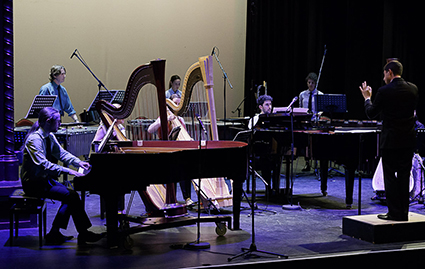
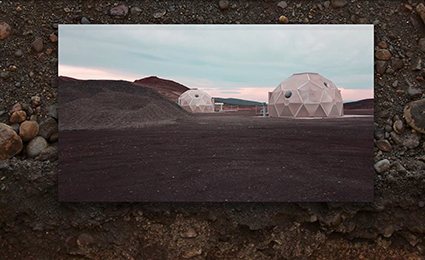

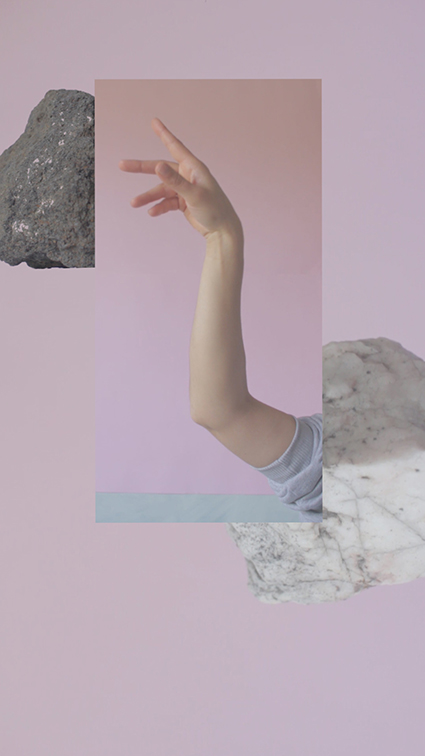
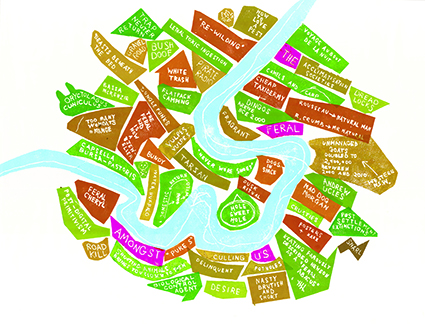
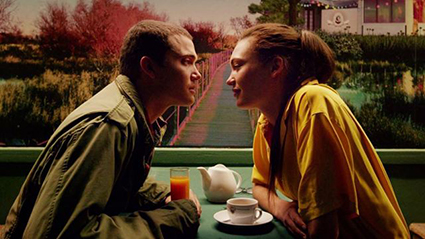
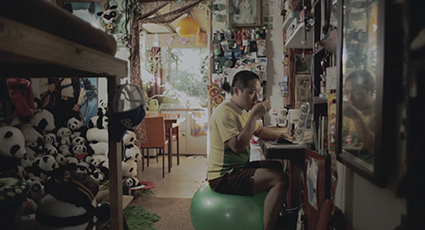
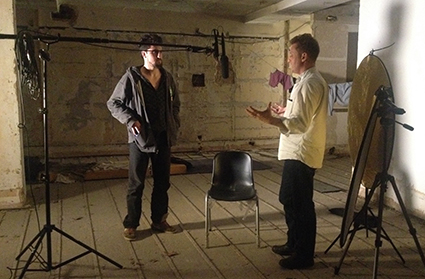
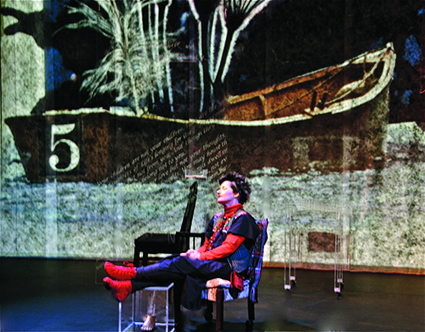
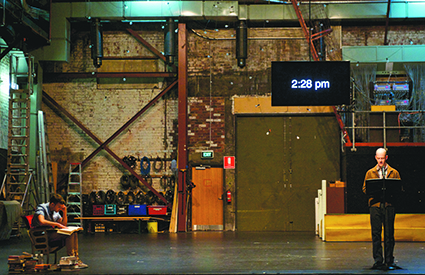
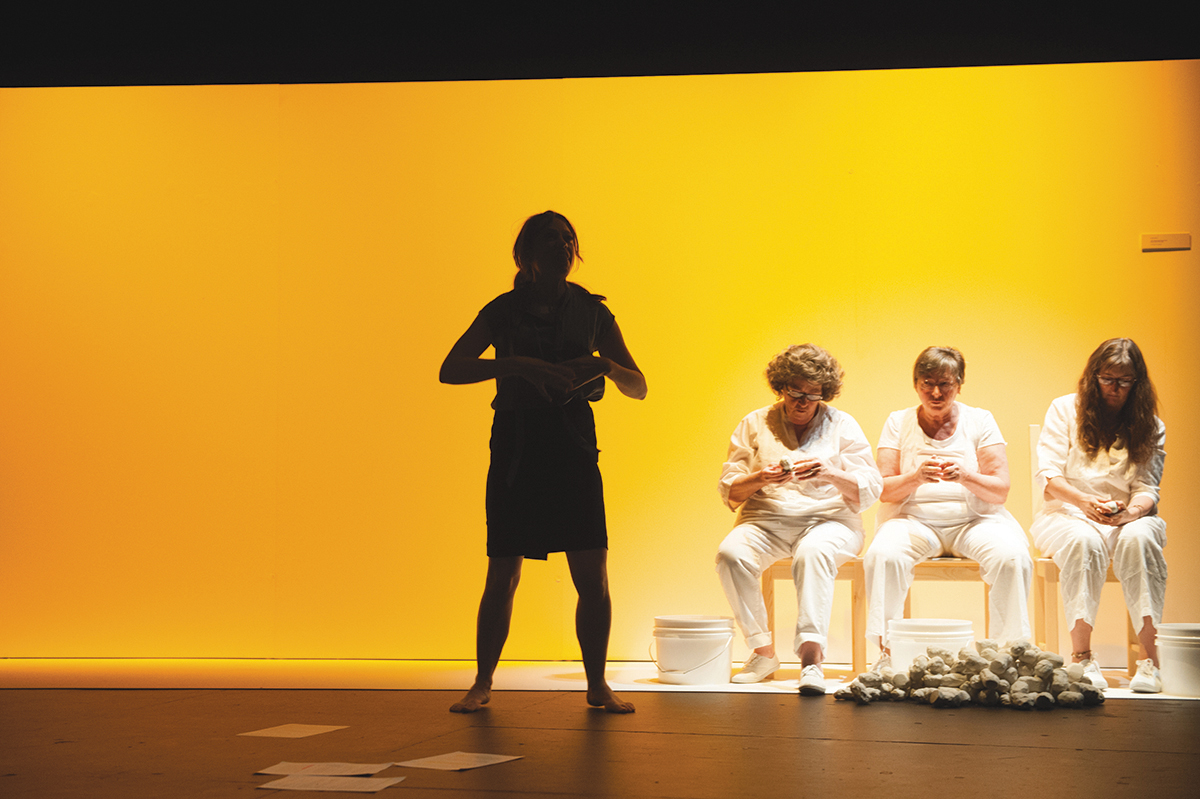
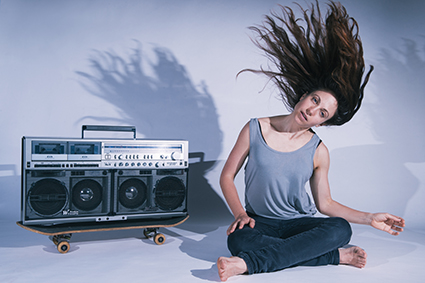
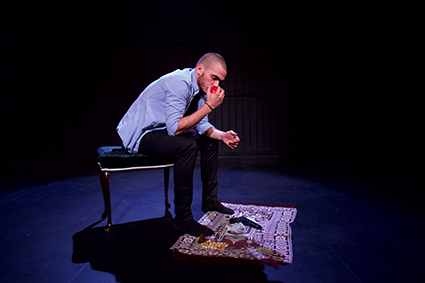

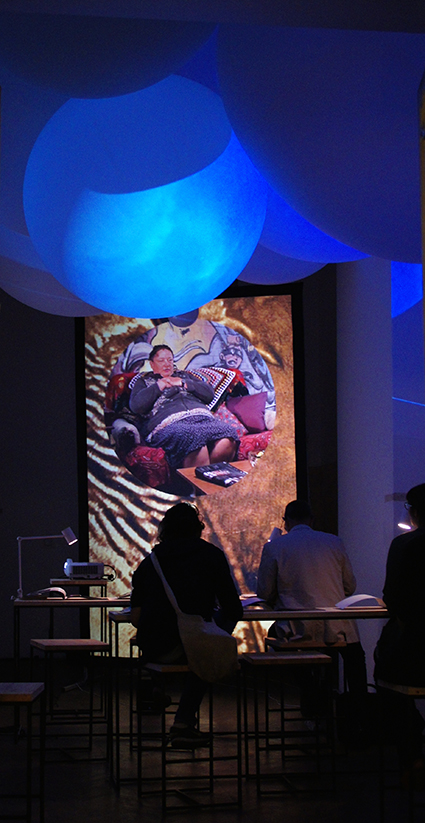
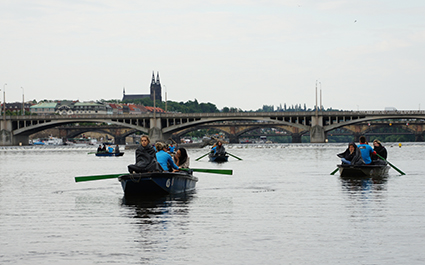
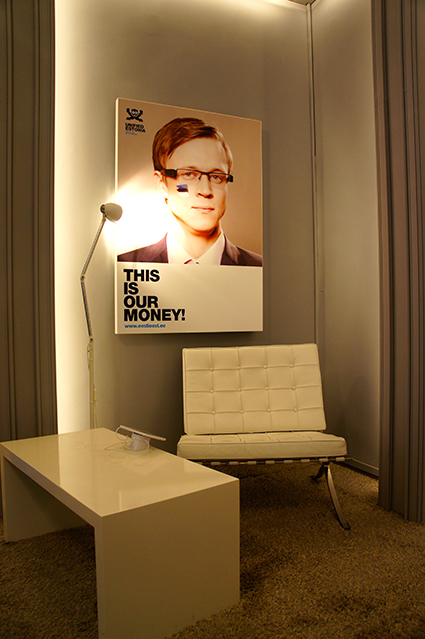
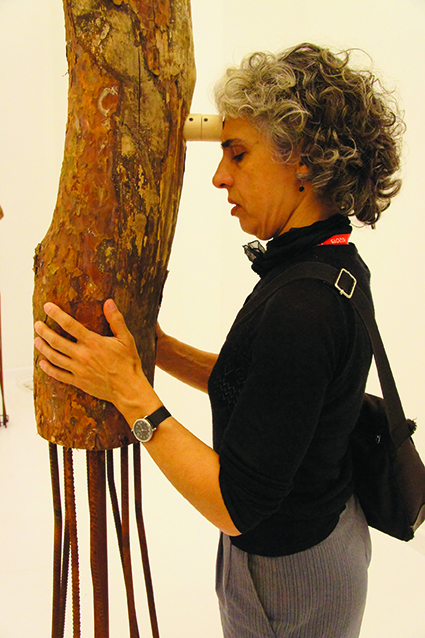
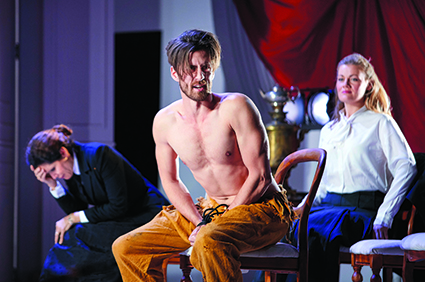
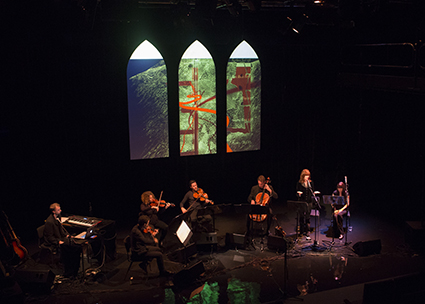
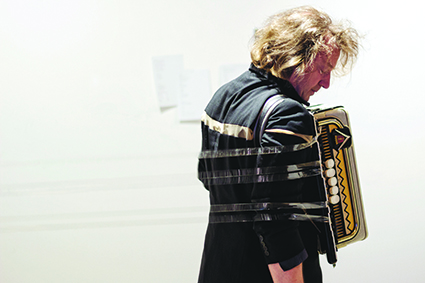
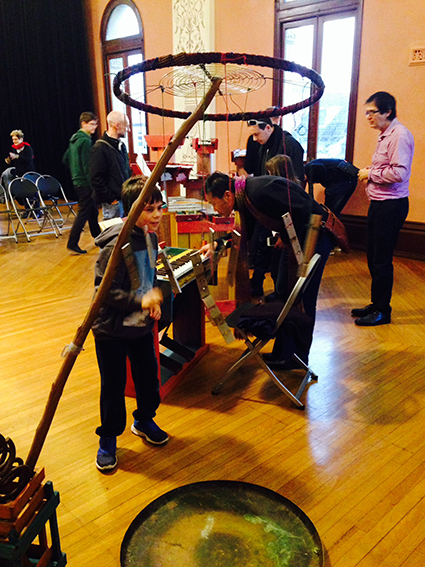
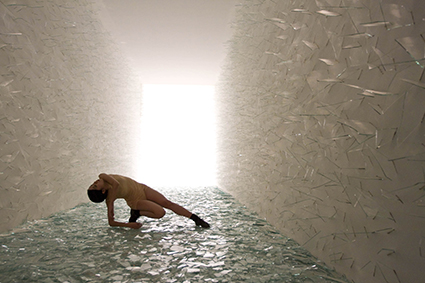
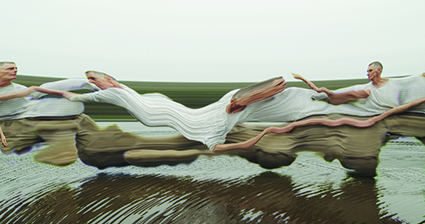
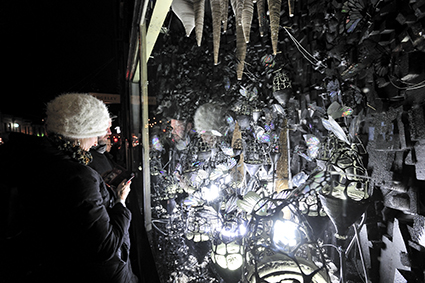
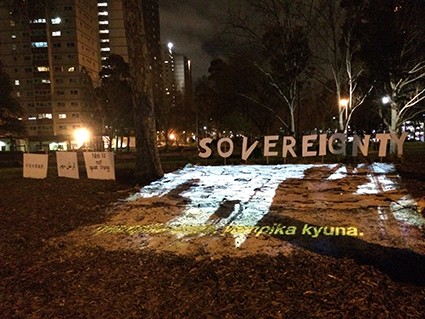
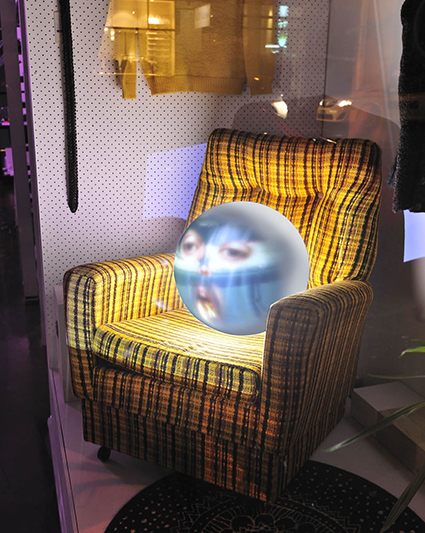
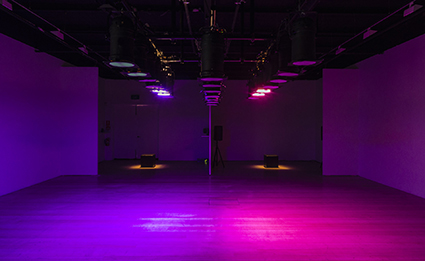
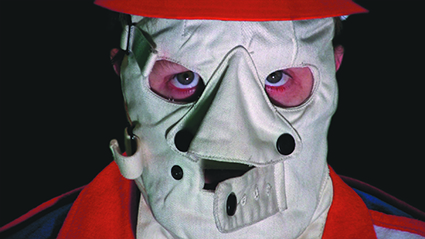
 5 Copies of Citizen Four, the breathtaking documentary about Edward Snowden (courtesy of Madman Entertainment).
 3 copies of Fairfax film reviewer Jake Wilson’s entertaining reassessment of Philippe Mora’s Mad Dog Morgan (courtesy of Currency Press).
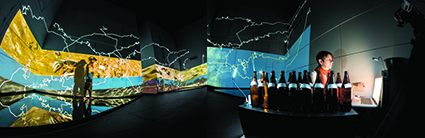
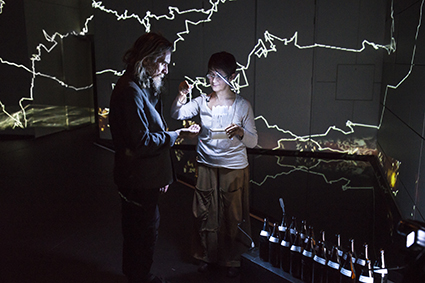
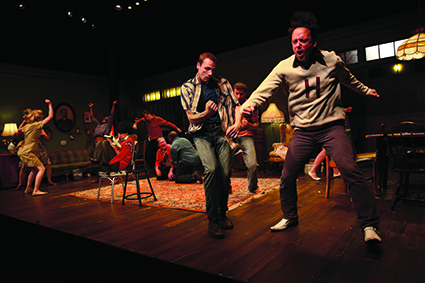
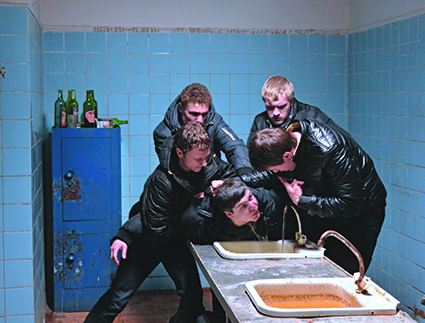
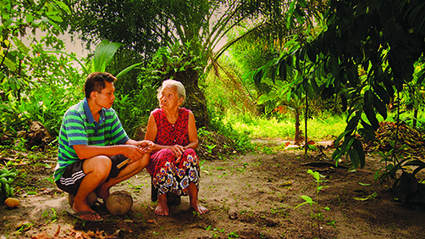
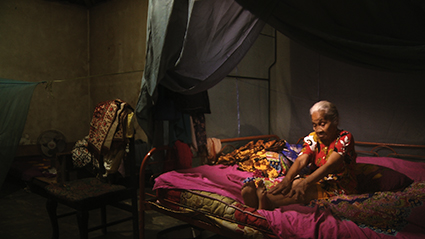
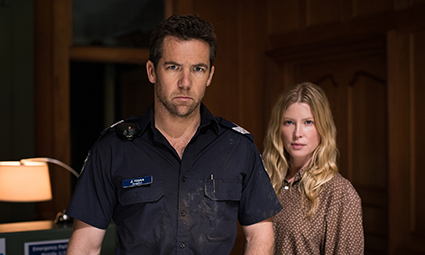
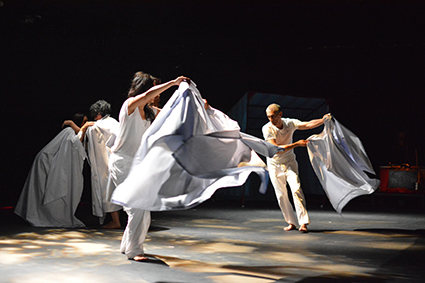
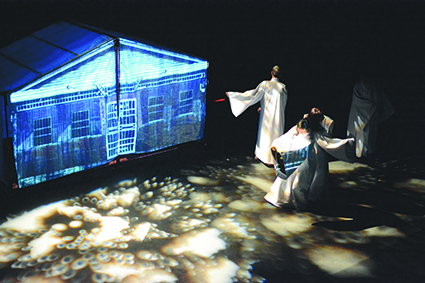
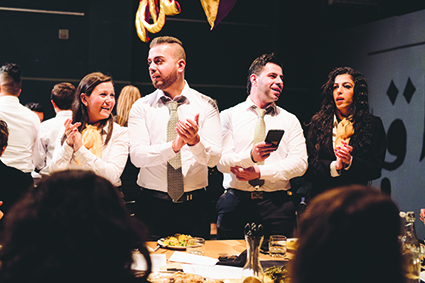
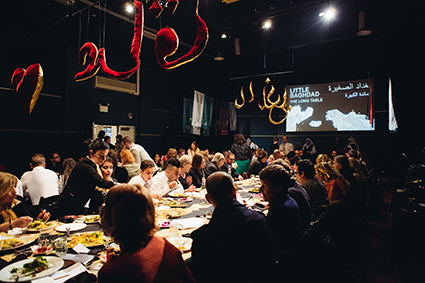
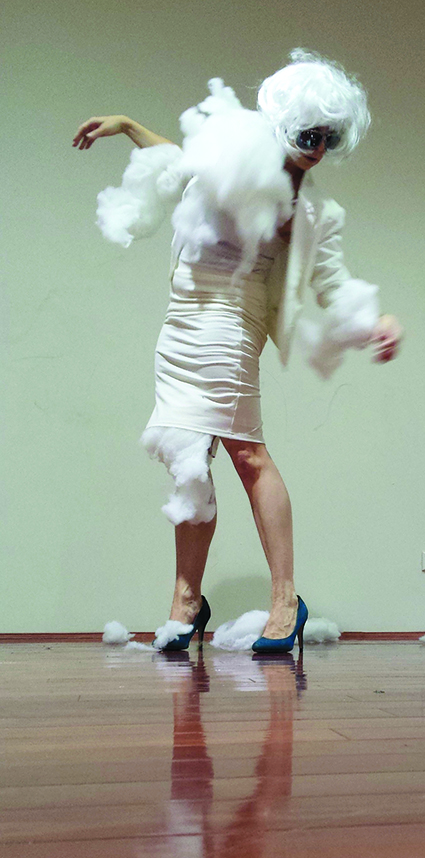
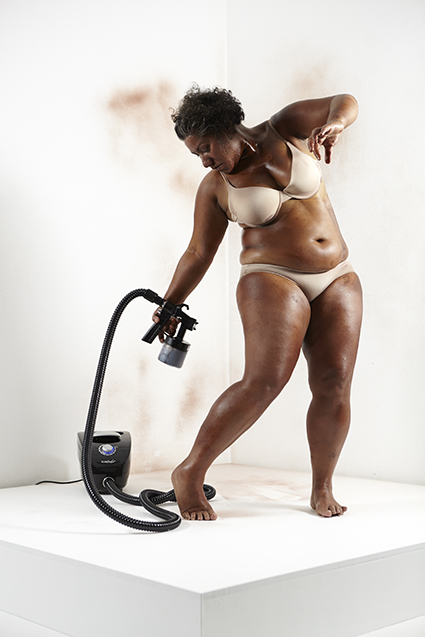
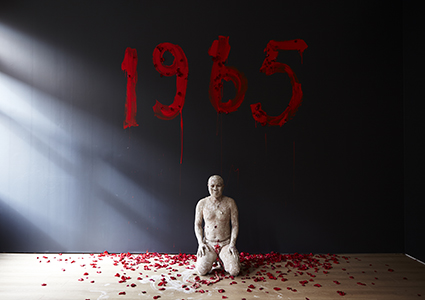
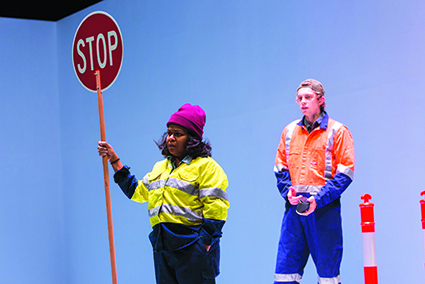
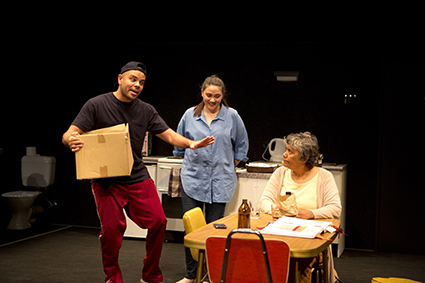
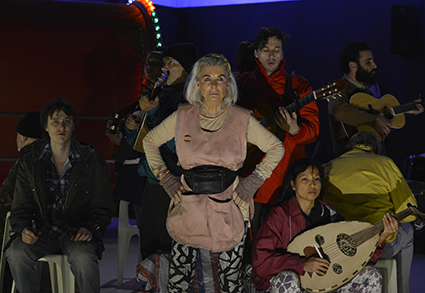
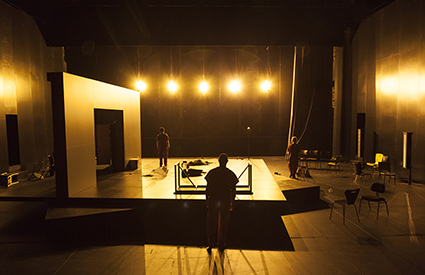
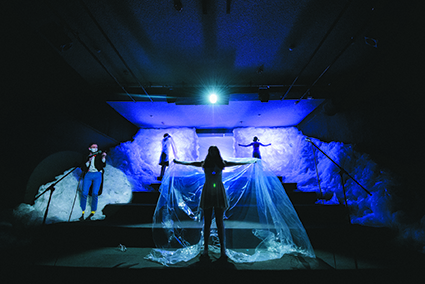
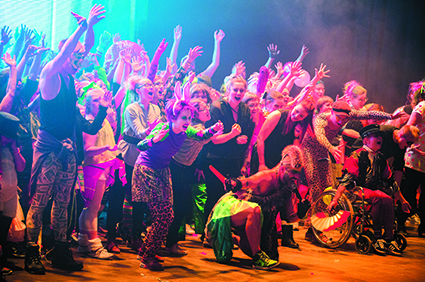
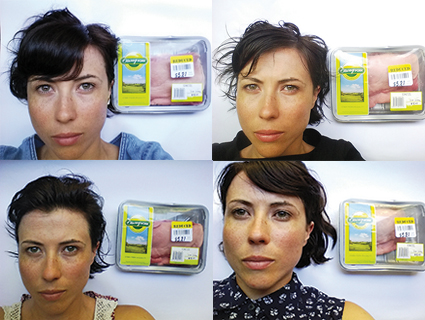
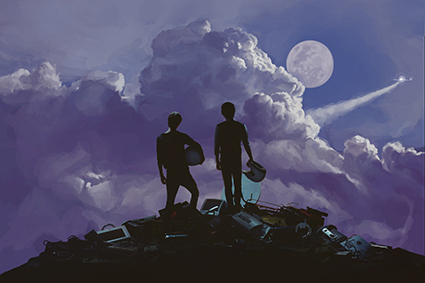
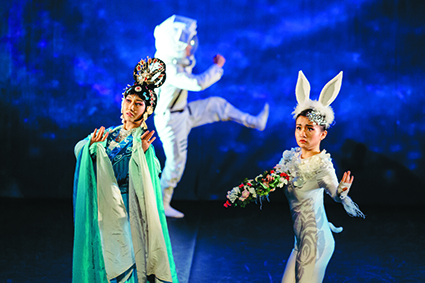
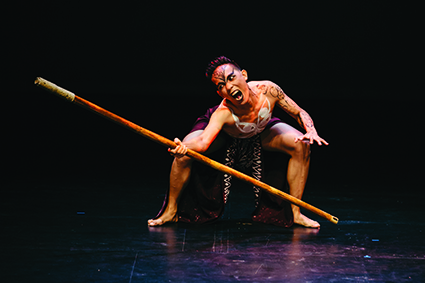
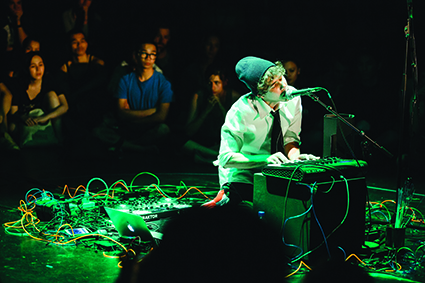
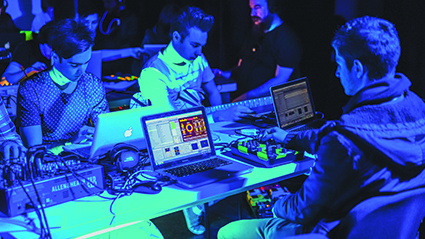
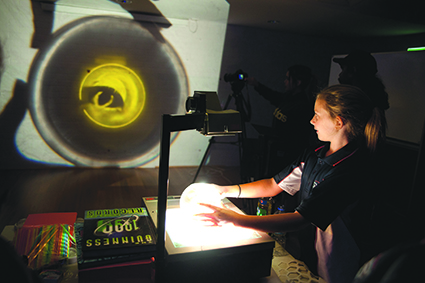
![Jade Suine, Random Generator Experiment, drawing [meat package]](https://www.realtime.org.au/wp-content/uploads/art/83/8386_unpack1.jpg)