Above Adelaide’s Fontanelle Gallery is a banner saying, “Occupied and Enjoyed.” The gallery is being occupied by a group of artists staging Bound and Unbound: Sovereign Acts—decolonising methodologies of the lived and spoken. As we arrive at the exhibition, attendants in lab coats ask us to sign a register—we are now under surveillance.
Bound and Unbound is a group exhibition of videos, texts, a ceiling-high stack of books, a field of red sand representing desert country, family photos and a representation of a traditional bush camp. But the key elements are the performances and the key issue is the exhibition’s agenda.
Performers Ali Gumillya Baker, Simone Ulalka Tur, Faye Rosas Blanche and Natalie Harkin are lecturers at Flinders University’s Yunggorendi First Nations Centre for Higher Education and Research, which provides support for Indigenous students at the university, engages in Indigenous research and education and is involved in communities of practice.
Bound and Unbound curator Baker also has her studio at Fontanelle. In the exhibition press release, she writes, “This experimental work aims to explore complex ideas of being both bound and free; what we are bound to historically and, as sovereign people, what we choose to (un)bind ourselves to and from, both now and into the future. The core themes include: interrogations of State colonial archives; notions of ethical practice and responsibility; enacting memory and storytelling; and sovereign identity and (re)representation.”
The performances are powerful and eloquent: Baker announces the exhibition’s aims; Yunggorendi Director Simone Ulalka Tur sings, accompanied by her niece Katie Inawantji Morrison on violin, and reads her mother’s poetry. Poet Natalie Harkin pastes up a text on the wall that reads, “Attention record keepers of the State we have you under surveillance!” referring to the surveillance of Indigenous people during South Australia’s colonial history and the retention of records of Indigenous communities held in the State Archives. Baker tells me that she needed written permission to access her family’s records, having had to sign a confidentiality agreement, and that Indigenous South Australians still feel under surveillance as if outside the community. Her video Archive Fever Paradox, of a performance by Harkin, also addresses the issue of the Archives, and her video of Tur and Blanche’s My Pen is My Weapon announces the group’s philosophy.
The family photographs recall and honour ancestors. The books in the stack are anthropological texts concerning the habits and nature of Indigenous people and their history. Baker declares these books racist; the artists’ intention is to address what has been written about Indigenous people in order to reclaim their history, change the way in which Indigenous people are understood and to re-present themselves. She cites Judith Butler’s concept of subjection and the process of becoming a subject of power as indicative of the colonial past and notes that Indigenous people are still defined racially. Their artwork is about how representations of Indigenous people still shape the lives of these people and our perceptions of them.
This is activist, community art. When viewers at the exhibition register on entry, they will subconsciously identify as Indigenous or otherwise and implicitly are asked whether they are in solidarity. The group demands decolonisation, reclaims Indigenous sovereignty and seeks mutual respect, inclusion and understanding. Indigenous people in SA lived under the Aborigines Act and this exhibition represents a symbolic emergence from it — to become unbound.
Baker and Tur tell me they are undertaking an educative process that is intended to complement their roles as lecturers at Yunggorendi. They teach Indigenous culture to non-indigenous university students and the artistic material they have developed will be used in their teaching. Using Fontanelle for the exhibition allows them to step outside their university roles and to develop their art in a space that supports experimental and interdisciplinary artwork. They use the space to promote dialogue between cultures and across art forms—theatre, installation, video, poetry—and they are interested in how experimental art might be used, citing as influences Richard Bell and the proppaNOW collective. It is a transforming experience for the artists themselves—they are undertaking PhDs and will use this experience in thinking through their research.
Bound and Unbound is described as Act 1 in a project that is planned to continue into 2015 with the production of further videos and possibly street art in key locations. It forms part of a broader project including the Tall Ships performance (recorded on video by Baker) at the opening of the Historia group exhibition, Adelaide Town Hall, earlier this year, which reconsidered Adelaide’s history.
Bound and Unbound: Sovereign Acts—decolonising methodologies of the lived and spoken, Ali Gumillya Baker (curator), Simone Ulalka Tur, Faye Rosas Blanch, Natalie Harkin, Fontanelle Gallery, Adelaide, 24 Aug-21 Sept
Proximity Festival, Australia’s celebration of one-on-one performance, finds big dreams, plans and talents being brought to bear on the most intimate artistic performance experience.
Proximity Festival 2014 has a new home at the Fremantle Arts Centre for its three programs running from 22 October to 2 November. Producer Sarah Rowbottam has been sharing the helm with co-founders James Berlyn and Kelli McCluskey since the festival’s inception, and is enthusiastic about the many “firsts” added to the one-on-one performance festival’s composition each year.
2012 welcomed the first Proximity Festival, with daily bumping in and out of an eclectic collection of shows at The Blue Room Theatre in the middle of the frenzy of Fringe World, where it won the Spirit of Fringe Award. 2013 found Proximity Festival occupying an entire venue, enjoying more established settings in the studios, gallery spaces and random nooks and crannies of PICA and introducing the public Symposium and artists’ Lab programs. This year, moving away from Northbridge to the Fremantle Arts Centre, the Symposium program has changed to include all festival artists in the keynote, an intensive weekend Masterclass for the general public has been introduced, a national curatorium has been assembled and artist Julie Vulcan has been invited in as provocateur, bringing new ideas and experience to the core curatorial team.
The 12 micro-performances range widely not only in their use of space, but in the scope of their coverage of artistic practice and topics. Rowbottam is enthusiastic about the power of the “subtle but strong messages” possible in the un-themed collection. In Let’s Make Love, Jen Jamieson scientifically examines the bonding hormone oxytocin with you, but minus the romance, while in The Queue, Toyi-Toyi Theatre will test your ‘Australianness.’ Air from different eras generates atmosphere in Emily Parsons-Lord’s Different Kinds of Air, A Plant’s Diary; voices lead the way in Dance with Me by Sylvia Rimat; and Ian Sinclair’s Learner may cause stress as you teach him how to drive. Vulcan says, “some of the simplest ideas are the most beautiful” and some of the most basic ideas are also the most evocative. “Not all performances in a program will affect you in the same way. Even if only two out of four capture your attention, the other two are a bonus, which would be the case in any hour-long performance”, just as most staged theatre, consisting of spaced climactic points, will not be uniformly compelling.
Three programs of four shows apiece accommodating a total audience of 12 each night work against the aims of most arts festivals. Stepping away from the notion of bigger being better, Rowbottam cites fellow festival founder James Berlyn’s belief: “There are equally big pay-offs for audience and performers in small-scale, intimate and one-on-one works”—a philosophy that sees Proximity Festival create a space for the audience and artist to grow and create something new with each and every performance.
Before the festival, the artists are put through a two-week developmental program, Proximity Lab, overseen by the festival’s provocateurs, a process that Rowbottam says is “important in breaking preconceptions.” The Lab and Masterclass also bring together artists with an interest in the form. Vulcan is enthusiastic about the “richness of gathering artists together, an inspiring aspect” that develops one-on-one practice. And the festival is educating audiences about this artform; she is confident that “growth will come through word of mouth.”
Rowbottam is also keen on making artists self-sufficient beyond discovering the essentials of their art, with a pragmatic workshop on how to market themselves and create opportunities in the commercial reality of the contemporary art world. Alongside developing a sense of the global market for one-on-one works, Rowbottam wants artists to “keep to the spirit of the performance, while considering everything that can go wrong,” to consider personal and artistic boundaries both for artist and audience in the potentially confrontational nature of one-on-one presentation. Vulcan says that artists “can forget about the needs of the audience and assume the audience wants to be there and creating with them.” As provocateur she encourages the artists to think in terms of an exchange of gifts via performance, to consider what is being given and on what levels.
With a national curatorium, guest provocateur, a more diverse opening night, its Lab and Masterclass, Proximity Festival is finding every way to grow, save for raw audience numbers. But each night is sold out. More inquisitive audiences seek the experience of participation. The opening night Party for 1 promises to be lots of fun, with lateral thinking shaping the planning process. Rowbottam reminisces about rejected plans for 2013’s initial opening night, which included sitting down at the bar for a quiet drink with all 12 audience members, but this year’s plan looks more interesting, offering a celebration of one-off performances, music and “hidden surprises,” along with the cake. Even the keynote speech at the Symposium is evolving, with the 12 performers each delivering intense insights into their work with one-minute manifestos.
Proximity Festival 2014 promises great things, not only in itself, but in the development of artists, audiences and tourable works in the years ahead.
See RealTime Profiler 6 for Ben Brooker’s interview with Cat Jones, a 2014 Proximity Festival artist.
Proximity Festival 2014, advisor, provocateur James Berlyn, co-curator, producer Sarah Rowbottam, co-curator Kelli McCluskey, provocateur Julie Vulcan, artists James Berlyn, Caroline Garcia, Jen Jamieson, Cat Jones, Loren Kronemyer, Tanya Lee, Emily Parsons-Lord, Sylvia Rimat, Hallie Shellam, Ian Sinclair, Alina Tang, Toyi-Toyi Theatre; Fremantle Arts Centre, 22 Oct-2 Nov; www.proximityfestival.com
Making art is more than a job and it’s more than a life-style choice—for many, it’s an all-encompassing way of being. This can make living with an artist a difficult feat, unless both are of like constitution. So it’s not surprising that in the art world there are many couples who share both their lives and their art.
RealTime is run by such a couple, Keith Gallasch and Virginia Baxter, who, before their foray into publishing, also produced a large number of contemporary performances as Open City, often drawing on personal experiences and their relationship or, as Apartners, working as consultants for other artists.
Of course it’s not all smooth sailing—one’s partner is often one’s harshest critic, but perhaps this is a key to the conceptual rigor often illustrated in the creative manifestations of couples. To get to the bottom of this, over the next two Profilers, we are asking a number of art couples about their collaborative practices. We thank them for their generosity and their honesty. Gail Priest, Online Producer
PS. The natural extension of this is the art family, and if you haven’t already, the RealTime team strongly suggests you read The Family Fang by American novelist Kevin Wilson about two siblings struggling to accommodate their performance artist parents’ radical interventions. Nicole Kidman’s production company has produced the film of the book, directed by Jason Bateman.
We are currently working on an ongoing series of performance installations investigating our relationship as both partners and collaborative artists. This has come about really as a response to interest that emerged from interviews and discussions about our roles as Co-Artistic Directors of Art Month Sydney 2013, and the works we produced after that time. We were pushed throughout that period to talk about the benefits and challenges of working together as romantic partners, and so it’s been a natural progression that those conversations and reflections have become the focus of our current work.
The experience of producing our first collaborative work in late 2010/early 2011 made us aware of the different skill sets we each have and how they can and do complement each other so well. We also found the scale of work we could produce together was much greater than either of us had attempted or contemplated in our individual practices at that stage.
Beyond that initial realisation, of course we also discovered the tension and difficulties of working as collaborative artists with different schedules, priorities and approaches to making. We find ways to negotiate that, sometimes we can work through it and produce something incredible, other times, for whatever reason, we can’t or don’t want to, and there’s a silence. This process has inspired our recent series of works.
Alexandra Clapham, Penelope Benton: 1) Great Expectations, Day for Night, Performance Space; 2) Self-Portrait in a Room, SafARI 2014
courtesy the artists
Alexandra Clapham, Penelope Benton: 1) Great Expectations, Day for Night, Performance Space; 2) Self-Portrait in a Room, SafARI 2014
Great Expectations for Performance Space’s Day for Night at Carriageworks earlier this year was presented as a tableau vivant in sittings varying 90-150 minutes. This piece encapsulated both our working relationship and romantic partnership, a rhythm one could say was synonymous with many couples. The days, the nights, the stillness, the nothing, the expectations, the boredom, the waiting, the brewing, the growth of ideas, the clashes, the tension, the conflict, the noise, the intensity, the passion, the moments, the magic.
At Wellington St Projects for SafARI this year, we built two sets within one room in an adaptation of Floor 7½ in Charlie Kaufman’s film Being John Malkovich—the half floor which has a portal to Malkovich’s mind. Each set contained a hyperreal version of ourselves presented as living self-portraits, this time in sittings of 180-240 minutes. Again the tableau is used as an allegory to examine our public and private selves, both as individuals and as partners.
Our new work currently being developed, experiments with these living portraits in video format. http://penelopealexandra.com/
Related article
Enduringly queer
Fiona McGregor: Day for Night, Performance Space
RealTime issue #120 April-May 2014 p26
Clocked Out Duo in the studio
courtesy the artists
Clocked Out Duo in the studio
Clocked Out (Erik Griswold & Vanessa Tomlinson)
When “partner art” is good, it’s really good. But when it’s bad, it’s really bad! To be able to take a new idea, the excitement and creative energy, and share it with someone you love is a beautiful thing. That enthusiasm can spill into your everyday life and become infectious. Meetings happen at any time, inspiration arises while hiking, watching TV, gardening or waiting for the kids’ cricket game to finish. And on the good days, when this does happen, you have your collaborator right next to you and the idea progresses to actuality in an instant. The energy of two people can lift something out of the imagination effortlessly. But if you pick the moment badly, the same idea can also get squashed and left behind. If there is any negativity, conflict or stress, there is no escape. It doesn’t stay in the office, but follows you home 24/7.
Two advantages of working with a creative partner over a long span of time (about 20 years now!): the depth of possibilities that come from experience; and trust. We know that at the end of the day, our partner will come through. On the other, hand there is the challenge of how to keep things fresh. For us it’s been essential to have a balance of solo, duo and collaborative projects which have consistently helped to reinvigorate our artistic practice.
Clocked Out Duo with The Australian Voices.
courtesy the artists
Clocked Out Duo with The Australian Voices.
Our project The Wide Alley, based in Sichuan Province in China, evolved with us both experiencing a new culture together. It integrates the very survival of the situation, the amazement of newness, the adventure of discovery and the extraordinary music to be found there. We began this in 1999, at the beginning of Clocked Out, and in a way this adventure into another world shows us working at our best. We really need each other here, to communicate, push and understand just how difficult an artistic process really can be. We are heading back there soon to make Water Pushes Sand for the Australian Art Orchestra, to see now familiar things and to experience the new—with kids in tow. We are building new experiences, supporting each other and trying to make sure that support includes critiquing, asking questions. Hopefully by now we know how and when to push each other, when to step up and cover the other’s insecurities, when to allow the other to shine. We wouldn’t have it any other way. http://www.clockedout.org
Claire Healy & Sean Cordeiro, Dounreay, 2014, Gallery Wendi Norris
photo Johnna Arnold
Claire Healy & Sean Cordeiro, Dounreay, 2014, Gallery Wendi Norris
Claire Healy & Sean Cordeiro
Right now we are working towards our solo exhibition at Gallery Wendi Norris in San Francisco. The exhibition is titled Architects of Destruction. The body of work consists of Lego, cross-stitching and whiteboards. The works all depict fantastic scenarios that inevitably lead to destruction. They are based on historic catastrophic events or allude to future scenarios that may lead down a similar path. The works meditate upon the saying ‘the road to hell is paved with good intentions.’
There are many levels to the execution of a body of work like this. Initially one of us would have been struck with the idea. This would then have been conveyed to the other, and probably not met with the same enthusiasm, so the idea was probably shelved in a sense by writing or drawing it into our shared diary. Although an initial concept may not be considered so great, we record the idea anyway. Over time, ideas percolate or other opportunities arise, an old idea is revisited and given a different spin. We have found that our minds work very differently, so using this method seems most effective. We often forget who came up with the initial concept, or an idea has morphed so much from incarnation to execution that it really becomes a true collaboration.
We have found that working collaboratively can mean having to verbalise everything we consider. Sometimes this can stifle the subconscious or naive level of art making. We did try reading an identical library once so that we did not have to speak to each other and eventually have our minds synched. This did not work! Our reading habits and speed, did not match. Perhaps subconsciousness is lost when a work is conveyed from two entities.
Claire Healy & Sean Cordeiro, Downstairs Dining Room – Octopus, 2014, part of Habitat, Rimbun Dahan, Kuala Lumpur
courtesy the artists
Claire Healy & Sean Cordeiro, Downstairs Dining Room – Octopus, 2014, part of Habitat, Rimbun Dahan, Kuala Lumpur
Executing work and seeing it to its end seems to be more effective when collaborating. When so much time, labour and effort goes into the creation of a work, it will not suddenly be dropped because you have lost interest. There is a level of mutual respect that somehow is great for completion. We both have different skills that complement each other. We don’t have scheduled meetings but find that being stuck in a car together for a long time forces us to talk about work.
Rosalind Crisp, Andrew Morrish, Hansueli Tischhauser, No one will tell us…
photos Patrick Berger, courtesy the artists
Rosalind Crisp, Andrew Morrish, Hansueli Tischhauser, No one will tell us…
Andrew Morrish & Rosalind Crisp
I am a Partner Art Phobic. I am terrified of seeing ‘too much information’ disguised as intimacy. Ready to gag on presentation of the ‘reality of our relationship.’ I had been traumatised at an early age by one of a couple reading, in a performance, a description of her pleasure in cupping the balls of her partner, when I had had dinner with them the night before.
When Rosalind Crisp (dancer and choreographer) and I (Andrew Morrish, improviser and teacher) began our personal relationship in 1999, we were both established artists with our own practices. The romance of the moment did not sway us into thinking we would make work together. From my perspective this decision was driven by my prejudices and my feminist beliefs. From Rosalind’s perspective it came from the fact she was already too busy to include me.
Our first appearance together on stage was for two minutes in a piece by Emma Saunders at Omeo Dance Studio in which she invited 30 people to dance to the same two minute song in 2001. Nikki Heywood said we “had legs,” but I was not convinced.
Our separate practices meant we were both busy with our own work, but we were also partners so it was clear that we began to influence and support each other. I was able to help with keeping the Omeo Dance mailing list up to date, even made a letterhead for Rosalind’s company. Rosalind’s Sydney and international network became available to me as I began to expand my teaching practice away from Melbourne.
In a relationship, for me, the fundamental verb is ‘support’ and we both began to offer this to each other while we continued to develop as individual artists. We saw each other’s work a lot and of course became experts in it, and confidantes. These are very precious commodities. I always felt that it was important for Rosalind to be able to come home after a day in the studio and be able to complain to me about her collaborators and that this would not be possible, or be more difficult, if I was one of them.
When we shifted our base of practice to Europe in 2003, our support roles for each other became even more important in our new isolation. I was often involved in the production side of Rosalind’s presentations. I was not particularly skilled in that area, but I was cheap, available and understood her intention. It was also clear that at certain times, in certain French theatres, other production staff were confused by my role as Artistic Conseil/Husband.
On one occasion, when producing danse (4) in Paris, one of the dancers hurt her knee and was unable to perform. The structure of the piece could be rearranged to accommodate this, but the “4” in danse (4) refers to the number of dancers, so I became the fourth dancer. My role before that had been to organise the seating for the audience and to iron the costumes for the dancers.
I had already been a performer in duck talk (2005—a collaboration between Rosalind, David Corbet and The Fondue Set) and was later to become a performer in No one will tell us…(2010) In all this, and still today, it is clear to me that in these pieces I was working in Rosalind’s work. I maintain my own solo practice and this I consider to be my work. We have no work that is ‘our’ work. I support her work in anyway I can, through encouragement, criticism, technical and artistic participation, filling gaps when required. And she in turn does the same for me.
Oh how they danced!
Virginia Baxter: Oh I Wanna Dance With Somebody
RealTime issue #112 Dec-Jan 2012 p2-3
Testing the tightrope
Keith Gallasch on Andrew Morrish and improvisation
RealTime issue #81 Oct-Nov 2007 web
Rosalind Crisp is one of the 12 Australia choreographers featured in Bodies of Thought, published by RealTime and Wakefield Press (2014). Supporting material is available at realtimedance
Sally Rees, Matt Warren, Burnie residency
courtesy the artists
Sally Rees, Matt Warren, Burnie residency
Sally Rees & Matt Warren
Having a partner who is a practicing artist and collaborator can be an exercise in dealing with objectivity and subjectivity simultaneously. Critiquing the other’s work from the mindset of a partner begs care as to how your response may be interpreted, bearing in mind the intimate knowledge of the creator’s thoughts and biases as well as one’s own. However, one must also be mindful to remain an objective, critical onlooker.
Perhaps most importantly for the collaborative process, in addition, to the genuine enjoyment in working together, we have a deep respect for each other’s practice. It is the differences in approach, process and conceptualisation, not the similarities, that are the most important elements, colliding to produce something that neither one of us could achieve alone.
It is vital to both of us to keep objectivity at the forefront and maintain a professional attitude when we collaborate, perhaps as a result of having seen collaborations between other couples break down as the needs of the relationship become greater than the project. Often at the end of a collaborative day we may give each other a peck on the cheek and jokingly declare the act “purely professional.”
Having a child has made collaboration difficult as we’re rarely available at the same time—one is always parenting—but a recent opportunity changed that. A residency in Burnie (our birthplace and a once notoriously polluted city), where family generously took over child-care, meant that we were able to work side-by-side—our first one-to-one collaboration for some time. Suddenly two artists turn and face each other, reintroduced, after following each other’s practices in parallel. What a wonderful thing to do.
We acquainted one another with sites of personal history, allowing ourselves to indulge in memory to discover both shared experience and singularities and then seeing it all reflected in the eyes of our son. It was an inspirational and emotional experience.
Sally Rees, Matt Warren, The Snowman
courtesy the artists
Sally Rees, Matt Warren, The Snowman
The creation of The Snowman evolved from shared memories of the local titanium processing plant that evoked mythic images of white men emerging and a stand of white trees by the roadside. An interview with an ex-employee gave further fodder to this idea and we used his voice to soundtrack an animation of a white figure moving through a landscape we created from weeds at the factory site. An invented, memorial cryptozoology.
The Ronalds: 1) Shannon Ronald with an example of one of a 3D Photo-Sculpture; 2) Patrick on location at the Barmedman Mineral Pool for the In Common project
courtesy the artists
The Ronalds: 1) Shannon Ronald with an example of one of a 3D Photo-Sculpture; 2) Patrick on location at the Barmedman Mineral Pool for the In Common project
The Ronalds (Shannon & Patrick)
Patrick and I have been collaborating exclusively on projects for very close to 10 years now. We started out working as Ronald+McDonell and since getting married in 2010 we have officially become The Ronalds, even though this is not quite as amusing as our old title.
We both trained as photographers, but over the years have morphed into installation artists who work in many forms, including photo-sculpture and interactive gamification. This progression into three dimensions and the virtual world is due solely to working as a partnership, pushing and testing both our diverse skills sets and interests.
Together we challenge each other to come up with more ambitious projects and to take on commissions that we might not be brave enough to attempt as solo artists. Our work is made stronger by our differing skills and opinions, as we both need to be convinced that our decisions are the best ones for our project, and it is during our constant discussions and problem solving that our best ideas are formed.
I have always explained our working relationship as me being the editor—Patrick comes up with the most fantastically ambitious projects, and I find ways to produce the same outcome in a more achievable way without compromising the original vision.
For our current project, In Common—Public Places of the Murrumbidgee/ Riverina, we have been commissioned to create work for the Wagga Wagga Art Gallery’s 40th anniversary next year. For this work we are creating hundreds of 3D photo-sculptures, small replicas of buildings throughout the region and turning the gallery into an immersive interactive environment that aims to reconstruct a region ranging 60,000 square kilometres from the Snowy Mountains to the vast plains of the Long Paddock. Our work roles in this project are defined naturally: we never need to decide who will do what, we just know. For this project Patrick has taken photographs of objects throughout the Riverina and will construct physical large-scale components and assemble any electronic parts for the final exhibition. I have created the online platform for the community input and will reconstruct Patrick’s photographs into 3D paper models and design the interactivity.
Over the years we have honed our individual skills and strengths to make working together on our projects a seamless process, and I can safely say that working as part of The Ronalds is the only reason that I am still making art. (Shannon Ronald) www.incommon.com.au, www.theronalds.com.au
Our current project, Augmented Terrain, is an immersive audiovisual installation that re-imagines the relationship between nature and culture. We present highly detailed aerial views of Australian landscapes and waterways that we dynamically manipulate in ways that reveal their underlying fragility. Through collaboration with Slovenian artist Marco Peljhan, co-founder of C-Astral, we are using their fixed wing drone system to photograph these zones in crisis. Our vision is to configure the land as active and to imagine it being able to speak and make comment about human impacts upon it. This Creative Australia funded research project culminated in a two-week residency at the Io Myers Studio, University of NSW in partnership with Performance Space where we exhibited the first iteration of the work, documented here. The full-scale installation will be shown in 2015/16
Starrs & Cmielski 1 & 2) AugmentedTerrain 3) Drone launch, Augmented Terrain in development
courtesy the artists
Starrs & Cmielski 1 & 2) AugmentedTerrain 3) Drone launch, Augmented Terrain in development
A comment from Lionel Bawden, artist and friend.
“It is funny observing an artist couple, with the intimacy of friendship, as it is easy to take aspects of the collaborative relationship’s success for granted. I would say with Starrs and Cmielewski, it’s the things that make the relationship a success that similarly bond the collaboration. Their differences create strengths and they have a deep admiration for and acceptance of one another’s thinking. They can argue with the best of them, with very passionate, distinct voices, so conflict resolution really means they discuss decisions in detail. Leon and Josephine are very playful in their thinking, so they take risks together, taking the audience in interesting directions.
It is like going to their place for dinner—they usually prepare different parts of the meal separately whilst conjuring the banquet together, often using recipes they have been perfecting for a long time, which one may have originally introduced to the other. They confer and consult constantly and one will defend their decision to cook something another five minutes or throw in a little more of something, to a supportive “Okay, good, I was just checking.” There is always a new piece of technology brought in to spice up the dish, like a space age barbeque on the balcony. Their dinners are amazing and over time their collaboration has become simultaneously more inventive and more relaxed.”
Multidisciplinary artist Cat Jones is in Adelaide this month as an ANAT Synapse artist-in-residence at the University of South Australia’s Sansom Institute for Health Research. She is attached to the Body in Mind research group who investigate the role of the brain and mind in chronic pain. Here she will be continuing one of her current investigations which looks at the idea of body illusions and their application in treating chronic pain.
Vocationally and geographically, Jones is hard to pin down: her CV spans over 20 years and an impressively diverse range of live art presentations, research engagements and curatorial and advisory roles. Either side of her time in Adelaide will take in a residency in Perth (with the University of Western Australia’s School of Medicine and Pharmacology) and a performance in Fremantle (at October’s Proximity Festival for one-on-one intimate performance). Next year Jones will travel to the Institute for Art and Olfaction in Los Angeles where she will explore the creation of “bespoke and conceptual scents” for potential use in a performance context.
Jones’ current work is situated at the crossroads between art and science, and performance. I was fortunate enough to be one of only 15 people to experience her Somatic Drifts v1.0 at this year’s national artist hothouse Adhocracy [see RT122]. I was not alone in finding the sensory, one-on-one work which investigates interspecies empathy, to be a memorably affecting experience. Jones is still receiving feedback from audience members: “I’ve seen about five of the participants and each one has wanted to talk about the work again or say something about their experience and their memory of it. So I’ve had positive feedback in that way which is more ‘I really love that work’ or ‘thinking about it I can still feel it in my body.’ Someone I saw recently said they wanted to do it every week. They wanted to book into that experience.”
Cat Jones, Somatic Drifts v1.0; illustration by Cat Jones, remixed under Creative Commons Licence 4. Original images accessed via Wellcome Trust & Stephen Hale Vegetable Staticks, Google Books
courtesy the artist
Cat Jones, Somatic Drifts v1.0; illustration by Cat Jones, remixed under Creative Commons Licence 4. Original images accessed via Wellcome Trust & Stephen Hale Vegetable Staticks, Google Books
So is Somatic Drifts art or therapy? “I’m working on Somatic Drifts as an art experience and it’s informing my further research into neuroscience which in turn is feeding back into the work, but I’m not intending Somatic Drifts to be a therapeutic experience. It might lead to the making of experiences that clinicians could use in a therapeutic context.” Jones tells me that in contrast to performance works such as Somatic Drifts, therapy situations tend to be clinical and non-aesthetic: “They might look at touch and vision but they might not necessarily include sound in that environment or things like that so my question to the clinicians I’ve been talking with is ‘can an artistic approach into these situations enhance and move it forward even further?’”
One-on-one performances have a reputation for being confronting in their intimacy and the fact that participants often go in without an exact knowledge of what will happen or what they may be asked to do or discuss. Jones acknowledges this but emphasises the need for participants in her work to feel, at least initially, relaxed and receptive: “I begin with an element of creating a space for deep humour and they lead to great pleasure. However, they are also kind of uncomfortable situations, not necessarily confronting but certainly challenging. In Empathic Limb Clinic [the precursor to Somatic Drifts see RT121 and RT118], participants come into a very enclosed space with one other person and it’s a challenge to know that the performer is going to touch you. It’s uncomfortable for some people and I observe that process through performing—the fear in some people’s eyes—and being able to subtly manipulate that to the point where they barely notice the transition from us not touching to touching. The subversion of expectations as well is a key part of those things and that’s always part of the humour that has usually been my starting point for creating a work—humorous, offbeat, sometimes a little dark.”
At this year’s Proximity Festival Jones will be presenting Anatomy’s Confection, a new work about the anatomy of the clitoris as well as the censorial history of the clitoris’ representation in anatomy textbooks and medical curricula. Participants will create sculptural assemblages during the ten-minute performance. “It’s a topic that is rarely spoken about,” says Jones, “and I guess the language around the clitoris is rarely allowed so I wanted to create an experience that makes that open and also gives the participants a physical experience of that. Making something is a tactile way of taking the idea we are working with into someone’s own body. By making something you also create a sense of ownership over that and with that comes care and responsibility. So it’s going to be fun!”
courtesy David Rosetzky and Sutton Gallery Melbourne
David Rosetzky, Gaps, ACMI
Watching David Rosetzky’s new video work, Gaps, is not a passive occupation. One spends the whole time questioning: how much is this ‘performance’ and how much is it ‘real’? On a wall-sized screen, four dancers/performers and their words and gestures permutate and loop within two sparse rehearsal spaces; one white and daylit, the other lined by dark curtains. The viewer is drawn in close, ‘people-watching’ at intimate range, yet distanced by the seductive formality of every element in the frame.
Gaps is ‘people’ writ large: the camera, shooting in high definition, manufactures closeness, even in the wide shots, revealing the creases of lips, the knit of a t-shirt, strands of hair, fingernails. Performers share personal thoughts related to identity: about how they think the world sees them; or how they avoid conflict; or on living through a revolution. Over 35 minutes, then looping seamlessly back to the start, the same texts—based on interviews with the performers—are spoken by different bodies, disabling any hope of pinpointing who first said what.
Discussing Gaps, David Rosetzky says that the process of separating the text from its origin functions in a number of ways: “It allows it to be used in quite an experimental way rather than being tied to any particular truth…The transposition of a text from one subject to another, or being shared amongst a group of performers, is used in part to provoke questioning and potentially destabilise assumptions that the audience may have about any particular set of characteristics of the on-screen subjects.” Also destabilised is the logical opposition of spontaneous vs artificial, highlighting the blurs between how we speak and how we ‘perform’ ourselves.
Stephanie Lake’s choreography for Gaps gives physical form to what hangs in the air between the four performers. Fingers tremble or limbs fold, like unspoken sentences or manifestations of inner conflict. Rosetzky describes Lake’s approach as “beautiful, precise and intuitive…able to bring a range of different emotive tonalities, speeds and textures.” Rosetzky chose David Franzke as sound designer/composer for Gaps, for his “sense of connection with the performers…emphasising the various tonal shifts within the work.”
David Rosetzky, Gaps, ACMI
courtesy David Rosetzky and Sutton Gallery Melbourne
David Rosetzky, Gaps, ACMI
Gaps is technically accomplished—both slickly produced and intensely human; distancing yet intimate; cool but seductive. Its formal precision is unsettling, the performers smoothly ‘screened off’ from the viewer. And yet they are so near: presences that almost breathe, but without the work ever approaching the uncanny or immersive. Video lends itself to these qualities, says Rosetzky, in ways that live dance performance may not: “I think the moving image as a medium provides exciting opportunities to position the perspective of the viewer in quite dynamic ways. One can create a great sense of intimacy and connection to the performance through the use of different camera shots and movement. The shift between proximity and distance is something that I find very interesting to work with. The ability to create different speeds, rhythms and intensities is also something that appeals to me about working with the moving image.”
David Rosetzky, Gaps, ACMI
courtesy David Rosetzky and Sutton Gallery Melbourne
David Rosetzky, Gaps, ACMI
Removing the possibility of matching words to specific bodies also allows the questioning of “authentic subjectivity;” the opportunity to present “the idea of the self and identity as shifting and relative” and the creation of “a more fractured and unstable subject that is perhaps more difficult to identify.” says Rosetzky (ACMI program notes). In an interview he elaborates: “In Gaps I was interested in exploring identity as something that could be played out and explored by the cast in relation to each other and the camera. Rather than establishing characters as such, I wanted to present a range of subject positions that were never completely formed or held on to, but rather, operating more like possibilities—in flux and shifting between the different performers.”
The careful casting of two dancers (Lee Serle and Jessie Oshodi) alongside two actors (Rani Pramesti and Dimitri Baveas), has allowed Rosetzky to further shift and juxtapose personae and to explore sameness and difference in their representations on the screen, as they perform both alone and together. He says, “The work required that the actors had a facility for movement and similarly the dancers had to have experience in working with text. Other than this, I was keen for them to be clearly distinct from one another—both in terms of their appearance and also their particular qualities of performance…I am very interested in our desire to connect with one another and the way we attempt to negotiate the space between our selves and others.”
Hobart-based artist Matt Warren is a man of many guises. His website reveals 14 different “band names” (past and present) for his various musical projects and collaborations which range in style from shoegaze rock, doom metal, beats and dub to improv and field recording. His most recent album, III – real and imagined scenarios, is released under the pseudonym for his solo drone project, mumble(speak).
III – real and imagined scenarios offers 11 haunting meditations that are rich and multi-layered while maintaining a sense of ever expanding space; the depthless chasm of the unconscious perhaps. There is a timelessness to these pieces with little sense of urgent progression, yet they never succumb to stasis. The palette of sounds across the album melds recognisable midi and acoustic instruments with field recording and otherworldly sounds from unidentifiable sources. This is the first time Warren has used instrumental and sample contributions from other artists—Laura Altman, Carolyn Gannell, Felix Ratcliff, Mark Spybey and Sara Pensalfini—which he has interwoven subtly and effectively, particularly on the track “Loud as Ghosts.” “Entropic Flush” and “Departure” feature arpeggiated guitar which lends the album a folktronic flavour. Spoken text occasionally appears, sometimes as texture, sometimes as fragments of narrative and is generally well pitched and evocative with the exception of “silence” uttered at the end of “Entropic Flush,” which feels overstated. But as a whole, real and imagined scenarios presents a wonderfully dark and complex sonic world, offering equal parts pleasure and perturbation.
Gothic landscapes
The sonic other/underworld described by III – real and imagined scenarios could be seen to be indicative of Tasmania’s particular brand of gothic. I asked Warren (via email) to what extent he feels his work is influenced by the place where he resides.
“The gothic sense to Tasmania is not something I always notice; I mean living here you may just take much of it for granted and it’s probably harder to be objective about it than it would be for a ‘mainlander.’ But there would have to be something unconscious [here]. There is a dark beauty definitely, some pretty harsh landscapes, some bleak history. Much of my work deals with transcendental states, creating aural and visual environments that sit liminally between faith and rationality. The hauntological element is quite personal in a way, insomuch as it deals with my own history, but it’s a shared history, cultural mainly and likely generational. I utilise those elements, sound, music, images and so on in an abstracted way that allows others to get an empathetic sense of it without it being blatant [or] overtly personal. It becomes a kind of dreamscape. Perhaps Tasmania contributes to that.”
The Lull, light and sound installation detail (2010)
photo Matt Warren
The Lull, light and sound installation detail (2010)
Dream mediums
Warren began his artistic life as a painter and moved into sound and music. He describes his interest in sound as a medium: “I think I enjoy how it abstractly hits you, emotionally, cerebrally; how it can alter or enhance your mood and how it exists in the world—how it’s great in a gallery or a performance space, but does not need that framework to reach someone. I’m [passionate about] music in particular and sound in general.”
Warren also works frequently with video (most recently on the installation The Snowman with Sally Rees—see Partnering Art) and I asked him how he sees sound and moving image relating in his practice. “I think the projects define their own mediums. The relation between video and sound is often quite cinematic, insomuch as, regardless of how abstract the video is, the sound should have some kind of logic [in relation] to the image. In my formative years of art making, I often felt the sound kind of ‘finished off’ the video, but I don’t feel that way as much today and just as often I consider video will work just as well silent. Interestingly, I’ve been thinking that I would like to create sound works that could be accompanied by still images, photographs in a space or in a book. But often sound can be so immersive that it can create visual imaginings in the listener. Performance is another element insomuch as the nature of a physical being in the room brings with it a whole other presence and interactivity with the sound.”
Gathering dust and silence
In the last few years Matt Warren has also turned his ear and eye to curation. His motivation he admits is “as simple as wanting to see or experience something I haven’t yet seen.” In 2012 he undertook an emerging curatorial mentorship at Contemporary Art Tasmania (formerly CAST) resulting in the exhibition In A Silent Way that involved eight sound artists with all the sound works playing in the gallery simultaneously. Warren says he was thinking “about the issues of group media shows, how works can co-exist and still have their own space. I was also thinking about how noisy the world is and, as a kind of antidote to that, invited artists to make or contribute works designed to be played quietly, co-existing, quietly merging with each other and with the sound of the outside world.”
Last year Warren curated Ghost Hunters at the Plimsoll Galleries which at the time had been defunded and was not being used. He says, “I thought about [the] artists as kind of paranormal investigators, basically using sound and video of the empty, silent space to create works, trying to reveal something about the space, the residue of all that had come before.” The curatorial premise built on a methodology that Warren employed in his own work for his PhD that involved recording empty buildings, the duration dependent on the age of the building, then boosting the recordings by 200% to hear the sonic residue of the past.
Isolation and objectivity
While Warren has undertaken a number of travel fellowships over the years, including an Anne & Gordon Samstag Fellowship to do a Masters degree in Vancouver in 1999, he has never felt the need to leave Tasmania permanently to develop his practice. “I feel the local sound and contemporary art scenes are quite lively and have a sense of rigour. They are often nicely intermingled and probably due to the size [of the scene] are quite supportive of each other. And as far as I can tell, it’s always been that way. Obviously Tasmania has had a greater national and international art/music focus of late, but there has been a small but vibrant scene here for a long time. In the scheme of things, perhaps staying here has affected my career trajectory. Of course lots of show offers or exhibitions would always be nice, however I’m happy to follow my own path. I once wanted to move to a bigger city to live and work, but [now] I feel that cons would probably outweigh the pros. I don’t feel isolated here and there’s a nice degree of objectivity about the rest of the art/sound world that can come with just being a little removed from it.”
With an idiosyncratic take on puppetry melded with animation and shadow play, Perth-based Tim Watts has enjoyed considerable success in Australia and beyond with The Adventures of Alvin Sputnik: Deep Sea Explorer (2009) and It’s Dark Outside (2012 – see RT109 and RT113). Now he’s joined forces with fellow artists and long-term collaborators to create The Last Great Hunt, a group aiming at mutual creative support and touring. I spoke by phone with Watts when he took a break from sharing in the shaping of a new work, Falling Through Clouds, focused on the power of the imagination and the plight of severely diminished wildlife species.
After the relatively small scale of Alvin Sputnik and It’s Dark Outside is The Last Great Hunt a chance for you to work on a larger scale and with more collaborators?
The Last Great Hunt involves a collection of seven individuals whom I’ve worked with before, some of them many times. It’s really just a formalisation of an ensemble that was already kind of there and we thought, let’s join forces and really help each other to take all of our practices to the next step, as opposed to seeking companies to auspice us or arrange our tours for us. Falling Through Clouds is a bigger scale show, which is exciting. We work within our means often and this show has allowed us to work with slightly bigger means.
You mean in terms of the number of people on stage or the number of puppets or the extent of the animation?
I really try retain the sense of how creatively you have to problem-solve when you have only one person. We had to keep that in mind making It’s Dark Outside: although we had three pairs of hands we wanted to make a show that felt like five or 10 people are performing, the sense that there are more things happening than just three people [could possibly handle] on stage.
Tim Watts, It’s Dark Outside, Perth Theatre Company
photo Richard Jefferson
Tim Watts, It’s Dark Outside, Perth Theatre Company
What about the off-stage working of your projections and the shadow play in It’s Dark Outside?
With all of my shows the tech is operated by the performers and they do all of the shadow work and everything else. I do all the animation. We don’t have any stage managers or mechs and we bring all our lighting with us—we’ve designed our own system that’s both very tourable and heavily integrated into the show while we’re devising. At the moment we’re devising in the theatre where we’ll be performing in in five weeks, which is a privilege. We’re rehearsing in a complete blackout. Usually all the best stuff happens when we switch off the fluoros and use our own lights to create the scenes.
This portability and control must give the performers a good feeling of integrated possession of the work?
Yes, all the elements become equally important and integrated into the show. Sometimes you don’t realise how simple the puppetry or the acting needs to be in the actual scene when you have very precise lighting or the music is creating a particular mood. Then you only need to contribute a fraction in order to create a really simple yet sophisticated image or communicate a particular narrative. You can use lighting or animation in an inventive way to make a much more complete image. Even though we’re all performers at heart, we start considering all the other elements for communicating a particular story point or moment.
Do you begin with story or an image?
It’s really a mix. There’s not really one way that we devise. In terms of the ones where I’m leading the devising process we have a lot of showings. At the end of each week we invite an audience of usually not more than five to seven people to show some scenes. Even if we’re having lots of ideas we’re forced to make bite-sized chunks. Usually if you try to focus too much on story at that stage you don’t get anywhere in terms of making a scene because it becomes very difficult logistically to tell everything that you want when you have a short amount of time.
We film just about everything when we devise because we don’t really have a director sitting on the outside. All the performers are also the directors and creators. Every so often someone will sit out on scenes but we tend to film everything so we can look back over it at night and share it with the other collaborators, like the musicians.
The puppetry traditions you’re working with are fairly eclectic but nicely integrated. What’s your background in puppetry?
I was devising theatre shows and I started dabbling in puppetry because I’d seen it in other shows. We experimented and I started really enjoying it. I organised a puppetry workshop with Spare Parts Puppet Theatre in Fremantle—a really fantastic course for about a month, just learning the basics really. I did a couple of workshops around the world but none was as really influential as those few weeks with Spare Parts. The rest of it has really been basically learning on the job: you make a puppet and play with it in front of a mirror, in front of a camera and see how [it works out]. Almost every show we’ve done has had a different type of puppetry. There hasn’t been any formal training as such, just experimenting and whatever works works.
In Alvin, for example, you’ve focused very much on the hand.
That’s right. No training as such involved in that: just a matter of picking up a glove and a ball and mucking around in front of a mirror. That puppet actually came out of that same Spare Parts puppet workshop. We didn’t learn about a specific form of puppetry and that kind of epitomises my opinion of puppetry—I really love it but I’m not a purist. There are rules that we adhere to at times but I guess we’re less precious about them.
In It’s Dark Outside I liked the surprising changes in scale. Sometimes things are very large, other times quite small and, of course, the coup was having a human puppet at the centre. There seems to be something going on thematically in your works about the imagination, delusion and creativity if realised in very different ways in each. Puppetry lends itself to those kinds of themes, doesn’t it?
I guess ultimately it comes down to what I find interesting, what I feel. It’s all about the audience’s imaginative engagement and playing and manipulating and experimenting with it, whatever the form, through the imagination. Puppetry and animation are really fantastic at it. The audience has to actively pretend something dead is alive. The old man puppet in It’s Dark Outside, for instance, is nice but I don’t think it’s quite as successful as Alvin or the Dog in It’s Dark Outside. It’s much simpler to pretend that a little old man puppet is a little old man as opposed to a styrofoam ball on top of a hand. To some degree, the more work the audience has to do in terms of pretending that something is something else, the more potential it has of really sucking them into another world and feeling a bit more magical as an experience. I guess I’m continually fascinated by the human imagination and [our capacity for] delusion and how that affects our perception of the world. That keeps on cropping up in these different works.
Tim Watts, Adriane Daff, Chris Isaacs, Falling Through Clouds (development), The Great Last Hunt
photo Jamie Breen
Tim Watts, Adriane Daff, Chris Isaacs, Falling Through Clouds (development), The Great Last Hunt
On the one hand there’s delusion and on the other there’s creativity. Is it about reaching a kind of balance? In Falling Through Clouds you have a scientist who’s in love with flight but who can’t fly like a bird can.
Yes. I think there has to be an access point for an audience too. Stories that get a bit too weird or are all in someone’s mind are harder to engage with. There has to be a balance so an audience has a way in. We’re continually finding the balance with how much we don’t have to tell an audience, how open we can leave it without it becoming unsatisfying or too esoteric.
You’re not going for spectacle?
Well, I love a bit of spectacle but I want it to be rooted in some sort of universal truth or connection for an audience so that moment of spectacle is resonating from something more personal for them—so the spectacle is not purely surface but rather a grand expression of something that resonates.
Why the focus on a crane in particular in Falling Through Clouds? Looking at your work-in-progress video I wondered if there was an origami influence.
Actually, the initial inspiration for the show was flying and how much of an impossible dream it is. Then we heard a story about a conservation program to save whooping cranes on the brink of extinction. There were about 10 left in the world and there was a radical program to restore their numbers. It involved a very strange thing where they made the females lay loads and loads of eggs and then removed them from their chicks because they only take care of one at a time and it wasn’t going to be fast enough. This resulted in a very bizarre childhood for these new cranes: the scientists had to wear really spooky outfits with bird crane puppets on the end of their arms to show these new chicks how to eat, drink, mate and eventually fly. There were a lot of very interesting images in there about false motherhood, bizarre childhood and human intervention. That story has its own interesting trajectory which we’ve sort of taken inspiration from to tell one of our own. Our story is actually now pitched in a bit of a soft sci-fi area, in the future where there are no birds left at all and we’re bringing back a species.
Where did this original conservation program take place?
I believe it’s been running for 50 or 60 years. It’s in the US [and is run by IFC—the International Crane Foundation www.savingcranes.org. ICF has a 225-acre world headquarters near Baraboo, Wisconsin, “with a captive flock of approximately 100 cranes, including the only complete collection of all 15 species assembled.” Eds].
Adriane Daff, Tim Watts, Chris Isaacs, Falling Through Clouds (development), The Great Last Hunt
photo Jamie Breen
Adriane Daff, Tim Watts, Chris Isaacs, Falling Through Clouds (development), The Great Last Hunt
So will we see scientists teaching cranes to eat and drink?
Funny you should ask because these are the scenes we’ve been working on today. It’s hard to say what exactly will end up in the show. The thing that arrested us most about the story of these cranes in the US was that $100,000 put into the life of each bird and at the end of it all, when they let them out into the wild, they teach them to fly, but it’s currently unsustainable because the mother birds just get up and walk away [from the eggs]. It’s not a population that’s sustainable outside the laboratory—they’ve been unable to teach them how to be parents. As soon as they’re born they’re popped inside a cage with a stuffed swan with the head of a dead crane. And that’s their mother. And scientists in all-white outfits with their faces hidden and puppets on the end of their arms creating a bizarre childhood and a very peculiar relationship to their parents, which is ultimately false. Those are the elements of the story we find particularly interesting.
What’s the dynamic with the scientist then and her dream of flying?
At the core of it all there’s Mary the scientist and her imagination is very important to her. Every night she dreams of flying. Her goal is to restore birds to the world but beyond that there’s a subconscious goal to want to fly.
I suppose she’d like to take off with them.
Exactly. What we found when we were exploring flying as a life ambition was that it often represents something else like escape or freedom or that you’re in some sort of prison. We feel that for Mary it’s almost a bit of a mental prison. We’ve discovered an archetype of personality that comes from a child not having a very good relationship with the parents as in situations of controlled crying. The child learns that they’re not going to get their needs met by the primary caregiver so to some degree they shut themselves off from the world and become very solitary. As an adult this manifests as a hermit type character or someone who doesn’t engage very well with the world. Maybe they’re quite functional as an individual but they’re bad at sustaining relationships.I guess we’re using that archetype as a possible basis for Mary. Her dreams of flying are the one place she has to let down her walls and to feel free and soar above it all.
Who are you working with this time as principal collaborators?
Arielle Gray and Chris Isaacs whom I worked with on both Alvin and It’s Dark Outside and Adriane Daff, who I’ve worked with many times before. They’re co-devisors, performers, co-directors—all of it. It’s a very equal rehearsal process. I’m the initiating artist and the one who has to lead things a little bit from time to time but in terms of the show itself, it’s about all four of us coming together to make something. And then besides that we also have Ash Gibson Greig, the composer who’s making us a beautiful score.
Is Falling Through Clouds designed to suit young and adult audiences simultaneously as in your previous work?
We’re unsure at the moment. Right now we’re saying 15+. I think it might be a bit more adult than Alvin and probably similar to It’s Dark Outside with some adult themes and some dark subject matter.
PICA & The Last Great Hunt, Falling Through Clouds, PICA, Perth Institute of Contemporary Arts, 22 Sept–11 Oct
Julie Vulcan talks about recent and upcoming live art performances at Performatoria, Canada, Venice International Performance Week and Punctum’s Seedpod Amplified project, as well as her artistic trajectory from visual to performing artist.
The launch of the Australia Council for the Arts’ Five-Year Strategic Plan in the northern foyer of the Sydney Opera House on a damp, grey 18 August was a baleful affair, overly catered and awash with anxious speculation about the shape and extent of the future of arts funding.
Little was revealed except in the broadest of terms, reducing strategic planning goals to four and grant funding to a mere five categories—a signal, it was quickly feared, for red tape cutting, big savings and the elimination of subtle responses to a complex art ecosystem. “For the Arts” had been pumped up on the Council’s logo and the Strategic Plan was headlined “A Culturally Ambitious Nation” (in the tradition of Creative Nation and the short-lived Creative Australia, if this time more explicitly aspirational).
A later, much happier gathering—one of a number held around the country for artists, groups and organisations—at the Australia Council offices in Sydney on 9 September, finally revealed a radically simplified, less prescriptive grant funding structure than in the past, some of it a work-in-progress open to comment. It included many significant innovations and a great deal of reassurance and hope for artists.
At the launch, Attorney General and Arts Minister George Brandis stressed the Coalition Government’s commitment to the Australia Council. In the context of aggressive cuts to ABC, SBS and Screen Australia budgets this was reassuring if hardly comforting in terms of the country’s overall cultural ecology.
Historically, Australia Council restructurings have been perceived as regressive: steadily diminishing artists’ contribution to policy-making, whittling away at peer assessment, responding poorly to new developments in the arts and reducing the size of grants at the same time as unwise multi-million dollar Arts Minister initiatives took centre-stage. Yet, the good the Australia Council was simultaneously doing could never be underestimated. The prospect, however, of another re-structure has been daunting. Where would it sit in terms of the Coalition Government’s attitude to the National Cultural Policy championed by Labor Arts Minister Simon Crean and the boldly increased funding of the Australia Council by Prime Minister Julia Gillard’s government as part of Creative Australia?
The 9 September meeting at the Australia Council offices was lucidly hosted by CEO Tony Grybowski and the details of the new funding model confidently explained by Executive Director of Arts Funding Frank Panucci. The mood of the meeting appeared uniformly positive, indeed congratulatory (save for one well-known gallery director doggedly disgruntled with democratic peer assessment). Australia Council staff I spoke with felt proud of and fully engaged with the new plan.
Strategic Goals
The first goal of the strategy, Art without Borders—“enabling artists to discover and develop across borders”—is about international development with Sophie Travers (Australia Council-IETM Project Officer) continuing to foster European-Australian art partnerships. The mention of further appointments to be made with regard to North and South Asia and North America excited interest. The overall focus of Art without Borders is on expansion and reciprocity with a role for Foreign Affairs and some $11m invested in touring.
The second goal is Great Artists: “Australia is known for its great art and artists,” with emphases on capacity, adventure (“foster[ing] experimentation and risk-taking in all art forms”), excellence and diversity. In fact, “experimentation and risk-taking” were frequently invoked at both gatherings—alongside excellence, with one speaker from the audience reminding us that experimentation and excellence are not always complementary when the former outstrips the latter’s status quo expectations. However the Australia Council does have a good record of supporting risk-taking through its modestly funded Inter-Arts Office (now Emerging and Experimental) and some of the former artform Boards.
The third goal, Enrich Daily Life for All, is about “abundance” (ample art for wide access), “infusion” (art as part of daily life) and inclusion (the public makes art). This goal includes the aim of reaching new generations with an expanded Artists in Residence program with artist and student collaborations, and “leverage”—“increas[ing] public and private investment in the arts.” Realising such a large-scale vision will not come cheap
Goal Four is “Australians cherish Aboriginal and Torres Strait Islander arts and culture.” It comprises “Enrichment: embed Aboriginal and Torres Strait Islander arts and cultures into Australian arts; Brilliance: boost investment in artistic excellence; Belonging: increase Australians’ experience of Aboriginal and Torres Strait art; Journey: support Aboriginal and Torres Strait Islander young people to practise and experience their culture.” While “embed Aboriginal and Torres Strait Islander arts and cultures into Australian arts” is unfortunately worded, “increase Australians’ experience of Aboriginal and Torres Strait art” is a significant aim.
Peer Assessment
The ongoing importance of Peer Assessment was emphasised, as was its centrality in the Australia Council Act of 2013. Grybowksi reported that there are now 500 peers registered to assess applications. He said that the number and diversity of peers is a vast improvement on the previous 80-90. He made it clear that assessments by panels of peers would be artform specific, despite a growing fear that it would not be, not least in the context of the contested assessment procedures of some State Governments.
Later in the meeting Panucci explained that artists, groups or organisations would select “which peer panel you want to assess your application.” In each case, a panel of eight peers, without a chair person and in the presence of non-voting Australia Council staff members, will make the assessments. The peer panels available are: Aboriginal and Torres Strait Islander Arts, Community Arts and Cultural Development, Dance, Emerging and Experimental Arts, Literature, Multi-art form, Music, Theatre and Visual Arts.” If artists are uncertain about their category they can consult with staff or allow staff to make the decision. It was also mentioned that the panels (selected by a committee led by Robyn Archer, Deputy Chair of Council) would have degrees of continuity, if unspecified. This reflects a key concern to artists, that one-off assessment panels potentially lack historical knowledge and policy understanding.
A speaker from the floor raised the matter of expert assessment of ‘disability arts’ applications. Grybowski said that appropriate advice would be provided and that— in moderated trials of the assessment panel model—artists with disabilities were not disadvantaged.
The Australia Council Budget for Grants
The budget allocation (aside from that for other of the Council’s programs), said Grybowski, would be for five grant categories designed to increase flexibility of funding new kinds of work while sustaining traditional practices. Overall there would be $9m more in the arts budget than two years ago despite overall cuts of $28 million over the next four years. The new grants model would provide more continuity (for example development and production can be applied for at the same time and over a number of years as desired). Organisations currently in receipt of triennial funding would be funded until the end of 2016 (allowing many to have their current three-year term extended to four), applying in 2015 for further six-year funding.
Grant Programs
Frank Panucci then detailed the implementation of the new grants scheme: in summary
• Development Grants for Individuals and Groups | $5,000 to $25,000
• Arts Projects for Individuals and Groups | $10,000 to $50,000
• Arts Projects for Organisations | $10,000 to $150,000
• Six-Year Funding for Organisations
• Fellowships $100,000
Development Grants
Development Grants can be applied for by individuals or groups at any of four times across the year (March, June, September, December) for $5,000-$25,000, for projects ranging from six weeks to (staggered over) two years. The criteria for these grants include “potential, viability and career impact” with regard to “professional skills development, showcase opportunities, forum/workshop attendance, residencies, mentorships, arts market attendance and exploration.” Grant results will be known approximately 12 weeks after the application closing date. Development Grants are a more flexible form of Artstart Grants, both financially and timewise.
Arts Projects Grants
Arts Projects Grants for Individuals and Groups for amounts $10,000-$50,000 have the same timetable. Grants are for “the creation of new work, creative development, touring, festivals, productions, exhibitions, publishing, recording and market development activity.” Projects can be funded for up to three years.
Arts Projects for Organisations offers grants of $10,000-$150,000, again four times a year, for “creation of new work, creative development, touring, festivals, productions, exhibitions, publishing, recording and market development activity.”
Concerning Arts Projects grants assessment, Frank Panucci said that applicants would be required to prioritise one goal (eg Creation, Audience, Access, Regional, International etc) against which their application would be judged. Presumably the aim here is to significantly reduce the need for applicants to attempt to cover all bases. Panucci said, “You tell us what you want to do…the artist is central.” Doubtless for many projects, interconnected goals are fundamental, so two or possibly three related goals might make more sense. Panucci said Council is open to discussion about this.
Six-Year Funding for Organisations
Organisations can apply for Six-Year Funding by submitting a brief expression of interest by 1 March, 2015 and, if short-listed, make an application with a Strategic Plan (instead of the former overly labour-intensive Business Plan) by 3 September. Results will be announced in November. Applicants can also apply for Arts Projects Grants, up to six across their six-year grant period. Unsuccessful applicants for six-year funding can apply for Arts Projects for Organisations grants.
The Council’s website says, “We are currently developing the assessment criteria for six-year funding. These will be published before the grant round opens in January.” As listed on the Council’s website they will at least include artistic merit, organisational capacity and “contribution to strategic goals of the Australia Council.” Tony Grybowski made particular mention of the importance of “realistic programs.”
The big picture
Grybowski spoke with enthusiasm about how the new six-year funding model would allow for a much stronger overview of the Australian arts ecosystem. Mention of “an enhanced research program” and the production of an annual State of the Arts Report also boosted confidence that Council might tell us more than can be found in annual reports and audience numbers surveys. A frank State of the Art Report citing media and specialist commentary as well as informatively extolling the successes of Australian artists would be very welcome. Also mentioned were several functioning artform Strategy Panels, with more to come, each led by chairperson “eminences,” who will provide overview and guidance.
Challenges
Tony Grybowksi emphasised that the new 5-Year Strategic Plan had evolved from the enormous amount of work and consultation in recent years as cultural policy was established and the Council’s role was thoroughly interrogated. Council responded to critiques that its grant application processes were complicated, prescriptive and insufficiently responsive to new forms and practices and a greater range of artists—those who felt left out of the Council’s notion of what constitutes art.
One speaker from the floor suggested that given this new openness there would likely be a flood of grant applications and greater overall competitiveness in an already challenging climate. Grybowski said that the current average grant application success rate is 20%, adding “our model is driven by excellence not by demand…over which Council has no control.”
Where will the increased demand come from? Doubtless from the annual flow of graduating student artists from the tertiary education sector and the burgeoning commercial theatre and media schools and, more broadly, from ‘creative industries’ artists at the intersection of art and commerce who, I recall, were significant complainants about the Council funding structure in online surveys.
The Five-Year Strategic Plan for a Culturally Ambitious Nation is a grand work-in-progress with a great clarity of purpose: artists will be able to apply for the funding they need, when they need it and in what stages and without having to fit into standard artform categories. Substantial organisations will have ‘certainty’ with six-year funding (as a recipient of triennial funding RealTime’s staff and board know only too well the horror of being barely half-way into the triennium and suddenly having to invent the next).
Above all, the Australia Council promises to “embrace its role as the national advocate for the arts.” Under the leadership of Chair Rupert Myer, Deputy Chair Robyn Archer and CEO Tony Grybowski that undertaking seems glowingly evident: the confidence of the declaration quite unlike anything heard from the Australia Council for many a year.
As a teenager I decided to “be a film director like Jane Campion,” so I went to study film at VCA. Truthfully, I had an inkling, even at that age, that it wasn't going to be a straightforward career path, but does anyone truly understand what they're getting into when they sign up for a creative pursuit? So here I am, years later. I'm a screenwriter and a film director, but I'm also a script editor and screenwriting teacher, playwright, social media consultant, festival programmer/director [Stranger with My Face Horror Film Festival] and a freelance arts writer currently based in Hobart. I have a personal interest in genre and the stories I want to bring to the screen tend towards horror, thriller, black comedy. But I spend as much time writing about or supporting other people's artistic endeavours as I do developing my own and maybe that's a good thing. For the moment. I'm still nothing at all like Jane Campion, but then that would probably be embarrassing for both us.
http://www.brionykidd.com
Exposé
I've dabbled in various forms of arts writing over the years, but I've spent the most time cranking out film and theatre reviews. This has sometimes been awkward. One example: a six-month stint as the film reviewer for The Jakarta Post. It was fine actually; I mean, the newspaper is written in English and all and they let me write what I wanted. But it occurred to me after a while that I was giving almost everything two stars. I realised, in other words, that most big budget, wide release films were crap. Which is fair enough, but a film review column should be entertaining, not depressing. The solution? Well, in that case I moved on and left if for the next person to figure out (which was just as well, because I was on the verge of adding an extra star to everything just to make myself seem like less of a bitch).
Another example: for a few years I was reviewing just about everything happening in Hobart theatre, amateur and professional alike. Non-professional theatre is probably as deserving of being written about as anything else, but there's a slightly different way you've got to approach it. In short, I had to work out my own ‘rules’ as a reviewer, and I'm not going to tell you what they are (to be honest, I didn't always stick to them either). My point is, that's the part of critical writing that doesn't get talked about much. There's “Yes, I like that” or “No, I didn't like it,” but there are a million other thoughts whirling around your head, and it's learning which ones are important and which ones aren't that's really the trick. I tell you what, it's a lot easier when you have an editor (thanks, RealTime). Many quite reputable outfits these days don't bother with such luxuries, and we're all intellectually poorer (and more confused) for it.
I’ve worked for RealTime for 15 years, my role morphing with the needs of the organisation and the changing media landscape. I started out as the advertising sales girl and I am now Associate Editor, Online Producer and for the duration have been the magazine layout artist.
Alongside this my art practice has also shifted—originally starting as an actor (not a very good one), to making my own contemporary performance, to sound designer for dance and performance which led me to find my true calling as a sound artist. It’s hard to imagine my artistic journey without RealTime or my RealTime trajectory without my artistic explorations.
Most recently I’ve been curating things: Rapture/Rupture for MCA’s ArtBar and my ongoing gig series Pretty Gritty at 107 Projects; mounting a Fluxus inspired dance music performance with Jane McKernan, One thing follows another at Performance Space; as well as putting out the occasional album—The Common Koel (Flaming Pines) and blue | green (vinyl on Metal Bitch). I’ve also written so many non-fiction words that I have found myself ready to turn my hand to some creative writing, and my first sound-based speculative fiction is included in Sight Lines, the 2014 UTS Anthology. www.gailpriest.net
Exposé
Recently RealTime celebrated its 20th Birthday and for the party I gathered some statistics discovering that I’d written 184 articles (as of this online edition). Employing some rough calculations that adds up to 138,250 words. Many of these words did not come easily but they have all been incredibly rewarding.
I started to write about sound and experimental music in the early 2000s, just as I was beginning to explore making it. It was terrifying because I was by no means an expert but, in the RealTime phenomenological style, I acted as a curious observer, writing my way through and into this new cultural landscape. Looking back at old articles I’d like to suggest that this opened up a potentially opaque area of practice to some other curious folk—we all went on the field trip together. The result is, that with others’ writings as well (Jonathan Marshall, Greg Hooper, Caleb Kelly and Chris Reid to name a few) RealTime offers an impressive archive of this exciting period of experimental music in Australia and its development into the current phase in which the worlds of “new music” and “experimental music” are now intermingling.
Writing about sound makes me listen to it with utter dedication—it gives me permission to stop multitasking and meditate on the sound alone. And sometimes in this situation it almost feels as if there’s a connection in my brain that directly translates sound information into words. I find this exhilarating—like hallucinating. Alas I can never read my scrawled notes, lines written over the top of each other in the dark, but what I can remember of this experience makes it onto the page and hopefully gives an indication of the experience. I will admit that I am rarely deeply critical—the way I started writing meant I felt no right to rush to judgement—but that by my being true to the experience, the reader is invited to make their own assessment.
Under the tutelage of editors and amazing wordsmiths Keith Gallasch and Virginia Baxter I feel like my writing over the years has truly improved and that my process is far more under my control. Originally I only had one way to say something—whatever blurted out first—and I had no ability to rework it. But with their gentle but rigorous encouragement I’ve come to love the crafting of the perfect sentence, even if that means rewriting it 10 times. And I can even (sometimes) cope with the need to then cut that sentence if requested, because I trust that there will be the potential to write more good sentences in the future—as long as there’s a RealTime anyway.
David Brophy, Presence in the absence of presence (detail), from the series Euphoric Recall, 2013. Tarpaulin, brick. Exhibition view HATCHED, Perth Institute of Contemporary Arts, 2014. David Brophy studied at Creative Arts, Central Institute of Technolog
photo Alessandro Bianchetti
David Brophy, Presence in the absence of presence (detail), from the series Euphoric Recall, 2013. Tarpaulin, brick. Exhibition view HATCHED, Perth Institute of Contemporary Arts, 2014. David Brophy studied at Creative Arts, Central Institute of Technolog
It’s a fascinatingly trepidacious time for teachers and students of arts education and training. The resurrection of the culture wars, the ‘deregulation’ of university fees, consequent ‘increased competition’ and fear of the evolution of a two-tiered rich-and-poor university system sit side-by-side with exciting new degrees, programs, local and international partnerships and new buildings. It’s optimism against the odds as the tertiary sector makes its presence felt and integrates itself with the wider world.
UNSW’s College of Fine Arts has been retitled UNSW Art & Design. The Dean, Ross Harley tells us about new teachers, equipment, studios, labs and galleries that will occupy new buildings, playing an instrumental role in the making of Art & Design’s local and international partnerships and reputation.
In regional coverage, Scott Howie empathises with refugees, casting himself adrift on Wollundry Lagoon in the centre of Wagga Wagga; Urszula Dawkins talks with Bridget Crone, director of the impressive Cinemas Project staged across regional Victoria; and we highlight Selena de Carvalho’s The Evolutionary StraitJacket = Climate Change Karaoke, a featured work in the 2014 Junction Festival in Launceston.
Zoe Kirkwood, 1) Let Them Eat Cake (detail); 2) The Neo-Baroque Spectacle, installation view.
photos Che Chorley. Zoe Kirkwood, a graduate of the University of SA, is the winner of this year’s Dr Harold Schenberg Art Prize presented at HATCHED National Graduate Show, 2014, PICA, Perth.
Zoe Kirkwood, 1) Let Them Eat Cake (detail); 2) The Neo-Baroque Spectacle, installation view.
Conducting an informal survey of arts education and training for this edition of RealTime has been revealing. It’s striking how university arts faculties and schools are having to establish a public presence in an increasingly competitive market. They’ve been doing this modestly for a long time with open days and hosts of public performances, but the pressure is on as the Abbott Government ‘deregulates’ the tertiary education market.
The second noticeable development is integration, first within degrees—two majors are more frequent, for example directing and design—and across discrete disciplines—double degrees for example media arts and science, dance and law. Secondly, schools are increasingly aligning and partnering themselves with the cultural and creative industries. Jane Montgomery Griffiths (p12) tells us that Monash’s Centre for Theatre & Performance will sponsor Malthouse in a relationship which will benefit their students in attachments with the company. Monash is also holding workshops for the theatre industry featuring prominent overseas artists. Adelaide College of the Arts (p16) enjoys a strong relationship with the State Theatre Company of South Australia and the VCA with a multitude of organisations (p14).
The same kind of integration can be seen in the ‘re-birthing’ of UNSW’s College of Fine Arts as UNSW Art & Design (p6), with local and international partnerships, a significant number of students taking up double degrees, new buildings and facilities. Integration builds public presence.
New and re-visioned degrees are also proliferating, for example VCA’s timely Master of Dramaturgy and SymbioticA’s Master of Biological Art at the University of Western Australia (p22).
If seen as integral to the ‘industry,’ teaching staff play an important role in developing the profiles of tertiary education institutions, not only attracting students but negotiating various partnerships and funded research opportunities.
Unfortunately, for the most part university websites, the key providers of information, are still difficult to negotiate, let alone discover who the teachers are and precisely what courses they teach. Sometimes the information can be found if you’re dogged, but it’s often of varying quality and degree of detail and with little sense of a school’s collective vision—which is most frequently abstractly stated. Similarly, information about graduates varies greatly. Prospective students need to know the who and why of the world they about to enter.
Michael McIntyre, Everything / Becoming A Monster, 2013, Highly Commended, HATCHED Graduate Exhibition, PICA. Image courtesy and copyright the artist.
photo Peter Morgan. Michael McIntyre is a graduate Bachelor of Fine Arts (Painting) (Honours), National Art School, NSW
Michael McIntyre, Everything / Becoming A Monster, 2013, Highly Commended, HATCHED Graduate Exhibition, PICA. Image courtesy and copyright the artist.
Few teachers we communicated with complained about the straitened circumstances of their schools, save for the odd, anxious ‘off the record’ comment about struggling to maintain studio hours and tolerable class sizes and fears of more budget cuts. Surprisingly, given the huge cuts applied to Screen Australia by the Abbott government—what has it got against Australian film?—teachers in film schools were relatively upbeat, extolling to Tina Kaufman (p24) alternative screen career opportunities in the creative industries. While these will provide jobs, they’re not likely to be what many young filmmakers envision for themselves. But the film schools will certainly continue to teach the art of filmmaking with conviction.
Matthew Lorenzon, writing about music education, is concerned about the diminution of opportunities for young musicians to receive the specialist training they warrant, instead they’re expected to become cultural ambassadors for music in whatever roles required (p10). In these circumstances, just getting a job becomes an end in itself.
‘Employability’ is a term favoured by politicians and certain education providers. At its best it means students are prepared to immediately and effectively engage their skills in creative work, at worst it suggests accepting second best—in film because of an utterly unwarranted funding cut. Of course not every screen student or trainee actor will make the grade they seek, but diminished opportunities will undoubtedly limit the realisation of talent.
At the very moment that bridges are being built between the arts and science (and much else) the humanities are clearly, if in varying degrees institution to institution, being devalued in the tertiary education sector, with cuts to TAFE budgets and the whittling down of humanities departments. The blurring and evaporating of the line between the arts and sciences represents a critical moment for our culture, which needs to be regarded cohesively, as a totality in which invention will come from unforeseen collaborations and mergings.
The Dawkins’ reforms of the Labor Government in the late 80s absorbed visual arts, drama, dance and music schools into the academy, giving these forms added legitimacy (as well as hoping for financial savings) but made them subject to university dictates and budgeting with often sorry results. Ironically, however, being part of a university has allowed for the development of multi- and interdisciplinary degrees, pedagogy and research that reflects the state of the arts outside the university. But this great project will come to little if art is regarded as mere presence rather than integral to life.
“Fish are born expecting water, humans are born expecting culture.”
When Michael Tomasello, a developmental psychologist wrote this, he was doubtless thinking of ‘culture’ in the broadest sense, but it applies no less to art as culture: the films and theatre we share, the music we hum, the irrepressible desire to dance, the new live art we make together with which to understand the world.
As essentials to our lives and to our culture, arts education and training within the universities and TAFE need vigorous support against the pervasive neoliberalism that puts a price on everything, converts artists’ visions into business plans and fails to see art as signs of life. We need to defend art in the same way we fight to preserve the diversity of the Earth’s biosphere—because we are part of it and our emotional and physical well-being and survival depend on it.
As for student survival, even though the expected hike in HECS interest rates appears to have been dropped, the Abbott Government proceeds with its fanciful plan to deregulate university fees in order to lower them (and raise TAFE fees?) on the grounds that it will make the sector more competitive. The plan met with this retort from the Sydney Morning Herald’s economics writer Ross Gittins: “To take a relatively small number of government-owned and still highly regulated agencies with a monopoly over credential-granting, allow them to set their own fees and then imagine an adequately competitive ‘market’ would emerge isn’t economics, its magical thinking” (SMH, 4 Aug, 2014).
The wealth of vision, courses, programs and adaptive strategies detailed in the following pages offers more hope than trepidation. RT
Segue, 2014, installation view, Neil Brandhorst, a PhD student at UNSW: Art & Design
Sydney’s College of Fine Arts, a campus of the University of New South Wales, will take on a new name and new life on September 30 as UNSW Art & Design under the directorship of its Dean, the artist and writer Professor Ross Harley who has been shaping the rebirth of the campus over recent years. Not only will its new buildings be completed but there’ll also be a dedicated public space, its construction, Harley says, “facilitated by Sydney’s Lord Mayor, Clover Moore.
Given the venerable age of the art school, Harley quips, “we’re the newest and the oldest art and design school in Australia.” He’s adamant, “We’re up there with the best and we’re thinking not just nationally but internationally—that’s where we think the next 10 or 20 years for the institution will take us. We want to be best in the world.”
International thinking
I ask what form this international thinking might take. “It’s about a trans-disciplinary approach to the big social, cultural, aesthetic and political problems of our day. Only artists and designers really have a sense of tackling that in the creative spirit we know art is all about. Art and design are at the core of the 21st century. They feed into so many other areas which need the benefit of an aesthetics approach.” Consequently international connections have been made with the likes of ZKM in Karlsruhe, Germany, and with Jeffrey Shaw, Dean of the School of Creative Media at Hong Kong City University. “We’re also working with the GLAM sector—galleries, libraries, archives and museums. We’ve appointed around 20 new academic staff in the last 12 months or so, attracting people we think are really world-class leaders.” Harley offers as an example Sarah Kenderdine, “who is partnering with many museums around the world from the Smithsonian to the V&A to major institutions in Hong Kong and China.
“She works in the area of digital cultural heritage. Sarah’s work is very high tech but it’s also embedded in the most ancient of cultures. For example she’s been working on a project with researchers, social scientists and archaeologists in the Dunhuang Caves in the north of China—the Mogao Grottoes, a series of over 200 caves which are of significant cultural heritage for Buddhism but also for China. The more the caves are visited, the more damage is done to incredible paintings and statuary. Sarah and a team of experts have scanned the caves in incredibly high resolution data that goes beyond the ability of the naked eye to see. Then she’s constructed augmented reality exhibitions where you can explore the caves away from the actual site. The demos of the work she’s been doing are mind-blowing.” Kenderdine, who has set up a laboratory on the campus— iGLAM, for Innovation in Galleries, Libraries, Archives and Museums—is also with Museums Victoria.
Local partnerings
Harley adds, “We’re also putting in place significant partnerships with major cultural organisations in Sydney—MCA, Art Gallery of NSW, Carriageworks, Artspace, Powerhouse and the State Library—formal ongoing relationships where staff from our respective organisations have the ability to work across institutions. We also have particular projects we’re working on, for example we’ll partner Carriageworks on their 24 Frames dance film project. The artists in that program will be able to work with our academics and students and with our facilities. Similarly with Artspace, we’re looking at a program where visiting artists and scholars will reside at the Artspace studios and they’ll have a visiting fellowship with us, teach in our courses and have access to our facilities. I think that it’s in all of our interests to work more collaboratively in the sector.”
The 4-year integrated degree
I ask if the re-naming and the new buildings come with changes to degrees and courses. “We’ve now pretty much totally overhauled all of our degrees. We have four areas where we offer degrees: Fine Art, Media Arts, Design and Curatorial/Art History/Art Theory. In all of those areas we now have a four-year integrated Honours degree where students get training in a research-intensive university but also have work-integrated learning or internships and work experience structured into their third and fourth years. As well in the studio degrees—Design, Fine Art and Media Arts—students share a common first year for half of their courses and then they all come together again in the fourth year.”
As part of a more expansive view of the education of the artist or designer, the school will offer the opportunity for double degrees. “For example, you could be studying Fine Art in which you do one stream or major in Painting and the other one might be in Animation or Visual Effects that comes from another degree. Or you could do Graphic Design and a Media Arts stream and so on. Allowing students to really choose what they want to do has been a big change. And students are voting with their feet.” Harley sees the majority of students undertaking a four-year integrated program, the benefit residing in “students having enough time to really get their practice honed, to work in the industry and to develop research skills.”
Ross Harley
photo Richard Glover
Ross Harley
Combination opportunities
Even more expansive and opening up opportunities for innovation is “the offer of more dual award or combined degrees, for example Media Arts and Computer Science & Engineering, or Design and Commerce. You can take the BFA and also do the standard BA and major in Politics or Languages or whatever. We were surprised when we looked at the numbers this year: half our commencing students are doing dual award degrees. That’s what they want to do.”
Postgrad: getting to the essence
As for postgraduate studies and research, Art & Design UNSW “offers a postgraduate coursework degree and a two-year postgraduate Masters Degree. If you’ve done an appropriate Honours degree then you get credits for the first year of the Masters and you would complete the degree in one year. Then we have HDR (Higher Degree Research) students who do PhDs and MFAs. [In the US] they’re saying the MFA is the terminal degree, you don’t need a PhD. I think we’ve gone the opposite way, saying actually it’s the PhD that’s required because we know that in this multi- trans- or inter-disciplinary world you need to have research training and qualifications. So we’re doing a lot in the PhD space, particularly in what we call Research-led Practice rather than Practice-based Research. It might seem semantic, and probably is in some regards, but we think your practice can be led by your research. A lot of our students are making work that gets exhibited in all the ways you might expect, or not when it’s more innovative. They also write a thesis that informs that project. These degrees allow candidates to perform their research in a traditional and a non-traditional way so the work that you produce is not just an example of your theory but embodies the very essence of the new knowledge that you’re producing.”
Labs, studios, galleries
When it comes to discussing facilities and resources, Harley’s excitement is palpable: “That’s really the best story of all. We’ve got lots of new studios, laboratories and workshops as well as galleries. UNSW Galleries comprise three new gallery spaces over two floors taking up about 1,000 square metres of museum-grade exhibition space. We intend them to provide a platform for engagement with our research and what characterises the work we do.
“We’ve got a number of new laboratories: the IGLAM Lab, the Creative Robotics Lab, directed by Mari Velonaki, and the 3D Visualisation Aesthetics Lab, directed by John McGee “working on the visualisation of the body from an artist’s perspective. An aesthetic approach to the understanding of the body can be helpful for both patient and medical and health professionals.”
Motion capture session in Black Box, Art & Design UNSW
photo Britta Campion
Motion capture session in Black Box, Art & Design UNSW
Minds and hands
Among the new facilities, are “sound recording studios and brand new state of the art analogue film processing studios—so we have darkrooms and a wet lab. Some people say, ‘Really? Do students need to learn how to do black and white photography and how to do photograms?’ And I say, ‘Yes, I think they do.’ A new course Debra Phillips has put up is called From Photogram to Instagram. Students get to think more deeply about what an image is and how it’s produced, how light works and its relationship to science and chemistry. When you’re in a wet lab it’s all chemistry.” For Harley this corresponds admirably to the UNSW motto Scientia Manu et Mente, “Knowledge through Mind and Hands.” “For us,” he says, “thinking is a form of doing or making and making is a form of thinking. So we’ve got a lot of new maker labs including a new facility with 3D Rapid prototyping machines and soldering bays for working with Arduino, Fidgets and Raspberry Pie devices where you can bring programming and electronics together into a physical 3D maker world. That’s another really big part of the present and the future”.
What’s in a name?
Finally, I ask Harley about the re-naming of the school, which has stirred a modicum of public debate. “’Design’ has never been in the name and while I think the old name was very appropriate in 1989-90 when the art school came into the university, I think things have changed and this is the time for us to say very clearly we’re not a college [in the American sense as sub-university]; we’re part of the university and art and design is what we do. And it’s all kinds of art—media art, experimental art, anti-art, performance art, video art, art history, art theory, art thinking—and all kinds of design: media design, graphic design, environmental design, whatever. Art and Design go together hand in glove. It’s also a combination that has real resonance out in the world.”
UNSW Art & Design indeed resonates with the world: locally and globally, maintaining traditional skills, which now include the likes of photo-processing, side by side and integrated with new ideas, forms and techniques. Ross Harley exudes utter confidence in his ambitions for a wonderfully regenerated school, the oldest and the newest.
UNSW Art & Design [formerly CoFA, College of Fine Arts], Paddington, NSW
The dust has now settled from the tectonic shifts at the ANU School of Music. For those who did not feel the earthquake from its epicentre in Canberra, the shock arrived on 2 May, 2012, when all positions in the department were declared vacant in an epically mismanaged ‘spill and fill.’ The then-Head of Music Adrian Walter disappeared on leave, before popping up on a Hong Kong news site as the newly-appointed Director of the Hong Kong Academy of Performing Arts.
A sham of a consultation process ensued, during which the National Tertiary Education Union (NTEU) quarrelled idly with the new Pro-Vice-Chancellors, whose wages just happened to equal the projected savings from cuts to the School. The community didn’t come up with the money to stem the job losses and the local orchestra saw the whole shebang as a great opportunity. The only real and clear-headed organisation came from the students, who put on some of the finest protests and concerts that Llewellyn Hall had ever seen to defend an education that they believed to be first-rate. Enter Peter Tregear, a spirited academic and senior administrator (who I’m sure prefers the former title) with all the right credentials, first and foremost of which was his foreignness to the whole situation.
Tregear took the helm in November, 2012, once all the spilling and most of the filling was over. He has proceeded, despite the holes left by a valuable faculty corralled in more prosperous times, to shape the school into its own thing, with its own distinct merits. It is reaching out into the community through educational programs, bringing the community in through a fine micro-brewery setting up shop on the ground floor, expanding its early music area, even reaching up by squeezing into the sixth floor of the building. It has become, as is only appropriate for the music department of our national University, a centre for the study of Indigenous Australian musics.
But my place here is not to evaluate the changes to the School. I am, after all, still a PhD student there, Tregear is my principal supervisor and I intend that he continue to read my thesis drafts. Instead, I’m going to review some of Tregear’s ample public commentary on music education in general, in particular the Platform Paper “Enlightenment or Entitlement?: Rethinking Tertiary Music Education,” published in February by Currency House.
The limits of music advocacy
While Tregear’s definition of the “crisis” in music education is sound and his solution of an “ethical” music education worthwhile in its own right, music advocacy has a limited effect upon the structural problems raised by music departments within corporatised universities. Alongside Tregear’s survivalist rhetoric of the ethical responsibilities of music students to their communities, we need to consider the ethical imperative of music educators to provide an education in music.
The essential parts of the essay are really the first and last chapters. Here Tregear defines the “crisis” in music education and his own solution: a new ethics of personal responsibility. The crisis is twofold: firstly, under the “logic of late-capitalism,” university departments are placed in a state of artificial crisis that leads to perpetual competition for funds (consider the PVCs’ salaries and the music budget), a competition that music education can only lose given the expense of studio teaching. Secondly, internal competition distracts from the “real” problem: that of convincing the broader society of music education’s worth.
Musicians as good citizens
Tregear’s solution is to make students “good citizens” as well as good musicians. They will be exposed to a broader humanities education and coached in critical perspectives so that they can question their role within society and defend their musical values. This socially aware cohort will then go out into the world, trumpeting the value of music far and wide and, the idea goes, fostering a new culture of philanthropy. Bravo to Tregear for advocating cultural leadership, or the spirited and open defence of whatever one takes to be “good music.” Contemporary art music has taken the lead in this regard by finding new and innovative modes of presentation and engaging in brave, didactic programming. I am thinking in particular of Speak Percussion’s new music spectacles, the good vibes of MONA FOMA, Ensemble Offspring’s intimate concerts and the historical surveys of Kupka’s Piano.
Not only is the first part of Tregear’s vision (the fostering of a critical culture within music) worthwhile in its own right, it is achievable with the absolute minimum of fuss and may be said to already exist in some places. Students only need access and some impetus to enrol in existing courses in philosophy, social theory, politics, literature and cultural studies. Musician and academic Michael Hooper points out in his response to Tregear’s essay (published in Platform Paper 39) that his own institution, the University of New South Wales, offers a variety of double degrees with music, as did Adelaide University during my undergraduate degree. Students naturally carry their knowledge across disciplines, but a greater synchronicity between the philosophical and theoretical frameworks taught in other disciplines and those in musicology classes wouldn’t hurt either. But could Tregear’s model solve the crisis? Of this I am extremely doubtful because the feedback loop between the public and our corporatised universities is broken.
The broken loop: the public & the universities
If students are taught that they ought to serve their communities, it is evident that not all university executives share this conviction outside their barest obligations as “service providers.” This was succinctly demonstrated in the case of the ANU School of Music restructure, where there was no initial lack of public support for the School as it stood (short of raising a $60m trust to bankroll it). All that mattered to the university executive was providing education to as many customers as possible at the least possible expense. There is no shortage of music students; they are just an expensive lot. As this will never change, no amount of propaganda will increase support for music education within the institution until the fundamental ideology of the executive changes. Small battles are won and the fault at the middle of Tregear’s essay, where he discourses widely and optimistically on a range of issues central to the ANU situation, is its dialectical playing-down of his advocacy of one-to-one studio teaching. Against the initial wishes of an executive who once justified the cuts to me by saying “some of my friends learn instruments on YouTube,” ANU now offers more studio teaching than any other Australian university.
Philanthropy disengaged
As to philanthropy, it is evident that the corporatised university does not effectively engage it to the common good. Two examples: Canberra’s CityNews.com.au (11 June, 2011) reported the story of arts patron Barbara Blackman and her attempt to spend a “spare million dollars” on an arts-music studio at the ANU. After presenting a pilot sum of $10,000 “and the suggestion of a substantial donation to follow,” she received “a receipt, but [the University] never followed up on her requests for a meeting with the then-vice chancellor, while indicating that she could have no say in the use of any sum she gave.” Not surprisingly, Blackman “signed the biggest full stop you’ve ever seen.”
The second example concerns the more recent $50m gift from Graham Tuckwell, himself a state school alumnus, to fund scholarships intended for “those who were bright, engaged and ‘ready to work hard’, and who may not have had advantaged upbringings” (5 Feb, 2013, canberratimes.com.au). Tuckwell’s gift is to be applauded and emulated. How can one not brim with noble feeling at the intention to help “kids from different states, different cities, different country towns” go to university, taking into account “grades, natural ability, background and drive”? (5 Feb, 2013, news.com.au) The problem is in the implementation. Though the preamble to the award’s selection criteria recognises that “everyone is dealt a different hand in life,” background does not form part of the actual selection criteria. Though public schools are represented in some other states, the Victorian recipients come exclusively from the state’s wealthiest schools (30 July, 2014, tuckwell.anu.edu.au) and 16 of the 24 awards across Australia went to such schools. In his blog, Andrew Norton (22 July, 2014, andrewnorton.net.au) further argues that analysis of the socio-economic data of the successful schools suggests a massive over-representation of the top socio-economic quartile. Within a corporatised university, even philanthropy must be turned away from community service towards growing the prestige of the university’s brand.
Ethical obligations to students
Given the degraded lines of communication from the community to the university, perhaps we should return to the question of just what teachers’ ethical obligations to students are. Hooper agrees with Tregear that Schools of Music have an ethical duty to “not predetermine” students’ careers. By this he means that Schools of Music should provide a rounded education that will stand students in good stead in the broad range of work in which many will inevitably find themselves. Nobody would deny, of course, that this is second to the duty of providing students preparation for a career in music performance, seeing that is principally why they are attending university. Tregear and Hooper are right, students should determine their own career paths. But “not predetermining” a career path is a simple matter of allowing or requiring students to take subjects in other disciplines and should not detract from the business of core music education.
What sort of music education
Which brings us to the question of what sort of music education should be provided. On this issue I could not agree more with Michael Hooper, and indeed I made the same argument in the Arts Education article last year (RT116, p10). That is, that Australian Music Schools need to specialise and students should be encouraged to travel to receive the specialist music training they desire, be it in early music, contemporary music, orchestral playing, popular music and so on. But this requires a cultural awareness that is not often found in Australian school leavers.
The true value of Tregear’s enlightened cohort could be in fostering cultural literacy so that students are capable of determining which rigorous course of study they want to pursue. When they do, high quality and specialised Schools of Music should be there for them.
Peter Tregear, “Enlightenment or Entitlement?: Rethinking tertiary music education,” Platform Papers: Quarterly Essays on the Performing Arts 38, Currency House, 2014
Jane Montgomery Griffiths, Sappho…in 9 Fragments, Malthouse
photo Jeff Busby
Jane Montgomery Griffiths, Sappho…in 9 Fragments, Malthouse
Jane Montgomery Griffiths is a widely experienced, practising actor, a performer of her own work (Sappho…in 9 fragments) and director of plays who writes on acting and is currently editing a volume on space and time in Greek drama. She’s also Head of Section at Monash University’s Centre for Theatre and Performance (CTP), with ambitions to create an enduring bridge between the academy and the theatre world.
I see that the Centre for Theatre and Performance is relatively independent within the university structure.
Yes, we are our own autonomous centre now—no longer part of a school.
That’s almost pre-Dawkins. Presumably with quite a measure of independence?
We have a lot. Obviously we report to the faculty but it is nice to be able to steer the curriculum the way we feel it should be going in the current cultural climate. Since going autonomous, we’ve had a lot of changes over the last 18 months, given university restructuring, but I think we’ve come out the other side; it’s an exciting time for CTP now.
What makes it special, do you think?
We had an independent Bachelor of Performing Arts degree, which was very successful and we had a lot of people applying for it, but because of university restructuring that was disestablished last year. What we have instead is a very vibrant suite of units nestled under the university BA. We have a Theatre Major, which is theoretical with a lot of practical application. We’re also developing a very cutting-edge Performance Minor, which will be investigating—with a lot of industry focus and industry connection—ways of making theatre in the current cultural climate.
The most exciting initiative is that we’re just about to sign a partnership as the major sponsor of Malthouse Theatre. That’s going to make a big difference because it means that our Performance Minor students have access to internships at Malthouse [in] a cultural conversation between Malthouse as a theatre that likes to see itself as an engine for change and us as a department that wants to really explore what the parameters of performance are, not just in the Australian context but globally. This will come into effect from 2015 and it’s really going to bolster the potential for us to engage in the community in a way that perhaps doesn’t often happen in a university context.
And as Head of Department I’m a professional practitioner as well as doing my research and teaching; I’m still out there doing shows. We have a huge number of industry engagements. In our Theatre Major units we have pretty much the best of the best independent theatre-makers coming in to teach. We’re trying to look at both the theory of performance but also the industry practicalities in a way that’s intellectually and theoretically rigorous and also practically very engaged. That’s a big change because we didn’t have the opportunity to do this before.
And how much weight will the Performance Minor actually have in the BA? How much can a student commit to that stream?
Every unit is six points and a traditional major is 48 points and our Performance Minor is 24 points. Everybody will commence the Theatre Major and then those who discover that they really have a passion for the Performance as Research—investigations through practice—can also take the Performance Minor. In effect they have the same suite of educational outcomes as they did in the old Bachelor of Performing Arts but the difference is that they’re now coming in to the Performance Minor really knowing what they want to do and where they want to go. It’s very much honed and targeted as very specific education and training for students who really want to take that next step and go into professional practice.
Do they audition to move to Performance Minor?
No, it’s not an audition. Anybody who has completed the first year of the Theatre Major is welcome to apply for the Performance Minor. I think auditioning has historically put too much weighting on the ability to act. I want to validate people who want to be dramaturgs, stage managers, directors and lighting designers. I trust the students well enough to know that they will only do the Minor if they really want to pursue this and if they’re really passionate.
Centre for Theatre and Performance, student
photo David Sheehy
Centre for Theatre and Performance, student
And what about the forms of performance engaged in within your courses?
I think it’s really important that we validate all forms of theatre. We give the students a theoretical and also a practical understanding of everything from very traditional forms of theatre right through to the most avant-garde. For instance, our most popular unit is still on Shakespeare in Performance and I love that. But I also love it, because of the range of teaching staff we have. Students don’t just learn how to speak in iambic pentameter and read John Barton, they also learn how to deconstruct a text. I actually think historically one of the biggest failings that we’ve had is that we’ve put so much weighting on avant-garde experimental performance forgetting that students actually need to learn the nuts and bolts before they can become experimental. So we’re offering units that will give them a real grounding so they know what they’re experimenting from. They know that people were there before them. If they are re-inventing the wheel, at least they’ll know they’re doing it.
What are the possibilities as students are completing the course—do they have Honours and Post-Graduate options?
Our Honours is popular and the university has the largest post-graduate department in the country. What’s attractive for early and especially mid-career practitioners coming back to academia is that we have Practice Research PhDs and Masters. With Practice Research degrees there has been a rather prejudicial view that it’s taking the soft option. You know, instead of writing a 100,000-word thesis, you make a work and you write an exegesis. Honest to God, I think if you’re applying practice research rigorously, it’s so much harder to do that than to write a thesis.
What’s terrific is when the post-grads and the undergrads interact as they did last year when [autobiographical, queer performer] Tim Miller came over from the US to do a residency with us. That was fantastic because a range of experiences and academic backgrounds came together to create a collaborative piece. That’s what we’re aiming for—to create a real cohort from first year undergraduates right the way up to final year PhD students.
One of my briefs, as well, is to bring in practitioners to give free workshops to early and emerging career artists. So we’ve brought over Robin Arthur from Forced Entertainment. He’s giving a week of free workshops to about 15 or so of the independent theatre-makers from outside the university. CTP and the Monash Academy are sponsoring it. And it’s part of our brief to say, in a way, universities need to be the new patrons of the arts. If we have the funding to help emerging artists and companies develop, then we need to do that.
What topics are postgraduates tackling?
A huge variety! A BodyWeather artist investigating the phenomenology of the body in site-specific performance. A Sri Lankan director re-interpreting ancient forms of Sri Lankan tragedy for a contemporary Sri Lankan-Melbournian audience. A director looking at film/stage adaptation and a well-known artist working on how you can portray ‘Strine’ and Australian patriotism through musical theatre. It’s a very broad church that we have.
And who are some of your staff members and sessional teachers?
On the staff we have Dr Stuart Grant who is a phenomenologist and also the lead singer in a punk/noise band [The Primitive Calculators]—Andrew Bolt got wind of this earlier this year and Bolted him. There’s Felix Nobis who’s a professional actor and award-winning poet who also wrote the very well received play Boy out of the Country, which was on at 45 Downstairs last year. Fiona Gregory is a Shakespeare and Ibsen scholar. And in terms of sessionals, last year teaching directing we had Adena Jacobs, Nadia Tass, Pamela Rabe and Daniel Schlusser. This coming semester we have Emma Valente [The Rabble], Nicola Gunn, Matt Bebbington and Angus Cerini.
How are you going with the overlapping careers?
It’s a bit bonkers to be honest. It depends what you’re doing. When I’m writing a play that’s okay, but for instance, doing something like performing in The Rabble’s Frankenstein, I just adore The Rabble and love working with them, but it doesn’t ‘arf take it out of you physically! Doing a full day at Monash and then going off to be a naked monster with 29 bosoms at night was a bit tricky.
I’m a jobbing actress who happens to be an academic too but I do genuinely think that with the vision to try to make CTP into a place of engagement, not just for our students but also with the independent theatre community—also the mainstream stages such as Malthouse—then we’re not just surviving but we’re going to thrive and be a really innovative and exciting centre.
Centre for Theatre and Performance, Monash University, Clayton Campus, Melbourne
VCA Company 2014 (1st, 2nd & 3rd Year Production Students), UN/clean, directed by Noel Jordan, part of ENUF is Enough*
photo Giulio Tami
VCA Company 2014 (1st, 2nd & 3rd Year Production Students), UN/clean, directed by Noel Jordan, part of ENUF is Enough*
The Victorian College of the Arts has a long history of influential teaching in theatre yielding many professional actors, directors and other theatre artists, including the animateur, a highly motivated creator able to work across discipline boundaries and bring diverse practitioners together to generate all kinds of work, including new forms. Although the specific diploma course that nurtured this role will no longer exist at the end of this year, the principle strongly persists in VCA’s new degree offerings.
When I ask Robert Walton, Head of Undergraduate Studies in Theatre, what is distinctive about the school’s three-year undergraduate program, he pinpoints with clarity “a kinaesthetic approach to acting through the actor’s body drawing on various techniques,” “a focus on what is already strong in the VCA” and “looking to Melbourne as the inspiration for our course with its vital and exciting theatre community—acting, writing, devising and initiating projects and seeing them right through to production.”
The actor as originator
Walton says, “We’re looking at an expanded vision of acting. We don’t make a distinction between interpretative and generative acting; instead we aim to create a well-rounded artist who is an actor and can contribute to the most exciting work in theatre, film and emerging media possible. From the beginning we develop each individual as an author and originator of work as well as an interpreter.”
Walton describes a key part of this process. “We work in adaptation a lot; some of our graduates are famous for it. The first part of the students’ second year first semester is dedicated to Chekhov, to learning an approach which ends in a presentation of a Chekhov play. Here students continue a deep approach to text, exploring how fantastic this language is and learning traditional naturalism. In the second part of the semester we ask the students to demonstrate their understanding in a variety of ways, one of which is adapting the work into a mediated performance piece—they might make a short film to delve into the characters in the text—an adaptation with the Master of Writing students in which they write and also perform. Then they make a small ensemble response—creating a new piece based on their experience of Chekhov.” So, says Walton, the division between interpretative acting and devising is replaced by a spectrum.
Ensemble strength
This approach, Walton emphasizes, underlines the school’s commitment to ensemble practice, “which is the context in which students learn and we choose those we think will be good ensemble members for entry into the course. We establish a strong group, give it power and ways to look after itself with agency—that’s where students learn, even more than from the amazing teachers we have. It shapes how they see each other and allow each other to get better and better and become brilliant actors.”
FR!SK
In third year, says Walton, “we respond to the ensemble in terms of what they need most.” He describes a new component of the course as a response to Melbourne in the form of a festival of new work titled FR!SK. “In the first week of third year the students take part in an intensive pitch development project where leaders of local major institutions talk about what they’re looking for in new work and offer students advice. This year we had Emily Sexton, director of Next Wave, Sarah Neal, executive producer at Malthouse, Daniel Clark, Creative Producer Theatreworks and Angharad Wynne Jones, Creative Producer Arts House and two regional artistic directors. The students then have a week to prepare a pitch for a work to the same people; eight works are selected, developed (while other course work goes on: performances in contemporary plays, film scenes and screen tests) and then FR!SK is performed at the end of September. After third year is completed FR!SK is then taken on a regional tour funded by Arts Victoria. The works range from solos and group works to multimedia pieces—whatever is most urgent to the students. In this way they graduate with works to show in festivals.”
Walton adds that third years also work on 12 new plays in conjunction with the Master of Writing for Performance degree course which is led by playwright Raimondo Cortese. This provides “further opportunities for integration, with those you might work with in the future. We are creating a generation across disciplines with a shared vocabulary and their own distinctive, creative personalities.”
Mastering directing and dramaturgy
A buoyant Alyson Campbell, Head of Graduate Studies, tells me “this is the first time I’ve been able to say publicly that we’re changing our graduate offerings completely. The long running Postgraduate Diploma in Performance Creation for directors and animateurs is ending this year and we’re introducing two new Masters courses—a two-year course work Masters in Directing for Performance and a Masters in Dramaturgy.” She says of the latter that it is unique in Australia: “I was attracted to the VCA because of the possibility of introducing this course so I’m really thrilled.”
Like Walton, Campbell is determined to maintain the VCA’s tradition of interdisciplinarity. New Masters of Design for Performance and Dance will offer great collaborative opportunities within the school. She says the new Masters in Directing for Performance will offer “a very expanded notion of directing, from classical texts to performance creation from various starting points, nurturing the autonomous, free thinking, self-driven creative artist distinctive to the VCA.”
I ask why “performance” instead of “theatre.” Campbell replies, “It’s deliberately so; performance is a broad ambit and we already have Raimondo Cortese running the Masters in Writing for Performance, not just playwriting.” This common nomenclature resonates with the variety of forms delineated by Robert Walton above. “The two-year course in directing will allow people to get a lot of intensive training and research skills and, in their first year, they can also choose electives to help them select individual pathways. A very self-directed second year follows, leading to an independent project that might be a solo piece or directing undergrads in a text-based work as part of FR!SK.”
Discussing the inspiration for arguing for the Masters in Dramaturgy degree, Campbell tells me that she taught “Dramaturgy and Live Performance” at Melbourne University with Peter Eckersall (now at City University New York and co-chief investigator for an international research project titled New Media Dramaturgy). and then taught it at Queen’s University Belfast. When she came to Australia to do her PhD she felt that Melbourne was a “great epicentre of dramaturgical thinking.” As part of Paul Monaghan’s Pedagogy Working Group the idea of “a dramaturgical consciousness” turned to a discussion of the possibility of a “pedagogy of dramaturgy.”
The prospect of Masters directors, choreographers, designers and writers coming together and working with undergraduate performers evokes for Campbell “an ecology of overlapping skills, mutual support and an egalitarian spirit” in which something may well be learned about the teaching of dramaturgy. Campbell feels “this is an exciting time in which we are doing something very important.”
Victorian College of the Arts, University of Melbourne, vca.unimelb.edu.au
*ENUF is Enough, two major new works based on the stories of Victorians living with HIV and AIDS, in collaboration with Living Positive Victoria’s ENUF campaign and coinciding with the 20th International AIDS Conference in Melbourne
David Geddes, Caetlyn Collins, The Threepenny Opera, 2013, director Cameron Goodall, Adelaide College of the Arts (ACarts)
photo Sofia Calado
David Geddes, Caetlyn Collins, The Threepenny Opera, 2013, director Cameron Goodall, Adelaide College of the Arts (ACarts)
After 30 years of acting, directing, teaching (including NIDA, VCA, UWS, The Actor’s Centre and conducting his own acting courses), Steve Matthews has taken on the position of Principal Lecturer, Performing Arts, at TAFE SA’s Adelaide College of the Arts. He’s been a mere six months in this position but had long admired the college: “It’s a $60m purpose-built performing and visual arts centre. ‘Wow,’ I thought, this is the country’s best kept secret.” It’s as well-equipped as NIDA and the VCA, he says, and offers students advantages less available in larger cities.
He and his staff emphasise not just the facilities, but also the industry readiness of its graduates, “The College has first class facilities reflecting industry standards. There are two very good theatres plus studio theatres and dance studios. We work on the production house model similar to NIDA and WAAPA. There are four 10-week terms, the first 5-6 weeks of which are studio-based, plus lectures and tutorials and then we move into production mode. We do up to 14 theatre and dance productions a year; tech, design and stage management students all work on these. It’s very practical, hands-on, three-year intensive training.”
Other advantages centre on the College’s home being a festival city, ideal for placement of students as interns in the performing arts. There’s a very high demand for technical staff and opportunities for emerging actors and dancers, given a close relationship between the college and the State Theatre and other companies. Adelaide is also a very liveable city and far less expensive for students than Sydney and Melbourne. Matthews is determined “to put this well kept secret on the map.” Certainly the industry is aware of the College but it warrants more attention, national and international, insists Matthews, eager to also attract overseas students.
Acting
Terence Crawford, Head of Acting and an actor himself (most recently in the STCSA’s The Seagull) and also director, playwright and author of two books on acting, is passionate about teaching. He expresses wariness about the ways acting schools often seek to make students creatively autonomous: “After years of running courses here and overseas and hearing and believing the rhetoric that we should teach students to make work. I’ve really tried to take responsibility for it. Schools err by saying we’ll get some theatre-makers in and they’ll lead you through a process to make your own work: student-devised work is often in fact expert-devised work, and at the other end of the scale it’s done for cost efficiency—‘Here’s the keys to the theatre, go and make it.’
“We asked, what might we thread through the course so that in third year students are fully ready to make their own work. We have 3D, the Third Year Devised Exercise, with students working without directors and devising short pieces, but for two years they know that’s going to be the culmination of their course and on the way they’ve learnt a lot about writing. I learnt a lot about acting through being a playwright and have brought into courses a kind of reversal of the classic American writing model where writers have to get up and act their own scripts to know what it’s like to be an actor. I get actors to write. History tells us that quite a few of the great writers were actors. It’s a way to attack a study of dramaturgy and if nothing else, they learn how bloody hard it is to write a couple of pages of dialogue. And in second year, there’s a director-led devised project. The students have been prepared and their ideas pitched by the time they get to third year. The outcomes are remarkable.”
The practicing professional artists the students work with in their second year “include the young constantly working Adelaide playwrights Emily Steel and Nicki Bloom; Paulo Castro, a Portuguese-Australian director with an international reputation; Jo Stone the other half of Stone-Castro who has performed with les ballets C de la B; and Chris Drummond, the Artistic Director of Brink and a regular contributor to the course who has his own particular dramaturgical approach.”
Crawford states with conviction, “we teach to empower and liberate rather than tick boxes. I also think there’s a particular value in being taught by someone who has published as much as I have [including Dimensions of Acting, An Australian Approach, Currency Press, 2012]: you know what you’ll be getting.”
Another strength, he says, is that the College “is so closely linked with the industry with a closer relationship with the State Company than any school could hope for. They often rehearse in our building, I perform with them and their Artistic Director Geordie Brookman has directed here. We’re a sibling institution offering great opportunities for work for our best graduates. Of course, we aim for our students to have national careers, but it’s best to stay in Adelaide for a couple of years and get some runs on the board. Graduate Kate Cheel has played Irina in The Three Sisters, Laura in The Glass Menagerie and Thea in Hedda Gabler, all for STCSA.” Other graduates performed in STCSA’s Vere which toured to Sydney Theatre Company as a co-production.
Crawford says, “TAFE’s god is industry while a university’s god is the very notion of the academy. That means we can justify the hours of studio work that we deliver because they are the hours called for by the industry. It’s about employability.”
Dance
Lecturer in Dance, dancer and choreographer Peter Sheedy, whose extensive career includes performing with ADT, Dance North, Human Veins and Taipei Crossover, likewise points to the College’s courses “being born out of Vocational and Educational Training [VET, government certificated]. A lot of hours are dedicated to the actual training of the dancer; we’re still embedded in studio practice with a healthy number of hours even though now the course is a Bachelor of Creative Arts Dance degree offered by Flinders University, run in conjunction with TAFE SA.
“All our teachers have a minimum seven years in the industry and choreographers come in to work with our students on productions. We function like a production house, all the subjects are tied to that. We diversify from pure or abstract dance forms through to theatre-based work where you’ll be handed a script towards building your own physical theatre forms. Students perform at the Fringe Festival in their final year and there are secondments with companies in direct correlation with the industry. It’s a lot of work.”
After the first year’s relatively informal Foundation Performance course, there are five major seasons in second and third year shown publicly as well as students developing their own work. Guest choreographers include Daniel Jaber, the new artistic director of Leigh Warren and Dancers, Jo Stone, Larissa MacGowan (ex-ADT).” Contemporary dance is taught by Sheedy and Lisa Heaven, classical by Sally Collard-Gentle (Sheedy comments, “we are a contemporary course but ballet is included for discipline and technique”) and sessional teachers include Rebecca Jones (Leigh Warren and Dancers) and Kylie Nadine Williams (ADT). The many successful graduates include “Chris Aubrey in Sydney Dance Company, Tom Greenfield and Jessie Oshodi, who have worked with Dance North and Oshodi’s now working with Shaun Parker & Company which another graduate, Lewis Rankin, joined for a European and Middle Eastern tour.
Technical production
Jeanne Hurrell, an experienced theatre technician, writer for the national entertainment technology magazine CX and Lecturer in Sound and Technical Management at SA College of the Arts, lists its extensive range of Diplomas in Live Production, Theatre and Events, Set and Scenery Construction, Costume for Performance, Advanced Diploma in Stage Management and Advanced Diploma in Design. “Students design and manufacture sets, props and costumes, install and operate complex staging, lighting and sound and stage manage eight fully-resourced public productions for our Acting and Dance students each year…guest directors and choreographers expose our students to the high standards expected in the profession.”
Hurrell writes that a typical successful technical production graduate is Lachlan Turner, who is working with Australian Dance Theatre on Multiverse (see review p38). “The production relies on high-end 3D technology. As a student, Lachlan had spent six weeks seconded to ADT’s Production Manager, Paul Cowley—a graduate of the technical course at AC Arts’ predecessor, the Centre for Performing Arts. Paul takes AC Arts technical students for work placements because he knows that our training gives students experience with the latest technologies and teaches them how to adapt and develop technology to support artistic efforts. Lachlan was part of the small technical production team that accompanied ADT’s recent European tour.
“Graduates are taken up by the Adelaide Festival Centre, Adelaide Convention Centre, Adelaide Festival, Fringe Festival and the technical production companies servicing South Australian major events and festivals. Many students start work with these organisations while still studying.”
Sometimes referred to as “TAFE SA’s jewel in the crown,” Adelaide College of the Arts is “a well kept secret” no longer, with the institution eager to promote its successes and offer the kinds of intensive courses that engender students who are not simply industry ready, but confidently creative.
Twelve Ascensions, 2013, featuring Dance students from Creative Industries Faculty, QUT
photo Fiona Cullen
Twelve Ascensions, 2013, featuring Dance students from Creative Industries Faculty, QUT
In June-July, RealTime approached tertiary teachers of performance, acting, dance, technical production and design diploma and degree courses across Australia. Our thanks go to those who participated. To those who we missed, who were on leave between semesters, we hope to catch up with you in due course. As for the proliferating commercial drama school sector we’ll address this in a forthcoming edition of RealTime.
The survey revealed signs of change, some adaptive as budgets tighten, but most made with a sense of grasping the present and looking to the future. Schools are re-writing degree courses; creating new degrees; increasingly engaging directly with professional theatre and dance companies; increasing training time spent on designing, directing and acting for screen and film; and running with expanded notions of performance that have evolved over recent decades—just look at the variable use of ‘performance’ and ‘theatre’ in faculty, degree and course titles. The more performance opens out, the more possibilities for new forms of creativity and unanticipated careers.
There is also growing competitiveness, sometimes expressed bluntly on these pages, for and against training without rigorous academic demands; issues relating to class sizes and hours; commercial versus artistic imperatives; and just what is meant by training for autonomy.
Potential students browsing these offerings will be attracted to the prospect of commitment to developing a single expertise while others will see in more open-ended courses a host of often unexpected career opportunities. The range of courses and locations, not all of them in big cities, offer an incredible diversity of experiences. All emphasise teamwork, inventiveness, creative collaboration and relationships that extend into careers. You’ll see the same focus in our articles on Monash University, VCA and the Adelaide College of Arts on previous pages.
Ken Boucher, Director, National Theatre Drama School
Located?in St Kilda, Melbourne the school offers a three-year full-time Advanced Diploma in Acting, which is nationally accredited and VET registered. Ken Boucher, a widely experienced theatre director, writes, “The course aims to prepare industry-ready graduates with skills in live and recorded performance or as performance-makers and producers.” Staff are all active in the industry and “the School’s alumni includes well-known names such as Kat Stewart, Brett Tucker, Richard Cawthorne, Lawrence Mooney and Rick Davies.”
Boucher is adamant that “at a time when higher education providers are increasingly deserting undergraduate actor-training and/or massively increasing class sizes in the courses that do remain, we place strict limits on our intake (16 in the first year) in order that each student is given maximum support, encouragement and assistance….In their final year students have the opportunity to present their screen work through a professionally produced and nationally circulated showreel and their live performance skills via devised performance and a showcase presentation to industry.” Sessional teachers come from the industry and “provide great contacts for students.”
Associate Professor Kim Durban, Arts Academy Federation University, Ballarat
Durban, a VCA graduate who has directed for major companies, emphasises the care the Arts Academy has for its students and the praise it receives from graduates: “We work as a team, we aim to inspire and we succeed. I am passionate about ensuring we have great guest artists, strong contact hours and screen acting as part of the program.”
Students engage directly in cultural events in Ballarat and graduates have “created companies such as [the all-male comedy troupe] Aunty Donna who this year have been invited to present at Gilded Balloon in Edinburgh.” The Academy’s Professional Practice course, writes Durban, “is firmly based on survival skills. Acting graduates know that they will be responsible for creating their own success beyond the Industry Showcase.”
Dr Erin Brannigan, Lecturer, Dance Studies, UNSW
The distinctiveness of Dance Studies at UNSW, writes Erin Brannigan, co-editor of Bodies of Thought, 12 Australian Choreographers (RealTime-Wakefield Press, 2014) and Dancefilm: Choreography and the Moving Image (New York: Oxford University Press, 2010) comes in the form of “three broad areas of study, Thinking, Writing and Making, linked by the key terms of corporeality and movement.” The breadth and depth of the approach makes the course ideal for producing “dance artists, writers, researchers, educators and arts workers ready to enter the performing arts industry and secondary and tertiary educational institutions.”
While Thinking covers “the history, theory and analysis of dance in diverse cultural contexts, locating dance within a larger ecology of related national and international practices” and interdisciplinarity in current practice and thinking. Writing encourages students “to develop a writing practice alongside their creative or theoretical interest in dance, and to explore the various relationships between writing and dancing.” Making involves movement practices and techniques and acknowledges the role of studio-based learning.”
Dance Studies at UNSW, writes Brannigan, “has strong ties with local industry through teaching staff and professional residencies, and is aligned with the existing ecology of dance practice in NSW with a focus on self-authored movement research, offering clear pathways to higher research in Creative Practice and Dance Theory.”
Rosalba Clemente, Head of Acting, Drama Centre, Flinders University
Actor (most recently in the State Theatre Company of SA’s The Seagull), director and former STCSA Artistic Director, Clemente singles out “learning driven by a strong core pool of arts practitioners and theorists and supplemented by excellent outside practitioners in both classes and production blocks; engaged industry partnerships with student participation including industry workshops; and student exposure to more than one methodology [with the] opportunity to apply diverse processes over at least nine diverse productions in live performance and film over four years as well as class work.”
Creative Development of new work is experienced with outside writers and directors (at present Philip Kavanagh and Nescha Jelk). Clemente rates highly the opportunity to work in “a strong artistic community—artistically, politically and socially aware—with an emphasis on how to work, not just what to make. The aim is “actively encouraging the protean artist: an actor/director/writer/maker/cultural leader/producer [with the] penetrative discipline of the thoroughbred artist. The Centre has yielded diverse talents such as Tim Maddock, Xavier Samuel, Sara West, Sam Haren, Amber McMahon, Alirio Zavarce, Cath McKinnon, Geordie Brookman, Catherine Fitzgerald, Caleb Lewis, Melissa Reeves and Benedict Andrews.”
Clare Grant, Lecturer in Performance, Theatre and Performance Studies UNSW, School of the Arts and Media
In tune with contemporary theatre, performance and live art practices, lecturer and performer (most recently in My Darling Patricia’s The Piper), Clare Grant writes that Theatre and Performance Studies (TPS) offers “a mix of theoretical and practical experiences in the study and making of theatre, encompassing a culturally broad definition of performance.” The integrated courses span cultural theory, Australian drama and theatre, acting and performing theory, solo and group making and writing processes, multimedia practices, the classic repertoire and a range of 20th century European performance practices.”
Grant singles out “the unique-in-Australia opportunity to experiment with contemporary theory and practice with the support of the Creative Practice Lab in the Io Myers Studio and the capacity to develop fundamental performance skills.” Graduates enter careers as diverse as performance making, marketing, arts administration, teaching, academia and event management.”
As well, TPS offers study at Honours and Postgraduate levels in theoretical and practical areas of study with a number of recent graduates winning prizes for research and performance writing while staff members are working on major national and international research projects. TPS has an impressive list of graduates working in a variety of roles including RealTime writer, former Online Producer and academic Caroline Wake; writer, reviewer Bryoni Trezise, Lecturer in the UNSW School of the Arts and Media; Frances Barrett of Brown Council; Jessica Bellamy, Rodney Seaborn Playwrights Award, 2011; Emily O’Connor of Hissy Fit; from post, Mish Grigor and Zoe Coombs Marr (the latter also Philip Parsons Fellowship for Emerging Playwrights, 2011); Anthea Williams, Literary Manager Belvoir St; performer Janie Gibson, MA Manchester University; Teik Kim Pok, performer, RealTime reviewer, Outreach Co-ordinator Playwriting Australia; Grant Moxom, residency Blast Theory, 2012; and Bernice Ong, freelance artist, technician, curator, Singapore.
NIDA students perform Stephen Sewell’s Kandahar Gate, 2014. Stage design by NIDA Design students Charles Davis (set), Emma Vine (costume)
photo Lisa Williams
NIDA students perform Stephen Sewell’s Kandahar Gate, 2014. Stage design by NIDA Design students Charles Davis (set), Emma Vine (costume)
Michael Scott-Mitchell, Head of Design for Performance, Director of Undergraduate Studies, NIDA
A leading Australian theatre and opera designer (including the State Opera of South Australia’s Ring Cycle, 2004) and himself a NIDA graduate, Mitchell is thoughtful: “The essence comes down to the simple fact that a conservatoire based training is to be cherished in an institution where you get such a high level and detail of training with a pretty remarkable staff-student ratio. I take eight students handpicked from 60-70 around the country each year. This is done deliberately to ensure they have the best possible training but also that there’s a place for them in the industry when they leave the building. I see each candidate for an hour. In some ways I’m casting because they have to live in an intense pressure cooker for three years while doing undergraduate training and 15 months for the MFA. I want to know how this person thinks. How does their imagination relate to their perception of the world and can I help them? It’s intimate training and I have to think about not only the eight individuals but how they’ll work together and deal with the pressures of being in a studio—it’s beneficial but there are times when things fracture.”
As for arriving with drafting and artistic skills, Scott-Mitchell says, “I’m not obsessed with them walking into the audition with a fabulous model—which they have to do for their application. We’re good at training in the basic communication skills in drawing, documentation, freehand drawing and model-making. I can’t make someone a fabulous designer. I can find people with the right kind of ingredients in terms of their talent and then give them the tools to express themselves well. They do need to have clocked that they are going into something where they’ll rely on people around them to create an artwork, a very different experience from working alone.
“In the new Bachelor of Fine Arts [BFA], the first year is broadly skills development and design exercises of increasing complexity in the studio and they also get to work on two productions building and crewing, so they see how they fit in the process. They’re attached to the designer of the production essentially as assistants.
“The second year is almost entirely a studio year. I wanted them to have a longer theoretical exploration and, importantly, it’s the year they start working with the student directors. For example, they used to develop an opera project first, which seemed slightly insane [LAUGHS] so I moved that to the end of the year and they start instead on smaller works. Egil [Kiptse, Head of Directing] and I have spent the last six years trying to craft that relationship building process, starting with small exercises and taking the students to a festival—during the day we do quick exercises, then we see a show, meet the next day and discuss it. The second years also crew the third year designers who are making films.
“In third year almost everything has a practical outcome: a short film, a major exhibition at the end of the year, designing the directors’ graduation productions, so that relationship building comes to fruition. They also create six JJJ video clips each year. There’s been an increase in screen design to six to eight months across three years.”
Scott-Mitchell is particularly pleased with the introduction of lighting design into the BFA [Design for Performance] for the first time. “In first year lighting design students will do their course with the set and costume designers who will also have lighting training, which also has never been done before. In second year their training is ramped up but they’ll keep intersecting with the projects other designers are doing.”
Forming enduring bonds between directors and designers is important, says Scott-Mitchell: “Design students work with both second and third year directors, doubling their opportunities to form long-term partnerships from six or seven to 12 or 14.”
Associate Professor Helena Grehan, School of Arts, Murdoch University
Dr Helena Grehan, writer and editor (co-editor with Peter Eckersall of ‘We’re people who do shows,’ Back to Back Theatre: Performance, Politics, Visibility, Performance Research Books, 2013, RT121, p38) describes the Major in Theatre and Drama in Murdoch’s BA as designed to provide students with a broad range of skills and experiences in the area of theatre, drama and performance studies. Students are trained in acting, directing, design and script development and they have the opportunity to work as part of a large team in their third year on a major graduating production. Each student is exposed to all areas of production so that they have skills in the running of a show as well as in being part of an ensemble.”
Guest professionals include performance writer and novelist Josephine Wilson who is coordinating the Performance and Creative Arts unit, “working with students on both the theoretical and analytical skills needed to read and respond to creative work as well as in devising. Zoe Atkinson, an internationally recognised set and costume designer who designed fellow WA artist Matthew Lutton’s production of Wagner’s The Flying Dutchman for Opera NZ in 2013, will work with second and third year students in the Design unit.” Grehan adds, “in recent years students have had the opportunity to tour to Singapore and/or Malaysia with a troupe from our Childrens’ Theatre unit and this has given them valuable opportunities for cultural and artistic exchange and team building skills.” As well, students majoring in theatre also participate in the five or so student theatre companies on campus, operating at graduate and undergraduate level.
Grehan writes, “There is strong sense of belonging and pride amongst the students in Theatre and Drama Studies and they are very supportive of one another.” Graduates have gained places as actors, composers, designers and crew members in theatre companies in Australia and Malaysia, in Drama Departments in Malaysia and Singapore as well as in the primary and secondary education sector in Australia.”
Dr Julie-Anne Long, Lecturer in Dance & Performance Studies, Macquarie University
Lecturer, dancer, choreographer and a key figure in the NSW dance scene, Julie-Anne Long rates the absence of auditions for the dance course at Macquarie University as distinctive. However, although no dance experience is required, “many students have extensive dance training in ballet, tap, jazz and contemporary. Others may be hip-hop dancers or have experience in cultural dance forms. Plus there are those who have an interest in dance alongside another art form, say music or film.”
The diversity of dance origins is reflected, says Long, in the Department of Media, Music, Communication and Cultural Studies (MCCS), the largest department within the Faculty of Arts, “offering unique cross-inter-multi-disciplinary opportunities for students.” This presents opportunities for students to combine dance practices and creative processes with screen and digital media production skills. Long also singles out double majors or double degrees, partnering say Education or Law or Commerce with Dance as being attractive to students. “We encourage students to ask what dance can offer other fields and how they can apply embodied principles, choreographic skills and collaborative practices to other world applications. Dance is therefore addressed in everyday, cultural and social contexts and students are encouraged to generate their own directions and creative possibilities alongside workshops in contemporary dance techniques, choreographic performance, music and theatre, as well as experience with intermedia production.”
Tim Maddock, Program Convenor, Performance and Theatre School of Arts, English and Media, University of Wollongong
A graduate of Flinders University, Adelaide, Maddock was a founding member of the Red Shed Theatre Company, directed for Brink Productions and subsequently for Malthouse, Griffin and Sydney Theatre Company. He states with conviction, “We develop students’ whole cultural and aesthetic awareness—only university courses can deliver this. Rather than being a skills or entertainment based course we’re constantly contextualising everything we do in terms of historical and contemporary practice.”
The Bachelor of Performance and Bachelor of Creative Arts [BCA] Theatre degree students share an identical foundation year developing “voice, acting, movement and singing skills intensively, two hours each a week. They do stagecraft which introduces them to the basic languages of the theatre, playing with the components and experimenting…and getting them out of some bad practices they might have picked up.”
The BCA Theatre degree equips students with skills in a broad range of performance areas involving performance skills, stagecraft, stage management, technical production, dramaturgy, history and theory and other possible areas of study including art history, creative writing, design theory, media arts, graphic design or technical theatre. The Bachelor of Performance, which requires audition, is “an intensive, specialist course that develops students as self-reliant, highly-skilled performing artists through a strong, practice-based program…with an emphasis on collaboration and ensemble practice”(website).
Bachelor of Performance students engage in four major productions across their course “and switched-on students drive their own productions in the break.” Current works include Tim Crouch’s Nothing to See Here involving visual arts and other students, and an installation based work. Several Honours students develop work each year in which other students are cast. The overall output, says Maddock, is prodigious; a technical production student itemised on YouTube 44 productions she had been involved in across her course.
Students study dramaturgy with Dr Margaret Hamilton (Transfigured Stages: Major Practitioners & Theatre Aesthetics in Australia; Rodopi 2011), contemporary Australian Theatre, contemporary theatre practices (Robert Wilson et al) and Theatre History.
Maddock says that Wollongong is a lovely campus and that students appreciate being in a strong cultural cohort, educate each other and establish long-lasting relationships as evidenced by the emergence of successful performance ensembles Team MESS and Appelspiel and writer-director Mark Rogers’ home-based Marrickville Woodcourt Art Theatre. “We make units of people who will go out and create; we’re not an industry sausage machine.” Adding to the cultural intensity at UOW is a strong contingent of postgraduate researchers including Nikki Heywood, Deborah Pollard (RT120, p40) and Nigel Kellaway.
Sophie Don, Sophia Stratton, Mnemonic, QUT
photo Fiona Cullen
Sophie Don, Sophia Stratton, Mnemonic, QUT
Sandra Gattenhof, Head of Drama, School of Media, Entertainment, Creative Arts, Drama, Creative Industries, QUT
Associate Professor Sandra Gattenhof, a specialist in drama/arts in schools and communities, postdramatic theatre and contemporary performance for children and young people, cites “a benchmarking survey in 2009 with other Australian universities that offer similar degrees; at that time and still, we are the largest drama department and the only one within a university that offers acting, tech production and the generalist degree in drama. Others offer one or two but not all three.”
The BFA Acting degree requires interview and audition, Technical an interview and Drama the appropriate tertiary entrance score. Drama students, who receive a strong theoretical and academic grounding can do a one year postgrad course to allow them to become drama teachers in schools.
In terms of annual student course numbers, Gattenhoff says there are 16 in Acting, 25 in Technical and around 85 in Drama. She points out that Acting and Technical students do not work to the university semester schedule once in second and third year because they are constantly in production daily and many evenings. “We mimic life-like experiences but have six-week rehearsal periods, a luxury for guest directors, but vital for student training.”
Gattenhoff is thrilled that the faculty is moving into a new building “which will provide purpose built facilities for the first time—rehearsal rooms and workshop spaces on Kelvin Grove Road opposite La Boite Theatre and highly visible to the public.” She believes, “we are the only drama faculty that has had any kind of new building in the last 10 years. All the surfaces are digital skinned and all rooms are sound-separated. It’s a 21st century facility.”
A new and distinctive feature appears in the re-written acting course for third year students: “There are units on entrepreneurship—how to create your own business and how to market yourself so that you’re not just at the mercy of agents. This is in response to what we see our post-degree students doing.”
As well, Gattenhoff emphasizes an increasing shift to actor training for film and screen work, learning how to audition for screen tests, making showreels and preparing “auditions for iPhone that can be sent to Hollywood within 30 minutes if we get a call about seeing someone’s work. It’s the future.”
As for the BFA Drama students, “most of them go into independent theatre. All of the third year is about making, producing and marketing your own work and developing your collateral with two dedicated units on entrepreneurship and business skills.”
Here’s exciting news for experienced art practitioners, scientists, or humanities scholars who wish to engage with creative bioresearch. SymbioticA, a world-renowned Artistic Research Laboratory embedded within the School of Anatomy, Physiology and Human Biology at The University of Western Australia, is offering a Master of Biological Arts degree.
Academic coordinator and Assistant Professor Ionat Zurr writes, “The Master of Biological Arts (aka the Alternative MBA) is offered to those who are interested in what is happening with (and to) life today. Students have access to recent technology and expertise in the field of science (particularly the life sciences) and are required to explore them, hands on, in a cultural and artistic context. We encourage critical thinking, ethical provocations, controversial future scenarios, and questioning of current practices and politics, all through a rigorous and informed engagement with the fields of art and the sciences.”
In the first of the two years of the course, students with arts backgrounds will take relevant science units, while students from the sciences will take units in fine arts and/or performance, literature etc. The focus in the second year is “the student’s own creative research with access to scientific laboratories and mentorship from the arts and the sciences,” in the context of SymbioticA’s other activities involving “core and visiting researchers from around the world.”
Previous student projects include the deploying of “living neural tissues as agents for digital corruption and misinformation”; conducting experimental portraiture in the making of death masks for laboratory disease model mice; drawing imaginary landscapes using sleep science techniques with living, sleeping bodies; exploring “interspecies relations and feminist critique by caring and living with slime molds”; and converting “an atomic force microscope into a musical instrument that plays by touching living cells.”
The accompanying image is from the work of Tarsh Bates who completed a Master of Science (Biological Arts) in 2012 and is currently a candidate for a PhD (Biological Arts) at SymbioticA where “her research is concerned with gentleness, the aesthetics of interspecies relationships and the human as a multispecies ecology. She is particularly enamoured with Candida Albicans, the single-celled opportunistic fungal pathogen commonly known as thrush.” RT
Brenton Alexander Smith, The Bicycle Man, 2013, SCA Bachelor of Visual Arts (Honours); one of a series of photographs and stand-alone sculptures (see page 22)
photo Hyun Lee
Brenton Alexander Smith, The Bicycle Man, 2013, SCA Bachelor of Visual Arts (Honours); one of a series of photographs and stand-alone sculptures (see page 22)
Unlike contemporary technological devices that tend to distance users from the impacts of their public interactions—distracted pedestrians lost in their iPhones or bike-riders reclaiming the footpaths are among the everyday hazards of city life—Brenton Alexander Smith’s prosthetic “bicycle suit” attachments made from old bike parts are designed to “hinder the wearer, forcing them to slow down and consider their movements.”
On the cover of this edition, we reproduce an image from Smith’s series emanating from this idea. Titled The Bicycle Man (2011-2013) the series comprises photographs and a set of stand-alone sculptures.
He writes, “This work parodies the idea of the cyborg and reflects society’s apparent desire to merge with technology. It serves as an antidote to the post-humanist belief that technology can allow one to transcend the limitations of the body.”
Smith is currently completing his BVA Honours year at Sydney College of the Arts. In December he will be heading to Iceland as the Skammdagi Artist in Residence at Listhús in Olafsfjordur “in the darkest part of winter.” RT
Brenton Alexander Smith, The Bicycle Man, Extension Obstruction, 2013, photo courtesy the artist
HOME, director writer Apirana Ipo Te Maipi, producer Jesse Phomsouvah, Griffith Film School. HOME won the Most Outstanding Script Award and Best Overall Film at the Griffith Private Craft Awards, 2013.
The local film industry was one of the big losers in this year’s federal budget, with government funding agency Screen Australia set to lose $38 million over the next four years. Screen Australia has since announced that most of the cuts will be made to documentary funding and ancillary programs, that its marketing department and state and industry programs section are to be replaced by a smaller business and audience department, that staff will be cut from 112 to 100 and support for screen resource organisations such as Sydney’s Metro Screen, Melbourne’s Open Channel and Adelaide’s Media Resource Centre will be phased out over the next 18 months.
CEO Graeme Mason argues that the changes will focus Screen Australia on development and funding of what he describes as “risk-taking projects that identify and build talent; intrinsically Australian stories that resonate with local audiences; and high-end ambitious projects that reflect Australia to the world.”
In June, Mason described the screen industry as contributing “$6.1 billion to the economy. It employs 41,000 people. When we come to town the spillover benefits and spillover effects are monumental—although this again is often forgotten by our detractors. Films and television programs are made with an eye to the commercial gains. It is, however, incredibly difficult to finance high-end television or a feature film and then see it through to completion on time and within budget, often in multiple locations, with a total cast and crew reaching up to 2,000 on big productions.”
“Producers,” he said, “have to be incredibly agile business people, managing a project from the chrysalis of an idea to a major-scale production, and the advertising and distribution to a wider audience over many years. To put this into perspective, on average it takes three-plus years and eight drafts to develop a project, and that’s before shooting begins. It is then another 12 to 18 months before the project hits a screen of any description.”
Globalisation & its benefits
So, given the severe budget cuts to an industry in which it is already very hard to make a film, are things looking gloomy for anyone whose tertiary education is aimed at a career in film? Surprisingly, no. There’s still a degree of optimism about the interesting and different career paths opening up for graduates. And what is contributing to this optimism? Primarily, it’s the increasing globalization of the industry, the many ways in which the role of the screen producer is widening and changing, and the ever-increasing opportunities offered by the explosion of digital production.
As Tom O’Regan, Professor of Cultural and Media Studies at the University of Queensland, and Anna Potter write in Media International Australia (No 149, Nov 2013), “Australian producers were once almost exclusively Australian companies accessing Australian funding schemes and courting international partners. They produced programs to imported and locally developed formats and created original feature and television drama production. Now they are just as likely to be transnational production companies utilising the global formats of parent companies and creating original Australian content, including for subsequent use as formats in other markets.”
This increasing affiliation of “independent Australian production companies with their global counterparts” is either through overseas companies establishing local operations, or the purchase of local production companies by international organisations. “These arrangements offer considerable advantages,” they add, “including access to global distribution and financing networks, specialised production knowledge and superior market intelligence.” And, of course, employment. With Australian film distribution, production, post-production and visual effects companies also being globalised, the expertise of local personnel should certainly lead to work in other areas of the new parent companies’ activities.
Speaking the languages
Universities and film schools are keeping up with this globalisation. They not only take international students, but as Lisa French, Deputy Dean, Media, School of Media & Communication at RMIT, explains, have overseas campuses as well. RMIT has campuses in Vietnam, Hong Kong and Barcelona, and students can undertake overseas internships or work on various projects with international partners. However she still sees as a problem the fact that Australian students don’t speak many languages. “RMIT does provide language courses, and in some courses it’s a requirement,” she says, adding, “it’s really important that this emphasis on language is increasing, as is the growing interest in Asia.”
Multi-skilling
Filmmaker and critic Peter Galvin, who has been teaching at the Sydney Film School since it opened in 2004, says the school attracts a number of international students who may have already worked in their local industries. “They come here to sharpen their skills and acquire a diploma; some then stay on, while others return. They come to our school for the same reason as our local students do—because they can make films here. Very few film schools or courses allow their students to make as many films as we do. Most of our students would work on about 15 film projects in a year, working on each other’s films—we encourage collaborations and partnerships. They may be working on two or three films at once, in different roles. They get a chance to diversify, to understand the different roles that go into making a film, and discover where their own interest lies. That’s not only a big output, it’s terrific experience.”
Alternative directions, new niches
While graduates with creative arts degrees in film and media might not have clear pathways to established careers, there are increasingly interesting and different directions in which they can find fulfilling occupations. Associate Professor, Media Arts and Production at UTS, Gillian Leahy says, “we’ve got graduates who are making music, directing drama, setting up sound companies. And they go to all sorts of places—working with film festivals, in classification, making digital displays for a museum, working in different areas of research.” She’s very pleased that while many of their graduates, “don’t end up anywhere near where they they thought they would, they still feel happy and fulfilled at the unusual direction they’ve taken. But then,” she adds, “there are those who really know where they want to go—and get there.”
As Stuart Cunningham Distinguished Professor of Media and Communications at QUT and Director of the ARC Centre of Excellence for Creative Industries and Innovation, says, people who do creative work find all sorts of niches in advertising, marketing, creative services. Digital is ubiquitous, he says, “and there is a need for digital producers in mining, in health services, in training areas. Many graduates find stable employment working in creative roles for organisations outside the creative sector, or for firms that provide creative services such as design or media/communications to other businesses.”
And Lisa French explains: “we’re trying to produce graduates who are mobile, able to adapt, not afraid of moving into new technology. They’re more flexible, more creative, and can move into all sorts of industries. By the time they finish they have work they can show, but it’s not necessarily traditional work—it’s their potential, and if they are innovative and adventurous they’ll have lots of options.”
The new screen producers
The actual role of a screen producer is also changing; Stuart Cunningham believes that it now spreads across film, television, advertising, corporate video, and the burgeoning digital media sector. “In recent years, fundamental changes to distribution and consumption practices and technologies have brought about changes in both screen production practice and in the role of existing screen producers, while new and recent producers are learning and practicing their craft in a field that has already been transformed by digitisation and media convergence.” And he emphasises that it’s important to give filmmakers some business skills so they can establish start-up companies, or form partnerships. “These skills are much more necessary in this diversified world; government money is never going to be enough, so small business survival is important.
Producers are now being trained who can work in a wide range of entertainment areas, such as managing the entertainment on a cruise ship or creating digital content for a supermarket chain.” As Gillian Leahy says, “If you can produce a film, you can produce anything. If you master the details of producing, of budgets and schedules and time constraints, of getting your film finished and into the market, anything else would be easy!”
No glitz, no glamour
Producer Liz Watts, whose company Porchlight Films has produced Animal Kingdom, Lore and currently has The Rover in release, takes interns from UNSW, AFTRS, UTS and Metro Screen, and says she’s impressed not only with their enthusiasm and aptitude, but with their realistic attitude. “I do think they understand what a hard industry it is; they have no illusions about glitz or glamour.” She’s impressed with the way AFTRS and Metro Screen are establishing short courses that tap into skills gaps in the industry, in areas like SFX. “That provides more flexibility, and combines with more early interaction with the industry through internships that can only be positive.”
The group & time to think & create
One skill that is well worth acquiring is that of editing. Gillian Leahy says, “when you teach students to edit, the how and why, there are all sorts of jobs they can do. They can start editing promos, then move into making or producing promos for film, for television, for distribution and marketing. Their editing skill gets them started, and they can move into other areas from there. We give them a good grip of visual language, a sense of what works. And one of the great benefits seems to be that sense of a group effort, of working with others during their course, and then working with other graduates afterwards. We’re not just training them for the industry. We’re giving them time to think, to create—all the things that universities are supposed to allow them.”
New degree of optimism
AFTRS, Australia’s national screen arts and broadcast school, is certainly optimistic, with a new three-year Bachelor of Arts in Screen starting next year, designed to prepare Australia’s next generation of creative practitioners to be the leaders in their respective fields. The school, which has a process of adapting its courses to keep up with the needs of a changing industry, is looking to equip graduates for work in a platform agnostic world. But the course also recognises the importance of both narrative and tradition with its two core subjects, Story & Writing and The History of Film that will run for the full three years alongside elective specialist subjects. AFTRS CEO, Sandra Levy says the BA is all about critical thinking and creative engagement, and has been designed to ‘future-proof’ graduates for a changing and dynamic world post tertiary studies.
Documentary options
With the commissioning of and funding for documentaries already difficult, has the decision by Screen Australia to cut some of its documentary support made it a bleaker future for graduates specializing in documentary? Associate Professor (and documentary maker) Pat Laughren, from Brisbane’s Griffith Film School, says, “documentary makers, more than any others, are multi-tasking and flexible, and while it’s true that not much traditional documentary is being commissioned, there is an enormous amount of factual programming being made. And there is still corporate and industrial production, too; it may be shorter, and it may be streamed, but it will never go away. So those with documentary as their real ambition will still be able to find interesting and related work, even as the means of production and distribution change and evolve. And that’s just as well, because there are always a few students who really get the documentary bug!”
Krzysztof Wodiczko, Art Gallery of New South Wales, Sydney, 1982
courtesy the Profile Foundation
Krzysztof Wodiczko, Art Gallery of New South Wales, Sydney, 1982
What is the role of monumental architecture in urban terrains traversed by hordes who pay little attention to their surroundings? How does a glitzy outré edifice impress a general populace glued to their smart phones scrolling through selfies and welded to earbuds playing television idol finalists’ hits? This is the problem faced by entrepreneurial city councils the world over. To succeed, architects and councils must collectively pierce the insular audiovisual womb within which more and more people walk the streets and take public transport.
Buildings thus now perform like outlandish clowns, hysterically trying to attract the attention of those in their immediate vicinity. Buildings are no longer forms or objects – let alone sculptures or installations. They are forced performers: mimes for hire; fancy-dress party goers; strip-o-grams. Within the logic of global millennial urban renewal, buildings are there not to be renovated, but to be tizzed-up, frizzed and permed. And the most effective means for this type of drag is public projection. It can be rudimentary still dissolves à la PowerPoint, or smarty-pants projection mapping. It doesn’t matter; the result is the same. That old building is deemed to suddenly ‘come to life.’
Lit-up public buildings are new millennial equivalents of fireworks displays. But rather than the cosmos exploding in an open-air planetarium, illuminated architecture celebrates the earthly realm and its civilised patrons by portraying the city in idealised aesthetic terms. In the urban dark, the outside world shines just like the evening parade at Disneyland. It’s all family-friendly and lower-common-denominator stuff—which begs the question whether it’s worth analysing or critiquing. But the preponderance of council-funded tourist-touted festival-lauded events of public projections now constitutes a dominant form of audiovisual spectacle. Instead of the raw energy gunpowder detonations of old fireworks displays, any night-time event of large scale is now accompanied by ‘public address’ broadcast of musical accompaniment.
Things didn’t start out that way. Early public projections such as Krzysztof Wodiczko’s anti-Reagan statements of the mid-80s were thankfully silent. Like elliptical luminous graffiti, their critique was metaphorically amplified by scaling-up succinct, direct imagery (a politician’s hand, a missile head, chains, a homeless youth, a grieving mother, etc) onto public architecture. Despite their gargantuan presence, they did not blare their message; their still silence invited contemplation. That was a long time ago, when city centres were struggling to stall bankruptcy and deal with crime rates. In the soft culture overload of the present, those core social problems have returned with a vengeance. The city is now regarded as a giant canvas of distraction to celebrate its ‘soul’ or ‘spirit’ or whatever Disney/Pixar/DreamWorks effigy you choose. Consequently, musical accompaniment of the rankest order is required to actualise the public space of the projection, to transform it into a transfigured shopping mall plateau.
Krzysztof Wodiczko, AT&T Long Lines Building, New York, 1984
courtesy the Profile Foundation
Krzysztof Wodiczko, AT&T Long Lines Building, New York, 1984
All this would be fine if it was acknowledged that the commissioning of public projections since the late 20th century performs this workman-like task of tizzying up a CBD void. But that would be a bare, blunt admission. Hence art comes to the rescue: that wonderful transformer of the banal into the aesthetic. For no public projection is not regarded as ‘art’. Indeed, public projections are championed as technologically advanced contemporary art. Massive render farms. Mega-pixels. Humongous solid-state drives. Enough lumens to decimate a small planet. It’s the ‘wet reality’ of what New Media Art proponents dreamt of throughout the 90s. Well, those dreams came true.
The Lighting The Sails commission for illuminating the Sydney Opera House with synchronised multiple projections has always been a major event of the annual Vivid Festival. Starting with Brian Eno’s projected version of his software-randomised still cross-dissolves titled 77 Million Paintings in 2009, Vivid embraced the idea of granting an artist access to the mega-canvas of the Opera House ‘sails’ at night. Great in theory, but ugly in reality. The visual quality and appearance of Eno’s ‘vivid’ artwork is like a hyper-RGB tweaking of splotches of Ken Done and swathes of Pro Hart. Uncannily, Eno’s gaudy palette and texturing synchronised perfectly with Australia’s populist idea of ‘visual artistry’: they evoke 77 years of bad white ‘modern’ landscape art.
Since 2010, the Vivid public projections became Lighting The Sails. These large scale commissions have been granted internationally: 2011 to Superbien from France; 2012 to Urbanscreen from Germany; 2013 to Spinifex from Australia; and 2014 to 59 Productions from England. Each one progressively foregrounded musical accompaniment by effectively ‘scoring’ the image sequences to a mix of shallow studio-produced teledoco-style background mood noodling. It’s the kind of ‘imaginative soundtracking’ that high school kids source when they post their first YouTube video editing exercise. The 59 Productions upped the ante with a more astute track selection (Explosions In The Sky, Ratatat and Battles), but the visuals swamp the edgy art-prog-rock of those tracks with decorative fluff and smarmy pop graphics. 59 Productions’ commission has been the most blatant in its self-serving remythologisation of the Opera House’s design, going as far as incorporating historical sound bites of parliamentary missives against carrying through with Jørn Utzon’s original design. Everyone now champions the design of the Opera House—but mostly as a pat on the back to show how far we as an anti-intellectual nation have progressed.
Looking at and listening to 59 Productions’ Lighting The Sails, I perceive no progression—especially as it climaxes with Vivaldi and Joey Talbot. If anything, its audiovision confirms how the Opera House can become a forced performer, illuminated and animated into an audiovisual effigy of all the ersatz values of hi-tech public art. It’s presented as an ‘art event’—but of the kind that first and foremost pleases the marketing departments of large arts institutions, consoled in knowing that plebeians will be transfixed by vulgar momentary distraction. The public will lower their smart phones, pull out their earbuds, and realise how magnificent the Opera House is. Considered this way, public illuminations of such scale are like gargantuan portraits of court officials. The Sun King Louis XIV would have found Lighting The Sails dazzling.
The Australian film industry mostly services the advertising industry, with occasional deliveries for television drama. Similarly, large scale public art commissions form but a tiny tiara on a hulking pro-AV industry which mostly services the advertising industry, with occasional deliveries for franchised theatre and corporate events. One can read the cartography of these interlocking industries to discern any overlapping zones between their client servicing and ‘artistic production.’ There isn’t any. That’s what is illuminated by Lighting The Sails.
What happens when you take three of Australia’s most innovative and dynamic artists—media artist Lynette Wallworth, choreographer Gideon Obarzanek and theatre director Michael Kantor—and provide them with $670,000 in funding to produce arts-based films in multidisciplinary teams? The results were on show over three Sunday nights in June when ABC1 screened these three bold projects fostered by the Hive Lab, an initiative of the 2011 Adelaide Film Festival.
With additional funding from ABC Arts and Entertainment, the Australia Council, Screen Australia and the South Australian Film Corporation, these ambitious films were developed in a workshop environment with the aim of “break(ing) down the silos between film and the rest of the arts,” said Katrina Sedgwick (then director of the Adelaide Film Festival and now of ABC Arts and Entertainment) in 2011. The films premiered at the Adelaide Film Festival in October 2013 and have since enjoyed success in other venues. For example, Obarzanek’s I Want to Dance Better at Parties was recently awarded the Dendy Award for Best Live Action Short at the 2014 Sydney Film Festival and Wallworth’s Tender received the $25,000 David and Joan Williams Documentary Fellowship Award at the 2014 Australian International Documentary Conference.
Lynette Wallworth, Tender
Wallworth’s Tender was produced by Kath Shelper, whose previous work includes the award-winning Samson & Delilah (2009, director Warwick Thornton). This touching 73-minute documentary follows the quest of a small but determined community group in Port Kembla (NSW) who aim to set up their own low-cost funeral service. Led by their manager (and Wallworth’s lifelong friend, Jenny Briscoe-Hough), the residents attempt to bypass the commercial drivers of the funeral industry, to make their own coffins and to access their own burial ground. As their plans gain traction, the community centre’s caretaker Neil is diagnosed with terminal cancer and it becomes clear that his funeral will be the group’s first responsibility. This unforeseen twist (Neil received his diagnosis two weeks before filming began and then passed away before the film’s 10-week shoot was over) adds a sense of urgency to the group’s project.
From the outset, this observational ‘fly on the wall’ work gives the audience intimate access to the group’s frank discussions concerning the nature of death and dying. Both the static and handheld cinematography by Simon Morris keeps the viewer close to the participants as they go about their daily business, also capturing expressions of emotion as they grieve for their much-loved friend and colleague. One particularly affecting sequence sees Wallworth utilise still photography to capture images of Neil’s body being prepared for his funeral. Tender is ultimately an insightful and uplifting film, which questions the protocols associated with the act of dying. (See realtime tv interview with Lynette Wallworth.)
Elizabeth Nabben, Steve Rogers, I Want to Dance Better at Parties
photo Ian Routledge
Elizabeth Nabben, Steve Rogers, I Want to Dance Better at Parties
Gideon Obarzanek, I Want to Dance Better at Parties
Gideon Obarzanek’s I Want to Dance Better at Parties is a hybrid project based on the 2004 Chunky Move dance production of the same name. Co-written and directed by Matthew Bate (creator of Shut Up Little Man! An Audio Misadventure, 2011) and produced by his colleague Rebecca Summerton at Adelaide-based Closer Productions, this 28-minute docudrama tells the story of middle-aged Phillip Rose, a single parent recovering from the untimely death of his wife. Seeking to improve his dance style (and by consequence, his social life) Rose takes up weekly dance classes with an enthusiastic young instructor, Melissa (Elizabeth Nabben). In an otherwise deserted dance studio he learns a variety of sensual Latin dances and the two become friends, ultimately performing together in an amateur dance competition. This climatic competition scene recalls that of Strictly Ballroom (Baz Luhrmann, 1992), but is in fact filmed using a real-world backdrop, with competitive dancers and members of the public.
The film is narrated by Rose himself in documentary style, but the story is also dramatically recreated with a sympathetic and somewhat dance-challenged Steve Rogers in the central role. Rose himself occasionally appears in the background of these recreated scenes, as if he’s watching and reliving his lonely experiences from a more comfortable place. A handheld camera follows over Rose’s shoulder or offers his point of view as he dances, fostering strong audience identification. I Want to Dance Better at Parties successfully weaves documentary and drama, film and dance, to create a moving portrayal of a man reclaiming lost meaning in his life.
Michael Kantor, The Boy Castaways
The Boy Castaways is perhaps the most ambitious of the three films. Directed by former Malthouse Theatre director Michael Cantor, this feature length rock musical (touted as a reimagining of Peter Pan) stars Mark Leonard Winter as insomniac office worker Michael, a man drawn into a surreal parallel world that exists in a mysterious theatre. Here he joins a bizarre mix of characters who seem midway through the staging of an elaborate spectacle (Tim Rogers as the cryptic Peter, Marco Chiappi as the demanding George and Paul Capsis as gentle Nico). Michael finds himself drawn to enigmatic theatre manager Sarina (Megan Washington) but he cannot be sure that she returns his affections. As the narrative moves between musical numbers on and off stage, the audience is positioned alongside Michael, wondering what is real and what is artifice.
The bold colour and high contrast lighting of Cantor’s theatrical visuals is a delight for the eye but the camera often frames subjects in distancing wide shots, making it hard to engage with characters on an emotional level. The uttering of cryptic and isolated lines of dialogue turns the film’s first half into something reminiscent of a Mad Hatter’s tea party, with Michael seemingly perplexed as to his place in the performance. The film’s dark ending, which sees death as a means of rebirth, returns the protagonist to the outside world, leaving the viewer with questions concerning the nature of his journey.
It is perhaps coincidental that the three Hive projects explore common themes of death, escape and grieving. Although diverse in their content and methods of realisation, each presents a unique viewing experience, delivering boutique film festival content to public television.
HIVE Production Fund Films: Tender, writer, director Lynette Wallworth, producer Kath Shelper, cinematographer Simon Morris, editor Karryn de Cinque, sound designer Liam Egan, music Nick Cave & Warren Ellis; I Want to Dance Better at Parties, directors, writers Matthew Bate, Gideon Obarzanek, producer: Rebecca Summerton, editor: Bryan Mason, cinematographer Bryan Mason, composer: Benjamin Speed; The Boy Castaways, director Michael Kantor, writers Michael Kantor, Raimondo Cortese, producers: Jo Dyer, Stephen Armstrong, executive Producer: Robert Connolly; ABC1, June
Underlying the collected essays of Darren Tofts’ alephbet is the audacious, anti-historical idea that the internet can be thought about through films and works of literature that preceded its invention. To play out this provocation, Tofts chooses writers whose stories are game-like, such as Italo Calvino, Gilles Deleuze, Roland Barthes and above all Jorge Luis Borges.
Alephbet is presumably named after the Borges story “The Aleph,” about a point in space through which it is possible to see all other points. Borges is a character in his own story, and is introduced to the Aleph by a rival writer, Carlos Argentino, who is trying to emulate the effects of the Aleph in a long poem. Borges himself shies away from the Aleph, feeling more intimidated than inspired. He tries to distance himself from Argentino, whose aspirations he finds insufferable.
Of the two characters, Tofts resembles not Borges but Argentino, as the essays in alephbet are about the internet, that great portal of simultaneity in our own time. In so doing Tofts confronts the paradox of the Aleph, that aspires to contain everything in space including itself, and yet appears to lie outside everything too. To describe the internet is to describe an everything that is also a something, a thing that is also nothing, an immense multiplicity that seems to hold in its grasp the world itself.
So it is that Tofts resorts to a literary archaeology in which Borges stars prominently, because his writing describes textual mazes that stand in for the frantic contemporary experience of searching and linking, connecting and disconnecting. The analogy is a compelling one, not least because the historical Borges, as well as the character of Borges in “The Aleph,” stand perpetually outside the internet and its ecstasies, maintaining a sensible distance.
Tofts’ turn to Borges and other literature of the mid-20th century would seem a sensible move, in order to put some distance between the present and the past, to begin to cognitively map the virtual age. In literature lie cognitive precedents for both the disorientation of the labyrinth and its mastery, for navigating the infinite rather than being paralysed by it.
The stories of Borges come in alephbet to look like a roadmap for navigating the early 21st century, anticipating the hypertextual ecstasy of the internet user. In the indefinite narratives of Borges’ stories lie guides to the ways that conventional narratives can be circumvented by new links, new information.
The essays in alephbet use Borges as a bit player in Tofts’ much greater ambition, to create writing that is adequate to the everyday experience of the internet. They do not put a distance between ourselves and this most permeating of media, but create an hysterical present by which the possibilities promised by the internet might come into being.
For Tofts’ version of the internet is also bound to its most utopian moment, the late 1990s, as his theories revolve around terms like avatar, cyberculture, hypertext, media art and virtual worlds. In “Virtual curb crawling, lurkers and terrorists who just want to talk,” online sex is the key to understanding digital culture of this moment in our recent history, when the prophesies of cyberpunk seemed to be coming true. A wave of art projects took up the challenge of being adequate to the new virtuality. Internet Explorer, Bjork’s Post (1995), VNS Matrix and Stelarc are conjoined by Tofts’ ecstatic investigation of the way that bodies took on new meaning as they connected digitally.
“Virtual curb crawling” is symptomatic of a second paradox that haunts Tofts’ essays. This is the problem of doing a media history of the present while also describing this present, critiquing Internet Explorer while having it open on your desktop. The problem is unavoidable when it seems, as it does for Tofts, that the future has already arrived, that it came into being some time ago, as history became mired in the simultaneity of cyberspace.
The essay “Epigrams, Particle Theory and Hypertext” reports on the visual epigrams that punctuate the writing of Borges, Calvino, and Deleuze and Guattari. These little designs create miniature analogies for the circularity of their ideas, for the traps they lay for the reader. Calvino’s novel If on a winter’s night a traveller (1979) begins only to begin again, never completing a story but creating a succession of first chapters. Calvino’s novel is about the impossibility of writing, as the novel remains trapped by its own infinite possibility, its labyrinth of potential.
Cinema, too, furnishes Tofts with metaphors for the virtual revolution. Essays on the retro-futurism of Alphaville (1965) and the Deleuzian time-image in The Matrix (1999) work to unravel some of the paradoxes of an age steeped in technology. The hero of Alphaville photographs everything with a flash camera, momentarily blinding this imaginary future for posterity. The Matrix slows down time, as the action sequences of super-powered avatars are choreographed to suit human perception.
Borges is often cited as the forerunner of everything from magic realism to postcolonial literature, if not postmodernism itself, but for Tofts such multiplicities have already collapsed into the digital now. To read Tofts is to breathe as if we are drowning in binary code, and it is in this ecstatic, hyperbolic universe that Tofts creates arguments about writing.
Most compelling are his descriptions of the avatar that cannot theorise its own existence except through writing, through representation. In taking the place of the self, the avatar rewrites the possibility of thinking about thinking. It writes itself as a writer. And we are all avatars of ourselves insofar as we spend increasing amounts of time online.
Alephbet may be a tricky read for those unfamiliar with the proliferation of references that Darren Tofts strings along in quick succession, but the kind of hypertextual model of writing that he proposes comes to seem sensible in a digital era that has us all immersed in its own multiplicities, even if in spite of ourselves.
Darren Tofts, alephbet, essays on ghost writing, nutshells & infinite space, Litteraria Pragensia Books, Prague, 2013
Bianca Hester, Sonic Solar Objects, The Cinemas Project
photo Sam Nightingale
Bianca Hester, Sonic Solar Objects, The Cinemas Project
An old-time country cinema, still standing despite floods, fires and hard times; immersive films that question representation itself, drawing viewers into mysterious depths; the literal ‘moving images’ of historical figures across Port Phillip Bay; spinning hoops that raise sonic spectres of sites now lost…All are part of The Cinemas Project, curated by Bridget Crone, which paired five artists with former cinema sites to make new, site-specific works in Mildura, Warrnambool, Geelong, Bendigo and Gippsland.
Crone conceived The Cinemas Project while travelling with photographer Sam Nightingale, who was documenting lost or now-hidden Victorian cinemas and drive-ins. Finding these early spaces of cinema, Crone says, meant talking a lot with locals; their recollections fuelling her rationale for what became the project’s sub-title: “Exploring the Spectral Spaces of Cinema.”
“What struck us both about these conversations was the vividness of people’s memories but equally, at times, the inexactness of memory, and its imaginative license. It seemed that this approximated somewhat the activities that had taken place in these old buildings…the cinemas were used as community centres for debutante balls, for community meetings and other ‘live’ events, as well as being places where you could imagine another world—so they were of this world as well as part of another.”
Crone is keenly aware that regional centres often see touring exhibitions, but have less frequent access to work created in, with or for their own communities. She deliberately commissioned contemporary interdisciplinary artists for the project, because “they work so flexibly between terrains of live, tangible form and mediation—the projection of images—and the intersections of these modalities.
“The activity that has taken place in the cinema buildings also neatly evokes this slipperiness between images and material forms—or, in other words, live bodies and projected images.”
The artists commissioned were Brook Andrew (Bendigo), Lily Hibberd (Yarram, Latrobe Valley – see In Profile), Mikala Dwyer (Mildura), Bianca Hester (Warrnambool) and Tom Nicholson (Sorrento to Geelong). Bianca Hester’s performance/film—titled sonic objects, solar objects: variously—included large, spinning, wailing metal hoops, spun on the ground at sites of now-lost cinemas. “The hoops reacted very specifically to the material of the ground upon which they were spun—concrete, wood, asphalt,” says Crone. “They therefore give a very particular reading of a place.”
By contrast, Lily Hibberd, working with Gippsland’s Yarram community (RT Profiler 4, 2 July), created an exhibition including recovered cinema artefacts, a play and film performed by community members, drawing out memories, unearthing lost relics and exploring themes of displacement and resilience.
Tom Nicholson, Indefinite substitution The Cinemas Project
photo Sam Nightingale
Tom Nicholson, Indefinite substitution The Cinemas Project
Tom Nicholson’s Indefinite substitution—in which unfired wet clay busts of prominent colonial figures William Buckley and John Batman were carried (and ferried) from Sorrento to Geelong over four days—referenced film’s analogue nature and extrapolated the ‘moving image’ to its most physical form. Also relying on community input, Indefinite substitution’s busts were carried, substituted and exchanged by local volunteers whose hand-marks on the clay gradually altered the busts, which also left their mark on the handlers.
Bridget Crone gave each artist thematic ‘free rein,’ but sees definite cross-connections in the works. If community engagement links Hibberd’s and Nicholson’s works, Brook Andrew’s and Mikala Dwyer’s contributions share a fundamental concern with the question of image-making, Crone says. She mentions the “materiality” and “magic” of Dwyer’s work, which includes both haunting, locally shot film images and mysterious clear-plastic sculptures. “Both material and magic have a direct relationship to the image if we think about early image technologies developing from forms of magic and spiritualism,” she says, “making things appear and disappear.” Spectral threads connect Dwyer’s Underfall to Brook Andrew’s large-scale video installation, De Anima, which simultaneously explores the concept of the soul and the politics of representation. Both works, says Crone, evoke “a strong sense of the immersive, sensory, experiential nature of cinema; therefore focusing on the affective nature of the medium.”
She also points to the ways the five artists have drawn attention to specific materials or environments—extant or lost—of the cinema sites themselves.
“There are many tangents and commonalities…One interesting thing I have noted is that the cyclic movement of film—the film reel—is evoked in Bianca Hester’s spinning hoops and also in Mikala’s three-channel video installation, Underfall, with one screen devoted to a swinging pendulum that forms part of the mechanism of the town clock. This is just an odd aside, but shows that there are so many different connections to be seen through the works—which is amazing considering they have been produced so independently of each other.”
The Cinemas Project: Exploring the Spectral Spaces of Cinema, curator Bridget Crone; commissioned by NETS Victoria, April-August, www.thecinemasproject.com.au
On Wednesday 9 July, Tony Abbott appeared on the Today show where he addressed questions about the reports of mothers on Christmas Island attempting suicide in the belief that their children would then have better success at achieving asylum in Australia. Abbott’s response was that his Government wouldn’t “capitulate to moral blackmail.”
So as Australian citizens, what are our options? What do we do when our government won’t answer questions of deep concern? When our government doesn’t serve our needs, our natural cravings to see ourselves operating with humanity and compassion?
Scott Howie, a Riverina based artist and cultural leader, felt this despair as he watched the media coverage. What followed was a very public series of posts on social media which saw his compulsion to act develop, just three days later, into a durational performative action on the Wollundry Lagoon, in the centre of the civic precinct of Wagga Wagga.
Scott Howie, Boat/Person
photo Vic McEwan
Scott Howie, Boat/Person
Regional Australia, especially areas like the Riverina, which has a deeply conservative white history, isn’t witness to much protest let alone public durational performance. So to watch this event unfold in the public realm felt exciting. Scott’s initial, dismayed post quickly led to the idea that in quiet, respectful protest, he would sit in solidarity with refugees by launching himself in an inflatable boat into the middle of the lagoon where he would “sit and weep for some time.”
He assembled a group of Observers who would be on the banks, protecting his belongings, looking out for his safety, addressing any concerns with police, rangers or media and answering any questions from the community. The proposed action was both an act of rebellion and an act of love, of personal expression and protest. Scott’s direction to the Observers was to not become antagonistic or be drawn into conflict with any opponents who might be encountered.
As Scott launched himself into the Lagoon, just after 9:30am on Saturday 12 July, drizzly rain got heavier, the adverse conditions only adding to the weight of the artist’s actions—the fog, the rain, the boat drifting into the middle of the lagoon, blown around its edges, the lone figure trying to keep it from crashing into rocks, from getting snagged on lagoon debris.
He sat, restricted in movement in the precarious dingy for a period of ‘settling in.’ As the rain fell harder, he attempted to move about carefully in his raft, using his meagre possessions to create some comfort, some shelter from wind and rain. He placed plastic over his body and used an old tarp to umbrella the boat, to stop it taking in the rain. We felt empathy for Scott in his plight out on the water, a small figure in a big landscape, his actions engaging and mesmerising from afar.
Scott Howie, Boat/Person
photo Vic McEwan
Scott Howie, Boat/Person
Onboard were a few supplies: a tiny suitcase, some food, a thermos and personal mementos. Also on board was another passenger, Scott’s puppet, a regular collaborator in works over recent years referred to affectionately as “Old Man.” Sometimes they were in conversation, sometimes they wept, sometimes they just sat slumped.
Scott’s action lasted until 3:30pm when cold conditions proved too much for him and the effects of exposure to the elements were deepening. As he made his way to the shore, he was helped out by supporters, some of whom had sat on the bank all day. With cramped legs that made walking difficult at first, he was helped up onto the rocks until the circulation started flowing again and he stood drenched and shivering.
Some watchers engaged with the action, some asked questions. One man held up an imaginary rifle and pretended to shoot the boat before explaining to those within earshot that he didn’t like refugees because they once broke the window of his shop. Many engaged in lengthy conversations.
In the Riverina on this day, people were brought together by a durational performance to witness one man’s personal expression of empathy as the rain fell and the boat slowly filled and the man sat huddled in the fog and wept.
Boat/Person, artist Scott Howie, Wagga Wagga, 12 July
Selena de Carvalho, The Evolutionary StraitJacket = Climate Change Karaoke
One of the centrepieces of Launceston’s 2014 Junction Festival is Selena De Carvalho’s The Evolutionary StraitJacket = Climate Change Karaoke in which the audience enters “a surreal fantasy environment that holds an array of extinct animal costumes. You are invited to…embody an animal and channel the disappearing wild, while belting out karaoke pop songs that are surprisingly rich with tales of evolution.”
The Evolutionary StraitJacket looks like it will be a wild ride, a curiously fun way to contemplate the grim reality of “the inability [of species] to adapt to changing environments, thus facing possible extinction.” Hence the show’s title.
We emailed De Carvalho, asking, “What’s the relationship between the seriousness of your subject and the apparent fun of dressing up and singing karaoke?” She replied: “The Evolutionary StraitJacket hopes to raise questions as opposed to providing answers. By encouraging participation and employing humour as an entry point, the project hopes to encourage the contemplation of a more sustainable future by ‘re-wilding’ through a ridiculous, poetic, neo-ritual as opposed to getting hung up on the apocalyptic tragedy of it all.”
De Carvalho is an up and coming innovator who has enjoyed residencies in Beijing and Tarraleah (Australia) and been mentored by Anna Tregloan in design for live performance and by Raef Sawford in new media. The recipient of the 2013 Arts Tasmania Dombrovskis award, she took up an internship with Melbourne’s Magnificent Revolution, a pop-up pedal-powered cinema collective. Last year she designed Shadow Dreams for Terrapin Puppet Theatre (in partnership with the Tasmanian Symphony Orchestra and Tasmanian Palawa Community) in the Ten Days on the Island Festival. RT
2014 Junction Festival, Selena De Carvalho, The Evolutionary StraitJacket = Climate Change Karaoke, Launceston, 4-8 Sept
When I ask CEO and Creative Director Rosemary Miller to describe the way she visualises the Salamanca Arts Centre (SAC), she refers to work done some years ago by Neil Cameron. After interviewing a wide range of people involved with SAC, Cameron created a delightful physical map from thread and pins, painting a complex portrait of this place. At its centre is SAC—a generating point—surrounded by a wildly branching network of connections. Miller enjoys this image as she sees SAC as a starting point or ‘engine room,’ supporting artists to begin, create and present new work that shows locally and reaches beyond the bounds of Hobart, Tasmania or even Australia.
Like the labyrinthine buildings that make up SAC, diving into the organisation occupying these spaces is a little disorientating to the uninitiated. The Centre has many faces. It is an organisation that incubates and presents new artistic work, an initiator of major arts projects, a dance school, an umbrella platform for marketing, a landlord, an administrative body, a theatre, a weekly bands venue, a shopping arcade and importantly, a custodian for an organic bundle of heritage buildings that cling to a cliffside in the heart of Salamanca Place.
Evolution
Coming up to its 40th birthday, the Centre was initially established as The Community and Arts Centre Foundation, at a time when locals were in need of “a home for the arts” and Salamanca Place was a shadow of its current bustling self. The first chairperson was winemaker Claudio Alcorso, a key supporter of the arts in Tasmania throughout his life, setting up the collection of antiquities and contemporary art that has since become MONA. Alcorso was also Chair of the Tasmanian Arts Advisory Board at the time, so from the beginning there was a connection between the Centre and the State’s broader cultural agenda.
Shape
The Centre is made up of a number of sandstone warehouses that spill directly onto Salamanca Place, but also connect laneways and courtyards that define the area. At the top of the cliff sits an historic cottage used for artist accommodation. Behind a continuous stone façade is a maze of spaces that house the Salamanca Arts Centre staff; a number of arts organisations such as Terrapin Puppet Theatre, Tasmanian Theatre Company and the Festival of Voices; artists’ studios; a range of gallery spaces; and a hive of small retail tenancies. While the physical infrastructure is complex, the organisational structure is quite simple. A board of nine governs the activities of the Centre and these are then driven by a small administrative team lead by Miller. The series of tenancies are just as important as the program. Each organisation or retailer is approved on the basis of demonstrable involvement with contemporary arts practice, bringing a curatorial approach to the Centre as a whole.
Neil Cameron, Conceptual map of Salamanca Arts Centre (not to scale)
Vision & projects
Leading SAC for almost 15 years, Rosemary Miller has a background in multi-arts bodies and festivals, with past roles at Arts Victoria and as Director of the Adelaide Fringe. As a result, she naturally fosters contexts that encourage artforms and organisations to mix and manages her team as one might a festival, retaining a core to run annual projects and maintain infrastructure, expanding as required for larger productions. Artforms that intersect within SAC include writing, theatre, dance, puppetry, film, sound, music, visual arts and craft.
The Centre runs an annual program that includes a curated visual arts show, curated installations within Kelly’s Garden and exhibitions within four galleries; but it is the longer term projects and structures that are at the heart of SAC’s current vision. Three interconnected and ongoing projects currently define its vision. First is Mobile States, which was set up in 2004, but seeded prior to this so that Miller could bring Sydney-based The opera Project’s The Berlioz—Our Vampires Ourselves on from its Brisbane Powerhouse season in 2001. Mobile States, managed by Performing Lines, subsequently emerged as a nationally funded touring consortium that includes PICA (Perth), Performance Space (Sydney) and Arts House (Melbourne). Its mission is to extend the season, audience and impact of original shows, by touring between these venues. SAC’s priority with this program has generally been to present challenging, hybrid performances, integrating learning and professional development opportunities for local artists wherever possible. This year’s program brings Chunky Move’s Keep Everything.
The second key program is HyPe, produced by Kelly Drummond Hawthorne, which incubates new, hybrid work in Tasmania. Recurring annually, this program draws in performance practitioners Deborah Pollard, Martyn Coutts and Aphids’ Willoh S Weiland as mentors and provocateurs for intensive arts laboratories. The program keys in with local festivals like Junction in Launceston, which will this year incorporate a pitching event for artists to develop funded projects for next year’s festival. Rather than present each idea that emerges from this program, SAC aims to support artists to find funding and forge relevant relationships. There are seven HyPe projects currently in development.
The third project, SITUATE, now in its second iteration, keys in with Tasmania’s bubbling festival landscape. Interestingly, this project navigates changes to the state’s arts ecology, brought on by the introduction of MONA FOMA, which is now seen as the leader in Tasmania’s festival scene. While Salamanca Arts Centre played a fundamental role in the first MOFO festival, it has refocused its energy back to its central purpose—to incubate risky, hybrid projects that push the bounds of artforms. SITUATE brings together emerging hybrid practitioners (sometimes rolling out of HyPe) with experienced events professionals to develop pitches for experimental public projects suited to local, national and international festivals. SITUATE currently has memoranda of understanding with six festivals and a number of projects in development. Miller is really excited by the projects underway: Giidanyba (Sky Beings) by Tyrone Sheather which will premier at Dark MOFO in 2015 and Plastic Histories by Cigdem Aydemir, currently showing at Vryfestival in South Africa. Critically, SAC doesn’t believe in pushing projects to fit particular annual timelines, but instead considers ways to give ideas the time needed to develop.
As MONA is on everyone’s lips when they think of Hobart and Tasmania these days, I ask Miller how she sees this diagrammatically. She gestures inward. She sees it as a place that people are drawn towards, a destination. Salamanca Arts Centre is also a destination, and a hub (as we speak on Saturday afternoon, we hear choirs in rehearsal for the Festival of Voices) but philosophically, as described by Cameron’s imagery, it is a place that thinks outwardly. Here, the focus is on developing artist careers and sending them outwards, with improved skills, a sense of autonomy, a desire to introduce risk into their practice and excellent connections.
Salamanca Arts Centre, Salamanca Place, Hobart, Tasmania
Thomas Greenfield, Leonard Mickelo, Patyegarang, Bangarra
photo by Jess Bialek
Thomas Greenfield, Leonard Mickelo, Patyegarang, Bangarra
Patyegarang is Bangarra Dance Theatre’s newest work, inspired by the relationship between the young local Aboriginal girl who shared her language, local Eora (Sydney) lore and knowledge systems with first fleeter botanist and astronomer William Dawes, unwittingly leaving a legacy for her people in centuries to come, through meticulous notes taken by Dawes.
Bangarra’s reckoning of Patyegarang is presented like a contemporary song cycle in short episodic vignettes. The performers don ochre and move in procession into the narrative, as we would coming/entering the dance ground in a more ‘traditional’ or community cultural context. The core narrative is presented in the manner of a dreaming, where time is expressed as abstract information or data, and although the sequence of events occurs in chronological order, the actual period is not as crucial as the events depicted.
From the beginning the movement differs slightly from the usual Yolngu inspired locomotive stepping. The women’s torsos still bend low toward the ground, heads slightly bowed, but the footwork brushes forward, away from the supporting leg, as opposed to the brush up flicking motion of sand toward the supporting shin/ankle. The men stamp in a simpler singular motion, or shunt, being propelled forward from the back foot, which is sickled with hip and knee slightly rotated outward, instead of an alternating Yolngu drop stomping motion. These subtle nuances may be lost on mainstream audiences, but are crucial, an indication of the different land and relationship to it, as is the local language featured in David Page’s score which is peppered with place names that have been appropriated since settlement.
I am pleasantly surprised by the intricacy of this contemporary vocabulary, which has definitely evolved over the past two decades with Stephen Page at the helm. His use of compositional space is most elaborate, busy, mirroring his use of the individual moving body.
Jacob Nash’s set is the yellow brown of sandstone, both cliffside, which appears to hold bodies in bas relief, and shore mound. This is broken up periodically by blood red banner/sculptures which fly in and loom large like ominous chandeliers. The shape of these objects is reminiscent of the NSW Aboriginal possum skin patterns burned into hides, which also remind me of visual artist Brook Andrew’s geometrically adorned caravans, Travelling Colony (RT107).
Patyegarang, Bangarra
photo by Jess Bialek
Patyegarang, Bangarra
The young dancers are beautiful technicians. Every now and again I catch a glimpse of the embodied performer: most notable was Tara Gower, the true fisherwoman, whose eyes look right down the barrel of her imaginary spear to catch her prey, among a cast performing a convincing dance about fishing, while simultaneously becoming the fish themselves in clever costumes which double as fishing baskets, created by longstanding Bangarra costume designer Jennifer Irwin.
Luke Currie Richardson impressed me with his lightning speed when shifting/transferring weight, now and then integrating a subtle quick flick of the head to emphasise the footwork when emulating the perennial hunters, in flight or fight mode.
It is the body in readiness and the eyes that focus with such intensity, penetrating the construct of the contemporary fourth wall between stage and audience, connecting with sincerity, believing and embodying, which I know from my training in cultural community dance, and am blown away by when I recognise its employment in the contemporary Indigenous form—although I was disappointed its presence was not as consistent in Patyegarang as in previous works .
I appreciated the textural shift as two bodies were scrubbed of paint, changing the dynamic, pedestrian in juxtaposition with the highly stylised vocabulary, the analogy perhaps referring to Patyegarang’s declaration that if she scrubbed she would never be white, or that we are the same underneath the colouring. Maybe it was a little too didactic to paint the bodies at all, along with the blood red cross symbolising death (from plague or massacre), or the holding of hands in assimilation. But some audience members found the metaphors mysterious and elusive.
Nick Schlieper’s lighting was epic, a constant wash of differing intensities, bathing the whole stage at all times. I couldn’t help but think that my empathy for Patyegarang and Dawes’ ill-fated relationship could have been intensified by creating a more intimate setting with pockets of light that only they inhabited.
This is a beautifully picturesque ballet, which serves a great purpose, to introduce Indigenous contemporary dance to a general public new to Bangarra while reintroducing an historical event which deserves acknowledgement. The work is a catalyst to pique curiosity, and if that curiosity is acted upon, if people are prompted to investigate further, then this show is well worth their seeing.
–
Bangarra Dance Theatre, Patyegarang, choreography Stephen Page, music David Page, set design Jacob Nash, costumes Jennifer Irwin, lighting Nick Schlieper, dramaturgy Alana Valentine; Sydney Opera House, 13 June-12 July
During Reconciliation Week 2014 in Sydney two dance works by Indigenous creators offered insights into the challenges to their cultures—for Djuki Mala, the suicides of young men; for MAU, the diminished status of Maori women—each produced with the companies’ distinctive magic.
MAU, Stones in Her Mouth
Samoan choreographer Lemi Ponifasio, the director of MAU, the New Zealand-based dance company, and his collaborators, make haunting large-scale works inspired and nourished by the cultures of the South Pacific.
As in previous MAU works, Stones in Her Mouth conjoins traditional culture, dance and contemporary performance, heightening the melding with stage and sound design in which immersion and illusion are fundamental, such that, without narrative, we lose ourselves in a dream world that we acknowledge as sublimely other but also familiarly Western in its disorienting stagecraft.
Ponifasio carefully prepares his audience to enter the world of Maori women. We listen in protracted darkness to a growing, dark rumbling above which sonic pings evoke sub-marine depths (or “The fabric of creation/ The unfathomable space/ The internal void/ The conscious light/ The unravelling path…” in the show’s text). In the foreground a narrow strip the width of the stage floor glows with fluorescent intensity, blinding us to what lies in the void behind until the performers enter—their serene gliding (a MAU signature) made more magical by our not being able to perceive the dancers’ lower bodies. In a complementary image at the very end of Stones In Her Mouth, the floor shines like a black pool into which the women slowly wade, appearing to sink, as if spirits returning to their realm.
More than spirits, these women are like Maori goddesses: elegantly erect, imperiously inexpressive, whether as powerful individuals or groups moving in intersecting circles or, in rows facing us, deploying sticks or poi, the balls on strings that here suggest anti-gravitational, supernatural force born of ritual and shamanic power. That power is given voice and individual passion in the solo singing and reciting, alternating affectingly between anger and lament. Unfortunately there are no surtitles (which would perhaps diminish the stage magic) but the texts in the printed program can be read subsequently (or at festival.co.nz/stones-in-her-mouth/). The following program note explains the motivation for the work and the nature of its texts:
“Stones In Her Mouth was conceived as a leadership project of young women travelling and working in the community: in marae, schools and rural areas of New Zealand and in the world. …the women’s challenge is voiced through the M?ori language, genealogy, body, spirituality, ceremony, family and nature. They communicate their adaptiveness, resiliency, beauty and rage against the apparatus of power, oppression and even Western-style feminism. Stones In Her Mouth is based on writings of moteatea, the strong M?ori tradition of women as poets and composers. In Stones In Her Mouth, the chants, songs, oratory and calls are written and composed by the performers themselves.”
Movement is restricted to a set of recurrent motifs including vibrating hands and fingers, the aforementioned gliding and patterning, hands covering faces, single arms shooting upward and heads bent so far back that the dancers momentarily appear alarmingly headless.
One scene breaks the aura of ritual and its eerie but integrated cosmos: a lone woman in white, her hair loose, has been branded with a painted red cross, suggestive of the destructiveness of Christianity for Indigenous cultures; the same paint runs down her thigh, as if she has been raped. In the final scene, do the women return to an eternal spirit world or do they, as emblematic of beleaguered cultures, disappear forever into the void?
In his theatre of images, Ponifasio eschews narrative for suggestiveness. He and his superb lighting (Helen Todd) and sound designers (not specified) and the MAU performers sculpt a quasi-spiritual dream space, hinting at meanings, occasionally made specific (more so if you’ve read the text), and leave us awed to reflect on the fate of an Indigenous culture so close to Australia and paralleling the plight of our own.
MAU continues its relationship with Carriageworks, part of a three-year project, with two works from the company’s international repertoire (Stones in Her Mouth and, in 2013, Birds with Sky Mirrors, RT114, RT115), with the promise of an already much anticipated new work for Carriageworks in 2015.
Baykali Ganambarr, Wakara Gondarra, Djuki Mala
photo Mick Richards
Baykali Ganambarr, Wakara Gondarra, Djuki Mala
Djuki Mala
A full house of devoted Sydney fans exuberantly greeted Djuki Mala [formerly the Chooky Dancers] for the Elcho Island group’s touring autobiographical show in which they interpolate their dancing with projected interviews with the performers and the eloquent wife of their late founder Big Frank Dulmanawuy—“we are living his dream.”
A brief opening speech from company director Josh Bond introduced a sombre note, reminding us that Australia has the second highest rate of youth suicide in the world, with Indigenous young men dying at double the rate of their white peers. Each member of the group had been affected by the suicide of a relative. Lack of awareness, under-resourced support organisations and the absence of a sense of mutual responsibility, said Bond, contributed to the deaths. While the performance did not dwell on this crisis it underlined the motivation for the creation of Djuki Mala—to create careers for young men living in a remote small town with one shop, now engaged with their culture and with art from further afield to give their lives and others’ meaning. Filmed aerial views revealed the greater extent of the performers’ lives—the sheer scale of country, the beautiful landscapes on which they learn their Dreaming and to hunt.
Djuki Mala’s dances are hugely varied, ranging from their signature “Zorba’s Dance,” the umbrella twirling “Singing in the Rain” and a very funny, acutely observant Bollywood number (gold turbans, sunglasses, flashing teeth and their eight-man many-armed Goddess Kali) to a formal dance with spears, a long, low-stepping, stalking dance with moments of the hunter’s absolute stillness, and an exquisitely elegant and seemingly melancholy solo performed slowly and almost on the spot, subtly merging rowing and martial arts moves from a very low centre of gravity.
This Djuki Mala production—more informal than 2010’s intensely dramatic Ngurrumilmarrmiriyu (Wrong Skin) (RT99)—boldy persists with the group’s project, to give meaning to young lives, building awareness of the cultural complexities of Indigenous life in itself and within non-indigenous Australia. Djuki Mala are charismatic parodists of Western and other popular cultures, increasingly skilled dancers and deadly serious about their craft and the issues they confront.
Carriageworks, Concertgebouw Brugge and Tjibaou Cultural Centre: Lemi Ponifasio/MAU, Stones in Her Mouth, Carriageworks, 28-31 May; Djuki Mala, Seymour Centre, Sydney, 28-31 May
Lauren Langlois, Benjamin Hancock, Alisdair Macindoe, Keep Everything, Chunky Move
photo Jeff Busby
Lauren Langlois, Benjamin Hancock, Alisdair Macindoe, Keep Everything, Chunky Move
Over the years Antony Hamilton has been all too aware of what has accumulated on his cutting room floor. And he is not afraid. His new work with Chunky Move, Keep Everything, is a foray into this realm of choreographic scraps, and reveals what lies beyond the edge of our well-crafted stories. I spoke with him about his motivation.
Your decision to work with previously discarded fragments of choreography, was there a personal charge to this at all? Was it salvaging? Or scavenging?
Kind of both, really. But the work transitioned a lot from its gestation to its final form. And what I really became aware of was a fascination with collecting things, and a larger meta-narrative of history and documentation: the way we follow a single, written truth about who we are, all defined by the past. But that’s not reality—history is a cultural construct, built out of fragments of ideas. We’re told there is a logic to it all. But we create logic with meaningless material from the past. So I felt compelled to step outside of all this and assess the human trait of categorically going through moments and events and ‘making sense’ of it all.
Hence the impulse to linear narrative, which you try to resist. How do you feel about traditional forms of narrative and archetype, the great monolithic meanings? Is there any nostalgia there?
Not nostalgia. I do have a reverence for the situation they’ve created though, which is expressed in the ritual of going to performance. People seat themselves in the theatre as part of an audience, awaiting performers. We surround ourselves with that comfort and familiar context, but the moment the lights go down, there is uncertainty.
So what consideration do you give your audience in Keep Everything, in terms of possible discomfort and the risk of chaos?
Well, for one thing, my work is conventional in its set-up, with the division between audience and performer, so the comfort this gives is pretty hard to break.And that gives me a great deal of freedom. I try not to filter much for my audience, but give them a direct portal into my thinking. The challenge is in framing the material. I want to present things with a wash of clarity, not just show a mess of what’s in my head.
As for chaos, I use it illustratively to show how it can become part of the norm, the cultural fabric of a situation, a world or a space. I weave it in so it creates dynamics and texture in the work, and somehow it all hangs together. Somehow meaningless things can become meaningful.
You address the myth of progress in this work through the notion of evolution, charting the human story from apes to robots and back again.
In my pieces there is quite a lot of the evolutionary tale, covering a large time scale. But this isn’t something I plan—the work just keeps falling back into it…So yes, it becomes a capitulation to linear narrative, but a playful and poetic one in the way it loops back around to the simian condition. All civilisation is forgotten and we’re back to the beginning again. And it’s fun, not serious.
In the work one of your performers delivers a brief, documentary-style account of the human story through time. What is your intention there?
That happens only very briefly at the beginning, and it is intentionally lightweight, quite jokey. Really it points to the ridiculousness of the gravity of words in the time we live in. I’m very interested in that moment when humans become self-reflexive, and that becomes their folly. They gain language and critical thought, develop opinion and everything falls apart, because they have too much information and too much self-importance. That moment shows how we’re living in a myth—the social and cultural constructs we create are a mythology, but we can’t see them when we’re immersed in them. It’s quite silly, but it’s also quite beautiful, because it gives us meaning.
How about the reference to robots, technology and futuristic possibilities?
Again, I probably didn’t consciously choose that. I know it does read that way when you watch it. But what I’ve learned in making performance is that when you focus on the larger picture unfolding hopefully you can let your consciousness escape those overbearing ideas. The functional side helps with that; you don’t over-bake it because you’ve got a job to do…Keep Everything tends to jump away from logic and moves into a space that is dream-like over a longer period of time. It lets the audience see these bodies as physical entities rather than humans they’ve been watching throughout the piece.
Lauren Langlois, Benjamin Hancock, Alisdair Macindoe, Keep Everything, Chunky Move
photo Jeff Busby
Lauren Langlois, Benjamin Hancock, Alisdair Macindoe, Keep Everything, Chunky Move
At the other end of the spectrum, in charting the so-called evolution of the human species, did the notion of human animality influence you much? In terms of choreography?
It’s tricky to talk about choreographic choices to illustrate things, they do, but I’m not driven by that. The choreography is instinctive and there’s no great attempt from me to make it illustrative. Rather than animality influencing it, my own direct experience as a dancer was informative. Daily assessment of your moving body as a dancer will just point you in that direction. To have and constantly observe that daily experience of your body, drawing your attention to it constantly really draws your attention away from humanism, because when you focus on the blood and bones, you’re both more and less than that.
How about the darker aspects of the work? If we reject the myth of progress, are we in danger of trading it in for the story of collective dehumanisation or self-annihilation? Did you find that kind of vision of doom feeding into your work at all? It is, after all, in the air.
No, not really. The piece is coloured by a darkness, but the visual world is open, uncluttered, sparse. There is a bit of rubble on stage but it is quite a free world in a way.
Those images of destruction can actually be quite liberating too. Annihilation can be cathartic, a release. This kind of stuff has been documented in war-time scenarios: when whole societies collapsed there was a sense of weight being lifted off their shoulders—as though ‘we can start again’ and all the old attachment to what was important is gone.
Can you talk about your choice to work in multiple mediums?
I’ve been doing this for a long time, and I’ll do anything I can do to get away from a compartmentalised view of performance elements. I want to destabilise that and draw the functions together in a meaningful way. In the end it all serves the work.
In Keep Everything, I aim to strip away the sense of the body as human and reveal it more as a component in something, perhaps an agent of another purpose rather than that of its own ego. After studying dance for a long time, I came to realise I wasn’t actually choosing to do it; I’m a servant to the work. I’m removed from this. So I became interested in revealing the body as agent of other activities. The performers build sculptures on stage. They’re part of a greater activity.
We live in an age of multifarious stimuli, multiple overlapping and unstable contexts and cultures. More than any other point in history our minds are exposed to incongruous and jarring information. Many are burdened by this. If we ‘keep everything’ in the net of our perception, is this somehow a burden?
Possibly. But really we are hardwired to filter. These days, filtering is everything and Facebook is God. To be honest, I never meet people who are responding to a thousand different things they’re exposed to. Instead, we tend to do what we’re told and follow one truth. If anything, the burden these days might be the idea of missing out, the feeling that we really ought to be doing it all.
Chunky Move, Keep Everything, director, choreographer Antony Hamilton, national tour concluding,13-16 Aug,? Sydney; 20-24 Aug, Melbourne
In A Delicate Situation, Lina Limosani attempts a considered and rigorously composed drama using dance and visual imagery. She commenced the work on an Asialink residency at Rimbun Dahna, near Kuala Lumpur in 2008. At this time Limosani became intrigued with Malaysian mythology, in particular the demonic Pontianaks, the vampire ghosts of women who die during childbirth. She turns the image of these figures into a personification of death and we witness a middle-aged woman in a changing relationship with the demon.
Performers Carol Wellman Kelly and Suhaili Micheline Ahmad Kamil are well cast as the Woman and Death respectively and intriguingly different as dancers who work sensitively and skilfully together. The visual elements are beautifully chosen and realised. We move from death, a realm of darkness, white material and struggling body, to a 1940s British home in Malaysia. Each visual field is sparse but bold with the influence of puppetry-based visual theatre evident. The bodies move in relation to the visual elements. This is just one of the satisfying aspects of the show: the rigorous composing of the dancing between all the elements—dancer and dress, dancer and dancer, dancer and objects, furniture and floor.
Each ‘scene’ is so strong and evocative that the work, even though organised as narrative, is experienced more as a set of intense images, metaphors and physical explorations. A body struggles into a suspended white dress. One dancer completes the picture proposed by the other, an ignored Malaysian servant intuiting a British woman’s desires. A dancer rearranges busts (three dimensional death masks) on a sideboard and the other dancer’s head is caught up in this activity. One dancer inhabits a room in which the furniture moves, eventually leaving the space on a carpet runner. The ghost or death figure keeps transforming, becoming at one stage a large white sheet with long, spindly arms and hands drawing in the older woman.
What was arresting and strangely moving was the shifting power dynamic expressed between the two figures in the drama: from British colonial matron blind to her Malaysian servant’s presence to tormented woman struggling to complete domestic tasks for her dead husband present as white bust (death mask) to woman tenderly held by death. The interplay of the colonial story and the drama of a woman’s relationship with death illuminated both narratives with death as foreigner, as servant, torturer and nurse—a colonial story as one of the unrecognised dependence of coloniser on colonised and then a story of the terrorising of a coloniser by the colonised and of the colonised’s great kindness to the coloniser.
The exacting choreography was intelligent and finely honed, clearly emerging from a well worked-through interplay between investigation of situation, ideas and the physical skill of the performers and choreographer. Because of the potency of the double play of narrative and imagery the piece lost a little momentum towards the end when the story of the relationship with death was privileged over the colonial narrative, but this is a very minor quibble. This was dance theatre of great originality, thought, depth of feeling and relevance.
Adelaide Festival Centre: A Delicate Situation, director, choreographer Lina Limosani, dramaturg Andrew Brackman, set, costume design Eve Lambert, sound design Hardesh Singh, lighting Neil Jensen, Space Theatre, Adelaide, 22-24 May
James Batchelor’s Island is as remote an experience as its name suggests. Not only is it a work that reveals spatial relations and manipulates our perceptions, but it also presents a world of singular and slick, futuristic discomfort.
In this space there are no seats. One black wall is adorned with a few streaks of silver that zigzag up and away. Over erratic rasps we hear echoing trills and beeps. Between two rows of transparent screens is a dancer, with runners and shorts, anorak, powdered hair and eyebrows all in desolate white. Her movements run circuits based on tight pivots, precise and robotic, and yet with an unhurried, human calm as she moves over two rows of neon-lit hoops on the floor.
Island speaks of isolation, but illusion as well. The screens behind this figure (Bicky Lee) set up a hall-of-mirrors effect, so that looming behind the dancer is a succession of her ghost-like reflections, ever-diminishing, hovering over the hoops; and there in the muddle we also see ourselves, staring back. We are watching a world fragmented, ever-detaching. But we’re also free to roam around it. At a step, the spectres vanish and Lee is revealed as a tangible body. A few steps more and she slips again into other, subtle distortions.
The soundscape (by Morgan Hickenbotham) rises aggressively now. Lee is joined by Batchelor and Amber McCartney, in the same aseptic adventure wear. A rhythmic, high-pitched whirr grows louder and faster, asserting itself with a swerve and swing through the standing bodies, from ankles to hips, to shoulders and down again. A shrill and circular nightmare, the textures of sound and movement merge unnervingly. The effect is potent, but the shocking volume of sound makes me wonder, why the severity?
Batchelor cites among his influences the works of famous pessimists like Aldous Huxley and John Gray, who have promulgated anti-humanist views about the fickleness of the human mind. The installation of mobile screens (by architect Ella Leoncio) does make a point about this. Their mirror effects at times shatter all sense of unity; and since they are moved to new layouts between each section of Island, their changeability is the most interesting feature. Island ‘reads’ like an ironic and self-reflexive study of illusion: a demonstration of Gray’s notion—borrowed from Taoism—that illusion is inescapable, and the best we can do with our susceptible senses is be aware that they feed on such tricks.
Amber McCartney, Island
photo Gregory Lorenzutti for Dancehouse
Amber McCartney, Island
What becomes of ‘humanness’ in the midst of all this? Another irony in this work is that, for all our freedom to roam and get close, the dancers remain untouchable and inscrutable. Something human is lurking there, but beneath layers of effects and a wall of harsh sound the dancers gaze at us without expression, with post-human faces we recognise and yet don’t.
In the final section, each dancer draws from their pocket a small potato. A small consolation, perhaps? Each shuttles theirs through the air, staring as it rebounds between bodies and screens, navigating the re-ordered space. If not consolation, then amusement? Or anachronism? This island is full of surprises. It conjures its world with enough force to make the mundane strange again.
Island, concept, choreographer James Batchelor, performers Amber McCartney, Bicky Lee, James Batchelor, architect Ella Leoncio, sound artist Morgan Hickenbotham; Dancehouse, Melbourne, 11-15 June
It has taken only about a century, a mere blink of the cosmic eye, for physicists to condense the principles that regulate the behaviour of all forces and forms of matter in the universe into a series of fundamental laws and theories. The pursuit of a master equation, a ‘theory of everything’ that would unite all of these hypotheses, is among the major scientific projects of the current era.
The best candidate we presently have for such a unifying theory—one that may be verified within the next few years by particle acceleration and detection experiments at the CERN laboratory—is String Theory, a theoretical framework that replaces ultramicroscopic point particles with one-dimensional strings. The American theoretical physicist Brian Greene has described these strings as “dancing filaments of energy.”
It is, no doubt, this kinematic quality [kinematics: the motion of points, bodies and systems without consideration of the causes. Eds] which attracted ADT’s Garry Stewart to the idea of exploring theoretical physics through contemporary dance. While a Thinker in Residence at Deakin University’s Motion.Lab in 2012–2013, Stewart began to develop Multiverse, a work exploring the microscopic interactions of matter and energy via the macroscopic intermingling of live bodies and 3D stereoscopy. For the completed work, which features ADT dancers Kimball Wong, Samantha Hines and Matte Roffe, audience members don 3D glasses just as they might at a new action or family movie. They are also met by a warning, displayed in large, friendly letters prior to the start of the show: “Please look away if the 3D starts to make you feel sick.”
It comes as something of a relief that Multiverse does not induce nausea in this writer and, furthermore, does little to remind him of the biliously excessive uses to which 3D technology is so often put in contemporary cinema. CG animation is, however, as central to Multiverse as it is to a Michael Bay blockbuster. We see a computer-generated image—a sort of orange-coloured galaxy in cross-section that appears to loom out of the darkness into the very centre of the space—before we see a human body. When one does emerge, the choreography, mirroring the violent agitation of subatomic particles, is convulsive, the motion of arms and legs seeming to be propelled from external rather than internal energies. A second dancer appears (it is often difficult to tell them apart) and the pair shudders around beneath the 3D object as it continues to expand and revolve. The effect is bettered by a later sequence in which Hines and Roffe seem to wrench apart a dense matrix of red points of light, the dancers suddenly godlike in their easy manipulation of what may be a star field or a cloud of electrons.
The graphic design (Kim Vincs, Daniel Skovli, Simeon Taylor, Kieren Wallace, Bobby Lin, John McCormick and Peter Divers) impatiently cycles through multiple geometric shapes and topographies, constantly playing with both our perception of depth and our sense of where the work is situating us at any given moment—embedded within the nanoscopic universe or projected into the garish mise-en-scènes of alien cityscapes and spaceports. It is not always clear which of these planes Stewart is attempting to invoke.
In a post-show Q & A, Stewart said that Multiverse’s visual language is an invented one, a reflection of his desire to eschew the typical aesthetics of TV science programs. The result is, however, not so much original as an original hybrid. Brendan Woithe’s electronic soundscape, for example, clearly channels Vangelis’ Blade Runner score and there are moments when the graphics veer uncomfortably close to IMAX documentary-style blandness or, worse, the visual banality of computer screensavers. In this schema, the dancers are occasionally swamped, their demanding floor work unable to hold our attention over the show’s most persuasive optical artifices. But they are assisted by Catherine Ziersch’s light-reflecting costumes and the use of registered video which partially integrates the dancers’ bodies with the graphics. I would like to have seen how this contest between our privileging of the live and the mediatised might have played out had Stewart elected to raise the dancers up off the floor, a decision that may have presented enhanced opportunities for the ‘interaction’ of Wong, Hines and Roffe with the 3D images.
As it is, though, Multiverse is a surprisingly fluid and cohesive experiment in extending Stewart’s familiarly technologised contemporary dance vocabulary. It never feels like a work in progress even if, as was made clear by Stewart’s Q & A responses, the company feels the 3D stereoscopy is still in need of a good deal of refinement. It may be, in fact, that this imperfectness is a virtue, conceptually consistent with our still-developing understandings of the quantum universe and the strange, vibrant choreographies of matter and energy that fill it.
–
Multiverse, Australian Dance Theatre, director, choreographer Garry Stewart, lighting designer Damien Cooper, video designer Matthew Gingold, Space Theatre, Adelaide, 9-12 July
Something kind of awful, but also a little bit funny, happens to one of the performers at the end of the performance of Philippe Quesne’s Next Day. This production is the latest in a series of works for young performers made in collaboration between Flemish company CAMPO and international theatre-makers; previous works have been with Gob Squad and Tim Etchells, for example.
In Next Day, the performers, all aged between 8 and 11, have been engaged in a series of fantastically constructed activities that are always on the verge of spilling over into chaos: fending off an alien attack, building a city out of oversized foam blocks, assembling an orchestra from a disparate range of instruments and musicianship. In the curtain call, they excitedly race onto the stage several times, wild and rambunctious, careening and bounding around the foam blocks.
And then, the inevitable happens. One of them bounces off one of the blocks a little bit sideways, misjudges the landing, and curls up on the stage clutching his ankle. He looks plaintively at us, not putting on a brave face to make us feel better, but clearly surprised and hurt and wondering why this happened to him in front of all these people who are supposed to be looking after him. In the audience, mostly adults, is a sense of confusion. Do we keep applauding? Should one of us help him? Has our responsibility shifted from offering aesthetic appreciation of a performance of childhood to what feels like a real need to assist? And yet, the seats we’re in are designed to suggest that our role is to stay where we are, so that’s what we do, even if we’re no longer quite sure what to do with our hands. Another child tries to help lift the injured boy but is waved angrily away, until eventually, after a few moments that feel like an eternity, an adult supervisor from the production comes to the stage and helps the fallen boy off stage. Relieved that it’s someone else’s responsibility after all, we resume our applause, and leave the theatre to go about our business.
This moment from near the end of this 20th iteration of the biennial LIFT is an unintentional but succinct demonstration of this year’s tagline: “Where the city meets the stage.” After an hour of brilliantly vivid visual theatre, those excruciating few moments served as a reminder that the world of action on the stage, and the world that starts where we are sitting and extends out through the foyer to the streets, are infinitely far apart and yet made of the same material: the living, breathing, tangible stuff of imagination animates both spheres. With its ambitious international program, the month-long festival reminds us again and again that the world of artifice and dreaming and the world of politics and agency are inter-nestled, folded layer upon layer, so that what is off-stage is always partly on-stage, and vice versa.
Opus No 7, Moscow School of Dramatic Art Theatre—Dmitry Krymov Laboratory
photo Natalia Cheban
Opus No 7, Moscow School of Dramatic Art Theatre—Dmitry Krymov Laboratory
Dmitry Krymov Lab, Opus No 7
This interweaving is thematised in Dmitry Krymov Lab’s Opus No 7, an opulent and dextrous work combining song, puppetry and physical theatre in a slowly accumulating spectacle. The work unfolds in two independent but complementary halves. The first finds a ragtag group of apparently placeless or displaced persons sifting through fragments of memory: half-remembered stories about people with Semitic names, piles of children’s clothes and shoes, photographs projected onto blank silhouettes, and scraps of paper that engulf the audience in a wind-driven maelstrom.
The second half tells a more particular story, that of Dmitry Shostakovich negotiating his relationship as an artist with an ever more brutal Soviet state. This story is depicted in a swirl of images that oscillate between whimsy and horror, and, though occasionally madcap, there’s a surprising spaciousness to the tempo of the work, with long lulls punctuated by frenetic outbursts that match the rhythms of the composer’s Jewish folksong-inflected music. It’s a vivid depiction of the way in which the making of art is always embedded within its political context, and how even an apparently apolitical aesthetic practice such as formalist music is informed by these contexts: even in the sequence of musical notes, state power and resistance are co-present. What’s more, this idea is manifest not only in the work’s thematic content, but also the circumstances of its presentation here. It is shown at LIFT, the program declares, as “An Official UK-Russia Year of Culture 2014 Event”: a harmless enough schema, no doubt, but the juxtaposition of this work’s Stalinist imagery and the ongoing repercussions of nationalism under Putin’s Russia, felt in Ukraine and beyond, give this blandly deferential phrase an ominous undertone.
Belarus Free Theatre, Red Forest
A contemporary version of the contest between authoritarianism and artistic expression is exemplified by Belarus Free Theatre, famously exiled from their native country. At LIFT they present Red Forest, an ambitious project that began with the company undertaking research throughout the world in sites of political, economic and ecological oppression. The ‘real stories’ of the people they met have been adapted into a fabric of wordless choreography, accompanied by narrative voice-over and live music. It’s an exciting and commendable initiative to see this company take the ways of working it has developed in response to its own political climate and apply them to new contexts and situations. But the results here are mixed, often reproducing stereotypical images such as women as perpetual victims of violence and indigenous peoples as wise truthsayers. Their work is strongest when the theatrical elements are not illustrative of a larger metaphor but have their own internal force, as in the ensemble’s powerful use of song, but more often than not the distinctiveness of the various stories and contexts is lost as they are collapsed into the same melodramatic dilemma in which victims are interchangeable.
Turfed
courtesy LIFT
Turfed
LIFT-Street Child World Cup, Turfed
This is in contrast with some of the other works that draw on ‘real stories’ in the festival, where the particularity and individuality of the experiences being drawn upon are more lucidly illustrated. Working at a more modest scale than Belarus Free Theatre is a project called Turfed, specially commissioned by LIFT in partnership with the Street Child World Cup, a parallel tournament that calls attention to the rights of street children by bringing together from around the world a number of those who have experienced living on the streets. Now in its second iteration, it also features an artistic program in which an ensemble of children who have known life on the streets worked with director Renato Rocha over 10 months to make Turfed. Where Red Forest paints with broad strokes, Turfed creates a lyrical and affecting collage of visual images and abstracted fragments of narrative, seizing on poetic detail (the rhythm of rolling suitcases, the memory of a missing friend, the exuberant intensity of scoring a goal). In keeping with the festival theme, as a meeting of city and stage the work is also striking for the way in which it acknowledges, and uses to its advantage, the fact that an international festival like LIFT is no less imbricated than international sport within the swirling forces of globalisation.
El año en que nací/The year I was born, Lola Arias
photo David Alarcón
El año en que nací/The year I was born, Lola Arias
Lola Arias, The year I was born
Similarly, it is the complexity of detail that comes vividly to life in Lola Arias’ The year I was born. It takes a very similar approach to Arias’ previous work My life after (2009), in which people who were born during the Argentinian dictatorship told the story of that time through their own experiences, finding creative ways to theatrically reconstruct events from their autobiographies. In this latest work, the stories come from Chile’s dark years under Pinochet, but in the meeting of life and art, the humanity and ingenuity of the theatrical endeavours in this present moment hold their own in the face of atrocities of the past. Smartly composed, full of contradictions and playfully inventive, it foregrounds the circumstances of its own making. Like the festival as a whole, it reminds us that theatre is not just a place where we can reflect on our real lives, but also where we might actively compose them.
LIFT, 2014: Philippe Quesne and CAMPO (France/Belgium), Next Day, Unicorn Theatre, London, 26-28 June; Moscow School of Dramatic Art Theatre—Dmitry Krymov Laboratory (Russia), Opus No 7, Barbican Theatre, London, 4-14 June; Belarus Free Theatre (Belarus), Red Forest, Young Vic, London, 12 June-5 July; Turfed, director Renato Rocha (Brazil), co-director Keziah Serreau, Hackney Downs Studios, London, 9-21 June; Lola Arias, El año en que nací/The year I was born (Argentina and Chile), Southbank Centre, London, 24-26 June
Under the artistic direction of Sam Routledge, Terrapin Puppet Theatre has continued its focus on puppetry that embraces new technology. The Tasmanian-based company’s new production Big Baby, devised by Routledge and playwright Van Badham, is predominantly a non-verbal work, brought to life by puppeteer/performers Bryony Geeves, Maeve Mhairi MacGregor, Kane Peterson, animation and video (see the review).
I spoke with Routledge, who has had an extensive career in puppetry, including as a member of performance group My Darling Patricia and in related works such as I Think I Can, the miniature model train interactive installation featured at recent Australian arts festivals (RT120, p15 & 35).
Whose idea was Big Baby?
I worked with Van on Hard Rubbish (2013) at the Malthouse, which was a Men of Steel show and she was the dramaturg on it. I found she had a great sensibility for puppetry and working non-verbally. I went to her with the idea, saying, “Let’s do a show about a big baby,” and we developed everything together from there. Apart from the spoken text, of course, which was entirely Van. [The production features three poetic monologues]
I’ve always made work that tells stories non-verbally. I feel like puppetry does that really well. For this process Van and I talked over email and then we had a week workshop, just the two of us. Once you know what the story’s going to be and therefore what the puppet needs to do, then [you] have the puppet built. Then everything comes from what that puppet can do.
How was the puppet made?
We commissioned Katrina Gaskell, who’s a very experienced Melbourne puppet-maker. We had it made with a moving mouth, but the way the production developed it didn’t end up speaking. You plan for everything and then some things don’t eventuate, but at least you have the option. When we remount the production maybe the puppet will vocalise.
The show has physical performance elements, such as a clowning influence. Is that something you like to incorporate?
I want to work with performers who are comfortable working physically. The puppet will always move in a heightened way so the performers are also moving in a stylised or heightened way; then we’re going to see them as part of the same world. Part of the puppet being made to live comes from the performers imbuing it with life, looking at it in a way that it’s alive, and often clowns and physical performers have the ability to do that.
It seems to be a trend that the puppeteer is becoming more and more visible in contemporary puppetry?
Ideally, it’s great if the puppeteer has a role in the narrative, apart from just bringing the puppets to life. I see no purpose in entirely hiding the puppeteers because they’re definitely there. Actually not hiding the puppeteers can make the audience experience more authentic. They see that there’s no trickery at work—this puppet is being brought to life in front of their eyes and someone is doing it.
The element of trickery is perhaps to be found in the animation and filmic elements of the show. Do you often use video or is Big Baby a departure for you?
Terrapin’s really focused on puppetry and new technologies, so in Big Baby we use a live feed from an HDMI video microscope. And we also use Leap Motion, which is a digital puppetry device. It’s like a motion-sensing device in the way Kinect is for the Xbox, but just using your hands. So the baby that you see in the show on screen is being manipulated live by Bryony. The microscope made a lot of sense because [the story is] about things that are usually very small being big and seeing the beauty in things that are small, and tiny especially. Also, I’m continually interested in the miniature. In the theatre if you can [show the] miniature it opens our understanding of things that we might normally gloss over or forget.
How do you work out what kind of show is suitable to pitch to different audiences?
An audience of children is different from an audience of children and adults [as in the case of Big Baby, which is designed to be seen in theatres rather than schools]. [The poet] Ted Hughes—because he did some work for children and some work for adults—talks about when adults go to the theatre they seek an anaesthetic. They want something that’s entertaining that will not unsettle them…That barrier does not go up when they go to see children’s theatre. They say, “This work is not for me. This work is for children.” Therefore you can speak to adults through theatre for children.
I do always, when I’m making work for children, have the adults in mind, and I have no problem if an adult has to explain something to a child in the theatre. The child and the adult together in the theatre [make for] a really interesting dynamic. I hope it opens up a conversation about what [the story] means and why it happened.
There’s an interesting problem in puppet theatre of whether to have work for children that’s too complex or work for adults that’s too simple.
I’m interested in [Terrapin productions] being sophisticated, original work for children that is ambitious in what it does with form. Puppetry at its heart, I think, is a very humanist art form. It preferences what we are capable of over what machines are capable of, actually. When a child sees a puppet brought to life, hopefully it says that humans are capable of the impossible. The ability for someone to create wonder with just their hands, bringing something to life, is greater than or equal to the ability of someone to do that with technology. And for me it’s not through ignoring technology that I can make that statement, it’s putting technology and puppetry together in the same production.
My practice has always been in puppetry, so I’ve always been a puppeteer. After I graduated from university I worked with Kim Carpenter’s Theatre of Image and was an assistant stage manager so I could do some very small moments of puppetry. And I went to Korea and worked with a children’s theatre company there for six months, as a puppeteer. I’m very committed to actual puppetry being front and centre in the work that the company creates.
A man and woman meet and fall in love. She’s a messy and impulsive scientist and he’s a kindly neat freak who’s prepared for any eventuality.
Encountering each other at a bus stop, he takes out a scarf to get warm and has a spare one for her to borrow. They go to the movies, she spills popcorn and later has a look at it under the microscope, revealing the landscape of tiny things to which her life is devoted. The pair share this moment and, in no time at all, they’re expecting a Big Baby (well, they’re expecting a normal size one probably, but life has other ideas).
This unusually long prelude at 10 minutes was inspired, says director Sam Routledge, by the pre-story in the Pixar animated film Up (2009). For me, there’s also a touch of French New Wave cinema. It works for two reasons. First, the two performers, Bryony Geeves and Kane Peterson, are charismatic presences on stage and have no trouble making us believe they are in love, even without the words for realistic character development. Second, they use their physicality in a comedic, expressive way preparing us for the puppetry that’s to follow.
Sadly, while Dad is outside the delivery room, a massive clock marking every dreadful second, Mum is in trouble. A doctor comes out to disclose that she didn’t make it through the delivery. It’s a disturbing beginning to a show for children, but of course there’s precedent. Fairytales often start with the loss of one or both parents. Suffice it to say there was no audible crying at the opening night performance I attended, so I’m going to assume the balance between melodrama and tragedy was correctly struck.
The baby appears as a sophisticated puppet designed by Katrina Gaskell. Unusually large, demanding and full of curiosity and energy, it’s never referred to as either ‘boy’ or ‘girl,’ which makes him/her difficult to talk about in a review, but it’s an interesting conceit. As an adult audience member, I’d like to see that notion explored a little. Yet child audiences easily accept that babies are not gender-specific; perhaps that says it all.
So Dad is left with a baby to look after and life to get on with, and the story proper begins, with the performer who played Mum returning to animate Big Baby, thereby giving a sense of ongoing connection. Of course, ghostly puppeteer/mother presence aside, it’s not easy for the father and child. The relationship is clearly a loving one—they have little rituals like rubbing noses—but they’re temperamentally so different that the Big Baby might as well be an alien. When Big Baby begins to feel threatened by a new presence, an ‘evil’ vacuum cleaner that Dad brings into the home, s/he runs away into nature. There s/he somehow grows even bigger, and returns to the city now a Giant Baby. It doesn’t really matter why the baby grows (it seemingly has to do with Mum’s spiritual influence), it’s a fun idea.
This show is performed by Geeves, Peterson and Maeve Mhairi MacGregor, who takes on the broadly comedic role of a childcare worker who is traumatised by looking after Big Baby. At the heart of the piece is the expressive, lovable Baby character, but additional elements of animation and digital puppetry provide textural layers and atmosphere.
Aside from a couple of poetic monologues, the show is non-verbal. As such, music and sound design is especially crucial. Composer Heath Brown adeptly takes us from whimsy to melancholy and back again and shifts into pop culture mode as required, as in the climactic showdown scene between Big Baby and arch-nemesis, the vacuum cleaner. It’s a Godzilla-scale battle, complete with slo-mo ‘bullet time’ moments and the inventive use of miniatures. It’s an absolute crowd-pleaser.
Terrapin Puppet Theatre, Big Baby, director Sam Routledge, writer Van Badham, designer Jill Munro, composer Heath Brown, lighting, audio-visual design Jason James, digital puppet designer Matt Daniels, video Sam Routledge, Matt Daniels; Theatre Royal, Hobart, 4-6 July
Drew Fairley, Skye Gellmann, Jack and the Beanstalk
photo Heidrun Löhr
Drew Fairley, Skye Gellmann, Jack and the Beanstalk
A new aesthetics of childhood is emerging with some of the key contemporary performance companies of the last decade. Mammalian Diving Reflex’s ground-breaking Haircuts by Children contemplated the agency of children and the vanity of adults by reversing the conventional power dynamics of the hair salon. Italy’s Compania TPO’s multimedia works enfold children in the interactive, reactive environments of collective story-building, and stalwarts of the postmodern stage Forced Entertainment have just announced their first work for children: The Impossible Possible House.
In Australia, My Darling Patricia recently applied their signature cross-artform aesthetics to the visually immersive The Piper for the 2014 Sydney Festival. And alongside designated festivals for children (Come Out and Out of the Box) and spaces for child creativity (Melbourne’s ArtPlay), there is a genre of works for babies emerging with dance artist Sally Chance’s This Baby Life and Nursery.
These creative frames inevitably contemplate the cultural figuring of the child as a symbol of purity, morality and nascent humanity in the contemporary media landscape. They also recognise and become entangled with the truism that seems to come with societies of affluence: child audiences are a fickle and yet lucrative market. In a broader socio-political context which has witnessed seismic reconsiderations of the legal and moral agency of the child, as in Belgium’s recent legalisation of euthanasia for terminally ill children, the question of how these varying theatre practices interpret the imaginative and perceptual faculties of children is perhaps at the heart of this vibrant artistic milieu.
Jack and the Beanstalk, the final iteration of a three-part collaboration between Chiara Guidi of Socìetas Raffaello Sanzio and Sydney-based performance makerJeff Stein in partnership with Campbelltown Arts Centre is, if not a frontrunner, then an originator of this scene. Guidi’s Experimental Theatre for Children based in Italy has been operating since the 1990s and in 2010 she ran The Art of Play, a cultural exchange at Campbelltown, during which she spoke at length about her vision for the sympatico aesthetic between the worlds of childhood and theatre: both are equally invested in the reality-effects of make believe [RT100]. In 2012, Guidi returned to develop Jack [RT108] and in 2014, she came back to complete it.
Skye Gellmann, Jack and the Beanstalk
photo Heidrun Löhr
Skye Gellmann, Jack and the Beanstalk
Jack and the Beanstalk begins with a foreboding stillness. Jack and his mother appear to lie dead under a box while a strangely masked figure draws an ominous circle around them. The sonic environment is already sparse and stretching, the lighting dim, the mood dark and hesitant. From the outset this image is not easily readable: the familiar lightness of contemporary fairy tales is undone with an image that hangs like an uneasy promise over the whole work: do they die in this version? Then Jack moves, and the process of barter between beans and cow begins.
We understand that Jack is poor, his mother bids him to sell the cow and in an athletic exchange between Jack, his mother and the bean seller, Jack’s wrestle between conscience and desire is made tangible. His mother, of course, is furious and berates him for ‘dreaming.’ The audience, holding handfuls of beans, are encouraged to throw the beans “against Jack’s dream:” there is no supper for Jack tonight. This interactivity with the audience introduces a dynamic that is expertly built across the work, conducted by the deviously masked Katia Molino as the ogre’s ‘handler,’ who is neither friend to Jack nor the audience, betraying both at every turn.
Guidi spoke in a recent RealTime video interview of her interest in the fable for its spatial metaphors: the beanstalk draws a line between heaven and earth, dream and reality and the beans are much like theatre itself: a box from which magic unfolds. She also referred to Jack’s negotiations with the giant as a series of initiations into adulthood. Perhaps the fable can be read as a coming of age narrative in which we all learn an ambiguous moral lesson. Jack is a kind of illegitimate protagonist, he steals from someone without cause, and as an audience we are left to wrestle with our own responses to his acts of dreaming and desire.
If our consciences are pricked on behalf of Jack’s actions, then so are our senses. Building on her earlier experiments with chorality and space [RT90], Guidi also referenced her use of sound as a visual and structural device. Live musicians in the work (Trevor Brown, Veren Grigorov) play Max Lyandvert’s sparse, staccato and at times thunderous composition, but Guidi here also refers to the musicality of her pared back dramaturgy: tight physical sets and truncated dialogues apparently aim to access the ‘core’ of the fable, leaving nothing to waste.
Jack and the Beanstalk
photo Heidrun Löhr
Jack and the Beanstalk
The world Jack dreams is an incredible cardboard structure (created by Sydney’s Erth) that stretches to the skies as a series of hidden doors and windows. Objects exit and enter from these sinister little peepholes. At various stages spectators become bold enough to visit the giant who lives above; in their absence, the cardboard machine spits out remnants of story—a box with letters, a human skull and bones. Strange slinky worm creatures flop and poke about the stage. The children barter with the handler, collecting the giant’s discarded debris, becoming willing victims to his voracious appetite. While the golden goose majestically appears as an image of sensitive wonder amid the darkness, it is not long before the ogre himself manifests as a chilling apparition shrieking the kind of blackness you just might find in nightmares.
How to justify the death of children, the greed of children, their bravery, sensitivity, complicity and fearlessness? The work is macabre, it feels, in the historical tradition and conditions in which fairytales themselves once needed to be imagined. Perhaps it carries that historical necessity cuttingly into the present. Throughout, we are required to contemplate the prospect of a world in which the child is not always a winner, or even right. The children in the room, for one, seem unnervingly content with this bleak but complex image of themselves.
Campbelltown Arts Centre, Jack and the Beanstalk, director, writer Chiara Guidi, facilitator, producer Jeff Stein, performers Skye Gellmann, Katia Molino, Drew Fairley, Christa Hughes, Nadia Cusimano, musicians Trevor Brown, Veren Grigorov, sound design Max Lyandvert, set design Erth Visual and Physical (Scott Wright, Steve Howarth), Lighting Clytie Smith, Mark Haslam; Campbelltown Arts Centre, NSW, 30 May-7 June
Works in this year’s Festival TransAmériques in Montreal appeared bound by the desire of each creator to express a strong thesis. In the dance program, three works in particular chose to tackle very clear concepts, from the validity of revering an artistic canon to the meaning of masculinity in today’s world. The following works shared an intense, almost relentless physicality and a total commitment to their conceptual investigation.
Christian Rizzo, D’Après Une Histoire Vraie
D’Après Une Histoire Vraie (Based on a True Story) takes its inspiration from a visit to Turkey 10 years ago, during which Rizzo witnessed Turkish folk dance. As such, the movement vocabulary for the work is drawn extensively from Rizzo’s research into traditional dances of the Middle East, the Magreb, France and Spain. He is incredibly adept at deconstructing the choreographic structures of these dances and rearranging them without diluting their original intent. The performers weave in and out of continually changing duets and trios to the rhythms of two drummers playing contemporary drum kits, revisiting not only the motifs of the dances they appropriate but also rock ’n’ roll tropes as they headbang, long hair and beards flying, to the driving beats.
With eight male dancers, the work is inherently an investigation into contemporary Western masculinity through juxtaposition of the handholding and physical closeness of folk dance, cultural stereotypes and stigmas around those, and the injection of hyper-masculine rock. Rizzo is a master of structure, pattern and timing, and at just over an hour the work is easy to watch, but it’s conceptually thin and needed to ask far more questions of itself.
Catherine Gaudet, Au Sein Des Plus Raides Vertus
Fast becoming one of the darlings of the Montreal dance scene, Catherine Gaudet makes work with an edginess that seems to be a hallmark of Québecois art. Au Sein Des Plus Raides Vertus (Within Steeper Virtues) is not necessarily an exploitative work, but there is enough of a fascination with exploitative relationships to induce deep discomfort. The performers, two male and two female appear topless, and the combination of close physical contact with an almost continuous disregard for one another in favour of staring at the audience (not to mention the gradually increasing layer of sweat on bare torsos) leads to a sense of sinister sexualisation of the performers’ interactions.
Religious iconography is alluded to constantly, particularly in the opening moments when the performers advance slowly in a group, singing in Latin and working with micro-gestures reminiscent of Renaissance religious paintings. A sense of demented rapture dominates the work as a male performer gently strokes the other male’s hair while the women violently slap one another’s naked arms and torsos, all gazing disconcertingly at the audience, or when three performers crawl forward, yelling and smiling, illuminated by yellow light from below.
The constant integration of conflicting aesthetics is what makes the work so brutal. Beautiful bodies gyrate while making zombie-like inhalations and rolling their eyes. A man sits down abruptly to resentfully plait a woman’s hair. Power dynamics shift constantly, with both genders abusing one another and themselves to achieve some sort of power- or pleasure-based goal, though it was difficult to discern which. At one point the women force the faces of the two men together until they kiss, then wrench them apart when they become overly amorous. This sex/violence dichotomy was key to the work, but prevented engagement with the subtleties of the choreography.
While more than merely an attempt to shock, Au Sein Des Plus Raides Vertus limited its scope by undertaking only a simplistic investigation of poisonous relationships and Christian morality.
Built to Last, Meg Stuart
photo Eva Wurdinger
Built to Last, Meg Stuart
Meg Stuart, Built to Last
Built to Last marks a formal departure from much of Stuart’s previous work. A witty investigation of cultural institutionalism, the work’s strength is in the hilarity it derives from portraying human fallibility and its questioning of Western cultural history through mashing up contemporary performance with music from Beethoven, Stockhausen and Rachmaninoff.
A giant assembly-kit tyrannosaurus skeleton, an isolated white room and a massive planetary mobile dominate the space. Over the first half hour the music builds to a level of intensity that the choreography tries vainly to match, instead achieving sublime bedlam. The performers jump across the space or repeatedly onto their knees, run, fall and tear apart the dinosaur. Finally one performer gets the attention of the sound operator and calls a halt, explaining somewhat sheepishly, “We are motivated by enthusiasm and love,” earning him a few chuckles.
Sheepishness is a recurring state as these mere humans continually fall short of the power of the musical masterpieces, even as the work critiques the concept of a Western artistic canon. When three performers enter the room-turned-vitrine dressed in bizarre tribal-futuristic costume we become amused viewers as these ‘exhibits’ struggle to find the best positions in which to manufacture some sense of historic gravitas. Later the room becomes a platform for one of the performers to play God, standing powerfully on top of it as she journeys through the planets, still ducking as they swing around her head. When the largest planet bursts open, showering the space with small foam balls, we see humans become the willful masters of the universe—the performers hold up the balls and drop them, then return to their fragile selves as they too fall to the ground.
The choreography also investigates cultural ‘greatness’ within its own form, revisiting an Yvonne Rainer solo and creating an ironic Isadora Duncan-esque duet that is almost impossible to see through an ingenious excess of stage fog ‘accidentally’ released by one performer. At other times the choreography uses the relationship between music and sharp gestures to inexplicably create humour. It’s an incredibly varied work, expertly performed and continually questioning.
Though the degree to which these works achieved their conceptual goals varied dramatically, all three demonstrated a level of artistic rigour. Regardless of whether or not they hit their marks, all raised important questions, reflecting a strong year of programming at Festival TransAmériques.
FTA, Festival TransAmériques, Montreal, Canada, 22 May-7June
A sense of the breakdown of natural and human-made systems was all-pervading at this year’s Adhocracy, Vitalstatistix’ curated hothouse of new art and performance. It seemed fitting that, as the program enters its fifth year and the company its 30th, this year’s talks, showings and open studios looked both backwards and forwards, each grappling in some way with how the recent past has challenged our species’ capacity to survive and thrive in the years ahead.
Looking backwards: 1984
UK artist and researcher Sophie Hope’s 1984 is an ongoing, global project which uses the dinner party as a format for exploring intersections between art and politics in the year 1984. Aside from George Orwell’s novel, the year seems arbitrary to Australians—Hope was thinking of Margaret Thatcher’s galvanising effect on London’s overtly political artists when she chose it—but the dinner which took place at Adhocracy, curated by Steve Mayhew, nevertheless saw a lively and provocative exchange of ideas between arts workers and a former politician—Ollie Black, Rob Brookman, Eileen Darley, Annie Newmarch and Anne Levy. This iteration marked the first time Hope has permitted one of her dinners to be held in the presence of an audience, a decision that turned out to be providential; an oversight led to the dinner not, as is usual, being audio recorded for Hope’s ultimate use in a radio piece, an installation and a publication. The conversation, which ranged freely and, owing to the frequent replenishment of wine glasses, sometimes intemperately, around issues such as Marxism, the Cold War and gender equality, will live on as memory only, as recollections of recollections.
Heat
In Hissy Fit’s Heat, the notion of the deviant, transgressive woman was investigated through pop culture representations of women in conflict with each other in female prison dramas and B-movies. Into this mix, devisers/performers Emily O’Connor and Natalie Randall also throw the choreography of Greco-Roman wrestling, their three showings combining discussion, video and their own ad hoc demonstrations of the ancient combat sport’s drags, hugs and headlocks. The marriage is a curious one—at this early stage bringing together problematisation of female gender norms with the strongly homoerotic physicality of Greco-Roman wrestling doesn’t suggest an aesthetically or conceptually cohesive whole. The work clearly has a long way to go.
Looking forwards: Black Market
In pvi collective’s Black Market, a worldwide economic collapse has precipitated the rise of a thriving underground trade in bartered goods and services. The participatory, still-developing work cast its audience members as hustlers in this brave new world, mobile phones thrust into our hands to facilitate the exchange of our own goods—pens and pencils, bus tickets, lipstick, Panadol, as well as jokes, hugs and other acts of human solidarity—for unknown but enticing rewards assigned categories including ‘medicine,’ ‘porn,’ ‘courage’ and ‘weaponry.’ Our prices set and earphones installed, we drifted out onto the Port Adelaide waterfront, pvi’s prototype app instructing us on how and where to complete our deals. A bold and playful intervention into the d siscourse around the failure of market economics, Black Market nevertheless posed a nagging question: is iPhone technology, contingent on our current social, economic and technological structures, the most appropriate platform for a work concerned with showing us the effects of the collapse of precisely these structures?
Somatic Drifts
Grounded in horticulture and neuroscience, Cat Jones’ full body experience for one person at a time was an undoubted highlight of this year’s program. Gesturing towards the emergent ontologies of a post-human future, Somatic Drifts sought, through sensory and aural immersion, to radically unsettle the sense of self of participants, who had both human and plant identities progressively imposed over their own through sound, aroma, touch and visual feedback. My initial trepidation was quickly forgotten, the work proving unexpectedly affecting in its therapeutic, closely guided dislocations of sense and self as well as its emotive engagement with ideas around the fostering of empathy between species. Still in its first stage of research and development, the progress of Somatic Drifts will be keenly monitored by this writer.
Future Present
photo Heath Britton
Future Present
Future Present
For many, the weekend culminated in the final session, Future Present: artists, primary industry & climate change, a commissioned, interdisciplinary project led by Rosie Dennis of Urban Theatre Projects. A diverse panel of non-artists (including Federal Member for Port Adelaide, Mark Butler) assembled on Adhocracy’s last, chilly night to share their hopes and fears around an irrevocably climate-changed future. For the previous two weeks, ten local artists had been engaged in a residency that saw them undertake field trips to meet South Australian food producers who, having lived all their lives with the direct impacts of prolonged natural drought, are now on the frontlines of battling anthropogenic climate change. Monday night’s conversation was predictably saturnine, the mood offset only by the panel members’ ironic wearing of colourful leis. It felt good to talk, to find ourselves if not hopeful then at least happy while in the fraternal presence of artists and non-artists alike who grasp that the way forwards may necessarily entail the way back, back from the brink, back to the people and the earth.
Vitalstatistix, Adhocracy, curators Paul Gazzola, Jason Sweeney, Lara Torr, Emma Webb, Waterside Workers Hall, Port Adelaide, 7-9 June
Nerida Matthaei, Stephen Quinn, Caligula, The Danger Ensemble
photo Dylan Evans
Nerida Matthaei, Stephen Quinn, Caligula, The Danger Ensemble
Although widely divergent in form and intention, both The Danger Ensemble’s new show Caligula and Linda Hassall’s verbatim piece about Australian war veterans, The Return, grapple with the brutal impacts of the end of empire: cultural spasm and futile wars.
Brisbane wunderkind Steven Mitchell-Wright opened Caligula with a thrumming soundscape, blinding lights that shimmered and warped and a back wall of performers wearing white paint. Not solemn Butoh bodies, but carnie cut-outs, with the heads and limbs of the performers poking out of plaster-cast statues of their naked bodies. The soundscape peaked and the statues lifted, suspended for the duration of the show, while the lights dimmed to reveal a signature Danger Ensemble mod-pop white set, re-worked into a gallery catwalk formation.
A clowning routine that relays a potted biography of Caligula is followed by 20 or so vignettes: monologues, dance sequences, improvised games, pop songs and further routines exploring the narcissistic and decadent excesses of Caligula’s Rome and our own contemporary culture’s obsession with sex and power through fetish, consumerism, pop culture and violence.
The costumes by Wright and fashion designer Natalie Ryner were so fashion forward they had my teeth grinding in envy. There were dozens of costume changes and the mash of Roman and contemporary fetish references held the show’s loose format together, providing the dramaturgical ballast needed to navigate the show’s piecing together of late twentieth century cultural references (Nick Cave, the Smiths, Camus and Charles Manson) and material drawn from Roman history.
The coup de théâtre was certainly the revelation part-way through the show that the perimeter inside the catwalk was full of thousands of transparent plastic cups that squashed and squeaked as the performers waded in and out, danced across and through them and in one of the show’s truly eerie moments provided a rubbish dump for the corpse of a skinned horse.
The Return
courtesy the artists
The Return
There were moments of intense theatrical pleasure: Brisbane feminist rock idol Lucinda Shaw as a bare-breasted Jesus with a headdress of bloody syringes singing Nick Cave; Chris Beckey as the sinuous Caligula asking plaintively if he would be remembered; an ecstatic monologue by a pizza delivery boy declaiming the joys of fisting. But when you expect the edge it takes a lot to deliver it and many of the ensemble’s set-pieces by now are familiar: the white set, the canny pop song re-delivered, the lofty balcony commentary with its cryptic mash of existential and canonical texts.
“Certainly not History” was the show’s tagline but the collation of canonical material had none of the dexterity evident in the manipulation of the visual iconography. In the most ironic of twists, this made the show feel like a history lesson—a beautifully designed, postmodern history lesson but one no less bossy in its earnest desire to draw parallels between the cultural and political excesses of Caligula’s Rome and our own polyglot, bloody and narcissist contemporary culture.
Indeed, bloody was the experience of watching The Return (presented by artists and researchers from Griffith University), which like Daniel Keene’s The Long Way Home (RT 119, p31) for the Sydney Theatre Company and Australian Defence Force, was performed by veterans as well as professional actors. The raw power of Hassall’s uncompromising aesthetic gave the work, at its best, a sort of herculean credibility and affect. A returned solider tells the story of a bomb attack where his best friend was killed and he carried his sergeant’s brains on his body across the long, despairing day as they sought medical aid. A mother tells us she considers her son’s suicide a combat injury, the wound just took longer to kill.
The show draws power from its long development process with the veterans, independent from the ADF—included are didactic sequences about the compromised role of the ADF in veteran support. However, The Return suffers from its outrage, with long, relentless sequences where the set is endlessly built and rebuilt and much of the non-verbatim material feels dogged and one-dimensional.
Indeed, since the Vietnam War Australians have tried to separate personal politics from the structural violence endured by soldiers. But somehow a piece about the impact of war without an analysis of why we went to war is too easy. Dangerous works point the finger back at us for our role in putting the men and women who patrol the walls of our imaginary empires in harm’s way.
Judith Wright Centre: The Danger Ensemble, Caligula, director, designer Steven Mitchell Wright, designers: Benjamin Hughes and Natalie Ryner, JWC Performance Space, 3-12 July; The Return, writer, director Linda Hassall, design Fiona McKeon, producer Michael Balfour, Professor, Applied Theatre, Griffith University; BEMAC Theatre, Queensland Multicultural Centre, Brisbane, 25, 26 June
“I died when I was nine months old.” The words, spoken by a synthesised voice, come out of the near darkness in which a lone man sits in an electric wheelchair.
The choppy, Americanised intonation is eerie in the gloom. On large screens behind the sentence slowly appears in Bliss symbols from the ideographic writing system. The man in the wheelchair is Jem (Anton Sagrillo) and his profoundly disabling cerebral palsy has already killed him once.
His second life, it would seem, could be worse. He has a best friend, the able-bodied Possum (Brenton John Shaw), a girlfriend, Wendy (Kathryn Hall), and two unstinting carers: grandmother Sylvia (Jacqy Phillips) and mother Jackie (Tamara Lee). But Jem wants to go to university, and his chances of living long enough to realise this dream are a fraction of what they are for the general population. It seems more than probable that, buried deeply beneath his defiant joie de vivre, Jem holds as pragmatic a view of his own impermanence as anyone.
In development for six years, Eye Music grew out of a series of conversations between playwright Pat Rix and Jem’s real life analogue, Jeremy Hartgen, which took place in the last year of Hartgen’s life. Under Edwin Kemp Attrill’s quietly ambitious direction, Hartgen’s biography is transfigured into a dynamic soap opera that freely interweaves the conventions of text-based and musical theatre. Wi-Fi technology is used to connect Sagrillo’s Bliss board (the performer too has cerebral palsy) with Nic Mollison’s dexterous AV design that integrates text, Bliss symbols, video and animation.
Along with composer and musical director Alies Sluiter’s songs—most of which are given to tenor Alistair Brasted to sing as Jem’s ‘inner voice’—all of this delivers a boldly successful account of the sound of the life of Jem’s mind. The name Eye Music hints at the difficulties inherent in bridging the communication gap between people of differing abilities, but the deployment of both aural and visual storytelling technologies, as well as enhanced disability access in the form of Auslan interpretation and audio description, effectively democratises Jem’s experience of physical impairment. The cruel dissonance between his restrictive, high maintenance biology and his unencumbered mind is most touchingly shown through a fantasy he shares with Possum about building a raft and sailing away, sans wheelchair.
Eye Music, Tutti
photo Sam Oster
Eye Music, Tutti
For all its enjoyable whimsy, Rix’s script does not fail to interrogate the profoundly contentious relationships between disability, faith, sex and assisted suicide. Jem is seen to independently navigate all of these, in the process delightfully upending the stubborn taboo that applies to sexual intercourse between disabled bodies. Within the context of the play, though, Jem’s loss of faith is the altogether more shocking transgression. The devout Sylvia rages like an uncomprehending child as Jem’s cognisance of his own mortality—and that of his friends as they are one after another consumed by physical and existential torment—turns him towards godlessness.
In the final scene, Jem’s own suffering has become too much for him to bear. A hydraulic winch lifts his lifeless body out of its earthly prison and into a vast, white armchair around which has been built the raft of his dreams. It is a transcendent, immaculately choreographed moment, reminiscent of the death of David Lynch’s John Merrick as he embraces the incorporeal as liberation. The sense of consolation that follows does not lie in the fact that we know him to be ‘going to a better place’ but rather that knowledge of its non-existence will no longer trouble him.
Tutti Arts, Eye Music, writer Pat Rix, director Edwin Kemp Attrill performers Anton Sagrillo, Jacqy Phillips, Tamara Lee, Roy Stewart, Brenton Shaw, Kathryn Hall, Alistair Brasted, Elliot Galvin, composer, musical director Alies Sluiter, lighting, projection Nic Mollison, designer Manda Webber, State Opera Studio, Adelaide, 22-31 May
The monologue is one of theatre’s base elements. With just a little fussing around in the chemistry set, the simplest solo performance can still create sparks, fire, the smell of crackling air. Or it can squat there before you like a lump of lead for an hour or more. Can anything really new be done with the monologue as a mode? Three recent Melbourne works hinted at the possibility.
Grounded
George Brant’s Grounded doesn’t immediately announce itself as terribly exceptional, but a production by Red Stitch Actors Theatre proved one of the company’s most memorable outings to date. The work’s materiality is minimal—the already small playing space is bare of props and the design is merely a subtle rendering to the walls suggestive of the interior of a military vehicle. The entire 80-minute work is performed by a single actor (Kate Cole) who does not leave the stage, and barely moves around it. Yet this is a work whose astonishing strengths come from precisely its manipulation of the immaterial components of live performance.
The subject matter itself is arresting enough. An American F16 fighter pilot stationed in the Middle East falls pregnant while on furlough back in the US and finds herself reassigned to the cold world of drone warfare. Brant’s treatment of this premise is outstanding, too. Striking images pile up from the outset: morning sickness while piloting an F16; the reasons pregnant women are barred from flying (think ejector seats); the contrast between the endless blue sky of the pilot and the tiny windowless unit of the desk-bound drone jockey.
So far, so conventional. But it is through the dynamic relationship between Cole’s mighty performance and Matthew Adey’s equally rich lighting design that the work truly soars. Cole delivers a character grounded in more ways than one. This is an earthy creature, despite her profession. Her swaggering braggadocio and coiled-spring energy are well beyond the Top Gun clichés that could have reduced the work to pastiche, and the giddy acceleration of the work’s early moments brings to mind that other great monologue that overflows with life, that of Molly Bloom’s “yes I said yes I will Yes” at the end of Ulysses. That the audience can be dragged into the slipstream of a character who also defines herself by the slaughter of war is testament both to Cole’s bravery and Kirsten von Bibra’s precise direction.
While voice, gesture and rhythm work to produce a fertile sense of presence here, of life in fullness, Adey’s lighting offers an equally charged atmosphere of transcendence and the vacuum that is both ethereal and deathly. The pilot’s job is one of heavenly surveillance and this notion of bodiless witness from upon high—and deadly judgement thereafter—is a theme throughout the work. Adey’s almost imperceptible modulation of light often makes terrific use of after-images, giving Cole a faint halo as your eyes move slightly, or causing her skin to take on unearthly hues. The avenging angel at this work’s centre is literally brought before us, and that after-image in particular lasts well after the lights are finally out.
Angus Cerini, Resplendence
photo Sebastian Bourges
Angus Cerini, Resplendence
Resplendence
Angus Cerini’s Resplendence is another work that takes place in a void but is far from empty. Here an unnamed man in a black bomber jacket fixates on a source of sharp light to one side of the stage—a television set most likely—and spends a Butoh-ish amount of time working his way across the space towards it. So quotidian is his situation that it might as well be the fridge light, really, but as usual Cerini’s command of language and its unconventional deployment renders the everyday with mythic undertones.
The man is angry at the world, or riven by anxieties about it, and as with many of Cerini’s characters his body-wracking inabilities to quell these responses are a visceral reminder of masculinity’s more threatening aspects. When the man does leave his house to hunt down some takeaway, it’s hard not to muster some deal of dread, at least if you are familiar with a typical Cerini work.
But this is not a typical Cerini work. Midway through its unfolding, its central figure witnesses a tragedy that violently rips him from his solipsism. He is forced to act—or, more importantly, to react to an event that occurs before him rather than in the world he projects from the safety of his own head. It’s a riveting moment, given that Cerini has proven so adept at bringing audiences into those disturbing worlds before. Here he illustrates what prisons they are by allowing us a brief glimpse past the bars at a patch of daylight somewhere down the hall. To describe this as optimistic would be wrong—the man never even dreams of a key to his cell, let alone escapes—but it is a work that signals a hurdle leapt by its maker with verve and grace.
LIVE WITH IT we all have HIV, Phillip Adams BalletLab in collaboration with Andrew Hazewinkel
photo Jeff Busby
LIVE WITH IT we all have HIV, Phillip Adams BalletLab in collaboration with Andrew Hazewinkel
LIVE WITH IT we all have HIV
Phillip Adams’ LIVE WITH IT we all have HIV is an even more radical departure from standard practice for the artist. It is a series of ‘portraits’ by real subjects touched by HIV over the past 30 years, and Adams has almost completely eschewed his role as choreographer in favour of a kind of curatorial position, establishing the conditions within which these non-professional performers present their own stories. He has collaborated with visual artist Andrew Hazewinkel throughout the process, and the results are each a kind of monologue not limiting themselves to the theatrical definition of the mode.
The work itself is hard to categorise. The agents on stage don’t perform, as such, but rather present their stories—as rambling monologues in the more traditional sense, as solo movement pieces, as pre-recorded audio. Most centre on an object that does not symbolise HIV but somehow speaks to someone’s experience of the virus, from pill bottles to record covers to a laptop. Between vignettes, medical and historical facts instruct or remind us of the incredible changes that have occurred in both Australian society and the status of HIV around the world in only a few decades.
These are not finely calibrated performances, and they are not carefully arranged by a puppetmaster working to shape the audience’s experience into some kind of narrative. Indeed, while some of the sequences are surprisingly literal, an equal number are abstracted, difficult to discern or simply odd. Some commentators were left baffled or bemused by the succession of voices that did not seek to justify themselves, but were simply made available to be heard. Some compared it to a kind of workshop, and perhaps it was. As theatre not too much was accomplished, though many tears were shed. But whatever it was, as it drew to a close I was surprised to realise after two hours without interval, I could happily have kept watching for the rest of the night.
Red Stitch Actors Theatre, Grounded, writer George Brant, director Kirsten von Bibra, performer Kate Cole, design Matthew Adey, composer Elizabeth Drake, Red Stitch Actors Theatre, 11 June-12 July; Resplendence, creator, performer Angus Cerini, dramaturgy, additional direction Susie Dee, designer Marg Horwell, composer Jethro Woodward, lighting Andy Turner, Lawler Theatre, Melbourne Theatre Company, 12-22 June; Artshouse, Phillip Adams BalletLab, in collaboration with Andrew Hazewinkel and community participants from Melbourne and regional Victoria, LIVE WITH IT we all have HIV, Meat Market, Melbourne, 17-27 July
Melita Jurisic, Hugo Weaving, Macbeth, Sydney Theatre Company
photo Brett Boardman
Melita Jurisic, Hugo Weaving, Macbeth, Sydney Theatre Company
Powerfully performed and provocatively staged, Kip Williams’ Macbeth for the Sydney Theatre Company is bracingly emotional and corruscatingly memorable. It’s almost a perverse pleasure having seen many productions and films of this tragedy, to witness so intimately the Macbeths’ intense passion for each other, their mutual delight in the prophecy of kingship for Macbeth, the extreme discordancy over whether or not to act on it and, all too soon, their utter, quaking, near dumbfounded horror at having executed the deed. Even the resolute Lady Macbeth is aghast when she returns the knife to the scene of the crime, hovering over the body of the bloodied Duncan as if afraid to put the weapon down.
In an emotionally rich, finely graded performance Hugo Weaving’s Macbeth startlingly alternates between growing confidence (his voice deepening, his forceful rationale for further killing growled), eruptions of conscience (the protracted half-howling that stifles his speech in the presence of Banquo’s ghost), panicky anger over the uncertain meanings of the witches’ prophecies and, finally, his trumpeted over-reliance on them. His lament for his dead wife is sad but distracted, his “Tomorrow, and tomorrow…” expressly bitter, devoid of any sense of self-doubt. He fights with enormous energy, falls exhausted, drags himself to Macduff, grabs at his enemy’s legs and dies.
Melita Jurisic’s Lady Macbeth complements Weaving in physical energy and emotional volatility: she weeps over his letter, is playfully girlish upon his homecoming; she is profoundly shaken by her husband’s breakdown during the banquet and alarmed and defeated by his new murders, plotted without telling her. We are well prepared for her demise. Unfortunately, in the sleepwalking scene Jurisic ratchets her voice up from mezzo to a contorted cry, swallowing the words. There is a chilling moment however when passing by Macbeth, whom she doesn’t see; she utters, “Here’s the smell of blood still,” leans towards him and is repelled by what she senses.
Weaving and Jurisic run with the beat of Shakespeare’s poetry, Weaving initially with a kind of formality that suits the soldier but is soon emotionally undone, the performer expertly holding the poetic line. Jurisic near intones her words (as she did so strikingly in Barrie Kosky’s Mourning Becomes Elektra, STC, 1998). These complementary deliveries are in tune with the ensemble’s commitment to chiming the play’s insistent couplets and aphoristic utterances that point ‘the moral’ (and all its ironic ambiguities), recalling the Morality Plays so frequently evoked in Elizabethan and Jacobean drama.
Macbeth, Sydney Theatre Company
photo Brett Boardman
Macbeth, Sydney Theatre Company
A DIY Macbeth
Peter Brook’s The Empty Space is prominently quoted from in the printed program. In Williams’ production, the audience shares the unadorned stage with the actors performing in close proximity to us, the vastness of the auditorium behind them. The theatre is not simply an empty space but one in which we find our usual position reversed—we might become players of a kind, or not. The effect of the reversal is certainly eerie—the sheer emptiness of the auditorium and our presence on stage echoes the multitude of utterances in the play about the loss of order, the confusion between real and unreal, the blurring of day and night and the putting on of appearances.
But before the auditorium comes into play, after some third of the performance, the conceit of ‘the empty space’ is compounded with the deployment of a complementary one—DIY theatre. Save for a long trestle table, various chairs, a simple crown, a regal cape, plastic raincoat and a ruff, the stage is bare of props. Others are added in due course: a single knife ominously handed scene to scene, character to character, plastic plates and wine glasses, black table cloth, cakes, candles, bowls of flowers, cups of stage blood and, finally, a large sword and an Elizabethan courtier’s outfit. The three weird sisters plunge their heads into water-filled Tupperware trays, burbling out their prophecies; later they use desserts to the same end in a grim bit of comedy that turns nasty with Macbeth lashed to a chair. The actors as stagehands manage the props (Macbeth sets the table for the banquet, “play[ing] the humble host”) and perform any number of roles, against gender and age: Paula Arundell is Banqo, Kate Box is Macduff, John Gaden plays King Duncan, an old man and Macduff’s child in a tender and metaphorically rich scene with Arundell, now as Lady Macduff. These effective transformations, with minimal if any costume change, confirm our sense of coherent society ravaged and undone—small tragedies within the play’s overarching cosmos.
However, this space is not so empty. Lighting constantly transforms it, creating new perspectives and ambiences and a world at once intimate and vast. A massive, eye-wateringly dense fog saturated with reds and pinks fills the stage after the murder of Duncan, until dispersed by banks of large electric fans aimed at us. The actors are head-miked, even when in close proximity to us. The sound score rumbles insistently (as in so many productions these days) but with a disturbing musicality: discrete pinged notes in moments of pathos and high emotion or a sub-melodic assemblage of distant possibly brass chords. This empty space is filled with the immersive sounds of cinema: miked voices and soundtrack. At times I wondered what un-miked voices might have done for our sense of immediacy and, especially, distance in the exploitation of this empty space.
I was surprised that greater use was not made of the auditorium: the conceit was nowhere near exhausted. Sometimes, the simplicity of the notion was effective: prior to his death, as other events unfold or he momentarily steps into them, Macbeth stands still on the forestage for a long time, back to us, staring into the auditorium, minus an audience—already on his way to becoming the “poor player/ That struts and frets his hour upon the stage/ And then is heard no more.” Even in battle he is alone, tightly bound by two pulsing spotlights, furiously brandishing his long sword against invisible enemies. In the end, Macduff, lifting the depleted Macbeth’s head, pours a cup of blood over him.
Weaving’s gripping performance and fine support from the ensemble are framed by the artifice of the empty space and DIY theatre. There are times when the first feels insufficiently embodied or contradictory, while the second borders on a ragbag of devices, but among them are powerful images: simply choreographed, ritualistic moments (“Is this a dagger which I see before me…?”), the swelling fog from which steps the Porter, Macbeth bound by the witches and doused in their dessert mix, and the sparkling, falling snow in which Macbeth will leave traces of the dance of his defeat.
How well do these conceits serve Shakespeare’s play? Admirably for the most part, imbuing the production with a necessary sense of disorientation and giving body to the tragedy’s insistent metaphors of chaos and illusion with essentially simple theatre magic. They underline Macbeth’s fatal dilemma. Believe the witches. Witches are wicked. Don’t trust them. Take action yourself. But still believe.
The final image of the play has the actors dressing Malcolm, Duncan’s son, in full courtly finery. He faces the auditorium, not us, and is crowned. Order, monarchical and theatrical, has been restored, as it had been when, after the anxious times that followed the death of the childless Elizabeth I, James VI of Scotland (a believer in witches) was crowned James I of England.
In his intriguing contemplation of theatre as a not so empty space, Kip Williams conjures in Hugo Weaving a great Macbeth—initially a man deprived of a “single state” in his terrifying oscillations between guilt and determination; later an entirely resolute murderer, shorn of self-doubt but a great poet of our common existential fate.
Sydney Theatre Company, Macbeth, writer William Shakespeare, director Kip Williams, performers Hugo Weaving, Melita Jurisic, Robert Menzies, Paula Arundell, John Gaden, Kate Box, Eden Falk, Ivan Donato, designer Alice Babbage, lighting Nick Schlieper, sound, composition Max Lyandvert; Sydney Theatre, opened 26 July
Malcolm Whittaker, Bjorn Stewart, Jumping the Shark Fantastic
photo Lucy Parakhina
Malcolm Whittaker, Bjorn Stewart, Jumping the Shark Fantastic
Jumping the Shark Fantastic starts at 7pm or at least it is supposed to; in actual fact it starts at ten past. The starting time has been determined by artist Malcolm Whittaker in consultation with the local community.
During a residency at Campbelltown Arts Centre, he has asked people what would constitute the best theatre show ever. Having compiled the responses and printed them on fluorescent paper (the community wants the show to be “colourful”), this evening he is taking to the stage to describe and to some extent enact their wishes.
The show begins with Whittaker in a bear suit, shuffling across the stage to “There’s No Business Like Show Business.” As the song finishes, he removes the bear head and drags out a cardboard box containing props, including a six-pack of beer. He explains that the best show he ever attended started with an actor offering the audience a drink, so he is doing the same now. Having explained the premise of the show, he presents his results.
The best theatre show would, he informs us, start not too early but not too late; it would start on time, and it would take place in a theatre a mere 10-minute walk from home. Every seat would be the best seat in the house and there would be an empty seat between each, should you want some personal space. Tickets are $15 and no one has missed out. The show itself, he reports, would start with a kabuki drop—simultaneously a large red curtain falls with a flourish. Whittaker continues: the curtain would part, as indeed it does, to reveal a cat on its hind legs, which it does not. Instead, we see a male performer in a suit reading out the instruction. This play between narration and presentation continues throughout the show.
Together with five other performers, Whittaker conjures—which is to say describes, suggests and hints at but never fully reveals—the best show ever. The characters include a farm boy and his farm girl crush, a convict, a milliner, two sex workers and a Holocaust survivor. The action is banal (a kitten has a bad dream and a mother cat comforts it) and brutal (there is a car crash in which two people will actually die, though it is performed here with toy cars), with the occasional plot twist (not specified, but enacted as a murder-suicide). The actors are professionals (our Cate would appear), amateurs (turns out they are just as good as Cate), real (an actor playing a victim of bullying would be revealed as the actual victim) and unreal (actors playing actors playing actors).
When combined these elements will produce a show that will be simultaneously authentic (a live feed of a public bathroom projected onto the back wall) and meta-theatrical (‘the canon’ would be undermined in a thoughtful, original way) or both (the fourth wall would be broken, only for a fifth even more impenetrable wall to emerge). Of course, the fun of the current show lies in the match or mismatch between the description and the action: two actors play the mother and baby cat, which is amusingly absurd, but when the theatre is described as plunging into total darkness, it actually does. In another fascinating moment, an actor refuses to read out the description Whittaker hands to her. Intriguingly, reviewers are not mentioned, which I presume means that they are either absent or awestruck.
Like post’s recent Oedipus Schmoedipus (RT119), Jumping the Shark Fantastic combines several contemporary performance trends: it deconstructs the canon, references pop culture, includes members of the community through consultation and/or casting and pursues a deliberately and deceptively amateur aesthetic. Unlike Oedipus however, Jumping never risks staging a full-blown scene of joy, violence or catharsis. Instead it stays safe, meaning that it’s clever and entertaining but ultimately too slight to be fully satisfying. Perhaps it’s all the pop culture but on the way home I remember a line from the Coen Brothers’ film O Brother Where Art Thou?, when Delmar (Tim Blake Nelson) offers Everett (George Clooney) some roast gopher for dinner, to which Everett replies, “No thank you, Delmar. A third of a gopher would only rouse my appetite without bedding her back down.” Not unlike a staged discussion of theatre.
Campbelltown Arts Centre: Jumping the Shark Fantastic, lead artist Malcolm Whittaker, performers Valerie Berry, Brett Johnson, Doug Niebling, Bjorn Stewart, Christie Woodhouse, lighting design Emma Lockhart-Wilson, sound design Preston Hawkes; Campbelltown Arts Centre, Sydney, 11-12 July
Darwin has seen a resurgence in high calibre original theatre in recent years, thanks in no small part to Brown’s Mart who have co-presented and supported numerous local theatre makers to develop and produce new work. Sarah Hope’s first full-length play, The Hoist, is the latest new work supported to production stage by Brown’s Mart, here with Corrugated Iron Youth Arts as co-producer.
This well-crafted and tightly directed play features a strong ensemble of five young actors. It begins with a ‘fast forward’—on a high balcony, the actors each step forward in turn into the light to speak a line which is at once revealing about a character and also intriguing. These lines are satisfyingly repeated at the play’s end and taken further.
Exploring friendship, dreams and change, The Hoist deals with the lives of teenagers in Darwin. It’s a coming of age story that avoids sentimentality while celebrating elements of youth culture. The dialogue is fast-paced and funny and sometimes deliberately stereotyped as Hope plays with current catch phrases which expose teen insecurities, cruelty and manipulation.
The play is centred around a Hills Hoist, that iconic Australian version of the clothes line. For Max, a wheelchair user who can’t always go where his mates go, the Hills Hoist becomes Shirley, his confidante and central to his dreams for the future—not only as a part of his gang’s secret plan but also as a slightly fantastical element when they climb to the top and the earth-bound Max asks, “What do you see?” Their visions reveal imaginative lives and also conjure the landscape of Darwin—expanding the claustrophobic backyard world of teens getting ready to fly the nest.
Kris Bird’s set is a beautifully simple evocation of a typical Darwin backyard: Hills Hoist, cracked concrete, corrugated iron shed and cyclone fencing—with a hole in it as an entrance/exit point. Director Gail Evans uses the whole area effectively: high balcony and side fences with the centrally placed Hoist providing opportunities for both climbing and canoodling. The ubiquitous tin shed comes alive in an explosive finale brought to life by first-time lighting designer Angus Robson. His design creates the big bang we know has to come: multiple colours from within the shed and lights that rove over the audience and high up to the ceiling of the theatre, extending the space and supporting the action.
I would like to see more empowerment in the female characters. Sarah Hope herself is clearly an empowered, intelligent writer. Call me old fashioned but I believe powerful new voices like Hope’s have a chance to make a difference in a still gender biased society—maybe even a duty.
The young actors give powerful, believable performances, testament to Evans’ ensemble building process. The writing is strong, the dialogue fluid and engaging, the characters rounded and the structure engaging—moving between linear storytelling to fast-forwards and flashbacks. It is a great first play.
Brown’s Mart Productions, Corrugated Iron Youth Arts, Salt Theatre: The Hoist, writer Sarah Hope, director Gail Evans performers Daniel Cunningham, Darren Edwards, Antony Koum, Aimee Gray, Ciella Williams, dramaturg Stephen Carleton, design Kris Bird, lighting, sound design Angus Robson; Brown’s Mart Theatre, Darwin, 10-22 June
Helen Grogan, Geoff Robinson, Three Performative Structures for Slopes (27/4/2014)
photo Laura May Grogan
Helen Grogan, Geoff Robinson, Three Performative Structures for Slopes (27/4/2014)
It is no accident that the Melbourne chapter of Liquid Architecture 2014 begins and ends with violence inflicted upon microphones, both conceptually and literally. “Helen Grogan’s Concrete Room is the festival inauguration,” explains Co-artistic Director Joel Stern. “Helen maps the room by dragging a microphone with a very long lead around the perimeter.”
The Melbourne leg of the festival closes with Canadian artist, Christof Migone’s Hit Parade: “Fifty people with 50 guitar amps banging 50 microphones on the floor a thousand times each,” says Stern. “Christof’s work destroys microphones.”
You could say the Liquid Architecture festival is hitting its ‘difficult teenage phase.’ After 14 consecutive annual festivals focusing on sound art, the festival board put out a call for new blood and opened applications for festival curators. Stern and his long-time co-curator Danni Zuvela were awarded the position (since broadened to Artistic Directors). Liquid Architecture 2014 is set to be a more critical, confrontational and provocative festival.
“I’d like our audience to be angry, confused and critical,” muses Stern. “To be divided…less consensus,” adds Zuvela. “This year is a paradigm shift for Liquid Architecture.”
From its humble beginnings in Melbourne’s RMIT Student Union in 1998, Liquid Architecture has grown to become broadly recognised as Australia’s premiere sound art festival. Sound art has recently become akin to the latest hip thing in international contemporary art circles: Susan Phillipz won the 2010 Turner Prize with a sound work and last year MOMA staged the Soundings exhibition. So is the time ripe for Liquid Architecture to cash in on its sound art cred?
“We’re critical of the term,” says Stern. “It’s a curatorial shortcut to designate whole areas of practice that could be presented in a range of different ways, rather than just grouping them together as ‘sound art.’” Experimental culture is of more interest to the pair. “The concept of ‘experiment’ is super important,” says Zuvela. Stern agrees. “There is a broader experimental culture that crosses over questions of media.”
Stern and Zuvela may be new kids on the Liquid Architecture block (although Stern has been involved in various roles previously), but both have been bastions of experimental art curation in Australia over the past decade. The two met in Brisbane as post-graduate students (Zuvela has a PhD in Australian expanded cinema) and with Sally Golding founded the OtherFilm festival in 2004. Stern also performs in the experimental band Sky Needle and co-curated the much-missed Overground festival in 2011.
OtherFilm began by presenting multi-media happenings centred on experimental cinema and was then developed into a festival, partnering with Brisbane’s Institute of Modern Art. “In the early days of OtherFilm we were obsessed with film as a medium,” Stern recalls. “We were extremely militant about 16mm and Super 8 film. We wouldn’t show video.” “Yet we always went beyond film,” Zuvela adds. “There was always music, installation, food. We discussed dropping the name at one point; what if we didn’t want to do film?”
“That’s why we had the ‘Other’,” Stern says, grinning. “‘Other’ was a negative space where all these things could happen, but all in relation to film. That thinking mirrors how we address sound in Liquid Architecture. Where everything was film, we now see everything as sound.”
Liquid Architecture takes place primarily over five days in Melbourne in late September, across a wide variety of venues and situations (shorter programs follow in Brisbane, Sydney, Perth and Singapore). The festival’s theme is “The Ear is a Brain.” “We want works to excite the brain as much as the ear,” Stern explains. “It’s okay to have beautiful music, but I want my brain to be excited, too.”
“The program has some concert performance work, but there’s also work literally engaged in dialogue,” Zuvela says. West Space is hosting a daily series of readings and critical discussions led by visiting sound artists including Alessandro Bosetti and Christof Migone, and a program of ‘talk-performance’ lectures will take place at the National Gallery of Victoria. “The discursive aspects of the festival become a slippery slope between theory and practice.” says Stern.
Robin Fox will also be presenting his new sound and light extravaganza RGB Laser, and Taiwanese artist Hong-Kai Wang will complete a month-long residency at Gertrude Contemporary developing her new work Conceptual Biography of Chris Mann, centring on her mentor and ex-pat Melbourne compositional linguist. “Hong-Kai is one artist who has a more radical, sharper edge,” Zuvela says. “She’s interested in letting go of her authorship. She’s aware of composition as a political act.” Wang’s work will see transcripts of her interviews with Mann’s contemporaries performed by actors to reading and listening groups, whose subsequent dialogues will also become part of the work.
The festival also travels to the dingier end of town at The Tote with a line-up of more underground-orientated acts and performance artists, with acts split between the iconic pub’s stage and courtyard.
The 2014 Liquid Architecture program is varied in the performance contexts offered (from text-based works and lectures to pub gigs), but hovers consistently around concepts of sound through critical prisms. Stern and Zuvela aren’t nervous about audiences reacting negatively to this new edge of the festival, but don’t deny feeling some anxiety. “There’s pressure to innovate an organisation with an important history in Australian sound culture, and knowing people will agree and disagree,” Stern admits. “Sound is a subject of inquiry for almost every discipline. In the contemporary art world, sound is shaking up disciplinary boundaries. It’s going to be a festival about the best ideas of sound, rather than just practices of sound. For us, that’s what’s at stake.”
The work of legendary composer Karlheinz Stockhausen (1928-2007) is an essential introduction for any student to the field of electronic music that he did so much to establish, and though Stockhausen himself appeared in Adelaide in 1970, his work is rarely heard here.
This concert by 47 Bachelor of Music (Sonic Arts) students of the University of Adelaide was most welcome, focusing on works written by Stockhausen in the period 6-13 May 1968, when his disintegrating marriage caused emotional turmoil. That week coincided with the rioting and general strikes in Paris and elsewhere in Europe that proved a turning point in European politics, and images of these events were shown throughout the concert. Stockhausen’s consoling immersion during that week in the philosophy of Indian mystic Sri Aurobindo precipitated a major shift in his musical direction.
The 14 compositions comprising Aus den sieben Tagen (From the Seven Days) established Stockhausen’s concept of intuitive music, each piece taking the form of a short instructive text, rather than a score, outlining ideas to which the performers are to respond intuitively. For example, the instructions for Verbindung (Connection) are: “Play a vibration in the rhythm of your body/ Play a vibration in the rhythm of your heart/ Play a vibration in the rhythm of your breathing/ Play a vibration in the rhythm of your thinking/ Play a vibration in the rhythm of your intuition/ Play a vibration in the rhythm of enlightenment/ Play a vibration in the rhythm of the universe/ Mix these vibrations freely/ Leave enough silence between them.” For this concert, the selection from the 14 pieces included Unbegrenzt (Unlimited) 1–5, Setz die Segel zur Sonne (Set Sail for the Sun) 1 and 2, Treffpunkt (Meeting Point), Verbindung (Connection) and Ankunft (Arrival). The instructions for them suggest the meditative, internally focused process required of the performer to channel the cosmic awareness in which Stockhausen was interested.
The students work in groups of four or five with an array of synthesisers, the ubiquitous laptops, a tape-loop, the occasional electric guitar and even voice—the instrumentation is not prescribed and they could have chosen acoustic instruments. Such a script is almost a blank canvas for the performer, and can be seen both as a form of spiritual liberation and the ritual abandonment of conventional composition. The ensemble members presumably work independently of each other to respond to their own inner landscape, but as they also respond to each other’s motives, group consciousness and direction seem to emerge, resulting in an absorbing and musical blend of sounds. That the performers can make such interesting music with so little direction indicates the depth of their creativity and their technical, improvisational and ensemble skills.
Iran Sanadzadeh’s contribution was particularly notable as the image on her laptop screen was projected adjacent to the archival film of the 1968 Paris riots. The audience could see her typing text in both English and Arabic during her ensemble’s rendition of Unbegrenzt, highlighting the concept of textual meaning and its translation sonically, visually and culturally. Also briefly screened during the evening were critiques of Stockhausen, such as those by radical composers Henry Flynt and Cornelius Cardew, who complained that he served the establishment. Stockhausen was indeed a controversial figure, and this concert locates him in the revolutionary cultural milieu of his earlier years.
Karlheinz Stockhausen—Electronic Music, University of Adelaide students directed by Stephen Whittington; Scott Theatre, University of Adelaide, 12 June
We’re in a low, boxy room that looks as much generic seminar room as concert venue for Kupka’s Piano, a new Brisbane ensemble performing what turns out to be a beautifully structured program. Begins with Alex Raineri playing Tristan Murail’s solo piano work, La Mandragore. It’s a spooky piece, symbolically linked by the composer to “a man swinging on the gallows.”
Raineri describes it as frozen, chilling, yet with ravishingly beautiful gestures and that’s how he plays it, wonderfully light, sharp and fast up high, dark and menacing down low, sad and lost in between. Mad rushes and flurries get cut short, start up again and are dashed once more. A superb performance that finishes with the room utterly still.
Next is La Rose pulvérisée. It’s a duet of spiky interlocking chases, the flute and violin repeatedly blending and pulling apart to eventually dissipate as “a large idea pulverised into a small idea”—composer Rune Glerop’s apt description.
More performers join the stage for the premiere of Melody Eötvös’ Wild October Jones. A very emotional work—sweeping, fragmented melodies as well as subtle textural drones from piano and bass drum, bowed vibes and flute. There is something 19th century about this piece, a romance and tension that has me thinking movies, soundscapes and Sherlock Holmesian intrigue. I look forward to hearing more of Eötvös’ work.
A couple of very short pieces follow. Kurtag’s Varga Bálint Ligaturája where muted piano, pathetic scrapes and mysterious harmonies on strings tentatively creep into a very tonal chord progression that is broken only at the final chord. Then Liza Lim’s Love Letter has Angus Wilson playing some surprisingly musical snapping on and off of the snare drum snares, but really needs some amplification to make audible the subtler manipulations.
The final piece, Brett Dean’s Old King’s in Exile, is inspired by Arno Geiger’s memoir of his father’s long decay into dementia. Old Kings begins like a premonition, a bleak landscape with dismal prospect. The first movement is dominated by sad melody and frenzied descending scales on clarinet, with an occasional burst of energy briefly punctuating the gloom. The second movement changes tack with interlocking runs on woodwinds, but the grim message remains—nerves might fire for a while but will eventually fail to present any coherent vision of the world. There is only the struggle, brief victories, inevitable decline.
In this final work, and throughout the entire concert, the seamless blending of sound between instruments reveals a genuine strength of the ensemble. Whether in forming a vertical texture or in handing a phrase from one instrument to another, the sound glows with the musicality of the performers. A joy of a concert. I drive home thinking how completely inadequate listening to music is on YouTube, or compressed for streaming, when compared to sitting with others in a real space, listening to the music and musicians of our time.
Kupka’s Piano, Modern Music in Exile, flutes Jodie Rottle, clarinets Nicholas Harmsen, piano Alex Raineri, percussion Angus Wilson, violin Adam Cadell, cello Katherine Philip, conductor Peter Clark; Judith Wright Centre, Brisbane, 23 May
Four formally experimental and expressively personal exhibitions in Adelaide reveal their artists’ feelings about life and art. They seem to search for languages to communicate their experience and fix their identity in a world dramatically in flux.
Kontaktraum: Ausländer
Joe Felber’s Kontaktraum: Ausländer (Space of contact: Foreigner) is like a personal retrospective of his work since the 1970s. Felber moved to Australia from Switzerland in 1980 and shifts between Australia and Europe. Trained in architecture, he works in painting, installation, sound and performance. Kontaktraum: Ausländer is a critical self-examination by a nomadic artist responding to cultural difference, commenting on the world’s intolerance and materialism and enquiring into the nature of art itself.
The gallery floor is completely covered in raw canvas tarpaulin on which Felber has painted a complex design of symbols, slogans and illustrations, with tyre-marks left by a bicycle wheel dipped in paint. As well as a painting, the tarpaulin may be seen as a road, a map, graffiti, a heated conversation or a record of thoughts while in transit. Memorable slogans and quotes highlight enduring debating points. Around the gallery are works from previous exhibitions, including batches of paintings stacked in racks as if in storage, denying reception and disorienting the viewer. The captions identifying the artworks’ homes (many are on loan for the exhibition) are like career milestones and thus proxies for the milestones of Felber’s wandering life. From a suitcase sitting in the middle of the floor, the sounds of the iconic Swiss cuckoo clock and of hurried footsteps are heard. Moments of Luigi Nono’s politically concerned music are also heard, triggered by the viewer’s movement.
Joe Felber, Kontaktraum: Ausländer
photo Jon Avila
Joe Felber, Kontaktraum: Ausländer
The tarpaulin is also a stage as, on opening night, three simultaneous performances occur. Performers write slogans on each other’s white T-shirts referencing the experience of migrants and refugees. Another performer stands facing into a corner or gazing at a book under a light bulb on a pendulum as if engrossed in private contemplation, occasionally singing brief passages. And a couple engage in animated discussion on art, philosophy and politics while they walk, sit, lie or dance the tango. Their performance suggests the internal dialogue that haunts one’s consciousness and the emotional states that trigger human expression. The inclusion in the script of quotes like “Who’s afraid of red, yellow, blue?” (painter Barnett Newman) and “The true artist helps the world by revealing mystic truths” (Bruce Nauman) invite re-evaluation of artistic developments in recent decades. The couple, actors Mikaela Davis and David Geddes, are outstanding, giving a sustained performance in which they improvise around Felber’s outline directions.
Felber is sensitive to the political issues besetting the world and he questions how art might respond. He knows how art can become devoid of power and meaning, and in critically evaluating his own, he draws on significant influences, for example Pina Bausch’s dance theatre and Nono’s music. In a compelling manner, Felber combines art, sound, language and performance in a magisterial exhibition.
Metabolism: the City Coming Together and Coming Apart
Stanislava Pinchuk (aka Miso) draws by making lines of pinpricks in sheets of heavy drawing paper using an awl. The lines form images, for example, the moon’s craters, constellations of stars, spiderwebs, buildings, trees and mountains. Her tracery images also represent the movement of people in urban space. Pinchuk is an amateur tattooist and the piercing of the pristine textured paper is analogous to the piercing and staining of sensitive bare skin. This exhibition has two thematic elements: The City Coming Together, in which pinprick lines map the movement of people through Tokyo where she spends much of her time, and The City Coming Apart, in which she maps Kiev in her home country, the pinpricks tracing revolutionary action in the Maidan. She added pinpricks daily to record violent acts as they happened. Her exquisitely sensuous, minimal work is not only about image-making or mapping. It’s a coded diary recording her experience of life in the organically growing and decaying city.
A Serious of Objects
Sarah crowEST’s A Serious of Objects is a collection of many things: a row of paintings; two shelves of nondescript-looking ceramics (she calls them Nasty little brown things and Beautiful little brown things); unstretched canvases on which small pieces of cloth cut from friends’ clothes are stitched; index cards with reminders written on them (her father’s, which she has kept in memory of him); blob-like sculptural forms, some with cute teddy-bear eyes; and a wall of photos of previous work, like a mini-retrospective. The paintings suggest the tension between experimentation and commodification, while the stitched, raw canvases are a personal record of close associations, their captions listing the names of those who donated cloth. She endlessly makes things and the process of making appears spontaneous and intuitive, again a kind of personal mapping. In highlighting the importance of hand-made objects her work implicitly questions our materialism.
Roy Ananda, Slow crawl into infinity, 2014, installation view
courtesy Anne & Gordon Samstag Museum of Art
Roy Ananda, Slow crawl into infinity, 2014, installation view
Slow crawl into infinity
Roy Ananda’s Slow crawl into infinity is a huge timber framework, almost filling the Samstag Museum’s ground floor gallery. Mounted atop in plywood lettering is the explanatory scrolling text that opens Star Wars Episode IV: A New Hope. The whole form is about 5 x 10m and the plane of lettering slopes downwards, from about 5m to 2m high. This site-specific work is designed to be viewed both from underneath, where it appears as a forest of thin wooden strips, and from the gallery’s internal balcony above, from where viewers read the text. Rather than displaying, say, a statue of a Star Wars character (Darth Vader is the typical emblem), Ananda converts the text into a wryly spectacular monument. It comprises 3,000 metres of raw timber and 15,000 tech screws, and though it deliberately looks obsessive, its presence is overwhelming. In his artist’s talk, Ananda described the work as an expression of fandom, an amateur-looking homage. Its ramshackle character suggests the rickety foundations underpinning civilisation. Ananda’s art often addresses popular culture and the relationship between an image and the reality behind it, raising vital questions about contemporary culture.
The art of the personal
The navigation point for these four artists facing a world in flux is contemporary culture’s forms, values and beliefs and the power of symbols. Their studios are implicitly open to public view—Ananda built his work in the open gallery to enable viewers to witness its painstaking construction; Pinchuk’s art-making is documented on her web-page; crowEST’s approach can be found in her photomontage; and entering Joe Felber’s show is like entering his thoughts. The studio is the space for contemplation and communication.
Joe Felber, Kontaktraum: Ausländer, CACSA, 13 June-3 July; Stanislava Pinchuk, Metabolism: the City Coming Together and Coming Apart, Hugo Michell Gallery, 5 June–5 July; Sarah crowEST, A Serious of Objects, AEAF, 23 May–28 June; Roy Ananda, Slow crawl into infinity, Anne & Gordon Samstag Museum of Art, Adelaide, 20 May–18 July
photo Simon Cuthbertson, courtesy of Motel Dreaming, DARK MOFO, MONA Museum of Old and New Art
Motel Dreaming
DARK MOFO took over Hobart this June, a sprawling, ambitious festival that included dozens of concerts, a winter feast and Rafael Lozano-Hemmer’s Articulated Intersect, an installation of 18 audience-operated searchlights placed at locations around the Hobart waterfront. Articulated Insersect’s presence in the Hobart sky for 10 days created a vague sense of danger, as though the city was under attack (or, as the joke went, summoning Batman).
At the other end of the spectrum, Motel Dreaming was seen by less than a 100 people, which was as many as the motel where it was staged could accommodate overnight. Yet, for me, this work was at the heart of this year’s DARK MOFO experience.
Between Hobart and the northern suburbs, a kilometre from MONA but separated from it by a bend in the river, is an architectural oasis called the Riverfront Motel. Encapsulated within a decorative arch that was built to mark the Queen’s 1954 visit, it’s a familiar local landmark and a minor masterpiece of kitsch. Artist and social theorist David Patman grew up across the road from the Riverfront. He used to think about the strangeness of communal slumber in such a place. Years later, he and co-director Michelle Boyde instigated Motel Dreaming.
The complex work was delivered by a multi-disciplinary team, including sound and electronic media artist Matt Warren, lighting designer and artist Jason James, digital artist Noah Pedrini, interior designer Danielle Brustman, contemporary artists The Telepathy Project (Veronica Kent and Sean Peoples) and many others, including performers, DJs and even a ‘mini-bar curator.’
Check-in was at 3pm and guests went to their rooms to settle in wondering, “What next?” By late afternoon they gravitated towards the motel’s bar to be greeted by a grey-coiffed gentleman wearing a smoking jacket, and offered a glass of sherry. Then followed chit-chat and hors d’oeuvres of canned pineapple and glacé cherries until, little by little, guests became aware of a noise in the distance, an eerie siren. They began to move towards it…
Siren installation, Matt Warren (sound), Jason James (lighting) James Andrews (performer)
photo Simon Cuthbertson, courtesy of Motel Dreaming, DARK MOFO, MONA Museum of Old and New Art
Siren installation, Matt Warren (sound), Jason James (lighting) James Andrews (performer)
In a performance on the riverbank was a ghostly androgynous figure, a different kind of Siren, slowly emerging from an old-fashioned bed on the river’s edge and wandering zombie-like up to a nearby house. Warming their hands over fire drums and sipping hot cider, the audience waited, on the patio of the house which they noted, with surprise, was a perfectly preserved example of mid-20 century Modernism.
Welcomed by Father, a jovial middle-aged man in a navy double-breasted blazer, and Mother, in voluminous skirt and high heels, the audience entered the house. Soon they were serving themselves from a buffet table. But where to eat? Some sat in the living room, in the glow of lava lamps. Others stood in the hallways, listening as the elder daughter played spooky music on an electronic harpsichord. In the younger daughter’s room, they found not a real child but a little woman, who sat in bed with her teddy bear and talked about her ‘mummy and daddy’ and what a lovely night it was.
After dinner a fleet of ratrods and a double-decker bus arrived to whisk everyone away to MONA. The controversial Southdale Shopping Centre exhibition had transformed the museum into a tourist visitor’s centre and an up-market mall. Satire, you see, and coming to grips with it required at least a couple of drinks from the Void Bar.
Kitchen Ghost, The Telepathy Project
photo Simon Cuthbertson, courtesy of Motel Dreaming, DARK MOFO, MONA Museum of Old and New Art
Kitchen Ghost, The Telepathy Project
Later, back at the motel, a line of tea lights led further back up the hill, to the Haunted Mansion, a mock-Edwardian house with rooms after room of strange noises and eerie, minimalist lighting. Behind this was a smaller (faux Tudor) building known as the Coach House. Here, a sombre young woman handed visitors fragrant tea. An electric heater blazed away, providing little warmth but serving as a kind of beacon, or perhaps a warning. Upstairs, stepping into a small bedroom meant coming face to face with a horse-headed man sitting on the bed, watching as a couple slept in a nearby alcove.
Those still not tired enough to embark upon the dreaming itself then returned to the late night lounge, to be entertained by projections and a silent disco. The cocktail of the night was a potent milk and nutmeg affair, as might be found at a mountain ski resort.
In the morning guests were asked to write down their dreams on postcards and hand them over, in exchange for coffee. Many did, and took the process seriously. Perhaps because they knew it was not just about them; it was about the group, the festival beyond, and society itself beyond that. The question being put was not merely “what did you dream last night?” but “what did we all dream last night?” And where are our dreams, and our nightmares, taking us?
Patman and Boyde gave their collaborators room to investigate Motel Dreaming in their own ways. Matt Warren, for example, created many discrete sound installations across the site, including in the Mansion. One of these consisted of whispered, repeated phrases heard in a dark, empty room, the text taken from guests’ “worst nightmares” (gathered before the event by Patman and Pedrini). Others were more subtle: the archway at the entrance of the motel emitted noise at four different frequencies; traffic noise recorded from the nearby highway was piped into the motel rooms via one of several in-house television channels. The Telepathy Project were given the Coach House as their domain and images of their sleep performance went out via a video feed. Dancer James Andrews, well known to DARK MOFOers for his numerous appearances across the festival, played the Siren but there was also a suggestion that his character was dreaming the events unfolding across the site.
Motel Dreaming captured key themes of DARK MOFO: transcendence, communal exploration and ritual, and the dark side of the psyche, evolving into a sort of conceptual nexus, a microcosm of the broader festival.
The 66 dreams collected from the Motel Dreaming experiment have been analysed by David Patman and Noah Pedrini with a view to determining the ‘representative’ dream of the night. The dreams will be available to read on the project’s website.
DARK MOFO: Motel Dreaming, Unconscious Collective, co-directors David Patman, Michell Boyde, Riverfront Motel and Villas, Hobart, 17, 18 June; www.moteldreaming.com.
You would think that the conceit of casting a male actor, well known for onstage cross-dressing, might add to the abundant psychological and social complexities of Ibsen’s Hedda Gabler. In this adaptation for Belvoir, directed by Adena Jacobs, the effect is reductive: Hedda, as played by Ash Flanders, is simply a languorously posturing, caustic, one-note man-woman monster. The rationale for the casting is opaque.
There are other hints of ‘difference:’ Judge Brack is perhaps bi-sexual and Hedda appears to ogle the black maid, with whom she elsewhere shares a cigarette in a quiet moment, but the rest of the roles are played utterly straight. Justifiably silly thoughts cross the mind as the production’s cinematic longeurs roll on (Hedda gazes out of window, Hedda plays a shoot-em-up video game, Hedda lolls by pool): when will husband Tesman reel with shock, “I’ve married a transvestite…or a transsexual!”? In Ibsen’s play Hedda expresses her boredom, which is played here as mere indolence in contrast with the generations of actresses who have realised a nervy, naïve but cruelly self-aware romantic fatally trapped by bourgeois marriage, convention, duties and corset (see for example Fiona Shaw’s riveting account on YouTube). Of course, the corset has gone and the duties, but marriage and convention still rule the plot, if archaically in this awkward transposition to the present.
It’s difficult to get a fix on just where this ‘present’ is: inside a Hollywood TV series? It’s not a noticeably Australian transposition nor has it found for the late 19th century Hedda a parallel 21st century middle class woman. Presumably Jacobs’ Hedda is meant to present modern middle class women as genderless and narcissistic, while nonetheless doomed from the outset to make the same fatal choices Ibsen’s Hedda did, but with few of the conflicting emotions and less of the moral ambiguity that power the play’s existential force so strongly felt at the end of the 19th century. Jacobs’ Hedda is no freer than her antecedents, but is more clearly, or simply, a sociopath for whom boredom, more than any desire for control or a badge of existential courage, is her determining trait. Consequently the revelation scene is played as abrupt melodrama, as if not much were at stake.
The recent ruckus over the alleged dominance of director-driven adaptations of classics over new Australian plays aside, the re-workings of great plays are a reminder of anthropologist Claude Levi Strauss’ rather psychoanalytic observation that the re-telling of a myth over thousands of years, in whatever form or permutation, reinforces the power of the original. Classic plays have mythic status in our culture; they are secularly sacred. Their recurrent appearances on our stages, the screen and in our studies sustains their power, even when diminished by productions deemed to have missed the mark. Several years ago in the Sydney Festival, a radically reconstructed Hamlet directed by Thomas Ostermeier was widely agreed to have captured the essence of Shakespeare’s play in very contemporary terms (or idiom perhaps, being reminiscent of the Dogme film genre). Adena Jacobs’ Hedda Gabler has for the most part been seen as desecratory: the narrative preserved but the text thinned out and the interpretation of the central role an unembodied conceit. (Alison Croggon makes a limited case for the director’s likely intention in ABC Arts online, ABC Arts Mail, 1 Aug). If the production had gone someway towards metaphorically pointing up the tragic suffering of transsexuals, then good; but it did not.
If the interpretation of the role of Hedda was muted and neutered the show’s production values were over the top and wearyingly cinematic (including a badly miked scene inside a luxury car by the pool), with emotion provided at a key point by a recorded thundering classical choir (a tired po-mo ploy in contemporary performance and theatre, usually Baroque). But no amount of theatre magic covers for the emptiness of the interpretation.
Belvoir, Hedda Gabler, writer Henrik Ibsen, adaptor, director Adena Jacobs, designer Dayna Morrissey, costumes David Fleischer, lighting Danny Pettingill, composer Kelly Ryall; Belvoir Street Theatre, Sydney, opened 2 July
Angie Milliken, Mark Leonard Winter, Amy Burkett, Anna McGahan The Effect, STC/QTC co-production
photo Lisa Tomasetti
Angie Milliken, Mark Leonard Winter, Amy Burkett, Anna McGahan The Effect, STC/QTC co-production
UK playwright Lucy Prebble’s award-winning The Effect is being widely produced (an MTC production is playing in tandem with STC’s). It’s an ‘issue’ play that directly addresses the morality of drug trials from both sides—the medical professionals and their subjects. Prebble neatly pairs her protagonists. The head researcher, a pragmatic male psychiatrist has employed a female psychotherapist friend to run the trial. There’s a mere hint of something odd in their relationship, but this is irritatingly left hanging until the second of the play’s two acts.
Much of the first act focuses on a young man, a sardonic live wire, not particularly educated and an old hand at these tests and how to get around their restrictions. He’s attracted to a young woman, a psychology student, a rationalist who is in a relationship but has doubts about love. His playful insistence, the rarefied atmosphere of the trial (no communication with the outside world, no sex) and not knowing who is taking the mood enhancing drug and who the placebo breeds intimacy at first and then anxiety—is the man’s feeling of love for the woman natural? He believes he’s on the placebo, so it must be. When the truth is known, chaos ensues: the psychotherapist loses control of the test and of her own mental well-being, her damaged relationship with the psychiatrist is revealed and the young couple enter into a post-trial relationship of complex emotional and physical dependency. It’s an unhappy happy ending.
It’s disturbing that the clinicians in the play completely remove their subjects from the real world when testing drugs whose efficacy can only be determined socially. So, in an un-real clinical setting it’s not surprising that emotions and motives are suspect or warped. It’s likewise unsurprising that a psychotherapist will find a psychiatric model unaccommodating. But these tensions drive the play, providing a modicum of suspense, two mighty shocks and much to consider. The play is convincingly staged in a super-modern clinic: black walls with a mirroring sheen and a centre-stage low, wide platform—a light box-cum-specimen table that illuminates this detached world with unnatural colour. Overhead hang several video monitors indicating trial stages and readings while a spooky laboratory hum pervades the space. Brittle human behaviour sits at odds with the architectural and technological certainty of the clinic.
Although Prebble’s critique of rarified drug trialling is lucid, her treatment of her characters is less convincing. I’ve already mentioned the Act 2 revelations about the psychiatrist and the physiotherapist, which require awkward exposition. More problematic is the punishing treatment doled out to the psychotherapist—to what end thematically? It’s established that she was emotionally troubled before she met the psychiatrist in their earlier years, then subsequent to their parting and again now—wheelchair bound even. What has changed? While the young couple’s interaction—his carefree, idiosyncratic dancing and her growing sense of freedom in his presence—convinces both emotionally and in terms of the drug testing issue, the other couple’s doesn’t add up. Yes, he, the good corporate citizen, defends his testing methods and she finally objects to them, but her reactions come to nothing and he feels let off the hook—she doesn’t blame him for her breakdown. We learn nothing of her actual condition and he’s pretty much a cipher. The young couple on the other hand grow in complexity as the trialling becomes exacting, until they finally face a tragic reversal of their roles. The young in The Effect survive, if damaged and changed; their elders are locked in, he as the head of an institution, she institutionalised. Is that all Prebble has to say?
Sarah Goodes’ direction is effective, making good use of the spacious hi-tech design by Renee Mulder with lighting by Ben Hughes and sound by Guy Webster. Angie Milliken as the psychotherapist is adept at revealing confusion and pain in a limited role; Eugene Gilfedder is a quietly charming, emotionally armoured psychiatrist; Anna McGahan ably captures the transformation of a restrained young woman by a violent act that yields her subsequent frankness and caring; and Mark Leonard Winter as the young man is disarmingly all loose energy, trickery and passion.
Sydney Theatre Company, The Effect, writer Lucy Prebble, director Sarah Goodes; Wharf 1, STC, opened 12 July
Steve Rogers, Andrea Gibbs, Eight Gigabytes of Hardcore Pornography
photo Brett Boardman
Steve Rogers, Andrea Gibbs, Eight Gigabytes of Hardcore Pornography
This felt like being subjected to eight gigabytes of pathos in a mere 90 minutes, witnessing the rapid descent of a shopaholic and a porn addict—who meet via the net in their desperation for companionship—into sheer abjection. She’s a nurse, has two children from a now dead, violent husband and her back is giving out; she’s broke and terrified of debt collectors. He’s unhappily married, an employee in a security business and a serial user of his office computer for accessing porn, for which he is sacked. His wife kicks him out.
The man and woman both believe that they fat and ugly, and see each other in the same light. For what appears to be a cathartic resolution following mutually degrading encounters, lies and fantasisings, the two stand stark naked, confessing their failings and feelings to each other—some are banally generic, others might be revealing, but we’ll never know; in the final, less than a minute scene, she tells us he’s gone, taking the last of her money. She quietly begs us, “Please don’t make fun of me.”
Although bravely performed by Steve Rogers and Andrea Gibbs, the play appears little more than a heavily narrated sketch, the immediacy of the contact between the two characters diminished by the constant inner detailing of their circumstances and fears and their past tense reporting on their encounters while these scenes are acted out ‘present tense.’ But only a little inner life is ever glimpsed amid all the paranoia, racism and sexism. Greene refuses his characters insights or moments of true connection; their lives have not been altered in meeting each other, and there is no dignity in the woman’s final utterance—it simply compounds the pathos that overwhelms the work.
Eight Gigabytes of Hardcore Pornography has nothing to tell us about addiction, save that it’s nasty and makes social engagement even harder than usual for two already socially inept people. Declan Greene’s attempt to create a form of narrational dialogue—spoken thoughts unheard by the other character, tense shifts, brief staccato lines and lists that provide exposition and action simultaneously—is interesting but ultimately distancing.
Designer Marg Horwell’s bland, abstracted living room with its deep pile carpet, white vertical blinds (onto which are thinly projected unhelpful lines from the text) and no furniture is a vacant space in which the two mid-life characters hover, living out their crises and creating, between them, a third trauma—an impossible relationship. As for Lee Lewis’ direction, it’s likewise plain, or as critical parlance goes these days, ‘transparent.’
Griffin Theatre Company and Perth Theatre Company, Eight Gigabytes of Hardcore Pornography, writer Declan Greene, director Lee Lewis, performers Andrea Gibbs, Steve Rogers, design Marg Horwell, lighting Matthew Marshall, composer Rachael Dease; SBW Stables, Sydney, 2 May-14June
In his “The Lovesong of J. Alfred Prufrock” (1915), TS Eliot named dusk “the violet hour”—when the work-sodden, with charcoaled hearts, come home from thankless jobs to lonely rooms and food laid out in tins. In that terse, 133-line poem, he draws the picture of a whole time, culture and place trapped within the social and economic drives of history but, albeit half-consciously, desperate for something to change.
Vanessa Bates’ re-telling of six of the Grimms’ Fairy Tales is also set in that husk-dusk ‘magic hour’ where a combination of unspoken longing, hope, sadness, entrapment and desperation leak through into the tail-ends of our days. Her setting, however, is not the 1910-15 of pre-Great War London, but a 21st century dystopia of broken promises, intergenerational wounds, iniquities and inequities playing out in caravan parks, country discotheques and bleak high rises, Australia-wide.
While in her script, Big—as in Wolves, parents and grandparents, step-mothers and trailer-park trash, both black and white—meet Small (daughters, sisters, sons, tiny babes), there is no reassurance that anything in the Big World brings redemption. As in the Grimms’ tales, ‘homes’ are compromised: babies are abandoned, taken up and adopted, but abandoned yet again. Where is the woodchopper (the Father or overarching caregiver) who overcomes the Wolf, the Stepmother, the Rumpelstiltzkin?
Grandmothers sleep with their granddaughters’ boyfriends; fathers, rather than providing protection, betray their daughters to a scheming Frog and leave the mother with chlamydia; and Jack’s mother ends up taking one heroin dose too many, leaving him abandoned to his resilience but essentially alone.
Curiously, these stories are actually minus the Uncanny, which in the Grimms’ tales also open doorways to redemption. Bates’ “magic hour” is thus closer to the bleak hyper-realities of Tim Winton, especially his stories in The Turning.
The performance thus leaves a curious taste. The show is not quite bittersweet, not quite sour; but significant questions arise. For example: who supplied those drugs to Jack’s dad and mum? Who built that ghastly housing commission high-rise? Perhaps, as with Winton, these represent an index of deep and long-standing social malaise and, as such, much more complex than to be left to the Uncanny to resolve.
One cannot escape the fact that Ursula Yovich, a performer of Aboriginal heritage, brings a sharp poignancy to the telling of these tales just by visibly (both darkly and lightly) being who she is. This puts a sharper edge on the production than if the storyteller were cast as a middle-class white female, for whom it was generically written, but again not one that resolves anything in a simple way. With such complex history as we have in 21st century Australia, who is the Father, the saviour; where is the wisdom and resilience that survives and precipitates deep change for our society as a whole?
That said, the work—so beautifully performed, directed and staged—creates great pleasures too, and can be received on many levels. An elderly gent in the stalls before me called out a simple, heart-felled ‘Yay” as he applauded, so deeply moved and engaged was he, it seems. I am moved by his response; it’s as if he were responding to a tale told by his own grandchild: ‘Ah, here is the wound. Let me hold and feel it with you.’
Perhaps, this age, the age in which we live, is one that hears all, solves nothing. But in that very fact may be our redemption.
The Magic Hour, writer Vanessa Bates, director Chris Bendall, performer Ursula Yovich, designer, Alicia Clements, lighting, music Joe Lui; Street Theatre, Canberra, 5, 6 July
In Inverse Spaces, Elizabeth Welsh and Kim Tan lead an unnamed ensemble in a program of post-serial composition from Italy. From this body of work they curate a musician’s arsenal of space, exploring the insides and outsides of psychological, domestic, musical and sonic spaces. Excellent notes by Tan guide the audience through the program, which sometimes couldn’t help departing from its raison d’être to present some plain old fine music.
Our first stop is A Pierre. Dell’azzurro Silenzio, Inquietum, a four-channel sonic environment designed by Luigi Nono. The environment is activated by whispers and grunts from Samuel Dunscombe on contrabass clarinet and Tan on bass flute. The sonic space increases in density while maintaining the same serene volume as the performers’ contributions are picked up and diffused. While the performers’ own sounds projected beautifully within the severe art deco interior of the Collins Street Baptist Church, the electroacoustic element sounded unfortunately two-dimensional.
From a large space to a claustrophobic one, Franco Donatoni’s Ciglio II is a duo for quarrelling voices. Tan associates the piece with a muffled dispute heard from an adjoining apartment. The quick pulse of the first movement underpins an exciting rhythmic counterpoint as the two voices dart about combatively. Mocking, descending chromatic lines appear as the argument turns nasty. The gestural imitation that constitutes the rest of the piece is its least imaginative part. It is as though Donatoni had run out of ideas and shoved in a study he wrote as a student. Welsh and Tan did their best to bring out the different voices of the study at this point, breathing life into a piece written in 1997 that sounded 100 years old.
Tan writes that the patterns of breath and choked punctuations of Toshio Hosokawa’s Atem-Lied for solo flute were “parallel patterns of speech,” but they resemble more of a virtuosic snore. Either way they acted as “a passage between inside and outside.” A particularly arresting effect was breathing into the flute while clattering the keys, which produced a gruesome, insect-like sound.
In Giacinto Scelsi’s Duo for violin and cello the two instruments drone along in a monotonous wash of string sound barely inflected by microtonal shifts and changing bow positions. Judith Hamann brought out the wonderful effect of droning on one string while playing trills high up on the fingerboard on another. The two instruments form a single conflicted voice, an “inner writhing” in Tan’s words. The particular mental space evoked is familiar to us all from the early morning before coffee.
Aldo Clementi’s Due Canoni is a fascinating experiment in tempo. The same canon is played three times, each time slower than the last. The first time it is heard as an atonal canon played legato in the violin and flute. The piano’s part is scattered with dynamics that make it jump out of the otherwise smooth surface. On the second, slower repetition the ear stretches to make sense of each note, inventing harmonies and passing notes between each distant tone. The effect is like watching atonality march off into the desert to die. As it retreats, it is harder and harder to make out. The third repetition changes the game once again, for each note is so long that you no longer hear the relationship between the voices, but focus in on the sound production of each individual tone. One becomes aware how difficult it is to keep each bow and breath steady, or of the beats in each piano note.
If this review seems a little light-hearted, this is perhaps because the works (and program notes) gave plenty of space for imaginative interpretation. The particular brand of Italian new music explored by the ensemble could well be described as “new simplicity for new complexists,” such was the laid-back presentation of otherwise difficult material.
Inverse Spaces, Elizabeth Welsh, Kim Tan and ensemble, Collins Street Baptist Church, Melbourne, 28 June
Presented by Little y Theatre Company in collaboration with emerging company whatshesaid, Rabbithead takes Barbara Baynton’s 1896 Australian Gothic bush story The Chosen Vessel, which as its point of provocation presents a bleak vision of a harshly malevolent landscape populated with sinister figures preying on women in their isolation. Instead of the threat coming from outside the home as in the story, Rabbithead explores the dangers that come from within: from the person closest to you, from your unattainable desires and the tyrannical sense of entitlement instilled in the psyche by a materialist culture which insists “you’re worth it.”
Housemates Holly and Violette (Holly Garvey and Violette Ayad) are excruciatingly self-absorbed and vapid: hyper products, it seems, of their time—obsessed with their online profiles, always plugged-in and suffering from an indefinite latency period in reaching emotional maturity. Violette doesn’t even have the capacity to look after her pet rabbit. Rabbithead is left in his cage, emaciated and filthy, until Holly decides to kill him rather than take on the responsibility to care for him herself. While Holly deals with her guilt through a drug-induced anthropomorphic soul- transference with the pet rabbit (!), Violette attempts to redeem herself by caring for the batch of eggs she and her boyfriend—literally, a cockroach—have conceived.
The potential of this surrealism-driven menace is never fully realised, and character development is eschewed for camp histrionics and gyrating choreography. The deliberately oversaturated spun-candy aesthetic—a knee-deep cotton-ball covered set from which puppets and the performers emerge—is, unfortunately, a manifestation of the surface treatment of the work as a whole.
As a devised piece, director Ian Sinclair asked his actors to create characters whose values and goals were in deliberate opposition to their own. In doing so, the performers perhaps succeed too well; what we end up with are characters so alienated from their performers that they struggle to infuse them with any significance. The piece does succeed in creating some darkly fascinating moments however, accentuated by the clever and decidedly creepy sound design by local composer and DJ Catlips (Katy Campbell). One is the discovery and subsequent devouring of the hidden cockroach eggs by the ravenously carnivorous Holly/Rabbithead.
Conceptually intriguing but overwrought in delivery, Rabbithead would have benefited from nuanced characterisations and less reliance on lip-synching and street-jazz dance numbers to fill out the scenes.
The Blue Room Theatre, Little y Theatre Co. & whatshesaid: Rabbithead director Ian Sinclair, performers, devisors, co-producers Holly Garvey, Violette Ayad, narrator Humphrey Bower, design Tessa Darcey, lighting Chris Donnelly, producer Georgia King; The Blue Room Theatre, Perth WA, 27 May -14 June
Syzygy are up from Melbourne and playing at the largish Blue Sky Coffee cafe courtesy of DeClassifiedMusic, a fairly new organisation promoting concerts into Brisbane’s Newstead (place of bars/restaurants/things to do and buy). Music as one part of the flow of the day’s events rather than as the full stop at the end of the day. That’s a great addition to the Brisbane scene.
By far my favourite piece of the concert is Charles Ives’ Sonata No.4 for violin and piano. In the neat preparatory talk, Harrald and Khafagi play us the original tunes Ives used for each of the three movements—“Tell me the old, old story,” “Yes, Jesus loves me” and “Shall we gather at the river?” Performers often introduce pieces with a short description of the composer’s intent or perhaps a formal aspect of the music, but this is perhaps the first time I’ve seen performers actually play examples in their discussion. Works well.
Ives wrote Sonata no 4 as a fond tribute to the religious summer camps of his town and Harrald beautifully channels an amateur tent performer for the rambling goofy religiosity of the first movement. It’s a slightly hysterical, almost out of control performance that surges with confidence then shudders and slows to make a tricky chord change only to suddenly ramp up the gusto for a favourite bit that isn’t so hard to play. The second movment couldn’t be more different—slow and gentle, an impressionistic pastorale that lets Khafagi’s violin shine through. There’s a sentimental edge here and there that at times reminds me of Gershwin whereas the final movement ragtimes away like Cole Porter: wild jumps, skipping melody and an abrupt mid-melody end, as though the bell has rung, the hymn books dropped, the kids run out to play.
Of the other pieces, Fausto Romitelli’s Domeniche alla periferia dell’impero is nicely atmospheric with lots of descending glides and squeeky door sounds—tiny motifs that get traded around, repeated and elaborated. Very much an ambient piece and probably the only time I have heard a kazoo used for subtle timbral layering rather than for comic effect.
To finish is David Dzubay’s Kukulkan—six short movements programmed around the structure and use of a Mayan temple. Program music can sometimes get a bit stolid and prog rock or sentimental and twee, symbols grinding away as surrogates for far too fraught emotions. I don’t get that with Kukulkan. Instead, there is more of a cinematic wash to each movement. Forbidding piano and spooky clarinet sound like a 30s mystery, dimly lit passageways, a man with a hat, a door opens and the glimpse of a gun. Or next movement and switch to light, joyful 60s and the end of austerity Britain—young love at Oxford, the student and the shopgirl, ride through the square and scatter the pigeons, punt along the river, plop down on the grassy bank for that very first kiss. Except it’s Mayan, human sacrifice, hearts held aloft.
DeClassified Music, TRIVIUM: The Art of Logic, Rhetoric & Grammar: Syzygy Ensemble, piano Leigh Harrold, cello Blair Harris, clarinet Robin Henry, flute Laila Engle, violin Jenny Khafagi, Blue Sky Coffee, Brisbane, 7 June
Directed by English comedian, actor and writer Richard Ayoade, The Double is a doppelganger comedy that tests the transformational skills of Jessie Eisenberg playing two conflicting selves alongside the ever morphing Mia Wasikowska and Noah Taylor. 3 copies courtesy of Madman Entertainment
DVD: Only lovers left Alive
A world weary decadence pervades this richly detailed, funny film from Jim Jarmusch about a couple of retiree vampires trying, through a love that’s endured centuries, to still that gnawing bloodlust. 3 copies courtesy of Madman Entertainment
Book: Bodies of Thought: 12 Australian Choreographers
From RealTime and Wakefield Press, a groundbreaking, beautifully designed new book for lovers of Australian contemporary dance, focused on innovative choreographers, concentrating on a work by each with an accessible interview and an insightful essay by a leading dance writer. Edited by Erin Brannigan and Virginia Baxter. 3 copies courtesy of RealTime
Book: alephbet, essays on ghost writing, nutshells & infinite space
“To read [alephbet] is to breathe as if we are drowning in binary code, and it is in this ecstatic, hyperbolic universe that Tofts creates arguments about writing.” Darren Jorgeson (page 29) 1 copy courtesy of Litteraria Pragensia Books.
Please note you can nominate for ONLY ONE GIVEAWAY.
Email us at giveaways@realtimearts.net with your name, postal address and phone number.
Include ‘Giveaway’ and the name of the item in the subject line.
RealTime issue #122 Aug-Sept 2014 pg. 56
Edwina Lunn
photo courtesy Darwin Festival
Edwina Lunn
I’ve attended a couple of Darwin Festivals over the years, including 2013 when Virginia Baxter and I conducted a review-writing workshop for the NT Writers’ Centre with five participants, several of whom now regularly write for RealTime. The festival is welcoming, lively and intimate, making great use of the town’s parks in the temperate evenings for all kinds of performances plus live music and food.
Director Edwina Lunn’s third and final program offers a blend of local creations that connect the Northern Territory with South-Eastern Asia and fine productions from across Australia that might not otherwise reach Darwin. Reciprocally a Darwin Festival commission, Wulamanyuwi and the Seven Pamanui, premiered at Adelaide’s Come Out 2011 and has toured widely (see Cath McKinnon’s review). I spoke by phone with Lunn after her intriguing 2014 program had been launched.
Although not a local, after five years in Darwin Lunn says she has become a Territorian, “We opened our RealTime [RT121] and said, ‘Look how much Territory there is. Fantastic!’ It was a proud moment. We’re quite proud, we Territorians.”
Calling the festival “100% Darwin” makes sense then.
It was an easy connection to make. We commit to this festival being a celebration of our time and our place in this city. Darwin as a city and certainly the Northern Territory are evolving so much. The people and the population change each year with natural attrition, a new population arriving and our growing Indigenous population, which is nearly 30% and our Asian connections. The white Australian population turns over every four years. The festival re-invents itself every year to respond to what’s happening in our city. So it’s pretty easy to say, let’s call the festival “100% Darwin.” And we’re doing a show called 100% Darwin.
It features 100 Darwinians on stage. What will they be doing?
It’s a very challenging form of theatre making by Rimini Protokoll from Germany (see RT96 for an account of 100% Vancouver and RealTimeTalk for an overview of the company’s work). They’ve done this show in many places—in Norfolk and Vienna and Athens and [in 2012] Melbourne. I knew that Rimini Protokoll staging the show in Darwin would be different from anywhere else in the world because Darwin’s population is unique.
The show is based on Australian Bureau of Statistics data. The idea is that every single person on stage of those 100 people represents 1% of the population, based on a set of selection criteria, which all come from the ABS. We had to work with the Rimini’s to decide what criteria would be prioritised. Not just asking “Were you born in Australia?” we wanted to delve a little deeper and also to find the compositions of families. The show itself then will ask these 100 people on stage to tell us about their lifestyles, how and why they live in Darwin and what their opinions are on the big issues in Darwin, the Territory, the region and nationally. We imagine that Territorians will have a very different response to many of those questions from other Australians. Even the answer to a simple question such as “Do you consider yourself to be a Territorian?” will be really interesting since most people on stage will probably have lived here for less than five years.
But it doesn’t take much to decide that you are a Territorian. I reckon after I was here for two years people started to call me a local. I think it’s hard not to be. When you live in a place that is a capital city but is extraordinarily remote, you have to engage with what is happening here in terms of culture and lifestyle and that means you can’t not be part of the beating heart of what’s happening.”
Including adapting to the climate.
Exactly. Climate and lifestyle means you must live very differently up here and get used to some very odd things—bugs and mould and different kinds of bacteria and diseases. I know many, many people who have Ross River [virus] simply because they’ve lived in Darwin. That’s a life-long legacy. You know you’ve lived in Darwin if you end up carrying that around with you for the rest of your life. I don’t have it fortunately but there’s still a few months left for the mosquitoes to get me!
One of the exciting aspects of the festival is the Asian connection, for which you’ve achieved some additional funding. Not only that, some of the works are the result of collaborations between Australian and Asian artists.
It wouldn’t be a Darwin Festival if we didn’t have a connection with our Asian neighbours. Our international program has always featured Asian work, with a particular focus on Indonesia because it’s very close to us and we’ve developed many ongoing relationships with Indonesian companies. There are many Indonesian people and groups in Darwin, including the Indonesian Consulate, which is the only consulate we have. So already we have strong links with Indonesia and we just wanted to do more.
[The funding was the result] of one of those amazingly fortuitous meetings you might have with a new Chief Minister who points to a map behind his head and says, “If we were to give you some more money, would you be able to do more work within this region?” And the answer to that is always, “Yes!” It’s been quite thrilling to be able to work with local partners—not just government, but corporate partners—on a collective vision. This is what the Territory really needs, to work more and connect more with Asia because we’re so close. And because of our tropical lifestyle in many ways Darwin feels more like an Asian than an Australian city.
The Lepidopters
photo courtesy Darwin Festival
The Lepidopters
What about the nature of the works you’re featuring? Tell me about The Lepidopters.
That’s going to be a challenging work for our audiences, but in typical Darwin audience style they’re lapping it up, buying the tickets even though we’ve been quite open in our marketing to let people know that this is a form of science fiction rock opera with an outer space aspect. It involves a fabulous collaboration with local choirs as well as Indonesia’s Punkasila collaborating with Slave Pianos and pianist Michael Kieran-Harvey (see RT119 for a review of an earlier version of the work at MONA FOMA). Since we booked them they want to work with the Darwin Chorale and some Indigenous composers as well. So I’m pretty confident when I say we don’t know what the show’s going to be but I also have confidence that it’s led by a good, strong team of great collaborative artists and they’re going to make a show that Darwin will probably never forget.
And what about Temporary Territory, by the Indonesian artist collective Ruangrupa?
We’re risk-takers and we really like working with artists on collaborations that respond to our environment. I met with Ruangrupa on a trip to Indonesia and really liked some of the work they were doing. They’d already done a project they’d called “a disruption.” They put installations into Djakartan bus stops.
The Djakarta traffic is hideous. For people who have to rely on public transport it’s an even more hideous experience because the buses are so incredibly over-crowded and so they spend a lot of time at bus stops. Ruangrupa activated the bus stops. I asked them to consider coming to Darwin to do a similar project. I had a wonderful Skype conversation with them before they visited Darwin, trying to get them to understand that we didn’t really have a traffic problem and we didn’t really even have a peak hour.
They’ve had couple of site visits here and we’ve sent some local Darwin visual artists to Djakarta so it’s a truly collaborative project. I was Skyping them saying, “I need to give you some perspective on how few people there are in Darwin.” There are only 120,000 people here compared to the 10 million people who just commute in and out of Djakarta every day. I said, “I’m looking out the window from our office and I can’t see one single person. If I look out of the window on the other side, I still can’t see a single person.” We have so much space. They thought that was bizarre.
They came over and became quite fascinated with our bus stops and how we use them—almost the history and the ecology of Darwin’s bus stops. They’ve worked with two great local visual artists, Sarah Pirrie and Simon Cooper. They’re installing art pieces into at least 30 bus stops. We’re trying to install them all overnight—almost like art by stealth—so when people leave home on the first day of the festival they will be confronted with what is still their bus stop but it could also be something else. The installation and the decoration respond to the location of each bus stop. I suspect that one is going to be installed as if it were a gallery with white walls, complete with a gallery opening with wine and cheese and people standing around talking about art. This is one of the reasons I like working with Indonesian artists. Not only do they have a strong sense of where they fit politically and having a political voice, but they’ve got a fantastic sense of humour and they’re good at taking the piss out of themselves and us. One bus stop might be a tribute to the absence of cats in Darwin, unlike in Djakarta. This as one of those festival events that takes over the whole city and reminds people that this is a month where we should be looking at and using our city in different ways.
Another collaborative work is The Book of Shadows with Tim Parrish and Connor Fox who have worked with puppeteers in Ubud in Bali combining traditional puppetry and multimedia elements.
They bring the show back here after a rehearsal showing in Ubud and they’ll do a sneak preview presentation of the work at Brown’s Mart before the full season in November. There are many people visiting the festival in August who can’t see the rest of the theatre that’s made here throughout the year.
You’ve also got Vietnamese Water Puppets and Cambodian Aerobics— what is that?
LAUGHS I must say The Cambodian Aerobics could be seen as a bit of personal indulgence. I’ve always wanted to do something in the festival that celebrated the dawn. Darwin people get up very early because it’s soon very hot. You see many people out exercising before it gets light, but it’s the usual forms of exercising—walking or running along the foreshore and along our bike tracks. In some ways this mirrors what happens in many Asian cultures. People get up early to exercise in a group style almost like some form of Soviet military style exercise or Tai Chi or an aerobics workout. It isn’t like contemporary aerobics in a gym with lots of lycra; it’s quite literally people who’ve just come out of their houses, many of them in pyjamas and slippers.
Most of the people I’ve observed engaging in this kind of physical activity in Asian capital cities are quite mature but they also include people who are grabbing this moment before a long day of often quite hard physical labour, and they do it with great humour. I suspect that the reason why many great Asian cities are thriving and people are working so hard is because they have a collective culture of ‘let’s get up together in the morning and do this physical activity.’ As a tourist, if you participate it sets you up for the rest of the day—and it just makes you smile.
Arisa Yura, images Yasukichi Murakami, Through a Distant Lens
photo Miho Watanabe
Arisa Yura, images Yasukichi Murakami, Through a Distant Lens
That’s fabulous. A work with an historical perspective is Through a Distant Lens featuring the images of Yasukichi Murakami a Japanese photographer working in Darwin in the 1930s. How did that come into your program?
Mayu Kanamori is a documentary maker and theatre maker who has made works for the Darwin Festival before. She has a family connection to Darwin and she’s a descendent of Murakami. She came to me a couple of years ago when she was in Darwin researching this show. She doesn’t live in Darwin any more but still has a connection to the place. It’s taken at least two years to research it, put it together and to grow it into the theatrical show that it is [directed by former Darwin Festival director Malcolm Blaylock]. It’s also touring to OzAsia in Adelaide shortly after. The idea is to eventually take it back to Japan.
The show is also an acknowledgement of the contribution that Japanese people made to Darwin before the bombing of Darwin in World War II. Just as happened to many Japanese people living in Australia, Murakami was expelled from Darwin and had to leave behind his legacy—all of the things that he did that showed his marvellous contribution to this city. Darwin really celebrates its Chinese heritage. There are loads of streets named after the Chin family and a number of other families who helped to build Darwin and rebuild it after the bombing and after Cyclone Tracy but there’s very little acknowledgement of the Japanese influence in Darwin. If you go to Broome in Western Australia there’s a huge acknowledgement of the Japanese influence there.
So Through a Distant Lens is a little nod to something that we may further uncover as the whole country celebrates our Anzac centenary and we start to look in more depth at our history. We’re really proud to have this show in the festival. And I don’t think it’s controversial because Darwin was bombed. I think it’s actually a much more insightful look at Japanese relations at that time.
You have No Strings Attached’s Sons and Mothers from Adelaide [see our interview with company direct PJ Rose], Ursula Yovich in The Magic Hour, which was created in Perth, Michael Kantor and Tom E Lewis’ The Shadow King from Melbourne [see RT119] and major Australian festivals and Dalisa Pigrum’s Gudirr Gudirr made in Broome [see Dance Massive 2013] and performed around Australia and in Europe. Darwinians are certainly not left off the cultural map.
They are really wonderful shows we’re really proud to have. Not only do our audiences respond well to seeing really high quality national theatre but it’s also really important to bring these works to influence and stimulate our local arts industry. Ursula Yovich and others are also offering workshops and master classes and Ursula is MC-ing our opening night concert. Our local theatre makers will benefit from seeing how artists making works that are of high quality and tourable.
The Choir of Man
photo courtesy Darwin Festival
The Choir of Man
I’d like to mention a show that has a particular NT flair to it and that I think the rest of the country and the world might see soon. It’s The Choir of Man, which is a musical theatre work developed by David Garnham, a fantastic local country music singer who won the Tamworth song competition a couple of years ago and tours with his band, The Reasons to Live. A couple of years ago he said to me, ‘I want to put a choir together and they’ll all be men and we’ll just rehearse over a barbecue and a few beers ‘cause I want to be accompanied by a choir just for a few songs within my show.’ It’s turned into a massive phenomenon with many men in our community trying to get into the choir. Now it’s almost 20-strong and has attracted the attention of Andrew Kay—one of the original producers of Tap Dogs and Soweto Gospel Choir—from AKA Management who was entranced by the NT flavour of it—all these men on stage, in flannies, some not wearing shoes, but really together, having decided to be in this gutsy choir. Producer Wayne Harrison has been to Darwin for the audition process and they’re now about to go into rehearsals, turning what was a rough and tumble music show into a full-length musical theatre piece with the vision of it going on to Adelaide Fringe and then Edinburgh Fringe and the West End. If it gets the same reception that Tap Dogs did it may very well do something for NT masculinity.
I’m really proud in the last few years to have developed this work and am hoping it has a life beyond the Darwin Festival.
2014 Darwin Festival, Darwin, Northern Territory, 7-24 Aug
Creative Director of the Melbourne Festival talks with Keith Gallasch about highlights in her 2014 program. Includes: Heiner Goebbels’ When the mountain changed its clothing (0:30); Trisha Brown Dance Company’s From All Angles (3:20); Falk Richter & Anouk van Dijk’s Complexity of Belonging (6:29); Nanjing Project & focus on circus (9:14); Roslyn Oades’ Hello, Goodbye & Happy Birthday (12:36); and KAGE’s Team of Life (14:19).
Includes images and footage courtesy of the Melbourne Festival.
Atlanta Eke (Keir Choreographic Award Winner 0:07), Jane McKernan (People’s Choice Award 5:28), Matthew Day (10:11) & Sarah Aiken (14:32) discuss their works and the experience of being a part of this inaugural award.
The Keir Choreographic Award was presented by Carriageworks, Dancehouse and The Keir Foundation
Next month No Strings Attached Theatre of Disability’s Sons & Mothers will embark on a national tour that will commence at the Darwin Festival and culminate in October in the company’s home state of South Australia with performances in the regional centres of Renmark and Port Pirie. The show (which I reviewed in RT118) premiered in 2012 at the Adelaide Fringe and last year enjoyed a season at Adelaide’s Space Theatre alongside the premiere of a documentary feature film by POP Pictures as part of the Adelaide Film Festival. Evolving out of writer/director Alirio Zavarce’s struggle to come to terms with his mother’s illness, Sons & Mothers coalesced around the No Strings Attached Men’s Ensemble, a group of 12 performers with disabilities.
Birthing
Artistic Director PJ Rose tells me that Zavarce was forced to take time out from the company when his mother fell ill and he was deeply moved by the reaction of the Men’s Ensemble on his return: “They were all so sympathetic, so genuinely sad at the thought of what they would do without their own mothers. That’s where the idea started. So it lived in Alirio’s mind until 2009 when they did one big workshop which POP Pictures filmed. In fact, some of the things that ended up in the production happened on that one day. Kym Mackenzie’s birthing of himself under the skirt came out of that workshop and it was such gold that it stayed.”
Funding from the Richard Llewellyn Arts and Disability Fund allowed NSA to undertake the show’s first full creative development, a period characterised by Rose as “a lot of sitting and writing, the guys writing stories of their mothers, collecting photographs, family things. We had seven people in the beginning. There are still seven performers, but Alirio is now one of them because, as you know from the film, we lost one [Abner Bradley, multi-instrumentalist and core Men’s Ensemble member had to withdraw]. He hadn’t recovered in time for the first season so the decision for Alirio to join the cast was made about a month before we opened. The Men’s Ensemble is the longest-surviving workshop group we have. Sons & Mothers is the culmination of their work so far but I expect they’ll do more.”
PJ Rose
courtesy the artist
PJ Rose
Home
One of NSA’s most recent ventures is Tracking Culture, an Aboriginal and Torres Strait Islander (ATSI) performance workshop launched in 2005 as a partnership between the company and Kura Yerlo, a services provider to Adelaide’s western metropolitan Aboriginal community. Kura Yerlo facilitates a visual arts and crafts program called Karrarendi (translation: To be proud and rise above) for 30 ATSI participants with disabilities and it is from this group that Tracking Culture has emerged. I suggest to Rose that the workshop must present NSA with a unique set of challenges, bringing together as it does participants whose disadvantage in many cases straddle physical and mental impairment in addition to the socio-economic inequalities particular to indigeneity in Australia. “Certainly,” she says, “we get to the most disadvantaged people in the culture. Most of them can’t speak. Many can’t move. So finding the way in with any particular show is an amazing challenge.”
Tracking Culture’s latest project is Echoes… of Knowing Home, a new, multidisciplinary play by playwright Alexis West who is of Birra Gubba, Waka Waka, Kanak and Anglo-Australian descent. Now in its third phase of creative development, a series of six work-in-progress showings took place in late June and early July. Like previous Tracking Culture productions, the work is steeped in Indigenous myth and ritual, uniting a ‘fish out of water’ parable about a dolphin born in the desert with the use of animal puppets created by the ensemble in conjunction with contemporary fibre artist Sandy Elverd. The elusive ‘way in’ revealed itself gradually, through a process by which the over-protectiveness of the ensemble members’ support workers was redressed by an increasing, shared acknowledgment of the performers’ agency. “Agency,” according to Rose, “is crucial—and being able to demonstrate that agency. So it’s about ways of finding situations in which these performers can be the active ones. And the trick is in finding directors who delight in improvising, playing and creating from what is possible in the moment. That’s what we get from working with Alirio, with Paulo Castro and others—artists who appreciate how they can find and bring forward other artistic experiences.”
John Mack protects his dolphin child from an attack, Echoes … of Knowing Home, by Alexis West
photo Jonny Ratke
John Mack protects his dolphin child from an attack, Echoes … of Knowing Home, by Alexis West
Leaving home
Although not members of the Stolen Generations, all 13 of the performers in Echoes… were removed from their homes and either institutionalised or placed in shared care facilities. Aboriginality was sometimes given as the reason for removal, in other cases disability, limited regional support services or some admixture of all three. Rose says, “Mary, the woman who is introduced as the songstress of the group, was removed from her country at three months. She often warbles exactly as if she is in the middle of a corroboree. How would she know that? She’s never been back home. So this work came out of that, talking about where people are from. These folks have never before had an opportunity to grieve for that loss of home, for that loss of identity.
“I don’t know what the next piece will be yet,” continues Rose. She mentions an embryonic project—a piece about sexuality and disability that will see Melbourne playwright Patricia Cornelius and actor and burlesque performer Maude Davey collaborate—but nothing beyond the current Sons & Mothers tour is fixed. “I’ve been doing this for quite a while now so it’s not necessarily my intention to see myself into the grave here. I hope that eventually a person with a disability leads the company, someone who has a passion for this kind of work and whose artistry I admire. It’s grown much more than I planned for. I just keep programming as these things bubble up.”
No Strings Attached Theatre of Disability, Sons & Mothers, devisor, writer, director Alirio Zavarce, performers No Strings Attached Men’s Ensemble, Brown’s Mart Theatre, Darwin, 14-15 Aug and touring nationally until Oct 22; Echoes… of Knowing Home, writer Alexis West, co-directors PJ Rose, Alexis West, performers Tracking Culture workshop participants, Tandanya, Adelaide, 24 June-4 July, 2014. http://www.nostringsattached.org.au
One of the consequences of being in large part a refugee nation is that extraordinary stories of survival and terror can be found behind most ordinary Australian suburban front doors. Sophia Turkiewicz’s deeply personal and affecting new documentary Once My Mother traces one such tale—her mother’s path to Australia, via Eastern Europe and Russia during the darkest days of the Second World War. Yet, Once My Mother is not a work of mourning; rather it’s a celebration of survival and a tender portrait of a fraught mother-daughter relationship haunted by a traumatic past.
When asked what inspired her debut documentary, Turkiewicz jokes, “Well, I keep making the same story.” An early graduate from the Australian Film, Television and Radio School, Turkiewicz initially attempted to tell her mother’s tale through an unfinished student documentary in 1976. Her first major work, the 30-minute Letters From Poland (1978) was a drama loosely based on her mother’s experiences as a refugee in post-war Australia. Most famously, she made another Polish refugee story in 1984, with the award-winning feature Silver City.
“In a way I see this film as a companion piece to Silver City,” Turkiewicz explains. “But I think the impulse behind making Once My Mother as a documentary was finally getting the story right. While I was lucky to have the opportunity to make Silver City, it’s a pretty glossy account of the real story. I was always aware of that and felt it wasn’t quite the authentic truth of my mother’s real experience.”
Once My Mother, Helen with newborn Sophia in Lusaka refugee camp
courtesy the artist
Once My Mother, Helen with newborn Sophia in Lusaka refugee camp
The sheer scale and horror of that experience perhaps explains the reticence Turkiewicz showed as a young filmmaker. Her mother Helen was one of millions deported east and fed into Stalin’s vast network of gulags when the Soviets and Nazi Germany dismembered Poland between them in 1939. When Hitler invaded the Soviet Union in 1941, the desperate need for troops earned the Poles an ‘amnesty’ so they could form an army. Many of these soldiers eventually fled to Persia via Uzbekistan, bringing thousands of displaced civilians in their wake. Having made it to Persia, after the war Helen ended up in a British-run refugee camp in Rhodesia, southern Africa. Six years later, cradling the baby who became a filmmaker, she was taken into Australia as part of the post-war migration program.
Once My Mother traces this story through interviews with Helen shot for the unfinished student film in 1976, along with more contemporary interactions filmed as Helen’s memories were slowly being eroded by Alzheimer’s before her death in 2010. A wealth of archival material from Polish, Russian and British sources fills out the historical backdrop.
This is anything but dry history however. Nor is it a straightforward recounting of Helen’s life. “It was only through the process of making the film that I started to realise that it was as much about me and my relationship with my mother as it was about her,” Turkiewicz says of her decision to return to her mother’s experiences. “What I understood, ultimately, was that my impulse behind returning to this story was to try and nut out my complicated relationship with my mother. So I had to be a character in the film as well.”
Once My Mother, Helen and Sophia Turkiewicz
courtesy the artist
Once My Mother, Helen and Sophia Turkiewicz
Turkiewicz’s bond with her mother was long tinged with resentment over her placement in an Adelaide orphanage shortly after they arrived in Australia. Their difficult relationship and the echoes of Helen’s past in Turkiewicz’s childhood are effectively conveyed through a parallel structure that places the director’s life journey alongside her mother’s earlier travails. In her 20s, for example, we see Turkiewicz’s world open up as she gains a degree, moves to Sydney and joins the burgeoning Australian film industry. Around the same age, Helen was enduring a 4,000 kilometre trek across the Soviet Union with countless displaced Poles dropping dead around her, before finally escaping into an uncertain future as a post-war refugee. These parallel lives not only put the director’s more mundane struggles into perspective but highlight how incomprehensible her mother’s past must have been to Turkiewicz as a young girl coming of age in 1960s Adelaide. We see this story through both Helen’s and the filmmaker’s eyes, in a structure that conveys the epic sweep of the Polish deportee experience while maintaining an almost home movie intimacy with its subjects.
Although the film’s limited means contributed to its pleasingly intimate feel, Turkiewicz would have liked greater resources with which to realise her directorial vision. “I only ever had one day with a professional cinematographer,” Turkiewicz comments ruefully. “If we’d actually got the money and then made this doco, it would have had a completely different look and that’s really one of my slight disappointments—that the production values are not what I would have wanted for this story. It just grew through grabbing any opportunities we could along the way and cobbling it all together.”
As associate producer Bob Connolly explained in a speech before a private screening of the film last year, Once My Mother was rejected by both SBS and the ABC when the filmmakers sought a pre-sale (see On the Dox, RT118). This rendered the makers ineligible for backing from most government bodies. They were also rejected by Screen Australia’s Signature Fund, the only funding program that does not require a pre-sale. Her mother’s rapidly failing health forced Turkiewicz to push ahead and piece the film together over five years with virtually no budget. With the film almost completed, Screen Australia finally came on board and the ABC followed suit with some funds to make a 50-minute television version.
Turkiewicz concurs with Connolly’s criticism of structures which effectively prevent any documentary not tailored to broadcast schedules from receiving funds. But she also sees a deeper problem related to distribution. “There are fantastic feature-length documentaries being made all around the world and they’re not reaching our television screens or cinemas. I don’t think it’s just Australia—it’s a worldwide problem.”
Once My Mother is a perfect illustration of Turkiewicz’s and Connolly’s points—a beautifully moving, essayist documentary that cannot be neatly placed in a television slot and consequently nearly didn’t get made. But as well as being emotionally affecting, this is also a film that speaks to contemporary events here in Australia. “When you look at that whole phenomenon of post-war migration to Australia, it came from government policy, leadership and education. In the course of less than a decade Australia was absolutely transformed—and what a gift those people have made to the dynamic, multicultural and sophisticated society we now have. I want my film to be part of this conversation. I’m driven to despair seeing what is happening to refugees now,” Turkiewicz says forcefully.
As well as her mother’s contribution to Australia, Turkiewicz herself is part of the ongoing refugee story, even if our broadcasters showed little interest in what she had to offer. As always, it seems, the best in our culture has to develop regardless of those in positions of power.
Once My Mother, director Sophia Turkiewicz, producer Rod Freeman, Australia, 2013, www.oncemymother.com
Once My Mother is screening nationally in cinemas.
Marvin Gaye Chetwynd, The Snail Race, Galleria Massimo De Carlo, Milan, 06 March 2008
Campbelltown Arts Centre’s forthcoming exhibition The List, is possibly their most ambitious project to date with 13 artists working with local community groups involving over 500 young people in total. Outcomes will take the form of video projects comprising an 80s TV musical based of Dante’s Purgatorio created by Pilar Mata Dupont in collaboration with McCarthur Diversity Services (see our realtime tv interview); a work exploring feminist theories of objectivity by Kate Blackmore working with a group of young girls at Mission Australia Claymore; and new visions of utopia created by Zanny Begg and boys from the Reiby Juvenile Justice Centre in Airds. Adding an international edge to the exhibition is UK artist Marvin Gaye Chetwynd who is working with Campbelltown Performing Arts High School students to create both a live performance and a video piece.
Let’s get the obvious question out of the way. Marvin Gaye is not her real name. She changed it in 2013. Prior to this she called herself Spartacus. In a BBC4 interview she says that the name changing is mainly a way to keep herself interested and amused. As Spartacus Chetwynd she made ripples in the visual artwork with her wild, anarchic performances and video manipulations of same and was nominated for the 2012 Turner Prize. The overall flavour of Chetwynd’s work is carnivalesque with a heavy dash of popular culture and the occasional “libertine” or “racy” (her terms) top notes. While her name may change, the aesthetic of her work appears consistent and footage of her recent solo show at Nottingham Contemporary shows a joyously chaotic exhibition combining installation, video, performance with live green screen technology, a recreation of the Star Wars holiday special complete with ink Wookiees and Chetwynd’s hand-made replica of the brain bug from Starship Troopers.
The work she is making for The List draws on a more “erudite” source, the Cretan fable of King Minos and the Minotaur. Working with high school students who are trained in acrobatics and aerial work, she will devise a performance based on the ancient ritual of bull leaping. At the time of this interview Chetwynd had just come from her first meeting with the students. She explains, “It’s quite fun for me because I’ve never really worked with people who are trained in movement before… So rather than me having to accommodate my art practice to meet the needs of community in some way—to be helpful or inspiring to a group that doesn’t necessarily have lots of access to the arts—it feels like I’m quite a spoilt bunny. I’m being welcomed to work with high school students and they’re all totally busting to go and really happy to perform.”
The performance will stand on its own and a video also exhibited. Elements of the recorded work will also be integrated into Chetwynd’s larger project, Hermitos Children 2 which will premier in London in October and includes a giant puppet bull. This relationship between live performance and documentation is integral to Chetwynd’s practice. “I prioritise the live moment. I’m spontaneous and I want to have a natural high. I work very hard to make something happen where people really enjoy themselves and I don’t really care if anyone has a document of it. But what’s happened over 15 years of higher education and being analysed and being encouraged to do things that are for more high profile platforms is that I’ve learnt to protect myself and enable something that’s intimate and totally surprising to continue to happen and to communicate on a more robust level. So what I’ve gone and done is to use techniques like Pasolini and other filmmakers. They use real live moments, something that really happened in history. Whether that’s a gig of a famous band or a funeral of a famous political leader, it’s a real documentation. So in my case it’s the performances that I’m really doing and prioritising and loving doing and then I put a layer of narrative over the top of it with some amateur actors or some continuous story line so that what I’m hopefully doing is making a product that’s enjoyable in its own right as a work—it becomes a film…I can hand copies of these films to institutions who need something to be shown 9-5 [and] at the same time I’m allowing myself to continue as someone who wants to work for the live moment.”
So if liveness is the priority why does Chetwynd operate in a visual arts rather than theatre world? She says “those are the opportunities that have been offered to me. I still do live performances in a domestic interior, or on a street, or on a walk, like the Walk to Dover project. My inclination is to do things anywhere and I still do that. But the [performances] that are given the most attention and the ones that people know about are those that happen in galleries…The thing I know clearly is that I don’t really like the proscenium arch and the set up of the platform being raised and the expectation of a professional, well rehearsed traditional play. I don’t find that pressure welcome. I much prefer political street theatre or carnival—anything on street level. And I actually enjoy the awkwardness of an area to perform where people would be walking past rather than being invited and ticketed, and that doesn’t lend itself to theatre.”
Marvin Gaye Chetwynd, The Cat Bus, A Tax Haven Run by Women, Frieze Art Fair, London 2010
Marvin Gaye Chetwynd, The Cat Bus, A Tax Haven Run by Women, Frieze Art Fair, London 2010
Chetwynd is possibly the ultimate postmodernist, seeing her high literature and popular culture references as equal. I ask her what is it about the references she chooses that she finds significant. “Usually there’s some really profound truth or interesting intellectual concept that you can tell is really within the popular cultural presentation. It really is there; I’m not making it up or putting it on it. I recognise it and the I just want to celebrate it.”
Celebratory really is the best way to describe Chetwynd’s work. Even via the mediation of YouTube this is glaringly apparent. Also apparent is Chetwynd’s beguiling mixture of earthy groundedness and naughty trickster. In her closing comments Chetwynd suggests why her work has such boldness and buoyancy. “People find it strange that I don’t seem to have any problem with crashing and burning or things going wrong. I just don’t seem to suffer in the same way other people do. Experimenting in public—I really don’t mind. I think of it as something totally worthwhile doing and totally fine, so that seems to be part of why I do this.”
Chetwynd’s work alone is reason enough to look forward to The List, but add the collaborative projects by 12 other leading artists and it’s looking likely to be an extraordinary art experience.
Campbelltown Arts Centre: The List, artists Abdul Abdullah & Abdul Rahman Abdullah, Zanny Begg, Kate Blackmore, Marvin Gaye Chetwynd, Shaun Gladwell, Michaela Gleave, Uji Handoko Eko Saputro (aka Hahan), Robin Hungerford, Pilar Mata Dupont, Daniel McKewen, Tom Polo and George Tillianakis, 9 Aug-12 Oct, opening party with performances Friday 8 Aug, 6pm; http://www.campbelltown.nsw.gov.au/UpcomingExhibitions
I have worked in professional theatre as a performer, writer, teacher and director since 1980 and am currently Artistic Director of Darwin-based company Business Unusual (BUU). Formed in 1997, BUU has been creating original work which explores the combination of physical theatre, mask, puppetry and text. BUU past productions include The Pearler, Tracy and Contagion’s Kiss all of which used Top End stories as the inspirational springboard.
I work regularly with Horse and Bamboo Theatre, one of the UK’s leading visual companies and was co-founder of Skin and Blisters (London 1987-1991), a circus theatre company that toured major festivals in Europe and the UK. I was also a co-founding member of Amsterdam-based multi media group Too Much Art (1984-7). Other companies I’ve worked with include UK Company Trestle Theatre (1991-2002), Darwin Theatre Company, Knock-em-Downs, VCA, Tracks, The Sydney Theatre Company and Melbourne Theatre Company.
Exposé
I started writing when I had mumps at age seven—The Adventures of Mumpy Doll, not yet published but I have not given up hope (if only I could find the manuscript or to be more exact, the torn out, crumpled, medicine-stained pages of my then diary).
I love language but write shows without words. Actually I do use minimal text so it has to be distilled—a bit like whiskey and poetry. I am inspired by words: the oral histories of ordinary people talking about their lives which immediately become extraordinary in the telling and a starting point for a show.
In reviewing for Real Time I have enjoyed my foray into the world of words again. Painting the picture of the production in the quiet of my home after the event allows me time to reflect on the work and appreciate how it has affected me. I believe the reviewer has a responsibility to add to the richness of the arts by critiquing work in a way which allows the maker to carry on making—supporting and valuing the work while giving clear responses to it.
Darwin is a fertile place for making art, a hugely culturally diverse community living in extreme weather in a part of Australia that feels like a different country from the south. There has been a resurgence in local theatre in the past few years and the link with our national peers is both feeding the artists and showing what the north is made of. I shall enjoy continuing to write about the new productions while starting to research my own next word-less concept.
P.S anyone interested in The Adventures of Mumpy Doll?
Recent articles
Bastardy and identity
Nicola Fearn: Stephen Carleton, Bastard Territory
RealTime issue #121 June-July 2014 pg. 36
The past lives in us
Nicola Fearn: Forced Legacy—The Story of Alyngdabu
RealTime issue #118 Dec-Jan 2013 pg. 36
Not so strange strangers
Nicola Fearn: Polytoxic, Trade Winds
NT Writers’ Centre’s RealTime Workshop Darwin Festival online feature
A Winning punch
Nicola Fearn: Roslyn Oades, I’m Your Man
NT Writers’ Centre’s RealTime Workshop Darwin Festival online feature
Shaken out of the everyday
Nicola Fearn: Yumi Umiumare with Theatre Gumbo, DasSHOKU SHAKE!
NT Writers’ Centre’s RealTime Workshop Darwin Festival online feature
Lawrence English is perhaps Australia’s most prolific producer of exploratory electronic music. His untiring work across his suite of labels—Room40 for electronic music, Someone Good for edgy pop and A Guide To Saints for old-fashioned cassettes—has significantly contributed to creating a context, locally and internationally, for experimental and alternative music. His personal discography alone lists 21 major releases over the last 13-years, the majority of which have been on overseas imprints. However his most recent album, Wilderness of Mirrors, brings things back home to his own label Room40—fitting, as the new release has a particularly local and personal agenda.
Political music
The press release for Wilderness of Mirrors declares the album a political statement. The title is drawn from Gerontion, a TS Eliot poem from 1920 which is clearly inflected with the emotional aftermath of the Great War. The press release explains how the phrase “wilderness of mirrors” was subsequently used in the Cold War to reference miscommunication between international agencies. In an email interview I asked English to extrapolate a little on the motivation behind the album and its themes.
“This past couple of years I have been utterly frustrated and angered by what I see as a completely underwhelming, if not toxic, political environment. We’re a young country, we have an incredibly high standard of living and have been very successful over recent times and yet we fail so many of the crucial tests when it comes to creating a humane and progressive society…This makes me angry and some of that aggression has been funneled into this record.”
Jaques Attali told us that noise was political, but in the 21st century is electronica? I ask English if he believes sound can communicate politically. “When you look back to the protest songs of the late 60s for example, sure there was a dialogue between politics and music, the songs were addressing these grand narratives that were clearly defined and understood in a kind of holistic way. I’d argue today we are faced with the antithesis of this, countless, evolving and shifting political battles on all fronts—humanitarian, ecological, ethical and such. It’s impossible to address the grand narratives in a meaningful way anymore. The complexity is too great, issue to issue, blow to blow, we are up against this torrent of hollow ideology and, at least here, clichéd patriarchy.
“How I think this recording interacts with politics is first and foremost personal. Much of the frustrations I have felt fuelled this record and gave it the intensities it has. This was the first time in my life I’ve found myself so incensed that the only fulfilling way I could address it was through making a work like this.
“More generally, I think what sound can do is offer us imagination and opportunity to contemplate that which lies around us, specifically music that is not rooted in language. Without words, music can suggest all manner of possibilities to all manner of ears. If people read these kinds of conversations, then perhaps my angst over the state of things might resonate with them through the music, but if they hear it cold, it might simply fill them with an energy that only sustained full frequency sound can. I’m not interested in being didactic with the art I make, I appreciate everyone brings themselves to the work and that’s the beauty of it.”
Wilderness of Mirrors
Composition of erasure
This passion has paid off, Wilderness of Mirrors is arguably English’s most arresting output to date. It’s almost a signature of English’s sound that it is slippery and amorphous, but in Wilderness of Mirrors the music grabs you by the ears and the throat from the first second of the opening track, evocatively titled “The Liquid Casket.” It feels like you’ve come in on the middle of an argument and you have to remain absolutely present so as to not lose your place and be subsumed. All the tracks have a hard edge that grows, like an increasing pressure wave—a thick rumbling chord, with pulses, textures and tones emerging and submerging without losing intensity. The tracks segue into one another and while there are dynamic changes you are never left to relax. However some of the English-style elusiveness remains in the sound palette—you can never be quite sure as to what you think you are hearing. This is not uncommon in electronic music, but here it makes you restless; you really seem to need an answer. Is that a voice? Is that piano melody I can just make out? What crazed orchestra is this playing at the bottom of an ocean?
English explains the process he employed to make these ghostly sounds. “Wilderness Of Mirrors has come from a long process of elemental shift and erasure. At the heart of each of the pieces is some single-celled sound organism that has evolved through the duration of the album into the final living, breathing music you hear. Those initial elements are almost entirely gone in the finished works, but some are still buried close enough to the surface that they have a presence. Essentially what happened across quite a few of the pieces was a process of introducing an element, recording against it and removing that element, it was at times a glacial process and often those initial elements were merely points of agitation for me to work against, a kind of creative friction point that I could use to incinerate the sounds that followed.
“It may sound naïve, but I don’t think of myself as making experimental music. There’s really not that much experimenting here beyond what all musicians and composers might partake in. Sure, it’s lacking some of the aspects that make music instantly familiar, like drums in every song, but beyond that it’s not so unfamiliar. To me, Wilderness Of Mirrors shares more with the outer orbit of SWANS’ saturated walls of sonics or the final 20 minutes of every My Bloody Valentine show. These were the groups that in some way influenced the album’s colour and tone. What you hear is a bunch of instruments all gasping for air as they are systematically plunged and held in caustic bath of electronics.”
Musical politics
Of course, in order to be prolific you need longevity and the reality is that English has persisted and flourished when many other artists have fallen by the wayside. I asked him what has kept him going as both an artist and producer and how he sees the music ecosystem in Australia.
“If we examine music we have two very discrete ecologies—that of heritage music, which largely exists and persists thanks to the bilateral funding arrangements between the state and federal governments, and then there’s the rest of the music sector which must make other arrangements for its survival. Looking at many of the state orchestras and opera companies, it would appear that having all that support hasn’t necessarily brought about progressive commissioning of new Australian work or any kind of inspired repertoire, which is a shame as this results in fewer flow-on effects to the rest of the sector.
“I don’t think there’s anything wrong with supporting these behemoths—groups like the SSO and ACO are utterly world class—but I do think it raises an important question around equity in the arts. Why some companies have guaranteed survival almost no matter what they program or how they perform and all others are put under stringent analysis against criteria of excellence and the like. Even from a neo-liberal perspective, it makes little sense to approach these institutions as we do. We have a live music sector worth something in the range of $2.55 billion according to Live Performance Australia and of that, classical music represents just $135 million. Contemporary music towers over this figure, but if you look at how funding is distributed it does not reflect this fact. Rather the opposite. I think there’s room for all kinds of music out there, but we should aspire to equity in the arts.”
Lawrence English, through his efforts as an artist and label manager, as well as a gig and festival curator, certainly offers an excellent example of Australian contemporary music’s vibrancy, vigour and relevancy.
In Dance Massive 2013, one of the most curious and absorbing works was Physical Fractals by emerging choreographer and dancer Natalie Abbott. As a sound artist I found the completely integrated soundscape generated from the dancers’ movement in the space particularly appealing, but I was equally taken by the very strict form of the choreography—a relentless unison of simple, abstract movements drilled and repeated to create an uncompromising exploration of pattern and form. Coupled with the often harsh but organic sound score the movement was absolutely mesmerising. It seemed self-sufficient—form equalled content equalled form—with no need for imposed thematics or metaphors.
I was not alone in finding the work intriguing. Along with a strong critical response (see RT Dance Massive coverage by Varia Karipoff and Jana Perkovic) artistic director of Paris dance presenter micadanses, Chrisophe Martin, was also impressed and via a partnership with Dancehouse, Abbott’s subsequent work, Maximum, has just been presented in the OFF section of the Avignon Festival (along with Matthew Day’s Intermission, see realtime tv Keir Choreographic Award interview).
Maximum minimalism
Maximum premiered as part of Next Wave 2014 (see review RT121) and will soon hit Sydney as part of Performance Space’s upcoming SCORE festival. It sees Abbott teaming with a body builder, Donny Henderson-Smith. The original premise for the show was that Henderson-Smith would hold Abbott off the ground for 45-minutes, however as they started working Abbott saw there was much more to explore, or as she puts it, she became more interested in “asking questions of our bodies together.”
Ironically Maximum could be viewed as quite minimal. The piece begins with an almost 20-minute running sequence, in circles and then a series of floor patterns. This is followed by excruciating looking fitness drills and then a 10-minute lift sequence, Henderson-Smith holding Abbott aloft, in an heroic posture, swivelling through a full 360 degrees. The piece concludes with the duo resuming their running sequence.
Natalie Abbott, Donny Henderson-Smith, Maxiumum
photo Gregory Lorenzutti
Natalie Abbott, Donny Henderson-Smith, Maxiumum
Tough love
Abbott is aware that this is tough to watch: “I know that I’m asking a lot of my audience. That made me really nervous because generally people want to be entertained and if you’re classing your show as dance then maybe there are some particular things you need to put in there. But for me it’s really about a physical exploration and not just about entertaining. It’s about asking an audience to come up to that same level of intensity as the performers, asking [them] to persist with us and engage in a different way than in a more obviously spectacular dance show…There were definitely mixed responses to the performances in Next Wave and for me that’s good. I get information from that to take into the next season. I don’t necessarily want to please everybody, so I like getting mixed reviews.”
Presenting the work in Avignon to a different audience in a different space, (this one much smaller) has also made Abbott realise that her works are in a state of constant evolution. “Having a second season of the show has really made me think that when I put work out to the public it’s not necessarily finished. It’s an ongoing process… there are lots of things I’d still like to explore within the work, so I think for the next season we’re going to make some changes and keep experimenting with how we can push our bodies.”
Natalie Abbott, Donny Henderson-Smith, Maximum
photo Gregory Lorenzutti
Natalie Abbott, Donny Henderson-Smith, Maximum
Together apart
As in Physical Fractals, Abbott is working with a live sound score, created once again by Daniel Arnott. She says she wants it to “reflect the idea of Greek gods or some kind of ethereal creature.” There’s a microphone picking up sounds from the space that are augmented by shouts and yelps evocative of sport and military drills. These are then layered into ominous, propulsive rumbles. For Maximum Abbott has also given Arnott more agency in terms of timing and structure. “Sometimes it can be Dan leading, sometimes it can be us, other times it’s a bit blurry. I really like the idea of this external force, this outside voice influencing what happens in the performance space.”
Also like Physical Fractals the work relies heavily on synchronous movements. I ask Abbott what it is about unison that is so appealing to her and she replies, “I guess I never saw it enough or did it enough at university…I’m not interested in two people looking exactly the same. I’m interested in seeing similarities and disparities in the two people and what that brings up for you as an audience. I could watch two people attempt unison all day. I think it’s not possible and there’s a challenge in that.”
Before Abbot presents Maximum at Performance Space in late August, she will be attending the Impulstanz dance festival in Vienna, courtesy of a DanceWeb scholarship. She’s also undertaking a Jump Mentorship with Martin del Amo (no stranger to the walk or run as choreography). By the end of the year she’s hoping to get back into the studio to make her next work. I for one, will be looking forward to whatever Natalie Abbott comes up with next.
Maximum, Natalie Abbott with Donny Henderson-Smith, 27-30 Aug, Performance Space, Sydney. Presented as part of SCORE which also includes works by Jon Rose with Ensemble Offspring and Speak Perscussion, Antony Hamilton/Chunky Move, Pia van Gelder, Narelle Benjamin, Jane McKernan & Gail Priest, Kris Verdonck (Belgium); http://performancespace.com.au/events/score/; http://www.natalieabbott.net
In his seminal text, The Fashion System (1967), Roland Barthes breaks fashion into two forms—image-clothing and written clothing. In the 21st century might we not extend this to clothing performed, musical and virtual?
For Profiler 5 we’ve asked some impeccably attired artists how they view fashion; how fashion influences their work; and their thoughts on the slippage of fashion into art and art into fashion. Gail Priest, Online Producer
When overseas, one of the main activities I do is shopping. And by that I mean I like to walk through high-end malls and flagship stores. I get a lot of inspiration from them. It doesn’t mean I buy anything, although on occasions of course I will. One of the attractions is the holistic world of branding. A concentrated world. A considered, complete world. I enjoy the finishing of a shop fit out: the colouring, carpets, discrete lighting, packaging, scents, music, security guards, hangers, glass and brass cabinets. Mirrors and reflections.
My recent photograph, Dreams End With You, displays a man perhaps looking up to the stars from within a Chanel store I made from plywood, laser cut MDF and spray painted carpet from Bunnings. The work originated from my own life very specifically. I was in Hong Kong, it was dusk and I was in a Chanel store that overlooked the city. With all that brand behind me, air-conditioned air around me and thick carpet beneath, I stood looking out into the night sky. I was daydreaming. The words ‘Dreams End With You’ went through my mind and I made a note of them on my phone.
Chanel Spring Runway Show set, 2009
Soon after I saw the Chanel Spring Runway Show from 2009; the set was a re-construction of Coco Chanel’s apartment in Paris, which in turn has become the template for all new Chanel stores. I remade that moment of me standing in the window, however this time I modelled the store on the reconstructed runway show. It is a copy of a copy. A dream from a dream. http://sullivanstrumpf.com/artists/sylvester-darren/
Love refractually
Urszula Dawkins: Project 12: This Is Not A Love Song
RealTime issue #108 April-May 2012 pg. 44
Elizabeth Ryan, I Was Made for Loving You, dress by Romance was Born
photo Heidrun Löhr
Elizabeth Ryan, I Was Made for Loving You, dress by Romance was Born
Elizabeth Ryan, dancer
The big question (for some of us) of what to wear in a piece is a consideration that comes pretty early on in my creative process. I love exploring the potential a costume has to be a significant contributor. This theme is very evident in my work with The Fondue Set and has continued in the development of my solo practice.
When I was given the opportunity to collaborate with the design team Romance Was Born, as part of an interdisciplinary residency at the Campbelltown Arts Centre in 2012, I was very excited but also somewhat intimidated. Much as I love a good costume, I hadn’t necessarily connected that with fashion. My perception of fashion was that it was from a particular ‘cool’ world of design, form, desirability and status. Combining this with what I knew of the work of Romance Was Born, I anticipated I would be met by a creation that would be highly desirable, evocative and a powerful presence in a theatrical setting. What a gift! However I found myself questioning how my body, my movement and my performance could meet all that.
In the resulting performance, I Was Made for Loving You, I chose to play with removing myself from the costume by wearing a highly undesirable beige bra and undies. Putting my unfashionable and exposed self in relationship to this item of immense beauty and intrigue created a palpable tension which led to the work feeling more like a duet than a solo. I pursued the power play for dominance, attention and status in the space between my performing body and ‘the dress’ as it became known, at times performing as if wearing the dress or ‘performing the dress’ and at other times making a contrasting state of exposure and vulnerability more visible.
Oh how they danced!
Virginia Baxter: Oh I Wanna Dance With Somebody
RealTime issue #112 Dec-Jan 2012 p2-3
Nothing to lose
Keith Gallasch: The Fondue Set’s No Success Like Failure
RealTime issue #86 Aug-Sept 2008 p36
Glamorous calamities
David Williams: The Fondue Set, The Set (Up)
RealTime issue #64 Dec-Jan 2004 p35
Lian Loke, Fox, Underbelly 2007
photo Samantha Hanna
Lian Loke, Fox, Underbelly 2007
Lian Loke, performer, designer and researcher
The theatricality of fashion seduced me as a teenager and continues to provide a platform for creating characters and worlds accessed by the mere donning of a garment. I understand fashion not so much as the latest style of clothing, but as an opportunity to re-fashion or re-invent oneself. The relationship between the garment and the body fascinates me and has led to an exploration of performative clothing, beyond everyday fashion. The reshaping of silhouette, posture, comportment and sensibility through what is worn on the body can break down the conventions of dress and behaviour, opening the body up to creative exploration.
In my performance practice, costume plays an important role and I often begin with a strong vision of a costumed body. The costume becomes a prop or environment, activating the space between and creating spatial, sensory and movement vocabulary. The costume operates as a portal to other worlds. It enables an exploration of body and becoming, of the transformative potential of the imagination.
Lian Loke, Hyperfeminoid
photo Ian Tatton
Lian Loke, Hyperfeminoid
These ideas are present in my performative costumes Hyperfeminoid and Fox. Both of these works explore constructions of femininity and our ability to transgress the border between human and animal. I also draw on Shamanic, Daoist and Butoh movement and energy practices to inform the physical language for performance. These practices can help to access altered states of consciousness where the body moves in unfamiliar and usually inaccessible ways. The Fox is in a state of gradual evolution, each performance adding to its self-fashioning. The next project will start with a prosthetic approach to its feet, replacing the fetish of a high-heeled shoe with a delicate faux pas. http://www.lianloke.com/
Selected articles
Interactive feedback
Lizzie Muller on how to prototype an artwork
RealTime issue #76 Dec-Jan 2006 p24
The body as lived
Mike Leggett: Thinking Through the Body
RealTime issue #93 Oct-Nov 2009 p31
A once and future building
Jodie McNeilly witnesses The Stirring at Carriageworks
RealTime issue #82 Dec-Jan 2007 p29
Laura Jane Lowther, KUČKA
When it comes to high fashion, I’m particularly drawn to the more avant-garde designers. I love dressing up and getting to be another character for a little while so it makes sense to me that the clothing should be unusual or different somehow to what you would expect to see in everyday life. One of my favourite eccentric designers, Walter Van Beirendonck (who is best known as part of the Antwerp Six) was a major influence in the look of our first music video “Rewind.”
Van Beirendonck designs are always bold, colourful and reminiscent of childhood imagery and we thought that the arpeggiated synths and percussion tones in the track were shapely and ‘colourful’ and quite similar to his style. We worked with Perth designer Zoe Trotman to make the dress. She had previously designed the donut dress, as part of her Lonely 8 bit Heroes collection, but we decided to add the dome shaped skirt on the bottom, to create a more striking shape, which a friend laser cut out of plastic for us. The main thing that drew us to Zoe’s design was the playful way she had stitched assorted plastic objects (including candy and donuts) onto the dress. We were playing with the idea of the over sexualised anime character and the cutesy candy theme really worked.
KUCKA, Rewind (video stills)
courtesy the artist
KUCKA, Rewind (video stills)
I always collaborate with my good friend Jessica Small who is a hairdresser but also an artist and watching her work has made me really appreciate how creative styling can be. She has worked on all of the KUČKA video clips and photo shoots and is often the one who refines the stylistic vision of the shoot. Jess decided to go all out with the styling for Rewind, painting Jake’s face and making my hairstyles as big as we could get, even fixing a photo frame into my hair for one of the scenes! http://kucka.net
Ivan Cheng, performer/artist
Now, like all foreseeable time, is a ripe moment to be an advocate for feminist politics.
Connie has a pseudonym, and in conversation she expresses no desire to live abroad; after all, Kawakubo and Margiela detach from home. I’ve been abroad since May—a residency at the Watermill Center (NY) with director Tilman Hecker, a clarinet gig in London, a residency and exhibition in Saint-Chinian, France (open through 2015), and then playing clarinet in Martin del Amo’s Anatomy of an Afternoon at Southbank in London. Now I’m back at the Watermill Center for a third summer, and, as well as questioning my taste for fizzy water over flat, I am thinking about camouflage.
When in conversation about work, the issues of transference to image or text are alarming. There is always so much labour visible in documentation and reproduction; it fails to be invisible. In disguise of my work, I’m not sure what is lost. I studied the clarinet but spend time in other pursuits.
1) Ivan cheng in video still from gargoyles – deinstalled video from three gorges 2) Installation view of three gorges
courtesy the artist
1) Ivan cheng in video still from gargoyles – deinstalled video from three gorges 2) Installation view of three gorges
My work has been interested in the act of reading for a while now and a constant is how a ‘score’ is damaged upon transference into plane. As part of Little Operations, Chamber Made Opera will present a remount of a work of mine titled kelley-gander-floyer at Deakin Edge in Melbourne. A score for 100 performers in my likeness aggregating over 65,000 words of text into an hour-long space, it contains and begins to represent the music of James Brown, Austin Buckett, Lachlan Hughes and Marcus Whale, This score formed the first stage development of epoche-lacan-orbits, commissioned over three years by Carriageworks. In Melbourne, the work will be performed by a small group of children. http://ivancheng.com
For some reason I find the bio a faintly embarrassing genre, but mine goes something like this: born in New Zealand, raised in Samoa and Canada, arrived in Australia just in time for high school. More specifically, I left the snowy Rocky Mountains and arrived in sunny Newcastle, which was a minor culture shock. I am no beach babe so I started plotting my escape soon afterwards, moving first to Canberra and then to Sydney where I have been for over a decade. Wherever we lived, I enrolled in a drama class of some description, initially because my mother thought it might cure my shyness (it did not) and then because I loved it and it felt like home when nothing else around me did. In retrospect, it is no surprise that I wrote my doctoral thesis on performance and migration.
Currently, I am employed as a Postdoctoral Fellow at the University of New South Wales. Conventional academic wisdom has it that during a fellowship you need to finish something, start something else and start thinking about a third thing, so I have been finishing my manuscript on performance and forced migration, starting a project on performance and listening (so many headphones in live art), and starting to think about performance and accidents (in the wake of so-called ‘liveness’ debates, the accident seems to be invoked ever more often in discussions about the ontology of performance).
Exposé
I don’t remember life without writing but, as friends and colleagues have pointed out, I rarely call it that; instead I refer to it as “typing.” I didn’t realise I did this but I suppose ‘writing’ sounds intellectual and intimidating whereas ‘typing’ sounds mechanical and therefore more manageable. Not that it is.
I started typing for RealTime in 2007, having previously worked as a proofreader for the publication. I sent a report from the Explosive Youth Theatre Festival in Bremen where I was performing in PACT Theatre’s The Speech Givers. Since then I have written about asylum seekers in theatre, film and visual art, various types of “theatre of the real,” about emerging artists in Sydney and—inevitably—Newcastle. Occasionally I also write an overview of a festival, like Liveworks, Imperial Panda, Festival a/d Werf and the recent Performance Space 30th birthday celebrations.
Some of my early reviews are clearer of eye but harder of heart. For better or worse, I am more forgiving now, all too aware of the courage it takes to create and the conditions under which most artists labour. During my doctoral research, I also became aware that RealTime is sometimes the only record of a particular performance. This has changed somewhat with the rise of blogs, but in the absence of a dedicated theatre journal (eg American Theatre) and without a dedicated theatre archive or museum (eg New York’s Public Library for the Performing Arts, London’s V&A Theatre Collection), RealTime’s role in preserving Australia’s performance history remains crucial.
When reading old issues—I have an almost complete set of the hard copies!—I find that the reviewer’s opinion is of some interest, but often not as much as his or her “thick description” of the work at hand. I try to keep this in mind now, especially if I have wandered off track. Failing that, I conjure Keith’s voice: “Caroline, this is interesting, but what actually happened on stage?” In short, typing for RealTime is the best of both worlds: as in academic discourse, one can assume that the audience is intelligent and informed, but as in mainstream criticism, one is free of the footnote. Unlike the bio then, the RealTime review is a most agreeable genre!
Recent articles
Meta-theatrical Magic
Caroline Wake, Back to Back Theatre’s Ganesh versus the Third Reich
RealTime issue #120 April-May 2014 pg. 43
Immaculate Conception
Caroline Wake, Mark Wilson’s Unsex Me
RealTime issue #120 April-May 2014 pg.25
History Never Repeats
Caroline Wake with Virginia Baxter and Keith Gallasch, Performance Space Turns 30
RealTime issue #119 Feb-March 2014 pg. 4-10
Machine/performer/spectator
Caroline Wake: Festival A/D Werf, Utrecht, The Netherlands
RealTime issue #104 Aug-Sept 2011 pg. 22
Live work, women’s work
Caroline Wake: Liveworks, Performance Space
RealTime issue #101 Feb-March 2011 pg. 18
In First Grade my mother was called to the school to see a report I had written on Aborigines and the so-called White Settlement. The expected three lines had expanded into three foolscap pages—a lengthy amount for a six year old who barely spoke and now, on this topic, seemed to have a lot to say.
Since…Writing…thinking, making words, forming ideas, learning rules, then breaking them…still writing with a lot to say.
There were years and years of dancing and performing in a variety of collaborations across Sydney, while simultaneously completing a degree in Philosophy at Sydney University and making two pretty fantastic children. This led to a PhD in Performance Studies at Sydney; the teaching of dance and choreography at various universities; followed by a two year stint in the US where I returned to studies in phenomenology. I now research at the Centre for Philosophy and Phenomenology of Religion working on Husserl and the structure of belief, and continue to choreograph with a strong interest in dance dramaturgy.
Exposé
I’m no fiction writer or storyteller. Sometimes characters emerge, but I’m more likely to dress in drag or choreograph a dance than write a novel. Ideas and propositions outflank the fictional—it’s a result of the philosophy training. And yet I’m prone to poetics over clear language, taking any chance to burst forth from the pith to paint the page with images and rhythms. Review writing allows me to play with language in this way. Dance and movement are rich fodder for description. When watching we usually register what we see more than what we feel. Writing is the great emancipator of the felt.
Two current projects involve dance and writing. One is a remote choreographic process between two artists living in different cities sharing the beat of their lives in poetic correspondence for live performance. The second is with a photographer/animator moving along a line between Coast and Outback NSW, stitching word and image as cultural mapping. Writing has taken over. The chest concaves in a tucked computer asana slowly waving the studio floor goodbye…
Heidegger says that man poetically dwells. Dwelling here means no small deal for him. I like this idea (if not so turned on by others) and always find myself at home in language: I write and it’s me. Not because it mirrors who I am, rather it lets me turn towards the world with acute attention. Writing is an act of alterity that evokes understanding, so I practice daily.
Reading is part of this practice; it’s humbling. Sipping the music of language, moved by new rhythms, awash in images and provoked by ideas when reading. This is writing.
Selected articles
Dancing out of trauma
Jodie McNeilly: Samantha Chester, Safety in Numbers
RealTime issue #121 June-July 2014 32
Zaimon and Lizzie Vilmanis, White Porcelain Doll, Prying Eye
FenLan Photography
Zaimon and Lizzie Vilmanis, White Porcelain Doll, Prying Eye
Prying Eye was founded by Zaimon and Lizzie Vilimanis in 2010 to develop “live contemporary performance” with sumptuous visuals that promise to generate “goose-bumps” (www.pryingeye.org). The company’s monochrome aesthetic, filled with deconstructed silent film tropes, creates an eerie, post-gothic world that incorporates character and psychology and shuttles between performance-making, movement and dance theatre forms. They are currently working on their debut full-length work, White Porcelain Doll, which will make its much-anticipated premiere at the Judith Wright Centre for Contemporary Arts in late July.
The inseparable pair are partners in art and love since their days as ensemble members in Expressions Dance Theatre in the noughties. When I met them in the leafy courtyard of a local cafe to talk about White Porcelain Doll I resisted asking them any ‘prying’ questions about what it must be like to make an intimate two-hander exploring the darkest and most terrifying emotional context—that of a captive/kidnapped woman and her predator—with your own partner. However with typical élan the pair raised the issue themselves, talking candidly about how the project didn’t start with this brutal scenario, but actually began in 2010 as an experiment in collaborative process. Lizzie and Zaimon wanted to explore how they might work with each other as co-directors and co-choreographers rather than as fellow dancers in an ensemble, also trying not to fall into a traditional dancer/choreographer relationship. The project, A Likely Distrust, was born with a Fresh Ground Residency at the Judith Wright Centre in 2010, collaborating with video artist Ryadan Jeavons and laying the foundation for much of the visual palette of their work.
While there were a number of subsequent residencies, it was only a return to Fresh Ground in 2013 with most of their existing creative team in place that, as they put it, “the work revealed itself.” In the mysterious alchemy of these creative epiphanies the gestural language and the compelling guttural vocal score that had emerged found a place within a specific narrative: the enclosed and isolated world of captor and captive.
Zaimon and Lizzie Vilmanis, White Porcelain Doll, Prying Eye
FenLan Photography
Zaimon and Lizzie Vilmanis, White Porcelain Doll, Prying Eye
Despite the violent and voyeuristic nature of the material they have consciously decided to focus on the feminine arc of survival in the piece, searching for images that explore not simply the isolation and domination of captivity, but also the resilience and imaginative capacity required to negotiate that environment by the female victim. Neither wanted to give the game away about the work’s conclusion but they did say that the intention is to provide some sense of hope.
Their term to describe the form of White Porcelain Doll is “Silent Theatre.” As they describe it, the piece is a series of intensive image-based vignettes, like the flickering chapters of early silent films. The guttural language they have developed filters into the piece only through voice-over, supported by a haunting piano composition. The elegant and technically assured dance practice of Lizzie Vilimanis is complemented by Zaimon’s brooding stage presence and their ability—rare in contemporary dance performers—to move comfortably into the realms of character-based movement with depth and integrity.
The model of Bruce McKinven’s set design is spine-chilling in its simplicity: a platform, echoing the shape of a grand piano that reads like a sound-proof box, floating in space. It’s surrounded by suffocating, blanketed material, hung in corrugations, able to be projected upon, but with a distorted, scratchy render that evokes the spooky aesthetic so redolent of Prying Eye’s visual iconography.
Zaimon and Lizzie Vilmanis, White Porcelain Doll, Prying Eye
FenLan Photography
Zaimon and Lizzie Vilmanis, White Porcelain Doll, Prying Eye
Making new work is a risky business, but there is a bit of buzz around Brisbane about this show. The long incubation period and the solidity of the creative team bodes well for a ripe work. Having said that, the first debut full-length work for a new company is always tricky and even the most careful processes can go awry.
Ultimately, what is distinctive about Prying Eye is the power of an artistic partnership that is so intensely personal. I think it is best summed up in an image of Lizzie and Zaiman I saw on the Leigh Warren Dance website (http://www.lwd.com.au/work.htm), uncredited but presumably from Lizzie’s time there as company member (2009-2013). They are locked in a fierce embrace, with Lizzie falling away but held safe within the concentrated grasp of Zaimon. Their glowing intensity is made playful by Zaimon’s foot, which sits incongruously in the foreground, emphasising the visual trick of the whole image: two bodies falling together as one.
Prying Eye, White Porcelain Doll, co-directors, choreographers Zaimon and Lizzie Vilmanis, composer, director of photography Ryadan Jeavons, design Bruce McKinven, lighting Dan Black, systems designer Tessa Smallhorn, dramaturg Veronica Neave, choreoturg Clare Dyson; Judith Wright Centre for Contemporary Arts, 26 July-2 Aug; http://www.pryingeye.org; http://judithwrightcentre.com
A few years ago a stranger was moved to write to me in praise of a review in which I’d described a work by BalletLab’s Phillip Adams as fuelled by “obsessive self-indulgences.” My correspondent went further, labelling the same piece “the most self indulgent load of tosh that I’ve ever had to endure! So much so that I will never again go along to see anything that involves him.” I replied explaining that my words had been intended as objective description, not negative criticism, and that those same self-indulgences had also produced some of the most unexpected and daring experiences of my theatregoing career. The writer took this into consideration, and decided to give Adams another chance.
He might want to start with BalletLab’s latest, LIVE WITH IT (we all have HIV). The work is an extraordinary collaboration with more than 50 community participants who have been “infected or affected” by the virus and has been co-created with visual artist Andrew Hazewinkel. Where Adams’ previous work has always been, by his own admission, relentlessly “Phillip-centric,” LIVE WITH IT has seen him consciously forgo his customary position as master and commander in favour of something new. “Not allowing me to be a director feels like it’s the next step,” he says, and suggests that what he is instead doing is closer to “curation, in some ways.”
LIVE WITH IT began with a series of workshops last year followed by one-on-one developments with participants and the July showing will see a series of five or six 10-minute auto-portraits by participants offered each night, drawn from an overall pool of 20 such works. The forms of these portraits range from movement to spoken word, video and pre-recorded audio.
“It’s not Phillip’s vision and it’s not my vision,” says Hazewinkel. “It’s somehow a shared vision which is distributed between all of the participants and ourselves in this kind of strangely morphological way. It’s the experiences that we’ve had the whole way that have revealed what each of these co-authored self-portraits are. They’re not our portraits of these people.” That challenge to Adams’ own method is itself paradoxically typical of his practice, he says: “It wouldn’t be a BalletLab work if I wasn’t challenged and educated in the process. Otherwise I’m just regurgitating the same postmodern canon of shit.”
Adams’ work has always been grounded in real research while drawing inspiration from topics far from the mainstream—the cult dynamics of Miracle (RT93) and Tomorrow (RT114), Aviary’s bird-watching and millinery, Axeman Lullaby’s woodchopping (RT87) and the furry fetishisations of Brindabella (RT83). All have been Adams’ attempts at speaking to personal moments of obsession, and LIVE WITH IT is also informed by his own experiences. Adams lived in New York from 1988 to 1998, during which period his partner of the time contracted HIV/AIDS and died. “I have the passport and the license to talk to the epidemic in the way that I experienced it.”
LIVE WITH IT : We all have HIV, project rehearsal
courtesy the artists
LIVE WITH IT : We all have HIV, project rehearsal
At the same time, the very form of the work is an attempt to transcend atomistic thinking about HIV. As the provocative subtitle We all have HIV suggests, the work is not simply concerned with relaying the experiences of individuals so much as drawing attention to HIV as something shared across time and space. Hazewinkel is uncomfortable with terms such as “community art” and instead likens LIVE WITH IT to the Beuysian notion of the “social sculpture” in which the art, artist and audience are all part of the same organism.
Importantly, the development of the work involved time spent in regional Victoria. The discourse around HIV is often inflected with an implicit sense that it is an urban disease. But, says Adams, “In the country I felt that the people who talked [about] this are less anxious to talk. I don’t know what that’s about. There’s a real sense of Australian country town community.”
Conversely, the devastating effects of HIV AIDS in Africa is frequently divorced from local experiences of the same disease, something connoted by the work. “Without going into a 90s ‘We are the World’ way of thinking, there’s a sense of a unified, global humanity where we all have it,” says Hazewinkel, “whether we’re a rich western country with the latest treatments available or if we’re a much poorer African country where even if you’re lucky enough to get hold of treatments it’s stuff that people here moved away from nine years ago.”
The globalised context of the work is juxtaposed with a focus on “the Australianness of it,” says Hazewinkel. “One of the things we’re trying to do is present really intimate, microscopic, poignant Australian experiences of HIV within a broader aggregate of Australian culture. So we look at the Australian relationship (to HIV) over the last 30 years. It’s contextualised with data that comes from high and low culture, politics, sport, that somehow frame the intimate experiences.”
Those personal experiences, however intimate, do speak powerfully of the ways in which more than 30 years of HIV have seen us all “infected or affected” and have resulted in “scars, enlightened moments, stigmas,” says Adams. One such story from a LIVE WITH IT participant offers a moving illustration. On the eve of the new millennium, a Melbourne woman decided to go to a New Years Eve party in the Docklands. “She rocked up with her friend and they thought they’d go out and have a whizzbang time. She was on the dance floor and having a good time and all of a sudden there was a dude in a Grim Reaper suit.” In 1988 the then 24-year-old had returned from Europe having contracted Hepatitis B and HIV. “She was told she had four years to live,” says Adams. “Imagine being a young woman given this news in 1988.” Twelve years later she was confronted with one of the most impactful icons associated with the AIDS epidemic, right there on the dance floor.
The result? “She danced with him all night,” says Adams. “That is facing 12 years of the infection to the point where she can talk to it literally on a disco floor. And she loved it.”
Phillip Adams BalletLab, LIVE WITH IT (we all have HIV), concept, co-direction, choreography Phillip Adams, concept, co-direction, design Andrew Hazewinkel, with community participants from Melbourne and regional Victoria, Arts House, Meat Market, 17-27 July; http://www.melbourne.vic.gov.au/ARTSHOUSE/PROGRAM/Pages/LiveWithIt.aspx
At the back of a gravel car park in suburban Adelaide, sandwiched between a church and high-density housing, sits an unremarkable outbuilding in which one of the city’s most distinctive arts organisations, Kneehigh Puppets, has taken root. Known for its giant puppets and large-scale, spectacle-based public engagement, the nearly 20-year-old company has carved out a colourful niche in multidisciplinary Community Cultural Development practice through successive local, regional, national and international commissions.
Now rebranded as Open Space, the company has a new artistic director and CEO, Dario Vacirca, who was appointed the successor to long-serving AD Tony Hannan in 2012. Conceptually, the transition has been evolutionary rather than revolutionary, broadening the company’s practice—the only curatorial criterion is that the work must be outdoor-based and engage open space—and deepening both its relationship with innovative practitioners and anti-privatisation politics as emblematised by the Occupy movement.
Quadrupedism Saves!, Open Space, director Dario Vacirca*
Chloe Billebault
Quadrupedism Saves!, Open Space, director Dario Vacirca*
Art is political
Politics are on everybody’s mind when I meet Vacirca for coffee. Tony Abbott’s first budget has just come down, slashing $60 million from arts and cultural development funding, another $68 million from Screen Australia and the Australia Council. “In the short term,” says Vacirca, “we’ll cope. In the long term, I get extremely concerned about what our government and neoliberal governments around the world are trying to do to more socially responsible and compassionate human activities of which the arts is at the fore. I worry about what those polices are really going to do to our practice and hence our human relationships in the long-term.”
It is, I put it to Vacirca, a vexed time for practitioners whose work is predicated not just on government funding but also on access to public space. Ours is an era marked by the retreat of the public sphere and the ascendancy of state and corporate interests in shaping the aesthetics and power dynamics of our common spaces. The draconian policing of these spaces to protect private interests is a global and intensifying phenomenon, exemplified in this country by the anti-protest laws which came into effect in Victoria earlier this year. As I write this, legislation is being debated in the Tasmanian parliament that could result in non-violent protestors facing mandatory imprisonment. Says Vacirca, “Our public spaces and our public sector supports are both disappearing. They are being supplanted by big secret activity and pop up spaces. All this language is around how real estate is being managed by corporates and by government. There is always a monetary transaction. It’s about deals between institutions and corporations.”
I wonder aloud if Open Space’s artists could thrive without government funding, outside of this increasingly closed system. “No fucking way!” is his emphatic reply. “One of the main things I’ve been talking about a lot in terms of the transition from Kneehigh to Open Space is that Open Space is not a market-driven organisation. It’s artist- and collaborator-driven. In order for us to be non-reliant on government support we would need to slowly develop back towards a more market-driven enterprise. But I don’t think that markets alone are strong enough to evolve the economy, let alone artistic engagement.”
Terror of N, Belle Bassin, Open Space associate artist, (pictured Dario Varirca)
courtesy the artist
Terror of N, Belle Bassin, Open Space associate artist, (pictured Dario Varirca)
New programming paradigms
Open Space’s model consists of two discrete but interconnected “realms”: the core artistic program, under the moniker Shifting/Renaming, and the artistic associate (AA) program. The former, closer in spirit to the company’s roots, encompasses work that is both large-scale and long-term, building on extant relationships with artists, communities and organisations in Australia and overseas. At the moment, however, the company’s focus is on the AAs, the group of interdependent artists—Belle Bassin, Emma Beech, Nadia Cusimano, Paul Gazzola, Sarah Neville, Fee Plumley and Lukus Robbins—whose small-scale CCD projects will define Open Space’s first phase.
Says Vacirca, “It’s really up to the AAs to decide how they want to use the program—what they want to give to it, how much they want back. It’s an energy exchange.” The group will engage through quarterly meetings, skill-sharing workshops and a continuing physical and online interchange of skills, resources and ideas. “It’s an open space for critical dialogue. It’s about making the artist feel supported and secure but it’s also about challenging them. If somebody comes to me and they have a dance work that they want to do I will try and work with them to turn it into not just a dance work but also a video work and maybe a participatory ping-pong show—if it works conceptually!”
The most high profile of the core artistic program’s current projects is Fee Plumley’s opensourcehome, an iteration of her reallybigroadtrip project, a government- and crowd-funded experiment in “nomadic creative digital culture” which takes place on a roving big red bus and across a multiplicity of online platforms. For the duration of opensourcehome, the bus, called homeJames, will be moored at various shared space locations around Adelaide, subject to the application of move-on powers. Other projects, still gestational, include Gina, a large-scale puppet work that will see the Australian mining magnate’s infamous poem “Our Future” transformed into a libretto, and an arts lab and series of supported residencies on a sheep station in the remote Flinders Rangers.
From Winter To Window, Open Space & USD (Korea), director Dario Vacirca*
photo Dario Vacirca
From Winter To Window, Open Space & USD (Korea), director Dario Vacirca*
Uncategorical
Vacirca has been making collaborative, community-focused, cross-disciplinary work of this kind for years, but a sense of what has been lost clearly haunts him—the relatively high levels of state-based funding which existed 20 years ago and the ability and willingness of arts bodies to talk directly to artists and to develop a language around the arts that is responsive to continuously evolving and emerging forms. “What I’m trying to do with Open Space,” he tells me, “is make it a little bit fairer for some of the artists who fall into the gaps between those traditional categories—literature, theatre, dance etc. In the next couple of years we’ll see more artists coming in who won’t even be able to say what art form they are and my aim is to accommodate those artists and those kinds of conversations. As soon as it is named or understood by the economic powers, whoever they are, it is gone.”
Open Space, Marden, Adelaide, Fee Plumley’s opensourcehome will take place in front of the Queens Theatre, 22-24 July including the Open Space Launch Party; http://open-space.org.au
Image background
*2. A quick response public intervention artwork as part of What Does the World Need to Hear by Alex Desebrock in Brunswick, Melb. Vacirca performed via proxy from Adelaide and used a remix of Brother Theodore’s rant on the arrogance of bipedalism in a protest against all levels of institutionalism dictating the framework around our search for truth. (the other side of the sign said – Science is not science)
*4. From Winter to Window is a performance for public private spaces using new and old technologies to create an uncanny experience for multiple individuals simultaneously. Exploring intergenerational trauma through war time slavery. Created for the Asian and Australian touring circuit, this is a collaboration of Open Space with USD and Ludi (Korea), and Well (Vic). Open Space hosted USD for one month where we underwent first stage development. The work is now poised for further development in October 2014, seeking full presentation between Aust and Korea in 2015.
Ever-adventurous Sydney Chamber Opera is about to premiere Sydney-based composer Michael Smetanin’s Mayakovsky to a libretto by poet, novelist and critic Alison Croggon. Their subject offers these artists rich material—a life complex and confounding, revolutionary but, even in the revolution’s terms, rebellious.
Pre-revolutionary and Revolutionary Russia were culturally fecund times, abounding in new ideas, movements and artistic invention. Radical experimentation in all artforms gave revolution succour and inspiration amid horrendous power play and bloodletting until by at least the late 20s when it was absorbed into the State’s mainstream or more often banished—bodily to Siberia or bureaucratically to the outlawed, coverall category of Formalism. Some artists faded into alcoholic despair, some played by the rules or appeared to (as is alleged in the case of Shostakovitch), some were imprisoned or murdered, others suicided.
The poet, playwright and poster artist Vladimir Mayakovsky, who shot himself in 1930, was one of many artistic leading lights in the 1910s and 20s and one of the most famous. His commitment to the spoken word in his public recitations with his deep baritone voice, bardic rhythms and the vividness of his writing—prodding, assertive, tortured, rich in imagery cosmic and streetwise—made his art accessible and bracing. This, we must remember, was a time when in Russia and across the Western world, artists were self-declared prophets, socialist or fascist, waving the wands of new technologies, conjuring new futures, leading the charge as an avant garde, but ever espousing the fundamental power of the Word—spoken, sung, propagandised—and Word as Image—typographically radicalised and collaged in his collaborations with Rodchenko and Lissitsky. This was Mayakovsky’s art.
Agitator and martyr
Mayakovsky’s friends described him as gigantic, anarchic, volatile. Maxim Gorky recalled meeting the young poet: “I liked his verses and he read very well: he even broke into sobs, like a woman, and this alarmed and disturbed me. He complained that a human being is ‘divided horizontally at the level of the diaphragm.’…He behaved very nervously and was clearly deeply disturbed. He seemed to speak with two voices, in one voice he was a pure lyricist, in the other sharply satirical. It was clear that he was especially sensitive, very talented, and—unhappy.”
He also saw himself as a martyr. Marjorie Perloff describes Mayakovsky as a “poet-saviour” in his poem “Cloud in Pants” (1915): “I’ll drag out /my soul for you /stomp it flat /so that it’s giant /and, blood-soaked, bestow it—a banner.”
His most famous poem Listen! is finally reassuring (“Listen, /if stars are lit, /it means—there is someone who needs it.”) but only after first conveying the abject horror of a cosmos without stars: “in the swirls of afternoon dust, he bursts in on God, /afraid he might be already late. /In tears, /he kisses God’s sinewy hand /and begs him to guarantee /that there will definitely be a star. /He swears /he won’t be able to stand /that starless ordeal.” Smetanin’s librettist Alison Croggon (this is her fourth work in collaboration with the composer) says that she “picked up the poem Listen, and extended it as a metaphor through the libretto” (Limelight Magazine, 13 August, 2013). As you’ll read in the following interview, Michael Smetanin has made use of Mayakvosky’s actual voice.
Mayakvosky’s fragility is everywhere evident in his poetry (and the upheavals of his life—centred on the torturously prolonged emotional ties to “the muse of the Russian avant garde” Lili Brik, who rejected him after 1923) alongside self-aggrandisement, self-deprecation and abjection.
The poet’s voice
Appropriately for an opera about Mayakovsky, this emotional tension is felt strongly in respect of his voice. His pride in it is evident in lines from a variety of poems: “the velvet of my voice,” “then shall I speak out /pushing apart with my bass voice the wind’s howl,” “I shake the world with the might of my voice,” “I /the most golden-mouthed /whose every word /gives a new birthday to the soul,” and “If /to its full power /I used my vast voice /the comets would wring their burning hands /and plunge headlong in anguish.”
However, in “Violin and a little nervous,” the deep baritone, “cried out, “Oh, God!” Threw myself at her wooden neck, “Violin, you know? We are so alike: I do also Shout— But still can not prove anything either!”…“You know what, Violin? Why don’t we—Move in together! Ha?” Often in Mayakovsky we sense the uneasy co-existence of two voices, two personalities, and no less in his political life.
In “At the Top of My Voice,” he expresses his pain at having to submit himself to the dictates of the Revolution, “…I subdued /myself, /setting my heel /on the throat /of my own song.” Nevertheless, as he did until his death, he commits himself to Communism, even imagining himself raising high his Bolshevik Party Card—one he never had. As Gorky observed, Mayavosky was a man two voices; they gave his poetry power and personality and reflected the painful dialectic of his life and politics.
I met Michael Smetanin at the Sydney Conservatorium where he teaches composition and music technology. The composer’s career includes two operas with Alison Croggan, The Burrow (1994) and Gauguin (2000), his superb music for the wonderful 2000 Adelaide Festival production of UK playwright Howard Barker’s eight-hour The Ecstatic Bible (directed by Barker and Tim Maddock) and a host of idiosyncratic orchestral and chamber works of great power.
Vladimir Mayakovsky
The interview
What attracted you to write an opera about Mayakovsky?
Mayakovsky is close to my heart in terms of my family background, which is Russian. It goes back a good way to when I discovered books on Mayakovsky at the Soviet Bookshop down the Haymarket end of Pitt Street back in the mid to late 80s.
I didn’t really know about Mayakovsky. He’s well known by schoolkids in Russia. Stalin said that Mayakovsky was his favourite poet but didn’t understand his poetry and really despised him. I think the fundamentalist regime and the fundamentalist apparatchiks didn’t like Mayakovsky and tried very much to keep his lifestyle under wraps because he was not a good example for the worker. Pre-Revolution Mayakovsky and other artists were under the impression that the Revolution would bring them a new freedom for intellectual exploits. But in actual fact, we know it was the opposite. It was not so bad under Lenin but when Stalin took over it was. Stalin was already looking over Mayakovsky’s shoulder before Lenin was gone. He was already a marked man.
If Mayakvosky hadn’t suicided, perhaps he wouldn’t have lasted anyway.
Well, it depends which Russian you speak to whether they think it was suicide or the NKVD, the precursor to the KGB, got him. It might have been a hit or it might have been suicide. Mayakovsky certainly did attempt suicide earlier in his life, even in his teens. So he was a big sack of contradictions, which is interesting.
Are those contradictions just one thing or everything that grabs you about him?
A lot of people say to me, well you’re a big sack of contradictions yourself. That’s me. I think that I kind of—I know I’d never met him and all that and he was dead before I was even born—but I had an almost spiritual connection with the man. And then seeing some of his films…He was a strong, robust type, a handsome guy, smoked like a chimney, drank copious amounts of whatever he could get his hands on, womanised a lot. Although an important feature in the opera is the ménage a trois he had with Lili and Osip Brik, I don’t think it was ever three-in-a-bed stuff. And once again, it depends on which Russian you speak to as to whether you believe or not that Mayakovsky might have been a convenience for Lili to make her own existence more tolerable. Being so close to him she did get visas to travel abroad. Just her connection with someone so famous was obviously going to get her some favours.
How have you focused this interest in the contradictions in the opera? Obviously they offer a lot of opportunities.
It’s very rich ground. The first photograph of him I saw was one in which he had a shaven head. So he looked like a 1920s Punk to me. All this strength and virility makes for a fairly strong score. There are tender moments—a love scene. There’s a lot of electronics in the score. All of my operas have them to some degree but this has much more. There are some eclectic moments, the little quotation, for example, of a Russian tune about a Christmas tree in Scene 3, which is a Futurist Christmas party where the apparatchik Svedova is being taunted by the other guests. It’s an electronic scene.
There are various versions of the attitude towards Futurist sound in the 20s and what it was: what actually is the sound of the future? In Mayakovksy’s play The Bedbug (1929) there’s a Phosphorescent Woman character who says we’re going to travel to the future 100 years from now, which could have been 100 years from the date that Mayakovsky recorded his poem Listen!, which is this year. So [in the score] it’s a combination of these things—almost like Futurist noise music with metal sheets and electronic music’s pure sine and sawtooth waves.
Vladimir Mayakovsky
photo Alexander Rodchenko
Vladimir Mayakovsky
This was the era of the theremin, wasn’t it?
Yes. At the beginning of the work are sounds using those pure waves, which conjure up the notions of futuristic electronic music, but of the 1920s and 30s, very, very early stuff.
What about the fragility of Mayakovsky’s character? He was incredibly self-aggrandising and could be very abject on the other hand.
Yes, there’s a lot of that in the libretto. Mayakovsky’s alter ego is a character in the work, called The Author, no name, nothing. The Author is a tenor and Mayakovsky has to be a baritone. So there’s a kind of duality there but they’re one and the same. That’s addressed in the text and the interaction between the two characters is musically underpinned where it’s necessary in the dramatic flow of the work.
I read you did spectral analysis of a recording of Mayakvosky’s voice.
[Another aspect of] technological newness, if you like, was to include in the score Listen! (or Poslushayte!), a famous poem by Mayakvosky. Every Russian knows it. He did a recording of it in 1914. It’s 52 seconds long and unfortunately the first couple of words are missing from the recording. The first word is Poslushayte! and it is used again at the end of the poem so I’ve just assumed he said it the same way. The spectral analysis of that poem I’ve stretched out for the length of the opera. So the spectral analysis of Mayakovsky reading his own poem provides the harmonic pathway for the entire opera.
It’s not intelligible then as spoken text, but as sound?
You can take the spectral analysis and have a piano score printed out from it. And the piano score also has a rhythm. So when that rhythm is stretched out those time proportions are apportioned to and through the libretto and to carry it. And the actual pictures of the spectral analysis are used to inform the harmonic pathway.
Did this pose a challenge for your librettist, Alison Croggon, to write to it?
The challenge was for me to…
… create the spaces?
Yes. There were at least 11 drafts of the libretto before the final draft which was edited together after I’d completed the score—a few words changed here and there, that kind of thing. So the harmonic direction is imbued by Mayakovsky’s own voice. This is actually explained at the beginning of the opera. There are projections of some texts by Mayakovsky read by the actor Alex Menglet and the actress Natalia Novakova reads the part of the Phosphorescent Woman. Then a little while later there is an explanation read by Natalia as well—of the fact that a spectral analysis made of the 1914 reading shows that C Sharp is the fundamental of Mayakovsky’s voice. Using a different application to do the analysis, it could have given me a C Natural, perhaps—who knows? But that C Sharp appears a lot. It opens the opera.
Are there other characters?
There are six singers. Mayakovsky, Lili, The Author, a high baritone who sings Lenin and Stalin and a few chorus moments, and another singer who plays Lili’s sister Elsa who sings chorus. And then there is the Svedova, an apparatchik.
What about the instrumental ensemble?
It’s relatively small. There are two saxophones, horn, trumpet, trombone and one percussionist. There’s amplified piano and one player doubling on electric guitar and bass guitar. And there’s the fixed media, the electronics.
Is there a political dimension to your approach to Mayakovsky? He did write a lot of propaganda and he was quite a determined Bolshevik in some respects but on the other hand he was the total opposite.
Well, he was never a member of the Party. He was known as the poet of the Revolution. He did poster art for them. The Party itself he despised.
But he went with it.
It’s like the Nuremberg Trials; just trying to survive.
Like Shostakovich?
They don’t issue too many pencils and pieces of paper in Siberia. You know how many people perished there? Both sides of my family had to deal with all that stuff, with Stalin and his enforced famine. It was dreadful.
There was an attempt to make a film about Mayakvosky’s life in 1973 in Russia but because it used footage from films [Fettered by Film, 1918, in which he co-stared with Lili, and The Lady and the Hooligan, in which he acted with her again and co-directed, 1918] showing him as a hooligan and a lovelorn loon it was refused funding. This was at the same time the State was building a museum to an idealised Mayakovsky, opposite the KGB building.
Yes, that’s what he played in his films. He was a big Charlie Chaplin fan.
So what does Mayakovsky represent? Is he like all of us, trapped in the very same contradictions, if less violently?
He symbolises everybody’s struggle with politics. We have our own troubles here. And the average person has more trouble than the rich. After the Revolution, the rich were very quickly supplanted by new people in power who got plenty of whatever they wanted. For artists, for intellectuals, people with their own minds, Mayakovsky’s a great symbol. Unfortunately he gave up early. It was 1930 and he was about 36. He could easily have lived on into the 1980s.
And maybe would have been a living inspiration to Yevtushenko and other Russian poets in the 60s who revived his spirit and the power of a dissenting public voice.
You just wonder what might have happened.
Sydney Chamber Opera & Carriageworks, Mayakovsky, composer Michael Smetanin, librettist Alison Croggon, conductor Jack Symonds, director Kat Henry, designer Hanna Sandgren, lighting Guy Harding, AV design Davros; Carriageworks, Sydney, 28, 30 July, 1 Aug 8pm, 2 Aug 2pm
Twin Cinema: Four Devils and a Woman in Red, 1) Bridget Crone, Lily Hibberd 2-4) Yallourn Theatre demolished, memory screen; Commissioned by NETS Victoria for The Cinemas Project curated by Bridget Crone
photo Din Heagney
Twin Cinema: Four Devils and a Woman in Red, 1) Bridget Crone, Lily Hibberd 2-4) Yallourn Theatre demolished, memory screen; Commissioned by NETS Victoria for The Cinemas Project curated by Bridget Crone
Over more than a decade, artist Lily Hibberd has developed an impressively polymorphous practice, ranging from painting to installation to playwriting, filmmaking, live performance and bookmaking; and from gallery-based, individual endeavour to collaborative, community-centred projects. A prolific creator, she also founded independent contemporary arts publication un Magazine (http://unprojects.org.au). Her interest in cinema traces back to her 2003 work, Blinded by the Light, included in the CCP’s Art + Film exhibition (see RT57).
For curator Bridget Crone, Hibberd was an apt choice for The Cinemas Project, in which five artists worked in regional Victorian sites and former sites of cinemas. Crone paired Hibberd with the Regent Theatre in the isolated Latrobe Valley town of Yarram, one of few locations where the original cinema still stands. The project resulted in Twin Cinema: Four Devils and a Woman in Red, an exhibition of objects and memories at Latrobe Regional Gallery, 4 Devils, Hell and High Water, a play in six acts and an enigmatic silent film, both performed by local residents.
Hibberd was keen on Crone’s suggestion of Latrobe Regional Gallery. It’s a former cinema site and you can still see the proscenium if you know where to look, Hibberd says. “Both of us thought of it as an echo…I’m very interested in memories that have been apparently fragmented or dispersed over time; so attention to something lost brings a kind of productive memory to bear on the community.”
Hibberd has been concurrently working on an IASKA Spaced 2 project with the communities of Punmu, Kunawarritji and Parnngurr in the Western Desert and the Parramatta Female Factory Precinct Memory Project, with formerly incarcerated women (see RT121). “I’ve become more interested in being, not necessarily the author of all the work…[but] producing, I guess, provocations through the work. So that people will be able to be involved and engaged and actually be creators too.”
In the Latrobe Valley, Hibberd found that the process of ‘mining memories’ over 18 months or so brought up more than coal. “There were deeper waters there,” she says—mythologies that seemed to arise not just from shifting industrial histories, or the valley’s frequent, intense fires, but also, in Yarram itself, from regular flooding. “The history of water in the region is played out through the theatre. The building itself has pressed metal panels around the balcony of Neptune [the Roman god of water]. It’s like you walk in there and that’s the first thing you see—and I thought, water, right!”
4 Devils, Hell and High Water, a play in six acts, commissioned by NETS Victoria for The Cinemas Project curated by Bridget Crone
courtesy the artist
4 Devils, Hell and High Water, a play in six acts, commissioned by NETS Victoria for The Cinemas Project curated by Bridget Crone
The Regent began to gather a wider story than the cinematic memories which range across half a century from its first commercial screening of FW Murnau’s 4 Devils in 1930 to its last, The Woman in Red, in the 1980s. “The theatre was built by this amazing woman, Margaret Thompson…Her first theatre was called the Strand [now demolished], and, on the first occasion when I had a gathering, people came and were sitting in the Regent, and I was saying, ‘Tell me what you remember’—and people were like, ‘Oh we thought we’d come to talk about the Strand.’ Every time I tried to do this, people talked about the thing that had disappeared or been lost or taken away: it was where they wanted to deposit, in a way, their story.
“You’ve got this doubling of the thing that is apparent, and the ghost or the lost thing. We’re talking about a lost industry, a lost history, lost towns—Yallourn [home of the Strand] was completely razed when they realised there was coal underneath. So that process when people started to talk about the Strand, which was no longer there, instead of the Regent [which is], well this is a very powerful mnemonic force.”
Twin Cinema: Four Devils and a Woman in Red, Lily Hibberd installation shots, commissioned by NETS Victoria for The Cinemas Project curated by Bridget Crone
courtesy the artist
Twin Cinema: Four Devils and a Woman in Red, Lily Hibberd installation shots, commissioned by NETS Victoria for The Cinemas Project curated by Bridget Crone
The cinema, says Hibberd, has historically been a crucial social space in regional towns, “the connective tissue” that binds people together. Moving beyond the ‘individual vision’ of art-making teases out not only community memories but deeper themes and tropes—such as that of displacement—aided by the “estrangement” that such a project facilitates, prising things out of their context and viewing them from a distance.
“So the Latrobe Valley is actually a huge development of economic madness. Like ‘dig it up and move it.’ And thus people’s way of dealing with that was really interesting. I wanted to put the people I was meeting in touch with themselves, to actually say well it’s not just about art, it’s about recognising what this social activity—cultural production—is that we’re all involved in.”
Lily Hibberd, Twin Cinema: Four Devils and a Woman in Red, Latrobe Regional Gallery, Morwell, Victoria, 12 April-8 June; 4 Devils, Hell and High Water, a play in six acts, The Regent Theatre and Gippsland Regional Arts, writer Lily Hibberd, director Darren McCubbin, The Regent Theatre, Yarram, 24 April; commissioned by NETS Victoria for The Cinemas Project curated by Bridget Crone; http://www.lilyhibberd.com
The Cinemas Project also features Brook Andrew (Bendigo Art Gallery, 12 April-1 June 2014), Mikala Dwyer (Mildura Arts Centre, 8 June-24 August), Bianca Hester (Coles Carpark, Warrnambool, 4-5 July), Tom Nicholson (Sorrento, Indented Head, Geelong and at Geelong Gallery, 6-9 July); http://www.thecinemasproject.com.au/
See RT122 for an interview with Bridget Crone for more about the Cinema’s Project
“Journeys to relive your past?” was the Khan’s question at this point, a question which could also have been formulated: “Journeys to recover your future?” Italo Calvino, Invisible Cities
It can sometimes seem that Australian artists are obsessed with travel, their sense of achievement and status intimately linked with international residencies and presentation opportunities. It’s hardly surprising given the general ambivalence towards the arts here, resulting in a small critical mass even when all the art scenes are added together.
But beyond the motives of CV building and presenting your work in an environment where art is respected, travel is vital for an artist (and everyone), as the immersion in difference encourages altered ways of seeing, hearing and experiencing. All that stimulation can’t help but get the creative juices flowing.
For Profiler 4, we’ve asked a selection of artists to tell us about a city that gets their creative curiosity piquing and how that place has influenced their practice or a particular project. Enjoy this vicarious vacation. Gail Priest, Online Producer
Kyoto is one Japanese city I have had little connection to, in terms of embedded time, but somehow its echo resonates. The first few times I visited were during tours in the early noughties. These visits were fleeting and the memories seemed mostly to be confused—a jumble of train stations, giant robotic crabs, transcendental food, record stores, galleries and friends not seen often enough. It was as though my mind was just engaged, I was present as someone focused on a kind of delivery into that space, more than a consumer of it. Time as it were, worked against me.
Recently though I have found myself in Kyoto twice as, well, a tourist. The timeframes were not so generous, but on both occasions I had no agenda except ‘being.’ It’s a luxury that doesn’t present itself very often. It has been in this more free flowing mode and with a casualness of time that I have managed to find what it is that makes this place so reverberant beyond the moment on contact. For me Kyoto epitomises an expression of time and this is probably one of the central themes in my work. In its Zen gardens, time is gradated; rock, water, moss, trees and their inhabitants marking out layers of time, as T?ru Takemitsu put it. Each element exuding a sense of (de)composition over timelines, these timelines weaving into increasingly complex patterns that eventually overcome and subdue the mind.
This affect is in many respects what I hope my music does. I want to trick the mind and create a rupture in time within which the listener becomes disconnected from a notion of linear or narrative time. I want the sonic elements, like those in the gardens to erode and emerge at different rates, creating a wholly consuming experience that hopefully lingers well beyond the moment in which it is first experienced. http://lawrenceenglish.com
English’s latest release, Wilderness of Mirrors, will be released July 21, http://room40.org
1) Cameron Platter, Better Together, Cape Town (graffiti also by the artist) photo Paul Gazzola; 2) Francois Knoetze, artist in OPENLab, courtesy the artist; 3) Sethembile Msezane, artist in OPENLab, courtesy the artist
Cape Town—a city on the edge of a continent where incredible beauty is juxtaposed with the harsh realities of a huge racial divide. Cape Town—home to 3.7 million where only 15% of this number is white. Recently named the best place in the world to visit by the New York Times as well as becoming the 2014 World Design Capital. Cape Town—sun, sea, nature, drugs, crime, disease. Cape Town—yeah baby!
Seventeen years have passed since I was last here as part of an artist exchange. This time was highly formative in my explorations around themes of people, place, history and site and my developing interest in the creation of works with diverse communities and cultures. Seventeen years ago I also learnt I was but a young white boy in a very black world.
So 17 years later I am again in the city and this time in preparation for OPENLab 2014. The politics of democracy and the individual, longstanding quests in this country are still high on the agenda as the transition to a more equal South Africa still seems a long way off. But these unifying themes give weight to many of the artists’ works I have seen and provides a nurturing and provocative guide to my own thoughts as I explore the social realities of an arts and curatorial practice that strives to be inclusive and relevant. www.paulgazzola.org
OPENLab, 8-27 July 2014, University of the Free State in Bloemfontein, Cape Town, alongside the Vryfees festival; www.openlab-southafrica.co.za
Live art from demolition
Keith Gallasch: Michael Dagostino, Paul Gazzola, Temporary Democracies
RealTime issue #116 Aug-Sept 2013 p32
Oh how they danced!
Virginia Baxter: Oh I Wanna Dance With Somebody
RealTime issue #112 Dec-Jan 2012 p2-3
Janie Gibson, Lenox, Massachusetts, USA
Janie Gibson (second from left), Shakespeare and Company Conservatory, Lennox, Massachusetts
Lenox is a small town in the Berkshire Mountains of Western Massachusetts. I was drawn there to study the theatre practices of Shakespeare and Company who made their home in the area in 1978. I spent 6 months there last year, immersed in the company’s work through the Conservatory training program for actors and as a teacher trainee in the Month-Long intensive Workshop. I was there during the ‘Fall’ and Winter months and loved watching the leaves change colour, eating apple-cider donuts, using Laundromats and getting used to the filtered coffee.
I am an actor, education artist and theatre maker. My work is rooted in Polish ensemble theatre, Shakespearean performance and devising original pieces. Lenox is a place in which I have transformed and discovered new things about myself, my voice, my work and how I want to live in the world.
‘Speak what we feel, not what we ought to say’ is one of the closing lines of King Lear and a principle underpinning the practice of Shakespeare and Company. Through this training I found my voice as an artist and human being. I learned how to investigate and perform Shakespeare and in doing so discovered the power, joy and importance of telling these stories. I experienced the strength I have as a woman and my capacity to effect other people through my words, actions and voice.
Shakespeare and Company was founded on three pillars of training, education and performance. The company runs world-renowned actor training programs, a popular summer season of performances and an extensive program of transformative education work. I am hoping to return to Lenox in September this year to work as a director in the annual Fall Festival of Shakespeare. http://www.shakespeare.org/
<a href="http://www.linklatervoice.com"http://www.linklatervoice.com
Cat Jones, New York (between Billyburg and Beaverkill)
1) Cat Jones, Transcontinental Garden Exchange 2) From the other side, New York; 3) Ladybake 3000, Catskills; 4) Entrance to the Fragrance Garden, Brooklyn Botanic Gardens Library; 5) Intelligent Slime Mould, Genspace, New York
photos Cat Jones
1) Cat Jones, Transcontinental Garden Exchange 2) From the other side, New York; 3) Ladybake 3000, Catskills; 4) Entrance to the Fragrance Garden, Brooklyn Botanic Gardens Library; 5) Intelligent Slime Mould, Genspace, New York
In New York I can start a conversation mid-sentence addressed to no-one in particular and be sure that whoever is nearby will pick it up and carry on. I can walk the street, give directions to a stranger and end up at dinner with same, a dogma changing neuroscientist.
For me, New York is a place I can turn up in and feel like I’m home. A similar summer 11 years ago seasoned me with lifelong friend collaborators and artistic turning points. I was enamoured to see if we still feel the same way about each other. We do.
2013 was a year of cumulative cities for me, rolling in from a retro media art and feminism party reunion, Berlin; a winter retreat with plants and edible olfactions, Brussels; pounding through ideas, SXSW, Austin, Texas; spilling sensory performance and brittle papers, London; and balancing unbalance in Noosa. When I arrived in New York I carried the politics of touch from Performance Studies International 19, Stanford, packing stinging debates on methodology and mind blowing science from the Plant Signalling Conference, Vancouver along with a personal preview of Michael Marder’s Plant Thinking. Within four days of arriving I had an unexpected exhibition of my work in progress for Transcontinental Garden Exchange at point b. Simmer on high in the midsummer heat of New York for seven weeks. Season to taste.
Cat Jones will be presenting Anatomy’s Confection, On the Clitoris, Proximity Festival 2014, 22 Oct-1 Nov, Fremantle Arts Centre; http://proximityfestival.com/
Intimate transformations
Astrid Francis: Proximity Festival 2013
RealTime issue #118 Dec-Jan 2013 pg41
Teik-Kim Pok, Singapore
Teik-Kim Pok, Karaoke Massage, ArtBar, MCA
courtesy the artist
Teik-Kim Pok, Karaoke Massage, ArtBar, MCA
My foundational perspectives on identity were defined by a period of living in two cities within close chronological proximity—first London as a pre-schooler in the 1980s and then ex-colonial metropolitan outpost, Singapore, all the way through to the end of high school years in the 1990s.
Having lived in a fairly multicultural part of east London, I fitted in nicely and any attempts to make me feel like an outsider washed off like water on a duck’s back. When I got to Singapore, my early struggle to understand any Mandarin in the government-mandated ‘mother tongue’ classes for kids of Chinese heritage led to being labeled a ‘banana.’ Even though Mandarin was only one subject alongside every other subject that was delivered in English, I sought further refuge in the English-language theatre scene, aided by a prestigious boys school education. Only after leaving did I have an appreciation for the bilingual and unique bicultural perspective I’d gained, perhaps at the cost of stunted socio-political awareness.
Most of my work treads this overlapping territory in ways that cite and satirise recognisable Western pop cultural influences through a postcolonial Southeast Asian lens. The most enduring example of this is Karaoke Massage, which deals with conflating expectations of both cultures. Dressed in a lab coat, as I sing English evergreens and top 40 hits over the top of a tissue-busting backrub, I actively resist a few narratives at once—of a corporatised Asian by co-opting stereotypical health service tropes but also using hegemonic Western pop against itself.
Later this year at PACT’s Tiny Stadiums, together with Kevin Ng at the Mook Gwa Institute, I will be shedding light on the rise of the diasporic Chinese middle class property obsession over Sydney’s urban landscape.
Selected articles
Boy on the edge of obliteration
Teik Kim Pok: True West Theatre, The Violent Outburst That Drew Me To You
RealTime issue #119 Feb-March 2014 pg. 38
Ljubljana: 1) Luka Princic & Jodi Rose, Bizovik Bridge, 2007, photo by Cym; 2) Luka Princic, mixing live sound under Bizovik Bridge, 2007, photo Jodi Rose;
3) Luka Princic & Luka Dekleva listening to the Bizovik Bridge, photo Jodi Rose; 4) Jodi Rose, T.R.A.C.E.S, Ljubljana 2010, courtesy the artist
Ljubljana: 1) Luka Princic & Jodi Rose, Bizovik Bridge, 2007, photo by Cym; 2) Luka Princic, mixing live sound under Bizovik Bridge, 2007, photo Jodi Rose;
Ljubljana was high on my list when I dreamed of Europe, after seeing the documentary Predictions of Fire, about the infamous NSK (Neue Slowenische Kunst) art collective.
My first visit is to perform at Break 2.3 Festival “New Species,” where I collaborate with video artist Luka Dekleva. Luka arranges a rehearsal at his apartment and we spend an afternoon playing bridge sounds and video with increasingly psychedelic effects, helped by the judicious ingestion of Medica, the local honey liqueur. Creative friendships and the evolution of projects through ongoing personal connections are the reasons that Ljubljana will always hold a place in my heart. That and the Medica.
My second visit is three years later and Luka has arranged a short residency through his music and festival production company CodeEP, with technical support from Kapelica Gallery and finance from the Ministry of Culture, Slovenia. We spend Christmas Day under the Bizovik Bridge, a cable-stayed structure in a bleak wasteland on the outskirts of town. Luka D, Luka Prinčič and I amplify the bridge and hold an impromptu performance for people out walking their dogs in the snow. The bridge is on the ‘POT’ Path of Remembrance and Comradeship around the outer edges of Ljubljana, commemorating the resistance and underground Liberation Front.
Our recorded material is processed and re-invented in a live ‘expanded’ cinema performance at plush refurbished cinema, KinoDvor. In celebration, the boys take me to Metelkova, the internationally renowned “autonomous cultural zone” created on the site of the former military barracks, now home to artist studios, galleries, bars and clubs. I am initiated into the secret “dark room” bar, Jalla Jalla and introduced to Slovenian Bear’s Blood. The homemade schnapps almost kills me, yet I make it back into town for a club night at K4.
I am thrilled to meet the boys again in Linz, where they are part of the featured Slovenian Art Scene at Ars Electronic and I am cruising the Danube with the European Sound Delta. We play an impromptu gig on the ESD boat and I am tickled to find that my name is listed on the wall of the international arts scene in Slovenia. (Here the performance on SoundCloud.)
Ljubljana’s beautiful setting, nestled between a fairytale castle and the Ljubljanica river, gives the city a great deal of charm. In winter there is a magnificent display of galaxies and comets through the winding cobbled streets, the alternative to Christmas lighting designed by one of the country’s most famous painters. The romantic story of Francè Preseren, Slovenia’s national poet, is commemorated with his statue gazing across Preseren Square. I suggest a stroll along the river to find antique bookstores, experimental fashion and fabulous cake at Kavarna Zvezda,14 Wolfova ulica.
On my third, and most recent trip I am there as co-initiator and facilitator of TRACES, a cultural exchange project funded by the European Commission with partners in Belgium, Lithuania, Germany, Finland, Hungary and Slovenia. We are part of EarZoom, Sonic Arts Festival organised by IRZU Institute for Sonic Research. Opening night of the festival ends on a high note with cocktails atop the Neboti?nik Skyscraper Bar, the first ‘skyscraper’ in Ljubljana. The mix of high culture, serious philosophy and friendly conviviality makes every visit a lasting pleasure. http://jodirose.tumblr.com/http://singingbridges.net
Berlin Wall and Jon Rose, stills from a film by Konstanze Binder 1990, Rosenberg Museum Archive
courtesy the artists
Berlin Wall and Jon Rose, stills from a film by Konstanze Binder 1990, Rosenberg Museum Archive
All you need to know about how bad the former DDR (East Germany) was can be gleaned from the official records of the victors of the Cold War and writers, such as Anna Funder, who have jumped on the band wagon and weren’t even there.
I lived in West Berlin from 1985, but spent much time in East Berlin—indeed I played a number of tours in East Germany. Yes, state sponsored concerts of free improvised music in concert halls, galleries, cinemas and clubs to full houses. My final tour before the place collapsed and the population committed political suicide, consisted of 13 concerts in 12 days, two matinees, and one day off—all paid generously in advance. Of course, if I had been strumming three chords on a guitar and singing about the limitations of the East German government, I would never have gotten the gig. But as it was, “free” improvised and experimental music was considered art by the authorities and thus acknowledged an important part of state culture and community. East German musicians could travel abroad as cultural ambassadors.
My escapades back and forth over the border between West and East, clothed me in the garb of a bit character in a John Le Carré novel—alternative realities, loaded double meanings, Cartesian sign posts, the yellow haze of the smog blowing over the wall from the East and a strange twilight world of opportunities, surreal misunderstandings and dangers too, occasionally. I was once arrested for crossing the border with my 19-string cello. As the guard at Check Point Charlie pointed out to me, “That’s not a cello, a cello has only 4 strings! Do you think we are all stupid over here?”
My experiences and stories from this time could fill a book, but we live our music and culture so much in the past these days, I’ll stop right there. http://www.jonroseweb.com
Rebecca Lane (flute), Aviva Endean (clarinet), Jonathon Heilbron (bass) and Matthias Schack-Arnott (percussion), Quiver, performing David Young’s ‘Not Even Music’ in Berlin-Weissensee, 28 June 2014
courtesy the artist
Rebecca Lane (flute), Aviva Endean (clarinet), Jonathon Heilbron (bass) and Matthias Schack-Arnott (percussion), Quiver, performing David Young’s ‘Not Even Music’ in Berlin-Weissensee, 28 June 2014
Saturday 28 June 2014
7:00am Up early to go for a run, followed by morning skinny dip in the lake (Weissensee literally means ‘white lake’) that gives this district of Berlin its name.
8:07am Breakfast Skype with a Melbourne friend to debrief about shows I’ve seen this week which included a chamber opera by Sciarrino, a radical reimagining of Purcell’s The Faery Queen by Helmut Oehring and then a reconstruction of Oskar Schlemmer’s Bauhaus invention, The Triadic Ballet. Haven’t even scratched the surface of what Berlin offers up every week.
11:12am Wander around my local village, the ‘Componisten Kiez,’ where all the streets are named after composers (Bizetstrasse, Smetanastrasse, Schoenberg Platz). Wind up in Weissensee Jewish Cemetery, ancient, ivy-covered and (according to the caretaker) bigger than the Vatican City.
2:00pm (Australian) Quiver Ensemble arrive at my apartment to rehearse “Not Even Music” a new piece I’ve just composed employing watercolour as graphic music notation. Rebecca Lane (flute), Aviva Endean (clarinet), Jonathon Heilbron (bass) and Matthias Schack-Arnott (percussion) tackle it with their usual passion, openness and virtuosity.
5:47pm People begin to arrive for the house concert. Ute, a photographer, has brought her own thermos of tea. Enrico, a dance therapist, has brought brochures for his Samba workshops. Meggie, a curator, has brought wine and a bunch of exotic weeds. Soon the kitchen is packed, the living room is rearranged, windows are flung open, cushions and rugs repurposed.
6:29pm The world premiere of “Not Even Music” lasts 42 minutes and coincides exactly with the Chile-Brazil World Cup match, so the neighbours don’t even notice the thunderous crescendi. Post-performance exuberance ensues.
9.04pm Find myself in a bar in Neuköln, half of which is in police lockdown due to a standoff between the city council and refugee squatters. Machine guns everywhere.
Interview with visual artist Pilar Mata Dupont about her video work Purgatorio, commissioned by Campbelltown Arts Centre for The List exhibition 9 August – 12 October.
There are remarkable things to see in Art+Soul 2: the intriguing creations of fascinating artists, venerable exponents of ancient practices and a younger generation of contemporary artists working in video, film, performance and installation, melding with the traditional forms and concepts of their inheritance.
The second of curator and writer Hetti Perkins’ much-anticipated Art+Soul series is about to be launched on ABC TV. Perkins travels Australia meeting artists in their homes, studios and beloved country, often with their families and communities. The sense of art as integral to life is woven through the series, profoundly entwining the everyday, the spiritual, the land and collective and personal Indigenous histories. Alongside traditional artists in remote art centres (Yolgnu man Wanyubi Marika; the people of Tjala Arts, SA) and shell artists Lola Greeno and Esme Timbery, Perkins interviews contemporary artists Jonathan Jones, Warwick Thornton, Daniel Boyd, Nicole Foreshew, Vernon Ah Kee, Christian Thompson, Brian Robinson and Julie Gough.
Perkins pulls together threads from across the continent—with its extremes of landscape and climate and sharply contrasting craft and art practices—to reveal lineages of unexpected continuity of influence (sacred tree art in a Jonathan Jones’ fluorescent light sculpture; Albert Namatajira in the works of Warwick Thornton and Daniel Boyd; traditional dyeing in the swirling cloth of Nicole Foreshew’s performative video creations). All the artists in this series make works that speak for themselves, but in conversation each is also eloquent about their feelings of connectedness with a sustaining ancient culture and the deeply disturbing history of Aboriginal and Torres Strait Islander history over the last two centuries. Perkins informally and unhurriedly draws them out, in the same way she draws us in, her voice warm, deep, intimate, her manner easy. They in turn are frank, witty and observant.
Hetti Perkins, Vernon Ah Kee, Art+Soul 2
image courtesy Hibiscus Films
Hetti Perkins, Vernon Ah Kee, Art+Soul 2
Perkins herself is more than a guide, more than a delineator of art history, she is a story-teller—the art she reveals to us is part of her own story, not as an artist but as curator, an intimate of the artists and, above all, as someone whose own life parallels theirs in shared culture and history. Episodes are framed with reference to the inspiration from her grandmother, her father—the activist Charles Perkins—and his clan country near Alice Springs, land which Perkins says sustains her.
The series is superbly made with Perkins as writer, director Steven McGregor, cinematographer Eric Murray Lui and sound recordist David Tranter. These are Indigenous filmmakers with extensive experience and considerable achievements, documented over the years in RealTime (see Indigenous Film Archive Highlight) and in Dreaming in Motion, Celebrating Indigenous Filmmakers, AFC-RealTime 2007). With a score largely made up of affecting contemporary Indigenous songs, Art+Soul 2 is engrossing viewing, another fine record of Indigenous Australian art from Perkins and an exhortation, firmly if gently stated by the activist-presenter-writer to understand art as Culture.
What did it feel like to make this series, to be nomadic and travel far and wide?
It’s a thrilling opportunity to travel around and renew old acquaintances and see friends. One of the pleasures of being a contemporary nomad of sorts is that I really love driving out bush, around places like Uluru, Arnhem Land, Aurukun is just amazing—beautiful. And those long drives are something I find quite therapeutic. But doing it in the company of someone like Mrs Porter—we see her in the series [at Warakurna Artists, WA] giving the children their paints and canvases and a little painting lesson—when you travel with someone like her, of course, the country, even though it’s beautiful and enriching, you start to understand why all these places you’re passing by, whether it’s a tree or a rock-hole or hill, have significance. I think that sense of the country being sentient and alive is very important. While obviously we can’t cover every minute of what we do in the series, I hope the sense of that comes through strongly in each episode.
It’s a fascinating range of artists—most relatively young artists but also older people with a very strong sense of craft whose creations we might be surprised to see juxtaposed with contemporary practice. But they all make sense. How did you come up with this amazing ‘cast’?
One of the things we try to do is to say that contemporary Indigenous art practice has myriad forms of expression. So Lola Greeno’s beautiful shell necklaces can be as political as a Daniel Boyd Treasure Island painting [a map of Australia detailing hundreds of original Indigenous language groupings over which the label ‘Treasure Island’ is imposed by wealth-seeking colonialism]. So I think that’s one of the probably not-so-subtle messages we’re trying to get across, that in being connected to country and being an Aboriginal or Torres Strait Islander person, you’re inherently political or politicised and this can be expressed in ways that can often be quite subtle or more suggestive than strident.
Hetti Perkins, Warwick Thornton, Art+Soul 2
image courtesy Hibiscus Films
Hetti Perkins, Warwick Thornton, Art+Soul 2
But with a darker, underlying sense; as Warwick Thornton says, that even to breathe is a political act.
Yes, that’s right. I shouldn’t even be alive. He makes that point very clearly. And as he says, I’m an Aboriginal artist because if I’d been a plumber, I’d be an Aboriginal plumber. Having a film director now as an artist is also kind of fun.
There’s a diversity of voices in each artist. Daniel Boyd can make quite overtly political works and others like his mysterious Dark Matter images. Vernon Ah Kee makes the Tall Man video work but on the other hand those rather scary charcoal drawings, Unwritten [both works triggered by the Palm Island Riot of 2004 and its causes].
They’re quite haunting, aren’t they?
There’s a connection between Boyd’s dots against dark space and Vernon Ah Kee’s ‘faceless’ visages [in each case suggesting faces or bodies not seen by white culture].
What strikes me too as you look at the works of those artists and you see the different presence that they have—some quite subtle, others more overtly political—is the softly spoken artists themselves. I think it’s wonderful to be able to introduce them to people. There’s a lot of compassion and conviction and they’re steadfast in what they say, but I think people will be surprised at how almost self-effacing or even humble they are.
They’ll let their art speak for them and for their people but they can make strong statements.
Yes, they’re quietly persuasive and I think that’s something I’ve always admired about these artists and one of the reasons for doing this series. [It’s] not only their work but because they have the courage to make the work, to put it out there.
There’s also quite a strong emphasis on families—family photographs and archival material, including your own. You make that connection regularly so that each artist reveals a sense of lineage and place.
Yes, I think one of the reasons for doing that was to be open. It’s meant to be intimate, to get to know these people and their country and their homes. I don’t think you can do that if you’re some sort of narrator up on high. You have to meet the generosity of spirit that the artists are offering. It was felt appropriate for me to have the same sort of approach with myself as I asked of the artists.
You pack a lot into each 60-minute program, but there’s still a feeling of reflection and enquiry. You must have spent quite a bit of time making this.
Yes, quite a few weeks on the road and the inevitable post-production. You have to allow for pauses. There’s a term in poetry—I forget what it is. Caesura? I’ve always been struck by that idea. In my experience, a lot of the time, listening is as important as asking. Often if you just wait, when one of the artists stops that pause means something amazing is about to come out of their mouth. But I also think a lot of that was due to Steven McGregor, the way he directs is so inclusive and intuitive. He often will say in the edit, “We just want to give people a chance to breathe; let the art, the landscape, let it breathe.” A lot of that [sense] you’re identifying in it is very much to do with Steven’s editing.
He’s a very fine film director. He’s made his own films and for other people. Working with him must be a great advantage. Also Eric Murray Lui who’s a great cinematographer.
And David Tranter on sound—three super-experienced, super-talented and, I have to say, super-fun people to work with. And that’s really great because, like Art+Soul 1, you can just go into a community and you know you don’t have to have the cultural planning workshop sort of thing before you go in. Nobody’s going to shove a camera in anyone’s face without [permission].
When you’re talking to the women in the Yarrenyty Arltere art centre in the Larapinta Valley near Alice Springs who make soft sculptures, we see a very good stop-animation segment featuring toy figures in a story that combines traditional lore and good advice. Who made it?
That was a couple of people at the art centre. These wonderful people, the nannas and kids and cousins and dogs all get to play a role in these animations about all the stuff that happens out in the town camps—and pretty much anywhere. One of my favourite moments—we used it at the end of one of the episodes—is the little nanna and pop figures in bed. One rolls over and puts their arm over the other one. It’s such a nice touch.
It’s interesting that in your selection of artists for Art+Soul 2 you see younger artists like Warwick Thornton, Daniel Boyd, Christian Thompson and Nicole Foreshew who engage with new technologies, video, installation and performance as clearly sustaining tradition, if in different ways. Are you attracted in particular to these artists?
I’m lucky, because I’m old enough so I’ve been able to work with a lot of these artists in one form or another over the years, which makes it even harder to narrow down who will participate in the series. Often it’s a matter of availability and who’s around that comes into it. But the artists you mentioned, they’re reasonably young and I love the way they’re picking up that mantle, whether it’s Rover Thomas, Emily Kngwarreye…the pioneers. Daniel Boyd talks about Albert Namatjira. They feel they’re very much part of that artistic tradition. They maintain their heritage but [have] their own individual form of contemporary expression…that’s really what Aboriginal and Torres Strait Islander culture is about. It’s about this endlessly adapting, evolving, changing cultural sphere. That’s one of the most exciting things about it.
The series says that art is very important. You say it’s a beacon and that it promotes understanding. Warwick Thornton says it’s very ‘healing.’ You say at one point it’s about finding a way home. For Aboriginal people seeing this art and this series must be a much more profound experience than for the non-indigenous viewer.
We all have common experiences—home and family, place and a sense of belonging are things we all share. My people are no different. We feel the same way. It’s about trying to find touchstones, those things we all identify with, we all crave and need. Indigenous people have been denied those basic human rights. For them and for people like myself who aren’t artists, I similarly can take comfort or guidance or inspiration from the work of our artists. That’s why I pay so much respect to them, because they do have this incredible responsibility that they happily take on their shoulders. They choose to make these works that are inspirational. It’s very important work and it’s no easy task.
Art+Soul 2, writer, presenter Hetti Perkins, director Steven McGregor, cinematographer Eric Murray Lui, producers Bridget Ikin, Jo-anne McGowan, Hibiscus Films; screening July 8, 15, 22, ABC 1
Mickrophonie I, Transducer, Speak Percussion, THNMF2013
photo Brad Serls
Mickrophonie I, Transducer, Speak Percussion, THNMF2013
Audiences for New Music cannot be taken for granted in Australia; you have to make them. The success of Speak Percussion can perhaps be explained by their ability to connect with their music, audiences, collaborators and with composers of different generations. Combining physical spectacle with challenging music, they have proven that, if presented with conviction, new audiences can be drawn to the thorniest of concert programs.
The ensemble has appeared in RealTime magazine for some 12 years, often in innovative collaborations with other musicians, visual artists and scientists. As founding member and artistic director Eugene Ughetti explains to Gail Priest in a video interview for RealTime that the group functions today as a collective, facilitating percussion events rather than a band of regular members (though there is evidently a core group of performers including Ughetti, Matthias Schack-Arnott and Leah Scholes). A 2008 collaboration with sound designer Myles Mumford and installation artist Elaine Miles saw the ensemble crawling among 1400 handmade glass objects in the atrium of the National Gallery of Victoria (RT83). In 2011 Speak collaborated with engineers to develop a program addressing the difficulties cochlear implant wearers experience in distinguishing different pitches and timbres (RT102).
From Keith Gallasch’s first review of “four about-to-graduate VCA musicians” in 2002 (RT49) to City Jungle (a recent collaboration with Terminal Sound System now firmly in Speak’s touring repertoire, see Partial Durations), artistic director Eugene Ughetti has often sought to bring the club to the concert hall. While Ughetti made a virtue of his years dancing to drum ’n’ bass and jungle, other current contemporary composers such as Anthony Pateras, Robin Fox and Cat Hope introduced an aesthetic derived from noise music into their works. In terms of physical movement, a greater opposition could not be imagined. Whereas drum ‘n’ bass inspires the most frenetic movement imaginable, noise music is known for the minimal physicality of its motionless laptop artists and shoe-gazing guitarists.
The combination of Speak’s physical intensity with these other composers’ captivatingly dark aesthetic has proven a winning combination in works such as Transducer (see Totally Huge New Music Festival 2013 online), a collaboration with Fox based on the physical manipulation of dozens of microphones and Anthony Pateras’ large ensemble work Flesh and Ghost at MONA FOMA in 2011 (RT102, also THNMF2011). Speak’s MONA FOMA gig was a case in point for Speak Percussion’s propensity for audience engagement. The immense program featured some four hours of large-scale works requiring multiple batteries spread around the warehouse at Prince’s Wharf. Amid the incredible din, the audience ate tempura with wasabi aioli while lounging on beanbags.
As well as championing the works of their contemporaries, Speak are constantly commissioning new works by younger composers, including James Rushford’s Whorl Would Equal Reaches, which recently had its premiere at the Tectonics contemporary music festival in Adelaide (RT120), and Macrograph, a solo percussion work by Alexander Garsden (RT119).
Speak are also dedicated to playing some of the most challenging works of, broadly speaking, complexist composers including Chris Dench, Richard Barrett and, to an extent, Liza Lim. Since the flight of the ELISION Ensemble to the greener pastures of Europe in 2009, there has been a dearth, despite the efforts of some younger ensembles, of performances of this music. Speak’s upcoming performance with Richard Barrett is therefore a welcome contribution to Australian musical life. At RMIT’s SIAL sound studios Speak Percussion will be joined by Barrett himself on electronics to present a concert entirely dedicated to the composer’s works. Matthew Lorenzon
Prominent choreographer Paul Selwyn Norton, the new Director of STRUT—now refurbished as The National Choreographic Centre of Western Australia—reveals his program for 2014 and into the future, building on his international connections
Deborah Ely, CEO of Bundanon, outlines her vision for the former Arthur Boyd estate which offers artists creative inspiration while she and her staff work closely with local communities and agencies to benefit the region with distinctive workshops and very special events that draw on the local environment and Aboriginal heritage.
Gail Priest ventures to Muttama in regional NSW for The Wired Lab’s Wired Open Day to experience projects by artists, ham radio operators and the Harmonic Overtone Community Choir.
Keith Gallasch applauds ‘We’re People Who Do Shows,’ Back to Back Theatre, a very special new book which combines informal history, interviews, scripts, academic essays, personal statements, excellent photographs and fine design. It’s a tribute to a great company, an excellent resource for audiences and students and the kind of book that is all too rare in its documentation of Australian performance.
We’re exhilarated. We’re dispirited. Here we are celebrating 20 years of RealTime’s support for adventurous Australian art. “Exhilarated” at the thought of artists’ prodigious output, ceaseless inventiveness, resourcefulness and increasing connectedness across the nation. “Dispirited” because the previous Labor Government’s promised increase of mostly new cultural funding, $263m over four years, will not be realised by the new Coalition Government.
Instead, current funding levels for the Australia Council, Screen Australia, ABC and SBS will be radically cut. Worse, the hard-fought Creative Australia National Cultural Policy, the first new vision for the arts in 20 years, will doubtless be disappeared from public view. Worst of all, the independent artists who have been the principal subjects of our coverage will be the most disadvantaged by the cuts—the budget papers dictate that only forward-committed grants (eg for triennially-funded organisations) be maintained (see p15), guaranteeing that artists join the poor, the Indigenous, people with disabilities, the un-well, single parents, the unemployed and many others as the targets of Prime Minister Tony Abbott’s cold-blooded ideological assault. His nostalgia for Knights and Dames, his implementation of Sovereign Borders (headed by a General), his commitment to John Howard’s Intervention (realised first by the Army) and his passion to have “a hands-on, practical, grassroots environmental action” Green Army ($525m) of the unemployed fill out a self-portrait of Abbott as the great Culture Warrior.
One thing of which we are absolutely certain from 20 years of observation, and something we ourselves experienced making performance and creating the magazine, is that culture is not created top-down. Yes, artists are patronised, rewarded, funded and appropriated by those in power, but they make new art, new forms and new ideas that regenerate and challenge the status quo, mostly quietly, sometimes loudly. Without them, major arts organisations stagnate. Look no further than the last decade in which artists from small theatre ensembles and contemporary performance groups around Australia have worked their way into major theatre programs abetted by a few artistic directors who recognised real creativity or aided more recently by those who in acts of apparent beneficence, like MTC’s NEON seasons of independent works, fanfare their belated embrace of the new. This is not to say that major organisations cannot be innovative: we certainly review works and events where we think they’re pushing at boundaries, but we know where that creativity has come from.
For over two decades we have witnessed the emergence into prominence of many young artists who often received their first media attention on the pages of RealTime. But the path to success has not been easy: grants are often smaller than they were in the 1980s and 90s and certainly worth less in real terms. For example, with rising venue and production costs performance seasons for small companies have become almost ridiculously short providing few opportunities for works to mature. Advertising costs have soared if compensated for somewhat by the rise of social media, and not a few artists have turned to rapidly multiplying, intensely competitive crowd-funding schemes. On the other hand, development programs and co-productions with arts centres and touring possibilities are greater than ever before.
As artists poured out of the tertiary education sector annually in their thousands, the Labor Government channelled many millions into small Artstart grants, up to $10,000 each for university or TAFE graduate artists. But where were they to go once they’d benefited from travelling, researching, forming partnerships and creating an ‘arts business’? Apply for diminishing funding? Fight for space in inadequate arts infrastructure? At least the shortage of arts funding was acknowledged by Labor Arts Minister Simon Crean in 2013 promising new cultural funding of $263m over four years including $75m to the Australia Council.
There have been valuable infrastructure developments across the decade: for example the Mobile States touring program operated by Performing Lines for a consortium of enlightened arts centres and organisations. There’s the MAPS program developed between the states and the Australia Council for arts agencies to work with small groups of artists and companies to facilitate touring and to relieve management pressures. The Australia Council funded emerging producers for several years. On the international front, the linking of Australia with IETM, a European organisation committed to the exchange of ideas and the sharing of visions rather than simply marketing works, has been developing steadily over recent years, culminating in the Asian Satellite meeting recently in Sydney and Melbourne with attendees from across the country and overseas. In line with these developments, something we have noted is a greater entrepreneurial spirit in young artists, doubtless born of necessity but also putting to good use the networks they have built or which are offered them. We marvel at their survival and successes.
State government cultural policies and budgets are large determiners of the state of the arts in Australia (they provide at least 60% of all funding). The horrendous slashing of the arts budget in Queensland, cutting adrift youth arts organisations and MAAP (Media Art Australia Pacific) among others creates a nasty precedent for other states to follow suit, especially now that the Prime Minister has made clear his intentions. We suspect however that most states have learnt that their own voters are not inclined to see the arts punished. We live in hope.
From contemporary performance to live art
Hybridity, the impetus for our creation of RealTime, is evident these days across the arts from mainstream to marginal. Dominant artforms remain intact but are no longer the same having more or less effectively absorbed other forms, new technologies, engaged more directly with live audiences as active participants, expanded their scope for collaboration and responded in myriad creative ways to their habitats.
Successful intercultural collaborations between white and black artists in theatre and performance have created some fascinating hybrids—too many to mention—in which conventional formulae are discarded. (Equally, as revealed in our RealBlak edition in October 2012, Indigenous artists wish to create and write about works in the performing arts that are their own, not subject to appropriation and respectful of their cultural protocols.)
In the 2000s European and UK arts festival directors like Maria Magdalena Schwaegermann (formerly of the Hebbel Theatre and Zürcher Theater Spektakel) and Helen Cole (In Between Time, Bristol) were some of the first to fully recognise the unique capacity of Australian artists to cross artform borders in ways only slowly acknowledged here and often resisted in Europe. Where are we now that contemporary performance (version 1.0, My Darling Patricia, post, Branch Nebula and others) and independent theatre (The Hayloft Project, Black Lung et al) have found increasing mainstream attention? Contemporary Performance continues to be a force with new companies emerging and doing things in new ways. But a significant change is embodied in the slow but sure rise of live art in Australia.
Our RealTime residency at In Between Time in 2006 alerted us to just how extensive the development of Live Art was in the UK. We had known about it through LADA (Live Art Development Agency, London), Glasgow’s National Review of Live Art and New Moves International; Brisbane Powerhouse Artistic Director Zane Trow’s 2002 National Review of Live Art event in partnership with New Moves International; and The National Review of Live Art, Midland, Perth, 2005. These early efforts to engender the form in Australia simmered away until various artists began to come together through a range of events. We came home from Bristol forecasting live art’s emergence in Australia. It was often low budget (invaluable with ever shrinking funding) and highly portable, a wild mix of forms and a DIY mentality and opening performance to all kinds of practitioners—artists or not.
We were about to witness a new wave of hybrid practices and inventiveness. Enlightened Australian arts centres and organisations saw live art coming and ran with it. Stephen Richardson at Melbourne’s Arts House programmed it (with visiting UK artists) and made it part of Culture Lab. At Performance Space, Fiona Winning produced the Liveworks festival. Daniel Brine, a former staffer at LADA, followed her as director and pushed it further, encouraging site work. Jeff Khan’s two Next Wave Festivals demonstrated a multitude of the form’s unpredictable possibilities. Jude Anderson’s PUNCTUM in Bendigo, The Castlemaine Festival and the Regional Arts National Conference Kumuwuki/Big Wave, in Goolwa (SA) in 2012 all revealed that live art was not the exclusive province of urban artists. Exist-ence in Brisbane and other cities brought together performance art and live art while in Sydney PACT’s Tiny Stadiums and Underbelly increased live art’s visibility. Performance Space has taken it outdoors in Micro-Parks, Emily Sexton’s Next Wave embraces live art, and Perth’s PROXIMITY Festival is a feast of one-on-one live art engagement. The high point has come with Angharad Wynne Jones at Arts House instigating a biennial Festival of Live Art (FOLA).
Just how far live art will reach in terms of sustainability and influence is hard to predict. It has infinitely less box office earning capacity than contemporary performance which for the most part has hybridized the theatrical experience. It certainly has the potential to be widely experienced and to provide creative models for a new generation of artists and not just those from the performing arts. There are physical games where the artist does not appear, but simply provides instructions. The audience is increasingly becoming direct participant, collaborator, maker and performer, indeed the subject of many works where their senses, perception and judgment are tested. The sensory and physical dimensions of these experiences provide a welcome antidote to the principally visual world of the screen—something that the most innovative of digital artists likewise challenge.
The RealTime team, 2014: standing, Virginia Baxter, Gail Priest, Keith Gallasch, seated Katerina Sakkas, Felicity Clark
photos Heidrun Löhr
The RealTime team, 2014: standing, Virginia Baxter, Gail Priest, Keith Gallasch, seated Katerina Sakkas, Felicity Clark
What about us?
RealTime has grown substantially in its second decade, rolling another 60 bi-monthly editions off the presses and mining our considerable cultural capital to produce additional print publications and freely accessible online archives rich in the history of two decades of innovative practices. We produce more and more content with the same two full-time staff and three part-timers across the decade. Madness. But all of us are artists, quite un-alienated from our labours in art, writing, editing and producing RealTime. Constantly engaging with art that plays with perception, intensifies sensation and sidetracks judgment makes it all worthwhile. As do invitations to arts festivals to conduct writing workshops around the country and overseas from Bristol to Vancouver to Jakarta to Darwin (see p16).
It’s been our great pleasure to witness the growth of inner city, suburban and regional arts centres with their often inspiring programs, supporting and cutting across artform practices. Regional artists can no longer be regarded as the poor relations of city practitioners, as our coverage of the Riverina continues to reveal. We’re inspired by the creations of artists with disabilities. We admire those artists who are turning their media art-science works into interactive tools for palliative care and pain relief. We are impressed by artworkers like Kim Machan in her continued efforts to keep Australian media arts in the loop in Asia. We are excited by the growth of national touring and networking, barely evident a decade ago, allowing us to see more works once at a great distance from us—except on the pages of RealTime. We pay tribute to ADT, Lucy Guerin Inc, Circa and many others who represent the inventiveness of our culture overseas.
We worry about diminishing studio hours for artist students in our universities and the threat to their careers by a new government so wary of art. We lament the limited engagement in the arts between Australia and Asia. Much goes on, often quietly as with Asialink and 4a, or in the shape of the Asia Pacific Triennial and the Adelaide Festival Centre’s OzAsia (defunded in the Abbott-Hockey budget) and a variety of funded programs and in the ongoing work of Rosemary Hinde. But for the greater public, Asian art is still something you might encounter in an art gallery or occasionally in an arts festival.
Doubtless we’re in for tough times, but artists will fight to keep our heads above the rising sea levels denied by the Abbott Government.
Our thanks go above all to Gail Priest, our Online Producer and, for many years, Associate Editor, a great collaborator and friend. Thanks too to Felicity Clark, our administrative assistant, Katerina Sakkas in advertising sales, previous online producers Josephine Skinner and Caroline Wake, assistant editors across the decade Michelle Moo and Mireille Juchau, and Graeme Smith who created the first design for RealTime and continues to re-invent our look.
Particular thanks go to our Board of Management: Tony MacGregor, John Davis, Julie Robb, Philippa McGuiness and Urszula Dawkins and former member David Young. We always look forward to our meetings with them and appreciate their encouragement, not least in these challenging times for publishing. Special thanks to our many wonderful writers across Australia (some have been with us 20 years, some this edition), advertising clients, the Australia Council, Arts NSW, our sponsor, Vertel, and above all our readers.
For the next 20 years, whatever it takes! Keith and Virginia
RealTime has its origins in discussions around a dining table in inner city Sydney in the early 1990s. These were long conversations (often well lubricated with a bottle of red) about the need for the performance community to develop a forum where work could be properly documented, connections made, lineages understood and the achievements of artists acknowledged through supportive and informed criticism.
There were a lot of people involved in those early conversations, many of whom remain close to the magazine, as writers and supporters. But RealTime is above all the realisation of the vision of two extraordinary people, the owners of that dining table. Twenty years ago Virginia Baxter and Keith Gallasch were acknowledged by their peers as intellectual and creative leaders in the world of contemporary performance. Twenty years down the track RealTime is a well oiled machine, and it’s hard to imagine the intellectual and physical energy, the courage and the commitment it took for two artists best known as writers and performers of ambiguously autobiographical ‘real’ stories to reinvent themselves as publishers and editors, responsible not just for filling the magazine with words and pictures, but also for selling ads and chivvying late running writers, and the myriad tasks that go to getting out a regular magazine on a shoestring budget with a small team. Twenty years down the track Keith and Virginia—along with Gail Priest, also an artist and editor who joined the core RT team in 1998—remain at the helm, seemingly indefatigable.
To Keith, Virginia and Gail, the contemporary performance (theatre, dance, live art, music theatre, physical theatre) and media arts communities in Australia owe an enormous debt.
On behalf of the Board of Open City, I want to acknowledge the generosity, commitment, imagination and hard work of these three wonderful individuals without whom…. Thank you.
Tony MacGregor, Chair
Open City Inc, Publisher of RealTime, Board of Management: Tony MacGregor, John Davis, Julie Robb, Philippa McGuiness and Urszula Dawkins
The early years of RealTime now seem like a distant dream, a fuzzy recollection of a fury of creation, learning on the job, reaching out across the country to engage writers and distributors, connecting with artists, knocking out grant applications, labelling bundles and loading trucks, covered in ink, wracked with endless financial trepidation, exhilarated every time an edition rolled off the presses and partying every time (we’re no longer up to that). Final layout happened variously in an old flourmill in Newtown (now home to the Omeo Dance Studio), graphic design studios in Surry Hills and, for years, the crowded city office of Art Almanac with artist Paul Saint patiently at the computer through the long nights.
Home work
Our home was our editorial office for several years. A remarkable team would gather in the kitchen on a Saturday every two months to edit a new edition: John Potts, Annemarie Jonson, Jacqueline Millner, Catharine Lumby, Gregory Harvey, Linda Wallace and Michael Smith, with contributions from Colin Hood (a dab hand at droll headlines) and Richard Harris. Our first assistant editor (thanks to the enlightened Jobstart scheme) was David Varga. Judy Annear was our first manager, followed by Susan Charlton and then Lynne Mitchell. When RealTime became full-time we divvied up the management among ourselves. Gail Priest, an integral member of the RealTime triumvirate, started out proof-reading for us and moved into layout and design and advertising sales and web management! Having our own office and computers in the city made everything a lot easier. David Varga moved on, replaced by Kirsten Krauth who also took over and developed OnScreen from the pioneering work done by Annemarie Jonson and Alessio Cavallaro. Novelist Mireille Juchau followed Kirsten who went to work for the AFC. Before Gail, the hard yards of advertising sales had been valiantly run over the years by Michelle Telfer-Smith, Sally Thompson and then Sari Jarvenpää. Nowadays Gail and Virginia make an affable sales team.
Consultative editorial teams were set up in all states and some members have been with us for many years: Sarah Miller, Chris Reid, Josephine Wilson, Darren Tofts, Richard Murphet, Philippa Rothfield, Anna Dzenis, Diana Klaosen, Eleanor Brickhill, Linda Marie Walker, Barbara Bolt and Erin Brannigan. Others have come and gone, too many to name here, and, like the current contributing editors, have all been invaluable.
The RealTime team, 2004: Keith Gallasch, Dan Edwards, Gail Priest, Virginia Baxter
photo Heidrun Löhr
The RealTime team, 2004: Keith Gallasch, Dan Edwards, Gail Priest, Virginia Baxter
Motivation
In 1993 we were lamenting the diminishing coverage of the arts in the mass media and, specifically, the lack of engagement with performance, hybrid practices and what we then called techno-arts. It was the absence of a national perspective that irked us in particular. We watched performing arts and then film magazines struggle and collapse over the years. We wanted to know what was happening across Australia, what was innovative and who was making this work. The Performing Arts Board of the Australia Council was offering seeding grants for arts magazines, we got one and away we went. A trial edition in February 1994 was followed by an unbroken string of bi-monthly RealTimes from August that year, once funding was secured. We had argued in our grant application that we wanted to produce a magazine that looked across the arts because we thought that was the only way to survive and, more importantly, that reflected growing cross-artform practice. We were right on both counts. We encouraged readers to look for innovation and to go beyond their particular artform interests. We provided a broader context for artists’ work and the writing about it. At any time almost half of RealTime’s writers are practising artists.
The Big Picture
Over the years we critiqued reports by Gonski (bad news for screen culture) and Mansfield (worse for the ABC), tore into Creative Nation and the restructuring of the Australia Council (quite a stoush), screamed arts murder in the wake of the Howard election (see the cover for RT14), and looked at the cultural ramifications of Mabo and Wik. We’ve addressed issues of censorship, globalisation and Free Trade and countless funding issues. We’ve monitored the growth of the international marketing of the Australian arts, the changing nature of arts festivals, the rise of the improvisation movement, issues and successes in the arts and disability field, and surveyed Aboriginal film and new media. Through Philip Brophy’s inspirational Cinesonic column we all learned to listen to films while Hunter Cordaiy’s Writestuff put us in touch with the complex screenwriting side of our film industry. Kirsten Krauth edited WriteSites, an important record of the literary aspect of new media art. We’ve also surveyed the integration of digital media in performance and dance and extensively reviewed new media artworks and the festivals and conferences that constellate around them here and overseas. Experimental, contemporary classical and improvisational music have always had a place in RealTime. As has sound art, right from the beginning, with a number of the editorial team and some of our key writers in the 90s committed to the field, sometimes as creators for the ABC’s The Listening Room. Associate Editor Gail Priest has maintained our commitment to sound culture with its growing number of young adherents. Recently we’ve addressed the burgeoning video art scene and Mireille Juchau has focused our attention on photography’s return to centrestage.
The RealTime team, 1999: Keith Gallasch, Gail Priest, Kirsten Krauth, Virginia Baxter
photo Sandy Edwards
The RealTime team, 1999: Keith Gallasch, Gail Priest, Kirsten Krauth, Virginia Baxter
Diversification
The years of knowledge and data that RealTime had accrued in its files and in the hearts and minds of its editors and writers allowed us to expand our publishing.
We’re particularly proud of editing and producing the In Repertoire series for the Australia Council in collaboration with designer Peter Thorn. These books on contemporary performance, dance, new media, music theatre, performance for young people and Indigenous art are a logical extension of RealTime’s commitment to promoting the work of hundreds of Australian artists, the majority of them innovators and working solo or in small companies. The praise from overseas producers and presenters for the series and the gratitude of artists has been a great reward as has the satisfaction in being a partner with AMD in its vital work. Nor is it just a matter of marketing Australian work to the world: exchange is critical. We have been impressed by the international collaborations initiated by the likes of Elision, Aphids and the PICA-Performance Space Breathing Space program with Bristol’s Arnolfini contemporary art space.
There are never enough festivals and reporting them on the ground, in print and online is a RealTime pleasure, another way to diversify our presence and to meet the artists we write about. We’ve had writing teams at the 1996, 1998 and 2000 Adelaide Festivals, LIFT 97 (London International Festival of Theatre), Asia Pacific Triennial 3-MAAP99, the 2001 and 2003 Queensland Biennial Festivals of Music and Next Wave 2002. This year we’ll also be at BEAP (Biennial of Electronic Art, Perth). We also welcome individual festival reports which come in regularly from Australian artists on their travels.
Bad Signs
The odds have been against artists over the decade. Arts funding has remained static or decreased in frequency for many artists. The positive outcome of the Myer Report is essentially a catch-up for visual artists. Federal government initiative funding for the youth and regional arts has been small scale and held out at election time. Censorship has been on the increase. The threat of Free Trade looms. The film industry struggles on with limited funding and little room for experimentation or vision. Sessional teaching by artists in universities has severely diminished. The commissioning of artists by the ABC has seriously declined across the decade. The managerial model increasingly dominates art at the expense of vision.
Certainly there has been acknowledgment of problems, with funding bodies seeking increased funding and commissioning reports. The Small to Medium Sector Report and Resourcing Dance: An Analysis of the Subsidised Australian Dance Sector, however, proved to be impoverished documents. The recent Theatre Board Report on triennially funded companies, on the other hand, focuses on one strand of organisational practice, clearly defines its problems, proposes what needs to be done and puts a price on it.
However, and this is one of the great ironies, Australian artists have still managed to create an embarrassment of riches, gathering increasing international accolades. This proliferation of art and its successes has so far let governments off the funding hook, but how long before the supply side cannot meet the demand because it is so diminished and so tired? Over the decade, we’ve also sadly watched many talented artists leave the field—quite unnatural attrition.
Good Signs
On the positive side, while federal arts funding in real terms has declined dramatically, state governments over the decade have steadily invested more in cultural funding—though not always reliably—as in South Australia’s funding redistributions and the travails of Melbourne’s ACMI. The Department of Foreign Affairs and Trade’s collaborations with the Australia Council have improved opportunities for the international marketing of Australian arts. Australia’s international arts festivals have featured more Australian work since the Kosky and Archer Adelaide Festivals of the 90s. Idiosyncratic festivals like Next Wave, Artrage, This is not art, Noise and others consistently nurture young talent. 10 Days on the Island and The Queensland Festival of Music (with its wonderful regional commissioning model) have shown how festivals don’t have to be city-centred. They are mirrored by the growing arts strength of Darwin and centres like Launceston, Mildura, Cairns, Newcastle, Lismore and others from which our arts future is emerging. The advent of Artshub, the Quarterly Essay and the forthcoming arts equivalent, Platform Papers, from Currency House provide us with a growing opportunity to build a picture of Australian culture that we can discuss and debate.
The New
In 1994 and again in 1999 we reported the suspicion with which hybrid and new media arts were greeted in certain quarters, not a little because limited existing funding had to be shared with new forms. Much has changed since, in attitude if not funding. Australian works are consistently acclaimed in Europe and elsewhere for their multimedia and cross-cultural innovations. New media might not be that ‘new’ any more but what is remarkable is the constant inventiveness and relative ease with which Australian artists explore the relationship between the physical and the virtual, the potentials of interactivity and computer gaming, and the art-science nexus. It is an increasingly rich site for new ideas and tough-minded social critique and it is happening across all art fields, much of it documented in our pages over the decade. Dance, for all its financial difficulties, has excited with its commitment to new media explorations and a burgeoning dance screen culture. In film the assuredness of Aboriginal film directors (and actors and cinematographers) reveals not only great talent but the success of its nurturing through carefully tailored training and funding schemes, let alone a strong sense of community. And across the board there has been, in the last few years, a real intensification of political and ethical concern evident in the arts, finding its way quickly into theatres and galleries and, through documentary (but rarely feature) films, onto screens.
Virginia Baxter, Keith Gallasch, Managing Editors, RealTime 61 June-July 2004
Our RealTime 14 cover anticipated the worst from then Prime Minister John Howard’s Liberal-National Coalition Government Budget of August 1996. It was a shocker, from the closure of the Commonwealth Dental Program (resulting in a consequent decline in the nation’s dental health) to a cut of $470 million from the Aboriginal and Torres Strait Islander Commission (ATSIC) budget, forcing it to close community, cultural ($40m) and youth support programs as well as women’s centres.
Ultimately the Howard Government’s treatment of the arts wasn’t as destructive as anticipated, but for most artists funding levels remained stagnant. The Government was censorious and an Arts Minister side-stepped the Australia Council’s peer assessment requirements to directly fund the Melba Foundation at $1m per annum—this was withdrawn by the Gillard Labor Government in 2012. Worse, there was no vision for the future of the arts in Australia, not until Labor Arts Minister Simon Crean led with Creative Australia—The National Cultural Policy in 2013 with funding promises of $236m over four years including $75m to the Australia Council.
Over four years the Abbott-Hockey budget will cut $30m from the Australia Council, $25m from Screen Australia ($38m with other program losses) and $33.8m of Ministerial cultural programs. Prime Minister Tony Abbott declared, “[Arts Minister George Brandis] has very substantially protected arts funding generally—and literary funding in particular—from the stringencies of these times and in so doing has made himself deeply unpopular with all his colleagues.”
Australia Council CEO Tony Grybowsky told the ABC that this will mean “smaller and fewer” grants to individual artists and cuts to small companies, as directed in the budget [ie grants not forward-committed as in the case of triennial funding]. “[Grybowsky] was relieved that funding for the 28 major performing arts companies would be maintained” (abc.net.au). Already poor artists will now face the government’s stringent new welfare measures.
Howard was not unfavourable to the arts, but we can’t expect the same of Tony Abbott. His first budget signals a revival of the culture wars of the 90s but with a much more comprehensive agenda and much larger view of culture in which science (cuts to the CSIRO and a vengeful dismantling of environmental agencies) and the democratic right to education (the execution of a calculatedy elitist strategy) have been targeted for weakening.
The past has come back with added bite. Keith Gallasch
Since 1996, RealTime has been commissioned to run writing teams and workshops at national and international arts festivals, producing reviews online and in print.
1996 Adelaide Festival
1997 LIFT [London International Festival of Theatre]
An important new book on Australian contemporary dance, Bodies of Thought: 12 Australian Choreographers features a generation of award-winning, innovative Australian choreographers with international reputations and legacies of influence:
KATE CHAMPION, ROSALIND CRISP, TESS DE QUINCEY, RUSSELL DUMAS,
LUCY GUERIN, SUE HEALEY, HELEN HERBERTSON, GIDEON OBARZANEK, STEPHEN PAGE, GARRY STEWART, MERYL TANKARD, ROS WARBY
Focusing on a work by each artist—with an interview and an essay by a leading dance scholar—this groundbreaking book offers invaluable insights into the creation of remarkable works, at a time when Australian dance is enjoying international acclaim.
Launching in July 2014.
Published with the support of the Dance Board of the Australia Council and the University of New South Wales
As part of the preparation for the book we also created the realtimedance archive.
The most powerful horror films are underscored by reality, presenting recognisable fears and anxieties in magnified and fantastic form. Writer-director Jennifer Kent’s first feature The Babadook, the newest film to arrive on the Australian horror scene, encompasses within its monstrous narrative themes of loss, the fragility of motherhood and mental illness.
Kent, who has a background in acting and short filmmaking (she also worked for Lars Von Trier on Dogville (2003) to gain directing experience), developed the project for six months at Amsterdam’s Binger Filmlab. From this point it was barely three years before the film was in production. Kent says of the film’s development, “I’d made a short film called Monster, and I wouldn’t say that this film is the extension of that but there’s certainly the seed of Babadook in Monster, this idea of what happens if we suppress our darkness and our painful and difficult experiences. I guess when I was looking for a film that I could make on a modest budget and actually get to the finish line, The Babadook just kept coming back, this idea, this woman and this little boy in a house, so it just grew from there.”
The film’s eponymous monster, while convincingly folkloric—some audience members at the film’s premiere in Sundance thought it was an Australian creature—is Kent’s invention. “I wanted it to sound like something a child could have made up, so it comes in the form of a book called Mister Babadook, which sounds reasonably innocuous, and then develops into ‘The Babadook,’ which is a far more sinister entity.”
The film focuses unflinchingly on the relationship between Essie Davis’ Amelia, who lost her husband the night their child was born, and her young son Sam (Noah Wiseman), a ‘problem’ child assailed by nightmarish fancies which get him into trouble in everyday life. It’s a scenario demanding a great deal of emotional force from its leads, something particularly challenging when one of them is a young child. Drawing upon her professional acting experience and her history as an imaginative child who would write and act in her own plays, Kent was well positioned to support the fledgling actor. She is full of praise for Wiseman’s commitment, but doesn’t understate the difficulties: “It nearly killed me to get that performance on the screen, and I say that with absolute love for him, but anyone who’s directed a six-year-old will know what I’m talking about. They’re very little beings. But the genius in that performance really lies with Noah. He had it there to begin with.”
The transformative role of Amelia requires an actor of Essie Davis’ versatility to do it justice. While Kent didn’t write the role specifically for Davis, the two have been close friends since studying acting together at NIDA. “When you’re casting a role that has this much of a range, you don’t have a pool of actresses that are actually that suitable, so it was really a boon to have her on board,” says Kent.
“She’s very grounded as a person, very strong and full of heart…if the performance became too cerebral, people would disconnect from her; she brings a warmth to a very difficult character to find empathy for, I think, and it made her very human. My job largely lay in toning Essie’s strength down and making her more fragile in the beginning part of the film; then when we got to the end I just let her rip, because she has that power. And she’s not afraid to look less than perfect on the screen; she’s an extraordinarily beautiful woman but that performance is full of all sorts of horrors, and she went there and I owe the film to her and Noah, but her performance was extraordinary.”
Davis’ performance is instrumental in making The Babadook into that rare thing: a horror film exploring a nuanced female perspective; one dealing with motherhood to boot. Kent has been “tremendously moved” by mothers—friends and strangers—who identify with Amelia. “I thought that there would be perhaps a disapproval of her actions in this film from some women, but what I realise is that all mothers feel like that at some point and they all feel not good enough, so I think it taps into what it means to be a mother. Motherhood is a big taboo, isn’t it? It’s a thing we can’t really discuss in regards to not being good at it, or not wanting to do it sometimes, or not liking your child, sometimes even wanting to kill your child on certain days…that’s why I wanted to put it into the horror genre and not just a drama, and to take it further, and it’s worked in that it helps some women connect to it.”
The film’s stylistic approach mirrors the trajectory of its characters, with Kent describing a progression from balanced camera work using wide lenses into a slightly off-kilter world which becomes increasingly Expressionist. There’s a quiet intensity characterising the film which separates it from the manic bombast of much contemporary horror. Kent was inspired by John Carpenter’s The Thing (1982), which she describes as, “a very simple film, [with] a mythical quality to it. There’s no bells-and-whistles and so it gives an audience time to be genuinely terrified. A lot of, say, American studio pics are too crowded; visually, aurally we’re just assaulted and we’re not giving the audience credit for just taking things in on a very simple level.”
Homegrown horror is notoriously difficult to get funded, promoted and seen in Australia. Kent, who speaks positively about the support she received from Screen Australia, believes the fault lies with Australian exhibitors and distributors: “I feel that there is an unwarranted snobbery towards genre in general and particularly the horror genre, so although people can say, ‘Oh well, horror’s not popular in this country,’ it’s actually a fallacy, because it’s incredibly popular. It’s just that people are being forced to illegally download it in order to see it because it’s not on enough screens in our country.”
Of further concern to Kent is the Commission of Audit’s proposal to cut Screen Australia’s funding by 50% and merge it with the Australia Council, a move she believes would lead to the death of film here. “Then not only do we lose all of our independent films and most of our big films, we lose all of the talent being discovered that goes into those independent films. You look at Strictly Ballroom, you look at Chopper, you look at Snowtown—any of these kind of films have birthed some amazing directors, actors, technicians across the board, so we can’t let that happen.”
Kent’s next project is a tragedy set in Tasmania in the 1820s exploring “the true nature of violence and revenge.”
–
The Babadook, writer, director Jennifer Kent, cinematography Radoslaw Ladczuk, music Jed Kurzel; opening night film Sundance 2014; Umbrella Entertainment, Australian release 22 May
I missed Sue Dodd’s video Significant Others (2012; a portrait-oriented single screen video, it’s now on her Vimeo page) at the 2012 Melbourne Art Fair. But even when I first heard about the work it felt like a smart, snippy nipple-twist, commensurate with Dodd’s established work. The concept is clear, concise and simple: a parade of animated sculpted bronze busts of Australia’s prime ministers, who each in turn mouth the name of their wife. (It concludes with Julia Gillard mouthing “Tim.”)
A performer as much as an artist, and one with a keen ear for Pop musicality, Dodd has ceaselessly trawled tabloid effects which progressively embalm icons regardless of stature or merit. Their emptied significance is intensified by her artistic appropriation of their eventuated nothingness. I feel Dodd’s point is never judgemental or neo-Maoist in its orientation: for her, pop culture is accepted as fully formed and as unquestionable as those sitting with you on public transport. Lofty leftists often presume any engagement with pop culture is somehow automatically critical within the context of art—they probably don’t use public transport much.
Like all good sharp-and-simple art, Significant Others amounts to more than the type of quips one could find on any two-bit feminist blog—written by some home-dad freelance copywriter for NPOs. The bronzed busts are all filmed onsite at Prime Minister’s Avenue at the Ballarat Botanical Gardens. That place is a ground zero for the dumb meeting between art and politics. Presented to scale and installed at actual height, the busts have the gawky effect of bringing a PM down to the level of ‘the people.’ But it’s a meeting on shaky ground: their post-war workmanlike sculpting (slightly expressionistic, but ultimately bad caricatures) ensures that far from being inspiring figures communing with their public, they now live out a life most ordinary as bad art.
ue Dodd, Significant Others, 2012
photo Sue Dodd, Anna Pappas Gallery
Sue Dodd, Significant Others, 2012
Yet this numbing normalcy generates a perverse hyperreal effect founded on their audiovisual potential: they look like what politicians sound like. Confronting their visage face-to-face evokes hearing a politician talk. And could a PM’s voice —omnipresent in the mediasphere of its life span—be any more lacking in charisma, character, impact? What with their para-schizophrenic vowel-twisting that folds in rural xenophobia, grammar-school smarminess, concerned-parent ethical sighing and cheap filibuster theatricality, the voice of any PM is a choral overload of disingenuous and wasted earnestness. Always unconvincing, you can hear their shitty speech-writers cynically mouthing lame altruisms worthy of the most banal script-writers (without exception.) Looking at these bad bronze busts is like witnessing their collective vocalisation.
Significant Others utilises base-level digital animation (vector-warping zones of the filmed footage to simulate heads tilting and rotating, eyes opening and closing, and mouths parting) to have them enunciate a single name. It brings these dumb heads to life, ordinarily. This is the people (via Dodd the artist) speaking back through the PMs, just as they attempt to speak for the people while speaking through them. The animation is as dumb as the original busts: rather than impressing one with amazing effects and realism, it apes a technical cliché that crudely animates the busts to perform a completely unimpressive feat of magic (the opposite impulse of all current phantasmagoria). No, Toto—we’re still in Ballarat; they’re still a bunch of dead or near-dead PMs; and there is nothing of interest to be born of engaging with prime ministers as if they’re important in the first place.
Well, that’s how I read it when these pathetic heads spookily call their wives’ names, gasping an unfinished sentence on their domestic deathbed, as chirpy morning birds babble in the background. For me, the power of Significant Others is the opportunity it takes not in debunking or mocking the power of politicians, but in emptying them of all power, and rendering them as mere ineffectual partners. As any gender-split 30-something BBQ will prove, wives love laughing at their husbands (despite them marrying the jerks in the first place), and the moaning automatons of Significant Others undress the male PMs as self-important schmos dressed by their wives. But this work is only superficially about politicians and gender issues. The smug mockery which the intelligentsia love so much in critical culture might be attributed to Dodd’s puppeteering of the Ballarat PM busts, but it’s the voicing of the unspoken that emboldens the work. By rendering sonic the aural utterance of an invisible power source within these people (ie ‘the wife’), Significant Others incants solitary names which—like all fatal incantations—actualises the socio-political environment within which political performances are so unconvincingly staged. Under Dodd’s audiovisual palette knife, each name uttered is like their last political breath.
For many, something like the outré nude cartoons of naked PMs in Larry Pickering’s Playmates (instigated in 1978 and ongoing annually for 18 years) is an acceptable marriage between art and politics. But if there’s anything more boring than politicians, it has to be the parasitic media/theory/comedy industries which drip from their collective colon. Just the thought of making a smart-arse crack about a politician—or worse, some investigative exposé of a politician’s ethical infractions—marks your critical wit as deserving of as many Walkley Awards as you can fit up where it hurts. Contemporary Art—perhaps wisely, perhaps snidely—avoids such obviousness. It plays a cunning game of espousing (mostly soft-leftist) neo-global politics without veering too clearly into advocacy or militancy (though sideline supporting and petition-signing exonerate many artists’ political opacity). But both tendencies—the parodic in the former, the poetic in the latter—are so clearly pre-labelled one wonders why they state anything in the first place. Conversely, Significant Others is a precisely attenuated act of name-calling: it utilises an accusatory device to highlight a form of silencing, and does so by defacing the sanctioned monumentalism of honouring the legacy of a nation’s political leaders.
Artists being political is like politicians being artistic. One can only imagine what Sunday landscapes the Ballarat busts created over their combined lifetime. Significant Others sees Dodd reversing the Pygmalion impulse—a pathology founded equally in male artists reconstructing their female muses through breathing life into clay, and in politicised artists believing that their conscionable statements achieve a reality effect purely through them opening their didactic mouths in the mediasphere. In doing so, Sue Dodd breathes politics into Sound Art by refusing to mouth the pseudo-revolutionary self-address endemic to neo/retro-modernist strains of the form. Instead, she lets the art speak for itself.
–
Sue Dodd, Significant Others: Prime Ministers, http://vimeo.com/63632074. Source images were taken on location at the Prime Minister’s Avenue at the Ballarat Botanical Gardens. The exception is the bust of Julia Gillard which was created by the artist for the video.
The opening night of the 17th Revelation Perth International Film Festival is fast approaching. In recent years Rev, as it is affectionately known by its fans and audience, has become for me the most exciting and innovative film festival in the country.
Last year’s program was as challenging as ever, with a world premiere-screening of Ben Wheatley’s A Field in England, Italian prog-rock band Goblin playing their soundtrack to Dario Argento’s Suspiria live in front of a pristine new print of the movie, Shane Carruth’s almost impenetrable Upstream Color and a smorgasbord of experimental short films, documentaries and non-Pixar, non-Disney children’s films.
The festival website announces that in 2014, “We look forward to sharing our unique perspective on the world…” But what makes Rev unique? I strongly suspect that a big part of this difference lies in the person of its Program Director, Jack Sargeant. For example, Jack is responsible for at least one ‘first’ in Australian film festival programming. He tells me: “We focus on a lot of independent cinema and there’s always a handful of underground movies in there too. We have the academic conference which is now entering its third year, and that certainly marks us as different—I don’t believe any other Australian film festival does that.”
Unlike most academic film conferences, RevCon places no limits on possible topics for discussion. Last year papers ranged over Russian vampire movies, Iranian cinema, the contribution to film culture of Australian horror ‘zines and a deconstruction of the politics of The Lion King, as well as a special session run by Pozibles on crowdfunding for independent filmmakers. This year the call for papers seeks, among other topics, papers on new and emergent genres, neglected histories and alternative perspectives on any aspect of film and film theory. It is this explorative, experimental spirit that distinguishes Sargeant’s take on cinema. For him, “Cinema should seek to push people into a space in which they are unfamiliar. I don’t think art should be a predictable safety net for vacuous thinking. I enjoy the chaos of possibility.”
Sargeant has been the Program Director of Rev since 2007. There was a lot of excited talk among cinema aficionados when festival director Richard Sowada first announced that Sargeant was going to take on the role: high expectations of challenging cinema, of cinema with an edge. After all, Sargeant is the author of such cutting-edge books as Deathtripping: The Extreme Underground and Naked Lens: Beat Cinema. He has published essays on Richard Kern and Nick Zedd, pieces on J G Ballard and essays on topics ranging, he notes, from “obscure grindhouse movies through to theoretical pieces on body hair that have been published in various academic publications.” Our expectation was that Sargeant would show us films that would jolt us out of our seats, or at the very least cause our parietal lobes to vibrate at a significantly higher rate. Thankfully, these expectations have been well met. Perhaps this is because Sargeant sees his role as that of a curator rather than a program director. I asked him if this is what makes Rev different.
“I think that a program director programs films—choosing movies that reflect what’s going on in the industry and so on. But a curator has a wider conversation, it’s not just about a snapshot of the moment, but about the works and the events around the festival (whether they are talks or conference papers or whatever) and the ways these works are in conversation with each other or perhaps even with works from previous years. We eschew the red carpet culture and we really emphasise the idea of community and sharing ideas.”
This inter-media conversation at Rev is a reflection of Sargeant’s wide-ranging involvement in music, film and the visual arts, something that he has continued to pursue since settling in Australia after moving from the UK. In 2012 he co-curated a photography exhibition at Alaska Projects in Sydney with artist Linsey Gosper, with whom he is presently developing another collaborative performance/photographic work. The creative challenge of such collaborations ensures that Sargeant maintains his ‘edge’:
“As a writer…I feel that it is exceptionally liberating to think in a different medium, because it forces you to engage with practice differently, and it forces you to think differently, which is probably healthy. Over the years I’ve worked in photography and so on, but not in this way.”
He has also started writing a libretto for a ‘noise opera’ with music to be composed by Cat Hope. The libretto is “part of an ongoing process of forcing myself to think in a different manner and pushing myself in a new and challenging way. The process of writing a screenplay and libretto, and simultaneously thinking about cinema or staging, demands a visual imagination and a different application of language.”
And just to prove that too much is never enough for Sargeant, he has been developing a script for a ‘body horror’ movie, “but not like anything people have seen before.” Perhaps this should not come as a surprise; he admits, “when visiting a new town I search out medical museums and outsider art galleries before the established institutions.” Sargeant began this screenplay “to see if I could do it.” When the opportunity arose for him to pitch his horror movie to an audience, evidently “a lot of people felt it went too far. I took that as a positive sign,” he says.
With his latest book, Against Control, a collection of essays on William S Burroughs and related counterculture figures such as Brion Gysin, recently published, Sargeant clocks up more than two years of writing books, articles and essays. His curation of Revelation Perth International Film Festival reflects this intense involvement with cultural commentary and analysis and his championing of independent and underground film culture. At Rev this year we can expect challenging experiments in film such as Rodrigo Reyes’ Purgatorio and Toby Amies’ The Man Whose Mind Exploded, as well as the Adelaide-made feature, The Dead Speak Back. Let the conversation begin.
Revelation Perth International Film Festival, director Richard Sowada, program director Jack Sargeant, July 3-13
Gary Foley, Darlene Johnson, courtesy Sydney Film Festival
“I wanted to make a film, or a document, that really only presented the Aboriginal perspective on that whole issue. I wasn’t interested in the white perspective or the colonial point-of-view.” Director Darlene Johnson was talking about her documentary Stolen Generations (2000) when she made this statement, but her words could equally apply to her entire body of work.
This is Indigenous history and culture through Indigenous eyes—a celebration, a mourning, and a commemoration of self-empowerment against overwhelming odds. Her latest documentary The Redfern Story, unveiled at this year’s Sydney Film Festival, continues her project with an account of Australia’s largest urban Indigenous community and the cultural and political activism it has fostered.
One of the striking features of Sydney from the late 1960s onwards was the presence of a large Indigenous community that at its height reached 20,000. Aboriginal people, organisations and militancy, as well as an overwhelming police presence and intense poverty were all starkly displayed in Redfern, right on the city’s doorstep. It is this “impoverished community of landless refugees”—to quote one of the interviewees—that Johnson’s film commemorates. Relying on a combination of talking heads and a wealth of archival footage, The Redfern Story does a good job of tracing the rise of activism in the area.
Sydney, as the activist and actor Gary Foley reminds us, was an incredibly white town in the mid-1960s, when Aboriginal people began to drift into the city as the reserve system in rural areas was wound down. The formation of a black community in Sydney’s heart was not welcomed by police, and harassment was constant and brutal. “The beginning of my political education,” Foley recalls wryly, “was when I got a good kicking from a bunch of thug coppers in the Regent Street Police Station.” Indigenous academic Marcia Langton recalls the Regent Street cells on Redfern’s edge were known as the abattoirs : “The cells were covered with Aboriginal blood,” she tells us.
From this violence a Black Power movement arose that set about creating Indigenous organisations like the Aboriginal Legal Service in an attempt to provide a measure of protection for local people. An Aboriginal Medical Service soon followed. A little later, following a visit by actor and playwright Bob Maza to the Black Theatre in Harlem, New York, the National Black Theatre was formed. These organisations provided an incubator for many of the key figures in Indigenous cultural, political and intellectual life, from the aforementioned Langton and Foley, to cultural luminaries like Lester and Gerry Bostock and the Maza family.
Although The Redfern Story makes clear the enmeshment of culture and politics in the heady years of the 1970s, it’s the cultural activities that take centre stage here. The film opens with a skit from Basically Black, the 1973 television version of a highly politicised and satirical stage review that grew out of the Redfern community. There is also an extended discussion of the first Indigenous-written full length play, Robert Merritt’s The Cake Man, staged by the Black Theatre in 1975 and starring a young Bryan Brown alongside the Indigenous cast.
As Gary Foley says at one point, these activities and organisations transformed the world in which a generation of Aboriginal people had grown up. Those living in Redfern in the early 1970s had, after all, spent their childhoods in an Australia in which the reservation system was still in place and the White Australia Policy still very much in effect. Yet for all the sense of celebration in The Redfern Story, there is another tale behind the stunning archival footage, as the film looks back on this period from a contemporary Australia in which so much remains unchanged. Indigenous people as a whole continue to be treated as second-class citizens and poverty remains endemic. In many ways the aggressive drive for political and economic empowerment led by figures like Foley seems to have dissipated, while Redfern itself has been remade and pacified, with gentrification achieving what police brutality could not.
A more critical approach might have provided a fuller, more rounded picture about the lessons to be learnt from the Redfern experience. Why, for example, did the Indigenous organisations formed there have such a dramatic impact on the lives of individuals, while failing to improve the economic lot of the community as a whole? The archival footage also alludes to how many of the key figures in this story died before their time, including the great Charles Perkins and the charismatic actor Zac Martin, but the film itself makes no reference to this sobering fact. At 57 minutes, The Redfern Story simply feels too short to fully do justice to the rich, complex history of the area and the people who made it. Unfortunately the film’s account ends rather abruptly around 1975.
Then again, perhaps it is not yet time for more critical portraits—until a few years ago the only stories told about Redfern on our screens were hysterical reports of riots, poverty and substance abuse. The Redfern Story, like so many Indigenous documentaries of the past 25 years, looks at the other side of the coin. If it feels somewhat uncritical, it provides, as Johnson says, an unabashedly Indigenous take on a slice of Sydney’s history that for years was written in purely negative terms by Australia’s mainstream media. It’s a testament to the work of the Redfern trailblazers that filmmakers like Darlene Johnson are able to make films today in which we are, for once, spared a white perspective.
The Redfern Story, writer, director, producer Darlene Johnson, producer Sue Milliken; 2013 Sydney Film Festival, 4-15 June
Individual artists of all kinds, cross-artform collaborators, dance groups, theatre companies and orchestras: all have enjoyed the beneficence of Arthur and Yvonne Boyd’s legacy to the nation, their one-time property—1,100 hectares of bushland two and a half hours south of Sydney—on the Shoalhaven River. Artists can escape everyday pressures to concentrate solely on creation in incredibly beautiful and isolated surrounds. A composer friend once described sitting by the river that Boyd so often painted and feeling the joy of the emergence of a new composition.
The range of artists and their points of origin, from the local to the international, is astonishing and testimonials to the importance of the Bundanon experience for generating new work are uniformly inspired and deeply grateful.
Deborah Ely, the CEO of the Bundanon Trust is an artist and art historian. She was formerly the Visual Arts and Craft Program Manager for Arts NSW and has been Director of Australian Centre for Photography in Sydney, the Centre for Contemporary Photography in Melbourne, EXPERIMENTA and Watershed Media Centre in Bristol. Ely is an utterly dedicated CEO with an inspiring vision for the Trust, its relationship with the people of the Shoalhaven region and beyond and with Australian artists of the highest calibre, emerging and established, innovative and committed to hybrid art explorations.
The evolution of a vision
I spoke by phone with Ely and asked her about the evolution of her vision, which she saw as “enlarging the already significant cultural capital of the estate”—the Boyd studio, the art collection and the residency program. She says that she became aware of three key issues. “First we are 22km from the nearest town which is economically challenged. Secondly we have Arthur Boyd’s home, his studio and the collection, which is very attractive to a particular demographic and age group, but is not really a strong drawcard for young people or people with families. So we wanted to work out how to engage with different parts of the local population. Thirdly, I had noticed that the main component of cultural diversity in this region is Indigenous. These were the things that struck me and in many ways they have taken us on a very particular trajectory. We’ve done a lot to address these three things. It’s funny that where you start is often where you stay.”
r e a, MAANG, SITEWORKS 2010
photo Heidrun Löhr
r e a, MAANG, SITEWORKS 2010
Attracting the locals
Underpinning the capacity to respond to these needs “was the incredible resource of artists coming here from all over the country and all over the world doing amazing things and finding different ways of sharing them with this regional community.” Initially Bundanon staged concerts and like events—and people came—and then, “we worked with some really great creative producers who analysed what we wanted, who was out there and who we wanted to reach. We produced a mini-festival format with lots of very surprising content for local audiences, pulling together artists as diverse as Kate Miller-Heidke and Jimmy Little—who had a very deep local connection—as well as circus and hip-hop which related strongly to young people and local Koori kids. They drew people out to the properties and we made the events mostly free or really low cost. That was critical because the extent to which people in the region are unable to pay is actually quite shocking to people who live in Sydney. But they do come in large numbers.”
Arts schooling
“Secondly, we decided to build on our own unique, all practice-based, residential schools program, whereby children come from all over the country for up to a week at a time to engage with creative arts activity. We thought why don’t we have more programs for children who actually live here, and that is now huge.
“The umbrella title for the program is ‘Bundanon Local.’ It’s enormously diverse. We’re delivering poetry programs with Sydney’s The Red Room Company and Transmit—with choreographers from NAISDA [National Aboriginal Islander Skills Development Association] and didjeridu artist William Barton, who’s been working with us for several years, [performance artist and poet] Candy Royale who does performance poetry with the kids, and local musicians. We’ve got Song Company working with East Nowra, which is one of the most disadvantaged schools imaginable and with a very substantial Indigenous population.
“We’re in the fifth year of a program with the Australian Ballet, which is a kinaesthetic, not a ballet program for young Primary School children. A really significant program for us is Touched by the Earth, a year-long arts and science SITEWORKS program with five schools, starting with Indigenous cultural education with local elders and scientists looking at flora and fauna and with artists doing sonic and visual workshops.”
Ten Trenches Project, Bundanon
photo Doug Spowart
Ten Trenches Project, Bundanon
Across borders
“Choreographer Philip Channells has been developing his own work in-residence at Bundanon as well as working with a number of integrated [mixed ability] dance ensembles here for several years. When we decided to bring him into the Bundanon Local frame he was based in Adelaide [with Restless Dance]—how could he develop an ensemble at that distance? We decided to work with film, with Philip making solo and very small ensemble performances. So he’s back and forth now making that work with video artist Sam James. I watched some footage today of solo performers working with green screen made in our dance studio. They’re making intimate performances in the Shoalhaven landscape.
“We decided to penetrate the community through a range of structures—the formal education system, the prison—the Sydney Symphony Orchestra Fellows were here last week working in the maximum-security gaol, the third time they’ve worked with us—the Drug and Alcohol Rehabilitation Centre in town and agencies that deal with disability and disadvantage. We can’t say to kids, “Come on out here after school and do something.” It’s just too far. A lot of people here don’t have cars or they can’t afford the petrol. So we really have to work out how to make the connection meaningful, how to share the artists who come here.
“We make no concessions [about the quality of art]. We are skilling people up physically but also intellectually about what they understand can be delivered by the arts. It’s completely in counterpoint to the expectation that it’s just about art workshops for the community.”
Artist investment
“Almost always, an artist will come here to do one thing to do with their own development, but in conversation they might suggest that there’s something they’d like to do for the locals. William Barton came to us as a performer, then as a resident and now a repeat resident. We asked him if he’d do something with the local kids. Now he flies back between international gigs to do four days with them. He’s devoted to the place. People are so generous.
“One of the most amazing examples is the Chooky Dancers [now Mala Djuki], who developed Wrong Skin here (RT99). We organised some special interaction with the local community [after which] the Chooky Dancers did a performance for 500 Indigenous kids for free at Bomaderry High School.”
Niteworks
photo Heidrun Löhr
Niteworks
SITEWORKS
“SITEWORKS is quite the opposite of an intentional local engagement: it doesn’t really matter how many people come, this is really about the depth of conversation. I draw SITEWORKS as a coil, like a mosquito coil—an intense core and more and more outer circles of participation. It emerged from a conversation between two brothers, a scientist Tim Cohen and creative producer Michael Cohen. The core remains fairly constant so there’s always a lot of continuity in the people involved. It didn’t start out as a big art and science thing. Michael and Tim asked us if we could support the scientific research on the property and if we’d allow the artists to mess around with it, and we said, “Sure.” It was fascinating because the science was around research into climate change and suggested that our property was at a real tipping point for important measurements.
“I decided we should own SITEWORKS because it was about our place and because it gave us special information that we couldn’t afford to pay for. From that initial interaction—about 70 people at the first showing—there are a lot of other scientists and artists who contribute to SITEWORKS through research and commissions. And we now have a significant partnership with the University of Wollongong across arts and science faculties. I see SITEWORKS as very porous: we might be doing something about archaeology and memory in 2015—we’ve got a lot of farmers’ diaries and Indigenous history. Last year we focused on astronomy and the night sky and it was pretty sensational—1,000 people came. This year we’re looking at biodiversity. The thematic will often come from outside: scientists in the region came to us a couple of years ago and said food security is an enormous issue, can you use SITEWORKS to talk about it?” [See RT112]
Sharing the labour
Awed by their scope, I ask Ely how she manages such comprehensive, labour-intensive programs: “We have a really amazing staff. They’re very hard won. When we recruit it’s a very slow and painful process. We have an incredible skill set both in the arts and education staff, with huge experience, and our property and housekeeping staff are really beloved by our artists and visitors.”
Thinking about the future
“We’d like to share with the world the significant work developed at Bundanon. We are building a new digital platform because we know most people won’t necessarily come here, so we have to work out a way to allow people to engage with the conversations we’re having”—and develop “thought leadership given we’re the kind of place where ideas are hatched and shared, where ideas are jumping the fence all the time—because we’ve got a strong environmental platform as well as an arts and cultural and historical one. We also have plans for more built infrastructure to support the activity and the level of interest and to create opportunities for more people to stay here.”
Go deep
Staying at Bundanon is what Ely calls a “go deep experience. It’s not just a day visit. There’s something quite unusual about the landscape. Bundanon means ‘deep gully’ in language. So it may be something in the landscape itself.
“What is genuinely happening here is that Bundanon’s become a really important engine room as a resource for and across a lot of contemporary practice. I think the industry values it. People are relying on it. Australia’s very lucky to have it.”
A cold front hit NSW on the weekend of the Wired Open Day with torrential rain and temperatures dropping to single figures. Nonetheless a large group of locals and visiting audience members were not deterred. Rugged-up in puffer jackets and gumboots we all piled onto the courtesy bus in Cootamundra for the 40-minute drive, in part navigating a precariously muddy road, to the Wired Lab in Muttama for the deeply rewarding experience of Wired Open Day 2014.
Located on the farm on which artistic director Sarah Last, her father and grandfather grew up, The Wired Lab (also home to sound artist and computer scientist David Burraston) is a space for explorations around what Last calls “landscape scale practice.” The initiating project saw the construction of long wire instruments, made in collaboration with West Australian artist Alan Lamb. While they feature as a conceptual anchor to the lab, over the six years of its existence, the focus has extended to a range of listening engagements based in nature and environment. The 2014 instalment of the Open Day, incorporating elements from Last’s (G)local Frequencies Project, was focused on communication—not only between the local and global but between species as well.
In the main tent, offering a stunning view of the surrounding hills and vales, we are welcomed to country by Wiradjuri elder Bob Glanville and his grandson Peter Beath. Divided into four groups we are then led off into the landscape, our first stop being TARC, the Temporary Amateur Radio Club. Using the Wired Lab’s preinstalled wires as a Beverage antenna (used for short and medium wave transmission), the Wagga Wagga Amateur Radio Club, a group of ham radio enthusiasts is seated in a tent ready for transmission. In pairs, we get two minutes to communicate by voice or Morse Code with either the northern or southern hemisphere. The success of the communication is rated according to its reception strength and then we map our results with strips of bright pink tape rolled out across the grassy hillock. As the afternoon progresses the pink stripes fan out, a graphical manifestation of lines of connection. The framing of the experience by Jackson Castiglione, Dario Varcirca, Zoe Scoglio and Alice Dixson with Last and Burraston, including a cosy tent displaying ham radio paraphernalia, is well conceived and allows everyone a first-hand, if all too brief, experience of the ham world.
David Burraston, Grain Silo Meditation Tones, Wired Open Day and (G)local Frequencies Project
photo Jacob Raupach
David Burraston, Grain Silo Meditation Tones, Wired Open Day and (G)local Frequencies Project
Up over a hill and down a vale is an empty grain silo in which David Burraston has installed ring modulators and microphones to create a multilayered drone that changes and grows as the day unfolds. Poking your head in the chute or tapping the outside affects the resonance of the chamber, adding new properties to the sound. We are invited to sit on hay bales around the silo and meditate on the rich tones while looking out at the landscape. It is indeed a transcendent sound, the only problem is that everyone in our group is so damned friendly that there’s constant chatter and it’s hard to really have a moment of focused listening.
Cat Jones, Evolution: A Walk [with Herbivores], Wired Open Day and (G)local Frequencies Project
photo Jacob Raupach
Cat Jones, Evolution: A Walk [with Herbivores], Wired Open Day and (G)local Frequencies Project
Cat Jones is a guest artist for this year’s event presenting two works that continue her ongoing investigation into our relationship with plants. Evolution: A Walk [with Herbivores] is made specifically for the Wired Lab site and is an audio walk through the landscape (with sound by Melissa Hunt). Audience members don a protective jumpsuit adorned with leaves from the Grey Box Gum—offering an olfactory element—and are guided on a speculative journey into the life of both herbivore and plant. Alas I do not get to experience this directly since I choose to partake of Jones’ other work, Plantarum: Empathic Limb Clinic. In this one-on-one exchange in a small glasshouse in the middle of a field, Jones awakens my sense of smell, taste (with a fortifying nip of port) and touch, stroking my hands with a velvety soft branch of wormwood found on the property. Jones expands on the metaphorical connection of physical and psychic grafts as she attempts a kind of hypnotism. It’s subtle, multi-sensory, esoteric and a great lateral addition to the program. (See RT118 for a review of this work at Perth’s Proximity Festival).
The fourth afternoon activity is located in two listening tents. One contains Joyce Hinterding’s Very Low Frequency recordings made at the King’s Tableland in the Blue Mountains. This is an example of ‘natural radio’ as described in Douglas Kahn’s recent book Earth Sound, Earth Signal (RT120). In these recordings Hinterding taps into the sound of the ionosphere as radio waves and electrical energy ping around the globe. It’s fascinating material—a deep hum overlayed by static, chirps, whips and cracks—prompting you to ponder the vastness of space and its electromagnetic energies.
The second tent holds two headphone listening stations. The first allows us to hear the Wired Lab wires in real-time. Acoustically these wires literally sing: the two different lengths set up in a V-shape generate different pitches with glorious harmonic overtones. When miked up and amplified there are more zaps and pings as we hear the wires’ vibrations and shudders on a micro-level. The second listening station plays field recordings made by Burraston and UK artist Chris Watson, of the surrounding natural habitat of the Box Gum Grassy Woodlands—a world of birds and frogs and rustling winds.
As darkness hits, we all gather in the main tent where we warm ourselves with wine and are fed hearty dhal and cake. The evening’s performances start with Burraston’s Computational Beauty of Nature IV which looks at patterns and progressions in nature and translates them into sonic material—swathes of hum with warm static taken from the wires. Burraston, with Garry Bradbury, also performs The Bovine Opera, a piece conceived with Last using field recordings of cows and calves as they are being separated. Among the mournful bellows of the animals is Bradbury’s signature industrial throbbing that gives the work drive and a dramatic arc.
The centrepiece for the evening performance is a completely acoustic affair. In the lead-up to Wired Open Day, Last organised a workshop led by Western overtone singer Dean Frenkel and Mongolian overtone singer Burku Ganburged. Ten of the workshop participants join them to present a short work with many displaying a distinct level of skill. Frenkel and Ganburged are astounding, the room buzzing with a remarkable combination of harmonics.
The connection between this activity and the wires may at first seem oblique (though Last tells me there had been an intention to channel the voices down a temporary wire instrument, the weather rendering this experimentation too difficult). The link is to be found not so much in instruments or materials as in the sound itself. The majority of sounds generated at the Wired Lab are long and glorious drones encouraging the listener to explore the shifts and subtleties inherent in sustained tones. Listening to drones trains you to listen deeply, to appreciate sound in a profound way. Within this framework, the inclusion of the overtone singers is a perfect addition, not least because it offers a direct and meaningful engagement with local community, making them an integral part of the Wired Open Day.
In a realtime tv interview Sarah Last and I discuss how brutal weather made this event all the more significant; it required a different level of commitment from the audience, a capitulation to the forces of nature, as is always the case when you live on the land. Significantly the landscape, the weather, the art and our presence became one interconnected entity. The dominant memory I take away is the warm hum of communing.
The Wired Lab, Wired Open Day 2014, artistic director, curator Sarah Last, research & technology director David Burraston; www.wiredlab.org
In the heart of Darwin in a set of lovely heritage buildings adjoining a large park is Brown’s Mart, the city’s first home for theatre and live performance. It’s a key site for the development and production of new work, providing professional support, affordable space and nurturing programs: Build Up, Shimmer and Share.
When Virginia Baxter and I were in Darwin last September, running a review-writing workshop for the NT Writers’ Centre during the Darwin Festival (territorians Fiona Carter, Nicola Fearn and Mike Bodnar now write for RealTime), we met Sean Pardy, Executive Director of Brown’s Mart Theatre, and chatted about his organisation’s connections with the city’s performance culture. I recently spoke with him in more detail about this.
Are you a Darwinian or Northern Territorian by background?
I wish I could claim that title but unfortunately no. We moved up here about five and half years ago. Previous to that I was doing theatre in Sydney, running a company called Critical Stages, which has been growing in leaps and bounds since I left—hopefully not because I left! Before that I was technical director at Darlinghurst Theatre, tour managing and stage managing, production managing and then just some quiet lighting on the side.
What drew you to Darwin?
I thought, we only live once and I wouldn’t mind seeing a different part of Australia and embracing a different community. We drove up with our car full of stuff. We had no friends, no jobs and no house to come to. We just arrived. And Darwin being the very welcoming place that it is, we soon landed on our feet. Slowly but surely I picked up a few contacts here and the industry is very supportive and easy to get to know. Eventually I found myself doing the venue managing here for about 18 months. I had a little spell as an independent artist, producer, freelance lighting designer and production manager. Then I took a job at the Darwin Council as a youth worker. At the beginning of last year I started here as Executive Director.
Brown’s Mart has been historically associated with community arts; what’s its focus and character now?
There’s been a very interesting shift in the venue and particularly the organisation in the last four to five years. It’s very much supporting professional Top End artists but the performance sector is so small up here that to truly support it we need to support all avenues of theatre creation. So not only do we run our Shimmer season of professionally produced local work, but we also run a Share program that provides affordable access to community groups or to artists who might be prepared to do a co-operative production or maybe some minority groups who are trying to get some work staged. We also support music by hosting Happy Yess, a live original music venue in the precinct and there’s Live on Fridays—free live music in the afternoon into the evening. There is a degree of crossover—an actor might also be a musician; sometimes theatre shows have a live musician [from our music programs] on stage.
Shimmer is your annual program of new work?
I would describe it as artist-driven work. Each production has a lead artist or creative producer driving that work; often it’s the writer or director but doesn’t necessarily have to be. They’re putting that work on because it’s important to them and they understand who the audience is they want to reach. Those artists then apply for funds—philanthropic or private sponsorship or government—to generate the resources to get the production on. We provide support as well. We put in some cash for those productions, some infrastructure and marketing support and guidance along the way in terms of producing the shows.
Are these co-productions?
Absolutely. We consider ourselves the presenters of the work and those creative individuals are the producers and they own the work; it’s theirs and we wouldn’t ever want to take it away from them.
What’s in the Shimmer program this year?
There are four works. The first was Jehovah’s One Table Restaurant by local writer Levin A Diatschenko, a philosophically based comedy, very funny and very well attended too. Set in a one-table restaurant, as the title suggests, it delves into the question of who we are and what we’re doing on this Earth mixed up with a love story and a philosophical take. Diatschenko’s a young up and coming writer with a background in film and literature. He’s written a few books and he’s just started to get into writing for the stage, which is great because he’s certainly a prolific writer. And paired up with the right dramaturg and directors, I think he’s got a bright future.
Next up was a co-production between Knock-em-Down and JUTE Theatre Company called Bastard Territory by Stephen Carleton [see the review, page 36].
Stephen is a Brisbane playwright. JUTE is based in Cairns and Knock-em-Down is a Darwin-based theatre company.
Yes, it’s exciting. It’s a big mix with actors from Darwin, Cairns and Brisbane; a great collaboration in that way. And it’s been really successful. Tongues are wagging. One of the characters describes the place as the “bastard territory” because everyone has an opinion on how it should be brought up but nobody sticks around long enough, which is very true. People fly in for a couple of years, get the experience and then fly out again.
The next play, The Hoist by a young writer Sarah Hope, has actually gone into rehearsal today. It won the prize for best script in the NT Literary Awards last year. Sarah’s a great young writer who has done a lot of work in remote communities, a lot of cultural development work. She’s a tutor at Corrugated Iron Youth Arts based here in Darwin. This is also a co-production, between Salt Theatre, which is Sarah’s company and Corrugated Iron and it’s going to help celebrate [the latter’s] 30th Anniversary this year.
Programming a work like this is a way to get new young artists involved and also to attract a younger audience. It’s a coming-of-age story about two boys who’ve been best mates for most of their lives, coming to the end of high school and contemplating questions like, ‘What am I going to do with the rest of my life?’
The Hill’s Hoist is such an Australian icon.
It’s in the design and part of the storyline involves climbing up on it, looking out to sea and dreaming of your future. In the script the Hoist is a character called Shirley. She doesn’t speak, I’m pleased to say.
The last of the works is a multimedia and puppetry show, The Book of Shadows. Is this another local product?
Yes. The creative brain behind The Book of Shadows [bookofshadows.org] is a Darwin-born writer, documentary maker and cross-media artist working here and in Melbourne, Tim Parrish who has paired up with an excellent local puppeteer, Conor Fox, and Stephen Mushin who has great puppeteering experience in Melbourne. In January, the artists went to Ubud in Bali to meet with masters in shadow puppetry and enjoyed a fantastic collaboration with them. What’s going to be interesting about The Book of Shadows is the combination of live performance with actors, puppets, shadow puppets and live projections. So the audience won’t always know which they’re watching. It’ll be a visual feast.
The Build-up is a seeding and development program, what kind of commitment do you make?
It’s very important because without support a lot of the ideas for works wouldn’t even get off the ground. We fund four developments a year with cash support of up to $12,000 and in-kind support valued at $6,000 per development. Again, it would be led by a key creative producer or lead artist and they’re able to source more funds if they feel they need them or if they want to have a longer development stage. It doesn’t have to end in a performative outcome, but it’s great for us if maybe the year after they might be able to propose a production.
We ran the first Build-up development last year and we’re negotiating to put that work on in 2015 and a second is toying with the idea of maybe 2015-2016. Another had an outing at the This Is Not Art Festival in Newcastle. It’s through the Build-up that we hope to grow the Shimmer seasons.
You regularly feature Indigenous works at Brown’s Mart. Are they part of these programs?
We’re very supportive of Indigenous artists. Last year we programmed three productions in which the key artists were Indigenous. One [was reacting to] the 100-year commemoration of the Cullen Compound, where local people had been kept, part of the Stolen Generations experience. We work very closely with the Darwin Entertainment Centre’s Indigenous Creative Producer Ben Graetz. Together with him we’re working on getting [well-known actress] Tessa Rose’s scripts developed and produced. We’ve also worked together with local artist Ali Mills for a similar program. And we’re trying to provide support for Lynette Hubbard to get her show, The Adventures of Namakili, further ground. It had a season here but we’d like to see Lynette touring the country with it.
Darwin is a fantastic melting pot of cultures and Indigenous people represent about a third of the population so it’s just natural that we’re big supporters of Indigenous work.
Do you have ambitions beyond what Brown’s Mart is currently achieving?
I think our programs, particularly in the last 18 months, have really started to develop. Beyond that our ambition is to have a sustainable theatre model. All the [artists and producers] flog their guts out trying to generate enough income so that everyone can be paid fairly. We’re receiving Program and Presenter funding from the Australia Council while the NT government provides the bulk of our funding. We’d like to even that up a little, increasing our federal support to provide certainty for the artists that there will be work into the future.
Raised in Africa and the West Indies and based in Amsterdam for 25 years until his recent move to Australia, Paul Selwyn Norton has danced with Amanda Miller/Pretty Ugly and William Forsythe’s Ballet Frankfurt. He set up a production company, no apology, in 2003 to support his work in the Netherlands while creating and restaging work for Ballet Frankfurt, Batsheva Dance, Galili Dance and, in Australia, Stalker Theatre and Chunky Move.
Norton was about to undertake Doctorate Studies in Dance with QUT in Brisbane when he was offered the job as Director of STRUT, The National Choreographic Centre of Western Australia, Perth. Norton’s vision is transforming STRUT into a national organization, opening membership up across the country and providing choreographers with introductions to unique methodologies and offering considerable development opportunities.
He is emphatic about his aim for STRUT in 2014: “This year is literally about bringing in benchmark training methodologies. There are a lot of performance outcomes but nothing really massive until the end of 2014 with the Mini MoveMe Improvisation Festival and then in early 2015, a co-production with Perth’s Fringeworld.” 2014 is really about coming back to our physical poetry and how we research that in our work.” With a national review of dance, Future Moves, and state government reassessment of the WA dance scene, “I thought, okay, what a great opportunity to come back to the body and not immediately produce work.” He’d also noted that there is little of the training associated with William Forsythe in Australia and nothing of Gaga [Ohad Naharin’s unique movement vocabulary which is now the daily training for the dancers at Batsheva Dance Company]. “As soon as I got this job, I phoned Ohad and Bill and said, hey, those methodologies are very pertinent, very resonant still and not practised here.”
Was it government policy decisions or your perception of the field that determined your approach?
It was a combination of three things—a paradigm shift in terms of benchmark training here in Perth, a strategic policy move and [a reflection of the fact] that I’ve worked with most of the national artists on previous visits to Australia. It was easy to get strategic leverage by bringing in two really high-end international choreographers. The Board and I thought it was a good balance between policy and artistic direction. Besides, Forsythe and Naharin will be represented by people who’ve worked with them, for instance Rachel Osborne—an Aussie girl who trained at QUT and used to work with Batsheva—has invited [another Batsheva alumni] Guy Shomroni to join her.
The Forsythe method is coming via Riley Watts and Michael Schumacher?
Yes and we’ve just signed off a deal with Christopher Roman, the Director of the Forsythe Foundation, who proposed mounting Forsythe’s One Flat Thing reproduced (2006). As we build it over the next three years, we’ll use this piece as a choreographic training model, since it has many extrapolations back to earlier Forsythe works such as Robert Scott (1986) and forward to Synchronous Object (2009, a website exploring One Flat Thing’s choreography). We’ll be doing the same with Batsheva, building pieces of repertoire into a full evening performance, exclusively on Australian dancers.
What are your plans for 2015?
In 2015 we just add another layer on top of 2014, working with a lot more locals, like Rachel Ogle, Jo Pollitt and Shona Erskine—who is doing some incredible work with Performance Psychology. Plus we’re designing a collaborative program, helping young choreographers who haven’t worked with composers before or those who’ve worked with them later in their development and would rather have developed the vernacular and understanding earlier on in their process.
Are you maintaining current programs?
Some of the current STRUT Seed Residencies that will go on to second and maybe third stage development, ready for presentation will be supported and presented in the bigger MoveMe Festival at the end of 2016. For the first time this year, a Seed Residency went to interstate artists. That was a contentious issue, but it’s about actually sharing and communicating across the states. So it is great that Gabrielle Nankivell and Luke Smiles will work with WA artists—it’s about making a beautiful, robust garden and sharing that experience.
Short Cuts has been a staple for STRUT for years and I wouldn’t want to shift that because it’s a great platform. But artists tend to use it as a launch into development and grant applications. I want to take that pressure off. So I thought let’s pull back and do Off-cuts with a smaller turnaround, more like an open-mike approach, or show part of your work and get some critical feedback, so artists don’t feel like they get one shot at that one Short Cuts program and that’s it for a whole year.
And what sort of support do they get?
It depends on what level. Say with Short Cuts, you get the performance space, production money, the door money—we don’t take anything from that—and technical support. Off-cuts is just studio time and you get the door. Prime Cuts, which is the final stage, is curated from Short Cuts and then there’s a substantial fee to produce the work in a real venue; this year we’re doing it with the WA Ballet Theatre. We are also building bridges between ballet and contemporary. Jane Smeulders, principal of the WA Ballet, was already in the first Gaga workshop.
What about the high male quotient in your 2014 program?
I’ll put it this way, Erin, Ohad and William are the two choreographers I’ve danced and created for and I needed to get some serious clout into the organisation because government was like, okay STRUT’s on standstill, Paul, you’re gonna have to pitch. So, I phoned up Bill and Ohad. I can phone them but I can’t phone say Trisha [Brown] or the Pina Bausch Foundation as I don’t know them. I phoned Stephanie Lake but she’s a very, very busy lady. I had to write a business plan in two and a half months. I just pulled what I could when I could. I talked to Nellie Benjamin who will be coming over and a lot of local female choreographers will be working with us next year. It’s something that’s happened by default. I have no preference either way. It’s got to be good work, good art, good poetry…
How do you see STRUT in terms of the changes happening in Perth?
The city is undergoing infrastructural change. The Metropolitan Redevelopment Authority (MRA), has four massive centres that it’s re-igniting and connecting so you’re going to get grungy Northbridge meets the corporate south. And all the beautiful local cafes that we have here—three of which we’re in partnership with because I really believe in community exchange—are full of tats, inks, beards and suits and power heels: a fantastic mix and that’s either our audience or potential new members.
There’s also the reactivation of the Cultural Centre where PICA, the Blue Room and the State Theatre Centre are. That’s why the Mini MoveMe Festival is centred there. STRUT is working with the MRA’s reactivation mandate to specifically enhance it. They’re ticking their boxes and we’re ticking ours. Michael Schumacher will present his Dans Le Jardin to JS Bach solos in the courtyard of the State Theatre Centre and then Pied-Piper the audience out into the Cultural Centre.
As for your own practice, you will be working with the Sydney Dance Company’s graduate year students later this year?
I was there in May. I did a two-week process and I come back in June and I think the work will be shown sometime in September. I think it’s important to continue those dialogues with your own practice and to feed it back into the sector. And dancers who are graduating there, not all of them are going to the Sydney Dance Company.
We’re saying to them, we’re a beacon and not a lighthouse. It’s not career suicide to go west. It’s actually career development, a beacon of opportunity and that’s why the Australia Council was so excited to get involved. This is something else I use when I enter the corporate conversation: ‘You’ll be investing in a national organisation and it’s in Perth.’ There are not many national arts organisations in this city, but we’ve got big dreams and the hope is that it all feeds back into the dance ecology here in WA.
The 2014 STRUT program includes Master Workshops with Byron Perry, Antony Hamilton, Improvisation Workshops with Riley Watts and Michael Schumacher and the Mini MoveMe Festival in partnership with TURA New Music, Ausdance WA, the State Theatre Centre of WA, the Perth Institute of Contemporary Arts, The Blue Room Theatre, FORM, Venn Gallery and Moana Project Space and featuring artists Rosalind Crisp, Ros Warby, Andrew Morrish, Peter Trottman, Jo Pollit and Paea Leach, workshops and a ‘caravan’ of works travelling on to Sydney’s Critical Path, Melbourne’s Dancehouse and Brisbane’s Judith Wright Centre (with Ausdance QLD). Nov 21-30; www.strutdance.org.au
dance for the time being – Southern Exposure (2013), an earlier iteration of Love is Blind, Dance Exchange
photo Rachel Roberts
dance for the time being – Southern Exposure (2013), an earlier iteration of Love is Blind, Dance Exchange
There is an hypnotically silky texture in the movement of Russell Dumas’ dancers. It is not the tautly muscular control we link to any contemporary dance of a certain calibre. It doesn’t really look like control at all, but as though everything falls into place naturally, and the dancers’ volition is incidental, as light as a breeze.
In his new work, Love is Blind, this exquisite smoothness is in evidence again, and remains the most captivating aspect of the work. That said, such uncanny qualities are only made possible by Dumas’ commitment to dance as enquiry in its own right, a form that can stand alone “without marriage to other forms,” as he puts it.
Love is Blind seeks to examine how hearing and vision interrelate—in the experience of the audience but also in that of the dancers, for whom movement is obviously in the equation. A Schubert song cycle is an aptly emotive choice for this, and the work’s two parts are presented in separate spaces at Dancehouse: first the open floor of the theatre, which is cast in deep shadow by the black curtains of the proscenium stage behind; then the upstairs studio, with distinctive lighting.
To begin, seven dancers run onto the bare and darkened floor, form a brief, spinning circle until the form breaks, then softly spread out in the room. The cycle of songs begins and we watch the dancers find ways into structures: radial patterns reminiscent of snowflakes or merry-go-rounds in centrifugal play. With interlocking arms their counterbalance allows for descent to the floor, and ascent with the structure intact. At one point, a small ‘circle’ of three rotates, enclosed by a circle that moves in counter-direction. There’s a formality here (acknowledged in moments of muted humour with quaint nods and bows) that might appear prim if delivered in a different way. But an almost tender quality in these moving bodies—a transparent sensitivity as they fold into and out of each other—awakens a different view. Display of external precision is clearly not the goal here. Instead, in how these bodies rely on each other there is an intrinsic order of sorts revealed: self-regulation that still gives space for individual feeling.
A succession of duos and trios unfolds through the rest of part one, with seamless lifts and gliding descents, structures that segue into other structures with ease. These take place simultaneously and obliquely on the floor, then culminate in a solo performed in double. An image of this still lingers in my mind: one male dancer alone on the floor; his doppelganger on stage behind him, obliquely, framed to one side by the black curtain, beneath a weak and distant glow of light. While their movements are identical, they slide subtly in and out of sync.
Dumas tells me after the performance that he didn’t ask his dancers to mark time by music, but assigned them bodily tasks to foil the influence of rhythm—in the case of this double solo, a breath-based score to induce an embodied sense of time. This flexing apart of sensory response is an obvious challenge for the dancers and meanwhile, for the audience, Schubert’s song offers up its melodic persuasion. “Music affects emotion, and breath, and hence the way we see,” says Dumas. So we have, side by side, separate systems of sensory stimulation.
The result is both dreamlike and strangely reassuring. Things hold together, but not in an exactly familiar way. And the not-quite-in-kilter details yield to a strangely smooth ride.
After interval we move to the studio space upstairs for part two, Dumas appearing briefly to announce this is a sketch, not a resolution. It is a playful displacement of expectation, a kind of macro-synchronisation of the show. The lighting design is no longer the oneiric penumbra of downstairs, but a sort of lantern effect: an almost stark jumble of shapes and shadows against the wall. Part two then unfolds with similar material to part one, but with the contrast of silence, and I ask myself if this really does sway my perception.
In truth, I’m not sure. On that night I was not yet privy to the particulars of Dumas’ experiment, and the unique magic of those moving bodies was quite a sensory spell, never mind the explanation. But there’s no doubt his curiosity has profound outcomes and shows what can be done by fine-tuning a lens on the simplest ingredients of performance. Through careful attention to the nature of our senses—rather than just feeding or bombarding them—a realm of exquisite sensitivity is laid bare in this work. And this feels reassuring, somehow, like a lost memory being quietly recovered.
–
Love is Blind, choreographer Russell Dumas, dancers Jonathan Sinatra, David Huggins, Molly McMenamin, Eric Fon, Nicole Jenvey, Beth Lane, Esperanza Quindara, associate artist Linda Sastradipradja, Dancehouse, Melbourne, 28-30 March
Samantha Chester’s Safety in Numbers is as much about trauma as it is about hope. The dance recalled for me a fragment from Voltaire’s response to the Lisbon earthquake of 1755: “Man in the field with wounds all covered o’er, Midst heaps of dead lies weltering in his gore…Yet in this direful chaos you’d compose. A general bliss from individuals’ woes?” Voltaire questions God’s existence in his poetic proof for the problem of evil while Chester explores with physical acuity the paradoxical presence of bliss, beauty and human resilience in the aftermath of disaster.
We see and feel turbulent bodies rocking and bobbing in ones, twos and as five catapulted into a world no longer concordant with perceived balance. Among the strewn chairs and floating debris, the figures hold up their world with lengthy stillnesses—corporeal fortresses which then tilt at slight angles, splintering off their vertical axes and either falling to relocate weight or being caught in the embrace of another. Clutching, pulling, resisting, yielding, couples intimately press fear and hope in their skin-to-skin pas de deux to resuscitate each other. A contrast is felt between frenetic floor sequences that crash and roll out erupting forces and the measured, crisp folds of straightened limbs that tip and reach beyond the rubble: poised, silent, serene. Elbows carried at right angles to the body form a unique gestural language that supports hands blunted at wrists, not cleanly, but with a twisting atrophy. From intermittent trembling, arms softly wave above the head while torsos torque in individual and group collapses with a gnarled root-like quality. All movements absorb and show the shock.
Rumbling earth sounds are ripped in foley-like fashion by a deafening urban materiality, cracking and splitting through. Composer Ekrem Mülayim (see p46) sustains this sonic tension throughout, seeming to mirror our fragile inner scramble beneath a ‘sky that is falling.’ We hear the voices of actual survivors of disasters telling their stories. They sound remote, steady, but safe. Danielle Micich recites her nightly activities over and over, struggling to remember at first, then finding flow in repeated utterance. It is a reminder of how we seek stability in clinging to our everyday routines: surviving the disaster of being.
The dance smoulders in a grey-green haze. This McCubbinesque light—like one might see in a mid-Western bush setting in Southern NSW—provides an atmosphere that distorts time and place: we are everywhere and nowhere. Chester and her collaborators create an impression of catastrophe, rather than narrating an event. Movement, voice, colour and sound are finely balanced to form images that resonate in the mind days later. The final scene sees Micich exhaust a joyful, whimsical jig centre stage. She whips up the flotsam with the aid of fans which encircle her. Plastic bags undulate like jellyfish in a column of air. The image is mesmerising and we are left feeling lighter—blissful even. Trauma curls toward hope in the aftermath.
FORM Dance Projects, Dance Bites: Safety in Numbers, director, choreographer Samantha Chester, performers-makers Danielle Micich, Gavin Clark, Ryuichi Fujiruma, Anya Mckee, Simon Corfield, designer David Fleisher, sound Ekrem Mülayim, Lennox Theatre, Riverside Theatres, Parramatta, 9-12 April; http://form.org.au
Wailing fills the darkened theatre. These are the lamentations of a woman in grief. As a single spotlight cuts through the dark from left of stage our eyes make out the figure of a woman holding her dead daughter. “Oh my baby girl,” cries the mother, “Oh my baby.”
Mokuy is Gary Lang’s first major work since Goose Lagoon in 2010. ‘Mokuy’ is a Yolgnu word meaning ‘spirit.’ “Mokuy began three years ago after two young children suicided in Arnhem Land, where [Lang’s] family lives.” Initially an expression of grief, “over time the work has developed to become a dedication to all who have passed and my healing for all who feel the pain of loss. Mokuy follows the soul’s journey after death” (director’s program note).
Mokuy moves to and fro between Aboriginal and Western cultures, its music between traditional Aboriginal clapstick and singing and the uniform structures of classical strings and piano, clearly defining each chapter of the work. The choreography is a hybrid of ballet, contemporary dance and Aboriginal dance movements symbolic of animals and of daily life. I was particularly drawn to the women’s digging movements and their power as they slapped at the ground.
Initially the juxtaposition of Western and Aboriginal music was effective but as the format of moving from one to the other was repeated throughout I found myself wishing for more variation, or a contrast in musical style, something to nudge me out of the predictable rhythm I’d fallen into. Unfortunately this never arrived and I was left wondering at the sameness of each stage in this journey through the afterlife.
The dancers’ performances were strong and passionate, perhaps acknowledging the long-term commitment they have made to the development of this work. Gary Lang’s company features dancers with a diversity of cultural and dance backgrounds and this work brought together Aboriginal, Torres Strait Islander, Asian and Western members of the company. Catherine Young stood out as the young girl travelling from death through to the final chapter, Wonderment.
The lighting design is a highlight of Mokuy. Vanessa Hutchins has blended muted tones of purple and yellow to create an eerie world punctuated at times by brilliant white spotlight to dramatic effect. Four sharp white lights, beamed across each other from overhead, create a cathedral-like atmosphere and paint a dappled pattern on the floor, reminiscent of shadows cast by trees.
A screen flown in at the back of the stage featured projections of leaves, clouds, floating seaweed and water lapping at a sandy shore. While the images were engaging and brought the bushscapes of Arnhem Land directly to the stage, once again the repetitive format diluted their impact.
It is clear the thematic material of Mokuy has very personal significance for Lang, which his choreography shared through moments of tenderness. This is undeniably a work of grace, but I felt I was too quickly released from the challenges of death, pain and loss set up in the opening scene. Overall, Mokuy provides tantalising glimpses of an emotionally powerful work, all the while displaying the many strengths of its creative team.
Mokuy (Spirit), Gary Lang NT Dance Company, choreographer Gary Lang, performers Catherine Young, Darren Edwards, Hans Ahwang, Michele Dott, Kyle Ramboyong, Bryn Wackett; Artback NT, Arts Development & Touring; Garrmalang Festival, Darwin Entertainment Centre, 9-10 May
Next Wave is an ambitious festival—a major, well-funded biennial curatorial project which commissions and develops innovative work by young artists (notably through its Kickstart program). The final works, unveiled only at the festival, are often variable in their execution. This, I have come to realise, is legitimate. The level of risk involved in working with very inexperienced artists on extremely ambitious projects is extremely high, and it is part and parcel of the project that the whole experience can feel very hit-and-miss. As the statement of intent for 2014 said: “We support what is attempted over what is achieved.”
2014 Next Wave, however, was the most even I have yet experienced. Not only was the quality of the work high overall, but the program was presented in a very cohesive manner, thanks in no small measure to Emily Sexton’s strong curatorial steering. This was Sexton’s second Next Wave, and her customary attention to detail was visible at every step: in day tickets tailored to various audience profiles, a well-considered talk program and two excellent publications. The heart of the festival was BLAK WAVE, a festival within a festival, incorporating seven works by Aboriginal artists that in various ways questioned the place of Aboriginal art, a series of talks and its own book.
BLAK WAVE
Perhaps the most notable thing about BLAK WAVE is that it happened in the first place. Sexton’s foregrounding of Aboriginal art and artists in the context of new, emerging, urban and experimental art made a very strong statement about the place Aboriginal artists should occupy in Australian culture. Through talks and the book, BLAK WAVE also created its own critical and analytical commentary, forging a nuanced, discursive context not likely to manifest in mainstream media. The entire project was simply extraordinary in its scope, both educational and emancipatory.
The inclusion of so many Aboriginal events radically changed the feel of the festival, and, in a certain sense, our expectations of contemporary art and performance. In Melbourne, a southern city, Aboriginality is not very visible. Yet at Next Wave we were introduced to an alternative reality, in which every evening we were welcomed to country—did you know how varied is the traditional ownership of inner-city Melbourne?—with elders praising young artists and speaking about the importance of contemporary art—when is the last time you have seen an elderly Australian of stature, a non-artist, speak from the heart about the importance of contemporary art for our culture? Here a performance was first and foremost a social event, a gathering, where we were welcomed as guests, not simply as paying customers. For a little while, BLAK WAVE created an alternative Australia, an Australia that could have been, and may still come to be, in which hatred, ignorance and fear were bridged over by gestures of generosity; in which silent gaps in our history were filled with stories; and in which our own history of art expanded to connect ancient traditions and the cutting edge of the present. It offered an immense gesture of healing.
Winds of Woerr
Ghenoa Gela, an accomplished dance performer, devised Winds of Woerr to introduce a traditional Torres Strait Islander story of the four winds, whose influence shapes the climate more than the notional four seasons. It opens with a greeting, a cup of tea and the voice of Gela’s mother Annie correcting her daughter, instructing her on how to properly conduct the performance. The dance theatre piece unfolds with four performers (two Indigenous, two not) each representing a wind with a mask and a prop. They are the four sisters Kuki, Sager, Naigai and Ziai. It is impossible to critique Winds of Woerr through the prism of Anglo-European performance history because it is not yet integrated into that experience, but is here brought to life as pure cultural material, to be shared, spread and saved from extinction. The beauty of the work is primarily in the texture of its culturally specific material: a yarn from Creation Time, narrated through Islander movement, sound and costume.
White Face
Carly Sheppard’s White Face, a predominantly abstract duet between Sheppard and non-Aboriginal dancer Ryl Harris, was easier to read as a dance piece in the conceptual/formalist Anglo-European tradition. It explores the experience of a fair-skinned Aborigine—the cultural dislocation and gaps, the ungrounded sense of identity, the loss, the insecurity. Sheppard covers her face, rubs her skin with white powdered sugar, wrestles with Harris and compares their shades of fair skin side by side in a powerful gesture of uncertainty. At the height of tension, the work breaks out of solemn silence and abstraction. Sheppard becomes ‘Chase,’ and tells us how, “When I discovered I was an Abo I was bloody ropeable…But, like, I thought about it ‘n I realised that it all makes sense coz I’ve always been real spirichulle…After I found out I went straight down to Cenners to claim me cultural heritage…you know like free house, free car, free Abo money.” The extremely harsh caricature is powerfully accusing, reclaiming discursive ground without ever becoming complicit.
Jesse Hunniford, Concerto No. 3. Sarah-Jane Norman
courtesy the artist
Jesse Hunniford, Concerto No. 3. Sarah-Jane Norman
Concerto No. 3
Sarah Jane Norman’s Concerto No. 3 moved away from Aboriginal identity to address failure. Norman, formerly a prodigious pianist, sets an impossible task. Rachmaninoff’s Third Piano Concerto is considered one of the most difficult piano pieces ever written (even the performer for whom the work was originally composed refused to perform it in public). For 12 hours straight, six non-virtuosic performers (former pianists, post-prodigies) attempt to sight-read the concerto, one at a time, in a dark and solemn Melba Hall at the University of Melbourne Conservatorium of Music.
Immediately on arrival, I realised what a mistake it had been to assume I could see other shows around this performance. Next Wave 2014 is for me marked by regret at not having spent 12 hours in Melba Hall. For spectators without classical music training, this was a work of incidental sound art. But for spectators aware of the intense physical training and sports-like culture of classical music, Concerto No. 3 was like watching an extreme sport in which all our anxieties were realised: like seeing a tightrope walker endlessly fall and climb back up, or a high-jumper repeatedly dislodge the bar—and, say, break an arm. The intense focus and effort of pianists struggling through “Rach 3” put this performance on a par with some of the most involved dance improvisation pieces I have seen.
New Grand Narratives
The theme of the 2014 festival was New Grand Narratives, somewhat vaguely described as “potent visions of a new world, and the relationships within it.” Sexton accurately noted the cracking of old institutions and old ideas. However, the artists did not respond with the same political perspicacity. Indeed, the most overtly political works were not very interesting, reflecting the broader problem the new generation of young Australians has with envisaging possibilities for political engagement. The biggest offender, however, was Dutch outfit New Heroes with Club 3.0, a combination TEDx talk and Fight Club.
Club 3.0
There were four parts to Club 3.0. It opened with a list of well-known collaborative, creative, make-world-a-better-place initiatives that sit halfway between urban design and performance: Reclaim the Streets, local currency initiatives, Park(ing) Day and one very entertaining spoof. It launched into a full-blown retelling of Fight Club, culminating in an actual tournament between audience members. Amazingly, even the hipster, late-night Next Wave audience was inspired to fight amongst themselves, roused by the two performers’ passionate call for action and finding meaning. Had it all ended there, it would have been the best work of the festival. Instead, we were then encouraged to renounce literature and philosophy (this did not work well, probably because the weight of culture is lesser in Australia than in Europe) and were finally sent out into the cold, to receive a non-committal phone message about already knowing all there is to know. I have rarely seen a work rise to such powerful rousing of emotion and agency and then fall into such non-committal disappointment. Club 3.0 managed to deploy all the neo-fascism present in Fight Club, with the very neo-liberal, free-market fallacy of choice that it purported to resist.
New feminism
However, a new grand narrative did emerge at Next Wave 2014: new feminist performance. There has been an undeniable renaissance of feminist thought and activism in the last few years globally, but more so in Australia than elsewhere (probably fuelled, in part, by the horrific treatment of Julia Gillard and the murder of Jill Meagher in 2012). Combined with strategies to increase the presence of women in theatre roles, undoubtedly the most interesting work around Melbourne in the past few years has been made by women. Female performance-makers at Next Wave presented work that was not only thematically, formally and politically world-class, but exceptionally innovative, original and deeply imbued with Australian sensibility. In fact, its major innovation is that it transcends the label of ‘feminist performance.’ It is unmistakably made by women and politically progressive, but it is not overtly ‘about’ gender anymore.
Natalie Abbott, Donny Henderson-Smith, MAXIMUM
photo Sarah Walker
Natalie Abbott, Donny Henderson-Smith, MAXIMUM
MAXIMUM
Natalie Abbott’s MAXIMUM exemplifies this shift most thoroughly. It starts off as a unison dance of two bodies: Abbott’s young and dancerly and Donny Henderson-Smith’s that of a bodybuilder. There is running: circular, across corners; the performers are already visibly exhausted by the time they move onto squats, which expand into lunges, push-ups, twerking, and a whole series of other actions not found in classical ballet. MAXIMUM is conceptually extremely simple: an endurance work stretching two dissimilar bodies to their limits. Halfway through the 60 minutes, the audience is already uncomfortable. In the last section Henderson-Smith lifts Abbott, who assumes the dignified, supplicant pose of a Greek statue; yet both of them keep falling. It is almost unbearable to watch. (The person sitting next to me started shaking uncontrollably.) However, the concept is executed so thoroughly that its meaning comes from a formalist contemplation of how the material (body) is reacting to form (physical stress). At the start, it appears to be a confrontation between an artist and a sportsman. As little signs of fatigue add up (millisecond delays, beads of sweat), it becomes increasingly clear that Abbott, while smaller, is the stronger of the two, foregrounding the invisible labour inherent in art-making. However, as both bodies reach their limits, confrontation becomes camaraderie, and the central question not so much which one will win, but can they push through. A ballsy, yet humble work, which will soon be performed at the Avignon Festival in France
OVERWORLD, Sarah Aiken and Rebecca Jensen
photo Gregory Lorenzutti
OVERWORLD, Sarah Aiken and Rebecca Jensen
OVERWORLD
Sarah Aiken and Rebecca Jensen, young choreographers associated with Abbott, presented the other dance highlight: OVERWORLD. It is an extension of their work Deep Soulful Sweats (which I missed): a participatory, audience-centred combination of dance, yoga and ritual. It brings together movement vocabulary, visual and thematic references and performance practices spanning Kundalini yoga, neo-pagan rituals, contemporary witchcraft practices (à la Buffy the Vampire Slayer), elements of the Zodiac, bush doofs, creation myths and unabashed silliness. OVERWORLD has a gleefully sprawling structure like the beginnings of multi-cellular life: the four performers dividing the audience into elemental groups based on the horoscope; dressing-up and tearing each other’s clothes off in a beautiful, intelligent reference to creation myths across the globe; guiding a meditation session; and finally, as traces, disappearing into a screen, singing and dancing in preparation for a night out.
In the central sequence, once the performers have torn each other’s clothes off while shrieking and wielding their smartphones, one of them remains, totally naked. The lights dim, she lies on the floor and the smartphones are put into glass jars. It turns out they were used to record the action, which is now replayed. The girls’ shrieks now sound eerie, resonating with associations of rape and other violence. Amid it all, the naked performer slowly and sexily eats an ice-cream. One does not necessarily have to know that the central moment in most creation myths is the rape of an Earth goddess to fertilise and create life in order to appreciate how masterfully the point is made about the cultural milieu in which we live.
I admired enormously how unafraid OVERWORLD was to claim supposedly trivial, ‘girly’ concerns and aesthetics. The puzzlement with which it was greeted reminded me of the dismissal of Eleanor Catton’s The Luminaries (youngest-ever recipient of Man Booker Prize in 2013) because of its low status genre (Victorian thriller) and its structural basis in something as ‘unserious’ as the Zodiac. Like The Luminaries, OVERWORLD heralds a new aesthetic in high art: maximalist, freely mixing high and low references, unapologetically feminine, silly rather than stern, but thoughtful.
Madonna Arms
photo Sarah Walker
Madonna Arms
Madonna Arms
The only text-based work among those by women at Next Wave was Madonna Arms by I’m Trying To Kiss You. Critics were extremely confused, calling it unclear, but I thought it was the most exciting staging of new writing I have seen in Melbourne in a long time. Madonna Arms is a postdramatic text. The first half builds a cacophony of overlapping voices, freely blending media messages, small talk, and the subconscious—reminiscent of Elfriede Jelinek’s plays in which language becomes disembodied material with its own, depersonalised force (“Sprachflächen” or “planes of language”). Madonna Arms overlaps the sex-and-violence of popular culture with the vicious sublimated misogyny of ‘female interest’ magazines and celebrity gossip. At one point, we hear the voice of someone fleeing her house to escape danger: “I am running in a/ Bright white nightgown that clings to my/ Firm breasts/ I glow against the burning sky /Flying /A bullet!” The staging goes against the grain of the text, creating its own demented reality: women in bathing suits and boxing robes stand in front of a greenscreen, eschewing character, realistic setting, or dialogue, in favour of an abstracted work of pure theatre.
The second half, however, is a parody of naturalism: an ultra-macho fantasy of world rescue by three bureaucrats all named Martin, performed in drag. Here, again, an initially dark lament against sexism turns into an irreverent, gleeful counter-attack on patriarchal nonsense. It shifts from anger to a very Australian kind of ridicule. Theatrically interesting while clearly text-focused, I thought Madonna Arms signalled a major new force in Australian playwriting, picking up the kinds of inquiry that Black Lung championed in Melbourne a few years ago. Indeed, I am curious as to why Black Lung never met with the misunderstanding that greeted I’m Trying to Kiss you—their aesthetic is very similar.
Smell You Later
One small, humble work deserves a mention. Katie Lenanton’s curated installation Smell You Later became, unexpectedly, one of the great joys of the festival as well as one of the strongest devices binding the whole experience. Grace Gamage and Olivia O’Donnell’s scent sculptures were pure sensuous joy: sweet-smelling, melting mounds shaped like candy, cakes, sea shells or just pastel-coloured lumps made out of oils, soap, scrub, glitter and occasional edible stuff (glace cherries, for example). These were installed near washbasins in bathrooms of participating venues, which meant that a regular Next Wave audience member constantly ran into them when least planning to encounter art. There was something extremely satisfying in being able to freely touch, mould, scrub and scrape, taste, rub on oneself and wash off, and then offer oneself to other people’s noses in the foyer. This repeating solitary game became one of the experiences echoing through the festival, bringing together inner-city galleries, town halls, a suburban substation and other varied venues under the coherent experiential umbrella of Next Wave.
Next Wave 2014, director Emily Sexton, Melbourne, 16 April–11 May
Colonialism, sexual politics, the beginnings of Papua New Guinea’s independence and family and identity are all in the mix in Stephen Carleton’s new play Bastard Territory. It is an engaging three-act drama that moves between three time zones and two countries as it explores the life of Russell who is searching for the truth about his parentage and in so doing reveals the culture and politics of life in PNG in 1967 and Darwin in 1975 and 2001.
The play opens with Russell (Benhur Helwend) addressing the audience directly—introducing and watching his memories come to life—and then becoming part of the action. As narrator, he poses questions to the audience as he tries to find out who his biological father is. Russell is a direct link between audience and storyline, passing wry comments on the action throughout. Helwend’s pleasure and easy engagement as narrator led to some audience members responding verbally on opening night.
The playwright’s dry humour underpins the action across all time zones, exposing political corruption, homophobia and racism while revealing the circumstances and vulnerabilities of their perpetrators, who are never excused. In Darwin in 2001 we see characters repeating some of the mistakes of the older generation and grappling with the same issues but the outcomes are different. Some issues are re-cycled through the generations revealing how little times have changed.
Kris Bird’s set, beautifully lit by Sean Pardy, is a skeletal framework of a typical elevated tropical house offering director Ian Lawson multiple playing spaces. The framework has a door but no walls, giving weight to the idea that ‘truth will out’ and adding to the sense of claustrophobia as members of the colonial community watch each other closely. The unfinished house echoes the notion of PNG in 1967 as a place in transition and the set transforms easily from PNG 1967 to Darwin 1975 until finally in Darwin 2001 it becomes a “hip urban café and art gallery by day, queer cabaret dive by night” (Carleton, program note). Now dressed in a tight-fitting sparkly black frock and dancing to Shirley Bassey, Russell parades on the upper level as the drag queen his father cannot accept.
Bastard Territory
photo Kerrin Schallmeiner
Bastard Territory
Kirsten Faucett’s costumes are a gorgeous celebration of colour and playfulness as she reflects the various eras. Ian Lawson’s direction is tight with smooth transitions between time zones and styles melding narration and action with brief choreographed dance routines. The sound design by Guy Webster is a strong element of this production with the three eras delineated by the popular music of the time.
Audiences have become less used to three-act plays but Bastard Territory holds us with its combination of good writing, comedy, diverse theatrical elements and strong performances from all the cast. Kathryn Marquet as Lois transforms from the young hopeful newlywed to a bored wife desperate for diversion to an embittered woman trapped in her own life. She is powerful in the role and handles well the playing of different ages. I was disappointed to have her story end with a sudden disappearance—I wanted to know more about her departure and subsequent brief return.
Peter Norton gave depth to Neville junior, Russell’s adoptive father, and later transformed into the role of Russell’s boyfriend and unwitting father of a child. Veteran actor Steven Tandy played Neville senior, the elderly father who finally comes clean about past acts committed in PNG and who comes to some form of acceptance of his adoptive son’s sexuality.
Suellen Maunder’s heightened comic character Nanette is played with great craft and obvious relish. The audience were too afraid not to answer her school mistress “Good morning!” Although the role is a deliberate caricature, Maunder brought veracity to it, allowing the audience to connect with Nanette’s vulnerable side. Benhur Helwend played multiple roles—all the Papua New Guineans and, as he pointed out, the three possible fathers as well as the son.
I believe it is difficult and rarely successful when adult actors are required to play children and the heightened style chosen for the young Russell and his friend Aspasia was stereotyped. I was relieved when they grew up and resumed their friendship as adults in Darwin 2001.
Bastard Territory is a well-crafted, intelligent and entertaining new Australian play. As Stephen Carleton says in the program notes it’s not only a play about searching for roots and identity but it also asks larger questions about Northern identity: “are the NT and the former Australian ‘territory’ of Papua New Guinea the illegitimate offspring of the larger host nation? Are we as Northerners the bastard children of a perceived national nuclear family or norm? I hope so.”
Knock-Em-Down, Brown’s Mart Productions and Jute Theatre: Bastard Territory, writer Stephen Carleton, director Ian Lawson, performers Ella Watson-Russell, Suellen Maunder, Benhur Helwend, Kathryn Marquet, Steven Tandy, Peter Norton, designer Kris Bird, lighting Sean Pardy, sound design Guy Webster, choreography David McMicken; Browns Mart Theatre, Darwin, 7-18 May; Jute Theatre, Cairns, 6-21 June



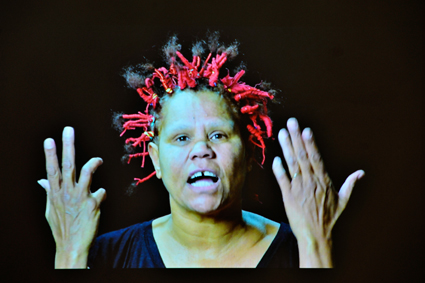
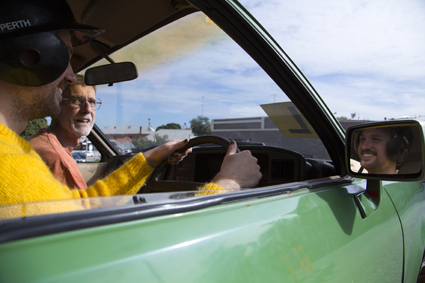
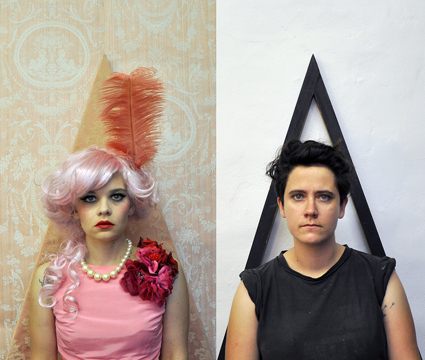
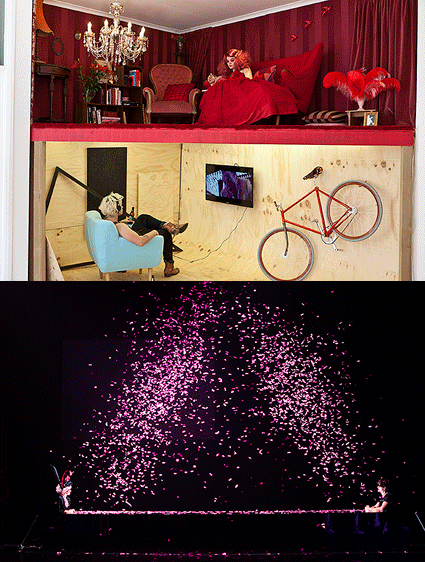
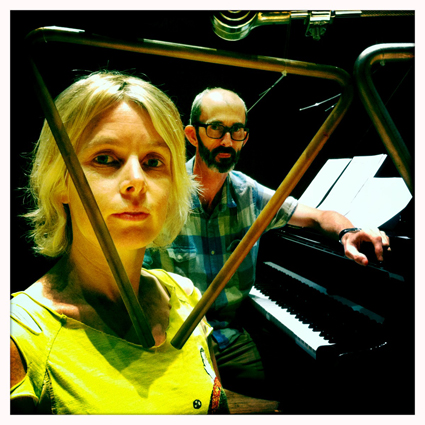
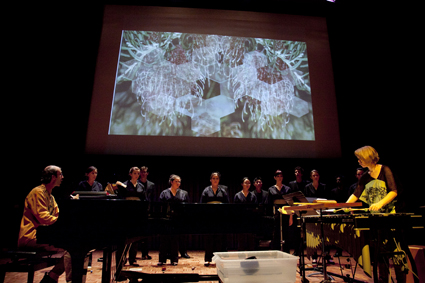
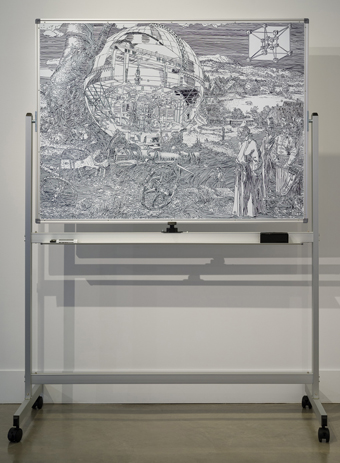
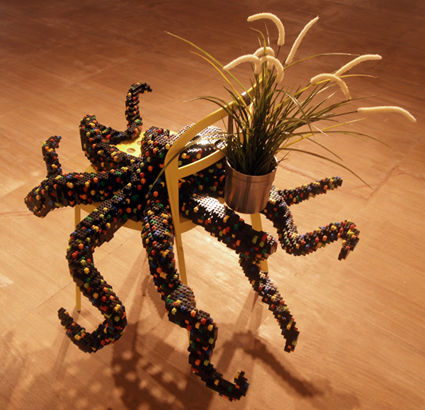
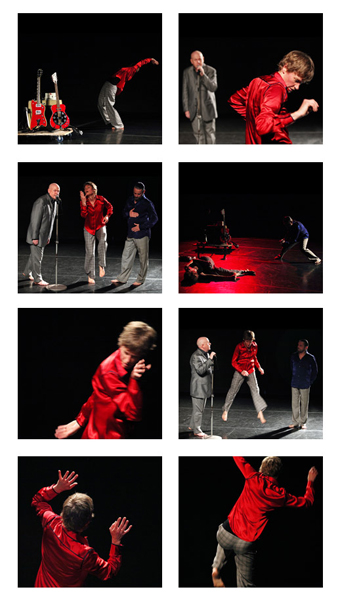
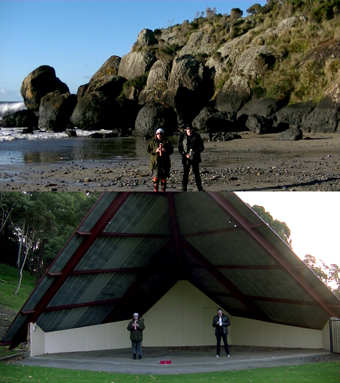
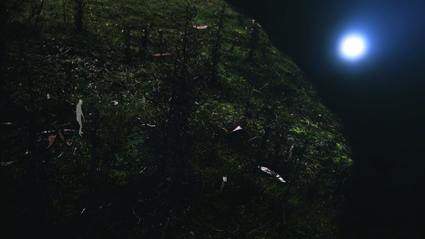

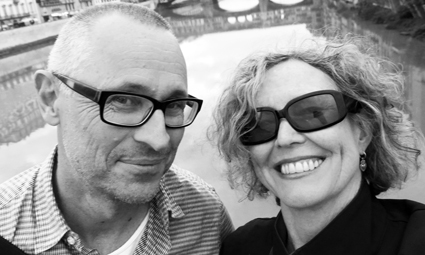
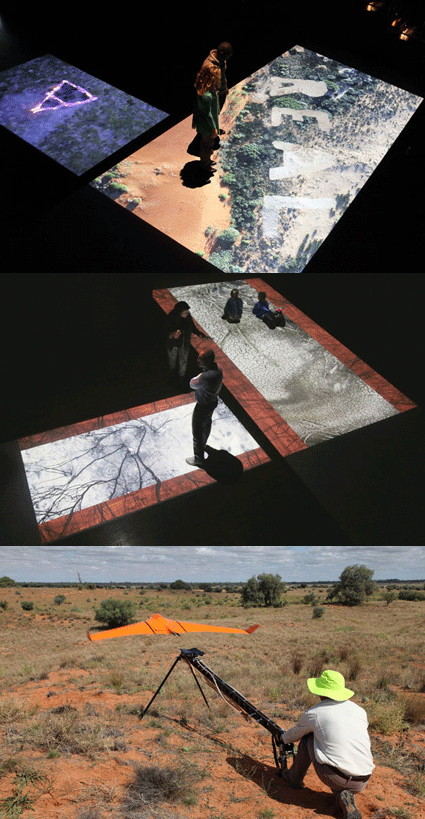
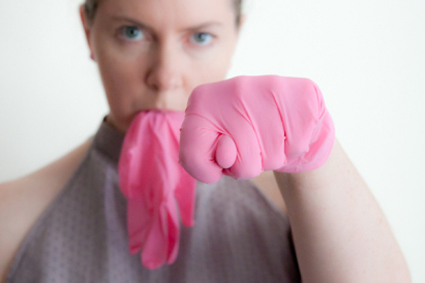
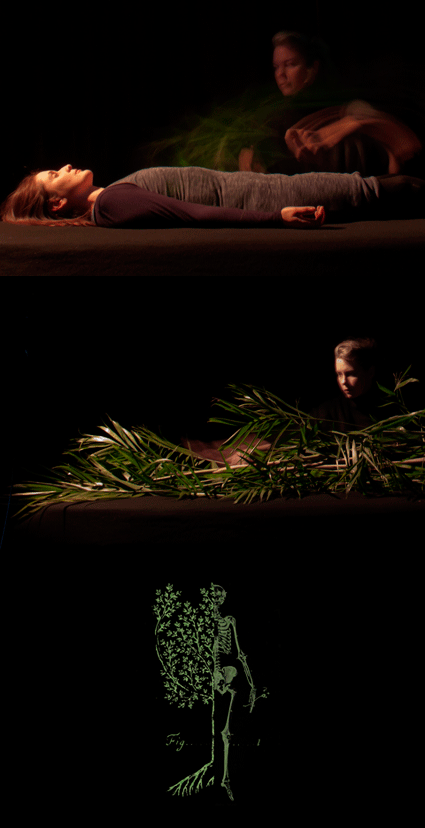
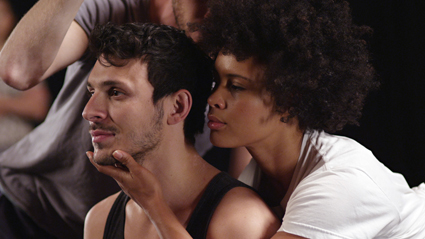
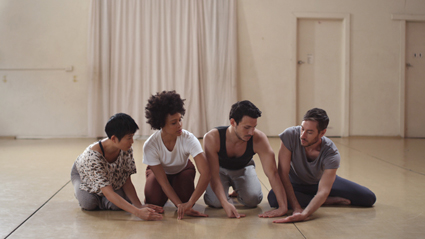
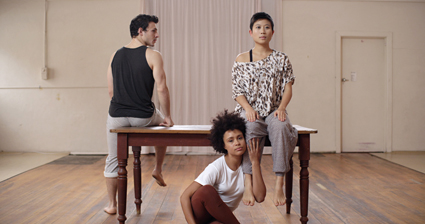
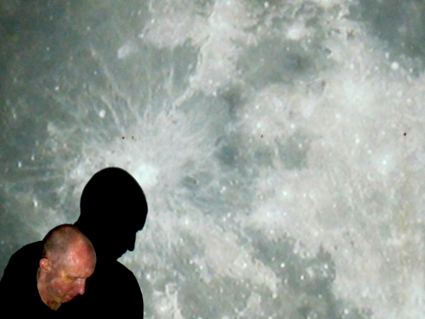
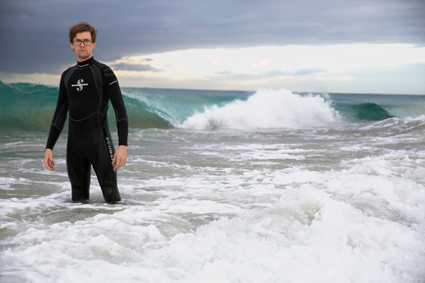
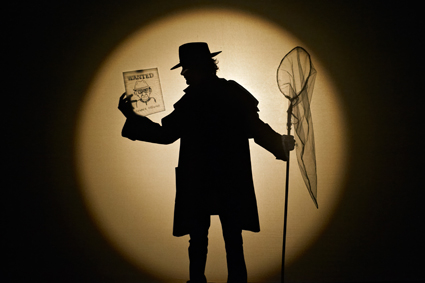
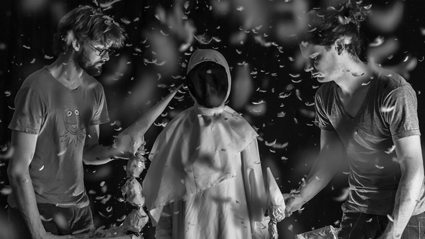
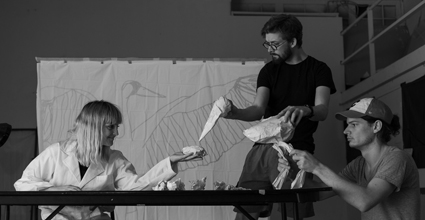

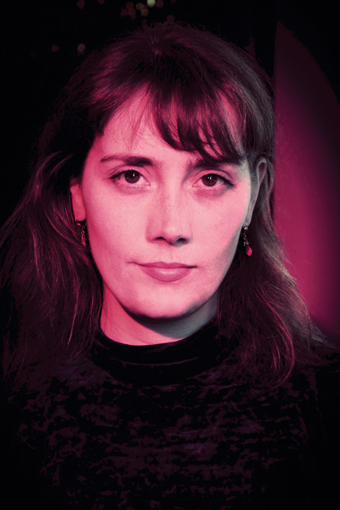
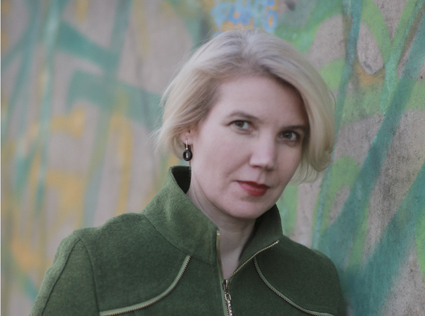
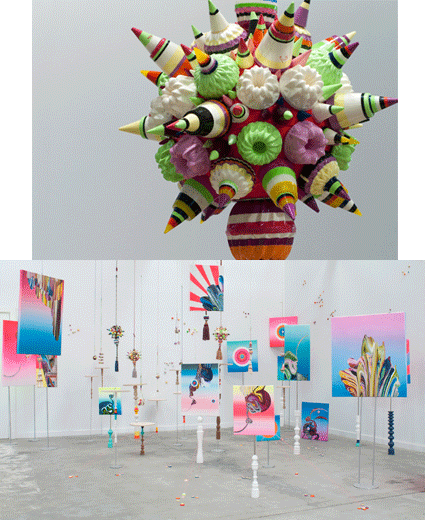
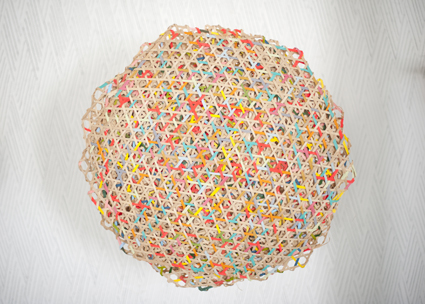
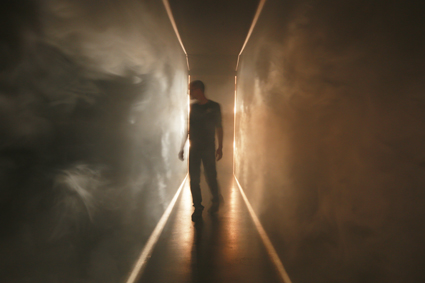
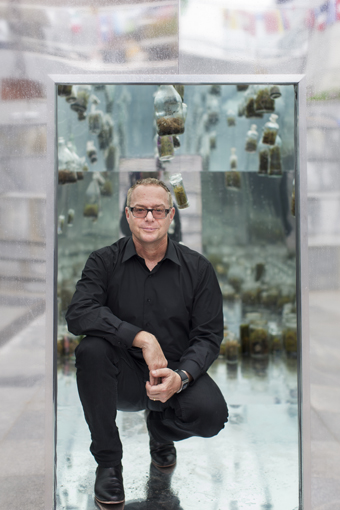
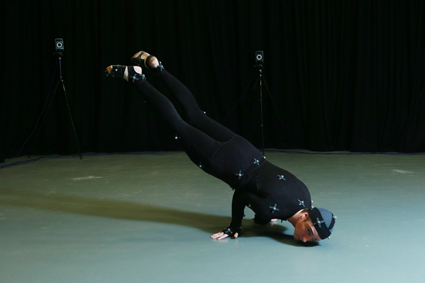
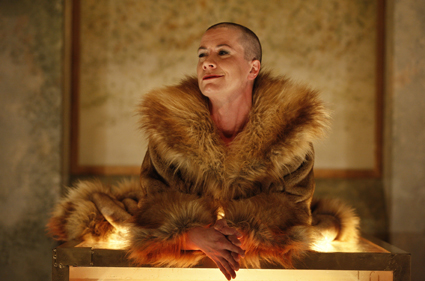
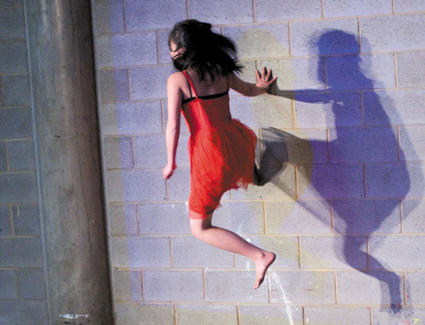
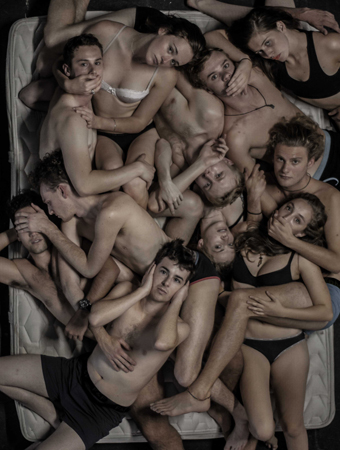
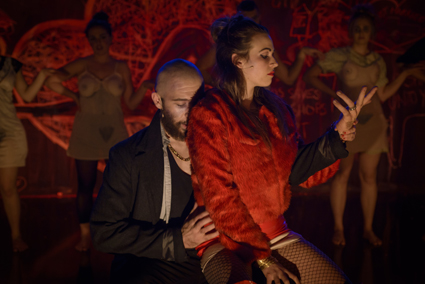
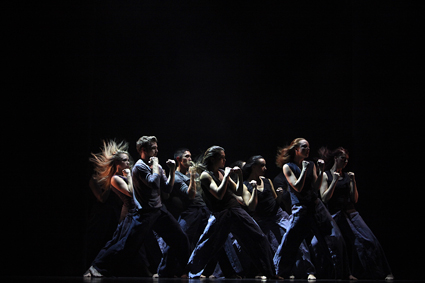
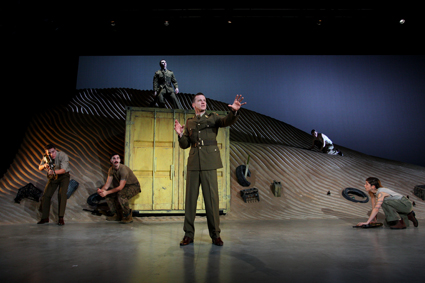
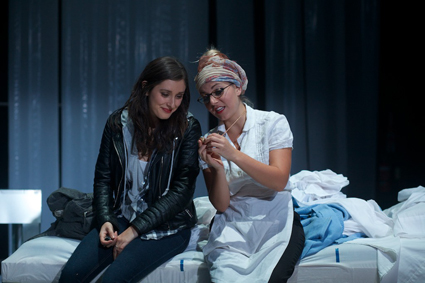
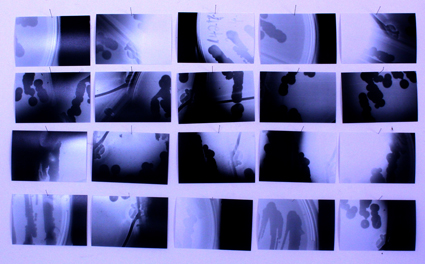
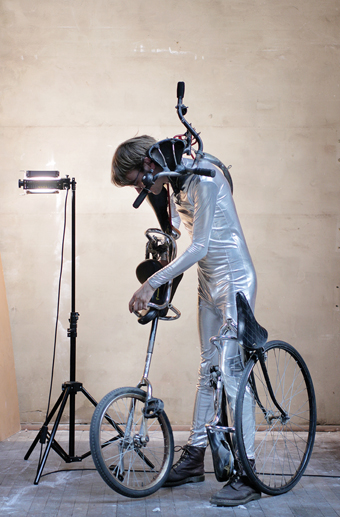
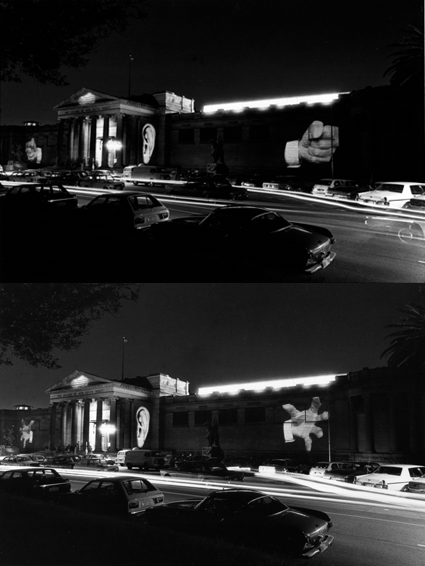
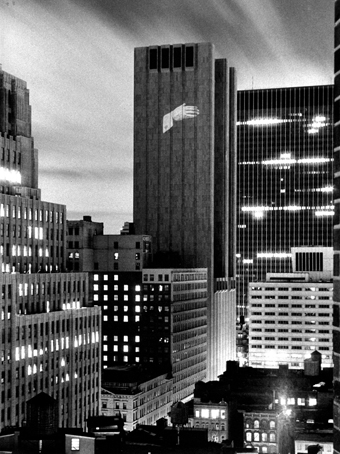
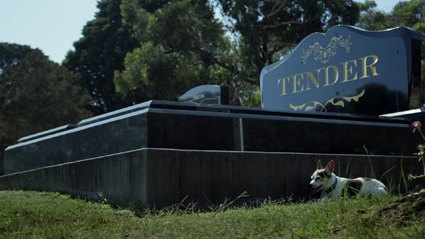
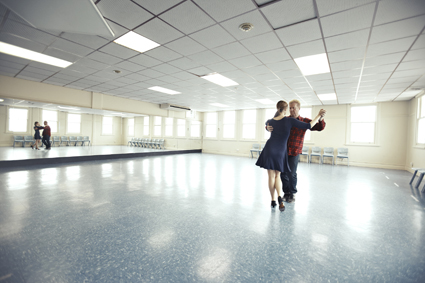
 Underlying the collected essays of Darren Tofts’ alephbet is the audacious, anti-historical idea that the internet can be thought about through films and works of literature that preceded its invention. To play out this provocation, Tofts chooses writers whose stories are game-like, such as Italo Calvino, Gilles Deleuze, Roland Barthes and above all Jorge Luis Borges.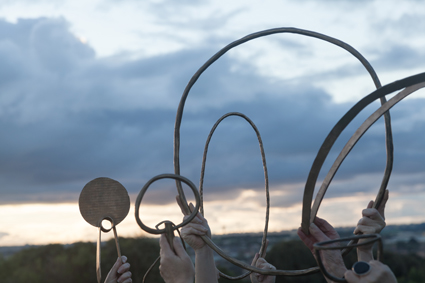
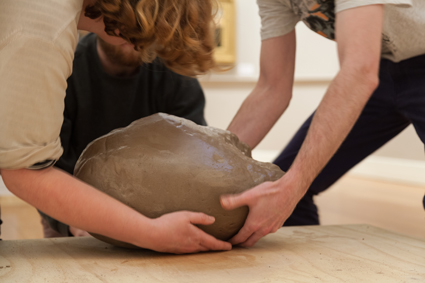
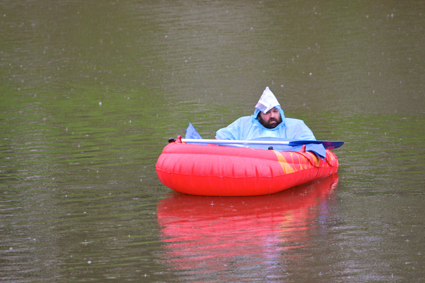
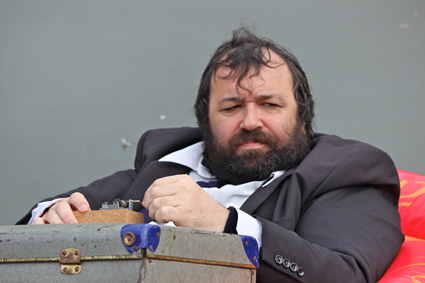
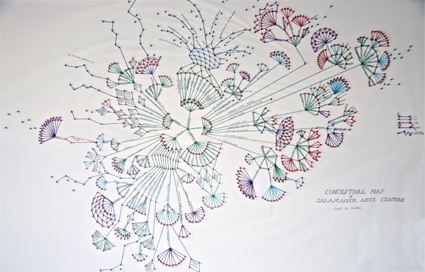
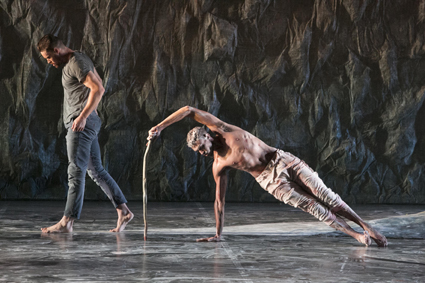
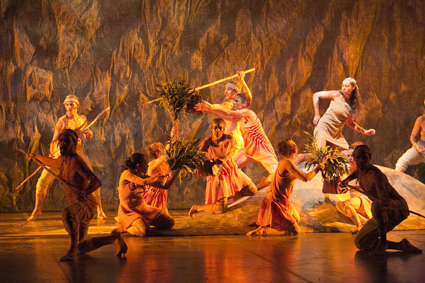
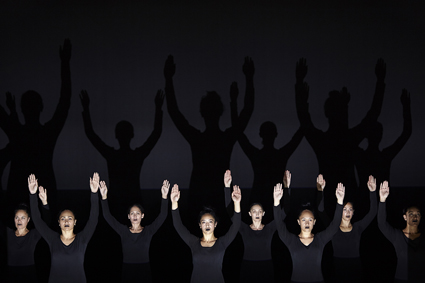
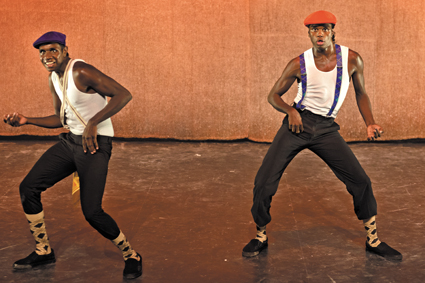
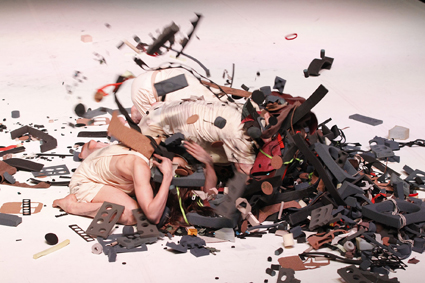
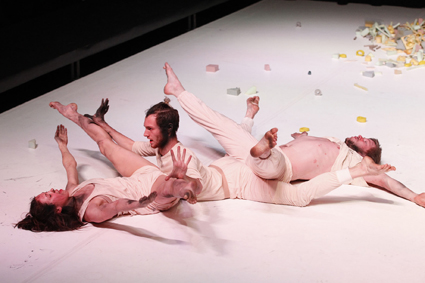
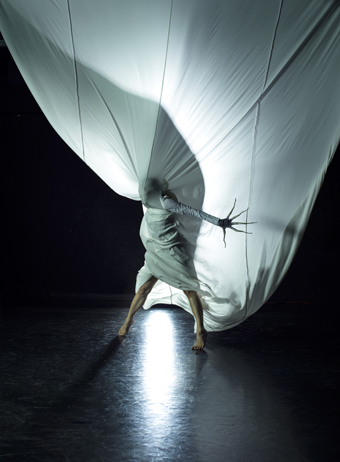
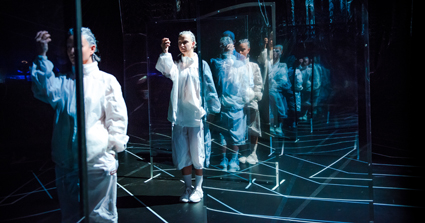
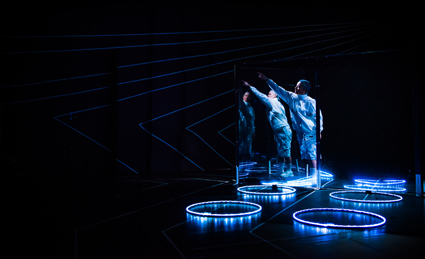
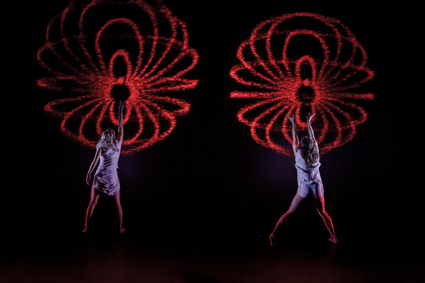
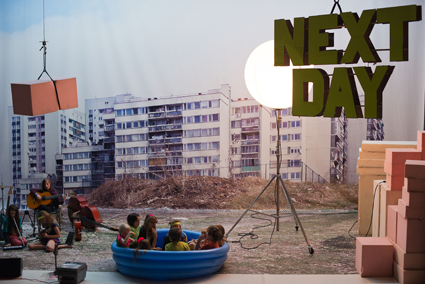
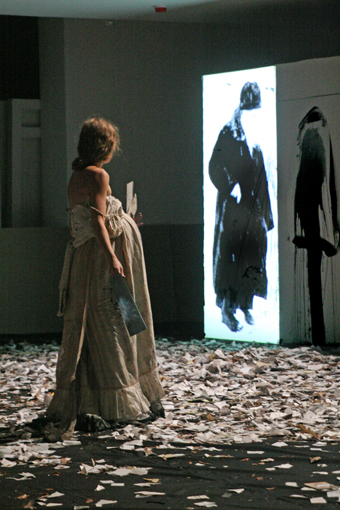
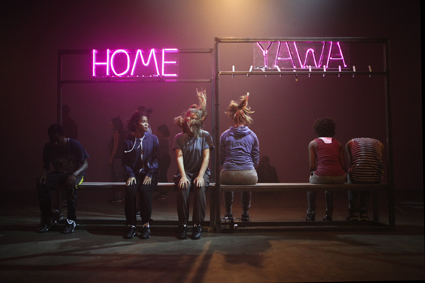
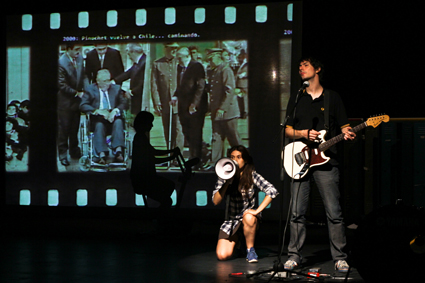
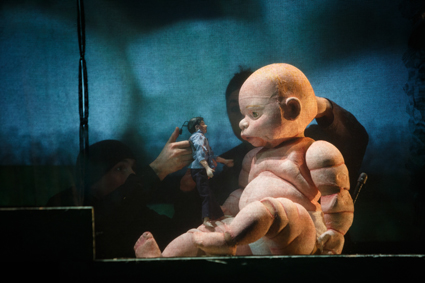
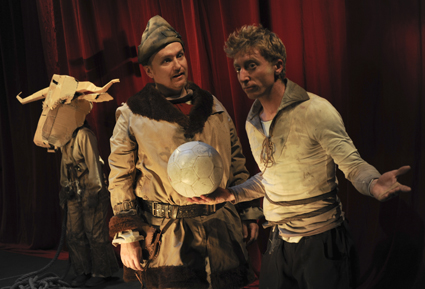
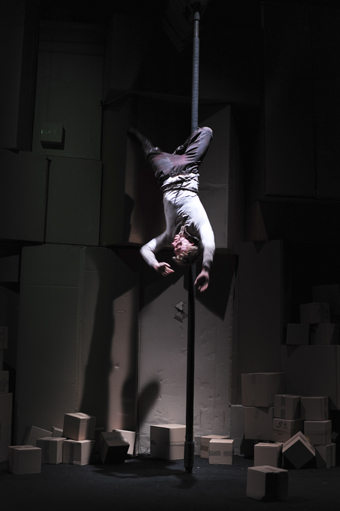
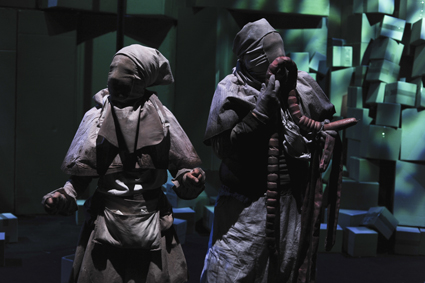
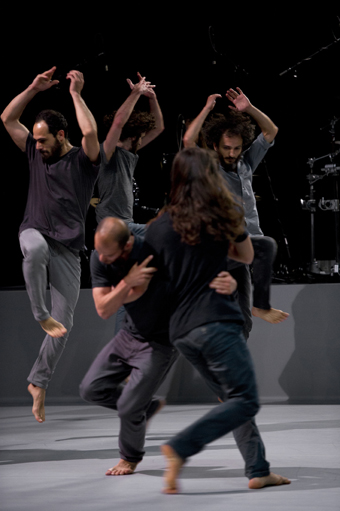
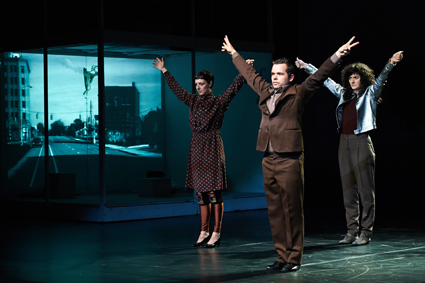
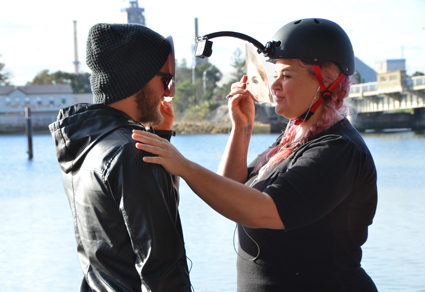
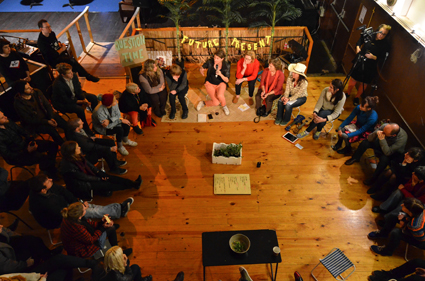
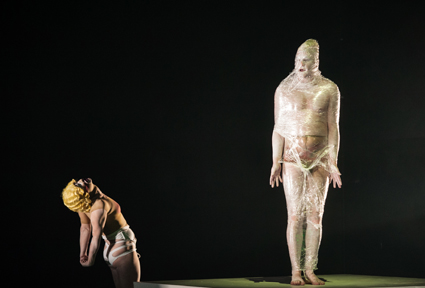
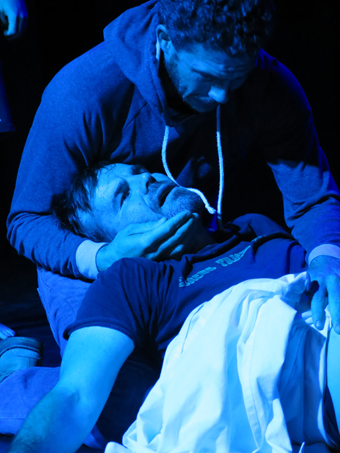
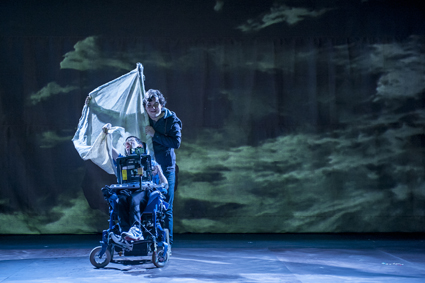
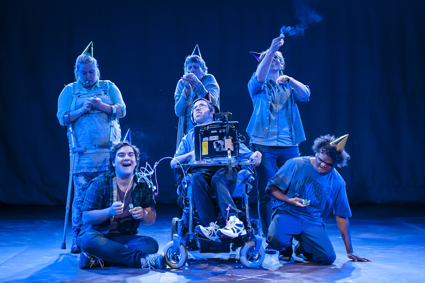
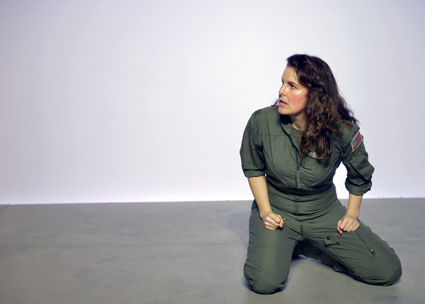
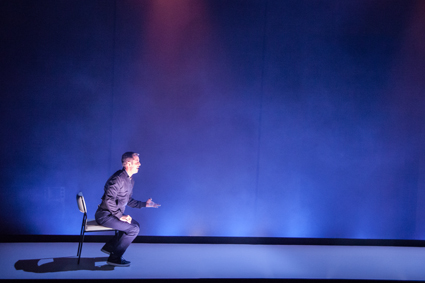
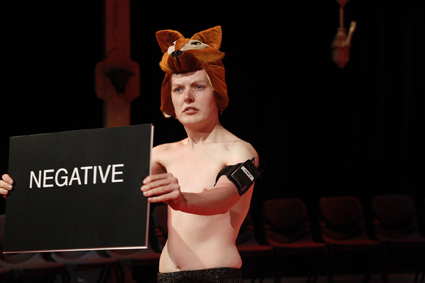
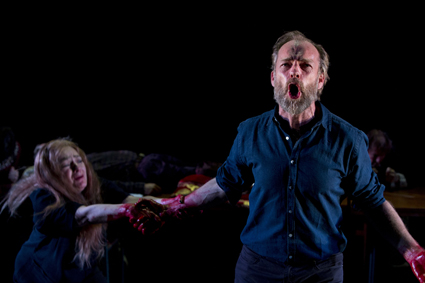
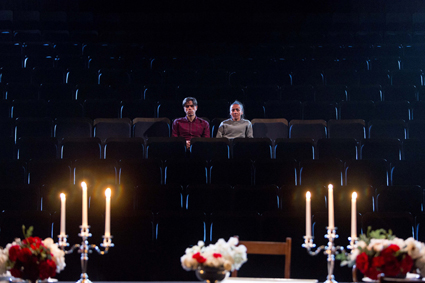
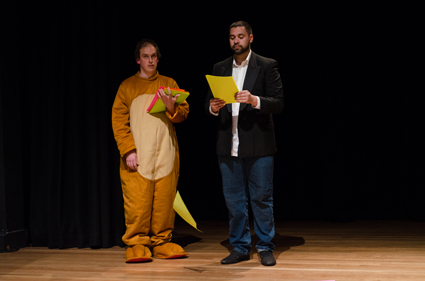
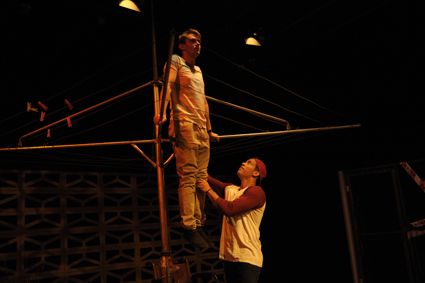
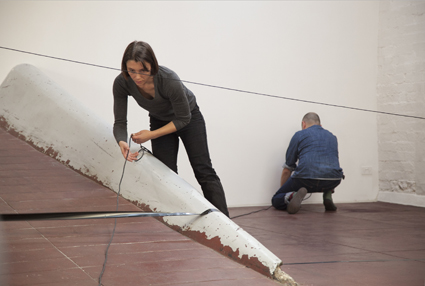
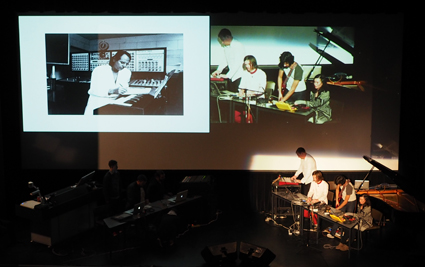
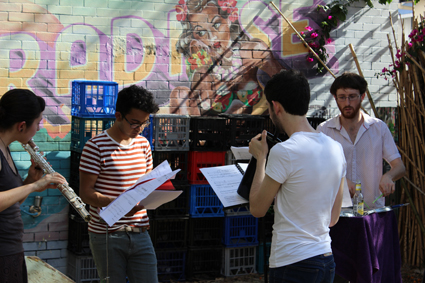
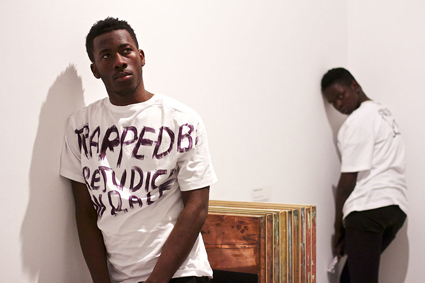
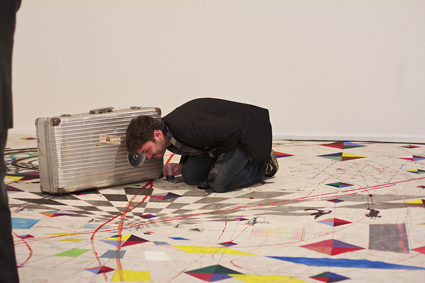
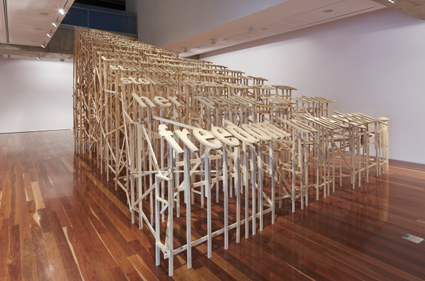
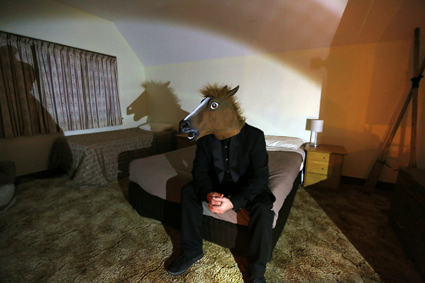
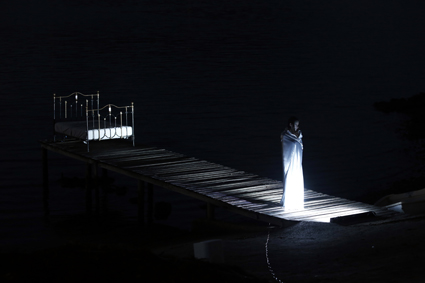
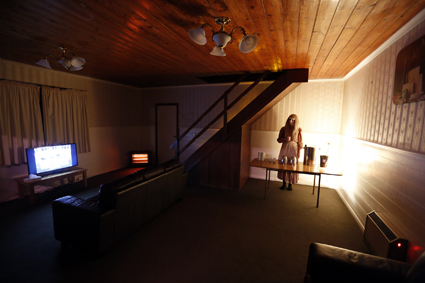
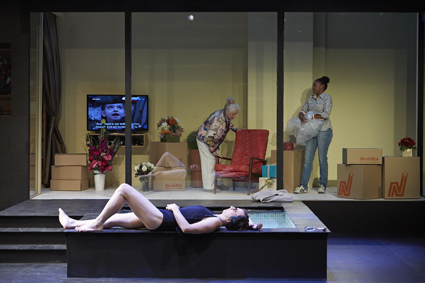
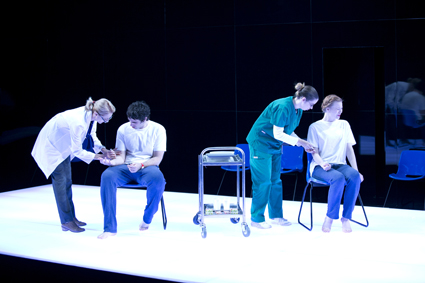
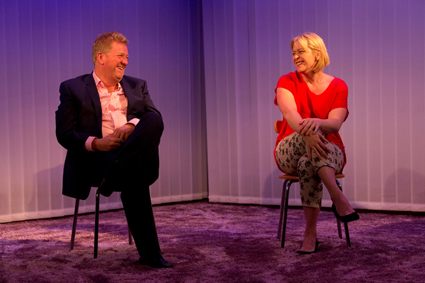
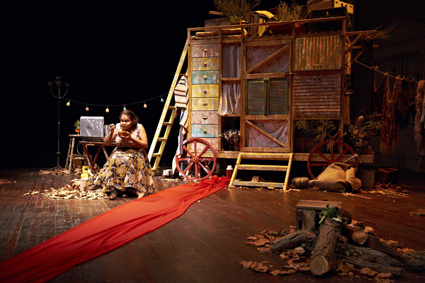
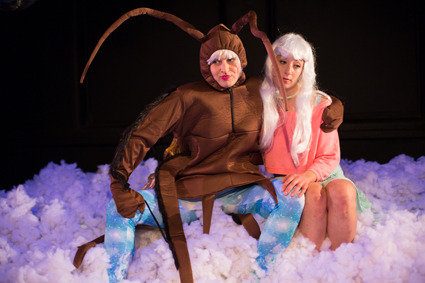
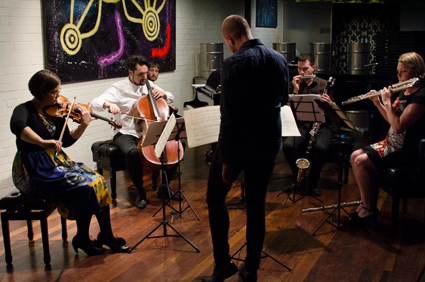
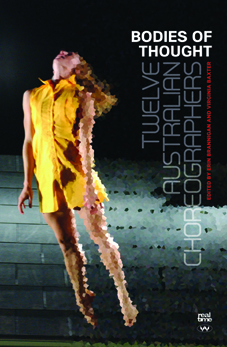
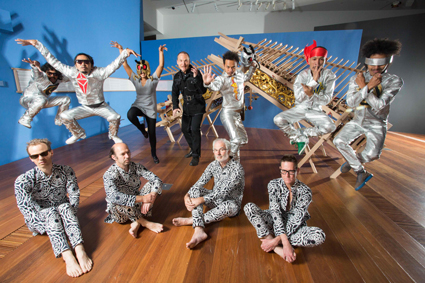
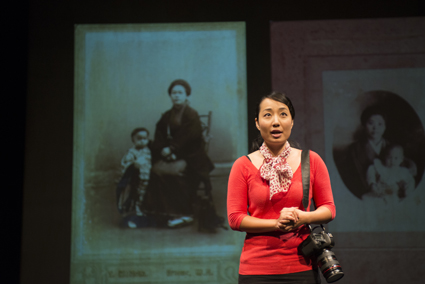
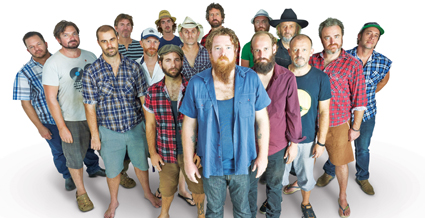
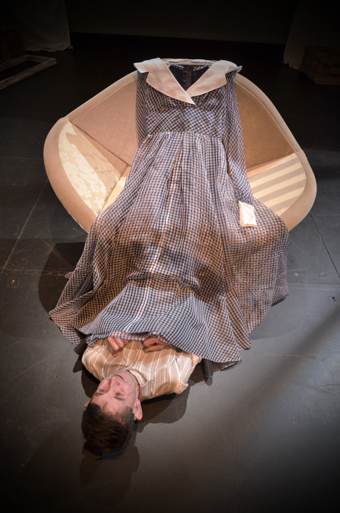
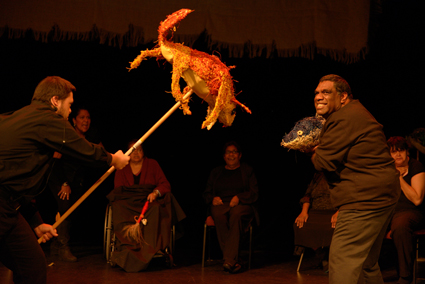
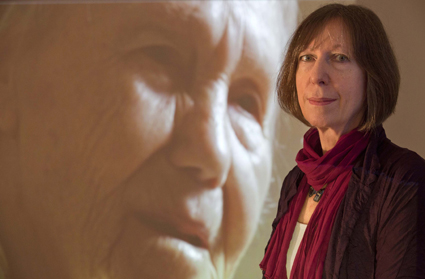
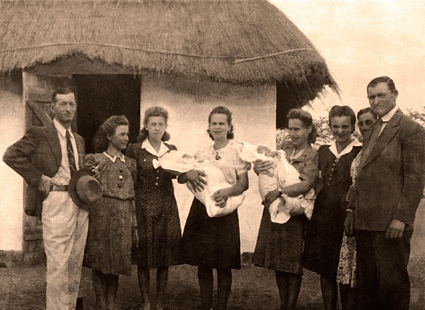
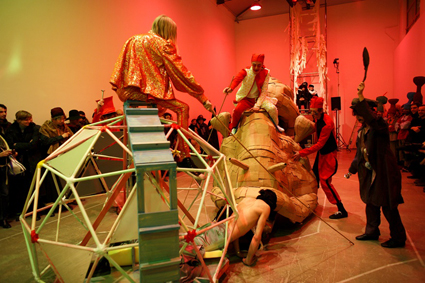
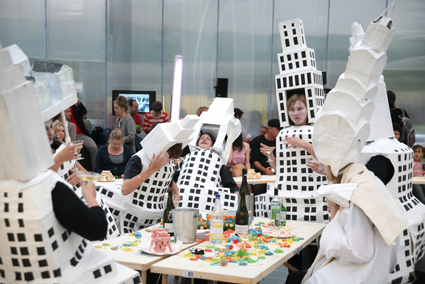
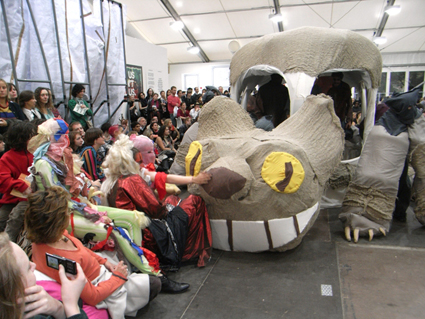
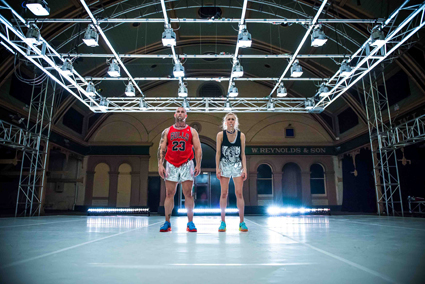
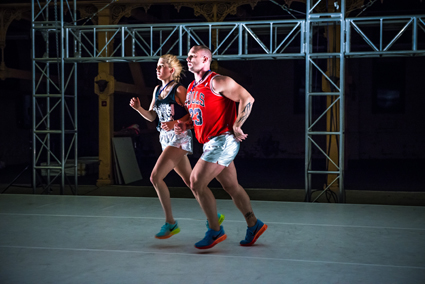
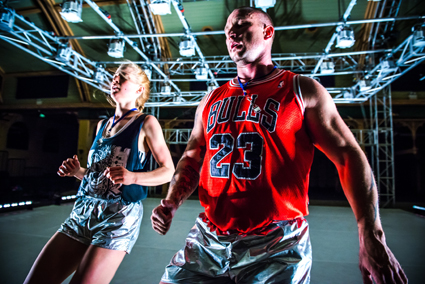
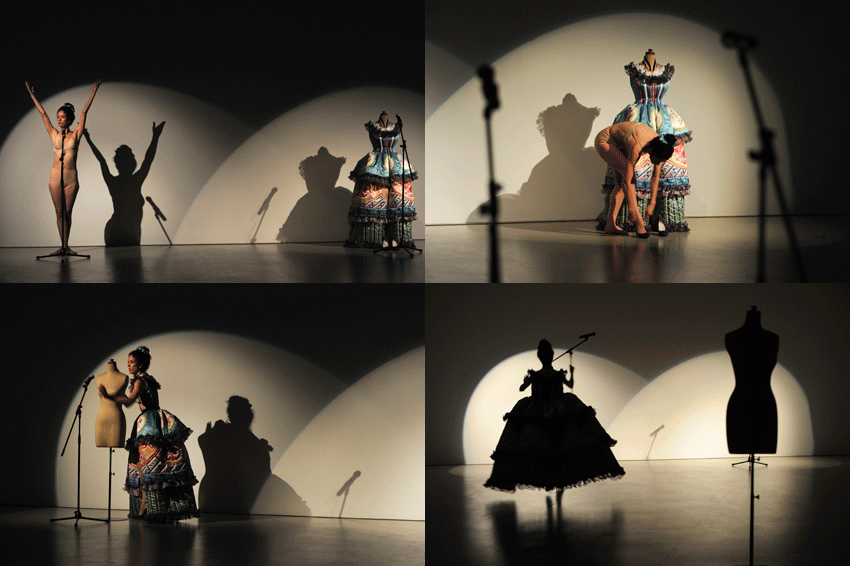
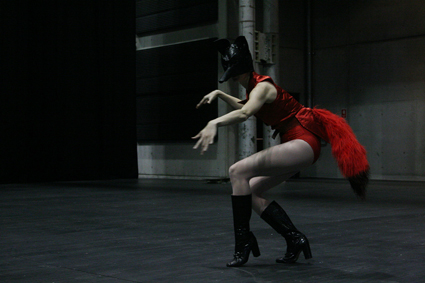
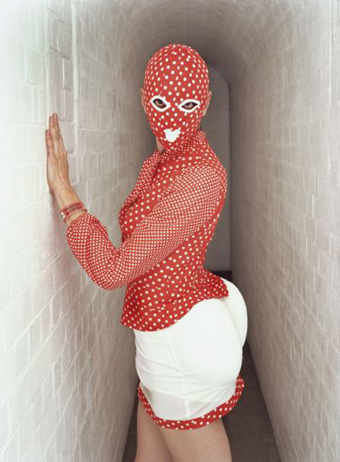
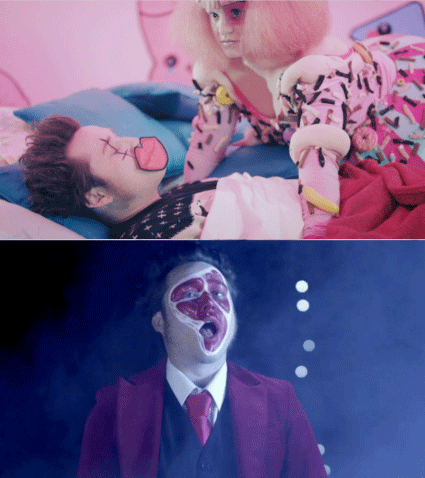
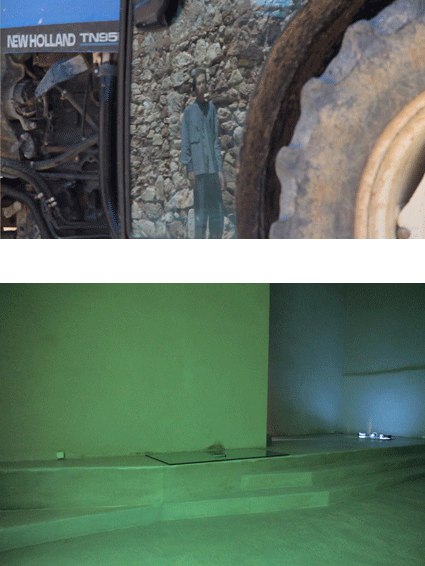
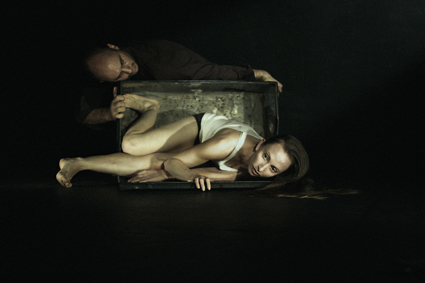
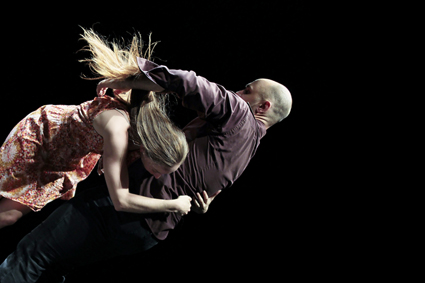
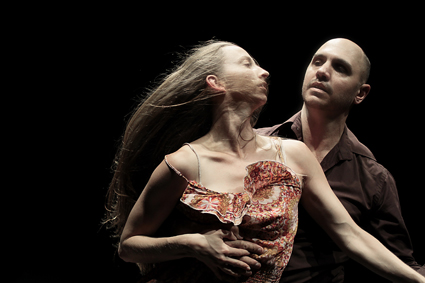
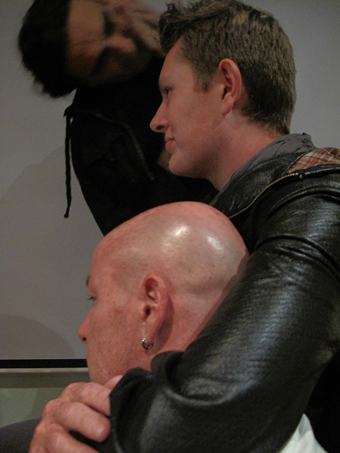
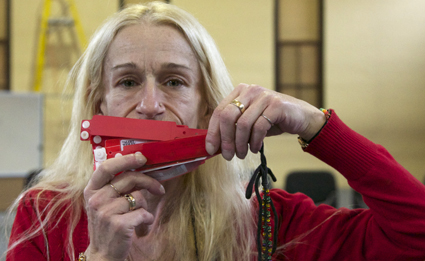
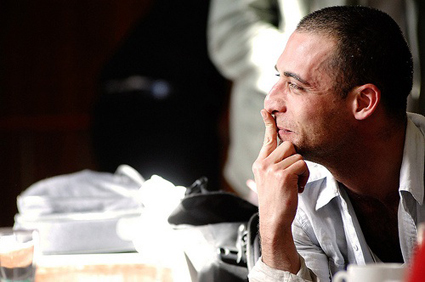
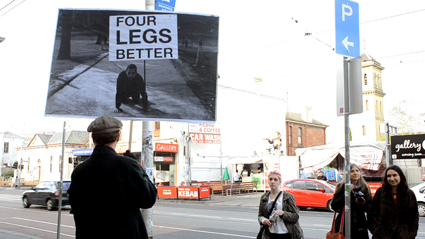
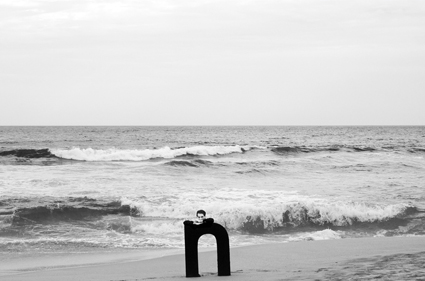
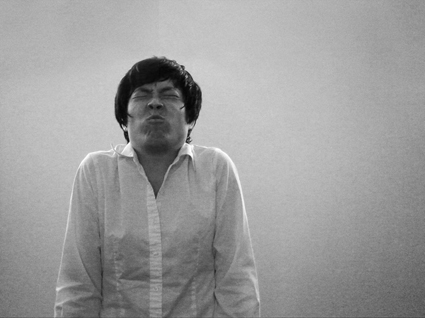
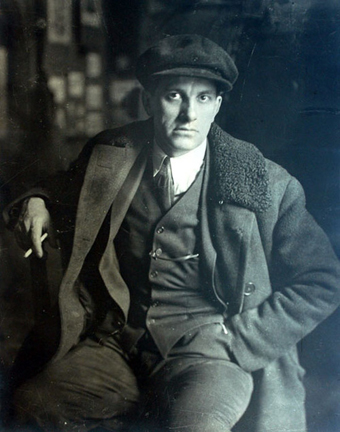
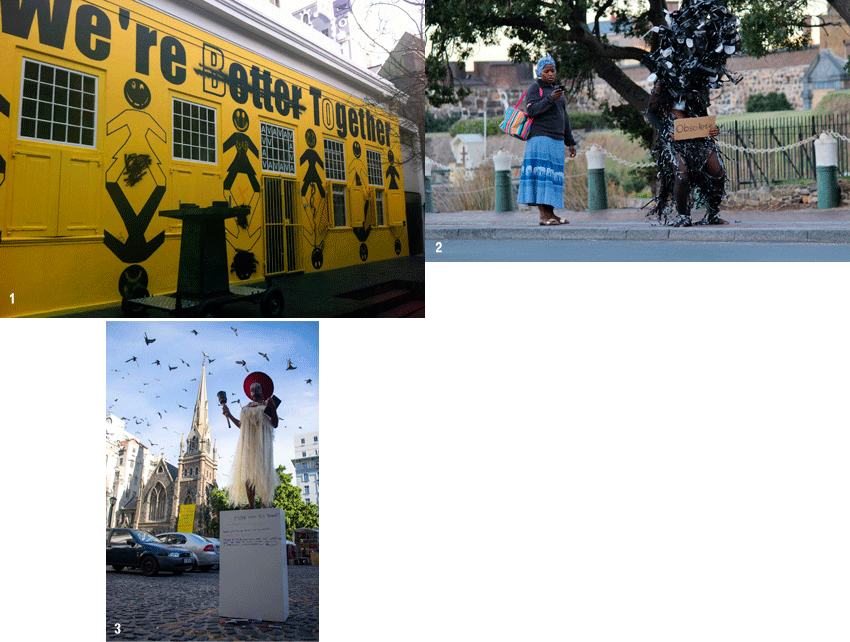
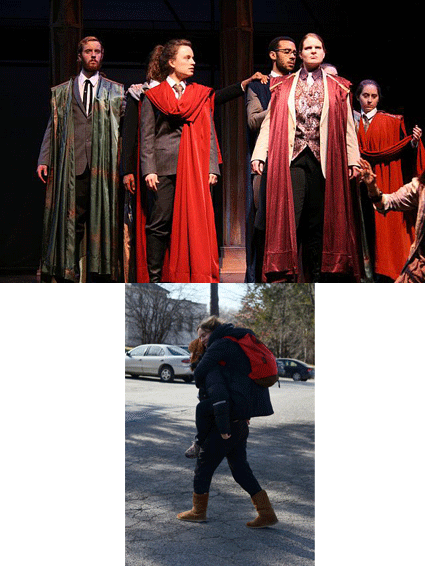
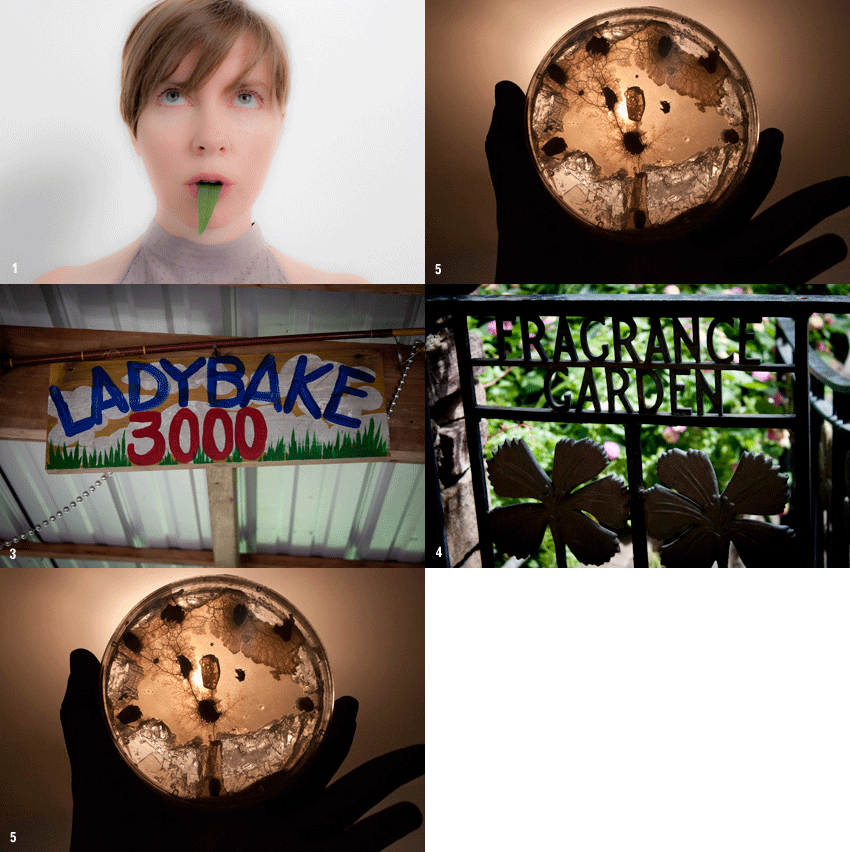
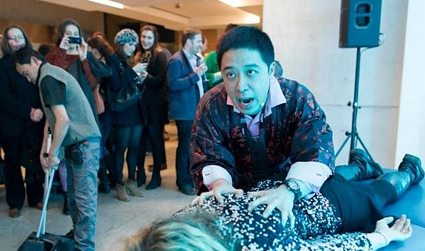
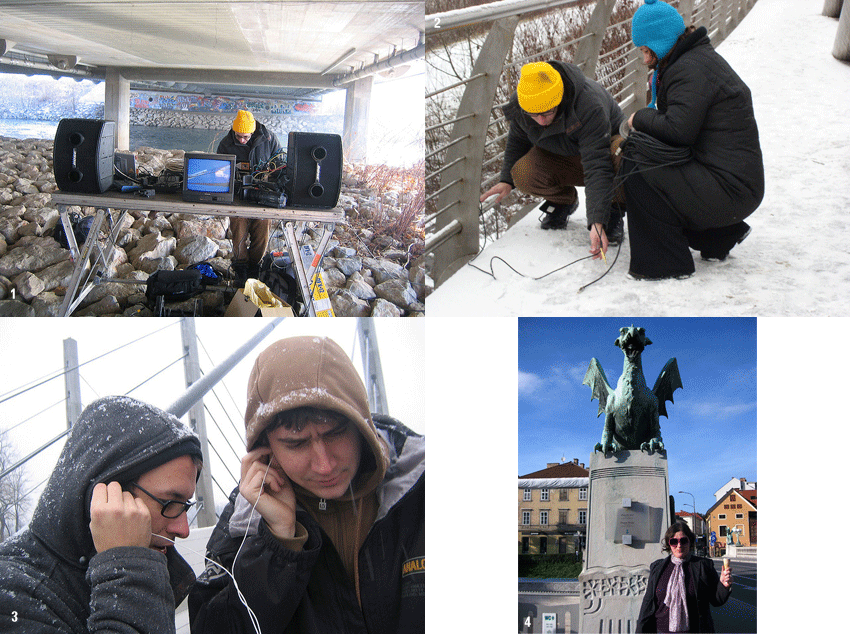
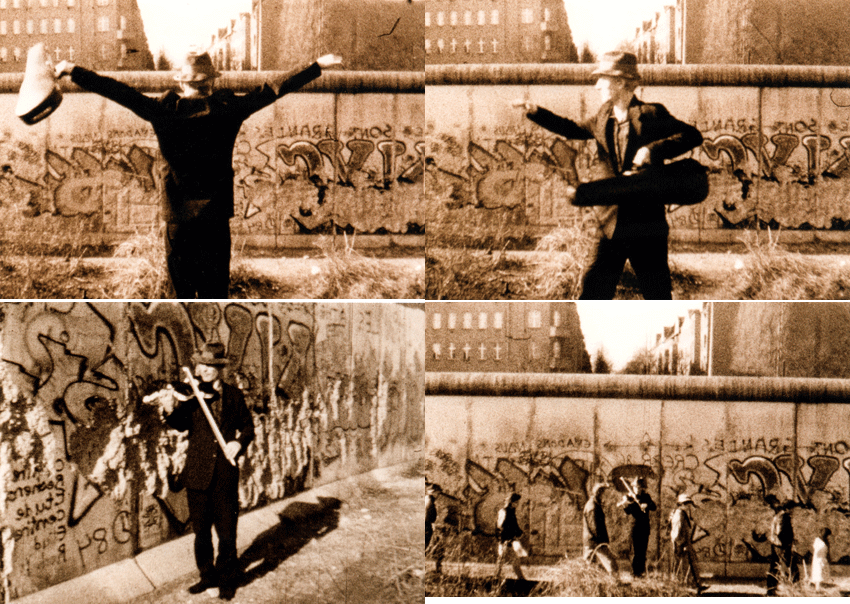
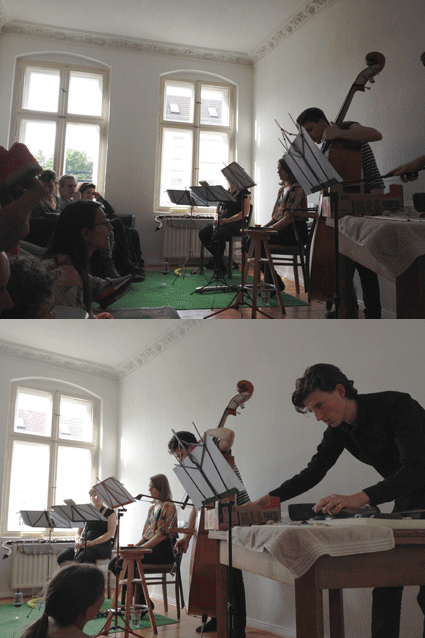
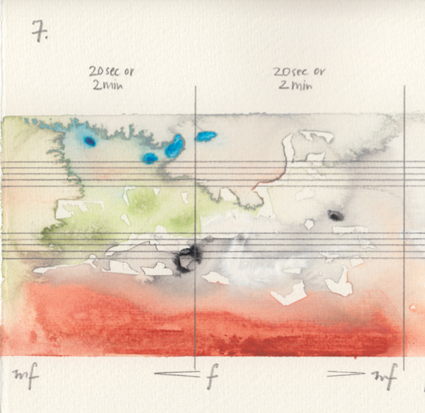
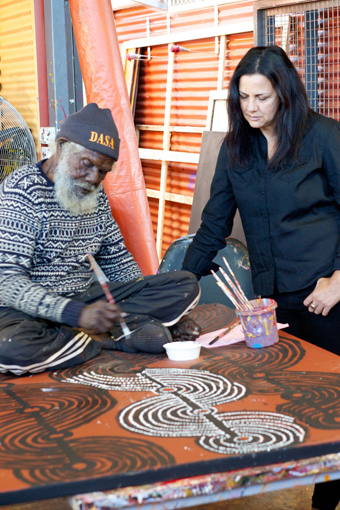
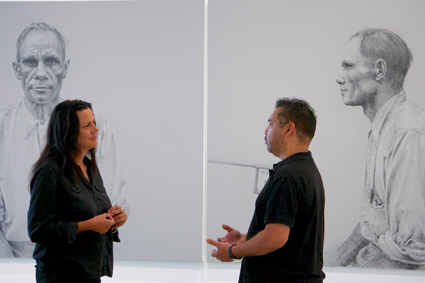
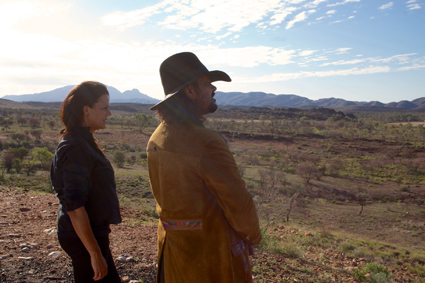
 We’re exhilarated. We’re dispirited. Here we are celebrating 20 years of RealTime’s support for adventurous Australian art. “Exhilarated” at the thought of artists’ prodigious output, ceaseless inventiveness, resourcefulness and increasing connectedness across the nation. “Dispirited” because the previous Labor Government’s promised increase of mostly new cultural funding, $263m over four years, will not be realised by the new Coalition Government.
 RealTime has its origins in discussions around a dining table in inner city Sydney in the early 1990s. These were long conversations (often well lubricated with a bottle of red) about the need for the performance community to develop a forum where work could be properly documented, connections made, lineages understood and the achievements of artists acknowledged through supportive and informed criticism.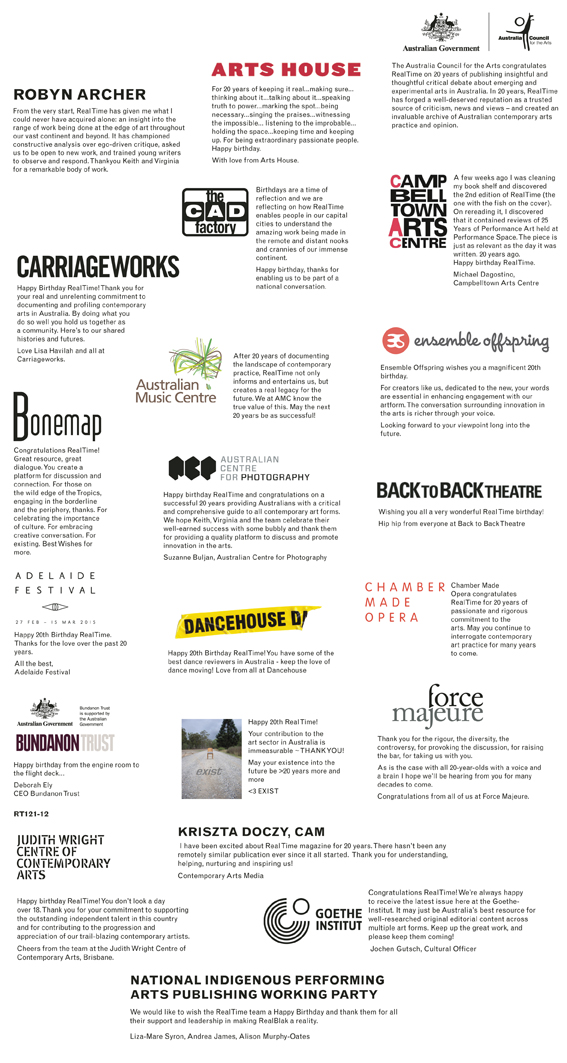
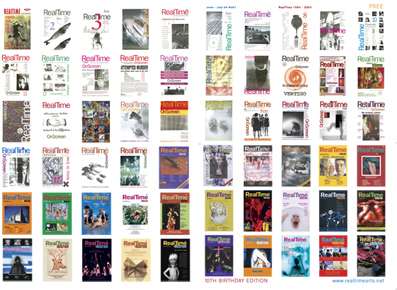 The early years of RealTime now seem like a distant dream, a fuzzy recollection of a fury of creation, learning on the job, reaching out across the country to engage writers and distributors, connecting with artists, knocking out grant applications, labelling bundles and loading trucks, covered in ink, wracked with endless financial trepidation, exhilarated every time an edition rolled off the presses and partying every time (we’re no longer up to that). Final layout happened variously in an old flourmill in Newtown (now home to the Omeo Dance Studio), graphic design studios in Surry Hills and, for years, the crowded city office of Art Almanac with artist Paul Saint patiently at the computer through the long nights.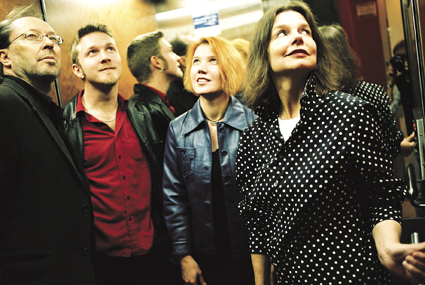
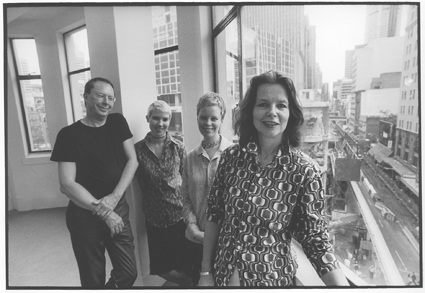

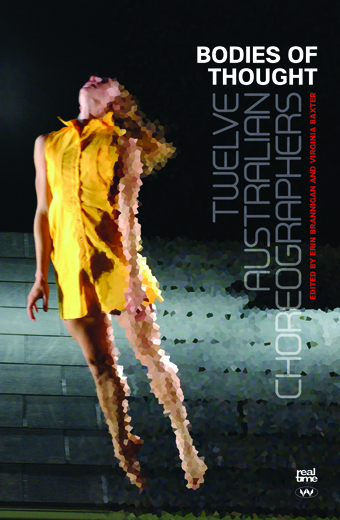 An important new book on Australian contemporary dance, Bodies of Thought: 12 Australian Choreographers features a generation of award-winning, innovative Australian choreographers with international reputations and legacies of influence:
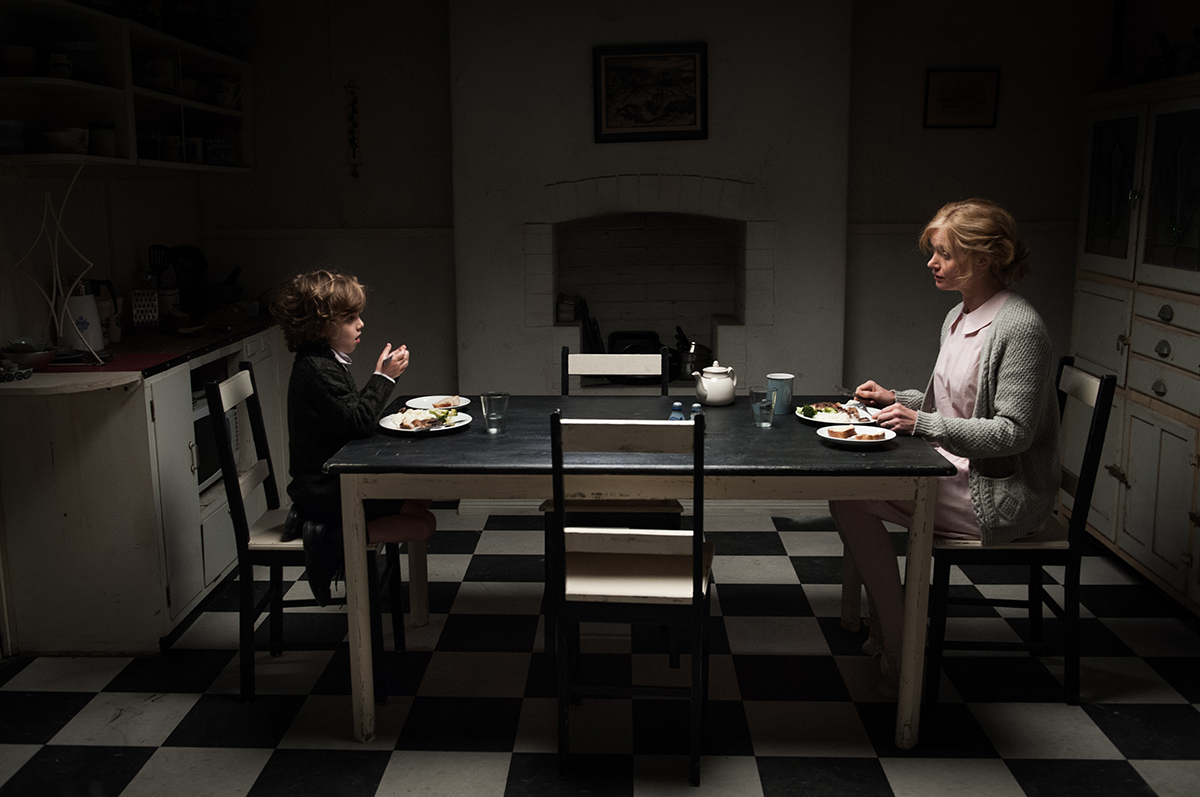
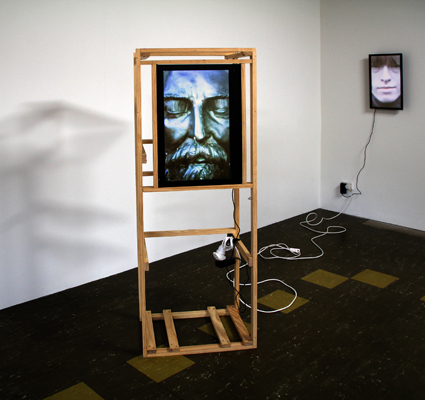
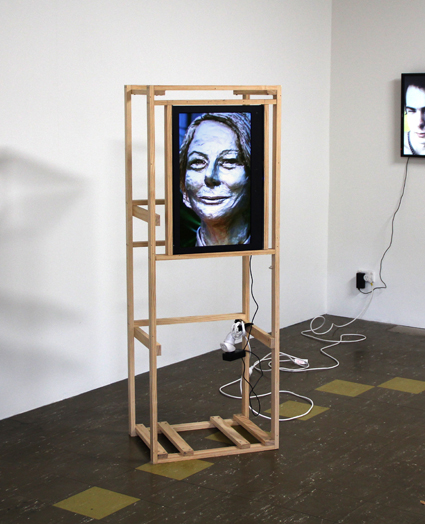
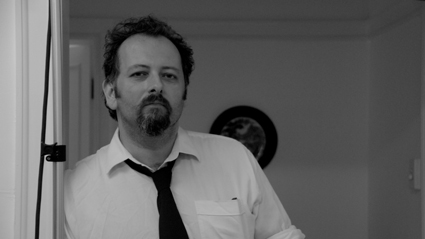
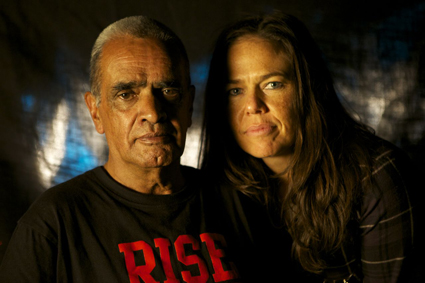
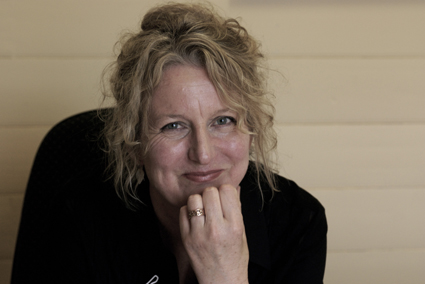
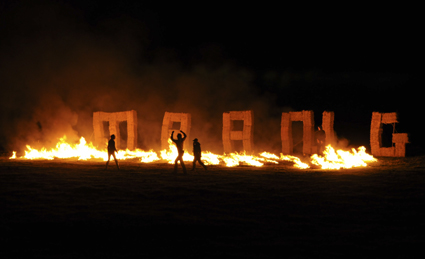
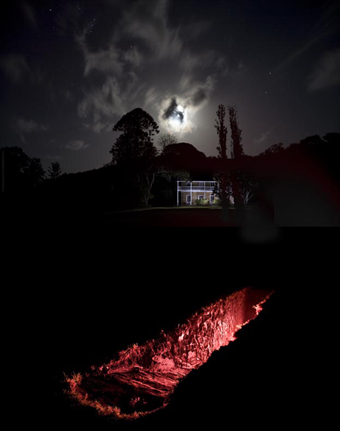
![Cat Jones, Evolution: A Walk [with Herbivores], Wired Open Day and (G)local Frequencies Project](https://www.realtime.org.au/wp-content/uploads/art/75/7549_priest_wiredopenday2014.jpg)