Australian
and international
exploratory
performance and
media arts
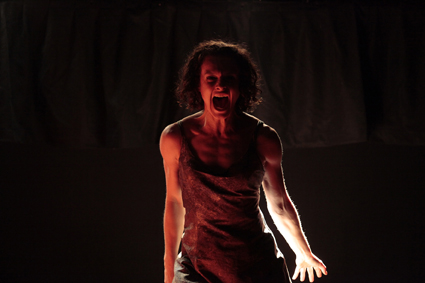
Carlee Mellow, Expectation
photo Rachel Roberts
Carlee Mellow, Expectation
WOMAN TEETERS IN THE DISTANCE, A GIANT PUMPKIN FOR A HEAD. SHE CUTS A SURREAL FIGURE. SHE IS IN HEELS, SKITTERING ACROSS A SMALL PROSCENIUM ARCH STAGE. VEERING FROM SIDE TO SIDE, SEEKING EQUILIBRIUM, THE WOMAN-VEGETABLE FAILS TO SETTLE, FAILS TO ACHIEVE STASIS. SHE ABANDONS THE TASK, SQUIRRELING ALONG TOWARDS THE DISTANT AUDIENCE. THE PROSCENIUM ARCH OFFERS A TALE, OF WOMAN AS OBJECT, AS HYBRID, BUFFETED BY ELEMENTS BEYOND HER CONTROL.
She is so far away that we watch almost dispassionately. The frame in a distance flattens. When she leaves, she becomes more real, a body rather than an image. No longer part vegetable, she comes towards us, moving to a melange of rhythms. She draws upon a history of dance training, pulling out moves and stringing them along a line. Inexorably, she approaches. As she nears, her body becomes round, flesh, soft. She dances nearer and nearer until her face becomes a player. Emotions, affects and intensities flicker then pass. Not exactly real but not quite surreal either, like switching stations on the radio.
Facing the audience, she emits a string of sounds. We are close now. The music is part of all this somehow. It matches the shifts, the proximities, the intensities, the progress. It seems we are at a peak. Clothes come off. Her naked body speaks, of dancing; muscular, buff. Even nudity tells a story. When the performers in the musical Hair stripped off, their nudity made a statement. Mellow’s nakedness emerges after a slew of expletives, like a full stop.
From a linear point of view, thus far the gaze of the audience has been increasingly enhanced by the tactile approach of a body. The volume of its flesh has been continuously increasing. Beginning as a distant figure, a subject-object, she is now more assertive, an intensity making decisions rather than a thing that responds.
The next phase is more twisted. She finds clothes and pursues a duet with a rope, melding and folding in movement. She traces a retreat to the rear of the theatre space, threading her way towards an ultimate inversion. She hangs upside down, like the Hanged Man of the Tarot pack. Technically and traditionally, the Hanged Man represents submission. Not submission as annihilation but giving up something to achieve something else. A creation through reversal, perhaps.
While Expectation follows a linear pathway of increasing revelation, it also reverts into a twisted transformation. Perhaps nothing is revealed. Is something expressed? Mmm. What I perceive is a powerful commitment, an intensity of feeling, a modulation of theatrical effect and an episodic movement through phases. The cavernous Arts House space has been treated to good effect, creating frames and scenarios that make this piece feel like more than a solo work. The shifting occupation of its massive depth—far, near, high, low and diagonally—cuts back from any linear sense of progress. We are rather treated to a series of differences that vary in intensity. Mellow exudes a performative strength that seems to heighten as she comes nearer. Perhaps her own energy becomes more directed toward the observer when she vocalises and strips or perhaps the observer reciprocates something in response.
Expectation follows Carlee Mellow’s performance in Deborah Hay’s solo project, In the Dark (RT98, p22). It resonates with Hay’s attitude towards performative attention. Its theatrical tenor also suggests Margaret Cameron’s dramaturgical influence—whimsical, surreal, with a strong performative focus. Since Hay’s work is about performance quality rather than any physical look, the movement belongs to Mellow. There is a trace of Ros Warby too. Mellow’s weird soundings reminded me of Warby’s vocalisations when performing Hay’s work, as if both women were abducted by the same aliens.
My enduring impression of Expectation is a sense of delight at Carlee Mellow’s courage and commitment. There is a freshness in this work; a degree of structure but also an aliveness that left me alert. Perhaps this piece is not alone in its concern to achieve something in the moment, to connect with its audience, but it does so in its own way.
Arts House, Future Tense: Expectation, choreographer, performer Carlee Mellow, composer Kelly Ryall, design Bluebottle, dramaturgical consultant Margaret Cameron, Arts House, North Melbourne Town Hall, Nov 9-14, 2010
RealTime issue #101 Feb-March 2011 pg. 41
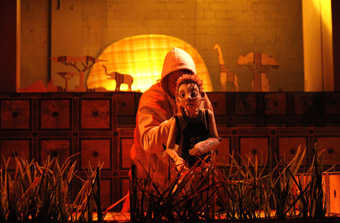
Africa, My Darling Patricia
photo Jeff Busby
Africa, My Darling Patricia
THE LAUNCH OF NEXT STAGE 2011 WAS HOT. THE TEMPERATURE WAS UP, THE WHARF 2 FOYER CRAMMED WITH ENTHUSIASTIC 20 SOMETHINGS AND ARTISTS THRILLED TO BE IN THE PROGRAM WHICH STC ASSOCIATE DIRECTOR TOM WRIGHT AND LITERARY MANAGER POLLY ROWE OUTLINED IN A NEAT DOUBLE ACT FOLLOWED BY A FEW WORDS EACH FROM DIRECTORS AND PERFORMERS.
Next Stage is focused on development, emerging artists, providing alternatives to the STC’s main program, attracting a different audience, “not trying to please everyone all the time” and “not setting expectations too high” for new works. Tickets are $25 and there’s a free beer per ticket offer.
First up in Next Stage 2011 is German playwright Roland Schimmelpfennig’s Before/After, directed by Cristabel Sved, who spoke mid-rehearsal of “the luxury of all working together and with all the languages of the stage being used.” A nice change from the challenges of resource-scarce independent theatre. With its 51 short scenes the play should provide a fascinating companion piece to the STC mainstage production of German writer Botho Strauss’ epic Big and Little Scenes.
Sam Routledge a collaborator with contemporary performance group My Darling Patricia expressed the group’s pleasure at being in Next Stage with Africa, originally a Malthouse commission, and outlined the origins of the work in the true story of German children caught running away to Africa. Told with puppets and broken toys, Africa presents a magical Australian perspective on childhood pain and fantasy.
Another innovative Sydney-based performance group, Post, in typical form stacked on a stand-up turn anticipating the themes and fun antagonism of their new work Who’s The Best? which was developed with Next Stage’s support in 2010.
Also developed in 2010, Money Shots will feature 15-minute plays about money by Tahli Corin, Duncan Graham, Angus Cerini, Rita Kalnejais, Zoe Pepper and The Suitcase Royale, directed by Richard Wherrett Fellow Sarah Giles and designed by Alice Babidge. As well the program continues the Rough Drafts series, week-long creative developments followed by free showings that allow audiences to track the growth of a play.
The heat’s on: Next Stage 2011 promises intense diversity of form as well as the means for hot-housing new work from a fascinating range of theatre and contemporary performance artists.
Sydney Theatre Company, Next Stage 2011; for season dates see
www.nextstage2011.com.au/
RealTime issue #101 Feb-March 2011 pg. 41
© Keith Gallasch; for permission to reproduce apply to realtime@realtimearts.net
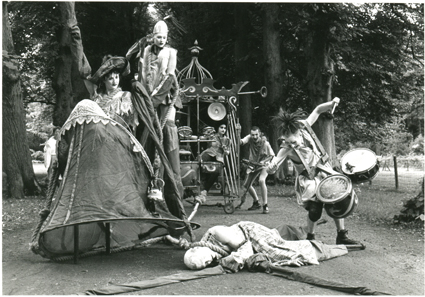
Toy Cart, Stalker, 1991
photo Geert Kliphuis
Toy Cart, Stalker, 1991
STALKER IS ONE OF AUSTRALIA’S MOST IDIOSYNCRATIC PERFORMANCE COMPANIES, EVOLVING OVER TWO DECADES FROM STILT-WALKING SHOWS—WITH VERVE AND INTELLIGENCE—INTO INCREASINGLY SOPHISTICATED, RICHLY THEMED LARGE-SCALE WORKS, ALL PERFORMED OUTDOORS, AND THEN DIVERSIFYING INTO TWO COMPANIES, STALKER AND MARRUGEKU. BOTH HAVE RESHAPED NOTIONS OF PHYSICAL THEATRE, INCORPORATING OTHER ARTFORMS AND EMBRACING SOCIAL, POLITICAL AND METAPHYSICAL ISSUES AND THEMES WHILE ACHIEVING INTERNATIONAL RECOGNITION.
Sydney-based Stalker is co-directed by David Clarkson and Rachael Swain, each contributing discrete shows to the company repertoire, while Marrugeku is co-directed by Swain and Broome-based choreographer Dalisa Pigram. I spoke with Clarkson and Swain after Stalker celebrated its 21st year at the end of 2010. Such longevity for a continually innovative company is quite an achievement, not least in a country of short-lived artistic ventures.
starting out on stilts
Clarkson tells me that an early version of the company had played in New Zealand for three years, but reformed in Sydney where it was joined by Swain in 1989 and given “$10,000 cold cash by the Sydney Festival after I showed them some of our New Zealand work and they said, ‘It looks great!’” Swain and Clarkson point out that their starting out was timely—the Expo in Brisbane and the Bicentennial had programmed a substantial number of outdoor works, as did the Perth Festival and the Spoleto Festival in Melbourne directed by John Truscott. Clarkson recalls that “within a year we were touring Australia-wide and within 18 months we were in Europe.”
I asked how the pair would describe their early work. “It was street theatre. Very high energy,” says Swain. “When we first got to Europe we made quite a big splash. David and I both grew up in New Zealand and I think there was a sense of the rhythms and energy of the Pacific in the work. It was quite pumping.” Adds Clarkson, “Our work was stilt-based and we took stilts somewhere that no-one else had. Dive rolls, backbend get-ups, carrying each other, throwing each other to the ground, picking each other up. Very bruising. ‘Hell for leather,’ that’s what it was. Stilt acrobatics.”
Swain mentions that Stalker was working with choreographers as early as their second show, Toy Cart (1990): “Nigel Kellaway directed and Rosalind Crisp choreographed and it premiered at Spoleto in 1990. It was high energy but it was also quite visually driven work and quite lyrical—a strong aesthetic that exists to this day.” Clarkson recalls that Swain “was never in love with Fast Ground (1989), our first piece, but looking back at it and at Grotowski’s movement work I can see connections—muscle and bone work, always distinctive from circus even though stilts are a circus thing. It was always for me about embodiment: ‘a state of being’ expressed through the body and what visual imagery we might use to support that embodiment.”
Swain and Clark acknowledge significant differences between their bodies of work, their aesthetics and Marrugeku’s artistic direction. Marrugeku started in 1995, commissioned into existence by Perth Festival. Stalker produces Marrugeku, but the company has its own life, based first in Central Arnhem Land for seven years and subsequently in Broome for eight, and with its own steering committee and direction. “But,” says Swain, “there are certain core elements that link all three bodies of work, combining dance theatre processes and aesthetics with circus forms and a fairly poetic, layered dramaturgy prevalent in all the works. David and I worked collectively to make material initially and then slowly brought other people in—Sue-ellen Kohler choreographed the third work we did, Angels ex Machina (1993)—often in very strong collaborative partnerships. Both of our processes are physical—we make material on the floor—like choreographers.”
working europe
Some of the aesthetic influences on Stalkers’ work came from their rapid arrival on the European summer festival street theatre touring circuit in their first year of existence. “We were exposed to a whole raft of European companies from the small street theatre acts through to really large scale: Generik Vapeur, La Furas dels Baus, Les Ballets C de la B, Vis-a-Vis, Dogtroep, all making very ambitious, large scale work.” Clarkson says that the company saw a model they thought they could adapt. “Some of the shows were in the streets, with a full 1,500 seat grandstand and all the production values, like the Dogtroep work. We saw a model used to create an incredible audience base and access to touring circuits, came back here and tried to function between the two markets, Europe and Australia. For about a decade that was both our advantage and, to a degree, our bête noir. We were trying to exist as if we were a European company but there wasn’t the market here for large scale outdoor shows outside the five major festivals.”
Swain regrets that “for me, the only presentation in Australia I’ve had outside a festival has been when the Sydney Opera House commissioned Incognita (2003). We’d spend our year in the European summer and come back for the Australasian summer for 10 to15 years.” Clarkson recalls that “in the early years we were on the road for 10 months of the year.” In the mid-90s, when Justin Macdonnell was the company’s manager, its circuit extended to Latin America, as it did to Japan with Marguerite Pepper and Rosemary Hinde. Clarkson says, “We were really surviving by touring and weren’t really funded early on. For youngish performers it was a tremendous experience and great exposure for us, an exciting way to live, but the ensemble burnt out. You can’t actually live by touring eight or nine months of the year.”
a model for survival
I asked when it was that Swain and Clarkson decided not to work together. Clarkson explains that he took “a big sabbatical in 1999. Blood Vessel was a Stalker show without me performing in it. I was in the States. Throughout the 90s we’d had a very close working relationship but then decided to go our own directions. [Arts consultant] Antony Jeffrey came in to work with us as facilitator to devise a new model. I think we both thought it meant either ending the company or one of us taking over. Personally I think what we got is a really great model for survival in the arts—shared infrastructure and management for two bodies of work that have similar sets of concerns.” Swain says, “it’s become a way of sharing resources and a point of dialogue and support for each other’s work, which I think we possibly wouldn’t have come up with ourselves. And so Antony is to be credited.”
market adjustments
Swain says she “went very strongly into the large scale outdoor theatre model and somehow managed to make that function until the dance theatre element of it became stronger and stronger and the large scale outdoor European summer festivals didn’t know how to program it. It was somehow too ‘arty’ for the summer festival world and the dance festivals that were starting to get interested didn’t know how to present outdoor work. So my work started to fall between the cracks and I think the fact that Shanghai Lady Killer [Swain’s latest creation for Stalker, 2010] became an indoor work has been a part of that process. I just wasn’t finding a way to park the work. Incognita should have had a longer life. It did three of the national Australian festivals, which is about as good as you can get in this country. Then in Europe we couldn’t fit either field any more. We have multi-arts festivals here so we’re used to all kinds of works being in a festival whereas in Europe they’re very artform specific.”
from the body
In 2010 David Clarkson created Mirror/Mirror (2009) for Stalker in collaboration with dancer Dean Walsh (RT94, p36). Before that he’d made Red (2004) and Four Riders (2001) “with an ensemble that I trained, with them taking on my approach to physicality.” Clarkson is currently developing a new work, Encoded, “working with a range of artists, virtual cameras and projection and point cloud generated animation” and wondering, “What is the next phase?” He suspects he’ll direct Encoded but not perform in it—“but it’s my own physicality that still enriches my creative process.” Like Swain’s Shanghai Lady Killer, Clarkson’s Mirror/Mirror also moved indoors.
a choreographic heritage
Rachael Swain appears to be working more and more choreographically, via collaboration with a range of choreographers, as in Incognita (2003) and Shanghai Lady Killer (2010) for Stalker and the Marrugeku creations (MIMI, 1996; Crying Baby, 2001; Burning Daylight, 2006, 2009). The works are large, multi-plane, theatrical, culturally dense. She attributes this in part to the influences of Europe in the 1990s and also of Stalker’s agent since 1991-2, Gie Baguet, as his first international company. Swain says, “Gie’s also the agent for Les Ballets C de la B and he introduced us to their work and other northern European dance theatre companies. The last decade for me has been a big project to bring something of their aesthetics into a dialogue with the kind of raw physicality of Australian dance and Australian new circus techniques. We saw so much work. We were in Amsterdam during the Yulidans international dance festival every year. We saw the evolution of the works of Anne Teresa de Keersmaeker, Wim Vandekeybus, Needcompany, Les Ballets C de la B. And we saw them every year. Australian physical theatre, dance theatre and circus have a really amazing physicality, a lot of which comes from a relationship with the landscape and the physical environment. I wanted to bring this and European aesthetics and processes together. A lot of that work is about a theatrical improvisational process that, as Alain Platel says, “sometimes leads to people dancing.”
That quotation puts me in mind of the work of Pina Bausch. Swain agrees: “Of course that is the lineage. Tim Etchells once said that he thought Forced Entertainment’s work was the end of a line of Chinese whispers that started in Wuppertal [the home of the Pina Bausch company]. And I sometimes think what we’re doing is too. Marrugeku’s Burning Daylight is the result of a very long Chinese whisper that started up in Wuppertal and went to Ghent through the collaboration between me and Koen Augustijnen [of Les Ballets C de la B] for Incognita and Serge Amié Coulibaly [from Burkina Faso; also worked with Les Ballets C de la B] for Burning Daylight and the classes I did over there.
“So I think that’s been the grand project on that front. Yes, I think I conceive and direct work as a choreographer but I really like to partner, most recently with Gavin Webber on Shanghai Lady Killer. Once again, that was about bringing European influenced contemporary dance from Gavin’s time with Wim Vandekeybus, formed through his time with ADT in a kind of loop back into the Australian dance theatre vernacular. I think that’s an ongoing project. And when I’m on the floor I’m working in an improvisational dance theatre process in shaping work.”
Swain is developing Shanghai Lady Killer after its 2010 Brisbane Festival premiere. “It’s a really big work for Stalker. It’s very complicated, an Australian-Chinese martial arts thriller that combines the wire and stunt work used in martial arts films, trampolines on stage, Chinese pole techniques and Wushu which is a particularly lyrical form of Chinese martial arts, in a kind of plot-driven futuristic thriller narrative. This was my first time working with a writer [filmmaker Tony Ayres] which was a great and challenging experience.”
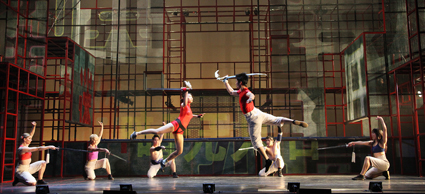
Shanghai Lady Killer
photo courtesy Stalker
Shanghai Lady Killer
Clarkson says he’s captivated by Shanghai Lady Killer despite early reservations about “the commercial narrative structure which I’ve always had problems with because it’s so bloody dominant.” Swain points out that she and Ayres conceived the show before the Global Financial Crisis when “there was a niche appearing for arthouse commercial theatre,” with some opportunities for radical, culturally diverse content. “But the GFC hit and the support that we had for it internationally went. We’d been aiming for a multi-million dollar version, but had to scale way, way, way back down. We were very lucky to be commissioned by the Brisbane and Melbourne Festivals through the Major Festivals Initiative Fund—enormous support and a big project for the fund. I think there is a big national home for Shanghai Lady Killer.”
intergenerational cultural sustainability
I wonder if Swain craves work on a smaller project. “Absolutely!” she replies. “We premiered Buru [Broome, 2010] straight after Shanghai Lady Killer. It’s a much smaller work although it’s still got a fairly large cast. It was devised and created with 10 young performers from Broome aged between 10 and 21—so it’s a very different feel. We worked for three years together with elders from the Broome community, very much in the wake of Burning Daylight, grasping this model as a way to use theatre as a sustainable form of culture, of carrying stories forward—obviously not the [sacred stories] but the ones they really want to pass on, to be public. The elders started to come into rehearsal and to say this is what I think should be happening now. It was a great moment for the company where there was really direct intergenerational knowledge transmission occurring in the rehearsal process and the young performers were really given the work to take forward. So effectively, we’ve established a youth company for Marrugeku. I don’t know if that means a fourth string to our bow now!”
Clarkson is similarly focused on intergenerational connections: “There’s a piece I’m doing called Elevate out at Penrith with three 19-year-olds, a kind of hip hop street stilt piece which is very much about the next generation. I think it’s only appropriate. Theatre is a gift that’s given to you and you pass it on.”
Swain says that “when I came to writing the speech for Stalker’s 21st birthday celebrations, I momentarily found it quite depressing. What is there after 21 years? What is left behind is ephemeral, in the memories of our audiences in all those different contexts, all over the world. And because that’s been so diverse for us and because what Stalker is in Belgium or what Stalker is in Colombia or what Stalker is in Perth, they’re all different, presented in very different models and to different sectors of the community. Twenty-one years of blood, sweat and tears, quite literally…broken bones and all that.
“But there are company members who have been in our work, learned new skills and gone on and done their own work or gone into other companies and contributed to other processes. I certainly hope in Marrugeku’s case that what comes after us will be the measure of the company’s success—finding a language that reflects the Aboriginal elders’ complexity of knowledge but that is also very contemporary. It is very hard to find the comprehension of that work, especially overseas. People often just don’t know what they’re looking at. I hope that we’re opening doors and that further down the track there’ll be more appreciation.”
Stalker have created a significant legacy over 21 very creative years. If the company had fallen apart a decade ago, that legacy might not have been as rich. Swain thinks that “there were times when I’ve thought had we been sane human beings we would have stopped.” Clarkson agrees, “Either financially or personally…but there have been big rewards, tremendous experiences.” And Swain concurs. Happy 21st, Stalker.
RealTime issue #101 Feb-March 2011 pg. 43,45
© Keith Gallasch; for permission to reproduce apply to realtime@realtimearts.net
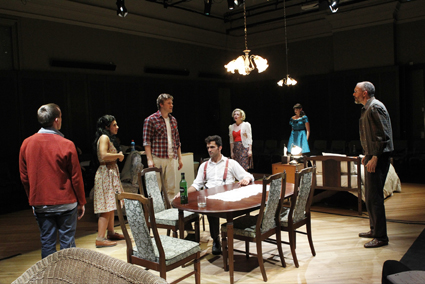
The Nest, Hayloft Project
photo Jeff Busby
The Nest, Hayloft Project
IF NIETZSCHE GOT IT RIGHT, AND HUMANS ARE LESS STATIC BEINGS THAN INCONSTANT BECOMINGS, THEN SURELY THE SAME CAN BE SAID OF THE INSTITUTIONS WE CREATE. CERTAINLY, THE MUCH-DISCUSSED “CHANGING OF THE GUARD” IN AUSTRALIA’S MAJOR ARTS ORGANISATIONS HAS MANY THEATRE PUNDITS PONDERING WHETHER THESE COMPANIES WILL BE PUSHED TO REINVENT THEMSELVES AS A RESULT, OR WHETHER IT’LL BE BUSINESS AS USUAL WITH A NEW BRAND IMAGE. LOOKING AT THE SMALLER GROUPS MAKING WORK IN MELBOURNE TODAY, HOWEVER, WHAT’S MORE EVIDENT IS HOW THE NATURE OF SUCH ARTISTIC ENTITIES IS ALWAYS A NEGOTIATION BETWEEN AN ENDURING IDENTITY AND A FIELD OF POSSIBILITY.
the nest
The Hayloft Project has remained one of the most exciting companies in Australia for several years, but focusing on the through-lines that connect each Hayloft production can distract from the impressive imaginative diversity it has also offered. Its final production for 2010 was The Nest, and while the production furthered the company’s interest in classic (especially Russian) texts adapted for a contemporary world, it was also a significant departure from what’s gone before.
Firstly, it saw Artistic Director Simon Stone hand over the reins. While Hayloft productions are almost always helmed by Stone as director, he has also allowed others to create their own works under the company aegis without overt artistic intrusion from its founder. 2009’s Yuri Wells was a hugely successful experiment in this vein, and that show’s creators also form the creative core of The Nest.
Taking as their source Maxim Gorky’s The Philistines, Benedict Hardie and Anne-Louise Sarks have developed a wonderful script that seems utterly of our time. As with Yuri Wells, Sarks again directs and Hardie performs, with a sizeable and accomplished cast making up a strong ensemble. Performed in the round (or, rather, square), Sarks displays a terrific command of pace, shifting quickly from scenes of crowded chaos to tiny, intimate moments of solitude or suspense. Despite the relatively brief running time—around 90 minutes—the sense of an expansive and credible world is quickly established, and something of the sweeping historical consciousness which often infuses Russian playwriting is maintained here.
But where productions of Gorky (or Chekhov for that matter) walk an uneasy line between historical specificity and more universal relevance, how would you know that The Nest hadn’t been written from scratch yesterday if you hadn’t already been told? The only thing that really reminds us of its origins is that oh-so-Russian habit of having countless characters turn up unannounced. Even this slightly anachronistic theatrical convention is knowingly laughed at after the production concludes and the theme songs from various sit-coms are played (sit-coms, of course, being the only place where it’s still acceptable for a constant stream of acquaintances to invade the house at all hours).
I’ve no doubt that in different hands—Stone’s, for instance—The Nest would have been a very different beast. But its inclusion within the Hayloft’s broader output only expands the company’s creative reach, making it home to a multiplicity of voices rather than a single, unitary directive. It’s all the better for it.
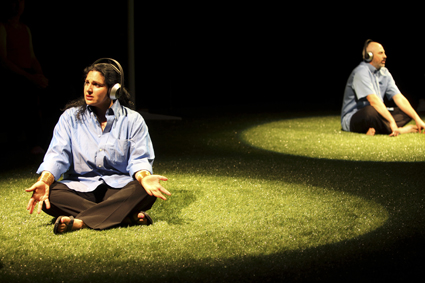
Georgina Naidu, Greg Ulfan Yet to Ascertain the Nature of the Crime, Melbourne Workers Theatre
photo Ponch Hawkes
Georgina Naidu, Greg Ulfan Yet to Ascertain the Nature of the Crime, Melbourne Workers Theatre
yet to ascertain the nature of the crime
Melbourne Workers Theatre, conversely, has had many esteemed directors across the decades, but is now undergoing a radical reinvention. Its last production, Yet to Ascertain the Nature of the Crime, hinted at the plans new director Gorkem Acaroglu has for recreating the company as one solely dedicated to documentary theatre, as well as a more general shift away from creating works based primarily around class concerns towards addressing a wider variety of contemporary social issues.
Yet to Ascertain…spoke to this new brief with outstanding clarity, incorporating questions of class and work but also closely scrutinising the realities of race relations in Australia today. It was developed from a range of verbatim sources including interviews, journalistic articles, official reports and first-person narratives. Three performers re-enacted these exchanges in a variety of theatrical styles, from frankly silly Bollywood dances to skit-comedy routines to sincere and moving monologues. Though patchy in tone, the collective weight of the production was considerable, and a lengthy final sequence in which a taxi driver is attacked by racist passengers before his own cab-driving community comes to his rescue is simply breathtaking theatre.
Though largely played in somewhat exaggerated, consciously theatrical ways, the various narratives produced here were of an intricate and provocative nature. Many circled around the experiences of Indian students and immigrants in Melbourne, including the real incidents of racially-motivated violence which have made international headlines as well as more engendered and institutionalised forms of discrimination. There are layers of irony to many of the word-for-word recountings of victims themselves, including denials that Australia is home to racism, as well as the police statements which are the basis for the show’s title. At the same time, contrary viewpoints which complicate the notion of racism as an ‘us vs them’ binary add to the overall challenge—and lack of easy answers—which the show presents to its audience. It’s a pity Yet to Ascertain…had such a short season, but it’s certainly an inspiring beginning for the company’s next stage of development.
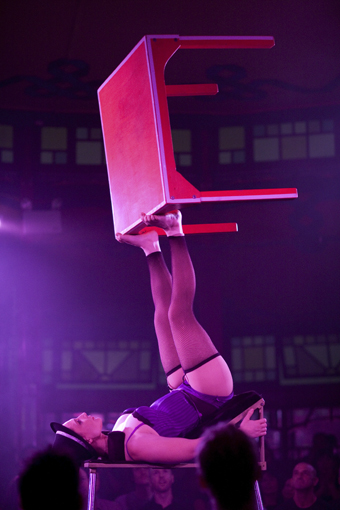
The Blue Show, Circus Oz
photo Robert Blackburn
The Blue Show, Circus Oz
the blue show
Circus Oz’s The Blue Show was billed from the outset as something unusual from the company. Housed in its new Spiegeltent, it promised an adults-only show as part of the midsumma festival, but what eventuated was something quite different. Less ‘adult’ in content than context, it was more an ageless celebration of sheer fleshy joy. Many similar Spiegeltent burlesques end up as shop-worn sequences of fairly tame titillation and nudge-nudge cabaret. Here, rather, was nudity and humour with a lack of inhibition that is often only found in children—it wasn’t that the acts set out to transgress social boundaries, but that they didn’t seem to even admit of their existence. Sure, there’s appeal in a show that allows us to enjoy a drink in intimate surrounds without toddlers scampering underfoot, but very much the same show could have played to all ages at an earlier timeslot without risking much outrage.
For me, the company’s regular higher profile family outings have long been hampered by “kid-friendly” clowning that doesn’t evince the same sophistication as some of the more intricate routines; the performers are all top-notch, but their talents can come across as dumbed-down when they don’t need to be. The Blue Show treats its audience as adults, as capable of viewing on a range of levels, but it also seems to me that many kids are just as able to handle this kind of subtle complexity. It’s encouraging to see the company branch off in this direction, and one can only hope that some of the acuity and focus displayed here will develop in the company’s more popular ventures in the future.
The Hayloft Project, The Nest, writers Benedict Hardie, Anne-Louise Sarks, after Maxim Gorky’s The Philistines, director Anne-Louise Sarks, performers Sarah Armanious, Stuart Bowden, Stefan Bramble, Alexander England, Brigid Gallacher, Julia Grace, Benedict Hardie, Carl Nilsson-Polias, Meredith Penman, James Wardlaw, set Claude Marcos, costumes Mel Page, lighting Lisa Mibus, music & sound design Russell Goldsmith, Northcote Town Hall, December 4–19, 2010; Melbourne Workers Theatre, Yet to Ascertain the Nature of the Crime, writer Roanna Gonsalves with Raimondo Cortese, Damien Miller, director Gorkem Acaroglu, performers Georgina Naidu, Greg Ulfan, Andreas Littras, performance consultant John Bolton, sound design by Mik La Vage, lighting Jason Lehane; Arts House, North Melbourne Town Hall, Nov 24-28, 2010; Circus Oz, The Blue Show, director Anni Davey, Circus Oz Melba Spiegeltent, Jan 13-Feb 6, 2011
RealTime issue #101 Feb-March 2011 pg. 44
© John Bailey; for permission to reproduce apply to realtime@realtimearts.net
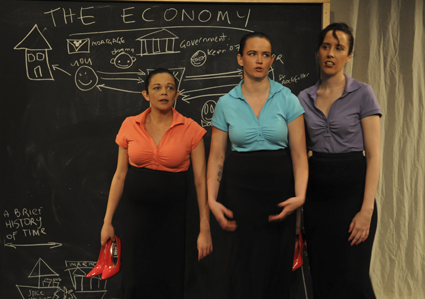
Natalie Rose, Zoe Coombs Marr, Mish Grigor, Everything I Know About the Global Financial Crisis in One Hour, Post
photo Heidrun Löhr
Natalie Rose, Zoe Coombs Marr, Mish Grigor, Everything I Know About the Global Financial Crisis in One Hour, Post
IN A DELIRIUM OF RIGHTEOUS FREE MARKET FUNDAMENTALISM, WESTERN CAPITALISM, ONSELLING UNSUPPORTABLE LOANS THE WORLD OVER, WENT MAD. SOME OBSERVERS RECOGNISED THE SIGNS OF INSANITY AND FORESAW IMMINENT COLLAPSE, THE REST OF US SUFFERED THE DELIRIUM OF THE AFTERSHOCKS AS STATE ECONOMIES, JOBS AND HOUSING MARKETS WERE SUCKED INTO A HELLISH BLACK HOLE.
Even if you didn’t feel the impact of the Global Financial Collapse in the pocket (a welcome $900 cheque from Prime Minister Rudd aside) you doubtless spent time anxiously wondering what had actually happened and would it recur in the shape of a much anticipated vicious double dip recession.
Nervous times yielded countless articles, broadcasts and books providing analyses simple and complex of the Global Finance Collapse. Some have been reassuring—providing a clear chain of cause and effect running from bad economic theory to market deregulation to failed governance and downright corruption. Others have revealed more worrying networks of disturbance, from unrelated one-off criminal acts (Bernie Madoff, a handy villain) to globalisation’s maximisation of the GFC’s impact, from American Republican and Australian Liberal politicians arguing for brutal economic clean-slating instead of stimulus packages to Detroit’s motor industry tsars driving cars to Washington’s Senate Enquiry and all of us having to grasp the reality that the USA was in substantial debt to China. The world had truly turned upside-down.
How can art assist in a time of paranoia and breathtaking absolutism? Belvoir’s B Sharp, in one of its last acts, brought relief and enlightenment in the form of A Distressing Scenario, a double bill from Sydney performance companies Post and version 1.0.
Of the two performances, Post’s Everything I Know About the Global Financial Crisis in One Hour, more effectively conveyed the aforementioned sense of delirium with a virtuosic stringing together of unlikely causes and effects, the semi-lecture format reinforced with bizarre chalkboarding (the board itself revealing ever new extensions) and interrupted with manic dancing, the waving of sparklers and the positioning of champagne bottles in readiness for the ultimate release.
The experience was like having the GFC explained to us by the ill-read, the ill-informed and the plain ill—the bandaged performers presented variously as victims of car accident, tonsilitis, cocaine addiction and pregnancy, all impediments to putting their show together. Undaunted, the Post trio launched into an elaborate and diffuse explanation of the GFC replete with muddled and inaccurate historical grabs and bizarre connections altogether reminiscent of paranoid popular media. An exhausting whirligig of associations dated GFC origins back to Rockefeller, the corn market, popcorn and the decline of the cinema, the 1988 Australian Bicentennial and Bette Midler tours as positive market indicators. These were accompanied by wild speculations about the value of training monkeys in universities and why there are no jaws of death for newsagents. The sheer, manic drive of the performance, its bracing informality, the self-belief, its mad poetry and smatterings of GFC-reality sucked an initially wary audience into a vortex of nigh impossibly suspended disbelief.
Everything I Know…was durational in every sense, for the courageous performers, sometimes perilously over-taxed, and for an audience riding the wild waves of free association, coursing the looping illogic and withstanding the recurrent, battering dance passages and the final champagne spray. With wicked ease, but little to celebrate as bankers and brokers clawed back their bonuses, Post left us nonetheless wiser about the way the human brain miscalculates and rationalises its way into disasters of the order of the GFC.
After the brief respite of intermission and anticipating further assault, we were bemused to find ourselves removed from Post’s compulsive cosmos and relocated to the parallel universe of version 1.0’s The Market is Not Functioning Properly. Same Big Bang—the GFC; same problems—how to comprehend and survive economic disaster; similar symptoms—faltering rationality and increasing delirium. The Market’s performers also, like Post, reveal themselves to be performers (“I’m an artist: no finances to speak of,” declares one).
But the Post and version 1.0 universes travel in opposite directions. Instead of the desperate, gutsy vigour of Everything I Know, The Market is neat, tautly framed, carefully paced. Two genteel women (Jane Phegan, Kim Vercoe) in pearls and satin gowns appear to parody themselves and then, more archly, middle-class womanhood as they grapple with the GFC and their domestic budgets (laid out on laminated cards that threaten to slip from their grasp). If Post are wildly mock educational, version 1.0 are calculatedly didactic. The women puzzle and bicker informatively beneath three screens inhabited by unreassuring world leaders, all men, alternating with three Australians, also men, with very little to say about the GFC.
As finances and life become less manageable (cut back on wine, on Belvoir tickets), the women strike poses of fright before the images of these men (the powerful and the ‘ordinary’ at times superimposed), dance awkwardly, swing together in violent circles, teeter on the edge of the raised stage and, finally, spew champagne into buckets hanging immediately before us. But they might as well have gone to pieces on another planet from our own. We could recognise the symptoms of their GFC-induced malaise but where was the rich, cranky substance of appalling cause and effect that we have come to associate with version 1.0? The Market was a surprisingly tame affair for a company whose major works have surreally and satirically brought to light the frightening deployment of power in politics, media and gender relations—revealing that the irrationalities and manipulation involved don’t have to be exaggerated, but reframed in order to be seen. Version 1.0 have set their benchmark very high and we expect a lot, not least the means with which to do battle with the insidious GFC.
–
B Sharp, A Distressing Scenario: Post, Everything I Know About the Global Financial Crisis in One Hour, deviser-performers Zoe Coombs Marr, Mish Grigor, Natalie Rose; version 1.0, The Market is Not Functioning Properly, deviser-performers Jane Phegan, Kym Vercoe, director David Williams, video artist Sean Bacon, sound Paul Prestipino, lighting Frank Mainoo; Belvoir St Theatre, Sydney, Nov 25-Dec 19
RealTime issue #101 Feb-March 2011 pg. 45
© Keith Gallasch; for permission to reproduce apply to realtime@realtimearts.net
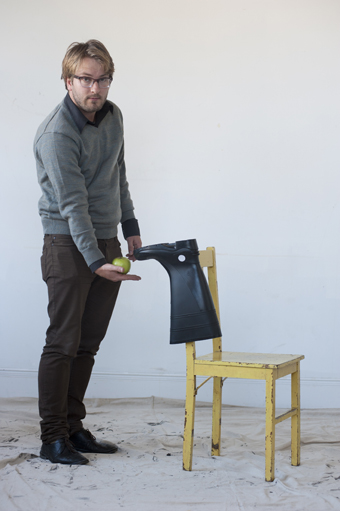
Ralph Myers
photo Patrick Boland
Ralph Myers
IN REALTIME 100, I GREETED THE 2011 BELVOIR PROGRAM WITH ENTHUSIASM. NEW ARTISTIC DIRECTOR RALPH MYERS’ LARGELY YOUNG TEAM OF DIRECTORS (INCLUDING SEVERAL WOMEN), A MIX OF RARELY SEEN CLASSICS (INCLUDING RAY LAWLER’S SUMMER OF THE SEVENTEENTH DOLL TO BE DIRECTED BY OUTGOING ARTISTIC DIRECTOR NEIL ARMFIELD), NEW PLAYS, A DANCE PIECE AND TWO ABORIGINAL WORKS COMPRISE A SERIOUSLY INVITING PROGRAM. IN ADDITION, THE INCORPORATION OF THE DOWNSTAIRS THEATRE INTO THE OVERALL PROGRAM SEEMS A SIGNIFICANT OPPORTUNITY TO PHILOSOPHICALLY AND PRACTICALLY EXPAND BELVOIR’S PROGRAM AND REACH.
MYERS, IN OUR FIRST MEETING, CONFIRMS HIS REPUTATION AS AMIABLE, FUNNY AND SHARP. HE’S AN ACCLAIMED THEATRE DESIGNER, NOT A STAGE DIRECTOR [AS YET], SO I THOUGHT IT MIGHT BE INTERESTING TO USE THAT AS THE PIVOT FOR OUR CONVERSATION.
You trained in visual arts, specifically in silversmithing, but then you went to NIDA.
I’m a bit impatient and hasty to see a quick result which is why I thought I might not make a good jeweller. And there’s something great about theatre design and indeed the process of making theatre in general. It’s something that happens quite quickly, you get a big result quite quickly and it’s all kind of slightly junky, which I think appeals to my kind of sensibility.
The materials, the disposability?
It’s ephemeral—you only need to make it last for a season while achieving the impression and the sensation that you’re trying to generate in the mind of an audience. Jewellery making—and I’m touching my wedding ring as I say this—is about the integrity of the material. How many carats is the gold, how well is it constructed, how many hundreds of years is it going to last? What I like about theatre is the exact opposite of that.
In theatre, it’s the durability of memory, isn’t it?
It is and that’s a strangely fugitive thing as well. Memories twist and transform. Neil’s wonderful production of Diary of a Madman makes quite an interesting comparison between what theatre was like 20 years ago in Sydney and now. He’s pretty faithfully reproduced that 1989 production with Geoffrey Rush and the original team, the original designers. It’s marvellous that even though it’s not that old, it’s stylistically from another era.
There are times when you have to live with your designs a lot longer than a Sydney season. A Streetcar Named Desire going to the US must have posed interesting challenges.
It’s a slightly horrible thing to say, but the ones that have the longest lives are not always the ones you want to. The curious thing about being a set designer is that ultimately you need to serve the vision of the director. So sometimes you have to make a decision to put your taste and your sensibilities—and your fears—aside and allow the director to ultimately make the decision.
You were serving Liv Ullman’s vision.
Absolutely. And she is an extraordinary figure, an important artist of the 20th century. Who am I to tell her what to do? I’m working on Ibsen’s The Wild Duck at the moment both as set designer and as artistic director of the company. We’re finding a way for that to work. And it does work because Simon Stone the director is very clear about his ideas and vision. So it’s not muddy.
There are a number of strong directors around who could be labelled auteurs, who arrive not just with a play but also a design concept for the designer to realise rather than invent.
You get directors who know exactly what they want and the task is making that work within the space and the parameters. And there are always an infinite number of details to resolve. I don’t mind that. I’ve been in situations for instance with Benedict [Andrews] where he’s led the process very much—I’ve realised an idea that’s come to me from him very much fully formed. On the other hand there have been other situations where the idea has been largely mine and it’s evolved in conversation. Barrie Kosky is another example. He has very strong ideas about what he wants. To be honest I find that the better directors know precisely what they want or latch onto an idea and allow it to be followed through to its logical conclusion. When I was working with Neil Armfield on Benjamin Britten’s opera Peter Grimes for Opera Australia, I’m fairly sure Neil came up with the idea of setting it in a church hall. I built a model of it and very quickly we realised that it would work. Then he allowed me to realise that very much on my own. So there’s quite an element of trust and understanding.
Your father was an architect, your mother a visual arts teacher; I’m very interested in the architectural quality of your work. It seems to me that some designers have a better architectural and spatial sense than others (whose work might resonate, say, with contemporary visual arts or technology or interior design). In certain of the shows you’ve designed the architectural quality is pronounced—those huge floating rooms in The Lost Echo (STC) or the room that revolves in Measure for Measure (Company B), that modernist superstructure hanging over a very ordinary, aged apartment in Streetcar Named Desire (STC), the grim in-the-round basement world for Blackbird (STC), the hall in Peter Grimes. They all struck me as very three-dimensional, very substantial. For all that ephemerality, they felt eerily solid.
I’m interested in solid things. My mother was an architect before I was born. I’ve always been around architects. I suppose if you come from a family of tailors, you look at what people wear. I am interested in people and space. I’m flattered that you think my work seems solid. The thing you’re fighting in theatre is that nothing is solid really. It’s all made out of bits of cardboard.
How do you feel about The Wild Duck? Do you engage with the actors and the director about the way the space is being used and inhabited?
I try to attend rehearsals as much as I can. I really like being in rehearsals. And of course the more you’re there the better the design serves the purposes of the play. I’d like to be there all the time but you can’t always be. In all good rehearsal rooms, there’s a certain amount of cross-fertilisation. Actors will suggest something about the set and you can suggest something about how they do their performance (LAUGHS). In the end it all comes out in the wash.
One of the tricks of being a good designer is to maintain as much flexibility as you can within the structures of how companies like this will work. All theatre and opera companies and certainly production departments will try to lock down the physical elements of production as early as they can because it makes it very much easier for them to do their job. One of the difficult things to say after the second preview might be: “Actually, it should all be pink” or “I think this is completely wrong. Let’s get rid of the set and do it on an empty stage” or “I think she should be wearing a wedding dress.” These things throw a spanner in the works, blow the budget and make it very difficult. But ultimately that’s what you might need to do: use the time at your disposal to make the production as good as you possibly can. Sometimes you can’t have the best idea three months in advance of the production or, in the case of opera, 18 months.
One of the things I’m conscious of as artistic director of this company is allowing it to remain pretty responsive, which it always has been. As a set designer this was the one place where you really could change your mind quite late which is a really fabulous thing. I think this probably comes from Neil’s chronic inability to make artistic decisions (LAUGHS). He’s left a great legacy for the rest of us.
For Measure for Measure you were working with projections and onstage cameras. You’ve made it clear elsewhere that you see theatre as a very different realm from film and new media—that’s not to say you’d exclude them. But that work provided a fascinating experience in terms of design, accommodating the revolving room that keeps transforming and the screens that frame it.
I’m often extremely sceptical about the use of audio-visual material in theatre productions because I think it can be a substitute for something that could be shown in real time or ‘real life.’ The figure on the screen is often much more interesting to watch than the onstage figure, because of scale. So your eye tends to be drawn there which starts to beg the question well why is there a figure there at all onstage? As you know, Benedict’s extremely interested in working in that way. As the designer for Measure for Measure of course I went along with it, made it work as best I could within the space, worked with Sean Bacon and in the end I think it was extraordinary. You gain something, of course, by the use of the camera to show a kind of detail that otherwise couldn’t be seen. That’s much more interesting than showing what you can already see. So Benedict’s focus on Mariana’s wedding—you know touching her engagement ring at the top of Act 3—or zooming in as he did in The Season at Sarsaparilla on a detail or moment that would otherwise be lost to the audience, is extremely interesting. It’s an interesting extension of that idea.
I suppose there’s not much you can reveal about your design for The Wild Duck at this stage. What would you say is the creative impulse for you in the production?
It’s extremely exciting. I don’t want to jinx it by saying it’s going to be good but Simon has a very sharp brain and a very good sense of what’s at his disposal in terms of the actors and the resources that are available to him after coming from a background in independent theatre where everything is slightly difficult to get hold of. Here things are more possible. That said, it’s quite a restrained production, not over the top in any way. He’s essentially taken the core story of The Wild Duck, those six central characters, the inevitable playing out of an action over a short period of time that happens in Ibsen plays, and stripped it of all the stuff around it, rewritten it and placed it in a very spare environment.
It all happens in one space?
It’s even more abstract than that somehow. It’s really no space at all. The adaptation has a kind of charm that’s often missing from the adaptation of classics—a kind of lightness, playfulness and charm that’s very easy to lose when you’re trying to faithfully adapt something. It’s a bit like—while being nothing like—Noel Coward or Oscar Wilde in that the way that people interact with each other doesn’t always reflect the great drama and import of the things that are being discussed. I don’t know how Simon manages to create that. He’s got a very playful rehearsal room. There’s a great deal of light. But it’s a horrific play. A 14-year-old girl in the end shoots herself.
Obviously like many before you, you’re enamoured of the Belvoir St Theatre space, and you’ve worked it before. Will you occasionally lease yourself out to bigger stages?
I’m working on a production for Opera Australia in 2012. That’s the only thing I’m doing outside at the moment. I’m designing for Benedict’s production of Chekhov’s The Seagull for our 2011 program.
What have been the pleasures of putting this program together for you?
It’s an enormous pleasure listening to a whole lot of people speak very passionately and enthusiastically about the things they want to do. The difficulty, of course, is choosing which ones to take up. A company like this should be as open as it can be, as able to hear as many ideas from as broad a range of places as possible. One of the challenges for a company is that you can become insular or that you only turn to people you know or who you’ve worked with before, which I think is extremely dangerous. The other side of that is that you have to listen to a whole lot of bad ideas from a whole lot of people too. But that’s okay. So that’s a great pleasure. And then you make a salad out of it. And there are a lot of reasons why some things end up in the mix and others don’t but really nothing ends up in there that I don’t think is going to be good or interesting or hopefully both. I very much started the process with the ambition to not include anything simply for pragmatic reasons.
Like making big box office?
Yes and you never can anyway. From a few years of working at the Sydney Theatre Company and from many years around the traps working as a designer in lots of theatre companies, you see that there are things that a company does for legitimate and artistic reasons and there are other things they do to satisfy what they imagine the audience wants or what’s going to make money, all sorts of reasons. My one ambition is to not have one of those productions. We’re lucky we can do that here. We don’t have quite the pressures of the big state companies. It’s an enviable position. The trade-off for winding up the B Sharp program was that we were going to be able to do fully staged productions down there. The disadvantage was that we wouldn’t be able to do so many of them. My ambition is to build that up over time so that it has the same volume and energy that B Sharp had but where everybody is being paid. My big ambition is to employ more artists in general. It’s surprising how few people think that’s a good idea [LAUGHS]. But I think it’s critical for a city of this size, a city as fabulous as Sydney to have a lush and thriving artistic community. And I think you have to do that by directing money towards people to do it. We’re the third or fourth biggest theatre company in the country. I think we need to face that reality.
Henrik Ibsen’s The Wild Duck, directed by Simon Stone, featuring performers John Gaden, Anita Hegh, Ewen Leslie, Eloise Mignon, Anthony Phelan, Toby Schmitz and designer Ralph Myers is playing at Belvoir Street Theatre, Feb 12-March 27; Belvoir, artistic director Ralph Myers, Sydney; www.belvoir.com.au
RealTime issue #101 Feb-March 2011 pg. 46-47
© Keith Gallasch; for permission to reproduce apply to realtime@realtimearts.net
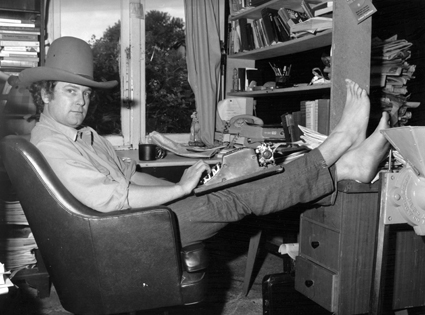
Frank Moorhouse (archival)
photo courtesy of ABC Document Archives
Frank Moorhouse (archival)
HERE’S AN INSPIRED IDEA: NOT ONLY PLAY A SERIES OF EIGHT CLASSIC AUSTRALIAN STAGE AND RADIO PLAYS PRODUCED BY THE ABC OVER THE DECADES BUT ALSO INTRODUCE EACH WITH CAREFULLY AND INVENTIVELY CRAFTED 30-MINUTE INTRODUCTIONS FROM WRITERS (WHERE AVAILABLE), PRODUCERS, ACTORS AND SPECIALIST COMMENTATORS FLESHING OUT THE SOCIAL, POLITICAL AND AESTHETIC WORLDS AND CREATIVE IMPULSES FROM WHICH THE WORKS EMERGED. PLAYING THE 20TH CENTURY REALISES THE VISION WITH VERVE.
The series is a collaboration between ABC Radio National’s Hindsight and Airplay programs aiming to “chart a century of Australian theatre” from Louis Esson’s The Time Is Not Yet Ripe (1912) to Katherine Thompson’s Diving for Pearls (which won the Louis Esson Prize for Drama in 1991!). The other plays are Betty Roland’s The Touch of Silk, Douglas Stewart’s radio verse play Fire on the Snow, Ray Lawler’s Summer of the Seventeenth Doll, Alex Buzo’s Norm and Ahmed, David Williamson’s The Removalists and Frank Moorhouse’s experimental radio drama Loss of a Friend by Cablegram.
Of the three introductions I’ve listened to so far, it was the world conjured by the reflections of Moorhouse, McLennan and actor Arthur Dignam on Loss of a Friend by Cablegram that I found the most engrossing. The commentaries on The Time Is Not Yet Ripe from academics John McCallum and PJ Matthews were richly informative but the voice given Esson (from his letters) was not engaging and the documentary’s structure is the least inventive of the three. The introduction to Diving for Pearls however is full of the sounds of its Port Kembla steelworks and coastal setting and there is clever segueing from playwright Thompson’s voice into those of her characters along with astute observations from the play’s first stage director Ros Horin and Di Kelly from the University of Wollongong on the political context.
The appeal of the introduction to Loss of a Friend by Cablegram for me lies in its embodiment of a period of transition in radio drama production in the early 1980s from the imitation of the live theatre experience on air to more intimate approaches, from single take recordings on tape (often subsequently destroyed) to intensively edited productions, from crude FX to field recordings (the right acoustic) and from predictable structures to experiments in form. McLennan, who produced the play, details these transitions with amusement against the sounds of tapes running and creaky old FX. Again there’s a brisk alternation between the documentary voices and the original recording which was made with Dignam and Robyn Nevin in a room in the Sebel Town House in Kings Cross with verite intimacy and a lovely depth of field. Typical of the period of transition the sense of experiment that comes with Moorhouse’s writing is undercut by stilted, hyper-articulated stage delivery. Even so there’s much to amuse and even disturb in the production as a man and his estranged wife deal with his bisexuality, not least when she asks, “Did you think you were a woman when you lived with me, when we were married?”
There’s much to enjoy from Moorhouse about writing, about notebooks (which provide the play’s structure), about bisexuality, and from Dignam about working in radio (“When I started to learn how to drink”—as the actors headed off to a Push pub after recording for, as Moorhouse puts it, “critical drinking”) and the pleasant experience of being involved in a new way of working. Even so McLennan is surprised that most of Loss of a Friend by Cablegram was largely recorded in real time, in the traditional manner, even Dignam’s character’s inner thoughts—achieved by the actor simply turning to another microphone. Producer Catherine Gough-Brady’s introduction to the play offers insights about the writer, the work and an era of transition—sexual and aesthetic—telling us much about radio as well as the Australian play.
ABC Radio National, Airplay and Hindsight, Playing the 20th Century, producers Catherine Gough-Brady, Regina Botros, presenter Andrew McLennan, broadcast Dec 19, 2010-Feb 6, 2011; the series can be heard at www.abc.net.au/rn/playingthe20thcentury/
RealTime issue #101 Feb-March 2011 pg. 47
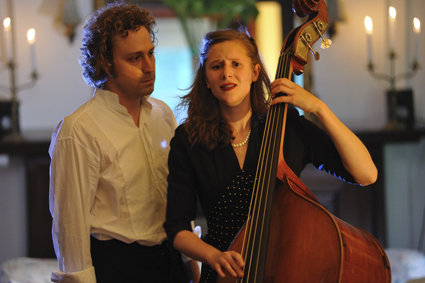
Mike McEvoy, Ida Duelund Hansen, Another Lament
photo Paul Dunn
Mike McEvoy, Ida Duelund Hansen, Another Lament
TARGET, THE ITCH AND ANOTHER LAMENT ARE THE WILD PROGENY OF CHAMBER MADE OPERA’S 2010 LIVING ROOM OPERA SERIES, AN INNOVATIVE APPROACH TO FUNDING NEW WORKS ENCOMPASSING PRIVATE PATRONAGE, GOVERNMENT SUBSIDY AND CROWDFUNDING. A HOST PROVIDES THEIR LIVING ROOM AS THE PERFORMANCE SPACE, WHILE BOOKING ONE OF THE LIMITED SEATS (IF YOU’RE LUCKY YOU’LL ACTUALLY GET THE SOFA) COMES WITH RECOGNITION AS A CO-COMMISSIONER, FOOD, WINE AND THE OPPORTUNITY TO DISCUSS THE WORK WITH THE COMPOSER AND FELLOW AUDIENCE-PATRONS.
While the Living Room Opera series has precedents in salon performance traditions, its particular combination of funding and social strategies gives hosts, audiences, composers and performers a unique sense of ownership, opening up the possibilities for original and inspired creations.
Luke Paulding’s Target re-imagines the Ancient Greek myth of Ganymede, the most beautiful of mortals abducted by Zeus to serve as cup bearer to the gods; Alex Garsden’s The Itch musically embellishes an article from The New Yorker in 2008 about a woman who awoke one morning with an chronic itch on her head (RT100, p40); and Another Lament (a collaboration between double bassist and singer Ida Duelund Hansen, from the mixed-ability performance ensemble Rawcus, and sound designer Jethro Woodward) explores the death of the English baroque composer Henry Purcell. The young composers’ musical styles are as varied as their subjects, from the bleeding edge of extended string techniques to jazz-inflected baroque arias.
“I did not especially set out to work with young composers,” claims Artistic Director David Young, “the works speak for themselves.” As many composers struggle to find funding once they grow out of the youth bracket of government grants, the Living Room Opera series provides a valuable lesson in alternative sources of funding for its participants.
target
Performed in “Melbourne’s living room,” La Mama, the work in progress Target showcases Paulding’s distinctive timbral vocabulary in exploration of the dynamics of sexual desire and fear in ancient and contemporary worlds. Through saccades between episodes of delicate wind, percussion and vocal extended techniques, Target’s enchantingly transparent sonic palette evokes a world of short attention span pleasure as Zeus (baritone Matthew Thomas) towers over Ganymede (boy soprano Jordan Janssen) in the cramped La Mama theatre. Flute and tuba breath tones flicker at the periphery of hearing until the terrifying and terrified power of Zeus’ voice is brought down upon Ganymede at the moment of his abduction. Ganymede interrupts the peripheral hum not with screams but with silence, the boy’s twittering interrupted by the glottal stops of trauma.
The audience was intimately close to the ensemble in La Mama’s black box, ensuring that none of the subtlety of Paulding’s composition was lost. After the performance, the audience had the opportunity to ask questions of the composer and hear key sections of the opera again. As David Young explains, the Living Room Opera concept takes its cue from the 19th century tradition of salon performances, where virtuosi would bash out the latest works by Liszt and gentlemen would show off their fine baritone in an intimate, semi-private setting. Beyond a small-scale format for the development of new grand works, Young sees the salon format as serving a pedagogical purpose. Warning that “this is not just a nostalgic experiment,” Young wants audiences to “learn more by having a close experience and speaking with the artists after the show.”
The didactic ending to Target evoked not only salon performances but also Schoenberg’s Society for Private Musical Performances of 1918–21. Formed for the development of musical understanding, the well-rehearsed works were repeated as many as six times during a single program. Unlike at the strictly pedagogical performances of Schoenberg’s Society, there was no shortage of applause at the conclusion of Target, which is set to become a fully-fledged Living Room Opera later this year.
the itch
With Alex Garsden’s The Itch, the Living Room Opera series moved in to full swing. Fiona Sweet and Paul Newcombe’s open plan living space filled with interested patrons quaffing wine while the performers loitered outside a set of french doors. Although Garsden’s masterful representation of skin irritation on string instruments was hard on even the most seasoned ears and despite the occasional twitch, cough or scratch of discomfort, the audience sat in rapt attention to Garsden’s score and soprano Carolyn Connors’ pained vocalisations. This was not an audience looking for a pleasant night’s entertainment, but one intent on supporting new music.
Offering the perks of being recognised as co-commissioner of the work, speaking with composer and performers, and sharing the performance in an intimate setting with like-minded aficionados, events like The Itch resemble Kickstarter and Fundbreak crowdfunding campaigns, where fans sponsor small-scale cultural projects. They are rewarded, depending on the size of their donation, with things like back catalogue CDs and visits to the recording studio of the supported artist. (Since Kickstarter campaigns rarely gather donations from outside the campaigner’s circle of friends of friends, it might be more correct to say that crowdfunding campaigns resemble an intimate living room gathering of a network of interested persons more than the decentralised and anonymous peer group that the “crowdfunding” appellage suggests.)
another lament
Another Lament takes as its inspiration the death of English baroque composer Henry Purcell. So the colourful version of the story goes, Purcell succumbed to pneumonia after his wife locked him out in the snow when he returned from a long night of carousing at the local theatre. Hosts Deidre and Naham Warhaft’s hallway and twin living spaces, separated by screen doors, provide a double proscenium arch for Rawcus director Kate Sulan’s immaculately choreographed tableaux vivants. Sulan uses the house’s depth and wings to conceal the Rawcus ensemble and lighting by Richard Vabre, haunting the tripartite stage with apparitions so carefully placed as to seem to have always inhabited the space. Even in moments of frenzied activity, when plates are broken and Purcell begs at the front door, the audience seems to be haunting a haunting quite indifferent to their presence.
Sulan’s use of simple repetition and broken symmetries complements Duelund Hansen’s pared back interpretations of Purcell hits on voice and double bass. She utilises a vast stylistic spectrum from baroque to jazz harmonies and mid-20th century Central European atonality, to extended vocal and double bass techniques. Her reinterpretations of Purcell demonstrate an expressive continuum in harmonic and timbral composition from unnerving baroque contrapuntal dissonance to the sickly crackle of cotton thread over a double bass string.
Woodward completes the ethereal habitation, manipulating sound throughout the three rooms. By looping and amplifying Hansen, actors’ voices, breaking tea cups and spinning plates, Woodward lends the house layers of resonating history as the performer’s voice is multiplied in a carefully controlled musical polyphony.
As representative of the Living Room Opera project, Another Lament stands as a celebration of contemporary chamber music and a rebirth of baroque arts business practice. The Living Room Opera series reflects the combination of public funding, private patronage and enterprise that Purcell himself enjoyed in Restoration England (while holding a post at Westminster Abbey), fulfilling commissions from royalty and composing music for the theatre. Though Chamber Made Opera’s workings may seem baroque (both historically and as in “irregular”) in an arts industry fixated on government subsidy, they are looking backwards to move forward, supporting a battery of composers by bringing chamber opera home.
Chamber Made Opera, Living Room Opera, 2010-11, www.chambermadeopera.com
RealTime issue #101 Feb-March 2011 pg. 48
© Matthew Lorenzon; for permission to reproduce apply to realtime@realtimearts.net
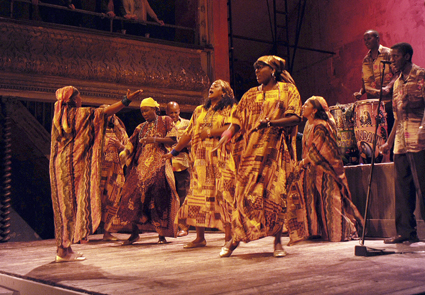
Creole Choir of Cuba
photo Zak Hussein
Creole Choir of Cuba
A HIGHLIGHT OF WOMADELAIDE 2011 IS BOUND TO BE THE CREOLE CHOIR OF CUBA—EFFUSIVE, DYNAMIC AND COMMITTED TO SUSTAINING THE CULTURAL HERITAGE OF CAMAGÜEY IN CENTRAL CUBA. THE CHOIR OF FIVE WOMEN AND FIVE MEN FORMED IN 1994 WITH AN AIM “TO RE-FORGE THE RESISTANCE SONGS AND LAMENTS OF THEIR FOREBEARS, TO CELEBRATE THE HISTORY OF THEIR HAITIAN DESCENDENTS ENSLAVED TO THE CARIBBEAN FROM WEST AFRICA” (WWW.CREOLECHOIR.COM).
The choir’s Cuban name, Desandann, means “descendants,” and the title of their recent album Tande-la means “listen.” What you’ll hear are songs of resistance and lament about the choir’s forebears working as slaves in sugar and coffee plantations and the subsequent grim legacies of colonialism. Listening to the album or watching a video of the choir in performance however conveys anything but overwhelming grief or naked anger; rather there’s a sense of the joy of survival, of cultural continuity and hope. As well there’s the potency of the music’s diverse elements—Spanish, voodoo, gospel, Creole—and its distinctive percussion-driven choral synthesis.
WOMADelaide 2011 has a strong performative streak, with bands and performance groups offering a heightened theatricality —the Ukraine’s DakhaBrakha, French hip-hopper Féfé, China’s Hanggai (“born from the Chinese punk scene…remains true to its Mongolian roots”), the brilliantly adorned Papua New Guinean Huri Duna Dancers and Brazil’s psychedelic Os Mutantes (bearer of the 1960s Tropicália heritage). France’s Le Phun will guide small groups to installations featuring “peculiar half-human and half-plant beings from the vegetable kingdom” and, also from France, Compagnie Ekart’s large-scale puppets will roam the festival crowds.
WOMADelaide’s continuing engagement with contemporary dance is realised this year by Adelaide’s Leigh Warren + Dancers who will perform a new work, Breathe, “exploring the sacred nature of suspended breath, forged around the ageless, spectral sound of the didgeridoo.” Composer William Barton will perform his work on the instrument for Frances Rings’ choreography. The dancers will be Lizzie Vilmanis, Albert David, Bec Jones, Lisa Griffiths, Adam Synnott, Lewis Rankin and guest Indigenous artists in what promises to be another visual and aural WOMADelaide 2011 highlight. RT
WOMADelaide, Sounds of the Planet 2011, Botanic Park, Adelaide, March 11-14, www.womadelaide.com.au
RealTime issue #101 Feb-March 2011 pg. 49
© RealTime ; for permission to reproduce apply to realtime@realtimearts.net
THE PINNACLE OF MUSIC MAKING IS SURELY THE SOLO PIANO PERFORMANCE. IT IS FOR THE PIANO THAT THE GREATEST MUSIC IS WRITTEN, AND WHEN VIRTUOSO PIANIST MEETS LEGENDARY COMPOSER—RICHTER AND BACH, BARENBOIM AND BEETHOVEN, ARGERICH AND CHOPIN, NIKOLAYEVA AND SHOSTAKOVICH—MAGIC HAPPENS. MUSICAL RECEPTION INVOLVES EMOTIONAL PERCEPTION. THE COMPOSER WRITES TO ELICIT EMOTIONAL STATES AND THE PIANIST CONNECTS THE LISTENER TO THE COMPOSER THROUGH HERSELF.
Pianists need more than a high level of technical facility. Indeed, they can’t fully realise the music until they can transcend the score, find the composer’s voice and use it to tell their own story. When buying a recording, I used to look for the ‘best’ rendition of the work, but soon found that many renditions will appeal in their own ways. You meet a unique and engaging individual, the pianist, who introduces herself through another unique and engaging individual, the composer.
The pianist’s teacher empowers and inspires the pianist to find the composer’s voice and her own voice. To become adept is a lifetime’s work, a vocation. In her insightful and uplifting memoir Piano Lessons (Black Inc, 2009), Anna Goldsworthy reveals that her own teacher, Eleonora Sivan, teaches the philosophy of life, and describes how her teaching creates the pianist.
Inspired by meeting Eleonora Sivan and some of her former students at a music teachers’ conference, composer Larry Sitsky wrote a seven-movement suite, The Golden Dawn, each movement of which would be performed by one of Sivan’s former students—Goldsworthy, Gabriella Smart, Jane Burgess, Inna Fursa, Rosanne Hammer, Phuong Vuong and Debra Andreacchio. Sivan was a noted performer and teacher before migrating to Australia, and those students are themselves now performing and teaching, continuing a pedagogical line that can be traced back to Liszt and Czerny. Sitsky is also a teacher, having been a professor at the ANU School of Music, and was taught by masters who inculcated the Busoni tradition in him. Comparisons with the legendary Nadia Boulanger spring to mind—a teacher who could so inspire composers and performers that a whole era of development resulted.
Sitsky has written some great piano works, his The Way of the Seeker, wonderfully recorded by Michael Kieran Harvey, being a notable example. The idea of writing a work that celebrates the master teacher is uncommon in Western culture, but appropriately acknowledges the importance of teaching. In this concert, each pianist ceremonially paid homage to her teacher by giving her allotted movement a sparkling premiere performance.
For Sitsky, music is fundamental to life itself and is inextricably linked with mysticism. He named the suite after an early 20th century magical society in England, the Golden Dawn. The society used an esoteric language, Enochian, from which the names of the various movements were taken. The work is powerfully expressive, and the character of each movement is reflected in its title. The opening movement, Mahorela (Dark Heavens) begins with a slow, hammering bass and develops into a series of short, stabbing gestures as a call to action. The second movement, Malpirgi (Fiery Darts) begins with a loud bass gesture followed by cascades down the keyboard, fleeting figures and rapidly repeated notes. Vinu (Invoke) is slow and rhythmic, and Ser (Lamentation) is dreamily mournful. Luciftias (Brightness) starts with quiet tinkling and gains in complexity and Yor (Roar) growls and bellows. The final movement, Vaoan (Truth) is measured and speech-like, returning to the bell-like tones of earlier movements. Recurring forms and motifs connect the movements. The black-clad pianists sit closely around the piano, which, given the magical theme of the music, resembles a three-legged cauldron from whose depths they conjure. This is an enchanting event, and the playing is superb.
This performance is followed by delightful renderings of Sitsky’s Fantasias No. 11, E and No. 4, Arch, played by Smart, and No 7, on a Theme of Lizst, by Goldsworthy, demonstrating the range and depth of his composition.
The Golden Dawn celebrates both a school and group performance. The seven pianists approach the composition in their own ways. Should they change places, the result might be different musically, but no less resolved. The next generation is establishing itself; for example Marianna Grynchuk, a student of both Sivan and Smart, is giving articulate and persuasive performances. Each pianist brings to her playing her own emotional range and expressive style, her own consciousness.
The Golden Dawn is a consummation of elemental life forces. Afterwards, both Eleonora Sivan and Professor Sitsky seem well pleased and the gathering of teachers, composers, musicians and listeners rejoices.
Larry Sitsky, The Golden Dawn, performers Anna Goldsworthy, Gabriella Smart, Jane Burgess, Inna Fursa, Rosanne Hammer, Phuong Vuong, Debra Andreacchio, Hartley Concert Room, University of Adelaide, Nov 27, 2010
Chris Reid’s review of Sitsky’s The Way of the Seeker appeared in RealTime 78.
RealTime issue #101 Feb-March 2011 pg. 51
© Chris Reid; for permission to reproduce apply to realtime@realtimearts.net
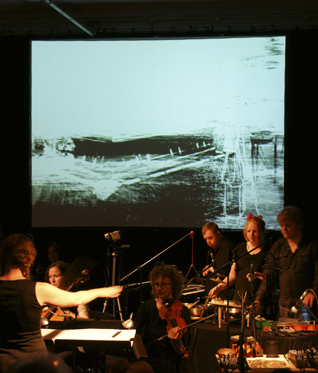
Daniel Bond (Amplified Elephants), Tom Oaks and Annemeike Oaks (Noise Scavengers), Belinda Woods, Caerwen Martin, Andrea Keeble (BOLT Ensemble), The Mountain, The Click Clack Project
photo Matt Bonner
Daniel Bond (Amplified Elephants), Tom Oaks and Annemeike Oaks (Noise Scavengers), Belinda Woods, Caerwen Martin, Andrea Keeble (BOLT Ensemble), The Mountain, The Click Clack Project
THE MOUNTAIN EMBODIES AN AGENDA FOR SOCIAL EQUALITY. IT BRINGS TOGETHER ARTISTS WITH VARYING ABILITIES, FROM HIGHLY EXPERIENCED PROFESSIONAL MUSICIANS, TO THOSE WITH DISABILITIES OR FROM DISADVANTAGED BACKGROUNDS.
Artistic director James Hullick has striven to create work that equally values the contributions of all members, regardless of ability. In CD liner notes, Hullick writes, “If we are to accept that all people are equal as they walk amongst our vibrant community, then we must accept that the abilities of all people are of equal worth to our community.”
The Mountain brings together three ensembles: The Amplified Elephants, Noise Scavengers and the BOLT Ensemble. The Amplified Elephants are a group of musicians with intellectual disabilities, evolving through a program at the Footscray Community Arts Centre. Noise Scavengers is a group of young sound artists emerging from a similar program at Cloverdale Community Centre.
The BOLT Ensemble is a group of professional musicians, put together to perform original works by Hullick. As well as performing this role in the Mountain project, they have also helped in its development, working closely with musicians from The Amplified Elephants and Noise Scavengers to explore and discover new sounds.
The Mountain is a multi-movement work, using combinations of these three ensembles. It is based on Jetsun Milarepa, the story of a Buddhist saint who finds redemption through having to build a tower, then tear it down and repeat this process several times over. In this performance, Jetsun’s story is told through a series of scenes. The piece is not so much a programmatic depiction of the story but, instead, a series of abstract, contemplative moments derived from the narrative.
A plethora of sound sources are employed in this performance. These cover an entire spectrum of volume, from the subtle rustles of a prepared harp, blown bottles and delicately struck gongs, to loud, pulsating synths, no-input mixers and the grating sound of a tortured violin.
Given the varying ability of the musicians involved, Hullick’s approach to composition is dictated by the musicians’ capabilities. The role of composer is one of facilitation and the organisation of material. Hullick manages to breath life into this role by creating circumstances in which performers are free to delve into a playful engagement with sound. Despite this apparent freedom in performance, the overall work maintains focus and direction through variety of sonic ideas. What is perhaps most successful is the way sounds produced by non-professional players are integrated with those produced by professionals. This combination of sounds produced complexes of timbre that were detailed and intriguing.
Hullick’s compositions for the BOLT Ensemble seem to have recently developed a language that has greater command in the evolution of musical ideas over time. Rather than being a series of sound combinations that amble through a performance, there are different degrees of momentum and energy; musical structures that play with one’s perception of time.
Despite the complexity of Hullick’s musical structures, his aim for music to embody social equality is not lost. There is an inherent dialogue in the work in which all the voices of the players make a valuable contribution.
Visual images by Klara B Klaric and Tien Pham provide a useful way of delineating the various scenes. While the overall contribution was generally atmospheric, the graininess and roughness of the images complemented the music’s aesthetic, if at times distracting our sense of its evolution.
The Mountain takes the idea of ‘found sound’ in an entirely new direction. As well as turning unexpected objects into musical instruments, this work also finds unexpected performers. Just as found sounds are inherently intriguing, the manner in which musicians discover and engage with sound yields its own intrigue and idiosyncrasies. The risks in this work, taken for the sake of artistic ideals, have paid off with success. The Mountain Concerts have realised the ideal of social equality in performance, and not merely as the spectre of possibility.
The Mountain Concerts, by The Click Clack Project, featuring The Amplified Elephants, Noise Scavengers, BOLT Ensemble, presented by Footscray Community Arts Centre, Cloverdale Community Centre and JOLT Arts Inc; fortyfivedownstairs, Melbourne, Dec15-18, 2010
RealTime issue #101 Feb-March 2011 pg. 50
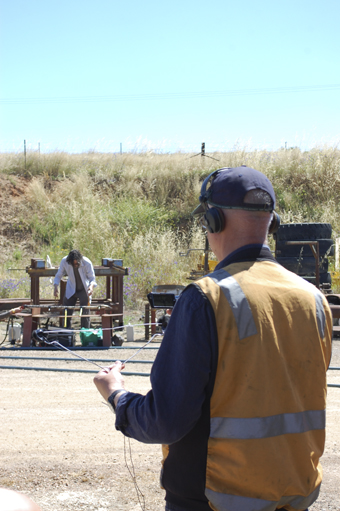
Chris Watson, Rolling Stock
photo Public Assembly
Chris Watson, Rolling Stock
ON A TOASTY SATURDAY AFTERNOON, SEVERAL HUNDRED PEOPLE GATHERED FOR THE ROLLING STOCK EXTRAVAGANZA, FEATURING INSTALLATION AND PERFORMANCE WORKS AT THE JUNEE RAILWAY ROUNDHOUSE AND ON AN HISTORIC TRAIN RIDE.
The project had a site-specific emphasis, building on the evocative architecture and machinery of the train and Roundhouse and upon the phenomenon by which sound can overlay and transform the visual environment. Dave Noyze and Garry Bradbury made a hugely entertaining work of the Roundhouse turntable, a sort of huge record platter on which train carriages can be spun and driven into the workshops. The rotation of the platter caused a fearsome clamour as tons of metal and concrete ground together. The artists made a subtle yet savvy intervention, adding their own sounds but largely relying on the spectacle of the machine itself. The duo’s work harked back to the futurist enthusiasm for mechanical noise, with perhaps less Italian aristocratic arrogance and more rustily laconic bogan self-satisfaction, laced with snotty Industrial lip-curl. One can only hope that they’ll be let loose on another edifice, perhaps the Sydney Harbour Bridge or the rotating restaurant atop Sydney’s Centrepoint Tower.
Among other works, a local parkour crew braved the sun to provide some hi-NRG action, vaulting carriages and locos, eliciting visceral sensations in the audience as they flew above the concrete, evoking the spirit of concrete-clad outer Paris. Joel Stern and Andrew McLellan drummed and thrummed out a two-person, rural-NSW style gamelan sound using junk that was lying about (presumably waiting for such a performance opportunity), creating moments of entrancing musical pleasure.
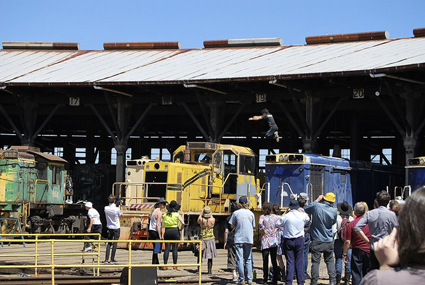
Parkour, Rolling Stock
photo Jennifer Teo
Parkour, Rolling Stock
Following the Roundhouse smorgasbord of sounds came a train journey to Cootamundra and back. Like the Roundhouse, the historic train needs barely the slightest breath from the artist, being a novelty in its own right. Infusing the artistic proceedings was the social scenario created by the train, where urban and regional were thrown together in the booths of the antique rail carriages. In one such encounter, my listening to the performance of UK artist Chris Watson co-existed with a woman’s story of her daughter’s suicide following a grand-daughter’s premature death. I could not ask the woman to stop, not least because the teller hadn’t noticed there was a performance to hear. Such is art as it emerges from its trench and sticks its head into the terrain of life.
Chris Watson’s polished and sophisticated work took the form of El Tren Fantasma (The Ghost Train), a sound design recreating another train journey. It is composed from recordings made by the composer for the Great Train Journeys TV series in 1998, documenting the last coast-to-coast passenger service of the Mexican State railway system prior to its closure due to privatisation. Watson’s strength is the masterful fidelity of his recordings with which he skilfully composes his simulations. The outstanding feature of the work was his manipulation of one’s sense of time, transforming a multi-day journey into a single experience. In Junee the work reads as an imaginative fancy, layering exotic Mexico over exotic rural NSW. Given the site-specific emphasis of the festival, one hopes Watson made some local recordings and might re-present them in situ in the future. El Tren Fantasma is soon to be released on CD.
Also working with the sound of the train was Sydney media artist Shannon O’Neill, whose Locomentum foregrounded the iconic phenomenon of rail rhythms. A subtle piece inviting close listening, it blended the live and recorded sounds to create a minimalist ‘phase space’ where the already hypnotic rhythm of the train is blurred by a recorded doppelganger. This innocuous play of rhythm opens up reflection on the auditory pleasure of trains, wherein the regularity of the sound is compelling. Trains, like ships, can have a particular pleasure, stemming from their combination of high-speed motion and hotel-style living. They have a lulling rhythm, but also the potential for humungous collision, injury and death. I’m reminded of the lullaby “rock-a-bye baby in the tree top; when the wind blows, the cradle will rock; when the bough breaks the cradle will fall”; it’s a rhyme that on reflection seems an odd one to relax a child.
Other works on the train included Sleeper Carriage by Noyze and Bradbury. Installed in a sleeper carriage, and sounding much like an Alan Lamb work, it offered a rich seam of electronic sound to be listened to from the privacy and comfort of a bed, albeit with the spoken accompaniment of artists and punters who took respite and refreshments in the compartments and perhaps didn’t realise or care how far their conversations carried. In another carriage the PVI collective presented a work based on local political issues via the medium of a tug-of-war. Numerous other works were presented, with details available at http://rollingstock.weebly.com/.
Art maverick Sarah Last, who describes herself as an artist rather than curator, organised Rolling Stock. Her work in the Unsound Festivals, the Wagga Space Program, The Wired Lab and a variety of other activities is noteworthy. There are few curators working in sound in Australia, and even fewer curators working with sound site-specifically. In her plenary address to the 2010 Regional Arts Australia conference, Last outlined her interest in breaking down artist-audience divisions and encouraging the creative and active participation of local communities in art projects. The audience at Rolling Stock didn’t actually get their hands dirty with noise making, but the presence of more non-practitioners than practitioners in the audience is a step in the right direction. While some of the works showed depth of engagement with the site and were created in cooperation with community, the degree to which audiences were challenged and their perception developed was less clear, perhaps by virtue of the very private nature of the art experience.
To my ear, the most amazing sound of the weekend was the soundscape of insects, animals and air movement heard at midnight in a quiet spot 10 kilometres from town—an immersive ecosystem of interlocking patterns, layers, events and narratives. Recording technology and artists will always be hard pressed to compete with the wonders that the world serves up. For me this is the strongest offering of sound culture: events like Rolling Stock induce heightened awareness of a realm of aesthetic information that is familiar to many practitioners but, I suspect, lost on people at large.
Rolling Stock was driven by Sarah Last’s pursuit of her ideas and aims and her ongoing relationships with particular spaces and communities such as the railway works and the people of Junee. These are long-term projects, embedded in her own life in a family farm that houses The Wired Lab. It will be interesting to see how these relationships develop and how Last’s objectives play out.
–
Wired Lab, Rolling Stock, curator Sarah Last, Junee, NSW, Nov 20, 2010; http://rollingstock.weebly.com/; artist residencies, Nov 12-19
RealTime issue #101 Feb-March 2011 pg. 53
© Bruce Mowson; for permission to reproduce apply to realtime@realtimearts.net
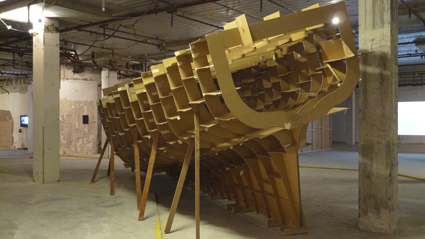
Jonathon Dady, An Uncertain Vessel (2010)
photos Alan Cruickshank
Jonathon Dady, An Uncertain Vessel (2010)
THE ADELAIDE CONTEMPORARY ART SCENE IS BIG ENOUGH TO SUPPORT A SUBSTANTIAL AND DIVERSE ART COMMUNITY AND SMALL ENOUGH TO STAGE AN EXHIBITION EXEMPLIFYING THAT COMMUNITY’S PRACTICE. CACSA CONTEMPORARY 2010: THE NEW NEW SHOWCASED THE WORK OF 44 ARTISTS ACTIVE IN SA OVER THE LAST DECADE. LOCATED IN 12 SITES, INCLUDING PROMINENT PUBLIC SPACES AND EVEN ON THE SIDE OF A TRAM, NEW NEW CONTINUES CONTEMPORARY ART CENTRE OF SA DIRECTOR ALAN CRUICKSHANK’S INTEREST IN PERIODIC SURVEY EXHIBITIONS.
Cruickshank indicates in the detailed catalogue that the participants were specially selected for the exhibition, which was intended to raise awareness of SA contemporary art and to educate viewers. The opening night at The Gallerie was so well attended that some patrons had to be turned away, attesting to wide interest. This raises the possibility of developing an ongoing exposition and a permanent contemporary art collection. It also raises the question of how artists get media exposure and recognition. New New provided an important opportunity for many artists, partly addressing the perception of CACSA’s preference for international over local art during the decade, though some notable artists were omitted. But it is a significant achievement for CACSA to mount such an extensive exhibition, which was only possible with substantial public and private support.
The work was strategically sited and the seven public works extended the exhibition into prominent locations. The choice of The Gallerie—a gutted, ironically-named, former shopping arcade—as the main location was significant in opening to the public a forgotten corner of the CBD and creating a vibrant atmosphere. But while New New resembled a biennial in scale, it eschewed any unifying curatorial theme. Approximately one third of the artists emerged in SA since 2000, and the work of the established artists generally typified their oeuvres, collectively presenting a Google Earth view of Adelaide’s art. It’s too soon to historicise that decade’s artistic development, but themes and directions are apparent.
New New aggregates the principal strategies of visual art and the forms of visual culture that have emerged since the 1970s—an expanded field of multifarious visual languages, employing traditional and vernacular materials, installation, performance, text, screen media and found objects, and actively engaging the viewer. Identity, contemporary culture and the very nature of the (art) object remain perennial considerations, and full appreciation of New New relies on the viewer’s awareness of recent art history locally as well as internationally.
Most striking was the work greeting viewers at the entrance to The Gallerie, Sam Songailo’s New Sound, an installation that immerses us in a dazzling colour-field, merging neo-Op Art into the fractured architecture to ‘clear’ our heads. Painting’s evolution is apparent in Paul Sloan’s Arise Therefore, which combines painting with found objects (rock band instruments and skeleton) in an installation that also inventively appropriates The Gallerie’s architecture. Anton Hart’s Twins incorporates a found photograph, construction and painting to juxtapose three forms of representation. Painterliness appears in contrasting ways in Christian Lock’s lush, swirling, glossy abstractions Sweet Tooth and The Luxurious Hours of the Duke of Berry, and in Warren Vance’s Voyage d-elimination in which small faux naïf illustrations are mounted on light boxes. Painting meets text and street art in KAB 101’s extensive untitled wall work at The Gallerie and the imagery on the tram.
George Popperwell’s teasingly cryptic but delightfully rewarding Far Away + Once Upon a Time and Bent Bank co-locate Old English texts with commercial packaging. Another intriguing work was Strange Fruit by the conceptual art group Green Candle, a collaboration between John Barbour, Paul Hoban and others. The group approach isn’t new in art, but exciting syntheses are developing between these prominent SA artists.
Adelaide’s established photographers showed the kind of work that has gained them their reputations. Mark Kimber’s lightbox-mounted photos of dioramas in Blyth Street challenge traditional concepts of masculinity. Darren Siwes combines images with installation to reflect on the impact of class and social structure on the developing individual. Ian North’s A Short Walk in the Country eloquently addresses his favoured theme of landscape and the situation of the viewer within it through photographs inscribed like an honour board with the names of great thinkers on landscape and environmental issues. Deborah Paauwe’s Entwined Song continues her concern with loss of innocence; Nici Cumpston’s photographic installation in Rundle Mall movingly documents traces of past Aboriginal occupation of drought-stricken Lake Bonney; and Brenda Croft’s scenes of Australia suggest she is recording it in anticipation of its loss, a kind of nostalgia for the present.
Video is developing in new ways. Made using a phone, Siamak Fallah’s five videos record his spontaneous and intimate interviews with friends and acquaintances. Iranian-trained University of SA masters candidate Nasim Nasr’s moving work, Erasure, shows a chador-clad woman writing on a chador-like form, whereupon the text is erased, referencing the ‘invisibility’ of Iranian women and the issue of cultural incommensurability. Andy Petrusevics’s Buzz! Fizz! Pop! comprises imagery projected onto small panels inside a viewing booth, playfully recreating life as a sideshow. Mark Siebert’s video, Mark Siebert’s South-East Asian Chess Tour, shows the artist playing chess, having declared himself a failed painter, the work inevitably recalling Duchamp’s preoccupation with the game and his withdrawal from painting. Yoko Kajio combines video with performance in Karistirma. And Monte Masi’s videos provide the exhibition’s self-referential element—his rap-style monologues and interviews with artists are both about New New and an element of it.
Environmental awareness emerges strongly but diversely in the work of Angela Valamanesh, Croft, Cumpston, Kajio and North, in Sue Kneebone’s A Broken Party, comprising animal bones on coffee tables, and implicitly in Hossein Valamanesh’s Wishful Thinking that employs the green-powered lighting on the face of a CBD car-park, the Rundle Lantern, to create a striking text.
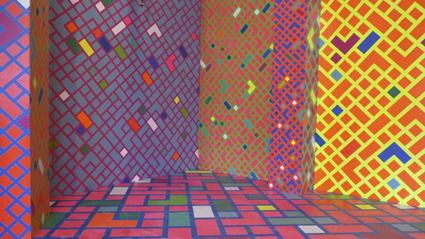
Sam Songallo, A New Sound
photo Alan Cruickshank
Sam Songallo, A New Sound
My favourites included Songallo’s work for its visual and architectural impact, Jonathon Dady’s An Uncertain Vessel for its grace and conceptual eloquence, and Sally-Ann Rowland’s Monuments, a series of black velvet forms mimicking indoor plants, for their elegant, brooding intensity. Dady’s An Uncertain Vessel is an outline of a boat roughly 10m x 3m x 2m, an iconic form made from cardboard and sitting tilted on wooden supports. It resembles a life-size 3D drawing, exemplifying Dady’s concern with the propositional and his use of discarded packaging to reconsider familiar forms and objects. For me, it suggests a stalled but much needed ark. Equally captivating is Joe Felber’s installation at the CACSA, which juxtaposes competing elements to challenge the viewer’s attention: Playback, El nuevo mundo acústica, in which multiple sound sources are broadcast asynchronously through fixed and swaying loudspeakers, and his video Jumping, Jerking Flesh. And Siamak Fallah’s videos succinctly embody the impact of new communications technologies on human interaction, as well as being the most genuinely new work in the show.
CACSA Contemporary 2010: the New New, Contemporary Art Centre of SA; The Gallerie; Feltspace; the SA School of Art Gallery, University of South Australia; the University of Adelaide; and at various public locations in Adelaide, Oct 29-Nov 21, 2010
RealTime issue #101 Feb-March 2011 pg. 52
© Chris Reid; for permission to reproduce apply to realtime@realtimearts.net
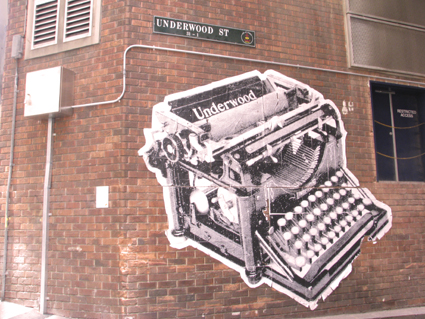
Woodwork, Simon Yates
photo Gail Priest
Woodwork, Simon Yates
WHEN TALKING ABOUT LANEWAY ART, IT’S HARD NOT TO IMAGINE THE VIBRANT PALIMPSESTS THAT ADORN MOST AVAILABLE SURFACES IN MELBOURNE’S CITY CENTRE. BUT WHILE MELBOURNE HAS TUCKED-AWAY GALLERIES, BOUTIQUE SHOPS AND UBERCOOL BARS EVERY FEW PACES, SYDNEY’S LANEWAYS ARE THE TRULY FORGOTTEN SPACES—SHADY NO-GO ZONES WHERE TRUCKS UNLOAD, GARBAGE IS DUMPED AND CHEFS STEAL A QUICK CIGGIE BREAK. HOWEVER IT’S THIS UTTER LACK OF CHARM THAT IS USED MOST INTRIGUINGLY IN THE LATEST SYDNEY CITY LANEWAY EXHIBITION, ARE YOU LOOKING AT ME?, CURATED BY BARBARA FLYNN.
Armed with the downloadable PDF walking guide I started at Underwood Lane, near Circular Quay. While the lane itself does not have much romance, the name proved to be a direct inspiration to both artists exhibited here. Simon Yates’ Woodwork consisted of large-scale photocopy paste-ups of old-style typewriters and telephones, drawing on the fact that early typewriters were manufactured by Underwood, as well as referencing the lane’s location—behind the old telephone exchange. I was unable to find the secret messages supposedly hidden in the keyboards and phone dials, but this didn’t matter. The wallscape immediately invoked a literary dreaming, calling up a pantheon of down-and-out writers clacking out stories in their inner-city dives overlooking lanes like this.
Milk and the town that went mad (detail), Mikala Dwyer
photo Gail Priest
Milk and the town that went mad (detail), Mikala Dwyer
The literary theme continued with Mikala Dwyer’s Milk and the town that went mad. For her the name Underwood conjured the spectre of Dylan Thomas and his poetic masterpiece Under Milkwood. On the barren corner beneath air-conditioning pipes, Dwyer placed a makeshift bar with stools, topped with a variety of curious and ugly ashtrays creating a hidden haven for smokers. As they indulged their guilty pleasure they were treated to Richard Burton’s famous reading of Thomas’ text. For a moment I wished I smoked in order to get the full experience, but just listening to Burton’s lilting voice, so clearly of another time, tangibly slowed the pulse in the midst of city bustle, cracking open the poetic potential of the site.
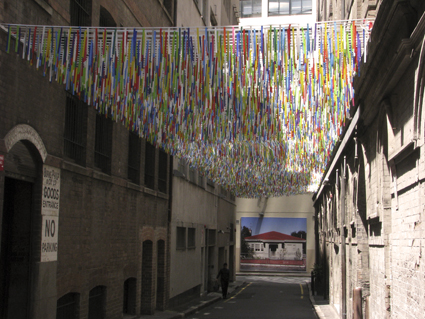
Rush, Nike Savvas (foreground), Room for Rent, Rocket Mattler (background)
photo Gail Priest
Rush, Nike Savvas (foreground), Room for Rent, Rocket Mattler (background)
High up on a wall in Tank Stream Way, Rocket Mattler’s battered “Room for Rent—apply opposite” sign directed me to a large format print of a typical old-style suburban home. It was both terrifyingly bland yet rich with detail, from the dog in the window to a barely visible graffiti tag on the front fence. To many, this picture of normality is what they are fleeing as they try to make it big in the city, while for others it offers a wistful sense of nostalgia, and for others still—the homeless, the overworked—perhaps it is a tantalising dream. Placed opposite Nike Savvas’ Rush, a ceiling of coloured plastic strips reminiscent of retro fly curtains—the most overt and celebratory artwork in the selection—the combination produced a queasy hyperreality.
Warrior, Jan van der Ploeg
photo Gail Priest
Warrior, Jan van der Ploeg
In De Mestre Place, Jan van der Ploeg’s Warrior offered a large canvas of black and white geometric patterns in mesmeric repetition. Given the scale and architectural integration of other works by the artist, it would have been good to see him let loose beyond the rectangle. In Wynyard Lane, Jon Campbell’s HAR BOUR VIEW did just that, unabashedly revelling in post-modern irony, his large banner bearing the text of the title in sickly pastels.
Circle/s in the Round for (Miles and Miles +1), Newell Harry
photo Jamie Williams Photography
Circle/s in the Round for (Miles and Miles +1), Newell Harry
Across at Temperance Lane Newell Harry’s Circle/s in the Round for (Miles and Miles +1) was an elegant wall sculpture of concentric neon circles that counselled us to “NEVEROD.” Inspired by Miles Davis’ 1967 Circle in the Round album, the work literally lit up the end of the dark alley in an eerie-cheery way. As with several of the works that have been exhibited since 2007, when the Laneways regeneration project commenced, negotiations are underway to make this a permanent public artwork.
Most of the works were in out of the way locations so it was particularly fascinating to explore the laneways themselves. I had a lot of difficulty locating Justene Williams’ Banker, Baker, Spanglemachinemaker in Curtin Place, but in the process found several other ‘possible’ installations. The act of reimagining the urban site, looking for the ‘art’ in it, was a fascinating by-product of the exhibition. (It turns out that Williams’ work was a video projection that started around 7pm, and even after returning for a second viewing at 8pm it was still not quite dark enough to get a real sense of the piece.)
Equally elusive was Simryn Gill’s Food on the Table, an ambitious proposal to create a feast in Abercrombie Lane, made from the discarded food found in bins. Gill was hoping to challenge ideas about wastage, consumerism and poverty, but was unable to fully activate the idea beyond research and consultation due to regulatory issues—which says something about the difficulties involved in mounting public art.
Rather than an instant re-invigoration of Sydney’s laneways, Are you looking at me? offers a gradual activation of forgotten spaces. The most successful works don’t attempt to decorate desolate sites, but instead propose reimaginings in and for them. In a city renowned for its love of spectacle, these small-scale aberrations are welcome, but in order to have a real effect on the cultural life of the city, we simply need more of them. The City of Sydney’s recently drafted Public Art Strategy suggests this might become a reality.
Are you looking at me?—Laneway Art 2010, curator Barbara Flynn, City of Sydney, Sept 23, 2010-Jan 31, 2011
City of Sydney is currently calling for proposals for Laneway Art 2011, deadline March 1; www.cityofsydney.nsw.gov.au; The City of Sydney’s Draft Public Arts Strategy can be found at www.cityofsydney.nsw.gov.au/cityart/about/
RealTime issue #101 Feb-March 2011 pg. 54
© Gail Priest; for permission to reproduce apply to realtime@realtimearts.net
 Courtesy of Madman Entertainment and in celebration of our 101st edition, RealTime is offering a lucky reader a ravishing cinematic giveaway: a 9-DVD box set of the great films of the 1950s master of aesthetically and socially incisive Hollywood melodramas, Douglas Sirk.
Titled Douglas Sirk: King of Hollywood Melodrama, the opulent Madman set includes the filmmaker’s classic melodramas—Imitation of Life, All That Heaven Allows and Magnificent Obsession—as well as minor classics like Tarnished Angels (about stunt pilots and based on William Faulkner’s Pylon) and Taza, Son of Cochise with Rock Hudson as an Apache chief in Sirk’s only western.
Read film scholar Wendy Haslem’s overview of Sirk’s key films on page 28.
To compete for the Sirk DVD set go to
www.realtimearts.net/sirk_survey.html
• Complete the short survey so that we can continue to improve RealTime Online for your reading pleasure
• Tell us how the 9-DVD Box set Douglas Sirk: King of Hollywood Melodrama will improve your life (the best answer will be the winner!)
• Join our e-dition mailing list (if you haven’t already) to receive fortnightly updates about new content on realtime online, news, exciting features and more giveaways.
RealTime issue #101 Feb-March 2011 pg. 56
© RealTime ; for permission to reproduce apply to realtime@realtimearts.net
In Sam James video work you’re watching an edition of RealTime
roll off the presses. Back in 1994, quite a bit of the pre-online print edition would have stayed on your hands as ink but more importantly in your mind, new synapses firing rapidly as we surveyed and critiqued the urgently needy hybrid performance and new media arts scene ignored in those days by the mass and other media. The excitement hasn’t abated, as indicated by the many artists and groups of the 101 we approached who have contributed to our 101st edition celebration with 101 or so words each about what’s next for them in 2011. The diversity, inventiveness, commitment and playfulness on show in their contributions and throughout this edition are reward enough for our 101st and will keep us fuelled up for the year to come.
RealTime on the press
photo Sam James
RealTime on the press
To make sense of editions 1-101 and beyond as a comprehensive record of an era and to pay tribute to a generation of adventurous artists, we are archiving more and more of RealTime+OnScreen online. All editions are available back to 2001, all dance articles back to 1994 as part of our RealTimeDance portal (launching in March) and we’re working hard to put the rest of RealTime 1994-2000 online over the next year. If you’re a student, a researcher, an artist, an arts writer or a fancier of innovative art you’ll find our archive increasingly valuable, recharging failed synapses, firing new ones. Fond memories and online pleasures aside, opening and fondling a new print edition of RealTime still brings joy to many a reader: the ink might not rub off, but ideas and sensations still do. Read on. Celebrate.
RealTime on the press – video by Sam James
RealTime issue #101 Feb-March 2011 pg. 1
© RealTime ; for permission to reproduce apply to realtime@realtimearts.net
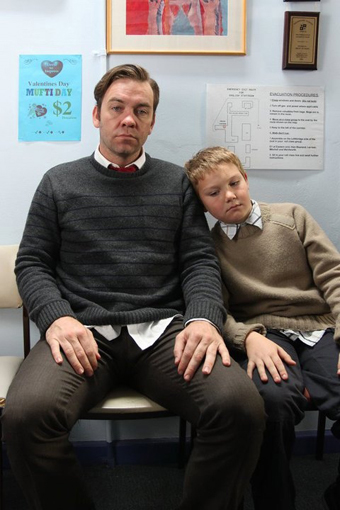
Brendan Cowell and Charlie Fraser, Bee Sting
we like short shorts
It may be the season for wearing shorts, but it’s also the season for watching them. More specifically, it’s time for the International Short Film Festival Flickerfest, which has just finished screening in Bondi and is now set to tour the country. This year Flickerfest will travel to more than 30 locations, including regional centres such as Alice Springs, Katherine, Noosa, Narrabri, Cygnet and Wyalkatchem. The program varies from venue to venue, so while some will focus on the Best of International Shorts, others will feature Flicker Kids and the Best of Comedy. However, most venues will be screening the Best of Australian Shorts program, which includes the animation The Lost Thing (winner of the AFI Award for Best Short Animation 2010), directed by Andrew Ruheman and Shaun Tan, as well as Bee Sting (starring Brendan Cowell and Matilda Brown) and The Telegram Man (starring Jack Thompson as “the man who must deliver the worst kind of news during the long years of World War II”). For more information see the Flickerfest website. Flickerfest Tour, various venues, Jan 21-March 27; www.flickerfest.com.au
movement at the station
Sydney’s CarriageWorks has just announced Lisa Havilah as its new CEO, commencing February 2011. Havilah is currently the Director of Campbelltown Arts Centre, where she has pioneered a program of inclusive and experimental contemporary art, much of which has been reviewed in RealTime. To get a sense of her breadth of vision see our reviews of Chiara Guidi, the River Project, What I Think About When I Think About Dancing and News from Islands. Havilah says, “I am proud of what we have achieved and the people I have worked with at Campbelltown Arts Centre, and excited to join CarriageWorks at such an important time in the organisation’s development. CarriageWorks holds a vital place in the cultural fabric of Sydney, and is home to an extraordinary group of resident companies. I look forward to building on the many achievements that CarriageWorks has already delivered” (press release).
In the meantime, one of CarriageWorks’ resident companies, Performance Space, has announced that Jeff Khan as its new Associate Director with responsibility for dance and performance. Khan is a “curator and writer with a particular interest in interdisciplinary projects and site-specific and socially-engaged practices” (press release; see also our interview RT96). From 2006 to 2010 he was the Artistic Director of Next Wave (RT98). He is currently a member of the Australia Council’s Dance Board and has held previous positions and guest curatorships at the MCA, Gertrude Contemporary and PICA. Exciting times in Redfern!
cold edge, hot summer
Writer and spoken word performer (and contributor to RealTime) Urszula Dawkins brings tales of sub-zero Svalbard to Midsumma Melbourne and cia studios in Perth, following her 2010 participation in The Arctic Circle creative residency—an ocean voyage around the high-Arctic, a few hundred miles from the North Pole (see RT100). She writes: “The romantic landscape gives way to the treachery of a nature that needs neither art nor art-makers, and the quest for ‘place’ is blasted away in horizontal snow-drifts, leaving only desire and the return to home…Polar bears, northern lights, glittering glaciers and an ice-class sailing ship sit side by side with the end of the sublime.” The program also features film and video pieces by Arctic Circle participants Katja Aglert (Sweden), Janet Biggs (US), Rebeca Mendéz (US/Mexico) and Laurie Palmer (US). Cold Edge: The Arctic Circle, Hares & Hyenas Bookshop & Café, Jan 25; www.midsumma.org.au; cia studios, Feb 3 www.ciastudios.com.au (please RSVP kate@pvicollective.com)
Alan and William Yang
photo courtesy of the artist
Alan and William Yang
australian-asian art connections
The Chinese Year of the Rabbit begins on February 3 and to celebrate the 4A Centre for Contemporary Asian Art is mounting Cinema Alley. For one night only, an open-air cinema at the heart of Chinatown will screen five short video works by contemporary Chinese artists Chen Chieh-Jen, Jun Yang, Ou Ning and Cao Fei (reviewed in RT96), Wang Qingsong (RT100) and Yuan Goang-ming. Their work explores “perceptions of cities, their transformation, experiences of alienation and the effects that history and tradition place on the individual” (website).
Elsewhere, Performance 4A is producing the COOLie Asian Australian Performance Event, to be held Downstairs at Belvoir St Theatre for two weeks, February 1-13. The first season, Stories East & West, sold out Belvoir’s Upstairs theatre last May. It featured Asian Australian artists exploring relationships with their ancestors and cultures and examining how these impact on their lives today. The new show features Chinese-Australian photographer, storyteller William Yang (RT96; RT47) and indigenous elder, researcher and historian Noeline Briggs-Smith swapping stories about their lives. The following work, About Fact, is billed as a “contemporary variety show” combining music, dance, comedy, monologue and song and featuring Asian-Australian artists Paul Cordeiro, Lena Cruz, Les Gock, Oliver Phommavanh, Suara Indonesia Dance Group and Jennifer Wong.
Artspace, in association with the Sydney Festival, is hosting Singaporean artist and filmmaker Ho Tzu Nyen in an exhibition featuring three major video works—NEWTON (2009), ZARATHUSTRA: A FILM FOR EVERYONE AND NO-ONE (2009/2010) and the centrepiece 42-minute EARTH (2009/2010), a ‘videographic’ remix in three long takes of 17th and 18th century Italian and French paintings in which the human body is penetrated, fragmented and re-arranged. On January 24 and 25 there is also a Live Sound Score Performance by composer and multi-instrumentalist Oren Ambarchi. Cinema Alley, 4A Contemporary Asian Art, Feb 11; www.4a.com.au; COOLie Asian Australian Performance Event, Belvoir St, Feb 1-13; www.belvoir.com.au; Ho Tzu Nyen, Earth, curator Blair French, Artspace, Jan 20-Feb 20, Live Sound Score Performance Jan 24-25; www.artspace.org.au
colbert and censorship
Here at RealTime we’ve been idly holidaying online, roaming the world wide web and catching up with the wickedly incisive Stephen Colbert who, on December 8 in his Tip of the Hat, Wag of the Finger segment, praised censorious Republican Senator Erik Cantor (the incoming House Majority Leader) with a damning serve of artspeak. Cantor had declared that the Smithsonian National Portrait Museum’s exhibiting of a video installation, Fire in My Belly, in which ants briefly crawl over a crucifix, was an insult to Christians, not least because it was being displayed over the Xmas period. The slight therefore warranted a threat to defund the Smithsonian. Colbert applauded the Jewish politician’s sensitive support for beleaguered Christians. “This defunding threat isn’t some cheap exercise in mindless censorship,” he argued. “It’s an anti-paradigmatic revolutionary work of conceptual art banning…Cantor’s art is about the art that isn’t there, making the inaccessible literally inaccessible.”
On Fox News, Cantor said, “When a museum receives taxpayer money, the taxpayers have a right to expect that the museum will uphold common standards of decency. The museum should pull the exhibit and be prepared for serious questions come budget time.” The Smithsonian subsequently removed the video, the 1987 work Fire in My Belly (David Wojnarowicz, Diamanda Galas) from Hide/Seek: Difference and Desire in American Portraiture (Oct 30, 2010-Feb 13, 2011).
You can read more about the video, the conservative advocacy group the Media Research Center, and protests against the withdrawal of the work at Half Wisdom, Half Wit. You can watch Colbert’s Tip of the Hat, Wag of the Finger Art Report and see the rest of this episode of The Colbert Report featuring Steve Martin and some leading artists , including Frank Stella and Andreas Serrano in a droll assessment of the financial evaluation of art. Also available is an extended version.
RealTime issue #100 Dec-Jan 2010 pg. web
© RealTime ; for permission to reproduce apply to realtime@realtimearts.net
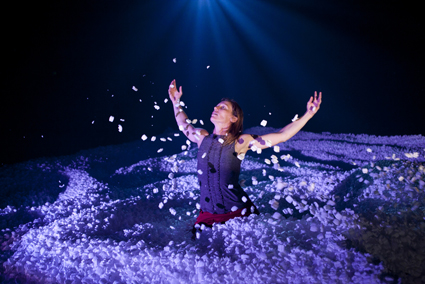
Sarah Jayne Howard, Not in a Million Years, Force Majeure
photo Lisa Tomasetti
Sarah Jayne Howard, Not in a Million Years, Force Majeure
A MAN STANDS HIGH UP IN THE DISTANCE, SPOTLIT, ABOUT TO JUMP, HIS VOICEOVER SPELLING OUT THE TENSION GENERATED BETWEEN THE IMPULSES OF HIS REPTILIAN BRAIN AND THE RATIONALITY OF ITS EVOLVED FORM, ALTERNATING BETWEEN SHEER TERROR AND THE ATTRACTIONS OF RISK. ONE, TWO, THREE, HE LEANS…BLACKOUT. WE DON’T KNOW IF HE ACTUALLY JUMPS, BUT ONE THING’S CLEAR, HE WANTS TO AND HE HAS KNOWLEDGE AND CHOICE. BUT FORCE MAJEURE’S NOT IN A MILLION YEARS BUILDS ITS PERVASIVE SENSE OF PHYSICAL AND EMOTIONAL CRISIS NOT FROM THESE EVOLUTIONARY ADVANTAGES BUT FROM INCIDENTS OF POWERLESSNESS AND UNCONSCIOUSNESS, WHERE CIRCUMSTANCES HAVE SUCKED AWAY THE PHYSICAL CAPACITY OR WILL TO ACT.
Some of the figures in Not In A Million Years—an airline attendant, a paraglider and a pair of miners—engage in jobs or activities that are inherently risky. The miners endure the collapse of a mine while the airline attendant suffers something unique: she is the lone survivor—found on the ground—of an aircraft that exploded at 33,000 feet. The paraglider is sucked up “higher than Everest” into the upper atmosphere, unconscious throughout and almost frozen, but miraculously survives (perhaps ‘preserved’ by the cold). Other figures haven’t taken the risks of employment or sport but the will to act is likewise denied them: a man in a comatose state for 10 years suddenly wakes to a world with which he is unable to engage. A woman wins a huge lottery prize but is rendered incapable of using it, fearing public attention and the risk her son might be kidnapped. Another character is a sporting champion (inspired by the story of an astonishing long-jumper), abused and shamed by her coach into mindlessly and dangerously excelling.
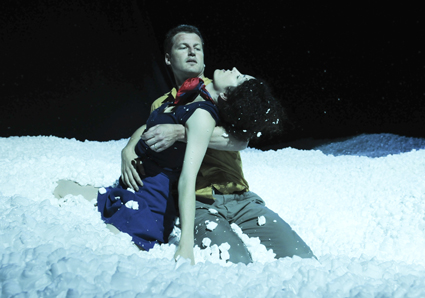
Elizabeth Ryan and Vincent Crowley, Not in a Million Years, Force Majeure
photo Heidrun Löhr
Elizabeth Ryan and Vincent Crowley, Not in a Million Years, Force Majeure
The horrors of these conditions are made palpable, played out on shifting clouds, fields and dunes of soft, snow-like sparkling crystals through which people wade fitfully—or, like the athlete, forcefully, as if battling sand or heavy surf—or in which they are buried. A man unearths the airline attendant in the first of a series of duets, cradling, lifting, helping her stand before an inevitable, sad collapse. The challenge of helping is further writ large in the frustrations of the wife of the comatose man as she struggles to clothe him while begging for his affection, trying to make him jealous, or in the mutual assistance enacted between the trapped miners, from time-filling chat to shared songs to the slightest of physical shifts to ease pain. Later the wife will drag her comatose husband through the ‘snow,’ unable to make him stand unassisted, amplifying the sense of helplessness experienced by carers as much as the victims of fate.
Max Lyandvert’s emphatic score moodily underlines the action—melancholy piano for the airline attendant, electronic pinging and pulsing for the athlete, ominous rumblings for the miners. Spatial transformations are also effected with the ‘snowscape’ swept away, replaced by mobile walls that frame the entrapment of the wife of the comatose man and the reclusive lottery winner, while the paraglider flies in the distance, often seemingly helpless, an almost constant reminder of the beauty and risk of human flight.
The instability of these aural and visual shifts resonates with emotional complexities as the interwoven tales unfold, some more detailed than others. Survivors like the airline attendant and the formerly comatose man cannot comprehend why they are treated like heroes. The man is bitter over the loss of time and love: “Where’s the miracle?” He cannot relate to his son or understand why his wife just didn’t give up on him—”Why did she keep me…like a piece of nostalgia?” Only a mate’s ironic “Guess what, stupid, you stopped smoking” cheers him.
These ‘accidents’ variously yield humour and fortitude, or reveal the strengths and weaknesses of relationships or result in uncomprehending despair and infinite frustration—the athlete is literally driven up the wall, repeatedly rushing at and bounding up CarriageWorks’ craggy stonework. Amidst such indeterminacy it’s odd that the figure who opened the performance, pondering a leap, returns to muse over a famous tightrope walk between skyscrapers in New York, picking over its meanings—sublime or absurd, inspirational? “Could I ever risk that? Am I ever that alive?” The victims of strange and not so strange accidents in Not In A Million Years have not taken undue risks (you might not like to paraglide, but many thousands do) and in several cases they certainly feel less than alive after their ‘accidents,’ and certainly neither adventurous nor heroic—their will-power had been suspended.
As if to underline a swing to a more optimistic view of the effects of extreme happenstance, the athlete, seemingly freed of her coach, spins and sweeps through the expanse in the first palpably choreographed movements. She draws the other performers with her into a collective dance in silence, cutting neatly through the ‘snow,’ hands pushing back over heads, fingers pointing, legs weakening at the knees (reminiscent of those characters who earlier collapsed into the ‘snow’) but rising up, looking up, suppliant even, asking not “Could I ever risk that?” but “How could I endure those states of being, of suspended will and self, with their all too existential consequences?”
I’m not certain that Not In A Million Years is conceptually consistent or that it fully exploits the potential of its ‘snowscape’ design—visually or sonically—while the deployment of the ungainly mobile walls functionally detracts from the overall eeriness and the soundscore occasionally verges on the melodramatic. But it’s a thoughtful and often disturbing creation that conveys the unbearable lightness of unconsciousness. For a dance theatre work, curiously it’s the naturalism of the affecting performances from Elizabeth Ryan and Joshua Tyler (not least as the wife and erstwhile comatose husband) that provide Not In A Million Years with its emotional centre of gravity, as their world and others around them spin out of control. I’m looking forward, anxiously, to experiencing Not In A Million Years again at Dance Massive in Melbourne in March.
Force Majeure, Not in a Million Years, director Kate Champion, assistant director Roz Hervey, designer Geoff Cobham, performers Vincent Crowley, Sarah Jayne Howard, Elizabeth Ryan, Joshua Tyler, original music, sound designer Max Lyandvert; CarriageWorks, Sydney, Nov 18-27, 2010; www.forcemajeure.com.au
This article was first published online Jan 17, 2010.
RealTime issue #101 Feb-March 2011 pg. 37, web
© Keith Gallasch; for permission to reproduce apply to realtime@realtimearts.net
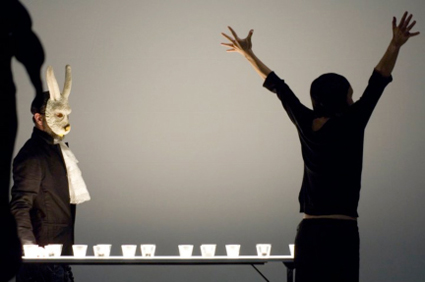
b.c., janvier, 1545, fontainbleu, l’association fragile
photo Marc Domage
b.c., janvier, 1545, fontainbleu, l’association fragile
IN CHRISTIAN RIZZO’S B.C., JANVIER, 1545, FONTAINBLEU, BLACK CURTAINS PART TO REVEAL A WHITE BOX STAGE LIT BY DOZENS OF TEA CANDLES SCATTERED ACROSS THE FLOOR. SCULPTURAL CLUSTERS OF BLACK FABRIC ARE SUSPENDED LIKE FLOATING INKBLOTS AT VARIOUS HEIGHTS. UPSTAGE CENTRE, DANCER JULIE GUIBERT, IN BLACK SKULLCAP-CUM-WIG, BLACK SHIRT AND PANTS AND SILVER STILETTO HEELS LIES ON A NARROW WHITE TABLETOP WITH HER BACK TO US. IN THE FOREGROUND STANDS CHOREOGRAPHER RIZZO, WEARING AN ANTIQUE-LOOKING RABBIT MASK, T-SHIRT, BAGGY JEANS AND HIGH-TOPS—AN ENSEMBLE THAT MAKES HIM LOOK LIKE A ROMANTIC-ERA PORCELAIN FIGURINE DRESSED AS A RAPPER. THE STAGE COMPOSITION IS EXQUISITE (A LITTLE CHEER GOES UP INSIDE ME).
Guibert gets off the table and performs a short, gestural score that has her bisecting space in flat planes, changing levels and implying geometrical shapes. The execution is meticulous. She will repeat this sequence for the duration, adjusting the details slightly, changing her spatial orientation and imperceptibly increasing the tempo. Superbly controlled, Guibert is all precision and grace, even on four-inch silver spikes. Rabbit-faced Rizzo takes his time moving the candles from the floor to the table, just a few at a time. Each part of this slow-moving image is thoughtfully placed. I can feel the surety of an expert artist’s hand. I let the picture seep into my nervous system like an opiate.
Once the initial hit has done its work, I want the piece to change. It does, but at a glacial pace. Guibert goes through her iterations. The sculptures are removed. The candles are extinguished. The quality of light goes from candle-flicker warm to walk-in-cooler frigid. I think this progression is supposed to feel like a graduated revelation but, beautiful as the final state is, the development is too slow for surprise. A high volume industrial sound score by Gerome Nox makes its presence felt part way through. The grinding drone tends to flatten out the nuance of the Guibert’s articulations. The lighting design, on the other hand, is a masterpiece of sensitivity. Designer Caty Olive’s interest lies in the instability and ambiguity of her medium. From the outset she gives us a restless light, almost constantly in flicker, that refuses to settle on a base colour. Within the highly reflective surfaces of the white box, Olive manages to create a depth of field in which Guibert, Rizzo and the sculptural objects come in and out of focus. Unlike the crush of the sound score, the active lighting design contributes a deft dynamism, responsive to the spatial adjustments at work and partnering well with Guibert.
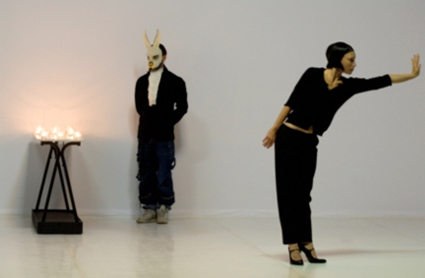
b.c., janvier, 1545, fontainbleu, l’association fragile
photo Marc Domage
b.c., janvier, 1545, fontainbleu, l’association fragile
It’s a little hard on the eyes and ears at times. The unstable light, combined with Nox’s acoustic drone and the measured pace of the piece, makes me a bit sleepy. Maybe that’s the point: as I drift into semi-consciousness b.c., janvier, 1545, fontainbleu cuts a deep groove in my dream track. It stays with me in a way that most shows don’t. In the days and weeks since the show ended, the restlessness and dissatisfaction I felt at curtain has given way to a feeling of dream-saturated appreciation. When I think of the show now, I’m left with the fullness and clarity of the image.
The image, however, isn’t Rizzo’s first concern. He begins by building the choreography a step at time. His idea of choreography includes light, sound and sculpture as active partners. The ‘image’ is a natural result of such ‘partnering.’ In the 1990s, Rizzo and other choreographers were labeled in France as makers of non-danse, a designation that in retrospect only makes sense if you think of the dancer as somehow separate from the performance setting, moving in a featureless, empty space that doesn’t interfere with the purity of movement. Non-danse attempted to recontextualise the dancer—sometimes by placing them in a setting that was more ‘theatrical’ (for example, a living room), sometimes by putting the dance in a specific location and often by focusing on the bare materiality of the dancer rather than on the dancer’s technique.
These considerations, as well as others, forced a re-examination of dance and choreography. Previously, speaking, playing guitar, cooking, lecturing etc, were expressions of the body that didn’t fall into the category of dance. Things like set pieces, sculpture, props, lights and sound were usually treated as add-ons, always peripheral to the primacy of the human body. Non-danse puts the dancer-body in dialogue not just with other dancers, but also with all the other elements mentioned above. In a Rizzo show this requires a shift in the kind of attention a spectator brings to the performance. What is the interplay between dancer and light? Between sculpture, space, and sound? Like the lights, my attention flickered between all of these. Then the front part of my brain relaxed, I got sleepy, my consciousness widened and b.c., janvier, 1545, fontainbleu continued its iterations in my memory log.
For information about Christian Rizzo, visit the On the Boards blog, see “Christian Rizzo discusses b.c., janvier, 1545, fontainbleu” and read Rizzo’s dialogue with John Jasperse. For a sample of Rizzo’s work, see Mon Amour and Avant Un Mois on YouTube.
b.c., janvier, 1545, fontainbleu l’association fragile, choreographer Christian Rizzo, On the Boards, Seattle, Oct 10, 2010
This article was first published online Jan 17, 2010
RealTime issue #101 Feb-March 2011 pg. 39, web
© Alex Lazaridis Ferguson; for permission to reproduce apply to realtime@realtimearts.net
Ryan Kwanten, Griff the Invisible
JAN CHAPMAN HAS A KNACK FOR FINDING RISING TALENT WHEN IT COMES TO AUSTRALIAN SCREENWRITERS AND DIRECTORS. IF HER NAME IS STAMPED ON A FILM (AS PRODUCER OR EXECUTIVE PRODUCER) IT MEANS THE FILM WILL LIKELY HAVE A UNIQUE VOICE WITH GREAT CHARACTERISATION AND WONDERFULLY STRANGE TOUCHES — LOVE SERENADE (SHIRLEY BARRETT), JANE CAMPION FILMS INCLUDING THE PIANO AND BRIGHT STAR, LANTANA (RAY LAWRENCE), SOMERSAULT (CATE SHORTLAND), SUBURBAN MAYHEM (ALICE BELL; PAUL GOLDMAN)—AND NOW HERE COMES GRIFF THE INVISIBLE FROM WRITER-DIRECTOR AND NOVELIST LEON FORD.
Recently selected for the Toronto and Berlin Film Festivals, Griff the Invisible features an Australian superhero not quite able to leap tall buildings in a single bound and who, by day, suffers bullying in the workplace while exacting revenge at night by fighting injustice in his neighbourhood.
Recent Australian film has tended to emphasise rural nostalgia (The Tree, Summer Coda, Lou, The Boys Are Back), gritty realism (Animal Kingdom) and mainstream comedy/romance (Bran Nue Dae, I Love You Too), so it’s great to see a director who’s not afraid of an experimental touch or play with genre. Leon Ford is well-known as an actor (Beneath Hill 60, Changi) while his short films Katoomba and The Mechanicals have shown a real talent for writing in particular, winning awards at the Sydney and St Kilda Film Festivals. He joins a spate of actors (Rachel Ward, Serhat Caradee, Anthony Hayes, Nash Edgerton, Matthew Newton) turning their hand to directing, with accomplished results for their first features. These directors also have a good feel for casting: Griff the Invisible goes against type with Ryan Kwanten (who does awkward as well as he does tough-guy in Red Hill and True Blood), Maeve Dermody (Beautiful Kate) as the fragile but potent Melody, and Toby Schmitz (The Pacific, Three Blind Mice and, onstage, Ruben Guthrie for Belvoir) charismatic as the arrogant bully Tony.
The film opens with a quotation from Oscar Wilde—“Give him a mask, and he will tell you the truth”—as we enter the frame of a large telescope, eyeing the cityscape, before panning around a room full of surveillance equipment on red alert for action in the streets. A woman walks, pursued by a man in a strange top hat. This is a nice parody of the big-budget blockbusters, like Superman Returns, filmed on our shores, before we’re introduced to our truly B-grade superhero in a cheap black rubber suit with a large gold G on the chest, for Griff, not Gotham.
Griff the Invisible has no superpowers that we can see but carries a blade that he swipes cartoon-style through the necks of his assailants. Kwanten has the physical ability to transform easily, moving beautifully between his alter egos. He practises his lines in front of the mirror at home—“It’s okay, you’re safe”—and searches for the right descriptor—Griff the Protector? Griff the Hidden?—as much for himself as the victims he defends.
Toby Schmitz, Griff the Invisible
By day, he is stalked by terrors even worse: the open plan office. Nervous and reluctant to engage, Griff spends his days on the phone answering client enquiries, trying not to talk to anyone at close range. Office bully Tony—a show-off in front of the ladies, a man with a strong sense of entitlement, used to getting exactly what he wants—is all too aware of Griff’s weaknesses and regularly harasses him. Ford (aided by Schmitz’s talents) cleverly chooses to portray Tony as an attractive and vivacious character (rather than the fat loser bullies often seen in US sitcoms), sexy and louche, with that right blend of menace and charm.
Maeve Dermody and Ryan Kwanten, Griff the Invisible
Griff brings his surveillance skills into the office, spying on colleagues with a series of ingeniously simple gadgets (he’s no Batman) designed to help him communicate without words. But the enigmatic narrative means that we’re never quite sure of the nature of Griff’s inner/outer world. Is it a fantasy playing in his head? Does he really hit the streets? Is he battling a mental illness in which he’s completely delusional? His girlfriend-to-be, Melody, a science student transfixed by the space between atoms, certainly believes all he says but, then again, she is the only character who can’t see him when he’s ‘invisible’ (a brilliant running gag). Getting that right balance between pathos, humour and occasional farce is extremely difficult and Ford manages it well; the film hums along with its strange dialogue, a visually inventive palette, the melancholic lead romance and real empathy for the loneliness of the central characters.
The entire plot fixes on the fight/flight response and which way Griff will turn at any moment. His life is about boundaries: who can cross them, when and where, and the possibilities of transformation. Melody, instead, wants to transcend her limitations right here right now, even attempting to walk through walls to reach Griff. With his central couple, Ford has almost effortlessly created (where films like I Love You Too and Summer Coda haven’t quite succeeded) an alluring and enduring romantic comedy, with characters complex and intertwined. It’s a strange and whimsical world for the viewer to inhabit but a terrific and courageous debut.
Griff the Invisible, writer, director Leon Ford, producer Nicole O’Donohue, executive producers Jan Chapman, Scott Meek, cinematography Simon Chapman, editor Karen Johnson, sound designer Sam Petty, production designer Sophie Nash, original music Kids At Risk; www.grifftheinvisible.com
This article was fist published online, Jan 17, 2010
RealTime issue #101 Feb-March 2011 pg. web
© Kirsten Krauth; for permission to reproduce apply to realtime@realtimearts.net
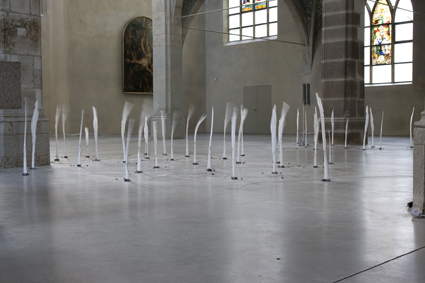
Kerstin Ergenzinger in cooperation with Thom Laepple, Whiskers in Space 2010
photo courtesy of the artist and VG Bild-Kunst Bonn
Kerstin Ergenzinger in cooperation with Thom Laepple, Whiskers in Space 2010
AS PART OF THE 5TH DIGITAL ARTS FESTIVAL, CLUSTER, IN TAIPEI, THE FLEDGLING DAC DIGITAL ARTS CENTRE PRESENTED AN EXHIBITION OF WORKS FROM LOCAL AND INTERNATIONAL ARTISTS IN RESIDENCE. FOUR MEDIA ARTWORKS FILLED THE GALLERY, CONFORMING TO AND CHALLENGING NORMATIVE ASSUMPTIONS ABOUT MEDIA ART. SOME PRESENTED A REIFICATION OF NOVELTY AND TECHNOLOGICAL EFFECTS AND OTHERS SIDESTEPPED THE SIDESHOW TO PUSH CONCEPTUAL AND EXPERIENTIAL ASPECTS.
Nature, so often yearned for in the dark spaces of media arts, is the theme upon which the exhibition hinged. Kerstin Ergenzinger (Germany), Yi Ping Yang and Guillaume Marmin (France), Yun-Ju Chen (Taiwan) and Chih-Chieh Huang (Taiwan) each tackle this theme distinctively, calling attention to our immediate surroundings and the global context, the metaphorical and the literal.
Kerstin Ergenzinger’s Whiskers in Space is the pièce de résistance. It engages the participant with an array of forms clumped in three groups on the gallery floor. More immediately suggesting a field of grass than whiskers, they are rough-cut airplane foam, peaking to knee-high blades. As one walks through the room, they move, bend and stretch from side to side and jitter as though stimulated by some sudden neural impulse or vibrated by a mysterious wind. In fact, wind is the critical element defining the work; not that of a blustery sea-side, but a micro-scale, unfelt wind that might trigger goose-bumps on the back of your neck for reasons bewitching and unknown. These micro-currents, impacted by our movement through the exhibition space, trigger the seemingly uncanny animation of the whiskers.
Whiskers in Space is constructed to draw the participant closer to the experience of nature not by granting the instant response expected of computing technology, but randomising and delaying the data received by changes in the air in the room. The system has been fastidiously tested by the artist to present a balance between audience expectation and the denial of immediate gratification, which is deferred but not absent. Ergenzinger’s creation is poetic and mesmerising, belying the speed imperative characteristic of the digital age—it is enough merely to sit and watch the slowly undulating forms move in mysterious ways. It is also compelling to feel responsible for their movement, in much the same way our actions yield consequences, small and large, of which we’re largely unaware, upon the natural world.
Guillaume Marmin and Yi Ping Yang, Around the Island 2011
photo courtesy of the artists
Guillaume Marmin and Yi Ping Yang, Around the Island 2011
From grass roots to mountain tops: French and Taiwanese duo Guillaume Marmin and Yi Ping Yang present Around the Island, a glowing sculptural installation of a mountain range, or stylised island, surrounded by a pitch black, uneven ground. The bright white peaks are used as a projection surface and the work essentially reaches its zenith as a performative projection installation. The accompanying soundscape, composed by Philippe Gordiani, is performed live by Yang and mixed alongside the projection of Marmin’s abstract, naturalistic organic forms drawing on local Taiwanese landscapes. The score comprises the sounds of common household objects and Yang’s haunting vocals with their erotic breathlessness. Without this auditory component, Around the Island would lose much of its sensorial impact. Rather than recalling nature, the juxtaposition of complex, layered experimental sound with imagery draws the audience into an experience more attuned to culture and its codes of expression.
Yun-Ju Chen, Starry Starry Night
photo courtesy of the artist
Yun-Ju Chen, Starry Starry Night
From the mountain to the sky: in Starry Starry Night, Taiwanese artist Yun-Ju Chen seeks to address environmental issues with an installation of large glowing balls hanging limp like loose ball-sacks, or puffed-out like eager beach balls, and lit from the inside with alternating pastel hues. These spheres symbolise the Earth’s continents. Data in the form of key words is taken from various websites and rated as positive or negative, then fed to the balls. If there are reports of flooding or excess pollution, the balls inflate, heavy with the burden. Conversely, reports of carbon reduction by use of alternative energy sources make the balls deflate as a sign of relief. Chen writes of a desire “to awake[n] people’s concern for environment,” but the work appears unresolved, problematically literalising the binary logic at the heart of digital data. Had it moved beyond the rhetoric of on/off, good/evil dichotomies to push in the direction of other possibilities it would have had greater impact.
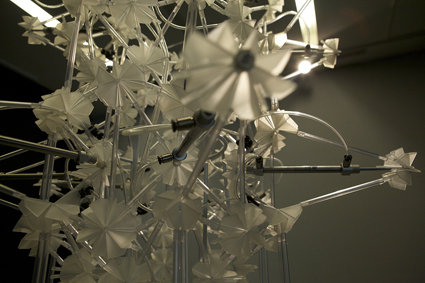
Chih-Chieh Huang, LBSkeleton Lite
photo courtesy of the artist
Chih-Chieh Huang, LBSkeleton Lite
Chih-Chieh Huang’s LBSkeleton Lite is a robotic installation in the form of an origami-like flower pillar that emits light from an ordinary bulb within its cylindrical body. Controlled by pneumatic switches, the device continually juts out its arms. As a cross between an inarticulate robot and bad lighting, the work’s mechanical qualities supersede its poetic potentiality. Acknowledging this criticism, the work is presented as part rather than whole, minus the crucial auditory accompaniment originally intended for exhibition. As such, it is a demonstration of a work-in-progress, one mired in its mechanical technicality, its elegant origami aesthetic at odds with the jolting industrial animation.
The artists in this Digital Arts Centre exhibition, for better or worse, endeavoured to create works that act as extensions of the sensorium in relation to our experience of the ever ambiguous concept of nature. They imaged, imagined and constructed nature in terms of both our symbolic and real relations to the fragile yet fierce organic world that surrounds us. It is undeniable that nature today, as demonstrated in this exhibition, is ever enculturated. But defining nature through the technological cannot help but risk falling into to this problematic terrain.
Digital Arts Centre, Cluster: 5th Digital Art Festival, Taipei, Nov 26-Dec 5, 2010; www.dac.tw/daf10
This article was fist published online, Jan 17, 2010
RealTime issue #101 Feb-March 2011 pg. web
© Laetitia Wilson; for permission to reproduce apply to realtime@realtimearts.net