Australian
and international
exploratory
performance and
media arts
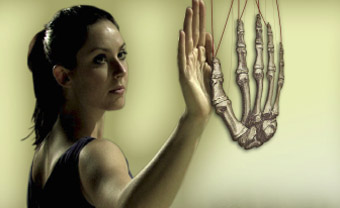
Rachelle Hickson, Reading the Body, Sue Healey & Adam Synott
SUE HEALEY AND ADAM SYNOTT’S READING THE BODY APPEARS ON A SUSPENDED SCREEN IN THE CENTRE OF THE IO MYERS STUDIO, DRAWING THE VISITOR INTO THE DARKENED SPACE. ATTENTION IS HELD BY ITS ELEGANT JUXTAPOSITION OF A MOVING FEMALE PERFORMER (RACHELLE HICKSON) OVERLAID WITH SKELETAL ANIMATIONS THAT ATTACH THEMSELVES TO THE DANCER’S BODY.
New Zealand poet Jenny Borholt’s text provides more layers: “The body as intention. It means well. Is full of good intent. Body as desire.” It’s a fittingly elusive and alluring entrée to the experience of GESTURE, part of ReelDance 2010, a screen-based exhibition running across the UNSW Kensington Campus and, according to the notes, “exploring the performance territory between dance, the everyday and dramatic body.”
Curator Erin Brannigan writes, “Choreography can play with our knowledge of gestural performance, occupying the space between walking and dancing, action and elaboration, communication and expression…These works take the choreographic manipulation of gesture further by spreading the performances across screens, dislocated spaces, manufactured locations and defamiliarised temporalities.”
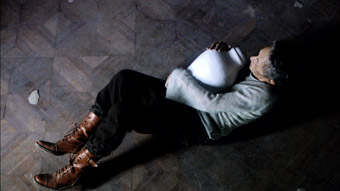
Anna Mittel, Promise of Fallen Time, Isabel Rocamora
Isabel Rocamora’s video Promise of Fallen Time beckons from a curtained corner of the studio, compelling us to follow the full 19 minutes of its sombre scenario. We are led inside a derelict building, which might be an antechamber to the underworld. A slightly built but powerfully intense performer (Anna Mittel) advances tentatively through this grey world. Her movements are minimal but precise, appearing at times almost involuntary. She encounters a man (Enric Majo) and together they navigate the surfaces of this place (a derelict palace in Barcelona as it turns out), appearing sometimes to be propelled along its walls. Where they’re heading is unclear but the sense of foreboding is palpable, enhanced by the sound of a soft gong and whirring, thrumming chords. A door opens to reveal a young boy with a large dog. The frame freezes. The world turns and we begin again with the two dancers in another place, another time. I head for the light.
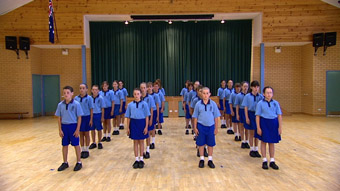
Assembly, Kate Murphy
Positioned in a triangle of monitors above head height as well as on a single monitor over the lift, Kate Murphy’s Assembly takes its place in the West Foyer of the Australian School of Business.
Twenty-four children in school uniforms stand in four rows inside a school hall. From time to time their arms move sideways or clutch at their hearts, hands inscribe crosses on their chests. The rhythms of the children’s gestures and their wobbly stillness fit neatly into the fabric, subtly shaking the bland edifice they occupy
I read in the program that these children are moving in response to “reflection exercises” being read from prayer cards that are used daily in the Australian Catholic primary school system: “Close your eyes and imagine that you are being held closely, tenderly in the arms of a most loving person…Whisper in your heart, “I am surrounded by God’s loving protection.” I shiver.
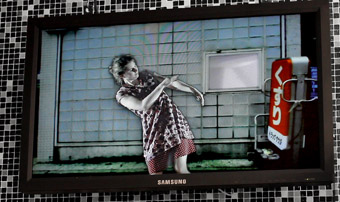
Vivaria, Sam James, installation view
Sam James’ Vivaria presumably takes its title from those places where animals or plants are kept for observation or research. Installed against a “pixellating” wall of black and white mosaic tiles, Vivaria displays the cream of Sydney’s contemporary dance species—Linda Luke, XX, Peter Fraser, Lizzie Thompson and Martin del Amo—each displaced into and onto an array of architectural spaces. The video works within its own grid, a gradually rotating cube with each facet revealing another setting, another performer. Gesturing at internal states, the dancers move as if feeling their way in the dark. Meanwhile buildings transform around them. Their setting renders tentative gestures more dramatic. An arm is caught inside or has it colonised concrete? “A co-joining of impossible spaces and bodies elicits the dancer as a hybrid creature—anthropomorphic like Descarte’s Animal Machines,” writes James. The work is richly textured, at turns elegantly pensive and playful, a meditation on the competing presence of bodies and the built environment.
To experience Vivaria in full requires standing for 26 minutes halfway up the stairs—not something that comes easily to students in the School of Busy-ness who are more likely to accumulate a vision of the work in fragments. I imagine Vivaria functions quite well in this way too. One student asked me why I’m so immersed. “Are you searching for the meaning?” he asks and I imagine one could do worse these days in the School of Business.
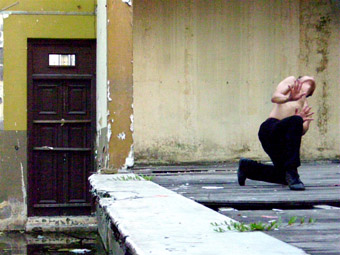
Tony Yap, Melangkoli – Sen Siao, Sean O’Brien
Sean O’Brien’s Melangkoli Sen Siao is housed on the 3rd floor of the Robert Webster Building where the two-screen work is installed in the tight reception area of the School of English, Media and Performing Arts. Earphones in place, listening to Madeleine Flynn and Tim Humphrey’s score, I sit inches away from office workers to be transported to the steamy streets of Melaki (Malaysia) and Yogjakarta (Indonesia) where dancers Tony Yap and Agung Gunawan are enacting intensely passionate rituals of grief in response to interior and exterior landscapes, sites that are “key to the performers, to their bodies, to their memories.” In this small, contained space I feel entirely displaced.
GESTURE offers many such disconcerting breaks in the continuum, a series of small shocks that open the mind to the world beyond surfaces. It’s a pertinent provocation and a gift to that increasingly fluid and fast moving entity called the student body.
–
GESTURE: Performance/Film/Dance,ReelDance Installations #04: Reading the Body, choreographer, filmmaker, editor Sue Healey, digital artist Adam Synott, music Darrin Verhagen, animation Adnan Lalani, cinematography Judd Overton, performer Rachelle Hickson, Io Myers Studio; Promise of Fallen Time, director, choreographer Isabel Rocamora, featuring Anna Mittel, Enric Majo, photography Nic Knowland, sound design, Jem Noble, Io Myers Studio; Samuel James, Vivaria, dancers Martin del Amo, Lizzie Thomson, Peter Fraser, XX, Linda Luke, sound Gail Priest, consultant Paul Gazzola; Assembly, Kate Murphy, Australian School of Business; Melangkoli—Sen Siao, writer, filmmaker, editor Sean O’Brien, choreography, dance Agung Gunawan, Tony Yap, music Madeleine Flynn, Tim Humphrey, Robert Webster Building; University of NSW, June 15-19
RealTime issue #97 June-July 2010
© Virginia Baxter; for permission to reproduce apply to realtime@realtimearts.net
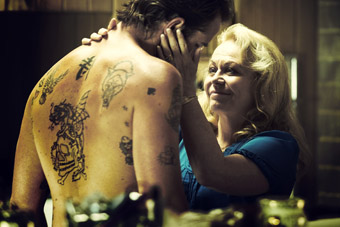
Sullivan Stapleton and Jackie Weaver, Animal Kingdom
FROM THE OPENING SCENE, ANIMAL KINGDOM GRABS YOU BY THE SCRUFF OF THE NECK AND GIVES YOU A GOOD SHAKE. UNRELENTING, IT PULLS YOU IN TO A MOTHER’S DEN OF A SUBURBAN UNDERWORLD, WHERE YOUNG CRIM BROTHERS FIGHT EACH OTHER AND A BUNCH OF RATBAG COPS TO SURVIVE.
David Michôd (formerly mild-mannered editor at IF Magazine) is a VCA graduate with connections to the Edgerton brothers, having co-written a number of shorts with Joel and Nash before directing his breakthrough Crossbow (2007), which won the Melbourne International Film Festival award for Best Short Film with screenings at Venice, Sundance and Clermont-Ferrant. The development process for Animal Kingdom was a slow boil, taking nearly 10 years to craft the screenplay (based loosely on Melbourne crime stories) and every frame settles into your psyche, with a muted violence and sense of unease; a brilliant psychological drama.
Michôd couldn’t have hoped for a better ensemble to bring his take on corruption and crime in Melbourne’s suburbs in the 80s to life. All performances are note-perfect. With its positioning of men always on the brink, coiled and ready to spring, set around a quietly manipulative mother, the film recalls Rowan Woods’ The Boys. It also acts as an antidote to the hyped up razzamatazz of Underbelly, a show that dumbed down as it left Melbourne becoming less interested in character as it wore on to its second and third series. Animal Kingdom works on another level entirely. Michôd is not so much interested in the stylistic shoot-em-up and tits’n’arse life of the petty crim as in the internal spaces negotiated in a family where criminality has become entrenched, the degree of loyalty within when things become compromised, the lull when every character has begun a moral slide.
Rather than a seedy-glam look at the crimes, we’re thrust into a world in transition where the men themselves sense a shift: Barry (Joel Edgerton), settled with wife and child, wants to escape the game altogether while Craig (Sullivan Stapleton) is too caught up in the paranoia of his speed-haze to be able to read situations readily. And no-one does menace like Ben Mendelsohn. As ‘Pope’, he’s mesmerising, and every time his blue-grey Hawaiian shirt comes into frame (and it’s often what you see before his face), the tension both on screen and off escalates and the audience squirms. His ability to intimidate is not about large outbursts of violence but quiet moments of stalking. Using cat-and-mouse tactics, he tries to goad the truth out of others (accusing Luke Ford’s Darren of being gay because of the type of drink he pours), in a tone that belies his desperation to be the head of the family, the one to turn to as confidante: “Any time you want to talk to someone,” he intones smoothly, as they move past him and head out the door.
Newcomer James Frecheville as 17-year-old Cody, thrown into the family after his mother OD’s, is large and immobile, his face registering not much—an asset, he soon discovers. He looks older than his years but his sensitivity is revealed in the way he treats his girlfriend Nicky (another impressive debut performance from Laura Wheelwright) and longs to be a part of her family.
Reigning over these tall and physically imposing men is the diminutive ‘Smurf’ (Jacki Weaver), her cute nickname covering for a woman who will do anything to protect her brood. There’s a faint whiff of fear in the air as she manipulates her men with cuddles and long, lingering kisses on the mouth, positioning her body in a way that suggests she still sees them as small boys (and their behaviour can be reduced at times to that too). As ‘J’ says in voiceover, his uncles are men who—at the heart of it—are afraid, but too scared to show it. In a nice twist, only the cop, Detective Leckie (Guy Pearce), does not live in a world ruled by fear (although his colleagues, on the take, clearly do).
Animal Kingdom is a brilliant and exciting feature debut for David Michôd. The film’s title cleverly reminds you that, stripped of their clothes, their bravado, their posturing, these men are like lost creatures, products of their environment; it’s do or die. The complexities of character, the evocation of an era, the subtle acting, the deliberate camera, the sense of a community dying out—these all signal a director of great natural skill with an intimate knowledge of filmmaking (and the ability to relay this to his cast and crew) making Animal Kingdom one of the most dynamic films of recent years, and one for repeated viewing.
Animal Kingdom won the Dramatic Jury Prize for World Cinema at the Sundance Film Festival and is currently in national release.
Animal Kingdom, writer, director David Michôd, producers Liz Watts, Bec Smith, director of photography Adam Arkapaw, editor Luke Doolan, production designer Jo Ford, composer Antony Partos, sound designer Sam Petty
This article first appeared online, June 28
RealTime issue #98 Aug-Sept 2010 pg. 29
© Kirsten Krauth; for permission to reproduce apply to realtime@realtimearts.net
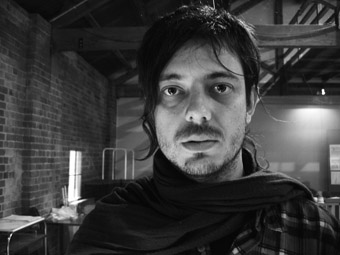
Benedict Andrews
photo Pia Johnson
Benedict Andrews
Benedict Andrews has proven himself to be the most consistently interesting and challenging theatre director in Australia. His totality of vision creates immersive theatrical worlds that seamlessly merge passion, intelligence and a heightened visual sensibility.
Most satisfying is the rigour with which Andrews and his collaborators generate design, media and character motifs which evolve and mutate with a frightening logic (the drinking in Who’s Afraid of Virginia Woolf? becomes a flood of ice and spilled liquids underlining emotional abjection; the glass wall between performers and audience in Eldorado fluctuates between windows on the home and a world at war—one nightmarishly unspecified).
Marked physicality—whether realised as utter stillness (Cate Blanchett as Richard II in The War of the Roses) or panicky desperation (everyone in Moving Target)—is characteristic of the director’s work, again with a strong pictorial, even choreographic awareness.
A sense of immediate contemporaneity is also evident, not least in plays chosen from the past. In Andrews’ production of The Season at Sarsaparilla 1960s Australia is meticulously evoked but as if seen through the eyes of Reality TV’s Big Brother, with cameras installed within the set to provide close-ups both amusing and chilling. The director’s account of Shakespeare’s Measure for Measure for Company B takes this surveillance motif even further. The sense of a shared present is also evident in Andrews’ engagement with violence—whether in his realisations of the psychotically closed worlds of Mr Kolpert or Fireface or the unidentified wars offstage in Eldorado or The City or the explicit ones in The War of the Roses.
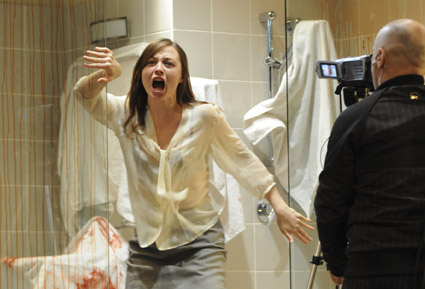
Robin McLeavy, Arky Michael, Measure for Measure, directed by Benedict Andrews
photo Heidrun Löhr
Robin McLeavy, Arky Michael, Measure for Measure, directed by Benedict Andrews
Facilely criticised in some quarters for being party to a ‘director’s theatre’, in “Directors + playwrights: the living & the dead,” Andrews took exception to an attack on young directors by playwright Louis Nowra: “I work with living writers and dead ones. I do not breathe some sigh of relief as Louis Nowra might imagine when working on a classical text as if I were suddenly free to dance on the playwright’s grave. Each project is demanding and all consuming and I enter it with questions and fantasies I want to explore with the community of people I work with and the audience who will watch our work.”
Benedict Andrews was born in Adelaide in 1972, graduated with First Class Honours in Bachelor of Arts from Flinders University Drama Centre, directed locally, including a stint as artistic director of Magpie2 for the State Theatre Company of South Australia. Magpie, formerly a Theatre in Education company, was now boldly targetting the 18-25 year-old demographic but Andrews had barely made his nonetheless palpable mark before Australia Council funding was withdrawn (Murray Bramwell, “A future or a blown youth?,” RT 23, p9, not yet available online).
In 1996 Andrews wrote for RealTime (RT 16, p6, not available online) about the experience of seeing works by Robert Wilson, Pina Bausch, Peter Stein and Robert Lepage, as well as Polish and Japanese performance, at the Edinburgh Festival and Fringe. In 1998 he was awarded the Gloria Payten & Gloria Dawn Fellowship which he used to travel to Europe as well as New York. His New York report for RealTime (“Looking for Elsewhere,” RT 30, p34) included a vivid account of the hard-edged performance style of the work of Richard Maxwell—perhaps an influence. What Andrews’ writing revealed was a young Australian theatre director’s welcome and rare openness to new forms and diverse performance languages.
Andrews went on at various times to work as assistant director to Neil Armfield, Michael Gow and Jim Sharman and was appointed resident director of the Sydney Theatre Company 2000-2003. Since then he has created productions for Malthouse, Sydney Theatre Company and Company B. He directs annually in Australia and at Berlin’s Schaubuhne am Lehniner Platz (see reviews of his Berlin productions of Sarah Kane’s Cleansed and David Harrowers’ Blackbird) and presently lives in Reykjavik, Iceland.
Andrews will direct King Lear at the National Theatre of Iceland in Reykjavik in December this year and the Monteverdi opera The Return of Ulysses for the Young Vic and English National Opera in London in 2011. His production of Mozart’s The Marriage of Figaro for Opera Australia is now scheduled for 2012. According to an article in the Sydney Morning Herald, Andrews also has film projects in mind and is to have his poems published in Blast magazine.
In the same interview, Andrews said of Measure for Measure, “I want to stage it like a psycho-sexual thriller, like a David Lynch film…the play is very much concerned with desire and law and strange doubled realities, with another reality seeping through another reality” (June 2, www.smh.com.au/entertainment). Our review of Measure for Measure will appear in the July 12 RealTime online edition and in the RT 98 print edition.
A substantial list of reviews of Andrews’ productions appears below along with an interview and two examples of the director’s writing. One of these is an introduction to the work of Christoph Marthaler, a European opera and theatre director greatly admired by Andrews and written in anticipation of the staging of Marthaler’s Seemannslieder for the 2007 Sydney Festival.
Benedict Andrews has created many memorable works, not all of them perfect but sharing a boldness of vision and a recognisable evolving personality. His productions of Marivaux’s La Dispute (in Timberlake Wertenbaker’s far from funny version of the comedy), Mr Kolpert, Fireface, Who’s Afraid of Virginia Woolf? and Caryl Churchill’s Far Away seem as vivid in my recollections as when I saw them. But it’s The Wars of the Roses and, above all, The Season at Sarsaparilla that have made the deepest mark, for the scale and fidelity of their vision. The hugely popular production of the Patrick White play and its critical success laid to rest the “directors’ theatre” debate. As James Waites has argued (see full article) it revealed the work to a be a classic of Australian playwrighting and the production worthy of an international audience.
There’s much more that could be said of Benedict Andrews—about the influence of contemporary performance, of media culture, of German theatre (via English engagement with German plays but also directly and in collaboration with German artists) and the evolution of a very particular design sensibility (working with a small, recurrent group of designers), at first glance very European, but as in The Season at Sarsaparilla, totally and radically responsive to our sense of the past as viewed through the present.
Keith Gallasch
artist website
www.benedictandrews.com
reviews
degrees of pathos
keith gallasch: marius von mayenburg’s fireface, 2001
the arts of ageing, the limits of vision
keith gallasch: beatrix christian’s old masters, 2001
tough nights at home
keith gallasch: david gieselmann’s mr kolpert, 2002
benedict andrews: self, style &vision
keith gallasch: calderon’s life is a dream, 2002
beckett-land: spirit and letter, stage and screen
keith gallasch: beckett’s endgame, 2003
once upon the here and now
keith gallasch, caryl churchill’s far away, 2004
sarah kane in berlin
adam jasper smith: sarah kane’s cleansed, 2004
sydney performance: killer logic
keith gallasch: julius caesar, 2005
two ways of looking at blackbird
daniel schlusser, david harrower’s blackbird, 2006
strange words, alarmingly familiar
keith gallasch: marius von mayenburg’s eldorado, 2006
shocking symmetries
keith gallasch: albee’s who’s afraid of virginia woolf?, 2007
another time now
keith gallasch: the season at sarsaparilla, 2007
adelaide festival: the games art plays
keith gallasch & virginia baxter: moving target, 2008
the war within, the war without
keith gallasch: the war of the roses, 2009
violations: sex, history, form
keith gallasch: martin crimp’s the city, 2009
interviews
the luminous nightmare of marius von mayenburg
keith gallasch: benedict andrews on el dorado, 2006
inside looking out
keith gallasch talks with marius von mayenburg, 2008
writings
directors + playwrights: the living & the dead
benedict andrews replies to louis nowra, 2001
christoph marthaler: in the meantime
benedict andrews on a great european director, 2006
related article
wunderkind mysteries
john bailey: melbourne performance, 2010
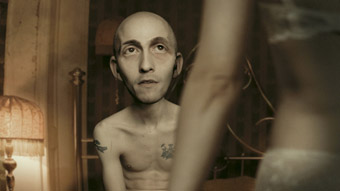
Metropia
JACK SARGEANT IS THE AUTHOR OF A NUMBER OF KEY BOOKS ON ‘OTHER’ CINEMAS. THERE’S DEATHTRIPPING: THE EXTREME UNDERGROUND AND THE SEMINAL BEAT WORK NAKED LENS: BEAT CINEMA, BOTH OF WHICH HAVE BEEN REPRINTED THREE TIMES IN ENGLISH, WHILE NAKED LENS HAS BEEN TRANSLATED INTO RUSSIAN AND JAPANESE. SARGEANT HAS ALSO EDITED BOOKS ON ROAD MOVIES AND PUNK ON FILM, AND WRITTEN ESSAYS ON ANDY WARHOL, DRUGS ON FILM, THE TRANSGRESSIVE PERFORMANCE ART GROUP COUM TRANSMISSIONS ON FILM, 9/11 DOCUMENTARIES AND MUCH MORE.
I first met Sargeant in 2000 when he brought the Beat film retrospective to the Brisbane International Film Festival (BIFF), one of the festival’s many incredible programs over the last decade. He met Richard Sowada, who “was instrumental in bringing me to Australia.” Sowada, now Head of Film programs at the Australian Centre for the Moving Image (ACMI), had been the founder of the REV fest, now the Revelation Film Festival, one of Australia’s most important screen cultural events. Sargeant spoke to me about life in his third year at the festival.
A festival programmer today has to juggle a lot of different things—what’s the most interesting thing about working on REV for you?
It’s interesting, because it has to embrace different, simultaneous discourses. There’s the ‘underground’ thing, but that is more of a minority interest. You also have to make sure people come and you screen larger films. I’ve always got to be programming for that combination. For example, this year we’re showing Mike Kuchar’s film, Sins of the Fleshapoids, a work which will be unknown to many people, and is pure 60s underground cinema. On the other hand we’re showing a documentary about The Doors called When You’re Strange. It’s different because it doesn’t have Ray Manzarek talking on about the past. Instead it’s got hitherto unseen footage and music all the way through. That’s a lot more of an accessible film, a more recognisable festival title, and I imagine other festivals will pick it up too. For me all kinds of films are important in the mix.
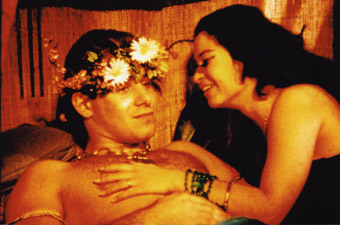
Sins of the Fleshapoids
Because REV was started without much money and with passion rather than commercialism or other agendas at its heart, it’s always had its own identity. I realise it’s a very privileged position in which I am working. It’s a great film festival: it has a high degree of mutability. We’re not really mainstream, not really indie, not really underground, but we enter all of these areas. The festival is a form of hybrid work. It’s an advantageous position to be in. We have a great audience who come and enjoy the festival, people who are open to film and every year there are new people coming, which is great. It has a presence in Perth as part of the culture there.
Tell me about your work on the Magickal Songs, Mythical Histories and Fictitious Truths program for the 2010 Biennale of Sydney?
I found out there was a meta-thematic running through the Biennale based on Harry Smith, who I’ve written about. Fairly early on I discussed a list of films that would go hand in hand with these themes drawn from Harry’s work, which, if you are familiar with it, offers a perfect starting-point for so many different cultural possibilities. It’s been a great experience, to devise a screenings program around Smith and exciting to extend it to include experimental performers such as Lawrence English and Noko, as well as films like the Ira Cohen documentary Kings With Straw Mats, the doco In The Realms of the Unreal about Henry Darger and Craig Baldwin’s Mock Up On Mu. And there’s the Nick Zedd film, War is Menstrual Envy—I’m pretty sure it’s never been screened in Australia before. It’s a psychedelic punk avant-garde film, pure mayhem and a beautiful piece of art cinema. I just thought it’s about time that film got seen and framed in a different context.
When I first met you at BIFF, film festivals were seriously carnivalesque affairs where a lot of fun and discussion was had, inside and outside the cinema. How have festivals changed? What’s the role of fun in all this?
A festival exists to show film and get people to think and share their experiences about cinema. As soon as people move away from that, I think there are problems. When I write about films or program them I try to frame them the way I see them. I don’t think film should be framed the way the marketing people of a film company want us to see them or the way certain theorists or historians have framed them. Of course, I don’t necessarily want people to agree with me. I want them to know why I think a film is interesting and go from there. It’s important as a curator to put one’s imprint on things. That said, I argue with the people involved in REV. It’s not like they all bow to my taste. Obviously people have different tastes. Part of the process of curating is negotiating, defending, justifying decisions, sometimes even with myself. If I am passionate I will argue down to the last minute about why I think that a film is good. It’s not that other people’s opinions aren’t valid. It’s that, I think, as a curator or as a writer on culture, that’s what you have to do, you have to stand up for things you like.
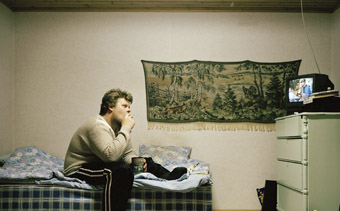
The Living Room of the Nation
It seems one of the things you stand up for is diversity—your programming has always tended to combine lots of different genres and approaches. Why’s that important?
I think it’s important to have a range of genres and styles and themes going on, it’s important to get that scope, not just be doing the same thing, or variations of the same thing. The ideal is to have diversity, not predictability. To be moving in all directions at once. What was the term Trans Media Exploration used? Quaquaversal. Trans Media were a 60s commune and art group; Genesis P-Orridge, later of Throbbing Gristle and Psychic TV was involved with them for a while. I like the idea of embracing the ‘quaquaversal.’ Or ideas like becoming. Those concepts of how to be fluid and flexible and move through an infinite number of possibilities.
Is that close to a philosophy of programming?
Philosophy is a bit of a problem for me, because if you seriously have a philosophy then I believe that you’ve got to destroy it. As soon as you have just one way of doing something you become conservative. And you have to avoid conservatism, and avoid your own conservative tendencies that allow you to fall back on the familiar or the safe. I think people become too cynical. It’s important to retain that freshness, that excitement and interest about things, to keep coming to them anew.
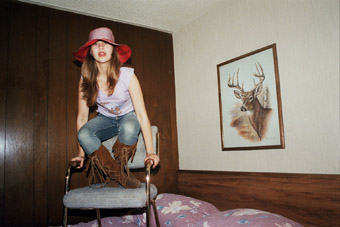
Joanna Newsom, The Family Jams
When was the last time you found something interesting that you never thought you’d be into before?
All the time. Because I’m always looking to find new things, new areas of interest. I’m always looking for new kicks, you know? I get bored easily and always want to find new stuff to amuse myself. I’m always finding things I like because I’m always looking for things.
I think one needs to approach one’s work with a kind of fury. By which I mean an intensity. It’s important to avoid being lazy and not engaging. It’s also essential to realise that just because you can see one minute of something on YouTube doesn’t mean you’ve seen it, there’s so much more out there.
I’m really interested in the things that are excluded, for example recently when people were talking about Australian cinema, I was interested in what was left out of the definition. As soon as I know there’s something they’re not telling me, I always want to know what it is. (See Sargeant’s “Australian Film: A Wider Screen,” RT95)
I think it’s important to remember that culture is like an iceberg: the little bit that peeks above the surface is what everyone’s talking about. But what’s interesting is what’s under the surface. Interestingly, on some icebergs there’s even more under the surface than usual; sailors call these icebergs growlers. To me that is the perfect metaphor; there’s this huge thing growling underneath and this is what I want to know about. Most people just stick with what’s above the surface. But knowing what’s out there, wondering about it all the time, makes me want to look deeper.
* * *
advance notice
Jack Sargeant tells us that his 2010 Revelation Film Festival will include Mike Kuchar’s Sins of the Fleshapoids; a Philip K Dick-style science fiction animated feature, Metropia; an Irish post-apocalyptic melodrama, One Hundred Mornings; a Russ Meyer double bill; a WA feature, The Sculptor; the hip LA coming of age film, We Are The Mods; The Family Jams, a documentary about alt.folk, Joanna Newsom et al; Living Room of the Nation, a poetic visit to six Finnish living rooms; Double Take, the much acclaimed and witty experimental examination of Alfred Hitchcock and Cold War Politics by Belgian artist Johan Grimonprez; and the documentary Reporter, about a committed US newsman in the Congo.
Revelation Film Festival, Perth, July 8-18; www.revelationfilmfest.org
RealTime issue #97 June-July 2010 pg. 21
© Danni Zuvela; for permission to reproduce apply to realtime@realtimearts.net
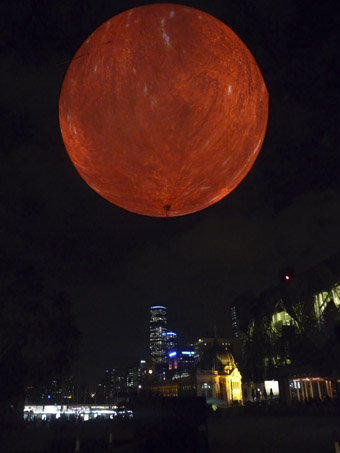
Solar Equation by Rafael Lozano-Hemmer for The Light in Winter, Federation Square
courtesy Federation Square
Solar Equation by Rafael Lozano-Hemmer for The Light in Winter, Federation Square
As we pass from Spring to Winter and the Winter Solstice approaches this is an edition inflected with change. The photograph on this page is of Rafael Lozano-Hemmer’s giant creation for Melbourne’s The Light in Winter festival, Solar Equation, a work which will hover over Federation Square for a month. The artist describes it as “a piece for the sky”, mathematically monitoring changes on the surface of the sun. You can interact with its equations (see interview). Other changes are marked by the final showing of the National Review of Live Art in Glasgow and our review of James Waites’ Whatever Happened to the STC Actors’ Company?. Pierrot Bidon, the founder of Archaos has died and we celebrate his re-making of circus. Elsewhere we congratulate Lawrence English for 10 years of ROOM40, report on changes in dance touring strategies and music commissioning tactics. Chirstinn Whyte notes radical shifts in dancefilm thinking at Moves 10 in Liverpool, Mike Walsh at the Hong Kong Film Festival sees Chinese feature films searching for new formulae and Jana Perkovic wonders if Live Art will take in Australia. Is more change on the way? Our annual arts and education edition and report from the Next Wave Festival in RealTime 98 will have something to say about that.
RealTime issue #97 June-July 2010 pg. 1
© Keith Gallasch; for permission to reproduce apply to realtime@realtimearts.net
{$slideshow} Here we offer a mini-gallery of performance strategies for dealing with that unruly entity—the audience. Takers for Rotazaza’s Wondermart look afresh at everyday places (see review). In IRAA’s The Persistence of Dreams: The Sandman, an audience of one invites a group of friends to join them at their home to be bound and blindfolded as Roberta Bosetti recounts a dark bedtime story (see review), while Hole in the Wall participants are moved about in four rooms on wheels (see review). In Oil Can, at Sydney’s 4A Centre for Contemporary Asian Art, passersby are invited to climb into one of 15 oil cans to stand motionless alongside the artist Tatsumi Orimoto, for 30 seconds, which they obligingly do. Read about Oil Can here.
RealTime issue #97 June-July 2010 pg. 2-3
© RealTime ; for permission to reproduce apply to realtime@realtimearts.net
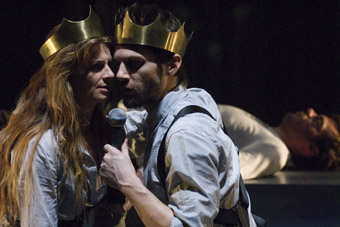
Amber McMahon, Cameron Goodall, Brett Stiller, Vs Macbeth, STC & The Border Project
photo David Wilson
Amber McMahon, Cameron Goodall, Brett Stiller, Vs Macbeth, STC & The Border Project
THIS YEAR’S ADELAIDE FESTIVAL WAS AWASH WITH DIALECTICAL ENTANGLEMENTS: CULTURES MELDING, DISCIPLINES MERGING, TEXTS COLLUDING. THE ARTIST TAKES THE GIVEN AND MAKES IT NEW OR, IN SOME CASES, NEWISH.
vs macbeth
In Vs Macbeth, the given is William Shakespeare. And the new is danger. The Sydney Theatre Company’s Residents and Adelaide’s own Border Project teamed up for this new work that sought to reimagine Macbeth through the accidents that have made it the superstition-laden “Scottish play” that it is. The conceit is honourable. After all, the dangers of theatre can be very real. Performing it and witnessing it can be like walking along a cliff top backwards. Yet, this production never raises a solitary hair.
The problem is not in conception, but in realisation. From the outset, there is an undeniable whiff of Occupational Health and Safety, from the high visibility jackets to the yellow hazard tape. Yes, they mark the space as perilous, but they are also measures designed to dampen the unexpected and to ward off danger. If anything, they mark this theatre as eminently safe and flag in fluorescent clarity the fact that we should be prepared for things to go safely awry. When paintball guns are brought out for every death scene, so too is a cumbersome protective curtain of cyclone fencing meant only to protect the front row from pink shrapnel. Suspense? No, thanks.
The lack of tension in the space is only compounded by the bathos exerted by a series of interruptions—a missed entrance, a hurt hand. The sporadic nature of the interruptions suggests an unwillingness to commit wholly to the conceit, though it must be said that some of the actors commit themselves to the text beautifully. Indeed, it is the half-heartedness of the reimagining which is most problematic. The central melody here is still Shakespeare’s voice but the counterpoint is little more than an embarrassed suggestion of revolt, leaving even the erstwhile iconoclasts in the audience yearning for tights and doublets (the lycra-hungry had to head to Back to Back’s Food Court for their fix (RT 92, p42).
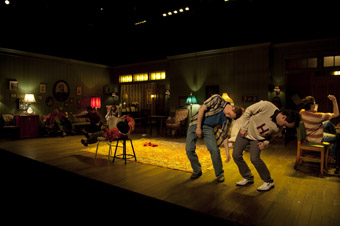
The Sound and the Fury, Elevator Repair Service
photo Matt Nettheim
The Sound and the Fury, Elevator Repair Service
the sound and the fury
Fittingly, there wasn’t an inch of spandex to be seen at Elevator Repair Service’s staging of April Seventh, 1928, the first part of William Faulkner’s novel The Sound and The Fury. The company is familiar to these shores. Last year’s six-hour Gatz [RT91, p43], saw them transpose the entirety of The Great Gatsby to the stage. In that work, the dialectical frisson between the forms of prose and theatre was a little elusive—the vastness of Fitzgerald’s text was inflected by the joy of reading it rather than the thrall of deconstructing it.
In The Sound and The Fury, a newer work, there is a sense that director John Collins and his ensemble are developing their modus operandi. Again the text is read from the novel but this time not its entirety. Again the text swirls about in a non-literal mise en scène but seeks now to represent the world of the novel rather than an anonymous backdrop. And again the narrative voice propels the text forward along with dialogue but this time it is complemented by projected surtitles that swing our attention in a different way to the written quality of the language. These changes, along with the more stylistically demanding source, serve to make this a far more complex and concentrated production than the sprawling, durational transparency of Gatz.
Remarkably, despite its complexity, the sense of theatrical storytelling and its grounding in prose is rarely lost. The disorienting carousel of actors and characters manifests the chronological jumps of Faulkner’s prose but also produces a fractured perspective, a kaleidoscopic confusion of glimpses into the Compson household that are as rowdy and shabby as the characters themselves. Amongst this kinetic frenzy of staging and the odd Woosterish dance interlude, Collins has wisely left room for moments of transcendent stasis, when the text, projected, is allowed to speak for itself. Yet these moments work not only because of the strength of Faulkner’s writing but also because of the strength of the theatrical text around it—Hegelian synthesis at its finest.
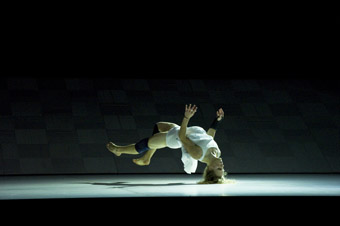
Be Your Self, ADT
photo Chris Herzfeld
Be Your Self, ADT
be your self
Across town at Her Majesty’s, Australian Dance Theatre was premiering its latest work, Be Your Self, an investigation of the body-mind compact inspired by the work of 18th-century Scottish philosopher David Hume. As director Garry Stewart notes in the program, Hume’s A Treatise on Human Nature suggests that humans are “nothing but a bundle or collection of different perceptions, which succeed each other with an inconceivable rapidity, and are in a perpetual flux and movement.” This quotation is almost a pithy précis for the show itself.
It begins with a clinically white and vast stage. As a dancer slowly and meticulously begins to ripple movement up from the floor, through the feet and into the legs, another performer speaks an impressively detailed, thorough and ceaseless description of the neurobiological processes involved in what the dancer is doing. It is an inspired overture that deftly introduces the two disciplines that inform this work: science and dance. The former is taxonomical and exhaustive, the latter expressive and essential. If we were to think of them linguistically, science is the langue and dance the parole.
Unfortunately, the promise of the beginning is not maintained throughout. The piece itself sets out to be somehow analogous to the erratic nature of our human thoughts and physicality, but it feels instead like a physical illustration of the text we heard at the beginning without further development or consideration. The rhythms are punchy, the soundtrack is banging, the lights are in full wizardry mode but the result is a continuation of the clinically detached aesthetic of the start, without any of the discoveries that merit the scientific method, making for a surprisingly joyless experience.
Nevertheless, there is consolation to be had in the uber-athletic performances of the ensemble. The ADT dancers are surely some of the most muscular in the world and their broad shoulders and tendency towards explosive piston-like movement is displayed here to great effect. The set by New York architects Diller, Scofidio + Renfro is largely circumstantial until the very end, when a wide ramp set at 45 degrees is rolled to the front of the stage. As carefully designed animations are projected onto the surface of the ramp, isolated sections of bodies emerge through its weave, swimming in a protean liquid of colours and swirls. It is an assured finish and a striking image, but it is simply the final element in a “collection of different perceptions” that, combined, paint a very cold, distant and unwelcoming sense of what it is to be human.
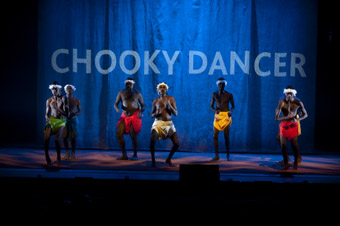
Ngurrumilmarrmeriyu (Wrong Skin), Chooky Dancers
photo Matt Nettheim
Ngurrumilmarrmeriyu (Wrong Skin), Chooky Dancers
ngurrumilmarrmiriyu (wrong skin)
A much warmer, though hardly uncomplicated vision of humanity was to be had at Her Majesty’s a fortnight later with the premiere of Ngurrumilmarrmiriyu (Wrong Skin), which teamed Elcho Islands’ Chooky Dancers with director Nigel Jamieson.
The Chooky Dancers, like Justin Bieber, Susan Boyle and the Back Dorm Boys, came to fame on YouTube. In a dark gym hall they danced to a remix of Zorba the Greek in a unique hybrid of dance vocabularies—part Yolngu, part hip hop, part disco, part Busby Berkeley. The cultural provenance of their performance is breathtakingly complicated, but unadulterated joy and immediacy are the key to its appeal. Existing in a geographically isolated community that, thanks to modern telecommunications, can consume an entire world of creative influences, the Chooky Dancers made manifest postmodern intertextuality not as an ironic exercise in form but as a fundamental expression of self.
Jamieson’s attempt to build on the Chookies’ self-expression and foster it into a piece of theatrical storytelling is an unenviably difficult but worthy undertaking. The director chooses to use the complex Yolngu moiety laws as the basis for a forbidden-love story, with overt references to West Side Story along the way. This gives him a straightforward narrative hook on which to hang various dance sequences and video montages of life on Elcho Island, but it also imposes a stifling rhythm on proceedings and creates a strange tension: are the performers co-creators or merely the subjects of the work? Occasionally, it even reveals the technical shortcomings of the dancers when they are required to step out of their own style. At other times though, the show is a brilliant populist work that sheds light on an oft-overlooked part of our country, and the charisma and pleasure of the performers is disarming and contagious. Indeed, whether it be the Zorba or a riff on a Bollywood dance scene, the most engaging moments are those in which the mechanics of the theatre step out of the way and allow the Chookies to simply do their thing.
–
2010 Adelaide Festival: Sydney Theatre Company & The Border Project, Vs Macbeth, writer William Shakespeare, director Sam Haren, designers Sam Haren, Matthew Kneale, costumes Mel Page, lighting Govin Ruben, composer David Heinrich, video Richard Back; Odeon Theatre, Feb 26-March 6; Elevator Repair Service, The Sound and The Fury (April Seventh, 1928), text William Faulkner, director John Collins, design David Zinn, lighting Mark Barton, sound Matt Tierney, costumes Colleen Werthmann, projections Eva von Schweinitz; Dunstan Playhouse, March 11-14; Australian Dance Theatre, Be Your Self, concept, direction, text Garry Stewart, choreography Garry Stewart and ADT, design Diller, Scofidio + Renfro (DS+R) Architects, lighting Damien Cooper, sound Brendan Woithe (colony nofi), video Brenton Kempster (ZuluMu Design + Post), costumes Gaelle Mellis; Her Majesty’s Theatre, Feb 20-28; Ngurrumilmarrmiriyu (Wrong Skin), writer-director-designer Nigel Jamieson, associate director, movement Gavin Robins, film & video design Scott Anderson, video producer Mic Gruchy, lighting Trudy Dalgleish, composers & sound designers Basil Hogios, David Page, performers The Chooky Dancers; Her Majesty’s Theatre, Adelaide, March 11-14
See RT 96 for reviews of Ligeti’s Le Grande Macabre and the London Sinfonietta at the Adelaide Festival
RealTime issue #97 June-July 2010 pg. 4-5
© Carl Nilsson-Polias; for permission to reproduce apply to realtime@realtimearts.net
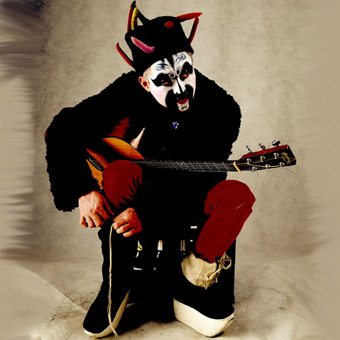
Xiao Hei, SXSW 2010
courtesy the artist
Xiao Hei, SXSW 2010
SOUTH BY SOUTH WEST IS A WINDOW INTO WHAT’S HAPPENING NEXT, ACCORDING TO THE WHISPERS OF THE SOCIAL MEDIA HYPE MACHINE. HOPING TO GET A LOOK THROUGH THAT WINDOW, I FOLLOW THE WHISPERS TO AUSTIN, TEXAS.
First, some terminology. South By Southwest is more usually written SXSW and pronounced ‘South By.’ It’s a 23-year-old umbrella event encompassing several specialist media sub-events. It attracts, they say, 25,000 people every year. It has an enormous program, comprising exhibitions, film screenings, panels, yet-to-be-classified online happenings and a huge number of showcase concerts.
In some art forms—music, film and interactive media—the event has a serious global profile. I’m here for the latter. SXSW has become the favoured venue for turning your latest networked interaction venture into an instant fad using the power of champagne and a well-spruiked launch. It’s where you go to meet up with Big Names, to make it clear that this season’s innovations include you. It’s here the myopic vision of the American public just might snap into focus on your new idea. If you work in locative and networked worlds you might, like me, recall it as the place where Twitter debuted; where geosocial networks hold treasure hunts; a hotbed of geocaching where augmented reality-layers quilt the city. A place where cyberpunk technoaesthetic fantasies precipitate from the hyperbole-supersaturated air. An embassy of the American future towering in the present.
In Australia, where we have our own special kind of myopia, it isn’t on the map. SXSW may tower in the US, but it is invisible over the Pacific horizon. Sheer geographical accident plants me in the path of the wagon train to Texas in the lead-up to the festival. I don’t resist, head spinning with half-remembered buzz and rumour, and futuristic hype. I fire up the browser and see what’s scheduled. There are endorsements from the Cocteau Twins, Village Studios and a half-dozen Silicon Valley startups on the festival’s web-page, dammit! What could go wrong?
The first SXSW project to engage me can be found without joining the throng in Austin. London-based Reality Jockey (RJDJ) have packaged up a custom mobile app for the occasion called Hijack SXSW using your phone’s microphone input to create indecipherable algorithmic remixes of the audio content of your environment. An accompanying website helps attendees share generative remixes of the sounds of festival events. The soundscape algorithm is painstakingly produced, harmoniously incorporating every conceivable input from motion sensor to GPS. It’s beautiful, mysterious and no doubt transgresses intellectual property rights; in short, it has everything to make it a viral hit at the kind of festival that I wish I were at. It’s a promising start—and incidentally, just the latest in a long line of interactive pieces from the mobile interactive music startup, which freely distributes tools to assist reactive music composers.
Unfortunately, while RJDJ makes SXSW look good from afar, the experience of actually walking through the door is less alluring. The dizzying hype of SXSW is matched by the vertiginous expense of entry: at US$1350 for a full ticket it’s closer to the price of a high-level professional conference than an arts event. It’s either a sign of arrogance or a promise of excellence to charge as much as the Sri Lankan per-capita GDP for a week-long event. It’s also a pretty steep rate for Americans in the midst of severe recession. Coming overland to Austin, my train rolls across a landscape of alienation and poverty. Trailer parks, bail-bond loan offices and abandoned strip malls, sun-baked and silent desert prisons, public toilet queues clogged with doped-out drug users. I’m no expert in the political economy of the USA but I cannot help see the abysmal income divide here.
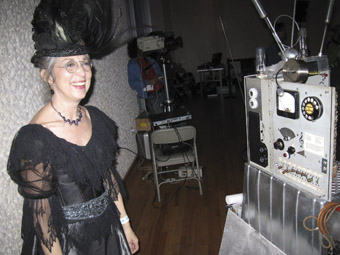
A steam punk fairy godmother at Plutopia
photo Dan MacKinlay
A steam punk fairy godmother at Plutopia
My first few physical encounters with the festival are unexciting: performances that claim to be ‘innovative’ because they play music with synthesisers as well as guitars; a ‘game art’ exhibition that is nothing but framed concept sketches for a manga-themed shoot ‘em up; and fliers telling you to sell your music in Guitar Hero. Soon enough, I gravitate to the fringes, where the interesting things are hiding—like Plutopia, a one-night anarchic, psychedelic counterculture celebration. The whole thing is cloistered away from the Convention Centre crowd at the Mexican American Cultural courtyard by the river. On one side, a local produce shop and on the other, microbreweries and distilleries. In the middle, roving troupes of steampunk designers, circus performers and dorkbot delegates showcase their wares. A bustled Victorian grandmother hawks interstellar neutrino machines made from washing machine parts. Geeks in labcoats are tending a giant glowing brain. On the main stage sits Chinese artist Xiao He in a straw hat, working up a variegated soundscape of custom digital delays and reprocessed vocals in one of my favourite performances of the whole program.
Futurist Bruce Sterling delivers a curious and rambling keynote speech for Plutopia, surveying digital fabrication, internet-facilitated regional cooperation and the potential for social media in sustainability. His opening statement crystallises the concerns that have driven me to the periphery of SXSW: “Tomorrow I’m speaking at SXSW, which is sponsored by Pepsi and Chevy. Tonight I’m speaking at Plutopia, which is sponsored by steampunk fairy godmothers who make cool stuff out of junk.”
Outside, the logos of those particular corporations are tessellated into ambient infomercial wallpaper across every surface. Branding saturates everything: presentation screens, the festival guidebook, social network sites, the pavement, passing cars, electrical outlets. It is a preview of a dystopian future of complete advertising domination, which is to say: something like living on the present-day internet. I feel like I have entered the world’s largest corporate marketing focus group. It is so suffocatingly intense that it’s hard to find space for anything not strictly commercial.
Back at the convention centre, stuff does manage to happen in the gaps between gimcrack promotions: panels featuring various Web 2.0 luminaries, trade shows, screenings. Queues for the overbooked sessions are long and entry is uncertain. When I manage to get into something it tends to be a presentation by a harried refugee from some shaky startup whose primary concern is not innovation in form or content but how to market their existing content in the middle of an economic downturn. Making your projects profitable is nothing to sneer at, of course, but as one panel after another turns into a group counselling session to allay fears of falling into the poverty chasm, I begin to wonder if there are any messages here other than boom year nostalgia.
The Austin Museum of Digital Art has at least harnessed the power of nostalgia for good. Their entry into SXSW is themed around naïve video art, 8-bit animation and digital primitivism hearkening back to the Reagan administration. A multi-headed video setup displays shifting mixes of single channel video works by Gangpol & MIT and Mato Atom. There are a number of excellent live performances, including a rhythmic aural streetscape by Pierce Warnecke. The stand-out is Austin local Party Time! Hexcellent!, who generates live visuals using custom software on an original Nintendo Entertainment system. Her minimalist algorithms and grimy television colour palette eclipse the hypersaturated phosphor colours of her peers as she patiently details her pictographic language in blocky squares and arrows. Compelling.
Eventually I wind up at a launch for the new book by Virtual Reality and reactive gaming pioneer Jaron Lanier, where the man himself eulogises the media business models of the past. Occasionally he punctuates an argument about the vacuity of modern digital arts by playing nameless woodwind instruments and challenging people to Google them. I don’t wholly agree with Lanier’s thesis—his book supposes that the digital status quo reifies and depersonalises creative labour, and that Web 2.0 practice is wiping out the potential for dignity in artistic life or individually expressive aesthetics. After five days of SXSW, however, I can’t remember why I disagree.
Lanier eloquently sums up the insecurities of his audience of digital creatives. Here we sit, self-identified digerati, at a festival made for people like us, and yet the day’s highlights comprised the chance to shove our business cards at a dwindling crop of future employers and mourn for lost security. We are here looking for the future; many of us feel we have been pivotal in building it, and yet we seem to have done ourselves out of the dividends. But if Lanier makes these regrets and fears explicit, the festival feels reactionary in many other implicit ways—the perennial dominance of good old fashioned rock music, the retro technology, the frenetic commercialism crowding out the art. This party might rock like it’s the height of the boom of half a decade ago, but its grip on that vanished past is fearfully white-knuckled.
SXSW 2010, Austin, Texas, March 12-21, http://sxsw.com
RealTime issue #97 June-July 2010 pg. 6
© Dan MacKinlay; for permission to reproduce apply to realtime@realtimearts.net
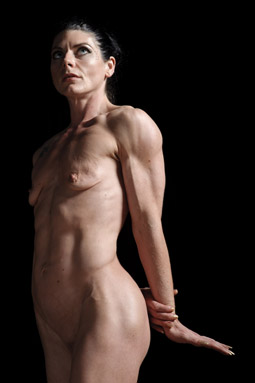
Francesca Steele, Routine
courtesy the artist
Francesca Steele, Routine
THE BELL THAT SOUNDS THE BEGINNING OF THE 30TH NATIONAL REVIEW OF LIVE ART ALSO SOUNDS THE BEGINNING OF THE END: THIS IS THE FESTIVAL’S FINAL INCARNATION IN ITS CURRENT FORM. THE BELL IS SWUNG BY JÜRGEN FRITZ, WHO, LIKE ALL THE ARTISTS IN THIS YEAR’S PROGRAM, HAS PLAYED A PART IN THE FESTIVAL’S HISTORY (HE IS ONE OF THE FOUNDING MEMBERS OF DURATIONAL PERFORMANCE GROUP BLACK MARKET INTERNATIONAL).
Fritz moves slowly at first, the bell making only dull thuds as his arm travels mere inches from his side, and it is several minutes before his swing has accelerated enough for a clear note to ring out. Gradually, carefully, the swings build in energy, until for 30 minutes or so he is swinging exuberantly, ecstatically, joyfully shaking the sweat from his forehead. As a squad of Scottish pipers join in, Fritz surrenders his whole being to the single act of ringing the bell, wildly swinging for love and country and art and folly.
It’s a perfect beginning to the festival, a gesture that both celebrates and says farewell to the NRLA. But at the same time, what is alluring is that it is only a gesture, one that Fritz repeats in different contexts and different cities (for example, in Brisbane in 2008, RT88). It is not for anything or because of anything, but simply the pure, repetitive action: it has a what and a when but no why. Over the five-day festival, densely packed with overlapping performances running from morning until late in the night, my memory accumulates many similar moments: gestures that are beautifully, powerfully meaningless. David Richmond touches his hand to his heart, extends his pinky finger, and raises it in the air. Sheila Ghelani turns to her audience, looks them in the eye, and licks her sugar-coated lips. Iona Kewney hurls and coils her body as dynamically and articulately as a pianist might move her fingers. Lee Wen, clutching a pair of pig’s feet, lowers his twisted frame to lap milk from the floor.
On this anniversary occasion, these gestures are like gifts rather than proclamations. They do not ask me to agree or disagree with them, but are invitations, offerings that I may choose to accept or refuse. Adding live video to a layering of film-within-film, Stephen Partridge’s hands dance furtively and playfully with images of themselves from the past. In the palm of my own hand, Helen Paris from Curious shows me a film in which she lies in the sea on an inflatable raft. Enclosed in a glass display case, Alastair MacLennan blows up balloons and makes gentle traces with his hands, wafting them effortlessly like a bat’s flight slowed down to a visible tremble. For hours he sits, his eyes closed, the case filling up with white balloons. The gesture of blowing up balloons is like an offering of breath, a wasting of space in honour of our being together.
Appropriately for the 30th anniversary, balloons are one of the recurring motifs of the festival. In another durational piece, Elvira Santamaría Torres methodically gathers air into white bin bags, bundling them together to float through the Arches’ vast spaces. At the end of his 30-hour occupation of one of the smaller performance spaces, Michael Mayhew leaves behind a glorious forest of multi-coloured balloons, several of which are carried out by spectators and continue to haunt the remaining events.
Alongside these intimate gestures are, of course, others on a bigger scale: more spectacular, more theatrical, more sensational. And accompanying these are some of the logistical problems that have unfortunately become familiar features of the NRLA over the years. Arriving at the box office at the advertised time to sign up for Ron Athey’s Self Obliterations, I’m told that all the slots were allocated two hours ago. As one of several hundred spectators gathered around Kira O’Reilly’s Untitled (syncope), I catch nothing but brief glimpses of her quivering and teetering body. Through a small window in the door, I peer at Yann Marussich’s Brisures and witness his slow, painstakingly beautiful emergence from a box of broken glass—but I know my experience is nothing like that of those who were at the front of the queue and who are now immersed in a carefully orchestrated world of light and throbbing sound.
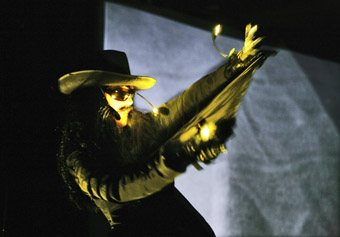
Julia Bardsley, Aftermaths
Some of the other larger-scale events at the NRLA are restagings of works presented at other festivals; for example, Julia Bardsley’s AFTERMATHS and Forced Entertainment’s Void Story both premiered at London’s SPILL 09 (RT 91). The proliferation of other platforms for this kind of work is probably one reason why the NRLA is closing down in its present form. In the early 1980s there weren’t any other opportunities for work like this to be shown in the UK, and the NRLA evolved from the artist-initiated Performance Platform to be a regular event. Now there is SPILL and a reinvigorated LIFT in London, regional festivals such as Birmingham’s Fierce and Newcastle’s Wunderbar (RT95), artist-led initiatives such as the itinerant Forest Fringe and Bristol’s Residence, and regular support for Live Art from fixed venues such as Bristol’s Arnolfini, the Bluecoat in Liverpool, Cardiff’s Chapter Arts Centre, London’s Chelsea Theatre and the Colchester Arts Centre.
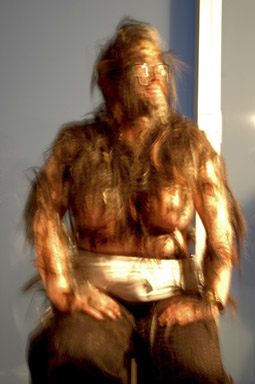
Oreet Ashery
courtesy the artist
Oreet Ashery
And yet, at this final NRLA, I’m aware of the kind of work that is uniquely possible in an environment such as this. It’s hard to imagine a different setting for work such as Oreet Ashery’s Hairoism, in which, over several hours, Ashery’s helpers glue scraps of hair to her shaved head in order to reproduce the characteristic hair styles and facial hair of a series of prominent male figures in the Israeli/Palestinian conflict. Because it is organised toward the production of precisely conceived images, the live element to this work might seem incidental, as if only the final product matters. But it is the live production of the images that makes this work so powerful: Ashery’s fixed, glassy stare and her wonderfully particular, sedentary body; the overwhelming barrage of documentary footage and news clips that fill the room; the silent presence of her deliberately caricatured helpers, collecting hair samples from the wandering audience; and, in fact, the material presence of the documentation of the image in the form of polaroids and simultaneous video feed of Ashery’s body-in-formation.
Likewise, the festival has always been a supportive environment for one-to-one performances, and one of the most powerful examples this year is Francesca Steele’s Routine. From the publicity information I learn that she has been training as a bodybuilder for over a year as her artistic practice. As I queue for over an hour for my five minutes with her, I have a pretty strong suspicion about what the encounter will be. This turns out to be exactly right: on entering the space, I am welcomed onto a small platform by a naked and silent Steele. Inches away from me and staring into my eyes, she moves her radically transformed, de-feminised body through a series of poses that display her lean musculature. Despite knowing exactly what to expect from the work, and despite my familiarity with these kinds of intimate artistic experiences, I leave the encounter palpably shaken, an unknown and untraceable energy working away inside my stomach and trembling in my hands and fingers.
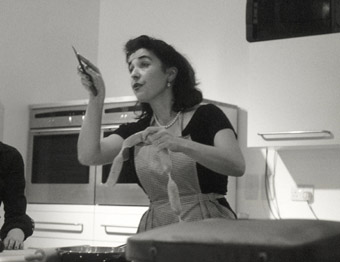
Marica Farquhar
courtesy the artist
Marica Farquhar
Finally, one the most moving and life-affirming events of the festival is Marcia Farquhar’s The Omnibus. Farquhar announces that she will honour the NRLA’s 30 years by ruminating, non-stop, for 30 hours about the last 30 years of her life—during which time she raised her children, struggled with depression and returned to art school as a mature student. (Okay, so it didn’t actually turn out to be 30 hours; initially she planned to invite audience members to stay with her overnight in the theatre, but Health and Safety regulations dictated that members of the public had to vacate the building between 2am and 10am.)
Farquhar’s previous performances have been marked by her meandering, unabashedly self-critical and open-ended monologues. This durational format pushes her to a new extreme. Instinctively, she produces an extraordinary mash-up of two different etiquettes: that of a host in a social situation, and that of a performer in a theatre event. As audience members come and go, she interrupts whatever story she is in the middle of to bid each person goodbye, and cheerfully greets each new guest as if at a dinner party. Trying to catch each newcomer up on what the project is about and what has already been discussed, she is constantly stuttering, winding back to the beginning of the event, forgetting what she was talking about, and reconstructing the thread of the event even as it unravels.
As with the commemorative agenda of this final NRLA, there is a risk that simple nostalgia will dominate. But Farquhar grasps at distant memories, and the more recent past of this particular event, not in order to save the past from being lost but in order to be here now, together. And, despite announcing that she has no plans for a big finale at the end of the 30 hours, we find ourselves stumbling into one: on our feet, singing along to her Sex Pistols original 45 in unison: “No future, no future, no future for you.”
National Review of Live Art, The Arches and Tramway, Glasgow, March 17-21
RealTime issue #97 June-July 2010 pg. 8-9
© Theron Schmidt; for permission to reproduce apply to realtime@realtimearts.net
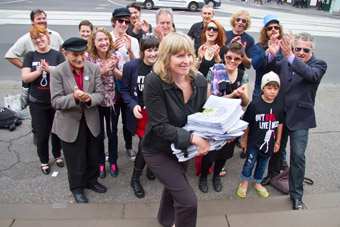
Save Live Music in Melbourne – a petition with 22,000 signatures calling for the the delinking of live music and “high risk” licencing conditions, delivered to the Victorian Government April 7
photo www.carbiewarbie.com, with thanks
Save Live Music in Melbourne – a petition with 22,000 signatures calling for the the delinking of live music and “high risk” licencing conditions, delivered to the Victorian Government April 7
IT IS A COMFORTING THOUGHT THAT AUSTRALIANS ARE GREAT AT ENTREPRENEURSHIP AND SMALL-SCALE INNOVATION, BUT LET ME SUGGEST WHAT WE DO EXTREMELY BADLY: LONG-TERM AND LARGE-SCALE STRATEGIC PLANNING. IF SUSPICION OF GOVERNMENT INTERVENTION IS RIFE, IT MUST BE BECAUSE WE HAVE VIRTUALLY NO EXAMPLES OF A WELL-THOUGHT-THROUGH, AMBITIOUS AND SUCCESSFUL STRATEGIC INTERVENTION. FOR EVERY INNOVATIVE ECO-BUILDING AND LANEWAY FESTIVAL, WE HAVE A FAILING PUBLIC TRANSPORT NETWORK OR A FORGOTTEN CARBON EMISSIONS SCHEME.
One-person innovation has traditionally been the domain of artists—this is the thinking behind many a ‘creative industries’ policy. The corollary is that artists are perceived as situated outside large systems (ministries, policy frameworks) as subcultural rebels, creating on the geographical, economic and social margins, needing no infrastructural support for their ephemeral creations.
Yet, looking at Australian arts in urban terms, another picture emerges. My research finds almost every arts venue in Melbourne since 1991 clustering in loose clouds around public transport, state art centres and educational facilities, and moving around to avoid the worst of the real estate boom—in music, design and performing arts alike. It is tempting to attribute artistic success solely to individual genius, but there is in fact cultural infrastructure in place, which includes schools, low rents and central locations, on which every artist relies, and this infrastructure is what cultural policy can begin to protect.
the importance of breeding places
It is common in artspeak to talk about defunding artistically irrelevant institutions, as Gavin Findlay does (RT96, p8), but it is actually the uncertain funding of institutions that emerges as a bigger problem. For small- and medium-sized companies, flagship buildings to perform in and independent programming venues are a vital link to peers, critics and audiences. Convinced of art’s ephemerality, we forget the importance of ‘breeding places’: spaces and events that yield exposure, attract audiences, house archives, provide education and build social centres for the fleeting world of the arts. They serve their role best when their location and program times are unchanging and predictable—because then they can become meeting points, exchange points, networking points.
When we speak of the ‘independent’ artist, we sometimes forget how much artists depend on each other. Our few remaining theatre archives, the only memory-keepers we have, are tied to institutions with longevity (STC, Dancehouse, arts centres, state libraries); while VCA, Dancehouse or La Mama in Victoria, or Performance Space and TINA in NSW, are actual incubators of ‘scenes’ (social capital, an aesthetic, training), ensuring continuity to the arts. We can myopically boast a long list of important places and events that have ceased operating, from Pram Factory to the Green Mill dance festivals. Our lack of regard for ‘breeding places’ is best exemplified by the treatment of Performance Space, possibly the most important space for contemporary arts in Australia. A living incubator of innovation since the 1980s, having nurtured dozens of our most important performers, it has still not been recognised as a cultural flagship, let alone endowed with a permanent space of its own or operational autonomy within CarriageWorks.
The arts can and do punch back—but only if the issue can be sold in more than artistic terms. As I’m writing this, Victoria’s liquor licensing laws are being tweaked to save The Tote, a ramshackle music venue, from closure. Politicians were more worried about the voting preferences of the 200,000 protesters than the cultural significance of The Tote, granted; but the 200,000 saw The Tote as an indispensable part of Melbourne’s culture, not a den for a handful on society’s margins. However, this hasn’t come out of nowhere: at least since Espy, the iconic music pub in St Kilda, was threatened with closure in 1997, live music has been promoted as a key part of Melbourne’s ‘cultural’ specificity. Yet there must be a better way to protect cultural incubators than with rallies.
culture as a given
For many arts practitioners, the debate on the national cultural policy may look suspiciously like yet another thing to complicate already-fuzzy KPIs—but it would be unwise to limit the discussion to arts funding, because it is about more than that. To admit to a ‘culture’ is to say that there are things that we do that are important and worth protecting, because they make us who we are, regardless of their economic, health or social outcomes. In a sense it is irrelevant whether ‘culture’ includes media (as in Germany), is defined as “anything that stimulates closeness” (as in Croatia) or is left undefined (as in many European countries that nonetheless have robust cultural policies). It is primarily a principle of protection.
Artists should understand the power of words. At the moment, one of these is ‘economy.’ Being good or bad for the economy, vaguely defined, is argument enough to defend or shelve a policy. Agreeing that we have a ‘culture’ would allow a whole new string of arguments to be made and, with due respect to David Throsby, defend the arts not on the grounds of its goodness for the economy, community or health, but simply as important for our culture.
Of course, arts policy in Australia already assumes ‘culture’: funding of opera is otherwise inexplicable. But let me give you a sense of what else ‘culture’ might protect: in the 1990s Amsterdam initiated Broedplaats (“Breeding Places”), a squat protection policy, recognising them as incubators of creativity. “No Culture Without Subculture” was the mayor’s rallying cry. Formation of ‘alternative cultural centres’ is common throughout Europe, with a kind of light heritage overlay protecting use, rather than the form, of a building. Palach, in Croatia, has been an alternative music venue/gallery/café/performance space since 1968. It has had its dull phases, of course, but a new generation of bright young things inevitably emerged, taking over the same central location and benefiting from access to facilities, a ready-made audience and previous generations of artists. Similarly, the Save the Espy campaign in Melbourne could not rely on existing state laws to protect the beloved music pub: it didn’t qualify in terms of architectural, community or social heritage. After a prolonged fight, Espy was ultimately saved in 2003 because the local council managed to install sufficient protection on the grounds of local ‘cultural’ significance.

Save Live Music in Melbourne (SLAM) poster
cutting across policy areas
Another intervention that only national cultural policy can achieve is the nurturing of systems, interventions that cut across policy areas and require departmental collaboration on the federal level. Many have been picked up in the submissions to Peter Garrett’s cultural policy discussion website: simplification of artist work visas, greater support for regional and overseas touring (having no national culture, Australia has no sustained cultural diplomacy either). To this I would add improvements to arts education, understanding the importance of subcultures and integration of arts institutions into the urban fabric—giving them centrality, advertising, public transport. What was the point of investing millions in CarriageWorks, I wonder, if it is still sitting next to an underdeveloped train station, in a dark street, untouched by a single useful bus line? A comparatively cheap intervention into public transport would have quadrupled the returns on the enormous investment. Instead, one of Sydney’s most central performance venues manages to remain hidden to most of its population.
But what I would like to see most is some meaningful form of social security for artists. In most countries with ‘culture’, artists benefit from tax exemptions and reductions, access to free health insurance and pension funds, and different forms of income support that usually don’t require active job seeking. It is a measure that gives artists some modest existential certainties, but it’s also an intervention that the Australia Council for the Arts cannot initiate on its own.
art without culture…?
Judging from the way we mangle our strategic policies, there is no reason to assume Garrett’s national cultural policy will get everything right. But defining ‘culture’ as an intangible, but protectable and nurturable good is the first step towards building systems, structures and strategies that ensure longevity for what we’ve got. We need culture if we want to remember, and be remembered ourselves; if we want our art to matter. Without ‘culture’, we’d have no culture wars, true, but also no values, meaning, sense. Without culture, nothing differentiates the arts from any other unprofitable industry. And without culture, there is literally no subculture.
Jana Perkovic is working at the University of Melbourne on an ARC-funded research project titled “Planning the Creative City”, studying the geographical clustering of independent arts in Melbourne, Sydney and Brisbane, and the relationship between arts policy, demographics and urban planning. She writes for RealTime on contemporary dance and performance in Melbourne and Europe.
RealTime issue #97 June-July 2010 pg. 10
© Jana Perkovic; for permission to reproduce apply to realtime@realtimearts.net
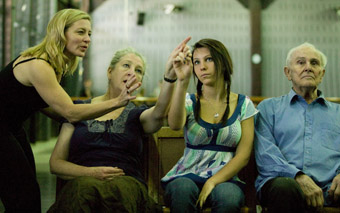
Kate Champion in rehearsal with cast members from Force Majeure’s The Age I’m In
photo Lisa Tomasetti
Kate Champion in rehearsal with cast members from Force Majeure’s The Age I’m In
THERE IS SOMETHING IN THE AIR IN AUSTRALIA CONCERNING AUDIENCE ENGAGEMENT. THE AUSTRALIA COUNCIL FOR THE ARTS’ PUBLICATION OF “MORE THAN BUMS ON SEATS: AUSTRALIAN PARTICIPATION IN THE ARTS,” IN MARCH THIS YEAR, PICKED UP ON A DESIRE FOR MORE PROFOUND ENGAGEMENT WITH THE ARTS FROM AUDIENCES ACROSS THE NATION.
Arts Queensland’s bold Coming to a Stage Near You strategy for performing arts touring, launched in 2009, combined with its Regional Stages partnership with the Australia Council, is pioneering a ‘demand-driven’ model for regional touring. And the Roadwork performing arts consortium which I reported on in “Australian Dance, Unseen at Home” (RT95 is supporting a 12-venue national touring circuit for “adventurous” dance and theatre productions.
I spoke to John Baylis, Associate Producer at Performing Lines, to better understand whether this ‘push’ for two contemporary performance productions per annum through the network was going to be met with a ‘pull’ from their audiences. Baylis responded, “Having established the network and sent our first production out [Force Majeure’s The Age I’m In], the next challenge is to make sure that tours are successful locally. We do not want tiny audiences and for venues to lose confidence in the audience appeal of adventurous work.” He spoke about the Roadwork Audience Engagement Plan, recently commissioned from freelance consultant Angharad Wynne-Jones, who ran innovative audience engagement projects during her directorship of the LIFT festival in London, 2004-2008. For Roadwork, her brief was to create a long-term audience engagement plan which would take the $60,000 the Australia Council funding makes available for marketing each year and leverage it into a powerful and sustainable program of activities for the venues to tailor and share.
Baylis described how network members had been enthused by the 2009 Australian Performing Arts Centres Association (APACA) conference at which American consultant Alan Brown of Wolf Brown talked about his study of the impacts of live performance and his vision for a new language and methodology for evaluating arts activities. Brown’s “Assessing the Intrinsic Impact of a Live Performance” investigates the impact of an entire arts system, the cumulative impacts or ‘value footprint’ of an institution on its community and the impacts of a single performance on an individual. In a private workshop for the Roadwork venue managers, Brown was able to elaborate upon the practical implications of his discoveries. The presenters were keen to put his ideas into action and soon after agreed to tour Lucy Guerin Inc’s Untrained, a production with huge potential for audience development due to its integration of two non-professional local ‘performers’ in many of the venues in which it is presented.
Wynne-Jones’ plan is also influenced by US thinker, Diane E Ragsdale, whose address to the Arts Marketing Association of the UK, “The Excellence Barrier”, makes pithy warnings such as “Don’t conflate Money or Attendance with Impact” and recommendations which include “Let people in on the action” and “Be a concierge: filter and make recommendations.” Wynne-Jones writes “For engagement to happen, significant behaviour change (from production, presenting and consumption to engagement) needs to occur in artists, presenters and audiences, including more engagement with artists before the work is created; more entry points and interactivity options for audience members to self-manage their experience and to connect with each other as a social network; and for the audience to be regarded by presenters and artists as collaborators in the experience.”
Wynne-Jones cites an initiative from one of her other areas of activism, climate change (specifically the Castlemaine 500 project) to illustrate her philosophy for change. “One of the most effective ways to change behaviour has been identified as being involved in small groups, taking actions and supporting one another in that action and sharing reflections and learnings (as opposed to mass marketing educational campaigns or policy directives).” Wynne-Jones began the formulation of her plan by consulting six performing arts companies who have all toured regionally with some degree of success. PVI Collective, Urban Theatre Projects, Force Majeure, Lucy Guerin Inc, Version 1.0 and Back to Back displayed an eagerness to embrace her ideas and to invest their resources in audience engagement activities. John Baylis, Stephen Champion (Bathurst Memorial Entertainment Centre), Kar Chalmers (Performing Lines, previously with the Old Fitzroy Theatre) and Rick Heath (Push Management) added their perspectives. Aware that the venues in the consortium have diverse resources and needs, the plan offers a menu of possibilities. Having voted upon their preferred recommendations, the consortium members will meet in May 2010 to decide which of the favoured initiatives will be implemented.
Many of the proposals in the plan require no financial investment, although there is always a degree of people power involved, from artists, venues and the community. Local artists are often engaged as intermediaries between the touring companies and the community. Strategies that segment and target community groups are not innovative in themselves, yet the plan is novel in its structured commitment to engaging with these groups with long-term consistency and respect for their authority in local matters. Quirky proposals include a suggestion that venues host a dinner with the “big or talkative cheese in town for the company on the pre-tour road trip.” Another suggests, “Local audience members and artists take the company members on a guided tour of the hidden secrets of the town (best op shops, swimming spot, graffiti, bar meal etc).” More obvious ideas about workshops and post-show talks are given impact by the underlying principal that the company visits each venue with sufficient lead time to begin the process of engagement with the eventual production, and that the groundwork for these interactions is laid and maintained by the venue. An “engagement coordinator” position in each venue is recommended and comprehensive strategies for evaluating the success of the initiatives and sharing results as a network run throughout the plan.
The Roadwork consortium presenters have responded positively to the plan and many have expressed their appreciation of the opportunity to spend face to face time discussing these matters together. Several of the venues have already begun this process of deepening their interaction with audiences. At Illawarra Performing Arts Centre, Simon Hinton’s team films vox pops in the foyer on opening nights, posting the videos of audience reactions to the show on YouTube. Lewis Jones of The Empire Theatre in Toowoomba has been using Arts Queensland’s Regional Stages funds to support an extensive program of workshops with touring companies. Anne-Marie Heath of the Civic Theatre in Wagga Wagga has engaged with Bangarra Dance Theatre in a week of workshops culminating in a community dress rehearsal for the local Indigenous community and educators.
While there are reservations amongst some about the plan’s many social networking recommendations or the resources required to implement certain ideas, there are also suggestions that indicate a second stage of investment in this process will be welcome. The presenters are interested in longer term relationships with artists and many are keen to explore three to five year residencies. In Queensland, with its new democratic model of audience-driven programming, Lewis Jones says, “Should we be looking at a deeper strategy where we are proactively seeking works that resonate with our regional audiences? Or even better are created in a regional area?”
These responses to the Roadwork Audience Engagement Plan indicate that presenters are as invested in animating their venues and engaging their audiences in profound arts experiences as artists are in creating them.
RealTime issue #97 June-July 2010 pg. 13
© Sophie Travers; for permission to reproduce apply to realtime@realtimearts.net
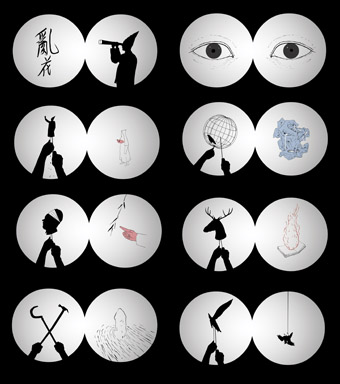
Flowers of Chaos, 2009, Wu Junyong; exhibited as part of Mu: Screen, UTS Gallery
courtesy of the artist
Flowers of Chaos, 2009, Wu Junyong; exhibited as part of Mu: Screen, UTS Gallery
mu: screen, three generations of chinese video art
If you’ve been following RealTime+OnScreen’s continuing account of Chinese feature films, documentary and the work of artist Wang Jianwei in RT96 (p41), you’ll want to see MU:SCREEN, Three Generations of Chinese Video Art. This important show includes works by the pioneers of the form in China, Zhang Peili and Wang Gongxin. The other six artists represented in Beijing-based Marie Terrieux’s program are proteges of the older artists and recent graduates of the first video departments, set up in Hanghou and Beijing art academies as late as 2003. MU:SCREEN, UTS Gallery. Level 4, 702 Harris St Ultimo, Sydney, see www.utsgallery.uts.edu.au for times.
rescue carriageworks now!
Jana Perkovic, writing about the development of an Australian cultural policy (p10), says of Performance Space: “A living incubator of innovation since the 1980s, having nurtured dozens of our most important performers, it has still not been recognised as a cultural flagship, let alone endowed with a permanent space of its own or given operational autonomy within CarriageWorks.” This complaint resonates with growing concern about the artistic direction and management of CarriageWorks.
Headed “Rescue CarriageWorks Now—Lobby for a relevant CEO!” the following statement has been circulating via Facebook since the resignation of the centre’s first CEO, Sue Hunt: “This group has been formed to solicit support in lobbying for strong contemporary arts sector based leadership to take the reins of CarriageWorks and steer it back to its original purpose of supporting, cultivating and presenting quality contemporary arts.” The lobby leaders argue that “mainstream inspired leadership” has resulted in commercial and bureaucratic imperatives” and “a complete void in the appreciation of real sector needs…” rescuecarriageworks@hotmail.com
constellation: a durational chamber work
Melbourne composers and sound designers Madeleine Flynn and Tim Humphrey have collaborated with an intriguing spectrum of artists engaged with music and sound, commissioning works from Ros Bandt, Carolyn Connors, Rohan Drape, Robin Fox, Sebastian Harris, Anita Hustas, Neil Kelly, Graeme Leak, Kate Neal, Wang Zheng Ting and David Young. Each piece is a response to the artist’s year of birth in the Chinese zodiac. Performances are cumulative: on the first day one piece, working up to all of them on the last day. The compositions gradually become part of a greater work with many dimensions: objects, scores, instructions, installations and video.
The artists describe the gallery space as “set like an emptied chamber orchestra with desks and a small grand piano. Each orchestral desk has a chair and music stand representing a composer. When seated at the desks, visitors can access a recorded version of the work that each composer has written.” The compositions are scheduled to be performed live by Flynn and Humphrey “on piano, prepared piano, flugel, laptops, modified midi wind controller, toy piano and windup toy rabbit…” All performances are free of charge. Constellation is produced in association with Red Gallery, New Music Network, Arts Victoria and Liquid Architecture. For information on the artists and their creations visit http://madeleineandtim.net. Constellations, Red Gallery, 157 St Georges Rd, Fitzroy North, Melbourne, July 1-19, www.redgallery.com.au; www.liquidarchitecture.org.au
the rabble, cageling
The Rabble return to CarriageWorks for their third season there since 2006 to perform Cageling, an impressionistic, surreal even, response to the nightmarish world of the oppression of Spanish women poetically conjured in Lorca’s play The House of Bernarda Alba. In an interesting move, Melbourne actor (and director) Daniel Schlusser is cast as Bernada, the tyrannical mother. The show, which premiered to a spectrum of strong responses in Melbourne in May, has been devised, designed and directed by Emma Valente and Kate Davis. The Rabble, Cageling, Carriageworks, Sydney, June 24-July 3
RealTime issue #97 June-July 2010 pg. 14
© RealTime ; for permission to reproduce apply to realtime@realtimearts.net
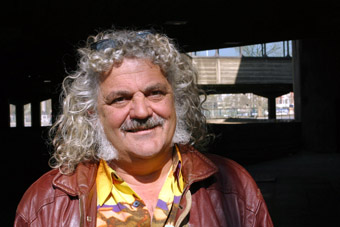
Pierrot Bidon
photo Philippe Cibille
Pierrot Bidon
FITTINGLY, THE LAST ACTION OF PIERROT BIDON WAS TO GIVE THE PEACE/LOVE SIGN WITH THE LEFT HAND, AND THE THIRD FINGER UP WITH THE RIGHT.
A larger-than-life showman and director, Bidon is rightly credited with revolutionising the stagnant artform of traditional circus into the post-industrial, often edgy and certainly evolving artform that we have today.
From travelling Cirque Bidon (1975) to the small villages of France and Italy with horses, gypsy caravans and an open-air show, to the formation of Archaos in 1986, he led the way. As a tightrope walker he was already deconstructing the form—playing with the contract between performer and audience that had previously been sacrosanct in circus. Miked up, he would provide a personal, almost contemptuous, commentary on audience expectations of a ‘death defying feat’ and how he could, so easily, feed their appetite for proximity to close calls and disaster.
Archaos, subtitled Cirque Revolutionnaire and Cirque de Caractere, was a complete assault on the senses. It was a radical evolution: the smell of greasepaint, sawdust and animals replaced by petrol, oxy-acetylene torches, burning rubber and pyrotechnics. No sequins, spangles or red noses, but crash helmets, corrugated iron and boiler suits. No horses, lions or elephants but motor bikes, juggled chainsaws and fork lift trapeze rigs with a rock ’n’ roll, Mad Max/punk, apocalyptic aesthetic that was loud, in your face and literally explosive.
“ We are the animals” he declared, a simple statement that set the city fathers aquiver. Publicity was always as entertaining as the show and intended to rattle cages. “It’s our mission to shock society. I’m here to shoot society in the head,” said Bidon. Cars fell in half as he arrived for the assembled press. There were motorbike stunts over stationary traffic in an unsuspecting city. Daring stuff, but mostly it was mischievous and cheeky, albeit with the underlying and ever-present threat of anarchy.
Post Archaos, Pierrot set about helping those less fortunate—the streetpeople who inspired him. In the shanty towns of Brazil, street performance workshops led to the creation of Circo Madrugada. In 1998, in Conakry, Guinea, he created Cirque Baoboab, a circus spectacular that toured extensively with jugglers, dancers, acrobats and a West African beat.
The Archaos tour to Adelaide and Melbourne in 1990 had an enormous and enduring influence that changed circus in Australia forever. “We are free,” he claimed and then showed us the possibilities. The blinkers were off. Archaos inspired a new generation of circus performers and created a climate, both here and overseas, where new circus could flourish. We reap the benefits with a popular, burgeoning form that can traverse genres while respectfully and proudly remaining ‘circus.’
For fearlessly leading the way with astounding skill, artistry and thrilling showmanship, we salute you, Pierrot. Peace, love and third finger up!
Janine Peacock
After the expansive experience of working with Archaos on the 1990 tour to Adelaide and Melbourne, Janine Peacock travelled the world with Australian and French companies. In 2009 she was awarded an Australia Council-Community Partnerships Creative Producer Initiative and is now operating as a facilitator for independent artists and projects under the banner Loose Canon Art Services.
RealTime issue #97 June-July 2010 pg. 14
© Janine Peacock; for permission to reproduce apply to realtime@realtimearts.net
WE ALL KNOW THAT CINEMA, LIKE MOST THINGS IN CHINA, IS EXPANDING RAPIDLY AND THAT THIS EXPANSION IS NOT AN EASY THING. FILM IS AN ARENA IN WHICH GOVERNMENT REGULATION, MARKET ECONOMICS AND CREATIVE EXPRESSION FREQUENTLY COME INTO VOLATILE CONTACT.
A broad division has recently emerged between the medieval epics beloved of commercial filmmaking (think Zhang Yimou’s films) and low budget, socially oppositional films (like Jia Zhangke films). While the latter form has been vitally important, lately it has seemed to congeal into a formula in which sleazy, chain-smoking slackers in dingy urban backwaters encapsulate filmmakers’ critique of the spiritual void of the market economy. This year’s Hong Kong Film Festival provided rich material for a contemplation of the ways in which Chinese cinema is struggling to refresh this critique.
sun spots
Sun Spots by Yang Heng is another of the long take, distant framing tableau films which follow in the footsteps of Hou Hsaio-hsien and Jia Zhangke (Jia’s cinematographer Yu Likwai is listed as associate producer). The intriguing thing about the film is its wilful incommunicativeness. It doesn’t tell a story so much as establish figures expressive of their surroundings. In the opening shot, a man lies on the road after a motorcycle accident in front of a bulldozer: a stricken figure in a stricken landscape. Another tableau indicates that the chain-smoking in these films simply reflects the surroundings where chimneys constantly spew out smoke.
Not only are scenes mostly wordless, but the characters are often framed with their backs to the camera. At key moments, such as the final shot, they simply disappear into the depths of the frame. These tactics are not new; in fact you associate them with Mizoguchi in the 1930s. In those films they were employed as distancing devices that functioned to push you back out of the melodrama, but here they are part of a larger indifference or refusal. Just as the characters drift along in a world lacking purpose, this film offers us nothing more than two hours of repeated action which points to no deep interior psychologies on the part of the characters. The point is that there’s no point—that’s all there is. In America this might turn into Easy Rider, but here it just wallows in its own sense of social torpor.
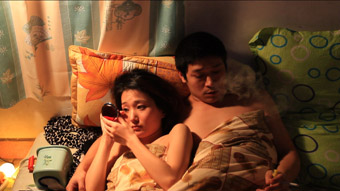
The High Life
the high life
Sun Spots and Zhao Dayong’s The High Life shared the main prizes at the HK festival. The High Life similarly starts out from the standard Jia Zhangke story. The familiar cast of characters is present: the small-time lowlife, the slutty girlfriend, the neighbourhood boss. However, the opening scene gives us an indication that things might not be so simple: a group of women in a prison work at sweatshop labour while one of them recites an increasingly bizarre and incendiary poem.
It’s another hour before we return to this location and these characters but the scene is emblematic of the film’s strategies. Characters enter and then leave the narrative, frustrating our attempt to approach contemporary China in exclusively personal terms. It is worth comparing this to the structure of Zhao’s previous documentary Ghost Town (see Dan Edwards’ account, RT94, p22) which is divided into three parts, each focusing on a different character.
There is also an insistence in the opening scene that despite the culturally debased conditions of everyday life in China, art is the repressed which somehow finds a way to return. The small-time swindler retreats to his rooftop each evening to practice opera performance styles and the superintendent of a prison insists that prisoners recite his subversive poetry.
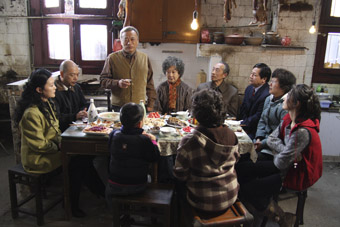
Apart Together
apart together
The most impressive fiction film from China (see the articles on page 16 and RT96, p15 on the documentaries which are rapidly emerging as a key component of Chinese cinema) was Wang Quanan’s Apart Together which derives from the unfashionable humanist middle-ground of Chinese cinema. It is not a star-driven genre film, and neither is it the kind of grungy miserabilist film beloved of international festivals.
Set against the backdrop of the tentative reconciliation of Taiwan and the People’s Republic of China, this is the story of a Kuomintang soldier who returns to Shanghai, to the sweetheart he abandoned 60 years ago, now living with her new husband and family. Thankfully what follows can’t be reduced to allegory. Instead we see how personal stories carry the weight of a wider politics. It is a funny, deeply observant and beautifully acted study of how history has made strangers of people who need to rediscover their cultural commonalities.
Chinese people talk to each other through and over food, and so the film concentrates mainly on a number of set pieces around dinner tables. Alcohol, popular song and sentimentality are the pillars on which the drama is elaborated in simply observed, long takes which allow for some ferociously good ensemble performances. History is a large and complicated business. Life is uncertain but so long as there is food on the table and people around it, that is all you can ask for, and that is enough.
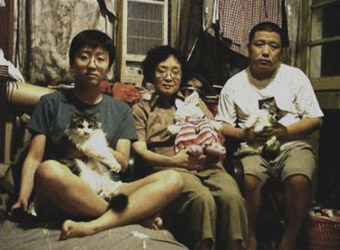
Liu Jiayin, Oxhide 2
oxhide 2
Food is never far from the foreground of Chinese films and Liu Jiayin’s Oxhide 2 (Sandy Cameron wrote an appreciation of the first in 2005; RT67, p22) centres on the making and consumption of a meal of dumplings. This is a reworking of the earlier film to see if its restrictions can be pushed even further. Oxhide contained 23 shots but this time Liu Jiayin gets it down to nine with each shot averaging 15 minutes. These are all taken in a single room of a cramped apartment with a static, locked-off camera—Liu appears in front of the camera while shooting it. The use of a widescreen aspect ratio extends the restrictiveness of the formal strategies by excluding characters’ heads for long chunks of time.
In some ways this is the ultimate work of everyday realism—until you realise that the action is carefully composed and staged. As with her previous film, Liu’s performers are her parents and herself, and the film shows them talking, squabbling and cooking together in real time and in their own home. As with any good work of minimalism, you pare down the elements so that small things assume larger impact. When the mother appears in the deep background of the first shot, it is quite thrilling to see that a door is suddenly revealed. When the father’s head lurches unexpectedly into the foreground of the frame, I recoiled more strongly than at any point in Mr Cameron’s turgid 3D nonsense.
one night in the supermarket
Finally, what’s the news from China’s commercial cinema? Yang Qing’s One Night in the Supermarket is an attempt to find, and cash in on, viable contemporary genres. Screwball comedy has worked well for South Korea—this reworks Attack the Gas Station—and it’s a big improvement over the medieval hack and slash epics which have carved an increasingly leaden path through Chinese cinema.
The model for imitation here is Ning Hao’s Crazy Racer from last year. We have bumbling crooks, larger than life characterisations in which eyeballs are constantly bugging out of heads, flashy transitions and intrusive camera and editing effects. One of the lead actors is even imported from Crazy Racer to get the narrative moving. A couple of disgruntled guys hold up an all-night convenience store and, predictably, things go wrong and draw in an increasing number of eccentric locals. This is painless enough but it’s nowhere near as funny as it ought to be. The performers’ heavy handed mugging will give you even greater appreciation for Ning Hao’s style of comedy.
Why care about it? As our media pound us with the one-dimensional picture of China as a grey, totalitarian place, it seems more important to get an insight into what makes the Chinese laugh. Creating comedy appears to be a more urgent task than adding yet another critique of an aimless and souless modern China.
RealTime issue #97 June-July 2010 pg. 15
© Mike Walsh; for permission to reproduce apply to realtime@realtimearts.net
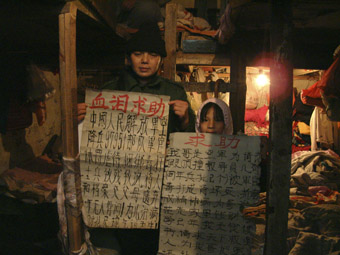
Petition
“BRING DOWN CORRUPTION, GIVE ME MY HUMAN RIGHTS!” THAT’S THE PLAINTIVE CRY HEARD NEAR THE BEGINNING OF ZHAO LIANG’S FILM, PETITION, A DISTURBING LOOK AT THE BRUTALITY, VIOLENCE AND INTIMIDATION SURROUNDING THOSE SEEKING JUSTICE IN CONTEMPORARY CHINA. GUO XIAOLU’S ONCE UPON A TIME PROLETARIAN SIMILARLY CONTINUES THE CHINESE INDEPENDENT DOCUMENTARY TRADITION OF PROBING WHAT LIES BEHIND THE GLITTERING FACADES OF CHINA’S ECONOMIC SUCCESS. BOTH FILMS APPEARED AT THE RECENT HONG KONG INTERNATIONAL FILM FESTIVAL, THE ONLY PLACE IN THE PEOPLE’S REPUBLIC WHERE SUCH CRITICAL WORKS CAN PLAY AT SUCH HIGH PROFILE EVENTS.
petition
Zhao Liang’s confronting feature-length documentary is the result of more than a decade of living and filming in a shanty town next to Beijing South Railway Station. The slum—now demolished—was once home to a floating population of thousands who came from all over the country to lodge complaints about authorities in their hometowns. Petitioning is a vestige of China’s feudal past, when any subject theoretically had the right to complain directly to the emperor if wronged by a low-level official. In a society where all levels of government, the courts and police are tightly controlled by the Communist Party, petitioning is the last hope for those seeking redress for an injustice.
Zhao’s film opens with his subjects recounting the litany of problems that brought them to the capital, from compulsory grain requisitions unpaid for by local officials to workers laid off from state enterprises without notice or compensation. Others have had their homes demolished without recompense, or suffered abuse in the armed forces.
The hopelessness of the petitioners’ situation quickly becomes apparent as Zhao follows them into offices ostensibly set up to receive their complaints. Filming secretly, Zhao captures the lethargic indifference of officials ensconced behind metal grilles and glass screens, who routinely deploy security guards to drag away old men and women and beat them when they resist. Outside, “retrievers”—hired thugs sent by local authorities to bring back those attempting to lodge complaints—lurk around the offices, assaulting petitioners and sometimes threatening to kill them if they do not leave Beijing. One petitioner who has been encamped in Beijing for 18 years is chased onto a railway line to be torn apart under a passing express train.
The extreme psychological stress inflicted by this system is traced through the story of Qi, a middle-aged woman pleading for an investigation into the death of her husband, who died mysteriously while undergoing a compulsory medical at work. When we meet Qi, her daughter is a young teenager, loyally following her mother to government offices day after day, rummaging through rubbish for food as they eke out a living in the petitioners’ slum. As she sees her youth and chance for education slip away, the daughter becomes increasingly disillusioned with her mother’s quest, and after years of waiting she flees with a young man to start a new life. She explains her motivations to camera, before entrusting Zhao Liang with a farewell note to her mother.
When Zhao hands the note to Qi, she breaks down and flees the filmmaker’s lens, accusing him of abetting her daughter’s “escape.” Zhao follows and begs her to stop, but after a prolonged chase that is at once absurd and heartrending, Zhao comes to a halt and we see the distraught mother disappear into the distance.
The sequence represents a narrative and ethical crossroads, the point where Zhao’s film becomes less a documentary ‘about’ these people and more an obsession that begins to disturbingly resemble that of the petitioners themselves. It’s as if Zhao, having witnessed and filmed these people’s suffering for over a decade, feels he must stick with them even when they reject his presence, keeping his camera rolling to ward off the awful truth that their situation will likely never be resolved. How do you finish a real-life story about injustice without end, in a system that offers endless new traumas in place of closure and resolution?
As it happens, outside forces bring some sense of cinematic closure. Shortly before the 2008 Olympics, Beijing South Railway Station and the adjoining slum are demolished to make way for an ultra-modern bullet train terminus. We see petitioners scrambling amongst the rubble as they desperately try to retrieve their meagre possessions before they are forcibly relocated to the city’s outskirts. The traumatised Qi disappears and Zhao learns she has been imprisoned in a psychiatric ward until the Games are over. The petitioner’s village is gone, but their story continues, an endless cycle of misery carefully concealed from visitors to the capital.
once upon a time proletarian: 12 tales of a country
Guo Xiaolu’s Once Upon a Time Proletarian: 12 Tales of a Country looks at life outside China’s prosperous key cities. It comprises short interviews with 12 subjects of varying backgrounds, starting with an outspoken farmer whose first words to camera are, “This country is shit!”
Continuing his straight-talking critique of contemporary China, the farmer exclaims, “It’s just raping, corruption, bribing and stealing…the Communists now are completely corrupt…people only care about how to make money. As long as it suits them—fuck the rest!”
While the film’s other subjects are more restrained, endemic corruption remains a common theme. A small-time restaurateur in the hometown of Lei Feng, a PLA soldier Mao once extolled as a virtuous model for the nation, explains how economic “reforms” have corroded the social fabric of the town: “Without bribing you can’t do anything. Money here can make a dead man alive.”
Guo Xiaolu’s interviewees reveal the profound disconnect many feel from their own lives in a society that is at once authoritarian and poor, yet rabidly materialistic. The restaurateur in Lei Feng’s hometown says, “We have no feelings, we just do business…I don’t care for anything else. I’ve more or less lost my life.” A fishmonger comments, “My life is blind,” though she adds that things were much worse back in her village. Young hotel workers explain how their days are an endless cycle of long hours worked for minimal wages. “Nothing is meaningful,” one of them says. “It’s difficult to even think.”
We also meet some who have gained from economic reforms, though corruption continues to lurk behind every comment. A wealthy hotelier explains that “the peasants were moved elsewhere” to make way for her hotel, a casual reference to the ongoing land grab that has seen vast numbers across China thrown out of their homes for little or no compensation in the name of ‘development.’
The film’s final sequence sees a group of young children in an art class speaking to camera. One boy confidently states he wants to be a famous artist, though he amusingly adds that Van Gogh and de Vinci were pitiable because, “They were poor and couldn’t find girlfriends.” His ideal life is “beautiful, free, without any restrictions.” A young girl speaks with quiet intelligence about her love of Van Gogh. Their optimism and confidence provide a sharp contrast with the adult interviewees, though whether this represents youthful naivety or a hope for the future is left open.
Once Upon a Time Proletarian sets hope against apathy, progress against problems, development against ongoing poverty. Most of all, Guo’s film, along with the more intense despair of Petition, evokes the existential void at the heart of a society in which the state fails to provide even a modicum of impartial justice, and treats any dream save material gain with suspicion.
Petition (Shang Fang), director Zhao Liang, producer Sylvie Blum, People’s Republic of China, 2009; Once Upon a Time Proletarian: 12 Tales of a Country (Ceng Jing de Wuchanzhe), director, producer Guo Xiaolu, producer Pamela Casey, People’s Republic of China, 2009
RealTime issue #97 June-July 2010 pg. 16
© Dan Edwards; for permission to reproduce apply to realtime@realtimearts.net
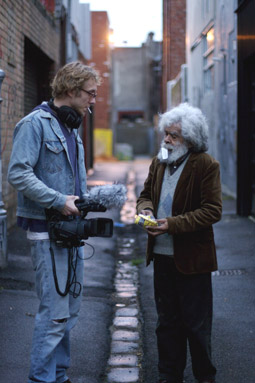
director Amiel Courtin-Wilson and Jack Charles, Bastardy
photo Adam Arkapaw
director Amiel Courtin-Wilson and Jack Charles, Bastardy
WHEN TOM ZUBRYCKI TOOK TO THE STAGE AT THE AUSTRALIAN INTERNATIONAL DOCUMENTARY CONFERENCE EARLIER THIS YEAR, TO ACCEPT THE STANLEY HAWES AWARD FOR HIS CONTRIBUTION TO THE AUSTRALIAN DOCUMENTARY SECTOR, HE DID SO WITH HIS CROSSHAIRS TRAINED ON TWO OF THE SECTOR’S BIGGEST GAME.
“At the ABC and SBS,” Zubrycki warned in his acceptance speech, “documentary slots are becoming more prescribed and rigid. Programs are tending to be format-driven and lighter in content. The range of subjects, viewpoints and ideas hitting our screens is narrowing.”
An independent filmmaker for over 25 years, Zubrycki accused the public broadcasters of exerting too much influence on the style and substance of the documentaries being made in Australia, as well as making programming decisions that ultimately stymied emerging filmmakers at the expense of those already established. “Don’t get me wrong,” he said. “We are pleased public broadcasters are commissioning our ideas. But is this concentration of decision-making good for the industry? For diversity?”
For many—filmmakers, critics and bureaucrats alike—the answer is an emphatic no. Zubrycki’s comments come at a time when, for all the critical acclaim and popular success enjoyed by certain high-profile documentaries and their makers, the vast majority of non-fiction films made in this country reek of a paint-by-numbers sameness. This tends to be the case regardless of whether a film is intended for theatrical release or broadcast: with important exceptions—Anna Broinowski’s Forbidden Lie$, Gillian Armstrong’s Unfolding Florence, and so on—most films choose not to experiment with visual language or create cinematic forms unique and relevant to their content, limiting themselves instead to a handful of only the most anaemic televisual tropes. All but a few devote the balance of their attention to individual psychology at the expense of social and cultural phenomena, or else tend towards the inoffensive genres of history and the natural sciences.
“There is a certain rigidity creeping in at the level of both form and content,” Zubrycki says. “Character and narrative-based documentaries are getting rarer and rarer. Of course, this is ironic because those are exactly the sorts of films that distributors around the world are crying out for.”
Much of the problem, he says, can be traced to the disappearance of half-hour and feature-length documentary slots from the public broadcasters’ line-ups, with high-concept documentary series taking precedence where once stand-alone films, by both emerging and established filmmakers, were the norm.
“The 30-minute documentary slot on SBS, Inside Australia, which was canned two years ago, was very important,” Zubrycki says. “Admittedly, the quality varied, but the series also produced some very good programs, which secured the broadcasters good ratings and gave emerging filmmakers an opportunity to give vent to their creativity on a project that was often original and unique.
“It’s too much to ask a filmmaker to have a four-part series of half-hour episodes as their first substantial documentary project. The risk of failure is too high. I wouldn’t be surprised if SBS follows the ABC in future by reducing its risk-taking and commissioning almost solely from established filmmakers.”
“What happens to emerging filmmakers then?” he asks. “It’s back to do-it-yourself filmmaking, which is fine if you’re making your first film, but hard if you want to begin establishing a career.”
Not that the public broadcasters, with their increasingly intransigent frameworks, are necessarily the best place for an established filmmaker, either. “I think what Amiel Courtin-Wilson is doing in Melbourne is really interesting,” Zubrycki says. “He tends to work with his protagonists for years, as he did with Jack Charles on Bastardy, and often has several films on the go at any one time. Then there’s John Hughes, who’s evolved his own masterly and unique style of essay film and whose new doco, Indonesia Calling, is playing at the Sydney Film Festival…But we have very few documentary auteurs in this country, which is mainly due to the dominance of the television-biased funding model.”
Zubrycki admits that alternatives do exist for filmmakers whose work does not tick the usual boxes. He believes that Screen Australia’s Special Documentary Fund, which has no market attachment requirements and has been set up to benefit those who wish to work independently of the broadcasters, needs to be expanded, noting with irony the fact that a number of films made possible through the scheme have since been sold back to channels that originally turned them down. He is also interested in the role that philanthropy could come to play in the sector over the course of the next 10 years. “In countries like the United States and Britain there are philanthropic institutions that actively support documentaries,” he says. “While that has been slow to take off in Australia, the Documentary Australia Foundation has been doing some great work in the area. It’s also very encouraging that some of the country’s film festivals are supporting documentaries.”
A recent alternative has emerged: the South Australian Film Corporation’s new Documentary Innovation Fund, which seeks to fund those projects that fall outside the funding and programming requirements of the public broadcasters.
“The ABC and SBS have for a long time been the agenda setters for documentary,” SAFC CEO Richard Harris says, “mainly because the commercial networks have always assumed there is no mass audience for docos.” (A curiously ironic view, he notes, given the commercial networks’ “ravenous” appetite for reality-based hospital, police and surf-lifesaving programs.)
“It is a fact that the ABC and SBS have recently moved away from their interest in one-offs and are more interested in series. I also think it is safe to say that they have generally become more risk-averse and more audience-driven in their approach. The public broadcasters have become more devoted to developing schedules and timeslots, where people know what to expect at a certain time, which is interesting in and of itself given that this is in fact a time in which audiences are starting to uncouple themselves from the idea of ‘appointment viewing’.”
“As a result,” he says, “I do feel that the balance has tipped and that there appears to be little room for programs that do not fit what have become more rigid schedule dictates. I think that this is unfortunate.”
The Documentary Innovation Fund, which closed its first round of applications in May, was born of what Harris describes as the funding body’s commitment to diversity. “There needed to be somewhere where the broadcasters were not the key gatekeepers,” he says. “While the broadcasters are major players—and thank god they are—they shouldn’t be the only ones. And this is particularly the case in South Australia where, with a few exceptions, we have a somewhat nascent documentary sector that doesn’t yet have the runs on the board.”
As for the question of where certain documentaries belong—on the big screen or the small one—Harris is convinced it will become less and less relevant as convergence and crossover become more and more prevalent.
“The line between cinema and television is such a vexed issue,” he says. “I do think it’s interesting that Bastardy, which was made with almost no budget, ultimately screened both theatrically and on the ABC. Perhaps that serves as an example of the new convergent world we are living in. If the boundaries are expanding, it’s because there’s no longer the same distinction between what should be seen on the theatrical screen and what should be seen on television or even on the net. I can’t help but feel that’s a good thing.”
Harris’s reference to the internet here does not quite convey the level of importance he ascribes to digital technologies and their potential uses. Indeed, both he and Zubrycki believe the future of innovative documentary filmmaking is ultimately to be written in binary, with the low-budget, self-distribution paradigm that digital video and the internet have made possible set to play an ever more crucial role.
“Digital distribution, both online and on theatrical screens, is going to offer exciting opportunities to those who are positioned to take advantage of them,” Harris says. “This will be the space for those filmmakers who have a true authorial voice. I think that form and subject matter will actually become more interesting in this space and that the influence of the broadcasters on these documentaries will become less and less.”
Zubrycki agrees. “The production system has changed almost beyond recognition in the last 10 years,” he says, “and that in turn has expanded documentary language.” And we can expect to see a similar evolution over the course of the next 10. “Faster download speeds are going to open up new horizons for distribution and should provide a new and useful income stream for producers,” he says.
For the most part, though, Zubrycki can’t see his big-game targets going down any time soon. “I think the current state of affairs will continue for a while for the simple reason that the industry wouldn’t survive were it not for television,” he says. “Television—both terrestrial and increasingly pay—will remain the main source of funding for documentaries.”
But Harris, who readily describes himself as an optimist, is not so sure. The big-game may be lumbering along as ever, he suggests, but with new and exotic mammals on the horizon, perhaps some much-needed change is already underway. “It’s a bit of mixed bag really,” he says. “With the conventional players vacating the space, I actually think the future options for documentary filmmakers are going to be quite exciting.”
For Tom Zubrycki’s Stanley Hawes Award address, go to www.tomzubrycki.com/read/2481982295.html. Applications for the current round of the South Australian Documentary Innovation Fund closed on May 17, but you can read about it on the Programs page at www.safilm.com.au.
RealTime issue #97 June-July 2010 pg. 17
© Matthew Clayfield; for permission to reproduce apply to realtime@realtimearts.net
portrait Rafael Lozano-Hemmer, photo Ana Cristina Enrique; installation shot People on People, Rafael Lozano Hemmer 2010, Recorders Manchester Galllery UK, photo Peter Mallet
RAFAEL LOZANO-HEMMER IS BACK IN AUSTRALIA FOR THE WORLD PREMIERE OF A MAJOR NEW WORK, SOLAR EQUATION, WHICH WILL RUN JUNE 4-JULY 4 AT FEDERATION SQUARE IN MELBOURNE AS PART OF THE ANNUAL THE LIGHT IN WINTER FESTIVAL. DURING ITS INSTALLATION, HE SPOKE WITH SCOTT MCQUIRE, WHO INTRODUCED READERS TO THE WORK OF THE ARTIST IN REALTIME 89.
Can you begin by describing the new work?
Sure. Solar Equation is a 100,000,000: 1 scale maquette of the sun. We have floated a tethered aerostat—a static balloon—filled with helium and cold air over the Federation Square plaza. And what we’re doing is projecting, from five projectors, live mathematical simulations of the behaviour of the surface of the sun.
Since 1995, a new space observatory called SOHO has been sending imagery of the different types of solar flares and turbulence and dark spots—the actual weather patterns that can be seen at the sun. (The Solar and Heliospheric Observatory is an international collaboration between ESA and NASA; http://sohowww.nascom.nasa.go.) Another new observatory called SDO (Solar Dynamics Observatory, http://sdo.gsfc.nasa.gov) is now receiving imagery of the solar surface which almost matches the resolution of the earth’s surface that you can get with Google Earth. I think that the availability of all that imagery asks us to think about the sun in a different way. It used to be depicted in a very iconic way, and a symbolic way, and a mythical way. Today we’re beginning to see it more as a representation of non-linear processes. Solar Equation is a way to faithfully represent those phenomena in a scale that is more urban. Most importantly, it’s not a video that loops around, it’s actually imagery taken by SOHO and SDO overlaid with equations, which simulate those behaviours on the surface. It is mathematics playing back complex systems that will never be repeated.
Where did the idea for aerostat come from? And what are some of the practical issues about projecting the images onto that moving surface?
One of the issues with Federation Square is that it’s already a very complex space. It’s very much spoken for, every single surface is already expressing. It’s very baroque. So you either need to be strategic and do something very elegant and well placed, or something that’s going to speak to the scale of the square. And the only place I thought I could do that was the sky, because every other surface was already really predetermined. So early on I decided that it should be a piece for the sky. And I have never worked with inflatables, so I thought that would be an interesting direction to go in.
You like a challenge!
Yeah! When I first went around and I asked different companies to build this for us, literally all of them said that it’s impossible to do, because Melbourne has 90 kilometre per hour winds in a worst case scenario. So no company would agree to engineer something like that until we found Airstar (www.airstar-light.com). And they were up for the challenge. So we custom-manufactured the balloon, which is 14 metres in diameter, four metres bigger than any similar balloon made previously. Most balloons are elliptical or pear shaped. This one is very spherical, and that’s actually quite a difficult thing to do in terms of engineering. But in terms of the effect, we want people to just not think about the engineering. They should just come in and see a sun floating about 18 metres off the ground, and it’s working!
In terms of the graphics, one of the main reasons why people don’t project onto balloons very successfully is because they bob and sway. In our system, we have a capability to track the balloon in three dimensions, so that as it bobs and sways, our graphics actually compensate for that.
Solar Equation by Rafael Lozano-Hemmer for The Light in Winter, Federation Square
courtesy Federation Square
Solar Equation by Rafael Lozano-Hemmer for The Light in Winter, Federation Square
So the dynamic adjustment is part of the process of rendering on the fly?
That’s right. It’s just trying to have a perfect overlap between virtual and real. And that really matters to me, because what I’m trying to do with my work is to emphasise how virtual the material is and how material the virtual is. Having that exact registration is what allows people to have that moment of suspension of disbelief.
How do you get a seamless overlay of five projectors on a spherical surface?
The computing is being done by six media servers, which are interconnected but independent. So each of the media servers is actually rendering the segment of the balloon connected to a projector. The blending is happening through normal techniques, like alpha-blending and so on. So rather than a situation where you’re doing computer graphics or video, and you need to shift an enormous amount of data, to move from one projector to the next, here what we’re doing is we’re sending numbers from one computer to the next. So that as a particular singularity in the equation moves, it’s not the actual graphics that are being transmitted but the meta-qualities that prescribe that movement. This is how we managed to succeed with it. This is not a graphical environment, it’s a mathematical environment.
So you’re not so much making an image numerical, you’re visualising changes in number sequences?
That’s exactly right. The total piece that you’re seeing is the sum of individual sets of equations. For instance, some of the equations that we’re using are reaction diffusions, so you have these initial conditions which then generate a larger environment. And the initial conditions for each of the media servers are actually independent. So you don’t have to think of it in terms of the entire thing. You have to think of it in terms of the local effects of each of the equations. We have three layers of equations making the simulation and, in a way, the complexity helps make this possible.
What inspired the work?
As an artist who works a lot with light, I’m fascinated by the fact that pretty much every single culture has a sophisticated relationship with the sun. I think that, as an artist, it’s a way to represent the majesty of the source of all the forces that create life. Also, there’s a darker side to it. As Goethe said, the brighter the light, the darker the shadow. There’s a sense of real uncanny terror that I hope this piece will evoke. It’s not going to simply be a very pretty picture, there’s something really demonic and brutal, there’s a sheer force and violence associated with these explosions that I hope comes through the piece. I’m not sure if I’ll succeed with that, we’ll see in a few days.
But I like it that this light comes out of enormous destruction, and that destruction is also creation because of the creation of matter. So many of the very important narratives of art in general can be played off the sun. Personally, what I’m most attracted to about the sun is understanding the maths. The maths for me is a really interesting thing, because most of the ways in which these maths get played back are disembodied. To be able to present them in an urban embodiment really matters to me.
You once said “Today we can and should make dynamic mathematics our media.” Is that what’s going on here?
Absolutely. I agreed to this, I didn’t coin it. One could say that there was a fundamental shift in visual art with the introduction of perspective, with the kind of mathematical overlay into the pictorial plane introduced by Brunelleschi and others, changing the way visual art was experienced, altering its role in society, and so on. Today we’re seeing something similar. I think that non-linear dynamics, chaos, fractals, emergence, A-life—all of these different approaches, which are finally mature enough that you’re being able to generate these environments—I think that they genuinely contribute to a new understanding of art. And there’s a certain sense of it contributing to the aesthetics of post-humanism. It’s humbling, as an author, to let your work go out of control. In fact, if you can control it, you’re kind of failing! It’s not random, and it’s not pre-programmed, it’s something that is a collaboration with the maths. So the system has things to say, and we are just now beginning to be able to listen, and to present what those maths are producing in an attractive way.
What’s it going to be like for an audience?
It’s going to be disappointing to those who are expecting a cathartic spectacle. Often with a big urban piece, one thinks of a fireworks display, of a son et lumiere show, and with these there are very well established, associated narratives of catharsis. I think that the people who will enjoy it more are the ones who, all of a sudden on a Tuesday night, you know, find themselves in Fed Square after seeing a movie or something. They’re just walking by and they sit back and watch the math unfold. I’ve often said, and this piece is really a good example, that these works are closer to water fountains than to shows. There’s no beginning, there’s no end; it’s just a constant stream of imagery.
There is an interactive element to the project, though I’m not underlining it too much. We’re developing a piece of software which allows people using an iPod or an iPhone or an iPad to actually preview the equations and change some of the variables. For instance, there’s one moment where you can actually use the multi-touch surface of the device to pass your fingers over it, and you literally see all of the turbulence of the surface of the sun react to that touch. So it’s a little moment of intimacy, where you get the sense of agency in relationship to it. But I’m not promoting it too much because, unlike other interactive pieces of mine where it’s all about people self-representing, this is more just like an extension of the project.
In the future, I think this project’s going to continue, we’re going to take it to other cities, and as we get more time we’re going to add some more equations like Navier-Stokes and fractal flames. So it’s going to be like a platform for math, and I’m hoping that mathematicians will come to us and say ‘hey, have you tried this kind of approach?’, because we’re all interested in growing the platform.
This is the kind of work that could equally sit in an art institution but also a science museum.
Yeah, and that’s really good. If people call it art, that’s great. If they see it as sort of a didactic piece, that’s great too. I’m really happy to learn how people will see it; I have no idea actually. There’s already a lot of Twitter images, with people imagining what it’s going to be. I’m excited about what they’ll end up saying.
For more information about The Light in Winter and the work of Rafael Lozano-Hemmer visit: www.fedsquare.com/thelightinwinter and www.lozano-hemmer.com
The Light in Winter, Federation Square, Melbourne, June 4-July 4
RealTime issue #97 June-July 2010 pg. 23
© Scott McQuire; for permission to reproduce apply to realtime@realtimearts.net
Rebecca Youdell, Cove, Bonemap
photo Suzon Fuks
Rebecca Youdell, Cove, Bonemap
BONEMAP’S COVE, AN IMMERSIVE ‘INTERACTIVE MEDIA ARTS EXPERIENCE,’ FELT LIKE A TEAR IN THE SPACE-TIME CONTINUUM, A PLACE APART, WHERE ERAS OVERLAPPED AND DISSOLVED, AND WHERE I COULD ACCESS MEMORIES NOT ALL MY OWN, BUT ACHINGLY FAMILIAR NONETHELESS. THIS APPARENTLY SIMPLE, BEAUTIFUL AND EVOCATIVE WORK, JUST 10 MINUTES LONG, CREATED A LEISURELY AND TIMELESS SPACE WITH WHICH THE VIEWER COULD INTERACT WITHOUT THE DISTRACTION OF NOTICING THE TECHNOLOGY, STRATEGY AND SWEAT SUPPORTING THE ‘EFFORTLESS’ EXPERIENCE.
My anticipation was heightened immediately at the booking phase when I (and every other viewer) was given an individual timeslot and the luxury of being an audience of one. This was principally due to the limitations of the technology involved (including an infrared tracking system), but Bonemap exploited the strategy fully, erasing the general expectation that numbers are everything in terms of audience. Without feeding off others’ reactions, the single viewer was compelled to rely on their own sensory and psychological responses, allowed to ‘own’ the space and to interact with the set and the solo performer, without interference.
After being primed by an usher while waiting in the foyer—”…movement is rewarded!”—I was led along a corridor to a doorway with a black drape, which built suspense while giving away nothing of what was beyond. The curtain was drawn back to allow me through, and my first brief sensation as I made out the wide circular enclosure of black scrim in the semi-darkness, was of being nine years old, agape in the Melbourne planetarium. I had to look back momentarily to check with the usher whether I should continue further forward. He gestured to keep going, then retreated, closing me in. I tentatively stepped down into the simmering fog of ankle deep dry ice to find that, yes, there was a floor underneath, I was not going to fall through to China. Piles of trunks and suitcases formed the perimeter of the ‘cove’, low in front, rising in hills behind to frame the single entrance/exit.
A moth or butterfly appeared high on the scrim and, following its flight, the ambient soundscape began to intone differently as I moved around the space. The moth was replaced by particles that could have been moondust or fog, and the power of the viewer to affect the projections quickly became apparent. I began to raise and wave my arms and walk back and forth, creating a black ‘hole’ in the fog which followed my movements. Then, mid-wave, the projection faded, an extended world beyond the scrim dawned. A woman in a red satin dress pulling a large travelling trunk was waving back at me.
From the safe haven of my cove, I could see a strange geography, teetering islands of luggage emerging from a suggested sea. The soundscape creaked and bubbled, reverberating with a low throbbing reminiscent of the industry of a port heard from underwater. The slight woman (Rebecca Youdell) continued to slowly make her way along a presumed dock, periodically pausing to squint into the distance as if looking for a familiar face waiting to meet her. If I smiled and waved she responded. Eventually she stopped and gestured at the trunk. I mimed that I wanted her to open it, and she did. Bending forward as if to take something out, she instead slowly disappeared into it, red shoes waving in the air as the scene went to black.
Waves washed against the walls of my cove, leaving me with a thousand questions about the fragile-looking lady in red. Why she was alone? Had she fallen through the world to China? I resumed exploring my space, opening a random case to reveal what looked, in the dim light of the projections, like vintage glass laboratory equipment, which I rapidly attempted to replace as I found.
The world beyond reappeared suddenly, and the woman was back, on one of the hillocks of cases, looking for something. Like an animal, she scrabbled around, sniffing the air, alert and primal even in her civilised finery. She singled out a little red valise, listened to it, then opened it to speak lovingly to something or someone inside. Back to black, back to wondering idly about the narrative I’ve witnessed, while playing with the projections, now clouds.
Then it’s sunset in the world beyond the cove, and the lady in red has transformed into a sea bird flying from the setting sun, her pleated dress now wings, her shadow looming huge on the scrim. She wheels in flight to follow my movement around the cove, as overhead a projected flock joins her migration. The sun sets and I must leave.
Bonemap’s Russell Milledge and Rebecca Youdell are masters at milking the power of suggestion and gesture to create rich visuals and engaging narratives. As they note, “the research funding for this work was focused on technical innovation” (primarily the interactive tracking systems), but they prove once again that technology becomes art when infused with their breadth of imagination. Following themes developed in their earlier work, The Exquisite Resonance of Memory (2008), Cove takes the viewer on a sensory journey through the ambiguous territories of colonisation, displacement, migration and memory, never pinned to a specific time and open to the viewer/interactor to question, interpret and colour with their own experience.
Bonemap, Cove, media design Russell Milledge, performer Rebecca Youdell, sound Steven Campbell, programming Jason Holdsworth; in association with Kick Arts Contemporary Arts and James Cook University School of Creative Arts; JUTE Theatre, Centre of Contemporary Arts, Cairns, April 29-May 1
RealTime issue #97 June-July 2010 pg. 24
© Bernadette Ashley; for permission to reproduce apply to realtime@realtimearts.net
Cinetica
A LARGE CLOUD OF VOLCANIC ASH, SUSPENDED OVER BRITISH AIRSPACE AND SEVERELY DISRUPTING INTERNATIONAL TRAVEL, THREATENED TO CAST A PALL OVER MOVES’ FIVE-DAY PROGRAM, THIS YEAR RELOCATED FROM MANCHESTER TO A NEW AND WELL-RESOURCED HOME BASE AT LIVERPOOL’S BLUECOAT ARTS CENTRE. NOW IN ITS SIXTH YEAR, THE FESTIVAL IS ALSO NEGOTIATING THE POTENTIALLY TRICKY BUSINESS OF REGIME CHANGE, WITH INCOMING DIRECTOR GALA PUJOL AT THE HELM OF AN EXPANSIVE OPERATION, COMMITTED TO A REGION-WIDE, NON-TRADITIONAL SCREENING REMIT; A PAN-EUROPEAN NETWORK OF PARTNER FESTIVALS; AND TO SHOWCASING THE WIDEST POSSIBLE RANGE OF SCREEN-BASED MOVEMENT—WHICH MAY OR MAY NOT INCLUDE ELEMENTS TRADITIONALLY RECOGNISABLE AS ‘DANCE.’
While the ash cloud only succeeded in postponing program from Iceland, Hungary and Portugal to a rescheduled autumn event, a sense of generational handover pervaded every aspect of the festival. Work by a new crop of artists, filtering into mainstream programming, included the shifting subjectivity of Marina Tsartsara’s green-and-gold, meadow-set Through (2009) and the microscopic movement world of Fiona Geilinger’s charcoal-effect Pinstripe (2009). There were excursions into Second Life, the sporadic appearance of mobile phone pixillation—as distinctive as film grain—and the unvarnished immediacy of a YouTube aesthetic mixed with high-end finish from established, international ‘names’, such as Cordelia Beresford’s Sydney-set Night Shift (2009) and Marlene Millar and Philip Szporer’s spotlit, fragile Falling (2009). With additional links to the Watching Dance conference, held in parallel in Manchester, three home-set presentations on “Framing Motion” fielded Kate Sicchio’s notion of programmer as choreographer, composing pixels in frames within frames; Vida Midgelow on the politics of documentation, casting improvised movement as a process of disappearance; and Liverpool-based Gina Czarnecki’s outlining of her professional evolution from painting to film and then video, culminating in a slowed moment—captured in green-tinged night-vision—of close-in, facial transformation, from recent work Spintex (2009).
Synchronisation
The newly-introduced Alternative Routes awards resulted in a striking line-up, with first-prize winner Rimas Sakalauskas’ Synchronisation (2009) using the disquieting language of 1960s sci-fi in a slow-burn aggregation of sound and image, with a hollow metal sphere rising slowly, unnoticed, from a children’s play area, and a satellite’s revolving shadows hovering over patchworked landscape. Receiving special mention, a series of luminously monochrome images—an airborne arc of rock; an unearthed sunflower stalk; metal chairs suspended from writing-papered walls—in Ana Cembrero’s Cinética (2009), threaded through episodes of recognisably codified dance, with Thomas Browne’s Aston Gorilla (2009) capturing a young son’s dream image of his football-shirted, ape-masked father through a subtly edited movement language of simian swings and grabs. In addition, highly stylised diary-entry disruptions—the buzz of a house fly, the patterning of leaf shadow—in Marcin Wojciechowski’s Interferences (2009) sat against the graphic simplicity of Stuart Pound’s Dance 0-19 (2009) with its quick-fire progression of doubled, tripled, at times quadrupled numerals, white against a dark screen, illustrating the complex algorithmic workings of an intricate gamelan score.
Addressing issues at the heart of Moves’ identity, and reflecting widespread groundswell of artform shift, festival co-curator Gitta Wigro chaired a roundtable discussion of “Screendance on the Verge,” highlighting the dangers of artificial distinctions imposed around a self-titled niche. Pauline Brooks, of Liverpool John Moores University, outlined her role as facilitator for an emerging generation of screen-literate artists, while Claudia Kappenberg, head of the AHRC Network for Discourse and Publication in Screendance, emphasised the need for a body of informed writing within the field, also setting out her involvement as co-curator in the recent artist-led What If…Festival. Calling attention to the increase in hybridity across all forms, Jamie Watton, Director of South East Dance Agency, also noted the end of the producer-led era, acknowledging artists’ role at the centre of the creative process, with this shift reflected in a change of terminology from ‘screendance’ to the more open-ended ‘screen-based work.’
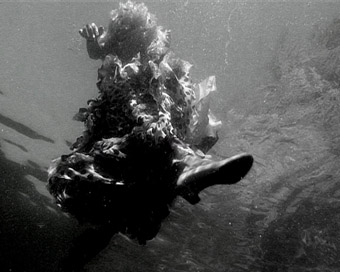
River Dreams
Illustrating this change of emphasis, a range of highly distinctive voices, scattered across scheduling, included Daniel Hopkins’ horizontal arrangement of subway train travel as blue/green stripes of periodic motion blur in Movement #1 (2009); the heightened materiality of Heidi Phillips’ archive footage in Discovering Composition in Art (2008); Richard O’Sullivan’s close-in, time-sliced landscape of rock and tree in Palimpsest (2008); Morgan Beringer’s partially glimpsed world of breakthrough between frames in Abstraction 27 (2009); and the soft fluidity of Betsy Dadd’s pastel lines in 8000 Drawings (2009), achieving a Norman McLaren-like state of never-settled flux. In addition, Sanke Faltien’s smoothly continuous camera motion through road-tunnel-set Queensway (2009) followed film-grained monochrome pathways of snaking white lines and overhead strip lights, and in Beatriz Sánchez’ highly accomplished River Dreams (2009) decontextualised fragments—a heeled, strap-fastened-shoe; the tiered flouncing of a polka-dotted flamenco dress; finger work against guitar fret board—took on the rippled fluidity of an underwater movement state.
In a particularly strong documentary-influenced programme, the deceptively simple surface gaze of Nick May and Ben Holland’s Food Chain (2009) surveyed Escher-like, multi-angled conveyer belts, the repetitive gestural unison of eye-deadened production line workers, and a single, flailing onion. Bronwen Buckeridge’s camera in Lacuna Cut (2009), closed in on the ritual application of mask-like face paint, abstracting to a red spot; a pink stick; encroaching expanses of blue, white and gold. Against the static foreground of a roughly textured field, archive wedding photos and architectural structures in Jonathan Franco’s Living Land (2008) momentarily flash up, and are gone, and in Carlos Amelia’s powerfully understated Tierra Y Pan (2008), slow, outward camera motion locates a dog tied to a post within a wind-whipped, desert-set horizon line, as focus gradually recedes from episodic and unsparing narrative detail, revealing in turn a heavily pregnant woman, a doctor’s bag, a spade.
Near the festival’s end, Daniel Bird’s contextualisation of Armenian filmmaker Sergei Paradjanov’s “dynamic, frenetic” symbolic language in The Colour of Pomegranates (1968) cast a long shadow across scheduling, identifiable in Anne Harild’s Morandi Room (2008), with front-on camera perspective catching the surface sheen of proliferating, differingly-shaped vessels, and the shifting gleams of light on rising water-level. Paradjavnov’s legacy was also evident in the snowset tableau of Galina Myznikova and Sergey Provorov’s Despair (2008) and in the poetic economy of a young female face in greyscale, close-in, slowed-motion, shaking blade-like wettened hair in Myznikova’s The Girl—Helicopter (2008).
Sited throughout the Bluecoat, installations included the linked remote screens of Charlotte Gould and Paul Sermon’s al fresco Urban Picnic, codes for mobile phone downloads created by Salford University students, and the rich visual arrangement of Sara Bjärland’s monochrome dandelion seeds in 80 Movements (2008), with a series of carefully composed slides appearing at rhythmically projected intervals. Across the four-frame line-up of Katrina McPherson and Simon Fildes’ Crux (2009), a quartet of male boulderers—captured in the detail of white-taped fingers, a beaded bracelet, a circular tattoo—attempt the unfakeable physical engagement of sheer exterior ascent, with slow eye scans and sudden drops, reaches for stone ledges and rock shelf and hand holds and finger crevices also recorded in the linear verticality of Laban-notated scores. Elsewhere, a single participant is guided through an immersive audiovisual experience by the intermittent touch of an unseen hand in Clara Garcia Fraile and Sam Pearson’s When We Meet Again, and left to re-enter real space alone with a smile and the gift of a single strawberry.
Viewed from within a landscape of hybridisation and boundary-crossings, Moves is looking like a festival whose time may just have come. Emerging into early evening light, the sky above Liverpool is a bright, clear blue, and not a cloud in sight.
Moves10, Bluecoat Arts Centre, Liverpool & venues throughout the north-west, UK, April 21-25
RealTime issue #97 June-July 2010 pg. 25
© Chirstinn Whyte; for permission to reproduce apply to realtime@realtimearts.net
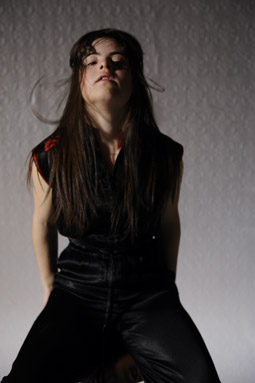
Jianna Georgiou, Sixteen by Sophie Hyde
photo Andy Rasheed
Jianna Georgiou, Sixteen by Sophie Hyde
THIS YEAR’S REELDANCE AUSTRALIA AND NEW ZEALAND AWARDS INCLUDED ALL THREE OF THE MAIN GENRES OF SCREENDANCE: DANCE-DRIVEN ‘DANCE ON CAMERA’ AS SEEN IN STRAND (MICHAELA PEGUM, SIOBHAN MURPHY AND DOMINIC REDFERN), VISUAL ART DRIVEN ‘VIDEO DANCE’ AS IN SHADOW IN BLUE (ZOE SCOGLIO) AND CINEMATIC DANCEFILM AS IN ALMOST ALL OF THE OTHER PRODUCTIONS SCREENED.
This impression of a strong cinematic sensibility comes from the award program being dominated by the work of a filmmaker (rather than a choreographer), Sophie Hyde, who directed three of the 10 works shown. Her works convey their meanings through mise en scene, montage and especially sound scores (by DJ TR!P, an indispensable collaborator). The three films form the Necessary Games ‘triptych’ performed by Restless Dance Theatre in South Australia, a company of mixed ability dancers.
The best of these, Sixteen (choreographed by Kat Worth), won the award for best dancefilm. It’s a sweet portrait of a young woman’s playful, physically expressed encounters with different men. The character’s disabilities are neither the text nor the subtext of the work, they are a given, which is not particularly remarked upon. Instead we are invited, through the frames within frames of a photographer’s studio where the piece is set, to see different qualities of relationship and a girl taking charge of her choices.
Slightly less successful in its creation of drama and relationship is Moth (choreographed by Paul Zikovich), which juxtaposes the moves of a young man with Down’s syndrome against those of a lean and muscular, able-bodied dancer. The pairing of these two, though adroitly shaped, felt a bit strained. That said, Moth had the most brilliant editing of the evening, with cuts creating movement dynamics and patterns of time that are as much ‘the dance’ as the movement of bodies.
The least engaging of the triptych, Necessity (choreographed by Tuula Roppola), was also, to me, the least successful in creating a cinematic experience of movement. It felt more like a recording of a dance than a cinematic construction, using close-ups for the small gestures and wider shots for the bigger gestures. This raises a problem not present in the other two: would I be interested in this if not for the unusual aspect of a disabled person dancing? I would be interested in Sixteen and Moth, but in this one, I wasn’t so sure.
The runner-up prize-winner was Tap Hop Lesson 1 (by Soda Jerk) a mash up of two pieces of archival footage—one a 1930s American movie in which a group of black men entertain the white folks gathered at a glamorous party, the other a 1980s television studio shoot of some guys doing hip hop. We’re invited to compare these alternating scenes, one on the left, the other on the right side of the screen, with little comment, except for their juxtaposition, until the soundtrack from one is laid under the images of the other so the Jazz and Tap of the 1930s becomes the ‘lesson 1’ for Hip Hop of the 80s. Aside from this slight if entertaining insight, this piece does not explore the implications of racial stereotyping and spectatorship to which it alludes.
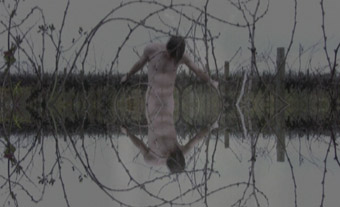
Saint Sebastian, James Welsby
Saint Sebastian (by James Welsby) winner of the “Encouragement Award” is an accumulation of images of lonely, vulnerable men making a strong reference to the eponymous tortured saint. The figures on screen are positioned as objects of beauty and pity, but the images constructed neither use the tools of visual art to create a sensual experience of beauty, nor the functions of cinema which would align us with the figures as characters and allow for the emotional engagement of pity.
The only ‘dance-driven’ piece on the evening was Strand, a sometimes glorious and more often maddeningly frustrating piece for two lovely dancers executing choreography in a sea of desert. There is one stunning camera angle in this piece, a long shot in which the dancing is contextualised in vastness—making it poignant, absurd and, in a way, fierce, in its battle against the odds of the space. But cutting closer in is unmotivated. It displays the dancing, but it frustrates the desire for the cinematic piece this could have been with more canny cuts and characters, or the visual artwork it might have been had it stayed with its one beautiful shot.
The only visual art driven ‘videodance’ on the night, Shadow in Blue, displays a lot of cool stuff that can be done with the effects palette on digital editing systems. But it also raises the question of duration. If the objective is to present a kaleidoscope of effects, shouldn’t it be up to the viewer to decide how long the toy will fascinate? Does the duration of this piece add to its meaning and justify its exhibition in a festival context or would it have more life on a gallery wall?
Motel Of Deception (Chrissie Parrott and Nancy Jones) wryly translates Neo Noir into a cleverly framed and surprisingly acrobatic set of physical relationships while keeping firmly rooted in the genre and the pleasures it affords. The textures of the seedy motel room, the deceptions framed in mirrors, the dance moves creating character and story all make for clever and engaging subversion of both the sincerity of dance (“the body never lies”) and the irony of Noir.
Tank Man Tango (Deborah Kelly) plays with documentary by suggesting that a fragment of news footage is actually a piece of choreography, and then documenting a project in which the instructions for executing that choreography travel the world and become a political ‘flash mob’ dance in commemoration of the victims of military force at Tiananmen Square. Playful yet pointed, this doco and the underlying dance achieve something rare: reminding us to care while adroitly avoiding a scolding.
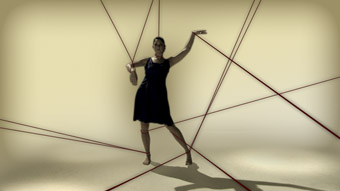
Reading the Body, Sue Healey
Finally, Reading the Body (Sue Healey) one of the most fully realised works of the evening, and certainly the most fluent integration of dance, art and cinema, offers a revelation which only cinema could give us, as well as finely balanced beauty and an articulate and sensitive dance. Healey overcomes the frequently experienced gap in comprehension between the dance and its audience by revealing, with animations, the inside of the body. These revelations are timed and phrased to punctuate, extend and interact with the dancer. The cinematically constructed relationship between the animations and the dancer align us with the character, make us feel what she feels, and give us access to the mysteries of dance.
Judges for the 2010 awards were Ross Gibson, Professor of Contemporary Arts, University of Sydney, Helen Simondson, Manager of Screen Events, Australian Centre for Moving Image, Shona McCullagh, Award Winning Dance on Screen Artist, Clare Stewart, Director of Sydney International Film Festival and Adrian Martin, Senior Lecturer in Film, Monash University.
–
Reeldance Australia & New Zealand Dance Awards, Reeldance Festival, Performance Space; CarriageWorks, Sydney, May 16
RealTime issue #97 June-July 2010 pg. 26
© Karen Pearlman; for permission to reproduce apply to realtime@realtimearts.net
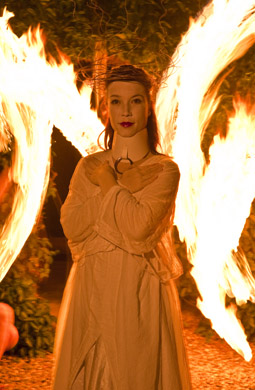
Andrea Jenkins, Dante’s Inferno, Zen Zen Zo
photo Simon Wood
Andrea Jenkins, Dante’s Inferno, Zen Zen Zo
ZEN ZEN ZO HAS BUILT A REPUTATION BASED ON SELF-DEVISED CREATIVE PROJECTS AS WELL AS RADICALLY UPDATED WESTERN CLASSICS. AN ECLECTIC, TRANSDICIPLINARY APPROACH INCORPORATES EASTERN DISCIPLINES SUCH AS THE SUZUKI METHOD AND BUTOH, WITH ELEMENTS OF POP CULTURE THROWN IN FOR GOOD MEASURE. BOTH STRANDS ARE APPARENT IN THE PRODUCTION OF DANTE’S INFERNO FOR THE IN THE RAW STUDIO SEASON AT BRISBANE’S OLD MUSEUM. THIS IS A SHOWCASE FOR GRADUATE STUDENTS FOLLOWING THEIR SIX-MONTH INTERNSHIP PROGRAM AND FEATURED GUEST CANADIAN DIRECTOR STEPHEN ATKINS WHO ALSO LAUDABLY UNDERTOOK THE TRAINING.
The Neo-Gothic edifice of Brisbane’s Old Museum was an eminently suitable site for a production styling itself as living hell. Despite the dire warnings of gypsy fortune tellers, the milling crowd outside the museum was soon gathered up by our Tour Guides, a pair of bubbly air hostesses with a perfect grasp of airborne vernacular who escorted us with torches over uneven ground to Hell’s Gates. Here we were confronted by a charivari chorus of the damned, Hell’s buskers, a foretaste of torments in store. We passed promenade-wise through an arching tunnel in a hedge into Hell itself. First stop, Limbo: four actors in perpetual circular motion, stepping up and down and around on blocks representing an endless gym for the soul. And so on through a series of installations in the grounds depicting interpretations of Dante’s sins including the third (the gluttonous), fourth (the avaricious/spendthrifts) and fifth (the melancholic) which were sometimes obvious, sometimes merely enigmatic and sometimes deadly as in the Night of the Living Dead.
At this point in the first circle of Hell where Dante depicts the eternal lovers, Francesca and Paolo, damned because they would not abandon their human, fleshly love for the love of God, the company seems to have flinched from exploring Dante’s sympathetic and complex examination of a situation reflecting his adoration for his ideal love, Beatrice. Instead we are treated to a quartet of reanimated souls enacting a post-Brechtian, cabaret-style ballad about their sordid and murderous lust for gold. Quibble aside, so far it has been an entertaining stroll through the grounds of Hell until the atmosphere changes after the deaths of our ebullient guides. We are abandoned, lost and barred by demons from continuing our journey through the realms of the Middle and Lower Hells, yet the only way out is down.
Our guiding light appears in the form of a shining angel, a striking figure of sculptural serenity, who is surely Beatrice as she appeared to Dante. Entering the building, the massive enclosure of the performance space dictates a different response. We no longer have the freedom of bystanders, fair-goers, or separate observers and feel threatened by the sheer proximity and physicality of the performers and the darker nature of their sins, which feel intimately personal. We witness a violent orgy of rape and pillage until herded by these truly damned souls into witnessing our own capacity for violence, masochistic self-harm and despair culminating in the sin of suicide startlingly portrayed by an instantaneous descent of two chairs on the end of ropes. Our attention is refocused by two girls sweetly singing a plaintive lament as a coda and then to self-deception within a loveless relationship until the alienated pair rise from the breakfast table to act out their onanistic fantasies. The final scene is a mechanistic office version of the treadmill of work encapsulated in Fritz Lang’s 1927 film Metropolis. We are invited to our first day on the job as we leave through a maze of candle-lit corridors to the Exit which is No Exit.
Last year Zen Zen Zo’s production of Shakespeare’s The Tempest turned powerfully on an interpretation based on contemporary post-colonial discourses and as a result won the Matilda Award for Best Independent Production in 2009. The rather fragmented nature of their current showing lacked such an underlying concept—a big ask, I know, when the original is such a monumental work and such a strong product of the Western medieval mindset. In part, the site-specific use of the Old Museum aptly stood in for the towering architecture of Dante’s Catholic faith which was the foundation of his epic poem but by shearing away Dante’s basic beliefs, rendering them simply as metaphors for life, this treatment risked destabilising the whole structure. Perhaps the trouble lay in the way the performance text was constructed. According to Atkins each and every cast member was given a snippet of the poem and told to go away and creatively interpret it. The results were assembled and the final shape of the piece collectively decided upon. However, I suspect it would take a true, mad heretic of the stature of Neitzche’s Zarathustra to perform such a cut and paste. Nevertheless, Zen Zen Zo’s characteristic energy and the unflagging focus of the ensemble playing was impressive in covering such huge territory on such rough ground. Dale Hubbard’s music was impressive and subtly modulated, and like Beatrice in many guises it led us through the production. The technical team also dealt adroitly with big outdoor stuff.
The classics, of course, can ask the questions that are often shouldered aside in the brutal tempo of modern life. But if so, the questions and not necessarily just the answers need to be recast in order to be relevant. I found the final ‘Metropolis’ scene (which I know some felt to be anticlimatic) the most replete from this aspect, with its icy promise of an unending corporate eternity which will lead us all, ironically soon enough, into the fiery furnace of the fundamentalist imagination so that the world ends, as TS Eliot predicted, not with a bang but a whimper.
Dante’s Inferno, devised by Zen Zen Zo Physical Theatre Company members and 2010 interns, dialogue Stephen Atkins, director Stephen Atkins, designer Alan John Jones, lighting designer Ben Hughes, composer Dale Hubbard, performers Zen Zen Zo Physical Theatre Ensemble, Brisbane Old Museum, May 6-22
RealTime issue #97 June-July 2010 pg. 7
© Douglas Leonard; for permission to reproduce apply to realtime@realtimearts.net
{$slideshow} CHARACTERISTICALLY, AIMEE SMITH CONCEIVES WORKS ON A SINGLE SOCIAL CONCERN. IN BREAKINGS IT’S THE RAMIFICATIONS OF BEING IMMERSED IN MEDIA-DEFINED HYPER-REALITIES. IN THE BEST OF HER WORKS, A RIGOROUS CLARITY OF PURPOSE EITHER PUMMELS THE IDEA UNTIL ITS TENETS COLLAPSE (WAITING FOR THE REVOLUTION, 2009) OR THE SURFACE IDEA FRACTURES INTO ITS INEVITABLE INTERPRETIVE MULTIPLICITIES (REFUND POLICY, 2007, AND ACCIDENTAL MONSTERS OF MEANING, 2009).
Smith’s first full-length work, Breakings, driven by schizophrenic responses of the character/performer, both affirms the array of options given by the media-dominated environment and closes down personal agency in a claustrophobic deadend of failure and loneliness. The unforgiving perspective enfolds the terminable condition of an isolated individual brought about by virulent bombardments of realities from somewhere beyond word and screen.
The cornered life begins in a tightly set bed-sit, plastered with newspaper across every conceivable surface and furbished at appropriate points with electronic screens. Pathological obsession lurks as paper and text, image and pronouncements operate in juxtaposition with Smith to enact curious metaphors and misplaced relationships. The morning alarm rings and the screen image is switched off before Smith rises to extract cat food from the screen fridge for the screen cat. Normality pervades the Baudrillardian simulacra-scape without missing a monotone 2D beat.
Beginning with the normal action of reading the morning’s paper Smith then travels the room’s dimensions devouring endless printed edicts with an increasing avidity that drags the body in its wake. It is as if spectators are taken on a pocket-compact history of human engagement with the media, suggesting a viral susceptibility to information born with the invention of print. Fuelled by a compulsion to know as much and as quickly as is possible, the quick-fix ingestion is serviced by the production’s innovative and deceptively simple technologies that extend word into sound and pictures. Screens, formerly stand-ins for reality, splutter into action and project images and statistics of atrocities in the same breath as seductive views of glamour and success. Media has, in a sense, acquired its proper stride or, more tellingly, its crazed flight. Death and mutilation interpenetrate sexual allure with a speed and ease which is played out by Smith’s corporeal appropriation of collisions of horror and hope. Smith’s body becomes the site of abuse, penetrated by an artillery of information with scant regard for human comprehension.
Entrapment folds to a false quietude, when Smith, the achingly human young woman, moves within an isolated rectangle of coloured light. The movement sheds its frenzy to become calm and beautifully fluid until spectators realise that this light is nothing more than a television test pattern. What seems like a respite from affliction sours into the affliction itself: the human individual is but a standby pattern before the main action begins. In such an impasse, a human soul is a mere figment of broken desire. The ending is thus forecast long before the screen lights emit evidence of cross-wiring malfunction. Unfed screen cats and deformed and abused children share a similar fate with their co-performer, Smith; they are shattered and extinguished though, unlike her, they are never immune, in their digital sanity, from relentless replication and projection.
Breakings does not end when the lights go out but extends through post-performance forums, designed not so much to elicit reflection on the production as to promote dialogue on issues raised between Smith, guests from academia, arts and the media, the affable facilitator James Berlyn and the audience. I suspect the exchanges will focus on Smith’s singular focus which omits all trace of the new media’s democratic activism and social networking and thus can cast Breakings as a throw-back to the days of media-mogul control. However, such questioning can explore artistic storytelling, utilising, ironically, the tactics of social networking to probe Smith’s approach, enabling its singularity to provoke a diversity of ideas.
Breakings may not have plumbed the full range of media intervention into our lives but it has pushed feeding the cat into a peculiarly revealing—and perhaps enunciated—can of digital worms.
One paradoxical worm raised by Breakings involves questions about the capacity of dance and dancers to portray mental and bodily disintegration. The physical fitness and beauty of dancers (if not the whole philosophical/psychological basis of the discipline) inhibits grotesque or undesired states like damage and decrepitude. Entanglement in beauty facilitates a sense of identity loss in the performer but, at the same time, impedes the more distressing schizophrenic disability which seems to be in Smith’s sights. The screen cat in spite of screen and reality confusions remains cute and Smith carries her breaking perhaps too eloquently to convey unhinged reality.
Breakings, choreographer, performer, audio visuals Aimee Smith, sound Ben Taaffe, lighting Mike Nanning, video mapping Jerrem Lynch, set design Bryan Woltjen, set & costumes Fiona Bruce, outside eye Michael Whaites, co-produced by Performing Lines WA and STRUT dance; PICA, Perth, April 8-11; www.aimee-smith.com/blog/
RealTime issue #97 June-July 2010 pg. 28
© Maggi Phillips; for permission to reproduce apply to realtime@realtimearts.net
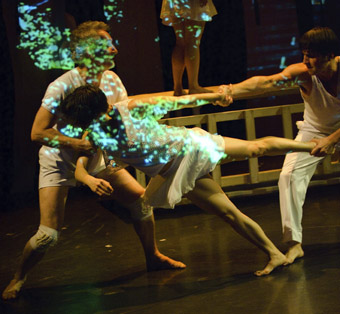
Pomona Road
photo Nick Lane
Pomona Road
MAYBE THEY’RE CALLED NUCLEAR FAMILIES NOT BECAUSE THEY CLUSTER AROUND A STABLE CENTRE BUT BECAUSE THEY COLLIDE AND SCATTER, DESCRIBE ORBITS. BECAUSE OF THEIR PUSH-PULL OF ATTRACTION AND REPULSION. BECAUSE AT THE HEART OF FAMILY IS NOT STABILITY BUT A NEVERENDING CLEAVING TOGETHER AND FLYING APART. ENERGY THAT DISASSEMBLES BUT IS NEVER DESTROYED. KATRINA LAZAROFF’S POMONA ROAD ASKS WHAT HAPPENS WHEN THESE FLUID CONFIGURATIONS COLLIDE WITH THE BLANK WALL OF TRAUMA.
Lazaroff has cast her dancers as an archetypal family: Mum, Dad, the two sisters and a brother, an ‘every family’ that allows an audience to examine the questions that come with each disaster—What would I do? How could we, would we survive?
Trauma here comes as the destruction of the family home by bushfire and its elision of history and identity. The family is cut loose, each member forced to reimagine themselves, and it’s this territory that Pomona Road charts. The dynamic energy of family and eruptive trauma combine as a double helix propelling Pomona Road in a play between dissolution and stability.
The pivotal event of the bushfire is one from Lazaroff’s own history: her family lost a home to fire in 1980 and lived through the 1983 Ash Wednesday bushfires. This intimacy and assuredness with the material pervades the work. The spoken recollections from family and friends of their bushfire experiences provide an overarching narrative structure which drives and frames the action as well as providing historical specificity.
Pomona Road’s strength lies in the quality and integration of its elements. Choreography that keeps the dancers in almost constant motion captures a sense of particles moving. The immersive and evocative projections of Nic Mollison, the fine set design by Kerry Reid and Richard Seidel, Sascha Budimski’s driving and atmospheric score and the dramaturgy of Catherine Fitzgerald all contribute to the work’s tight storytelling.
Time and place are called forth through projections—TV shows, the bush and later flames, sparks, drifting leaves and wallpaper patterns over monumental cut-out tree shapes arranged around the space. There are the sounds of local radio, the susurration of trees and narrators recollecting the beauty and danger of the hills.
Lazaroff deploys her dancers in dissolving and reforming constellations marking out relationships and alliances. Dad and Mum economically describe a duologue of power, the girls pull each other into and out of orbits, father and son raise fences, tumble and grasp. Flying off, regrouping, they graze past each other, tracing out all the lineaments of family.
Like classical tragedy, momentum runs towards and away from the inexorable fact of the fire. Jagged synthesiser motifs and sonorous drones prefigure the fire’s arrival— “It’s gonna get us this time.” Drowning in flames the family frantically cross and recross each other’s trajectories, a dense interwoven panic climaxing with the father screaming silently, consumed by flames, the family at his feet.
As Antigone discovers in Anouilh’s tragedy, it’s not the event that matters but the aftermath where the tragedy unfolds. Against luminous burnt trees and floating home-plans that mark out the characters’ bodies as rooms—‘bedroom,’ ‘bath,’ ‘living’—trauma recurs as sparks and flames overlay and leak into their new, fragile ‘normal.’
A daughter shakes out a joyless little shimmy as the family don cast-off clothes — “Thank the nice lady.” Fat electronica builds anxiety as dreams of a new home dissolve into fire with the family becoming a mesh of hard diagonals on the floor, arms and legs thrown up in the air, verbal ejaculations like involuntary physical tics: “I have to do everything,” “It’s not my turn,” “He started it.”
Balanced against incipient chaos is a neat invocation of the family car, the only fixed point in all this loose energy. Dad drives, Mum as passenger, kids in the back. Pre-fire they bicker to sweet guitar pop, lean into the curves together, working as a unit. In the cold aftermath, eyes shut, isolated, they lean forward, lean back, stop cold in shock.
Moving through this post-bushfire world, in the way we get hooked on songs that speak to certain moments in our lives, we hear Gerry Rafferty’s “Baker Street.” Its nostalgia doubly captured in time, the song becomes an obsessive refrain of loss and longing: “And when you wake up it’s a new morning, the sun is shining it’s a new morning. You’re going, you’re going home.”
Circling around their vanished property, looping through the event, the family endlessly draw themselves to their own centre—“You’re going home.”
Pomona Road, director, choreographer, producer Katrina Lazaroff, performers Carol Wellman, Peter Sheedy, Veronica Shum, Emma Stokes, Zac Jones, lighting, projection, design Nic Mollison, set design Kerry Reid, Richard Seidel, sound design Sascha Budimski, dramaturg Catherine Fitzgerald, voiceovers Nick and Stena Lazaroff, Chris Lazaroff, Margie Hann Syme, Trevor Syme; presented in conjunction with Adelaide Festival Centre’s inSpace program; The Space, Adelaide Festival Centre, April 21-24
RealTime issue #97 June-July 2010 pg. 28
© Jemima Kemp; for permission to reproduce apply to realtime@realtimearts.net
Sarah Ogden, Dylan Young, Moth, Malthouse Theatre and Arena Theatre Company
photo Jeff Busby
Sarah Ogden, Dylan Young, Moth, Malthouse Theatre and Arena Theatre Company
AT THE TIME OF WRITING, THREE PUBLIC DEBATES ARE RICOCHETING AROUND MELBOURNE: THE ALLEGED INVASION OF PRIVACY ENACTED BY SOCIAL MEDIA SITE FACEBOOK; THE “DON’T ASK, DON’T TELL” COMMENTS BY AN AFL FOOTBALLER REGARDING HOMOSEXUALITY IN THE SPORT; AND THE TROUBLING NATIONAL CALL TO “BAN THE BURQA.”
Though no one has, as yet, articulated any link between these issues, it strikes me that a common thread connects them: the right to choose how much of ourselves we reveal to others, and the ways in which we do so. Is society eroding distinctions between public and private, with ‘transparency’ (that loathsome term so favoured by government and big business alike) used to justify an increasingly Foucaultian surveillance of citizens? Maybe. Thankfully I can take these thoughts to the theatre, where the politics of the gaze and the power of the audient can be explored under more controlled conditions.
malthouse & arena: moth
At the centre of Moth, the latest production between Arena Theatre and Malthouse Theatre, is a moment of violence that speaks directly to these concerns. There is an assault, but the true savagery stems less from the physical harm inflicted than the fact that it is filmed on a mobile phone and uploaded to the internet. We watch the two teenage victims reliving their pain as unwilling spectators themselves, party to the comments of schoolmates splaying out beneath the endlessly repeatable footage. It’s a peculiarly postmodern horror that is compounded by their own complicity—in assuming the position of witness to their own bullying, they soon take on the role of bully themselves and turn upon each other.
There’s far more to Moth than this—it’s an outstanding character study inspired by tragic real events, as well as a finely crafted example of collaborative theatremaking at its best. Declan Greene’s script digs deeply into the monstrous dynamics of high school life that many of us have probably repressed (for good reason); it’s almost assured that any audience member will leave with an enriched, if unsettling, understanding of the frightening world today’s teenagers inhabit. It’s also a superbly performed work, with Dylan Young especially creating a compelling and complex anti-hero.
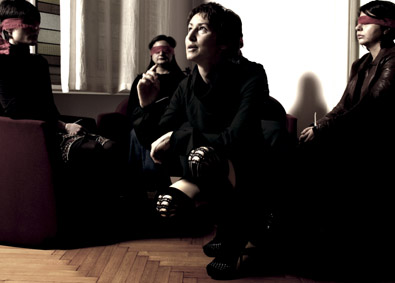
Roberta Bosetti, The Persistence of Dreams: The Sandman, IRAA Theatre
photo Umberto Costamagna
Roberta Bosetti, The Persistence of Dreams: The Sandman, IRAA Theatre
iraa: the persistence of dreams:
the sandman
The gaze is turned upon the audience in IRAA Theatre’s The Persistence of Dreams: The Sandman. A pair of strangers enter your home; after guiding them through the dwelling you are seated and a performance, of a sort, begins. Into the dialogue creep telling references to a range of intertexts that explore the breakdown of social norms and domestic security—Michael Haneke’s Funny Games, David Lynch’s Blue Velvet, Cormac McCarthy’s The Road. Soon enough you find yourself involved in just such a violation, subjected to a mild but provocative series of acts that put you in the role of object rather than voyeur. The fact that the experience is shared—you must gather between six and 12 fellow travellers—adds to this a sense of shared subjugation.
The work’s title alludes to the ETA Hoffmann short story which prompted Freud’s theories of the uncanny, and the experience itself literalises this notion as an incursion of the unfamiliar into the known. It’s not a terrifying experience, and neither is The Persistence of Dreams, but it does have a haunting effect enhanced by the manipulation of your home’s lighting and the rearrangement of the items in your living space. Most tellingly, once the strangers had departed, I found myself discussing for several hours with my fellow guests exactly what had just occurred, as if to dispel some lingering phantom and seek through words the return of the familiar.
jo lloyd’s 24 hrs, dancehouse
A recent Jo Lloyd project commissioned by Dancehouse offered a less threatening form of meditation on the way the makers of art modulate what is shown and kept hidden. 24 Hrs saw four choreographers each given a 24-hour period in which to develop a work from scratch, presenting the new performance at the conclusion of the allotted time. Much of the development was recorded on video and streamed online, where audiences could join in discussions of what they were seeing and become active commentators.
Though I could only make it to the first two presentations of 24 Hrs I found in them a marked contrast. Natalie Cursio’s work was a messy installation of recycled waste in which a series of fertile scenarios sprouted. The three dancers worked around clear moments in which power dynamics shifted or relationships reformed themselves; within this framework there was still a loose sense of play and spontaneity which tapped the tight time restrictions to produce a charming liveliness. In a post-show forum Cursio was asked whether the piece would go on to have a further life in some form, but all present seemed to agree that its transience was key to its meaning.
Shelley Lasica’s work the following week—also for three dancers—had a similar air of improvisation within boundaries, but for me didn’t raise the range of questions Cursio’s work inspired. It appeared more a formal exercise in technique, admirable in that respect, but not making the conditions in which it was produced a part of its own investigation. It was a work that could easily be seen as the starting point for a later, more developed project, but this meant that on its own it seemed too much a performance in embryonic form rather than something complete and contained in its own right.
Both pieces did allow audiences to contemplate the exposed mechanics of creation, but does viewing fragments of a work in progress and hearing the thoughts of makers on the fly add to or subtract from our experience of the final result? I don’t know the answer. It simply offers a different experience with its own rewards and disappointments. I certainly wouldn’t want the bones of every production revealed, since one of the joys of art is the possibility of encountering something magnificently realised from a position of innocent ignorance. Conversely, most forms of aesthetic production emerge from a process in which artists select those things they wish to reveal and attempt to control other functional elements. Pay no attention to the man behind the curtain.
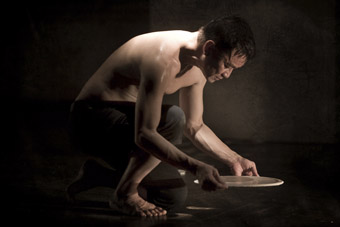
Tony Yap, Rasa Sayang
photo Jave Lee
Tony Yap, Rasa Sayang
tony yap, rasa sayang
None of this is new. The contract between a performer and their audience has always possessed its variable clauses of revelation and reticence, knowing and guessing, curiosity and blindness. There is an uncomplicated pleasure in being offered something that doesn’t claim a raw, unmediated transparency but is the result of careful crafting and modulated reticence. One such offering was Tony Yap’s Rasa Sayang, a small but exquisite solo dance accompanied by a live score by Tim Humphrey and Madeleine Flynn.
Before the performance began, Yap was among his audience, conversing with animation, but once the lights dimmed he entered a state of precisely controlled expression that channelled great emotions into tiny gestures. Much of the work seemed to work through memories of Yap’s mother and the intimacy of memory, regret and grief, but this was not an autobiographical work. That only brief, at times abstract details, of this relationship were unveiled didn’t obscure the effects of the piece but broadened them, allowing Yap’s audience space within which to introduce their own experiences and understanding of family and distance. Though not an overt subject of the work, this necessary reciprocity in any act of performance will always inform its shape and significance; when we look at another, we may also be looking at ourselves.
Arena Theatre & Malthouse Theatre, Moth, writer Declan Greene, director Chris Kohn, performers Sarah Ogden, Dylan Young, design Jonathan Oxlade, lighting Rachel Burke, composer Jethro Woodward; Tower Theatre, CUB Malthouse, May 13-30; IRAA Theatre, The Persistence of Dreams: The Sandman, created & performed by Roberta Bosetti & Renato Cuocolo; various locations, April 7-May 7; 24 Hrs, curator Jo Lloyd, choreographers Natalie Cursio, Shelley Lasica, Phillip Adams, Luke George; Dancehouse, April 30 – May 21; Tony Yap Company, Rasa Sayang, creator, performer Tony Yap, composers Tim Humphrey, Madeleine Flynn; fortyfivedownstairs, Melbourne, April 22-25
RealTime issue #97 June-July 2010 pg. 29
© John Bailey; for permission to reproduce apply to realtime@realtimearts.net
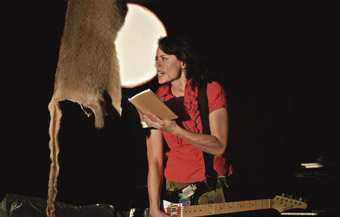
Deborah Robertson, Prompter Live Studio Development, 2010, Hydra Poesis
photo Traianos Pakioufakis
Deborah Robertson, Prompter Live Studio Development, 2010, Hydra Poesis
THE WESTERN AUSTRALIAN THEATRE DEVELOPMENT INITIATIVE (WATDI) IS NOW IN THE SECOND YEAR OF ITS PILOT PROGRAM, WITH 2010 APPLICATIONS CURRENTLY AT THE SHORTLIST STAGE AND THREE SUCCESSFUL APPLICANTS FROM 2009 WELL ADVANCED IN THEIR CREATIVE DEVELOPMENTS.
Funded by the Australia Council, WATDI’s formal structure is of particular interest for two reasons: its five-stage, consultative application process, and a seemingly unique management partnership of three key players in Perth’s contemporary performing arts scene: Perth Institute of Contemporary Arts (PICA), The Blue Room and ArtRage.
According to PICA Director Amy Barrett-Lennard, WATDI is currently the only significant provider of development funding for new theatre in WA, following the demise of the state government’s Major Production Fund. The scheme’s particular aim has been the encouragement of artists to engage in intensive research and creative development, without necessarily focusing on performance outcomes. It offers amounts of $30,000, $60,000 or $90,000 to assist successful applicants to achieve their goals.
To this end, in 2009-10 local companies Hydra Poesis, pvi collective, and a Sudanese-Australian theatre exploration, The Shrouds or the Dead, have each been fortunate to explore, research and develop work, not only free from the pressure of producing a show, but actively encouraged to ‘think big’ along the way.
Hydra Poesis received $60,000 to develop Prompter Live Studio. The work takes place in three locations simultaneously, with three completely separate audiences linked by interconnected studio installations. It follows the evolving relationship between a foreign correspondent and their local ‘fixer;’ explores a surreal prisoner-exchange; and enters the performative world of the lone video blogger.
Prompter Live Studio’s development team includes Hydra Poesis Director Sam Fox, co-writer Patrick Pittmann and sound artist David Miller, with performers Deborah Robertson, Michelle Robin Anderson and Brendan Ewing. The WATDI grant, in addition to buying development time, has enabled the team to work with mentor Dicky Eton of UK performance group Pacitti Company, live forum TV producer Richard Fabb and writer/dramaturg Stephen Sewell.
Working with these artists, says Fox, has helped the team develop a deep understanding of how Prompter Live Studio’s blend of performance material and technical approach might work with more traditional ideas of storytelling. The project, he says, has been an opportunity that other forms of funding could not have adequately supported.
“One of the things the WATDI process is trying to be true to,” he says, “is the idea of this being a predominantly research and development process, and not turning it into a creative development where we try and produce as much of the work as we can.”
He believes that without the WATDI funding, Hydra Poesis could not have undertaken the research: “We would have made an attempt at the work but…it’s a really ambitious project, and thematically and conceptually it requires a lot of development.” He also feels that the standard “bums on seats” requirement would have precluded it from other current funding options.
WATDI’s five-stage application process begins with a one-page proposal. Shortlisted applicants are interviewed by panellists from the three partner organisations, and a further shortlist is invited to develop proposals further, and provided with $3000 to do so. In-depth discussion then takes place with the panel, this time including an additional, ‘external’ member. Stage five is the funding announcement and from here on, the degree of communication is largely up to the grant recipients.
All the partner organisations see this process as a chance for artists to discuss and develop their proposals in a supportive environment. Fox agrees that rigorous discussion of the proposal at interviews helped Hydra Poesis to refine and develop their proposal. Both Fox and PICA’s Performance Program Manager, Vernon Guest, acknowledge the care with which the artist–funder relationship needs to be managed, however, particularly in a small arts environment where ‘everyone knows everyone.’
Guest says the structure continues to evolve in the current round, with the panel working to achieve the ideal balance between ‘arm’s length’ and ‘responsive’ approaches. The benefit of more communication with artists lies in greater sharing of expertise and advice, and a more supported structure. At the same time, a major benefit of less contact is the minimisation of administration costs. Guest cites some organisations as carrying around 15% of administration costs, partly due to the need for project officers to be constantly communicating with artists. WATDI is currently running at around five to seven percent administration costs.
Both PICA’s Amy Barrett-Lennard and The Blue Room’s Louise Coles comment that one of WATDI’s unexpected positives has been the developing relationship between the three partner organisations. The work of running WATDI is divided according to resources, for example PICA takes care of marketing and communications, as it is well set up to do this.This ‘piggy-backing’ of WATDI requirements onto existing infrastructure is also significant in keeping costs down.
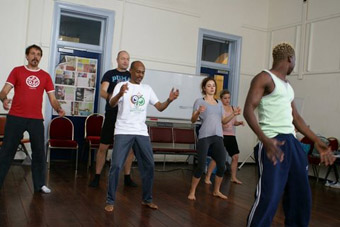
Workshop, The Shrouds or the Dead
Hydra Poesis is nearing the end of its WATDI development, and plans to produce a ‘test’ version of Prompter Live Studio in 2011. Other recipients in 2009, pvi collective, used their WATDI funding to research and develop Transumer, an ‘augmented reality’ work using iPhones, currently running as part of 17th Biennale of Sydney. The Shrouds or the Dead, based on a play by Sudanese-Australian writer Afeif Ismail, took the form of a three-week intensive development in which performers, musicians and a translator joined Ismail in exploring the ‘transcreation’ of his work to an Australian, multicultural context, examining how Sudanese performance tradition could inform and be informed by other methods, including Butoh.
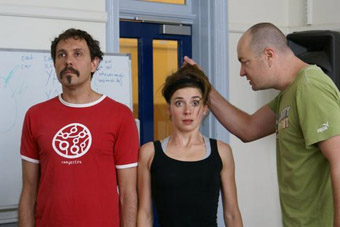
Workshop, The Shrouds or the Dead
ArtRage Festival Director, Marcus Canning, speaks positively about the applications in the current WATDI round: although they were fewer in number, he says, the quality this year was higher overall, with greater diversity and some very strong regional proposals. The point of the initiative, he reasserts, is “development unshackled from the needs of set production outcomes.”
“There is a sense in the second year that there is a growing understanding of what this can mean,” Canning says, “and more key practitioners putting forward a greater array of expansive and brave development ideas.”
It appears WATDI’s impact is threefold: strengthening the research focus of the companies involved through the critical feedback process (a process, it should be noted, that extends not only to successful applicants); providing WA’s theatre sector with an important new opportunity to develop work at a deep level; and building relationships between the organising partners. The Australia Council for the Arts will soon receive reports from WATDI on its first year of operation; then it will begin to make its own assessment of the initiative. Meanwhile, it will be interesting to see what emerges from the 2010 application round.
The Western Australian Theatre Development Initiative (WATDI) is funded by the Australia Council for the Arts and driven by partners PICA, The Blue Room and ArtRage. WADTI: www.watdi.org.au; Hydra Poesis: hydrapoesis.net; pvi collective: www.pvi.com; The Shrouds or the Dead: http://shroudsorthedead.wordpress.com/about/
RealTime issue #97 June-July 2010 pg. 30
© Urszula Dawkins; for permission to reproduce apply to realtime@realtimearts.net
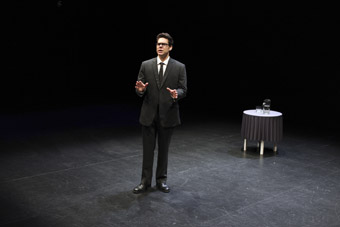
Jason Klarwein, Thom Pain (based on nothing), Queensland Theatre Company
photo Rob Maccoll
Jason Klarwein, Thom Pain (based on nothing), Queensland Theatre Company
SO FAR THIS YEAR IN BRISBANE TWO PERFORMANCES STAND OUT FOR THEIR ABILITY TO TRACK THE TWISTS AND TURNS CONTEMPORARY ANOMIE HAS TAKEN WHILE AT THE SAME TIME SHOCKING US INTO A PROFOUND REALISATION OF OUR OWN ISOLATION AS INDIVIDUALS. INSTEAD OF ASKING US TO GET INVOLVED, JOIN A RECOVERY GROUP OR ASK OUR DOCTOR FOR A PRESCRIPTION FOR PROZAC, THESE WORKS SEVERELY TESTED THE METTLE OF THEIR AUDIENCES AS THEY PRESENTED INVIGORATINGLY DIFFERENT (AND DESPAIRINGLY SIMILAR) VERSIONS OF THE GROUND ZERO OF THE HUMAN CONDITION.
The first of these was the homegrown product, Brian Lucas’ Performance Anxiety (RT96), a whirling dervish of performance cabaret which stands authoritatively alongside, and bears comparison with, American playwright Will Eno’s monologue titled Thom Pain (based on nothing), directed by John Halpin and performed by Jason Klarwein for the Queensland Theatre Company, and which has been described as “stand up existentialism.”
If both productions are dominated by the en-soi—in Sartrean existential terms the world experienced as alien and senselessly contingent dominated—they also cast a penumbral light on the dialectically opposing notion of the pour-soi, the individual self who challenges the givens of both social and personal history from a position deemed to be inalienably and ineluctably free. Both performances hinged on this quixotic quest for self-identity, so it is no wonder that a forthcoming project of Eno’s is an adaptation of the classical treatment of the subject, Ibsen’s Peer Gynt.Nor is it surprising that Lucas is currently directing Ionesco’s absurdist drama, The Chairs, for La Boite Theatre in Brisbane. In an evident revival of tradition, both seem to have learned from Beckett’s use of even the most miniscule silence to offset their words, and are well versed in Pinter’s throwaway sleight of hand.
Eno is a funny writer in the sense that Pinter wrote to The Sunday Times in 1960: “As far as I’m concerned The Caretaker is funny up to a point. Beyond that point it ceases to be funny, and it was because of that point that I wrote it.” Eno in an interview with QTC, revealing the level of his own subtle sleight of hand, writes, “The play’s title reminds me, of course, of Thomas Paine (famous for his Revolutionary War pamphlets with the words “the summer soldier and the sunshine patriot”), but it also somehow reminds me of a broken arm, both soft and hurtful, recognisable, but somehow wrong.” Behind the wounded and apparently character-armoured and conformist representation of Eno’s anti-hero, who wears a plain dark suit and tie and sports black horn-rimmed glasses, stands an authentic revolutionary hero, the existential pour-soi. If Thomas Paine the pamphleteer is feebly recapitulated in Thom Pain’s solipsistic maunderings, and Thom’s feints to rhetorically engage with the audience are succeeded by an almost instantaneous withdrawal from the fray, there is indeed a soft hurtfulness, a recognisable wrongness which is manifestly our own mirrored in his actions.
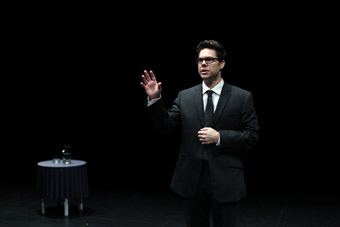
Jason Klarwein, Thom Pain (based on nothing), Queensland Theatre Company
Although he adopts the stance of being perpetually, paranoidly en garde, it seems useless to attempt to psychoanalise a character who is such a writerly, theatrical confection. Only towards the end, when the defensive precision of language breaks down into a painful, repetitively fragmented stream of consciousness does he let his guard down and invite our sympathy in the usual sense. This is the point at which he flies away, disappears back into the realm of his author’s imagination while leaving behind the concrete presence of the hapless other, his mirrored substitute—the member of the audience he has cajoled onstage to assist in an act of magic which has failed to ensue, unless by Catholic transubstantiation. His last line as he exits is the puckishly ironic: “Isn’t it great to be alive?”
The strength of the production lies in Eno’s Wildean language which incorporates such pithy observations about the end of a love affair as “I disappeared in her and she, wondering where I went, left.” Such ironic lucidity is equally applied to the nicely established loneliness of childhood (Thom doesn’t mention his parents) in an anecdote about the accidental electrocution of his pet dog. The most verbally actualised and traumatic scenario describes the boy’s misapprehension when he is attacked by bees: “Kind of beautiful, if you like that sort of thing. If you like the idea of a little boy desperately spreading stinging bees over his bleeding body. Desperately yelling, ‘Help me, bees, Help,’ and putting his little swollen hand into the hive for more.”
Thom’s recounting of his life turns on such incidents in a Yeatsian gyre rather than any straightforward narrative. A writer like Eno, as Martin Esslin said about Beckett, is essentially lyrical, concerned with such basic questions as “Who am I?” Both Eno and Lucas have returned to the problems enunciated by the great 20th-century poet Rilke in The Notes of Laurid Brigge: “And so we walk around, a mockery and a mere half: neither having achieved being, nor actors.” John Halpin and Jason Klarwein made an intelligent and sensitive team elucidating the philosophical premises, and at the same time urging each of us to become the good person whom Eno was trying to be when he wrote the piece.
Queensland Theatre Company, Thom Pain (based on nothing), writer Will Eno, director Jon Halpin, performer Jason Klarwein, composer Phil Slade, lighting designer Jason Glenwright, design consultant Josh McIntosh; Billie Brown Studio, Brisbane, March 15-April 10
RealTime issue #97 June-July 2010 pg. 32
© Douglas Leonard; for permission to reproduce apply to realtime@realtimearts.net
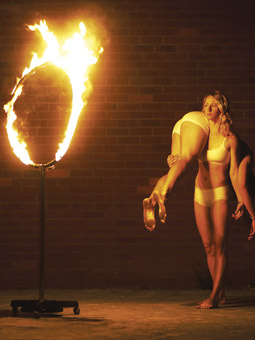
Rachael Ogle, Sam Fox, Hydra Poesis
Hydra Poesis’ new work Personal Political Physical Challenge premieres in July at PICA. It’s described as “a provocative, exciting and adult interpretation of the childhood game “truth, dare or physical challenge?”
Hydra Poesis is run by Sam Fox who has been artistic director of STEPS Youth Dance Company, created in community cultural development and festival programs and is working on a Masters degree on community collaborative production models at Murdoch University. You can read about his Western Australian Theatre Development Initiative (WATDI) project Prompter Live Studio.
Fox’s motivation for the show is clearly evident, “From B-grade romance to high drama, protagonists are so often concerned with the internal intricacies of their relationships with each other with no regard to their shared connection to the rest of the world. In this show we set those plot indulgences on fire!” Yes, fire is one of the components of the show, along with dance and ‘surreal’ theatrics.
Fox is directing and co-choreographing with collaborators Rachel Ogle and Martin Hansen while the show’s visual world is being realised by Thea Costantino and its music by Stina Thomas. RT
Hydra Poesis, Personal Political Physical Challenge Perth Institute of Contemporary Arts, July 16–20; http://hydrapoesis.net
RealTime issue #97 June-July 2010 pg. 32
© RealTime ; for permission to reproduce apply to realtime@realtimearts.net
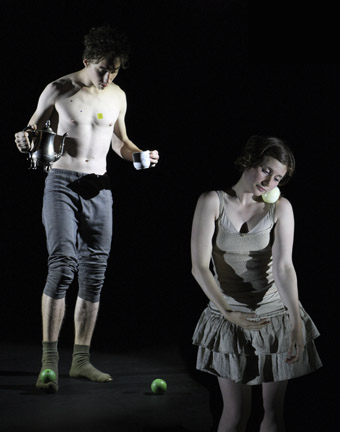
Silvertree & Gellman, Scattered Tacks
photo Alicia Ardern
Silvertree & Gellman, Scattered Tacks
THE NEXT DECADE IN THEATRE AND CONTEMPORARY PERFORMANCE WILL BE A DECADE OF PHENOMENA, NOT OF SIGNS, OF EXPERIENCING RATHER THAN READING PERFORMANCE. THE FIRST ‘SEMESTER’ OF THE ARTS HOUSE 2010 PROGRAM COULD BE NEATLY DIVIDED IN TWO PARTS: AUSTRALIAN CONTEMPORARY CIRCUS AND UK-BASED RELATIONAL PERFORMANCE. THE LATTER (WHERE THE AUDIENCE BECOME PERFORMERS AND CO-CREATORS) IS A BACKLASH AGAINST 20 YEARS OF MEDIATISED POSTMODERN THEATRE.
These new works are theatre minus stage, performance minus performers and spectacle minus the spectacular. The audience experience is the event itself: tactile, immediate, immersive, anti-ironic. The semiotic component is minimal, sometimes altogether absent, as the performance exists mainly in the mind of the spectator. It appears, perhaps, as our era abandons questions of meaning and engages with amplified possibilities of doing. It’s almost like a direct answer to Deleuze’s dream of the new non-representational theatre, in which “we experience pure forces, dynamic lines in space which act without intermediary upon the spirit.” And although tested by performance-makers both here (bettybooke, Panther) and elsewhere (Rimini Protokoll), the UK, building on its rich variety of live art, is something of a leader.
This form is too young to have encountered much meaningful criticism in Australia, but every form quickly accumulates knowledge. While I don’t think everything we have seen at Arts House could be called successful, the failures are just as interesting, like the results of an experiment.
Take Rotozaza. Their two shows, Etiquette and Wondermart, promised a new form of expression, ‘autoteatro,’ but delivered a half-hearted combination of pomo referentiality and demanding, mediatised interactivity. Both are no more than voices inside a headset, giving instructions to a single audience member. Wondermart is a walk through a(ny) supermarket. Etiquette is 30 minutes in a café, in which you and another audience member perform an encounter, a conversation from Jean Luc Godard’s Vivre Sa Vie, the final scene from Ibsen’s A Doll’s House, and much else—sometimes by talking to each other, sometimes moving figurines on the chess board in front of you.

Wondermart, Rotozaza
photo Ant Hampton
Wondermart, Rotozaza
While very engaging in those few moments when the narration matches what’s happening in space (such as when theories of shopper behaviour are confirmed by innocent bystanders in the supermarket), most of both shows consisted of a series of mundane and tiring little tasks. Despite the interactive pretences, they were not so much an experience for one audience member as a performance by one audience member, with the concomitant stage anxiety—even if nobody was watching. The problem was not just that many aspects of the situation cannot be sufficiently controlled by the audience-performer (my noisy supermarket trolley forbade me from following shoppers as instructed; or the concentration required to both quickly deliver lines and hear your partner-in-dialogue). Rotozaza underestimate our anxiety not to let the performance down: a compulsive need to please the dictatorial voice inside the headphones by performing everything right.
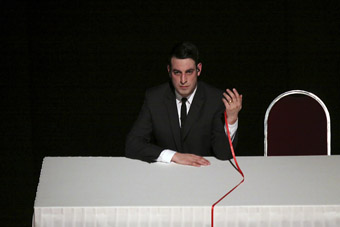
Mem Morrison, Ringside
photo National Museum of Singapore/Chris P
Mem Morrison, Ringside
If Rotozaza forgot how unpleasant structured events can be, Mem Morrison went all the way and staged the worst aspects of a wedding ceremony in Ringside. Its entire conceptual spine is the sense of alienation, monotony, meaninglessness and loneliness one feels at a collective ritual. The performance starts before it starts—audience groups are arranged into family photos, well-dressed and carnation-studded as per instructions—and seated around one long table. An infinite number of black-clad women, both attendants, family and brides-to-be, deliver food and crockery. Amidst the flurry Morrison is the only male, unhappy, confused, 12 years old, jokingly told it’s his turn next, sometimes playing with a Superman toy and sometimes MC-ing with his shoe instead of a microphone.
Ringside’s aspirations are sky-high, but the performance never manages to reveal much of its topical menagerie: ethnicity, gender, tradition, multiculturalism are signposted rather than explored or experienced. Morrison’s entire text is delivered through headphones, creating a mediatised distance that in 2010, after 20 years of screens onstage, is as déjà-vu as it is genuinely disengaging. There is a paradox within Ringside: it purports to bring forth an aspect of Turkish culture, but the distanciation intrinsic to the method condemns it as facile. The experience is ultimately of witnessing a whining 12-year-old, loudly airing his discontent at being dragged to a family event.
Helen Cole’s Collecting Fireworks, on the other hand, a performance archive and an archive-performance, is as simple as it is brilliant. A genuine one-on-one performance (a dark room, a single armchair, recorded voices describing their favourite performance works, followed by recording one’s own contribution), it exemplifies the opening possibilities of this new form: no stage, no performers, but a deeply meaningful experience. I suspect the end result will be a genuinely valuable archive of performance projects, as we are encouraged to remember not only the details of these works, but also the effect they had on us.
The reasons the two local circus performances were on the whole much more successful are complex: Australia’s long tradition of contemporary circus and Melbourne’s close acquaintance with both the form and the artists are not the least important. If with relational performance, imported from an emerging artistic ecology overseas, we occasionally felt both short-changed and ignorant, with circus we could comfortably feel at the world’s cutting edge.
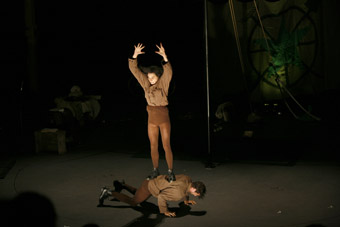
Propaganda, acrobat
photo Ponch Hawkes
Propaganda, acrobat
Acrobat’s long-awaited new work, Propaganda, points to the long tradition of circus used as Soviet agitprop, educational art dreamt up by Lenin in 1919 as “the true art of the people.” The company’s take is both ironic and deeply earnest, and it takes weeks of confusion before concluding that, yes, their open endorsement of cycling, eating veggies and gardening nude was serious. The tongue is in cheek, yes, when spouses Jo Lancaster and Simon Yates heroically kiss in the grand finale, centrally framed to the tune of Advance Australia Fair like the ideal Man and Woman in social-realist art. But it is a very slight joke indeed.
The specificity of circus could be defined as the pendular motion between crude and dangerous reality and the illusion of spectacle: relying on physical strength more than on representational techniques (it is impossible to just ‘act’ a trapeze trick), it can never completely remove the real from the stage. Acrobat’s previous (and better) work—titled smaller, poorer, cheaper—created tension by opening up the spectacle to reveal the hidden extent of the real: social stereotypes and obligations, physical strain, illness. Propaganda foregrounds circus as this family’s life: from the two children pottering around to the unmistakable tenderness between Lancaster and Yates and the heart-on-sleeve honesty of the beliefs they propagate. The dramaturgical incongruence between the ironic self-consciousness of the Soviet theme, with its inevitably negative undercurrent, and the performers’ trademark lack of pretence, remained the least fortunate aspect of the work. From the message to the magnificent skills on display, everything else was flawless.
Scattered Tacks, by Skye and Aelx Gellman and Terri Cat Silvertree (see article), stripped away spectacle to reveal the essence of circus: awe. Circus is a naturally postdramatic form: its narrative arc fragmented, aware of its own performativity (what Muller called “the potentially dying body onstage”) and constantly anxious about the irruption of reality on stage. Scattered Tacks is raw circus, naked: at times it felt like an austere essay in thrill. It revealed that the rhythm of audience suspense and relief hinges less on the grand drama of leaps and tricks and more on visceral awareness of the subtle dangers and pain involved. Eating an onion, climbing barefoot on rough-edged metal cylinders, overworking an already fatigued body—these were the acts that left the audience breathless. Yet they also achieve poignant beauty. The Gellmans and Silvertree bring Australian circus, traditionally rough and bawdy, closer to its conceptual and elegant French sibling, but in a way that is absolutely authentic.
Australia offers a good vantage point from which to observe the human being. Visiting Europe recently, it struck me how dense the semantics of the European theatre are in comparison. Performing bodies there are acculturated and heavy under the many layers of interpretation, history, meaning. The body here, on the other hand, easily overpowers the thin semiotics of Australian culture, emerging strong, bold and without adjectives, without intermediary. Body as phenomenon, not as signifier. It will be interesting to observe how the emerging interest in theatre as presence, rather than representation of meaning, unravels—and how much this country will participate in this trend. In this season it’s circus, one of the oldest forms of performance, that emerges as the more successful. The relational performance works only rarely overcame the trap of referentiality.
Arts House: Rotozaza, Etiquette, Wondermart, co-directors Silvia Mercuriali and Ant Hampton, Arts House and around Melbourne; Mar 16–April 3; Mem Morrison Company, Ringside, writer, director, concept, performance Mem Morrison, sound & music composition Andy Pink, design Stefi Orazi, North Melbourne Town Hall, March 17-21; Helen Cole, Collecting Fireworks, director Helen Cole, technical consultant Alex Bradley, North Melbourne Town Hall, March 17-19; Acrobat, Propaganda, conceived and performed by Simon Yates and Jo Lancaster, also featuring Grover or Fidel Lancaster-Cole, Meat Market, March 27-April 3; Silvertree and Gellman, Scattered Tacks, created and performed by Terri Cat Silvertree, Alex Gellmann, Skye Gellmann, Arts House, Meat Market, Melbourne, March 16-21
RealTime issue #97 June-July 2010 pg. 33
© Jana Perkovic; for permission to reproduce apply to realtime@realtimearts.net
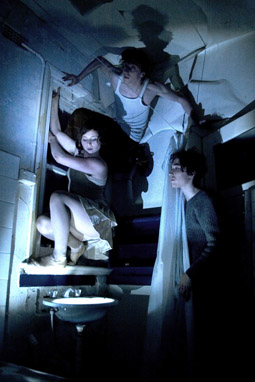
Silvertree & Gellman, Scattered Tacks
photo Alicia Ardern
Silvertree & Gellman, Scattered Tacks
The creators of Scattered Tacks, Skye Gellmann, Terri Cat Silvertree and Aelx Gellmann are fast building a reputation as physical theatre innovators with a performance language all of their own. In this edition Jana Perkovic reviews the recent Art House showing of Scattered Tacks.
The trio variously trained in circus and physical theatre as children working with Cirkidz, Kneehigh Puppeteers and then Urban Myth Theatre of Youth in Adelaide and in later years in corporeal mime and traditional and contemporary Japanese theatre forms.
Aelx Gellman describes himself as “a creative masochist, unusualist and escape artist, specialising in random feats of dexterity and prestidigitation.” To this we might add the human spelling error! The Gellmanns studied at NICA and all were involved in co-founding companies (Rambutan, Shuttlecock) along the way. The three went on to gather a string of Best Emerging and Most Promising awards including for Skye Gellman in 2007 Most Promising Male Actor at Melbourne’s Short and Sweet festival.
In 2008 their signature work, Scattered Tacks won the Melbourne Fringe Award for Most Outstanding Production and in 2009 was programmed by Yaron Lifschitz at CIRCA for their showcase of new works at Brisbane Powerhouse. This is where our reviewer Douglas Leonard was taken by the work: “No extraneous effects. Fragments of a life obscurely shared were dimly recreated. The light distorted, flattened and sculpted identifiable shapes into pure, foreboding forms.” (See full review.) Lifschitz described Scattered Tacks as “one of the most challenging and significant pieces of New Circus to emerge in years.” In the same year, the work toured to Noorderzon Performing Arts Festival in the Netherlands.
Skye Gellmann is currently developing a solo performance for the 2010 Sydney Fringe Festival called Eyes Fight, Projector Light, “a minimalist circus experiment involving an acrobatic body and the cutting light of a slide projector.” It will be is directed by Terri Cat Silvertree who is also developing her own solo performance. RT
www.scatteredtacks.skyebalance.com
RealTime issue #97 June-July 2010 pg. 34
© RealTime ; for permission to reproduce apply to realtime@realtimearts.net
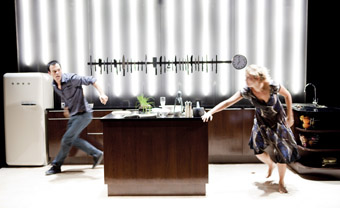
Socratis Otto, Leeanna Walsman, Stockholm, Sydney Theatre Company
photo Brett Boardman
Socratis Otto, Leeanna Walsman, Stockholm, Sydney Theatre Company
UK PHYSICAL THEATRE GROUP FRANTIC ASSEMBLY EXPLAIN IN THE PROGRAM NOTES TO THEIR AUSTRALIAN RECONSTRUCTION OF STOCKHOLM, THAT ‘STOCKHOLM SYNDROME’ OCCURS WHEN A “HOSTAGE SHOWS SIGNS OF LOYALTY TO THE HOSTAGE-TAKER.” A TEXT-BASED WORK WITH DANCE AND MOVEMENT INTERJECTIONS, STOCKHOLM HAS BEEN REMOUNTED BY DIRECTOR-CHOREOGRAPHERS SCOTT GRAHAM AND STEVEN HOGGETT WITH AN AUSTRALIAN CAST TO FIT A PRE-EXISTING CHOREOGRAPHIC SCORE. THE PRETEXT FOR THE PLAY IS “DIFFICULT AND DESTRUCTIVE” LOVE.
Playwright Bryony Lavery was commissioned by the company to interweave words with movement around themes of control, desire and manipulation. Employed as a recurring motif, the word “Stockholm” comes to work as an awkwardly literal reference to the demise of a sparring couple’s relationship. It is both the actual ‘elsewhere’ of a holiday in the making and the figural ‘reality’ of a relationship-in-crisis.
The main misuse of the term is in its application to the the young couple, Kali and Todd (Leeanna Walsman and Socratis Otto), Lavery envisaging their world in terms of “retro-jealousies” over past lovers, overblown romantic ideals and sickly sweet histories. On the celebration of Todd’s birthday, they dance around their SMEG/smug kitchen meting out reminiscences and arguments over a recipe for dinner. Stockholm, the literal city, sits in the distance as the promise of holiday escape from a relationship that appears more like something from a real estate advertisement than anything real. Stockholm Syndrome—the metaphorical premise of passive submission to a controlling power—never materialises as we slowly realise that Kali’s manipulations (taunts, violence, spying on Todd’s text messages) are the product of something infinitely more despairing than dynamics of master and slave. It seems that Kali is deeply psychologically unwell—a thematic with which Stockholm unfortunately never risks engaging.
Kali and Todd’s pas-de-deux is played out through a combination of text and physicality, where the literal again looms large in movement pieces that could have more abstractly conveyed the difficult machinations of mental illness and its impacts on loved ones. Instead, the choreographers plot the lovers stacking the grocery shopping in the kitchen cupboards, for example, with gestures that resemble musical, more than physical, theatre. They do make suspenseful use of tight kitchen spaces and knives, but when movement is pre-empted by the text, the problems are exacerbated. Kali’s calls for “birthday dance time” and “this last dance, it’s a slow one” uncomfortably reveal that text and movement, caught in a kind of self-conscious narration of their dramaturgical coexistence, aren’t speaking to each other at all. In this respect, this work loses its relevance to a field of progressively innovative physical or movement-based theatre work which also happens to be locally driven and conceived (think Force Majeure or Branch Nebula).
The action takes place in a set that also over-performs: we move between a tight kitchen space, an outdoor stairwell, an upstairs attic bedroom and a balcony water pool. The mechanised apparatus intrudes into the fictional world in a way that might be better left unelaborated. Moments of scenic abstraction could be promising (a strange devil-like voice appears both at the staircase and in the water pool) but seem more drawn towards underscoring scenographic technicalities rather than developing any stronger thematic sense of actual psychological disorder. A bedtime scenario towards the close of the piece does attempt to place physical tension in relation to narrative tension (the performers are suspended by arm straps on a high leaning platform whilst taking us to a quasi dreamstate in which they pre-empt the future birth, and then grisly murder, of their own children), and yet this too is undercut by their concurrent baring of sexy chests and skin.
If Stockholm Syndrome registers a scenario of unwitting surrender to a hostage-taker, then Stockholm left me feeling disengaged. When issues of mental illness are conveyed as simplistically violent and manipulative, when relationships resemble the stylistic tropes of The Sydney Magazine, and when theatre then moves in its bag of tricks to try to take us all hostage, I’m tempted to have a similar response to Todd, whose final challenge to Kali is calmly to the point: “I’m too intelligent for this.”
Frantic Assembly, Sydney Theatre Company, Stockholm, writer Bryony Lavery, direction & choreography Scott Graham, Steven Hoggett, performers Socratis Otto, Leeanna Walsman, design Laura Hopkins, costumes Jennifer Irwin, lighting Andy Purves, sound design Adrienne Quartly, assistant to the choreographers Dean Walsh; STC, Wharf 1, March 17-April 24
RealTime issue #97 June-July 2010 pg. 34
© Bryoni Trezise; for permission to reproduce apply to realtime@realtimearts.net
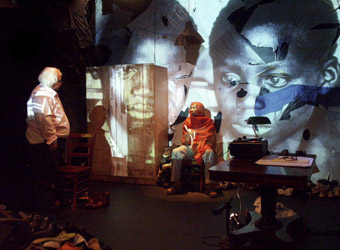
l-r David Moody, Martin Mhando, Witness, Blue Room
photo Serge Tampalini
l-r David Moody, Martin Mhando, Witness, Blue Room
ON A SMALL STAGE CLUTTERED WITH COUNTLESS PAIRS OF OLD SHOES—THE SHOES OF THE DEAD—BETWEEN A COUPLE OF RICKETY WOODEN CHAIRS AND AN IMPOSING, OFFICIAL-LOOKING DESK, TWO MEN PLAY A GAME. ONE, AFRICAN, WIRY AND ENERGETIC, SPINS OR FLIPS A COIN—IT DOESN’T MATTER WHICH—THE RESULT IS ALWAYS HEADS. THE OTHER, WHITE, MASSIVE AND MANIACALLY CONVIVIAL, SEEMS TO BE HIS FRIEND. THE TWO PLAY THE GAME LIKE SPARRING KIDS, LIKE GROWN-UP BROTHERS, LAUGHING TOGETHER MORE INSISTENTLY EVERY TIME THE PREDICTABLE RESULT COMES UP AGAIN—YES, HEADS.
Witness, co-written by award-winning Tanzanian-Australian filmmaker Martin Mhando and WA actor and writer David Moody, explores the law of probability as it plays out in bitter human conflicts, retelling stories of torture and atrocities from Chile to Cambodia in a constantly morphing, fractured form. As the play progresses, the men perform a collage of vignettes in which the roles of white, black, male, female, jailer, prisoner, aggressor and victim are endlessly exchanged. At one point Moody dons a curly black wig to play a comical Colonel Gaddafi; elsewhere both men perform a disturbing Auschwitz cabaret scene as “Hymie and Abe,” complete with Marx Brothers nose-and-glasses.
Produced by newly formed company, Ujamaa—Swahili for ‘collective brotherhood’—Witness is directed and designed by Serge Tampalini, whose shoe-strewn stage is backed by a makeshift projection screen of t-shirt fragments, stretched like overlapping skins. The co-writer-performers and Tampalini are all lecturers at Murdoch University’s School of Social Sciences and Humanities, with lighting and stage management provided by Murdoch students.
Mhando and Moody are joined on stage by actor Lesley-Anne Philps, who as a pointedly well-groomed translator, transcriber and witness observes horrors such as white man Moody repeatedly dunking black man Mhando’s head into a bucket of water, as Mhando attempts to recount the death of a daughter in Rwanda; or the two men telling and retelling their tortures to one another from inside black plastic garbage bags shoved against the piles of rotting shoes. Moody becomes a prisoner, capturing a small bird in his cell—signified by a tiny red satin slipper that he holds delicately with genuinely bruised and welted arms. He delivers a soliloquy that ends with the assertion that “As long as Mandela lives…” But Mandela is dead! laughs Mhando, while the impeccably dressed Philps at her desk smirks at Moody’s wasted passion.
Witness is scripted from several sources including the writings of Tom Stoppard, Athol Fugard, John Kani and Winston Ntshona, and Philip Gourevitch. The bending, morphing and reshaping of narratives produces a sense of anxiety—it’s sometimes hard to follow, but tellingly construes the two men as interchangeable, even placing them at times ‘on the same side.’
The pace and tone of the production are relentless, a barrage of action that might benefit from further development; though, at the same time, audience discomfort serves to highlight the pain of testimony and the legacy of terrors that lies behind the notion of ‘reconciliation.’ At the centre of the work is a scene in which Mhando plays a veiled Antigone, defending her burial of her brother Polynices. Her words seamlessly shift and we realise she’s reciting a section of Noel Pearson’s 2001 address at the Charles Perkins Oration: “On the Human Right to Misery, Mass Incarceration and Early Death.”
The brotherly camaraderie of Mhando and Moody as the play’s alternate antagonists and allies is one of the great strengths of Witness. The opening scene of seeming intimacy and mateship lays a foundation of uncertainty that echoes throughout the ensuing episodes, forcing a constant reassessment of relations between the two.
At times the play’s ever-mounting layers of testament and reframe risk turning to melodrama, as with the scene where Philps holds the collapsed Mhando in her arms, pieta-like, and speaks of “a great Katrina of grief.” The scene is undeniably tender, though, and it is this ability to constantly evince conflicting emotions that seems to propel the play to its ultimate unfolding.
Witness does unfold and seems to end, but takes one last shift to a strikingly coherent scene in which Philps becomes director and Moody and Mhando actors dissecting their own performance with a mix of passion, fire and self-disgust. “Six million people died and we’re doing La Cage aux Folles?,” shouts Moody. “Guilty white liberal and sad black man” confront one another in ‘real life’, until Philps interjects: “He’s the black one, Okay? So he should know!” White man storms off stage. Is he coming back? Black man fishes out his coin and tosses it. “Tails!”, he laughs as he triumphantly exits.
Witness, script, from various sources, by performers Martin Mhando, David Moody, performer Lesley-Anne Philps, director, designer Serge Tampalini, Ujammaa Productions; The Blue Room Theatre, Perth, May 4-22; www.blueroom.org.au
RealTime issue #97 June-July 2010 pg. 35
© Urszula Dawkins; for permission to reproduce apply to realtime@realtimearts.net
Andrew Henry (Johnny Cash), Matt Ralph (Bob Dylan), Chronic Ills of Robert Zimmerman, Tamarama Rock Surfers
photo Declan Kuch
Andrew Henry (Johnny Cash), Matt Ralph (Bob Dylan), Chronic Ills of Robert Zimmerman, Tamarama Rock Surfers
FOR ANYONE WITH EVEN A PASSING ACQUAINTANCE WITH TODD HAYNES’ I’M NOT THERE (2007), IT WAS IMPOSSIBLE TO SIT THROUGH BENITO DI FONZO’S EPICALLY-TITLED PLAY THE CHRONIC ILLS OF ROBERT ZIMMERMAN: AKA BOB DYLAN (A LIE)—A THEATRICAL TALKING BLUES AND GLISSENDORF, WITHOUT BEING REMINDED OF CATE BLANCHETT’S JUDE QUINN: “I’M JUST A STORYTELLER, MAN. IT’S ALL I AM.”
For one thing, the resemblance of The Chronic Ills’ Matt Ralph to Blanchett’s Quinn is uncanny, as is their resemblance to Bob Dylan, the man on whom their characters are based. For another, the segment of Haynes’ film that Di Fonzo’s play most resembles is the one in which Quinn appears. (Jude is one of six Dylan doppelgängers in the picture, each of whom occupies a stand-alone storyline rendered in a distinct cinematic style.) Both the play and the Quinn segment share a classic pop art sensibility, all appropriation, allusion and madcap namedropping (The Beatles and Allen Ginsberg show up in the film; Joan Baez, John Lennon, Yoko Ono and more in the play). While Haynes’ reference points are predominantly cinematic—Fellini’s 8 ½ and Pennebaker’s Don’t Look Back are the most obvious in the Quinn segment, though Richard Lester’s Hard Day’s Night gets a look-in, too, and Jean-Luc Godard’s Masculin Féminin is referenced throughout all six of the characters’ segments—Di Fonzo turns to Dylan’s music. Mimicking the formal operations of the songs, if not necessarily echoing their content, the play careens along as though it were a lost verse of Subterranean Homesick Blues, relying less on narrative cohesion or biographical accuracy than on free association and impressionistic causal logic.
For some people’s money, this is the production’s greatest shortcoming (as indeed, for more of their money, is true of the film). On the night I saw The Chronic Ills, one person even remarked to me that it felt as though Di Fonzo had written the play in front of the Wikipedia entry on Dylan, resorting to superficial pop culture references and betraying an unfamiliarity with the work. This criticism misses the point, and twice. In fact, The Chronic Ills’ impressionistic streak is evidence of an intense familiarity with Dylan’s work and its internal operations: episodic, fast-paced and surreal, the result is a text constructed entirely out of what Ginsberg, describing the songwriter’s lyrics, once called “chains of flashing images.”
The more serious point missed by this criticism is the fact that the play isn’t really about Dylan at all and therefore needn’t hew too closely to the recorded facts of the troubadour’s life. Rather, the real subjects of the play are storytelling, mythmaking and the formation of identity.
Dylan is the perfect subject for such a project for the simple reason that he has been an active participant in his own mythologising for so long, albeit in a paradoxical, often contradictory manner. He has been lying to and glissendorfing journalists—using language to intentionally mess with them—since his emergence in the sixties (“Mr Quinn, Mr Quinn! Do you have a word for your fans?” “Astronaut.”) and has experimented with the conventions of self-representation and self-mythologising in films such as 1978’s Renaldo and Clara, which he directed, and 2003’s Masked and Anonymous, which he wrote. At the same time, he has bristled at any attempts by others to mythologise him without his consent. His refusal to play any of the roles the culture has prescribed for him, paired with the near-constant reinventions that have allowed him to avoid such prescriptions, gives him a mercurial quality that seems to make mythologisation impossible even as it invites further attempts. I’m Not There is particularly interested in the ramifications of this latter contradiction, and indeed is a product of it. Inspired, according to the opening credits, by Dylan’s music and “many lives,” it offers its complex, fragmented narrative as a metaphor for the various selves we carry inside of us and the unknowability of any whole of which they may ostensibly be a part. (Todd Solondz’s Palindromes did something similar three years earlier.)
The Chronic Ills comes at things from a different angle, suggesting that even in the face of this essential unknowability we might still be able to glissendorf some idea of ourselves into being. Where I’m Not There is about self-effacement—or at least attempts to navigate the terrain of the self-effaced—The Chronic Ills is about storytelling as an act of self-creation. Robert Zimmerman talked Bob Dylan into existence, and that lie, as the titular parenthetical calls him, has been talking himself further into it ever since. What Di Fonzo captures so well with his wordplay monologues and his indifference to the historical record is the idea that a life is as much a work of art as any song or film or play. This is true of any life, of course, but of the artist in question it’s particularly so. Dylan’s life has been a performance fashioned almost entirely out of poetry and lies, which is really just another way of saying out of stories.
Tamarama Rock Surfers, The Chronic Ills of Robert Zimmerman: AKA Bob Dylan (A Lie), A Theatrical Talking Blues and Glissendorf , writer Benito Di Fonzo, director Lucinda Gleeson, performers Andrew Henry, Lenore Munro, Matt Ralph and Simon Rippingale, designer Eliza McLean, lighting design Richard Whitehouse, producers Jennifer Hamilton, Sophie Alize Finnane; Old Fitzroy, Sydney, April 6-24
RealTime issue #97 June-July 2010 pg. 36
© Matthew Clayfield; for permission to reproduce apply to realtime@realtimearts.net
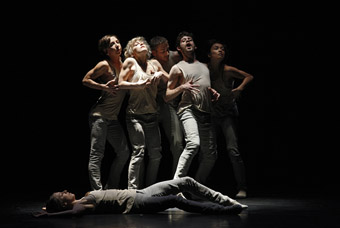
Are We That We Are, Sydney Dance Company
photo Jeff Busby
Are We That We Are, Sydney Dance Company
HERE’S A COLLECTION OF REVIEWS OF QUITE DIVERSE WORKS SEEN OVER RECENT MONTHS WHICH I ADMIRED OR QUERIED, SOMETIMES BOTH, OVER MATTERS OF FORM AND HYBRIDITY. ALL HAD SOMETHING SPECIAL TO OFFER.
adam linder: are we that we are
In a RealTime interview (RT95), young Berlin-based Australian choreographer Adam Linder said of his new work for Sydney Dance Company, Are We That We Are, “I’m personally very interested in altered states, in what is fundamental to the right side of our brain—the sensory, the visionary, the experiential.” The outcome is unlike anything we’ve seen from the company, a series of strange images heightened by idiosyncratic choreography and lighting that dances. As if to suggest that the work takes place in one man’s mind, Linder enters the stage from the auditorium and sits at a desk from which he views a woman with a long rope controlling a horse-man, prancing hypnotically in a wide circle, trotting, falling. Figures unfurl from Linder’s desk. A voice-over speaks of being “reborn to the possibility of rapture.” An elaborate tangling of bodies entwines one woman (Natalie Allen) in particular, light states changing rapidly with each shift in the engagement, her body maximally expressive within the tightest of limits, the apparent indifference of her oppressors. A huge column of light descends like the rolling monolith from 2001: A Space Odyssey (a favourite of ecstasy seekers) but emitting rich, fluid colour states against epic neo-60s guitar as Linder and Charmene Yap, in the demanding centrepiece of the work lock into a sensual knot, a two-headed creature, Kama Sutra-ish. They work close to the floor, driven, disorienting in their relationship to the illuminating, alien surveillor hanging above.
In a big mood swing, a chorus line, arms linked, prance in like a row of Norman Lindsay fauns—soon Linder will ride them like a king on a chariot. In the final scene, as a disturbing bass line distorts, the dancers emerge upstage holding balloons, moving forward, glowing, Linder amongst them, but eventually reversing as if he’s in this, but not of it, echoing the work’s opening. The dramas of control and release, the sci-fi-ish and sexual evocations, group fantasies and the final smiling love-in (a relatively unremarkable scene) are what we expect of altered states but are here imbued with a disturbing otherness and enriched by imaginative choreography and committed dancing, not least from Linder himself, and superb lighting by Nick Schlieper. Are We That We Are was on a double bill with Rafael Bonachela’s 6 Breaths.
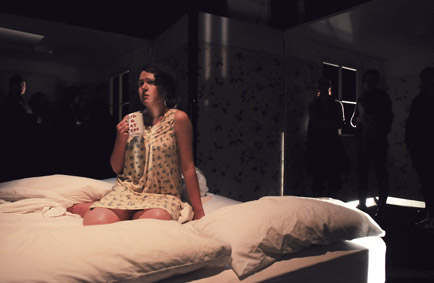
Clare Britton, Hole in the Wall, Performance Space
photo Heidrun Löhr
Clare Britton, Hole in the Wall, Performance Space
hole in the wall
Matt Prest and Clare Britton’s Hole in the Wall is above all a uniquely engaging sensory experience. In four groups of 10 we are ushered into small wall-papered, low-ceilinged rooms in the performance space. The door slams shut behind us, the windows are closed. The room moves. We move to keep up (the rooms are on wheels, we are walking on the performance space floor). We have no idea where we are. The room stops and we are plunged into darkness from which emanates an anxious male voice bewailing lost opportunities, uncertain futures and the relative pleasures of mortality. Lights up and we’re on the move again. The doors open and we face a bed and the other rooms and our fellow audience—we’ve formed a house. A woman struggles with a mattress as if being devoured by it, crying for help until interrupted by her male partner who doesn’t get this game (which is perhaps little different from the anxious musings to which we’ve just been submitted). They settle down, murmuring further anxieties in their restless sleep in an off-kilter dialogue. That’s how the show works, without giving away too much more, save that the rooms are locked in other configurations and that the couple display their anxieties in monologues, literally running arguments, a dance (part erotic, part threatening) and some nervous partying.
At the core of this couple’s anxieties are dreams of perfection pitched against the blandness of contemporary living and complicated by communication problems. Each performer evinces a comfortable physical presence, wandering among us, appearing through a window, darting through slammed doors. Vocally though they’re less comfortable, Britton too loud in what is after all an intimate space, Prest a tad over-nuanced in his delivery and both slipping into conventional acting intonation when they need to find a performative voice equal to the strange world they have created spatially. This problem is amplified by a tame script that while calculatedly deploying the cliches of domestic argument and everyday existential crises lacks the specificity and poetry with which, again, to match the distinctiveness of the rest of the artists’ creation. The ending too is sentimental: given the multiplying tensions and outpourings of angst, it’s too easily resolved. I wonder also, about our role as audience, simply occupying rooms like ghosts or unacknowledged guests (save in the party scene). For all this, Hole in the Wall remains a memorable experience, part fun disorientation, part Bachelard-on-wheels and definitely worthy of a longer and more developed life.
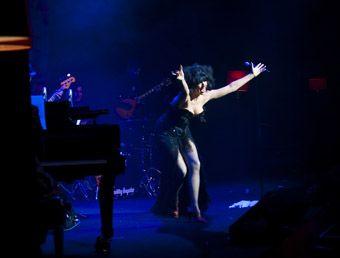
Meow Meow at Late Night Lounge, Sydney Opera House
photo Justin Malinowski
Meow Meow at Late Night Lounge, Sydney Opera House
meow meow: meow to the world
Meow Meow was in town, “back by her own demand”, with a return season of Meow to the World: Crisis is Born, a scabrous out-of-schedule Xmas celebration of the Global Financial Collapse. Compared with her other shows, where her high maintenance neediness (it’s still here) dominates, this Meow Meow is up there with Stephen Colbert of the Colbert Report, walking the satirical knife edge of simultaneously playing out and undercutting the kind of vicious selfishness that free market narcissism yields, not least during economic downturns. She provides the flowers for the audience to throw for her sumptuous, gorgeously frocked opening but then commences to savagely cost-cut, complaining (“Did anyone bring any atmos? Do I have to do everything!”; “No smoking? I might as well have brought an extra large Ventolin), stripping herself and her band of their clothes (“the Opera House cut the dry-cleaning budget”). She steals drinks and food from the audience (“Just looking for a cheese platter. The Opera House didn’t feed us”) and introduces three local youngsters (“the orphans—we ordered three”). These she then ruthlessly exploits, bullying them through “My Favorite Things” and “Silent Night” before propelling them into the audience to beg for money.
But there are more rewards than clever satire as dark songs like the Dresden Dolls’ “Missed ME” and Nick Cave’s Red Right Hand deepen the mood, while more buoyant classics, art house and popular, reflect the mood swings of our times. Meow Meow is in more than excellent voice, the band, led by New Yorker Lance Horne is top notch and I leave Meow to the World heartened that cabaret can still bite. Meow to the World: Crisis is Born premiered in New York in 2008 and won Best Cabaret in the Sydney Theatre Awards for 2009.
the folding wife
A very welcome Mobile States tour of The Folding Wife is taking this inventive and culturally idiosyncratic production to a wide audience. Jan Cornall’s review of the original production, “One woman in many: survival and resilience” (RT 79) says it all: “The audience is left with sensual impressions of lace and blood, laughter and sorrow, ‘roasted corn on Sundays, coloured parasols reflecting the white heat of the sun’ and a heritage of women, strong, beautiful and dignified, who have survived on memories of a glorious past or a projected future as they bent and folded into themselves a nation’s pain.” I recommend you read the whole review.
The particular power of The Folding Wife emanates from the construction of the work as a living installation—Valerie Berry (deftly playing the female generations of one family) is casually sculpted and adorned into shape by two on-stage artists using clothing, props and projections. It’s as if we are witnessing the forces of family, history, politics and culture (Filipino and then Australian) shaping a life which, in the end, refuses manipulation. Strong physical gestures (an Imelda Marcos shoes routine is a highlight), sensual, if sometimes alarmingly visceral screen images (we simultaneously witness their making), and lateral story-telling align with a poetic text to yield a curiously contemplative experience—of a work of art in more than a simply theatrical sense.
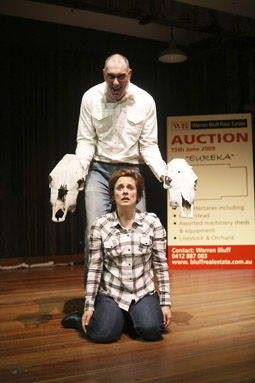
Stefo Nantsou, Lindy Sardelic, Burnt, Zeal Theatre
photo Tracey Schramm
Stefo Nantsou, Lindy Sardelic, Burnt, Zeal Theatre
burnt
To see the Zeal Theatre trio performing Burnt is to witness a company hard at work, as a very good band (whose instruments double as FX devices), amiable hosts and excellent actors, initially as a farming family rounding up sheep and then, virtuosically, adding a large number of other characters from a drought-stricken rural community. The story is sadly predictable if rooted in fact (the company had done on-the-ground research into growing poverty, probable loss of an inherited property, desperate measures, new multicultural pressures, family tensions and the potential for suicide) but is written with wicked wit and a touch of pathos and performed with remarkable precision—just the right amount of idiosyncratic personality touches and the capacity to shape the multitude of scenes like a team of adroit film editors. Other playwrights could learn much from them. This is bare bones theatre of the highest order—a few sheep and cattle skulls litter the stage with a car seat and an oil drum; the rest is embodied in these truly engaging performers.
fox
Writer Margaret Wild and illustrator Ron Brooks’ Fox is an award winning picture book for young people about a bushfire-injured magpie aided by a one-eyed dog. Their relationship is sundered when a fox promises more than the dog can offer. The book’s storytelling is very spare, while the opera version is theatrically and musically elaborate. An ever present soprano (her character otherwise undefined) is the only singer and delivers the narration (Sarah Jones has a fine voice but is at her best in lower registers where consonants remain intact) while three performers enact the animals, but in several and inevitably confusing modes—as actors, as puppeteers and in projections.
Unlike Red Leap’s adaptation of Shaun Tan’s The Arrival (RT95) which was for the most part faithful to the author’s aesthetic, this account of Fox further complicates things by gendering the scenario—the fox is a handsome, swaggering male seducer and magpie a helpless female, with their stylish costuming taking us a long way from the book’s plain, bush reality. While there are moments of evocative puppeteering, brisk action and a dash of comedy from the dog, each episode is framed by song in the operatic mode (not always immediately memorable) yielding longeurs that flatten the drama, despite director Kate Gaul’s inventiveness. There is some attractive writing from composer Daryl Wallis but it’s not integrally dramatic, dominating rather than serving the story. For bringing new opera to young audiences, Fox is to be admired, if in the process revealing the challenges of adaptation.
–
Sydney Dance Company, New Creations, Are We That We Are, choreography Adam Linder, dramaturgy Sally Schonfeldt, costumes Jordan Askill, lighting Nick Schlieper, sound Adam Synnott; Sydney Theatre, March 23-April 10; Hole in the Wall, concept, performance, design Matt Prest, Clare Britton, concept, director Hallie Shellam, text Halcyon Macleod, lighting design Mirabelle Wouters, concept, set Danny Egger, sound, animation James Brown; Performance Space, CarriageWorks, May 26-29; Meow Meow, Meow to the World: Crisis is Born, The Studio, Sydney Opera House, March 2-14; Urban Theatre Projects, The Folding Wife, performer Valerie Berry, writer Paschal Daantos Berry, director Deborah Pollard, design, multimedia Anino Shadowplay Collective, lighting Neil Simpson, Performing Lines for Mobile States; Performance Space, CarriageWorks, Sydney, May 19-22; Zeal Theatre, Burnt, writer-performers Tom Lycos, Stefo Nantsou, performer; Lindy Sardelic, director Stefo Nantsou, music Tom Lycos, Wharf 2, Sydney Theatre Company, May 25-28; Fox, Monkey Baa with Siren Theatre Co, director Kate Gaul, composer Daryl Wallis, performers David Buckley, Jay Gallagher, Sarah Jones, Jane Phegan, designer Gabriela Tylesova, lighting Designer Luiz Pampolha, Seymour Centre, Sydney, April 10-17
RealTime issue #97 June-July 2010 pg. 37
© Keith Gallasch; for permission to reproduce apply to realtime@realtimearts.net
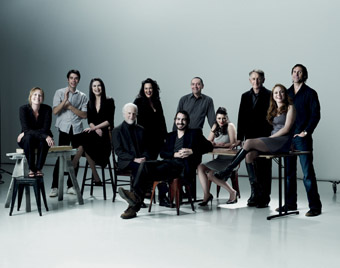
The Actors Company (2008)
photo Jason Capobianco
The Actors Company (2008)
JAMES WAITES’ PLATFORM PAPER, “WHATEVER HAPPENED TO THE STC ACTORS COMPANY?” IS A RARITY IN AUSTRALIAN WRITING ABOUT THE THEATRE. IF MORE LIKE INVESTIGATIVE JOURNALISM (WAS THE ENSEMBLE KILLED OFF?) THAN FORMAL ESSAYING (IF NOT WITHOUT CONSIDERED THESES) IT’S WRITTEN WITH A DOCUMENTARY MAKER’S ATTENTIVENESS TO HIS SUBJECTS (DRAWING ON NUMEROUS INTERVIEWS) AND A NOVELIST’S NARRATIVE DRIVE (WHO DID IT?). BUT WHAT GIVES THE PAPER ITS PECULIAR POWER IS WAITES AS WITNESS.
In a career that has included being an arts documentary script writer for ABC radio, a part-time lecturer in drama, research assistant to Rex Cramphorn, editor of Theatre Australia and, notably, reviewer for the National Times, Sydney Morning Herald and now on his own website (www,jameswaites.com), Waites has closely observed for over 30 years plays, careers and movements. In that time he has seen ensembles and other collaborative efforts (Australian Nouveau Theatre, Lighthouse, Gilgul, Keene/Taylor Project, Paris Theatre) come and go and has a clear understanding of their inherent complexities, of the differences between top-down and bottom-up models and of many a contemporary actor’s desire to be a collaborator—more than “a gun for hire.” The essay’s dynamic functions around these often binary complexities.
STC artistic director Robyn Nevin’s admirable desire was to create great acting opportunities of a kind difficult to achieve in the standard show by show theatre model. But is a large state theatre company the place to do it? Waites posits contradictions in Nevin’s handling of the ensemble, some circumstantial given the nature of the institution that housed it, others seemingly at odds with her own experience. As a young actor in the 70s Nevin had been part of the Performance Syndicate, an intensely collaborative ensemble directed by Rex Cramphorn. But, given her wider responsibilities for the STC, she could not lead the Actors Company nor act with it. Instead, after a failure to appoint a leader, three successive ‘managers’ were appointed for the ensemble. Waites writes, “This failure to find a ‘first among equals—should that read ‘to decide between democracy and autocracy?’ was to underpin many of the conflicts that lay ahead.”
A consistently top-down approach meant that seasons were programmed and plays cast without consulting actors, let alone discussions shared about direction and design. Some guest directors had never or only briefly seen the actors at work, and similar casting decisions were made from show to show. Even more critical, from the beginning there seems to have been no discussion between Nevin and the actors about precisely what their purpose was as an ensemble.
Nevin’s closest contact with the ensemble came with directing Mother Courage: “despite a major incident during rehearsals, by opening night [in May 2006]…everybody on stage looked good.” After several frustrating months the actors had arranged their own meeting and Nevin wandered into it—a tense encounter ensued: “[T]here is no avoiding the brutal fact that something terrible had happened that Easter Monday. It was not immediately apparent, but a wedge had been driven between Nevin and the actors. After so much work in getting the ensemble started, Nevin could not get over the feeling she had been profoundly betrayed. It seemed to her that she had given birth to a spider that ate its own mother.”
Waites reports that in interviews Nevin was “no less critical of herself” than he has been in his essay. Her belief that an ensemble forms and evolves through working together, not through talk, had proven problematic. Company spirits however were lifted by Barrie Kosky who, if “leading from the front”, offered “intense participation” in the creation of the epic, The Lost Echo. Waites praises Nevin: “Few in Australia had given Kosky this kind of unflinching support.”
Casting of a fixed number of players (Waites calls it the Holy 12) proved to be problematic. Kosky would have liked two senior female actors in the ensemble, Benedict Andrews a range of guest performers to keep the situation fluid. But in 2007 Andrews’ production of Patrick White’s The Season at Sarsaparilla, showed that fixed numbers and gender constraints “can occasionally produce an unexpectedly successful result.” Again the ensemble was working with an auteur, and on a complete version of the set from the first day of rehearsals. Responding to Andrews’ very precise demands, “individuals felt it safe to take risks. They would try things they would never have dared try in a one-off production.” As with The Lost Echo, the combination of auteur and ensemble appears in Waites’ essay as a fruitful model, although with provisos introduced by the company’s more complicated experience with Andrews on War of the Roses, dealt with later in the essay by Waites.
Waites’ praise for The Season at Sarsaparilla is considerable, especially if we think about it in terms of STC’s exports to New York—Hedda Gabler, A Streetcar Named Desire. “If there was ever an Australian production that deserved to be seen by the rest of the world, it was [The Season at Sarsaparilla]. For me in my 30 years of following and writing about the making of Australian theatre, this production represents, both culturally and creatively, the highest point. An onstage Everest.” This one show alone makes Waites grateful for the existence of the Actors Company.
Difficult times followed: problems with directors, serious arguments, resignations, illness. But the work kept being made and the pressures of back to back productions alleviated. Waites’ deftly sketches ensemble members: Pamela Rabe as the “nurturing ‘wolf mother’”, the experienced, inspiring older men, the ‘malcontents’ (a complex picture) and offering glimpses of other members. Rabe’s direction of Daniel Keene’s Citizens (with Tim Maddock directing Soldiers in the other half of the double bill, The Serpent’s Teeth) appears to have been a relief for the company, being directed by one of their own and in terms of their own working method.
So why didn’t the Actors Company survive beyond three of its projected five years? The new artistic directors, Andrew Upton and Cate Blanchett thought it financially unsustainable, but even if they had the money they had reservations, “we thought it was too sacred.” Like some others, Pamela Rabe, for whom working as part of the ensemble had been “the most important and electric experience of my professional life,” was left with a sense of unfinished business.
Waites ends his paper with core lessons “any state theatre company would do well to heed if it set up an ensemble within a broader company framework.” He doesn’t say they shouldn’t do it, although the essay points towards very likely intractable institutional problems.
First, he recommends stable leadership that will provide assurance and continuity. Within this framework, guest directors need to fit “the ensemble’s over-arching goals.” These, of course, are the first things that need to be established. Presumably Waites would want the role of the actors clarified—what kind of ensemble will they be getting themselves into, what precisely will be their creative contribution? Secondly, he argues for more flexible ensemble numbers—although he doesn’t address how this might affect the very sense of ensemble that comes from familiarity and continuity. Thirdly he recommends alternative activities for ensemble members—regular skills classes, small-scale experimental works: “opportunities to explore ‘simplicity’ and ‘intimacy’” as opposed to constant involvement with “juggernauts.” To do this he might have added directing opportunities given his what-if support for Rabe as potential Actors Company leader (a huge challenge, mind you, for a beginner director).
By the time of the War of the Roses, the Actors Company was far from its original self, featuring guest performers including Cate Blanchett and only small roles for some long term members, but there was just enough of a rewarding sense of continuity, not least evident in a scale of vision rarely seen in this country, expertly inhabited and realised by its actors. Perhaps what we witnessed over the years was in fact a directors theatre enabled by a variably willing ensemble. Without doubt the supreme performances of the three years were seen in the productions by Kosky and Andrews, who each, at different points in the essay, wonder about the role of the director—Kosky about an inherent Australian resistance to the strong director and Andrews about the best work coming from strong leadership. The degree of creative freedom an actor has within an ensemble led by an auteur is likely to vary as enormously as the differences between auteurs. Some are more authoritarian or democratic than others—but, essentially, the vision is the director’s. Other kinds of ensemble, not part of larger institutions, are about creative power sharing—the director’s vision is important, critical even, but subject to creative cooperation, even compromise. The Actors Company is a very particular case, whereas in Lighthouse, say, under Jim Sharman, the ensemble was the company, not one company inside another, but the lessons can still apply.
Waite’s essay is eminently readable, the writing relaxed and evocative, the tone aptly personal as he draws on his considerable experience of theatre and his judgments for the most part are fair and considered. Occasionally the writing is calculatedly dramatic, tipping into hyperbole, making the reader wary: “…the lines of communication were simply not as open and flowing as they needed to be. Sadly, it was this that triggered the descent into the maelstrom that occurred over the course of the next two productions and left the Holy 12 permanently damaged.” This kind of narrative forecasting is also not uncommon, if adding a certain novel-ish suspensefulness.
Like much else in Australian theatre history the Actors Company is unlikely to be documented anywhere else soon, so this perceptive, intimate essay is more than welcome as a critical homage, a tribute to a partly successful, sometimes highly significant venture into too rare a form in this country, the ensemble.
James Waites, Whatever Happened to the STC Actors Company?, Platform Paper No 23, Currency House, Sydney, April 2010
RealTime issue #97 June-July 2010 pg. 38
© Keith Gallasch; for permission to reproduce apply to realtime@realtimearts.net
Lawrence English
photo Pawel Kulczynski
Lawrence English
WHEN I ARRIVE AT THE HOME OF LAWRENCE ENGLISH, THE PLACE IS LITERALLY PULSING WITH THE DRONE OF A FLOOR SANDER GRINDING BACK THE FRONT ROOM FLOORBOARDS. THE DEAFENING DIN MIGHT SEEM A WEIRD INTRODUCTION TO AN ARTIST KNOWN MORE FOR SUBTLE SONIC MINIMALISM, BUT FOR ME IT SERVES AS A REMINDER OF THE TIME WHEN I FIRST ENCOUNTERED ENGLISH, BACK IN THE STRANGE DARK ERA OF 1990S INDUSTRIAL MUSIC IN BRISBANE. SINCE THEN HE HAS GONE ON TO BECOME ONE OF AUSTRALIA’S KEY MEDIA ARTISTS, AND, THOUGH HIS CURATORIAL AND CREATIVE ACTIVITIES TAKE PLACE ACROSS THE GLOBE, HE CONTINUES TO MAKE BRISBANE HIS BASE.
room 40 origins
English’s sound work explores environmental and musical sources and is highly regarded for its intelligent invocation of perception, memory and space. He also curates the ROOM40 imprint, which has consistently issued an impressive array of sound-art related activities and events. ROOM40 is celebrating its 10th year, so I talked with English about the label and his thoughts about how this last momentous decade unfolded. He explained, “ROOM40 came about as a sort of umbrella organisation. I thought of it having the publishing arm, the curatorial/gallery/installation project-oriented arm and then the concert/festival part of it, with them coming together under that banner with some kind of focus. So people could have an idea of what they were going to experience or at least think, ‘I’ve gone to two other events or I’ve bought two CDs so I’ll take a risk with this one even though I don’t know who that artist is.’ In some ways it has been a process of building up that trust.”
tape trading
I ask English about his history in music distribution and he tells me about how it all started with cassette tape trading: “I got my first PO Box when I was 15, because my parents got sick of packages turning up at the house, and I was kind of paranoid about them not turning up—they were always oversized and never fit in the letterbox. In fact we only closed that PO Box this year…it felt like a real cutting off. You should have seen the lady at the post office when I went to close it, I was like, ‘I’m really sorry, I’m going to have to close this box now.’ She was really upset…Tape trading was a fundamental part of how I got into music. You’d basically send off a bunch of stuff, and cross your fingers a package was on its way to you…What’s so interesting now if you want something, even something that’s out of print, you type it into Google, or iTunes, or whatever, and it’s there, and you download it, and you’ve got it in 10 minutes. I remember, when you started reading about a band, first you had to find the person with the demo tape, trade with that person…it could be a process of like 18 months before you finally heard the band! You’d built up so much anticipation by then. But when you finally got it…you’d spent so much time invested in it, and it was so great finally getting to hear that music and say, ‘Oh these guys, they sound so amazing!’”
becoming a label
On the animating forces behind becoming a label, English nominates “the satisfaction of getting people’s work out there. Every single record we’ve put out, I can say, 100%, I have a very deep respect for. They’re essentially giving you their child, their artistic first-born, saying “Here, can you deliver this to the right ears?” English explained how he tried to express this responsibility in the creation of ROOM40’s aesthetic, which is “not necessarily a sonic aesthetic—it’s an aesthetic of the label, involving non-standardised packaging and attention to the overall presentation.” Though creating a catalogue wasn’t on his mind when he started out, “When you look at it now, 10 years later, it looks like a catalogue.”
ROOM40 covers, clockwise from top left – Erik Griswold – Altona Sketches , Tujiko Noriko/Lawrence English/John Chantler – U, Luc Ferrari – Tuchan Chantal, Chris Abrahams – Thrown
archival life
The archival aspect of ROOM40 “has always been a big part of it” according to English, “because, in traditional music circles, in six months’ time an album’s irrelevant. Ideally what I wanted to do was have an album where you could come to it in five or 10 years and still have an engaging and meaningful experience.” He gives the example of Melbourne artist Rod Cooper’s 2006 Friction album: “it’s still current, it still makes sense, it’s still a total summary of part of the work he’s done.”
filling a brisbane gap
We discussed how ROOM40 differs from a traditional music label, and how it evolved organically. “Obviously, being [in Brisbane] in the 1990s, there wasn’t a whole lot going on. There was Small Black Box [an exploratory music series] and that was it. There wasn’t a lot of opportunity for international artists to come here. A lot of people skipped Brisbane. Even What is Music? didn’t come to Brisbane until like 2003…That has really only changed in probably the last 10 years. There was a big gap up here.
“So that was the motivation behind the Fabrique series at the Powerhouse (40 events over eight years), to try to build up the audience. I always felt frustrated at the way events featuring experimental music felt a bit…exclusive. I just didn’t agree with that. As far as I was concerned, you could be into pop music, and that wouldn’t matter; you’d come to one of these events and, if it was articulated to you in the right way, you’d give it a try and maybe like it, maybe not, but at least you had the experience. I was definitely not part of the scene, because I was interested in a lot of other things as well, like punk rock and hip hop. I thought “I love experimental music…if I can come to it, surely other people can. And obviously that happened, look at the way things have developed in Brisbane. Take Audiopollen (the weekly underground music club 2007-2009) for example. You can see that the audience has grown massively.”
As part of the ongoing conversation with that growing audience, this year also sees the fifth anniversary of Open Frame, ROOM40’s annual festival (Brisbane Powerhouse, Oct 6-7), which this year will also present an event in London in November. Legacy projects involve the reissuing of some of the label’s albums on vinyl, such as Ben Frost’s classic Steelwound (2003) and Chris Abrahams’ Thrown (2005). There are other interesting plans afoot.
a guide to site-listening
English explains that ROOM40 is to release its first book through the label, a site listening guide—“Rather than sight-seeing, I’m asking people to site-listen.” The book’s introduction promises not “an exhaustive list of listening locations around Brisbane,” but rather, an offer of “possible encounters, personal reflections and suggestions as to what sounds might be worth listening out for in this city.” It’s easy to see how this publication, with its “open-ended invitation to listen to the spaces you might find yourself in,” has evolved naturally out of both the artist’s creative explorations of sonic environments, along with ROOM40’s ear-opening agenda. As Lawrence English explains, “it’s about privileging the ears over the eyes.”
http://www.room40.org
RealTime issue #97 June-July 2010 pg. 39
© Danni Zuvela; for permission to reproduce apply to realtime@realtimearts.net
Alex Pozniak, Andrew Batt-Rawden
photo Emily Sandrussi
Alex Pozniak, Andrew Batt-Rawden
BEING MORE THAN AN EMERGING CONTEMPORARY MUSIC ENSEMBLE, CHRONOLOGY ARTS IS COMMITTED TO BUILDING NEW MODELS FOR PERFORMANCE, FUNDRAISING AND COMMISSIONING. HAVING BEEN IMPRESSED BY TWO OF THE ENSEMBLE’S ‘GENRE-BUSTING’ CONCERTS, ONE OF THEM IN THE RECENT ISCM WORLD NEW MUSIC DAYS FESTIVAL, I MET WITH DIRECTORS ALEX POZNIAK AND ANDREW BATT-RAWDEN, WHO ARE BOTH IN THEIR 20S AND BOTH COMPOSERS, TO LEARN WHAT STRATEGIES THEY WERE EMPLOYING IN MEETING THE CHALLENGES OF SUSTAINABILITY FOR ‘CONTEMPORARY CLASSICAL’ MUSIC.
The ‘genre-busting’ tag became a running gag in our meeting. Recently the pair had been advised that if they wanted arts funding, that’s what they’d have to be—genre-busting. From what I’ve experienced of their work, they already are. In Gradations of Light, large video projections synced with performances, musicians moved though the audience and three electric guitars powered Pozniak’s Illuminations (www.realtimearts.net/article/92/9553). “We’ll just have to be more genre-busting,” Pozniak says.
Chronology Arts has quickly carved out a niche. Batt-Rawden says that “since the Seymour Group died” Ensemble Offspring, with its contemporary compositions and invaluable forays back across 20th-century musical movements, have occupied centre-stage, “but we concentrate on getting the really new, new music” with which to attract audiences and donors.
While Pozniak and Batt-Rawden see arts funding as part of Chronology’s future, they’re working hard at finding alternative income sources and Batt-Rawden has already had some success. Early concerts relied on ticket sales, small payments to musicians (these have grown, they say), one-off composition grants for contemporary works from the Sydney Conservatorium of Music (“really designed for groups like us”) and, significantly, private philanthropy. Batt-Rawden says that Chronology Arts has been quite reliant on a few key donors giving from $2,000 to $5,000 each. Other strategies are event-based, like private performances or an art auction expected to raise $20,000. In June, Chronology Arts is holding a private dinner in a restaurant for its supporters at $200 head with three small installations plus selected food, wine and music—”which we’re composing right now!” The diners will be current and potential commissioners. It’s ironic, jokes Pozniak, “contemporary music is not usually seen as aiding digestion.”
Chronology Arts, In Focus, 2009
photo Emily Sandrussi
Chronology Arts, In Focus, 2009
Batt-Rawden’s energies are currently focused, among other things, on the Commissioner’s Circle, which he describes as “a unique marketing concept to promote the concerts as well as raise funds for composers.” How does he find the potential commissioners? “Networks are very important,” he replies, “and chance—I talked to someone about the idea after a concert and they offered me a cheque.” He adds with a grin that “the real secret is home-made pasta dinners” for prospective donors. Previous fundraising experience, including with Song Company, has clearly given Batt-Rawden the confidence to push ahead in an area which might make many young artists wary. But structure helps: the group’s Commissioner’s Circle gatherings bring together composers and donors as potential partners.
I ask if people who become commissioners are likely to repeat the experience, as they do, say, in the visual arts. “It’s the whole idea,” says Batt-Rawden, “A commission is a long-standing relationship.” For that reason he wants a younger generation to take on the commissioning role and provide long-term continuity: “Perhaps we’ll have to call them non-executive producers,” he quips, alert perhaps to the need to find a seductive contemporary label.
As composers themselves and with empathy for others grounded in their own experiences, how do Pozniak and Batt-Rawden fare with commissions? “My first one was $50 a minute for a string quartet,” recalls Batt-Rawden. “I’m at the lower end, with the price gradually rising.” “It’s half paid, half unpaid,” says Pozniak, “which I don’t expect to change any time soon, especially with Chronology Arts [Laughs]. A Melbourne Symphony Orchestra development project had a fee, not a great one, but it was to write for an orchestra! If in 2012 I could make $10,000 for three works, that would be good; the equivalent of a day’s work a week. I write four or five pieces a year and, to survive, teach at Sydney University, the Conservatorium High School and McDonald College. And now I’m being paid by Chronology Arts. But Andrew does more work while I’ve been busy composing.”
Although Batt-Rawden is on a “part-time wage for 70 hours a week” with Chronology Arts, he clearly relishes his role: “I see fund-raising as just like sales with targets and deadlines and a strategic approach. We’re not begging artists.”
As for their group’s investment in their concerts, Pozniak explains that “some are more extravagant in terms of the number of performers involved and what the incidentals are in terms of lighting and cross-artform components. So if we get worried about money we’ll tone down the instrumentation.” Batt-Rawden adds that “each event costs $5,000 to $15,000, with a lot of in-kind support and not a lot of money in advance—we have to foster relationships early so come crunch time donors are already committed.”
We come back to the issue of how to seek out commissioners. Batt-Rawden emphasises that “Commissioner’s Circle is not just for Chronology Arts. We’re interested in securing commissions for, say, Song Company and very interested in ‘genre-busting’ cross-artform temporal art commissions that don’t only involve composers.” Pozniak points to a problem and its solution: “A lot of people don’t check out new classical music concerts because of the outmoded format, so we bring in other elements to make the performances more appealing, potentially securing another audience that’s supportive of other art forms.” Batt-Rawden declares, “We’re market-conscious artists!” Pozniak says, “We have to respond to tech advances or we’re not current, but there are ways of being current and genre-busting without selling out. We’re opening our minds laterally to assimilate what’s out there.”
I ask how supportive Chronology Arts finds Sydney. Pozniak thinks that “being youngish we’re a kind of link between the Con and Sydney Uni—the opportunities they offer—and the world outside. But we had to build our own support. Just because you’ve graduated, Ensemble Offspring aren’t going to commission you. We wanted to create opportunities for ourselves but also for performers and composers at the Con with a lot of potential, if they want to tap into the contemporary thing. Mostly they don’t, but it’s curious, the second-years I teach are very proactive. They look up to what we’re doing, we talk aesthetics and composition and they’re fired up and they do their own things. We’re catering for graduates. We’ll also host a concert of undergrad works in Sydney Uni’s Verge Arts Festival. It’s a kind of mentoring.” Batt-Rawden agrees, “Sydney’s great at monuments but who’s looking after the small fry and the estuaries where the arts really develop? It’ll become easier for emerging artists when we get smarter at marketing and networking and philanthropy and online delivery.”
Shortly after our meeting it was announced that Chronology Arts had been awarded a Sydney City Council partnered Arts Bunker residency at Sydney University’s Seymour Centre, a two-year program with office space and “mentoring in all areas of arts management.”
Forthcoming Chronology Arts concerts include the remarkable pianist Zubin Kanga in Piano Inside/Out Verbrugghen Hall, Sydney Conservatorium of Music, July 2, in a program including works by Liza Lim and Drew Crawford. On July 28 Kanga will join another Australian ‘international’, soprano Jane Sheldon, in Chiaroscuro featuring Apparitions by George Crumb and Sonetos del amor Oscuro by Rosalind Page. Pozniak is looking forward to a September 15 concert featuring Chronology’s core ensemble (flute, Jane Duncan; cello Eleanor Betts; saxophone Andrew Smith; clarinet Toby Armstrong; viola Luke Spicer; and piano Jacob Abela, with conductor Geoff Gartner) and compositions by Pozniak and Batt-Rawden and others, a reminder, he says, that despite the large scale of some of their concerts “we are an ensemble.” It’s an ensemble with a distinctive vision, one that can only strengthen Sydney’s fragile new music ecology.
www.chronologyarts.net
RealTime issue #97 June-July 2010 pg. 40
© Keith Gallasch; for permission to reproduce apply to realtime@realtimearts.net
Mike Majkowski, Mike Cooper, See Hear Now
photo Glen O’Malley
Mike Majkowski, Mike Cooper, See Hear Now
WHILE IMPROVISATION IS NOT A FAVOURITE OF MINE, THERE WERE ENOUGH MOMENTS DURING THE MUSIC CENTRE NORTH QUEENSLAND’S SEE HEAR NOW MUSIC-DRIVEN, MULTI-ARTFORM FESTIVAL WHEN ARTISTS AND THEIR MEDIA ‘CLICKED’ BEAUTIFULLY AND THE JOY OF THE ARTFORM CAME ALIVE. ANY RESERVATIONS I HAD WERE MAINLY TO DO WITH THE ‘ART’ OF COLLABORATION SO ESSENTIAL IN IMPROVISATION—WOULD ARTISTS REALLY LISTEN TO EACH OTHER; USE SPACE AND SILENCE AND TIMING TO INTERPRET WHAT WAS BEING SAID; AND ADD TO THE MOMENT RATHER THAN SIMPLY CREATE PARALLEL OR EVEN UNRELATED PATHS?
My reservations however were not shared by the audience. Right from opening night there was an air of excitement and expectation at what might eventuate. Although music-driven, each concert included a component of conventional visual arts, film, photography or projection plus movement or dance or theatre. Performers flown in for the weekend were all involved in music technology in some way: Mike Cooper, slide guitar; Grayson Cooke, live audio-visuals; Rod Cooper, original instruments; Mike Majkowski, bass; and Erik Griswold, prepared piano.
The most satisfying collaborations were those involving Gold Coast-based performance poet Jayne F Keane. Her theatrical skills supported entertaining narratives, at times pithy or poignant. When her collaborators entered her space, the improvisations came alive.
Keane and technologist/composer Steven Campbell presented the most polished improvisation of the festival, They Say Drowning Is Like a Dream. The result of an ongoing collaboration, it is perhaps unfair to single out this work given the scaffolding that time and familiarity brings. They Say Drowning…was well paced and the media (poetry and sound bytes) worked well together, creating a whole that was more powerful for its pace, cohesion and sense of purpose.
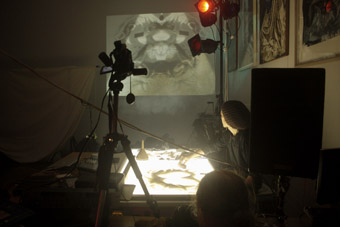
Tom Jefferson, See Hear Now
photo Glen O’Malley
Tom Jefferson, See Hear Now
Visual artists at the festival seemed largely impervious to what was going on around them, and even some musicians and dancers whose art forms are rooted in sound, space and silence appeared to lack the ability to work with co-performers. An interesting performance where more space would have enhanced the work involved a mandala created by emerging artist Tom Jefferson, drawing in sand on a light box. The patterns were projected on a wall, and then processed through an effects box by lighting expert Mark Bancroft. Initially the kaleidoscope-like shifts lifted the action, giving it another dimension. However, too many changes and gradually too many effects weakened the impact, leaving no space to savour or even retain a connection with the physical performers. The projections became a distraction rather than a complement to the whole.
Where there was a discernible connection between performers, the results were exciting. Percussionist Ian Brunskill played with exceptional intelligence in the work Frock, using a huge array of percussion sparingly and to good effect. At the climax of this seven-part improvisation, built around Keane’s poetry and readings from 18th-century newspapers, Brunskill smashed sheets of glass and china plates. Keane followed up with a constrained poem where she lined up beer bottles as a sign of aging and loss. Theatre practitioner Mark Reed was outstanding as a sinister figure while Mike Cooper joined in with an inspired musical commentary on both Reed’s characterisation and Keane’s poetry, again with intelligence and insight, slipping layers of slide guitar riffs and motifs into the improvisation space.
The festival’s visual arts curators, Sue Tilley and Selena Smith, engaged imaginatively in many of the collaborations, notably in the opening piece, The Chance in Bowing, with Griswold, Majkowski and Cooper. They occupied the space almost as fully as the dancers (Manu Reynaud and Rebecca Forde), splashing paint across, under and around a veil of fabric stretching from one end to the other. In Frock, Tilley, Smith and Alison McDonald created an ‘haute couture’ outfit on a live model using sheet music.
Festival director Michael Whiticker’s City Debris opened powerfully with Griswold’s performance on prepared piano both arresting and inviting. Whiticker played with samples and live percussion while Cooper coaxed some wonderful sounds from a hurdy-gurdy-like banjo invention which had two necks and various protruding pieces which he bowed, plucked, hit or scraped. Artists Therese Duff, Alison McDonald and Michele Deveze painted “an abstract of light and shade” using crayon and black paint on a long length of off-white cloth wound around movement artists Thalia Klonis and Caitlin Whiticker. Again this was an intelligent improvisation, the movement artists measured and understated and—unlike some others—not preoccupied with being centrestage or dance-like. The relationship between sound and movement was discernible but it was not until the daubing of the visual artists on the cloth became part of the movement that the whole work gelled, ebbing and flowing organically.
A breathtaking bass solo by Mike Majkowski, originally a jazz player, was the result of his teaming up with Grayson Cooke who used “an audio-reactive patch to create live, abstract ‘visual music’ triggered entirely by Majkowski’s bass playing” (program notes). The visual content for this performance played second fiddle to the bassist’s virtuosity which held everyone rapt. Majkowski bowed, plucked, struck and scratched all over the instrument, using tools such as wooden chopsticks, pegs and other implements to explore sound and silence. It was a very impressive performance, deserving of the long appreciative silence from the audience before they applauded.
In Trystero System (explained on the web as a loose grouping of musicians dedicated to free improvisation over dance beats of some kind), Grayson Cooke teamed with Mike Cooper to present an improvisation of processed slide guitar sounds and “deconstructed jungle beats.” Cooke’s work appeared to be political: his images, projected through a matrox box across multiple screens, featured Japanese anime dolls in skimpy outfits with fly-eye sunglasses and botoxed lips —a comment perhaps on the cruelty of popular culture and stereotype distortions, with Cooper’s Hawaiian guitar reinforcing the allusion. To the side of the performance area fibre artist Michelle Hall quietly created an incongruous ‘soft sculpture’ accompaniment, unravelling spools of thread of different colours and weights which fell like lace on the ground. She then wound the threads ever more tightly around screen legs and other bits of furniture and would have continued, in her own world, except that everyone else had finished. Trystero System’s symbolism proved thoroughly provocative and intriguing.
Unrecognised and unrewarded by funding bodies, Music Centre North Queensland is struggling to survive on ever-diminishing operational finances, so this exceptional festival could well prove the bitter maxim that art still flourishes under adversity. It is a tribute to the passion of the two part-time staff who run the centre and organised the festival, that such a host of interesting and challenging artistic events were gathered under one banner. If and when funding dries up, regional Queensland and avant garde art practitioners will possibly lose a very rich and significant cultural resource.
Music Centre North Queensland, See Hear Now; School of Creative Arts, James Cook University, Townsville, April 16-18
RealTime issue #97 June-July 2010 pg. 42
© Justine Wilkinson; for permission to reproduce apply to realtime@realtimearts.net
Malcolm Riddoch, Decibel, Still and Moving Lines
photo Gemma Pike
Malcolm Riddoch, Decibel, Still and Moving Lines
PERTH AUDIENCES LIKE TO THINK OF THEMSELVES AS UNBEARABLY ISOLATED, SO WHEN LOCAL ENSEMBLE DECIBEL DECIDED TO PERFORM THE COMPOSITIONS OF ONE OF THE CANONICAL FIGURES OF EXPERIMENTAL MUSIC, ALVIN LUCIER, THEY ATTRACTED A GOOD CROWD. LUCIER WAS A GOOD CHOICE FOR THE FIRST OF DECIBEL’S COMPOSER SERIES IN THIS REMOTE CAPITAL, BECAUSE HIS WORK LENDS ITSELF TO THINKING ABOUT WHERE YOU ARE IN BOTH SPACE AND TIME.
After the lateral philosophies of the late New York school, Lucier deconstructs the usual arrangement of composers, performers, listeners and sounds. It is as if his pieces are more realised than interpreted, demonstrated than performed, as sine wave oscillators collide with clarinets, voices echo into nothingness and a Beatles melody is played through a teapot.
Nothing illustrates Lucier’s special place in the history of the acoustic arts more than the first piece performed here, Shelter (1967). Malcom Riddoch manipulated the difference between sounds that could be heard through the venue’s walls and their amplification inside, picked up by contact microphones placed around the building. As one sound mirrored another, the walls seem to dissolve in the mix. What Lucier has designed here, through the slight phase change between outside and inside, is a way for an audience to become aware of how our ears construct the spaces around us, and Riddoch’s achievement is to orchestrate the resonance of these spaces. Lucier’s pieces realise the simplicity of sound’s presence, beyond the range of the home stereo, bringing to his work a quality as timeless as the idea of the room itself.
So in the classic I am Sitting in a Room (1970), the sound of a recorded voice is played back and recorded again and again, until the recording is muffled by its own resonating, spatial echoes. Here the former West Australian newsreader Peter Holland came out of his ABC studio to bring the piece a particular resonance for its local audience, his familiar voice becoming unfamiliar as it diffracted into space. In these early pieces the room itself is an instrument, while later Lucier works turn to the sine wave oscillator as an instrument, combining it with the clarinet, flute, saxophone and piano to investigate tonal relationships. Decibel’s program was largely made up of these later works, in which the appearance of classical instruments alongside the purity of an electronically generated pitch rendered them grotesque, the human breath a distorted and messy medium with which to investigate the greater goals of Lucier’s spatial sounds.
Tristan Parr, Decibel, Still and Moving Lines
photo Gemma Pike
Tristan Parr, Decibel, Still and Moving Lines
In Memoriam Stuart Marshall (1993) sets a clarinet against an oscillator, and demands that the instrument match its pitch. Here clarinet player Lindsay Vickery struggled for some minutes to engage with the precise sound of the oscillator before meeting it with his own. As if in a colossal battle between human and machine, Vickery’s breath came to create a series of sound effects that produced negative images in the oscillations, outlining resonant frequencies that sought out an exact spatial collusion. The performance became nothing short of sensational, as the ear attended to magical shifts of pitch, tone and even rhythm that appeared as pulsing shapes shifting from one side of the room to the other. Vickery’s triumph came at a price, however, as his sweating brow revealed the frailty of the human instrument system of sound production against the cleaner, digital sound source. Lucier’s simplicity, his attendance to singular effects, appeared to edge this archaic instrument into obsolescence.
Lucier’s pieces may be better conceived as scientific experiments or works of conceptual art than as music in a compositional sense. So his commissioned Beatles cover, Nothing is Real (Strawberry Fields Forever; 1990), is here performed on piano by Stuart James and played back through a teapot, its lid lifted and replaced, as per Lucier’s instructions, by Decibel’s director Cat Hope. We are no longer listening to the famous melody, but instead to its duration and spatial presence: in Directions of Sound from the Bridge (1978), James altered an electronic tone played from a cello’s bridge to show how the shape of the instrument changes the way this tone is distributed around the space. Lights placed around the room brightened and dimmed according to the changing pitch and the cello’s sound shadow. Thus Perth was treated to a lesson in acoustic phenomena, an interrogation of the conservatism of the concert format, and an ecstatic experience of sound at its most sparse.
Decibel, Still and Moving Lines: The Music of Alvin Lucier; Western Australian Academy of Performing Arts, Perth, May 13; http://decibel.waapamusic.com
RealTime issue #97 June-July 2010 pg. 43
© Darren Jorgensen; for permission to reproduce apply to realtime@realtimearts.net
Pat Brassington, Twins, 2001, series Gentle, Fotofreo
courtesy the artist and Stills Gallery
Pat Brassington, Twins, 2001, series Gentle, Fotofreo
PHOTOGRAPHY IS ABLE TO EMBRACE A VARIETY OF GENRES AND PRACTICES. FROM JOURNALISM AND DOCUMENTARY TO THE CONCEPTUAL AND PERFORMING ARTS, FROM THE SENTIMENT OF PRIVATE PHOTOGRAPHS TO THE MASS SPECTACLES OF MEDIA AND MARKETING, IT TRAVERSES VERY DIFFERENT MEANINGS. SHOWING SOME OF THESE MEANINGS HAS BEEN THE MISSION OF THE BIENNIAL FOTOFREO FESTIVAL, FOREGROUNDING BOTH THE DIVERSITY AND UNITY OF THE MEDIUM.
The effect of its many shows in many venues is to confuse the easy categories with which we are used to classifying photographic images, so that the conceptual begins to look like documentary and vice versa. Two black-and-white exhibitions on this year’s program highlight this category confusion. One is from Tasmanian photographer Ricky Maynard and the other shows John Joseph Dwyer’s meticulous images of Kalgoorlie from the beginning of the 20th century.
At first glance, there is nothing much to see in Maynard’s show, touring from the Museum of Contemporary Art in Sydney. Portraits of Tasmanian Aboriginal people sit alongside various landscapes of the region. What brings the show to life is the information that accompanies the photographs. An image of a tree and surrounding bush is called Traitor (2007), and Maynard tells us that it marks the spot where Tasmanian chief Manalargenna made an agreement for his people to stay on the islands of Bass Strait. They were to die there, never to return to their homelands. The photograph now bears the weight of a violent history, and one’s attention is drawn to its meticulous framing and careful exposure, to the grain of the tree and tone of the shadows. In Healing Garden (2005), an image of a fenced-in garden of trees sits on a flat empty plain. Maynard writes that this surreal site is where a massacre took place. The haunting of Tasmania appears to bleed through the image, as Maynard brings his documentary mode of photography to life with conceptual information.
John Joseph Dwyer, Untitled (Mr Allum), 23 June 1908
image courtesy Western Australian Museum
John Joseph Dwyer, Untitled (Mr Allum), 23 June 1908
Different sorts of revelations take place in Dwyer’s images of the mining town of Kalgoorlie during its boom years early in the 20th century. They show some of the quaint customs of its residents, pictured in fancy dress, as well as the architecture of the city and mines that surround it. Dwyer’s work is of retrospective interest not so much for its subjects but for its photographic style. While we are accustomed to thinking of the documentary image as something of an objective record, here the perspective of Dwyer’s images anticipate the American and British periods of social realist photography in the 1920s and 30s. They are framed to give their subjects, whether people, buildings or mines, a sense of grandeur. Time allows us to see Dwyer as an artist rather than as a simple chronicler of his times.
Conceptual photographers are very aware of these kinds of paradoxes, in which the angle of the lens is warped by one’s own historical gaze. We live in an era that is overheated by imagery, in which we tend to look through photographs rather than at them. Narelle Autio brings the invisible to the fore as she packs the walls of the Fremantle Maritime Museum with photographs of flotsam and jetsam recovered from her local, South Australian beach. Collections of crab claws and coral remains are arranged in great optical patterns from floor to ceiling and photographed against a uniform white background. Lonely shoes and gloves clogged by oceanic detritus and sand appear like stains on the purity of this colour. Images of old lighters, fireworks, matches, dolls, underwear, bottles, coconuts, goggles, glasses, knives, starfish, stingrays, birds and seaweed speak of a collector who can’t leave anything out. The obsessive quality of the show contains both an intimacy and a careful objectivity, Autio handling her throwaway materials with care.
In the last FotoFreo in 2008 there was a serious absence of female photographers in the major exhibitions, but this time the gender numbers are near even. Pat Brassington’s moody composite photographs could have been taken straight from a French surrealism magazine. Her renderings of torsos, tongues and limbs in pink, brown and orange exposures have the mark of a suburban imagination gone strange. Legs suspended between floral pillows and blind mermaids sit alongside one another in an assemblage of dreamy softness. Two series of photographs, one from the 1980s and another more contemporary, share a series of motifs. The corners of rooms, blinds and curtains turn conventional spaces and objects into the haunting material of dreams.
It is difficult not to compare 2010’s FotoFreo with its blockbuster precedent in 2008. There are fewer featured shows this time, and fewer international and national names. In 2008 Edward Burtynsky’s commission to take large scale photographs of West Australian mines provoked much local discussion, as did a series of standout international shows by Roger Ballen, Chen Nong, Adam Broomberg and Oliver Chardin. It also gave locals a chance to see interstate photographers Brook Andrew, Marian Drew, Polixeni Papapetrou and Darren Siwes for themselves. FotoFreo plays an important educational function for isolated Perth audiences. The non-appearance of Jeff Wall, rumoured to be among the guests, was disappointing given the high expectations that FotoFreo has set up.
Yet the excitement of FotoFreo lies as much in the festive atmosphere created by shows organised independently around town as it does in the main galleries. During March and April it was near impossible to walk into a Fremantle cafe, restaurant or venue without encountering a series of photographs neatly placed on the wall. The flexibility and honesty of photography makes the festival a friendly one, accessible to practitioners and viewers alike. So it is that FotoFreo brings people’s eyes to a medium that is all around us and is yet rendered invisible by the same saturation, as we take for granted the most encompassing media of our age.
FotoFreo 2010, venues around Fremantle and Perth, March 20-April 18
RealTime issue #97 June-July 2010 pg. 44
© Darren Jorgensen; for permission to reproduce apply to realtime@realtimearts.net
Aspekte (included in Tableau Vivant TV), Christian Jankowski, 17th Biennale of Sydney
courtesy Klosterfelde, Berlin and Lisson Gallery, London
Aspekte (included in Tableau Vivant TV), Christian Jankowski, 17th Biennale of Sydney
DAVID ELLIOT’S TITLE FOR THE 2010 BIENNALE OF SYDNEY, THE BEAUTY OF DISTANCE: SONGS OF SURVIVAL IN A PRECARIOUS AGE, OFFERS MULTIPLE THEMATIC ENTRY AND EXIT POINTS AS DISCUSSED BY JACQUELINE MILLNER IN HER PREVIEW (RT96, P10). FORTUNATELY, THE EVENT RISES TO THE CHALLENGE OF THIS EPIC NOMENCLATURE WITH A MULTIFARIOUS ARRAY OF WORKS FROM 166 ARTISTS SPREAD ACROSS SEVERAL VENUES —THE FANTASTICALLY ATMOSPHERIC COCKATOO ISLAND, PIER 2/3, THE BOTANIC GARDENS, MCA AND EVEN A CLUB SPACE, SUPERDELUXE, INSTALLED IN ARTSPACE.
I sought out the video pieces (which alone are numerous) to explore Elliot’s curatorial vision. Perhaps not surprisingly, many of the time-based pieces work with the idea of song. To some extent, this makes several seem quite similar since they employ the methodology of setting found text or incongruous content to music. Some are more successful than others in pushing beyond mere juxtaposition to resonate more deeply.
Gamu Mambu (Blood Song, 2010) by Christian Thompson (Australia) gives us a Dutch Baroque opera singer performing in Thompson’s heritage language, Bidjara. The subtitling in English allows a glimpse of the culture’s colloquialisms, while the sung Bidjara phrases—complex multi-syllabic words—let us sense the strangeness of these sounds in the mouth of the singer whose European technique prefers vowels to consonants. Thompson’s superimposition of cultures succinctly raises the issues of language and cultural identity, an interesting foil to Susan Hiller’s The Last Silent Movie (2007, USA) in which audio recordings of endangered languages highlight the precariousness of ancient cultures in the 21st century.
A three-screen work created specifically for the biennale by Mieskuoro Huutajat (Shouting Men’s Choir, Finland) takes Kevin Rudd’s 2008 apology to the Indigenous people of Australia as its source material. The screens show headshots of the somewhat unkempt men from the choir alternately speaking and shouting the text. Sometimes a speaker in full shout is stripped of sound. The gently accented phrases, shouted words and silenced cries unite and overlap to create a moving statement on both the power and yet inadequacy of words alone to effect reconciliation.
Perestroika Songspiel by Chto Delat (2008, Russia) offers a performance for video drawn from documentation revealing what local people thought in the early days of Perestroika. Perspectives on the complex issues involved are presented in speeches and dialogues elaborated further by a vocal quintet. The form is clearly performance, yet it occurred to me that such a blatantly agitprop text (lacking even a Brechtian twist) would never actually be performed theatrically—contemporary theatre and performance generally strive for greater complexity in form and content. I had similar thoughts about Lament of the Argentine Military by Tarryn Gill and Pilar Mata Dupont (2010, Australia). The piece is a visually beautiful and well-produced faux-Broadway musical (also accompanied by two large format prints), presenting the atrocities of the Argentinean dictatorship. But does the performative style offer anything more than parody?
In fact a number of the works make me wonder about the relationship of performance to video art. Presented as live performance would these works satisfy conceptually? Why, when a video camera is involved, does the performance language so often seem too simple? Or is the manipulation of a popular form via video into ‘high art’ enough in itself as it allows the works greater accessibility?
Fortunately the creations of Marcus Coates and Christian Jankowski demonstrate that there is scope for much more complexity even while utilising parody. At first glance Marcus Coates is taking the piss in his work A Ritual for Elephant and Castle (2010, UK). Coates calls himself a contemporary shaman. In a silver-grey suit and accompanied by a stuffed buzzard on the end of a stick, he wanders around the London suburb of Elephant and Castle discussing the proposed redevelopment of the area in order to create a performance ritual. What complicates this apparent parody is that Coates seems utterly sincere. He is the perfect ‘change counselor’ as he leads the local development committee through a creative visualisation to assist him in finding material for his coming performance project. Local residents open up to him, offering critical responses to his ideas. Most revealing of all is his meeting with the local property developer, whom Coates gets to help him “find the physical form” of his performance. The developer engages thoroughly in the activity, drawing on the ‘energy principle of Tai Chi’ to explain the “movement with intention” that he feels the area needs. Through his bizarre posturings, Coates actually gets the community to seriously engage in discussion about the issues of change and progress.
Vision Quest with Chrome Hoof, A Ritual for Elephant and Castle, 2010, Marcus Coates
photo Nick David, produced by NOMAD, courtesy the artist, Kate MacGarry, London and Workplace Gallery Gateshead;
Vision Quest with Chrome Hoof, A Ritual for Elephant and Castle, 2010, Marcus Coates
These encounters are shown on three monitors while the final ritual is projected large—a kind of post-punk-glam rock extravaganza, in which Coates appears, still in silver suit but with a stuffed horse head atop his own, and accompanied by a silver lycra-ed band, Chrome Hoof. Perhaps here I doubt the sincerity—maybe he is in reality a postmodern parodic performer—and I wonder if any of the people he has consulted actually attended this event. Perhaps most interesting is the final meeting with the council where he talks them through the visions he saw during his performance, including swallows nesting in his armpits—he interprets this as a development approach involving small scale sustainable projects. It’s a message which the council hears without the trace of a smirk, and might just heed. A Ritual for Elephant and Castle works as a community-cum-live art project, as documentary and video art.
Similarly, Christian Jankowski’s work could be misunderstood as mere prank, or too self-reflective, yet as it develops the conceptual material complicates and deepens. Jankowski has been actively utilising broadcast television as his subject and medium for some time now (including convincing German TV hosts to present an entire show while hanging upside down). For this biennale he has made Tableau Vivant TV (2010, Germany) in collaboration with Andrew Frost from The Art Life and the College of Fine Art. Utilising the ABC TV’s Art Nation program along with other local and international broadcasters (or so it seems), Jankowski frames his piece as a documentary on the making of his biennale commission. However Jankowski himself never speaks, rather he is a static figure in the background, often with other frozen ‘characters’ at moments in the taping: in the bathtub at the moment of inspiration; a party on a Sydney balcony where Frost and Jankowski first meet; a meal in a swanky restaurant in which Jankowski tries to sell his idea to Biennale director David Elliot; a moment of creative self-reflection and doubt on Bondi Beach. His thoughts are voiced by a variety of television journalists in Germany, England and Australia, including ‘celebrity’ journalists such as Anne Fulwood and Angela Bishop. As the ideas behind the making of the work unfold, Jankowski deftly unpacks a range of complex issues about the relationship of television to video art, art to television, celebrity, the nature of biennales, curatorship and the creative process. While occasionally labouring the point (Kylie Kwong’s valiant effort to elaborate on the relationship between cooking and video editing begins to show the strain), Tableau Vivant TV is smart artmaking in which form and content are inextricably linked and which is both challenging and entertaining.
Beyond these explorations of performance, David Elliot has curated works from some of the blockbuster names of video art. Isaac Julien’s Ten Thousand Waves (2010, UK) is a stunning installation across nine screens. Based on the tragedy of drowned cockle harvesters in Moorecomb Bay, UK in 2004, Julien has collaborated with renowned Chinese artists such as poet Wang Ping, calligrapher Gong Fagen and actress Maggie Cheung to create a multi-faceted reflection on homeland and migration—part documentary, part fantasy, part memorial. Forget 3D, Julien’s stunning imagery, intelligently presented in split narratives across the multiscreens, is a far more immersive, and rewarding cinematic experience.
Interestingly, Julien also collaborated with artist Yang Fudong, who presents his own work in this biennale, East of Que Village (2007, China)—a bleak exploration of life in northern China. Fudong projects black and white images across six screens, his quiet, non-invasive style juxtaposing scenes of a pack of dogs who are literally dying of starvation in front of the camera (even feeding off other dogs) with quotidian human activities in an inhospitable landscape. As westerners it’s easy for our sympathies to go to the dogs, yet the lives of the people here are perilously close to the same level of hardship. East of Que Village is a confronting and conflicting experience.
Similarly, Steve McQueen’s Gravesend looks at the hardship of miners in the Congo, who scratch from the earth by hand an unspecified but valuable commodity. I find McQueen’s work to be essentially visual-audio: the potency of each image drawn out by the heightening of diegetic sound, such as the amazing timbres of splintering rock or compressed air machines. Structured by poetic association—the glow of the molten substance in a crucible is paralleled by the orb of the sun setting behind the factory; the labour of the men is contrasted with the clinical atmosphere of the roboticised factory—McQueen’s work is evocative without being definitive.
Of the many video works in the 17th Biennale of Sydney I found myself drawn to the ones discussed here not only because of a personal preoccupation with performance and video, on the one hand, and the interplay of audio and the visual on the other, but because all of these works exemplified David Elliot’s thematic provocation. While this tight curatorial vision sometimes runs the risk of inflicting homogeneity, it also offers boldness—a willingness to say something, at a time when it is all too easy to stifle conscience and be satisfied with distractions.
17th Biennale of Sydney, The Beauty of Distance: Songs of Survival in a Precarious Age, curator David Elliot; Cockatoo Island, MCA, Wharf 2/3, AGNSW Forecourt, Sydney Opera House, The Botanic Gardens, Artspace; May 12-Aug 1
RealTime issue #97 June-July 2010 pg. 46
© Gail Priest; for permission to reproduce apply to realtime@realtimearts.net
Robbie O’Brien, Tom McCosker, Room 328
photo John Feely
Robbie O’Brien, Tom McCosker, Room 328
room 328: drunk performance
Director and producer duo Daniel Santangeli and Genevieve Trace and an ensemble of physical theatre and circus trained performers “not afraid to touch their audience” premiere Room 328 at Brisbane’s Metro Arts July 6-10. The show is “a response to current social rhetoric around alcohol-fuelled violence and Brisbane’s stringent drinking laws (lockout included)…We wanted to put the audience into the centre of this experience. When you walk into this show, it’s like entering a nightclub. You don’t sit down, you are surrounded by performers and sometimes you can’t even see your hand held out in front of you.” The production’s focus is “on the male experience of the issue…the type of lost men who throw the first punch, wear ties and take pills”, but the artists promise the picture won’t be one-dimensional. (Is young female drunken violence then a different phenomenon, perhaps one deserving its own show?) Choreography will be by Liesel Zinc, music by bass guitarist and keyboard player Mike Willmett from local indie band My Fiction and setting by local interior designer Elise Terranova. Among the seven performers is Skye Gellman of Scattered Tacks (see article) fame. Director Daniel Sanatangeli’s track record includes the immersive DJ While You Sleep (created with Lawrence English and Joel Stern). There’ll be no sleeping in Room 328, unless you pass out. Room 328, The Galleries, Metro Arts, Brisbane, July 6-10, www.metroarts.com.au
under milkwood: virtually real
Dylan Thomas’ radio classic, Under Milkwood (I grew up on the recording featuring Richard Burton as the ‘first voice’ and read the role in a high school stage production), is a headily poetic rendering of the eccentricities, sadnesses and sins (the sexual ones were excised from our school production) of a small Welsh community. In whatever format, on air, filmed (1972 with Burton, Elizabeth Taylor, Peter O’Toole et al) or staged it’s a work ultimately for listening, a reverie devoid of conventional dramatics, taking us deep into the dreams of the inhabitants of Llareggub (‘bugger all’ backwards). As a stage work, Under Milkwood has had a limited career. But perhaps a new version with one performer manifesting all the roles in real and virtual formats might well capture the work’s sense of free-floating interiority. Filmmaker Vanessa Hughes is directing and has created the media world (with some intriguing visual collaging) that performer and co-creator Zoe Norton Lodge will inhabit as some 64 characters (half of whom are substantial). It’s a bold approach with fascinating potential “to begin (again) at the beginning.” Bambina Borracha Productions, Under Milkwood, Sidetrack Theatre, Marrickville, Sydney, July 1-18, bookings 02 9550 3666
increased funding for nsw arts
NSW Arts Minister Virginia Judge has announced, “An extra $3.5 million will support additional performing arts tours, new works and foster further development in the small-to-medium arts sector” (Press Release, Budget 2010-11, June 8). Coming so soon after Judge’s consultative meeting with the small to medium performing arts sector (as reported in “Talking with the Minister“) this was very welcome news.
There’s also $1m (of $4.5 million over four years) “towards the acquisition of Pier 2/3—the last undeveloped wharf in the performing arts precinct of Walsh Bay.” Let’s hope, and lobby, that this vast wharf not be subdivided into conventional theatre and gallery spaces or controlled by neighbouring major performing arts companies but kept flexible for experimental ventures, festivals and biennales.
There’s also $1.5 million in recurrent funding for CarriageWorks at Eveleigh, “cementing its place as the hub of the State’s small-to-medium contemporary creative sector”, but presumably no increase to allow the venue (or its principal resident, Performance Space) to become a serious producer rather than a venue for hire. Without such an investment how will CarriageWorks ever grow?
Other organisations have benefited substantially. There’s “a total investment of $13 million in the $53 million redevelopment of the Museum of Contemporary Art, $2.91 million over three years for the Sydney Film Festival, a total investment of $2 million through to 2014 for the Sydney Writers’ Festival and $1.75 million a year through to 2014 for Sydney Festival First Night.” And Judge announced at the Biennale of Sydney launch a substantial funding hike for that event too.
Whatever questions are raised by the arts budget, including just how the small to medium sector funding will be allocated, it’s encouraging to see Minister Judge continuing to be responsive to the needs of NSW artists.
parramatta: creative city
Funding from the 2010-11 NSW arts budget “to develop creative enterprise hubs within the Parramatta CBD” has boosted this western Sydney centre’s ambition to be “a creative city.” Parramatta City Council Lord Mayor Paul Garrard said the project, “jointly funded by Council and the NSW Government, will profile Parramatta as a leader in the creative industries by transforming disused commercial premises into innovative spaces for artists and other creative practitioners to create, exhibit and sell their work” (Press Release, June 16). This funding will add further low cost artist spaces to the existing Parramatta Artists Studio and Connect Studios.
cairns cultural precinct
As a result of strong campaigning from Cairns Regional Council, the Cairns Arts and Cultural Sector (including Arts Nexus), and the wider Cairns community, the Queensland government has announced an initial investment of $42.5m for a cultural precinct for this far north Queensland city. The facility will include a performing arts centre (with a main auditorium of 1,000 tiered seats, a flat floor, flexible performance space with 300 to 350 retractable seats and a rehearsal facility that can accommodate up to 100 seats), a museum and a public plaza for open-air performances large scale and intimate. The centre’s performance space design “is influenced by western and Indigenous culture, combining the concepts of the amphitheatre and the Bora Ring. These concepts are evident in the unique functionality of the Centre, including fully retractable walls, which take advantage of the outlook across Trinity Inlet and allows for an open air performance experience” (Press Release, June 8). The museum “will be dedicated to the presentation and exploration of the vibrant and diverse culture and history of Far North Queensland with a focus on Aboriginal and Torres Strait Islander culture and history.” In a city with limited performing arts facilities the new centre will doubtless be a great asset for local and visiting innovators.
www.cairns.qld.gov.au/content/CulturalPrecinct/index.html
emptyspaces nsw
Inspired by Marcus Westbury’s Renew Newcastle initiative, on June 7 the NSW government, as an integral part of their emptyspaces program, launched a new website service designed to promote ‘pop-up’, short-term re-uses of empty shops and other spaces for creative and community uses around the state. “The website is part of Arts NSW’s work on Creative Enterprise Hubs [that] operate in temporary low cost or free premises provided by commercial property owners, local governments and communities to artists and arts groups looking for space to produce, deliver and consume arts products and experiences.”
Emptyspaces is hosted by UTS Shopfront as part of the Cultural Asset Mapping in Regional Australia (CAMRA) project. The site “includes a Toolkit of information sheets and resources developed with the Arts Law Centre of Australia and the NSW Department of Planning, case studies of empty space initiatives in NSW, nationally and internationally, a community space for sharing information, maps of projects and spaces and the capacity for empty spaces to be logged.” According to Kim Spinks, Manager, Capacity and Development, Arts NSW has held briefings on Creative Enterprise Hubs in Lismore, Parramatta, Lithgow, Port Kembla and Gosford with further briefings to be held in Wagga Wagga on July 19 and in Leichhardt and Wollongong. The Emptyspaces Project Manager is Lisa Andersen, Community Engagement Coordinator,?UTS Shopfront Community Program,?02 9514 2902, lisa.andersen@uts.edu.au; http://emptyspaces.culturemap.org.au/
RealTime issue #97 June-July 2010 pg.
© RealTime ; for permission to reproduce apply to realtime@realtimearts.net
Diana Doman, Josie Petersen, Kerry Carlson, 1980, Love Lust & Lies
GGILLIAN ARMSTRONG’S MOST RECENT FEATURES, DEATH DEFYING ACTS (2001) AND CHARLOTTE GRAY (2008), HAVE BEEN FIZZERS, FULL OF BIG IDEAS AND CASTS, BUT LACKING THE CAREFUL SCRIPTING AND ATTENTION TO FINE DETAIL THAT MADE HER EARLIER WORKS, HIGH TIDE (1987) AND MY BRILLIANT CAREER (1979), SO MEMORABLE. HER RECENT DOCUMENTARY-MAKING IS ANOTHER STORY.
Unfolding Florence: The Many Lives of Florence Broadhurst (2005) was a wonderful unravelling of the demise of its subject, a luscious experience where style met substance and the audience swooned. Armstrong’s new documentary, Love, Lust & Lies (2009), is more down-to-earth but just as dramatically satisfying, the latest episode in a social-realist experiment that began in 1976 with three 14-year-olds—Kerry, Josie and Diana—plucked from an Adelaide youth centre, to talk to camera about their lives, dreams and hopes (Smokes and Lollies, 1970). Armstrong continued to check in with them at ages 18 (Fourteen’s Good, Eighteen’s Better, 1980 ), 26 (Bingo, Bridesmaids and Braces,1988) and 33 (Not Fourteen Again, 1996). Love, Lust & Lies meets the women in 2009, now at age 47.
In choosing a number of subjects to track through their lives Armstrong took on a challenge similar to Michael Apted in his Up! series, commencing with 7 Up! in 1964. Apart from satisfying your curiosity, seeing how the girls turn out and whether they realise their ambitions—with apparently limited resources—it’s also an opportunity to see how Armstrong reveals herself, how she has matured as a filmmaker. Her willingness to be present within the frame, to answer questions, engage in dialogue about the process, sets her apart from Apted, who remains very much the clinical observer. It’s also made very clear that Australia is not a classless society; her subjects do not have the same opportunities as Armstrong and there’s a sadness for everyone in this realisation.
Kerry and Josie tell Armstrong plainly they don’t want to watch the earlier films, that they “choose to forget,” concentrating on moving forwards. One of the limitations of the series’ format is that Armstrong spends a great deal of time looking backwards over the women’s lives. While good to have a recap, it’s slightly frustrating to spend so much time back then, particularly when I suspect most people seeing the film have seen the others too. I was also curious at first as to why Armstrong spent so much time talking to their daughters rather than the women themselves, as if pushing them out of their own film. But when Josie later says, “You don’t stop parenting when you’ve had your children. Parenting goes on for generations,” I understood the sophistication of Armstrong’s technique. Ultimately the film is not about three women any more; it’s about the legacy of motherhood. Josie and Diana are still struggling with relationships, with children, with deceit—both had absent mothers. Kerry, who had loving parents, knows how to treat her husband (and her own ideas) with care and respect; everything about the interviews reveals a couple in love.
Josie Petersen, Diana Doman, Kerry Carlson, 2009 Love, Lust & Lies
What’s fascinating about this particular instalment is how the stories of children and grandchildren (some now adults) start to reveal the web of lies and intrigue previously woven by the women in earlier episodes. There are dramatic revelations of lies told, not only to Armstrong and her audience, but within the families themselves—lies crucial enough to have destroyed the fabric of their lives. You suspect the women were often lying quite successfully to themselves, too, at the time, and it’s intriguing to reconsider former interviews from this perspective; fresh faces seen in a new light.
The other unavoidable comparison is between 14-year-old girls then and now. While the central themes remain the same—obsession with boys, becoming body-conscious, rebelliousness against parents—there’s no trace here of the contemporary world: mobiles, the internet, email. Back then, after her mother abandons the family, Josie serves her father and brothers food kept warm in the oven, automatically assuming the mother’s role at age 14. The girls are just on the brink—about to negotiate the first wave of feminism—but at this point their options seem so limited: get married; be a secretary; study to teach. As a father says, “A girl can get in a lot of trouble, a boy can’t.” The girls don’t question this. For their daughters, the options are seemingly enormous (the army, being a pilot) but that doesn’t change a great deal in this century—they too end up with limited education, often deadbeat, controlling men around and early pregnancies; the cycle continues.
Apted’s series, now available on DVD, hasn’t quite lived up to expectations, refusing to question its own currency and adapt with the times. Participants suddenly disappeared without notice (I’d spend the whole episode worrying about them: were they dead? just not interested? fed up? in a mental institution?). It was hard to tell what they thought of the process; some appeared to hate it. The interesting questions, never asked, were why did others continue to take part, and what impact did their participation have on the shape of their lives? But one aspect of 7 Up! I did like was the way its three female subjects were often interviewed and framed together. It gave them an interesting dynamic, bouncing off each other in heated debate. I often wished we could spend more time with the women as a group—with Armstrong interrogating them on the trickier issues, to see how they presented in front of each other, what they were willing to reveal, the divergence between narratives alone and together. But you get the feeling they have, as many friends do, drifted apart; they remain polite and tentative, probably not the footage Armstrong was really after.
The film ends, as always, on an open note, but it’s hard to imagine Gillian Armstrong will give up here. You yearn to see the women slogging on, into retirement, hopefully realising their dreams of travel and finding a place of peace. And there’s the burning question that remains: I just have to know, will Diana end up staying with Fury?
Love, Lust & Lies, producer, director Gillian Armstrong, producer Jenny Day, original music Cezary Skubiszewski, cinematographer Paul Costello, editor Nicholas Beauman; screening in limited release nationally.
This article first appeared online May 24
RealTime issue #97 June-July 2010 pg. 20
© Kirsten Krauth; for permission to reproduce apply to realtime@realtimearts.net
Kelton Pell, Geoff Kelso, Bindjareb Pinjarra
IN THE SOUTH WEST OF WESTERN AUSTRALIA IN 1834, FIVE YEARS AFTER WHITE SETTLEMENT, A GOVERNMENT SURVEY WAS UNDERTAKEN IN THE INTERESTS OF PROTECTING THE LIFE AND PROPERTY OF THE SETTLERS. IT CULMINATED IN A BLOODY BATTLE AT PINJARRA IN WHICH THE 21 NAMED BINDJAREB NYOONGARS WERE KILLED. OF COURSE IT WASN'T A BATTLE ANYMORE THAN IT WAS A SURVEY. IT WAS A MASSACRE AND THE BODIES OF MANY MORE UNNAMED BINDJAREB WERE WASHED DOWN THE MURRAY RIVER; ACCORDING TO INDIGENOUS ACCOUNTS BETWEEN 70 AND 150 MEN, WOMEN AND CHILDREN.
One white officer died from falling off his horse. Since then the Pinjarra massacre has been a casualty of the history wars. Back then the Bindjareb were wedged between two landowners: Peel who owned 250,000 acres on the Mandurah side of the river and Meares who had 20,000 acres on the southern side of the Bindjareb. They were squeezed in along the river. This configuration of forces was the basis for the massacre; the Bindjareb had nowhere to go and were mowed down with muskets fired from both banks of the river.
This year is the 175th anniversary of the massacre and it is being remembered with a play, a travelling art exhibition and a website with a podcast which can be downloaded as an audio tour for people who visit the massacre's location. The site is so fiercely contested that the local council still refuses to acknowledge the event or put up signage let alone erect a memorial. So, paradoxically the virtual site, www.pinjarramassacresite.com, is the contemporary historical site.
The podcast was made by the actors who feature in the play, Bindjareb Pinjarra, performed in Fremantle at Deckchair Theatre. This is a revival of the 1994 production. The original performer-creators, Kelton Pell, Geoff Kelso and Phil Thomson, who approached the Pinjarra man Trevor Shorty Parfitt to be the fourth storyteller, have regrouped to honour his memory and pass the show on to three new people, another senior Pinjarra man Frank Nannup and two young fellas—Nyoongar actor Isaac Drandic and Wadjella, Sam Longley. The play must be passed on because it exists as an oral form created from improvisation around the historical records and the oral acccounts of the Nyungars and informed by the everyday as well as present day interactions. The ensemble of six male actors are all agile performers and accomplished improvisers and very funny too, because this play about a massacre is presented as a comedy with a black undercurrent. The humour is always deadly serious. The actors play across age, class and race and play they do so that all the stereotypes are well worked over for comic effect. Its great strength is the depth of story it tells and the quality of the tale tellers. Among them, Kelton Pell and Sam Longley stand out in particular for their ability to take us deep inside the other and find the familiar self beyond stereotype.
The staging is pared back and clear, everyone wears the same costume-uniform, there are few props, no sets, just benches to return to between scenes, and, dominating the space, a mural backdrop painted in the Carrolup style by contemporary Nyoongar artist Lance Tjyllyungoo Chadd whose work features in the exhibition at the old Fremantle Gaol along with 20 other artists. The backdrop is a powerful, atmospheric landscape of big old river gums and grasstrees beside a deep gully and a shaded creek depicted at sunset, conjuring a gothic scenario of ghosts, blackboys and a river running with blood and choked with bloated bodies. It presents a disturbing stillness that can never be read as elegiac once you know the history of the place.
Subtly dramatic lighting played on this painting, animating all its moodiness enhanced by the soundscape which incorporated voices, rifle shots, birdsong and the plaintive wail of a didjeridu. The actors contributed the live sound of clapsticks to punctuate the scenes, drive the action forward, keeping us alert and alarmed, unable to forget what happened. If there was any doubt that the play needed to be revived post-Apology, then what happened to Shorty Parfitt's family on opening night when they ordered a taxi which refused to pick them up, shows that even in tourist savvy, sophisticated Fremantle there are still deep pockets of racism. The story still needs telling.
Bindjareb Pinjarra will tour to The Dreaming Festival June 11-14 June, Woodford, www.woodfordfolkfestival.com/thedreaming, and Brisbane Powerhouse, June 15-17
Bindjareb Pinjarra, created and performed by Isaac Drandic, Geoff Kelso, Sam Longley, Franklin Nannup, Kelton Pell & Phil Thomson; Victoria Hall, Fremantle, March 17-April 3
RealTime issue #96 April-May 2010 pg. web
© Suzanne Spunner; for permission to reproduce apply to realtime@realtimearts.net
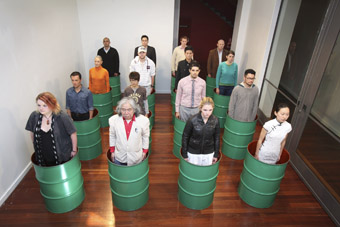
Tatsumi Orimoto, Oil Can, 2010, 4A Centre for Contemporary Asian Art
courtesy the artist, photo Alex Craig
Tatsumi Orimoto, Oil Can, 2010, 4A Centre for Contemporary Asian Art
“IF IT’S ART, IT’S ART,” CONCEDES A BEMUSED PEDESTRIAN AS HE HEADS OFF AFTER BEING MOMENTARILY ABSORBED INTO THE CROWD OBSTRUCTING THE FOOTPATH OUTSIDE THE 4A CENTRE FOR CONTEMPORARY ASIAN ART. IN A SMALL WHITE-WALLED ROOM FILLED WITH 15 GREEN 44 GALLON OIL DRUMS PAINTED RED ON THE INSIDE STAND BLANK FACED FELLOW CITIZENS AND THE ARTIST WHOSE WORK, OIL CAN, THIS IS—TATSUMI ORIMOTO.
In a line outside the window, volunteers await their turn to expressionlessly occupy a drum for 30 seconds. Orimoto purposefully fusses about, directing individuals—it might be five, or 14—into position. When satisfied, he chooses a drum for himself and is helped in using a small step ladder. Once everyone is still, looking forward towards the street, the moment is captured by a photographer perched high on a ladder just inside the window. Then the process begins again, Orimoto creating new permutations for well over an hour.
Outside the crowd grows and, after a half hour or so, an emboldened Orimoto beckons to passersby to join his volunteers, which they willingly do. Meanwhile, chatty observers explain to the newly arrived what they think the work is about: “alienation,” “ordinary people at the mercy of the oil industry,” “people discarded,” A newcomer asks, “Is someone making a movie? “Now there are several other photographers in the room and, outside, mobile phones are held aloft. Moments of stillness, as the latest permutations are realised, alternate with the bustle of selection, arranging and clambering in an out of drums. The sense of occasion is palpable and participation unthreatening. The cultural mix of volunteers, true to China Town (next door is the inviting Polish deli, Cyril’s), is rich and welcoming.
Oil Can suggests much, reminding us of Ham and Clov in their bins in Beckett’s Endgame, sharpening our sense of non-communicative personal isolation (curiously at odds with the conviviality of the crowd and the willingness of the volunteers) and heightening our appreciation of art as its usual complex two-way process—observer and observed—but to which has been added the ever increasing role of observer as observed, through participation and co-creation with the artist. All of this intensifies the sense of ‘everyday surreal’ that Oil Can evokes—pedestrians in their street clothes stepping into the neat rows of drums to have their images captured for purposes that remain unexplained. I look forward to seeing the documentation; doubtless it will be a work of art in itself, offering a more formal meditation, but stripped of the excited hubub of the performance it might mean something else.
Centre 4a’s enterprising program of live performances engages new audiences—surprising them with art while making it simulantaneously part of the everyday.
Tatsumi Orimoto was born in 1946 in Kawasaki, Japan and studied at the Institute of Art, California. In 1971 he moved to New York, where he worked as an assistant to Nam June Paik and was introduced to Fluxus. In 1977 he returned to Kawasaki where he currently lives and works. His performances have been presented in several countries including the Biennale of Sydney, Sao Paulo Biennale and Venice Biennale.
Tatsumi Orimoto, Oil Can, 4A Centre for Asian Contemporary Art, Sydney, May 13
RealTime issue #96 April-May 2010 pg. web
© Keith Gallasch; for permission to reproduce apply to realtime@realtimearts.net
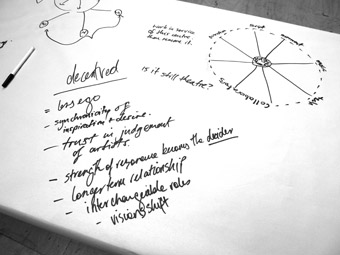
Workshop notes Dramaturgies #4
FEBRUARY SAW THE 4TH DRAMATURGIES SEMINAR ORGANISED BY MELANIE BEDDIE, PETER ECKERSALL AND PAUL MONAGHAN. PREVIOUS MEETINGS FOCUSSED ON THE ONLY PARTIALLY RESOLVED DEFINITION OF 'DRAMATURGY,' ON DRAMATURGY AS A CRITICAL AND POLITICAL PROJECT (“INTERVENTIONIST DRAMATURGY” IN ECKERSALL’S WORDS), AS WELL AS PRACTICAL STRATEGIES FOR WORKING IN A DRAMATURGICAL MANNER.
There were three working parties for Dramaturgies #4: Collaboration facilitated by Eckersall, Diversity by Beddie and Training and Research (the group I joined) by Monaghan. John Romeril noted of Dramaturgies #3 that it had an “experiential emphasis.” with a “learn by doing and observing approach”, problems being addressed “on the floor” and on one’s feet. The decision of Eckersall’s group to present their findings in the form of a space strewn with snaking passages of text, balls of paper, objects, and scenographically arranged mess, reminiscent of artist Joseph Beuys’ perfomative lectures for the Free International University, represented an attempt to blend experiential knowledge (the body, performance, space) with theory and ideas.
Overall though, Dramaturgies #4 took the form of oral discussion. With Richard Murphet playing a prominent role, at times it seemed a festschrift for the former head of VCA Theatre. Murphet’s engrossing keynote reminded us of links between contemporary understandings of theatrical structure and Euro-American developments, as well our indebtedness to the experimental, often nationally-focused, work of the Australian Performing Group and the Pram Factory. Murphet attended US director and theorist Richard Schechner’s infamous production Dionysius in 69, which The Australian characterized as “the ultimate 1960s group-grope show.” Schechner’s ideas on the transcendence of the mundane through staged interactions, in which text, image, design and the body all played a significant role, and which were widely dispersed about a multi-focal theatrical space, helped set the tone not only for much of the material produced by artists like Murphet, but incited Australian practitioners to wrestle with articles on Artaud and Brecht from Schechner’s journal, TDR. Thinking dramaturgically has a long history in Australia, running from Eugenio Barba’s influential appearance in The Drama Review [TDR] through to Murphet’s production of The Inhabited Man (2008; see RT 87, p8).
The working parties at Dramaturgies #4 struggled to find common ground, leading to some “group envy.” In closing presentations, many of the Diversity panel contended that the matter is best addressed as an integral concept, enmeshed within every aspect of theatrical thinking, rather than treating it separately, whilst we in Pedagogy wrestled with how to approach so broad a question as the teaching of the full variety of practices involved in the structuring of theatrical knowledge.
Literary issues of editing, textual analysis, and May-Brit Akerholt’s wonderful keynote on script translation, loomed large, but we broadly agreed that the task was to assist students, artists and the public to “think dramaturgically”—rather than necessarily to become that strange beast, the “company dramaturg,” who is typically yoked to the text. Dramaturgy was seen as a way to think in terms of the structures and tendencies involving space, text, sound, light, time, politics and so on (Barba’s weft or “weave”), all of which are measured, invoked and manipulated within the theatrical scene—and within many social and historical arenas as well.
After much to-ing and fro-ing, Murphet offered a possible systematisation of certain critical aspects of a dramaturgical consciousness, which I gloss below. Universal agreement was never to arise, and I felt there was a reluctance by many to confess how our own constructions of dramaturgical practice were weighted towards post-1960s “performance” and the kinds of neo-avant-garde theatre promoted by Schechner and his successors. Dramaturgies #4 was not just notable for its stellar list of delegates, but also for those not present. Where was MTC, the Australian Ballet, Bell Shakespeare, the Australian Writers’ Guild and other institutions many of us characterise as relatively “conservative”? Eckersall’s proposed “‘national audit’ of dramaturgical practices in and for the sector” could not be fully effected here.
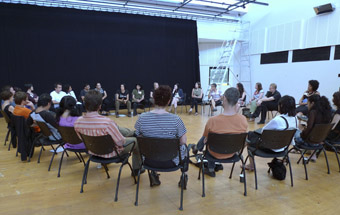
The circle Dramaturgies #4
Dramaturgies #4 rather reflected a partisan (though internally divided) set of proposals for thinking about how theatre is put together and how it relates to the wider world, whereby certain aspects of avant-garde praxis and ideals of social or aesthetic intervention—however modest in form, even if only focused on changing perception rather than political structures per se—would be espoused. Whilst dramatically inflected work was the dominant subject of discussion, dance theatre and at least some forms of performance art could be accommodated by the proposed models and membership. Nevertheless, dramaturgy as a potentially totalising socio-aesthetic critique, as a way of modelling the wider social 'ecology' of theatrical ways of acting and describing phenomena—be these on stage, in the visual arts, in political and social action, of socio-cultural occurrences varying from war to shopping—remains an unexplored challenge.
To think dramaturgically, one must learn how to read a piece of theatre; which I would see as rendering all dramaturgs critics. Secondly, it was agreed that one must have a broad knowledge of all aspects of theatrical practice and construction, running from choreography to lighting, text and so on (there was some debate as to whether one should learn such ideas “from the inside” by doing, or, as in my own teaching, through “outside” analysis). One must be able to think of theatrical composition in terms of its formal elements. Phrases such as “the performance score” were deemed helpful, as were models from music (harmony and dissonance), literature (Homeric structures, the Epic, Aristotelian tragedy, Viktor Shklovsky’s concept of “making strange” or defamiliarisation and so on), visual arts (balance and composition), plastic arts (texture, weight, mass) and—especially as far as my own teaching is concerned—the multidisciplinary pedagogy of director Oscar Schlemmer, architect Walter Gropius, painter Wassily Kandinsky, composers Paul Hindemith and others at the Bauhaus School in the 1920s.
Ian Maxwell from Performance Studies at University of Sydney observed that dramaturgs must know how to “break the hermeneutic circle of the work”, or in Murphet’s terms, to disabuse those “expectations” which the structural rules listed above might impose. Barba and Eckersall have used the terms “turbulence” and “con-fusion” to suggest a similar interplay of order and a deconstruction of that order within dramaturgy. This could involve, for example, sudden transitions from tragedy to farce, or vexing a progression from light to darkness.
Monaghan began with the suggestion that a dramaturg is one who “imagines his or her audience”. Such a generalised concept is broad enough to encompass works where the aim is to challenge and provoke, as well as more humanist ideas of the performing arts as entertainment, as describing one’s own life (drawing-room comedy, for example) and other forms of practice.
Finally, one concept which I would contend is essential to all considerations of art, is an awareness that any and all forms of dramaturgy contain within them a “worldview.” The dramaturg must take seriously ideas about philosophy, politics, the body, religion, ritual, anthropology, race, gender, sexuality and other matters as they pertain to the work and to the world as a whole. To craft a theatrical space is to model the world, society and the cosmos—the theatrum mundi or little theatre of the world which Renaissance scholars extolled. Dramaturgical perspectives have the potential to provide a totalising “gesamtkunstwerk” of culture itself, of politics, the arts and of our relation to these phenomena.
Whilst Dramaturgies #4 did not reach any final agreement on how to impart such a way of conceiving knowledge and experience, let alone what limits to such concepts we might want to impose and under what circumstances, Eckersall, Monaghan and Beddie provided a challenging forum wherein such ideas could be debated. If the only outcome of Dramaturgies #4 was to allow us to listen to theatre-maker and Director of The Centre of Performance Research (UK) Richard Gough’s celebration of the cultural and affective density of objects, then it was worthwhile. Gough confessed that, like many other dramaturgs, he was “drawn to objects that…emerge into daylight from dusty attics, mouldy sheds, damp garages and…junk shops…I liked the patina…the scars and markings of an object well used, of functionality and distress; objects abandoned, discarded, rejected and forlorn.”
Such Duchampian detritus has an already established life of theatrical processes and history, which is waiting to be invoked within new theatrical environments, from the cabinet of curiosities to the stage. Having heard that one of Australia’s most successful dramaturgs, Michael Kantor, announce to delegates he is leaving theatre to take up a more environmentally proactive life, Gough’s words about cherishing of the worn textures of embodied refuse, and of the performative weight locked within otherwise derelict objects, suggested that the full ecology of dramaturgy continues to need careful and sensitive husbandry.
Dramaturgies #4, convenors Melanie Beddie, Peter Eckersall & Paul Monaghan; Victorian College of the Arts, Melbourne University, Feb. 17-20.
RealTime issue #96 April-May 2010 pg. web
© Jonathan Marshall; for permission to reproduce apply to realtime@realtimearts.net
Heavy Metal Work Orchestra
heavy metal work orchestra
The DeMiXerphone, a new instrument created by Frederick Rodrigues, amazingly allows composers and musicians “to have precise control over the pitch, timbre and rhythmic potential of almost any electrical appliance.” You can see it in action as Rodrigues, Abel Cross, trumpeter Scott Tinkler and pianist Adrian Klumpes perform a work for “a 12-piece computer controlled ensemble of power tools and appliances.” Heavy Metal Work Orchestra, The Red Rattler Theatre, 6 Faversham St, Marrickville, Sydney May 28, 7:30pm; May 29, 7:30pm; May 30, 3pm, www.heavymetalworkorchestra.com
adelaide film festival submissions call
The 2011 BigPond Adelaide Film Festival (BAFF) is calling for submissions for its 2011 program in the categories of feature film, documentary, animation, short film, experimental and new media work. You can download a form, submit online through the BAFF website or visit Withoutabox (www.withoutabox.com), an online film festival submission service. For submission deadlines and guidelines visit the BAFF website at www.adelaidefilmfestival.org. BigPond Adelaide Film Festival, Feb 24-March 6, 2011
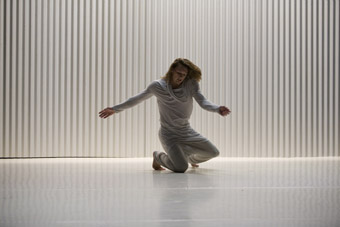
Luke Hanna, The Cry, Dance North
photo Ferry Photography
Luke Hanna, The Cry, Dance North
dancenorth, the cry
Dancenorth’s eagerly awaited first full-length work from new artistic director Raewyn Hill is The Cry, exploring “the momentum created by a life of [drug] dependency that sweeps others up in their path. Ultimately, we wish to portray the relentless nature of pursuing recovery and the strength needed to build a life in recovery.” The Cry opened in Cairns, May 21-22, has its hometown premiere in Townsville, June 2-6. and tours to Proserpine, August 13-14. Dancenorth, The Cry, www.dancenorth.com.au
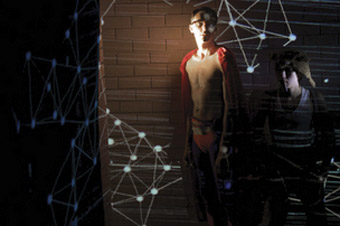
Nic Dorward, YOUTHvsPHYSICS 2009
photo Amelia Dowd
Nic Dorward, YOUTHvsPHYSICS 2009
restaged histories project, youth vs physics
After its Next Wave premiere of YOUTHvsPHYSICS, the Restaged Histories project flies to hometown Brisbane to examine “thwarted attempts to fly” as exemplified by Icarus, Superman and a fictional Soviet cosmonaut named Omon Ra. The company describe the work as “part science experiment and part rock concert” with “two performers, risking life and limb in the name of heroism and entertainment and taking a smart and irreverent look at boyhood and imagination in an attempt to disprove heroism.” Restaged Histories are Artists-in-Residence at Brisbane Powerhouse and YOUTHvsPHYSICS was commissioned and developed by Next Wave through kickstart 2009. The Restaged Histories project, YOUTHvsPHYSICS, Brisbane Powerhouse, June 2-5; brisbanepowerhouse.org
the light in winter, melbourne
The European tradition of light festivals in mid-winter has taken hold in Australia, first with The Light in Winter in Melbourne (see RT84) with a focus on community installations, and then in Sydney with VIVID and the Smart Light Festival in 2009 with an emphasis on innovation (see RT90). The music-oriented VIVID is on again this year (more below) and will be joined again by Smart Light in 2011. Robyn Archer’s 2010 The Light in Winter program involves, community events, forums and leading illumination and digital artists, with a commissioned work from Mexican electronic artist Rafael Lozano-Hemmer to be launched on June 4. Read Scott McQuire’s introduction to this artist’s work (see RT89) and you’ll see that the commission is a considerable coup for Melbourne. There’ll be a new interview with Lozano-Hemmer in RealTime 97 -June 11]. For more information about The Light in Winter and the work of Rafael Lozano-Hemmer visit: www.fedsquare.com/thelightinwinter and www.lozano-hemmer.com. The Light in Winter, Federation Square, Melbourne, June 4-July 4
vivid sydney
Last year’s inaugural Vivid festival seemed to appear out of nowhere, but offered some large scale spectacle and intense musical experiences that Sydney’s audiences embraced. This year, the guest curators of the performance program, Vivid Live based at the Sydney Opera House, are the power ‘odd couple’ Laurie Anderson and Lou Reed. They are billed as “bringing Manhattan to Sydney” with a very impressive range of concerts by both established and rising stars such as Rickie Lee Jones, Marc Ribot, The Blind Boys of Alabama, Bardo Pond, My Brightest Diamond and Holly Miranda. There are also artist from further afield such as Melt Banana and Boris from Japan and the Tuvan throatsinging champions Chirgilchin.
Along with individual concerts many of the artists have been programmed together into themed nights such as the Slow Music Night (June 4), and Noise Night (including Australians Oren Ambarchi and Lucas Abela’s Rice屎Corpse, May 31). There is even a daytime concert for dogs in the Opera House Forecourt (June 5). And of course there are numerous appearances by Anderson and Reed including a Transitory Life, a solo retrospective performance by Laurie Anderson; Songs from Delusion with Anderson joined by Eyvind Kang, Colin Stetson and Doug Wieselman; Reed’s Metal Machine Music; New York Genius, photos curated by Reed from the Magnum Photographic Archive; and a range of talks with the curators. There’s also a theatrical offering with The Shipment by Young Jean Lee’s Theatre Company lauded as some of the best and boldest experimental playwriting in America.
Apart from the Vivid Live program, a range of other activities are also gathered under the Vivid umbrella such as the lighting of the Opera House Sails with images from Laurie Anderson, and Macquarie Visions, which will illuminate the historic buildings of Macquarie street with projections. The harbour spectacular Fire Water returns to the Rocks, this time with a Bollywood flavour exploring the story of ship that sailed to Sydney from Calcutta in 1797. Creative Sydney also returns with talks and forums focusing on the local scene (its artists again almost totally absent from the Vivid Live program), which along with X | Media | Lab and the Song Summit offer opportunities to discuss the creative health of Sydney and NSW. Vivid, various venues, May 27-June 21; Vivid Live, Sydney Opera House May 28- June 11; http://vividsydney.com/; http://vividlive.sydneyoperahouse.com
RealTime issue #96 April-May 2010 pg. web
© RealTime ; for permission to reproduce apply to realtime@realtimearts.net
Eliza Logan, Josh Quong Tart, Vashti Hughes, David Keene, Vashti Hughes Ensemble, The Wild Party
photo Brendon Moar
Eliza Logan, Josh Quong Tart, Vashti Hughes, David Keene, Vashti Hughes Ensemble, The Wild Party
FOURTEEN YEARS AGO THE FOUR-MEMBER VASHTI HUGHES ENSEMBLE PRESENTED WILD PARTY TO SOME ACCLAIM AND SOLD-OUT SEASONS AT THE MELBOURNE COMEDY FESTIVAL. NOW RE-PRESENTED AT THE NEW RAVÁL THEATRE IN SURRY HILLS, THIS JAZZ, CABARET AND SPOKEN WORD FUSION IS FULL OF REMINISCENCES OF BYGONE TIMES, RAISING QUESTIONS ABOUT THE USE-BY-DATE OF SOME PERFORMANCE MODES.
The evening opens with a four-piece jazz band providing mood music in Ravál’s dimly lit and crowded theatre bar, tucked above the Macquarie Hotel’s sports bar. The couple in front of me seems to have the right idea, perched on a plush black, leather lounge sipping a string of martinis. We could have been transported back in time, although the music is without the experimentation, the improvisation, the ‘being in the moment’ that I idealistically associate with 20s jazz bars. Enter the Vashti Hughes Ensemble, energetically forming a tableau vivant, while the band slip into providing soundtrack for the performance. Two men and two women pose in costumes evoking 1920s bohemia, but the men’s incongruous Converse shoes, the careful theatricality of the poses and the exaggerated whiteface make-up hint at a contemporary clowning troupe.
Wild Party is a risqué narrative poem written by Joseph Moncure March in 1926 and banned upon publication. It is often seen as a jazz-influenced precursor to Beat poetry, particularly as William S Burroughs once declared that it made him become a writer. The Hughes Ensemble is fairly faithful to the tradition—the poem being the driving element of the show to which all other elements seem subjugated. It comes to life as the ensemble craft an aural space, drawing together sounds, rhythms and narrative through-line. The story is of Queenie (Hughes), “a blonde [whose] age stood still” and her misogynist lover, Burrs (Josh Quong Tart), “A clown. Of renown”, whose portrayal is strangely reminiscent of Heath Ledger’s Joker. After a falling-out and near bout of domestic violence the couple decides to throw a party. Queenie’s best mate Kate (Eliza Logan) turns up with the handsome Mr Black (David Keene) and Queenie executes her revenge on Burrs by ‘making a pass’ at Black which fast-tracks into a love affair.
Although the four performers each take on a character, their predominant role is as ensemble poet narrator. The fidelity of their recital however reveals the datedness of form and text removed from their original context. Moncure March’s text is less shocking these days and while the ensemble do their best to show off the raunchiest bits, and this is where most of their comedy comes from, the piece grasps for contemporary relevance. Cabaret can still be sexually and politically subversive as in queer performance seen in Sydney, such as Gurlesque and much of the work at Red Rattler. I look hard for this in Wild Party, but I find homage more than anything else.
The whole affair predictably comes to a head with a pistol being pulled from a bedroom drawer. Burrs is murdered and Queenie (now channelling Cole Porter) sings apathetically, it was “just one of those things.” There was little variation in musical tone throughout and the performance was for the most part formulaic. However, it looked like a lot of fun to do, and it’s hard to say a form has reached its use-by-date when a packed house is enjoying it.
Vashti Hughes Ensemble, Wild Party, performers Vashti Hughes, Josh Quong Tart, Eliza Logan, David Keene, Ravál Theatre, Macquarie Hotel, Sydney, March 15-April 3
RealTime issue #96 April-May 2010 pg. web
© Megan Garrett-Jones; for permission to reproduce apply to realtime@realtimearts.net
Brendan Cowell & Peter Helliar, I Love You Too
photo John Tsiavis, courtesy Roadshow Films
Brendan Cowell & Peter Helliar, I Love You Too
FIRST-TIME FEATURE DIRECTOR DAINA REID HAS BEEN A COMEDIAN UP TO NOW (WRITING AND ACTING IN FULL FRONTAL, PERFORMING WITH SHAUN MICALLEF) AND DIRECTING MAINLY TV SERIES, INCLUDING THE UNDERRATED ABC COMEDY, VERY SMALL BUSINESS.
Her debut film relies on star power—Sydney super model Megan Gale strutting the red carpet at the Sydney launch before her first Australian screen role; a wonderfully nuanced performance as always from Peter Dinklage, the sensitive leading man in The Station Agent, and who, according to IMDB, has appeared in both the original and now the US version of Death at a Funeral; and Brendan Cowell, who seems to be everywhere.
Having just surfaced from the muddy mines of Flanders in Beneath Hill 60, here Cowell stars opposite Peter Helliar (who also wrote the feature). His effortless move from upstanding hero in a war drama to scruffy but sexy no-hoper in a romantic comedy shows he’s a truly versatile actor and probably the first choice on most directors’ lists. But stars are not enough. The film eventually suffers from a slowly grinding plot and various romances that never seem to quite blossom.
Brendan Cowell, Peter Dinklage, I Love You Too
photo John Tsiavis, courtesy Roadshow Films
Brendan Cowell, Peter Dinklage, I Love You Too
US director Judd Apatow proved with Knocked Up and The 40 Year Old Virgin that romantic comedies don’t have to be about a man and a woman. It’s the bromance that counts, that awkward and shambolic love affair between a guy and his mates. In Apatow’s work the writing can be crisp, hilarious and sometimes deeply disturbing. Here, Peter Helliar seems to be aiming for the same kind of film (and no doubt a lucrative market) and while he’s created some sharp one-liners and lovably messed-up characters, overall, the writing and pace of the film fall flat. It’s not helped by the unevenness of the acting. For all Megan Gale’s grace and beauty, she is not a natural on camera and her stilted performance highlights the talent of others around her, Cowell and Dinklage in particular. Then again, she doesn’t have much to work with. She’s a model with a heart of gold. Full stop. Helliar also seems to be working in a bit of Love, Actually with various relationship strands he tries to tie up by the end and there’s the lovable quirky family, a la The Castle—I Love You Too has ‘produced for the multiplex’ stamped all over it. You suspect though that Helliar had a darker story in mind and it’s lurking in there somewhere.
The main problem is that the film tries to hide its bromance leanings behind a conventional romance (between Cowell as Jim and Yvonne Strahovski as Alice) that never rings true. Alice sports a jolly hockeysticks Bridget-Jones-accent so grating you wish she would return to London and stay there. The writing of romance is difficult and Helliar appears uncomfortable with it, and the female characters in general. It’s as if he doesn’t really want to let his characters fall in love. He holds them back. The film is much stronger in the scenes where Helliar and Cowell bounce off each other in their insecure manly ways, trying to pick up chicks, arguing at the squash court. By the end we’ve had all the cinematic clichés we can handle bundled into the final scenes: an explanation (as to why he can’t say ‘I love you’); a race to the airport in a taxi, to ‘stop that plane’; a funeral (why did he have to die?); and, of course, a wedding.
At the gala premiere of I Love You Too, the radio commentator on the red carpet was welcoming the stars, saying each time, “Australian films are always so depressing, aren’t they! It’s great that this film is a comedy. It’s a breath of fresh air, isn’t it. It’s not like other Australia films.” But you could tell he hadn’t seen an Australian film for years. Popular Australian comedies (The Castle, Muriel’s Wedding, Strictly Ballroom, Kenny) have been sharper than this, and audiences know what they want when they see it. As Cowell and Helliar left him behind to enter the cinema, he tried desperately, floundering, to give away free tickets and t-shirts to the crowd. But they just weren’t interested—unless they could get a photo with Megan Gale.
I Love You Too, director Daina Reid, producers Yael Bergman, Laura Waters, writer Peter Helliar, cinematography Ellery Ryan, original music David Hirschfelder, editor Ken Sallows, production designer Jennifer A. Davis. www.iloveyoutoomovie.com
RealTime issue #96 April-May 2010 pg. web
© Kirsten Krauth; for permission to reproduce apply to realtime@realtimearts.net
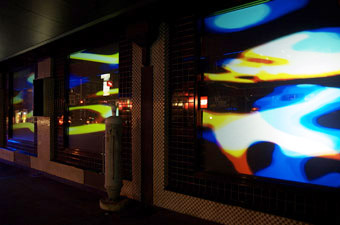
Tom Hall, The Past Will Betray
courtesy the artist
Tom Hall, The Past Will Betray
AS A MULTIMEDIA ARTIST, COMPOSER AND ELECTRONIC MUSICIAN, TOM HALL HAS CREATED WORK CONSISTENTLY REVOLVING AROUND TWO COMPLEMENTARY AMBITIONS THROUGHOUT HIS CAREER—THE EXTRAORDINARY EXTENDING ITSELF INTO THE ORDINARY AND VICE VERSA.
As a musician, Hall’s work within Brisbane-based ensembles like Damon Black’s Secret Birds or his own AxxOnn project has often been defined by the composer’s ongoing struggle to redefine laptop drones and electronic composition as a pursuit as egalitarian and accessible as the electric guitar and heavy metal. The laptop-oriented AxxOnn, by way of example, have spent the past two years performing alongside metal-oriented acts like Boston’s Isis and Seattle’s Sunn 0))).
Hall’s work as a multimedia artist, by contrast, has frequently found him sequencing and re-contextualising tasteful photographs and naturally occurring imagery of mundane environments into transcendental collages of light and sound. His solo compositions as a sound artist, furthermore, echo this approach. Euphonia, Hall’s 2008 collaborative album with fellow Brisbane-based artist Lawrence English, consisted of little more than solitary murmurs of shimmering electronics woven into gorgeous and hypnotic soundscapes.
The issue that has stalked the artist’s entire career has been the effective synthesis of his two perspectives. Hall has shown consistent difficulty in regards to creating a work that unites both ordinary and extraordinary worlds without revealing a clear bias to either. At best, in 2009’s Left of Left installation at Brisbane’s Judith Wright Centre, he has created transcendental work with a strong grounding in everyday influences; while, at his worst (Secret Birds’ earliest collaborative performances), Hall’s various worlds have collided, with violently fractured and disappointing results.
The Past Will Betray, however, has brought Hall closer to a unified artistic vision than any of his previous works. A stylistic successor to Left of Left presented within an almost identical framework, Hall’s most recent installation reveals both a broader conceptual scope than previously and a more refined appreciation of focus and deliberation. The work is officially geared towards exploring the indistinct areas between past and present but, ironically, The Past Will Betray is Hall’s most distinctive and focussed work yet.
A week-long interactive visual exhibit displayed nightly via the Judith Wright Centre’s Shopfront Space windows, The Past Will Betray’s installation component is very much a refinement of Hall’s Left of Left practices. The key difference is, whereas Left of Left consisted of multiple projections layered and dispersed throughout the entirety of the Shopfront Space and glimpsed through its windows, Betray’s visuals are projected directly onto the windows. The work immediately engages more with the public and fosters a greater sense of interactivity—a true joy.
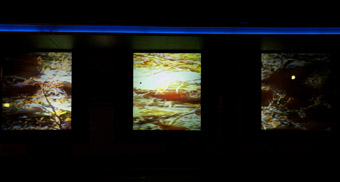
Tom Hall, The Past Will Betray
courtesy the artist
Tom Hall, The Past Will Betray
Visually the exhibit is titillating enough: Hall has expanded his range of austere, distended urban and nature images into colourful psychedelic vistas, effortlessly bathing the Shopfront windows in hues of orange and red without sacrificing the beauty of his more staid imagery. But, in interacting with the exhibit on a physical level, you discover an especially rewarding connection.
Placing your hands on the warm glass of the windows, you can practically feel the work give way to your indeterminate will. The colours, images and ideas almost seem to morph beneath your very fingertips. It’s often difficult to determine how much change is governed by interaction, but the work is a mammoth step forward from Left of Left and a truly thrilling experience in and of itself.
As with Left of Left, the exhibition concludes with a concert performance of work by Hall with supporting sound artists. But this somewhat blemishes the exhibition’s advancements. Whereas Left of Left saw Hall delivering the audio-visual source material of his exhibit over to multimedia artists Lawrence English and Lloyd Barrett to present additional versions of the exhibition’s central premise, The Past Will Betray’s final night doubles as a launch for Hall’s latest solo album Past, Present Below and, as such, proves to be a much more sound-oriented affair.
The performances presented on the night are far from unremarkable—Oren Ambarchi’s deconstructed guitar noise proves fittingly cerebral and Ambrose Chapel’s blend of doom-metal and ambience is intriguing and accomplished while Hall’s lush drones are a particular delight—but the entire event seems like a rather discontinuous and dissatisfying conclusion for such a fascinating exhibit.
Tom Hall, The Past Will Betray, Judith Wright Centre of Contemporary Arts, Brisbane, installation March 18-25, performance March 25
RealTime issue #96 April-May 2010 pg. web
© Matthew O’Neill; for permission to reproduce apply to realtime@realtimearts.net
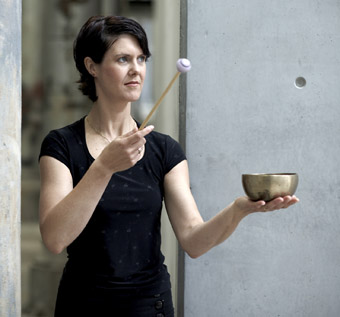
Alison Pratt, Gethsemane
photo Keith Saunders
Alison Pratt, Gethsemane
IN THE BIBLE, GETHSEMANE IS THE PLACE WHERE JESUS CRUMBLES, FOREKNOWING HIS OWN DEATH, FEELING ABANDONED BY HIS GOD. THE RABBLE WILL TURN HIM OVER TO HIS CRUCIFIXION. THROUGH HIS INTENSELY PERSONAL SUFFERING, CHRIST DOES NOT GIVE UP; RATHER, HE GIVES OVER: PEOPLE WILL DO AS THEY WILL DO. THIS FEAT OF ACCEPTANCE IS PROVOCATIVE AND DEEPLY MOVING.
Gerard Brophy’s Gethsemane follows quite a different trajectory. The five textual passages around which the performance is shaped depict snapshots of life, struggle and death in contemporary Calcutta in a journey across the city from dawn to dusk. The musical form winds and unwinds around these passages. I have an image of spirals within channels of decay—like the labyrinthine passages of this ancient ‘city of joy,’ like a worried angel overlooking a putrefying feast.
Martin del Amo’s first solo dance passage is accompanied by an ascending electronically generated scale which begins in unison but proceeds to divide. His arms and torso—rising, falling, being pulled and propelled—struggle like cells parting ways. The dance becomes thicker, as if spiralling through honey. This is a slow death.
A later dance becomes thinner, sowing its struggles in water, thence becoming brittle, as if broken apart in wind. The Song Company as chorus also works its struggles, shuddering and shuffling in alleyways, trembling as if scattered by internal quakes. A final, jagged scavenging, as if trapped within a thin cylinder of breath, is quieted by the blow of conch horns, sounding the gates of hell (or the other place). The soprano saxophone, a cobra’s dance, calls the final chant; the figures become translucent and turn to their deaths.
Throughout, the choir—always exemplary in their vocal work—is comfortable in its motions; for each member their movement decisions seem entirely in place. The choreography as a whole displays an admirable restraint in tone, letting me sit within the experience.
The weakness for me is in Brophy’s text. Even the Song Company’s website describes it as ‘florid’; as an actor, I would find it very difficult to know how to pitch it. The main issue, I believe, is that it is overwritten, and the narrative of ambiguous disposition—horror? disgust? wonder? Its delivery lies just on the edge of scorn. Even after reading the text and then watching again, it remains very hard to grasp in real time. The imagery lacks tautness and coherence—especially in comparison with the music, which has both these qualities.
The vocal writing is spare, almost plainchant, nodding towards the Flemish masters (Lassus and Tallis) whose lamentations Brophy did not want to imitate, but which recognise the power of sound quality—whether vocal, instrumental or electronic—to carry experience from the deepest chambers of human experience. I am still haunted by several glorious, sparse melodies. Eastern tonalities resonate, without making the mistake of imitation. This work is grounded in the concrete timbres of sound and transcendent of specific geography. It carries a landscape of soul.
By its final moments, I am left strangely opened, yet also closed: moved, worked on by grief, but also strangely neutered. What has happened here?
Song Company director Roland Peelman initiated the project by pointing Brophy to the Lamentations of Jeremiah, where he watches the city of Jerusalem burn. As a prophet, warning his people about the impending wrath of God, he had been reviled and jailed. But Jeremiah’s lamentations as he watches his beloved city fall express an intensely personal grief that is also full of love for the very people whom his God destroyed.
I expect this compassion is what is missing from Brophy’s text. The story, the lecture on the city’s filth, corruption and waste, the finger pointing to its social injustices throughout the program notes, are confusingly angry yet ungrounded, disgusted and yet aloof. What makes us care is the ache in the movement, and the music: simple rising scales with raised fourths and lowered sevenths, played on chimes or bells whose pure and complex timbres sound the world; the electronic aural landscapes that prise space apart; the spiralling motions of the dancers and the dance, the shudder of their struggles against the limitations of the alley and the wall; the struggle to move beyond, but being held back.
Calcutta is not a destroyed city, as was Jeremiah’s Jerusalem. It is teeming, fetid, dangerous, tangled with contradiction, but it is also ‘the city of joy’, full of life. If only this Gesthemane could perfect its passions. I could then sit with its musics and motions and be fired with passion, sorrows and compassion, for all the days of my life.
With thanks to Roland Peelman and Timothy Constable for discussing Gesthemane with me.
Song Company, Gethsemane, concept and music Gerard Brophy, texts Gerard Brophy, plus Bible adaptations, director Roland Peelman, dancer, movement director Martin del Amo, performers Song Company, Synergy Percussion’s Timothy Constable and Alison Pratt, saxophones Christina Leonard, sound design Bob Scott; St Paul’s Church, Canberra, NSW tour, March 21
RealTime issue #96 April-May 2010 pg. web
© Zsuzsanna Soboslay; for permission to reproduce apply to realtime@realtimearts.net
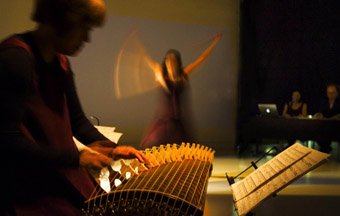
Satsuki Odamura, Wakako Asano, Mayu Kanamori, Vic McEwan, In Repose
photo Jenny Evans
Satsuki Odamura, Wakako Asano, Mayu Kanamori, Vic McEwan, In Repose
PHOTOGRAPHER MAYU KANAMORI, DANCER WAKAKO ASANO AND KOTO PLAYER SATSUKI ODAMURA ARE JAPANESE-BORN ARTISTS WHO HAVE CHOSEN TO SPEND THEIR LIVES IN AUSTRALIA AND, EVENTUALLY, TO BE BURIED IN THIS ADOPTED HOMELAND. THEIR PROJECT IN REPOSE (ALSO WITH SOUND DESIGNER VIC MCEWAN) REPRESENTS AN ARTISTIC EXPLORATION OF WHAT THIS DECISION MEANS NOT ONLY TO THEMSELVES BUT ALSO TO THE MANY JAPANESE WHO HAVE PREVIOUSLY MIGRATED AND DIED HERE.
The In Repose project has been under way since 2007, with a range of performances, exhibitions and community workshops in Townsville, Broome, Thursday Island, Port Hedland, Roebourne and Cossack. In each the group performed a version of ‘kuyo,’ a ceremonial offering to honour the spirits of the dead. This involved lighting incense and pouring water on the graves to slake the thirst of the spirits, and in their contemporary adaptation also incorporated music and dance. In many places this ceremony was opened up to involve the local community while in other smaller locations the acts were more private.
The performance lecture, presented in 2010 amidst the photographic installation at the Japan Foundation, brings these outcomes together. Like Kanamori’s photographs—close-ups of the weathered texture of inscribed rocks, native grasses entangled with headstones—the performance, with the addition of music and dance, offers a more impressionistic retelling of events. It is not overladen with information, but rather offers fragments, anecdotes and space for reflection on the project.

Japanese Cemetery, Broome, In Repose
photo Mayu Kanamori
Japanese Cemetery, Broome, In Repose
What becomes quickly apparent is that there can be no discussion of the Japanese sense of ancestral spirituality without acknowledgement that the graves are on the lands of indigenous Australian peoples. It is the cultural exchange that takes place around this that makes the project particularly interesting. In Broome the connection is most obvious as many Japanese pearl divers married local Indigenous people. In Repose’s title image, taken in the Broome cemetery, shows small, honey-brown hands on a sand-coloured gravestone that Kanamori describes as the “the colour of the skin when Indigenous Australians have children with Japanese.”
On Thursday Island one of the workshop participants makes a short video discussing the local beliefs surrounding death and the passage of the spirit, which Kanamori tells us is particularly resonant with Japanese culture. In Port Hedland, visiting Japanese video artist Shigeaki Iwai wanders over the hill from the graveyard to discover the local Indigenous people. Initially they mistake his tripod for a gun, but then they get to talking and he asks if their ‘mob,’ can look after ‘our mob.’ In the small town of Roebourne, the team discover that the graves they’d been told about have been cleared to make way for housing for the local Indigenous residents. In an impromptu ritual, the team honours the dead, but also passes on the story to the local kids, so that this ‘new’ history may be added to the old history of the land.
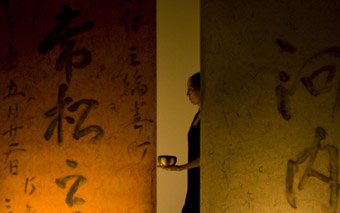
Wakako Asano, In Repose
photo Jenny Evans
Wakako Asano, In Repose
The performance itself, is restrained and contemplative. McEwan joins Kanamori as a lecturer, offering the perspective of an Australian of Scottish origin, with gentle wit, and the small moments of banter between them loosen the formal lecture feel. Between the textual vignettes, Satsuki Odamura plays pieces commissioned for the project on koto and bass koto while Wakako Asano dances. There are some beautiful duets, atmospherically lit in the challenging gallery surrounds by Amber Silk. Asano works closely with the rhythmic complexities and ethereal harmonies of the music, and it is always a privilege to hear Odamura’s virtuosity on these wonderful instruments. However while these moments, sometimes accompanied by projected images, offered time for deep reflection there were perhaps a few too many for the structural balance of the work. Interestingly, most of the music was commissioned from western composers, and similarly Asano’s choreographic language is predominantly western contemporary. Initially I yearned for a more ‘Japanese’ dance-style, more earthed than the float and extension of the modern style, however the combination of western influences in both the music and the dance serve to illustrate the cultural duality that these artists have chosen in their move to Australia.
In Repose represents a very personal journey for the all the artists involved. It treads softly around the more contentious issues of colonisation, racial conflict and the White Australia Policy, instead highlighting the power of personal connection through the significant cultural and generational exchanges that took place within a range of communities. Through the retelling of these events it also opens up a space for the audience, rare in contemporary western culture, for our own reflection on death, spirituality, ancestry and a sense of homeland.
In Repose, photographer, storyteller Mayu Kanamori, koto player, sound Satsuki Odamura, dancer, choreographer Wakako Asano, sound design, storyteller Vic McEwan, lighting design Amber Silk, video Shigeaki Iwai, compositions Satsuki Odamura, Mark Isaacs, Rosalind Page, Michael Whiticker; Japan Foundation, Sydney, exhibition April 1-May14, performance April 10, May 1, May 13; http://www.mayu.com.au/folio/inrepose/; www.jpf.org.au
RealTime issue #96 April-May 2010 pg. web
© Gail Priest; for permission to reproduce apply to realtime@realtimearts.net
theatre director Subramaniam Velayutham, Minister for the Arts Virginia Judge MP, actor/singer Tama Matheson
at the Small to Medium Performing Arts Forum
courtesy of StreetCorner.com.au
theatre director Subramaniam Velayutham, Minister for the Arts Virginia Judge MP, actor/singer Tama Matheson
at the Small to Medium Performing Arts Forum
IIT WAS QUITE A SURPRISE TO RECEIVE IN THE MAIL AN INVITATION FROM ARTS MINISTER VIRGINIA JUDGE TO PARTICIPATE IN A FORUM AT PARLIAMENT HOUSE ON THE TOPIC OF NSW’S LONG-SUFFERING SMALL TO MEDIUM PERFORMING ARTS SECTOR. IT WAS ODD HOWEVER THAT THE INVITATION WAS NOT FROM ARTS NSW (A DIVISION OF A DEPARTMENT TITLED ‘COMMUNITIES NSW’, SUCH IS THE LATEST NON-ELITIST RELEGATION OF THE ARTS) EVEN THOUGH IT IS INFAMOUSLY ALOOF AND NON-CONSULTATIVE. INSTEAD HERE WAS MINISTER JUDGE DIRECTLY FORGING HER OWN RELATIONSHIP WITH ARTISTS IN A SERIES OF FORUMS FOLLOWED, NO LESS, BY ACTION AND FOLLOW-UP TALKS.
Cynics considered Judge’s move as election-minded, agnostics prayed that there would be more to it than ‘improved networking’ (the funding bodies’ mantra of the decade as was sponsorship to the 1990s) and optimists hoped for small improvements, but doubted that the cold, hard reality of under-funding would even be broached. The palpable Carr legacy to the arts was very much bricks and mortar—CarriageWorks in the city and arts centres across Western Sydney—creating new niches for artists and bringing local government into play. Councils have shown increasing commitment to the arts and, in some cases, have provided artists with funds otherwise not available. However, the overall state of the small to medium sector in NSW remains parlous—whether state or federal, the last thing any politician appears to want to do is raise the standard of living for artists, despite the mountain of evidence of dire need from successive reports by arts economist David Throsby.
not so empty space
Minister Virginia Judge begins with a quote from The Empty Space, Peter Brook’s 1968 treatise on the state of modern theatre, in which the director addresses the importance and potential of the theatrical form. She links those in the room with Brook’s ideals mentioning “presence, immediacy and experiment” and tells us she’s passionate about this sector.
I am among the “leading representatives from the performing arts” invited to discuss challenges for the small to medium creative industries sector: “how to promote and expand the vital role that performance, dance and theatre plays in the community.” The organisers had to rearrange the venue in Parliament House when over 100 representatives from the sector from across the state accepted the minister’s invitation. The gesture is generally welcomed, breaking the long drought in dialogue between artists and the arts bureaucracy in NSW.
The Minister assures us that “investing in the cultural sector is a key part of the Keneally Government’s strategy to stimulate the economy and create vibrant, diverse communities.” She is keen to hear suggestions as to how the government can “support this sector to benefit the industry and the community as a whole.” “The forum will give small to medium performing arts organisations an opportunity to explore new ideas to empower the industry to expand its skills and audience base.” Sounds good.
This is the third in a series of Creative Industries forums. Others brought together practitioners working in the live music industry (with a focus on jazz) and in visual arts and artist-run spaces. Next up will be the film and screen sector (a new Arts NSW program, oddly inherited from Screen NSW) followed, importantly, by an all-in gathering of representatives to discuss the implications of the forums on government arts policy and strategies. Even better.
The Minister is proud that the recent abolition of the restrictive Places of Public Entertainment (PoPE) licenses has created more jobs and opportunities for musicians and performers. No disagreements on this one either.
Mary Darwell, Executive Director, Arts NSW (within Communities NSW) talks about creativity, sustainable business models and access as priorities. She mentions the Arts NSW booth at the recent Australian Performing Arts Market (APAM) in Adelaide, promoting NSW artists. She tells us that structural changes in Arts NSW have been taking place over the last 18 months and that in the last six, the priorities have been Aboriginal arts and culture, opportunities for employment in the Creative Industries and how to reach diverse audiences.
The following statistics are shared. NSW is home to 37 percent of the nation’s creative workforce, accounting for five percent of the State’s workforce or 150,000 jobs for people working in film, music, design, publishing, advertising, architecture, visual arts, television, performing arts, radio and electronic gaming. 39 percent of all creative industry businesses are located in NSW, accounting for 27,000 or four percent of all businesses. The NSW Government’s $42 million Arts Funding Program supports 11 of our major performing arts companies, regional galleries and community-based organisations as well.
By now, we should have been impressed by the scale and largesse of NSW’s commitment to the arts, but as the struggling providers of “presence, immediacy and experiment” it offered little consolation. The empty space for small to medium sector artists is the one felt in the pocket.
where are the artists?
As well as the opportunity to be heard, the gathering was paid respect in the choice of keynote speaker, Sarah Miller, a great supporter and contributor to the sector in her work as former director of Performance Space, Perth Institute of Contemporary Arts (PICA) and now as Head of the School of Music and Drama in the Faculty of Creative Arts, University of Wollongong.
Miller argues that, given the problematic status of artists, their obligation to an increasing number of ‘stakeholders’ and a general lack of clarity about the ‘creative’ society being built for the future, “our governments need to develop clear and reasoned philosophies and strategies outlining just why they provide support for art and artists.” However, on looking at Arts NSW’s strategic plan, Miller “found not one word dedicated to artists of any kind; not one mention. Arts yes, communities yes. Programmes, yes. There’s even a bullet point that promotes advocacy for the arts and promises to improve sustainability for the arts, but nothing about supporting artists—the people who make the ART. Does anyone else find that extraordinary?”
Miller goes on to argue for “locating artists and practitioners at the heart of arts policy development and recognising that the relationships between government and company, funding body and artist is a partnership—not a master/slave or an employer/employee relationship. It means informed, committed, staff supported within the bureaucracies to grow policy development and arts funding programmes in a sustained and bipartisan fashion.” If this could be achieved, it means that “…the development of the sector, the role of the arts and culture in society and so on, will have a completely different complexion, particularly if artists and theatre makers of all kinds are invited to sit at the table when developing policy—which is arguably what the Minister is doing by setting up this forum today.”
Miller says that from this, “a whole lot of other things follow: we can recognise that people need spaces to live and work in; we can identify career pathways, and support artists and companies to develop, mature and flourish. We need artists AND we need infrastructure. It’s a symbiotic relationship—not an either/or one—working through—as Performance Space Director Daniel Brine has identified—both the ‘what “we” need’ (the infrastructure map) and the ‘what “I” need’ (the artist’s map).” But this kind of progress will need artist input—“With an effective advocacy network you can make the case for improved funding.”
Miller acknowledges areas of improvement which Arts NSW should more energetically embrace: “The development of regional, national and international touring circuits have seen small to medium companies flourish in a range of arenas, and Arts NSW should not shy away from supporting such initiatives on the basis of some misplaced parochialism.” She also calls on Sydney Festival to create more opportunities for NSW artists and companies (this should be extended to the Sydney Opera House’s New-York-out-of-town VIVID Festival). In this vein, Miller concludes with extolling the virtues of collaboration and partnerships across the state.
small breakouts
We are then mustered for Breakout Sessions in which groups of 12-15 representatives are consigned to corners of the room with butcher’s paper (always a depressing prospect) to come up with quick responses to a basic agenda.
One hour is allocated to this discussion. A colleague whispers: “How do you convey desperation in an hour?” And, of course, you don’t. Nor do you get even close to the complex needs of a sector that has been denied real recognition and equitable treatment for so long. The groups assembled represent a wide range of creative endeavours and scales of operation. Dancers seemed under-represented. Nevertheless, there was a sense that the gathering was in basic agreement on the answers to the three key questions put to them by the Minister:
1. What have been the successes of the small to medium performing arts sector to date and what can we learn from them?
2. What are your long-term aspirations for the sector?
3. What do you regard as immediate priorities?
successes
The breakout groups proudly declare the sector’s capacity, against the odds, for survival: the ability to remain robust and flexible and, of necessity, multi-skilled. They point out that the sector invests in research and the development of talent in the way large organisations will not, and fuels the festival circuit and new arts centres thus improving infrastructure. Significantly, the bulk of work touring overseas is from this sector. The elimination of the PoPE venue licence restrictions is seen as a particular success.
long-term aspirations
The NSW Government has long been preoccupied with what goes on in the arts within its borders and is rightly proud of its regional arts infrastructure. It has, however, lacked the national and international vision of some other states. Some participants argue for the government to build on the international potential of its artists and companies. Quick turnaround funding is proposed (and has now been implemented; see below) to allow for immediate response to invitations from overseas festivals and other opportunities.
Also suggested is the commissioning of a report on the economic impact of the arts in NSW, incorporating information on working conditions and professional development. These include the need to urgently address the supply of training facilities, especially for dance, circus and physical theatre, and assistance for artists in professional development and with ‘brokerage.’
Infrastructure needs are seen as including how the small to medium performing arts sector connects with others, with a desire for a closer relationship with the education sector to enable more access for artists to young audiences. Similarly the position of the sector in the relationship between Arts NSW and local government is seen as needing clarification, as are connections between various development and touring schemes.
Some of the points raised address fundamentals for the sector. Because its work is often engaged with experiment, long development time is crucial and this needs to be understood when funding decisions are being made. More difficult in an era of accountability, benchmarking and KPIs is the development of a culture of risk aversion and a concomitant fear of failure. What happens then to “presence, immediacy and experiment”?
Even more fundamental is the survival of the artist. It’s argued by forum participants that NSW government and artists should lobby the Federal Government for a recalibration of the unemployment benefit system to acknowledge the value and work of independent artists. This was hoped for in 2009, but Arts Minister Peter Garrett altogether sidestepped the opportunity with further investment in emerging artists funds—welcome in some respects, but always leaving the question begging: emerging into what?
immediate priorities
Urgent need is again expressed for space: affordable, flexible for rehearsal, development and production. Venues like CarriageWorks and those in Western Sydney are significant improvements, as are the Queen Street Studio and like schemes, but still do not meet the real need.
Participants feel that it’s not just the amount of space but its effective use, management and distribution among artists. Suggestions included the establishment of a database, brokerage on behalf of artists, a think-tank about needs and opportunities, and a rethink about how current venues are used.
Sarah Miller’s suggestion is taken up that a peak body for NSW performing arts would give the small to medium sector a united voice and opportunities for conversation and sharing knowledge. Above all, concern for individual artists is strongly expressed, reliant as they are on auspicing companies, organisations, producers and venues to secure funding in NSW.
getting to the point
These responses to the set questions are delivered politely by the team leaders from each group. At one point someone asks me, “Are they speaking your language?”
Finally, there is a refreshing break in the pattern as Grant O’Neill from Legs on the Wall sums up for his group the range of successes—expansion, growth, resilience, partnerships, improved focus, support from local government (regional centres especially)—“very few (of which) have to do with any policy instigated by Arts NSW.”
He goes on to add a list of ‘disasters’, under which category his group identifies a range of misfires by Arts NSW, namely: the recent funding restructure, the way it deals with applications, the nature of its announcements (“not remotely acceptable”), absence of known methodology, barriers to communication (nobody authorised to speak), lack of any understanding—especially of the independent arts sector. O’Neill finishes with a creative flourish, returning to the Minister’s reference to The Empty Space, but as miscommunication.
And finally, Nick Marchand, formerly artistic director of Griffin Theatre Company and now director of the British Council in Australia, eloquently sums up his group’s discussions. Judging by the approving murmurs, he and Grant O’Neill get closest to the feelings in the room. Among the sector’s successes Marchand lists resilience, innovation, collaboration, touring, “ensuring its own longevity outside of Arts NSW,” providing opportunities for artists—emerging, transitional and established—and “creating the bedrock of arts culture.”
Marchand’s group argues the need for government to recognise and acknowledge the individual artist within the system. One size does not fit all. Focusing, like O’Neill, on the absence of dialogue, he tells us that Arts NSW representatives are not approachable: “When you speak to someone on the phone, you need to speak to people who have authority to speak.” Dialogue between state and federal governments is similarly problematic. This group believes Arts NSW should be driving business development and, crucially, opening dialogue between sectors, infrastructure organisations and artists.
are we really talking?
For a first meeting between the small to medium performing arts sector and Arts Minister Judge this was less a conversation than an opportunity for the minister to listen and the sector to have a voice with which to express its mutual, on-going concerns. Critically, Sarah Miller’s keynote address drew attention to the ‘artist’ as the missing agent in Arts NSW policy and to the need to address in a balanced way the relationship between infrastructure and the individual. Much that followed in the responses to the Minister’s set of questions pivots around this issue of the role and place of the artist in our culture, whether individually or in companies.
In a letter (April 30) to forum participants, Minister Judge suggests that “The need for affordable and accessible performance space was the strongest issue that emerged.” As well as reminding us of the reform (PoPE) regulations, Judge writes that the Renew Newcastle model might extend across NSW and that she has asked her department “to examine further options for affordable rehearsal spaces within its current property portfolio as well as exploring other practical options.”
Judge sees networking and advocacy as the second major issue of the forum. She advises the sector to “get together on a more regular basis to share ideas and resources and to represent shared interests to the Government.” She also acknowledges “that there needs to be better communication between the Government and the sector.”
On the position of artists, Judge writes, “I am looking at ways Arts NSW can better engage with artists and arts organisations, in particular improving the Arts Funding Program and support mechanisms for individual artists.”
On May 5, Judge sent out an email announcing “a Quick Response project category which will be offered four times a year to assist individuals and organisations who need to apply outside the annual funding cycle. There will be a six-week turnaround for applications to the Quick Response Category and closing dates are 2 August 2010, 1 November 2010, 7 February 2011 and 2 May 2011. The inclusion of this new funding category is a direct response to issues raised in the three forums that I have hosted for the industry at Parliament House.”
For Project Funding, individual artists in NSW have to find an organisation willing to auspice their grant; it’s not always an easy task to find like-mindedness and it’s quite competitive. The Quick Response application does not appear to require auspicing (although it’s not absolutely clear on the final page who should sign the form). It looks like a breakthrough for artists and a more realistic government attitude to the realities of responding to the marketplace. Mind you, Quick Response funding will presumably be money re-allocated from Annual and Project Funding, which raises the issue again of overall funding levels. As Sarah Miller quipped in her keynote address, “Maybe for the next forum we could invite the Treasurer along as well.”
Just what “improving the Arts Funding Program and support mechanisms for individual artists” will add up to is difficult to imagine in economically challenged NSW and with the limited vision of Arts NSW, but with an election coming we must take Sarah Miller’s prompting seriously. Is it time for small to medium sector artists to act collectively, to stake a claim in the state’s cultural future, the one they themselves are building? Arts Minister Virginia Judge has listened, acted and promises further conversation and action. Let’s define that action with her—the empty space between government and the arts just might begin to fill.
Small to Medium Performing Arts Forum, Parliament House, March 19
First published in RT Online, May 10
RealTime issue #97 June-July 2010 pg. web
© Virginia Baxter; for permission to reproduce apply to realtime@realtimearts.net
save caochangdi art district
In RealTime 92, Dan Edwards wrote from Beijing about Three Shadows Photography Art Centre in Caochangdi, an ambitious initiative to give photography a recognised place in contemporary Chinese art see RT92). We've just received the bad news that Caochangdi, home to many other high profile galleries and leading artist Ai Weiwei's house, has been slated for demolition by local authorities. Protests have been mounted but help is needed. The organisers write, “We are artists, curators, representatives and friends of art institutions who support the Chinese art community and its vibrant environment. In conjunction with the Caochangdi PhotoSpring festival, we are launching an effort to collect 10,000 signatures from art supporters around the world. The goal of this effort is to protect and preserve the current state of the Caochangdi Art District. We want to launch negotiations to explore reasonable ways to resolve this issue. The effort to collect signatures for this petition ends on June 10, 2010. The signatures collected will make up a formal petition to be presented to the Beijing City Government.” You can sign the petition at http://www.threeshadows.cn/qianming/index.htm
reeldance festival: eve sussman
Eve Sussman & The Rufus Corporation's The Rape of the Sabine Women (see RT87) is one of the featured films in this year's Reeldance International Dance on Screen Festival in Sydney. In 2008 Carl Nilsson-Polias saw the 83-minute film and interviewed the maker for RealTime about her interpretation of the historical tale and the influences, classical and modern, on her art. Nilsson-Polias wrote that Sussman and her collaborators “brought the story into the aesthetics of the 1960s and with that came the concomitant cinematic references of that decade. Foremost among these is the work of Michelangelo Antonioni, whose distinctive visual style utilised long focal-length lenses to produce abstract graphical compositions with flat areas of colour, in the tradition of painters such as Barnett Newman. Sussman readily admits to having rewound again and again across “millions” of frames of Antonioni’s films for inspiration, as well as those of Jean-Luc Godard and John Cassavetes.” Also on the 2010 festival program are works by visiting UK filmmaker Shelly Love with her distinctive brand of fantastical imagery (www.shellylove.co.uk). ReelDance International Dance on Screen Festival, Performance Space, CarriageWorks, Sydney, May 13-16, www.reeldance.org.au
Superdeluxe@Artspace
sydney biennale: superdeluxe@artspace
SuperDeluxe@Artspace will present a dynamic program of DJs, sound artists, dancers, music, films and informal PechaKucha Nights over 12 weeks in a program co-curated by SuperDeluxe Tokyo, KDa, Namaiki Joni Waka, Artspace and the Biennale of Sydney. Friday and Saturday nights will feature DJ’s, sound artists, performers, musicians and guest curators including Rosie Dennis, Rice Corpse, Phil Dadson, Scott Donovan, Wade Marynowksy, Oren Ambarchi and Jeff Stein, Gail Priest, Alex White and a swag of Japanese and other artists.
One of the bonuses of the 2010 Biennale of Sydney is the film program, Magickal Songs, Mythical Histories and Fictitious Truths, works selected by Jack Sargeant (director, REVelation Perth International Film Festival) and Biennale director David Elliott. Each Sunday May-July rarely seen, adventurous films will be screened at SuperDeluxe. True to the Biennale's theme, the films “reflect on spirituality and indigeneity; and on the power of art and its place in traditional culture and contemporary politics.” Filmmakers include Harry Smith, Ira Cohen, Mark Baldwin, Nick Zedd, Owen Land, Jessica Yu, all USA, Fanny Brauning (Switzerland), Shen Shaomin (China), Eileen Simpson and Ben White (UK) and, from Australia, Indigenous filmmaker Allan Collins (Spirit Stones), Kenta McGrath (Three Hams in a Can) and noko (Order 41 Conjuration of Beelzebub, a film about some very remarkable performers). Artspace, SuperDeluxe, from May 13; for programs see http://www.superdeluxe-artspace.com.au
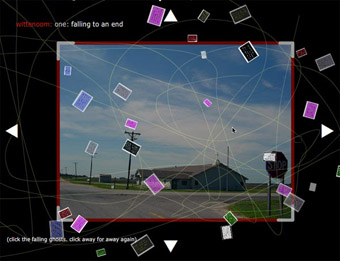
Wittenoom and the Cancerous Breeze, Jason Nelson
jason nelson: digital poems
The ever inventive Jason Nelson (who lectures on Cyberstudies, digital writing and creative practice at Griffith University in Queensland), has released onto the net three “semi-newly birthed digital artworks/poems inspired by Australian locales.” Sydney’s Siberia, “an interactive and infinitely zooming digital poem”, layers strange texts (“city planners continue to be suspicious of growing a concrete cactus from a temporary pavillion”) over sometimes doodled-on, still images (“Siberia, a winter without temperature” overlays a warmly lit cottage and a spindly, drawn tree). You can move in on a detail in each image until it becomes a huge picture quilt into which you further zoom, dizzy by now, and choose another image. Gradually you come to recognise certain images and build yourself a strange vision of Sydney.
Wittenoom and the Cancerous Breeze, Jason Nelson
Birds Still Warm from Flying is “an interactive/re-creatable poetry cube” that you can fill with small moving images and turn three-dimensionally, reading its lateral lists. Less enigmatic and not a little spooky is Wittenoom and the Cancerous Breeze: Set “1450kms north of Perth and 460m above sea level is the valley of death, a town of airborne threads, fibres from the industrial boom and if these carcinogens as residents (the harsh gateway to the Hamersley Ranges) built their own lungfull and fearsome town…” Over a series of 10 images of a desolate town (Wittenoom is a former asbestos mining site and now ghost town), texts fall and turn in sometimes beautiful configurations or an image is enveloped in a big, bloody bubble, while texts exude surreal menace: “They carry re-wind men and their houses open”, or “Armed stars, segmented knives for desecration.” http://www.secrettechnology.com
24HRS at dancehouse: the interviews
In the March 29 In the Loop we told you about the Jo Lloyd-curated 24HRS at Dancehouse, four choreographers each creating a new work over 24 hours—one for each Friday over four weeks. While the works by Phillip Adams (May14) and Luke George (May 21 ) are still to come, Lloyd has been interviewing contributing artists Natalie Cursio and Shelly Lasica about the experience. Read the interviews at http://www.dancehouse.com.au in the performance section.
RealTime issue #96 April-May 2010 pg. web
© RealTime ; for permission to reproduce apply to realtime@realtimearts.net
Creative Sources Recordings, 2010, CS173
http://www.creativesourcesrec.com/ 
Mike Majkowski, Ink on Paper
Opening the CD package, I notice that the disk and inside cover are decorated with drawings of ants running about, and I immediately think of manuscript notes that have left the stave and run off, perversely out of control—a portent of what I am about to hear?
On first listening, however, Mike Majkowski’s choice of notes seems deliberate and carefully calculated. This is a solo CD for double bass in which Majkowski builds on the musical languages that have emerged during his engagement with Splinter Orchestra and related musicians—Jim Denley, Chris Abrahams and others—using his highly evolved playing techniques to produce some dazzling pieces. There seems to be growing interest amongst contemporary musicians in the use of the double bass as a solo instrument, possibly because of its great range, tone and timbre and the amazing effects that can be produced. This CD, Ink on Paper, recorded in Sydney in 2008, does not appear intended as an exemplar of bass literature, but is rather focussed in a particular area, and for the most part, the bass is not made to sound like a bass at all, but like other, sometimes novel, instruments.
The title of the first track, “Pizzicato,” correctly describes the method of playing but does not convey the extraordinary way in which Majkowski plays, nor the complexity of the composition. The work begins with a series of rapid, cascading notes, punctuated by stabbing glissandi, all in the higher registers of the instrument, with occasional bowed gestures in the lower registers. As it develops, we hear background breathing and wordless vocalising, with light tapping on the bass’s body and on the strings. There is no central melodic line, but rather a series of note clusters. It sounds so dextrous, you wonder how it could be performed by one person. The deepest sonorities of the double bass are rarely evident in this track, though when they appear they contrast and thus emphasise the high, chattering notes that evoke ant conversations.
The short second track, “Foam and Straw”, combines high-pitched bowing with an intense vibrato that produces a series of atonal, warbly squeals and screams, which then segues into extremely fast bowing in the lower registers. It sounds like the bow is skittering across the strings, and one can imagine Majkowski’s bowing arm looking like a soft blur as it moves. “First Words, Dribble” is the intriguing title of the third track, demonstrating further extreme bowing with, at one point, double stopping and, later, whistling and vocalisation, the whistling and wordless voice harmonising with the bowed sounds, showing how the bass and the human mouth can mimic each other.
Most startling is the title track, “Ink on Paper,” a series of short, sharp gestures that sound like they come from a synthesiser capable of playing microtones. Multi-tracking is used to build up these squeaky notes into an increasingly chaotic and dense weave, as if we are listening to a gigantic colony of sea birds all squawking their heads off.
The final track, “Current,” begins with strumming across all the strings, with long intervals to emphasise the harmonics and resonances that follow each gesture. These pauses make for a meditative work, and again, the emphasis is on the nature of the sound that can be produced and its musical possibility.
Majkowski’s CD is an extended study of how the double bass can be played and, particularly, how it can be made to generate an entirely new range of sounds. Each of the five tracks is a study based on different playing techniques. Evidently the work is improvised, but Majkowsi is clearly familiar with these techniques, and the combinations and permutations of the musical figures he generates presumably draw on extensive explorations of the instrument. There is presumably some detailed planning behind the track “Ink on Paper,” the result emerging from the overdubbing and mixing as much as the playing, producing a highly calculated work.
This CD reveals new languages of sound as well as of form and technique. This is cerebral, exploratory music. It's about breaking sound down into its most fundamental constituents and then rethinking it, taking elemental material, such as a bowed or plucked note, a strummed chord, a glissando or even a resonant interval, and building up a collage from these fragments. The balance between improvised and composed elements, between the spontaneous and the planned, is not the only interest; rather it is the sonic material and how it is worked that establishes the aesthetic. The music does not overwhelm or obscure the sonic ingredients, but sits in parallel with them—a possible metaphor might be appreciating pixels and picture simultaneously. The result, in the intelligent hands of a composer-performer such as Majkowski, is an entirely new and involving musical experience, a reinvention of music.
Chris Reid
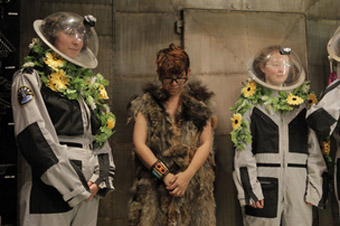
Tape Projects. 100 Proofs the Earth is not a Globe
courtesy Next Wave
Tape Projects. 100 Proofs the Earth is not a Globe
CONSCIOUSLY OR NOT, ARTISTS HAVE LONG PUT AT RISK THEIR BODIES AND SOULS, AND SOMETIMES THOSE OF THEIR AUDIENCES. THEY HAVE TEMPTED THE DISFAVOUR OF CRITICS, AUDIENCES, GOVERNMENTS, MONARCHS AND DICTATORS AND LOST INCOME AND CAREERS.
For much of the 20th century, risk-taking was encapsulated in the notion of a formally and politically disruptive avant garde. In the 21st century the avant garde has been replaced by a multiplicity of agents for change, now busily reclaiming the right to risk as an aesthetic prerogative, and with utopian potential. Such an agent is Melbourne’s increasingly international Next Wave Festival, for and by young adults, directed, for the second time, by the ever energetic and clear-sighted Jeff Khan.
In an era when the artistic manifesto has been usurped by the business plan and society has become increasingly risk-averse (while contrarily wreaking environmental and financial destruction in the name of the free market), the call to experimentation is growing. If hardly a new concept for the arts, the ways in which artistic risk are being realised are evolving differently from their Modernist avant-garde antecedents. I asked Khan about the kinds of risk entailed in the works in this year’s festival.
The theme of the 2010 Next Wave Festival is, rather grandly, “No Risk Too Great.” It’s easy to say, but who and what are at risk in your program?
People inside and outside of the arts have become increasingly ‘risk averse’ so we wanted to open up a space within the festival to critically look at risk from many different angles, including the micro-management of ourselves and our behaviour in a broader cultural context—OH&S, fear of crime and all of that, which are focused on the individual, our rights, our property. We need to look beyond that in our fraught times, of environmental meltdown, of the big systems which are proving to be untenable. We need to be citizens who can step outside of our own comfort zones.
You’re doing this through art but also through talks and discussions.
Where we can drill down into the subject and address the complexity of risk.
Aesthetic risk?
Every act of creation is a risk—starting with nothing and taking a position. A risk averse culture is contrary to the artistic process putting at risk, in turn, the scale and ambition of artists’ projects.
Since at least the 1970s and 80s risk has increasingly manifested as cross-artform, intercultural and multimedia, entailing new performer-audience relationships and a pervasive engagement with media technologies. What kinds of aesthetic risks are being taken in Next Wave 2010?
It’s definitely about the dissolution of boundaries between artforms, collaborations between complementary and sometimes contradictory practices, and especially the engagement with art in a non-art context. One of the things that most excites me has been a real ramp up, for this festival, in the number and rigour of site works that make interventions into the public arena.
What are the risks for site-specific work?
It’s about making meaningful interventions but it’s also about speaking to a non-arts audience at the same time as to an arts audience.
It takes courage as well, or foolhardiness. Both are aspects of risk-taking.
It’s also about the choice of sites, of public spaces. This year’s Sports Club Project evolved out of using night clubs as sites in the last festival. This time we’re establishing a deep engagement with two sports club spaces: George Knott Athletics Reserve, which is a suburban track and field training facility and the MCG, one of the most iconic sports venues in Australia. To really meaningfully intervene in these spaces with integrity is a huge challenge. The artists visited each venue once a week for six weeks, not only getting to know the architecture, but meeting with the sports people and the stakeholders—sports administrators, little athletics clubs, security guards, operations people—to learn about the function of the space both in an operational and a cultural sense. So the artists’ works will be genuine responses to these sites.
Now they’ve assimilated these places, what will they then do in them?
There’ll be a durational event in each venue over eight hours beginning in the afternoon and comprising roving and spot performances and media art works installed in nooks and crannies. People can come and go at any time and will find themselves immersed in these altered environments.
Immersion, sensory deprivation or amplification, one-on-one performances, mass durational events, unusual locations—these are increasingly indicative of the tasks artists set themselves to attract or challenge audiences, to build them into the work.
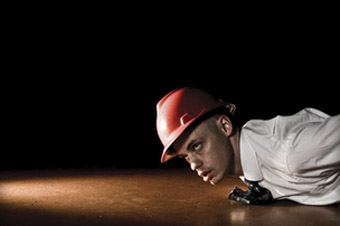
Ashley Dyer, And Then Something Fell On My Head
courtesy Next Wave
Ashley Dyer, And Then Something Fell On My Head
Parts of the program are very immersive, very experiential, like Great Heights, which is staged across Melbourne rooftops. There are performances which are very physically confronting—Ashley Dyer’s And Something Fell On My Head is a full-length performance made entirely of objects that are choreographed to fall from the ceiling of the space towards the audience who are fitted out with safety goggles and hard hats. There are also works where audiences will become participants in unfamiliar places. The Melbourne new media arts collective Tape Projects’ 100 Proofs the Earth is not a Globe is essentially a tour of the Victorian Space Science Education Centre with performance, video and sound, transforming the educational tools. It’s a work that requires the curiosity of the audience as well as a real sense of adventure. A lot of the festival’s projects have a sense of stepping into the unknown.
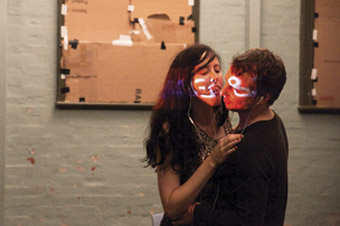
Mish Grigor, Jackson Castiglione, The Short Message Service
© www.maxmilne.com
Mish Grigor, Jackson Castiglione, The Short Message Service
We’re used to the idea of performers tempting fate, as in physical theatre, but now different kinds of risks are being broached. What about Mish Grigor and Jackson Castiglione in The Short Message Service (a collaboration with Lachlan Tetlow-Stuart and Leah Shelton), where the audience text the performers instructions they must carry out? In performance art this kind of approach has sometimes been physically dangerous for the performer.
The success of the show will depend on the fearlessness of Mish and Jackson and how they handle the SMS commands from the audience. The risk is that the premise could result in something banal or something completely out of control, but what tempers it is that fearlessness and the performers’ incredible proficiency in channelling the instructions into creating situations that are dramatic and spontaneous.
And doubtless their skills at improvisation in interpreting the commands.
There’s such a complicated backend tech and media system which underpins the performance, but what elevates it is the quality of the two performers.
Paula van Beek, Dangerous Melbourne
courtesy Next Wave
Paula van Beek, Dangerous Melbourne
I’m intrigued by Dangerous Melbourne, an advisory session on how to handle the city’s perils.
It follows the format of a community information night and will be presented in a series of town halls across Melbourne where Neighborhood Watch meetings might normally happen. It’s equally a photography and performance event. Paula van Beek’s been doing surveys and research to establish what various samples of the Melbourne population find dangerous about the city. Her photography is a sometimes literal, sometimes abstract interpretation of those fears. People will be given tea or coffee and name tags and a slide show which will accurately represent their fears but also poke fun at big irrational fears in the collective consciousness.
This criss-crossing of fact and fiction is fascinating. Doomsday Vanitas likewise engages with the facticity of fear by being located in Melbourne laneways inhabited by works of art: “sharp, hologram-like projections [creating] a series of ominous still lives” in “a video game-like labyrinth.”
There’s a lovely connection with Dangerous Melbourne here, because Nicole Breedon takes iconography from literature, film and largely computer gaming culture—the icons you ‘collect’ on your visit are everyday objects but become weapons and tools of survival. Both Dangerous Melbourne and Doomsday Vanitas are about being held in thrall by our fears but also about being entertained by them while the world around us melts. What kind of gothic fantasies, for example, will be spun out of the recent volcanic eruption in Iceland?
Managing the growing scale of Next Wave must in itself involve risks. It see that your international project is aptly titled Structural Integrity.
Structural Integrity is the biggest exchange that Next wave has undertaken, with artists from the Asia-Pacific region in residence at the Meat Market. We’ve brought together 11 artist run initiatives and art collectives from across Australia and around Asia. Each is building a pavilion structure to house or represent emerging art in their region. It’s been conceived as a melancholic world fair [LAUGHS] rather then celebrating the values of nationalism. It looks at how grassroots cultures balance their work with their geopolitical position. There’ll be different takes on this. Post-Museum from Singapore are apparently meeting with 20 non-profit organisations from around Melbourne—climate change, anti-domestic violence, arts groups and charities who all believe they can change the world for the better—to organise a collective action which will determine the structure of their pavilion. It’s a utopian collectivity which really reflects the group’s position in Singapore where they support arts projects and live art but also provide a meeting point for activist organisations, as an intersection of art and politics.
The utopian aspect looks like a seriously appealing antidote to risk-aversion.
There’s a strong sense in Structural Integrity of art collectives and artist-run initiatives as providing an alternative social structure. The project is bigger than Ben Hur but it’s looking pretty stunning at the moment.
**********
In a speech about Next Wave 2010, Jeff Khan cited as inspirational the words of French philosopher Simone Weil who in 1943 wrote of risk as an “essential need of the soul,” arguing that “[t]he absence of risk produces a type of boredom which paralyses in a different way from fear, but almost as much.” Next Wave invites its audiences to accept exciting and unnerving challenges—to enter unusual non-art spaces, to become essential ingredients in or agents of creation, to be open to new forms and experiences and to talk risk, in the Risk Talkers program, as well as engage with it as art.
The demands are sometimes epic: Ultimate Time Lapse Megamix is an eight-hour dusk-til-dawn video art marathon on Federation Square’s big screen with works from Australia, Asia and the Pacific. Others are intimate: in Private Dances “audiences will be indulged with a lavish banquet and immersed in a series of private rooms, for one-on-one encounters with some of Australia’s most brilliant young dance artists.” Stranger is Bennett Miller’s Dachshund UN which will “convene a meeting of the UN Commission on Human Rights populated entirely by live dachshunds.” While I Thought A Musical Was Being Made promises “a large-scale performance on the intersection of Russell and Lonsdale Streets that the audience will watch from windows high above the on-street action.” Or you might choose to be spooked in a church crypt by the Sisters Hayes’ A Good Death or find yourself literally inside the performance of Hole in the Wall (RT95). Dive in.
The full 2010 Next Wave program can be found at http://2010.nextwave.org.au/festival/program. Participants in Structural Integrity are: Art Center Ongoing (Tokyo), Boxcopy Contemporary Art Space (Brisbane), FELTspace (Adelaide), House of Natural Fiber (Jogyakarta), Locksmith Project Space (Sydney), Post-Museum (Singapore), Six_a Artist Run Initiative (Hobart), TUTOK (Manila), Vitamin Creative Space (Guangzhou), West Space (Melbourne) and Y3K (Melbourne).
Next Wave Festival, No Risk Too Great, Melbourne, May 13-30; http://2010.nextwave.org.au
RealTime issue #96 April-May 2010 pg. web
© Keith Gallasch; for permission to reproduce apply to realtime@realtimearts.net
Murray Fredericks, Salt
courtesy the artists
Murray Fredericks, Salt
SALT BEGINS WITH ONE OF THE MOST ASTONISHING OPENING SHOTS OF RECENT FILM. WE’RE ON LAKE EYRE. LIKE THE MIRROR LAKES NEAR MILFORD SOUND IN NEW ZEALAND, WHEN LAKE EYRE HAS WATER, THE SKY REFLECTED IS SO CRYSTAL CLEAR THE JOIN BETWEEN LAND AND SKY MAKES A NEW LANDSCAPE.
A black speck emerges from right of frame. It’s difficult to make out as it glides towards us. An ambiguous image. Like a Rorschach inkblot brought to life. Is it a sea creature? An alien? A two-headed monster? As the speck hurtles towards the screen, it becomes a man on a bike, carting his photographic equipment on a trailer. It’s like he’s cycled down from the clouds.
Murray Fredericks is a landscape photo-artist. For six years he has been camping on Lake Eyre (alone for up to six weeks each time, often twice a year) and setting up his tripod, searching for “a landscape devoid of features,” pointing his camera “into pure space.” From 2006 to 2008 he also took a video camera, capturing his day to day musings on art, nature, family, grief and the complexities of surviving as an artist—in a video diary interwoven with time-lapse photography and stunning images of the lake.
Salt, a joint effort by Fredericks and co-director Michael Angus, is an amazingly accomplished short documentary considering the isolation and the difficulties of shooting in various weather conditions on the lake. With no crew on board, the lone Fredericks frames each shot carefully, capturing stillness rather than motion. His monologuing, his intimacy with the camera as we sit in the tent with him, capture his moods, etch into the silent landscape. Fredericks has a talent for words as well as images, and there’s poetry in his everyday observations or in his conversations with his wife on the phone, describing meals (his favourite, porridge, over a camp stove), honestly questioning his art-making or meditating on the nature of self and loss in such an overpowering landscape.
As with the documentaries, Contact (Martin Butler, Bentley Dean, 2009; see RT93) and Night (Lawrence Johnston, 2003, see RT83), in Salt the landscape takes over the frames, dwarfing the protagonist and his tent. Fredericks describes how being completely alone, “to the point where [he] can’t see land any more” for 360 degrees, brings him into a dream state, immersed in a void, where even the smallest sounds—brushing his teeth—become magnified, where you end up “watching your thoughts…like a television.” He drifts into a life of rituals—preparing meals, cleaning his camera equipment, continuing to work at all costs—to fight off the “negative spiral” of depression that nips at his heels, the fear that he’ll surface at the end of the trip with no wonderful images: “Is there anything lasting?”
This short film is elegantly structured with the answer to that question revealed at the very end, after the video camera is switched off. As an artist Murray Fredericks is interested in exploring “why landscapes (or images of them) move people.” His still frames are so subtle, delicate and Rothko-esque they become impossible to forget.
Salt had its world premiere at the Adelaide Film Festival in 2009 and screened in March 2010 on ABC TV’s Artscape program. The DVD can be purchased from www.saltdoco.com.
Salt, director, producer Michael Angus, director, camera Murray Fredericks, original music Aajinta, editors Lindi Harrison, Ingunn Jordansen, sound design Tom Heuzenroeder, James Currie; Jerrycan Films, 2009
This article first appeared online April 27
RealTime issue #97 June-July 2010 pg. 20
© Kirsten Krauth; for permission to reproduce apply to realtime@realtimearts.net
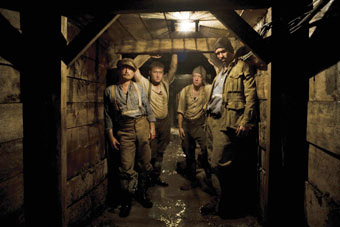
Beneath Hill 60
photo Wendy McDougall
Beneath Hill 60
“TUNNELLING WAS CONSIDERED AN UNGENTLEMANLY WAY OF CONDUCTING WARFARE, IT WASN’T CONSIDERED HONOURABLE. THE GENTLEMANLY WAY TO CONDUCT WARFARE WAS TO CLIMB OUT OF A TRENCH, OVER A PARAPET AND RUN TOWARDS ENEMY LINES WITH A RIFLE…WITH AN AVERAGE AGE OF 42, A LOT OF THE TUNNELLERS HAD DUST ON THEIR LUNGS FROM THEIR MINING DAYS. THEY WERE SICK AND DYING MEN WHEN THEY WENT TO WAR…AFTER THE HOSTILITIES THEY FADED AWAY VERY QUICKLY.” Ross Thomas, Executive Producer, Beneath Hill 60
Jeremy Sims’ first feature Last Train to Freo (2006) was notable for its intense sense of foreboding. A woman caught on a train late at night, trapped by the cat-like menace of an unpredictable man fresh out of prison and hell-bent on confrontation, the film’s real-time unravelling created an acute atmosphere of fear and isolation, that moment when life suddenly spins out of your control. Producer Bill Leimbach (who directed the documentary Gallipoli: The Untold Stories) imagined Sims might be the perfect director for another claustrophobic tale—but here on an epic scale—about a group of Australian civilian miners, called up in World War I, given two weeks rudimentary training, and sent to the hellhole Western front, to start digging and laying mines under the German-held Hill 60.
With the opening scene—a soldier tying his bootlaces up, adjusting his belt, putting his sword in its sheath—we are introduced to the detail of soldierly life. But mining engineer Oliver Woodward (Brendan Cowell) is not your regular soldier. As a civilian, he (and the audience) are rapidly deposited into the tunnels near Armentières, northern France, 30 feet below, where carrying a candle through the darkness, scuttering about like a rat in a maze, his introduction to the men, as their new commanding officer, is: :I can’t seem to find my way out.”
The men use an instrument like a stethoscope to hear through the walls, catching any sounds that may be Germans digging tunnels themselves, or sinking mine shafts. A young boy, Frank Tiffin (Harrison Gilbertson, outstanding as Daniel in Ana Kokkinos’ Blessed [2009], and starring in Andrew Lancaster’s recently released Accidents Happen alongside Geena Davis), paralysed with fear and alone in the dark, is introduced to Woodward. He says he thinks he hears something. With a tap tap, Woodward reveals to the boy that he’s hearing his own heartbeat. As bombs explode around them and rattle the scaffolding, the men hold their cups of tea steady.
Although the underground world is dank and closed in, at least it’s sheltered from noise and rain. As Woodward surfaces for air, his short walk to the officers’ dug-outs (dramatically realised by DOP Toby Oliver, who also worked on Last Train to Freo and, more recently, David Field’s The Combination [2009]) brings home the true horror of men in the trenches, squirming in the mud and rain, bloody body parts left to rot, the continual sonic assault. An introduction to British officer Clayton (Leon Ford) is a reminder of other Australian classics of the war genre, Gallipoli (1981) and Breaker Morant (1980), with laconic Aussies pitted against the English class system in the shape of officers with little pity for the soldiers they’re overseeing. I wish for shades of grey here, beyond the clichés, some insight into these obnoxious Brits, but it’s clearly the way they were seen by many Australian soldiers—the stereotypes persist.
Harrison Gilbertson, Beneath Hill 60
photo Wendy McDougall
Harrison Gilbertson, Beneath Hill 60
Sims has extensive theatrical experience and his strength as a director is clearly in terms of working with actors, especially the younger cast, and ensuring wonderful delivery of idiomatic Aussie dialogue, which rises above sentimentality or uber-nostalgia and goes beyond the well-worn treads of mateship. Although a fine actor, always exciting on screen, the casting of Cowell, however, just doesn’t quite fit: he’s been through so much 30-something angst (the TV series Love My Way; Matthew Saville’s Noise [2007]) that all the soft lighting and makeup in the world can’t make him a believable lad in his 20s, coveting a 16-year-old girl.
The flashbacks to the Queensland homestead, where he teases and seduces the girl (Bella Heathcote), take away crucial pace from a film trying to recreate the dramatic tension of men risking their lives underground. It’s such a long and complicated plotline that by the time the men actually reach the Hill (the bloodiest battle on the Western Front, along the Messines Ridge in Belgium), where the tension should be peaking, the dramatics have started to soak back into the soil, slowly oozing out rivulets from the mine, like the reluctant pump Woodward sets up in front of his superiors. I longed for the tension created in a similar film caught in confined spaces, Das Boot (Wolfang Petersen, 1091), and think with a more focused script and fewer ‘diversions’, Sims and writer David Roach could have achieved it. He also chooses to focus on two German miners on the other side of the wall and while this could have made a wonderfully dramatic connection between the Germans and Australians, the narrative device too leaks the tension rather than building it.
The men, by tunnelling into the blue clay of Flanders beneath enemy lines, are able to lay enough explosives so that the bang, when it arrives, is the largest that the world has ever seen. Sims does well to give a big budget feel to a film that doesn’t have one, transforming sunny Townsville via a rain machine into the quagmires of France and Belgium. It’s an immensely ambitious project with a captivating story that’s taken 90 years to reach the surface. For the most part, Sims and his strong ensemble cast bring the feature to life with more force than many US action flicks can manage.
Beneath Hill 60, director Jeremy Hartley Sims, producer Bill Leimbach, writer David Roach, cinematographer Toby Oliver, composer Cezary Skubiszewski, editor Dany Cooper, production designer Clayton Jauncey, www.beneathhill60movie.com.au
RealTime issue #96 April-May 2010 pg. web
© Kirsten Krauth; for permission to reproduce apply to realtime@realtimearts.net
Dante's Inferno, Zen Zen Zo Physical Theatre
zen zen zo: dante’s inferno
Zen Zen Zo's engagement with the classics has included intensely physical realisations of Dracula (see RT80) and The Tempest (see RT92). Now it's The Inferno, the first part of The Divine Comedy by mediaeval Italian poet Dante Alighieri (1265-1321), a wonderful opportunity for the company, in a long line of artists across the centuries, to conjure its own images of Hell.
I asked Stephen Atkins, associate director with Brisbane's Zen Zen Zo, why the company had chosen The Inferno in particular. He explained, “It's been on the backburner for the directors for a number of years and fits the trademark image of the company—the naked form of the human body, images of the grotesque, but always alluding to hope and light in the darkness. That's their performance aesthetic and it really does parallel the content of Dante's poem. The company has tackled classic texts for a long time and they work especially well with physical theatre of a visual and edgy kind. It's a perfect fit. When I came over here from Canada in 2007 to do an internship they asked me to come back and eventually do The Inferno.”
The press release for the show says that The Inferno will be re-imagined in terms of modern Australia. Atkins explains how this transposition is being achieved: “It's done through reading the heart of the poem. It's a secular poem, one of the first ever written in the new language of Italian instead of Latin and was meant for the common man. It's also a political satire, a dark criticism of contemporary Florence. Dante was a philosopher as well as a poet, had many political enemies and a stern point of view, opposing corrupt clergy including the popes. However, a literal transposition that would include the personalities he criticises would have been alienating for a contemporary audience.
“We have taken Dante's concept—the geography of hell, each one of the nine circles punishing more progressively serious sins—and transposed this to our society but with a wry sense of humour, an edgy cabaret sense in the way that Weill and Brecht could make fun as well as poke fun. It's not the poem so much as its shape, although there are condensed sections guiding the viewers through the performance. The audience is going through the same hell as Dante, but 700 years on.”
I ask if the audience will have a guide—Dante has Virgil. “Yes, but updated,” says Atkins. “Dante's text is not very theatrical and a bit like a travelogue, so our guides are tour guides.”
The Divine Comedy is secular is the sense of being written in the vernacular, but it is deeply religious. How, I wonder, will the viscerality of the mode of Zen Zen Zo performance capture more than the punishing torments of Hell. Atkins replies, “Hell is a place of punishment so that performance aesthetic of viscerality and visual impact is very present in our production. But also Hell is a just place where punishments fit the crime. Also, people arrive there from their own choices and a misguided sense of self—they're not sent there by an authority. I think this is what makes it appealing to a secular, humanist audience—it doesn't follow the popular idea of Hell, of the devil on a throne dishing out punishment. According to Dante, Lucifer is the most punished person. If Hell is created by people from their own choices, the light at the end of the tunnel is that we have the keys to our own well being. So we must have the courage to go deeper into dark places in order to come out.”
I ask Atkins to describe something of the performance. He chooses The Circle for Heretics scene: “These are the followers of false wisdom and the corrupters of beauty, meaning of creation. The circle is one of the most severe in upper Hell. Where we have tweaked it is through using images of the distortions of the beauty industry—plastic surgery and the bodies beautiful of models—and what it does to people's self-esteem. These are projected onto the bodies of the dancers. In each of the little vignettes in the work we see the core of the misguided soul and what brought them there. We also see that the soul is unable to get itself out of its state and see beyond. We don't just want to see people being punished—it's about falling into states without examining them.”
I'm curious if, with his large-ish cast, Atkins can also capture some of the epic scope of Dante's Inferno. “The original has images that go from horizon to horizon, with millions of souls,” says Atkins. “But we'll concentrate more on the ideas and the emotional journey through each of these hells. I've tried to incorporate the scale with a couple of large numbers with the entire cast of 19. In the middle of the show, which we have nicknamed “the feeding frenzy”, the whole cast is choreographed by one the company's core members. Dale Hubbard's musical score for the work is as rich and varied as the visual influences from Dante's poem, from swamps to flaming deserts to ice cold wasteland.”
The Inferno will be performed in the heritage-listed Old Museum Building in Bowen Hills, Brisbane offering the audience a distinctive journey through the circles of Hell. Atkins says that circularity is important in the work, “Many of the stations we're setting up are circular.”
Stephen Atkins is the director of Vancouver's Human Theatre and teaches at the Capilano University, but currently spends half his year in Brisbane as Associate Director with Zen Zen Zo: “I'm lucky. And the art scene here is very vibrant, young and very inclusive and accepting of new ideas. I'm having a fantastic time working with the company and we look forward to a very long relationship.” Zen Zen Zo Physical Theatre, Dante’s Inferno—Living Hell, Old Museum Building, Bowen Hills, Brisbane, May 8-20, www.zenzenzo.com
melbourne international jazz festival
With a theme of “celebrating the common chord”, the festival embraces a remarkably wide range of jazz forms and experiences curated by Michael Tortoni and Sophie Brous in a huge program with 400 performers, 95 events and 20 free concerts, 16 world premieres and 21 Australian premieres incorporating film, visual art, public art installations, forums and master classes.
Famed participants include Charles Lloyd, Zakir Hussain, Ahmad Jamal, Mulatu Astatke, Avishai Cohen, John Hollenbeck, Theo Bleckmann and John Abercrombie. But for those looking for edgier jazz and cross-overs, a variety of spaces in Melbourne Town Hall will be home to Overground which features European improvisers Peter Brotzmann (a festival coup, from Germany), Han Bennink (Holland), Brian Chase (Yeah Yeah Yeahs, USA) with Seth Misterka (USA), My Disco (Australia), Mick Turner (The Dirty Three, Australia); Kim Salmon (Australia); Kram (Spiderbait, Australia), Cor Fuhler (Holland), Kim Myhr (Norway) and Oren Ambarchi, Evelyn Morris AKA Pikelet, Bum Creek, Anthony Pateras, Paul Grabowsky with Sean Baxter (Australia).
Elsewhere on the program The Australian Art Orchestra and Paul Grabowsky will present a tribute concert: Miles Davis—Prince of Darkness. Paul Capsis will perform Songs of Love and Death with the Alister Spence Trio and the Melbourne Symphony Orchestra will embrace “the interaction between exploratory improvisation and symphonic music with the Metropolis Series.
At the National Gallery of Victoria, as part of the cross-artform Visions of Sound program, Hybrids & Folklore features The Dead Notes, Hi God People, Joel Stern, Snawklor and Clocked Out Duo working with David Chesworth, in an interactive installation curiously described as “focusing on psycho-folkloric sound-making and improvisation in the natural environment.” The Places In Between features Chris Abrahams of The Necks in an immersive sound and light installation in Federation Square. Melbourne International Jazz Festival, May 1-8, www.melbournejazz.com
lynette wallworth does opera
Among video works for live opera, Bill Viola created enormous images for Peter Sellars' production of Wagner's Tristan & Isolde, and now Australian artist Lynette Wallworth has been commissioned to make works for new opera productions in Europe by major composers. In April, The Netherlands' company De Doelen toured a production of Gyorgy Kurtag's Kafka Fragmente, in which the writers' texts are scored for piano and soprano, with Wallworth's projections as “a third protagonist, a woman making art.” London's Young Vic, in a co-production with the ENO (English National Opera), is currently presenting Hans Werner Henze's Elegy for Young Lovers, directed by Fiona Shaw. For this production Wallworth has created an interactive video installation, responding to the actions of the performers and “inviting the audience to directly engage with the video.” Elegy for Young Lovers, Young Vic, London, April 24-May 8; www.youngvic.org/whats-on/elegy-for-young-lovers
adam geczy performs in gent, belgium
Remember to Forget the Congo is a five-day gallery performance (also webcast) by Australian artist Adam Geczy in Belgium. In a blackened room, he will write in white paint the entirety of Andre Gide's Voyage au Congo, an early 20th century text exposing the iniquity of the Belgian imperial exploitation of the Congo. The consequences live on. Geczy says that although Gide's text has been little remembered it was quite influential when published. The artist describes his action as “simultaneously enact[ing] political and social remembrance of trauma, whilst at the same time being complicit in its repression, since the end result is a white room…a dense palimpsetic residue of words, a skein, that is both beautiful and menacing, acting as both conscience and amnesia.” A performance by Adam Geczy, Croxhapox Gent, May 1-5; presentation May 6-30; www.croxhapox.org; webcast www.ustream.tv/channel/croxhapox
RealTime issue #96 April-May 2010 pg. web
© RealTime ; for permission to reproduce apply to realtime@realtimearts.net
Brian Carbee as Bingo caller in Accidents Happen
BRIAN CARBEE IS THE WRITER OF DIRECTOR ANDREW LANCASTER'S FIRST FEATURE FILM, ACCIDENTS HAPPEN. IT'S ALSO CARBEE'S FEATURE DEBUT, A SCREENPLAY THAT EVOLVED FROM A DANCE WORK INTO A NOVEL AND INTO A SCRIPT.
The film premiered in 2009 at the Tribeca Film Festival in New York and then at the Sydney Film Festival. I met with Carbee as the film’s Australian season was about to be launched prior to American distribution in cinemas and on demand. I asked Carbee to detail the evolution of the film and to place it in the context of his career as an actor, dancer and choreographer and how those roles have influenced the way he writes for a film and collaborates on its making.
background
Born in the United States, Brian Carbee trained as an actor at the University of Connecticut, worked as a dancer and choreographer in Boston and New York and then migrated to New Zealand in 1986 where he created works for Limbs Dance Company, danced with Douglas Wright Dance Company and produced works for his own company, The Jump Giants. Carbee moved to Sydney in 1997 and made In Search of Mike, a 30-minute dance theatre piece which he adapted into an eight-minute film (see RT44) directed by Andrew Lancaster. He created Glory Holy! (see RT41), a much praised text-based dance work for One Extra’s 2000 season of Foursome and the following year made Stretching it Wider (see RT42) in collaboration with Dean Walsh. In 2004 he won the IF Award for Best Unproduced Screenplay for Accidents Happen and in 2005 the script was chosen to be part of the FTO NSW Aurora screenplay development project.
early evolution
How did the film evolve?
Its genesis was an exploration of language in the relationship I had with my mother. At that point it was a duet with a choreographic and a large textual element. I have a background as an actor. That’s where I started dancing, in drama school. So over the years I started to develop work that incorporated text because that was another skill I had and it was really interesting melding the two. It started to morph into various other forms. I did a bit of the material as stand-up once.
I moved to Sydney in 1997. I was approached by Leisa Shelton to be part of Inter-Steps at Performance Space. I thought, let’s re-work it. I was new here and I just wanted to land on something I felt secure with. So I made it into a solo and expanded the choreographic element and kept much of the textual component. Andrew Lancaster was in the audience one night—one of four. He just bailed me up afterwards and said, “Look that was really interesting. I’m a filmmaker and I’d like to make a short film out of it.” And I thought, who is this guy? But he was serious, though it took us quite a while, til 2000, to make In Search of Mike. It kinda sat around on various funding bodies’ desks. It didn’t quite fit the model of what short films were at that point.
Did it involve dance?
I’d basically eliminated the dance element. There’s one little dance piece in it. Up to that point Andrew had made short films, using sound and movement, and music videos and he wanted to branch into dramatic storytelling. He liked the material and thought this would be an interesting way to go. He hooked me up with a computer for the first time and I wrote a script. I wasn’t quite sure what I was doing but he got me through it. In Search of Mike was a big hit. It did really well, sold overseas. We even made a bit of money, which is unheard of. And it actually made the funding bodies take notice. First they weren’t going to fund it at all…then [someone] called us and said, “This is fantastic. Ask for more money.” It was completely surreal. I took all the choreographic elements out [which meant] we were left with the kind of harsher elements of the story which I didn’t feel did my mother much justice. It was a very ‘rough’ piece.
My mother was quite ill at the time. I loved our relationship. I thought it was a great, full relationship. It wasn’t easy but it was rewarding in so many ways. And I just thought, hang on…So I wrote a novel and Andrew read it and optioned it. As the screenplay was nearing production, it really separated quite strongly from the book. The book is quite epic.
The necessary economising that comes with a screenplay.
Yes. Characters went flying out of it—all that stuff. So, 1995-2010, for 15 years the story has been kind of shifting through various media and forms.
developing the script
I wrote a first draft and got money [from Screen Australia, then the Australian Film Commission] to write the second draft. Then after another two drafts, it was accepted into the FTO’s Aurora Script Development initiative. So we had a year focusing and that was the stage that was meant to bring it up to finance-ready, and it did.
Was Aurora helpful?
We had a good year. It worked really well for us. Not that it gives you any answers. It just ups the ante around the film, it shifts your thinking. And it brings a lot of interest to bear on it, which causes you to lift your game as well. As a new writer it really made me feel I had business doing it because, you know, Gus Van Sant was there giving me feedback, and John Sayles and Alison Tilson. It was really confidence-building because they liked it. They thought it had lots of potential, which was the reason it was there.
structure and emotion
What kinds of issues were you addressing in script development?
The real shift that Aurora made was that the script had been a black comedy. At that point it shifted to really bringing up the emotional core of the characters. That was really satisfying to me. It kind of went back to why I wrote the book, which was to bring more depth into what the relationship initially was. They helped mine that.
Geena Davis, Accidents Happen
The gradual tonal shift in the film is very interesting, from grimly comic to deeply emotional as the repressed grieving opens out.
It was a real challenge to mix that and to varying degrees of success. People criticise it either way. It’s a tough little balance to get. I think what little tragedy unfortunately I’ve had in my life has been the source of quite amazing humour. How we deal around those extremes of existence is quite broad.
Gloria (played by Geena Davis) puts up so many shields about grief that at the funeral, she’s asking [about the overweight dead man], “What did he do, eat an ice cream truck?” She’s so good at insulating. Then after the wake she breaks down. That wall is such a façade. The trick with her is to find the humour that’s a weapon, but mostly it’s a shield. It’s what keeps her from falling to bits.
So the structure was constantly being addressed so you could get closer to this depth?
And the whole causal effect that really starts to kick in in the film, once the boys make up lies about where they were—it all starts to unwind.
location, location
We were really keen to make the film in America because it’s an American story. It appealed to our sense of adventure and enterprise to do it there. But then, upon investigation and very close to production, the fringe costs and the labour costs and travel costs just blew the budget to such a degree that the percentage of the budget that was actually going to make it onto the screen was so minimal compared to what was going to be spent. Then we talked about, well, can we do it here? You know, there have been enough films made here, set in America, that we have the infrastructure to do it. When we started auditioning, we discovered the kids’ American accents were much better than the older actors. They grow up with it now. So it became an interesting possibility to do it here.
And that was embraced, was it?
It was a hard fight because you go back to funding bodies [who ask] “Why are we making it here? Why are we funding the second-best version of this film, the best being one made in America?” Fortunately, we’d been down that road and we could say, this is actually the best version because we can put a better quality film on the screen for the budget we have. So that was persuasive. In the meantime, Geena Davis got involved because we had been going to make it in the US and that suddenly lifted the finance possibilities.
It was interesting when we were doing Aurora, part of the process near the end of the year involved a follow-up workshop when actors came in and read the workshopped scenes. We said “just use your voices; don’t try to make accents.” And as they were reading, they naturally went into the American vernacular. There was something about the language for them to feel true doing it, they needed the accent. And many of the set pieces, whether about the bowling ball, the baseball, the drive-in, felt much more American than Australian iconic. We had to find the last drive-in in this country to shoot the film in! Then when Geena became involved, we thought well, we’re not gonna have her doing an Australian accent. That would be silly. She jokes that she came over here and her Australian accent was so bad everyone else had to learn American accents.
We got some private money. A British company called Bankside [also handling international sales] and quite a new Australian film funding group, Abacus Film Fund—we’re the first cab off the rank for them.
the re-writing mindset
Were you still writing at this stage?
I was writing right up to production. As it gets closer, all kinds of budget considerations come into play, location and scheduling issues happen. “We can’t afford to go to that location. We have to travel too far. The schedule doesn’t permit it. We need to combine those scenes.” All that stuff. But as a story it was settled.
You didn’t find this stressful?
No, there were so many changes over the years for various reasons and, because it had changed form, I was used to it. My promise to myself was that at any point the challenge wasn’t to change it but to make it better, to accommodate the change. I really feel I was able to achieve this. Even though we had “You can’t go there” and “We have to chop that scene.” It’s like, okay, well how is that a blessing?
When the film was being shot, were you present?
I visited very sparingly. That’s the kind of culture there. It was difficult, but prior to filming I had a great deal of influence really, during casting and location decisions and design.
the writer as collaborator
Andrew and I have a long history, and I was the resident American, the ‘expert’ if you will. The autobiographical nature of the film has been played up, but it’s a fictionalised memoir to a ridiculous extent. But there’s a basic truth to it because elements of it bleed through in terms of the basis of some of the characters. It was important that I have an input into the casting, to really understand and to secure the right people. So I was really lucky. Writers don’t normally get that kind of influence. They’re usually kept to the kerb.
What about in post-production?
Back into the game again. I was giving notes on picture edits, sound, music and marketing—I had a hand in some of that. So from one film, I’ve got a pretty broad knowledge of how the system works.
the dancer's vision
What did your experience in dance and other performance bring to filmmaking?
Over the years I’ve directed shows and had dance companies so I’m used to the production role and working collaboratively. Dance is the great collaborative artform, particularly contemporary dance. Film is also incredibly collaborative. But I think on the dancer level, the great evolution of dance over the last 30 years has been the empowering of the dancer and their artistic expression.
Rather than being the tool of the choreographer. So is dance still a part of your life?
I still perform with Chunky Move when they do Tense Dave. Hopefully they haven’t retired it because I think it still has legs. We had a month in New York with it at one point and a couple of small tours around the States and around Australia. I teach contemporary technique at Sydney Dance Company, and stretch classes and yoga around various gyms. I make my living in a very physical way. The writing is new. I’m still trying to get the novel published and that could finally put that story to bed and I can move on.
Is there a relationship between writing and choreography?
Well I’ve had two writing experiences, one is the book which was very solitary, with the occasional agent or friend’s feedback. The film screenplay has continual feedback, weekly. Both work really well. I really like the collaborative element with the film. It’s how I’m used to working historically. As a dancer, you’re constantly criticised. It’s just part of how it works. So I kind of fell into that. It’s nice having that energy. I’ve read thousands of books but I hadn’t read many screenplays, so it was nice to have that support in terms of the language. I discovered I’m quite good at imagining what something is going to look like on the screen. Being a choreographer, I’m used to seeing visual images. So it played into one of my strengths.
You know when words are not needed.
That’s one of the things that dance has taught me, the power of an image and that the whole comprises many things, not just a performance. There’s a soundtrack, there’s lighting, the composition of each scene. So I intrinsically understand that and know that all the pieces make the story.
film or dance?
The film adventure came along and it was very seductive because suddenly there was all this support and interest and funding and I got swept up in it. At the same time, the dance world was really difficult to penetrate for me. Funding was impossible without going through years of development funding and all this step by step funding. I’ve been doing this work for so long, I’m just not interested in that. I’m a mature artist and I want to make work. And I’ve applied in the past and I got so discouraged because the whole process of asking for funding actually encourages you to lie. And that’s just no way to start an artistic contract. Or if not lie, to fantasise about “What do you hope to learn?” If I knew I wouldn’t need to do this. “How will it benefit the community?” “Why do you want to work with these people?” Well, because they’re fantastic and brilliant and they’ll inspire me and they’re people I want to spend time with.
going deeper
Lastly, I'd like to come back to what you were saying about moving the script away from black comedy into more something more deeply emotional.
That actually brought me home in terms of what I wanted to achieve with the relationship between mother and son and the power of Gloria, who is ball-breaking and totally devoted at the same time.
Did Geena Davis live up to your expectations?
The great thing about Geena is that while the role is at times so unpalatable, she brings a history of likeability. So you cut her a break because you can’t help but like her. She’s adorable. So you go, okay I’m gonna stick with her.
Conversely, Billy appears likeable, but when he starts lying and covering up, if sometimes from altruistic motives, you think that perhaps Gloria's right, that he's selfish, or heading that way. But that's unfair and her wit is cruel: “I’d always hoped you’d amount to something. Maybe I wasn’t specific enough!”
It’s like he doesn’t know quite how to be bad. It’s like the scene with him and the girl next door, Katrina, with the cigarette and the kisses. They’re both trying to act up but they don’t really have the DNA for it.
When Gloria asks Billy about remembering his dead sister, he confesses to a blank—until he’s made to think about it. This amongst others of the later scenes adds considerable depth of feeling.
It was one of the struggles. Early in development, they wanted me to lose Linda altogether. She’s one of the ones I fought for. I thought poor Linda has never been grieved for because she’s been eclipsed by this person, Gene, who’s in limbo, keeping the family in stasis. The double grave is half-empty, waiting for him.
next: the american market
How is the US distribution of Accidents Happen being handled?
That’s the next hurdle, which will happen sometime late their summer. At the moment, we’ve negotiated a couple of screens in major cities and a 12-city tour of Australian films, with Accidents Happen being the headline film. The cinema release will allow Geena again to do publicity tours. Two companies have been contracted in the US, one does the theatrical release and the other is doing ‘movies on demand,’ which is the new basic avenue for getting independent films distributed. It comes via the internet to your TV. It eliminates all the costs of cinemas and prints and publicity. Hopefully it will allow a return somewhere down the line and allow the film to find its own audience.
For more on Accidents Happen see the RealTime+OnScreen review and go to http://www.accidentshappenthemovie.com/; http://en.wikipedia.org/wiki/Accidents_Happen
This article first appeared online April 27
RealTime issue #97 June-July 2010 pg. 18-19
© Keith Gallasch; for permission to reproduce apply to realtime@realtimearts.net
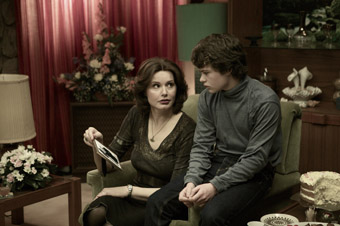
Harrison Gilbertson, Geena Davis, Accidents Happen
GRIEVING—ITS NATURE, ITS STAGES (AS IN THE DISPUTED KÜBLER-ROSS MODEL), AVOIDANCE OR REFUSAL TO LET GO OF IT—IS ONE OF LIFE’S MORE IMPONDERABLE STATES OF BEING. ITS SENSE OF LOSS IS DEEPLY BOUND UP WITH REFLECTIONS ON LOST OPPORTUNITIES AND UNFULFILLED DREAMS AND IS SOMETIMES IMBUED WITH FEELINGS OF GUILT, OF HAVING CAUSED HURT OR EVEN DEATH.
This is the raw material for director Andrew Lancaster and writer Brian Carbee’s remarkable feature film, Accidents Happen, a nervy, funny suburban parable about a family and their neighbours enmeshed in a web of accidents, the causes sometimes innocent, and the complexities of grieving, loyalty and responsibility. Gradually the film’s tone shifts from ironic detachment to demanding emotional engagement as grieving and denial each reach critical mass.
The film opens in 1974 in lower middle class American suburbia with a nasty accident—a neighbour sets fire to himself and stumbles in slow motion, flaming, towards a small boy, Billy, playing beneath a garden sprinkler. It’s an ugly scene but a curiously beautiful one, as if a child’s dreamlike recollection. A little later the boy’s family go to a drive-in where they watch The Three Stooges (with their trademark mix of malice and accident) and suffer eldest son Gene’s bad public behaviour, enacted with his close friend Doug, a neighbour’s son. On the way home the resulting argument plus Billy’s move to the front seat and the father’s distracted driving result in a serious crash. These early scenes, a retrospective prelude, establish the initial mood of the film, brisk, shocking, witness to the role of chance and the complexities of cause, effect and responsibility.
Now it’s 1982: Billy (Harrison Gilbertson) is 15. His father (Joel Tobeck) has left the family for a new marriage, his mother Gloria (Geena Davis) is in bitter denial, keeping the world at bay with dark witticisms and refusing to see Gene, who is in care and visited regularly by Larry (Harry Cook), the second eldest boy, who blames Billy for the car crash (and, cruelly, for the fiery death of their neighbour). Billy, in the manner of his own grieving, emulates Gene by befriending Doug (Sebastian Gregory) and tempting him into misadventure, but their brief partnership causes a very serious accident. From this flow the events that—regardless of the resistance of the protagonists—will bring not today’s much vaunted ‘closure’ but at least release from the stranglehold of grief.
As tense and explosive as this scenario later becomes, the filmmakers nonetheless sustain just enough distance (Gloria’s jibes, Billy’s retorts, glimpsed character eccentricities, coincidences and smaller accidents) to maintain an essentially comic rather than tragic vision. There’s even a touch of deus ex machina in the plot resolution, but in the meantime the emotional drama deepens—trust is betrayed, physical pain inflicted on self and other and relationships are sundered, but equanimity is finally achieved and frozen lives are allowed to thaw and begin again.
A great strength of the film is its ensemble playing with uniformly good performances, script and directorial attention foregrounding each of the characters. It’s quietly done, for example, in the case of Dottie (Sarah Woods), whose suspicions never corrupt her neighbourliness, and more acutely with Ray, Billy’s feckless father, who comes into clearer focus as the film progresses: “But we can’t just wait for Gene to die, Gloria. We’ll waste away with him…Lose all feeling. Turn into vegetables. Make a salad.” Even the most minor figures are deftly sketched: the girl who must hug everyone suddenly and too vigorously at a wake, or Aunt Louise who disruptively appears there too: “Here’s to the living. You know what they say? When God closes a door he opens a beer.” Another neighbour, Mrs Smolensky, the wife of the immolated man, appears briefly if recurrently in what becomes a key symbolic role in a tightly crafted screenplay.
Geena Davis’ Gloria is central to the film, although she’s not always on the screen. Gloria’s loss of two of her children, then her husband to another woman, of her uterus to a hysterectomy and later her trust in Billy is a load she struggles to bear when not withdrawn—playing Bingo with friends, going on a date, always joking (“If I’m lucky, the Department of Health will board me up”). There are revealing moments when she cracks, for example after the wake: “I always think the next funeral will be Gene’s. I can’t go home,” she weeps. When she fears that Billy is turning into the delinquent Gene she atypically can barely speak. When Billy says he can’t recall much about his dead sister Linda, Gloria’s fury demands that he think again, which apologetically he does, because he can with his mother.
The relationship between Billy and Gloria is of easy intimacy, in the way he advises on the choice of earrings before her date or joins in droll exchanges: “Gloria: I’m so hungry I could eat a crowbar and shit a jungle gym. Billy: Good. All those loose screws you have will finally come in handy.” Davis invests power in Gloria’s facade, reveals its fragility and displays a warmth in her relationship with Billy. But hoping to see the overt smiling charm of Davis in this tough mother role risks missing the subtleties of a strong performance.
When Billy finally confesses the full extent of his sins, he argues, “I was trying to protect you.” Gloria retorts, “I don’t need protecting, Billy. I need someone who is on my side, damn it.” In Harrison Gilbertson’s fine performance as Billy, we see an adolescent trapped by accidents not all of his own making, but complicated by lies and loyalties and a rapidly escalating number of ethical crises—dealing almost simultaneously with discrete problems involving his mother, father and Doug and the police. Gilbertson plays Billy with a quiet charm, who at his lowest point sounds not unlike his mother: “I’m sorry you lost your father but this could turn into a great big shit shower with, like…no soap.”
Afforded the luxury of two viewings of the film and a reading of the screenplay, I’m convinced that Accidents Happen is a significant Australian film. Yes, it’s written by an American about his America of the early 1980s, and, yes, Geena Davis aside, it’s directed, acted and otherwise made by Australians and filmed here. For some that’s a problem. But the writer has lived in Australia for 15 years and the film is faithful to his vision. The actors’ accents are largely fine, as accurate if not more so than certain Australian actors who frequently play in Hollywood films with their trans-Pacific accents. Some criticism of the film reminds me of the rejection of Frank Moorhouse’s novel Grand Days from consideration for the Miles Franklin Award on the grounds that it was set in Europe, even though the principal character was Australian. Other criticism finds it difficult to locate the film, as if it’s totally alien. Surely, if with its own idiosyncrasies, it sits firmly in the tradition of the domestic dramas of American indie filmmaking (recently, Little Miss Sunshine, The Savages, Before The Devil Knows You’re Dead, Juno etc) and more commercial ventures in the same idiom like American Beauty and Revolutionary Road (both by British director Sam Mendes).
Accidents Happen is bracing cinema—funny, cruel, suspenseful and wise, never letting the viewer off the moral hook with loveable characters and a predictable tale. Its tonal, structural and thematic integrity is supported by the slightly heightened aesthetic of the production and art design (Elizabeth Mary Moore, Angus MacDonald) and the cinematography (Ben Nott), evoking the 80s while intensifying the everyday in what is a very contemporary, shadowy parable—and something more than mere realism. It’s a tale underscored with an essentially comic vision that allows for redemption and regeneration in a small suburban cosmos, if against the considerable odds of an accidental universe. Great writing, directing and acting make Accidents Happen’s wickedly tough, idiosyncratic vision of grieving a truly memorable experience.
The world premiere of Accidents Happen was in April 2009 at the Tribeca Film Festival in New York and in June 2009 it was shown in the Sydney Film Festival. Australian screenings commenced April 22, 2010.
Accidents Happen, director Andrew Lancaster, writer Brian Carbee, cinematography Ben Nott, editor Roland Gallois, composer Antony Partos, producer Anthony Anderson, production design Elizabeth Mary Moore, art direction Angus MacDonald, Redcarpet Productions; http://www.accidentshappenthemovie.com/
This article first appeared online April 27
RealTime issue #97 June-July 2010 pg. 19
© Keith Gallasch; for permission to reproduce apply to realtime@realtimearts.net
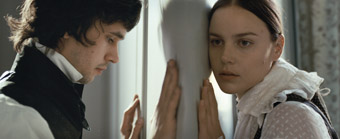
John Keats (Ben Whishaw) and Fanny Brawne (Abbie Cornish), Bright Star
THE LIFE OF A WRITER IS HARD TO BRING TO DRAMATIC LIFE ON SCREEN. WRITING CAN BE A SOLITARY JOURNEY WHERE THE RAW DRAMA IS INTERNALISED, GOING ON IN THE MIND, THE BODY, THE FRENETIC PACING OR ANXIOUS WAITING OF FINGERTIPS, HOLDING A PEN, ON THE TYPEWRITER, THE KEYBOARD. TRANSLATING THAT FRACTIOUS INNER WORLD CAN BE A CHALLENGE, SO BIOPICS OF THE LIVES OF WRITERS TEND TO FOCUS ON THEIR RELATIONSHIPS WITH OTHERS, THEIR ADDICTIONS OR THEIR HARROWING PATH TO SELF-DESTRUCTION.
From The Edge of Love (Dylan Thomas) to Sylvia (Plath) to Factotum (Charles Bukowski) there’s usually a scene where the writer self-combusts, tearing the room apart, smashing a plate or glass, throwing his/her manuscript out the window, grabbing a knife or a gun. Hell, it looks good on screen, and gives actors a chance to flex their dramatic muscles. It sure beats staring glassy-eyed at a computer screen, adjusting the venetian blinds, making a tenth cup of tea to procrastinate, curling up on the lounge underlining passages for future research, and waiting hours for the manuscript to print.
Jane Campion has always had literary leanings in the filmmaking projects she takes on. In an early interview, she spoke about how seeing Gillian Armstrong’s My Brilliant Career (the Miles Franklin biopic) proved to her that directing was a possible career choice for a woman (Deb Verhoeven, Jane Campion, Routledge Film Guidebooks, UK, 2009). Her first feature, Two Friends, was based on a short story by Helen Garner. The critically acclaimed An Angel At My Table, originally a mini-series, was based on the life of New Zealand writer Janet Frame who spent many of her formative years in institutions with incorrectly diagnosed schizophrenia (in one scene, pre-empting Campion’s latest work, Bright Star, Frame’s best friend Poppy quotes Ode to a Nightingale at length in a cow paddock: “We have to learn it by heart”; later, becoming more and more isolated, Frame says, “My only romance was in poetry and literature”).
Campion’s less successful Portrait of a Lady and In the Cut offered very different subject matter but were film adaptations of successful books, nonetheless, and Gail Jones argues the strong impact of Emily Bronte and the poets Blake, Tennyson and Byron on the mood of The Piano (The Piano, Australian Screen Classics, Currency Press, Sydney, 2007; reviewed RT80, p34). Campion even took the unusual step of publishing ‘novel’ versions of her films, The Piano and Holy Smoke. Her latest offering, Bright Star, tackles the relationship between Fanny Brawne (Abbie Cornish) and John Keats (Ben Whishaw) before the poet’s death at 25. After making In the Cut, Campion told the media she was planning to take four years off. When interviewed about her time away from filmmaking, she commented, “I didn’t think I would want to do anything much, but I found that after a year or so…I was doing things like embroidering pillow slips and very crafty simple stuff.” Out of the quiet and silence, it seems, Bright Star emerged.
In The New York Review of Books, Christopher Ricks argues that Campion’s film is mistaken about the nature of imagination when it comes to a poet, especially Keats: “film cannot but show in pictures” (New York Review of Books, vol. 56, no. 20, Dec 17, 2009). He is hard on the director, stating that a film should never picture what a great writer has already beautifully captured, allowing us to imagine instead. He gives an example where Keats talks of snow and we simultaneously see snow in the image. When he speaks of being ‘pillowed’ he is lying with Fanny, resting his head. But in the course of writing, a novel for example, a writer may repeat herself many times, making overlapping allusions to make things clearer for the reader. And it works here within the film’s frames, especially if a viewer is not as conversant with Keats’ poetry as experts like Ricks. Campion’s view is inclusive and the linking of text with image acts as a springboard for our imagination: the images, like Keats lying as if in the clouds amid the treetops, are often so exquisite (cinematographer Greig Fraser) they bring the words to life, rather than trampling them underfoot.
Some of these scenes are also based on historical account. In a letter, Keats’ friend Charles Armitage Brown (Paul Schneider), who in the film tussles with his seeming love and envy of both Fanny and Keats, described the background to the writing of Ode to a Nightingale, where the bird had built a nest near the house. Keats loved her song and took his chair out to the plum tree to listen for hours (Elizabeth Cook ed, Introduction to John Keats, Selected Poetry, Oxford University Press, 1998). Those moments of silence, of being able to be still, to listen, to observe nature, to compose, are captured well by Campion. She’s always been interested in the link between silence and expression. In The Piano, the central character Ada (Holly Hunter) is mute, unable to express herself except through her music; in the final scene of An Angel At My Table, Janet Frame is most happy in solitude, after finding the daily struggle of communicating (other than writing) a punishing act. As she works alone on her manuscript in a caravan, reading aloud the final lines, Campion, writes Gail Jones, “affirms a connection between silence and creativity, and indeed affirms the paradoxical ‘wording’ of silence.”
Ricks argues that “Jane Campion’s mind sought to imagine into another, and yet it did not really put its mind to imagining, let alone imagining into the mind’s eye.” But like Keats’ star that watches and gazes—in the sonnet from which the film takes its title—Campion is a sharp observer, and yet she also allows, throughout her films and contrary to Ricks’ criticism, a “sense of touch” to be “imagined by the reader.” Vivian Sobchack argues that The Piano is less about vision than touch, the “capacity to implicate the viewer’s body” (Carnal Thoughts: Embodiment and Moving Culture, Berkeley, University of California Press, 2004). She talks specifically about fingers, and in Bright Star we tend to focus on Fanny’s senses rather than Keats’: her hands as she crafts stitches onto a pillowslip, copying a tree outside the window. An exquisite example is the wall that divides the two almost-lovers as they position their single beds in adjoining rooms. They’re so close they can hear the sounds of sleep; if the wall were to be removed they would be together, lovers in a double bed, but, apart, their longing is palpable as Fanny traces the surface that separates them, the viewer imagining Keats feeling her touch. As Fanny lies on the bed letting the wind caress her—through the window against her layer-upon-layer of lovingly stitched clothes—it’s her mind and body we imagine into, not those of Keats which are further removed.
Ricks even goes so far as to say Campion does not respect Keats and his writing. This seems hard to justify, given her record of sensitive cinematic interpretation of writers’ lives. Campion said, “With An Angel At My Table I felt any treatment that interfered with your relationship to Janet Frame would feel like a filmmaking conceit. You needed to keep it very simple” (cited in Verhoeven). Helen Garner describes the process of working on Two Friends: “I was surprised at how Jane could take an idea of mine and take a different slant on it, and yet understand exactly what I was on about. She’d find a richness I didn’t know was there” (cited in Verhoeven). In Bright Star, there’s a great sense of tragedy in the loss of Keats, of his talent, of his strength, of his compassion, of the “negative capability [that] generated poetry that depicted changing sensations rather than articulating settled meanings.” (Sophie Gee, “Bright Stars”, The Monthly, Melbourne, Dec 2009-Jan 2010).
Elizabeth Cook comments that “to an unusual degree Keats writes in active and conscious relationship with others” and Campion stresses this. The men’s work, and the writing, is collaborative: they prance through meadows, they read aloud to each other, they lie dramatically awaiting inspiration; but Fanny’s art is done behind closed doors, alone, dreaming, embraced by the body—until a late scene where, finally, she walks over the threshold to breach the men’s creative space. Campion prefers to focus on women’s work, the seamless stitching, beautiful threads, so precise and delicate they might go unnoticed.
Like Keats, Jane Campion is an artist who trades in the realm of the senses. As with An Angel At My Table, her Bright Star is a sensuous delight, which successfully evokes the work and vision of being a writer (or seamstress) without excessive drama or sentiment: the time alone, the collaboration at times, the critical thinking, the musings in the meadow at nothing or everything, the recreation of a shared moment into the shape of love. Campion also creates space for the viewer’s imagination, a longing for more words, a desire to seek out Keats’ poetry as Whishaw’s voice reads it aloud after the final image fades and the end credits roll.
Bright Star, director and screenwriter Jane Campion, actors Abbie Cornish, Ben Whishaw, Kerry Fox, Paul Schneider, producers Jan Chapman, Caroline Hewitt, Mark L. Rosen, cinematography Greig Fraser, editor Alexandre de Franceschi, production design & costume Janet Patterson
RealTime issue #96 April-May 2010 pg. 18
© Kirsten Krauth; for permission to reproduce apply to realtime@realtimearts.net
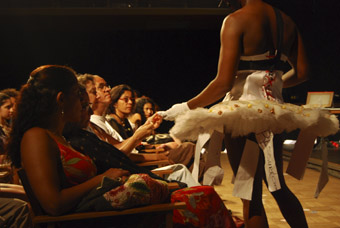
Influx Controls, Boyzie Cekwana, performed at the Panorama Festival, Rio de Janeiro
photo Valério Araújo
Influx Controls, Boyzie Cekwana, performed at the Panorama Festival, Rio de Janeiro
Just now it’s a small wave of performances around the world in which audiences provide bodies, decision- and art-making by playing to rules and tasks set by artists to make works. But it’s a rising tide as can be see throughout this edition of RealTime. There’s a simultaneous increase in artworks offering immersive experiences, either through proximity and intimacy or via sensory deprivation—or amplification. Either way the audience makes a greater commitment to art than the usual heightened receptivity. The 2009 PuSh Festival in Vancouver focused on both kinds—small works like Jerk and Kamp that radically re-aligned audience seeing and thinking, or a relatively large one like Rimini Protokoll’s Best Before where a large audience, all with Xbox-type controllers, used avatars to make collective choices and engage not with performers but “experts in daily life.” In the performance event In-habit at Melbourne’s Abbotsford Convent, Jason Maling and Torie Nimmervoll became Colour Auditors, conducting and analysing a 12-day colour coding of the site by people working there, while Katerina Kokkinos-Kennedy’s Once brought pairs of strangers into silent contact for 10 minutes each. Elsewhere in Melbourne, Nicola Gunn’s At the Sans Hotel, the performer discussed with her audience “the show that should have taken place and the narrative problems it presented.” Matt Prest and Clare Britton’s new work, Hole in the Wall, will require its audience to inhabit and move mobile rooms. In a dance workshop in the Perth Festival, visiting choreographer Robyn Orlin tested guests with a “probe into discrimination by replacing race with arbitrary characteristics like vegetarianism”. For many years interactivity has been largely associated with new media, but now physical correlatives are increasingly appearing in live performance. In Rimini Protokoll’s Best Before the decision-making is digital in a live art context. Meanwhile new media art continues its sustained engagement with interactivity, as in Van Sowerwine and Isobel Knowles’ You Were in My Dream (for Experimenta’s Utopia Now) where, once you’ve peered into the installation, your face is assumed by the principal character in the work’s stop-animation.
On another level, the prospect of developing a national cultural policy requires artists and audiences to see themselves interactively, as critically responsive to Arts Minister Peter Garrett’s notion of what comprises ‘culture.’ Similarly we can no longer allow the future of Australian film to be determined without collectively addressing the issue of screen culture. What is screen culture and will the making of more and more films alone grow an audience for Australian film? Over to you.
RealTime issue #96 April-May 2010 pg. 1
© Keith Gallasch; for permission to reproduce apply to realtime@realtimearts.net
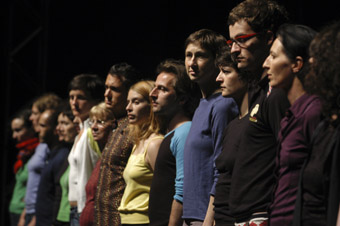
The Show Must Go On, Jerome Bel
photo Mussacchio Laniello
The Show Must Go On, Jerome Bel
YOU’RE SITTING IN THE FEI AND MILTON WONG EXPERIMENTAL THEATRE IN DOWNTOWN VANCOUVER. AN EASILY RECOGNISABLE POP SONG IS PIPED IN THROUGH THE SOUND SYSTEM. LISTEN CAREFULLY TO THE FOLLOWING LYRICS: “IMAGINE THERE’S NO HEAVEN. IT’S EASY IF YOU TRY. NO-ONE TO LIVE OR DIE FOR. ABOVE US ONLY SKY.”
Upon hearing this peace anthem by John Lennon do you: (a) mull over the composer’s message; (b) reflect on the diverse mix of your fellow patrons; (c) wave your iPhone in the air and sing along? Most Vancouverites in attendance for Jerome Bel’s The Show Must Go On chose the last option. The show’s choreographers were disturbed: “Why are they singing?” After all, the show provoked a near riot when it opened in Paris ten years ago, not a love-in.
jerome bel, the show must go on
Bel had made a contemporary dance performance that didn’t feature dancing, at least not the kind usually performed by trained professionals. Instead he put bodies on stage: trained and untrained bodies, bodies of various shapes and sizes meant to represent the bodies in the audience. These onstage bodies moved, stood still, observed, listened and sometimes embraced. Invariably they did these things to the accompaniment of well-known pop songs. To David Bowie’s “Let’s Dance” they stood and listened, moving to the beat intermittently. To Roberta Flack singing “Killing Me Softly” they ‘died’ slowly and gently while listening to the singer and watching the audience. Spectators at the Parisian premiere were offended. In Vancouver, the former hippie capital of Canada, Lennon’s song provoked a sing-along. Not only did the spectators sing, they got up and danced whenever there was the hint of a groove in one of the Top-40 hits in rotation. Here was the democracy of meaning-making in action at a postdramatic theatre event. You say ‘contemporary art’, we say ‘dance party.’ The audience had wrested control of the event from the artists.
Bel hadn’t intended things to go this far. In his work as a choreographer he has tried to undermine the idea that the performer, by virtue of her/his expertise and position of power on stage, is somehow better than the spectator. For Bel a performance should mirror the socio-political reality of the audience. As he has argued, there is an historical logic to this. Contemporary dance traces its origins to the court of Louis XIV, the ‘inventor’ of ballet. When the king was in the audience the performance was supposed to reflect the image of its royal patron. After the French Revolution, the execution of the king and the shift to democracy, the performance was supposed to reflect a new patron—the bourgeoisie. That’s pretty much the situation we’re in today: educated, middle-class performers dancing for educated, middle-class patrons. In order to truthfully represent this reality of a performance event among social equals, Bel encourages mutual observation: the performer and spectator watch each other. The privilege of the expert performer is broken down by having her/him do things any spectator could do given a few weeks to rehearse.
The encounter between spectator and performer in The Show Must Go On is stark, comical, often surprising, and sometimes very moving. Bel achieves all this by setting very simple tasks for his performers. In one section they listen carefully to songs on their iPods, and very loudly sing the choruses when they come around. Watching an overweight lawyer (and former dancer) in his 50s intently focused on his iPod while occasionally blurting out “I’ve got the power!” was a truly comic spectacle. In another sequence, the performers’ simple action of walking up to each other and embracing to the theme song from Titanic is both absurd and touching. Often the performers simply stand and watch us. There’s something naked about their watching, and it makes me feel naked—and very present. I think this is how Bel wanted it. But when “Kiss” by Prince starts up, the audience is on its feet, shaking it. This is not what Bel wanted. We were supposed to sit in our seats, listen, watch and behave—like well-trained middle-class citizens?
gisele vienne, jerk
The idea of mutual watching is a conceptual thread running through this year’s PuSh Festival. As executive director Norman Armour puts it, the “act of witnessing or bearing witness” in the shared moment of performance is a thematic concern of many of the shows. It’s also the inevitable result of spatial configurations that foreground the performer-spectator relationship. Sometimes the combination of a very intimate performance space and very uncomfortable subject matter is enough to provoke an encounter of intense co-witnessing. In director Gisele Vienne’s Jerk (France) an audience of about 50 people is crowded onto a very small stack of bleachers in breathing distance of actor Jonathan Capdevielle. The room is painted white and fluoro-lit. In this setting Capdevielle is able to watch audience reactions in detail as he performs gruesome murders of teenage boys in real time with puppets. The script is based on serial murders that occurred in Texas in the 1970s. The lighting and close proximity to the performer leave us nowhere to hide as we are forced to contemplate this disturbing subject through various layers of theatrical mediation that include puppets-as-characters, the actor’s arm-as-puppet and the actor as both ventriloquist and dummy. At times I am forcefully dissociated from my own feelings, which themselves become like puppets to observe: feelings of horror, amusement, disgust and impatience. [See more about Jerk, p32.]
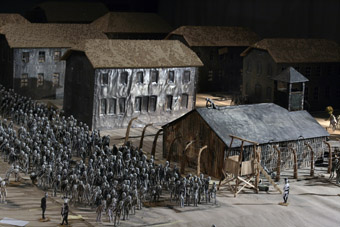
Kamp, Hotel Moderne
photo Herman Helle
Kamp, Hotel Moderne
hotel moderne, kamp
Kamp by Hotel Moderne (Rotterdam) is performed at the Roundhouse, a larger space that offers a little more distance from which to witness yet another horror, the genocide at Auschwitz. The concentration camp is presented as a scale model that covers the large stage area. Three puppeteers move hundreds of Jewish inmates through the assembly-line of mass murder, complete with rail terminal, sleeping quarters, officers’ mess, watch towers, supply trucks and the infamous gas chambers. The scale model gives the audience not a bird’s eye view but the one you’d have if you were a CEO taken up on a catwalk by a plant manager who wanted to give you a better look at the factory’s workings. From this perspective, the human figurines, while individually crafted, are made generic by their uniforms, whether prisoner or guard issue. The obliteration of individual character in the context of a militaristic ideology that classifies human beings according to perceived evolutionary type is in itself worth an essay.
Let me briefly note that when asked by a patron why the Nazi guards were given more menacing features than the Jewish prisoners, the artists suggested the perception of difference was all in the uniforms; they hadn’t differentiated between guard and inmate when making the figurines. We’re able to see the figurines in some detail thanks to a tiny hand-held camera the puppeteers use to film many of the sequences. The images that appear on an upstage screen have a gritty, hand-held, journalistic immediacy to them. Even with these close-ups we never lose sight of the fact that we’re witnessing a slaughterhouse in operation. Neither the puppeteers nor the prison figures look back at us from a perspective that is particular or unique. They, and we, have been depersonalised. We have become industry. We have become utility in the service of mechanistic eugenics and skewed Darwinian ideology.
ahke theatre, white cabin
From organised genocide to creative chaos: White Cabin by Ahke Theatre (St Petersburg) offers a life-affirming counterpoint to Kamp, but sit in the front row at your peril. A large, bearded man in partial whiteface, wearing horn-rimmed glasses and a pork pie hat, might splatter you with red wine as he empties a bottle over himself or sprays it onto his fellow performers. Bits of newspaper, floating like tiny airships on fire, might make you their landing pad. This is not participatory theatre but, like Jerk, the intimacy of the venue puts the audience dangerously close to the action—and the action is non-stop, carnivalesque and enticing despite the hazards. Who knows why the two large men and the medium-sized woman do hand-stands on tables, try to hang themselves or pour milk on their naked backs? And who cares? Each image unfolds like a live painting featuring playful demons from a world that crosses Russian folklore with 19th-century artist’s garret. Watching them makes me want to knock back some vodka and throw some wine and paint around for myself.
Then something truly wonderful happens. Three large panels of white fabric are dropped across the front of the prop-littered stage. Each has a large window cut out of its centre. The first panel has the biggest window, the third the smallest. It feels a bit like a puppet theatre within a puppet theatre, while also carrying the suggestion of a series of Russian nesting dolls. The performers variously enter the front, middle or back windows and create brief tableaux or moving scenes—they fight, smoke cigars and one of them commits symbolic suicide by holding plastic bags of water to his body and slashing them open with a knife. Because these scenes take place in the shallow space between one window and the next, a visual tension is created by the three-dimensionality of the performers’ bodies against the flatness imposed by the window frames. This perspective is made more disorienting by the two-dimensional paintings and photographs that are projected onto the white fabric. Because these images are usually in zoom-in or zoom-out mode, they give us the feeling of alternately falling into or out of the windows. Sometimes the zooming stops and we are overwhelmed by something else, like the scene in which the performer’s newspaper catches fire: the live fire is matched by a video projection of flame that covers the entire canvas, momentarily creating the impression that the set is actually burning.
what are the rules here?
But it’s an illusion. In all the performances I’ve described so far the artists have carefully shaped their illusions. Even Jerome Bel. Especially Bel. Despite the fact that some of his performers are untrained—non-experts, you might call them—the overall construction of The Show Must Go On is as brilliantly crafted and manipulative as the most revered canonical works of Western dramatic literature. Bel spent two years making his show. We spend less than two hours trying to figure out the extent of our agency— are the performers inviting us to take part bodily, or just mentally? How much freedom do we have to affect the outcome of the event? What are the rules here?
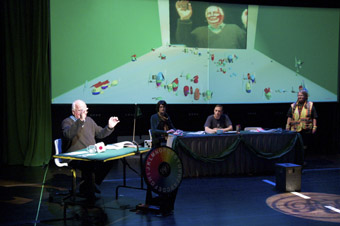
Best Before, Rimini Protokoll
courtesy the artists and the PuSh festival
Best Before, Rimini Protokoll
rimini protokoll, best before
Enter Rimini Protokoll for a dose of genuine interactivity [see RT91, p18]. The Berlin Company’s new work Best Before was commissioned by PuSh and created in Vancouver. It features what Rimini calls “experts of daily life”—non-actors from various walks of life. These “experts”—a flagger, an ex-finance minister, a computer game tester and a game programmer—are connected by the fact that two of them worked at Electronic Arts, one of the world’s largest producers of video games, and three of them drove past the flagger on their way to work each day. So the idea of a daily journey (travel to work) is connected to the idea of something under construction (the site around which the flagger is directing traffic), and both of these are connected to the metaphor of life as a video game you win or lose.
Together with Rimini’s artistic directors, the experts have created a game the whole audience can play at once. Each spectator is given an Xbox-type controller to create and manipulate an avatar on the huge screen that stretches across the back of the stage. Around 200 spectators take part, through their avatars, in practical decision-making such as finding a mate, buying a house, choosing a candidate, supporting military spending and voting on abortion rights. As the title suggests, Best Before is a show about life choices and about taking stock of those choices before your ‘due date’ comes up. When contentious issues are introduced, interaction jumps from the screen to the seats where spectators get into playful or heated arguments. Unlike Bel in The Show Must Go On, Rimini seems to relish these outbreaks. And they’ve given the audience coherent parameters—they provide a playing field, rules and a worthy opponent. The company also risks having these parameters redefined by the spectators. In this sense the spectator-performer relationship is truly levelled.
As in The Show Must Go On, this levelling is made clearer by the fact that the performers are untrained actors. The truth-and-consequence on-screen game is counterpointed by the stories of the experts who talk about life choices that led them to their current circumstances. Each story has its own peculiarity: a woman gives up journalism to direct traffic; a man goes from finance minister to night club owner; another man claws his way through the hierarchy at Electronic Arts only to be ‘rationalised’ out of a job. The experts’ lack of expertise in theatre works against the self-assured authorial coherence of a typical theatre performance. As performance theorist Florian Malzacher writes, “A Rimini performance is never perfect, nor should it be. At the point where the performers become practiced enough to feel secure, begin to build their roles and to act, the piece loses more than just its charm. Insecurity and fragility are the defining moments of what is understood by many to be authenticity. Yet such moments where timing, tension, empathy and presence disappear are also agonising.” These moments make you “feel uncomfortable as an audience member. You suffer too for a moment, feel embarrassed or touched by the efforts of performers who cannot protect themselves through acquired techniques” (Florian Malzacher,”Dramaturgies of care and insecurity”, M Dreysse, F Malzacher ed, Experts of the everday, the theatre of Rimini Protokoll. Berlin: Alexander Verlag Berlin, 2008).
situating the spectator
Each of the shows I’ve considered asks the spectator to situate her/himself in relation to the performers themselves, and not just in relation to a fiction or an ‘elsewhere’ the performers may be representing. Each event provides a thematic and aesthetic frame in which we meet and reflect on who we might be to each other. In these situations the artists avoid setting themselves up as authorities. Canadian installation artist Vera Frenkel writes that the postmodern artist seeks to undermine the possibility of her/his own charismatic authority and permits us to not “believe so readily in the other as the keeper of our treasure and our disease” (cited in Philip Auslander, From acting to performance, Routledge, London and NY, 1997).
The role of the spectator has shifted from decipherer-of-meaning to co-creator of the theatrical event. Another way to put it is to say that interpretation has been subordinated to encounter, and that it is in the energy of the encounter that meaning is created, rather than having meaning encoded in the event beforehand by the artist. The idea of mutual witnessing probably doesn’t do this justice, since witnessing privileges looking, and looking implies distance between the watcher and the watched. If there is a common goal to many of this year’s PuSh performances it is to break down that distance. The common strategy of levelling the playing field is used in other shows at this year’s PuSh I haven’t mentioned, like Poetics: a ballet brut by Nature Theater of Oklahoma (NY), in which four non-dancers awkwardly perform an entire choreography made up of everyday movements—another version of non-expert performance in an expertly created frame. As cognitive science has shown, spectators tend to respond kinetically to what they are watching. Even though it may not be apparent, a spectator responds to movement neuro-muscularly. If this year’s PuSh is about witnessing, we are witnessing with our whole bodies, so to speak. Often the bodies on stage are as diverse as the bodies in the seats. Thanks to the artists willingly relinquishing control (and even sometimes when they’re not) it’s almost a meeting of equals.
This particular kind of risk-taking is only part of what made this year’s PuSh Festival so remarkable. While past incarnations have featured leading lights of international theatre such as Societas Rafaello Sanzio (Italy), Back to Back (Australia) and Forced Entertainment (UK), this year’s program has been the most insistently cutting edge from start to finish. PuSh has also helped push Vancouver from bystander to participant in the greater creative flows of world theatre. In doing so it has helped local companies to successfully show their wares nationally and internationally, as in the case of Theatre Replacement’s now infamous Clark and I Somewhere in Connecticut (2008). Now in its fifth outing, PuSh has taken its place among the best theatre festivals of its kind.
PuSh International Performing Arts Festival 2010: Jerome Bel, The Show Must Go On; Gisele Vienne, Jerk; Hotel Moderne, Kamp; Ahke Theatre, White Cabin; Rimini Protokoll, Best Before; Vancouver, Jan 20-Feb 6; for full production credits go to http://pushfestival.ca
RealTime issue #96 April-May 2010 pg. 2-3
© Alex Ferguson; for permission to reproduce apply to realtime@realtimearts.net
THE END IS EXTREMELY NIGH! DEATH AWAITS! WITNESSING GYÖRGY LIGETI’S OPERA GRAND MACABRE IS LIKE WALKING INTO THE HELLISH SCENES OF PIETER BREUGHEL’S PAINTING THE TRIUMPH OF DEATH (C1562), THE INSPIRATION FOR THIS OPERA’S STORY.
Premiered in 1978 and revised in 1996, Le Grand Macabre is a magnificent piece of comic music theatre, complex, demanding and highly entertaining, and this is a wonderful production, with outstanding performances and staging. The story, drawn from the absurdist play La Balade du Grand Macabre by Michel de Ghelderode, tells the story of Nekrotzar, the Grand Macabre, who returns from hell to destroy the world with a comet sent by God. Though wreaking havoc, Nekrotzar fails in his quest, and the opera ends optimistically with an exhortation, “Fear not to die, good people all, no-one knows when his hour will fall.” Instead, our profane ways go unpunished, love triumphs and we are urged to embrace happiness.
This production, directed by Valentina Carrasco and Àlex Ollé of Spanish performance group La Fura dels Baus, opens with a projected video showing a woman who is ill to the point of collapse and surrounded by the detritus of gluttonous bingeing. The video then gives way to the theatre set, where we see a model of the sprawling woman, now naked and enlarged to fill the stage, her face frozen in horror. The action takes place inside and around this monstrous, abject figure, which is rotated to voyeuristic viewing positions and strategically dismantled while all kinds of imagery are projected onto it—the comet, a skeleton, heads rolling under Nekrotzar’s scythe, Breughel-like figures descending into hell, and then the fires of hell itself. The surreal play thus appears as the nightmare or hallucination of a sick woman. The staging suggests all kinds of allegories, from Gulliver in Lilliput to a corpse being devoured by rodents. She is inert and helpless beneath her intruders, as the secret police emerge from her intestines and people walk in and out of her head, breast and vagina. Such a representation of woman is provocative and, some might suggest, obscenely incorrect, but she literally embodies our own anxieties, harrassed as we are by the troublemakers of society, and when her innards finally collapse, we feel her torment in our own abdomens.
Le Grand Macabre updates the traditions of opera with those of absurdist theatre, pondering the meaning of life in a licentious, ridiculous world. The setting is the fictional principality of Breughelland, and the characters are caricatures—Piet the Pot, a drunkard whom Nekrotzar enlists to support his mission; two insatiable lovers, Amando and Amanda; the astrologer Astradamors and his dominatrix partner Mescalina; Gepopo, the hysterical chief of secret police; and the impotent prince Go-Go and his fawning, bickering, manipulative ministers and brutal police. The satirical story addresses a range of political and social themes—Nekrotzar (the name suggests a dead tsar resurrected through necromancy) represents dictators from Hitler to Stalin who dominated Europe in Ligeti’s youth, and the comet suggests nuclear missiles. Sex, death and drunkenness are central—Astradamors and Mescalina’s sadomasochism represents the fickle ruler and the ruled, and Amanda and Amando, in costumes resembling anatomical illustrations as if they have been flayed, seek unattainable pleasure. At various times, characters fake death or think they are dead, or are dead and are then revived, as if death is merely an alternative and contingent state. Ultimately, Piet and Astradamors get Nekrotzar so drunk that he fails in his mission (a lesson for us all), suggesting that men are all dissolute failures. Gender issues are also central, amplified by the confronting set design—women can be independent and controlling, and can also be obsessed by desire. Gepopo and Venus are sung by the same actor (the wonderful Susanna Andersson), suggesting the interchangeability of the characters, and Amanda and Amando are both played by female performers, further confusing gender identities.
The brilliant score, opening with a fanfare of car-horns parodying a wind ensemble, is a collage of classical and operatic musical genres, fragments and gestures. Particular instruments emphasise characterisation, such as bassoons for Piet and rumbling brass for Nekrotzar. Scene one ends with a swirl of bassoons, bass clarinet and brass that echoes and elaborates the car-horn introduction. The lovers’ duet is exquisite, but haunted and disturbing, and the passacaglia finale is classically beautiful. A metronome, recalling an earlier work of Ligeti’s, Poéme Symphonique for 100 metronomes, ticks down the last hours of the world like a clock. To suit the action, the music is alternately slapstick, raucous, dramatic, gently melodic or ironic, sometimes underscoring and sometimes mocking the vocal line, or recreating the vernacular sound effects of urban life. The orchestra is heavily weighted towards winds, brass and percussion, with a reduced violin section. Robert Houssart’s conducting of the Adelaide Symphony Orchestra is excellent, ably supporting the superb cast of international and Australian soloists.
Such music is conspicuously different from the music of any era, challenging both the avant-garde conventions that dominated the early- and mid-20th century and the traditions of earlier opera. Neither classical nor modernist but referencing both, it is postmodernist, a milestone in the evolution of music, and particularly suited to the absurdist mockery of human foibles. Le Grand Macabre thus appears as Ligeti’s personal reaction to the music of his upbringing and to religious and political dogma, a unique statement in his oeuvre. Though it is rooted in the World War II and Cold War eras, it remains highly engaging artistically and still relevant in a world beset by the politicking around terrorism and climate change.
The opera concludes with a return to the opening video, where we see that the woman has recovered and is washing her face in the bathroom. The Fura Dels Baus production acknowledges the new normal of ‘televisual reality’ in 21st-century life, and this use of video as a framing device locates the opera as a cultural and historical document. Le Grand Macabre delivers ironically contrasting messages about the end of the world—selfishness, vanity and overconsumption bring on the illnesses of our society, but ultimately death happens anyway and, in the meantime, life, however meaningless, must be lived.
–
Adelaide Festival, Le Grande Macabre, music György Ligeti, libretto Ligeti and Michael Meschke,directors Àlex Ollé, Valentina Carrasco, conductor Robert Houssart, Adelaide Symphony Orchestra, State Opera Chorus, a co-production of Théâtre de la Monnaie, Brussels, English National Opera, Gran Teatro de Liceu, Barcelona and Teatro dell’Opera di Roma; Festival Theatre, Adelaide Festival Centre, Feb 26, 28, March 3, 4
RealTime issue #96 April-May 2010 pg. 4
© Chris Reid; for permission to reproduce apply to realtime@realtimearts.net
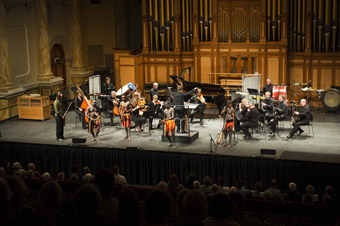
Tract, London Sinfonietta and the Young Wägilak Group
photo Matt Nettheim
Tract, London Sinfonietta and the Young Wägilak Group
TWO SUPERB CONCERTS BY THE LONDON SINFONIETTA AT THE 2010 ADELAIDE FESTIVAL ILLUMINATED SOME SIGNIFICANT DEVELOPMENTS IN MUSIC IN THE 20TH AND 21ST CENTURIES AND ESPECIALLY SHOWED HOW COMPOSERS CAN BLEND MULTIPLE MUSICAL AND CULTURAL FORMS INTO EXCITING NEW WORKS.
The first concert, titled Pacific Currents, opened with US composer Yvar Mikhashoff’s arrangement of Conlon Nancarrow’s Player Piano Study No 7, a musical revelation that set the tone for the evening. In the mid-20th century, US-born Mexican composer Nancarrow created numerous compositions by hand-cutting piano rolls for the player piano, producing works so complex they could not be performed by a single pianist, and characterised by competing rhythmic structures and layered canon forms. Mikhashoff’s realisation involves expanded instrumentation—strings, winds, brass, harpsichord, piano, celeste and percussion—and it brilliantly captures Nancarrow’s breathtaking pace and complexity while adding some extraordinary textures, drawing out the layering to produce a rapturous work.
Silvestre Revueltas’ Ocho Por Radio (1933) followed, a work for octet that evokes the music of radio in his native Mexico, especially the mariachi bands, and which combines multiple genres into a single, increasingly chaotic work. Unsuk Chin’s electrifying Double Concerto (2002) for piano and percussion blended virtuosic solo instrumentals by Lisa Moore and Owen Gunnell into a complex series of cascading musical structures that build and rebuild, drawing prepared and natural piano passages into balanced intensity with the percussion and creating a dialogue exploring all kinds of percussive sonorities. John Cage’s Credo in the US (1942), for piano, percussion and either a radio or a phonograph, was originally written as a dance piece and prefigured Stockhausen’s use of radio in performance. In this realisation, a laptop was used to supply the recorded material, including fragments of Chopin, ragtime and other popular music that dramatically contrasted with the live elements and echoed Revueltas’ concern with the cultural impact of reproduced music.
The first concert concluded with John Adams’ highly rhythmic Son of Chamber Symphony (2007), which has also been choreographed to and includes fragments of his opera Nixon in China. Though less cerebral and more accessible than preceding works, it is complex and absorbing. The program for Pacific Currents was both musically enchanting and intellectually demanding, emphasising the impact of rhythm and showing how multiple forms and alternative musical sources could be integrated. All the works use repeated patterns in various ways, showcasing mid-to late-20th-century approaches to composition and the reactions to dominant and avant-garde cultural forms and aesthetics.
The second concert, Wind and Glass, comprised works by two British and three Australian composers. British composer Tansy Davies’ Neon (2004) is based on urgent offbeat rhythms that recall electronic process music, but with more élan and the richer sonorities of miked acoustic instruments. Gavin Bryars’ elegiac The Sinking of the Titanic (1968) is for an ensemble of strings, winds and percussion with a taped voice recalling the event, and the strings performing the hymn, Autumn, that the Titanic’s band was playing as the ship sank. Opening and closing with the sound of tolling bells, the hymn is played by the strings while the rest of the ensemble produces sounds that evoke the ship itself, creating considerable emotional impact. The work has a theatrical feel, with a dialogue between the strings, portraying the final moments of the ship’s orchestra, and the rest of the ensemble.
The concert included the premiere of Brisbane composer John Rodgers’ Glass, a work for chamber ensemble and improvised trumpet developed from the transcription of the sounds created when using a large sheet of glass as a percussion instrument. These sounds were woven into an elaborate composition for the ensemble, and trumpeter Scott Tinkler, for whom Glass was written, improvised in response to the ensemble, creating a scintillating musical interaction. He produced a wondrous range of sounds, from clarion calls to growling and blaring, adding to the profusion of textures and timbres created by the ensemble. A highlight was Brett Dean’s Dream Sequence (2008), a magical work for the full ensemble, wonderfully orchestrated, expressionistic and densely woven, that expands our musical awareness by taking us on a surreal internal journey.
All this prepared us well for the centrepiece of the two concerts, Errki Veltheim’s compelling new work Tract (2009). Commissioned for performance in the festival by the London Sinfonietta and the Young Wägilak Group, Tract is really two pieces of music that coincide—the orchestra performs Veltheim’s score, with Veltheim as violin soloist, while the four-member Young Wägilak Group perform Manikay, traditional songs of their country in North-Eastern Arnhem Land, powerfully sung with clapsticks and didgeridoo accompaniment. The two strands of music progress sometimes together, sometimes separately, with Veltheim linking them with his own playing. In a forum following the concert, Veltheim said that the Manikay operate as a religious text and that he had written a high modernist score that would match the Manikay performance in structure and intensity but would not imitate it. The Young Wägilak Group has previously worked with the Australian Art Orchestra, and, while such collaboration could appear contrived, the result here is a unique and inspiring musical and cultural form. Tract is not a hybrid but rather a cross-cultural dialogue, with Veltheim’s violin as the catalyst, each strand of music acknowledging the functions, traditions and aesthetics of the other. The audience response was overwhelmingly positive.
Some thoughtful programming went into these London Sinfonietta concerts, the second building on the investigative platform established in the first with more radical examples of the simultaneous use of multiple musical forms. The two concerts showcase many ideas: the layering of music through competing rhythms, structures and instrumentation; the reworking of aesthetics that arise from sampling and electronic manipulation; the impact of mechanical and recorded sources of sound, such as phonograph, tape, radio, vibrating glass and piano rolls; and the juxtaposition of disparate musical cultures and traditions. Brett Dean and Unsuk Chin have explored the expressive possibilities of intricate musical structures. The works of Cage and Revueltas show how popular media can generate a musical melange. Bryars has woven his own composition around an existing composition to convey the sentimental impact of an historical moment. Mikhashoff has dazzlingly transformed Nancarrow’s work. And Velthiem has brought two cultures into a thrilling collaboration. The works of Velthiem, Cage, Rodgers and Bryars are challenging and significant experiments that are engaging conceptually and musically, and mark important developments in musical history. The two concerts greatly illuminate the nature of musical development in a globalising world, showing where experimentation can lead and teaching us how to listen more carefully.
–
2010 Adelaide Festival, The London Sinfonietta, conductor Brad Lubman, with Lisa Moore, Owen Gunnell, Scott Tinkler, Errki Veltheim and the Young Wägilak Group of Ngukurr, Adelaide Town Hall, Feb 27, 28
A review of theatre and dance works in the 2010 Adelaide Festival will appear in
RealTime 97 June/July.
RealTime issue #96 April-May 2010 pg. 6
© Chris Reid; for permission to reproduce apply to realtime@realtimearts.net
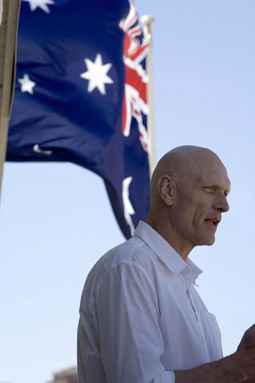
Peter Garrett, Minister for Environment Protection, Heritage and the Arts
WHEN THE RUDD GOVERNMENT WAS ELECTED IN 2007 THE VAST MAJORITY OF ARTISTS IN AUSTRALIA SURELY LOOKED FORWARD TO THE PROSPECT OF PETER GARRETT AS MINISTER FOR THE ARTS, DESPITE THE FORGETTABLE ARTS POLICY THE ALP TOOK INTO THE ELECTION. A RESPECTED, PRACTISING ARTIST AS WELL AS NOTED ACTIVIST FOR THE ENVIRONMENT AND INDIGENOUS RIGHTS—HELL, HE’S ONE OF US!
As we know, Peter Garrett’s time as a minister has been difficult and, for the environmental movement, tainted by the fact that he has had no choice but to publicly peddle the Labor Party line in order to move towards change in the longer term. But his actions in the arts portfolio have been disappointingly sparse. It took until his speech to the National Press Club in October 2009 for any substantial statement about possible reforms to the arts policy vacuum left by the previous government. That speech was clearly delivered by someone who has real passion for the arts. It described some innovations on the agenda, and importantly was not afraid to acknowledge that the national arts funding and institutional structure is in need of a major overhaul.
The speech also announced the opening of a discussion towards a national cultural policy, an idea taken up from the 2020 Summit. The announcement wasn’t widely reported, and I didn’t know of it until stumbling on the notice on the RealTime website over the holiday break. The National Cultural Policy website (http://nationalculturalpolicy.com.au) contains Garrett’s speech as well as a framework document, ten discussion points and access to a comments forum. Submissions to the current phase of the discussion closed February 1. Despite the limited time, plenty of erudite and knowledgeable arts practitioners have had their say in submissions and made very good points. Mine’s number 50 on the list if anyone’s interested, but RealTime has kindly given space for me to summarise my key arguments.
RealTime readers would know all too well that arts and cultural policies in Australia suffer from a range of problems that reflect, on one side, insufficient understanding by policy makers of what is required to sustain new and innovative arts practice, and on the other, insufficient understanding by creative artists of how to make arguments to government that will result in better policy to support new work. In order to improve this current situation, we need to articulate and analyse things differently. The National Cultural Policy discussion offers an opportunity to put new ideas about arts policy on the agenda.
Unfortunately at this stage the discussion is being framed on the basis of cultural rather than arts policy. This presents several problems. The first, as Garrett himself articulated in his speech, is that ‘culture’ is a term that defies simple definition. A fundamental principle of policy design is to be able to define the space in which it operates, but culture is such an open-ended term that it is difficult to draw these necessary boundaries. For example, electronic media conveys a huge proportion of what most Australians would understand as our ‘culture.’ Should a cultural policy therefore encompass our media organisations, including privately owned television stations and newspapers?
A second problem is that the sense of shared values conveyed by the term ‘culture’ will inevitably politicise it. As cultural theorist Graham Turner noted in 1993, it is virtually impossible to discuss cultural policy without ideas of nationalism and a narrative of our cultural history. Peter Garrett claims the ‘culture wars’ are over; I am not so sure. At some future point we will presumably have another conservative government obsessed with settling old scores and politically interfering with the ABC to impose its version of the cultural narrative. Presumably the National Cultural Policy that might emerge could be demolished as was the Keating Government’s visionary Creative Nation. We should therefore, through this policy, seek outcomes that cannot be so easily unmade.
This brings us to the third problem: the relationship of the cultural policy to the arts is very loosely defined on the NCP website. This seems a significant shortcoming, as the primary policy measures and tangible outcomes arising from the national policy will be in the arts. This is all the more unfortunate because the Press Club speech articulated the relationship between arts and culture quite clearly and seems to give each equal weight.
Surely we need a firmer foundation than this as the basis for the relation between culture and the arts, especially given that the primary outcomes of any national cultural policy will be changes to policies and funding for the arts. The legitimacy of funding for new work will always be called into question by a not insignificant minority, especially when they don’t like what is being produced. This inadequate approach to cultural policy, therefore, will inevitably risk politicising matters of arts policy as well.
As Garrett has pointed out, arts funding around Australia, both Commonwealth and State, is largely locked up in supporting a network of arts organisations. Surely it is time for policy that fully recognises that the arts sector and our educational institutions are inextricably linked. No, that’s not strong enough—the arts institutions that are part of our tertiary education sector are the engine room of the arts and cultural sector and should be incorporated fully into any consideration of funding and policy.
While art institutions perform valuable functions and support many artists, the result, as Minister Garrett notes, has been too little money available to support individual artists or to adequately foster new and experimental work. This could clearly be solved by increasing funding to individual artists, although to truly allow freedom to work outside institutional structures we should seriously consider, as many have suggested, tax incentives for artists or individual direct subsidy for professional artists such as has been successful in Europe.
The welfare and ‘public good’ arguments for subsidisation of artists’ incomes is well known. David Throsby and Glenn Withers laid it out in their 1979 work The Economics of the Performing Arts, still the benchmark on this subject, and yet the ability of artists to make a living always seems to be at the very bottom of the pile of topics for discussion. This is a serious omission: surely, the first function of cultural policy is to lay the basis for the creative work to thrive, and to do this we must ensure that artists are able to make an adequate living while making their art. All else flows from this. It may be that there is a limit to the number of artists who can make their primary living as artists. So why not, for once, clearly state these objectives in a cultural policy?
There is a fourth and more difficult problem, which in my view is critical for a national cultural policy to address: how to have an open, credible, non-parochial debate about the network of major artistic institutions, including in our education systems, which considers the equity and efficiency as well as the excellence of such institutions, and that aims towards building capacity to take us forward, both recognising heritage and allowing new work to grow. This cannot be left in the hands of politicians or bureaucrats, and neither can it be left up to the arts establishment alone—they will of course act, first and foremost, to preserve the organisations they work for and the structures they are comfortable with. We also need to have a broadly accepted understanding of how to close institutions and companies when their time is done, to allow new ones to grow, and how to better handle the relationship between state and federal funding and what level of support is needed to maintain the agreed institutional arrangements.
Artistic institutions are subject to the drastic effects of falling below a threshold of ‘critical mass’—policy makers seem oblivious to the fact that a few seemingly small cuts can bring the whole edifice down. When highly respected teaching staff are made redundant at a tertiary arts teaching institution, because the one-on-one teaching model needed to train professional artists is deemed too expensive by university bureaucrats, that city will find (as we have in Canberra) the best students will no longer come.
The National Cultural Policy should articulate clearly what is desirable for Australia as a framework for our arts and cultural industries; it should mandate in perpetuity an overall level of funding for artists and the institutional structure, including arts education that we as a nation wish to maintain from our taxes. The detail can then be left to the peer funding process along with support from the private sector.
Overall, the statements of the Minister and the points of the discussion framework have much to commend them. However, the National Cultural Policy discussion will remain flawed if simply focused on a loose definition of ‘culture.’ We can hope, now that Minister Garrett’s responsibilities have been lightened, that he can give the National Cultural Policy the attention it deserves.
Canberra-based Gavin Findlay wrote in RT93 and RT94 on the challenges for performance and other aspects of the arts in that city.
RealTime issue #96 April-May 2010 pg. 8
© Gavin Findlay; for permission to reproduce apply to realtime@realtimearts.net
The Death of Adonis, 2009, Kent Monkman, acrylic on canvas
image courtesy the artist and Trepanier Baer Gallery, Calgary
The Death of Adonis, 2009, Kent Monkman, acrylic on canvas
“THE BEAUTY OF DISTANCE: SONGS OF SURVIVAL IN A PRECARIOUS AGE.” IN ITS MELDING OF AESTHETICS, GEOGRAPHY AND POLITICS, THE TITLE OF THIS YEAR’S BIENNALE OF SYDNEY IS OF A PIECE WITH MOST LATE 20TH- AND EARLY 21ST- CENTURY INTERNATIONAL EXHIBITIONS THAT SELF-CONSCIOUSLY DENOTE THEIR STATUS AS NODES IN THE NETWORK OF GLOBALISATION. YET ARGUABLY THERE ARE POINTS OF DISTINCTION, TOO, IN THIS SOMEWHAT INELEGANTLY CRAMMED TITLE.
For one, there are references that can be interpreted as specific to this place, Sydney, Australia, as opposed to those in so many ‘global’ exhibitions that generically invoke ‘place.’ Further, the title explicitly mentions ‘beauty’, long a taboo word in post-conceptual/post-minimal contemporary art discourse. Finally, the allusion to an artform other than the visual—and a predominantly narrative and melodic form that combines the ineffable expressivity of music with the rational capabilities of words—suggests, perhaps, a more ‘folksy’ curatorial approach.
Upon first reading the title, it is hard not to think of the well-known history of Australia by Geoffrey Blainey that coined a phrase now part of common parlance, The Tyranny of Distance. First published in 1966, twice revised (in 1982 and 2001) and continuously reprinted, Blainey’s account of how Australia’s geographical remoteness has been central in shaping its history and identity has become a classic; indeed Blainey’s thesis has been compared to FJ Turner’s explanation of the history of the United States in terms of frontier theory. In updated versions, Blainey argues that even in the age of digital communications, isolation and distance remain vital to Australia’s development.
John Bock, Fischgrätenmelkstand kippt ins Höhlengleichnis Refugium, 2008, video, image courtesy of Klosterfelde, Berlin and Anton Kern, New York
photo Jan Windszus © John Bock, all rights reserved
John Bock, Fischgrätenmelkstand kippt ins Höhlengleichnis Refugium, 2008, video, image courtesy of Klosterfelde, Berlin and Anton Kern, New York
In The Death Of Distance (1997)—whose title purposely cites Blainey’s book—British economic journalist Frances Cairncross suggests that the decline in cost, expanding reach and increasing speed of global communications will make distance less important, and constitute the single most influential development in the early 21st century. Cairncross argues that this will likely lead not only to a decline in global conflict, but also to the reinforcement of less widespread languages and cultures, and preservation of cultural heritage. Blainey counters this view, however, by asserting that distance still matters—albeit now measured by the fast second hand of the clock, rather than by the week in the calendar—and that its effects are not always negative. By dint of continuing to be “viewed by the outside world as a billabong standing some distance from the global mainstream” (2001), Australia’s ‘distance’ can “benefit and protect” fragile environments, national security and traditional cultures, for example. This notion of the benefits of distance is developed by Biennale Director David Elliott in his press releases: distance is cast as integral to the differences between cultures, and to the distinction between art and life.
Whether or not David Elliott was aware of Blainey’s book, his opening curatorial gambit pinpoints a key Australian preoccupation, as prevalent in culture and art—recall the early postmodern debates around the ‘provincialism problem’ and the ‘centre-periphery’ dynamic—as in international relations and domestic politics, for example, the ongoing anxiety about Australia’s status as a player on the world stage, or former PM John Howard’s characterisation of Australia as torn between its geography and its history.
Christian Thompson, Isabella Kept Her Dignity, 2008, C-type print
courtesy the artist and Gallery Gabrielle Pizzi, Melbourne
Christian Thompson, Isabella Kept Her Dignity, 2008, C-type print
Howard’s view of Australia—one that essentially portrays Asian-Australians and Indigenous Australians as outsiders—was ascribed to Blainey himself in the 1980s, following his public expression of doubt about the ability of the Australian public to withstand continuously high levels of Asian migration. Hence to invoke distance (and its ‘tyranny’) in the Australian context is necessarily to invoke both race relations—their painful and contested historical roots and their often troubling contemporary manifestations—and questions that persist about Australia’s identity and agency as a country.
The exhibition appears to take on the specificity of place in a variety of ways. Elliott has selected a relatively large number of Australian artists, both Indigenous and non-indigenous, mid-late and early career. At least two of the indigenous projects appear to have a monumental quality that situates them as exhibition centrepieces: the 110 larraktji (memorial poles or bone coffins) created by 41 Yolngu artists from North Eastern Arnhem Land; and longtime curator and critic Djon Mundine’s permanent memorial to the Eora nation, an engraving of images of Pemulwuy and Bennelong on the rock between the Opera House and the Botanical Gardens.
Marcus Coates, Pub Shaman, Lamp Tavern, Birmingham, UK, 2007, produced in association with Insertspace, UK
image courtesy the artist and Workplace Gallery, UK
Marcus Coates, Pub Shaman, Lamp Tavern, Birmingham, UK, 2007, produced in association with Insertspace, UK
Like certain preceding biennales, this one also takes advantage of Sydney’s particular geography, with site-specific works to be installed in spaces around the harbour which are also still strongly redolent of colonialism, such as Cockatoo Island, Pier 2/3 and the Botanical Gardens. In the latter venue, Fiona Hall has again been invited to perform her subtle post-colonial critique. The Australian Aboriginal presence is moreover complemented by the inclusion of a number of important First Nations artists from North America, such as Beau Dick, renowned as a master carver and mask-maker; Dana Claxton, whose performances, videos and installations uncover the history of the Lakota people; Kent Monkman, whose hilarious paintings, photographs and performances imbue the post-colonial gaze with camp; and Annie Pootoogook, whose naïve drawings reveal the bittersweet nature of Inuit daily life.
The explicit recourse to beauty sets the theme apart to some degree from its recent precedents. Redolent of associations with the aesthetic ideals of fascism and bourgeois taste, deemed vacuous and frivolous or distracting of serious purpose, or seen as mere grist for the art market, beauty was for a long time spurned in preference to anti-aesthetic gestures more in keeping with the ugly social reality critical art had in its sights. Yet Elliott does not appear to view beauty as problematic; indeed his definition of beauty in press releases amounts to “a resolution of energy, thought and feeling in aesthetic form”, a view so general that it captures aesthetic, anti-aesthetic and everything in between. In its inclusion of several art world stars, the Biennale will feature artists renowned for their deliberate spurning of positive affect such as Paul McCarthy and the Chapman brothers. Yet the exhibition also includes works whose aesthetic effects can clearly be described as beautiful. Some invoke classical form, such as British Rachel Kneebone’s ceramic sculptures; others evidence intricate craft to critical effect such as in the objects of New Zealand artist Brett Graham or American Angela Ellsworth; others are expertly versed in the beauty of composition and representations of nature, such as the photographs of master Hiroshi Sugimoto, or the paintings of Australian Rosslynd Piggott.
Mieskuoro Huutajat (Shouting Men’s Choir)
photo Timo Heikkala
Mieskuoro Huutajat (Shouting Men’s Choir)
Its third distinctive feature might be the Biennale’s promise to feature music as a key form in a visual arts festival. Elliott was inspired in his choice of subtitle, Songs of Survival, by American ethnomusicologist and experimental filmmaker Harry Everett Smith, who during the 1950s collected, documented and publicised a wide range of American folk music from blues to jazz to gospel, grassroots music that had been lost, forgotten or overlooked by the mainstream, and that represented a very different America to that of the hit parade. Ethnomusicology, like its mother discipline ethnography, of course has its culturally problematic aspects. These are evident in another potential reference in the subtitle, namely the recent album Songs for Survival (2008) complied by Molly Oldfield and Bruce Parry “in support of tribal people.” The producers recorded the music of various indigenous peoples, including the Babongo from Gabon, and then invited professional artists to sample the recordings in original songs. Despite the proceeds flowing to participating indigenous communities, such an undertaking necessarily raises issues of appropriation and cultural exploitation.
The archival impulse at the heart of Smith’s work is echoed in at least two other music projects included in the Biennale, Manchester artists Eileen Simpson and Ben White’s Open Music Archive (OMA), and Australia and New Zealand’s Slave Pianos (Mike Stevenson and Danius Kesminas). OMA aims to “source, digitize and distribute” out of copyright sound recordings now lost to the public through inaccessible media and storage. Slave Pianos, meanwhile, comprises a computer-controlled mechanical piano-player that features the ongoing archive of works of music and noise created by composers who consider themselves primarily visual artists. Along with these documentary-style works, the musical component of the exhibition includes the renowned ‘dark cabaret’ act Tiger Lillies; the Dadaist, Aki Kaurismaki-esque Finnish shouting men’s choir; and the Japanese club sounds of Superdeluxe.
Elliott comes to the Sydney Biennale with many years’ experience as director of flagship contemporary arts organisations, including the Museum of Modern Art in Oxford, Moderna Museet in Stockholm and Japan’s Mori Museum. His vision for Sydney appears to balance tried-and-true practices from previous local Biennales with the now generic expectations of global shows, but perhaps to add a welcome element of site-responsiveness together with a folksy touch of grassroots music and a frisson of beauty.
17th Biennale of Sydney, The Beauty of Distance: Songs of Survival in a Precarious Age, May 12-Aug 1, www.biennaleofsydney.com.au
RealTime issue #96 April-May 2010 pg. 10-11
© Jacqueline Millner; for permission to reproduce apply to realtime@realtimearts.net
Dancing on Your Grave, a Cholmondeley and Featherstonehaugh’s production
images courtesy PIAF
Dancing on Your Grave, a Cholmondeley and Featherstonehaugh’s production
THE 2010 PERTH INTERNATIONAL ARTS FESTIVAL MAKES NO CLAIM TO THEMATIC COHERENCE AND YET THE FOLLOWING SAMPLING OF PERFORMANCES REVEALS AN ONGOING ARTISTIC CONCERN WITH THE LIMITS OF IDENTITY, WHETHER IN POLITICAL CONTEXTS OR TESTED AGAINST ANIMATE/INANIMATE DETERMINANTS. DEMONSTRATIONS OF SINGULAR IDENTITY CAN SPAWN TENSIONS, OFTEN WITH COMPLEX AND CHILLING REPERCUSSIONS OR, ALTERNATIVELY, CAN FORM UNITIES WHERE COMPLEMENTARY OPPOSITIONS CREATE THE EVENT’S SINGULARITY.
A handful of dead souls who rev up life in a pub of zero intoxication and intone freedom from pancreatic tracts might turn tensions between life and death on their head. Unfortunately, the framing gag of a spectral music-hall with its tight staging, small cast and banjo-strummed ballads sits at odds with the wide-flung technicolour skyline of Perth on a balmy night. How could the imported UK mortuary wit, however clever in its intimacy and comedic lyrics, compete with the external spectacle of nature provided free by the city? In director-choreographer Lea Anderson’s Dancing on Your Grave, the Cholmondeleys (an all-female contemporary dance company) and the Featherstonehaughs (its male equivalent) were in short supply which only emphasised the show’s reliance on Burch and Blake’s original songs delivered live at Beck’s Music Box. Lusciously opening out onto The Esplanade, Beck’s Box lacked the necessary ambience of enclosure, crowds and unruliness to realise the production’s odd Dickensian humour.
Les Sept Planches de la Ruse (Seven Boards of Skill)
image courtesy PIAF
Les Sept Planches de la Ruse (Seven Boards of Skill)
Les Sept Planches de la Ruse (Seven Boards of Skill), a French Chinese production, conceived by Aurélien Bory with performers from the Dalian Beijing Opera, generated an inverse effect. The Regal, an old, ungainly theatre commonly used for brash commercial productions was transformed by dreamlike kinetic art propelled by the gliding force of mass and numbers. Huge tangram shapes slid, balanced and cohered under the manipulations and escalations of their human partners. The glancing run of these Chinese acrobats wheeled around the space to upturn triangular mountains and, in the next breath, curled exquisite song and sound through sculptural corridors. Meditative and poetic, the union of landscape and human stirred interpretation. There was a gecko-like trail of humans scaling the block-face in coordinated angles, like Escher’s lizards endlessly advancing towards metamorphosis together with unframed moments of suspension, wherein a single human teeter-boarded a triangular block on its apex, hovering before the configuration tilts and slides into a new wedged form. Awareness of the difficulty for both human and the blocked shape evaporated with the skilful resolution of topological movement and the slightness of its human counterparts in a continuum of unity.
Life and Fate, Maly Drama Theatre, St Petersburg
image courtesy PIAF
Life and Fate, Maly Drama Theatre, St Petersburg
In contrast, Life and Fate describes the will of nuclear scientist, Shtrum, to survive with the credibility of his ideas intact in spite of the destruction of society wielding its incomprehensible power around him. The play is based on the novel by Vasily Grossman, adapted and staged by Lev Dodin and the Maly Drama Theatre. Leaving aside the difficulties of subtitles in an understandably wordy text and the stereotypical overpopulation of sweeping Russian novels, Life and Fate extricated a bitter blend of condemnation and compassion for the acrobatic propensity of the human conscience within the debris of its set. The horror of entrapment in hydra-armed fear is particular to a revolutionary culture brought to its knees by failed aspirations and unvanquished enemies, within and beyond. An Australian audience probably trip-wires over circumstances in everyday Soviet life where Holocaust and Gulag retribution threaten in equal measure and yet this production, given the stamina of the audience to hold out for its three-plus hours of plot unravelling, does register familiar stings of small lies and self-deception.
The Maly actors skilfully inhabit a stage conflated in time and location, which is at once pre- and post-Stalinist apartment crossed by the symbolic wires of encampment and annihilation. Both life and vodka are cheap and drained in a moment. The significance of this state becomes increasingly clear in the second half which culminates in the barbed belittlement of a band of denuded humanity literally playing the final chords of their condemned lives. It is an extraordinary moment wherein music and bare flesh fuse and are extinguished. The echo of that poignancy-crushed-in-violence emanates through the mother’s final letter just before she too leaves life to her son and his conscience.
Robyn Orlin
photo Olivier Pascaud
Robyn Orlin
Meeting Robyn Orlin, a South African choreographer working between Paris, Berlin and Johannesburg, represents another step in STRUT’s workshop series aimed at informing locals about international trends and extending vistas about what dance might be. In amongst the polished performances of the Perth Festival, this showing at the Kings Street Arts Centre was unashamedly chaos-in-progress. Selected guests entered unawares into a mayhem of fancy-dress and scattered paraphernalia, plied by questions and demands for dollars. The obtuse play seemed cranked towards ordering, via a projected Skype, a sharing loaves-and-fishes-style of one ‘veg’ and one ‘non-veg’ wrap. Division appeared to be an Orlin strategy for creating material as well as a thematic probe into discrimination by replacing race with arbitrary characteristics like vegetarianism. It was a flippant glimpse into what might materialise in the future as a complement to the Russian Life and Fate.
Good Morning, Mr Gershwin presented by Compagnie Montalvo-Hervieu from France, rapped nostalgia into explosive exuberance and rhythmical virtuosity. “I got rhythm” speed-splintered through every conceivable nook and cranny of the body, bouncing across dance techniques and spatial configurations like nerve-ends in frenzied delight. Fusion was further promoted in the cast mix of African, Arabic, Asian and European performers and the final Porgy and Bess sequence. While possibly paying too much credence to Gershwin’s political tolerance, Porgy provoked powerful performances from the women whose anguish shuddered bodily, banishing all vestiges of feminine frailty. In overview, playfulness flipped with desire and protest in the same way that Gershwin may have skittered across the piano’s black and white keys. The message resoundingly unified divisive fragments into melodies that are difficult to resist.
Death images struck down by mere humans who refuse to doubt the immortality of song linger after the festival and the orchestrated harmonies of its performances. Perhaps that is what any festival should achieve, an impossible celebration against the odds.
2010 Perth International Arts Festival: The Cholmondeleys and The Featherstonehaughs, Dancing on Your Grave, director, choreographer Lea Anderson, Beck’s Music Box, Feb 23, 24; Les Sept Planches de la Ruse, conception, stage designer, director Aurélien Bory, producers Compagnie 111m Scènes de la Terre, performers Dalian Beijing Opera, Regal Theatre, Feb 5-March 1; Maly Drama Theatre, St Petersburg, Life and Fate, based on the novel by Vasily Grossman, adaptation, direction Lev Dodin, His Majesty’s Theatre, Feb 17–23; Strut, Meet Robyn Orlin, facilitator Bianca Martin, Kings St Arts Centre, Feb 26; Compagnie Montalvo-Hervieu, Good Morning, Mr Gershwin, choreography José Montalvom Dominique Hervieu, music George Gershwin, His Majesty’s Theatre, Feb 26-28
For more on the Perth International Arts Festival see the review of Victoria Vesna and James Gimzewski’s Nanomandala on page 24.
RealTime issue #96 April-May 2010 pg. 12
© Maggi Phillips; for permission to reproduce apply to realtime@realtimearts.net
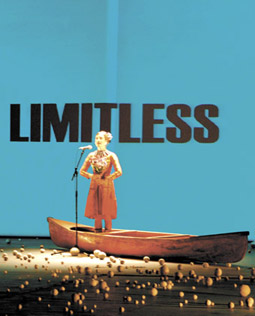
Willoh S Weiland, Yelling at the Stars
photo Tilly Morris
Willoh S Weiland, Yelling at the Stars
new aphids artistic director: willoh s weiland
Exciting news from Melbourne: Willoh S Weiland has been appointed as the new artistic director of Aphids. As we were putting this online edition together, Wieland was flying back to Australia. We look forward to catching up with her once she’s settled into the job of guiding one of the country’s most innovative outfits, renowned for its idiosyncratic hybrid creations and international collaborations.
A young and energetic artist, Weiland looks made for Aphids. Her projects as artist, writer and curator over recent years have been strikingly individual. The ongoing art-science project Yelling at Stars (RT 88, p27) was presented at the Sidney Myer Music Bowl as the closing event of the 2008 Next Wave Festival and then in Glasgow at Less Remote, an art/science symposium running parallel to the 59th International Astronautical Congress. Her 2009 Synapse residency was at the Centre for Astrophysics and Supercomputing, Swinburne University of Technology, where she developed Void Love (www.voidlove.tv), “a soap opera about astrophysics” starring Kamahl. Weiland is involved in ongoing collaborations with Spat & Loogie and, as part of Deadpan, with video artist Martyn Coutts—including an Asialink residency in Beijing and NES artist residency in Iceland in 2010.
David Young, the outgoing artistic director and co-founder of Aphids (and now director of Chamber Made Opera; RT 95, p50) sees Weiland as “hugely talented and a perfect fit with the Aphids spirit and ethos.” He thinks that with the current Aphids team, “I really cannot imagine what Aphids will become under her watch—and that’s exactly what I am most excited about.” RT
Pomona Road, photo Katrina Lazaroff
katrina lazaroff’s pomona road, inspace
Major bushfires bring increased pain each year and revive memories of earlier devastating fires cruelly etched in the psyches of many Australian families. Choreographer Katrina Lazaroff’s family is one of these: her first full-length dance work, Pomona Road, reflects on the enduring physical and emotional consequences of the Ash Wednesday bushfire in 1980, but in the end, says Lazaroff, it’s a dance theatre work about family.
Lazaroff is a dancer, choreographer, rehearsal director and dance educator who graduated with an Honours in Dance from WAAPA (Western Australian Academy of Performing Arts) in 2001, performed with Buzz Dance Theatre in Perth in 2001, and in 2006 and 2008 with Leigh Warren & Dancers worked as rehearsal director and assistant to the choreographer. She has been Artistic Director of the Youth Dance Festival 2008 (Ausdance ACT), choreographed for Fresh Bred—SA Youth Dance Ensemble, and worked with Restless Dance Company as a choreographic mentor on Debut 1 & 2. She is currently working as a choreographer and performer with Adelaide’s Patch Theatre Company and teaches company class for Australian Dance Theatre. For Lazaroff, the hour-long Pomona Road is “a huge work”, an opportunity to create a totality that draws on her artistic experience and family life and allows her to embrace a wide range of means with which to realise her vision.
In Pomona Road Lazaroff employs dance, theatre and visual and audio design to evoke the enduring suffering, the rebuildling of lives and a sense of home. Unusually for a principally dance work, she also incorporates documentary material—recorded interviews from family and community members. Not surprisingly then the show’s press release declares it “new Australian documentary dance.” Certainly Lucy Guerin’s Structure and Sadness is rooted in the reality of the 1983 collapse of Melbourne’s Westgate Bridge, but it’s not a documentary work per se. Bangarra Dance Theatre, on the other hand, has works in its repertoire based on painful social realities, but the label ‘documentary’ is not apt.
Lazaroff tells me that Pomona Road—in evolution since 2006 and with three stages of development—was never intended as a comment specifically on the social and emotional impact of bushfires. Her first impulse was to explore family, “where we come from.” Stage one addressed her relationship with her sister (“sibling rivalry, kooky and a bit sinister”), and stage two, father-son interaction (drawing on her own family and the experience of her dancers). It was while working on stage three and addressing the whole family that she discovered that the fire experience provided a meaningful framework for the exploration of family life. The Ash Wednesday starting point offered the beginnings “of a journey and a focus on loss—of home, place, identity. And the pain of starting again—the parents tackling it, the kids bumping along.” By 2009, says Lazaroff, the fire scenario had taken over.
Lazaroff decided that she wanted to make a dance work that was documentary in character, capturing the feelings of loss to fire. To this end she interviewed her parents about Ash Wednesday 1980 and victims of the subsequent 1983 Ash Wednesday. She thinks that “feelings and relationships can be sensed” through these voices which the audience hear—sometimes on their own, sometimes in tandem with the dance. The dancers, playing members of a family, also speak, but not in a conventionally scripted fashion, their utterances a form of vocal movement—family bickering, a song, familiar expressions. Lazaroff says that in stage three of the work’s development she learned to give space to the recorded voiceovers, “to let them come first, and provide continuity.”
Asked about her choreographic style, Lazaroff says it’s rooted in the contemporay dance which has been her life. However, the dancers create “recognisable characters whose gestures and character traits fuse fluidly with the dance language.”
Kerry Reid’s set for Pomona Road comprises simple timber structures (originally made by Lazaroff’s partner from materials from her mother’s verandah for the stage three development, but now re-made and evocative of her father and his fence contracting business) and large hanging sheets of white paper that receive the images from two powerful projectors washing the whole stage with impressionistic, ‘textural images of bush and fire.” With Nick Mollison’s lighting and projections, Lazaroff hopes that substantial depth of field will be created. Lazaroff describes the sound design for Pomona Road as “highly collaborative, with a lot of give and take” in its making with Sascha Budimski’s score comprising “sound effects, hums, drones, voiceovers, rhythm beats and Gerry Rafferty’s Baker Street”, the 1978 hit which her father played frequently.
I ask Lazaroff what creating Pomona Road has done for her. “It’s been a moving experience, looking back into family history and seeing that there were many more things that happened to us than I realised. As an artist I feel it’s set me free.” inSPACE Program, Pomona Road, Space Theatre, Adelaide Festival Centre, April 21-24. Pomona Road was part of inSPACE:development in 2009.
jo lloyd: 24hrs
God knows what all the fast turnaround short film and short play festivals are doing to our psyches as artists and audiences—blessed be the slow food movement—and now dance has joined the rush! But what an intriguing race it might be in the Jo Lloyd-curated 24HRS at Dancehouse. Four choreographers will each create a new work over 24 hours—one for each Friday over four weeks. Just to add to the inevitable delirium of commencing work on a Thursday night at 9pm, “the creative process will be twittered and streamed online and the teams must be ready to present the work to a live audience by 8pm the next night.” There goes the privacy associated with the slow boil of the creative process. The stellar line-up of choreographic speed freaks is Natalie Cursio, Shelley Lasica, Phillip Adams and Luke George. 24HRS, performances April 30 (Cursio), May 7 (Lasica), 14 (Adams), 21 (George), Dancehouse, Melbourne; www.twitter.com/24HOURS; www.livestream.com/24HOURS
tony yap, rasa sayang
Rasa Sayang is a new interdisciplinary performance work by leading Melbourne dancer Tony Yap with musician-composers Tim Humphrey and Madeleine Flynn, visual artist Naomi Ota and creative collaborator Ben Rogan. The work is based on research Yap conducted while on a Fellowship from the Australia Council Dance Board into Indonesian and Malaysian shamanistic and trance dance traditions. Sayang, meaning ‘love’ in Yap’s native Malaysian, is the name of his mother, the inspiration for the work which forms part of his Buddha Body Series, an investigation into the positive eastern idea of emptiness. The first in the series, Melangkori (‘melancholy’) was shown in Melbourne in 2009, and the film version has screened in festivals around the world. Since 2008 the Tony Yap Company has performed in Indonesia, China, Vietnam, Japan, Malaysia and Korea. The Rasa Sayang installation is open free of charge 6pm-7.30pm each night, when audience members are invited to witness the preparations and pre-performance rituals of the artists. Fortyfivedownstairs, 8pm April 22-25; fortyfivedownstairs.com
craig walsh: digital odyssey
Sydney’s MCA is collaborating with leading Australian media artist Craig Walsh on Digital Odyssey, an epic 2010-11 tour to present digital artworks in response to regional environments and communities. Walsh “is travelling in a self-contained, digitally-equipped motor home which is also his mobile living and working environment, designed and fitted with all the necessary technical and AV equipment.” Walsh’s astonishing projections have filled shop windows with water, fish and floating furniture and the Art Gallery of NSW foyer ceiling with giant cockroaches, while elsewhere he has given a tree a human face. Digital Odyssey allows him to create site specific public artworks in collaboration with communities across Australia. Watch out for Walsh at Murray Bridge, SA, to April 11; Alice Springs, NT, April 26-May 16; Winton, QLD, May 31-June 20; Cairns, QLD, June 28–July 18; Mackay, QLD, Aug 16-Sept 12; Gladstone, QLD, Sept 20-Oct 10; Gerringong, NSW, Nov 1-30; Ballarat, VIC, Dec 6-Jan 6; www.digitalodyssey.com.au
RealTime issue #96 April-May 2010 pg. 14
© RealTime ; for permission to reproduce apply to realtime@realtimearts.net
Wang Jingyao, husband of Bian Zhongyun, with the camera he used to photograph his wife’s body in 1966 after she was murdered by Red Guards, in Hu Jie’s documentary Though I Am Gone (2006)
WHILE CHINA’S POLITICAL SYSTEM REMAINS DEEPLY AUTHORITARIAN, THE COUNTRY’S OVERWHELMING SIZE AND EXPLOSIVE GROWTH HAVE OPENED CAVERNOUS GAPS IN THE GOVERNMENT’S CONTROL OF CULTURE, THROUGH WHICH A NEW GENERATION OF DV-WIELDING DOCUMENTARY FILMMAKERS HAS CLIMBED.
“I’ve never heard an independent filmmaker in China ask themselves, ‘Can I do this?’,” comments Hong Kong-based producer David Bandurski. “Independent filmmaking is the freest avenue of expression that exists in China today.”
Independence from state-sanctioned channels of film production is the defining characteristic of a movement that encompasses a diverse array of styles and subject matter. “There were two things that made the change,” explains Beijing-based curator and filmmaker Ou Ning. “The first was pirate DVDs. People didn’t need to go to the Beijing Film Academy—they saw a lot of films through pirate DVDs, which gave them a very rich film history. When people saw this history they wanted to make things themselves, and they found there were cheap cameras that had come out. This technology has had a great impact on filmmaking in China.”
contemporary complexities
One of the most salient features of the shift in Chinese documentary filmmaking is the democratisation of the way contemporary reality is depicted on screen. “Before, history only had one version—by the Chinese Communist Party,” asserts Ou Ning. “Now with digital technology history has different versions.”
This trend is graphically illustrated by Meishi Street (2006), Ou Ning’s feature-length documentary depicting the plight of Beijing residents forcibly relocated from Dazhalan, an area just south of Tiananmen Square, in the lead-up to the 2008 Olympics. What begins as an observational work takes a fascinating turn when Ou Ning hands his camera to Zhang Jinli, an eccentric and outspoken restaurateur whose home and business are slated for demolition. From that point, Meishi Street becomes, in part, a film about the way digital technology is empowering ordinary Chinese citizens.
“After just one month I found he was not only shooting, but also narrating his story like a journalist,” recalls Ou Ning. “The most exciting thing for him was an occasion when he hung banners on the roof of his house. The police came to take down the banners…but when he put the camera on them they were very afraid…That made Zhang Jinli realise the camera is a weapon.”
The demolition of Dazhalan, a neighbourhood just south of Tiananmen Square and one of the oldest parts of Beijing, in Ou Ning's documentary Meishi Street (2006)
While Meishi Street depicts a small, if depressingly common drama of contemporary China, Du Haibin’s 1428 (2009) takes on a much larger subject. The devastating Sichuan earthquake of 2008 was the first domestic disaster of such magnitude since digital cameras had become readily available on the Chinese mainland. In the chaotic weeks following the quake, several independent filmmakers joined the uncontrolled flood of media personnel pouring into the disaster zone.
1428—named after the exact moment the quake struck on May 12—takes a cinema-verite approach, documenting as well as participating in the heartbreaking scenes playing out in Beichuan, a ruined town near the quake’s epicentre. The film reveals a complex, if at times overly disparate picture of overwhelming grief, graft, solidarity and merciless self-interest among the survivors, a far cry from the self-congratulatory tone of official Chinese media coverage at the time.
The gulf between China’s official media and independent documentaries like 1428 is most tellingly revealed in two scenes that bookend the film. Early on we see soldiers preventing villagers from entering Beichuan when a leader—probably Premier Wen Jiabao—visits the town, surrounded by a media circus. Towards the end of the film, Wen Jiabao returns to the area and an old man bitterly complains about the massive police and military presence preceding his arrival. A younger woman watching the scene remarks, “If you tell the truth, they’ll cut your words from the film.” But this is not state-controlled television, and the old man’s words remain.
the return of history
China’s digital filmmakers are not just claiming their right to document contemporary reality—they are also delving into repressed episodes from the nation’s recent past. Nanjing-based director Hu Jie is the most notable filmmaker working in this area, having produced two extraordinary works detailing stories from the first decades of the People’s Republic (unfortunately no subtitled version yet exists of a third film completed in 2008, National East Wind Farm).
In Search of Lin Zhao’s Soul (2004) looks at the life of a young writer through interviews with those who knew her. Initially an ardent supporter of the Communist revolution, Lin Zhao ran foul of authorities when she defended fellow Peking University students denounced during the Anti-Rightist campaign of 1957. She was expelled from the university and suffered various other indignities, which only hardened her resolve to speak out. She was imprisoned in 1960, but fought attempts to stifle her writing by penning an estimated 120,000 words of poetry and essays while in jail, using her own blood. In 1968 she was executed by firing squad.
Hu Jie stumbled upon Lin Zhao’s story by chance when working as a cameraman for China’s state news agency Xinhua. “I knew very little about the history of the 1950s and 60s,” the filmmaker explains. “While making Lin Zhao I had the sense that I was feeling around in the dark. Then I found the door of history, opened it and walked through. There I found a lot of ridiculous, cruel stories that really shocked me, and that was the motivation to go further.”
Hu’s next work focused on Bian Zhongyun, who in 1966 was the deputy headmistress of a prominent Beijing girls’ high school attended by many daughters of the party elite. The school was an early incubator of the Red Guard movement that spearheaded Mao’s Cultural Revolution from mid-1966, and on August 5 that year, Bian Zhongyun was beaten to death by her students and dumped in a rubbish cart. The incident marked her as one of the first victims of the revolutionary violence that within months would engulf the entire nation.
Bian’s elderly husband still lives in Beijing, and through the scholar Wang Youqin, Hu Jie discovered that he had secretly photographed the events leading up to his wife’s death and her brutally mauled body. It took six months of persuasion and a viewing of the Lin Zhao film to convince Bian’s traumatised husband to share his story and images with Hu Jie. These interviews and his photographs form the backbone of Though I Am Gone (2006), a profoundly moving memorial to the victims of Mao’s senseless political violence.
Hu Jie’s films are striking not only for the stories they reveal—horrific even by the grim standards of Chinese history—but also for the way they individualise events that have long remained broad, abstract historical episodes for want of recorded eye-witness accounts. More than this, Hu Jie makes these stories tangible. The climactic scene in both In Search of Lin Zhao’s Soul and Though I Am Gone sees the filmmaker uncovering physical traces of the long forgotten victims.
While making the Lin Zhao film, Hu Jie discovered the young woman’s ashes were stored in an unsealed box in Shanghai. Locating the box, he lifts the lid on camera, and finds wrapped in a newspaper of the 1960s a thick lock of Lin Zhao’s hair, turned prematurely grey by the tortures she endured. The final scene of Though I Am Gone sees Bian Zhongyun’s husband bring out a suitcase, unopened since 1966, containing the bloodied clothing he removed from Bian’s corpse the day she was murdered. These moldering objects, so carefully hidden for decades, insist with heartbreaking melancholy that we remember this history, and the injustices perpetrated in the name of Mao’s ideology.
a history unseen
China’s flourishing independent documentary sector illustrates how much the country has changed since the imprisoned Lin Zhao was compelled to pen essays in her own blood.
The fate of these films, however, reveals how little the Communist Party’s attitude has shifted when it comes to questions of culture. As David Bandurski explains, “[These films’ existence] is not at all a reflection of government tolerance. These works emerge from the chaos and uncertainty of a China in the midst of social transition. The chaos can offer opportunities for conscientious filmmakers…[but] control of all culture remains a top priority for China’s leadership.”
While controlling expression is increasingly difficult, the Chinese government is much more successful at limiting the dissemination of unsanctioned views. China’s independent documentaries are occasionally seen in small unofficial venues in major cities or on university campuses while informal networks of DVD distribution exist amongst artists, academics and activists. Generally, however, it is extremely difficult for these films to reach domestic audiences. Broadcast, official distribution or appearances at recognised film festivals within mainland China are out of the question. So although these films offer a tantalisingly uncensored vision of a country in flux, they also remain victims of the CCP’s obsessive desire to control the nation’s culture.
David Bandurski produced Zhao Dayong’s Ghost Town (RT94), available through dgenerate Films (http://dgeneratefilms.com). Ou Ning’s Meishi Street is available for online rental through the dgenerate Films website.
Hu Jie’s Though I Am Gone can be found in 10 parts with English subtitles on YouTube. In Search of Lin Zhao’s Soul is similarly available on YouTube, but unfortunately without English subtitles.
RealTime issue #96 April-May 2010 pg. 15
© Dan Edwards; for permission to reproduce apply to realtime@realtimearts.net
OVER AT LEAST THE LAST 50 YEARS ONE CONTINUING AIM OF THE AUSTRALIAN FILM COMMUNITY HAS BEEN THE DEVELOPMENT OF A LOCAL SCREEN CULTURE (EARLIER, ‘FILM CULTURE’), SOMETHING THAT WOULD, AMONGST MANY OTHER THINGS, EVENTUALLY INCREASE AUDIENCES FOR AUSTRALIAN FILMS. IT’S AN AIM, HOWEVER, THAT HAS OFTEN BEEN RATHER NEBULOUS AND UNFORMULATED, AND AS A GOAL IT’S RARELY COME EVEN CLOSE TO BEING MET.
So what is screen culture, anyway? Over those years, it has been defined in many and various ways: as the comprehensive nature of screen activity outside the mainstream; as the environment in which screen projects are developed, made, viewed, discussed and appreciated; even, in one lobbying foray, as “the glue that holds the industry together.” The importance of screen culture within the film industry, and within the wider film community, has ebbed and flowed, and the support it has been given, both financial and in kind, has similarly grown or, more often, decreased.
Back in the 1980s and 90s screen culture was actually high on the agenda; funding bodies held forums to define it and determine what their assistance to it should be, while the many and varied organisations and individuals who believed they had a role within a healthy screen cultural sector took part in many enthusiastic debates at festivals and other film events. Lobbying bodies with high-flown names were formed when needed to press the case for support. But, as more immediate issues relating to production, funding and government assistance took priority, screen culture receded as a topic, and has never really regained attention. Today, amongst the often ill-informed debates about the quality of Australian films and why they are not reaching audiences, a serious look at the importance of screen culture in this equation is conspicuous by its absence.
australian film institute
In 1958 a group of film lovers already involved in the early years of the Melbourne Film Festival set up a separate organisation to operate year-round. Aware of similar activities already being carried out in the UK by the British Film Institute, they called this local organisation the Australian Film Institute, and based its constitution on that of its role model. The AFI has now survived for an eventful 50 years, the only screen cultural body (apart from the Sydney and Melbourne film festivals) to do so, but just how secure is its continuing role in the cultural life of Australia’s screen community?
The AFI’s first 50 years have been captured in a book, Shining a Light, by Lisa French and Mark Poole, a relatively straightforward chronological history of the organisation which also records an interesting and diverse range of impressions and opinion on the events along the way. It does contain a very interesting and comprehensive chapter on screen culture, which, the writers contend, is where “the AFI’s pursuits over six decades have centred…this is arguably the AFI’s raison d’être.” Using many sources, articles and interviews, they have compiled a concise but substantial portrait of screen culture, concluding with an idea of what it could have been—and still could be. They define screen culture as including production, distribution and exhibition, but also “critical commentary, educational, promotional, lobbying and other discourses and contexts for the reception of screen products”; it’s “located within government bodies, institutions, film service organisations, industry guilds and associations, as well as those processes, audience engagements and discourses that encompass a film community.”
For them, the AFI’s survival for more than half a century promoting “the growth of a diverse film culture” is a “remarkable achievement, given its non-government structure and its membership base”; and they argue that Australian screen culture and the AFI are “clearly inseparable”, something I find hard to agree with. In fact, it’s the AFI’s role in the demise of several important screen cultural initiatives that the organisation has been most criticised for over the years.
the film society movement
The aspect of screen culture that most people recognise and desire is related to exhibition, to enjoying films that they normally wouldn’t get to see. While in recent years digital technology has made it possible to see an enormous range of restored, rediscovered or just very obscure titles on DVD or through digital download, there’s still that innate desire in most film lovers to see films on the big screen, in the dark, surrounded by friends, acquaintances and fellow film lovers. And while film festivals and other events go some way to satisfying this desire, the dream of a national screening circuit offering, year round, a rich and diverse range of curated programs, retrospectives, other national cinemas, all presented within a contextual perspective, is still on the agenda, despite many disappointments.
This sort of specialised exhibition has long been a major aim for local screen culture. The rapid expansion of the film society movement in the 50s, which coincided with a rise in university film groups and was followed by the early underground and surf film screenings in the 60s and the so-called film renaissance of the 70s, saw in many cases the emergence of new filmmakers from backgrounds involved with such showings. This led to an oft-repeated argument that the exposure to such screenings would not only lead to more informed filmmakers, but to larger and more appreciative audiences; as such it was often put to government funding bodies. And to be fair, there were some short, glorious periods when it actually existed.
the national film theatre of australia
The National Film Theatre of Australia was founded in 1967, and grew rapidly in the 70s, gaining a national membership of over 9,000. Run by an extensive network of volunteers and a small but enthusiastic staff, it managed to screen a wide-ranging and well-curated program of films all round the country for a number of years, including some wonderful imported seasons. However, even as it acquired some funding support from the Australian Film Commission, this led to its demise; the AFC, which was already funding the AFI to provide specialised exhibition (which it had done, but in a much less organised and inclusive way), brought about what was originally portrayed as a merger of the two bodies in 1979. However, the NFTA was swallowed up by the AFI, and while its programming continued under the AFI’s banner for a while, it soon disappeared entirely, leading to some long-held bitterness.
the melbourne & national cinematheques
In many of the lively debates about film culture in the 70s and early 80s there had been much talk about a national cinematheque, especially after the demise of the NFTA. The argument was that not only would audiences profit from such screenings, but that filmmakers and film students could benefit from being exposed to such a rich diversity of filmmaking practice, with the Melbourne Cinematheque, which had been running an admired annual program of screenings put forward as a model. Commencing as the Melbourne University Film Society (MUFS) in 1948, and changing to the Cinémathèque in 1984, this self-administered, non-profit, membership-driven group of committed cinephiles, determined to screen films as closely as possible to the way they would have originally screened (big screen, 16 and 35mm prints), every year programs a diverse selection of classic and contemporary films, curated retrospectives and thematic series, using both archival and new prints sourced from all around the world. In the late 80s the AFI proposed that it take the Melbourne Cinematheque program to Sydney’s Chauvel Cinema, and in 1993 this became the National Cinematheque, screening around Australia at a circuit of cinemas including the Media Resource Centre in Adelaide and the Film and TV Institute in Fremantle, with the support of the AFC. However, when the AFC told the AFI in 1999 that it would no longer fund its distribution, research and information activities, it offered additional funding for exhibition, which kept the national cinematheque going for a few more years, until it petered out.
It’s not all doom and gloom, however. The Melbourne Cinematheque still runs a very full and enticing calendar, and screens at the excellently resourced ACMI, which has its own interesting program. The MRC in Adelaide curates a solid annual cinematheque program, as does the exciting and relatively new Arc cinema at the National Film and Sound Archive in Canberra. Sydney’s not totally without alternative screenings: the NSW Art Gallery runs an imaginative program of free screenings allied to its exhibitions; the WEA struggles on screening to a small but very committed audience every second Sunday; and the Japan Foundation, weekly for most of the year, shows a fairly eclectic range of current and archival Japanese films.
goma’s australian cinematheque
But the jewel in the crown is the Australian Cinematheque, located at the Queensland Gallery of Modern Art, which presents an incredibly rich program of retrospective and thematic films showcasing the work of influential filmmakers and artists. It has two state of the art cinemas, together with a dedicated gallery for screen-related exhibitions and facilities for video production, and could well provide a reason for travelling north.
how to do screen culture: aftrs
Given the current lack of focus on screen culture, it’s exciting that the Australian Film, TV and Radio School is now offering a Graduate Certificate in Screen Culture. The course has just started this year, and is aimed at people who are interested in engaging with ideas, in broadening their knowledge and understanding of screen production practice, history and culture, and in contributing to the shaping of a local screen culture. AFTRS hopes to develop students to function in a range of roles, as critics, commentators, dramaturgs, festival directors, teachers, administrators or project officers, and hopes that people already working in the industry could join the course, learning how to build their community and expand their network of contacts and ideas.
It’s refreshing that AFTRS, which has usually favoured the professional and the technical in its teaching, is offering such a course; run from the Screen Studies Department, where department head Karen Pearlman is hoping “to create a community of well-informed and actively engaged people with an interest in developing and influencing the direction of our screen culture, including production, exhibition and distribution, audiences, experiences, ideas and the level of discourse about what we make, why we make it and who it is for.” She believes that screen culture not only helps Australian films find their audience, but also helps Australian cinema find out where it fits in the wider film world.
Alongside Jack Sargeant’s article on Australian genre films [RT95] , Mike Walsh on Asian film in Australia [p17] and Thomas Redwood’s account of the new Mediatheque based at ACMI [p19], this article is part of an ongoing OnScreen series addressing Australian screen culture.
RealTime issue #96 April-May 2010 pg. 16
© Tina Kaufman; for permission to reproduce apply to realtime@realtimearts.net
ACMI Mediatheque, photo courtesy of Australian Centre for the Moving Image
MELBOURNE’S RECENTLY OPENED MEDIATHEQUE (LOCATED AT THE AUSTRALIAN CENTRE FOR THE MOVING IMAGE) IS THE FIRST ESTABLISHMENT OF ITS KIND IN AUSTRALIA. IT WON’T, I EXPECT, BE THE LAST. OPENED IN SEPTEMBER LAST YEAR, IT’S A FREE AND VERY WELCOMING PUBLIC RESOURCE FACILITY DESIGNED WITH A CONSPICUOUSLY CLEAR PURPOSE IN MIND.
Collections Manager Nick Richardson says it’s a “shopfront” for the nation’s two largest archive collections. A collaboration between the state funded ACMI and the federally funded National Film and Sound Archive, the Mediatheque provides unprecedented access and assistance for anyone interested in viewing archival material from both collections.
To walk inside the Mediatheque is to get the feeling that an intelligent idea is at work in Melbourne’s home for screen culture. Laid out in a cosy but not restrictive space, the centre incorporates 11 very comfortable booths (each seating two to five people, some with universal access), a research desk area and an adjoining room with a 35mm/16mm flatbed Steinbeck for celluloid viewing. Each booth is equipped with a 42” or 32” digital touch screen television, a dual format VHS/DVD player and multiple headphones. With assistance from the collection desk (located at the Mediatheque’s entrance) visitors can access and view any of the 35,000 DVD or VHS films stored on site. To view celluloid archives (none of which are stored on site), visitors place a request with the centre’s retrieval service which can take between one day (for film kept in Melbourne) and 10 days (for film in the NFSA’s Canberra collection).
For the specialist researcher, postgraduate student or film aficionado, the Mediatheque could hardly present more desirable facilities. Using the online catalogue, a researcher can easily locate relevant materials and order them through the Mediatheque staff (by phone or email) for viewing at the centre. If your needs are less clear—you know what you want, but don’t know how to find it or even what the film is called—the centre’s experienced archival staff are more than able to assist. Nick Richardson is immensely proud of his team’s wide-ranging knowledge and abilities. “The value of the Mediatheque,” he emphasises, “is as much the expertise of the staff as the breadth of the collection.” He was very pleased to tell me of many instances when, on the basis of only a few snippets of contextual detail, he and other members of staff have quickly located the film in question. By continually developing the collection’s catalogue in response to these experiences, the Mediatheque team is establishing multiple categories under which any given film is listed, providing different access pathways for different users.
Catering so efficiently to the particular interests of film specialists is, however, not the Mediatheque’s only intended function. The centre also offers much for the wider public. This is perhaps what most markedly distinguishes the Mediatheque as an access and viewing space from conventional archival spaces: it makes a previously exclusive domain more public and inclusive. For so long the dominion of blurry-eyed film initiates, archival collections have now been placed above ground, in the visible world. For the many visitors to Federation Square, for school students, or for those less experienced university students who are only beginning to appreciate the educational possibilities of archival footage, the centre’s digitised collection offers a user-friendly interactive introduction to the historical universe of the ACMI and NFSA archives. Drifting into the archival space, perhaps out of curiosity from a nearby cafe, the visitor can sit down and immediately begin to interact with the touch screen digital collection (which is continuously being added to as more of the archives are digitised).
Richardson has noticed a recurring pattern in such fortuitous unplanned visits. Typically, he told me, the first-time visitor will begin by watching something familiar and comfortable (like Queen Elizabeth’s 1958 visit to Melbourne, or the first episode of Neighbours, or the “Up There Cazaly” commercial). Ten minutes later, however, they have usually moved from the well-known material to engage in something far less familiar, and perhaps far more challenging (historical footage of Aboriginal slave workers for example, or a film by Len Lye). In a few minutes then, history for these visitors assumes a fresh, more complex, open and tangible form. No longer dictated to by an author or commentator, as active participants in the Mediatheque experience their position in history, not in relationship to history, here becomes subject to a sometimes profound revision.
In many cases, says Richardson, such unplanned visits result in an individual returning to the Mediatheque with far more deliberate intentions, to assume a lay role as cultural historian. The effect that such individual conversions have on a culture sorely lacking in historical identity will no doubt come to light gradually, as more and more people discover the Mediatheque and more and more cultural institutions follow its lead. But the effect is equally likely, I think, to be very significant for the development of historical consciousness in the Australian public.
Listening to Richardson explaining the importance that public feedback and viewer statistics have for the Mediatheque’s continued development, what strikes me most is the underlying coherence his responsive approach has with the ever-evolving participatory aesthetic of the moving image. This coherence is, I suggest, a strong indicator of the Mediatheque’s practicality and intelligence of design as a cultural institution. As individual viewers, we see, as many theoreticians of cinema have claimed, what we choose to see in a moving image (though the degree of that choice is dependent on the context in which we view the image).
In the Mediatheque this aesthetic of interactive choice is becoming clearer and more explicit. In the centre’s digitised facilities the moving image is increasingly determined by the eyes, and hands, of the beholder. Not only the interpretation, not even just the perception, but the very selection of what is seen and heard is now far more subject to the viewer’s active control. Call it the death of the author, or the birth of the digital viewer, it seems that recent digital developments in the history of the moving image are now established, refined and reliable enough to constitute the premise of a highly functional and, let us hope, seminal cultural establishment.
Mediatheque, Australian Centre for the Moving Image, Federation Square, Melbourne, www.acmi.net.au/australian_mediatheque.htm
RealTime issue #96 April-May 2010 pg. 18
© Tom Redwood; for permission to reproduce apply to realtime@realtimearts.net
Soul Kitchen
THE FESTIVAL OF GERMAN FILM LOOKS PARTICULARLY STRONG THIS YEAR, WITH CONTRIBUTIONS FROM MICHAEL HANEKE (THE EAGERLY ANTICIPATED THE WHITE RIBBON: VILLAGE LIFE UNRAVELLED BY STRANGE EVENTS BEFORE WORLD WAR I), MARGARETHE VON TROTTA (VISION—AUS DEM LEBEN DER HILDEGARD VON BINGEN; A BIOPIC OF THE MEDIAEVAL COMPOSER AND VISIONARY) AND THE BRILLIANT TURKISH-GERMAN DIRECTOR FATIH AKIN WITH AN UNEXPECTED COMIC TURN, SOUL KITCHEN (THE TALE OF A RESTAURANT THAT ENJOYS UNLIKELY SUCCESS).
fatih akin
Akin, best known for Head-On (2003) and The Edge of Heaven (2007), both available on Madman DVD, receives warranted special attention in this year’s festival with the screening of his rarely seen early film Short Sharp Shock (1998) and, a personal favourite, the freewheeling documentary Crossing The Bridge—The Sound of Istanbul (2005) which explores Turkish music in many of its permutations—from various traditional forms to street music and punk. The musical diversity is astonishing, capturing the essence of Istanbul as a meeting point of cultures. Young musicians are voluble about their art in casual interviews while the more formal engagements with the elder statesmen and women of traditional and popular music are framed by fascinating historical footage and excerpts from old movies. The Bridge is impressive on the Madman DVD, replete with hours of additional music, but the big screen is the film’s real home, Akin excelling in conveying a vivid sense of the city. With adroit camera work and editing and German musician Alexander Hacke (formerly of Einstürzende Neubauten) as our guide the sense of a personal journey deep into this east-west culture is embracing.
Akin’s Short Sharp Shock follows three men, a Turk, a Greek and a Serbian struggling to survive in Germany by whatever means until fatally entangled with a gangster. The film, nominated for Best Film at the 1998 German Film Awards, will doubtless contrast sharply with Akin’s latest, Soul Kitchen (2009), described in the festival’s program guide as offering “the audience exquisite cuisine in this comedic look at a German-Greek chef running a Hamburg eatery who upsets regular customers when a new chef presents his nouvelle cuisine.” But the run-down restaurant becomes a success. To see how Akin has adapted his skill at carefully developed, closely observed drama with explosions of emotion to the substantial demands of comedy will doubtless provide a special festival pleasure. One thing is certain, Akin hasn’t abandoned his intercultural concerns.
Food, under the banner of Culinary Comedies, is one of the festival’s themes. Others in the category include Anno Saul’s popular Kebab Connection “about a German-Turkish aspiring filmmaker who dreams of making the first German Kung Fu movie while shooting commercials promoting his uncle’s kebab restaurant in Hamburg.” In his fourth contribition to the festival, Fatih Akin co-wrote the script.
shooting the past
The past plays a considerable role as content in the festival, from the middle ages to Haneke’s pre-World War I White Ribbon and an account of the young Hitler after that war in Urs Odermatt’s Mein Kampf, to Jewish sporting stars denied involvement in the Berlin Olympics in Kaspar Heidelbach’s Berlin’ 36, and a 1943 lesbian relationship in Max Färberböck’s Aimee & Jaguar. It’s then on to more recent times with films addressing life in Berlin in Friedemann Fromm’s three-part The Wolves of Berlin, the long-term personal consequences of Baader-Meinhoff-type terrorism in Susan Schneider’s The Day Will Come and the limits of Bosnian-Serbian war crimes trials in Hans-Christian Schmid’s impressive Storm.
Mediaeval history is addressed not only in von Trotta’s Vision (with the excellent Barbara Sukowa starring) but also Sönke Wortmann’s Pope Joan: “A ninth century woman of English extraction born in the German city of Ingelheim disguises herself as a man and rises through the Vatican ranks.” This fiction, based on the Donna Cross novel, features Johanna Wokalek (Gudrun Ensslin in The Baader Meinhof Complex). The big budget, the English-language shoot and a cast including David Wenham, John Goodman and Iain Glenn suggest the film is squarely aimed at the international market. Prominent German director Sönke Wortmann is one of the festival’s special guests.
The 20th century comes into focus with Haneke’s White Ribbon and then Kaspar Heidelbach’s Mein Kampf, based on a play by George Tabori. The young Hitler in 1910 shares a room with a Jewish bookseller, is rejected by an art school, feels suicidal and, at the bookseller’s suggestion, looks to a future in politics. Doubtless, as with Downfall (2004) there will be complaints about another attempt to ‘humanise’ the fuhrer. Kaspar Heidelbach’s Berlin ‘36 offers an intriguing ‘true story’ of a champion Jewish high jumper forced to return from Britain to train with the German Olympic team. In this way she will save her threatended family and the Nazis will minimise American government opposition to a games without German Jews. The Nazis add a newcomer to their team, a peculiarly masculine young woman on whom they pin their hopes to oust the Jew. It’s a rather plain, plodding film, if occasionally suspenseful and, in the end, rather surprising when you see images of the film’s actual subjects. For an alternative to Nazi machinations, there’s Florian Gallenberger’s John Rabe, “the true story of a German businessman who saved more than 200,000 Chinese lives during the Nanjing massacre in 1937-38.”
Max Färberböck’s Aimée & Jaguar, Germany’s official entry for the 1999 Academy Award for Best Foreign Language Film, is set in 1943 and is another ‘true story’ again focused on women, this time lesbians, one a wife with four children and a husband at war and the other Jewish and in the resistance. Berlin-based Erica Fischer, the author of the widely published non-fiction book Aimée & Jaguar, is a leading feminist and another special guest of the festival.
The Wolves of Berlin
Friedemann Fromm’s three-part The Wolves of Berlin, originally made for television, covers three periods of the city’s history at critical moments in 1948, 1961 and 1989 by focusing on a teen clique as they age and the world changes radically. Susanne Schneider’s The Day Will Come brings us close to the present. Like a good thriller the film initially makes its audience work at piecing together clues of all kinds about a female farmer and an aggressive young woman who seeks her out. A certain rhythmic sameness and a later inclination to melodrama don’t prevent the film from being an interesting study of how a 1970s terrorist can live in denial and face the challenge of exposure. I liked it better on reflection and as a companion work to the very different Baader Meinhoff Complex.
hans-christian schmid’s storm
Hans-Christian Schmid’s Storm is an impressive inclusion in the program. I was lucky to see a preview of this largely English language film starring Kerry Fox as a War Crimes Tribunal prosecutor thrown at short notice into the trial of a Serbian commander turned popular politician. What seems straightforward becomes quickly and dangerously complex in the manner of a good political thriller. But Schmid pays consistent attention to the realpolitik of the European Union’s attempts to defuse murderous local tensions by overriding ordinary citizens’ need to recount their war experiences.
Storm effectively addresses the big political picture while focussing on the pain of players and victims, with Kerry Fox excellent as a lawyer who finds her own life trapped in these contradictions. Fox creates a laid back persona, droll, determined, often blunt, but increasingly alert to political and emotional nuances that will test her own morality as events unfold. The fine widescreen cinematography embraces both intimate scenes and varied location choices.
One pointer: as Storm unleashes its series of climactic events you certainly need to pay attention to the political and legal machinations as they play out. Storm is suspenseful, moving and memorable, its story an unusual and admirable choice.
There’s much more to the 2010 Festival of German Film: more films on cuisine, thrillers (Anno Saul The Door; Maximilian Erlenwein’s Gravity starring festival guest Jürgen Vogel), more engagements with German multiculturalism (Burhan Qurbani’s Faith; Feo Aladag’s When We Leave) and films for younger audiences. German press and radio film critic Anke Sternborg, another of the festival’s guests, will provide the context in which to understand the diversity, themes and successes of the German film industry.
Audi Festival of German Films: Chauvel Cinema/Palace Norton Street, Sydney, April 21-May 2; Palace Cinema Como/Palace Brighton Bay, Melbourne, April 22-May 2; Cinema Paradiso, Perth, April 22–26; Palace Centro, Brisbane, April 28–May 4; Palace Nova, Eastend Cinemas, Adelaide, May 7-May 9; www.goethe.de/australia
RealTime issue #96 April-May 2010 pg. 22
© Keith Gallasch; for permission to reproduce apply to realtime@realtimearts.net
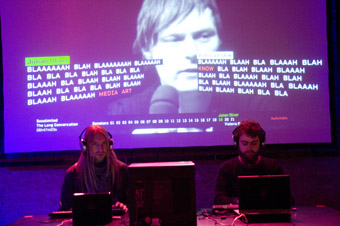
Sosolimited, The Long Conversion
photo Jonathan Gröger/transmediale
Sosolimited, The Long Conversion
THIS YEAR’S EDITION OF TRANSMEDIALE MARKED A NEW COLLABORATION BETWEEN THE FESTIVAL AND ITS SISTER EVENT CLUB TRANSMEDIALE. THE RESULTING PROGRAM, OVERLAP—SOUND & OTHER MEDIA, BROUGHT A SERIES OF EXPERIMENTAL AUDIOVISUAL PERFORMANCES TO TRANSMEDIALE’S MAIN HUB, THE HOUSE OF WORLD CULTURES IN BERLIN.
Probably the most anticipated performance was the much-hyped live AV set from Japan’s Ryoki Ikeda. Having been impressed by his immense, exquisitely designed installation data.tron [3 SXGA version] (2007-9) I was hoping Ikeda’s performance would elevate his sublime, yet somehow unsatisfying graphics to a more meaningful level. What a disappointment then, that Test Pattern actually delivered something far less. Against a large square projection, Ikeda stood at his laptop and set loose an onslaught of driving percussion, the minimal beats occasionally disrupted by bleeps and bursts of static and noise. On the screen behind, horizontal black and white lines flickered up and down across two vertical panels—the lines, their frequency and shade constituting a direct conversion of Ikeda’s audio signal. Initially the perfectly synchronised beats and stark graphics made an impressive impact, however as the minutes passed by the effect wore thin. The screen eventually subdividing into smaller sections did little to reinvigorate the relentless, flickering graphics.
Stylistically similar, but infinitely more intriguing was POWEr by Canadian duo Artificiel, a commissioned AV work developed around a Tesla coil. Two cameras and a microphone relay video and audio to Artificiel’s laptops where it is processed and played back live. For the performance the Tesla coil stood to the front left of the stage under a soft spotlight. A large screen hung vertically at the back and Artificiel themselves were as far offstage as to be effectively invisible. The piece started simply, just the coil and the wonderfully powerful, amplified electric current. After this small tribute, a pause and the real show commenced. In a slow, deliberate rhythm Artificiel fired off the Tesla. With each beat a stark black and white still shot of the electricity burst onto screen. The milky white arc was captured in stunning quality, complex rivers and veins set beautifully against black. As the soundtrack progressed and grew more complex, the images started to overlap, replace, repeat, eventually inverting and breaking into smaller panels. Artificiel at times confused the integrity of the ‘live’ footage by mixing in time-delayed samples or continuing playback while the Tesla stood silent.
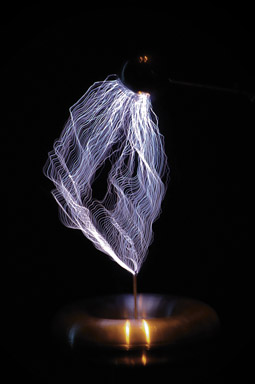
POWEr, Artificiel
photo © de_buurman
POWEr, Artificiel
Continuing the dominant black and white theme, I caught a nice performance, A Cable Plays, at Club Transmediale using openFrameworks open source software. Two artists, Chris Sugrue (US) and Damian Stewart (NZ), both part of the openFrameworks development group, sat cross-legged opposite each other at a black, square board decorated with a tight grid of pins. The artists took turns threading white string through the grid, building up interesting, minimal geometries. Meanwhile a live overhead camera transmitted the scene to a large screen for the audience. The position and movement of the string was analysed in openFrameworks to trigger, warp and distort a live electronic soundtrack. Additional graphics and animations popped onto the main screen occasionally and were ‘pushed aside’ or otherwise affected by the threading of the string. A simple piece, “inspired by the hidden codes of human behaviour and the hidden logic of games,” but well executed.
Another highlight for me was The Long Conversion by American MIT graduates, Sosolimited. Soso hijacked the audiovisual stream of Transmediale’s eight-hour keynote discussion and presented their own subversive remix. Two volunteer typists sat at computers under a large screen and entered the spoken conversation in real time. This text data was then scanned, analysed, and playfully repositioned over the top of the original feed. Presented as info-graphics, the piece subverted the content of the discussion, charting the frequency of particular words, finding ‘hidden’ syntax clues and otherwise messing with the signal. The actual video and audio streams were also manipulated and distorted to render the discussion at times comical, threatening, dream-like or plain false. It was clever, funny and beautifully designed.
In celebration of Transmediale’s new partnership with eArts Festival Shanghai, the festival closed with a special showcase from contemporary Chinese media artists. The first of the two performances started promisingly, with sound artist Zhang Jian hidden behind a screen at the front left of the stage on which a large golden ‘sun’ was rear-projected. He and his instrument appeared only as shadows against the golden orb. Visual artist Aaajiao stood at a console at the right of the stage and controlled a projection of generative cloud formations onto the back wall. Zhang Jian stepped in and out of the projected sun, augmenting the sound from his mysterious instrument (which through later research I discovered to be several of his Buddha Machines placed on a ‘wooden-man’ martial-arts training structure). Meanwhile Aaajiao played with the volume, texture and speed of his ever-drifting clouds, the most interesting moments coming when he amped up the pace of these transformations to build some kind of rhythm. For the most part however, these changes felt awkward and off-time. Also questionable was the decision to generate the clouds onscreen. Watching the little puffs obviously being clicked into existence was disconcerting. The main problem with this show, however, was that nothing really happened before it abruptly ended 30 minutes later.
Next Feng Mengbo took the stage, games console in hand. Immediately we were hit with the bright colour and bouncing electronic soundtrack of his self-developed computer game in which a Chinese character in Communist greens takes over the world country by country (level by level), armed with Coke cans for ammunition. After claiming America, he heads to the moon—at which point, unforutnately, the game got stuck in an irrecoverable loop and, after sitting through two restarts, the impatient crowd forced the performance to be abandoned. The game was really quite good and there was a certain audacity in closing the festival with a Nintendo console performance, but the programming seemed questionable rather than being about maverick artistic intervention.
While it had looked good on paper, Overlap was not exactly successful. Despite some highlights, the works generally felt safe and often just a bit dull. It was disheartening to witness the shortage of fun, poetry and adventure. This is particularly disappointing in Berlin, a mecca for experimental electronic arts of all imaginable forms. Perhaps Transmediale had decided their festival was not the place for a sound performance using algae-generated electricity to search radio frequencies for interdimensional beings. (No, I didn’t make this up.)
Overlap—Sound & Other Media, Transmediale, 2010, various venues, Berlin, Jan 28-Feb 7, www.clubtransmediale.de/ctm-festival
RealTime issue #96 April-May 2010 pg. 23
© Lucy Benson; for permission to reproduce apply to realtime@realtimearts.net

Nanomandala, Victoria Vesna, James Gimzewski
courtesy the artists
Nanomandala, Victoria Vesna, James Gimzewski
IN A BLACKED-OUT ROOM, AS PART OF JOHN CURTIN GALLERY’S ART IN THE AGE OF NANOTECHNOLOGY EXHIBITION, THE TIBETAN BUDDHIST SAND MANDALA OF CHAKRASAMVARA GLOWS IN SATURATED COLOURS, PROJECTED FROM ABOVE ONTO A TWO-METRE DIAMETER SANDPIT.
The intricately rendered geometric patterns, human figures, tiny creatures and curling clouds are readable in their entirety for just a few seconds before the image zooms back towards the grains of sand from which the original mandala is constructed.
Quickly the detail recedes into areas of bright colour, localising towards the centre of the mandala, and soon we are looking at ever-growing grains of brightly coloured sand, filling more and more of the circular field of vision. They morph into a micro-landscape of boulders and edges before the rich hues fade and we begin to ‘see’ at the nano-level—a scale at which colour itself ceases to exist and the sandscape becomes flakes and mounds of rippled grey and white. From here begins the slow, meditative return to the macro scale: the looped projection is a 15-minute journey from the visible to the unimaginable and back, across a realm encompassing aesthetic, scientific and spiritual dimensions.
Artist Victoria Vesna and scientist James Gimzewski have collaborated on several projects involving nanotechnology, a field that extends what is ‘seen’ to its outer limits, using instruments that don’t photograph but gather physical data by ‘touching’ molecular surfaces—data that is algorithmically interpreted to produce visual images. Four monks from the Tibetan Gaden Lhopa Khangtsen monastery in India worked full time for a month to create the original mandala for the Los Angeles County Museum of Art. Vesna and Gimzewski then photographed it at a range of scales from wide-angle to macro lens. The mandala’s central motif was recreated in the laboratory, where it was imaged firstly with an optical microscope and then a Scanning Electron Microscope. To create a seamless video projection that would zoom down to the nanoscale took 300,000 individual frames—around 900GB of data. Rendering the final composition took 36 computers two full days to complete.
Nanomandala, Victoria Vesna, James Gimzewski
courtesy the artists
Nanomandala, Victoria Vesna, James Gimzewski
The intensity of the lab-work resonates with the Buddhist practice of creating the mandala: a process involving extreme finesse and patience in which finely corrugated, sand-filled cones are gently rubbed so that grain-by-grain the image is built into being. The link is not arbitrary: Vesna’s relationship with Tibetan Buddhism goes back to her college days, when she first read Robert Thurman’s translation of the Tibetan Book of the Dead. “Buddhism and meditation were always informing my practice,” says Vesna, “and to be participating in the creation of the Chakrasamvara was a great teaching and transmission for me.”
The themes of life, death and transition seem to lend themselves to an artistic engagement with nanotechnology: other works in the Art in the Age of Nanotechnology exhibition explore these themes in several ways, creating human interactions at the borderline between the known and the unknowable of objects that are measured in billionths of metres.
The creation of Nanomandala in 2003, says Vesna, has influenced her subsequent work (see Blue Morph or Quantum Tunnel, also collaborations with Gimzewski) both in terms of its interactivity and the sense that the artwork is “manifested” rather than directed, with a specific energy and path of its own. At face value, the ‘interactivity’ of Nanomandala is limited—viewers can sculpt the sand while the image creeps across it, or sift it through their fingers—but in the context of the scale and delicacy of Nanomandala, this seems an almost clumsy interaction with a work that otherwise operates at high precision and high resolution. Watching the entire 15-minute loop, however, is a commitment to a kind of meditation and exchange; and this meditative interaction seems much more to the point.
Nanomandala’s aural component, by sound artist Anne Niemetz, runs parallel in scale to the shifting images: a collage that by turns includes the deep, harmonics-soaked throat-singing of the Tibetan meditation chant and the highly amplified sounds of the monks’ sand-sculpting tools—vibrating, cricket-like rubs and taps that accompany the image as it approaches nano-scale.
The sheer, vivid beauty of Nanomandala—though Vesna points out that terror is equally a part of the mandala image—sets it apart from the other works in this exhibition, as does an engagement with the spiritual that does not look to conceptualism for its validity. Despite both an immense degree of technical production, and its strong engagement with Tibetan Buddhist practice, Nanomandala has an aesthetic simplicity and spaciousness that leaves abundant room for individual response and contemplation.
Perth International Arts Festival: Victoria Vesna and James Gimzewski, Nanomandala (2003), exhibited in Art in the Age of Nanotechnology, John Curtin Gallery, Curtin University of Technology, Perth, Feb 5-April 30
Read about other works in this exhibition here.
RealTime issue #96 April-May 2010 pg. 23
© Urszula Dawkins; for permission to reproduce apply to realtime@realtimearts.net
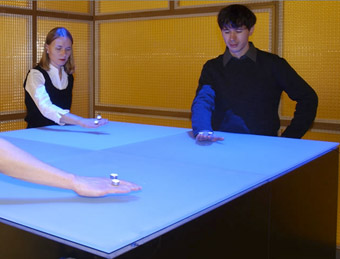
Christa Sommerer and Laurent Mignonneau, 2002, Nano-Scape: user 06, supported by Volkswagenstiftung, Hannover
image courtesy of the artists
Christa Sommerer and Laurent Mignonneau, 2002, Nano-Scape: user 06, supported by Volkswagenstiftung, Hannover
IT’S ACTUALLY PHYSICALLY IMPOSSIBLE TO ‘SEE’ NANO-PARTICLES, AS ALL IMAGING AT THIS SCALE (1NM = 1 BILLIONTH OF A METRE) CAN ONLY CONSIST OF INTERPRETED DATA. SO AS CURATOR CHRIS MALCOLM PUTS IT, THE FIELD PROVIDES “FERTILE GROUND FOR ARTISTS WISHING TO CREATE NEW PATHWAYS TO THE PREVIOUSLY INVISIBLE LAYERS OF OUR MATERIAL EXISTENCE.”
But nano-imaging aside, all five works—both new and remounted art-science collaborations from Australia, the UK and Austria featuring in Art in the Age of Nanotechnology—display an engagement with ideas above and beyond the technology, with the possible exception of Christa Sommerer and Laurent Mignonneau’s work, Nano-Scape (2002).
Nano-Scape was developed for the exhibition Science+Fiction at Hannover’s Sprengelmuseum, and consists of a glowing blue table beneath which an array of electromagnets creates constantly shifting forces, stimulated by the movement of the user’s hand—wearing a kind of ‘ring’—over the surface. The camera-tracked movements of the ring are fed to an atomic-force simulator which ‘imagines’ the ring movements as those of one relatively stable atom among a hundred or so others. The user feels the resulting forces, simulated by the electromagnets.
In ‘real life’, such movement would cause all the atoms in the array to interact in a constant readjustment of their proximity to one another. This is the force that Sommerer and Mignonneau aim to demonstrate. In its initial form a screen out of view of the participants showed atomic patterns formed by the simulation. The screen has been removed in this remount, however, to strengthen the purely haptic experience of the impossible-to-equalise system; but without either a detailed explanation of what is simulated or the visible pattern of moving atoms, the work seems to lack artistic purpose, feeling more like a science display.
Both Paul Thomas and Kevin Raxworthy’s elegant Nano_essence (2009) and Mike Phillips’ shimmering A Mote it is…(2009) abound with references to philosophy and metaphysics, at the same time remaining firmly embedded in nanotech exploration. For Nano_essence, a single, cloned (hence potentially ‘eternal’) skin cell was analysed, to compare life and death at the nano level. In a cavernous, darkened space, the viewer breathes onto a plinth-mounted, perspex re-creation of the dying skin cell. In response, on a large wall-mounted screen, a multilayered representation of the cell begins to move in 3-D animation.
We fly beneath and through the layers of the cell, which appear like angular, transparent mountainscapes or a softly haunting 3D game as the square base of the ‘cell’ tilts and turns. Amid low rumblings and tappings, mysterious figures appear, or are they twists of DNA? It’s hard to determine, but the life-giving breath seems to people the subtle, layered landscape with something animate and self-determined. They move in their own shifting geometrical plane and disappear seemingly at will, extinguished somewhere between white ‘sky’ and soft, grey oblivion.
Mike Phillips’ A Mote it is… also employs the raw data of nano-imaging to produce a lush visual metaphor, here abstracted into swirling patterns referencing the elusive nature of both the nano-world and the everyday ‘mote’—that floating speck of dust on the surface of the eye that is impossible to actually see, but that nevertheless persists in peripheral vision. After scanning a mote of dust from his own eye, Phillips devised a constantly moving whirlpool of data-generated ‘particles’ mediated by face-recognition software. When viewed front-on, the swirl is entrancing; a sunburst-coloured play of light accompanied by an electronic soundscape. When the head is turned to one side, something seems to go against the tide—impossibly ephemeral particles appear and disappear, resonating with the ‘creatures’ of Nano_essence, perhaps, but in this case as barely perceptible as the mote itself.
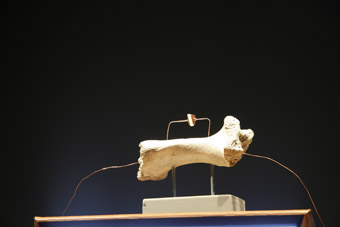
Boo Chapple, Transjuicer, 2009, detail, John Curtin Gallery, 2010
image courtesy of the artist
Boo Chapple, Transjuicer, 2009, detail, John Curtin Gallery, 2010
A series of transformations is at the heart of Boo Chapple’s multifaceted and playful Transjuicer (2010). After becoming aware of the piezoelectric qualities of bone—when subjected to any mechanical stress it generates an electrical charge at the nano scale—the artist set about creating bone audio speakers, using the femurs of cows. Initially fascinated by this constant response of living bone to its environment and its potential as a metaphor for the complex interactions of life and world, Chapple found that the difficult process of trying to make the audio speakers pointed to other complexities, not least of which are the ‘transducings’, or conversions, that come into play between micro technological interventions and the macro social context, between living and dead matter, and between science lab and gallery.
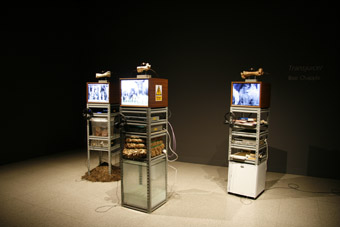
Boo Chapple, Transjuicer, 2009, installation view, John Curtin Gallery, 2010
image courtesy of the artist
Boo Chapple, Transjuicer, 2009, installation view, John Curtin Gallery, 2010
Transjuicer consists of three screens atop rack mounts that house bales of straw, a tank of rotting cow bones, shelves of lab reference books and three audio players with headphones. On the top of each tower sits a highly polished cow femur wired to the small sections of bone that constitute the ‘speakers.’ Tinkling through the headphones, Chapple’s three successful recordings are distant, distorted renditions of “Dry Bones”, “Old MacDonald” and “Good Vibrations”—recordings made, after many unsuccessful attempts, by a laser interferometer. The video screens play loops of cows at the milking shed. Chapple describes Transjuicer wryly as “milking it.” The work’s playfulness trots lightly over the process, but Transjuicer succeeds in illuminating some awkward, absurd and inescapable liaisons between art-making, primary production, the mastery of materials and messing around with living matter.
Victoria Vesna and James Gimzewski’s Nanomandala (2003), reviewed separately in this issue, is, put simply, an extended zoom from macro to nano scale and back out again, its focus the Tibetan Buddhist sand mandala of Chakrasamvara, created for the first time in the USA by monks from the Gaden Lhopa Khangtsen monastery. More subtly interactive than some of the other works here, Nanomandala, projected onto a two-metre disk of sand, has meditative qualities; the saturated colours of the mandala inviting immersion in a slowly changing, seamless progression to the limits of imaging. A spiritually focused artwork, Nanomandala also has an illustrative simplicity, displaying the conundrum that grounds all the works in Art in the Age of Nanotechnology: the ability to ‘see’ what is in a literal sense unseeable—particles of matter that are smaller than wavelengths of light.
Art in the Age of Nanotechnology, curator Chris Malcolm, artists Paul Thomas and Kevin Raxworthy (Australia), Mike Phillips (UK), Victoria Vesna (USA) and James Gimzewski (Scotland), Christa Sommerer (Austria) and Laurent Mignonneau (France), Boo Chapple (Aus); John Curtin Gallery in association with Curtin University Centre for Research into Art, Science and Humanity; Curtin University of Technology, Perth, Feb 5-April 30.
RealTime issue #96 April-May 2010 pg. 26
© Urszula Dawkins; for permission to reproduce apply to realtime@realtimearts.net
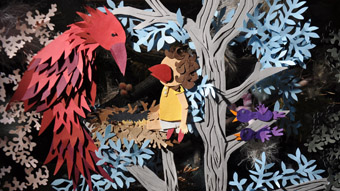
You Were In My Dream (2010), Isobel Knowles and Van Sowerwine
image courtesy the artists
You Were In My Dream (2010), Isobel Knowles and Van Sowerwine
FOR ITS FOURTH INTERNATIONAL BIENNIAL OF MEDIA ART, EXPERIMENTA WAS FRAMED BY THE LURES AND ELUSIVENESS OF INHABITING ‘UTOPIA.’ AMASSING MORE THAN 35 INTERACTIVE AND SCREEN-BASED WORKS FROM AUSTRALIA AS WELL AS INDIA, CANADA, FRANCE, SOUTH AFRICA AND THE UK, THE BIENNIAL CHARTED MYRIAD WAYS MEDIA ARTISTS TODAY ENVISION THE LONGSTANDING DESIRE FOR A BETTER WORLD. WHILE THE TITLE OF THE EXHIBITION, UTOPIA NOW, LEADS ONE TO EXPECT AN IMPLICITLY HOPEFUL ENCOUNTER WITH NEW MEDIA ART, THE SELECTED WORKS RANGED FROM JOYOUS AND HUMOROUS TO DESOLATE AND UNNERVING.
Prompting us to consider a series of possible futures, the theme of the exhibition parallels the concerns of the sci-fi genre where projections of the future function as anxious meditations upon or inspirational extensions of the present day. For myself, it seemed fitting, then, that entry into the Blackbox space resounded with allusions to science-fiction. After passing through a large inflated white façade—itself reminiscent of the gleaming white cities of hope that once appeared in the design of 19th century world expositions and the futuristic city designs of films such as Things to Come (1936)—we are greeted by a suspended garden, Akousmaflore by the French duo known as Scenocosme (Grégory Lasserre & Anaïs met den Ancxt, 2008). Invited to touch the draping tendrils and leaves of the overhanging plants, we discover that this garden can emit sounds and acoustic vibrations.
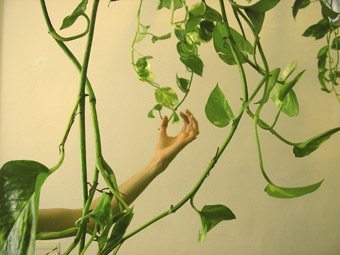
Akousmaflore, Scenocosme
courtesy Experimenta and the artists
Akousmaflore, Scenocosme
Akousmaflore brings together the human, the natural and the technological to imply harmonious fusion. The work itself is founded upon proximity and recognition: as flesh and flora connect, the tiny concealed sensors that are lodged within the greenery become ‘aware’ of our presence and trigger varying sonic effects. One wonders, however, whether or not this leafy chorus harbours darker undertones. In the greenhouses of the future, will the hybridisation of nature and technology lead us towards social betterment or destruction? Such questions became all the more pressing when an occasional scream issued from the garden. At that point, the captivating ‘song’ of the plants ceded to the potential for a botanical uprising—perhaps along the lines of John Wyndam’s novel, The Day of the Triffids (1951)—and I chose to move on.
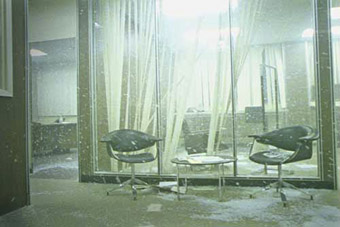
I Feel Cold Today (2007), Patrick Bernatchez
image courtesy the artist
I Feel Cold Today (2007), Patrick Bernatchez
One of the most compelling features of the biennial was its notion of a future still to be decided, through a rhythmic alternation between ominous and optimistic scenarios across the assembled works. Thanks to Sir Thomas More’s Utopia, published in 1516, the idea is commonly understood as the dream of an ideal society or a perfect world. If utopia is an age-old ideal that speaks to our sun-dappled dreams, then Experimenta rightly chose to pay heed to the aesthetic complexity of its curatorial premise by showcasing the prospect of utopias lost as well as found. Alongside the more humorous artworks of the exhibition—for instance, were video shorts that elicited our laughter through the dissonant and the absurd, such as The Hunt (Christian Jankowski, 1992/1997) in which a man, armed with a toy bow-and-arrow, enters a supermarket and deftly spears supplies (bread, milk, a frozen chicken) with child-like abandon, before proceeding to the checkout—are works charged with nightmarish visions of dystopian chaos. To that end, the elegiac I Feel Cold Today (Patrick Bernatchez, 2007) presents us with the darkened flip side of utopian rationality and order. At once beautiful and imbued with a palpable sense of mourning, the work journeys through floor after floor of an abandoned office building, gradually filling with snow. Instead of people, its scenes are filled with office chairs and windswept paperwork. All that is left of capitalism and economic industry are its vestigial remnants, soon to be covered over by a blanket of post-apocalyptic snow.
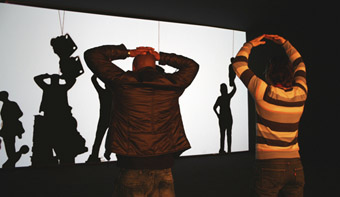
Shadow 3 (2007), Shilpa Gupta
courtesy Experimenta and the artists
Shadow 3 (2007), Shilpa Gupta
Often, it is difficult to separate out the ludic appeals of the works on display from their darker portents as both utopic and dystopic possibilities reside within the same piece. Consider the affective implications of the Indian artist Shilpa Gupta’s large-scale interactive installation, Shadow 3 (2007). What begins as a playful scenario in which the visitor’s shadow is projected life-sized before them gives way to an unnerving ‘string’ that steadfastly attaches itself to our silhouette. Whereas beforehand we had controlled the actions of our shadowed selves, now detritus begins to slide down the string and affix itself to our shadow. Shadowplay animation leads to our own uncanny automation for we cannot halt the accumulating pile of debris. Eventually, our shadows are overcome by a tidal wave of junk, drowned by the rubbish.
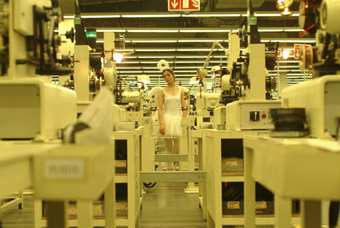
Utopia (2006), Cao Fei
image courtesy the artists
Utopia (2006), Cao Fei
Alternately, Cao Fei’s mesmerising film, Whose Utopia (2006), posits that utopia is where you make it. Set within a light bulb factory in Guangdong, China, Fei’s film entwines scenes of factory workers engaged in mundane and repetitive tasks and the escapist fantasies of four workers. Shots of a ballerina’s poised gestures alternate with images of a man break dancing in the aisles or another man absorbed in strumming an electric guitar, while the drum of industrial machinery, the regimentation of work and the stark lighting of the factory floor persist throughout. Sometimes, utopia is found in the most unlikely or gloomy of places because this is a concept that is tethered to individual hopes and dreams.
Without question, the stand out work of Utopia Now (and a definite crowd favourite) was the Isobel Knowles and Van Sowerwine commission, You Were In My Dream (2010). As the artists so adeptly prove, even the utopias belonging to long since past traditions of art and entertainment can be discovered again and revitalized anew, within the ‘new media’ sphere of technologically augmented art. You Were In My Dream is a glorious stop-motion animation that recalls media art history from the vantage point of the present. Functioning as equal parts perspective box, reflective display and interactive installation, the visitor is seated at a booth and provides the stand-in face for a child protagonist (fed live into the animation). Equipped with a mouse, we are prompted by the appearance of sparkles on-screen to select our chosen path/storyline within an enchanted forest. The densely textured world of You Were In My Dream consists of hand-cut paper human and animal characters, delicate feathers and fronds–demonstrating how such material still persists within the age of the digital. Unlike the traditional perspective boxes of earlier periods of history, however, this work is not confined to a single-user experience. Indeed, the crowds who gathered around the piece seemed just as transfixed by the exterior projection on the side of the wooden box as I was by the world unraveling within it.
Similarly, William Kentridge’s What Will Come (2007) opts to retell the historic atrocities of the Italian invasion of Abyssinia (Ethiopia) through the forgotten media art of the anamorphosis, projecting the ‘real’ story of these events upon a cylindrical surface that dates back to the seventeenth-century. Life Writer (Laurent Mignonneau & Christa Sommerer) also merges the analogue and the digital: you sit at a typewriter, press the keys and the letters generate different codes that result in insect-like creatures swarming across the projected page. The combination of code and artificially-generated creatures from an older mode of writing seem entirely apposite—it is well known that cyberpunk author William Gibson first conceived of the birth of cyberspace from the purview of his own typewriter.
While many of the works contained in Utopia Now do function as somewhat like one-trick ponies—have your digital portrait taken and watch yourself aged via face-reading and morphing software; press a button, hold yourself against a glass panel and see yourself transformed into a suspended, full-body scan—this should not be taken as criticism. Arguably, much of the strength of Experimenta’s Biennial stems from its negotiation of old and new technologies. To that end, I am reminded of what the early film historian Tom Gunning refers to as the pre-1910 “cinema of attractions” as it invoked a presentational rather than representational experience of film and one that directly addressed the spectator. Towards the conclusion of the short digital animation, Please Say Something (David OReilly, 2009), another favourite of mine, a complicated cat and mouse pair steps forward to take a bow and allude to our own appreciation of the display. This is the great strength of the Experimenta Biennial—its deliberate inclusion of the visitors themselves as embodied and vital participants within the artworks.
Decades on from the techno-utopianism that accompanied the beginnings of digital culture and new media art (what the cultural critic Scott Bukatman aptly terms “cyberdrool”), Experimenta continues to bring together old and new technologies, to suggest that no medium ever completely disappears, and invites us to have fun along the way. This biennial might not have been utopia attained but, at times, it did function as an enthralling place to visit.
Experimenta, Utopia Now: International Biennial of Media Art, Blackbox, The Arts Centre, Melbourne, feb 12-March 14
RealTime issue #96 April-May 2010 pg. 27
© Saige Walton; for permission to reproduce apply to realtime@realtimearts.net
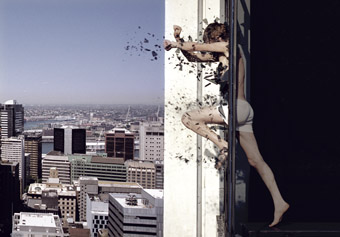
We Have Decided Not To Die
2010 MARKS TEN YEARS SINCE THE FIRST REELDANCE INTERNATIONAL DANCE ON SCREEN FESTIVAL. THE EVENT HAS GROWN ENORMOUSLY IN SCOPE SINCE THEN, BECOMING AN INDEPENDENT ENTITY, OUT FROM THE UMBRELLA OF ONE EXTRA DANCE CO AND PERFORMANCE SPACE IN 2008, AND AN EMERGING KEY ORGANISATION THROUGH THE AUSTRALIA COUNCIL IN 2009.
In May, Reeldance will launch its sixth International Dance on Screen festival and tour under the banner “A Collision of Art, Dance and Film”, the first to be curated by new artistic director, Tracie Mitchell who replaced founding director Erin Brannigan in February last year.
Mitchell’s background is primarily as a dance filmmaker. Her career spans over 20 years and her films are in the collections of the Tanz Museum, Cologne, La Cinematheque de la Danse, Paris, and at the Australian Centre for the Moving Image, Melbourne. She is currently completing a practice based PhD at Victoria University, researching new critical frameworks to describe dance for camera. The basis of her work as a dance filmmaker, researcher, mentor and curator is the broad question “What is dance for screen?” and it is this provocation, as well as her interest in process, experimentation, play and deep passion for the form, that she brings to her role as director for this year’s festival.
Mitchell’s program is diverse. Many of the strands that Reeldance has traditionally offered, like the documentary session (this year Paris is Burning and In Bed with Madonna), international shorts sessions and Reeldance International Dance on Screen Awards, are still in place, but there seems a broader sweep of both high end and low budget films, as well as films made specifically by choreographers and more general art films with an interest in the body and movement. Aptly, the theme for the festival is space—physical, emotional, imaginative space and tensions held in space.
The opening night of the festival represents the high end with the films We have decided not to die by Daniel Askill and The Rape of the Sabine Women by Eve Sussman and the Rufus Corporation (which premiered in Australia at the Melbourne International Arts Festival in 2008; RT87). Both have enjoyed wide audiences internationally outside of the dance on screen genre, but Mitchell enthuses about seeing them within the context of the Reeldance festival. Askill is a filmmaker with a strong interest in fashion, and therefore Mitchell notes an interest in the body, movement and composition. “I think what’s so interesting about the film is the subtleties of movement and the intimacy of the camera to be able to express the coming together of those forms, to actually express something with meaning, rather than an audience looking at something going ‘oh, isn’t that beautiful’.”
Mitchell first saw Sussman’s film as an installation in North Carolina and then again in feature film format at the Melbourne Festival, and was excited about how it addresses elements of dance for the screen. She is interested in the ways Sussman holds the tension between people and space, people to people, and to the camera.
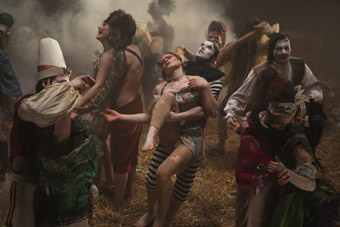
The Forgotten Circus
There will be a retrospective of films by UK artist, Shelly Love, who will be attending the festival as an international guest and hosting labs in Sydney and Melbourne. These will focus on the festival theme of space and will create an environment for testing ideas, embracing spontaneity and play without the pressure of an outcome. Love trained at the Laban Centre in London and is among what Mitchell calls the first generation of choreographers to come out of training into the strong dance screen culture in the UK in the 90s (such as the BBC’s Dance for Camera series, South East Dance, Dance Video at The Place) and to utilise such opportunities. Love received the first dance screen residency at The Place and has ‘crossed over’ into making video clips for bands. Mitchell hesitates to use the word whimsy in relation to Love’s films, but describes watching her work as similar to dropping into Love’s imagination. Mitchell is also interested in Love as an artist whose first language is dance, and whose filmic choices are made through this dancerly perception.
Send The Cameras Out will launch the second stage of Reeldance’s Indigenous Initiative, taking place over a three-year period and providing opportunities for Indigenous dancemakers, editors and composers to engage with making dance for screen works. The session will screen six new dance works made over the last year as part of an intriguing experimental process. Each of the six choreographers was given a camera and one month to respond to the questions “What is dance for camera?” and “What is space?” The raw footage was handed to six editors who created a six-minute edit over a month, and then in turn handed the films to six composers who created a score. The screening will be the first time the 18 artists will see the finished works, and there will be a forum for the artists to respond to the project. Mitchell sees this as an initial experiment to begin to build infrastructure for the ongoing program, and there will be much consultation with the artists on where to go from here.
Out of The Hat is another session with emphasis on experimentation and chance, and comes out of Mitchell’s recognition that there is little opportunity for Australian dance filmmakers to have public screenings of their work. Based loosely on the chance procedures of Merce Cunningham and John Cage, artists are able to register their works and at the beginning of the session an hour’s worth of films will literally be pulled out of the hat for public screening. Each artist whose work is shown will be afforded time for public response to their work.
From the Archives will launch the opening of the Moving Image Collection (MIC), Reeldance’s database project initiated by former director Erin Brannigan, archiving the accumulation of work in the organisation’s history over the past decade for public access and screening works drawn from the collection. In conjunction, there is currently a window installation at the Australia Council building in Sydney with 10 screens showcasing works from the archives. This installation will tour to Chunky Move in Melbourne and the Judith Wright Centre, Brisbane as the festival travels from state to state.
Beyond the individual sessions, Mitchell is interested in the overarching concept of a festival. She reminisces about days spent at the Valhalla Cinema in Melbourne in the 70s with a thermos of tea and packet of shortbread biscuits, watching films from morning to night, submerging herself in the filmic world. She speaks of the importance for her as an artist early in her career of attending festivals overseas to “meet, be inspired, critically respond, investigate, network and be fed” and to create the connections she felt difficult to maintain in Australia at that time. Mitchell’s vision for the Reeldance Festival is to provide a platform where artists and audiences alike can immerse themselves in the world of dance on screen.
To increase the sense of national convergence and conversation, Mitchell has created Artbus, two buses travelling overnight from Melbourne and Brisbane respectively with dance film screenings every hour and places for 48 people on each, who will be guests of the festival in Sydney with access to all screenings, forums and talks. Mitchell wants the festival to be not only about screening dance film, but about process and community too. She likens the process of her curation to creating a fabulous dinner party: you meet great people who give you stories; the surroundings are divine; the lighting’s perfect; you are served a degustation menu, with each taste like an amazing adventure; and you leave exhausted with all your senses satisfied.
Reeldance International Dance on Screen Festival; Performance Space, Carriageworks, Sydney, May 13-16. See www.reeldance.org.au for national tour dates: Perth, Adelaide, Alice Springs, Darwin, Cairns, Brisbane.
RealTime issue #96 April-May 2010 pg. 28
© Jane McKernan; for permission to reproduce apply to realtime@realtimearts.net
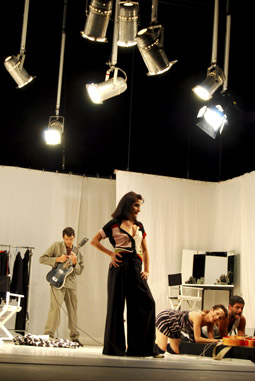
(Not) a Love Song
photo Valério Araújo
(Not) a Love Song
WHAT IS IT ABOUT RIO DE JANEIRO THAT MAKES EVERYBODY GO WEAK IN THE KNEES AT THE MERE MENTION OF ITS NAME? IT FEATURES IN THE TOP 10 MOST DANGEROUS CITIES IN THE WORLD ALMOST AS OFTEN AS IN THE MOST BEAUTIFUL. THIS HAS NOT DIMINISHED ITS ALLURE. SO WHAT DOES AN ANNUAL DANCE FESTIVAL IN THIS MOST GLORIFIED OF CITIES LOOK LIKE?
Founded in 1993 by choreographer Lia Rodrigues, Panorama Dance Festival is currently headed by artistic directors Eduardo Bonito and Nayse Lopez. Now in its 18th year, Panorama has developed into one of the most important platforms for contemporary dance in Brazil, if not in all of South America.
(not) a love song
One of the declared aims of the festival is to present international works to local audiences at affordable prices. On offer this year were works by artists from France, Switzerland, Portugal, Uruguay, Japan, French Guiana and South Africa. Among those, (Not) a Love Song by French choreographer Alain Buffard was an undisputed crowd pleaser and it was easy to see why. Billed as a “tragic musical,” it features an eclectic mix of all-time favourites including Kurt Weill’s “Ballad of Sexual Obsession,” James Brown’s “This is a Man’s World” and Public Image Limited’s “This is not a Love Song,” referenced in the piece’s title. The songs are rendered with idiosyncratic verve by the standout cast—Miguel Gutierrez, Vera Montero and Claudia Triozzi—all renowned performance makers who inimitably people the stylish black-and-white stage with all kinds of quirky characters such as ultra glamorous femmes fatales playing air guitar and a movie director whose only direction to his female stars is “hmmm.” There are also ageing divas and a camp personal trainer who speaks at break-neck speed, gradually transforming into a drill sergeant gone mad. The piece’s movement material is inspired by Broadway razzle dazzle routines and cat walk strutting, the self-obsessed posing of the performers becoming increasingly grotesque. They stagger across the stage, losing control, towards the end turning into dog-like creatures. (Not) a Love Song playfully exposes a world enamoured with itself, obsessed with celebrity and self-display.
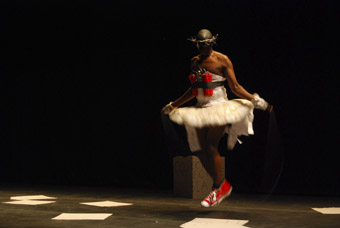
Influx Controls, Boyzie Cekwana
photo Valério Araújo
Influx Controls, Boyzie Cekwana
influx controls: i wanna be wanna be
Strong partnerships with numerous important arts organizations in Europe, such as Arts Admin in London, the Goethe Institut, Alliance Francaise etc, have enabled Panorama to regularly present works by European artists and companies including innovators like Jerome Bel, La Ribot and Jonathan Burrows. Under the artistic directorship of Bonito and Lopez, there has been a push to present more works from Southern Hemisphere countries, especially South America and Africa south of the Equator. It was no surprise then that the involvement of South African choreographer and dancer Boyzie Cekwana in Panorama 2009 was two-fold. He not only mentored young dancers as part of the festival’s residency program, coLABoratorio, but also presented a work, Influx Controls: I Wanna Be Wanna Be. It’s a powerful evocation of the artist’s struggle to negotiate his identity, both cultural and sexual, in South Africa’s post-Apartheid era. At the beginning of the piece, we see Soweto-born Cekwana clad in black pants and a white corset with what looks like a belt of explosives strapped to his chest. His face is painted black and his lips are bright red. He runs on the spot, his arms executing powerful jabs. It looks as if he is fighting. But who is the enemy? The past? Others’ perception of him? History itself? By the end of the work, Cekwana has undergone a striking transformation. He is now wearing a metal crown of thorns and a tutu with strips of papers attached, like price tags. He suggestively crawls across the audience, occasionally stopping for a brief lap dance. Is this the celebration of a new-found identity, proudly embraced, in full awareness of its flaws…? .
brazilian works
Besides presenting new international productions, Panorama also aims to showcase and promote Brazilian work with a focus on artists and companies outside of Rio. As the fifth largest country in the world, Brazil’s geographic dimensions pose similar difficulties for artists to tour their work nationally as those with which Australian artists are familiar. The scope of the Brazilian work presented at the 2009 Panorama Festival is impressive, to say the least. It ranges from Company Quasar’s electrifying athleticism and extraordinary physical comedy skills to Roberto Ramos’ concept-driven movement research, utterly mesmerizing due to the performers’ physical precision and commitment to process.
One of the most intriguing contributions comes from Company Cena 11. In their Embodied Voodoo Game, the concept of the voodoo doll is explored as a potent metaphor for the correlation between dance and video games, the body and new technologies. The roles of manipulator, medium and the manipulated constantly change throughout the piece. Sometimes it’s audience members who manipulate the on-stage action by giving instructions to the performers. At other times it’s the performers who are in control. Using gaming devices such as joysticks and acceleration and motion sensors, they manipulate sound and image projections. Gradually, a sense of danger and violence creeps in, as in the advanced stages of a computer game. Bodies leap through the air and crash to the ground. A female dancer is suspended by her hair extensions. Heavy rocks are balanced on body parts. In the end, the stage is covered with white feathers, electrical fans swirling them up into the air as the performers spin on the spot. It’s an image of arresting beauty that is simultaneously disconcerting. Aestheticized disarray. Game over.
artistic & audience development
Apart from presenting work, Panorama’s major aim is to create opportunities for dance and performance research as well as to raise the profile of contemporary dance in Rio. Throughout the year, audience development initiatives and activities are conducted in order to heighten the awareness for dance. They include free shows for residents of the favelas in the outskirts of Rio and the handing out of booklets in schools. In terms of artistic development, Panorama offers its residency program coLABoratorio.
For a period of several months prior to the festival, emerging artists from Rio and Teresina engage in artistic exchange, mentored by more established artists, both national and international.
Panorama is a massive undertaking made possible through a large number of income sources, predominantly government funding and corporate sponsorship. The festival is also strongly supported by international presenting partners and arts organisations in Rio including the presenting venues and the city’s Choreographic Centre. It’s partly because of these strong partnerships that Panorama’s success has steadily increased over the years. According to artistic director Bonito, the 2009 edition of the festival was the best attended yet.
And from an Australian perspective? Only one Australian company has presented work at Panorama to date, Branch Nebula in 2007. There is hope this might change. Panorama recently added Dancehouse Melbourne to their long list of exchange partners and Bonito and Lopez have become regulars at the Australian Performing Arts Market (APAM) held biennially in Adelaide. It would enrich Australian artists to be able to present work regularly at this diverse and stimulating dance festival.
Alain Buffard, (Not) a Love Song, concept Alain Buffard, cast Miguel Gutierrez, Vera Mantero, Claudia Triozzi, Seb Martel, musical adaptation Vincent Ségal; Boyzie Cekwana, Influx Controls: I Wanna Be Wanna Be, concept and performance Boyzie Cekwana; Quasar, Céu na Boca, choreography Henrique Rodovalho; Roberto Ramos/D.A.M., Continuum, direction and conception Roberto Ramos, performance Catalina Cappeletti, Gustavo Ramos, Roberto Ramos; Cena 11, Embodied Voodoo Game, choreography Alejandro Ahmed and cast, soundtrack and montage coordination Hedra Rockenbach; Panorama Dance Festival 2009, Rio de Janeiro, Nov 5-15, 2009
RealTime issue #96 April-May 2010 pg. 29
© Martin del Amo; for permission to reproduce apply to realtime@realtimearts.net
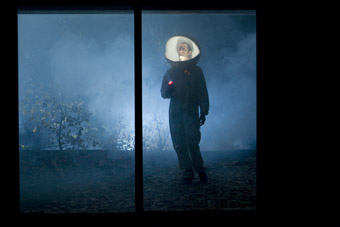
Effet Serge
photo Argyroglo Callias Bey
Effet Serge
IN JANUARY, NEW YORK’S COLDEST MONTH, OVER 2,000 DELEGATES FROM THE ASSOCIATION OF PERFORMING ARTS PRESENTERS (APAP) DESCENDED ON THE CITY FOR THEIR ANNUAL CONFERENCE. APAP IS THE EQUIVALENT OF THE AUSTRALIAN PERFORMING ARTS MARKET (APAM) ONLY, LIKE ALL THINGS AMERICAN, BIGGER. IN AN EFFORT TO EXCITE ARTS PRESENTERS FROM ACROSS THE COUNTRY, PS122, THE PUBLIC THEATRE AND ASSOCIATED ARTS CENTRES TROTTED OUT THEIR BEST AND BRIGHTEST.
For the past five years, Performance Space 122 (PS122) has presented COIL during APAP, an annual winter festival of contemporary performance. It’s an alternative to the compromised format of showcases and, in 2010, COIL was pitched as “14 companies in 12 days.” The works were full-length and open to New York’s holiday-fatigued public to enjoy treats of a different kind. Following PS122’s lead, the Public Theatre presented its sixth annual Under the Radar festival, also during APAP, equally ambitious but with stronger emphasis on theatre and international artists. Despite the sub-zero temperatures, audiences brave the cold and this previous dead period for the performing arts in New York now buzzes.
“Audiences and artists alike have a constant thirst for new stuff,” explained PS122’s Artistic Director Vallejo Gantner. “It’s typical of New Yorkers’ addiction to be the one to ‘discover’ someone or something.” I had coffee with Gantner at his local café where he talked about COIL and more broadly the contemporary performance scene in New York. “In terms of hybrid work, [local artists] have moved through the period of collaborations—the investigative styles of Richard Foreman and the Wooster Group. It seems there’s a renewed interest in ‘screwing around’.” The aesthetic is messy, and Gantner explained that current work directly engages with everyday experience—not dissimilar to work in Australia. “We live a hybrid existence. If anything, audiences have outpaced the work being made.” Gantner cited companies such as Radiohole, Temporary Distortion (who presented Americana Kamikaze at COIL; see RT95) and artist Reid Farrington. “These artists delve into the experiential consequence of technology, demonstrating how we deal with information and data.”
richard maxwell, ads
A good example is Ads, a co-presentation between New York City Players, PS122 and the Public Theatre. Conceived and directed by Richard Maxwell, hyper-real, life-size images of ‘everyday people’ are projected onto an otherwise empty stage. One-by-one, they ‘step’ onto a small, raised platform and orate their beliefs. The high-definition projection, supported by sound that captures the shuffle of footsteps and rustle of clothing as speakers step onto their ‘soapbox’, is so convincing that days later, my friend who saw the show exclaimed over coffee, “They really weren’t there?”
The work began with a woman in her 60s, commenting that adults use Blackberrys like pacifiers. Teenagers have heads bowed, not in prayer, but texting in monosyllables. We’re desperate to stay connected via social networking tools such as Facebook, she lamented, but nothing beats the connection between family and friends over Sunday lunch. “The human connection is missing,” said the projected woman. Subsequent manifestos didn’t resonate with quite the same irony, but did provide an astonishing survey of people and their lives, from musicians to real estate agents, parenting at 50 to existential nihilism. “I believe this world has already ended,” says a man in his early 20s with a t-shirt that reads, “Brooklyn Go Hard”.
Jonathan Capdevielle, Jerk
photo Alain Monot
Jonathan Capdevielle, Jerk
jerk
At the other end of the spectrum is Jerk, from France, directed by Gisele Vienne, text by Dennis Cooper and performed by Jonathan Capdevielle. Here the only technology used is a boom box. The work relies on puppets to reveal a disturbing story based on serial killer Dean Corll’s murders of 20 teenage boys in the 1970s. Capdevielle portrays David Brooks, one of two teenage boys who assisted Corll in brutally sodomising his victims. Brooks, in prison serving a life sentence, addresses the audience as if to a group of psychology students at a local university, explaining he will use puppets to reconstruct the murders, and suggesting this may help him take responsibility for his actions.
At first, the puppets appear with masks: Corll in a panda mask and Wayne Henley, Brooks’s teenage accomplice, in a white, fluffy dog-like mask. Given comic voices—one very high, one very low—the hand puppets perform like Punch and Judy, except with knives, creating for the audience a separation from the brutality of the actions, perhaps similar to the disconnection from reality experienced by the murderers. When the masks come off, the puppets are unsettlingly more human. Visceral and base, Capdevielle, at times dribbling, delivers an extraordinary performance that makes such sickness plausible, exploring the dark edge of sex and death. David Brooks’ text, which we are directed to read at certain points from a small booklet accompanied by photos and illustrations of the puppets and possibly the victims, adds another level of detail and depravity. The work was slammed by The New York Times, but it stayed with me like a sick and worrying dream [see also PuSh review of Jerk].
east 10th street
With all the boundary-pushing work on show, it was strangely comforting to see East 10th Street by Edgar Oliver. On a sparse stage with only one light, this seasoned performer took us back to the bohemian days of the East Village. Living as a young artist in a boarding house on East 10th Street with his sister, Oliver described in a slightly camp, Vincent Price-type voice, a bizarre collection of characters and events which seemed to emerge from the shadows around him: Donald Milburn who drank vodka with milk; Frances, the “Lady Macbeth of Rags” who spent more time in the share bathroom than in her room; Edwin Linder, with eight padlocks on his door; and Freddie the midget, who never left or entered the house through the front door, but instead used the old coal shute. Oliver weaves in a love affair with the “brilliant and wildly charismatic” Jason Boner that is never consummated, leaving me with an equal sense of longing. By the end I was nostalgic not just for this ghostly and colourful history of the East Village, but for simple, polished and crafted work delivered by a pro.
l’effet de serge
L’Effet de Serge, presented at 3LD Art and Technology Centre in New York’s financial district was not local fare, being an import from Paris-based Vivarium Studio. But it was a festival favourite of mine, and equally charmed New York audiences with its quirky, low-tech premise and staging. Underplayed to great humorous effect by company founder Philippe Quesne, it began with a spaceman in an oversized helmet, lit from within. He explained that this was a show about Serge, and this was Serge’s apartment, but that each show begins with the end of the last show, which had a spaceman in it, hence the outfit. Serge likes to make things, and does small performances for audiences of one or two.
Quesne’s long and languid body heightened each action, whether unpacking groceries, ordering pizza, testing a new novelty toy or awkwardly taking guests’ coats and offering them wine. Delivered with care and attention, the actions were beyond pedestrian, delightfully deadpan yet seductive in making us invest as much in Serge’s mini performances of light and sound as he did.
Despite the Global Financial Crisis, which is far more palpable in the USA than in Australia, audience numbers seem unaffected, and for PS122, Gantner confirmed that box office has never been better. “The majority of New Yorkers live in 400 square metre apartments so they have to get out. It’s not a case of, ‘Do I have the disposable income or not?’ It’s why you’re here.”
APAP Conference, Jan 8-12, www.APAPconference.org; COIL, Performance Space 122, Jan 6-17, www.ps122.org; The Public Theater, Under the Radar, Jan 6-17, www.publictheater.org; New York
RealTime issue #96 April-May 2010 pg. 32
Jason Maling, Triangulation, Second last audit session, In-Habit
photo Tara Gilbee
Jason Maling, Triangulation, Second last audit session, In-Habit
IN-HABIT WAS AN EXCEPTIONAL, INVENTIVELY CURATED MONTH-LONG SERIES OF 11 PERFORMANCE, LIVE ART AND INSTALLATION WORKS SITUATED IN AND AROUND THE ABBOTSFORD CONVENT. INVOLVING NINE KEY ARTISTS, MORE THAN A DOZEN ASSOCIATE ARTISTS AND NUMEROUS PARTICIPANTS, THESE ARTWORKS EMERGED OUT OF A COLLECTIVE RESIDENCY AT THE CONVENT ESTABLISHED BY ARTISTIC DIRECTOR JUDE ANDERSON EXPLORING SITE/PLACE/SPACE AND CULTURAL EXCHANGE.
In One Square Metre the Atherton Community Gardens in Fitzroy are opened to the public for a ‘tour.’ We are greeted in the heat and vibrancy of colour and scent amidst 60 garden beds by Zeynep, a Turkish Australian resident of nearby high rise flats and gardener here since 1969. Zeynep offers everyone dolmades, produce from her garden and the recipe! Jude Anderson serves water and introduces the project and tour. Over 12 months she has cultivated one square metre of garden according to some of the principles of French landscape architect Gilles Clément’s notion of the Planetary Garde: use only seeds offered or found, and no planting—sow as the wind would sow. While also adopting existing rules and practices from the gardeners at Atherton, Anderson’s alternative aesthetic, ethical and ecological practice brought her into immediate, humorous, productive ‘conflict’ and exchange with Zeynep and other Atherton gardeners: bed-ends framing their gardens, a living lattice of wild willow framing hers; theirs organised on pragmatic principles, hers a micro-cosmos of chaos. Anderson, the ‘hopeless gardener’!
It is the fruits of these meetings with community members and the growth of their interactions over time that are made available to us on the tour. Zeynep leads as Anderson and others draw her into conversation. We are introduced to vagabond plants, ‘weeds’, not normally cultivated. Dandelion, for a peppery salad. An Italian woman attending the tour confides, “We survived the Second World War on it. Really, a whole population.” Purslane, common in cracks in the pavement, we learn, is good for constipation. Something of a delicacy in Turkey, the Italians use it in a chicken breast salad. Another tour member tells us it is also being trialled in cardiovascular research. Ah, my vagabond heart! In a kind of culinary ecstasy, we taste, inquire after, debate and receive recipes for Black Sea Cabbage, Sawtooth Coriander, French Sorrel, Stinging Nettle and more.
The work of One Square Metre literally overflows its frame. It is a living artwork and residency in which Anderson creates the conditions for new encounters, competing knowledges, curiosity and exchange. The ‘art’ of the event surpasses her tiny plot of unruly garden, arises in layers of complexity and finds form in genuine reciprocity and learning.
In Triangulation, Jason Maling and Torie Nimmervoll are Colour Auditors. For 12 long days they conduct a ‘prismatic audit’ of the vast Abbotsford Convent. ‘Audit kits’ comprising small coloured flags on poles to be stuck outside room doors are distributed to residents at the convent (staff, artists, health practitioners etc). Participants may change the colour of their flags at any time, on any impulse, for any reason. No prescription is given. At regular intervals throughout the day, Maling and Nimmervoll painstakingly collect and collate the ‘data’ (the colour of the flags) for individual rooms, different floors, separate wings and the convent as a whole. They fashion the results—sectioning, cross-referencing, averaging—into cumulative line graphs and pie charts and present their ‘findings’ to the 50 participants and public in twice-daily ‘briefings.’
These wry, deadpan, faux analyses of the changing colours of the community amuse in their ludicrous seriousness. A possible “politics of Orange” in the East Wing countered by, perhaps, a “collaborative gathering of Green” in the West Wing could, potentially, be the sign of a stand-off! The doubtful sighting by Maling of a blue-tongue lizard in the convent grounds on the very day the data for the whole Convent came up Blue—well, “that was definitely a sign”! But there are no causes, only significances. These briefings are not the most significant aspect of the work. The frame slips. As convent participants are drawn into discussion and gregarious interaction with the performers, it becomes clear that these exchanges are made possible by the live, cumulative progress of the work in which the ‘audience’ have been participants and performers—in chance encounters, meetings, discussions, email exchanges and (suspiciously) clandestine activities — for 12 days. Repetitive and ritual structures already dispersed throughout the project coalesce in these briefings as the participants congregate to share in and further create the work; less to watch a performance than to keep the performance, and themselves, in play. The work finds its significance in the ‘community’ that it helps to form.
Once, In-Habit
photo Thomas Kokkinos-Kennedy
Once, In-Habit
Katerina Kokkinos-Kennedy’s Once shifts the performative frame still further. It is a live artwork for two people. Participants, strangers to each other, agree to meet in silence for 10 minutes. They are then invited to share their experiences of the encounter in recorded conversations, separately, with two ‘ushers.’
There is a strange, aberrant tension in the convent’s Bishop’s Parlour. The age and restraint of the space and its imagined histories (vows of silence, ‘audiences’ with the Bishop) creep into the experience. I am seated by an usher at a small table with a lamp in the centre of the room. Left alone for a long moment, the tension is interrupted by the entrance of another. A woman sits and establishes direct eye contact. The lamp is flicked on by the usher. The shadows in the room retreat and harden. Silence.
Fast mind. Rapid passage of thoughts and images. Discomfort manifests in smiles and corsetted laughs. We look at each other and away to the edges of the spongy darkness. Our gaze returns to the stranger opposite—often, more often. Time slows. Somehow we begin a conversation in writing. Are we breaking the rules? What is forbidden? What is allowed? We relax into a playful meditation on the nature and quality of silence. An usher enters…the stranger is gone.
Subsequently, sharing experience with the usher is also charged—it too has its intimacies. Like the first stranger, the usher becomes the human face of an unknowable structure that refuses revelation—of intent, meaning and significance. Here, the work of the piece continues and takes the form of a kind of ‘confession’ of experience and of unusually open avowal.
The silence, the site and the two meetings form and frame the ‘work’ of the piece and its artifice, the pretext of its enquiry. Beyond this, the piece works ‘in’ the participants. Each stranger becomes the site at which a kind of alchemical fusion of projection and introspection lifts itself into consciousness. The work functions as a hiatus, a pause by means of which to see and experience another, to feel habitual avoidance, looking and being looked at, to sense movement towards and away from each other and all of the electricity, e-motion, ethics and responsibility of that…just once.
With In-Habit, Jude Anderson, in close collaboration with key artists, achieves an exciting balance between contemporary art, community project and cultural exchange. The project’s success to date is in its ‘smarts’: an articulate, self-questioning agenda which sets up structures with fluid, mutable frames that generate, ‘hold’ and make possible a range of encounters and events with art-making at their heart. The work is engendered and embodied by the network of participants involved—in a particular project, at a specific site, in an existing community, or in those still in formation.
Punctum, In-Habit, artistic director Jude Anderson; Jude Anderson, One Square Metre, associate artists Tara Gilbee, Cedric Peyronnet, Jacques Soddell, Atherton Community Gardens, Feb 11; Jason Maling & Torie Nimmervoll, Triangulation, Landing Lounge West Wing, Feb 15-26, Katerina Kokkinos-Kennedy, Once, associate artists Suzanne Kersten, Clair Korobacz, Bishop’s Parlour, Feb. 6-7; Abbotsford Convent, Melbourne, Feb 3-28, http://www.punctum.com.au/inhabit.html
RealTime issue #96 April-May 2010 pg. 33
© Barry Laing; for permission to reproduce apply to realtime@realtimearts.net
Donna Cameron, The Flowering
photo Suzon Fuks
Donna Cameron, The Flowering
IN THE FLOWERING, WRITER-PERFORMER DONNA CAMERON’S DISTURBING CENTRAL MOTIF CONCERNS RAPE. THE ELABORATION OF THIS THEME DRAWS ON THE GREEK MYTH OF DEMETER AND PERSEPHONE PRESENTED IN TERMS OF A MOTHER-DAUGHTER RELATIONSHIP SET IN CONTEMPORARY BRISBANE. THE GLUE THAT BINDS THIS DRAMATICALLY UNEVEN BUT OVERALL POWERFUL PIECE IS JULIE SHEPHERD’S STUNNING CERAMIC INSTALLATION WITH ITS CONNOTATIONS OF THE FEMALE PROTAGONIST’S SCATTERED FRAGILITY. THE PIECES ULTIMATELY COME TOGETHER AS A MANDALA REPRESENTING BOTH THE RESTORATION OF HER WOUNDED PSYCHE AND THE FLOWERING OF HER FEMININE POWER.
Eighteen year old Chloe disappears for a year and, seemingly traumatised, on her return refuses to tell her distraught mother what has transpired in the interval. Her mother descends into a morose state, claiming Chloe is no longer her daughter because “the light has gone from her eyes.” A chronic alcoholic, she succumbs to watching classic Hollywood re-runs on television. The daughter, pursuing an artistic career, continues to visit annually to witness the the garden that flourishes under her mother’s egregious green thumb. One year Chloe fails to make an appearance and when she finally returns, the garden is devastated. She holds an exhibition to which she invites her mother who pointedly refuses to attend. Mother ultimately dies of alcoholic poisoning, and her daughter is driven to confront the unexpressed truth about her absence.
Donna Cameron, the hardworking solo performer, energetically and sometimes gleefully embodies the significant characters in Chloe’s tale although the adult Chloe’s inner journey is never adequately explicated. The most successful of these impersonations for me was the mother chewing the cud of her own bitterness, a ravished voluptuary who had played musical chairs with a succession of lovers, now dethroned by the symbolic elevation of her daughter to queen of the underworld. But is this Chloe’s projection, a question that avers to all the characters impinging on the youthful Chloe’s loss of innocence, or rather the ignorance of youth that comes on as innocence?
There is the Dis figure that Chloe meets at a ceramic exhibition and willingly joins on a subterranean journey through a series of tunnels and sewers to finally emerge in a dank squat. But this dark lord of the underworld, apparently so sophisticated, is revealed as a small-time drug dealer in another kind of underworld who is wanted by the police and hails, like his friend Blister, from Beenleigh. His accent and exotic background have been assumed to hide an unconfident stammer and to get girls. Likewise Blister is portrayed with a chronic nervous laugh. Far from ravishers, these two are also innocents abroad, clumsily responding to Chloe’s overdue desire to be initiated into the mysteries of sex and drugs. When their mundane rather than picaresque journey takes them to India, Chloe and Sissy, a class ally of the boys who is depicted as tastelessly wearing a top too small for her unfettered voluptuousness, are set up as drug mules by these two incompetants. Thankfully, the sympathetic Blister provides money for Chloe’s escape route home, fulfilling his function as Hermes, friendliest of gods to men, who escorts Persephone from the underworld.
At this point the hapless bogans fall out of the symbolic order of the play; gone too is the young infatuated Chloe and so is the comedy created at their expense. The source of middle class Chloe’s trauma is revealed elsewhere. The Flowering is dedicated to the circus girls Cameron had seen in India: “torn from your mothers far too young and living in hell.” Representing the understandable feelings of the author, Chloe attempts to rescue a child who has obviously been molested, but fails significantly when she tries to flee with her through another underworld tunnel. The trope is Chloe’s failure to rescue herself from her identifying role with her mother (as Persephone is classically identified with Demeter). Only after her mother’s death is Chloe free to release the repressed memory of her mother taking on the physical abuse intended for her as a child, revealing her love, and enabling Chloe to distinguish between the ‘good’ and ‘bad’ mother so that in the triumphal closing mise-en-scene she can see as well as finally be seen.
The Flowering, writer, performer Donna Cameron, director, dramaturg Sue Rider, ceramic artist Julie Shepherd, lighting designer Geoff Squires; The Judith Wright Centre of Contemporary Arts, Brisbane, Feb 9-13
RealTime issue #96 April-May 2010 pg. 34
© Douglas Leonard; for permission to reproduce apply to realtime@realtimearts.net
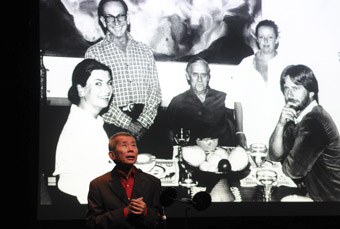
William Yang, My Generation
photo Heidrun Löhr
William Yang, My Generation
SOLO SHOWS BY WILLIAM YANG, ROSIE DENNIS, ALEXANDRA HARRISON AND MARTIN DEL AMO IN PERFORMANCE SPACE’S FIRST 2010 SEASON AND, SOON AFTER JOHN WATERS AND MIAOW MIAOW (SEE RT97) AT THE SYDNEY OPERA HOUSE, STIMULATED MY CASUAL THINKING ABOUT PRESENCE AND CHARISMA AND HOW TO DEFINE THE ENDURING APPEAL AND CRAFT OF PARTICULAR PERFORMERS—ESPECIALLY THOSE WHO ARE NOT ACTORS AND WHO ADDRESS US DIRECTLY, APPEARING TO BE PERFORMING THEIR OWN LIVES.
william yang
I’ve been watching William Yang’s performative slide shows since 1987. Now and then, one of them, like his latest, My Generation, leaps out as very special. This is partly because of its epic sweep, from the 70s—when Yang finds a place in the theatre firmament with Rex Cramphorn, Robyn Nevin, Jim Sharman, Kate Fitzpatrick)—through the 80s and 90s extending the photographer’s world to include the visual arts (Brett Whitely, Martin Sharpe), fashion (Jenny Kee, Linda Jackson, Flamingo Park) and the richly creative gay culture that overlapped and entwined with these through the likes of Peter Tully. And then there’s Patrick White, a daunting presence in My Generation but at his most apparently vulnerable in Yang’s exquisite portraits. And Tiny Tim. Over such a long period we witness artists and friends grow old or die, careers falter and friendships fail. Although Yang’s tone is light and, as ever, slightly detached if measuredly frank, the sense of mortality in tandem with hard-won survival is pervasive.
Yang’s performance persona across two decades has been remarkably stable. His confidence as a performer has certainly grown, but the basic ingredients, a coolish if affable, slow delivery, short carefully constructed sentences and physical fixity before a microphone all persist. The persona suggests someone who is possibly shy and requires a stable performative format—the rhythm of the slides might change but the spoken delivery varies little. Yang mentions in this performance that someone once described his photography as “not quite candid, a little bit formal.” It applies equally to his performance. Yes, the photographic work is candid, lined flesh and sweat are brightly lit everywhere, and there are the occasional surprises (a litter of post-party, naked bodies), but there are limits—Yang tells us about the photographs that got him into trouble (he is no paparazzi, the people he shoots are often his friends and this kind of work can put friendship at risk) if remaining unclear about how often he seeks permission to exhibit his images. His stage performance is likewise candid, but carefully constructed: like a novelist foreshadowing an incident, Yang will show a photograph, mention that he saw something in its subject that concerned him or was predictive, and quickly leave it. It’s a jolt, but inevitably he will come back to that person. Sometimes Yang’s comments seem unfair because you simply do not have enough information from him to understand what happened, and why, to a friend’s child who barely figures in the narrative—the thread in the weave is sometimes too thin. My Generation is also awash with personalities less well known, if at all, to newer generations, but remains valuable history if requiring clarification here and there.
My Generation is culturally rich with a strong sense of not just people but homes and events (for example, he says, when Mardi Gras used to be a cultural festival), meals shared, collaborations, openings and parties. A sense of privilege and furtiveness co-exist in the pleasure felt at seeing inside the homes of Patrick White and Margaret Fink and empathising with those who lose theirs. When Yang finds a home for himself and decides to live alone, he says it’s the closest to freedom he’s come. If candid about himself in previous works, perhaps Yang goes further in My Generation. As he and we watch other people’s children die or mature on the screen, Yang declares, “The pictures are like my children; they will tell my story when I am gone.” The William Yang performance persona hasn’t changed in any essential way over 20 years, but with each work we learn more about the man and his world. It’s rumoured that his body of work is destined for DVD, a welcome documentation of a life-in-progress, its milieu and the cultural life of Sydney, if likely viewed with the unease that perversely makes Yang’s work popular—that play between formal and candid, which one audience member described to me as passive-aggressive. Of course that might fit any number of people who use the camera as a tool for social engagement. [Sandy Edwards’ appreciation of My Generation is well worth reading at www.arthere.com.au/whatson/?p=92. Eds]
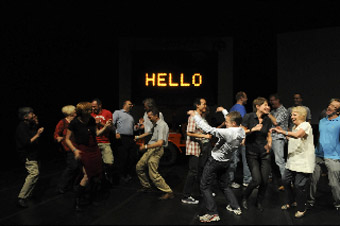
Rosie Dennis, DOWNTOWN
photo Heidrun Löhr
Rosie Dennis, DOWNTOWN
rosie dennis
My earliest memory of Rosie Dennis was of a barely audible voice emerging close by from the shadows in the old Performance Space as Eleanor Brickhill danced among us. These oddly complementary performances were, well, strangely primal, hard to nail down, even in those heady days of wilful opacity and theory-driven performance. Dennis’ amplified voice was distinctive—quiet but urgent, interrupted but oddly coherent, the words almost refusing to be given up. This seemed something more than performance poetry. When I later saw Dennis perform on her own, the surprise was even greater: the work was short, intense, un-miked, close-up, almost scary and sometimes funny as words and movement patterns locked into spasmodic loops, as if the performer was trapped in a moment of emotional recall from which there was no escape. The seemingly obsessive-compulsive drive yielded a memorable poetry and rough-hewn dancerliness that evoked a persona struggling to tell us something important if only the words would flow and voice and body come together.
These days, Dennis’ performances are more formal occasions—framed as a lecture or report, deploying props to illustrate the events in her anecdotalising or ideas in her scientific or metaphysical speculations. These loop back wryly into her stories with a Paul Auster-ish sense of the synchronistic interconnectedness of the cosmos. Perhaps she’ll dance, but wordlessly and privately. Perhaps she’ll sing, but with Sydney’s Gay and Lesbian Choir at the end of her latest performance, Downtown. The difference between early and current Dennis appears great—once I was alarmed by a ‘condition’ that shook up the notion of art, now I’m charmed by a presence that takes its all too willing audience (there’s a legion of fans) firmly in hand as confidante.
For Downtown, Dennis set herself the task of “walking and talking with strangers [in] inner suburbs of Sydney” and during a week-long residency at Performance Space reported daily on the construction of her performance which was then delivered complete on a Friday evening as “part process/part product.” Although the 44 people she approached (only three rejections) play a curiously small role in the performance, a funny email exchange with Yoko Ono looms large suggesting a personal ‘chemistry’ which is literalised in an onstage chemical experiment demonstrating “what we can do when we work together.” Downtown is a whimsical, even sentimental, work-in-progress from an artist who surprises us nowadays with subtleties and metaphysical turns but still fixes us as one with a searching eye and vocal rhythms that, although now comforting, still incline to the pulse of poetry, especially when Dennis is not striving to be poetic. While some performance personae stay pretty well fixed, others, like Dennis’, fascinatingly mutate and grow older, and stranger, with us.
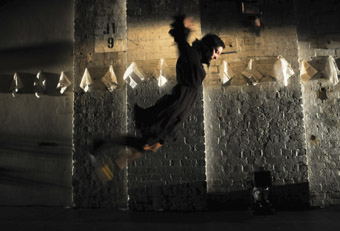
Alexandra Harrison, Dark, Not Too Dark
photo Heidrun Löhr
Alexandra Harrison, Dark, Not Too Dark
alexandra harrison
In whatever work she appears, dancer and physical theatre performer Alexandra Harrison exudes a powerful presence. Here I’m seeing her for the first time as a solo performer, in a long dance work of her own making, Dark, Not Too Dark. In a RealTime-Performance Space Forum she described the work as “abstract”, the motivation for it explained in part in her program note where she writes, “My great grandfather wrote to Concetta, his Aeolian island bride, asking her to send him a photo. And when she did he took the picture of her by an empty chair…to a photographer and created another image, placing himself in the chair…her hand on his shoulder.” Another note defines remanence as “the residual magnetism left behind when the magnetising body no longer remains.” In Dark, Not Too Dark, Harrison appears to have absorbed the magnetism of her grandmother, resulting in a gothic channelling, unleashing pent-up gestures and dance movements.
As a voiceover intones the word “forever” over a growing hum and percussive glitching in Bob Scott’s musical score, Harrison, close to her audience, holds out her arms, palms down, sustaining the pose at great length until she begins to vibrate, the music deepening. She is entering another state of being. At last she lowers her arms, looks up and, in a series of moves, leans back, places a hand on her brow, and angles her whole body. The shape of it evokes a heroine locked in anguish in a 19th century melodrama or silent movie. The image of this transformation will recur across the work’s duration. In one of its most engaging passages, Harrison approaches an old gramophone horn which emits a strumming to which she responds with a burst of 20s-style dancing, raising her knees high, as if pulled in and out of the music and into the past as it grows louder. At times she looks like a novitiate, at times a mature woman or a creature caught in a tracking follow spot or endangered by a chandelier—she takes it away, smashes it, a new one, or the same one, descends. The word “forever” returns. As does Concetta, appearing eerily on the photographic studio backdrop.
Dark, Not Too Dark largely defies literal interpretation. The low light, repeated movements and strange images induce a kind of gothic delirium—a la Edward Gorey if without the laughs—but Harrison is, as always, fascinating to watch, driven, possessed, as if working through a very private madness, such is the work’s intensity, but to what end? A dark, but not too dark resurrection of the spirit of a forbear, an experiment that is both frightening and liberating? I’d like to experience the work again, a more economical version and with the sound score restrained (it’s emotionally over-inflated despite its many virtues). In Dark, Not Too Dark at its best, Alexandra Harrison envelops us in her vision creating an ambiguous persona, part grandmother, part herself.
My Generation, words, visuals William Yang, musician Daniel Holdworth, producer Performing Lines, Performance Space, Feb 23-March 6; Downtown, writer-performer Rosie Dennis, assistant Jacob Patterson, Sydney Gay & Lesbian Choir, Performance Space, March 5; Dark, Not Too Dark, creator-performer Alexandra Harrison, sound Bob Scott, design consultant Kate Davis, lighting Richard Manner, dramaturg Benedict Anderson; Performance Space, CarriageWorks, Feb 17-20
See Keith Gallasch’s critical appreciation of Tom Holloway’s new play Love Me Tender at Belvoir St.
RealTime issue #96 April-May 2010 pg. 36
© Keith Gallasch; for permission to reproduce apply to realtime@realtimearts.net
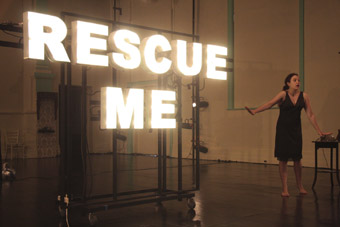
Nicola Gunn, At the Sans Hotel
photo Daisy Noyes
Nicola Gunn, At the Sans Hotel
ONE OF THE PHRASES THAT ALL TOO OFTEN OCCASIONS ME TO SLUMP-SHOULDERED DISAPPOINTMENT IS ANYTHING CALLING FOR A “NEED FOR MORE DIALOGUE.” NOT THAT DIALOGUE PER SE IS A BAD THING—I’D BE A PRETTY BLINKERED THEATREGOER IF THAT WAS MY STANCE. BUT WHEN IT COMES TO DISCUSSIONS WITHIN THE ARTS COMMUNITY, THE “NEED FOR MORE DIALOGUE” IS UP THERE WITH THE “NEED FOR MORE EDUCATION” AND “AGREEING TO DISAGREE.” IT’S A STATEMENT THAT, IN APPEARING TO COMMENCE A CONVERSATION, MORE FREQUENTLY ENDS ONE. WE NEED TO TALK MORE; LET’S END OUR TALK AT THAT.
What happens when a work of performance presents its own internal dialogue? Does it end in the same silence, shutting out its audience by subsuming their role as interlocuter into the work itself? A range of recent productions in Melbourne raised this very question, offering scenarios which weren’t simply open to interpretation but invited conflicting, even incommensurable readings.
at the sans hotel
The self-interrogation of Nicola Gunn’s At the Sans Hotel began the moment it registered in a potential audience member’s consciousness, though this wasn’t made explicit until the performance itself began. Advance publicity was strewn with enigmatic images of a half-visible Gunn disguised as a noir femme fatale or a monkey bellhop; textual fragments mentioned a woman trapped in a bathtub or lost in a desert.
What we got was something quite other. A woman with a slightly hokey French accent greets her audience and hands out an invisible questionnaire, inviting us to complete a survey on our experience of the (non-)show so far. Okay, we’re playing pretend. Then we’re given real pencils to use in the process. Is this some kind of joke?
The French woman eventually apologises that Nicola Gunn’s At the Sans Hotel won’t be on offer tonight. She instead takes us on an hilarious, sometimes desperate series of digressions in which she discusses the show that should have taken place and the narrative problems it presented. A chalkboard breakdown of structure, themes, metaphors and sources recreates the absent play, and frequent audience involvement is less threatening than engaging. Gunn—and I was never even sure if this was Gunn we were watching—is a brilliantly likeable performer who effortlessly wins over her onlookers within minutes.
It’s this charm that makes At the Sans Hotel such a success. Like UK company Hoipolloi’s exquisite Floating of last year, and with hints of Forced Entertainment’s more accessible work, this is a gift to its audience rather than a challenge. It’s not a navel-gazing exercise into meta-theatre but a bracing, bewitching investigation into presence and absence. Its real subject, which we approach in a curious crabwalk, is the identity unable to step outside of or contain itself. The open nature of the piece is a structural component of this: referring to Gunn’s earlier works, directly engaging the audience, and the whole artifice of that advance media blitz are figurations of the subject that cannot remain for itself a stable and coherent self. That Gunn was inspired by the case of Cornelia Rau, the schizophrenic German citizen and Australian permanent resident, whose identity breakdown made headlines in 2004, helps explain the motivation behind the work’s unique structure, but there is so much more for each viewer to discover for themselves.
the fate of franklin
Just as generous, though with a rougher polish, was Four Larks Theatre’s The Fate of Franklin and his Gallant Crew. Inspired by an ill-fated attempt to discover the fabled Northwest Passage in the 1840s, its junkyard aesthetic was a visual delight of antiquated seafaring miscellany and lush costuming (not to mention a huge band sawing away on old-timey instruments). But all of this quickly began to feel like empty nostalgia, not for its ostensible historical base but for the exciting narratives of exploration and disaster that filled many a pulp novel and popular rag of the era. Was this just an excuse to play dress-ups and spout period-sounding jargon?
As it turns out, no. My vague disquiet was eventually turned on its head as various characters began to wrest control of the narrative from each other, presenting conflicting versions of the voyage’s outcome. Each proved to have a vested interest in our interpretation of events, and this tussle put to its audience an implicit question: whom do you trust? And, more importantly, why? Is the more thrilling story (brave explorers descending into cannibal savagery) simply more interesting than the possibility that a bunch of men starved or froze to death in an anonymous landscape?
lady grey
US playwright Will Eno is known for his more brutal affronts to his audience. His Thom Pain (based on nothing) is a tour-de-force solo that works up a mystery of childhood trauma by enacting an angry performance of verbal assault on spectators. His lesser-known Lady Grey is a similarly obtuse affair that turns that violence inwards. The eponymous figure is in fact several identities occupying the same mental and physical space—dressed in an historical ballgown, Lady Grey is resolutely contemporary. She tells stories of a girl who may be her younger self, or addresses the audience directly but in a prepared fashion. Seeming spontaneity is revealed as simply another theatrical convention—we’re seeing a character playing a real performer playing a character. It’s a hugely difficult piece, as much concerned with its own inadequacies as At the Sans Hotel or The Fate of Franklin. But like those works, this anxious internal equivocating doesn’t come at the expense of understanding, but in its service.
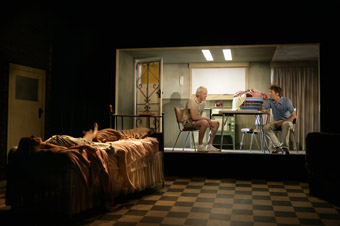
Furious Mattress, Malthouse Theatre
photo Jeff Busby
Furious Mattress, Malthouse Theatre
furious mattress
And then there’s what may turn out to be the most baffling, bizarre production of 2010. Malthouse Theatre’s Furious Mattress left audiences reeling, uncertain whether they’d witnessed a work of genius or a complete creative car wreck. Its credentials were unimpeachable—scripted by Melissa Reeves, directed by Tim Maddock, and featuring a varied but uniformly accomplished cast. The work was spun from a notorious Victorian case in which a schizophrenic middle-aged woman was killed during a lengthy, tortuous ‘exorcism’ in a rural district. Faith, fear, ignorance and the sundry madnesses of the individual and the crowd suggested themselves as possible concerns here, but as the piece unfolded it flung possibilities far more horrifying in its audience’s faces.
The first half was, for the most part, a grinding portrait of fundamentalists unable to confront the murder they had just committed. Banal rituals of domesticity and small talk were interrupted by unsettling evocations of belief in the supernatural. The point seemed blindingly obvious: religious devotion taken to its extremes had led to a fatal outcome, and these inhabitants of a lunatic fringe were both monsters and victims of their own delusions.
Once the plot shifted to the days leading up to the killing, however, the production shifted gears like a trucker topping a mountain rise. The delusions suddenly became reality, as muted performances gave way to hysteria and histrionics and a general atmosphere of realism was upended by carnivalesque comedy. A giant pantomime rat, an exorcist straight out of Kath & Kim and the ultimate arrival of the animated mattress—more wacky than furious—provoked laughter where we might have expected chills. Serious, even earnest dialogue was met with comically delivered ripostes; at times, it felt as if four or five productions had been mashed together without explanation.
The lack of internal logic displayed by Furious Mattress provided one of those rare moments in which the old intentional fallacy was less a philosophical argument than an unquestionable fact. There was no seeking recourse in program notes to define what this production was ‘supposed’ to be, since they only confused matters more. What we were left with was less a dialogue between the work’s contrasting elements than an irresolvable battle between those same aspects. This wasn’t the dialectic process of self-reflexive theatre, in which the apparent clash of elements results in richer, hybrid new formations—it was a fight where none could escape unscathed, least of all the audience. Dangerous stuff. I’d see it again.
At the Sans Hotel, created and performed by Nicola Gunn, design Nicola Gunn, Gwendolyna Holmberg-Gilchrist, Rebecca Etchell, sound Luke Paulding; Theatre Works, St Kilda, Mar 16-27; Four Larks Theatre, The Fate of Franklin and his Gallant Crew, text Marcel Dorney and Four Larks Theatre, direction Jesse Rasmussen, Mat Sweeney, Sebastian Peters-Lazaro, performers Justine Campbell, Shane Mills, Caitlin Valentine, Marcel Dorney, Zak Ateka, Bonnie Taylor, Max Baumgarden, Hugo Farrant, Paul Goddard, Reuben Liversidge, Fingal Oakenleaf, Ivan Smith, Genevieve Fry, Esala Liyonage, Greg Craske, Kristian Rasmussen, Sebastian Peters-Lazaro, Jesse Rasmussen, Mat Sweeney, design Ellen Strasser, Sebastian Peters-Lazaro, lighting Geordie Barker, Secret location, Northcote, Mar 12-27; Melbourne Theatre Company, Lady Grey, writer Will Eno, director Julian Meyrick, performer Tanya Burne, lighting Casey Norton, Lawler Studio, MTC, Feb 19-30; Malthouse Theatre, Furious Mattress, writer Melissa Reeves, director Tim Maddock, performers Rita Kalnejais, Kate Kendall, Robert Menzies, Thomas Wright, design Anna Cordingley, lighting Paul Jackson, sound & music Jethro Woodward, Beckett Theatre, Malthouse, Feb 19-Mar 13
RealTime issue #96 April-May 2010 pg. 38
© John Bailey; for permission to reproduce apply to realtime@realtimearts.net
Spectra ensemble
courtesy ISCM
Spectra ensemble
THE BIGGEST NEW MUSIC EVENT EVER IN AUSTRALIA WILL SPREAD ITS EUTERPEAN TENTACLES AROUND SYDNEY FROM APRIL 30 TO MAY 9. THE 23 CONCERTS FEATURING AT LEAST 82 NEW (OR NEWISH) WORKS PLAYING IN VENUES FROM THE VERBRUGGHEN HALL AND ACROSS WESTERN SYDNEY TO ST FINBAR’S CHURCH, GLENBROOK IN THE LOWER BLUE MOUNTAINS, MAKE UP THIS YEAR’S AURORA FESTIVAL COMBINED WITH THE FIRST EVER VISITATION TO THE SOUTHERN HEMISPHERE BY THE INTERNATIONAL SOCIETY OF CONTEMPORARY MUSIC (ISCM).
This important organisation has been promoting new music, mainly European, since 1922; in 1938, for instance, they put on a concert in London of world premieres consisting of Bartok’s Concerto for Two Pianos, Percussion and Celesta, Britten’s Variations on a Theme of Frank Bridge and Peggy Glanville-Hicks’ Choral Suite! It’s only ever managed to get to America once and that was during the Second World War, though Asia has entered its purview—playing Hong Kong and Yokohama in recent years.
Indeed, the 2010 event was to be in Poland until they recalled that the year might be taken up rather heavily in celebrations of Chopin anniversaries. That left just 18 months for Australia—specifically composer and all-round musical activist, Matthew Hindson—to pull the fat out of the fire. “Matthew’s ears lit up when I first broached the possibility,” recalled John Davis, CEO of the Australian Music Centre and a board member of ISCM since 2002. “‘What an opportunity,’ he enthused, ‘to hold the world’s most prestigious international contemporary music festival’.” Appropriately Davis is now President of the ISCM, chairing meetings that take place during the New Music Days.
Davis had been wanting to host the event in Australia since the late 90s—“and people had been eager to come—even though they recognise that the cultural infrastructure in the Southern Hemisphere just can’t compete with a Donaueschingen or a Gaudeamus Festival. But I could never think of a way of affording it—we have to pay performers, obviously, and host all the delegates and visiting composers; that could be a hundred people. Would they camp on Cockatoo Island? I don’t think so. Fortunately, Hong Kong broke the mould a bit in 2007, cutting back on the size of the whole thing; and then Australia Council International recognised that this wasn’t just a lot of new music but a great way of promoting Australian culture to the world. Plenty of international festival directors (and the President of Croatia, who’s an ISCM delegate) will be here; our performers will be well showcased.”
Performers are headed by Sydney’s Ensemble Offspring—who tackle an amazing three concerts in four days with almost all new scores. “Oh my god, what are we doing?,” says EO’s Damien Ricketson recalling his realisation that the ensemble were about to do a year’s worth of repertoire in one fell swoop. Ricketson, and the directors of other groups such as ABC Classic FM for radiophonic works, the Song Company, Topology, Chronology Arts, the New Zealand Trio and the Goldner Quartet—there’s no Sydney Symphony Orchestra thanks to the short planning period, but the SSO Fellows offer a string band—shared in the selection of their programs with Matthew Hindson from 700 entries world-wide.
“There was a lot of fairly ordinary stuff,” recalls Ricketson, “and somehow it had got through 52 national sections to arrive here. But I’m not embarrassed by anything we’re playing—and I lost a good Thai piece to the New Zealand Trio. Certainly the Australian composers—Matthew tried to get at least one into every concert—will stand up well to the glare of international competition.”
New Zealand Trio
courtesy ISCM
New Zealand Trio
The New Zealanders were a piece of proactivity—lots of composers (including the veteran US-based Annea Lockwood of ‘Piano Burning’ fame) as well as the Trio. John Davis explained that New Zealand had dropped out of the ISCM in recent years and, politically, he was therefore keen to welcome them back with a vengeance; also the Trio was a group with 80 new music commissions under its belt, fully deserving its presence. He’s also inveigled the elite Spectra Ensemble from Belgium to bring music by Bart Van Hecke, Jean-Luc Fafchamps and Bruno Mantovani, a product of a European system which shares the best repertoire around a network of top ensembles. “It was a coup to get them here,” said Davis, “and their sponsorship by the Flanders government and Campbelltown Arts Centre is just fantastic.”
Campbelltown may not be prominently displayed on your mental map of new music in Sydney. But that’s not for want of the centre’s recent efforts. For a start, the ubiquitous Hindson is its music coordinator. Now they say, give the job to a busy man. So it was inevitable to turn to the man who heads the Sydney Conservatorium’s Arts Music Unit, is Chair of the Australia Council’s Music Board (appointed after the ISCM funding had already been granted, he wants to point out), as well as founding the biennial Aurora Festival. Sometimes, he writes music too—which gets commissioned and performed by the likes of the London Philharmonic Orchestra, the Birmingham Royal Ballet and Canadian virtuoso violinist, Lara St John. His composition for ballet, e=mc2, won a South Bank Award for best dance music in the UK in 2009; the first movement, Energy, will be performed by the SSO conducted by Vladimir Ashkenazy on September 2 this year.
Sadly, of course, Hindson has no music in the ISCM New Music Days. But at least 30 other Australian composers do—some familiar, like Ross Edwards, Carl Vine, Peter Sculthorpe, Lisa Lim and Elena Kats-Chernin; others pretty unknown—Katia Beaugeais, Peter McNamara and Daniel Blinkhorn have so far escaped my notice.
There are probably fewer big names from overseas. Elliott Carter and Philip Glass from the US, Rautavaara and Part from the Baltic, Golijov from Argentina are just about it. So we’re going to have to rely on some new names to provide those Britten and Bartok moments. Actually, this is less likely than in previous New Music Days. For the ISCM is in transition. There was a time when a European event would select just the best 12 works submitted from all over the world. But in 2008 they decided that the future lay in the event being more of a showcase for members. This becomes mandatory in 2011, but Matthew Hindson decided to do his best to find music from all member countries as a test of the new system. He managed 38.
“And it wasn’t that hard”, he insisted, “there’s a plethora of young and hungry composers out there, you know.” It’s just possible that knowing who would be struggling through their 700 entries to make the selection could have encouraged composers to “match their choice of music to the buyer,” as John Davis tactfully put it. In other words, Hindson clones may have enjoyed a marginal advantage! Hindson himself is positive: “It was really a pleasant surprise to find that you couldn’t identify the music by the nationality of the composer…South Africans—rhythmic and bright; Greeks—aggressive and noisy! The borders are definitely breaking down. And because this is primarily a chamber music event, I expect the flavour to be intimacy. Maybe it’ll show that the orchestra isn’t the music performance form of the future? Hopefully it will encourage the smaller ISCM sections to take up the baton in that future.”
2010 ISCM New Music Days & Aurora Festival, presenting partners: Sydney Conservatorium of Music, Aurora New Music, ABC Classic FM, Australian Music Centre, New Music Network, Campbelltown Arts Centre, Joan Sutherland Performing Arts Centre and Blacktown Arts Centre, Sydney, April 30-May 9; http://www.worldnewmusicdays.com.au. Eight concerts will be broadcast live on ABC Classic FM and a new ABC digital ‘classical’ music channel will run throughout the event.
RealTime issue #96 April-May 2010 pg. 39
© Jeremy Eccles; for permission to reproduce apply to realtime@realtimearts.net
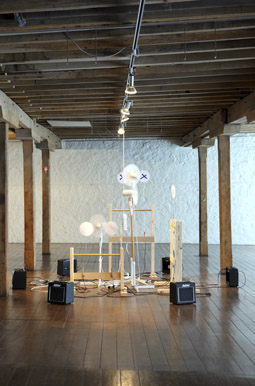
from 3 Songs, 2010, Ross Manning
photo Sean Fennessy; © MONA FOMA 2010
from 3 Songs, 2010, Ross Manning
RATHER THAN INVENTING A THEME FOR THE 2010 MONA FESTIVAL OF ART AND MUSIC, CURATOR BRIAN RITCHIE SEEMS TO HAVE ACCESSED PERFORMERS AND MATERIAL HE THOUGHT MIGHT BE INTERESTING OR FUN, FOR AUDIENCES TO EXPERIENCE PRETTY MUCH AS THEY WISHED. YOU COULD HAVE ATTENDED NOTHING BUT THE MANY EVENTS IN THE PRINCESS WHARF NO.1 SHED, OR AVOIDED THAT SPACE ENTIRELY, AND STILL FELT TOTALLY IMMERSED IN THE FESTIVAL. AND EVEN WHEN MONA FOMA WAS ARCHLY CEREBRAL, IT WAS PLAYFUL.
John Cale’s presence in Australia is not unprecedented, though Hobart is not really somewhere you’d expect to see him, so his near ubiquitous presence on posters, programs and in performances was astonishing enough before we even got to the content. Labeled “Eminent Artist in Residence” for the festival, he came with a five-screen video installation, Dyddiau Du (Cale’s native Welsh for Dark Days), a very talented young band and varying styles of musical performance. Coming directly to Hobart from the Venice Biennale, Dyddiau Du describes a haunted Wales, mixing long meditative shots of empty rooms, ancient and abandoned stone dwellings, intense close-ups of Cale trudging uphill, breathing hard and finally, some kind of water torture. The images bled out over an hour in a darkened room with a concrete floor. It was cold and uncomfortable, which seemed the intention.
A spirit of endurance was also needed for the grueling intensity created by Michael Keiran-Harvey in his astonishing piano work, 48 Fugues for Frank, at the Tasmanian Museum and Art Gallery. Influenced by one of music’s great individualists, Frank Zappa, Keiran-Harvey attacked the piano with the vigour of an athlete. Like the music or not, the commitment to the work and virtuosity on display were undeniable, and at times breathtaking. A group of Hobart artists and curator Leigh Hobba, reacted to Keiran-Harvey’s composition, Zappa and the space itself, creating an exciting and witty four-floor installation. Rob O’Connor’s large, colorful F-for-Frank series lay in the dust of the basement’s earth floor, Aedan Howlett’s swirling street style paintings hung from pillars, Mat Ward (a certified Zappa fanatic) sifted through lyrics and filled the top floor with luridly bright sharks, pygmy ponies and poodles while Michelle Lee stretched a shadow along the floor and up the wall into an image of a pianist’s hands. Harvey raced between floors playing instruments, his performance then relayed to his seated audience by camera.
Site and spatial relations between audience and performance were a feature of the festival more generally, with spaces used in unusual ways throughout. In Abe Sada: Sade Abe 1936, Perth artist Cat Hope generated continent shifting feedback bass noise in a storeroom directly under the Peacock Theatre audience, so one had the odd but not unpleasant sensation of vibration coming through the floor and into the seat. That these sounds were felt rather heard was not new, but the context refreshed the idea. Not content with that exploration, Hope did it again, getting an orchestra of bass instruments, played by a collection of local musicians, to create a vast field of sound in the Princess Wharf through which the audience could wander or lie back in and be bathed in sound.
The Chronox installation by Michael Prior and Lachlan Conn was located in the Sidespace of the Salamanca Arts Centre for the festival’s duration. Cheekily described as a machine for “travelling to the present,” the work obliterates space and time with repetition created from sound and animated projection. An engaging and beautiful work, Chronox invites the audience to interact by altering the looping vinyl records that provide the sound—pick up the tone arm, carefully put it down again. As I succumbed to the hypnotising loops and glowing shapes, the edges of the room appeared to wander off into the dark.
Next door, in the Long Gallery, Brisbane-based artist Ross Manning’s humorous moving sculptures—all fan engines playing drums and driving amplifiers—came alive with a brief, clever performance. Attached to a spinning fan motor, a thin rope whirled along the wooden floor, responding to objects placed in its path—plastic, paper, garbage and metal. It seemed frantic and uncontrolled, but a second viewing revealed a sense of composition and even narrative—from scurrying to fluttering to a bell-like shimmer. This small work remains in the memory.
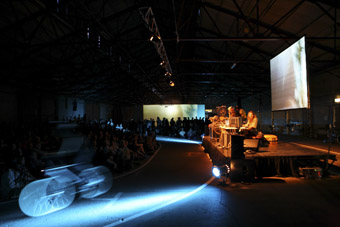
Pursuit, Jon Rose, Robin Fox, Rod Cooper and collaborators
photo Sean Fennessy; © MONA FOMA 2010
Pursuit, Jon Rose, Robin Fox, Rod Cooper and collaborators
Kinetic sound production on a more ambitious scale was the focus of Pursuit, a performance that transformed the Princess Wharf Shed into a singing bicycle track. Jon Rose, Robin Fox, Rod Cooper and Paul Bryant, all seasoned creators of new noise, directed a squadron of bike enthusiasts on a looping chase around the shed while the audience watched from the middle. The bikes had been altered to make sounds and some looked a little crazy, but as they scraped and squeaked and honked about the space, music emerged: this bike and its horn came and went at controlled intervals; new bikes emerged making new sound; one chap rode about with a camera atop his helmet, giving the audience a perspective from within the work. While each sculpted bicycle had its own sound and character, the effect of the whole thing grew, swelling into an ecstatic moment when all the bikes rang their bells, echoing all the other loops and shimmering sounds to be found elsewhere in the festival’s program.
MONA FOMA 2010 was a huge mixed bag of art and ideas. It was totally different from 2009, and there’s no doubt that 2011, when the actual Museum of Old and New Art reveals its contents, will be just as surprising. If there’s anything this festival is about, keeping people guessing would seem to be it.
MONA FOMA, Festival of Music and Art, curator Brian Ritchie, Hobart, Jan 8-24 http://www.mofo.net.au
RealTime issue #96 April-May 2010 pg. 40
© Andrew Harper; for permission to reproduce apply to realtime@realtimearts.net
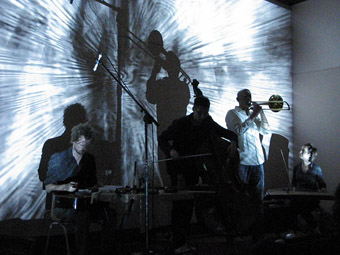
Zeit Kunst 6
photo Sam James
Zeit Kunst 6
OVER THE LAST NINE YEARS THE NOW NOW FESTIVAL HAS CONTINUED TO IMPRESS WITH THE DIVERSITY OF MUSICAL ACTIVITIES THAT IT BOLDLY PROGRAMS UNDER A UNIFYING PREOCCUPATION WITH SPONTANEITY. NOW BASED IN WENTWORTH FALLS IN THE BLUE MOUNTAINS, ATTENDING THE FESTIVAL REQUIRES A LITTLE MORE DEDICATION, THUS I ONLY MADE IT TO THE FINAL AFTERNOON OF ACTIVITIES. THAT SAID THE FIVE PERFORMANCES I EXPERIENCED EACH EXPLORED VASTLY DIFFERENT STYLES, ACTING AS THE PERFECT TASTER FOR THE RANGE OF APPROACHES TO MUSIC MAKING FOR WHICH THE FESTIVAL HAS BECOME RENOWNED.
Opening the afternoon was Neill Duncan (sax), Alex Masso (percussion, drums), Sam Pettigrew (double bass), Sam Dobson (double bass) and Alister Spence (piano), producing the now well-recognised improv style in which individuals explore extended instrumental techniques and slowly work themselves into a cohesive composition. The background of this group, however, offers a few more free jazz and blues stylings than is often found in this scene. Starting with quiet scratchings, melodic fragments emerge and submerge. Spence has prepared his piano so it alternately sounds like bells and banjos. While Pettigrew provides the occasional swampy walking bass line to ground them, he also explores extra-musical sounds, inserting a zither behind the strings for extra jingle. Similarly Dobson, applies his keys (almost an improv cliché, but nonetheless interesting) to his strings for a bit of jangle. The others seem in their own reveries, but Masso watches them all hungrily, providing shake-up bass drum thwamps, cymbal clash and other angular provocations. Neill Duncan is always a pleasure to watch as he explores the subtler sounds of his traditional washboard vest, as well as providing some of the smokier blues figures on saxophone.
Around 20 minutes in, during a denouement, a little girl’s voice is heard in the audience: “Is it finished?” Her intuition is spot on: it is time, and there is an ending presenting itself, but the group doesn’t take it. Initially annoyed by this tendency of improv musicians, over the years I’ve come to enjoy the results of the missed moment—the hard soul searching involved in justifying continuance and maintaining the energy. This ensemble does well crafting a satisfying epilogue and finding the ‘real’ ending perfectly together.
Zeit Kunst 6 was set up in the smaller side room which is more projection friendly in the afternoon light. The line-up for the ensemble changed slightly during its Goethe Institut sponsored tour around Australia, but for this performance featured Michel Doneda (sax), Kim Myhr (guitar, objects) Matthias Muche (trombone), Clayton Thomas (double bass), Sven Hahne (computer), Clare Cooper (guzheng). It begins with an extended silence, until Thomas sets his bass rattling with his signature SA number plate inserted in the strings, then Cooper bows her guzheng and the wind players’ breath burbles through their instruments. A sudden stab of sound activates the audio responsive video and an array of lines and angles flash across the back wall and the performers. Maintaining a sense of the collectively unknown outcome, each of the performers is incredibly controlled, almost monk-like. At one point, around three-quarters of the way through, they all stop—the light from the video ceases—and they hold…. hold…. hold… hold…only to wind up again for the final intense movement.
In this ensemble it seems that the strings create the under-layer of drone and scumble while the wind players shape the piece into breath-driven phrases. While it might be thought that a lot of improv downplays melody and harmonics in favour of texture and timbre, here you get the sense each musician is deliberately making uneasy harmonic choices though clearly in relationship to each other. Michel Doneda seems the most playful, swooping his sax through the air to create both energetic sonic and physical gestures. Cooper seems the most interested in the cause-and-effect of the sounds on the stark yet dynamic video—actively playing with the it. The samples offered by Hahne on computer, with their squared off digital edges, sit uneasily in the mix, but somehow this makes the combination all the more interesting. The piece concludes with another sustained silence, painful and beautiful in its intensity.
nHOMEaS comprising Josh Isaac (drums), David Sullivan (bass, fx loop), Jack Dibben (guitar), George Nagal (synthesiser) and Aemon Webb (vox, electro gadgets) offers the noise/rock end of the spectrum but is no less considered. This is a dense exploration driven by the emphatic energy of rock drums. Each player is seeking his own epiphany, with elements occasionally joining forces, like Sullivan and Issac creating cohesive rhythm sections, or Nagal on warped synth and Webb on electronic whinnies and vocal wails flinging us into reverby outerspace. Collectively they forge mountains of sound, then let them decay and the result is dark and cathartic.
Billed as Joey and the Calypsoes (mystery band), a nice little interlude was provided by Splinter Orchestra members who teamed up with audience members and called their mobile phones. By moving the speakers of the answered phones close to each other the feedback zings and chirps created a peaceful, contemplative chorus of digital insects. A lovely lo-fi interactive moment and a nice irony given mobile phones are often the bane of music concerts.
The performance that wrapped up the festival was Team Music!—interactive netball, facilitated by Jon Rose, with the local under 16s netball teams. In a tiny makeshift court the width of the hall, the two eager teams fight it out using Rose’s modified soccer ball (he couldn’t get the workings into a netball) which activates a vast range of sound phrases. Rose’s ongoing explorations into interactive music, including riding bicycles and flying kites, continue to impress in their democratising of electronic music making. However, the bleepy alogorithmic computer burbles triggered by the ball are less engaging than the lightning fast adaptability of the live duos—of Clayton Thomas (double bass) and Mattias Muche (trombone) on the side of the white team, and Eivind Lonning (trumpet) and Mike Majkowski (double bass) on the side of the blue team—who are only allowed to play when their team is in possession of the ball. The teams played a full 45-minute game which certainly offered reasonable time to explore possibilities, accompanied by playful mayhem including signs that encouraged audience responses: Stomp, Boo, Cheer etc. It was a fittingly energetic and playful way to end the NOW now festival which continues to explore spontaneous music with a nourishing balance of deep seriousness and childlike joy.
The NOW Now festival, Wentworth Falls School of Arts, Blue Mountains, Jan 22-24; http://thenownow.net
RealTime issue #96 April-May 2010 pg. 39
© Gail Priest; for permission to reproduce apply to realtime@realtimearts.net
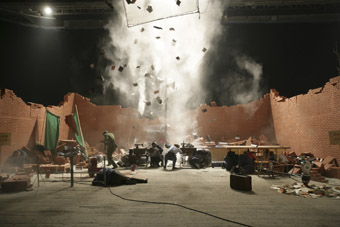
Hostage, video still 2008, Wang Jianwei, single channel video, Edge of Elsewhere
image courtesy the artist
Hostage, video still 2008, Wang Jianwei, single channel video, Edge of Elsewhere
“THE POLITICS I REFER TO HAS NOTHING TO DO WITH POWER, CONFLICTS OR EVEN CONSPIRACY. MY POLITICS IS ABOUT GREATER HUMAN INTER-RELATIONS. AND THIS POLITICS FRUSTRATES ALL ADEQUACIES. AS LACAN SAID, “ERROR IS THE HABITUAL INCARNATION OF TRUTH” AND THAT TRUTH “EMERGES IN ITS MOST CLEAR-CUT REPRESENTATION, THE MISTAKE.” Wang Jianwei
A giant, uncanny, industrial apparatus occupies the central gallery of Campbelltown Art Centre. This is part of Wang Jianwei’s multimedia work titled Hostage (2008) exhibited as part of Edge of Elsewhere (a three-year partnership between Sydney Festival, Campbelltown Arts Centre and Gallery 4A to engage communities in Western Sydney with artists from Asia and The Pactific, Eds). The machinery seems overloaded with engines, valves, piezometers and obtruding steel pipes and it’s almost inundated by plastic foam. One feels haunted and trapped by this object of mythic proportions as if it is blundering through the gallery. I sigh with relief at the sight of a series of bright, framed photographs on the wall to one side: a worker, a farmer and a soldier. These lead the way to a darkened room where a more ambiguous film is screening as part of the same work. Again, my breath halts.
Obeying some invisible discipline, deadened looking people work and rest within a cabined space bound by three brick walls. They live in the era before Chinese economic reform, deprived of their individuality by heavy state ideology. We can only recognise their social functions: worker, farmer and soldier. Repeatedly carrying out their daily routines, they wake at the same time, do collective morning exercise and then work on their respective official duties: technical workers weld; farmers spray pesticides; soldiers keep their posts. Everything proceeds with the utmost propriety—everyone strives to achieve the same objective.
This system runs effectively and with total poise—an early warning that a storm is about to break. The walls are bombed by outsiders and collapse, the perfect order within this space is buried under debris. The system fails and crumbles. The film ends ambiguously with the people squeezed into a white van like sardines and driven away, into the unknown. The film is a metaphor for a system that either totally transforms or collapses when it reaches its maximum entropy. Calmly and sensitively unfolding his narrative, Wang Jianwei cinematically constructs a materially concrete scenario but one which asks unanswerable questions.
Using installation, photography and video art, the artist creates an undivided whole that probes the dilemma of humans seized like hostages by systems of power such as knowledge, history or ideology. Like Kafka’s Josef K, arrested by some unrevealed authority for an unidentified crime, these giant and invisible systems of power impose an imaginary identity which, without any alternative on offer, is accepted.
Born in the 1950s, Wang Jianwei shares the experience of many of his contemporaries—relocated to the country and drafted as a soldier. At the end of the Cultural Revolution, stifled by seven years spent drawing maps for the army, Wang commenced his career as a painter in the mid-80s and was highly acclaimed for his realistic style. In the 80s and 90s, as China filled with the clamour and mania of reform and opening up to the world, installation art, video art and multimedia art were being introduced along with other western trends. Wang promptly sensed the more flexible, expressive capacities of these new art forms to manifest the rapid variations in social structures. He shifted gear to practice video art.
Wang’s early video works had some similarities with the kind of documentary filmmaking used in sociological surveys. However, unlike documentary workers who attempt to catch public attention and advocate to solve social issues by exposing the truth, Wang modestly calls himself an “image collector.” In this way, he carefully studies how complicated relationships overlap and interact within everyday space.
Wang’s 1996 work, Production, is representative of the character of his early works. Juxtaposing the spaces of cultural production and everyday living, the work attempts to cast off the linear process of art production, which usually starts in the studio and ends in the gallery space. It documents the daily life of teahouses in seven counties of Sichuan. The teahouses in the video have no dedicated lounges or interior decoration, just a scatter of stained bamboo table sets—a world away from the middle class frequented high-tea cafés in the metropolis.
There’s an interesting mix of people in the crowd: some are reading newspapers, some playing poker, some having business meetings and some even washing their hair. They habituate themselves to this public but somehow intimate space, continuing the habitus of Sichuan’s history, its thousands of years of teahouse culture. Tension is triggered by the intruding camera: the guests stop their habitual activities, gazing into the lens with curiosity or courtesy. This space for daily leisure has been transformed with the intervention of the artist.
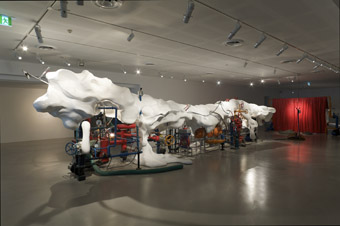
Hostage, 2008, Wang Jianwei, sculpture, Edge of Elsewhere
image courtesy the artist
Hostage, 2008, Wang Jianwei, sculpture, Edge of Elsewhere
In 2000, Wang Jianwei departed from his documentary format to create works that mixed video and live performance with surreal theatrical expression, exploring the unusual in the usual. Ping Feng in 2000 marked Wang Jianwei’s new era of integrating visual art and theatre. Successively performed in Beijing and Brussels, Ping Feng harmonises video, performance and theatre into a whole vision: a man hangs in the middle of the stage, surrounded by a group of ghostly strangers with puppets in hand. While they creep and conspire in the dark, the screen at the back flashes with changing images, among them human limbs, a drowning bird and Chinese painting. Ping Feng’s stories are drawn from the famous screen paintings, The Night Banquet of Han Xizai. The Southern Tang Dynasty (10th century) artist Gu Hongzhong was appointed by the emperor, who was worried his authority might be threatened, to spy on the reclusive scholar-official Han Xizai and paint what he had seen. To steer clear of suspicion and avoid political persecution, Han disguised his ambitions and capabilities with lustful nightly banquets. The mutual probing in this story interests Wang. He cleverly borrows the uniquely architectural element—the screen—as the theme of his work, and metaphorically indicates the psychological dodging and prying inherent in everyday life.
After Ping Feng, Wang Jianwei continued to test combinations of video, performance and theatre. His latest work, Time·Theatre·Exhibition (2009), is evidence of this consistent hybrid style, obscuring the fine line between art forms. The neat and spacious gallery is transformed into a temporary theatre. The curtain unfolds to reveal a mysterious, misty teahouse. People from different eras of history bridging thousands of years—Tang Dynasty officers, Qing Dynasty adherents, the general public of new born China and modern people—gather in this public space and indulge in a variety of pastimes: appreciating their birds, listening to music, urging their crickets to fight, gambling, flirting with prostitutes, taking drugs, singing karaoke etc.
As time and space are emerging into one in this video, struggling modern white-collars appear onstage. They run, stop, talk on the phone, yelling out the ridiculously increasing prices of the art auction or real estate market, losing themselves in the expanding desires of contemporary life. Wang Jianwei creates a live scene of overlapping time and space and proposes “we watch the exhibition in the same way we might watch drama; experience the drama just as we might view an exhibition—at the same time.”
As one of the most prominent conceptual artists in China, Wang Jianwei is difficult to label. He is neither Zhang Xiaogang who embraces the attention of auction houses nor Ai Weiwei who is made a dazzling object under the limelight of western media. Wang’s unique and profound thoughts distinguish him from his peers. Borrowing his methodologies from different disciplines to dig into the complexity of human interactions, Wang’s sheer professionalism in integrating art forms and creating, over a decade, his many investigative live works make him one of the earliest avant-gardists of interdisciplinary art in contemporary China.
The Edge of Elsewhere, Campbelltown Arts Centre, Jan 16-March 7; Gallery 4A, Sydney, Jan 16-Feb 7
RealTime issue #96 April-May 2010 pg. 42
© Shuxia Chen; for permission to reproduce apply to realtime@realtimearts.net
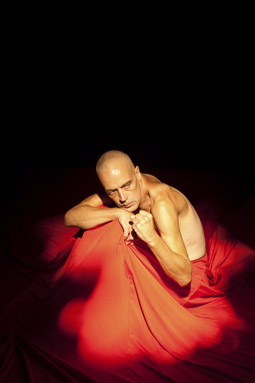
Brian Lucas, Performance Anxiety
photo Fiona Cullen
Brian Lucas, Performance Anxiety
BRIAN LUCAS’ NEW SOLO WORK, PERFORMANCE ANXIETY, WAS A SEAMLESS 90 MINUTES OF LACERATING PERFORMANCE THAT OFTEN HAD YOU WITH YOUR MOUTH HANGING OPEN AT THE SHEER BRAVURA OF THE BEAST.
Reeling away after the event, the expansive realisation began to seep in that you had attended an undoubted master work. Lucas has long held a national reputation for his intelligent physical performance works sedulously crafted by a mature artist from his considerable background skills in both theatre and dance. Now he literally leaps onto the world stage at the World Theatre Festival at the Brisbane Powerhouse, the venue which had commissioned his first major one man show, Monster, in 2000.
This is not to say Lucas has summarily trumped himself. He emerged fully fledged with most of his salient moves intact. Having followed him along the way, I can say that his earlier, more autobiographical pieces had the same rueful insights. His best talent has always been to describe being in motion, to depict who he was always becoming, vulnerable to himself but also portraying a sense of multiple selves simmering beneath his skin. Hence it was a bit off-putting at first to see him wearing contemporary clothes in his latest work. This break into costume came earlier, in Underbelly (2006), a baroque piece that interrupted Lucas’s plans to complete his personal trilogy, and was vomited forth in response to the media spin of the Howard years. Not much has changed from that perspective, so Lucas has gone on to meet his audience by unleashing other selves fitting for the times and exposing his own fears, his own performance anxieties amidst the moral ambiguities of the media-hyped post-9/11 world.
In line with Lucas’s continual experimenting with form, The Turbine Rehearsal Room has been tricked up for a cabaret performance in the round at “The Loser Bar” by designer Kieran Swann. The ambient success of this integrated vision is also a measure of Lucas’s collaborators. Swann has created a dais fitted out with hidden lights and exits for smoke to create a plethora of effects. It also has a special floor which enables Lucas in an initial moment to rise like a curtain with sheets draped around his waist and to metamorphically extend into the audience through his dance reach. Andrew Meadow’s superb lighting extends from a hermetic bed-chamber to a flare-lit war zone to framing a stunning mise-en-scene of interrogation rooms illuminated by single lightbulbs among the audience. Unfortunately Lucas can’t sing, so he informs us, “although he would like to” (just as he would “like to be an American”, or that he “was more driven to achieve” etc). This point was ironically underscored with an elegant and evocative sound collage by Brett Collery—Handel’s Largo, a baroque chorale, a modern classical boys’ choir, a female dolorosa and, finally, the big band version of “I’d like to teach the world to sing.”
Lucas has his own vibrant tones, of course. As poet-cum-dramatist he decides not to present a case study, but to respond to a quote from James Joyce: “Within the particular is contained the universal.” He presents four different characters who share a sense of anxiety despite the substantial differences in their circumstances: L’Amour, the Torch Singer; Limbo, the War Correspondent; Lunacy, the Orator; and Lachrymosa, the Stand-Up Comedian. And there is the diffident and dyspeptic performance persona named Brian Lucas.
As the audience enters, Lucas is lying down, covered in rose petal sheets and tossing and turning, uncomfortable in his own skin and unable to perform sexually with his partner. Eventually he rises in female guise with sheets clinging to his hips and sweeps into a dance of romantic desire for the Falling Man from the Twin Towers. She tells her psychiatrist, “I had fallen, just as the man had fallen.” Lachrymosa comments in a vocal loop back that, “She finally takes off her skin and lays herself bare—and it’s all in a lost cause.” The next scenario after interval is pure 60 Minutes. Limbo represents the sort of correspondent who can only read his teleprompter: “That’s what they want. So I give it to them.” Captured by the other side, he similarly parrots the script that has been given to him. Lunacy the Orator and an old man ambiguously share sadomasochistic rites. Lachrymosa is a shocker who dies of a heart attack. Lucas brilliantly represents them all at a rapid pace, for good and for evil and beyond both.
Brian Lucas has ever been aware of the daunting trial of self-consciousness and self-creation that is attributed to the artist, but which he rightly regards as our common lot. He genuinely sees himself as an ordinary person who goes through ordinary motions in the world in common with his audience, which perhaps accounts for his immense crowd-pleasing capacity in this unlikely format. What did we take away from his performance that strengthened us, as it undoubtedly did? Beneath the diffidence, beyond the chronic dyspepsia, Lucas’s tacit approach seemed to embody a panacea for the human condition recommended by the poet Rainer Maria Rilke: “Be patient toward all that is unsolved in your heart and try to love the questions themselves…Live the questions now. Perhaps you will gradually, without noticing it, live along some distant day into the answer.” Not the least aspect of Lucas’s heterogeneous art is that it seems designed to reinstate the magical arts and crafts of remembrance employed by Mnemosyne and her daughters to keep us safe from Lethe’s fatal river of media-induced forgetfulness.
Performance Anxiety, created & performed by Brian Lucas, sound designer Brett Collerym designer Kieran Swann, lighting Andrew Meadows; Turbine Rehearsal Room, Brisbane Powerhouse, Feb 9-13
RealTime issue #96 April-May 2010 pg. 30
© Douglas Leonard; for permission to reproduce apply to realtime@realtimearts.net
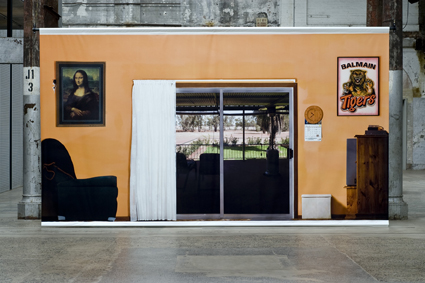
Habits & Habitat, Patrick Ronald and Shannon McDonell, courtesy the artists
WASHED ASHORE ON THE ISLAND OF BROBDINGNAG, FINDING HIMSELF DWARFED AMONG “ENORMOUS BARBARIANS,” SWIFT’S INTREPID SURGEON LEMUEL GULLIVER UTTERS A TELLING OBSERVATION. “UNDOUBTEDLY PHILOSOPHERS ARE IN THE RIGHT,” HE SAYS, “WHEN THEY TELL US THAT NOTHING IS GREAT OR LITTLE OTHERWISE THAN BY COMPARISON.”
Exploring the artworks recently presented as part of Performance Space’s You Are Here program, I found myself channelling Gulliver on more than one occasion, my certainty of place unravelling before works that playfully turned the familiar into the unfamiliar. Swift’s satirical treatise on geographic and cultural relativity also came to mind as something of a blueprint for some of the driving concerns of Australian art practice today. These concerns are set to intensify in coming months, as David Elliot’s provocative theme for the 17th Biennale of Sydney: The Beauty of Distance, Songs of Survival in a Precarious Age [see p10] brings the politics of place firmly back into focus. And although not connected to the Biennale in any way, the works presented here in fact made quite a neat forerunner to that event.
The title of the program, You Are Here, suggested a more matter-of-fact take on the subject of place than Elliot’s normative statement on geographic extremity, clearly intended to challenge. Still, the questions raised are similar. From among the three media works installed in the gallery and foyer space at CarriageWorks in Sydney emerged common concerns for the relational nature of place, history and memory in the Australian landscape, both urban and rural. And while each work proved markedly different in its realisation, taken as a whole the program was highly effective in dislocating fixed ideas about where we are situated in space and time.
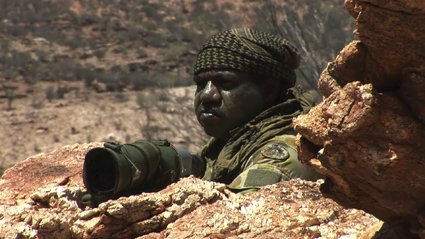
One of Several Centres, Alex Kershaw, courtesy Grant Pirrie
Photographer and video artist Alex Kershaw turned his attention to the desert town of Alice Springs, Australia’s mythic ‘red centre,’ in the multi-screen video installation, One of Several Centres, presented in the gallery space. Kershaw’s videos appeared to eschew a documentary or ethnographic approach, instead favouring a kind of topographical collage in their cumulative tracking of sites both within the town and the outlying bush and scrub areas. Further defying expectations, Kershaw mocks the touristic gaze and its attraction to monuments, homing in on the more mundane or seemingly insignificant features of the landscape while at the same time capturing locals performing a series of Fluxus-style follies. A number involved delineating or marking up space, from a man laying a narrow strip of lawn on a concrete roundabout to a woman walking her dog around the inside perimeter of a disused water tank.
In a nod to Jon Rhodes’ project Whichaway? [documenting the photographer’s extended interaction with the Aboriginal community of Kiwikura, 1974-96, Eds], cited by the artist as an influence, Kershaw draws on the strategy of using sequences charged with absurdity to image new relationships between space and time in the desert. Ultimately, the videos succeed in using play and whimsy to engage audiences while also making a more serious point about the need to move beyond fixed notions of ‘here’ and ‘there’ in the Australian landscape. From this focus on geographic relativity also emerges the realisation that, in true Swiftian fashion, many of the mental constructs which shape our perception of the world around us may be equally contingent; the difference between wild and domesticated, inside and outside, tourist and local, habited and uninhabited, traditional and contemporary, all little more than matters of the mind.
Stepping outside the gallery space and into CarriageWorks’ soaring industrial foyer, evidence of its former life as a hub for the construction of Sydney’s rail network is still visible on the building’s skin. At the time of writing, politicians, urban planners and architects were in a wrangle over the future of a more controversial former industrial site, the concrete apron at Sydney Harbour’s Barangaroo, with Paul Keating waging war against the city’s alleged “industrial determinism.” With so much focus on the city’s architectural fabric, it was refreshing to encounter Nigel Helyer’s haunting site-specific sonic sculpture, GhosTrain, which dealt with a far more ephemeral, and hence easily overlooked, form of heritage: the sounds of the city. As Helyer puts it, “the acoustic ecologies of industrial landscapes are prime examples of our extraordinary capacity for amnesia.”
Referencing CarriageWorks’ former use, Helyer’s 60-second sound installation, to be repeated in the forthcoming May-June program, plays the recorded sounds of a steam locomotive starting up, pumping out steam and then quickly accelerating to enact a sonic transportation to another era, another time. Beyond its nostalgic qualities, the work proved interesting for the questions it raised about whether urban sounds should be preserved and archived for future generations. This would entail a broadening of our concept of heritage to embrace senses other than sight and an acknowledgment of the link between sound and embodied space, for sounds signify activity and hence lived presence. A big ask, yet by neglecting soundscapes we risk preserving buildings as empty architectural shells.
While Helyer’s GhosTrain offered a site-specific sonic reading of the foyer space, photomedia artists Patrick Ronald and Shannon McDonell brought an apparent slice of rural life to the site in their installation, Habits & Habitat. In a life-sized, 1:1 photographic diorama of a domestic interior, the glimpse of dry scrub through a window, a kitsch rooster clock on the kitchen wall, a pair of Blundstone boots by the laundry door all lend what otherwise appears a typical family home the context of a rural setting.
But just as the manipulation of scale in Gulliver’s Travels leads the narrator to probe his surroundings as if under a microscope, here slight tweaks in the images lead us to question their authenticity as photographic documents (is that print of the Mona Lisa on the wall, for example, not actually a jigsaw puzzle?). In fact, the artists have applied a unique brand of photogrammetry to the images, a process of intricate digital manipulations which results in seamless composite images. This insertion of unexpected details and the juxtaposition between real and unreal elements results in an uncanny sense of displacement. At the same time the accumulation of detail, writes Performance Space Director Daniel Brine, “investigates cultural transfer, the connection (and disconnections) between country and city, and the ways that the ‘bush’ continues to inform Australian culture and identity.”
Taken literally, visitors to Performance Space’s You Are Here program might have expected to encounter artworks that presented fixed, or even instructive, interpretations of place and landscape. Far from it, a sense of journey emerged from the works that was unconventional in its focus on ‘in-between’ spaces and movement between various cultural signposts. In less skillful hands, concerns over Australia’s geographic and cultural relativities can too easily slide into tedious and repetitive neuroses. One hopes that in upcoming events we will continue to dwell in its fruitful and generative possibilities.
You Are Here: Alex Kershaw, One of Several Centres, Feb 11–March 6, Nigel Helyer, GhosTrain, Feb 11–March 17, May 13-June 5, Patrick Ronald and Shannon McDonell, Habits & Habitat, Feb 11-March 17; Performance Space, CarriageWorks, Sydney
RealTime issue #96 April-May 2010 pg. 44
© Ella Mudie; for permission to reproduce apply to realtime@realtimearts.net
Willoh S Weiland, Yelling at the Stars
photo Tilly Morris
Willoh S Weiland, Yelling at the Stars
new aphids artistic director: willoh s wieland
Exciting news from Melbourne: Willoh S Weiland has been appointed as the new artistic director of Aphids. As we were putting this online edition together, Weiland was flying back to Australia. We look forward to catching up with her once she’s settled into the job of guiding one of the country’s most innovative outfits, renowned for its idiosyncratic hybrid creations and international collaborations.
A young and energetic artist, Weiland looks made for Aphids. Her projects as artist, writer and curator over recent years have been strikingly individual. The ongoing art-science project Yelling at Stars (see RT 88) was presented at the Sidney Myer Music Bowl as the closing event of the 2008 Next Wave Festival and then in Glasgow at Less Remote, an art/science symposium running parallel to the 59th International Astronautical Congress. Her 2009 Synapse residency was at the Centre for Astrophysics and Supercomputing, Swinburne University of Technology, where she developed Void Love (www.voidlove.tv), “a soap opera about astrophysics” starring Kamahl.
Weiland is involved in ongoing collaborations with Spat & Loogie and, as part of Deadpan, with video artist Martyn Coutts—including an Asialink residency in Beijing and NES artist residency in Iceland in 2010.
David Young, the outgoing artistic director and co-founder of Aphids (and now director of Chamber Made Opera; see RT95) sees Weiland as “hugely talented and a perfect fit with the Aphids spirit and ethos.” He thinks that with the current Aphids team, “I really cannot imagine what Aphids will become under her watch—and that’s exactly what I am most excited about.”
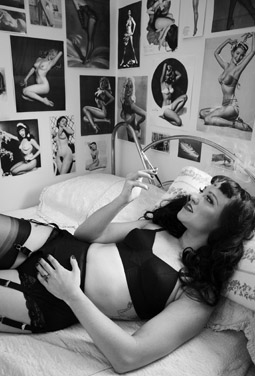
Lillian Starr Pinup Girl, Tina Fiveash, part of Women in Piracy
courtesy the artist
Lillian Starr Pinup Girl, Tina Fiveash, part of Women in Piracy
women and piracy
As the application of copyright laws tighten, creative commons becomes part of the big picture and internet censorship escalates, it’s timely to take yourself to Kudos Gallery to reflect on the good use to which appropriations, adapatations and thefts have been put in Women in Piracy. The show includes works by Penelope Benton, Brown Council, Tina Fiveash, The Kingpins and others. Curated by Marcel Cooper it’s part of the 2010 Sheila Autonomista Festival for queer women’s art and music centred at Red Rattler Theatre, Marrickville. Women in Piracy, Kudos Gallery, 6 Napier St, Paddington, Sydney, March 30-April 10; scooter.org.au/sheila.html
jo lloyd: 24hrs
God knows what all the fast turnaround short film and short play festivals are doing to our psyches as artists and audiences—blessed be the slow food movement—and now dance has joined the rush! But what an intriguing race it might be in the Jo Lloyd-curated 24HRS at Dancehouse. Four choreographers will each create a new work over 24 hours—one for each Friday over four weeks. Just to add to the inevitable delirium of commencing work on a Thursday night at 9pm, “the creative process will be twittered and streamed online and the teams must be ready to present the work to a live audience by 8pm the next night.” There goes the privacy associated with the slow boil of the creative process. The stellar line-up of choreographic speed freaks is Natalie Cursio, Shelley Lasica, Phillip Adams and Luke George. 24HRS, performances April 30 (Cursio), May 7 (Lasica), 14 (Adams), 21 (George), Dancehouse, Melbourne; www.twitter.com/24HOURS; www.livestream.com/24HOURS
Adrift, Nigel Helyer, Memory Flows exhibition
courtesy the artist
Adrift, Nigel Helyer, Memory Flows exhibition
cmai, memory flows
As our major easten rivers and Lake Eyre fill after an epic drought that threatens to return almost as soon as it has departed, the UTS-based Centre for Media Arts Innovation is holding a timely exhibition of underground water basin and river-inspired art. “Australian rivers are conduits that are emblematic of networking systems, travel systems and survival systems. They are also the ground for flows of memory as riverbeds, for instance, hold the memory of water embedded in the land. This project will tap into and out of memory flows—along Australia’s riverbeds and groundwater systems.” The distinctive venue, Newington Armory, and its proximity to some of Sydney’s unique waterways give the exhibition added frisson. The artists are Ian Andrews, Chris Bowman, Chris Caines, Damian Castaldi, Sherre DeLys, Clement Girault, Jacqueline Gothem, Ian Gwilt, Megan Heyward, Nigel Helyer, Neil Jenkins, Solange Kershaw, Roger Mills, Maria Miranda, Norie Neumark, Shannon O’Neill, Greg Shapley, Viktor Steffenson and Jes Tyrrell. CMAI, Memory Flows, Newington Armory, Sydney Olympic Park, weekends May 15- June 27; www.memoryflows.net
art for easter 1: sounds unsound festival
Recommended, say the organisers, for people who don’t do Easter, the Sounds UnSound Festival is “a one-day event focusing on the experimental, improvised, noise and left-field musical fringe of Sydney and beyond.” Artists include Japanese noise maestro Defektro, improvisors Forenzics, Chippendale improv group The nHOMEas, Toydeath, glass vocalist Justice Yeldham, audio-visualists Infinite Decimals, bass/drum duo The BZNZZ, Prehistoric Fuckin’ Moron(s), the computerised Scissor Lock, The Not Too Distant Future and Baad Jazz. Sounds Unsound Festival, The Wall (The Bald Faced Stag), 345 Parramatta Rd, Leichhardt, Sydney,April 2, 2-10pm; www.myspace.com/thesoundsunsoundfestival
art for easter 2: arvo pärt’s berlin mass
A special Easter Saturday performance of Arvo Pärt’s immersive Berlin Mass by Sydney Chamber Choir and the ensemble Ironwood will celebrate the composer’s 75th birthday. On the same generous program, directed by Paul Stanhope, there will be selections from Carlo Gesualdo’s Tenebrae and a work inspired by them, Scottish composer James MacMillan’s Tenebrae Responsories. Ironwood will also present a movement from Haydn’s Seven Last Words from the Cross. Via Crucis, Verbrugghen Hall, Sydney Conservatorium of Music, Sydney, April 3,
Kate Murphy, The note, 2010
image courtesy Breenspace, Sydney
Kate Murphy, The note, 2010
kate murphy at breenspace: the note
The latest work from one of the leading and more lateral of Australia’s video artists, Kate Murphy, is The note, a 10-minute, single-channel HD video installation in 5.1 surround sound. According to the Breenspace website, the work was conceived when the artist “read a distant relative’s suicide letter. Murphy asked composer Basil Hogios to develop a musical composition based on every word written in this letter.” The result is an aurally immersive video of a mezzo soprano singing in an empty theatre. Kate Murphy, The note, Breenspace, 289 Young St, Waterloo, Sydney, March 12-April 17 www.breenspace.com
RealTime issue #95 Feb-March 2010 pg. web
© RealTime ; for permission to reproduce apply to realtime@realtimearts.net
Pomona Road, photo Katrina Lazaroff
Major bushfires bring increased pain each year and revive memories of earlier devastating fires cruelly etched in the psyches of many Australian families. Choreographer Katrina Lazaroff's family is one of these: her first full-length dance work, Pomona Road, reflects on the enduring physical and emotional consequences of the Ash Wednesday bushfire in 1980, but in the end, says Lazaroff, it's a dance theatre work about family.
Lazaroff is a dancer, choreographer, rehearsal director and dance educator who graduated with an Honours in Dance from WAAPA (Western Australian Academy of Performing Arts) in 2001, performed with Buzz Dance Theatre in Perth in 2001, and in 2006 and 2008 with Leigh Warren & Dancers worked as rehearsal director and assistant to the choreographer. She has been Artistic Director of the Youth Dance Festival 2008 (Ausdance ACT), choreographed for Fresh Bred—SA Youth Dance Ensemble, and worked with Restless Dance Company as a choreographic mentor on Debut 1 & 2. She is currently working as a choreographer and performer with Adelaide's Patch Theatre Company and teaches company class for Australian Dance Theatre. For Lazaroff, the hour-long Pomona Road is “a huge work”, an opportunity to create a totality that draws on her artistic experience and family life and allows her to embrace a wide range of means with which to realise her vision.
In Pomona Road Lazaroff employs dance, theatre and visual and audio design to evoke the enduring suffering and the rebuildling of lives and a sense of home. Unusually for a principally dance work, she also incorporates documentary material—recorded interviews from family and community members. Not surprisingly then the show's press release declares it “new Australian documentary dance.” Certainly Lucy Guerin's Structure and Sadness is rooted in the reality of the 1983 collapse of Melbourne's Westgate Bridge, but it's not a documentary work per se. Banagarra Dance Theatre, on the other hand, has works in its repertoire based on painful social realities, but the label 'documentary' is not apt.
Pomona Road, photo Katrina Lazaroff
Lazaroff tells me that Pomona Road—in evolution since 2006 and with three stages of development—was never intended as a comment specifically on the social and emotional impact of bushfires. Her first impulse was to explore family, “where we come from.” Stage one addressed her relationship with her sister (“sibling rivalry, kooky and a bit sinister”), and stage two father-son interaction (drawing on her own family and the experience of her dancers). It was while working on stage three and addressing the whole family that she discovered that the fire experience provided a meaningful framework for the exploration of family life. The Ash Wednesday starting point offered the beginnings “of a journey and a focus on loss—of home, place, identity. And the pain of starting again—the parents tackling it, the kids bumping along.” By 2009, says Lazaroff, the fire scenario had taken over.
Lazaroff decided that she wanted to make a dance work that was documentary in character, capturing the feelings of loss to fire. To this end she interviewed her parents about Ash Wednesday 1980 and victims of the subsequent 1983 Ash Wednesday. She thinks that “feelings and relationships can be sensed” through these voices which the audience hear—sometimes on their own, sometimes in tandem with the dance. The dancers, playing members of a family, also speak, but not in a conventionally scripted fashion, their utterances a form of vocal movement—family bickering, a song, familiar expressions. Lazaroff says that in stage three of the work's development she learned to give space to the recorded voiceovers, “to let them come first, and provide continuity.”
Asked about her choreographic style, Lazaroff says it's rooted in the contemporay dance which has been her life. However, the dancers create “recognisable characters whose gestures and character traits fuse fluidly with the dance language.”
Kerry Reid's set for Pomona Road comprises simple timber structures (originally made by Lazaroff's partner from materials from her mother's verandah for the stage three development, but now re-made and evocative of her father and his fence contracting business) and large hanging sheets of white paper that receive the images from two powerful projectors that wash the whole stage with impressionistic, 'textural images of bush and fire.” With Nick Mollison's lighting and projections, Lazaroff hopes that substantial depth of field will be created.
Lazaroff describes the sound design for Pomona Road as “highly collaborative, with a lot of give and take” in its making with Sascha Budimski's score comprising “sound effects, hums, drones, voiceovers, rhythm beats and Gerry Rafferty's Baker Street”, the 1978 hit which her father played frequently.
I ask Lazaroff what creating Pomona Road has done for her. “It's been a moving experience, looking back into family history and seeing that there were many more things that happened to us than I realised. As an artist I feel it's set me free.”
inSPACE Program, Pomona Road, Space Theatre, Adelaide Festival Centre, April 21-24. Pomona Road was part of inSPACE:development in 2009.
RealTime issue #95 Feb-March 2010 pg. web
© Keith Gallasch; for permission to reproduce apply to realtime@realtimearts.net
Joanna Dudley and Dirk Dresselhaus AKA Schneider TM, Louis & Bebe
image courtesy the artists
Joanna Dudley and Dirk Dresselhaus AKA Schneider TM, Louis & Bebe
There are many Australian artists based in or working regularly in Berlin: Barrie Kosky, Benedict Andrews, Paul Gazzola, musicians Clare Cooper and Clayton Thomas, media artist Jordana Maisie, dancer and choreographer Adam Linder (see RT95) and live art performer Sarah-Jane Norman are just a few who have appeared in the pages of RealTime. One we should know more about is innovative director, performer and singer Jo Dudley. On a brief visit to Sydney recently she dropped into the RealTime office to tell me about her latest work, Louis & Bebe, inspired in part by electronic music pioneers Louis and Bebe Barron.
Dudley choreographs, makes installations and collaborates on music theatre works. Her most recent creation, with designer Rufus Didwiszus and electro pop/noise impro composer-musician Schneider TM (Dirk Dresselhaus), is Louis & Bebe. It will appear at the Sophiensaele (where it premiered last year), Berlin, April 15-17, for IETM [International Network for Contemporary Performing Arts]. The video excerpts on Dudley’s website convey some of the work’s musical and physical subtleties and viscerality.
Dudley’s principal music theatre collaborator is Didwiszus. Their work The Scorpionfish was part of the 2008 OzAsia Festival in Adelaide [see RT82]. Another work, Who Killed Cock Robin, was performed with the Flemish vocal ensemble Capilla Flamenca and Dudley’s sound installation Tom’s Song for music boxes and LP players was presented at the 2006 Sonambiente Festival, Berlin [see RT74].
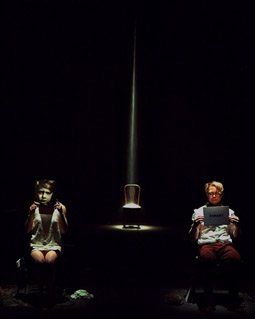
Joanna Dudley and Dirk Dresselhaus AKA Schneider TM, Louis & Bebe
image courtesy the artists
Joanna Dudley and Dirk Dresselhaus AKA Schneider TM, Louis & Bebe
Dudley has studied traditional Japanese music in Tokyo and traditional dance and music in Java, and recently created the choreography for the opera Eugene Onegin directed by leading German playwright Falk Richter and conducted by Seiji Ozawa for Tokyo Opera Nomori and the Vienna State Opera. Dudley has also worked with Sasha Waltz, Thomas Ostermeier, Les Ballets C de la B, Sidi Larbi Cherkaoui and Heiner Goebbels.
Louis & Bebe (1 couple, 3 lives, 3 deaths) is inspired by “forgotten pioneers of electronic music”, the Americans Louis and Bebe Barron who worked with magnetic tape to create distinctive sounds—later regarded as music—which brought them into contact with John Cage, Maya Deren, Morton Feldman and others. The couple also created the ‘electronic tonalities’ score for the 1956 sci-fi feature film, Forbidden Planet.
Dudley says that Louis & Bebe is not a literal account of the work, or the lives, of the Barrons, “we had to abstract it.” A particular focus in this music theatre work is the creation and death of a sound, and the parallel life of the soul. The work moves through three phases: childhood (The Landing, Reaching for the Red Star Sky), full-blown life (Garden, portraits of a Zoomorph couple), and death (Graveyard, A Night with Two Moons). In these worlds dense with sound, “there’s not much movement”, says Dudley, “it’s like still images—snap-shotttish.” The images seen in stills from the production are striking: in Garden the couple wear long-beaked masks inspired by Max Ernst images and symbolic of “soul, flight and heaven.” In Graveyard there’s a similar bird image (“a particular stork that eats dead animals”) in an eerily beautiful altar.
Other than a 20kg bell, small bells and some foliage, the space for Louis & Bebe, says Dudley, is a stripped back Sophiensaele—where the performance “works beautifully.” It would be wonderful if Australians could see more of the creations of Dudley and her collaborators at a moment when music theatre here looks to be enjoying revived promise.
Jo Dudley, Louis & Bebe, Sophiensaele, Berlin, April 15-17; www.joannadudley.com
RealTime issue #95 Feb-March 2010 pg. web
© Keith Gallasch; for permission to reproduce apply to realtime@realtimearts.net
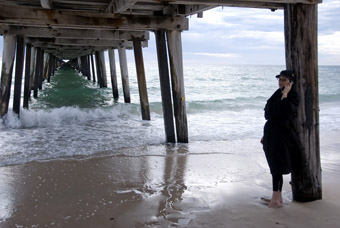
Camilla Hyde
Recently in RealTime, Jack Sargeant (see RT95) and Mike Walsh (see RT95) have argued for the critical discussion of Australian feature films to start incorporating the ‘invisible’: the B-grade, genre or Asian films that are screening to audiences at festivals like MUFF (Melbourne Underground Film Festival) or multiplexes in the suburbs to NESB audiences—the films not funded by Screen Australia, ones that tend to fall off the radar. These films are also gaining a following via the networking power of Facebook: even in early production, you can become a Fan, tracing the film as it’s being made, finding out about festival screenings, looking forward to its DVD release.
Dave de Vries’ feature film debut is a good example. Made on a self-raised budget of around quarter of a million dollars, Carmilla Hyde is a vamped up revenge flick that won Best Feature at the South Australian Screen Awards in March after winning Best Guerilla Feature and Best Supporting Actress (Georgii Speakman) at the Melbourne Underground Film Festival. Now it's been selected for the International Film Festival South Africa 2010. It’s a film that begs an undergrad audience with lashings of sex, drugs, rock’n’roll and girls in leather.
The central character Milly (Anni Lindner) is an androgynous looking and awkward woman, revealed to be a virgin, who spends most of her time in her room, reading, until drugged by her housemates in the callous hope of liberating her. Her alter ego Carmilla, is brought on by the mysterious machinations of her psychiatrist Dr Webster—who implants a trigger word when he hypnotises her, and introduces her to a special brand of red wine that, when sipped, unleashes the devil. The vengeful alter ego dons a long raven wig, red lipstick, fishnets and leather boots and is suddenly up for anything, including night-club stalking, back-alley sex and popping pills. The angel/whore dynamic is overtired, and nothing new is added here. It reminds me of the poor librarian in 80s videos who is turned into a goddess by losing the glasses, shaking her hair out of her ponytail and dancing in bike pants. It seems, as we watch Carmilla pash every girl in her sharehouse, and then observe her lasciviously watching a poledancer do a lapdance at a lesbian nightclub, that many scenes are about as tacky as when the lead singer in the band gropes all the starlets in a hiphop video. There’s lots of finger sucking and women having a go at the hubbly bubbly. It’s like watching soft-porn without the sex.
Writer-director de Vries comes from a background designing comics and he’s done well with the look of the film on a shoestring budget. At times it seems loosely based on Dangerous Liaisons (the Buffy version), with scheming women manipulating the desires of Milly (and her wooden lover Nathan [Cameron Hall]) and there’s the obvious titular reference to Jekyll and Hyde. The costume designer has gone to town—the women look at times like they have landed on some 70s sci-fi planet. The script, though, is full of holes, and the acting needs work. The psychiatrist, Dr Webster (Sam Tripodi), in particular, is so over the top that you half expect him to start rubbing his hands and cue an evil laugh. Perhaps that’s intentional but the serious subtext of the film—repressed memories of sexual abuse; men’s violation of women—makes it difficult to take. As the central character(s), Lindner lacks the experience to be able to transform from one character to another, without the help of costume and make-up. Unfortunately, the film’s premise (of altered states) brings to mind the brilliant United States of Tara, and Toni Collette’s completely convincing performance in bringing a number of personas to life; so much acting is in the head as well as the body. The music is so ‘dum da dum dum daaaaa’ that it reveals the mood of the scene before it’s even begun. And the film seems to slip between genres. With a lack of suspense, it doesn’t work as the ‘revenge thriller’ it’s hyped to be. The horror and sex are just glimpsed, not down and dirty enough to class as Ozploitation.
You get the feeling that de Vries needed someone to come in and help him with an honest appraisal. The script needs a good cut—the film could be chopped by a
third. There’s no really strong narrative drive. Characters have dialogue like: ‘We’re outta milk.’ ‘Okay.’ When Britt (Georgii Speakman) finds her friend bleeding in the shower, after a suicide attempt, she says, “Oh, you stupid bitch.” A man from the alley comes into the house and terrorises the women for no reason other than the chance for a gratuitous tit shot in the shower. The male characters are moronic at best. And then there’s the house. The characters appear to live in a magnificent stone cottage by the beach with endless rooms, yet none of them seem to work. Oh yes, one of them says she is a student. Perhaps the rental market is different in Adelaide.
There’s something depressing about a character who, when it’s revealed she has thrown off her shackles of repression, is transformed into a woman whose banal idea of a good time is to go through the motions, seducing all the women and men in the room, always under the watchful gaze of other men (including those behind the camera). As a fantasy it could have dealt with some more experimentation or imagination. Nevertheless, de Vries managed to raise the funds to make it. I imagine with a tighter script, a reigned-in focus and more funds in his pocket, he might come up with something special.
Carmilla Hyde, writer, director, producer David De Vries, producers Fiona De Caux, Tony Ganzis, Andrei Gostin, actors Anni Lindnee, Nina Pearce, Georgii Speakman, cinematographer Maxx Corkindale.
Carmilla Hyde will screen at the Mercury Cinema, Adelaide, dates to be announced. DVD and Blu-Ray copies will be available online from August 2010 at www.darkmirrorpictures.com
RealTime issue #95 Feb-March 2010 pg. web
© Kirsten Krauth; for permission to reproduce apply to realtime@realtimearts.net
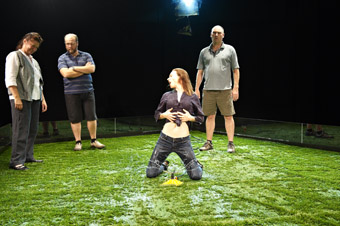
Love Me Tender, Thin Ice Productions
photo Jon Green
Love Me Tender, Thin Ice Productions
In a fascinating exercise in theatrical narration and with near agitprop urgency, Tom Holloway’s Love Me Tender directly addresses the contemporary rift in family intimacy wrought by two forces: the premature transformation of girls into women and the fear of sexually abusive fathers.
The play is inspired by, but is not an adaptation of, Euripides’ Iphigenia in Aulis (408-6 BC). Pressured by an army approaching murderous revolt, Agamemnon, king of Mycenae, sacrifices his daughter so that the gods will provide the winds to drive his stilled fleet to Troy to retrieve the abducted Helen, wife of his brother Menelaus. Euripides’ enduring account is complexly tragic, played out in a field of constantly shifting motives and loyalties. The playwright’s achievement lies in revealing that however much the gods can be invoked to rationalise human actions, the choices made are actually less clearly motivated—they are personal, social and, not least, political—and often not reliable—even Iphigenia changes her mind, ‘heroically’ (as it is often put) accepting her father’s will and going to her death. Filial love is brutally compromised by political pragmatism—Agamemnon still loves his daughter, but not enough to let her live and put at risk his power and the lives of the rest of his family.
In Holloway’s play, the setting is abstractly contemporary—a raised green pentagonal lawn bordered by a low perspex fence has something of the feel of a vividly illuminated specimen case into which we peer, watching what soon appears to be a nasty experiment. In this laboratory a man (Colin Moody) struggles to tell, or to invent, his story, prompted, cajoled and corrected by a chorus-like male (Arky Michael) and female (Kris McQuade) pair. The constant pressure and rapid alternations in the dialogue heighten a sense of improvisation apt for an experiment in which a man conjures a ‘what if?’ world where a father might sacrifice his daughter for the greater good of the community.
The language, as usual with Holloway, is sharply observed everyday Australian frequently delivered in staccato one line utterances, outbursts and interruptions yielding a constant sense of uncertainty, interrogation and of thinking aloud that is nonetheless cumulatively fluent and poetic in its repetitions and reworkings—if requiring an alert audience ear. But it’s more than a matter of style: Holloway’s language reveals from the play’s very beginning that the world we are observing is a socially and imaginatively constructed one and, initially chronologically ambiguous. The diction of the man and his prompters suggests the world of Homer or Virgil (“the sun hits the dust in the air…like pillars of fine, floating flakes of snow…they are ripped apart into…into…Chaos?). The trio’s narrative accelerates: the man rushes home to find another between his wife’s legs—jealousy and anger threaten—but it’s a doctor delivering their daughter. Even so, ambiguity persists: “Her fur and hooves. Now I see her hooves. Wet with placenta and blood.” The sense of a mythic world—with the line between man and animal blurred—is suddenly amplified. Uncertain of his feelings—love? joy?—the man arrives, with prompting, at a state where he experiences “amazing and yet terrible flashes of what is to come and suddenly I am filled with an immense and overwhelming sense of love and horror.” In a matter of minutes the play’s dynamic (of a world being invented) and its layering of the epic and the domestic, of human and animal, and of an event foretold, but not revealed, are immersively at work.
A burst of celebratory optimism—”I think it is the best time to bring a little girl into the world”—details the many opportunities for women these days (run marathons, banks, corporations, visit a strip club, “sacrifice herself for…some great cause”). But it’s immediately subverted by a list of threats to young girls that requires their protection—”It’s almost impossible to keep your children safe these days.” “It’s scary.” “Yes.” “What might be done to them.” “Yes.” “To their little bodies.” “Their hooves. Their fur.” But ambivalence creeps in: “…they taste so good.” “They are succulent like nothing else.” “They get them fresh. Straight from the parks and homes and churches and schools and straight onto the plate for us.” In Matthew Lutton’s production this dialogue is delivered by the man and the male prompter (the printed script does not specify who says what, leaving it a directorial choice), making the inference of co-existing and conflicting male desires unavoidable.
The next dialogue between the two men, where the father expresses pleasure in playing with his daughter and his attempt to understand what it is that passes between them, is undercut respectively by the prompter’s suspicions of sexual interference and his incomprehension of what the father sees as the spiritual nature of the relationship. The prompter is limited strictly to “Right,” “Sure”, “What”, but Arky Michael wrings every shade of suggestiveness and concern from them until the father erupts: “Everyone’s first thought goes to dad teaches daughter how to fuck and suck because that…all that…that is what they know.”
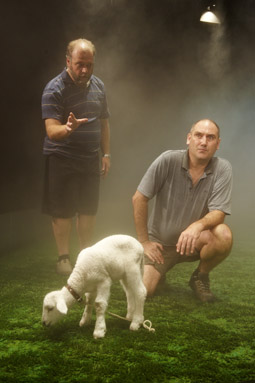
Love Me Tender, Thin Ice Productions
photo Jon Green
Love Me Tender, Thin Ice Productions
Subsequently, the man waters the lawn with a sprinkler. Amidst the spray, his wife (Belinda McClory) dances at a party to a chorus of cries directed at young girls: “Don’t forget your cut-off top!” “Got to show that cute little midriff!” “Are your g-strings showing?” The dance is increasingly and convulsively erotic until the wife collapses before her distant husband. She then becomes a pathetic figure, watching helplessly from the sidelines. She’s certainly no Clytemnestra, the dance suggesting she is complicit in the sexualisation of her daughter.
Having more than firmly established the doting father’s anxieties, Holloway now addresses the man’s public role; he’s a fire fighter chief whose wife wonders why “he has disappeared so much?” “Like he wants to confess some kind of thoughts to me.” “I can’t help but feel that something bad is going to come of all this.” Brief monologues are scattered between the dialogues, some delivered by a Chorus (played as a policeman here by Luke Hewitt), describing a fire-ruined landscape, a destroyed home, a lost girl, or is it an animal (“The ash stains her fur.”) This is the otherworld the father and the policeman occupy. As the fire mounts, the family gather with refugees at a swimming pool. The girl (now “ten-eleven twelve”) is there with “a boy that is a friend.” The father “[i]s standing there…knowing full well that there was nothing at the pool for them. Nothing but the anger of the gods.” He is anxious about “Not being off where his community needs him”, but what fills his mind and pours from his and the prompters’ mouths is a long, tirading litany of all the fears in him that his daughter’s almost pubescent body in a “tight little bikini” elicits—teen dance troupes, increasingly early physical maturation, a daughter catching a father cock-in-hand watching porn, predators at the pool, boy or boyfriend? “And suddenly he wants to let the fire burn!…to burn out all the psychos and freaks and degenerates because the world is fucked!”
Again, this is teamwork, urged on by the man’s prompters. He asks, “Is that about right?” They reply, “Absolutely.” He then feels compelled to sacrifice his daughter. A live lamb, representing the daughter, is brought on stage. The policeman demonstrates elaborately how to cut its throat. The wife, wet, quivering, sobbing, watches from the side. The father exits with the lamb. The policeman recites his own tale of shooting of wounded deer during the fire. The father returns, bloodied from the sacrifice to recount the death of his daughter in more literal terms: cries on the radio from the community for help had drowned out the screams of his daughter trapped in “the car he bought her so she could learn to drive.” He cannot or rather will not save her, watches her die, turning instead to the community “[w]here he needs to be a hero”, but crumbles into the chaos prefigured at the play’s opening. In this penultimate scene Colin Moody allows the father louder passion and pain than previously: perhaps they might have conveyed more if delivered quietly. The play ends with the sadly fatalistic American folk song “I am weary (let me rest)”; in the script it’s described as “Epilogue: Iphigenia replies…” She has accepted her fate.
Love Me Tender is an unusual theatrical experience. The non-literal setting and the manner in which the dialogue and parallel worlds are team-constructed generate a palpable distancing effect which is counterbalanced by a sense of urgency and suspense and of having to, as an audience, make the work intelligible—piecing together the shared first, second and third person accounts of characters and events. The spare, patterned blocking, the playing directly to the audience, the moments of song, the human-animal interplay and the inventive chorus model embodied in the two prompters collaborating with the man in his drive to psychosis aptly if never literally echo Greek tragedy. As a modern version of Euripides’ Iphigenia, the play portrays a like world, but instead of an army in revolt and gods to be appeased there’s a community obsessed with the vulnerability of children, their sexuality and the way it complicates father-daughter intimacy. The father, opting for responsibility to community, to save lives as a fire fighter, abandons his daughter. Ironically it is the same community’s pathological fears that have driven him to sacrifice the child he loves, if he still does. Love Me Tender is at once an indictment of the premature sexualisation of children and of the possible consequences of the fear of it—enacted as the sacrifice of love, not just of a life.
Although a memorable production with performances totally on top of the considerable demands of Holloway’s script, I was left with some doubts about the play. It’s a work by a man about a male plight, one worth exploring, but it does little for its female characters—the daughter is only referred to, save appearing as a lamb, and the mother an onstage cipher. Neither this Iphigenia nor this Clytemnestra can offer an account of their condition, nor defend themselves against the will of the men. They cannot challenge their fate without complicating the playwright’s thrust in what is essentially a monodrama, a very clever and timely one, and almost tragic—though the father is denied any insight into his condition. Love Me Tender’s dynamic is compelling, but in the end its reliance on the play of thematic oppositions into which the feminine is not allowed to intrude limits its capacity to speak beyond the contradictions forced on the father-daughter relationship. As an experiment, not just in submitting a man to the extremities of collective social pathology, but as an exercise in adventurous narrative form, Love Me Tender is exactly what Australian theatre needs.
For another modern version of Iphigenia in Aulis, one that keeps the female roles alive, take a look at novelist Barry Unsworth’s wonderful The Songs of the Kings in which the world of Agamemnon’s army is eerily imbued with contemporary corporate-speak.
Company B Belvoir, Griffin Theatre Company & Thin Ice: Love Me Tender, writer Tom Holloway, director Matthew Lutton, performers Colin Moody, Belinda McClory, Luke Hewitt, Kris McQuade, Arky Michael, design Adam Gardnir, lighting Karen Norris, sound Kelly Ryall; Belvoir St, Sydney, March 18-April 11, www.belvoir.com.au
RealTime issue #95 Feb-March 2010 pg. web
© Keith Gallasch; for permission to reproduce apply to realtime@realtimearts.net
Clare Britton, Matt Prest, Hole in the Wall
image Clare Britton, Matt Prest, James Brown
Clare Britton, Matt Prest, Hole in the Wall
SYDNEY PERFORMANCE MAKERS MATT PREST AND CLARE BRITTON’S NEW WORK IS HOLE IN THE WALL, DESCRIBED IN A PRESS RELEASE AS “A CONTEMPORARY LOVE ADVENTURE…A HIGHLY VISUAL AND EXPERIENTIAL THEATRE WORK THAT EXAMINES SPACE AND POPULAR NOTIONS OF HOME, BEAUTY, LOVE AND DESTRUCTION.” I SPOKE WITH PREST ABOUT HOW THESE LARGE THEMES WOULD BE REALISED AND IN WHAT WAY THE WORK WOULD BE “EXPERIENTIAL.”
These days, in contemporary performance and live art, “experiential” suggests that an audience will be more than engaged onlookers, becoming an actively creative component in the making of a show. In his report on the 2010 PuSh International Performing Arts Festival in Vancouver (p2), Alex Ferguson describes a swathe of productions in that festival engaging intimately with audiences: “The role of the spectator has been shifted from decipherer-of-meaning to co-creator of the theatrical event. Another way to put it is to say that interpretation has been subordinated to encounter, and that it is in the energy of the encounter that meaning is created, rather than having meaning encoded in the event beforehand by the artist.” Increasingly artists ask their audiences to follow rules, solve problems or make art, while others offer immmersive experiences that require willing physical submission, like enduring sensory deprivation. Of course, there is a long history of works that have mobilised audiences to create their effect (including, memorably, those of Sydney’s Gravity Feed) but the current moment is seeing such approaches multiply and rapidly diversify.
Prest explains that Hole in the Wall is “a continuation of The Tent”, his previous work, in which “the tent provided a focus for the audience experience.” The audience entered, sipped soup and absorbed a laterally-told tale, with puppets and film, about a curious male relationship. The Tent fused an engaging low-key realism with theatrical magic yielding a strange otherworldliness—a hint of the metaphysical. It appeared at the Next Wave Festival and Performance Space’s LiveWorks in 2008 and, fortuitously as you’ll see, in 2009 at Campbelltown Arts Centre.
For Hole in the Wall, Prest tells me, the artists have built “four rooms—four large boxes, domestic in feel, with loud wallpaper and trimmings like skirting boards. They’re stiflingly domestic but without clear function. They could be a bedroom, a study or a cupboard, but there’s no furniture.” Each room will house nine members of the audience, viewing the performance happening outside through a window or a wall that opens out. The rooms are on wheels, are moved by the audience and can become two rooms or one as they join up and Hole in the Wall, says Prest, then becomes “more about an overarching space. Each disorienting move reveals and reframes fragments in a suburban love story.” From within these rooms, through windows or open walls, the audience witness “the psychological, emotional world of a couple seeking the beauty of perfection—the home which will be everything they want—and the destructiveness in the lengths they might go to get there.”
Although drawing on the lives of Prest and Britton as a couple, the work is not autobiographical: “it’s more than ourselves,” says Prest, “but the tricky themes are pertinent to us.” Although there is text (written by Halcyon Mcleod, one of Britton’s partners in the performance group My Darling Patricia)—”monologues, dialogue, scenes”—Prest sees the emphasis in the show as being on the physical and the visual. “Physical as in presence: the delicacy with which the performer enters the space and negotiates with the audience.” He explains that much of the show has been developed on the floor, working with Melbourne-based director Hallie Shellam. Also involved in the show are multidisciplinary visual artist Danny Egger and sound designer and composer James Brown who is also working with Prest and Britton on the animated film which will be part of Hole in the Wall—”a puppet couple in naive looking stop-motion influenced by [Czech animator] Jan Svankmajer.”
Prest pays tribute to Campbelltown Arts Centre for its investment in Hole in the Wall (after it had hosted The Tent) with a four-week residency when the show was just an idea, at which early stage no government funding body would likely support it. Then Campbelltown Arts Centre, Performance Space and Next Wave Festival 2010 joined forces to co-commission Hole in the Wall with the financial assistance of an Opportunities for Young and Emerging Artists (OYEA) Initiative grant from the Australia Council. This means that Hole in the Wall will appear successively at Campbelltown Arts Centre, Next Wave 2010 in Melbourne, and Performance Space at CarriageWorks in Sydney, a wonderful opportunity for a new venture, not least one based on an intriguing performative and thematic premise.
Matt Prest, Clare Britton and collaborators, Hole in the Wall, Campbelltown Arts Centre, April 22-24, school performances April 21, 23; www.campbelltown.nsw.gov.au; Next Wave 2010, dates TBA, http://inside.nextwave.org.au; Performance Space, CarriageWorks, Sydney, May 26-29, http://performancespace.com.au
Originally published in the March 29, 2010 online edition.
RealTime issue #96 April-May 2010 pg. 34
© Keith Gallasch; for permission to reproduce apply to realtime@realtimearts.net
Kate Murphy, The note, 2010
image courtesy Breenspace, Sydney
Kate Murphy, The note, 2010
kate murphy at breenspace: the note
The latest work from one of the leading and more lateral of Australia’s video artists, Kate Murphy, is The note, a 10-minute, single-channel HD video installation in 5.1 surround sound. According to the Breenspace website, the work was conceived when the artist “read a distant relative’s suicide letter. Murphy asked composer Basil Hogios to develop a musical composition based on every word written in this letter.” The result is an aurally immersive video of a mezzo soprano singing in an empty theatre. Kate Murphy, The note, Breenspace, 289 Young St, Waterloo, Sydney, March 12-April 17; www.breenspace.com. Kate Murphy and the MCA’s Rachel Kent will discuss the work on March 20, 3.00pm.
art for easter 1: song company, gethsemane
Atheists and agnostics can join Christians in a celebration of the art that constellates around Easter in Song Company’s Gethsemane. The company’s previous collaborations with choreographers Kate Champion and Shaun Parker offered us intense meditations from singers (themselves bravely and successfully integrated into the action) and dancers, attracting large, responsive audiences.
In a radically new approach this year, instead of the Tenebrae of Gesualdo there’ll be a new score from leading Australian composer Gerard Brophy, informed by a visit to India: “Gethsemane interprets the traditional Jeremiah lamentations from the Old Testament through modern-day accounts of life on the streets of Calcutta to create a contemporary meditation on poverty, abandonment and compassion” [Press Release]. The work, directed by Roland Peelman, will be performed by Song Company and Synergy Percussion with saxophonist Christina Leonard and choreography by Martin del Amo. Gethsemane, City Recital Hall, Angel Place, Sydney, March 31; tour: Canberra: Albert Hall, March 21, Wollongong City Gallery, March 22; Bowral: Chevalier College Auditorium, March 24; Newcastle Conservatorium, March 25; Bathurst Memorial Entertainment Centre, March 27; Parramatta: Riverside Theatres, March 29; www.songcompany.com.au
art for easter 2: arvo pärt’s berlin mass
A special Easter Saturday performance of Arvo Pärt’s immersive Berlin Mass by Sydney Chamber Choir and the ensemble Ironwood will celebrate the composer’s 75th birthday. On the same generous program, directed by Paul Stanhope, there will be selections from Carlo Gesualdo’s Tenebrae and a work inspired by them, Scottish composer James MacMillan’s Tenebrae Responsories. Ironwood will also present a movement from Haydn’s Seven Last Words from the Cross. Via Crucis, Verbrugghen Hall, Sydney Conservatorium of Music, Sydney, April 3,
www.sydneychamberchoir.org
Kerry Fox, Anamaria Marinca, Storm
image courtesy 23/5 Filmproduktion/Berlin
Kerry Fox, Anamaria Marinca, Storm
festival of german film: storm
Here’s early notice that the Festival of German Film looks particularly strong this year, with contributions from Michael Haneke (the eagerly anticipated The White Ribbon: village life unravelled by strange events before World War I), Margarethe von Trotta (Vision—Aus dem Leben der Hildegard von Bingen; a biopic of the composer and visionary) and the brilliant Fatih Akin in an unexpected comic turn, The Soup: “A run-down restaurant gets a fresh lease of life when the owner hires a temperamental new chef who alienates the regular customers, inadvertently turning the eatery into the toast of the ‘it’ crowd” [Press release].
Mediaeval history is addressed not only in von Trotta’s Vision but also Sönke Wortmann’s Pope Joan (Die Päpstin): “A 9th century woman of English extraction born in the German city of Ingelheim disguises herself as a man and rises through the Vatican ranks. More recent events are resurrected in a rarely told story in Florian Gallenberger’s John Rabe, “The true story of a German businessman who saved more than 200,000 Chinese during the Nanjing massacre in 1937-38.”
Hans-Christian Schmid’s Storm is an impressive inclusion in the program. I was lucky to see a preview of this largely English language film starring Kerry Fox as a War Crimes Tribunal prosecutor thrown at short notice into the trial of a Serbian commander turned popular politician. What seems straightforward becomes quickly and dangerously complex in the manner of a good political thriller. But Schmid pays consistent attention to the realpolitik of the European Union’s attempts to defuse murderous local tensions by overriding ordinary citizens’ need to tell what happened. Storm effectively addresses the big political picture while focussing on the pain of players and victims, with Kerry Fox excellent as a lawyer who finds her own life trapped in these contradictions. Fox creates a laid back persona, droll, determined, often blunt, but increasingly alert to nuances that will test her own morality as events unfold. The fine widescreen cinematography embraces both intimate scenes and varied location choices. One pointer: as Storm unleashes its series of climactic events you certainly need to pay attention to the political and legal machinations as they play out. Storm is suspenseful, moving and memorable, its story an unusual and admirable choice. KG. Audi Festival of German Films: Chauvel Cinema/Palace Norton Street, Sydney, April 21-May 2; Palace Cinema Como/Palace Brighton Bay, Melbourne, April 22-May 2; Cinema Paradiso, Perth, April 22–26; Palace Centro, Brisbane, April 28–May 4; Palace Nova, Eastend Cinemas, Adelaide, May 7-May 9; www.goethe.de/australia
Kelton Pell, Geoff Kelso, Bindjareb Pinjarra
image courtesy the artists
Kelton Pell, Geoff Kelso, Bindjareb Pinjarra
bindjareb pinjarra: massacre & reconciliation
The 1995 stage production Bindjareb Pinjarra, an improvised work about the Pinjarra massacre created and performed by Isaac Drandic, Geoff Kelso, Sam Longley, Franklin Nannup, Kelton Pell and Phil Thomson has been revived for a season in Fremantle as part of Deckchair Theatre’s umbrella program. It focuses on “a major incident which occurred in October 1834 between Nyoongahs and the police at a place now known as Pinjarra, 90 kms south of Perth.” [For an excellent account of the massacre and associated history see www.pinjarramassacresite.com.] With a sense of both tragedy and humour, the equal mix of indigenous and non-indigenous makers aim “to show how black and white Australians are all part of the same history, and how by acknowledging that history we can move forward together to create a better future as one people.” Bindjareb Pinjarra, Victoria Hall, Fremantle, March 17-April 3; www.deckchairtheatre.com.au
arts house: future tense
This is a brief reminder that Melbourne’s Arts House has an excellent program of live art and contemporary performance from March 16 to April 3. Rivetting Australian groups Acrobat and Scattered Tacks [see RT90] are programmed alongside the intimate audience-interactive works of Rotozaza (Etiquette; Wondermart); Mem Morrison Company’s up-close wedding reception show (Ringside); and Helen Cole’s magical Collecting Fireworks, reminiscences of pivotal encounters with performance. Rotazaza, Mem Morrison Company and Helen Cole are all from the UK and give some indication of the expansive range of works that constitute live art. Arts House, Future Tense, Melbourne, March 16-April 3, http://artshouse.com.au
sydney dance company: new creations
The Sydney Dance Company’s double bill New Creations opens March 23 with 6 Breaths by artistic director Rafael Bonachela and Are We That We Are by young Berlin-based Australian dancer (most recently with Meg Stuart’s Damaged Goods) and choreographer Adam Linder. Read the RealTime interview with Linder about his career and his new work with its focus on altered states of being. Sydney Dance Company, New Creations, Sydney Theatre, opens March 23; www.sydneydancecompany.com
RealTime issue #95 Feb-March 2010 pg. web
© RealTime ; for permission to reproduce apply to realtime@realtimearts.net
Shahrukh Khan, My Name is Khan
copyright Dharma Productions
Shahrukh Khan, My Name is Khan
THE YOUNG WOMAN SEEMED DUBIOUS ABOUT SELLING ME A TICKET: “YOU KNOW THIS IS A FILM FOR INDIANS? BOLLYWOOD AND ALL THAT?”
The movie in question was the Hindi blockbuster My Name is Khan. It opened recently at number 10 at the Australian box office with the second highest per screen average of any film that week, a fact that film website Urban Cinefile remarked upon despite its having “been released under the radar” (which I take to mean that, like all Hindi films, it was not reviewed in any of the mainstream media, including Urban Cinefile). It seems that our film critics, taking their lead perhaps from the Victorian Police, are still in denial over the existence of Indians in our midst.
In the last issue of RealTime, Jack Sargeant made a case for what he labelled Australia’s invisible cinema—self-funded horror movies made by young wannabes [RT95,]. But here is a much more significant invisible cinema, one which equally puts large numbers of bums on seats.
By my reckoning, 19 Indian films were released in Australian cinemas last year, grossing around $3.5 million. The marginalisation of these films by the mainstream critical establishment is typical not only of Indian films but also of Chinese films such as Bodyguards and Assassins or Overheard, which are also consistently released these days in subtitled versions in Australian multiplexes.
The increased prominence of these films is in direct proportion to the growth of Asian communities in Australia. At the last census almost 1.7 million people identified themselves as having Asian ancestry. In central Melbourne alone, over 31% of the population was of Asian extraction.
Surely the cinema has a role to play in incorporating new communities within Australian society, rather than perpetuating the exclusionary racist bases of what has traditionally been defined as Australian.
A sub-titled French film like A Prophet can be released with fewer prints than My Name is Khan and take much less at the box office but David and Margaret will be all over it. European films fit comfortably into established arthouse distribution and exhibition channels and conventional modes of critical reception. There is still the assumption, however, that popular sub-titled Asian films, and by extension their audiences, exist within a diasporic ghetto whose walls cannot and probably should not be breached. On leaving the cinema after My Name is Khan, I overheard two ushers discussing the need for care with the audience because “many of them probably won’t speak English.”
On the contrary, the family of Sikhs who eagerly came over to discuss the film spoke better English than me. I am learning that such conversations are not uncommon when attending Indian films, where South Asian audiences are often eager to embrace anyone who shows curiosity about their cultural pleasures.
These issues have a particular saliency when thinking about My Name is Khan, a film which deals with the tribulations of Indians living in western societies. It tells the story of Rizwan Khan, an Indian Muslim living in the United States. He has Asperger’s Syndrome, giving Indian superstar Shah Rukh Khan the opportunity to channel Dustin Hoffman in Rain Man and Tom Hanks’ Forrest Gump. In the aftermath of September 11, Rizwan and his family suffer vicious attacks and exclusion from the white majority. He sets off to wander the US in search of the President so he can proclaim to him, “My name is Khan, and I am not a terrorist.” This becomes an anthem embraced by the marginalised and the excluded who now stand up for their place in society.
The film is made by India’s leading commercial producer-director, Karan Johar. (Spell-check has just suggested to me that I substitute “jihad” for his surname. Note to Bill Gates: You might want to get that fixed.) Johar has become something of a specialist in making films set in the US. Kal Ho Naa Ho (Tomorrow May Not Be, 2003) is set entirely in New York and has Shah Rukh Khan performing an Indianised version of Pretty Woman in front of an American flag. Last year Johar’s Dharma Productions made Dostana, a sex comedy set among hedonistic Indian expatriates in Miami.
It should be no news that commercial Hindi films are often set in western cities. Australian governments are almost as eager to attract Indian film crews as they are to attract Indian students. Within Hindi cinema, these cities are then transformed into glamorous locales full of Indians living the cosmopolitan good life, synthesising the freedoms of modernity with their cultural traditions. America, in a film like My Name is Khan, functions as the arena in which Indians’ globalised aspirations are played out. A threat to it is therefore a threat to India. The nightmare which this film confronts is that the flaws of communal prejudice in India’s own past are suddenly reasserted in a fantasyland of its future.
Why am I thought to be aberrant for liking these films? Hindi cinema cranks up style and emotion beyond a point generally thought to be acceptable in the drier and more ironic reaches of western cinema. When was the last time you saw George Clooney cry? Well, barely a scene goes past in Hindi film without tears.
And we all know that Bollywood cinema commits the unpardonable sin of singing and dancing. It is a cinema which defies social realism in favour of a more utopian take on the world. At one point in My Name is Khan, someone gives Rizwan a video camera, telling him that when you are scared, it is easier to look at the world on a screen and then it’s easier to handle.
The film’s energy comes partially from its craziness as it hoovers up everything in its path—Guantanamo Bay, Hurricane Katrina, Barack Obama’s election—and puts it at the service of a highly charged set of emotions constantly on the verge of spiralling out of control. And finally, this is the major attraction of Bollywood: the assertion that humanity is, at its core, a mass of emotion, and one of the major functions of cinema is its unique ability to reach to that core through heightened manipulations of style.
Let me turn to another foreign film which, by way of contrast, everyone has seen and upon which every critic has delivered an opinion. At one point in James Cameron’s Avatar the baddie confronts our hero and asks him, “How does it feel to betray your own race?” Not a bad question in a film which tries to set up a safe fantasy space for American liberals in Obama’s America to try out what it feels like to become a more righteous colour. Though, of course, Avatar is also an assertion of the continued dominance of the strong and the rich. The blue people embrace the leadership of the white guy just like Australian audiences shelled out $110 million to its American distributor.
For Australians the cinema has always asked us to betray, if not our race, then at least our country by imagining other places that are more modern and filled with strange and fantastic aliens we call movie stars. Perhaps it is time to move beyond the conservative limitations of these fantasies and to truly betray our race if this means enlarging our sense of what the world and Australia might contain.
The presence of popular Indian and Chinese cinemas in our multiplexes offers the possibilities of including and embracing what has been seen, for too long, as external to Australia. To be Australian, after all, has always been to be open to the influences of the new and the unAustralian.
Originally published in the March 15, 2010 online edition.
RealTime issue #96 April-May 2010 pg. 17
© Mike Walsh; for permission to reproduce apply to realtime@realtimearts.net
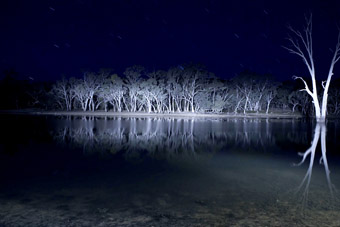
Lake Mungo, Mungo Productions, 2009
IN A CHILLING CLIMACTIC MOMENT IN LAKE MUNGO, A FEATURE FILM BY JOEL ANDERSON, AN ADOLESCENT GIRL COMES FACE TO FACE AT NIGHT WITH HER ZOMBIE-ISH SELF ON THE BED OF DRIED-OUT LAKE MUNGO IN FAR SOUTH-WESTERN NEW SOUTH WALES. LIKE OTHER EVENTS IN THIS GRIM MOCK INVESTIGATIVE DOCUMENTARY, THE ‘EVIDENCE’ IS MEDIATED BY AV TECHNOLOGY. HERE WE WITNESS NOT THE ACTUAL EVENT BUT THE GIRL’S OWN MOBILE PHONE RECORDING OF HER FATE. ELSEWHERE IN THE FILM, AMATEUR PHOTOGRAPHS AND FILMS, FAKED AND NOT, LEND CREDENCE TO THE FACTICITY OF A POSSIBLE HAUNTING OF HER FAMILY BY THE GIRL. SHE HAD DROWNED IN A LAKE NEAR THE TOWN OF ARARAT NOT LONG AFTER HER LAKE MUNGO TRAUMA.
In Josephine Starrs and Leon Cmielewski’s land(sound)scape, the same Lake Mungo is the subject of a media art installation that contemplatively conjures a largely forgotten 19th-century moment, when migrant Chinese labourers were contracted to build sheep station sheds from soon to be exhausted local cypress pine forests. The Chinese found the strange, weather-sculpted shapes of Lake Mungo’s surface oddly familiar, seeing in them the ‘Walls of China’, a naming that persists to this day.
![lake mungo, land[sound]scapes, installation, josephine starrs and leon cmielewski, 2009](https://www.realtime.org.au/wp-content/uploads/art/34/3460_gallasch_lakemungo_install2.jpg)
lake mungo, land[sound]scapes, installation, josephine starrs and leon cmielewski, 2009
Land(sound)scape is not about ghosts but the way the work resurrects the past is curiously unsettling as you sit in a former Tea House in the Chinese Garden of Friendship, Darling Harbour, Sydney. The room is largely made of timber, the names that echo through it are Chinese and we observe the land they inhabited and which evoked for them a distant home.
Sunlight is softly filtered through the room’s blue-tinted windows. On either side of the viewer are two large screens on which land(sound)scape’s gentle disorientations are generated by the contrasting movement of images. On one screen photographs of the uninhabited Lake Mungo landscape pulse slowly, and uncoventionally, right to left revealing strange figurations, buttes, small canyons, empty horizons. On the other, the orientation is aerial, a satellite point of view. We look down steeply onto the white beds of Lake Mungo, stark surrounding country and patches of green vegetation. Our internal movement feels like a slow dance in the air as we shift from the horizontal plane of the first screen to the verticality of the second.
Amid the factual if lyrical interplay of photographs, satellite images and the spoken, layered lists of immigrant and ship names and arrival dates (in Mandarin and Cantonese-inflected English) we notice something quite unexpected—the vegetation here and there spells out words and phrases that eventually form a poem. This quietly fanciful insertion generates another temporal and spatial layer—the evocation of a contemporary Chinese sensibilty nostalgic for a fading past. The artists explain: “[the immigrants] may have been homesick and wished to give the landscape a Chinese name as the formations do resemble some of the eroded outer walls in China. The text incorporated in the satellite image video, ‘I only wish to face the sea,’ is from a poem by the Chinese poet Hai Zi, 1964-1989. His poetry is about the disappearing Chinese landscape, and expresses nostalgia for the traditional countryside brought about by the large scale migration from the country to the cities.”
![satellite view, land[sound]scapes installation, josephine starrs and leon cmielewski, 2009](https://www.realtime.org.au/wp-content/uploads/art/34/3459_gallasch_lakemungo_install1.jpg)
satellite view, land[sound]scapes installation, josephine starrs and leon cmielewski, 2009
In another unsettling moment, the crackling of fire breaks through the Lake Mungo ambience, “refer[ring] to what is known as the Lake Mungo Magnetic excursion; evidence of a change in the earth’s magnetic field 30,000 years ago which has been discovered in the ancient Aboriginal fireplaces found at Lake Mungo.” The subtle perceptual shifts that land(sound)scape subject us to now vibrate with a long ago tilting of the earth’s axis while we contemplate much more recent cultural history.
Lake Mungo is a significant archaeological site of ancient Aboriginal life, dating back at least 40,000 years. In land(sound)scape that history is not central to the work but it is acknowledged, while in the film Lake Mungo it’s absent—the landscape is simply eerie, haunted by a palpable image of death to come. Either the filmmaker was ignorant of Lake Mungo’s cultural significance or chose to sidestep it. A pity, as its deep history would seem an asset for a horror film—a landscape already populated with spirits. Perhaps the issues and negotiations entailed might have been too much to handle in a whitefella ghost story.
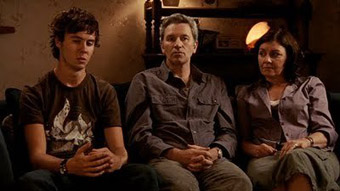
Martin Sharpe, David Pledger, Rosie Traynor, Lake Mungo
Mungo Productions, 2009
Martin Sharpe, David Pledger, Rosie Traynor, Lake Mungo
For an Australian horror film Lake Mungo is atypically restrained. Although over-extended and with just too many loose ends, its quiet, consistent pressure on the viewer to read images and attend to words closely makes us more than mere observers. We look repeatedly and forensically into photographs and videos. At the same time the film’s cinematography oscillates between its ‘documentary’ content (interviews, news and home movie footage) and sustained, immersive images of the night sky, of the time lapse turn of the stars and beautiful light patterns on the cusp between day and night. While adding to a pervasive sense of eeriness, of vast spaces and forces beyond the haunted confines of the home, these moments lend the film a measured, reflective quality supported by the consistency of the documentary tone and the realistic un-melodramatic performances (including Not Yet It’s Difficult (NYID)’s David Pledger as the father)—most apparently improvised.
But what Lake Mungo imparts is not revelatory: means are more interesting than ends. The dead girl’s remorse over her secret sex life with a couple-next-door is the underlying motive for her suicide. Sexual abuse is a harsh reality, but its pervasiveness as a too-convenient trope in theatre and film plots mostly exhausts it of any meaning beyond itself. This relieves artists from addressing complexity of character, which remains simply mysterious. Of course, that’s the appeal of much of the horror genre, a therapeutic revelling in and acceptance of the inexplicable, here embodied in Lake Mungo as a place where, simply, very strange things can happen. The 40,000 year-old remains of Mungo Man and Mungo Lady are not invoked, nor the land’s inheritors, the Barkindji, Nyiampaa and Mutthi Mutthi peoples who today manage the Mungo National Park with the NSW Government.
Joel Anderson’s Lake Mungo is located firmly in a European tradition of ghost tales—specifically ones tied to visual technologies. The opening credits comprise Edwardian-styled, sepia-tinted photographs of ghostly figures and ectoplasmic outpourings, locating the narrative immediately in the contested arena of documentation and fakery. But true to the genre in general, the otherworld is a place of fear, a limbo of guilt: the girl haunts her family into discovering the shame that killed her. The otherworld of Aboriginal Dreaming, however, is home to good spirits and bad, a place actually made explicable through inherited knowledge rooted in the land.
Doubtless, this landscape will inspire more art projects. A notable earlier one was Sydney performer Tess de Quincey’s Lake Mungo Project, Square of Infinity (1991-94) which premiered in the lake bed and was made into a film, the live solo performance entitled is (1994) and the touring production is.2 (1995). De Quincey seemed to evoke through the almost still movement of one body the expanded sense of time and space associated with this place.
While Anderson’s fascinating film uses Lake Mungo for its title and as the location for a key narrative turning-point, a meaningful connection between plot and site, culturally, thematically and cinematographically, is not made. It might be a lot to ask of a popular suspense horror film, but its intelligence, not least about ways of seeing, is so evident that it’s surprising a deeper connection with the site wasn’t made.
Of course, Starrs and Cmielewski’s land(sound)scapes has none of the constraints attached to feature filmmaking and these are works of very different scale and intent. Land(sound)scapes embraces Lake Mungo directly, allows us to take it in and reorients that perspective, visually and historically. It tells a story—of 19th-century migration, with hints of ancient time—in the broadest terms, but the narrative is found in standing between the two screens, in the turn of head and body, and landscape, and in the roll call of the long dead—not ghosts, but newly remembered and ever present.
Land(sound)scape was originally developed for the 2008 Guangzhou Triennial. In 2010 it was a Chinese New Year event presented by Sydney Harbour Foreshore Authority. Josephine Starrs and Leon Cmielewski are Sydney-based artists: http://lx.sysx.org.
land(sound)scape, Josephine Starrs & Leon Cmielewski, voices Wendy Ju, Jenny Ng, Lionel Bawden, HD video editing Greg Ferris; Chinese Garden of Friendship, Darling Harbour, Sydney, Feb 12-28
Lake Mungo was shown at the 2009 Sydney and Brisbane Film Festivals and is to be remade in the US for Paramount Vantage.
Lake Mungo, writer, director Joel Anderson, actors Talia Zucker, Rosie Traynor, David Pledger, Martin Sharpe, Steve Jodrell, cinematography John Brawley, editor Bill Murphy, music David Paterson, Fernando Corona, production designer Penny Southgate, visual effects supervisor Mathew Mackereth, sound Anne Aucote, sound designer Craig Carter; producers George Nevile, David Rapsey, executive producers Bill Coleman, Gilbert George, Robert George, 87 minutes; www.lakemungo.com
Originally published in the March 15, 2010 online edition.
RealTime issue #96 April-May 2010 pg. 25
© Keith Gallasch; for permission to reproduce apply to realtime@realtimearts.net
Curated by Dorkbot Sydney’s “Overlord” Pia van Gelder, the dorkbot-syd group show was a small, well-balanced exhibition presenting the recent experiments of Sydney’s creative tinkerers. I missed the crammed opening, instead opting for the artist talk several days later.
Reminiscent of a shrine, Samuel Bruce’s installation, Art is great to waste time before dying, was situated by the pillar in the centre of the room. The hand-constructed speaker box and cattle skull with embedded red LED flashed away, accompanied by a cloud of chaotic noise, an offering from the artist as a memento mori, a reminder that one day we all must die.
Warren Armstrong’s software application, Twitterphonicon, as the title suggests, drew on a range of Twitter tweets, identified by selected hashtags. Sonifications of phrases, created by mapping words to various general midi instruments, produced short monophonic melodies. The mapping—always a challenge when using streams of data—was far too simplistic, and I was left desiring more. However, the work became more promising during the artist’s talk when Armstrong read aloud a tweet, spoken in synchrony with the sonification. All the audience agreed: Twitterphonicon was destined for a performance poetry future.
Light Speed Sound #2, Melissa Hunt
photo Somaya Langley
Light Speed Sound #2, Melissa Hunt
Light Speed Sound #2, by Melissa Hunt was immediately accessible with little instruction. It utilised light dependent resistors hooked up directly to the motor of a toy turntable plus some circuit bending skills and assistance from Nick Wishart. Hunt has no-doubt created what numerous teenage bedroom DJs dream of at night—the ultimate air-turntable interface. Hours of fun for those who like to wave their hands in the air while manipulating sound.
Lukasz Karluk, with collaborator Gentleforce, created the most striking work of the exhibition. Partly due to its size and also to an inviting interface, tr-IO earned this accolade with its video projection of triangular patterns spanning one entire wall of the space. Constructed from three polypropylene pyramids, Reactivision symbols pasted on the bases, and complete with pulsing LED colours, no child or adult could resist picking up these objects. Reposition the pyramids on the plinth and the projected image (think Tetris crossbred with patterned doona cover design) altered colour spaces, pattern sizes and perceptions of direction and speed of movement. Hitting the nail on the head in terms of mapping, the work wasn’t so complex such that you’d wonder whether it was interactive at all. Neither was it too obvious: shifting an object just once wouldn’t entirely demystify the process.
Programmable Light Metronome is exactly what it purports to be. Composer Amanda Cole developed this system out of her need for a device that did not exist. Utilising fairy lights, an Ardiuno microcontroller and MaxMSP, the Programmable Light Metronome was essentially created to provide a visual cue for musicians who perform her compositions (which often consist of dual time signatures and resultant cross rhythms). As an artwork it appeared purely decorative; as part of a larger work it holds the potential to be more.
Niche, Tega Brain
photo Pia van Gelder
Niche, Tega Brain
Occupying the back corner, Tega Brain’s Niche effected the most engaging user interaction with a projection of imaginary plant life, allowing users to tread on it, watch it die and regenerate. The work teased out intrinsic behaviours in audience members: some stood back to watch the plants grow, others stamped their feet to kill them off as rapidly as possible. Listening to Brain speak about Niche was rewarding. Knowledgeable and technically adept, the artist expressed her wish to expand the work to incorporate rewarding various forms of audience behaviour. This work was unfortunately let down by the exhibition space. The marked floor masked the detail of the plants, while the projection shook as occupants of the venue moved about upstairs.
Having exhibited their works, I suspect the artists have lists of modifications and possible enhancements that they’d like to implement if they ever get the chance. As is frequently the case when discussing experimental electronic works suggestions for improvement are always proffered. The artist talk illustrated the fact that so often such works are proof of concept, and with access to better resources the quality and professionalism of the works would increase a thousand fold.
The risk in developing these kinds of experimental electronic works is that the creative focus becomes the making of the tool. As I walked away from the exhibition space, I was accompanied by the question, “When is the moment the instrument slips away and the art emerges”?
Dorkbot-Syd Group Show: People doing strange things with electricity, curator Pia van Gelder, artists Warren Armstrong, Tega Brain, Samuel Bruce, Amanda Cole, Melissa Hunt, Lukasz Karluk + Gentleforce and Gavin Smith. Serial Space, Sydney, Feb 10-13, http://dorkbotsyd.boztek.net/
RealTime issue #95 Feb-March 2010 pg.
© Somaya Langley; for permission to reproduce apply to realtime@realtimearts.net
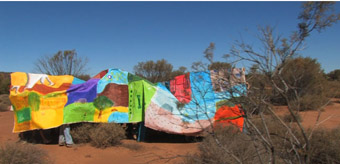
Alex Kershaw, You Are Here: Place
courtesy the artist and Performance Space
Alex Kershaw, You Are Here: Place
in place, inner place
A RealTime-Performance Space Forum, In Place, Inner Place, will address the subject of place in an engrossing, informal discussion, drawing on but going beyond the works in Performance Space’s You Are Here: Place program. The forum will discuss shifting notions of place in urban development, digital media and imaginal psychology.
The forum will be an ‘in the round’ open conversation facilitated by Tony MacGregor [Head of Arts, Radio National]. Artists from You Are Here: Place [Alex Kershaw, Nigel Helyer, Martin del Amo, Gail Priest and Rosie Dennis] will be joined by Zanny Begg [co-curator, There Goes the Neighbourhood, an exhibition and book about Redfern; Performance Space, 2009] and Julie-Anne Long [a dancer-choreographer investigating the relationship between the city and its dance culture].
Our special guest is Peter Bishop who writes and teaches about media, transportation and new meanings of ‘place’; the western relationship to Tibet; western Buddhism; orientalism & postcolonialism; Depth Psychology and post-Jungian studies; reconciliation; and utopian imagining and hope. Peter is Associate Professor in Communication & Cultural Studies at the University of South Australia. His excellent book, Bridge, about the functions and meanings of bridges around the world was published by Reaktion Books in 2009.
All welcome to participate or listen in. Wine and snacks provided. Please RSVP to georgiem@performancespace.com.au
RealTime-Performance Space Open Forum, Performance Space Clubhouse, CarriageWorks, Sydney, TRACK 12, Wednesday 3 March, 6.30pm; FREE.
RealTime issue #95 Feb-March 2010 pg.
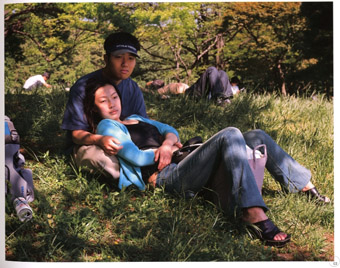
From the series Picnic, 2004, Masato Seto
courtesy the artist and the Japan Foundation
From the series Picnic, 2004, Masato Seto
Gazing at the Contemporary World, at the Japan Foundation Gallery, Sydney, is the sort of exhibition you would expect to see at the Art Gallery of New South Wales. Praise must go to the Japan Foundation for bringing it to Australia. I cannot think of another survey exhibition of Japanese contemporary photography shown here in recent years. Unfortunately it’s on display for only two weeks, for there is much to learn from it.
The exhibition, curated by Rei Masuda, Curator National Museum of Modern Art, Tokyo, is divided into two sections, one titled A Changing Society and the other Changing Landscapes. It contains 76 photographs from 23 photographers, some well known, many not. David Freeman, the Japan Foundation’s Coordinator for Arts & Culture, says the exhibition is attracting audiences because of the subject matter as opposed to the reputation of the artists.
On first impression the works appear quiet and understated. The photographers, whose approaches are quite diverse, seem to be whispering rather than shouting. They ask for a steadiness of gaze and an attentive mind.
To outsiders, Japan has always been tinged with exotic difference. But Gazing at the Contemporary World could not be further from exotic. Instead, it focuses on the mundane in everyday life. The infamous Japanese photographer of the erotic, Nobuyoshi Araki has asked, “Why photograph the totally ordinary everyday stuff when nothing is actually happening out there?” But in Gazing at the Contemporary World, what could be more mundane than to document the outside and inside of refrigerators? In his series Ice Box (1988), Tokuko Ushioda presents two pairs of photographs of refrigerators, which provoke contemplation about their very different owners’ lives.
Documentary forms predominate. To an Australian viewer, however, there is a poetic, perhaps spiritual, overlay that is not common in western photography. In his photograph Tokyo, from the series Nihon Mura (‘Japan Village’, 1979), Shuji Yamada portrays the city as a dark moonscape with a topsy-turvy skyline broken up by peremptory, jagged high-rise buildings. The only sign of light is that reflected by the roofs of buildings.
There is a distinct air of sadness and a sense of distance from the world pervading the images in Gazing at the Contemporary World. Perhaps it is the observational gaze Rei Masuda refers to in the exhibition title. Likewise, in some portraits by Hiroh Kikai, from the series Persona, the characters portrayed appear strangely unhappy in their presentation to the camera.
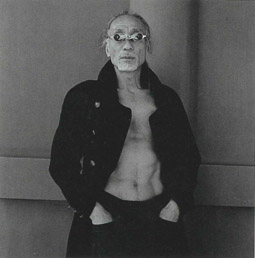
A performer of Butoh dance from the series Persona, Hiroh Kikai 2001
courtesy the artist and the Japan Foundation
A performer of Butoh dance from the series Persona, Hiroh Kikai 2001
The landscape is depicted as scarred and (mostly) devoid of human presence, sometimes due to industrial ‘advancement’: for instance, in Toshio Shibata’s two images from the series Quintessence of Japan (1989) and Norio Kobayashi’s poignant image of a large dead dog, revealed in the landscape after snow has melted, from Suburbs of Tokyo (1984). The ambitions of failed human endeavour are documented in the construction of high-rise buildings and bridges, particularly in Toshimi Kamiya’s unfinished bridge going nowhere, from the series Mirabilitas Tokyo (1987), and in Hitoshi Tsukiji’s impressions of looming concrete structures overwhelming any human scale in Urban Perspectives (1987–89).
Two series provide drama and emotional release. Masato Seto’s richly coloured Picnic (2004), portrays couples seated and lying in parks with an intimacy of contact not found in other images. Ryuji Miyamoto’s extraordinary photographs of Kobe after the Earthquake (1995) have vivid impact in their depiction of buildings and whole streets collapsed from the force of the disaster. These images speak metaphorically, in a way others do not, of the enormity of change Japan has been subjected to in recent times.
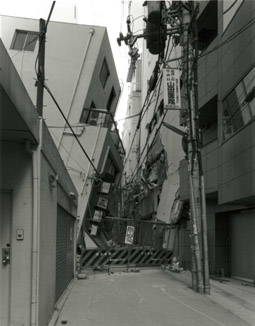
Sannomiya, Chuo-ku, from the series Kobe 1995 After the Earthquake, Ryuji Miyamoto
courtesy the artist and the Japan Foundation
Sannomiya, Chuo-ku, from the series Kobe 1995 After the Earthquake, Ryuji Miyamoto
In his essay, curator Rei Masuda details the important events in the history of photography in Japan at the end of the 1960s and beginning of the 1970s that brought about the rise of ‘konpora’ (which translates roughly as ‘contemporary’) photography. Gazing at the Contemporary World sheds light on the many trends in and influences on Australian photography over the same period. These comparable yet culturally very different histories could benefit from greater examination.
Gazing at the Contemporary World: Japanese Photography From the 1970s to the Present, Japan Foundation Gallery, Sydney Feb 22-March 5 2010
RealTime issue #95 Feb-March 2010 pg.
© Sandy Edwards; for permission to reproduce apply to realtime@realtimearts.net
Jumper, leggings, hat and gloves no.19 a/w 2008-2009, Walter Van Beirendonck, The Endless Garment
HAVING SHAPED SUCH NOTABLE GRADUATES AS TONI MATICEVSKI, RMIT UNIVERSITY HAS CEMENTED A STELLAR REPUTATION IN DESIGN, PARTICULARLY IN FASHION AND TEXTILES. THE ENDLESS GARMENT EXHIBITION APPEARS UNDER THE PATRONAGE OF THE L’ORÉAL MELBOURNE FASHION FESTIVAL, WHERE THE SHOW CELEBRATES NEW TECHNOLOGY AND THE ORIGINALITY OF DESIGNS. BY TAKING CUTTING-EDGE DESIGNER KNITWEAR OFF THE INTERNATIONAL RUNWAYS AND PLACING IT IN A GALLERY CONTEXT, READY-TO-WEAR APPROACHES SOMETHING AKIN TO HIGH ART.
Items have been sourced from 10 internationally renowned designers and contemporary artists who have employed revolutionary knitting machine technology to delve into new design options. The resulting exhibition is a wonderfully mottled mix tape with moods ranging from the pop-tastic styling of Walter Van Bierendonck, to the gothic and ethereal creations of Nikki Gabriel.
Knitting has come a long way since ‘granny chic’—the young urban movement that popularised handicrafts—usurped the yarn and needles from the Country Women’s Association. Mothball-scented crocheted blankets and doilies of old soon gave way to guerrilla knitters who began to graffiti public items and monuments with knitted street art some five years ago. In the last decade or so, advances in production technology have at once broadened the aesthetic scope for design and taken the artistry of knitting from rocking chair to factory. Curated by Robyn Healy and Ricarda Bigolin, both of RMIT’s Fashion School, the heroes among the high-end designer clothing of this exhibition are the machines that have reinvigorated knitwear design. In the words of the curators, “the exhibition studies the endless design possibilities offered by the new craft of machine knitting to progress design practices from efficiencies of production, fabrication details of surface and texture, to economy of materials.”
Casablanca, lily a/w 2005, Yoshiki Hishinuma, The Endless Garment
The machine process most defiantly steers knitting-craft away from outdated preconceptions. The WholeGarment® machine technology, pioneered by Japanese knitwear machine company Shima Seiki in 1995, has been utilised in the construction of many of the pieces in this exhibition. As its name suggests, the machine knits complete pieces, eliminating the time-consuming and laborious cut and sew process of garment construction. Designers use CAD (Computer Aided Design) to create a garment pattern, which is then saved and transferred to a knitting machine. Picture a sweater as three tubes: the torso, left and right sleeve—these are knitted simultaneously using three carrier yarns with back and front needle beds to create the tube shape. When knitting reaches the underarm seam the tubes are simply connected. Like some implausible machine from Willy Wonka’s factory, the garment emerges whole. A video projection by Antuong Nguyen demonstrates one of the machines at work. Watching the needles looping and bobbing elegantly is strangely enthralling—machinery in the perfect sync of a dance symphony. In a project for her PhD, co-curator Ricarda Brigolin provides an example of the technology with three jumpers knitted as a single connected piece, much like a magician’s handkerchief.
Displayed in a gallery, the pieces take on new life. On runway models at least, lavishly unwearable haute couture is tempered down and humanised. Of the 10 designers showcased, none have that catwalk caw more than Swedish knitwear designer Sandra Bucklund. An immense rippled black jacket is possibly as far from a Paton’s catalogue as you can get. Though like others in the exhibition, Bucklund is new to knitwear production having constructed her prior collections by hand on a made-to-measure basis. Her work distorts the natural silhouette of the body with origami folds and organic textures; her woollen garments here are stately, fit for Queen Armidala. It’s not surprising to see sci-fi get a nod. Recently the Japanese Aerospace Exploration Agency (JAXA) adopted WholeGarment® clothing as daywear for astronauts onboard its spacecraft.
Despite the technology, many of the designs look deceptively handmade. Nikki Gabriel, the other Australian representative in the exhibition and a studio textiles graduate of RMIT, has earned her chops designing for Akira Isogawa and Aurelio Costarello. Her work is intricately dark, almost as though it is spun by hand from a fine silk cobweb.

The Perfect Body, 2007, Freddie Robbins, machine knitted wool, 1920 x 1640 mm, produced through support from the Arts and Humanities Research Council (AHRC) and the Royal College of Art Research Development Fund
photo Douglas Atfield
The Perfect Body, 2007, Freddie Robbins, machine knitted wool, 1920 x 1640 mm, produced through support from the Arts and Humanities Research Council (AHRC) and the Royal College of Art Research Development Fund
Among big name fashion and knitwear designers is a British contemporary artist who uses knitting to explore ideas of domesticity, gender roles and the human condition. Freddie Robin’s life-sized simplified humans with nondescript faces peer from the sexless shadows of their knitted bodies. With titles like The Perfect Body, they explore ideas of standardisation and perfection made possible with what can be called the cold, computer aided technology of the knitting machine.
Across the room is Walter Van Beirendonck, an hirsute Belgian who has designed outfits for U2’s Popmart tour, t-shirts for Australian band The Avalanches, not to mention scores of costumes for theatre, ballet and film. His previous seasons of commercial street wear have a kooky graphic sensibility (his own distinctively bearded image often features while other t-shirts are emblazoned with statements like SEX CLOWN). His knitwear for men bears traces of the chunky brightness of his love for pop music which he has sampled with left of field ethnic and nomad references. Meanwhile, the trio behind rising London label Sibling give men’s knitwear a progressive tweak with gender challenging twists: twinsets are covered in bright leopard spot sequins, ‘Crosby’ cardies are adorned with pink glittering rats and their Breton sweater has a skull cleverly woven into the famous French horizontal lines.
Although the method of production is the unifying element between the ten very different artists, the machine process is often used in a way that hides evidence of itself. Displays detailing the technology unobtrusively inform the viewer of the process that allows for such extraordinary singularity and potential in the hands of designers and artists. Yoshiki Hishinuma’s garments often straddle distinctions between contemporary art, construction experiment and fashion. His Casablanca, lily a/w 2005, a peculiar green-tinged shawl most closely resembles a rare orchid from a Florida swamp or an art installation.
Issey Miyake’s A-POC project (t-shirts rolled out of a fabric baguette—that’s all I will say) must be seen to be believed, while fresh designs by Mark Fast, Cooperative Design and Italian designer, Saveiro Palatella complete the show.
The Endless Garment: The New Craft of Machine Knitting, curators Robyn Healy, Ricarda Bigolin, designers and artists Issey Miyake, Sandra Backlund, Walter Van Beirendonck, Cooperative Designs, Mark Fast, Nikki Gabriel, Yoshiki Hishinuma, Saverio Palatella, Freddie Robins, Sibling; RMIT Gallery, Melbourne, Feb 12-March 21
Orginially published in the March 1, 2010 online edition
RealTime issue #96 April-May 2010 pg. 46
© Varia Karipoff; for permission to reproduce apply to realtime@realtimearts.net
Urban Stories/Nanling-Guangzhou (still) 2005, Sylvie Blocher
courtesy the artist and Nosbaum & Reding Art Contemporain, Luxembourg © the artist
Urban Stories/Nanling-Guangzhou (still) 2005, Sylvie Blocher
RRIGHT NOW THE EPICENTRE OF THE SLOW ART MOVEMENT MIGHT JUST BE HOVERING OVER THE MCA. ON LEVEL THREE OLAFUR ELIASSON ASKS US TO TAKE (YOUR) TIME AND UP ON THE FOURTH FLOOR, WHERE WE GATHER FOR A MEDIA BRIEFING, FRENCH VIDEO ARTIST SYLVIE BLOCHER PASSIONATELY EXTOLS THE VIRTUES OF PAYING ATTENTION TO THE SUBJECTS OF HER VIDEO PORTRAITS; THE ENCOUNTER WITH ANOTHER IS A PLACE TO GIVE PAUSE.
The value of investing time to listen and watch is something Blocher knows well. In this exhibition, we see the results of many years of work on her “living pictures”, a series of individual video portrait projects each designed around a different kind of encounter. As a rule, she does not choose her subjects but either advertises or asks the gallery commissioning her to make the choice. Some subjects require a lot of time—seven hours in the case of one of her recruits for Ecstasy in which she invited 15 Indian men to enter a range of ecstatic states. In this case she did choose her subjects (though randomly, often in the street) as she was told that if she advertised she’d be swamped. As for how she elucidated the transcendent states on display, Blocher remains cryptic: “I created a space of freedom, without moral constraints, where everything was possible and experimental. It was long and difficult…”
Taking in the eight rooms that comprise the exhibition, you’re acutely aware of the artist’s ‘presence.’ Not that you see her, or hear the questions she calls her “tools that touch people” or her responses to the subjects’ answers. Instead you deduce what might be happening between the two in this other time-frame from what unfolds before you on the screen and in the eyes of the subjects that intriguingly suggest another space beyond it.
The images are projected at large scale as single or two-channel installations, the latter with little, if any, separation between the screens. In each case the relationship between the bodies on screen is slightly different. In the series entitled What is Missing? (2010) the subject (mostly in head and shoulders) speaks to us directly. As each speaks, a second embodiment of the same person appears as if silently watching or simply listening to the speaking self. Time and place are absent. There are dissolves to close-up, slight changes of angle—nothing tricky to interrupt the train of thought. The people are of varying ages and types and appear before a unifying backdrop (the American flag or wallpaper patterns of filigree or camouflage). Notably, all appear comfortable, even emboldened, before the camera. At the conclusion of each statement, the subject gazes silently outwards.
Living Pictures / Je et Nous (I and We)
© Sylvie Blocher
Living Pictures / Je et Nous (I and We)
Living Pictures / Je et Nous (I and We) “Imagine someone on the other side of the camera whom you will address in silence through your gaze,” Blocher told her subjects in I and We (2003, 55mins). One hundred residents from Beaudottes, one of the poorest towns in France were also asked to “write a sentence on solitude or beauty, topics we usually keep silent about and have the courage to be in front of the camera wearing a T-shirt with the sentence printed on it.” The result is a telling new take on the passing parade.
Among Blocher’s other collections are 10 self-made millionaires from Silicon Valley (Men in Gold, 2007, 36mins). These men, hand-picked by MOMA in San Francisco, are afforded more time and, again, Blocher’s technique allows us to see something else beyond their guarded revelations.
Living Pictures/What is Missing? (still) 2010, commissioned by Museum of Contempory Art, for C3West, Sylvie Blocher
image courtesy MCA and © the artist
Living Pictures/What is Missing? (still) 2010, commissioned by Museum of Contempory Art, for C3West, Sylvie Blocher
What Belongs to Them (2003, 36mins) features residents of New Orleans who signed up if they had something to say about slavery—economic and racial as well as psychological slavery. An African American man tells us about shooting a deer: waiting to identify its sex, aiming, how his bullet hit, how the animal fell. After he speaks, he is consumed by the pleasures of the hunt, of his prowess. As he tells us that the head of the buck now hangs on the wall of his garage, he is silent and looks out beyond the camera and we catch what might be regret or ambivalence or simply reflection on what he has just let slip to us and himself. The same uncertainty crosses the face of the millionaire as he wonders if his name engraved on a building or any trace of the possessions he has gathered will endure. “I hope so,” he says. “I hope the world is still here.”
In another room (Wo/Men in Uniform, 2007, 46mins), we meet members of the police force in Regina, the city with the highest crime rate in Canada. This time we see full bodies as well as close-ups.
“I work with the extreme complexity of bodies and my tools are not those used in journalism,” says Blocher. “My work consists of bringing to light an invisibility hidden behind social constructions and learnt conventions.” Here, as we might expect, the fixed faces leak fear: a rookie taking possession of her first revolver admits she practiced for a while in front of a mirror.
Perhaps most fascinating for the Australian audience is the material Blocher has gathered from a project in Penrith titled What Is Missing? (2010). “In the last four years, the MCA and Penrith Regional Gallery and the Lewers Bequest have worked closely with Blocher on C3 West: an innovative collaboration between artists, cultural institutions and businesses in Western Sydney” (MCA Media Release).
Here, Blocher says, “I began with the idea of what’s missing, which allowed me to use the popular form of a short video to highlight the internal conflicts between Penrith and the Panthers—the football club which since 1919 have shared their revenues with the community to help with health, education and culture but whose utopia is made shaky by the pressures to privatise their profits…I proposed to the Panthers that I bring their utopia up to date.”
The range of people who appear before the camera are as surprising as their revelations. Like the subjects of Andrew Urban’s gem of a TV series, Front Up (1995-2004), given time and patience, the taciturn Australian will express an eloquent depth of feeling.
An Aboriginal man tells the tragic story of his own and his brother’s forced removal and separation from their family. Contracting meningitis that led to his losing both sight and voice, the brother was permanently institutionalised. Now 50 years later the institution is to be sold for profit and the brother abandoned.
A teenager appearing in a t-shirt that reads “G F ck Y rs lf. Would you like to buy a vowel?” tentatively posits neo-Nazism as a way to deal with the growing populations of people who “should live like us,” while admitting, “Hatred is turning me into someone I don’t want to be.”
A middle-aged man makes a personal apology to Joern Utzon for the country’s lack of vision. A young girl has difficulty pronouncing “feminism” but gains strength as she declares, “What’s missing in Australia is a form of peace.” A Mexican immigrant would like to fight the absence of spirituality here by “learning how to speak to birds.”
Another fresh-faced boy is fearful of divisions in the community. Like many other interviewees in this series, to him the future appears bleak. He reports that fights will break out for no reason. “We are separating into groups that can’t communicate with each other, can’t even act with courtesy.” The only feelings he regrets are sadness and depression. “Tears are not necessary,” he says before quoting from A Midsummer Night’s Dream: “… For you in my respect are all the world: / Then how can it be said I am alone, / When all the world is here to look on me?”
In Urban Stories (2005, 9mins and 46mins) in a small room, we come a little closer to what might be Sylvie Blocher’s process in selectively capturing her shifting reflections on the self. On a visit to the Nanling Guangzhou Triennale, the artist meets a village woman in the street who had never seen a foreigner. “She started to talk to me, to touch my clothes and my hair. I asked her if I could film her. The next day I placed a camera in front of the studio’s sofa and let the woman use my body as a kind of tool…The woman touched me like a child, like a sister, like a lover, like a mother. It was like a rite of alterity. I stopped her after nine minutes. I couldn’t take any more.”
Sylvie Blocher distils the intensity of such encounters into absorbing private made public visions that richly reward the time and attention the viewer invests in looking and listening to retrieve all that is missing.
Sylvie Blocher: What is Missing, MCA, Sydney, Feb 17-April 26.
The exhibition is presented concurrently at Penrith Regional Gallery & Lewers Bequest, where it features work for the City of Penrith by Campement Urbain, a Paris-based collective headed by Blocher and architect/urban planner Francois Daune. The exhibition at Penrith Regional Gallery runs February 13-April 4.
Originally published in the March 1, 2010 online edition.
RealTime issue #96 April-May 2010 pg. 43-45
© Virginia Baxter; for permission to reproduce apply to realtime@realtimearts.net