Australian
and international
exploratory
performance and
media arts
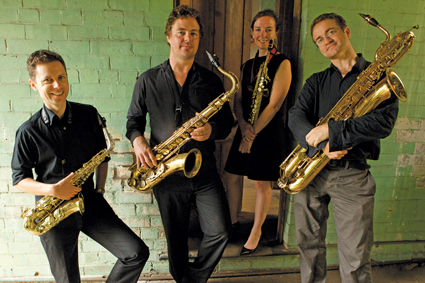
ames Nightingale, Martin Kay, Christina Leonard, Jarrod Whitbourne
photo courtesy New Music Network
ames Nightingale, Martin Kay, Christina Leonard, Jarrod Whitbourne
TWO RECENT CONCERTS IN SYDNEY WERE ILLUSTRATIVE OF THE GROWING RICHES TO BE ENJOYED IN THE CITY’S NEW MUSIC SCENE, FEATURING UNUSUAL INSTRUMENTAL EXPLORATIONS AND A MULTITUDE OF WORKS BY AUSTRALIAN COMPOSERS FROM THE EARLY 80S TO THE PRESENT AND EMBRACING POETRY, MYTH, PHILOSOPHY AND THE AUSTRALIAN LANDSCAPE.
continuum sax & match percussion
Gyorgy Ligeti’s Six Bagatelles (1923-2006) for saxophone quartet is a miracle of invention, revealing the rich, fluent capacities of the instrument in chorus and the virtuosity of the Continuum Sax ensemble. From sublime gallops and Eastern European folk dance riffs to serene high flights over deep burbling waters that recall Ravel to a final cartoony brass band chase, Six Bagatelles (originally from a piano work, then adapted for wind quartet) is driven with rapid, supple gear changes in volume, timbre and mood that make for exhilarating listening.
Margery Smith says in her program note that her Lost Blues for saxophone quartet and percussion duo (2010) was inspired by “the very dirty, cranky blues music of Tom Waits.” You can hear it, particularly in the unusual instrumental and rhythmic juxtapositions—sax, drums, marimba—more experimental than Waits and erupting in one passage into a gliding and warbling eccentric big band sound, followed by a moment of loud high passion and then a brisk resolve.
Mary Finsterer, composer of IONIA for saxophone quartet and percussion (2010), writes that the work is inspired by the sixth century Ionian school of philosophy—“Everything flows, nothing stands still” and a passion for bringing opposites into balance. Of the composition’s structure, Finsterer mentions in particular “small permutating cycles of clearly identifiable material repeating within larger cycles.” These are contrastingly realised across emphatic changes of mood and pace: a lyrical solo saxophone opening passage, a sudden tom-tom-triggered dance, deep staccato saxophones against pulsing marimbas and a sustained episode that builds cumulatively into something curiously like Lully gone wild. On first listening, IONIA suggests a work worth return visits.
Chun Ting Pang’s In Different Spaces for percussion duo (2010) juxtaposes marimba, tom-toms, suspended cymbal and woodblocks in a beautifully textured, evocative exploration of the five elements in Chinese philosophy including “condensation of water on a metal plate” and “wind which helps spread the fire in wood.” The work is highly articulated, sometimes demandingly fast but frequently ethereal. Matthew Hindson’s Song of Life (2007) for solo violin is a short tribute to Father Arthur Bridge, a significant contributor to the commissioning of new works. Natsuko Yoshimoto’s playing was at once precise and passionate for a work that variously evoked 19th century melodiousness, folk music evident in glissandi and brusque stroking, and 20th century angularity, but which resolved into satisfying unsentimental unity.
Brian Howard’s Last Blues for solo violin, saxophone quartet and percussion duo (2008) is a formidable, bracing and beautiful work, and one difficult to do justice to from a first hearing. Conductor Roland Peelman writes in his program note, “From the faintest violin harmonic to the grittiest saxophone texture, Last Blues unfolds not as a sultry dance or as a sad and sentimental song, but as a force of nature where all elements inextricably lead to one single purpose.” The combination of saxophone, violin and percussion is an unusual one (Howard quipped in a pre-performance interview, “sometimes it’s easier to get a weird piece performed”) but very effective, yielding a delicious otherness most felt in the work’s three time-stilling ‘cadenzas.’ If the blues are to be felt anywhere amidst the growl of saxophones, the bowing of vibraphones, the nervous, rapid rattle of percussion and the sudden emotional surges by the ensemble en masse, it is in the violin part, again, exquisitely realised by Natsuko Yoshimoto. Indeed Lost Blues stays with you like the recollection of a concerto, the instrument’s range is widely exploited, and when it sings and the tenor saxophone then soars with it and beyond, the work’s sense of interiority, of aloneness, but also of fragile togetherness is most felt.
halcyon: where the heart is
While not a program of the scale and potency of Extreme Nature (RT93) which featured big, challenging works by Australians Elliott Gyger and Nicolas Vines, Halcyon’s Where The Heart Is, is a program featuring six more Australian works, all fascinating and revealing a rich variety of practice.
Ross Edwards’ Maninya (1981), inspired by the natural environment, comprises hypnotic if rhythmically complex series of apparently meaningless syllables sung by Jenny Duck Chong to Geoffrey Gartner’s talkative cello in passages that evoke lullaby and reverie and closing with a cello jig.
Elliott Gyger’s Petit Testament, like From the Hungry Waiting Country (2006 and soon to be released on CD) in the Extreme Nature program, responds to Australian poetry, here in the form of the last of the Ern Malley hoax poems. Once again Gyger provides Duck Chong and Alison Morgan the opportunity to “highlight one of our particular skills—the illusion of singing ‘as one’ and masquerading as one another” (program note). As Gyger writes, “My setting re-enacts James McAuley’s and Harold Stewart’s dazzling feat of ventriloquism (two real poets masquerading as one fictional poet) in employing two voices to project a single musical lie, slipping unpredictably between unison, heterophony and interior dialogue.” The sopranos dexterously managed the overlaps, sharply articulated modulations and shared sentences while the Stuart & Sons piano (played admirably by Sally Whitwell) provided a resonant other voice, alternately dramatic and ironic, lyrical or ‘going to pieces.’ Gyger aptly evokes both fraudulent excess and the odd beauty of the poem.
One of two highlights of the concert was Andrew Schultz’s To the Evening Star (2009; Best Song Cycle, Paul Lowin Awards), a reflection, writes the composer, on the inner creative life, responding to poems by Yeats, Hopkins, Longfellow, WH Davis and Blake. Yeats dreams lyrically of rural escape while the busy piano suggests both the “bee-loud glade” and “the roadway…the pavements gray.” For Hopkins’ Pied Beauty, Schultz and singer, Alison Morgan, hit the syllables hard and rapidly, evoking excitement at the density of natural riches. Longfellow’s anxiety about a creative life only half fulfilled is rendered emotionally, a soaring complaint, the piano thundering in empathy, while Davies’ Money, O! contrastively celebrates being poor but happy in a vigorous folksy, music theatre idiom. Finally, Blake’s To the Evening Star is a gloriously sung prayer for divine protection framed by piano scoring that seems to embrace the whole of the world, the playing constantly pushing out to the bottom and top-most notes simultaneously until at rest.
Ann Boyd’s Cycle of Love (1981) is in the form of three sung ancient Korean poems and two instrumental interludes (Gartner’s cello and Sally Walker’s flute in exquisite dialogue). For all the meditative Korean and Japanese influences, the compositions are lively, even dramatic and certainly heartfelt in their longing.
The final work, folk singer and musicologist Ruth Lee Martin’s Wimmera Song Cycle (2010), a setting of Kevin Hart’s Wimmera Songs, surprised me with its transparent structure, its deceptively musical theatre character and ease (apt for the uncomplicated syntax of the poet’s finely crafted image-making). Sopranos, cellist, pianist and flautist combined in various permutations to evoke the spread and detail of the land, through moments of delicate observation, pain (“the other silence that fits your head inside a vice”) and the potential for transcendence—“Think like a cloud / Go where the clouds go.”
New Music Network: Continuum Sax and Match Percussion, violin Natsuko Yoshimoto, conductor Roland Peelman, percussion Alison Pratt, Daryl Pratt, soprano saxophone Christina Leonard, alto saxophone James Nightingale, tenor saxophone Martin Kay, baritone saxophone Jarrod Whitbourne; Eugene Goossens Hall, ABC Centre, Sydney, Aug 24; Halcyon, Where the Heart Is…celebrating homegrown music, CarriageWorks, Sydney, Sept 13
RealTime issue #99 Oct-Nov 2010 pg. 49
© Keith Gallasch; for permission to reproduce apply to realtime@realtimearts.net
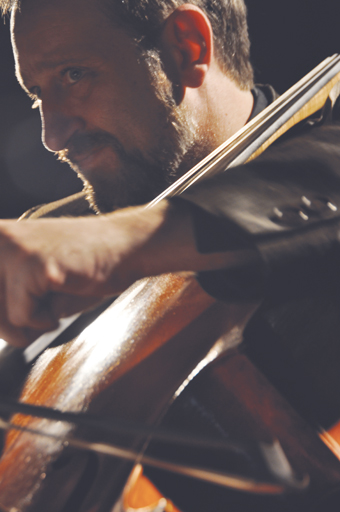
John Addison, Soundstream 2010
photo Cindy Taylor
John Addison, Soundstream 2010
THERE HAVE BEEN INNUMERABLE DEVELOPMENTS AND DEFINING MOMENTS IN THE EVOLUTION OF COMPOSITION AND PERFORMANCE THROUGH THE 20TH AND INTO THE 21ST CENTURIES. SOUNDSTREAM NEW MUSIC FESTIVALS SHOWCASE RARE AND SIGNIFICANT CONTEMPORARY CHAMBER WORKS FROM THIS ERA, AND THE FOUR CONCERTS OF THE MUCH ANTICIPATED 2010 FESTIVAL PRESENTED SOME RADICAL AND DEMANDING WORK, OFTEN ENLIGHTENING, SOMETIMES INTENSE AND SOMETIMES LIGHT-HEARTED. IN MANY, THE EMPHASIS WAS ON TIMBRE AND HARMONICS, TEACHING US TO FORGET TIME AND FOCUS ON THE SOUND IN THE MOMENT—TO REALLY EXPERIENCE MUSIC.
the visionaries
The first concert, The Visionaries, opened with distinguished Russian composer Rodion Shchedrin’s Hommage à Chopin (1983) for four pianos, played superbly by Anna Goldsworthy, Jonathon Heng, Deborah Ng and Gabriella Smart. The inclusion of this work celebrated the 200th anniversary of Chopin’s birth and acted as a gateway to the festival. Proceeding from fragments of Chopin’s introspective Prelude in C minor No. 28 Op.20, this is a thickly layered and extroverted work of multi-voiced variations on Chopin themes that blends the romantic with the modernist sublime and group pianism with solo virtuosity.
This diverse concert included Adelaide composer Andrew Wiering’s Vortex (2006) for six percussionists, a powerful orchestration of percussive forces ably led by Wiering on timpani; Sydney-based Katia Tiutiunnik’s To the Enemy (2005), a striking setting of a contemporary poem by Eva Salzman for soprano (Sidonie Henbest) and two percussionists (Wiering and Nick Parnell); and Smart’s seductive performance of the third movement of Canadian composer Howard Bashaw’s structurally complex Minimalisms II (2005).
Pianists joined percussionists for The Visionaries concert centrepiece, the 1953 revision of George Antheil’s Ballet Mécanique. The logistically challenging 1924 original was intended to accompany a Dadaist film and was scored for 16 player pianos, sirens, aeroplane propellers, electric bells and extensive percussion as well as conventional pianos. This version, for just four pianists (Smart, Goldsworthy, Ng and Heng) and six percussionists (the Vortex Ensemble), with the siren and propeller sounds rendered through a sampler (John Addison), shifts the focus from visual or electromechanical spectacle to the musicality of the composition. With its multiple competing lines of sound, forceful rhythms and dynamics and urgent pace, Antheil’s high-energy work dramatically evokes modern industrial society. Under the direction of Roland Peelman, this performance electrified the eager audience.
ensemble offspring: the spectralists
On Friday, Ensemble Offspring gave us The Spectralists, a concert on the theme of Spectralist composition in which the analysis of the timbral or harmonic spectrum of a sound is used as the basis for composition or musical language. Spectral composition gained prominence in the 1970s especially through Gérard Grisey and Tristan Murail, and the concert opened with Murail’s Thirteen Colours of the Setting Sun (1978), a classic of the genre. Scored here for flute, clarinet, piano, violin and cello, it explores the harmonics surrounding a single high-pitched note and takes the emerging tones in new directions. With reduced rhythmic emphasis, the result is cosmically dreamy, nakedly revealing the timbral character of the instruments. By contrast, Gérard Grisey’s absorbing Talea (1986) alternates loud attack with quiet passages in swirling patterns that evolve as they are repeated.
This concert also premiered Australian violinist James Cuddeford’s enchanting KOAN I (2010), in two movements for flute, clarinet, violin and cello, a musical representation of an insoluble riddle, seeking philosophical resolution musically and ending questioningly. Also revealing the influence of Eastern philosophy were works by Giacinto Scelsi and Claude Vivier. Scelsi’s exquisite Ko-Lho (1966) for flute and clarinet is a meditative exploration of the sonic blend that emerges from the two instruments as they dwell on one pitch. Sounding at times like a single instrument, they produce densely woven microtones and overtones, requiring virtuosic playing to generate the required colouring. Similarly, Vivier’s Pièce pour Violon et Clarinette (1975) involves a simple melodic line played by both instruments and repeated with digressions to create a distinctive timbral compound. Finnish composer Kaija Saariaho extends these ideas in her Cendres (“ashes”; 1998), which blends the contrasting characteristics of the flute, cello and piano into a complex sonic tableau. The appeal of such work lies in the blend of melodic linearity and harmonic density, and you listen to each sound as an evolving entity. Ensemble Offspring was outstanding, combining sustained control of tone colour with excellent ensemble playing, and this knockout concert was an education in the genre.
brian ritchie trio: the rebels
In the Brian Ritchie Trio’s early Saturday night concert, The Rebels—former Violent Femmes bassist and shakuhachi master Ritchie, pianist Tom Vincent and bassist Leigh Barker—gave us their hybrid musical form that draws on the ethereal, meditative grace of the shakuhachi and the syncopated rhythms of jazz. The highlights were a new rendition of John Cage’s Ryoanji and scintillating re-workings of pieces by John Coltrane and Free Jazz saxophonist Albert Ayler. The result was hypnotic, balanced towards one or other musical tradition to suit the work.
john addison, the larrikins
Late Saturday night, John Addison presented The Larrikins, a technically demanding concert for solo cello, opening with Sydney composer Alex Pozniak’s Mercurial (2009), a gestural work of huge dynamics and writhing, neck-length glissandi that requires both tactility and theatrical athleticism of the performer. Addison, a star of last year’s Soundstream Festival, collaborates with composers, and a workshop he gave generated Pozniak’s work as well as Luke Altmann’s Somniloquy (2010), which brilliantly evokes the troubled sleepwalker, and Kat McGuffie’s wryly engaging The Tune is Out There (2010). The latter begins with a parody of the opening of Strauss’s Thus Spake Zarathustra, segues into fragments of Fly Me to the Moon, the Jaws theme, Dvorak’s 9th Symphony and Stairway to Heaven, and ends with a Deep Purple riff with the cello held horizontally and strummed. In an ABC radio interview, Addison suggested that so-called extended playing techniques “are just techniques.” Composers now draw on a broader range of these, so it’s actually composition that’s being extended. An eloquent and captivating performer, his approach is refreshing the cello aesthetic.
Addison continued with New York composer Toby Twining’s slow, mournful 9/11 Blues (2001), whose shrill harmonics suggest electric guitar feedback, and Brisbane-based Stephen Stanfield’s emotional and introverted A Lenient Me (2010). He concluded with a gem, Tatata (1998), for tape and cello by Dutch composer Jacob ter Veldhuis (aka Jacob TV), which includes the morphed recording of an old soldier singing “ta ta ta” rhythmically repeated over the cello line, and ending with the voice of Apollinaire sampled from an old phono disc.
Soundstream Festivals greatly support local composition and Gabriella Smart’s informed artistic direction is expanding our musical awareness. The ABC’s comprehensive coverage of these vital festivals is a welcome development.
Soundstream Adelaide New Music Festival 2010: Anna Goldsworthy, Jonathon Heng, Deborah Ng, Gabriella Smart; Vortex Ensemble; Sidonie Henbest; Ensemble Offspring, conductor Roland Peelman; Brian Ritchie Trio; John Addison; artistic director Gabriella Smart; ABC Studio 520, Adelaide, Aug 26–28
RealTime issue #99 Oct-Nov 2010 pg. 50
© Chris Reid; for permission to reproduce apply to realtime@realtimearts.net

From Yia Yia’s song, Kate Murphy (with Basil Hogios), 2010, Digital video still, Multi-channel HD video and sound installation
Courtesy Kate Murphy and BREENSPACE, Sydney
From Yia Yia’s song, Kate Murphy (with Basil Hogios), 2010, Digital video still, Multi-channel HD video and sound installation
“ONE OF THE ASPECTS OF COMING INTO THE SPACE FOR THE FIRST TIME THAT’S REALLY EXCITING FOR ARTISTS IS ITS SCALE AND ITS DEPTH OF HISTORY AND THE WAY THINGS RESONATE IN THIS ENVIRONMENT.” PERFORMANCE SPACE ASSOCIATE DIRECTOR AND CURATOR BEC DEAN IS TALKING ABOUT CARRIAGEWORKS, THE VAST AND LABYRINTHINE POST-INDUSTRIAL BUILDING THAT HAS BEEN THE LONG RUNNING ORGANISATION’S RECENT HOME SINCE 2007.
By now this admittedly atypical exhibition space is a familiar one among the Sydney arts community. But as I sit down with Dean to hear more about their upcoming visual arts program, Nightshifters, it’s clear the company’s commitment to finding new ways to engage audiences with the space remains strong.
An exhibition of moving image works from eight of Australia’s leading video and media artists to take place over 10 days in November during the Live Live season including the four days of the LiveWorks Festival (p35), Nightshifters may just prove Performance Space’s most ambitious installation on the site to date. For the first time, the exhibition will be geared around evening viewing, capturing “the idea of the night shift, the changeover of stewardship and the replacement of one set of realities with another,” as Dean describes it. “Sometimes I feel privileged to wander around this building in the dark when everything is closed down and I guess I wanted to share that with audiences.”
For Dean, this means not only extending viewing hours but also getting visitors out beyond the usual spatial confines as well as offering artists an opportunity to create new site-specific works. “I was interested not so much in that wallpaper technique of video on architecture but actually having the artists engage with all facets of the site,” she says. As such, artists are responding to “the environment of the former Eveleigh Railyards, its histories and its manifestation in the present,” according to the program’s media release. However, Dean is quick to point out the site-specificity of the program isn’t intended to produce literal responses.
insect life
“I haven’t been didactic or prescriptive about that at all, it’s not a heritage project. So some artists have consciously made an engagement with the site’s history while other artists have worked with the transformation of the site as it is today. Angelica Mesiti, for example, has developed a project that has really engaged with how nature has taken over quite a large part of the Eveleigh Railyards, and so she is looking at making a work that is kind of like an epidiascope. She’s researching a way of attracting insects and bringing them into a real time, light and shadow-based work rather than a pre-edited video. So she is consciously working in a different way to the practice that she is becoming well-known for and taking a chance on an experiment, which is very exciting for me.”
Mesiti, who also works as a member of collaborative art group The Kingpins, is set to join a cast of artists who variously blur the boundaries between performance and the visual arts. Cinematographer Cordelia Beresford, video artist Sam James (p54) and the now Australian-based Belgian artist Alexis Destoop, for example, each bring with them strong histories of engaging with dance and experimental performance in their work. Kate Murphy will be collaborating with composer, music producer and sound designer Basil Hogios on Yia Yia’s song, which will contain multiple audio channels and is intended to be unsynchronised so that it can be experienced as a different score each time. A floor-based multi-screen projection by Eugenia Raskopoulos will poetically intertwine culture, history and language while John Tonkin and Dominic Redfern are set to imaginatively respond to architectural features spanning narrow passageways and mechanical drive shafts.
in the cracks
And where some, like Mesiti, are casting a glance well beyond the CarriageWorks interior others will transform close-range observations of the site into performative translations. “Sam James has done a lot of work with us over the years as a videographer, so it is really great to be working with him as an artist in his own right,” says Dean. “He has really focused in on these tiny spaces, the imperfections in the material of the space, the intersection of cracks in the concrete with train tracks and other parts of the environment that have that layered age to them. He is working on a multi-channel work and none of the images will be more than 45cm wide, so audiences will have to seek them out in this huge space. Collaborating with Georgie Read, who is a performer and has worked with Sam on many occasions, he will be bringing a figurative dimension into these tiny spaces and apertures.”
nightworkers
With a growing number of arts venues across Sydney now being housed in post-industrial conversions, it is easy to become cynical about the apparent fetishisation of these spaces. Yet this neglects the significant mediating role architecture has to play in our culture, especially when built structures are among the few tangible remnants of a past that still demands to be grappled with. One of the first artists Dean approached for this program was Cordelia Beresford, who will be exhibiting a work filmed at Cockatoo Island, a site that shares some affinity with the CarriageWorks space. Titled Night Shift, the film follows a security guard on the island portrayed by Indigenous performer Djakapurra Munyarryun. The synopsis sets out the action: “in the dead of the night he does his rituals. He listens and observes the space; aware of its history, seeking a conversation with what remains.”
reawakenings
This impulse to connect with the past arguably becomes easily submerged in everyday life and requires reawakening. And while daylight brings with it a rush forward to greet the future, evening offers pause to reflect. The spaces around us can become vehicles for such reflection, provoking an awareness of evolutions and accretions over time, something Dean has experienced first hand from her own observations of the Eveleigh site. “Since I was successful in finding the funding for this project, a lot has changed onsite. More spaces have been bulldozed or fenced-off.” Dean feels that Nightshifters is an opportunity “to try to engage with the place before it is changed irrevocably.”
Nightshifters, curator Bec Dean, artists Cordelia Beresford, Alexis Destoop, Sam James, Kate Murphy, Angelica Mesiti, Eugenia Raskopoulos, Dominic Redfern, John Tonkin; Performance Space, CarriageWorks, Sydney, Nov 4-14
RealTime issue #99 Oct-Nov 2010 pg. 51
© Ella Mudie; for permission to reproduce apply to realtime@realtimearts.net
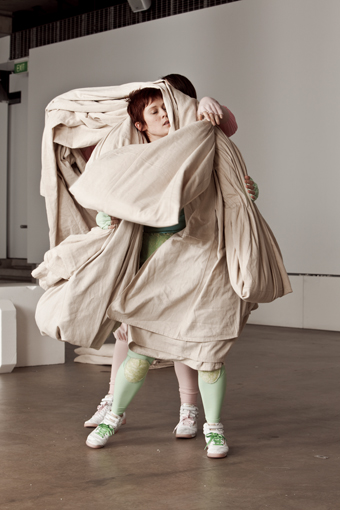
Alison and Bridget Currie, Three Ways to Hold
photo courtesy the artists
Alison and Bridget Currie, Three Ways to Hold
THERE’S A FLUCTUATION BETWEEN CARE AND NOT QUITE CARE THAT FLOWS THROUGH THE PERFORMANCES OF THREE WAYS TO HOLD THAT IS INITIALLY DISCONCERTING. AN ATTENTION TO DETAIL—COLOUR COORDINATED SNEAKER LACES, AN OVER CAREFUL FUSSINESS IN THE LAYING OUT OF CANVAS DROP SHEETS THAT COVER THE GALLERY FLOOR—COUPLES WITH A DELIBERATE CARELESSNESS AS SHEETS ARE BUNDLED AND DROPPED, LEFT WHERE THEY LIE.
The impatient shuffling of the audience out of the way in Fold and the performer’s pernickety attention to the arrangement of objects as they’re bundled into a giant sack in Collect—as if it really matters how things are done—is seriocomic, an absurd rearranging deckchairs on the Titanic activity. Yet it’s the vacillation between these moments and states of attention that draws the audience’s notice to the things that really do matter in the work.
Three ways to hold creates and demands a certain type of attentiveness over the arc of its four performances. As each performance slides between attentive states and moments, so it asks for a dual kind of attention and noticing, a specific type of refined observation as it brings intangible processes under our consideration. Each performance is named after an action—Fold, Lift, Prop and Collect—and as each becomes a performative enquiry these concerns are played out in the interaction of volume, mass, weight and space and their transformation through the performers’ actions.
In creating a closed system where the base materials are introduced in the first performance and remain in the space til the last, the possibility of novelty is removed and our attention concentrated on these formal processes of activation, recombination and change in an evolving space of forces and relations.
This concern with the activation of space and transformation of forms is one pursued by both artists in their discrete practices as visual artist and dancer. Here, these individual preoccupations are brought together and refined in a piece that deftly conducts a subtle and intelligent dissection of intangible states and an exercise in extending our awareness.
Appearing sometimes coolly cerebral, at others, Three ways to hold reveals a gentle sense of the absurd. In pastel costumes complete with knee and elbow pads, the performers Alison and Bridget Currie become super heroes or terrestrial trapeze artists underscoring a sly humour and the sense of effort brought to bear in the constant reshaping of their small enclosed world.
Fold is an exercise in expansion and contraction of volume serendipitously aided by the size of the first night crowd. Barely able to be seen at first, the performers dart outside and back in carrying slabs, blocks and wedges of polystyrene. Taking canvas sheets from laundry trugs the performers almost impatiently shake these out and lay them on the floor, adjusting them with that fussy carefulness. Edges are butted together and folds smoothed out as the space is covered with the canvas’s enlarging surface. In a neat reciprocity of action as the canvas expands, the crowd contracts—forces in motion. Almost as soon as the floor is covered, the performers turn to transforming the flat canvas into compact stacks of folded cloth. Gathered and pleated, fabric rolled between fingers to bring corners into alignment, the sheets are folded. Switching between this over-carefulness and almost carelessness we are made aware of the intent and effect of each action as each dense slab of stuff hits the floor.
The four performances create a durational arc over as many weeks. Objects are left where they fall at the end of each performance, suspended in a state of flux so that time is stretched out, so that attention is slowed to a state where notice can be taken of the invisible forces at play.
In Lift, the heaps of folded cloth form a vestigial history of Fold. It begins with the performers urgently making constructions out of polystyrene blocks, running and lifting each block above their heads in a comic show of strength and ending with a frantic game of tag across the space, palms slapping the walls. As Alison dances and feints boxer-like around the space, Bridget shakes out each cloth, giving it a weightlifter’s clean and jerk before placing it around Alison’s neck like the proverbial boxer’s towel. There’s comical huffing as this continues, yet as the heap accumulates the weight is palpable and it becomes a question of resistance and endurance rather than force. Finally, Alison, with real effort, throws off the sheets so they lie disordered again on the gallery floor.
This play of force is directed inwards and slowed almost to inaction over the seven hours of Prop with the artists developing intense attention to the effect of every action as one performer takes responsibility for the other in the literal and constantly modified act of propping. Prop becomes an intense meditation on cause, effect and responsibility.
It’s into the remnants of Prop, the blocks and wedges of foam and heaped sheets that the audience for Collect gathers. There’s no seeming diminution of the audience and it appears that attention can be sustained over this arching space of time. Bridget and Alison collect up all the wedges, blocks and slabs, bundle away the sheets and stack them into their ever expanding bag. One holds the bag open while the other arranges and rearranges things, compacting them, fitting them together. As it grows weightier, they drag their sack around the space, lifting, folding, fitting.
Tying off the neck of this amorphous robbers’ swag neatly shuts down the performance and this careful system that has been created and investigated over time. Our attention has been sustained and now lingers on a system of things folded, lifted, transformed and put away.
Alison Currie’s show 42a, “an interactive space where the audience itself affects the display and presentation, purely by where they stand, where they move to and what they do,” has toured to Sydney and Brisbane and will be at Melbourne’s Fortyfive Downstairs October 12-23
Three ways to hold (fold, lift, prop and collect), created and performed by Alison Currie and Bridget Currie, costume design Gemma Stocks, SASA Gallery, Adelaide, Aug 11-Sept 3.
RealTime issue #99 Oct-Nov 2010 pg. 52
© Jemima Kemp; for permission to reproduce apply to realtime@realtimearts.net
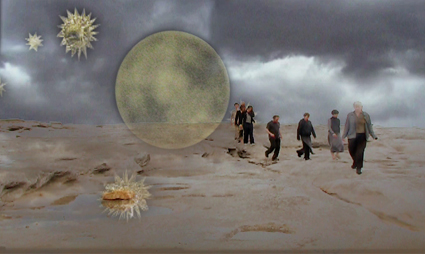
Modes of Misunderstanding, 2010, video still, Samuel James
image courtesy the artists
Modes of Misunderstanding, 2010, video still, Samuel James
IT IS AXIOMATIC THAT ARTWORKS VIEWED BY CRITICS UNDERGO CERTAIN TRANSMUTATIONS IN THEIR RECALL. IN THAT SENSE WE ARE NEVER REVIEWING ART, ONLY OUR MEMORIES OF ART. THEIR TRANSMUTATIONS WILL BE SHOT THROUGH WITH OUR OWN IDIOSYNCRATIC EXPERIENCES, KNOWLEDGE, OBSESSIONS AND DESIRES. BUT BEYOND NEURO-CHEMISTRY, BEYOND SUBJECTIVITY, THERE IS A KIND OF INTEGRITY WHICH MUST GO BACK TO THE WORK ITSELF. MOST SIMPLY, WE CAN SAY, I TRUST THIS. OR NOT.
In Samuel James’ Modes of Misunderstanding I & II, two large projections on the wall alternate between a farmer striding across a dry paddock towards the camera and a group of performers staggering through the bush in a state of amused disorientation. The farmer, initially a distant dot on a vast expanse of cracked earth, approaching with the inevitability of weather, recalls tropes as various as Bill Viola’s shimmering quasi-Biblical figures and Australian news reports of drought. It’s such a familiar image, in fact, that I disregard it at first. The bush, a section of coastal dune forest at Bundeena, is lush and intimate, the trees perhaps small paperbarks. While one performer touches a tree inquisitively, another falls about laughing. They are lost, but they’re having fun. Beside these, doubled as well— reflection upon reflection—are small videos filmed on rock shelves across which the comedy of the lost souls trails also. With the faintest reproductive interference, the place resembles a lunar landscape.
Belgian choreographer Hans van den Broeck, who directed these group performances, wanted to do a piece that showed these people relating to the landscape. James’ take is that as middle-class whites who live in the city, the notion of them having a connection to the bush is risible: indeed, van den Broeck’s wish can seem like a typical naïve foreigner’s bucolic fantasy about Australia. In this sense the farmer and his arid paddock are endgame. But James’ wit and ingenuity offer a more open view, in spite of himself: there is a connection of sorts taking place here: fumbling, uncertain, insistent. In whatever fashion, these people are a part of this place.
In the next room is Amygdala: Fear Conditioning, the centrepiece in a way, conceptually if nothing else, because the amygdala is the structure in our brain that processes emotion and anxiety, and it is the expression of this process that underpins all James’ work here. Fear also is noted as the driving force behind the performances. Some of us will remember the originals from which archival footage was reanimated and projected onto screens of different sizes suspended throughout the room. Often the performers are completely disembodied: Brian Fuata’s face stares out from a tree trunk; Julie Vulcan’s from somewhere else. A face in a cow, opening, closing, who is it? Martin del Amo’s body judders in freeze frame, then continues its spiralling leap, and I remember Under Attack (not the live performance: a video of). Sometimes the soundtrack synchs perfectly with the images, as in a vignette of Rosie Dennis, which imparts a strong sense of claustrophobia. Here, as elsewhere, as deconstructed as the footage is, it retains the spirit of the performance. Indeed, the strength of these video works as a whole is the maintenance of their connection to their primary human resource: all technical wizardry is in service to this.
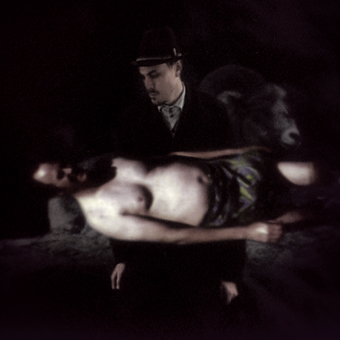
808.838/grandfather paradox, Ms&Mr
image courtesy the artists
808.838/grandfather paradox, Ms&Mr
The same can be said of Ms & Mr’s 808.838 / grandfather paradox, where the dialogue between this collaborative couple binds the work with warmth and humour. The title relates to time travel, wherein the conundrum of going back in time to delete a life or an event, thereby changing your own present so that you cannot do this, remains unsolvable.
Mr’s late grandfather shimmers on a screen facing the entrance. Bearded and naked from the waist up, in advanced middle age, he seems to be standing in water. The image is static, but alive. In diptych is a baby’s face—Mr—in close up, looking towards the grandfather. This old super 8 footage is played with: eyedrops are administered to the baby, whose expression hovers between fear and wonder. And Mr, the artist as he is now, leans down over his grandfather, and pumping his chest, attempts to resuscitate him.
Other elements balance the installation: a rocket shaped screen and one in the shape of a baby in a nappy, on which are projected a litany of images endless and chaotic. From the ceiling hangs a long copper cable—or is it a placenta?—that droops down into a thick coil on the ground. The world, a blank white globe, also receives projections. The space as a whole, as in James’ Amygdala, is used to its full potential in showing how these elements play off one another. Grandfather paradox is an eerie, mesmerising work, deeply personal, with the amniotically ambivalent feel of being trapped, or held, in time/technology/space, or simply in relation to another.
My only qualm was that James’ Amygdala was installed in such a way that did not invite the audience right in. Hovering at the doorway gave one a good, but limited view. On opening night, however, we stepped right inside the work, encouraged no doubt by the size of the crowd pressing into the room. (“Notice how much more fun opening night is”, someone remarked to me, “when it’s full of performance artists?”) The installation from the inside was enriched, apposite: silhouettes of punters’ heads animated some screens. The projections, changing as you walked through them, refracted yet again (perhaps due to the layout of the room, and unavoidable).
Unfortunately I am reviewing this show after it has closed, so if you didn’t go you won’t get to see it. All you will have to go by is the divergent memories of those who did see it. Trust me, Amygdala—Fear Conditioning, Modes of Misunderstanding I & II, and 808.838 / grandfather paradox added up to one of the richest, most stimulating experiences I have had at Artspace in years.
Samuel James, Amygdala—Fear Conditioning, Modes of Misunderstanding I & II; Ms & Mr, 808.838 / grandfather paradox; Artspace, Sydney, Aug 13-Sept 10
RealTime issue #99 Oct-Nov 2010 pg. 54
© Fiona McGregor; for permission to reproduce apply to realtime@realtimearts.net
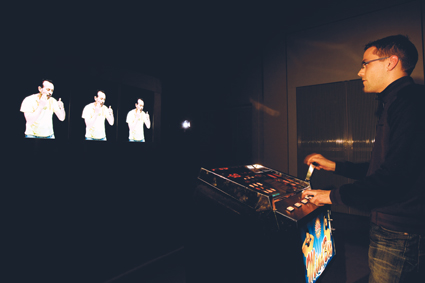
Mindbox, Humatic, SEAM 2010
photo Jürgen Lösel
Mindbox, Humatic, SEAM 2010
seamlessly: action & image
SEAM explores the very latest in technological engagement with performance and the ways that the relationships between art, science and audience are being reconfigured, yielding innovation and “breaking down established distinctions between performer and audience, and between rehearsal and performance” (Press release). Comprising workshops, exhibits and a symposium, SEAM is a collaboration between Margie Medlin, director of Sydney’s Critical Path, Garth Paine of the University of Western Sydney’s VIPRE Lab (Virtual Interactive Performance Research Environment) and UTS.
SEAM 2010—Agency and Action, a public symposium at the Seymour Centre, will include a keynote address from Stelarc, the exhibition of his Articulated Head and other interactive installations. The impressive roster of presenters includes Ruth Gibson (UK), Frederic Bevilacqua (IRCAM, France), Volker Kulchmeister (Germany), Christian Ziegler (Germany), Simon Biggs (UK) and Sue Hawksley (UK), collectively representing some of the more important developments in the contemporary integration of technology and performance in their work with leading artists.
The organisers write that they wish to provide “a resource-rich, stimulating environment for local dancers, choreographers and media artists to interact with local and international leaders in the field of interactive technologies and allied arts disciplines. We want dancers and choreographers to take away with them a raft of new tools, new knowledge, philosophical and performance frameworks, contacts and possible future partnerships in the creation of new or more profound directions within their contemporary choreographic practice.” SEAM 2010—Action & Agency; Public Symposium, Seymour Centre, Oct 15, 16; for workshops and exhibitions see http://seam2010.blogspot.com/p/about-seam2010.html
glow fires again
Chunky Move’s Glow (RT78) has had a long, successful life touring the world, illuminating the possibilities of bringing together dance and interactive media: it now makes a welcome return to Sydney as part of SEAM 2010. This deeply engaging, visceral short work was the first of two Chunky Move collaborations with German interactive video artist Frieder Weiss [RT84]; the second was the full-length work Mortal Engine.
In Glow the audience peer deep down into the dark at a still form that suddenly convulses into life, scattering about it brimming light, staccato geometries and threatening shadows. What makes Glow, a disturbing evocation of evolution and emergence, doubly exciting is that the light is triggered and controlled by the dancer’s movements making light and movement eerily seamless. Chunky Move, Glow, Seymour Centre, Oct 13-16, http://sydney.edu.au/seymour/season/glow.shtml
dream realised: maricor & maricar
Among the the British Council’s five Realise Your Dream scholarship winners this year are Sydney-based designers Maricor and Maricar Malano, twin sisters who have worked for the agency Mathematics, “producing video clips for bands including Architecture in Helsinki for whom they hand-sewed scores of embroidered characters which were later animated” (press release). In the UK they hope to engage with Partizan Lab and Studio AKA and do short technical courses at Central St Martin’s College. As well as introductions, the scholarship provides air travel and $8,000 spending money. Other winners include Melbourne-based theatre maker Samara Hersch, Adelaide theatre director Geordie Brookman and Alice Gage, founding editor of Ampersand Magazine. www.britishcouncil.org
unbelievable yet true
Not In A Million Years is the title of the much anticipated new work from Sydney’s Force Majeure about “almost unbelievable—yet true—stories of people who have survived, endured and created extraordinary experiences during their life time.” Created by the company’s artistic leaders Kate Champion, Roz Hervey and Geoff Cobham, the work will be performed by Vincent Crowley, Sarah Jayne Howard, Elizabeth Ryan and Joshua Tyler. The stories have been plucked from around the world: a man wakes from a coma in Buffalo, USA; a NSW paraglider rides above a storm higher than Everest; in Mexico, “an unlikely athlete sets the greatest track and field record of all time”; and in Scotland a woman’s life is ruined by a lottery win. As ever with Force Majeure it will be through movement and innovative design that these stories will be powerfully realised. Force Majeure, Not In A Million Years, CarriageWorks, Sydney, Nov 17-27, carriageworks.com.au
bold, black, brilliant
That’s the title of the Ilbijerri Theatre Company’s retrospective exhibition, which is currently on display at the Bunjilika Aboriginal Cultural Centre at Melbourne Museum. The exhibition marks the 20th anniversary of Ilbijerri, which was created by Aboriginal and Torres Strait Islander artists in Melbourne in response to seeing non-indigenous theatre companies telling Indigenous stories. From the breakthrough production of Jane Harrison’s Stolen, commissioned in 1992, to the upcoming world premiere of Jack Charles v The Crown (a collaboration between the actor and the playwright John Romeril) at the Melbourne International Arts Festival, the company has toured nationally and internationally, finding resonance and critical acclaim with Indigenous and non-indigenous audiences alike.
The retrospective gives visitors a behind-the-scenes look at life in the theatre company through objects including sets, props and photography from Ilbijerri productions. It’s being displayed alongside From Little Things Big Things Grow, an exhibition about Aboriginal activism in Australia between 1920 and 1970.
20 Years: Bold. Black. Brilliant., curator Ben McKeown,?Bunjilaka Aboriginal Cultural Centre, Melbourne Museum, July 9-Oct 31; http://museumvictoria.com.au/melbournemuseum/
RealTime issue #99 Oct-Nov 2010 pg. 55
© RealTime ; for permission to reproduce apply to realtime@realtimearts.net
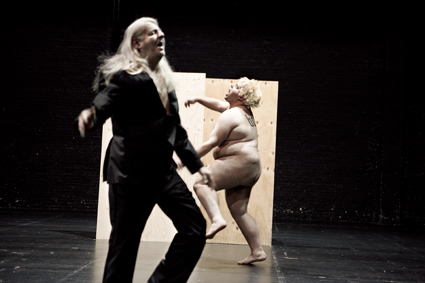
bakchai
photo Danny Willems
bakchai
IT’S USEFUL TO THINK ABOUT THE BODY AS A SITE OF CULTURAL INSCRIPTION. ARTISTS EXPLOIT RECOGNIZABLE SYMBOLS TO EFFICIENTLY COMMUNICATE AN IDEA TO AN AUDIENCE. A THIN, BROWN-HAIRED PERFORMER WEARING NOTHING BUT A CLOTH AROUND HIS GROIN AND A CROWN OF THORNS BECOMES SHORTHAND FOR ‘JESUS’. BUT IF, AS IN THE FAMOUS EXAMPLE OF P.#06 BY SOCIETAS RAFFAELLO SANZIO, THREE CARS FALL OUT OF THE SKY BEHIND JESUS, AND JESUS GETS INTO ONE, AND IF THE BACK END (AND ONLY THE BACK END) OF A HORSE PROTRUDES FROM A DOOR IN THE STAGE-LEFT WALL, THE STAGE SYMBOLS BECOME VERY HARD TO READ. PUT TOGETHER LIKE THIS, WHAT CAN THEY MEAN?
Contrary to script-centric theories of performance that treat stage elements as texts to be deciphered by spectator-readers, many theatre artists insist on the unreadable material presence of the performer—they foreground the body in such a way that the spectator is invited to confront a performer-body as a thing-in-itself, a body you encounter with your own body. At this year’s Het Theaterfestival, a showcase of cutting-edge Flemish and Dutch theatre that takes place in Belgium, more than a few of the shows exploited the body versus word dichotomy.
bakchai
In Bakchai, a free adaptation of Euripides’ The Bacchae, performer-creator Jan Decorte (De Roovers, Belgium) stretches the tension between the readable and unreadable to the breaking point. His stroke of genius is casting Benny Claessens as the god Dionysus. We’re first introduced to Claessens as a marble-white leg that sticks out from behind two rough pieces of plywood tacked up at centrestage. The leg is huge and clearly belongs to an obese individual. Downstage three other performers, including Decorte, play the other central characters from Euripides’ tragedy. The large, unmoving leg might be the limb of a giant. With fearful anticipation I await the appearance of a massive god-body that will devastate the playing field.
Eventually Claessens emerges—naked and with hair dyed gold. He looks like an oversized cherub. At first he has his back to us. Across his shoulder blades is written, in gothic characters, the word ‘body’. This textual signifier is pointing out the thing it signifies, but by nature of being attached to the thing it signifies can’t be separated from it. The body represents itself; so it doesn’t really represent at all, it just is itself. Signifier and sign collapse into one. Of course, Decorte didn’t have to spell it out for us. There’s no denying the body-ness of Claessens’ body.
From the ancient Greek perspective Dionysus comes from exotic, decadent Asia. The sheer mass of Claessens makes the point: there’s too much of him, how did he get to be so big? Surely this is a product of the excess of the East. But the actor isn’t Asian. He’s about as white as they come. So the racial categories are destabilized. Transforming the eastern ‘darkie’ into a western ‘whitie’ highlights the hypocrisy of the western view (ancient or modern) of the Asian as ‘other’ and uncivilized. But even these cultural symbols lose their relevance in the continuing encounter between the spectators and the overpowering presence of the performer. It’s not just his size and nakedness; Claessens is the ultimate tease. He makes a show of being embarrassed by his nudity while playfully manipulating our voyeuristic impulses; he adopts a subordinate role but works it so expertly there’s no doubt about who’s in control of the encounter. With his coy, cherubic teasing, Claessens might be the ultimate child-god in a universe that defies adult rationality. It seems Decorte uses Euripides play to create a childlike game in which the life and death passions of the non-Dionysian characters are made to look ridiculously adult. What’s the queen got up her bum? Why can’t everyone just relax and get some perspective? At least Benny Claessens is having fun. We’re having fun watching him do his thing.
unfold
A number of years ago you might have seen something like Oleanna by David Mamet or a Shakespeare at this festival but they’ve been rare during the four-year directorship of Don Verboven who’s overseen a deliberate shift towards performance that doesn’t privilege the written word. This has provoked accusations of elitism. Turning away from more conventional forms has been seen as a bar to accessibility. The question for an adventurous programmer like Verboven (and the three-member juries that make the selections each year) becomes, “How far can you stretch an audience, and when do you know if you’ve gone too far?” There’s no obvious answer.
Unfold by kabinet K (Belgium) was so far removed from traditional models of theatre and dance that it was unclassifiable. Yet it was one of the most loved shows at the festival. It begins with a young girl standing with her back to us before a gauze curtain that stretches across the stage. She contemplates a column of postcards, letters, and old photographs hanging on the fabric. Behind the gauze another child appears at a microphone reciting a poem in Flemish. Then the first child exits and reappears at a sewing machine behind the gauze. It looks like she’s stitching the postcards into a strip of the same fabric. Not being a speaker of Flemish, I don’t know what the child at the microphone is saying, but about a minute into the poem laughter just sort of falls out of the audience. There’s something very genuine and relaxed about this collective response. Together, the voice of the child, the scenographic elements and the audience’s waterfall of laughter conspire to open me up to the performance event. I don’t know why I’m so full of delight and easy anticipation, but I immediately feel that with kabinet K I’m in good hands.
Images continue to appear and disappear behind the gauze: an adult male carries one of the children across the space, another man performs a brief duet with a third child; eventually the gauze is pulled away and the two men and three children create a tableau. Are they a family of sorts? One of the men picks up an electric guitar and sings a ballad, while the girl returns to the sewing machine. We enjoy a guitar and sewing machine duet. The individuals break off into tasks such as drawing a picture of a house with windows that float away from it or making a tent from a large piece of white cloth on the floor.
One of the highlights is watching the children perform a contemporary dance trio. The technique and choreography are such that the children’s bodies aren’t distorted in the way they are in ballet and some other dance techniques. The movement seems very natural to them, unforced and yet performed by the children with aesthetic focus. It’s the most enjoyable contemporary dance I’ve seen in a while.
There’s a tender balance between the two men and three children: the impression is of a functioning group that has the creative tools and understanding to deal with what comes, including crisis—although there is no crisis presented. Unfold engages us without the necessity of dramatic conflict or even of the angst or cynicism common to so many contemporary dance performances. Children and adults move, invent and sing. To me it feels pre- rather than post-dramatic. It’s as if the children haven’t yet internalized the forms of traditional dramatic structure. Is Unfold about something? The program notes say, “It’s about not being able to understand, and still being happy.”
iraqi ghosts
Maybe not understanding requires a certain kind of spectator—not an elite patron, but one who doesn’t need textual or verbal logic to have a significant performance experience. Brilliantly crafted dialogue, or even brilliantly excerpted text, can prompt a transcendent experience for a spectator. But of course words can get in the way. “Too many words,” was a frequently uttered criticism of Iraqi ghosts (Irakese geesten) by Mokhallad Rasem (Belgium). Part fable, part autobiography, Iraqi ghosts is a wild anti-war rant by five artists, three of whom are survivors of the recent invasion of Iraq. The scenes are presented in Arabic, Flemish and English. Too often they are followed by unnecessary verbal commentary. Occasionally this works in the artists’ favour: a dinner scene, in which non-stop verbiage in Arabic is punctuated by the mutilation of several melons and other parts of the meal, takes an everyday ritual to the heights of hysteria.
For me, Iraqi ghosts was most engaging when the talking stopped completely: in what felt like the eerie silence after a bombing, disoriented figures—actors with large masks over their heads—wandered the stage, dazedly trying to help one another up. The masks had grotesque and mournful expressions
They were bald and elderly, as if the trauma of war had fast-forwarded the aging process. For the first time I shifted from watching someone’s loss to feeling it. Maybe this is the genius of the piece: to bombard us with words so that in their aftermath we sit in horrified silence.
springville
If this edition of the festival needed an answer to the accusation of elitism, Springville by Miet Warlop (Belgium) was it. Instead of a text-driven story, Warlop presents a wordless landscape—by which I mean a large cardboard house on a bare stage. For the duration of the show, Buster Keaton-like antics are performed by a dining room table with human legs, a box that acts like a pet, a man with a double-length torso and the house itself, which gets up, cracks in half to reveal a smaller styrofoam house within. It’s a delightful hour of controlled chaos. As fellow writer Alexander Schackenburg put it, “It’s about nothing, and you miss nothing.” Springville is the best of early cartoon animation brought into the 3D world of the stage.
Het Theaterfestival, Antwerp, Belgium, Aug 26-Sept 4; www.theaterfestival.be
Vancouver-based writer, actor and director Alex Lazaridis Ferguson is part of an international theatre journalism exchange. He and two European journalists are investigating the PuSh International Performing Arts Festival (Canada), PAZZ (Germany) and Het Theaterfestival (Belgium). Articles by the writers are appearing in Urban Mag (Belgium), RealTime (Australia), Plank Magazine (Vancouver) and a forthcoming website dedicated to the project called Performulations (Germany).
RealTime issue #99 Oct-Nov 2010 pg.
© Alex Ferguson; for permission to reproduce apply to realtime@realtimearts.net
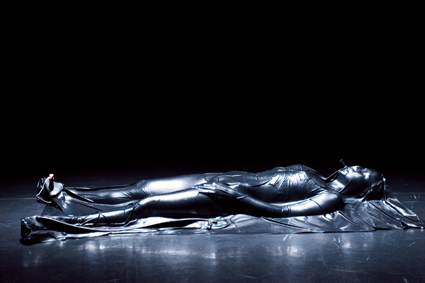
Sylphides
photo Alain Monot, courtesy Montpellier Danse
Sylphides
ANNIVERSARIES ARE A TIME TO LOOK BACK. SOME SIFTING THROUGH THE PAST, ALBEIT IN AN EFFORT TO CLEAR A PATH FOR THE FUTURE IS INEVITABLE. THE 30TH EDITION OF MONTPELLIER DANSE FOUND THE FESTIVAL IN PENSIVE MOOD; CELEBRATING A BRIGHT FUTURE IN THE PROGRAMMING OF FRESH NEW WORK, BUT ALSO RUMINATING, IN WORKS WITH DARKER SUBJECT MATTER, ON DEATH AND THE LEGACY OF DANCE ITSELF, IN AN INDUSTRY THAT HAS LOST MANY BRIGHT STARS SUCH AS PINA BAUSCH AND MERCE CUNNINGHAM IN RECENT TIMES.
bengolea & chaignaud
In the vein of young and fresh came several works by Cecilia Bengolea and François Chaignaud, a French duo currently enjoying a meteoric rise in France. Their first work, Sylphides, inhabited the darker end of things; body bags in fact. Opening on a stage strewn with three large inflatable pillows, it wasn’t long before these seemingly inanimate objects were deflated to reveal the contours of human bodies claustrophobically encased, as if smeared in tar. It was just possible to make out tiny mouthpieces protruding from each body, which allowed a small but vital flow of oxygen. Save for this, the dancers were blinded, pinned down by swathes of fabric, and doubtless restricted in hearing too. Despite these impediments, the prone bodies began seeking out one another, navigating by touch. Sinuous squirms gave way to a slow progression to standing, and finally, to extravagant pogo stick bounces throughout the space.
The success of this work arose from the improbable situation in which the dancers found themselves, and the sinister connotations of bodies helplessly trapped within a physical form. Smothered in bags resembling the receptacles into which many of us will be zipped at the end of our lives, Sylphides shrank things, both literally and metaphorically, to a matter of life and death. Watching the Pompeii-esque tableau unfurl, it was difficult not to fixate on the potential for catastrophe, if a dancer were to faint and drop their mouthpiece. It was hard not to scan for zips (there were none), and exit strategies, and in all this, notions surrounding the entrapment and limitations of the human (and dancing) body hovered. Death, it seemed, was never far away but rebirth too, especially at the work’s end when slowly, gingerly, bags were prised open to reveal a man and two women, quite alive and staring impishly out into the auditorium.
Similarly conceptually captivating, but somewhat limited in realisation was Castor et Pollux, also by Bengolea and Chaignaud. Inspired by twin godheads in Greek and Roman mythology, Castor et Pollux occupied not the stage of Montpellier’s plush Opéra Comédie, but the vast tract of space in the flies above it. Naked from the waist up and smeared in garish body paint, Bengolea and Chaignaud hung 50 feet in the air, knotted together in a sensual clinch. Movements were languid, with bodies fusing to create indefinable shapes. Initially exciting, with dizzying perspective afforded through the staging, Castor et Pollux veered unceremoniously towards the camp and mawkish. The initially ominous score became saturated with squawks and shrieks, relegating the climactic low swooping of the dancers to the category of cheap thrill. Visually arresting, this work seemed to exhaust itself and appeared overly burdened by the mythological depth which its title conjured.
william forsythe: installations
In an entirely different aesthetic vein was a series of videos by renowned choreographer William Forsythe which populated the white gallery space of the Pavillon Populaire. Through visual trickery, and intimate video depictions of Forsythe dancing and interacting with objects, the installations questioned the placement and legacies of choreography. Where in conceptual space does choreography exist for instance—at the moment of execution through movement, or previously? And what remains of choreography once enacted? In pondering the transience of the art of choreography, Forsythe’s installations became tinged with a mildly morbid air, with similarities between the nature of choreography and of human mortality itself all too evident.
One video saw Forsythe enacting a virtuosic solo in black and white. Camera angles varied, closing in on the moving body, severing limbs out of shot, then panning back to reveal the precision of the feet, or the attack and arrest of the torso. This was dancer-as-vessel of the choreography: there was wholeness to the image, a sense of the moving body as the endpoint of a choreographic train of thought. Travelling to the next screen however, one was greeted with a small monitor bearing a recognisable image of Forsythe’s face. To the saccharine lyrics of “Dancing” from the musical Hello Dolly, the mug-shot of Forsythe was severed; fading into sections which disappeared into a haze, only to slowly reform. There was a mesmeric quality to this, with comment gently provided by the incessant lyrics questioning “Now that we’re dancing who cares if we ever stop…”
In a later video, Forsythe abandoned the traditional dance canon to bind himself meticulously in heavy black rope. Two camera angles allowed differing viewpoints of the scene as he entrapped first his torso and then, more disturbingly, his neck, head and face, with imagery becoming increasingly violent. Yells, either for help or of defiance suddenly punctured the space, before the process was laboriously undone; ropes unwinding to release their captive. Albeit in a more confrontational manner, this sequence pursued the line of questioning which the preceding videos began. It attempted to open up the spaces before and after choreography, to question whether it is possible to dislocate the body from the act of choreography, and whether the idea of choreography can in fact exist in and of itself. By pushing his body to physical extremes it seemed Forsythe was testing not only physical capability but the life expectancy of the choreographic act.
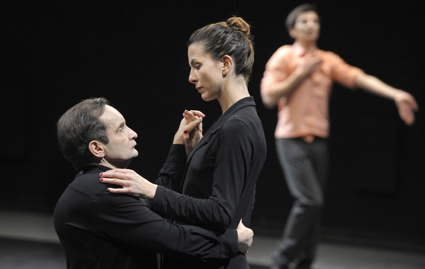
Raimund Hoghe, Astrid Bas, Emmanuel Eggermont, Si je meurs, laisser le balcon ouvert
photo Rosa-Frank.com
Raimund Hoghe, Astrid Bas, Emmanuel Eggermont, Si je meurs, laisser le balcon ouvert
raimund hoghe
From musing on life and death in Sylphides, to the intangible traces of choreography and existence in Forsythe’s installations, came Si je meurs, laissez les balcons ouvert (If I die leave the balcony open), by Raimund Hoghe. Conceived originally as an homage to the late Montpellier choreographer Dominique Bagouet, Si je meurs was an exercise in learning to say farewell, in a world in which, according to Hoghe, “we have the lost the way to say goodbye”.
Often in Hoghe’s work, emotion hovers in the ether, abstracted through an oblique layering of music and deadpan gesture. Here however, it exploded outwards in contorted facial expressions and frenetic choreography. Movement was carved by gestures of defiance rather than wistful doodling, with dancers whirling about the stage in angry or mock-comic froth. A moment halfway through the piece found Hoghe coaching dancer Ornella Balestra in the art of expressing grief. Demonstrating with hands placed on his ribcage, aggressively pushing for more, more, more, Hoghe was eliciting not demure sniffles but vast, wracking sobs and gulps of air from the unfortunate Balestra.
Tracing a progression of loss and grief, the work operated at times on the cusp of frenzy: that wired, angry edge of bodies grappling with insurmountable emotion, seeking oblivion and balm. It seemed an homage not to Bagouet but to grief itself; and to the many ghosts in the dance world. Journeying from funereal tristesse and pious ceremony to the kitsch and wistfully romantic, Si je meurs finally found a bittersweet resting place. During the last moments of the work, the backdrop doors were thrown open to the night, flooding the space with twilight sounds of crickets and the pall of a lone street lamp. One dancer, Emmanuel Eggermont, remained in the fading light. Ever moving, ever dancing, he offered an indelible trace of humanity, and of choreography.
Montpellier Danse.10, Cecilia Bengolea & François Chaignaud, Sylphides, Studio Bagouet, June 30-July 1; Bengolea & Chaignaud, Castor et Pollux, Opéra Comédie, June 27-28; William Forsythe, Installations, Pavillon Populaire, June 22-July 2; Raimund Hoghe and company, Si je meurs, laissez les balcons ouvert, Théâtre de Grammont, June 3-July 1; Montpellier Danse.10, June 18-July 7
RealTime issue #99 Oct-Nov 2010 pg. 29
© Mary Kate Connolly; for permission to reproduce apply to realtime@realtimearts.net
Sweat, Branch Nebula
photo James Brown
Sweat, Branch Nebula
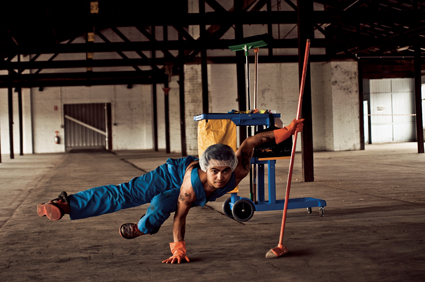
FOLLOWING THE SUCCESS OF PARADISE CITY (see review), WHICH TOURED AROUND AUSTRALIA AND TRAVELLED TO SOUTH AMERICA, SYDNEY-BASED BRANCH NEBULA’S LATEST WORK IS SWEAT, A SHOW ABOUT WORK FEATURING PARKOUR, B-BOYING, FOOTBALL, NOISE ART AND DANCE. I SPOKE WITH THE COMPANY’S DIRECTORS LEE WILSON AND MIRABELLE WOUTERS ABOUT THE SHOW FOCUSING ON JUST HOW IT WAS ENGAGING WITH ITS COMPLEX SUBJECT.
One of the challenges in creating a show about work is how to represent it. Although keen not to give too much away Wilson and Wouters seem to be aiming for a balance between representing work practices performatively and at the same time showing Sweat itself to be a form of work. Potential audiences are advised that there will be no seating and Wilson mentions that sound equipment and lights will also be on the move in the space, “but we wouldn’t want it to be read as a show about setting up a theatre show.”
What’s significant for the directors is that they’re looking at a contemporary notion of work and not in the usually anticipated factory or industrial setting: “We’re concerned particularly with low paid and services industry work that we often see around us, and at the way we engage with these services on a day-to-day basis.” Wilson explains that he’s interested “in the intimacy we can share with someone who’s providing a service for us but at the same time we have no knowledge of them—who they are or where they come from. Through the course of the show we’re interested to bridge that gap.” As for the work itself, “We try to evoke images and associations for the audience without trying to be too specific about particular forms. You might see images of cleaning, for example, but we’re more interested in issues of power and status for the low-paid worker.”
When researching and developing Sweat, Wilson says that the company “played with the idea of integrating the artists’ skills into the physical language of work but found that resulted in a ‘Cinderella’ effect. For example, mopping a floor and then transcending that into a complex choreography may be very beautiful but it just doesn’t seem very realistic. What we’ve tried to do is to have the skills entering into Sweat almost in opposition to the work—as a way of conveying something personal about the performers. It’s a way of connecting with the performers on a human level.” At the same time, says Wilson, “We’re looking at the way self-esteem is eroded by being constantly in service for very low pay and how that can affect workers psychologically.”
Wilson says “in this show our interest is not about relationships between the performers, but between performers and audience. That’s a real challenge for us. We’re very good at creating relationships between different forms, how football and B-boying might have a conversation and so on. But for Sweat, we’re supporting the artists to pursue their own practice and develop their material but also prodding and provoking them to extend that material choreographically.”
As the show’s designer, Wouters is focused on the impact for an audience entering a space without a set as such and with the staging shaped by the movement of performers and equipment. Not only is the work therefore inevitably site-specific but costumes are also important: “There’s the work wear—overalls for grunt-work—and then there’s the service work clothing—pastel colours and whites. The costumes are working really powerfully. The moment the performers put them on, they become something else.
It has to do with the invisibility of the people doing these tasks, like the cleaning that happens around you. It’s like it needs to be invisible, as if we don’t want to notice the people doing it.”
The sound for Sweat is by Hirofumi Uchino. As with the other artists in the show, Wilson says, “We’ve tried not to work with him as a sound designer, but as an artist and a noise musician. But the show is different from a noise gig where you go for an extreme experience—some of what Hiro can do feels like it’s changing your DNA. But he has enjoyed the challenge of working outside that framework. What he does with noise will reflect on the psychological aspects of continuous, monotonous or uncomfortable or dangerous or dirty work. I find that the noise in combination with the material we’re doing really does give a psychological weight to the work and has the power to shift you viscerally.”
Wilson spoke of the company’s ambitions for Sweat: “We’re certainly hoping to reach different audiences and experiment with how audiences react to it. I think it will be a unique experience because there are quite a lot of ingredients coming together, whether it’s intimate choreography performed around you or larger scale technical aspects. There are text-based elements and noise. Then there’s the combination of forms—parkour, B-boying football and dance. It’s a pretty amazing mix of stuff. At the same time I think it’s a challenging work. We haven’t set out to make a necessarily ‘pleasing’ show.” But, adds Wouters, “Although the whole set-up for the piece might be out of the ordinary and not something audiences will necessarily be used to, the actual material is quite accessible—it’s something that’s quite close to everybody’s day-to-day life.”
With an appropriately young, ethnically diverse and talented cast—a Sri Lankan soccer player (Ahilan Ratnamohan), a Colombian performance maker (Claudia Escobar), a Filipino/Spanish contemporary dancer (Marnie Palomares), a Vietnamese parkour/martial artist (David Vo), a Bboy (Erwin Fennis) and a Japanese noisician (Hirofumi Uchino)—and Branch Nebula’s trademark inventiveness, Sweat promises to be a significant comment on and a new immersive look at work.
Branch Nebula, Sweat, co-creators Mirabelle Wouters, Lee Wilson, producer Performing Lines; Performance Space, CarriageWorks, Oct 19-30, www.branchnebula.com; tickets www.ticketmaster.com.au
See the RT Studio entry of Sweat in development
RealTime issue #99 Oct-Nov 2010 pg.
© Keith Gallasch; for permission to reproduce apply to realtime@realtimearts.net
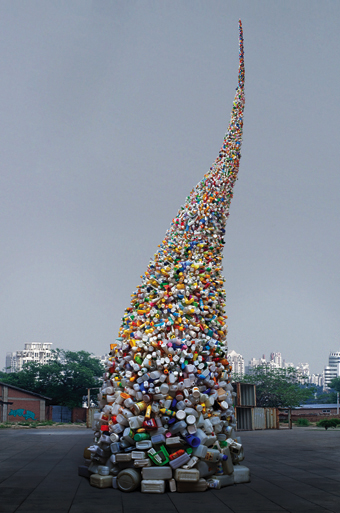
Wang Zhiyuan
b. 1958, Tianjin
Thrown to the Wind, 2010
steel, plastic
photo courtesy of the artist and White Rabbit Gallery
Wang Zhiyuan
b. 1958, Tianjin
Thrown to the Wind, 2010
steel, plastic
IN LEWIS CARROLL’S TALE IT’S THE WHITE RABBIT WHOSE ENIGMATIC CHARM LURES ALICE DOWN THE RABBIT HOLE INTO WONDERLAND. ART COLLECTOR AND PHILANTHROPIST JUDITH NEILSON RIFFS ON THIS SPRITELY CHARACTER’S ASSOCIATION WITH A SENSE OF SERENDIPITY AND SURPRISE IN THE NAMING OF HER WHITE RABBIT GALLERY, A CONVERTED KNITTING FACTORY IN SYDNEY’S CHIPPENDALE DEDICATED TO SHOWCASING A PERSONAL COLLECTION OF POST- 2000 CHINESE ART. STEPPING THROUGH ITS DOORS HAS THE AIR OF ENTERING ANOTHER REALITY, ALTHOUGH GIVEN THE TITLE OF ITS LATEST AND THIRD EXHIBITION, THE BIG BANG, PERHAPS ‘ANOTHER UNIVERSE’ WOULD BE MORE APPROPRIATE.
Here, The Big Bang refers to “the explosion of creativity that has rocked China since its ‘Opening Up’ to the global economy began in 2000.” This hyperbolic premise had me slightly apprehensive I might encounter an exhibition leveraging some of the now commonly hyped assertions characterising discussions of contemporary Chinese art, and in some respects this is what I found. But when the work is this good, concerns over how a show is marketed are best put to one side in favour of focusing on the art itself. Spread across four gallery floors, this eclectic presentation of works from over 35 artists had me enthralled for hours while also considering a broad array of questions around national versus personal identity, alienation in modern life, cultural amnesia and the role of history in present day China and beyond.
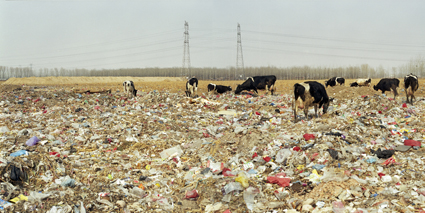
Wang Jiuliang
b.1977, Anqiu City, Shandong
Beijing Besieged by Waste—Guanniufang Village, Xiaotangshan Township, Changping District
40°09’06” N, 116°22’14” E
2009
digital photograph
On the ground floor, two works exploring the flip side of a large population’s increased consumption, its by-product of material waste, stand out for their distinct aesthetic properties. At the rear of the space, Wang Zhiyuan’s spectacular Thrown To The Wind (2010) artfully weaves thousands of discarded plastic bottles around a conical wire frame extending eleven metres to the ceiling, resulting in a whirlwind of waste with a sense of dynamism lent all the greater impact by its overwhelming scale. Nearby, a set of digital prints by Wang Jiuliang, Beijing Besieged By Waste (2009) survey the plethora of garbage dumps that rim the nation’s capital, bringing to mind art writer Carol Diehl’s notion of a “toxic sublime” although the tagging of each photo with GPS co-ordinates emphasises their status as documents. Somewhat at odds with the artist’s environmental campaign is the unwitting beauty in their composition. One image capturing a herd of cows as they scavenge among brightly coloured plastic bags appears almost hyperreal and is eerily tranquil, reminiscent of a traditional pastoral landscape painting albeit with an apocalyptic edge.
Wang Jiuliang’s photojournalism, however, is not characteristic of the majority of The Big Bang artists who prefer to view life through a less literal and more expressionistic lens. Among the most intriguing examples are two mixed media works from multinational Shanghai based art collective, Liu Dao/island6, who work at the interface of art, computers and electronics while seeking to explore “the connections between dreams and waking consciousness.” In Shirt (2009) an LCD screen doubles as a mirror set within a black antique style frame, its surface scratched with finely cross-hatched black lines hinting at an act of vandalism. An infra-red sensor detects the presence of the viewer triggering the projection of an image of a woman onto the mirror/screen where she tries out various poses while dressed in an over-sized men’s business shirt. A witty work, it is also unsettling in its subtle allusion to the voyeuristic impulse that can underscore art viewing and is compelling in its harnessing of technology to delve into the mysterious terrain of desire and the psyche.
The work of Liu Dao/island6 also bears further mention for the way its collective arrangement tests how permeable the boundaries of Chinese art might be. Founded by French artist and curator Thomas Charvériat, now based in Shanghai and drawing artistic collaborators from China, Europe, the US and further afield, this cross-cultural collaboration is certainly a healthy sign of the maturation of the art scene. Yet it also suggests the presentation of contemporary Chinese art may benefit from being geared around more conceptual or thematic lines allowing the work to enter into dialogue with other cultures rather than emphasising its intrinsic “Chinese-ness,” which has become a commodity. This is not to imply The Big Bang is focused on a fixed or historical idea of Chinese art. On the contrary, as its curators point out, much of this work comes from “wired and web-smart products of the one-child policy” who “if their works share a common theme, it is change. And if they have a common perspective, it is ziwo, ‘I myself’.”
Chen Fei
b.1972, Miaoming, Guangdong
Beyond Satisfaction 2006 No. 2, 2006
oil on canvas
photo courtesy of the artist and White Rabbit Gallery
Chen Fei
b.1972, Miaoming, Guangdong
Beyond Satisfaction 2006 No. 2, 2006
oil on canvas
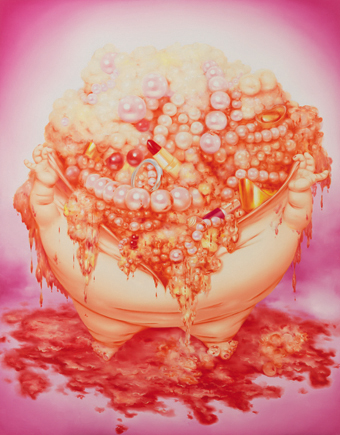
So then is the individualistic stance of the post-Cultural Revolution generation to be celebrated or deplored? It is a strength of the works on display that a variety of contradictory attitudes emerge. In Chen Fei’s flesh-hued oil painting, Beyond Satisfaction no.2 (2006), the seductive surface belies the grotesque nature of a rotund belly violently split open and spilling forth the shiny goods of feminine desire—pearls, baubles, lipsticks and bands of silver and gold. Clearly here is an artist ill at ease with his society’s relentless desire to consume and accumulate wealth. The attitude of acclaimed photographer and filmmaker Yang Fudong is less easy to pin down. After searching for something sinister in his highly stylised sequence of six black and white film-noir style photographs documenting a well-dressed trio enjoying a night on the town, Ms Huang at M Last Night (2006), it appears the artist is more concerned with challenging viewers to suspend their judgement. As he reflects in his statement “whether you’re filming the life of a rich person or a poor person, there is beauty in both.”
Concluding the exhibition on the gallery’s top floor is a sprawling sculptural installation from Beijing artist Li Hongbo, Paper (2010). Here the artist painstakingly cuts, folds and glues dense layers of brown paper into honeycomb configurations mutating a human figure into a boa constrictor-like form that threatens to engulf the entire space. Dubbed the “slinky man” it is arguably among such supremely confident large-scale sculptural works that The Big Bang really comes into its own. These works might be referred to as “statement pieces” and while some might scoff at the term it is important to remember this is a privately funded collection and as such it reflects an individual’s taste and preferences. Given White Rabbit represents such an extraordinary gesture of philanthropic generosity, this does put up barriers to critique one wouldn’t necessarily encounter in a public museum. Still, where the absence of red tape perhaps weakens the curatorial rigour it also loosens constraints, opening up other opportunities. For viewers, here is a chance to encounter a big, bold and exuberant collection clearly driven by a genuine passion for Chinese art and culture. Certainly the gallery’s label of an “artistic supernova” appears a fitting one.
The Big Bang, White Rabbit Gallery, Sydney, Sept 3 2010–Jan 30 2011; www.whiterabbitcollection.org/
RealTime issue #98 Aug-Sept 2010 pg. web
© Ella Mudie; for permission to reproduce apply to realtime@realtimearts.net
François Sagat, LA Zombie
photo Arno Roca
François Sagat, LA Zombie
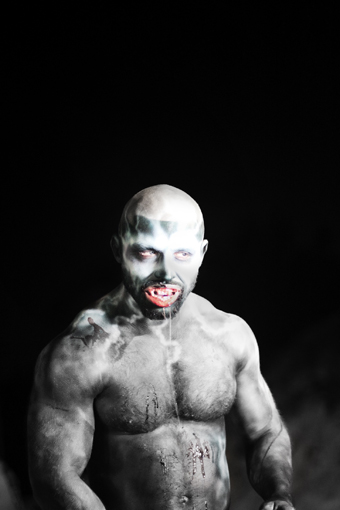
AS MARKETING SPIELS GO, MELBOURNE INTERNATIONAL FILM FESTIVAL’S DESCRIPTION OF BRUCE LABRUCE’S LA ZOMBIE CERTAINLY PIQUED INTEREST WITH ITS CLAIM THAT THE FILM FEATURED “PLENTY OF WOUND-SHAGGING AND MORE PENISES THAN YOU CAN SHAKE A STICK AT” (MIFF). EVIDENTLY IT GARNERED ATTENTION FROM THE FILM CLASSIFICATION BOARD, WHICH REQUESTED THAT THE FILM BE SUBMITTED FOR REVIEW AND SUBSEQUENTLY REFUSED TO GRANT CLASSIFICATION EXEMPTION, EFFECTIVELY STYMIEING MIFF’S SCREENING.
Film festivals are normally exempt from the need for certification for the movies they program, as most are unlikely to be released in the domestic market and many will only screen at special events. In recent years it has been rare for a film to be deemed unsuitable even for a festival screening (the last instance was Larry Clark’s Ken Park in 2003, see RT56).
MIFF decided not to contest the decision as the cost of an appeal was prohibitively expensive for the festival (a not-for-profit organisation) and they were advised that any appeal was unlikely to be successful. Further, events happened so close to the festival’s commencement that time factors precluded any appeals process. Technically the film was not banned; rather it was not granted a festival exemption, meaning that it could still be screened if formally classified. Of course the classification process depends on a distributor acquiring the rights, submitting the film for classification and then releasing the film accordingly (with a certificate and perhaps in a cut version)—an expensive, commercial process beyond the financial reach or cultural remit of most film festivals.
The media who readily supported MIFF in 2009, when controversy reigned over the repeated hacking of the festival’s website following its programming of The 10 Conditions of Love, appeared remarkably quiet about the censorship of LA Zombie, dutifully reporting the story and then, apparently letting it die. In the contemporary digital economy it appears to be a given that those interested would probably download the film to watch it. Noticeably, however, the Sex Party’s Fiona Patten drew attention to the censorship of the film as part of a longer ongoing commentary on the issue of censorship in Australia (see press release here).
Bruce LaBruce
photo Arno Roca
Bruce LaBruce
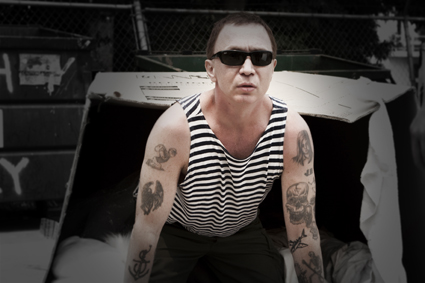
FFor those unfamiliar with the director, Bruce LaBruce is an independent filmmaker who emerged from the queer punk scene. His films would no doubt be considered confrontational by those unfamiliar with the radical cinema culture that flourishes beyond the confines of the multiplex screen. His work often depicts sex and has been described as ‘porn,’ although such a description belies its aesthetic velocity and its numerous references to film history and wider radical culture. LA Zombie ups the ante by playing with the horror genre, a form already considered by many as ‘low’ culture. But perhaps the real issue is that the film is ‘gay’. The notion of a same sex zombie ‘porn’ movie is apparently too much for many.
Enter Richard Wolstencroft, the perennial troublemaker of Australian cinema who founded the Melbourne Underground Film Festival when his own work was rejected by MIFF. Since 2000, MUFF has screened cult, genre and underground works, while Wolstencroft himself has frequently railed against the local industry’s more conservative aesthetic and cultural trends. He has authored numerous screeds against what he portrays as the dull and clichéd national cinema in favour of an industry that produces low budget genre movies and radical art house works. Somewhat notorious for his confrontational attitude and his occasionally infuriating pronouncements, Wolstencroft is one of a dedicated handful of curator/commentators anxious to shake up the complacency of many, including their apparent tolerance of censorship. Amongst numerous other ‘infamous’ works, MUFF has programmed Pier Paolo Pasolini’s Salo (1975) and Tony Comstock’s indie lesbian movie Ashley And Kisha: Finding the Right Fit (2007), both of which had been banned.
LaBruce was a festival guest at MUFF in 2004 with his film Raspberry Reich. In the same week that LA Zombie was pulled from MIFF’s program, Wolstencroft announced he would organise a civil disobedience screening in Melbourne with LaBruce’s blessing. While nobody was sure what the police would do, the day before the screening the MUFF director hinted in a Facebook post that he believed the event would go ahead unimpeded, and in the end it did. Ostensibly an addition to this year’s MUFF closing night, the screening took place on Sunday August 29 to a packed house. While MIFF had been unable to fight in this manner, MUFF had publicly declared their decision to stare down the censor.
While rudimentary classification may help uninformed audiences make decisions, censorship is always an ugly beast and should be rigorously fought for reasons of both aesthetic choice and free speech. MUFF rightly challenged the ban. But it did more than this—in beating the ban MUFF has raised some fundamental questions about the way in which films are seen in Australia. Like the low budget genre films that Wolstencroft so often champions, it is the smaller players within Australian film culture that are answering to the challenges of contemporary cinema, the underground and genre festivals, the independent curators and programmers. It is these smaller organisations and individuals that posses the mutability that enables them to respond to events in a manner and at a speed difficult for larger festivals.
Festivals such as MUFF have long fought for freedom of screen culture and should be applauded for their ongoing defiance. More importantly, in screening LA Zombie to an appreciative audience, MUFF has challenged the hegemony of current screen culture. Simply put, if the little guys can fight censorship, then all those who seek an active, lively cinema in Australia should now pick up the challenge and fight to truly free the cinema.
LA Zombie, writer, director Bruce LaBruce, producer Owen Hawk
This article was first published online Sept 20, 2010
RealTime issue #99 Oct-Nov 2010 pg. 26
© Jack Sargeant; for permission to reproduce apply to realtime@realtimearts.net
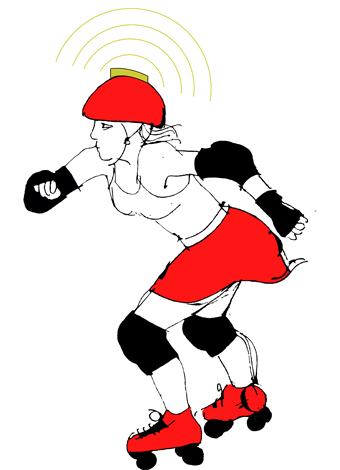
Bloodbath, Bump Projects
image courtesy of the artists
Bloodbath, Bump Projects
blood, sweat and art
In the language of public relations, roller derby is currently having a “moment,” thanks to articles in the Sydney Morning Herald and the Australian as well as Drew Barrymore’s movie Whip It. Bloodbath, however, promises to take roller derby in a slightly different direction.
Conceived by new media artist Linda Dement and billed as a “collaborative distributed artwork,” Bloodbath involves an all girl flat track roller derby game, where sensors are attached to the players. These sensors convey information to a server, which then sends the data on to the five participating artists, who generate their “digital elaborations of the moves and collisions on track” on site and in real time. These elaborations are then projected as the game plays itself out.
Besides Dement, the artists involved include Kate Richards (interviewed in RT80, Sarah Waterson, Francesca da Rimini and Nancy Mauro-Flude, all of whom have track records in new media, data visualisation, mediated performance and work with embodiment or violence. Bloodbath is funded by the inaugural Digital Culture Fund of the Australia Council. Bloodbath, Bump Projects and the Sydney Roller Derby League, Horden Pavilion, October 9, www.bumpp.net
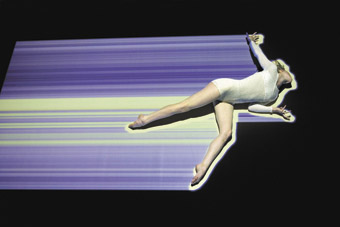
Kristy Ayre, glow, Chunky Move
photo Rom Anthonis
Kristy Ayre, glow, Chunky Move
glow fires again
Chunky Move’s Glow (RT78) has had a long, successful life touring the world, illuminating the possibilities of bringing together dance and interactive media: it now makes a welcome return to Sydney. This deeply engaging, visceral short work was the first of two Chunky Move collaborations with German interactive video artist Frieder Weiss (RT84), the second was the full-length work Mortal Engine.
In Glow the audience peer deep down into the dark at a still form that suddenly convulses into life, scattering about it brimming light, staccato geometries and threatening shadows. What makes Glow, a disturbing evocation of evolution and emergence, doubly exciting is that the light is triggered and controlled by the dancer’s movements making light and movement eerily seamless. Chunky Move, Glow, Seymour Centre, Oct 13-16
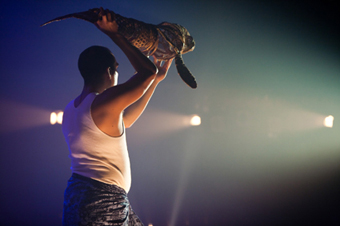
Ilbijerri Theatre Company
photo courtesy of Ilbijerri Theatre Company
Ilbijerri Theatre Company
bold, black, brilliant
That’s the title of the Ilbijerri Theatre Company’s retrospective exhibition, which is currently on display at the Bunjilika Aboriginal Cultural Centre at Melbourne Museum. The exhibition marks the 20th anniversary of Ilbijerri, which was created by Aboriginal and Torres Strait Islander artists in Melbourne in response to seeing non-Indigenous theatre companies telling Indigenous stories.
From the breakthrough production of Stolen, commissioned in 1992, to the upcoming world premiere of Jack Charles v The Crown (a collaboration between the actor and the playwright John Romeril) at the Melbourne International Arts Festival, the company has toured nationally and internationally, finding resonance and critical acclaim with Indigenous and non-Indigenous audiences alike. Along the way we’ve reviewed the company’s Blak Inside season (RT48) and Rainbow’s End (RT66), among others.
The retrospective gives visitors a behind-the-scenes look at life in the theatre company through objects including sets, props and photography from Ilbijerri productions. It’s being displayed alongside From Little Things Big Things Grow, an exhibition about Aboriginal activism in Australia between 1920 and 1970. 20 Years: Bold. Black. Brilliant, curator Ben McKeown, Bunjilaka Aboriginal Cultural Centre, Melbourne Museum, July 9-Oct 31; http://museumvictoria.com.au/melbournemuseum/
made in melbourne
We’ve only just recovered from the Next Wave festival (RT98) but the Melbourne Fringe Festival is fast approaching and the numbers are enough to induce panic: 19 days; 150 venues; and almost 5,000 artists. One of the highlights will be Visible City, which isn’t so much programmed as expected to crop up all over the city at different times and places. It’s described as a “massive cross-artform venture that sees 12 contemporary artists creating new work every day of the festival” (press release).
The artists include some RealTime regulars such as Sarah Rodigari (RT66), Willoh S Weiland (RT88), Lara Thoms (RT76), Jason Maling (RT96) Ingrid Voorendt (RT57), Jennifer Jamieson (RT57) and Michael Yuen (RT66), as well as a few less familiar faces like Rachel Main (Vic), Melody Woodnutt (Qld), Kerry Ann Lee (NZ), Sally Ann McIntyre (NZ) and Joned Suryatmoko (Indonesia).
It’s also worth keeping an eye out for artists who have participated in the Outside Eye development program, run by the Fringe in collaboration with FULL TILT at the Arts Centre and the City of Geelong. This program gives artists 16 hours of one-to-one mentoring with an industry practitioner, the opportunity to attend professional workshops and free space for rehearsal, research and development. This year, the lucky few were Kate Boston Smith, Zoe Robbins, Anne Edmonds, Lisa-Skye Ioannidis, Michael Connell, Linda Beatty, Katrina Rank, Isabel Andrews-Burillo, Sasha Stella, Brodie Maguire, Hoa Pham, Jono Burns, Fregmonto Stokes, Sabrina D’Angelo, Tim Mager, Flynn Hart, Jemma Woolmore, and Justine Makdessi. Melbourne Fringe Festival, Sept 22-Oct 10; www.melbournefringe.com.au/
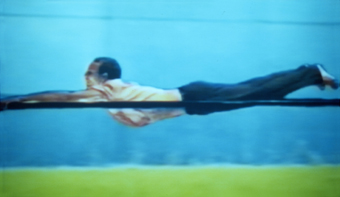
John Meade, Propulsion 2001 (still)
photo courtesy of the artist and Sutton Gallery, Melbourne
John Meade, Propulsion 2001 (still)
objects, diagrams and immersion
Three new exhibitions have just opened at the Perth Institute for Contemporary Arts. First, there is Objects To Live By: The Art of John Meade, featuring works by one of Australia’s leading sculptors (see RT44). Meade’s first major retrospective comprises 17 works ranging in scale from intimate objects on table tops to architecturally scaled wall pieces.
The second exhibition is Love of Diagrams, showing eight contemporary artists investigating “all things diagrammatic.” The artists come from a variety of places—Armando Andrade Tudela (Peru), Bradford Bailey (US/UK), Jose Damasceno (Brazil), Natasha Dusenjko (VIC), Marita Fraser (Australia/Austria), Joyce Hinterding (NSW), Bojan Sarcevic (Bosnia/France) and David Thomson (WA)—and work in a variety of forms including drawing, collage, painting, photography, sculpture, sound art and installation.
Last but not least is Sekilala, the first Australian showing of work by SHIMURABROS, the Japanese brother and sister team Yuka and Kentaro Shimura. Sekilala is a three-screen immersive video installation, shot on super 16mm, filmed in Prague with a storyline inspired by the controversial image of a mouse with a human ear growing on its back. The press release states that “a family drama in which the father is obsessed with bio-furniture erratically unfolds in multiple, fractured stories. Projected onto three screens and randomly configured in 26-shot sequences, the same story is never experienced twice, and the viewer becomes the editor of an infinite and complex film.” SHIMURABROS received the Excellence prize for this work at the 13th Japan Media Arts Festival in 2009. The work has also been shown in Tokyo, Prague and Cannes. Objects To Live By: The Art of John Meade, curator Zara Stanhope; Love of Diagrams, curator Leigh Robb; Sekilala, SHIMURABROS, Perth Institute of Contemporary Art, Sept 11-Oct 24; www.pica.org.au
Sydney Children’s Festival, CarriageWorks
photo courtesy of CarriageWorks
Sydney Children’s Festival, CarriageWorks
kids picture the world
The 2010 Sydney Children’s Festival is enticing young photographers and filmmakers to skill up. Benedict Brink’s Digital Photography Workshop focuses on the use of use perspective, colour and natural light to “take a stunning portrait of a friend, capture a landscape masterpiece, or create abstract art out of everyday objects.” In Kyra Bartley’s Make a Film in a Day Workshop participants form a team to “brainstorm and storyboard ideas, cast the actors, hunt for interesting looking locations to film and edit the work to produce the perfect final cut!” In Bartley’s workshop you might end up behind the camera or acting in front of it. In Darryl Cordell’s Picture Us, kids and their families perform to camera to make magical and wacky photographic collages. Sydney Children’s Festival, CarriageWorks, Sept 27-Oct 9, www.sydneychildrensfestival.com
RealTime issue #98 Aug-Sept 2010 pg. web
© RealTime ; for permission to reproduce apply to realtime@realtimearts.net
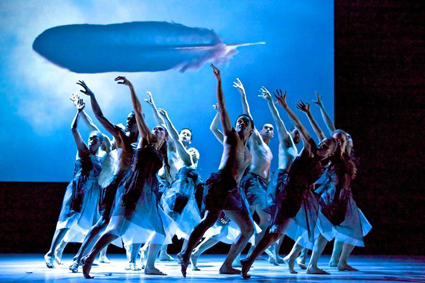
‘Feather’ from Riley
photo Andy Solo
‘Feather’ from Riley
SOFT WHITE CLOUDS DRIFT ACROSS BLUE SKY. OUT OF THE DARK BELOW, ON THEIR BACKS, CRAWLING BUT TORSO AND FACE UP, CREATURES SLIDE INTO DIM LIGHT. THEY WALK, BUT BEND THEIR KNEES TO THE GROUND, ARMS RIGHT-ANGLING OUT. LIKE STRANGE, EMERGENT ANIMALS THEY FORM BENEATH THE IMAGE OF A BOOMERANG AND TWIST, TURN AND ARCH, PERHAPS AT ONE WITH ITS SHAPE AND IMAGINED FLIGHT. THEY STAND, THE BOOMERANG FADES. ANOTHER CREATURE SCUTTLES THROUGH THE DARK AND A LOCUST FORMS BEFORE US, AGAIN ICONICALLY SUSPENDED IN CLEAR SKY.
In Bangarra Dance Theatre’s new season, Of Earth & Sky, the company is introducing a promising new Indigenous choreographer, Daniel Riley McKinley (24 years old, four years with the company) who has chosen as the subject and inspiration for his first major work the cloud series by the late Wiradjuri/Kamilaroi photographer and filmmaker Michael Riley (RT76, p20; RT77, p15). McKinley has selected six of the 10 images—feather, locust, bible, boomerang, broken wing, angel—objects suspended mysteriously in blue skies, and which for him relate most directly to Aboriginal culture. Omitted, for example, is Riley’s jersey cow, an almost comically displaced figure but equally indicative of ruinous environmental and cultural invasion.
Each image is projected onto a large screen behind the dancers and one by one is graphically realized and interpreted. Beneath the locust, dancers’ arms become wings as they cluster in groups and then en masse, to a buzzing electronic score and a riffing, insistent piano. Curiously, the choreography manages to express not only a locust swarm, but also the gestures of those protecting themselves from it in a series of alternations. The plague escalates into highly organized frenzy of sound and movement—straight lines and rapid circles, a fear-inducing army. Just as suddenly it stops. Something else scuttles across the stage.
The Bible, worn leather cover, hovers and a curiously abstract ritual of oppression ensues, hauntingly embodied by Elma Kris and soon multiplied in a row of other women on a diagonal across the stage, gold crosses emblazoned on—or ‘branded on’—their backs. They kneel, hands pushed up behind their backs, as if bound, and their heads drop to the earth. They rise, they stand, walk, go down on their knees as an eerie, distant female choir is heard buried deep in the music. They stand, elbows above their heads, hands behind their heads, palm to palm, like a distorted image of prayer or tortured angel wings, passing before us across the front of the stage and into the dark. The psychological pain induced by an alien religion that converts by bondage is palpable in the sheer otherness of the strange patterns that McKinley makes.
The Bible is replace by a fragmented view of a graveyard sculpture, the Angel. In another powerful episode two men with whitened bodies appear, one borne elegantly on the other’s shoulder, his body in a gentle arc, two bodies as one: is this the Angel? As the carried body extends further out, it’s as if gravity is being defeated. The bodies twist and roles are reversed, carried becomes carrier in the most sinuous of moves, as if on air, in this the most ambiguous of McKinley’s episodes. It’s as if he’s asking, are there angels, divine helpers, and can they be as beautiful and strange as this—and Waangenga Blanco and Leonard Mickelo can answer this for him.
In a mysterious return to the Bible, men in short skirts, the same gold crosses extending the length of their backs, dancing wide-stanced, like Pacific Islanders perhaps, execute obscure tasks, move angularly and fluently dance in a circle of blue light, almost warrior-like in contrast to the equivalent female episode—an image here of some kind of accommodation? McKinley writes in his program note: “The men represent the other side of the religious experience as an exaggerated religious presence.”
The screen turns white. A woman (Jasmin Sheppard) swathed in feathers crawls across the floor to a low cello growl, her body racked, struggling to rise in a painfully exquisite pattern of elaborate moves that seem to engage every part of the body in the effort as Michael Rlley’s Broken Wing image appears on the screen.
Riley’s Feather replaces Broken Wing and the whole ensemble dance: the patterning is formal, the movement light and elegant, no longer saturated with symbolism, animism or literal image-making. As they leave, the dancers gently drop feathers to the floor. McKinley writes that “in Wiradjuri culture, a feather can represent the marking of a journey had…I feel that Riley is my feather, it has connected me to Michael…”
McKinley’s work is sometimes more abstract than the company’s has been, but also at times quite literal, if always about the embodiment of land, animal and spirit and what puts these at risk. There is inventiveness and welcome unpredictability in the choreography, if not always convincingly sustained, and a theatrical assuredness if not always on top of its symbolism. But Riley represents a strong beginning for McKinley’s work with Bangarra and a welcome new vision.
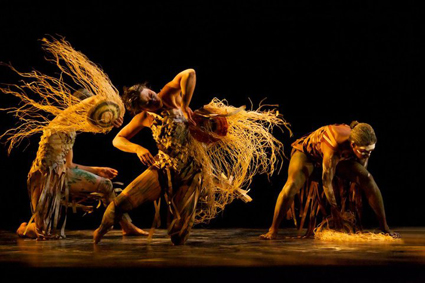
‘Weaving’ from Artefact
photo Andy Solo
‘Weaving’ from Artefact
If McKinley’s Rlley is the sky of the program’s title, Of Sky & Earth, Frances Rings’ Artefact is its earth from the very first image, titled Museum. It’s as if something very alive and alien has sprung from the soil in the form of a large possum cloak that writhes, revealing multiple arms and human legs (Daniel Riley McKinley and Travis de Vries). It’s an astonishing image that gives more than literal life to the idea that this encased museum object once sheltered many people, even across generations; it suggests a spiritual relationship between artefact and wearer and, as Rings writes in her program note, the maker. Artefact is a work of restoration in more than the museum sense of the term.
The next image also astonishes: a pale, out-sized, huge curved bark, such as might be used to carry food, a coolamun, gradually appearing upstage. It will rock, be climbed, turned over, inhabited and appear to float. From it people dance out to forage, the women harvesting with their string bags, the men to grind stones in dances that hover engagingly between representations of making and extended explorations of movement.
In Bodies, the work’s most literal episode, heritage is denigrated by 19th and early 20th century Western attempts to ‘scientifically’ prove that Aboriginal people are an inferior species—the missing link to the Stone Age. If Bodies labours its point with projected images and mechanical movements of measurement to show how Aboriginal people were themselves made museum artefacts, we are soon returned to the magic of objects and their making.
A wary, wide-eyed woman dances sensually in a flowing head-dress and grass skirt and, in Weaving, a huge golden skein of woven pandanus leaves—of women’s making presumably—envelops the men while the women’s dance has been itself a kind of weaving. Then, as often with Bangarra, Artefact concludes communally, if ambiguously. I was left with a rewarding sense of Rings’ restoration of life and spirit to artefacts, their making and makers, realised with Jacob Nash’s design, especially the giant coolamun for its poise and balance, and Gabriela Tylesova’s costumes that so aptly expressed their making.
With its focus on contemporary images and the ancient heritage of artefacts and their embodiment in and through dance, Bangarra’s Of Earth & Sky is an engrossing and thoughtful artistic exploration of a living culture.
Of Earth & Sky is showing at the Arts Centre, Melbourne, September 23 to October 2.
Bangarra Dance Theatre, Of Earth & Sky: Riley, choreographer Daniel Riley McKinley; Artefacts, choreographer Frances Rings; design Jacob Nash, costumes Gabriela Tylesova, composer David Page, lighting Damien Cooper, artistic director Stephen Page; Drama Theatre, Sydney Opera House, July 23-Aug 28
RealTime issue #98 Aug-Sept 2010 pg. web
© Keith Gallasch; for permission to reproduce apply to realtime@realtimearts.net
CD
www.clockedout.org
In March 2009 I was entranced by an Utzon Series concert at Sydney Opera House’s The Studio in which Brisbane duo Clocked Out (Erik Griswold and Vanessa Tomlinson) realised a collaboration developed over 10 years with Chinese composer Zou Xiangping and performed with leading Australian and Chinese musicians.
The concert was an entertaining and nuanced exemplar of cross-cultural collaboration. I immediately longed to hear it again, so it was a pleasant surprise to recently receive a fine studio version recorded in Sydney only days after the concert.
The performances lose none of the spontaneity on CD that is requisite for conveying works drawing on and inspired by the traditional street music, opera percussion and folksong of the oldest neighbourhood of Chengdu in China's Sichuan province, melded here with Clocked Out and their ensemble’s Western jazz and avant-garde roots.
As I wrote in my online review of the concert, “Tuning the inner ear,” April-May 2009, “Clocked Out's approach displays a meeting of forms across cultures and musical languages but also allows the musics of Sichuan enough time-space to stand on their own: in the presentation of traditional works, in re-framings of native classics and in wilder experimental fusions where traditional instrumentalists reveal how they can transplant their virtuosity to new terrains.”
My first-hearing responses to the compositions can be read in the concert review. What the CD confirms is just how engaging every composition is and that the performances are uniformly excellent. Soprano Tian Linping not only excels in the soaring vocal style of Chinese opera, but in “Picking Begonias” displays a local style Griswold describes as “a mix of high art with flutter tongue.” As I wrote then, “The effect is of a lilting, gargling trilling complete with astonishing glissandi in a composition replete with passages where flute and erhu (Zhou Yu) intricately entwine.”
Shi Lei’s bamboo flute playing in “Happy Meeting” is magical, the range of notes and effects (astonishingly bird-like in “At Huang Si’s House”) suggest a more sophisticated, much less humble instrument. Zhou Yu’s erhu playing evokes an eloquent, plangent singer in “Two Springs reflect the Moon.” Peter Knight (trumpet), Adrian Sherriff (trombone) and Robert Davidson (bass) provide not only choral propulsion throughout but also moments of reflective lyricism in these democratic compositions.
Griswold’s characterfully spare, incisive piano and Tomlinson’s rich percussion partnering with Zou Xiangping and Zhong Kaizhi collectively provide supple textures and new spaces—the sheer musicality and detail of the percussion is finely captured in the recording of “Sichuan Opera Overture.” As I wrote of the concert version, “Built around gong and cymbals the work engenders rich textures from seemingly limited means, adding timber percussion, then skins, erhu and flute, long bass notes, a call and reply passage and an epic march to the end. The beat is catchy but elusive; as Griswold declares, “the rhythms are unbelievably complex.” Wide Alley was a wonderful concert; now it’s an excellent CD, a tribute to a successful cross cultural collaboration and adventurous composers.
Keith Gallasch
Liu Jiayin, Oxhide 2
[This introduction was written in September 2010. New links will continue to be added to the list below. Eds.]
All nations are more complex than newspaper headlines can ever hope to convey, but few are as bewilderingly diverse, complicated or riven with contradictions as contemporary China. RealTime's coverage of cinematic developments in the People's Republic over the past decade has not only offered a rare glimpse of the evolution of an important popular art form on China's mainland—it has also brought readers' attention to films that offer a Chinese perspective on the history, daily life and social dynamics of this vast and increasingly important country.
China's disparate nature is reflected in its cinema, which encompasses everything from state-sponsored ode-to-the-Party blockbusters—see Mike Walsh's “Mao in the Mall,” RT94—to openly critical DV documentaries. As Walsh wrote in his coverage of the 2010 Hong Film Festival (“Starting Over,” RT97), “Cinema, like most things in China, is expanding rapidly and this expansion is not an easy thing. Film is an arena in which government regulation, market economics and creative expression frequently come into volatile contact.”
RealTime has helped readers explore this complex world by identifying the key filmmakers to watch. Sandy Cameron, for example, wrote a very early appreciation of Liu Jiayin's minimalist portrait of Beijing family life in Oxhide (“A Small Triumph,” RT67), long before the film garnered the recognition that has made it one of the most talked about Chinese features of the decade. More recently, RealTime published the first article in Australia about Zhao Dayong's epic documentary Ghost Town (“Merely Floating in the World,” RT94). Coverage of this important new voice in Chinese cinema continued with Mike Walsh's review of Zhao Dayong's first drama, The High Life, at the 2010 Hong Kong Film Festival.
Zhao Dayong has emerged from the ‘unofficial’ documentary sector that operates outside the tightly regulated production and distribution system overseen by China's Communist Party. The roots of this movement stretch back to the dark days of the immediate post-Tiananmen Massacre years, but it was the arrival of cheap DV technology on the mainland at the turn of this decade that really allowed the unofficial sector to flourish. Since then, filmmakers like Zhao Dayong, Hu Jie, Ou Ning and Zhao Liang have created some of the most incisive, critical and heartrending images to come out of modern China. Their work has been explored in recent articles like “From the Dark Side of Economic Success” (RT97) and “China: Alternative Realities” (RT96).
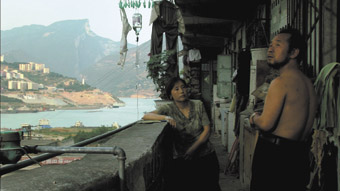
Jia Zhangke, Still Life
If there is one filmmaker, however, whose work best captures the strange, unpredictable conditions under which Chinese people live today, as well as the fraught, ever-shifting relationship between filmmakers and the authorities, it is surely Jia Zhangke. In the past decade Jia has moved from being an unofficial director whose work was banned in China to a recognised artist and recipient of state funding. He has worked across feature-length dramas, short films and documentaries. Through it all he has remained the most consistently creative, discerning and intriguing filmmaker working in China today.
It's a sad indictment of the US and Euro-centric myopia of Australia's mainstream press that this world renowned filmmaker, feted from Beijing to Berlin, Cannes to New York, has barely been acknowledged in Australian broadsheets, despite the appearance of many of his films at festivals around the country. In contrast, RealTime has been able to trace Jia’s development from early notices in coverage of the Hong Kong Film Festival back in 2005 (“A New China Syndrome?,” RT67), to an overview of his career in 2007 (“World Without Bearings,” RT79). More recently, RealTime has published reviews of his latest docu-drama hybrids 24 City (“Where the Truth Lies,” RT94) and I Wish I Knew (forthcoming in RT99).
Unfortunately Jia's absence from mainstream press coverage is symptomatic of a broader, longstanding marginalisation of Asian cinema in Australia. Nearly a decade ago Juanita Kwok wrote in RealTime (“Enter the Dragon,” RT41), “Only three Asian films were released by major motion picture distributors in Australia in 1999, a sad decline from a high of 13 films 10 years earlier.” Although there has been a marked increase in Asian films on Australian screens since that time, there has been scant concurrent rise in mainstream critical interest. As Mike Walsh noted recently (“UnAustralian Cinemas,” RT96), “There is still the assumption that popular sub-titled Asian films… exist within a diasporic ghetto whose walls cannot and probably should not be breached.”
The invisibility of Chinese cinema in Australia’s mainstream press further highlights the importance of RealTime, a publication that doesn’t simply reaffirm what readers think they already know, but rather seeks out the new and unknown. Whether you look at Chinese cinema from an artistic or sociological perspective, the films of recent decades have cast a revealing light on a society convulsed by changes playing out on a scale few of us can really comprehend. Put simply, Chinese films help us understand China. RealTime has helped us understand Chinese films.
Dan Edwards
street level visions: china, the unofficial view
chinese independent docos, melbourne international film festival
RealTime issue #109 June-July 2012 web
monetisation & the new rom-commie
mike walsh: 2012 hong kong international film festival
RealTime issue #109 June-July 2012 p13
riding with dragons
mike walsh: mario andreacchio’s the dragon pearl, ozasia
RealTime issue #106 Dec-Jan 2011 p18
you can’t build on an emptiness
dan edwards: ifchina original studio
RealTime issue #103 June-July 2011 p16
china’s divided screen culture
dan edwards: 2011 hong kong international film festival
RealTime issue #103 June-July 2011 p15
a fistful of renminbi
mike walsh: hong kong international film festival
RealTime issue #103 June-July 2011 p14
shanghai: fractured memories, contested histories
dan edwards: jia zhangke’s i wish i knew
RealTime issue #99 Oct-Nov 2010 p17
from the dark side of economic success
dan edwards: films by zhao liang and guo xiaolu, hong kong film festival
RealTime issue #97 June-July 2010 p16
starting over: new chinese cinema
mike walsh: hong kong film festival
RealTime issue #97 June-July 2010 p15
unaustralian cinema
mike walsh: asian film in australia
RealTime issue #96 April-May 2010 p17
china: alternative realities
dan edwards: the digital documentary filmmaker generation
RealTime issue #96 April-May 2010 p15
merely floating in the world
dan edwards: zhao dayong’s ghost town
RealTime issue #94 Dec-Jan 2009 p22
where the truth lies
dan edwards: jia zhangke’s 24 city and cry me a river
RealTime issue #94 Dec-Jan 2009 p23
mao in the mall
mike walsh: the founding of a republic
art, commerce, action!
dan edwards on the ambitious yunnan new film project
RealTime issue #84 April-May 2008 p17
from chinatown to china
dan edwards on an australia-china animation co-production
RealTime issue #82 Dec-Jan 2007 p20
world without bearings
dan edwards on the vision of chinese filmmaker jia zhang-ke
RealTime issue #79 June-July 2007 p17
cinemas of possibility
dan edwards on new asian films in the adelaide film festival
RealTime issue #78 April-May 2007 p17
emerging chinese cinema
mike walsh at the 2006 hong kong film festival
RealTime issue #73 June-July 2006 p26
high roads to china
mike walsh on chinese cinema
RealTime issue #69 Oct-Nov 2005 p17
a new china syndrome?
mike walsh
RealTime issue #67 June-July 2005 p20
a small triumph
sandy cameron
RealTime issue #67 June-July 2005 p22
an asian-centred australian cinema
mike walsh
RealTime issue #61 June-July 2004 p16
soon: film: the asian-australian connection
RealTime
RealTime issue #50 Aug-Sept 2002 p24
enter the dragon
juanita kwok: asian film in australian cinemas
RealTime issue #41 Feb-March 2001 p13
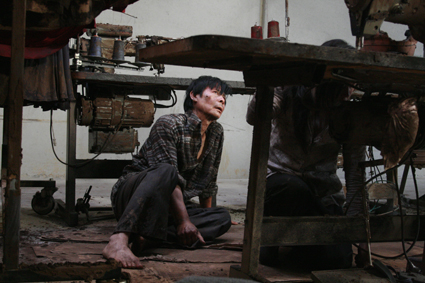
Hieu Phan, Mother Fish
photo courtesy of Titan View
Hieu Phan, Mother Fish
KHOA DO’S NEW FEATURE FILM MOTHER FISH BEGINS WITH A BLACK SCREEN, THE SOUND OF RUNNING WATER AND THE OFFICIOUS TONES OF KEVIN RUDD. THE THEN PRIME MINISTER IS ANSWERING MALCOLM FARR, POLITICAL REPORTER FOR THE DAILY TELEGRAPH AND OCCASIONAL COMMENTATOR ON THE ABC TV’S INSIDERS, WHO IS ASKING ABOUT THE “12 BOATS AND 700 PEOPLE” THAT HAVE RECENTLY ARRIVED AT CHRISTMAS ISLAND AND THE POSSIBILITY OF REINTRODUCING MAINLAND DETENTION CENTRES.
The reply is vintage Rudd (“there’s a purpose-built facility there for that purpose”) but it fades into the background as sound of water grows louder and the camera focuses on a pair of hands washing and chopping vegetables. We hear a voiceover in Vietnamese, spoken in the second-person: “What are you cooking today? You only ever eat greens…You always put too much sugar…I’ll wait for you in the car. Don’t forget to turn the TV off.” The volume on Rudd’s voice increases again and we hear him saying “boats [have] been coming to this country, Malcolm, as you know, since the 1970s.”
From here, we follow the woman (Hien Nguyen) as she drives to work—a small factory with several sewing machines and multiple racks of identical clothing (trendy red checked shirts and long purple skirts). The female voice accompanies her throughout the day and when everyone finally departs in the evening, the woman stays to retrieve a toy monkey that she, or rather the voice, has taken a liking to. The monkey clearly triggers something in her as the present falls away, the past intrudes, and the voice pleads with her to stop.
In an instant the factory transforms into a small boat, with a sewing machine standing in for a motor, a bobbin for a pull cord, and a skirt for a sail of sorts. This rather Brechtian approach, reminiscent of Lars von Trier’s Dogville, is not without its risks but for the most part it works. In this way, Mother Fish effects an unusual reversal: having previously made a rather filmic piece of theatre (RT86), director Khoa Do has now produced a rather theatrical film.
In the absence of actual ocean, the film evokes its presence through camera movement (constantly pitching up and down, as if on a heaving sea) and sound effects (water slopping against the side of the boat, the low drone of the motor). Similarly, the set transforms over the course of the film from a steel-toned workshop—all grey, gold and silver with the occasional shot of red thanks to the bobbins of thread—into a rusted, blasted and scorched shell of itself, barely recognisable under a layer of brown mud.
On board the “mother fish” are the two sisters Kim (Kathy Nguyen) and Hanh (Sheena Pham), their uncle (Hieu Phan) and a young man Chau (Vico Thai). Sailing out of the harbour, the sisters argue about what they have been allowed to bring and what their mother might have packed for them. However the argument comes to an abrupt end when they hear the sound of a patrol boat and shots bring fired. Once out onto the ocean, the journey alternates between boredom and terror. During the dull patches they remember the past (dad’s exploits, mum’s food) and rehearse the future (“you’ll never have to cook again because everything comes in a can: chicken in a can; cow in a can; fish in a can”). However these moments are few and far between as the mother fish and her crew endure horror upon horror: first the boat is attacked by pirates, who rape one sister while another watches; then they are forced to forfeit a precious necklace to bribe an official to tow them into a refugee camp where they are then pushed back out to sea; later Chau jumps ship never to be seen again while Hanh teeters on the brink of death.
These scenes have the potential to be voyeuristic on the one hand or sentimental on the other, but remarkably they are neither. Instead, this film sails straight and true thanks to the immense restraint of both its actors and director. For their part, the actors play the scenes with absolute control: emotion is evoked through little more than a turn of the head, a glimmer of a tear, or a gentle look of affection. What little dialogue there is, is spoken with sensitivity and nuance and Thai’s reading of the line “I’m sorry, I’m sorry” hints at his character’s pain and regret as well as compassion. This emotional and verbal reticence is complemented by Do’s visual restraint. For example, when filming the rape scene, gauze drops down over the lens as if to screen it out. Similarly, when characters are at their most vulnerable and distressed often all we see is a cheekbone, a veil of hair or a hunched shoulder.
In the final scenes, we see the younger Kim washing onto the shore and touching the feet of her older self. Once again the camera hovers over the older Kim’s shoulder as we follow her home. She attempts to cook a meal but unnable to eat she instead goes for what we think is a walk in the park. However, when the camera finally tilts down it becomes apparent that she has walked into a pond and is plunging into the water. Several silent seconds later (the soundtrack is effectively minimalist), her younger sister and her younger self burst from the water, gasping and reaching for one another. In one of the final images of the film, a small hand reaches for a larger, older one and we hear (once again in Vietnamese), “Sister, is that you?”, to which Hanh replies, “I’m here.”
The film finishes with the astounding statistic that between 1975 and 1996, over 1,500,000 people fled Vietnam. Of those, only 900,000 made land meaning that 600,000 were lost at sea, a catastrophe on a par with 1,700 SIEV Xs. Of the survivors, approximately 137,000 came to Australia. It is now 35 years since this migration started, yet it is only in the past 10 or so years that these stories have started to emerge into the mainstream. Think for instance of exhibitions such as the Casula Powerhouse’s Viet Nam Voices (1997), Viet Nam Voices: Australians and the Viet Nam War (2001-03) and Nam Bang! (2009) (RT90) as well as Nam Le’s book The Boat (2008). Perhaps the first generation was so busy surviving that it is only now, as the second generation makes its mark on the world and starts to have children of their own, that these stories can be told.
Intriguingly, Do is also planning to tell stories with and about other refugee communities. Mother Fish is the first in a planned “refugee trilogy” with the second film, Falling for Sahara, already in post-production and the third in the early stages of development. Mother Fish suggests the trilogy has the potential to become an Australian film classic.
Mother Fish, writer, producer, director Khoa Do, executive producer Matthew Riley, performers Kathy Nguyen, Sheena Pham, Hieu Phan, Vico Thai, Hien Nguyen; Australia, Titan View
RealTime issue #98 Aug-Sept 2010 pg. web
© Caroline Wake; for permission to reproduce apply to realtime@realtimearts.net

Kookaburra
photo Yorrick (bonehead)
Kookaburra
musical workers
WHEN JAY ‘JP’ PARRINO COVERED MEN AT WORK’S “DOWN UNDER” ON AUSTRALIA’S GOT TALENT IN LATE 2009, ONE COULD WITNESS CULTURE IMPLODING IN MANY WONDERFUL WAYS. EMPLOYING LIVE SAMPLING TECHNIQUES, HE BUILT UP LAYERS OF ACOUSTIC GUITAR TO CREATE A POVERA DIGITALIS TYPICAL OF THE CONTEMPORARY BUSKER. WHILE JP’S DEVICES WERE PERCEIVED AS A NOVELTY BY THE SHOW’S AUDIENCE AND JUDGES, HE EMPLOYED THEM AS MEAGRE USER-FRIENDLY TOOLS, NOT AS FLASHY INSTRUMENTS. HIS MODUS OPERANDI WAS TO LITERALLY BUILD A BACKING FOR HIS VOICE AND ACOUSTIC GUITAR ACCOMPANIMENT.
Performing against and with live looping was instigated by Alvin Lucier in the 60s, developed by Robert Fripp in the 70s, spectacularised by the Young Gods in the 80s, matrixed by Jeff Mills in the 90s and deployed with virtuosity by Battles in the 00s. It’s safe to say that live looping is now a given vernacular in the technological production of music. Occurring within a mainstream context like Talent, JP’s use of the process demonstrates well how musical culture is now shaped. He simultaneously deconstructed ‘the song’ (voiced by Men At Work) and aurally constructed ‘a song’ (voiced by JP). The song this man made through his work clearly connected to both live and televisual audiences by virtue of how deftly he collapsed what was his and what was not. In an era wherein media has moved from saturation to atomisation (from the congealment of large forms to the unleashing of fine particles), performances like JP’s populist yet radicalised rendering of “Down Under” demonstrate how musical texts now implode without losing their identity.
In shows like Talent, the surrendering of the performer to his/her performance marks the event as a social communion for those within earshot. As a desultory figure unconverted to the show’s jingoistic narrative, I try to maintain distance from its Red Rooster-like moniker, its flag-waving set design, its pathetically professional panel, its bug-eyed audience, its predictable swells of applause. Yet I cannot deny the power of song, of singing and of an audience enthralled by a singer’s self-surrendering performance. True to the diacritics of folk culture, JP’s version sets up a dialogue with the original Men At Work version, and the two are empowered by a textual link where the songs speak to each other as much as they speak to me as an auditor of their voices and voicings.
Now, those with refined Rock sensibilities have long made sardonic quips about the numerous competitive TV shows based on Pop musical performance (the global franchises of Idol, Talent etc). But might not the predominance of these spectacles of amateur gumption, innocent drive and hysterical dreaming reveal the role song plays in popular culture? Songs are a particularly dialectal form of expression and intercommunication. The simple musicalisation of argot—of whittling a melody out of a popular epigram—is a form of linguistic sonography born of a living, breathing culture. Words are always at a fork in the linguistic road: they can turn one way to be weighted by their written inscription (the rationalist law of the text) or turn the other way and be airborne by their melodic transformation (the transcendent charm of the song). Say something enough times and it will eventually be sung.
mean larrikins
If there is one demographic watching and listening to Australia’s Got Talent on Channel 7, there must be another one watching Spicks And Specks on ABC. And if the former is defined by the supposedly insidious machinations of the Pop industry’s controlling of audiences incapable of articulating their relation to song other than mere consumption, then the other must be inversely defined. Despite being largely ignorant of the fact that the ABC stole the format for their 2005 show from UK Channel 4’s 1996 show Never Mind the Buzzcocks, the Spicks audience is congratulated on their upwardly mobile shift toward knowing when they are being manipulated and when they are not. The format of the show smacks of puerile academicism—uncomfortably echoing the panels first televised in Channel 7’s It’s Academic in the late 60s. Comedians, of course, are used to distract audiences from such irksome fare, but watching wannabe-cool comedians and grinning presenters fall over each other trying to prove their wit constitutes a far more embarrassing performance than the most inept of Talent’s hopefuls.
There are scant fragments in the televisual stream of Spicks that do not stray from the high-versus-low culture ossification which unwisely emboldens the intelligentsia. The trivia format suits the trivialisation of Pop music in general, while the show’s incorporation of local and select overseas touring musicians fluffs up its notion of ‘real/true/roots/indie/non-mainstream/Rock’ musical culture. It’s a show suited to parents who remember their tertiary education via playlists garnered from JJJ. Like everything on ABC TV, the ideological compaction and congestion of its slanted views, adopted poses and supported truisms make it an insult to bother applying any semiotic reading of its monophonic voice.
But a late 2007 “Children’s Music Edition” episode on the show became unintentionally infamous when one question innocently proposed a melodic connection between the 1934 Girl Guides campfire sing-along “Kookaburra” composed by Marion Sinclair, and fragments of the flute interlude in Men At Work’s international number one song from 1981, “Down Under.’ Less than two years later in mid-2009, the purported owner of the copyright of Kookaburra—Larrikin Music Publishing—claimed copyright infringement of said property and moved to sue the owners of “Down Under”’s copyright—EMI Music Publishing Australia and co-composers Colin Hay and Ronald Strykert.
A lot of press has since danced a predictable waltz around this case: freedom of speech; money-grabbing lawyers; pop music always ripping-off; denial of technical harmonic quotation; ethical averment of fair usage etc. The intersection of the arts and legality exacts such a tiresome charade of grandiose ethics. This case is not about money, music and ethics. It’s about the forced divide between pop culture and folk culture (in shows like Spicks). It’s about how the two are implosions of the other, how they live off the other, and how their mechanisms are now more than ever shared (as in shows like Talent). And it’s about how the intelligentsia slathers ethical-mongering, political-correctness and proscriptive-nationalism on such a public incursion of national identity crisis (as in the Larrikin vs EMI case), rather than provide contextual, critical insight into the deeper issues which shape these cultural ground swells.
thieving magpies
Like the atomisation which now defines ‘war’ as an asynchronous concatenation of disparate events and locations with no holistic sense of convergence or interconnection, ‘cultural wars’ no longer require metaphors based on Great Wars, where notions of frontlines and avant gardes romantically heroicise how individuals contribute to the shaping of culture. This is ultimately a good thing, for culture—from its conservative models of anthropology to its radicalising models of neurology—is best interpreted as noise of the crowd rather than scripture of an author.
“Down Under”’s para-conscious quipping and cribbing of “Kookaburra” can be viewed semiologically (though not ‘legally’) as a therapeutic retort to having suffered the indoctrination of “Kookaburra” in primary schools, where kids were forced to listen to such songs broadcast on ABC radio through PA systems fixed atop the blackboard in a scenario straight out of George Orwell’s paranoid mind. Am I alone in detesting Kookaburra and every single faux-folksy, pseudo-pioneer, colonial-jumbuck, banjo-jangling ditty which the ABC ideologically served up as part ‘children’s music’ and part soft enforcement of a default-leftist, neo-Maoist, pro-Folk, anti-Pop statement of Australiana? Both Kookaburra and the Larrikin copyright claim recall an epoch of reclaiming iconography for a dangerously jingoist, post-convict liberation, with Blinky Bill, the Easter Bilby, Cuddlepie and the Southern Cross rebutting overseas imperialism. (Ironically, it was the populist “Down Under”—through its appropriation by Australia II upon winning the America’s Cup in 1983—and not any folksy tune that sung the praise of Australia internationally.)
When Larrikin sued Men At Work, they impressionistically painted their case like the Eureka Stockade, with true blue Australian Folk music battling the corporate ogre EMI. Larrikin—personified by the APRA-lauded aegis of self-appointed Australian folk historian Warren Fahey—has long wheelbarrowed a divisive and separatist notion of Australian Folk music, often intoned as if a local hero is struggling to gain respect for the unsung songsters of white rural colonial history. Yet if Larrikin adopted a modern, diffusive notion of Folk dissemination, they would realise that their battle was long won once Qantas Airlines forced its boarded patrons to suffer a broadcast playlist of semi-acoustic, pub-rockish, sunburnt country Aussie spirit fodder (remarkably similar to the ‘live’ sounds on Spicks). The risible iconography that attempts to monopolise the Australian voice as one big rural campfire round is as ideologically loaded as chants on Cronulla Beach. When Qantas and their corporate brethren of image marketeers broadly assume the cultural validity of such ‘music of the land,’ it suggests that what Larrikin would claim to be Folk is now the most pervasive form of nationalistic Pop.
The word “kookaburra” comes from the Wiradjuri “guuguuburra.” The voice of the kookaburra underwent indigenous and colonial linguistic translations before the Girl Guides claimed kinship with its song via the colonising practice of western diatonic harmony. While Larrikin attempts to grandstand a mean-spirited sense of folk culture by suing Men At Work as the Girl Guides Association celebrate their centenary, lyrebirds mimic car alarms, bell birds interface with mobile phones, bowerbirds collect plastic bottle tops. And magpies continue their chattering in the magpie culture of music wherein all is borrowed, all is robbed, and all is sung.
RealTime issue #98 Aug-Sept 2010 pg. web
© Philip Brophy; for permission to reproduce apply to realtime@realtimearts.net
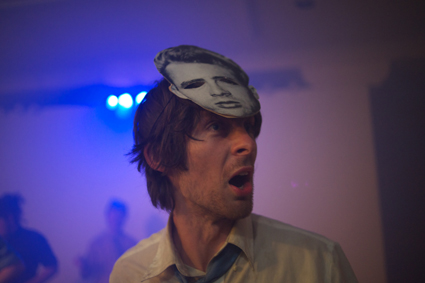
Robbie O’Brien, Room 328
photo Morgan Roberts
Robbie O’Brien, Room 328
MAKE ART. DRINK. VOMIT. THIS WAS THE PUBLICITY BY-LINE FOR THE SHOW WHICH AT FIRST SEEMED UNCOMPROMISING, EVEN UNINVITING. THE QUEENSLAND GOVERNMENT HAS DECREED LOCK-OUTS (OR LOCK-INS, DEPENDING ON WHERE YOU’RE STANDING) FOR CLUBS IN FORTITUDE VALLEY IN AN ATTEMPT TO CURB ALCOHOL-FUELLED STREET VIOLENCE IN THE WEE HOURS. ON A STRICTLY MICROSCOPIC, SOCIOLOGICAL LEVEL, ROOM 328 IMMERSED US IN A TACTILE, DIRECT TAKE FROM A MASCULINE PERSPECTIVE ON CLUBLAND (OR NEVERLAND, AS DIRECTOR DANIEL SANTANGELI EXPRESSES IT, REFERRING TO PETER PAN’S LOST BOYS).
These are Boys with No Sense of Limits, dedicated to the time-honoured prerogative of young males to live fast, die young and leave a good-looking corpse. Some of them, of course, fulfil their wish. The piece represents men’s need to interpose violence in order to protect themselves from closeness and personal connections. On a deeper, more poetic level informing the aesthetic values of the production, the audience was being asked to contemplate the pain of these vulnerable young men as socially constructed, and ultimately to break the rules, men and women alike, of sex and gender. On entering the space each audience member was fitted with a string bracelet similar to those attached to a baby’s wrists to identify them. Each tenuous thread bore a boy’s name. Similarly, later on, we were asked to wear identical, iconic James Dean masks for a re-enactment of the “chickie run” scene from the cult movie, Rebel without a Cause. I danced with a “boy” who proved to be a ‘girl’, a kind redhead who forgave my clumsiness for a while before moving on to dance with a “girl.” (But real men don’t dance, do they?)
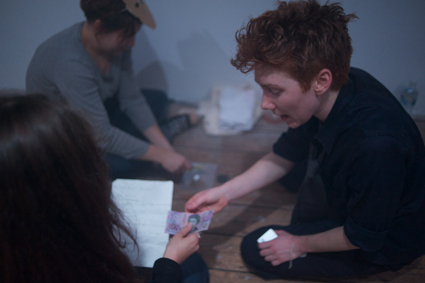
Erica Field, Room 328
photo Morgan Roberts
Erica Field, Room 328
Part dance theatre, part performance art, part installation, the ambient club atmosphere and Willmett’s live sound mix wove together these levels of meaning for the spectator who was free to wander at will. Sometimes the action coalesced round set pieces: the coronation of a king with a cardboard crown; a performer being cling-wrapped to a pillar; the multiple deaths of River Phoenix. Sometimes the audience participated in actions designed to point up our shared humanity
In a poignant ending the mood shifted from all this masculine psychic and physical turbulence to one of pervasive quietude. A sense of peace emanated from the now liquid keyboard tones of Willmett’s soundscape as the performers were winding down. This was a perfect analogue for wandering outside and greeting the dawn with the clear-eyed sense of purgation I’m sure most of us have experienced at one stage of our lives, after an orgy of too many drugs and too much alcohol. It struck the note of absolute, shared verisimilitude I had been searching for throughout the performance. The redhead with whom I’d danced removed the bracelet denoting my spurious masculine identity, freeing me to leave the building reborn, at the same time holding my hand and gaze in an intimate, naked exchange that was delicately touching. But it was still early. I wanted to be contaminated. I wanted a drink.
Room 328 is representative of a new, thoughtful generation of performance makers in Brisbane who are breaking new ground. Three years in the making, this was the first public viewing of a work presented by director Daniel Santangeli and producer Genevieve Trace who have pulled together an impressive line up of their peers including Expressions Dance Company’s choreographer-in-development Liesal Zink, bass guitarist and keyboard player Mike Willmett from local Indie band My Fiction, and local interior designer Elise Terranova. Many of the Room 328 performers trained at SITI Company in New York, founded by Anne Bogart and Tadashi Suzuki. The sheer diversity of talent involved in this ensemble production delivered something pretty amazing.
Room 328, director Daniel Santangeli, designer Elise Terranova, choreographer, Liesal Zink, sound designer Mike Willmett, presenters Allies of Metro & Genevieve Trace; The Galleries, Metro Arts, July 6-10
RealTime issue #98 Aug-Sept 2010 pg. web
© Douglas Leonard; for permission to reproduce apply to realtime@realtimearts.net
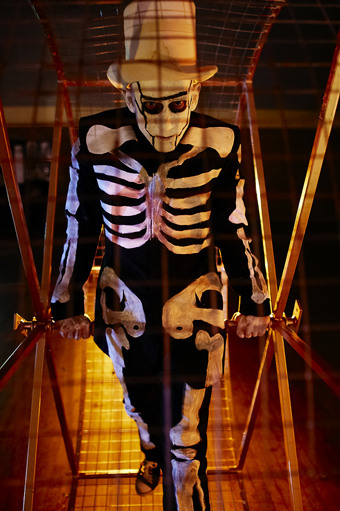
Aerialize, Clammy Glamour From the Curio-Cabinet
photo courtesy of the artist
Aerialize, Clammy Glamour From the Curio-Cabinet
sydney styles a fringe
Unlike Melbourne and Adelaide, Sydney has been without a fringe festival in recent years, putting it on the fringe of the fringe so to speak. However, this is all about to change with Kris Stewart’s inaugural Sydney Fringe Festival. Sensibly, the initial festival is based where its artists are—in the city’s inner west. Stewart states that around 60% of the program is from artists working in and around the Newtown area. Even if you’re living there, you’re unlikely to get to all 200 events so you could focus on theatre or visual arts or the intriguing category marked “other events.” Or you might like to choose a venue such as CarriageWorks, PACT or the Addison Road Gallery and stick with it. You could choose an already widely acclaimed show like Elbow Room’s Tiny Chorus, or a company like Newcastle’s Tantrum Theatre that you’ve seen praised in RealTime, or seek out Aerialize (http://realtimearts.net/article/issue82/8802) who train many young circus and physical theatre performers. Aerialize will be staging Clammy Glamour From the Curio-Cabinet, directed by underground cabaret star Annabel Lines and Legs on the Wall associate Simone O’Brien. The show is billed as “an aerial tale, sparkling ominously in the half-light of a strange and disturbing doll’s house” (press release). Sydney Fringe Festival, September 10-26, http://thesydneyfringe.com.au/; Aerialize, Clammy Glamour From the Curio-Cabinet, CarriageWorks, Sept 15, 16, 17, 23
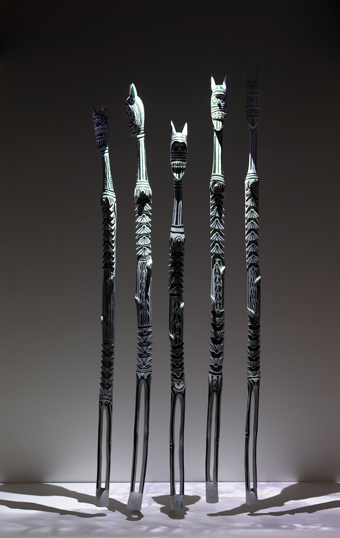
Mokuy, Nawurapu Wunungmurra
photo courtesy of the artist
Mokuy, Nawurapu Wunungmurra
making new media indigenous
The 27th Telstra National Aboriginal and Torres Strait Islander Art Awards (NATSIAA) have been announced. There is some extra excitement this year as NATSIAA has introduced a new prize category in recognition of the growing number of Indigenous artists who are embracing new media as part of their artistic practice. Previously, such works fell into the Wandjuk Marika 3D Memorial Award category (http://www.realtimearts.net/article/issue87/9154). The inaugural Telstra New Media Prize has been awarded to Nawurapu Wunungmurra for his work Mokuy.
Mokuy (spirit) is an elegant sound sculpture with video projection that evokes images and sounds of the coming together of spirits associated with sacred yams, “Morning Star feathers,” scrub fowl and doves at the sacred ground called Balambala: “The Yirritja mokuy come in on the birds djilawurr (scrub fowl) and bugutj-bugutj (banded fruit dove). The Dhuwa mokuy, they come in from rangi side (saltwater).” [http://www.nt.gov.au/nreta/museums/exhibitions/natsiaa/index.html]
The Telstra Award and General Painting Award went to Mr Donegan for his work Papa Tjukurpa, Pukara. Other winners included Glen Namundja for Kunabibbe Ceremony at Manmoyi (Telstra Bark Painting Award), Dennis Nona for Saulal (Telstra Work on Paper Award) and Wukun Wanambi for Bamurrungu (Wandjuk Marika Memorial 3D Award). If you can’t get to the Museum and Art Gallery of the Northern Territory in Darwin to see these and the rest of the 96 pre-selected works go to: www.nt.gov.au/nreta/museums/exhibitions/natsiaa/
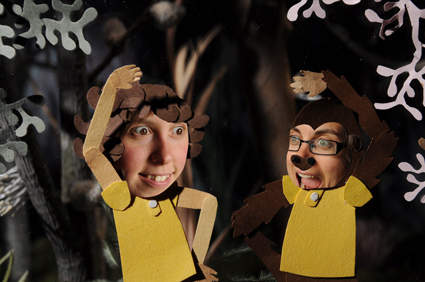
Isobel Knowles and Van Sowerwine
Australia, You Were In My Dream (still) 2010
photo courtesy of the artists
Isobel Knowles and Van Sowerwine
Australia, You Were In My Dream (still) 2010
van sowerine & knowles: winning interactivity
In other media arts news, Victorian artists Isobel Knowles and Van Sowerwine have been announced as the winners of the 2010 Premier of Queensland’s National New Media Art Award, which includes $75,000 prize money. The judges praised their entry You Were In My Dream as “a playful work that offers a rare combination of interactivity, narrative, and nostalgia.” Saige Walton wrote in her review for RealTime of Experiment’s Utopia Now exhibition: “You Were In My Dream is a glorious stop-motion animation that recalls media art history from the vantage point of the present. Functioning as equal parts perspective box, reflective display and interactive installation, the visitor is seated at a booth and provides the stand-in face for a child protagonist (fed live into the animation)” (RT96)
The judges also highly commended Wade Marynowsky’s (NSW) work The Discreet Charm of the Bourgeois Robot 2 2010 as “enchanting, poetic and unnerving” (press release). Other artists short-listed for the 2010 Premier of Queensland’s National New Media Art Award and featured in the exhibition are: Philip Brophy (VIC), Nigel Helyer (NSW), Chris Howlett (QLD), Soda_Jerk (NSW) and Lynette Wallworth (NSW). Their creations are on display at the Gallery of Modern Art in Brisbane. Danni Zuvela will review the works and the judge’s decision in RealTime 99. You can read about the inaugural New Media Art Award in our archive here. Premier of Queensland’s National New Media Art Award 2010, Gallery of Modern Art, Brisbane; http://qag.qld.gov.au/
historical, personal, material, ephemeral
While at GoMA you might also like to see the work of Simryn Gill, whose exhibition Gathering is on display until mid-October. Gill’s work explores the intersection of the historical and the personal, the material and the ephemeral. Bec Dean has previously described her work as “deeply engaging, commanding a gentle seeking of her audience, and a willingness to explore that is no less compelling than the immersive, sensory video installations of Stan Douglas and Bill Viola” (RT42). Gathering consists of a selection works from the past five years, including key photograph series such as May 2006 and Run, the book-based installation Paper boats, as well as Untitled (interiors), a series of bronze sculptures cast from drought cracks in western New South Wales. Simryn Gill: Gathering, Gallery of Modern Art, Brisbane, Aug 28-Oct 17; http://qag.qld.gov.au/
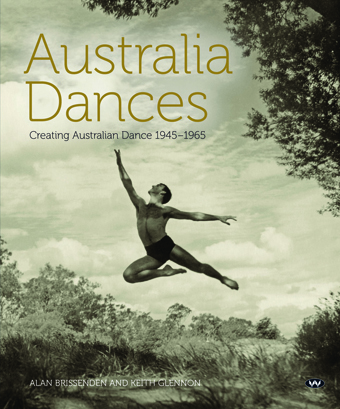
Alan Brissenden and Keith Glennon, Australia Dances: Creating Australian Dance 1945-65
australian dance: the formative years
This handsomely produced book from Adelaide’s Wakefield Press is a groundbreaking account of Australian dance as it took shape, in ballet in particular, between 1945 and 1965. It was a long, hard struggle to build ongoing companies, train Australian dancers and, often most challenging, to create original Australian works. But within a mere 20 years (and with the impetus of the huge popular taste for ballet built by the pre-WWII visits of the likes of de Basil’s Ballet Russes), the Australian Ballet was formed, performing alongside some of its state antecedents.
Written by Alan Brissenden and Keith Glennon, Australia Dances is packed with wonderful black and white photographs, colour plates of set and costume designs (fascinating for their correlation with contemporary art movements) and vivid accounts of a multitude of individual works—replete with eye-witness recollections. Regional companies, dance studios, educational strategies and eisteddfods are given their due, as is Aboriginal dance—the authors highlight the role of the 1961 Darwin Eisteddfod, which included a performance by 15 Aboriginal people, in triggering touring of traditional Indigenous dance by the Australian Elizabethan Trust in the early 1960s. In a country largely bereft of serious, accessible documentation of the performing arts, Australia Dances is exemplary of the kind of books Australian artists and their audiences warrant. Alan Brissenden and Keith Glennon, Australia Dances, Creating Australian Dance 1945-65, RRP $70, www.wakefieldpress.com.au
australian media arts: dream in beijing
Dream Worlds: Australian Moving Image 2010 is a collection of media artworks curated by Melinda Rackham, former director of the Australian Network for Art and Technology and occasional RealTime contributor. It features works by Daniel Crookes, Anita Fontaine, Warwick Thornton, Kate Richards, Jess MacNeil, Troy Innocent, Chunky Move and Peter Miller. Each work is roughly three minutes long with the entire program screening every half hour on large format, open air video display in Sanlitun Villagein Beijing. Dream Worlds: Australian Moving Image 2010, Beijing, Sept 4-Oct 16; www.dreamworlds.com.au
RealTime issue #98 Aug-Sept 2010 pg. web
© RealTime ; for permission to reproduce apply to realtime@realtimearts.net
CD
www.clockedout.org
cover and photo Sharka Bosakova
Clocked Out is Vanessa Tomlinson and Erik Griswold, who mesh together beautifully in sound and rhythmic nuance. Tomlinson is a wonderful percussionist, drawing upon an enormous array of things to hit and ways to hit them, and Griswold is a master at preparing the piano and then playing what he has prepared. Foreign Objects is their latest CD. Twelve tracks and 46 minutes. Hand packaged in a cardboard sleeve with a little collage by Sharka Bosakova on the front, each is numbered as something-or-other out of 500.
There are a couple of tracks using the melodica, a theme instrument of Erik Griswold's that sounds like a cross between an asthmatic wheeze and the plastic saxophone that gets broken by the end of Xmas day. I'm not a big fan of the melodica but the tracks grow on me—the chordal pulse of Paniculata bringing back nostalgic childhood memories of warm days, layered curtains, a fly buzzing at the window sill.
But most of the tracks are percussive with melodic fragments. Hold Me Closer sounds like a melancholy twiddle on the piano by the last drunk at an office party, clock loudly ticking in the corner. The jerky a-sync rhythm of Stick This is a vague memory of progressive rock filtered through gamelan repetition, Chinese orchestra and Cageian piano. Toy Feldman brings out squidgy sounds and a music box scratching like a cockroach stuck behind the skirting. Like many of the tracks on the CD there is nostalgia and a certain sadness—an empty room, long held disappointment.
The longest track, at 10 minutes, is Lavendar Mist. It begins with tangled wooden rattling underneath a rapid rhythmic melody that sounds like heavily damped steel drum. Fragments come in and out—hang around for a while, check out the possibilities then go. It reminds me of watching uni-cellular organisms under the microscope as they are buffeted about into Brownian motion.
Throughout the CD, Clocked Out keeps both a sense of regular beat and its fracture, the rhythmic pulse following a wave of acceleration and collapse. There are strange overlays—Griswold might play something dark and rhythmic on piano whilst Tomlinson sounds like she is walking around in a Foley room tapping whatever feels right. This is a real strength of an excellent CD—the coherent layering of consistent and inconsistent attributes into a coherent soundfield that is both abstract and concrete. Walking in the world, leaves crunching underfoot. A stick breaks, loud and cutting through the sound of the music over the ear buds. Things you can guess, things you can't.
Greg Hooper

Refugee Island, Mickie Quick
[This introduction was written in September 2010. New links will continue to be added to the list below. Eds.]
This archive gathers together articles about art that has responded to and represented asylum seekers over the past decade. To a lesser extent it also includes art by refugees themselves. While some art movements are described in terms of war (the avant-garde etc), this one might be better seen as a wave—starting as a minor movement (in 1999), building into something more (from 2000), cresting to reach a critical mass (post-2001), before dropping gently (2005) and receding into the distance (2010), save for an angry swell in the wave of the Liberal party’s “turn back the boats” mantra, with Labor’s “border control” complicity, in the federal election campaign.
Rather satisfyingly, the wave metaphor also redeploys the rhetoric that politicians use when trying to warn us that we are in danger of being “swamped” by a “rising tide”—or better yet a “flood tide,” a “flotilla,” an “armada”—of “illegal immigrants.”
The tactic of redeployment was key to much of the visual art of the period, as evidenced by the culture jamming of Mickie Quick and We Are All Boat People (now boat-people.org). One of boat-people’s members, Deborah Kelly, also co-curated (with Zina Kaye) a more formal exhibition, Borderpanic, which was co-produced by Performance Space and the Museum of Contemporary Art in 2002. In 2003, the computer game Escape from Woomera made headlines when Philip Ruddock and Rod Kemp criticised the Australia Council for funding such a project. Later in 2003, Mireille Astore spent hours on the beach in her installation and performance piece Tampa. Her efforts were then echoed by the SIEV X Memorial, which briefly installed itself at the side of the lake in Canberra in 2005.
Sitting at the intersection of visual art and performance, the durational installations of Mike Parr were also a feature of the period. His painful (re)enactments were unusual in an era dominated by documentary and narrative approaches. The urge to tell one’s story is understandably strong, especially when one has been prevented from doing so by the strict protocols of the refugee determination process or indeed if one has a story about that process itself. Of the many productions that employed this approach, two of the earliest were staged by Urban Theatre Projects: Manufacturing Dissent in 2000 and Asylum in 2001. By 2004, these efforts had started to reach the mainstream, with the Sydney Festival staging Ros Horin’s Through the Wire as a work-in-progress.
Even performances that were not strictly speaking documentary often deployed a documentary aesthetic, such as Bagryana Popov’s Subclass 26A which included snippets of information from application forms and letters. Similarly, Théâtre du Soleil’s Le Dernier Caravanserail—which played at the Melbourne Festival in 2005—also included stories from actual asylum seekers. For their part, Version 1.0 took a slightly different approach, devising a satirical documentary performance CMI (A Certain Maritime Incident) based on the transcripts of the parliamentary inquiry of the same name. Filmmakers also played with the documentary form in films such as Molly and Mobarak (2003), Letters to Ali (2004) and Fahimeh’s Story (2004). Slightly less likely, though no less enjoyable for that, was the comedic fictional film Lucky Miles (2007).
Having just endured another election campaign where ‘floods’ of ‘boat people’ were once again conjured to frighten voters, it is something of a comfort to look back at this archive. This body of work ensures that this period of history will be remembered not only for our punitive policies but also for our artists’ angry and articulate responses to them. Like the policies themselves, these too were performed in our name.
Caroline Wake
visual art
campaign art
caroline wake: art & activism on tv and online
siev x memorial: a pictorial report of the memorial held in Canberra
realtime
tampa microcosm
mireille juchau: mireille astore’s tampa, sculpture by the sea 2003
the meme game: escape from woomera
melanie swalwell
borderpanic remedies
grisha dolgopolov
the artist and the refugee: tooling up for action
bec dean
performance
the refugee’s only currency
caroline wake: powerhouse youth theatre’s mother fish
a shared madness
tony reck at la mama for kit lazaroo’s asylum
chance, dance, animals & the unconscious
philippa rothfield: théâtre du soleil’s le dernier caravanserail
the medium is the audience
john bailey: théâtre du soleil’s le dernier caravanserail
refugees: between reality and performance
kirsten krauth: ros horin’s through the wire
a life between yes and no
mary ann hunter: towfiq al-qady’s nothing but nothing
selves imprisoned and released
philippa rothfield: bagryana popov’s subclass26a
one house, many homes
tony reck: department of human services, mpact, north yarra community health, outside in
version 1.0 shares the shame
bryoni trezise: cmi (a certain maritime incident)
history’s great escape
dan edwards: mike parr and adam geczy’s the mass psychology of fascism, zip-a-dee-doo-dah, zip-a-dee-ay
children overboard: outrage and performance
keith gallasch: version 1.0’s cmi (a certain maritime incident)
the darkness that yields light
keith gallasch: ros horin’s through the wire
cutting through the fog
keith gallasch talks to ben ellis and louise fox about these people
mike parr: internet performance
adam geczy: malevich
bodies at work
keith gallasch: platform 27’s the waiting room
identifying with the refugee
kerrie schaefer: nazar jabour’s no answer yet
sydney & wollongong: atoms and fuel
keith gallasch: claudia chidiac and urban theatre projects’ asylum
degrees of pathos: sydney performance
keith gallasch: urban theatre projects’ manufacturing dissent
film
lo-budget good health
sandy cameron: michael james rowland’s lucky miles
entering the familial web
dan edwards: faramarz k-rahbe’s fahimeh’s story
no time to wait
anna delany talks to clara law
a question of form
jake wilson: clara law’s letters to ali
the documentary: art and survival
tom zubrycki: molly and mobarak
australian filmmakers offer asylum
mike walsh: tales from a suitcase, escape to freedom, anthem
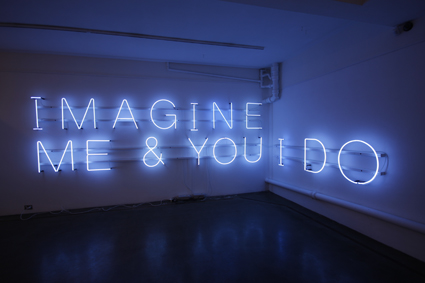
Kirsty Hulm, Imagine Me & You I Do
photo courtesy of the artist and Criterion Gallery
Kirsty Hulm, Imagine Me & You I Do
THE UN-VICTORIOUS EXHIBITION IS ONE OF THE MOST INTERESTING, IF SOMEWHAT ELUSIVE, THAT I HAVE SEEN AT CRITERION GALLERY, ARGUABLY THE BEST COMMERCIAL GALLERY IN HOBART AND THE ONLY ONE IN THE CBD. CRITERION HAS BEEN IN BUSINESS FOR ABOUT SEVEN YEARS NOW (THOUGH SOMEHOW IT STILL SEEMS NEW) AND CLEARLY HAS A POLICY OF FOSTERING TASMANIAN AND AUSTRALIAN ARTISTS WHOSE WORK IS “OUT THERE,” WHETHER THEY ARE EMERGING OR ESTABLISHED. THIS MAKES FOR A VARIED AND REWARDING RAFT OF SHOWS—GRAFFITI ART, DIGITAL PRINTS, AND VIDEO AS WELL AS SOME MORE TRADITIONAL MEDIA.
The Un-Victorious is no exception. It has a sparseness that works well in the pristine, relatively small white cube that is the Criterion. It is a three-hander show featuring Victorian artists. Kirsty Hulm’s work is a neon light installation of text and the other element of the show, bejewelled mock-ups of military medals, are the result of a collaboration by Andrew Hustwaite and Anna Varendorff. The catalogue cover shows Kirsty Hulm’s 2008 neon sign work Imagine Me & You I Do installed on the exterior of a dark, gothic-looking church, so nothing could be more different than the Criterion display, in which the neon words snake 90 degrees around two white gallery walls. In both sites Hulm’s large-scale work is strikingly beautiful, not a little eerie and certainly evidence of the artist knowing how to work with her medium. The source of the title eludes me—certainly it is from some 60s or 70s pop song and the catalogue essay talks of “the harlot’s sultry call from arms to the bed ‘Imagine me and you … I do’.”

Andrew Hustwaite and Anna Varendorff, Proposition 1-5
photo courtesy of the artists and Criterion Gallery
Andrew Hustwaite and Anna Varendorff, Proposition 1-5
Hustwaite and Varendorff’s series of five very authentic-looking medals, complete with differently coloured ribbons, are hung in a V formation. They are very aesthetically pleasing objects and are made from materials such as nickel, copper and brass with silver plating and amalgam. Going by the names of Proposition I-5, they would have taken considerable skill to manufacture. Varying in size and hue, the medals are generally star-shaped and, taking up two panels in the gallery, make an exciting installation. They are eminently collectible, eminently desirable and titles such as “Above and Beyond the Fall of Duty” convey an unmistakable anti-war message.
The catalogue essay, by Jess Nossiter, is outstanding. Nossiter is a (presumably) self-styled Chevalier de la Manchette and “writer and flaneur based in Hobart,” though this city does not immediately strike me as the milieu for the flaneur. His essay is a work of art in itself—a piece of writing quite beyond definition or categorisation—Hunter S Thompson meets Lewis Carroll perhaps: wryly amusing, intellectually rigorous with a touch of soft porn! Nossiter touches on sex, popular television culture, reality TV, capitalism and, cynically, love. He concludes, “Love is a capitalist construction, an exchange of commodities. Littered with prophylactics, and the air filled with blank shots—love truly is a battlefield.” More significantly, the essay draws together two very different works and gives them a unity, without which the show would be even more elusive.
The intimate gallery space of the Criterion is an ideal venue for what is, in fact, a very small show. It would probably not have worked in a bigger venue, but then the curator Sarah Jones has clearly chosen the works with the Criterion in mind. Remarkably, Jones only received her BFA in 2007 and has since participated in several shows at Hobart venues. Last year she was the recipient of the Contemporary Art Services Emerging Curator Mentorship. For The Un-Victorious she has done a fine job discovering and promoting the three artists, not to mention the essayist. Like Jones, the artists and writer have themselves only recently completed their degrees or are still undertaking them. With the quality of works in this show being so high, it augurs well.
Kirsty Hulm, Imagine Me & You I Do; Andrew Hustwaite and Anna Varendorff, Proposition 1-5; curator Sarah Jones, The Un-Victorious, Criterion Gallery, Hobart, June 10-July 3 http://www.criteriongallery.com.au/
RealTime issue #98 Aug-Sept 2010 pg. web
© Diana Klaosen; for permission to reproduce apply to realtime@realtimearts.net
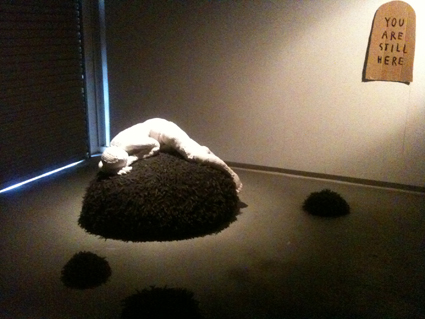
Elizabeth Dunn and Jessie Hall, (please give: it a moment)
photo Nicholas Mills
Elizabeth Dunn and Jessie Hall, (please give: it a moment)
NOW IN ITS SIXTH YEAR, THE ON EDGE FESTIVAL IN CAIRNS IS INSTRUMENTAL IN INTRODUCING NEW WORKS TO NEW AUDIENCES IN FAR NORTHERN QUEENSLAND. THIS YEAR’S PROGRAM, CURATED BY NICHOLAS MILLS, INCLUDED SOUND ART (LIQUID ARCHITECTURE), VIDEO ART (CAO FEI) AND DANCE ON SCREEN (REELDANCE) AS WELL AS PERFORMANCE WORKS. THREE OF THE PERFORMANCE HIGHLIGHTS WERE ELIZABETH DUNN AND JESSIE HALL’S (PLEASE GIVE: IT A MOMENT), POST’S SHAMELESSLY GLITZY WORK AND NICHOLAS MILLS’ OWN 2WHYTE. FOR ME, EACH OF THESE WORKS HAD A REFLECTIVE QUALITY AND MINED THE INNER WORLD OF THE SUBJECT FOR MATERIAL.
(please give: it a moment)
Wallwork Studios has been transformed into an interactive obstacle course. As I enter, I am handed a conical mask with hand-drawn features, suggestive of a shy creature that spends a lot of time in the dark. Wearing this makes me feel as though maybe I too will find a bolthole in which to hide. This is (please give: it a moment), where each audience member becomes the work’s subject via their physical engagement with it. Created by Cairns’ artists Elizabeth Dunn and Jessie Hall, it is fresh from the Next Wave festival in Melbourne.
Other masked creatures inhabit the space. We are guided past fabric mounds and along the way encounter a larger crafted hillock where a life-sized figure made from wool curls like a cat in repose. We move on to a table where we are invited to partake of a conversation conducted entirely via pen and paper. Tea is offered, along with written advice and the messages then affixed to the studio wall—as a sort of ‘moodboard’ of the soul. It’s tea and sympathy and the writing is on the wall.
We are then gently coerced into a cubby constructed of translucent paper, with moving images projected on the back wall. These are landscapes, seemingly shot at twilight from the window of a moving vehicle. By now, I am overtaken by the persona of the mask; I become a kind of hybrid creature that scratches at the door of both human and animal worlds, and it seems that I am viewing these images through new eyes. They offer up a whole new world of opportunities, should I find the courage to step over the threshold of my hidey-hole and venture into the beyond.
(please give: it a moment) is a refreshing take on the interactive installation form, where participants experience a nuanced and subtle trip through the psyche, like animals being coaxed from a subterranean burrow.
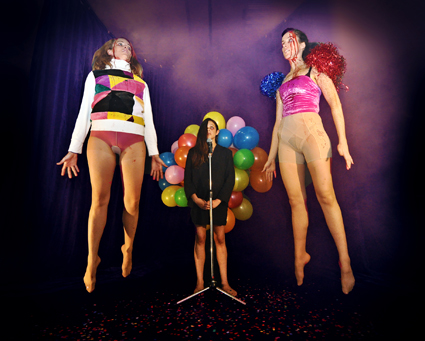
Post, Shamelessly Glitzy Work
photo James Brown
Post, Shamelessly Glitzy Work
shamelessly glitzy work
This offering from Sydney’s Post has had rapturous receptions in Sydney, Melbourne and Brisbane, so it was a sweet treat to see it in Cairns. The piece itself, however, was not without some deliciously tart satire. To open, three sparkly, spangled magicians tease us for an extended time at the microphone with inhalations, lip smacking and inane smiles. What follows is a series of faux magic routines where the performers build up our expectations for the big showstopper to reveal…well that the performer is wearing a patchwork jumper identical to the one she has just removed. The performer gestures “Ta-da!” all the while looking at us knowingly.
As the show progresses, there is a meditation on the rave scene replete with glitter in the laser lights and an account of an incident outside a nightclub where a woman, a self-described melange of Bonne Bell, Maybelline and feminine hygiene spray, considers an offer from a potential suitor. She tells us, “Guys in Barinas have yelled at me before, but this was different.” There are ruminations on contemporary security policies too, where nameless organisations reminiscent of George Orwell’s Thought Police encroach on civil liberties. The performers describe a quasi Big Brother state where the control of one’s mind and fast food choices—“I’ve got the fish burger in my hand, but I really wanted a chicken burger”—rates as serious social concern.
The centrepiece of the show is a vignette where the performers bounce for over 10 minutes to techno music while one boozily bawls “C’mon ladies!” This slowly turns into a wet t-shirt competition and then something more sinister where blood pours from mouths of the ‘contestants.’ This act is chilling in its evocation of sexual objectification and abuse, reinforcing the idea of performance as a political act that can both challenge and reassert structures of power.
The writing is a revelation in a formal sense; all that is said in the first half of the show is repeated in the reverse order in the second. As well the characters constantly allude to the audience’s presence through eye contact and gesture. This staginess, or self-conscious awareness of what Peggy Phelan calls performance’s “maniacally charged present” (Unmarked, Routledge, 1993), is echoed in the performers’ oft-repeated line: “I definitely feel something.” I felt something too, Post, and even if you were being ironic you were generous enough to let us in on the joke.
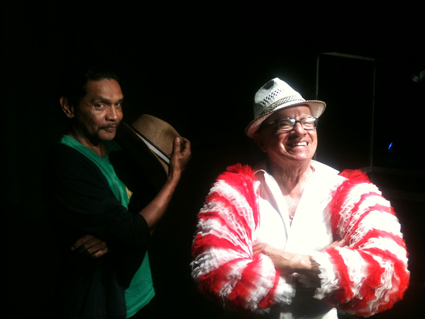
Raymond D Blanco and Raphael Blanco, 2Whyte
photo Nicholas Mills
Raymond D Blanco and Raphael Blanco, 2Whyte
2Whyte
2Whyte was held on the last weekend of the festival and is best described as a work in progress. It has an interesting premise, with Nicholas Mills bringing together two established dancers with the same surname but from different disciplines. Raymond D Blanco is a prominent Indigenous dancer, choreographer and director who has been at the forefront of Indigenous dance and its development, while Raphael Blanco is a 76 year old Cuban dancer and teacher and reportedly one of the first Cuban immigrants to arrive in Australia. Together they bop, boogie and cha cha cha their way through the show, finding common ground through dance.
As the houselights dim we are shown projected text, first about the history of Cuba and then Australia and the Torres Strait. The source cited is Wikipedia and I’m not sure if the team are being ironic or simply relaxed in respect to their research. Next there is a demonstration of Cuban dance moves, projected documentary-style footage and live onstage interviews with the dancers, interspersed with examples from Raymond’s repertoire. His evident joy in performing to Silver Convention’s Lady Bump (presumably a favourite from his formative years) is so infectious that we find ourselves bopping along in our chairs.
One audience member described this work as “docu-dance” and it shone when we were able to glimpse into the dancers’ psyches. Each grappled in their own way with the notion of being categorised as an ‘older dancer’ and the significance of this for their careers resonated with the sympathetic audience. Perhaps the work would benefit from a little more finessing and some direction in relation to teasing out further synergies, however, the performers held us with their charm and zeal.
Like the individual performances within it, the On Edge festival offers fascinating insights into the interior worlds of artists and audiences alike. The festival makes an integral contribution to the far northern landscape and its arts community with a celebration of contemporary performance and media works from all over Australia and the world.
2010 On Edge Festival: (please give: it a moment), creators Elizabeth Dunn and Jessie Hall, Wallwork Studios, July 4-7; post, Shamelessly Glitzy Work, created and performed by Mish Grigor, Natalie Rose and Zoe Coombs Marr, COCA Theatre, July 8-9; 2Whyte, director and media Nicholas Mills, performers Raymond D Blanco and Raphael Blanco, COCA Theatre July 15-17; www.onedgeart.com/
RealTime issue #98 Aug-Sept 2010 pg. web
© Victoria Carless; for permission to reproduce apply to realtime@realtimearts.net
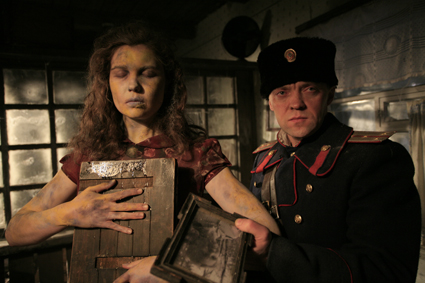
Alexander Proshkin, The Miracle
DEFINING A FILM IN REFERENCE TO ITS NATIONALITY (A FRENCH FILM, AN AUSTRALIAN FILM, A RUSSIAN FILM) IS AN INCREASINGLY TENUOUS BUSINESS THESE DAYS. IN AN AGE OF GLOBALISATION, IT WOULD SEEM THE BOUNDARIES OF A NATION STATE ARE NO LONGER IMPERVIOUS ENOUGH TO ALLOW FOR THE INCUBATION AND GROWTH OF A DISTINCTIVELY NATIONAL CINEMA. CONTEMPORARY RUSSIAN CINEMA REFLECTS THESE CHANGING ECONOMIC AND CULTURAL CONDITIONS MORE ACUTELY THAN MOST OTHER NATIONAL CINEMAS.
For so long culturally isolated and protected by the Iron Curtain, the Russian film industry has, since the fall of the Soviet Union, been forced to undergo a quick and radical transformation. Most significantly, Russian cinema has had to contend directly with Hollywood, the international monster that other national film industries have been struggling with or against for over 90 years. The goal has been simple: to survive in a monopolised marketplace without losing a distinctively national voice. After a shaky start in the 1990s, a definably 'new' Russian cinema emerged in the new century, a cinema that, for better or worse, has asserted itself as a producer of popular, economically viable films that participate in the populist aesthetics of Hollywood while also drawing on Russia’s prized and often traumatic cultural heritage.
The career of Russian director Alexander Proshkin (b1940) in many ways reads like a biography of this transformation. Beginning his career in Soviet television in the 1960s and 1970s, Proshkin asserted his reputation as a director of quality television drama before achieving box office and critical success for his 1988 feature Cold Summer of 1953. That film—a dark, violent and dramatic thriller set in the early days following Stalin’s death—was in many ways a pioneering work that offered a model for what Russian cinema could become in the post-Soviet era. Integrating historical and politically contentious subject matter within a generic scenario lifted from a Hollywood western, Cold Summer of 1953 demonstrated the possibility of a culturally respectable, serious, yet also populist and exciting cinema.
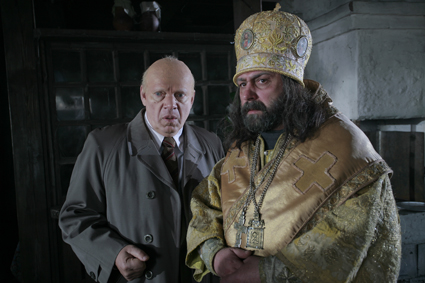
Alexander Proshkin, The Miracle
Proshkin’s latest feature Miracle, which plays at this year’s Russian Resurrection Film Festival, is also an entertaining film of serious ambition. Like Cold Summer of 1953, Miracle is set in the early Soviet 'thaw' of the mid-1950s, a period when Nikita Khrushchev initiated a relaxation of the paranoid grip of Stalinism. Proshkin was in his mid-teens at the time, and must have experienced the cultural atmosphere as a powerful liberation. “The time is significant,” he explains, “because 1956 is the year which marked a turning point in our history. Khrushchev’s address at the 20th Congress [of the Communist Party] marked the arrival of the new post-Stalinism period. With one foot, we were still in the past, while with the other we were in an uncertain future.”
Presented as a film based on historical events, Miracle’s narrative offers a fictionalisation of the characteristically Russian cultural myth, or true event, known as the “Standing of Zoia.” Said to have taken place in Kuibyshev (now Samara) in January of 1956, the story goes that while dancing with an icon of St. Nicholas, 21-year-old Zoia Karnaukhova froze solid in her living room for 128 days, only thawing at the arrival of Easter. In a culture very accommodating to superstition, news of the “miracle” was frantically suppressed by the Soviet government, and circulated only by word of mouth. Proshkin explains:
“In Russia, such information is often referred to as 'bush radio,' where one person tells one person and he tells another etc. Our scriptwriter, Yuri Arabov, was told about this incident by his grandmother, when he was nine years old. To the wider community, this information was kept confidential till about the end of the 1980s.”
With names altered and dramatic twists thrown in (Kuibyshev becomes Grechansk, Zoia becomes Tatiana and Khrushchev himself gets involved through a deus ex machina) Miracle manages to engage with the complex problems of Russia’s Soviet past without losing the narrative momentum of contemporary popular cinema, a balancing act that, in Proshkin’s view, Russian filmmakers can no longer afford to neglect. Just like everywhere else, he explains, Russian filmmakers are now answerable to the dictates of the mass audience: “The filmmaker’s role—or existence—has changed in our nation… Before there was an ideological influence, now it’s a commercial one.”
Despite being unambiguously popular in its presentation, there are considerable dimensions of depth in Miracle. As an allegory, the film would seem to present a metaphor of a society, frozen by Stalin’s terror, coming back to life. For Proshkin, however, the film’s narrative has less specific connotations:
“It is an attempt to explain the mentality of Russia, which in essence has not changed over time. Waiting for so-called 'miracles' has been embedded into the national character and we often put things down to simply being miracles.”
Proshkin’s interest in the “mentality” of Russia, and especially in the profound incompatibility between Russian social life and systematic centralisation, echoes throughout much of the director’s work. Open to the possibility of the miracle, but not certain of it, his is what might be called an agnostic attitude, significantly distanced from the more fervent religious cinema of contemporary Russian directors like Andrei Zviagintsev and Pavel Lunguin (whose epic Tsar also features at this year’s festival). Asked whether he considered his film to belong to the growing ‘religious’ genre of Russian cinema, Proshkin replies:
“For me it was always a mystery: how could a nation, which existed for 1000 years with the Christian-orthodox faith, suddenly condemn its pastors, destroy its churches and reject its religion? Religious belief, which was nurtured for 1000 years, cannot just disappear in one particular moment. It simply moved into the subconscious… Spiritual movies represent the character of our culture and its peculiarity.”
This concern with the Russian subconscious leads me to pursue another subject. If anything can be said to have persistently pricked at the conscience of Russian filmmakers for the past 50 years, it would be that most traumatic chapter of the country’s Stalinist nightmare, the Second World War. At this year’s festival, a retrospective of World War II dramas made in the post-war era—The Cranes are Flying (Kalatazov, 1957), Ivan’s Childhood (Tarkovsky, 1962), Trial on the Road (German, 1971) and The Ascent (Shepitko, 1977)—offers a captivating and sobering glimpse of the war’s centrality in the Russian memory. These are some of the finest films of their time. And yet still today, narratives set during the war continue to be made, as untold stories come to light. One such film is Vera Glagoleva’s One War, perhaps the finest new feature at this year’s festival. Other films explore an adjacent period: Stanislav Mitin’s lyrical gem Backdoor is set in 1949 and Nikolay Dostal’s award winning Peter on His Way to Heaven takes place in 1953.
For Proshkin, there’s a specific rationale in Russia cinema’s preoccupation with the trauma of Soviet history. Raking over the past is, it would seem, a way of processing the unacceptable, making sense of the incomprehensible:
“It’s not a matter of history. It is just that that period influenced the formulation of the mentality. Until we actually rid ourselves of the past which has been infused into our blood, we will never find the road to the future.”
2010 Russian Resurrection Film Festival, Sydney, Melbourne, Brisbane, Perth, Adelaide, Canberra, Aug 19-Sept 19; venues & dates www.russianresurrection.com
RealTime issue #98 Aug-Sept 2010 pg. web
© Tom Redwood; for permission to reproduce apply to realtime@realtimearts.net
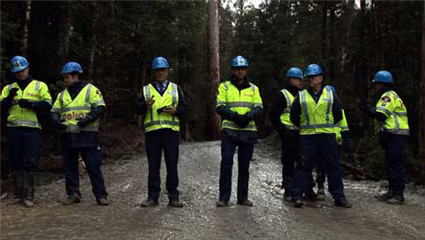
James Newitt, Passive Aggressive (2009)
video still courtesy of the artist and Criterion Gallery
James Newitt, Passive Aggressive (2009)
tasmanian spring
Having recently won the 2010 City of Hobart Art Prize (digital category) for his video work Dreams, Tasmanian artist James Newitt has now been included in the 2010 Primavera Exhibition at the Museum of Contemporary Art. This time, however, it’s his work Passive Aggressive (2009) that has attracted attention. Primavera 2010, which focuses on Australian artists under 35, also includes Akira Akira, Julie Fragar, Emma White, Jackson Slattery and Agatha Gothe-Snape. If you’re in Sydney, it’s always worth a look: last year spat+loogie smashed pie in people’s faces (2009); the year before that Soda_Jerk screened their 3-channel video installation Astro Black: A History of Hip-Hop (Episodes 0-2) (2009). It’s on from August 19 to November 21. http://www.mca.com.au/

MM Yu, Waste Living 2009, duratran and lightbox, dimensions variable
photo courtesy of the artist
MM Yu, Waste Living 2009, duratran and lightbox, dimensions variable
water in the west
Still in Sydney, though a little further west, the Campbelltown Arts Centre is facilitating The River Project, a major new project comprising an exhibition, publication, performance, and education and public programs. Featuring artists from Australia, China, India, Korea, the Philippines, Vietnam and Papua New Guinea, the River Project explores how “river systems reflect our interconnectedness, our fragility and our history” (press release). Events will be held at the centre itself as well as at sites along the Upper Georges River. The River Project, Campbelltown Arts Centre; August 28-October 24; http://www.campbelltown.nsw.gov.au
blues & birthdays
Also in Sydney, the New Music Network has three concerts coming up. First, on August 24, is a concert by Continuum Sax and Match Percussion, with guests Natsuko Yoshimoto and Roland Peelman, where they will premiere Brian Howard’s Last Blues. Borrowing its title from Cesare Pavese, Howard’s compositions “invokes memory and loss through a compelling and yet fragile dialogue between the violin and ensemble” (press release). The second concert features An Infinity Room (AIR), a new ensemble comprising various synthesisers, keyboards and electronic organs. AIR, playing on September 3, “uses graphic scores, simple performance techniques and semi-improvised structures to create a haunting aura of drones and rich harmonic fields” (press release). Last but not least, Speak Percussion celebrate their 10th birthday by performing some of the oeuvre on September 20. The works are all focused around the keyboard percussion family and were premiered by the group. Continuum Sax and Match Percussion, Eugene Goossens Hall, ABC Centre Ultimo, August 24; AIR, Recital Hall East, Sydney Conservatorium, September 3; Speak Percussion, Recital Hall East, Sydney Conservatorium, September 25; http://www.newmusicnetwork.com.au
analogue love in a digital age
In the era of the iPod, the mix tape has a certain old school charm. Mix Tape is also the title of choreographer Stephanie Lake’s contribution to The Next Move, a series of performances created by the next generation of dance makers, commissioned and presented by Chunky Move. Mix Tape is, according to the press release, “about love. Driven by an eclectic and personal set of songs as well as recorded interviews, this new dance work cleverly illuminates experiences of regret, desire, ecstasy and disillusionment.” Choreographer Stephanie Lake graduated from VCA in 2002 and has spent the past ten years dancing for Chunky Move, Lucy Guerin Inc and BalletLab. She has choreographed several short works as well as two larger participatory dance works: one in 2009 for 100 people that was performed in Federation Square and another in 2010 for a City of Melbourne mob dance for 400 dancers performed in Bourke Street Mall. Chunky Move, Mix Tape, Chunky Move Studios, September 2-11; http://www.chunkymove.com.au/
a clothes line resurrected
Still in Melbourne, check out Not Yet It’s Difficult’s HOIST, which was commissioned by Federation Square’s Occupy program and created by David Pledger. HOIST consists of a general public participatory program by day and a screening program by night. In partnership with Melbourne Writers Festival, NYID is working with professional writers, commissioned artists and schools to populate the over-sized Hills Hoist with paraphernalia themed around this icon of the Australian suburbs. The company is also launching a book, Making Contemporary Theatre, in which the work of NYID is critically contextualised by company dramaturg Peter Eckersall. NYID, HOIST; Federation Square, August 27-September 9; http://www.notyet.com.au/ and http://www.hoistmelbourne.com.au/
re-enacting time
The Australia Experimental Art Foundation, in collaboration with Mildura Palimpsest, is hosting a series of installations, performances and talks for the (to) give time to time project. The project examines ephemeral and time-based practices and the impact of Mildura Sculpturescape (1969-78) on Australian contemporary art practice. It will, according to the website, “do this by making historical links” and “re-enacting key works.” Collaborators include Tim Burns, Barbara Campbell, Bonita Ely, Domenico de Clario, and Eugenio Carcheso. There is also a symposium, launched by Robyn Archer, and featuring Maudie Palmer, Judith Blackall, Rex Butler, Edward Colless, Brenda Croft, Anne Sanders, Juliana Engberg, Neil Fettling, Mark Minchinton, Marco Marcon, Glenny Barkley, and Stelarc. (to) give time to time, Curated by Matthew Perkins and Elena Galimberti, Adeladie August 20-September 18, Mildura September 17-19; http://aeaf.org.au and http://www.artsmildura.com.au/palimpsest/mildurasite.asp
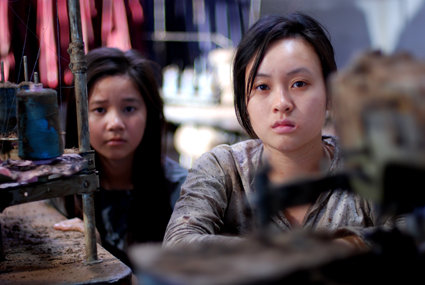
Sheena Pham and Kathy Nguyen, Mother Fish
photo courtesy of Titan View
Sheena Pham and Kathy Nguyen, Mother Fish
a refugee trilogy
Khoa Do is a regular in RealTime’s pages, appearing as both a theatre and film director (The Finished People). His latest effort Mother Fish, about two sisters who make the journey from Vietnam to Australia by boat, has been both a play and a film: the play debuted in 2008 (RT86) and the film premiered (as Missing Water) in 2009 at the Sydney Film Festival. Mother Fish the first film in a planned Refugee Trilogy (the second, Falling for Sahara, is in post-production while the third is still in the planning stages). You can see the film in a few places over the next few weeks. As part of an Amnesty International tour it will be screening in Geelong on August 29, as well as Deakin and Mercury Cinema (details coming soon). It will then tour in September as part of the Mobile AFI Awards. Screenings will be held at Nova (Vic) on September 1, Cinema Paris (NSW) on September 5, the Orpheum (NSW) on September 18, ACMI (Vic) September 19. Finally, it will also be screening at the Oz Film Festival (SA) on September 18. http://www.motherfish.com.au/
sense and censorship
It would appear that, for the moment at least, common sense has prevailed over state protectionism. Thanks to a campaign spearheaded by Get Up! and supported by activists around the country, the Labor party has deferred its internet filter until 2012 and the Coaltion has dumped the policy altogether. It remains to be seen whether “filter 2.0” will bear any resemblance to the first filter (examined by Melinda Rackham here), but with the Greens, Xenophon, and the Coalition now walking away from the policy, it looks unlikely.
RealTime issue #98 Aug-Sept 2010 pg. web
© RealTime ; for permission to reproduce apply to realtime@realtimearts.net
CD, Avant Whatever, 001
www.avantwhatever.com 
Australian artist Matt Chaumont has spent the better part of the last decade immersed in the world of low frequency sounds, producing a range of works that have probed that liminal perceptual zone where hearing and touch intersect. This has regularly involved the construction and installation of custom-built speaker systems capable of delivering sounds well below the threshold of human hearing and at a volume sufficient for Chaumont’s needs. So with the release of Linea we find out how his aesthetic and practice translates to the home listening CD/album format.
Linea comprises three pieces that are constructed using a limited set of resources—low frequency sine tones. However, this is not to say that these works are in any way austere or simply reductionist. Instead, Linea explores that territory common to the early Minimalist composers such as La Monte Young, Tony Conrad and Charlemagne Palestine, the early work of Ryoji Ikeda and the sine-tone pieces by Alvin Lucier, where reductive strategies generate complex outcomes. Each of Chaumont’s works on this CD produces an intricate sound derived from the interactions between his spare source materials. These works are in no way fast moving—all three pieces are marked by a certain stasis of form, allowing listeners plenty of opportunity to bask in the low, low sounds.
Track one begins by gently shuddering up from below the threshold of audibility before settling into a deep throb, the result of acoustical beats formed by the relationship between two or more tones close together in frequency, the effect of which is somehow both restful and disturbing. As the tones gradually fall in frequency towards the end of the piece, the ear is seemingly dragged into lower and lower pitch zones until the roles of hearing and feeling the sound are well and truly conflated. The second track is both richer and subtler, with incremental harmonic shifts between chordal structures, punctuated with occasional 'silences' produced by sub-audible tones. The last piece returns to a realm of deep pulsations, which gradually mutate and expand over its duration.
It is almost a cliché to say that works such as these that utilise low frequency sound are in some way inherently invested with notions of the physical, especially as very low frequency sounds (typically those below 20 Hertz) are largely perceived through, and interpreted as, touch. However, sounds of all frequencies are equally physical phenomena, and impinge upon our bodies in myriad ways regardless of our modes of perception. What is more interesting about Chaumont’s work is the number of ways that it engages its audience across the perceptual scheme. A sense of physicality is induced not just by the sensation of sound vibrating the ear drum, body or furniture but in the way it arranges itself in space, marking the physical relationship between the listener and the waves of sound in the room. Likewise, the movement of the loudspeaker cones is discernable to the eye (if not the ear), adding a significant visual component to these pieces, especially during periods of what otherwise is experienced as silence. More than the sensational, but rather simplistic, subsonic thump in the thorax one feels from the kick drum in a night club or rock concert, Chaumont’s work demonstrates that even without the benefit of concert sized sound systems or home theatre sub woofers, low frequency sound is more than the sonic equivalent of the fun park ride—some overpowered gimmick for quick excitement. Instead, it becomes not just a malleable tool for mingling the senses, but also a conceptual space for reappraising the everyday division of the senses into discrete realms: sight, sound, space and touch—all from the slow and steady vibration of speaker cones.
Peter Blamey
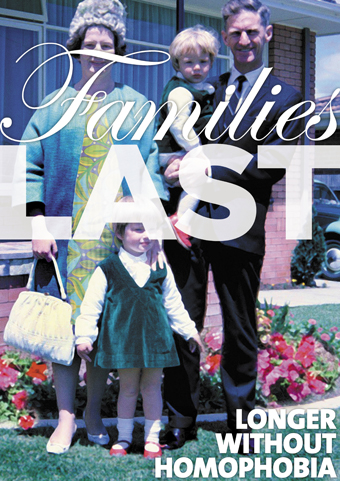
Families Last
photo Deborah Kelly (copyleft)
Families Last
WE NEED A NATIONAL CULTURAL POLICY THAT FORMALLY RECOGNISES THE IMPORTANCE OF THE ARTS TO SUSTAINING, ENRICHING AND DEVELOPING AUSTRALIAN CULTURAL LIFE.
As David Throsby has argued in “Does Australia Need a Cultural Policy?” (Platform Paper 7, Currency House, January, 2006) we need consistency, not “policy by review”—Nugent, Myer, Strong and the various ‘initiatives’ have come from pressured Arts Ministers, not from the Australia Council which then has to execute the initiatives. As Throsby points out it makes Ministers look simply “reactive,” responding to problems, often inadequately, and then, as with the major performing arts organisations, having to address them again.
The difficult thing about major policies, like a Human Rights Charter or a national cultural policy, is that they can be expressed as well-intentioned grand generalities or, evasively, as mere motherhood statements. Interestingly, once Peter Garrett put out his ‘over the summer holidays’ request of ideas for a policy (closed Feb 1, 2010), most of the responses were not policies per se but funding and other strategic wishlists, if quite policy indicative ones.
Some writers who contributed to the discussion questioned the very notion of having a cultural policy: would it define our diverse cultures too narrowly?; allow for the revival of the Howard government’s invocation of the ‘un-Australian’?; limit artists’ right to agitate? Like those who object to having an Australian Human Rights Charter, some of these writers feared greater political and bureaucratic intrusion into and regulation of the arts. Other respondents saw a cultural policy as a means to cementing into place the hitherto uncertain standing of art in Australia. Some wished to redefine art, making it one part of the creative industries. One writer argued that art is irrelevant to the cultural lives of many Australians.
The majority of responses focused on the plight of individual artists and organisations in the ‘small to medium’ sector, the lack of a pervasive arts policy in the education realm, extensive regional disadvantage, shortage of artist workspaces, constrained library and other collections and limited arts coverage on ABC TV.
Writers saw potential correctives in the shape of private sector investment in the arts (through means similar to film funding tax rebate mechanisms); greater pressure to promote philanthropy for the arts; the redistribution to the small to medium sector of funding allocated for major arts institutions; audience development campaigns; improved television reporting and wider access to the arts through digital media; the creation of artist-specific tax and unemployment benefit schemes (side-stepped when Garrett introduced Artstart); and support for more art-led urban renewal ventures like Renew Newcastle. A few respondents argued that if we are to have a national cultural policy, a discrete Ministry for Culture & the Arts would be warranted. Garrett is Minister for Environment Protection, Heritage and the Arts, but the Department of the Environment, Water, Heritage and the Arts covers a number of portfolios in which, as Christopher Madden has commented, the arts sector is a small player (“In defence of the Australia Council,” ArtsHub, August 2 http://www.artshub.com.au/au/news-article/opinions/architecture-and-design/in-defence-of-the-australia-council-181853?sc=1).
Central to the online discussion and subsequent debate is a desire for guaranteed equitable access, socially and geographically, to the means to enjoy, participate in and make art. Let’s hope that the pressure currently applied to the major political parties to develop a national cultural policy persists beyond an election that is not likely to resolve the matter. Let’s hope too that Australians can move towards acknowledging that the arts are not discrete from culture, but are integral to it, nurturing and making culture. Just because more Australians are engaged with art does not mean that this understanding is inherent.
For a brief guide to books, essays and online material go to: A short guide: national cultural policy
Deborah Kelly is a leading Australian arts activist whose works include Tank Man Tango: A Tiananmen Memorial http://www.realtimearts.net/article/issue93/9564. Families Last was made in 2010 in response to antigay pronouncements from Family First candidates
RealTime issue #98 Aug-Sept 2010 pg. web
© Keith Gallasch; for permission to reproduce apply to realtime@realtimearts.net
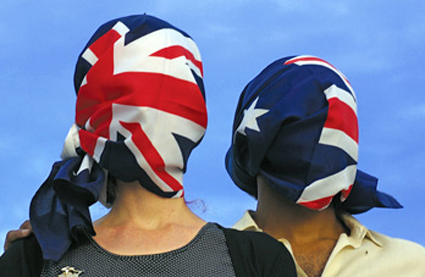
Muffled Protest
photo boat-people.org
Muffled Protest
THE 2010 FEDERAL ELECTION CAMPAIGN HAS BEEN DISGRACEFULLY NOTABLE FOR THE ZERO LEVEL OF LABOR AND COALITION ENGAGEMENT WITH ART, SCIENCE, SPORT (NOW, LIKE ART, CHARGED WITH ELITISM BY THE CRAWFORD REPORT) OR AUSTRALIA’S ABORIGINAL POPULATION. PETER GARRETT IS AN INVISIBLE ARTS MINISTER. TO DATE, ONLY THE GREENS HAVE PROMISED NEW INVESTMENT IN THE ARTS. BUT IT’S THE CULTURAL POLICY ISSUE WHICH EMERGED WELL BEFORE THE ELECTION CAMPAIGN AND WILL LONG OUTLIVE IT.
Peak Arts organisations (gathered together under the ArtsPeak banner), ABC Radio National arts programs and, especially, Marcus Westbury and Ben Eltham of the Centre for Policy Development (“Sharing the Luck: Cultural Policy in Australia” http://morethanluck.cpd.org.au/sharing-the-luck/cultural-policy-in-australia/) have prompted artists and the general public to apply pressure to the parties to embrace the arts in their election policies.
new directions, different paths
The greatest emphasis has been on the need for a national cultural policy with Westbury and Eltham pushing the notion in new directions, if divisively—demanding redistribution of funding from the major performing arts organisations (Opera Australia in particular) to the small to medium sector including areas like design, computer gaming, graphic arts, animation and others hitherto associated with an ‘underground’ not interested in funding (or engagement with government) or the creative industries that have one foot planted, if often lightly, in the commercial landscape. Westbury has written: “It is easy to argue that such people do not need funding. It is probably a reason for their relative vitality that they don’t. But that does not mean that they are without needs or that we can simply pretend that they do not exist” (“Evolution and Creation: Australia’s Funding Bodies,” Meanjin, Vol 68, No2, 2009).
It’s a pity that instead of arguing for greater funding overall for the arts and that the government ought to reconsider what comprises the arts (under the broader rubric of culture), Westbury and Eltham implicitly exhort the arts to instead turn on itself. Likewise, the writers problematically set up the Australia Council for the Arts as the target for their dissatisfaction with the status quo. As Christopher Madden argues eloquently on Arts Hub (“In defence of the Australia Council,” August 2 http://www.artshub.com.au/au/news-article/opinions/architecture-and-design/in-defence-of-the-australia-council-181853?sc=1), government itself—the Department for the Arts—is the more apt target. “If Australia’s cultural policies are a shambles, then the real source of the problem is central government, represented by the bureaucratic behemoth that is the Department. By international standards, the Department is not doing all it should be doing, and is doing many things it shouldn’t. This is hardly surprising for an agency in which arts and heritage are subsumed by such momentous portfolios as environment and water.”
Westbury and Eltham call for the dissolving or reform of the Australia Council (the two have different views on this: see the response pages at the end of their paper) and the establishment of a new cultural agency with whole of government management of culture (linking the arts with health, education, urban planning etc), resonating with the demands coming from ArtsPeak and others. To be effectively realised, Madden argues, an internal government agency would be needed to make this work—not one at arm’s length from it: “Proper engagement from within central government would let the Australia Council get on with what it does best, being an arts council.” Yes, but how are artists to have input into the making of arts policy in an increasingly top down political climate? Through ArtsPeak and consultative committees? A national cultural policy should include a guarantee of artist consultation in respect of policy realisation: but how would that be made effective?
inclusiveness & divisiveness
The strength of the Westbury and Eltham policy paper otherwise lies in its inclusiveness: recognising culture as more than the arts (or is it really a broader notion of what comprises art); abandoning “the false divide between high art and popular culture”—particularly apt in a time of unpredictable and innovative change; and “cutting the red tape that affects culture” to allow artists to access low rent work places and capital. The latter involves “putting in place policy settings that allow [artists] to perform, present and produce with limited capital [and] is more important (and effective) in ensuring their success than direct subsidies.” This last proposition could be comfortably adopted by the slash and burn Coalition.
On the other hand, the writers also propose funding “artists and productions, not institutions.” This reads like a radical proposal on behalf of underpaid artists but it fails to acknowledge rank and file orchestral players, choruses, ballet and contemporary dancers and actors and theatre support staff (set builders, stage hands, technicians etc) who comprise a large part of Australia’s arts ecosystem, many of whom are not exclusively involved in heritage arts. While we might be shocked at the per seat subsidy for an opera ticket (and at the high ticket cost for many opera lovers who are not well-off) it would be negligent to ignore the very nature and complexity of arts institutions, let alone the benefits of the outreach programs of some of the larger ones.
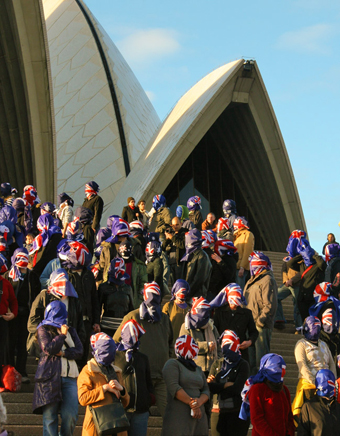
Around 70 people joined Muffled Protest on Saturday, August 2, 2010 “to show up the blind nationalism and xenophobia fueling the fear rhetoric surrounding refugees and asylum seekers.”
cultural and economic reciprocity
It is undeniable that the small to medium sector has been consistently underfunded relative to its larger peers (and their recurrent rescue packages) and that this needs to be addressed, but funding redistribution would be a crude and cruel tool. Increased funding is vital, consistent with national economic growth and reciprocating artists’ contribution to the Australian economy—”While nine out of 10 Australians participate in the arts, the federal government invests in this area less than one per cent of its expenditure overall,” ArtsPeak).
New funding should not come in the form of one-off initiatives but as part of a coherent national cultural policy, one that acknowledges the need for consistent funding and other strategies outlined by Westbury and Eltham, ArtsPeak, Throsby and others. A national cultural policy should entail, for the arts, whole of government engagement, education in the arts for all, protection of artists’ rights, a reassessment of the scope of the arts, the introduction of tax incentives and social security for artists, the collection and analysis of “adequate statistical and qualitative data that identifies both economic and social return on investment,” “forging a national research agenda for arts and culture based on policy development and private investment” and the protection of Australian culture “in the context of international trade agreements” (ArtsPeak).
the greens & the arts
The Greens’ latest election policy anouncement is responsive to key areas of development—R&D, national access and export. It includes a proposal to invest $5m in a research and development fund for new work; $10m in overseas touring; and additional funds for regional touring. As well the Greens promise to improve artist incomes through a copyright issue consultation, “Centrelink recognition of engagement in art as part of a dole recipient’s mutual obligation requirement,” revision of the Resale Royalty Scheme and the institution of a $3 million Artists’ Fund to assist publicly funded galleries to pay artists’ fees (Australian Financial Review, Aug 13). These Greens initiatives go some way to establishing in practical terms some of the principles that might be integral to a national cultural policy.
For a brief guide to books, essays and online material go to: A short guide: national cultural policy
Boat-people.org is an art gang which has been making work around race, nation, history and borders since 2001. The group’s current work, Muffled Protest, is a distributed expression of dismay in cities around Australia. You can participate! See www.boat-people.org
RealTime issue #98 Aug-Sept 2010 pg. web
© Keith Gallasch; for permission to reproduce apply to realtime@realtimearts.net
THOUGH THE ARTS AND CREATIVE INDUSTRIES MAY HAVE BEEN ABSENT FROM POLICY DEBATES, CREATIVITY ITSELF HAS NEVERTHELESS BEEN A VIGOROUS PRESENCE DURING THE 2010 FEDERAL GOVERNMENT ELECTION CAMPAIGN. WITNESS, FOR INSTANCE, THE SUCCESS OF THE ABC’S GRUEN NATION PROGRAM, WHICH NOT ONLY ANALYSED ACTUAL POLITICAL CAMPAIGNS BUT ALSO PRODUCED ALTERNATIVE ONES AS WELL.
In the first week of Gruen Nation, ad agencies were asked to humanise Tony Abbott and tell Julia Gillard’s back story. In the second week, another two agencies were brought in to mobilise fear about Labor and the Coalition. In the third episode, one agency created an ad to inspire mainstream voters to vote for the Greens while another encouraged Greens voters to endorse a mainstream party. The former was so impressive that the party approached the ABC about using the ad. While they weren’t allowed to do so, they benefited nonetheless as the video went viral.
Also on the ABC, the Chaser has returned with a program called Yes We Canberra, featuring a staring competition with Julie Bishop, a game of Guess Who? with Tanya Plibersek and a “Pollie Graph” test for Maxine McKew.
fake politicians
Beyond the box, there are the secret pleasures of the Fake Senator Steve Fielding’s twitter account. In fact, there’s a whole fake twitter parliament and press gallery (see Bella Counihan’s article), including a fake Gillard, three fake Abbotts (one of which was set up by the ALP) and a fake Andrew Bolt, but Fake Fielding remains my favourite. He tweets about the finer points of policy (“Family Fist [sic] wants more for our kids education. Less iMacs, more Bibles”) and politicking (“Susan was right, the bottle suit does scare children”), as well as the joy of Milo (“Absolutely tonguing for a hot Milo right now but Susan’s out and I’m not allowed to use the microwave unsupervised”) and the perils of preparing it (“Disaster. Milo everywhere. So much tears”). He has more followers than the real Fielding (3165 as opposed to 2141) and considerably more tactical nous, constantly consulting with Senator Nick Xenophon (variously spelled Xzenophonne, Xemaphore, Xzuezephone).
While impersonating someone on twitter certainly takes effort, it requires even more energy to do physical and vocal impressions. Sadly Anthony Ackroyd’s Kevin Rudd may have to be retired, but there are a variety of Gillard impersonators ready to step into the breach, including Amanda Bishop (seen here and here, as well as an interview here), Gabby Millgate as Julia Spillard, and Lynne Cazaly as Gulia Jillard. Get Up! has also used a Gillard impersonator in its parody of a coffee ad (“Hello, would you like to grab a coffee and talk about climate change?…Tony’s about direct action, I’m about acting directly.”)
get up! gets up
Get Up! itself has had a stellar campaign, winning a famous victory in the High Court and in doing so enabling an additional 100,000 Australians to cast their vote. Beyond campaigning on climate change and voting rights, Get Up! has also campaigned about internet censorship, mental health, women’s issues and asylum seekers. You can see all their campaigns here: http://www.youtube.com/user/getupaustralia
activist art
The mention of asylum seekers brings to mind the work of the group boat-people.org. In response to the escalating rhetoric on refugees, including the Liberal party’s infamous Dad’s Army arrows, Julia Gillard’s regional processing centre and the Department of Immigration and Citizenship’s new No to People Smuggling YouTube channel, boat-people.org have staged two Muffled Protests, one in Melbourne and another in Sydney. The protest features people slowly wrapping the Australian flag around their heads. The resultant image is dense with allusions, recalling Magritte and Abu Ghraib all in the same simple gesture.
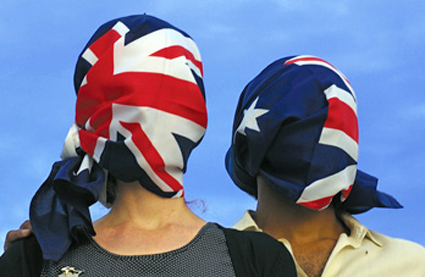
Muffled Protest
photo boat-people.org
Muffled Protest
One member of the group, Deborah Kelly, has also produced another image aimed at Family First (perhaps Fake Fielding could post a twitpic).
Families Last
photo Deborah Kelly (copyleft)
Families Last
Elsewhere, Stephen Rowley, as cinephobia, has redesigned Obama’s Hope poster as Abbott’s Nope.
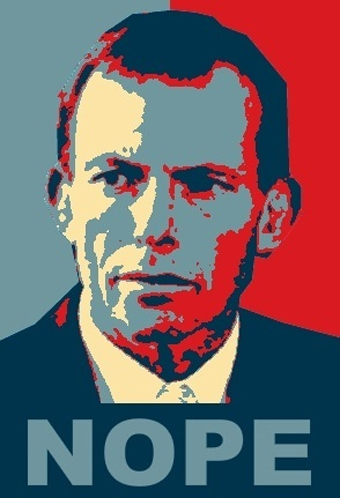
The Audacity of Nope, Created in honour of Tony Abbott’s ascension to the Liberal leadership, and his blocking of the ETS
photo Stephen Rowley, cinephobia, reproduced under Creative Commons license Attribution-Non-Commercial 2.0
The Audacity of Nope, Created in honour of Tony Abbott’s ascension to the Liberal leadership, and his blocking of the ETS
The image is now the profile picture for the Facebook group Friends Don’t Let Friends Vote Liberal. While you’re on Facebook you might like to join Tony Abbott’s Ladies Auxiliary. But if you’re a bit shy, then you can still enjoy their work here.
campaign jamming, campaign loading
While culture jamming is usually associated with subversive politics, political parties are increasingly trying to co-opt the tactic for their own purposes. See for instance the Labor party’s Tony Abbott Is Right website, where users can download a template and make their own Tony Abbott poster. One of the most popular posters features a pixellated Abbott with the slogan “Tony Abbott, Loading …”
There is a sense in which the campaign itself is still loading—the Liberal launch was only last week while the Labor launch is today (Monday, August 16). Both parties have taken vows of austerity, which has prevented them from announcing any major new policies. If it makes you nostalgic for more exciting times, you might like to revisit the It’s Time campaign or, at the other end of the Whitlam era, Norman Gunston’s take on The Dismissal in 1975. One YouTube commentor calls the moment “surreal,” adding that it’s “like Borat trying to interview Bush in 2000.”
Speaking of surreal, what to make of Mark Latham? This article was written before his 60 Minutes report went to air, but it may be that Latham’s performance as a journalist turns out to be the greatest parody of them all.
RealTime issue #98 Aug-Sept 2010 pg. web
© Caroline Wake; for permission to reproduce apply to realtime@realtimearts.net

Tony Abbott, Loading
photo Tony Abbott Is Right website, reproduced under Creative Commons license Attribution-Non-Commercial 2.0
Tony Abbott, Loading
DURING THE 2010 FEDERAL GOVERNMENT ELECTION CAMPAIGN CALLS ARE INTENSIFYING FOR ALL POLITICAL PARTIES TO DEVELOP COHERENT CULTURAL POLICIES. A NUMBER OF FACTORS, ACCUMULATING OVER MANY YEARS BUT NOW MORE MARKEDLY EVIDENT, UNDERLIE THE URGENCY FOR CREATING A NATIONAL CULTURAL POLICY.
These factors include policy making on the run (reactive funding initiatives from Arts Ministers), significant changes within the arts (new forms, new technologies) and arts education (creative degrees), inadequate arts education in primary and secondary school, increasing censoriousness (the Bill Henson ‘affair,’ internet filtering), underpaid artists and a widespread devaluing of the arts (as elitist and self-serving) despite statistical evidence of growing attendance and participation figures across Australia.
This brief guide to the national cultural policy discussion begins with Arts Minister Peter Garrett’s online public discussion (without his own participation) of his Discussion Framework towards a policy. It’s followed by the most substantial engagement with the issue this year, from Marcus Westbury and Ben Eltham, and a response to one of their recommendations (about the future of the Australia Council for the Arts) from Christopher Madden. In a spirit of greater cultural inclusiveness, Westbury and Eltham substantially broaden the arts ambit (embracing non-mainstream, underground and creative industries practices), as does Helen O’Neill in Griffith Review 23 while in the same edition Robyn Archer defends art from the incursion of the creative industries model.
With its valuable historical and economic perspectives, David Throsby’s Platform Paper No. 7, “Does Australia Need a Cultural Policy?” provides a brisk, cogent argument for a national cultural policy, although Jana Perkovic in RealTime worries about the use of ‘economy’ as a principle benchmark in the making of policy: “Artists should understand the power of words. At the moment, one of these is ‘economy.’ Being good or bad for the economy, vaguely defined, is argument enough to defend or shelve a policy. Agreeing that we have a ‘culture’ would allow a whole new string of arguments to be made and, with due respect to David Throsby, defend the arts not on the grounds of its goodness for the economy, community or health, but simply as important for our culture.”
Kevin Rudd’s 2009 Summit and Peter Garrett’s subsequent National Cultural Policy Discussion created expectations that have yet to be met. Garrett did not address proposed changes to unemployment benefits in favour of artists (the Greens have embraced this in the election campaign), instead delivering the micro-business modelled ArtStart designed exclusively for tertiary education graduates (“I think this makes ArtStart the only Australia Council grant program that requires an artist to hold formal qualifications.” Peter Anderson, “Visual Arts Education: Between research & the market,” http://www.realtimearts.net/article/98/9959).
While ArtStart and its likes look good for emerging artists, without a coherent arts policy (let alone a cultural policy) they could put artists on the path to a dead end: where is the policy that points towards the development of an arts infrastructure that will accommodate the growing numbers of arts graduates (and the non-academically trained)? As attractive and significant as the micro-business model is and, for some, the correlative argument for a de-institutionalisation of the arts, we need to recognise the arts as a complex system requiring a subtle response—no easy task in an era of reductionist binary thinking. A national cultural policy that can do justice to the arts and to artists is not going to be easy to achieve, but one thing above all we must be mindful of is that art is not merely part of culture—art builds, fuels and transforms culture.
Discussion: National Cultural Policy
Minister for the Environment, Heritage and the Arts, http://nationalculturalpolicy.com.au The site includes Arts Minister Peter Garrett’s address to the National Press Club, October 27, 2009 and the National Cultural Policy Discussion Framework. Submissions can now be found in the Library section.
Sharing the Luck: Cultural Policy in Australia
Marcus Westbury and Ben Eltham, Centre for Policy Development http://morethanluck.cpd.org.au/sharing-the-luck/cultural-policy-in-australia/
Marcus Westbury, “Suggestions for politicians in search of a cheap arts policy,” The Age, August 2 http://www.theage.com.au/entertainment/art-and-design/suggestions-for-politicians-in-search-of-a-cheap-arts-policy-20100801-111ce.html
Christopher Madden, “In defence of the Australia Council,” ArtsHub, August 2 http://www.artshub.com.au/au/news-article/opinions/architecture-and-design/in-defence-of-the-australia-council-181853?sc=1
The art in cultural policy making
Gavin Findlay: Peter Garrett’s national cultural policy discussion
http://www.realtimearts.net/article/issue96/9805
Culture: an intangible, protectable & nurturable good
Jana Perkovic: cultural policy and the arts
http://www.realtimearts.net/article/issue97/9855
David Throsby, Does Australia Need a Cultural Policy?, Platform Paper, Currency House, Sydney, January 2006
Jennifer Craik, Re-visioning arts and cultural policy: Current impasses and future directions, http://epress.anu.edu.au/revisioning_citation.html, July 2007, ANU E Press, co-published with the Australia and New Zealand School of Government
Workshop on Cultural Policy, Culture and Policy, Griffith University, Vol 8, No 1,1997
Helen O’Neill, “Ratbags at the Gates,” Griffith Review 23, Essentially Creative, ABC Books/Griffith University, Autumn 2009
Robyn Archer, “Industry that pays, and art that doesn’t,” Griffith Review 23, Essentially Creative, ABC Books/Griffith University, Autumn 2009
Forum: “A National Cultural Policy for Australia”, Australian Performing Arts Market, February 22, Adelaide 2010; includes downloadable panel discussion transcription. Facilitator Sarah Miller, Speakers: Bronwyn Edinger, Kathy Keele, Greg Mackie, Chris Puplick and?David Throsby
http://www.performingartsmarket.com.au/keynote-and-forums
The Music Show, ABC Radio National
Andrew Ford with Marshall McGuire, Clare Bowditch, Graham Wood, Sandy Evans and Michael Kieran Harvey musicians http://www.abc.net.au/rn/musicshow/stories/2010/2982941.htm
ArtWorks, ABC Radio National, August 8
Amanda Smith with Marcus Westbury and Chris Puplick
http://www.abc.net.au/rn/artworks/stories/2010/2969104.htm
Julian Meyrick, Cultural Policy in Australia
Meyrick is a writer and theatre director and, with Marcus Westbury and others, a member of the Arts Minister’s Creative Australia Advisory Group.
Streamed talk, October 19, 2009, Baldy Centre for Law & Social Policy, University of Buffalo, USA. Access via AustralianPolicyOnline:
http://www.apo.org.au/video/cultural-policy-australia
RealTime issue #98 Aug-Sept 2010 pg. web
© Keith Gallasch; for permission to reproduce apply to realtime@realtimearts.net

CSU photography students Amy Sinclair, Jason Schoenfeld, School of Communications & Creative Industries, Charles Sturt University, Wagga Wagga, NSW
The accompanying shot of photography students photographing a camera seemed apt for a RealTime edition where academics look at the relationship between the university as academy and the university as arts training institution. There are times when arts education tensions seem to go sharply binary. Our annual arts education coverage suggests that this is one such moment as the traditional notion of university study comes up hard against art practice. Even as practice-based research seems to be gaining traction, albeit not universally, other areas of tension open up. There is growing concern that as universities increase their investment in postgraduate programs, undergraduate students are in danger of losing out. We hear from academics who feel a strong obligation to students who will not be going on to higher degrees and whose focus is on making work and connecting with the sector of the arts economy in which they wish to work. The teaching emphasis here is on creating good learners who are flexible, deeply informed, multi-skilled and have substantial in-course ‘real world’ contact through work experience, professional practice and showing their work publicly. Some of the concern about undergraduate well-being is exacerbated by the effects of the absorption of arts training institutions into universities (most recently witnessed in the deleterious Melbourne University takeover of the Victorian College of the Arts & Music) who want to cost-cut class and studio times that creative arts courses desperately need for skills development and creative work. Some creative arts academics ask, again after years of amalgamation and rationalisation, is the university the right place for the creative arts? Others see universities now as too vocationally oriented, failing to develop critical enquiry. Some are concerned that the integrity of their discipline is weakened by artforms being shunted into multidisciplinary faculties, while others celebrate the interdisciplinary opportunities. Another tension is felt between university teaching and a socially networked world that invites decentralised learning: “What is to become of knowledge…in the confessional tweet economy when definitions of media art, discussions of the media sector and what I’m wearing at the time will be undifferentiated noise in the flow?” (see Darren Tofts). Some of these tensions will be destructive if skills development is diminished or the vocational thrust dominates; other tensions will be creative, making the university interdisciplinary…or “undisciplined” (see Peter Anderson).
RealTime issue #98 Aug-Sept 2010 pg. 1
© Keith Gallasch; for permission to reproduce apply to realtime@realtimearts.net
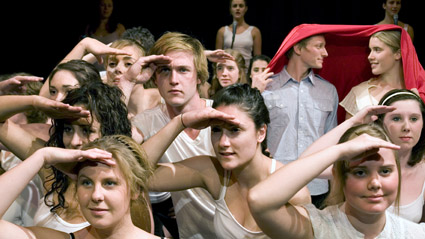
First Year Students, University of Wollongong, performing Park Young-Hee’s Finding Love
photo Derek Kreckler
First Year Students, University of Wollongong, performing Park Young-Hee’s Finding Love
PROFESSOR SARAH MILLER IS HEAD OF THE SCHOOL OF MUSIC AND DRAMA IN THE FACULTY OF CREATIVE ARTS AT THE UNIVERSITY OF WOLLONGONG ON NSW’S SOUTH COAST. REGIONAL UNIVERSITIES FACE MANY MORE CHALLENGES THAN THEIR WEALTHY CAPITAL CITY COUNTERPARTS BUT MILLER REVEALS HOW A SMALL SCHOOL IS BUILDING NEW DEGREES RESPONSIVE TO STUDENT NEEDS IN THE RAPIDLY TRANSFORMING WORLD OF THE PERFORMING ARTS AND FURTHERING CREATIVE PRACTICE AS RESEARCH.
the multidisciplinary context
With two decades of experience as director of Sydney’s Performance Space and Perth’s PICA (Perth Institute for Contemporary Arts), Sarah Miller is a vigorous supporter of multidisciplinary programming and interdisciplinary practices. The University of Wollongong’s Creative Arts Faculty offers a rich multidisciplinary context for creative scholarship in its embrace of Visual Arts, Graphic Design, Media Arts and Digital Media; Journalism, Creative and Professional Writing; and Performance and Sound-Composition & Music Production. Undergraduate students largely work within one discipline but there are opportunities for productive cross-overs: “I wouldn’t describe the faculty as interdisciplinary as such but there is the potential because a number of disciplines are co-located so that when you get to Honours, for instance, that cohort is ‘in the same room’.”
interdisciplinary opportunities
One area where interdisciplinary work can be pursued at undergraduate level is the Dean’s Scholars Program: “Students with a very high standard can do a double major. It’s a mediated program and they have to maintain distinction standard.” A small number of students are taken into the program, combining for example, says Miller, “theatre and creative writing.”
independent learners, transferable skills
The faculty’s drama school comprises Miller and four other staff members: theatre lecturers Tim Maddock, Janys Hayes, Lotte Latekefu who teaches singing and Margaret Hamilton who teaches dramaturgy plus “casuals who come in to teach skills—voice, movement and technical and production management. Visiting directors work on our end of semester productions as Theatre Fellows. They are professionals we know and love who give the students a breadth of experience which is really important.” As to her vision for her students, Miller explains, “What I saw was in line with my own experience and I wanted to more clearly articulate it: the idea of the self-producing artist, self-reliant, capable across a range of areas, with the good training that certainly was never available when I was a student [laughs]—I used to run around town trying to find classes to do!
“We’re aiming for a coherent training program which, of course involves repetition, and then there’s the university’s academic requirements. The theorist Lesley Stern said to me once, ‘The last thing the world needs is another dumb actor.’ I do take that on board—as in any creative arts area, how many graduates will become practitioners? They have to have the best training you can provide but they also need other options—to be really independent learners, capable of critical thought, with skills that are transferable, and it’s important that they’re not passive.”
skills, performance, dramaturgy
Miller described the principal ingredients of the current Bachelor of Creative Arts, Theatre degree: “There are three streams: skills development in acting, singing, voice and movement; a production every semester; and dramaturgy—a very rigorous course in the theory and history of theatre. Now I’m back in a university I have returned to history as something that is critically important. And training in research skills for different career pathways is embedded in the courses.”
Miller explains that “there is also a very small technical production cohort within the acting course. Frank Mainoo is an acting graduate working in this area as well as in his own work and with the performance group Team Mess.” (Team Mess emerged from the Creative Arts Faculty. Mainoo is appearing in the Brisbane Festival’s Under the Radar program with Sydney performance maker Jeff Stein). “The designer Robert Cousins is teaching the production students design this year and they all—to a greater or lesser degree—study lighting. Tanya Leach from Sydney Theatre Company taught stage management last semester. It’s important the students have contact with working professionals.”
As to how a spirit of independence is engendered, Miller says her staff are very good at developing a strong student cohort. Self-animation is the spirit of the school and of necessity—it’s a not a wealthy faculty. There’s an expectation from the very outset that while the students are supported that the shows will have to be self-reliant, and ‘make a buck’—but not a big profit.” As well as performing, students do front of house, bump-ins and help with publicity.
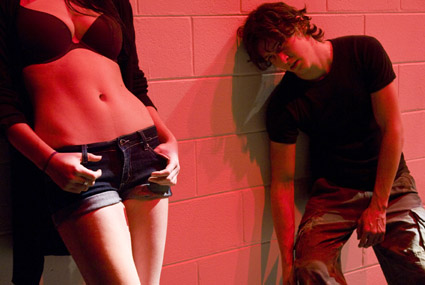
Second Year University of Wollongong students perform Fassbinder’s Pre-Paradise Sorry Now, directed by Chris Ryan
photo Derek Kreckler
Second Year University of Wollongong students perform Fassbinder’s Pre-Paradise Sorry Now, directed by Chris Ryan
making their own work
“They also have the unusual opportunity—and Tim and I feel it’s generally beneficial—to make their own work, albeit within tight parameters. It’s done on a competitive proposal basis and usually in 2nd and 3rd year. However, Jackson Davis wrote and directed Fire Moves Away (mentored by Theatre Fellow Chris Ryan) at the end of his first year, and showed it in the first weeks of 2nd year. It was so successful it went to the Hue Festival in Vietnam (facilitated by staff member Janys Hayes). Jackson is a Dean’s Scholar and one of the students combining Theatre and Creative Writing.”
the text-based/devised balance
Miller thinks the variety of approaches staff bring with them important for student flexibility. Chris Ryan (ex-Sydney Front and director of shows for PACT Youth Theatre) and Tim Maddock (Brink Theatre Company, Sydney Theatre Company, Griffin Theatre Company) “direct very differently but there has been no schism beween text-based and devised work, such as has happened elsewhere. This has been profoundly important.” She adds that through Margaret Hamilton students are incredibly well informed about the range of contemporary theatre and performance.
As well as Chris Ryan, the faculty has attracted a large number of theatre and contemporary performance professionals to work with students, including Deborah Pollard, Carlos Gomes, Geordie Brookman, Regina Heilmann, Tessa Leong, Drew Fairley and Mark Haslam. Miller is attentive to the need to balance text-based with devised works for production, noting as well that “some students just want to be actors and others almost from the outset want to make work. We need to open up the range of possibilities.”
Miller was particularly impressed with Korean performer Park Young-Hee’s Finding Love. Park came as a Theatre Fellow via Latt Children’s Theatre on the recommendation of director Roger Rynd [whose death on June 14 in Seoul is sadly noted. Ed]. “She directed and taught first years in their first 2009 semester, giving them a physical discipline and a sense of cultural difference from the very beginning.”
making connections
The faculty’s relationship with the organisations and venues outside the university is also important to Miller. Staff bring their connections and students have appeared in Performance Space’s NightTime series, have belonged to PACT’s Impact ensemble or appeared in the Tiny Stadiums Festival where the Appelspiel Collective created a model of the Erskineville village. Recent graduates have formed performance groups Team Mess and Tiger Two Times and actress Claire Bowen appeared in Geordie Brookman’s production of Spring Awakening, the musical, for the Sydney Theatre Company and in David Field’s film, The Combination.
As an integral part of their degree, undergraduates perform in their first year within the university in the faculty’s black box 86-seater, while their 2nd year productions are staged at the Illawarra Performing Arts Centre’s [IPAC] Gordon Theatre both semesters. The 3rd year graduating productions are shown at the PACT Theatre in Sydney and the Graduate Showcase is presented at Belvoir Street Downstairs. All the faculty’s shows are publicised widely within the university and beyond.
the new bachelor of performance
Miller is excited about the new degree: “From 2011 we’ll still have the Bachelor of Arts, Theatre and a new Bachelor of Performance. These will match the needs of different kinds of students. The Bachelor of Performance has two streams: one is acting and the other is performance making. There’s a common first year shared with the BCA Theatre students before decisions are taken about which pathway students might follow. In the first year there are common foundation subjects, then an introduction to stagecraft, one performance-focused and around the body and the other technical. As well there are skills training in acting, singing, voice and movement for performance focused students or subjects introducing stage management and the fundamentals of lighting and sound for students wishing to major in technical theatre production.
“After 18 months, the actors in the Bachelor of Performance continue actor training while the performance-makers pick up other areas of practice, different performative modes, installation and also directing—more specialisation, but no minors and only two electives, although performance-making students may choose to do a minor in technical theatre production.
“The Bachelor of Performance is designed to be the intensive course and the BCA Theatre degree more flexible,” Miller explains. “In a BCA you could do a major in theatre and a minor in technical production, or two minors—technical production and media arts or creative writing. It recognises the new emergent practitioner who plays in a lot of areas. BCA Theatre is about multidisciplinary flexibility.” Miller adds, “The production course will become a major in the BCA in 2012.”
Fortunately for a pressed Miller, who is also Program Co-ordinator for Music and Drama, “We have a new building with a rehearsal facility—two spaces to put people in—nothing flash but very functional.”
creative postgraduates
“Postgraduate study is a growth area,” says Miller. “We’ve had Masters and PhD students before but now we have increasing interest from mid-career and senior artists. It’s come about because of the classic need for artists within universities to get qualifications, or to reflect on one’s practice, or to seek structure and resources.” Wollongong offers a rare opportunity in NSW to do practice-based research in theatre. Miller says there’s also been a growth in the number of Honours students: “Mark Rogers is writing about the work of director Benedict Andrews and directing productions of plays by playwrights like Howard Barker and Marius von Mayenburg; Nathan Harrison is writing about Sydney performance group, version 1.0, which is arguably seminal research about Australian theatre practitioners.” The BCA Honours degree comprises 50% creative work and a minor thesis of 15,000 words—honestly, very demanding.” Honours students might then go on to a PhD. Artists undertaking Master of Arts by Research in the faculty include significant players in Sydney’s performance scene, Karen Therese and Victoria Hunt.
The Doctorate of Creative Arts is for artists with a high level of professional experience and a substantial body of practice. Current candidates include performance makers Deborah Pollard and Nikki Heywood. Miller says, “they exemplify the required ‘high level of artist achievement’ with longevity of practice and extraordinary maturity. I think it’s exciting for them. To prepare them and others, Professor Diana Wood Conroy has set up the Senior Artists’ Research Forum [SARF] which is a DCA-focused, intensive senior artists study program, supporting them in research methodologies training. There are fortnightly meetings with staff and other postgraduates for a semester and a half and then they go into the DCA proper. This is really helpful because it can be hard to come back into the university structure.”
With the imminent arrival of the Faculty of Creative Arts’ Bachelor of Performance at the University of Wollongong, we can look forward to the recognition of contemporary performance not only as a rich field of artistic endeavour and achievement in its own right, but as part of the great spectrum of performance that entails much else, including what we have traditionally understood as acting and theatre. That this extends to creative doctorates and the faculty and its students’ and graduates’ engangement with the world beyond the university, makes it all the more exciting.
Faculty of Creative Arts, University of Wollongong, NSW; http://www.uow.edu.au/crearts/index.html
RealTime issue #98 Aug-Sept 2010 pg. 2
© Keith Gallasch; for permission to reproduce apply to realtime@realtimearts.net
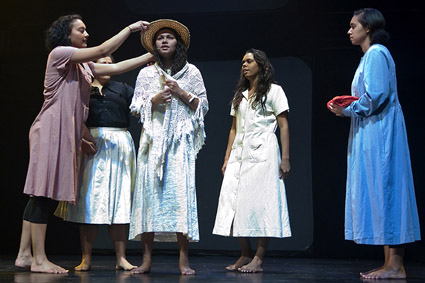
Rosie Fatnowna, Sharni McDermott, Teiya-Lee Gallienne, Elena Wangurra, Kaylah Tyson, Q150 and Long Before; Aboriginal Centre for the Performing Arts
photo Bain Stewart
Rosie Fatnowna, Sharni McDermott, Teiya-Lee Gallienne, Elena Wangurra, Kaylah Tyson, Q150 and Long Before; Aboriginal Centre for the Performing Arts
IT MAY ONLY BE AN ONLINE PROMO, BUT THE SELECTION OF COMMENTS FROM STUDENTS AT BRISBANE’S ABORIGINAL CENTRE FOR THE PERFORMING ARTS (ACPA) SAYS MUCH ABOUT HOW IT DIFFERS FROM NIDA, WAAPA OR EVEN NAISDA. “IT’S A SAFE ENVIRONMENT FOR MY PASSION”; “IT FEELS LIKE LEARNING IN OUR OWN COMMUNITY”; “THERE’S NEVER ANY SHAME HERE”; AND “I’M BECOMING MORE CULTURALLY STRONG IN MYSELF.”
For these Indigenous kids—almost half of whom are from regional Queensland rather than the cities—it’s not all about learning to sing, play music, dance or act in public; though that’s what they desperately want to do. It’s about connecting with their culture while preparing to get out there and compete in the entertainment mainstream. And though there aren’t yet any students from remote areas, and some have blond hair and blue eyes, they’re all singing from the same songsheet—which, when I was there, happened to be a number called “Black is the place I’m in.”
As such, the centre is part of the Queensland state government’s Indigenous Arts Strategy 2009—surely the first in the country; and with a $12million investment in things like the Cairns Indigenous Art Fair, the Queensland Indigenous Arts Marketing & Export Agency, the Saltwater Indigenous Film Festival and a network of 18 Indigenous Knowledge Centres, the most generous. Ironic that this was the state that worked most assiduously to ‘disperse’ its native peoples as far from their own country as possible; and I’m using the word disperse advisedly, in both its natural and euphemistic meanings—the latter disguising a massacre.
Given that such a turn-around in the State of Origin would likely be trumpeted until maroon in the face, why do we know so little about ACPA? One reason is that we’re still in thrall to the brilliant beginnings of NAISDA—spawning the Aboriginal & Islander Dance Theatre, Bangarra etc. In comparison ACPA has had a smaller and much more fraught start to life.
Michael Leslie—the recent Red Ochre winner for a lifetime of such efforts—founded ACPA in 1997. But it almost faded away a couple of times before a beefed up board of directors and two serious arts players came on the scene just two years ago. The board is now 50% Indigenous, and Chris Mangin, ex-Australia Council and the long time CEO of the Queensland Opera is there too. They brought in Milos Miladinovic as CEO, who simply said, “I wanted to feel proud of what I was doing” when I asked whether this was a step down from managing major venues such as The Edge in Auckland and the Victorian Arts Centre in Melbourne. “I’d come to the conclusion that I didn’t really like big musicals any longer!”
Miladinovic brought in Leah Purcell as Artistic Director—but only after she’d said no three times. However good the other artform teachers, the students needed an Indigenous role model—and who better than a film star, writer, director and stage actor who was also an ACPA alumnus, as was Ursula Yovich.
Can one suggest that the range of arts disciplines offered by ACPA is a factor in producing high individual levels of confidence; while NAISDA’s specialisation in dance has produced more corporate success. Penny Mullen, Head of Dance at ACPA, arrived in 2003 when class numbers were down to around five. But today she confidently compares ACPA with its rival NAISDA.
ACPA has always insisted on being centrally placed in Brisbane—as close to its South Bank arts activity as possible. The result is trainee and performing relationships with QPAC, Expressions Dance Company, the Brisbane Festival and La Boite Theatre. As a result, though, they’re in a condemned building at the moment and the hosted accommodation that’s essential for country kids is way out in the burbs at Beenleigh. Miladinovic reports, however, that a big, riverside building in West End is poised to come their way for the next five years—big enough to offer accommodation as well as teaching and administration. After that the State’s commitment will extend to a purpose-designed building, thanks to their assiduous massaging of what Chris Mangin describes as “the delicate balance of carrying the government forward with our dreams of the future.”
Ever-greedy, Miladinovic, would also like to head for Cairns—the State’s official Indigenous arts hub, where his students will be performing as part of the Indigenous Art Fair this year. There he could bring remote Aboriginal and Islander students into the fold. And if that works—why not go national?
They’re going international in September on an exchange with an Indigenous training college in Brazil. And because Leah Purcell has suffered family problems this year (which also caused her to pull out of playing Cordelia to John Bell’s Lear), the American director Stephen Helper is adding some Broadway glitz to the ACPA show at QPAC in August, which comes in two parts, Soul Music (the musical) and Souls Entwined (the dance, choreographed by Gina Rings and a team from Expressions).
The pattern of education that leads up to shows like this is the Certificate III cross-artform entry level, when it’s asked, ‘are they going to commit?’—as 75% of this year’s expanded number of 35 new students have so far. This compares to ACPA’s historic number of 85% completions—which is good compared to TAFE figures. Certificate IV is a change of pace and discipline for students—“a huge leap, but still cross-artform. If they make it through that, the Diploma is specialist, and suddenly they’re performers,” marvels the CEO. “There was Teiya [Teiya-Lee Gallienne], head down, hidden by hair for two years; then, overnight we discovered an actor and a singer in our midst!”.
Chris Mangin believes this sort of achievement more than justifies the two years he and Chair Denise Andrews put in ‘hands-on’ to save ACPA. “The history of training opportunities for young Aborigines is not marked by success. Yet it’s clear there’s a whole range of them with significant performing and writing skills. We have to marshal those skills and put them in front of a public—and it might lead to future employment.”
Long-term, Milos Miladinovic sees his main challenge as replacing himself with an Indigenous administrator. “Everything I see about mainstream courses is antithetical to keeping Aboriginal students on board; a 4,000-student environment is so far from their family and culture. Here, even if they don’t make professional performers, they’re able to go back into their communities as leaders; and maybe that’s where I’ll find my replacement arts administrator in time.”
The QPAC presentation of the Aboriginal Centre for the Performing Arts’ Soul Music/Souls Entwined has eight performances Aug 4-7; www.qpac.com.au/event/ACPAA_Entwined_10.aspx; www.acpa.net.au
RealTime issue #98 Aug-Sept 2010 pg. 4
© Jeremy Eccles; for permission to reproduce apply to realtime@realtimearts.net
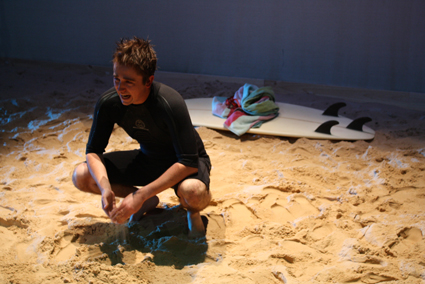
Dean Blackford, Blackrock, Tantrum Theatre
photo Tom Potter
Dean Blackford, Blackrock, Tantrum Theatre
WHEN MY FAMILY MOVED FROM CANADA TO AUSTRALIA IN 1990 WE WONDERED WHERE ON EARTH WE HAD LANDED. THE NEWCASTLE HERALD SEEMED TO REPORT ONLY TWO EVENTS: THE NEWCASTLE EARTHQUAKE (DECEMBER 1989) AND THE MURDER OF LEIGH LEIGH (NOVEMBER 1989).
Recently I had a chance to revisit the latter when I went to see Tantrum Theatre’s new production of Nick Enright’s play Blackrock. Enright first wrote the play Property of the Clan for Freewheels theatre-in-education company in 1992 before redrafting it as Blackrock for the Sydney Theatre Company in 1995. You might also have seen the 1997 movie directed by Steven Vidler. The Tantrum production is essentially the 1995 version, albeit with a few minor updates to include references to champion surfer Layne Beachley instead of Wendy Botha.
As we enter the space, a theatre with roughly 200 steeply raked seats, we see a trapezoidal stage covered in sand. Depending on the lighting (John Zeder), it looks like a beach, a bumpy relief map or a lumpy living room carpet. In the centre there’s a surfboard while up to the left a boy sits on a scaffold, dangling his legs. It’s Jared, enjoying the scenery before his cousin Cherie comes to pester him for a surfing lesson. From here, Blackrock follows a fairly classical narrative structure of exposition, complication, crisis and resolution. In the expository stages, we meet Jared, his mother Diane, his girlfriend Rachel and her family. We also meet his other ‘family,’ the surfing community at Blackrock. When their paterfamilias, Ricko, returns from some sort of safari, a party is in order. During the party, which is low on adults and high on alcohol, a girl named Tracy Warner is raped and murdered. The remainder of the play deals with the aftermath.
Sociologist Kai Erikson argues that trauma has both a centripetal and a centrifugal force within a community (A New Species of Trouble, WW Norton, 1994). On the one hand, it can cause existing divisions to widen. In Blackrock, the community splits along lines of class (the middle class perpetrator has access to a proper lawyer, the two working class accused are presumably left to Legal Aid), gender (the girls are deeply upset, the boys attempt to carry on as usual) and generation (neither the parents nor their children can comprehend each other’s actions and reactions). On the other hand, trauma can also cause communities to band together. This occurs in Blackrock to ethically ambiguous effect: in their efforts to comfort and reassure one another, the young men are soon colluding, coming up with alibis and agreeing to back each other up.
Director Brendan O’Connell draws subtle and nuanced performances from almost all of his cast. The young women effectively portray the febrile and slightly hysterical emotion of teenagers: they sob, stalk, whimper and sometimes shout. Brittany Turner is an endearing Cherie, making light work of monologues that are often tortured in drama classes. Likewise, Sarah Coffee is suitably highly-strung as Tiffany and Rachel Jackett is disarmingly low key as Rachel. The young men in the cast also manage to convey the excitement, terror and inarticulate rage their characters feel. Dean Blackford is especially sympathetic as Jared. The adults are also good: Karen Lantry deserves a special mention for her portrayal of Jared’s mother, who emerges as tough but tender, as does Cheryl Sovechles for her depiction of her vivacious sister Glenys. The characters’ moods are ably amplified by Kieran Norman’s sound design and Zackari Watt’s compositions: arguments are underscored by dissonance, points of shock by staccato notes and the music speeds up and slows down with the dialogue.
In the final scene, Jared finally cracks and admits that he saw the entire incident but did not go to Tracy’s aid. It is a melodramatic and somewhat problematic moment. For the character, it is the moment of confession, remorse and regret for his part in this moral mess. For the audience, however, it functions as a sort of reveal, as we finally find out what actually happened. In this sense, the play provides its spectators with a sense of closure that the community itself has never and probably can never experience.
“No one has ever worked through an injury without repeating it,” writes Judith Butler, “[t]here is not possibility of not repeating. The only question that remains is: How will that repetition occur, at what site…and with what pain or promise?” (Excitable Speech, Routledge, 1997). What, then, is the point and purpose of restaging Blackrock 20 years after the events that inspired it? For a young director, perhaps it is a chance to test himself against an Australian classic. Indeed, it is a chance to test the classic itself. For spectators who, like me, were there when the events transpired, the performance provides us with the time and space to do memory work, to wonder if that’s how it really happened and think about what has transpired in the interim. Finally, for the young actors themselves, performing in Blackrock might be likened to one of the play’s many initiation ceremonies (Toby turning 18, his sister Rachel dating her first boyfriend, and his mother writing on Indigenous initiations). To perform in Blackrock is to be initiated into Newcastle’s history, to learn that along with the mines and the beaches, the death of Leigh Leigh too is your ambivalent inheritance.
Tantrum Theatre, Blackrock, writer Nick Enright, director, designer Brendan O’Connell, performers Rod Ansell, Dean Blackford, Sarah Coffee, Ben Freeman, Erika Gelzinnis, Cordelia Hamilton-Russell, Steffen Hesping, Rachel Hackett, Dean Johnson, Karen Lantry, Bradley McDonald, Cheryl Sovechles, Brittany Turner, Daniel Yaxley, lighting designer John Zeder, composer Zackari Watt, sound designer Kieran Norman; The Playhouse, Civic Theatre, Newcastle, May 13-22, www.tantrumtheatre.org.au
RealTime issue #98 Aug-Sept 2010 pg. 6
© Caroline Wake; for permission to reproduce apply to realtime@realtimearts.net
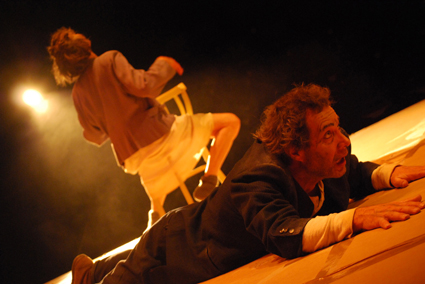
Eugene Gilfedder, Jennifer Flowers, The Chairs, La Boite
photo Al Caeiro
Eugene Gilfedder, Jennifer Flowers, The Chairs, La Boite
OF LATE THERE HAS BEEN AN ALMOST OBSESSIVE REVIVAL OF INTEREST IN THE WORKS OF ROMANIAN-BORN, FRENCH PLAYWRIGHT EUGENE IONESCO, WHO WROTE IN THE SHADOW OF THE HOLOCAUST AND WHOSE WORK REFLECTED THE IDEOLOGICAL TENSIONS OF THE COLD WAR. IT’S TEMPTING TO ATTRIBUTE THIS TO AN AWARENESS OF THE TOTAL CORRUPTION OF OUR LANGUAGE INTO A MORASS OF MANAGERIAL, MARKETING AND CORPORATE SPIN ANALOGOUS TO THE STRONG LINKS IONESCO MAKES BETWEEN LANGUAGE AND THE EMPTINESS OF POWER.
Is our world with its dying seas and asphyxiating atmosphere a fitting setting for the sort of tragic farce which was Ionesco’s chosen metier as a playwright? Is Ionesco our contemporary or is his 1952 play The Chairs just a vehicle for bravura performances, in this case, from Eugene Gilfedder as the Old Man and Jennifer Flowers as the Old Woman who confront the predicament of old age and old habits with a mounting fine edge of rage in Gilfedder’s case, and Flowers with a sly defiance of time that seizes every moment to flirt with the audience.
Ionesco comes to us cloaked in the guise of so-called Theatre of the Absurd. Now the spotlight has been turned on his case in an intelligent, scrupulously realised rendition of this small masterpiece for La Boite in Brisbane. Director Brian Lucas restores Ionesco as the legitimate heir of Feydeau combining an outrageous, surreal sensibility which Ionesco applies with a rationale that, far from being absurd, is, on the contrary, remorselessly logical in the way of clowns. Gilfedder greets an old flame with the declaration that she is as beautiful as ever, while noting the fact that she is going bald. He puncuates the arrival of a high plenipotentiary (God?) by barking like an excited dog. Flowers’ performance achieves the purest heights of comic burlesque when she mimes an act of seduction in her role as dessicated coquette.
Ionesco tells us that his plays have their origins in two basic states of consciousness, “an awareness of evanescence and of solidity, of emptiness and of too much presence.” He sets up an isomorphic resonance in The Chairs between these two qualities to which Brian Lucas seems acutely attuned from the evidence of his own solo works in dance theatre with their intricately crafted visual and kinetic elements and deep concerns with life’s ephemerality and the validity of language. Lucas’s treatment, too, has the light touch which renders his own work so accessible. It may be profound, it may be crazy, you take it or leave it. It illuminated the fact that, for me, Lucas’s own chosen metier is tragic farce, especially his 2010 show, Performance Anxiety (RT96, p30). As a dancer and choreographer, Lucas expressed surprise that he had been asked to direct Ionesco’s classic, but this was a joyful match especially considering that in later life Ionesco turned his attention to dance as a realm to express his ideas.
Through carefully plotted stagecraft, the play makes complex use of presence and absence, but this does not amount, despite Ionesco’s references to the Void, to a metaphysical statement. Integral to his purposes in theatre is the stage design where Bruce McKinven accommodates Ionesco’s stipulations, including symetrically arranged doors in the rear for exits and entrances as in a Feydeau farce. At a significant moment, double doors open onto a blazing wall of light signifying the Void backstage. However, this is a solidly spatial metaphor. Two ladders lead to high windows set on either side of what will eventually emerge as a replica, albeit shabbier, auditorium onstage. Two chairs face downstage.
The Old Man is atop one of the ladders as the play begins, apparently delighting in an ocean vista. When the Old Woman acidly remarks that it is too dark to see, he complains that it wasn’t like that in the old days when it was always light. Their fractious, co-dependent relationship is rapidly established through a series of verbal Punch and Judy cross-purpose conversational gambits while he sits on her lap indulging in a conscious abandonment to self-pity, partly triggered by her lamentations about his wasted talents.
To divert him, the Old Woman initiates a game they have obviously played before. Having rocked him on her knee while singing a soothing lullaby, she introduces the comforting topic of his important message to the world. Reaffirmed, the Old Man resumes his chair and begins to manifest a new, confident personality, a fictional self. He has moved, in his imagination at least, beyond his lowly status as a “master of the mop and bucket.” They sit in silence, momentarily taking on the image of members of an audience in expectation of a performance.
The Old Woman attempts to wind down the game by suggesting they are too tired and should cancel the evening’s performance when the doorbell rings. Startled into febrile activity, they rush to answer it and reappear, escorting and seating onstage an invisible guest with whom they exchange social banalities. From here on the action frenetically escalates into a vaudevillean tour de force. Guests continue to arrive, the Old Man frantically greeting them and the Old Woman struggling to produce chairs for them all. Comic vignettes of social intercourse grind to a halt as the reality of the old couple is overwhelmed onstage by these invisible presences, and they are separated and squeezed to the margins by this new audience-in-waiting. Eventually the Orator (Dan Crestani) who will deliver the Old Man’s message appears as a real, oleaginous, neo-Fascist figure—to the dismay of the Old Woman, she has to touch him to pronounce him “real flesh and blood”—but he studiously ignores the old couple.
Their make-believe mission apparently accomplished, the couple have no choice but to finish the game by committing suicide, somersaulting backwards from their separate perches on the windows into the sea. Faced with the expectations of the real audience in the auditorium merged with those of the invisible audience onstage (all conventional stage boundaries have now dissolved), the Orator struggles to deliver his non-existent message, finally abandoning the attempt and leaving the real audience to contemplate the possibility of their own disappearance into the indelible image created onstage.
Ionesco is gently asking to what extent we avoid interacting with the sheer crazy wonder of life by grounding existence in our own and other people’s fictions, including the theatre’s. If the messengers fail us, we must jump without a parachute into a void of unknowing. After Copenhagen, we must work out our own salvation, and the salvation of the planet. As Ionesco puts it, “Ideology is not the source of art. A work of art is the source and the raw material of ideologies to come.” Judging by the shared smiles tokening a renewed awareness of the unbearable lightness of being, the audience ‘got it.’ This seriously funny production validated Ionesco as a man for our time.
La Boite, The Chairs, writer Eugene Ionesco, translator Martin Crimp, director Brian Lucas, performers Dan Crestani, Jennifer Flowers, Eugene Gilfedder, designer Bruce McKinven, lighting designer Carolyn Emerson, sound designer Brett Collery; Round House Theatre, Brisbane, Jun 5–Jul 4
RealTime issue #98 Aug-Sept 2010 pg. 8
© Douglas Leonard; for permission to reproduce apply to realtime@realtimearts.net
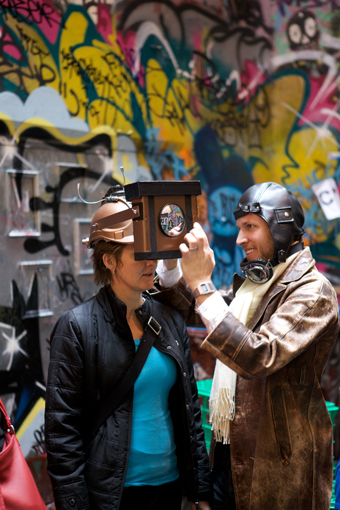
participant, Tim Webster, In Periscope
photo Bonnie Savage
participant, Tim Webster, In Periscope
THE NOTION THAT ART AFFORDS US FRESH PERSPECTIVES ON THE FAMILIAR IS SOMETHING OF AN EMPTY PLATITUDE; HOW OFTEN DO WE REALLY FIND OURSELVES CHALLENGED AS OPPOSED TO ASCRIBING ORIGINALITY AND INSIGHT TO SOMETHING WHICH MERELY CONFIRMS OUR OWN VIEW ON THE WORLD? EVEN THE FRAMES WE PLACE AROUND ‘ART’—AS OPPOSED TO ITS OTHERS—ARE DEPENDENT ON WHAT WE CHOOSE TO SEE AND WHAT WE HOPE WILL REMAIN ABSENT FROM OUR CONSCIOUSNESS.
in periscope
It was a right old surprise, then, to recently experience a tiny and very humble work of live art that literally shifted the frame. In Periscope was the ingenious creation of Tim Webster in collaboration with Sarah Rodigari and presented its handful of participants with a gentle yet effective physical and visual encounter with the city.
Upon arrival in a Melbourne laneway we were fitted with a curious piece of headgear—a steampunk-esque helmet held together with brass-painted screws and wires and with a large, rectangular face covering. When lowered it blocked all but the most peripheral of our vision but soon a panel was removed and a square of light appeared. The contraption was a periscope of sorts, presenting a magnified view of whatever lay directly above us. For the next 20 minutes we were guided around a city now only available to us in a strangely upended and abstracted way.
But as with most art that deserves the title, a description of the process doesn’t do justice to the experience. The effect of this periscope is an embodied one—it produces a sense of immediacy and alienation that goes beyond the conceptual. Moreover, it’s not the same as simply looking up while wandering the streets. The device framing our vision produces a screen rather than window on our environment and a distinct sense of dislocation results: the experience of our physical bodies moving through the urban space doesn’t correlate with the cool, distant flow of flattened architectural forms unfolding before our eyes.
As an experiment in live art making, In Periscope was subtle yet enthralling, much like last year’s En Route by Bettybooke (RT94). It produced that transfigured way of seeing so rarely found in art, yet did so in a modest and understated manner. It seems likely to me that this kind of achievement is more often realised in non-text-based work, but while the field of live art frequently shuns texts there are examples of more traditional theatre which still hold out hope for the transfigurative perspectives of the form.
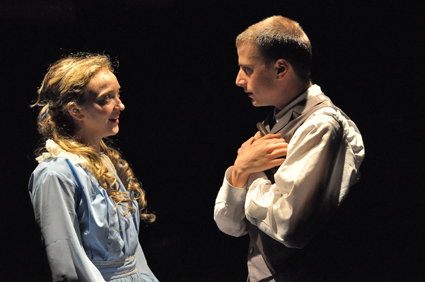
Amanda Falson, Thomas Conroy, Something Natural but Very Childish, Dirty Pretty Theatre
photo Joe Calleri
Amanda Falson, Thomas Conroy, Something Natural but Very Childish, Dirty Pretty Theatre
something natural but very childish
Director Gary Abrahams’ first outing of 2010 was a literary adaptation—Acts of Deceit (Between Strangers in a Room), after James Baldwin’s novel Giovanni’s Room. There Abrahams proved himself keenly adept at drawing out the emotional intricacies of a literary work and using them to shape a compelling stage drama. His second work for the year, Something Natural But Very Childish, extended this same process to a selection of short works by Katherine Mansfield.
What makes Abrahams’ works this year stand out so sharply is an aesthetic commitment to something deeply unfashionable in contemporary performance: the romantic. They are almost anachronisms in this regard, treating the sentimental with a degree of seriousness that is slightly unsettling in an age of irony and self-reflexivity. They’re far from kitsch, however. Rather, they overlay a vaguely hysterical kind of heightened emotion onto the rich and resonant themes of his source material; at the same time, they never revert to camp parody. Where there is excess, it seems designed to reproduce the sense of giddy intoxication one experiences when drawn into a lush, imaginative literary world. The director’s success is in reawakening the possibility of a post-ironic theatre that is anything but falsely naïve.
slut
Playwright Patricia Cornelius works within this frame, as well. Her play Do Not Go Gentle… has been a much-feted fabulation of aging and loss, but her short work Slut is an excellent introduction to the surgical skill with which she employs familiar theatrical conventions to deliver the unfamiliar.
Slut was commissioned by Platform Youth Theatre as part of a double bill two years ago; I still recall that performance as the result of a key monologue which arrives near the work’s conclusion. I was eager to see whether my memory of the text’s excellence would hold up to a second production.
Verve Studios’ new version is more confident than the original, perhaps the result of the slighter older casting. The work itself is chilling, inspired by the murder of a woman by her boyfriend on a Melbourne street several years ago. At the time, media coverage focused on the tragic death of a passer-by who attempted to stop the violence, while sneeringly referring to the female victim as a ‘partygirl’ who came to an unsurprising end. This is both the origin and destination for Cornelius’ attempt to make sense of the event.
Her script traces the history of a woman who since puberty has been defined by sexuality; crucially, this history is largely revealed through the breathless commentary of two schoolmates who narrate the decade leading to the eventual murder. It is only late in the work that it becomes apparent that the figure at the play’s centre is mostly without voice herself or, when she speaks, it is in the language of those who are shaping her identity. That brief monologue in which she does find her tongue is still wracking—her assertion that she’d never been permitted to want or dream of anything beyond her immediate circumstances is a confronting one in a space, the theatre, where dreaming of that which isn’t the case defines the very essence of an audience.
weekend
The period in which Jean-Luc Godard created his notorious film Week End (1967) was one in which he, too, was grappling with the position of the spectator in relation to his practice. Having moved beyond the formal experimentation of his earlier work, he searched for a politicised cinema that rebelled against the paradigm of audience passivity. While a worthy goal, one of the results was, in the case of Week End, a film intended to alternately outrage and bore its viewer, with endless sequences of cool banter, disjointed title cards and scenes of real animal slaughter.
A recent adaptation of Week End presented at La Mama’s Carlton Courthouse brought different problematics to the stage while equally provoking its onlookers. Most troubling of all was the apparently deliberate obsolescence of the work—performers gleefully artificial, replete with bad accents and hokey props, but just as often playing as if uninterested. This isn’t to say that these performances failed to engage; instead, they seemed calculated to prevent any identification with the increasingly bizarre events occurring on stage.
But if coprophilia, dismemberment and cannibalism are just the stuff of entertainment today, and when invoked must be treated with the same bored contempt deserving of vacuous spectacle, then it’s unclear why a theatrical production would seek to remind us of this fact. Weekend seems a self-defeating production, one that heralds the demise of classical theatre by feasting on the remains. It’s not the only way, I think. Admittedly, though, it’s a pretty damned entertaining one.
Affective Urbanism 3: In Periscope, Tim Webster in collaboration with Sarah Rodigari, helmet design and construction Rob Jan, around Melbourne, May 29-30; Dirty Pretty Theatre, Something Natural But Very Childish, writer, director Gary Abrahams, performers Luke Jacks, Thomas Conroy, Amanda Falson, Luisa Hastings Edge, Josh Price, Zoe Ellerton Ashley, Cameron Moore; La Mama Theatre, June 2-20; Verve Studios, Slut, writer Patricia Cornelius, directors Paola Unger, performers Hayley Birch, Kelly Hynes and Victoria Morgan; The Dog Theatre, June 30-July 17; Weekend, writer Matthew Lambert, director Lynne Ellis, created & designed by Paul Blackman from Jean-Luc Godard’s Week End, performers Sam Sejavka, Francis McMahon, Ben Andrews, Christian Bagin, Imogen Sagel; La Mama Courthouse, Melbourne, June 30-July 18
RealTime issue #98 Aug-Sept 2010 pg. 10
© John Bailey; for permission to reproduce apply to realtime@realtimearts.net
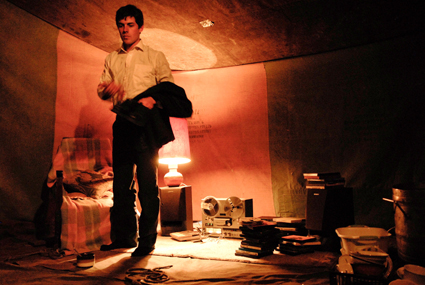
Matt Prest, The Tent
photo Heidrun Löhr
Matt Prest, The Tent
AN IMPORTANT DEVELOPMENT FOR AUSTRALIAN CONTEMPORARY PERFORMANCE IS ABOUT TO BE REALISED. THE MOBILE STATES CONSORTIUM, A STRONG SUPPORTER OF THE FIELD, HAS COMMITTED TO DEDICATING ONE OF ITS TWO ANNUAL TOURS TO A DIVERSE PROGRAM OF SMALL AND MEDIUM SIZED WORKS OVER THREE YEARS, STARTING IN 2010.
an expanding niche
The opportunities for contemporary performance works to travel regionally and cross borders have multiplied in recent years thanks to Mobile States (with sometime support from the federal government’s Playing Australia program), Melbourne’s Arts House, Sydney’s Performance Space, Brisbane Festival’s Under the Radar and a range of opportunities offered by Full Tilt (at the Arts Centre, Melbourne) and Malthouse (both of whom have presented works by Sydney’s My Darling Patricia), Next Wave Festival (see articles by Reck, Karipoff and Warren), Sydney’s Tiny Stadiums, Australia’s international arts and fringe festivals and now regional players like the enterprising Campbelltown Arts Centre, west of Sydney, and Punctum in country Victoria.
Audiences are becoming increasingly familiar with contemporary performance as a regular part of their art diet—indeed as a substantial proportion of it in Arts House’s 2010 Future Tense programs. As with the 2010 Next Wave Festival, Future Tense’s offerings include the latest manifestation in the field—live art’s extensive engagement with site, genres, games, media, science, sensory states and audience interaction.
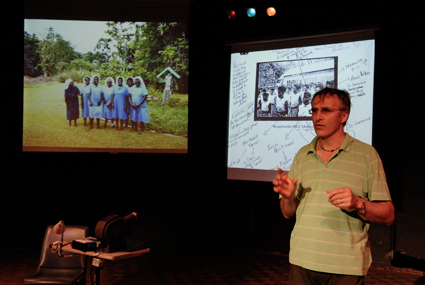
Paul Dwyer, Bouganville Photoplay
photo Heidrun Löhr
Paul Dwyer, Bouganville Photoplay
Mainstream theatre companies are also engaging with contemporary performance. In 2008 Sydney Theatre Company presented De Quincey Co’s embrace: Guilt Frame (RT 83; RT84) and in 2009 performance trio Post were in-residence with the company. Malthouse’s Tower provides a salaried venue for innovative works and Belvoir Street’s B Sharp has programmed Post (Everything I Know About the Financial Crisis in One Hour) and version 1.0 (The Market is Not Functioning Properly) in a forthcoming Downstairs double bill and version 1.0’s The Bougainville Photoplay Project Upstairs. Shutting down its B Sharp theatre program at the end of 2010, Company B seems set to commit to experimentation Downstairs: more room perhaps for contemporary performance to reach a wider audience.
mobile states: track record
Mobile State’s particular interest is “in those artists whose practice is concerned with experimentation, research and the investigation of ideas and form” (Performing Lines website) as demonstrated by its strong track record. It has successfully toured Branch Nebula’s Paradise City, Dancenorth’s Underground, Back to Back’s Small Metal Objects, Lucy Guerin Inc’s Love Me, Tanja Liedtke’s Twelfth Floor, version 1.0’s The Wages of Spin, Chamber Made’s Phobia, de Quincey Company’s Nerve 9, Jenny Kemp’s Still Angela and, most recently, Urban Theatre Project’s The Folding Wife across the country.
The consortium members are Adelaide Festival Centre, Arts House (Melbourne), Brisbane Powerhouse, Performance Space (Sydney), Perth Institute of Contemporary Art (PICA) and Salamanca Arts Centre (Hobart) along with producing member Performing Lines.
modus operandi
I spoke recently with Harley Stumm, a producer for Performing Lines, the agency that produces, develops and tours Australian works of many genres nationally and internationally. He’s a former executive producer for Western Sydney’s Urban Theatre Projects and brings considerable experience to this new initiative which is so clearly responsive to developments in the field.
Asked how Mobile States works, Stumm says, “Performing Lines manages the curatorial process but it’s a presenter-driven model. There were originally five members and now there are six with the Adelaide Festival Centre joining. We receive written proposals and vote on what goes forward. Performing Lines doesn’t have a vote because as a presenter-driven model you can’t vote to make someone put a show on. We participate in the discussions.”
motivation
Asked why Mobile States took on touring “Best New Australian Performance” (Press Release), Stumm explained, “Over the years artists have pitched a half-hour work or an installation for Mobile States and you think it’s a great piece, great to tour. But how? At various times we’ve talked about the idea of putting together a mini-festival to tour a broader spectrum of contemporary performance practice. There are new forms and genres arising but also new formats and new ways for audiences to experience work. So we developed the idea further, putting together a cluster of works to create an event that would build a bit of a vibe around this form of practice, and tendered for the Australia Council Touring Initiative from the Theatre Board. We’ll tour programs of shorter and mid-length works, performance installations, sound installations, audio walks, durational performances. We’ve selected a menu for the first tour of four works: Rosie Dennis’ Fraudulent Behaviour, Fleur Elise Noble’s 2 Dimensional Life of Her, version 1.0’s The Bougainville Photoplay Project and Matt Prest’s The Tent.”
complexities
The term ‘menu’ is apt. Stumm and the consortium had to grapple with the fact that not every venue could take on all the shows: “PICA in Perth has programmed all four works from the menu as a kind of mini-festival whereas other ‘festival-ed out’ presenters have selected certain shows as part of their seasons. Sometimes works have already appeared in a city, so they won’t be selected: The Tent had already done Melbourne.
“We’d initially planned a menu of five shows but we didn’t get Playing Australia touring money so we had to trim back. Then there were venue considerations. All of them have very different spaces—or not enough spaces—and different audiences, different budgets, any number of variables. Like all touring, there’s a group of diverse presenters coming together and working out what they can share and where they can’t compromise their own programming needs. On the other hand, there are benefits in touring to multiple venues—we’ve got four works going to five venues and no two venues have the same package, but there’s very little downtime so it’s still relatively cost effective.”
in darwin
Stumm emphasises that the program “is a group curation. The five works that we originally programmed were all high on most of the presenters’ wish lists.” But Mobile States programs don’t just go to the consortium’s venues: “We’ve toured Tess de Quincey, Branch Nebula and The Folding Wife to Darwin with the Darwin Entertainment Centre. This time the Darwin Festival artistic director Jo Duffy was very keen to look at some smaller works. Paul Dwyer’s The Bougainville Photoplay Project, which is about his father’s New Guinea experiences against the backdrop of Australia’s colonial history in the region, will go on at Brown’s Mart, which is perfect for it—a nice intimate space. Obviously the connection between this work and Darwin’s physical proximity to and historical relationship with Papua New Guinea interested Jo from the beginning.”
In the other work for the Darwin Festival, says Stumm, “Matt Prest’s The Tent will be performed on a strip of land on the waterfront, just down the hill from the CBD, between where they have the open air Deckchair Cinema and the new waterfront redevelopment. In the dry season when the accommodation in Darwin is booked up, all the ferals and grey nomads who’ve hit Darwin and either can’t find a place to stay or don’t want to pay for it, camp illegally in this park. So The Tent will be fantastic there. In The Tent there’s a kind of bush philosopher who’s opted out from the rat race. Matt says ‘The Tent is pitched at the crossroads of sustainability and prolonged adolescence’.”
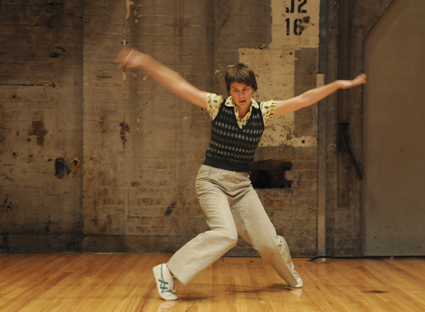
Rosie Dennis, Fraudulent Behaviour
photo Heidrun Löhr
Rosie Dennis, Fraudulent Behaviour
going regional
I ask Stumm about Mobile States’ commitment to regional touring. He replies that it’s not just an ideal, but a practical necessity if funding from Playing Australia is to be secured: “The advice we got from Playing Australia was that there wasn’t any issue with the model for the performance tour. It was simply a matter of regional reach. They have half a dozen selection criteria and so many program objectives. Regional reach is the top priority. So we have to extend our reach. And we want to do that. We have an application in for a stand-alone tour next year and another cluster—a menu of six works with each presenter choosing between two and four.”
Stumm points out that Mobile States has had good regional reach: “With The Folding Wife, we said okay, where’s the Filipino community located in Australia? And the answer is north Queensland and the Northern Territory. So we got that show to Mackay, Townsville, Cairns and Darwin. In the past, we got Branch Nebula’s Paradise City to Cairns and Alice Springs, Dance North’s Underground to NORPA in Lismore and to the Memorial Entertainment Centre in Bathurst.” Stumm says there is strong interest in future package tours from a couple of regional centres that “have a bit of a history of presenting more contemporary, more adventurous work”, but it has to mesh “with their own development programs. Stand-alone tours are definitely easier to sell to regional areas.” But it’s early days and Stumm is optimistic about the future of touring “performance clusters.”
Mobile States continues to be a significant force for promoting contemporary performance in Australia. As Harley Stumm sees it, and you’d have to agree, “the list of works that Mobile States has toured surveys some of the most important contemporary work for the last five years.” The new program of smaller scale works promises to bring far flung Australian audiences right up to date with new works and trends.
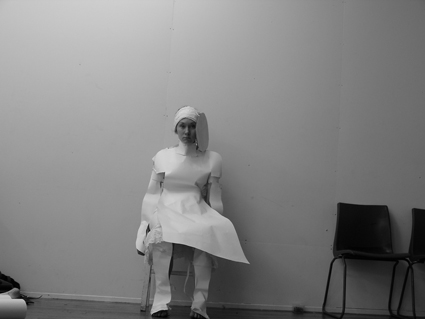
Fleur Elise Noble, The Two-Dimensional Life of Her
the works
Paul Dwyer’s the Bougainville Photoplay is engrossingly informal, musing on a doctor’s life in the 1960s in a brutalised neighbouring culture about which most of us know little. Fleur Elise Noble’s 2 Dimensional Life of Her generates a magical interplay between the artist’s own body and animated and paper sculpted personae telling us much about form, representation and self. So, in another way, does Rosie Dennis’ Fraudulent Behaviour—where a little lie can become a great fiction and you leave bemused, if compelled to reflect on your own white lies and worse. In The Tent, you’ll find yourself in an installation-cum-tent—sharing soup, entranced by puppet dreams and lateral glimpses into the meaning of life. These are works that engage in idiosyncratically different ways of telling and being. It’s wonderful that they’ve been mobilised to embrace a growing audience for new performance.
Mobile States, performance works, see individual venues for shows and times: Arts House, Melbourne, Aug 12-15; Darwin Festival, Aug 18-22; Brisbane Powerhouse, Aug 20-28; PICA, Perth, Sept 2-5; Salamanca Arts Centre, Sept 8-11
RealTime issue #98 Aug-Sept 2010 pg. 12
© Keith Gallasch; for permission to reproduce apply to realtime@realtimearts.net
{$slideshow} IN ACT IV OF EUGENE O’NEILL’S LONG DAY’S JOURNEY INTO NIGHT, EDMUND DRUNKENLY CITES ARTHUR SYMONS’ POPULAR TRANSLATION OF BAUDELAIRE’S PROSE POEM “EPILOGUE”: “WITH HEART AT REST I CLIMBED THE CITADEL’S/ STEEP HEIGHT, AND SAW THE CITY AS FROM A TOWER,/ HOSPITAL, BROTHEL, PRISON AND SUCH HELLS,/ WHERE EVIL COMES UP SOFTLY LIKE A FLOWER.” THE POET’S VIEW OF THE NOCTURNAL METROPOLIS—SEEDY IN ITS MODERN DISCIPLINARY INSTITUTIONS AND TEMPTATIONS—CONFESSES A KIND OF ILLICIT DELIGHT FOR THAT WHICH IS POISONOUSLY DESTRUCTIVE, OR AT THE VERY LEAST, OFFERS A FUTILE SENSE OF RESISTANCE TO THOSE THINGS WHICH, BY THEIR VERY NATURE, MARRY DESIRE WITH DEATH.
O’Neill’s largely autobiographical play, written in 1942 but first published three years after his death in 1956, and in 1957 awarded the Pulitzer Prize for Drama, registers—with durational monumentality—the slow rising of an evil that is both soft and beautiful: a family addicted variously to morphine, whiskey, money and women, but also to their own familial dynamics of intense rage and love. Resurrected by Sydney Theatre Company, directed by Andrew Upton and featuring William Hurt and Robyn Nevin, the work enacts a three-and-a-half hour durée that witnesses both authorial lament and exorcism. The text’s demons are profound; its unfolding excruciating.
Alongside the much younger Tennessee Williams and Arthur Miller, O’Neill has been credited with rendering American realism “true” by realising the gritty vernacular of characters struggling on the edges of institutions, families and themselves: their gestural and vocal rhythms, their cyclical obsessions, their fatalistic bodily and moral corruptions. Edmund (presumed to be the young O’Neill, played by Luke Mullins) is suffering from consumption, a secret he hides from his wretchedly deluded (and morphine-addicted) mother Mary (Nevin). His father James (Hurt) and brother James Jnr (Todd Van Voris) endlessly bait each other and Edmund in rehearsals of contempt and betrayal, in contests over money lost and bitter memories. As in any family, these are set pieces, but here the Tyrones are caught in the thickness of their self-interest over self-effacement, drowning themselves in whiskey to soothe and then re-provoke.
The production design and dramaturgy works, on all levels, to preserve the play’s historicity—its reimagining of the American dream was as much dramaturgical and stylistic as it was philosophical. In this respect, the text’s familial ghosts feel uncomfortably trapped by theatrical and literary ghosts of form instead of being offered a contemporary opening out of the play’s emotional and textural scope. The set (Michael Scott-Mitchell) reads as a truthful replica of modernist architecture, but gives no cue to its reality as a contemporary refashioning of an old idea; there is no self-reflexivity in this kind of resurrection. The house is angular and partial, often swathed in blue light, sinking (or so it feels) amidst the punctuating sound of fog horns (Max Lyandvert), which are moody, but also equally cloyingly illustrative.
The performances cadence to different registers, and each are acts of exceptional mental endurance despite occasional lapses of rhythm when in concert with one another. Hurt’s paternalism is contained and powerful in his quiet (possibly too quiet for some) burning rage, and focuses steadfastly to find a sturdy andante delivery for words that need—with their particular vernacular poetics—to be able to out-perform his own celebrity presence. Nevin’s Mary is jittery and birdlike, a vista of a too-archetypal feminine anti-heroine, irritatingly caught in the image of her own trappings (and those of the era). Mullins and Van Voris are both robust in their delivery; Edmund coughs his chest onto the stage in an arc to slow death, James smothers his boisterous cynicism with the fuzz and fog of drink.
The meta-literary references within the play, such as those by Baudelaire (and countless others), portend the great literary legacy that O’Neill was himself to leave, long after he escaped the family hellhole, and even longer after his death. He dedicates the work to his third wife Carlotta as “a play of old sorrow, written in tears and blood,” with a 25 year moratorium on its production. With the past so strongly haunting the presence of this work, STC’s production is at once compelling and awkward, an incomplete conception of what it is to give due credit to a masterful work that is being experienced in a very different time. There was a certain sense of slow torture in waiting for the play’s death throes to abate, but this was not, I imagine, unlike O’Neill’s own experience of growing up. In this respect, sitting through the long night’s journey into day felt important, possibly rewarding.
Sydney Theatre Company, Long Day’s Journey into Night, writer Eugene O’Neill, director Andrew Upton, actors William Hurt, Robyn Nevin, Todd Van Voris, Luke Mullins, Emily Russell, design Michael Scott-Mitchell, sound Max Lyandvert, costumes Tess Schofield, lighting Nick Schlieper, Sydney Theatre, July 3-Aug 1
RealTime issue #98 Aug-Sept 2010 pg. 14
© Bryoni Trezise; for permission to reproduce apply to realtime@realtimearts.net
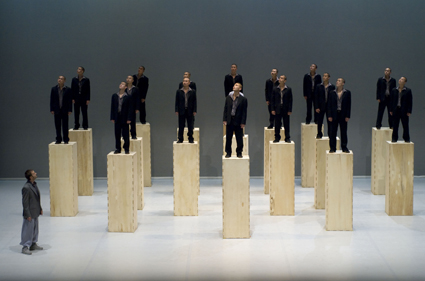
Sutra, Sidi Larbi Cherkaoui and Warrior Monks of the Shaolin Temple, Brisbane Festival
photo Andree Lanthier
Sutra, Sidi Larbi Cherkaoui and Warrior Monks of the Shaolin Temple, Brisbane Festival
NOEL STAUNTON EXPRESSES SOME NERVOUSNESS, IF WITH A CONFIDENT IRISH LILT, ABOUT HIS FIRST BRISBANE FESTIVAL. HE’S ONLY BEEN IN THE POSITION SINCE LATE 2009 AND IS STILL GETTING TO KNOW THE CITY: “I THINK THE PEOPLE OF BRISBANE WANT SOMETHING THEY CAN CALL THEIR OWN. IT’S NOT ABOUT SHOPPING DOWN AT THE ART SUPERMARKET; WE CAN ALL DO THAT. THAT’S WHY WE’RE DOING THE ROAD SHOW ARE WE THERE YET?, CIRCA HAS A SHOW FOR KIDS, WE’RE BUILDING A NEW FESTIVAL THEATRE SPACE AND WE’RE DOING STALKER’S SHANGHAI LADY KILLER WITH CO-PRESENTERS. HOPEFULLY IT’LL DO SOMETHING AND I’LL NOT BE RUN OUT OF TOWN.”
Formerly Executive Director of the Sydney Dance Company, Noel Staunton has worked in the arts for 30 years: as Technical Director of the English National Opera and Opera Australia, as Executive Director of Baz Lurhmann’s company, Baz Live, and Executive Producer of the 2004 South Australian Opera production of Wagner’s The Ring Cycle. An arts festival should come easy.
a new festival venue
When we meet in Sydney to discuss his 2010 program, Staunton commences by describing an initiative of which he’s clearly proud. “When I first visited the Brisbane Powerhouse and saw on approach the huge flat facade, I asked had anyone thought of building an amphitheatre here.” Which is exactly what he’s doing—creating an open air 600-seater called QUT Festival Theatre, ideal for Brisbane Spring when the festival plays. He sees the new venue as providing a base for exciting local work (CIRCA, Raw Dance, Topology, Queensland Theatre Company) and “extending the box office, which in the past was not major. If you pay for it, you’ll respect it, while of course there have to be events that are free. I’m experimenting in terms of the genres I’m putting in this space—circus, theatre, dance, music and opening with a production of Shakespeare’s Macbeth. It’s the first time Marcus Graham has played the role and Michael Gow is directing. It’s trimmed down and it’s all about the language and there’s no set—the wall is the set, it’s the scenery.” Opposite the amphitheatre is “the Milk Crate Lounge, where audience and artists can relax after the show.”
Staunton’s impressed by some of the young Australian talent he’s programmed—better known overseas than here—like percussion-based Raw Dance. Also in the QUT Festival Theatre program are Edinburgh Fringe, hit Melbourne’s Dark Party—“they’re like the Marx Brothers and staple things to their bodies.” In Bounce, Topology and their audience will actually bounce balls off the wall and floor of the theatre to provide patterns to which they’ll play. The ensemble are reworking the UK’s Aphex Twin’s “epic 1997 study in the rhythms of collision, Bucephalus Bouncing Ball, made from the sounds of bouncing ping pong balls” (Press Release).
circa & circa zoo
Also in the QUT Festival Theatre are Brisbane’s Circa Zoo, directed by Ben Knapton, presenting Strange Familiar Angel for children in the afternoon while globe-trotting Circa and artistic director Yaron Lifschitz are staging Wunderkammer, “a cabaret of the senses,” at night for adults. “Wunderkammer is created especially for the space,” says Staunton. The program also includes the music of Brisbane’s Robert Forster. Staunton adds, “What works and doesn’t work will help me plan 2011.”
are we there yet?
Of the 10 free events programmed for the festival, Staunton is particularly exicted by Are We There Yet?, a music theatre road show about people moving to Brisbane from interstate. It will play from a caravan in nine Brisbane suburban parks. Scripted by Scott Witt, it’s another opportunity, Staunton declares, to invest in local artists. It’s a three-year project, while another public series, Backyards (performed in actual backyards), inherited from previous Brisbane Festival artistic director Lyndon Terracini, will have its final outing this year.
stalker, shanghai lady killer
Shanghai Lady Killer from Sydney’s Stalker is eagerly anticipated. Staunton describes it as “a cross between a melodrama and Crouching Tiger, Hidden Dragon and a lot of fun.” Director Rachael Swain and the show’s writer, filmmaker Tony Ayres, have fashioned a contemporary onstage film noir “in the Chinatown of a futuristic Australian city [with] multi-media landscapes, acrobatics, parkour, trampoline, dance, circus and martial arts.” The production promises to explore “the Australian fascination with and fear of China” (Press Release). A leading Chinese martial arts film star, Wang Fei plays the lead role. The original musical score is by lain Grandage, design by Stephen Curtis and choreography by Gavin Webber (ex-Dancenorth) and Wu Shu Master, Alice Dong Pei, with stunts directed by Keir Beck.
angus cerini, wretch
Another Australian work in the program is Melbourne writer-performer Angus Cerini’s Wretch, performed with Susie Dee. John Bailey wrote in RealTime, “Wretch feels like the culmination of all of Cerini’s work so far, as well as connoting a stellar leap in his ability as a writer. The piece follows a young man in prison visited by his mother, detailing the hopelessness and failures each have experienced and which have led to his senseless crimes…Cerini serves up these lives with words that move from ocker realism to Byronic splendour to impenetrable gutterisms in a single breath” (RT 90.p40).
beckett, first love
“I have to have my bit of Beckett,” admits Staunton. “When you hear Conor Lovett speak, the Irish language is just absolutely beautiful—you could listen all day.” The Irish-French company Gare St Lazare Players are presenting First Love: “A young man, expelled from the family home…meets a woman who takes him home, with comically disastrous consequences.” It’s an account of an early Samuel Beckett short story indicative of what was to come. (Lovett is performing adaptations of Beckett’s three novels for the Melbourne International Arts Festival, p16.)
sidi larbi cherkaoui, sutra
I was impressed by Sidi Larbi Cherkaoui’s distinctive dancing and engaging presence in Zero Degrees, a collaboration with Akram Khan seen at the 2007 Sydney Festival. Staunton had hoped to attract the artist to work with the Sydney Dance Company but managed instead to secure him for the festival with Sutra, a work based on the rituals and traditions of Buddhist Shaolin monks. Staunton advises the wary, “You don’t have to worry if you’re frightened of contemporary dance. Sutra’s a perfect mix of acrobatics, martial arts and the spiritual…it’s a crowd pleaser.” The work comprises “a stark, evolving stage design of wooden boxes, which is manipulated…by 17 Warrior Monks of the Shaolin Temple and Sidi Larbi Cherkaoui” (Press Release). The set design is by UK sculptor Anthony Gormley.
new dance from indonesia
Having just returned from the 10th Indonesian International Dance Festival (see RT feature) I was excited to hear that Staunton has collaborated with Andrew Ross, director of Brisbane Powerhouse, to bring contemporary Indonesian dance to the festival. The featured choreographers in the New Dance from Indonesia program are Hartati (Di Dalam/Di Luar) and Ery Mefri (a double bill, SangHawa and Rantau Berbisik or the Nan Jombang Dance Company). Both are from the culturally rich and choreographically influential Minangkabau region in the coastal highlands of West Sumatra.
shaun parker, happy as larry
As well as Shanghai Lady Killer, with its dance and martial arts, there are two other Australian dance works in the program, by Shaun Parker and Meryl Tankard. Parker’s Happy as Larry premiered in the 2009 Sydney Festival. I wrote at the time. “Happy as Larry has a satisfying consistency built around a chalk board artist whose impressionistic documentation of his own state of mind and others’ movements [from balletic to hip hop] begins to build into a major artistic creation…Parker’s subtly memorable work is full of invention, vivid detail, characterful solos and duets and, in the end a smiling ensemble, their happiness well earned” (RT95, p14).
meryl tankard, oracle
Meryl Tankard’s Oracle is a co-creation with dancer Paul White and projection artist Regis Lansic. If suffering from visual and symbolic overload and structural weaknesses, Oracle, performed to Stravinsky’s The Rite of Spring, still manages to impress with White’s performance: “He dances to utter exhaustion. And we applaud him for it, and for the skill and passion with which this torment, this journey to being merely human… is so cruelly dramatised and endured” (RT94, 38). Oracle won Best Performance by a Male Dancer for White and Outstanding Achievement in Choreography for Tankard and White at the 2010 Australian Dance Awards.
cuban contemporary dance & ballet
At the top of Staunton’s dance program is Danza Contemporánea de Cuba (introduced to him by Sydney Dance Company’s Rafael Bonachela whose work and others’ the Cubans will perform): “I have to say these people are hot. Seeing we were bring the Ballet Nacional de Cuba out with QPAC I thought bring them as well. It’s the first time they’ve appeared together outside Havana. They have enormous technique,” usually described as a fusion of Afro-Caribbean, classical ballet and American modernism. Ballet Nacional de Cuba will perform Alicia Alonso’s account of Don Quixote.
under the radar
Staunton also has his eye on the future in the Under the Radar program, the festival’s in-built fringe, “with a smaller number of shows this year and a bit more mainstream.” There are many new names and new works among the some 25 shows listed, so previewing is not easy. Jeff Stein and Frank Mainoo from Sydney will chat with the audience about Hitchcock, birds and planes in The Raven Project; The Forces of Darkness present a de-motivational lecture in Leon Ewing’s the Problem with Evil; Side Pony from Perth play at being lions in The Pride; primal dreams proliferate in Skye Gelmann (Scattered Tacks) and Naomi Francis’ new circus show, Mothlight; Matt O’Neill, Kieran Law and Ron Seeto roll together dance, sound art and physical performance in Nostalgia; identity dissolves in Saskia Falls from Adelaide’s Vitalstatistix; the audience call the shots with new technologies in The Last Man to Die; and in The Bathers a transparent sauna becomes a theatre as Estonian traditional sauna customs are practised by Art Container. Look out for a bogan street ballet from Sydney’s youMove or risk Weeping Scab Players’ schlock horror in Cousin Love.
works in progress
With another eye on the future, Staunton is developing two works. These are not only for the benefit of artists but also for audiences: “You buy your ticket this year and see half or three quarters or whatever of the work and the completed work in the next year. You’ll see Natalie Weir’s First Ritual, the first half with her company, Expressions. Then she goes to China and works with a Chinese contemporary dance company on it and next year we bring them here and do the complete work. I also approached Perth director Matt Lutton who wants to do a version of Schubert’s Die Wintereisse. This year he’ll work on the theatre (writer Tom Holloway) and dance (choreographer Chrissie Parrott) elements and next year we add in the music. Audiences love to be involved—it gives them a way to dialogue with the artists. I’ll invite two more artists next year—no application forms, just me and them.”
–
Brisbane Festival, Sept 4-25, www.brisbanefestival.com.au
RealTime issue #98 Aug-Sept 2010 pg. 18
© Keith Gallasch; for permission to reproduce apply to realtime@realtimearts.net
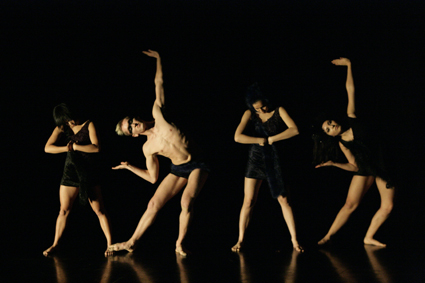
Hannah Glennie, Tyler Hawkins, Sophia Kennedy, Irina Nita, Kwacko, Victorian College of the Arts & Music (VCAM)
photo Jeff Busby
Hannah Glennie, Tyler Hawkins, Sophia Kennedy, Irina Nita, Kwacko, Victorian College of the Arts & Music (VCAM)
“DANCE PRACTICE” IS A TERM USED LOOSELY AND LIBERALLY TO DESCRIBE A VARIETY OF ACTIVITIES UNDERTAKEN BY A DANCE ARTIST. IT ENCOMPASSES MANY DEFINITIONS INCLUDING THE ACTIVITIES THAT DANCE ARTISTS ENGAGE IN, THE VARYING PROCESSES THROUGH WHICH DANCE ARTISTS CONNECT WITH THEIR WORK AND THE METHODOLOGY OF CONDUCTING POSTGRADUATE RESEARCH IE PRACTICE-LED RESEARCH. BUT WHICHEVER WAY YOU LOOK AT IT, THE ARTIST’S PRACTICE—THEIR ACTUAL ENGAGEMENT WITH THEIR CHOSEN FORM IN THE WAYS THAT THEY DETERMINE IT TO FULFIL THEIR CREATIVE OBJECTIVES—CAN BE REGARDED AS THEIR OWN ONGOING RESEARCH AND DEVELOPMENT PROJECT, WITH A “TECHNIQUE” OF ITS OWN MAKING.
Ultimately it is up to the artist to sort out which of their many experiences are integral to their artistic work and which are ancillary. Dancers often begin this process by undertaking a tertiary dance course. But as an artist’s dance practice is based on accumulated experiences and knowledge, a challenge for undergraduate tertiary dance courses is how to approach setting students upon their individual paths. So what role do these courses play in guiding young dance artists to begin thinking in these terms? And how do they help to set them upon their journey towards developing a practice which is relevant to their artistic pursuits?
Granted, the establishment of an individual dance practice is quite a sophisticated concept for a student beginning a tertiary dance course to grasp, let alone to appreciate that this is what he or she is ultimately headed towards. Sally Gardner, Lecturer in Dance at Deakin University, questions whether the majority of undergraduate students can initially engage with the notion of a dance practice: “99% of our beginning students understand dance in terms of ‘styles’: hence they say ‘I love doing contemporary’ or ‘Modern is so free’ and so on. They do not really understand dance as an ‘art’ as in the development of an individual creative vision. So they need to be led towards a new idea of dance. My hope is that on leaving Deakin they have come to realise that the journey is just beginning.”
It is widely acknowledged by the makers of Australian tertiary dance courses that the development of their students’ dance practice is an important and distinct element of their artistic training. Amongst the tertiary dance courses that had input into this article (Melbourne University’s Victorian College of the Arts and Music [VCAM], Western Australian Academy of Performing Arts at Edith Cowan University [WAAPA], Queensland University of Technology’s Creative Industries Department, Macquarie University’s Dance course and Deakin University’s School of Communication and Creative Arts), a variety of approaches was described. These included investigating a range of physical techniques and body based information, incorporating professional secondments and experiences such as touring and performing in the works of professional choreographers, and contextualising dance training through academic research and in terms of other creative fields. By and large these strategies and programs have been devised to provide students with opportunities to experience how artists work and for students to experience the reality of the artform’s requirements in the professional realm.
embodying
Jenny Kinder, Associate Professor at VCAM, describes their approach as an initial focus on the body, with further investigation of how that information can be incorporated to establish an autonomous dance practice with a distinctive artistic voice: “Students are exposed to the latest in dance science, kinesiology and somatic practices in addition to daily technique training and regular choreographic practice. Embodiment is developed through focus on neuro-muscular coordination and anatomical awareness. Students are encouraged to engage in an ongoing investigation of movement: anatomically, consciously and creatively in order to experience the dancing self and to find their own artistic voice.”
embedding
Secondment programs and employing sessional dance staff who have currency within the profession for dance technique, associated dance and movement subjects, and choreographic and performance projects are cited as excellent strategies that expose students to the variety of ideas, applications and methods that can inform their own dance practices. Cheryl Stock, Associate Professor at QUT, believes that “probably the most invaluable experience in terms of ‘real world’ practice is the secondment program in which final year students are embedded within a dance company or project.”
WAAPA in Perth has developed the secondment strategy further in establishing the LINK program that literally links new graduates from tertiary dance courses to the professional world. The one year program provides a postgraduate year of study while functioning as a pre-professional dance company. LINK members engage in extended dance training and performance programs worldwide, exposing them to a global perspective and providing the opportunity to make valuable professional connections. WAAPA’s third-year undergraduate students also participate in national and international intensive dance programs.
rationalised dance education
The current climate of change within many Australian universities is raised as a cause of concern where artistic practice is based around intensive physical training. Under current university restructuring programs, such as Melbourne University’s Melbourne Model, dance courses which have low student to teacher ratios and consume time and space less cost-effectively than others are facing a kind of economic rationalisation. In future years this may not be the best scenario for the continuation of studio-based dance practice, particularly where quantifiable employment outputs are emphasised. Cheryl Stock believes that “Although dance is quite nimble at getting around these bureaucratic and centralised ‘solutions’ it is my view that we are at a crisis point in being able to continue the highest level of training for dance practice in the industry (and by practice I mean the contextual, theoretical and practical aspects of being a dance artist in the 21st century, in all their complexity).”
another path
An altogether different approach towards dance practice can be found at the dance course at Macquarie University in NSW where students are accepted into the BA program academically rather than through audition. The vision and structure of this course seeks to redress the contention that those who study dance at tertiary institutes are primarily focused on becoming virtuosic company dancers. The course at Macquarie caters for students who wish to gain in-depth knowledge of dance as an art form and as a practice, in order to apply it to a range of other creative and research fields. Pauline Manley, Lecturer in Dance Studies at Macquarie, believes that the course enables a wider range of creative artists to intersect with the notion of a dance practice by “leading them away from the idea that dance is a display of technique”, and “developing the appropriate disciplines for an effective life in the creative arts.”
A lessened focus on physical technique means that students do not gain as readily the sophisticated and refined body management skills that are provided by courses which prioritise physical techniques to a higher degree. This reiterates the issue of whether tertiary institutions will be the ideal place for engendering a dance practice which is body based. In the case of the Macquarie course, Pauline Manley believes that their particular goals and approaches to students developing a dance practice are appropriate to a university study program and that “uni is the place to do it.”
finding the right space-time
Dance practice as observation and comprehension can be differentiated from the act of engaging in a dance practice through physical participation and rigorous assessment. Thus, determining whether a university setting is the best place to develop a person’s dance practice relates to the kinds of conditions and contexts that are relevant to what the student wants to do. Sally Gardner says that she would like to think that all aspects of dance at Deakin are approached as a form of inquiry. In terms of physical training, Gardner believes that body practices which have been so important in the development of dance artists like Trisha Brown and Russell Dumas require a specific kind of space-time. The university format of short timetabled classes is not conducive for this heightened degree of attention to the body and its movement. Importantly, she underscores an essential tenet for any young artist beginning to build their own dance practice:
“Students need to be able to spend time with practicing artists and they need to be able to see the best works that have ever been made in dance. Only then can they measure the gap between what they can do with their experience so far and what is possible. They will then go looking for the means to get where they want to be in dance, and they may in the process learn that they also need to develop the conditions that the dance they want to make needs.”
Awareness of how a dance artist interacts with the context of their work, as well as identifying the physical skills required for their chosen dance work, forms the very beginnings of an individual’s self-defined practice. A dance artist’s practice—like all other areas of the ephemeral live art that dance is—will always be subject to constant change, shifting opinions, re-evaluation and contradictions over time…as it should.
RealTime issue #98 Aug-Sept 2010 pg. 20
© Linda Sastradipradja; for permission to reproduce apply to realtime@realtimearts.net
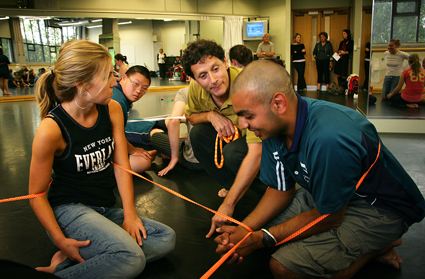
Associate Professor Ralph Buck (centre) and dance students working with members of the Pegasus Unit, the special needs class at Pakuranga College in South Auckland, NZ
DESPITE THE CROSSOVERS AND HYBRIDISING OF DISCIPLINES AND FORMS IN THE ARTS THESE DAYS, YOU’D BE HARD PRESSED TO FIND A UNIVERSITY IN PART OR WHOLE THAT DECLARES ITSELF INTERDISCIPLINARY. AN EXCEPTION IS THE NATIONAL INSTITUTE OF CREATIVE ARTS & INDUSTRIES (NICAI), A FACULTY IN THE UNIVERSITY OF AUCKLAND, NEW ZEALAND: “IN ALL AREAS, THE EMPHASIS IS ON CREATIVE EXPLORATION AND DISCOVERY AND ON INTERDISCIPLINARY COLLABORATION ACROSS THE FACULTY” [WEBSITE].
In NICAI dance sits alongside fine arts, visual arts, architecture and planning, and music. The focus on interdisciplinarity is principally postgraduate but there are major project based opportunities for undergraduates. Pan-disciplinary faculties are increasingly common in Australia. Sometimes this is the result of rationalisation, but none-the-less they can offer students the kind of interdisciplinary encounters they should expect after university in the arts or related careers.
Associate Professor Ralph Buck, Head of Dance Studies in the institute (alternatively referred to as the faculty) describes a three year Bachelor of Dance Studies degree where students increasingly engage with the world, develop dance flexibility, self-management and a sense of responsibility. There’s a marked emphasis on dance education and dance in the community with their career potential for teaching and leadership roles. The NICAI website mentions the following career options: choreography, dance journalism, dance education, dance therapy, community dance and academic research.
Buck explains that first year is focused within the university on class and studio work. In year two there are field trips, for example, to a secondary school that deals with students with disabilities, the psychiatric unit at Auckland Children’s Hospital and a retirement village. There’s also a camp in the far north of the northern island of New Zealand with activity focused on engaging with the environment—“a political project” designed to engender independence. In year three, students work in primary and secondary schools “not with their teaching hats on, but their artist hats, working in groups of three, making a company that works for five weeks in a school,” realising a project.
Buck’s aim is for students to “look at their own and others’ journeys,” to be responsive to the world. The dance classroom develops physical confidence, he says, but other aspects of the course widen student horizons so they can see “where to take their knowledge and experience.” He clearly expects his students to be realistic: “There’s a danger of a ridiculous chasm between expectations of a career onstage and reality. There are other ways to be a dancer.” One reality is that most money is to be had in teaching. He also looks to where dance is, in the community: “in different cultural groups and on the streets, not high art but hot and sweaty and just around the corner. In South Auckland it’s an access issue—there’s no stage, but dance is no less desirous.”
Across the course, says Buck, “there’s a strong multicultural element with a traditional core to first year study [including learning kaupapa hou and kapa haka and a range of Pacific music and dance] and a third to a quarter of students being Maori or Pacific Islanders studying alongside tap dancers and North Shore ballerinas. Everyone brings something and they help my teachers.”
There’s a strong emphasis too on independence, says Buck: “not to wait in line, to be bold and work at it. When the students finish they know what they want to do…and for the majority it’s not as dancers but as teachers or in youth work for churches and detention centres.”
As for interdisciplinary work at undergraduate level, Buck says it’s based around events and projects, not within courses per se. Recently fine arts, architecture and dance engaged with the NICAI’s new building with a choreographic response to spaces coming out of conversations about how we use them: “How do we respond to a stairway? How good is it? Look at it again…at the relationship between humans and design.”
Coming up is a major project titled The City Walk, involving fine arts, architecture, music and dance working with the Auckland Regional Council and town planners. The aim is to encourage the public to walk from the city centre to the Auckland-hosted 2011 Rugby World Cup “to reduce transport overload.” Nuala Gregory, NICAI’s Deputy Dean, writes, “[we are] designing a pan-faculty inter-disciplinary teaching project, The City Walk.The project has major benefits for students in terms of professional work experience and opportunities for international media exposure of their creative work…We are currently workshopping this project with the Auckland Regional Council, and have support from staff across faculty disciplines.” On their walk, rugby fans will encounter “displays of visual arts and live performances in music and dance.” The project will be trialled later this year.
The NICAI website provides video samples of dance and other works and plenty of evidence of interplay with Maori and Pacific cultures, some of it seen in dance and music taken to China recently as part of New Zealand’s delegation to the Beijing Modern Music Festival. Dance lecturer Dr Nicholas Rowe says on the NICAI website that an important aspect of the dance course is that it is not Eurocentric, that Auckland, “like a filter for the Pacific Rim” draws students from the region and encourages “the idea that the cutting edge can be local” whether New Zealand, Samoan, Malay or Australian.
With its pan-disciplinary range of departments, interdisciplinary projects and ambitions and its intercultural practices, the National Institute of Creative Arts & Industries has much to offer. NICAI clearly requires openness, the kind Ralph Buck seeks, where students “learn dance they’ve never done before,” “watch and learn in different contexts,” work with different communities and “learn how to operate in the world.”
National Institute of Creative Arts and Industries (NICAI), University of Auckland, New Zealand, www.creative.auckland.ac.nz/uoa/
RealTime issue #98 Aug-Sept 2010 pg. 22
© Keith Gallasch; for permission to reproduce apply to realtime@realtimearts.net
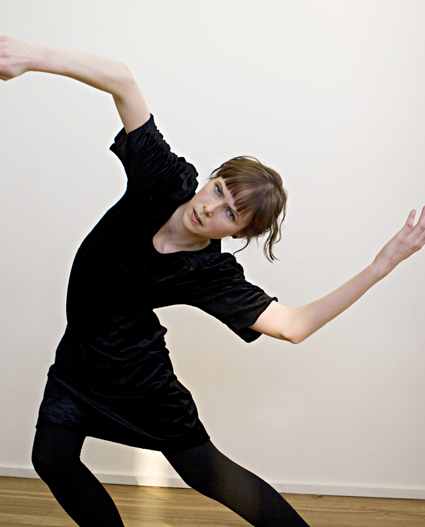
Fiona Bryant, In the Dark
photo Belinda Strodder
Fiona Bryant, In the Dark
WHAT DOES A BODY LOOK LIKE WHEN IT’S DANCING TO THE TUNE OF DEBORAH HAY? NOTHING IN PARTICULAR OR, AS HAY WOULD PUT IT, “THERE IS NO WAY IT SHOULD LOOK.” THIS MEANS THAT THERE ARE NO PREDETERMINED MOVES OR GESTURES WITHIN HAY’S WORK; THE USUAL CHOREOGRAPHIC LURE FOR COMPOSING THE BODY TO ACCOMPLISH PARTICULAR MOVEMENTS IS ABSENT.
This lack of predictability concerns performer and audience alike, which is not to say that the dancing is arbitrary. To watch a person engage with Hay’s choreography is to access a precise mode of experience. When we see the work ‘working’, we see a dancer on the edge of an abyss, oriented towards an obscure future. This isn’t merely the opacity of not having experienced what is yet to happen, for that is something every dancer faces. Rather, Hay’s work offers the dancer a heightened sense of not knowing.
Hay’s choreography intensifies the abyss of the future through turning the present into a void. Like Wile E Coyote in the Roadrunner cartoon suddenly poised over that dang canyon, there are no supports. Now what? To my mind, this is a key element of Hay’s work: to intensify the performative present by taking away what is usually there.
The title of this piece, In the Dark, indicates the sense in which the performer retains an open attitude towards an imminent future. The choreography could be seen as the means by which this is achieved. Over the years, Hay has developed numerous choreographies, complex combinations of left-field instructions, inscrutable, paradoxical, yet oddly concrete. They are, after all, the dancer’s only companion.
In the Dark arose from an intensive workshop held in March at the Bundanon Artists Residence, NSW, led by Hay with the assistance of dancer-choreographer Ros Warby. The workshop consisted of 10 dancers working solo. Each dancer was to practice their solo daily over the three months, so as to keep the choreography and its strategies alive. Come June, four Melbourne dancers presented a season of solos at Dancehouse. Three soloists performed each night. On night one, I saw Fiona Bryant, Atlanta Eke and Carlee Mellow. Unfortunately, I missed Luke George’s performance.
Each dancer brought one or two objects with them, a kind of security blanket or shamanistic fetish. Bryant was first, clip-clopping her way around the stage in boots according to an imperceptible rhythm. It was a good choice to begin with Bryant, who has some prior experience of Hay’s work. Her face was open, empty, drained of her usual persona. One had the strong feeling that she had no idea what was coming, that the horizon of oncoming movement was completely obscure. This is an incredible thing to sustain on stage with a pile of people staring at you. There was no ostentation in Bryant’s performance, no flourish, no demonstration of resident technique nor impressive gesture. She had the courage to simply stick to whatever was required from moment to moment. As a result, we saw a modest range of activities, lacking in pattern, eschewing recognition, jumping across the void again and again.
Since I have no real idea of the underlying choreography, what follows is pure speculation born of inference, for I am also in the dark. It looked like the dancers were engaging the near impossible, that attempting unachievable quests swallowed up their everyday dancing selves. There is a tinge of the postmodern in this work, not because it is pedestrian but because it challenges the knowing subjectivity of the dancer, because there is no space to display what one knows.
Atlanta Eke found her own way of engaging with the choreography. At one point, she stripped herself of her clothes, as if to shed her everyday self. She also broke with her dancing to incorporate a performed Q and A session, reminiscent of Xavier Le Roi’s recently performed autobiography. Why not fold audience participation into the moment, why not allow reflection in? At some point, Eke asked the audience whether the discussion was going on too long, whether she should finish. Some brave soul said ‘Yes’ and the solo was brought to an end.
Finally Carlee Mellow, probably the most challenged by the work precisely because she is the most experienced performer. Mellow had to find another way to dance, without resorting to past familiarities, to confront the choreography without the benefit of hindsight. She seemed to manage this, singing, stepping arhythmically, finding herself dancing in the work, without time to pause.
By the third solo, patterns began to emerge, the audience could anticipate the form if not the content. It’s no easy thing working in the dark and letting others see you doing so, but that’s what we saw: peeling away the layers to allow for another kind of dancing. The question then concerns what it is that emerges and where that comes from.
The Deborah Hay Solo Performance Project was a collaboration between Dancehouse, Critical Path, STRUT Dance and Bundanon Trust. For more on Hay’s methodology for this project, see www.deborahhay.com/spcp.html. For the dancers’ reflections on In the Dark, see www.dancehouse.com.au/research.
In the Dark, choreography Deborah Hay, 4 solo Adaptations by Fiona Bryant, Atlanta Eke, Luke George and Carlee Mellow; Dancehouse, Melbourne, June 17-20
RealTime issue #98 Aug-Sept 2010 pg. 22
© Philipa Rothfield; for permission to reproduce apply to realtime@realtimearts.net
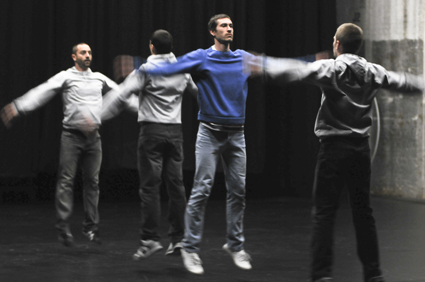
Jay Robinson, Adam Synnott, Lee Serle, Alisdair Macindoe, Bromance
photo Heidrun Löhr
Jay Robinson, Adam Synnott, Lee Serle, Alisdair Macindoe, Bromance
BROMANCE—A NON-SEXUAL, INTIMATE RELATIONSHIP BETWEEN TWO MEN; A FRIENDSHIP, BOND OR PLATONIC MALE CRUSH; BROTHERS IN ARMS EMBRACING THE OTHER.
Identified as a late 20th century cultural phenomenon, bromance has an extensive history (just think Ancient Greece or the Odd Couple). Dancers Alisdair Macindoe and Adam Synnott—a not so odd couple—have drawn on their experiences of growing up with brothers to create a concatenation of impressions in a stark space: hoodies, sneakers, flashes of bald fluorescence; an ejaculating electronic score; and the coupling of four ‘brother’ men.
Dancers Lee Serle and Adam Synnott stand in the emptiness of a warehouse. Nine fluorescent lights illuminate a greyish, industrial colour palette. Together they walk purposefully in lines. Together they jog, extend an arm and slap a thigh, perforating the silence. Rubber squeals on tarkett—a slow game of squash on a court without walls. I think of Lucy Guerin’s Untrained; perhaps it’s the casual wear and young lads pairing off (Lucy Guerin Inc: the hub of bromances?), but something more ‘dancerly’ registers with their gestures: poise, precision and timing.
Serle and Synnott spatially map a distinct grid, marked by an easy rhythm; eyes never meet in their columns of breath and silence. Little deviates. Once recorded sound (by Macindoe) is introduced, we hear the first few words of vocalised text. The environment thickens with scenarios morphing between line runs, leaps of joy and contracted shrugs of disappointment like spectators at a sporting match. A second couple enter—Macindoe and Robinson—out of phase with the original pair, but in time together. The symbiosis is viral.
A highlight is the star jump warm-up. Extended arms like blades are propelled from shoulder joints. The exaggerated exercise whips up a steady rhythm, tilted torsos on slightly altered planes. A windmill in a strong gale, sails disengaged, the cubist machine functions perfectly in this logic of experience. The abstraction moves me.
Tension exists between constructed moments of bromancing and material that appears to have emerged from time spent devising/rehearsing together. The former is expressed by clumsy representations of predictable scenarios in episodic tableaus that go on too long. The boys freeze frame in portholes of light. Their blokey grabbing, reaching and exaggerated Goya-like expressions prick through the darkness. A single figure peels off from the group, fists swing like pendulums, a low centre of gravity. Extended arms fold through his soup of self-made isolation. Feet direct leg lines, tugging and drawing out wider arcs. I enjoy the deliberate movement, but the transitions are too tight between lighting states and spatial formations for more meaningful image making. The weakness of the tableau section points towards the need for deeper exploration of the theme, or an irrevocable investment in the sparse simplicity of choices effectively performed to this point— dramaturgically a choice of less is more, or more needs to be done. The final tableau strengthens this section. Bodies upstage centre, baroquely entwined, scratch over points on individuated pathways. The forward, backward retrograde provides a more visually textured image than the stylised approach. Subtlety exceeds exaggeration.
Mention must be made of a simultaneously spoken word duet—a true testament to rehearsal style bromancing. On a train speaking about fears and sexual relations, eating sushi: no “slushy tuna from a can,” then “there goes the psycho guy” who’s “really freaking out the passengers.” The boys are “super-prepared” in their flawless recital. The audience giggles. Red Yamahas. Red Yamahas. Must “check out their number plates!” but not before we decode their handshake; it’s a fine moment of touch, camaraderie and invention.
In some sections, the choreography takes on a slumped krumping style: chest popping like a cockerel through stooped shoulders, ballasted by a fluid torso. Arms gesticulate wildly to trace a ‘me-out to the world’ intentional structure, juxtaposed with the flutter of smaller geometries detailed in fingers and wrists—ready to poke tidily away into one’s pocket.
Frisbee-ish green sponges glide in steady trajectories like bouncing balls from an old Atari game. The blank space and diverse lighting choices (Synnott) generously move us through a man-scale video game, deviance in a darkened alley (sudden surveillance with a roving spot), to a final steady portrait of two figures encased in the hoop of a looping, beating light, pixellated into mere spectres while the flanged vocals of a singer repeat the lyric “brother man” with all the right wrongness of synthetic-pop music.
As a Next Wave co-commission, Bromance celebrates contemporary dance finding pace with innovative lighting practices in its stagecraft rather than as a progression of the form. With partnered ease, the four brother men offer a generous peek into their studio collaborations. I look forward to their next co-creation.
Dancer Lee Serle has received a 12-month Rolex Arts Initiative award for mentoring by choreographer Trisha Brown in New York. For details see in the loop – july 26.
Bromance, choreography, direction, sound Alisdair Macindoe, choreography, video effect designer Adam Synnott, performers Alisdair Macindoe, Jay Robinson, Lee Serle, Adam Synnott, costumes Paula Levis, producer Lucy Guerin Inc, commissioned by Next Wave, Lucy Guerin Inc and Performance Space; Performance Space, CarriageWorks, Sydney, June 2-5
RealTime issue #98 Aug-Sept 2010 pg. 24
© Jodie McNeilly; for permission to reproduce apply to realtime@realtimearts.net
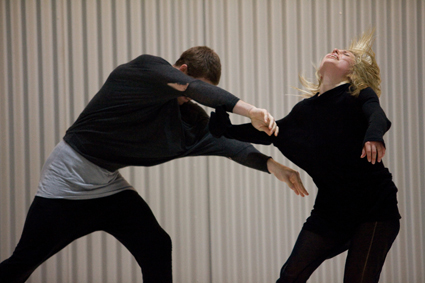
D’Arcy Andrews, Nicola Leahey, The Cry
photo Ferry Photography
D’Arcy Andrews, Nicola Leahey, The Cry
THE CRY, RAEWYN HILL’S FIRST FULL-LENGTH PRODUCTION AS THE NEW ARTISTIC DIRECTOR OF DANCENORTH, SEGUES FROM HER EARLIER WORK, ANGELS WITH DIRTY FEET (NEW ZEALAND, 2004). ANGELS WAS ABOUT ADDICTION, WHILE THE CRY DISSECTS THE RELENTLESS PROCESS OF RECOVERY. LIKE GAVIN WEBBER BEFORE HER, AND ROSS MCCORMACK AS GUEST CHOREOGRAPHER FOR LAST SEASON’S NOWHERE FAST, HILL FULLY EXPLOITS DANCENORTH’S HALLMARK PHYSICALITY, WHICH REMAINS CONSISTENT DESPITE AN ALMOST COMPLETE TURNOVER OF PERSONNEL IN THE PAST 18 MONTHS.
Preparation for this production included meetings with recovering addicts and the research has paid off with some remarkably insightful characterisations. The contrast between Nicola Leahey’s twittering Barbie doll-like role in Nowhere Fast and her dark intensity in The Cry is a testament to her versatility. Thomas Gundry Greenfield embodies the precarious point where frustration tips over into violence, while his victim, D’Arcy Andrews, tries to mediate, and responsively aligns his pain with that of the others. Jessica Jefferies’ manic character provides the only light relief with some sudden bouts of laughter and scratching during early group sequences, while still dancing in perfect time with the others.
With these four portraying recovering addicts, Luke Hanna’s character is less defined. He appears to organise the others and the set at some points, but also to manipulate, empathise and suffer. A gruelling 10-minute solo at the very end of The Cry reveals him as the personification of addiction itself, and the spirit of survival.
The set is inspired minimalism by Hill and production manager Van Locker. The white floor, two facing rows of skeletal chairs and cold lighting immediately establish this as a clinical space. Looming behind is an enormous, apparently floating, galvanised iron wall, its unforgiving scale an apt metaphor for the impersonal universe. The shiny, vertical corrugations reflect light from the vertically hung fluorescent tubes above, creating a slightly disconcerting fluid stripe effect on the eye. The first time a dancer smashes into the wall, the resounding percussive effect fills the large space and the audience jumps as one.
As The Cry opens it is quickly established that the characters have a pre-existing complex of relationships. The dancers use their actual names, adding authenticity to the limited dialogue. Repetitive movements of extraordinary strength and grace are interspersed with seemingly uncontrollable scratching, chest slapping and vein tapping. “Hit me, c’mon hit me,” says Jess, but we are unsure if she’s trying to provoke a reaction, or demanding methadone. Luke forcibly sits her down, keeps rearranging chairs and people.
To poignant violins, Nicola and D’Arcy perform a contorted floor piece, like limping spiders, until Tom intervenes and fights D’Arcy, smashing him into the wall, lifting him off the floor by the throat, then dropping him. The music is gone, D’Arcy is gasping for breath, everyone is shouting, chairs are thrown.
As order is restored, D’Arcy’s strangulated breathing becomes his music, pulsing through him, each considered movement connected to the pace of the breath. Another crescendo builds as Nicola dances to faintly oriental strains, a martial artist fighting with herself. Tom screams at her, “what have you got to prove, Nic? How good are you?”, throwing her to the floor repeatedly until she collapses. D’Arcy lifts her limp body onto his and Jess’s laps and, cradling her like a dead Christ, they tenderly undress and re-dress her in black.
In the most moving and complicit sequence of The Cry, tall Tom then carries Nicola on his front and then his back, threads his head through her clothing, and moves with her as though they are one, in a slow dance of grief. Nicola is completely pliant, as if dead. Tom lays her out on the floor, covers her face and performs a solo rife with tension and crucifixion-like gestures as the lights begin to fail and flicker. Anger builds again and he smashes chairs against the wall. They pile up around him like a funeral pyre as he flails, his face contorted in pain. Jess and D’Arcy crawl across the floor to the still prone Nicola and Luke wraps their faces in black cloth. Tom, a latter-day Atlas carrying the weight of the world, pushes the mass of tangled chairs into a corner.
Luke leads Tom as if leading an animal, mops his sweat and wraps Tom’s head in his own shirt, raises and lowers him in a slow tandem dance to drums like an amplified heartbeat, eventually laying him beside the others, casualties of a disaster. The shirtless Luke dances alone to plaintive strings, creating shapes out of his grace and strength, pleading and prayerful, moving from floor to air as if other forces are at work upon him. Face haggard, powerful, anguished and visceral, he dances and dances to exhaustion.
Less than an hour in length and unremittingly demanding, The Cry taxes its dancers to their physical and emotional limits. The audience is left almost as shattered.
Dancenorth, The Cry, concept, direction Raewyn Hill, choreography by artistic team, dancers Luke Hanna, D’Arcy Andrews, Thomas Gundry Greenfield, Jessica Jefferies, Nicola Leahey, set and light design HilLocker, Dancenorth, Townsvillle, June 2-6
RealTime issue #98 Aug-Sept 2010 pg. 24
© Bernadette Ashley; for permission to reproduce apply to realtime@realtimearts.net
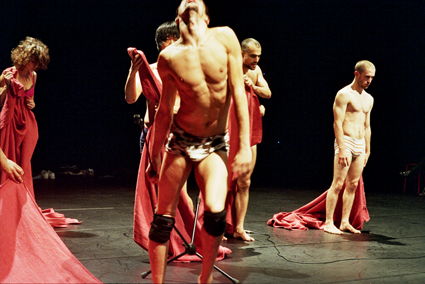
Out of Context—For Pina, Les Ballets C de la B
photo Chris Van der Burght
Out of Context—For Pina, Les Ballets C de la B
IT IS PERHAPS IRONIC, AND PERHAPS TRAGIC, 20 YEARS INTO A POST-IDEOLOGICAL ERA, IN WHICH CHOICE-LED CONSUMERISM HAS REMAINED THE SOLE SURVIVING ETHOS, THAT ART IS INCREASINGLY PREOCCUPIED WITH THE QUESTION OF THE STANDARDISATION OF HUMAN EXPERIENCE. WHAT SHOULD HAVE DISAPPEARED WITH THE SOVIET UNION SEEMS, ON THE CONTRARY, ALL-PERVASIVE.
From architect Rem Koolhaas’ notion of the “generic city” to theorist Fredric Jameson’s understanding of how postmodernity empties time of causal progression, analysis across disciplines returns to the idea that all this variation of screen sizes and skirt lengths is just a buzzing distraction from the standardisation of life on all levels, from feelings to social interaction, psychology to geography, to which There Is No Alternative.
Nothing exemplifies this buzzing vacuum better than the flying circus of internationally touring theatre, in which winning formulae and fashionable styles are often tediously replicated across languages and bodies, and all apparent cultural diversity collapses into trendy homogeneity. One such flying circus, Needcompany, is currently touring Europe with a production that interrogates precisely what happens to the human soul in this generic society.
The Ballad of Ricky and Ronny, a collaboration with Anna Sophia Bonnema and Hans Petter Dahl, is the first in a planned trilogy of pop-operas about a disaffected middle-class couple. It is sung entirely in international English, the thin, bland second language of most of the contemporary world, combining the tinniness of Nico and the verbal rhythms of Patti Smith with the drowsy beats of Flaming Lips. Ricky and Ronny once experienced love, idealism, the 1960s. Now, they cannot put a finger on the cause of their despair, as they lack any serious grievance. Instead, they milk their bloodless English, collected from Hollywood movies and pop music, for tired invectives and sentimental clichés. They try to muster stage provocation with bondage-wear and sexual experimentation. And yet they linger on stage in impeccable Euro-clothes, studiously avoiding physical contact, while their unnameable despair coalesces into a phantasm child, an hallucination made out of pink snow and yellow sperm, and they eventually commit a meaningless suicide. To underline just how little pathos The Ballad intends to create, an immaculate French maid sits upstage right throughout the performance, leisurely fiddling with the tech.
The opera is a structural, Zizekian tragedy: Ricky and Ronny are defeated by monster consumerism which satisfies desires before they can even fully form, leaving them in a state of voiceless agitation, or what cultural commentator Mark Fisher would call “depressive hedonia.” Thematically, the work sits in the conventional territory of dramatising cocooning middle-class despair without a cause. Its memory of love that used to redeem draws unlikely associations with Sarah Kane, whose despair is also moored in the deepest belief in love. However, Ricky and Ronny’s anxiety has no shelter throughout the performance, as the work refuses to believe in the metaphorical monsters its protagonists build to outsource their existential angst, much less defeat them in order to bring about any happy ending.
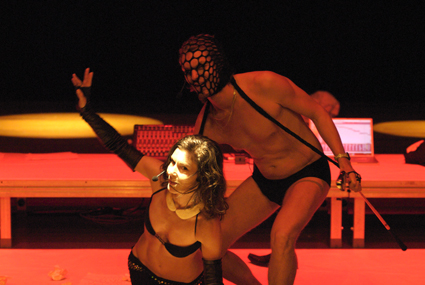
The Ballad of Ricky and Ronny, Needcompany
photo Maarten Vanden Abeele
The Ballad of Ricky and Ronny, Needcompany
The problems are threefold: eliminating the poetic aspects in the figuration of the bourgeois ennui does not, by itself, reveal its socio-political structure; The Ballad is no more penetrating a social critique than a conventional zombie flick. Secondly, made entirely out of generic elements, it is one of the most tedious performances I have ever seen, so commonplace through and through that it tends towards invisibility. Finally, there is an annoying solipsism at the heart of a performance that so deeply represents and replicates the very condition it denounces: it appears to have frustrated every Eastern European audience it has encountered, including the one that saw it with me at Eurokaz festival in Croatia. While it must be said that the immaculate staging and the direction of movement build the formal perfection of the piece, I have rarely been so pleased to see an audience rebel against understanding an artwork. For it means that tragic standardisation is not a universal condition, despite all the global English employed to construct the argument.
A new work by another Belgian company, Les Ballets C de la B’s Out of Context—For Pina, approaches the matter from a radically different angle. Alain Platel’s company is among Europe’s most respected, and the new work was showing at Sadler’s Wells for only two nights before rushing back to the festival circuit (it was scheduled at Avignon later in the season). The UK critics were rather sceptical towards a company that meshes vernacular movement with high aspirations (‘fun’ and ‘skill,’ two terms dear to British dance, are quietly sidelined in Platel’s vocabulary), but Out of Context has, in other places, been hailed as their best work yet.
The movement, woven out of the unconscious tics, spasms, hysterical and involuntary gestures that Platel has encountered in his prior work as an orthopedagogue includes pouting, scratching, over-the-top disco dancing, parodic mime and is consciously poor in style, making almost no references to any ‘serious’ dance tradition. Platel has refused to call himself a choreographer; Out of Context is an exquisite choreography nonetheless. Unlike his previous works, it is played on an empty stage, to no programmatic score. Bookmarked by nine dancers entering from the stalls, undressing to their underwear, then dressing and leaving again at the end of the show, it has three clear phases: initial rituals of mating and acquainting with animal sounds in the background evolves into the second phase, in which lines of pop music are thrown around together with exuberant dancing until, in the elegiac third part, the dancers retreat into singularity again. The piece defies description by virtue of sheer over-accumulation: 90 minutes of startlingly original movement with virtually no repetition, on nine different physiques that, even when amassed into synchronicity, preserve individual differences. (The piece is dedicated to Pina Bausch, in recognition of the foundational importance of her psychologically driven strategies for European dance.) Not having any narrative frame allows the audience to experience this decontextualised mass of movement on the level of affect, not cognition, free-associating stage images to deep memories. The result is emotionally penetrating and deliriously enjoyable.
Whereas The Ballad of Ricky and Ronny is a work so deeply illustrative of the nihilistic element within consumer capitalism that it irons itself into a completely inexpressive pancake, Out of Context locks itself within the last bastion of human expression that has escaped the Fordism of soul: the pre-cognitive, the involuntary, the spastic. We could see an eternal, unwinnable race at work, in which ever-shrinking chunks of life are accessed, broken down, conquered and reproduced—perhaps Platel is simply mapping previously inaccessible sides of the human experience. But it is also good, in some fundamental way, to experience a performance that leaves the audience elated rather than crushed.
Needcompany/MaisonDahlBonnema, The Ballad of Ricky and Ronny, authors, performers Anna Sophia Bonnema, Hans Petter Dahl, libretto Bonnema, music Dahl, costume, lighting MaisonDahlBonnema; Eurokaz Festival, Zagreb, June 23-24; Out of Context—For Pina, Les Ballets C de la B, concept, direction Alain Platel, dramaturgy Hildegard De Vuyst, danced & created by Elie Tass, Emile Josse, Hyo Seung Ye, Kaori Ito, Mathieu Desseigne Pavel, Melanie Lomoff, Romeu Runa, Rosalba Torres Guerrero, Ross McCormack; Sadler’s Wells, London, June 17,18
RealTime issue #98 Aug-Sept 2010 pg. 25
© Jana Perkovic; for permission to reproduce apply to realtime@realtimearts.net
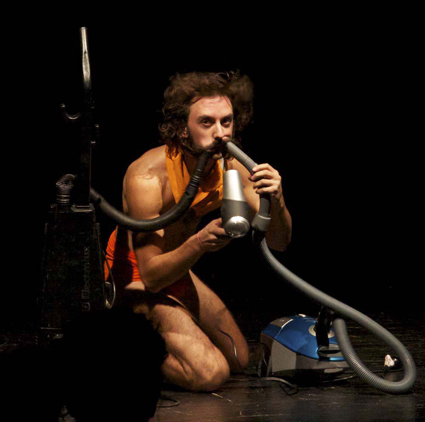
Luke George performs his own piece in 24 Hours, Dancehouse
photo Tim Jomartz
Luke George performs his own piece in 24 Hours, Dancehouse
IF YOU HAVE BEEN TO A THEATRE OR DANCE SHOW IN MELBOURNE IN THE LAST SIX MONTHS, YOU MAY HAVE COME ACROSS LUKE GEORGE. THIS TASMANIAN-BORN CHOREOGRAPHER HAS BEEN INVOLVED IN A RUN OF PRODUCTIONS THAT HAVE SURPRISED EVEN THE AMBITIOUS ARTIST HIMSELF WITH THEIR SUCCESS AND PROFILE.
Working freelance myself, I empathise with George, when he explains the embarrassment of opportunities that he is currently enjoying. “Last year I did not have a lot to do,” he says, “So I applied for everything.” Now he is working on five projects back to back and is cheerfully flat chat. “It’s very manageable because it’s all creative…and I am in all the work.”
Luke George drives his choreographic work from within, with the same commitment that he applies to his career. His early experience of leadership, as joint Artistic Director of Launceston’s youth dance company, Stompin’, 2002-8, delivered accolades aplenty. The energy that enabled him to create large scale work with young people is evident in his pursuit of a broad range of engagements in his new home town of Melbourne.
Contributions as a dancer to the work of Chunky Move, Shelley Lasica, Jo Lloyd, Frances d’Ath and others have been matched by choreographic projects. “Performing and choreography have always been intertwined for me,” George says, and cites his role in the work of Phillip Adams for Balletlab as an example of where he is challenged most. “I get something from Phillip because he asks me to be in a state of questioning. He is always pushing what he wants to do. It’s exciting and scary too.”
24 hours
As well as recently contributing to the development of Aviary, the Balletlab production due to premiere in 2011, George was a participant in Adams’ contribution to the 24 Hours project at Dancehouse (RT97). For this fleeting but hugely popular initiative, Jo Lloyd commissioned four choreographers to conceive, devise and present a production within 24 hours. Adams worked with new media artist Matthew Gingold to create a movie for his commission, extracting something wild and unfettered from the spontaneity of his intimacy with performers George and Balletlab regulars Brooke Stamp and Jo White. In George’s own commissioned piece for the 24 Hours program, he worked with sound artist Nick Roux, along with Stamp and visual artist Mila Faranov. In tune with the zeitgeist, George is very inspired by the removal of theatrical artifice. He relished the tight temporal frame of Lloyd’s commission to dig deep into the present moment.
deborah hay project
Dancehouse furnished Luke George with another excursion into rich territory with the Deborah Hay project, In the Dark (p22). A collaboration between Perth’s Strut, Sydney’s Critical Path and the Melbourne venue brought 10 dance artists into residency with the American experimental choreographer Hay and her Australian muse, dancer and choreographer Ros Warby. Hay gave the artists the template of a solo and required them to enter into rigorous and disciplined exploration of the material over three months prior to its performance in a triple bill.
George’s light and ludic performance for In the Dark was the highlight of my experience of this production. He invested Hay’s material with authority and charm, rendering the dense and potentially introverted material open and intriguing. He held his focus with considerable aplomb given the proximity of the audience and the inevitable sniggers that greeted his entrance with trademark mutton chops absurdly set off by a hot pink body suit and clumpy shoes. George spoke with enthusiasm of the discipline required to fulfill Hay’s contract. “The repetition of rehearsing the work daily for three months forces you to recognise patterns within your behaviour and to find ways to transcend these; to find fresh possibilities within the material and yourself,” he said. “I’m really into the idea of practice. Not just to be good, but to continuously witness your own practice and learn from it. It services a lot of things that are all connected.”
nownownow
There are strong connections between Hay’s tantalising exposure of the performer on an empty stage and the full evening production that George is about to complete. NowNowNow has been commissioned by Lucy Guerin Inc and will receive its premiere at Dancehouse in late July. “I have pulled back on all the production elements in this piece,” George says. “It’s all about the relationship between the performers and then theirs with the audience.” Kristy Ayres and Timothy Harvey will dance with George, with basic costumes and no video or props. Martyn Coutts will dramaturg. “We have got to the point where we are in such clear communication with each other,” George says of the two developments that have preceded the final production phase to come. “I used to think we could not be in the moment, but I am starting to think this is possible.”
My experience of the sharing in which the second development of NowNowNow culminated, was of an intense, willed focus from the performers upon a series of seemingly interchangeable exercises from which something almost violent seemed fit to explode. The push and pull of their alternating desire to communicate and to withdraw was uncomfortable and intriguing. As befits a development, the discipline of their play with this dynamic was a little unsteady and the trajectory of the piece involved some awkward fits and starts. George encouraged his invited audience of peers to stay behind after the showing for a discussion that he relished for its negative as much as its supportive commentary.
first run
“I am very interested in talking about dance,” George says. He links his concern for talking honestly about his own work to a sense of responsibility for the artform and a growing maturity in Australia in relation to criticism, academic discourse and research as practice. With Brooke Stamp, Luke George co-curates First Run, a platform for emerging choreographers supported by Lucy Guerin Inc. First Run encourages protracted discussion of works in progress shown and has been embraced by the independent dance makers of Melbourne, with high attendance and a good quality of debate. “With First Run we are developing a place where we can talk without nervousness and tiptoeing around.”
miguel gutierrez
George has long ceased to tiptoe around. His next project, a Culturelab research residency, involves louder than life New York choreographer, Miguel Gutierrez. The two met during Balletlab’s 2007 production, Brindabella, for which Gutierrez contributed a striking section of choreography. When Balletlab were resident in the US, George contrived to stay on and hang with Gutierrez and his dynamic New York collaborators. Gutierrez describes George as his “spirit brother in art” and shares his interest in the relationship between performer and audience. He too is not afraid to confront and George is looking forward to exposing a peer audience to the result of their development.
resilience
Inspired by his visits to cities like New York and Berlin where artists forge a living from precarious means, George has developed some strategies for resilience through the lean periods. He choreographs regularly for the Melbourne gay club JOHN and works in theatre for productions large and small (he was movement director for Optimism at the Malthouse and Urchin by emerging company Encyclopedia of Animals in Full Tilt this year). George also supports emerging artists such as James Welsby and Amy Macpherson and their dance collective Phantom Limb for whom he made a piece this year. Despite the now, now, now whirlwind of creative life he’s enjoying, Luke George has few illusions about the hard work ahead. He says he hasn’t got around to writing any grant applications so the flow of opportunities will necessarily slow. We agree not to think about that and enjoy the present moment.
Luke George’s NowNowNow will be reviewed in RealTime 99, October-November. To read about Lucy Guerin Inc’s First Run go to http://www.lucyguerin.com/research/First_Run
RealTime issue #98 Aug-Sept 2010 pg. 26
© Sophie Travers; for permission to reproduce apply to realtime@realtimearts.net
JUST HOW DO YOU ASSESS THE RESEARCH QUALITY OF A CREATIVE WORK? THIS QUESTION CAME UP AGAIN AND AGAIN AT JULY’S AUSTRALIAN SCREEN PRODUCTION EDUCATION AND RESEARCH ASSOCIATION (ASPERA) CONFERENCE, HIGHLIGHTING WHAT IS A COMPLEX PROBLEM EXERCISING THE MINDS OF MOST WORKING IN THE SCREEN PRODUCTION EDUCATION SECTOR AS THE EXCELLENCE FOR RESEARCH IN AUSTRALIA (ERA) INITIATIVE MOVES INEXORABLY FORWARD. OR WILL IT? WOULD A CHANGE OF GOVERNMENT DERAIL THE WHOLE PROCESS, BRINGING ABOUT YET ANOTHER CHANGE OF DIRECTION?
The ASPERA conference, held at UTS in Sydney this year, is the annual forum for academics within the Australian screen production field to discuss shared issues, exchange ideas and, currently, to address the challenges posed by the ERA. While the three days of the conference provided an interesting mixture of the problematic, the pragmatic and the abstract, with a bit of the practical and the mathematical thrown in, issues to do with both technological change and with ERA kept recurring.
complex contexts
Theo van Leeuwen, UTS Dean of Arts and Social Sciences, said in opening the conference that teaching media studies within a university environment may often not “fit in with the timetables and ways of assessment of the university,” especially while also coming to terms with the challenges of technological change, but that “universities are places where you have the chance to experiment and test out ideas and develop arguments that can be carried out into the public sphere.”
Deb Verhoeven from RMIT highlighted the recent AFTRS screen producer survey and some of its findings—she advised those interested to go to the very user-friendly website to find out more. Verhoeven drew attention particularly to the very low ratio of younger people identifying as content producers (with most producers being over 40), and the fact that only five percent thought that a creative arts education was important.
a new kind of academic
Verhoeven also asked how academics might learn from emerging media practice, and how new media practices might challenge and change the role of academics. Saying that she usually avoided films that featured teachers (especially those with Robin Williams), she reported on a film that she believes really shows how education works, especially in an unstructured and innovative way—How to Train Your Dragon. “It advocates networking and mentoring, that information must have a perceived relevance, and argues that old knowledge can become irrelevant in the course of acquiring new knowledge,” she explained.
Arguing for the emergence of a new type of academic, the mediator and motivator, Verhoeven said that “we perhaps underestimate the importance that media and communication departments are going to have in universities in the future.” She also argued that digital media affects a whole range of producers, and that it’s not just about digital literacy; “a key competency,” she said, “is the ability to move flexibly between different digital environments.”
When Gill Leahy of UTS, convenor of the conference, asked about aesthetic criteria for these new environments, she said that “audiences are much more likely to tolerate what we’d see as not good quality. Getting stuff out there just in time for audiences that are ready for it is much more important. We’ve got a lot to learn from the very practices we’re teaching our students.”
defining era, defining research
The problematic for the sector is how to deal with the major changes that are happening in universities to do with the assessment of creative work. The ERA initiative assesses research quality within Australia’s higher education institutions using a combination of indicators and expert review by committees, and research is defined as the creation of new knowledge and/or the use of existing knowledge in a new and creative way so as to generate new concepts, methodologies and understandings. Andrew Curran, from the Australian Research Council, gave a briefing updating the process and giving details of how it works; he commented that “being a creative lot will be good for you in the ERA.”
Going through all the general principles, objectives and timelines of the ERA, Curran pointed out that peer review is a “really important component” of the assessment process, and that while everything must be submitted, the process is designed to be flexible. Interestingly, he confirmed that while the rather controversial list of ranked journals has been finalised, as well as the list of conferences, the ARC would continue to receive feedback regarding journals and conferences which would be recorded on the database, and that the list would be updated and revised prior to any future ERA round. He added that the ranked journals are only one of a number of unweighted indicators, and that articles in C-ranked journals could be put forward in peer review. He argued that the challenge for the assessment of creative work is in defining the research element, and that a portfolio needs to demonstrate coherent research content. “Work out how to present your discipline and highlight its importance and outcomes,” he said.
rating exhibition outlets
Another area of creative arts publication equivalence that will be able to be assessed within the ERA process was introduced by Mick Broderick of Murdoch University, who explained that film exhibition outlets, which include local and international film festivals, broadcasters, museums and galleries, as well as online sites, could be ranked to act as proxies. His initial list of film festivals, which caused a fair amount of immediate discussion and revision, will be edited, rated and ASPERA-endorsed, but must follow the ERA A* to C format and will be adjusted annually. “This initial list is imprecise and generalised,” explained Broderick, emphasising that the ratings must be done by academics and peak bodies, not bureaucrats. “I’m confident that the sector knows enough for the listings to be accurate,” he said. “Fortunately, most of the festivals we’re looking at have their own internal peer review process, while works submitted to festivals should have all gone through a peer review at their own institution as well.” He indicated that ASPERA should also supervise the ranking of broadcasters, academic festivals and other levels of specialist exhibition in the future.
Leo Berkeley of RMIT is concerned that the whole discussion is still premised on creative works being films, but, as he says, there are now websites and games and other digital work, which are much more difficult to assess. And Deb Verhoeven was concerned that the list of festivals for ranking didn’t include any online festivals.
assessing output & assessors
But the most compelling session was the work-in-progress report on the large-scale project headed by Dr Josko Petkovic from Murdoch; he’s now three quarters of the way through the research project, Assessing Graduate Output at 19 Australian Film Schools, and he provided page after Powerpoint page of the most intricate charts, using sophisticated maths, which recorded the elegant differences in ratio and some of what he called “interesting convolutions,” in his quest to quantify the information. As he said, “the crux of the problem is that many of us believe that the scholarship/research aspect of our work is hard to quantify,” and this research project is aimed at establishing “that the assessment of students’ creative work can be as consistent as assessment in other disciplines.” In this initial stage, it’s the assessors (30 screen production academics), not the projects, that are being assessed, and “the project is based on the proposition that assessment of screen production is as complex and multi-faceted as the screen production process itself.”
With its multiplicity of criteria and ranks of assessors, the interim report was quite confronting, and we probably need the final, written report to definitively come to the same conclusion as Josko Petkovic; that the assessment process will be valid, highly reliable and internally consistent.
holding up in the real world
Another strand in the conference centred on the sector’s relationship with the industry; George Karpathakis of Edith Cowan University talked about community engagement and professional placement, and in particular the experience of a number of his students as they entered what one called “the real world—up until now you’ve been in the classroom, and you get to work with people in the industry and find out how you hold up.” As Karpathakis explained, while the policy is for the student to find the placement, in practice it’s usually the academic who uses their contacts. Once in the placement, students are on their own; in the cases he highlighted, the initial work led to other jobs and more responsibility.
Trish FitzSimons talked about the Work Integrated Learning process happening at Griffith University, where all third year students have to do 65 hours placement. “The rationale is that we’re running vocational programs, but there are not enough jobs out there.” She believes that there is so much for them to learn from their work placement, “and it also makes their films better.” Griffith, she says, is lucky in that it has connections with industry and screen cultural organisations in their area; “we get calls from big productions on the Gold Coast for students to work in the art department or whatever, and we have a mentorship scheme that often leads to placements. Work is unpaid initially, but as students prove their worth they can move into paid work.”
Leo Berkeley explained that RMIT encouraged their international students to do their industry attachments back home, between semesters, where it helps to integrate them with local industries but, of course, he added, monitoring their progress is more difficult.
new risk environments
Pragmatic matters? Well, Occupational Health and Safety probably comes under this heading, although Nicholas Oughton from Griffith University argued that creative industries, including screen-based ones, operate in a different environment and context from traditional workplaces, which makes the traditional OH&S systems inappropriate. “Creative industries thrive on risk-taking,” he argued, “and are constrained by risk avoidance.” He believes that as the very nature of work changes in the 21st century, and as cultural and creative elements are becoming more important, a new perspective on OH&S is required; he recommended that a new OH&S model should be designed for the creative industries.
signs of work
This is only a taste of the conference, and in amongst the papers and discussions there were some glimpses of actual creative work. Sarah Gibson of UTS gave a peek into her fascinating and soon to be completed multiplatform project Re-enchantment, an interactive journey into the world of the fairytale, which will be hosted on the ABC’s website and supported by three-minute animated minidocs on ABCTV. David Carlin tempted us with some scenes from Motel, three interlocking short films set in the same motel room with the same actors, made by three filmmakers and two designers as a practice-based research project at RMIT. And Rachel Wilson from RMIT reported on the work she is doing towards the setting up of a digital archive of student films—sounds dry, but it was absolutely fascinating and should result in a great resource.
ASPERA Conference 2010, University of Technology, Sydney, June 7-9; http://www.aspera.org.au
RealTime issue #98 Aug-Sept 2010 pg. 27
© Tina Kaufman; for permission to reproduce apply to realtime@realtimearts.net
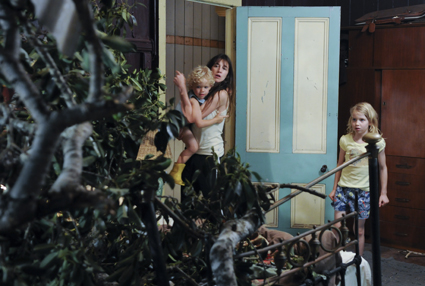
Charlotte Gainsbourg, Morgana Davies, Gabriel Gotting, The Tree
photo Baruch Rafic
Charlotte Gainsbourg, Morgana Davies, Gabriel Gotting, The Tree
UNDER CLARE STEWART’S CREATIVE LEADERSHIP THE SYDNEY FILM FESTIVAL APPEARS TO HAVE FOUND THE PERFECT BLEND: A COMPETITION VIBE WITH BIG AUDIENCES AND FESTIVAL STARS (EWAN MCGREGOR OUT FOR ROMAN POLANSKI’S THE GHOST WRITER—POLANSKI EDITED THE FILM IN JAIL); INDIE FAVOURITES (LIKE TODD SOLONDZ’S FOLLOW UP TO HAPPINESS, LIFE DURING WARTIME AND MICHAEL WINTERBOTTOM’S CONTROVERSIAL THE KILLER INSIDE ME); CULTURAL ODDITIES (BANKSY’S BRILLIANT DOCO, EXIT THROUGH THE GIFT SHOP); MERCILESS BLACK HUMOUR (CHRIS MORRIS’ OUTSTANDING FOUR LIONS); AND A GOOD MIX OF INDUSTRY TALKS (INCLUDING A HIGHLY ENTERTAINING TAKE ON AUSTRALIAN GENRE MOVIES).
This year, two films with Australian connections featured in competition (The Tree and Wasted on the Young), and a sold-out session of The Dendy Awards for short films revealed lots of Oz talent on the rise.
the tree
French director Julie Bertucelli’s The Tree was selected for Cannes Film Festival’s closing night. The film is a French/Australian co-production (hence the inclusion of uber-cool actress Charlotte Gainsbourg—so memorable in Lars von Trier’s Antichrist [2009]) and is that rarest of film beasts—it beautifully melds the Australian landscape with a French film aesthetic. Simone (Morgana Davies) is a spunky, headstrong girl who witnesses the death of her father Peter (Aden Young) while riding on the back of his ute. As he suffers a heart attack, his truck smashes into the beautiful old fig that dominates the family home. As grief overpowers her mother, Dawn (Gainsbourg), the girl turns to the tree for comfort and protection, eventually sleeping there; she is convinced she can hear her father whispering in the leaves.
Like Scott Hicks’ The Boys are Back, The Tree focuses on the inner world of a child in the immediate aftermath of unexpected death. Hicks’ film was also set in an old house with a verandah, a sublime rural landscape. Both films were based on successful books and, while occasionally maudlin, with lashings of syrup, they manage to connect deeply with childhood experience—in the dialogue of kids trying to understand a world gone awry—and the struggles of the parent (in Hicks’ case, a father) left behind. How to grieve when your children are swamping you: there’s no space or time to reflect. At the funeral, Simone observes, “No-one’s crying. That’s how it is when people are really sad.” As Dawn finds it increasingly hard to get out of bed, the neighbours quickly forget her pain. In her home no-one answers the phone. Dad’s still on the answering machine. Simone brushes Dawn’s hair, organises clothes off the hangers, in a bid to reclaim her mum, help her rediscover life.
The beautiful tree took a long time to cast. Eventually, when Bertucelli found the perfect specimen (with no CGI help), the house set was built around it. With its patches of lichen, ants scaling the trunk, it becomes like a many-limbed maternal body. The wonderful sound design brings the relationship between Simone and the creaking tree to life; it sings in the wind. The girl gradually becomes a bowerbird, taking her father’s watch and other precious items, and hanging them in the tree’s branches to create a kind of shrine. The film never veers into magical realism (hinting, hinting) but still there is that sense of child-like wonder at the majestic (I remember my passionate childhood love for Enid Blyton’s The Magic Faraway Tree).
The Tree’s drama comes in the form of George (Marton Csokas), Dawn’s new lover who, being a pragmatist wants to cut the tree down (after a large branch crushes part of the house), underestimating the determination of a young girl grieving for her father.
wasted on the young
Wasted on the Young, while differing markedly in style, is also about parental absence. A slick and techno take on upwardly mobile teens in a posh school, the nihilism of writer/director Ben C. Lucas’ film reminds me of novelist Bret Easton Ellis’s early work, the generation-defining Less Than Zero. Adults of any kind (parents, teachers) never feature within the film’s frames: this is a dog-eat-dog world where boys aim for perfection (the swim team) while girls compete to fuck them. Zach (Alex Russell as head honcho) holds parties every weekend in his super-styled mansion where it seems only his brother Darren (Oliver Ackland) is not on the guest list: he’s hunkered down by the computer, working on his school projects.
While clichés abound (jocks vs nerds), and there’s nothing really new to the date-rape-revenge narrative (extending the themes of Steven Vidler’s Blackrock [1997]), most of the acting is terrific (especially Adelaide Clemens as the rape victim, Xandrie) and what sets the film apart is its brilliant production design and highly stylised effects. Beautifully integrated is the teens’ world of text and chat, the conversations dripping off the walls, part of the film’s fabric, rather than just posed as the usual screen shots. The ending, too, takes on reality TV’s voyeuristic need to vote contestants off, of how far you’re going to push the idea that you have a right to watch and control, whatever the outcome.
the dendy awards
The Dendy Awards each year brings together a great showcase of filmmakers working on short film projects, and always highlights names to watch. This year, as always, was a mixed bag but there were a number of stunners. Winner of the Yoram Gross Animation Award, The Lost Thing (directed by Shaun Tan and Andrew Ruhemann) uses a unique otherworldly aesthetic (familiar to readers of Shaun Tan’s picture books) to craft a melancholy tale of a boy who discovers a hybrid creature that doesn’t quite belong in the muted industrial landscape of his world, and helps it find a place in the sun. The film won the Cristal Award at the Annecy Film Festival, the most prestigious international animation festival.
In terms of drama, The Kiss (winner Best Live Action Short; director Ashlee Page) and Deeper Than Yesterday (Rouben Mamoulian Award for Best Director; Ariel Kleiman) were both outstanding and (bizarrely) featured dead females floating. The former is a languorous nightmare where two teenage girls, hot and drunk, take a bike ride in the bush and jump into a well before realising they can no longer reach the rope ladder to climb out; the latter, a remarkably assured surreal tale of Russians aboard a submarine who surface to discover the body of a woman floating nearby. Once aboard she becomes a kind of waltzing matilda, a site for the men’s frustrated fantasies.
It’s always hard to pick and choose at festivals but part of the joy is the hit and miss, that feeling of jetlag when you realise you’ve spent a whole day in a seat without moving your arms or legs. The festival offers its own pathways (with titles like Fire Me Up, Freak Me Out, Take Me to the Edge…) to negotiate the ticketing process but I usually make my own way. This year I opted for black comedy; the youth factor; films starring actresses named Charlotte; and new Aussie. It was a great success.
The Tree and Wasted on the Young screened in competition at the Sydney Film Festival with Wasted on the Young receiving an honourable mention from the judging panel.
The Tree, writer, director Julie Bertucelli, based on a novel by Judy Pascoe, producers Sue Taylor, Yael Fogiel, Laetitia Gonzalez, original music Grégoire Hetzel, cinematographer Nigel Bluck, editor François Gédigier; Wasted on the Young, writer, director Ben C Lucas, producers Janelle Landers, Aidan O’Bryan, cinematographer Dan Freene, editor Leanne Cole
RealTime issue #98 Aug-Sept 2010 pg. 30
© Kirsten Krauth; for permission to reproduce apply to realtime@realtimearts.net
Dragos Bucur, Police Adjective
FOUR FILMS IN THE 2010 SYDNEY FILM FESTIVAL INDUCED STRANGE STATES OF BEING, EACH CINEMATIC EXPERIENCE A REMINDER OF THE CAPACITY OF FILM TO SUSPEND TIME, CHALLENGE VISUAL PERCEPTION AND QUESTION OUR READINGS OF THE BEHAVIOUR OF OUR FELLOW HUMAN BEINGS. FOR A STEADY STREAM OF EXITING FESTIVAL-GOERS UNWILLING TO SURRENDER TO THESE FILMS’ DEMANDS FOR PATIENCE, THE PREVALENT STATE OF BEING WAS DOUBTLESS BOREDOM, BUT FOR THOSE WHO WENT THE DISTANCE THE REWARDS WERE, WELL, ALMOST INEXPRESSIBLE.
women without men
Iranian artist Shirin Neshat’s video installations are some of the most powerful I’ve experienced. Women without Men deepens conventional filmmaking with the language of Neshat’s video art—the long gaze at a still face or at an eerie garden or across a desert; images that recur and disorient—a woman on a rooftop, looking out before falling; time made indefinite. On the other hand there’s urgency and suspense in this unhurried telling of the destruction of democracy in Iran in 1953 and the parallel plight of four oppressed women of different social castes who seek refuge on a country estate and achieve temporary unanimity.
police, adjective
In the ultimate stakeout movie, Romanian Corneliu Porumboiu’s Police Adjective, we enter into the real time world of physical surveillance as a young undercover detective (Dragos Bucur) interminably monitors a suspected young hashish dealer. Just as viewer patience is stretched to the maximum, the stakeouts are interpolated with brief, relatively brisk episodes (with the detective’s wife, other investigators, his boss) that reveal his growing doubt about prosecuting a harsh sentence against a minor offender. The episodes yield a growing sense of absurdity in a tired, stressed system where the confusing gap between law and justice signals not only a young post-communist country struggling with the notion of democracy but also a rigidity that belongs to the past. The deadpan dialogue captures the semantic contradictions with Kafka-esque brilliance as the characters struggle to come to terms with new meanings.
uncle boonmee who can recall his past lives
Apichatpong Weerasethakul’s uncle boonmee…is the strangest of these films, certainly the most disorienting as the Thai director’s typically inconclusive narrative—embodying folk tales, ghosts, sexual politics and the demands of family—unfolds with utter unpredictability. A dying man reunites with his son and dead first wife and visits the cave site of his first life. Subsequently we linger with the remnants of the family in a motel room which splits into a parallel universe. As with Weerasethakul’s Tropical Malady, there is a raw beauty to the filming—nightime has never been so dark in film as here—unaccented performances and a totally convincing merger of worlds actual and other that together question what’s real.
white material
Isabelle Huppert’s character in Claire Denis’ White Material is like one those strangely engaging, obtuse women in Eric Rohmer films oblivious to what is going on around them, except that here the woman is a French colonial coffee plantation owner in Africa in the midst of a bloody rebellion destined to banish or murder colonists and many of the native population with them. Seemingly blind to the disintegration of her family, the fears of her workers, the compromised friendship with a local African leader and the danger to herself, she pushes ahead, harvesting with frightening determination.
The suspense in White Material is painful, the pacing almost real time, the tropical heat palpable—we feel like we’re travelling every exhausting kilometre with the woman when she goes to fetch replacement workers, living out the senselessness of her quest, a condition doubtless created by the personal investment she has made in the plantation against all the odds of politics and family. Denis creates a world that hovers between the actual and something bordering on the surreal, realised here by having to identify with the woman’s misreading of her circumstances, all the way to a chilling release that is less than cathartic and all the more meaningful for it.
2010 Sydney Film Festival, June 2-14
RealTime issue #98 Aug-Sept 2010 pg. 31
© Keith Gallasch; for permission to reproduce apply to realtime@realtimearts.net
Two Laws (1981)
THERE WAS A SENSE OF POIGNANCY THAT PERMEATED PROCEEDINGS AT THE ‘FROM U-MATIC TO YOUTUBE’ SYMPOSIUM, A CONFERENCE CO-CONVENED BY MONASH UNIVERSITY AND THE AUSTRALIAN CENTRE FOR THE MOVING IMAGE (ACMI). ON THE OPENING MORNING, DR. THERESE DAVIS (MONASH UNIVERSITY) BROKE THE NEWS THAT A NUMBER OF THE SCHEDULED PARTICIPANTS FROM REMOTE BORROLOOLA COMMUNITY IN THE NORTHERN TERRITORY–KEY INVITED SPEAKERS—COULD NO LONGER MAKE THE EVENT AFTER THE SUDDEN DEATH OF A COMMUNITY ELDER.
It was touching to learn that this elder was a significant figure and actor in some of the Borroloola films that were to be screened at the event. The symposium was henceforth dedicated to the “old people” of Indigenous communities who have fought hard for the current possibilities for Aboriginal filmmaking in Australia. The entire event was recorded on film so that a future dialogue might continue between the participants and those absent.
The major focus of the symposium was to recognise the achievements and the challenges of remote community filmmaking. These are frequently low-budget films that don’t usually make it to any type of public screening. Because such films are community projects or else privately undertaken, they comprise a grey area of Australian filmmaking, neglected and virtually unknown both in public discourse and academic scholarship.
The symposium provided a choice opportunity for ACMI and co-convenor Helen Simondson to showcase some of the work they have been doing in conjunction with Aboriginal communities in Victoria through the Digital Storytelling program. In operation at ACMI since February 2004, the scheme involves teams working with community groups to enable individuals across the state to create three to four minute multimedia stories about their lives, histories and interests. Despite a tendency toward sentimentality, without question Digital Storytelling has provided an important recording tool for Indigenous Victorian communities when beforehand there was none.
While it may be a standard view that films should be shown to large audiences, there is also significant Indigenous filmmaking screened purely for the benefit of small, remote communities. The Yanyuwa Song Lines Animation Project from the Borroloola community is a case in point. Their short films—The Law that comes from the Land, the Islands and the Sea (2010), The Song of the Tiger Shark at Manankurra (2010), The Dreamings of the Saltwater Country (2010)—have been made as attempts to rescue sacred stories and songlines for the Borroloola community that would otherwise be lost with the passing of elders. As Associate Professor John Bradley (Monash University), who helped with the production of these short films, warns, “it is inconceivable what really dies” when traditional stories are lost in the generation gap. These films were screened at the symposium and at one public screening at ACMI but only with the special permission of the Borroloola community. This raised an important issue that characterises some Indigenous community filmmaking—what Professor Stephen Muecke (UNSW) referred to as the “politics of non-distribution,” which might also complicate the job of accounting for the extent of community filmmaking in Australia.
A tie-in event to the symposium was the release on DVD of the landmark film Two Laws by Carolyn Strachan and Alessandro Cavadini, timed to commemorate its 30-year anniversary. Made at the beginning of the land rights struggle in Arnhem Land in the late 1970s, it provides a fascinating document of life in the Borroloola community in the midst of large-scale political upheaval. ACMI arranged a public screening of the film. Two Laws is admittedly not an Indigenous film in the sense of being made by an Indigenous director or producer from the community—at the time the Borroloola community had no filmmaking experience and required outside expertise. Yet the film was obviously created with much insight and creative contribution from the community. According to Strachan and Cavadini, who spoke at the panel session “Updating Two Laws: DVDs and Indigenous film heritage,” even the narrative of the film was collaboratively created, defined by storytelling traditions from the Borroloola community.
Tim Kanoa, Digital Storytelling, ACMI
Of course, 30 years on, there is also much to celebrate about Indigenous filmmaking, with successful feature films made by directors such as Ivan Sen, Rachel Perkins and Warwick Thornton. The second focus of the symposium was to celebrate the achievements of Indigenous filmmakers and foreground issues at stake in contemporary digital filmmaking. To this end, the symposium focused on the work of two Aboriginal female filmmakers, Darlene Johnston and Romaine Moreton, invited speakers at the event.
Discussions were framed around screenings of the makers’ precocious first short films, Johnston’s Two Bob Mermaid (1996) and Moreton’s The Farm (2006). Johnston, who has gone on to make a number of acclaimed short films and documentaries and is currently getting ready to shoot her first feature film, Obelia, spoke about current copyright opportunities for emerging filmmakers and of her experience working with renowned actor David Gulpilil for her film Crocodile Dreaming (2007). Moreton indicated the importance of using cinema to highlight the previously untold stories of Indigenous life in Australia; in her instance with the making of The Farm it was the green bean-pickers doing casual work around Queensland and Central New South Wales. She also spoke eloquently about Indigenous community filmmaking elsewhere in the world such as the Canadian online portal IsumaTV which is produced for Inuit communities and could serve as inspiration and a possible model for Australian communities.
There were some voices of dissent at the symposium; some felt that the proceedings required a much stronger Indigenous presence. To this end, it was urged that a second, larger conference with greater funding be held, incorporating views from Indigenous filmmakers from around the country. Overall, the symposium seemed well placed to raise awareness of the politics of contemporary Indigenous community filmmaking, as well as to focus on the sheer sensitivity of many of the issues involved in the filmmaking process and in copyright law.
Perhaps one shortcoming of the symposium was that it was difficult to assess how extensive Indigenous community filmmaking is. The case studies featured were informative, yet these were only two examples. How many remote communities are making films? How can one attempt to characterise Indigenous community filmmaking over the last three decades? A second conference could feature reports from community groups in each state and territory and perhaps aim to form a national network to encourage further production, distribution and leverage future filmmaking opportunities.
Australian Centre for the Moving Image and Monash University, From U-matic to YouTube: a symposium celebrating three decades of Australian Indigenous community filmmaking, ACMI, Melbourne, June 8-9
RealTime issue #98 Aug-Sept 2010 pg. 32
© Gem Blackwood; for permission to reproduce apply to realtime@realtimearts.net
O-bit, Layla Vardo, HATCHED 2010 National Graduate Show, PICA, Perth
see image notes*
O-bit, Layla Vardo, HATCHED 2010 National Graduate Show, PICA, Perth
LET’S ASSUME, FOR THE SAKE OF ARGUMENT, THAT THERE IS SUCH A THING AS ‘THE SOCIAL NETWORKING REVOLUTION,’ AS IF THERE WAS NOTHING OF THE KIND BEFORE THE EVANGELISTIC WEB 2.0, AND TELL ME THAT MYSPACE IS NOT THE ‘HORROR VACUI’ OF OUR TIMES. I’VE ALREADY DIGRESSED INTO POLEMIC. LET’S BEGIN AGAIN, WITH A QUESTION: WHAT IS THE CURRENT STATE OF MEDIA EDUCATION IN THE CONTEXT OF SOCIAL NETWORKING?
Debates around nomenclature, the novelty or regressive nature of new formations are of course perennial, shifting with trends in industry, emergent communication technologies and constant updates within contemporary ‘app’ culture. The old chestnut “new media art” seems to have finally succumbed to the dustbin of history, absorbed into the malleable and apparently more robust discourse of “digital media” (though media or digital art doesn’t seem to trouble the attention of arts critics too often these days). Similarly, the pervasive formations of mobility, customisation and social networking have taken centre stage as inflections of the contemporary mediascape. The Web’s old hat, man.
new contexts
How has the higher education sector responded to these shifts? The fusion of different disciplines is a common feature of much recent and ongoing curriculum development throughout Australian universities. The University of Western Sydney’s recently accredited Master of Convergent Communications course is predicated on the “breakdown of traditional media silos.” Developed by media artist Kate Richards, the course is sensitive to the dynamic “transformation of media production and consumption practices” and the imperative that curricula, designed for preparing graduates to work in such a context, must also change.
Mitchell Whitelaw, who teaches in the postgraduate Digital Design program at the University of Canberra, is also interested in the “fuzzy areas between established practices,” a notion approaching the “hybridity” that RMIT academic and media artist Ian Haig values (though for him the paradigm of “digital media” is a “no brainer” and he dismisses it as “corporate, generic and uncreative”).
Chris Chesher, Director of the Digital Cultures program at the University of Sydney, points out that the introduction of its Bachelor of Arts Informatics program in 2000 was in response to the interests of employers seeking graduates “with the capacity to combine techno-savvy with writing, research and the creative skills of an Arts degree.” In 2007 the program was relaunched as Digital Cultures, a change that reflected the “refocusing of the program around Humanities, Social Sciences and Creative Arts engagements with cultural changes associated with digital technologies.” The Bachelor of Digital Media degree at the College of Fine Arts (UNSW) has also strategically positioned itself, in Ross Harley’s words, “across art school approaches to media production, communications-style degrees typically offered in humanities and social sciences, and design-centric approaches to the teaching of creative production and computing”.
So where will these fuzzy, techno-artistic hybrids find employment, having completed their digital media education? Whitelaw postulates the tantalising, yet not unproblematic idea that in this climate of emergent possibility his students “will have jobs that currently don’t exist.” This is indeed a notion that will detain the attention of critics and industry soothsayers for some time to come. Though a word of caution: multimedia graduates in search of as yet unimagined occupations ended up designing snappy promos for Foxtel or Val Morgan—hardly speculative industries or occupations.
multimedia tiredness
Both principles, of transcending definitional boundaries and blending media in unexpected ways, have clearly escaped the quagmire of ‘multimedia,’ with its reductive combination of audiovisuality and interactivity. It is indeed conspicuous to note that institutions that developed significant multimedia programs in the 1990s (such as Swinburne and RMIT) have moved towards the broader catch-all of Digital Media with its emphasis on a suite of production and conceptual literacies grounded in the principle of a utilitarian, digital paradigm that unifies domestic, commercial, industrial and creative activities. The University of Adelaide’s Graduate Certificate of Design in Digital Media also emphasises the “integration” of digital media into a range of practices and identifies its cohort as “post-professionals” seeking to extend their disciplinary knowledge through the use of digital media. Stephen Huxley, from Swinburne University of Technology’s Faculty of Design points to an overall “tiredness” associated with the notion of multimedia among industry and students alike. Huxley also points to the maturity of industries that developed out of the 1990s and were defined “under the umbrella term of multimedia,” suggesting that they “can no longer be addressed appropriately as a collective.”
transmedial adaptation
Media artist Maria Miranda also describes the ways in which artists have responded to such enormous changes in the mediascape in the last five to 10 years. She notes accordingly that media artists are “increasingly working within social networking paradigms and a much more low tech approach” (personal communication). Miranda’s portrait of the contemporary media artist resonates with and sheds valuable light upon current trends in media education in the Higher Education sector, which is also becoming more nomadic and sensitive to the trans-mediated nature of quotidian life: she writes, “many artists are working in public spaces, and across sites both online and offline simultaneously.” Recent responses within the Academy towards the revival of frayed and fraught notions such as convergence (University of Western Sydney) and culture (AFTRS’ new Graduate Certificate in Screen Culture) suggest that program design and branding within the sector are pro-active, offering digital media education that critically assesses this transmedial reality, as well as adequately equipping graduates for working within its changing industries. In this, then, media education is visionary as much as grounded in the present. The University of Western Sydney’s rationale and approach in this context of dynamic change is made plain, in that it is predicated on the “uneasy fit between creative and mobile audiences.” In the assertive, second person vernacular that is de rigueur within academic program design, its projected outcomes for students are clearly forward thinking and innovative: “you will develop new digital content, build skills and resources and explore the industry’s future, while assessing how you can adapt your experience to this rapidly changing industry.”
Not surprisingly, Queensland University of Technology’s “cultural industries”-inflected Media and Communications program accepts that the mix of fixed and mobile media is simply a fact of life. Accordingly, its program is interested in the concept of the “distribution of creative content” through various and intersecting media channels. Indeed, its Honours program in Technology Innovation (Digital Media) describes the “evolution” of the digital media industry (again understood as the dispersal of multimedia into more established practices such as cinema and performance) as “just beginning.” This development of student literacy, informed by the connection between digital technology and ‘creative’ disciplines, is also a focus of the University of Tasmania’s Masters in Creative Media Technology.
decentralised learning & working
If we accept that Digital Media is the new black and multimedia is so yesterday, how are Universities accommodating the voracious behemoth of social networking into the delivery of their curricula? The decentralising of learning and teaching has tapped into the social network’s imperative of delivering, to quote Ted Nelson, “anything instantly.” Lectures no longer have to be delivered, but can instead be pre-recorded and downloaded as podcasts to be auditioned at a time and place of the student’s discretion using mobile media. Online resources of all kinds (such as blogs and Wikis) have become a staple to be browsed like so many apps and, not surprisingly, it is becoming commonplace for universities to have their own iTunes channel for archiving downloadable learning materials. Many campuses have also embraced the virtual space of Second Life, whereby islands cater for the transfer of knowledge as much as the fulfilment of fantasy. Facebook, too, has been colonised by universities in the name of ubiquitous presence in the mediated lives of their students. Even the linguistically challenged Twitter has become a curriculum resource, with Griffith University Journalism students among the first in the country required to tweet as part of their assessable work.
to tweet or not
What are we to make of this confluence of academic work and the wireless public domain, the creative commons and the social network? In a recent essay on the blurring of public and private spheres in the “Age of Always Connect,” American writer Mark Dery discusses notions of “over-sharing” and the “death of shame” as the negative signs of the times we live in (http://trueslant.com/markdery/). Written with his inimitable acerbic wit, force and invention the essay is a cautionary tale about the double-headed hydra of mediated solipsism (the silent fixation on screens that makes “solitude portable”) and the unwanted broadcasting of privacy (“the stranger with the headset, chattering blithely about her irritable bowel as she elbows past you at the supermarket meat counter”).
It is clear that the academy has already embraced the siren song of the mediated world of me (it is “trending” in tweet-speak), but does it follow that the social network and the ideal of a ‘commons’ should become part of the intellectual infrastructure of the university? And does such a suggestion make me a tweet-less dag? What is to become of knowledge (as something that precedes and must succeed me) in the confessional tweet economy when definitions of media art, discussions of the media sector and what I’m wearing at the time will be undifferentiated noise in the flow? Discuss in 140 characters or less.
*Image notes: Layla Vardo is a graduate of RMIT (2009). Her work O-bit was awarded a prize as part of the Dr Harold Schenberg Bequest presented at HATCHED 2010 National Graduate Exhibition, PICA, Perth.
“Chronicling the aging of the subject and the medium of television itself, O-bit is a single channel video installation composed of chronological jump-cut images and breath sounds of news anchor Richard Morecroft as he delivers obituaries and death reports during his 17 years presenting the ABC nightly news” (Hatched 2010 Catalogue).
RealTime issue #98 Aug-Sept 2010 pg. 33
© Darren Tofts; for permission to reproduce apply to realtime@realtimearts.net
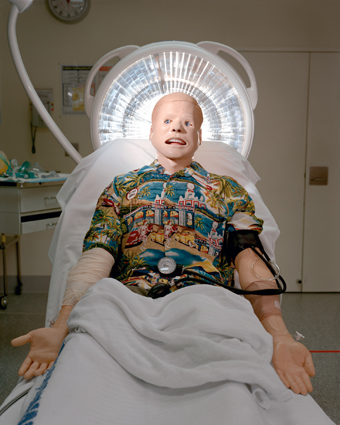
Living in Sim, Justine Cooper
image courtesy of the artist
Living in Sim, Justine Cooper
THE UNCANNY VALLEY TAKES ITS NAME FROM A GRAPH DEVELOPED BY JAPANESE ROBOTICIST MASAHIRO MORI IN 1970 TO MEASURE THE EMOTIONAL RESPONSES OF HUMANS TO THE DEGREE OF ANTHROPOMORPHISM IN ROBOTS. THE ‘UNCANNY VALLEY’ IS A PRONOUNCED DIP IN THE GRAPH WHICH OCCURS WHEN PEOPLE REACT NEGATIVELY TO THE ROBOTS BECOMING CLOSER TO THEM IN HUMAN APPEARANCE. THIS VALLEY IS WHERE THINGS SEEM HUMAN AND NOT QUITE HUMAN AT THE SAME TIME. TO QUOTE CURATOR LYNNE SANDERSON’S CATALOGUE ESSAY: “THIS IS THE PLACE WHERE ZOMBIES AND CORPSES THRIVE. IT IS ALSO WHERE MANNEQUINS LIVE…” LIKE MORI’S EXPERIMENTS THE EXHIBITION PRODUCES A RANGE OF CONTRADICTORY REACTIONS.
On the opening night we all crowd onto the viewing platform in a small side room waiting for Peter William Holden’s Arabesque to fire up again; it takes about 12 minutes for the hydraulic system to reset itself. Finally, the opening bars of Strauss’ Blue Danube can be heard and the performance literally kicks off. Eight robotic legs and arms move in time to the entire piece of music, and I hear someone mutter behind me that it is a fitting tribute to such a trite piece of music. Perhaps he means we’ve heard it so often that it has entered into the realm of artifice.
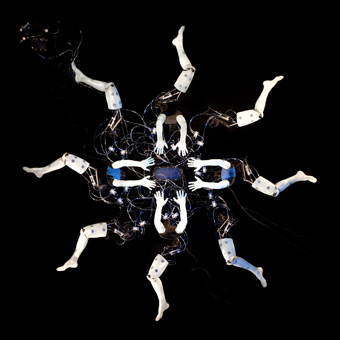
Arabesque, Peter William Holden
image by Medial Mirage/Matthias Moller
Arabesque, Peter William Holden
The photos of Arabesque in the catalogue show glowing iridescent legs and arms; a slow shutter speed must have been used, as luminous lines of movement are visible as well. These photographs of the “mechanical flower” are quite beautiful, whereas the artwork itself is fascinating in a different way, mainly with how it works. The cast arms and legs are made from a translucent material which has the appearance of waxy, dead skin. They are powered by hydraulics, with air periodically hissing its release, accompanied by the click of the limbs as they move. The artist deliberately left the many cables and workings of the sculpture in sight, acting as a kind of puzzle as to how it operates. People standing next to me laugh and clap and cry out “brilliant.” When taken in the context of the Uncanny Valley thesis, this seems akin to laughing at a funeral—that tendency to laugh in moments when not quite comfortable. I overhear many other people saying “It is like a…” which seems to signify that the work has entered the realm of the uncanny—as something for which we don’t yet have a language.
Dominating the gallery space is Justine Cooper’s photographic and video work Living in Sim which Cooper made as an outcome of her residency in at the Centre for Medical Simulation in Cambridge, Massachusetts. Presented in multiple formats, DVD, photographs and online, the work employs medical mannequins used to simulate patients for the training of medical practitioners. Cooper presents us with a hyper-real medical centre, complete with mannequins of aged care patients in wheelchairs, imposing hospital directors and the heaving breasts of nurses. One gallery wall is covered with small photographic canvases; nearly all of the dummies pictured on these have their mouths open as in silent screams, or maybe they are singing? In this hospital drama there is no blood, dirt or overcrowding; everyone who needs a bed has one, including Noctomum who has just given birth to nine children from multiple races. Another wall features images that Cooper has taken of actual simulated medical training exercises and these are quite affecting, particularly the mournful photograph of wheelchair-bound patients stuck in the corner and seemingly neglected.
The gallery space is also dominated by the sickly sweet soundtrack of Cooper’s video work. The DVD features blood, orifices and mess. The soundtrack croons on about the intimacy of doctor-patient relationships. The patients and medical staff of this “community living out the drama of health care” are further realised through a blog (livinginsim.com) which features posts and poems by the fictional staff members and video and photographs of their world. The mannequins use the blog to debate issues, such as plastic surgery (which Nurse Smilodon is vehemently against) and artificial insemination. The blog is what makes this artwork paradoxically ‘come to life,’ a demonstration of Cooper’s astute observations on the artificiality of online communication. The staff’s blog posts and biographies bring the comedic element of the work into play along, with more disturbing elements. In the visitors book in the gallery some visitors have written that the exhibition is offensive, stupid and pointless, asking that old question ‘is this art?’ One contributor has aptly written: “Disturbing? I find episodes of Master Chef more disturbing! I think some people in our health system must feel like dummies!”
The other two artworks in the exhibition are somewhat dwarfed, both in terms of size and complexity. David Archer’s A Journey Into the Mind takes us back to the Victorian era when experiments with robotics and automata were just appearing—the toys of the upper classes and the amusement parks of the masses. This sculpture is a hand-painted arcade style machine where the viewer looks into the lens and turns a handle. The human head inside the machine slowly opens to reveal a skull, which also opens in turn, revealing a peanut in the place of a brain. The simple mechanism and ‘message’ of this work is a reminder of how far science has come in robotics and yet how little has been achieved. Rona Pondick’s Jawbreakers is also a simple work, a jar of brightly coloured lollies stands on a shelf. On closer inspection these jawbreakers are revealed to be made from toothy cast jaws. Pondick writes that she sometimes wants to bite people she gets angry with, but has to stop herself because it’s socially unacceptable. The piece spirals in on itself—you bite a jawbreaker, it bites you back. These are lollies that will break your jaw and are broken jaws. It is a simple, playful piece. Pondick has used maniacally grinning teeth in her work previously; these little disembodied mouths can be quite disturbing, even uncanny.
With its dark humour, Uncanny Valley rides the fine line between comedy and drama and is at once disturbing and questioning. The exhibition functions in a very visceral manner with its small stories of real and artificial life in a darkened room. But the artificiality of the materials and media don’t quite allow for interaction with our own soft, warm bodies; somehow we feel excluded—surely part of the fear that fills the dark spaces of Masahiro Mori’s ‘uncanny valley.’
The Uncanny Valley: An exhibition exploring the not quite human, curator Lynne Sanderson, RiAus, Science Exchange, Adelaide, June 4-July 23, www.riaus.org.au
RealTime issue #98 Aug-Sept 2010 pg. 36
© Kirsty Darlaston; for permission to reproduce apply to realtime@realtimearts.net
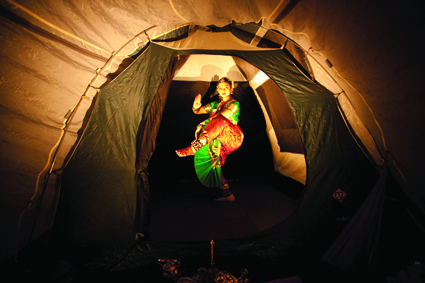
Radhika Krishnamoorthy, Private Dances
photo Jorge de Araujo
Radhika Krishnamoorthy, Private Dances
GENRE BENDING AND RISK TAKING WERE THE PROVISOS OF THE 2010 NEXT WAVE FESTIVAL WHICH RAN FOR OVER TWO WEEKS IN MELBOURNE. AUSTRALIAN EMERGING ARTISTS PUT THEIR BODIES UNDER DURESS, THREW OFF THEIR LAYERS OF SELF-CONSCIOUSNESS (AND CLOTHING) AND REWARDED THEIR AUDIENCES WITH INTIMACY, INSIGHT AND INTRIGUE.
private dances
Have you ever had someone dance just for you? Up close, you can perceive sweat glisten, sinewy muscles snaking in the spotlight, chest heaving. Exhilarated, yet coy, you make eye contact. Private Dances (curator, producer Natalie Cursio) ranges from traditional Korean dance to Private Parking—a performance in a van while you sit in the driver’s seat. It’s a large scale production incorporating 10 live performances, food, unexpected sets and six short films all viewed solo. Due to the random manner in which viewers are chosen to participate the audience takes in a variable slice of the action.
The Meat Market was converted into a softly darkened bar while tents—set up as if for children in a lounge room—provided just some of the unexpected venues for viewing film and performances with the unbridled joy of playtime. Dancer Atlanta Eke donned a gorilla suit to dance with you to a ballad. Alone, you think, until invited to sit in the annexe of the tent and watch the next person sharing a teenage dance hall moment to Cindi Lauper. Dancing stripped of the restrictions of a stage and the anonymity of a crowd became an intimate interaction. Underlying the evening’s fantastical entertainment was pleasure in its quiet voyeurism and feeling of gratitude. Private Dances was a gift to the audience, a rare opportunity to be treated like a royal guest in a Persian tent city. Not surprisingly, the show was a festival favourite and quickly sold out.
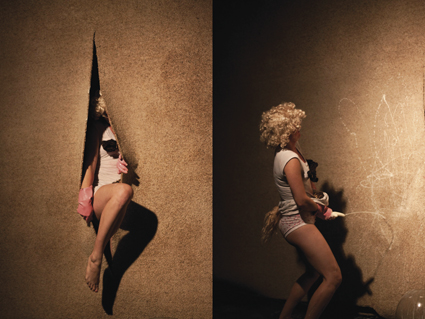
Sugar Coated, Hannah Raisin
photo Kim Ryan
Sugar Coated, Hannah Raisin
sugar coated
Hannah Raisin in Sugar Coated took a multidisciplinary approach in exploring gender roles and sexuality with a collection of film, sounds and live performance. A slight 24-year old with an unassuming bob, the recent VCA graduate handles her subject matter with fearless aplomb and speedy costume changes. She seems to intuit where the history of gender politics is at, taking back raunch culture from the pornographers and exploiters, interpreting it with artistic wit and a sensory explosion. This even includes scent: bait fish rained from her underpants in the opening act, leaving a lingering fragrance for the remainder of the show. In her investigations into domesticity and sexuality Raisin uses props ranging from fling-ups (textile representations of female genitalia) to soapy water to draw a reclining nude. In one video she pours milk over herself on a city street wearing just a transparent raincoat—much to the shock of middle-aged theatre goers. In the closing act she dons a bikini made of bath bombs, dousing herself with bottles of water while standing in a toy sea shell pool—a sadly bedraggled Venus. Raisin’s desire to push her body to often painful new places wins her fans but is also effective in conveying her contradictory messages of female angst and empowerment.
short message service
In a risk averse culture, The Short Message Service was an experiment in allowing audience control of two performers via text message. The show echoed Marina Abramovic ‘s 1974 Rhythm 0, which freely tested the relationship between artist and audience. Here though, the audience requests were channelled through gatekeepers who chose which text message instructions to relay via a handsfree set. The props consisted of a table and two chairs; no scissors, gun, rose thorns nor direct interaction here.
Phase 1 of the experiment began slowly; the audience was urged to send greetings for the two performers. These were trite enough to begin with; “Ni Hao, Herro.” Phase 2 required the audience members to involve their respective actors in moments of tenderness and tension. Verbal communication became action; Mish, the female actor, was instructed to disrobe and spent a good portion of the performance topless. She bore the abusive urges of the audience with the passive stoicism of Abramovic. Naked breakdancing and slapping of faces were some of the dark desires that were realised onstage.
After Rhythm 0, Abramovic stated, “if you leave [the] decision to the public, you can be killed…” She went on to mention the aggressive atmosphere created. Indeed there was also something vaguely reminiscent of the ‘71 Zimbardo prison experiment in this show; instead of security guards with batons the audience inflicted pain via mobile phones. As an experiment, SMS raised some pertinent points on technology and intimacy, in the process receiving a few laughs, though the possibility of text message RSI and the occasionally puerile outcomes made it a hard sell for an hour long show.
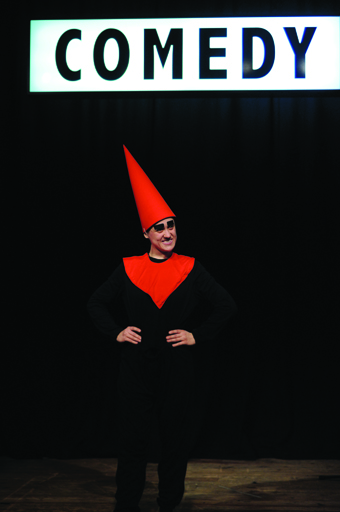
Frances Barret, A Comedy, Brown Council
photo Devika Bilimoria
Frances Barret, A Comedy, Brown Council
a comedy
Performed by artist collaborators Brown Council, A Comedy investigates Nietzche’s idea that maliciousness and absurdity are the basis of all laughter. The audience is guided through the well-established comedy canon: stand up, slapstick, spectacle and audience participation. Expectations are slowly dismantled and what we begin to see are uncomfortable, tortured performances from forced banana consumption to real slaps in slapstick routines. Not only do we sense the desperation of comedians for a laugh but the lengths they will go to achieve it. By the close of the show the once comical dunce hats that the performers and audience wear take on a sinister role. After her failed attempt to escape from rope bindings, a target is drawn on the face of a bound female performer and the audience is encouraged to hurl tomatoes. It could be a scene from Abu Ghraib; the conical hat and black sack clothing she wears are familiar images from the 2004 prison torture scandal. Unfortunately those pummelling the performer seemed to miss this reference and the premise of the show. To be fair, the constant encouragement for audience participation was quite manipulative and seemed to sanction this violence.
and that was the summer….
On a lighter note, And that was the summer that changed my life was a comedy where one could snort and guffaw without prejudice. Written and performed by Zoë Coombs Marr (of performance group Post), it’s a sharply observed monologue dealing with the acute embarrassment of teenage firsts—the transition from childhood love of dinosaurs and music camps to sexual awakening. That Marr unabashedly admits to her most excruciating moments is a cathartic experience for the audience. Dressed in an unflattering leotard with a parachute jacket, sometimes we even recognise ourselves in her. Before pity ever sets in, Marr cuts in with a boast—“I’ve crushed a lot of pussy”—and keeps the audience besotted with acerbic humour and the kind of daggy, alone-in-your-own-room creativity that sustains countless teenagers.
Peppered throughout are nostalgic musical interludes dating to that summer in the mid 90s when it all changed for her. In these, Marr performs Lucille Ball type facial contortions and uses an appliquéd brontosaurus on her leotard as a puppet. In her self-deprecating confessions are serious coming of age hurdles that lend poignancy to her story. Just as Frankie magazine elevated doilies and baking to fashion, Marr turns her flute playing, nose bleeding Sapphic alter ego into a high priestess of cool. The final musical number is a creamy chef d’oeuvre and a big payoff for the audience.
Next Wave Festival 2010: Private Dances, concept, curator, producer Natalie Cursio, Arts House, Meat Market, May 12-16; Sugar Coated, artist Hannah Raisin, Goodtime Studios, May 14-20; The Short Message Service, performers, collaborators Jackson Castiglione, Mish Grigor, co-creators, collaborators Leah Shelton, Lachlan Tetlow-Stuart: BlackBox, Arts Centre, May 14-22; Brown Council (Frances Barrett, Kate Blackmore, Kelly Doley, Diana Smith), A Comedy, Trades Hall, May 19-23; Zoë Coombs Marr, And That Was The Summer That Changed My Life, BlackBox, Arts Centre, Melbourne May 26-29
RealTime issue #98 Aug-Sept 2010 pg. 39
© Varia Karipoff; for permission to reproduce apply to realtime@realtimearts.net
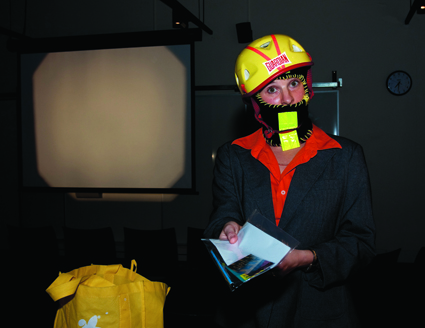
Paula van Beek, Dangerous Melbourne
photo Oliver Parzer
Paula van Beek, Dangerous Melbourne
WE’RE HAVING TEA AND BISCUITS IN A SEMINAR ROOM ABOVE MELBOURNE’S CITY LIBRARY. A PASTY FACED CHICK WEARING A PLAID SUIT AND ADIDAS RUNNERS STANDS TO ONE SIDE. TOO MUCH FOUNDATION HAS BEEN APPLIED TO HER FACE. HER EYES HAVE ABOUT THEM THE VAGARIES ASSOCIATED WITH NARCOTIC ADDICTION, AND HER ENTIRE BEING APPEARS TO TREMBLE. SHE GIVES THE IMPRESSION SHE MAY BOLT ACROSS THE ROOM AT ANY MOMENT AND HURL HERSELF OUT THE FIRST FLOOR WINDOW.
dangerous melbourne
But Dangerous Melbourne is an ironic take on the safety seminar. So performer Paula Van Beek instead situates herself before a projector while we the audience are paired off with one another. You know the corporate training drill. Name tags attached to shirts stating ‘Hello, my name is blah, blah, blah…,’ two 15-minute breaks either side of lunch and the assumed authority of an inane team leader who believes in her purpose with a missionary’s zeal. Van Beek advises us to open our eyes and become aware of Melbourne’s dangers, as she projects on a screen sign after relentless sign, each indicating an unreasonable fear of annihilation.
What I experience, however, is a slippage between the formality of the training seminar and the art of performance. Here, the boredom associated with corporate training dissipates revealing a quietly hysterical team leader who is as terrified of being shat on by a pigeon as she is of being pack-raped. Dissolute, Van Beek stands before the bright light of her projector. Contained by emptiness, stepping into the unknown is the most terrifying risk a human being can undertake.
i thought a musical was being made
A Melbourne landmark, the Greek restaurant Stalactites is best known for its chicken souvlakis rather than as a performance venue. We sit at pre-designated tables and a waiter soon delivers a plate containing spanakopita, kalamata olives, dolmades and other Greek goodies. A dude sitting directly across from me explains that he’s a vegan and that therefore I can eat as much of the food as I like. Thanks for that, but eating in a performance context is a sly form of audience participation; one that often has unforeseen consequences.
Filtering through my headphones is a sonorous mix of atmospherics and performance poetry. Through a window, it soon becomes apparent that a second event is also taking place, outside in Lonsdale Street. But I’m seated in such a way that I can’t see the action; which is quite interesting really: being prevented from seeing for yourself what others can see for you is an illuminating interpretation of the public-private interface—a distortion we experience everyday in our media dominated lives.
The music ends and we’re led back downstairs to where this performance began, outside in Lonsdale Street. Just as we have been prevented from—or allowed to participate in—watching others perform from an upstairs window, there now occurs a further elaboration of this collaborative awareness. As we shuffle around in circles and do silly things, others now watch us perform from the 1st floor of three buildings situated at the intersection of Lonsdale and Russell Streets. My sense of the sanctified individual and their place in a consumptive society is replaced by the multiplicitous proposition that as individuals we ignite when gazed at by other human beings.
and then something fell on my head
The stated theme of Next Wave 2010 is “No Risk Too Great.” Funny though, the one time I feel threatened is when traversing the technocratic badlands of Melbourne’s recently developed Victoria Dock to see And Then Something Fell On My Head.
Seated within the post-industrial Shed No. 4, I notice that a senior Victorian politician is also in attendance. We’re wearing mandatory dust masks, protective goggles, hard hats and coveralls, and for good reason. From high up on a scaffold, shadowy figures dispense with a multitude of coloured pencils, sheets of paper and empty water containers, while a submissive office worker moves toward us. It’s the forces of nature, thunder, rain and snow challenging the technocratic forces of habit: pencils, paper and purified spring water. And we the audience are also under threat. Until, in a neatly conceptualised projection layered across three sheets of cotton scrim, a video representation of the same office worker first unravels, then multiplies, while a developing awareness of the natural world dawns, along with its accompanying void.
Later, when inside the most uninviting unisex toilet I have encountered for quite some time, I quip to the senior Victorian politician that this show, perhaps, resembled a day in the life of the Victorian Parliament. “Yes,” he says, slightly embarrassed. “Lots of shit falling on your head from a great height.” Yeah, right…
a good death
And Then Something Fell On My Head was the most concentrated realisation of the troubling effect of technocracy and its consequent human frailties. But the attention to detail accompanying The Sisters Hayes’ A Good Death distinguished it from its peers.
It takes place in a wizened crypt beneath North Melbourne’s Mary Star of the Sea Church. There are tears of blood descending from forlorn eyes and the viscera of religious conviction represented by crimson braid. There’s a painting of a personal friend of the artists, a wigmaker resembling a glamrocker, who, for some obscure reason has been elevated to sainthood. During a penny arcade animation comprising a performance containing painstakingly constructed masks, I cringe when I see one of those bum shaped, 70s, blue plastic chairs. This, however, may be a considered choice. A good death exposes the mysterious mythologies and disturbed impulses that underpin the stories of Catholic sainthood. But these retellings occur in such an idiosyncratic way that the ominous tale of Catholicism instead assumes a playful irreverence, one that conveys a genuine respect for its source. Impressive in scope and impervious to my secular scepticism, A good death dies a thousand deaths as it subverts Catholic history, and reinterprets the birth of Christ.
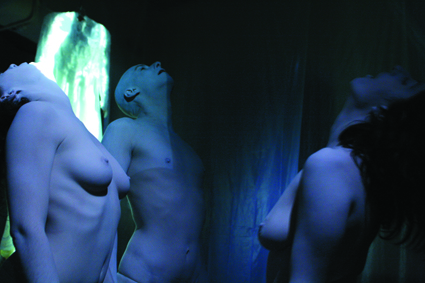
The Oak’s Bride, Red Moon Rising
photo Gareth Hart
The Oak’s Bride, Red Moon Rising
the oak’s bride
Situated near the corner of Bourke and Spencer Streets, The Donkey Wheel Room is a subterranean exemplar of a now disused World War II bomb shelter. The opening sequence of The Oak’s Bride is too familiar, as Butoh inspired representations of eternally rebirthing ghosts are now a performance cliche. But there’s a crafty director’s eye at play here, one that maintains an awareness of architectural space. In a second performance area, a woman adorned in an archaic dress occupies a now spatially charged window. She says nothing, she does not do that much, and what she does do is performed in a slow, meticulous manner. And in spite of a tendency for blockbuster inspired sound designers to neglect the power of silence, this image of a woman electrified by an architrave remains hypnotic. As a gateway into the third performance space and its mythological content, the same woman steps down, draws the audience’s attention toward a distant doorway, and its portent of death as feminine.
It’s a delightful transition, this dissolution of one performance and its blending with another. And it occurs to me that consistent with Next Wave’s “No risk too great” theme, the five shows I’ve seen have been defined, in various ways, by an absence of safe, conventional theatrical structure. Even so, The Oak’s Bride maintains a disciplined approach toward defining its images. On a far wall, several coquettish picture-frames are filled with black and white film, while the performers find solitude in an imbroglio of flesh contained by a huge vent rising upward into the outside world. With the dissolution of form and the disintegration of self there occurs the birth of that which, by definition, is yet to be known. Of the five shows, this ‘body melt’ exemplifies Next Wave’s underlying impulse.
2010 Next Wave Festival: Dangerous Melbourne, creator, performer Paula Van Beek, dramaturg Nicky Fearn, various venues, May 17-27; I thought a musical was being made, creators Jess Oliveri, Hayley Forward, performers The Parachutes for Ladies, cnr Lonsdale & Russell Sts, May 18-23; And Then Something Fell on my Head, choreographer Ashley Dyer, lighting Travis Hodgson, video Rachael Brown, writer, dramaturg Sime Knezevic, programmer Fred Rodrigues, Shed 4, Docklands, May 19-23; A Good Death, creators The Sisters Hayes, lighting Bronwyn Pringle, sound design Angela Grant; St Mary Star of the Sea Church, May 16-23; The Oak’s Bride, creators Ellen Rijs, Jeremy Neideck, Polly Sara, lighting Angela Cole; Donkey Wheel House, May 18-23
RealTime issue #98 Aug-Sept 2010 pg. 40
© Tony Reck; for permission to reproduce apply to realtime@realtimearts.net
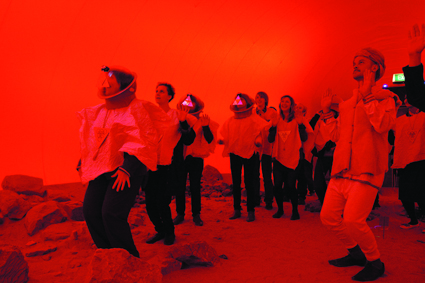
100 Proofs the Earth is Not a Globe, Tape Projects
photo Shea Bresnehan
100 Proofs the Earth is Not a Globe, Tape Projects
NEXT WAVE FESTIVAL IS RIGHTLY SEEN AS A MELTING POT WHERE YOUNG ARTISTS CHALLENGE TRADITIONAL CREATIVE APPROACHES AND METHODS OF PRESENTATION. THERE IS ALSO AN EXPECTATION THAT VISITORS WILL ACTIVELY CONTRIBUTE TO THIS DIALOGUE. ALTHOUGH THIS YEAR’S FESTIVAL CONTAINED NUMEROUS EXAMPLES OF EXHIBITIONS AND PERFORMANCES IN TRADITIONAL VENUES, MANY OTHER PROJECTS RELIED UPON NON-TRADITIONAL AUDIENCE ENGAGEMENT. THIS IS CHARACTERISTIC OF AN ORGANISATION THAT SUPPORTS YOUNG AND EMERGING ARTISTS, AND IT RESONATED PARTICULARLY WELL WITH THE THEME OF THE 2010 NEXT WAVE FESTIVAL, “NO RISK TOO GREAT,” ENCOURAGING NOT ONLY ARTISTS BUT ALSO VIEWERS TO STEP OUTSIDE THEIR COMFORT ZONES.
sunset over cardboard mountains
Sunset Over Cardboard Mountains, by artists Rachel Feery, Ed Gould and Lisa Stewart, proved a fitting beginning to my voyage through this year’s festival. While a number of Next Wave pieces broadly picked up on the idea that ‘risk taking’ is often the domain of youth, this work responded to the ways that children experience and negotiate the unknown, the scary and the risky through storytelling, role-playing and imagination.
An audience of 12, each member in their own individual cardboard box (cushions provided), sits inside a large tent-like structure. The lights go down, a live but unseen musical accompaniment begins and the tent fabric shakes, as if buffeted by a strong wind. From this point onwards the audience is treated to a low-fi performance of lighting, shadow and video effects which poignantly evoke common rites of passage. From confronting silhouetted ‘tree-monsters’ that appear during storms, to telling ghost stories by torchlight under bed sheets, to constructing fantastic machines and fortresses out of cardboard boxes and quilts, these childhood modes of play and initiation were all joyfully revisited by Sunset Over Cardboard Mountains in an immersive and often surprising performance.
100 proofs the earth is not a globe
The highly anticipated, ambitious 100 Proofs the Earth is Not a Globe from Melbourne-based collective Tape Projects did not disappoint. Tape Projects worked with the Victorian Space Science Education Centre at Strathmore Secondary College to develop 100 Proofs, shifting their artistic focus from visual arts projects towards a performative and experiential practice.
100 Proofs took viewers on a highly choreographed trip into a seamlessly constructed environment in which fantasy, fiction and alternate realities collided with rational and logical experience. The Space Science Education Centre was transformed each night into an otherworldly research facility, full of focused yet strangely attired inhabitants in a time warp. At the outset, the audience was divided into two groups (blue and red) and we were each assigned an alter ego. I became Raphael Constantinescu of the Personnel Department.
Being a member of the blue group, I was required to complete a number of pre-designated experiments. Armed with a lab coat and a clip-board Raphael Constantinescu was ushered through a series of tasks which included estimating the weight of a rock, sketching with a non-preferred hand, determining a ‘magic number’ through a series of calculations and observing and analysing the movements of a strange group of subjects (the red team). While the significance of these tasks was often unclear, in the context of the performance they took on a strange sense of urgency and purpose. By compelling the audience to act out roles as either scientists or subjects, 100 Proofs provided a thoroughly enjoyable and fascinating commentary on our understanding of scientific knowledge. As the work’s title implies, often our perceived reality is at odds with scientific truth. The minutiae and detail of scientific process and logic can obscure broader contexts and implications; science can go too far. At the same time, the imaginative possibilities of science are enticing and enthralling as science fiction rapidly turns into science fact.
evolution
Evolution by Safari Team (Blaine Cooper, Lillian O’Neil, Jon Oldmeadow) was yet another work inspired by scientific progress and imagined futures. By flagrantly opposing the supremacy of 19th century religious beliefs and institutions, Charles Darwin will forever be acknowledged as one of history’s greatest risk-takers, a figure whose ideas to this day remain controversial and passionately contested by the champions of Creationism and Intelligent Design.
A five-screen video installation, Evolution, located in ArtPlay in Birrarung Marr on the north bank of the River Yarra, responded to some of the ways that the general public are often introduced to and made familiar with scientific discoveries. The series of carefully composed images that repeated across the five screens seemed to be inspired by a warped view of natural history documentaries and science fiction films, mashed up into a dystopic vision of scientific endeavours.
I had high expectations for Evolution, but unfortunately it failed to live up to Safari Team’s delightful Molto Morte (2008), one of the highlights of the 2008 Next Wave Festival. Unlike 100 Proofs, which cleverly critiqued methods of scientific research and discovery, Evolution did not engage as strongly with the very real and fascinating contemporary dialogues around human evolutionary activity, such as the fact that humans can now actively control and dictate evolution through technological advances—evolution through ‘unnatural’ selection. The piece was certainly not narrative-based, however it needed a stronger overarching structure, or perhaps a soundtrack or some kind of aural accompaniment, to draw the compelling but disparate images into a more fluid conversation with each other.
Furthermore, the installation did little to enhance the artwork, making it appear too ambitious for an outdoor location. As well, time-based artworks are forever burdened with the necessity of having to engage viewers relatively quickly, and even then they don’t necessarily stay long. However, when the artwork is installed outdoors, after hours and during a festival that creeps into Melbourne Winter, the challenge is amplified.
doomsday vanitas
In this sense, Nicole Breedon’s Next Wave project, Doomsday Vanitas was a minimal but ultimately more successful example of a media artwork conceived for public space. Breedon projected hologram-like images of common objects onto buildings in Guildford Lane and surrounds. These were not complex images, yet as viewers discovered each successive projection amongst the alleys they were rewarded immediately, as the artworks’ simplicity and surprising beauty melded perfectly with their laneway environment. Rendered as gently rotating and glowing still-lifes, everyday items such as a water bottle, Swiss Army knife and an axe assumed an ominous quality within the urban environment, reflecting ongoing concerns to do with street violence and weapons culture.
film that will end in death
Perhaps the most literal exploration of the festival’s theme was Trevor Flinn’s Film that will end in Death. Based in Dunkeld in regional Victoria, Flinn identified and interviewed a number of people in ‘risky’ occupations—from lion taming and bull riding to wildlife rescue—questioning them about their relationship and attraction to risk. In the film, as in real life, Flinn has an endearing and engaging personality, which draws out candid admissions and stories from his interviewees. His dry sense of humour, wide-eyed enthusiasm and self-confessed ‘risk-averse’ personality make him the perfect foil for his subjects.
Interestingly, many of Flinn’s subjects spoke about their rather dangerous pastimes and jobs not so much in terms of ‘thrill-seeking’ impulses, but rather as almost normal activities in which inherent risks needed to be understood, mitigated and minimised. The hilariously blasé lion tamer Matthew Ezekial said that after a while “it’s just a job.” This matter-of-fact sentiment was reflected in the traditional documentary construction of Flinn’s film. It was a welcome and memorable interlude in a festival which, while always encouraging the provocative and the novel, also allows a space for audiences to engage with personal modes of storytelling and presentation.
2010 Next Wave Festival: Sunset Over Cardboard Mountains, Rachel Feery, Ed Gould, Lisa Stewart, Studio 246, May 14-21; Tape Projects, 100 Proofs the Earth is Not a Globe, Lee Anantawat, Cait Foran, Eugenia Lim, Tanja Milbourne, Michael Prior, Zoe Scoglio, Jessie Scott, Victorian Space Science Education Centre, May 19-28; Safari Team, Evolution, Blaine Cooper, Lillian O’Neil, Jon Oldmeadow, Birrarung Marr, May 13-30; Doomsday Vanitas, Nicole Breedon, various locations, May 13-30; Film that will end in Death, Trevor Flinn, Kings ARI, May 8-31
RealTime issue #98 Aug-Sept 2010 pg. 41
© Kate Warren; for permission to reproduce apply to realtime@realtimearts.net
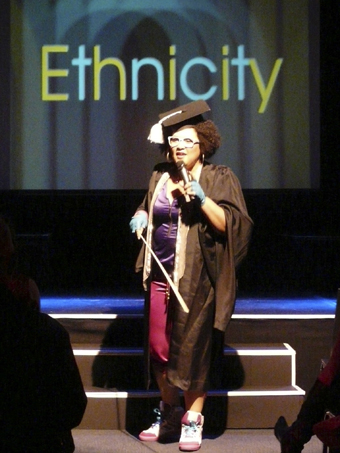
Candy Bowers, Who’s That Chik?, performing at National Multicultural Arts Symposium 2010
photo Andrew Dundon
Candy Bowers, Who’s That Chik?, performing at National Multicultural Arts Symposium 2010
CULTURALLY DIVERSE ART IS INSPIRING, INNOVATIVE AND MARKETABLE—AND IT NEEDS YOUR SUPPORT. THIS WAS THE CLEAR MESSAGE AT A RECENT GATHERING OF CULTURALLY DIVERSE PRACTITIONERS, EACH LEADING CONTEMPORARY ARTS PRACTICE ACROSS A RANGE OF ARTFORMS AND SPECIALISATIONS.
And yet that clear message is not so straightforward: needing your support means overcoming those persistent barriers that have confronted culturally diverse arts for decades. Identity, funding, leadership and the politicisation of its very vocabulary remain ongoing problems. All the while, the work becomes ever more sophisticated, attracts new audiences and tours internationally, joining that increasing array of Australian innovation that enjoys more brilliant accolades overseas than at home—or on our mainstages. So what’s still at issue? And how can cultural diversity lead contemporary Australian arts with widespread recognition?
Held in Adelaide and presented by Nexus Multicultural Arts with Kultour, the National Multicultural Arts Symposium was preceded by two days of performances and exhibitions, with Candy Bowers’ provocative Who’s That Chik? setting the tone (“a hip hop tale of a brown girl with big dreams”; http://whosthatchik.com). Culturally diverse artists framed the symposium, with the work and the practitioners speaking for themselves. This too was questioned at the outset: Who speaks? Who names? Need every artist and every work represent an entire community?
Names and their political appropriation have long confused the Australian community, and frustrated the practitioners whose work they label. Christian (Bong) Ramilo, Executive Director of Darwin Community Arts, saw little progress across two decades of advocating access, equity and representation. For Mirna Heruc, Manager of the Arts & Heritage Collections at the University of Adelaide (and former CEO of Nexus), “Sometimes labels have marginalised us, sometimes they’ve brought us to the centre, but nothing has changed.” Political decisions have seen successive governments adopt—and often, quietly reject—terms such as ethnic, multicultural, Aboriginal, Indigenous, cross-cultural, Community Cultural Development (CCD), disability, all abilities, Culturally and Linguistically Diverse (CALD), Non-English Speaking Background (NESB), diverse, culturally diverse, and even culture itself.
When these shifting terms translate into shifts in policy, culturally diverse practitioners are—like it or not—drawn into their politics, needing to identify with the current language to achieve recognition or secure financial support. For Heruc, the best approach to these names is to reject them entirely; multicultural arts organisations should facilitate pathways into the mainstream, presenting work without any framing label. “Our job is really to get rid of this multiculturalism business, and just focus on the arts.” She adds, however, “We’re not close to achieving this.”
Independent producer Kath Papas, former director of Ausdance Victoria, distinguished between three kinds of diversity that focus her practice: form, content and philosophy. This approach overcomes the fraught cultural labels, opening diversity itself to a space beyond othering. Papas made particular mention of disability arts as informing her practice. “There’s a lack of engagement from the dance mainstream,” she says, and while there’s plenty of talented culturally diverse artists, “who’s going to take them on?” Papas identified flexible infrastructure, networking and skilling up as key issues. Without these essentials, “we lose those artists because they get too tired—you can’t self-produce forever.”
Not all artists make a conscious choice to self-produce, while for others the torch-bearing work of speaking for an entire community is central to the art. Khaled Sabsabi, visual artist and Creative Producer at Casula Powerhouse, saw no distinction between CCD and his own artistic practice. Karl Telfer, Kaurna Cultural Bearer and visual artist, described reconciliation as the driver of all of his work. Such practice is never about aligning itself to funding categories. As Sabsabi put it, “Art leadership is a resistance against the way things are.”
Many speakers lamented the rise and fall of leadership organisations; touring and advocacy body Kultour remains the only national multicultural organisation. Yet all speakers agreed that leadership is about the work itself, and its articulation into the community. Bowers spoke passionately about a new space in which diverse artists see themselves represented in the faces as well as the programming of mainstream arts organisations. “Beyond being ‘championed,’ or ‘helped,’ we want to be paid for being artists. We want the resources, we want the recognition.”
So, how do you position yourself in the culturally diverse arts? Head on. In fact, it’s a proven strategy. Karen Bryant, Associate Director of the Adelaide Festival Centre, presented a powerful argument for diversity as a strategy towards financial sustainability and artistic success. “We’re no longer a series of buildings,” says Bryant, “we’re a facilitator—which means asking, and then re-evaluating.” Direct engagement is essential: programming is developed in close consultation with emerging and established communities. In this way, the Centre overcame its empty seats and its venue-for-hire image. The results are inspiring: a 33% increase in audiences in its first year, and 25% in the second.
Similarly, Adelaide Fringe’s 2011 Director, Greg Clarke, aims at international recognition as a culturally diverse festival by 2020. Clarke sees this as an artistic as well as a commercial strategy for engaging with a majority of Australians. With a strong record in culturally diverse policy as well as programming, Clarke says the Fringe has prioritised diversity quite simply “because it was mind-blowing.”
Communications consultant and editor Fotis Kapetopoulos’ statistics demonstrated just how marketable culturally diverse art is—both at home and overseas. “Our mainstream companies are caught up producing the same styles, but what we’re talking about is international.” Aaron Seeto agrees: “Internationally, diversity is our point of difference.” Seeto, Director of artist-run space Gallery 4A: Centre for Contemporary Asian Art in Sydney’s Chinatown, described the contemporary visual arts museum as “a self-replicating machine, a safe-house,” while contemporary culturally diverse work is “feeding into the international arena.”
Rather than engaging with and supporting this work, our own governments prefer to stick to the known. The major mass-marketing campaign in culturally diverse Victoria is Melbourne Winter Masterpieces, a showcase of well-known European artists from previous centuries. Kapetopoulos described the end of Sydney’s Carnivale as a cynical stroke: it was defunded by the NSW government at its peak demand and sustainability point because its audiences “had started to look too mainstream—it didn’t look like an ethnic festival.” Such ironies were not lost on a gathering of practitioners accustomed to being ‘othered.’
On the other hand, some mainstream arts organisations experiencing significant audience loss have been receiving funding boosts in recent years. Emphasising this particular irony, Opera Australia’s Artistic Director Lyndon Terracini used his morning keynote to ask the funding bodies in the room to “empower” his organisation through a funding increase. Opera Australia currently receives as much Australia Council funding as the other 900+ funded organisations and projects combined. Terracini, founder of Kultour member, Northern Rivers Performing Arts (NORPA) in Lismore NSW, spoke of new Indigenous and Asian initiatives: “I don’t want to play to an elite audience—I’ve never wanted that.”
With all speakers projecting a future Australia of increasing diversity, governments will need to direct subsidies to culturally relevant work that’s artistically exciting as well as economically sustainable. The undeniable reality of Australian multiculturalism as always already mainstream can no longer be avoided; changing labels simply exposes a political reluctance to accept that diversity will not remain ‘othered.’
Fundamentally, such barriers aren’t specific to the arts. They’re generational; they’re administrative; they’re political. Ironically, they’re cultural—in the word’s corporate meaning, describing entrenched practices in establishment organisations. Culturally diverse art is ready to lead contemporary Australian practice, further developing audiences here and overseas.
Candy Bowers knows it. “How can cultural diversity lead the Australian arts?—Get out of my way.”
National Multicultural Arts Symposium 2010, ?Diversity in the Arts: Theory + Action, May?19-21, 2010, presenter Nexus Multicultural Arts in partnership with Kultour
RealTime issue #98 Aug-Sept 2010 pg. 42
© Esther Anatolitis; for permission to reproduce apply to realtime@realtimearts.net
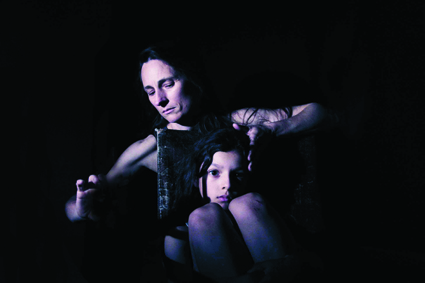
Deborah Kayser, Tomas Tsiavos, Exile
photo Daisy Noyes
Deborah Kayser, Tomas Tsiavos, Exile
“THE CREATIVE PROCESS IS QUITE LIKE OP-SHOPPING,” ARTISTIC DIRECTOR OF CHAMBER MADE OPERA DAVID YOUNG REMARKED TO ME BEFORE THE PREMIERE PERFORMANCE OF HELEN GIFFORD’S OPERA EXILE, “BECAUSE YOU CAN AFFORD TO TAKE RISKS.” AS WITH ALL RISKS THERE ARE STAKES TO BE WON OR LOST IN WHAT IS POSSIBLY THE WORLD’S FIRST OPERA PRODUCED FOR THE IPAD.
Using the familiar op-shopping strategies of combination and alteration, Euripides’ play Iphigenia in Tauris is rewritten, the history of Victoria’s Point Nepean on the Mornington Peninsula is revisited through the lens of gaming technologies and chamber opera is presented on a new platform. The outcomes of the project will not be known until its release and screening at ACMI in November. In the meantime the project’s collaborators from Australian new music organisations Aphids, Chamber Made Opera, Speak Percussion and Amsterdam-based media artists Champagne Valentine will be negotiating multiple priorities and balancing innovation with technical limitation.
Exile has lain dormant since its composition by Gifford as Iphigenia in Exile with the librettist Richard Meredith in 1985. The opera’s recent rediscovery by David Young prompted some closet archaeology by Gifford, uncovering reel-to-reel recordings of a women’s chorus recorded in a Kew apartment in 1986, an autoharp part recorded in 1989 in an old post office and a mandolin through which Gifford attempted to reimagine the timbres of Ancient Greek music. Gifford has not tried to faithfully reconstruct the music of Ancient Greece, but to rediscover it creatively: “People like to think that they can get an idea of Ancient Greek music from decoding carvings and etchings. That’s nonsense. You get more of an idea from listening to modern Greek music of a Demotic order. The timbres, the rhythms; I don’t think those things change so much over 2000 years. Though,” Gifford adds, “my music sounds nothing like Greek music today.” The artefacts were incorporated into the opera’s recent recording at the ABC’s Iwaki Auditorium that will serve for both a radio broadcast and the iPad application’s soundtrack.
The application will also be available for download on iPhone, prompting the question of the iPad’s significance to the work. “They remind me of Speak and Spells,” Aphids Executive Producer Thea Baumann admits, though Anita Fontaine of Champagne Valentine considers the large, higher resolution screen “a nice addition which contributes to the experiences we will create.” With Baumann flagging the “data-heavy layers of moving image” common to Anita Fontaine’s work, there is justifiable concern about the “limited processing power and lack of Flash support” that the iPad inherits from the iPhone. But Fontaine is confident in the project’s ability to overcome these limitations as “these kinds of challenges and constraints are something Champagne Valentine is accustomed to when developing bespoke interactive experiences.”
Rather than processing speed, the iPad’s audio may be the main obstacle to successfully mounting the opera on the platform. The multi-purpose ABC recording will reach Champagne Valentine in the form of a highly compressed stereo mix, making user-controlled manipulation of the composition’s parts, as in the company’s GPS controlled interactive musical game for the Tate Modern, more difficult to implement. Working closely with Champagne Valentine, Baumann anticipates that “one of the main challenges will be to make the audio just as luscious as the video.”
The video component of the work, filmed in consultation with Parks Victoria, engages with the natural environment and rich history of Point Nepean to reflect and comment on the themes of longing, claustrophobia and isolation in Gifford’s opera. Both visually and historically Baumann sees the landscape as “woven with paranoia and isolation,” likening the tone of Exile to the psychologically loaded game spaces of Quake and Half-Life first-person shooters. Baumann hopes to explore this likeness in Fort Nepean’s labyrinthine tunnel system: “The tunnels have a Greek architectural symbolism, simultaneously connoting the Minotaur’s labyrinth and gaming architectures.” By way of visual and aural analogy the southern Australian coastline’s sombre palette, eroded forms and bitter winds provide a desolate backdrop to Gifford’s aural palette, coloured with sparse mandolin, clarinets, clay flute and percussion.
Point Nepean has been the site of Victoria’s main quarantine station 1852–1980, Prime Minister Harold Holt’s disappearance and presumed drowning in 1967 and accommodation for Kosovar refugees in 1999. The area’s legacy of isolation draws Gifford and Meredith’s psychological portrait of Iphigenia into Australia’s grim colonial and immigration history. The protagonist is powerfully realised by soprano Deborah Kayser as she contemplates her effective exile from Greece to the role of high priestess at the temple of Artemis in Tauris (Crimea). Vilified by the townsfolk and wracked by self-loathing, “she feels as though she has been tricked into performing the duties of the high priestess: anointing shipwrecked sailors before sacrifice, or in the case of the high-born, cutting their throats herself,” Gifford explains. Iphigenia is left in her unenviable position after being saved from sacrifice at her father’s hand by the goddess Artemis in Aulis. In Euripides’ play Iphigenia’s brother Orestes is brought to her for sacrifice in Tauris, where they escape with the help of the goddess Athena. Gifford describes the serendipity and divine intervention in Euripides’ play as “cheating,” placing Iphigenia beyond the reach of Ancient Greece’s fickle gods, at the mercy of the Taurians and her memories. “Euripides’ play is a bit like a soap opera,” Gifford laughs, “he had to have a happy ending. But there were thousands of temples in the area, and those that did have human sacrifices needed priests and priestesses.” Drawn by the mournful song of a migrating seabird from her homeland (rendered on clay flute), Iphigenia walks on, or into, the ocean at the opera’s conclusion. “Whereas the poor soul fantasises walking with Orestes over the water, she is really, I think we can agree, walking under it.”
Exile shows us a world of Ancient Greek myth without gods. The secularised portrait of Iphigenia is made profoundly sympathetic at the expense of its dramatic context, turning Euripides’ melodrama into a personal tragedy. The composition should be given a renewed and poignant context in Point Nepean, where history may come into a creative synthesis with the possibilities of computer game narratives and technologies. The opera’s successful implementation on iPad, as on its other intended platforms, hinges largely upon Aphids and Champagne Valentine turning the opera’s recording from ABC’s Iwaki Auditorium and video component into an engaging interactive music video.
Exile, composer Helen Gifford, soprano Deborah Kayser, co-producers Aphids, Chamber Made Opera; studio recording, Iwaki Auditorium, ABC Southbank Centre, Melbourne, June 22
RealTime issue #98 Aug-Sept 2010 pg. 43
© Matthew Lorenzon; for permission to reproduce apply to realtime@realtimearts.net
Jordan Dorjee performing at Refraction June 29, 2010 (co-curated with New Weird Australia)
photo Marnie Vaughn – see image note*
Jordan Dorjee performing at Refraction June 29, 2010 (co-curated with New Weird Australia)
THERE IS A RICH HISTORY IN AUSTRALIA OF VIBRANT AND GROUNDBREAKING HIGHER EDUCATION PROGRAMS THAT OFFER AN ALTERNATIVE TO THE MORE TRADITIONAL CONSERVATOIRE EDUCATION FOR YOUNG ARTISTS AND MUSICIANS. EXAMPLES INCLUDE THE LATROBE UNIVERSITY MUSIC PROGRAM THAT STARTED IN THE 1970S, THE FORMER DEGREE IN MUSIC AND ELECTRONIC ARTS AT THE UNIVERSITY OF WESTERN SYDNEY, CURRENT PROGRAMS SUCH AS RMIT AND QUT’S CREATIVE INDUSTRIES, WAAPA’S BACHELOR OF MUSIC TECHNOLOGY AND THE NEW UTS BACHELOR OF SOUND AND MUSIC DESIGN. OVER THE YEARS JULIAN KNOWLES (QUT) HAS BEEN INVOLVED WITH A NUMBER OF THESE UNIVERSITIES AND ARGUES THAT “THESE PROGRAMS HAVE BEEN CRITICAL TO BUILDING THE CULTURE AROUND EXPERIMENTAL MUSIC IN AUSTRALIA FOR 30-40 YEARS” BECAUSE THEY HAVE TRAINED PRACTITIONERS AND DEVELOPED NEW AUDIENCES.
Knowles explains that “those of us teaching in university programs in the 1990s were very active as practitioners in the scene and we brought students into contact with the network of festivals such as What is Music? and Liquid Architecture and the warehouse gigs that were happening in the more underground artist run spaces..[and we] brought practitioners from this scene back into the university by offering casual teaching appointments.” Indeed, it seems that the most successful educational programs in Australia have always involved engagement with the wider community, a feature of the La Trobe Music course, UWS and most recently RMIT. Articulating perfectly such an approach, which seems relatively common in Australia, Philip Samartzis (RMIT) claims that “the role of an institution is to facilitate opportunity and development by introducing students to an expansive range of ideas and practices that afford a greater appreciation of sound culture.”
Despite their success and involvement with the wider experimental music and sonic arts community in Australia such programs are often regarded as expensive and relatively niche and so have frequently been at risk. Knowles explains that “the 1970s was particularly active. There was some fallback in the late 80s and early 90s, then a significant increase in offerings from the mid 1990s onwards.” Still it is only a few years ago that the widely admired UWS Electronic Arts program was shut down and academics and students alike know they can’t be complacent about the future. Cat Hope (WAAPA) says that “there is not a good feeling amongst academics in Australia” because, while the area is vibrant and active within universities, constant instability and demanding teaching loads have the potential to effect the quality of the teaching offered.
Apart from concern about the future, issues currently of interest in experimental music and sound art include the increasing numbers of artists and musicians taking up PhD and DCA places, the focus of students on career pathways and the centrality of research to university funding models and activities.
paperwork
It is widely speculated that there has been an increasing number of artists and musicians taking up PhD and DCA places in the last few years but it is unclear what effect it will have on the development of experimental music and sonic art culture in Australia. Kirsty Beilharz (UTS) comments that “there has definitely been an increase in composers pursuing higher degrees which may be due to various conditions, such as the almost requisite PhD for academic employment, and returning to studies in the current economic climate, but also positive factors such as the increasing recognition and understanding of creative practice as research or as being significantly rounded by research.” Analysing this trend, Cat Hope thinks that the increase in PhD and DCA study among artists and musicians “will result in better articulation of artists’ ideas since some sort of record of arts practice has been absent from the experimental music scene for over 30 years.” She argues that “perhaps experimental music has more academic credentials now than before.”
exploration & employment
Despite the increase in numbers taking up research places, students on the whole seem to have an increasing focus on career pathways. Philip Samartzis believes “that institutions are now so invested in postgraduate research, students are generally thinking beyond their undergraduate program in order to develop strategies that will assist them upon graduation…For some this may lead to further education, but for many the ultimate goal is to practise as an independent artist.” Consequently, “it is incumbent upon program leaders and lecturers to ensure that students are provided with as much workplace integrated learning as possible so that students establish and grow their practice whilst at the institution.” Addressing this issue, Julian Knowles suggests that while it is clear that students have become more focused on their career pathways in the last 10-15 years, a really good program can meet such needs as well as satisfy students more interested in exploration. He says that he struggles with the ‘nostalgic’ notion of ‘the liberal arts education as an end in itself.’ “Being interested in the experimental arts does not mean that a student has no desire to work in a relevant field and it does not mean that academics can ignore or absolve themselves of the responsibility to help people establish viable practices.” Instead he claims it has been his experience that “many graduates from these programs have developed production skills in audio which have served them very well from an employment perspective.”
the research economy
Perhaps the most notable shift in tertiary education in Australia in recent years has been the increased emphasis on research in universities. The Federal Government has made a significant amount of funding dependent on each university’s research output. Understandably this has increased the focus of the institutions on research but beyond that it has made the issue of defining just what counts as research more crucial than ever and this is a problem for experimental music and the sonic arts in universities. Knowles explains that “the real issue is that the research assessment process does not easily recognise the sites for output or activity in the experimental music scene” because “major sites for experimental music research and output—artist-run spaces—are not considered ‘serious’ in the national assessment process, despite the fact that they host top national and international practitioners.” But he believes that, fundamentally, “there are fairly marked cultural and ideological differences between the most underground experimental musics and the institutionalised research economy.”
Samartzis feels that “the emphasis on research however has somewhat devalued undergraduate learning and teaching as more resources are directed to the post-graduate sector.” However, while he believes that “the undergraduate sector provides the biggest contribution towards the general development and wellbeing of sound culture, postgraduate research does offer the artist an opportunity to develop intellectual rigour whilst investigating rarefied areas of knowledge and practice.” Significantly, he points out that “the institutional model of research often results in an invaluable contribution to the field but it is no more important than less formal modes of practice and research generated by independent artists with no institutional affiliation.”
The focus on research that dominates the tertiary sector, the increased number of artists studying towards PhDs and the increased vocational focus of students, raises important questions for experimental music and the sonic arts. How can universities maintain strong undergraduate programs while increasing their research output? How can they develop programs that encourage students to be exploratory and still offer strong career opportunities? What effect will an increased number of research students have on the experimental music and sonic arts community in Australia?
In the meantime there is undoubtedly a great deal of activity in the tertiary education sector, reflecting the strength of the field in Australia. Indeed the most successful experimental music and sonic arts programs in Australia’s universities appear to be those that generate and facilitate activity in the wider community while meeting the needs of students and supporting the work of staff. Although a number of highly regarded experimental music and sonic arts programs have been shut down over the years there are still a significant number of respected courses on offer in this country, such as those at RMIT, QUT and WAAPA, and the launch this year of a new program at UTS demonstrates that even in the current climate of economic rationalisation such programs can not only survive but thrive.
*Image note: Jordan Dorjee is a BA student in Sound and Music Design at UTS. Refraction is a semi regular media art, music and sound event run by the UTS Sound collective “dedicated to the support, mentorship and development of student projects as they take their practice from the classroom to the community.” (Emily McDaniels, Refraction coordinator)
RealTime issue #98 Aug-Sept 2010 pg. 44
© Ben Byrne; for permission to reproduce apply to realtime@realtimearts.net
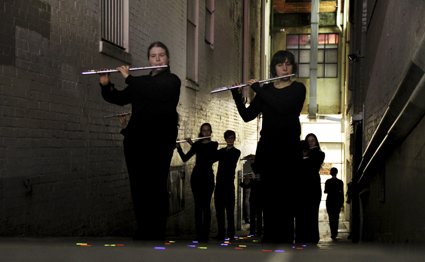
Super Critical Mass – Sub Mass 4, Burnett Lane
photo Lawrence English
Super Critical Mass – Sub Mass 4, Burnett Lane
BRISBANE’S ALBERT STREET MALL CUTS BURNETT LANE INTO A LONG END AND A SHORT END. THE SHORT END OF BURNETT LANE SLOPES DOWN BETWEEN A 7-ELEVEN AND A DUTY FREE, TO FINISH AT A CARPARK. THIS IS THE PUBLIC SPACE FOR SUB MASS 4, PART OF LIQUID ARCHITECTURE II—BUT IT’S BEEN PRIVATISED FOR THE NIGHT WITH A SEMI-CIRCLE OF SMALL BATTERY-POWERED FOOTLIGHTS PLACED AROUND THE ENTRANCE AND A COUPLE OF OH&S WITCHES’ HATS EITHER SIDE IN CASE PEOPLE DON’T REALISE THE DANGER FLAUTISTS PRESENT.
There’s a goodly crowd clustering around, waiting for the start. Four flautists emerge from the left hand side of a building at the bottom and start to walk slowly up the lane toward the crowd. They’re playing a soft drone and, as they move up the alley toward us, another group of four emerge from below, then another and another, until the alley is filled. When a row reaches the top they stop, turn, and walk down to the bottom to begin again. It’s a stately processional conveyor belt of flautists, pitch rising as they get closer and closer to the audience. Over 30 minutes the drone slowly breaks down to puffed bursts, then to a swinging gate effect as the pitches move from one group to another—a swinging sync that peters out, gets a pulse, peters out again.
It’s a beautiful piece, but there’s a problem. Late night shopping and the onset of dusk sees the Brisbane Mall a lively place. Seated on a platform, not a few steps away, a terribly sad woman strums an acoustic guitar and sings a dismal song about how one is often unaware of the value of what one has until it is gone. Further up the mall a retailer shares their enjoyment of jug band music with the public at large. So you can barely hear the performance. And you can’t see much of it either because of the narrow alley and the people clustered around trying to get best pozzie for whatever it is that everyone else is struggling to get best pozzie on.
The publicity blurb goes “As a listener you are invited to walk through the space or simply sit within the evolving sound-fields…This performance event, Sub Mass 4, draws you into the depths of Burnett Lane…” But it doesn’t and that’s a shame because if we had been allowed into the alley way and the space of the performers Sub Mass 4 would have been a great experience. On the other hand that’s fine because Sub Mass 4 is part of an exploratory/experimental program by the composers and the next night they perform the same piece in a very different setting where the audience and performers intermingled (which I missed, but apparently it worked a treat). I love this investigative approach to working—it seems a great addition to the take-it-or-leave-it model of art production as ‘revelation.’
Across the mall and down to the long end of Burnett Lane, runs Insitu: Sonore, sound installations for a few weeks in June, another Liquid Architecture 11 work. The long end is filled with trucks, bins, the arse end of shops selling Vietnamese koalas and plastic rulers covered with photos of Great Barrier Reef attractions or inset with the seven timbers of Australia.
And somewhere amongst all this is the sound of Janek Schaefer’s National Portrait. (Schaefer is the person who posted a voice activated dictaphone around Britain, picking up the stray utterances of various mail handlers.) I wander up the lane. I wander down, I wander up and down again. I hear the trucks, the air-conditioning ducts. It’s a great sounding lane. But no Schaefer. I ask upstairs at a newish art/design collective (Glow32) and they point to a little box above an awning. I go down and hang around trying to invoke the cocktail party effect that lets you hear your name whispered from the other side of a crowded room. Primed for Schaefer, primed for Schaefer—nup, nothing, a faint hint of a conversation maybe, then more nothing. This installation is way too quiet. Undeterred (well, a tad deterred) I come back a couple more times for more of the same.
Inhabit Fiesta: Urban Jungle, Eagle Lane
photo Lawrence English
Inhabit Fiesta: Urban Jungle, Eagle Lane
Ah well, off to another lane for another sound installation, Urban Jungle, part of the Inhabit Fiesta Festival, where works by Chris Watson, Lawrence English and James Webb are up for the next few weeks. This is more the Brisbane I know, modern high rise, no street life at all. At one end the lane pokes between two buildings to make a smallish aperture onto the rest of the city. This bit is closed off to cars, and Lawrence English has arranged a small, slightly tacky, setup of fake grass on the ground, shrubs potted and plopped along the sides. Looks like a temporary beer garden. The wind shoots through the space, rustling the leaves—suitably ear-height through the choice of shrub. The movement of leaves as a signal of changes in the air. A pleasure of sound at multiple scales. A message from another, biological, world. Contrast with the usual background city rumble: acquired deafness, slightly elevated blood pressure.
At the other end of the lane there’s a building on the right with grilled-over holes cut into the first floor. The entire building surface is articulated with bursts of white noise. It’s like being in a forest when bell-birds sing out and you hear space activated through sound. This time it is the reflective surface of a building, flat and high up, whose distance and shape is perfectly realised through the time it takes for sound to reach the ear. I can’t remember enjoying a public sound work more, but no sign saying whose work it is. Because it isn’t anyone’s—this is just how the space sounds without any intervention at all. What a find—whilst listening for soundworks I’ve been taking a soundwalk instead.
Liquid Architecture 11, artistic director Nat Bates, Brisbane curator Lawrence English; Sub Mass 4, Julian Day, Luke Jaaniste, Janet McKay, June 25; Insitu: Sonore, Janek Schaefer, Leighton Craig, DJ Olive, Brisbane, June 11-27
Inhabit Fiesta: Urban Jungle, Lawrence English, Chris Watson, James Webb, Brisbane June 11-27
RealTime issue #98 Aug-Sept 2010 pg. 46
© Greg Hooper; for permission to reproduce apply to realtime@realtimearts.net
Tin Rabbit’s Life Chance, Ros Bandt, part of Constellation: A Durational Chamber Work
photo Ros Bandt
Tin Rabbit’s Life Chance, Ros Bandt, part of Constellation: A Durational Chamber Work
TWO EVENTS AT THIS YEAR’S LIQUID ARCHITECTURE SUGGEST THAT THE FESTIVAL IS MOVING IN A NEW DIRECTION. A CENTRAL THEME IN BOTH CONSTELLATION: A DURATION CHAMBER WORK AND CONCERT II WAS THE RELATIONSHIP BETWEEN SOUND ART AND PERFORMANCE, EITHER AS RADICALLY DISCRETE OR THEATRICALLY INTEGRATED.
Concert II was held at the 3RRR performance space, a new venue for Liquid Architecture. The studio is a Melbourne institution and an important platform for non-mainstream music and culture. In this concert, duo Lionel Marchetti (France) and Yoko Higashi (Japan) integrated sound art and performance in a most striking way. Producing various forms of feedback, covering extremities in volume and high and low frequencies, musique concrète composer Marchetti sustained an intense atmosphere.
In white body paint and wearing a kimono, Yoko Higashi accompanied Marchetti, performing Butoh inspired movement. Her dark demeanor and contorted gestures provided a backdrop to the centrally located Marchetti. These different modes of performance gradually became literally entangled as Higashi climbed onto the shoulders of Marchetti, who continued unperturbed as his role in the dramaturgy of the performance shifted.
Higashi also crossed over into the realm of sound art, picking up a microphone and speaking softly into it. Twirled around, it thumped loudly as it banged against her body. This wild and almost dangerous gesture complemented the dramatic and violent energy of the music beautifully. Overall, the theatricality and musical content of this performance worked together well to create a thrilling atmosphere.
Opening the program with a far more understated approach, Perth based ensemble Decibel performed three works by Alvin Lucier. Each of these explores the sonic possibilities created by sine tones as they come into physical contact with objects or sounds in space (see also RT97).
Performed by flautist and ensemble director Cat Hope, Still and Moving Lines of Silence in Families of Hyperbolas requires the performer to play a series of sustained notes, moving in microtonal increments. In this extremely stark work the imperfections of the flute were exposed against the purity of two sine tones. However the essence of this piece is the way these frequencies clash in the space to cause ‘beating’ patterns. This created rich sonorities in the dry acoustic of 3RRR’s performance space.
The next work, Music for Snare Drum, Pure Wave Oscillator and One or More Reflective Surfaces, was an exercise in sympathetic resonance. As a sine tone gradually descended in pitch, the snares of a drum and the resonant frequency of the drum itself, were made to sound, causing a further range of sound complexes to occur and interact.
As in the opening work, in Lindsay Vickery’s performance of In Memoriam Jon Higgins a series of sustained tones on the clarinet were exposed against the comparative purity of the sine tone. The effect was accentuated further by what sounded like a small amount of spittle in Vickery’s throat or the mouthpiece.
The extreme starkness of these pieces invited a contemplative mode of listening. None evolved beyond very limited parameters, which were revealed in their entirety in the first few moments. Rather than articulating events over time, Lucier invites the audience to bear witness to acoustic phenomena. This was reflected in Decibel’s equally stark performance mode, in which the dramaturgy was inherent in the sounds themselves rather than the performers’ actions.
Following the restrictive conceptual scores of Lucier was a far more visceral and spontaneous approach to performance. 12 Dog Cycle, comprising Alice Hui-Sheng (Taiwan) and Nigel Brown (Australia), gave what felt to be a largely improvised performance. Using a piano accordion and effects processing to produce a texture of drones, Brown essentially provided a vehicle and framework for Hui-Sheng’s vocal performance. Hui-Sheng demonstrated a remarkable repertoire of extended techniques, moving between moments of intricate, breathy subtlety, to almost grating loud tremolos and shrieks.
A restrained approach to materials enabled this duo to build to passages of convincing intensity. In a performance which meticulously took its time to develop, these moments held the greatest impact.
Another event on Liquid Architecture’s program exploring an intersection between sound art and performance was Constellation: A Durational Chamber Work. Curated by Madeleine Flynn and Tim Humphrey, this exhibition explored the notion of a musical work outside the confines of performance. Eleven composers were invited to submit works based on the theme of the Zodiac. The title refers not only to the Zodiac, but also to the way the eleven works co-existed in an interconnected web.
Empty seats and music stands were arranged around the gallery space, mostly in pairs upon small podiums. Each seat represented a composer and members of the audience were invited to sit, triggering a recording of the composer’s work. Accompanying each piece was an artifact. In many cases this was a notated score, however this was not necessarily the rule. Videos, installations and instruments were also used to create a physical presence for the musical work. Not only an exhibition, this event also featured daily performance “interruptions” in which all the works were heard.
One of the strengths of this exhibition is its representation of diverse composition practices. Ros Bandt’s Tin Rabbit’s Life Chance is a strikingly original work, blurring the line between artifact and performance. In this interactive sound installation the participant is instructed to put on white gloves and spin a top on a large metal plate. These actions are part of a small ritual, culminating in a back-flipping contest between three wind-up toy rabbits.
Rat Tea Ceremony by Anita Hustas is an improvised musical work with a theatrical framework. Musicians are invited to partake in a tea ceremony with fortune cookies. The message within the cookie is used as a catalyst for improvisation, providing a clear indication of how the piece will unfold dramatically, however they also reveal that the musical content is extremely variable. There is a recording of this work as part of the exhibition, however as the piece is to be performed by two, six or 10 players on any instrument they wish, this is only one rendition of a work that may take on vastly different guises.
Carolyn Connors’ work, RatOxTigerRabbitDragonSnakeHorseGoatMonkeyRoosterDogPig, also offers a framework for improvisation, in this case for two-12 performers. However, rather than being concerned with the creation of a theatrical setting, the signs of the Zodiac are used as a starting point for improvisation. Robin Fox’s Melanoma Study # 1, a framework for improvisation for EWI (electronic wind instrument) and any keyboard instrument, features a Max/MSP patch for the EWI and pitch modules to be performed on the keyboard instrument. In each of these works, it is interesting for the audience to become acquainted with aspects of the work that would normally only be revealed to the performer.
David Young’s Esaurita (Breakdown) also has aspects which are left to the performer’s discretion, however there is far greater detail in the work’s structure, an original form of notation using an old constellation map. Moving vertical lines on a video score indicate when performers are to play. Composed for flugelhorn and “slightly” prepared piano, the notation does not indicate exact pitch, however it does indicate the rhythmic placement of notes with even greater precision than traditional notation, making this work an extremely successful exercise in control and indeterminacy.
Although the works in Constellation were performed from time to time, aptly as “interruptions,” the exhibition successfully presented its commissioned compositions as artifacts which were encountered by the audience outside of the usual performance context.
Liquid Architecture 11, artistic director Nat Bates; Concert II, 3RRR, July 2; Constellation, a durational chamber work, curators Madeleine Flynn, Tim Humphrey; Red Gallery, Melbourne, July 1-17
RealTime issue #98 Aug-Sept 2010 pg. 47
© Simon Charles; for permission to reproduce apply to realtime@realtimearts.net
END (Ice Cold Drinks) detail of installation, Andrew Varano
see image note*
END (Ice Cold Drinks) detail of installation, Andrew Varano
BEING AN ARTIST DOES NOT REQUIRE ANY PARTICULAR QUALIFICATION. UNLIKE ACCOUNTING, LAW, MEDICINE OR ARCHITECTURE, WHICH REQUIRE SPECIFIC TRAINING, QUALIFICATIONS AND ACCREDITATION, TO BECOME AN ARTIST YOU JUST HAVE TO ESTABLISH A PRACTICE. BUT AS A RESULT OF THIS, ONE OF THE DIFFICULTIES ARTISTS FACE—PARTICULARLY EMERGING ARTISTS—IS THAT THEIR STATUS AS PROFESSIONALS IS OFTEN SOMEWHAT UNCLEAR. OVER THE LAST DECADE IN AUSTRALIA, THE NUANCES OF OPERATING AS A PROFESSIONAL ARTIST—RATHER THAN AN AMATEUR, OR HOBBYIST—HAVE BEEN THE SUBJECT OF QUITE A BIT OF DISCUSSION, NOT LEAST IN RELATION TO THE WAY THE AUSTRALIAN TAX OFFICE AND SOCIAL SECURITY AGENCIES DEAL WITH PRACTITIONERS IN THE SECTOR.
artstart: qualifications required
While the Labor Government’s ArtStart policy was originally oriented towards dealing with some of these issues, in its final form it has become little more than another funding program managed by the Australia Council aimed at providing start-up support for artists. In fact, far from seeking to resolve the issue of how an emerging artist might establish their professional status, the program has fallen back on a very simple test—the key eligibility criteria is that the applicant is a recent graduate from an appropriate educational institution. While this might seem to focus the grant program on emerging artists, the removal of the initially proposed age limit sees ArtStart grants being awarded not only to young undergraduates, but also to older artists who have recently completed PhDs, some of whom may well have been exhibiting for a couple of decades. While I may be wrong, I think this makes ArtStart the only Australia Council grant program that requires an artist to hold formal qualifications. It’s an interesting move, particularly in the light of debates in and around the contemporary art school.
rethinking art school history
In this context two of the key threads of debate revolve around the way the creative activities of artist academics are valued as research within the university context, and the gradual shift towards the PhD as the terminal degree in the visual arts. Rethinking the Contemporary Art School: The Artist, The PhD, and the Academy, edited by Brad Buckley and John Conomos, is one of a number of recent collections of essays to enter into the debate around this territory. While it is a book that is very clearly international in approach—it’s published by the Press of the Nova Scotia College of Art and Design and includes contributions which focus on the Art School in North America and Europe, as well as Australia—the tone set by the editors seems very much derived from their Australian context (both are senior artist academics at Sydney College of the Arts).
Certainly, their introduction to the collection is framed by the complex changes to the Australian higher education sector over the past two decades, and the awkward place of Australian art schools within that context. It’s a pity that Buckley and Conomos don’t begin their account of the Australian art college system a little earlier than they do as this would have allowed a more nuanced picture of just where ‘art colleges’ were located—from those that stood alone and those that were already within universities to those attached to Colleges of Advanced Education, Institutes of Technology and even the TAFE system. Instead, by starting their account with the Dawkins reforms of 1990, they suggest that many of the problems of today’s Australian art colleges are the result of the ‘shotgun weddings’ that saw many colleges forced into amalgamations with the existing research universities. As they note, “until then, colleges which granted degrees did not have a research culture as such,” with the art work that was produced by teaching staff being referred to as “professional practice.”
In the wake of the shift of the art colleges into the university system, artist academics found it increasingly necessary to recast their ‘professional practice’ in terms of the research paradigms operating within the new context. It was often a very difficult fit, with the issue made all the more challenging by the imposition of more limited frameworks for what ‘counts’ as research across the sector as a whole, as well as the linking of funding to research outcomes. Significantly, the development of research based higher degrees within the field—particularly the PhD—has also produced some tensions with existing paradigms. But what Buckley and Conomos don’t deal with clearly is what we might see as the ‘two speed economy’ of contemporary art, that tension between art as ‘academic research’ and art as it operates out there in the art world. Perhaps they don’t see a difference between the two.
a qualification too far?
For Buckley and Conomos, the university system is not only subject to criticism because of the inflexibility of its traditional paradigms and values, but also because of the way it has shifted away from these towards an “increasing emphasis on training rather than education (the latter as represented by critical debate, discussion, difference and nuance).” In other words, the university system is both too traditional and inflexible, and at the same time has become too instrumental, too focused on vocational outcomes, rather than open critical inquiry. But if the amalgamations forced by the Dawkins reforms had not happened we might well still have a split system, with the art colleges most often aligned (as they once were) with the ‘training’ side. In light of this, it is a pity that no mention at all is made of the direction art education has taken within the TAFE system, where certificates and diplomas continue to be cast explicitly in vocational terms. There is of course an interesting tension for artists who teach in both systems. In TAFE a teacher now needs a certificate IV in training and assessment, while to teach in a university, the key qualification is the PhD.
If these remarks give the impression that Rethinking the Contemporary Arts School has an overall argument, it needs to be made clear that this is not the case. It is, rather, a set of diverse pieces gathered around a very broad thematic. And the approach is very varied, from Edward Colless’ virtuoso piece on the ‘trick’ of teaching, to chapters that focus on case studies around the approach of particular institutions, such as those by Mikkel Bogh (the Royal Danish Academy of Fine Arts) or Juli Carson and Bruce Yonemoto (the Studio Art Department of the University of California, Irvine). Other contributors include Bill Seaman, Gary Pearson, Sara Diamond, Su Baker and Lauren Ewing.
art school as intersection
One strong thread through the book is the impact of ‘new media’ and the internet on how art is developing, and how contemporary art students think and work. This, and other factors, have impacted on the shape of the visual arts as a discipline specific activity. As Su Baker puts it: “contemporary art may no longer be a discipline in itself but rather a place where disciplines intersect and interact.” Amongst the contributors to this book there is a general consensus that art education needs to become more interdisciplinary, perhaps even more undisciplined. As Lauren Ewing argues, “art students should be able to browse the curriculum and take courses they qualify for anywhere in the curriculum.” But significantly, what her examples demonstrate is that the art school of the future may need to be part of a larger institution, a node within an academic network, rather than a stand alone institution.
Where does this leave the ‘traditional discipline’ skills and knowledge that once provided the backbone of an art education? Might they be in danger of slipping away, along with the particular things art students might learn from them? Putting what he describes as an “unfashionable position,” Gary Pearson, for example, argues “that art history and production skills training, both increasingly marginalised in today’s curricula, remain important pedagogical fields, but they do require continual revision and upgrading in content and mode of delivery.”
looking for professional practice
But perhaps there are also new areas to be consolidated and developed. While a lot is said in this collection about the educational value of student interaction with practising artists, there is little comment on the concrete demand for what is these days usually termed the ‘professional practice’ course. Often seen as something of a side issue, and relatively neglected, it is the perceived lack of attention to this area that seems to underpin the focus of the ArtStart grant program. In light of this it seemed ironic that as I read this book, Sydney College of the Arts was advertising a newly created position of Lecturer in “Visual Art Practice.” The appointee’s responsibilities are to be focused on developing curriculum at both undergraduate and postgraduate levels, “to provide student artists with the relevant and necessary professional and entrepreneurial skills to achieve their personal career goals and an understanding of the elements of contemporary art curatorship.”
While it might be possible to think of this as just another slip down the slope of vocational training, my reading of the essays in Rethinking the Contemporary Art School suggests otherwise. For in the increasingly ‘undisciplined’ context of visual art education, it is within the context of ‘professional practice’ that the institutionally embedded nature of contemporary art is brought into sharp focus, with an essential intersection of both ‘research’ and the market.
Rethinking the Contemporary Art School: The Artist, the PhD and the Academy, edited by Brad Buckley and John Conomos, The Press of the Nova Scotia College of Art and Design. ISBN: 978-0-919616-49-3
*Image note: Andrew Varano is a graduate of Curtin University. This work won him the inaugural Dr Harold Schenberg Art Prize ($20,000) presented at the opening of HATCHED National Graduate Show, PICA, Perth April 16.
The judges said of their choice: “This work stood out as being distinctive and innovative with conceptual rigour and a refined use of visual, aural and kinetic languages.” PICA Press Release.
RealTime issue #98 Aug-Sept 2010 pg. 48
© Peter Anderson; for permission to reproduce apply to realtime@realtimearts.net

Bronia Iwanczak, Defence Rhythm, 1997
courtesy the artist
Bronia Iwanczak, Defence Rhythm, 1997
PLAIN SPEAKING RENEGADE ART CRITIC DAVE HICKEY TAGS IT “THE INVISIBLE DRAGON.” IT’S BEEN DEEMED “UNCONTROLLABLE” WHILE OTHERS HAVE WRITTEN OF ITS “MISADVENTURES.” PICK PHILOSOPHER ARTHUR C. DANTO’S BRAIN AND HE WILL TELL YOU ALL ABOUT ITS “ABUSE.” BEAUTY, AS MUCH AS IT PURPORTEDLY REMAINS A TABOO IN TODAY’S ART WORLD, HAS CERTAINLY HAD SOME IMPASSIONED WORDS PENNED IN ITS DEFENCE IN THE PAST TWO DECADES.
Conceptual Beauty: Perspectives on Australian Contemporary Art, a new book by Sydney visual arts scholar and writer Jacqueline Millner, doesn’t take to this debate with guns blazing. Rather, from the perspective of an attentive, perceptive and thoughtful critic who has observed the breadth of Australian art practice on the ground for the past decade and a half, there emerge some telling observations on the state of beauty in Australian art. Firstly, Millner identifies a substantial body of Australian artists making visually compelling artworks that challenge audiences to consider complex ideas, often of a political or socially engaged nature. Unlike their anti-aesthetic contemporaries, these artists care deeply about materials, craft and formal qualities. And, as it happens, many of them are women, some relegated to the margins of the local canon.
For these findings alone, Conceptual Beauty is a worthy addition to the critical landscape. Yet the book serves another function, too. A collection of previously published essays and articles (some from RealTime) spanning the mid-90s to the near present, the book offers insight into many of the driving concerns of recent contemporary art as well as a window into Jacqueline Millner’s development as an arts writer. As such, the author has not confined herself to the subject of beauty and, reflecting her diverse interests, the book is organised around the broad themes of nature, space(s), body relations, politics, history and, lastly, beauty. Yet even when the author is not directly dealing with this subject, much of her writing embodies a revisionist impulse that acknowledges the critical power of aesthetics.
Take her choice of cover image which offers a good clue to the type of beauty to which Millner is drawn. An installation detail from Bronia Iwanczak’s Defence Rhythm (1997), it shows two embryonic slug-like forms fashioned from fractured eggshells packed ever so delicately and self-entwining, giving rise to a tension between strength and frailty. There is charm and visual allure to be found in the artist’s resourcefulness, in her artisan-like attention to her materials and in her meticulous arrangement of these brittle cast-offs into patterns of soft tonal gradation from dark to light. They are indeed beautiful, in an unconventional way. Yet, Millner suggests, they speak also of the larger cultural climate of late modernity where “life continues, albeit in corrupted, hybrid forms, forged out of expediency from whatever is at hand.”
While Defence Rhythm is placed in the chapter on history, Iwanczak’s creations would also be at home in the primary essay in which Millner contextualises her main argument; “Conceptual Beauty: Aesthetics and recent Australian contemporary art.” Focusing on the practices of Fiona Hall, Tracey Moffatt and Rosemary Laing, Millner formulates “conceptual beauty” as describing “an artwork’s integration of intense attention, pleasure, and communication in a way that can bring about a momentary decentring of self in the viewer and evoke a ‘wealth of thought-emotion’ capable of creating the materials with which to construct new concepts and the socio-political arrangements that would correspond to them.”
The types of “thought-emotion” that artworks exhibiting conceptual beauty can give way to appear vary in Millner’s inventory. Robyn Stacey’s wondrous large-scale photographs of moth, insect and animal specimens normally hidden away in natural history collections, for example, provoke consideration of the interdependence between science and the visual in systems of taxonomy. Equally seductive are the super slick techno-human sculptural hybrids of Patricia Piccinini, underscored by ethical concerns over the manipulation of nature in the digital age. While the visceral delight to be enjoyed in the sensual and gloriously thick lashings of paint on Ben Quilty’s canvases form the material of a playful yet multi-faceted enquiry into the negotiation of masculine identity in Australian culture.
As noted, there is undoubtedly an emphasis on the practice of female artists at play here, and while male artists such as Mike Parr, Adam Geczy, David Noonan, Christopher Dean, Jonathan Jones and William Seeto are included, Millner is unapologetic about the gender imbalance. This stems partially from the author’s long running interest in feminist theory and art practice, as well as a natural attraction to the “strength of ideas” she finds in the work of Australian female artists. It would be unnecessarily heavy-handed to insist on equal representation of male and female artists, but given the long entrenched association of women with such areas as beauty, nature and the body, it is possible the inclusion of just a few more male artists who consciously employ the trope of beauty would have been effective in further challenging stereotypes.
The two-fold aim of the book to offer a snapshot of Australian practice from the mid-90s to now, whilst also putting forward an argument for the term “conceptual beauty” does pose structural challenges, too. For the most part these are skillfully handled but for one perplexing choice, the placement of the extended essay on Conceptual Beauty, the raison d’être for the book’s title, toward the end of the book. Perhaps this represents a gesture of humility on the author’s part, not wanting to impose an umbrella type theory over the entire volume especially when it doesn’t apply to every essay, leaving readings more open. Yet having skipped forward to this section, craving a deeper explication of Millner’s term, subsequent readings of preceding chapters did seem enriched.
Such phrases as ‘beauty is in the eye of the beholder’ tend to become clichés because they contain a distillation of truth. The strength of Millner’s contribution lies in her capacity to enact a journey into the mind of the ‘beholder’ with her thorough, and frequently elegant, assessments of the psychological processes that cleverly crafted objects can engender. Writing from a position of empathy, rather than provocation, Millner practices what she preaches by handling artists’ work with care. In this way, Conceptual Beauty speaks of a fairer critical benchmark where ideas and aesthetics may, at last, be equally weighted.
Conceptual Beauty: Perspectives on Australian Contemporary Art by Jacqueline Millner is published by Artspace, Sydney, 2010. ISBN 978 1 920781 41 5
RealTime issue #98 Aug-Sept 2010 pg. 50
© Ella Mudie; for permission to reproduce apply to realtime@realtimearts.net
Aleks Danko, Jude Walton, A list of positive things for later when things may not be so positive, Palm House, Adelaide Botanic Garden
photo Michael Zerman
Aleks Danko, Jude Walton, A list of positive things for later when things may not be so positive, Palm House, Adelaide Botanic Garden
AT MEDIEVAL FEASTS THERE WAS A PARTICULAR CLASS OF DISH CALLED SUBTLETIES. TRICKSY DISHES, THEY WERE MADE FOR EFFECT (MARZIPAN CASTLES, BIRDS IN A PIE) AND ALL ABOUT ILLUSION AND ITS DISSOLUTION. COLLABORATIONS BETWEEN MAKER AND AUDIENCE, THEY DEPENDED ON THE DINER’S WILLINGNESS TO RISK ENTERING THE UNKNOWN AND THE ILLUSIONIST’S CREATIVE SKILL. IN RETURN FOR BELIEF THE REWARD WAS SURPRISE AND DELIGHT. THIS TACIT CONTRACT LIES TOO WITHIN COLLABORATIVE PARTNERSHIPS. AS COLLABORATORS ARE TWINNED AND DOUBLED, SO RISK AND DELIGHT ARE INTIMATELY ALLIED. NO LIGHT THING, DELIGHT IS SHADOWED BY LOSS AND FOR THE DELIGHT OF WHAT IS GIVEN AND CREATED, COLLABORATORS CONTINUALLY RISK IT.
It’s not such a long way then from marzipan castles to Pip and Pops’ fantastical sugar landscapes, Farrell and Parkin’s gleeful animation or the joy of two poets talking on a bright cold day, for delight runs deep through Duetto’s rich offerings.
Twinning exhibitions with film and performance elements, the Australian Experimental Art Foundation’s exploration of the nature of collaborative partnerships, Duetto, ranges over a broad variety of collaborative forms and expressions. What emerges most strongly from this multiplicity is a sense of sustenance—of sustaining and being sustained by these ineffable and often alchemical relationships. While these may, as director Domenico de Clario writes, “resist any kind of articulation” (Duetto catalogue), the scaffolding is there to be sensed in the rhythms, synergies and patterns of the work.
Delight is immediate with Pip and Pops’ Three minutes happiness (2010), their grand, hugely detailed landscape composed wholly of coloured sugar, origami follies and craggy mountains. Its wealth of things (birds, lights, horses, rainbows) technicolour palette, scale and idiosyncratic sensibility fascinate. Yet it’s not simply whimsy with the landscape forms and arrangements owing as much to Japanese gardens, with their raked patterns and symbolism, as to the sensibilities of kawai culture’s cuteness. In the same way that Japanese landscapes draw the viewer into contemplation, the absolute superabundance of Three minutes happiness provokes wonder, drawing the eye in and through, revealing something gentler and deeper.
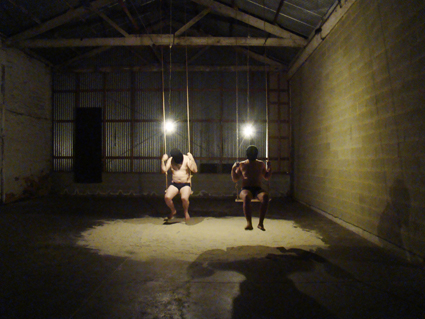
D&K, The stranger and his friend, Queen’s Theatre
photo Teri Hoskin
D&K, The stranger and his friend, Queen’s Theatre
Here collaboration emerges as ethical. Greg Burgess and Pip Stokes write of their relationship as “a form of healing care of the self and other” and their term “the architecture of kindness” seems an apt and expressive one for the structures of nurturing partnership and for the persistence of care that abounds in the works in Duetto. D&K’s performance The stranger and his friend (2010) involved the two men almost naked, hooded in black, slowly swinging and singing hymns beneath naked, single light bulbs. Haunting, it was also a work of great and unexpected tenderness.
Janine Antoni and Paul Ramirez Jonas’ two-screen video work Migration (1999) shows one artist endlessly stepping into the only just made footsteps of the other. Quoting Octavio Paz on the experience of love, “we are the theatre of the embrace of opposites and their dissolution,” the continuous production of the self, other and the collaborative third is embodied in this endless loop of making and dissolving footsteps.
This experience of being joined and yet individual is articulated as forms in space in Burgess and Stokes’ Sense (2009). Hollow beeswax blocks, the six-sided form referencing the cell and collective life of the beehive, are arranged in an open curve, like a half built tower. Neither open or closed, the curve creates a sheltering space defined by the tension between openness and enclosure. Not simply a work between two people, photographed in its original bushland setting, Sense extends collaboration into a healing relationship with nature.
The doubling of self and other moves through the spoken word poems of Aleks Danko and Jude Walton. Taking their audience on a rambling processional through the Adelaide Botanic Gardens they performed A list of positive things for when things may not be so positive (2010). An index of first lines borrowed from other poets—”musing on roses and revolutions,” “beauty and beauty’s son,” “and the winter’s cold bright tulips we do know”—grew into a singing duologue of lines bouncing back and forth between the poets, a gentle rhythm of the accommodations of each to the other’s thought. Enveloped jellyfish-like in raincoats in the Victorian Palm House, they gave us a couplet of longing (“I mist you,” “I mist you too”) as they lovingly sprayed water into each other’s faces. The rhythm of this nurturing partnership flowed through it all as play and humour.
Different sorts of collaborations take place in the works by Stelarc and Nina Sellars and Farrell and Parkin as they expand and mutate the possibilities of collaboration. Stelarc’s Ear on Arm (2010), seen as a giant sculpture and surgical photographs, is to be internet enabled with microphone and transmitter allowing remote transmission and input. Becoming many to one, Ear on Arm both diffuses the idea of collaboration as necessarily intimate and complicates it as the ear becomes the implanted collaborator.
As Stelarc morphs self into many, Farrell and Parkin merge in their kooky manga video Physiology of spite (2009/10). Stretching the possibilities of portraiture, Farrell and Parkin have mutated their images into cartoon beings. Seen first as themselves they mutate into winged creatures that spread flaming, highly coloured destruction. Against this unreal apocalypse comes the third creature made of their merged photographic selves, a golden ambiguous angel. This oddball take on the collective self embodies their practice, their joyful willingness to enter into the collaborative moment, recognising its generative possibilities and the surprise and delight therein.
Missing my own domestic collaboration, I couldn’t attend the World Cup tribute soccer match or Domenico de Clario and Stephen Whittington’s tribute to the eclipsed moon, Universe as Mirror (2010). But in a way the descriptions of these celebrations were enough. Delighting me in the telling, in my brain they became something other than what actually happened. Ideas connect and grow; every time a tiny collaboration.
AEAF, Duetto; Queens Theatre, Mercury Cinema and Adelaide Botanic Gardens, Adelaide, May 28-June 26
RealTime issue #98 Aug-Sept 2010 pg. 52
© Jemima Kemp; for permission to reproduce apply to realtime@realtimearts.net
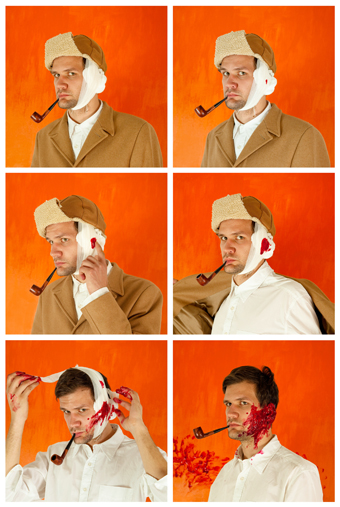
I, Goghbot, 2010, Reges Lobud, digital print
courtesy the artist
I, Goghbot, 2010, Reges Lobud, digital print
IN THE AUGUST-SEPTEMBER ISSUE OF REALTIME EACH YEAR WE TRY WHERE POSSIBLE TO FEATURE INTERESTING WORKS BY STUDENTS, RECENT GRADUATES AND EMERGING ARTISTS. OUR SEARCH TAKES IN UNIVERSITY WEBSITES AS WELL AS EVENTS SUCH AS THE HATCHED GRADUATE ARTISTS EXHIBITION HELD AT PICA EACH YEAR. MORE RECENTLY, WE’VE CAST OUR EYES OVER THE SHORT-LIST FOR THE NATIONAL YOUTH SELF-PORTRAIT PRIZE HOSTED BY THE NATIONAL PORTRAIT GALLERY IN CANBERRA.
That’s where we came across our striking cover artwork entitled I Goghbot, 2010 by Egres Ludob. It didn’t win the prize (that was awarded to Bridget Mac for her portrait masculine/feminine). In interpreting Van Gogh’s famous Self-Portrait with Bandaged Ear, Ludob says he “tried to envisage what the work would look like when adapted for modern trash culture which favours shock value and ultra-realism.” At the same time he wanted to “maintain a tongue in cheek criticism of trash culture. When historical works or events are reinterpreted in popular culture, for me they lose a lot of romanticism and mystique due to sensationalism.”
I, Goghbot is part of a series of works that Ludob is working on, based around a similar theme of selective re-imagination of historical works in a modern context.
I asked Egres Ludob’s alter-ego Serge Bodulovic about his educational trajectory which offers an example of the progress of the young working artist in the age of creative industries. He wrote, “I graduated from ANU in 2007 with B Comm (majoring in Marketing) and B Arts (majoring in Art History) degrees. I also completed a fashion design course in Milan after completing university.
“I had decided to study commerce, particularly marketing and advertising because it enabled me to combine creative expression with an educational background that could be utilised in any industry or endeavour. I also like the referential and humorous aspects of marketing and advertising, which I try to adopt in my work. Whether my marketing studies can be used in the traditional sense still remains to be seen. I had also wanted to study Fine Art, but was unable to do so while studying commerce, as the ANU did not offer cross-institutional studies between Fine Art and the Commerce faculty. So I switched my focus to a more academic study of art. My studies in Art History, including film have added to my passion for popular culture and allowed me to get an in-depth insight into the lives and times of artists and movements.”
As well as maintaining his own art practice and curating shows at the Canberra Contemporary Art Space and other galleries, Serge and his colleague Simon Gibson founded the designer boutique menswear label, Book Club.
“While there are clear overlaps between the two in a creative sense as both use the medium of photography, I personally treat them as two separate areas of endeavour, hence the use of an (admittedly poor) nom de guerre for my artworks. The reason why I separate the two areas of my life is due to the fact that with fashion design there are commercial realities that need to be addressed in order to have a successful label. With art, it is purely a means of self-expression, not based on commercial considerations. I also have more trepidation about showing my works as an artist as it’s a more direct representation of my creativity than fashion design, which is more removed as it deals with tangible, utilitarian objects.”
National Youth Self-Portrait Prize, Finalists exhibition, National Portrait Gallery, Canberra, on show to September 12. http://www.portrait.gov.au
RealTime issue #98 Aug-Sept 2010 pg. 53
© Virginia Baxter; for permission to reproduce apply to realtime@realtimearts.net
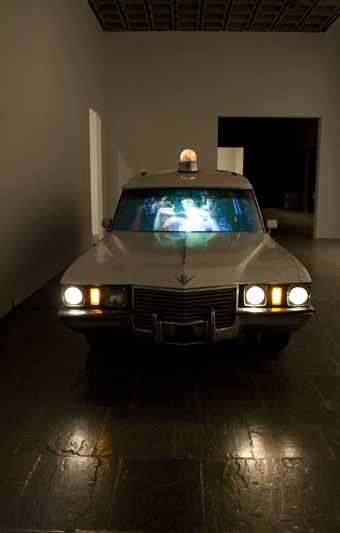
We Like America and America Likes Us (2010), The Bruce High Quality Video Foundation
BOTTLES AND JARS WRAPPED IN RED NET HOLD AMBER, JELLY-LIKE SUBSTANCES AND HANG ABOVE AND NEXT TO OLD ELECTRICAL DEVICES, STOOLS AND BOXES. A SLIGHT WOMAN STANDS AT THE WALL DRAWING A LARGE CHARCOAL GRAPH, ITS SHAPE TRACED IN CONFIGURATIONS OF ROPE AND NETTING. WITH LARGE CUSHION ‘DOUGHNUTS’ ON HER ARMS, WHILE PROJECTORS TURN ON AND OFF, SCREENING LIGHT AND SCIENTIFICALLY FORMED CIRCULAR SHAPES, SHE MAINTAINS A CONTINUOUS MONOLOGUE ON THE MATHEMATICAL CONCEPT OF THE LORENTZ ATTRACTORS (WHOSE CONTINUOUS MOVEMENT AROUND CERTAIN POINTS CREATES DOUGHNUT-LIKE SHAPES) CONNECTING HER ACTIONS TO THE INSTALLATION. THIS IS STRANGE ATTRACTORS, A FRENETIC PERFORMANCE PIECE AND UNCANNY INSTALLATION BY AKI SASAMOTO INCLUDED IN THE 2010 WHITNEY BIENNIAL.
Sasamoto’s sustained action and disorienting monologue created a language that underscored the experimental possibilities of intersection, confluence and the everyday nature of disjuncture. A little like a ‘happening,’ the physical and linguistic permutations of the performance seemed to foreground the trajectories of this year’s biennial and its media works in which the language of modernism—its reconfiguration—and the centrality of experimentation and abstraction were guiding aesthetics.
The ‘intermedia’ aesthetic of Strange Attractors found resonance through a confluence of spoken word and image in The Bruce High Quality Foundation’s video work. On a white Cadillac Miller-Meteor’s windscreen they projected a video created out of YouTube clips (think funny cat videos and babies throwing food), Hollywood movies (Ghost Busters, Frankenstein, Independence Day) and news media. The vehicle—designed to double as hearse and ambulance—provides an engaging viewing platform across which this stream of images, iconic and everyday, lulls us into a comforting visual rhythm.
The images fade in and out while a low female voice soothes us with descriptions of her/their relationship: “We like America. And America likes us. But somehow, something keeps us from getting it together. We wished we could have fallen in love with America. She was beautiful, angelic even, but it never made sense…America stayed simple somehow. He stayed an acquaintance, despite everything we shared. Just a friend.”
We Like America and America Likes Us (2010) makes clear references to Joseph Beuys’ I Like America and America Likes Me (1974). Both works deal with the cultural myths of America, reviving them, critiquing them, exposing them. But in this piece the centrality of human physicality is muted as the image/text confluence sculpts us into the work. It’s confrontational—the images in their strange juxtapositions demand some kind of imaginative work. It’s also ritualistic: the slow cadence and rhythmic relationship of the film clips to the voiceover recreates the open space of the white walled room (lined with large digital images of Lorrain O’Grady’s First and Last of the Modernists, 2010) into something more reverential, within which the large white motor vehicle serves as mausoleum and instrument of healing. Standing in this space evokes an intense feeling of collectivity: the voiceover, hushed, solemn, also disjointed, provides something like an architectural frame. The monologue layers over and insulates the soft flow of images, while threading us into its passage of time.
These works and the artists creating them spoke back to a history of modernism in which language—and its abstraction into the realm of the performative—was central. A floor below, Ärztliche Zimmergymnastik (2008), the video work of Jesse Aron Green, created another form of abstraction in the angulated movement of his performers. His work is based on a book of the same name by Dr Daniel Gottlob Moritz Schreber (1808-1861; his son’s self-documented hallucinatory nervous illness fascinated Freud) detailing a system of exercises designed for the maintenance and invigoration of a healthy body and mind. Green uses the book as a kind of ‘score,’ his revolving camera (slowly making a complete revolution of the room in 80 minutes) captures 16 men performing an entire catalogue of physical movements executed according to the 45 exercises created by Schreber. Green’s gridded arrangement, the pieces of its constructions—the wooded plinths the performers stand on—and the extended duration of his single shot camera work reference minimalism and structural film making, highlighting and critiquing the relationship between these modernist art practices, psychoanalysis and the ideologies of 19th century German physical culture.
Tracing this history, the work nonetheless maintained a remarkable lack of rigidity. I was struck by the coalescence of the bodies, the way arms, heads, feet moved in sequences that solidified into a kind of bodily legibility characterised by a silent fluidity. In the seamless rotation of the camera and its slow elucidation of the bodies on view, the aesthetic rigidity of these earlier art practices was brought into a more intimate plane. As I watched, for at least half an hour, this formal abstraction of the body into gesture seemed more akin to a poetic anthropology. Becoming aware of the exact motions, a fine attenuation of muscle, skin, bone in the thrust of an arm, the curve of a neck, the elongation of a foot, Green created the space for a heightened sensitivity to what I can only describe as a physiological collectivity of (self) awareness.
The expansion of the video screen into the space of the gallery was effective in Parole (2010), a multi channel video projection by Sharon Hayes. Each of four walls held a video screen, and the work itself was housed within the four walls of a Whitney white box. Once inside the ‘inner’ structure—composed of plywood, plank supports, PA systems and wall coverings—I sat and watched various scenes of public speech play across the four screens—news segments, speeches, public recordings, auditions—each of them connected through the inclusion of a mysterious, silent, red-haired figure. This figure records sounds—political lectures, erotic readings, a kettle boiling, the reading of a love letter—but never speaks. Her silence is translated into a constellation of facial expressions that keeps time with the work’s expansion across the space of its projection. It unfolds around me through a simultaneity of differing experiences, flow of emotions and snatches of recognition. Poetic yet highly simulated the work examines the alluring, and harmful, power of speech, the marginalisation of sexual minorities and in its haunting expansiveness provided a uniquely communal sense of personhood.
A few rooms on I came across Annotated Plans For an Evacuation (2009) showing artist Alex Hubbard modifying his Ford Tempo. Shot in static profile by a camera attached to the side of the vehicle, Hubbard’s alteration followed a deliberate plan in which the continual transformation of his car unfolded to a soaring soundtrack across a shallow depth of field that immediately entangled me within its small, tucked away space at the back of the gallery. The deadpan purpose of Hubbard’s automotive alterations led only to a process of sustained movement, poignant and painterly in its action. A haunting complement to the structural analysis of Ärztliche Zimmergymnastik this study in time transformed the screen into a canvas in which the banality of the everyday and the mechanics of the industrial are pictorially arranged into a series of precise colours, lines and angles. An animated form of assemblage, Hubbard’s alterations called attention to the textural work of video, its ability to elongate and compress our sensory perceptions.
In the sculpture courtyard transformed by Theaster Gate’s installations of shoeshine chairs—a wooden pavilion, and walkways lined with repurposed Wrigley gum boxes—I watch Derek Chan crouching over a large checkered square of calligraphy paper. He slowly markes off each square—a diary of thoughts—with a random series of signs, sometimes breaking off to speak with viewers and obstructing the completion of his patterns. A study in the informal practices of everyday interaction and the specificity of urban life, Chan’s performance of serialisation and introspection is an intriguing complement to the graphic loops of dialogue and objects in Strange Attractors. The new media ‘aesthetic’ in the mutual fascination with serialisation and patterning to screen the encounter between artist and viewer highlighted the ritualised gestures that animate our everyday interactions.
What emerged for me in these video and performance works were the collective possibilities of new media. Through the ‘intermediation’ of text, image and installation the expansive and elemental historical languages of modernism were refigured through forms of contemporary abstraction.
2010 Whitney Biennale, Whitney Museum, New York, Feb 25-May 30, http://whitney.org/Exhibitions/2010Biennial
RealTime issue #98 Aug-Sept 2010 pg. 54
© Anna Arabindan-Kesson; for permission to reproduce apply to realtime@realtimearts.net
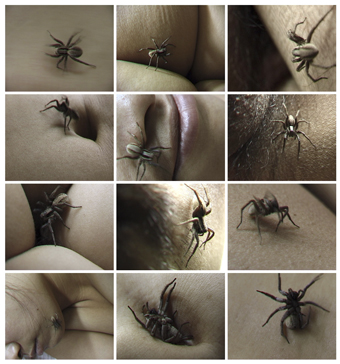
Looking, Looking, Looking for…, Kan Xuan (2001)
courtesy of the artist
Looking, Looking, Looking for…, Kan Xuan (2001)
GREETING US AT THE ENTRANCE TO THE GALLERY ARE TWO TRADITIONAL CHINESE LIONS. RATHER THAN BEING CARVED OF STONE, HOWEVER, THESE CREATURES ARE TRAPPED INSIDE SCREENS, THE LION ON EACH SIDE SPLIT BETWEEN TWO STACKED MONITORS. FAR FROM UNHAPPY ABOUT THEIR FATE, THESE LIONS ARE PLAYFUL, WINKING AT US, LIFTING PAWS AND SENDING OUT THE OCCASIONALLY PROVOCATIVE ROAR. THE WORK, ALWAYS WELCOME (2003) BY WANG GONGXIN, ONE OF CHINA’S LEADING VIDEO ARTISTS, OFFERS AN INVITING INTRODUCTION TO MU:SCREEN, AN EXHIBITION OF CHINESE VIDEO ART CURATED BY MARIE TERRIEUX AT THE UTS GALLERY.
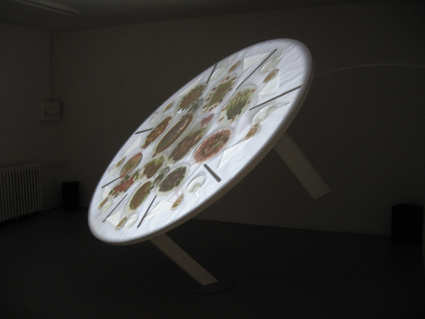
The Dinner Table, 2006, Wang Gongxin
courtesy the artist, collection of the Neilson Family, White Rabbit Collection, Sydney
The Dinner Table, 2006, Wang Gongxin
Wang Gongxin contributes another sculptural video work, The Dinner Table (2006). An oversized tabletop on a precarious 60-degree angle acts as the screen for the projection of a fully set banquet table. Gradually we begin to notice that the sauce from some of the plates is seeping across the table, but defying gravity, oozing upward. Before long, food and cutlery are all impossibly sliding up and over the edge, accompanied by soft crashes and clangs, until all that remain are the stained tablecloth and a few napkins, which are also whipped off, surprisingly from the lower side of the table. Wang’s challenge to viewers’ spatial perception is a potent metaphor for the provocations that art can offer to established ways of seeing—particularly resonant as he is one of the first artists in China to push beyond traditional mediums to explore video.
Zhang Peili is in fact recognised as the first Chinese video artist. The piece included here, Water—Standard Version from the Dictionary Ci Hai (1992), features a news presenter reading the full nine-minute definition of the word for water from a dictionary. As there is no translation offered, the experience for an English speaker is purely conceptual, but the correlation with works by Western artists such as Bruce Nauman is clear. As Peili is such an important figure, it would have been interesting to experience at least one other work of his (as we do with Wang) to get a clearer sense of his practice and of the beginnings of video art in China.
There appears to be a clear lineage between Zhang and Wang’s work—in the manipulation of temporal qualities and the concentration on live action—expressed in the work of two of the younger artists represented. In Kan Xuan’s Looking, Looking, Looking For…(2001), presented on a small screen, a tiny spider skitters over naked male and female bodies, exploring every crevice and orifice. Both playful and disturbing, the work has the ease and directness of approach that characterises a generation born into a media and technologically driven age. Similarly, Ma Qiusha’s A Beautiful Film (2007) suggests an artist immersed in a critical exploration of screen culture as well as contemporary representations of sexuality. She uses close-ups of pornographic images to create a hazy, romanticised vision of beauty, accompanied by endlessly scrolling movie credits.
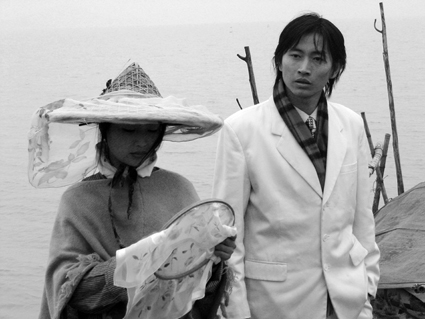
Liu Lan, 2003, Yang Fudong
courtesy of Shanghart gallery
Liu Lan, 2003, Yang Fudong
Yang Fudong, has recently been introduced to Australian audiences with his disturbing work East of Que Village (2007), presented as part of the recent Biennale of Sydney (RT97, p 46). A less harrowing experience, his work in this exhibition entitled Liu Lan (2003) is stunningly shot on 35mm black and white film (transferred to video) and focuses on a beautiful young fisherwoman on an eerily isolated lake where she is joined by a handsome man from the city wearing a white suit. It is a quiet, romantic vision of an impossible meeting occasionally undercut by the extraordinarily weathered face of an old woman, hinting at these as her memories or dreams. Under the veneer of idyllic beauty is a subtle sense of irony and social criticism that gives the work its intensity.
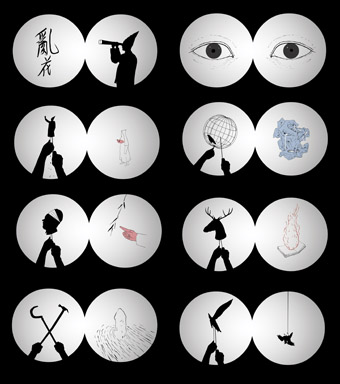
Flowers of Chaos, 2009, Wu Junyong; exhibited as part of Mu: Screen, UTS Gallery
courtesy of the artist
Flowers of Chaos, 2009, Wu Junyong; exhibited as part of Mu: Screen, UTS Gallery
Interestingly, three of the artists utilise drawing and animation. Most intriguing is Flowers of Chaos (2009) by Wu Junyong who, with his simple, almost naive line drawings, creates his own symbolic language to explore power, manipulation, repression and freedom in a strangely joyous way. Sun Xun’s People’s Republic of Zoo (2009) also explores these themes, with animal/human chimeras acting out symbolic power plays. Sun’s animation is a complex collage of styles reminiscent of William Kentridge—drawings, cutouts and actual video footage of shadow play—that bring to mind a dark, often opaque dreamscape.
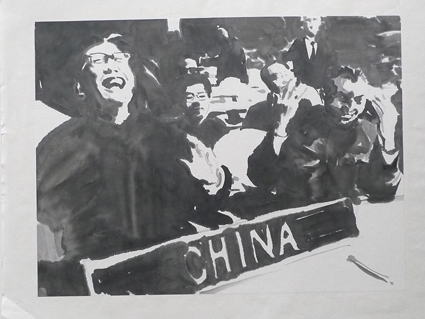
The Ink History, 2010, Chen Shaoxiong
courtesy the artist
The Ink History, 2010, Chen Shaoxiong
With four works presented, it is hard not to see Chen Shaoxiong’s Ink series as the centrepiece of Mu:Screen. Created from hundreds of ink drawings, these simple animations often involve just flipping through different scenes, or at most a close-up or pan within an image. It’s the accumulation of detail that makes these works so powerful. Across the four screens, we move from everyday life in The Ink City (2005) to the personal in The Ink Diary (2006), to a micro view in The Ink Things (2007), ending with the macro in The Ink History (2010), an epic exploration of Chinese history. Chen’s work is particularly poignant, not only in its subject matter—the methodology itself illustrates the tensions between old and new media.
The UTS Gallery was well transformed to house the substantial number of video works in this exhibition, although the issue of soundbleed presented a problem. While some works were well served by headphones, there were still four soundtracks mingling in the reverberant, tiled space. The effect was exacerbated in the use of video projectors as audio source for two works rather than placing speakers in close proximity to the actual projection. This meant that sound and image became quite dislocated and confusing, particularly in the case of Sun Xun’s work.
Marie Terrieux is a freelance art consultant, with her own company, Shuang Culture, advising collectors and institutions and working with established and emerging artists from China and the region. Her thorough knowledge of the Chinese art scene is evident in this exhibition, which includes illuminating contextual information on the website. Terrieux’s choice to present artists across three generations provided a fascinating introduction to an area of art-making only just beginning to make the same impression as other Chinese art practices on the international stage.
Mu:Screen, three generations of video art, curator Marie Terrieux, artists Wang Gongxin, Zhang Peili, Chen Shaoxiong, Yang Fudong, Ma Qiusha, Wu Junyong, Sun Xun, Kan Xuan; UTS Gallery, Sydney; June 1-July 9; www.utsgallery.uts.edu.au; www.muscreen.com
Wang Gongxin’s The Dinner Table (2006) was lent to Mu:Screen by the White Rabbit Gallery, Sydney which houses the largest private collection of contemporary Chinese Art outside China. www.whiterabbitcollection.org
RealTime issue #98 Aug-Sept 2010 pg. 56
© Gail Priest; for permission to reproduce apply to realtime@realtimearts.net
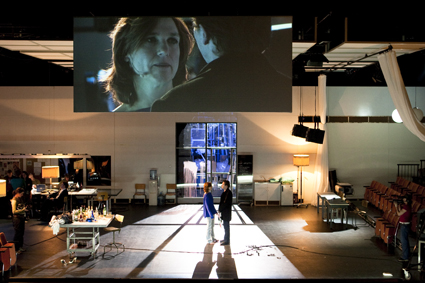
Opening Night, Toneel Groep, Melbourne Festival 2010
photo Jan Versweyveld
Opening Night, Toneel Groep, Melbourne Festival 2010
9.30AM, SYDNEY HILTON HOTEL SUITE: COFFEE, PASTRIES, FOUR MEMBERS OF THE PRESS AND BRETT SHEEHY. AN INTIMATE, 50-MINUTE BRIEFING ON THE ARTISTIC DIRECTOR’S PROGRAM FOR THE 2010 MELBOURNE INTERNATIONAL ARTS FESTIVAL. IT’S THE SECOND OF THREE BRIEFINGS THIS MORNING AND ONCE WE GET PAST A LUMPEN CELEBRATION OF THE 2009 FESTIVAL’S ECONOMIC SUCCESSES (“I KNOW IT’S NOT ABOUT THE MONEY, BUT FINALLY IT IS ABOUT MONEY”), SHEEHY’S POSITIVELY EFFERVESCENT.
A festival theme, “a motif,” he declares (conjuring images from his laptop onto the big screen before us), has emerged naturally from the well-spring of his discussions with Australian and international artists selected for the festival. “Spirit,” “mortality,” “transformation,” “transition,” “transcendence,” “ascension” and “epiphany” consistently bubble forth as the ever speedy Sheehy briskly uncaps his program. No mere froth and gas, there’s plenty of body here: a festival about “mortality and spirituality, not in a religious sense, but in terms of transition and transcendence.”
cassavetes’ opening night
The standout work in the program, and the one on which Sheehy lavishes most attention in this briefing is Toneelgroep Amsterdam/NTGent’s Opening Night by John Cassavetes, directed by Ivo van Hove whom Sheehy ranks as “one of the greats with Mnouchkine and Ostermeir” (whose works have appeared in Sheehy festivals). Van Hove is reproducing the 1977 Cassavetes classic on stage. As opening night of a new play draws near, an ageing actress faces emotional collapse after the death of a fan, “confronts her own mortality,” says Sheehy, “and comes out the other side with an epiphany.”
Sheehy explains that “over the last few years van Hove has been dissecting theatre and cinema and looking at the points of cross-over and diversion. Camera men and women, all professionals from the world of cinema, constantly feed the performance live by video [to screens large and small], creating a real time film of the performance throughout.” Cinema took much from theatre in its evolution and now “Van Hove is taking back from cinema certain of its achievements and putting them into theatre to create something new and fresh—the closeup, multiple points of view, sonic veracity. This is not new, directors have worked with video, but the way van Hove does it completely enhances the theatrical experience—every single scene is lit and blocked for both cinema and stage, for every seat, in real time in a work about a stage production.” One third of the audience is seated on the stage, ‘playing’ their theatre double.
For those of us who have admired Australian director Benedict Andrews’ virtuosic and integrated use of video in The Season at Sarsaparilla (RT78, p11) and Measure for Measure (p8), van Hove’s realisation of a film classic as a stage-cum-film work will, it’s to be hoped, engender further theatrical possibilities while offering a new understanding of Cassavetes’ unique vision.
hotel pro forma: tomorrow, in a year
There’s more hybridity abroad in the festival’s opera and music theatre offerings. Denmark’s Hotel Pro Forma, working to a score by Scandinavian electro-pop duo The Knife and the choreography of Japan’s Hiroaki Umeda, “creates a new species of electro dance opera.” Titled Tomorrow, In a Year, the opera celebrates the 2009 150th anniversary of the publication of Charles Darwin’s The Origin of Species. Darwin appears as a character alongside Time and Nature—our understanding of which he radically reconfigured—with singers and dancers in a spectacular aural and visual stagescape, reminding us of the transcendant sense of duration, variation and diversity Darwin bequeathed. (A laterally related work, epi-thet, by Melbourne composers Madeleine Flynn and Tim Humphrey [p47], offers audience members sonic and visual responses to their genetic makeup in terms of height, posture and movement in a work inspired by an ANAT Synapse Residency with Dr Shane Grey at the Garvan Institute of Medical Research in Sydney.)
heiner goebbels: sifters dinge
Heiner Goebbel’s Sifters Dinge (Sifter’s Things; RT86, p54) is performed not by singers and musicians but by programmed, up-ended pianos “over a massive dry ice pit to a soundscape that includes Malcolm X speeches”—an installation as performance, in a theatre, with an inevitable touch of the uncanny. Goebbels, a multimedia pioneer, was inspired by the pantheistic writing of a 19th romantic, Aldabert Sifter. Sheehy describes the work as “deeply political and, finally, a homage to nature.” Given that Sifters Dinge “is almost impossible to describe,” Sheehy wonders what kind of reviewer—music, theatre, visual arts—editors should send to experience the work in which “the pianos play, fog rises, rain falls, water bubbles, objects move mysteriously” [Press Release]. There’s original music by Goebbels, traditional chants from South America and Papua New Guinea, fragments of texts from Sifter’s novels, quotations from Claude Levi-Strauss, William S Burroughs and Malcolm X. Goebbels will speak about his work at the festival.
david chesworth: richter/meinhof-opera
Melbourne composer David Chesworth will premiere Richter/Meinhof-Opera (to a libretto by Tony MacGregor), “exploring the limits of representation and direct action.” To be staged at the ACCA gallery, the opera is inspired by German artist Gerhard Richter’s October 18, 1977, a series of paintings responding to the alleged suicides of jailed Baader-Meinhof Group members and accused at the time of “aestheticising terrorism.” Will the charge be repeated this time? This 45-minute work will musically and visually conjure a dark period in western democracy, one with immediate resonances, says Sheehy.
robert lepage: the blue dragon
Brett Sheehy says it’s usually anticipated that Canadian director Robert Lepage’s multimedia works will be “between four and seven hours in length, but The Blue Dragon is one hour 45 minutes: imagine all that theatricality and theatre magic condensed down into an absolute gem of a production.” This time Lepage focuses on three people in contemporary Shanghai: “a Canadian ex-pat who runs a gallery in the city’s art district, a young Chinese artist exhibiting at the gallery and a Montreal advertising executive in town to adopt a Chinese baby.” Sheehy sees the work as being about “the West grappling with the new China especially the Chinese artist.” Doubtless The Blue Dragon will display Lepage’s engaging theatre magic, but will it also feature the soap-operatics of Lipsynch (RT87, p3), with its crudely ‘transcendent’ treatment of a central female figure? And, the choreography of Tai Wei Foo (Singapore/Canada) aside, in what ways will Lepage choose to represent Chinese art?
australian art orchestra: soak+the hollow air
Paul Grabowsky and the improvising Australian Arts Orchestra frequently inspire with their cross-cultural collaborations. On this outing the focus, in two works, is multimedia. The Hollow Air brings together the AAO and shakuhachi player Riley Lee with “sound projection and real time digital manipulation using the visual programming language MAX/MSP.” Soak is described as “a live music and film experience…an extended ambient work, it slowly unfolds through compositional elements influenced by artists such as Arvo Pärt, Henryk Górecki, Brian Eno, Radiohead, Dust Brothers and Miles Davis.” Australian film artist Louise Curham will use a variety of projectors and screens to provide another layer of improvisation. The aim is, again, transformative, to create “an aural and visual exploration of sound that breaks down distinctions between musical genres and incorporates elements of ambient music, electronica, contemporary art music, jazz and rock” [Press Release].
thomas adès: in seven days …
Britain’s leading ‘contemporary classical’ composer, Thomas Adès will be in-residence at the 2010 festival. The American Calder Quartet joins Adès on piano to perform his Piano Quintet. Adès also directs musicians of the Australian National Academy of Music in a program of his own music and of “music close to his heart” by Rameau and Couperin. Michael Kieran Harvey, Anthony Pateras and musicians of the Academy will perform Thomas Adès’ Living Toys and the world premiere of String Quartet by Anthony Pateras.
The Melbourne Symphony Orchestra will play Adès’ violin concerto Concentric Paths, written for and performed by Anthony Marwood, and present the Australian premiere of In Seven Days Piano Concerto with Moving Image: “a collaborative work between Adès and video artist Tal Rosner…described by the artists as a video-ballet in seven movements that follows the Genesis tale of creation. The visuals and the music tell the story in a set of abstract variations, each new element—light/darkness, sea/sky, heavenly bodies, plants, creatures…” [Press Release].
akram khan, michael clark, hiroaki umeda
In Vertical Road, the multicultural Akram Khan Company (including Australian dancer Paul Zivkovich) will explore the pan-cultural phenomenon of angels who travel the road, as Sheehy puts it, “to heaven or whatever’s up there”, danced to a score by Nitin Sawhney in an investigation of “ascension.” Also the UK-based, Michael Clark Company will perform a new work (London premiere, October 3), come, been and gone, with Clark’s trademark mix of ballet and modern dance here set to the music of David Bowie and collaborators Lou Reed, Iggy Pop and Brian Eno. Sheehy describes the work as “an exploration of the musical world of the 70s and 80s and Clark’s own journey through it, with a moment of epiphany at the end.” Hiroaki Umeda, as well as choreographing for Opera Pro Forma, will perform two solos to his own computer, lighting and sound design. In Adapting for Distortion, “engulfed in computer generated sounds and optical effects, Hiroaki Umeda’s body seems to slowly fade away and go out of focus within luminous lines and spirals, until it is a mere vibration, a shadow of its real self.” In Haptic, Umeda works, minus computer, with light and colour. Evanescence and a sense of time standing still are central to the Umeda experience (RT 94, p38).
beckett, keene, ranters, jack charles, optimism
The Irish/French theatre company Gare St Lazare Players Ireland will perform The Beckett Triology, adaptations of the novels Molloy, Malone Dies and The Unnameable by Samuel Beckett. Sheehy describes the performance—a “solo marathon” by leading Beckett exponent, Conor Lovett—as “riveting; it flies by,” doubtless not before throwing us into a few existential black holes and racking us with laughter. Daniel Keene gets a Melbourne Theatre Company guernsey after all these years. Sheehy describes Life Without Me as “a cross between Sartre’s No Exit and Fawlty Towers: an eccentric fable about taking up residence and trying to move on.” In another work on the theme of transition, Melbourne’s Ranters Theatre further their successful, cool poetic modus operandi of recent years with Intimacy, “a performance about intimacy in the age of celebrity,” says Sheehy.
Ilbijerri Theatre Company will premiere the solo performance Jack Charles V The Crown, featuring the Aboriginal actor (the subject of the documentary, Bastardy, RT91, p24) “at the peak of his powers” and a script by John Romeril based on Charles’ life in crime, theatre and on the road—challenges faced with “constant and unswerving optimism.” Optimism against the odds is also the subject of eccentric Canadian writer-performer Jacob Wren and Belgian writer, philosopher and theatre-maker Pieter De Buysser’s An Anthology of Optimism. The pair asked 200 business people, scientists and artists about their inclination—optimism or pessimism?—and collated the results into a droll, “low-tech as you can get” two-hander lecture-performance which will also canvas local opinion: “What sort of meaning can optimism have today in this era of heightened terrorism awareness and global warming..?”
Cabaret, live art and weirder stuff will populate Finucane & Smith’s Carnival of Mysteries at 45 Downstairs with 30 artists curiously “commissioned to respond to the Mysteries of Innocence, Passion, Mercy, Forgiveness and Love.” In the tradition of sideshow alley, you’ll wander four sites and buy tickets for what grabs you: music, miracles, freakery.
more transformation, transcendence…
Look out for Australian recorder virtuoso Genevieve Lacey and UK filmmaker Marc Silver’s part concert, part film, part installation immersive bird flight experience, en masse. US video artist Bill Viola will be showing The Raft at ACMI and Fire Woman and Tristan’s Ascension at St Carthage’s Catholic Church in Parkville—a 20-minute loop drawn from Viola’s contribution to Peter Sellars’ New York production of Wagner’s Tristan and Isolde. It’s less intimate than Viola usually is, but is nonetheless engrossing. In Sydney it attracted large numbers for months in a Redfern church. Aboriginal photographer Bindi Cole will curate an exhibition titled Nyah-Bunyar (Temple) at the Arts Centre: “it’s about contemporary Koori spirituality in an urban culture.” Sheehy adds that “at ArtPlay Cole will explore traditional mourning ceremonies with children and their families.” The titles of other visual arts shows are also telling: Gertrude Contemporary’s Dying in Spite of the Miraculous and ACCA’s Mortality.
seven songs to leave behind
The final festival show, Seven Songs to Leave Behind, asks singer-songwriters to perform favourites from their own and others’ repertoires, including the one song they would like to bequeath to the future. The lineup includes Sinead O’Connor, John Cale, Meshell Ndegeocello, Rickie Lee Jones, Gurrumul Yunupingu, Leah Flanagan, Shellie Morris, Dan Sultan and Ursula Yovich. Aptly, for a festival with a free-floating sense of the spiritual, this concert-ritual should confirm a sense of sharing between artists and audiences including the festival’s unavoidable sense of mortality and offerings of moments of transcendence. Brett Sheehy wraps up the briefing jovially, declaring that “there’s more levity in this year’s program; last year was much darker.”
Melbourne International Arts Festival, Oct 8-23, www.melbournefestival.com.au
RealTime issue #98 Aug-Sept 2010 pg. 16
© Keith Gallasch; for permission to reproduce apply to realtime@realtimearts.net
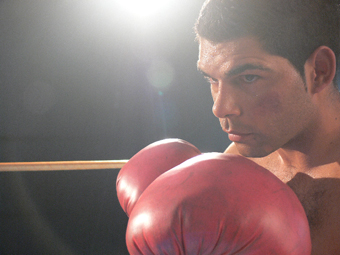
The Caretaker
THE SCREENING OF THE 2009 FILMS COMPRISING THE 11TH SERIES OF THE LESTER BOSTOCK INDIGENOUS MENTORSHIPS (NOW PART OF METRO SCREEN'S FIRST BREAK GRANTS SCHEME AS INDIGENOUS BREAKTHROUGH) WAS LAUNCHED BY THE MAN HIMSELF—A KEY PROGENITOR IN THE FOUNDING AND NURTURING OF AUSTRALIAN INDIGENOUS FILMMAKING IN THE 1980S AND 90S AT AFTRS AND METRO SCREEN. SINCE THE BOSTOCK MENTORSHIP'S INCEPTION IN THE 1990S 44 FILMS HAVE BEEN MADE AS PART OF THE PROGRAM.
Bostock, whose focus these days is on dealing with the challenges of disability in Aboriginal society (through the National Indigenous Disability Network), noted a long-term shift in Indigenous filmmaking from largely issue-based content to increasingly personal stories. However, he argued that “the only really political films” continued to be made by Aboriginals and with a distinctive filmmaking style.
Fault, directed by Martin Adams (mentored by Jason De Santolo), is immediately and cruelly suspenseful. An anxious, depleted man sits in a bleak room with a gun and the clack of a flip clock. 2:59. Cut to a laneway where we see him with a male friend. Cut to room. 3:11. The man looks suicidal. Cut to the man shooting his friend, accidentally, or so we think. There's a sharp knock on the door. We hear a gun shot. Cut to the man walking away with his friend, but time is out of whack—the man is now his younger self. At the moment of death he re-lives his lost friendship, even love perhaps. Fault is raw filmmaking, if spare and deftly edited. Its brevity and the focus on generating tension allow little room for character detail but its gritty mood (amplified by a grinding sound score between silences) and sense of loss is palpable.
Quarantine (director Tyrone Sheather, mentor Simon Portus) reveals a young couple in love, lolling on the grass beneath the looming stars, “together forever.” Their reverie is interrupted by a massive crash. The young man pushes through the bush to find a smouldering comet. As the couple approach it the world of nature evaporates into an enveloping whiteness out of which men in protective outfits with guns and hypodermic needles emerge. The couple flee, but shot and bleeding, they fall. One of the men announces the need to quarantine the area as soon as possible: the couple have been infected by an alien virus and duly eliminated to prevent its spread. Some of the effects are striking, other moments are awkward, the dialogue is stilted and the story lacks the touch of complexity that could have lifted Quarantine out of the morass of the sci-fi paranoia genre.
Stylishly shot in widescreen, Alanna Rose's The Caretaker (mentor Margot Nash) is an accomplished film which immerses the viewer in the world of the ageing Willie “The Kid.” Willie, critically not identified as such until the end of the film when he turns to reveal the lettering on his jacket, sits centre screen in a boxing ring in a darkened space, the spare, sharp light dancing with dust. Looking at old photographs which “come to life,” takes him back to his childhood. He and his brother, poor kids without a father, sneak into a boxing gym where they win the support of a trainer. Years later they crawl under a canvas into the world of tent boxing (a beautifully executed piece of editing in which we, with the boys, are confronted with a massive, gloriously red, beating drum).
Now grown up, the brothers are part of Australia's tent boxing world before it disappeared in 1971. Rain beats down as old Willie peers into his past. So far, we imagine The Caretaker to be in the tradition of the “could have been a contender” or “the down and out” school of boxing films. But the story here is even darker, one brother killing another with a calculated KO out of jealousy and ambition. Apparent nostalgia disturbingly mutates into real guilt. More than this, Willie, no longer a champion, has made himself look at his past.
While a couple of scenes are unnecessarily expository and the emotion is trowelled on at the end (an overlay of thunder and a good song with a strong hook), The Caretaker constitutes promising filmmaking from Rose and a strong cast and seriously expert crew. The film is dedicated to the memory of artist and filmmaker Michael Riley whose documentaries included Tent Boxers (1997). Alanna Rose has been awarded the 2010 Indigenous Breakthrough grant for $22,000 towards a film of up to 20 minutes and a range of support from Metro Screen.
Fault, writer, director Martin Adams, cinematography Fabio Cavadini, sound design, composition Grant Leigh Saunders, editor Peter Cramer, producer Jason De Santolo, actors Ken Canning, Scott Canning, Gio De Santolo, 4:50mins; Quarantine, director, writer Tyrone Sheather, cinematography Jack Anderson, sound Jason Dean, editor Peter Ward, producer Jack Anderson, actors Kay Cast, Dylan Underwood, 4:00mins; The Caretaker, writer, director Alanna Rose, cinematography Brandon Jones, production designer Brett Wilbe, editor Craig Savage & Oana Voicu, producer Jade Rose, actors Mick Mundine, DJ Mundine, Paul Sinclair, Kobi Hookey, Derek Walker, Tony Barry, Tony Ryan, Warwick Moss, 15:35mins; Lester Bostock Indigenous Mentorship screening, Chauvel Cinema, Sydney, April 20; www.metroscreen.org.au
RealTime issue #97 June-July 2010 pg. web
© Keith Gallasch; for permission to reproduce apply to realtime@realtimearts.net
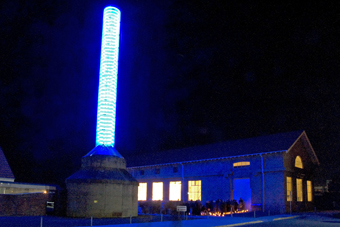
The Fitter’s Workshop
photo Peter Hislop
The Fitter’s Workshop
WALTER BURLEY GRIFFIN, THE ARCHITECT OF CANBERRA, ONCE WROTE THAT “A CITY IS FROZEN MUSIC.” ACCORDINGLY CHRIS LATHAM, THE DIRECTOR OF THE RECENT CANBERRA INTERNATIONAL FESTIVAL OF CHAMBER MUSIC, REFLECTED THE RELATIONSHIP BETWEEN MUSIC, ARCHITECTURE AND THE STRUCTURE AND FUNCTION OF THE HUMAN BODY IN A FESTIVAL EXPLORING DIFFERENT SPACES FOR PERFORMANCE AND DIFFERENT WAYS BODIES RECEIVE AND UNDERSTAND SOUND.
From Domenico de Clario’s all night piano vigil to a full performance of the Monteverdi Vespers, Latham placed concerts in venues ranging from the soaring atrium of the High Court to the angular, postmodernist foyer of the National Museum, to the low, sleek, domestic interior of the Swiss Embassy, a 1970s New Brutalist reverie in concrete and glass.
In this last venue, Swiss oboist Thomas Indermuhle illustrated the contiguity of these ideas on an intimate scale, showing how tonguing, rasping, buzzing, tapping and singing into the bore of the instrument can create a performance alchemy that makes wood sound like metal and the performance “feel quite vocal” to the performer.
Cordiality between performer and audience occurred even in the most vast of spaces, belying the fact that the majority of the 10 days of concerts were of unashamedly ‘high’ ambition and tone. The festival opened with the New Purple Forbidden City Orchestra—”China’s finest ensemble of traditional instruments”—with music “from the great dynasties of Chinese history” and poetry from the I Ching. These ancient ritual traditions unashamedly revere music as go-between of cosmic and material worlds. The nearly 30 concerts which followed honoured these aspirations in a series of prayers, praises and laments, trances, motets and incantations, the composer list—from Josquin, Aquinas, Bingen and Gesualdo to Beethoven, Bach, Mozart, Mahler, Messiaen and Takemitsu—reading like a who’s who of classical and pre-classical ‘greats’.
Of the living composers (for example, Ross Edwards, Sofia Gubaidulina, Rautavaara, Gorecki, Tavener, Sculthorpe), most aspire to a tone of epic reverence, with some (Sculthorpe and Edwards of course) also paying homage to landscape and western and indigenous histories. The sole minimalist on the program, Terry Riley, builds his work based on pitches and rhythms from ancient Indian traditions. His peers treat his work and the man himself as an inspiration and kind of saint.
If I have any lingering doubts about the festival, it would be the way its offerings resisted dark spaces. Even that Australian master of the macabre and the Grand Guignol, Larry Sitsky, was represented in more moderate incarnations, whilst Elena Kats-Chernin, her Motet wedged between several powerful, trance-inducing choral works by Arvo Part, played lightly on the edge of satire.
The festival’s ‘Gold’ theme reflects Latham’s focus on things precious, from water to gemstones to unguents such as frankincense and myrrh. Various rituals were at least referred to, if not performed: journeys towards marriage, to the underworld, to allaying death, or of the Magi. Some epic feats were achieved: from Mahler to Strauss and Wagner to Tavener within two days, under the baton of Roland Peelman, for the most part to very good effect and sometimes stunningly. Perhaps by focusing on ritual and beauty the festival asked its audience to focus its ears in very particular ways.
It was a canny move to program the Australian Baroque Brass to play and repeat its offerings in different spaces so that the audience could pay attention to variations in acoustics. A contemporary audience, already a little distanced from familiarity with the sounds of sackbut (literally “push-pull”—a predecessor to the contemporary trombone) and cornet brought curious ears to the short performances which, like a progressive dinner, moved from one type and size of building to another. We were treated to a kind of attunement, not just to what, but also to how we hear and give shape to interpretation.
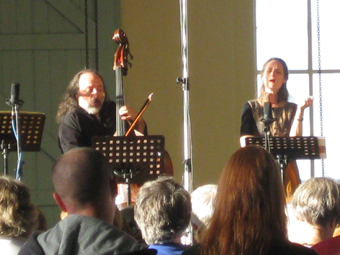
Jouissance, Kassia
photo courtesy of CIMF
Jouissance, Kassia
The Melbourne group Jouissance is exemplary in this aspect. The group creates dialogue between ancient chant and contemporary culture. Here their focus was the medieval Kassia, considered the first female composer whose scores are both extant and able to be interpreted by modern scholars and musicians. The group interacts with, rather than replicates, early work. Artistic director Nick Tsiavos says that studying postmodern theory in the 1980s made him think hard about contexts—what era we live in, what our own ears and experiences bring to any interpretation. The result is a performance philosophy that sees historical interpretation transformed by contemporary zeitgeist.
Tsiavos’s double bass sometimes breaks with jazz-influenced riffs; Peter Neville’s playing of contemporary, conical ‘Ausbells’ and simple, hung pieces of sheet metal carry medieval resonance but allow a sassy exploration of contemporary mood. Anne Norman brings her generous, elastically expressive shakuhachi into the fold (this is Byzantium via Japan), whilst Jerzy Kozlowski’s canonical bass resonates to our more secular sorrows. Deborah Kayser’s soprano breaks and dives and flutters in an extraordinary free-form exploration of, and improvisation around, the emotions of the mystic Kassia’s text. At certain moments, I am quite sure Kayser’s body has become a shakuhachi, mimicking its tonalities and technique (tonguing, fluttering, and shaking). This body and voice become the temple of Kassia’s prayers.
Significantly, Jouissance’s primary modality is improvisation, which was not a key element in this festival. Because this group is so practised in the art, it achieved alchemical transformations, which I would not say was always the case in the themed concerts such as “In Praise of Water.” It moved from composed mantras interspersed with improvised reveries, to one of Copland’s aching prairie-calls, to a very moving, but traditional rendition of Waltzing Matilda in a curious sequence that almost came off. By his third improvised interlude, Bill Risby developed some very interesting reflections on the preceding musical themes, yet I sat within an experience that felt thematically controlled, not musically released.
The standout in this very concert, however, by the festival’s resident composer, tells a different story. Ross Edwards’ The Lost Man (words by Judith Wright) is a delicate and demanding piece that sets up layers of listening in slow waves that build and recede and build again throughout. Edwards manages to gesture to the qualities and motions of water without pretending to make it. The piece harvested the piano; I heard it fill like a precious lake. Edwards writes about his compositional process as “an interplay of (materials) assimilated and interfused with sound patterns subconsciously gleaned from the natural world.” This suggests that for all his ideas, research and technique the composer allows something else to take over, relinquishing control.
It was good fortune the festival secured the Fitter’s Workshop, part of the 1920s Powerhouse Precinct in Kingston on the Lake foreshores of South Canberra—an enormous but welcoming, clear and fresh space of bright acoustic which many Canberrans hope to co-opt as a permanent performance venue. It was also exceptionally canny of Chris Latham to weave together the combined forces of amateur, professional and student choirs and orchestras—including the T’ang and New Zealand String Quartets, the Song Company, the Canberra Camerata, the forces of the School of Music, ANU—and other local professionals and composers, to weave a strong sense of support and community. The festival’s resources were bolstered by each concert having a personal sponsor from within the local community.
Much of the success of these concerts was due to the extraordinary abilities of Roland Peelman who could elicit both subtle and impassioned musical nuances from the professional and amateur instrumentalists, soloists and choirs, and somehow blend the voices. The grand finale of the Vespers, written in 1610, called for precise coordination between melismatic vocal lines and ostinato (provided by lute, contrabass and cello] and fine judgment in moving between different, complex groupings of voices, especially when in canon. The great unison “Amen” charged the room, as if the Age of Doubt, which began three centuries after its composition, never really happened.
In some concerts, but not most, one could feel the strain of attempting too much. Yet at their best, the combined forces achieved a translucent dignity—perhaps too the goal stated in Hexagram 16 of the I Ching: “harmony between Man, Earth and Heaven…a dance of Man with the Stars”.
Canberra International Festival of Chamber Music, May 14-23; www.cimf.org.au
RealTime issue #97 June-July 2010 pg. web
© Zsuzsanna Soboslay; for permission to reproduce apply to realtime@realtimearts.net
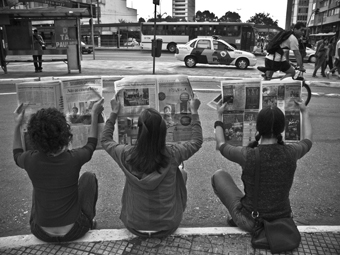
Out of Key(s), Opovoempé
photo courtesy of Opovoempé
Out of Key(s), Opovoempé
IN REALTIME 95 (“PERFORMANCE IN BRAZIL’S MEGA-METROPOLIS,” P42-43), CARLOS GOMES, A BRAZILIAN DIRECTOR BASED IN SYDNEY AND WORKING WITH THEATRE KANTANKA, REPORTED ON A RECENT VISIT TO SÃO PAULO, SURVEYING THE WAYS IN WHICH COMPANIES ARE ENGAGING WITH THEIR CITY, THEATRICALLY, POLITICALLY AND IN TERMS OF URBAN GEOGRAPHY. MELBOURNE ACTOR AND THEATRE MAKER JAMES BRENNAN RECENTLY VISITED THE CITY WHILE ON A KEITH AND ELISABETH MURDOCH TRAVELLING FELLOWSHIP. HE REPORTS HERE ON THE WORK OF THREE COMPANIES WHO CREATE WORKS IN WHICH THEY OCCUPY PUBLIC SPACE.
Whatever the country, theatre gives itself the mandate to claim space and to unravel that space in order to establish a relationship with those whom it seeks to make its public. I recently encountered three theatre companies in São Paulo, Brazil. What follows is an account of how each tackled public space, the audiences they found themselves ensconced with and the boundaries that marked their performances.
Compania Livre’s recent work was an adaptation of Dostoyevsky’s The Idiot, performed over three nights in SESC Pompeia, one of many SESC cultural sites found throughout São Paulo state (Serviço Social de Comércio is a non-government cultural network established in 1946 by the industrial sector). The site has a theatre space, but instead director Cibele Forjaz chose a large empty studio, adjacent to the theatre which has changed little since its past life as a steel drum factory. As one of Brazil’s most successful contemporary theatre directors, Forjaz has always had an appetite for unusual spaces. With her reputation she has access to a wide range of theatre venues in São Paulo, but continues to search out unconventional sites in which to house her visions.
In discussing The Idiot she said, “We wanted a space that held scene and public in connection…moreover, we required that as the spectacle developed, action could occur concurrently in several spaces.” This was achieved through a design which supported a number of overlapping performance areas, able to transform quickly, in keeping with, as Forjaz puts it, “the subjectivity of each character.” The success of Compania Livre’s well-integrated performance environment can also be attributed to the actors themselves. Accompanied by a musician and a small technical crew, they ran, sang, hovered, danced, washed and prayed the space into ever-new formations. When the work required the actors to articulate somewhat stylised moments, this was achieved with a sense of ease, as if an extension of their social selves rather than heightened performance personas. Furthermore when invited, the audience participated comfortably, contributing to an atmosphere of permission. In a characteristically Brazilian moment, audience joined actors as they sang a well-loved bossa nova song during the moving climax. Tears rolled on and off stage and in that moment I was a firm believer in “freedom inspires freedom.”
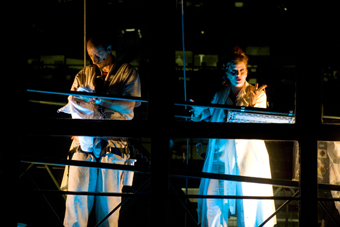
Kastelo, Teatro da Vertigem
photo Angelo Lorenzetti
Kastelo, Teatro da Vertigem
Another company which chose to forego the conventional performance space offered at another SESC site is Teatro da Vertigem (RT95, p42). This time, the design and overall effect served to distance audience and performer. Given that the work was an adaptation of Kafka’s The Castle, Kastelo, this did not seem inappropriate, since the work is marked by an inherent sense of distance. Kastelo was exactly the sort of work I was hoping to see in São Paulo—risky site-specific.
Performed on the outside of the SESC building by actors on moving window-cleaning platforms, the work was viewed by an audience seated on swivel chairs scattered throughout a disused office space on the fourth level of the building. The obvious risks of performing while suspended on cables were further emphasised by the actors, who, with an uncanny absence of apprehension, would jump off their platforms and hang from their harnesses. As the work developed, there was an increasing amount of head banging against the glass, sometimes done by swinging from a distance, which resulted in one of the actors dangling, upside down and bloody for long periods. Eliciting moments of empathy, ultimately Teatro da Vertigem was unable to bridge the gap between audience and actors. Like the protagonist, we also struggled to achieve meaningful contact.
Hand in hand with its commitment to exploring alternative arenas in which to perform, Teatro da Vertigem’s work has a strong social aspect. The company’s director, Antonio Araujo, listed projects which have engaged with locations in cities and rural areas and inside and outside various institutions. Recently the company commenced work on a project in Cracolandia (“Crack Land”), an area avoided by many São Paulo residents due to the high crime rate and drug use. As a consequence the work has the potential to offer new perspectives on an area with a strong negative ambience, inbuilt and palpable. As with many of São Paulo’ contemporary theatre works, the project will involve a significant period of research in Cracolandia itself.
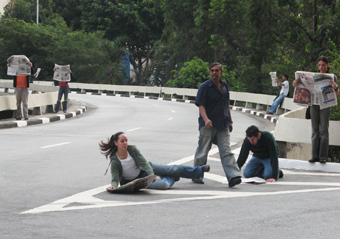
Out of Key(s), Opovoempé
photo Ana Carmen Foschini
Out of Key(s), Opovoempé
Opovoempé is a São Paulo theatre company whose agenda is focused directly on public space. Since its birth in 2005, the company has made a series of public interventions in locations including not just streets, fairs and squares, but also supermarkets, train stations and shop windows. Their works range from the overtly theatrical to the invisible, and draw on the legacy of cultural activism championed by the late Brazilian theatre maker, Augusto Boal. The company’s title (literally “people on their feet”) reflects its aims and “gives the idea of people moving, rather then riding or sitting. People in active existence or operation.”
The company states that their projects “aim to promote new relations between people and the space of the city, and are based in the exploration of the frontiers of the dramatic act.” With this premise they act to infiltrate chosen social settings to “subvert operating systems and alter the perception of participants.” Forty years ago such a statement may have made them a target for the Brazilian dictatorship, however these days their work resonates more as poetic provocation than political motivation and has received the support of the State Secretariat of Culture.
By offering new perspectives of shared space and interactions, Opovoempé illuminates the public lives of São Paulo residents and beyond. In doing so the company calls for vivid interaction with the spectator, to be “stimulated to perceive, see, imagine, interfere, create, act.” Such an active blurring of boundaries between art and life certainly fuels a fibrous artistic discourse and brings to mind the layered impact of Deborah Kelly and Jane McKernan?s powerful evocation of the Tiananmen Square protest, Tank Man Tango (RT93, p2-3).
With ever expanding public liability laws defining acceptable public activity, companies such as these three play an important role in questioning how we inhabit our environments and provide valuable stimulus for new perspectives.
I have always been intuitively committed to heightening the collision between theatre and life. Interacting with these companies in Brazil confirmed my belief in the critical need to deliberately exchange the space between the real world and theatre, in such a way as to confuse expectation. This may not only awaken the sleeper, but can also transform our cities and towns into places of social communion. By magnifying and directing performer ability to manipulate space, time and meaning, each of these companies illustrates the power of the individual to transform space and thought well beyond the walls of the theatre.
RealTime issue #97 June-July 2010 pg. web
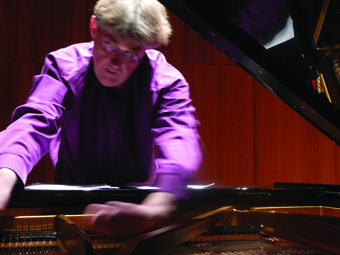
Roger Dean
photo Philippa Horn
Roger Dean
late night sonics
In the first of two collaborations with the vocal ensemble Halcyon, austraLYSIS presents Late Night Sonic Space in Sydney, July 31. Formed in 1970 and working with interactive and network technology since 1995, austraLYSIS has developed a number of innovative methods for controlling rhythmic, timbral and harmonic interaction. The program includes two purely electroacoustic works, one of them by Canadian composer Robert Normandeau; the premiere of Toy Language 1, composed by Roger Dean for mezzo soprano and Halcyon co-founder Jenny Duck-Chong, with live electronics; and a sound and text work called Clay Conversations 2, by Hazel Smith and Joanna Still (UK). There will also be the opportunity to converse with the creators themselves about their work after the concert. The program is presented by the New Music Network with the support of ABC Classic FM and takes place at the ABC Centre, Ultimo. austraLYSIS and halcyon, Late Night Sonic Space, Studio 227, ABC Centre, Ultimo, Sydney, July 31 10.30pm; www.newmusicnetwork.com.au
brodsky quartet, eddie perfect & topology
For some reason the Brodsky Quartet (UK) has surprisingly chosen to escape the northern summer for our winter. The quartet is playing a variety of concerts, though one of the most intriguing is the Songs from the Middle series of performances with Eddie Perfect and musicians from the Australian National Academy of Music (ANAM). Apparently it involves Eddie returning to his roots, and more specifically to the Melbourne suburb of Mentone, where entertainment includes the beach, the bowling club and, more recently, Bunnings. This bout of nostalgia has apparently been brought on by the arrival of a baby girl so perhaps the show will be a new father’s postmodern paean to working families moving forward. You can also see the Brodsky Quartet in concert with contemproary classical ensemble Topology, as part of the Brisbane Powerhouse’s OMG (Other Musical Genres) series. Topology have previously been described by Keith Gallasch as “a live working band with a casually theatrical and jazzy spontaneity.” (You can hear a sample of their work in RealTime’s first sound capsule here.) The Brodsky Quartet, Australian tour, July 22-Aug 8; The Brodsky Quartet, Eddie Perfect, and ANAM musicians, ANAM, Melbourne, July 25-26, Sydney Opera House, Aug 1, Brisbane Powerhouse Aug 6; The Brodsky Quartet and Topology, Brisbane Powerhouse, Aug 8.
sizzling new music at the bowling club
More music news…Ensemble Offspring first conceived of Sizzle as an alternative musical event for Sydney in winter, and better yet as a way of getting contemporary classical music out of the concert hall and into people’s Sunday afternoons. So each Ensemble Offspring member, Bree van Reyk, Veronique Serret and Jason Noble, is curating a musical event at his or her local bowling club (maybe Eddie could come). Noble started proceedings last month in Waverley, and van Reyk continued things this month in Petersham. For the final instalment next month Veronique Serret has invited The Noise improv string quartet, spoken word artist Eleanor Knox, CODA, visual artists and, of course, Ensemble Offspring, to play at the Camperdown Bowling Club. Ensemble Offspring and others, Camperdown Bowling Club, Mallett Street, Camperdown, Sydney, August 1
everyday crisis management
The phrase ‘human interest story’ brings to mind images of personal stories at the end of news broadcasts: babies, animals and, if you’re really lucky, baby animals—in short, everything you’re supposed to avoid in show business. That said, it’s also a catchy title, especially for a show that promises to investigate the relationship between the medium, the message and the mobilisation of empathy. Lucy Guerin’s latest show, commissioned by Malthouse Theatre and the Perth International Arts Festival, “explores our shared consumption of media news” and the “personal impact of the global crises delivered daily to our doorsteps” (press release). Like much of Guerin’s work, surveyed in RealTime’s Archive Highlights here, Human Interest Story combines imagery, gesture and sound to almost surreal effect. Created by an outstanding ensemble of dancers and collaborators and featuring design by Gideon Obarzanek (Mortal Engine), lighting by Paul Jackson and a very special newscast by Anton Enus (SBS), Human Interest Story premieres in Melbourne before touring to Perth. Lucy Guerin Inc, Human Interest Story, Malthouse Theatre, July 23-August 1; www.malthousetheatre.com.au; Perth International Arts Festival Feb 11-March 7 2011
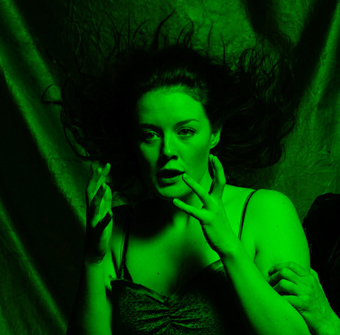
Jenny Kemp, Madeleine
photo courtesy of Malthouse
Jenny Kemp, Madeleine
contemplating madness
One issue that has often made the news over the past year is mental health, first when Professor Pat McGorry was appointed as Australian of the Year and then when Professor John Mendoza resigned from the National Advisory Council on Mental Health in frustration at the government’s efforts or lack thereof. Of course, themes of mental health and illness have a long history in art and theatre. One example is Jenny Kemp’s exploration of loss, longing and mania in her 2008 work Kitten. This month, this adventurous writer-director of dream like performance works mounts the companion piece, Madeleine, at Arts House, Melbourne. Madeleine is turning 19 and starting to show signs of schizophrenia. As she disintegrates mentally so too does her family, and together they are thrust onto the path to tragedy. Madeleine “brings the uncertain world of mental illness into presence, for contemplation. It provides a space within which these concerns can become a reality—a poetic reality of beauty, humour and horror” (press release). Jenny Kemp and Black Sequin Productions, Madeleine, Arts House, North Melbourne August 3-8 https://www.melbourne.vic.gov.au/ArtsHouse/
computer gaming on in launceston
If you missed Game On, the exhibition devoted to the history of video games curated by the Barbican and hosted in Australia by ACMI in 2008 (RT84, p.29), then you might want to catch Game On 2.0. This new exhibition is having its world premiere at the Queen Victoria Museum and Art Gallery in Launceston. While the new version includes several new pinball machines and arcade games from the past, it also shows off the Virtusphere, which is apparently “the best locomotion interface for virtual entertainment.” Game On 2.0, Queen Victoria Museum and Art Gallery, Launceston, July 3-Oct 3, http://www.qvmag.tas.gov.au/gameon/
live-in performance art
Anastasia Klose has been sitting in bed since July 9 and will continue to do so until August 8. If you want to see her, she is at the Australian Experimental Art Foundation, Adelaide. But she’s not just sitting, she’s also writing, typing her thoughts onto her laptop. These musings, which shift from the banal to beautiful and back again (“Staring…Checking phone,” “you must never admit to your mistakes, you must instead claim them, as if you intended them,” “The anxiety of a white screen. Here is my new performance. Sit for 5 minutes without typing. Starting now. 3.04”) are then projected onto the white wall behind her that also serves as a bed head. The performance, titled i thought i was wrong but it turns out I was wrong, is accompanied by an essay called In bed with Anastasia: intimate strangers, written by Larissa Hjorth. Anastasia Klose, i thought i was wrong but it turns out I was wrong , Australian Experimental Art Foundation, July 9-Aug 8 http://aeaf.org.au/exhibitions/10_klose.html
RealTime issue #97 June-July 2010 pg. web
© RealTime ; for permission to reproduce apply to realtime@realtimearts.net
Vinyl 7”, Independent Press, IP02
www.iebrisbane.com.au
Sky Needle, Time Hammer
Fortuitously, Sky Needle’s 7″ vinyl disc Time Hammer arrived on my doorstep just after I was given a turntable (having been bereft of one for the last decade). While the group Sky Needle was not known to me (named after the Brisbane architectural folly built for Expo 88 and then purchased by millionaire hairdresser Stefan), two of its three members, Joel Stern and Ross Manning, are Brisbane experimental music stalwarts and they have found a kindred spirit in visual/sound artist Alex Cuffe.
Each plays a curious home made instrument—Stern on “latex pump horn,” Manning on “elastic dust shovel,” and Cuffe on “speaker box.” The result is a joyous, wonky kind of sound, curiously reminiscent of 80s post-punk, crafted into two reasonably tight tracks that are not so much funky as kind of…thunky.
This is a music in which the raw materials of the instruments (including elastic bands, a kitchen dust pan, old speaker housing and lengths of garden hose) are allowed to shine, introducing alternate harmonics and tasty timbres. The plunky twang of Manning’s dust shovel wraps around the chewy rubberiness of Cuffe’s speaker box, punctuated by the nasal honks of Stern’s footpump operated horns (a much more pleasing tonality than a stadium full of vuvuzelas).
Side A offers “Sweet 16 Snorks” which starts with driving buzzy bass notes that play in and around the higher string line, offset by staccato horn hoots and clanging pulses. This weighty intro quickly shifts into a higher, looser and lyrical interplay of strings and horn swoops, only to shift again into a third section of more agitated rhythms, handclaps and jangles. There is a real agility to the structural shifts in this piece, evincing the experience of the artists.
Side B gives us “The Stain” which offers a looser approach with minimalist rhythm figures, occasionally hinting at dissolution, which unevenly accumulate until an abrupt halt. I wish Time Hammer had been a 10-inch single so I could really see where “The Stain” might go.
Almost danceable and strangely cute, Sky Needle’s Time Hammer makes a fine start to my contemporary vinyl collection.
Gail Priest
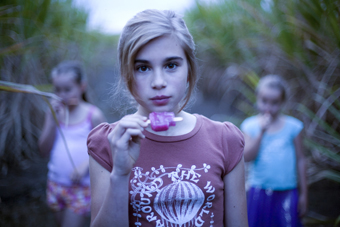
Lily Bell-Tindley, Lou
THERE’S BEEN MUCH CRITICISM OF THE AUSTRALIAN FILM INDUSTRY IN THE PAST FEW YEARS FOR DEALING WITH DEPRESSING ISSUES, PRODUCING KITCHEN-SINK DRAMAS AND BLEAK FAMILY SCENARIOS THAT (APPARENTLY) PEOPLE ARE RELUCTANT TO WATCH. WHILE I DISAGREE WITH THIS ASSESSMENT (I AM DRAWN MORE OFTEN TO THE DARK SIDE THAN THE LIGHT, AND THINK FILMS LIKE BEAUTIFUL KATE OUTRATE I LOVE YOU TOO), IT SEEMS THE FUNDING BODIES ARE MOVING TO ADDRESS IT, SO WHAT WE HAVE INSTEAD SEEMS TO BE A WAVE OF COMING-OF-AGE TALES SET IN RURAL TOWNS, CONTEMPORARY BUT BATHED IN THE GOLDEN LIGHT OF NOSTALGIA, WHERE FAMILIES LIVE IN WEATHERBOARDS WITH VERANDAHS AND CHILDREN YEARN FOR MISSING PARENTS.
I’ve recently seen The Boys are Back (Scott Hicks), The Tree (Julie Bertucelli) and now Lou, written and directed by Belinda Chayko. It seems a shame for the local industry that these themes are so obvious because, while all three films stand alone as decent offerings, seeing them bunched up means there’s a feeling of deja-vu—hey, haven’t I visited this place before?
Belinda Chayko is a Brisbane writer/director who, like Shirley Barrett, has taken 10 years to release her latest feature, after making City Loop in 2000. In the meantime she has worked on TV projects and won an AWGIE for writing Saved (Tony Ayres, 2009), about a young Iranian refugee held in detention and his advocate.
Set in cane country, the film focuses on Lou (Lily Bell-Tindley) who lives with her young single mother Rhia (Emily Barclay) and two sisters. Like Charlotte Gainsbourg’s Dawn in The Tree, Rhia is struggling to keep it together after the father leaves (in this case he just nicks off) and pines for her new lover, as the girls hover and judge. Over the Christmas holidays their lives are disrupted when Rhia’s father-in-law Doyle (John Hurt) is suddenly dumped on the household (Rhia finds she can earn money by letting him stay).
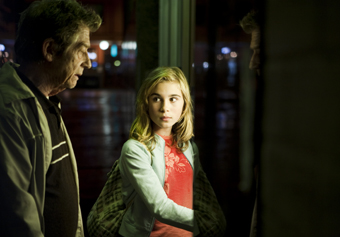
John Hurt, Lily Bell-Tindley, Lou
It’s quite a coup to have Hurt (one of the most outstanding actors working today); his scenes with Bell-Tindley elevate and enliven the story. Bell-Tindley's like a young Abbie Cornish (strong and understated, there’s no cute kid antics here) and she easily holds her own with Hurt. Together—Doyle has Alzheimer’s and sees Lou as his departed wife, Annie—they form a kind of old-fashioned romantic bond that’s subtly directed by Chayko. Barclay, as always, is both tough and fragile. There’s an ordinariness about her that I respond to but she has that ability, like Toni Collette, to transform into anyone.
What I found confusing about the film (and perhaps this is the nature of the disease itself) is the inconsistency in Doyle’s character. He is introduced at the family dinner table as belligerent and angry, swearing profusely and unpredictable. Someone who won’t have a shower, who’s “starting to stink!” At a dinner that Rhia has carefully cooked for her new man, Doyle spits the food over the table: “This is the most disgusting thing I’ve ever eaten!” But we never see him like this again. As his relationship with Lou develops he becomes almost a Hallmark card of sweet good-naturedness, someone that she can trust, a regular grandfather who can take the girls to the beach on the bus (albeit with the occasional bout of jealousy as Lou/Annie becomes interested in a local boy who delivers the paper).
Then suddenly, at the climax of the film, only then, Doyle starts to speak in the spin cycle so familiar to anyone who’s lived with dementia. He begins to repeat phrases—”are we going home by bus?”— until Lou realises her dream of escape has evaporated. It feels like the disease is being worked in around the plot, making false moves. The film is also let down by a few clichéd scenes that seem out of character. When Rhia discovers Lou wearing make-up, she slaps her: “Get that lipstick off your face, you look like a skank.” I’ve encountered this scene in so many films but the extremity of the reaction in this case doesn’t ring true. A number of other scenarios might have worked better. It’s about pausing with the writing and taking a different tack from the predictable one. Also black-and-white is Doyle’s case manager Mrs Marchetti (Daniella Farinacci), an unsympathetic character treating the family with disdain. Surely not all bureaucrats are like this. God help us if they are.
Shot in Murwillumbah, the film looks gorgeous (cinematography by Hugh Miller, who also shot David Caesar’s Prime Mover), as this genre tends to, with the glowing night-sky of burning canefields, the retro interiors, the sensuous dancing of a young girl in a red dress wrapped in golden light. The mood and the rhythm are languorous, conjuring a hot summer holiday, where you drift from one day to the next. It’s a delicate film and I can imagine it will do well on the international film festival circuit. People were raving about it as we came out of the cinema. But I’m looking forward to a new wave of Australian films. I want to be challenged and shocked. I want to be thinking, “God, I’ve never seen anything like this.”
Lou, writer, director, producer Belinda Chayko, producers Tony Ayres, Helen Bowden, Michael McMahon, cinematographer Hugh Miller, editor Denise Haratzis, production designer Pete Baxter. Lou is in limited release around Australia.
RealTime issue #97 June-July 2010 pg. web
© Kirsten Krauth; for permission to reproduce apply to realtime@realtimearts.net
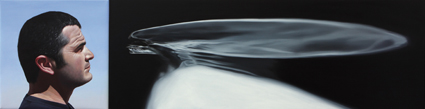
Self portrait: From the outside, inside and beyond, 2009 (oil on canvas), Juan Ford
courtesy the artist
Self portrait: From the outside, inside and beyond, 2009 (oil on canvas), Juan Ford
WHAT HAS BECOME OF THE GENRE OF PORTRAITURE IN THE DIGITAL AGE? WHAT ACTUAL WORKS HAVE ARTISTS MADE IN RESPONSE TO THAT VAGUE LIST OF USUAL SUSPECTS WE ALL AUTOMATICALLY REEL OFF WHENEVER CONTEMPORARY MEDIA TECHNOLOGIES ARE MENTIONED: SOCIAL NETWORKING SITES, MOBILE PHONE CAMERAS, 3D SCANNERS, RAPID PROTOTYPERS, TOMOGRAPHY, AND ON-LINE AVATARS? PRESENT TENSE AT THE NATIONAL PORTRAIT GALLERY ANSWERS THAT QUESTION WITH A DIVERSE COLLECTION OF STRONG WORKS BY 27 WELL-ESTABLISHED AUSTRALIAN AND INTERNATIONAL ARTISTS, WHICH ARE INSTALLED WITH INTELLIGENCE AND WIT.
It’s good to see a show of photography and digital media which has been fully thought through and tightly selected by a proper curator, Michael Desmond, who has a broad knowledge and an international horizon. This show is a refreshing change from those loose surveys ‘around’ themes which appear to be chosen mainly for their convenience, or even worse, those ubiquitous but lazily conceived competitions which we get too often.
A good way of looking at Present Tense as a whole is that it is about the interaction of new technologies with the traditional methods of portraiture—painting, sculpture and photography—which already have their own pre-established ‘grammars.’ Thus we have Australian Jonathan Nichols’ flat, though engaging, paintings of young girls, each with a slight air of ambiguous familiarity. But wait, these aren’t paintings of the girls themselves, but of their Facebook thumbnails. The tug we feel is not towards their offering of themselves to us as individual viewers, but to the generalised gaze of the worldwide social network.
In another breathtaking remodalisation of an old technology, both Chuck Close (US) and Aaron Seeto (Australia) work with daguerreotypes, that primeval photographic process where all of photography’s uncanniness seems to manifest itself most magically. From a 21st century perspective, Close’s daguerreotyped heads and bodies remind the viewer somewhat of holograms. And as viewers move their head from side to side to get the right angle, and the image wells up from the visual depths like a surfacing whale, that familiar tingle up the spine they get, that simultaneous feeling of proximity and distance, is no longer configured historically—back into the depths of the mid-19th century—but existentially, from one human presence to another. In contrast, Aaron Seeto’s daguerreotype translations of right-click grabs from web reports of the 2005 Cronulla Riots make a more overt, even arch, point about the permanence and impermanence, the legibility and illegibility, of historical memory when it is entrusted to the oceanic swirls and currents of the internet.
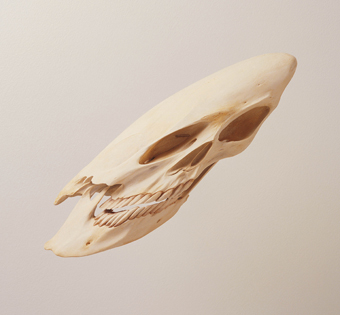
Skull, 2000, Robert Lazzarini resin, bone, pigment
courtesy of the artist and Deitch Projects
Skull, 2000, Robert Lazzarini resin, bone, pigment
The viewer has to do fair bit of head wiggling in this show. Installed across from the daguerreotypes there are two anamorphic skulls, both referring to Holbein’s famous vanitas intervention at the lower edge of his 1553 portrait of The Ambassadors. In a diptych the painter Juan Ford (Australia) bravely confronts an X-Ray of a skull. From our point of view, in front of the diptych, the skull is safely distorted and in another space. But, we realise, from his point of view within the diptych it would be restored to its correct, archetypal shape of warning and fear. The American Robert Lazzarini’s anamorphic skull is a life-sized three-dimensional sculpture made of actual bone material embedded in resin. As we circle warily, it fleetingly looms out of its anamorphic parallel universe and into our own.
In a similar way, the faces of Justine Khamara’s (Australia) angry and surprised parents suddenly pop out at us when we stand directly in front of the bulging aluminium constructions on which their flat images have been printed. It is the viewer’s exact position at the apex of the constructions which animates them, seemingly jolting them out of some kind of two-dimensional repose.
This show foregrounds the fundamental image-making actions which have now become proper to contemporary portraiture. It’s no longer just the snap of the camera’s shutter or the incremental description of the painter’s brush, but is also the trundling progress of the flatbed scanner and the circular pan of the 3D scanner.
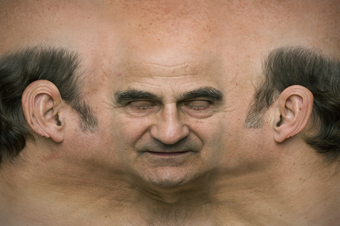
Stretched skin, 2009, Stelarc, type C photograph
courtesy of the artist and Scott Livesey Galleries
Stretched skin, 2009, Stelarc, type C photograph
Stelarc (Australia), in classic techno-narcissist style, stretches the skin of his head across a flat acrylic table measuring 1.2 by 1.8 metres, to invite us to delectate on every one of his pores and bristles. The German artist Karin Sander makes exact, three dimensional, indexical sculptures of her subjects at one-fifth scale by using three-dimensional scanning and rapid prototyping technology. What are these mini-them’s? Three-dimensional photos? Optical clones? Plastic avatars? Whatever they are, one isn’t enough. I found myself wanting the artist to be true to her namesake, August Sander, and methodically create an army of miniature German people.
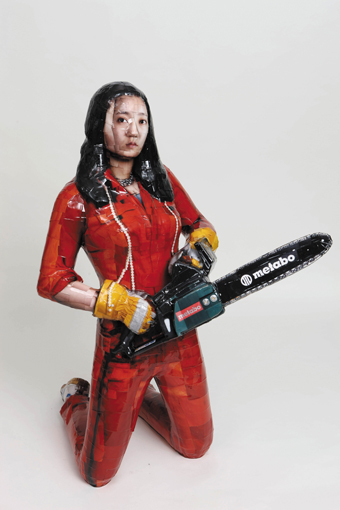
Metabo, 2009, Osang Gwon c-prints, mixed media
courtesy of the artist and Arario Gallery, Seoul
Metabo, 2009, Osang Gwon c-prints, mixed media
In contrast to the indexical, technologically produced three-dimensional portrait, the Korean artist Osang Gwon takes hundreds of small photographs of every inch of her young, punky, Korean subject and glues them on to a hand-carved life-sized Styrofoam figure in a loose collagistic style. This produces a strong but unstable sense of the physical presence of her subject, as if her skin and clothes, and indeed her whole persona, is on the verge of peeling away with nothing left beneath.
There are plenty of hits of humanist sympathy to be had from this show. In 2008 the Dutch artist Geert van Kesteren collected mobile phone shots SMS-ed out of Iraq and Syria. Enlarged, framed and gridded up the wall, these ephemeral and off-the-cuff images become a monumental document of geo-political conflict where snapshots of happy family gatherings and friends at play sit insouciantly beside shots taken out of the windows of moving cars of dead bodies by the road or the interiors of burnt out houses.
The masterful Dutch photographer Rineke Dijkstra provides the emotional centre of gravity for the show. Her simple nude photographs of startled young mothers clutching their newborn babies like bags of shopping about to burst remind us again of the power of the straight photo. But her stunning two-gun video installation, The Buzzclub, LiverpoolUK/Mysteryworld, Zaandam NL, also from the mid-90s, confirms the pre-eminence of the video portrait. Dijkstra has, presumably, momentarily pulled young off-their-faces clubbers straight from the dance floors and put them in front of her video camera in a bare white space off to the side. But the laser lightshows and the doof doof are obviously still going on inside their skulls. As they continue to work their jaws and jig robotically we get full voyeuristic access to them and, even though their interior individualities have temporarily gone AWOL, we nonetheless feel an extraordinary tenderness for them welling up.
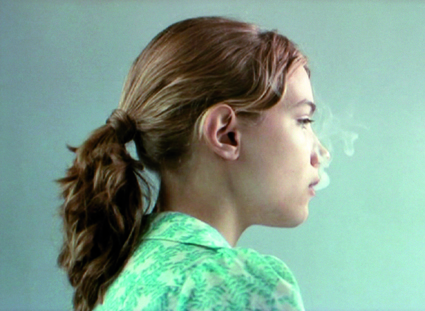
Ghost in the Shell, 2008 (video still), Petrina Hicks
courtesy the artist
Ghost in the Shell, 2008 (video still), Petrina Hicks
The theme of interior and exterior slowly emerges as a thread in this show. For instance Scott Redford videoed fellow Australian artist Jeremy Hynes performing a private, improvised homage to Kurt Cobain by writing his name on a cigarette and inhaling its now transubstantiated smoke deep into his lungs, before sobbing with genuine loss and longing. In a sucker punch for the attentive reader of the catalogue we learn that Jeremy Hynes was himself killed in a road accident a few months after the video was shot. Across the way from this projection is another Australian piece, Petrina Hicks’ Ghost in the Shell, where we silently circle around a pure, innocent young girl—or perhaps she rotates before us? Then, ever so discreetly, ever so elegantly, a tendril of smoke or mist escapes from between her lips. Her spirit? Her soul? Just her ciggy smoke? She continues to rotate without answer.
In the end this is a humanist show, about ghosts more than shells. It argues that despite all of the cold digital technology in the world portraits are still about the promise of finding the warm interior of a person via their exterior. The show’s inclusion of some three-dimensional ultrasound images of foetuses in the womb could have easily been over-the-top and obvious in its point about our intimate adoption of new imaging technologies. Until we see one intrauterine image of twins in which one foetus is caught sticking its toe into the eye of its sibling. A rivalry which, we think to ourselves, will no doubt continue for the rest of their lives.
Present Tense: An Imagined Grammar of Portraiture in the Digital Age, curator Michael Desmond, National Portrait Gallery, Canberra, May 14-Aug 22; www.portrait.gov.au/site/exhibition_subsite_PT.php
This article first appeared online, July 12, 2010
RealTime issue #98 Aug-Sept 2010 pg. 38
© Martyn Jolly; for permission to reproduce apply to realtime@realtimearts.net
australians win rolex arts awards
Congratulations to composer Ben Frost and dancer Lee Serle on being chosen for a year of mentoring in the Rolex Arts Initiative. Each year the program awards six mentorships to outstanding emerging artists working in dance, film, literature, music, theatre and visual art. This year, rather remarkably, two of the six awards were given to Australians. In the music category, Frost, a 30-year-old composer, producer and musician originally from Melbourne but now based in Reykjavik, will be mentored by the composer Brian Eno. You might have heard Frost’s music in the Chunky Move productions Glow, Black Marrow and Mortal Engine, or his album Steel Wound. In the dance category, Lee Serle, who is 28, will be mentored by renowned American choreographer Trisha Brown. He graduated from the VCA in 2003 and has appeared with Lucy Guerin Inc and in Chunky Move’s Mortal Engine, I Want to Dance Better at Parties, Two Faced Bastard and I Like This. His choreographic credits include A Little Murky and I’m in Love.
Given the pair’s connection with Chunky Move, artistic director Gideon Obarzanek is understandably delighted. Though Frost and Serle are Australia’s third and fourth Rolex protégées, they are the first from the live arts categories as well as the first Victorians. The previous Australian winners were both novelists from New South Wales: Julia Leigh, mentored by Toni Morrison in 2002-03 and Tara June Winch by Wole Soyinka in 2008-09. Frost and Serle will each be mentored across a year and in addition will receive US$25,000 and be eligible for a further US$25,000 to create a project in the subsequent year. Rolex Mentor & Protégé Arts Initiative
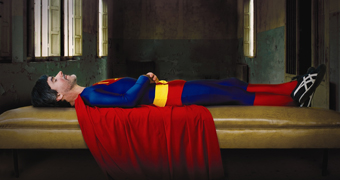
Paolo Castro, Superheroes
photo RODEO
Paolo Castro, Superheroes
everyday heroes & superheroes
Everyone loves a hero, flawed or otherwise. If you prefer them humble and homemade, then you’re bound to be pleased by NightTime State Wide: Everyday Hero. Like previous NightTime programs (see RT78 and RT91). Everyday Hero is an evening of short, live artworks curated by Lara Thoms and, this time, Jess Olivieri. Created by emerging and established Sydney artists such as John A Douglas, Renny Kodgers, Julie-Anne Long, Jason Pitt with Jade Dewi, Natalie Randall, Justin Shoulder, Anna Tregloan with Rita Kalnejais, and David Franzke and Alice Williams, the evening explores a range of everyday heroes: stay-at-home mums, unconventional fathers, child starlets, and even yourself (you get to try on a superhero costume). If you missed them in June at Performance Space, then you can see these heroes in action at Tamworth Regional Gallery (July 31), Lake Macquarie City Art Gallery (October 16), and Orange Regional Gallery (September 4).
Further south, in Adelaide and then Melbourne, theatre company Stone/Castro is going one better with their new show Superheroes. It begins with six characters in a rest home on the road to recovery and perhaps the road to salvation, or maybe domination, depending on which way they turn. Their battle for supremacy in this new, rather unlikely, territory serves as a microcosm for a larger “reflection on the complexity of globalisation, the future, violence, and war” (Press Release). Director Paul Castro, originally from Portugal but now based in Adelaide, is building a solid reputation on the back of productions such as Regina vs Contemporary Art (see RT89) and with No Strings Attached Theatre of Disability’s Tom the Loneliest (see RT88). NightTime Statewide: Everyday Hero, Performance Space and Hazelhurst Regional Art Gallery, curated by Jess Olivieri and Lara Thoms, Tamworth Regional Gallery, July 31, Lake Macquarie City Art Gallery, Oct 16), Orange Regional Gallery, Sept 4. http://www.performancespace.com.au. Stone/Castro, Superheroes, Space Theatre, Adelaide Festival Centre, Adelaide, July 20-24, www.adelaidefestivalcentre.com.au; Arts House, Melbourne Aug 11-15; http://www.melbourne.vic.gov.au/ArtsHouse
wollongong starfuckers
From heroes to stars …Wollongong isn’t a place you’d typically expect to find Starfuckers but then Malcolm Whittaker and Laura Caesar aren’t your typical stars: Whittaker is performance artist and collaborator with Team MESS (see RT90), and his partner Caesar is a primary school teacher and “arts and craft enthusiast.” Starfuckers is a durational performance of four hours (you come and go as you choose) which “deconstructs and (literally) reconstructs a ridiculously long list of lovers into an increasingly tangled scene of arts and crafts and diary dialogue.” It’s about how we represent relationships culturally, how we respond to those representations personally, and how those responses in turn shape our interpersonal relations. Presented by the new entrepreneurial arm of the Merringong Theatre Company, the Independent Producers Program, Starfuckers plays for two nights only. Bob Peet Studio, Illawarra Performing Arts Centre, Wollongong, July 23-24; http://merrigong.com.au/shows/stars.html
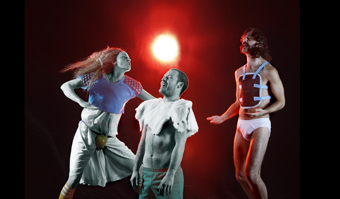
Kristy Ayre, Timothy Harvey, Luke George, NOW NOW NOW
photo Jeff Busby
Kristy Ayre, Timothy Harvey, Luke George, NOW NOW NOW
luke george: dancing in the moment
In Luke George’s NOW NOW NOW at Melbourne’s Dancehouse, the choreographer and two fellow dancers will attempt to address a paradox shared by performers and audiences: “We seek to be in the moment, yet through the pursuit of this, we move further and further away from it.” George began his career with Launceston’s Stompin (where he was also artistic director 2002-08), trained at the VCA and has worked with Phillip Adams’ Balletlab, Jo Lloyd, Chunky Move, Itoh Kim, Miguel Gutierrez and Deborah Hay. He has choreographed for Stompin, Back to Back and Arena theatre companies, and his independent work LIFESIZE (seen at Dance Massive in 2009) was short listed for an Australian Dance Award. In NOW NOW NOW he will be joined by dancers Kristy Ayre and Timothy Harvey with design by Bluebottle 3 and dramaturgy by Martyn Coutts. George writes, “My aim is to magnify audience/performer relationship and question the ‘realness’ of performance and how we are in the world. In NOW NOW NOW the performers are not characters representing a greater humanity or society—we are ourselves and this performance is a genuine attempt at the question, ‘can we be in the moment?’ and we invite an audience to experience that with us.” You can read Sophie Travers’ interview with Luke George about his career and vision in RealTime 98, August-September. NOW NOW NOW, Dancehouse, Melbourne, July 28-Aug 1; www.dancehouse.com.au
fact, uk: the reoriented gaze
Liverpool’s Foundation for Art and Creative Technology (FACT) is currently staging an exhibition titled Persistence of Vision. Featuring eight contemporary artists, including AVPD (Denmark), Julian von Bismarck (Germany), Julien Maire (France) Mizuki Watanabe (Japan) and Melik Ohanian (France), the show investigates “the relationship between vision, memory and media.” (Intriguingly, the exhibition appears to anticipate the theme for next year’s Performance Studies International conference, which is called Camillo 2.0: Technology, Memory, Experience. Camillo 2.0: Technology, Memory, Experience, Performance Studies International #17, Utrecht, the Netherlands, May 25-29 2011; http://psi17.org/) In one installation, In-Between Gaze (2010), Mizuki projects an out of focus image onto a wall. When the viewer uses a magnifying glass to bring the image into focus, a live video showing the viewer holding the magnifying glass appears in the focused part of the projection. In this way, “viewers not only see themselves, but also see themselves seeing.” The work by AVPD is similarly playful: “a disorienting installation using mirrors and corridors to explore the role of memory in our visual perception and orientation in a given space.” Persistence of Vision, FACT, Liverpool, UK, June 18-Sept 5; http://www.fact.co.uk/about/exhibitions/2010/persistence-of-vision
situating abramovic at artspace
Amelia Jones, author of Body Art/Performing the Subject (1998), Irrational Modernism: A Neurasthenic History of New York Dada (2004) and Self Image: Technology, Representation, and the Contemporary Subject (2006) among other books, comes to Artspace on July 13 to speak on “Performance as Improvisation: Aesthetics, Live Art, and the Problem of History.” The presentation will investigate “what happens when performance gets put in the frame of aesthetics.” More specifically, it examines Marina Abramovic’s Seven Easy Pieces (2005; http://www.seveneasypieces.com), where the artist re-enacted six 1970s performance art works (on the seventh day she rested) at the Guggenheim Museum in New York. Jones uses this performance as a “pivot” point in order to “argue that making ‘performance’ as ‘art’ is a category confusion that produces a range of contradictions, opening up a gap between aesthetics and the vicissitudes of the improvisational or the live event.” No doubt there are additional layers to the argument in view of the recent Marina Abramovic retrospective at MoMA, where numerous performers “re-performed” some of her early works (you couldn’t see it live, see it online at the exhibition website; http://www.moma.org/interactives/exhibitions/2010/marinaabramovic/index.html). No bookings will be taken for this event and places are limited, so get to Artspace early to avoid disappointment. Amelia Jones, “Performance as Improvisation: Aesthetics, Live Art, and the Problem of History,” Artspace, July 13, 6.30pm, http://www.artspace.org.au/public_lectures
RealTime issue #97 June-July 2010 pg. web
© RealTime ; for permission to reproduce apply to realtime@realtimearts.net
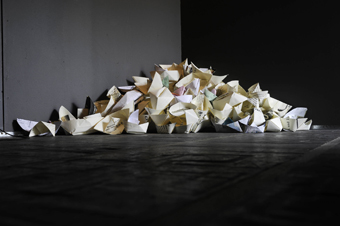
In Search of the Inland Sea, 2009, Norie Neumark, Maria Miranda
photo Adam Hollingworth
In Search of the Inland Sea, 2009, Norie Neumark, Maria Miranda
MEMORY FLOWS IS AN ONGOING PROJECT OF THE CENTRE FOR MEDIA ARTS INNOVATION (CMAI) AT THE UNIVERSITY OF TECHNOLOGY SYDNEY (UTS). UNDERTAKEN BY A LOOSE COLLECTIVE OF UTS STAFF AND AFFILIATED ARTISTS (OFTEN IN COLLABORATION), MEMORY FLOWS EXPLORES THE IDEA OF WATER AND ITS RELATION TO MEMORY, UTILISING SOUND, VIDEO, PHOTOGRAPHY AND SCULPTURE. SINCE ITS INCEPTION THERE HAVE BEEN SEVERAL PUBLIC OUTCOMES SUCH AS AT LIQUID ARCHITECTURE 2009 WITH THE PROJECT CULMINATING IN AN AMBITIOUS EXHIBITION PRESENTING 13 WORKS AT THE NEWINGTON ARMORY CURATED BY NORIE NEUMARK, DEBORAH TURNBULL AND SOPHIA KOUYOUMDJIAN.
The Newington Armory itself is quite a curious place—an eerie post-colonial ghost town left standing amidst the industrial sprawl of Silverwater (right next to a high security prison) on the mangrove fringed Parramatta River. On weekends it’s frequented by families as a leisure park with bike riding and roller-skating along the riverbanks. Approaching the Armory site it’s impossible not to contemplate the role of rivers in our ecosystem, the impact of modern civilisation on the landscape and the hidden histories of Sydney, and indeed Australia. Inside the exhibition, it is the works which approach these ideas more obliquely which prove to be most intriguing.

Diffusion, 2010, detail, Neil Jenkins, Roger Mills
courtesy of the artists
Diffusion, 2010, detail, Neil Jenkins, Roger Mills
Neil Jenkins and Roger Mills’ Diffusion (2010) draws you into a darkened space with the staticy sounds of running water made from hydrophonic recordings of the Parramatta River. The sounds issue from eight speakers hanging from the ceiling, each a beautifully crafted object: a wooden cube with an intricate structural diagram of a chemical pollutant laser-cut through one panel. Lit from within, the patterning gives each surface the appearance of a delicate lace-like screen. In the middle of the circle of speakers, textured images of water are projected, rendered mysterious by the intense detail. Moving around the work you experience a range of timbres of water sounds, often harsh and angular, reflecting the aggression of chemical infiltration, yet the beauty of the objects in the space is beguiling. (View video footage at http://www.eartrumpet.org/images/diffusion.mov)
Drawing Water (2009) by Jacqueline Gothe and Ian Gwilt is also evocative, comprising a large floor projection of gently undulating shapes—an abstract interpretation of the twists and turns of rivers from a topographical perspective. The image itself is not animated, yet it scrolls from left to right creating a disorienting sense of flow. The top down view and the interplay between stasis and movement create a sensation of the elusiveness of the shape of water.
In Search of the Inland Sea, 2009, video still, Norie Neumark, Maria Miranda
courtesy of the artists
In Search of the Inland Sea, 2009, video still, Norie Neumark, Maria Miranda
Co-curator Norie Neumark contributes a work made with long-time collaborator Maria Miranda, In Search of the Inland Sea (2009). Neumark and Miranda’s work frequently uses offbeat humour to approach serious issues (see the review of their Talking about the Weather). In this instance the idea of the elusive inland Australian sea which captivated early settlers is explored through a series of vignettes. The spine of the work is a road trip that the pair undertook retracing the explorer Sturt’s original journey down the Murrumbidgee and Murray Rivers. However they have substituted a small paper boat for Sturt’s impractical whaling vessel. Mobile phone video footage of the journey is presented on a small screen but the road trip narrative is complicated by a soundtrack which draws on the spoken description of the plot of a Japanese horror film, about creatures emerging from murky waters to abduct people. On another screen we see hands folding pages from an old book on Sturt into small paper boats while the voice over, rather than reading from the book, describes the look of the pages and the typography, hinting at the absurdity of colonial formalities. A pile of paper boats also fills one corner of the space beneath the screens. On yet another small screen an endless strip of outback road is accompanied by slowed down voices describing an action scene from Mad Max illustrating 20th century interpretations of the Australian landscape. Through the accumulation of these quirky juxtapositions, we get a sense of the complexity of the fantasies and fears of a non-Indigenous relationship with the Australian outback.
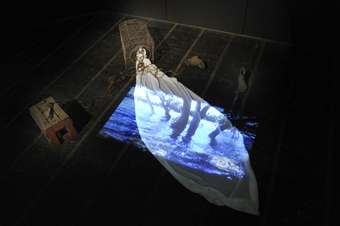
Cleanse, 2010, Megan Heyward
photo Adam Hollingworth
Cleanse, 2010, Megan Heyward
Several works used a more narrative approach to the thematic, recounting recollections of rivers and local waterways. The most stylish of these was Megan Heyward’s Cleanse (2010) which explores her childhood memories of the Parramatta River. Filmic-style video is down-projected onto a swathe of cloth issuing from a fishing trap. Scattered across the space are objects found around the river—old boots, fishing tackle, a wooden crate—which frame the viewing space. These memory fragments are intriguingly rich with a sense of the past, implying an innocence but also an ignorance in our past interaction with the ecosystem. Other works using documentary approaches, such as Shannon O’Neill and Jennifer Teo’s Waterfront Utopia (2010), Clement Girault and Victor Steffanson’s video component of Live Flows (2009), and to a lesser extent Ian Andrews’ Shifting Sands, are certainly accessible and informative if too illustrative for my taste, lacking complexity in the handling of their subjects.
While there was some similarity of approach, the standout works illustrated a range of stylistic and conceptual explorations on the thematic, and the venue choice added strong site-specific resonances to the exhibition. Perhaps more importantly Memory Flows introduced thought provoking and well-executed media art to a large general public.
Memory Flows, curators Norie Neumark, Deborah Turnbull, Sophia Kouyoumdjian; a project of Centre for Media Art Innovation, UTS, Sopa programming Tony Nesbitt; artists Ian Andrews, Chris Bowman, Chris Caines, Damian Castaldi, Sherre DeLys, Clement Girault, Jacqueline Gothe, Ian Gwilt, Megan Heyward, Nigel Helyer, Neil Jenkins, Solange Kershaw, Roger Mills, Maria Miranda, Norie Neumark, Shannon O’Neill, Greg Shapley, Victor Steffenson, Jes Tyrrell, Jen Teo; Newington Armory, Sydney, May 15-June 20; http://memoryflows.net
CMAI director Norie Neumark will be leaving UTS in July to take up a new position at La Trobe University.
RealTime issue #97 June-July 2010 pg. web
© Gail Priest; for permission to reproduce apply to realtime@realtimearts.net
l-r: Devi Fitria, Melissa Quek, Dinyah Dinyah Latuconsina (Cultural Program Assistant), Keith Gallasch, Giang Dang, Joelle Jacinto, Cat Ruka, Bilqis Hijjas, Pawit Mahasarinand
photo Phalla San
l-r: Devi Fitria, Melissa Quek, Dinyah Dinyah Latuconsina (Cultural Program Assistant), Keith Gallasch, Giang Dang, Joelle Jacinto, Cat Ruka, Bilqis Hijjas, Pawit Mahasarinand
THANKS TO AN INVITATION FROM FRANK WERNER, REGIONAL HEAD OF THE CULTURAL PROGRAM DEPARTMENT AT THE GOETHE INSTITUT INDONESIA, I WAS DELIGHTED TO ATTEND THE 10TH INDONESIAN DANCE FESTIVAL (TITLED “POWERING THE FUTURE”) IN JAKARTA TO RUN A REVIEW-WRITING WORKSHOP FOR THE INSITITUTE IN RESPONSE TO FOUR DAYS OF EXHILARATING DANCE FROM INDONESIA, TAIWAN, JAPAN, KOREA AND EUROPE.
Amidst the festival hubub, new cuisine experiences, nerve wracking city traffic and World Cup tensions (after all, our host was a proud and anxious Goethe Institut), the workshop team saw shows, discussed and wrote (late at night or early in the morning), read each other’s reviews and shared knowledge and opinions.
The workshop participants were a fascinating mix: some had professional dance and producing experience, some were already reviewing, running blogs or contributing to magazines and newspapers, others were starting out.
Cat Ruka from New Zealand is a dancer, performance artist and the editor of Yellingmouth, an Auckland-based dance review blog. Melissa Quek from Singapore is a choreographer, a teacher at LASALLE College of the Arts
and a freelance dance reviewer for The Business Times. Joelle Jacinto from the Philippines is a dancer and a freelance writer with many years of experience. She is editor-in-chief of Runthru, a bi-annual dance magazine and website. Bilqis Hijjas creates, performs, produces, teaches and writes about contemporary dance in Kuala Lumpur, Malaysia and runs a residency for choreographers at the private arts centre Rimbun Dahan. Devi Fitria is a Jakarta-based journalist who works for the Indonesian art magazine ARTI and an online history magazine, HISTORIA. San Phalla lives in Phnom Penh, holds degrees in Southeast Asian Studies and archaeology and works as a researcher for Khmer Arts, a Cambodian classical dance company that tours the world. Dang Giang, from Vietnam, is a writer and cultural and social activist.
Pawit Mahasarinand
photo Keith Gallasch
Pawit Mahasarinand
Parwit Mahasarinand, a theatre lecturer and dance reviewer since 2000 for The Nation English language newspaper in Bangkok, was a very welcome addition to the workshop after he’d delivered a keynote address (“If we write more—Observations on contemporary dance criticism in Asia”).
Dance scholar, archivist and writer Franz Anton Cramer (Paris/Berlin) delivered two talks, one on the ethics and aesthetics of criticism and the other an invaluable and subsequently hotly debated introduction to the works of Meg Stuart and Philipp Gehmacher who were performing Maybe Forever in the festival.
The aim of the workshop was to improve the capacity of reviewers to vividly evoke the works they experience for their readers. Good reviewing (whether or not it consciously includes social, political and economic perspectives and passes critical judgment) cannot work effectively without this skill. Openness, strong recall, rich vocabulary, a structured response, the careful delivery of judgment, these were the workshop focus.
I was pleased that all participants willingly and bravely committed themselves to a challenging task—to respond very quickly to new dance works while focusing on writing skills and being subjected to criticism. As you read the reviews posted here do keep in mind that they were written under pressure and with limited time for editing and polishing. Despite these demands there are fine examples of vivid and thoughtful writing to be found in the 23 reviews that came out of a mere four days of what appeared to be happy labour. It was particularly pleasing to see increased attention not just to movement details but also to music, sound, set design, lighting and the ways in which, in this era of hybridity, various forms mix and meld.
The festival provided challenges for all of us in the workshop. Many works drew on traditional dance, customs and beliefs, sometimes leaving us guessing as to specific meanings while fascinated with what we seen. It’s doubly difficult given that the works are themselves contemporary interpretations or re-workings of traditional forms. Sometimes one of our number had an answer, or we googled one, provisonally, knowing that a dance festival like this one can only serve as an introduction to unfamiliar forms. Inevitably we debated the advisability of reviewing works where we lacked cultural understanding—would we misrepresent what we saw or were we encouraging interest and a sense of inquiry?
Other issues discussed included the significance, or not, of English language dance reviewing in Asia, a shortage of good editing, and a certain reviewer caution about being judgmental—verbal opinions were often tougher than those that appeared in print, said a number of participants.
![l-r: Giang Dang, Phalla San, Joelle Jacinto [outside theatre]](https://www.realtime.org.au/wp-content/uploads/art/37/3701_gallasch_idf3.jpg)
l-r: Giang Dang, Phalla San, Joelle Jacinto [outside theatre]
photo Keith Gallasch
l-r: Giang Dang, Phalla San, Joelle Jacinto [outside theatre]
From the too real street fighting of contact Gonzo to the contemplative account of a relationship breakdown in Maybe Forever and on to a range of works that engage simultaneously with traditional Indonesian forms and contemporary ideas (about homosexuality, globalisation, identity, climate change), you’ll discover in our workshop reviews an Indonesian dance festival engaged directly with the role of dance as art, and as life.
It’s hoped that the workshop will further the bringing together of dance artists and writers in the region.
The initials of the workshop writers will link you to their reviews of the following works:
Kim Jae Duk Project, Darkness Poomba [South Korea]: PS, CR, MQ, PM
contact Gonzo [Japan]: CR, GD, PM, MQ
Gusmiati Suid, Seruan [Indonesia]: DF
Asry Mery Sidowat, Merah [Indonesia]: JJ, MQ, DF
Muslimin B Pranowo, The Young [Indonesia]: BH
Jecko Siompo, From Betamax to DVD [Indonesia]: PS, MQ, JJ
Eko Supriyanto, Home: Ungratifying Life [Indonesia]: JJ, MQ
Vincent Sekwati, Barena ‘Chiefs’ [Indonesia]: MQ
Shinta Maulita, GAYaku [Indonesia]: DF, MQ
Ajeng Soelaiman, Andara Firman, S]h]elf [Indonesia]: GD
Cross Over Dance Company, Middle [Taiwan]: BH
Meg Stuart, Philipp Gehmacher, Maybe Forever [Berlin/Vienna]: BH, CR, GD, JJ, PM
Joko Sudibyo, Cekrek [Indonesia]: MQ, DF
Closing Night Performance: JJ, MQ
Emerging Choreographers Program: MQ, DF
You can see all 23 reviews at 10th Indonesian Dance Festival: Goethe Institut Regional Critic Workshop
Goethe Institut Indonesia, Regional Dance Critic Workshop, June 14-18, held during the 10th Indonesian Dance Festival, “Powering the Future”, June 14-17
This article first appeared online July 12, 2010
RealTime issue #99 Oct-Nov 2010 pg. web
© Keith Gallasch; for permission to reproduce apply to realtime@realtimearts.net
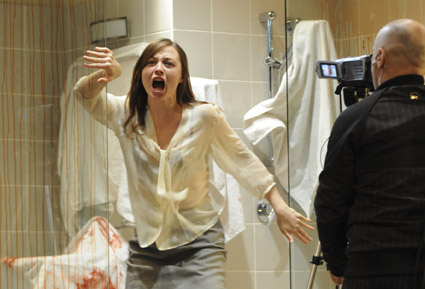
Robin McLeavy, Arky Michael, Measure for Measure, directed by Benedict Andrews
photo Heidrun Löhr
Robin McLeavy, Arky Michael, Measure for Measure, directed by Benedict Andrews
SHAKESPEARE’S MEASURE FOR MEASURE HAS LONG BEEN REGARDED AS A ‘PROBLEM PLAY.’ IT’S A CLASSICAL COMEDY IN MANY RESPECTS, FOCUSED ON LOVE AND EVERYDAY SEXUAL MORES, LOADED WITH HIDDEN IDENTITIES, SUBSTITUTIONS AND COMICAL MISCALCULATIONS AND IS RESOLVED WITH A WELTER OF MARRIAGES INDICATIVE OF SOCIAL RENEWAL. HOWEVER, THE PLAY’S TONE IS SURPRISINGLY DARK FOR A COMEDY, IF NOT BLACK, ALTHOUGH BENEDICT ANDREWS’ PRODUCTION FOR COMPANY B SOMETIMES APTLY PAINTS IT SO. WHILE THE THREAT OF DEATH IS NOT UNCOMMON IN COMEDY, IT’S USUALLY TREATED LIGHTLY, BUT HERE SHAKESPEARE MAKES ITS LIKELIHOOD PALPABLE. THE SUFFERING OF THE PRINCIPAL CHARACTERS IS PAINFULLY ACUTE AS THE LAW TURNS UNJUST AND A CRUEL INEVITABILITY TAKES OVER—TRAGEDY IS IMMINENT.
Measure for Measure (1604) is snared by the dark side of politics. That’s not unusual for a comedy of the first decade of 17th century London, but here state power is enacted with such severity and in such an un-comedic vein that the play teeters uncomfortably between genres. This is especially so at the end when Shakespeare attempts to balance the return of justice with the demands of comic resolution. This complication is amplified in the final act by a deus ex machina who is the principal cause of the near tragedy. Consequently, while it makes fine fodder for literary debate, Measure for Measure is not frequently produced and the directorial challenge to achieve a unity of vision is formidable.
However, while the ending of the play remains forever problematic, the relationship between serious drama and comedy is, for the most part, dynamic. Disturbed by a rise in sexual licentiousness among his citizens, the Duke of Vienna (Robert Menzies) absents himself, leaving the city in the hands of a trusted deputy, the morally respectable Angelo (Damon Gameau) who immediately commences a series of brutal prosecutions at all levels of society. Prostitutes, bawds, officers of the law, citizens and politicians are suddenly thrust together. Measure for Measure is kin to the satirical Jacobean city comedies of the 1600s—urban, licentious and laced with droll seriousness, as when the bawd Pompey (Arky Michael), forced to become an executioner’s assistant, decries the ‘mystique’ of haughty executioners. The Provost (Steve Rodgers) concurs in a retort to the offended executioner, “Go to, sir, you weigh equally [with bawds]: a feather will turn the scale.”
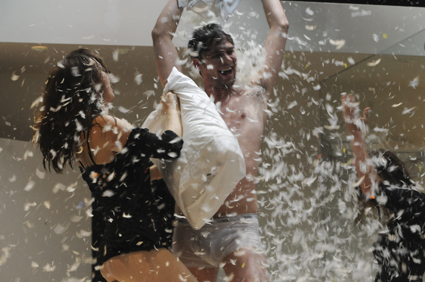
Robin McLeavy,Toby Schmitz, Maeve Dermody, Measure for Measure
photo Heidrun Löhr
Robin McLeavy,Toby Schmitz, Maeve Dermody, Measure for Measure
Comedy and drama are at one in the play’s struggle to balance personal freedom and the demands of law, not least when power is being abused. Angelo decides to execute Claudio (Chris Ryan) who has impregnated his fiancée, Julietta (Maeve Dermody). Angelo then demands the sexual favours of Claudio’s sister, Isabella (Robin McLeavy), a novice nun, in return for her brother’s life, a bargain he has no intention of honouring. Benedict Andrews keeps the comedy rude and raw, even grossing it up with an early group sex and pillow fight scene (the world awash with feathers for the remainder of the first half of the play) and later with Lucio (Toby Schmitz) engaging furiously in frottage and penetration with a tiger lily. It’s as if to say, yes, the city is depraved, but which is the greater evil—general licentiousness or the abuse of power?
The sense of a coherent world is made more concrete by having all of the action occur within one intensively surveilled room. As it revolves it becomes other spaces (nunnery, cell, office) but its commonality is produced by the space reducing cameras hand-wielded or secreted in ceilings by the mass media or the state and the Duke’s personal surveillance in his guise as a man of the church manipulating the action. The result is a closed, dangerous world where everything is bared and controllable.
The revolving room is framed either side by large screens which provide close-ups of the characters and medium shots of character groupings, offering alternative layers of comment and emotional intensity. The sense of portraiture is particularly strong (the printed program reproduces Giorgio Agamben’s essay “The Face”). Flickering into focus, still, listening faces appear like paintings—Isabella as if rendered by Vermeer. At other times the images are hard—the over-lit pornography of interrogation and intrusion. Actors take turns at operating cameras, standing mid-action, ignored by the characters they’re filming and eventually by the audience, so familiar is the idiom, its power neglected at our peril. We peer at faces, looking as we do in portraiture for some kind of truth or essence and with increasing uncertainty.
The interplay of live action and its immediate screening is engrossing, even in a small theatre where you often have to choose where to direct your attention (especially if you’re sitting close to the stage—not an ideal position). Some moments become almost entirely cinematic, one of the most affecting being when Isabella tells her doomed brother that she cannot rescue him from death. In low blue light the stage is almost dark, brother and sister initially either side of a glass wall, her face reflected over his, amplifying the sense of kinship at the same time as a terrible moral divide. Ryan and McLeavy, advantaged as well by head microphones, play the scene with a low key, nuanced intensity. Sean Bacon dexterously live edits the camerawork with an air of improvisation while simultaneously, assured artistry is evident in every carefully framed image right down to the panning shots across fallen feathers as scenes are bridged.
As usual with Benedict Andrews there’s a bracing thoroughness in the way he takes a conceit, gives it body and weaves it through his productions, just as Shakespeare does with metaphor and its embodiment. The video shooting is seamlessly integrated into the action—Isabella huddles in a cupboard, aiming a camera at herself; the arrested Claudio spits into the lens; the death row prisoner, Barnadine (Colin Moody), face-painted with blood and faeces after trashing the hotel holding room he’s been locked in, leers into the surveillance camera—he knows he has an audience. We watch characters going to the toilet, being subjected to urine tests and genetic swabbing as a matter of course. When the Duke steps out of the surveillance frame it’s a shock—he needs greater distance from his world than a disguise can allow. It’s also preparation for the very final moment of the production: it had the audience cheering and, in a way, answered at least one ‘problem’ inherent in the play—but you need to see that for yourself.
McLeavy is excellent as Isabella, making the most of the young woman’s alternations between hesitation and determination, above all marking her surprise, right to the end, at the world in which she has found herself. Her sudden, angry insight into the wrong done Claudio by Angelo is powered by logic—no wonder he is taken by her. Yet, she cannot fully understand her brother’s anguish at her refusal to surrender to Angelo. (Another of the play’s ‘problems’ is that although she aids the outing of her nemesis, it is eagerly at the ‘expense’ of another woman going to Angelo’s bed in her stead.) Frank Whitten makes a fine Escalus, an older statesman trapped between Angelo’s dictatorial actions and his own sense of fair play. Arky Michael is a sympathetic, funny Pompey and the sense of desperation and panic among the bawds is convincing as the law is forcefully enacted.
I was less certain about Damon Gameau as Angelo. Except for the moment Angelo speaks with sheer surprise at his attraction to Isabella (running a hand over an erection), the portrayal seemed oddly neutral—as if Angelo is all enigma, a man not to be gauged except by reputation. Where was the personality, evidence of the will that could frighten the populace and compromise fair men like Escalus? Robert Menzies as the Duke was at his best in the long final scene, fiery, fast, in control, cruelly if logically playing out a game to trap Angelo. His anxious, machinating and sometimes shocked friar was less convincing—could there have been more to the Duke and his friar self than the stolid interiority that emerges from time to time in Menzies’ performances, as in his Brutus for Andrews’ Julius Caesar for the Sydney Theatre Company.
Toby Schmitz’s Lucio is a highlight—all at once an exemplar of the city’s debauchery, a loyal friend to Claudio (it’s Lucio who persuades Isabella to act) and an otherwise obtuse judge of personalities and situations. Schmitz creates a tunnel vision personality, cocky, rude and stylishly contemporary, while making remarkably easy sense of Shakespeare’s language.
Although not entirely convinced by the accounts of the Duke and Angelo, I nonetheless found Andrews’ production to have a marvellous cogency in its sense of a self-contained world, amoral but soon painfully intent on achieving a balance between law and justice. The Duke’s city has real problems which are presented with apt rawness, visually and loudly. At other moments, Measure for Measure is played and intimately projected with the requisite delicacy, if always underpinned with urgency. Andrews and his collaborators make Measure for Measure a play for our times, bringing to the stage the invasive cameras of news media and surveillance as the latest tools of power, cruelly distorting prisms that nonetheless, and quite ironically, allow us here to see further than we usually might.
Company B Belvoir, Measure for Measure, writer William Shakespeare, director Benedict Andrews, designer Ralph Myers, costumes Dale Ferguson, lighting Nick Schlieper, composer, sound Stefan Gregory, video design, operator Sean Bacon; Belvoir Street Theatre, Sydney, June 9-July 25
This article first appeared online July 12
RealTime issue #98 Aug-Sept 2010 pg. web
© Keith Gallasch; for permission to reproduce apply to realtime@realtimearts.net
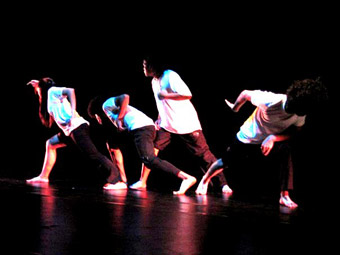
From Betamax to DVD
photo Phalla San
From Betamax to DVD
ONE HAND, BENT SEVERELY AT THE WRIST, PRESSES RIGIDLY AGAINST THE CHEST, WHILE THE OTHER IS LOWERED BUT ALSO ANGULARLY BENT AT EVERY JOINT. TORSOS ARE THRUST FORWARD, AND ALL THE WEIGHT OF EACH BODY IS DRIVEN INTO THE LUNGING FRONT LEG, WITH THE OTHER ALSO BENT AND SLIGHTLY OUTSTRETCHED BEHIND. THE HEAD IS TILTED TO THE SIDE, SEEMING TO LOOK AT THE AUDIENCE SIDEWAYS, AS IF WARILY ASSESSING HOW THEY WILL BE ASSESSED IN TURN. FROM THIS STANCE, THE SIX DANCERS IN JECKO SIOMPO’S FROM BETAMAX TO DVD PERFORM FAST, VERY PRECISE, UNCONVENTIONAL MOVEMENTS, STEPPING IN AND OUT OF COMPLICATED PATTERNS WITHIN INDIVIDUAL FLOOR SPACES, EACH TWISTING A KNEE SIDE TO SIDE AS THE FOOT IS LODGED FIRMLY ON THE GROUND. THEY STOP AS ABRUPTLY AS THEY STARTED, THEN BEGIN AGAIN, EACH SEQUENCE DICTATED, OR EVEN ACTIVATED BY, A VOCAL SIGNAL FROM ONE OF THE DANCERS, A YELP OR BARK OR A SHORT, SHRILL CRY.
Every now and then, one or more of the dancers breaks out of their staggered line with an outburst of emotion, a comment to a fellow dancer, another version of the same fast angularity or a completely different, exaggeratedly sinuous movement. But they all return to the original stance, sometimes of their own volition, sometimes to a reprimanding hiss from dancer and choreographer Jecko Siompo. From Betamax to DVD was premiered in 2009 and shot Siompo to stardom not only as a ground-breaking local choreographer, but also as one of “20 Young People in Indonesia Who Have Made History.”
Siompo was the first choreographer featured in the final program of the 10th Indonesian Dance Festival. The bill also included works by Eko Supriyanto and Vincent Sekwati Koko Mantsoe. The trio was a particularly interesting closing line-up: two very different works from major Indonesian choreographers and an invited dancer/choreographer whose work is also vastly different yet exhibits values evident in the preceding pieces. None of these are show-stopping, bravura numbers, which would be the case in a festival in the Philippines, where I’m from, which is why I think this line-up says much about Indonesian culture.
Siompo and Supriyanto’s works, although not similar at all, seem to represent what Indonesian contemporary dance is currently all about. While one is a stream of fast-paced, repetitive movement and the other often has barely any movement at all, they both appear to be manifestations of ideals evident in the previous day’s showcase of emerging choreographers. Indonesian audiences, I have found, appreciate the slow-moving contemporary pieces that make you think, and they are, I’ve been told, rather fond of discussing a work’s meaning after the curtain goes down. The rousing applause that followed all three final night works suggested this might be the case.
Eko Supriyanto’s Home: Ungratifying Life starts with the choreographer crossing the stage with an almost agonizing slowness. Halfway across, he adds a small crouch before the next step, a small lift of an extended leg before the next, a small twist of the body, and so on. All this time, he is enveloped in silence—or rather the annoying clicking of too many audience cameras in a frenzy to capture his every move. But he rest of the piece is “performed” to high-pitched singing and a deafening, incessant whine from the sound score, as different characters approach a wooden frame hanging front and centre—an old, weathered angel, two near-naked men, a man in a pink tutu and a girl walking a dog. They look out from behind the frame as if from a window, peering at the audience as we inescapably stare back. The man in the tutu, revealed to be the source of the relentless singing, pauses only to rudely ask, “What are you looking at?” From a choreographer who has danced for Madonna and appeared in films, Supriyanto is obviously questioning such scrutiny and what all the hoopla is about. What I find compelling is that the audience gets this.
It appears that younger dance practitioners in Indonesia also get what Supriyanto and Siompo are saying and are applying these ideals to their work. The Emerging Choreographers showcase displayed these aspirations. For example, I could see an impulse from the younger choreographers to pepper their works with Javanese poses and gestures, to the same degree that Siompo has drawn from his native Papuan dance forms and reconstructed them to create his own movement. There is also a need to provoke, as Supriyanto does, even if the challenges posted by the younger choreographers are not yet as mature—or as taxing for their audience.
But there are promising ideas, especially from Santi Pratiwi, whose Retorika Kerinduan adequately captures the disquiet of a village whose former inhabitants have all moved to the city for supposedly better opportunities, as well as Joko Sudibyo, whose Cekrek is an engrossing peek into the kind of drama that only goes on inside one’s family home. The movements in Retorika Kerinduan cleverly delineate the differences between village and city—getting away from the city is depicted by running around the ‘village’ at top speed while the ‘city’ captures the villagers with lethargy. Given more time for development, Retorika Kerinduan could be even more striking. In Cekrek, I particularly liked the sharp contrast between the four young boys, who all moved with fluid vitality, and the crying woman whose few moments of dancing were caricatured for comic effect. Perhaps I would have better appreciated the work if I’d understood what she was saying as blithered away to the audience in a local language. Nevertheless, the images had great strength.
In the case of From Betamax to DVD, which I first saw last year, the festival also provided the opportunity to see a work that has been further developed. I detected an increase in the tension between technology and tradition in the updated soundscape of spliced engine noise (cars, planes, machines) and electronics (network buzz, connecting modems) and the stronger responses of the dancers to the score. Perhaps Siompo was pushing this tension more to the surface, or I was more aware of it on second viewing.
Other changes were less successful, with the dancers showing more personality and given more opportunities to dominate Siompo in his role as the outsider. Last year, he was in control—the performers moving in unison and in staggered groups, but always returning to the line at Siompo’s barking command. In this “improved” version it doesn’t seem that the dancers appreciate his presence; one girl even breaks formation to shriekingly chastise him. Perhaps the dancers, some of whom are making choreographic ventures themselves, are becoming more confident, finding their own voices—their yelps and screeches here growing louder and more consistent, symbolic evidence that the Indonesian dance scene is expanding and strengthening.
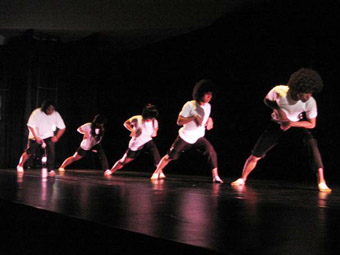
From Betamax to DVD
photo Phalla San
From Betamax to DVD
FROZEN IN TIME, FIVE DANCERS, IN PLAIN WHITE T-SHIRTS AND BLACK TRACK PANTS STAND IN A NARROW LANE OF LIGHT IN JECKO SIOMPO’S FROM BETAMAX TO DVD. A DIZZYING ELECTRONIC SOUND-SCORE REVERBERATES AROUND THEM. A QUICK TWITCH, HOP AND HIT FROM SITI AJENG SOLAEMEN AT ONE END GALVANIZES ANDARA FIRMAN MOEIS AND THEN JECKO SIOMPO (ALSO THE CHOREOGRAPHER) INTO MOVEMENT AT THE OTHER. SIOMPO JERKS OUT OF LINE AND MOEIS FOLLOWS ONLY TO BE HERDED BACK INTO PLACE.
With a loud yelp the dancers break into a litany of isolated movements: arm tuck, leg stamp, head jerk. At one count per movement, they dance at a bracing if predictable speed. The dynamic energy, vigorous dancing and clarity of movement in each shape is virtuosic and exciting, at first. But it continues in this vein for the rest of the piece, quickly shifting shapes at a fast and even rhythm, developing in a high impact but monotonous line—there is no climax, only abrupt stops and starts. It’s a long run-on sentence, barely punctuated by stillness and often underlined by yips and barks.
Yes, the dancers change formation and move in and out of the lane of light, but it’s basically different combinations of the same thing. However Siompo’s tackling a big topic: “the advancement of technology is a message from tradition” (program note), which is something you probably wouldn’t have understood if not for this one line synopsis. If the advance of technology is the move from one system to another, Siompo’s movements similarly change little to fit his theme. His movement language is a pronounced mixture of Papuan dance and hip hop, with the shapes inspired by Papuan animals (mainly the small kangaroo) and the rhythm consistently fast.
The driving force of Siompo’s movement dynamics and his use of universally recognizable sounds are part of his appeal to a global audience. These concrete sounds are also a major vehicle of communication in his work. The beep of electronics, the roar of traffic and the performers’ voices form a medley of the organic and synthetic. In this case the persistent switching of sounds is closely reflected in the changing dance formations, but the consistency of movement seems to indicate that although the world is constantly changing it remains essentially the same.
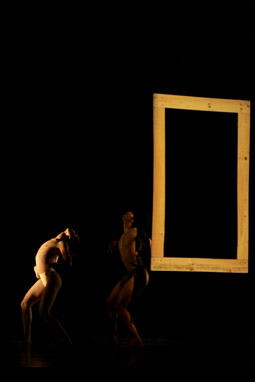
Home: Ungratifying Life
photo Phalla San
Home: Ungratifying Life
In contrast Eko Supriyanto’s Home: Ungratifying Life comprises startling images. Most of the music may be sung in traditional Javanese, a language that even in Indonesia few understand, but is overlaid with a high pitched, painful, piercing whine. The choreographer has cleverly blended east and west in his symbolism. Wearing a batik shirt and clunky boots, a long pony tail trailing down his back, Supriyanto walks very slowly across the forestage in a narrow beam of light. When he reaches the centre, he’s directly in front of a large suspended rectangular wooden frame. His arms move meditatively, fingers briefly flickering before his face. Then with his eyes looking straight through the frame, he backs towards the edge of the stage and falls into the dark auditorium.
In the blackness two white figures slowly appear to take shape, but they are one—a man in black with a pair of large, white feathered wings, perhaps a depiction of the angel of death, slowly walking to the frame. Here he stands for along time, his few moves a gradually morphing picture as he looks out into the audience—or is he framing himself? He retreats and two young men, wearing only jock-straps, bound into the light. Long arms flaying the air, they energise the previously quiet stage. Even in sculptural moments behind the frame and in rectangles of light their sinuous forms appear primal and strong, while their continual gazing upwards or long reaches down to the floor suggest an unseen spiritual realm.
The men are replaced by a woman walking quietly with her dog, displaying the strong bond between human and animal. They are accompanied by a man who, with his short cropped hair, thin moustache and gaunt body dressed in a neon orange tutu with frilly straps, makes a curious picture that is initially surprising but soon taken for granted. He sings but stops abruptly to provoke the audience, shouting through the frame “What are you looking at?” After which he calmly resumes his song and moves away into the darkness, the dog’s eyes following him, while the girl stands staring out of the frame into the distance, inexplicably serene. The dog seated by her side, without artifice, a symbol of domestication, is perhaps intended to remind us of our relationship with nature.
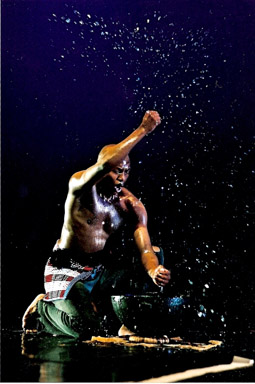
Vincent Sekwati Koko Mantsoe, Barena “Chiefs”
South African Vincent Sekwati Koko Matsoe’s Barena ‘Chiefs’ asks if power comes from the possession of symbols, like his ragged cape and stick, or if it’s inherent. Judging from the immense dynamism that he holds in check but releases at will it’s inherent in his case. His Afro-fusion (African and contemporary dance) style is emotionally expressive and physically demanding. Matsoe talks as he moves and the sounds of animals hooting and howling is underpinned by a strong beat that drowns out his voice, but the power in his furrowed brows and wide glaring eyes is clear. Later he droops as if defeated and drained, only to then grin widely as his feet and head move at a blur. Emotionally exhausted with him, I welcome Eric Satie’s soaring refrains that float over the stage, but instead of dancing to the melody, Matsoe confounds expectations by continuing with his own energetically rhythmic phrases. By ignoring the change in music he has kept the power and control firmly within his own body.
These three choreographers delivered humanistic and existential messages, each in an individualistic and surprisingly self-conscious manner. Each appears as the central figure in their own works, their bodies enabling the narrative. Siompo is the odd figure in From Beta Max to DVD, facing away from the rest of the group, a lag to his movements pulling him out of synch, exhibiting a rare awareness of the difference between himself and his younger counterparts. Supriyanto’s is the first body to peer through the frame at the pictures that slowly take shape on stage in his Home: Ungratifying life. His leap into the blackened auditorium aligns him with the audience and invites us to see through his eyes, which is also the function of his choreography. The crux of Beran ‘Chiefs’ is encapsulated in Matsoe’s on-stage figure, his body containing both symbolic and inherent power, his physical journey the vehicle with which the audience navigates the work.
In this closing performance for the 10th Indonesian Dance Festival—with its “powering the future” motto—these mature choreographers can be seen as representative of the ‘now’ of contemporary dance, examples for future generations of Indonesian choreographers to follow.
Excluding Boi Sakti, who last year announced his intention to stop choreographing, Siompo and Supriyanto are currently Indonesia’s biggest contemporary dance exports (the titles of both their works were in English and not culturally specific). If the selection of emerging choreographers for the festival is anything to judge by, young dancers and choreographers are getting the message loud and clear, showing marked tendencies towards high-art symbolism delivered at an elaborately slow pace or making an impact with a plethora of movement. But that’s to be understood, since learning often starts with mimicry. The real question is should there be more of it?
From Betamax to DVD
photo Phalla San
From Betamax to DVD
TO THE SOUND OF TRADITIONAL MUSIC AND IN GLOOMY LIGHT, THE FIVE YOUNG DANCERS—THREE WOMEN AND TWO MEN—OF THE JECKOSDANCE TROUPE LINE UP LOOKING TOWARDS THEIR LEADER, THE CHOREOGRAPHER JECKO KURNIAWAN SIOMPO PUI. THE SINGING CUTS OUT, REPLACED BY THE SOUND OF A STREAM. A GIRL AT THE BACK OF THE LINE MOVES FORWARD A FEW STEPS AND SWINGS HER RIGHT HAND. HER ENERGY SEEMS TO SWAY THE GIRL AT THE FRONT OF THE LINE CAUSING JECKO TO SWING BACK AND FORTH LIKE A ROBOT. HE SHOWS OFF HIS DANCE TECHNIQUE TO HIS TEAM, BUT THEY DON’T SEEM TO APPRECIATE IT. ONE CRIES OUT AND THEY MAKE THEIR OWN DANCE INSTEAD.
From Betamax to DVD is a multi-dance work that includes a synthesis of breakdance, acrobatic, robotic, traditional Papuan dance and animal movements—mimicking apes (bodies held low) and kangaroos (both hands held to chests), pushing and pulling each other to produce comic moments. Repeated, robotic action, also found in breakdancing, is common while other moves look athletic, as if the performers are preparing to run—a body bent forward, one leg stepped back, the other forward, bent at the knee,
The performers danced in line, broke from it and criss-crossed. But Jecko seemed to be trying to stay free of his colleagues. They tugged at his t-shirt, wanting him to join in, but he repeatedly pushed them away as if to resist modernity and its rapidly changing technology, to stay with Papuan tradition. Nevertheless he sometimes joined them, dancing in line, because there are some things you cannot avoid in a globalised world.
Dance movements switched fast to changes in light and sound, alternating between loud and soft: a mix of flowing water, car horns, helicopters, jet planes, computer sounds, electronic blips, waltz music, club music…This rush symbolized a rapidly changing culture where no one pays attention.
At the end, the dancers lined up again to face the audience, posing the same question: will Jecko accept modernization and leave tradition behind?
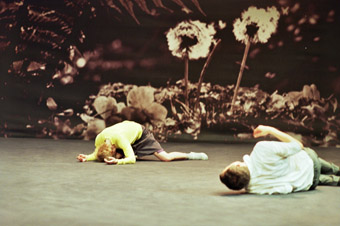
Maybe Forever, Meg Stuart, Philipp Gehmacher
photo Chris van der Burght
Maybe Forever, Meg Stuart, Philipp Gehmacher
IF YOU USED AN EXCITEMENT METER ON MEG STUART AND PHILIPP GEHMACHER’S CONCEPTUAL DANCE WORK MAYBE FOREVER, YOU COULD BE SURPRISED TO FIND THAT THE GRAPH YOU PLAN TO POST ON A WEBSITE, LIKE THOSE OF TWEET VOLUMES MANY SPORTS WEBSITES ARE USING, MAY LOOK QUITE FLAT. BUT THIS IS CONTEMPORARY PERFORMANCE IN WHICH, UNLIKE SPORTS EVENTS, WHAT’S HAPPENING DURING AND AT THE END OF THE SHOW MAY BE NOT SO IMPORTANT AS THE EFFECT ON THE AUDIENCE AFTERWARDS.
The stage of the Graha Bhakti Budaya auditorium is framed by semi-circular curtaining and is almost bare except for a low platform stage right, two microphones on stands, an electric guitar and a loudspeaker stage left, in addition to, upstage with a strong presence, a sepia photograph with two dandelions in focus against a background blur of trees. Stuart and Gehmacher begin with a slow duet amidst a brief series of low flashing lights. And that may be when the excitement graph rises to its highest. Stuart’s subsequent monologue—sweet sentences abruptly changed by the end clause “I take that back”—fills in the back story of a break-up.
What’s remarkable throughout the 80-minute performance is Stuart and Gehmaher’s frequent shifts to and from and blending of stage acting and dance, as well as from everyday to choreographed movement—the combination never risks being labelled pedestrian. One repeated gesture is what Stuart calls “long arms” in which the performers extend their arms and hands as high as they can to wave at each other. It’s like a special code that means something dear to the couple when they’re together but is painful after the split.
The same smooth mix of performing arts disciplines—in addition to life and art itself—is also evident in Niko Hafkenscheid’s live guitar playing and singing and Vincent Malstaf’s music and sound design. The music and lyrics are as melancholic as the performance, and since Hafkenscheid directly addresses us, they are sung for both performers and audience. After calling our attention to the performance at the start, Jan Maertens’s lighting design simply, and subtly, gives the limelight to the performers. His masterful touch shows at the final moment when the lighting delicately changes the photograph’s colour tone.
Heraclitus had it right two and a half millennia ago: change is the only constant. It just seems to me that when it comes to contemporary relationships, we change much faster than our patience.
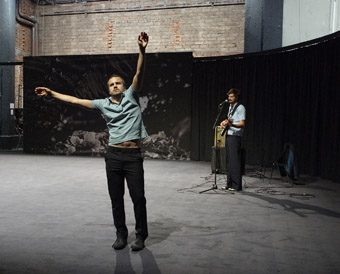
Maybe Forever, Philipp Gehmacher, Niko Hafkenscheid
photo Eva Wordinger
Maybe Forever, Philipp Gehmacher, Niko Hafkenscheid
What’s much more important than—I admit it—my failed romances is that in the 10th Indonesian Dance Festival it’s refreshing to watch a work by veteran artists who leave enough space for us to fully immerse ourselves in the work, add our interpretation to it and partake of individual journeys. After all, our experiences in failed romantic relationships vary. Monotonous can be engaging, mournful invigorating and mundane extraordinary. Such is life, and so is love.
One may argue that people go to performing arts events to experience what they cannot in real life—or, enough of early 20th century realism, please. In dance, they expect exceptional movement skills, for example. What they seem to forget is that sometimes we let life pass by without really thinking about it. Reconfirming that art is rooted in life, Maybe Forever allows us to do otherwise and hopefully, as we move on, not repeat a mistake, though knowing in the back of our minds that we probably will.
Maybe Forever is on a Southeast Asian and Australian tour, organized by the Goethe Institut, despite the fact that none of the artists are German (though Stuart is Berlin-based). Unfortunately, the only part of our country it crossed was the Gulf of Thailand last week on the group’s flight from Ho Chi Minh City to Singapore. Maybe Forever would have been a sizeable dance top-up for Bangkok audiences after the visit of Xavier Leroy last November.
Maybe Forever, Philipp Gehmacher, Niko Hafkenscheid
photo Eva Wordinger
Maybe Forever, Philipp Gehmacher, Niko Hafkenscheid
A COUPLE, TRYING TO SLEEP THROUGH THE EARLY MORNING, LANGUIDLY SEEK THAT PERFECT POSITION BUT FIND THEMSELVES SUBCONSCIOUSLY REACHING FOR AND GRABBING ONE ANOTHER, AND NOT-SO-SUBCONSCIOUSLY PUSHING EACH OTHER AWAY, OR JUST PRETENDING NOT TO RESPOND. PRETENDING TO SLEEP. PRETENDING THAT EVERYTHING IS ALRIGHT.
In Meg Stuart and Philipp Gehmacher’s Maybe Forever, the pair then sit with legs outstretched and backs to the audience, leaning to the side at the same angle, plagued by a weight that neither can ignore. The performance space is hazily semi-lit, reminding me of the way light creeps into your bedroom at dawn. There is little stylization in the way the couple suddenly grab each other and spread against each other full length only to discreetly remove themselves from contact to find another spot on the floor; but this push-and-pull feels like a dance.
The basic movement in Maybe Forever is built around a soft hunching of the shoulders, drawing the arms up and outward, or crossing over in front of the body, in a subtly awkward manner. Both Stuart and Gehmacher do this, sometimes together, sometimes by themselves, but regularly throughout the 80 minutes of the work. Audiences familiar with Gehmacher’s work will recognize this as his preferred style. I don’t know his purpose for such movement, but it feels very apt for Maybe Forever.
The movement I’ve described is first seen in the fourth segment of the work, when Gehmacher re-enters the stage, if hinted at by Stuart in the third segment. Right after the early morning ‘pas de deux,’ guitarist Niko Hafkenscheid croons a song to us with “maybe forever…” in the lyrics. Stuart enters, wearing a skirt and blouse under a thick leather jacket, faces the audience and speaks as if to a former lover: “Remember when I said I wish you were here? I take it back.”
She mentions many things she would rather take back from her relationship, and quite a few things that she decided she doesn’t want to take back after all. As she speaks, she makes one or two brisk movements with her arms to punctuate or even halt her sentences, echoing the work’s movement motif, if not always obviously. Each time she moves her arms, her jacket squeaks, suggesting that in these confessions Stuart is largely uncomfortable, just trying to give herself more room to breathe.
Maybe Forever, Meg Stuart, Philipp Gehmacher
photo Chris van der Burght
Maybe Forever, Meg Stuart, Philipp Gehmacher
As soon as she is done, Gehmacher enters, carrying another microphone stand, but instead of speaking, he abandons it for centrestage where he performs a solo, hunching his shoulders to direct the movement of his arms which rise and fall and cross, both limp and stiff, in front of his torso.
He joins Stuart, who is stretched out on an elevated platform on the left side of the stage and tries to lie with her. He gets up quickly, turns away and then returns. She moves away, turns back to give him a full embrace, falls away again. And so they continue their earlier duet more lucidly, with the push-and-pull more pronounced—and we finally see that this signifies an inability to embrace.
Later there are more serious attempts to embrace, more effort to make things work, but also more despair, and a stronger sense of sadness. Stuart walks offstage, away from Gehrmacher more than once. He ignores this the first time, follows her on the second instance, he does not go far enough, choosing to wallow in self pity, perhaps, by a concrete wall, shoulders hunched, rather than running to reclaim her.
Stuart returns, as if to give Gehmacher another chance, performing a solo as he stands alone in a far corner. By now, I feel quite agitated by this continuing dance of frustration, as if experiencing it myself. I find this quite brilliant; it’s not spectacular but it is definitive. I have to admit that all this time I am waiting for a happy ending, that I want the “forever” to be the inevitable, instead of merely possibile. But even after the pair find each other in a successfully complete and tight embrace, he then fails to register where she goes next, never mind that she is constantly looking back to him, beckoning.
In few words and little movement, a relationship and everything wrong with it has been transformed from private memory to shared experience. It is as if the audience has been on this journey with the dancer-choreographers, felt the same hope and frustration, the same love and loss of love. At the end, Gehmacher finally takes the microphone to haltingly tell us that he is “ready…now…to…” Obviously he is not ready after all, as he looks at Stuart—sitting calmly to the side and now in a bright orange dress—probably waiting for her to finish the sentence for him. But she doesn’t. She just looks back at him, with none of the previous sadness or frustration, not giving him another chance this time. I was not surprised at the eruption of applause as the lights went out.
Maybe Forever, Meg Stuart, Philipp Gehmacher
photo Chris van der Burght
Maybe Forever, Meg Stuart, Philipp Gehmacher
“….IT COULD BE HEAVEN/ BUT IF IT’S HELL THEN YOU CAN WATCH ME BURN” (OZZY OSBOURNE, “CENTRE OF ETERNITY). MAYBE FOREVER EXPLORES A FAILED LOVE, THE SLOW BURN OF A RELATIONSHIP YOU KNOW YOU SHOULD END BUT JUST CAN’T BRING YOURSELF TO. OVER 80 MINUTES, THE WORK IS LONG, SLOW PACED AND OCCASIONALLY AS CUMBERSOME AS THE CRUMBLING RELATIONSHIP IT IS ABOUT.
Choreographed and performed by Meg Stuart and Philipp Gehmacher, the work starts in the dark, with a brooding, evocative soundscape of electronic humming and clicking. After a long while, as low, flickering light grows unnoticed, two indistinct figures are glimpsed, reclining, sleepily shifting, and then touching and pulling at each other. The dark makes reading individual moves and contact more an act of imagination than of sight. As dawn arrives, we are lured inside a crumbling love story.
Suddenly the light is bright, revealing a small structure on the left, half bed half podium, giving the space the feel of a living room-cum-club. Curtains flank a large photographic indtallation at the back, depicting a fern and two dandelions, their luminous fuzz suggesting impermanence.
Meg Stuart launches into a repetitive recital of bittersweet and melancholic thoughts about the affair. “Remember when I said I couldn’t live without you?” she asks. “I take it back.” She takes back statement after statement, once manifestations of affection and passion. Her leather jacket creakes discontently with each of her movements and, gradually, words are overtaken by arm gestures which grow more and more abstract. Throughout Maybe Forever, arm movements and gesture convey much of the communcation between the two.
Philipp Gehmacher has a nerdy manner, awkwardly stumbling through a man-boy haze. He is stiff, speechless until the very end, unable to articulate his emotions. There are moving moments, for example when he stands at the very front edge of the stage, holding his arms high above his head as if waiting to be lifted up, his face bathed in a happy light of distant memories.
Maybe Forever, Philipp Gehmacher, Niko Hafkenscheid
photo Eva Wordinger
Maybe Forever, Philipp Gehmacher, Niko Hafkenscheid
The third person in the mix, singer-songwriter Niko Hafkenscheid accompanies the lovers on their journey, playing beguiling indie pop melodies on electric guitar, singing softly with a warm voice and modest manner. He seems to be the only unwounded soul in the drama, and as he suddenly speaks directly to the audience it becomes apparent that his melancholy music is never just for these lovers; their romance can’t even claim its own music.
There are moments of peace and harmony, Gehmacher sitting upright on the floor, Stuart lying down on her side, her head on his lap. Motionlessly, they listen to the singer playing the beautiful title song, watching the giant dandelions now glowing, lulling their broken hearts.
Soon the pleasure fades, and the tugging, caressing partners slip apart again. All their awkward grappling bears no fruit. In a world falling apart, bodily contact can only provide short moments of solace. Spoken texts and elusive song lyrics evoke sad obsession, futile hope mixed with painful awareness of failure: “Should we say our wishes at the same time so that we don’t hear each other?”
And as the woman tries to take everything back from the romance, and fails to do so, the music plays itself backwards, the melange of noises, voices and fragments of love songs airing an uncomfortable, frustrated longing.
In their character play of disjointed romance, the choreographers allow the work to have the time it needs. It’s not only the slow, meditative pacing that’s demanding for the audience, but also being witness to the agonizing and desperate disintegration of love and expectation. Maybe Forever, in it’s unhurried stillness, is scattered with broken physical exchanges manifest in gawky duets and solos, punctuated with short-lived moments of intimacy and passion. The complex movements of hands and arms caught in the ambivalence between self-protection and surrender are fascinating. These are bodies that have became foreign to each other.
At the end, the man stands alone on the stage. In loose, unskilled sentences, he acknowledges his loss and the impossibility of holding back the decay of love. He knows it’s over: “I have accepted the place I am in.” All three performers are now on stage, festively dressed, she in an orange, sparkling party dress sitting next to the singer with his shiny, deep-blue jacket; the man in black suit and bright yellow shirt, standing at a distance. They have given themselves a new beginning.
Maybe Forever, Philipp Gehmacher, Niko Hafkenscheid
photo Eva Wordinger
Maybe Forever, Philipp Gehmacher, Niko Hafkenscheid
NOTHING PREPARED ME FOR MEG STUART AND PHILIPP GEHMACHER’S MAYBE FOREVER. NOT THE INTRODUCTION BY DANCE SCHOLAR FRANZ ANTON CRAMER, LINKING THE DUO’S WORK TO 19TH CENTURY GERMAN IDEALIST PHILOSOPHY. NOT THE VIDEOS THAT HE SHOWED OF GEHMACHER’S WORK, IN WHICH SCATTERED FIGURES PERFORMED JERKY, APPARENTLY MEANINGLESS GESTURES WITH THEIR ARMS. NOT CRAMER’S DESCRIPTION OF STUART’S REHEARSAL EXERCISES (“IMAGINE THAT YOUR BODY IS DEAD”). AND CERTAINLY NOT REPORTS OF HOW BORED AND DISGUSTED AUDIENCE MEMBERS WALKED OUT OF THE GROUP’S PERFORMANCE IN VIETNAM.
All these established Stuart and Gehmacher’s work as cerebral, inaccessible and more than a tiny bit precious—”wilfully opaque,” in Cramer’s words. So I was stunned to find that Maybe Forever had an immediate emotional drive, a narrative about a pairing of man and woman—their impetus to come together as well as the forces driving them apart—as specific and heartrending as a play by Edward Albee.
The work begins with Stuart and Gehmacher lying centrestage before a large screen installation depicting ferns and dandelion clocks. The stage floor is laid with grey flocked carpet and circumscribed by a grey curtain on a rail. A small construction of shallow steps and a little ramp sit stage right, and a beige speaker, a guitar on a stand and a few chairs stage left. The effect is neat and spare but a little institutional, redolent of funeral parlours.
In the first scene the dancers remain largely on the floor, gaining momentum as they grab at each other, roll around, then fall apart. The second scene introduces the mediating third figure of folk rock singer Niko Hafkenscheid, whose melancholy rhythms defuse the sting of Stuart and Gehmacher’s physical encounters by translating their struggle into ballad form. Stuart enters wearing a blue leather jacket like the treasured remnant of a long lost boyfriend, and launches into a monologue of regret—“Remember when I said I would love you forever? I take that back”—punctuated by gesticulations of frustration.
Occasionally the work is quite snappy and responsive, but it is the slow thoughtful development of mood that predominates, and which so alienates some audiences. In between musical interludes, Stuart and Gehmacher meet in danced duets and perform their own solos, adding layer after layer to the tale of their interdependence, rejection, forgiveness and loss. At one point the curtain next to the screen is opened to reveal the bare bones of the theatre, and Gehmacher facing outwards, disconsolate and inconsolable. Stuart tries to embrace him, but the encounter, like so many others, fails.
Maybe Forever, Meg Stuart, Philipp Gehmacher
photo Chris van der Burght
Maybe Forever, Meg Stuart, Philipp Gehmacher
In the final scene, Gehmacher enters wearing a snazzy yellow jacket and tie. He speaks hesitantly into the microphone, as if composing and decomposing an uncertain eulogy in his head. “Losing you…made…me lose…so many things.” As he approaches his last line, Hafkenscheid and Stuart enter to sit stage left, Stuart resplendent in an orange sequined dress and white heels, like a bright promise of possibility. In the final moment, Gehmacher says, “Now…I…am ready….to say…” and without completing his sentence walks across the stage towards the seated couple, into the blackout.
Much has been written about the ghost in Meg Stuart’s work, and certainly Maybe Forever is crowded with references to the thing left unsaid, the elephant in the room never addressed, or the sense of loss. But to notice only these absences in Maybe Forever is to forget that they are only meaningful because what otherwise fills the blank is so powerful. In one instance, the two dancers stand next to each other facing upstage. Without looking at his partner, Gehmacher holds out a hand, and Stuart instantly grasps it, an automatic reaction to a gesture more psychically felt than physically observed. Gehmacher then abruptly walks away leaving Stuart standing. But while his head may be somewhere else, his body retains its memory. In puzzlement he looks down at his hand trailing behind him—had it been attached to something? There used to be a pressure there, of something warm and human, but now there is none.
A recurring motif in Maybe Forever is a dancer walking backwards making urgent come hither movements with both hands. When it first appears it is an empty gesture. The second time, Stuart responds to Gehmacher’s invitation by running towards him and jumping into his arms. This instant of connection lends understanding to the subsequent disconnection. When Stuart performs the movement again, we know what it means, and also what it means when the invitation goes unreciprocated.
In Cramer’s interpretation, when Stuart and Gehmacher physically meet, it feels so forced that it is a relief when they break apart. But without the instances of joining, although they may be awkward and unsatisfactory, the human figure alone is an empty cipher. “L’enfer c’est les autres” (“Hell is other people”), maybe, but they are also our only source of meaning, and Gehmacher and Stuart together are as skilled at building the sense of human connection as they are at suggesting its absence.
Maybe Forever, Meg Stuart, Philipp Gehmacher
photo Chris van der Burght
Maybe Forever, Meg Stuart, Philipp Gehmacher
IRREGULAR FLASHES OF DIM LIGHT ACROSS THE STAGE REVEAL AN ELECTRIC GUITAR, SPEAKER AND MICROPHONE STAND. THERE IS A SENSE OF LOSS AND ABANDONMENT HERE, INSTRUMENTS INCOMPLETE WITHOUT THEIR PLAYERS. A HALF-ROUND CURVE OF HEAVY BLUE-GREY CURTAINS PROVIDES AN UNUSUALLY SHAPED BACKDROP, WHICH AS THE FLASHING FADES TO DARKNESS AND THE LIGHT EVER SO SLOWLY GROWS AGAIN, WRYLY SUGGESTS AN EMPTY SMALL-TOWN CABARET LOUNGE.
A huge image of two dandelions blown in the wind is stretched wide in front of the curtains, echoing the sense of romantic longing that tends to linger in such an environment. Two figures are positioned centre-stage, sitting side by side on the carpeted floor with legs stretched out and backs to the audience. Slowly they recline in unison until lying submerged in their world. As the man apprehensively stretches his arm out to take the woman’s, their intimate interplay begins.
Awkward engagement and disengagement in Meg Stuart and Philipp Gehmacher’s Maybe Forever is at the core of this restless folding and unfolding duet. In every-day clothing they roll and struggle across the floor and stop for long periods, finding it difficult to make prolonged physical contact. The choreography has been given all the time and space it needs, allowing the work’s message to gradually and undetectably seep into the hearts of its audience like love-sickness. Penetrating insight into the nature of a steady declining relationship is delivered through the movement’s calculated clumsiness, which in its disregard of conventional dance codes provides an astonishing unpredictability.
Europe-based choreographers Meg Stuart and Philipp Gehmacher came together in 2007 to create Maybe Forever, which has been touring the world ever since and is performed as part of the main performance program of the 10th Indonesian Dance Festival in Jakarta. Although very different in their approaches to choreography, space and design, the two have arrived at a complementary meeting place that, unlike the disintegrating relationship they demonstrate, has proven to be a winning point of departure.
Stuart and Germacher are joined by Brussels-based singer-songwriter Niko Hafkenschield, whose shiny blue lounge jacket surreptitiously reinforces the tired pub-like environment. His sweetly melancholic series of indie-blues love ballads infuse the dancing with a fragile and delicate darkness. With his soft, vulnerable lilt he is a modern day angel of sadness—honest and open, almost unbearably so, in that his songs demand we be honest with ourselves.
Maybe Forever, Philipp Gehmacher, Niko Hafkenscheid
photo Eva Wordinger
Maybe Forever, Philipp Gehmacher, Niko Hafkenscheid
Stuart performs two text-based solos, each positioned at either end of the stage and spliced with abstract gestures, The first she presents in a skirt and heels, rather drab, the colour forgettable and the skirt awkwardly just-below-the-knee. She also wears a restrictive dark leather jacket, completing a rather incoherently assembled outfit. The loud squeaking of the jacket, amplified by the microphone, emphasizes the ongoing feeling of unease, of everything being not quite right. Interrupted by involuntary gestures and silences that drag her away from the microphone, her text (a repudiation of almost everything she liked about the relationship) is broken and incomplete. Right down to the very last detail, this is a tour-de-force of emotional struggle.
Gehmacher’s solo is performed in his signature style of timid apprehension, particularly in relationship to space. Shoulders inelegantly reaching for the ears and gawky transfers of weight as he walks from one position to the next create an uncoordinated language of movement that speaks volumes about his out-of-synch relationship with Stuart. It is almost as though he is embarrassed, self-conscious of the fact that there are people watching him. He pulls back the curtain and reveals part of the backstage area. Stuart enters and here they perform an ‘almost hugging’ phrase, manoeuvring around each other with difficulty, Gehmacher often failing to complete the touch. The cold black concrete of the theatre’s walls are exposed and so too is a cold and dying union.
The startling final act of the work plays out like a Lynchian memorial service, spooky enough to send shivers down my spine as I watch in disbelief. In a bright yellow shirt, black jacket and trousers, Gehmacher performs a final confession to the one he has lost about his failure to connect. He moves abstractly around centrestage and as he does so, a pre-recorded speech is laid over his performance, the text broken up, reversed and nonsensical. Without warning Stuart enters from the right in an intensely garish orange sequined dress, slinky and shimmering under the lights. We are caught off guard by this ‘over-excited’ outfit, which after the previous dowdy clothing makes an unsettling statement. Stuart takes a seat next to the musician’s speaker. He enters and stands behind her as if to claim her as his. Almost menacingly she simply sits and watches, looking ridiculously fabulous and no longer Gehmacher’s who is now out of his depth in this uncomfortable situation. And with a painstakingly slow lighting fade, this image is crystallized.
After seeing Maybe Forever I dreamt that I was having a conversation with the woman an ex-boyfriend of mine is seeing. She was crying hysterically, trying to make sense of their crumbling connection, demanding that I give her insight whilst simultaneously refusing to accept any advice I offered. For some reason this was all taking place on the sports field at my old primary school. This was an aptly surreal continuation of Stuart and Gehmacher’s performance which somehow managed to bleed further into my consciousness than I had hoped. Clearly, Maybe Forever affected me profoundly and like the memories of failed relationships will continue to stay with me, maybe forever.
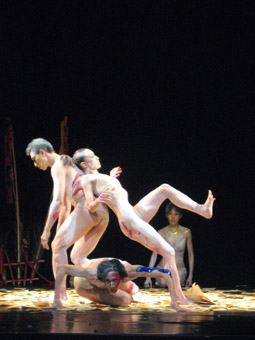
Middle
photo Phalla San
Middle
A MANDALA OF YELLOW SPIRIT MONEY COVERS THE CENTRE OF THE STAGE LIKE A YELLOW BRICK ROAD TO OTHER WORLDS. THREE ALMOST NAKED FIGURES STAND IN ITS MIDST, THEIR ENTWINED BODIES DAUBED WITH THE WHITE OF DEATH AND THE UNKNOWN. CLOSE BEHIND THEM, THE OBSCURED FIGURE OF A SHAMAN IS ENACTING AN ENIGMATIC RITUAL. GONGS AND BELLS CLASH. SUDDENLY, THE SHAMAN’S SHUDDERING HAND THRUSTS OUT BETWEEN THE CLOSE-PACKED BODIES, HIS SPLAYED PALM COLOURED A SHOCKING RED.
This exploration of the journey between this world and the next is Taiwanese choreographer Ho Hsiao-Mei’s short work Middle, performed by Cross Over Dance company on the last day of the 10th Indonesian Dance Festival. In a set rich with colour and texture—the paint on the performers’ smooth bodies, the yellow of the paper spirit money on the floor and the rough browns and reds of the wood and fibre constructions that the dances will shoulder on their spirit journey—Middle creates the dark, mysterious ambience of shamanistic ritual.
Taiwan has a strong tradition of shamans who connect with the spirit world, functioning as healers, diviners, mediums and exorcists. Some use self-mortification techniques, wounding themselves with symbolic implements and mopping up the blood with yellow spirit money (hence the use of red paint in Middle). Taiwanese shamans also employ stylised dance to establish a liminal sphere, a middle ground in which they and spirits may meet. Anthropologist David Jordan describes this as “an athletic ballet, magnificently rehearsed and enthusiastically performed.” Similarly, the shaman figure in Middle is unashamedly virtuosic, treating the audience to high leg kicks with strongly flexed feet, back arches and hand stands. Throughout his performance he stares fixedly into the centre of the audience, his mouth hanging open like the dark hole in a mask.
The other dancers, as pilgrims following the shaman’s lead, display a similarly impressive physicality. During one duet, a male and female dancer press their backs against each other, with one leaning forward and the other leaning back. They transfer their weight seamlessly until the dancer on top has one leg raised weightless in the air, entirely dependent upon the dancer beneath. To the sound of a chiming bell, the dancers slowly reverse their positions, creating a tipping see-saw that demonstrates absolute control.
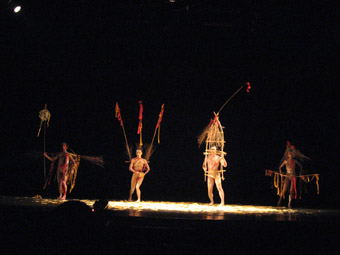
Middle
photo Phalla San
Middle
Middle clearly depicts the different stages of ritual, from separation from reality to the transitional traveling period. When a male dancer holds his partner under the armpits and swings her in a circle, the tips of her toes ruffle the spirit money, destroying the mandala and signaling the beginning of the next phase. The dancers head out of the circle to don extravagant costumes, whose frames suggest phantom hats, huts and warrior flags. Led by the shaman’s skeleton lantern, they pace around the edge of the stage. Every now and again they pause and look around, as if disturbed by the sound of unknown creatures assembling in the darkness.
The repetitive circumnavigation, the gathering gloom and the rhythmic clash of small bells lull the audience into its own trance. But unlike actual shamanistic rituals, Middle does not depict the ceremonial return out of liminality to reality. Having taken us to the threshold of the other world, the work abandons us. The dancers stop circling to stand in a line gazing out at the audience. Then the lights dim, and we are left alone in the darkness with all the phantoms they have conjured leering down at us.
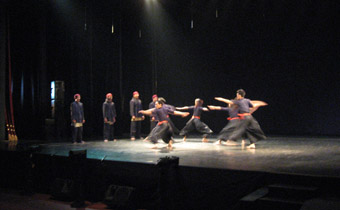
Seruan
photo Phalla San
Seruan
FOUR MEN STAND IN LINE SINGING AS THOUGH IN A TRANCE: “LA ILAHAILLALAH” (THERE IS NO DEITY WORTHY OF WORSHIP EXCEPT ALLAH). THEY WEAR RED CAPS, USUALLY WORN FOR PRAYING, AND BLACK SHIRTS THAT ADD A SPIRITUAL TOUCH TO THE PERFORMANCE. CENTRE STAGE, TWO DANCERS WEARING WIDE TROUSERS CALLED GALEMBONG MOVE TOWARDS THE SINGERS. THE FIRST JOINS THEM AND THE FIVE MOVE SWIFTLY SIDE TO SIDE. THE SINGING AND MOVEMENT GROW FASTER, THE OTHER DANCER JOINS IN AND EVERYONE MOVES IN A CIRCLE.
This moment is a crucial, symbolic part of the dance, blurring the boundaries between singers and dancers and heightening the spiritual mood. The singers and the dancers become one in a trance-like rhythmic state.
In another scene three people lie down in the centre, right and left of the stage. The central one is still as five chanting male singers surround him. He seems trapped, helpless, as though he cannot bear the weight of his “sins”—as the program indicates this work is about “the need for the return of lost conscience.” As the chant grows stronger, the other dancers rise up, but the first man does not move. The chanting perhaps reminds him of the causes for his state and what he must do to get back on the right path. This and the trance-like episode are the most captivating moments in Seruan.
Seruan elaborates the concern of the choreographer, Gusmiati Suid who died in 2001, about the dissolution of tradition and the disappearing influence of religion. Seruan is literally a calling to people to go back to their roots and not lose themselves to modernization. This dance work was revived for the opening program of the 10th Indonesian Dance Festival.
Along with Sardono W Kusumo and several others, Gusmiati Suid is one of the pioneers of contemporary dance in Indonesia. She uses the vocabulary of traditional West Sumatran dances in making her works, often combining them with Randai, a traditional theater form where the sound for a work is usually produced entirely with voice, hand clapping and the movement of the singers. Gusmiati Suid also included in her choreography aspects of Pencak Silat, a traditional martial arts with very dynamic movement, as well as Rantak, a folk dance originating in Minangkabau. This is why martial art footwork, with the legs widely spaced and hands moving swiftly as in combat, is seen from time to time in Seruan.
As well, the dancers often raise their hands, palms open towards the sky, as in Moslem prayer, symbolizing an appeal to God for the granting of wishes.
The dance also included elements of West Sumatran tradition. In the music we often hear the sound of Saluang in the background—a kind of traditional flute played using the pentatonic scale. For those who have been to the area of West Sumatra, the sound would remind them of the great mountainous area, the cool air and the vast paddy fields spread throughout the region.
Seruan ended optimistically. A man and woman take centrestage: both raising their hands as if towards God, answering to the calling of conscience and once again reconnecting with the highest form of being.
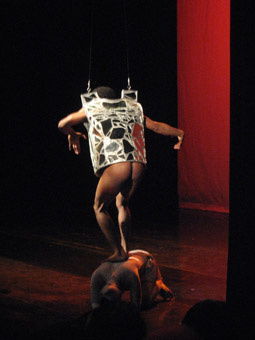
Merah
photo Phalla San
Merah
DIM LIGHTING BARELY DEFINES TWO ISOLATED FIGURES ON STAGE. THEY ARE A STUDY IN CONTRASTS, ONE FEMALE AND TIGHTLY SHEATHED IN WHITE FROM HEAD TO TOE, THE OTHER MALE, NAKED BUT FOR A LOIN CLOTH. STANDING AT OPPOSITE ENDS OF THE STAGE THEY DISTANTLY REGARD EACH OTHER.
This is Merah choreographed and performed by Asri Mery Sidowati, a recent graduate in dance art from the Institut Kesenian Jakarta and one of Indonesia’s emerging choreographers. The unsophisticated work shows a respect for tradition but fortunately does not take the hackneyed route of putting it on a pedestal and placing it in an antagonistic relationship with modernity. Instead we see a valiant attempt to make traditional elements part of her language of expression and not the object. The slow pace of movement and defined silhouettes in Sidowati’s choreography combined with the sound of traditional drums in Arif Susanto’s music provide a tribal, earthy feel, while tradition is also glancingly referenced in her costume. Inspired by Topeng Panji Indramayu (a traditional mask dance) the outfit tightly covers the performer’s body from head to toe, designed as a mask but making her an almost amorphous mass.
From the beginning this ever present masked figure introduces a menacing element of uncertainty. Fading light effectively hides Sidowati from view, revealing only the male dancer, Serraimere Bogie Y Koirewoa, frozen in a proud posture—but the knowledge of her presence remains. Soon the lights subtly illuminate her white silhouette in a flamingo-like stance, arms above her head, one foot raised to knee height. With no other distinguishing features, Sidowati’s image is a mystery that heightens the sense of foreboding.
Slowly a low drum beat reverberates to your core and a sprinkling of sounds evocative of the jungle permeate the senses, while the white backdrop is dappled with irregular shaped patches of light radiating out like the leaves of a tree. The shadows speckle Koirewoa as he wriggles, his dexterous fingers creating a mass of writhing worms that in the mottled light appear to multiply and grow, like nature itself.
The stage brightens revealing muscles so tautly held that Koirewoa appears almost skeletal as he gradually unfolds his limbs. His control and focus amplify each small movement into a luscious image. Jutting his neck out and rolling his shoulders back, he strains forward, nose leading like a beak; his elbows pulled back forming wings he becomes a preening bird. He then morphs into one ready for battle as his arms stretch out, fingers pointing high, preparing to charge. The white figure tentatively tries to copy him, seeming soft in comparison as she raises her arms.
Seeing these two ‘birds’ contrasted, one original and the other a poor imitation, I’m reminded in a flash of Hans Christian Anderson’s The Nightingale. This is a fairytale of an emperor who trades his live nightingale for a mechanical copy, only to find that the machine is far inferior and cannot bring him the same comfort. By presenting a face-off between the natural, embodied in Koreiwoa’s bared body and the artificial, represented by Sidowati’s obscured shape creates a binary opposition, the choreographer underscoring human indifference to rapid climate change and a deteriorating environment.
An angry red seeps into the backdrop as the two figures move towards each other. In slow motion Koirewoa creeps around Sidowati and then clings to her mid-section like a vine. He seems to engulf her, and yet he is powerless as she revolves, carrying him. Having moved the action to her side of the stage, Sidowati, the champion of the ‘artificial’ is winning, as the growing buzz of electronic sound testifies, drowning out the tribal drumming. To crown it all a hard armor-like vest descends, hovering above the pair. Covered with a mosaic of sharp edged shards of mirror, it glints harshly in the light, its patterns a mockery of the dappled ‘tree of light’ that earlier framed Koirewoa.
Completing the take-over, Sidowati offers herself as a platform for Koirewoa to climb up and don the vest. He rises high up, precariously perched on her back, and her control is admirable as she steadily holds the crouched position. Once in the vest, Koirewoa transforms into a mechanical bird; his arms jerk and flail robotically. Then he opens the his vest and we observe a spreading of wings, his twisting torso sending out spikes of light, piercing the stage and blinding the audience—creating a sad distortion of the first ‘tree’…the synthetic has wiped out the organic.
In Merah the choreographer’s intention to show the gradual eradication of the natural world is simply and perhaps too directly stated, the thematic opposition and its development appearing somewhat naive. However, while not intellectually challenging, the evocative sound score, effective lighting and the physical elements of the production, not least Koirewoa’s expert control, can be appreciated.
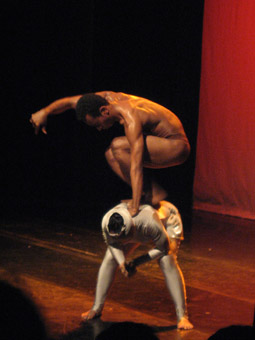
Merah
photo Phalla San
Merah
WHEN THE LIGHTS BLACK OUT IN INSTITUT KESENIAN JAKARTA’S TEATER LUWES ON THE SECOND NIGHT OF THE INDONESIAN DANCE FESTIVAL, AN ENVELOPING DARKNESS BLANKETS THE ENTIRE SPACE. IT’S EVEN MORE SUFFOCATING AS WE AWAIT MERAH, THE SECOND WORK ON THE PROGRAM. SOUNDS THAT YOU WOULD NORMALLY HEAR IN A FOREST OR JUNGLE IN THE DEAD OF NIGHT PIERCE THE DARKNESS. BUT WE SEE NOTHING, EVEN AS THE FAINTEST SLIVERS OF LIGHT GLOW ON THE STAGE.
The dancers are only very slightly illuminated by a smattering of light on the cyclorama that simulates moonlight shining through thick leafy branches. Because we had been in the darkness so long, I was not even sure if the second dancer, situated in an upstage corner, was indeed actually there; he seemed to blend into the cyclorama so much that my still-adjusting eyes were convinced that he was merely an image projected on the screen.
The other dancer, whom we later discover is Merah’s choreographer, Asri Mery Sidowati, stands at the opposite corner, nearer the audience. She is covered head to ankle in a shiny, metallic body suit. In contrast, the dancer upstage, who is not a hologram after all, is stripped down to the briefest of briefs. As he jaggedly moves to the sound of crickets and birds rustling through the night, it becomes obvious that he is meant to be of the earth—a primal version of man—while the figure wrapped in metallic cloth, who very slowly yet continuously moves her cradling arms in patterns around her body, might very possibly be otherworldly, a spirit but also possibly an alien. Given the costuming and my lack of knowledge of Indonesian mythology, it is difficult to determine which.
The male dancer has the more interesting movements: flexing and undulating, posturing sporadically in between, darting, flicking his fingers, shoulders and head almost as if in reaction to the sudden chirp of a cricket. After an eternity of this minimal movement from both figures, they edge towards one another, until they stand side by side with their feet wide apart. Together, they pull their heads back into a circular sweep, the man with his back to the audience, shoulders rippling with muscles as he does. Shortly after, they enter a common sphere, the man reaching for the wrapped figure and slowly wrapping himself around her midsection so they become one—an image sustained a little too long but allowing time for speculation. The man is not afraid of this otherworldly being, who, in return, readily accommodates him. After the performance, I overhear that she represents Mother Earth, but this didn’t occur to me at all since she moved into his space, merely visiting the world that he inhabited.
I see her instead as an external entity, and the male figure’s act of attaching himself to her as an exercise in empowerment, a kind of calling upon divine forces for strength. He climbs up on her back and is immediately garbed in a mirrored vest—a triumphant acquisition of power, exhilarating and uplifting, the glass shards flashing light over stage and audience. This invocation of a deity ends in triumph and frees man from the overwhelming, suffocating darkness with which the work began.
Later, however, I read the program notes and am entirely confused. It seems that Asri choreographed Merah as a commentary on Global Warming; the correct reading of the work would then be that grasping Mother Earth and stepping on her would be some form of abuse that she endures and even allows. The mirrored vest can then be read as an explosion of sorts—if we step on Mother Earth, we must be ready for the consequences. However, the work did not translate this threat clearly and, as I’ve pointed out, the tone of the ending was more inspiring than ominous.
Audiences may take whatever they wish from a particular work, and whether Asri likes it or not, her message will not always come across as intended. I applaud Merah’s journey from darkness to light, from gloom to triumph, and the slow, measured, unremitting pace that it took to get there.
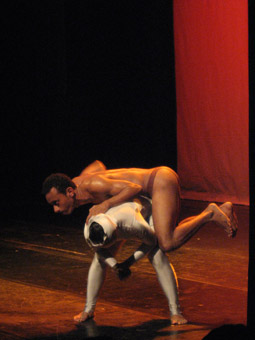
Merah
photo Phalla San
Merah
AT THE BEGINNING OF ASRI MERY SIDOWATI’S MERAH (RED), THE STAGE IS IN TOTAL DARKNESS UNTIL SEVERAL DIM LIGHTS ALLOW A GLIMPSE OF TWO FIGURES. WE SEE AN ALMOST NAKED MAN IN A LOIN CLOTH AND WOMAN WEARING A TIGHT DARK OUTFIT WRAPPED AROUND HER BODY FROM TOP TO ALMOST TOE, THE DESIGN MAKING IT IMPOSSIBLE TO SEE HER FACE.
In the background there’s a sound like a cricket, adding to a heightened sense of quiet. It’s as if we are being drawn into a jungle, but serenity brings with it a terrorizing kind of solitude. The stage is dark again. Gradually the sound changes to a kind of a heavy mumbling while scattered rays are slowly projected on the backdrop, like sunlight peeking through forest trees, but again suggesting stillness.
Originally a 2006 graduation piece, Merah was made during the hype of Al Gore’s documentary, An Inconvenient Truth. It tries to take us into the vortex of global warming, rain forest destruction and other environmental crises, although the elaboration of the work’s theme is not quite clear.
The almost naked man bends at the knees and crosses his hands in front of his chest, mimicking the flapping wings of a bird and symbolising hope or, perhaps, the birth of life itself. At first this ‘bird’ flies slowly and then faster and higher, so high that the man must let it go.
In another scene the stage becomes almost red, as if something bad is taking its course. The man squats as if great pressure is being imposed upon him, his hands pulled back, his face in grinning as if in pain. He bends lower and lower, moving slowly, meticulously transforming his pose, making the working of his muscles visible—a movement tradition rooted in the dance of Topeng Panji (Panji Mask) of West Java.
Towards the ending of Merah, the man wraps his body around the woman like a belt or a snake which she accepts with strength and without complaint. She bends as a vest descends, partially covered with broken mirrors. The man climbs onto her back and slips into the garment, scattering light through the theatre.
For the choreographer perhaps the male figure represents the human species while the woman is nature, bowing to man and subject to destruction. All aspects of the performance—its stillness, the low lighting and slow movement—conveyed haunting imagery if not making the work’s meaning finally clear.
![S]h]elf](https://www.realtime.org.au/wp-content/uploads/art/36/3671_giang_shelf.jpg)
S]h]elf
photo Phalla San
S]h]elf
IN THE MILD BLUE LIGHT OF THE DIM STAGE, TWO YOUNG WOMEN IN WHAT LOOK LIKE SWIM SUITS CRUISE ON WHAT APPEAR TO BE SHORTENED SURF BOARDS FRINGED WITH BLUE LIGHTS. SPINNING, GLIDING SOUNDLESSLY ON THE FLOOR, IT LOOKS LIKE AJENG AND ANGGIE ARE FLOATING IN A SWIMMING POOL, ENJOYING THEMSELVES ON A STARRY NIGHT.
S]h]elf, a collection of loosely bound short episodes, opens the second night of the 10th Indonesian Dance Festival. Next, the protagonists are busily quarrelling. Exchanging extra-large t-shirts they are soon entangled. Awkwardly bound they mouth Barbie doll interactions of the “I love you, but I hate you too” and the “Get away, but don’t leave me alone” kind. Welcome, say the program notes, to the world of South Jakartan, affable, middle-class youngsters.
Another scene has Anggie moving slowly from the periphery to centrestage, stopping after each little step, upper body leaning, shaking uncontrollably. Only her feet and fists are held firm, as if she wants to run away but can’t. She grimaces: is she crying or laughing? Is she drugged? It takes her an eternity to reach the front of the stage. Looking straight at the audience, she burps. “Give me a break. To hell with your social conventions,” she seems to say. In another episode, Ajeng turns a roll of toilet paper into a mock camera, ‘shooting’ the dozens of people in the audience whose cameras have produced endless clicking ever since the performance commenced.
Performed by Ajeng Soelaiman (born 1984) and Andara ‘Anggie’ Firman Moeis (born 1986), and choreographed in collaboration with Fitri Setyanigsih (born 1978)—all rising stars of the Indonesian dance scene—the work is fun, unfussy and has an air of ironic coolness. The set consists of two mobile glass revolving doors and metallic cubic frames hanging low from above, suggesting the worlds of entertainment and shopping. The performance is a self-portrait; drawing on their own lives the women play themselves, and they do so convincingly, with touches of self-irony.
What does it mean to be female, young, well-off and sophisticated in a Muslim society? At one point, Ajeng uses lipstick to draw a heart on glass, but her hand slips and the drawing becomes a confused mess of lines. Later, she stands in front of a glass door, facing the audience, in full evening dress. Radiating an amiable elegance, she bends to one side as if is about to dance. The music is a soothing, chill-out waltz. Gracefully, she raises her hand and gives the audience the finger. Or is the glass frame actually a mirror, and is she signalling self-disgust?
Whether rebellion or self-examination, it’s a fleeting gesture. At the end of the work, the two young women stand around a table of wine glasses, as if at a party. While Ajeng plays with two glasses, bored, pouring wine from one to another, Anggie, in a continuous slow motion loop, drains the dark content of each glass in a mouthful, throws the empty over her shoulder and reachs for another. There is no loud smashing of glass, no emotional crisis, no theatrical breakdown, just the embracing comfort of boredom. It’s the end of the party. Too tired for anything wild, the pair choose to stay in air-conditioned comfort, souls numb, surrounded by broken glass and broken hearts.
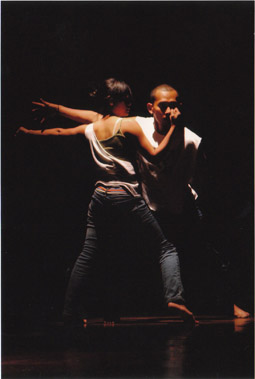
The Young
IN THE FINAL MOMENT OF THE YOUNG, A BOY AND A GIRL FACE EACH OTHER, BOTH WEARING A SNEAKER ON ONE FOOT, A SNEAKER ON ONE HAND. IN THE SILENCE YOU CAN HEAR THEIR PANTING. STRIPPED OF THEIR GRASPING AND POSTURING, THEY SEEM TO ACTUALLY SEE ONE ANOTHER FOR THE VERY FIRST TIME. THEN, TOO QUICKLY, THE LIGHTS CUT OUT.
To get to this final point of undemanding honesty, the dancers in Muslimin Bagus Pranowo's duet have to scrabble through a thicket of teenage angst. In a scene as bleak and empty as a nightclub after closing time, the two battle for the many pairs of sneakers littering the dim stage. The girl, performed by Maharani, wears the drainpipe jeans so favoured by the young. Hard eyed and hard mouthed, she gives as good as she gets. Being the first to wear one sneaker on her foot puts her in command. Wearing two sneakers, she assumes a tough-guy nonchalance, folding her arms and leaning on the boy as if on a sidewalk lamp-post, he bending in acquiescence.
The fast, aggressive movement, accompanied by a choppy and harsh electronic score, full of loud squawks and scratches, did not allow much leeway for subtle emotional expression. Nevertheless, the boy, performed by Muslimin, comes off as the more indecisive and piteous character, undermined by sexual frustration. Early in the work, he reaches through the girl's legs from behind and grabs her crotch, a gesture of aggressive lechery that she completely ignores. Later he fends the girl off and goes for a shoe, only to suffer sudden performance anxiety. When the girl lies on her back, sneakered feet in the air, he performs a short solo of agony; it is deliberately unclear whether he lusts after the girl or the shoes. When he finally does claim his own pair of sneakers, they fail to make him happy; rather than acquiring a sense of confident adulthood (feigned or not) as the girl did, he continues with the jumping, rolling, charging movement as if nothing has changed.
The sneakers are objects of fetishization, whose overt use—to protect feet—is overshadowed by their symbolic value: the possession of coveted material goods, the construction of an individual identity, maturity or sexual attractiveness. When they first encountered the shoes, both boy and girl were similarly perplexed. They seemed not to know what they were for, wearing them on their hands and pressing them to different parts of their bodies. What should be a display of bad breeding (proximity between shoes and heads in Asian cultures being extremely rude) is rendered instead as a moment of quiet intimacy. With the shoes to separate them, the pair touch each other as they otherwise cannot. Simultaneously, the thumping score descends into radio static, displacing the scene from the pressure of normal life. Suddenly realising what they are doing, the dancers freeze, then break away.
The movement vocabulary of The Young is appropriately transnational, almost unplaceable, but more similar to Western contemporary than any Indonesian cultural dance. Only one moment locates the movement within a distinctly Indonesian idiom. The two dancers crouch, proffering a sneaker with both arms fully extended towards the audience, their heads ducked down between their shoulders. In this stance one might present an offering to a king, especially if one had done something very wrong and was appealing for forgiveness. Oh, figure of authority, the dancers seem to plead, take away these shoes, this source of rancour and unhappiness that tortures us! But it is only a moment quickly washed away in an unrelenting wave of movement.
At 25 years of age, Muslimin already shows an easy ability to manipulate a variety of cultural movement vocabularies. The video projection element in The Young, however, was too diffuse and brief to have much impact, but the performers were confident and skillful, and the work explores a tightly coherent theme with insight and maturity. As part of IDF 2010's opening night, The Young is a strong representation from its namesake cohort as well as an illustration of the festival theme “Powering the Future.”
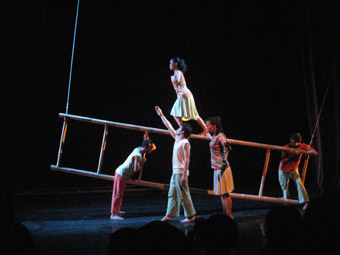
5,6,7,8
photo Phalla San
5,6,7,8
THE 10TH INDONESIAN DANCE FESTIVAL PROGRAM OF WORKS BY FIVE EMERGING INDONESIAN CHOREOGRAPHERS FOCUSED ON PERSONAL ISSUES INTERTWINED WITH THE VALUES AND NORMS OF INDONESIAN SOCIETY. THE CHOREOGRAPHERS COME FROM ART UNIVERSITIES AROUND INDONESIA: THE JAKARTA ARTS INSTITUTE (IKJ), ISI YOGYAKARTA AND UNESA IN SURABAYA.
Nur Sekreningsih Marsan’s 5,6,7,8 elaborates one person’s journey and their relationship with others. With ladders as the principal stage properties, the dancers are often placed in challenging circumstances. One part of the work requires two dancers to walk along the narrow length of the side of a ladder, the delicate balancing reflecting the difficulties faced in relationships.
Cekrek (Click) by Joko Sudibyo opens with a scene where a woman wearing a blue kebaya top and batik cloth sits down in the middle of a group in dim blue light. Her hair is pulled back and rolled into a big bun. It’s a look preferred by most Javanese mothers when posing for a family photo. Four young men wearing long sleeved white shirts stand before her. Slowly and gracefully, the woman stands. Gently moving to the right, she performs the subtle hand gesturing of Javanese dance. But as soon as she leave the stage, the four boys move about dynamically, the mood shifting from tradition to modernity.
This shift and its reverse occurs several times in Cekrek: in the next scene another man appears, bare-chested and wearing a batik sarong. He moves in traditional Javanese fashion with special precision and fluidity while the four boys circle around him. He then performs a duet with the woman in the blue kebaya before exiting. If she is an idealised mother the man appears to be a missing father figure.
Cekrek
photo Phalla San
Cekrek
Next, another woman appears. Wearing a red tank top and batik skirt, she weeps with over the top exaggeration, complaining how hard she works and that the men in the family have done nothing to improve its condition. She represents the real life mother who is often frustrated by the family hardships.
Near the end, the idealized mother reappears, putting an abrupt halt to a chaotic situation. The real mother contains herself. The four boys tuck in their shirts, poke each other as though wanting to show the mother who’s to blame, and solemnly form a line with their mother. The idealized mother slowly sits and pulls out a camera. Without being commanded they all smile comically and wave politiely as their picture is being taken. One big happy family.
Cekrek very simply suggested the importance of the mother in a family. Her nonchalant presence is crucial, creating harmony while her absence yields chaos—a belief firmly held by most Indonesian families. The successful fusion of traditional and modern movement and its simple imagery made the dance a delight to watch.
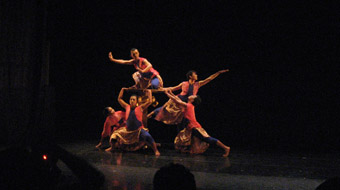
Gayaku
photo Phalla San
Gayaku
Shinta Maulita’s GAYaku focused on homosexuality. This piece couldn’t be more appropriate considering the current situation in Indonesia where the gay and lesbian movement is gaining momentum.
GAYaku opens with three men and a woman seated in a circular formation beneath another man sitting on top of a round platform. Squatting cross-legged, he flexes his right arm, making a gestures like those of deities in Hindu temples, while the other dancers circle him.
Live gamelan playing thickens the traditional ambience, with a male singer chanting in Javanese “a woman should be with a man; how it would be when a man decided to pair with a man, and a woman with a woman?”
GAYaku depicts the joyous decision of the men to embrace their sexual identity. Four men gather again in a circle, this time wearing glittering bamboo hats commonly used as rice baskets. They shake their bodies coquettishly, while forming a circle facing each other. One gestures as if applying make-up, his other hand holding an imagined mirror.
The festivities move into over-the-top celebration as the dancers invade the auditorium, shaking their bottoms. This “We’re gay and we’re proud!” mentality reflects life in many big cities in Indonesia where more and more men and women daringly come out, ‘boasting’ their gayness.
The last two works in this program were Retorika Kerinduan by Santi Pratiwi and Bunglon by Serraimere Boogie. The first is about urbanization, and the yearning to return to village life, while the other elaborates on the ability to adapt. Bunglon involved Papuan costume and a merging of Javanese and Papuan movement.
Overall this showcase of works by emerging choreographers demonstrates the effectiveness of dance education in Indonesia. It is also refreshing to see that tradition plays an important part in the work—having strong roots is always a good place to start.
5,6,7,8
photo Phalla San
5,6,7,8
WHAT? WHY? HOW? THE EMPTY STAGE IS A BLANK SLATE WHERE FIVE YOUNG INDONESIAN CHOREOGRAPHERS (FROM ART UNIVERSITIES AROUND INDONESIA: THE JAKARTA ARTS INSTITUTE (IKJ), ISI YOGYAKARTA AND UNESA IN SURABAYA) MAKE THEIR MARK. AMIDST MUSICAL CACOPHONY AND THE BLUR OF LIGHTS, LIKE ANYONE IN THE EARLY STAGES OF DEVELOPMENT THESE EMERGING ARTISTS SEE PATTERNS, QUESTION STEREOTYPES AND TRY TO FORGE IDENTITIES.
5,6,7,8
In the language of the dance world 5,6,7,8 means prepare. And you should, when a cycle of beginnings commences the moment the lights reveal two men bursting into explosive kicks and jumps to the creaking sound of straining wires. A ladder, over which the men move quickly and deftly, lies inertly on the floor beneath their feet.
In Nur Sekreningsih’s 5,6,7,8, sound loops shift from the resonances of traditional instruments to running notes on the piano to concrete sounds and back again. This musical history is mimicked by the dance movements, rotating between traditional, contemporary and folk, a formal construction that underpins the work’s theme: the cycles in relationships.
The dancers cover the space well with energetic leaps, conveying a strong sense of motion and interaction. Set higher and higher—on its side, sloping, suspended above the shoulders—the bamboo ladder allows varying forms of engagement and framing but is also a hindrance. The dancers are entertaining when they jump through the rungs or hang from the ladder’s uprights but, unfortunately, the increasingly precarious ‘tightrope’ act, performed at each level of the ladder’s positioning, misses the mark. The spectacle of the balancing act as the performer teeters on the edge of the ladder detracts from the image of the dancer as forward-looking—she is more tentative than progressive. Nor is it clear how this image of isolation relates to the cyclical nature of relationships.
Cekrek
photo Phalla San
Cekrek
cekrek
Exploring how family dynamics can affect identity, Cekrek is the poignant and humorous highlight of the showcase. Choreographer Joko Sudibyo’s choreography is an expert fusing of styles in which the wide stance, flexed feet and soft arms of Balinese dance combine with a jazzy influence evident in undulating bodies and quick rebounds off the floor. The all male cast confidently perform the steps, exuding a youthful precociousness that makes me smile.
Posing for imaginary portraits, four youths, neatly dressed in short sleeved, white collared shirts and brown trousers—a typical school uniform—freeze each time the lights flash. They are oblivious to the mother figure kneeling directly in front of them, her back to the audience displaying perfectly coiffed hair pulled back in a low bun and the blue lace of a Kebaya (blouse).
This woman rises gently and moves off-stage, the performer’s masculinity barely discernable, so delicate and poised are his movements. The eyes of the boys are glued to her as she exits but her absence releases them into a series of body waves—head, chest, belly, hips, lifted in successive sequences. They horse around, pushing and gesturing, isolated heads moving quickly from side to side, pointing (mostly with the middle finger), jabbing and thrusting, painting the air around them—their movements still suggestive of traditional dance. The boys appear to revel in their independence.
Is the bare-chested dancer who enters next a memory of an absent male authority figure? The four crouch around him as his back and extended arms move in sinuous ripples, as if jolts of electricity run through his veins. The ‘mother’ returns to the stage, and he dances with her in a strange duet, the relationship appearing to be that of human and ghost. He navigates the space around her, never making contact as she, seemingly unaware of his presence, makes her slow progress across the stage to exit. Then he too disappears.
Another female character enters, also a male dancer, this time with long wild hair, a pink tank top—showing off chorded muscles—and a traditional long cotton skirt tightly wrapped around the legs. This woman is a caricature, like a soap-opera mother. Unlike her silent counterpart, she wails melodramatically, stops abruptly turns to the audience, says she’s been “crying for three days” then resumes her squawking, half-dancing, half-sobbing around the stage.
Trying to shame the boys into reaction, this single mother (the program note explains that the woman is the family’s breadwinner) pulls her hair into a mad tangle, tossing and flicking it every which way, shouting in Bahasa that she deplores their ingratitude, for never thinking about her or the family. She yanks their heads back as she scolds and cajoles, but they ignore her, remaining inert, eyes closed. Later they gather behind her as she continues to jabber, pointing and gesticulating; naughty children mimicking a scolding parent.
Somehow order is restored when the genteel Kebaya-clad mother returns: the boys shuffle away, straighten their clothes and line up with the wild-haired mother. Suddenly, the genteel mother whips out a camera. Pasting on cheesy grins, cranky mother and sons pose for a portrait—the illusion of a happy family.
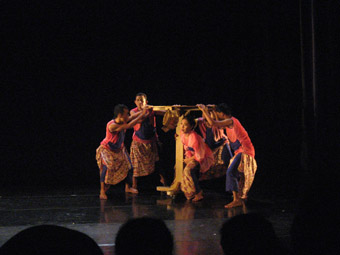
Gayaku
photo Phalla San
Gayaku
gayaku
This night’s program seems to be a re-contextualising of traditional Indonesian dance forms within a modern framework. Nowhere is this theme as clear as in GAYaku which starts quite traditionally—a man sits cross-legged, meditating on a shoulder high table under which people sit like ancient sculptures. From the edge of the stage traditional musicians play a haunting gamelan melody and chant in eerie unison. The dancers move through the strong poses characteristic of males in Javanese dance.
Part-way through, round gold, helmet-like hats with a protrusion on the crown are worn, then playfully cupped against chests, thrown in the air and turned upside down like bowls—Freudian symbolism perhaps of dual sexuality. Exploring the freedom of new gender identity, the male dancers perform traditional Javanese female movements; using soft fingers, vainly admiring imagined reflections, taking tiny, demure steps, they move the work to its campy ending.
To reach this freedom there must first be a moment of crisis. In the program note, female choreographer Shinta Maulita, writes, “I try to love the person I am supposed to love…but I can’t.” This might indicate that GAYaku is about Maulita’s frustrations, but it’s about much more. In a pair of duets, a male dancer partners Maulita. As they face each other, legs wide apart and hands outstretched, this traditional Javanese dance movement becomes the basis of missed kisses as the dancers’ faces bob and weave. The key image is of Maulita cradled, like a bride about to be carried over the threshhold. Lips almost meet but her partner’s eyes shift away, an expression of anguish and regret on his face. A male-male duet ensues, the dancers circling each other, legs moving closer but bodies stretching away in hesitation. In the end they embrace, faces frozen inches away from a kiss. Maulita’s work has brought the audience to the brink of a transition but by not taking the final step she keeps the work in the realm of pretense, and leaves the rest to the imagination.
In GAYaku, traditional movement becomes sexually charged: a basic shoulder roll, usually delivered slowly and with care, becomes a seductive shimmy; the wide legged walk with gentle hip sway turns into a booty shake as the dancers gyrate to the rhythm of the music. Finally, moving among the audience they blatantly flirt and tease, questioning and inviting.
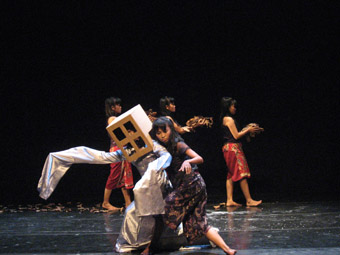
Retorika Kerinduan
photo Phalla San
Retorika Kerinduan
retorika kerinduan
Retorika Kerinduan is Santi Pratiwi’s discourse on increasing urbanization and the inability to assuage a longing for the old village life. A body is lit in the centre of the stage, no head or legs, just a back, naked but for streaks of metallic gold paint, pushing and heaving to ominous grating sounds. It is a man struggling to rise; distorted arms pushing outwards, he appears to be hatching from an egg. From deep in his throat come strangled sounds as he gasps for air. Kneeling in a semi circle, three women slowly bow their heads to the ground and, returning to the upright position, ritualistically repeat the movement. Perhaps the choreographer suggests that the worship of money is suffocating.
Near the middle of the work an image of human devolution appears. Almost as a footnote to a series of martial arts inspired, middling lunges and quick jabs, three dancers enter at varying heights, ranging from upright Homo Erectus to crouching monkey. The final image is of a silver robed figure with a cardboard box—shaped to represent a sky-scraper—on his head, a woman at his feet. Behind him the trio of women move as if in a funeral procession, dropping brittle brown leaves, mourning encroaching urbanisation.
bunglon
The final work, Bunglon (Chameleon), is an oblique criticism of the hypocrisy and Machiavellian attitudes of opportunists in politics and entertainment expressed through a mashing of cultures. The dancers are adorned with feathery headpieces and similar arm-bands. In a nod to hip-hop couture they hike up one pant leg and near the end of the work add a sneaker, while painted flames—vibrant tribal-like tattoos—lick up the sides of their exposed calves. Serraimere Boogie Yasson Koirewoa’s choreography is a reflection of this blending—hip-hop grooved traditional dance gestures. The images are not particularly symbolic but the permutations of movement formations suggest the easy adaptability of a reptilian species.
The movement language of the works in this program may not have been particularly original and I’m bemused by the overabundance of images and occasional mixed metaphors. Most of the pieces rambled in their search for cultural and individual identity, but this is a forgivable short-fall in the work of young choreographers. They were well served by a high level of physicality and commitment from all the dancers. These choreographers are off to a good start in defining their styles. Perhaps I was impatient only because youthful confusion is catching.
Darkness Poomba
photo Phalla San
Darkness Poomba
DARKNESS POOMBA BEGINS WITH TWO MEN STANDING STILL IN LOW LIGHT. ONE PLACES HIS HAND ON THE OTHER’S FACE; HIS COUNTERPART RESPONDS WITH THE SAME GESTURE. THE INCREASINGLY FAST ACTION BETWEEN THE TWO IS ACCOMPANIED BY THE STRONG VOICE OF A SINGER OCCUPYING THE SAME SPACE AS THE AUDIENCE. HE PERFORMS A TRADITIONAL WORDLESS SONG USED FOR FESTIVE OCCASIONS AND ALSO BEGGING. SUDDENLY, STRONG LIGHT REVEALS DANCERS RESPONDING WITH LIVELY MOVEMENT TO POWERFUL RECORDED MELODIES AND THE LIVE SINGING. BRIGHT LIGHT ALTERNATES WITH SOFT AND THE DANCERS MOVE SLOWLY TO THE FORCEFUL RHYTHMS OF THE SINGER. AT THE END LIVE ELECTRIC GUITAR, BASS AND DRUMS COMBINE WITH THE POWERFUL DANCING TO GENERATE A GREAT SENSE OF EXCITEMENT.
This is Darkness Poomba the last of four contemporary dance works performed to celebrate the opening of “Powering the Future”: the 10th Jakarta International Performing Arts Festival (IDF). The audience cheered, clapped and rocked to the 11 young dancers, musicians and vocalists from South Korea directed by choreographer and composer Kim Jae Duk who also performed as dancer, musician and singer. The combination of elements was dynamic and vigorous—while my hands were busy taking notes, my head and torso unconsciously swayed.
Beneath bright lights, the dancers committed body and limb to fast moves, shaking and leaping in a combination of modern dance, breakdance and acrobatics alternating with slower movement. From the moment the dancers were joined by the guitar players and drummer the work became larger and more dramatic. While the stage was filled with dynamic dancing, the choreographer joined the singer in one aisle of the theatre, singing and playing a mouth organ, while the two men who opened the show repeated their slaps and grabs at speed in the other aisle. The audience clapped and swayed, screaming their satisfaction.
The perfectly synchronized dance movement in Darkness Poomba and the beautiful and powerful live music made for an attractively dramatic and dynamic work. Although titled Darkness Poomba, the strong lighting not only distinguished between scenes but also suggested a brighter spirit.
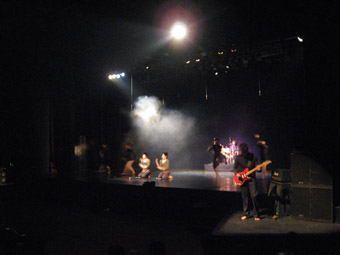
Darkness Poomba
photo Phalla San
Darkness Poomba
AN EERIE, LOUD NOISE WAS HEARD DURING THE INTERMISSION FOR THE OPENING DAY’S MAIN PERFORMANCES AT THE 10TH INDONESIAN DANCE FESTIVAL (IDF). PERHAPS IT NOT ONLY SIGNALED THE AUDIENCE TO RETURN TO THEIR SEATS, BUT ALSO HINTED THAT KIM JAE DUK PROJECT’S DARKNESS POOMBA FROM KOREA WOULD LOOK AND SOUND VERY DIFFERENT FROM THE INDONESIAN CONTEMPORARY DANCE WORKS IN THE FIRST PART OF THE EVENING.
As the house lights dimmed and the curtains parted, we saw an electric guitar and bass on either side of the front of the stage, and upstage centre a drum set—to the delight of many dance audiences who prefer live to canned music. No musicians though. As two dancers moved downstage centre, we became aware of a singer behind a microphone in the house right aisle. The lyrics were in Korean, we thought, and that’s when some of us couldn’t help ignoring them, despite the singer’s vivacious hand gestures. And so music might suddenly become noise. Later on, the musicians took their places and, for a brief moment, the dancers stopped moving, giving the focus to the music.
Most of the time, though, the performance was multi-focus, attempting as it did to involve the audience—one dancer came down from the stage and up the house right aisle to sing and play instruments, while another two used the left aisle as their main stage. We were encouraged by the performers to clap along, and many of us did, and that’s perhaps when we felt we might have forgotten some dance-going etiquette. Then again, such restraint was established by Western classical ballet companies, and this is Korean contemporary dance.
Darkness Poomba is an example of how a unique intra-cultural experiment has led to engaging contemporary performance. This is thanks, in major part, to the fact that the choreographer and composer Kim Jae Duk has found, and emphasized, links between contemporary dance and an ancient singing tradition, Poomba—in which rhythm plays a stronger role than lyrics which, as a Korean tourism website explains, don’t mean anything. Although the performance was explained in the festival’s printed program as “composed of 70% of dance and 30% of music”, the union of the two was such that it became “100% of contemporary performance” which reminded us of the relationship between dance and music, and how artists have been trained concurrently in many disciplines thoughout the history of many performing arts traditions.
It’s perhaps also another reminder that although many Asian contemporary choreographers look to European and American counterparts, sometimes they can just look back to, and ‘re-search,’ their past. It may also be confirmation that although ‘modern’ equates with Western in many Asian countries, ‘contemporary’ is totally different.
Presented at an international festival, Darkness Poomba may also trigger our curiosity about the Poomba tradition. As the tourism website suggests, we can visit the National Pumba Festival every year in the town of Eumseong, to see and hear how the actual traditional street performance with funny make-up and costumes, or Lightness Poomba if you will, lifted up Korean spirits in poverty-stricken times.
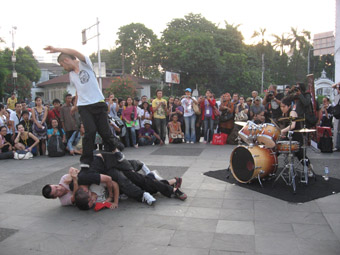
Contact Gonzo and Sayaka Himeno, public space
photo Phalla San
Contact Gonzo and Sayaka Himeno, public space
A few hours earlier, it was a young Japanese group contact Gonzo’s street dance performance that served as the soft opening—and a fitting one indeed—for the four-day festival. As about 100 people gathered around Plaza TIM, at the entrance to the host institution, noise from a bustling Jakarta street provided ambience that thematically fit the highly physical performance that was reminiscent of the street fights that takes place daily in many cities around the world. This was complemented by exuberant drumming, on a drum kit, by a female musician who, interestingly, rarely glanced at the four male dancers chasing and attacking—without actually hurting—one another. And occasionally we heard water bottles dropped and rolled around the cement floor. And unlike in Poomba, this soundscape didn’t set the rhythm of the dance, but rather added to the street ambience and the meaning of the piece.
Of course, many of us are still delighted to see contemporary dance works set to European classical music played to a live audience on CD, but, as a connotation of the term ‘contemporary’ suggests, there are also many other possibilities. After all, unlike theatre which is usually associated with, and powered by, spoken word that limits overseas exposure, contemporary dance speaks with body movements and music, or, as in these two cases, noise.
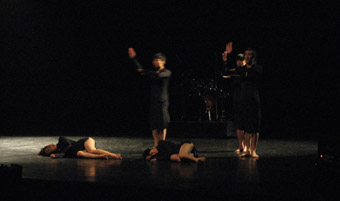
Darkness Poomba
photo Phalla San
Darkness Poomba
TWO MALE DANCERS IGNITE KIM JAE DUK’S DARKNESS POOMBA WITH A DUET PERFORMED BENEATH SEVERE TOP-LIGHTING. IT’S A FAST AND FURIOUS EXCHANGE OF ANGULARLY CHOREOGRAPHED MOVEMENT, HANDS MECHANICALLY GRASPING FOR EACH OTHER’S FACES AND BODIES REGIMENTED IN A FORWARD FACING STANCE. CREATING AN ILLUSION OF A ROBOTIC PAIR OF SIAMESE TWINS, THE TWO STYLISH YOUNG MEN ARE JOINED BY FIVE DANCERS CLAD IN CHIC BLACK SHARPLY ENTERING TO JOIN THIS MACHINE, EXPANDING ON THE GOTHIC ENERGY THAT HAS BEEN GENERATED.
A spot picks out a man standing with a microphone in one of the aisles. Ears and eyes are immediately drawn to this powerful presence and we are captivated as the space swells with his chanting of the traditional Korean Poomba (a wordless street song associated with both begging and festivities), evocative of desperation and yearning. Manipulated reverberation suggests that we are all inside a cold and mysterious vault of some sort, suspended between hallucination and reality. The performer displays extraordinary command of his instrument, and his sensitive commitment to the dancers on stage helps them to devote themselves to the dark abrasiveness of the space.
Later in the work, a dance with metallic dinner trays between the two male dancers who opened the piece brings an oddly domestic sensibility to the abstract world that has been established. The trays become percussive instruments as well as hats and items of clothing. The chorus of dancers behind them acts as a strata of strange shadows that morph from one contained image to the next. The dance is realised with crisp articulation and un-wavering performance energy as if the dancers are teasing out the dark underbelly of this work with a quiet ferociousness.
The darkness of this rich work is both deeply set in the bones of the performance and ironically woven into its surface. Even when the whole audience claps and sings in delight when the work turns into a rock concert, the haunting atmosphere never lets up. In fact it is in these ‘light’ moments that the gothic undertone is somehow heightened, demonstrating a sophisticated approach to the creation of atmosphere. Funereal organs and regular smoke machine emissions are both parodic and unsettling.
When choreographer and dancer Kim Jae Duk joins the vocalist in the auditorium and two electric guitarists play at either end of the stage, the traditional lilt of the Poomba becomes the wailing power of a rock concert, the guitars providing the metallic grit for the transition. The audience too has been transformed, from theatre spectators into a rock stadium crowd.
In a return to the opening duet, the two dancers perform a gradually accelerating version of the robotic Siamese twin dance down the aisle towards the stage. This phrase cleverly functions as the peak of the work, causing a kind of ‘Mexican wave’ effect on the crowd, evident in a vocal eruption. After the excitement has subsided, a gentle, virtuosic harmonica solo is performed by Kim Jae Duk, cleverly returning us to the work’s opening eeriness. As the creator lays his final delicate mark, the piece closes.
Not one sense is privileged over another in this haunting re-contextualization of the traditional South Korean melody of Poomba. In a truly interdisciplinary and multi-layered work, audience members are taken on a strange and unexpected voyage through the realms of contemporary dance, traditional song, stadium rock and festive reggae. Perhaps seeming schizophrenic and disjunctive in nature, this collage of performance genres is in fact executed seamlessly. Darkness Poomba is a work that manages to constantly transform our environment before we have even noticed, each new world functioning as a critique of the one that has come before.
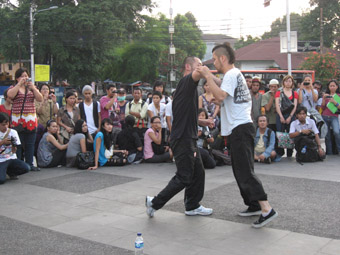
contact Gonzo, Public Space
photo Phalla San
contact Gonzo, Public Space
FIGHTING ERUPTS ON A CONCRETE PLATFORM ON THE EDGE OF A BUSY JAKARTA STREET, FOUR MEN GRAPPLING WITH EACH OTHER, PILING BODIES INTO PRECARIOUSLY PERCHED PYRAMIDS, CONSTANTLY INVADING EACH OTHER’S SPACE, SLAPPING AND PUNCHING. THIS IS NO ORDINARY STREET BRAWL BUT A PERFORMANCE BY JAPANESE COMPANY CONTACT GONZO THAT PUSHES THE PERFORMANCE BOUNDARIES BOTH PHYSICALLY AND LITERALLY. AT ANY MOMENT THE PERFORMERS COULD SPILL INTO THE WATCHING CROWD, AN IMMINENT DANGER THAT FORCES THE AUDIENCE TO PHYSICALLY ENGAGE IN THE WORK AS THEY DODGE AND RECOIL IN ANTICIPATION.
This work was one of the two international offerings that contributed to the youthful exuberance of the 10th Indonesian Dance Festival. The other was Korean Kim Jae Duk’s Darkness Poomba, bombarding the senses with a fusillade of fast movement combined with loudly belted lyrics and a beat that had the audience swaying and clapping.
Equally engaging, the two performances could not have been more different in execution and philosophy. Contact Gonzo doesn’t employ many theatrical tricks for its street performance, just the performers, an unamplified drum kit and simple props—water bottles, caps and disposable cameras. Although part of a dance festival, the physical language used cannot be comfortably labeled; it more closely resembles sport than dance in its raw action and response. In contrast, Darkness Poomba employed a full range of theatrical devices; strong lighting states to highlight the action, sleek costuming to show off the dancers’ physiques, sound amplification and a self-conscious breaking of the spectator-audience divide.
Kim’s youthful energy as performer, composer and choreographer, drives the piece, particularly when he commandeers the microphone showing off his strong voice or plays soulfully on his harmonica. Self-described as 70% choreography and 30% music Darkness Poomba is both rock concert and contemporary dance performance, crafted to get the blood pumping and body bouncing. This is a “re-mix” of Korean Poomba music, a throw-back to when the country was impoverished and street singers roamed around to entertain in exchange for food and money, singing the meaningless but rhythmic word “Poomba.”
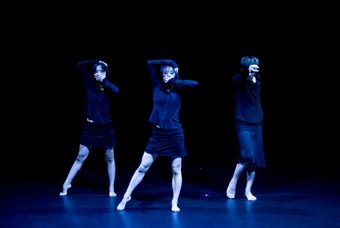
Darkness Poomba
photo Phalla San
Darkness Poomba
The work opens with two dancers lying limp in the centre of the stage. Suddenly they spring up, two young men, hair flopping over their eyes, dressed like dancerly beggars in earth-tones, they survey the audience then launch into a series of complex gestures, covering and uncovering their faces, then each other’s, hands threading through one another, then twining to catch hold and push their heads down. Imprisoned within the dark confines of the stage and the low groaning of the music, this depressed tone is short-lived because when the same sequence repeats some time later, it maintains the needlepoint accuracy yet, forced on by the driving beat and hyped up rock concert atmosphere it builds into a lightning speed that has the audience cheering.
Towards the end of the work the initial male pair re-appear moving metal dinner trays and bowls around with quick, concise movements and playing them as percussive accompaniment. Then like savage dogs they tear into imagined food, their beggarly appearance and hunger a reference to the history of Poombas.
The evocative, gestural movement vocabulary of the two sets them apart from the rest of the company, as Kim’s choreography for the black-clad dancers is a cross of liquid, contemporary movement and the aggressive energy of hip hop, that demonstrates strong ballet training without using a balletic vocabulary. The dancers are all long legs with broken torso lines and body distorting gestures that sharply accent the music and punctuate the strong beat.
Their figures perfectly synchronised, the dancers move as precisely as a well oiled machine. Bombarding the audience with speed of movement that denied emotional engagement, the physical prowess of the performers was admittedly inspiring. One male jumped high, smashing his leg into the air and completing a full revolution before landing, but did this stunt serve any other purpose than to wow the audience? The choreography was kinesthetically pleasing but not emotionally engaging.
It was the music that carried emotional resonance, particularly in the hoarse cries that emanated from the singer. This took on a life of its own as it travelled around the theatre, originating in one corner of the stage then moving to another, blaring and retreating like an auditory game of hide and seek. Later in the the work, a drummer sat centrestage, two guitarists flanked the stage and three dancers ran into the auditorium. They appeared to be escaping audience scrutiny but actually carried it with them, enlarging the performance space, if taking focus off the dancers remaining on stage.
One particularly powerful moment involving the pair of floppy-haired Poombas highlighted the challenge to the confines of the space. They threw themselves to sprawl flat against a side wall and then slowly peeled off. This was an undeveloped, token exploration of the space, part of an apparent mish-mash of images and ideas. However, in the spirit of entertainment that comes with Poomba, every moment was crafted to please, as when all action came to a stand-still and the drummer had his moment in the spotlight with a vibrant solo.
Contact Gonzo takes similar advantage of the power of energetic rhythm. From the first clang of the cymbals, the drummer is a dynamo of energy, going to war with the drum set. Echoing this aggression the dancers actually trade slaps, the smacking sound they create making the audience wince.
Aptly named after a style of journalism that is part fiction, part fact, in their performed battles Contact Gonzo negotiate a fine line between play and reality. Looking like young lion cubs in a mock hunt, they balance between careful control and risky stunts. With little formal dance training to share between them there is no polished technique, but a primal language of expression emerging from their improvised performances, making the action raw and naked. The construction of the movement revolves around the vigilance of the performers, highlighting the image of the hunt as they circle each other or attack with a sudden lunge or a slap only to be countered with paw-like swipes.
By conventional standards this performance may not be considered aesthetically pleasing, but like the journalistic style it is named after, it favours gritty delivery over polished accuracy. And the fact that this could escalate to violence at any minute makes it riveting. The unpredictability manifests in many ways, a randomly thrown bottle, water splashing around or the appearance of a disposable camera. At one point they give the camera to a group of watching boys and pose. The overlap of the two groups (performers and spectators) makes a touching picture when juxtaposed with playful violence.
Finally the drumming builds to a climax, forcing the dancers to increase their level of physical engagement until with a final crash of the drums the actionl freezes, and although the dancers still eye each other, alert and on their toes, the performance is over by common consensus as the audience breaks into applause. Contact Gonzo’s Yuya Tsukahara may have deliberately rebelled against theatrical conventions, but like Kim his focus is on involving the audience.
Here are two shows that travel very different paths to the same outcome: one taking full advantage of the effects a theatre offers, the other peeling production back to minimum, yet both create an immediacy that turns observer into participant. The explosion of energy that comes from the speed, risk and bone jarring sounds that these artists produce evokes a visceral response in the audience body making these works inescapably engaging and affecting.
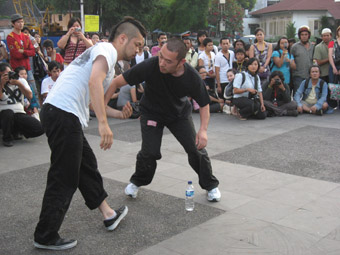
contact Gonzo, Public Space
photo Phalla San
contact Gonzo, Public Space
THE STREET FIGHT BUILDS SLOWLY. TWO YOUNG MEN IN STREET CLOTHES SLOWLY GROW AGITATED, PUSHING EACH OTHER, MOVING IN CIRCLES, EACH AGGRESSIVELY EYEING THEIR FIGHT PARTNER, BUMPING, STAYING GLUED TOGETHER FOR LONG PERIODS LIKE WRESTLERS. SOON TWO MORE MEN ENTER THE ARENA, AND WHAT STARTED LIKE A HARMLESS GAME—LIKE KIDS HANGING AROUND A TRAIN STATION, MEASURING THEIR STRENGTH OUT OF BOREDOM—HAS MOVED ONTO THE EDGE OF A REAL CONFRONTATION WHICH COULD GET OUT OF CONTROL AT ANY MOMENT.
The afternoon street performance by contact Gonzo provided a remarkable un-official opening for the 10th Indonesian Dance Festival. It caught me completely off guard. Expecting something of a hip-hop or breakdance show on the street, which might be even fused with a dose of traditional dance—the kind of thing offered later in the evening program just before the politicians delivered their opening speeches—I was hit by surprise.
The men move in and out of the fight, the physical intensity rising and ebbing with heavy breathing, water drinking, resting and watching followed and heightened by punching, slapping and wrestling. As the male fight continues, the ‘Greek’ chorus is a solo percussionist, aptly enough, a woman. Her intense drumming somehow gives the riot a dramatic element, turning it into a coherent struggle.
Contact Gonzo is a Japanase performance group that has been slowly gaining international attention. Before forming the group in 2006 and inventing the performing method of the same name, their members had been doing inspiring things like rolling down hills, catching falling leaves or jumping from the tops of telephone booths. With Gonzo meaning “bizarre, unconventional or extreme”, the performers transformed the technique of “contact improvisation”, incorporating the bumping of soccer, Sumo-inspired wrestling and a little known Russian martial-art called Systema with the ordinary kicks and punches and hits and spits from the street. Each performance is completely improvised, if with a few rules about what’s allowed and what’s not. There seemed to be some hidden communication or timing pre-arrangement with the drummer since without eye contact, she was in synch with the building up to and ending of the climaxes.
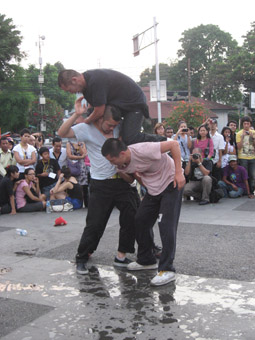
contact Gonzo, Public Space
photo Phalla San
contact Gonzo, Public Space
Some of the most beautiful moments occur when all four performers pile up on each other like a rugby scrum, frenetically interacting, agonizing, scanning the situation and making decisions about the next move in split seconds. The acting is so realistic that it reminded me of sessions of male bonding, most recently seen in the movie The Hurt Locker: violent, macho men horseplaying until emotions get out of hand and the unexpected happens. Meanwhile, the drummer is absorbed in her playing, working madly on her set, turning out sheets of sounds, which provide almost a physical stage for the men.
Contact Gonzo blurrs a few lines. Is it a staged show or does the aggression become real as the show progresses? In the middle of the tumult, somebody at the bottom of the pile grabs a disposable camera and shoots the performance. Here the artists criss-cross the delicate line between absorption and reflection. And are the audience mere spectators? Sometimes the turbulence moves dangeroursly close to the watching crowd. At one point, one performer falls at the feet of a group of street kids, who instantly take charge, grab the plastic camera and shoot.
The speed and rawness of contact Gonzo takes one’s breath away. As the performance comes to its end and the men rise to their feet and the drummer relaxes, I feel like I’m being released from an intense concentration, the kind you normally have when anticipating the unexpected.
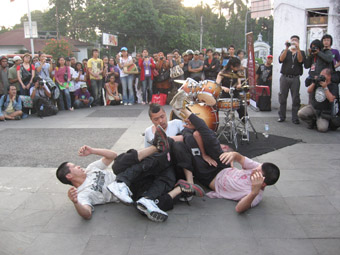
contact Gonzo, Public Space
photo Phalla San
contact Gonzo, Public Space
FOUR YOUNG JAPANESE MEN CASUALLY ENTER THE STAGE WHILE THE HOUSE LIGHTS ARE UP. THEY ARE WEARING T-SHIRTS AND TRACK-PANTS AND HAVE PERFORMANCE PASSES AROUND THEIR NECKS. ONE IS CARRYING A BACKPACK, OTHERS HAVE WATER BOTTLES AND THERE IS A VIDEO CAMERA ON A TRIPOD. THEY COULD WELL BE MISTAKEN FOR BACKSTAGE HELPERS PREPARING THE STAGE FOR THE NEXT ACT, BUT AS THEY EMPTY THEIR POCKETS, SET OBJECTS ON THE GROUND AND BEGIN TO WARM UP, IT BECOMES CLEAR THAT THEY ARE NOT. THEY ARE CONTACT GONZO, A JAPANESE DANCE GROUP.
For a few minutes they pace, lunging, stretching arms out every now and then, not in a dancerly fashion but as though about to run a 100m sprint. The physical and mental preparation generates suspense—the audience wondering what the heck is going on.
Eventually two of the men connect, not in the sense of contact improvisation where physical connection is utilized to explore movement, but rather as in sport or combat. They push and tussle, climbing on top of one another, every now and then dropping away to reposition, grab a drink of water or take a photo with a disposable camera. Gradually the battle escalates and without warning one strikes another in the face, the sound of palm to skin cutting through the air and triggering horrified gasps from the audience. The shock is amplified as suddenly from behind a backlit cyclorama a drummer improvises wildly. Crashing, banging, attacking, showing the drum-kit who’s boss, her huge, ominous shadow is an intriguing backdrop to the onstage male brawn.
An everyday performance paradigm coupled with the invitation to raw violence instils an immediate sense of the unconventional. Contact Gonzo take their name from the rebellious Gonzo journalism made famous by American journalist Hunter S Thompson. The exposure of what is normally hidden from an audience—the warming up, setting up, drinking—parallels the raw and un-edited subjectivity of the Gonzo style of writing, in which grit is favoured over polish. Thompson documented his own actions while immersed in journalistic projects, a reflexive technique also evident in Contact Gonzo’s use of cameras on stage.
As the performers wrestle, a cell-phone rings in the audience. A number of people nearby show their disgust with forceful shushing, but one of the performers reassures them, “No it’s okay. It’s okay.”
More violent slaps to the face are thrown from every which way, more piles of bodies rise up, tumble and loudly crash to the floor. At times the fighting looks like a casual urban realization of traditional Sumo wrestling. Contact Gonzo battle on, but to what end? A highly charged testosterone display gratuitously taking advantage of theatre space to flex a bit of muscle? There is no emotional narrative here. The performers just are. They fight.
It’s no surprise to me that this young team of performers are currently being invited to perform in festivals all over the world, despite the work appearing to be more an uncontrollable event rather than a finely-crafted performance. It is clear however that this group has a precise agenda, and their unique antics ensure that they stand out from the rest of the program.
Contact Gonzo is a highly innovative ‘dance’ company who unabashedly challenge established theatrical norms. Representative also of a contemporary consciousness in which violence and technology are mutually implicit, I’m sure their work will act as an interesting reference point in critical dance discussions for years to come.
l-r: Devi Fitria, Melissa Quek, Dinyah Dinyah Latuconsina (Cultural Program Assistant), Keith Gallasch, Giang Dang, Joelle Jacinto, Cat Ruka, Bilqis Hijjas, Pawit Mahasarinand
photo Phalla San
l-r: Devi Fitria, Melissa Quek, Dinyah Dinyah Latuconsina (Cultural Program Assistant), Keith Gallasch, Giang Dang, Joelle Jacinto, Cat Ruka, Bilqis Hijjas, Pawit Mahasarinand
THANKS TO AN INVITATION FROM FRANK WERNER, REGIONAL HEAD OF THE CULTURAL PROGRAM DEPARTMENT AT THE GOETHE INSTITUT INDONESIA, I WAS DELIGHTED TO ATTEND THE 10TH INDONESIAN DANCE FESTIVAL (TITLED “POWERING THE FUTURE”) IN JAKARTA TO RUN A REVIEW-WRITING WORKSHOP FOR THE INSITITUTE IN RESPONSE TO FOUR DAYS OF EXHILARATING DANCE FROM INDONESIA, TAIWAN, JAPAN, KOREA AND EUROPE.
Amidst the festival hubub, new cuisine experiences, nerve wracking city traffic and World Cup tensions (after all, our host was a proud and anxious Goethe Institut), the workshop team saw shows, discussed and wrote (late at night or early in the morning), read each other’s reviews and shared knowledge and opinions.
The workshop participants were a fascinating mix: some had professional dance and producing experience, some were already reviewing, running blogs or contributing to magazines and newspapers, others were starting out.
Cat Ruka from New Zealand is a dancer, performance artist and the editor of Yellingmouth, an Auckland-based dance review blog. Melissa Quek from Singapore is a choreographer, a teacher at LASALLE College of the Arts
and a freelance dance reviewer for The Business Times. Joelle Jacinto from the Philippines is a dancer and a freelance writer with many years of experience. She is editor-in-chief of Runthru, a bi-annual dance magazine and website. Bilqis Hijjas creates, performs, produces, teaches and writes about contemporary dance in Kuala Lumpur, Malaysia and runs a residency for choreographers at the private arts centre Rimbun Dahan. Devi Fitria is a Jakarta-based journalist who works for the Indonesian art magazine ARTI and an online history magazine, HISTORIA. San Phalla lives in Phnom Penh, holds degrees in Southeast Asian Studies and archaeology and works as a researcher for Khmer Arts, a Cambodian classical dance company that tours the world. Dang Giang, from Vietnam, is a writer and cultural and social activist.
Pawit Mahasarinand
photo Keith Gallasch
Pawit Mahasarinand
Parwit Mahasarinand, a theatre lecturer and dance reviewer since 2000 for The Nation English language newspaper in Bangkok, was a very welcome addition to the workshop after he’d delivered a keynote address (“If we write more—Observations on contemporary dance criticism in Asia”).
Dance scholar, archivist and writer Franz Anton Cramer (Paris/Berlin) delivered two talks, one on the ethics and aesthetics of criticism and the other an invaluable and subsequently hotly debated introduction to the works of Meg Stuart and Philipp Gehmacher who were performing Maybe Forever in the festival.
The aim of the workshop was to improve the capacity of reviewers to vividly evoke the works they experience for their readers. Good reviewing (whether or not it consciously includes social, political and economic perspectives and passes critical judgment) cannot work effectively without this skill. Openness, strong recall, rich vocabulary, a structured response, the careful delivery of judgment, these were the workshop focus.
I was pleased that all participants willingly and bravely committed themselves to a challenging task—to respond very quickly to new dance works while focusing on writing skills and being subjected to criticism. As you read the reviews posted here do keep in mind that they were written under pressure and with limited time for editing and polishing. Despite these demands there are fine examples of vivid and thoughtful writing to be found in the 23 reviews that came out of a mere four days of what appeared to be happy labour. It was particularly pleasing to see increased attention not just to movement details but also to music, sound, set design, lighting and the ways in which, in this era of hybridity, various forms mix and meld.
The festival provided challenges for all of us in the workshop. Many works drew on traditional dance, customs and beliefs, sometimes leaving us guessing as to specific meanings while fascinated with what we seen. It’s doubly difficult given that the works are themselves contemporary interpretations or re-workings of traditional forms. Sometimes one of our number had an answer, or we googled one, provisonally, knowing that a dance festival like this one can only serve as an introduction to unfamiliar forms. Inevitably we debated the advisability of reviewing works where we lacked cultural understanding—would we misrepresent what we saw or were we encouraging interest and a sense of inquiry?
l-r: Giang Dang, Phalla San, Joelle Jacinto [outside theatre]
photo Keith Gallasch
l-r: Giang Dang, Phalla San, Joelle Jacinto [outside theatre]
Other issues discussed included the significance, or not, of English language dance reviewing in Asia, a shortage of good editing, and a certain reviewer caution about being judgmental—verbal opinions were often tougher than those that appeared in print, said a number of participants.
From the too real street fighting of contact Gonzo to the contemplative account of a relationship breakdown in Maybe Forever and on to a range of works that engage simultaneously with traditional Indonesian forms and contemporary ideas (about homosexuality, globalisation, identity, climate change), you’ll discover in our workshop reviews an Indonesian dance festival engaged directly with the role of dance as art, and as life.
It’s hoped that the workshop will further the bringing together of dance artists and writers in the region.
The initials of the workshop writers will link you to their reviews of the following works:
Kim Jae Duk Project, Darkness Poomba [South Korea]: PS, CR, MQ, PM
contact Gonzo [Japan]: CR, GD, PM, MQ
Gusmiati Suid, Seruan [Indonesia]: DF
Asry Mery Sidowat, Merah [Indonesia]: JJ, MQ, DF
Muslimin B Pranowo, The Young [Indonesia]: BH
Jecko Siompo, From Betamax to DVD [Indonesia]: PS, MQ, JJ
Eko Supriyanto, Home: Ungratifying Life [Indonesia]: JJ, MQ
Vincent Sekwati, Barena ‘Chiefs’ [Indonesia]: MQ
Shinta Maulita, GAYaku [Indonesia]: DF, MQ
Ajeng Soelaiman, Andara Firman, S]h]elf [Indonesia]: GD
Cross Over Dance Company, Middle [Taiwan]: BH
Meg Stuart, Philipp Gehmacher, Maybe Forever [Berlin/Vienna]: BH, CR, GD, JJ, PM
Joko Sudibyo, Cekrek [Indonesia]: MQ, DF
Closing Night Performance: JJ, MQ
Emerging Choreographers Program: MQ, DF
You can see all 23 reviews at 10th Indonesian Dance Festival: Goethe Institut Regional Critic Workshop
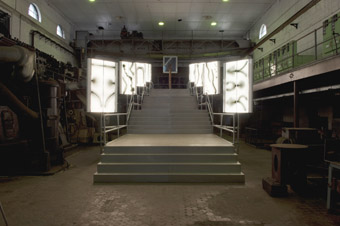
Faraday Cage, 2010 Installation view of the Biennale of Sydney 2010, Power House, Cockatoo Island, courtesy the artist and Gallery Koyanagi, Tokyo
photo Sebastian Kriete
Faraday Cage, 2010 Installation view of the Biennale of Sydney 2010, Power House, Cockatoo Island, courtesy the artist and Gallery Koyanagi, Tokyo
HIROSHI SUGIMOTO IS AN ARTIST WHO USES PHOTOGRAPHY TO EXPLORE AND REALISE CONCEPTS ARISING FROM HIS WIDE-RANGING INTERESTS SPANNING ART, SCIENCE, LANDSCAPE, MATHEMATICS, BELIEF SYSTEMS AND ARCHITECTURE
He uses large-format cameras to create portraits of ideas—often to record light events over long time spans—creating revelatory images otherwise unavailable to human perception. For example, the brief but entire life of a candle or the duration of a movie projected on a cinema screen. In sculptural and architectural forms, he uses materials such as plaster or aluminium to explore the potentialities of shadows and abstract geometries.
For the 17th Biennale of Sydney, Sugimoto devised Faraday Cage, a new site-specific work located inside the decommissioned power station at the western end of Sydney Harbour’s Cockatoo Island.
Here and now, in the early 21st century, Cockatoo Island presents a unique palimpsest of maritime industrial activity and technologies, at once embodied and entombed in a utilitarian accumulation of remnant architectures watched over by the emblematic rusting carcasses of eerily figurative monumental cranes. Across, over and through this savagely cut and gouged sandstone mound, untold kilometres of cables, pipes and conduits trace the entire trajectory of the Industrial Revolution. And all of these systems, devices and machines required power to function—provided in stages by the muscles of men and horses, the circulatory energy of steam and fantastic, mysterious, elemental electricity.
After a long wander down a bitumen road between a towering sandstone quarry cliff and a narrow deepwater dock, the approach to Faraday Cage is via a short oversized tunnel carved through the island’s sandstone body. Behind a giant’s ribcage of angular steel trusses, roughly hewn stone walls drip with seeping rainwater. Rounding a bend, a small accidental atrium space serves as outdoor ante-room to the power station proper. Massive monochrome-grey triple-height wooden doors stand closed at the entrance. Faraday Cage is inside.
Common to the industrial vernacular, a much smaller secondary door is cut near ground level into one of the two huge swing-doors. Reminiscent of the experiential commencement of chanoyu, the Japanese tea ceremony, visitors must stoop to enter the building containing the artwork. There’s a brief moment of instinctual care taken as one steps over this awkward threshold, bent toward the floor. On standing upright again, the shadowed, cavernous space of the defunct power station interior is revealed.
High up, a massive gantry crane sits motionless. Hugging one wall on a raised walkway is a procession of tall metal cabinets adorned with rows of white dials and black switches. An open stairwell of rusted steel descends to an ominous dark void. Down there, the relentless sound of a strong flow of water—an underground stream? Huge iron tubes like taut muscular arms, spherical mesh cages, Frankenstein throw-switches, precision rows of bakelite dials, warning signs—everything here is about containment and flow of enormous pressures and deadly forces. This is energy bondage fetishism born of engineering necessity. Over there, worn wooden workbenches with careless assemblages of abstract metal shapes, rusted drums, stained walls, stained puddles…it is a space filled powerfully with absence. And to this redundant post-industrial setting, Sugimoto introduces various interventions, asserting a different potential.
Of immediate visual impact, the artist has contrived a grand, temporary stairway delineated by steel-pipe bannisters to dominate the central void. Ascending dramatically away from the viewer, it is punctuated with a series of four broad metal platforms, each flanked by a pair of large vertical light-boxes displaying exquisite, luminous examples of Sugimoto’s recent experiments in producing photography with (not of) static electricity.
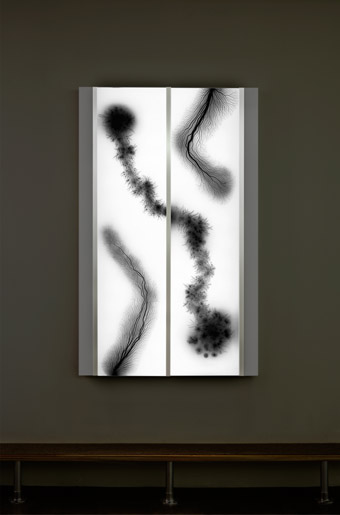
Hiroshi Sugimoto, Lightning Fields Illuminated 003 | 2008 black-and-white film with light box
courtesy the artist and Gallery Koyanagi, Tokyo
Hiroshi Sugimoto, Lightning Fields Illuminated 003 | 2008 black-and-white film with light box
These glowing dendritic monochromes serve as symbolic portraits of the friendship between two 19th century ‘natural philosophers.’ Michael Faraday and William Henry Fox Talbot. Faraday’s investigations led to the industrial development of electricity, while Fox Talbot invented calotype photography and used it as a medium for artistic expression. They were both progenitors in the maelstrom of invention that was the Industrial Revolution—within which legacy we now reside.
Atop the stairwell, which commingles industrial make-do with mnemonic tropes from grand theatre foyers, banal hotel lobbies and aristocratic homes, stands a crude wooden column. Astride this column, above the heads of visitors, is an extraordinary menacing figure—an emanation of elemental power, of lightning’s hair-raising cohort, Raijin the Japanese deity of Thunder. Leaping across time and space from 13th century Japan, this arresting polychrome wooden incarnation expresses the energy of thunder as a bulging, squat, blood-red daemon, fierce mouth agape, green-glass eyes madly staring, oversized golden loin-wrap swirling as he runs across the sky beating great invisible drums with double-headed mallets clenched in brutish fists.
This astounding sculpture—so beautifully conceived and skilfully executed—represents a deity with obscure origins in both Indian Hinduism and Chinese Taoism, adapted into Japanese animist traditions and finally into Buddhism as one of the many protectors of Kannon (Avalokitesvara), the 1,000-Armed Bodhisattva of Infinite Compassion. Long before, Raijin attempted to frighten and menace the Buddha, but after becoming a protector of the dharma, he is said to have saved the islands of Japan from invasion by Mongolian forces in 1274. He stood atop the clouds hurling spears of lightning down upon their fleet.
But 13th century Raijin is not the only deity invoked within the charged atmosphere of Faraday Cage. Sugimoto effortlessly reaches back and forth across time, bringing diverse ‘cultural warriors’ together on the stage of his contemporary art practice. If Faraday and Fox Talbot are tangentially evoked, another ‘giant’ of a different order is made unmistakably apparent.
Near the entrance is a well-known photographic portrait of Marcel Duchamp, elucidating an explicit and appropriately tongue-in-cheek reference to the readymade quality of this amazing building/space. The glass in the frame has been damaged by what appear to be a few light hammer blows, and it’s attached to an old two-wheeled hand-pushed goods trolley. Duchamp—and the weight of his conceptual baggage—has been literally wheeled out and parked in the space.
Nearby and behind, camouflaged within the tangle of decommissioned industrial debris, is a Faraday Cage apparatus, named after Michael Faraday’s invention of 1836. This esoteric example of the device incorporates a common metal bird cage, symbolically referencing the capture and taming of elemental forces for human amusement. The Faraday Cage hides there, apparently dormant but silently accumulating immense and invisible power, until periodically discharging its pent-up electrical energy with startling, noisy arcs of blue-white miniature lightning.
The overall effect is of a strange, dimly lit cathedral-like space. It is at once a homage to and mutation from its original purpose, becoming a place for the generation of speculation on art, science and technology, and for the temporary worship of harnessed elemental forces. Perhaps it includes one which is everywhere apparent in this part-industry, part-art hybrid tableau—the elemental force of the human imagination. The imagination to portray epic deities to explain the terrifying indifferent fury of natural forces. The imagination to radically investigate those same forces and derive different explanations in substitution of deities. The imagination to devise technologies to cage and tame and apply those forces. And the imagination to conjure and realise utterly different forms of art—a urinal as sculpture, electricity as a photograph, decayed post-industrial hulk as contemporary art space.
Hiroshi Sugimoto’s Faraday Cage points directly to this cascade of minds falling through time, sparkling with erratic energies.
Hiroshi Sugimoto, Faraday Cage 17th Biennale of Sydney, Cockatoo Island, May 12-Aug 1
This article first appeared online, June 28, 2010
RealTime issue #98 Aug-Sept 2010 pg. 34
© Gary Warner; for permission to reproduce apply to realtime@realtimearts.net
Sandra Bullock, Quinton Aaron, The Blind Side
photo courtesy Warner Home Video
Sandra Bullock, Quinton Aaron, The Blind Side
INTRIGUED BY THE PUBLICITY AROUND THE BLIND SIDE, THE AMERICAN FILM, BASED ON A TRUE STORY ABOUT A WEALTHY, SOUTHERN, WHITE, REPUBLICAN FAMILY BECOMING THE LEGAL GUARDIANS OF AN AFRICAN-AMERICAN YOUTH, BIG MIKE, FROM THE VIOLENT, DYSFUNCTIONAL PROJECTS ON THE WRONG SIDE OF MEMPHIS, I DROVE THROUGH FLOOD WATERS TO THE YARRAVILLE SUN CINEMA TO SEE WHAT HAD BEEN DONE WITH THE STORY.
I viewed it in the light of my script for the feature film, Call Me Mum (see RT74) on a similar, Australian subject—the fostering of a Torres Strait Islander by a white woman, in this case myself. The pure, naïve, ‘missionary’ story The Blind Side told was exactly what I did not, could not and would not tell in Call Me Mum. How could it be, written in the context of the Bringing Them Home report and the Stolen Generations narratives?
I found The Blind Side very problematic on a number of levels. The simple narrative and two-dimensional characters meant the meat was removed from the bone in favour of the heart-warming and feel-good; the most interesting story was that told by the actual family photos screened under the end credits. The film would have sunk without trace except for Sandra Bullock’s Oscar-winning performance as Leanne Tuohy which, to me, as a white foster mother, seemed emotionally inspired—her task-oriented attitude, her closet compassion, her moral/ethical toughness, her emotional restraint. She refused, as I know I did, to ‘enjoy’ an emotional smorgasbord at her adoptive son’s expense. What bonded Leanne Tuohy and Big Mike was not pathological maternity playing itself out through interracial adoption, it was that both exhibited a high score in ‘protective instincts.’ Anyway, The Blind Side got me thinking, again, about the way the white adoptive/foster mother is represented in the few Australian films that deal with this subject of interracial adoption/fostering.
Catherine McClements as Kate, Call Me Mum
So, in the light of my construction of the white foster mother in Call Me Mum, I watched those films again—Chauvel’s iconic Jedda, Tracey Moffat’s ‘remake’ of Jedda, Night Cries—A Rural Tragedy, Anne Pratten’s short AFTRS film Terra Nullius, Andrew Bovell’s story for Anna Kokkinos’ Blessed, Baz Luhrmann’s Australia.
Sarah McMann, the white mother in Jedda—pale, scrawny, pathetic, the sickening prototype of the ‘do-gooder, mission manager,’ pathologically depressed after the death of her baby—takes the orphaned Aboriginal child Jedda as a replacement and determinedly tries to ‘tame’ her Aboriginal ways. Sarah teaches Jedda to bathe, read, play the piano, speak ‘well.’ She tries to stop her associating with the Aboriginal station workers and encourages her relationship with the ‘mission Black’ head stockman, Joe, who narrates the film. The Aboriginal child, Jedda, suffers at the hands of failed maternity.
In Night Cries Sarah McMann returns to the screen as a deathly white, geriatric, wheelchair bound invalid (played by Agnes Hardwick) being cared for, in her final days, by a frustrated, voluptuous Jedda (Marcia Langton), in a white, nurse/domestic’s uniform. Dialogue is replaced in the film by a haunting soundscape—amongst the animal cries, ‘corroboree, drum and didgeridoo’ sounds, cracking whips, laughter, the noise of a distant train are the poignant raspings of the dying Sarah and, finally, the extended, heartbreaking weeping of Jedda curled foetally beside the corpse of her dead ‘mother’ on a railway siding platform.
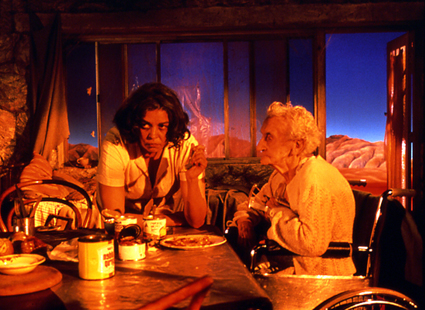
Sandra Bullock, Quinton Aaron, The Blind Side, photo Ralph Nelson, courtesy Warner Home Video; left – Marcia Langton, Agnes Hardick, Night Cries, Tracie Moffat
courtesy Ronin Films
Sandra Bullock, Quinton Aaron, The Blind Side, photo Ralph Nelson, courtesy Warner Home Video; left – Marcia Langton, Agnes Hardick, Night Cries, Tracie Moffat
The mother here is a classic study of the Kristevan abject—ghastly white and wasted, the skin of her scrawny hands and feet old and scaly, emotionally and psychologically absent yet powerfully demanding in her helplessness and finally, a corpse. The film shifts gears from ‘a rural tragedy’ into the horror genre. The abject here is complicated by race and yet Jedda’s grief is real, affective and, in some way, accomplishes a reconciliation.
But that monstrous, old Sarah McMann, she’s one of the unholy undead. She won’t bloody well stay down—because she ain’t dead by a long shot. There she is again, geriatric, demented, pitifully hungry for love—white, white, white skin, hair, nightdress—haunting the well-heeled, leafy, leafy, leafy Melbourne suburbs and the silver screen in Blessed. Abject in her pathologically starved maternity, Laurel Parker denies her adopted Aboriginal son Jimmy access to his birth mother, hiding the humble present she leaves at the door for his 13th birthday; secreting it away behind her volumes of Marx (Karl not Groucho) in her well-stocked bookcase. This time Jedda/Jimmy challenges this ‘mother,’ although it’s still not dialogue; she’s good and dead, and there’s no reconciliation. At the morgue to identify her body he denies her once, twice. “She’s not my mother,” he says to the morgue attendant. “No, this is not my mother.” She has been killed as a direct result of this thwarted craving for maternal love when, in her senile delirium, she embraces and kisses a young thief she mistakes for Jimmy. Thus Bovell proves his racial ‘goodness’ through an unproblematic demonising of the adoptive, white mother—a real soft target.
Alice, in Terra Nullius, does dialogue with her adoptive mother, again reprising the ‘taming’ versus ‘Indigenous instincts’ arguments. The construction of all these Sarah characters is pretty much covered by the discussion between Doug and Sarah McMann in Jedda: “Still trying to turn that wild little magpie into a tame canary, Sarah? Well you won’t do it by shutting her windows at night to keep out the cry of the corroboree, dance and didgeridoo and you won’t wipe out the tribal instincts and desires of a thousand years in one small life.”
Luhrmann’s Australia does, to some extent, progress the discussion in the construction of Lady Sarah Ashley. Nicole Kidman presents us with another Sarah McMann but this is a more contemporary Sarah, finally out of the 50s, and one more in keeping with the adoptive/foster mothers I know. Despite some reservations about her young Aboriginal charge Nullah going walkabout, despite wishing, vaguely, to teach him ‘manners’, despite her inability to have children herself, her adoption and maternity are not constructed as something missionary, pitiful and pathological. It has more in common with Bullock’s Leanne Tuohy in its heightened empathy and task-oriented drive. Nullah is not a blank, needy orphan to be ‘loved’ either. Sarah Ashley responds to Nullah’s agency. He says to her, any number of times, “I will sing you to me.” The two mothers, Nullah’s birth mother and Sarah Ashley, combine forces to protect him from being taken to the mission by the ‘coppers’ at the behest of his violent white father. Finally, Kidman’s Sarah understands and accepts Nullah’s need to go walkabout with his grandfather and she waves goodbye.
How are race and child protection perceived in this country? The voices of adoptive mothers of Indigenous children go unheard. We, with our experience of interracial adoption/fostering, are treated as virtually non-existent except as abusers and thieves. All the parents I know are more like Sarah Ashley and have gone to extraordinary lengths to find and link their Aboriginal or Islander child with their birth families and are acutely aware of the needs of the child to have access to, and knowledge of, their Indigenous heritage and culture. A number have adopted or fostered through Aboriginal agencies yet are still cast as Sarah McManns. (I tried to voice some of this in Call Me Mum.) Most importantly, we know first hand the effect the singular, overarching ‘stolen’ narrative can have on a teenaged child searching for an identity as all young people do. I showed this in Call Me Mum when foster son Warren is cajoled into repeating the ‘stolen’ story by a journalist.
One academic who has researched the subject is Denise Cuthbert. She found that white mothers “have been rendered not only silent but their experiences are virtually unspeakable in the present context” (“Holding the Baby: Questions Arising from Research into the Experiences of Non-Aboriginal Adoptive and Foster Mothers of Aboriginal Children,” Journal of Australian Studies, December, 1998). Proving the point, Damien Rigg, in critiquing Cuthbert’s work, decries “her failure to adequately consider the potential need for some stories to remain unspoken” (“White mothers, Indigenous families, and the politics of voice,” Australian Critical Race and Whiteness Studies Association Journal, e-journal, Vol. 4, No.1, 2008). But the constant theme in Australia, and we hear it particularly from Nullah, is that knowing and telling your ‘story’ is the most important aspect of any culture.
To tell these stories we need to find ways to live in the complexities of the ethical paradox, cultivate a political sophistication, not reinscribe some Australian Good, not fall into the blind spot of assumption as Andrew Bovell does. Our cultural products, such as film, need to speak “against the grain of the good and its incumbent fantasies” (Jennifer Rutherford, The Gauche Intruder: Freud, Lacan and the White Australian Fantasy, 2000). They must acknowledge, explore and articulate the blind spot. Listen to all the stories, not just the socially and politically sanctioned ones.
This article first appeared online June 28
RealTime issue #98 Aug-Sept 2010 pg. 28
© Kathleen Mary Fallon; for permission to reproduce apply to realtime@realtimearts.net