Australian
and international
exploratory
performance and
media arts
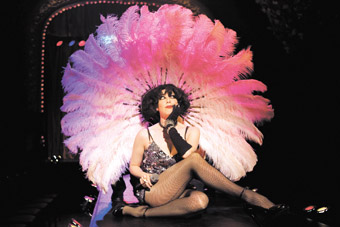
Meow Meow
photo Prudence Upton
Meow Meow
OUR DIVA ARRIVES WITH A BANG, KNOCKING A PANEL OFF THE WALL THAT COMES CRASHING DOWN ON THE OBLIGATORY BABY GRAND. SHE DUSTS HERSELF OFF, GETS THE DANCE ROUTINE OUT OF THE WAY, CLAIMING IT’S A SYDNEY FESTIVAL FUNDING REQUIREMENT THAT EVERY WORK CONTAIN DANCE (TONGUE FIRMLY IN CHEEK AND PRESSED AGAINST HER FAKE CIGARETTE), CHANGES COSTUME, VEERS ALARMINGLY AROUND THE STAGE AND ENLISTS AUDIENCE MEMBERS TO OPERATE PLASMA SCREENS SO WE CAN WATCH PRE-RECORDED PERFORMANCES WHILE SHE HAS ANOTHER DRINK. “THE FESTIVAL SAID THAT I COULD DO ANYTHING I WANTED. THAT WAS THEIR FIRST MISTAKE.”
With the preliminaries out of the way, Meow Meow approaches the burning question animating the evening’s entertainment: “How long does it take to fall in love?” Tonight’s performance, she declares, will examine a range of evidence from scientific experts on the subject—anthropologists, psychologists, and neurologists —and include an examination of how the onset of love can be measured. Sure enough, as she sets up her first song, she finds herself unable to sing and after some time manages to cough up an alarmingly long measuring tape—the technology of measurement an obstacle to the form of cabaret, producing a gag reflex.
Mid-song, our host spins suddenly. My seat is declared to be reserved, and I am led charmingly yet forcefully to another chair, right at the end of the catwalk that divides the audience in two, becoming in the process another part of the spectacle, and later a somewhat inept translator for a song. With her curiously engaging mode of aggressive vulnerability, Meow Meow is highly adept at coopting and compelling audience members to perform—to hold her microphone, bring her coffee, caress her as she sings, play the bugle, suck lollipops while blindfolded, and even submit to banishment to a cupboard. With our help she is never left alone, but it’s always clear who’s in charge. Somehow she makes us love embarrassing ourselves for her, ably assisted of course by some of the most gloriously convincing audience plants I have ever witnessed.
Insert the Name of the Person You Love is a cabaret performance driven by distraction as much as by its purported focus on the science of love. In her quest for knowledge, Meow Meow never manages to complete any of her songs, interrupting herself by escalating her demands for audience involvement, swigging more wine and constantly seeking updates about the status of the missing expert, a ‘love doctor’ whose scientific lecture demonstration will enlighten everyone about the science of falling in love. He’s stuck at customs apparently, an insurmountable problem with his visa. The cabaret is just something to fill in the time.
The show continues to wend its way crazily towards an end, encompassing stunning vocal work, an unexpectedly beautiful en pointe dance sequence, and a grand finale to die for. Quite simply, Meow Meow’s constantly unravelling, glamorously shambolic and seemingly out-of-control performance is constantly surprising and always entertaining: a masterful, delicious and delirious ride.
Meow Meow, Insert the Name of the Person You Love, performer-deviser Meow Meow, piano Lance Horne, director Rodney Fisher, lighting designer Nick Schlieper, sound supervisor Max Lyandvert, The Pilgrim Theatre, Sydney, Jan 22-26
RealTime issue #83 Feb-March 2008 pg. 13
© David Williams; for permission to reproduce apply to realtime@realtimearts.net
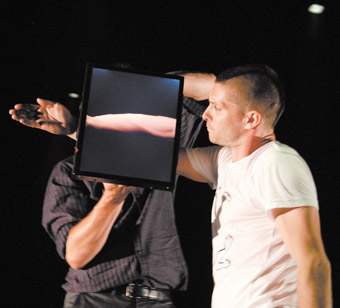
Byron Perry, The Age I’m In, Force Majeure
photo Heidrun Löhr
Byron Perry, The Age I’m In, Force Majeure
FORCE MAJEURE’S LATEST CREATION IS A KALEIDOSCOPIC REVERIE THAT EMBODIES A HOST OF ATTITUDES ABOUT AGE AND AGEING—OF THE PERFORMERS AND THOSE
INTERVIEWED FOR THE PROJECT. BUT RATHER THAN ADOPTING A LITERAL, DOCUMENTARY APPROACH, FORCE MAJEURE GOES FOR TELLINGLY MAGICAL JUXTAPOSITIONS AND
DISJUNCTIONS.
A key part of the theatrical technique of The Age I’m In is the mismatching of attitudes, ages, genders and bodies. In the beginning the massed performers effectively mime to voices belonging to persons often very different from themselves. Late in the work, Byron Perry and Kirsty McKracken excel in mouthing the words of children while exquisitely evoking the out of synch body movements that come with their restless energy and distracted attentiveness—it’s a beautiful dance.
Performers mask their faces with the portraits of others on small and very robust, portable digital screens released from wires above. Elsewhere, these screens are moved up or down clothed bodies, revealing naked selves beneath and the subtleties and sometimes pathos of their ageing. Shared with and tugged from one dancer to another the screens conjure jokey, surreal images evocative of the lateral creativity of youth. Elsewhere, the performers mime their own voiceovers. Daniel Daw, in a richly idiosyncratic dance declares that he never saw himself as disabled and reveals the power of differently-abled performance.
In another strain, centre-stage dramatic vignettes portray gaps generated by the closed world of the iPod listener, or the closed ears of the elderly indifferent to the young (which becomes a squirming mini-dance). Another series, this time of apparently domestic scenes around table and chairs upstage, is less compelling, opaque even.
The Age I’m In concludes with dark intimations of mortality: a slide into dementia, a funeral procession (with a darkened New Orleans pulse), a touching, finely moved pieta (Daw and actor Vincent Crowley) and the fall of fine rain onto the performers gathered downstage—an image both melancholy and suggestive of regeneration, like a sunshower, although oddly inconsistent with the show’s other imagery.
What I liked about The Age I’m In was the way that bodies of one age could engage with those of others in a grand ‘what if’ scenario—“What if I was 80? What if I was four?” And even though the large number and brevity of most of the recorded utterances limited the possibility of any far-reaching empathy, The Age I’m In was always richly suggestive, and, as ever with the direction of Kate Champion, the collaborations across media and theatrical devices was as fascinating as the age and skills mix of her cast.
–
Force Majeure, The Age I’m In, director Kate Champion, performers Marlo Benjamin, Maggie Blinco/Annie Byron, Samuel Brent, Tilda Cobham Hervey, Vincent Crowley, Daniel Daw, Brian Harrison, Roz Hervey, Kirstie McCracken, Veronica Neave, Byron Perry, set & lighting designer Geoff Cobham, costumes Bruce McKniven, sound designer Mark Blackwell, visual artist William Yang, audiovisual producer Tony Melov; Drama Theatre, Sydney Opera House, January 8-12
RealTime issue #83 Feb-March 2008 pg. 14
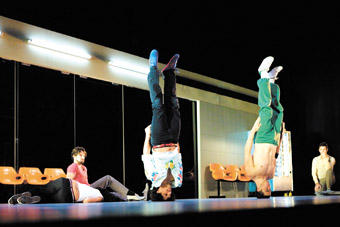
This Show is About People
photo Prudence Upton
This Show is About People
IN HIS NOTES ABOUT THE INSPIRATION FOR THIS SHOW IS ABOUT PEOPLE, CHOREOGRAPHER SHAUN PARKER TALKS ABOUT A TIME HE SPENT WITH HIS MOTHER IN THE WAITING ROOM OF AN ONCOLOGIST’S SURGERY. ALONG WITH ISSUES OF LIFE AND DEATH, WHICH THE EXPERIENCE BROUGHT SHARPLY TO MIND, THE PLACE OF PARKER’S DARK REVERIE CLEARLY SEEPED INTO THE WORK HE WAS DEVELOPING AT THE TIME.
Theatrically, this space is rendered as a waiting room of another kind, the nondescript transport terminus beloved of many contemporary performance practitioners. Here, Parker joins Benedict Andrews, Christof Marthaler, Alain Platel and designers such as Anna Viebrock and Mirabelle Wouters, artists who dwell on the desultory spaces of contemporary urban life—the mall, the rooftop, life-sapping bureaucratic and indeterminate domestic spaces, the anonymous late night servo. It seems the little hells that haunt our dreams are the places where our most talented do some of their best creative thinking. These spaces also demand a certain scale, a sense of vista. Wings are abandoned in favour of a wide-open horizontal stage, which automatically gives the works a cinematic feel.
In This Show… a line of plastic seats houses a random assembly of night dwellers, who appear to have little in common save their temporary cohabitation of this transit zone. At one end of the space there’s a wall phone, at the other, a vending machine. Stage right a couple of musicians casually blend into the scene. Behind the seats a glass wall divides the people who gaze distractedly out at us from the space beyond, a kind of platform for a train to nowhere that never comes. From time to time, people stand and depart through the doors unexplained, to return later unannounced. This sense of stasis interrupted by arrivals, departures and time-killing ritual provides the rhythm of the work.
Here we’re less concerned with the strict arc of theatrical narrative than with a loose, musical structure that allows for lateral connections, the possibilities of the passing parade, the sweep of vision in which casual details catch our eye. We’re aware of others in the audience pointing out something that might have escaped another’s attention—the entrance of two new characters via the vending machine, a woman miraculously manifesting an identical twin. In conventional theatre, these would be pivotal moments; here they form part of an unfolding world, the slow unpacking of a state of being.
Of the nine people onstage, only four are ‘real’ dancers. From them there are spectacular leaps and head-spins and strobing (I wanted more of this) and the full dance vocabulary from contemporary to ballet to popular movement/dance forms. But everyone in this work dances in his/her own way. Some of the best choreography links spontaneous gestural phrases into sequences based on the ordinary inventiveness of boredom. There’s a one-man mouth orchestra of violent plosives; a battle scene beginning with finger ‘puppets’ and ending with the stage strewn with bodies, all to the accompaniment of a beautiful lament from the singers. The choreography reminded me of Tanja Liedtke or Alain Platel’s C de la B though Shaun Parker has a way to go yet to match their sustained inventiveness. But This Show… inhabits that same world of odd pairings not to mention musical minglings and eclectic movement scenarios. The versatile Anton playing the aggro nerd with the ghetto blaster has no trouble executing a pretty pirouette. Matthew Cornell impressively switches from the gestural musings of a philosopher to the masculine bravura of highly gymnastic street dance. The sad, lilting songs of the female ensemble led by Mara Kiek dance on air as the singers drift through the space. The troubled looking man by the phone (Tobias Cole), who moves only in extreme slow motion throughout the piece, suddenly bursts into sublime countertenor to sing “Beauty has come like an angel to earth…”
As was bound to happen in a work that claims as its territory “the very nature of life and death” the work is less effective when it gets too close to the deep and meaningful. In some of the spoken sections in which thoughts are ventured on the circle of existence, or an extended dramatic section where one pleads for another to return to the real world, the work falters. I could also have done without the mood shattering readouts on the LED in favour of more translations of some of the lyrics of the beautiful Bulgarian and mediaeval songs which simultaneously wove the spell of this work. A telephone conversation constructed from a string of platitudes was an artless waste of time
What gives This Show… its considerable power is the evocation of a place of understated communion. Shaun Parker has assembled an impressive blend of creative minds and conjured a bright world from the endless distractions of the everyday that interrupt and subvert our darkest thoughts. An assembly of strangers spontaneously synchronises into collective patterns of movement and thought, knowing all the while that just as suddenly any of them may up and leave for the silent world of the platform beyond the automatic doors.
This Show is About People, director, choreographer Shaun Parker, musical directors Mara & Llew Kiek, designer Robert Cousins, original sound design Peter Kennard, collaborative performers Anton, Matt Cornell, Marnie Palomares, Guy Ryan, collaborative musicians Jamie Birmingham, Tobias Cole, Silvia Entcheva, Llew Kiek, Mara Kiek, Nick Wales, dramaturg Veronica Neave; Drama Theatre, Sydney Opera House January 23-26
RealTime issue #83 Feb-March 2008 pg. 14
© Virginia Baxter; for permission to reproduce apply to realtime@realtimearts.net
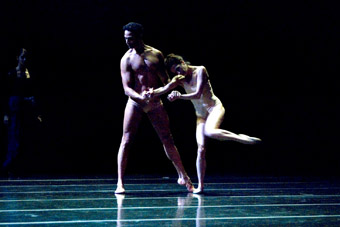
Alas, Compania Nacional de Danza
photo Prudence Upton
Alas, Compania Nacional de Danza
ALAS (WINGS) TAKES ITS INSPIRATION FROM WIM WENDERS’ 1987 FILM WINGS OF DESIRE IN WHICH TWO ANGELS ROAM BERLIN, UNSEEN AND UNHEARD, LISTENING TO THE THOUGHTS OF THE CITY’S PEOPLE. TIRED OF AN EXISTENCE OF ONLY EVER OBSERVING RATHER THAN EXPERIENCING, ONE OF THE ANGELS, DAMIEL, DECIDES TO GIVE UP HIS IMMORTALITY AND BECOME HUMAN IN ORDER TO BE ABLE TO SENSE, PHYSICALLY INTERACT AND LOVE. ALAS IS THE MOST RECENT CREATION BY SPAIN’S COMPANIA NACIONAL DE DANZA AND MARKS THE FIRST-TIME COLLABORATION BETWEEN THE COMPANY’S ARTISTIC DIRECTOR, NACHO DUATO, AND THE SLOVENIAN THEATRE DIRECTOR TOMAZ PANDUR.
Duato is widely regarded as one of the most important ballet choreographers of the last 20 years. His ensemble, whom he has lead since 1990, has an excellent international reputation and frequently tours outside of Spain. Not surprisingly then, the dancing in Alas is exquisite. On a stage dominated by a cross-tiered, tower-like structure that is evocatively lit from within, 16 extraordinary dancers glide, slide and float. Their technique is immaculate, their precision awe-inspiring and yet their personalities always shimmer through. They are powerful and athletic, excelling at dashing across the stage at breakneck speed. They are equally impressive in the lyrical sections, performing intricate gravity-defying duets. Duato himself dances the role of Damiel. Recently turned 51, his maturity and commanding stage presence are compelling.
Alas is an exceedingly beautiful production with lavish costumes, masterful lighting and many moments of choreographic magic. And still, as a work it is not entirely convincing, somewhat disappointing even. This is due, ironically, to Alas being based on Wenders’ famous film.
Translating a work of art from one medium to another always risks pitfalls. It would be unfair to criticise an adapted work along the lines of the-book-was-better cliché. It is valid though, in this case, to point out that the ongoing success of Wenders’ film is partly due to its striking originality both in terms of content and form as well as its conceptual audacity. It was a masterstroke by Wenders and his co-author, Austrian writer Peter Handke, to parallel the dilemma of human existence with the fate of an angel whose desire it is to be freed of his immortality so he can immerse himself in a world that causes so much anxiety and pain to those who inhabit it. This delicious variation on “the grass is always greener on the other side” is as fantastical as it is poignant.
In Alas, however, the quiet poetry of the film is replaced with pathos and grand gesturing. The beauty it so successfully conjures is not undercut by the bleakness and the laconic theme of hope in the face of adversity so evident in the film. Alas, in fact, comes across as a blatant, almost hedonistic celebration of beauty alone and ultimately has a hollow ring to it. It still makes for a spectacular dance experience but without the brilliance and vision of the film to which it aspires.
Compania Nacional de Danza, Alas, choreographer Nacho Duato, theatre director Tomaz Pandur, costumes Angelina Atlagic, lighting Brad Fields, texts Wim Wenders, Peter Handke, Lyric Theatre, Sydney, Jan 11-13
RealTime issue #83 Feb-March 2008 pg. 15
© Martin del Amo; for permission to reproduce apply to realtime@realtimearts.net
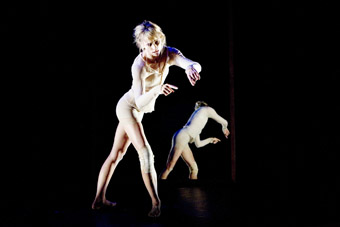
Kathryn Dunn
photo Prudence Upton
Kathryn Dunn
INTO, TWO SOLOS COMMISSIONED AND DANCED BY KATHRYN DUNN, OPENS WITH BELONGING, CHOREOGRAPHED BY FRANCES RINGS, BEST KNOWN FOR HER WORK WITH BANGARRA DANCE THEATRE. EXPLORING THE INNATE CONNECTIONS BETWEEN THE BODY AND NATURE, BELONGING IS A QUIETLY INSISTENT EVOCATION OF A WOMAN’S LIFE CYCLE.
Initially crouching in a foetal position, Dunn sets out on what appears to be a journey through imaginary landscapes. Her slender, long-limbed body appears to be driven by an invisible force that takes her across the stage on a winding pathway, often in curves of varying diameters, sometimes spinning on the spot. The flow of movement is constant. The great fluidity that marks large sections of the work is occasionally contrasted by explosions of sharp angularity. Set to a haunting score by David Page with singing by Ningali Lawford-Wolf, Dunn’s journey ends with the inevitable—complete stillness. She lies on the ground, again foetally, the cycle completed. The invisible force driving her has loosened its grip, the body has been laid to rest.
After Dunn’s focused almost trance-like performance in Belonging, she reveals another facet of her performative range in Figment. Choreographed by Narelle Benjamin, it has been created in response to the experience of Benjamin’s sister, a longtime sufferer from schizophrenia.
To capture the sensations of someone with a disjointed, fractured sense of reality, Benjamin punctures her trademark yoga-based movement language with bouts of staccato movement, interlaced with moments of stillness. Benjamin’s choreography with its many changes of direction, speed and levels, as well as Dunn’s considerable acting ability, creates a disturbing portrait of someone frantically, at times desperately, battling their demons.
Figment is a highly integrated creation with Benjamin’s trusted key collaborators at their multi-layering best. Huey Benjamin’s nuanced musical score incorporates sounds of footsteps, clunking crockery and white noise, like someone tuning into many radio stations in quick succession. These sonic cut-ups are complemented by Sam James’ striking video images featuring musical scores, TV static and water streaming from a shower head. The graphs of brainwave activity are especially poignant. Zig-zagging across the gauze scrim that divides the stage from the audience, they evoke oscillating barbed wire fences, behind which the woman portrayed by Dunn is held captive to her delusions and hallucinations. We are shut out, with no access to her world—damned to be mere witnesses to the figments of imagination that torture her.
Kathryn Dunn has danced with various Australian companies including Sydney Dance Company, Chunky Move and Bangarra Dance Theatre. In recent years, she has been based in London and New York. Into offered the perfect opportunity for this highly skilled and charismatic dancer to reintroduce herself to Australian dance auudiences.
Into, performer Kathryn Dunn, Belonging, choreography Francis Rings, composer David Page, costume/design Jacob Nash; Figment, choreography Narelle Benjamin, composer Huey Benjamin, video/design Sam James, lighting Glenn Hughes; Riverside Theatres, Parramatta, Jan 8-12, The Studio, Sydney Opera House, Jan 15–20
RealTime issue #83 Feb-March 2008 pg. 15
© Martin del Amo; for permission to reproduce apply to realtime@realtimearts.net
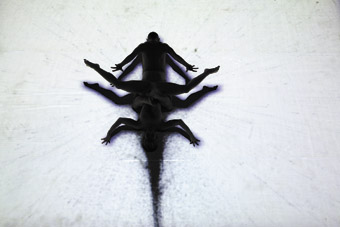
Mortal Engine, Chunky Move
photo Rom Anthonis
Mortal Engine, Chunky Move
IN CHUNKY MOVE’S GLOW A SOLO ORGANISM STARTS OUT CELL-LIKE AND INCHES AND THEN DANCES ITS WAY INTO EVOLUTION, DETERMINING THE WORLD AROUND IT AND THEN FACING DIFFERENCE AS ITS SHADOW SEPARATES OFF AND THREATENS IT, LEAVING THE CREATURE HOWLING AND GROWLING. MORTAL ENGINE LEAPS MUCH FURTHER INTO THE FUTURE, TECHNOLOGICALLY TOO WITH RESPONSIVE VIDEO THAT CAN ACCOMMODATE SIX DANCERS RATHER THAN ONE AND A MOVEMENT SENSITIVE SOUND SYSTEM. THE ENVIRONMENT GENERATED IN MORTAL ENGINE TRULY APPEARS TO HAVE, AS, OBARZANEK HOPED, A LIFE OF ITS OWN [RT81, P41].
The world of Mortal Engine is more palpably human and social and more complex. Unlike the relatively linear Glow, the images in Mortal Engine constellate, motifs resonate. There’s the dance of fingers, alone or barely touching; a couple variously asleep and awake (as if viewed from above) in waves of forgetfulness and tension; Glow-like struggles between individuals and the environment as small dark shapes slither, scurry, scatter and re-group around the body, evoking everything from slime mould to ant attacks to unconscious art-making. A body magically and frighteningly blackened by light dances with but cannot become one with the white of another body. Five or six dancers inhabit the stage in tight formal circles or tangling couples. This is a restless world, a dream world, a nightmare even where humans appear as just another slippery species writhing out of the shadows and assaulting each other or, when more recognisably ourselves, fragilely connecting.
While we watched Glow from above, Mortal Engine uses instead a steeply raked stage-cum-screen; the effect is still of looking down into a strange world given the amount of floor work and the further tilting forward of the front part of the stage for the sleep scenes. The effect is cinematically immersive but with a bracing three dimensionality that cinema is still perfecting. And that depth of field is realised in the bodies of the dancers by choreography that makes great play of shifts between horizontal and vertical planes, between moments of stillness and furious tanglings, abject scurryings and courtly turns.
This is also a world where sound and light perform on their own, where the dancers disappear and a different kind of attentiveness is rewardingly asked of the audience as Robin Fox’s oscilloscope art pulses intensely before us.
In the final passage a strikingly different world emerges as a laser beam tunnels out into the audience and, within and around it onstage, a new drama unfolds—something being completed? It’s a big, risky change in aesthetic and a more familiar one (from clubs to Hotel Pro Forma’s Orfeo) than the sheer enveloping otherness of the dominant mode of Glow and Mortal Engine.
I’m not sure what the potent images of Mortal Engine add up to and look forward to second and third viewings, but the swings between domestic interiority and a feral universe provide an engrossing if disturbing dynamic, and the integration of live performance and projected, responsive imagery is immaculately and convincingly executed.
–
Chunky Move, Mortal Engine, direction & choreography Gideon Obarzanek, performers Kristy Ayre, Sara Black, Amber Haines, Antony Hamilton, Lee Serle, Charmene Yap, interactive system design Frieder Weiss, laser and Sound Artist Robin Fox, composer Ben Frost, costume designer Paula Levis, lighting design Damien Coopoer, set design Richard Dinnen, Gideon Obarzanek; Drama Theatre, Sydney Opera House, Jan 17-20
RealTime issue #83 Feb-March 2008 pg. 15
© Keith Gallasch; for permission to reproduce apply to realtime@realtimearts.net
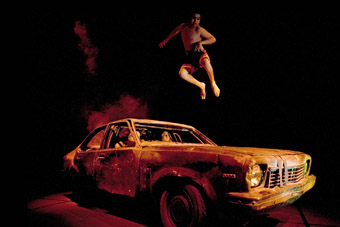
Kin
AS A MUM, I LOVE THE WAY YOUNG BOYS ARE: THEIR VORACITY FOR LIFE, CAPACITY TO DREAM, TIRELESS PHYSICALITY, AND THEIR PLAYFUL CODIFIED HUMOUR. EVERY MEMBER OF STEPHEN PAGE’S KIN POSSESSES THIS INALIENABLE BOY SPIRIT.
Originally commissioned in 2005 for the Fifth Asia-Pacific Triennial of Contemporary Art in Brisbane, Page’s younger male kin (all nephews, except for son Hunter) take charge of The Studio with voice, live music, movement and seven endearing personalities. Page, in collaboration with his brother, composer David, has managed to mine the inner fragilities and strengths of the boys in relation to issues of discrimination, addiction, violence, and growing up as young Aboriginal men learning their traditions while firmly engaged in contemporary youth culture.
The boys roll onto to the stage garrulously and kick off with a quick ‘bash’—they are convivial in their rendition of an AC/DC guitar riff (more Uncle David’s era), and aptly, with a drum solo of Rage against the Machine’s Killing in the Name. The boys are having a good time, the audience loosens. A car, stage left, is dramatically revealed in its smoking materiality: a burnt-out Torana. Peter England’s design abstracts the urban landscape simply, but strongly, re-contextualises the boys in a shifting montage of scenes.
The car is theatrically pragmatic. Scrambling bodies crawl over and under, entering and exiting through paneless windows, popping up from the boot and the bonnet. Props are concealed and revealed on cue. The outer shell is used to sit and ponder issues such as the significance of the 1967 referendum, Aboriginal history told orally by older kin members, and their experiences of being labeled ‘coloured.’ The latter is charmingly mooted: are we not all “multi-coloured”, sometimes red from anger and sometimes green from sickness? The chameleon car in various lighting states (designer Glen Hughes), inscribes this—sometimes red, blue, green, white, ochre or black. Darker moments (such as the aural witnessing of a fight scene between adults) see the boys sit silently within the car. The stage turns cold, the boys interior.
Kin is performed in a mix of styles, ranging from traditional Indigenous dance to hip hop popping and break, to contemporary Aboriginal phrasing. Torsos shift softly on the lateral plane, weight centred and balanced. The boys’ angular frames deepen the clarity of this grounded movement with paradoxical lightness. During a hip hop battle the beat of clapping sticks is substituted by our handclaps. David Page’s score artfully blends traditional and contemporary, live and recorded.
In Kin, ‘hanging out’, the framework for a series of compressed theatrical happenings, is made impressively real by the boys’ effortless performances, each embodying movement true to their physicality and character. Seven faces steal through the fourth wall, an invitation for us to bear intimate witness.
–
Kin, devised & directed by Stephen Page, composer David Page, designer Peter England, lighting designer Glen Hughes, videography Douglas Watkin, performers Isileli Jarden, Ryan Jarden, Hunter Page-Lochard, Josiah Page, Samson Page, Sean Page, Curtis Walsh-Jarden;Drama Theatre, Sydney Opera House, Jan 23-26
More 2007 Sydney Festival: Anita Fontaine’s locative media work, Ghost Garden, in the Sydney Botanical Gardens for dLux/Media/Art, page 24, and virtuoso Finnish accordionist Kimmo Pohjonen in concert, page 47.
RealTime issue #83 Feb-March 2008 pg. 16
© Jodie McNeilly; for permission to reproduce apply to realtime@realtimearts.net
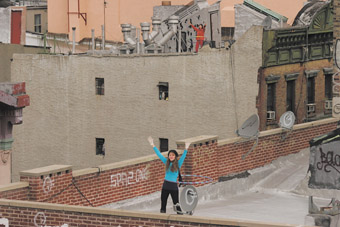
Christian Jankowski, Rooftop Routine 2007
photo Paula Court
Christian Jankowski, Rooftop Routine 2007
PERFORMA 07 SWARMED ALL OVER NEW YORK CITY—IT SHOWED WORK ON BROADWAY, AT SMART UPPER EAST SIDE HOMES, IN TRENDY CHELSEA GALLERIES AND EVEN ACROSS THE RIVER IN BROOKLYN AND LONG ISLAND. BUT ITS MOST MEMORABLE PIECES WEREN’T THOSE THAT FOUND AN ATMOSPHERIC CORNER OF THE CITY TO CALL THEIR OWN. IN A TOWN WHERE EVERYONE’S ON THE MOVE, THE MOST MEMORABLE PIECES IN PERFORMA 07 WERE THE ARTWORKS THAT TOOK TO THE STREETS AND TACKLED THE DYNAMISM OF NEW YORK ITSELF.
Christian Jankowski invited visitors up to the roof of his Lower East Side apartment block one chilly Saturday morning to witness the surrounding cityscape suddenly come alive—with hula hoopers. Thirty men, women and one child twisted and bobbed in unison. Following a sight line from Suat Ling Chua—Jankowski’s neighbour whom he spotted hula hooping as a fitness regime—these dancers linked together the Manhattan skyline. They connected derelict buildings to new apartment blocks, neon-fronted shops to shiny glass office buildings. The joyful simplicity of Rooftop Routine sutured social, financial and racial differences that are felt more keenly on New York’s streets.
While the sight soothed New York’s wounds, however, it also emphasised the awesome scale of the city. Like the tiny figures in a sublime landscape, the hula hoopers looked fragile and weak. To watch Rooftop Routine, then, was to thrill in the shared danger of city living. As the dancers continued, other New Yorkers stumbled onto their rooftops to watch, and the intimidating skyline was temporarily transformed into a rolling landscape of domestic vignettes.
While Jankowski relied on his audience to take part in a celebration of the city, Pablo Bronstein might have preferred it if people stayed away from Plaza Minuet. In an interview he said, “The presence of the viewer distorts the space.” Bronstein’s interest in the physical landscape of New York was not as a home for individuals but as a battle ground for ideologies. Orchestrating four performances that took place in and around Wall Street, Bronstein pitted the architecture of New York’s financial district against the bodily discipline of ballet.
In each of the Plaza Minuet performances, a troupe of turquoise-clad dancers bounded into what are known as ‘privately owned public spaces’ (areas designated for public use and owned by private companies), and moved in silent unison between ballet positions. These spaces are designed to be used in a particular way—the vast atrium of 60 Wall Street, for example, is lined with palm trees that make sure people walk in lanes and carry on moving. And they’re usually used by particular types of people who wear suits and sombre colours. But the bright costumes and refined, aesthetic movements of Bronstein’s dancers contravened these unspoken rules. Making alternative use of this space, the dancers brought its hidden rules to light.
More interestingly, the dancers in Plaza Minuet did not just contravene the modes of behaviour implied by Wall Street’s architecture, but actively competed with it. Controlled by Bronstein and a choreographer, Hilary Nanney (who barked orders as they performed), the dancers escaped the strictures of Wall Street only by conforming to the strictures of ballet, itself the product of Renaissance-era social control. Displayed against each other, both types of authority—the imperatives of Wall Street’s architecture and the contortions of ballet—were stripped of their aspirations to naturalisation. But the comparison also showed that authority in this sense is inescapable, whether in 21st century New York or in 15th century Florence. The question is—is it more bearable when we pretend it’s not there?
While Rooftop Routine offered a heart-warming break from everyday life, Plaza Minuet took a chilly, forensic look at the mechanisms that control daily living. And while Jankowski revelled in the common, human interest of New York, Bronstein focused on the meta-structures of the city as institution. By engaging with the real conditions of New York these artists created experiences unique to Performa 07. More importantly, they represented an essential dimension of Live Art: art that exists outside formal art venues destroys the notion that (good) art is ever separate from life.
Performa 07, Christian Jankowski, Rooftop Routine, Nov 3; Pablo Bronstein Plaza Minuet, New York, Nov 7 2007
Mary Paterson was part of the Performa 07 writing live project.
RealTime issue #83 Feb-March 2008 pg. 16
© Mary Paterson; for permission to reproduce apply to realtime@realtimearts.net
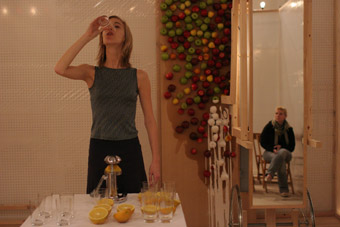
Noémie Solomon, Allan Kaprow: 18 Happenings in 6 Parts (Re-doing)
photo Paula Court
Noémie Solomon, Allan Kaprow: 18 Happenings in 6 Parts (Re-doing)
ALLAN KAPROW’S 18 HAPPENINGS IN 6 PARTS, WHICH INTRODUCED THE WORD ‘HAPPENING’ INTO POPULAR CIRCULATION, WAS ORIGINALLY PRESENTED IN 1959 AT THE REUBEN GALLERY IN NEW YORK CITY. FOR THOSE OF US REMOVED BY TIME OR DISTANCE FROM THESE ORIGINAL EVENTS, THE ‘HAPPENING’ HAS A LOT TO ANSWER FOR, HAVING BECOME A CATCH-ALL TERM FOR UNCONVENTIONAL PERFORMANCE EVENTS WHICH EMPHASISE THE ABSURD, THE PROVOCATIVE, AND THE UNSTRUCTURED. ATTENDING ITS RE-CREATION FOR THE 2007 PERFORMA BIENNIAL IN NEW YORK REMINDED ME THAT THIS EVERYDAY USAGE IS A LONG WAY FROM KAPROW’S ORIGINAL INTENTION. ALTHOUGH 18 HAPPENINGS HAS PLENTY OF NON-NARRATIVE EVENTS, THEY OCCUR WITHIN A CAREFULLY STRUCTURED FORMAL COMPOSITION WHICH PLACES THE AUDIENCE, RATHER THAN THE ACTIONS OF THE PERFORMERS, AT THE HEART OF THE WORK.
This 2007 version was directed by André Lepecki, who holds an academic position at New York University and writes about the relationship between choreographic writing and representations of the body—how bodies and actions are re-created from written records. Lepecki emphasises that his version of 18 Happenings is neither re-enactment nor re-construction, instead favouring the term “re-doing.” He argues that the objective of this project is not “time travel” or the resurrection of the historical event. Instead, Lepecki’s version exists in the present, looking from here and now at what remains of the past event—its form, the writing about it, the significance it has accumulated. One of the ways in which the past is framed within present experience is reflected in the material construction of the event: rather than taking place within the entire floor of a loft gallery, as in the original, this version uses timber panels to construct a space with the dimensions of the former Reuben Gallery within the much larger Deitch Studios warehouse.
Stepping into this space is like a kind of inter-dimensional travel (though it might have felt like that in 1959 as well). Notwithstanding Lepecki’s desire to distance this project from historical re-enactment, I am struck by the ways in which the insights the experience gives are those which are only possible through inserting my own body into it, as opposed to reading texts about it or looking at photographs. This is exactly the value commonly given to re-enactment—as in police re-enactment, for example, which uncovers details that would otherwise have escaped notice. In the case of 18 Happenings, what is revealed is the pivotal role of the audience.
The ‘loft’ space is divided into three rooms. Simultaneous mini-performances occur in each, and the audience changes rooms every two performances. This much I knew from historical accounts, and I was prepared for a cacophonous experience in which I would be overwhelmed by multiple, disparate actions happening simultaneously. However, the actual experience felt less concerned with simultaneity than it was with distance and alterity. That is to say, while relatively mundane actions happened in my room—someone bouncing a ball, or squeezing oranges into juice—I never found myself struggling to pay attention. In fact, I hardly paid attention to them at all, instead finding myself peering curiously through the semi-transparent plastic dividers into other rooms. Even though I knew full well that what was happening there was of the same banal quality as what was happening in my room, it had a mystery and allure because of the fact of being in another room. Contrary to my expectation of chaos, there wasn’t too much information for me to take in. Instead, there seemed to be deliberately too little, with my desire to have full knowledge of the event frustrated and deferred by the arrangement of space.
Attending the re-doing produced a similar insight about the 15 minutes of “mingling” prescribed between each audience rotation. From a theoretical vantage, this might be dismissed as inconsequential filler, but actually ‘being there’ gave added significance to these in-between periods. One of the ways this happened was through its repetition as an activity, so that in the second period of mingling I had an opportunity to reflect on what I was doing and even revise how I mingle—do I want to head straight for a seat which looks like a promising vantage point? Do I want to explore the other rooms more fully? Do I want to meet a stranger? Additionally, these periods seem to last longer than the actual performance periods. The timing of Lepecki’s re-doing follows Kaprow’s instructions fastidiously, so this, too, is part of its intended effect.
I was made additionally aware of my own role in the performance by the program notes’ explicit reference to my involvement: “the visitors—who sit in various chairs” are listed in the cast of participants along with those “who speak” or “who move” or “who move objects.” A critical account of the original happening might miss this detail, but it’s hard to avoid while clutching a program the whole time. Of course, this interest in audiences is evident in Kaprow’s writings from the time, but he’s more often remembered for having expanded the range of what was permissible as performance. Lepecki’s re-doing rightly shifts the focus back on the audience, curious about what is happening in other rooms and curious, too, about each other. What’s ‘happening’ isn’t just a series of conceptual performances, which can be understood through their documentation. Instead this work is acutely aware of the ways in which an audience is produced and crafted—and the only way to really know what this experience is like is to be part of it.
Allan Kaprow: 18 Happenings in 6 Parts (Re-doing), director André Lepecki, presented by Performa, Dietch Studios, Performa 07, New York, Nov 11,2007
RealTime issue #83 Feb-March 2008 pg. 17
© Theron Schmidt; for permission to reproduce apply to realtime@realtimearts.net
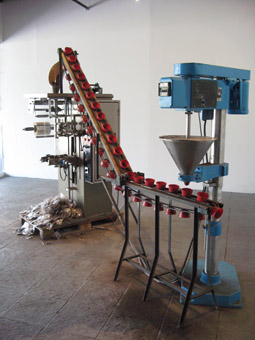
Tierra y Libertad, Iván Puig
“MÉXICO IS DIFFERENT LIKE A TRAVEL FOLDER SAYS.” THUS QUOTH THE IMMORTAL BARD, RY COODER. THROUGH THE LENS OF THE RECENT TRANSITIO_MX02 FESTIVAL OF ELECTRONIC ARTS & VIDEO YOU CAN SEE WHY. OVER A PLATE OF CHILES RELLENOS, DIRECTOR OF THE TRANSITIO_MX02 FESTIVAL GRACE QUINTANILLA RECOUNTS A STORY HER YOUNG SON TOLD HER, IT GOES SOMETHING LIKE THIS:
God is feeling friendly so he invites all the devils and demons to a dinner party but he imposes one condition, they must eat and drink without bending their arms! Without a second thought, the devils and demons accept and arrive promptly for the feast. They eat voraciously, lifting the delicious food and drink vertically above their heads with arms outstretched, pouring the victuals into their mouths like an avalanche. It is a bunch of happy, but very messy, devils who return home that evening, God is well pleased.
Following this success, God decides to hold another dinner party and this time he invites all the angels, democratically imposing exactly the same conditions. The angels think about this awhile and then accept. They fly into the dining room to take their seats and say grace. God watches with a smile on his face as the angels begin to eat, taking food in their hands and offering it to their neighbours.
This metaphor of communal action was the foundation for the curatorial strategy behind Transitio_MX02 festival, this year entitled Nomadic Borders. Conceived as a frontier upon which we temporarily converge before transit, the festival experimented with a series of multi-skilled curatorial teams tasked to interrogate concepts of Communities-in-Process and Processes-in-Community addressing the problematic relationships between communities and technologies.
As an Australian participant it was inevitable I’d contrast and compare México and Australia as two ‘New World’ post-colonial cultures, that exhibit a curious blend of parallel and divergent cultural formations. Both are peopled by Indigenous cultures, both were savaged by aggressive European invasion and both are now ironically tied to the apron strings of the USA economy. The salient issue, why do the two cultures feel so different?
Stereotypes are never useful, and here in Los Estados Unitos Méxicanos (The United States of México) they are redundant. At Tenotihilan (México City) the Conquistadors encountered an extraordinary urban complex, geometrically organised at a massive scale. Following the conquest, the Spanish (literally) overlaid it with the colonial architecture of Imperial Spain, grandiose and expansive.
Revolutionary México re-organised colonial urbanism with the mark of Socialist triumph, leaving contemporary México City with vistas, monuments and public buildings that dwarf those of Hausmann’s or Mitterand’s Paris.
In contra distinction, the Indigenous people of Australia had evolved a subtle and mostly immaterial culture, stabilised sometime in the Palaeolithic era, that was in effect, invisible to the industrial era English colonisers. The English brought with them the crude utilitarian architecture of the penal colony; gaols, wharfs, warehouses and the odd bourgeoisie villa, formed the architectural palette, cemented by little or no urban planning until the Victorian Gold Rush finally established both urban planning and civic architecture of a comprehensive nature.
The divergence between Méxican and Australian patrimony begins from first contact. Both sets of colonisers were ruthless but the Spanish, unlike the English, mixed. México is 80% mestizo, producing a hybrid culture typical of so many colonised countries, richly complex, eclectic, and wide open to receive and adopt new forms. Such pluralism makes for a complex and at times contradictory society but one that is essentially free of fundamentalist or purist views. The Australian government sanctioned mantra of multiculturalism is less of an organic hybrid in its fragmentary mosaic form—neatly lampooned by the Chicano artist Guillermo Gómez-Peña as culti-multuralism.
To compound this divergence, Spain was at the zenith of an agrarian empire but England was rapidly developing as an industrial powerhouse set on establishing a global economy. Despite being exploited as a mine and farm site, Australia remained connected to the paradigms of invention, research and industry, whereas by and large México has a poor international reputation in these areas but is strongly identified with the arts and literature, in effect the Méxican national product.
New technology is thus a fully-imported consumer product, with which Méxicans in general and artists in particular have a flirtatious relationship, playing with the seductiveness of such technology but at the same time cultivating an awareness of the pitfalls that such seduction implies. Grace Quintanilla pointed out to me that an artist can be a very good photographer even if they have no part in constructing the camera; likewise México is producing serious and mature works of technological art focused on the development of a critical discourse rather than being obsessed by the technology employed.
To elaborate, here are six vignettes drawn from a large and polyglot event, which spread over three impressive venues and which included a four-day critical symposium. Whilst all of these works rely upon technology it was not the principal focus. The level of experiment and risk-taking designed into the curatorial process was clearly expressed in the exhibition venues.
jardin
Sheen, slick and cool are not adjectives that spring to mind when contemplating Jardin by Chicano artist Jamie Ruiz Otis (México). One could use technoserene to describe this formal zen garden setting totally constructed from grains of grey recycled computer plastic, the solemn grey rocks themselves VDU monitor cases. Being zen the work was otherwise mute and self-effacing but drew the visitor into a conflicted world of technological pollution, recycling, conspicuous consumption and the ersatz in general.
carreta nagua siglo xxi
Ricardo Miranda (Nicaragua/USA) worked pretty hard for his money performing his Carreta Nagua siglo XXI project. Each day he took visitors for a spin in La Alameda park in his homemade rickshaw, muscle power providing both the motive force and the electrical energy to power the interactive AV narrative dealing with the migrant experiences of his family in New York City. A collision of two forms of basic technology but employed as a pretext for direct social engagement, this work dissolved the barriers between artist and audience in an earnest manner—a sweating artist cannot be accused of being idle.
continuum, continuus
The Laboratorio Alameda was once a nunnery, replete with an outdoor barbeque area used to burn heretics during the inquisition (yes they got to the New World too). Continuum, Continuus, a video-sound work by the Croatian artist Toni Mestrovic swells to fill one of the huge arched interior spaces. Enveloped by a fat, rich and totally immersive surround-sound field, reminiscent of the bottom end of a Gregorian chant, is a simple looped image of a man endlessly handling rocks. The protagonist is rebuilding a Croatian dwelling; no moral play is attempted but the work is pregnant with potential.
sonic bench
Sonic Bench by British artist Kaffe Matthews presented both a stand-alone outdoor public sonic-object and a performance work. With origins in the collaborative Music for Bodies project [www.musicforbodies.net], Kaffe’s audio sculpture invited an embrace of the haptic and the kinaesthetic. Destined for reception in the viscera rather than the ear, a shifting palette of tones enveloped visitors via skin and muscle contact, in a sonic massage. Like many other works in Nomadic Borders, the Sonic Bench shouted out for a re-enchantment and re-embodiment of new media in a shift of attention away from technical delivery to affect.
black market
Walking under a massive stone arch, a small coin falls on my shoulder, an insignificant, almost valueless silvery disc. But the coins keep coming, a slow cascade launched into the void by an industrial conveyor belt, jutting over the balustrade above. Black Market, by Mario de Vega (México), employs these diminutive specks of value to represent the minimum wage of a day labourer in México City. It seems pitiful—it is pitiful in a city full of people struggling, in a country struggling, against the behemoth of the USA.
tierra y libertad
In a not dissimilar vein, Iván Puig, another Méxican artist, has established an electro-mechanical drilling and excavation mechanism in the galleries of CENART (Centro Nacional de las Artes, a 35 acre art, architecture and performing arts academy). Tierra y Libertad (Land and Freedom) has ground through the floor and brings to the surface a meagre supply of brown México City dirt. Another canny mechanism processes the payload and heat-seals it into small plastic bags, free for the taking, the conjunction of land and economy, the constant depletion of resources and the avarice of the cultural market do not fail to surface.
Transitio_MX02 Internal Festival of Electronic Arts & Video, México City, Oct 12-20, 2007, http://transitiomx.net
RealTime issue #83 Feb-March 2008 pg. 18
© Nigel Helyer; for permission to reproduce apply to realtime@realtimearts.net
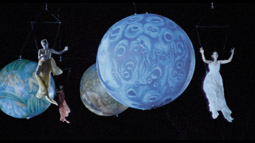
Lawrence Johnstons's Night
I’VE ALWAYS LOVED THAT MOMENT AT THE MOVIES WHEN THE LIGHTS DIM, THAT SECOND OF PITCH BLACKNESS BEFORE THE TRAILERS BEGIN. YOU FEEL THE COLD IN YOUR BONES AS THE GLOW IS SUCKED OUT OF THE ROOM. I’M A MORNING PERSON BUT I LOVE THE FAUX NIGHT ON A SUNDAY AFTERNOON AS THE FILM BEGINS.
This isn’t the first Lawrence Johnston film to explore the delicate balance between light and dark. In his previous feature documentary, Eternity, he sinks into the mysterious and moody world of a man who walks the streets and creates at night, beyond the halo of neon, writing one word over and over on the Sydney sidewalks in a perfect copperplate script: gold chalk on black asphalt. Poet Arthur Stace is a shadowy figure who, in Johnston’s melancholy film, emerges out of the darkness after he literally “sees the light.”
The only place to see Johnston’s latest feature doco Night is at the cinema. From an extraordinary opening that captures the violets and aquas of swirls of lightning caught in a violent score recorded in Poland with the National Polish Radio Symphony Orchestra by composer Cezary Skubiszewski (who also featured in films The Pianist and The Three Colours trilogy), we’re led into a dreamy, meandering evocation of what night might mean, tracing its themes through the ideas of coming home, contemplating the stars, going out to party and dance, the buzz and lows of shiftwork, bad dreams and blackouts, and ways of looking at the moon. Like the mood pieces Baraka and Koyaanisqatsi, Johnston’s film doesn’t have a strong narrative drive. It’s about capturing moments, fleeting feelings, transitions.
Australian voices drift over landscapes bringing new poetic definitions: a man sees sunset as light and dark vying and negotiating; another speaks of the beauty of the word ‘evening’ as a smoothing, a drawing, of the harshness out of light. Like a giant lava lamp, the beauty of the film releases and lets go. A windmill stutters. Majestic landscapes—Uluru, the Olgas—point to the stars. Children speak and make their usual simple but profound insights. As night clouds drift at an abandoned drive-in, a boy talks of how small the stars make him feel. A parent advises that when a child is about to die, to look closely at the “beloved’s eyes”, for in the nights to come they will be only stars. Home movies of the Page children dancing and dagging for the camera in their PJs captures that sense of excitement/loss that bedtime brings—what you’re missing out on when the lights go out—interweaving with David Page (writer and actor, and composer for Bangarra Dance Theatre) talking about his nocturnal adventures: how he was dared to climb out and, clinging to the gutters, work his way around the house, past his parents’ window. Adam Elliot (Oscar winner for Harvie Krumpet) gives his usual hilariously skewed perspective, saying that he loved blackouts as a child because it meant that he was allowed to hold his willy, because no-one else could see.
Johnston is especially interested in bodies, how they move through time and space. At the disco bowling alley the footage is beautifully choreographed, the run-up and let-go of sending a ball hurtling to the pins becomes a precise then free dance, capturing the joy in women as they make a strike, hug and cheer together. As the intimacy of night “forces you out of your eyes and into your other senses”, the film becomes full of sounds and textures. As a couple describe swimming at night, the sensuousness of their words and the water mix: the woman moves through the ocean “like velvet…almost a different element”; the man feels the water as “a woman”, taking on the sheen of skin.
Like all great docos, there are contradictory elements at play. A woman speaks of her love of coming home after work, opening that door to a sanctuary. But a man reminds us of the violent changes happening around us, communities displaced and disintegrating; the ability to ‘come home’ is diminishing. A man remembers the moon filling him with romantic yearning; a boy knows the moon protects the Earth from comets; a priest says that on full moon nights there’s no question, he has “more confused people to deal with.” A man says you can get away with more at night, you can lie, under the cover of darkness; but a cop knows that catching criminals at night is like “falling off a log”—if you pull random cars over at 3 or 4 in the morning, there’s a high chance that they’ll be “up to something nefarious.”
What’s unusual about Johnston’s doco is that it captures the faces of people in repose. As they experience the night—catching a train home, waiting at the station, sitting at their desk in a blindingly lit office—there’s a stillness to them that you don’t often see. People interacting with others are usually animated, passionate. This film visits them alone, unaware of the camera. An interviewee suggests that your rhythms, the lines of journey, become different at night. As you walk in and out of pools of light, you become “closer to yourself” without the long “vistas of vision.” This sweet captured intimacy often reminds me of the works of Bill Henson—an artist also enamoured with the dark and who features here too as one interviewed—especially his photos of groups of people gathered at traffic lights, unaware they are in the frame, waiting for the green man; or his series on children at the opera (Paris Opera Project 1990/91), their faces still and bright out of the liquid darkness. In Night an exquisitely beautiful fragment on churchgoers, set to Nina Simone’s Everything Will Change, focuses on children holding candles, their faces glowing as if lit from within as they pray.
There’s a healthy and popular argument emerging for the slow food movement, and I like the idea of a parallel one for slow film. Prepared carefully, using hand-picked and home-grown ingredients until the flavour’s just right, shared lovingly with friends and family, taking hours to consume, a day to digest. This film continues to raise ideas and imaginings and haunts me for weeks. I emerge into the dark-and-light of Market Street to catch a train, blending again into the cityscape, watching my fellow passengers heading home one foot in front of the other, deep into the night.
Night, writer, director, producer Lawrence Johnston, producer Lizzette Atkins, cinematographer Laurie McInnes, editor Bill Murphy, composer Cezary Skubiszewski, sound designer Livia Ruzic, distribution Dendy
RealTime issue #83 Feb-March 2008 pg. 19
© Kirsten Krauth; for permission to reproduce apply to realtime@realtimearts.net
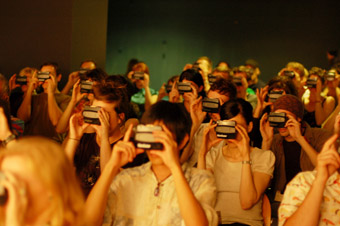
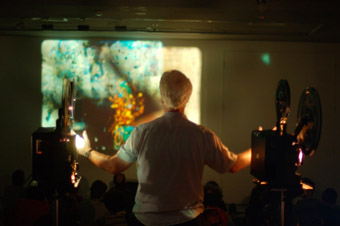
Vladmaster, OtherFilm Festival 07
photo Christina Tester
Vladmaster, OtherFilm Festival 07
THE MATERIALITY OF FILM IS CENTRAL TO THE CURATORIAL MISSION OF BRISBANE’S OTHERFILM FESTIVAL (OFF). HERE, THE IMMINENT DEFICIENCIES OF THE MEDIUM—ITS BULK, ITS FRAGILITY, ITS INCREASINGLY ANTIQUATED TECHNOLOGIES—ARE RECAST AS POSITIVE ADVANTAGES: WHIMSY, ORGANICISM, NUMINOUSNESS, HISTORICAL CONTEXT. WITHIN A CONTEMPORARY ECONOMICS OF DIGITAL SUPERFLUITY, THE VERY INCONVENIENCE OF FILM REQUIRES, OF NECESSITY, A DISCIPLINE OF ITS CREATORS. NO OTHER MEDIUM DEMANDS AS MUCH RESORT TO COMPLEX FORMULAE RELATED TO LIGHT, DISTANCE, TIME AND CHEMISTRY: DESPITE THE EVANESCENCE OF THE PROJECTED IMAGE, NO OTHER MEDIUM CAN ADVANCE THE CONCEIT THAT IT EMBODIES THE PHYSICAL UNIVERSE UPON SO COMPLETE A SCALE.
Of course, film is simply a medium: the indispensable tools for any artist are intelligence and imagination. Previous editions of OFF did much more to reconcile analogue and digital technologies, and host accommodations of both narrative and expressly visual cinema. In retreating from this inclusive homogeneity, the OFF curators entertain the risk of indulging a form of romantic steam-train anachronism. While this may not be an unreasonable creative response to the experience of the modern world, it has some evident limitations. For me, the strongest works at OFF were often those that visibly responded to the personal experience of the creator, rather than the historical context of the medium.
Dirk de Bruyn, OtherFilm Festival 07
photo Christina Tester
Dirk de Bruyn, OtherFilm Festival 07
The subject of OFF’s retrospective survey was veteran Melbourne experimentalist Dirk de Bruyn. His work is a striking convulsion of sound and image, and a dedicated engagement with the suburban dislocation of a ‘New Australian’ migrant. Central to his concerns are the limits of language per se; this is an existential enquiry. The hallmarks of these films are a naive sound poetry and the colourful use of optical printing to fracture the spatial contiguity of the screen. The work of this extravagant polyglot, devoted to identity confusion, estrangement from the physical environment and the conflict of native tongue and adopted vernacular, might profitably be compared to the film experiments of Ronaldo Azeredo and other Brazilian concrete poets. OFF’s expansive survey of de Bruyn’s cinema and performance has been elaborated by the publication of a valuable monograph, by the tireless Lienors and Dan Torre, themselves engaged in a revelatory investigation of Australia’s native counter-traditions of animation practice.
Among the several international guests, Bruce McClure (USA) was particularly noteworthy. His work exemplifies the field of ‘Flicker’ minimal cinema; three projectors in tandem showing alternating white and black frames, while the PA throbs to a brut ostinato. From this rudimentary technological premise, McClure is able to essay a compelling experiment in Gestalt psychology by making delicate adjustments to the projector aperture gates, with the delay effects governing the soundtracks. As an auditor, there’s an essential fascination to be derived from the brain’s attempt to transfigure coherent form of this simple stimuli: object relations in the form of grids and patterns, sound-image correlations. Volume is a crucial aspect of this work, and supports the immersive qualities of the enveloping darkness; the soundtrack is pleasingly akin to the most challenging industrial music experiments of Boyd Rice’s NON. Minimalism is rarely to my taste, but McClure is at the pinnacle of his field, and his work amply justifies OFF curator Joel Stern’s continuing interest in this neglected margin of experimental cinema.
In company of fellow curator Sally Golding, Stern also figures as part of the expanded cinema ensemble, Abject Leader. Their newest work makes a studied advance on the colour-separation experiments presented by the Cantrills at the previous year’s Festival. This is another variety of minimalism: an antique portrait filmed and projected through green, red and blue filters, the footage converging on a single portrait-format screen. Better than many theoretical expositions of the same idea, the work perfectly illustrates the uncanny essence of cinema: the ambiguity of a static, human form, but projected by a technology that assumes motion, creating the effect of a perceptible tremble in the frame and features of our protagonist.
Some expanded cinema pieces did employ digital projection technology, though not always to their advantage. The work of Dagi Igarashi and Midori Kawai promised an alchemical scrutiny of an earth-and-water response to primary sound vibrations across an intricately sculptural screen, but the live video feeds were scuppered by the grumbling sub-bass frequencies of their audio rig. A genuine shame: the evocative soundtrack enjoyed only thwarted suggestions of how the work was designed to look.
The following weekend, Rod Cooper and Anthony Magen premiered their new Helmethead duo. Cooper wears the eponymous headgear. The screen atop it presents his occasionally grotesque “mental furniture” (this is the organicism I referred to earlier), as rendered by Magen. Both provide live audio accompaniment from handheld dictaphones—the jarring orchestration of cartoon “boings” and Cooper’s more familiar droning textures. Great fun, if a little long; it’s playful, messy, but sufficiently dynamic to command audience attention. Like de Bruyn, Helmethead describes another kind of idiomatic estrangement; on the evening of the 2007 Federal Election we can barely discern subliminal flashes of Rudd and Howard as they compete for Cooper’s allegiance.
Utopian aspirations come with the territory when you advocate for visionary cinema. While the social behaviour of contemporary Western citizens is increasingly mediated by industrial and commercial concerns, the OtherFilm Festival directs its attentions to the congenial rehabilitation of otherwise unlikely venues. Environment is just another aspect of OFF’s ambitious gesamkunstwerk: this time, it was the baroque arcadia of Brisbane’s Old Museum Building, and the use of the Ahimsa House community centre. This year was also the festival’s first in Melbourne, with work by visiting US artists, Kerry Laitalia and Vladmaster, both given receptions as satellite events to ACMI’s Christian Marclay survey.
Laitalia’s work is an archivist’s reverie; some works, particularly Secure the Shadow…E’er the Substance Fade (1997) convey a genuine minatory thrill. The scores of that film and Out of the Ether (2003) both profit from the influence of George Kuchar on their soundtracking strategies; an atmospheric use of found audio sourced from old lounge LPs (I recognised the Peter Thomas soundtrack for Rampatrouille underneath the second). Vladmaster’s work is an absolute anomaly: the inspired adaptation of the familiar but obsolete Viewmaster toy. The Vladmaster employs a singular erudition in the creation of her crypto-cinematic narratives, handcrafting viewer reels from stereoscopic photographs of her own dioramas. In a hilarious perversion of consumer artefact to singular creative ends, soundtrack cues trigger the serried click of audience interaction.
It is perhaps instructive that the Vladmaster’s ACMI performance enjoyed a full house, while Laitalia’s work at the same venue had a more modest one. Certainly, a younger audience has become more predisposed to interactivity in screen media. But Brisbane’s OtherFilm Festival otherwise eschews what has become one of the dominant tendencies in Australian media art curatorship: an infantilising obsession with play, toys and games. It’s a disturbing trend, driven by commercial expedience and technological determinism, and one which assumes an indifference to distinctions between art, entertainment and utility. While this confusion of categories is arguably the most interesting area of both art and entertainment per se, the danger is that critical rigour might be compromised by the pursuit of innocent recreation.
The 3rd OtherFilm Festival, curators Sally Golding, Joel Stern, Danni Zuvela; Institute of Modern Art, Ahimsa House, Old Museum Building, Brisbane Nov 16-24; ACMI Cinemas, Tapespace, Melbourne Nov 29-30, 2007;www.otherfilm.org
RealTime issue #83 Feb-March 2008 pg. 20
© Jim Knox; for permission to reproduce apply to realtime@realtimearts.net
Two Cars One Night
FOR FILM CRITIC AND UBER-CINEPHILE MEGAN SPENCER THERE’S A SIGNIFICANT DIFFERENCE BETWEEN HER RECENTLY ESTABLISHED DESTINATION FILM FESTIVAL AND THE FESTIVALS TYPICALLY FRONTING THE NATIONAL AND INTERNATIONAL FESTIVAL CIRCUITS. IT’S A DISTINCTION THAT CAN BE TRACED TO COMPETING PHILOSOPHIES AND CONTRARY AGENDAS, BUT IT IS DESTFEST’S DIVERGENT FOCUS THAT RENDERS THE DIVISION MOST VISIBLE.
Whereas what Spencer refers to as the “big brand film festival” tends—like the cineplex—to favour feature length, industry fashioned and government subsidised films, DestFest opens itself up to audio-visual material that falls outside this somewhat limited scope. The inaugural program turned the spotlight on fields of activity outside industry-dominated spheres of production and distribution, treating Sydney-based cineastes to three afternoons of innovative cinema and engaging panel discussions.
The first two screenings in the festival’s tripartite program were dedicated to the feature film’s less prominent counterpart, the short, with the focus divided between international and Australian works respectively. Given DestFest’s stated predilection for audio-visual material that pushes the envelope, it was fitting that for the International program Spencer showed a collection of shorts from the fourth volume of the pioneering Wholphin series: a quarterly DVD compilation of curios and cutting edge shorts produced by enterprising publishing house McSweeney’s [RT81, p30].
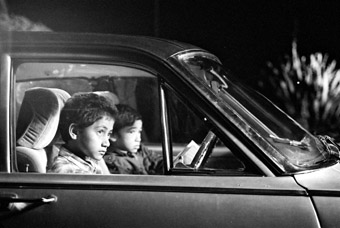
Two Cars, One Night by up and coming New Zealand director Taiki Waititi was entrusted with the dual responsibility of opening the program and charming the pants off festival patrons. Set in the car park of a small town pub, the film revolves around an exchange between three kids left to amuse themselves in their respective family cars while their parents knock a few back in the adjacent pub. What starts as a volley of inquisitive looks between the youngsters escalates fairly quickly into an amusing crossfire of insults between the cars in which they’re housed. Boredom eventually dissolves the de rigueur childhood displays of bravado and boy-girl antagonism though, giving rise to a curious rapport between the film’s central figures.
Two Cars is beautifully shot on monochromatic stock, but arguably what most distinguishes Waititi’s film is that it doesn’t lean on narrative structure, nor a hackneyed punchline format, in order to engage the viewer. What takes centrestage instead is the absorbing dynamic between the film’s three young characters, and it is this peculiarly fraught but nonetheless endearing screen relationship that gives Two Cars its strength.
Heavy Metal Jr
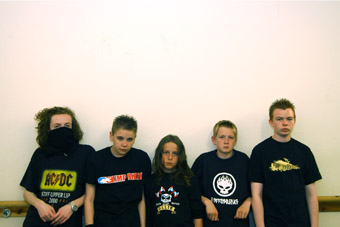
Chris Waitt’s Heavy Metal Jr. similarly turns the camera on preadolescent subjects, tracking Hatred—a Scottish hard metal band composed of 10 to 15-year-old boys—over the four weeks leading up to their first public performance. Like Two Cars, the strength of Heavy Metal Jr. lies in its intriguing characters and their thoroughly engaging dynamic. What is so compelling about the film is the band’s utter, and highly humorous, incongruity: with their musical genre, their ideal image and their immediate surrounds.
For all their satanic salutes, demonic lyrics and hard core posturing, Hatred’s rosy-cheeked members can’t seem to shed their prepubescent awkwardness nor their innocuousness. It’s a graphic discord aptly captured in the film’s closing scenes when the group finally makes its highly anticipated debut, not to a crowd of rocking thousands as promised by their manager, but to a handful of perturbed pensioners, unimpressed mothers and idol struck pre-teen girls at what turns out to be the local family fun day.
Waitt’s and Waititi’s superb offerings were two of the many in the robust International program that also included works such as the tense High Falls starring Maggie Gyllenhaal and Peter Sarsgaard, and Lynne Hershman Leeson’s decidedly more sombre Strange Culture, a documentary inquiry into the FBI’s questionable biochemical investigation of artist Steve Kurtz. Cumulatively these distinctive shorts offered a promising start for the newest kid on the festival block, and if post-screening discussions were any indication, the subsequent instalment only lifted the bar.
The second session shifted the festival’s focus to short works produced on Australian shores, and this screening allowed Spencer to flex her curatorial muscle a little more visibly. The result was an incredibly strong and diverse program that surveyed contemporary short film and video production as well as giving a number of older shorts a second life.
One of the more recent works and festival standouts was Nathan Lewis, Jeremy Hyland and Aaron Kiernan’s Hands Hyland, the shamelessly charismatic account of one lad’s attempt to win the affections of his long-time muse. When news of her imminent departure reaches the enamoured suitor—the eponymous Hyland——he sets out on a marathon cross-city quest to intercept his belle.
Hyland’s narrative of longing confers upon it something of a neo-romantic disposition, but it is the piece’s stylistic execution that perhaps most strongly lends the film its particularly heady brand of romanticism. Part of the film’s charm lies in its use of old school devices like trick photography and stop motion animation; techniques that contribute to Hyland’s playful tone and fanciful diegetic world. Together with the film’s low-fi aesthetic and self-reflexive nature, this stylistic playfulness lends Hyland an informality and intimacy that, like Hyland himself, take aim straight at the heart.
Alex Bryant offered a similarly charming and irreverent contribution to the program in Songs in the Key of Death, his epic musical rendering of one man’s existential crisis. Having been informed by his GP that his death is imminent the film’s protagonist is advised to resign himself to the discouraging prognosis; such resolution is necessary, his GP rather curiously opines, in order “to ensure a successful death.” What is prompted by this “final notice”—as Bryant’s ill-fated character describes it—is a reckoning process largely rendered in song in which the damned protagonist attempts to reconcile himself with his impending curtain call.
While it may broach a solemn subject, Songs in the Key of Death refuses to adopt an entirely sombre posture, opting instead to lace its morbid tone with a none-too-subtle dash of the ludicrous. Bryant’s character shimmies and shakes to his pre-mortem meditations on life and death against psychedelic animated backgrounds,as both he and the film express train through Kübler-Ross’s stages of grieving to a soundtrack of folk, avant-garde metal and acid rock.
This peculiar mix of earnestness and jocularity both contributes to the charisma of Bryant’s film and stands as symptomatic of the film’s more general play with, and fusion of, aesthetics, genres, media and moods. Like Hyland, Songs in the Key of Death takes liberties with its representational strategies, and the result is an intriguing and darkly humorous cinematic swan song.
Rather aptly, one of the recurring subjects in the well-represented forums accompanying both of these sessions was the experimental licence afforded by short format works. For many panellists one of the key attractions of the short was precisely the escape it provided from strictures generally associated with subsidised feature length industry productions.
In stark contrast to the advice offered by the founder of one of Sydney’s ‘biggest brand’ short film festivals, quoted as saying of his event “if you want to experiment…it’s better to do that at home”, DestFest’s first two sessions capitalised on the short’s capacity for greater abandon, bringing experimentation forefront and centre stage. Judging by the sizeable crowds in attendance at CarriageWorks it was a move that was both welcome and well-received, suggesting that with Spencer at the helm Destination Film Festival is indeed, if you’ll excuse the pun, going places.
Destination Film Festival, director Megan Spencer, CarriageWorks, Nov 4, Dec 1, 2007
RealTime issue #83 Feb-March 2008 pg. 21
© Maija Howe; for permission to reproduce apply to realtime@realtimearts.net
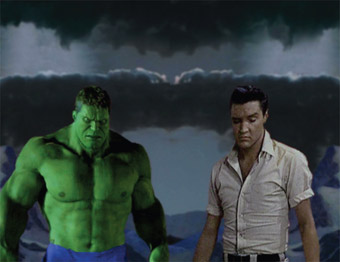
Pixel Pirate II: Attack of the Astro Elvis Video Clone, video still, (2002-2006), Soda_Jerk with Sam Smith
THE FINAL EVENT FOR CARRIAGEWORKS’ DESTINATION FILM FESTIVAL (DESTFEST) WAS A SCREENING OF ARIN CRUMLEY AND SUSAN BUICE’S FOUR EYED MONSTERS (2005) FOLLOWED BY A PANEL DISCUSSION WITH PRACTITIONERS AND COMMENTATORS FROM BOTH THE “YOLK AND FRINGE OF AUSTRALIA’S FILM INDUSTRY”, AS THE DESTFEST WEBSITE PUT IT. THE PANEL—ORGANISED BY FILM CRITIC, JOURNALIST AND DIRECTOR MEGAN SPENCER, THE FESTIVAL’S ORGANISER—WAS AN INTERROGATION OF “CYBER-BORN FILM”:
The revolution will be downloaded…It’s an exciting time in filmmaking right now. Using Four-Eyed Monsters as a starting point—the superb YouTube feature—our panel will explore how online and digital culture has revolutionised and challenged traditional means of production, distribution and exhibition. Has the internet made these conventional methods all but redundant? How? And where are things moving to?
Rather than give a blow-by-blow account of the day, I’ll explore what a “cyber-born film” is. Drawing on the pregnancy metaphor, I’ll pivot this discussion around two approaches: cyber-conceived and cyber-birthed films. I’ll start with cyber-birth, because although it is at the end of this metaphoric chronology, it is in fact the most accessible and pervasive concern.
A cyber-birthed film is one that regards new technologies (cyber) as a way to release (birth) a film to audiences. The panelists encouraged filmmakers to think outside the box when it comes to distribution and offered examples of DIY techniques. Bondi Tsunami director Rachel Lucas suggests mobile drive-ins (where you take your movie with screening equipment on the road), grassroots cinemas (where other people arrange a screening for you) and screenings in clubs. Dominique and Dan Angeloro of Soda_Jerk explained that because remix artists don’t own the works they remix, they cannot go through the normal channels of distribution. Instead, they champion approaches developed within art environments, such as encouraging audiences to burn and distribute DVDs themselves.
Rosemary Blight, producer of Clubland, recommends holding onto your domestic rights and making strategic decisions about the order of platform release. Blight warns that the contemporary approaches championed by those on the panel and elsewhere are antithetical to the traditional film models of copyright and marketing. Copyright, for instance, is usually given away, rendering the filmmaker powerless to leverage any cross-platform distribution strategies. Via Skype, Arin Crumley suggested options such as universal licenses. He wants to see a better environment where audiences can discover things naturally, without having to be told.
Another theme of the panel, and of many film events, is “cyber-conceived” film: film that doesn’t regard digital technology as something to be added later but is integrated into its production and/or message. Pixel Pirate, by Soda_Jerk (with Sam Smith) features an Elvis Clone battling Copyright Cops and MGM’s action heroes. The narrative is created from a collection of over 300 pirated film and music samples. Remixes have been a part of fringe cultures for a long time, but in the last few years in particular more filmmakers have either actively encouraged people to remix their works or have started remixing their own. Filmmakers who have recently provided their films for remixing by audiences include Canadian Bruce McDonald with his The Tracey Fragments (2007), American Darren Aronosfky, The Fountain (2006), and Lance Weiler, Head Trauma (2006). In these films, the story involves some form of repetition or is structured in a modular manner. In other words, the works have a remixable and replicable nature right down to story and style.
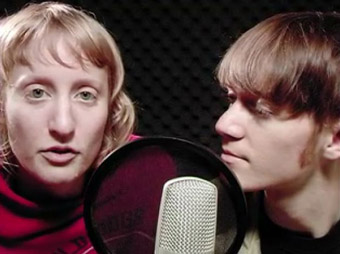
Four Eyed Monsters, Arin Crumley
So, a film can be transformed by other practitioners and by audiences. But what about production ‘outside’ this mutating creature? Blight lamented that the industry has been using the same marketing model for years: marketing every film the same way irrespective of content and target audiences. Websites, if created, are put up at the earliest a few months before a film is released. Crumley explained how Four Eyed Monsters took two years of promotion through numerous social networking sites such as MySpace and YouTube. Marketers in Australia, Blight continued, don’t think about the audience. Indeed, in addition to community building, this concern ripples all the way through to the film content websites. If what happens before and after, indeed around a film, is so important, why not treat them all as part of it? Currently, many Australian film websites provide only scant details such as theatrical release dates and cast and crew lists without any thought as to how the website can augment (both before and after) the experience of the film. Other media need not be thought of as distribution channels only…they can be part of an expanded canvas over which a story or message is expressed.
Yes, the revolution will be downloaded…but also remixed and expanded. What is also significant, though, is that the revolution will not be won with spears or cannon balls lobbed between industry and independents. This is where Spencer’s all-too-rare inclusive approach to the film festival format is important and timely. Neither industry nor independents have all the answers, both are exploring new ways that can benefit each. To quote Spencer, it is with the “goodwill, collective passion, diverse points of view, anarchy, ingenuity, madness, blithe energy, creative spirit and industriousness that are part and parcel of making movies” that new possibilities will emerge. None of which is possible, it should be noted, without the participation of audiences during these tectonic shifts.
Cyber-born film, Destination Film Festival, CarriageWorks, Sydney, Dec 8, 2007
www.destfest.com
RealTime issue #83 Feb-March 2008 pg. 22
© Christy Dena; for permission to reproduce apply to realtime@realtimearts.net
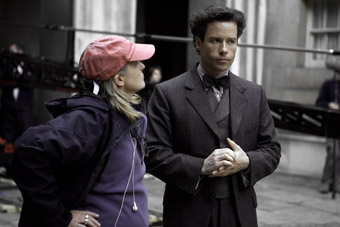
Gillian Armstrong, Guy Pearce, Death Defying Acts
GILLIAN ARMSTRONG HAS ALWAYS MADE FILMS ABOUT STRONG AND INTERESTING GIRLS AND WOMEN. SHE HAS ALSO STRADDLED THE GENRE DIVIDE, SWITCHING EASILY BETWEEN FEATURES AND DOCUMENTARIES. FROM HER EARLY BEGINNINGS TRACKING AUSSIE TEENAGERS IN FOURTEEN’S GOOD, EIGHTEEN’S BETTER, SHE LAUNCHED JUDY DAVIS IN MY BRILLIANT CAREER AND THEN—AFTER STARSTRUCK, MRS SOFFEL, HIGH TIDE—SHE WAS GRABBED BY HOLLYWOOD, DABBLING IN LITTLE WOMEN, BEFORE RETURNING TO AUSTRALIAN SHORES WITH OSCAR AND LUCINDA AND, LAST YEAR, HER WONDERFULLY ENIGMATIC AND RICH DOCUMENTARY UNFOLDING FLORENCE: THE MANY LIVES OF FLORENCE BROADHURST.
Armstrong’s last feature, made six years ago, featured Cate Blanchett as the title heroine Charlotte Gray, a young Scot who joins the French Resistance during World War II. Her new film Death Defying Acts, a co-production with the UK, seems to take a diversion in that the focus is apparently the great escape artist Harry Houdini (Guy Pearce) but, as always, Armstrong is really more interested in the womenfolk: a mother and daughter team, Mary and Benji (Catherine Zeta-Jones and the exceptional newcomer Saoirse Ronan, outstanding in Atonement) who, like Charlotte, are working undercover to dismantle the hero narrative.
There’s been a rush of releases in the past year about the lives and inner/outer workings of magicians, a sudden urge to reveal the apparatus: Hugh Jackman and Christian Bale in The Prestige, Edward Norton in The Illusionist and, best of all, the comic genius of Will Arnett as G.O.B, who manages to kill a lot of doves, in Arrested Development. Here, the film is as much about the fame as the magic. It begins with the camera beneath the surface, all calm, as Houdini attempts to release himself from chains underwater. His stillness and presence as he waits, pushing his physical limits, is counterpoint to the chaos and frenzy outside as people think he must have drowned. He finally emerges triumphant, with Pearce’s beautifully toned body, to become a God of the deep. It’s the first of many visually spectacular scenes, often filmed through glass or water—with a strong score by Cezary Skubiszewski (who was also composer for Lawrence Johnston’s Night, see page 19).
Throughout the film Armstrong directs Houdini like a rock star, crowd-surfing into Edinburgh on the throes of others’ desire. He invites strangers to punch him in the stomach—even when he coughs blood later in his hotel room. Houdini’s story appealed to Armstrong because “it was not just about his act but about how he sold his act. He was a great self-promoter…he was the world’s first superstar.” As the plot kicks in, we learn that Houdini has an unlikely, even kinky attachment to his mother. He states his ambition is to “be worthy of the woman who bore me” and offers $10,000 to any psychic who can find her in the afterlife and reveal her last words before she died. Mary and Benji step in to take up the challenge. Whether strolling the streets stealing men’s watches or performing a dubious music-hall act, “Princess Kali and her Dusky Disciple”—where Mary connects with the ‘other side’—this mother and daughter team are masters of deception.
With a voiceover by Benji we see the action from the child’s perspective, and this is when the film starts to trolley downhill. The narrative is cloying and reveals too much too soon. Writer Tony Grisoni says the script “started from the idea that at the centre of any magical act there’s always an audience that’s desperate for the magic to be real.” But Mary is all and only about artifice; she speaks of her ability to “pluck a character off a shelf and just about manage to convince herself.” However, in this role Zeta-Jones doesn’t work any magic on us and it’s hard to believe Houdini would have fallen for her charms—especially as in another Freudian, even soap opera twist, it’s revealed she bears a stunning resemblance to Houdini’s mother when she was young; and so he makes her wear his mother’s wedding dress, to channel her psychic energy.
Although Pearce gives a fierce and sensitive performance, there’s just no chemistry between him and Zeta-Jones and strangely, in the end, that’s the focus of the film—a battle of wits, a love story, without the desire. After a sloppy and sentimental ending where it feels like the script has run out of ideas and the committee has signed off on a mishmash, I wanted to change the focus back from the women to Houdini. Apparently he wasn’t even in the original drafts of the script but, with Pearce’s strength and charisma, he remains a fascinating character who stays locked in manacles, holding his breath underwater, never quite reaching the surface.
Death Defying Acts, director Gillian Armstrong, producers Chris Curling, Marian MacGowan, writers Tony Grisoni, Brian Ward, cinematographer Haris Zambarloukos, editor Nicholas Beauman, composer Cezary Skubiszewski
RealTime issue #83 Feb-March 2008 pg. 23
© Kirsten Krauth; for permission to reproduce apply to realtime@realtimearts.net
Move-Me Booth
BILL VIOLA HAS WRITTEN OF THE POROUS NATURE OF MEMORY, WHICH HE CHARACTERISES AS AN UNFOLDING PROCESS, CONTINUOUSLY BEING “UPDATED, MODIFIED AND INVENTED.” BRIGHTON’S DANCE FOR CAMERA FESTIVAL 2007 REFLECTED THE IMPORTANCE OF LINEAGE WITHIN THE COLLECTIVE HISTORICAL MEMORY OF THE GENRE, AS THE FORM FINDS WAYS TO REIMAGINE ITSELF BEYOND THE BOUNDARIES OF THE PREVIOUSLY KNOWN.
Expanded from a single day’s event, and this year included under the umbrella of the Cinecity film festival, Dance for Camera’s three days of screenings were programmed by South East Dance’s Mairead Turner, Vicky Bloor and Charlotte Miles into several distinct strands, grouped around a central retrospective. Prefaced and contextualised by Martina Kudlácêk’s documentary In The Mirror of Maya Deren (2002), guest curators Christiana Galanopoulou of Athens-based Videodance, and Alla Kovgan of Kinodance in St. Petersburg, assembled a programme of Deren’s best known works, including Meshes of the Afternoon (1943), At Land (1944) and Ritual in Transfigured Time (1945-6). Live musical interpretation of the latter two pieces reflected and enhanced the filmic interweaving of dream states, water-based imagery and dislocating temporal distortions into a web of mesmeric liminality. An additional program examining Deren’s creative legacy included Kovgan and Jeff Silva’s highlighting of the medium’s material properties in Arcus (2002), by means of an assured use of inky negative and close cropped shifting frames.
Elsewhere, Horizon of Exile (2007), Isabel Rocamora’s meditatively-paced, desert-set, black-clad exploration of landscape and female identity, formed part of the Challenging Perspectives program, while the Dance 4 Film Preview showcased a range of work for televised broadcast in the UK and Australia. Here, Liz Aggis’ alternating usage of colour and monochrome in Diva (2007) underscored a simultaneous portrayal and subversion of both her performance persona and the process of filming itself, with Roman Kornienko and Maria Sharafutdinova’s 10 Exhalations (2006) of the title represented visually as a cloud of white vapour, utilised as a highly stylised shorthand device charting the narrative arc of a relationship from enraptured eye-gazing to abandoned cough.
The festival’s opening night program set out to explore non-traditional ‘dance’ content, including a range of work foregrounding elements such as camera journey and conceptualisation. Rajyashree Ramamurthi’s More Stories (2007) led the viewer through an immersive world of richly wordless narrativity, drawn from personal history and combining monochrome animation with lush colour coding, evoking the heightened sensual response of childhood recall. Becky Edmund’s Sand Little Sand (2006) presented an unvarnished and expansive Argentinean landscape comprising sand, road, rock, wind and sky, where the subtle and ambiguous movement of the sand itself, forming momentarily into puffs and clouds, was revealed at the work’s end as the by-product of a dancing figure, previously erased from shot [RT77, p36]. Olive Bieringa’s Small Dance (2007), situated the upright figure of contact improviser Steve Paxton against a grouping of flowering plants, fronting a two-storey wooden house. For the duration of the single-shot work, Paxton remains immobile, while the viewer’s eye is inexorably drawn to the gently swaying foliage and flashes of movement from an upstairs window, calling attention to the understated motion of the natural world and the everyday.
Viola has also noted the ephemerality of the electronic, stating that “images are born, they are created, they exist, and, in the flick of a switch, they die.” Two installations, housed for the festival’s duration in the foyer of Brighton’s Lighthouse building, dealt in strikingly divergent ways with the lifespan of the image, while bypassing traditionally-oriented notions of seated, single-screen viewing.
Katrina McPherson and Simon Fildes’ Move-Me Booth, co-produced by Goat and Ricochet Dance Productions, utilised the familiarity and accessibility of photo booth culture to provide a meeting ground for choreographic input and public participation. Set against a plain white background and captured by a fixed, front-on camera, participants require nothing more than a willingness to interpret verbal instructions, enacted within the structural confines of the space, and selected from a varied menu of choreographic options, ranging from hip-hop to improvisation. Hosted on the installation’s web-site, the resulting images contain moments of poetry and abstraction, emerging from the configuration of an inadvertent grouping of bodies or the extreme close-up of facial features to camera. The series of solos, duets and trios also functions on the level of social document, testament to a mix of ages, backgrounds and expectations recorded along with each participant’s movement journey, and stored as data in an electronic afterlife.
Contrastingly, viewers for Billy Cowie’s In the Flesh (2007) lift a tent-like flap to enter a physically confined and darkened area akin to a magician’s cabinet, as a space set apart from the rules of everyday reality. Georges Méliès wrote of the potential for the moving image to contain “all of the illusions that can be produced by prestidigitation, optics, photographic tricks.” Using a projector, an angled mirror, and a pair of 3D spectacles, Cowie transforms a flattened, floor-based image into what he terms “a Spectrefilm” as a female figure manifests, simultaneously solid and insubstantial, as a William Gibsonesque life-size virtual presence, capable of reaching out towards the viewer and eerily connecting gaze. The pared down simplicity of this concept extended to a minimal soundtrack, consisting of piano and spoken word, and to a slowly-paced and carefully considered movement vocabulary, as a hand reaches to connect with an upwardly angled foot in an infant-like exploration of the limits of physical form. A shift from a foetal curl into an angled arrangement of elbows and knees ends with a careful placement of hand, feet and forehead to ground before the figure vanishes entirely into the darkness of a momentary blackout, subsequently rematerialising to start her brief life cycle over again.
Stan Brakhage describes the trees in the opening shot of Maya Deren’s A Study in Choreography for Camera (1945) as attaining “a state of dance.” Dance for Camera demonstrated that there is both audience and appetite for work willing to explore such expanded notions of dance and how it can be defined and experienced within a contemporary screen context.
South East Dance, Dance for Camera Festival, Cinecity, Brighton, Nov 30-Dec 2, 2007; www.southeastdance.org.uk/danceforcamerafestival.html
RealTime issue #83 Feb-March 2008 pg. 24
© Chirstinn Whyte; for permission to reproduce apply to realtime@realtimearts.net
Ghostgarden, (video still), Anita Fontaine
ANITA FONTAINE’S GHOSTGARDEN TAKES YOU ON A WALK THROUGH A GARDEN WHOSE GHOSTS APPEAR ON A GPS-ENABLED HAND-HELD PC. ATTACHED BY HEADPHONES, YOU TRACK A WHIMSICAL, GOTHIC ROMANCE IN A 19TH CENTURY SETTING IN 12 SCENES BETWEEN A CASTAWAY AND AN ARISTOCRAT.
Ghostgarden is the creation of Australian artist Anita Fontaine and her technical producer, Canadian Michael Pelletier. Both formerly worked in new media at Canada’s Banff Centre. Fontaine is now based in Boston working on her own projects and with an advertising agency.
Ghostgarden is not interactive in the way you might expect, say, of a Blast Theory creation [p26]. But you do have to work, using your device to find the WIFI hotspots in Sydney’s Botanic Gardens that will activate the PC in the same unit. And that’s an adventure in itself, involving not a little walking and the discovery of many incidental pleasures on the way. Once you’ve hit the spot, the PC calls up a fragment of the tale in the form of an animated image with matching voiceover and sound score. You then move on through the garden in search of more episodes in this elliptical tale of heartbreak.
Beyond the narrative’s 19th century setting being broadly correlated with the Botanic Gardens’ origins, there’s no precise connection between the site and screen images, although, as you near Sydney Harbour, there is a water scene. The male lover emerges from the deep with the treasure demanded by his beloved.
The tiny, full colour gothic images are collaged and vividly detailed (more would be revealed on a larger screen but that’s not what the project is about), the animation very simple, the narrative poetic and the score as sweetly romantic as the occasionally dark, sometimes erotic tale it tells. What Ghostgarden reveals is the creative potential of an accessible electronic medium and, like Blast Theory’s Rider Spoke, although in a very different way, overlays a physical experience of place with a palimpsest of a very different order. Welcome to a parallel universe. RT
Ghostgarden, artist, creator Anita Fontaine, programmer Mike Pelletier, poetry Michael Boyce; d/Lux/MediaArts in association with Sydney Festival and Botanic Gardens Trust Sydney; Royal Botanic Gardens, Sydney, Jan 5-27
RealTime issue #83 Feb-March 2008 pg. 24
© RealTime ; for permission to reproduce apply to realtime@realtimearts.net
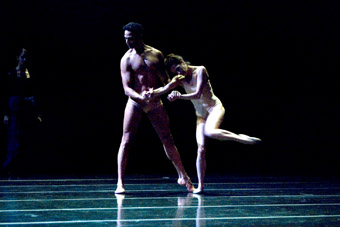
Compania Nacional De Danza, Three Works
photo Prudence Upton
Compania Nacional De Danza, Three Works
PLUSH CURTAINS RISE TO REVEAL AN ENSEMBLE OF BEAUTIFUL BACKS WALKING AWAY: CHEWY AND MELLIFLUOUS. THIS WILL BE A NIGHT FOR BEAUTIFUL IMAGES CREATED BY BEAUTIFUL BODIES. A RICH AND DEEPLY TONED VOICE, THE KIND THAT NARRATES WILDLIFE DOCUMENTARIES, SPEAKS SEDUCTIVELY IN SPANISH. I LATER LEARN THAT IT IS COURTLY VERSE BY RENAISSANCE SOLDIER-POET GARCILASO DE LA VEGA AND I WISH THAT I HAD BEEN MADE PRIVY TO ITS MEANINGS.
This opening piece, the first of three works by the acclaimed choreographer Nacho Duato, is Por Vos Muero. The music is Renaissance Spanish. The costuming is courtly. The set is muted and elegant. The lighting is subtle but tightly choreographed. Semiotically, these elements signal subdued stateliness but…the ongoing rush of tightly woven choreography is sometimes frantic and I long for a breath or a pause. Ever-moving, rarely lingering, Duato’s choreography is intensely musical and these well rehearsed dancers move inside the music, embodying a symbiosis of sound and motion.
They are fluid, grounded but light, muscular but slender and glorious in extension. They are confident and perform the intricate movement score with gusto and occasional smiles of authentic pleasure. Their spines are both upright and rubbery. Their pelvic bowls are tethered by practice and open to the world. They display wonderful collectivity, even at the expense of individuality. They are all seductive in their obvious beauty and I have several ‘wow’ moments.
Gnawa, the second work, also begins with those beautiful backs, duly lit to highlight the developed musculature. The music seems at once Indian, Spanish and Turkish, but the program tells me that it is “sub-Saharan.” This dancing is far too polite for this music. Again, there is much partnering and lifting in a structured separation of male and female. Certainly, Duato plays with this separation by employing some man on man action, but his choreographic gendering renders these dancers not individual artists but prototypes of classicist perfection and virtuosity.
Let’s call a spade a spade. This is not contemporary dance. This is modern ballet. Duato uses the aesthetic freedoms of contemporary dance to wrench open the canonical dictates of classical ballet, but there are still plenty of pointed feet, plies, lifts and balletic extensions. There is the symmetry of the proscenium arch, the homogeneity of the dancers and a classical dynamic that vacillates between the slow and sinuous and the quick and light.
I am impressed rather than engaged. I feel seduced. I am struck by the sameness of the three pieces. But the wonderfully cool abstraction did lead my vision to elemental qualities of movement rather than narrative meaning. In fact, when Duato does attempt overt emotional resonance in White Darkness, a piece apparently about drug addiction, I find the posturing overblown, almost funny.
Three Works afforded enjoyment with a lingering emptiness and ultimately what I will remember is that I sat two seats away from Gough Whitlam and it was to him, the man who gave us free education and universal health care, I gave my silent accolade.
Compania Nacional De Danza, Three Works, choreography Nacho Duato, Lyric Theatre, Star City, Sydney, Jan 6-8
RealTime issue #83 Feb-March 2008 pg. online
© Pauline Manley; for permission to reproduce apply to realtime@realtimearts.net
Does our cover celebrate Easter? Not intentionally. But if you’re that way inclined, Happy Easter! We celebrate, instead, the screen. The cover photograph is from a remarkable production Clark and I Somewhere in Connecticut [p4] by Canada’s Theatre Replacement. We saw it in January at Vancouver’s PuSh Festival where we were running a review-writing workshop [www.realtimearts.net/features]. It’s about an actor who finds a discarded suitcase full of photographs and decides to perform the lives represented therein, working inventively with video and projections of images from the found albums. In this and other works the screen appears in more manifestations than ever in this edition of RealTime—the stage as screen in Electric Company’s Palace Grand [p5, 11], Chunky Move’s Mortal Engine [p15] and Terrapin’s Explosion Therapy [p38]; in cinemas [of course, but mutating, p22]; on pocket computers and GPS devices in Anita Fontaine’s Ghostgarden [p24] and Blast Theory’s Rider Spoke [p26]; in video installations [Atom Egoyan’s Auroras, p28]; and, from the UK-German outfit Gob Squad, in 360 degrees as spontaneously filmed performance [p34]. But in this very same edition we record a great surge in physicality and materiality: the live action sculpture of Cirque Ici [p40], the artist machines of Joey Ruigrok van der Werven’s Volta [p40], Speak Percussion playing with glass [p48], the bicycle works seen by Jean Poole at the Istanbul Biennale [p28], Ricardo Miranda carting audiences in his rickshaw for Mexico City’s Transitio_MX02 Festival of Electronic Arts & Video [p18], site works entailing tumbleweed, coins and being rowed to an island in Finland’s ANTI Festival [p30], the audience journey in Second to None in an imaging of Port Adelaide’s Aboriginal past [p37], and then there’s Aalst [p13], The Black Watch [p12] and The Last Highway [p12] in the Sydney Festival, each in their own way reconstructing social bodies under investigation.
There’s no obvious tension between the virtual and the physical—they co-exist, part of a spectrum of possibilities, or they work in creative counterpoint in works like Rider Spoke where you do a lot of bike riding, guided by a laterally minded computer on your handlebars, or in works like Mortal Engine where bodies and responsive technology unite to generate new worlds. Everything is raw material for art: bicycles, rickshaws, machines, fashion [La Pocha Nostra, p31; Hackers and Haute Couture Heretics, p28], ape masks [p34] and rabbit suits.
RealTime issue #83 Feb-March 2008 pg. 1
© Keith Gallasch; for permission to reproduce apply to realtime@realtimearts.net
Rider Spoke, Blast Theory
BLAST THEORY’S LATEST WORK RIDER SPOKE CONSISTS OF A HIGHLY ORIGINAL AND EXCITING FORM OF AUGMENTED TRAVEL. THE PIECE’S STRUCTURE IS DECEPTIVELY SIMPLE. PARTICIPANTS ARRIVE AT A VENUE WHERE THEY CAN SWAP CREDIT CARD DETAILS FOR A HANDHELD COMPUTER (NOKIA N800), MICROPHONE AND HEADSET, BICYCLE AND HELMET, ALLOWING THEM TO CYCLE FREELY WITHIN ANY KIND OF URBAN SETTING, BEFORE AND AFTER LISTENING TO OTHER PARTICIPANTS’ STORIES AND RECORDING THEIR OWN FOR FUTURE LISTENERS. THE PIECE CAN LAST FOR UP TO ONE HOUR.
The computer, which is attached to the handlebar, functions as a positioning system. Yet instead of showing the cyclist’s location on a standard map, it utilises an interface combining images from Mexican votive painting, sailor tattoos and heraldry. Aided by the interface, the cyclist navigates an expanded city, made of intimate, sometimes delicate, occasionally passionate and even hilarious author-generated content.
Rider Spoke was developed in 2007 by Blast Theory in collaboration with the Mixed Reality Laboratory at Nottingham University, Fraunhofer Institute and Sony Net Services as part of IPerG, a four-year research project funded by the European Commission’s IST Programme, whose principal objective is an investigation of pervasive games which interweave digital media with participants’ everyday lives. Another outcome of this project is Blast Theory’s Day of the Figurines (2006-current; RT80, p6), also developed with the Mixed Reality Laboratory, winner of an honorary mention at Prix Ars Electronica 2007.
I ‘performed’ Rider Spoke in London, at the Barbican Centre. The operators, wearing colourful checked shirts, took my details. Outside, a bicycle had been prepared by Matt Adams, one of Blast Theory’s founding members. I was told to be careful and to wait for the device to contact me, which it did, some 10 minutes later, as I cycled down a busy road. The first message appeared on the screen: “Find somewhere you like, then give yourself a name and describe yourself.” I was then invited to find a hiding place to record my answer. I remember that I turned right and right again, away from the traffic. At that point, I was neither lost nor worried but strangely euphoric, caught between the liberating act of cycling and the equally liberating possibility of confessing to strangers.
Rider Spoke, Blast Theory
A swallow, a clear iconographic reference to the possibility of regeneration, representing the migrating soul in Egyptian art and the resurrection in Christian art, appeared on my screen. This, I had been told, indicated that I could stop. The contrast between the evocative image on the console and my surroundings couldn’t be starker. I remember seeing a run-down council estate on the left and an empty pavement on the right, near a couple of boarded up shops. Some children were playing football. “Describe yourself”—I wondered what that meant. Usually, in these kinds of performances we are encouraged to create a role, but here I felt that the role would be even more minimal than in Blast Theory’s previous works. Aware that one day there might be listeners, I started to record a description of ‘myself’, surrounded by strangers, looking at me looking at them.
Once I completed my message, I cycled on, noticing, perhaps more intently than otherwise, passersby, taxis, buses, queues of impatient, tired looking people going places. I, of course, wasn’t really going anywhere. Although I was travelling, and following the console’s directions, as well as paying attention to overall traffic, there seemed no purpose to my travel. Actual places, my own memories, distant voices of absent others became intertwined. I still remember the fragments that made my route: a bustling local pub, a Chinese woman carrying a mountain of washing, a young, elegant man on his mobile dropping a piece of paper, the sound of a familiar voice (Martin Flintham’s, from the Mixed Reality Laboratory) that made me smile, a police car coming too close, a broken window, a deserted bus stop where I recorded my message, a hole on the road, my bicycle tipping to the right. I also remember listening through the headset to the tempting but somewhat sad recorded voice of another Blast Theory founding member, Ju Row Farr, who, by alerting us to the work’s rules, was also taking us backward and forward in time. And there was the image of the swallow appearing on the interface when I least expected it, alluding to the possibility of worlds beyond.
Rider Spoke offers binary choices—either to pause or move; either to speak or listen. These frictions, breaking up the fluidity of everyday life, allow for contaminations between present and past, actual and digital, geographical and fictional. I listened to Martin’s story. The surrounding setting became a backdrop to something other that had neither happened there nor then. I cycled on. I recorded another story, about a wild teenage party, and then one more about someone who keeps me awake at night. I still recall listening to the private, introspective stories that somehow rendered other participants present to me. Interestingly, to listen to their confessions, we had to locate their hiding places by cycling until the screen told us we had ‘found’ one. I recall feeling the stark contrast between the cartoon-like prefabricated houses on the screen and the culturally loaded side streets I was in. I remember thinking, so Martin stood in this place and said these words, ‘here.’ The site, the semiotics of both actual and digital locations, then, for a flickering moment, became Martin.
Blast Theory claim that Rider Spoke continues their work on how “new communication technologies are creating new social spaces.” Here, the creation of a publicly authored space (in the sense that it is authored both by the public and in public) takes ‘place’ in realtime. The piece utilises WIFI hotspots able to locate participants in the city so that each ‘hiding space’ functions as a palimpsest, combining two properties: the physical and electronic location. The only evidence of the presence of others here is in space: identities come to coincide with spaces, and spaces with their WIFI fingerprints. As the work progresses, this publicly authored space becomes increasingly complex—not only a fixed geographical map but also a transitory work in progress which, recalling the motion of Walter Benjamin’s Angel of History, pushes participants into the future whilst invariably forcing them to look back at the cumulating debris of their past.
Rider Spoke is a delicate, almost intangible work. Like other Blast Theory performances, it combines elements of trust and risk, irony and politics, confession and exposure, orientation and disorientation, everyday life and digital worlds. But whereas Day of the Figurines lasted weeks, here we are able to navigate through the work for barely one hour. Unlike Can You See Me Now? or Uncle Roy All Around You, there is no mission, no background scenario, no overarching narrative. Rather, this piece exposes a tension between our presence in space and our being in time. Whereas temporally, by asking us to remember, Rider Spoke relocates us in the past, spatially, by encouraging us to cycle forwards, it asks us to project ourselves into the future. Our ‘here and now’ then, our present, is at stake both literally, in the busy London traffic, and ontologically. Catching its participants as they move between the real and the digital, past and present, role-play and self-consciousness, motion and stasis, this fascinating piece marks a new phase in Blast Theory’s work. Here, unlike previous performances, the city is no longer somewhere to chase or find others but rather a depository of voices and their ephemeral memories. As an archive, or palimpsest, the city becomes an aging skin—a place of imprints, tattoos, scars of presence realised by recording or replaying the memories of our past whilst rapidly moving into an uncertain future.
RealTime issue #83 Feb-March 2008 pg. 26
© Gabriella Giannachi; for permission to reproduce apply to realtime@realtimearts.net
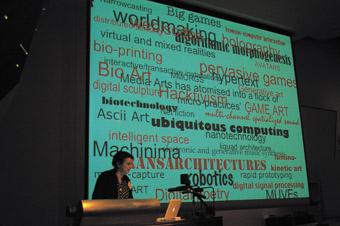
Shiralee Saul, What Happened to New Media Art?
photo Rebecca Wong
Shiralee Saul, What Happened to New Media Art?
ON THE LAST DAY OF THE FOURTH AUSTRALASIAN CONFERENCE ON INTERACTIVE ENTERTAINMENT AT RMIT IN MELBOURNE DARREN TOFTS CHAIRED A PANEL DISCUSSION THAT BROUGHT TOGETHER A SMALL GROUP OF PRACTITIONERS, CURATORS, EDUCATORS, ACADEMICS AND CRITICS—SHIRALEE SAUL, PHILIP BROPHY, MARCIA JANE AND MYSELF—TO DISCUSS “WHAT HAPPENED TO NEW MEDIA ART?”
Conference participants who for the last few days had debated artificial intelligence approaches to storytelling, architecture in online virtual worlds, playing in streets and with mobiles, design, philosophical and methodological issues to do with gaming of all stripes, trudged into the morning session expecting to be snapped out of their conference dinner hangovers with a feisty debate. Alas, they witnessed no blood splatter. Instead, what occurred was more a meditation on “playing the moon.”
In 1937 Chinese writer Lin Yutang wrote “The method of ‘playing’ the moon is to look up at it from a low place when it is clear and bright, and to look down at it from a height when it is hazy and unclear” (Lin Yutang, The Importance of Living, Oxford University Press, Melbourne). One could say then that Tofts framed the discussion with the provocation that the moon (new media arts) is in its hazy and unclear phase:
So was it the mobile phone or changes at the Australia Council? Why has new media art apparently disappeared from the cultural landscape? Key cultural institutions such as ACMI have made the transition from pixels to Pixar. Games criticism is thriving at a time when discussions of media art histories recede into the background. Or do we need to revise our definitions of new media art? Does anyone really care about interactivity any more? In the age of machinima and Second Life, is there still a place for ‘new’ media art?
Tofts began the session with a revived call (after acknowledging the fine activities of Experimenta, ANAT, RealTime, Scan Journal) for “advocates [of experimental art] to keep it visible, to remind us that things are still cooking in the interactive dream kitchens of the human computer interface.” Offering alternative techniques to raise awareness and facilitate critical discussion of ignored or unseen arts practices, I spoke about a program that I developed with dLux Media Arts: an art tour experienced at home, with people all over the globe, inside the online virtual world via avatar representations that share the same pixel substance as the art. I also voiced concern at the exclusion of independent new media arts practices from industry, education, policy and funding decisions. For me, the issue is that these decisions are based on a false assumption about how cultural industries are fostered. Commercial viability is often held up as a measure of success, and that success is usually equated to the technology employed. Rather than understanding the core insights and principles behind a project, many merely copy the outcomes. They clone the crust, not the kernel. This emphasis on false signs of success is one of the reasons why the insights of independent media art and artists are not being recognised or supported, and ironically results in a non-commercially viable, banal echo across the creative spheres.
The panelist who was perhaps expected to be the session gladiator was uncharacteristically mellow on the day. Philip Brophy who, as Tofts noted, was teaching media arts before such terms existed, did make a few acidic and lucid observations as to how practitioners and organisations could better address issues. That is, how the hazy moon can become clear. The panelist who didn’t see the moon as being clear or hazy, but just a moon, was Melbourne-based self-described “video artist” and educator Marcia Jane who described two of her works Ribbons (2007) and Intercept (2007).
It was Shiralee Saul who listed reasons why many perceive the moon as being hazy and therefore look down on it when in fact it is clear and bright. Saul argued media arts practices exist and are flourishing but are unrecognised due to semantic haziness. With a slide projection revealing and juxtaposing term after defining term, she made the point that “media arts has atomised into a flock of micro-practices.” Robot art, generative music and Ascii art sit shoulder to shoulder with pervasive gaming, machinima and mixed realities. Indeed, “media arts has been so successful that it no longer needs or even references the art world institutions.” The problem is that some people are still “tacitly” applying old definitions of media arts (such as “film” or “video”) even though they have been “superseded.” The only people, Saul contends, who make art are “traditional artists who see an opportunity to cash in within the art world’s opportunities.” For her, media arts are no longer only in galleries; they no longer necessarily need galleries.
Many on the day felt freed by Saul’s observation: not just because it acknowledges the undeniable diversity and flourishing presence of that which was formerly known as new media arts; but also because it removed reliance on the role of traditional educational, funding, critical and curatorial structures. Indeed, Tofts noted in an email post-panel that “we are no longer dependent upon the usual curatorial and exhibition demands/protocols of the gallery/funding/advocacy system that fostered and engendered the initial phase of media arts in the late 1980s/90s.”
One of the consequences, however, of this dislocation or divergence is that ancestry is forgotten or never known. As Tofts explained post-panel: “we should also not forget [media art] history, the contexts that have developed and morphed into the culture of Web 2.0.” There is an “absence of historical knowledge that […] young artists and graduates etc should be mindful of.” This is not, Tofts continues, a generational whine, but “a fundamental issue of knowledge and of being-in-the-world’.” Indeed, the expansion of the synchronic scope Shiralee Saul offered would benefit from a complementary diachronic one. Only then will we remember we’ve had this discussion before, and understand why we’ll be having it again.
What Happened to New Media Art? chair Darren Tofts, Dec 3, part of The Fourth Australasian Conference on Interactive Entertainment, Storey Hall, RMIT University, Melbourne, Dec 3-5, 2007
RealTime issue #83 Feb-March 2008 pg. 27
© Christy Dena; for permission to reproduce apply to realtime@realtimearts.net
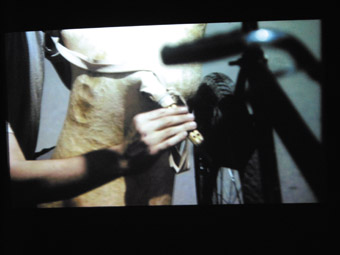
here is More Than One Way to Skin a Sheep (video still), Jennifer Allora (US) & Guillermo Calzadilla
IN THE WORLD’S ONLY CITY ON TWO CONTINENTS, RESTING FOR ONE MONTH IN THE ATATÜRK CULTURAL CENTRE, IS THE VERY TOP 1.86M OF MOUNT EVEREST, NEATLY CARVED OFF AND PRESENTED FOR ALL BY CHINESE ARTIST XU ZHEN. PROVIDING ANOTHER VANTAGE POINT WAS THE ISTANBUL MODERN, WITH A 20-YEAR BIENNALE RETROSPECTIVE. BUT ULTIMATELY THE BEST ART OF THE BIENNALE, CURATED BY CHINA’S HOU HANRU, WAS TO BE FOUND OUT IN THE NOOKS AND CRANNIES OF THIS SPRAWLING, COMPLEX CITY.
egoyan’s aurora
Appropriately, given Istanbul’s maritime history and trading port status and the Biennale’s proclaimed focus on globalisation, the largest gathering of artworks were located in a harbourside warehouse named Antrepo, the two-storey interior designed to “function like a real city…a kind of urban maze to reflect the labyrinth structure of Istanbul.” Like Istanbul, this meant a lot was crammed in, it was very noisy (lots of sound overlap), traffic flowed continuously in random directions, there was a lot of East meets West, and the complex politics and history of the region were often explicit and upfront.
Having only learnt of Turkey’s World War I era atrocities inflicted upon the Armenians since arriving in Istanbul a few months ago, I was immediately drawn to Auroras, a video work by the unflinching film director Atom Egoyan, who was born to Armenian parents in Egypt in 1960. He wrote and directed the film Ararat [2002] about the genocide. In Auroras, Egoyan focuses on Aurora Mardiganian, an Armenian exiled from her homeland after her family was killed in the tragedy of 1915; she travelled to the United States hoping to find her surviving brother. In 1918, Hollywood made a film of her experiences with Aurora playing a large role, catapulting her into unexpected and unwanted stardom. She later deserted the promotional tour and threatened suicide. The studio responded by finding seven Aurora look-alikes to take her place.
Egoyan explores this true story by providing seven well groomed actresses of different ethnicities on a panoramic screen, each taking turns to speak text from accounts of Aurora’s experiences. Within the blackened room there is a smaller, discrete room waiting to be discovered in which is projected a small loop of footage of a dishevelled woman with a failing memory, old enough to be Aurora, talking to an interviewer about photographs he is showing her. She is not identified as Aurora, but in the catalogue Egoyan asks, “Are we dependent on the subjectivity of performance to absorb another person’s trauma? Does history need to entertain us?”
bicycle works
For a city where bicycles are so rarely seen (rickety roads, crazy traffic, endless hills), Antrepo held a surprising number of bicycle related artworks. There is More Than One Way to Skin a Sheep by Jennifer Allora (US) & Guillermo Calzadilla (Cuba) is a gorgeously shot six minute video which follows a cyclist around Istanbul, pausing at busy intersections to inflate his deflating bicycle tyre using a tulum (a large bagpipe-like traditional instrument from the mountainous Eastern Black Sea region of Turkey, and derived from the carcass of a sheep). The cyclist is from that region and, inflating the tube, he makes long resonating notes which are juxtaposed with and then ultimately blend into the city hustle. Working in many ways, this was a beautiful and haunting piece.
Rainer Ganahl (Austria), on the other hand, bicycle-tackled Istanbul to draw attention to 21 sites where journalists have been killed, riding between locations to generate a video-taped topography of sorts with photos and chalk outlines drawn at each site. His artist statement emphasised that the International Association of Journalists lists Turkey as the eighth most difficult country in the world in which to practice journalism. Beneath a series of photographs, the story of each victim is told. Most murders were a response to the journalist writing about a minority group in Turkey.
just awake
Fell asleep under the stairs nearby, on beanbags provided for watching ceiling projected moonscapes and cityscapes (Taro Shinada, Japan). Felt asleep walking through the well-hyped virtual RMB City built by Cao Fei (China). Not that cyber glamour and extravagance felt incongruous with Istanbul, just that Second Life graphics never seem capable of pointing to anything but 1992. Knife sculptures (Abel Abdessemed, Algeria), simulated time bombs (David Ter-Oganyan, Russia) and life-size, weapon-loaded Kama-Sutra sculptures (Hamra Abbas, Kuwait) tend to have a little more jolt. As does the upbeat if elevator jazz sounds of Young-Hae Chang Heavy Industries (South Korea), perennial festival favourites, slinking through another wise-cracking text animation, this time a story about the importance of ignoring all curators and critics—everyone has their own valid aesthetic abilities and tastes and all established canons of art are a hoax.
video layering
I wouldn’t have been visiting the Biennale if it wasn’t for an invitation to the Istanbul video laboratory of artificialeyes.tv, a video collective steadily carving an international reputation as live video performers. Acknowledging that the art of VJing is often hidden behind technical veils, this exhibition’s attempt to reveal some of its processes proved worthwhile and popular with Biennale visitors. Hardware modifications and specialty equipment jostled for attention alongside deliberately championed software code (across 30 metres of wall space), abundant photographs of event performances, and a compilation of videos including a recent one from Cappadocia I helped film. In the end it’s all about the video, the exhibition’s lingering resonance being the video projections layered on top of everything, gliding (through the use of Video Mirror Units) across floor, wall and ceiling space in slow, choreographed manoeuvres.
the world factory
Textile manufacturing has long been a Turkish strength, and yet the changes and challenges brought by the forces of globalisation are more than evident at the ghostly Textile Trader’s Market, a multi-storey textile shopping complex with plenty of vacant shops to fit temporary Biennale exhibitions and video screening rooms. Most directly related to the setting were a range of clothes designed by Tadej Pogacar (Slovenia) together with prostitutes, as part of a prostitute fashion label. But much of the art here explored the plight of the worker—architectural diagrams for providing modular shelters and homes for factory workers in Tijuana, ambient videos documenting the otherworldiness of factory workers within industrial locations, and Ömer Ali Kazma’s (Turkey) juxtaposed videos: Brain Surgeon, Clock Master, Slaughterhouse Worker and Studio Ceramicist.
parallel trails
Alongside every festival of scale inevitably exists a bounty of unofficial treasures, side projects, renegade events and alternate mini-festivals awaiting discovery. One of the most exuberant accompaniments to the biennale was the Triangle Project, a collaboration between Copenhagen, New York and Istanbul which will culminate in 2010 (when Istanbul is celebrated as European City of Culture) with the opening of a Danish Cultural Institute in Istanbul. On this leg it seemed to mostly involve transplanting the cream of Copenhagen’s electronic artists into an Istanbul venue known as The Hall for four evenings.
And so, in an Armenian church converted into a nightclub and cultural centre: transvestite ramadan cartoons adorn the walls; a blonde ponytailed 23 year old girl (Band Ane) jogs onstage singing her way through a rave anthem; half-shaven men parade in wolverine dresses; a trio on stage (kargology.com) earnestly debate public and private space while simultaneously appearing in three-way naked and sweaty motion on the video screen behind them; a masked duo (Albertslund Terror Korps) unleash their version of Danish Bhangra gabba techno with crude animations of aliens abducting aeroplane crash victims (hello VJ Cancer); and girls choreograph the theatrical cutting apart of each other’s paper costumes with scissors.
In a similar art-fashion-actor-model-DJ kind of vein there were Hackers and Haute Couture Heretics, promoted as “a public clothes swap and hack”, and the Istanbul chapter of Swap-O-Rama-Rama. Attendees brought a bag of old clothes and were able to get assistance from professional designers with industrial sewing machines, silk screening and iron-on stations, which naturally ended in a fashion parade of the remixes, a sprawl of colour, frayed edges and reinvention.
Istanbul Biennale 2007, Not Only Possible, But Also Necessary, Optimism In The Age Of Global War, Sep 8-Nov 4, 2007, www.iksv.org/bienal; Istanbul Modern www.istanbulmodern.org; Video Mirror Units www.vms-at.com; Hackers and Haute Couture Heretics www.istanbulstreetstyle.com/swap
RealTime issue #83 Feb-March 2008 pg. 28
© Jean Poole; for permission to reproduce apply to realtime@realtimearts.net
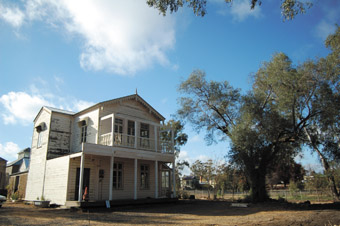
The Avoca Project
photo Nicolas Low
The Avoca Project
AVOCA IS A SMALL PLACE. ONE MAIN STREET, 20 SHOPS, 40 PACES, BLINK, AND IT’S GONE. THE TOWN IS AMONG THE 25 POOREST IN THE STATE OF VICTORIA AND THE TRUCKS THAT ROLL IN TEND TO ROLL OUT AGAIN WITHOUT STOPPING. THERE HAVE BEEN SOME CHANGES IN RECENT YEARS AND, WITH AN INFLUX OF VINEYARDS AND WINE BARS, THE POPULATION IS CHANGING. BUT WHEN I ASKED THE MAN AT THE LOCAL GARAGE IF HE WAS BORN AND BRED IN THE REGION HE JUST LAUGHED. “ONLY BEEN HERE 20 YEARS, MATE. NOT LONG ENOUGH TO BE A LOCAL IN AVOCA.” TWENTY YEARS, AND STILL AN IMMIGRANT.
Unlikely as it may seem, Avoca is the site of senior Australian artist Lyndal Jones’ latest major work. Centred around an ‘immigrant house’, a beautiful, paint-peeling weatherboard hotel brought out from Germany in the 1850s, Jones has undertaken a 10-year project with the Avoca community, international artists, sustainability experts and writers to develop the house as “a poetic image of resilience.” It’s a long-term investigation into art, place and climate change in relationship to Australia’s immigrant communities, with Jones and her resident artists, the first of whom is the UK’s Jane Prophet, slowly charting the house’s integration into a small country town.
When you set out to create any major artwork there’s a lot of practical groundwork to be done. For the Avoca Project this has been literal: replacing the house’s ancient, rotted foundations. This ostensibly practical task is for Jones an integral part of the artwork, speaking of the harshness of our environment and the resilience of the immigrant in the face of radical change. The main body of work to date has thus been a series of long-term processes of “mending the house” incorporating video documentation, simple performances, landscaping and superhuman acts of renovation.
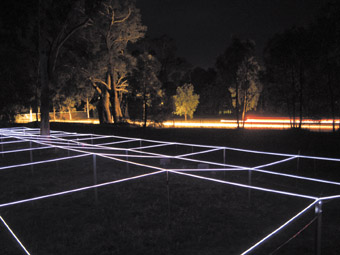
Jane Prophet, Counterbalance, The Avoca Project
photo Nicolas Low
Jane Prophet, Counterbalance, The Avoca Project
There’s also been groundwork to do in convincing people that a house can in fact be a work of art. Art in Avoca previously came in the form of painter and gallery owner Laurie McMurray, whose grey-bearded countenance fits with ideas of what an artist is and does. For Lyndal Jones, working in Avoca has meant spending time simply getting to know locals and building a context in which to work. She has been meticulous in her courtesies, dropping meals off to a sick neighbour, telling people about the work as it progresses, paying her respects despite the fact that the local tradesmen weren’t initially receptive to working for an outsider. Even to some in the city of Melbourne, the project reportedly looks like a budding arts centre or residency program, or worse still, a holiday house. “It’s not an arts centre,” insists Jones. “The house itself, and the processes which surround it over a 10-year period are the work.” It’s an ambitious concept in our real-estate-obsessed times, which equates houses with investments. Jones is instead turning our attention to the life of a house, its history and stories.
It took three years to get this dwelling to a habitable state and, once that was done, the doors opened in November 2007 for Avoca’s newest immigrant, London’s Jane Prophet. In Australia as the inaugural RMIT Creative Media Artist in Residence, Prophet’s a bright-eyed, razor-sharp woman who doesn’t wear her experience on her sleeve. But behind the hilarious anecdotes is a wealth of experience running projects like Technosphere, a multi-user online ecosystem which won her and her collaborators second prize in the Prix Ars Electronica in 1997. Her more recent work in the UK continues a long-held fascination with landscape and artifice, making her an ideal inaugural resident.
For Counterbalance, Prophet created a 12m by 8m stepped grid of electroluminescent light cable. The three levels of the grid are positioned to represent the water levels of three huge floods in the last century. To provide structure for the installation, Prophet used star pickets, a common farming material. By day it looked like the bizarre fencing project of an obsessive-compulsive. At dusk however, when the cable began to glow a fierce bluish white, the installation appeared as an abstract plane of light hovering above the grounds of the house. Designed to be seen by night from the road (and specifically from passing utes) it was a kind of 3D wireframe graph rendered in real life, conjuring the enormous bodies of water that have previously drowned the house.
Floods are part of both Avoca’s and the house’s mythology and in the two months I spent there as writer in residence, numerous people related flood stories. The waters came up to the back steps of the Avoca Hotel. Two foot high over the ticket box at the local sports ground. “Half-way up the kitchen walls and all this work I’m doing’ll be fucked when it happens again,” said a builder working on the house, an evil glint in his eye. Prophet latched onto these stories as the basis for her installation, constructing the grid as both visual reference and conversational anchor point.
In creating Counterbalance, Prophet faced plenty of physical challenges. But being an immigrant, perhaps her biggest challenge was gauging her audience. Avoca is a fiercely utilitarian place and isn’t big on over-opinionated art-savvy types. As a result there was a tangible sense of uncertainty towards the piece. Prophet was caught between the need for her audiences to have an intimate knowledge of local history, the house and the floods, but also familiarity with the visual language of installation. Plenty commented on the beauty of the form itself and there was constant foot traffic past the house, but many others would not be drawn to express an opinion.
On its own, Counterbalance might have been open to the charge from die-hard community cultural development types that it didn’t speak a sufficiently accessible visual language. But it would be disingenuous to read the work in this light. Counterbalance stood on its own as a beautiful, meticulously crafted work of light installation, and its basis in the rich mythology of the floods provided a clear point of entry. What’s more, those gaps between immigrant and local are at the heart of the Avoca project. Counterbalance forms one element of Lyndal Jones’ much larger, long-term project, and is the first step in laying out this relationship for scrutiny and critique.
Jane Prophet, Counterbalance, The Avoca Project, Avoca, Victoria
Nov 8, 2007-Jan 14, 2008, www.janeprophet.com/avoca_web, www.avocaproject.org
RealTime issue #83 Feb-March 2008 pg. 29
© Nicolas Low; for permission to reproduce apply to realtime@realtimearts.net
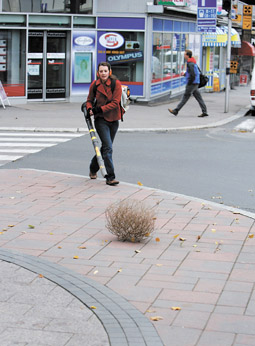
Introducing Tumbleweed to the Finnish Landscape, Claire Blundell Jones, Anti Festival
photo Pekka Mäkinen
Introducing Tumbleweed to the Finnish Landscape, Claire Blundell Jones, Anti Festival
ANTI FESTIVAL, “THE WORLD’S ONLY INTERNATIONAL CONTEMPORARY ART FESTIVAL PRESENTING SOLELY SITE-BASED WORKS” TOOK PLACE IN KUOPIO, FINLAND LATE LAST YEAR. NOW IN ITS SIXTH YEAR, THE FESTIVAL ONCE AGAIN PRESENTED A SERIES OF BROADLY DYNAMIC WORKS THAT ENGAGED INTERNATIONAL ARTISTS AND AUDIENCES WITHIN THE CITY. THIS WAS ALSO THE FIRST YEAR IN WHICH JOHANNA TUUKKANNEN WAS JOINED BY ARTIST/RESEARCHER [AND ONE HALF OF THE UK’S LONE TWIN] GREGG WHEELAN AS CO-ARTISTIC-DIRECTOR OF THE FESTIVAL.
Site-specificity as a form is redefined and refocused by the attention the ANTI Festival gives to its surrounding discourses. Each of the works in the festival not only sets up a dialogue with the site itself, but also allows the audience to playfully and conceptually reconsider the potential for human and environmental encounter within these spaces. A diverse range of places is engaged each year, from small islands in the town’s harbour to a city bank building in the main square to the local grill.
At 10 am on the Friday of the festival, outside the Osuuspankki Bank, “UK artist activist collective of one”, the vacuum cleaner, gave away to the citizens of Kuopio 1000 Euros, including his festival artist’s fee. The money was distributed in a large pile of one hundred thousand one-cent pieces. When we arrive, a large crowd has already formed around the bank. There are cameramen from local TV stations, reporters with microphones and lots of people with buckets and bags. Our host, dressed in a security guard’s uniform, is encouraging people to take as much as they need.
As we inch our way to the front, there’s an awkward feeling as we realise that what we are straining to see is other people scrabbling for money. One man is on the ground, lying over the last few coins while someone else tries to push him off his pile. A man in a wheelchair has pulled himself onto the ground and is seizing the last few coins and shoving them into his backpack. The money disappears in less than half an hour. We heard later that someone had brought a wheelbarrow.
The performance is a proposition. If you join in, you enter into a game that is played everyday, a fight over limited resources, scrabbling to stay on top of your heap. Whether watching the game or playing it you are implicated. The coins had to be shipped into Kuopio from Brussels as one euro cent is too small a currency to be found in great quantities in a wealthy country such as Finland. In order for the money grabbers to spend their loot, they will have to take their wheelbarrows and buckets into other banks around the town and exchange their cents for larger denominations. After the performance, we imagine the hundreds of freshly minted coins continuing their journeys as people do their weekly shopping.
In Introducing Tumbleweed to the Finnish Landscape, Claire Blundell Jones, armed with a leaf blower, escorted a ball of tumbleweed through the streets of Kuopio. Bizarre chance encounters could happen anywhere over the three days of the festival. Down streets, through town squares and along the harbour foreshore, the site for this work was the entire city. As we see Blundell Jones wandering the streets, carefully directing her tumbleweed along the pavements and through parks, a narrative begins to unfold. She becomes a lone ranger, a woman out of place. A relationship is formed between the artist and her accomplice. As she introduces Kuopio and its people to her shy but strong tumbleweed, we begin to see this as an act of love. Over the duration of the performance, through various friendly interventions with people, cars, bicycles and enthusiastic dogs along the way, the mythical American weed slowly reduces to the size of a tennis ball.
he Longest Lecture Marathon, Rebekah Rousi, Anti Festival
photo Pekka Mäkinen
he Longest Lecture Marathon, Rebekah Rousi, Anti Festival
The Longest Lecture Marathon takes place in the Community College over three sessions totalling 27 hours (one 3-hour and two 12-hour sessions) and is billed in the program as the world’s longest Power Point presentation. Performed by Australian artist Rebekah Rousi (now living in Finland), the performance is an odd mix of improvised text, lecture and extended physical score. The piece centres on a series of randomly selected slides, which appear to be a disconnected collection of policy statements from EU policies on Climate Change to VET guidelines for English Language teachers. Rousi elucidates each slide, word by word, to the audience/class in what feels like a strange English language lesson. She explains each word simply, jumping on tables to demonstrate the meaning of “on”, finding increasingly bizarre ways to describe words, sometimes surprising and amusing herself with her own discoveries.
We go back a few times over the three days; Rousi is always energetic, welcoming newcomers to the class and returning immediately to her slide. When we go back to the schoolroom, an hour before she is due to finish, a number of people have gathered to witness the end of this great feat. The artist is carrying on with the same enthusiasm we had witnessed earlier. She never seems to flag even if she is looking a little dishevelled, her mascara running down her face (she’s either been laughing or crying earlier that day). We all hang on her every word. This performance is like a seed that takes root in you. For the last two days we have wandered the town always aware that in that room Rebekah Rousi is still going, her rhythm, tone and language firmly lodged in our minds.
On the Saturday, on the other side of town, Simon Whitehead [UK] rowed between the harbour and Vasikkasaari Island, inviting people to join him from dawn until sunset in the ritual building of a large bonfire. The fire was made from found bits of wood from the island and the offerings people brought, which ranged from sticks and leaves to household furniture and an apple. Our crossing was the last for the day and we had to move quickly as the sun was setting and Whitehead had last minute preparations to attend to before the final ritual burning. Despite cold and fatigue the artist spoke with warmth and generosity, inviting us onto the boat. We were asked not to speak during the journey, setting the tone for the next thirty minutes where every act was slowly pared back to basic necessity as we turned our focus inward towards the island.
We walk in silence into a clearing. To the left is a large table surrounded by white birch trees and toadstools. To the right is a large bonfire built to perfection in tepee symmetry by Whitehead and the strangers who had come before us. We stand there, taking in the calm beauty of it all, not really sure what to do. The artist points to the table and whispers more instructions. He asks us to record our gifts and our reason for bringing them in a book, a ritual inventory of the fire, and then to join him at the beacon to place our gift. He gestures for us to sit with him on the large rock next to a wooden mound. We look out onto the shore, back to Kuopio where the offering will shortly be directed. He lies down, we follow, and together we stare at the sky.
When we return to shore, we’re invited to stay to see the beacon of light burn at sunset. The experience, a slow, peaceful and yet fleeting encounter with the island, feels rooted in the island’s elusive temporal reality. The performance concludes beautifully in the final act of burning.
The ANTI Festival, Sept 27-30 2007. www.antifestival.com. Other Australian artists in the program included Rosie Dennis and the writers Madeleine Hodge and Sarah Rodigari (Panther), a performance collaboration currently based in Melbourne. www.pantherpanther.com
RealTime issue #83 Feb-March 2008 pg. 30
© Panther ; for permission to reproduce apply to realtime@realtimearts.net
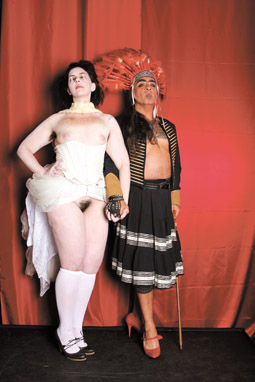
Sarah Jane Norman, Guillermo Goméz-Peña, La Pocha Nostra, The New Barbarians
photo Carl Newland
Sarah Jane Norman, Guillermo Goméz-Peña, La Pocha Nostra, The New Barbarians
DURING LA POCHA NOSTRA’S THE NEW BARBARIANS FALL COLLECTION 2007, IN AN UNQUANTIFIABLE WAY, RAJNI SHAH HAD BEEN PARADING SPIDER-LIKE UP AND DOWN THE FASHION SHOW RUNWAY FOR SOME TIME, NAKED BUT FOR A BLACK CHOKER, WITH AN ANIMAL SNARL AND DARK ARTERIAL BLOOD SMEARED ACROSS HER FACE.
Slowly, quietly, Australian artist Sarah Jane Norman—similarly unclothed except for various thin black trusses dissecting her body and a rubber mask of what looked like Condoleezza Rice over her head—made her presence known at the opposite end of the catwalk. I can’t even remember what was playing on the soundtrack at the time because by then the entire experience had battered me into helpless submission. Ninety minutes of noise, fury and fashion, culminating in La Pocha Nostra and their associate artists making me vibrate with the heartbeat regularity of a quartz crystal.
Days later, details of New Barbarians are still repeating upon me like snatches of a half remembered dream, sneaking up, unexpected and often unwelcome, triggered by some innocuous element of my daily life. BAM! There’s Alex Bradley, hauling himself the length of the catwalk by means of the connecting spars of two lighting clamps, the metal props attached to his wrists, instruments of torture, clunking painfully into the wood of the runway. BAM! Roza Ilgen [RT81. p34], her form entirely covered in human hair, short-arsed, sporting breasts and a beard like some long lost evolutionary by-road: Captain Caveman, Morlock, Bigfoot, arms splayed out, a perverse Christ, the audience cheering her enthusiastically. WHOOSH! The sound of a mad Mexican woman jabbering away down a telephone line, unintelligible, distorted, insane. BOOM! BANG! Guillermo Goméz-Peña suddenly breaking into a native American chant, all the while pouting ridiculously like Derek Zoolander. GO!
Presented in the mode of a fashion show, New Barbarians keeps all the rituals, bluster and bombast of such events intact. The audience have been told to “dress for the catwalk” and most have obliged. There’s a foyer preview, free drinks, a rat pack of photographers (all uniformly name-badged PAPARAZZI SCUM) and once we are led inside the auditorium there’s VIP seating at the runway’s edge, a hammering soundtrack, plus some disjointed and deliberately mashed-up films projected onto a screen above the throng—cutting rapidly and queasily between ethno-geographic documentaries, rehearsal footage, adverts, military recruitment films and Middle East news stories. There’s the obligatory show manager hustling models to and from the stage with a constant air of unflappable yet pissed-off efficiency.
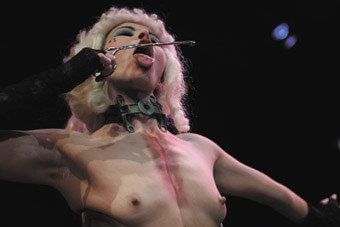
Violeta Luna, La Pocha Nostra, The New Barbarians
photo Carl Newland
Violeta Luna, La Pocha Nostra, The New Barbarians
Goméz-Peña, founder member of La Pocha Nostra, holds court on a platform opposite the runway, freezing the noisy proceedings regularly in order to deliver verbose treatises in a patchwork of languages, physically inhabiting a space somewhere between a Hopi tribal chief and Karl Lagerfeld. His consort is a snappy-suited female announcer who gives voice to the catwalk at random, speaking over the soundtrack in measured sing-song tones, offering performers for sale, encouraging the audience towards acts of rebellion or cultural vandalism. It is relentless, and total. It also has that single most important clash of textures prevalent in the world of fashion: the constant, repeated intertwining of the profound and the utterly meaningless, holding the event together like warp and weft. There’s the all-pervading sense that what we’re witnessing is the creators throwing a huge amount of stuff at the wall, and seeing what sticks. It’s exuberant, funny, unapologetic…and occasionally feels as if it’s in danger of collapsing under its own weight.
La Pocha Nostra have spent much of the last 15 years conjuring up and making flesh this world of border and hybrid cultures, building a creative lab where cultural phenomena undergo a type of rapid, barely controlled fission. The forms (it doesn’t feel right to call them ‘outfits,’ somehow) on the runway tonight are the gene-spliced bastard children of the communications satellite and the nightclub, bearing the family traits of hip-hop, sado-masochism, YouTube and airport terminals, cheap handguns, DVD boxsets, protest marches and internet porn, speaking cross-Phillipino-Icelandic with a Brazillian/lowland Scots accent, listening to klezmer-grindcore on their iPods and spending their holidays on the fucking moon.
As they tour the world, Goméz-Peña and a crew of three or four permanent cohorts ‘collect’ associates, throwing further spices into their melting pot. The diverse bodies are all artists, all complicit, all having made themselves beautiful in their own eyes, no doubt via some mediation on the part of their hosts. As a result of this diversity it’s unsurprising that many fascinating socio-political concerns are manifest in each model parading back and forth before us: power play appears to be a fundamental building block of their interactions; gender is not so much bent as blended, a thick chromosomal soup; and the models borrow ‘clothes’ from every religion and religious impetus that crawls beneath the sun. BAM! Harminder Singh Judge, gas-masked with the multiple arms of a Hindu deity strapped to a crucifix. CRACK, THWACK. Jade Maravala, a stiletto-heeled terrorist with a Nike swoosh adorning her hijab. BANG! Jiva Parthipan performing an exuberant, grinning Kathakali dance with a handgun stuffed into his crotch.
The crossbreed cyber-sexual rebellion of New Barbarians might sound disconcerting, but it’s not what gave me the shakes. It wasn’t even the implication that somewhere beneath the fashion show there was a bubbling bloodbath of righteous violence. What I was watching, after all, was a distillation of a million things, people and places that already exist, active, actual, accessible either physically or technologically, far from alien or inhuman in any conceivable way. The danger wasn’t in the shapes, nodes and ideas.
I certainly wasn’t shaking with indignation, as I loved the damn thing: feeling oddly, happily at home. I’ve heard since the show that some people actually found New Barbarians offensive, but it’s completely inconceivable to me why. I can’t understand how anyone could be offended by such a vivid celebration of the possibilities of human synthesis. Sure, there was plenty of perverted religious imagery; much nudity (some of it in the areas euphemistically and uselessly described as ‘graphic’); and little, if any, explanation of what you were seeing and why it was there—only a sly announcement before the catwalk burst to life that the audience shouldn’t take all they saw “entirely seriously.”
But still, what’s offensive about that? La Pocha Nostra’s magpie tendencies are wonderfully indiscriminate, irreverent in equal measure towards male, female, Christian, atheist, Buddhist, left, right, rich, poor. Basically, if you’re human, you’re fair game. To me, being offended by New Barbarians is about as logical as being offended by Rio De Janeiro, Singapore or Los Angeles—all of them by no means short of culture clashes, bastardised religions, ridiculously beautiful people and plenty of senseless violence.
And maybe that explains why I was shaking. It was like an overdose. Perhaps if you can picture the entirety of Singapore, Los Angeles, Rio De Janeiro, London, New York, Paris, Milan…imagine every last inch crammed into a hypodermic and injected forcibly straight into the base of your spinal column—an instant download of more dirt, glitz and mixed messages than you could possibly handle.
La Pocha Nostra, The New Barbarians, Fall Collection 2007, Arnolfini, Bristol, Nov 10, 2007
Read about La Pocha Nostra’s Muesum of Fetishised Identities at Performance Space Sydney RT44, p32; RT56, p32; and RT58, p11
RealTime issue #83 Feb-March 2008 pg. 31
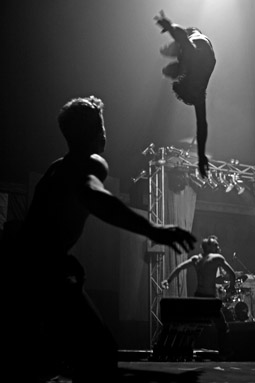
Tom Tom Club
courtesy of Strut & Fret
Tom Tom Club
FOR ALL THE AUSTRALIAN TOURING THAT TOOK PLACE IN 2007, SUPPORTED BY PLAYING THE WORLD AND INCLUDED IN SEASONS LIKE OZMOSIS AT THE BARBICAN IN LONDON OR THE FESTIVAL OF AUSTRALIAN THEATRE IN CHINA, THERE ARE NUMEROUS NEAR-MISSES OR UNTIMELY REVERSALS WHICH GO LARGELY UNREPORTED.
Restless Dance Company withdrew from a project with Shanghai’s Special Olympics this year due to a lack of focus in the artistic program at the Chinese end. Marrugeku lost the second venue on their 2007 tour at the last minute, salvaging their ZurichTheaterspektakel presentations only by turning them into a showcase. Other companies such as Lucy Guerin Inc report invitations from across the globe which they have been obliged to turn down because they cannot be connected into a viable tour. Performer Moira Finucane sums it up thus, “International touring is an enormous amount of logistical and creative work, across currencies, travel arrangements, freight, borders, customs, different venues, languages, cultures and varying expectations.”
marrugeku
Complications aside, Australian artists report a genuine enthusiasm for their international experiences, whether they are fresh to the fray or old hands. Companies like Stalker and Marrugeku have been working on the international circuit for over a decade. In 2007 the company was commissioned to create Sugar for Liverpool’s European Capital of Culture celebrations. This major production involving artists from Burkina Faso, Liverpool, Marseilles and Australia and supported by a variety of European funds, was a huge project to pull off. Artistic director Rachael Swain says, “We have been touring for over 15 years. It’s how we survive. We make work to sell internationally but we still rely upon grant support. We were recently invited into the Australia Council’s Export Development Initiative which had the pre-requisite that companies would become self-sustaining within three years of investment into international touring. We had to give up half way through and return the funding. We did make great progress in terms of advocacy and profile by using this investment to travel and network, but it costs us $60-$70K just to take a show overseas. It’s unrealistic to think we can make a profit like that.” Swain speaks from the privileged standpoint of working with one of the most highly regarded European agencies, Frans Brood. Despite her admiration for the work of its director Guy Baguet, with whom she has collaborated for 12 years, she is concerned that there is currently, “less scope out there, even with the bigger festivals.”
strut & fret
If scale is perhaps the double-edged sword upon which Stalker and Marrugeku’s international profiles rests, smaller companies, newer to the business are more gung-ho about their international opportunities. Scott Maidment at the Brisbane-based Strut & Fret Production House has had an unprecedented year with three massive hits at Edinburgh’s Fringe festival. Men of Steel, Tom Tom Club and Meow Meow all received rave reviews and added extra shows to sold out seasons. Maidment has been overwhelmed with interest from producers and is currently negotiating a Broadway run for Tom Tom Club and overseeing a seven month international tour for Men of Steel. Maidment took a team of 17 people to Edinburgh—“a huge investment” for his small operation. Yet he says, “We got more work done there than in three months of emailing.” Maidment’s leap of faith was informed by research into other production houses overseas and investment in travel to European festivals such as Avignon and Chalon dans la Rue. Whilst he says there are “no role models in Australia for what we want to do“, Maidment is already seeing the returns on largely unsubsidised trips and building a sustainable business strategy out of hard work and risky decisions.
circa
Yaron Lifschitz, artistic director of the Brisbane-based physical theatre company Circa, shares Maidment’s entrepreneurial approach, citing “focus, strategy and luck” as the motor driving Circa’s recent prolific touring. From a single showcase in Korea in 2005, Circa have toured to North and South America, the UK and Europe and are contemplating a raft of invitations for 2009. Lifschitz says that Circa has been driven overseas by the “huge competitive disadvantages we struggled against in Australia”; “the income and recognition we have gained internationally has increased the cultural value of Circa in Australia…We had to get famous to survive.” Lifschitz repeats Swain’s comments about commitment, but is more aligned with Maidment when it comes to priorities. “We have three criteria for whether we tour”, he says, “strategic, financial and logistical. If two out of the three make sense we will do the tour.” He pauses before adding a fourth criterion, “Fun. If it is likely to be fun, we are always going to consider it.”
rosie dennis
This trend of quietly investing in travel and research is borne out by individuals such as Sydney-based Rosie Dennis, who has been overseas three times in 2007 [RT81, p15]. Dennis’ solo performance tours have been funded by the Australia Council and Playing the World, but she has also self-funded some of her travel and added side-trips to each gig, to network and develop her relationships with one or two other markets where she finds a response to her work.
back to back
Geelong-based Back To Back Theatre have been equally successful in Europe in 2007. Executive Producer Alice Nash says, “We feel privileged that there has been such strong support for the work. In 2007 Back to Back toured Small Metal Objects, to six international cities and in 2008 we have six presenters in North America confirmed. The hardest parts have been working out how, as a small company, to structure ourselves to deal with it, and giving ourselves permission not to do every little thing ourselves. And we’ve had to determinedly allow space for the development of new work for the future. Of course, we will hope for international commissions in the long-term, but it’s important not to get ahead of ourselves too. We are an idiosyncratic company and we are learning how our practice sits in different contexts. We hope to engage in dialogue that makes artistic sense for us and for those who present the company.”
australian art orchestra
Nash’s account of juggling is repeated by Australian Art Orchestra’s General Manager, Ann Moir. She says, “It takes a lot of time, patience and belief in the program. Things outside of our control have to fall into place. Logistically it is a case of putting in the hours and getting all the plans worked out before starting out.” AAO’s four city tour of India in 2007, in collaboration with Indian artists, is the result of an investment in India which began in 1996 with Department of Foreign Affairs and Trade support. With 25 artists on the road, AAO is not an easy company to tour and Moir has few expectations of global domination, preferring to select partnerships for the long-term which will reap rewards for the company.
urban theatre projects
These long-term objectives are shared by Urban Theatre Projects whose first serious dialogue with an international presenter began at APAM [Australian Performing Arts Market] in 2006. Harbourfront Theatres invited the company to create a Canadian version of their Back Home production in Canada in 2007 and are now discussing a major new work to be made there in 2009. General Manager Simon Wellington recognises that this relationship has changed and will continue to change the nature of the UTP which, “up to 2003 was still in the cycle of making large community participatory work.”
branch nebula
Meetings at Arts Markets crop up frequently and reinforce the importance of networking and discussion between artists. Whilst some see immediate returns, such as Branch Nebula, supported by Performing Lines, who pitched Paradise City at APAM 2006 and subsequently toured to Brazil in 2007, others start lengthy dialogues which may or may not lead to touring and commissions.
chunky move
Chunky Move have been exploring international markets for several years, but it took the hugely successful solo, Glow, to really ignite sustained interest in Gideon Obarzanek’s work. Glow’s small scale and large impact has opened the UK, US and Asian markets for Chunky Move in 2007 and North America in 2008.
adt
The power of a production ideally suited to touring is something which Australian Dance Theatre can attest to, as their recent UK tours of Held and Birdbrain demonstrate. Serving to break into a market and establish a profile, signature productions can forge the way for more complex presentations, as ADT have proven with Devolution touring to Paris’ Theatre de la Ville. ADT are not resting on their laurels and have secured an international commission from the Joyce Theatre in New York and the Southbank Centre in London for Garry Stewart’s forthcoming production G, a response to the ballet classic Giselle, and Stewart was recently commissioned to make a new work for London’s prestigious Ballet Rambert.
right product, company & attitude
The right product with the right company attitude and the consistent investment in international relationships clearly bears fruit. Witness William Yang’s repeated international touring, Taikoz’s return trips to Japan and Finucane and Smith all over Europe in 2007. Whilst there is no magic formula and luck crops up in almost every conversation, it is clear that Australian companies large and small are reaping rewards internationally which pay dividends at home and that this looks set to continue.
For reviews of Circa and Back to Back
performing at PuSh, Vancouver see p8 and p10
RealTime issue #83 Feb-March 2008 pg. 32
© Sophie Travers; for permission to reproduce apply to realtime@realtimearts.net
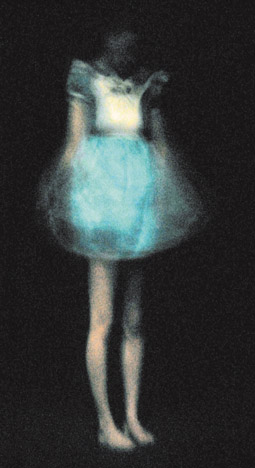
Tracing Shadows, Helena Hunter
IN 1971, THE LOCAL GOVERNMENT OF CARDIFF, WALES, AGREED TO A BOLD EXPERIMENT. AS AN ALTERNATIVE TO CONSTRUCTING NEW BUILDINGS TO HOUSE THE ARTS, THEY ACCEPTED THE PROPOSAL FROM LOCAL ARTISTS TO ALLOW THEM TO OCCUPY AN OLD HIGH SCHOOL ON THE WESTERN, MORE INDUSTRIAL SIDE OF TOWN. THIRTY-SIX YEARS LATER, CHAPTER ARTS HAS EVOLVED FROM ITS COMMUNAL, ARTIST-RUN ROOTS INTO A MORE PUBLICLY ACCESSIBLE COMPOUND OF THEATRES, CINEMAS, STUDIOS FOR HIRE, AND AN ART GALLERY, BUT IT RETAINS A CLOSE CONNECTION TO THE CITY AND A PARTICULARLY WELSH FLAVOUR OF ARTISTIC EXPERIMENTATION.
This commitment is demonstrated by Chapter’s annual Experimentica festival, now in its seventh year, where the emphasis on promoting a wide range of artistic practices is one of its real strengths. At this year’s festival, the week-long program brought together sonic arts, film, performance, movement and installation. The work seemed to take over the whole building, with the former classrooms becoming sites for examination and testing of received forms of performance such as puppetry, cabaret, and installation.
Perhaps it’s just a coincidence, but the work at Experimentica which is most markedly cross-disciplinary also tends to be addressing ideas of Welshness. Sonic arts collective Gwrando create a shrine to lost Welsh music, mixing the cracked and distant sound of dozens of discarded Welsh language records with live singing and film. The effect is a rich evocation of the way in which our relationship with the past is fragile and fragmented—as is our experience of presence. In Cerdded Adre (The Long Walk Home), Rowan O’Neill combines historical lecture and autobiography with fragments of performance, using playful self-reflection to both celebrate and critique the layers of fakery involved in performing national identity. In On Running, Gareth Llyr and Louise Ritchie also work with the tension between description and event, combining improvised dance with handheld video to explore how an experience of the landscape around them can be brought into the contained space of the theatre.
With their crowd-pleasing work Cabba Hey, performance duo Mr and Mrs Clark discover a neat trick with regard to expectation and experimentation. By framing their performance within the cabaret format they invite an audience to react to their work as comedy, and this allows the Clarks to be as experimental as they want without ever worrying about being labelled pretentious. They start out with bags over their heads, and in a series of musical skits strip them off only to reveal or assume more and more masks. Disavowing seriousness, they can actually be increasingly serious: upon closer study, their piss-take choreography is more choreography than piss-take (including a faithful reproduction of the Martha Graham technique). When they perform a ventriloquist act with Mrs Clark as live dummy, it is both absurdly hilarious and heartbreakingly earnest, a balance that has everything to do with painstaking attention to the details of their performance.
Experimentation involves looking back to the past as much as looking forward to the unknown, and the Clark’s Cabba Hey could be seen as a knowing reflection on early 20th century Dadaism. But if Dadaist cabaret was insurrectionary theatre, then this is insurrectionary cabaret, in that what makes it pleasurable is its more and more clever deferral of pleasure. And so, one of the Clark’s closing numbers does literally what the Dadaists attempted metaphorically, giving the finger to its audience—and the audience loves it.
Puppetry doesn’t often find a place in experimental theatre festivals, but Jeong Geum-Hyung’s duet with a vacuum cleaner is a reminder of how fantastical, magical and disturbing a form it can be. The long hose of the vacuum cleaner has a man’s head at its end, the gaping suction hole his mouth. Throughout, this face appears to be the only animated thing in the room, with the rest of Jeong’s body completely lifeless and inert. In a reversal of roles, the face-object appears to manipulate Jeong’s body to serve its masculine desires: lifting her to her feet, rolling her across the floor, and ultimately using her as an object of its own bizarre and disturbing sexuality. The effect should be comical, and at times is, but it is not the comedy of the absurd but that of the absolutely truthful and perfectly executed. Jeong’s work addresses issues of control and manipulation and of animation and death—exactly the realm of puppetry, but Jeong’s brilliant performance is a reminder of how exciting it can be.
Joost Nieuwenburg’s Common Sense combines the welcoming experience of installation with the arduousness of durational performance. A one metre high by three metre square box, contains Nieuwenburg, a stove, a sink and several kilos of onions. Only able to crawl, he peels and chops the onions for four hours, adding them to a pot which is always cooking. A swimming pool ladder at one end of the box invites us to climb on top, from where we can see the artist through a small vented porthole placed directly above the simmering pot. Another small window on one of the side panels offers a different vantage point. The smell and the heat escaping these windows are overpowering, as is the image of Nieuwenburg sweating and crying inside. As the day wore on, the darkening room became illuminated only by the glow from within the box, and there was an exquisite contrast between the warm peacefulness of the room, the aesthetic pleasure of the shining, meticulously crafted object, and the infernal labour going on inside.
The final performance of the festival, Helena Hunter’s Tracing Shadows, feels like it would be at home within the live art genre, with its use of intense imagery to address the material presence of the body—but it’s an experience entirely mediated by the mechanisms of the theatre. Hunter employs a veritable arsenal of theatrical tricks: projections and pulleys, carefully calibrated lights and sound effects, and darkness as cover for theatrical sleight-of-hand with which to surprise the blinded audience. But its central concern is Hunter’s barely visible body, her naked back twisting and straining in the faintest of light. In brief glimpses through the blackness we see blue ribbon pouring onto her body, a child’s dress appearing in the darkness, and Hunter’s body writhing and breaking in an attempt to fit into the impossibly small dress. These elements create a fairytale world that combines the seductive and the destructive, the childlike and the adult, desire and the artificiality of desire. Like fairy tales themselves, Tracing Shadows relies entirely upon the contrivances of its formal conventions, and at the same time, it is eerie and compelling.
The range of work presented at Experimentica allowed for intriguing explorations of cross-disciplinarity, Welshness and the dynamic tension between artifice and authenticity. Above all the festival was most commendable for its genuine commitment to experimentation. This was an environment where untested work could be tried and where artists could talk openly with each other and their audiences about the challenges they were addressing. It’s rare to find a place that values process as much as product, but it’s clear that experimentation has a welcome home in Cardiff.
Experimentica 07, Chapter Arts Centre, Cardiff, Wales, Oct 16-21, 2007, www.chapter.org
RealTime issue #83 Feb-March 2008 pg. 33
© Theron Schmidt; for permission to reproduce apply to realtime@realtimearts.net
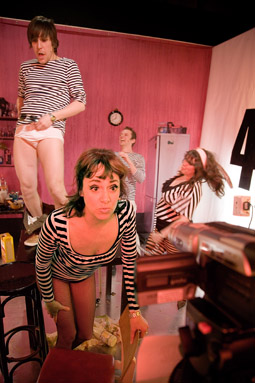
Gob Quad, Kitchen—You’ve never had it so good
WE ARRIVE IN BERLIN TO MEET GOB SQUAD FOR THE FIRST DAY OF THE SECOND PHASE OF REHEARSALS ON A NEW WORK THEY ARE CALLING SAVING THE WORLD. HAVING SEEN THE LAST FEW DAYS OF REHEARSALS OF THEIR 2005 PRODUCTION KING KONG CLUB, WE ARE FAMILIAR WITH THE SYSTEM. THERE IS NO DIRECTOR OR LEADER. THERE ARE SIX CORE ARTISTS, BRITISH AND GERMAN, WHO ARE JOINED ON EACH PROJECT BY TWO TO FOUR GUEST ARTISTS, A TEAM OF VIDEO AND SOUND AND TECHNICAL CREW, AND PRODUCTION PEOPLE. THIS COLLECTIVE SYSTEM LENDS ITSELF TO A CERTAIN SORT OF ANARCHY WHERE DECISIONS SEEM TO BE MADE BY THE LOUDEST OR MOST PERSISTENT VOICE IN THE ROOM OR WHOEVER HAS THE LAST SAY.
In 2005 we soon found ourselves standing nervously backstage for a trial run of King Kong Club dressed as hairy apes alongside 28 other ape-suited audience members. For the next thirty minutes we gleefully followed the firm but charming directions of five Gob Squad performers (dressed as film directors) through the filming of various nightclub scenarios: an orgy, a boot-scooting dance, a rock band performance, a cocaine snorting toilet scene and some pole dancing. Each scenario lasted only a few minutes before we were whisked away by another director into another phantasmagoria; heroic, awkward and ridiculously good fun.
The end of the filming is not the end of the show, there is brief intermission (to allow time for some clever edits) before we sit in the theatre and watch the movie we have just created. It seems that to see a Gob Squad performance is to literally be part it. It’s the immediacy of Gob Squad’s performances, this seamlessness between performance, video, and audience that excites us and leads us straight back their studios when we visit Berlin again.
We are back in 2007 to sit in on two weeks of development of the company’s latest production, Saving the World. The concept seems simple enough, Gob Squad arrive in a city and find a town square. “The best way to think about the kind of place we are looking for is that it’s the kind of place where you would set up an Imbiss (a German food van)”, says Sean Patton. They then film, via a complex system of cameras, a full, seven-camera panoramic view of the square. This material is then played back to an audience in a large theatre filled with the 360 degree seven-screen film. “Saving” therefore also means capturing, recording and preserving, and even understanding. The project seems to be simultaneously trying to deal with the end of things as well as the possibilities for utopian beginnings.
Gob Squad create performance events that combine audience interaction, live video and performance in real time; editing, if any, happens during the event itself. The company have been developing this performance genre over a number of years and how they use it is central to the conceptual development of each work. In each piece a relationship is formed between the audience and the performers in the creation of filmed live action. Saving the World will have its world premiere in June at Kampnagel, Hamburg.
During the development period we witnessed a number of wild discussions over cake and coffee about video time versus real time in the new work. How would the work capture a full 24-hour period in the square and show it back in a two hour theatre piece? What time periods is it important to capture or save? How then does the captured time of the panoramic video recordings relate to the live time in the theatre? Is it important to maintain a link between the recorded world and the world inside? Should the filming be done in the 24 hours before each show; or does the link in time not matter; can it be filmed next week and shown in May; what does this do to the relationship between film and audience? Alongside all of this, technical experts in the company are testing the possibilities for the successful execution of any of the many possibilities that are raised in these discussions. Our minds reel at the possibilities that are opened up in the fertile grounds that are Gob Squad’s cake and coffee afternoons.
Gob Squad, Kitchen—You’ve never had it so good
After a week of being in Gob Squad’s world, we are invited to see a rehearsal and then performance of their most recently completed work. In Kitchen—You’ve never had it so good, Gob Squad create their own Warhol Factory playing themselves in three Andy Warhol films, Kitchen, Sleep and a series of screen tests. The premise is very simple, or at least it should be. It’s a kitchen with people doing things in it. It’s a person sleeping. It’s a couch with a person staring into camera. The lights go down and three films start rolling simultaneously.
“Hello, thanks for coming, and welcome to Gob Squad’s factory. My name is Biret and tonight I will be paying the part of Biret in a film called Kitchen by Andy Warhol. It is New York 1965 and the times are a changing…and here in Kitchen we are at the cusp of everything because this film that we are in is the essence of its time.”
These films are projected simultaneously onto a single screen in a theatre. Behind it Gob Squad are performing live to camera in three adjoining film sets. They move in and out of the films, swapping the roles of various clichéd personas from the Warhol era. The films are each constantly undermined by disruptions happening in the others.
Seeing this re-enactment is like watching a group of people trying to work out how to make a period film. They can’t quite get it right and, of course, this is the point. Too much time has passed, too much has changed between 1965 and now. The essence of Warhol’s time is not the essence of Gob Squad’s time. In their frustration, the performers stop the film, they walk out from behind the screen and one by one replace themselves with an audience member. The performance ends with Gob Squab in the audience. With us standing in their place, they can be a blank canvas; they can be whoever they want to be. Gob Squad are making a new film before our very eyes and it’s free of histories. They are capturing the essence of here, right now; live in front of a camera and with an audience.
When we return to the studio the following week to work on Saving the World, we start again puzzling out the performance, trying things out, coming up with simple structures, short sequences that might be what we’re looking for. We go out into the street with cameras and try it all out—homemade time lapse, talking to passersby about the future, trying to explain the world. As we go through this process we realise again that the openness, robust experimentation and curiosity witnessed in Gob Squad’s performances is carried over into the way they make work. The process of making the work is much like the final product: people are invited in, the world opens up to Gob Squad and Gob Squad opens up to the world.
As we are leaving Sarah Thom smiles her winning smile at us and says, “Bye Panthers. Feel free to steal anything from us that you like!” Perhaps they are saving the world in more ways than one.
www.gobsquad.com
RealTime issue #83 Feb-March 2008 pg. 34
© Panther ; for permission to reproduce apply to realtime@realtimearts.net
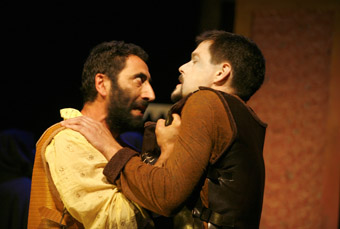
Rodney Afif, David Trednick, Not What I am, Othello Retold
photo Ponch Hawkes
Rodney Afif, David Trednick, Not What I am, Othello Retold
IT’S COMMON FOR THOSE SEEKING NEW AND VITAL MODES OF PERFORMANCE TO DECRY THE SLAVISH VENERATION AFFORDED THE ‘CLASSICS’—TO MOAN ABOUT THE WAYS IN WHICH NEW VOICES ARE DROWNED OUT BY THE INCESSANT BABBLE OF SAME-OLD SAME-OLD SHAKESPEARES AND IBSENS AND VARIOUS GREEK FELLOWS. I’M ONE OF THESE CRITICS, I’LL CONFESS—AN UNKNOWN QUANTITY WILL LIKELY PIQUE MY INTEREST MORE THAN ANOTHER ROUND WITH BRECHT, GENET, EVEN LOVELY MR PINTER. BUT I’VE ALSO REALISED THE CURIOUS PARADOX OF THIS POSITION: CANONICAL TEXTS ARE MORE FREQUENTLY TREATED WITH DISRESPECT THAN NEWER WORKS.
For better or worse, many directors seem far more comfortable messing about with tired old plays than they are with fresh and unknown ones, and this isn’t just at the level of independent theatre. Benedict Andrews’ Sydney Theatre Company production of Patrick White’s The Season at Sarsaparilla is exemplary. Andrews worked both with and against White’s grand and imposing text to produce a very layered, ironic response. It’s less often that one encounters the same kind of treatment—of questioning, of interrogating or deconstructing—when we see a director handling a hot new work from an emerging writer.
The Eleventh Hour’s mission is to revitalise classics, and they do this as well as—if not better than—any other company in Australia. They don’t simply dress up old plays, or use them as vehicles for an alternative agenda. For company directors Anne Thompson and William Henderson, the works of Shakespeare, Beckett or Wilde endure for a reason, but this doesn’t mean that their job is simply to present the most faithful production of each possible. Instead, they tease apart their source material to reveal the intricate complexities holding each text together.
Their most ambitious endeavour so far has been their recent production, Not What I Am—Othello Retold. Here, Thompson’s direction saw the bard’s iconic play unravelled to its barest threads and rewoven into a performance work both redolent of the original and utterly other. The greatest testament to the work’s success was in the way Othello Retold regularly blurred presentation and interpretation—one often had to ask “was that in the original play and I’ve always missed it, or is it something new?”
This occurs most obviously in a kind of hyper-sexualisation of the play. When characters aren’t actually fucking each other they’re groping, fondling or kissing, often while conversing with others. It’s an uncanny approach to the erotics of Othello—laying bare the sexual jealousy at the work’s core and therefore making its audience search harder for other subtexts. Then again, by emphasising a heightened carnality in the work, one can’t be sure how much is simply drawing from Shakespeare’s play and how much has been added to it.
Rodney Afif’s Othello is a Middle-Eastern military man driven to murder by the racist machinations of Venetian society. His tragedy unfolds in a nightmarish city of unstable boundaries—Julie Renton’s magnificent design of floating walls transforms itself in an instant— and a shadowy, cloaked chorus represents the invisible society looking to bring about the Moor’s destruction.
Afif’s Othello, though set upon, is not merely the noble hero driven to madness by a cruel world, however. He is far more human—angry and confused, unable to properly articulate his fear and finally revealing a savagery that can’t wholly be the result of his torments. He is a deeply ambiguous character, both victim and perpetrator of violence, and this sophisticated portrayal denies any easy conclusions.
As Iago, David Trendinnick provides an excellent foil—a lascivious and ultimately pitiable wreck of a being, a monster worthy of contempt, not fear. Shelly Lauman’s Desdemona is of a less subtle hue but still evokes the sympathy necessary to instil a growing sense of horror as events take their inevitable turn.
There may be a little too much going on in this production. It’s so fertile as to at times overwhelm with significance, and the result is a dreamlike, kaleidoscopic experience of a story seemingly done to death. Just how a classic should be.
Red Stitch Actors Theatre occupy the opposite end of the spectrum—you won’t find many classics in its half-decade history. The company is more concerned with producing the works you haven’t seen, and presenting to Melbourne the best international (and, increasingly, local) plays available. Red Stitch is primarily an actors’ company, and as a consequence, the imperative is often to do a play justice, rather than to problematise it. For better, again, or worse. When the company gets it right, the results are, on occasion, stunning. Motortown fits this category. The play was completed by UK writer Simon Stephens in only four days—hardly encouraging—but is possessed of an unexpected depth and rigour superbly realised in Red Stitch’s final production of 2007.
Like Othello, Motortown’s central character is a military man coming home and coming undone. Danny returns to England after a tour of duty in Iraq. His attempts to reconnect with a woman he had once briefly dated reveal his nostalgic delusions about the past; her rebukes see him purchasing a handgun and seeking out some kind of revenge against the world he has returned to.
The play is composed of a series of vignettes, mostly duologues, in which Danny encounters another example of hell on his home turf. He is a barely contained bottle of rage, but this is slowly revealed through conversations with his disabled brother, his put-upon ex-lover, a local shopkeeper and a London low-life. Danny’s world, like Othello’s, gives him no space to speak his hatred and fear, and he ends up exploding violence upon an innocent woman. Or doesn’t: where Shakespeare uses violence to conclude tragedy, the bloody climax of Stephens’ work occurs at its centre, and its affective aftershock is the work’s triumph.
Motortown doesn’t simply end with Very Bad Things as the inevitable outcome of a society’s misdeeds. There’s no cathartic conclusion before we go home to bed—Danny’s miserable existence continues as rich swingers abuse him, home life doesn’t improve and his self-loathing only grows.
Director Laurence Strangio is no stranger to experimentation; his longstanding collaborations with Caroline Lee have proven his abilities to reconstruct literary classics with a keen and unwavering hand. Here, though, he has demonstrated the worth of staying true to a work’s essence, of finding the ideal register that causes a play to resonate long beyond its final note. Find the right play, and you’ve created a new classic.
The Eleventh Hour, Not What I Am: Othello Retold, from William Shakespeare’s Othello, director Anne Thompson, performers Rodney Afif, Shelly Lauman, David Trendinnick, Jane Nolan, Stuart Orr, Greg Ulfan; designer Julie Renton, lighting designer Kick Pajanti, composer Wally Gunn; The Eleventh Hour Theatre, Melbourne, Dec 1-15, 2007; Red Stitch Actors Theatre, Motortown, writer Simon Stephens, director Laurence Strangio, performers Richard Bligh, Brett Cousins, Cleopatra Coleman, Verity Charlton, Dion Mills, Sarah Sutherland and David Whitely, designer Peter Mumford, lighting designer Richard Vabre; Red Stitch Actors Theatre, St Kilda. Nov 21-Dec 22, 2007
RealTime issue #83 Feb-March 2008 pg. 35
© John Bailey; for permission to reproduce apply to realtime@realtimearts.net
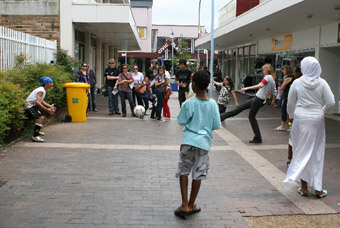
City Quest
photo Chris Michaels
City Quest
THERE’S A WELL-ESTABLISHED BODY OF NEW MEDIA PERFORMANCE THAT DRAWS HEAVILY UPON COMPUTER GAME CULTURE, FROM THE UK GROUP BLAST THEORY’S SEMINAL DESERT RAIN AND CAN YOU SEE ME NOW? [SEE P26], TO THE MORE RECENT WAYFARER [RT81, P35] AT PERFORMANCE SPACE. IN EACH OF THESE WORKS, COMPUTER GAMES DICTATE THE DRAMATURGY AND PROVIDE THE NARRATIVE FRAMEWORK (A QUEST, A PURSUIT, A RACE). THE TRICK THAT MAKES BLAST THEORY’S WORK SO SUCCESSFUL IS THAT THE PERFORMANCES OPERATE IN BOTH DOMAINS, FUNCTIONING SATISFACTORILY AS GAMES BUT ALSO AS LIVE PERFORMANCE, INTERROGATING AND INTERVENING INTO BOTH THE CONDITION OF GAMING AND OF LIVENESS.
It’s clear from the outset that Powerhouse Youth Theatre’s City Quest has some big shoes to fill. City Quest is an ambitious undertaking, a feature of artistic director Claudia Chidiac’s work with Powerhouse since her appointment in 2005. That work includes the intelligently provocative This Territory (2007, in collaboration with Australian Theatre for Young People) and the cross-cultural wedding spectacular I do… but (2006).
For a weekend, PYT occupied several city blocks at the centre of Fairfield, inserting performers, video installations and other interventions amidst the shops and public spaces of this suburban centre. The safety briefing at the outset declares, “all the people are real”, further noting that if audience members “see something you like please feel free to purchase.” So while the gaming rhetoric poses a crisis that must be averted, the frame of the performance places a surprising emphasis on tourism.
It’s an unusual positioning of the audience. On the one hand, the ‘missions’ to address the civic crisis that the game proposes (the ‘Emerald Torch’ that somehow maintains social stability has been lost and must urgently be recovered) frame the audience as the potential saviours of Fairfield. On the other hand, the nature of these missions are to look closely at the inhabitants of this urban landscape, performer and resident alike, and to examine the nooks and crannies of this section of western Sydney suburbia, cameras in hand. And of course, along the way, we’re encouraged to engage in commerce. “You are in Fairfield, try something you can’t pronounce.” The audience as tourist cum civic saviour? Over lunch in a Turkish restaurant, two young locals inform me that the show “has really put Fairfield on the map” by bringing all these inner city types out of their geographic comfort zone. City Quest thus produces a fascinating convergence of art, gaming and social life.
We’re ushered in to meet the computer-generated gamemaster, The Watcher, who sets the scene: play out your missions, look for clues and ultimately uncover the location of the Torch. Assigned a mission, I dutifully carry my digital camera onto the streets and take pictures of details as instructed—flags, something emerald, someone in mid-air, and something I can’t pronounce. Along the way, I interact with a variety of young performers, some in installations on the streets. Some encounters are more peripatetic. Each of the performers has a story to tell, as well as clues to offer, provided that I perform whatever task or undergo whatever small ritual humiliation they request—submitting to a fashion makeover, shooting goals in an alleyway, recovering an ‘alien’ artefact. I accumulate multicoloured tokens for my labours, a tally of which at the end will constitute my final ‘score.’ Despite The Watcher’s urgency, on the streets everything is pretty relaxed, with plenty of surplus time to window shop and chat with other audience members, sharing clues gathered so far.
We’re led to a carpark rooftop where a piratical Vagabond announces that The Watcher cannot entirely be trusted, that his control of our questing should be contested. A choreographed battle ensues, with rival characters vying for control of a ‘key’ by leaping thrillingly from one level of the carpark to another. This results in more clues that lead to a code concealed in a laneway, a phone number whose message in turn sends us back to mission control.
As a game, City Quest isn’t entirely coherent or compelling, but as a social and cultural experience, it’s engaging, entertaining and generally a fantastic day out. Without really having to do anything besides turning up and playing along, order and hope is returned to the city of Fairfield. And the Emerald Torch? Well, that was back at the beginning, and I touch it as I exit, granted hopeful glimpses of the future both for the city and the characters who’ve populated it.
Powerhouse Youth Theatre, City Quest, director Claudia Chidiac, deviser-performers Jhon Al Asadi, Ricardo Ciccone, Geneveive Clay, Khoa Doun, Will Erimya, Collin Gosper, Nour Issawi, Ali Kadhim, Andy Ko, Anna Nguyen, Htoora Thahiya, Evin Tobia, game design, composition Keith Lim, sound, multimedia Khaled Sabsabi, design Kate Shanahan, Le Parkour choreography Ali Kadhim, premium fighter Craig Anderson, animation Michael Zhu, multimedia & software consultant, production manager Simon Wise,video maker Fatima Mawas, Ryan Peters; Fairfield, Sydney, Dec 8-9, 2007
RealTime issue #83 Feb-March 2008 pg. 36
© David Williams; for permission to reproduce apply to realtime@realtimearts.net
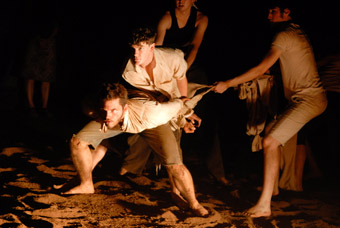
The Lotus Eaters
photo Heidrun Löhr
The Lotus Eaters
WE ARE POLITELY USHERED INTO WHAT APPEARS TO BE A FUNKY BASEMENT BAR – COLOURED LAMPSHADES SUSPENDED FROM THE CEILING, CUSHIONS AND COMFY CHAIRS SCATTERED ABOUT, AND A BABY GRAND PIANO COMPLETE WITH LOUNGING SINGER, READY TO CROON. THE MOOD IS DREAMY, AND AUGMENTING THE INTOXICATION, SMILING WAITERS DISTRIBUTE SHOT GLASSES OF WHAT THEY ADVERTISE AS “LOTUS JUICE.” A GAUDILY DRESSED YOUNG MAN TAKES THE MIKE. “YOU HAVE TWO CHOICES”, HE DRAWLS. “I CAN TELL YOU A STORY, OR YOU CAN FUCK ME.” THERE’S A SMALL PAUSE, AFTER WHICH HE SMILES AND BEGINS TO TELL THE STORY OF ODYSSEUS, LOST FOR 20 YEARS ON HIS JOURNEY HOME TO ITHACA. LOST, AND LONGING FOR HOME.
On the other side of the theatre space, hitherto covered by gauzy drapes, another performance begins in response to the story offered in the lounge bar, with excerpts from Odysseus’ story presented through tableau and declamatory monologues. Performers struggle across a stage covered in a thin layer of dirt, with a grid of naked light bulbs overhead, creating islands of light amongst the darkness that appear and disappear as they are switched by passing performers. It’s a simple but highly effective technique. The stage morphs strangely as the performers navigate their course endlessly through these islands, but as the map continues to shapeshift, the course ahead becomes no clearer.
The dirt crackles under our feet as we are invited to leave the comfort zone around the bar and inhabit the space of the lost travellers. Around us, a vast number of young performers strut and fret their minutes upon the stage, recalling on the dimly lit field of dirt encounters and incidents from Odysseus’ unwilling journey—the sirens, the Cyclops, and Circe’s island where the crew are transformed into pigs. From the lounge area performers read letters to real and imagined distant homes. As Odysseus struggles with both terrible monsters and impossible longings for a home denied him by the gods, the performers describe a more pedestrian melancholy. Finally, Penelope appears, at home in Ithaca waiting faithfully, fending off the predatory advances of an army of suitors. Rather than a happy homecoming, our hero returns and promptly slays all of his would-be rivals, filling his longed-for home with blood. Journeys, it is abundantly clear, change people, and sometimes these changes can be terrifying to behold.
For all its evocative ambience, there is a curiously disconnected quality to Lotophagi. There’s a fine line between exploring states and stories of losing oneself and being lost, but Lotophagi, for all its moments of beauty, feels most often like the latter. As a sprawling epic, it shows the audience some potentially wondrous sights. But these remain postcard moments, happy snaps from which we must immediately move on. Little in the work seems to build or linger and, unusually for an ensemble emerging from PACT’s traditionally strong training program, the cast don’t ever feel as if they’re operating in the same performance work. For me, Lotophagi, while colourful and frequently interesting, remains mostly a collection of disparate elements—a work whose aimlessness, unlike Odysseus’, cannot be solely blamed upon the curse of the gods.
PACT Youth Theatre, Lotophagi: The Lotus Eaters, co-director Regina Heilmann, co-director/design concept Jeff Stein, directorial input Chris Murphy, Chris Ryan, sound design James Brown, lighting Frank Mainoo, designer Claire Sanford; PACT Theatre, Nov 22-Dec 9
RealTime issue #83 Feb-March 2008 pg. 36
© David Williams; for permission to reproduce apply to realtime@realtimearts.net
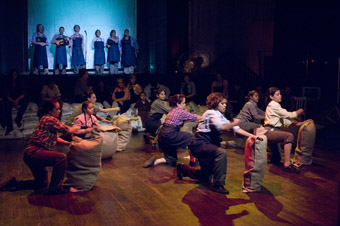
Second To None, Kurruru Indigenous Youth Performing Arts & Vitalstatistix Theatre Company
photo Shane Reid
Second To None, Kurruru Indigenous Youth Performing Arts & Vitalstatistix Theatre Company
“THE WHITES ALMOST MISSED OUT.” WITH AN IMAGE OF A WHITE MAN AND WOMAN, THIS LINE APPEARED ON THE FRONT OF THE OFFICIAL NEWSLETTER OF THE MULTI-MILLION DOLLAR NEWPORT QUAYS PROPERTY DEVELOPMENT PROJECT IN PORT ADELAIDE. THE ADVERTISEMENT RECOUNTS HOW ‘MR AND MRS WHITE’ NEARLY MISSED OUT ON THEIR DREAM PROPERTY AS PART OF THE CURRENT GENTRIFICATION OF THE PORT. THIS SERVES AS A HIGHLY IRONIC BACKDROP FOR SECOND TO NONE, AN EPIC SITE-SPECIFIC PERFORMANCE EXPLORING THE INDIGENOUS AND MARITIME HISTORIES OF PORT ADELAIDE AGAINST ITS FUTURE.
Second to None is a co-production between two unique Australian theatre companies based in Port Adelaide with strong ties to its history and communities—Kurruru (Australia’s only Indigenous youth performing arts company) and Vitalstatistix (Australia’s national women’s theatre company).
In the tradition of much site-specific performance, the sites serve as both subject and locale. Their meanings and histories are ‘excavated’ and transformed into performance that writes back over the site, a palimpsest of its present reality with reanimations of its past.
The audience encounters three slippery property developers (Sam McMahon, David Pidd, Stephen Noonan) who offer to take us on an exciting tour of Port Adelaide’s future. We are divided into three buses and are taken to the centrepiece site for the development (formerly the historic Hart’s Mill) overlooking the Port River. It is here that the tour is ‘hijacked’ (or reappropriated) when three young Indigenous women (Lisa Flanagan, Nazaree Dickerson, Jada Alberts) board the buses and offer to take the audience on another kind of journey altogether.
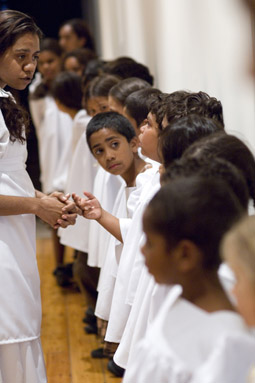
Uraine Mastrosaras and children, Second To None
photo Shane Reid
Uraine Mastrosaras and children, Second To None
The travelling mode of performance, using the metaphor of the guided bus tour, transforms all we see out of the window into the backdrop for this performance. I listen to our new guide (Flanagan) as she tells us about the Indigenous history of the surrounding area as we drive away from Hart’s Mill further into the Port. She tells us about the day to day life here before white colonisation juxtaposing it with the Port’s urban landscape we are observing. Suddenly there’s an image of the past the guide is describing—three generations of Indigenous women on a roundabout, collecting firewood. We drive away, returning to the urban present.
We disembark the bus at Glanville Hall, a grand lodge built in 1856, which later served as a home for young Aboriginal boys in the 1940s. This site is about “being made white” offering an experience of the hall through the eyes of the young Aboriginal children who once lived there. I look into a room to see an eerie image of a young Aboriginal boy in white garb whitewashing trees. In a central room there is another simple but powerful image—a line of perhaps 20 Aboriginal children, again in white, lined up according to height, under the watchful eye of an Anglican minister. We look at this line-up for some time. For the largely white audience the image’s resonance with the plight of the Stolen Generations is palpable.
The buses travel to a second site-specific event at an outdoor location near the beach at Largs North called Kauwangga, an important site for hunting and gathering for the Kaurna people prior to white colonisation. It’s dark as we enter the sandy site. On the curved surface of a large tree, a video projection of an Aboriginal man’s face appears and speaks. We travel further to a camp fire to witness a performance of traditional cultural practices, entirely in Kaurna language. At one point a giant projection of a kangaroo is sculpted onto a tree in the distance. The young men go off to hunt it and later return. The performance beautifully achieves its aim to revive the traditional cultural practices of the Kaurna people while engaging with the most contemporary of aesthetics in its use of video and sound. As we depart, a soundscape and projections chillingly evoke a massacre.
The Waterside Workers Hall is our final destination, once a centre of political and cultural activities for wharfies and now the home of Vitalstatistix. Here fascinating aspects of maritime history unfold. The wharves were one of the few places where Indigenous people could work in the first half of the 20th century. Now Second to None departs from its immersive site-specific approach in favour of the aesthetic of a community event. Given the preceding journey, I found it hard to empathise with the narrative of white workers. We had seen colonial and commercial appropriations of land by shifty propery developers and oppressive missionaries while witnessing the vibrancy of Indigenous life and the evocation of a horrible massacre.
Finally the audience is invited to join in the dancing of a military two-step. The celebratory atmosphere engendered by this community and its sense of history leaves me wondering what the Whites with their new property will bring in the years to come.
Kurruru Indigenous Youth Performing Arts & Vitalstatistix Theatre Company, Second To None, directors Sasha Zahra, Maude Davey, Karl Telfer, Diat Alferink; original concept/research, Janine Peacock, composer, sound designer Lou Bennett, design Kathryn Sproul, assistant designer Chantal Tremaine Henley, contemporary choreography, Gina Rings, traditional choreography Karl Telfer, lighting design, Kerry Ireland; Port Adelaide, Nov 22-25, 2007
RealTime issue #83 Feb-March 2008 pg. 37
© Sam Haren; for permission to reproduce apply to realtime@realtimearts.net
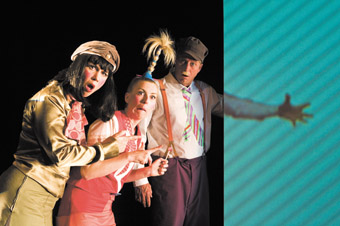
Explosion Thearapy, Sara Cooper, Laura Purcell and Leeroy Hart
photo Peter Mathew
Explosion Thearapy, Sara Cooper, Laura Purcell and Leeroy Hart
AS A KID, DID YOU EVER WANT TO CRACK THE CASE OF THAT UBIQUITOUS SCREEN IN THE CORNER OF YOUR LOUNGE ROOM AND CLIMB IN BEHIND THE GLASS? SOME OF MY FAVOURITE SATURDAY MORNING CARTOONS WITH INFINITE MULTICOLOURED WORLDS WERE VERY APPEALING, BUT THE BOX REFUSED TO YIELD AND THE DREAM STAYED IN MY HEAD. THESE DAYS, COMPUTER GAMES WITH SOPHISTICATED AVATARS GIVE KIDS (AND ADULTS) A FEELING THAT THEY HAVE ENTERED INTO AN ALTERNATE WORLD COMPLETE WITH FRIENDS AND FOES, CHALLENGERS AND PREDATORS, BUT IT’S STILL NOT QUITE LIKE DIVING IN AND SUBMITTING YOUR OWN BODY TO UNKNOWN EXPERIENCES. TAKING THIS IDEA OF DIGITAL EMERSION AND RUNNING WITH IT, EXPLOSION THERAPY BY TERRAPIN PUPPET THEATRE EXPLORES THE SCREEN AS A SPACE AND AS A FELLOW CHARACTER.
Staged in the Peacock Theatre, the set up for this action-packed show is uncomplicated—three players, one large screen and a few simple props. The characters are unique, shying a little to the left of archetypal. A hapless gent in braces and baggy pants, silk tie stitched to his shirt in a permanent state of dishevelment, just wants to read his newspaper in peace, his speech a barely recognisable grumble emerging from his moustache. Foiled in his attempt at solitude, he is interrupted by a cheeky and somewhat devious lady decked out in 1940s style, her heavily made-up face framed by a blunt black bob, polka dot necktie and furry purple hat. Bouncing between these two is a madcap girl, dressed head to toe in pink and red polka dots, whose hair shoots out the top of her head in a stiff ponytail. There is always a lollypop in her pocket. Unlike our gent, the female characters have little recognisable dialogue, instead communicating in squeals and squeaks, oohs and aahs, giggles and roars.
Like a litter of puppies, the characters play with each other, tripping and teasing and fighting and bowling around the stage until they discover a large switch box with flashing red light. Gathering the courage to press the big red button, they bring life to the large screen behind them. What they soon discover is that they can enter this screen, and be transformed into pixels.The moment in the show when our hapless gent pulls up his sleeves and stretches his arm into the screen space where it becomes a slightly jumpier, digital version of itself is quite remarkable. He wriggles it around in amazement and draws it back out, all of his fingers still intact. A four year old in the audience notes, “That’s tricky.” Indeed.
So here begins a period of exploration for the curious three. Initially each braves this new space tentatively, slowly stretching themselves in, their flickery, video selves eventually standing with amazement in the middle of the screen. Then the madness begins, with any one of the group running in and out of this new arena, a little like play on a digital slippery slide, with each reinventing ways to experience the space.
Maybe there is dodgy wiring in the connections, but it seems as though the longer this world operates the more dangerous it gets. At first it’s harmless enough. Doors appear and disappear on the screen and the characters run between them, finding that there are chaotic rules of engagement. Hapless gent and madcap girl find themselves surrounded by bubbles of colour that float by, sometimes flopping out of the screen space onto the stage. Then hapless gent manages to shoot coloured circles out of his rear and the madcap girl explodes. I won’t go on, lest I give away all of the madness, but needless to say, the game ends in tears, with devious lady somewhat physically altered by the experience. It’s as if the screen reveals fault lines in personalities and relationships.
This is a cleverly choreographed show that explores a different take on puppetry, where the transformation of human players into video, via the device of the screen, casts them in the role of puppet, with the screen as manipulator. This is so successful as an idea, that the addition of traditional cloth puppets in the show seems almost superfluous and perhaps incongruent with the digital language. I longed for a little more complexity to the story. The conflict for this tale is generated by the technology, which affects the characters in strange and sometimes frightening ways, but the resolution is light-weight, leaving our hapless three in the dark, and the show somewhat incomplete. The world created by the screen is compelling, but it seems to have become the core around which the show is built, rather than a device that is crucial to a story. Nevertheless, I loved the Alice in Wonderland set up—where you never know what might happen if you jump down a rabbit hole (or into a screen in this case).
Terrapin Puppet Theatre, Explosion Therapy, director Frank Newman, performers Sara Cooper, Leeroy Hart, Laura Purcell, designer Roz Wren, animator, illustrator Mark Cornelius, Clockwork Beehive, lighting designer Daniel Zika, sound & music Charles Du Cane; Peacock Theatre, Salamanca Arts Centre, Hobart, Jan 9-18
Explosion Therapy can be seen at the 20th UNIMA Congress and World Puppetry Festival (April 2-12), Spare Parts Puppet Theatre, Fremantle, April 7-9
RealTime issue #83 Feb-March 2008 pg. 38
© Judith Abell; for permission to reproduce apply to realtime@realtimearts.net
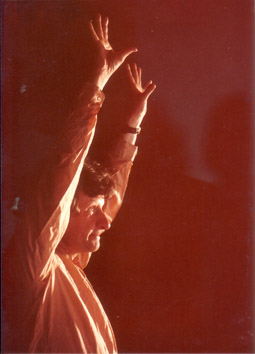
Jean-Pierre Voos
AS FOR SO MANY PEOPLE, I IMAGINE, NEWS OF THE DEATH OF JEAN-PIERRE VOOS WAS SO IMPROBABLE I HAD TO HEAR IT FROM SEVERAL QUARTERS BEFORE I COULD MAKE IT REAL. THE MASTER OF THE SURVIVAL STRATEGY AND CREATOR OF EVER-NEW BEGINNINGS COULD LEAD YOU TO BELIEVE HE WOULD ALWAYS FIND A NEW OPENING, THAT HE WOULD DREAM UP ANOTHER ANGLE IN EVERY CRISIS. HIS PROPENSITY FOR TRAVEL, ADVENTURE AND NEW STARTS MAY HAVE BEEN TRIGGERED WHEN, HAVING BEEN BORN IN FRANCE, HE TRAVELLED WITH HIS MOTHER ON A PRECARIOUS JOURNEY TO ENGLAND IN THE MIDST OF WWII. HE GREW UP THERE UNDERTAKING HIS OWN FIRST TRAINING IN THEATRE. HE DIED ON JANUARY 17 AT 76 YEARS OF AGE, OF COMPLICATIONS FROM A LUNG INFECTION IN TOWNSVILLE, WHERE HE HAD SPENT THE LAST 25 YEARS, SETTING UP, FIRST, TROPIC LINE AND THEN TROPIC SUN THEATRE, IN ASSOCIATION WITH JAMES COOK UNIVERSITY.
I first met Jean-Pierre in a workshop with his company, KISS Theatre Group, renamed Kangaroos In Silk Stockings to avoid some never-quite-explained bureaucratic hassle in Holland, when he took 13 or so rookie Australians back there in 1983, the previous company having dispersed in Australia. But the name soon reverted to KISS. My first image of him is of his sharp profile as he swept into the church hall in Paddington, his piercing eyes focused intently forward as he went past. That intent focus never seemed to flag.
Jean-Pierre was driven by the work of some of the most rigorous practitioners of the 20th century—Artaud, Grotowski, the Living Theatre and the Tanztheater of Pina Bausch. Taking on board the full implications of the aesthetic, physical and personal rigours at the heart of these ideas was never going to be easy: the relentless need to find spaces, to hone the bodies of his company and maintain a touring/performing program was a constant reality. It shouldn’t have been surprising that at times the often blistering tongue challenged some of our most cherished beliefs and comfortable assumptions. Nor would anyone who experienced this not also have felt themselves stronger and the more self-reliant for it. Pretty soon the glittering mind, straightforward charm and grace would reappear and a new idea of the possible would emerge.
Always intensely committed to the experience of the audience, Jean-Pierre might be said to have been postmodern before his time: the de-centred narratives; the rigorous deconstruction of the classics, of which his knowledge was profound; the location of meaning in the body (while retaining an intense joy in the function and beauty of the word and a fascinating sense of the relation of logocentric and physical images); the training of the voice for sound rather than diction or expression, without losing sight of either in his productions; and the use of theatrical devices to create sense and experience, such as the performers’ 20-minute Sufi spin as brilliant halogen lights blasted the audience into a space that might be celestial in Spheres, his version of Dante’s Paradiso.
As Sue Rider says in her tribute on the Tropic Sun Theatre website [www.tropicsun.com.au/history/jp-tribute.html], Jean-Pierre was a great survivor. Other tributes reflect the impact his work has had both in Australia, where KISS, had performed several times before I joined it in 1983, and in Europe, where the company had led a peripatetic life in France, Switzerland and Scandinavia. He settled KISS in Holland for the last few years of its 15-year existence, and I worked with him there from 1983 to 1985, the last two years of the company’s life. Tributes emphasise his “ceaseless passion”, his readiness for adventure, his single-minded focus on the actor’s body and imagination as the source of new images and new performance modes. Theatre was the central preoccupation of his phenomenal life.
Jean-Pierre’s influence has penetrated the lives of a great number of people—supporters of the theatre as much as makers and performers, of whom many are still prominent members of the Australian theatre community. His grace, intelligence and charm always drew a wide circle of informed and active ‘patrons’ around his company’s work, as he sustained the ongoing need to accommodate and consolidate a shifting band of performers, finding homes and work spaces wherever possible and building performance skills that have seeped into the practices of many Australian artists. He made theatre that, like the companies and artists that most deeply inspired Jean-Pierre himself, challenged assumptions about the role of art in the community and the way its makers have to live to create that work.
Apart from his vision, his love of classics, his soup and wine-making and his innate sense of theatre, it was his ability to constantly renew his life, and his work and yet, paradoxically, not to change; that makes news of the death of Jean-Pierre Voos so inconceivable.
RealTime issue #83 Feb-March 2008 pg. 39
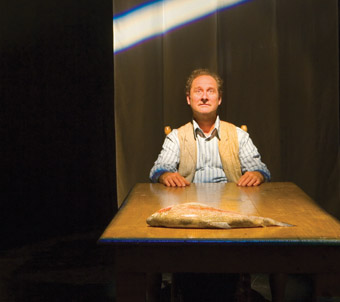
Paul Blackwell, When The Rain Stops Falling
photo Jacqui Way
Paul Blackwell, When The Rain Stops Falling
WHILE CONTEMPORARY PERFORMANCE HAS JUXTAPOSED THE TALENTS OF PERFORMERS WITH THOSE OF ARTISTS IN SOUND, SCULPTURE, INSTALLATION, VIDEO AND NEW MEDIA FOR DECADES, THE SELF-CONTAINED WORLD OF THEATRE HAS BEEN MORE CAUTIOUS.
There are Australian theatre artists like Benedict Andrews, Michael Kantor, Barrie Kosky, Jenny Kemp, Matthew Lutton, Chris Kohn and Anna Tregloan whose work has cultural immediacy—each has a distinctive stage language but in dialogue with a wide range of practices from the world beyond.
Sound design has become integral to theatre over the last decade, providing more than interludes and, at best, something more than cinematic ambience. But more adventurous collaborations are rare. So it’s exciting to discover that a wonderful Adelaide artist, the Iranian born Hossein Valamanesh, acclaimed for his installations drawn directly from nature (Australian and Iranian), is working with Brink Productions and the State Theatre Company of South Australia on Andrew Bovell’s new play, When The Rain Stops Falling.
Given that the play, says Brink artistic director Chris Drummond, is about “where we’re all going as human beings at a personal level, at a political level, at a historical, environmental, ecological level”, Valamanesh’s idiosyncratic spatial sensibility and his acute responsiveness to the natural world from which he draws the materials for his unconventional creations, would seem ideal for such an enquiry.
Rather than being asked to interpret the finished play by providing a scenic framework, Valamanesh was invited instead to work with Brink and Bovell in 2004 on conceptualising the work before the playwright commenced writing.
Bovell, the writer of the feature film Lantana (based on his earlier stage works) and co-writer with director Anna Kokinos of Head On, has created a four-generation epic stretching from 1959 to 2039, tracing family conflicts and the search for a lost father from London to South Australia to the desert against a changing climate. An Australian play that locates itself in the great environmental drama we are living through is a rarity. And to ask a visual artist of Valamanesh’s stature and insight to be party to such a grand venture, even rarer. RT
Brink Productions with the State Theatre Company of South Australia and the Adelaide Festival of Arts, When the Rain Stops Falling, writer Andrew Bovell, director Chris Drummond, visual artist Hossein Valamanesh, performers Paul Blackwell, Michaela Cantwell, Carmel Johnson, Kris McQuade, Anna Lise Phillips, Neil Pigot, Yalin Ozucelik, composer, sound artists Quentin Grant, lighting designer Niklas Pajanti; Scott Theatre, Adelaide, Feb 28-March 15
RealTime issue #83 Feb-March 2008 pg. 39
© RealTime ; for permission to reproduce apply to realtime@realtimearts.net
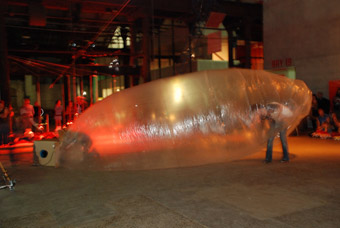
Clare Britton, Volta, Performance Space
photo Garth Knight
Clare Britton, Volta, Performance Space
LUCY GUERIN’S STRUCTURE AND SADNESS, JOEY RUIGROK VAN DER WERWEN’S VOLTA, CIRQUE ICI’S SECRET AND THE LATE TANJA LIEDTKE’S CONSTRUCT ARE JUST SOME OF A GROWING NUMBER OF WORKS IN A DIGITAL AGE THAT SHARE A PALPABLE AND POETIC ENGAGEMENT WITH THE MATERIAL WORLD: REAL PERFORMERS WORKING MAGIC ON REAL THINGS.
Of course, van der Werven (originally with Doegtroep in the Netherlands and then with Stalker, Marrugeku, Urban Theatre Projects and others in Australia) and France’s Cirque Ici have been at their distinctive alchemical labours for many years. Others have come to it later, including the artists who trained with van der Werven in UTP’s Mechanix in 2003 and in the first stage of Volta at Performance Space in September 2007.
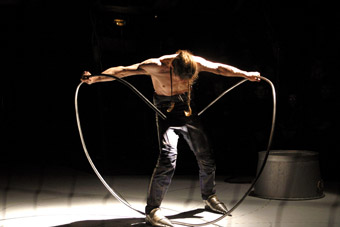
Johann LeGuillerm, Cirque Ici, Secret, Sydney Festival
photo P Cibille
Johann LeGuillerm, Cirque Ici, Secret, Sydney Festival
Cirque Ici’s charismatic ringmaster and solo performer is Johann Le Guillerm, a lean, growling, caped figure wearing ridiculously long clattering foot armour. He works a long, thin metal rod into a near circle, creating a dynamic sprung hoop that he can roll away, casually predicting its imminent self-propelled return. The creations, whether this rod or a carpet that unfolds itself slowly, or a bird-like paper areoplane, or a roll of leather that mutates into a little pyramid, or the variously sized tin tubs that Le Guillerm spins into a galloping circle, are material objects made circus animals. He not only tames, trains and directs his charges, he places his body inside the arc of the metal hoop, rolling with it, puts his head into the pyramid (and is sucked into its tiny space, as if devoured), himself becoming part of a magically activated material world. He too is animal like, never speaks, repeatedly bares his fangs and exhales exaggeratedly like a wary beast or the creature from Alien.
In fact there is something quite alien about this persona, not least evident in the footwear suggestive of a hybrid creature especially when Le Guillerm astonishes us by standing en pointe—how can he do so when his boots run to such a fine point and are articulated in metal sections all the way to the heel? This man is another beast in his own show, with his own unique characteristics, not least a sense of time that cannot be hurried (to the consternation of those in the audience who prefer their circus fast and conventionally entertaining).
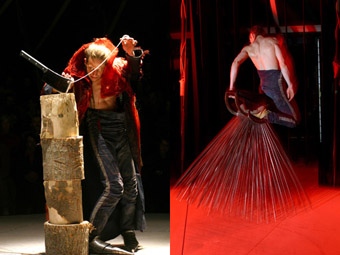
Johann LeGuillerm, Cirque Ici, Secret, Sydney Festival
photo P Cibille
Johann LeGuillerm, Cirque Ici, Secret, Sydney Festival
Some of Cirque Ici’s pre-constructed creations are sculptural, like the surreal ‘horse’ that comprises a saddle aloft myriad thin wire legs and which Le Guillerm rides elegantly about the ring, rocking to its easy, vibrating gait. In another act, he harnesses stage smoke into an eerie in-house tornado.
In the final act of Secret, Le Guillerm tames long, timber planks by roping them into a massive construction which he straddles as he works, constantly testing its strength and balance addition by addition until complete. He then swings cheekily ape-like from this creaking, trussed architectural monster which fills the stage, and makes his final exit. Secret is a marvellous circus-and-sculpture hybrid, yielding not only richly suggestive imagery but also beautifully crafted stand-alone creations inspired by natural forms from Le Guillerm and his collaborators.
At the end of Tanjia Liedtke’s Construct (RT81, p12), Kristina Chan is locked in a similar structure which has been steadily built about her in a show that commences wittily with the simplest of shape-forming, using hands and bodies, pieces of timber, a ladder, and moves towards a dark vision of relationship constraints. In Lucy Guerin’s Structure & Sadness (RT77, p39) the dancers also build, again starting small (and reflecting the processes of testing and balancing in duets) eventually creating a monstrous but fragile structure which falls, and a world has to be rebuilt. In both works the dancers are required to do much more than work their bodies—they build, they sculpt dexterously, juggling and manipulating strips of timber and moving on to shapes bigger than themselves.
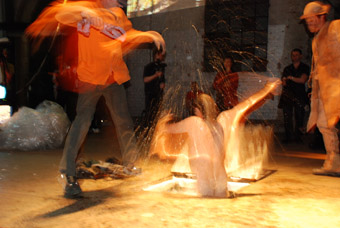
Joey Ruigrok van der Werven, Volta, Performance Space
photo Garth Knight
Joey Ruigrok van der Werven, Volta, Performance Space
Joey Ruigrok van der Werven’s skill is in creating performative machines from materials at hand and of nurturing this talent in others. Volta, in the vast foyer of CarriageWorks, comprised devices made by the artists who drove them. Clare Britton unpacks and inflates a huge transparent plastic bubble, enters it, cuts her way out of its top and releases a toy chicken. Nick Wishart manipulates the semi-transparent torso of a shop dummy to yield shifting colours and sounds. Heidrun Löhr’s installation features suspended kettles over gas flames on a bed of coals; as the kettles whistle she raises and lowers them via pullies creating a score as if from a sibilant organ. There’s fire and light coming from above as Carlos Gomes, looking like someone from a folk Ring Cycle, fans a furious furnace, branding lateral directions onto timber signposts. Marley Dawson drops the head of a log high crane arm onto large metal balls, appearing to flatten them, and then rides the arm to the ground. Ouch! Van der Werven adds water to the fire and light, emerging naked in a wave of water from a hole in the floor and leaping into a go-cart about to be released from the huge taut band holding it back. Away he goes. Rod Nash’s low, rumbling, tooting vehicle enters, driverless, clearing a path for itself. Overhead, a single fluorescent light flies the length of the space like a rocket. Richard Manner’s sculpted clusters of small lights dance about in the dark like fireflies. Clare Britton re-enters the space carrying a small nest of light bulbs and magically lilluminates them with a mother bulb; one flies aloft and triggers a vast ceiling of tiny stars.
On the first of the two nights of Volta, the Federal Election became part of the show, thanks to Sean Bacon’s live media manipulations, and, on the second, the Australian Idol final. Volta blended performance with exhibition and a sense of occasion, allowing its audience to wander about, taking in the details of various creations and meeting the makers, while being treated to a steady stream of events. While a less seamless version might allow for more reflection, Volta has proved itself as a meeting ground for artists of all kinds and their audiences to share in an expanded sense of performance. More, please.
I should add to this short list of recent performances-as-construction Artspace’s Aftermath with its focus on performative installations over several months, where you could watch the artist at work, see the finished creation as performance and then observe subsequent transformations of the residue [RT81, p53]. Just as it’s been a pleasure to see the screen integrated so dynamically and inventively over the last decade into dance and contemporary performance, if still rarely in theatre, the engagement now with the materiality of things and across artforms is exhilarating. Of course, someone’s bound to object that it’s all been done before, and of course it has a history, but this is something more than re-inventing the wheel—these days there’s so much more you can do with a wheel [see Jean Poole on bicycles in the Istanbul Biennale, p28, and Gabriella Giannachi on Blast Theory’s Rider Spoke, p26].
Cirque Ici, Secret, creation, direction, interpretation Johann LeGuillerm, music Matthieu Werchowski, Guy Ajaguin, lighting Herve Gary; Sydney Festival 2007, Hyde Park, Sydney, Jan 14-26; Tanja Liedtke, Construct, Playhouse, Sydney Opera House, Jan 10-13; Volta, concept & direction Joey Ruigrok van der Werven, dramaturgy Clare Grant, artists Sean Bacon, Clare Britton, Marley Dawson, Carlos Gomes, Heidrun Löhr, Richard Manner, Rod Nash, Koen van Oosterhout, Simone O’Brien and Nick Wishart, Performance Space at CarriageWorks, 24, 25
RealTime issue #83 Feb-March 2008 pg. 40
© Keith Gallasch; for permission to reproduce apply to realtime@realtimearts.net
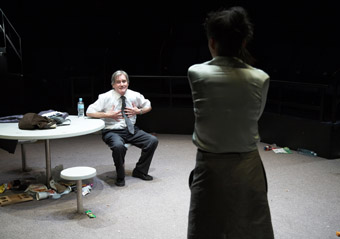
Peter Kowitz, Paula Arundell, Blackbird
photo Tania Kelley
Peter Kowitz, Paula Arundell, Blackbird
IN CATE BLANCHETT’S IN-THE-ROUND PRODUCTION OF SCOTS PLAYWRIGHT DAVID HARROWER’S BLACKBIRD, MAX LYANDVERT SHAPES OUR EXPERIENCE WITH A WRAP-AROUND CONSTRUCTED ACOUSTIC RESONATING WITH THE SOUND OF DISTANT CONVERSATIONS, SLAMMED DOORS, RATTLING PIPES, PASSING FOOTSTEPS AND OBJECTS BEING MOVED ABOUT. THE SOUND DESIGN FRAMES THE SPACE, FOR THE STAGE DESIGN SIMPLY COMPRISES SEVERAL FLUORO-LIT DOORS INTO IMAGINARY CORRIDORS AND IS DRESSED ONLY WITH A CHEAP TABLE AND CHAIRS, GREY CARPET AND LITTER. THE ROOM LOOKS AND FEELS LIKE ONE OF THOSE INDETERMINATE SPACES IN A LARGE BUILDING WHERE STAFF HIDE OUT FOR A SMOKO OR OTHER ILLICIT BEHAVIOUR.
The hollow acoustic heightens the sense of emptiness and regret in the lives of the play’s antagonists and delivers moments of suspense as a passerby seems about to enter, stalling the confrontation, and shock when someone does. The struggle is between a caretaker, Ray, in his 50s and Una, the young woman he seduced when she was 12. She’s done some detective work to find him and initially he doesn’t recognise her. The play is built around the push and pull of hatred and the residue of attraction, the desire for revenge and a plea for forgiveness, all heading towards the pivotal telling, in consecutive monologues, of what happened on the night when he abandoned her as a child in the hotel to which they’d absconded.
Harrower’s tautly spare, but curiously literary writing is at its best in his portrayal of Ray, who for all his apparent sincerity actually gives little away, withholding information rather than lying and thus providing the momentum for the final revelation. A restrained Peter Kowitz plays Ray with quiet, nervous reserve. His assertions that the relationship was a one-off, that he was never a paedophile, that he burned the photographs he’d taken, that he really loved the 12-year-old Una, rekindles a moment of perverse passion in the pair, although it is beyond Ray (guilt? impotency?) to follow through. Ultimately, what is cruelly clear is that the woman remains forever a damaged child. As she said earlier to Ray, “You made me.” Perhaps Ray has been destroyed too by guilt and prison, though we can never be sure.
Paula Arundell imbues Una with steely determination, explosive anger and a strong sense of justice (at Ray’s trial the judge accused her of “suspiciously adult yearnings”), but also with moments of vulnerability and uncertainty, evidence that she is still locked in an emotional loop with her seducer—as the play’s final image confirms.
Blanchett, as we might expect, draws intense, studied performances from her actors, but the conventional blocking, the overly fast pacing of the production, even the inwardness of working in-the-round, gravitate against the emotional impact of each successive stage of Harrower’s play. Perhaps the playing became more measured later in the season, but on opening night Ray stayed too easily in the thrall of his accuser, the recovery from the pair’s bout of violence was too quick, and the mutual kicking about of rubbish embarassingly perfunctory, hardly evidence of the desperate release sought at this stage of tortuous mutual entrapment.
The STC Blackbird warranted seeing for the convincing performances of Kowitz and Arundell, and for Max Lyandvert’s sonic encapsulation of actors and audience—though not the melodramatic underscoring of the play’s final moment.
Blackbird is a short work on the page but the scale of its moral complexities and emotional compulsiveness demands an opening out on stage, spatially and temporally. Daniel Schlusser’s account of the productions by Peter Stein in Edinburgh and Benedict Andrews in Berlin, as reported by Melbourne theatre director Daniel Schlusser for RealTime [RT71, p10], suggests very different approaches, not least a greater ritualisation of this co-dependent relationship and more radical attitudes to time and space.
Sydney Theatre Company, Blackbird, writer David Harrower, director Cate Blanchett, performers Peter Kowitz, Paula Arundell, Danielle Catanzariti, designer Ralph Myers, lighting designer Nick Schlieper, composer sound designer Max Lyandvert; Wharf 1, Sydney, Dec 15,2007-Feb 16,2008
RealTime issue #83 Feb-March 2008 pg. 40
© Keith Gallasch; for permission to reproduce apply to realtime@realtimearts.net
David Tyndall
THERE IS CHANGE AFOOT AT DANCEHOUSE IN MELBOURNE, AS THE SMART NEW MICRO-SITE WHICH ACCOMPANIES THE 2008 WEBSITE SUGGESTS. NOT ONLY IS THE LANGUAGE AND IMAGERY CLEARER, SHARPER AND ALTOGETHER MORE DYNAMIC, BUT THE CLUSTERING OF INITIATIVES FOR OPEN APPLICATION IN 2008 SUGGESTS AN ENERGY WHICH ARTISTIC DIRECTOR DAVID TYNDALL IS KEEN TO COMMUNICATE.
Tyndall updated the website himself, admitting that, “As soon as I was in the door, I wanted to address the way Dancehouse is seen by the community and how we see ourselves.” Tyndall is satisfied that his 2008 programme portrays the kind of forward-thinking he has promoted in his first year in the position.
“There has been a lot to do”, he says. “Dianne (Reid, the previous artistic director) left in August 2006 and I did not start till January ‘07, so although her excellent initiatives continued with the help of David Corbet, we had been kind of rudderless for a while. The Board had been working hard to address issues of management and artistic direction, so that by the time I arrived, as the first ever full-time artistic director, they were ready for me to take the reins.”
Tyndall is a VCA graduate and former dancer with recent producer experience with Chunky Move, Dance Works and Expressions dance companies. He has taken to the role of artistic director with relish, delivering a busy program in 2007 and collaborating with his board to instigate organisational change. Tyndall has just advertised for two additional part-time positions, Programme Producer and Venue and Production Co-ordinator, and is excited about how this will free him for further strategic planning.
Dancehouse is triennially funded by both the Australia Council and Arts Victoria, yet its cash turnover of $320-$350K seems small in relation to the volume of activity crammed into the busy program at its North Carlton home. “A huge amount of what happens here is generated by the community”, says Tyndall, “Our members bring their own projects and momentum to the program. There is a challenge to balancing the content we generate and that created by the community. We have to ensure that we are still accessible to the dance community. We do that by remaining affordable and available to hire. In the past couple of years, Dancehouse has been stretched to breaking point with a mass of activity and constant communication. There was a danger that people felt overwhelmed by all this undifferentiated activity and switched off. The board encouraged me to streamline the activity. I have done this by identifying three core areas: research, training and performance. Of course there is a great deal of crossover between those areas and we encourage that. This just helps us to create balance and leave gaps for the community to input.”
Tyndall is enjoying the positive response to his 2008 program. The residency and chance to curate are the most popular additions. “The strongest point of difference from previous years is the focus given to the individual artist through the residency initiative. There has been a tendency to distribute Dancehouse funds across as many artists as possible. This project dedicates $10,500 and 14 weeks of time to a single artist per residency. We needed to connect the many strands of Dancehouse’s activities and in particular to create more meaning around the performance program. So, two artists per year will be supported to make and show work at Dancehouse, to interface with the teaching and research aspects of the program and benefit from the totality of the Dancehouse offer.”
Due to the pressures on his time in 2007, Tyndall was obliged to launch the residency project with a pre-selected artist in order to buy time to perfect the transparency of the selection process. Phoebe Robinson is the first “Housemate” resident for 2008. Tyndall approached a handful of artists involved in the 2007 program and from there selected Robinson. “Phoebe created one of the most popular short works in the Short Shorts performance season in 2007. She’s an artist who would stand to benefit greatly from the residency due to the stage of career she’s at.”
Phoebe Robinson
photo David Tyndall
Phoebe Robinson
Whilst the residency project is the best resourced of Tyndall’s initiatives, he admits it has a way to go. “The residency is open nationally but we are limited to the $10,500. I would eventually like to be able to support all travel and accommodation costs for interstate artists and for the residency to eventually become international.” With the shift of focus of Canberra’s Choreographic Centre to youth dance, Dancehouse has the potential to fill a national gap in the provision of research opportunities for independent artists and Tyndall is developing his dialogue with sister organisations Critical Path in Sydney and Strut in Perth.
In 2008, his Get Out of The House project continues another year of partnership with Strut and Dancebox in Osaka. Two artists will be awarded $5,000 to present their work at these venues. With Critical Path and Strut Tyndall is also sharing the hosting of the Irish choreographers of the Daghdha Dance Company.
Creating the 2008 program, Tyndall considered initiatives to involve the breadth of the independent dance community in Melbourne, from recent graduates to mature artists. The diverse workshop and class program remains, as does the popular mentoring scheme, Learning Curve. There is a Rotary Youth dance project. There are Space Grants and presentation opportunities for work-in-progress or in a fully produced theatrical setting. Your Collection is a new initiative which invites an artist to be employed by Dancehouse as curator of their own season of up to eight works of 10 minute duration, opening out another aspect of the program to community input.
David Tyndall’s definition of the Dancehouse mission sums up the positive energy taking one of Melbourne’s performing arts institutions into an inspiring new year. “Dancehouse is a dynamic and thriving centre for cultural and creative diversity, critical thinking, networking and exchange. Dancehouse seeks to reflect the cultural, economic and political diversity of our community and is an accessible resource for anyone wishing to explore dance as an artist or observer.”
www.dancehouse.com.au
RealTime issue #83 Feb-March 2008 pg. 42
© Sophie Travers; for permission to reproduce apply to realtime@realtimearts.net
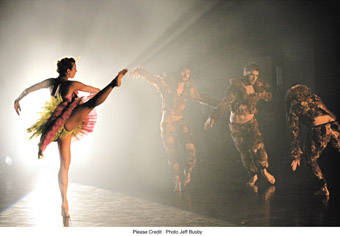
Brindabella, Balletlab
photo Jeff Busby
Brindabella, Balletlab
BALLET LAB’S WORKS ARE NOTHING IF NOT IMAGINATIVE. CHOREOGRAPHER PHILLIP ADAMS HAS, OVER THE YEARS, CREATED MANY SCENARIOS DRAWING ON MYRIAD SOURCES, LITERARY, MUSICAL, FILMIC AND MYTHICAL. BRINDABELLA IS NO EXCEPTION. PART AUSTRALIAN FOLKLORE, PART SOFT-PORN, THE WORK CANVASSES SEVERAL IMAGINARY MOTIFS. THERE IS A SUGGESTIVE GRANDEUR ABOUT THE OPENING. RUCHED, CRIMSON CURTAINS BEDECK THE MALTHOUSE’S MERLIN THEATRE, CREATING A PROSCENIUM FRAME. THE RICHNESS OF THE FOLDS OF RED MATERIAL BROACHES A SENSUOUS DIMENSION REDOLENT OF THE 19TH CENTURY OPERA HOUSE. BELOW DECKS, A SUBMERGED MUSICAL GROUP AMPLIFIES OPENING NIGHT ANTICIPATION.
The music begins, distorted shadows of the musicians evoking a dark palette. A courtly quintet emerges through the curtains. A woman, Brooke Stamp, in a sumptuous Louis Quinze gown, preens herself in a small mirror. Her courtiers circle, fawning fauns. Their furry outfits suggest a less than historical take since these Rococo mannerisms are promptly discarded as the curtain reveals an archetypical forest setting, complete with obligatory wolf howls.
Forgive the detour, but we could be at St Petersburg’s Mariinsky Theatre, watching an adaptation of Roman Polanski’s Fearless Vampire Killers. As in that 1960s satire, mittel European fairytale joins folksy ballet to create an ironic twist on horror. Predictably, the woman is at the core of the tale, a symbol of sexual difference encircled by male activity, their fur suggesting beastly intentions. Although Brindabella purportedly draws on Australian folklore, the male dancers reappear strapped to pine trees, not eucalypts. As the heavy foliage lists across the stage, the men stumble to keep up. I worry for their health and safety. Happily the trees are discarded and somehow the costumes melt away.
The five performers are now running in unison, tracing a large circle over the entire floor. They each discard their clothes as they run, over and undertaking to keep up with the group. This was a very special moment in the development of the work, an eye in the storm of parody and pastiche. The simplicity of the running, the lack of costume and the unison of ordinary movement forged an aesthetic break which could have been taken in any number of directions. I’m not entirely sure where things went at this point. Movements blur in sweaty encounters and departures. Two men grapple in a roughly honed male-to-male duet.
Eventually the group reforms and takes to the front of the stage wielding chrome and leather—the disassembled wheels could be used for circus, unicycles, a bit of juggling perhaps? But no, slowly a motorcycle in bicycle form is pieced together. The performers suggestively straddle the leather seats, leading us into the cum-soaked world of Pumped, Rimmed and Loaded. Vintage Adams duets, triplets and groupings occur, performing perfunctory folds, bends and twists to create a series of tableaux. Ultimately couples team up to consummate all manner of intercourse. Where sexual innuendo may have permeated the rough and tumble of Adams’ previous works, here suggestion well and truly comes out of the closet, reflecting the iconography of Brindabella’s publicity shots. Heads loll in synch as bodies are straddled, while jeans are whipped off to castigate the reticent. Someone’s bum protrudes as his jeans are pulled down. The whole scene could have been enacted in suds, mud or lubricant. Although the borders of porn were not transgressed by this theatrical play, the audience’s ‘premature’ clapping at the end of this section suggests a certain discomfort—or was it appreciation? In any case, the story doesn’t finish here. Cast and audience are transported to a darkened stage sundered in the distance by a blinding central light. Naked and holding ostrich feathers, the performers approach the pearly gates of Burlesque afterlife.
This was another moment in the flow of Brindabella where a certain conceptual space was opened up. I wonder whether this and the earlier running sequence was the work of Adams’ choreographic collaborator, New York’s Miguel Gutierrez? Both sections summoned an existential vortex. This was in part the consequence of marked contrasts—while the sexual play was quite stylistically rendered, the running and the final section were stripped back, lacking artifice. Similarly, the mannerisms of the opening courtly scene were markedly absent in the “boy stripped bare” section at the work’s end. This difference resembles that between western art’s classical nude and Lucien Freud’s naked bodies. Narrative drops away here in favour of something else. Personally, I would have liked to see more power on the part of this something else, to have seen it ‘queer’ (displace the centrality of) the rest of the material, its parody, irony, and recognisable iconography.
It’s not for me to say where this work might go, but 20th century artists such as Bataille and Klossowski played with the boundaries of art, pornography and philosophy. In another (after)life, Brindabella might likewise challenge its own boundaries, setting up a relation between its multiple differences of genre in such a way as to inform its divergent movement aesthetics. It is a story of desire, of desire unbound, with the potential to flow beyond the boundaries of convention. This relates to the sexual, sensual but also kinaesthetic conventions which pertain to the queer sexuality underlying the work. To challenge such boundaries is to challenge the morality inherent in heterosexuality, something Brindabella was, I think, attempting to achieve.
–
Balletlab, Brindabella, choreography Phillip Adams, Miguel Gutierrez, performers Derrick Amanatidis, Tim Harvey, Luke George, Brooke Stamp, composer: David Chisholm, set & lighting Bluebottle, musicians Lachlan Dent, Peter Dumpsday, Timothy Phillips, Nic Cynot; Malthouse Theatre, Melbourne, Dec 5-8
RealTime issue #83 Feb-March 2008 pg. 43
© Philipa Rothfield; for permission to reproduce apply to realtime@realtimearts.net
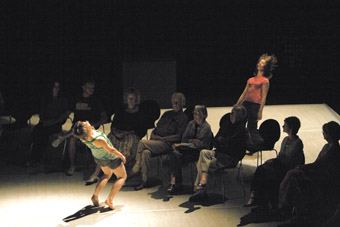
mily Amisano, Trish Wood, Being There
photo Fiona Cullen
mily Amisano, Trish Wood, Being There
IN THE PAST 18 MONTHS, INDEPENDENT ARTIST CLARE DYSON HAS PRESENTED THREE MAJOR WORKS OF DANCE THEATRE, EACH OF THEM DEALING WITH SITUATIONS IN EXTREMIS, OR AT LEAST IN THE LATEST CASE, FRAUGHT. THEY ARE CHURCHILL’S BLACK DOG, ABSENCE(S) AND, NOW, BEING THERE. THE FIRST OF THESE UTILISED CONVENTIONS OF CHARACTER (ALBEIT IN A CONTEXT WHERE THE CONCEPT OF CHARACTER WAS UNDER STRAIN); THE SECOND IMMERSED THE AUDIENCE IN AN INSTALLATION WITH OVERLAPPING MEANINGS DEPENDENT ON THE POINT OF VIEW. BEING THERE WEAVES PURE DANCE AND A RECORDED SPOKEN NARRATIVE INTO A SPATIAL AND TEMPORAL MOSAIC. IT WAS DEVELOPED AT TANZFABRIK IN BERLIN WHERE IT HAD AN INITIAL SHOWING.
These three works add up in diverse ways to a consistent, heuristic theatre of ideas based on Dyson’s investigation of audience agency and heightened by an unashamed proclivity for the potent poetics of Romanticism. Her rigorously conceived work is always sensitive to the surprising complexity, the mystery, the flawed beauty and fragility of life.
Dyson is canny in her choice of like-minded collaborators, including Mark Dyson (lighting) and Bruce McKniven (design). The circumscribed performance space of this new work is an ellipse delineated by muted lighting and a surround of chairs, a minimalist configuration that nevertheless gradually assumes a meaningfulness compounded by the failure of different geometrical planes to meet and the syntactical sense of ellipsis whereby words are left out and implied. There are gaps in the seating arrangements as transit points enabling the dancers to move here or there. As if in the complete intimacy of a dance studio, the dancers are within reach, and the audience is face to face.
Being There is about a woman who has an affair in a foreign country (over there), betraying her husband at home here in Queensland. Her predicament is that she is at a moral and artistic impasse. “When she was younger, she imagined the purpose of art was to move. Audiences, I believed, want to be discomforted. Move where? She wonders now.”
Being There constitutes a kind of dream fugue, a non-linear series of glimpses from past events. It plays on the dancer/text relationship, and portrays a struggle for mastery. Writer Siall Waterbright’s dispassionate vignettes amount to a cool appraisal that the unnamed woman cannot be there, wherever she is. Ironically the unseen woman’s infidelity is a poignant quest for visibility. By contrast, the dancers take a stand in the here and now, not standing in for the text. They choose to be present, authentically themselves, introducing themselves to the audience, even taking time for a water break. But sometimes the text gains ascendancy and the performers are over there. Lyrics to a song are in a foreign language. A woman removes her knickers, or strikes matches, illuminating, as Dyson says, “the domesticity of everything.” Sometimes the vocalized text takes centrestage, relegating the performers to the dark. Dyson conducts this antiphony seamlessly.
The two performers, Emily Amisano and Trish Wood, are personable, casually dressed, just two young women who dance beautifully, and beautifully together. They double relations in the text, traverse the same emotional territory, but as themselves, they unnerve us. We are proximate to them, breathing with them. They are falling women. They really cry, blow their noses, bruise themselves and slap the floor in an anguish which refracts rather than reflects the text. They are so committed that we are plunged to the depth of our own resources of memory and desire in order to meet them, and ultimately to realise that our own moral situation is fatally compromised or at the least exigent. As we leave, we can only match the “uncertain dignity” of Dyson’s protagonist. For a little while we cannot look each other in the eye.
Dyson has a dangerous flair for not allowing the audience to resile. Hers is an existential art. The title Being There alerts us to the dialectical relationship with Absence(s). In that earlier work Dyson eviscerated us by dramatically conveying the contingency of human existence, turning us into hollow men and women forever haunted by loss and death. In effect, denying our presence. Being There seemingly rejects the Sartrean take on being-for-others, or existing purely in terms defined by the Other which is so problematic for her fictional protagonist. Instead, an open invitation is issued to be fully present to a face to face encounter by directly challenging the stance of the audience as uninvolved observers. When Dyson’s art moves us, it moves us to ethically new positions. We are moved by the naked intensity of the live performers, and even sympathise with the one who is not present. We care for them all, and want to take responsibility for them. This is the possibility for an ethics defined by the philosopher Levinas.
Heidegger points us towards her method. Clare Dyson is at pains to provide a ‘clearing’ where “we can apprehend the being of a being, apprehend the being as it is, where it is.” To pull this off is wonderful and, I think, important. Art wasn’t meant to be easy. If you have the taste for this sort of thing, it sure as hell beats shopping.
Being There, creator Clare Dyson with dancers Emily Amisano, Trish Wood, writer Siall Waterbright, designer, Bruce McKniven, lighting designer Mark Dyson; Judith Wright Centre of Contemporary Arts, Brisbane, Dec 12-15, 2007.
RealTime issue #83 Feb-March 2008 pg. 43
© Doug Leonard; for permission to reproduce apply to realtime@realtimearts.net
IT WAS WONDERFUL TO SEE THE WESTERN BROADWALK FOYER OF THE SYDNEY OPERA HOUSE DURING THE SYDNEY FESTIVAL AWASH WITH VIDEO MONITORS LARGE AND SMALL SURROUNDED BY EAGER PRE- AND POST-SHOW VIEWERS. WHAT THEY SAW WAS BOUNTY FROM A TREASURE CHEST OF AUSTRALIAN DANCE FILM CURATED BY REELDANCE’S ERIN BRANNIGAN.
Small monitors with associated touch screens offered a selection of works and two pairs of headphones for shared viewing, and the opportunity to cut out the buzz of the crowd and immerse yourself, glass of wine in hand, in up to 14 works ranging from Tanja Liedtke’s One Cell, Nalina Wait and Jane McKernan’s Dual and Samuel James and Rosie Dennis’ Simulated Rapture to films of ADT’s Devolution and Chunky Move’s Glow.
The large ‘3 Screen’ outside the Drama Theatre featured The Fondue Set (collaborating with Shane Carn) re-creacting in serio-comic detail The Lorrae Desmond Show, alternating with Force Majeure’s The Sense of It, and Margie Medlin and Rebecca Hilton’s Miss World.
The ‘Screen Wall’ also provided viewing on a larger scale but changed content daily, featuring award winning dance films such as Gina Czarnecki and ADT’s Nascent and Sean O’Brien and Yumi Umiumare’s Sunrise at Midnight, a documentary of Stephen Page’s Kin and works by Anton, Shaun Parker and Natalie Cursio among others. A ‘VJ’ program on more large screens put works by Bangarra, Chunky Move, Dance North, Lucy Guerin Inc, David Corbet, Sue Healey and others in the mix.
For successful viewing of works on the big screens, less crowded, quieter foyer moments were preferable, but the curious were not deterred, while the small monitors offered ideal intimacy. Dance Screen was a popular venture that warrants repeating. Certainly for the many hundreds who course through the Opera House daily on tours the program should have been running all day. Not only did Dance Screen reveal to the audiences packing out the festival’s Movers & Shakers dance program a wealth of dance film of all kinds, but it provided audiences with options—either to mingle or relax into another world of dance altogether.
–
Sydney Festival, Moves & Shakers, Dance Screen, curator Erin Brannigan, Theatre Foyers, Western Broadwalk, Sydney Opera House, Jan 5-16
RealTime issue #83 Feb-March 2008 pg. 44
© RealTime; for permission to reproduce apply to realtime@realtimearts.net
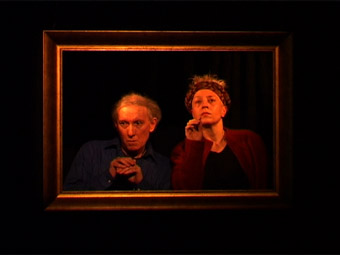
Peter Snow, Tess de Quincey, embrace: Guilt Frame
photo Samuel James & Russell Emerson
Peter Snow, Tess de Quincey, embrace: Guilt Frame
IN A WELCOME AND RADICAL MOVE BY THE SYDNEY THEATRE COMPANY, INCOMING ARTISTIC DIRECTORS CATE BLANCHETT AND ANDREW UPTON HAVE PROGRAMMED A TWO-WEEK WHARF2LOUD SEASON OF TESS DE QUINCEY’S EMBRACE: GUILT FRAME, AN INTENSE 40-MINUTE MOVEMENT WORK “ILLUMINATING THE SHAPE AND RHYTHMS OF OUR INNER LIVES.” EACH PERFORMANCE WILL BE FOLLOWED BY DRINKS AND DISCUSSION. THIS DUET BETWEEN SYDNEY-BASED DE QUINCEY AND MELBOURNE ARTIST PETER SNOW IS PART OF A LARGER DE QUINCEY PROJECT CONNECTING WITH INDIA, SIMPLY TITLED EMBRACE.
Embrace is an ongoing exchange between De Quincey Co and Indian artists in partnership with Monash University. Seeded in 2003 in Kolkata, the Embrace exchange explores a relationship with The Natyashastra, the seminal ancient text and cornerstone of Indian artistic practice, with Body Weather, the practice developed by Min Tanaka and his Mai-Juku Performance Company in Japan. Tess de Quincey was a dancer with that company for six years (1985-91) before returning to Australia where she has continued to perform solo and with her company, as well as teaching Body Weather.
De Quincey defines the developing relationship between The Natyashastra and Body Weather as “a synthesis of Eastern and Western practice and thought, bringing together ancient Buddhist and Taoist thinking with elements of 20th Century Western philosophy. It’s a radical, open-ended exploration that melds contemporary dance and sports theory with martial arts, traditional Japanese/Asian theatre and Western avant-garde arts practices.”
Visiting old friends in India with a great library, de Quincey found herself one day sitting on the balcony reading The Natyashastra and feeling, she says, “a resonance and connection with my own work but at the same time a lot of differences.” Here, she thought, was a means with which to engage with Indian artists.
De Quincey wasn’t thinking of absorbing an Indian performance methodology but connecting with certain “energetic states” common to The Natyashastra and Body Weather. But it’s also, she says, about “the placement of the ego—the position of non-self-expression and utilising the body as a transformative entity.” De Quincey had turned to Body Weather in response to “a crisis of faith in relation to Western dance, because I knew I wasn’t getting what I needed.” Workshops in Bali with Yoshi Oida in 1984 in Topeng mask work, Noh Theatre and meditation with a Shinto priest provided the first steps for a new direction that lead her to Body Weather.
For de Quincey, leaving Western dance was to escape conventional notions of form and expressiveness: “Working in Japan for six years I became really aware that the placement of the individual is really different there, because you see the individual as servicing the communal space…You’re not concerned with the “I”, you’re actually concerned with the space in between.”
I ask if taking on Body Weather is to learn a discipline or evolve a particular state of being. “I think in one way it was almost like trying to shed. The first couple of years were about coming down to bedrock. Really everything I’d learned in terms of physical work had to be dropped. The Body Weather training on a mind-body, muscle and bone level is more like gymnast’s work. It’s quite purist in that respect. Most dancers are working to put aesthetic relationships into their body from the word go. In effect, this approach tries to drop them. All those things take a long time to shed.”
I wonder what de Quincey is doing if not actually dancing in the Western sense? She replies, “Developing strength and relationship to ground—the grounding that is embodied in that. For example, the mind-body workout is purely about understanding the depth of relation to the ground but also about working space together. The communal body is also a very big part of the mind-body. So you see the body from outside working into the greater body. And that in effect is another way of working, a preparation for performance.”
De Quincey senses profound cultural differences in performance and audience reception. “A Western dancer will perceive the internal line of the body cutting through space. So you see the line of the arm working through space. It’s like the geometry of the body is the indicative factor. For Mai-Juku, the body is being danced by the space. So the softness of the arm is totally different. Even if you were to make an arc through space, the reason for doing it would be so different that the expression of it is ultimately different. Often from an audience point of view you’re certainly aware watching this work that there’s a very different sense of time and space, especially of time. I think part of the thinking of Body Weather is to open up a different doorway. And of course, as soon as you shift into a new speed outside your natural speed, you shift out of normal mode.”
Not surprisingly then, framing is a term de Quincey uses frequently. In Kolkata in 2003 she worked on embrace: Limitless with 40 children from the slums, staged in the streets, and embrace: A Silent Thread, with 14 dancers and many locals in a spectacular site-specific work moving from a park to an old home, now a classical music venue. “The sense of framing has partly come about through doing site-specific works. A Silent Thread established a frame for audiences in a stately old home, shifted it around and took them through different frames. I was very affected by the portraits of the old Raj you see somewhere like the Bengal Club. If you’re directing the audience’s attention what they are seeing is, in one sense, a filmic frame. As you move through a site you’re drawing in on different focuses, using performers to delineate frames…and of course, there were plenty of frames within that building—windows and doors.”
But in embrace: guilt frame, there’ll only be one frame, “a gilt frame”, declares de Quincey, a metre wide that she and Snow will perform in, going though a number of “energetic states.” She fills me in when I wonder where the term comes from: “I’ve been working a lot on Gestalt with Philip Oldfield, a very interesting therapist and psychologist based in Sydney. Working with him, I felt an immediate parallel world to Body Weather, but it was a psychological understanding of the same elements. He reads the body completely. His whole relationship to understanding psychology is from the micro-signalling I understand to be the communicating factor in any performance. He speaks about energetics, so maybe my reference comes from that.”
De Quincey details the structure of the performance: “We’ve gone along with The Natyashastra states—love, laughter, sorrow, anger, the heroic, fear, disgust, astonishment. We run through a cycle of them and then, for eight minutes at the end, we’re improvising. The first state is love. You take the eight states and put them inside love. Within love, you have also astonishment, anger, fear and so on; but the base state is love. It’s almost like a holographic world that you can keep breaking down. The first time we did it as a total improvisation. I’d basically conceived it as the frame, the eight emotional states and physical lock-in points within, that delineates the agreement between the performers as to which state we’re in. And we’re going from one state to the next, as simple as that.”
There’s no sense of a one-off about embrace: Guilt Frame for de Quincey: “I find it very interesting, the idea of process and product. The only reason we can make this performance is because of all the other Embrace performances before it.”
Music is also an important component of the performance for de Quincey: “I’ve been waiting for a long time for a way to use Ligeti’s Symphonic Poem for 100 Metronomes (1962), which I discovered years ago and just fell in love with. But we couldn’t get permission from the estate to use it. So I asked Michael Toisuta to make a piece as a homage to Ligeti. It’s very different from the Ligeti, but it uses metronomes. We tried using computer-generated sounds but it was a disaster so we bought metronomes. In the Ligeti I’ve always liked the extraordinary patterns that only last for brief moments emerging from absolute chaos.
“But the interesting issue is how we understand patterns and perceive them. And the music seemed to me the means by which to open the space of the framing of chaotic relationships in our lives. The metronomes create a bedding, an endless felting of layers, but at the same time they cut through them. We’ve had to create that feeling afresh. And that’s been an interesting parallel experiment. Michael’s composition is much more musical than Ligeti’s, even though he didn’t set out to do that. And there are moments where it’s completely like a Balinese orchestra. And we hadn’t looked at that either.”
But the music is not there to be performed to, says de Quincey: “It’s a timepiece. It’s there all the time. To me, part of what I understand this piece to be about is time, because you can’t work with emotions without having time—all those long threads and where they go back into our histories and forward into our future imaginings. Those perspectives seem to be absolutely embedded in the issue of time and space, even thought it’s a tiny gilt frame space…As soon as you bring the world down to a matchbox, space becomes endless as well. It’s the paradox of scale.”
–
Sydney Theatre Company, Wharf2Loud, embrace: Guilt Frame, created and performed by Tess de Quincey and Peter Snow, original Concept Tess de Quincey, set Designers Russell Emerson, Steve Howarth, lighting designer Travis Hodgson, sound designer Michael Toisuta; Richard Wherrett Studio, Sydney Theatre, Feb 27-March 9
RealTime issue #83 Feb-March 2008 pg. 45
© Keith Gallasch; for permission to reproduce apply to realtime@realtimearts.net
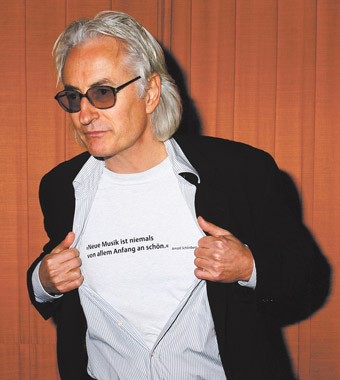
Jon Rose, “Neue Musik ist niemals von allem Angfang an Schön” (New music is never very nice at the beginning)
THE FOLLOWING IS AN EDITED VERSION OF THE 2007 PEGGY GLANVILLE-HICKS ADDRESS BY VIOLINIST, COMPOSER, FREE IMPROVISER AND INSTALLATION ARTIST JON ROSE FROM THE ANNUAL FORUM PRESENTED BY THE NEW MUSIC NETWORK. THE COMPLETE PAPER CAN BE READ ON THE NETWORK’S WEBSITE AND WILL BE THE BASIS FOR A CURRENCY HOUSE PLATFORM PAPER IN 2009.
The full title of the address is Listening to History: some proposals for reclaiming the practice of music. Rose frames his witty and passionate argument for a wider and deeper embrace of music in everday life, education and cross-cultural relations in terms of Australian Aboriginal culture past and present, and within that reflects on the European incursion and its instruments—from the piano to the computer (sadly, Australian pioneering here was not capitalised on). Our edited version focuses on the mainframe of Rose’s argument about the relationship between black and white cultures. His short history of electronic music in Australia can be read in the full version of this address online. We’ll look at this history in a later edition of RealTime.
* * * *
Last year at a Sydney University, a musicologist observed, “Everybody knows that music in Australia didn’t really get going until the mid-1960s.” Significantly, this gem was spoken at a seminar that featured a film about the Ntaria Aboriginal Ladies’ Choir from Hermannsburg, Central Australia. The denial of a vibrant and significant musical history in white as well as Indigenous culture has done this country a great disservice.
It may well be the prime reason why none of the 20th century’s great musical forms ever originated in Australia. Bebop, western swing, cajun, tango and samba (to name but a few) originated in lands also saddled with a colonial history. A tiny country like Jamaica has given birth to no less than calypso, ska and reggae.
To many, living in our current cut-and-paste paradise, this probably seems irrelevant and an irritation—why bother with the detailed sonic interconnectivity of the past when you can avoid both past and present by logging into, say, Second Life on the internet? I didn’t add “future” to the list of avoidance because you can guarantee that the future will be mostly a rehash of the past. It’s what we already have in Australia—everything from faithful copies of powdered wig Baroque to yet more hip-hop, to concerts where almost any plink or plonk from the 20th century is attributed to John Cage.
Unless we investigate and value our own extraordinary musical culture, the dreaded cultural cringe will continue to define what constitutes the practice of music on this continent.
interactions
So, first to History. It didn’t start off so badly. As Inga Clendinnen recalls in her book Dancing with Strangers, the firsthand account of Lieutenant William Bradley states that “the people mixed with ours and all hands danced together.” Musical gestures of friendship also took place. “The British started to sing.” The Aboriginal women in their bark canoes “either sung one of their songs, or imitated the sailors, in which they succeeded beyond expectation.” Some tunes whistled or sung by the British became favourite items with the expanding Indigenous repertoire of borrowed songs. Right there at the start we have a cultural give-and-take from both sides.
There is a unique recording made in 1899 of Tasmanian Aboriginal Fanny Cochrane singing into an Edison phonograph machine. The photo is stunning too, but that is all there is until anthropologust AP Elkin’s first recording in 1949 (as far as I can ascertain). Audio recordings thereafter document almost exclusively the music practice in Arnhem Land.
The recording of Fanny Cochrane is arguably one of the most important 19th century musical artefacts from anywhere in the world—certainly more important than the recording of Brahms playing his piano in the same year. With Johannes we still have the notation; without Fanny’s voice there would be nothing. And maybe that’s what we have wanted: ‘nothing’ to connect us to the horrors of Tasmanian history.
Translations of Central Australian Aboriginal songs were undertaken by Ted Strehlow in the 1930s, but he had his own Lutheran agenda and concentrated on ceremonial songs not personal everyday songs. He also wasn’t interested in how the songs actually sounded, the sonic structures, the grain of the music.
music for conquest & survival
“An impossible past superimposed on an unlikely present suggesting an improbable future.” Here Wayne Grady, in his book The Bone Museum, is describing the nature of the palaeontologic record, but he could be describing the culture of the modern Australian state. I find it a useful key. Let’s unlock some other musical history that has been documented.
We know that the first piano arrived onboard the Sirius with the first fleet. It was owned by the surgeon George Wogan. What happened to it is not known, but we do know that the import of pianos by the beginning of the 20th century had grown from a nervous trickle to a surging flood. The famous statement by Oscar Commetent that Australians had already imported 700,000 pianos by 1888 may be unsubstantiated, but the notion of one piano for every three or four Australians by the beginning of the 20th century could well be close to the mark.
A read through John Whiteoak’s groundbreaking book Playing Ad Lib presents a strong tradition of orality; and through observations of colonial Vaudeville, the music hall, the silent cinema, circus and theatrical events, he exposes a lexicon of unorthodox music-making more akin to the 1960s avant-garde and beyond than repressed Victorian society. If you like: the colonial 19th century was a period of fecund instrumental technique—music-making without the instruction manual.
Unfortunately, from the Gold Rush onwards, the common purpose of the colonisers became clear. Even the most enlightened were engaged in the wholesale destruction of Aboriginal culture, a political-economic agenda formulated by the powerful and still entering the law books via the mining industry to this day.
Even where Christianity worked a more moralistic trail of destruction compared to the pastoralists, the practice of music was both the medium of conquest and the medium of survival. Whatever your view of history, when the Hermannsburg Aboriginal Women’s Choir sing the Chorales of JS Bach in their own Arrernte language, with their own articulation, gliding portamento and timbre, it is an extraordinary and unique music that is being made. Started by Lutheran Pastors Kemp and Schwartz in 1887, the choir’s music is full of colonial cultural contradiction, but that music has also nurtured the Indigenous population through times of persecution and extreme physical hardship. The choir has gone from a 40-plus membership in its heyday of the 1930s to the current situation where it is difficult to muster eight singers—on our way to record the choir two years ago, two of the choir’s ladies had died in that week. This music could vanish in five years.
Mixed up with government policy to liquidate Aboriginal culture by placing mixed-blood children in institutions, in 1935 Aboriginal children with leprosy were “rounded up” (to quote the local newspaper) and placed in the Derby Leprosarium in Western Australia. An unexpected outcome of this brutal herding was the founding of The Bungarun Orchestra. To keep their fingers exercised, up to 50 patients performed Handel, Beethoven, and Wagner by ear—copying one of the sisters at the piano. And, according to their own testimony, the music helped the inmates escape the loss of their families and traditional cultural life, and also the painful injections of chaulmoogra oil [an ancient Asian cure from the seeds of the tree of the same name] into their bodies. Documentation of the orchestra shows dozens of violinists, the odd guitar, a didjeridu and some four banjo players. I’m not a fan of Wagner, but I would pay big bickies to hear a recording of Wagner with banjos. Unfortunately, the only audio documentation seems to be the singing of an Anglo hymn; nothing from the classical canon.
It’s a shocking frontier story, but my point is that the practice of music fulfilled a vital if contradictory role—it was part patronising western hegemony, and part genuine release, expression and consolation for those suffering.
lost tradition
Gumleaf playing may well go back thousands of years; again, the record is hazy. According to musicologist Robyn Ryan, it was documented first by pastoralists in 1877 in the channel country of Western Queensland. The gumleaf was used by Aborigines in Christian church services by the beginning of the 20th century, and reached popularity in the 1930s when the desperately unemployed formed 20-piece Aboriginal gumleaf bands at Wallaga Lake, Burnt Bridge and Lake Tyers, and armed with a big kangaroo skin bass drum, marched up and down the eastern seaboard—demonstrating defiance in the face of the whitefella and his economic methodology. The spirit of this music was not to appear again before the 1970s Aboriginal cultural revival. Alas, the band music itself has disappeared.
What has happened to this tradition? The Wallanga Lake Band played for the opening of the Sydney Harbour Bridge in 1932. Why isn’t there a 20-piece gumleaf band marching down George street on Australia Day? This is the New Orleans trad jazz of Australia. Who is looking after this, who is nurturing this?
My point is that you can and should research and write your own history—if it has content, it will ring true. It might also provide the materials with which to challenge the future.
an unmusical culture
There are good models of environmental performance in our recent past, but these are fairly isolated events when you consider that all music was an outdoor affair up until 1788. These aren’t quite up there with the Aboriginal notion of ‘If I don’t sing the land into existence, it doesn’t exist’, but some have tried to come close. I’m thinking of examples like The Gwotamala happenings organised by George Gittoes in the Royal National Park in the late 1970s; The Maritime Rites of Alvin Curran performed in Sydney Harbour in 1992; the Totally Huge Festival on a West Australian sheep station in 2001; the 2008 NOWnow festival in the Blue Mountains will go outdoors; the spectacularly successful Garma Festival in North-eastern Arnhem Land.
Here’s what Galarrwuy Yunupingu says about the Garma festival: “it’s about learning from each other the unique Indigenous culture as well as the contemporary knowledge that we learn from the white man’s world. This is about uniting people together and the weighing and balancing of their knowledge.”
How can we weigh and balance knowledge of music when only 23% of Australians get any kind of specialist music instruction in our public schools? It’s not just that the standard of what there is teeters from the bad to the abysmal; it’s the fact that music is just not rated as a necessary life skill, not rated in the same way that the notion of music as a profession has become laughable. Vast sums of money can be spent on the bricks and mortar of opera houses and conservatoriums, but noone wants to pay the musicians. The punters might pay for celebrities, but they resent paying for the real cost of live musicians, and by that, we know what the value of music really is in our society. Rock bottom.
Here’s some statistics taken in 2004 from the Music in Australia Knowledge Base [http://mcakb.wordpress.com]. Out of a population of over 20.1 million people, only 230,800 persons said they were involved as live performers of music. That’s a lot less than the number of pianos in Australia in 1888 when the population was well under 3 million.
So how unmusical have we become? That figure 230,000 includes unpaid and paid hobbyists as well as professionals. That’s 1.47% of the population. Out of that 1.47%, only 15.2% worked 10 hours or more per week. This means that less than 3,500 musicians were employed anything like full time in this country during the Howard boom year of 2004.
What was their worth? There are no figures, but of that initial boast of 230,800 people who said they had been involved in music somehow, only 11,500 said they received more than $5,000 dollars in that year. And that number would be seriously warped by the millions handed out to opera and the five orchestras. I disagree with the pronouncement from an ABC presenter who thinks that classical music needs defending —classical music does not need defending. Classical music has a hotline direct to the power elite of this country and has nearly the whole of the available subsidized cake and eats it too.
reciprocity & the future
For a musical praxis in the future to have any hope it must involve a high level of reciprocity—the ability to socially combine on a local and global level. It would have to be a catalyst that makes us more human. This has dangers—at its worst music helps us wage war more effectively; at best it brings us into communion with other selves—other species—the natural world from whence we came.
As Aboriginal models can teach us, music should be part of a continuum of creative practice involving sound, stories, and image—something integrated and interchangeable with geographical location; something that draws on all media, and we are now aware of that concept through the Internet.
We might be able to move from a position of musical impotence to one of strength if we choose to listen to the past. We whitefellas are in a unique position to learn from the Indigenous peoples of Australia. That doesn’t mean Nimbin hippy-style delusions of back to the bush; I’m proposing a society where there is, if not universal musical suffrage as was the norm in traditional societies, at least a situation where if you want to share knowledge, as when a Warlpiri woman tells a sand story, the most natural thing is to paint and sing this knowledge into existence. Technology can be used well to promote such notions, but it cannot replace original content, social connection, environmental context, and the wonder of firsthand experience, any more than we can replace the earth on which homo sapiens has become an uncontrollable parasite.
A few years ago Germaine Greer, in her essay White Fella Jump Up, proposed that Australia’s salvation might lie in becoming an Aboriginal Republic—an idea for which buckets of manure were poured over her head by the usual commentators. Well, I’d back almost anything that got rid of the British hereditary ruling class and that ridiculous Australian flag. However, the rub of the issue is this: our current models of music have not and are not serving us well. Instead of importing the latest theoretical cultural package from the USA or the UK, perhaps there are many elements in our Indigenous and colonial history that contain empirical guidance for the future of music as practiced in this country.
Mutawintji Aboriginal guide Gerald Quale once told me, “You whitefellas got the three Rs; well, blackfellas got the three Ls—look, listen and learn.” This strikes me as a good approach to our history and a methodology for the future if we want there to be music making of any value, but we are going to have to believe first that it is worth trying.
New Music Network, 2007 Peggy Glanville-Hicks Address: Listening to history presented by Jon Rose, The Mint, Sydney, Dec 3, 2007
Reproduced with the permission of the author and the New Music Network. The full address can be read at www.newmusicnetwork.com.au See also www.jonroseweb.com.
RealTime issue #83 Feb-March 2008 pg. 46
© Jon Rose; for permission to reproduce apply to realtime@realtimearts.net
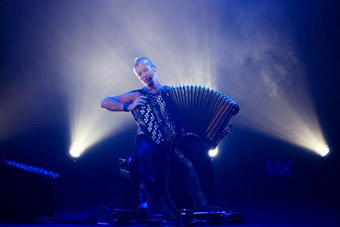
Kimmo Pohjonen
photo Prudence Upton
Kimmo Pohjonen
AS FINNISH BUTTON-ACCORDIONIST KIMMO POHJONEN STRIDES ONTO THE ANGEL PLACE STAGE IN PSEUDO-SAMURAI WRAPAROUND TROUSERS AND SLEEVELESS VEST, HIS HEAD SHAVED SAVE FOR THE WISPY HINT OF A MOHAWK, I WONDER IF WE ARE ABOUT TO EXPERIENCE THE AWKWARD HYBRID OF ‘CLASSICAL MUSICIAN GONE PUNK.’ (I’M REMINDED OF HIPSTER VIOLIN VIRTUOSO NIGEL KENNEDY WHO HAS ALSO JUST TOURED AUSTRALIA.) PERHAPS THE POHJONEN PERSONA MAKES ME SLIGHTLY LESS SQUEAMISH BECAUSE, DESPITE THE PRESENTATION IN A MAJOR CONCERT HALL, THE ACCORDION ITSELF HAS ITS OWN PROTO-PUNK ASSOCIATIONS—YOU CAN’T GET ANY MORE DIY THAN FOLK MUSIC. AND THE SOUND OF ACCORDION, FOR MANY, INSTANTLY CONJURES ROMANTIC PROJECTIONS OF SOCIETY’S OUTCASTS—GYPSIES, CIRCUS FOLK AND CARNIE FREAKS.
Pohjonen starts with some lyrical material illustrating his technique but very rapidly spikes and jagged edges appear, cascades of dissonance erupting as though his hands are misbehaving. From the moment he commences he is completely physically animated, his nuggetty arms pumping the bellows, feet stomping on effects pedals as he rocks back and forth, getting more and more maniacal as he builds his crescendos and walls of sound.
Working with sound designer Jukka Kaven, the essentially unidirectional output is amplified and spatialised. He has an impressive rig of pedals for delays, looping, pitch shifting and other magics. Many of Pohjonen’s compositions are based on presenting a simple phrase which he captures and loops in realtime, successively layering loop upon loop until he has built an epic orchestral squall. While this is impressive technically, and sonically—we witness the piece in the making—the results become structurally predictable (a problem for many musicians using additive looping techniques).
Pohjonen is most invigorating in his integration of extended instrumental techniques. In one piece he starts with the sound of the bellows of the accordion, a deep soughing and sighing, which he then overlays with a patina of rhythms and patterns drummed on the body of the instrument. To this he adds vocalisations—earlier in the concert he has begun to sing along with himself, but more in the way you might do when you practice, a sub-vocal search through the material—now he is exploring his voice as an instrument with mouth clicks, hisses, slurps and yelps. As his voice turns edgier, he discards the accordion, supported only by the looping of his drone like chanting. Now he is standing, performing some kind of liturgical dance, slapping his forehead, beating his chest. As he moves around the stage, a story is being told, but of what—a battle hymn? Summoning of ancient spirits? The lighting is similarly dramatic, with strong colours and patterned gobos speckling the blond wood interior of Angel Place. Pohjonen obviously takes his music very seriously, but is it my cynicism that makes me suspect some kind of parodic intention behind this showiness or is he earnestly trying to conjure a contemporary hybrid shaman?
Sometimes when watching musicians utilising extended techniques, I begin to question the idea of instrument—perhaps this is a mindset that can be applied to any material—someone playing the bass may just as easily be exploring the sonorities of a chair with the same intensity and generating interesting results. Kimmo Pohjonen is undoubtedly virtuosic on his chosen instrument and his explorations of the accordion through its materiality and its electronic augmentation make his work challenging and genuinely entertaining. After extended listening though, I can’t help thinking about what he could do with a chair.
Kimmo Pohjonen, sound design Jukka Kaven, lighting Ari Valo Vitanen; City Recital Hall Angel Place, Jan 18; Sydney Festival 2008
RealTime issue #83 Feb-March 2008 pg. 47
© Gail Priest; for permission to reproduce apply to realtime@realtimearts.net
MELBOURNE MUSICIAN AND COMPOSER SIMON CHARLES HAS BEEN AWARDED
THE APHIDS-REALTIME RESIDENCY.
Simon plays saxophone, has a Bachelor of Music degree from Melbourne University and is currently undertaking a Master of Music degree in performance and composition at the Victorian College of the Arts. His compositions include Marionette for narrator, electro-acoustic playback and video, created in collaboration with poet Jessica Wilkinson for the 2007 This is Not Art Festival in Newcastle. Other 2007 compositions include Evocation for Bosgraaf and Elias (Netherlands) for bass recorder, guitar and electro-acoustic CD and Encapsulate for ensemble Onomatopoeia, for soprano, alto, cello and two percussionists. Simon has also curated concerts and been an artist-in-residence at the Bundanon estate in New South Wales.
Aphids, the Melbourne based company specialising in international cross-artform collaborations, and RealTime, the magazine promoting innovative Australian art to the world in print and online, have come together to offer this residency for an emerging Victorian reviewer in music and sound art. Part of the Aphids Residencies and Mentoring Program for young and emerging artists, funded by the Myer Foundation, the residency takes the form of a mentorship with Victorian RealTime reviewer, Chris Reid, and two visits to Sydney to work with the editors of RealTime.
RealTime looks forward to working with Simon and seeing his writing on our pages. RT
RealTime issue #83 Feb-March 2008 pg. 47
© RealTime ; for permission to reproduce apply to realtime@realtimearts.net
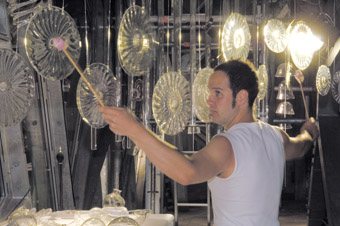
Eugene Ughetti, The Glass Percussion Project
photo Andrew Barcham
Eugene Ughetti, The Glass Percussion Project
THE GLASS PERCUSSION PROJECT EMBRACES MANY ARTS: GLASSMAKING, MUSICAL COMPOSITION, SOUND ART, INSTALLATION AND THEATRE. ONE OF A SERIES OF EVENTS COMPRISING THE PROJECT, INTERMEZZO IS SITE-SPECIFIC TO THE ATRIUM, A CAVERNOUS VAULT 15M HIGH AND 50M LONG, LINED WITH CAFES, SHOPS AND BARS, AND FORMING A HUB IN THE FEDERATION SQUARE CULTURAL PRECINCT. THE PERFORMANCE TAKES PLACE IN THE FRACTURE GALLERY, WHICH LIES WITHIN THE ATRIUM’S GLASS WALLS—A DOUBLE LAYER OF CLEAR GLASS ON THE WESTERN SIDE OF THE BUILDING CREATING A 2-3M CAVITY—AND INSIDE WHICH ARE SCAFFOLDING AND LINEN-COVERED TABLES THAT SUPPORT THE 1400 FABULOUS HANDMADE OBJECTS CREATED BY GLASS ARTIST ELAINE MILES.
On display throughout the season, these objects twinkle in the sunlight, especially at sunset. There are many types of glasswork: plates, bowls, decorated rods, wine glasses and abstract shapes. Some resemble familiar musical instruments, such as marimbas, gongs, tubular bells and wind-chimes, but, for this event, all the pieces double as musical instruments.
The percussionists, Eugene Ughetti and Matthias Schack-Arnott, wear protective goggles and white suits resembling Japanese martial arts outfits as they climb around inside the glass gallery to reach the various groups of instruments. The instruments are closely microphoned and the sound is broadcast into the atrium through a complex multi-channel loudspeaker system via a computer and mixing console. The sound the audience hears is at times heavily mediated through Myles Mumford’s live processing. The computer processor is an essential component of the instrumentation, and the performers are cued through click tracks to coordinate their playing with the processing. In effect, two people—the performer at the glasswork and the performer at the computer—are playing some of these instruments. For example, when Schack-Arnott plays the gong, a large windowpane hit with the hands instead of the usual mallets, Mumford bends the pitch to create a deeply resonant sound rich in melodic and harmonic character. Mumford uses processing to extend or abbreviate the duration of sounds, amplify harmonics and resonances, make audible certain pitches that are outside the normal range of hearing and filter out other pitches. The mixer, Michael Hewes, then channels the sound throughout the atrium, emphasising the space in which the performance occurs, and even extending the concept of the instrument to include architectural space itself.
Ughetti’s composition comprises many short elements totalling about an hour and, in constructing it, he responds to the objects themselves, seeking out their sonic and musical potential. He indicated that the glass pieces were carefully selected to ensure the correct sound, especially the tuning. Chromatic, pentatonic and microtonal tunings with quarter and eighth tones are evident. The composition and the performance seem to have evolved simultaneously with the design of the glass pieces as artworks, producing multifaceted objects with great potential. Even where familiar instrumental designs are parodied, such as with the marimbas and bells, the glass instruments produce a sound that establishes them as unique, characterised by the resonant properties of glass as distinct from metal, wood or animal hide. The glass gamelan sound is delightful and, as well, it extends our appreciation of the traditional gamelan form. Ughetti has notated all the elements of the composition, but allows some room for the performer to respond as the performance develops.
Intermezzo is a wonderful work, detailed and nuanced in its orchestration, with moments gentle, introspective, intense and virtuosic, drawing on the full range of percussion artistry. The appreciative audience shuffles about between the balcony and the floor of the atrium to see and hear what is unfolding, or absorbs it sitting with a drink. A CD recorded from a performance was replayed in the atrium at random intervals every day, forming part of the installation, so that passersby would be drawn into the project. Listening to the CD at home is an intimate experience very different from listening to the live performance in the atrium, lacking the ambient noise of human and street traffic that forms part of the live event.
Overall, Intermezzo approaches a gesamkunstwerk with its coherent blend of visual, dramatic, compositional and technical elements, and its production involves a carefully rehearsed and tightly managed team effort. The Glass Percussion Project raises the question of what a musical instrument might be and what a sound installation might be, and bridges the boundary between the visual and sonic arts. The project doesn’t answer any questions, but opens a world of possibilities upon which these and other artists will undoubtedly build.
The Glass Percussion Project, Intermezzo, co-director, composer, percussionist Eugene Ughetti, co-director, glass artist, installation artist Elaine Miles, percussionist Matthias Schack-Arnott, live electronics Myles Mumford, sound diffusion, sound engineer Michael Hewes, lighting designer Richard Vabre; Federation Square, Melbourne Jan 10-Feb 2
RealTime issue #83 Feb-March 2008 pg. 48
© Chris Reid; for permission to reproduce apply to realtime@realtimearts.net
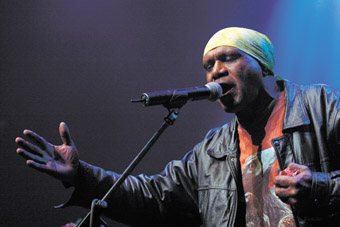
Archie Roach, The Black Arm Band,
courtesy WOMADelaide
Archie Roach, The Black Arm Band,
IN TUNE WITH THE RECONCILIATION BETWEEN BLACK AND WHITE AUSTRALIANS SIGNALLED BY THE FEDERAL PARLIAMENT’S APOLOGY TO THE STOLEN GENERATIONS, WOMADELAIDE 2008 FEATURES ONE OF THE HITS OF THE MELBOURNE AND SYDNEY FESTIVALS, MURUNDAK: BLACK ARM BAND.
Prime Minister Rudd’s comprehensive apology included lucid retorts to the denials, obfuscations and distortions of the warriors of the culture wars and their anti-’black arm band’ rhetoric. The name Black Arm Band for this impressive group of black and white musicians deftly mocks the labelling, at the same time acknowledging the reality of grief, and signalling that Indigenous culture is truly alive because that’s what Murundak means in the Woiwurrung language—alive.
Originally commissioned by the 2006 Melbourne International Arts Festival and produced by Arts House, Murundak brings black and white performers together in a 30-strong band, blending live performance with projections of iconic images from Indigenous culture and poltical encounters between black and white Australians.
Many of the songs too are iconic, including Shane Howard’s Solid Rock, Kev Carmody and Paul Kelly’s From Little Things Big Things Grow, Yothu Yindi’s Treaty, Neil Murray’s My Island Home, Archie Roach’s Took the Children Away, Tiddas’ Koorie Woman and Ruby Hunter’s Down City Streets. Doubtless there’ll be much singing along and memorable reinterpretations of classics.
The powerful Black Arm Band lineup includes Archie Roach, Ruby Hunter, Bart Willoughby, Stephen Pigram, Peter Rotumah, Kutcha Edwards, didjeridu virtuoso Mark Atkins, Lou Bennett, Joe Geia, Shellie Morris, Emma Donovan, Dan Sultan, well-known actors Ursula Yovich and Rachael Maza-Long, and musical directors David Arden and Shane Howard, as well as guest John Butler.
Coming so soon after ‘sorry day’, Murundak’s appearance at WOMADelaide will be a double celebration, of a rich cultural history embodied in song traditional and modern, and as a confirmation of the bridging of cultures promised in the beginnings of reconciliation. RT
–
WOMADelaide, Botanic Park, Adelaide, March 7-9 www.womadelaide.com.au
RealTime issue #83 Feb-March 2008 pg. 48
© RealTime; for permission to reproduce apply to realtime@realtimearts.net
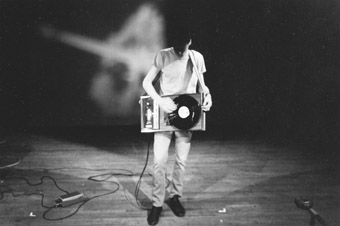
Christian Marclay, Ghost (I don’t live here Today)
NEWLY ARRIVED AS A TEENAGE ART STUDENT IN LATE-1970S USA, CHRISTIAN MARCLAY CONDUCTED HIS EARLIEST EXPERIMENTS IN VINYL RECONSTRUCTION AS A CREATIVE RESPONSE TO AN IMMERSIVE MEDIA ENVIRONMENT. THE UBIQUITY OF VINYL LPS FOUND ITS COROLLARY IN A TRASHCAN CORNUCOPIA OF DISCARDED RECORDS: THE EBONY ELLINGPHANT’S GRAVEYARD. THESE WERE THE RUINS UPON WHICH THE YOUNG MARCLAY PLAYED, COLLAGING VINYL FRAGMENTS INTO RECOMBINANT RECORDS WHICH, WHEN PAIRED TO A RECORD PLAYER, ALSO SUGGESTED THE POSSIBILITY OF PERFORMANCE.
Rather than proceeding from legitimated precedents in primitive musique concrete, or the Broken Music of Flux-artist, Milan Knizak, Marclay had intuitively arrived at a pataphysical response to the problem of music which both paralleled contemporary experiments in hip hop and dramatised cultural and economic theories about the consumer as producer. Turntablism would not become the defining term for music made from the mixing and manipulation of records until 1994. Marclay was the field’s unwitting, if recalcitrantly unfunky, pioneer.
From the outset, Marclay’s musical activities have been informed by the conceptual smarts of his fine art schooling; his early duo with fellow student, Kurt Henry, homaged Duchamp with its name, The Bachelors, Even. Marclay’s recombinant records function as sophisticated sculptures (they look like pizzas composed of different flavoured slices) and, despite a career which has seen him work alongside such celebrated composer/improvisers as Sonic Youth, John Zorn and Otomo Yoshihide, it is as a visual artist that Christian Marclay has enjoyed his greatest success.
Marclay’s work explores a special variety of synaesthesia in which notional correspondences between sound and image are embodied in material artefacts. The sounds of these objects are often latent, suggested rather than heard, like his framed photograph of the Simon & Garfunkel 45, The Sounds of Silence. His installations and sculptures pursue this research into a materiality of sound, subjecting musical instruments to absurd exaggerations (a supine accordion with a seven metre bellows), or perverting domestic media into ironic comments on the familiar comforts they provide (a pillow crocheted from tape recordings of that boresome foursome, The Beatles).
Within Australia, Marclay’s work has figured in both the 1990 Sydney Biennale and the Sydney Museum of Contemporary Art’s 2001 exhibition, Art>Music: Rock, Pop, Techno with his Broken Music. Internationally, he’s shown at the Tate Modern and the Pompidou, the Walker Art Centre, Stockholm’s Moderna Museet, the Venice Biennale (twice), and the list goes on…So a survey of his videowork should, perhaps, aptly be the subject of the ACMI screen gallery’s first solo artist focus.
ACMI’s Replay exhibition largely neglects this conceptual thread of Marclay’s career, and is less convincing for doing so. Instead, the audience is proposed a much more elementary discourse: sound-image relationships. Many of the works on display are essentially performance documentation, which an actual performance by Marclay—who was present for the exhibition opening—might have made redundant. Others apply a form of montage to footage from Hollywood features; but their elementary cataloguing of ‘universal’ forms and situations merely echoes the monocultural conceit of classic US studio filmmaking. What I personally find disturbing is that by privileging the logic of musical structure over the possibilities of dramatic narrative, Marclay seems also to have borrowed classic Hollywood’s claim to a blithe ideological neutrality (records are synthesised from which particular natural resource?).
The strongest works are those created from original footage. Deaf actor, Jonathan Hall Kovacs, translates music criticism into sign language with a dancer’s grace in Mixed Reviews (Sign Language). The dramatic sweep of his arms suggests an overwrought conductor, and his resort to wild-eyed mugging for dramatic emphasis lends the work a slapstick charm. Despite some gestural Sturm und Drang, its a moment of rare, silent, elegance within the Marclay oeuvre, and a witty quaternary retort to the tertiary function of the reviews (after the secondary, performance, and the primary, the score). I’m not clear what the original reviews were of, though I suppose the fact that Marclay collects music criticism is consistent with the general sense of surfeit that obtains in his work.
Another anomaly is Guitar Drag which features verité footage of the eponymous performance as a Fender Stratocaster is drawn by a rope through a variety of rural landscapes. Still plugged into an amp on the back of the speeding pick-up truck, the guitar’s demise provides a diegetic soundtrack. In counterpoint to this wry echo of the Fluxus movement’s destructive phase, the textural complexity of the music and the autumnal landscapes invite meditative contemplation in the auditor. This video’s power is only heightened by the knowledge that it explicitly refers to the 1998 automotive lynching of James Byrd Junior: for all its complex referentiality, this is a hauntingly eloquent work.
Three further works serve to illustrate the wealth of sound-producing techniques that the vinyl LP has afforded Marclay. Ghost (I Don’t Live Here Today) demonstrates his phonoguitar (essentially, a shoulder-strung turntable) and his performative gestures mimic the histrionics of rock guitar virtuosity. Record Players finds an ensemble scuffing their fingernails over LP grooves, before shattering the albums with cheerful abandon. Gestures is for four adjacent screens (a form Marclay will employ again) and brings the artist’s technical inventions into cacophonous, simultaneous, proximity. Each of the screens offers a close shot of a turntable, and Marclay tests the sonic and physical limits of the vinyl long-player; styli loop in locked grooves, and the off-centre spindle lends itself to loping pitch shifts. A little scratch never hurt anyone…
Marclay’s found footage works describe the imperial culture of US studio cinema in all its naked banality. In itself, that might be a rather artful reduction, although I doubt it was intentional: the problem is simply that Marclay has much less facility with the technology of moving image media than he does with a turntable. With the exception of Up and Out, the soundtrack is always diegetic—what you see is what you hear. In Telephone, Marclay compiles screen telephone conversations, but the effect is simply of a crossed-line conference call: what is most striking are the lost opportunities to reinvest these clips with new meaning through their canny adjacency. Bruce Conner did so much more with found footage half a century ago, and US television offers an accomplished guide in the form of Jay Ward’s Fractured Flickers series (1963).
Crossfire is an immersive environment which places the viewer at the centre of a cubic fusillade, with shots fired from action cinema clips rear-projected at each opposing wall. Sonically, as an exploration of genre clichés, and as an engagement with cinema’s materiality, it pales in comparison with Peter Tscherkassky’s Instructions for a Light and Sound Machine (2005), which has a very different, explicitly metaphysical, intention. Crossfire is also diminished by the absence of the work that accompanied its original viewing at London’s White Cube gallery: a collection of verbal sound effects rudely torn from the pages of comic books, lurid onomatopoeia becoming the mute stand-in for an extravagant concrete poetry.
This question of context is an important one. In hosting this initial survey of Marclay’s videowork, originally curated by Emma Lavigne for Paris’ Cite de la Musique, ACMI lost an opportunity to acknowledge a rich tradition of Australian artists working in detourned media. In spite of its allusivity and conceptual sophistication, Marclay’s work begins from benign assumptions about media saturation. Australian artists engaged with the materiality of found media have produced a rich and intelligent body of work which forcefully contests that assumption. I’m thinking expressly of Lynsey Martin’s experimental films—some of the most extraordinary cinema ever made in this country, and still largely unknown—but also of the turntablist interventions of Marco Fusinato, and Phil Samartzis’ 1980s duo with Andrew Curtis, GUM. With its resort to so many imported exhibitions and film programs, rather than promoting Australian work internationally, ACMI’s curatorial policy is in danger of being characterised as another kind of Terra Nullius.
Christian Marclay: Replay, Australian Centre for the Moving Image, Melbourne, Nov 15-Feb 3
RealTime issue #83 Feb-March 2008 pg. 49
© Jim Knox; for permission to reproduce apply to realtime@realtimearts.net
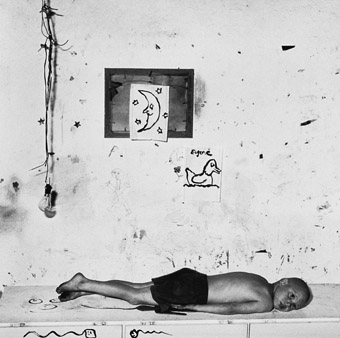
Roger Ballen, Under the Moon
courtesy the artist
Roger Ballen, Under the Moon
NOW IN ITS THIRD INSTALMENT, FOTOFREO IS BRINGING METAPHORICALLY AND LITERALLY DARK PHOTOGRAPHY TO SUN-BLASTED FREMANTLE. THE BIENNIAL FESTIVAL IS CATHOLIC IN ITS PROGRAMMING, REPRESENTING ART PHOTOGRAPHY, FASHION, PHOTOJOURNALISM, LANDSCAPE AND EVEN UNDERSEA PHOTOGRAPHY. NEVERTHELESS, ISSUES OF PLACE AND RACE SNAKE THROUGH THE EXHIBITIONS, WITH QUESTIONS ARISING OF OWNERSHIP (INDIGENOUS RIGHTS, THE PLACE OF WORKING CLASS WHITES IN THE NEW SOUTH AFRICA) AND LANDSCAPE (NOTABLY THE INDUSTRIAL DETRITUS CAPTURED BY EDWARD BURTYNSKY).
A keynote speaker at the Fotofreo Conference, the Canadian Burtynsky is renowned for his industrial landscapes. The large-format foreshore images in his Shipbreaking [2000] series of jagged and curving, rusted steel forms inspired Anna Tregloan’s set design for the Black Swan-Malthouse co-production of The Odyssey for the 2005 Perth International Arts Festival. Solidifying this connection with Australia, Fotofreo has commissioned a work from Burtynsky reponding to Western Australian tailing dumps and minescapes. The artist’s profoundly ambiguous images, tense with an arrested melancholy, will contrast with more familiar WA landscape photography such as Richard Woldendorp’s touristic aerial images of a land of ‘sweeping plains’ and beaches without horizons.
Contemporary indigenous photography is also included with the aggressive historical commentary of Brook Andrew. He is best known for the image Sexy and Dangerous (1996)—a key acquisition when the National Gallery of Victoria’s new Ian Potter Gallery of Australian art opened at Federation Square, and which emblazoned a smooth skinned Aboriginal torso with Japanese text. Andrew has more recently reworked greyed and patinaed anthropological photos of Australian Aboriginals from the early 20th century (Gun Metal Grey, 2007). His current work also includes an explicit challenge to relate the history of Australia and its art to that of the dawn of the European colonial project, late Renaissance and Mannerist painting. In Portraits and Costumes, Andrew has figures dressed in a pastiche of 17th century courtly dress and animal costumes, executing ironic acts of dance and gesture which literally inscribe a space in front of works of ‘the Great Masters’ hanging on walls behind them. This is a challenge both to their greatness, as well as to where one should place Australia and its first peoples within these histories.
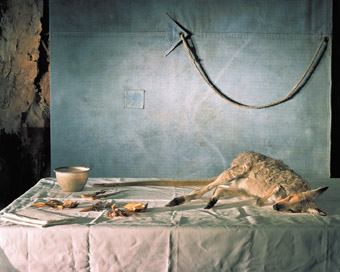
Marilyn Drew, Wallaby with Tarp
courtesy the artist
Marilyn Drew, Wallaby with Tarp
An equally formalist approach to these issues is presented by Marion Drew. Drew has represented the Australian landscape both directly, in her dense blobs of Queensland’s jungle suspended in blocks of darkness (2006), and indirectly as in her 2004 commission for Brisbane Magistrates Court, Tankstream (a series of “watergrams” which reference the stream running beneath the site prior to settlement). Drew’s most famous project is her 2005 Australiana series, which recreates Dutch still life in Australia using native animals (roadkill, as it happens) and local settings. As Drew has observed, 17th century still life was rich in allegorical symbolism, but once decoupled from that context, these symbolic references become strangely haunting and ambiguous. Are they cries against settlement, against modernity, or aestheticised portraits of romanticised mortality? Drew likens her photographs to drawings because she produces them using long exposures in a dark environment, “sketching” her subjects using a torch. This generates soft, hyperreal images.
A particular treat for Francophiles is the work of “ar-ctivist, photograffeur” (artist-activist and photographic graffitist) JR, who made his name representing friends from Paris’ economically depressed outer suburbs—the banlieue—inhabited by African and Algerian immigrants from France’s former colonies. Months before les banlieue erupted in riot in 2005, JR posted gargantuan photocopies of his distorted close-ups throughout the city. As he observed, inhabitants of the richer central suburbs “saw the young people from the banlieue as though they were extraterrestrials. I decided to show them like that in my photos!” These massive grimacing visages literally got in the faces of Parisians living close to the centres of power, and similar images were later pasted on Paris City’s prestigious Town Hall, as well as on the barrier separating Israel from Palestine and the West Bank. Now institutionally recognized, JR maintains his anonymity, his commitment to illegal street postings and continues to re-photograph his urban galleries and bewildered, sometimes angry spectators in front of them.
Amidst this rich diversity of Fotofreo exhibitions, a highlight is the work of Roger Ballen who established himself in the 1990s, photographing poor whites from the “dorps” lying on the fringes of Johannesburg. Initially cloaked in the aura of documentary photography, Ballen’s work scandalised audiences with its suggestion of a new, post-Apartheid underclass, as well attracting accusations of exploitation (like Diane Arbus) given his focus on bodily grotesquery and illness. While far from free of such references, Ballen’s material has increasingly emerged as profoundly Surrealist, with key tropes such as human-animal hybrids, graffitied scrawls and potently ambiguous surfaces, scenes and detritus (shades of Marcel Duchamp’s readymades). Ballen’s Puppy Between Feet (1999) reworks Jacques-André Boiffard’s photograph Big Toe, published in 1929 with an essay by dissident Surrealist Georges Bataille. Bataille claimed, “The big toe is the most human part of the body, in the sense that no other element of this body is as differentiated” from that of semi-arboreal apes, the toe’s grotesque corns and grimy protrusions signifying man’s essential connection to dirt, filth and what Bataille called the “baseness” of humanity’s “excremental” desires. Ballen’s intensely graded black-and-white images bring this theatre of baseness to Western Australia, while outside the sun blisters gallery walls.
Fotofreo, The City of Fremantle Photography Festival, various venues, April 5-May 4; Fotofreo Conference, April 5-6, WA Maritime Museum; www.fotofreo.com
Occasional RealTime correspondent and leading Australian media artist Tim Burns has a photographic retrospective of his works at Urban Dingo Gallery as part of FotoFreo Perth Exhibitions. Ed.
RealTime issue #83 Feb-March 2008 pg. 50
© Jonathan Marshall; for permission to reproduce apply to realtime@realtimearts.net

Pour, James McArdle
courtesy the artist
Pour, James McArdle
THE DAILY LIVES OF JAMES MCARDLE AND DANIEL ARMSTRONG HAVE A PRESENCE IN BENDIGO’S REGIONAL LANDSCAPE. MCARDLE TEACHES LOCALLY AND LIVES WITH HIS FAMILY IN CASTLEMAINE AND ARMSTRONG, WHILE WORKING IN MELBOURNE, SPENDS MOST WEEKENDS WITH HIS SCHOOL-AGE SONS AT HIS PROPERTY IN VAUGHAN. AZIMUTH, THEIR JOINT EXHIBITION OF NEW PHOTOGRAPHIC WORK AT THE PHYLLIS PALMER GALLERY IN BENDIGO FOREGROUNDS ISSUES OF REPRESENTATION WITHIN NEW MEDIA AESTHETICS.
The works in this exhibition and the evolving practice of these two established photographers speak to and of the journey from traditional photography to what Vilem Flusser has identified in his introduction to his 1983 book Towards a Philosophy of Photography (Reaktion, London, 2000) as the technical image. As Flusser predicted:
The universe of technical images, as it is about to establish itself around us, poses itself as the plenitude of our times, in which all actions and passions turn in eternal repetition. It is from this apocalyptic perspective that the problem of photography will acquire the shape proper to it.
The works in this exhibition, in their overt and covert digital manipulation, witness and enact this flow from the traditional photographic to the technical image and can be read as aesthetic speculations on this shift.
Armstrong’s series of digital photographs are heavily manipulated grids of astronomical images sampled from the night sky with time exposures of a number of seconds using both analog and digital recording equipment. These grids are reconfigurations of those stars that impose such presence on one’s visual nocturnal experience of regional Victoria. It is a presence that is often lost on those living with the washed out night skies common to a metropolis like Melbourne or Sydney.
Each dot in these grids retains a soft blurrable contour filled with a smudge of colour often lost on the naked eye. Though such a description highlights those painterly aspects that the digital has been perceived as championing, these clusters of light have arrived as images through decades of technical analog astronomical interrogation of the sky. They have been considered as ‘real’ technical extensions of the naked eye. They also have a presence beyond the grid as Armstrong has stretched and morphed them into three-dimensional shape.
The surface of Armstrong’s work hovers playfully in this gap between the analog and the digital. Each dot performs like a de-facto pixel that forms into a spatial relationship with others. These compositions are more technical than the ‘organic’ organization of the night sky. Whilst symbols, characters and numeric codes were historically projected onto such tapestries of light, Armstrong’s clusters have arrived from somewhere else, from within the technology itself into what would previously have been considered a fiction.
If as Flusser points out, “Ontologically traditional images mean phenomena, while technical images mean concept”, then Armstrong’s work performs a metamorphosis on the history of astronomical photography, itself a premonition of the technical image, into an abstracted perceptual field that is reminiscent of pop art and conceptual art. It is the collated data set of stars as images that is being presented for consumption here.

Daniel Armstrong, Star Map
courtesy the artist
Daniel Armstrong, Star Map
In deciphering such a data-basic puzzle, we are confronted with the same dilemma that Rick Deckard (Harrison Ford) faces in Blade Runner in his unfolding relationship with the replicant Rachael (Sean Young), which precariously swings on whether she is human or android (or whether he is). As in that representational hall of mirrors, even if there is no difference (and there is), something has shifted in our relationship to the image. This unease, a destabilising mix of visceral intuition and critical thought, visits you in front of one of Armstrong’s concoctions, to disarmingly cancel each other out. Like a roo caught in the headlights of a moving car, we are immobilised by reflection and physicality working on each other. What is required to address the impasse is a re-jigging of the senses and critical thoughts. It requires a new way of seeing to overcome the trauma that technology throws our way.
This infatuation with what is ‘real’ and what is ‘not,’ which is present in Armstrong’s earlier re-enactments of bogus flying-saucer imagery, reaches a new register here and contains within the ovoid and circular constellations a mischievous trace of this earlier obsession.
If you stand in front of these images long enough then the figure-ground gestalt flips to turn the lights into clusters of holes rather than imaginary objects or symbols. It is an ominous glare that seeps through these holes and can bring to mind the prowling light outside, trying to enter the darkened house, situations that often occur in horror films and those about alien visitations. It is a reversal that also brings to mind Flusser’s contention (Finger, The Freedom of the Migrant: Objections to Nationalism, Champaign University of Illinois Press, 2003) that the once private home has become a nomadic tent buffeted by the technological winds that sweep through the multifarious wires that pierce its perimeters. Is this Merleau-Ponty’s embodied being-in-the-world, pierced and under siege, dumbfounded by the technical image?
McArdle’s blurs and smudges come from a different dimension, not out of distance and time, but movement and time. These landscapes harness the vortex, a phenomenon I first encountered in Arthur and Corinne Cantrill’s moving image work Near Coober Pedy (15 min, 1977) and further articulated in Canadian Jack Chamber’s found footage film Hart of London (16mm 80 min, 1970)
Near Coober Pedy consists of a series of shots captured from a moving car during an interminably long car journey to Australia’s centre. The camera locks in on and tracks in short pans individual features in the flat, ‘barren’ landscape, to create a swirl of movement, a vortex, around these still points.
Hart of London, assembled out of historical newsreel film footage from the Ontario town of London, has moments of movement and editing that break free from the narrative documentation even more emphatically than the lyrical body of the film. These moments are referred to as vortices by Chambers and could also be described as windows or wormholes into more synecdochic modes of representation.
These films both perform ‘unsettling’ operations on the representation of three-dimensional Cartesian space and linear/causal time. McArdle can be read as combining such strategies within the photographic and transforming its stillness into a trace of movement. His use of the vortex and the blur as indicators of a landscape being moved through find a precedent in the metamorphosis of the senses that the train traveller was required to implement at the turn of the 19th century.
Reading the moving landscape overwhelmed the early train traveller. “The inability to acquire a mode of perception adequate to technological travel crossed all political, ideological and aesthetic lines” (Schivelbusch, The Railway Journey, Berg, New York, 1986). New perceptual strategies had to be developed that contextualised the blur and the streak. “To adapt to the conditions of rail travel, a process of decentralisation, or dispersal of attention, took place in reading as well as the traveller’s perception of the landscape outside.”
McArdle extends these ways of looking. His images of the landscape are collected in transit on car journeys through vicinities around Bendigo. A fleeting glance may fasten on some detail. This place is then re-visited on foot to gather images on the move and swivel of the body and the camera. The gestures of McArdle’s body and the camera’s movements are registered as the streak and blur and the painterly swirl, the vortex. The large scale of these images, as with Armstrong’s, also enables a bodily as well as visual response from the gallery viewer-participant.
The digital has allowed McArdle to evolve his technique in documenting such a gestural landscape into a seamless triptych where a foreground close-up, medium shot and wide angled horizon are combined into a painterly yet still photographic collage. This technique allows McArdle to increase the intensity and directions of the gestures he imparts on the landscape in his work.
I am arguing that these are not random operations but document a bodily relationship to these spaces. They add an emotional register of meaning. One of the most effective images places the vortex within the dark hole of a group of mine shafts that pepper the local landscape. It is as if the fluid landscape is being sucked into these holes. Is this an indication of a spent and unsettled landscape, a space in crisis, or are these the traces of emotion imparted from the body of the photographer himself? In such a way the personal and the local can be read in dialogue in McArdle’s work.
The ‘technical’ in these works operate differently from those of Armstrong’s. They remain hidden under the surface. This may be one of the reasons why it was the mineshafts that caught this writer’s critical eye, as they can suggest a subterranean yet historical world outside the purview of the image. For Flusser the technical image is about a preoccupation with surface. McArdle’s images tease at this concern but remain more than surface.
Armstrong’s and McArdle’s images articulate how we are now embedded in Flusser’s premonition, the age of the technical image; where the written sentence is redundant, where images speak for themselves and all at once. This may be considered magic but it is not. The pea is under every pod (or none). It is also the age in which Schrödinger’s Cat is made manifest (or not).
Finally, the fact that these techniques are being expressed through the local energises and focuses this work. That is why it was so important that this exhibition was experienced in Bendigo. Driving up from Melbourne during the day, my eye caught many moments in the landscape into which James McArdle’s technical and bodily strategies could have inserted themselves. On the way back, driving across the Westgate Bridge at night into Melbourne, there were Daniel Armstrong’s grids sprinkled across the city in front of me, framed by the car window.
James McArdle, Daniel Armstrong, Azimuth, Phyllis Palmer Gallery, RMIT, Bendigo, July 27-Aug 8, 2007
RealTime issue #83 Feb-March 2008 pg. 52
© Dirk de Bruyn; for permission to reproduce apply to realtime@realtimearts.net
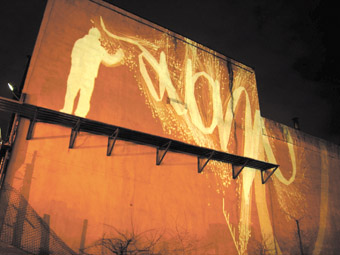
Graffiti Research Lab digital art projection
courtesy the artist
Graffiti Research Lab digital art projection
LIGHT, THE OVERARCHING THEME OF THIS YEAR’S ADELAIDE FESTIVAL OF ARTS, HAS A SPECIAL RESONANCE IN SOUTH AUSTRALIA AS COLONEL WILLIAM LIGHT IS CREDITED WITH DESIGNING THE CITY. HIS BRONZE STATUE POINTING A FINGER AT ADELAIDE FROM MONTEFIORE HILL AND HIS GOLD-PLATED THEODOLITE THAT SITS LIKE A LOUISE BOURGEOIS SPIDER ON A PLINTH IN LIGHT SQUARE MARK THE CITY’S GRATITUDE.
Someone has suggested that a laser tracking light should be attached to his finger so that we can find out exactly where he is pointing. Sounds like disco and a job for Graffiti Research Lab (GRL), a New York-based art group dedicated to outfitting graffiti writers, artists and protesters with open source technologies for urban communication. They will be giving a masterclass and doing public art interventions all over Adelaide March 5-16. GRL often use LED Throwies to make statements. A Throwie consists of a lithium battery, a 10mm diffused LED and a rare-earth magnet taped together. You spell out your graffiti in light on metal (ie magnetic) surfaces thus saving both paint and muscle power.
Enlightenment is the twin theme of the festival and The Speed of Light, the set of five exhibitions and a keynote address involve a certain amount of what might be called an enlightened return to the 70s. This could be the wheel of fashion or, as in the worldwide tendency to re-enactment of past performance art, a reflection of the voracious need for copy in a web-based world.
Doug Aitken, LA-based artist and maker of music videos and ads as his day-job, recently showed very large image projections on the Museum of Modern Art in New York. He will not be making a work in Adelaide but is the keynote speaker for Artists’ Week and will set the stage for thinking about different kinds of light and ways of working with it. Outdoor large scale projections will be present in the work of the Australian-based mob The Electric Canvas who will be projecting an Australian World Premier Free Spectacle from dusk til 2am every festival night on buildings up and down the cultural boulevard of North Terrace.
As part of The Speed of Light at Greenaway Art Gallery, New York-based Chilean artist Iván Navarro will show videos as well as light sculptures made with neon tubes that look like remakes of Dan Flavin’s art and build on some of the unresolved aspects of minimalism. Argentinean artist Felix Larreta’s Spherescent, a geodesic dome that you can walk inside and is covered with op art patterns responding to music and sound patterns, will be located on the 70s timewarp zone of the Adelaide Festival Centre Plaza by Greenaway Art Gallery’s offshoot, GAG Projects, Berlin. At Flinders University City Gallery Italian artist Elisa Sighicelli will show lightboxes and videos. She selectively paints the backs of her photos before illuminating them thus combining the softness of oil-painted surfaces with the sharpness of photography. Düsseldorf-based Mischa Kuball has been working with light for 20 years. He makes political and social statements with projections, and twists our capacity to make sense from fragments of language projected onto sculptural elements designed from his digitized brain waves. Finally at the Jam Factory The Speed of Light comes to rest with The AES (+F) Group from Russia which consists of graphic designer Evgeny Svyatsky and conceptual architects Tatiana Arzamasova and Lev Evzovich who work together regularly with fashion photographer Vladimir Fridke; on those occasions his F is added to the other initials. Their work, a three-screen video installation and a five metre photographic panorama, depicts a tableau vivant of international youth in battle [RT81, p2]. Of all The Speed of Light program this work has the most political dimension as it makes palpable the youth of the world who sit in front of illuminated screens and play computer games, thus battling each other (and older people) day after day, night after night, on the internet.
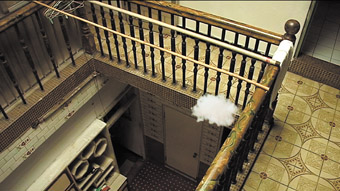
Wang Ya-hai, Visitor, 2007 video stills, from the Penumbra exhibition
courtesy the artist
Wang Ya-hai, Visitor, 2007 video stills, from the Penumbra exhibition
Curated by Julianne Pierce, Artists’ Week 2008 is a program of back to back artists’ talks and forums. Play It Loud asks whether combining music and art is dumb or just plain fun. Speakers include Chicks on Speed and the Ziggy Stardust-coiffed Philip Brophy as well as art band The Histrionics’ Danius Kesminas. The Art and The City forum investigates whether more art is being made using the city as a canvas. Shaun Gladwell will speak along with Evan Roth from Graffiti Research Lab. Playing It Safe asks if are we in a period of conservative art. Speakers include Arlene Texta Queen, Deborah Kelly of Beware of the God fame and Adam Geczy. In Intimate Dialogue the question is: how do curators work with artists and contribute to their creative practice? Speakers include Rachel Kent, Victoria Lynn and Jason Smith. Continental Drift wonders if it’s possible for Australia-based artists to have international careers. Speakers are Jenny Watson, Daniel von Sturmer and Festival gizmo-designer Michael Kutschbach.
The Gloves Come Off session wonders if people in the visual art community are too polite to one another. Speakers are writer Ashley Crawford, ABC content creator Courtney Gibson and Marcus Westbury, writer and presenter of the ABC TV’s series Not Quite Art. The NAVA (National Association for the Visual Art) session will focus on regulation of the visual art industry. Forums on Light will have an art/science twist. Speakers range from serial portraitist Robert Hannaford to actual scientists(!), and more artists—Chris Henschke who has done a recent residency at the Australian Synchroton and the famous holographer Paula Dawson.
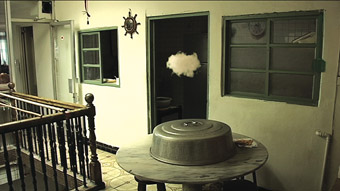
Wang Ya-hai, Visitor, 2007 video stills, from the Penumbra exhibition
ourtesy the artist
Wang Ya-hai, Visitor, 2007 video stills, from the Penumbra exhibition
Also prominent in the festival’s visual arts program are the 2008 Adelaide Biennial of Australian Arts, titled Handle with Care and focused on “aspects of contemporary life that generate disquiet and debate”, and the Anne & Gordon Samstag Museum of Modern Art’s Penumbra, Contemporary Art from Taiwan, featuring new media and installation works.
Chicks on Speed, the headline act for the Artists’ Week party, are an electropop and Fluxus-inspired group of grrrls who started running a bar with a techno surge in Munich when they were at art school in the early 90s. They make art, music, fashion, graphic design and mayhem, yet are amateurish in all these fields and proud of it. Like the Guerilla Girls who were at the 1992 Adelaide Festival, they make some tough comments about the ‘art world’ machine and male dominance of it.
The Australian member of the Chicks, Alex Murray-Leslie, recently said: “I really believe that art is over in a sense, the whole thing is mostly just a commercial system now. So we try to reinvent it from our perspective, a feminist perspective…” There are distinct echoes of 90s art stars VNS Matrix’s practice in Chicks on Speed’s ambience. Who doesn’t remember at least a few words from VNS’s cyberfeminist manifesto of art for the 21st century: “we are the virus of the world disorder…the clitoris is a direct line to the matrix.”
Adelaide Festival of Arts, Speed of Light, Feb 29-March 16, http://adelaidefestival.com.au
RealTime issue #83 Feb-March 2008 pg. 54
© Stephanie Radok; for permission to reproduce apply to realtime@realtimearts.net
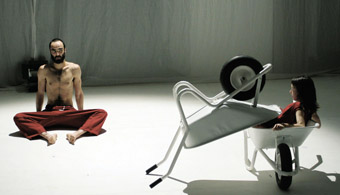
Surprise (Überraschung), part of ASSITEJ
photo courtesy Dschungel Wien
Surprise (Überraschung), part of ASSITEJ
UNIMA 2008 AND ASSISTEJ 2008 ARE INTERNATIONAL PERFORMANCE EVENTS BEING HELD IN AUSTRALIA IN COMING MONTHS. THE 20TH UNIMA CONGRESS & WORLD PUPPETRY FESTIVAL WILL TAKE PLACE IN PERTH AND ASSITEJ (INTERNATIONAL ASSOCIATION OF THEATRE FOR CHILDREN AND YOUNG PEOPLE) IN ADELAIDE.
While UNIMA caters to audiences young and old, ASSITEJ is focused on theatre for young people. For the RealTime readers of tomorrow with a taste for the new in performance both are events that look set to satisfy a deep-seated need for magic, adventure and innovation.
unima
UNIMA’s program of some 30 works includes South African William Kentridge’s remarkable blend of puppetry and charcoal drawn animation in Handspring Puppet Company’s Woyzeck on the Highveld; and Angel, from the Netherlands’ Duda Paiva, an innovative merging of dance and puppetry in a duet between an angel and a drunk. On the food front, Australia’s Men of Steel make wonderfully messy magic with cooking utensils; France’s Compagnie Akselere transforms a restaurant setting into the tale of Sleeping Beauty with, among other things, puppeteered forks; and Belgium’s La Compagnie des Chemins de Terre presents [Richard], in which “Romeo & Juliet is played by the puppeteer’s clothes, Hamlet takes the form of ripped paper and Richard the Third is re-enacted with a slab of meat.” Polyglot Puppet Theatre has collaborated with Ilbijerri Aboriginal Theatre Co-op on Headhunter, a wild, funny ‘road movie’ of a show. For shoe fetishists, Spareparts and the WA Museum have created The Mary Surefoot Shoe Collection which involves investing shoes with interesting new lives of their own. And for other proclivities there’s the sexy, strictly adults only Cabaret Decadanse by Canada’s Soma International.
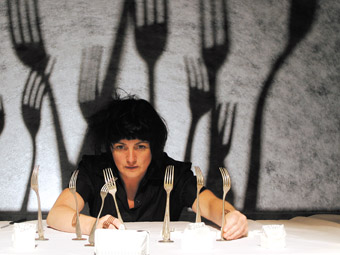
Sleeping Beauty, part of UNIMA
photo Philippe Moulin
Sleeping Beauty, part of UNIMA
There are works from Australia’s Black Hole, Lemony S, Spare Parts, Richard Bradshaw, Barking Gecko, Terrapin, The Indirect Object (emerging artists from the VCA’s puppetry course), and shows from the Czech Republic, Denmark and Japan, as well as exhibitions and conferences. UNIMA 2008 looks a perfect introduction to and confirmation of the great power of puppetry in its many surprising new manifestations.
assitej
ASSITEJ ranges across theatrical forms, embracing spoken word, multmedia, dance, music, large-scale and miniature puppetry and physical theatre. From Australia there’s Snuff Puppets’ scary but funny Dream Time show, Nyet Nyet’s Picnic, created with Indigenous artists; and Christine Johnson’s Fluff, a wonderfully eccentric tale, musically and theatrically, about finding homes for lost toys. Adelaide’s Windmill Performing Arts is offering two works, Cat and The Green Sheep, the latter inspired by Judy Horacek illustrations. Perth’s Buzz Dance Theatre’s Cinderella Dressed In Yella cross-costumes boys as the fairytale heroine in a work based on playground games. Also on the program are works by Patch Theatre, Arena Theatre, Urban Myth Theatre of Youth, Polyglot, Ilbijerri, Men of Steel, Uncle Semolina (& friends), Kage, Real TV and Krinkl Theatre. There are companies from Sweden, Israel (The Arab-Hebrew Theater Of Jaffa), Japan, Denmark, Korea, USA, New Zealand, Germany, Thailand. Australia’s provocative Zeal Theatre has collaborated with South Africa’s Bheki on a play about boys triggering a political storm at an international sporting event. Surprise, dance theatre from Austria’s Dschungel Wein, looks one of the most intriguing shows on the program. It’s for audiences two years and up and asks: How do surprises actually sound? Do several surprises make a melody? We’ll have more on ASSITEJ in RealTime 84. RT
20th UNIMA Congress & World Puppetry Festival, an initiative of Spare Parts Puppet Theatre, Perth, April 2-12, www.unima2008.com; 16th ASSITEJ 2008, World Congress and Performing Arts Festival, Adelaide, May 9-18
www.assitej.com.au
Terrapin Puppet Theatre’s Explosion Therapy is part of the 2008 UNIMA program. See the review on page 38.
RealTime issue #83 Feb-March 2008 pg. 56
© RealTime ; for permission to reproduce apply to realtime@realtimearts.net
WE ARRIVED IN VANCOUVER, BRITISH COLUMBIA KEEN TO ADJUST TO THE CLIMATE AND CULTURE, AND LOOKING FORWARD TO SEEING EXPERIMENTAL THEATRE FROM WESTERN CANADA IN THE PUSH PROGRAM. WE WERE REWARDED WITH CRISP, ICY TEMPERATURES, A LITTLE SNOW AND PLENTY OF SUNSHINE, AMPLE CANADIAN GOODWILL AND, SOME VERY FINE WORKS FROM VANCOUVER ITSELF BY ELECTRIC COMPANY, THEATRE REPLACEMENT AND BOCA DEL LUPO.
PuSh sees itself as a festival committed to presenting groundbreaking work. Executive director Norman Armour’s 2008 program included Romeo Castellucci’s Hey Girl!, Nigel Charnock’s Fever, neworldtheatre/Teesri Dunya Theatre’s My Name is Rachel Corrie (a Vancouver-Montreal collaboration) and three Australian works, The Space Between by Circa, Small Metal Objects by Back to Back Theatre and Chunky Move’s Glow.
These works and Electric Company’s Palace Grand [p5, 11], Theatre Replacement’s Clark and I Somewhere in Connecticut [p4] and Boca Del Lupo’s My Dad, My Dog [p6] gave the festival its edge, along with Toronto-based Mammalian Reflex’s hugely popular Haircuts by Children (which also played at this year’s Sydney Festival).
November Theatre’s The Black Rider and Catalyst Theatre’s Frankenstein, both from Edmonton, capital of neighboring Alberta, were given fine ensemble performances, but appeared to belong to an earlier generation of experimental theatre, while a local adaptation of Balzac’s Old Goriot and the Montreal-based Théatre la Seizième, in Août, un repas a la campagne (August, an afternoon in the country), evoked an altogether older theatre tradition. Not everything then was groundbreaking, but in the end we couldn’t complain.
Hey Girl! [p8] divided audiences, even generating anger, not because of the work’s sublimely alien theatricality but because it was regarded as didactic (which for a Castellucci work it was), sexist (the male director portrays captive woman, liberates her and apparently disempowers her in the process) and racist (the black woman freed by the white woman remains a distant, dancing figure without agency). Others felt the work more complex with its mutating images and shifting symbolism.
The Australian works were well received; Circa in The Space Between [p8] for moving beyond the usual frame of the physical theatre routine and for the dancerly quality of their work; Chunky Move [p5] for Glow’s innovation and passion (save for some who saw it as mere technological demonstration); and Back to Back’s Small Metal Objects [p10] for the unique experience it offered, subtly challenging notions of morality and normality in an altogether different theatrical space.
Boca Del Lupo’s My Dad, My Dog ably and sometimes quite magically integrated live performance with projected animation, with the animator onstage adding further dimensions to the action in a work that very laterally addressed cultural and personal differences. Some fine, witty, elliptical writing sat side by side with some too familiar postmodern framing, but it’s not difficult to envisage a superior version with a little tweaking.
The Electric Company’s Palace Grand was revelatory, a theatrical delirium of multiplying doppelgangers (all played by the same actor, Jonathan Young) and a remarkable staging of screens within screens, and rooms within rooms, disappearing our normal notion of the stage. Palace Grand gave us a glimpse of Canada’s psychological relationship with its ‘interior’, the North. I immediately wanted to see the company’s previous works about Nikola Tesla and Eadweard Muybridge.
Clark and I Somewhere in Connecticut was another PuSh highlight, and like Palace Grand and the best writing in My Dad, My Dog, put paid to the commonplace we’d been hearing that “Vancouver has some great visual theatre but it’s let down by the writing.” There are a couple of episodes that Clark and I…could live without to make a more potent work but it is already a powerhouse of wit and hard-learned wisdom as performed by an actor in a rabbit suit [James Long], supported by an onstage video artist managing the projected images drawn from a suitcase of abandoned photographs that inspired this very funny but tough work.
Australians have seen little contemporary Canadian performance, Robert Le Page, Marie Brassard and Daniel McIvor aside. Palace Grand, challenging though it is, and Clark and I Somewhere in Connecticut, wonderfully accessible but defiantly tough as it is, should be welcomed by Australia’s international arts festivals.
There are other Vancouver companies like Radix and Theatre Conspiracy, a performance art scene (with a bi-annual festival), and sound and music events at Western Front (a venue eerily like Sydney’s old Performance Space) we look forward to reviewing.
Norman Armour not only programmed Australian works but he also invited RealTime to run a review-writing workshop for his 2008 festival. Let’s hope that Armour’s interest in Australian work (he’s here for the 2008 Australian Performing Arts Market) and in establishing a dialogue between our countries grows and is, above all, reciprocated by Australian festivals taking on Canadian works.
We enjoyed a wonderfully informative, creative and collaborative workshop with our writers—Vancouver-based Anna Russell, Meg Walker, Alex Ferguson and Andrew Templeton, and Brussels-based Eleanor Hadley Kershaw. We thank the Vancouverites and Norman Armour for their hospitality and look forward to a developing relationship between RealTime and Vancouver and Canada beyond. Thanks too to the Canada Council and the Australia Council for support towards our workshop. KG
RealTime-PuSh Review-writing Workshop, PuSh International Festival of Performing Arts, Vancouver, Canada, Jan 20-30
RealTime issue #83 Feb-March 2008 pg. 4
Horizon of Exile, Isabel Rocamora
IN LATE 2007, TWO CONFERENCES, THE IMZ DANCESCREEN IN THE HAGUE, HOLLAND, AND OPENSOURCE: (VIDEODANCE) IN FINDHORN, SCOTLAND PRESENTED A COMPLEX AND AT TIMES UNSETTLING PICTURE OF AN ARTFORM IN TRANSITION.
Several attendees commented to me that IMZ dancescreen, long held to be one of the premiere screendance events in world, was this year a rather smaller and hastily pulled together affair. And it is true that by comparison with some of its earlier iterations, the event overall appeared to have lost some of its lustre, forward-looking energy and intellectual coherence. Despite some inspiring and cogent words about creating work for an audience in the keynote address by Henk van der Meulen, President of IMZ, the festival seemed content to settle into a self-congratulatory snake eating its tail pattern of ‘this work is good because we say it’s good therefore it’s good.’ But by and large, it wasn’t. It is alarming when you feel that you could take any element out of a work—its aesthetic, its choreography, its design, its shooting and editing styles, its music and sound design—and replace it with that element from another work without really noticing any significant change.
Some exceptions were the films at IMZ that looked for deeper inspiration in the nature and history of the media in which they are participating. Particularly worthy of mention is Swedish choreographer Pontus Lindberg’s potent and visually splendid Rain; a lovely adaptation of Thomas Mann’s The Magic Mountain entitled Höhenluft (Mountain Air) from Netherlands/UK director Annick Vroom and choreographers Andrea Boll, Andreas Denk and Klaus Jürgens; and UK-based Isabel Rocamora’s poignant, award-winning Horizon of Exile. Also worth following up were Netherland’s choreographer Jirí Kylián and director Boris Paval Conen’s quirky black and white adaptation of Carmen titled Car Men; British choreographer/director Jo Parkes’ highly unusual mixing of farming and dancing in From the Soil; and the offbeat dance screen award winner Les Ballets C de la B, directed by Belgium’s Alan Platel.
But overall the festival had a sense of creative stagnation and aesthetic clumsiness, perhaps partly explained by the fact that IMZ is sustained by (largely European) commissioning editors who, to their obvious frustration, are less and less able to contribute to the development of the artform (because they have less and less cash). With the shift of dancefilm distribution from television to the internet, the question of who is going to pay for dance films to be made in the future remains unresolved. The closest to a solution was offered by Rob Overman, who is developing an online portal for classical music called Monteverdi.com, soon to be able to be ‘re-skinned’ to serve as a node for the rich bodies of work in other genres, such as dance film and jazz.
The issue of screendance distribution for student use, research and audiences was also discussed in arguably the liveliest session at dancescreen, Teaching/Education of dance filmmaking, ably chaired by John Crawford of University of California at Irvine. The speakers presented an inspiring vision for the educational possibilities of the artform. Interestingly, taken together, some of the more cogent comments underscored an idea which came out of the Screendance: The State of the Art Conference at the American Dance Festival in July 2006 (RT74, p20): the need for a critical framework for screendance, seeing it as an artform at the fluid nexus of three overlapping disciplines—dance, cinema and visual art. In particular, Katrina McPherson of Dundee University, Scotland traced the history and usefulness of dance film as a teaching tool in her book Making Video Dance (Routledge, 2006). Shona McCullagh, a dance filmmaker and educator from New Zealand, warned that the cheapness and easiness of digital video was leading to less honing of the creative process, less focus and less clear artistic choices, with the result that much current work in the medium was, in her words, “flumsy”, meaning wobbly and without rigour. And Alex Reuben, supported by one of his former students at The Place in London, Sergio Cruz, cogently argued for the necessity for widening of a screendance practitioner’s range and reference to include practices from video art as well as cinematic traditions.
All caveats aside, IMZ dance screen’s most creative contribution was to bring to attention the potential that digital media and the internet are offering as opportunities for new forms of creativity and interactivity. Some of these were witnessed in McCullagh’s session on her recent explorations of new and hybrid technologies in the work mondo nuovo; Simon Fildes’ introduction to online dance creativity; Ronald Hartwig’s presentation on imaginative online marketing; and Billy Cowie’s installation work, In the Flesh, a 3D hologram of a woman in a closet [see p24]. It was hard to tell whether Cowie meant this work to be eerie, awkward, confronting, or spiritual—but remarkably it appeared to be all of these things.
Where IMZ was more about business, Opensource: (Videodance) Symposium was more about ideas. The Opensource: (Videodance) Symposium in June 2006 was one of the first international gatherings to bring a theoretical perspective to the burgeoning art of screendance and people were bursting to be heard on the subject. That symposium, followed closely by the Screendance: The State of the Art Conference changed the landscape for international practitioners and thinkers, and has lead to the soon to be released Screendance Journal. At the second Symposium in November 2007, there was definitely a feeling that things had moved on. And perhaps, if there is a criticism to be made of the event, it was that it relied a little unquestioningly on the structures previously set up rather than remembering, in advance, that you can never step in the same river twice. Nor was everybody willing or able to, as Douglas Rosenberg, US dancefilm-maker and academic, put it, “name your frame”, or present clear information about the perspective from which theories were being put: an important skill when ideas that are being discussed have a big impact on our perception of past and future creativity.
Interestingly, the most vital discussions at Opensource, in congruence with IMZ, were in response to the fluid, unanswered questions posed by the internet. In particular, the idea of a “screendance map.” This would build on some of the work already begun by Fildes and McPherson at videodance.org as well as filling out the details of the earlier critical framework proposed at the Screendance Conference. In doing so it could supply the metadata needed for an online dance film portal, allowing creators to use ‘tagging’ technology (suggested by British choreographer Litza Bixler) to identify, describe and situate their work. In this way, dance films could find their place in an evolving, interactive definition of the form.
Following on from this was a debate about whether in the online world screendance would continue to require the kinds of curators or gatekeepers characteristic of television and film festivals, or whether users would prefer to follow the ontology of the search engine—tags, similar work, most viewed work—and the social network: what their friends were watching. This question will be no doubt asked at the forthcoming Screendance: State of the Art 2, Curating the Practice/Curating as Practice, at the American Dance Festival in July 2008.
“Screendance is dead, long live Screendance”, proclaimed Katrina Macpherson as a rallying call for reinvigoration of a form which, after an exciting period of discovery and experimentation, appears to many to be in danger of stultification. Critical thinking and speaking about screendance, like the digital revolution and the internet, has the potential to be part of the problem or part of the solution. It will probably be both, but let’s hope more of the latter.
IMZ dancescreen, 11th International Competitive Festival for Dance Films and Videos, The Hague, Netherlands, Nov 15-18, 2007
www.imz.at
Opensource: (Videodance) Symposium,
Findhorn, Scotland, Nov 20-24, 2007
http://videodance.blogspot.com
Richard James Allen is co-artistic director with Karen Pearlman of The Physical TV Company. At Opensource: (Videodance) he gave a presentation on the company and its multi-award-winning work Thursday’s Fictions.
RealTime issue #83 Feb-March 2008 pg. 35
© Richard James Allen; for permission to reproduce apply to realtime@realtimearts.net
Small Metal Objects
photo Jeff Busby
Small Metal Objects
It’s hard to describe the sense of freedom you get watching this show. To start with, there’s the freedom of being outside the usual theatre box. Small Metal Objects (performed by Australia’s Back to Back Theatre) takes place in the atrium of the Vancouver Public Library, a crescent shaped concourse with a glass ceiling many stories above. On one side of the concourse is the library itself, also fronted with glass, all the way up, it’s insides open to view. On the other side are the cafes, flower shops and pizza parlors. We’re sitting on a narrow bank of seats somewhere in the middle. Crowds flow in and out of the main library entrance. People sip lattes, read newspapers or eat snacks at the shop tables. Each person in the audience stall is wearing a set of headphones. To the passersby, we may look a little odd. To us, they just look like normal people doing normal things. ‘Normal’ is a concept that will be unpacked in a most ingenious and surreptitious manner over the next 50 minutes. When it’s done, we may never feel normal again. But we may feel a lot freer.
We’re sitting on a narrow bank of seats somewhere in the middle. Crowds flow in and out of the main library entrance. People sip lattes, read newspapers or eat snacks at the shop tables. Each person in the audience stall is wearing a set of headphones. To the passersby, we may look a little odd. To us, they just look like normal people doing normal things. ‘Normal’ is a concept that will be unpacked in a most ingenious and surreptitious manner over the next 50 minutes. When it’s done, we may never feel normal again. But we may feel a lot freer.
A conversation begins in the headphones. Voice One (male): “Cooked a roast last night. Think it was chicken.” Voice Two (male): “I love chicken.” Space. A couple of spare piano chords. Voice One: “Celebrated my 15th wedding anniversary.” Space. Piano. Voice 1 again: “If a guy with a gun came at my wife and my kids I’d take the bullet for them.” The conversation continues like this for some time. It’s affectionate, honest, witty. It may be pre-recorded, we don’t know yet. Voice Two talks about how much he wants “to give,” to help, that he’s worried he’s gay because he doesn’t have a girlfriend, that if he were famous he would give every needy person in the world 825 grams of food a day. Voice One has great ideas too: he wants to get into the self-storage business because these days people don’t throw things away. In the same breath he mentions childcare as another good bet, presumably because people don’t throw children away either. The general movement of the crowd continues. Suddenly I see the source of the voices: at the far end of the atrium two men are slowly moving in our direction. They both have headsets on. One of them is a skinny, medium height brunette; the other is short and heavy-set with a blonde buzz cut. It turns out Voice Two belongs to the brunette, who’s name is Steve (Simon Laherty), while Voice One belongs to the blond, Gary (Sonia Teuben).
As they get closer, we can see by Steve’s movement, and by the performers’ physical appearance that the actors are mentally/physically ‘challenged’—a concept that is already beginning to be stripped of the logic of prejudice. After all, they were having a conversation that might be attributed to any two ‘normal’ guys, one who’s been married for 15 years, the other who is lonely and confused about his sexual orientation. The gentle pace of the performance, supported by a hypnotic sound score, is at odds with the usual rhythm of the concourse. Gary and Steve seem to inhabit a parallel world; the people who sit at neighbouring tables haven’t taken notice of them. The actors are almost like spirits. They take their time with every exchange. The crowd speeds past. We are witnessing a genuine clash of cultures: one is slow and considered, one is madly goal-oriented. We know which one we usually live in.
By the time the next character appears we’ve been well massaged into the culture of Steve and Gary, and judging by the grinning faces around me the audience is grateful for the experience. Allan (Jim Russell) is a speedy big time realtor. He’s putting on a major function and needs to furnish his clients with drugs. And here’s another challenge to our expectations: Gary and Steve are dealers. Allan doesn’t have much time. Gary is happy to furnish him with the goods, but things have to proceed at a pace that doesn’t suit Allan’s pressing agenda. To complicate matters, Steve has become immobile. He’s “deep in thought” and refuses to go to the lockers to get the stash. As much as Gary would like to accommodate Allan, he won’t abandon Steve, so the deal’s off. Allan phones for support from his psychologist, Caroline (Caroline Lee). Lee, who is a motivational consultant for large corporate clients, arrives, and the two ‘normals’ get to work, soothing and cajoling Steve—Caroline offers everything from free consultations to (when she gets most desperate) a blowjob. Most significantly, she appeals to Steve’s desire to improve himself, to become a happier, productive, more efficient person. This is the dialectic that has been playing throughout: Steve and Gary’s culture is based on personal bonds, on trust and human compassion; Caroline’s and Allan’s is utilitarian. As Steve and Gary say, “Everything has a value.” Caroline and Allan would agree with this statement, but in their world value is equated with productivity.
Small Metal Objects doesn’t present a utopia. It simply defines the ethos of two contrasting cultures. In the current paradigm, we demand that Gary and Steve play by our rules. We reward them inasmuch as they are able to conform to our standards of successful behavior. Small Metal Objects reverses the paradigm. Allan can’t adjust to the values that supercede getting what you want when you want it. He and Caroline simply cannot speak the language of the minority culture they are confronting. The performance raises a whole host of concerns about ‘otherness’ and difference that can be applied to so many aspects of our fractured world, whether we’re looking at issues like racism, poverty and other forms of exclusion on a community level, or whether we’re facing macro issues like global military conflicts. That sounds heavy-handed, something this show is resolutely not. The superb ensemble playing of the cast, the deft direction of Bruce Gladwin, and the mesmerising sound design of Hugh Covill reconfigure the atrium, removing density from the space between passersby, unlocking new ways of seeing—no, of being—for those of us consciously taking it in.
It’s appropriate that this happens at a library, because we are getting a first class education here. This is what great art can do. It can re-organise your bones, re-wire your brain, and perform open-heart surgery all at the same time. Far from the confines of a theatre box and from the spatial concerns that accompany conventional scripts and conventional acting, we get to re-imagine how the conflicting cultures of our world might fit together a little easier, what little adjustments it might take for us to approach each other and make contact with difference. It’s a very moving exercise in the art of the possible, and it left me with a surprisingly untainted sense of hope.
Back to Back Theatre, Small Metal Objects, devisers Bruce Gladwin, Simon Laherty, Sonia Teuben, Genevieve Morris, Jim Russell, director Bruce Gladwin, performers Simon Laherty, Sonia Teuben, Caroline Lee, Jim Russell, sound design & composition Hugh Covill; Vancouver Public Library, Central Branch Promenade, Jan 30-Feb 2
RealTime issue #83 Feb-March 2008 pg. 10
© Alex Ferguson; for permission to reproduce apply to realtime@realtimearts.net
Sherry J Yoon, James Fagan Tait, My Dad, My Dog, Boca del Lupo
The letterbox orientation of a typical movie screen is turned on end, vertically stretching from floor to ceiling. Like the rest of My Dad, My Dog this is just a gentle adjustment of accepted convention, not an aggressive challenge. A small picture frame appears on the screen, about the size of your bedroom window. Inside it, an animated dog skips through an animated fall landscape. The dog roams across the bottom of the large screen taking the frame with it. It’s as if we’re looking through a rectangular telescope. Then the dog arrives at the trunk of a tree and chases off a pigeon. Leaving the dog behind, the frame travels up the trunk into the boughs. As it reaches the crest we hear a crash, the tree shakes and sheds it’s leaves, the picture disappears.
This whimsical passage comes early in Boca del Lupo’s My Dad, My Dog, a delightful show that plays live action against a vast canvas of animations that are a wonder to behold. The dog scene offers us one possible way of exploring what’s to come. While taking in the whole, we might use a selective eye to pick out details that suit our sense of narrative. A similar technique is used a little further along. James Fagan Tait (there are no character names in the program) is an ornithologist searching for the rare white-necked red-crowned crane, which is found only in the demilitarized zone (DMZ) that separates North and South Korea. He stands before the screen, now filled from top to bottom with animator Jay White’s depiction (a fluttering watercolour) of the DMZ. Looking not-too-hopeful about ever finding the rare bird, Tait exits. A live-camera feed from a mini-stage set up at the left side of the stage allows White to project his own hand holding a magnifying lens onto the large screen. It finds the crane in the foliated background. So this story is also about not seeing things — like seeing the tree shake but missing the crash. Framing certain things implies excluding others.
And there’s another story-telling technique at play here. Telling a story is always an act of translation. There’s a possible source event, someone puts that event through a subjective filter and transmits it to someone else. The storyteller may use the biological machinery of his or her body (lungs, larynx, mouth etc), or technological aids — a pen, a camera, a computer. I think we usually picture story telling proceeding in that order: original event, internal translation, re-telling. But in My Dad, My Dog the order is reversed. Sherry J. Yoon imagines her way back to a North Korea she has never visited and to a woman who doesn’t exist but is a plausible type for a relative she might have there. It’s like creating a photo album of a vacation you never had.
Well that’s just what fiction is, you say. And you’d be right. But Yoon takes pains to frame this fiction as a search for a missing part of her family story. She offers biographical details of her ‘real’ life (“I am Korean”) as the starting point for an investigation into her relationship with her father. She imagines her father reincarnated as a North Korean dog. When Yoon is not performing herself she plays the part of her North Korean alter ego, who works for the government monitoring and limiting the movement of visitors to her country. She visits the dog chained up in an alley and talks to it, believing it will understand her (in one hilarious scene the dog complains to a fellow canine that he can’t understand the woman because she’s speaking English). Yoon, as herself, returns to the stage periodically to tell us which parts of the story are true (and exactly what she means by ‘true’) and which are inventions. The difference is as important as we want to make it.
Often the characterizations are made deliberately flat, while animations like the dad-dog almost jump off the screen and display a psychological complexity the humans lack. The blurring of fact and fiction is kept in play. We realize that, to some extent, we all assemble our ‘selves’ from a patchwork of memories, dreams and desires. We put a frame around that which we accept as ‘I’, as ‘me’, and leave out the rest.
The autumn colours on screen and the delicate figures of Alicia Hansen’s piano compositions give the show a very west-side-of-Vancouver feel. There’s a lot of light-hearted dialogue about the character of the city: “Vancouver seems liberal but it’s conservative. But not as conservative as Toronto.” These comments aren’t serious digs. For the most part, My Dad, My Dog doesn’t try to be the last word on any issue. But after a while it starts circling itself. The content and episodic structure gets repetitive —I don’t think this is a deliberate narrative strategy. The animated sequences, mesmerizing as they are, become devices not always integral to the theme. The attempted resolution — “sometimes there are no answers” — felt pat to me. It felt too much like an answer, it created closure to that which might have remained open.
But then again, maybe I was looking in the wrong direction. It would be like me to put a frame around the thing everyone else thought was irrelevant. You know, looking at the tree and missing the crash. Oh, but maybe that was the point. Or lack of a point. Um, throw up another cool animation, the critic is leaving the stage.
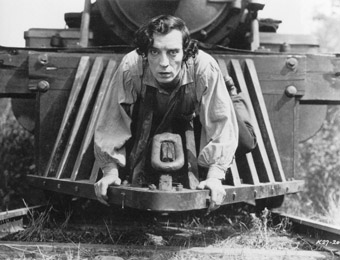
The General
You’ve got to enjoy this one. Before the movie starts, the outrageously accomplished Eye of Newt ensemble warms up the crowd with a jazz improvisation that foreshadows some of the tactics it will use to underscore Buster Keaton’s classic film The General. Stephen Smulovitz (violin and saw) and percussionist Pepe Danza start off with a weirdly haunting violin–mouth-harp duet that pulls at the heart while relaxing the body. Paul Plimley then layers in a piano ‘score’ that echoes the movie’s original soundtrack while maintaining a contemporary feel. Plimley, Danza and Paul Blaney (double bass) will drive us through the emotional peaks and valleys of Keaton’s epic slapstick journey, with Brad Muirhead’s trombone and Smulovitz’s saw adding comic inflection. The trombone, and the violin and saw (which sounds a lot like a theremin, actually) will also create dissonance, colouring the film’s original moods with a palette of exquisitely darker tones.
The pre-show improvisation has the effect of activating our imaginations and surreptitiously encouraging our vocal participation with the movie. This was a surprise to me — I hadn’t expected people to cheer and clap at Keaton’s antics. I’m used to movie patrons who are well behaved. But if the film has suffered any lack of impact since its 1927 debut, Eye of Newt and the enthusiasm of an all-ages crowd restored its immediacy. Keaton’s inventive choreography and physical daring prompted cascades of laughter, squeals of delight and more than a few gasps.
In the film’s American Civil War setting, Johnnie Gray (Keaton) is a Confederate train engineer who has but two loves: his engine “The General,” and Annabelle Lee (Marion Mack). Annabelle is a patriot, so when Johnnie is rejected by the army he falls out of favour with her. She tells Johnnie not to show his face again until he’s in uniform. Johnnie redeems himself by diverting a Yankee attack almost single handedly, and by rescuing Annabelle (who was inadvertently kidnapped by a guerrilla unit).
There are plenty of heart-stopping train stunts and enough tumbling feats of daring to keep our eyes popping and our necks craning. Eye of Newt matches Keaton stunt for stunt. The musicians catch every pratfall and every double take. They have an arsenal of well-timed responses to the shifting moods of this surprisingly layered film. The General is given an infusion of new blood by Eye of Newt, just as Johnnie is redeemed when his commanding officer gives him a new uniform. Keaton was at the top of his game when he made The General, almost in a class by himself. It’s fitting that for this engagement he has been paired with five players whose powers inhabit the stratosphere of musical invention and ability.
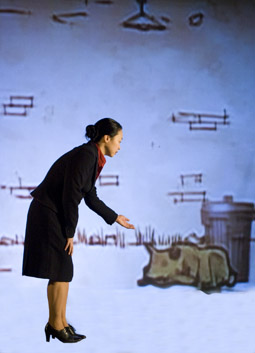
Sherry J Yoon, My Dad, My Dog, Boca del Lupo
A tall, blank screen dominates Boca del Lupo’s My Dad, My Dog. The screen fills with a variety of images, some animated, some magnified sets and props manipulated live by Jay White, who stands on one side of the stage, wearing an apron like a modern day Geppetto. The images are sharp and effective, forming clever backdrops to the action, with White’s monstrously magnified hand appearing occasionally to open doors and move furniture. It looks great. And anyone who grew up in Canada with the Friendly Giant will no doubt smile. Although the projections were high-tech there was something old fashioned about the whole artifice. The machinery White operates reminded me of a doll-sized opera house. This sense of 19th century stage-craft was nicely complemented by the live piano playing of Alicia Hansen who resides on the opposite side of the stage from White.
Before seeing the My Dad, My Dog, a number of people told me they found it charming or delightful. While the imagery created by White gives the show a lyrical and at times child-like softness, this work is steely at its core. Even the central narrative conceit embodies this tension. Sherry J Yoon, one of the creators and performers, appears at the top of the show as herself to explain what inspired the piece: she became convinced that her dog was her father reincarnated. While this might appear an absurdist notion—at least to Western ears—it evokes a painful story of death and, as Yoon alludes, the fate of the soul of a violent man. Precisely what the steel core of My Dad, My Dog is remains a mystery to me, a blank, and maybe this is appropriate.
The play is set in one of the last blank spots on the map: North Korea, a world we only glimpse through government controlled images. This is neatly played out when one of the characters attempts to take photos. We see what the foreigner sees through his viewfinder projected onto the screen: animated drawings of the rough and tumble of North Korean life. The translator moves the Westerner’s arm so that a sanitised, acceptable image is framed. The camera flashes and the drawing is replaced by a photo. The photos, which already have an inhuman bleakness to them, are made even more ominous. This filling in blank screens with controlled images set against what our imagination creates is a central motif of the work and one that is played with very effectively.
Yoon, who was born in Korea, tells us about the numerous cousins she has spread over both sides of the border separating North from South Korea. She plays an unnamed translator, an alternative version of herself had she grown up in North Korea. She portrays this character with a remarkable level of formality and control: another blank slate. Her interactions with two unnamed Canadians, a bird-fancier from Vancouver (James Fagan Tait) and a filmmaker from Canada’s east coast (Billy Marchenski) are filled with frustrating literalness. Everything is taken at face value. The translator in fact does no translating. Her job is to speak English to foreigners so that they understand what they can’t do. Her blankness is only really broken through her relationship with an animated dog. The other two characters also have their familiars, the Tait character has a pigeon, the filmmaker monsters, specifically King Kong who looks through his hotel room at one point. The Tait character, whose bird obsession makes him a self-imposed outsider, is a nice counterpoint to the state-sanctioned translator. The filmmaker’s relation to the other characters is not so clear and his reason for being in North Korea—to make a monster movie—stretches incredulity, even in a piece that stars an animated dog. I suspect the filmmaker character was created to underscore the theme of blank screens and the creation of images, but it doesn’t quite hang together for me.
The relationship between the performers and the projected images has something to do with the blank screen itself. This is most obviously illustrated in two scenes set in a restaurant. White draws the restaurant for us while the scenes unfold. We watch random lines form recognisable shapes of tables and diners. Towards the end of the scene the filmmaker notes that people in the restaurant are looking at them. Direct interaction between the actors and the images on the screen is limited and therefore becomes pointed: the translator engaging with her dog and the bird-fancier releasing a pigeon. In these moments, it is almost as if the actors are puncturing the blankness of the screen, using their familiars to achieve this transition to an unknown other side. This somehow relates to the motif of reincarnation and the cycle of creation and recreation. The almost too sweet lyricism of the last scene—a released bird making its way across impossible odds back to Vancouver—is cut short by a moment of cruel humour. The transition between worlds, of crossing over into blankness is not without its danger.
Boca del Lupo, My Dad, My Dog, created by Sherry J Yoon, Jay White, director Jay Dodge, performers Billy Marchenski, James Fagan Tait, Sherry J Yoon, animation and scenography Jay White, music Alicia Hansen, costumes Reva Quem, lighting Jeff Harrison, Jay Dodge; Roundhouse Community Arts and Recreation Centre, Vancouver, Jan 25-26, Jane 29-Feb 2; PuSh International Festival of Performing Arts, Jan 16 – Feb 3
RealTime issue #83 Feb-March 2008 pg. 6
© Andrew Templeton; for permission to reproduce apply to realtime@realtimearts.net
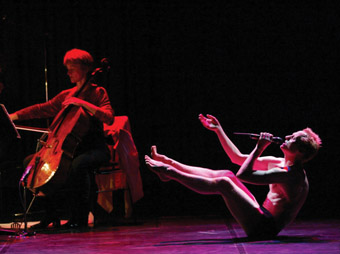
Nigel Charnok, Fever
photo Th. Ammerpohl
Nigel Charnok, Fever
Nigel Charnok comes on stage with energy so fierce it’s hard to decide what’s going on. With his long legs and arms whipping out in all directions, he might be a great black stork gone crazy, or an enormous bird of prey in crisis. Soon he runs through agitated, fast-paced gestures of grabbing his crotch, slapping his neck (with cologne?) and raising his wrist to his eye as if to check the time. Perhaps an addict, desperate for sex and preparing for a date that’s bound to be disastrous? The theory is temporarily strengthened when he crams the waiting microphone into his mouth and it amplifies his gasps. By the time he swings the microphone stand crazily around his head, I’ve figured out what he reminds me of: the last, drunken guest at a brilliant party, who will simply not go home.
Charnok’s collaboration with jazz musician Michael Riessler and the Virus Quartet is a theatre work with three elements: Charnok’s words and movement, Riessler’s music and Shakespeare’s sonnets. Of the three, we get to know Shakespeare least – the sonnets are almost incidental to this one-person riot. Every so often Charnok recites one of them; usually he distracts us at the same time. Only once he admits to the power of the music on stage and removes himself: “this is really beautiful. I shouldn’t be talking. Listen to this.” He sits down in the audience half-way back. The sonnet he recites next is quiet and meaningful, in a way the others haven’t been, because we can’t see him, and he isn’t drawing our attention away.
The disciplined, rich sound of the quintet sometimes provides a middle path between Charnok’s mania and the sonnets’ formality, but it’s not always enough to stave off disorientation. Even Charnok has to remind himself to make the transition sometimes. “Oh, Shakespeare, right”, he says, after a rambling rant on Starbucks and Afghanistan. And then we’re wrenched into “O cunning love, with tears thou leaves me blind” as he hides behind the upstage blacks.
At one level, Fever is a classic introductory text to postmodernism. The work is endlessly self-aware and repeatedly deconstructed. It’s also very funny. Charnock never stops moving as he reminds us that we are an audience, although apparently we’re better than last night’s. Unlike that lot, we’re clearly “a collection of very fine, receptive, elegant human beings.” He lets us in on the music ensemble’s emotional state: “They’re all jet-lagged and I’m in a bad mood,” but assures us “it makes for great art.” Stripping down to near-nudity as the night proceeds, he runs bare-legged, sweaty and disheveled around the stage. More and more deconstructed himself, he exits and comes back on, looking at a polaroid of his own butt, to tell us it isn’t the end of the show but “we’re very near.” Then he refreshes himself from a water bottle, and spits it over the audience.
Much of the deconstructionism is applied refreshingly to modern dance. “I don’t know what the fuck I’m doing,” he says, striking a pose with knees braced together, one arm flung to the side. “Do you have any idea what this means?” After the show, he tells us some of modern dance is “a big con.” Certainly for much of the work he dances the way a child or a drunk might, exuberantly, with a “look what I’m doing now!” spirit to it. We might have been conned, because he makes us watch it, and he calls it art. But we’re happy for a chance not to take modern dance seriously.
The work is modular, with a mix of composed and improvised sections organized according to set cues. Charnok claimed afterward that he and the musicians “ignore each other most of the time,” but the superb clarinettist (Michael Riessler leading the quartet) watched Charnok’s every gesture closely during their duets. Charnok maintains a studied indifference to the work. “It doesn’t really matter. That’s what gives me the total freedom. It’s happening for no one and I’m not there…. I’m really not there.” His attitude can sound disrespectful – to the audience and to the work. But Shakespeare can take it. So can Riessler and so can we. Let’s hope modern dance can too. It if can’t, it’s in trouble.
Drunken party guests aren’t known for their concern for others, but they still work hard for attention. Charnok craves our gaze. He may say what he’s doing doesn’t matter, but maybe he cares more than anyone. Unlike the last, late guest who’s despoiling the furniture and taking polaroids of his body parts, I didn’t want him to leave.
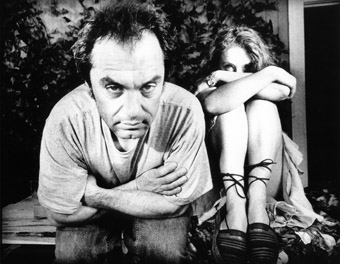
Henri Chassé, Annick Bergeron, Août – un repas à la campagne
photo Rolline Laporte
Henri Chassé, Annick Bergeron, Août – un repas à la campagne
It seems we’re about to take a stylistic journey into theatre history. Before us is a detailed replica of the front porch of an old Quebec country house. There’s a swing, a few lawn-chairs folded up at one side, a front door screen, windows that look into the rooms, little details like an overturned bucket under the porch. There’s an orange extension cord running out from the house and a power drill sitting on the swing. As the patrons take their seats, an actor walks out and uses the drill to put a new plank in the front steps. Soon we will meet the family that lives in the house, four generations of women and a few of their spouses. They will present nicely layered naturalistic character portraits rich in physical and psychological detail. Cars will honk off-stage, crows will caw.
Actors will wipe away imaginary sweat and present languid bodies oppressed by summer heat. They will speak dialogue that, through a century or more of theatrical convention, we have come to accept as ‘everyday’. The playwright will carefully note the psychological cause-and-effect that motivates each character. And like the 19th century progenitors of this type of play, he will insert a symbolic element (here, a seven foot garter snake) that adds mystery and is the key to unlocking the deeper meaning of the work. It will all be handled rather deftly by actors who have raised their craft to a fine pitch. And I will wonder if we still need naturalism in theatre, and whether I should be at the movies instead.
There’s a distinctly Chekhovian quality to Aout – un repas à la campagne (August: an afternoon in the country) produced by Montreal’s Le Théâtre de La Manufacture, and written by Jean Marc Dalpé. It’s the story of a family whose fortunes, for generations, have been tied to a maple tree plantation which is now failing due to devastation by acid rain. Jeanne (Sophie Clément) the matriarch, is dutifully running the household while trying to keep her daughter Louise (Annick Bergeron) and granddaughter Josée (Catherine De Léan) in line. She also has to keep tabs on her husband Simon (played by the playwright), who has ambitions to make the plantation turn a profit again, but who suffers a heart condition that lays him out when he gets over-excited. Josée, 19, wants to cut and run to start a screenwriting career in the big city. She’s also bulimic, and for that reason Jeanne tries to keep her under a watchful eye. Daughter Louise, married to Gabriel (Henri Chassé), is a realtor having an affair she hopes will be her ticket to California and out of here. Gabriel is a hard working, beer drinking, salt-of-the-earth type, who tries to pull Louise back into their twenty-one year marriage. Grandma Paulette, played by the 86 year old Janine Sutto, an acting legend in French Canada, masterfully provides comic counterpoint to the action with dry jabs and a stubborn refusal to surrender an inch of her hard won peculiarities for anyone else’s satisfaction.
Echoing Chekhov’s rural comedies, the two younger women are dying to get out of this backwater, while Jeanne is doing what she can to keep the family together and to uphold tradition. As we will discover, she will do this even if it means crushing Louise’s spirit and allowing her to be subjected to physical violation. Thankfully, like Chekhov, the playwright gives us plenty of opportunity to laugh at the contortions the characters put themselves through to maintain their sanity in this stifling situation. The predicament becomes positively farcical at times. Louise carries on a playfully seductive phone conversation with her lover right in front of the family and guests. After she leaves, André (Jacques L’Heureux), one of the guests, ineptly tries to comfort Gaby by touching on all the horrible legal and emotional complications he will face after divorce — but hey, at least there won’t be a custody battle, Josée is 19.
André again exemplifies the absurdity of human behaviour when he describes how he overcame the grief of his first wife’s death by playing a few rounds of golf just hours after burying her. While the humour opens things up, and while we’re temporarily seduced by the hopes and dreams of these people, as with Chekhov’s country characters, this family is stuck in an evolutionary dead end. This may be where the symbolism of the snake comes in. After an excited Gabriel shows it off, it escapes, perhaps representing his last chance to save the marriage and/or the family’s last chance to save itself.
I was eventually drawn into the story, mainly on the strength of the acting ensemble, which handled the material effortlessly, tightening and slackening the tension with acrobatic precision. A colleague described Quebec actors as having that rare ability to shift from heightened emotional pitch to casual patter seamlessly. Jean-Denis Leduc, Artistic Director of the company, thinks it’s the result of a Latin culture (French speaking) transplanted to North America. Seems like a fair assessment.
In the tradition of his naturalist forefathers (with nods to plays like The Seagull and Miss Julie), playwright Dalpé serves up a melodramatic ending (something the naturalists were rarely able to resist despite themselves) that returns the family to a disturbing status quo. Despite the strengths of the acting ensemble and the subtle rhythms of the script, Aout borders on museum piece, a homage to a period when naturalism was a subversive theatre movement.
Sherry J Yoon, My Dad, My Dog, Boca del Lupo
Boca del Lupo’s new show My Dad, My Dog is an unusual convergence of animation and live theatre, and animator Jay White has talent to burn. The dog of the title is animated with spooky care. Its movement and timing speak of every dog I’ve ever known, although it looks like none I’ve ever seen. As it creeps into view from the bottom right of a huge screen placed upstage, it’s hard to believe it’s not real. A Korean woman (Sherry J Yoon) believes it may be the reincarnation of her father – this in a country where people eat dogmeat soup in the summer. Understandably, she’s feeling a little confused.
So am I. Although the dad-dog storyline continues to an inconsequential ending, other stories emerge and ramble about without apparent purpose. It doesn’t matter that the relationship between the woman and a slightly seedy pigeon smuggler (played with excellent timing and a submerged creepiness by John Fagan Tait) is never resolved. But there’s also a young Canadian filmmaker (Billy Marchenski) who may or may not be imprisoned in his North Korean hotel room by order of the autocratic Kim Jong Il. The filmmaker’s storyline peters out, as does the pigeon smuggler’s intention to study the rare cranes that have flourished in Korea’s demilitarized zone over the past 50 years. After narration and animation had spent several wonderful minutes building up to these magical cranes, I so wanted to hear more about them, and I missed them all the way to the end.
Animator Jay White stands stage left with the tools of his trade, and is a visible part of the action throughout. With his interventions, new scenes are often established by combining animation and live-action film. In front of a drawn backdrop projected onto the screen, White’s giant hand comes into view, setting out miniature pieces of furniture, where they appear full scale as set elements, but doll-house sized in relation to the hand of the artist.
At its best, the animation adds wonderful layers to the world of the play, literally. “I’m here for the birds,” the pigeon smuggler says as he sits outdoors with the woman. “So far I’ve only seen pigeons, but I’m optimistic.” And here comes a projection of the out-sized artist’s hand, holding a real magnifying glass. The glass reveals a miniature crane hidden in the painted foliage behind the couple.
In moments like these, the animation dominates the production, and it’s so good-natured and virtuosic that it temporarily blinds us to the fact that the overall aesthetic is fragmented. Scratchy black and white line drawings are mixed with full-colour, painterly scenes. Single animated elements trade places with panoramic views. The screen itself is often used to support the live action, but at other times it’s the actors who are helping to animate the screen. When the screen displays scenery, it maintains the focus on the foreground action. When the actors interact with animated images, their attention is directed upstage, emptying the playing area. At other times animation and actors are merged on one flat plane, as with silhouettes. And some moments are purely filmic, providing a sense of immensity in a small, black box theatre.
For some reason the narrator (Sherry J Yoon playing herself) feels compelled to interrupt this unusual world to tell us the dog’s a symbol, to teach us facts about North Korea, or to tell us what parts of the play were based on personal experience. The show’s creators are too aware of the information vacuum in our media on the subject of North Korea, and their concern for our education stilts the script. Without the narrator’s irritating presence, the play would have been almost twice as good.
Animation is laborious work, and the co-creators noted in a post-show talk that the “rhythms of animation and theatre are very different.” New plays in development are often being revised late in the production process; working with an animator would make that approach impossible. An 80-minute play represents a powerful amount of work for a single animator, and it may be that the needs of dramaturgy were overridden by the needs of animation. I still appreciate Boca del Lupo’s desire to try the partnership.
I absolutely loved this play for the first 20 minutes, and I’d see it again. But My Dad, My Dog has at least three unfinished stories, a constantly changing aesthetic, and an extraneous narrator. These post-modern embellishments weaken what would otherwise have been an absolutely captivating night at the theatre. The images are wonderful, but something’s gone awry when the strongest parts of a play are its scene changes. The variety of visual approaches could still triumph if the script were stronger, but with this script, the animation almost felt gimmicky at times. White’s obvious talent saves it from that. I left the theatre feeling oddly sad. This play had so much going for it, and a near miss can be devastating.
Sherry J Yoon, James Fagan Tait, My Dad, My Dog, Boca del Lupo
Directly framed by Sherry J Yoon’s straightforward announcements as herself to the audience, My Dad, My Dog presents a fragmented story about a Canadian woman of Korean descent (Yoon) imagining how one of her North Korean cousins might live. Yoon once had a dog who, she was convinced, was her reincarnated father. She wonders what her unknown North Korean cousin would do if she experienced the same thing.
Yoon appears as herself several times, emphasizing a (possibly false) truth-fiction distinction – “It’s not a real story, but every detail in it is true.” As the Korean cousin (all characters are unnamed), she presents a slide show about North Korean culture. A Canadian filmmaker (Billy Marchenski) worries that he’s been kidnapped; his monologues are rapid. Another Canadian, a professor (James Fagan Tait) who seems to have minimal knowledge of the birds he’s supposed to be studying, develops a flirtatious but awkward relationship with the Korean cousin by talking about his obssession with pigeons. Cuts from the original Godzilla backdrop the filmmaker’s thoughts about monster movies. Sound is mostly live: performers stand stage right by a microphone to provide voiceovers for hand-drawn animated scenes; Alicia Hansen plays gentle rills on an upright piano, stage right, silent movie style.
The play is a comedy, ranging from dreamy scenes of feeding (animated) pigeons to insightful comments on Kim Jong Il’s obssession with cinema to hilarious moments of non-communication sparked by differences in Canadian and Korean expectations. But it doesn’t find its focus in the story. The filmmaker overcomes the fear that he may be kidnapped and learns that he may be too presumptuous, but what does it mean to learn something so general about oneself? The pigeon-man remains a flat character whose role is to urge the Korean cousin to talk about herself. She becomes somewhat personal with him, but gives no specifics about who her father was, or why it would matter for her dad to appear as a dog. If that conversational distance is meant to reflect on opaque North Korean privacy habits, then the significance of the dad-dog needs to appear in another way. And the dad-dog, one of Jay White’s gentle, hand-drawn animations, doesn’t get enough stage time to become anything more than entertaining (there’s a great scene where the dad-dog confesses to another animated dog that he thinks the Korean woman has bad plans for him, but he can’t really tell because she keeps speaking English).
Because the storytelling style skips all over the place – the flow between scenes is almost, but not quite tight – the set and the layers of technical innovation take over and become the heart of the performance. In a high-tech culture increasingly devoted to all things digital, it is a pleasure to enter the well-crafted world of low-tech projections that White uses to create the whimsical set for My Dad, My Dog. White’s hand-drawn animations fill a movie-size screen, so images are large enough for the performers to walk around in or, suprisingly, for White to animate around the performers. In one scene, for example, White pans down an image of a tall elevator while a performer stands still. Elsewhere, the projection is set up so he can draw a backdrop live: as he sketches on a glass panel, the lines gradually form a restaurant and fellow patrons around the two performers sitting centre stage at a three-dimensional dining table.
The simple animation techniques are deft and playful, innovative in how they surround the performers. My Dad, My Dog is fun but ultimately remains sketchy, leaving the audience charmed by literal drawings instead of metaphorical ones.
Sherry J Yoon, James Fagan Tait, My Dad, My Dog, Boca del Lupo
What I write here doesn’t express my response to My Dad, My Dog. I’m just using it to explore my possible response, had I been watching a different show in another country, with other people. While it isn’t a true account of My Dad, My Dog, it is made up of details that are true…
It is with a similar postmodern bent that Sherry J Yoon introduces us to Boca del Lupo’s production of My Dad, My Dog, the story of her imagined North Korean doppelganger’s discovery of a dog she believes to be the reincarnation of her father. Through inventive interaction between animation, film and live performance, we witness her unfolding relationship with a man who likes pigeons (James Fagan Tait) and a filmmaker obsessed with monsters (Billy Marchenski). In an idiosyncratic exploration of how Yoon’s life might have been had she been born on the other side of her family tree in Korea rather than in Canada, we experience a sometimes witty, sometimes whimsical investigation into perspective and point of view.
Framed by the animator (Jay White) and his tools on one side of the bare stage, and the musician (Alicia Hansen) with her piano on the other, Yoon guides the naïve film-maker around the streets of her city, neatly stamping in a straight line as he trails in zigzags behind her. She is responsible for him during his stay in North Korea, and instructs what he may and may not photograph. He pans his camera towards the audience, looking for an image he wants to capture. On the large screen behind the actors, we see the rectangular frame of his viewfinder scan the landscape. The screen is white apart from the small frame, which reveals to us a continuous, beautifully painted watercolour image of the city. The filmmaker finds a view he is pleased with, and shoots; we are momentarily blinded by his flash. In this instant, the onscreen watercolour transforms to an actual photograph: several men, police or soldiers, are lined up carrying guns. Panicked, the guide snatches the camera and deletes this image, explaining that her charge must check that it is appropriate before he takes a shot. This is the least composed we’ve seen her: a momentary lack of restraint reveals the severity of the consequences if prohibited behaviour occurs under her watch. The filmmaker wavers over another couple of images and Yoon quickly points him towards more appropriate compositions. He finds a poster with a man’s face blown up to enormous proportions, presumably the President. Flash, and we see the photo. That’s right, says Yoon, you seem to be getting the hang of this.
Luckily for us, Boca del Lupo’s ability to portray differing perspectives on a narrative is not restricted. The cultural misunderstandings between Yoon and her newfound friend, the bird enthusiast, are touchingly comical. As they sit to eat, the animator draws efficiently simple lines onto glass, creating a restaurant around them. Yoon misreads the ornithologist’s emphatic concern about “the soup” and can’t understand why he struggles to bring himself to eat it. When it dawns on her that he believes that this is dog soup, an infamous Korean delicacy, to his embarrassment she laughs uncontrollably. When they first meet in the park, what she believes to be a polite smile in reaction to his invasive questions and attempts to test her personality, he reads as an Asian contempt for westerners.
By far the most entertaining perspectives on display are the conversations between animals, played out in animations which appear on the big screen while the actors provide voiceovers into a microphone downstage left. Two pigeons crossly discuss the fact that the crane, which gets so much attention, wouldn’t even be there if it wasn’t for the DMZ (Demilitarised Zone, a strip of heavily guarded, and therefore environmentally protected, land between North and South Korea). The dog that Yoon believes to be her father discusses his bewilderment at her behaviour with another stray: just one of the guys discussing his woman troubles with his buddy. Earlier we witnessed Yoon speaking to the dog, reaching out her hand towards his form on the screen as she thinks out loud about her father. The dog doesn’t know whether she wants to hurt him or love him. There’s one of a number of postmodern quips as his friend asks, “what did she say?” “Well that’s the thing, I have no idea – it was all in English!”.
Later on, the ornithologist’s huge face – actual not animated – looms over us, occupying the whole of the screen. He purses his lips, squeaks and clicks, and it becomes apparent that we are the pigeon that he has decided to smuggle back into Korea in his trousers, at the moment just before the sedative is administered. Later on, the filmmaker sets Yoon’s dog free and he scampers out of sight. We hear screeching brakes and a crash. The dog has been run over by a car. The camera is brought centre-stage and we see the three humans looking at it, while onscreen their sad faces look down on us.
With this clever layering we are shown that situations can be experienced differently depending on which perspective you approach them from, or which perspective you are permitted. Following the dog’s death, Yoon breaks out of character, relaxing her stiff body language and losing the almost robotic Korean inflections in her English. The dog’s death is the only detail of this story that isn’t true. It’s invented to create “a sense of convergence and closure.”
The three characters decide to write down their secrets and give them to the pigeon to carry away, in an act of remembrance. The ornithologist cups his hands, facing the screen, and as he opens them out the bird appears on the brown and green park landscape onscreen, flying away from us into the distance. The animation follows and eventually catches up with the bird, so we are given a literal bird’s eye view of the sea as it flies towards Canada. It passes a semi-submerged Godzilla, then approaches Vancouver, and finally a large white house. Just as we think we are safely home, another dog bounds into view, leaps past us and we hear a squeak and a crunch. A single feather drops to the floor. Through another viewfinder, the dog, mouth full, looks guiltily back at us, then jumps away towards a tree in the garden. The camera idly drifts up to the top of the tree. Then a screech of tires, a yelp, and a crash. The camera drops to the floor. Blackout.
Although the relentless postmodern frame of this show sometimes seems a little tired, it is often charmingly self-aware: this quirky twist is a beautifully crafted ending to the personal and cozy journey of My Dad, My Dog. And as for this article? The only detail of the review that doesn’t express my true response is the beginning…
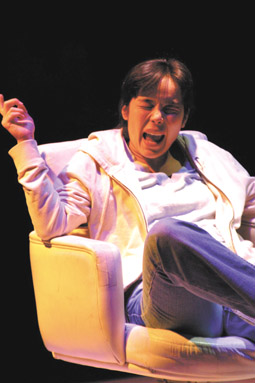
Adrienne Wong, My Name is Rachel Corrie
photo Itai Erdal
Adrienne Wong, My Name is Rachel Corrie
The slight young woman’s intelligent eyes lock onto mine as she perches on her upholstered white office chair, knees drawn up to her chest. I feel as though she and I are alone in the room as she tells me how, when she was younger, her mother told her that she thought she might be a better mom if she took her children to church. “This may have been a scare tactic.” The audience’s laughter snaps my connection with Wong and she swivels on her chair to address the person next to me.
Wong, who has introduced herself to each audience member personally as we entered the tiny blackbox space, is speaking the monologue edited by Alan Rickman and Katherine Viner from the diaries, emails and letters of Rachel Corrie following her death in Rafah, Gaza in 2003. The audience are probably aware of the circumstances of Corrie’s death: while protesting about the demolition of Palestinian homes, she was crushed by an armoured bulldozer operated by the Israel Defense Forces. But this performance allows us to get to know the woman behind the newsprint, extracts of which are projected in thin strips on each wall of the Havana Theatre as we enter.
The intimate, in-the-round setting of Wong’s performance painfully draws attention to her physicality in the space just a metre or two away from us. Four single lines of, at most, fifteen chairs form a square around the performance area; I can see the expression of every person present. Through Wong’s energetic portrayal of the powerfully evocative words of Corrie as a girl, we are invited right into her messy teenager’s bedroom and inner thoughts, witnessing her childish self-absorption, but ever-present sense of justice and engagement with the world. Through the strength of her writing, helped along with images projected above each line of seats, the space transforms from the world of her childhood and education in Olympia, Washington, to an aeroplane journey to Gaza, to check points outside of Rafah, and the base there for Corrie’s work with the International Solidarity Movement.
Wong jumps from chair to floor, she pushes her desk around the space, her boundless energy brims out of her small frame, threatening to spill onto the audience. She paces round the perimeter of her square of light, making lists, ordering her quick-firing thoughts. “What I have: thighs, a throat and a belly. Sharp teeth and beady eyes.” This witty attention to her corporeality and the horrible irony of her perceptive words as a 12 year old are incredibly moving: “It’s all relative anyway; nine years is as long as 40 years depending on how long you’ve lived.” We learn the motivations behind her activism, her desire to see what is at the other end of the spending of American taxpayer’s money, and her sense of guilt that she can leave the Middle East whenever she wants, but that the local people who have “sweetly doted on [her]” have no escape from their afflictions. The monologue is given a sense of conversation as we hear extracts from her worried parents’ emails: “There is a lot in my heart but I am having trouble with the words. Be safe, be well. Do you think about coming home? Because of the war and all? I know probably not, but I hope you feel it would be okay if you did.”
But at moments the dense text heads towards information overload and Wong’s unwavering energy feels monotonous. I alter my focus onto the audience directly opposite me. Some seem entirely engaged, others shuffle and accidentally make eye contact with me. It’s difficult to digest this vibrant stream of thought without any downtime. At one point my mind wanders onto why this show has previously provoked so much controversy in North America, with performances cancelled in New York for fear of offending Jewish audiences. The performance doesn’t claim to be anything other than an individual’s subjective thoughts about the Israeli-Palestinian situation; Corrie’s naivety is not disguised. We see that this is someone learning, changing, and scared as she starts to question herself and her “fundamental belief in the goodness of human nature”.
In an article for the Guardian, Katherine Viner states that she and Rickman “chose Rachel’s words rather than those of the thousands of Palestinian or Israeli victims because of the quality and accessibility of the writing.” To me it seems that in using an outsider’s perspective on the situation in Gaza, Viner and Rickman not only create a route into these complex issues with which Western audiences might better be able to identify and therefore begin to think actively about the Palestinian/Israeli conflict, but they also avoid a reductionist “taking of sides”.
Wong’s animated outpour finally pauses. “Rachel Corrie died on the 16th of March, 2003.” She puts on a bright fluorescent orange jacket. Standing still, she switches on two TV monitors in opposite corners of the room. We crane our necks to see a fellow activist’s hurried and emotional account of Corrie’s death. The reality of his fear and adrenalin rush hits me hard in the stomach. Wong then turns over a panel on her desk which reveals a miniature landscape, a tiny version of the place Corrie died. Another video is projected onto the walls above: Rachel Corrie as a child is making an impassioned speech about how we can “solve hunger by the year 2000” if we work together, how a bright future where everyone’s human rights are respected is possible. As the onscreen audience applaud the small blonde child, Adrienne Wong joins in. Stunned, we follow.
During the show I was overwhelmed by the mass of information being propelled at me. But I’m still thinking, still running her words through my mind. I read my notes and Guardian reports on the incident of her death, trying to gather as much information as I can about the context for My Name is Rachel Corrie. If its aim has been to make us think, to spark interest and encourage discussion about the issues it introduced, it has succeeded. Whether the show will provoke action and involvement on the global scale that Corrie envisaged as a child, or even on the individual scale that she worked on in Rafah, is another—disheartening—question.
neworldtheatre & Teesri Duniya Theatre, My Name is Rachel Corrie, taken from the writings of Rachel Corrie edited by Alan Rickman and Katherine Viner, director Sarah Garton Stanley, performer Adrienne Wong, collaborating director Marcus Youssef, designer Ana Cappelluto, lighting Itai Erdal, sound Peter Cerone, video Candelario Andrade, sound/video systems Jesse Ash; Havana Theatre, Jan 24-Feb 2; PuSh International Festival of Performing Arts, Jan 16 – Feb 3
RealTime issue #83 Feb-March 2008 pg. 10
© Eleanor Hadley Kershaw; for permission to reproduce apply to realtime@realtimearts.net
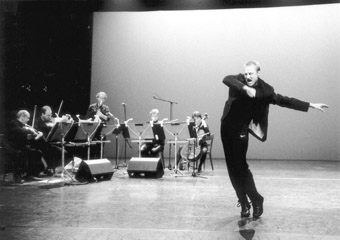
Nigel Charnok, Fever
photo Th. Ammerpohl
Nigel Charnok, Fever
If fever can bring on delirium, it can also loosen a person from the usual constraints of decorum and let unspoken truths tumble out. UK dancer/performer Nigel Charnock creates an atmosphere of excited passion from start to finish in Fever by interspersing mad, large-scale movements with pseudo gentle moments. He’ll rush about with sweeping arm movements and scissor-leg high-kicks, sprint up and down the theatre stairs, throw himself on the musicians’ speakers – and then sit in an empty audience seat to join us listening to “the beautiful music; isn’t it like Schubert?” Charnock speaks physical gesture so fluidly that he can improvise hilariously cutting monologues about fundamental human obssessions without dropping his focus on movement.
Fever is a structured improvisation for Charnock and for the musicians, the two-cello, two-violin Virus String Quartet led by Michael Riessler on bass and tenor saxophones and clarinet. Originally inspired by Shakespeare’s love sonnets which Charnock speaks in part or whole but, as the program points out, every night is a new possibility. “Nigel Charnock will present a personal selection of Shakespeare’s Sonnets, possibly: No. 18, 34, 16….” The musicians, for their part, satirize minimalist music, quote Purcell, send Charnock “shut it!” messages by increasing the volume when he teases by dancing erotically close to one cellist.
Nothing is safe from Charnock’s rant. This realization keeps the audience happily on edge, grinning in anticipation. It also creates a performance-long link of trust – we like this guy – so we’re willing to consider at least temporarily a comparison between a Catholic’s fear of passion (familiar satirical territory) and a burqua-clad woman’s view of the world “through a letterbox” (uncomfortable satirical territory). Charnock mocks everything, including his dance training and his (eventually) bare legs, so when he does get serious, we believe him. He ends the show with an orgasmic “death,” clenching the microphone stand in response to Riessler’s agitated clarinet solo played over his writhing body. The Vancouver crowd, for once, let silence sit for several seconds before applauding.
It’s remarkable that Charnock and Riessler have been performing Fever for a decade. The show stays fresh because the structure includes space for commentary on current events (the night I saw it, Charnock referenced current events like Canada’s presence in Afghanistan; another night he mourned Lady Di) and because Charnock and the musicians perform the piece wholeheartedly. The performers use their intimate knowledge of the material to bend phrases and treat everything with irreverent playfulness, knowing they will all meet up again at particular points and on cue. Charnock has a long, accomplished career behind him; successes include a commission to make Stupid Men for the Venice Biennale in 2007. Looking across from Fever to his later works, it’s clear that this rambunctious performer obssesses about death, religion and sex. But then, don’t we all, and he does it with irresistible hilarity and polish.
Sonia Beltran Napoles, Hey Girl!, Socìetas Raffaelo Sanzio
photo Raffaelli
Sonia Beltran Napoles, Hey Girl!, Socìetas Raffaelo Sanzio
Romeo Castellucci’s new work Hey Girl! contains many effects that aren’t really allowed in the theatre. Normally you don’t burn perfume because you’d get stuck with a huge bill for dry-cleaning the blacks afterwards. Normally you’re not really encouraged to shatter circles of glass onstage. It’s definitely considered inappropriate to drip gloopy substances all over the floor. Castellucci strips the stage back to a bare working space to protect the theatre (from himself), and gives us a painting instead.
Visual elements drive the work from moment to moment. Precisely focussed lights pick out the next object that will shape the action – a sword, a drum, a man watching. Careful staging draws our eye to each new tableau as if to a specific point on the canvas. Spoken text is rare, and always whispered, so as not to impinge on this dreamy, fog-laden visual world. Even the main character, the iconic Girl of the title (Sylvia Costa), is an image resolving out of an abandoned, amorphous glob of thick paint left heaped on a table. The skin-tone paint she emerges from never stops dripping onto the floor during the whole mesmerizing length of the work.
This is a polyptych – a many-panelled work of art, imprecisely seen through the smoke of ages, like the dust that collects on an old painting. On this panel, over here, is the bird that can no longer fly, and the violent crowd. On this panel is the other side of the Girl, the dark half who is enslaved to a man. On another panel is a newborn woman, weeping. Castellucci places the Girl stage front, listening to the brutal light of the Divine – in this case a laser beam. He shows us the Girl comforting herself in the person of another woman who bears an enlarged copy of the Girl’s head. In creating these moments, he’s suggesting what an allegorical painting would look like, if it came to life before us in three dimensions.
The challenge with allegorical painting – more typically a product of the Renaissance – is that the modern audience is out of practice reading the symbols. Castellucci has updated the images, but some mystery remains. How literal is the reading intended to be, and how much reading should we do?
The girl kneels before a large, metal sword. Slowly, exquisitely slowly, she reaches across and picks up a lipstick case I didn’t notice until just before her hand touched it. She puts the lipstick on. Then she places it on the sword and smoke rises. Reaching over to a bottle of perfume, she draws the scent onto her skin with a throat-slitting gesture. Poured over the sword, the perfume steams and sizzles and the theatre fills with a hot fragrance. The Girl soothes the angry sword with a folded pink sheet and recites the names of dead queens. Marie Antoinette. Ann Boleyn. The Russian Tsarina. She lifts the burning blanket and unfolds it, a dark brown X revealed, newly branded. “These are the queens who lost their head on account of the people,” she whispers.
A bald description of the Girl’s gestures does not convey the ritual power contained in each tableau. The impulse is to search for meaning, although following that impulse feels like an inadequate approach to the work. Certainly, there are multiple ways the scene above could be read. Most obviously, the lipstick and perfume signify the queens of history, the women with power who were destroyed by men. Alternatively, these are symbols of femininity that at various times have been rejected as disempowering. There are other possibilities, but the actual interpretation may be less important than the attempt to interpret. The pace of the piece is ritualistically slow, giving plenty of time for conjecture.
Hey Girl! is an extremely unusual work by a director with that rarest of qualities – a unique vision. It’s exactly the kind of work I hope to see at Vancouver’s PuSh Festival, which aims to present the best of contemporary work, including more risky and challenging pieces. It’s not like anything I’ve seen before outside the visual arts, and Hey Girl! makes me realize how much room there is to develop the images of live theatre. Castellucci expands our ability to read those images in places we never expected to see them. But he also creates a world in which humans move through a landscape full of symbols without ever trying to interpret them at all. Maybe that’s what we’re doing every day, but the layer of paint he applies allows us to see it for the first time.
Sonia Beltran Napoles, Hey Girl!, Socìetas Raffaelo Sanzio
photo Peter Manninger
Sonia Beltran Napoles, Hey Girl!, Socìetas Raffaelo Sanzio
When the mob of twenty-odd men pounded the white girl and the floor around her with pillows, I was anxious. When the white girl held the chain of the person she had been forced to strip and purchase – the black girl in her prison irons – I was distressed. During the opening scene, I balanced between repulsion and fascination as a female form untangled herself slowly, jerkily, from a pile of oozing, pale pink slime that seemed abandoned on a laboratory table under a short-circuiting fluorescent light.
From the dripping slime to the silver, armour-like paint the white girl later slathers onto the black girl, Romeo Castellucci’s Hey Girl! is full of visual surprises and tensely sculpted stage space. Hey Girl! plunges us viscerally into women’s oppression, racial subjugation, betrayal and splintered willpower, using a few narrative fragments and a multitude of visuals, some illustrative, some opaque.
The best moments are both illustrative and opaque. For example, there are two oversized fake heads in the performance, both sculpted to look like the white girl. The heads appear close in time. After the white girl is beaten, she reappears from the line of now-still men wearing the artificial head and waving a huge black flag. She begs for the lights to go off. When the lights return, the head lies ‘decapitated,’ stage front: one of the many “queens who lost their head on account of the people” that the girl listed earlier on. For a moment, the head is simply illustrative.
Then there is female sobbing. The white girl walks gently through the crowd of men and brings forward the source of the cries: a black woman wearing an even larger version of the artificial head. So much for simplicity. When the white woman sees a version of her own face on another woman’s body, it’s a moment of total identification; it is also a moment where identification is cut. The white girl falsely comforts, apologizes, and beheads the white face from the black body. Then, although ashamed of herself, she joins in enslaving – or is she releasing – the black woman. There is similarity, there is difference; there is a shift of power from the white woman being a victim to the white woman victimizing; there is also a long list of words – all nouns – being projected above their heads. The interaction between the girls is so codified, and non-naturalistic, that any communication between them invites but resists interpretation.
Tension can be generated by presenting a highly codified scene and then asking the audience to decode with little assistance. This tactic flourishes in performance art, a genre that asks viewers to watch body-based action in a context made difficult either by long duration, physical discomfort or extreme content. Thinking about performance art helps me translate Hey Girl! because it specifically resonated with my experience of Marina Abramovic’s Lips of Thomas (1975, 2005). Naked, Abramovic alternates through a group of gestures aimed at exhausting her body so it can escape the heavy codes of Christianity and communism (Abramovic grew up in the former Yugoslavia and continues to use the name Yugoslavia for her homeland). She eats honey, whips herself on the back, lies on a cross of ice until numb, cuts a star into her belly, stands at attention in a pair of military boots and listens to a folk song, eats honey again. Because the actions and the timeframe are both extreme – the 2005 performance extended the original work from less than an hour to eight hours – the analytical mind can’t process what’s going on until later. If authority pushes the bodies it manipulates to total exhaustion, then authority collapses from the lack of having something to control.
Hey Girl! similarly works to shatter symbols by presenting bodies and structures on the edge of physical damage and exhaustion. Bodies on stage are in pain, at least if they’re female. The girls are buried, shackled, beaten, traded, but also capable of wielding a sword or joylessly dancing. Viewers’ bodies are affected: the viscous pink material is palpably revolting; we endure the acrid smells of lipstick, perfume and fabric burned against a flagrantly phallic hot metal sword. When at last the patriarchal, colonial gaze, represented quite literally by four suspended lenses that hang between the white girl and the shackled black girl, snaps, only then can a new code be written, though it initially involves dancing around the shattered glass left from the previous hierarchies.
Hey Girl! is theatre, though, not performance art. It’s theatre that asks us to move into an understanding with our gut more than with our mind. Canadian actor and writer Darren O’Donnell once said, “What theatre is really about – like any other form – is generating affect, and that’s it. Feelings. And, if things go well, quickly following feelings will be thoughts. Stories certainly can do this, but they’re not the only thing to do it, and they’re no longer always the best way to do it” (Social Acupuncture, 2006). Castellucci aims at our affect directly. As Hey Girl! evolves, visuals that seem iconic become messy and harsh moments are tempered by sudden kindnesses. This complexity means that, afterwards, images continue to shift and morph, playing with the mind and maybe never yielding a stable response. It’s an effective way to go into culturally familiar stories about women surviving violence because it provokes authentic feelings around gender and race.
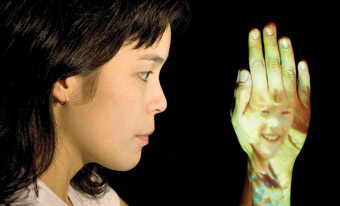
Adrienne Wong, My Name is Rachel Corrie
photo Tim Matheson
Adrienne Wong, My Name is Rachel Corrie
The challenge any playwright faces is how to make their work robust enough to survive the potential vagaries of production. It requires making strong choices that will support a clear vision. Drawn from the writings of a young activist killed in Gaza, My Name is Rachel Corrie is far from a traditional play text. The process of turning Corrie’s journals and e-mails into a script is credited to the editors Alan Rickman and Kathleen Viner. Editing is an alien concept to theatre where the preferred term is dramaturgy, a process which includes an exploration of how the text will operate in performance. If Corrie’s voice survives this translation process, it is because of the performative quality of her journal writing and the chatty, informality of her e-mail style. Corrie was a gifted writer. Beautiful evoked images – salmon swimming underneath the streets of Olympia – alternate with affirmations that have Hemingway -ike economy: “I want this to stop”. Despite these strengths, this is fragile material that needs to be handled delicately.
The Havana is a small black box theatre located at the back of a restaurant on Vancouver’s eastside. It has never looked so gorgeous. The space has been completely cleared, with a single row of seating running around the four walls. Above the seating are wall-length rectangular projections. When the audience enters, cuttings from newspapers telling of Corrie’s death are projected. The texts overlap making them difficult to read. During the show, the projections are mostly colours and abstract designs until Corrie arrives in the Middle East, at which time we see photos of cityscapes and destruction. In the centre of the space a white square is boldly defined on the black floor. Within the square there is an office chair and an indefinable piece of ugly office furniture which acts as a table. The space looks futuristic and very tidy. Resting on the table is a white Mac Book computer, a model unavailable in 2003 when Corrie was killed; an early clue to the distancing artifice that informs the production.
The performer, Adrienne Wong, greets the audience as they come in, introducing herself to strangers. If she knows you, she greets you by name and spends a few moments catching up. When the show is ready to start, Wong goes to the entrance, where two more Mac Books glow stylishly in the darkness. She closes the door and does something with the laptops, giving the impression that she’s running the show with them. She makes her way to the performance space, takes off her shoes and then – accompanied by a suitable jet-like sound and lighting effect – steps onto the white square. She never leaves this claustrophobic space, except for one stylized moment where she follows a lighted path around the square. The rest of the time, Wong moves restlessly around the space engaging with the audience, making direct eye-contact.
It’s worth describing the production in this much detail. I will long remember the stylish presentation but not, alas, Corrie’s words. This is a production interested in the artifice of performance. The implication is that we should never believe Wong is Corrie and I never did. Rather, she is Wong performing Corrie’s words. Perhaps the producers, neworld and Teesri Duniya Theatre, were concerned about mimicry and felt this was a more sensitive approach to remembering Corrie. Unfortunately for me the artifice was simply too heavy. Wong’s entrapment within the white square is too distracting, even the projections take us too far from the words. This is not a traditional script with a coherent narrative structure that can support all the weight the production throws upon it. It is too fragile.
Wong is a charismatic performer who commands attention but even she struggles against the artifice. She gallops restlessly through the script at high speed. Perhaps this is meant to evoke Corrie’s youthful energy but it came across to me as a lack of faith in the material. It meant that her performance wasn’t as nuanced as it should have been and came off as too one-note. The one moment where things did slow down – an e-mail exchange between Corrie and her father – suddenly brought the production to life.
Corrie was a list maker and lists are featured repeatedly throughout the text. List-makers try to impose some form of order on a chaotic world. It is ironic that the over-determined nature of this production overwhelms Corrie. Her writings demonstrate the passion and emotion that drove her, yet this production generates a cool, intellectual distance. Perhaps this was a response to the controversy that has dogged this play (protests took place in New York and Toronto over the play’s sympathetic depiction of the Palestinians). While rationalism is laudable in the face of polarised debate, it seems untrue about what we know of Corrie. With the audience able to see each other, with Wong making direct eye-contact there is a form of calculated intimacy but it was with the performer and not the text or with Corrie herself.
Rachel Corrie was a vibrant individual seeking a role in the world and an identity that would suit her passions. Despite her strengths, her fragile body was too easily destroyed. I wish this production had relaxed its intellectual guard so that we could glimpse more of the fragile beauty of the script and the emotional power of Rachel’s story.
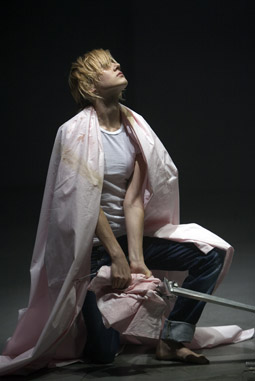
Silvia Costa, Hey Girl!, Socìetas Raffaelo Sanzio
photo Peter Manninger
Silvia Costa, Hey Girl!, Socìetas Raffaelo Sanzio
I don’t want to see this. About twenty-five men in street clothes stand together at the back of the stage. A small, blonde, white woman — she could pass as an adolescent — walks toward them. Not long ago they had beaten her. Someone is crying, I don’t know who. It’s coming from behind the men. The woman walks toward them. I don’t want her to go near them, but she does, passing through them untouched. She re-emerges leading another woman, a black woman. But the black woman has the white woman’s head. Her jaw, her eyes, her nose, her short-cropped hair. This head, though, is five times the size. It’s a huge, very life-like replica.
The white woman undresses the black woman, and my anxiety rises. The men leave the stage. All except one white man who, unlike the others, is in 19th century costume, including top hat. He holds out a hand toward the black woman, exhibiting her, offering her. My anxiety increases. The white woman whispers to the black woman, “I’m so sorry.” She then leaves her with the man, who fetches a pile of hay, and leads the black woman to it. He chains her. This, more than anything, is what I don’t want to see. I don’t want to see a female slave auctioned off like a mule on a pile of straw. The man holds out his inverted top hat. The white woman observes the slave woman through four discs—like windows—hanging one behind the other. The windows are streaked and dirty. What image of the slave is the white woman seeing through these glass veils?
Above, the lines from Romeo and Juliet’s balcony scene are projected on a large screen: “How camest thou hither, tell me, and wherefore?…the place death, considering who thou art, if any of my kinsmen find thee here.” “With love’s wings did I o’erperch these walls; For stony limits cannot hold love out.” Where is love in this triangle? And to whom do I attribute the lines? Is the black woman Juliet, the white woman Romeo? Or is the man with top hat either? All of them, none of them? The white woman now digs into her low-rider jeans and produces some coins. She walks to the auctioneer and pays the fee. Is this simple complicity or is she paying for the slave’s freedom? I feel my heart may be breaking. It’s been coming for some time, this sense of grief welling up. Then something shatters. I think I feel a membrane burst in my chest. But it’s the four windows, which all at once have exploded in mid-air, showering the stage with glass.
I’m crying. It’s been coming since the beginning, when the white girl-woman first emerged, chrysalis-like, from the slime of a latex cocoon, when she first crawled like a new-born calf across the strange fluorescent landscape, which is also a soundscape where distant melodies arrive as if through a ventilation shaft. The images from the misty landscape are dense and shifting: a massive broad-sword out of the middle ages next to a bottle of perfume and a tube of lipstick; the girl-woman kneeling, like Joan of Arc, pledging allegiance—but to what? God, king, church, capitalism? Whatever it is, it isn’t hers; it’s an imposition that’s going to use and betray her—as Joan was betrayed. “Dost thou love me? I know thou wilt say ‘Ay’; And I will take thy word.” The girl-woman holds up a sheet, which has just had an ‘x’ burned into it by the giant sword. She stands at the center of that ‘x’, perhaps unconsciously making herself a target.
What’s this about, this heaving in my chest, this performance? I think it’s about one woman’s experience of being a woman. And me, a man sitting in the auditorium? It’s about one man’s imagining of that woman’s experience. It’s about the betrayal of this woman —of women, of innocence, of trust and of love. And it’s about making contact with those things momentarily, making and losing it at the same time. It’s also about sitting in awe at the work of art unfolding before me, at the restless shifting of symbols: first a big bass marching drum, then that drum being held by a naked woman, then the woman weeping over it, then the woman pounding it with the mallets while weeping. Meanings accumulate, line up side by side without cancelling each other out. The black woman is a slave. The black woman is painted silver by the white woman and given a sword. The silver-painted, armoured black woman puts on high heels. What is feminine, what is masculine, what is submission, what is rebellion? Hey Girl! doesn’t collapse these things to a single point. It enfolds meanings then distributes them liberally. There is plenty of room in this world for my personal ache and wonder.
Hey Girl! gets a hold of me and doesn’t let go for 75 minutes. It ended at 8:45 last night. It’s now almost noon and I’ve barely slept. I keep turning the images over in my head, the ones I drank in and the ones I couldn’t look away from. Director Romeo Castellucci, his designers, and the two women, Silvia Costa and Sonia Beltran Napoles, did that rare thing: they dislodged my thinking, allowing the images to bypass my mind and go directly to my body. They fed me, and they made me see what I didn’t want to see. “Therefore pardon me, And not impute this yielding to light love, Which the dark night hath so discovered.”
Socìetas Raffaelo Sanzio, Hey Girl!, director, design, lights, costumes Romeo Castellucci, performers Silvia Costa, Sonia Beltran Napoles, original music Scott Gibbons, statics and dynamics Stephan Duve, lighting technique Giacomo Gorini, Luciano Trebbi, sculptures Plastikart, Istvan Zimmerman; Frederic Wood Theatre, University of British Columbia, Jan 23-26; PuSh International Festival of Performing Arts, Jan 16-Feb 3
RealTime issue #83 Feb-March 2008 pg. 8
© Alex Ferguson; for permission to reproduce apply to realtime@realtimearts.net
Adrienne Wong, My Name is Rachel Corrie
photo Tim Matheson
Adrienne Wong, My Name is Rachel Corrie
The actor shakes every person’s hand as they walk into the small, square Havana Theatre. “Hi, I’m Adrienne Wong.” The gesture invites you personally and a few minutes later, when Wong launches into My Name Is Rachel Corrie, you realize she’s set up an intimacy that she’ll develop as the play unfolds.
In fact Teesri Duniya Theatre (Montreal) and neworld theatre (Vancouver) have taken care to build intimacy into every part of the show. The performance is in the round but there’s only one row of about twelve seats along each wall, so every sight line is direct. The set is functional: a thickly upholstered white office chair and a skinny white one-legged table, both on wheels, a white laptop computer, and a white square of light projected onto a white vinyl square taped to the floor. Narrow horizontal screens hang above each row of chairs; the initial projection is a collage of headlines about the death of the young American peace activist killed in Gaza in 2003 along with excerpts from her emails. It’s all pared down and it’s all around you all the time.
Pacing the stage, or swirling in the chair, Wong swivels every minute or so to address all of the audience. At some point she will look at you, and you know she’ll do it again. It’s not invasive, it’s engaging, and it brought me into the story almost as if it was a conversation.
Directness shapes the evening profoundly. The play is constructed from Corrie’s metaphor-filled, descriptive emails and letters (compiled by UK actor Alan Rickman and Guardian journalist Katharine Viner in 2004-05). Corrie was a skilled, nimble writer but the words were originally meant to be read, not spoken. Wong’s eye-contact and restless movements give them a convincing physicality. And the straightforward, person-to-person approach cuts through the thick layer of controversy that surrounds this work – polarized opinions, cancelled productions in New York and Toronto, and the difficult facts about Corrie’s death and Gaza Palestinians’ ongoing lack of reliable access to water, housing and food. When Wong/Corrie looks right at you, the question is: what do you feel, what do you think? It’s a powerful way to handle what has become such a locked-down story.
And this is what usually gets lost in debate about this play. A substantial chunk of it is about Corrie as a person. We meet her as a pre-teen, then in high school, then college, before she feels the pull to try and understand personally a complicated part of the world. Her young voice is endearing and funny. One day she goes for a walk in the forest and sings Russian drinking songs to the trees. She describes walking home late at night in “slutty boots” thinking about the salmon who, thanks to modern city life, have to swim back to their birthplace through culverts since that’s where the streams are now diverted. “It’s hard to be extraordinarily vacuous when you always have salmon in the back of your mind.” These are simple, almost innocent thoughts that show a mind growing.
The play reveals the context of Corrie’s activism. As she learns, organizes and joins events, like walking down the street with forty other people dressed as white doves, her voice alters. She wants to know what happens on the other end of US tax dollars in places where that massive military budget is being spent. She’s angry but humble. After she arrives in Gaza, to work with the International Solidarity Movement to watchdog against events like water wells and greenhouses being bulldozed, she retains that sense of probing. She never sets herself up as an expert: “I am new to speaking about the Israel-Palestine conflict so I don’t always understand the political implications of what I am saying.” She’s just a person trying to figure out what’s going on. She notices glow-in-the-dark stars in blown-out bedrooms; she’s disturbed when closed checkpoints prevent Palestinian workers from going to, or returning from, their jobs. The play doesn’t become didactic; it offers information and opinion, and asks us to form our own thoughts.
Wisely, Corrie’s death is not enacted. Completing her moments as Corrie, Wong puts on a bright orange safety jacket, reads aloud her last email to her mother (about two men offering her a meal), and steps off stage. A moment later, she takes off the jacket and activates two small-screen videos in which a young man describes how the bulldozer moved toward, then over, Corrie. It’s the right amount of detail: facts are involved here, and no one pretends to know them all.
My Name Is Rachel Corrie is a story about how a person grows to look outside her own life and tries to grapple with huge, traumatizing events that she knows she can walk away from at any given moment, even though the people living there can’t. Corrie’s convictions about justice, compassion and activism led her to Palestine, but those beliefs can be applied to other injustices in the world. Journalists, activists, immigrants and others in areas torn by military conflict talk about having to make difficult choices on a regular, sometimes daily basis. Can the rest of us learn from their experiences, or are they too distinct from ours? And, thinking of Corrie’s death specifically, aren’t there any insights from her story that reach beyond the specifics of the Israel-Palestine conflict?
Like the square of light that widened and shrank around Wong as she moved through expansive or frightened, tightened moods, the play can open out or close down our ideas if we are willing to take that first handshake for what I think it was: an invitation to hear one real person tell another real person’s story, respecting us, too, as individuals with so much to learn.
Adrienne Wong, My Name is Rachel Corrie
photo Tim Matheson
Adrienne Wong, My Name is Rachel Corrie
When Rachel Corrie (Adrienne Wong) takes her special needs clients from a resource centre out for a treat at the Dairy Queen in Olympia, Washington, she wants them to practise their social skills. The trip degenerates quickly as the solo actor recounts it, standing on a white square in the middle of the room. Rachel’s clients cry and fight, and have to be given a long “time out”, during which their ice creams melt and make a mess of the table. Rachel practices her counseling skills on them – skills so new and deliberate they haven’t become part of her yet. “I’m grounded in my personal space,” she tells the audience, as she urges her invisible clients to do some deep breathing. Instead they get “very escalated.” Eventually she loses her cool completely and tells them they will never get to go to Dairy Queen again. She’s had zero positive effect on her clients that day, but Rachel Corrie is a woman who still believed she could have an effect on the world, and she turned out to be right.
My Name is Rachel Corrie has two goals. One is to let us better know Rachel Corrie, who was killed in Rafah in 2003 when she stood in front of an Israeli bulldozer trying to demolish a Palestinian home. The other goal is to let us better know the situation in the Gaza Strip.
Rachel Corrie comes across as a profoundly serious woman who rarely indulges in the playful self-mocking of her Dairy Queen story. At first her words reflect the powerful influences of youthful self-absorption and activism. She speaks of “doing progressive work” on “anti-war slash global issues”, and informs us that she “tries to be local. That’s a big part of my ethic.” When later given the chance to leave Rafah and go to France, she writes that she would “feel a lot of class guilt.” The words are genuine Rachel Corrie – they come from Corrie’s own emails and journals – but they were meant to be read, not to spoken, and it’s hard to hang a play on their formal sincerity. There’s no doubt this is how an intelligent, passionate, political young woman would write, the kind of woman whose boyfriend reads anarchist works, the kind of woman who finds out that a salmon creek has been funneled into an underground pipe in downtown Olympia. “It’s hard to be extraordinarily vacuous when you always have salmon in the back of your mind.” But it’s not how this same young woman would speak to us directly, and there might have been more imaginative ways to adapt the original material.
An additional difficulty is that, in Wong’s delivery, Rachel’s emotional highlights are almost always based on political outrage. The director has also set the pace of the play very fast, and it feels relentless. The set compounds the sense of small range. Rachel only moves in the cramped white square on the floor, set with a chair and a table on wheels. She never steps outside the square, except when the lighting design adds a narrow grey pathway around it, and she treads that carefully. Rachel lives in a world she sees very clearly. Her sense of right and wrong is almost religious. Her certainty fuels her activism – it takes her to Gaza to see how she can help. People who tread the grey pathways more often would never buy the ticket.
At first she benefits from the trip. In Palestine, her language changes abruptly. It’s less inflected with stock liberal phrases, less about herself and more about the world around her. She becomes more real to us. And yet she still prefers to say, “I am scared for these people.” It takes a very long time before we hear her admit, “I am scared.” In fact one of the most poignant moments comes from her father instead. He writes her to say he is proud of her, but “I would rather be as proud of someone else’s daughter.” They are simple words and simple emotions, and they carry.
Rachel ploughs and re-ploughs the same white square, perhaps now the safe space of her own privilege as an American citizen, as she tells us what she experiences in Rafah. Long narrow screens on all four walls show us horizontal images of rubble, and walls pocked with bullets. It’s the first time we see representational images on the screens, as if coming to Palestine has been our first glimpse of the real world. But she never refers to any Palestinians by name, and even her fellow volunteers she calls “the Internationals.” Rachel is so focused on the power structure that everyone is identified by their position in it, rather than by their own identity. Although we see, and honour, her commitment, although we learn more about the daily struggles for normal life in Rafah, and although we share her sense of wrong, the window she opens for us in the Middle East always feels like a narrow one, just like the projections on the wall. The narrowness isn’t due to a single point of view. That’s all any of us would have to offer.
It’s important that we get to see plays like My Name is Rachel Corrie, even if limitations in the scripting and direction detract from the potential power of the story. But few among us will go abroad to witness first hand the results of our country’s foreign policy, as Rachel chose to do. The play asks us: what might happen if we did?
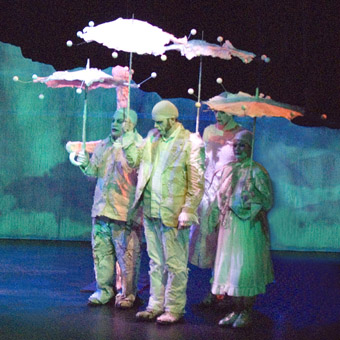
Dov Mickelson, Tim Machin, Sarah Machin-Gale, Nancy McAlear, Frankenstein
photo Photomagic
Dov Mickelson, Tim Machin, Sarah Machin-Gale, Nancy McAlear, Frankenstein
Any adaptation of Mary Shelley’s Frankenstein has to contend with the potency of the original story. The idea of a man so enthralled with his own brilliance that he pushes beyond the bounds of the natural order still resonates because of our unease over genetically “improved” fruit and veg. The horror is realised when man’s unnatural creation comes to life and starts to extract its demands. The central relationship in the Frankenstein myth (and it has achieved that status) is between creator and created. I also wonder if the story, as envisaged by Shelley, represents the fear of childbirth and what happens when the child we create becomes a monster. The horror of Frankenstein’s creation should be bloody and visceral. It should be muddy and dark.
Muddy and dark are the last thing we get with this Catalyst Theatre production. Instead we get a world of white, a world of strange organic shapes that reminded me very much of the drawings of Dr Seuss. The costumes, in particular, are striking with wild hats, eccentrically shaped dresses and bizarre dreadlocks. Paper was somehow involved in the creation of the costumes and set and so everything – and I mean everything – has the texture of crumpled paper. When lit with a rich colour scheme, the costumes look beautiful but somehow they irritated me. They looked too moulded, too constrained and uniform – even the monster is bizarrely made of the same stuff. Perhaps all this rumpled white is meant to put the audience in mind of a paddled cell.
If so, Jonathan Christenson, writer, director and composer wants to take us into the madhouse and the seemingly endless parade of characters we are introduced to (each with their own song) are meant to be inmates. But if everyone is crazy, if the world is a madhouse, then how are Victor Frankenstein (Andrew Kushnir) and his creation (George Szilagyi) any different and, crucially, how does this decision support the central themes of the work? Both are outsiders. They represent the unnatural capacities of man set against natural order. Having these two iconic figures lost amongst the paper lunacy is simply baffling. The only way to make this set up work would be to have the creature appear both sane and beautiful. What we really needed was Brad Pitt in a well-tailored tuxedo. Instead we get another nutter in a paper suit. The only difference is that he’s wearing a cowboy hat and his face is wrapped in bandages.
It’s not just white paper that Victor and his poor creation are lost in; they are also lost within the narrative. The most glaring example is the creation scene. There is none. Victor trots off to university wondering how life is created and why people have to die. He’s spurred into these thoughts by the loss of both parents. Yes, once again a madman is created by childhood trauma. Oprah Winfrey has a lot to answer for. The next thing we know, folk in the university town are singing of disturbing rumours about young Frankenstein. His housekeeper Nancy McAlear – channelling Madeline Khan from Young Frankenstein – keeps them at bay. Next thing you know, Victor creates a monster, with the help of some magical books! In his room! We know there’s a monster because we glimpse a pair of long clawed hands through a gauze screen. A narrator also pops up to tell us. I have to admire Christenson’s courage. Most theatre artists would have focussed on the bloody creation itself. We would have seen Victor consumed with madness as he neared his goal. We would have been drawn in, made complicit, as the creature begins to breathe, to move. Maybe Christenson didn’t want to get blood on the delicate costumes. Instead of all that gruesome nonsense, we get a courtroom scene.
The woman on trial is Victor’s nanny. She stands accused of killing Sweet William, Victor’s adopted brother. Three locals sing lengthy testimonies and, in the interest of fairness, the accused gets to respond to the charges in turn. The court case lasts so long that by the end I was beginning to believe she was guilty. Of course she isn’t. Sweet William was killed by Victor’s monster. We know this because Victor, in any earlier scene, had deduced who the real culprit was. In any event, Victor stands by and looks anguished while his surrogate mother is found guilty. We don’t actually see the hanging, of course, which considering what we had to sit through is a bit of a let down.
The Sweet William murder scene is told again in the second act, this time by the monster with the help of ever present narrators. We don’t see the murder, of course. The monster describes it while William appears upstage behind the gauze curtain. In fact the monster’s whole story, from departing the university town to reunion with Victor years later in the mountains of cling-film, is told in flashback. I stress “told”. The monster tells his story downstage while the characters he encounters appear upstage again behind the gauze of memory. This format is only broken once that I recall when he encounters a blind fiddler, a scene which unfolds in real time with two actors talking to one another. You have no idea how refreshing this moment was.
For some unfathomable reason, Christenson employs a team of narrators throughout. They describe every scene and practically every action, usually in rhyming couplets that feel like watered down Dr Seuss. If Victor looks on in anguish, we’re told about it. I can only assume that Christenson is trying to evoke the feel of storytelling. If he is, then it is deeply ironic because it interferes directly with the natural process of story-telling within a theatre context. The constant telling means there is no tension, no emotional engagement between the characters or audience. It creates a strange sense of stasis so endemic that it actively works against character logic. Not only doesn’t Victor speak up in defence of his nanny, he also stands idly in some other room while his bride is murdered by the monster. One has to wonder not only why Victor is not in the bedchamber on his honeymoon but why he is separated from his love for even a moment when the monster has explicitly threatened to kill her. The monster, for all his murderous ways, is just as bad. He stands by while Victor chokes the monster bride he has been forced to create.
It’s as if Christenson was afraid to deal with the visceral reality implied by the source material. Perhaps this sanitised version is aimed primarily at children. Mind you, most children I know revel in bloody excess. I must also add, as a caveat, that as a playwright I am inherently interested in text. The audience on the night I saw the production seemed enraptured and this was understandable. The design is gorgeous, the performances terrific. The music was forgettable but the singing was strong and committed. This was slick, well-crafted theatre. The setting of an insane asylum made of paper could probably house another story beautifully. It’s just not the house of Frankenstein.
The Vancouver East Cultural Centre, fondly known to locals as the “Cultch”, seems to be an ideal setting for a gothic horror about the possible dangers of playing God. Formerly an abandoned church, its wooden panelling and winding staircase could be creepy if explored alone on a dark stormy night. Tonight the chirpy crowd creates a homely community atmosphere. We cram in, haphazardly thrown together around the least pillar-restricted spots. The uneven floor almost trips me as I make my way round the back of the balcony to the last few empty velvet-covered seats. We huddle together as though round a campfire, eager for the ghost story to start.
Unfortunately the two hour performance doesn’t possess the quirky quality that makes this space so inviting. The eight performers creep hunchbacked and white-faced around the stage, head to toe in the white papier maché-like costuming which also covers the set, oversized beansprout trees and all. They step and grimace in time to the rhyming couplets with which they narrate the story of poor Victor Frankenstein. His childhood, tainted by the death of his parents, and his subsequent unnatural obsession with bringing the dead back to life, resulting in the creation of his monster, are illustrated with frequent songs, clockwork tableaux, and of course, the obligatory lightning flashes. The choppy narrative style keeps us at a distance from the characters portrayed, preventing any lasting emotional engagement. But this gap is not filled with ideas in an attempt at intellectual engagement. The didactic message is clearly spelt out with little space for ambiguity: “if life is a bowl of cherries, one day you’ll choke on a pip”; “the higher you climb, the harder you’ll fall”; don’t mess with nature or pretend to be God, 'cause you’ll get what’s coming to you. The text is strung through with cliché and the irony of the final song of the first act is unbearable: “We’re going to hell in a handbasket; does it get any better than this?”.
After the lengthy courtroom scene that ends the first act, in which Frankenstein’s beloved governess is sentenced to death (we’re not even rewarded with a dramatic execution) for a murder that his own creation, the monster, has committed, my hopes for the second half are not high. However, as the monster – also costumed in white paper from his platform-booted feet to his oversized Stetson – emerges from the shadows to tell his own story, things start to look up. In an unusually touching scene, for once uninterrupted by song and narration, the monster tries to cure his loneliness by befriending an old blind violinist. He breaks down and sobs as he describes his fear of rejection and his companion reaches out to comfort him. Realising that there is something “other” about the creature, the elderly man slowly traces his hands over the gruff monster’s long white claws, and up towards his bandaged face: “Ah, I understand.”
But sadly this friendship, and any potential depth to the piece, is not to be. The man’s family arrive home and chase the creature away in horror; the image of compassion dissolves, along with my tolerance. We are re-introduced to bitty tableaux and songs that fail to elaborate on the rhyming verse. The ideas inherent in Mary Shelley’s novel, her subtle ambiguities about identity, creative responsibility, and our relationship with the outsider, the “other”, seem to have been lost somewhere along the line in this production’s intention to be well-polished. Which it is: well-performed, well-sung, smoothly assembled.
Perhaps the problem here is the show’s packaging. This dummed-down version of Shelley’s novel feels like a show for children, but it isn’t announced as such. I’m bored by the relentless songs, but these might well sustain a 5 year old’s attention through the more complex parts of the plot. I’m disappointed by the lack of darkly gothic frights, but there’s no danger of nightmares for over-imaginative toddlers as a result of a nasty theatrical shock. However, even within the frame of “family theatre”, accompanying parents and older children might still be left wanting something a bit more jagged, a bit more inventive, with a few more original ideas. Nonetheless, the passionate local audience embraced the production…but have they embraced the unknown?
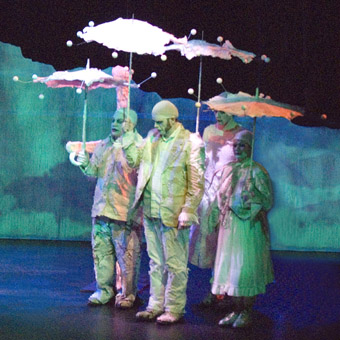
Dov Mickelson, Tim Machin, Sarah Machin-Gale, Nancy McAlear, Frankenstein
photo Photomagic
Dov Mickelson, Tim Machin, Sarah Machin-Gale, Nancy McAlear, Frankenstein
A blind old fiddle player and the Creature (aka the Frankenstein monster) talk around a campfire. The Creature (George Szilagyi) is attired in what looks like shredded, white, hand-made paper. So is the old man (Dov Mickleson). Softer white fabrics are also layered into their costumes, and the paper covers almost every set piece, including the two stumps they are sitting on (designer Bretta Gerecke). White grease-paint completes the wintry, deathly tone of the setting.
When you take in a Catalyst production, you get a world that is aesthetically complete. You can expect rigorous consistency of appearance in the design, and persistence of tone in the performances. Which makes the scene described above a bit of an anomaly. In what is a rare exception to the rhyming couplets that have dominated the script, we are given prose dialogue. The scene is also unique in allowing two characters a stretch of uninterrupted conversation. Normally, ever-present narrators comment on the action. The Creature pleads for understanding (“Please don’t hate me”), and the old man offers his compassion. The scene is affecting in a way that the play’s alienating performance style hasn’t been, up to this point.
Virtually the entire play is delivered in metered verse, spoken or sung by a group of gothic spectres who seem to have emerged from an icy northern crypt. They lurk, they twitch, they glide. There’s a bit of the B-movie hunchback in some of them, others opt for the menace of Boris Karloff or Vincent Price. Judging from the corny, aphoristic content of much of the script, these references are probably deliberate. In fact, the text offers an almost exhaustive supply of proverbs and platitudes: “The higher you climb, the harder it is when you fall.” It’s relentless and uncompromising in its devotion to end rhymes — Which is easy enough to do / Whether you’re happy or you’re blue / Writing great dramatic text / Or just a snarky little review.
The narrative is handled in an equally simplistic manner. We are given a generic psychological sketch of Victor Frankenstein’s journey from happy child to tormented scientist: childhood trauma is the source of adult obsession. This biography is faithful to the broad outlines of Mary Shelley’s novel, but it’s short on the kind of details that offer genuine insight or build a character portrait that is unique or surprising. Despite the two-hour duration of the show, character relationships are likewise merely schematic and therefore unaffecting. Instead of narrative layers, we get a strong design concept, and highly competent physical and vocal work by the actors. Don’t get me wrong, I love image-based theatre, physical theatre and contemporary dance — I can easily do without psychological character development. But in the case of Frankenstein, form and style fail to make up for a lack of nuanced story telling and complex character relationships.
What seems to be missing from the outset is a genuine question, a speculative point of departure. Writer-director Jonathan Christenson has made up his mind about the issue, the meaning is prescribed: too much tinkering with the laws of nature is a bad thing. This lack of ambiguity is evident in Victor’s relationship to the Creature. He despises him and doesn’t waver from that position until the very end. Until that point he suffers no inner turmoil about whether he should terminate his scientific progeny, so there’s no issue to wrestle with. As a result, there’s really no play here.
Maybe it’s a control issue. As writer, director and composer, Christenson seems to have kept a tight leash on every aspect of his creation. Unlike the creature in Mary Shelley’s novel, Christenson’s monster — the production — lacks the capability to rebel. It’s ironic that a play about a scientist-inventor is lacking in invention. The show plods along methodically, like a rhyming pattern that won’t quit, like a thesis question that presupposes its answer.
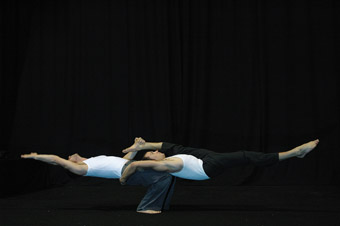
David Carberry, Darcy Grant, The Space Between
photo John Donegan
David Carberry, Darcy Grant, The Space Between
In thinking of circus performers—particularly acrobats—the first emotion one feels is the thrill of sensing the danger that the performers may fall. The second, and perhaps surprising, emotion is a sense of comfort at seeing how the performers support one another. The overriding bond between two acrobats who rely on each other for their physical well-being must be one of trust. Comfort is derived from witnessing that trust affirmed. We see how powerful—and life-protecting—trust can be and this becomes the implied message of all circus performances. The language of physical theatre therefore comprises two inter-related elements or apparent polarities, risk and trust, repeated throughout a performance. This is manifest also in the individual performer: trust that their body will support them and save them from the harm of risk.
For most of us, trust in is one of the hardest things to achieve because of the inherent risk of putting our faith in others or, indeed, ourselves. Will we be let down, disappointed, left to fall? I suspect trust is a key theme in The Space Between but I’m not sure. Movement is not a language in which I’m particularly fluent but I trust the performers and creators to explore the themes fully.
There is no obvious narrative driving The Space Between. Instead we have three performers—two males, one female—working alone or in pairs with the occasional scene featuring all three. The links between scenes are more impressionistic than direct, building a layered exploration of the relationships between the performers. Like a poem, perhaps the key is in the title.
What is not in doubt is the sheer physical prowess of the performers. The show opens with a single performer falling backwards. He falls repeatedly before tumbling back onto his feet. It has a form of gracefulness but it is the sheer athletic skill, the physical energy and ability that strikes one. This visceral physicality is on display throughout the show. There are sequences where the performers tumble, roll and crawl across each other’s bodies. These are balanced with moments of stillness where the performers hold each other at dramatic angles. In a memorable sequence the female performer holds a small scarf while one of the men dives over and under it like a land-based dolphin. Amongst the solos, there is a wonderfully executed sight-gag involving a performer one of whose hands sticks to any surface it touches. The comic logic of the gag is followed through beautifully as his hand attaches to various parts of his body and the floor and he must contort his body accordingly. In the same scene the performer manages to get a collective wince out of the audience as he twists around on one wrist and seems to have dislocated his shoulder.
The playing space is simple—as it should be—a grey square with the audience on three sides. An occasional projection appears directly on the floor. These are always square and include letters or geometric shapes. The performers move through them but the effect only really lifts off when the square of light rotates and the male performers look like they’re flying on a magic carpet. The music is an eclectic grab bag ranging from electronica through to Serge Gainsborough and Neil Young. Sometimes it works well, sometimes it’s a little too obvious and other times it’s just there.
The Space Between builds to a trapeze scene involving a repetition of the physical gestures we’ve seen played out on the floor but with the extra sense of risk engendered from being suspended. There are a couple of breathtaking moments when the female performer is about to fall only to have the male performer deftly capture her—or at least seem to. Towards the end of the same scene there is a moment where he appears to hold her using only his hand in her mouth. It’s a brief but striking image that seems extreme when compared with what has gone before. There are allusions to male threat, for example when the men grab hold of the woman and swing her back and forth like a skipping rope but there was no sense of overt menace. While we see the potential for physical danger, we fully trust that the male performers would not allow any harm.
Although the moments on the trapeze involved risk, I’m not sure that they evoked vulnerability, and that’s what I thought was missing. I can’t escape the sense that the basic, physical language of circus—built on the polarity of risk and trust—makes it difficult to achieve more emotional nuance. While there were some tender moments—particularly between the two men—I can recall only one of overt aggression, again between the males. It is surprising in a piece about a love triangle that anger does not appear more frequently. Of course, as one male flew at the other in rage we could see the second male brace himself as he prepared his body to actually support his colleague. It was comforting to see.
Henri Chassé, Annick Bergeron, Août – un repas à la campagne
photo Rolline Laporte
Henri Chassé, Annick Bergeron, Août – un repas à la campagne
A meal in the country; what a lovely idea. We could sit on this long narrow porch by the maple trees, and drink lemonade while Grandma gathers fresh eggs for an omelette. If only it weren’t so beastly hot. Heat always brings out the worst in people.
Monique (Marie Tifo) and André (Jacques L’Heureux) are fifty-something city dwellers who just got engaged, and have come out to the country for a pleasant celebration on Monique’s brother’s farm. The marriage is imminent and clearly doomed. “He likes women who wear bracelets,” Monique says of her fiancé. “And then he gave me some.” She thrashes her arms with their cheap bangles. André is an emotional lightweight, who says golf “helped me grow as a human being.” But somehow the presence of this outsider adds the extra pressure that will crack the entire family by curtain, just 70 minutes away.
We know it’s a tragedy from the start only because that’s how it’s billed, and the dramatic tension in what appears to be a comedy comes from trying to guess the family secrets, whom the tragedy will strike, and what the agent of disaster will be. The play is shot through with false dangers: an escaped snake, the rusty chains of the porch swing, a heart condition in a heatwave. Even the acid rain that’s destroying the maple syrup crop sounds like it has potential to turn the plot. “A mystery is a mystery until it isn’t a mystery any more,” Monique says. “And then? I love that feeling.” The playwright guides the audience towards the feeling Monique loves. As it turns out, the real danger comes from the people to whom we are closest. We can’t always see it because our eyes can’t focus in that proximity.
Jean Marc Dalpé’s Août: un repas à la campagne is a realistic play in a naturalistic setting that takes place almost entirely in real time. A classic drama, Août demands strong ensemble acting, and depends entirely on the text to work. This ensemble delivers, with no one actor dominating the stage, and no one character pitched too high or too low. The actors never seem to be acting; they’re just normal people doing and saying regular things. Fernand Rainville’s direction moves the eight characters naturally on the long narrow stage, and a family we’ve never met before starts to look very familiar. Design elements are deliberately spare. Crickets chirp. The lights change twice. The effect of this restraint is powerful.
In describing Dalpé’s writing, the program notes use the concept of ‘justesse” (roughly: the accuracy that allows authenticity). Everything is purposeful, and everything contributes to the final effect, which happens entirely without words. It’s no mistake that people keep blocking each other in the driveway, or that they keep asking for keys and are often denied. That doesn’t mean the audience always knows the purpose of each moment, although the playwright clearly does. About halfway through, Gabriel (Henri Chassé) is absolutely thrilled when he captures a long garter snake. It later escapes. Gabriel’s role in the play’s climax makes it appropriate for him to be associated with a phallic symbol, but the play is so well crafted that this long scene must have additional significance. The author plays with this gap in meaning, as the characters ask themselves what it means to catch a snake – does it represent good luck? No one is sure. Like us, the characters have lost touch with ancient symbols as the maple trees die, the golf course moves in, and they move out to the city with dreams of screenwriting glory.
The snake is seven feet long, and after the tragedy strikes, the Grandmother (Janine Sutto) returns to the stage triumphant, with seven eggs she has found. These symbols – the number seven, the snake, eggs, keys, barred passages, and the final image of a mother who should protect but instead takes on the role of avenging god – crawled over my brain like a vague ancestral memory. I knew the meanings once, maybe from hundreds of years back when every meal was a meal in the country. The play would have had an even greater effect if I could have accessed those memories in the moment of watching, but it’s also enjoyable to work away at the mystery long after the actors have gone home. Août is a rare achievement – a play that lingers and sticks, like a long, hot summer day.
Incidentally, the play, created by A Théatre de la Manufacture from Montreal in association with Vancouver’s Théatre la Seizième, is presented in its original French. English surtitles were projected above the playing area. The experience was rather like watching a three-dimensional movie with one eye shut. To really savour this text the way it deserves, nothing but full fluency would do.
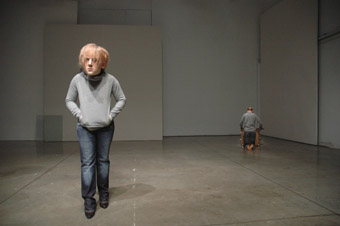
Hey Girl!, Socìetas Raffaelo Sanzio
Raffaelli
Hey Girl!, Socìetas Raffaelo Sanzio
About three-quarters of the way into Hey Girl, the unnamed “everygirl” reappears on stage wearing an oversized head mask. It’s creepy. Not only is the mask extraordinarily lifelike, it focuses attention on the woman’s body in a way that turns her into a grotesque overgrown child. The head ends up on the stage next to a giant sword as if hacked off by an unseen executioner. A few moments later a second woman appears with an even bigger mask of the same head. This second head is neatly deposited next to the first. Initially, I thought the masks were meant to represent Princess Diana and my first reaction was “Hoo boy!” I found out later that I was mistaken. The heads were in fact enlarged versions of Everygirl’s own.
For better or worse, the connection to Princess Diana is made in and I can’t shake it. I find myself wondering how Romeo Castellucci felt on hearing the news of Diana’s death? Was he distressed? Did he rage against the paparazzi, those dreadful men who hunted down and killed this “beautiful woman”? At one point in the show, Everygirl kneels next to the sword and lists the women – Anne Boleyn, Marie Antoinette, Katherine II of Russia – who “lost their heads on account of the people”. I don’t think Diana made the list but it is certainly company she would feel at home in. My sense is that – at core – Everygirl doesn’t represent all women but rather those beautiful women objectified by men only to be destroyed by them. It has to be noted that Everygirl is stunningly beautiful. She’s also fit. And blonde.
Rather revealingly, the central performer’s name is missing from the PuSh program guide [and there is no print program at the venue]. I don’t know whether this is an administrative error but would not be surprised if it was a conscious choice. Objectification is a central theme of the work. In an early scene, Everygirl moves slowly to the back of the stage and stands on a pedestal. She’s naked but her features are blurred through the haze of smoke that clouds the theatre. She reminded me very much of those small, wooden dolls that artists use to strike different poses – she is strangely inhuman. She then moves downstage and beats a drum with violent force and emotion as if – perhaps – to signify both her emotional energy and individuality. She dresses in jeans and a white t-shirt. I liked this touch as it made the performer both human and very contemporary in what is an extremely abstract environment. We could recognize her, although not so much as the girl next door as Kate Moss dossing around the house on a Sunday afternoon.
In the necessary short-hand our society is addicted to, Romeo Castellucci is described as Europe’s answer to Robert Lepage, the theatre auteur from Quebec. In the usual way of these things, it’s a misleading description. Lepage is an inherent performer and storyteller; both roles are woven into the very fibre of his work. Castellucci, on the other hand, is a designer who borrows heavily from the visual arts field. Lepage uses innovate design and stagecraft, these tend to be pure and simplified and used to support both narrative and theme. Lepage uses simplicity to convey complexity. Castellucci – at least with Hey Girl – uses visual and auditory complexity to reveal…not much, really.
That said, Hey Girl is one of the most visually stunning and technically brilliant shows I’ve ever seen. It is also one of the most didactic and condescending. I longed for depth but I fear there is none. When Everygirl points accusingly at the audience, I think it’s sincere. But I wonder if the brutal treatment of women in Western culture was news to many members of the audience? There is also a rather disturbing psychology underlying this work which links back to the notion of objectification. There is a scene where approximately 30 men invade the stage. The smoke in the theatre casts them in shadow and – while three of their brethren watch through a glass window – they beat the woman with what look like pillows or sacks. The image is heavily stylized but still distressing. After the beating the men line up and in flashes of light we are able to make out their features. They are us! Men drawn from the street! I couldn’t help but reminded of certain Hollywood films which show women being beaten and raped because we need to know just how brutal men can be. It wasn’t nearly that extreme but I do wonder at reproducing the pathology that objectifies a woman and then beats her. I realise this is the point but I don’t feel Castellucci earned this moment nor do I believe that the thin thematic content justified it. The simple code of the piece is: beautiful girl is alone, confused and abandoned, an object of desire she’s beaten by men only to rise again ready to kick ass, Buffy-like sword at the ready.
But wait there’s more! There’s a scene where L and R appear on opposing sides of the stage. These large letters light up – with a deafening racket – while Everygirl races between them as if pulled to and fro! Later, Slavegirl (a gorgeous, of course, black woman) appears and Everygirl buys her from a slave trader! Everygirl pleads “what must I say, what must I do”! This is a world where women are not capable of being agents of change. It is a world where women are isolated and victimized (until they discover sisterhood, as defined by Castellucci). This is the thin gruel we are left to digest.
But why would I encourage you to see it? Because it is visually (and to a lesser extent aurally) stunning: in particular, the opening sequence where Everygirl is lying on what looks like a coroner’s table, covered in dripping latex paint which has formed a skin over her body. It is beautiful, haunting and unforgettable. There’s a clip from this scene on the internet. See for yourself how beautiful the performer is. Maybe you can even discover her name.
Hey Girl!, Socìetas Raffaelo Sanzio
photo Raffaelli
Hey Girl!, Socìetas Raffaelo Sanzio
The space is pitch black. A fluorescent strip light upstage sporadically flashes on and off. Silhouetted against these violent interruptions, a young woman’s body is stretched out on the floor, uncomfortably twitching and writhing. She seems to be suffering some kind of fit, or is she forced to dance involuntarily by an unseen power? Unsettling, inhuman electronic noises cut through the dark, slicing into our consciousness: monster-like groans and unfamiliar clicks.
A longer flash, and the silhouettes of three male figures appear. Their backs to us, they group downstage and stare up at the woman. Their silent invasion is threatening and unnatural. Another flash. A male figure dashes into her space, close to her this time. The next flicker. He beats her with a square panel, maybe a cushion, maybe something harder than that. The other men look on. The repetitive thwacking of the attack continues even in the dark. In the next glare we see a couple more men hitting the girl. A second later there are five or six men grouped round her cowering body, beating her repeatedly. A split-second, and there are double this number of men. The onlookers have now joined the abusers. The noise crescendoes. A flash; more men. The new additions can’t reach her body so they beat the floor, the density of the thumping emphasising the sheer multitude of this gang. The flashes accelerate. Red flashes alternate with white. Each time the light blinks more men appear, swarming around the woman until it’s impossible to count. An overpowering slideshow. I am afraid what I will see in the next disorientating flicker.
This time the light stays on for a couple of seconds. The men are frozen, their backs to us, their weapons lowered. The woman is no longer visible. Light off. After the physical assault on our senses, this calm is more perturbing in its unpredictability. Light on. The men are lined in a clump upstage facing out to the audience. Their bodies are now lit, but despite their everyday clothing they still retain the faceless intimidating presence of the silhouetted gang. The girl, curled in a ball, slowly lifts her head. As in an alarming Alice in Wonderland nightmare, her head is now overgrown, disproportionately big on her tiny body, as though she should topple over under the weight of it. For a second I can’t make sense of this image. The uncannily life-like mask tricks me. I start to feel the dizzy lurch of travel sickness.
I have no idea how long I have been submerged in Castellucci’s vision. From the moment that the lights went down on the smoke-filled auditorium and we witnessed the birth of this wispy young blonde, emerging alien-like from a cocoon of dripping plastic gelatine, my faculties have been cut off from anything other than this terrifying world. Beautifully disturbing images have invaded me, touching obscure parts of my consciousness left dormant until now. I have no idea what to do with these pictures, and although the pace seems dream-like and slow, there’s not enough time to process one surreal image before the next appears. Picturebook words – “cat”, “horse”, “train” –are projected onto a screen as the light slowly rises and fades. The girl cries “please shut out the light”. We read the text of an intimate scene between Romeo and Juliet as the girl helps to remove another, larger version of her own head from that of a naked black woman. As we read new meanings into these words, the snatches of seemingly unrelated information link into one movement. It seems best to let this flood through you, rather than wash over.
Images that in themselves may be unsubtle or too literal seem to gain integrity and mystery in the context of this structure and through the clarity of the visual presentation. The black woman, still naked, is shackled by a bearded white man in Victorian top-hat and coat. The blonde woman buys her freedom, then points at the audience. This is not the first time that this gesture has implicated the audience in a crime committed in front of us. Whether she is apportioning blame or calling for action is left to our consciences.
We see this newborn creature boldly spurn contemporary femininity as she pours a bottle of perfume over a burning sword, angrily creating a shrine to the “queens who lost their heads on account of the people”. She is wise but she is also attempting to learn the rules of this place she is trapped in, just as we try to make meaning of what we see. Although she is strong she is not ultimately in control of her surroundings and her confusion and pain become a vivid metaphor for our experience of Hey Girl!, and for our own struggle to learn to live.
A painfully bright red and blue laser beam suddenly shoots down onto the girl’s face, burning our retinas, as a continuous high-pitched screech cuts into our ear-drums. The woman next to me puts her fingers in her ears. Many words are rapidly projected onto a screen, almost too fast to read this time. They halt occasionally: “porn”, “menstruation”, “mammiferous”. This seems to be a mechanical transfer of knowledge from machine to organic organism, a science fiction education on the adult aspects of this haunting world. The process is distressing, a physical violation of this small, thin being.
However, unlike this intervention, the process of Hey Girl! is bewitching because it refuses to guide our thoughts or spell out meaning. Each audience member re-enters their own solid world as they leave the auditorium, and perhaps we walk away with similar thoughts about femininity, sacrifice, servitude, empowerment. But the more intricate and unique imaginings that have been triggered in the last hour just might lead to further discovery within minds that believe they have already learned themselves and their world.
It’s only a seven-foot garter snake in a bag, caught because it was busy eating a toad. But it causes a commotion: the glamorous Monique dashes into the house and won’t come out; her brother cruelly forces her fiancé to bond with the men by measuring the beast; and old, ornery Paulette falls half in love with the thing when she puts her finger in the bag and feels its tongue lick her “like a caress.”
Henri Chassé, Annick Bergeron, Août – un repas à la campagne
photo Rolline Laporte
Henri Chassé, Annick Bergeron, Août – un repas à la campagne
It’s only a family gathering for a few days in August to prepare for the wedding of Monique (Marie Tifo) and André (Jacques L’Heureux), the second marriage for both. Août – un repas a la campagne takes place on a simple set: the front porch and window-view-only two front rooms of a wooden house in rural Quebec (as the dialogue gradually reveals). This particular afternoon is hot enough to melt reason. As Jean Marc Dalpé’s play progresses, it’s clear that reason – and humour – had been the short fences keeping chaos out of the yard. When these small protections fail, the family can no longer deny that Monique’s niece Louise (Annick Bergeron) has been cheating on Gabriel (Henri Chassé) without taking much care to dissemble. Facing that releases shame, desparation and pain for all of them.
Dalpé, who also acts the part of Simon, emulates Chekhov in several ways. The discussion about whether or not maple sugar trees are a dead-end investment or a chance to strike gold on the Japanese market is, of course, a nod to The Cherry Orchard. Dalpé’s use of casual, chatty conversations to build slowly to explosive moments reminds me of The Seagull, especially the way dialogues bewteen characters overlap. For example, Louise and her mother Jeanne (Sophie Clément) talk distractedly about whether to use a yellow or white tablecloth for the outdoor meal; between comments, Paulette (Jeanne’s mother, played with stiff, curmudgeonly humour by Janine Sutto) insists she would rather have an omelette than pork roast for dinner.
Also, as in Chekhov, these are ordinary people wearing regular clothes and having conversations about nothing particularly pressing. Until, that is, a conversation pushes a character to an emotional peak. Monique and Joseé (Catherine De Léan) – the funny, constantly distracted, lone representative of the youngest generation – have a rambling chat about looking endlessly for something that isn’t where it should be. The exchange is hilarious but also sets the tone for the kind of helplessness several of the characters experience as events unfold. André discusses golf as the healing pathway out of grief for his late wife. Gabriel only talks about home repairs, beer, swimming, the snake, until Louise provokes him by announcing she will go stay with her lover for three days to think about things. In response, he angrily, methodically describes what he’s done on the farm, which he only has rights to through the now-failing marriage, shouting (I paraphrase the translation) “I’m not leaving without getting paid back for those twenty-one years!” The dark undertones of the cagey, carefully lighthearted behaviour in the previous scenes become visible, and this ripple of of understanding backwards through the play yields a sense of empathy.
A three-time Governor General’s Award winner, Dalpé has a strong enough aesthetic to fold Chekhov into his play without being derivative. In the context of the PuSh Festival, which is dedicated to contemporary performance and is willing to take risks with experimental work, it’s interesting to note that August is neither a fusion of forms nor and attempt to invent new theatrical styles. Director Fernand Rainville is thoroughly experienced in shaping award-winning productions and has been a longtime associate with Théâtre de la Manufacture (Montréal), causing national excitement with Howie Le Rookie in 2007 (Théâtre la Seizième, Août’s co-presenters, brought Howie to PuSh that year as well). The actors are popular stage and television players in Quebec; the production at Waterfront Theatre was expert, down to the easily readable surtitles that provide access to anglophones like myself.
Août – un repas a la campagne expands the range of PuSh by including an experience of Canada’s other major language, which is not always easy to find in British Columbia. When traditional theatre is this well done, it can, and does, dig deeply into our psyches – just from a different direction than the bearing experimental performances use. Rather than grabbing us by the ears and throwing us into a world of devilish cabaret, for example, Août sidles up and shows us a snake in a bag that may kiss us or curse us. For me, Août’s eight characters were so well-rounded that, the night after the show, I dreamed about three of them as people in other contexts (Monique, André and Louise stranded by a pickup truck on a dusty road). Transformation can come to us subtly.
David Carberry, Darcy Grant, The Space Between
photo John Donegan
David Carberry, Darcy Grant, The Space Between
A happy man stands still. He is alone. Suddenly, he falls straight back in a scissor-blade movement of rapidly diminishing angles. At the last moment, he averts disaster with a backwards roll. He will repeat the movement multiple times until it has lost the sense of risk. What follows is probably dangerous but, even though it is imbued with the acrobatics and trapeze work of a circus show, it doesn’t depend on our fear and amazement to move us.
Forget the ancient ideal of the golden rectangle; Australia’s Circa tells us the new model of physical beauty is the triangle. There is one hidden in the white handkerchief a performer holds taught between her toes, and a larger one in the shape made between her legs and the fabric, through which a man can leap. There are more triangles in the piked forms, the bodies cantilevered off each other, the space between elbow and ribs, between some unusual combination of back, legs, floor. There is an ever-changing triangle at the centre, even as one man dances a full circle around his own arm. The music moves through Jacques Brel, Leonard Cohen and a selection of electronica, but it also begins with the mathematical beauty of Bach.
Projections light the floor part way through. Random letters, different grids, the mechanical approximation of a fingerprint whorl—most of the images reinforce the sense of math and geometry. One projection slowly spins a computer-generated pattern of three-dimensional triangles, while a male performer creates every possible triangular shape with his body in that light. Somehow, it’s not reductionist to see a human body in that archetypal shape, it’s beautiful.
There are three performers (David Carberry, Darcy Grant, Chelsea McGuffin), and it’s tempting to look at that obvious triangle for the continuity in the performance. There is no narrative, but there are varying relationships. One man dominates McGuffin, balancing on the soles of her feet, or holding a handstand on her face. She leaves the stage right afterwards, diminished. But another time she gives new meaning to the phrase “she walked all over him”, or she pulls the other man’s limbs to create the angles she needs that will propel her own movement off his. The dancers use each other, play with, need and love, and maybe hurt each other. But the strength of the work has less to do with the emotional space between people than with an investigation of physical space.
Of course the movement is not all geometric. But geometry is one way the work allows us to see space in a new way, particularly, as the title indicates—The Space Between. The space between two men can be used to swing a woman; the space between her midriff and the floor, between her head and the floor, is reflected in the desperate trust in her eyes. The space between her clenched fingers and her palm is big enough to disappear the handkerchief. The space between her teeth means a man can hang her body from the trapeze with his hand in her mouth. The space between can be contracted and released to propel movement. The work wants to know every possible way that one body can move around another, through that shared space.
An exploration of the physical space between body and floor, or one body and another, doesn’t sound like a particularly interesting idea for a performance. Most dance does that. This piece is interesting because the choreography is skilled, inventive and playful, but mostly because of the well-integrated acrobatics. Suddenly the space between one person and another is a matter of safety. The stage is small and we are close. We trust the performers, but we can still see them eye the distance before they run, check the waiting hand that will throw them higher if they have judged the distance right, and only if they have judged it right.
In improvised dance in particular, two dancers can become so absorbed in the space between them that it seems the only thing to exist, and can absorb the audience wholly. That space isn’t triangular; it’s the antithesis of geometry. Circa’s work is far from improvised. Every space has been carefully calculated for safety or success, in the precise scale that will allow a human body to slip through, to climb, to spin. Despite the obvious effort required, despite the constant calculation, every so often the performers do hint at that other, more transcendent, space between.
Circa, The Space Between, created by Yaron Lifschitz and the Cira Ensemble, performed by David Carberry, Darcy Grant, Chelsea McGuffin, concept, direction, lights, sound design, multimedia and operation Yaron Lifschitz; Performance Works, Granville Island, Jan 22-26; PuSh International Festival of Performing Arts, Jan 16-Feb 3
RealTime issue #83 Feb-March 2008 pg. 8
© Anna Russell; for permission to reproduce apply to realtime@realtimearts.net
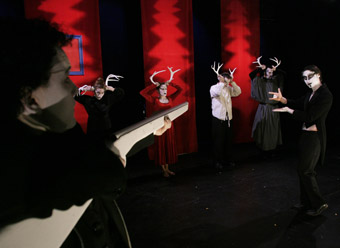
The Black Rider
photo Ian Jackson
The Black Rider
There is an old vaudeville theatre in Vancouver’s notorious downtown eastside. It’s been closed for years. For some reason, The Black Rider put me in mind of the crumbling glory of the Pantages. With its expressionistic tone and sense of rotting decay, November Theatre’s production would be more at home there than in the utilitarian blandness of the Granville Island Stage.
However, it’s not vaudeville but the carnival that is evoked at the top of the show as Old Uncle (Mackenzie Gray) invites us – in the fashion of a sideshow barker – to join the Black Rider. While assuring us of a “gay old time”, he lists the freaks that will be on display for our pleasure. Any fear that we are about to experience a bewildering series of unrelated vignettes is soon dispelled as we are caught up in the story of young couple: Wilhelm (Kevin Corey) and Kathchen (Rachel Johnston). The girl’s father, Bertram (Jon Baggaley) forbids their union because Wilhelm, a soft city clerk, is not a hunter, an occupation integral to the history of Bertram’s family.
To win Kathchen and impress Bertram, Wilhelm makes a deal with the devil-like Peg Leg (Michael Scholar Jr), who offers him magic bullets that are guaranteed to never miss their mark, no matter what direction Wilhelm shoots. He quickly bags enough game to impress Bertram but, of course, any deal involving the devil is bound to sour and ultimately Wilhelm loses the object of his desires by his own hand. Taken from a German folk tale, this narrative provides the simple but durable structure to house the songs and music of Tom Waits and the heightened, poetical language of William S Burroughs.
No doubt reflecting its production history – The Black Rider was originally mounted as a fringe show – the piece is spare with a firm emphasis on performance and music. A small band of three musicians – playing a variety of instruments – are holed up on one side of an otherwise empty playing space. Thick vertical stripes of deep reds and blues form an effective backdrop upon which images of rifles and trees are projected. To create a carnival-like atmosphere with such a stripped down aesthetic requires ingenious stagecraft. There are some wonderful moments, for example when Wilhelm hides under Katchen’s wedding dress and uses his hands to create grotesque, rather dextrous feet for his bride-to-be. Other moments – a flapping kite for a bird – are less effective.
The six actors are fully committed to an expressionistic approach that includes white face, highly stylized movement, clowning and heightened vocalizations. With the aid of just a few props, they successfully create a hallucinatory, drug-like world. Such a performance style naturally has an alienating quality to it that shuts an audience out from emotional engagement with the characters. While this reinforces the flatness of the folk tale narrative, it can make the work difficult to take for stretches and I did find myself longing for pauses from the shrieking and clockwork movements.
Still, without losing any commitment to the expressionistic aesthetic there are some surprisingly touching moments, particularly between Wilhelm and Kathchen when they sing their duet, The Briar and the Rose. In the end, Corey’s Wilhelm provides the spine of the piece. With his deft use of physical humour, Corey reminded me of Chaplin with the same sense of a clown lost in a bewildering world. Johnston provides a strong, physical counterpoint to Corey. She is striking in both red dress and wedding gown, creating the weird doll-like creature of his desire.
Playing the devil, Scholar is allowed a little more freedom in his movements. There is a sultriness to his character, a physical prowess that the limp of his peg-leg surprisingly accentuates. The character, and Scholar’s performance, reminded me of the MC from Cabaret. Peg Leg isn’t the host of the evening – although he does close the night cabaret-style. Instead Old Uncle acts as our guide for most of the night. While Gray gives a powerful performance, I was less sure of the choice to mimic Tom Waits’ distinctive, husky singing voice. I found this affectation rather distracting, taking me out of the world of the piece.
The story of the magic bullets is meant to evoke the dark other-world of addiction. Ironically the stage is often flooded with light – perhaps to evoke the footlights of the 19th century. Instead of a rundown theatre, the flat, bright lighting put me in mind rather of a school auditorium. But then so does the Granville Island Theatre generally. I longed for more darkness, more shadows, more decay. I wanted to be closer to the performers somehow, pushed right up against the stage.
There is a dedicated group in Vancouver trying to save the Pantages Theatre. If they succeed, I hope they will consider this show for the re-opened venue. The Pantages languishes in a dark, decaying part of our city; a place where the Black Rider would feel at home.
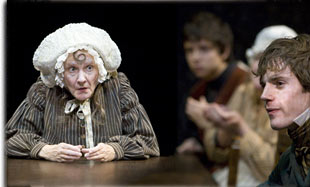
Patti Allan (appearing with the permission of the CAEA) & Spencer Atkinson, Old Goriot
photo Tim Matheson
Patti Allan (appearing with the permission of the CAEA) & Spencer Atkinson, Old Goriot
Don’t get excited. Stay calm. Watch. Listen. This seems to be director James Fagan Tait’s advice to the spectator in his production of Old Goriot — restrain yourself. His adaptation of Balzac’s 1835 novel is starkly placed in the dark expanse of the Telus Studio Theatre. Just a few essential set elements and a large cast decked out in period dress evoke Balzac’s Paris, while the dialogue, transposed to recent North American vernacular keeps us anchored in the present. A large scrim forms the back of the playing space, variously taking on a sombre palette of projections, which include baroque wall paper, an opera house, and a Parisian boulevard. To one side, a three-piece chamber orchestra of marimba, double-bass, and bass clarinet remains quietly present. A massive dining table drives forward from the scrim. The action of the play takes place on or around this stage-within-the-stage.
In the opening scene, about fifteen actors, inhabitants of Madame Vaquer’s lower middle-class boarding house, line three sides of this table, spooning and slurping their soup in unison, heads falling and rising mechanically. Individual heads then swivel one by one toward the audience as each character makes an introduction. But you’ve got to listen carefully, don’t rustle in your seat — these actors are deliberately keeping the volume down, forcing you to lean forward to catch every word.
What unfolds, in this hushed manner, is the story of Rastignac (Spencer Atkinson), a social climber seeking to marry any moneyed socialite who will have him. Despite the most calculating advice offered by his upper class cousin, the Comtesse de l’Ambermesnil (Anna Hagan), and criminal but advantageous arrangements made under the corrupting influence of the worldly Vautrin (David Mackay), Rastignac keeps getting tripped up by his romantic desire for true love. His affections end up falling on one of the daughters of Old Goriot (Richard Newman), a sombre and mysterious geriatric who also lives in the boarding house despite the fact that his daughters are fashionable ladies of Paris society. Rastignac will learn harsh lessons as he witnesses the daughters’ unfeeling betrayal of their father’s blind devotion. At one point Rastignac and Delphine (one of Goriot’s daughters, played by Cecile Roslin) argue across the body of the dying old man, she wanting to hurry off to the ball, he complaining, “I can hear your father’s death rattles.”
Despite this melodramatic sounding plot, almost every actor tenaciously underplays his or her part. No emotional ostentation — just simplicity of movement and an almost filmic vocal delivery. Director Tait establishes a tone of dispassionate observation and sticks to it. Even the musical numbers, composed by his longtime collaborator, Joelysa Pankanea, and hauntingly performed by her trio and the actors, are spare and contained. It’s Brechtian — that is if Brecht were to produce a period piece and perform it in slow motion. Old Goriot is full of Balzac’s shrewd analysis of the grim reality of France’s brutally stratified society, and Tait keeps us in an observer’s frame of mind by refusing to build dramatic momentum, and undercutting sentimental identification with characters that remain composed, slightly casual, offering only reference to anguish rather than fully embodying it.
Tait’s been working this aesthetic since Crime and Punishment, his 2005 adaptation of Dostoyevsky’s novel, which was a landmark production in modern Vancouver theatre history. One of the defining features of that production was the inclusion of five actors from the downtown eastside, a neighbourhood that has the dubious claim of being Canada’s poorest postal code. Of that production, Vancouver director/dramaturge D.D. Kugler remarked that watching the twenty-five member cast was like seeing a cross-section of the city on stage, something he’d never experienced before. Goriot is a mirror of that show, the main differences lie in the absence of the downtown eastside actors and the much more cynical bent of this play. Where Dostoyevsky’s novel builds to a spiritual crescendo, Balzac, through Tait’s filter, stays firmly planted on the unrelenting ground of modern class warfare.
In the case of Old Goriot, based on a novel some consider the father of the realist movement in literature, Tait’s approach serves the realist’s mission of looking at life ‘objectively’. He certainly strips Old Goriot’s death scene, masterfully played by Newman, of any sentimentality. Realizing his beloved daughters won’t be joining him for his final moments, the old man meanders between curses and expressions of undying love, as he tries to come to terms with the lonely predicament of his demise: “They’re not coming. I’m going to die like a dog.” His monologue is both interminable and engaging — I felt like I was watching the death of giant insect that had suddenly become aware of its own mortality: I was curious, mildly disturbed, and feeling just enough of an ache to raise a flicker of empathy. This scene was the highlight of the production for me. But a kind of low highlight. After all, Tait wouldn’t want us getting carried away by grief or laughter. Just stay calm. Listen. Assess.
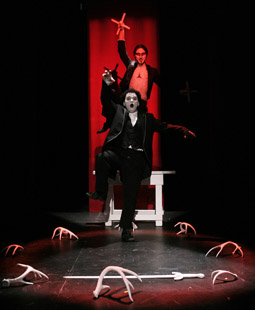
Michael Scholar Jnr, Kevin Corey, The Black Rider
photo Ian Jackson
Michael Scholar Jnr, Kevin Corey, The Black Rider
The stage for Black Rider is dressed only with three columns of red light on a blue background, like a triple projection of Barnet Newman’s painting Voice of Fire. But the Black Rider quotes more than modern art. It’s based on a German fable of the Middle Ages; it also reeks of the popcorn smell of the American big top and the stale grease makeup of clowns. It quotes Byron and T. S. Eliot. It has Broadway melodies and Latin rhythms. In some moments, it’s positively Gilbert and Sullivan, as envisioned by people who don’t like Gilbert and Sullivan. And in this production it’s held together by the visual continuity of actors in exaggerated makeup who can move gracefully when required, but tend more to contorted bodies and faces, and to any gesture but real.
The style of movement varies almost at random from the pointed toes and sweeping limbs of ballet to the tumbling of the circus, and exaggeratedly bent arms and twisted torsos that come from some less familiar tradition. Speech varies as dramatically. Actors sing naturally while holding crooked poses, or distort their voices past intelligibility. The text morphs from moralizing to hucksterism, exposition to character. It’s oddly alien and familiar at the same time, without necessarily creating a strong, overall effect.
In this November Theatre version of the Waits-Burroughs-Wilson original, German expressionism goes to the circus, but it’s a cheap circus playing a small town, and the performers are giving it their all. They’re talented as hell, but their aping faces and distorted limbs distract them and their cheerful audience from the fact that this is, at one level, a story about drug addiction. As some will know, Black Rider’s writer, William S. Burroughs, was a heroin addict who accidentally killed his wife in a shooting game. In this production, when Wilhelm, the inept suitor, accidentally shoots his bride on their wedding day, with a bullet he got from the Devil to give him a marksman’s skill, few will guess at the resonance. The absurd, self-mocking gestures of the actors sometimes do work to hint at the self-loathing that must accompany addiction and homicide. In one of the final scenes, the morose Wilhelm ties himself up in a straitjacket made of his own dress coat, telling us that making deals with the Devil is the province of the insane. A moment of pity allows a brief connection.
Addiction can get ugly, and this production is most successful when it’s ugly and in the rare moments of sincere emotion which punctuate a lot of intentional silliness. Kathchen (Rachael Johnston), the bride-to-be, gets to scream twice: full-bodied, deliciously ugly screams that you rarely hear on stage or anywhere else, and in this case, electronically augmented to strong effect. Sincerity appears by surprise in a production that otherwise cultivates the absurd. The doomed lovers are truly touching only once, when Wilhelm plays with Kathchen’s toes as they sing the Briar and the Rose. It’s a straightforward duet in a production that would rather discomfit and jar the audience. Wonderful inconsistencies also appear, as in a love song that mixes predictably romantic words with phrases like “I’d be the pennies on your eyes.” Death and matrimony rarely converge so playfully. Too frequently though, it’s hard to find a connection and maintain it. I spent a good chunk of the lingering death scene wondering at the strength of Johnston’s legs as she inched herself to the floor.
Is there a point in reviving German expressionism after its era has passed? Without the rancorous signing of the Treaty of Versailles after World War I, without the cabaret nightlife of Weimar Berlin, without bold experimental films like Dr. Caligari’s Cabinet, expressionism is just a romp. Artistic movements come naturally out of a particular time and place. Once, German expressionism was political. Now it’s just as moderately entertaining as anything else.
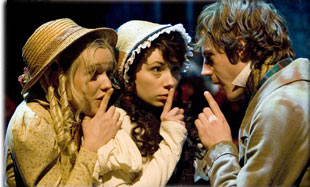
Jocelyn Gauthier, Cecile Roslin & Spencer Atkinson, Old Goriot
photo Tim Matheson
Jocelyn Gauthier, Cecile Roslin & Spencer Atkinson, Old Goriot
A long, bare wooden table, surrounded by fifteen assorted chairs, sits heavily centre stage splitting the performance space in half. Three musicians are fenced into a small area upstage by their instruments. The lighting is dingy and dull, and onto the wallpaper-patterned gauze backdrop, lacklustre brown panelling is projected, illustrating a lower-middle class Parisian boarding house. One of the musicians jingles a large triangle to summon the performers, and fifteen actors dressed in dreary 19th century French attire pile onstage. They each take a seat at the table, lean forwards and slurp from an invisible “trough” in front of them; “trough” being an image that is used throughout to describe Paris.
Madame Vauquer introduces herself directly to the audience as the owner of this boarding house, “for gentlemen, ladies, and others”, as another projection onto the backdrop informs us. Despite the 19th century setting, each guest introduces him/herself directly to the audience in vernacular English, stating on which floor of the house they stay and how much rent they pay. Rastignac, the ambitious young social climber, includes a lot more detail about himself and his motivations, before being interrupted by the irritable fellow boarders: “this story isn’t about you.” Following this character-labelling, the cast perform an eerie, plodding song, a call for self-reflection: you, the audience, might think that the author is making this story up, until you realise that similar events are happening at your own table at home.
Prologue over, the narrative begins. We are shown snatches of underplayed dialogue, interspersed with Brechtian elements: songs, projections and mime, accompanied by sound effects created in full view of the audience by the musicians. There are direct references to the form of the piece, such as Rastignac’s speedy addition of “intermission” at the end of his final speech of the first half, or the cook exclaiming “the time disappeared, just like a play in the theatre” (perhaps a bit too much of a risk at this point in the second act?). The densely packed narrative of De Balzac’s novel seems to unfold simply in front of us: the lodgers’ curiosity over Old Goriot, the broken, bankrupt vermicelli maker, and his relationship with the two beautiful women who come to visit him; the discovery that these grasping women are in fact his daughters and have treacherously bled him dry of his fortunes; the clumsy attempts at social promotion by Rastignac; the unfortunate and miserable story of each lodger. The smooth storytelling is dotted with bluntly comic moments: the best received being the deadpan delivery of impoverished gentlewoman Mademoiselle Michonneau’s “don’t try to butter me up, bitch”, after overhearing the cook insulting her.
The whole piece is very clearly staged, almost choreographed; each polished scene runs to another seamlessly, each transition creates an aesthetically pleasing, balanced picture. Although we are shown corruption and calculation, there is no overt evil or grime on display in this clean performance. The staging is as methodically planned as the characters’ schemes for social or financial progression. Carefully assigned downstage areas are preserved for whispered conversations such as that between Vautrin, the criminal, who tries to engage Rastignac in a murderous deal that will lead to his social advancement. Wealthier households are presented on the elevated level of the table-top (just in case we haven’t noticed the brightly coloured bejewelled costumes of the richer characters). The viewer is guided through this complex narrative and its themes, each aspect of the novel laid out clearly and signposted with juxtaposition of song, movement and dialogue. Despite the initial call for self-examination, we can comfortably settle into the role of listener and jury.
The Brechtian sparseness in the presentation of greed and exploitation allows the audience to make clinical judgments but there is a sense that we are being presented with the children’s picture book version of an intricate novel. By the end the audience has a clear sense of the pitfalls of being too keen to enter “fashionable Paris”, of the deception and betrayal that social ambition and self-interest can lead to, and of the dangers of being blindly generous in a society that revolves around social status and wealth. We see that Vautrin, the convict, is perhaps the most sympathetic of this assemblage of characters, as he seems to be the only one willing to break free from guileful social play-acting. Having been found out by the police, he redeems himself by forgiving his betrayers, and reminding the gawping onlookers that he has not betrayed anyone. He is perhaps the least hypocritical of this group of down and outs, and his outspoken stand against “organised authority” seems appealing in the context of the rigid structures of this society, and indeed of the performance. We are left with the feeling that this piece might have been more engaging itself, and have encouraged more self-scrutiny in its audience if it had attempted to borrow some of the vigour of Vautrin’s nonconformist philosophy.
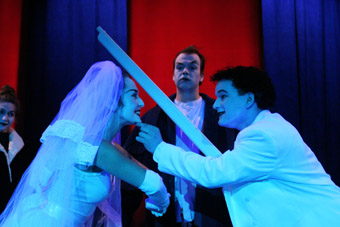
Rachael Johnston, Kevin Corey, Clinton Carew, The Black Rider
photo Ian Jackson
Rachael Johnston, Kevin Corey, Clinton Carew, The Black Rider
A tall, bald man stands squarely in the light and megaphones his voice through a bone-coloured horn. He’s a circus-master in a tattered black coat. “See Sealo the seal boy, with flippers for arms!” The horn cuffs us with freakshow detail after freakshow detail and the crowd chuckles at the impossibles. The Devil’s Rubato Band—a trio playing trombone, bass, piano and percussion—punch out loud swaying carny sounds from the side of the stage. The crowd laughs particularly hard at the thought of “Crow-girl, half crow, half girl, one hundred per cent crow-girl!” All are invited, all will be taken advantage of; it’s very egalitarian.
As Old Uncle (Mackenzie Gray) barks, other circus members burst through the bright red door, centre stage. Each white-painted face yells, shrieks, their black-lined lips and eyes an invitation to the alluring nightmare The Black Rider promises to be. The performers limit themselves to stiff, doll-like movements in rectangular patterns. Their voices grate, their eyes bulge, the painted curtains glow red behind them. The pitch rises. The combination tips reality like a glass of beer on a table’s edge. Lured in, I’m uncomfortable—but ready to drink whatever’s offered next.
What’s next is the love story of Kathchen (Rachael Johnston) and Wilhelm (Kevin Corey), a passionate young woman and a doughy city clerk who wish to marry. But Kathchen comes from a long line of hunters, and her father Bertram will only accept a son-in-law who’ll continue the family tradition. Kathchen wailingly rejects his choice, the lewd hunter Robert, and the mother, Anne, attempts to intervene by reminding Bertram that they were young once too. When Wilhelm discovers how lousy he really is at hunting, he makes a deal with the devil—the limping, tuxedo’d Peg Leg, played dashingly by Michael Scholar Jr—to use magic bullets that always find their mark. The catch: Peg Leg gets to control one bullet, and Wilhelm only discovers which one when he accidentally shoots his bride on their wedding day.
Tom Waits wrote the original songs, adding a spooky texture to a production that foregrounds sound: you don’t put brass on stage and expect it to be subtle. But once I adjusted, I was able to concentrate on the significance of the movement. (The original large-scale Black Rider was created by Waits, Burroughs and Robert Wilson in 1990 and performed in German. Theatre November’s own 1998 English language version works with a handful of actors and has been touring internationally since 2000.)
As the generic circus characters melt into their individualized roles, their body language relaxes a little from joint-by-joint gestures, but movement remains formalized throughout. Almost every time the plot intensifies towards a crisis, the performers pace in pathways of right-angled straight lines. This is, I assume, influenced by Robert Wilson’s experimental minimalist style (Wilson with Waits and William S Burroughs created the original version of the work). Anne and Kathchen perform a rigid two-stepping grid of grief around Bertram as they try to convince him he is wrong about Bertram. In Wilhelm’s first successful hunt, the shot stags—four actors holding antlers at their temples—dance around the stage in the now familiar format, haunted and angular. However, the strict, slow movements alternate with acrobatics, tumbling and hysterical arm-flinging.
One slow but atypically fluid scene was particularly moving for me. From stage left, Kathchen takes one step onto stage, raises her arms elegantly in front of her head, and claps. Fine pale dust puffs up from her white-gloved hands. She claps again, takes another slow step, as if her floor-length white dress is weighing her down. She walks beneath the cloud her claps released. Peg Leg stands by the central red door, watching her proceed.
Kathchen, though, is dreamy, and doesn’t register his presence. He turns and leaves. She jerks her torso up and smiles, as if touched from below. It’s Wilhelm, beneath her dress, and laughing. As she sings, her fiancé stays hidden but dances his hands out from under her hem like a flirtatious chorus line of two. The duet—the music of her voice and the physical humour of his hands and later his legs extending her body as he lifts her high—is gorgeous and grotesque, as the production intends their love to be.
By now the circus framework seems far from the story’s action. When a circus-freak hunchback suddenly appears gibbering stage left, soon joined by Old Uncle declaiming loudly about the destructive powers of addiction, stage right, the abrupt transition is jarring and the speech oddly didactic. The feeling of disjunction is confirmed a few minutes later when the plot jumps back to the love story. Having made the effort to accept the characters and their peculiar mannerisms, I prickled at what felt like crass manipulation since the play had already clearly revealed Wilhelm’s risk.
Opening up to The Black Rider’s choreography was rewarding, and I found the main plot wonderfully suspenseful (though the important subplot about Kathchen’s ancestry was clear only when I read the program notes). Strangely, even though there are slow passages such as a completely silent death scene (that seems like five minutes but is in fact much less), the overall dynamic of the production is noisily staccato. That percussive pace keeps a cool gap between the performers and the audience. Maybe it’s the slight distance between humans and the devil(ish) that we prefer to maintain.
David Carberry, Darcy Grant, The Space Between
photo John Donegan
David Carberry, Darcy Grant, The Space Between
The Space Between is an exquisite physical theatre miniature focused on a series of mutating physical relationships in duos and trios with occasional solos. Bodies tangle, wrestle, caress and mutually manipulate each other well beyond the range of normal touch, but tell us much about ourselves. The show is built on close observation and fine detail and not on spectacle, comedy or sex or even conventional routines. The gravity that has to be overcome in this physical theatre is the weight of human dependency and the desire to intensify or to escape it. Every possible permutation of entanglement is entered into and every ounce of concentration is devoted to keeping that relationship balanced—always a tense, tentative affair but the drive is to do it again and again. Circa don’t rush, they enter these states slowly therefore often face more tortuous demands than usual on muscles and the sense of balance. This stress reaches a critical intensity in a late scene where all three bodies clamber up and over each other in a fluid knotting and unknotting of arms and legs.
While occasionally scenes appear perfunctory or oddly placed, and the musical selection is taxingly various (a through-composed score please!), The Space Between is a work which often demands and rewards careful attention, revealing how little real, unoccupied space there is between human bodies.
David Carberry, Darcy Grant, The Space Between
photo John Donegan
David Carberry, Darcy Grant, The Space Between
A new tension enters the space. A woman begins to favour one man, interacting more with one than the other. The ignored one, the one with the boyish face, leaves the stage. The one who stays, the taller one, she circles with a white handkerchief again and again, as if marking territory, or, more gently, inviting him into her space. He dives through the oval shaped by her arms and the cloth. She holds it between her feet and flips onto her hands, bringing the white line softly down behind his body. He tumbles into a somersault and rises to his feet again through the ellipsis her feet and the cloth make.
Acrobats who move like dancers are rare and beautiful, in part because most of us sitting in the audience know our bodies would crack if we tried to do this or that. Even more rare are the acrobat-dancers willing to use their unusual ability to create startling body shapes in support of moods and themes, not just for the sake of astonishment alone. David Carberry, Darcy Grant and Chelsea McGuffin, three members of the Brisbane-based physical theatre group Circa, have profound physical vocabularies. Each can move from stillness to a rapid flip with apparent effortlessness; each can hang from one arm, one foot or another’s neck, if the choreography calls for it.
These performers are amazing, I can’t avoid that word. Look at him fall backwards with a rigid body and arms. How does he flip backwards at the last minute to trace a full circle with his legs and not hit the floor? Both men repeat this phrase several times, which lets the audience figure out the mechanics, but it remains surprising. In other words, it’s not that the audience isn’t drawn in by the power of the performers’ extreme actions, but Circa uses their physical vocabularly to push and pull each other, and us, through different moods, questioning whether or how people desire closeness. It starts abstractly, then reveals a storyline where the woman is choosing between the two men.
Intimacy and distance can be equally painful. When the rejected man dances alone, he’s a contortionist, bending his legs over and around his neck, pulling a shoulder out of joint, then dancing serenely through a smooth phrase or two. When the woman dances with him, she punishes his limbs. She stands on his shoulders, steps down to his thighs, forces him to turn over onto his knees and remains standing on his flesh, not the floor, by walking on his calves. She repeats this coiling ruthlessness and he takes it. Distance, rejection, hurts.
Intimacy isn’t necessarily more cosy in this piece. Intensely close bodies scratch, pull and rub against each other. On the trapeze, the woman and the taller man climb up and down each other. She stands on the wooden bar, he wraps his legs around her ankles and lets his weight fall. Or he hangs upside down and she slips deliberately down his body, hand-grip by hand-grip, until she’s suspended only by her mouth, his hand holding her weight by her skull. (I think everyone in the theatre twitched here.) Almost instantly, she climbs smoothly back up his arms.
This harsh moment resonates exactly because she moves on. Similarly, the rejected man shifted quickly into and out of extreme positions such as using his apparently dislocated (presumably double-jointed) shoulder to balance between one contortion and the next. If either had hung in place longer, it would have become a trick, a “look what I can do.” The timing throughout the performance is consistently flawless in this way.
Pace is also affected when tumbling animations, always in black and white, project onto the floor. For those moments, the dancers commit to moving only in that light. The most effective of these is a vibrating grid pattern that appears several times to frame the two men dancing together, initially as supple equals, later as rivals who think one must dominate the other.
Playful, smart musical choices support the emotional arc of the performance by emphasizing mood shifts (Bach transitions to rock) or by adding lyrics. There are things a body simply can’t describe, like “there’s a piece that was torn from the morning, and it hangs in the gallery of frost” (Leonard Cohen, “Take This Waltz”). And the body, or at least these three remarkable bodies, gets to play with saying the things it says best: muscular phrases about passion, jealousy, tension, lightness, the mysterious hollow of the mouth, and the even more mysterious and wildly elastic spaces that resonate between people.
Michael Scholar Jnr, Kevin Corey, The Black Rider
photo Ian Jackson
Michael Scholar Jnr, Kevin Corey, The Black Rider
The ringmaster enters with a flourish of his long black coat as the houselights are still fading. Looking around at the eager faces in the auditorium, it’s clear that they’re all too keen to accept his invitation to “Harry Harper’s Bazaar” to see the three-headed baby and other assorted delights. Like the classic freak-show audience, with a taste for black humour and a desire to be frightened, we greedily gulp down the spectacle as the rest of the cast jerkily parade into line in time to the big-top trombone. They are followed up by the charismatically evil Peg Leg (Michael Scholar, Jr.) who, despite his disability, almost seems to moonwalk backwards in time to the music, slick and smooth in his black tailcoat, shiny shoes and bare chest.
We’re already sold as the performers ask us to “come along with the Black Rider”. But perhaps like our protagonist Wilhelm (Kevin Corey) who, desperate to please his girlfriend’s father and win her hand in marriage, makes a Faustian pact with devilish Peg Leg, we don’t know quite what we’re getting ourselves into.
A love story is played out in the mechanical movements of this feudal Addams Family, against the deep blue and red stripes of a minimalist backdrop. Their somehow medieval costumes are reminiscent of the German folktale from which this story is taken, whilst faces are contemporary gothic: deathly white skin, black eyes and lips. Bertram the Forester (Jon Baggaley) repeatedly expresses his dismay at his daughter Kathchen’s (Rachael Johnston) choice of boyfriend. With arms bent at the elbow moved stiffly up and down, he is like a doll being used to re-enact its owner’s latest tantrum. In a later scene (and with the clarification offered by the programme synopsis) it emerges that his reasons for objecting to Wilhelm, a clean cut city clerk, are deeply connected to his family’s history and his wish to keep up a hunting tradition. He presents his daughter with a vile, stooped hunting boy whose crude language and use of his horn’s phallic potential to illustrate the fact that he “knows women”, induces a shudder not only in Kathchen.
During these early scenes, Peg Leg occasionally appears on a small rectangular screen in one red strip of the backdrop, a perverse deity high above the action. His eerily distorted words, “do as you will”, add to a growing sense of inevitability. There’s no escaping doom in these forests. The large, tight, puppet-like movements of the characters suggest that they are merely the devil’s marionettes, acting out the story within the constraints he provides. This image is cemented later on, in a bizarre interlude in which a clown, complete with Charlie Chaplin bowler hat, enters spurting high-pitched gibberish. Frustrated with this noisy interruption, Old Uncle stands behind her, and takes control of her invisible strings: he makes her dance as they sing a duet. To me it’s unclear whether this interjection is meant to make sense or whether I’m just not listening hard enough. I have the feeling that I am immersed too deeply into a hallucinatory world that doesn’t operate on my terms. I did sign up for the ride but in doing so I handed my fate over to this motley crew. I can’t turn back now.
Silent film is referenced again at the pivotal moment when Peg Leg offers Wilhelm his magic bullets. With these the clerk is sure to hit his target and impress Kathchen’s father with his hunting skill. (Never mind that one of the bullets is bent to Peg Leg’s will.) The effortlessly cool devil teases geeky Wilhelm as he attempts to pick up an oversized white gun, pulling it away just as Wilhelm is about to grasp it. These movements are accompanied by exaggerated sound effects performed by the band stage left, who seem to laugh along with the joke. But the slapstick gains a more sinister edge once Peg Leg starts to play marionette-master with Wilhelm, singing “don’t listen to the devil, he got ways to move you”. Wilhelm is merely a toy.
Kathchen has a child-like innocence in her relationship with Wilhelm, which borders on ownership. She excitedly leaps about the stage when she discovers that there’s “dead game heaped all over the house!” thanks to Wilhelm’s shooting. At one point, previously hidden from the audience, Wilhelm’s head pops out from beneath Kathchen’s floor-length wedding skirt, then back under again. She seems to float, sitting on her lover’s shoulders. The couple are one: an image of pre-marital happiness. His masculine legs substitute hers beneath her disproportionately small torso, and they dance as she sings: “You’re so cute. I like your trousers. They’re black.” This youthful quality renders her unbearably drawn out death scene all the more poignant. The auditorium is thick with silence in the minutes after Wilhelm’s magic bullet hits her.
With the knowledge that William S. Burroughs accidentally shot his wife in a drunken reconstruction of the William Tell legend, the whole caper becomes disturbing on an entirely new level. Although the experience feels like being trapped in a Tim Burton bad acid trip, played out live in front of us instead of safely on a screen, there are very few direct references to the dangers of addiction. We are told the didactic story of Georg, who discovered that he couldn’t live without the magic bullets, reaching out for them “just like a junkie groping for his stash”. But maybe to be reminded of this gritty reality too often is to stop enjoying the fright of the ride.
Rachael Johnston, Kevin Corey, Clinton Carew, The Black Rider
photo Ian Jackson
Rachael Johnston, Kevin Corey, Clinton Carew, The Black Rider
“What a delightful sight I see! Dead game piled up all over the house!” This joyous exclamation issues from the mouth of Kathchen, the Royal Huntsman’s daughter (Rachael Johnston). Like everyone else in November Theatre’s production of The Black Rider, Kathchen is smeared over in a grotesque whiteface that accentuates her seemingly huge, blood red, and very plastic, mouth. For about forty-five minutes, a fusillade of the most astonishing vocal pyrotechnics has been erupting from this cannon of muscle and bone. Sounds, words, edgy ballads, grating arias — I haven’t always been sure what she’s been going on about, and to be honest that hasn’t bothered me much. But I now understand how the story is adding up. Kathchen is happy because her fiancé, Wilhelm (Kevin Corey), a lowly accountant from the city, has proven to her hunter father, Bertram (Jon Baggaley), that thanks to his newfound skill with a rifle he’ll be bringing home the bacon. And that means the two lovers can get married.
But there’s an ominous catch: Wilhelm’s success has depended on magic bullets he was given by Peg Leg (Michael Scholar Jr.), a cabaret MC of a devil who, of course, walks with a limp. But the bullets have run out, and now Wilhelm wouldn’t be able to hit his own pasty-white face with a rifle shot if he had his lips wrapped around the barrel. Too bad for Wilhelm, he won’t seal the marriage contract unless he passes the final test of shooting a wooden bird from a tree, and there’s fat chance of that happening without another magic bullet. Peg Leg gladly gives him one more, but this one’s going to be less cooperative. As Papa Bertram says, some bullets have their own special targets, “no matter where you aim, that’s where the bullets end up.”
But before I give away the ending and the anticipated heartbreak, let me assure you that you’ll leave the theatre with your heart in one piece, but your brain in at least two. The narrative, drawn from a German folk tale and a story by Thomas De Quincey, is the basic framework for an evening’s journey into the strange predilections of the show’s original creators, William S. Burroughs, Robert Wilson and Tom Waits. That might give you an indication of what you’re in for. But then again maybe not. While Black Rider draws on 1920s German Expressionism, cabaret, circus, vaudeville, burlesque, and a host of 19th and early 20th century theatrical traditions, it doesn’t try to boil them down into a cohesive whole. Both musically, and in the song lyrics and monologues, it ranges over these traditions and more, and that’s the source of much of the show’s inexplicable delight. It’s unclassifiable.
The most consistent elements are the visual and the physical. The stage is mostly bare black, backed by three columns of intensely red saturated fabric that hang from ceiling to floor. The centre column features a red door at floor level. At centre stage is a painted red circle pierced by a triangle of light from above. At the start, Old Uncle (Mackenzie Gray), a large, intimidating bald man in a trench coat, plants himself downstage centre and, through a bullhorn, barks out a freak-show catalogue that includes acts like “the man born without a body.” Through the door comes Peg Leg, in a shirtless tux and with raccoon eyes shaped like a sun visor — he walks a bit like a wind-up tin toy. Peg Leg entices us with promises to use our skulls as soup bowls before the night is done. I felt I was in good hands with Peg Leg, even if his hands were covered in snake oil. He is soon joined by four laughing, drooling, spitting clowns. What’s really disturbing is that they seem insanely delighted to meet us. All six performers have developed a grotesque physicality, and their vocal styles range from lounge to opera to a damn good evocation of Tom Waits himself by Gray. Choreographer Marie Nychka has the cast mostly moving in right angles across the stage for the duration, with the notable exception of the acrobatic Wilhelm who explodes in every direction — despite the irony of being the most manipulated character in the story.
The overall effect is of a gigantic puppet theatre in which the marionettes have not only taken off their clothes, they’ve then taken off their skin to reveal inner selves that are cheaply dressed, leering emanations from Burroughs’ mind. Step right up kiddies! Unfortunately the promise of danger is undercut during the first half of the show, which is mostly a meandering romp that struggles to be weird and accessible at the same time.
About half way through though, there’s a shift. It comes in the form of a vocal duet between Old Uncle and Young Kuno (also played by Johnston), a demented oversized kid, apparently scolding us in gibberish; Old Uncle looms over her as a kind of puppetmaster. Until this point most of the songs and monologues have been coming at us fast and hard. Here, Young Kuno begins to open up space for the spectator. The pace slackens a little. As Kuno, Johnston seems strangely vulnerable for the first time. And Old Uncle seems to genuinely want something from her, although that may be her very soul. It’s startling when the gibberish duet resolves forcefully into comprehensible English, although I can’t for the life of me remember what they sang — just how it felt. In a later scene, in which Kathchen tries on her wedding dress for the first time, Johnston pulls back on the physical and vocal extremes and speaks to us rather simply, which is a relief while it lasts.
But it’s Mackenzie Gray as Old Uncle who, time and again, makes me snap to attention. He has a remarkable ability to stand and deliver. Even through the Waits growl, his textual work is lucid and deft. He also moves less than everyone else, and in doing so, takes full command of the theatre. When he breaks out of that constraint, it’s a truly violent thing to watch.
In this second half of the show we’re are allowed to feel a genuine sense of uneasiness about what we have entered into. The earlier dispersion of energy seems to focus. It’s hard to say why it’s taken this long. Certainly the show seems to have lost a bit of definition since the first time I saw it at The Waterfront Theatre two years ago. This may be partly due to the open shape of the Arts Club stage. There’s too much unused negative space between the actors; they seem to be taking an extra step when they should already be at their destination. I wanted to shrink the playing area a bit, pull everything to the front of the stage, give it more of the cabaret setting I think is its natural home. In fact, this show should really be seen in a club. We should be drinking our faces off and getting high, so that Johnston’s malleable red mouth can grow to nightmare proportions and properly haunt our dreams, so that the evil fairy tale clowns can work themselves into our psyche and re-emerge in horror stories parents tell to frighten their children. The first half of the show feels a bit like William Burroughs ‘lite’ — the danger is faux, and the perversity feels feigned.
But to give this production its well-deserved due: as I’ve been saying, at mid point a little more space is allowed to creep into the work. The possibility of contacting something truly eerie and deliciously perverse is hinted at. And there are some show-stopping numbers. Gray, now as Georg Schmid, performs in a ritualistic circle of antlers. He holds a sword like an agent of suicide and convulsively sings the hard luck story of another poor soul who made a bad deal with the devil. He also performs a stunning multi-voiced monologue that blends drug craving with gun-culture addiction, while simultaneously deconstructing the classic Hollywood story arc. And Wilhelm, just prior to his exit to hell, sings a honky-tonk swan song to his old pals and alma mater, peppered with words of advice his dad once gave him: nothing can cheer you up like “a campfire and a can of beans.”
The superb Devil’s Rubato Band (Corrine Kessel, Dale Ladouceur and Jeff Unger), which has kept the madness afloat for almost two hours, accompanies Peg Leg for a farewell torch song, beautifully rendered by Scholar. But as he exits through his red door to the underworld, I can’t help feeling a little cheated: he said he was going to use my skull as a soup bowl, but every hair on my head is still in place. I thought dead game was going to be piled up all over the theatre. Where’s the stink of rotting meat and carrion birds? And please don’t take Kathchen’s evil mouth away yet; I haven’t been fully sullied by it. Other spectators, however, seem sufficiently titillated as they rise to their feet to give November Theatre an ovation.
The RealTime Editors and a team of six Canadian writers from the RealTime-PuSh
review-writing workshop are posting reviews of the festival as it unfolds from Jan 21.
RealTime’s participation in PuSh 2007 has been made possible by the Canada Council and the Australia Council for the Arts