Australian
and international
exploratory
performance and
media arts
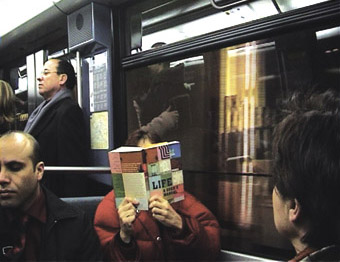
Norie Neumark, Maria Miranda, Searching for Rue Simon-Crubellier
MARIA MIRANDA AND NORIE NEUMARK’S SEARCHING FOR RUE SIMON-CRUBELLIER IS AN INTRIGUING CONCEPTUAL-PERFORMANCE-MULTIMEDIA WORK BASED AROUND THE QUESTION: “IS IT POSSIBLE TO BRING SOMETHING THAT DOES NOT EXIST INTO EXISTENCE BY SEARCHING FOR IT?” IT’S A PHILOSOPHICAL INQUIRY THE ARTISTS WERE INSPIRED TO PURSUE AFTER READING GEORGES PEREC’S BOOK LIFE: A USER’S MANUAL WHICH IS SET IN A PARISIAN BUILDING AT NUMBER 11 RUE SIMON-CRUBELLIER. PEREC WAS A FOUNDING MEMBER OF THE OULIPO MOVEMENT, FRENCH WRITERS WHO IN THE 1960S INTENTIONALLY ENFORCED CONSTRAINTS ON THEIR WRITING, USING DEVICES SUCH AS GAMES, PUZZLES AND WORDPLAY TO CREATE NEW EXPERIMENTAL FORMS OF LITERATURE.
I have to admit that knowing little of Perec, I wasn’t quite sure at first what to make of the collection of objects installed in the reading room at Artspace. Inside was a small couch, a monitor showing a video, a large map of Paris marked with little red pins and lots of A4 print-outs of Google web-pages stuck to the walls. The room’s two bookshelves were lined with rows of black photo albums, filled with more print-outs from the net, as well as several boxes marked “bad directions”, “dead ends” and “false starts”, all filled with little bits of paper.
By far the most engaging part of this work was the video. Watching it, I understood the significance of the other elements and became inspired to search out even more information myself on the internet. In the video the artists play with the idea of being Australian tourists in Paris and record themselves performing the typical ‘touristy’ act of asking for directions. This banal exercise is warped to the point of absurdity however, because as viewers we know that the street the artists are looking for most likely doesn’t actually exist (although others do in Perec’s book), and because this usually trivial interaction is being taken so seriously.
It is hard for me to pinpoint exactly why the video is so good. Is it the wonderful scenes of Paris and its varied inhabitants? Is it the farcical nature of the search or simply the demeanour of the artists themselves? I’m not really sure, but I loved watching Neumark in her big headphones and bright red anorak earnestly asking people in French the way to the imaginary street. I was immediately transfixed by this bizarre treasure hunt and reminded of the fun you can have allowing yourself to be completely swept up in a game and playing it out to its ultimate conclusion.
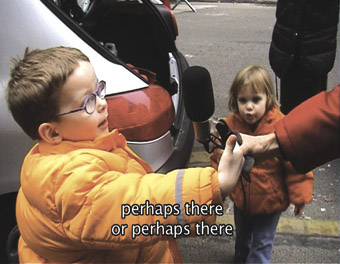
Norie Neumark, Maria Miranda, Searching for Rue Simon-Crubellier
On the one hand the video sticks very closely to a classic ‘vox pop’ documentary format. Associates of Perec are interviewed, people on the street are randomly stopped and asked questions, followed by visits to several, official locations in search of more reliable sources of information. Many of the interactions with French bureaucracy are very funny and typically mired by red tape and the number of overalapping agencies responsible for street names. On a deeper level though, the video plays with the idea of documenting and of performance, in the sense that the act of documenting is the performance, and the subject of the documentary only emerges through this performative act.
In a suitably twisted, Oulipo-inspired way Miranda and Neumark state they are performing “an actual search for an imaginary place” and by genuinely performing this search and documenting it on video, but particularly on the internet, they are in fact creating more material or evidence that future (re)searchers will eventually find. Through their performative and documentary actions they are literally bringing this imaginary place into existence.
Norie Neumark, Maria Miranda, Searching for Rue Simon-Crubellier, Artspace, March 16-April 14
RealTime issue #79 June-July 2007 pg. 27
© Anna Davis; for permission to reproduce apply to realtime@realtimearts.net
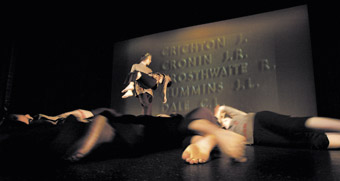
Quantum Leap, Reckless Valour
photo Andrew Campbell
Quantum Leap, Reckless Valour
WHATEVER THEIR EMERGENCY, WARS THE WORLD OVER CONSUME THE VULNERABILITY OF THE YOUNG—HARNESSING THEIR SUSCEPTIBILITY, MARSHALLING THEIR SUGGESTIBILITY, EXHAUSTING THEIR SHEER ENTHUSIASM FOR PARTICIPATING IN WORLD EVENTS. SUCH YOUTHFUL ENERGIES, RENDERED AESTHETIC, ARE ALSO APPARENT WHEN LARGE GROUPS OF YOUNG PEOPLE EMBODY THE WILL OF EMPOWERED ADULTS AND PERFORM WITH UNBOUND ENTHUSIASM FOR APPRECIATIVE FAMILY AND FRIENDS.
This ensemble aesthetic of unassailable pride fuels events like the Schools Spectacular, that apotheosis of the end-of-year concert, staged annually since 1984 with a cast of thousands in the cavernous arena of the Sydney Entertainment Centre, and now broadcast to the nation on ABC TV. Such an aesthetic—suitably cloaked in the drab garb of mutual respect—was also apparent in Reckless Valour, Quantum Leap’s homage to the Australian War Memorial and the nation’s war dead.
Quantum Leap Youth Choreographic Ensemble is an ongoing enterprise of the Australian Choreographic Centre in Canberra. This production from 2005 was made in partnership with the Australian War Memorial and with support from the Department of Veterans’ Affairs through the ‘Saluting their Service’ commemorations program. A revival was presented at the Adelaide Festival Theatre as part of Come Out 2007, South Australia’s biennial arts festival for young people.
Reckless Valour is a well-polished work of propaganda, wearing its production values with pride like so many medals on its chest. Producer Mark Gordon has enlisted a professional production team of 27 artists, administrators and technicians including four choreographers, five composers and a six member film unit. Thirty six young dancers appear in the work, most on stage, some on film.
The dancers—all of whom have come to social consciousness as future citizens in Howard’s Australia—may have contributed ideas, movement strands and stories to the creative process, as artistic director Ruth Osborne notes in the program, but their bodies articulate a discourse on remembering war, national honour and dutiful reflection which does not appear to originate with them. This discourse they perform with the docile conviction of devoted children, but without the authority that arises from creative autonomy.
Modern dance has lent itself to national promotion in the past. Rudolph Laban’s movement choirs, created for the spectacles of mass rallies in Nazi Germany, is an obvious example. Laban’s choral kinaesthetic is recalled in Reckless Valour—in Jodie Farrugia’s segment, Pool of Reflection, in Fiona Malone’s Roll of Honour and, most obviously, in the monumental body-architecture of awe and admiration in Ruth Osborne and Vivienne Rogis’s Hall of Memory.
Dissenting bodies make a brief appearance in Faces of the Enemy, Rowan Marchingo’s deconstruction of Australiana. Marchingo reveals the violence of the heel-and-toe in colonial bush dance, but sardonic references to Vegemite, Drizabones and kangaroos miss their target, overshadowed by the iconography of the unknown soldier, the war-time nurse, the Flanders poppy and the slouch hat which so dominates this work.
Midnight Oil’s Short Memory is used at one point in association with an audio recording of Howard’s announcement to the nation on joining America in the war against Iraq. But the problem here is not that we are short on memory. The work is awash with manufactured memories, drowning us and its performers in a flood of memorialisation. In a time of war and water shortage, when the civic fountains in our towns and cities are running dry, the pool of reflection in the nation’s capital overflows.
In the final segment, “a memorial for the future”, key words project the values of its young performers. Among the words are tolerance, respect, understanding, courage, faith, strength, trust and cautiousness—cautiousness? I am chilled by this.
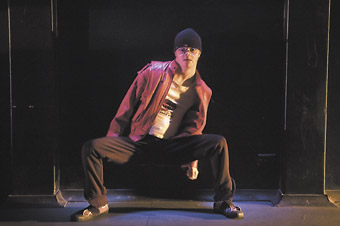
Lorcan Hopper, Restless Dance, Rebel Rebel
photo David Wilson
Lorcan Hopper, Restless Dance, Rebel Rebel
I am thrilled that Rebel Rebel, the new work from Adelaide-based Restless Dance, throws caution to the wind. Presented for Come Out at Norwood’s Odeon Theatre, this is Ingrid Voorendt’s first production as artistic director, though her experience as associate director and creator of five works for the company lends assurance. She describes Rebel Rebel as a rebellion against her previous work.
It has an urban, constructivist, junk yard aesthetic. It is built up from fragments of childhood culture, gruff snatches of music from DJ TRIP, and the frustrations of young bodies bursting out of their skins. It opens with the confusion of torchlight, a wind-up toy in a corner, a Bambi mural on the wall—while twelve young performers are locked up out the back, making a racket, yelling to get out.
As the work unfolds, a booth-sized box, squares of white light and the solid bulk of the theatre’s back wall give structure to a choreography of frustration as bodies perform actions that exceed their containment. Performers are chased, pathways are blocked. Bodies lash out to do their own thing. They try to escape, and get in each other’s way.
Restless Dance works with young performers both with and without a disability. One advantage of this—an advantage as rare in dance as it is in youth arts—is the resistance that the performers and their bodies present to uniform projections of corporeal capacity and the singular imposition of a director’s will.
We see this most clearly when the performers line up downstage as if for a chorus line, that most recognisable choreographic convention for synchronising uniformity. But as the impulse to move runs down the line, each performer responds in a manner as distinctive and unusual as it is authentic to the body moving. Near the end, the performers don headphones and the DJ retires. They dance to their own beat as we watch on in silence.
The sense that these twelve performers are the originators, the initiators, the creative generators of their movement is impressive. Voorendt meets the challenge of directing young people in the performing arts: how to chart an ensemble trajectory of aesthetic education that fosters authenticity of artistic expression. In the choreography of Rebel Rebel, I saw dancers becoming artists for the future. In Reckless Valour, I saw conscripts servicing their elders and the past.
Quantum Leap Youth Choreographic Ensemble, Reckless Valour, Festival Theatre, Adelaide Festival Centre, May 1-12; Restless Dance Company, Rebel Rebel, Odeon Theatre, Adelaide, May 11-19; Come Out 2007
RealTime issue #79 June-July 2007 pg. 29
© Jonathan Bollen; for permission to reproduce apply to realtime@realtimearts.net
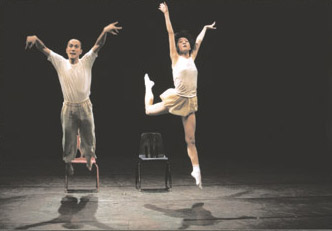
Jareo Osamu, Terada Misako, It Might be Sunny Tomorrow
photo Sete Tele
Jareo Osamu, Terada Misako, It Might be Sunny Tomorrow
AUTOMORPH, A DUET BETWEEN DANCER EMMA STRAPPS AND SOUND ARTIST DEAN LINGUEY WAS FIRST UP IN THE TRIO OF DUETS COMPRISING DYUETTO AT DANCEHOUSE IN MARCH. STRAPPS’ DANCE AESTHETIC SUGGESTS A BUTOH-STYLE OF WORKING. HER MANNER OF MOVEMENT IS VERY CONNECTED TO HER INDIVIDUAL CORPOREALITY, WHICH SHE CLEARLY DRAWS ON TO GENERATE A SINGLE, SUSTAINED PERFORMANCE QUALITY. THIS IS WORK THAT HAS BEEN CREATED FROM THE INSIDE, FROM FEELING RATHER THAN LOOK. THE MOVEMENT ITSELF WAS VERY JOINTED, OPERATING AT THE MEETING-POINT OF BONE AND BONE, EXTENDING TO THE LIMITS OF HER PHYSICAL RANGE. THE EXTREMITIES OF THE LIMB WORK—PARTICULARLY WHERE THE ARM MEETS THE SHOULDER OR THE LEG ENTERS THE HIP SOCKET—CREATED A RATHER NON-HUMAN ENSEMBLE, INSECT-LIKE AND REMINISCENT OF SUE-ELLEN KOHLER AND SANDRA PERRIN’S MEMORABLE BUG (1992).
Strapps created this movement state through a series of inhuman shapes, extending then collapsing them along a slow diagonal. At some point, she reconfigured her costume into a dress in which it was odd to see her moving, almost jarring. I’m not sure how or whether this transition into human form was reflected at the level of movement. After this point, there was a journey across space with an ending in the spotlight. Personally, I would have been happy to stay with the non-human part of the work, to go deeper into its nuances rather than be taken towards a resolution which evaded me. A good deal of investigation underlies Automorph. It will be interesting to see where it goes next.
My initial experience of N_TN_GLD was saturated by the power of its music. Zipper Sky artfully created a repetitive sound, like a car engine which never actually starts. Its effect was to create a series of anticipations: that the sound would progress, that the engine would actually start, alongside a succession of ‘disappointments.’ Against that background, Perth dancers, Sete Tele and Rachel Ogle, each in turn fronted the audience. Tele stood quite close, repeatedly digging into his torso, extracting invisible innards. Ogle’s work was more dancerly, working a kind of emotional communication. N_TN_GLD then became more mobile, more active, in the faster style of contemporary dance, engaging the two in spirals, rolls, twists and turns in and out of the floor. There was for me a slight ‘disconnect’ between the initial offbeat character of the work and its subsequent shift towards what felt like a familiar mode of dancing, a pattern and legacy of choreographic style which is already given. While Ogle in particular looked quite comfortable dancing in this style, I think the intention was to create something more out of the ordinary.
Jareo Osamu and Terada Misako’s It Might be Sunny Tomorrow was the most entertaining piece of the evening. Aside from the humour of the work, these two dancers had a wonderful sense of mutual and differential timing. This was achieved not via duplication or action and response but through an intriguing and subtle sensitivity. The relationship was enacted rather than expressed. They rarely looked at each other, performing mostly task-oriented actions without excessive adornment. Some abstract repetition occurred, for example, a slow leg split by Misako over and around Osamu’s back, but by and large It Might be Sunny Tomorrow evoked a sense of everyday life, of ordinary humans confronting expectations, not always managing to meet them but, at the same time, not necessarily caring. Osamu and Misako were fellow travelers here, collaborators in parody, sometimes dance partners but, more often than not, moving in a relation of difference. This gave a refreshing slant to the idea of duet, that proximity can be maintained without falling into sameness.
Although these three pieces were all duets, they were very differently realized. The connection is in part achieved because three institutions—Dancehouse (Melbourne), Strut (Perth) and Dance Box (Osaka)—are each taking it in turns to host artists from the other two cities. It’s the first season to be presented under the auspices of Dancehouse’s new artistic director, David Tyndall. Although Tyndall rightly acknowledged the work of former director Dianne Reid and recently retired general manager Michael Mitchener in developing this season, Dyuetto stands at the brink of Tyndall’s new curatorial outlook.
Dyuetto (Duet): Automorph, dancer Emma Strapps, sound Dean Linguey; N_TN_GLD, dancers Sete Tele, Rachel Arianne Ogle, music Zipper Sky; It Might be Sunny Tomorrow, dancers Jareo Osamu, Terada Misako; presented by Dancehouse, STRUT Dance, Perth, Dance Box, Osaka; Dancehouse, Melbourne, March 28-April 1
RealTime issue #79 June-July 2007 pg. 30
© Philipa Rothfield; for permission to reproduce apply to realtime@realtimearts.net
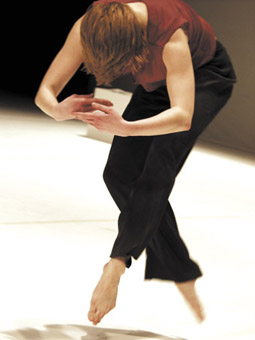
Antje Pfundtner, EigenSinn
photo Iris Terzka
Antje Pfundtner, EigenSinn
EIGENSINN WAS ANTJE PFUNDTNER’S FIRST BIG SUCCESS AND TOURED THROUGHOUT EUROPE AND ASIA. SHE RECALLS A JOURNALIST ASKING HER TO SUMMARISE HER WORK AND HER SINGLE SENTENCE RESPONSE WAS, “WHEN I WAS BORN, I COULDN’T MOVE AT ALL.” PFUNDTNER NOTES IN A CONVERSATION OVER EMAIL, “ THIS SENTENCE SUMS UP MY WORK PERFECTLY. IT HAS AN AUTOBIOGRAHICAL BACKGROUND. IT CONTAINS A STORY, A FAILURE, AND THE WORD ‘MOVE’.” PFUNDTNER PERFORMS THIS SOLO IN JUNE AT SYDNEY OPERA HOUSE’S STUDIO AND MELBOURNE’S ARTS HOUSE.
Pfundtner first visited Australia briefly in 2005, supported by Goethe-Institut Sydney to lead a research project with local artists at Critical Path. Performing excerpts of Eigensinn in an informal workshop setting to illustrate her practice gave rise to the invitation to perform the work in theatres in Melbourne and Sydney.
In our discussion about her return, Pfundtner elaborates on the special place this solo has in her rapidly increasing repertoire. “I made EigenSinn at a time when I was digesting the input I had received as a dancer and artist. I was travelling, working with different people, taking a lot of classes and workshops. The solo form seemed the most suitable way to process all that. EigenSinn is still my most personal work and reflects upon my life…as an artist, a human being, a woman. The main thread is the Brothers Grimm Fairytale, Das Eigensinnige Kind (The Willful Child), in which a girl is punished for developing her will. Nowadays this is the one thing everyone is trying to achieve, especially artists, for whom reflecting upon will and stand-point is crucial. EigenSinn also deals with three other stories from my experience. The first is the most personal, the story of my early inability to move.” (A rare and severe medical condition which Pfundtner overcame as she grew. )
Pfundtner’s work is warmly anticipated by her Australian presenters. Steven Richardson of Arts House writes, “Antje is a fantastically engaging and skilled performer who has a theatrical expressiveness which makes her a compelling, watchable dancer. Importantly, she is unafraid to use dry humour as a part of her performances and I experienced this first hand at her Critical Path residency showing. Hosting international artists is an important part of what Arts House does. International guests are invited into the program partly to provide audiences with an expanded context to the work of local artists, many of whom investigate the themes of self knowledge as Antje does. We are committed to performers who insist on interrogation of practice, culture or thematic concerns…and Antje certainly fits this bill. “
Just as she will give a workshop for professionals in Melbourne in association with Chunky Move and Arts House, Pfundtner will also accompany her Sydney Opera House Studio shows with a second research project at Critical Path. For three days she will work with 14 participants; several of these Sydney based artists were involved in Pfundtner’s original workshop. She writes, “I love it when things continue or leave a trace. With Critical Path I am again presenting my tools for getting to material and choreography in exchange with the participants. The last workshop maintained its own dynamic after I left, which made me very happy. As I heard from the participants, they made a performance night out of that workshop. What more could I ask?”
Since making EigenSinn Pfundnter has created four group works. The first, Selbstinschuld, has the English sub-title “If you can’t fix it—feature it” and is about being trapped in life. She followed this with a quirky piece for the students of her old school. She then created Outlanders with Beijing’s Living Dance Studio, a piece where, “misunderstandings became a form of communication.” Pfundtner’s latest work inDeckung, recently premiered in Germany. Dealing with wishing and wanting, fantasy and absurdity, this piece employs language once more and extends into singing.
Antje Pfundtner hopes that more of her work will be shown in Australia, and if her last voracious engagement with the scene is anything to go by, it seems that she will become a regular visitor.
Antje Pfundtner, EigenSinn, Studio Sydney Opera House, June 14-16, www.sydneyoperahouse.com; Arts House, North Melbourne Town Hall, June 22-24, www.artshouse.com.au
RealTime issue #79 June-July 2007 pg. 30
© Sophie Travers; for permission to reproduce apply to realtime@realtimearts.net
<img src="http://www.realtime.org.au/wp-content/uploads/art/12/1222_bailey_ot.jpg" alt="Katherine Tonkin, Philip McInnes, Luke Ryan,
OT: Chronicles of The Old Testament”>
Katherine Tonkin, Philip McInnes, Luke Ryan,
OT: Chronicles of The Old Testament
photo Jeff Busby
Katherine Tonkin, Philip McInnes, Luke Ryan,
OT: Chronicles of The Old Testament
THERE ARE, BROADLY SPEAKING, TWO SCHOOLS OF THOUGHT WHEN IT COMES TO THE READING OF SACRED TEXTS. THE FIRST IS A LITERALIST OR FUNDAMENTALIST APPROACH, WHICH TREATS A WORK AS A VEHICLE FOR THE TRANSMISSION OF A STABLE SET OF TRUTHS. THE SECOND, THE MODERNIST SCHOOL, EMPHASISES THE ROLE OF INTERPRETATION AS A DYNAMIC, FLUID AFFAIR, IN WHICH EVEN SCRIPTURE IS SEEN TO WORK ON THE LEVEL OF METAPHOR OR ALLEGORY, AND THE ROLE OF THE READER IS TO ARTICULATE MEANINGS TO THE GIVEN WORDS AND IMAGERY.
Two recent productions in Melbourne put these approaches into fascinating and provocative contrast. One took a religious text which forms the foundational myths for several thousand years of history and opened it up to interrogation, teasing it apart in order to question the assumptions that underlie its received wisdom. The other engaged a canonical text in the history of modern theatre but did so with a secular reverence to the transcendent, timeless psychological truths it found therein. Religion, it turns out, doesn’t hold a patent on the sacred.
uncle semolina’s OT
At Malthouse, Uncle Semolina (& Friends) presented OT: Chronicles of the Old Testament, a chaotic, hyper-kinetic rendering of a vast collection of stories drawn from the first half of the Good Book. It re-orders and revises its source material, attentive to the dramatic power of these tales—and they’re nothing if not spectacular—while maintaining a second level of engagement which allows its audience to assess the contradictions and problematic assumptions which underscore them.
Unlike the New Testament, the older tales are those of an ambivalent and at times terrible deity whose relationship with humanity is hardly as the loving father figure later scribes attempted to posit. This is a god who creates, but as often destroys. In OT, Yahweh is the central figure of interest but is presented as much in the form of what literary critics would term a structuring absence. Senile, slumbering, confused and eventually entirely absent, his omnipresence is refigured as a lack—he may be everywhere, but he is equally nowhere.
The work begins with the cardigan-clad, balding Yahweh sleeping on a chair as four performers race through various Testament stories. Their renditions are overtly, perhaps excessively performative, reaching deep into a grab-bag of theatrical tricks and styles, from Commedia-style farce and clowning to mime, video projection and puppetry. The Uncle Semolina style is strongly defined by this thrift-shop aesthetic in which found objects become props, biblical characters in this case played out by action figures and plush toys. When the performers take on roles themselves it is with an equally irreverent spirit: Samson becomes a “hard cunt”, handy with a shotgun, Job a nervous stand-up comic whose bad jokes gradually reveal the terrible treatment he suffered at the hands of a cruel God.
Early in the piece, there are strong hints that these stories are being played out in order to appease that God, who demands entertainment from his creations. At first, they are trying to keep him awake; later, after he begins to withdraw from the stage, they attempt to bring him back by recalling those moments in which they had pleased him. There’s a level of pathos to this reading, which suggests that the scriptures themselves, and our re-reading of them, are not simple descriptions of holy events but active attempts to recover a deity who has forsaken the world, and even whose crueler moments are preferable to his departure.
But even that God’s awful status is problematised as an issue of interpretation—after he wakes, but well before he assumes any kind of autonomous presence, he himself becomes a puppet to his subjects, who animate his limbs and speech in a grotesquely hilarious routine. Perhaps, finally, this is where OT is at its most impious, in offering the possibility that Yahweh is merely a result, and not the cause, of these stories. An effect of the creative spirit, rather than its inspiration.
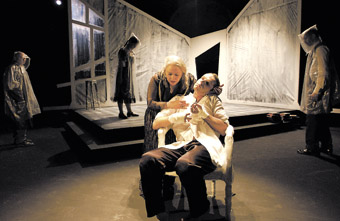
Andrea Swifte, Jay Bowen, Ghosts
photo Deryk McAlpin
Andrea Swifte, Jay Bowen, Ghosts
branch theatre’s ghosts
Branch Theatre Company’s production of Ghosts offers a curious counterpoint. Ibsen’s 1881 play was a shocking number for its day, its themes of incest, religious hypocrisy, sexual degeneracy and suicide a bold challenge to the mores of the period. Moreover, as a work by one of the founding fathers of modernist theatre, it was both a formal and thematic reaction against the comfortable dramas that worked to reassure rather than challenge audiences.
Curious, then, in that this production handles its material with a respectful care that sometimes jars with the more confronting aspects of the work. Certainly, the design of the piece is wonderfully non-naturalistic, a construction of stark, receding lines that form an almost expressionist series of slashes across the playing space. This set, along with the costumes, are all rendered in shades of grey, black and white with the occasional intrusion of striking reds. The ambience created is of a cold other-world, the ideal setting for a family drama revolving around a deceased patriarch whose monstrous legacy grips those he has left behind.
But beyond these elements, Ghosts is a devout and mostly realist attempt to access and purvey the profound interior truths of its characters. Certainly, it is a wonderfully realised and performed production of which Ibsen might well be proud, but its strangeness lies in precisely that fact. If Ibsen, like many of his successors, attempted to find new ways of expressing a psychological realism, these truths no longer appear so fresh a century or so later. Rather, Ghosts’ power is as a kind of riveting drama quite distant from the experiences of its contemporary viewer. It could be updated to add relevance, but I think that would be beside the point. But our very distance from the context of its first production could at least be acknowledged.
What unites both of these mostly successful works is, in the end, a humanist underpinning which seeks to speak directly to a common experience—in one case, by critically questioning the accepted interpretations of a canonical text, in the other by attempting to reaffirm them. That humanism, perhaps, is the ghost that most stubbornly haunts our theatre today.
Uncle Semolina (& Friends), OT: Chronicles of the Old Testament, devised and directed by Christian Leavesley and Phil Rolfe, performers Amelia Best, Philip McInnes, Luke Ryan, Peter Snow, Katherine Tonkin, lighting Paul Jackson, Malthouse Theatre, Melbourne, May 4-27; Henrik Ibsen, Ghosts, director Melanie Beddie, performers Jay Bowen, Ming-Zhu Hii, Bruce Myles, Andrea Swifte, James Wardlaw, design Emily Barrie, lighting Richard Vabre, Branch Theatre Company; Theatreworks, Melbourne, May 4-20
RealTime issue #79 June-July 2007 pg. 31
© John Bailey; for permission to reproduce apply to realtime@realtimearts.net
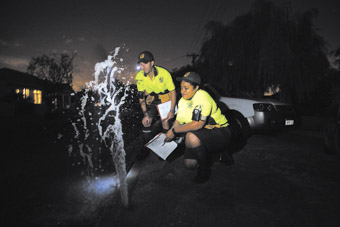
PVI, Inform
photo Bodan Warchomij
PVI, Inform
PERTH-BASED ARTS COLLECTIVE PVI HAVE JUST MOVED INTO A FORMER SCHOOL TO ESTABLISH THE CENTRE FOR INTERDISCIPLINARY ARTS (CIA). BETWEEN ORGANISING THE LAUNCH OF THIS NEW ARTIST-SUPPORT INSTITUTION, ARTISTIC DIRECTORS KELLI MCCLUSKEY AND STEVE BULL ARE PREPARING PVI’S LATEST PERFORMANCE PROJECT, INFORM. IT’S PLANNED TO BE AN UNSETTLING ROAD TRIP INTO THE SUBURBS OF PERTH TO CHART THE DISSIPATION OF A SENSE OF COMMUNITY AND THE ALIENATING SUSPICION WHICH HAS SPREAD OUTWARD FROM THE METROPOLITAN CENTRES OF GOVERNMENT.
Spectators for Inform will assemble at the Perth Institute for Contemporary Art before following the so-called Loyal Citizens Unit (LCU) as they drive into the suburban hinterland in search of minor criminals and social infractions to identify and halt. “I love this idea of a convoy of 15 cars driving into the suburbs”, Bull enthuses, “and the pressure of not losing the car in front of you.” Audiences travel in their own vehicles and tune in to the LCUs’ radio broadcast to listen to a soundscape by Jason Sweeney. Meanwhile live dialogue is picked up by radio microphone while the LCUs doorknock members of the public and ask for their help in catching offenders.
PVI are committed to directly engaging the audience in the events they manage. As McClusky explains, they are currently working on strategies that deal with questions such as “what can you do in your car? How can you assist what we’re doing—and how can we be inclusive?” Although Bull notes this will include some classic options such as “flashing the headlights, honking the horn—once for yes, twice for no!”, they are nevertheless keen to move beyond such simple relations.
Inform is a sequel to PVI’s 2006 show, Reform, which had the LCUs taking audiences on a walking tour of one of Perth’s busier urban areas, between nightclubs and restaurants, engaging both real members of the public and performers masquerading as bystanders, to issue infraction notices for everything from jaywalking to standing still while being dressed provocatively and carrying a condom in one’s purse (which can be legally inferred to be soliciting). Reform was an interesting work, but slightly naff in its execution, while Inform is likely to have a more sinister and ambiguous, eerie ambience, depending as it does on the audience’s sense of both engagement (being part of the convoy and hearing the speech of the LCUs) and distancing (the car turned into a kind of cinema space or radio play venue where spectators observe and listen to actions from behind a glass window).
As McClusky explains, audience “visual awareness will be restricted. A lot of the doorknocking they will be able to hear, but they won’t be able to see. It’s a very different treatment. So we started work with sound artist Jason Sweeney earlier for this piece. We want to give a lot more breathing space to the sounds this time around. It felt like the sound acted as an accompaniment to the dialogue in Reform, whereas this time that may flip at times and the sound will dominate.” Inform thus relies more strongly on the ambivalent pleasures of voyeurism and surveillance than the earlier spectatorial model, in which audiences generally maintained clear sightlines on the activities of the LCUs and had little beyond the streetscape itself to divide their attention.
Another interesting development in the progression from Reform to Inform is that whereas the LCUs in the former work predominantly came across with a sinister, invasive, paralegal or police-like association, in Inform one’s sympathies are more likely to be conflicted over the merit of the LCUs’ actions. In the suburbs, the LCUs will be on the lookout for such commonplace annoyances as “dog fouling, illegal parking, water cheats, and so on.” Especially with respect to responsible water usage, these are issues which increasingly galvanise householders with both left and right-wing sensibilities, determining to what extent such actions should be tolerated within the community. It will be hard not to empathise with someone finally punishing that bastard from two doors down responsible for dog shit on your verge every morning. Unlike the urban policing of Reform—the very title of the show suggesting an exterior, repressive force acting upon a recalcitrant subject—in this new scenario, one enters a suburban world where individuals are increasingly happy to self-regulate and prosecute.
Bull extrapolates: “We’re very interested in how communities are now policing themselves and with the mechanisms which are put in place to do that. There is a culture of dobbing now in Australia. The issues have overtaken mateship. Although it hasn’t quite hit here in Perth, with things like water wasting over east in Sydney, Brisbane or Melbourne, if someone misuses water, they’re going to be reported. Even if they’re not guilty and they have a tank in the back garden!” McClusky adds, “You hear reports of people having to put up signs saying they’re not wasting water so as to avoid prosecution.”
It is precisely this constellation of issues which lies at the heart of Inform—and indeed the PVI project as a whole. McClusky notes that the company is “tapping into those little niggly things in human behaviour that would drive you to respond a certain way. In the research we did for Reform, we came across all of these dob-in phenomena. There’s an organisation called Whistleblowers Australia. With the tests that we’ve done for Inform, the people in their homes are extremely welcoming. They invite you in and make you a cup of tea—and then proceed to slag off their neighbour!” The issue then is when does the vigilance of one’s neighbour become a sign of social dysfunction, and when is it a badge of responsible community behaviour? In 21st century Australia, we need, more and more, to determine whether we have become paralysed and hateful at the prospect of threats to us and our homes, or have finally found a way to generate a caring, cohesive community. Where better to highlight this issue than in a city all but defined by the car and the suburb?
PVI, Inform, Perth suburbs (departing PICA), June 20-30, www.pvicollective.com, www.ciastudios.com.au
RealTime issue #79 June-July 2007 pg. 32
© Jonathan Marshall; for permission to reproduce apply to realtime@realtimearts.net
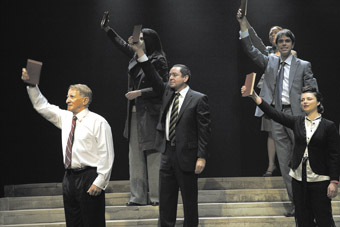
members of the STC Actors Company, The Art of War
photo Tania Kelley
members of the STC Actors Company, The Art of War
IN A NEWLY OPENED CREATIONIST MUSEUM IN THE US, RUN BY A FORMER AUSTRALIAN SCIENCE TEACHER, THERE ARE DINOSAURS ON NOAH’S ARK. ELSEWHERE A BABY ANIMATRONIC T-REX SITS DOWN WITH YOUNG CHILDREN BY A DIORAMA WATERFALL—LIKE THE LION WITH THE LAMB. FAITH IS EVERYTHING IN THIS 6,000 YEAR HISTORY OF THE WORLD, AND THAT FAITH IS BASED ON THE WORD. RECEIVED WISDOM EMBODIED IN BOOKS DOMINATES HUMAN CULTURES. ATHEISTS (DAWKINS, HITCHENS ET AL) NOW VIGOROUSLY CHALLENGE NOT ONLY FUNDAMENTALIST RELIGION BUT THE WHOLE SHEBANG, INCLUDING THE KIND THAT PROPELS THE AUSTRALIAN GOVERNMENT TO FUND THE PLACEMENT OF A CHAPLAIN IN EVERY SCHOOL (PERHAPS HE/SHE SHOULD ALSO RAISE THE COMPULSORY FLAG) AND TO TREAT EVERYONE WITHOUT RELIGIOUS FAITH AS MORALLY DEFICIENT.
At Belvoir St Theatre, Company B performs UK playwright Howard Brenton’s Paul, about one of the authors of the New Testament, while at Malthouse Uncle Semolina (& friends) present OT (for Old Testament; see page 31) and the Sydney Theatre Company realises visiting playwright Stephen Jeffrey’s The Art of War, based on the two and half thousand-year-old Sun Tzu classic, used also as a manual for strategies in business and sport.
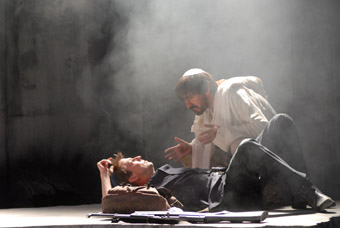
Company B, Paul
paul
In Brenton’s Paul, the proselytising saint (played by Robert Menzies) is depicted as wild-eyed, his head thrust forward, arms waving, movements discombobulated, every word an urgent thrust, a declaration of the man’s ineptness as a rhetorician. He’s an epileptic visionary (falling down often, not just the critical once), temporarily blinded by a vision of Christ that converts him from official persecutor of the new Christian sect to become one of its leaders, travelling the empire, spreading the word, establishing churches. In Brenton’s version of the life, Paul’s struggle is pragmatic, challenging recidivists clinging to Jewish custom (diet, circumcision etc) when he knows that the Christian creed will only spread if it tolerates the everyday habits of gentiles. But there is a greater challenge—Paul’s companions are uncertain of the miracle that has liberated him—is he simply ill; worse, some know that it was no miracle, Christ is alive and in hiding. Brenton opens out the narrow New Testament narrative, incorporating apocrypha like Christ’s marriage to an intelligent and cynical Mary Magdalene, along with references to the popular competing creed of Mithras, the bull god. Paul has to face the fact of a living Christ and not in the sense that he had hoped. But having travelled so far he is consumed by his own belief and passionately convinces his followers to take it up—their faith is a fiction but, as Paul sees it, a necessary one.
Wesley Enoch’s direction of this essay-as-play is straightforward, the performances suitably tough and tense, and the handling of the shifting time structure (offering something in the way of suspenseful propulsion) deftly handled. The war-torn setting, armed soldiers in 21st century garb and the grim prison camp scenes all evoke the Middle-East as it is now, although it’s a broad brush analogy, a conceit that is not really through-produced. What I found profoundly dissatisfying was the play itself. It’s extremely difficult to match the character as written and played with the Paul who so profoundly shaped the emergence of Christianity not simply as fervent missionary but as literary genius—cleverly melding Jewish, Greek and Roman epistolary formulae in the Epistles (“telegraphic sermons” one writer called them) that not only implicated his far-flung readers in the drama of imagined dialogues on morality and belief but mimicked the authority of empire.
This was the man who fused pagan, Christian and Greek philosophies into a workable whole for the Greco-Roman culture of the Roman Empire, who above all synthesised Platonism and a new creed into the Christianity we now know with its opposed worlds of flesh and spirit founded on the inherent imperfection, recast as original sin, of humankind. We see the driven visionary (the day of judgment is always nigh), glimpse the seductive poet and, occasionally, the wit: “You can’t build a religion by piling up foreskins.” Brenton is peculiarly restrained (“god fucked [Mary] in the ear” is a rare exception) although his portrayal of a Nero (Jonathan Hardy) who can see what’s coming (he has to execute Peter and Paul but knows that martyrdom will be the first step towards a new state) has some of the old Brenton bite. Like plays or films with artists as their subject where the art barely gets a look in, this play inclines to one dimension (faith overriding the facts in the wedding of vision and pragmatism), neglecting the man’s art and the range of his ideas. Of course, there’s a limit to what you can expect from a couple of hours of stage time, but it would have been interesting to see more of the dynamic between the man’s passion and his intelligence.
OT: chronicles of the old testament
OT, by Uncle Semolina (& friends), revealed a young Melbourne company in fine ensemble fettle using every lo-grade theatrical device in the book to remind us, as Brenton’s Paul does, that God is an invention of humans pretty much in their own image (here a distant, sleepy cardiganed old guy), but a construct that can get right out of hand. What begins as a series of skit-like re-tellings of Bible tales in no apparent order and desperately short on punchlines improves as we realise we are heading towards the moment of creation rather than away from it, and when the writers entwine stories in order to drive home issues of power, gender and faith with increasing irony, thus rescuing the whole from the sense of an undergrad atheist trip. The darker it gets, the funnier.
the art of war
In The Art of War, Stephen Jeffreys takes a classic Chinese text and applies it to the earliest stages of the war in Iraq, to business and personal relationships. While audiences doubtless know enough of their Bible to engage comfortably with Paul and OT, Jeffreys is faced with the challenge of filling us in on one-time general Sun Tzu’s epigrammatic thoughts. The cast, therefore, becomes a chorus (invoking another ancient practice) chanting from copies of The Art of War (bound in red and evoking yet another influential Chinese volume) and then, in the first scene, transform into the staff of a company being introduced to Sun Tzu’s wisdom via a motivational speaker. The book thus becomes a framework for and the subject of the drama. Throughout, the chorus in part or whole comments on the action, be it a business venture into modern China, heterosexual friction (complicated by various moral issues) or war (the inept handling of the invasion of Iraq: “There is no instance of a country having benefited from prolonged warfare”, writes Sun Tzu). In the case of General Garrett (Colin Moody) and journalist Crystal (Pamela Rabe), the most fully realised of the three couples, waging and reporting the same war and managing a mid-life romance crystallise the play’s alarming ethical complexities.
But as drama, there’s a plodding insistency to the choral device that, once established, is wearying along with a certain obviousness to the Iraq war material, and too many of Jeffreys’ characters are bland—although the members of the Actors Company all adroitly compensate. There are two notable exceptions in the writing. First there’s Jessica, finely realised by Amber MacMahon revealing the tunnel-vision intelligence of a woman seduced by the Sun Tzu ethic and its teacher, whom she stalks. Her disappointment that the Sun Tzu ethic cannot be lived as a totality turns her pyromaniac—in a magical moment the chorus open their books and they burst into flame. The other idiosyncratic character is Brian—Peter Carroll as an older businessman usurped by a new generation of reckless pragmatists. Apparently slow witted (Carroll’s restrained delivery is masterful) he wreaks vengeance with glee, having deftly deployed the deception recommended by Sun Tzu. It’s a moral victory, even if criminal. Once again the strength of the STC Actors Company is fully evident, doing more than justice to Jeffreys’ script with vocal and physical verve and an ensemble ease of playing.
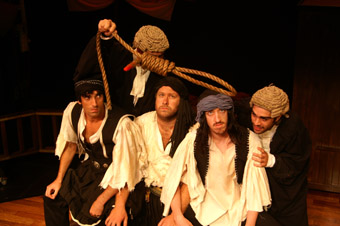
Sidetrack, Seven Pirates
seven pirates
Sidetrack’s Seven Pirates is a great antidote to the Pirates of the Caribbean movies, offering facts, politics and an Australian connection, as well as fun, in the telling of the story of some none too murderous Greek pirates in 1827 who seize the British merchant-brig Alceste with its load of tin plate. All of this is complicated by occurring in the middle of the war between Greece and the Ottoman Empire with Britain looking to assert its authority in the region and coming down strongly on pirates. Here was an opportunity to set an example by hanging the seven young Greek offenders (who claimed they were seizing cargo destined for Ottoman Alexandria).
Writer-director Don Mamouney frames the tale as a courtroom drama with action-packed reconstructions (boardings, sword fights, stunts, singing and belly dancing) set against epic video sea and sky-scapes and with much suspense (first hanging looms, then life sentences, then transportation to Botany Bay in 1829). Above all, writer and performers excel in their hilarious handling of varieties of English (including Maltese, Sicilian, French and Spanish) in the courtoom, climaxing in the meeting between a fantasist George III (who commutes the sentences) and the pirates’ dedicated Maltese defense lawyer. Adam Hatzimanolis as the pirate captain, Manolis, brings gruff humour and authority to his role (the character warrants more room in the first act to anchor the play) and all of the performers display great versatility, not least in their rapid role-changing. Seven Pirates is a joyful piece of historicising giving life to an incident and people we know little or nothing of—the word here has opened up awareness, not foreclosed it with legal, moral or tactical strictures.
Company B, Paul, writer Howard Brenton, director Wesley Enoch, performers Robert Menzies, Paula Arundell, Ewen Leslie, Jonathan Hardy, James Evans, Graham Rouse, Hazen Shammas, Jason Klarwein, Steve le Marquand; Belvoir St Theatre, Sydney, opened May 2; Uncle Semolina (& Friends), OT: Chronicles of the Old Testament, Malthouse, Melbourne (see page 31); Sydney Theatre Company, The Art of War, writer Stephen Jeffreys, director Annabel Arden, performers STC Actors Company, set Robert Cousins, costumes Tess Schofield, lighting Damien Cooper, sound Max Lyandvert; STC, Wharf 1, Sydney, opened May 19; Sidetrack, Seven Pirates, writer, director Don Mamouney, performers Adam Hatzimanolis, Alex Blias, Ben Adam, Ben Wood, Chris Pickard, Jason Stojanovski, Russell Smith, video Assad Abdi, lighting Jocelyn Speight, costumes Sue Liolio; Riverside Theatre, Parramatta, April 11-22
RealTime issue #79 June-July 2007 pg. 33
© Keith Gallasch; for permission to reproduce apply to realtime@realtimearts.net
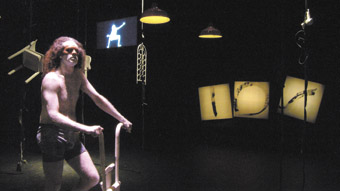
Zane Saunders, Being a Medium
photo Nicholas Mills
Zane Saunders, Being a Medium
ZANE SAUNDERS’ WORK SPRINGS FROM A SUBSTANTIAL VISUAL ARTS PRACTICE EMBEDDED IN FAR NORTH QUEENSLAND. HIS LATEST WORK, BEING A MEDIUM, IS PART OF AN ONGOING COLLABORATION WITH SOUND ARTIST FILE_ERROR (AKA NICHOLAS MILLS) ENGAGING WITH CULTURAL, SPIRITUAL AND SOCIAL CONCERNS WITH AN UNDERLAY OF RITUAL AND HUMOUR. BEING A MEDIUM SITS IN THE SPACE BETWEEN INSTALLATION AND PERFORMANCE, ENTERTAINMENT AND OBSERVATION, BODY AND OBJECT.
More accustomed to the white box gallery, this is Saunders’ first foray into the world of the theatrical black box. Spurred on by his flirtation with sonic interplay, the collaboration with File_Error has produced a lineage of short works. This latest piece was developed at the JUTE Theatre Centre of Contemporary Art in Cairns as a full-length work.
Enter a dark space. Saunders is clothed. He peels off, hanging up his shirt and trousers on a tall hat rack to reveal a completely painted form. He’s a commanding presence, painted white with a stripe of brown over his eyes, hair long and flowing. His towering form crouches till he’s eye-level with his audience. He weaves a ritualised procession from one installation to the next, his body bobbing, swaying and creeping to its unique tempo.
File_Error’s mix of sonic textures is rhythmic yet unsettling. Erks, squeaks and groans drive Saunders on. And then there is silence, his own and from sound departed. This crafted intermittence allows time for the viewer to reflect.
Illumination of a series of white installations sees Saunders interact and move through a collection of thoughts and feelings, amplified by carefully chosen objects but whose assembly appears random. A mangrove of black bungy cords suspends twenty four white man-made objects in varying degrees of repair: a couple of guitars, a miniature rubber figurine, a distinctive collection of chairs…The sense is of Saunders revealing an examined world full of objects familiar to him, and yet to the viewer, unknowable.
The residue of previous performance works informs Being a Medium. Three monitors of varying size emit sound and video. The largest projects white noise, or is it the internal workings of Saunders’ mind? The other two display edited documentation: one shows the performer’s back hovering over a spiral brick installation with a text message, “unlearn”; and in the other he’s wearing a suit jacket, lampshade head-wear and holding a light bulb, with the text “it was all too easy… consume.” The glitchy, looping messages suggest a certain urgency.
It’s a chairless environment. The audience—some unfamiliar with this kind of work—dance around the installations. Children scurry to position themselves, they want to be close to the action, but recoil when illuminated.
Saunders recycles pre-loved items and trash from the tip as dynamic craft. He is the medium in the moment, creating animated imagery through media integration. On two large canvases opposite each other are duplicate projections of Saunders warping, looping, shifting, re-focusing time. Three more canvases on the wall are treated with a flow of black paint from a dustpan brush. It’s immediate. Saunders glides by a speaker stack with its arhythmically throbbing neon light and punchy sound and it becomes a miniature urban sprawl. He tenderly massages plants in a cot, connecting with the natural environment.
I have been aware of Zane Saunders’ interest in performance for over a decade, and in the last few years I have observed his practice unfold into new territory. His interventions are evolving a kinetic momentum, which extends the object and installation. We witness a dance on an ageing treadmill, Saunders moving like a cross-country skier, his striding rise and fall implying an endless journey or walkabout.
His body is part of a living, breathing culture, not found in the museum of objects. Within the cultural protocol politic that Indigenous artists face, Zane Saunders is finding a language for the space between the contemporary and tradition through a deeply personal spiritual and physical journey. This is no mean feat considering prohibitive costs and the fledgling presence of performance and media practice in the region. Put that together with the lack of Indigenous live art role models and you have the enigmatic space between called Zane Saunders.
Image: Zane Saunders, Being a Medium, photo Nicholas Mills
Being a Medium, Zane Saunders, File_Error (aka Nicholas Mills), JUTE Theatre Centre of Contemporary Art, Cairns March 30, 31
RealTime issue #79 June-July 2007 pg. 34
© Rebecca Youdell; for permission to reproduce apply to realtime@realtimearts.net
Valerie Berry, The Folding Wife
photo Heidrun Löhr
Valerie Berry, The Folding Wife
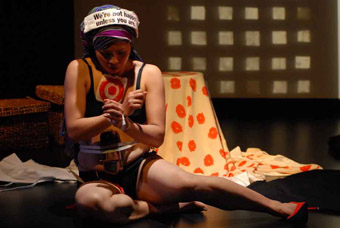
A DARK HAIRED WOMAN STANDS ON THE POLISHED FLOORBOARDS IN THE CENTRE OF THE NEW BLACKTOWN ARTS CENTRE PERFORMANCE SPACE. MUSIC PLAYS—NOSTALGIC MUSIC OF A FORMER TIME. THE WOMAN, VALERIE BERRY, UNDRESSES TO HER BLACK UNDERWEAR. TWO MEN APPEAR AND WITH THE FINESSE OF PUPPETEERS, BEGIN A LONG SLOW COSTUME COLLAGE.
They dress, drape and fold yards of fabric and clothing around the woman, morphing one costume into another—a peasant becomes a woman of class becomes a revolutionary becomes a political prisoner about to be executed. A machine gun strapped to a thigh, a radio spewing forth crackly sound is tied around her waist and her feet are forced into red high heels. Shoes, shoes and more shoes. We are in Imelda territory.
Paschal Daantos Berry and Valerie Berry, Australian artists, also siblings, born in the Philippines, first discussed a collaboration based on their shared history in 2002. Teaming up with Anino Shadow Play Collective from the Philippines, director Deborah Pollard and Urban Theatre Projects, they have produced a fine new performance work of biographical fiction called The Folding Wife.
Datu Arellano and Andrew Cruz, members of Anino Shadow Play and the men who have transformed Berry in chapter one, return to their workstation. As Valerie begins chapter two, they squat on the floor by an overhead projector and laptop and throw exquisite imagery onto the back wall. Like painters playing with liquid light, colour and form, they create the visual sensuality and texture of memory so powerfully evoked in the text by writer Paschal.
All I have is the view from this window. I have seen the century through this frame, seen them come and go…Our women have always been here sitting by the shadows waiting for new opportunities. Waiting for wars to finish…We can feign happiness with enough practice; it is in our blood, that’s how you become resilient—by bending and folding into recognisable shapes.
Valerie Berry’s impressively portrayed characters fold into one another through a non-chronological telling of chapters. Chapter two followed by chapter eleven, then by chapter five and so on. We meet Grandmother Clara, Mother Dolores and daughter Grace. We feel the heat and torpor of their lives as regimes and curfews come and go. It is a story of waiting: “…waiting for wars to finish. For our men to come home…” or a school child waiting for hours in the hot sun by the side of the road for a glimpse of Imelda Marcos, who never comes.
More ingenious shoe routines, and flags of different nations that spew forth from Berry’s mouth. Grandmother Clara pines for her Spanish past while urging her daughter Dolores to escape to America. Her advice: “If you have the misfortune to marry one of ours, always be a step ahead. Get to know the queridas (mistresses) and make their life a living hell.”
Dolores meets an Australian saviour instead: Arthur, who brings Dolores and daughter Grace, to a new land. “We are two, stepping off the Greyhound bus, wondering if the dust will ever settle. It is silent here. But if you prick up your ears you can hear blowflies.”
The atmosphere changes but loses none of its power. Dry yellows and sandy browns fill the screen as Grace describes arriving in a cultural desert. And yet in this barren place she blossoms and blooms. Here among the “rough and golden boys licking plates, cheeks varnished from lamb fat and tomato sauce, smelling of lanolin from the wool”, she becomes a woman, declaring, “I will never fold, I will never fold, I will never fold into my self.”
The length of gestation of the work and collaborative care director Deborah Pollard and team (including lighting designer Neil Simpson, production manager Alexander Dick and members of Anino) have given in creative development and production have yielded a delicious fruit. Sweet, sour, bitter—all the tastes of memory are present in this powerful work. The audience is left with sensual impressions of lace and blood, laughter and sorrow, “roasted corn on Sundays, coloured parasols reflecting the white heat of the sun” and a heritage of women, strong, beautiful and dignified, who have survived on memories of a glorious past or a projected future as they bent and folded into themselves a nation’s pain.
–
Urban Theatre Projects & Blacktown Arts Centre, The Folding Wife, performer Valerie Berry, writer Paschal Daantos Berry, director Deborah Pollard, design, multimedia Anino Shadowplay Collective, lighting Neil Simpson; Blacktown Arts Centre, Western Sydney, April 19-28
RealTime issue #79 June-July 2007 pg. 35
© Jan Cornall; for permission to reproduce apply to realtime@realtimearts.net
Maggie Hoffman, Steve Cuiffo, Major Bang, SOH
THE SYDNEY OPERA HOUSE’S ADVENTURES O7 IS THE SUCCESSOR TO 2006’S ADVENTURES IN THE DARK, THE BEST OF WHICH INCLUDED THE NETHERLANDS-BASED DANCE COMPANY, EMIO GRECO|PC AND TWO IMPRESSIVE AUSTRALIAN WORKS: NIGEL JAMIESON’S HONOUR BOUND (SOON TO TOUR TO EUROPE) AND BRIAN LIPSON’S A SMALL ATTENDANCE IN THE ANTECHAMBER. THIS YEAR’S ADVENTURES ARE ALL FROM OFF-SHORE AND INCLUDE THE ENTICING FUTURE TENSE AND BIG BANG, WORKS ABOUT CURRENT ANXIETIES AND PROBABLE HORRORS.
An eclectic Adentures 07 comprises “visiting international festival highlights.” It commenced with Cloudgate’s Wild Cursive in May and concludes at the end of the year with Peter Brook’s rendition of Athol Fugard’s gripping Apartheid-era drama, Sizwe Banzi is Dead, with actors from Mali and the Congo. In C-90, British stand-up comic Daniel Kitson is Henry, an archive worker who discovers new dimensions to life from a musicassette. A dance double bill, Future Tense, from Canadian choreographer Andre Gringas (CYP17, about future freaks) and France’s Pierre Rigal (Erection, tracing our evolution into techno beings), pairs dancers with projections.
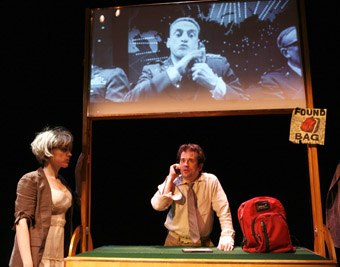
Major Bang: or How I Learned to Stop Worrying and Love the Dirty Bomb, is the show RealTime readers will be eagerly anticipating. New York’s Foundry Theatre looks back to the future through, among others, the eyes and ears of Dr Strangelove and Lenny Bruce (riffing “upon the surreal semantics of the words, ‘war on terror’“). Written by Kirk Lynn, directed by Paul Lazar and performed by actor-magician and Wooster Group artistic associate Steve Cuiffo and Radiohole co-founder Maggie Hoffman, the work was described by the New York Times as “surely the happiest show to have been inspired by the horrors of 9/11.” RT
Foundry Theatre, Major Bang, Adventures 07; Playhouse, Sydney Opera House, July 17-29, www.sydneyoperahouse.com
RealTime issue #79 June-July 2007 pg. 35
© RealTime ; for permission to reproduce apply to realtime@realtimearts.net
Rebecca Cunningham, Chambers
photo Rachel Cobcroft
Rebecca Cunningham, Chambers
CHAMBERS IS THE THIRD IN A SERIES OF EXPERIMENTAL HAPPENINGS ORGANISED BY THE ADVENTUROUS BRISBANE BASED CURATOR/ARTIST REBECCA CUNNINGHAM, EACH OF WHICH HAs SET CONTEMPORARY PERFORMANCE AND SONIC ART AGAINST AND WITHIN CAREFULLY DESIGNED CONSTRUCTS OF INTERVENTION, CHANCE, MULTIPLICITY, IMPROVISATION AND INTERACTION.
Musicircus in 2004 (RT 65, p43) emanated from Cunningham’s deep fascination with the music and philosophy of John Cage. Flux-US in 2006 similarly paid homage to avant-garde tradition, this time extending the scope further beyond sound into intermedia performance. Both shows hinged on often problematic processes of re-enactment, an especially difficult proposition when it comes to highly contextualised radical work. The results can be confusing and amusing; for instance, the classic piano chainsawing act in Flux-US was in reality a fairly tame gesture, but still garnered some requisite notoriety via an unintentionally hilarious piece of sensationalist tabloid moralising in Brisbane’s Courier Mail.
Chambers is Cunningham’s first event to shed the cover of historical precedent and focus exclusively on new work. It’s also the most controlled and exploratory event, structurally and spatially. In six discrete chambers, partitioned by heavy black curtains, six works take place simultaneously, with the audience free to circulate and interact in any manner. The only element formally common to all the works is the set of headphones required to enter each chamber’s distinct sound world.
Chamber 1: Alicia Jones
We enter a dimly lit backstage dressing room. Assorted costumes are hung on a theatre rack. An actress studies herself in a mirror, tries on this and that, and paces the space in dissatisfaction. The transient audience voyeuristically observes the self-consciously awkward nature of these physical transformations. Later I return to the scene: chaotically chopped hair tufts, a circle of bones, a sense of something magical occurring. I have no idea what has happened in the interim.
Chamber 2: Rebecca Cunningham
A video projection of blurred lights, a cityscape gushing smoke, flickering or shivering. This is a disaster scene, familiar enough to anyone who consumes such dystopian news images on a daily basis. Which city is this—could it be any city? This is a chamber without a performer. Empty. The detached, distant, almost anti-social atmosphere is both unsettling and somewhat of a relief.
Chamber 3: Jan Baker-Finch
An intensely focused hobo dancer is dressed in black garbage bags. Chalk-rendered memories or fantasies (in fact, three brief extracts from Samuel Beckett’s Worstward Ho) are scrawled along the floor. A grid of rabbit-shaped plastic moulds forms a wall. We hear the sound of the garbage bags swishing and rubbing, a melancholy sound that intensifies the schizophrenic intrigue of the scene. Inside the headphones, entrancing hypnotic piano pieces (compositions by Philip Glass) begin to generate a total perceptual transformation. In a place of unknowable dysfunction we clearly recognise a synchronous dance to the rhythm of death, loss and perhaps most pervasively, hope.
Chamber 4: Robin Fox
The silent flickering green lasers of classic science fiction. Without sound the eyes are free to absorb even more movement and scope within the impossibly complex and inventive shower of light beams transforming the space. Fox demonstrates the control he has over this stimulating process, creating morphing pulsating concentric circles of light which wrap around the bodies of those who enter, enclosing them in a translucent glowing capsule. Inside the headphones sound and image are re-united, the overarching synaesthetic structure of the contraption revealed.
Chamber 5: Richelle Spence
A pseudo-religious ritual of scrolls, candles, and symbolic costume, presided over incongruously by a power-suited woman, who occasionally breaks into a morose lament for something lost or absent. This spectacle sits uneasily between the private and public: are we voyeurs or participants? Headphones play the tweeting birds of the summer countryside. Later I return to find the performer with fingers spread, a prosthetic glove set alight at the tips. I read a scroll: “something we were withholding made us weak, until we realised it was ourselves.”
Chamber 6: Rebecca Cunningham
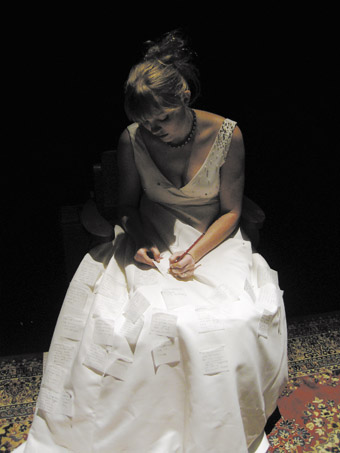
A room divided by displaced rolls of heavy grass on one side and scattered rocks on the other. A woman sits silently in a wedding dress; she inhabits this space as an object, but the space also feels constructed out of her ‘memories’—real or imagined? ‘Family history’ snapshots are pinned to a board made of wine corks. Snippets of incidental conversation and ‘forgotten’ pop music play inside the headphones. This ‘memory room’ is perpetually strung between poles, suspended in a unique tension. Social/isolated. Childhood/adulthood. Silent/sonic. Memory/artifact.
Chambers, curator Rebecca Cunningham; Judith Wright Centre of Contemporary Arts, Brisbane, March 5
RealTime issue #79 June-July 2007 pg. 36
© Joel Stern; for permission to reproduce apply to realtime@realtimearts.net
Mark Knoop, Val Camonica
photo Yatzek
Mark Knoop, Val Camonica
COMPOSER DAVID YOUNG HAS A PENCHANT FOR CREATING MULTIMEDIA WORKS INSPIRED BY INTERESTING LOCATIONS. SCALE WAS INSPIRED BY A DISUSED PUBLIC SWIMMING POOL IN BRUSSELS AND THOUSANDS OF BUNDLED STRAW BY A BUDDHIST MONASTERY IN JAPAN.
Aphids’ new work concerns Val Camonica, a valley in the northern Italian Alps, where thousands of rock carvings dating from 3,000 to 8,000 years ago record the life of the Camunni people—their hunting, tools, houses, rituals and lifestyles. The reinterpretation of the cultural history and imagery of Val Camonica through a suite of music, text and video is an ambitious project artistically, one which itself forms part of the cultural lineage that the site has generated.
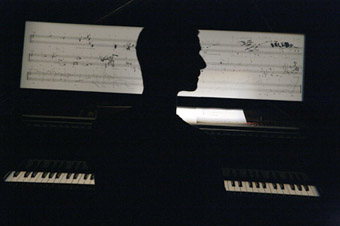
The first of the seven Val Camonica Pieces, Incisioni Rupestri, is for solo piano. Opening with brief, quizzical motifs alternating with long pauses, the colour and intensity build, punctuated with percussive taps on the piano lid and the strumming of piano strings. Mark Knoop’s rendition is scintillating, and while the work might be understood as a programmatic reference to the initial archaeological recognition of the Camonica inscriptions, the writing and the pianism make for delightful music.
The second piece, Inventario, for strings, winds, brass and percussion, extends some of these ideas. The opening bass drum roll heralds a stop-start progression of motifs, each based around various instrumental combinations, suggesting categories of visual form. In the absence of melodic or rhythmic structure, the coherence of the work emerges from Knoop’s precise conducting, through which the inventory unfolds and which also suggests the march of pictorial and cultural categorisation. The Libra Ensemble’s fine playing articulates these musical ideas and Louise Curham’s grainy black and white footage of forest scenes hints at an alternative, cinematic archaeology.
Stile I, II and III, for guitar and cello, is quiet and introspective, dwelling conversationally on particular musical figures. By contrast, the next piece, Roccia, for violin, piano, clarinet and percussion, is energetic and dramatic, personifying the rocky landscape itself. Throughout the Val Camonica Pieces, strings are sometimes bowed so as to make scraping sounds, perhaps suggesting the chiselling of rock. When used with brass, basses and percussion, the scraping creates a gritty earthiness that evokes the harshness of early alpine civilization. In the fifth piece, Sarcophagus, for string octet, it is as if human figures are engaging in ritual exchanges.
Throughout the suite, Young makes frequent use of portamento—slurred or sliding notes and glissandi that might span one or two semitones and sometimes several tones. The effect is to suggest motion, as if the human and animal figures in the rock carvings are coming to life. In the strings, the frequent use of sliding notes together with rapid shifts between bowing and pizzicato, abrupt changes of metre, sudden accents and shifting dynamics create the consonants, vowels, syllables and even the flow of speech, and the listener gains the impression that Young has painstakingly decrypted and translated every detail of the site into note-by-note musical ideas, as if creating new words and phrases from a novel alphabet. This is especially so in the final piece, Animali, an extended violin solo, where Young adds double-stopping and sometimes requires the performer to hold one note while sliding another, creating an eerie multiple voicing.
However, while commencing with conventional notation, a score will typically conclude with graphic elements including transcriptions of the rock carvings. The final passages of the Roccia score comprise silhouettes of animals, requiring the musicians to respond directly to the Camonica imagery. The concluding piece, Animali, is accompanied by a projected image of the score scrolling across the screen, so viewers can see how notation segues into graphic material inscribed on the stave and can thus appreciate how different kinds of abstract markings might be interpreted. Animali draws together the musical ideas of the earlier pieces into an original and eloquent musicality. Violinist Yasutaka Hemmi’s realisation of this piece is breathtaking, and Animali is a significant musical achievement for both composer and performer.
Accompanied by video imagery from the site, the penultimate piece, Val Camonica: an Excavation, is a text written and read by Cynthia Troup that discusses the archaeological mapping of the site and the interpretation of its imagery, and reflects on the “continuity and consistency of human existence” it reveals. In considering how a public, visual record such as Val Camonica identifies and informs cultural evolution, Young and Troup reconsider the theoretical basis and cultural impact of archaeology itself.
Val Camonica Pieces: Aphids in association with the Libra Ensemble, composition David Young, film Louise Curham, text Cynthia Troup; Full Tilt, Arts Centre, Melbourne, May 10-11
RealTime issue #79 June-July 2007 pg. 38
© Chris Reid; for permission to reproduce apply to realtime@realtimearts.net
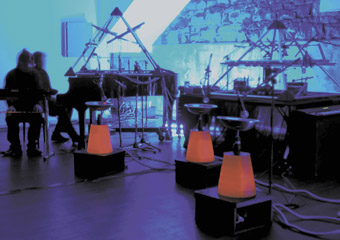
Jay Eusden, James Hullick, Cranky Robotics
photo Matt Murphy and James Hullick
Jay Eusden, James Hullick, Cranky Robotics
THERE ARE STRANGE NOISES EMANATING FROM THE STONE WALLED BASEMENT THEATRE OF THE FOOTSCRAY COMMUNITY ARTS CENTRE, PRODUCED BY AN ENIGMATIC ORDER SEATED IN HIGH-BACKED THRONES, GARBED IN HOODED BLACK JERSEY AND WIELDING MYSTIC POWERS OVER PRETERNATURAL CONTRAPTIONS. ENTER THE REALM OF JAMES HULLICK AND THE AMPLIFIED ELEPHANTS.
The Amplified Elephants have grown out of sound art classes run by Hullick for the ArtLife program which provides opportunities for people with perceived disabilities to experience a variety of artistic practices. Along with the Elephants, Hullick has invited instrument engineer Richie Allen and percussionist Eugene Ughetti to help bring the Cranky Robots to life.
The sound welcoming us into the space is a low machinic drone, like an insistent generator, shifting subtly through tones. Hullick and Liz Hofbauer approach the hitherto unattended mixing desk and start to tune the noise, releasing it to run wild, then catching and taming it, a tug-of-war between human and feedback revealing hypnotic drifting microtonal layers.
Hard on the heels of the sculpted onslaught, Enza Practico enters the space with wind chimes—the simplicity of action and sound working as an aural palate cleanser preparing us for the subtlety of Hullick, Ughetti and Jay Eusden’s study for microphones. Using feedback and effects, whistling, tapping and rubbing, the artists explore texture, surface and the tactility of the microphone, re-inventing it as a responsive poetic instrument, rather than a blunt tool.
These early pieces serve well as preludes to the Cranky Robots, defining an exploratory space where the behaviour of instruments is under serious scrutiny. The next piece, Secret Joy in the Wish Fulfilment of Love uses Whirling Dervishes—instruments made from a spinning metal bowl with a marble inside, activated by an adapted power drill mechanism. The sustained metallic resonance provides the bed for percussive exploration led by Ughetti. The piece, while subject to chance elements—like the marble flying out of the bowl and across the floor—is tightly structured, with Hullick conducting the action, teasing out pleasing layers from metallic drones and vibrations.
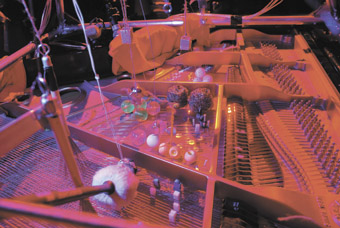
Cranky Robotics, prepared piano
photo Matt Murphy and James Hullick
Cranky Robotics, prepared piano
Particularly intriguing is the Pranky-Ano. Designed to annoy the ‘prima donna’ piano, this pyramidal structure is placed over the strings of the piano with a series of percussive objects strung from levers. Activated from a midi-keyboard, the levers—reminiscent of a giant old typewriter—lift and drop objects onto the strings. At the same time Hullick plays the piano creating delicate gamelan tones, rudely interrupted by percussive agitations. Together the artists and machines become the ultimate prepared piano, a kind of Cagean-cyborg.
The Pranky-Ano developed from the Crank-A-Maphone which, strung like a monster mobile with wind-chimes, wooden boxes, bowls and other resonant junk, has a percussive focus. It too is midi-activated for this concert, which allows each of the Amplified Elephants to play a section in the final work. The piece is tightly structured around sections of Cranka-A-Maphone semi-random cacophony, and the quieter explorations of Ughetti on percussion, the clarity of sounds creating a kind of acoustic pixelation.
Along with the ingenuity and engineering of the machines, Cranky Robotics was impressive in the attention to structure within each piece, utilising every artist’s ability and expression to its optimum and finding a fine balance between control and chaos. The imperfection and unpredictability of the machines offered challenges but also freedoms within compositional process as did the various abilities of the artists defining an intriguing space for exploration—a space for serious play and gentle provocation in which every action is guided by a genuine desire to engage, express and work together to create a little bit of magic.
Cranky Robotics (Jolt Concert 1), director, sound designer James Hullick, percussionist Eugene Ughetti, instrument engineer Richie Allen, Amplified Elephants June Bentley, Jay Eusden, Liz Hofbauer, Robyn McGrath, Enza Practico, lighting Geordie Barker; Footscray Community Arts Centre, Melbourne, May 6
The Jolt concert series continues June 24 with Ernie Althoff, Robin Fox and James Hullick and July 22 with Hullick, Fox, Philip Samartzis and Myles Mumford; bookings Span Community House 9480 1364
RealTime issue #79 June-July 2007 pg.
<img src="http://www.realtime.org.au/wp-content/uploads/art/12/1235_marshall_totallyhuge.jpg" alt=" Michel van der Aa introducing one of his pieces
performed by the WASO New Music Ensemble, Sonic Sights Concert”>
Michel van der Aa introducing one of his pieces
performed by the WASO New Music Ensemble, Sonic Sights Concert
photo Peter Illari
Michel van der Aa introducing one of his pieces
performed by the WASO New Music Ensemble, Sonic Sights Concert
TURA NEW MUSIC DIRECTOR TOS MAHONEY QUIPPED THAT IT SHOULD BE RENAMED THE RIDICULOUSLY LONG NEW MUSIC FESTIVAL. CERTAINLY THE 2007 TOTALLY HUGE NEW MUSIC FESTIVAL WAS BIG—AND VARIED, WITH WORKS BY ESTABLISHED COMPOSERS LIKE ANDREW FORD, AS WELL AS ABSTRACT BASSY TEXTURES FROM LAPTOP SUPREMO ROBIN FOX. SAMPLING THESE EVENTS WAS LIABLE TO GIVE ONE THE BENDS, AS ONE MOVED FROM EXTRAORDINARY, HARD INSTRUMENTALISM BY THE LIKES OF DUO STUMP-LINSHALM, TO FORD’S PASTORAL PIECE INSPIRED BY BRUEGHEL.
For lovers of the weird, the tough, the bizarre or the sonically abstract, the festival occasionally seemed conventional. The Song Company’s selection of works by John Cage was titled Cage Uncaged, but in minimalising the chance elements within these compositions, the company effectively classicised the composer—Cage locked behind formalistic (if musically attractive) bars. Nevertheless, diverse programming produced dizzying heights and surprises in a selection that had something for everyone.
Austrian clarinet duo Petra Stump and Heinz-Peter Linshalm was one such highlight. Seeing the work of the Libra Ensemble in Melbourne shortly afterwards, I was struck by the similar stylistic positioning of the groups in repertoire and approach, both emphasising what I call ‘limit modernism’ in their formal rigour, atonalism and rejection of American minimalism. Often one is left with a series of disconnected, spiky gestures, as well as tiny, timbrel motifs, squeals and small, isolated clusters, that reveal the best of both the conventional use of instruments as well as startling extended technique. Long sections of loud circular breathing punctuated Stump-Linshalm’s playing, while a particular joy was composer Vinko Globokar’s solo for bass clarinet without mouthpiece—a dazzling array of clatters, growls, tubular gasping sounds and tongued stutters, made all the more extraordinary by computer processing and reverb; almost a clarinet version of Kurt Schwitters’ famous concrete poetry work, The Ur-Sonata.
Generally this program was dense and busy, a collection of virtuoso moments and exchanges which, as in Beat Furrer’s piece, created an almost soundscape-like set of textures and a near phasing of elements, while the fracturing and fragmentation of each enunciation was rigorously maintained and counterpointed. From Magnus Lindberg’s overtly performative work (which opened with the ka-whomp of the bass drum before the duo chased each other around the space, mouthing phrases and finally taking up their clarinets) to Claudio Ambrosini’s (vaguely jazzy inflections crushed or held at bay, like a Gershwin piece that never coalesced into true rhythm), this was an invigorating concert which suggested how much noise and texture is still to be discovered within the clarinet.
As part of the festival conference on Sound and Image, Stump-Linshalm offered Christoph Herndler’s fabulous black and white film Streifund, der Blick (Gliding, a Glance) to which the duo played a see-sawing set of off-key tones and gaps with electronics, accompanied by close-up footage of a hand endlessly, painfully and lovingly rubbing every surface of an old, abandoned house—cobwebs, dust and paint falling from the fingers.
Bruce Mowson’s installation Melting Moments was another satisfying surprise. Two screens each showed three shapes nestled within each other (three rectangles on one screen, and two circles in a rectangle on the other) cycling through fluorescent blocks of colour, while a series of sustained tones, mostly in the upper bass register and mids, suffused the space, complemented by hissy sonic materials which built up and receded. Visually, this was Op-Art rendered as mobile, video candyfloss. Mowson explained in his presentation at the conference that Melting Moments aimed at a disconnect between sound and image. Although both the sonics and the visuals gradually evolved and changed, both were random and did not trigger each other. Audiences were invited to construct whatever relationship they wished between these arbitrarily conjoined materials. The very superficiality of the sound and image relationship created an unbounded space for affect, pleasure and interpretation.
WAAPA’s Cat Hope reminded us how early experimentation in ultra-low frequency film scores occurred in cheesy disaster movies like Earthquake. Darren Jorgensen described the scrambled sampling found on Nurse With Wound’s Sylvie and Babs as Surrealist—one can listen to and interpret it forever precisely because it has no structure. I attempted to enunciate a new rhetorical strategy for discussing sound art, not in the usual terms of immersion, depth or an infinite series of layers, but rather as what Siegfried Kracauer called the “mass ornament”—a machinic structure which fundamentally refers back to its own superficial elements, rather than generating Romantic depth.
Robin Fox offered a brief history of combined sound and image instruments, including 19th century organs attached to racks of bottles of different coloured water illuminated by candlelight. He then charted how he is exploring the ever more precise synchronisation of sound and image by linking his laptop bass textures to a single-point laser, projected through smoke as a series of violently cut-off changes in shape and form. Fox’s live performance literally shook the building and riddled it with green, pinprick shafts.
Conference keynote presenter, the Dutch composer Michel Van der Aa (RT 78, p41) showed recordings of his work, while live performances were offered by WAAPA’s Resonator new music ensemble and the WA Symphony Orchestra. Dramaturgically, Van der Aa’s compositions tend to represent the individual, or his or her instrumental representative, in a conflicted dialogue with technology, replayed recordings of these performers in the works, or with computer processing of the live materials. In Auburn for example, the dulcet tones and hispanic lilt of the solo classical guitar became alienated, assaulted and lost as they were embedded within an increasingly pressing, electronic wasteland of textures and clicks.
Van der Aa’s film works (as in Passage, his portrait of an isolated old man, or One, his work for a soprano and her audiovisual double) consistently use the fracturing of tempi, voice or instrumental line to depict madness and neurosis. His work is, in this sense, modernist in ambience, and is thus most effective when furthest removed from such relatively familiar readings and scenarios, focusing rather on relations within the ensemble itself. Quadrivial for example offered such rich sound worlds as the frenetic up/down repetition which recurs in much of the composer’s work, but here placed amidst small, angular, dissonant scenes which (the performers deliberately enacting a number of false starts) grew into longer sequences and then a series of unison clashes and attacks. Also interesting is the way this use of live recording and playback could be read as suggesting that the orchestra itself is a kind of massive, dysfunctional music box.
In the Here trilogy, this lumbering symphonic machine was carried from hissy, clunky analogue accompaniment to glitchy, slippery digital sounds, the electroacoustic elements recapitulating their own formal history. Against this, the orchestra repeated and reworked grabs of material, breaking them and sharing them amongst clusters of instruments, before the whole thing collapsed and emptied out, ending with the players frozen, bows raised, waiting for that last note that will never come. Beyond the commonplace tragedy implied here, there were many arrested sounds and motifs that evoked much more than the 1950s cultural world otherwise suggested, making Van der Aa’s admixture of baroque instrumentation and atonality, his clustering and texturing and performative execution highly intriguing.
After these orchestral complications and Stump-Linshalm’s unalloyed formalism, it was a relief to take refuge in Philip Brophy’s kraut-rock road-movie score to the 1960s film Le Révélateur (RT 72, p21). Brophy may not today be doing quite such complex work as his 1999 Cavern of Deep Tones, but his ‘glint’ drum-pad sounds for the Beautiful Cyborg project and the use of Dave Brown’s solid guitar lines for Révélateur provided just the right amount of popular sonic languages within the aesthetic rollercoaster that was Totally Huge 2007.
Totally Huge New Music Festival and Conference, Perth, April 20-May 6, www.tura.com.au/events/totallyhuge
RealTime issue #79 June-July 2007 pg. 40
Van Sowerwine’s Small Beasts
STILLS, IN ITS CAPACIOUS CONVERTED WAREHOUSE IN SYDNEY’S PADDINGTON, HAS BEEN A RARE COMMERCIAL SUCCESS IN art PHOTOGRAPHY, FEATURING A STRONG STABLE OF AUSTRALIAN ARTISTS, EXPORTING THEIR WORK AND INTRODUCING OVERSEAS ARTISTS TO AUSTRALIAN AUDIENCES AND BUYERS. I MET WITH OWNER-DIRECTOR KATHY FREEDMAN, CO-DIRECTOR BRONWYN RENNEX AND CURATOR SANDY EDWARDS TO DISCUSS JUST HOW A COMMERCIAL PHOTOGRAPHIC GALLERY HAS ADAPTED TO THE AGE OF PHOTOMEDIA. ALTHOUGH THEY COME FROM DIFFERENT BACKGROUNDS AND HAVE IDIOSYNCRATIC TASTES, THE TRIO EXUDE A COLLECTIVE PASSION FOR THEIR ARTFORM, PICK UP ON EACH OTHER’S THOUGHTS AND PASSIONS, COMPLETING OTHERS’ SENTENCES WITH AN EASY FAMILIARITY. THEY DECLARE THEIR SHARED COMMITMENT TO AN EVOLVING MEDIUM AND TO THE ESTABLISHED ARTISTS THEY REPRESENT AND THE EMERGING ONES THEY SEEK OUT.
The current Stills exhibition features sculptures (small dog scale) made by Van Sowerwine with accompanying photographs of the same creatures in their natural habitat, pockets of lush bush in an urban setting. You approach one on its plinth, sneak a touch of its soft, pink skin and peer into a wound-like hole on its forehead where you glimpse miniature video images of the creature’s thoughts—foliage, other beasts and a slurry of moving brain matter. As usual with Sowerwine this is a grimly comic experience, if certainly less dark than previous works. Van Sowerwine’s creatures may be cute and toy-like but they are also alien presences. In an adjoining space we watch bracing, raw black and white videos on screens large and small by US artist William Lamson of thwarted human endeavour where, for example, a man tries to keep pace with a giant paper dart flying over him on a nighttime landscape. This combination of photographs, sculpture, video and installation is now part of the photographic gallery experience, and although the phenomenon has been in evidence for quite a while, it is currently in a state of acceleration.
adaptation & survival
Kathy Freedman recalls that the move in 1997 from a small terrace house to the former film studio which now houses Stills was motivated by a need for space in which to show large scale (an enormous image by Emil Goh in the opening show), multimedia works (a Merilyn Fairskye video installation in the same show) and series of images (Pat Brassington). But it was only this year that Stills invested in a large video monitor: “We’d managed to get by without owning the equipment until now—it was the artist’s responsibility to chase it up”, says Edwards, to which Freedman adds, “we need to commit if we are seeking out artists working with the moving image and for our existing artists who are starting to.” But there’s a larger issue at stake.
“To survive as a gallery,” explains Freedman, “we needed to attract a lot more collectors of contemporary art, people who see photomedia and photography as embedded in contemporary art. We just don’t have the population in Australia of people who collect straight photography.” This has also meant broadening the kinds of artists Stills represents, “something we anticipated 10 years ago as photomedia began to move to the forefront of contemporary art. But it’s only in the last three years that we’ve been really moving in this expanded area—Merilyn Fairskye had been our main artist working in moving image and installation.”
Edwards comments that Rennex “has had a lot to do with that, tuning into the people doing work of that nature. Kathy and I come out of a slightly different tradition and a majority of our artists continue to work in still images mounted on walls.” To which Rennex adds, “and there’s still a lot to get out of people working that way.”
Freedman thinks the market for moving image is growing: “shows like the Anne Landa Award at the Art Gallery of New South Wales are good for this. We took on Van Sowerwine after seeing Play With Me, shortlisted in the first show. This is the first William Lamson showing in Australia; he’s still reasonably young.”
emergence
Rennex says that in expanding the range of artists and the kind of works Stills engages with, the gallery “has used its first exhibition for the last two years to feature emerging artists—this year Peter Volich with his framed football jerseys with small found photos, Daniel Kotja’s installation and photographs and, the year before, Martine Corompt with her vinyl wall pictures and projection and Van Sowerwine with her crank-handle animation. This first show of the year for me has been about opening the door a little more—still photos are just one part of photomedia now.” Freedman recalls that there was a time “when we felt constrained by the photograph on the wall. Now there’s a problem we’ve been grappling with, our name—Stills. What name could we adopt that would reflect what we’re doing?”
digitally unreal
When I comment on the magic of recent digital photography, its heightened detail, unusual texturing, painterliness and various effects, Edwards makes the observation that “in the past we thought we had a notion of what was real in a photograph, but now the digital realm has created a situation where people come at the image from another angle, asking, Is this a photograph? They no longer believe in the veracity of the photograph.” Freedman adds, “Everything is read as digital now.”
Many photographers now work digitally, but not everyone, says Edwards citing the example of Stephanie Valentin “who uses an electron microscope to put words on pollen grains and then photographs that.” “You think it must be something created digitally”, says Rennex, “but it’s not.” Edwards explains: “The old processes still remain in the mix. Valentin is using a method equivalent to a photogram (when you place an object on the paper), but she’s putting the object in front of a projector and passing light through it. It hits the wall, it’s made large—so she’s inverting the scale—there’s nothing digital, it’s all manual, but mysterious.” Rennex mentions that Christine Cornish “who once would have laboured over a silver gelatin print, produced her last show using pigment prints—but Pat Brassington and Robyn Stacey have been working digitally for a long time as part of their whole process.”
“We have great fun with Pat Brassington’s images”, says Freedman, laughing, “asking, What is that thing, that disgusting thing? Looks obscene. But Pat rarely tells us. If she does, it’s an incredibly prosaic description—a sock filled with something.” Edwards describes Brassington “working with her negatives from the past, whatever’s there, whatever mess is on the negative, scanning them and creating a whole new object in the computer. So it’s about her imagination in relation to the past, which we don’t know about and she doesn’t want us to.”
selecting & selling
The trio agrees that selecting and taking on an artist is very personal. Freedman recalls Rennex putting forward Roger Ballen [RT 75, 52] with his dark humour and strangeness: “I looked at the book and thought I love this work, but I don’t know if it’s going to sell. In fact it has sold to institutions and private collectors—not all of them work from that particular show.” It was the first serious look at Ballen in Australia; for some “he came with a reputation and a number of books”, says Rennex, and for others, says Edwards, “the response was immediate even if they hadn’t heard of him.”
Edwards praises Freedman “for never showing just on grounds of commerciality. You don’t know what’s going to take off. You go on your instinct and interest and love of the work and you wouldn’t want to be showing anything you didn’t like. Success reveals itself over time. Certain artists rise to the top as good sellers, and we’ve got a fair few of these and you depend on that. Then others come in and you grow them and they get picked up or not. There are so many factors…Artists “see us as a lifeline—it’s a very mutual relationship.”
balancing acts
Freedman says running Stills is all about balance—established/emerging, national/international, photography/photomedia—but also “the balance of our personalities.”
I ask the trio to talk a little about their relationship with photography. Kathy Freedman tells me, “My background is in psychology and I worked for many years as a psychologist before taking on the gallery. What I notice in me is gravitation towards quite disturbing works. There certainly needs to be some sort of emotional, not necessarily overt, content that stays in my mind—Brassington and Ballen appeal in particular and Trent Parke’s Minutes to Midnight series, which has been my favourite work of his—a travelogue of Australia but a view of its dark side.”
Sandy Edwards describes herself as “coming from a traditional documentary background and it’s never left me. I still love the image. And also, having been a photographer, learning how to make perfect images, expose and print them correctly, never quite leaves you. I still see the skill in making an image which is an imprint from the world in some way. There’s a huge range of work within that category and I’ve got particular tastes in it, but I still love the image on the wall that tells you about the world we live in.”
Bronwyn Rennex says she “responds mostly to work that suggests ruptures in civilisations or failures—because photography is so often used to sell things and to make things appear perfect. It’s always a relief for me when there’s an idiosyncratic voice that speaks about imperfect things or that escape social structures. Lamson is an example of work about failure—a reminder of what it is to be human. And it’s in my own work, about things that run under the surface. In Always Hungry (2001), the very act of trying to satiate oneself is self-defeating. The more you want the less you have. And for me the shadow self is more honest than the surface self.”
Despite these different perspectives, Rennex says that the trio’s tastes often coincide. “There’s quite a big overlap”, Freedman confirms. There was, for example, unanimity on the forthcoming Magnum 60th Anniversary show which includes Alec Soth (USA). Rennex says “He captures not just Niagara Falls but the mythology, the hopes and dreams laid on that place.” His work reminds Freedman of Wellington-based Anne Noble’s Antarctica (Stills, April-May 2006) which looked on the surface like a straight documentary but “juxtaposed images from Noble’s Antarctic residency with those of museum dioramas representing that polar world.”
photomedia ecology
The trio feel that sharing audiences and market with other galleries is a good thing for Stills and for photography in general. Rennex notes that “the MCA has had a lot of photography shows in recent years and arts magazines have been focusing on it.” Freedman mentions Roslyn Oxley9, exhibiting photography for many years, and the Sherman and Gitte Weiss galleries, and says, “the major institutions have been incredibly supportive of us and our artists.” Edwards sees this spreading connectivity as “a slow growing relationship—we’re in touch with the key curators and there’s a lot of to-ing and fro-ing, discussing things. Australian photography has been enjoying a heyday in the last 15 years in the way that Gail Newton (NGA) was fighting to achieve in the early days. Photography is now up there with any other medium and has realised itself. As a result a lot of artists have chosen to work with photography.”
Freedman comments, “it was a divide, between photographers and artists who work with photography.” Edwards enlarges, “There was a big politic there but it has moved on a bit. For example, a lot of group exhibitions have brought documentary back into the field after it had been excluded for a while and now documentary’s manifesting in very different ways. These photographers have got wise. They’re using large scale images and installation.” “They’ve evolved too, necessarily”, adds Rennex. “To the extent I’m happy about doing the Magnum show. It feels like a real shift”, concludes Freedman.
www.stillsgallery.com.au
RealTime issue #79 June-July 2007 pg. 41
© Keith Gallasch; for permission to reproduce apply to realtime@realtimearts.net

Wiebke Leister, from the series Ticklish Relations (2004-2005)
“[THE JOURNALIST] IS A KIND OF CONFIDENCE MAN, PREYING ON PEOPLE’S VANITY, IGNORANCE OR LONELINESS….” (JANET MALCOLM, THE JOURNALIST AND THE MURDERER). IN THEIR NOTES ON THE ETHICS OF PORTRAITURE, BRITISH PHOTOGRAPHERS ADAM BROOMBERG AND OLIVER CHANARIN SUGGEST WHAT MALCOLM TERMS THE “MORALLY INDEFENSIBLE” PRACTICES OF JOURNALISTS ARE AKIN TO THOSE OF PHOTOGRAPHERS. LIKE MANY ARTISTS IN 1+1=3 COLLABORATION IN RECENT BRITISH PORTRAITURE AT THE AUSTRALIAN CENTRE FOR PHOTOGRAPHY, BROOMBERG AND CHANARIN TAKE THIS ISSUE TO HEART.
Aiming to undercut the touristic nature of photographing the institutionalised, Broomberg and Chanarin hand the camera’s long release cable to their subjects. By giving patients in a Cuban psychiatric hospital the right to determine when their image is captured they reveal starkly different attitudes to the camera. Maria reclines on a cold floor against a wall painted ubiquitous ‘hospital green.’ She’s wearing a shapeless blue gown; her plastic thongs are logo-ed with a leaping big cat, a tiny emblem of freedom. Her expression is poignant and fragile, whereas Mario, an elderly man, turns his back to the camera and young Oreste, in striped pyjamas looks wired and exuberant as he takes his shot. It’s unclear whether this spontaneous method completely overturns the exploitative qualities of photographing the vulnerable, but the resulting portraits highlight the complexities of representing any essential or stable ‘self’, whether the subjects are grappling with this or not.
Anthony Luvera also delegates his photography, giving cameras to the homeless who document a very particular mise en scène. Their rough colour images convey the transience and movement that characterises straitened lives in London—a small, dull room with a single bed, an alley lit by a shaft of meagre light, a graveyard, a covered body on a footpath (asleep or dead?), roadside memorial flowers, the empty cardboard insides of a street ‘home’ and a structure hidden among wildflowers and weeds. These frank and distinctive prints show streets and landmarks as a kind of interior, an exiled space, a home where the human subject is, for the most part, missing.
Wiebke Leister’s tableau of c-type prints, Ticklish Relations (2005-6), provokes us to consider our complicity in watching young children writhe in the tortuous pleasure of being tickled. “Exploring the gap between expression and emotion”, Liebke’s five colour portraits show writhing naked torsos and ambiguous grimaces of pain or delight. The viewer is immediately drawn into this “collaborative triangle” because of the sensual qualities of toddlers’ flesh and their subjection to the tickler’s physical power. We can’t help wondering: who’s getting the most pleasure from this game?
In Groups and Locations, Melanie Manchot’s arresting large-scale colour shots, Russians face the camera with cool, assessing gazes. At Manchot’s iconic Moscow landmarks the ground is eerily clean-swept, so the sites resemble studio lots and the staring crowd evokes the dazed advancing zombies of horror films. In Aeroflot (2004), citizens are arrayed on a Soviet era tarmac around a plane. A vapour trail seams the sky and a decommissioned rocket looms up from the stark white terminal behind. The estranged quality of this street photography suggests the otherworldliness of modern Russia, whose cultural and social life still seems, to the Westerner, shrouded in Cold War mystique.
“I have a sneaking suspicion that all work is really collaborative but one person really takes the credit…,” says Paul Jeff whose DVD, More Beautiful Than God (2004), exposes his collaborators in a drink-fuelled game of self-conscious strip poker to an urgent orchestral score. Jeff concisely sums up the nature of each photographer’s interrogations in the ACP’s sharp and thought-provoking show.
Given the collaborative nature of the ACP exhibition, I imagine its photographers would concur with fellow British artist Craigie Horsfield’s claim, “All art is, in some sense, conversation.” Horsfield’s show Relation, at the Museum of Contemporary Art, covers 35 years of photography, film and sound work. His oeuvre is broad and impressive—from small, oil-painterly still lives of dried and decaying vegetables, flowers and fish to a nine and a half hour meditative colour video, El Hierro Conversation (2002), featuring mist-veiled, dripping pine forests and an artisan hand-making fresh cheese. Yet each work shares a contemplative, atmospheric quality, a compelling moodiness apparent in content and production technique. Preoccupied with “slow time”, Horsfield develops some of his photographs years after they were taken. David Ebony writes, “Alluding to the nearly imperceptible evolutions in everyday life, slow history and slow time lie beneath the surface of culture and contrast with the high-paced changes dominating the surface…” (Slow Time and the Limits of Modernity: Craigie Horsfield and Fredric Jameson, Lacanian Ink 22).
<img src="http://www.realtime.org.au/wp-content/uploads/art/12/1238_juchau_horsfield_install.jpg" alt="Craigie Horsfield, installation, left image – Rynek Glówny, Kraków, March 1977, 1991,
right image – Susan Smith, Ashbridge Road, East London, September 1969, 1994″>
Craigie Horsfield, installation, left image – Rynek Glówny, Kraków, March 1977, 1991,
right image – Susan Smith, Ashbridge Road, East London, September 1969, 1994
photo Jenny Carter
Craigie Horsfield, installation, left image – Rynek Glówny, Kraków, March 1977, 1991,
right image – Susan Smith, Ashbridge Road, East London, September 1969, 1994
Horsfield’s large-scale black and white print, Rynek Glowny, Krakow, was shot in 1977 but not developed till 1991 and shows an old building in the city’s central Grand Square. Its façade is partly obscured with scaffolding and the dark boughs of leafless trees. While the scaffold suggests decay and reconstruction (the square dates from the 13th century), two large portraits on the building conjure up a more human history. These 1930s faces—a dark-haired woman and man—remind me of the ‘found photographs’ from the Holocaust that Christian Boltanski uses in his many installations highlighting the lost, the nameless and the disappeared. Horsfield’s Rynek Glowny suggestively captures all the haunting, layered qualities of those old European towns where reconstructions uncover as much as they repair.
I discover later that the portraits are of Janek Krasicki and Hanka Sawicka, aged 25 and 27 years. They founded the communist League of Young Fighters in 1942 and were subsequently murdered by the Gestapo in Pawiak prison in Warsaw.
In an adjoining room a series of huge gelatin silver prints portraits line the walls. They have a deceptively timeless quality—though calm Isabel Sametier of Barcelona (1996) with her dark, Modigliani eyes looks slightly more contemporary than Bartomeu Mari of Rotterdam (1998) with his 60s, heavy-framed glass-bottle lenses, a slightly startled expression on his half-turned face. It’s this very floating, a-historical quality of human emotion and composure that seems to preoccupy Horsfield.
This quality is also evident in the more obviously contemporary colour series, Broadway-muted stills from a film at Ground Zero, New York in 2001. Shot in dusky light, these close-ups of faces staring, presumably at the scarred remains of the World Trade Center, turn us from the literal traces of the catastrophe to peer instead at its human impact. Horsfield’s use of colour and tone—dense, grainy, muted, framed in darkness—gives his work a stately gravitas. A group of men gaze in different directions, one with his head slightly bowed, another has lowered his camera to stare instead through his glasses. In making the viewer a spectator twice removed, the Broadway series powerfully conveys what the repeated motif of the falling towers cannot: the emotional aftermath, the struggle to comprehend. And yet, the voyeur in us also can’t help pondering, what exactly are they looking at?
As I move through Horsfield’s exhibition I stumble across schoolkids lying on the gallery floor ready to sketch a majestic rhino (Zoo, Oxford, 1990) with its beautifully lit, warty hide and shadowed ribs. “Imagine you’re a scientist and you need to describe the skin, the horn, the ears…”, their teacher exhorts. But there’s so much more than this in Horsfield’s attentive studies of animals and humans, because even here, the rhino, head bent toward the straw covered floor of its enclosure seems somehow doleful, defeated. Perhaps that’s because I know it’s captured, or because, wrinkled and worn, it looks slightly done in. The rhino is poignant, like the man in Estery Krakow (1979), sitting pigeon-toed on a wooden bench, cigarette in one hand, spent butts at his feet, who seems to be taking a puff from a giant inhaler. The smoking asthmatic in the inky night.
One of my favourites in the exhibition is the beautifully rendered, circular composition of a bullfight at Placa de Toros La Monumental, Barcelona (1995). Four toreros surround a bull, their capes outstretched, the braiding glinting dully on their costumes. So soft and imprecise are the lines in this image, so dark the outline of the cornered bull, that it looks like a sketch in charcoal. Shot from above, this work has an alluring flatness and its decorative quality seems to comment on a 300-year-old tradition whose enthusiasts must presumably ignore or abstract the suffering to appreciate the grace and machismo of the display. In Spain animal rights concerns mean the bullfight’s days are numbered. So Horsfield has (perhaps inadvertently) captured another historically dense and layered moment, by depicting a dying ritual with suffering at its heart. And in this image full of movement, as in many others, time seems somehow slowed, and not just for the cornered bull.
1+1=3 Collaboration in Recent British Portraiture, curator Susan Bright, Australian Centre for Photography, Sydney, April 20-May 26; Craigie Horsfield, Relation, Museum of Contemporary Art, Sydney, Mar 16-June 3.
RealTime issue #79 June-July 2007 pg. 42-
© Mireille Juchau; for permission to reproduce apply to realtime@realtimearts.net
James Geurts, 90 Degrees Equatorial Project. Lightboxes 1 and 2 of 4
JAMES GEURTS’ COMMITMENT TO ABSTRACTION BEGAN WITH A DECISION TO VISIT FOUR CORNERS OF THE GLOBE. DEVELOPING HIS 90° EQUATORIAL PROJECT, GEURTS DREW A SQUARE AND PLACED IT OVER A GLOBE, PINPOINTING FOUR LOCATIONS AT ABSOLUTE 0° LATITUDE, EXACTLY 90° FROM EACH OTHER ALONG THE EQUATOR. THE DESTINATIONS HE SETTLED ON WERE DECIDED ARBITRARILY, HIS ONLY PRECONDITION BEING TO FIND FOUR COORDINATES THAT WOULD STRIKE DRY LAND, IN ORDER TO POSITION AND PHOTOGRAPH A SCULPTURE FIXED AT RIGHT-ANGLES TO THE HORIZON. BY ALIGNING ALL FOUR PHOTOGRAPHIC HORIZONS, THE ANGLED SCULPTURES WOULD FORM A PERFECT SQUARE, OR AS GEURTS’ PUTS IT IN HIS SYNOPSIS: A “CIRCLE-FRAME INTEGRATED.”
Finding four equidistant points on dry land proved to be a significant obstacle. At one location the artist considered building a pontoon. With help from a local friend, Geurts finally fixed on an atoll in the Pacific Ocean that would provide him with a short window to photograph the installation. The coordinates he finally settled upon have a bearing of 100° East (Koto Padang, Sumatra, Indonesia), 10° East (Kango, Gabon, Africa), 80° West (Pedernales, Ecuador, South America) and 170° East (Kiritimati Atoll, Pacific Ocean).
For an imaginary line measuring the equidistant point between the two poles, the Equator has affected some superstitious behaviour. Ancient mariners and modern sailors alike have performed bizarre and often brutal crossing-of-the-line ceremonies, including ritualised beatings, electrocution, walking on hands and knees whilst being pelted with rotten fruit, having one’s head shaved into checker-board patterns, and kissing babies’ bellies covered in axel grease. Off the map, this ‘great circle’ enthralled modern romantic novelists and over time has collected its share of popular myths casting it as a virtual realm in which compasses spin, adventures begin, lost civilisations are discovered, and wash basins drain in the opposite direction.
Whilst Geurts experienced no shortage of adventures negotiating unfamiliar geographical and cultural terrain, the resulting series of photographic sculptures, printed works, and in-camera drawings say nothing of these encounters, showing instead a remarkable dedication to formalist aesthetics and a steadfast resistance to pictorial travelogue. The triangular fabrications Geurts brought to each location are coloured with bold stripes, fashioned after iconic works of abstract minimalism. They are lit from the inside and as such appear to be surreally self-contained: fascinating objects in stark contrast with indifferent and relatively mundane situations. Aesthetically and conceptually, the presence of these objects reveals a unity of purpose, although the reason for their existence remains completely inscrutable. In a less portentous way, their presence reminds me of Stanley Kubrick’s infamous monolith in 2001: A Space Odyssey, compelling as nodes on a route-map of a psychological journey, superimposed upon a geographical one.
The documentation of these temporary installations has been made into photographic light-boxes that float across the floor of the Experimental Art Foundation Gallery in a series of pontoons. Hovering above, from a god-like perspective, an imaginary equator is depicted along with an imaginary ‘frame.’ It is difficult to asses how independently the aesthetic potency of these images within 90° Equatorial Project stands against the extraordinary nature of the process, discussed in detail in an artist talk Geurts presented at the gallery.
At each location the artist committed a series of drawings to paper as abstract impressions of place. A continuum of these was printed into a long foldout artist’s book titled LAT. 0°`0`0. This assembly of mark-making, collaged paper and photographic imagery is an intimately expressive accompaniment to the resolute objectiveness of Geurts’ light-box pieces. A four-panelled video work, Continuum #1, #2, #3, #4, was produced by videoing a non-representational photograph taken at each location and then manipulating the circuit board within the camera during the live-feed. The result is a subtle abstract-impressionist piece that in a minimal sense is suggestive of tidal forces and shifting horizon lines. Continuum isn’t a stand-alone piece but contributes a necessary dynamic quality to the exhibition. There is no such thing as a fixed coordinate in physical space since nature and perception are always in motion.
Other works within the exhibition were engaging but seemed somewhat peripheral, possibly due to their placement in the gallery out of visual range of the other pieces. Equatorial Slide Show is a carousel of contemplative drawings, photographs and digitised abstract images marking the perception of time with each slide. The content here is a little incongruous and seems to belong to another show, although the tempo of the slide projector and the hum of the video installation is delicately drawn together by an over-arching sound work for the exhibition, developed in conjunction with Michael Yuen. This piece, along with a vaporously fine blank square on the back wall of the gallery, provides a subliminal unity to a potentially fragmented display of works.
James Guerts, 90° Equatorial Project, Experimental Art Foundation, Adelaide, April 19-May 19
RealTime issue #79 June-July 2007 pg. 44
© Samara Mitchell; for permission to reproduce apply to realtime@realtimearts.net
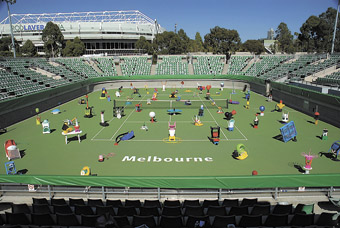
Louise Paramor, Show Court 3
photo John Brash
Louise Paramor, Show Court 3
WHEN REORGANISING A GARDEN SHED FILLED TO THE BRIM, YOU OFTEN START WITH THE ‘WHAT FITS INSIDE SOMETHING ELSE’ SYSTEM: YOU JAM THINGS IN THINGS. OBJECTS SQUIRM UNCOMFORTABLY AGAINST ONE ANOTHER, COMPACTED TO DENSE MATTER UNDER THE COLLECTIVE WEIGHT OF FORCED COHABITATION.
Louise Paramor’s plastic, lolly-coloured sculptural combines often do slip seamlessly inside or against one another, as though an obscure yet universal customisation of random plastic objects has been going on behind our backs.
Paramor’s sculptures obtain strong spatial presence, whilst avoiding forced density, due to her inversion of any pragmatic stacking process. The air around and through these works, the gaps under and in between, never appear as incidental results of an incomplete jam. Instead these objects collude with space, nudging it and toying with it, enabling it to support the work, with negative space acting as a vital formal and psychological component.
The combinations of found plastic forms never appear particularly tenuous or topsy-turvy despite their light-weight materiality and the chunky globs from her hot glue-gun that stick some of the bits together. There should be the logical possibility of disastrous moments, such as the pink plastic chair wedged into the distorted plastic bin suddenly shooting up into the air. But these works maintain such visual stability that they instead achieve monumentality. The equality of positive and negative space creates a fixed presence and command of space that plays beautifully with the carnival quality of Paramor’s lurid hues and playful oddness.
The formal precision of space within the works, seen in highly considered compositions that retain visual balance from all perspectives, was mirrored in their placement in this case across a tennis court. Curator Jane O’Neill’s sophisticated visual flows open up various navigational pathways. The setting is an apt one: like the sculptures, tennis is a game. Both are reliant on precision and a response to the air—the atmosphere—that the ball or the viewer navigates.
The court environment echoed the synthetic nature of the sculptures and the uniform greenness and white lines visually activated the negative spaces of the works. The installation in turn partially transformed the tennis court into an abstracted, formalised space. Similarly, Paramor converted plastic chairs, baby’s bathtubs and balls into shapes and blocks of colour, without disguising their initial functional purpose.
The first view of the sculptural installation was from above, looking down on the expanse of works. The overwhelming richness of visual information from this vantage point was transfixing. Stand and look, circling the court from the first row walkway, or quickly circle to the staircase down on to the court? People drifted from one work to another, circling back for another look, their movements zigzagging and bouncing around. Paramor and O’Neill had concocted a situation which seduced the viewer into enjoying both the panorama and the specifics of each sculpture. Having navigated this oddly elegant display of garden shed debris, I found it best to retire to the bleachers to enjoy watching others do the same.
Louise Paramor, Show Court 3, curator Jane O’Neill, Rod Laver Show Court 3, Melbourne, April 20
RealTime issue #79 June-July 2007 pg. 44
Arlo Mountford, Or Nothing
THE HISTORY OF ART WILL NEVER BE THE SAME ONCE ARLO MOUNTFORD IS THROUGH WITH IT. IN SIMPLE TERMS HIS OEUVRE IS THE FILM ADAPTATION OF ROBERT HUGHES’ THE SHOCK OF THE NEW FILTERED THROUGH THE EYES OF TREY PARKER AND MATT STONE OF SOUTH PARK FAME. THESE ARE WORKS THAT WOULD KEEP ANY ART TRIVIA QUIZ FAN BUSY INDEED, AND THERE IS A KIND OF DELIGHT IN TRYING TO ACCUMULATE THE NAMES AND IMAGES THAT APPEAR ONE AFTER THE OTHER AND THE CAMEO APPEARANCES OF SUCH ART STARS AS THE GUERILLA GIRLS AND JEFF KOONS.
But there is also a serious side to Mountford’s outlandish animations as he traces the history of modernism and postmodernism through the gallery system, wryly commenting on the roles of curators along the way. Nothing, or perhaps everything, is sacred in Mountford’s bizarre mis en scenes. His works balance on a razor’s edge between homage and slapstick, between a keen eye for the intelligent subtleties of contemporary art and the sometimes farcical nature of our genuflection before them.
Mountford’s truly unique animations have become increasingly well-known, featuring in exhibitions at the Adelaide Biennial (2006); Heide Museum of Modern Art (2006); MAAP (2006); and Conical (2006). For his exhibition at Gertrude Street, The Flux of the Matter, Mountford employed his trademark slapstick humour in a selection of new animation works, a live computer work, and a kinetic sculpture.
Arlo Mountford, Or Nothing
Mountford appeared on the scene in 2006 with the extraordinary work The Pioneer Meets The Wanderer. The work begins with two simplified black figures on a beach. The bright ultramarine waves ebb and ooze in an hypnotic dance before something improbably emerges from the ocean depths; due to the bizarre context it takes a few seconds to realise that this is Duchamp’s 1913 Bicycle Wheel, the original of which is lost. But now we find that it made its way from Paris to the Antipodes, thus unleashing all sorts of hybrids and mutants. Unaccountably, when the sun-bakers get up to leave the beach they are transported into the interior of a museum where the real adventures begin.
While there are numerous references to international modernism, this is essentially Mountford’s history of Australian art. We travel from McCubbin and Bunny in the National Gallery of Victoria into the modernist interior of Heide, home of John and Sunday Reid and designed in 1963 by Melbourne architect David McGlashan. Along the way one of the characters exclaims “I feel awful”, referencing the character of Miranda in the 1975 film Picnic at Hanging Rock. Along the way we bump into Tucker, Brack, Boyd, Hester and Nolan—all swapping heads in a wry comment on the incestuousness of the Angry Penguins. Towards the end we witness Mike Parr’s famous arm-hacking performance. There’s a kind of exhilaration to picking the references.
Or Nothing, the key work in The Flux of the Matter, takes us on a guided tour of the European and American avant garde. Duchamp’s renowned urinal adorns the wall while an Andy Warhol Brillo box sits on the floor. They become strangely contemplative images as a filmed human youth dashes about with a mobile phone, seemingly impervious to two of the more shattering moments of modernism.
The third icon here I managed to get wrong, convinced it was a reference to Joseph Beuys explaining art to a dead hare, but in Mountford’s notes it transpires that this is a reference to Martin Kippenberger who has oft been described as Germany’s ‘bad boy’ of contemporary art.
The protagonists of this ‘art tour’ are the Swiss artists Peter Fischli and David Weiss and Mountford’s depiction of the artists refers directly to the duo’s 1983 performance The Right Way featuring the pair dressed in rat and bear costumes. Resembling Terence and Philip of South Park, Mountford’s figures engage in any number of interactions with iconic artworks, riding Jeff Koons’ Balloon Dog, wearing Paul McCarthy’s Santa and Chef hats, Jake and Dinos Chapman’s penis, Sarah Lucas’ finger, and shitting text in a reference to Guy Debord’s Memoirs. It’s all hysterically funny and strangely disturbing in its utter irreverence.
There is also a central reference to Chris Burden’s 1985 installation Samson, in which the artist installed a 100-ton jack in the gallery space, pushing massive hunks of timber against the gallery walls, threatening to bring down the museum. The jack was triggered by viewers going through a turnstyle—making the art-lovers complicit in the destruction of the gallery.
Mountford is doing something similar. While less visceral, he dissects the gallery, simultaneously treating the art works as indisputable works of aesthetic and intellectual value (simply by including them) and then allowing his simple black figures to run amok in the space, irreverently appropriating and recontextualising the icons as playthings, props in an ultimately postmodern comedy.
Arlo Mountford, The Flux of the Matter, Gertrude Contemporary Art Spaces, April 13-May 12
RealTime issue #79 June-July 2007 pg. 46
© Ashley Crawford; for permission to reproduce apply to realtime@realtimearts.net
 write/here project curated by
James Newitt and Justy Phillips
As non-fiction increasingly dominates the front shelves of bookshops, as documentary feature films fill cinemas and prime time television slots, as theatre reproduces significant events verbatim and reality TV lingers over its contrivances, we become increasingly aware of the art of non-fiction, the poetry and drama of the everyday and the creation of the shifting personae with which we present ourselves at home, at work and on YouTube. In the write/here project [page 13], part of Tasmania’s Ten Days on the Island festival, 27 billboards featured the anonymous poetry of the everyday, verbatim utterances from Hobart’s citizens, around which, like reading haiku, we read and built worlds. The quotations, all in white on red backgrounds, supplanted or were juxtaposed with the advertising we so often ignore, its creativity having only one goal. The lo-tech, labour intensive write/here offered much more, making everyday thought strangely more palpable. Everywhere in RealTime 78 writers and artists address observation and activism, art and the real.
RealTime issue #78 April-May 2007 pg. 1
© RealTime ; for permission to reproduce apply to realtime@realtimearts.net
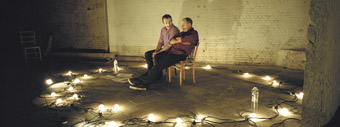
Forced Entertainment, Quizoola!
photo Hugo Glendinning
Forced Entertainment, Quizoola!
FORCED ENTERTAINMENT BEGAN IN SHEFFIELD, ENGLAND IN 1984 AND HAVE WORKED TOGETHER SINCE, BUILDING A BODY OF MORE THAN 50 SHOWS. THERE ARE DURATIONAL AND RULE-BASED PERFORMANCES; LARGE AND CHAOTIC THEATRICAL PERFORMANCES; SITE-SPECIFIC WORK; AND “FICTIONAL DOCUMENTARY” SUCH AS NIGHTS IN THIS CITY, A GUIDED BUS TOUR OF SHEFFIELD WHICH MIXES PERSONAL STORY, WORLD EVENTS AND ‘FACTS’ ABOUT OTHER CITIES. THEIR WORK IS “POSTDRAMATIC” IN THE SENSE HANS-THIES LEHMANN ELABORATES IN HIS BOOK OF THE SAME TITLE: IT “PROBLEMATISES ITS STATUS OF ILLUSORY REALITY”. THE FOURTH WALL ISN’T THERE—OR WHEN IT IS, IT’S TORN AND DIRTY, CONSTANTLY FALLING APART INTO REAL TIME.
Forced Entertainment shows take place in the shared space-time of both audiences and performers, and as such implicate the audience in the fiction-making machine of the theatre. There are certainly stories, fictions, dramatic tensions within these performances, but they tend towards the fragment, competing and colliding with other elements of the show rather than forming an overriding architecture. These performances are “shows” rather than “dramas” and as such, both cite and evoke popular performance forms and games.
quizoola
Forced Entertainment’s Quizoola! opened the 2007 PuSh International Performing Arts Festival in Vancouver festival at Ocean Cement—a large workshop space on a wharf that clearly still had a day-life. Entering a still-working space during its downtime to attend an arts show—the life-form superseding heavy industry on the island—was a little eerie, as if the past was dreaming its own future death. And yet the ‘art’ event (Quizoola!) also felt makeshift, industrial; showing its own bones. Metal fold-out chairs were arranged in rows; the performance area was delineated solely by a string of bare light bulbs laid on the floor. Two performers in ordinary clothes and smeared clown make-up were onstage; one was asking the other questions. A third sat on the door, reading and selling tickets. The space evoked cheap theatricality, grease paint and (uneasily, for us in 2007) an interrogation room.
Quizoola! is one of Forced Entertainment’s “durational performances”, lasting six hours. The three performers rotate roles; the audience is free to come and go. The interrogator reads and then riffs from a pile of 2,000 questions compiled by writer-director Tim Etchells and held in a messy sheaf by the questioner. When I walked in, long-time company member Cathy Naden was interrogating Kent Beeson, a local performer who joined the company for Quizoola!, Cathy asks Kent if he can count (Yes); Can he count really, really well? (Yes); How many people in the room? (103); How many men and how many women? (More men than women), I SAID How Many Men And… (Um, 52 women, 51 men); and on and on, until Kent has to calculate impossible mathematics (the number of cars driving by times the number of people wearing glasses divided by…). It’s a game; of course Kent fails, and it’s funny. Many of Forced Entertainment’s shows are based on rule-structures or games. This imposes a different dramaturgy than the arc of dramatic fiction and contains a lot of real-time tension, because things can always go wrong. The rules can be broken. Performers can fail at the “game.” The rules can shift and suddenly include the audience.
And yet it isn’t only funny. The sheer length of the event begins to reveal other rhythms, other temperatures. There’s a cooled-down space of durational performance which escapes the dramaturgy of beginning, middle and end. And in a different way, it’s fascinating—waiting to see what develops. There’s a set list of questions, but when the performers sense a groove, a line of questioning, they follow it. And always there’s the tantalizing possibility that we might be hearing home truths (“When did you cheat on your lover?”). Strangely, personal questions to do with sex are less charged here in 2007 than questions about war and television; people sat still and listened differently during the following sequence:
Did the Gulf War really happen? Yes. How do you know? I saw it on TV. Why does that make it true? Because I saw it on more than one channel. So? If something’s only on one channel, it’s probably made up. If it’s on two channels at the same time, it’s true.
Hours pass. I leave, have dinner, return. The interrogation continues. Paradoxically, a performance relentlessly dedicated to “truth” starts to produce a vision of the world that is utterly phantasmic and internally inconsistent. How to cook lasagna and what a tree is; what’s the history of the world; why milkbottle tops are made of metal; what caused the Balkan wars; and whether you cheated on your lover—all appear together like a mad live newspaper. Slowly, through these questions, the ghost-outline of everyday knowledge rises to the surface of daily life like some fabulous Elizabethan shipwreck. And, watching the actors struggle to survive this shipwreck (that is, the inconsistent knowledges that make up daily life) I’m reminded of Bob Dylan’s line: “All the truth in the world adds up to one big lie.”
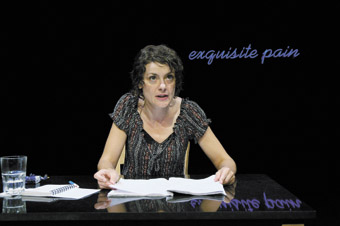
Forced Entertainment, Exquisite Pain
photo Hugo Glendinning
Forced Entertainment, Exquisite Pain
exquisite pain
Exquisite Pain was staged the following evening at Performance Works, a lovely intimate black box theatre, a hundred metres down from Ocean Cement. It’s based on artist Sophie Calle’s exhibition and book of the same name; the text and projected images are both taken verbatim from her book. It’s the first time Forced Entertainment has used another writer’s text. The company has recently moved towards these more intimate kinds of performance, involving direct address and a lack of theatrical effect.
Again, the set is bare: tables and chairs, bottles of water, glasses and unbound scripts. Above each table, a flat-screen video monitor. On the black upstage backdrop, in blue neon-sign cursive writing, the show’s title. Cathy and Robin walk out in everyday clothes (jeans, shirts). Robin tells us that Sophie Calle was to meet a lover in New Delhi; on the night of his expected arrival he broke up with her over the phone. Calle decided to tell this story to friends, acquaintances, and strangers for as long as it took for the story to lose its pain for her, and to ask each of them in turn for the story of their greatest suffering.
This simple process of exchange structures the show. Cathy tells the above story in some detail with the projected image of a red telephone in a shabby hotel room as background. Robin then reads his first story, one of the many demanded by Calle of others. Above him, an image of a white basin; the story is of a lover’s betrayal. We switch back to Cathy. She tells the same story as her first one, with almost identical phrasing and the same image. Then a different story from Robin, an image of a blue car. When we switch back to Cathy and there’s another minute variation and the same red telephone appears, there are ripples in the audience. We will be listening, then, to this story for the next two hours, counterpointed with the tales of strangers. Cathy begins each time, like Scheherezade, with a changing count of days: “Five days ago, the man I love left me….” “Twelve days ago, the man I love left me.”
From dread of impending boredom I move to a cool interest and then to fascination. Again, the effect is cumulative; Calle’s narrative/Cathy’s narration is not just moving its internal deckchairs, but in fact shifting, becoming less shock-laden, more wry. Pain is moving through narration into the kind of framing distance that might become, in time, an ironic anecdote. As with Scheherezade, storytelling and death seem to be the two sides of this flowing Mobius strip of narration, a process that—to paraphrase writer/director Tim Etchells—can’t declare itself either comedy or tragedy because in each is the seed of the other. Somewhere towards the end, as Cathy tells the story for perhaps the 50th time, she declares: “As suffering goes, nothing special. Nothing worth harping on about.” (We—the audience laugh. A lot. ) At 98 days she declares, “Enough.”
This show doesn’t produce empathy so much as a kind of cross-infection of experience. Even now I can summon that red telephone. Every detail of that photograph, and the room around it, glows as if it were my own memory etched in pain. And in a sense, of course, it is; these stories invite us to revisit our own.
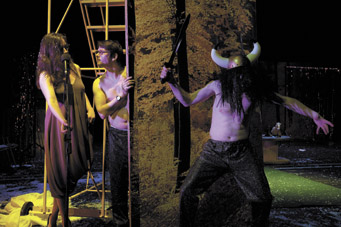
Forced Entertainment, The World in Pictures
photo Hugo Glendinning
Forced Entertainment, The World in Pictures
the world in pictures
While Quizoola! and Exquisite Pain incline towards to the rule-based, durational strand, The World In Pictures, which I saw two weeks later in Dublin, is theatrical with a vengeance. Fake snow, rampaging cavemen, multiple stage-deaths, group dance numbers, skeleton costumes—it’s all here, in chaotic surges of stage action interspersed with quiet, story-telling. It was a bit of a shock after first encountering the company through their less “theatrical” works.
The show loosely collides two strands—one is the History of the World, which the company attempts to act out in the manner of an amateur children’s pantomime complete with bad wigs, caveman outfits and ridiculous togas, while a Narrator struggles to remember what seems like English school book history. The other strand is a series of stories—low key, everyday—told by Jerry, who addresses us from his everyday persona and clothes. The set is again bare, at least to begin with (“that’s a real fuck-you set”, said someone behind me in the audience), and the cast comes out in everyday clothes. Jerry stands nervously to one side while the others give him acting advice in a sendup of the earnest Method-acting workshop. “Watch those hands in your pockets”, says one. “Just be yourself”, says another. “Try to keep it upbeat.” Then they leave him to it.
“You’re walking through the city with an hour to kill,” Jerry says. His story wanders through a city and takes its walker into a large public-housing tower. “‘You’ climb the stairs, and from the top, imagine what it might be like to fall…you slide over the edge…the ground rushes towards you…excitement, terror, regret…the cars are really close, the cracks in the pavement…I might pause here,” says Jerry, “this has got us into a good place to start the show.”
And with that, the actors charge on to perform a comical fake modern dance to Cecil B de Mille’s apocalyptic movie music (“the volcano scene” from The Last Day of Pompeii). The Narrator puts us through the Greeks, the Romans, the Black Plague, Knightly Love (much cavorting, fake snow, death, and some amusing anachronisms—cavemen masturbating to images on a laptop). “Stuff was happening in Bulgaria. Stuff was happening in Brazil. But here in Europe it was the Dark Ages.” I quite enjoyed the Dark Ages after all the chaos. The performers wander around slowly while the Narrator explains (I’m paraphrasing here), “They forgot everything. They forgot reading. And astronomy, and medicine. And painting. They forgot about government and how to read the time from the position of the stars. They forgot about Literature and the Greeks.”
Being the Dark Ages, the Narrator turns the stage lights off, while Jerry clicks through slides on a laptop and comments on them. Cling-wrapped meat in a butcher’s window. (Something you might have eaten). People on the street. (Someone you might have met). An empty hotel lobby with the furniture stacked in one corner. (Somewhere you might have been). A chair. (A chair). A café. (Somewhere you might have had coffee). A bunch of keys on a table. (Puzzled pause—I don’t remember). A milk bottle. (A milk bottle). A purse (I don’t remember).
The slow superimposition of personal memory onto a different fictitious space, that of History, slides them together into time’s ruins. We’re nearly in the present. The overarching umbrella of history is falling apart, confronted by the here and now. The Narrator loses her confident tone; there are stage-whispers of advice about what to include, what to leave out. She’s uncertain about the 1990s because (looking anxiously at us) “they’ve lived through that.” They decide they’re pretty much done, and leave the coda to Jerry—once again advising him to “keep it positive.”
In his final story, we don’t revisit the spectre of our death from falling—at least, not directly. Imagine (I remember him saying) that soon you’ll be leaving here. And how much of the show will you remember, do you think, in one week? Or in a month? And perhaps, in a year, you won’t remember much of it at all. And the other people here. In two years perhaps someone who’s here tonight might have died. And then, in five years, maybe a few more. Think ahead now…to five hundred years. Will anyone remember you at all?…Well. It’s been a lovely evening.
I loved the weave of personal time and history with the impossibly fictional History of the World. There were many funny and poignant moments, yet I felt being ‘about’ something hampered this show. In contexts where meaning develops associatively through the juxtaposition of many elements (Forced Entertainment’s Bloody Mess and Hidden J), silly theatrics and demonstrative acting can be very effective as one strand in a complex, world-building weave. Here they seemed corralled back into their traditional function in ‘bad’ theatre—illustrating a theme. Since postmodernism has already demolished the omniscient narrator, this aspect of the show seemed like a slightly patronising demonstration of something well established.
And yet Forced Entertainment’s signature elements—the threadbare theatricality that reveals its own means of production, the witty juxtaposition of unlike elements, the promise of stories that never quite deliver what they promise—meant that the show also lived on for me. This is one of the company’s most singular effects. In the hectic failure to stage what they promise (always a part of the comedy), their shows nevertheless weave personal and public spaces together into a kind of poetics of everyday life; everything looks different afterwards. Walking through Dublin for days after The World In Pictures, I was at once in Jerry’s story and my own—a folded fictional space imagined and material.
Forced Entertainment: Robin Arthur, Tim Etchells (artistic director), Richard Lowdon (designer), Claire Marshall, Cathy Naden and Terry O’Connor
Quizoola!, director Tim Etchells, performers Cathy Naden, Robin Arthur, Kent M Beeson; PuSh Festival, Ocean Cement Repair Shop, Ocean Construction, January 10; Exquisite Pain, director Tim Etchells, text and images Sophie Calle, performers Cathy Naden, Robin Arthur, design Richard Lowdon, lighting design Nigel Edwards; PuSh Festival, Performance Works, Vancouver, Feb 11-13; Forced Entertainment, The World In Pictures, direction Tim Etchells, text Etchells and company, performers Robin Arthur, Davis Freeman, Wendy Houstoun, Jerry Killick, Richard Lowdon, Claire Marshall, Terry O’Connor, Bruno Roubicek, design Richard Lowdon, lighting design, Nigel Edwards, soundtrack Found Sources; Project Arts Center, Dublin, Jan 19, 20
RealTime issue #78 April-May 2007 pg. 2,3
© Christine Evans; for permission to reproduce apply to realtime@realtimearts.net
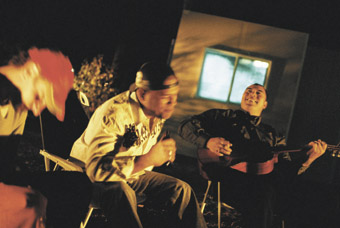
UTP, Back Home (2006)
photo Heidrun Löhr
UTP, Back Home (2006)
IN 2004, VALERIE BERRY MENTIONED TO ALICIA TALBOT, ARTISTIC DIRECTOR OF URBAN THEATRE PROJECTS (UTP), THAT HER BROTHER, WRITER/DRAMATURG PASCHAL DAANTOS BERRY, WAS WRITING A PERFORMANCE PIECE FOR HER INSPIRED BY THEIR EXPERIENCE AS FILIPINO MIGRANTS. TALBOT WAS IMMEDIATELY INTERESTED.
As one Australia’s leading social and political theatre companies (Talbot refutes the term “community theatre”) all of UTP’s work is concerned with contemporary Australian life and how we are navigating our way through complex urban society, particularly in Western Sydney where the company is based. Talbot had no idea whether UTP would end up being involved with the Berry project but felt instinctively it was something the company should support.
“It started out as simply giving them a week’s wages and rehearsal space as part of our support program so they could go through the script and see what they needed to do with it”, says Talbot. An Asialink residency then took Paschal to the Philippines to work with the Anino Shadowplay Collective, a group of young multimedia artists, who became involved with the project.
Three years on, UTP is presenting the resulting work, The Folding Wife, in association with Blacktown Arts Centre. “So it’s been a long process”, says Talbot. “The way that relationship evolved is completely different to others. But each is unique. The company is constantly responsive. It builds all kinds of very personal and idiosyncratic relationships but actually it’s about an artistic process and that’s exciting.”
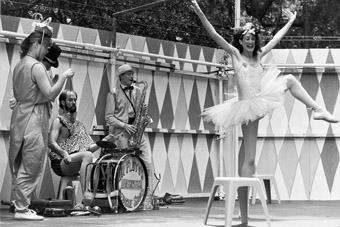
Dr Floyd’s Fly by Night Medicine Show (1982)
synthesis & difference
The productions that emerge are equally unique. Few if any other Australian theatre companies have consistently created such diverse work for so many different audiences. TrackWorks (1997) took people on a surreal journey performed on railway stations and trains. For Speed Street (1998) the location was an actual street in Liverpool and featured residents. brought Goths, revheads and hip-hoppers together on the roof of a Bankstown car park. For Asylum (2001) the company turned a disused wallpaper showroom in Lidcombe into a prison cell to tell refugees’ stories. Fast Cars & Tractor Engines (2005) saw three actors with headphones telling eight Bankstown residents’ stories by repeating interviews with them word-for-word. Last year’s Back Home was performed over a barbeque in a backyard in Blacktown.
As Talbot says: “There’s no aesthetic cohesion and there shouldn’t be. There’s a synthesis of ideas but in terms of how that manifests, it’s remarkably different [for each production].”
UTP defines its mission statement as: “making new performance works that engage in socially relevant questions and are intimately connected to specific sites and diverse communities. These stories and images of contemporary urban life are drawn from, and heavily influenced by, the company’s geographic and social location in the western suburbs of Sydney.
“In increasingly conservative times, one of the key roles for Urban Theatre Projects is to provide individuals, communities, artists and audiences the opportunity to engage in a meaningful dialogue about the world we live in.”
The company has done this so successfully that in 2002 it was presented with the Sidney Myer Award in recognition of its outstanding contribution to Australian theatre. Last year, UTP turned 25—a major achievement for any Australian theatre company, particularly in the small-to-medium sector—which gave it occasion to look back over its history. UTP published a book of commissioned essays about the company and its work, a project it continues to develop via its website, commissioning writing that examines the relationship between practice, critical thinking and contemporary culture.
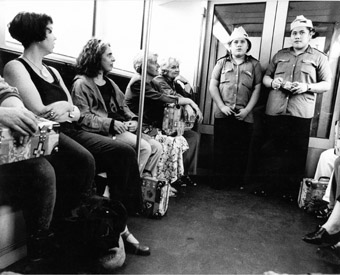
UTP, TrackWorks (1997)
photo Heidrun Löhr
UTP, TrackWorks (1997)
adaptation & transformation
The company began life in 1981 as Death Defying Theatre, formed by Kim Spinks, Paul Brown and Christine Sammers in order to challenge existing notions of theatre and existing relationships with audiences. In 1991, under artistic director Fiona Winning, it began the move west, relocating from Bondi to Auburn then Casula and later Bankstown where it is now based. In 1997, artistic director John Baylis changed its name to Urban Theatre Projects. Mentored by Baylis, Talbot became artistic director five years ago, joined a year later by Simon Wellington as general manager. Together they are a dynamic team.
Artists involved with the company over the years agree that the reason for its longevity and continuing relevance is that it has managed to constantly reinvent itself and re-evaluate its practices whilst retaining a strong sense of its original purpose. Says Winning: “There’s been a lot of redefining and rethinking around community and cultural practices in the last 20 years and I think the company has always kept ahead of that. The capacity to be able to shift and redefine contemporary ways of thinking has been very significant.”
Winning points out that the company has also moved with the times structurally, changing from an ensemble and adopting the model of shared artistic director/general manager leadership around 12 years.
The company has always attracted good cultural thinkers and cutting-edge artists, which has given it a significant creative capital and allowed it to move from strength to strength.
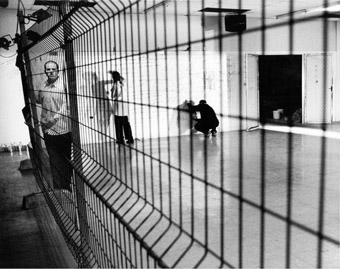
UTP, Asylum (2001)
photo Heidrun Löhr
UTP, Asylum (2001)
the folding wife
There are several strands to UTP’s work: productions; seeding and research work for the creative development of future productions; and the professional development of artists. Each year it runs a research development or master class that relates to the annual programming. In March, in the lead-up to The Folding Wife, UTP held a five-day intensive workshop called Unravelling the Bride that explored cross-cultural and cross-artform practices. Facilitators included Anino Shadowplay Collective, Australian-based Filipino installation artists Alfredo Juan Aquilizan and his wife Isabel, Paschal Daantos Berry and Deborah Pollard, who directs The Folding Wife.
The Folding Wife opens in the recently refurbished Blacktown Arts Centre, continuing a partnership that began with the production, Back Home. Blacktown is home to a large Filipino community, which makes the venue particularly appropriate. Valerie Berry plays three Filipina women—a grandmother, mother and daughter—each desperate to escape a different era and political situation in their homeland. Berry is joined on stage by two members of Anino, who create a metaphorical landscape with a blend of animation and projection that shifts and shapes before the audience’s eyes. The piece explores notions of nationalism, the reasons that propel people to migrate in search of a new home and its ramifications in terms of displacement and cultural identity.
back home to toronto
In June, UTP undertakes its first international tour when Back Home goes to Toronto in partnership with the Harbourfront Centre. The production will also tour Australia between August and November. Back Home features four men from different cultural backgrounds who are reunited after many years for a barbeque. What starts as a celebration, disintegrates as broken promises, old wounds and cultural differences emerge. Originally workshopped in collaboration with Indigenous and immigrant communities in Sydney’s west, Back Home is a powerful examination of masculinity, disharmony and reconciliation. UTP will do some free community showings in Toronto prior to performances at the inaugural Luminato Festival. The company will also undertake a community research and development process for a new work to be developed in collaboration with Harbourfront during 2008/09.
riots and shift work
Works in early stages of creative development, for production next year, include The Last Highway and Stories of Love & Hate. Set late at night in a service station, The Last Highway brings together the station attendant, a doner kebab salesman, two sex workers, a taxi driver and someone who has just wandered in. Directed by Talbot, it will be created through community consultation with late night shift workers using the model she employed for Back Home and The Longest Night. “In terms of the bigger picture it poses questions about land and territory, and navigating borders and terrain”, she says. “On the personal level it looks at how late night workers, who often come from different cultural backgrounds, navigate shift work and danger, so it’s about what gets us through the night.”
Stories of Love & Hate is being made by director Roslyn Oades in response to the Cronulla riots. Like Oades’ hugely successful Fast Cars & Tractor Engines, it will tell a series of personal stories of people directly involved in the incident through audio interviews.
In 2008, UTP is likely to move into a new venue: a multi-purpose arts facility being developed in partnership with the NSW State Government and Bankstown City Council, which will also house Bankstown Youth Development Service and Citymoon, a company of Vietnamese-Australian artists, with whom UTP shares its current premises.
As for future work, reinvention remains a given. “As I always say, the company makes work based on sets of questions and the relationship between site, artist and community, and fuelled by ideas. That is a really potent combination and it can’t be stagnant and it can’t be contained. It has to transcend funding and political environments,” says Talbot.
“In the current Australian context where we’re not telling that many stories about ourselves, I think the importance of images and words and visions of contemporary Australia, told by artists with urgent social and political agendas, become more and more pressing. So if you ask me what the future is, I go—well 25 years ago that was agenda and it still is now.”
The Folding Wife, Blacktown Arts Centre, April 19-28, www.urbantheatre.com.au
RealTime issue #78 April-May 2007 pg. 4,5
© Jo Litson; for permission to reproduce apply to realtime@realtimearts.net
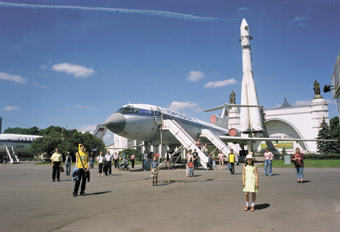
Melanie Manchot, Aeroflot 12.36 (2004) from 1+1=3
I MEET FOSTER AND DEAN IN THE SMALL ATRIUM OF THE AUSTRALIAN CENTRE FOR PHOTOGRAPHY. HE’S SURFIE BLONDE AND LIGHTLY TANNED, BEEN ON THE ROAD, HAS A SORE LEG AND “FEELS A BIT ROPEY.” SHE’S BRUNETTE AND ALABASTER-SKINNED, JUST BACK FROM TOURING AN ACP VIDEO SHOW TO AUCKLAND, AND IS LIKEWISE TIRED. ALL THIS ASIDE THE EMINENTLY QUOTABLE PAIR ARE ENERGISED BY A MISSION.
We're sitting in the realisation of one part of the vision where a digital monitor will soon join the tables and chairs, the magazine rack and the view into the new “event space”, formerly a restaurant the rent from which helped pay off the ACP mortgage on the building by the end of last year. It's clear from the start that we won't be talking about what's current in photography or what it's all about (same as it ever was, it seems)—that's just content. Conversation is the matter at hand, metaphorical and actual, as an ACP vision of opening itself and photography out to the greater public through various forms of engagement (exhibitions, magazine, website, classes), not the least of which will be talk.
If you want to talk seriously you need to be visible and accessible. The ACP now has an extensive Oxford Street shopfront that looks into the event space and there’s a more welcoming, capacious entrance (still doubling as an exhibition space). There’s also a stronger sense of welcome, of an offer to sit and browse and wander into the exhibitions as you feel so moved. The windows, says Foster, “are soundproofed, big double-glazed vitrines. They were put in primarily because you have to suppress the low reverberation from buses. They also create this sense of almost being able to walk in. We have noseprints on the glass every morning.” Dean adds, “It feels like our eyes are open to the street and the street is looking back.
There’s been an almost instantaneous change in the audiences coming through.”
The event space is also used for exhibiting but principally it’s a place for dialogue. Foster explains, “Some of our artist talks are about particular practices and some—like the Talking Shop series—are about approaches to making work. We have lunchtime films, which are a mixture of biopics and experimental films, generally of the type that don’t get into theatrical release or TV. One of the formats that works really nicely in terms of bringing people together in a conversation is a kind of Parkinson-style chat show and an afternoon tea afterwards. Martin Jolley’s done one, I’ll do them sometimes. The first one on April 1 was titled Photography and the Law: Panic and Paranoia. Three guests come up one at a time and are interviewed then they start to interact collectively and then with the audience and then on a more one-to-one basis afterwards. I wanted to follow television formats, not academic ones.
You can’t underestimate how empowering it is for a broader audience to have things delivered in ways where they feel ownership. Audiences want to see something happen. A paper isn’t something happening. It’s just something being repeated, whereas a conversation is always new and you never quite know what’s going to be asked and how it’s going be answered.”
To keep the talk going, you have to be available: “We don’t like to be closed at the weekend because we get very many more people coming in on Saturday and Sunday than any other time”, says Foster. “We’re also opening in the evening now, on weekdays till 7pm, which allows people to come in after work. We want to reach people when they’re available so we hold our events at 6.30pm not 7pm because at 6.30 you can come for an hour and go away and you’re not fainting from hunger. It’s the natural space between working and eating that can be stimulating for the rest of the evening, something to talk about over dinner.”
exhibition as conversation piece
But how do you stimulate that conversation in the ways you frame your exhibitions? The recent, amusingly spooky Olaf Breuning show comprises one room installed with a crowd of life-sized ghost figures, another room with a video dyptich and a third with large photographs—all the spaces are dark and the imagery links one to the next. It’s typical of the considerable effort that ACP goes to engage its audiences. Foster says he aims for “the whole experience—I’m quite happy to call it ‘theatrical.’ I know some of my colleagues thumb their noses at it but for me it’s one of the most powerful forms of interpretation you can offer.” Foster argues that it’s vital to “create an atmosphere in which people feel a discontinuity with the bright street life outside and in which they will slow down, open up and begin to feel differently when they look at the works…I have this phrase I’m fond of: ‘Exhibitions should be easy to get into and difficult to get out of.’ And I think if you make an exhibition too difficult to begin with people won’t cross the street to come in—it’s essentially gagging yourself.
“With our approach you have the potential to be surprised. You don’t walk in and see the same white box with various rectilinear things on the wall. You’re never quite sure where it’s going, what you might see, and that means you go in with a more open mind rather than thinking, Oh, it’s only art, I’ll just consume this in a fairly superficial way. Unfortunately, for all the self-aggrandising rhetoric we use in the arts, something that is only ‘art’ is actually a way of diminishing it. If you say it’s not just art, it’s an experience, it’s something that will speak to you, people are more opened up to it.”
worlds beyond
The ACP connects with a world beyond its own building. Foster and Dean make sure that they visit Australia’s major cities every year to talk to artists. As well, in 2006, says Dean, “we had eight shows touring to 17 venues, this is in Australia. I also took Trent Parke’s Minutes to Midnight, which Alasdair had curated, to the biannual Chobi Mela Festival of Photography in Bangladesh. That show’s touring the region now through Drik, the agency that runs the festival.”
Video is also part of the ACP travelling repertoire. Dean has just returned from showing Mirror Worlds (2005), works from Asia, in New Zealand. Again the work was engagingly installed: “Zoe [Butt] and I were very conscious of trying to make it an enjoyable, quite vibrant experience so that people had a sense of being in an Asian urban environment and experiencing the sound and frenetic activity. We were quite conscious of looking at this explosion, the economic boom in Asia, and going after artists that were dealing with these issues on the same heightened level. The experience in Auckland was quite amazing. About 14 new immigrants arrive there every day, so it’s a very multicultural city. People were really engaged by the work.”
talking print
Photofile magazine, published by ACP, is about to go through a transformation, again with the aim of stimulating a wide audience. Given the long turnaround of print publishing, Foster is keen to generate immediacy through a companion website which will have moderated artist profiles, comprehensive previews and eventually reviews concurrent with showings. He says it will free up the revamped Photofile “to concentrate on the experience of looking at photographs, well-reproduced images and more substantial texts.” He will also have “more artists writing than in the past as well as the verbatim interview—we now have 13 standard questions we call the Third Degree.”
working with the artist
“At the moment”, says Dean, “I’m working towards a show for the end of the year—it involves playfulness, the adopting of performance personas, costuming and staging. But then again I was just as excited working with Ben Bohane last year on his documentary exhibition and with Paul Knight and the kind of psycho-geography he creates in his work.
Foster declares, “Our involvement with art is through the process. It was an incredible experience working with Trent Parke for so long on Minutes to Midnight from half way through the shooting right through to the exhibition and I’m still working with him and how he gets that work out into the world. In one way that’s a very privileged position, but one needs to learn that. It’s not just looking at art on its own but actually understanding how it’s made, how it lives, understanding that when you meet it it’s like meeting a person. There’s a life before and a life after.
now and next…
With expanded space, a technical centre to drive it, a program of events, accessible opening hours, a reconceptualised Photofile in print and online, along with the ACP’s classes in photography and various touring engagements, Foster’s “multi-vocal approach” can be more fully realised. But what’s next for the ACP and its prodigious output and consistent melding of Australian and international work, often provocative and ever shape-shifting?
While Dean curates, Foster sees himself moving more into forward planning, “as part of ACP’s evolution”, focusing on “the empowering of audiences and the personalisation of experience. I only have to look at my kids, how they engage with the world and how much more empowered they are to naturally produce and make and interact. They don’t think about mashing and that sort of thing as some specific activity. It’s like breathing. You just pick stuff up and move it around. It’s only people of my age who have to keep reconceptualising. So that’s what I’m really getting into.”
1+1=3, Collaboration in Recent British Portraiture is the ACP’s next show, Apil 20-May26; Australian Centre for Photography, Paddington, Sydney, www.acp.org.au.
Image: Melanie Manchot, Aeroflot 12.36 (2004) from 1+1=3
RealTime issue #78 April-May 2007 pg. 6
© Keith Gallasch; for permission to reproduce apply to realtime@realtimearts.net
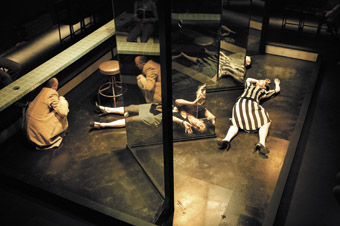
Black, from left James Wardlaw, Moira Finucane, Caroline Lee
photo Jeff Busby
Black, from left James Wardlaw, Moira Finucane, Caroline Lee
THE LITERARY CRITIC BRIAN MCHALE WAS THE FIRST TO SUGGEST THAT THE SHIFT IN A POETICS OF MODERNISM TO ONE OF POSTMODERNISM CAN BE TRACED TO PROBLEMS OF EPISTEMOLOGY SUPPLANTED BY THOSE OF ONTOLOGY. THAT IS, THE GREAT MODERNIST WORKS WERE ONES WHICH ASKED “HOW CAN WE BEST REPRESENT AND INTERPRET THE WORLD?” A POSTMODERN WORK, ON THE OTHER HAND, ASKS THE ANTERIOR QUESTION: “WHAT IS A WORLD?”
Concerned less with finding a more truthful, accurate form of expressing “all that is the case”, to appropriate Wittgenstein’s phrase, a postmodern work instead tremulously queries the very existence of a knowable, retrievable reality—or at least questions an art work’s ability to reproduce it. This seems to me the dominant characteristic of Anna Tregloan’s Black.
Tregloan’s performative installation takes as its ostensible subject the notorious 1947 “Black Dahlia” murder of Elizabeth Short in Los Angeles, establishing expectations of a kind of True Crime theatre of reconstructions, drawing on the many texts which have attempted to ‘solve’ the famously enigmatic killing and presenting something which attempts to make sense of the panoply of conflicting evidence. But of course, theatre cannot solve a murder, and Black turns out to be something very different indeed.
Tregloan is an inspired installation artist and set designer, and the piece is very much of the character of a living exhibition. The space is exquisitely designed: the audience navigates separate rooms, staircases, a balcony overlooking the main playing space—itself a beautifully crafted folding screen of glass panels which multiplies perspectives.
Four performers (Caroline Lee, Moira Finucane, Martyn Coutts and James Wardlaw) inhabit this central area, speaking snatches of text which sometimes coincide and are sometimes more opaque. As the viewer navigates the space, they are offered different sightlines on the unfolding drama, no one vantage point allowing a total perspective. And the glass panels, visited by a constantly changing lighting rig, magnificently reflect and refract the images of those passing by, at times dividing them but more often allowing them to occupy several spaces at once, ghostly images interacting with more corporeal presences.
Tregloan doesn’t make sense of the drama, at least on the level of narrative. Rather than offering a movement from mystery towards some kind of resolution, even on the psychological level, the performance is cyclical, roughly 40 minutes long, repeating without pause over three hours. Phrases recur, and thematic motifs (ice, salt and sugar) offer teasing but ultimately unedifying hints at an underlying structure inaccessible to the observer. The audience comes and goes, constructing their own beginning, middle and end dependent not on the assimilation of a pre-existing narrative structure but on the simple storyline traced by their roaming, their interest or boredom, tired feet or restlessness. The always partial perspective afforded by the spectator’s position is temporal as well as spatial.
All of this works to implicate the viewer on that ontological level. Though we may initially look to the piece for a solution to a classic mystery, we soon cannot help but realise the ways in which our own position as observer will necessarily not merely distort the truth, but construct it.
Similar ontological questions are evoked by GoD BE IN MY MouTH’s Grace, a spare performance both confounding and transcendent. It is deeply indebted to a surrealist or absurdist tradition but maintains enough of a linear narrative to leave audiences dissatisfied with the whole—or at least those audience members I spoke to afterwards, along with a swag of ambivalent reviews. The problem seems to me to be one of interpretation: it is entirely unclear what kind of ‘reality’ the piece presents, and therefore how we are to read its various competing elements.
There is a story, certainly, and characters, and a movement which echoes a traditional narrative structure. Long-separated and recently orphaned siblings Serbia and Wade arrive at the rooftop dwelling of their eccentric uncle, who lives with the half-human/half-pigeon experiments he has been working on since his disgraced departure from street-level existence. He holds the key to their inherited fortune, but is also embroiled in their puzzling past more profoundly than they realise. Though far from a naturalistic work, Grace still suggests enough realism to rouse those parts of the mind which look to establish a meaning behind a tale’s telling.
But there are aspects which actively work against such a reading—those overtly surreal moments—but also a seemingly deliberate attempt to stonewall interpretation, render uncertain any definite reading of the work. It is a theatre of moments, of dazzling soliloquies touching on mortality and redemption, and equally of inane pop dance routines enacted by ridiculously attired feather-heads. The final poser is not “what is really being said here?” but “is anything being said at all?” Which might well be the most challenging question a theatremaker can dare to ask.
Black, created by Anna Tregloan, performers Caroline Lee, Moira Finucane, Martyn Coutts, James Wardlaw, sets & costume design Anna Tregloan, composition & sound design David Franzke, lighting design Paul Jackson, dramaturg Maryanne Lynch; Tower Theatre, Malthouse, March 17-April 1; GoD BE IN MY MouTH, Grace, writer-director James Brennan, performers Katrina Miilosevic, Luke Mullins, Brian Lipson, Gary Abrahams, Ivan Thorley, Carla Yamine, designer Adam Gardnir, lighting designer Nik Pajanti, sound designer Peter Brennan; Theatreworks, St Kilda, Melbourne, March 8-25
RealTime issue #78 April-May 2007 pg. 7
© John Bailey; for permission to reproduce apply to realtime@realtimearts.net
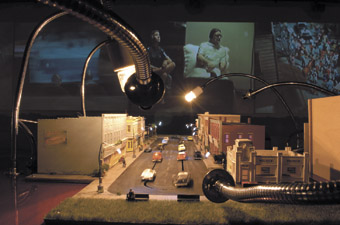
Jennifer & Kevin McCoy, Traffic Series
THE LONDON DEBUT FOR TWO WORKS FROM KEVIN AND JENNIFER MCCOY SIGNALS THE FAR-REACHING AMBITIONS OF THE BRITISH FILM INSTITUTE’S RECENTLY LAUNCHED BFI SOUTHBANK. A REFURBISHED BUILDING, A NEW NAME AND AN UPDATED REMIT ARE PROPELLING THE BRITISH FILM INSTITUTE TOWARDS A FRESH APPROACH TO AUDIENCES AND TO THE RAPIDLY EVOLVING FORMS OF CINEMA CULTURE. ARTISTIC DIRECTOR EDDIE BERG OUTLINED THE AIMS FOR THE NEW CENTRE: “WE PLAN TO BUILD ON THE TRADITIONS AND HISTORIES OF THE BFI WHILE ENGAGING WITH NEW TECHNOLOGIES AND AESTHETICS AS THEY UNFOLD. BFI SOUTHBANK AIMS TO REFLECT ALL OF THESE DEVELOPING INFLUENCES ON THE CINEMATIC FORM AND EXPERIENCE. WE WANT TO HELP ESTABLISH NEW AGENDAS FOR THE FUTURE.”
Alongside the BFI’s National Film Theatres, known for their repertoire of world cinema programming, BFI Southbank is extending the institution’s cinema remit. There’s an intimate 38-seater studio for free daily screenings, talks and education programs; the Mediatheque—a David Adjaye designed space with individual booths for accessing curated selections from the BFI national archive; and a dedicated gallery space for media and video art. The soaring, light filled foyer is set to be a prime meeting place for hip Londoners with a very glam café/lounge bar and a much needed shop for the extensive collection of BFI publications. BFI Southbank has created a street-level cinema, geared to drawing new and younger audiences who are more familiar with the personal and immediate access to media provided by expanded forms of digital distribution.
Central to the venture is the opening out of the BFI archive, a major and growing collection of over 900,000 film and television titles. Programming for BFI Southbank evolved directly out of a rights holding issue: the structure of ownership means that the archive can be made more widely available only within BFI premises and at no charge to the public. The new venue has made a challenge an advantage, offering the collection as a resource to be accessed and interpreted, building awareness of the representation of our media histories. Perceptions of the archive are evolving—we’re accustomed to the personal collection and exhibition processes flickr and YouTube now offer, and responsiveness to these changes is shaping the functions of public media institutions.
Jennifer & Kevin McCoy, The Constant World
the virtual mccoys
Exploring an expanded future for cinema and the archive is what BFI Southbank is about, and the choice of US artists Kevin and Jennifer McCoy for the launch exhibition is an inspired one, tapping into their continuous examination of ideas around the elemental structure of cinema and the role of the viewer as a creator of meaning in the cinematic experience. The show was curated by Head of Exhibitions Michael Connor, for whom the McCoys’ Tiny, Funny, Big and Sad “marks a watershed moment for the BFI: the opening of a new gallery dedicated to artists’ film, video and new media. The gallery will present exhibitions that bridge the worlds of film and visual art, exploring the blue sky between the black box of the cinema auditorium and the white cube of the art museum.”
Tiny, Funny, Big and Sad presents two works: the critically acclaimed Traffic Series and a newly commissioned work, The Constant World. The pieces traverse the territories of both sculptural form and cinematic screen, exploring the pathways by which an image comes to life, through production, the viewing experience and through personal memory.
The Traffic installation offers the viewer a series of four physical and filmic spaces that represent the couple’s own relationship within the context of their cinematic memories. Four tabletop miniature ‘sets’ recreate specific moments from films that have marked key moments in their personal history. In Traffic 1: Our Second Date, the iconic traffic jam scene from Godard’s Weekend (1967) *is depicted with an endless lineup of toy cars, trucks and gawking spectators set in a bleached (fake) grass landscape. Around the table snake the extended arms of spotlighting fixtures and miniature cameras, picking up static shots from the handmade set that are edited via computer into sequences projected onto the adjacent wall. The artists themselves are depicted seated in the plush surrounds of a movie theatre, watching live video feed of this filmic recreation on a tiny cinema screen. They are subject to the camera’s gaze too—their ‘close-ups’ inserted within the projected narrative.
In another miniaturised tableux Traffic 2: In the Cardiac Ward, the tabletop film set is recreated from George Lucas’ American Graffiti, and appears on a tiny television in the hospital room where Kevin recovers from an illness. Not only are the artists recreating and replaying their own versions of the films, but also taking ownership of cinema as a personal space, determined by the deep and memorable associations we have with particular film moments. In a time when personal appropriations and archives of media are increasingly prevalent, the McCoys cause us to reflect on the multiplicity of images and narratives surrounding us and to acknowledge the inherent creativity involved in the act of viewing. These are works that can be accessed on a range of levels—from the sheer childlike pleasure of peering down upon these detailed miniature worlds to a deeper realisation of the viewer’s implication in the construction of meaning.
The McCoy’s new work, The Constant World, continues to develop these concerns. Hanging overhead in the main foyer is a vast, many armed structure, stylistically quite at home in a 1980s two-star hotel lobby. Each arm is made up of a self-contained set enclosed in perspex and steel, spotlight and miniature camera. The movie is played out on a plasma screen below, edited using a similar technique to previous works.
The scenes and sets refer to the ‘New Babylon’ visioned as a situationist city throughout the career of Dutch artist Constant Nieuwenhuys. Countless models, drawings and manifestos document Nieuwenhuys’ dream of this city of total automation, where a nomadic life of creative play arises as society is absolved from the need to work. Every aspect of the architecture can be altered spontaneously according to the mood of its inhabitants. In the piece text elements appear randomly throughout the narrative: “relaxation”, “anxiety”, “leisure” etc. Divorced of any direct context, the words become propaganda for the fleeting moments and associations of experience that Nieuwenhuys tried to make concrete, and that the McCoys understand of the cinema as a space of personal engagement.
the art of databasing
The role of the computer is also highlighted in both works. Lev Manovich in his 2001 The Language of New Media writes, “After the novel, and subsequently cinema, privileged narrative as the key form of cultural expression of the modern age, the computer age introduces its correlate—the database.” Throughout their practice the McCoys have constantly examined ideas of narrative mechanisms as structure rather than story.
In their Every Shot, Every Episode, 10,000 shots from the Starsky and Hutch series are databased into key categories—every sexy outfit, every yellow Volkswagen for example. In Traffic and also The Constant World the computer controls the stitching together of shots behind the scenes, turning the narrative into a database stripped of the passage of time and the logical connection of ideas.
Just as the McCoys create through their practice windows onto wider aspects of the moving image, so BFI Southbank is exploring new forms of exhibition, presentation and preservation and, in the attempt, polishing up a somewhat dated image. Interestingly, the building itself will become unusable by 2012 when new tramlines are planned for Waterloo Bridge—the pressure is on to develop a significant national film centre. Perhaps it is the temporary nature of the space that has allowed the BFI to be a little riskier and explore the edges of moving image culture.
The next artist to be featured in the gallery is Australia’s Lynette Wallworth, commissioned to create two new works in her Hold: Vessel series to stand alongside the widely travelled 2001 orginal. As a living archive of a changing ecosystem, the new projections record how certain marine environments have altered significantly in recent years. The exhibition will run from June 23 until the end of August and follows on from Wallworth’s premiere UK solo exhibition now showing at National Glass Centre, Sunderland
See RealTime 79 (June-July) for an interview with Lynette Wallworth.
Jennifer & Kevin McCoy, Tiny, Funny, Big and Sad, curator Michael Connor, BFI Southbank, London, March 14-May 28, www.bfi.org.uk; www.mccoyspace.com
RealTime issue #78 April-May 2007 pg. 8
© Fabienne Nicholas; for permission to reproduce apply to realtime@realtimearts.net
Michael Keiran Harvey
photo Simon Cuthbert
Michael Keiran Harvey
WHEN I SPOKE TO PIANIST MICHAEL KIERAN HARVEY, WHO HAS RECENTLY RECORDED LARRY SITSKY’S THE WAY OF THE SEEKER, ABOUT THE CONCEPT OF MYSTICISM, HE SEEMED WARY: IT’S NOT A NOTION THAT GIVES HIM MUCH CONFIDENCE. A SELF-PROCLAIMED SCIENTIFIC MATERIALIST, HE ISN’T INTO “PRODUCING SOMETHING MYSTICAL FOR THE SAKE OF PRODUCING SOMETHING MYSTICAL.” I PAUSED MOMENTARILY—WHERE TO GO FROM HERE? BUT HIS VOICE, SUDDENLY ENERGISED, CHANGED TONE: “THE REAL MYSTICISM FOR ME IS MAKING MUSIC OUT OF SOMETHING”.
Inspired by ancient Sufi wisdom, Larry Sitsky’s solo piano work The Way of the Seeker celebrates the mystical journey towards enlightenment. The virtuosic work draws on direct quotations from the 11th century texts of Hakim Sanai, considered to be one of the three great Persian Sufi poets.
I was intrigued—if mysticism is the pursuit of ultimate reality, did this mean that Kieran Harvey seeks insight and meaning through his chosen art? He elaborated: “In the bad old days one could quite easily get hold of mercury. This element is most peculiar—it is a metal and a liquid—very difficult to handle, yet fascinating. There are so many things in the universe we don’t understand. Some people give up and pass over responsibility to something or someone else as a way of coping. Other people are motivated by curiosity to find out as much as possible in their short span. This latter attitude is my approach to music, but—like mercury—the essence is very difficult to pin down and is constantly shifting. I relish this insecurity—it’s exciting for me.
“I maintain my sense of awe in the creative process by attempting to compose—this keeps my respect for real composers very high (even though I pretend to be disrespectful to them on occasion. Can’t have them acting like Beethoven can we?).
One gets a feeling of awe or mysticism from the natural world constantly. Look at those astonishing pictures of Saturn with our world reduced to a speck, or Bryce Canyon in Utah (no wonder whacko sects flourish in such landscapes)—far more mysterious than man-made shrouds, weeping plaster statues, faceless fakirs or transubstantiations. The ability to interpret our reality through music is profoundly useless, yet satisfying, and I’ve found it to be completely unpredictable.”
For Michael Kieran Harvey, meaning in music is derived from “getting into the mind of the composer.” And—with regard to The Way of the Seeker—it is Sitsky’s own curiosity that is inspiring: “Sitsky has an amazing intellect, is fascinated by different approaches to composition and his own ways to enlightenment…Forever researching and reinventing, he isn’t closed but open to disparate styles and the whole gamut of human experience.”
While the search for personal enlightenment is a prominent theme in many of Sitsky’s works, it is interesting that he chose to celebrate the writings of Sanai in the midst of the ‘war on terror’ (Sanai was born in the province of Ghazna, which lies in what is now Southern Afghanistan). And given the incessant propaganda currently fed to us by the federal government, a different perspective on this culture is refreshing.
Kieran Harvey agrees: “…every sane person knows how ludicrous war is and how cynical this one is in particular. Genetically speaking, we are slaughtering brothers and sisters. Does this help enlighten people about their religious memes? Of course not. Do we have more to learn about overcoming our genetic destiny? Of course we do. We are bludgeoned into apathy by paid-off corrupt governments and corporate interests are rampant accordingly. Science is under attack by morons. One doesn’t have to accept this.
“Larry has paid homage to the tremendous insights of the Sufis instead of simply writing off this sect as an enemy. Wisdom is achieved through time and by maintaining an open mind. The major human dilemma is balance and control of oneself. War, of course, shatters this and reinforces propaganda, greed, a state of constant hypocrisy, newspeak and mass memory lapses. We should be more concerned with the consequences of corporate disregard for human life—for example, the road toll, global warming, the arms trade, poisoned groundwater and the Catholic Church—than terrorism because these are responsible for much more human suffering and the end of life itself.”
art does what?
So what then of the role of art in this declining world? One immediately imagines a world where art serves to challenge the atrocities of power hungry governments—a struggling voice embodying the essence of humanity. But Kieran Harvey thinks otherwise: “Unfortunately, I don’t think what Larry or I do is important to society at all.
This is liberating of course because it is unlikely to attract the spin doctors and corruption of the mainstream, and we can just get on with things we find meaningful. I think it’s a waste of time and money to try to sell something so sophisticated to dim Footy Show viewers merely to justify funding.”
Socio-political comment through art is, of course, widespread, and I wondered further about its importance and how it reflects on Kieran Harvey’s role as an interpreter. But even here he is a little sceptical: “It is easy to write or perform something political—mostly the [target’s] a sitting duck because at least half your audience will agree with you. There’s so much that is an outrage going on—not least of all our imminent demise—that it’s surprising that not all creative works are socio-political. It’s difficult to write a Magic Flute though—something that will retain layers of insight and fool all sides. Once you realize that the concept of a meritocratic democracy is bullshit, you tend to strip away the distractions in your own life. Those not used to this tend to opt for some type of ‘spirituality’, which is just the same illusion as capitalism. My role is not readily discernible to me. I reject the notion of an ‘industry’ which was imposed on my artform and consequently upon me as a cog in this corporate structure. But I don’t give a damn about my own survival as a musician. So, although it’s getting increasingly difficult to live, I am still able to do what I really want, irrespective of audience response, management monopolies, disgruntled pollies or CD sales. But I don’t think anyone notices what I do whatsoever or, if they do, then they’re as misguided as I am.”
choice, curiosity, defiance
Of course, one thing that is difficult not to notice is that Michael Kieran Harvey has played a hell of a lot of Australian music in the last few decades. But he doesn’t think he specialises in Australian music. It’s all just music to him: “Call it lack of direction, serendipity, laziness, a low threshold of boredom, I don’t know. I don’t trawl through repertoire making up marketing strategies or seeking out names to sponge off. I think it’s more important to have a reputation based on word of mouth [rather] than advertising. I don’t pay a manager or publicist and I refuse to be sucked in by the same when making decisions about my performances, whether it be content or presentation. The decisions I make about presenting new music are diverse because I’m not sure about what might or might not work in a concert, and yes sometimes I accept an outside suggestion or dare—I would never have played Messiaen in the Concertgebouw or my next program at the Brisbane Festival otherwise.”
However, given the amount of repertoire Kieran Harvey has trawled through, performed or commissioned, I was curious about whether he thought Australian piano music has a distinct sound. I received a flat no, although he does believe that “bits of it in the past have shown an information lag and cultural cringe or an unscrupulous ripping off of less wealthy cultures, but I think as art music is increasingly ignored in Australia and we realise that posterity as a concept has disappeared, the urgency will return and replace most of the charlatanism”.
Kieran Harvey’s motivation for choosing repertoire is clear: he performs only what interests him. Curiosity is his driving force. “I’m like an entomologist”, he says. “Or at least I think like that—a scientist in the field…I lift up a rock and see what’s there.”
Again, he stresses that he makes no distinction between Australian music and other music: “The piano is just an ancient computer for realising ideas. I don’t think Australian intellectual life is dead, yet, so I find that composers based in Australia are at least as interesting as composers elsewhere.
I used to think I’d like to contribute something to the country I was privileged enough to be raised in. Seeing it overrun by red-necked morons now makes me more determined to work with the few remaining enlightened and endangered individuals who are left. I sort of agree with Patrick White’s observation about it being more difficult here than elsewhere for those not part of the mainstream, which is a good reality check.”
life as experiment
Obstacles won’t deter Kieran Harvey from his passion: he seems to thrive on a life of instability, challenges and continuous exploration. “I regard my life as an experiment—I’ve sort of already thrown it away on an obviously useless pursuit—and I’m comfortable in my skin”, he says. “So far I’ve managed to keep doing what I like doing, which is really an accomplishment for me—it took me a hell of a long time to realise this. I’m very uncomfortable in this society, but it’s where I was born, and I know it could be a lot, lot worse. I studied for three years in a communist country.
There I learned from various scientific contacts that the things of the mind are the truly sustaining interests, not material things or ideologies. I’m fascinated by the universe, and I want to live to see what will happen once the LHC [Large Hadron Collider, Geneva] kicks in this year, and the Singularity event occurs somewhere around 2030—to name a few things I’m looking forward to. Perhaps my archaic piano playing may be re-invigorated by such events.”
See page 41 for Chris Reid’s review of Michael Kieran Harvey’s CD of Larry Sitsky’s The Way of the Seeker, and page 48 for giveaway copies courtesy of Move Records.
RealTime issue #78 April-May 2007 pg. 10
© Danielle Carey; for permission to reproduce apply to realtime@realtimearts.net
<img src="http://www.realtime.org.au/wp-content/uploads/art/9/906_gallasch_seasonatsars.jpg" alt="The Season at Sarsaparilla, Peter Carroll,
John Gaden, Dan Spielman, Hayley McElhinney”>
The Season at Sarsaparilla, Peter Carroll,
John Gaden, Dan Spielman, Hayley McElhinney
photo Tania Kelley
The Season at Sarsaparilla, Peter Carroll,
John Gaden, Dan Spielman, Hayley McElhinney
FOR PATRICK WHITE’S THE SEASON AT SARSAPARILLA, DIRECTOR BENEDICT ANDREWS AND DESIGNER ROBERT COUSINS HAVE WONDERFULLY CRAFTED A COMPLETE CREAM BRICK HOUSE PLACED IT ON A REVOLVE SO THAT IT CAN BE SEEN 360 DEGREES AND EACH ROOM PEERED INTO BY THE AUDIENCE. EITHER SIDE OF THE HOUSE ARE TWO LARGE SCREENS THAT OPEN UP OUR OCCASIONALLY LIMITED VIEW OF WHAT’S GOING ON INSIDE. THE PERVERSITY OF OUR CURIOSITY (AND ITS REALITY TV CORRELATIVE) IS BROUGHT LOVINGLY HOME BY THE CAMERAS INSTALLED WITHIN. LEFT OF THIS FRAME, COMPOSER ALAN JOHN (ALSO PLAYING DEEDREE AND MR ERBAGE WITH VERVE) SITS AT AN ORGAN PLAYING EERIE NEAR-SUBLIMINAL MINIMALIST PATTERNINGS THAT INITIALLY EVOKE SOAP OPERA BUT AMPLIFY ANDREW’S DREAMLIKE VISION OF WHITE’S UNDERRATED PLAY.
There’s something very, very real about White’s version of 50s-60s Australian suburbia, for those of us who lived through the period, captured here in the solidity of this house and the acuity of the costume design (Alice Babidge). But White’s is a naturalism seen through the eyes of a poet and satirist who happened to write great novels. Andrews and Cousins aptly counter the solidity of the real by merging the lives of the three families at the centre of The Season at Sarsaparilla into one house, all going about the domestic business of family building and disintegration side by side, each oblivious to the other. The device underlines the mundane uniformity of suburban life but equally, and powerfully, amplifies stark differences of social origin, standing, expectation and personality. Above all, the atomisation of social life is acutely felt—all these people living so near and yet so far apart. Yes, there is social contact, but much of it is provisional as individuals bump into each other outside as the house turns or an incident yields a temporary gathering. Outdoors has an air of the illicit, and it’s where the bitch in heat, in the midst of a heatwave, yowls generating a moody oppressiveness and much discussion from the play’s beginning.
Once again the STC Actors Company proves itself a formidable team, here realising the characters who populate White’s Sarsaparilla with finely modulated performances aided in part by the intimacy of delivery enabled by head mikes and video closeups. The result is an intense interplay of innocence, cynicism, detachment and sensuality and subtle revelation of character. Andrews has, as well, been adept in addressing the structure of the play. In an important move, he reduces a potential imbalance in the relative weight of the characters by shifting some focus away from Roy Childs (Eden Falk) in the merging of the households and, as Sydney reviewer James Waites has noted, keeping him off-camera, making him just another character rather than a dominant commentator (www.sydneystage.com.au, March 9).
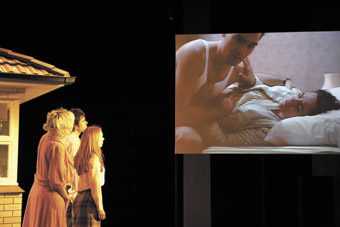
The Season at Sarsaparilla; Pamela Rabe, Eden Falk and Hayley McElhinney, on screen – Martin Blum and Emily Russell
photo Tania Kelley
The Season at Sarsaparilla; Pamela Rabe, Eden Falk and Hayley McElhinney, on screen – Martin Blum and Emily Russell
The growth towards adulthood of Judy (Hayley McElhinney) and especially Joyleen ‘Pippy’ Pogson (Amber McMahon) provides the production a clearly articulated emotional and thematic trajectory. It’s a dark education which in Pippy’s case becomes entwined, if at a distance, with the potentially tragic relationship between the sanitary worker Ernie Boyle (Brandon Burke), his wife Nola (Pamela Rabe) and a seducing interloper, Ernie’s old army mate, Rowley ‘Digger’ Mason (Colin Moody). The emerging friendship between Nola and Pippy provides one of the production’s most poignant scenes, here framed by a wirescreen door, the girl lying across the woman’s lap, not long before the most emotionally demanding moment in the play—the reconciliation of Ernie and Nola. McMahon portrays Pippy’s growth with a determined curiosity at odds with a child’s physical awkwardness. Rabe evinces the terrible weight of Nola’s self-knowledge about her moral weakness as near tragic. Moody’s frighteningly manipulative Digger is also self-aware, but too late. Burke, plays the reticent Ernie to perfection, revealing enough sense of betrayal and the white heat of anger to unnerve Nola, Digger and us without, in the end, losing the man’s dignity.
No less important, but providing rich context and revealing counterpoint, are the parent Pogsons, Girlie (Peter Carroll) and Clive (John Gaden), the quietly determined Ron Suddard (Dan Spielman) in pursuit of Judy, the soon-to-be-parents the Knotts (Martin Blum and Emily Russell), the sad Julia Sheen (Helen Thompson), pregnant to Mr Erbage (Alan John) and, of course, Roy Child. Carroll’s Girlie is one of the production’s surprises. Never a monster (David Marr describes Robyn Nevin’s version as a ‘monstrous’ figure in Jim Sharman’s 1976 production), Carroll’s Girlie is certainly not harmless but is too lost in fantasies of what she might have been to be really dangerous. Girlie is the downside of 50s optimism. White celebrates the era’s hopefulness ironically with bursts of “razzle dazzle”, intermittent celebrations of Sarsaparilla life. To Roy’s final account of the flowers, colours, births and dramas of this little world, the house sweeps around and outsize confetti falls like a summer shower (magically lit by Nick Schlieper).
Benedict Andrews once again displays continuity of vision and extends his exploration of theatrical possibilities in creating a Sarsaparilla that is real, that is dream and nightmare. Without mimicry, he creates a dream aura by working the cinematic possibilities of the stage, shifting point of view with the revolving stage (in a striking passage Nola runs through the turning house), provides closeups and frames action in doors and, as in Eldorado for Malthouse, through windows, here the kitchen through which we witness most of the play’s action—watching meals served and eaten, papers read, dishes washed and bodies looking out and pushed against glass. Likewise, the gold that rains down in Eldorado’s dream of wealth becomes the razzle dazzle of Sarsaparilla’s ordinary hopefulness.
White’s play is essentially comic, stopping just short of tragedy, and Benedict Andrews is true to the playwright’s vision. There’s plenty of humour (Girlie: You can’t be too careful! You can’t call your teeth your own once you get inside a hospital), there’s a new baby, marital reconciliation, Roy sets out for a new life, but above all there’s a joyful theatricality implicit in the text and made explicit here—a magical set, cross-dressing, music, special effects—and a truthfulness (with words, images, cameras) to a play about what you see, or think you do:
Judy: We shall never see anything through each other’s eyes.
Roy: Nobody does…really. That doesn’t make it tragic.
Judy: Oh, but they do! Some people do! I’m convinced.
10 days on earth
Hearing that Ronnie Burkett was to operate his marionettes from above in the classic manner for 10 Days on Earth, I was apprehensive having so enjoyed his presence onstage amidst his creations in Tinka’s New Dress on an earlier visit to Australia. I need not have worried, for although the focus was very much on the marionettes, Burkett remained visible throughout the performance, providing all the voices and a few quips direct to the audience. After a while a double enjoyment developed, a freedom to absorb the onstage action and be simultaneously alert to Burkett criss-crossing the top of his set-cum-marionette theatre, stepping over large gaps in the structure, choosing from multiple versions of his charges from their racks, later replacing them and, above all, generating the most nuanced gestures and moods in his puppets with the slightest of movements.
In 10 Days on Earth, Darrel, a simple minded middle-aged man lives with his mother and knows nothing of his father. His mother dies and for ten days, without being aware of her departure, indeed thinking she’s punishing him, Darrel re-lives the past and escapes into the fantasy world of his favourite storybook characters Honeydog and Little Burp, a duckling. Compared with Darrel’s old, Edwardian, timber-lined home, this fantasy world (a theatre within a theatre) offers Burkett free range for puppet magic and a riot of colour and campery—including a wonderful sheep, Blanche de Baa. Back in the real world, Darrel encounters a woman from the Salvation Army and Lloyd, an eccentric who lives on the street and thinks he’s God (and is an education in himself). In one way or another all of these characters help deliver Darrel enough reality for him to cope with a new life, although the resolution is surprisingly sudden for such carefully developed plotting. As always Burkett’s writing is as expert and as inventive as his puppeteering. 10 Days on Earth is a very complete, affecting work, offering insight into a very different experience of life and time.
Patrick White, The Season at Sarsaparilla, director Benedict Andrews, performers STC Actors Company, set designer Robert Cousins, costumes Alice Babidge, lighting Nick Schlieper, sound David Gilfillan; Sydney Theatre Company, Drama Theatre, Sydney Opera House, opened March 2
Ronnie Burkett Theatre of Marionettes, 10 Days on Earth, marionettes, costumes and set designed by Ronnie Burkett, lighting Kevin Humphrey; Playhouse, Sydney Opera House, Feb 15-March 3
RealTime issue #78 April-May 2007 pg. 11
© Keith Gallasch; for permission to reproduce apply to realtime@realtimearts.net
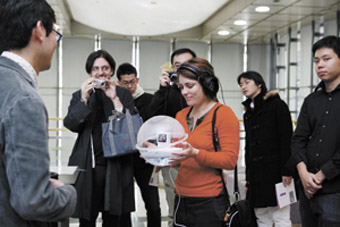
Hide Andrew, Save Yourself!!!
IN SAVE YOURSELF!!!, ONE OF THE MORE INNOVATIVE WORKS IN THE 2006 JAPAN MEDIA ARTS FESTIVAL (STAGED IN EARLY 2007), THE PARTICIPANT HAS THEIR PHOTO TAKEN AND THEN FLOATED ON A FRAME INSIDE A FISHBOWL FULL OF WATER. THEY ARE HANDED THEMSELVES IN THE BOWL AND DON SPECIAL EARPHONES THAT TOUCH A SPOT ON THE NECK JUST UNDER THE EARS. THE WORK IS TURNED ON AND SUDDENLY, AFTER A PRICKLING IN THE EARS, THE PARTICIPANT FIGHTS WAVES OF SEASICKNESS AND LOSES ALL BALANCE WHILST TRYING DESPERATELY NOT TO SMASH THEIR FLOATING SELF ALL OVER THE FLOOR. THE VISCERAL AFFECTS LAST ALL DAY while the concept evaporates in a few minutes.
The Japan Media Arts Festival (JMAF) is competitive, international and centred on the exhibition of Award Winning Works held at the Tokyo Metropolitan Museum of Photography. The spatial design of the exhibition is based on origami, the concept that the unexpected can be made from a common sheet of paper. Entry plaques to the exhibition state that the aim of the festival is to promote the popularity of media arts and describe the growing cultural currency of Japanese media art, games, animation and manga as ‘Japan Cool.’ The festival is definitely achieving its aim of popularising media art with audiences growing from 2,000 to 68,000 in the 10 years since it began.
The exhibition comprises three floors of screened, documented and installed work grouped in the submission categories Art, Entertainment, Animation and Manga. The festival includes Symposia, the 12th Computer Graphics Contest for Students, the Leading Edge Technology Showcase and a Manga Library. The week-long screening program is made up of long and short animation and Manga sessions, documentaries on the festival’s award winners and compilations from international festivals—SIGGRAPH, Seoul International Computer Animation Festival (SICAF), Ars Electronica and Australia’s Electrofringe.
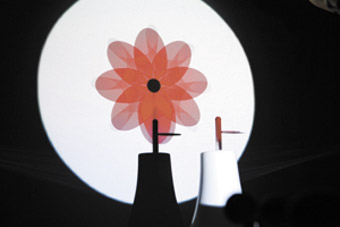
plaplax, hanahana
The selected works in the Art and Entertainment divisions are focused on technology, technique and aesthetic. Innovation in this year’s festival lies mainly in the perfecting of these elements rather than in conceptual content, perhaps because the festival is funded and partly run by the Japanese government’s Agency for Cultural Affairs, perhaps because entries are selected with no distinction between professional, amateur, independent or commercial production, and the Japanese term “media geijitsu” can be translated as art or entertainment. If Australia chose to develop the commercial growth of the media arts industry this way perhaps we could invent a new label. Australian Cool could be known as ‘artertainment’ or even ‘artattainment’ for the art consumers out there. It’s an odd idea for a director of Electrofringe, Australia’s Festival of Uncool, to take away.
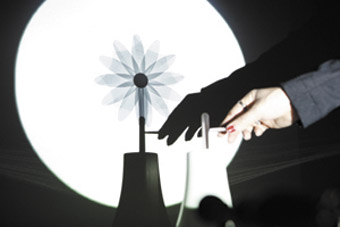
plaplax, hanahana
The Jury for the eclectic Entertainment Division claimed they saw no innovation this year, only refined applications of known forms and the expansion of content—important in increasing public access to digital entertainment. There was a clear inclination to link traditional aesthetics with digital entertainment in Japanese works such as Shaberu! DS Oryouri, a voice activated cooking navigator, and PaperCraft Modelling Software. Novelty was certainly evident in Katsumoto Yuichiro’s invention, Amagatana, a plastic umbrella fitted with a set of earphones and an acceleration sensor that transports the playful brolly wielder to a solo sword fight (and a new wave of fad toys?). The trailer for this work features the artist travelling through city and country playing air sword. Aiming to be a winner, this young artist’s business card is printed on sandpaper and designed to, over time, scratch out the name on the card kept behind it.
Works in the Art Division, which includes the fluid categories of Installation, Interactive Art, Visual Image, Still Image and Web Works largely lacked emotional content, focusing instead on the mechanical actions of viewers and often with geometrically abstract visual manifestations. A trend appears to favour translating scientific phenomenon over commentary on human relations. The influence of artificial intelligence research is evident with many artists exploring notions of the individual and the group, the part and the whole.
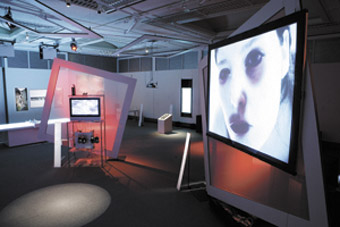
Johanna Reich, front
The one work with emotional depth (albeit uncomfortable) was Johanna Reich’s front (Germany), a video of a young woman fighting an unseen opponent whilst bruises and wounds appear on her from the invisible strikes she receives. The festival chose not to install the sound aspect of front, a language duel that carries the work deeper than the image.
The use of technology by Japanese artists is noticeably rigorous—the best, the latest, the simplest and the most aesthetically pleasing—but many of the interactive forms are by nature rational, employing familiar domestic devices. In contrast, Jonathan den Breejen and Marenka Deenstra’s PingPongPixel ([Netherlands] represented by a video documentary) is completely irrational. It creates an image made of ping-pong balls from any digital image loaded by the viewer. Software analyses and converts the image into black and white pixels. The data of each pixel (colour and position) is represented by an individual ping-pong ball. The software then activates a ping-pong ball feeder (that looks like a huge backyard experiment made of tubes and buckets) and loads the balls into a perspex frame to create a large scale ping-pong pixel image. It appears to take a day for the ping pong balls to load and this grossly delayed satisfaction combined with the sloppy, clunky mechanics of the ball feeder, seems to make a comment about the ‘advance’ of technology. It’s bizarre and hilarious.
Without a strong media dramaturgy that rigorously connects content with forms of interaction and the behavioural psychology of the viewer, interactive art can easily be reduced to mere game play and novelty. Sosu Hockey by Takano Jiro is a prime (bad joke) example of this—a tabletop game in which the player aims to collect as many prime numbers as they can whilst repelling the rest. Why is it in the Art Division? Who can say?
The two works most innovative in form are hanahana by plaplax and Save Yourself!!! (see opening paragraph) by Hide Andrew. hanahana is an interactive scent project where animations of flowers and butterflies, bees, cats, dogs and noses are triggered by an aromatic sensor when viewers squirt aromas on paper leaves.
The beauty of some immersive interactive works is in allowing the viewer to create their own experience or even narrative. Tablescape Plus by Y Kakehi, T Naemura and M Matsushita does this, if nothing else. A white box with a tabletop screen is set with white pieces on which little projections evoke a park scene. There are people, trees, a bench and the sounds of birds, crickets, crows, and trees moving in the breeze. The pieces are movable and the images animate according to the direction, location and quality of movement. The park people turn their backs if moved away, and break into a trot if moved fast.
I create an average day at the park. When I accidentally bump the edges of two park people they bow and greet each other in a high pitched conversation that only stops when they separate. A balding man in an ill-fitting suit and sporting a large moustache bumps into a bench and is immediatly seated on it. I fetch a friend for him to chat with but she chooses to stand behind him. I coax her to sit. She eventually concedes as long as the distance of a scaled meter is maintained. Only silence here—no chatting—and only two at a time on the bench, please. Meanwhile I take a tall blond man as far as a copse where he frightens a flock of birds that erupt across the park. He loiters there for a minute to see if the moustached man will join him. He does, frightening another flock of birds. A lady approaches but turns away when it looks like the blond man is going to pee in the bushes. When I shift a piece quickly the characters get snappy and a heated exchange ensues. It takes a little while for them to settle down and apologise but eventually I leave them bowing eternally to each other.
Japan Media Arts Festival (JMAF), Feb 24-March 2007http://plaza.bunka.go.jp
RealTime issue #78 April-May 2007 pg. 12
© Cat Jones; for permission to reproduce apply to realtime@realtimearts.net
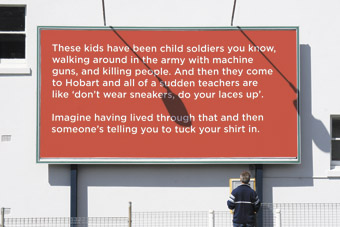
the write/here project, Justy Phillips, James Newitt
Ten Days on the Island is an engaging and entertaining aesthetic experience that brings together hundreds of local artists and reflects on the lives of many more Tasmanians. Dream Masons, the magical spectacle that took over the Salamanca Arts Centre revealed the possibilities of large scale performance with committed volunteers working with professional artists. The write/here project with its 27 billboard works across Hobart gave voice to some of the city’s inhabitants. The Port Arthur Project saw 25 visual artists respond to a morally and aesthetically complex historical site. Homage was paid to lives in remoter parts of Tasmania in Big hArt’s Drive-in Holiday, Silkwood’s Maria Island of Dreams and is theatre’s Queen of the Snakepit (about Flinders Island). An Other Place in the Long Gallery revealingly juxtaposed works by Tasmanian and Irish artists. And the Tasmanian Art Gallery & Museum celebrated the work of one local artist Leigh Hobba—a rewarding show that demands to be seen elsewhere in Australia.
As in all festivals, some works fared better than others, but few appeared short of audiences. Some, like Tasdance’s Mercy seemed oddly conceived but proved curiously memorable. An eccentric new work like Queen of the Snakepit has plenty of room to develop while Robert Jarman’s Spectre of the Rose could have been all the more powerful had the performer-audience relationship been more precisely addressed. Once Dream Masons got past its long, sluggish scene setting, it accelerated into the work we were hoping for, where its virtuosities were not lingered over and the pace matched its cartoonish conception. Hopefully it will prove a model for ambition in Hobart’s performing arts scene.
It’s easy to think of Ten Days as a string of one-person or small cast shows in theatres and intimate gallery showings and the Spiegeltent-style Crystal Palace cabaret events, but artistic director Elizabeth Walsh has cleverly contrived to bring many into the festival’s fold with the large scale works mentioned here and seen in streets, in galleries and across the island. The RealTime team enjoyed contributing to Ten Days with our admirable team of five emerging reviewers who worked day and night to produce reviews indicative of the range and quality of an idiosyncratic festival. Eds.
RealTime issue #78 April-May 2007 pg.
© RealTime ; for permission to reproduce apply to realtime@realtimearts.net

Please Vote for Me
IT’S BECOME SOMETHING OF A CLICHÉ TO SAY THE MOST INTERESTING CINEMA IN THE PAST 15 YEARS HAS COME FROM ASIAN FILMMAKERS, BUT JUDGING BY THE SELECTION AT THIS YEAR’S ADELAIDE FILM FESTIVAL (AFF) THE WELLSPRING OF FERTILE IDEAS, INNOVATIVE STYLES AND DISTINCT SENSIBILITIES SHOWS NO SIGNS OF ABATING. KEY AUTEURS OF THE 1990S SUCH AS TSAI MING-LIANG GO FROM STRENGTH TO STRENGTH, WHILE A STEADY STREAM OF NEW DIRECTORS WORKING IN BOTH FEATURES AND DOCUMENTARIES PROVIDE INSIGHT INTO CULTURES MANY OF US STILL KNOW LITTLE ABOUT, WHILE CONTINUALLY PUSHING THE BOUNDARIES OF CINEMATIC FORM. AS THE SMALL SAMPLE OF THE AFF PROGRAM REVIEWED HERE SHOWS, IT’S NOT THE SENSE OF ANY COHERENT MOVEMENT THAT MAKES THESE FILMS SO EXCITING, BUT RATHER THE PLETHORA OF STYLES AND APPROACHES ON OFFER.
please vote for me
This extraordinary one-hour observational documentary by Chen Weijun looks at the introduction of democracy into a primary school classroom in Wuhan, central China. For the first time, the eight-year-old children are given a choice of three nominees for their class monitor, a position previously appointed by teacher’s decree.
The most charismatic of the three nominees is the chubby Cheng Cheng. By turns underhand, attractively roguish and endearingly vulnerable, he appears to be leading the race for most of the campaign. His main threat is Luo Lei, the son of a local police chief and a former class monitor with a reputation for violence and dictatorial rule that puts most of the children off. His parents aren’t going to let that stop him however, and when his campaign is going badly his father arranges for the entire class to take a free ride on the town’s new monorail, conveniently administered by the local police. The sweetest of the three candidates is Xu Xiaofei, the daughter of a single mother. Annihilated in pubic debates with the more aggressive boys, Xu is reduced to tears when Cheng’s supporters heckle during her first speech.
After a fortnight of speech-making, plotting, free monorail rides and constantly shifting alliances, the candidates make their final statements. Cheng delivers an outstanding performance and looks a shoe-in. In contrast, Luo’s speech is short, abrupt and distinctly unconvincing. But in a stunningly savvy political move reminscent of our own Prime Minister’s Machiavellian cunning, Luo ends by giving individual gifts (provided by his parents) to every child in the class, ostensibly for the following day’s Autumn festival. As an appalled Cheng looks on, Luo is swept to power in a landslide minutes later.
It would be comforting to think Please Vote for Me is about the birth pangs of democracy in a nation that has never known such a concept, and the film does reveal much about the changing face of Chinese society. Cheng sells himself, for instance, as “a manager, not a dictator.” The immense pressure placed on the kids also reflects the repercussions of the one-child policy for a generation of Chinese children. But Chen’s film is so funny and frightening for viewers in the West primarily because it correlates so closely with our own experience of democracy. The blatant manipulation of political players and voters alike is laid bare, and made all the more disturbing for being enacted by children unselfconsciously taking their cues from adults. Please Vote for Me is a small gem which will hopefully get exposure well beyond the AFF.
i don’t want to sleep alone
On the drama front, the AFF was fortunate to have all seven of the films commissioned by Peter Sellars in his role as director of Vienna’s New Crowned Hope Festival. Several of these films were by key Asian auteurs.
I Don’t Want to Sleep Alone sees Taiwanese director Tsai Ming-liang working in his birthplace of Malaysia for the first time, but retaining his trademark narrative minimalism, long takes and fixed frames. The film traces the quietly intense emotional ties that develop between a Chinese-Malay domestic helper and two labourers (one Malay, the other Bangladeshi) living in Kuala Lumpur. Tsai’s stories demand a particular kind of meditative engagement, developing through subtle shifts in the interpersonal relations between characters, and the characters’ relationship to their environment. What initially feels like narrative inertia becomes a slow build towards a breathtakingly moving finale. Tsai’s earlier films such as The River saw his characters trapped in a prison of alienation, but I Don’t Want to Sleep Alone holds out the possibility that meaningful connections are possible—even if they are always fraught with emotional risks.
syndromes and a century
Quite different in style and tone, Apichatpong Weerasethakul’s Syndromes and a Century represented one of the AFF’s most startling experiences. The film begins in a rural Thai hospital, tracing various relationships and emotional cross-currents through a meandering narrative as languid as the tropical setting. After a time, the story unexpectedly starts again, this time in an urban environment. Reflecting the more nervous, dispersive energy of the city, this time the tale takes a more fragmentary course involving many more characters, culminating in a series of puzzling final shots in which the narrative disappears altogether.
Weerasethakul constantly undercuts any sense of forward motion, evacuating all narrative drive with a creeping entropy that sees his characters drifting apart almost as soon as they meet. Yet Syndromes and a Century also displays a distinct lightness of touch and an attractively good-natured quality, creating a unique combination of narrative dispersal with a strangely uplifting tone. The result is so unlike anything I’ve seen before it’s hard to say more after only one look, except to concur with the Special Mention afforded the film by the AFF Jury for its “sheer beauty and radical approach to cinema.” An intriguing work that demands multiple viewings.
feet unbound
Two films at the AFF that were flawed but deserving of mention were Feet Unbound, the debut documentary by Perth-based Singaporean Khee-jin Ng, and How is Your Fish Today?, directed by the UK-based Chinese novelist and filmmaker Guo Xiaolu.
Feet Unbound sees director Ng tracking down six women who took part in the Chinese Communist’s Long March of the mid-1930s, contrasting their stories with a present day retracing of their steps by a young Beijing journalist named Elly. Unfortunately Elly’s presence is somewhat detrimental to the film: we never really get a sense of her investment in the Long March and she comes across as a somewhat superficial character. But the vigour of the ageing women is truly inspiring. It’s a moving testament to their toughness and will to survive that they have managed to outlive their tormentors—‘friends’ and foes alike—and tell their stories with such vitality and force.
how is your fish today?
How is Your Fish Today? is a strange, Pirandello-like work focussing on the rather banal life of Beijing scriptwriting Hui Rao, who ‘plays’ himself on screen. All of his film scripts have been banned by the censor, so Hui makes a living writing TV soaps. He escapes his solitary existence by living vicariously through one of his characters, who is fleeing across China in a script inspired by long-running TV series, The Fugitive. How is Your Fish Today? is an odd mix of documentary, hesitant drama and essayistic self-reflection, although it’s unclear how much of the scriptwriter’s situation is based on his real life. The film is certainly intriguing, but undermined by the fact that Hui ultimately seems to have very little to say, other than expressing a rather common place desire to escape his mundane daily routine. But perhaps this is the film’s point—more than anything it seems to be about the frustration of longing for transcendence through art, but remaining firmly grounded through sheer lack of talent.
The films mentioned here represent only a fraction of the quality works on offer in Adelaide this year. Over the course of three festivals, director Katrina Sedgwick and her team have built one of the most innovative film programs in the country—a selection that places unusual, eye-opening works by emerging talents alongside the latest features from cinema’s contemporary masters. On both counts, the endlessly diverse works coming from Asia continue to challenge audiences’ conceptions of what cinema can be.
Adelaide Film Festival, director Katrina Sedgwick; Adelaide, various venues,
Feb 22-March 4
RealTime issue #78 April-May 2007 pg. 17
© Dan Edwards; for permission to reproduce apply to realtime@realtimearts.net
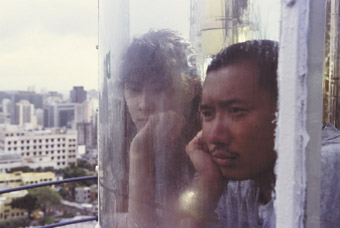
Isabella
INVIGORATING IN THEIR ENERGY AND ECLECTICISM, THE BATCH OF FEATURES FROM ASIAN FILMMAKERS AT THIS YEAR’S ADELAIDE FILM FESTIVAL ORIGINATED FROM A WIDER GEOGRAPHICAL REGION RATHER THAN FROM A SPOTLIGHT ON ONE PARTICULAR NATION. TO MATCH THIS DIVERSITY THE FILMS THEMSELVES CAME FROM ALL GENRES AND WERE AIMED AT VARIOUS AUDIENCES. THE PROGRAM INCLUDED SOUTH KOREA’S BIGGEST EVER BOX OFFICE SUCCESS ALONG WITH SOME GENUINE ESOTERICA. IT IS PERHAPS UNSURPRISING THAT ONE OF AUSTRALIA’S CHIEF CHAMPIONS OF NEW ASIAN CINEMA AND LONGTIME REALTIME CONTRIBUTOR, MIKE WALSH, HAD SIGNIFICANT INFLUENCE IN SHAPING THE PROGRAM.
invisible waves
Pen-ek Ratanaruang’s new feature, Invisible Waves, was always going to be compared with his breakout hit, Last Life in the Universe. Another collaboration with Australian cinematographer Christopher Doyle and Japanese star Asano Tadunobu, it’s startling in its own fresh way. Straddling locales in Macau, Hong Kong and Phuket, Ratanaruang has constructed a low-key surrealist film noir about karma. Balanced by Tadunobu’s portrayal of a criminal who is also a chef and epitomises existential cool, Invisible Waves is a contemporary Dante’s Inferno infused with Asian art cinema aesthetics and the downbeat mystery of 50s gangster productions. It sounds a heady cocktail, and it is: the story of a low life who murders his boss’s wife and then goes on the run takes on the symbolism of a descent into hell when the gangster uses a derelict cruise ship as his mode of escape. There are bizarre passengers and mysterious malfunctions, walls smeared with mould and blood, and strange hummings that permeate the cabins. Combined with Doyle’s lush compositions and elaborate, smooth camera movement the world Ratanaruang constructs is completely transporting.
isabella
One of the brats of Hong Kong cinema, Pang Ho-cheung, has produced his most mature work to date. Although the premise sounds tawdry—a prostitute wakes up in bed with a hard-living cop and promptly announces that she is his daughter—the film shifts direction altogether to become an interesting inversion of the family melodrama. Featuring Cantopop star Isabella Leong in the lead role, this is no exploitation piece, but an assured relationship study that reveals the emotional underbelly of the archetypal hard-boiled policeman. The backdrop of the handover of Macau’s handover to China lends a sense of confusion and displacement to the main action.
the host
If you needed a reprieve from the contemplative pacing of the rest of the program, Bong Joon-Ho’s The Host was a stiff antidote: an enjoyable monster movie with some intellectual layers. While it doesn’t quite have all the allegorical properties others claim for it, there is no doubt about its visceral thrills, and it bears all the hallmarks of a project that will have an immediate remake in California on ten times the budget. Many years after a US chemical facility dumps hazardous waste in the Han River a mutant creature emerges to wreak havoc and spread a deadly disease. Something like a tooth-and-taloned tadpole the size of an elephant, Bong’s monster’s lithe initial appearance on the riverbank will be a cherished scene for many of the genre’s fans. Apart from the environmentalist, anti-American themes running throughout, the film becomes what Bong considers a family drama after a young girl is abducted by the monster and her father, uncle, aunt and grandfather embark on an amateur vigilante mission.
still life
OnScreen has already dedicated extensive coverage of Jia Zhangke’s masterwork Still Life (RT76, p22), and politically and critically, one of the most important films of the last year. The inaugural jury for the AFF Natuzzi Prize agreed, awarding the $25,000 to the Chinese director. Jury president and co-director of the Toronto Film Festival Noah Cowan stated that the film was selected “for its bold, powerful artistic vision. It asks an urgent question: How do we value human life in the face of economic and cultural upheaval?”
exiled
Johnnie To has constructed a career on making Hong Kong action genres palatable to the tastemakers of European festivals, and also manages to produce multiple projects each year. While his latest film, Exiled, could be considered a reprise of his 1997 classic, The Mission, it is probably not as strong an example of the craft of the hitman film. However, there is much to savour here for connoisseurs. While the setup is familiar, a man is targeted by two assassins for failing to complete a hit on a local crime boss while two other hitmen set out to protect him, what follows is not. After a brief gunfight, all of the men, who turn out to be longtime friends, prepare an elaborate dinner together and sit down to talk through their issues. When they eventually band together to challenge Macau’s gangland leader, the film becomes a stylised aria on friendship, with several operatically arranged action sequences.
woman on the beach
Hong Sang-soo has established himself as one of Asian cinema’s more reliable auteurs, producing consistently high quality work on similar themes. Woman On the Beach continues his preoccupation with sexually predatorial males coming face to face with their own superficiality. Set in the foggy, spectral western coast of South Korea, Woman on the Beach follows a film director who goes to a seaside resort ostensibly to finish his latest script but ends up pursuing two women who are also staying in the town, one of whom is his best friend’s girlfriend. As his journey unfolds it becomes apparent that the women are the richer, more complex characters. Shot with almost exclusively long takes and making best use of the soft white light of the coastal area, this is an elegantly told film punctuated with moments of playfulness.
opera jawa
In a timely reminder that Western narratives often dwell in narrowly confined spaces and that there are many alternative modes of storytelling, comes a dazzling musical from Indonesia in the form of Opera Jawa (Garin Nugroho, 2006). Although using traditional puppetry and folk theatre, the film is never less than extremely cinematic in a chain of colourful set pieces marked by intricate set design and staging. The story, a reinvention of an ancient Indonesian tale, is universal: two men from different classes are in love with the same woman. How the story is presented here via gamelan music, acrobatic dance and puppetry is unique in global cinema, and while the film is overlong, its sheer spectacle is continually impressive.
These are just some of the films in a strong collection, a healthy mix of genre films and art cinema fare providing a well rounded representation of the Asian cinema zeitgeist, The blend of festival-favourite auteurs sprinkled with the less experienced directors felt about right.
Adelaide Film Festival, director Katrina Sedgwick; Adelaide, various venues, Feb 22-March 4
RealTime issue #78 April-May 2007 pg. 18
© Sandy Cameron; for permission to reproduce apply to realtime@realtimearts.net
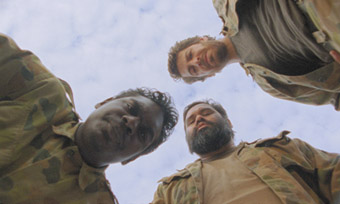
Lucky Miles
THERE WAS A HEALTHY SLICE OF AUSTRALIAN FEATURE FILM PROGRAMMING AT THE ADELAIDE FILM FESTIVAL WITH SOME HEARTENING PRODUCTIONS SUGGESTING AN ACCEPTABLE VINTAGE FOR THE INTERNATIONAL FESTIVAL CIRCUIT: INDEED, THERE HAVE ALREADY BEEN SOME NOTABLE AUSTRALIAN PREMIERES AT BERLIN AND SUNDANCE.
While there was no evidence here to hint at a box office breakout hit (admittedly I missed Cherie Nowlan’s Clubland), a film festival working to an art cinema agenda is unlikely to unearth another Kenny (Clayton Jacobsen, 2006). It is also worth noting that the scheduled release date for many Australian features again seems to be August-September. Local distributors appear to be still pushing for a crowded schedule to gain some exposure prior to the AFI Awards, risking several films being lost in the mass. However, if I can generalise, there is a continuing steady incline in overall quality and a wider and more pragmatic acceptance of low budget methodologies, both in the agency funded programs and privately financed projects.
lucky miles
The festival opened with Lucky Miles with first-time director Michael James Rowland staking a claim for a new genre, at least in this country: the refugee road comedy drama. The premise of the film—an Iraqi, a Cambodian and an Indonesian trekking across Western Australia in search of civilization and sanctuary after being smuggled and dumped on a remote bit of coastline—doesn’t exactly drip with commercial potential, but is an intriguing platform for some piquant social commentary. Tonally, the film walks a line between mild farce and emotional drama and for large sections runs the risk of turning into a twee, old fashioned quirky romp. Ockerish whimsy is too prevalent in the Army Reserve unit on the tail of the refugees, while the fugitives themselves engage in occasionally predictable cultural clashing (both with each other and their new landscape) and lessons in harmonious team work. In the end, some assured filmmaking and a satisfying climax take Lucky Miles a notch above a “comedy of issues” to be a warm, engaging film.
west
Although Dan Krige’s West is a product of the AFC’s high profile, low budget development and production laboratory Indivision, the script’s incubation stretches far beyond the recent workshopping environment. Having written a first draft in 1986 and completing something approximate to the shooting script in 1994, Krige’s tale of two male cousins clashing over the same girl in Sydney’s western suburbs is his self-described “baby.” Beneath the drug deals, teen sex and street violence, West is another coming-of-age story, albeit in a much more interesting milieu than, say, the sleepy coastal town of Indivision sister project Caterpillar Wish (Sandra Scriberras, 2006). West is a good account of the genre, frankly portraying limited life options given to the characters whilst gaining the most production value possible out of the budget (approximately $1.2 million).
boxing day
As discussed in the RealTime interview with director Kriv Stenders (RT 77, p17), his new production, Boxing Day is unusual in two key facets: the film was solely financed by a state government funded event (AFF) without a marketplace attachment in place, and was shot based on an outline and an intensive rehearsal period rather than a full draft script. The finished film, about a man on home detention attempting to reconcile his shattered family, is highly effective in its authenticity and sustained heavy drama. The cast of non-actors are credible with sensitive subject matter, and the experiment of shooting the film ostensibly in one extended handheld take contributes to Boxing Day’s relentless drive.
court of lonely royals
Yet another debut feature, this time from Melbourne-based Rohan Michael Hoole, is the dystopian hitman film Court Of Lonely Royals. Emerging from the private finance route, the film has a stylised storyline and heavily aestheticised visuals, heavily channeling the spirit of Wong Kar Wai’s Fallen Angels (1995). Hoole happily confesses to adoring Wong and Chris Doyle’s work, and should be commended for the energy and talent on display here; Melbourne’s streets and cafes host a hyperrealist nightmare populated with young nihilists.
the home song stories
The Home Song Stories, Tony Ayers’ second film, is a combination of heart on the sleeve autobiographical indulgence and sluggish melodrama. Loosely based on Ayers’ childhood, the film is about a dysfunctional Chinese family with an unpredictable matriarch. The story is bookended by the ham-fisted cliché of having Ayers’ alter ego, a middle aged writer, type out his life story as a nostalgic voice over launches the extended flashback sequence that forms the main narrative. While it is good to see a rare mainstream artistic space for the Chinese-Australian experience, and the setting of seventies suburbia is lovingly recreated, The Home Song Stories never gets beyond the dramatic gear of a mid-range telemovie.
dr plonk
Prolific low budget auteur Rolf de Heer launched Dr Plonk, a silent, black and white sociopolitical satire as the closing night film. In an environment where even raising soft money for safe projects is a major stumbling block for local producers, it is a mark of de Heer’s current standing within the industry that he can make a freewheeling Chaplin/Keaton homage. It is fitting that Dr Plonk closed the festival, as it is very much an ‘event’ film, celebratory, light-hearted and in this instance invigorated by live music accompaniment composed by Graham Tardif and performed by Stiletto Sisters. A mad scientist from 1907 turns doomsayer when his calculations predict the world to end in 2008, and he builds a time machine to acquire proof. What follows is well-timed slapstick, much more difficult than it sounds, as Plonk travels to and fro throughout history, but the satirical elements of the film regarding environmentalism and political commentary are a little straightforward and overt. Nevertheless, Dr Plonk will go down as one of the genuine curios of the Australian canon.
AFF has a vested interest in showcasing Australian film: they have a literal stake in some of the projects in the form of their equity investment. Compared with other national festivals where the local content is sometimes marginalised, the 2007 AFF program is rigorous and inclusive, and the crop of low budget fare displays, on the whole, an array of promising talent.
Cherie Nowlan’s Clubland will be reviewed in a future edition of OnScreen. Ed.
Adelaide Film Festival, director Katrina Sedgwick; Adelaide, various venues, Feb 22-March 4
RealTime issue #78 April-May 2007 pg. 19
© Sandy Cameron; for permission to reproduce apply to realtime@realtimearts.net

Sue Chuter with Bulldog, Lovestruck
photo Eron Sheean
Sue Chuter with Bulldog, Lovestruck
THE SILVER SCREEN GLOW OF 1960S WRESTLING FOOTAGE, THE ELEGANT RASP OF JACK LITTLE’S COMMENTARY (A GRAHAM KENNEDY ERA CHANNEL 9 STALWART OF US ORIGIN) AND PHILIP BROPHY’S REFLECTIVE SCORE (RECASTING THE LYRICAL GUITAR STYLE OF DUANE EDDY, THE SHADOWS ET AL FROM THE SAME PERIOD) PROVIDE AN IMMERSIVE OPENING TO MEGAN SPENCER’S 52-MINUTE DOCUMENTARY WHICH PREMIERED AT THE PERTH AND MELBOURNE INTERNATIONAL FILM FESTIVALS IN 2006, AND IS NOW ENJOYING CINEMA RELEASE.
Watching wrestling wasn’t my thing as a kid—there was a short-lived foray into stock cars and motor bike racing at Adelaide’s Rowley Park—but Megan Spencer’s Lovestruck about one woman’s proud, obsessive fandom for American wrestlers certainly begins with a subtly nostalgic arm-twister, a certain distance created by holding back the crowd noise and allowing the guitars to drift dreamily alongside the theatricalised violence…But then we’re plunged into the world of Sue Chuter, the images raw, handheld, immediate and interspersed with wrestling footage.
We see Chuter at home with friends: the subject, her wrestling obsession. “I’m the craziest of the bloody lot.” Later we’ll take in more of the house: wall to wall wrestling clippings, photographs and posters in every room including the toilet. Asked about having access to the phone numbers of her American heroes Chuter asserts: “it’s a personal relationship…I’m not just a fan.” It’s this that becomes a Lovestruck theme: just how meaningful is Chuter’s connection with these famous men. But first cut to Mick Foley being brutalised with barbed wire in a TWA Japan broadcast match (part of her voluminous watching, seen here with a large group of friends). Cut to Chuter phoning birthday wishes to her ‘king’, the American Jerry Lawler, former champion and now commentator and writer. A message machine responds. Spencer asks if the wrestlers ever call back. Chuter chortles, “No! I’d totally freak out!”
Chuter is revealed to be a successful fan: yes, she too must on occasion queue for autographs, but the champions mostly recognise her, are often affectionate and Lawler announces her presence to the match crowd. This fandom is a totality and, for all its gutsiness, an almost atherial lifestyle—how Chuter can afford it (including a trip to the US, investment in memorabilia), whether or not she works, these are not addressed Spencer compounding a sense of a self-contained world. But there are many fascinating, palpable details.
We glimpse Chuter at a small local match, on her feet between the ring and the crowd, yelling. Later she’s in the ring and then hurling something at the crowd. These are the only moments we witness some of the aggression which must surely be part of her fandom. But Spencer leaves it at that while busily capturing the sweep of everyday wrestling life—and it’s often funny. We see Chuter at workouts, at press calls (mini-matches in themselves) wielding her own camera and at post match raps—the poetry of defiance and defeat. Old footage is inserted of a young, bloodied Playboy Gary Hart (“Sue once thought he was the only man she ever loved”) threatening to set his mother on his defiler. We learn too that in the 70s Sue became a ‘ring rat’, wrestling parlance for groupie. It’s not returned to, becoming subtext perhaps for the intimacy, albeit limited, she shares with some of her heroes.
As in many a documentary, from the clunky outpourings of the Biography Channel to the measured formulae of Australian Story, we’ve got a pretty good idea that in Lovestruck first up we’ll get a slice of the life, a solid impression of the subject before the voiceover or the intertitle anounces, “So and so was born in X on…” and the life narrative kicks in. Here it’s “1996 World Championship Wrestling, Festival Hall Melbourne, where it all began for Sue Chuter.” Second tack: something psychologically contrapuntal. Is Sue Chuter’s fandom, which she sees as providing ‘family’, a real life given that she lost her chance at actual family many years ago, leaving her daughter with the husband of a short-lived marriage? And with the commencement of the life story somewhat melancholy, aetherial female voices wordlessly chorus against rippling guitars.
The daughter, now 21 and with a child of her own, seeks out Sue (significantly it’s not the other way round) and there’s a happy enough reunion for several years. But now the film, and Chuter’s life, has entered a melancholy phase. Sue throws Rhonda a 21st birthday party, a happy occasion for the daughter, but Sue herself is emotional, largely detached from the other guests in the pub and mostly ignored, interrupted even, when she delivers her prepared, heartfelt birthday speech of reconciliation. This doesn’t feel like family. Rhonda believes her mother has immersed herself in wrestling as a substitute. We suspect otherwise: in the 1973 marriage her husband banned her from going to wrestling. Later it’s mentioned, without explanation, that Sue and Rhonda have separated again.
In the meantime, Sue’s been to America. We sit through her video of snowy Hartford, New York, Memphis etc, wondering why (a rare moment of repose perhaps) until she reaches LA, meets her always respectful heroes, all pictures of unbattered, glowing good health, and experiences her first WrestlingMania match, with a 16,000 strong crowd. It’s here we see another of Lovestruck’s ‘face in the crowd’ motifs. The image of the crowd darkens and a small circle of light wanders across the screen to pick out Sue. She’s well behind Lawler at his commentary desk, but as ever, very well placed for the big show. It’s a poignant if loaded moment—and we don’t know if it’s Spencer’s contrivance or Chuter’s own, given that the highlighting device is otherwise atypical of the film.
In the one sustained scene with a Chuter hero, we join Spencer and Sue at Melbourne airport to meet Jerry Lawler. There are repeated hugs, he seems genuinely affectionate, and prefers to see her as devoted rather than obsessed, but there’s clearly a limit to the time he can spend with her. She cries in Spencer’s arms. Is she momentarily overwhelmed or, as the film’s contruction hints, is there a limit to how much meaning fandom can offer? There’s the bouyant moment when Lawler singles her out at the match where she stands amidst the media mob, but soon we see Chuter married, this time to a UK wrestling fan. A compensatory act? Maybe, but he lives in the UK. They apparently keep in close touch by phone and text messaging.
Even though conventional family life has evaded Chuter, or she it, and a certain melancholy is sensed about the later years of her commitment to wrestling, Spencer is portraying a life still unfolding and it’s certainly one in which being a fan is, in the end, paramount. If there are complexities in Chuter’s personality, we don’t witness them. Her utterances about her life are blunt and, like wrestling lingo, doubtless oft repeated: “I’m rebellious in my own way…I’m eccentric….moreso since I met the wrestlers…otherwise I would have had a boring life…I like the blood and guts and the solidly built men…the wrestlers have a strong sex drive and they need comfort and companionship.” Lovestruck’s air of escalating pathos simply and effectively says that no state of being, be it fandom or fame, can completely satisfy, and is always subject to other forces. We are, however, left in no doubt about Chuter’s ongoing passion and we guess that she wouldn’t want us to feel sorry for her—as she adamantly declares earlier in the film when asked about the 1973 rape that was prelude to her marriage.
Asked about fandom, the late Vern Sundfors, an independent filmmaker whose footage is used in Lovestruck, comments in words to the effect that there’s not a lot to be said, but if it’s somewhere you “prosper in” and brings calm, that’s enough.
Lovestruck, director, camera, producer Megan Spencer, editor Julie-Anne De Ruvo, composer Philip Brophy, producer Rosemary Blight, RB Films, 2006
RealTime 79 will feature an interview with Megan Spencer, now director of Revelation, the Perth International Film Festival. Former director, Richard Sowada is moving to Melbourne’s ACMI.
RealTime issue #78 April-May 2007 pg. 20
© Keith Gallasch; for permission to reproduce apply to realtime@realtimearts.net
Draw (fireplace), 2005, video still, Anna Barriball (UK)
Courtesy the artist and Frith Street Gallery, London
Draw (fireplace), 2005, video still, Anna Barriball (UK)
MOVIES AND FLICKS COME FROM THE REALMS OF SUNDAY AFTERNOON, FROM THE WORLDS OF DATES, DISTRACTION AND TRANSPORT FROM THE EVERYDAY. THIS EXHIBITION OF VIDEO WORKS AT THE CONTEMPORARY ART CENTRE OF SOUTH AUSTRALIA, FRAMED BY ITS TITLE, SCARY MOVIE, AND PRESENTED AS PART OF THE ADELAIDE FILM FESTIVAL, MAY FRIGHTEN VIEWERS IN ITS DISTANCE FROM SUCH PLEASURES. TAKEN TOGETHER, THE WORKS IN THIS EXHIBITION RUN FOR NEARLY THE LENGTH OF A MOVIE. I STUMBLE INTO THE SUNSHINE WITHOUT A HAPPY ENDING.
First up is Mark Boulos’ Gates of Damascus (UK), a documentary following the experience of Mayrna Nazzour, who regularly manifests stigmata over the Easter weekend. The occasional wobble of the camera suggests that we are watching real events, captured as they unfold. Mayrna addresses us directly only once, and then we take our place amongst the hordes who have come to watch, record and feel some connection. The recording of the miracle on video gives us some contiguity to a moment (a scraping of the experience, recorded and hoarded like those of the oil and sweat that are carefully harvested from Mayrna’s skin). I wonder if I can claim to have experienced a miracle. Is a miracle only real when viewed with faith?
In contrast, Anna Barriball’s Draw (UK), a projected image of a fireplace, has a specificity that could have come from an old house much like the gallery in which it is situated. The only movement involves a semi-transparent sheet of paper hung over the mouth of the fireplace. It is sucked in and out, accompanied by the amplified sound of its regular, crumpled breathing. The quiet whimsy of this work snares me. Is the fireplace breathing? Is the whole house alive? Is it the house I walk through now? The whole gallery? The strength of the work is in its unwillingness to fully settle into any of these possibilities and thus it quietly tears at certainties we might have about the space through which we are moving.
Erik Bünger’s Gospels (Sweden/Germany) presents a stream of documentary-style talking heads (predominantly American celebrity actors) who one after the other exult a mysterious ‘he’ in an endless tirade of praise. Each describes ‘his’ qualities, with unwavering belief in the goodness of ‘him.’ The religious overtones extend to the actors’ body language of closed eyes and raised hands. This is the gospel according to Hollywood, pointing its funny, cynical finger at those who hand down truths in a screen media saturated culture. Shot at various times, only changes in video quality and fashion subvert the work’s almost seamless construction, allowing the possibility for artifice to creep in—how are we to know if they’re sincere? They’re actors after all.
The artifice in Mark Wallinger’s Sleeper (UK) seems clearly spelled out: a man in a bear suit wanders through an empty urban space at night; we watch him through glass. His patchy ill-fitting suit shows all its stitching; socked feet poke out. Similarly, the grainy hand-held camera work proclaims that this is not a filmic experience constructed for the viewer, but the recording of a ‘real’ event; the wanderings of a fake bear. The footage is from a real-time stream between the German Embassy in London and the Neue Nationalgalerie in Berlin, where Wallinger donned the suit. The bear seems beaten down by the weight of references he carries: German history, mysticism and a small nod to Joseph Beuys. For twenty minutes Wallinger perseveres with his lacklustre impersonation, putting the viewer in the awkward position of simultaneously suspending disbelief and accepting the artifice.
In his curatorial essay Richard Grayson references the work of Georges Méliès, magician and filmmaker, whose early experiments delighted and terrified viewers. Méliès wrote, “when anyone can photograph the ones dear to them…then death will no longer be absolute.” Scary Movie uses the screen to expand the boundaries of lived experience by disrupting and re-defining the absolutes conjured by the very existence of the moving image. By the end of my viewing of Scary Movie, the ‘real’ in its old solidified, embodied form shifts and flickers uncomfortably.
Scary Movie, curator Richard Grayson, artists Mark Wallinger, Anna Barriball, Mark Boulos, Erik Bünger; CACSA, Adelaide, Feb 23-April
RealTime issue #78 April-May 2007 pg. 20
© Sasha Grbich; for permission to reproduce apply to realtime@realtimearts.net
Leila Khaled: Hijacker
WE'VE HAD TO WAIT ALMOST TWO YEARS SINCE THE LAST CURATED SHOWCASE OF FILMS FROM THE ARAB WORLD TO TAKE PLACE IN SYDNEY. A MONTH-LONG PROGRAM OF SUNDAYS IN PARRAMATTA, WITH AN EXUBERANT SELECTION OF PARALLEL EVENTS, THE THIRD SYDNEY ARAB FILM FESTIVAL DELVED DEEP INTO THE RELATIONS BETWEEN FILMMAKING, POLITICS AND THE ART OF SELF-REPRESENTATION. ORGANISERS PLAN FOR THE FESTIVAL TO EMERGE INTO A STRONG AND SUSTAINABLE ENTITY IN ITS OWN RIGHT, AND A HIGH PROFILE EVENT ON SYDNEY'S ANNUAL CULTURAL CALENDAR.
Incubated and driven by Information and Cultural Exchange (ICE), the festival upheld an impressive array of partnerships and a feast of offerings with everything from Bedwin Hacker, the low-budget chick flick from the Maghreb, to Ghassan Salhab’s Beirut-bound allegorical thriller The Last Man. There was an exuberant Egyptian showcase in partnership with the Egyptian Consulate. There were audio-visual experiments at the Liverpool Regional Gallery curated by Khaled Sabsabi in association with Casula Powerhouse. There was even a matinee program for schools featuring the very Aussie comedy Jammin in the Middle E, about growing up Arab in Western Sydney, starring local hip hop artists Matuse and Nomise.
Notwithstanding all this diverse and stimulating work on show, we were left in no doubt that the curatorial heart of the Sydney Arab Film Festival lay with the documentaries. Central to the impact of this work on the festival as a whole was the decision to bring Nizar Hassan and Eliane Raheb, two key figures fostering documentary filmmaking practice in the Arab world to Sydney for the festival.
Hassan, an established Palestinian filmmaker, presented two works at the festival. Ostura/Fable collected the astonishing, fragmented and everyday stories of three brothers dispersed by the creation of the state of Israel. Hassan spoke about his decision to regularly enter the scenes he was shooting, alerting the audience to his own subjectivity, and stressed the necessity of a documentary filmmaking practice that allows the film’s subjects to lead the way.
In Ejteyah/Invasion, Hassan entered his own scenarios under different conditions. For this film, he shot and edited footage of the last days of the 2002 Israeli invasion of Jenin, meeting many of the refugee camp’s inhabitants. He then invited an Israeli soldier who had been driving one of the bulldozers during the incursion to be filmed viewing this footage. In the viewing room with the soldier, Hassan sat just behind his spectator, pausing to ask questions as the frame of Ejteyah/Invasion kept shifting between them watching and a full screen presentation of the astonishing footage taken in Jenin.
Foregrounding the act of spectatorship, not only the Israeli soldier’s but also his own, Hassan opened a space in which the audience could begin to judge not just the soldier but the filmmaker too, making himself a character in his own film. By extension Hassan was asking us to examine the impact of viewing his incredible footage.
Investigating the effect of being a spectator to the documented suffering of others lay at the heart of the two documentaries presented by Lebanese filmmaker Eliane Raheb, the first of which also dealt with the situation in Palestine.
So Near, Yet So Far explored the impact of the broadcast death of a Palestinian child, Mohamad al Durra, on children in the Arab world. After pursuing a young Jordanian boy who went to fight with the al-Aqsa Intifada and a group of children on the Lebanese-Israeli border who stole an Israeli cow, Raheb tracked down a childhood friend who had, in their youth during the Lebanese civil war, suddenly disclosed her Palestinian identity to her young Lebanese peers.
In Suicide/Intihar, Raheb started from her own escalating compassion fatigue and uneasy sense of consumer participation, to propose that the media coverage of the war on Iraq placed the Lebanese people watching it into a state of confusion akin to a strange suicidal inertia—essentially, a state of alienation. From here she explored suicidal acts in Lebanon that had been connected to the war in Iraq, including the disappearance of young Lebanese men who had spontaneously set off to fight in Iraq and never returned. She investigated the suicide of Edgar Aho in Lebanon when the local media broadcast images of his death soon after he jumped claiming he had suicided for Iraq. Raheb met Aho’s family, who learned of his death from television, and was prompted to confront and then deconstruct her own camera’s intrusion into death and grief she had sought to critique.
In a parallel festival event, visiting Lebanese journalist Bilal Khbeiz likewise presented a fascinating apprehension of the temporal logic of TV coverage of the war on Iraq. Khbeiz’s headed up Pressure Points, a forum curated by Mireille Astore, presented in partnership with The Writing and Society Research Group at the University of Western Sydney.
Khbeiz set up a bleak contrast. He positioned the “high-resolution blurs” of the American photo-journalist embedded with the US Army, unburdened by recognisable victims, as achieving a perverse temporal logic by becoming images of things to come, a warning of future death and destruction. Meanwhile, the “excessive clarity” and “tireless repetition” of images of Iraqi casualties broadcast by Iraqi stations had the temporality of death—of a past without a possible future.
In contrast Khbeiz proposed that the Israeli attack on Lebanon was so relentless as to postpone mourning until the end of the war. Thus, for Khbeiz, the war on Lebanon became marked for the Lebanese people by the strange temporality of living in a post-death era.
Short works screened with the Khbeiz paper continued to investigate the logic of mediation so central to the work of all the festival guests. In particular, Khaled Ramadan’s short film Wide Power told the story of the filmmaker’s struggle to come to terms with the conundrum of feeling that he was behaving like an Orientalist when behind the lens of the camera in his own country. This concern was at the centre of the festival’s other forum, Under Siege, presented in association with Casula Powerhouse, featuring Hassan and Raheb.
Hassan spoke about his refusal to participate in any dehumanising attempt to convince the so-called ‘other’ of his humanity. Instead, in response to what he perceived as the often objectifying and universalising strategies deployed by many documentary filmmakers, Hassan discussed his strategies for allowing his subjects autonomy and for making plain his own agendas and the apparatus with which he works. By entering the frame and by interrupting key moments of spectatorial identification with shots of his crew at work, Hassan established a self-reflexive documentary practice now seen as a common trend in Arab documentary filmmaking, albeit with varying degrees of success.
Such a strategy was also at the heart of the Australian premiere at the festival of Leila Khaled: Hijacker. This documentary investigated the aura surrounding the beautiful and armed young 24-year-old who gained international headlines in 1969 as the first woman to hijack a plane and put Palestine on the global agenda. Meeting with the now middle-aged Leila, Swedish born Palestinian filmmaker Lina Makboul placed herself and all her concerns inside the frame, establishing a self-conscious almost whimsical dialogue, opening up new possibilities for thinking with Leila Khaled.
At Under Siege, Raheb, spoke about the impetus for co-founding the cultural cooperative for cinema, Beirut DC, where she organises the Arab Film Festival, Ayam Beirut al Cinem’iya. Her discussions centred on Beirut DC’s efforts to open up otherwise unaddressed questions about Lebanese national identity, to foster an audience for independent Lebanese filmmaking, and encourage exchange between filmmakers and audiences across the Arab world, bringing to light the overlapping agendas of her own self-reflexive filmmaking and the work of Beirut DC. Evidently, Raheb and Beirut DC have been of crucial assistance to the Sydney Arab Film Festival as it strives to nurture its own agendas and audiences.
Festival co-directors Fadia Abboud and Mouna Zaylah, the organising committee and the festival’s associated partners did much more than present alternative stories to the stereotypes that tend to hold the balance of power in our public spaces. The festival opened up an intense critical space out of which emerged vital tools to apprehend the films on show, their intersections and the significance of screening them together, here, in Australia in 2007.
Hassan, who had refused an invitation to attend in 2005, said of the third Sydney Arab Film Festival and its future (recalling a central tenet of his own filmmaking philosophy), “I hope that they use the relationship between us and our films and the rest of the films to maintain their identity and not to convince the rest of the Australians that we have culture and that we are human beings.”
My prediction is that, with these criteria, the feisty and uncompromising Nizar Hassan will have no excuse for not coming back.
Sydney Arab Film Festival, directors Fadia Abboud, Mouna Zaylah, Information and Cultural Exchange (ICE); Riverside Theatres, Parramatta, Liverpool Regional Gallery, Liverpool TAFE Education and Training Centre, Sydney, Feb 22-March 18
RealTime issue #78 April-May 2007 pg. 21
© Megan Carrigy; for permission to reproduce apply to realtime@realtimearts.net
IF THIS YEAR’S AUSTRALIAN INTERNATIONAL DOCUMENTARY CONFERENCE (AIDC) LACKED SOME OF THE UPBEAT BUZZ OF THE EVENT IN ADELAIDE TWO YEARS AGO, PERHAPS IT’S BECAUSE MANY OF THE PROFOUND CHANGES TO THE DOCUMENTARY SECTOR PREDICTED IN 2005 NO LONGER SEEM QUITE SO RADICAL. NEARLY EVERY PROJECT IN THE PITCH SESSIONS, FOR EXAMPLE, TOOK AN ONLINE COMPONENT FOR GRANTED; THE MORE SAVVY PRODUCERS WERE TALKING OF MULTI-PLATFORM EXTRAVAGANZAS INVOLVING FILMS, WEBSITES, GAMES, REAL-WORLD COMPONENTS AND VIRAL MARKETING CAMPAIGNS.
Whether the possibilities of this brave new digital world are actually being realised in Australia is another matter, relating back to two depressingly familiar concerns that kept cropping up at this year’s conference: a lack of funds in the documentary sector and the claim that too much power rests with a handful of local broadcasters.
terms of trade controversy
The friction at the conference was set in the opening keynote by UK PACT Council Chair Alex Graham (PACT is Britain’s producers’ association). Graham outlined a drastic shift in the terms of trade between independent producers and broadcasters that has underpinned a recent boom in UK documentary production. Since 2004 UK producers have retained most rights on the programs they make—investment now simply gives broadcasters UK television rights for five years. This has provided producers with a financial incentive to actively sell their programs across different platforms and territories, as well as pursue spin-off products such as books. According to Graham, the new terms of trade have seen £500 million flooding into UK independent documentary production, fuelling an annual sector growth rate of seven per cent. The arrangement has had a positive effect on Britain’s terms of trade, fostered the accrual of capital for producers and increased employment—all at virtually no cost to government.
As Graham pointedly noted, this is a fundamentally different model from the one used in Australia, where funding bodies and broadcasters generally take all rights in all territories in exchange for investment that rarely covers the full cost of production. Using Film Australia’s terms of trade as an example, Graham argued that the philosophy underlying Australian funding models was more suited to the UK of the 1970s, or even the Soviet Union! He pointed out that project-by-project funding in exchange for universal rights simply provides no means for producers to build sustainable businesses.
Needless to say, a model which shifts power away from broadcasters and government agencies was always going to ruffle feathers, and the ABC’s Head of Television Kim Dalton made a stinging rebuke to Graham’s keynote in a speech at the AIDC opening drinks. It was unclear why Dalton thought the UK approach would be incompatible with the Australian production sector, although he later stated in The Australian that the tax rebate currently being considered by government to attract greater private investment in the local film industry would have been a more appropriate keynote topic (Sandy George, “Filmmakers edged out of the picture”, March 1).
Perhaps the most important lesson for Australia in Graham’s keynote was the fact that the UK terms of trade are the result of years of patient, sustained lobbying by a unified industry. In contrast, the ‘Great Debate’ immediately following Graham’s speech brought all the familiar fault lines running through the local industry to the surface. The topic was “Is government agency delivery of public funds stifling Australia’s content creation industry?” The attitude of Nick Murray of Cordell Jigsaw Productions, opening speaker for the affirmative, revealed why coherent industry lobbying is difficult. Murray argued that government bodies not only stifle creativity, they suck the life out of producers and embalm them. His proposed solution—shutting down all the funding bodies and giving the money to the broadcasters—ignored the fate of the non-documentary sector in such a model. Producer Michaela Perske, as the second affirmative speaker, passionately echoed Alex Graham’s keynote in proclaiming that “content providers need to be set free.” Meanwhile, the negative team of the FTO’s Tanya Chambers, the ABC’s Dasha Ross and the FFC’s Brian Rosen ran a routine set of ripostes, which at least made the point that the main factor stifling the industry is a basic lack of funds. The suggestion was made by both sides that there are simply too many filmmakers—hardly helpful since New Zealand manages to sustain a similar-sized documentary sector with one-fifth of our population, as the final affirmative speaker Chris Hilton pointed out. Nobody got to the core problem of a fundamental lack of investment in the Australian creative industries.
small voices, prophetic films
After the drama of AIDC’s opening day, it was deeply refreshing to begin day two with some films and a panel of filmmakers. The Podlove launch saw five five-minute documentaries examining the impact of technology on our lives and relationships. The series is a joint initiative between SBSi and the Australian Film Commission. The standout Podlove project was Virtual Freedom by Gef Senz, a simple but heart-wrenching story about a Burmese dissident living in Melbourne. While Senz’s film was a personal favourite, all the Podlove works were surprising and highly entertaining.
In contrast, most of the other sessions at AIDC 07 were dominated by commissioning editors and agency representatives—a sign of the conference’s increasingly market-orientated tenor. One important exception was the Perspectives on Alternative Voices session on day four. Filmmakers Dan Monceaux and Khee-Jin Ng (whose Feet Unbound screened at the concurrent Adelaide Film Festival) showed excerpts from their work and discussed how they produced their self-funded low-budget films. However, it was Safina Uberoi’s input that was most revelatory. She screened segments from a film that grew out of her attempts to make a documentary in the early 1990s about Islander youths living in the Sydney suburb of Macquarie Fields. She eventually decided to give the camera to the boys and let them represent themselves, resulting in a fascinating and disturbingly prescient depiction of life in a suburb recently racked by violent social unrest. Yet when Uberoi took the film to the ABC, they rejected it on the grounds that they “couldn’t understand the boys’ accents.” Uberoi concluded her talk with a five-minute work made by a child in a refugee camp in Lebanon, one of nine films made by children there with the help of an aid worker using low-cost technology. Uberoi summed up the feeling of the session by concluding that digital technologies are allowing the articulation of “small voices to which we need to become much, much more sensitised…these people are prophets.”
limited means, internecine struggles
If there was an overall impression created by AIDC this year, it was of an industry hamstrung by limited means, but also perhaps limited in its ability to find more effective ways of operating and lobbying for change. Space precludes further discussion here, but there were several sessions following on from Alex Graham’s keynote that gave the sense that Australia is increasingly falling behind the rest of the world in building sustainable creative industries in the digital age. Unfortunately, rather than fuelling a coherent push for change, the lack of capital in Australia’s creative sector all too often generates internecine struggles that do little to address the fundamental issues holding us back.
Australian International Documentary Conference, Adelaide, Feb 23-26, 2007, www.aidc.com.au
RealTime issue #78 April-May 2007 pg. 22
© Dan Edwards; for permission to reproduce apply to realtime@realtimearts.net
Monks – Transatlantic Feedback
ONE OF THE MUST-SEES AT THIS YEAR’S FESTIVAL OF GERMAN FILM HOSTED BY THE GOETHE INSTITUT WILL BE THE MUSIC DOCUMENTARY, MONKS-THE TRANSATLANTIC FEEDBACK, WHICH CHARTS THE HISTORY OF THE MONKS, THE AVANT-GARDE ANTI-WAR ROCK GROUP FOUNDED BY FIVE WORKING CLASS AMERICAN FORMER SOLDIERS STATIONED IN COLD WAR GERMANY.
The Monks released their first album, Black Monk Time in 1966, appearing onstage wearing black cassocks, their heads appropriately shaved. Filmmaker Dietmar Post who worked with co-director Lucia Palacios for eight years on the film which was released this year combines rare archival footage of the band’s live performances on the popular German TV music show Beat-Club with contemporary interviews with band members and music commentators. “The footage from Beat-Club shows confused audiences standing around while the Monks smilingly sing ‘People cry, people die for you/People kill, people will for you.’ It’s the strangest thing I’ve ever seen”, Post admits. The documentary traces the evolution of a combo determined to expand the frontiers of popular music. What emerges is a picture of German-American cross-cultural experience, and a tribute to genuine rock and roll pioneers. The Monks reformed recently, releasing a tribute album in 2006. The group performed their first show in Germany in 40 years and went on to play London and Zurich. The filmmakers will be in Sydney for the festival.
The festival also offers the opportunity to see some of Germany’s other up and coming cinema talent. Opening the festival is Marcus H Rosenmuller’s satire of the heimat genre, Grave Decisions. Writing in Goethe Institut’s Kultur magazine, Oliver Rahayel talks about the word “heimat” as untranslatable, describing “unique feelings and attitudes.” Nevertheless, German Film Festival regulars are familiar with the genre. “Since the early 80s”, says Rahayel, “filmmakers have increasingly avoided the bitter tone of left wing heimat films, increasingly trying to reconcile social criticism with lighter, more playful treatments of the genre’s stylistic elements, often in combination with autobiographical approaches.” Rosenmuller, whose Heavyweights is also showing at the festival, counters: “I think every movie is a heimat film in some way. In mine, it’s just more obvious because of the dialect (Bavarian). Apart from that, Grave Decisions is about sin and forgiveness.”
Emma’s Bliss is a comedy/drama about a “pigwhisperer” from Sven Taddicken, one of Germany’s idiosyncratic young directing talents. There’s the psychological thriller on the theme of male friendship, A Friend of Mine, made by Tom Tykwer protégé, Sebastian Schipper. Valerie is the debut feature from Birgit Möller who graduated from dffb film school in Berlin in 2006 and who credits her first film’s success to Agata Buzek who plays the title role, Valerie, a model stranded penniless at the Hotel Hyatt in Berlin on Christmas Eve. Moller will attend the festival in Sydney. Best actress at Berlin Film Festival last year went to Nina Hoss for her performance in Christian Petzold’s Yella, which also screens. In a fresh spin on the theme of German reunification, Hoss plays a put-upon woman who develops a taste for the ruthless business world. Chris Klaus’s Four Minutes has an intriguing premise that brings together a savage young woman (Hannah Herzsprung), in prison for a brutal murder she may not have committed, and an 80 year old (Monica Bleibtren) who has taught piano in prison for years and believes she has discovered a prodigious talent. Herzsprung is a festival guest. Eden, by Michael Hofmann, tracks a failing relationship revived by gourmet food and jealousy, while Matthias Luthardt’s Pingpong observes a 16 year-old boy moving in with his emotionally detached relatives after his father’s suicide and focusing his sexual drive on his aunt.
The “controversial” film is WUT by Züli Aladag recounting the escalation of a conflict between a young self-confident Turk and a liberal teacher at a Berlin school, using an actual case to show the difficulties of an inter-cultural dialogue between two people whose worlds hardly ever come into contact. Summer 04, about a German family on a sailing holiday on the Schlei, an inlet of the Baltic Sea, is described by The Guardian’s film writer, Peter Bradshaw, as reviving the spirit of Polanski’s Knife in Water. “Summer 04 has a confrontational, forthright clarity, and an edge of cold steel. (It’s) a very distinctive kind of movie: sexually candid, scary, playful in a sadistic sort of way, yet not ironic or romantic. It is a style which does not exist in our Anglophone cinema, on either side of the Atlantic.” If we needed an excuse for another film festival, there we have it—they offer us a chance to see films we’re unlikely to see on the commercial circuit, to map trends of thought and styles of presentation that might otherwise escape our view.
Festival of German Films: Sydney, April 19-29, Melbourne 19-29, Brisbane 26-29, and Perth 26-29. For updates and complete program: www.goethe.de/ozfilmfest
RealTime issue #78 April-May 2007 pg. 22
© RealTime ; for permission to reproduce apply to realtime@realtimearts.net
Rinko Kikuchi, Babel
BABEL TAKES ALEJANDRO GONZALEZ INARRITU’S FASCINATION WITH INTERWEAVING NARRATIVES TO ANOTHER LEVEL BY MAKING THE WORLD HIS PLAYING STAGE AS A SINGLE GUNSHOT AFFECTS THE LIVES OF SEVERAL PEOPLE IN THREE CONTINENTS.
In one strand of the story Cheiko (Rinko Kinkuchi) is a rebellious deaf Japanese teenager, traumatised by the recent suicide of her mother. She is bitter towards her father, Yasujiro (Koji Yakusho), and boys in general. It would appear she is sexually frustrated, engaging in provocative behaviour with a series of men. She attempts to initiate sex with her dentist who is horrified. She meets with her friends and in an abandoned playground hooks up with some young men who give them drugs. While her deaf friends are easily able to connect and make out with these young men, Cheiko finds she is rejected by the one she likes because, she assumes, she is deaf.
At home Cheiko encounters two detectives looking for her father. Finding one of them, Kenji Mamiya, attractive, she invites him home. Wrongly supposing that the detectives are investigating her father’s involvement in her mother’s suicide, she tells the detective that her father was asleep when her mother jumped off the balcony and she was the only witness.
Cheiko reveals her real motive in inviting Mamiya to her home. She approaches him naked and attempts to seduce him. He resists but is compassionate when she breaks down at this latest rejection. Cheiko writes him a note, indicating that she doesn’t want him to read it until he is gone. Leaving, the detective crosses paths with her father. When Mamiya offers condolences for the wife’s suicide, Yasujiro is confused by the mention of a ‘balcony’ and says angrily, “My wife shot herself in the head. Cheiko was the first to find the body.”
This issue of conflicting stories is never resolved. The note’s contents are never revealed. However parts are momentarily visible when the detective stops to read it in a bar. The following is an approximate translation of the Kanji script that can be seen at the edges of the pages: “…I wanted… myself…that’s why…connected…that is…although I cannot…I have to find out…message from my mother…I was not sure if I was loved by my mother…but that’s not the case…thank you.”
While the link between Babel’s first three stories is quickly established, it takes some time to work out why this fourth strand belongs at all. I wondered while watching the film if the Japanese story would have an overt link, except for the fact that the central character is deaf, and therefore takes on the symbolic representation of miscommunication and dysfunction of all the stories to the nth degree.
It’s interesting that Innaritu has said, in an interview with Todd Gilchrist, “people confuse what the girl in this story is doing with some kind of sexual addiction, but that is not the case. I think that when you can’t communicate or express feelings with words, the body then becomes your tool of expression—a weapon or an invitation. That is the tragedy of this girl” (movies.ign.com).
Inarritu’s assumption is that Cheiko can’t communicate or express feelings with words, conveniently forgetting that she is fluent in sign. She is also able to write fluently, the note suggests she has full grasp of written Japanese. Because signing is ‘silent’ and mysterious to those who don’t use it, it becomes easy to project onto deaf people a universe of pain and exclusion if they don’t speak.
Many people have said they found Cheiko’s story the most moving in the film. I would argue that has more to do with how it has been shot and the nature of the soundscape than any representation of reality. Inarritu states: “We used anamorphic lenses [in the Japanese story], because the depth of field is minimal—the character is in focus and everything else out of focus. That isolates the character.” Filmically it is an arduous process, but often produces images of great beauty. One of the most powerful sequences is in the disco where Cheiko goes with her friends and the film switches perspective—from the blast of surround sound disco music to a subterranean thump as we move into her almost silent headspace. It becomes an exotic journey for the hearing audience.
And that is what it is, an exotic representation of deafness that has been very much framed in a hearing perspective. When we first meet Cheiko she is taking part in a competitive deaf team sport, volleyball. It becomes clear very quickly she is part of this group, she socialises and has close friends however badly she is behaving. The hidden (and I would suspect, unintentional) subtext is that this woman is actually an integrated member of her society, however much she may be lashing out against the death of her mother and her difficulties in communicating with her father (who also appears to have a good grasp of sign
language).
Here, Innaritu infers that signing is a language where not very much can be said. So rather than exploring the truth behind what a character like Cheiko might offer, the disability of deafness becomes a convenient storytelling shorthand to stand as metaphor for the film as a whole. This could have been a compelling comparison, except the filmmaker chose to skim the surface of what it’s like to be a ‘sign language girl.’
“Stereotyping cultures—that’s what is spoiling the world, I think”, Inarritu has claimed. I can understand he is speaking from his experience as a Mexican, but he too is guilty, of stereotyping the deaf experience, reducing it to an experience of sound and imagery rather than paying attention to the stumbling attempts we make to communicate, and ignoring the riches of other modes such as sign language.
Babel, director Alejandro Gonzalez Inarritu, writer Guillermo Arriaga, Paramount Films, 2006
RealTime issue #78 April-May 2007 pg. 23
© Sofya Gollan; for permission to reproduce apply to realtime@realtimearts.net
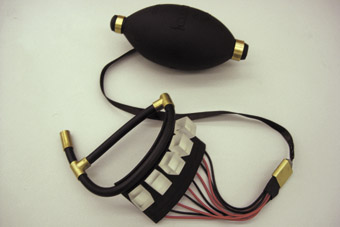
Embracelet, Jonathan Duckworth (with Catherine Truman)
ON FEBRUARY 27 THE HAIL-CLOGGED GUTTERS OF THE AUSTRALIAN NATIONAL UNIVERSITY’S SCHOOL OF ART GAVE OUT. IMPROMPTU WADING POOLS ACCRETED AMONGST THE VENT-PIERCED ART DECO ROOF, SAGGED, SEEPED, THEN DRAINED, BATHTUBS FULL OF DIVERTED STORM WATER FUNNELLING THROUGH LIGHT SOCKETS AND AIR VENTS INTO CORRIDORS, WORKSHOPS, STUDIOS…LIGHT TABLES, PROCESSING EQUIPMENT, COMPUTERS, CAMERAS AND ENDLESS FOLIOS OF STUDENT WORK WERE STEEPED INTO ONE ICY MIXED MEDIA GAZPACHO.
And so it came to pass that decades of careful technology acquisition were rendered nothing but an insurance claim in the course of an hour. Not many media can handle that kind of rough treatment (the sculpture department was noticeably smug in the aftermath), but new media art in particular seems prone to disastrous malfunction at every variation in ambient humidity or operating system version number. ANAT’s WearNow symposium and reSkin workshop, hosted at the ANU in the month before the catastrophic storm, faces that risk, exploring the new hybrid field of “wearable technology”: electronics robust enough to carry the sophistication and subtlety of technological installation in the rough and tumble of every laundering.
In the WearNow symposium, which followed on from the 3 week practical lab titled reSkin, Los Angeles designer Elise Co carried the flag for the water-resistant team, presenting Puddlejumper, a raincoat whose surface lights up in response to embedded water sensors. Like much of the work on display here, not being quite as high tech as you’d think, this piece has negligible digital processing power. It’s simply a raincoat with some wires in it. You might even say that was the whole point, that’s what makes this design elegant. We could call Elise’s corner of the ring ‘industrial design.’ It’s a corner I would put her in with well known cyberpunk object designer Susan Cohn, also presenting—although Cohn could also be filed under ‘craft.’
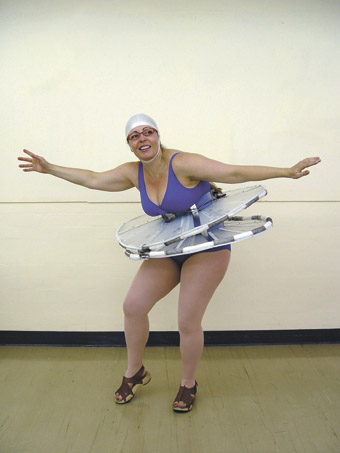
hipDisk, Danielle Wilde (demo 3)
photo Cinnamon Lee
hipDisk, Danielle Wilde (demo 3)
In the ‘technologist’ corner, CSIRO’s Robin Cranston has a load of speculations about the properties and potentials of future nano-technologically produced materials that will hypothetically revolutionise textiles as we know them. Most of his subject matter is as yet outside the powers of cheap mass production, existing largely in electron microscope screen shots. Damn pretty ones, mind. Joey Berzowska and High Tea with Mrs Woo hold the ‘fashion’ corner which would, for argument’s sake, put SymbioticA’s Oron Catts in the ‘high art’ camp.
Stephen Barrass’ background paper quilts these pieces together. His is a neurobiologically motivated talk unifying the low and high technology works under the protective umbrella of augmented reality. The skin is a sense organ, his argument runs, and the tactile experience of wearable objects places them in the camp of your general hyperreality experiences. Insofar as ideas of augmented reality interfaces are a re-invention of ‘virtual reality’ and bionic human machine hybridisation that we envisioned for ourselves in the 80s when trying to imagine the present, the intimacy of wearables places them closer to the latter; wearable technology is a cybernetic intervention in your own direct sensory experience. To paraphrase, bionic interaction has been with us all along, and we call it fashion. Only now we notice that it’s technology because it stops working when the batteries run out.
It’s a noble attempt at unification in a singularly patchy situation. But a bold unifying idea is one thing; for the speakers themselves to engage is another. ANAT’s background papers are excellent and comprehensive, including articles by most of today’s speakers, and free to boot. But what we want from the symposium is more than background briefings: we want dialogue between the amazing authors of all these papers. Instead, we get show and tell sessions whose diverse notions blend into a turbid soup of dot point presentations. Some firmer steering from the ofttimes tepid panel chairs might have been in order, or perhaps a less conference-like format for the whole symposium, to free us all from the spectatorial paralysis more suited to watching Beyond 2000. It jars to use such a staid, uninteractive format for a conference on the most interactive technology imaginable.
The most pertinent missed conversation, for me, is the one about the intersections between “wearable technology” and the do-it-yourself movement. The majority of the works being presented don’t involve a huge amount of high technology; if anything is driving wearables as a medium right now it is not the invention of any new technology per se but the plummeting affordability of so many old ones, and the upsurge in disseminating the skills to use them. Internet-based collaborative skillsharing such as Instructables and MAKE magazine pop up in the workshops more than once; huge portions of the works created are driven by the community generated open source code of the Arduino circuit board, and when those run out there is a basket of plastic toys by the door awaiting circuit jamming. All manner of formerly technical specialised knowledge is becoming democratised and communal, and knowledge is being shared in all directions as artists from different fields get with the new media rhetoric and hybridise their artforms.
This do-it-yourself-then-tell-everyone-else is the trend whose effects suffuse the workshop—the blogging generation is turning their media-making prowess on the physical world. The reSkin Lab is bang in the middle of that movement—promiscuously multi-artform and multimedia, and multi-aesthetic, spanning industrial design, craft and good old fashioned high art. The laureates of this workshop stalk sleeplessly around with a damn good idea of precisely how easy (or not) all this newly accessible technology is. And for three weeks they have ruled the Art School like the coolest kids on summer camp, descending on the final exposition in a surging wave of lurid enthusiasm, adorned concept sketches spilling out of their sleeves, with unfinished LED-specked breadboards taped to their bodies. It’s messy, unfinished, and unapologetically half-arsed, but it doesn’t claim to be otherwise, and there are enough great ideas amidst the crazy ones to fill the butcher’s paper of a hundred brainstorm sessions. Highlights: Elliat Rich’s breath activated transpiration vest…Danielle Wilde’s splendidly undignified hula hoop musical leotard…the High Tea With Mrs Woo/Keith Armstrong collaboration, a contraption to transpose the impact of one person’s foot binding to spidery electrical actuators pressing another’s hand…
“So how do you wash it?” I ask Rowena Foong of High Team as she unwraps her foot from the delicate wiring of bandage wrapped pressure sensors. “You don’t. It’s not waterproof.” Participant Somaya Langley confirms: “Nothing here’s washable.” And so we all stumble off down the road for dinner, praying for dry weather.
Australian Network for Art & Technology: reSkin, Wearable Technology Lab, Jan 15-Feb 1, Australian National University; WearNow Symposium , ANU Gallery Feb 2, National Museum of Australia, Feb 3; presented by ANAT, the Australian National University School of Art, the Centre for New Media Arts (CNMA), Craft Australia
reSkin: www.anat.org.au/reskin
Arduino physical computing: http://www.arduino.cc/
Instructables: http://instructables.com
Make: http://makezine.com
RealTime issue #78 April-May 2007 pg. 24
© Dan MacKinlay; for permission to reproduce apply to realtime@realtimearts.net
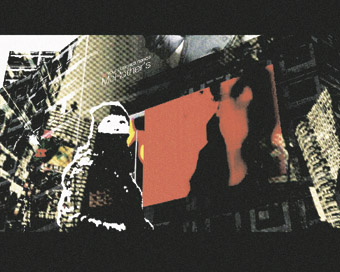
Freidrich Kirschner, Person2184
THE ORIGINAL AIM OF THIS SYMPOSIUM EXPLORING ART, CULTURE AND NEW MEDIA WAS TO DEFINE CONCEPTS AND PROCESSES CHARACTERISTIC OF THE BEGINNING OF THE 21ST CENTURY. SOME OF THE TOPICS THAT EMERGED IN RESPONSE TO THIS PREMISE MIGHT HAVE BEEN ANTICIPATED, SUCH AS INTERACTIVITY, WHILE OTHERS MIGHT NOT, SUCH AS FASCISM.
Asked what the decisive theoretical and practical developments of this decade are (if we consider that the discourses we are using in 2007 are quite old, postmodern at best), the broad range of speakers, from disparate specialities and geopolitical/cultural backgrounds nibbled at the question and shared portions of their own specialist knowledge. Definitive new developments, concepts or ideologies however, were elusive. It seemed instead that ‘old’ ideas, modern and postmodern, were being utilised—but in a new way.
Finding a common language, for this assortment of specialists, was at times difficult and reaching a consensus was impossible (there were even occasional intellectual fisticuffs). This doesn’t diminish the relevance of the symposium (or others like it). The significance perhaps resides in the importance of what Andreas Ströhl described as ‘dialogues’—two way communication—in contrast with discourses, which are one way, continually raining down upon us.
Ströhl (Director, Munich International Film Festival) presented the ideas of Vilém Flusser, a philosopher (1920-1991), not well known in the English-speaking world but increasingly influential in Europe. Ströhl discussed Flussers’ ideas of the apparatus (technology producing technical images), the apparatus behind the apparatus (put simply, the systems that determine which of these images appear—from broadcast media to art galleries) and the operators of the apparatus. He suggests a war between art and the apparatus; the apparatus digests art and reproduces it as aesthetic output. Art can struggle with the apparatus by creatively abusing the technology and putting the apparatus to use against its own program. In more simple terms, Ströhl suggests “the apparatus produces pictorial diarrhoea,” or, in a way, “David (art) challenged Goliath but Goliath simply ate him up.”
Debate about the possibility or the failure of the internet to operate as a dialogical medium and the ‘disappearance of interactivity’ in new media art underscored some of the discussion which ensued. There were those who did see the internet as a dialogical medium, with the possibilities and potentiality of interactivity (another David perhaps), while others viewed it as fascistic. Meanwhile Paul Majkut (investigative journalist, professor of literature, USA) pointed out that ‘a Coke machine is interactive’ and argued that interactivity in digital art is an impostor, posing as intersubjectivity and unable to carry empathy.
The obvious limitations of 90s-style interactive art were easily identified: that interactivity required two individuals rather than an interaction between machine and individual. No one could determine the agency of new media or networked technologies in the interaction between two individuals, precisely relocate ‘interactive art’, nor determine why it may have ‘left the building’. However, Eddo Stern’s art practice, which had traversed various approaches to interactivity, provided some kind of practical response.
Stern, an artist and computer game designer, had shifted from producing ‘interactive’/virtual reality works in the 90s to machinima works, which translate ‘interactive’ computer games into linear video works. (Put very simply, machinima is filmmaking in a virtual environment). Stern presented Sheik Attack (1999), a machinima piece, which juxtaposes edited scenes shot in war games with a soundtrack of traditional Israeli songs. He tackles both the debate on the Zionist ‘ideal’ and the relationship between the ‘fantasy of war’ and its real life counterpart. (Stern is Israeli and has done military service). Also picking at the seams between the politics of the game, the screen and the world, was Death Star (2004), an edited series of sequences shot in different games devoted to violence against Osama Bin Laden, screened along with the soundtrack from Mel Gibson’s The Passion of Christ.
Stern’s practice has now returned to interactivity with works such as the Tekken Torture Tournament Performance, where participants receive electric shocks corresponding to the injuries sustained by their onscreen avatars. Having variously interacted with interactivity in both his art practice and gaming passion, Stern perhaps provided the last word on the topic: “not playing massive multiplayer games now is like going through the 60s without taking drugs.”
I suspect Paul Majkut disagreed. He advocated that spoken language is truth and mediated language is not. He saw a delineation between analogue and digital media, arguing that the speed, power and illusion of simultaneity characterising the digital renders it fascistic—that it is a quantitative exchange of information rather than a qualitative exchange of knowledge. Majkut reminded us that the map is not the territory and confessed that he was proud to be a loser (taking sides with some of the other important losers, art and Marxism).
The discussion that followed moved from the word fascism to the ‘aestheticisation of politics.’ Whilst not everyone agreed with all of Majkut’s ideas, notions around the aestheticising of politics seem pertinent as we watch global warming finally reach the tipping point into mainstream political debate, only to be neutralised and aestheticised on programs such as Channel 10s’ one-off overview program, Cool Aid: The National Carbon Test.
If the ideas of Ströhl and Majkut seem reminiscent of those produced in the 20th century, perhaps this relates to the similarities in the contexts of these times—rapidly developing new technologies and horrendous aggression. In her examination of the political motivations for constructing the crowd as dangerous and the role of new portable technologies in the development and psychology of the crowd, Sydney-based media artist and theorist Anna Munster also considered whether we need new concepts for the new millennium or make do with older unfashionable ideas, looking for what is new in the old.
Whilst there were no definitive answers to the symposium topic, Freidrich Kirschner’s art practice provided the best response that could be hoped for. Kirschner, a filmmaker and visual artist, also creates machinima works. In Person2184 and The Journey, he uses the framework of Unreal Tournament 2004 to run beautiful film sequences he has constructed, creatively capitalising on the technology of the game and offering a critique of the game from within. Kirschner is also responsible for creating moviesandbox, a kind of movie-making toolkit, which allows the user to create and animate characters and scenery and also film them, to produce movie type sequences within the Unreal Tournament game. In a sense, Kirschner limits the limitations of the game, so that the character options, movements and rules are more open. For example, he has developed the milkscanner, a device that uses—amazingly—milk, a Tupperware container, Lego and a webcam to scan objects to adapt them as characters to be used in a ‘movie.’ The possibilities for developing a character explode with this clever and quirky device. The incorporation of everyday materials and the availability of instructions make the works freely accessible (see Kirschner’s website, www.zeitbrand.net).
Kirschner described his approach by comparing the board game Risk and playing with Lego. In Risk, a war game where players aim for world domination, the rules are derived from a previous reality, the game is determined by the rules and the space of the game is fixed (the board). With Lego, the rules, if there are any, are formed by your own perception of reality and the space of the game is any environment into which you put it. The former is simulated play, the latter, creative.
Maybe Kirschner could be considered a little ‘David’, struggling against the ‘apparatus’ with his art. If so, he does it in a new way, both critiquing and constructing from within, from a position of knowledge and passion about new technology, rather than from without (taking an oppositional position of deconstruction from outside the medium).
I hope Goliath doesn’t eat him up.
Experimental Art Foundation, The Ideology of the Imaginary in the 21st Century; Mercury Cinema, Adelaide, March 1, 2
RealTime issue #78 April-May 2007 pg. 25
© Christine Collins; for permission to reproduce apply to realtime@realtimearts.net
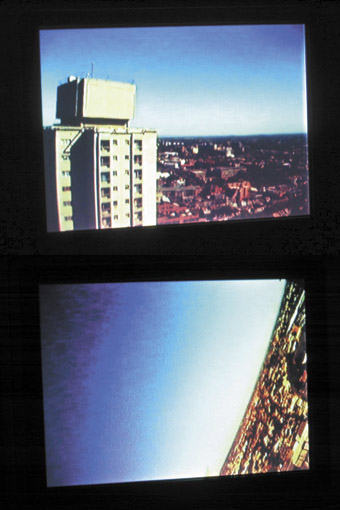
The Terminal Vision Project, Denis Beaubois
LIKE IT OR NOT, WE ARE ALL MEMBERS OF AN IMAGE-OBSESSED SOCIETY, INHABITANTS OF A MEDIATISED WORLD WHERE ALMOST EVERYTHING IS SEEN, TRACKED AND RECORDED. LIVING IN AN ERA CHARACTERISED BY YOUTUBE, MYSPACE AND REALITY TELEVISION, THE ACT OF CREATING A MEDIA IMAGE IS PROGRESSIVELY EASY WHILE, AT THE SAME TIME, INCREASED LEVELS OF SURVEILLANCE MEAN THAT MORE AND MORE IMAGES ARE BEING GENERATED THAT REMAIN INACCESSIBLE TO ALL BUT A PRIVILEGED FEW.
Three very different video and new media artworks recently exhibited in Sydney explore issues surrounding the contemporary image, in particular investigating the politics of tracking and the poetics of imaging and imagining the invisible.
In terms of imaging technology, surveillance cameras are a particularly insidious presence. These ubiquitous devices are continually recording our image, each person effectively leaving a trail of data that they will most likely never see. And perhaps it is my anxiety over the invisibility and inaccessibility of these highly personal images that made watching Denis Beaubois’ provocative video work The Terminal Vision Project (2007) such a cathartic experience.
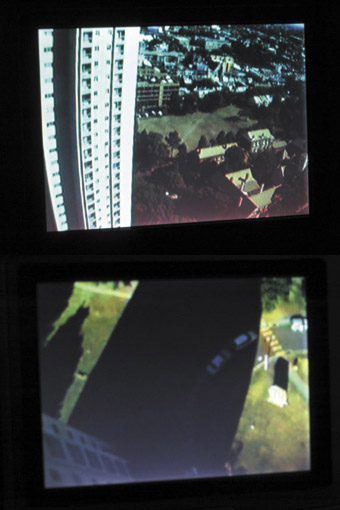
The Terminal Vision Project, Denis Beaubois
the camera suicides
In Terminal Vision, exhibited at the Performance Space’s fabulous new CarriageWorks home, the wireless camera technology that is used in much surveillance is literally and figuratively turned on itself. In an anthropomorphic sense cameras are made to suffer, as they are hurled full tilt off a tall building, and all the while made to unwittingly broadcast their own, unceremonious demise.
In the massive grey exhibition space, a row of five huge video projections completely covers the length of one wall. Stepping inside you are immediately struck by the sound, loud throbs of pounding static fill the room. Grungy images flicker in and out of visibility, messy and unstable, haphazard movements captured by the frame are repeatedly interrupted by interference and static. In a time of plasma screens and HDTV, these glitchy images reveal themselves as being something covert, they are too dirty and the signal far too weak to be anything but undercover, and it is as if we are witnessing someone or something being caught in the act. Through the grunge I make out a close-up of a wall with concrete cancer; wisps of the artist’s very recognisable dark hair quiver in shot. A windowsill appears and we glimpse a private room, a kitchen perhaps, with daggy old linoleum. Then the image degrades, we loose visibility to static, colours bleed into each other and interference takes over. I begin thinking about a secret agent who can’t work their pinhole camera, and as if replying to this thought I hear a muffled voice on what sounds like a walkie-talkie. Unexpectedly a finger probes the lens repeatedly, squashing the image away into flesh and darkness. Then I see the familiar shape of the infamous high-rise ‘suicide towers’ in Waterloo, as the signal weakens again. I begin thinking, we are in a precarious position up here on top.
Suddenly we are falling, the sound changes to a loud humming drone. I think about an aeroplane crashing, the black box recorder and what remains when everything is destroyed. Windows are spinning past and the horizon is in the wrong place. After a moment I start laughing, the dizzying image of the ground hurtling up towards us as this tiny wireless camera falls at breakneck speed from the top of the building is hilarious and exhilarating to watch. I imagine how much fun it must have been to throw these little mechanical guinea pigs off the edge. And then abruptly we hit the ground—thud—more static, a person walks by, we are in the grass, left for dead, then everything turns black and silent.
As audience members watching this defiant act on video we are presented with an unusual point of view. It’s an angle and trajectory of vision that we know will remain inaccessible to us, unless we too decide to end it all, flinging ourselves off the edge, but even then it is unlikely we would be around to remember, let alone record the experience. In this sense then the video image is one of impossibility, a terminal vision. Through the broadcast of these images Beaubois allows us to vicariously participate in his rebellious act. The ubiquitous cameras that are insistently pointed towards us, incessantly recording the banal details of our daily lives are suddenly made the instrument and target of some long deserved ridicule and physical abuse.
data lives
Two artists who for some time have also been concerned with surveillance and more broadly the politics of tracking human data are Josephine Starrs and Leon Cmielewski. Their concerns are once again raised in Seeker (2005), recently on show at Artspace. Seeker is a conceptually rich and aesthetically striking piece that is immediately engaging on a number of levels. In its most recent incarnation it comprised three large video projections displayed on hefty angled screens. The central image consisted of an animated, interactive world map. Using a simple touch screen interface, visitors could enter their family migration history. This data is shown as a trail on the map and then re-visualised as a series of curves representing each family’s generational movement throughout the world.
The other two screens are more mysterious. On one, colourful vectorgraphic curves dance across the surface of beautiful, desolate landscapes. These animated abstractions describe the relationship between an assortment of statistical factors and variables, often as depressing statistics. What is “coltan” [a rare mineral found in Africa, eds.] I wondered, to be included on a scale that reads “the Congo resource wars”, “3 million dead” and “3.5 million displaced…” and what is its connection with “every mobile phone” and “every computer”? Glancing to the other screen I see aerial imagery of suburbia overlaid with a thin strip of fast moving, news bulletin-style text: “a man has frozen to death on a plane…on a boat three stowaways die…landmines kill Pakistani refugees…23 Pakistanis drown in river on way to Europe…” This procession of death and despair seemed in marked contrast with the fun everyone was having inputting their family histories. I was reminded of how easily some of us can move in the world thanks to the luck of our birth, and the immense difficulty others face when attempting to escape places of unfathomable hardship and danger. However Starrs and Cmielewski’s background in creating humorous and entertaining artwork inspired by computer games still manages to seep through this conceptually solemn work. The power of Seeker seems to derive mainly from its ability to stimulate intimate and often politically charged dialogue between gallery visitors.
diagnostic mysteries
Modern images are no longer simply representations; they are also dynamic, interactive processes that form an integral part of contemporary medicine, weaponry, communication, movement and politics. Many of the images we see today are not discernible to our naked senses and we rely upon a range of scientific instruments for their continued visibility. Michelle Barker and Anna Munster explore this problematic in Struck (2005), recently shown at the Art Gallery of New South Wales, by taking viewers on an unsettling journey into the largely invisible world of neurological disease. Through a disturbing array of black and white medical imagery Struck evokes an uncomfortable awareness of the body’s powerlessness in the face of debilitating illness, and explores the equally difficult experience of finding oneself under the probing eye of medical science that attempts to treat it.
Watching this piece brought back memories of long hours spent in a hospital waiting room. It triggered powerful feelings of sadness and helplessness, emotions that were intensified by the work’s soundtrack—electronic noises, punctuated by the mournful notes of a piano and a childlike wailing. Surrounded by three giant video projections, as inside a hospital I felt like a small, insignificant presence within a complex and confusing, technologically driven world. As in a waiting room, a strange sense of timelessness pervaded the in-between space of the gallery where the work was installed. My thoughts were drawn to the similarities between the art world’s sterile ‘white cube’ and the sanitised, often unwelcoming environment of contemporary medicine.
Struck immerses viewers in a disconcerting realm of medical traces and unfamiliar diagnoses, confronting us with lingering images that, like the nebulous shapes burnt in to your eyes after looking into a bright light, are not easily erased. The most recognisable image in Struck is the now familiar medical trope of the brain scan slice, a highly detailed form contrasted in the work with the blurred images of a naked woman. Who is this faceless figure, I kept wondering, so vulnerable yet resolute within this alien medical world? Occasionally text appears, sometimes distant and clinical, seemingly transcribed from doctor’s records, sometimes comprising poignant, personal anecdotes: “People tell you how well you look—it makes you feel worse”.
At certain points an antiquated, stop-frame animation appears of a writhing female figure made, I later read, from the drawings of Jean-Martin Charcot, the influential 19th century French neurologist. It is hard to believe that these clumsy images were once contemporary medical documents, and the idea that someone could be diagnosed using them sends shivers down my spine. On the other hand, I realise that while I am comforted by the scientific validity of the relatively more sophisticated Magnetic Resonance Imaging (MRI) its images are still for the most part beyond my understanding, I cannot relate my thoughts or my feelings to their intricate electrical signals and I have no idea what they really mean. Essentially this is the core issue of Struck, the increasing visibility of the material human body made available to us through scientific imaging and the problematic relationship these images have with our ongoing embodied experience.
RealTime issue #78 April-May 2007 pg. 26
© Anna Davis; for permission to reproduce apply to realtime@realtimearts.net
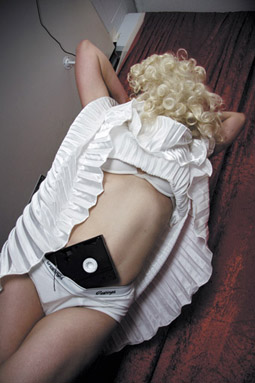
Tanja Visosevic, Peepshow, Rated VHS, photo Fiona Morrison
EVOLUTION IS A TERM THAT HAS NOT BEEN USED LIGHTLY IN DARWIN’S CONTEMPORARY ART SPACE, 24HRART IN RECENT MONTHS. VIDEODROMO 1.5, CURATED BY WA ARTISTS LEON MARVELL, TANJA VISOSEVIC AND YOLANDE PICKETT, AND DAWN OF REMIX BY SYDNEY’S SODA_JERK & SAM SMITH, ARE TWO EXAMPLES OF REFLECTIVE PRACTICES WHICH AIM TO QUESTION EVOLUTIONARY TECHNOLOGIES THAT BURST ONTO THE MARKET ONLY TO CONVERGE WITH THE VERY DEVICES THESE TECHNOLOGIES HAVE OSTENSIBLY SUPERSEDED. BOTH GROUPS ACTIVELY USE CONTEMPORARY MIXED MEDIA TO COMMENT ON OUR SOCIAL AND CULTURAL PRACTICES; HOW DOES THE LATEST, MUST-HAVE UPGRADE DEFINE WHO WE ARE BOTH IN OUR PERSONAL AND PUBLIC LIVES?
Videodromo 1.5, a restaging of the 2006 Perth event held at Spectrum Project Space, included local artists Elka Kerkhofs, Marko and Brandon Williamson for the Darwin performance. Profoundly interactive, the installation plays with the procedural aspects of modern technologies: TVs are made for passive viewing; video monitors are made for covert surveillance; still images should hang decorously on living room walls. Even the sound sculpture is hidden, heard but not seen, like so many in-built home sound systems today.
This was an experimental zone where the viewer was asked to respond to the familiar setting of a lounge room. Almost subconsciously the role of engagement expected of gallery goers is subverted and takes on a personal tone as we instinctively search out creature comforts: our sound system; our TV; our DVD/Video; our home theatre—the waves of successive technologies that have cemented their place in our lives.
Yolande Pickett’s still monitor images decorated the wallpapered walls of the Screening Room like TV screens. They provided an unsettling stillness which was dramatically juxtaposed with Marvell’s garbled projections. His central interactive exhibit was as unconscious as sleepwalking. Triggered by a motion detector between the monitor and projection screen, the viewer may or may not be aware of their participation in the show as the computer’s software generates alchemical images that flash, glide, fade in and out.
Marvell views this interplay as an act of meta-psychological creation in which our lost understanding of hermetic scripts is rediscovered with new and original meaning. Technology combines with human interaction as a form of artificial intelligence.
In addition to the Screening Room, VIDEODROMO 1.5 provided the audience with an opportunity to view one of Tanja Visosevic’s Peepshows, Rated VCR. Prompted by an advertisement in the local NT newspaper, the show attracted ‘standing room only’ queues on opening night. Visosevic’s staged Duchampian readymade used the site of the gallery toilets for a series of montages ranging from video porn to mobile phone mini-dramas.
This was a powerful piece as it used the theatrics of pubic toilets to expose our hidden and highly emotive interactions with technologies. Our emotional reliance on abbreviated language and the complex semiotic platforms which form the basis of mobile phone voice/text/video messaging has blurred the boundaries between public and private.
Visosevic’s Dadaist performance component transmitted fragmented moments of her peepshow sessions to the waiting crowds via a surveillance monitor within the gallery space. In one instance a mother viewing the peepshow (recognised only from the back of her head) was being watched by the general public on the black and white loungeroom monitor while her sons, unsupervised in the lounge and oblivious to the monitor above their heads, were playing on their mobile phones. This clearly was an environment which taps into our deep rooted psychological relationship with technology.
Soda_Jerk (Dan and Dominique Angeloro) & Sam Smith re-edit Stanley Kubrick’s 2001: A Space Odyssey using sequences from the “First Lesson” to convert the hominid awakening to the use of tools into a discovery of scratch, beat and dance. The “Dawn of Remix” is a humorous sleight of hand which lays memories open to a new narration of events. Kubrick’s ‘cube’ enlightens mankind to the hip hop culture of audio remixing.
Well positioned in the Monitor Space of 24HrArt, this re-edit was seen by crowds of passersby on the busy market days allowing for quick grabs or extended viewings. Memories are reconnected to the original film or mashed with the kaleidoscope of the everyday on the street, film present and past. The Beastie Boys and LL Cool J’s track Can’t Live Without My Radio could do no better for a new video clip.
Videodromo 1.5, curators Leon Marvell, Tanja Visosevic, Yolande Pickett with Elka Kerkhofs, Marko, Brandon Williamson; Soda_Jerk & Sam Smith; 24HR Art, Darwin, Feb 16-March 24
RealTime issue #78 April-May 2007 pg. 27
© Sarah Pirrie; for permission to reproduce apply to realtime@realtimearts.net
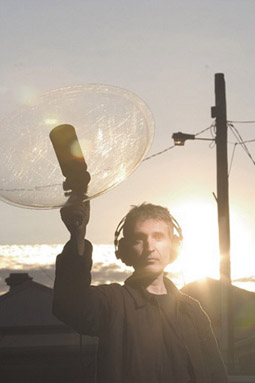
Philip Samartzis on location, Northern Void
IT USED TO BE CALLED THE TOP. IT WAS LITERALLY THE END OF THE LINE FOR THE TRAM SERVICE THAT SNAKED ITS WAY THROUGH THE INNER CITY TO THE NORTHERN MELBOURNE SUBURB OF PRESTON. THE CULMINATION OF THIS JOURNEY WAS A TERMINUS LINED WITH SHOPS, A PLACE OF CONCLUSION AND WAITING, OF BROWSING AND PURCHASING. IN NORTHERN VOID, A REPRESENTATIVE STRETCH OF PLENTY ROAD, PRESTON IS IMAGINED AS A VAGUE, ANACHRONISTIC TIME WARP SPANNING A THOUSAND YEARS, WHERE PEOPLE STILL HANG AROUND THE STREET OUTSIDE EMPTY AND DERELICT SHOPS, WAITING FOR TRAMS THAT NEVER SEEM TO ARRIVE.
Northern Void ostensibly explores the notion of what suburbs might look like in the future. For Philip Brophy there is no such thing as the end of the line. Social and urban decrepitude, like rust, never sleeps and in Brophy’s universe the future ain’t rosy. Here is an anti-pastoral, dystopian world of breakdown and decline, where once thriving, reliable local shopping strips have yielded to the forces of time and the irresistible gravitational force of the mega-malls. Preston and its neighbouring Reservoir were once frontier suburbs, outposts of civilisation on the brink of the sprawling wastelands of rock and thistle that led the way to Sydney. Brophy’s northern void is not out there. It is the very fabric of suburban progress, a condition of place as much as time. Suburban corrosion is implosive, impacting inwardly as large centres such as Northland, offering glamorous ‘one stop shopping’ and ‘worlds of entertainment’, drew custom away from the archetypal “High” street. Since opening in 1967, Northland became an alternative place to hang out and by the early 80s the Top became a kind of fossilised badland, a ‘desolate plain’ that you passed through on the way to somewhere else.
The work is structured around a series of three stylised tableaux vivants, depicting the present (2013), future (2085) and post-future (3079). In each sequence the same strip of road and shop frontages is revisited, as if to chart the progress of suburban decay over time. We witness Plenty Road’s disintegration as a body slowly dying in a persistent future tense. Its zombie-like inhabitants mirror this dismemberment as they become ever more spectral, eventually resembling vapour more than flesh.
For me the least dramatic thing about Northern Void is its visualisation of what a post-apocalyptic world might look like in the next millennium. The present, 2013, looks uncannily like 2007. We are already the dead. The full-on compositing and digital effects of the third age strips out windows and leaves buildings barely standing as fragile shells. Harsh solarizing effects transform the sky into a sterile nothingness. These scorched and garish tonings may signify ‘the future’, but it is the unadorned photographic glimpses in the opening sequence that are more suggestive of the sedimentary quality of the street as an archive of past, present and future devastation. You can’t simulate that kind of brutality.
The repetitive, looping structure of Northern Void stands out as the work’s most remarkable and, for many viewers, troubling feature. Here is an unforgiving abstraction that tests the patience of its audience. Brophy never allows us to become complacent, to simply ‘get it.’ His vision of Hell resembles Dante’s: it is the tedium of repetitive cycles, rather than fire and brimstone, that torments protagonist and audience alike. There are also strong echoes here of Samuel Beckett’s more severe stage and video works, such as Play (1964) and Arena Quad (1980), which is included in the touring Centre Pompidou collection of video art, currently on at ACMI. In these arid, mathematically precise works, action is reduced to the serial repetition of minimalist gestures that don’t have any obvious reference other than relentless adherence to unseen and forbidding rules. We see this in the tics, abrasions and crutches of Brophy’s characters that, like those of Dante and Beckett, are indicative of their fall.
Northern Void begins and ends with swarms of bats and flying foxes, creatures of the night that see through sound. This is an apt framing device for a collaboration between Brophy and Philip Samartzis, whose sonic imaginations interpret the visual world through a mix of sampled, electronically produced sounds and natural and industrial field recordings. Performed live, the score animates the atrophying world on the screen, sculpting the theatre into an immersive audiovisual space of terminal conditions. My only criticism was that the amplification was no way near loud enough on the night. If I am to spend a season in hell, I want to feel it tear through every sinew. The live orchestral quality of Northern Void enables us to experience the visceral audiovisuality of the terminus as a state of things endlessly winding down. But be warned, it’s going to be a long wait to the top.
Northern Void, Philip Brophy and Philip Samartzis, Australian Centre for the Moving Image, Melbourne, Feb 17-18
See RealTime 77, p28 for Philip Brophy’s personal account of the creation of Northern Void
RealTime issue #78 April-May 2007 pg. 27
© Darren Tofts; for permission to reproduce apply to realtime@realtimearts.net
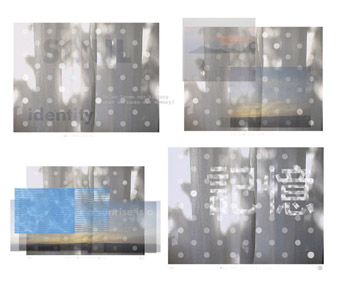
Rainer Strasser and MD Coverley’s ii—in the white darkness
IN ONE OF THE KEYWORD DESCRIPTIONS BURIED WITHIN THE ELECTRONIC LITERATURE COLLECTION THERE IS A SENTENCE WHICH I THINK SHOULD APPEAR AS A WARNING BEFORE ALL ATTEMPTS TO DEFINE ELECTRONIC LITERATURE: “WRITING NATIVE TO THE ELECTRONIC ENVIRONMENT IS UNDER CONTINUAL CONSTRUCTION (POIESIS) BY ITS CREATORS AND RECEIVERS.” THIS COLLECTION IS SO LARGE AND HETEROGENOUS THAT IT IS ALWAYS ONE STEP AHEAD OF ATTEMPTS TO DESCRIBE IT.
There are 60 individual works here, many of which you could spend over an hour with. Most kinds of e-lit are represented: hypertext writing, kinetic poems, codework (writing which incorporates programming languages), interactive works, as well as expanded forms of the traditional genres of fiction, poetry, memoir, comic, and non-fiction. Early exponents of the form such as Shelley Jackson, Phillipe Bootz, and Talan Memmot are represented alongside lesser known writers. Helpfully, each work is tagged with keywords, allowing the reader another way in to what is a daunting amount of material. The subjects are often imaginative, from an exploration of the connections between concrete poetry and subliminal advertising to an interactive graphic based on a story of demonic possession. Across the works there are themes which recur: an interest in systems and viruses, in memory, and in the process of translation and recombination.
People tend to read more distractedly on the internet than they do in print. Intentionally or not, the writers and artists counter this tendency in different ways. In some of the interactive works the response time is slower than broadband users have come to expect (that is, not instantaneous) forcing the reader to slow down and enter the work rather than wildly clicking to get to the “end.” Others exaggerate this tendency towards distraction by throwing at the reader more information than they can process at once. Generally, the pieces are as much about how you are reading as what you are reading.
Rainer Strasser and MD Coverley’s ii—in the white darkness: about [the fragility of] memory visualizes the experience of memory in people with diseases such as Alzheimer’s. We see a gauzy white curtain with shapes of light wobbling on it, and behind this a blurred sky that could be dawn or dusk. The image appears drained, somewhere between a photograph and a watercolour. Across this curtain a pattern of perfect white circles pulses. Clicking on them makes stark images appear: a canal, a wooden walkway, a crisp blue square of swimming pool water. Occasionally fragments of text appear. Sometimes parts of images bob at the bottom of the frame, frustrating the reader who is unable to decode them. The work responds slowly to reader input, mirroring the experience of trying to recall a memory that has been misplaced or distorted.
Jean-Pierre Balpe ou les Lettres Dérangées by Patrick Henri-Bergaud is what typographers see when they close their eyes after a long day. Within a black and white interface that mimics a page of print, serifed letters sit across the screen in the shape of a poem with most of its letters missing. Other letters drift around the screen in determined courses, spinning and swivelling until they catch on another nest of letters. Minute movements of the mouse dislodge the letters from their position, and they spin off again in various directions. Suddenly the mouse is energised, tense with potential; I nudge it along with two fingers as if it were an egg. The screen itself starts to seem delicate; I realise that if I banged my desk with my fist it would disturb the mouse enough to send the letters cascading. The “aim” of the work is to rebuild the poem by putting the letters in place, yet after twenty minutes trying I was no closer to doing this, and possibly further away.
Mary Flanagan’s The House, built with an open source programming language, Processing, is digital as it was once thought of: crystalline and inviolate. We see a cluster of cubes and three-dimensional lines from a poem; zoom in and you are inside the transparent structure, zoom out and it resembles a model of a chemical compound. As the reader turns and rotates the structure the lines of the poem change. Contained inside a small square roughly a quarter the size of the screen, it is an intentionally claustrophobic work, reflecting the stuck nature of the relationship talked about in the poem.
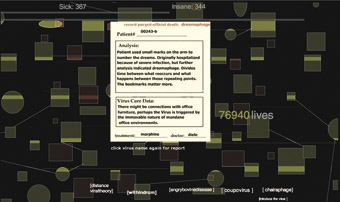
Jason Nelson’s Dreamaphage
Poet and digital artist Jason Nelson’s aesthetic is the opposite. Poem fragments and chopped up, scanned pictures from old science textbooks float through his works like space junk or objects in dreams. In the two drafts of his 2004 work Dreamaphage included here, he explores the equivalences between viruses and dreams. The reader seems to fall into the work, passing books whose pages can be turned and read by clicking and dragging the mouse. Nelson’s magpie approach to words, pictures and sounds creates an immersive, authentically strange world.
Perhaps the most recognised form of e-lit is hypertext. Shelley Jackson, the author of the early and influential 1996 hypertext, Patchwork Girl, is represented here with her hypertext memoir from the following year: my body, a Wunderkammer. The first thing we see is a lino block print of a female body divided into sections that link to different beginnings to the story. The interface is simple—once you are inside it is mostly text—leaving the lucid prose free of distractions. Jackson’s memoir shows that hypertext, with its fluidity and the way it compels the reader to move laterally across a work, is well suited to writing memory and
history.
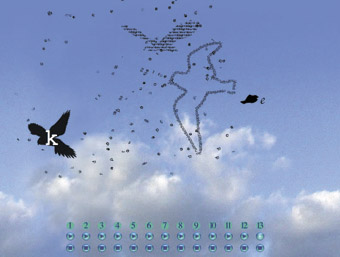
Maria Mencia’s Birds Singing Other Birds’ Songs
Maria Mencia’s Birds Singing Other Birds’ Songs uses thirteen separate looped birdcalls which the user can switch on or off to create and oversee their own soundscape. Along with a birdcall each button releases a calligramme bird, which flies back and forth across the screen in a vision that would have made Apollinaire swoon. It is a gorgeous work. William Poundstone’s Project for Tachistoscope [Bottomless Pit] is not gorgeous, from the difficulty of actually watching it to the unfashionably loud colours of the interface. The central idea explored in an essay within the work is the fact that subliminal advertising and concrete poetry were invented at the same time in the early 1950s. The work itself is a digital version of the tachistoscope—a machine which flashes projections at a specified speed, often used in market research to test image recognition. Viewing the work feels like undergoing a kind of Pavlovian conditioning experiment; the eyes are constantly recouping, trying to stabilise a relentless, strobing afterimage.
One of my favourite works is Reiner Strasser and Alan Sondheim’s Tao. A poem of less than twenty words scrolls across the screen like a news bar below two looped shots of a road and a mountainous landscape slipping by outside a car door. It is a momentary work, all over in 38 seconds. The different elements—cinematography, interactivity, poetry, and soundtrack—are combined as subtly and carefully as those of a Zen garden.
The editors have stated that one of the purposes of putting the collection together was to expose the work to people who may not have seen it otherwise. To this end, a CD-ROM of the collection was produced—available free from the publishers—in addition to its online publication at http://collection.eliterature. org/1/. Licensed under Creative Commons 2.5, which allows it to be copied and shared, their hope is that libraries and schools will install it on their computers, teachers will use it in lessons, and people will share it among their friends. In the breadth of work contained in it, as well as the innovative way the editors and authors have made it available, this is a generous collection.
Electronic Literature Collection, Volume 1, editors N Katherine Hayles, Nick Montfort, Scott Rettberg, Stephanie Strickland; published by the Electronic Literature Organization, October 2006http://collection.eliterature.org/1/
The Collection includes works by Australian artists Melinda Rackham and geniwate.
RealTime issue #78 April-May 2007 pg. 28
© Tim Wright; for permission to reproduce apply to realtime@realtimearts.net
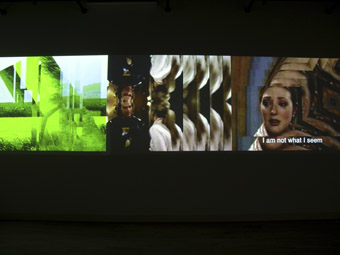
Linda Wallace, LivingTomorrow (2005)
THE GALLERY NEWYORKRIOTOKYO IS A TYPICAL INDEPENDENT ‘PROJECT’ SPACE IN BERLIN, DIRECTLY ACROSS FROM THE FORMER NO MAN’S LAND THAT SEPARATED EAST FROM WEST. BUT FOR THE EXHIBITION BACK TO BERLIN, AUSTRALIAN-BORN ARTIST AND CURATOR LINDA WALLACE TRANSFORMED IT INTO A SUBURBAN LIVING ROOM THAT OFFERED UP A CHALLENGING THREE-CHANNEL VIDEO TAKING ON MULTICULTURALISM, MEDIA AND MURDER AS THE EVENING’S ENTERTAINMENT.
Back to Berlin also presented earlier works, entanglements (2004), first shown at the Adelaide Biennial, and LivingTomorrow (2005) alongside a new work, TOR (2006), and a selection of silk prints of video stills. The show’s title refers to the fact that the Amsterdam-based Wallace lived in Berlin for a year recently, and that her mother’s family can be traced there from around 1650 to 1850.
Wallace works as a video artist utilising diverging, interweaving narratives created from found and self-made media-text, images and sound—all reworked and combined to reveal weighted meanings within the new structures.
In her earlier works Wallace played with digital and analogue textures. Lovehotel (2000) combined the cyberfeminist poetry of Francesca da Rimini with Wallace’s own video, and in eurovision (2001) reworked film and TV footage were displayed on various interfaces. Framing devices also made reference to emerging online environments of the web and the interplay of concurrent storylines.
LivingTomorrow goes one step further into narrative complexity. Here, the way the source material is viewed over the three screens is determined by a database, designed by Wallace while artist-in-residence at Montevideo in Amsterdam. While the Berlin version was exhibited as a three-channel DVD, the original was exhibited running from an archive of video clips and subtitles sent by the database to the screens and potentially in any order. The ‘story’ had to be written to accommodate randomness and still make sense to a viewer.
In Berlin, LivingTomorrow was viewed from the comfort of a well-worn couch, the white cube rejected for the wohnzimmer. It’s the familiar TV experience, whether located in former East Berlin or southeast Queensland, a universal ritual or, as Wallace says, “our window on the world.” The way the work is installed also gives permission to spend time with it, allowing the visual medley to wash over the viewer in an almost hallucinatory way. But if video art is the bastard child of TV, this work would have to be the mongrel half sister. Images of soap opera, wars, headscarves and the Dutch countryside merge with disjointed and repetitive subtitling to form unnerving storylines. While definitely a televisual experience, the images on the triptych of screens are digitally manipulated, creating an eerie reflection of the already mediated media image.
It’s a cut-up screen, the blonde American idols slashed and deformed, their overbearing silences and stares emphasised to the point of extremity, their repetition driving home the sheer banality of the confined spaces and studio sets so much a part of daytime soap opera. The Bold and the Beautiful is reputably the most popular TV series in the world, viewed by over 450 million people a day. Wallace herself became interested in the show while in hospital during the birth of her son.
But like a fractured mirror or a kaleidoscope, other images appear—a woman with a headscarf, machines of surveillance, a technology park and a corporate logo: “Living Tomorrow—Where Visions Meet.” Occasionally there are glimpses of beautiful naturescapes. The Dutch countryside of fields and open blue skies offers a wake up call to those locked in claustrophobic interiors.
Subtitles appear randomly, suggesting further narratives. Wallace has combined her own scripts with extracts from “The Coming Wars” in the New Yorker, “New Breed of Islamic Warrior is Emerging” in the Wall Street Journal, and Osama Bin Laden’s 2004 speech.
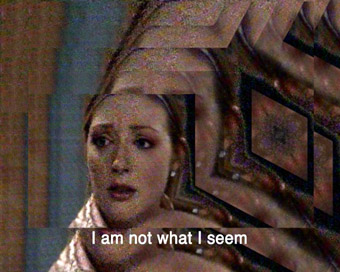
Linda Wallace, LivingTomorrow, detail (2005)
The subtitles written by Wallace herself carry the main ‘storylines.’ They involve a girl wanting to wear the headscarf, various murders and refusals of marriage. None is from The Bold and the Beautiful, but by their nature we are lead to trust their authority.
While The Bold and the Beautiful is glaringly distant from European life and a changing world, Wallace, with her foreigner perspective, creates a palpable reality, tackling a multinational Europe and conflict based on religious beliefs. Her images have a damaged tangibility: the transmissions of the soap opera were disrupted by a series of electrical storms which interfered with the reception. So although resembling analogue decay, the images were partly created by nature thus emphasising the materiality of the medium of television. Wallace describes the effect as “the weather hacking into the work”.
And this is not the only ‘reality’ injected into Wallace’s artmaking. While she was working on the project, the vehemently anti-Muslim Dutch filmmaker Theo van Gogh was assassinated near her home in Amsterdam. The realities of ethnic and religious conflict were literally brought to her doorstep. The initially abstract narrative for Living Tomorrow grew to include this event, yielding a visceral sense of place, abstracted in the soap, abstracted in nature, but rooted in the real.
The work’s landscape images also speak of place, and the difference between Dutch countryside of planned agricultural development versus the Australian bush. An Albert Namatjira print framed by curtains also hangs on the wall of the gallery. For Wallace, this print speaks primarily to Aboriginal Australia but is also reminiscent of the photographs of the outback in the Women’s Weekly she grew up with, a reminder of the bucolic and provincial nature of a ‘wild’ Australia but from a sanitised viewpoint.
Also hanging on the walls are silk prints of video stills from the works. One series is from LivingTomorrow. Another of a dead female Chechen militant, lying in the theatre seats after the tragic Moscow Theatre Siege of 2002, is from the work, entanglements, a montage of Australian news footage relating to war in the Middle East—the living room idyll shattered by actual political consequences.
In a corner is a short work called TOR (meaning goal), shot on the evening that Germany beat Argentina in the 2006 World Cup. Wallace’s take is once more a strangely multilayered grappling with what nationalism and identity mean today in a mixed Europe.
In TOR, German fans of all races, dressed in the yellow, red and black team colours, are euphoric with what can only be described as out-of-control, sports mania. They scream into Wallace’s camera, dance in the streets, harass drivers. A mother in camouflage pants dances wildly around her parked car while her children sit, bored, on the car roof. The spirit is of spectacle, but in Wallace’s showing it’s also silent. In a country where cultures clash, they are connected by the recognisable ensignia of a team, united by a tradition and rites different from their own.
The overlapping images and text in Back to Berlin allow the audience to walk in at any time and bear witness to the myriad meanings present in the global televisual world. LivingTomorrow is constantly generating something new, the story lines merging to create new realities and reflections on a world in flux.
Linda Wallace, Back to Berlin, NewYorkRioTokyo Gallery, Berlin, Jan 1-Feb 11; http://machinehunger.com.au
RealTime issue #78 April-May 2007 pg. 29
© Joni Taylor ; for permission to reproduce apply to realtime@realtimearts.net
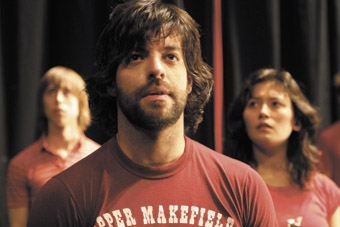
Daniel Linehan, Miguel Guiterrez, Michelle Boulé, from Everyone
photo Alex Escalante
Daniel Linehan, Miguel Guiterrez, Michelle Boulé, from Everyone
WHEN I ASKED AMERICAN CHOREOGRAPHER MIGUEL GUTIERREZ WHAT HE HOPED TO ACHIEVE ON HIS FIRST VISIT TO AUSTRALIA HIS EMAIL READ: “ ONE OF MY RECENT GOALS IS LEARNING HOW TO OWN THE EXPERIENCE THAT I HAVE GATHERED FROM MAKING PIECES OVER THE LAST SIX YEARS, YET AT THE SAME TIME LEAVE MYSELF OPEN TO CHALLENGE AND DISCOVERY… THAT SOUNDS VERY GIFT CARD I KNOW…”
This reaching for insight whilst deflating any emerging pomposity was what originally interested me in connecting Gutierrez to Australian artists. I saw him perform an excerpt of Retrospective Exhibitionist & Difficult Bodies at Danspace Project in New York in January 2005, during a visit for Critical Path to the annual Arts Presenters conference. I was struck by his self-mocking yet moving performance to a recorded after show-talk. Gutierrez’ notes were disarmingly honest:
I looked at that video of a show we’d done at Jacob’s Pillow and just laughed at how I sounded like a retarded valley girl. How can anyone (including me) believe any of this shit? It suddenly occurred to me that artists’ ideas are so important and meaningless at the same time.
Whilst in New York, I also heard about Shtudio, the weekly performance night Gutierrez was curating in an off-the-beaten-track Brooklyn studio. I was intrigued by the buzz he managed to sustain in a city burgeoning with artistic output. So when I heard, almost a year later, that Melbourne based choreographer Phillip Adams was keen to invite Gutierrez to choreograph for BalletLab, things began to fall into place.
With support from NSW Ministry for the Arts and The Australia Council, Gutierrez will lead a five-day workshop in May for ten NSW based choreographers entitled, What you think what you feel what you know to be real. He will also give a talk at The Drill in Sydney. Gutierrez’s original description of the project for participants read:
Creating performance is a way of tapping into how we locate ourselves in our lives and in the world. As such we attempt to find out what our own personal ‘truths’ are and make them known in our work, or sometimes they seem to emerge from our creations. In this research workshop we will look at the idea of what it means to be ‘real’, ‘natural’, ‘authentic’, ‘free’ and ‘open.’ We will work with a variety of methods of improvisation that valorize these terms and see how they relate to our understanding of the conditions and contexts of our work as makers and performers.
Now that he is approaching the engagement he is again disarmingly open:
I am a bit intimidated by my own language in the description of this workshop, but I think that is a good thing. I have led tons of workshops but I have a feeling this one will be quite different…I always like to use workshops as an opportunity to explore something new and unknown to me. In this case I feel like I’m a sort of ‘bridging space’ trying to understand methods and ideologies that I have worked inside of but move into the next phase of my own work.
In Melbourne, Gutierrez will join BalletLab’s third stage of creative development for their production, Brindabella, to be presented by Malthouse. He’ll create a short work that will sit, as a tableau, within Brindabella. Phillip Adams writes of Gutierrez’ intervention:
I am not interested in Miguel reacting directly to what has been previously conceived. He will take a section of our source, La Belle et La Bête, and re-position the story with his own interpretation. Miguel’s interpretation is silhouetting and contouring the evolution of Brindabella—helping to shape the artistic process towards a more refined and symbolic work. Additionally, I am interested in allowing the BalletLab Company dancers the experience of working in a dual choreographic situation. The experience of forming new relationships with international artists will enrich their artistic and professional development within and beyond the project.
Gutierrez is equally inspired:
This is an unusual proposition and, coming out of just making two evenings of work, I’m relieved to have the context for this piece already set up. It’s an exciting exercise. Also, I’m intrigued by the fact that Phillip’s work and my work don’t really look anything alike, so I feel like this gives us the opportunity to articulate what we’re doing more clearly.
Representing a new generation of American choreographers, rarely seen in Australia, Gutierrez is well established in his hometown, New York. As well as his work as a curator for Dance and Process at The Kitchen, he is also on faculty at the American Dance Festival, is frequently resident at the Ensemble Studio Theater’s Lexington Center for the Arts, and Danspace Project is co-producing his new work. He was a Movement Research Artist-In-Residence from 2001 to 2003. He has danced with Joe Goode, Sarah Michelson, Jennifer Lacey, John Jasperse, Jennifer Monson, Juliette Mapp and Ann Liv Young. In 2002, Gutierrez won a Bessie for his performance work with John Jasperse Company. He recently performed in Deborah Hay’s O.O and in June 2007 will dance in French choreographer Alain Buffard’s (not) a love song. Gutierrez was named as one of “25 to Watch” by Dance Magazine and “2005 Artist of the Year” by New York’s Gay City News. Quirky projects such as his creation of the dance video Deceptacon for electro music outfit, Le Tigre, add to Gutierrez’ appeal.
Since forming Miguel Gutierrez and the Powerful People in 2001, Gutierrez has created a series of productions with a critically acclaimed signature style. In 2002, the group presented 31 performances of its first evening-length piece, enter the seen, at Aqui the Bushwick in Brooklyn. The next production, I succumb, was presented to sold out audiences at Dance Theater Workshop’s Splitstream series in 2003.
dAMNATION rOAD premiered in 2004 at The Kitchen, sold out for eight nights and won a Bessie for visual designer Christoph Draeger, an artist who had never worked in theatre. In addition to collaboration on these group works, Gutierrez and musician Jaime Fennelly performed their improvisation-based duo, Sabotage, at a variety of venues along the eastern seaboard and in Europe. Retrospective Exhibitionist & Difficult Bodies premiered at Dance Theater Workshop in 2005 and was the work which established Guitterez’ name internationally at such prestigious festivals as Holland’s Springdance. Springdance has co-commissioned Gutierrez’s Everyone, which features nine performers and a new collaboration with musician Chris Forsyth. Everyone will premiere in April 2007. Gutierrez writes:
Everyone is about the world right now and right now and right now. Nothing is interesting. Everything is interesting. This is a huge failure. Nothing works. Nothing is going anywhere. There is nowhere to go. Everything is perfect. Everything is a perfect mess. I know now. I know who this is for. This is for us. This is for me. This is for everyone.
Alongside touring Gutierrez hopes to record the music he has been neglecting of late and talks about the need to “take a step away from creating to assess what to do next. I want to travel a lot and take in other ideas and questions and be released from my own…I want to learn again what it is to have an adventure.” An Australian adventure beckons.
–
Miguel Gutierrez Critical Path workshop, May 21-27, www.criticalpath.org.au.
Information on Brindabella is available at www.balletlab.com/news.
RealTime issue #78 April-May 2007 pg. 30
© Sophie Travers; for permission to reproduce apply to realtime@realtimearts.net
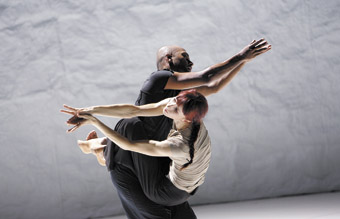
Akram Khan, Sylvie Guillem, Sacred Monsters
photo Tristram Kenton
Akram Khan, Sylvie Guillem, Sacred Monsters
AS WE’VE REPORTED IN REALTIME OVER RECENT YEARS, THE SINGAPORE ARTS FESTIVAL CONSISTENTLY BRINGS TOGETHER A FINE MIX OF LOCAL, REGIONAL AND INTERNATIONAL WORKS, OFTEN ON THE CUTTING EDGE AND IN A CITY IDEAL FOR AN EMBRACING FESTIVAL.
Just some of the artists featured in this year’s Festival include ballerina Sylvie Guillem performing with choreographer and dancer Akram Khan in Sacred Monsters, a dazzling duet which initially builds on childhood reflections in which the dancers dialogue with their respective danceforms. Elsewhere on the dance program, Michele Anne De Mey (Charleroi/Danses, Belgium) presents Sinfonia Eroica and Japan’s Saburo Teshigawara and his company, KARAS, perform Bones in Pages and New York’s Bill T Jones and Arnie Zane Company does Blind Date.
Among theatre productions from Singapore and China, Lee Breuer and his company Mabou Mines from New York will bring their DollHouse, a hit at the 2006 Brisbane Festival. Local company, The Finger Players, presents Wong Kar Wai Dreams in which a woman dreams of the famous filmmaker dreaming of her. Checkpoint Theatre will explore “how technology changes everything, except the strength and fragility of the human spirit”, in Cogito.
The music program includes Singapore’s own T’ang Quartet collaborating with Theatre Cryptic from Scotland on a new work, Optical Identity. Composer Tan Dun continues his exploration of organic music that incorporates elements of the natural world in Paper Concerto for Paper Percussion and Orchestra in which papers of different sizes and strengths are variously manipulated as percussion instruments, including paper cymbals, wax paper bags, and a ‘paper thunder tube’ invented by Tan.
There’s also a workshop program where you can wrestle with Meyerhold, Stanislavski and Brecht combined in a master class with Lee Breuer or get really physical with Breuer and Mabou Mines performer Maude Mitchell, or with Janet Wong in a workshop exploring the Bill T Jones’ repertory. Singapore beckons.
Singapore Festival May 25-June 24 www.singaporeartsfestival.com
RealTime issue #78 April-May 2007 pg. 30
© RealTime ; for permission to reproduce apply to realtime@realtimearts.net
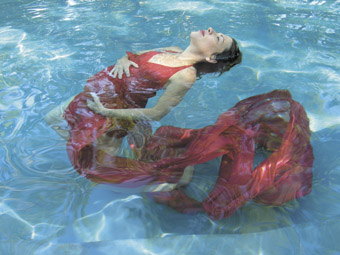
Rapt
THE NEW YORK DANCE ON CAMERA FESTIVAL IS ONE OF THE OLDEST CONTINUOUSLY RUNNING DANCE FILM FESTIVALS IN THE WORLD. AS SUCH, IT HAS HAD ENORMOUS INFLUENCE OVER THE DEVELOPMENT OF THE FORM: PROVIDING AN EXHIBITION SPACE, A PORTAL TO THE WORLD, A FORUM FOR CREATIVITY FROM TIMES WHEN DANCE ON SCREEN WAS BARELY EVEN KNOWN TO EXIST, THROUGH TO ITS CURRENT BOOM IN THE CONSCIOUSNESS OF DANCE CULTURE.
The Artistic Director of Dance on Camera, Deirdre Towers, bristles a bit when she hears people talk about dance on camera as ‘new form.’ It is a newer form than dance, but it is as old as cinema, older than contemporary dance, and much, much older than the ‘brat pack’ currently energising and expanding screendance creation and exhibition.
In fact, for Towers, dance on camera is not a new form but at least two old forms—and she struggles to straddle the divide in audiences and aesthetics for these two versions. To put it colloquially, there is an ‘uptown’ form and a ‘downtown’ form of dance on screen, and the venues for the New York Dance on Camera Festival play out and play on this divide. The festival is supported by the Lincoln Center Film Society, so one of its major screening venues is the Walter Reade Theater at Lincoln Center, a distinctly uptown venue with a 300 seat cinema, a 35mm projector, ushers and a popcorn vendor that also sells cappuccinos and ginger pistachio tarts. The regular crowd for this venue expects to see one of two things: documentaries about dance, preferably about famous dancers or choreographers, but possibly some ethnographically unusual mix, or dancefilms by firmly established names, Mark Morris, William Forsythe and Gene Kelly, for example, all of whom featured on this year’s calendar.
The other, the ‘downtown’ form of dance on screen is what we would call here the ‘independent’, but I hate this name because it implicitly creates a divide in legitimacy along the lines of infrastructure rather than approach. The other tags, ‘new’ or ‘experimental’ are also inaccurate: it is neither new nor experimental. The creation of a dancing screen—a screen work that emanates from a choreographic sensibility and combines the available manipulations of time, movement and energy in dance with those in cinema—is not new. It just wavers a bit in and out of cultural consciousness, and in so doing loses its history and knowledge base. Therefore it is also not experimental because the creative artists rarely test their ‘experiments’ against a stable control group or against documented knowledge or theories. What it is, this other form of dance on screen, is a working through of the possibilities of cinematic and choreographic properties towards the realisation of an image or idea. The subjects of these creations are not external, as they are in documentary—the films are not about something but are themselves the subject, they are dances in light and sound.
So, being old and venerable, and presenting both documentaries on dance and dances in light and sound creates some very interesting problems and equally intriguing possibilities for the Dance on Camera Festival. Towers and the new festival coordinator, Anna Brady Nuse, came up with some excellent lateral strategies for reaching each of their audiences, pushing perceptions of the form to cross out of their comfort zones and still allowing the festival to break even. Their energy and openness were rewarded with huge media coverage (the festival made regular appearances in the pages of the New York Times, the New Yorker, et al), strong audience attendance and a thought provoking festival.
One of Towers’ strategies was to open a third venue and present work under the title “Program devoted to dance narratives.” This screening was at the Maya Deren Theatre in Anthology Film Archives, which is downtown, yes, but it has proper seats and a 35mm projector, too. The program featured the 54-minute film I produced and edited, Thursday’s Fictions (directed and choreographed by Richard James Allen), which was my excuse for attending the festival, and two narrative shorts—Flying Days by Pablo Diconca and Another by Helena Jonsdottir. All three are works on screen that live in the space between dance and cinema to create what we at The Physical TV Company call “stories told by the body.” The audience that filled the house seemed to come from uptown and from downtown for this kind of experience, which plays with conventions to reach across the divide between character-driven drama and abstract movement to make a truly kinaesthetic cinema.
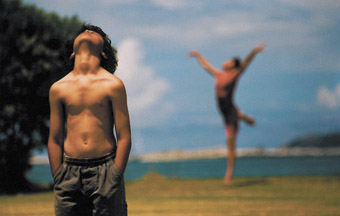
Break
Other festival strategies for pushing audiences across the divide included programming dance made for the screen as shorts preceding documentaries about dance, and presenting a rigorously curated evening of international shorts in the uptown venue. Two films from our region, Sue Healy’s Will Time Tell and Shona McCullagh’s Break, the festival Jury Prize winner, were on this program which, together with Thursday’s Fictions, made Australia/New Zealand a very well represented region. Surprising as it may seem to us, as we struggle for funding and screenings, the world thinks there is a lot happening down here in dance on screen and that it is leading stuff. The region’s representation at this festival certainly demonstrated that, especially when compared to some of the work I saw from the US.
The American Shorts program on the closing night of the festival was not just a strategy to include the ‘downtown’ in the festival, though it was held at a venue so far ‘downtown’ that it is was in Brooklyn, in a converted warehouse performance space with a gallery, a bar and a lived-in grunge that made me feel right at home. It was also a strategy to boost American production and visibility in a field dominated by Britain, Europe and Australia/New Zealand. I wanted the films on this program to prove Towers wrong when she said the history of dance on film is a history of men and technology and women in nature. Maybe it was just coincidence, but in the program, films that used technology—digital effects toys—were by men and the productions set in nature—trees, sunsets, water—were by women. None was especially well developed but the festival is acting in a catalytic capacity by creating this new program, hoping to stimulate the thinking and production values in its home country.
Also designed to stimulate thinking and production were the two free panels held in conjunction with the festival. There was “Meet the Producers”, where the powerhouses of dance on screen production from Britain (Portland Green of Capture) and Canada (Judy Gladstone of Bravo!FACT), talked about their organisations’ impact on dance on screen in a session moderated by newcomer Hélène Lesterlin, the curator in charge of a new American dancefilm commissioning fund, DANCE MOViES, at the Experimental Media & Performing Arts Center (EMPAC). And there was “From Cutting a Rug to the Cutting Room”, a panel moderated by Special Projects coordinator, Kelly Hargraves, which brought together three dancers who work professionally as editors—not just of dance films, but of all kinds of things—Monica Gillette (Sopranos, Law & Order, Progressive Coma), Robbie Shaw (Bittersweet) and myself. Or were we editors who dance? Either way, the sense that editing is a form of choreography came out with overwhelming force. We all agreed we work the edits through our dancers’ kinaesthetic intelligence—and it is in the edit suite where the two arts, cinema and dance, whether documentary or the other, cross the divide and both begin to dance.
35th Annual Dance on Screen Festival, New York, Jan 3-14
RealTime issue #78 April-May 2007 pg. 31
© Karen Pearlman; for permission to reproduce apply to realtime@realtimearts.net
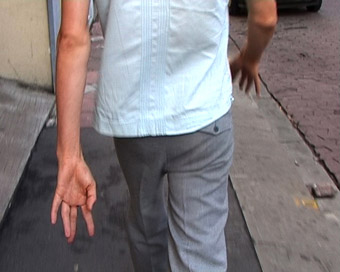
Se Fondre
NURIA FONT, THE FORCE BEHIND IDN FESTIVAL IN BARCELONA, HAS PLAYED AN ACTIVE PART IN DEVELOPING THE PROFILE OF DANCE AND MEDIA OVER THE PAST DECADE OR SO, CURATING PROGRAMS THAT SHOWCASE THE MORE EXPERIMENTAL WORK IN THE FIELD FROM SHORT FILMS TO INTERACTIVE INSTALLATIONS AND PERFORMANCE. AFTER SOME LOGISTICAL PROBLEMS THAT PUT HER ANNUAL EVENT ON HOLD, FONT WAS BACK THIS YEAR WITH A NEW ORGANISATION, NU2, WORKING WITH AN AUSTRALIAN BASED IN BARCELONA, NURIA RODRIGUEZ.
The festival was split into 3 parts: Enscenes Interactive, a program of stage works “that generate a dialogue between choreography, staging, performers and digital tools”; VideoDansa Barcelona, an international dancefilm competition; and Installations where the body “becomes the common ground between dance and the visual arts.” The expansion of dance screen festivals to encompass related work in the visual arts and performance is clearly the next step in bringing screen culture into a novel relationship with dance communities and audiences. As screen culture develops, so too must these festivals if they are to accurately reflect the interface between the moving image, the body and performance.
Recently, there has been a new level of investment in the work being done at the interface between dance, the screen arts and visual arts through initiatives such as the Arts Council of England’s CAPTURE program and organisations such as FORMA (UK), KKM (Germany), The Wellcome Trust (UK) and EMPAC (NY), and increasing opportunities for presentation in galleries as well as venues like Sadler’s Wells Theatre (UK) and specialist events such as Monaco Dance Forum. And the use of new media in dance performance seems to be finally coming of age, apparently nowhere more so than here in Australia. The jury for the competition, of which I was a member, were involved in an open forum where many of these issues were discussed, along with the state of the art of dancefilm production specifically and the network of supporting organisations worldwide.
As a model for an expanded dance and media event, iDN was ambitious. The performance program included 4 works, one being a double-bill. Apparition by Austrian Klaus Obermaier was an empty display of technology with projections of geometric patterns onto a screen at the back of the stage contrasting with images projected on two dancers downstage who functioned as small moving screens. The effect was as dazzling as fireworks and as void of meaning, especially toward the end where tiny dots of light filled the screen and bounced off the bodies performing banal gymnastic choreography. Returning to Australia to see Chunky Move’s excellent Glow, which used similar technology to much greater effect, certainly put Obermaier’s work in its place. Para_site by K.Danse in France was a monotonous demonstration of interaction between a sensor laden dancer and sound and image. Surrounded by multiple small screens, the dancer’s movement suggested struggle and frustration, with little variation for performer or audience.
T.P.O. Company from Italy, seen at Melbourne Festival last year, presented Il Giardino Giapponese, an interactive performance for children and adults. Based on a Japanese fairytale, the performance begins with the story before we are moved to a large touchscreen mat where the performers act out the journey in the tale before inviting audience members to participate. The ease of the interface and the performers matching of tasks to age-appropriate children created a smooth and absorbing experience, not least of all for a passive spectator observing the tentative, quick and curious immersion of the kids in the virtual environment.
Font’s own Arbraçada, created with collaborators, was presented as the first half of a double bill with Hiroaki Umeda’s While Going to a Condition. Arbraçada featured a solo dancer moving in a fluid and low-key way through a ‘forest’ of papery sculptures in the shape of bustled Victorian skirts. At times she stops and moves her arms only, at one stage with her waist perfectly matched to a ‘skirt’, a match that would alter with each audience member’s perspective. A curved screen behind the dancer is then filled with the image of a forest, a point-of-view shot that shifts to take in symmetrical rows of trees planted for logging. The dancers’ actions appear on the screen/in the forest like a ghosting effect, but the technology jars with the serenity of the performance and landscape, seeming out-of-step. Umeda’s solo performance is a slow build, beginning with a still dancer onstage, a minimal electronic score and bold black and white rear-projected graphics, and climaxing with the dancer frozen in a lunge, face to the sky, with a blinding strobe and ear-splitting white noise. Umeda’s dance-style combines the control of Japanese dance techniques with the sharpness and musicality of hip-hop. (A video re-work of this solo, Montevideoaki, was screened at ReelDance 2006.) The simple, striking and perfectly synched visuals and sound provide a perfect backdrop for this riveting performer.
For the international dancefilm competition, VideoDansa, 77 films were shortlisted by the festival organisers from submissions and nearly twice as many screened continuously throughout the event in a cinema and on monitors. An international jury of five then selected around nine films from which the winner and special mention were selected. The winner of 6,000 euros was Se Fondre by Belgian filmmaker Antonin de Bemels. This half-hour film is a progression of de Bemels’ investigation into the obscuring of body parts through repetitive movement and rapid editing, placing these moments of corporeal misbehaviour into a narrative context. The triangle of characters in the film is trapped by an immobility that echoes their thwarted attempts at communication.
Miranda Pennell (UK) was awarded a special mention for You Made me Love You [RT77, p35], in which a class of young dancers follow the gaze of a camera at close range as it shifts randomly, as the sound of shuffling feet accelerates and slows with the gliding frame. Other finalists included ReelDance 2006 People’s Choice winner, Break (Shona McCullagh, Australia), ReelDance 2006 winner, Nascent (Gina Czarnecki, ADT, Australia) and shortlisted films Swift (Margie Medlin, Ros Warby, Australia), Soma Songs and Seismos (Daniel Belton, New Zealand), Once in a Blue Moon and Will Time Tell? (Sue Healey, Australia) and Pod (Narelle Benjamin and Samuel James Australia).
This festival was inspiring in its vision and scope and the international award for dancefilm with a cash prize is an exciting addition to the numerous awards worldwide that now provide support for artists in the field. Once it has had time to settle, NU2 will no doubt continue to help define a still nascent but growing field of practice and, in the process, help to bring recognition to artists bridging disciplines.
iDN Imatge Dansa i Nous mitjans; Caixa Forum and Mercat de les Flors, Barcelona, March 1-4
RealTime issue #78 April-May 2007 pg. 32
© Erin Brannigan; for permission to reproduce apply to realtime@realtimearts.net
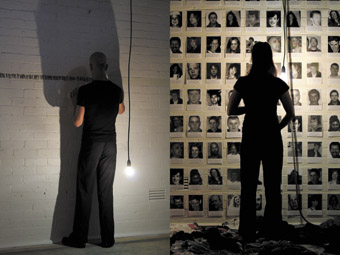
Brian Lucas, Avril Huddy, absence(s)
photos Fiona Cullen
Brian Lucas, Avril Huddy, absence(s)
ABSENCE(S) CROSSED THE BOUNDARIES OF DANCE, INSTALLATION ART AND PROMENADE THEATRE. THIS HAUNTING WORK CARRIED ALL THE METAPHORICAL FREIGHT OF ‘MOVING’, AND AIMED WITH PRECISION TO INCULCATE AN EXPERIENTIAL AUDIENCE REACTION. IT DID SO BY RISKILY LOCATING THE CENTRE OF THE WORK IN AN ABSENCE, IN THINGS UNSAID AND UNSPECIFIED. ADORNO INSISTED THAT “INTELLIGENCE IS A MORAL CATEGORY.” IN THAT SENSE, IT WAS THE SHEER INTELLIGENCE OF ABSENCE(S) THAT TRIUMPHED OVER POTENTIALLY ENNERVATING MATERIAL, OVER THE ACHING SADNESS OF THINGS.
The production played on our anxieties by immersing us in the concept. We were first separated from whoever we came with, then taken from the Judith Wright Centre in a group of strangers to an undisclosed destination and asked to remove our shoes and personal belongings. We moved through dim rooms constructed from plastic drops, through which we discerned dim traces of movement, heard faint echoes of voices. An entrapped performer, Avril Huddy, transfixed us as if we were sadistic voyeurs. Brian Lucas monstrously loomed, nastily reminding us in classic Lucas style that we, too, were being watched. We encounter a loft with a well full of shoes. Teetering amidst the debris, Vanessa Mafe-Keane, as a survivor, sought equilibrium. Rules were set in a prelude to a larger movement as the space gradually opened into its entirety. A panoramic shot of the last group seen through the plastic dividing the length of the space was breathtaking, a tyro effect of lighting design and placement straight out of Schindler’s Ark.
Barred windows, stark walls, the audience as crowd fixtures in the installation. Reproductions of the missing along one side, inadequate descriptions of the appearance of somebody already disappeared. The Freudian concept of introjection tells us that in mourning the loss of a loved one the ego is also mourning the loss of a part of itself. This was made graphic by the excruciating tension of Huddy attached to Tammy Meeuwissen by cotton strings, by the heart piercing declaration that “it hurt.” Rumours of knives, memories are scars, projections into the future stymied in one of the most disturbing interludes between Lucas and Mafe-Keane: she wondered if she should change ‘his’ room, while Lucas performed a mad tarantella as he moved into her empty spaces. Dyson choreographs possessed people with the mordancy of an angel. Slide projections transversed the space with unnerving lucidity.
The environment, created by Brett Collery’s darkly ambient sound, Mark Dyson’s filmic lighting and Bruce McKinven’s installation, simply but powerfully evinced what Frederic Jameson has called (in relation to postmodernism) “the displacement of time, the spatialization of the temporal.” The mass produced, black and white photographs of missing persons irreducible to individual identities suggested the phenomenon of a human consciousness likewise unsituated, unlocated. The pit of shoes, the clothing beneath our bare feet, threatened to inundate us, to engulf us in a chaotic miscegenation of all identities by insisting on the subject’s necessary relation to death, to corporeality, to the abject materiality of shoes and clothes. History was invoked but only as a residue, or a deposit, of imagery and association (the Nazi death camps, the ‘disappeared’ in South America), signs that floated free from what they designated in a way that constantly threatened to open into a void. This was a vertigo-inducing theatre of traces, lines, demarcations. No redemption.
Nevertheless, Clare Dyson seemingly holds to the feminist belief that the ‘personal is political.’ Even if interpretation was a relative exercise, or subjects had little authenticity, there was a structural clarity that spoke well, that clung to an ethic of speaking well in times that enforce us, in Dyson’s words, “to segregate, to isolate, to dislocate.” The decentralisation of theatrical presence forced us to abandon a fixed, fetishistic attention to the performers’ bodies, forced us to move, to cease to be spectators, to find our own psychological and moral truths. We were constantly being invited to look elsewhere, to make choices, to become part of the performance, to absent ourselves.
In this first stage of a compelling new site-specific project Clare Dyson and her scintillating team created a hyperbolic, fractured space of uncertainty, of disconnection, disappointment and loss. But exhilaration lay in the artful play with boundaries, the risks taken with the Janus nature of disappearance and appearance, and in the constant swing between visceral agitation and mental reflection. Dyson has said that she wanted the audience to feel that the concept was in everything, but this was surely a way of saying that the concept was nowhere, neither in the theatre nor out of it; it was more a matter of positioning. In her theatre of revenants, of invisibles, of alarming traces, it was we who were at stake. We who will one day disappear.
Absence(s), created by Clare Dyson in collaboration with performers Avril Huddy, Brian Lucas, Vanessa Mafe-Keane, Tammy Meeuwissen, lighting design Mark Dyson, design Bruce McKinven, sound design Brett Collery; Judith Wright Centre for Contemporary Arts, Brisbane, February 21-24
RealTime issue #78 April-May 2007 pg. 32
© Doug Leonard; for permission to reproduce apply to realtime@realtimearts.net
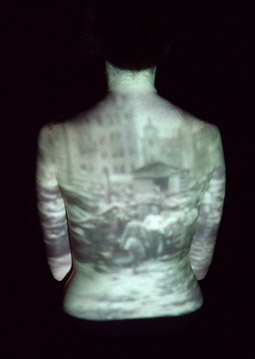
Aisling Donovan in Aimee Smiths’ Courageously Heroic Gallantry, Four on the Floor
photo Aimee Smith
Aisling Donovan in Aimee Smiths’ Courageously Heroic Gallantry, Four on the Floor
four on the floor
STRUT DANCE’S FLOUR ON THE FLOOR OPENED WITH BIANCA MARTIN’S FUN, BOUNCING LIVE MUSIC VIDEO, DIVERTISSEMENT, TO SPIDERBAIT’S SHAZAM, A TONGUE-IN-CHEEK PIECE OF YOUTHFUL SEX APPEAL AND SIMPLE BUT SHARP, COORDINATED POSES.
Phillippa Clark presented projections and a duet accompanied by Steve Reich’s edited interview with a rabbi, scientist-commentators Richard Dawkins and Stephen Jay Gould, and others, about the implications of genetic engineering, taken from Three Tales: A documentary video opera. This concert performance of Reich’s music with Beryl Korot’s images was in the 2003 Perth Festival. Clark, however, jettisoned the documentary premise whilst also avoiding narrative, building instead close, formal partnering at times segueing into moments of overt emotional expressivity, and even snatches of obtuse mime. The interest of Clark’s interpretation lay in this curious exchange between these two approaches, never quite becoming dance theatre nor allowing the hieroglyphics of body shapes and their placement in space alone to tell the story. The poses were generally wide dominated by full limb extensions and careful angularity. Jacqui Otago—a regular collaborator with Clark—was particularly adept at maintaining this balance of the formal and the expressive, her body perfectly occupying a space between the hard tension which a solely formal approach would require, versus the curved suppleness of the body on the edge of melodrama typical of much Expressionist dance. Otago’s was a thoughtful yet soft embodiment, consciously negotiating her way through space and feeling. Clark’s projections were also tightly crafted, acting as the lighting (although this sometimes flattened the choreography) and consisting of black blocks slashed by white and red, as well as text from the score. For all her achievements though, Clark could not compete with the quality (nor the logistical support) of Reich and Korot.
Four on the Floor’s highlight was Aimee Smith’s Courageously Heroic Gallantry, a follow-up to last year’s work with WAAPA’s Link Dance Company, Alpha Beta. Both pieces staged a series of disconnected, illogical acts using props and objects in a fashion reminiscent of Phillip Adam’s schizoid creation of theatrical ruin in pieces like Endling (2002). Smith’s last work, 53 (2006), was a fascinating if uneven meditation on time, repetition and memory, and Gallantry demonstrates her increasing mastery of a varied choreographic and scenographic palette.
Where the music for Alpha was a pastiche of clinical yet aggressive sounding, decontextualised nouns taken from George W Bush’s State of the Union address, Smith’s latest work employs US rock’n’roll classics from Elvis Presley and Otis Redding in an overtly militarised fashion, including references to Guantanamo and other topical issues. Dancer Aisling Donovan features just the right mix of po-faced roboticism in becoming subject to outside forces, whilst allowing a sense of horror and exhaustion to creep into the increasingly demeaning (or simply bleakly insane and funny) twisted poses she offers—all under the projections of Bush et al. Donovan poses behind a plant and snaps in front of a desk before turning her back to the audience, undoing her top, and standing mute while footage of war plays across her torso. Although the use of black and white combat film (presumably from the Korean War) seemed inconsistent, the music and costuming (a khaki green mini) evoked the obscene conflation of logic, violence and sex in that other great US military adventure—Vietnam—and its ambiguous fictions like Apocalypse Now. With Courageously Heroic Gallantry performed in a setting reminiscent of a senior bureaucrat’s office, such disorders constituted a seductive and disorientating spectacle “in the middle of all this shit”, in the words of Coppola’s film.
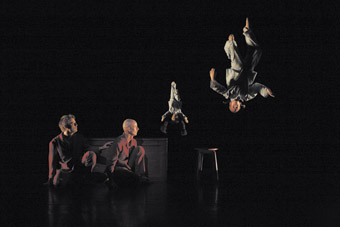
skadada, aureo
photo Danny Khoo
skadada, aureo
aureo
Skadada’s Aureo from Jon Burtt and Katie Lavers was an episodic, almost vaudevillian circus show distinguished by virtuosic young performers and projected images from aerial landscape photographer, Richard Woldendorp.
Aureo’s acts were linked by the motif of a large child’s trunk from which the protagonist imagined producing spectacles for her nocturnal amusement. This dramaturgical conceit wore thin with performers entering and exiting off stage as well as via the box. Also inconsistent were the types and moods of the acts, with striking, slowly posed aerial sequences (the strongest elements in Aureo) replaced at one point by an almost ballroom-dancing-style solo. The use of black theatre techniques was reminiscent of the illusionism and surrealism of Philippe Genty with the same tendency to feel laboured. Likewise, the protagonist spinning 180 degrees in the air many times was a mundane effect which did not merit such repetition. A mock conflict between Burtt and another male over the affections of the dancer was also awkward.
Nevertheless, the aerial work was exceptional, skirting the pseudo-eroticism of female contortionism common in traditional circus and Cirque de Soleil, whilst revelling in the sensuality of bodies bent, twisted and balanced upon each other or coiled about ropes and fabric before dropping down in long falls—all within a design glowing with reds, greens and blues. The inclusion of grotesquely manipulated bodies—notably a trinity of women who, when rolling on the ground, morphed into a multi-limbed torso—echoed the tendency in circus towards monstrosity and impossible, non-human bodies—an aspect of Skadada’s Electronic Big Top (1999).
Although I found the use of World Music fusions culturally objectionable, and little better than playing clichéd ‘harem-music’ behind Hollywood dancing girls and rope tricks, Aureo nevertheless constituted an interesting statement about land and identity. Woldendorp’s images are iconic of not just Australia but also WA. His use of aerial photography, though, often turns his works into abstract studies of form and colour with an ambiguous connection to specific locales. Aureo was suffused with this sense of displaced nationalism, of the Australian, athletic body-beautiful rendered strange and even vaguely threatening. Freud claimed such uncanny spectacles represented the “return of the repressed” and it is this manipulation and interpenetration of the familiar and the strange which is Skadada’s strength.
Strut, Four on the Floor, curator Sue Peacock, choreographers Bianca Martin, Phillippa Clark, Gary Lang, Aimee Smith; PICA, March 8-11; Skadada, Aureo, director Katie Lavers, director, choreographer, performer Jon Burtt, music John Patterson, Lo Key Fu, lighting Andrew Lake, images Richard Woldendorp, costume Karen Keeley, His Majesty’s Theatre, Jan 17-20
RealTime issue #78 April-May 2007 pg. 33
© Jonathan Marshall; for permission to reproduce apply to realtime@realtimearts.net
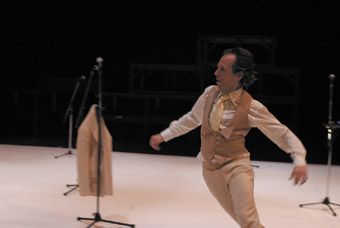
Martin del Amo, Never Been This Far Away From Home
photo Heidrun Löhr
Martin del Amo, Never Been This Far Away From Home
IN THE HIGH TECH, HIGH ART, HYBRID TREND OF CONTEMPORARY PERFORMANCE, PERFORMER MARTIN DEL AMO IN HIS LATEST SOLO PIECE, NEVER BEEN THIS FAR FROM HOME, BRINGS IT ALL BACK TO BASICS—VOICE, MOVEMENT, A BARE SPACE AND GOOD OLD FASHIONED MICROPHONES WITH CHORDS AND STANDS. SOPHISTICATED SOUND AND LIGHTING DESIGN SUPPORTS THIS WORK, BUT NO VISUAL FX MEANS STORYTELLER DEL AMO CREATES A LANGUAGE OF IMAGERY AND LEADS THE AUDIENCE INTO A WORLD OF THEIR OWN IMAGININGS.
The work of the solo performer is always risky. What if the telling fails, what if the audience doesn’t get it, what if they fall asleep—“what if they want me to shut up and just dance?” Del Amo doesn’t falter over such concerns, but methodically carries out his set task—to share with us the journey of his explorations: notions of home, the void of fear, danger and the unknown, where the edges of dreaming and reality meet.
A man in a white suit seems to hover in the space. As our eyes become accustomed to the dim light we see he is moving towards us across a white floor, his slight frame strangely trapped in the formality of his dress (aptly designed by Virginia Boyle). Carrying his polished brown shoes, he is barefoot, as if he has escaped—crept away from somewhere. Behind the white performance square, sitting at a table, sound artist Gail Priest ‘plays’ a laptop, feeding the buzzing soundscape into the air. To his left, also just outside the square, lighting designer and technician Clytie Smith watches intently for his next move. In darkness, barely noticeable around the square, the shapes of large crates and scaffolding loom. Mirabelle Wouters’ set is deceptively simple—speakers, back stage gear, and on the edge of the mat, 10 microphone stands, like metallic one legged birds, wait to take flight.
The man makes himself tall and puts his shoes down at the edge of the white floor. He walks back to a microphone and begins to speak. “What most people are afraid of is the void, nothingness”, he tells us, “but the void can be taken literally—take silence for example.”
The series of tellings begins, punctuated by voiceless dance pieces and slow, deliberate placings of microphone stands about the square. Following him all the way, the under pattern of electronic sound and subtle lighting supports the progression of his journey.
He walks to the edge of the white square and brings a microphone stand onto the space, placing the chord carefully in a straight line. Speaks. Brings in another—its chord in a diagonal line meeting the first at a triangle point.Then another, and another. Gradually, the performance square is crisscrossed with chords like lines on a map—countries perhaps, or sections of a brain. At each microphone he tells us of his fascination with expeditions and the failures of explorers; of danger and of a torture witnessed by a friend in a childhood forest. There’s the story of the philosopher Walter Benjamin who committed suicide at the French/Spanish border during WWII when he really didn’t need to, and a retelling of how to use word association to escape the recurring dream of a white room with no windows and doors. There are tips on how to survive a crocodile attack and the tale of a friend, Sylvia, who went off to play Russian roulette with women she met on the net and hadn’t been heard of since. “If someone doesn’t speak to you it’s as if a void opens up. It reminds you how disconcerting silence can be.” Back to the silence.
Slowly, the man unplugs all the microphone chords and reels in the leads. Released from its criss-cross of lines and sections, the soundscape soars as del Amo runs, skips, twirls and skates his euphoric dance across the white—fearless, borderless and free.
If the structure of story/movement/story/ movement feels a little predictable at times, by the end it seems to fit the setting of boundaries needed to combat fear. Breaking free requires courage, strength, skill—all of which del Amo displays in his choreography and in the execution of Never Been This Far From Home. And yet there is a vulnerability in the performance of his man/boy stage persona that you sense his creative collaborators (all women) have encouraged and made possible. With their help, it seems Del Amo’s refugee from other worlds, other feelings, behaviours and longings, has finally arrived home.
Never Been This Far From Home, devised and performed by Martin del Amo, sound design Gail Priest, set design Mirabelle Wouters, lighting design Clytie Smith, Performance Space, CarriageWorks, Redfern, Sydney, March 7-17
RealTime issue #78 April-May 2007 pg. 34
© Jan Cornall; for permission to reproduce apply to realtime@realtimearts.net
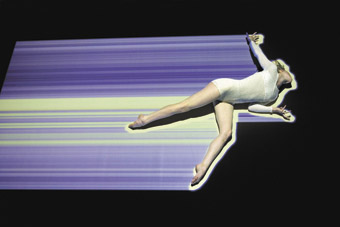
Kristy Ayre, glow, Chunky Move
THEATRE LIGHTING ELUCIDATES MOVEMENT AND GENERATES MOOD. DESIGNER MAGICIANS SEDUCE YOU INTO BELIEVING THAT LIGHT EMANATES FROM THEIR SUBJECTS OR THAT DANCERS MOVE AND SHAPE THE LIGHT ABOUT THEM.
In Chunky Move’s Glow we are moved onto another stage in illusion-making: the dancer really does determine the extent and patterning of the light field.
We’re positioned around and above the dancer, her floor is the screen. That which lights her—video projections doubling as light source—is also moved by her. The machinery responds intelligently. Light trails behind her in painterly sweeps as she drags herself across the floor, shoots out grids around her supple frame from moments of tiny movement, and forms shadows from which, remarkably, she walks away.
We’ve seen performers trigger sound and light before, but not like this. As with such demonstration model stuff, you need a bit of sturm and drang to show it off. Glow offers just that in its dynamically immersive 26 minutes. The emergent art tool is at one with the dancer’s body in an account of an emergent organism, a huddled in-human shape inching across the screen-floor pulsing out colour and light and gradually assuming human proportion as it stretches and unfurls. The imagery it generates is initially a clean geometry but, once the evolved woman stands and walks, the floor blooms into dark shapes beneath her. These are the shadows she leaves behind. But she is no longer alone as they threateningly glide up to her. No longer the sole generator of light and life, fangs bared, she unleashes a guttural primeval cry. Evolution is suddenly more complex, as frightening as it is beautiful.
Glow, created for Chunky Move by artistic director Gideon Obarzanek and German interactive software creator Frieder Weiss, and with an engrossing score from composer Luke Smiles, was performed nightly by three dancers in turn (Kristy Ayre, Sara Black, Bonnie Paskas) for the Sydney season. The demanding choreography is at its best in the early stages of creature emergence where every nuanced movement of limb, torso or hand yields subtle transformations in the world around the dancer, the very world she is also creating.
–
Chunky Move, Glow, The Studio, Sydney Opera House, March 21-25
RealTime issue #78 April-May 2007 pg. 34
© Keith Gallasch; for permission to reproduce apply to realtime@realtimearts.net
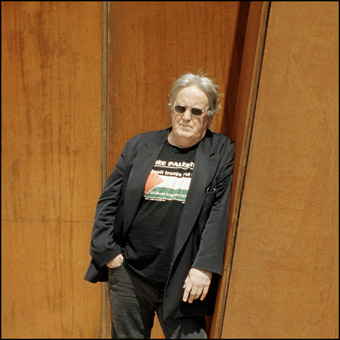
Lindzee Smith, photo Rod McNicol
LINDZEE SMITH FELL INTO A LONG SLEEP ON FEBRUARY 24 2007, SURROUNDED BY FRIENDS AND FAMILY AND, AFTER WEEKS IN HOSPITAL FIGHTING THE INCREASINGLY INEVITABLE, RAGING AGAINST THE DYING OF THE LIGHT, DIED FROM WHAT IS CALLED ‘POSTOPERATIVE COMPLICATIONS’, HIS LEFT LEG AMPUTATED, HIS BODY DIABETIC, LUPOID, ULCERATED, MEDICATED FROM LEFT AND RIGHT, HIS MIND PLANNING UNTIL THE END HIS PRODUCTION OF A JACK KEROUAC PLAY, LYING ON HIS BACK LISTENING TO THE SCREAMS OF ARTAUD READ TO HIM FROM HIS BEDSIDE BY THIS VISITOR OR THAT. HE SUFFERED UNTO DEATH FROM A DECADES-OLD IMMUNE DISORDER, BUT HE LIVED DESPITE THIS WITH A MONSTROUS HUNGER FOR EVERYTHING ABOUT LIVING AND AN UNQUENCHABLE THIRST FOR SHARING ALL THE SPOILS ON THE TABLE.
Lindsay Brian Smith—Lindzee, Ironman, Captain, the old L-dog-theatre director, actor, artistic terrorist, urban cowboy, vagabond, tuning into the world by working on the Nightshift, the Falstaff of late 20th century Melbourne theatre. Like Falstaff disdaining the seat of power but claiming through sheer force of energy, artistic vision and quality of presence the role of power generator for a generation of alternative theatricals, fringe dwellers and subversives. Lindzee, co-founder in the late 60s of the Australian Performing Group (APG) and at the same time always its sharpest critic, the one who embodied and accepted the consequences of his vision: life as art and art as life and both at the edge of death—a vision that felt like it was at the soul of the ten years of existence of that extraordinary and culture-shifting theatre collective. Lindzee inspired us all with his resounding answer to Beckett’s haunting question: “is it not better to abort than to be barren?”
Lindzee Smith’s list of productions speaks for itself: putting onto stage for the first time, as either actor and/or director, the early work of Romeril, Hibberd, Buzo and Williamson. With these writers and alongside Blundell, Dwyer, Hawkes, Finney, Davies etc, Smith launched a body of work that brought into the theatre a contemporary urban Australian life and language of word and action unseen before. Nothing in theatre, film or TV has been the same ever since. In the new home of the Pram Factory, Smith continued working, particularly on John Romeril’s plays, directing three of that writer’s most powerful texts: Chicago, Chicago, The Floating World and The Golden Holden. But it was also around this time, in the mid-70s, when the APG was arguably at its most successful peak, critically and with the public, that Lindzee became dissatisfied with the epic historical direction of the company’s work, its attempt to find for an Australian public its homegrown heroes and legends. He introduced into the repertoire plays by Brecht and Handke. And then he disappeared overseas on the first of his many forays to New York, which increasingly became his home over the next two decades.
The next phase saw Smith at his most active, alternating between New York and Melbourne. In Melbourne he built around him the group Nightshift in order to produce works by playwrights whose work he brought back from New York: Kroetz, Fassbinder, Shepard, Heathcote Williams and Handke. Nightshift included artists such as actor/ designer Carol Porter and the playwright/actor Phil Motherwell, with whom Smith was most closely linked artistically for this phase of his career. Its work cut a new image within the Australian aesthetic: that of the theatre terrorist—which reached its climax with the production of Motherwell’s Dreamers of The Absolute, about a group of young Russian terrorists, presented in the late 70s. It set a precedent from which many successive theatre artists have drawn.
In New York, Smith worked his way into the resurgent Off Off Broadway scene, directing plays by James Purdy, Tennessee Williams and Sam Shepard, and becoming part of the Squat Theatre Collective with whom he toured Europe. Most significantly, he brought to New York the works of playwrights Motherwell and Daniel Keene and along with them a particular brand of courage and effrontery that secured him a strong place within the post-punk scene.
Lindzee Smith worked and lived with humour and gusto. He had moments of bitterness in his last years at his lack of recognition in the Australian social and cultural scene. His was a star that burned white-hot and was destined to extinguish early. He gave to his friends, his fellow workers and his audiences a glimpse of fine madness transformed at its best into unforgettable art. His family perhaps were the great losers in his commitment to the wider world and he knew and regretted that. But they gathered around him at the end: his wonderful Mum, Maisie, brother Garth, ex-wife Margot, sons Andrew and Danny and three grandchildren whom he adored.
Hasta la vista, Lindzee Smith.
RealTime issue #78 April-May 2007 pg. 35
© Richard Murphet; for permission to reproduce apply to realtime@realtimearts.net
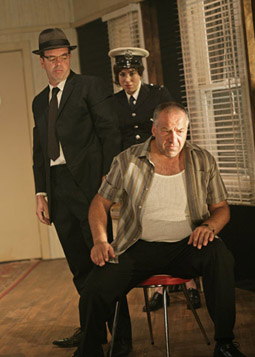
Kevin Harrington, Alison Bell and Tony Nikolakopoulos, The Spook
photo Jeff Busby
Kevin Harrington, Alison Bell and Tony Nikolakopoulos, The Spook
ONE OF THE UNEQUIVOCAL RESULTS OF THE’ WAR ON TERROR’ HAS BEEN THE NORMALISATION OF AUSTRALIA’S INTELLIGENCE AGENCIES AND THEIR ACTIVITIES. IN THE PAST, THE EXISTENCE OF AGENCIES SUCH AS THE AUSTRALIAN SECRET INTELLIGENCE ORGANISATION (ASIO) AND THE AUSTRALIAN SECRET INTELLIGENCE SERVICE (ASIS) WAS BARELY ACKNOWLEDGED. NOW, ON THE SURFACE AT LEAST, THEY LOOK AND ACT LIKE ANY OTHER PUBLIC SERVICE AGENCY.
In some ways this might seem like progress. Stripping intelligence agencies of their James Bond mystique is long overdue and, in theory at least, ought to promote more accountability. Less reassuring, though, is the way intelligence agencies and their activities have become entrenched as part of the social fabric. No longer seen as exceptional, they are fast becoming just another arm of police enforcement.
This development is particularly disturbing given that Australia’s intelligence organisations have been given wide-ranging new powers that seriously erode freedoms and rights, and they are significantly increasing their personnel. ASIO alone has embarked on a massive recruitment drive—2000 new staff are currently being recruited—aided by slick press ads and regular posts on Seek.com.
Melissa Reeves’ The Spook looks back to a time when recruitment was a more cloak and dagger affair. Based in fact, The Spook tells the story of Martin Porter who as a young man is recruited at a local football match by an ASIO controller to spy on the South Bendigo branch of the Communist Party of Australia. Martin ingratiates himself with the other members, in the process becoming alienated from his mother who believes him to be a bona fide Communist and, eventually, his wife who, though aware of her husband’s double life, tires of their alienation from the local community. Martin ends up befriending—and betraying—those he spies on.
There’s a lot that’s likeable about The Spook. The scripting is tight and well paced and the performances are uniformly strong. Kevin Harrington is perfect as the bland and officious secretary of the Communist Party branch, Frank Nash, for whom sales figures of The Tribune are as important as world historical events. Tony Nikolakopoulos and Maria Theodorakis are warm and passionate as George and Eli Tassekis, who extend their friendship to Martin.
Even some of the minor characters are brilliantly observed. A particular highlight was Alison Bell’s portrayal of one of the members of the communist party branch who routinely arrives late to branch meetings and sits there, frowning and fidgeting, as if caught in history’s headlights. In only a few lines, she manages to create a complex and layered character.
Despite some nice performances and subject matter dealing with an intriguing and largely forgotten episode in Australia’s political history, The Spook, for the most part, contents itself with nostalgia, frolicking through Australia’s past, rather than actively engaging with it.
That’s not to say there is no commentary on the present. For example a reference to Maoists in the classroom is a neat sideswipe at Federal Education Minister Julie Bishop’s recent claim that Maoist ideology is rampant in our schools.
Similarly, after his arrest by Immigration for using a false name on his passport, George is asked about his views on the Berlin Wall in an interrogation. “Do you think we should have a wall like that around Australia?”, he’s asked by the defenders of freedom—a deft counterpoint to our own defenders of freedom who seem relaxed and comfortable about erecting bureaucratic walls to keep out all those pesky asylum seekers.
And, after expressing some doubts about his own spying activities, Martin’s ASIO controller exclaims there’s “no room to make niceties…this is a war Martin”, the echo of which can be heard in the pushers of the ‘war on terror’ whose defence of ‘our way of life’ extends to destroying some of the very things —freedom and the rule of law—that define that way of life.
But these are brief, passing moments of reflection that are not sustained. Rather than meditating on the role of intelligence communities in a society that professes to live by the tenets of liberal democracy, The Spook opts to take a light romp through this episode of Australia’s history. When the narrative does shift into a more serious register, any sense of drama is quickly dissipated by a quick return to gags.
One of the final scenes, for example, sees Martin confessing his double life to his mother who, recovering from a stroke, no longer knows who he is. It’s a potentially tragic and poignant moment, but the comic situation created by Martin’s mother’s failure to recognise her son or the seriousness of what he’s saying undercuts the drama. Though far preferable to an earnest and didactic treatment, the light-hearted, nostalgic treatment of Martin’s fate dampens any dramatic potential.
In part, the potential of The Spook is let down by a weak central character. Martin is intended to be an everyman: the uncomplicated country boy who loves his country, is in the local football team, plays trumpet for the CMF and is a member of the air cadets. He’s also uncompromisingly dull. He starts out as optimistic, if pathetic and inconsequential, and ends up as pessimistic and even more pathetic and inconsequential. It’s only at the play’s end, when he questions his double life that Martin shows the kind of psychological complexity that might enable deeper reflection on the past, present and future. But he’s too slight and bland a character to carry anything more momentous.
One of the unintended consequences of this lack of drama is that The Spook, in spite of portraying the betrayal and the deportation and the forced separation of an immigrant family and the destruction of people’s lives through the banal workings of bureaucratic machinery, leaves the impression that the activities of spy agencies are all a bit of lark. In smothering the dramatic potential of the material, The Spook leaves the impression that the past was a more innocent place.
And what of the present and the future? The Spook seems to have little to say about who we are now or what we might become, ending up a lost opportunity to use history as a way of shedding light on where we are and where we might be headed.
The Spook, writer Melissa Reeves, director Tom Healy, performers Alison Bell, Kevin Harrington, Margaret Mills, Denis Moore, Tony Nikolakopoulos, Luke Ryan, Maria Theodorakis, set & costume design Anna Borghesi, lighting design Richard Dinnen, composition, sound design David Franzke; Malthouse Theatre, Melbourne, Feb16-March 10
RealTime issue #78 April-May 2007 pg. 35
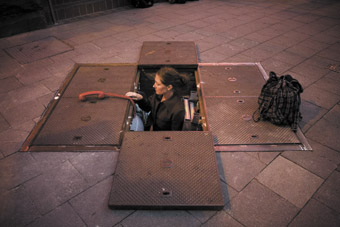
Lucy Wilson, Underwhere
photo Peter Mathew
Lucy Wilson, Underwhere
A WOMAN APPEARS ON A STREET CORNER IN THE MIDDLE OF THE HOBART CBD. SHE STANDS NEAR THE BUS MALL. BENEATH A BROWN TRENCH COAT, SHE WEARS TROUSERS AND A YELLOW VEST TRIMMED WITH FLUORO SAFETY TAPE THAT SWINGS AND FLASHES. IT IS 8.30 PM AND LUCY WILSON’S PERFORMANCE AND VISUAL INSTALLATION SITUATED AROUND A MANHOLE COMMENCES.
“Don’t talk to strangers”, her mother said, stepping off the curb and under a bus. Longing for reconnection with her lost mother’s voice becomes the imperative for Wilson’s journey.
She stands on the manhole cover wrought in a recurring pattern. Her soles seem imprinted with a grid motif which works as a shadow overlay to her mind’s incessant question of who is responsible for her mother’s death. Wilson frequently confronts her unresolved grief through introspection and blame.
She lifts the cast iron manhole lid and descends into the underworld. Joey Ruigrok van der Werven’s set design taunts with a blaze of light revealing an underground network of cables, pipes, and tunnels. We peer in, fascinated with this revelation. Above ground, interconnecting roads, footpaths, dreams, desires and loss impress our shoe soles like ley lines—the intersection of Wilson’s quest with our own.
Red, yellow, black and white phones appear and are placed like compass points around the manhole pit. The phones ring. Cradling each in turn, the performer listens and redials. Her desire for connection with the irretrievable rings out to silence.
A ladder emerges guided by pale arms. Piece by piece the extensions snap-lock into place ascending toward the sky. Wilson climbs from her pit of despair with a radiant orb of light snaking from her body. The silver ladder becomes a locale for reclamation of ordinary acts as she cleans her fragile world. Underwear is draped across the ladder, fingernails are shaped, a light is switched on, a tap buffed.
Wilson produces a silver kettle, a heating ring and a plumbing line complete with tap. A piano mood-scape tinkles and light refracts from shiny surfaces and safety gaffer tape. She makes a cup of tea, then sips—a homage under lamplight. Her slow deliberate drinking is a re-enactment of her last treasured memory, sharing tea with her mother.
Above our heads an advertising sign reads, “Capture the Spirit”, as Wilson navigates her way through, under and over worlds, seeking, searching, and trying to link with her lost mother. Tik-tokking traffic lights and frenetic ‘safe to walk’ pitches are amplified and echo through Matthew Dewey’s sound score.
Finally the phone is answered offering communication with an ethereal world and, for the performer, redemption. She draws a tear-shaped crystal from her mouth. This crystallisation of sorrow enables Wilson to resolve her loss and to relinquish her constant questioning.
Peering into the crevasse of both street and self, Lucy Wilson’s strong performance offers a portal to hidden worlds. It is the journey of a woman seeking connection through the interstices of self, a street corner, a manhole and a city.
Lucy Who Productions, Underwhere, performer Lucy Wilson, director Robert Jarman, writer Willoh S Welland, composition and sound design Matthew Dewey, costume design Hanna Pärssinen, set construction, design Joey Ruigrok van der Werven, prop design, construction Bruce Hay; CBD, Hobart February 15-17, 22-24
RealTime issue #78 April-May 2007 pg. 36
© Sue Moss; for permission to reproduce apply to realtime@realtimearts.net
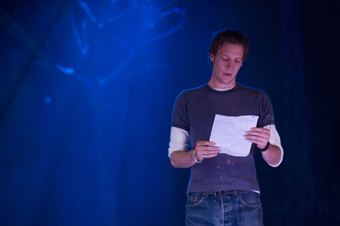
Nathan O’Keefe, The Unchartered Hour
photo Shane Reid
Nathan O’Keefe, The Unchartered Hour
THIS UNCHARTED HOUR IS A HOME-GROWN CULTURAL PRODUCT, NURTURED THROUGH CREATIVE DEVELOPMENT BY DIRECTOR CHRIS DRUMMOND AND PRESENTED BY BRINK PRODUCTIONS AND THE STATE THEATRE COMPANY OF SOUTH AUSTRALIA IN ASSOCIATION WITH ADELAIDE-BASED CHAMBER MUSIC COMPANY, THE FIRM, AND THE ADELAIDE FESTIVAL CENTRE’S INSPACE PROGRAM. ALONG THE WAY, PLAYWRIGHT FINEGAN KRUCKEMEYER WAS AWARDED ONE OF THE 2006 PREMIER’S LITERARY AWARDS—THE JILL BLEWETT PLAYWRIGHT AWARD—FOR THE CREATIVE DEVELOPMENT OF A PLAYSCRIPT BY A SOUTH AUSTRALIAN WRITER.
The mechanisms of creative development demand cultural recognition of a project in advance of its production. What is recognised as ‘cultural’ in the process of development is a project’s pitch and promise, its core components and key personnel. Program notes from the playwright recall the process of the work’s projection as akin to the rise and fall of civilisation. “Great walls of ideas once set in stone would crumble and be rebuilt”, wrote Kruckemeyer of the developmental process he undertook with Drummond and the artistic team assembled by Brink Productions.
The world premiere of This Uncharted Hour bears the hallmarks of a striving for cultural recognition. The play tells an intense family story of assured appeal. A son relives the trauma of growing up in a family stricken with grief. His mother lost a baby, then her husband’s love. The set, designed by Gaelle Mellis with lighting by Geoff Cobham, has an elemental, existential feel: a bare tree stripped of its leaves, a park bench and a pool of water, a kitchen table and some chairs, a telescope for stargazing at the night sky.
The music, from composers Raymond Chapman-Smith and Quentin Grant of The Firm, is ensconced in European tradition. Their notes record how, in their composing, they embraced the lieder of Franz Schubert and the German poetry of the Romanticist Novalis and the modernist Rainer Maria Rilke. Schubert’s ‘Nacht und Träume’ (Night and Dreams) is performed in the production by soprano Emma Harwood and pianist Jamie Cock, along with music composed by Chapman-Smith and Grant.
The two musicians and a baby grand are elevated inside a box cut into one of two walls which frame the set. At one point, the musicians are amusingly treated as recorded music. “Shut the fuck up”, yells Nathan O’Keefe as Luka, the troubled son. Harwood stops singing and turns to leave. “Turn it back on”, yells Elena Carapetis as Penny, the grieving mother. With a musician’s patience, the soprano returns to resume her song. For much of the production, however, the mood is mournful and melancholic.
In her persistent grieving, Penny is attended by an ineffable Young Man, the dead infant had he grown up. Played with abstract clarity by Lachlan Mantell, the Young Man also haunts Luka, shadowing the living son’s insecurities with moving precision and elusive poetry. Paul Blackwell plays Adam the husband who withdraws from his wife’s grief by having an affair with Sarah, a single woman he meets while out jogging.
Michaela Cantwell’s Sarah is enjoyably neurotic. Her breathless excitement at Adam’s heaving attention, her experience of self-identifying frustration at the video shop and the singular solace she finds in eating chocolate ground her character amongst everyday things. Sarah’s appearance in a peach-pink party frock with striking blue handbag and chunky blue shoes strikes an image more moving in its materiality than the poetry of the kitchen table and broken plumbing in the bathroom through which the breakdown of Penny and Adam’s relationship played itself out. It led me to wonder about the production’s aesthetic strategy of appealing to the poetry and music of European Romanticism while seeking to articulate modernist intensities of everyday experience.
Without the Romantic night-dreaming of Schubertian lieder to elevate the production’s claim to cultural recognition, the everyday intensity of Luka’s opening story about running over a dog may have led the production to more credibly aestheticise its sentimental investment in the cult of cuteness, that formidable cultural industry of babies and pets, of innocence lost and unconditional love, which now so pervasively promises delivery from moral distraction.
The production diverted this aesthetic challenge into the backwaters of Romanticism. In securing cultural recognition, its cloying sentiments languished exposed and unassailed. The Stillbirth and Neonatal Death Support Service lent to the production this little epitaph: “Some have a lifetime/ Some just a day/ Love isn’t something/ You measure that way”.
jet of blood
Antonin Artaud, whose celebrated idea for a theatre of cruelty has long rattled the presumptions of literary theatre, wrote just three play scripts. His first, Le jet de sang (Jet of Blood) from 1925, remained unperformed during his lifetime. The script is short: it takes about five minutes to read aloud. According to one source, its first production, for Peter Brook’s and Charles Marowitz’s Season of Cruelty in 1964, ran for just three minutes.
Olivia Allen’s rare production of Jet of Blood for Ignite won the Best Ensemble award at the 2006 Melbourne Fringe and recently had a season in The Space for this year’s Adelaide Fringe. Allen milks some sixty minutes of theatricality from the surrealist succession of images in Artaud’s script.
A young man and his doll-lover torn from their bed. A scatter of body parts crash to the floor. A warrior cry-baby babbles away. A giant spider dances. A bird-lady feeds the young man mouth-to-mouth. A sex-starved priest feeds his ravenous dog-servant. A plague of scorpions escapes from beneath a woman’s skirt.
Allen literalises each image within a hyper-theatrical flurry of cabaret makeup, costume changes, puppetry and running props, lighting shifts and scenic revelations. It is the remarkable sound design with live audio processing from Hayley Forward that gives coherence, zoom and focus to the flow.
The cumulative effect is rather cute, not cruel. This is game-play surrealism, recalled with fond nostalgia from our avant-gardist past and served up as sweet confection within the safety of a virtual world.
The Uncharted Hour, writer Finegan Kruckemeyer, director Chris Drummond performers Paul Blackwell, Michaela Cantwell, Elena Carapetis, Lachlan Mantell, Nathan O’Keefe, singer Emma Horwood, pianist Jamie Cock, designer Gaelle Mellis, lighting Geoff Cobham, composers Raymond Chapman-Smith, Quentin Grant; Brink Productions, State Theatre Company of South Australia, in association with The Firm and the Adelaide Festival Centre’s iNSPACE program; The Space, Adelaide Festival Centre, Feb 9-24
Ignite Productions, Jet of Blood, by Antonin Artaud, director Olivia Allen, performers Amelia Best, Roderick Cairns, Grant Cartwright, Austin Castiglione, Julian Crotti, Simon Stone, Katherine Tonkin, Lara Tumak, design Adam Gardnir, lighting Luke Hails, sound design Hayley Forward; iNSPACE, The Space, Adelaide Festival Centre, March 8-11
RealTime issue #78 April-May 2007 pg. 36
© Jonathan Bollen; for permission to reproduce apply to realtime@realtimearts.net
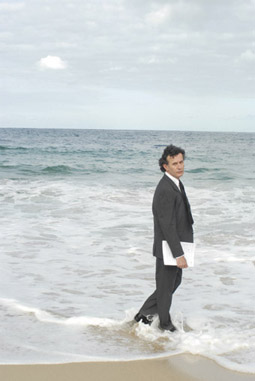
photo Heidrun Löhr
Photographed recently on Coogee Beach, on approach he spoke a patois of musical memes, adolescent delusions, political spin, sound grabs, punch-lines and pedagogy and hummed bytes from what a local lifesaver identified as The Goldberg Variations.
Though he could not confirm it, passers by felt he bore a striking resemblance to man of the theatre, Nigel Kellaway whose Sleepers Wake (Wachet Auf!), a chamber recital for amnesiac performer and three musicians is scheduled for performance sometime soon.
Nigel Kellaway, Sleepers Wake (Wachet Auf!), Performance Space, CarriageWorks, Sydney, June 7-9, 13-16
RealTime issue #78 April-May 2007 pg. 37
© RealTime ; for permission to reproduce apply to realtime@realtimearts.net
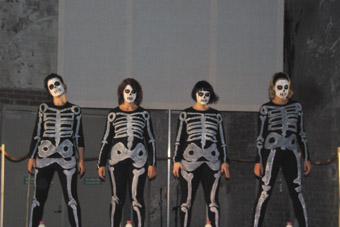
Night Time #1, Brown Council
photo Caitlin Newton-Broad
Night Time #1, Brown Council
ON SUNDAY AFTERNOON, THE FIRST OF APRIL, I WAS NEARLY WIPED OUT FROM BEHIND BY A RED HOLDEN SS SEDAN. IT RIPPED PAST ME AT THE LIGHTS WHERE KING STREET BECOMES THE PRINCES HIGHWAY, DRAGGING OFF A HOTTED UP BLACK UTE (ALSO A HOLDEN) IN THE LANE NEXT TO IT. I HAD JUST ENOUGH TIME TO SEE THE UTE SPIN OUT OF CONTROL, MOUNT THE KERB AND WRAP ITSELF AROUND A TELEGRAPH POLE. IT WAS FAST, BRUTAL, AND OVER INCREDIBLY QUICKLY, AND WITH A CLEAR WINNER AND A CLEAR LOSER.
Something similar must have been envisioned by the Performance Space conveners of Night Time #1, the first in a planned cycle of events structured as a head-to-head contest between krumping skeletons, folk troupes, VJs and interpretive dancers in the cavernous foyer space of the recently opened CarriageWorks.
The stage was a boxing ring, each round was limited to a breakneck three minutes, and winners were garlanded with medals by Zoe Coombs-Marr, who was both umpire and commentator to the public gallery. However, one of the things that differentiated this night of performance art from a brutal car crash is that everyone came out a winner. All the participants were awarded trophies, and a general atmosphere of courtesy prevented anyone from getting heckled, in spite of the frail separation between the audience and the stage.
Unconditional love is damaging. It results in a weak constitution at best, and suffocation at worst. So I’m going to mark out my own exclusive set of winners. The clear audience favourite in the first half was Poss + The Frank, who performed a riveting duet dance to the song “Wait till you see my dick, bitch” with one performer in swimmers and the other in a giant pink octopus suit. Honourable mention also goes out to Renny Kodgers’ karaoke cover of “We’ve got tonight”, to Shane Haseman and Agatha Gothe-Snape’s dance with suprematist signal flags to the constrained fury of Suicidal Tendencies’ “Institutionalised”, and to a convulsively controlled Matthew Day. Tony Schwensen, all the while, was pelting a tennis ball repetitively down a hallway, with thwok and grunt amplified through the foyer. The piece was perhaps best described as a sort of marriage of 70s conceptual art with contemporary Australian suburbia, and very fitting for a sports night.
During half time, cheerleaders handed out oranges, although vodka would have helped, and participants and spectators smoked nervous cigarettes. Then Regina Heilmann told a funny story about road rage and a chicken that could speak German, and everyone laughed. This was topped by Martin Del Amo and Julie-Anne Long doing an incredible drunk dance. It takes a lot of sober field research to do a good drunk dance. You can’t actually be drunk when you do it, because the gestures have to capture not just how people look, but also how they feel when they’re burning up the dancefloor at three-thirty in the morning. Del Amo did it so well I kept thinking I could smell the spirit in his sweat.
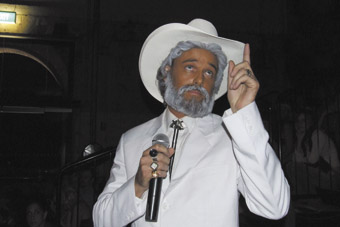
Night Time #1, Renny Kodgers
photo Caitlin Newton-Broad
Night Time #1, Renny Kodgers
Best and Fairest goes to Brian Fuata and Agatha Gothe-Snape respectively, or the other way round, for amicably ending their collaborative career in public. Legends of the Folk Tradition sang a song. Four women (Brown Council) in skeleton leotards drank a litre of milk each to the Kelis’ hip hop hit “Milkshake” and then gyrated violently until they puked milk, really. Karen Therese and Lizzie Thompson got a lot of people to kiss in public, which was gross but fascinating, but not nearly as gross as Brown Council who blinded us with their brown-eyes from a panel van that slowly cruised past the entrance—not once but several times.
Brecht once said that his ideal stage would be a boxing ring: a combative space in which anarchy is played out in a square of light, people become performers by climbing through the ropes, and the public shout and shake their fists at the stage. Night Time #1 offered all the trappings of an elimination boxing match, but the audience was too damn nice to respond off cue. It’s a pity that the former workers of the Eveleigh Street Rail Yards weren’t there to take in the show.
Night Time #1, A Night Of Short Works, coordinators Lara Thoms, Trevor Brown, Rosie Dennis; Performance Space, CarriageWorks, Sydney, April 1
RealTime issue #78 April-May 2007 pg. 38
© Adam Jasper; for permission to reproduce apply to realtime@realtimearts.net
KIT LAZAROO’S ASYLUM BEGINS LONG BEFORE THE HOUSE LIGHTS DIM. THE AUDIENCE CANNOT HELP BUT PONDER THE BUREAUCRATIC WALL CONFRONTING US INSIDE LA MAMA. FILING CABINETS, RELICS FROM A BUREAUCRATIC PAST, ARE VAULTED ALONG A REAR WALL. WHEN PSYCHIATRIST LALLY BLACK ENTERS, SHE IS DWARFED BY THE DATA OF THOSE WISHING TO FLEE PERSECUTION AND BEGIN A NEW LIFE IN AUSTRALIA. ASYLUM, KIT LAZAROO’S PLAY IMPLIES, IS AN ISSUE CONFRONTING US ALL, YET SOMETIMES IN THE MOST UNEXPECTED WAYS.
Black sits at her desk reading reports, and watching a mechanised tortoise creep along the floor. When asylum seeker Yu Siying enters demanding a letter of recommendation, the progress of the tortoise resonates as an image of bureaucratic inefficiency and evolving psychosis. All four characters in Asylum are going stark raving mad. But Siying is alone in having an obvious reason for doing so. Under surveillance by the Chinese government, her paranoid delusions extend toward those she now relies upon to remain within Australia. But psychiatrist Black, her deaf brother Smudge and barking immigration bureaucrat Turlough Dando are also hallucinating. Apart from some unconvincing childhood trauma, there is no obvious reason for their unsettled states of mind. This maybe a flaw in Lazaroo’s script, but it also hints at a power psychosis: a collective madness residing among politicians, bureaucrats and the general public too as we wrestle with current government policy on asylum seekers. In this play, the lunatics have indeed taken over the asylum and we have all become prisoners behind a bureaucratic wall.
Paradoxically, the filing cabinets that imprison the characters in Asylum are also gateways to memory and dream. A fit of compassion toward the plight of asylum seekers results in cabinets flinging open their drawers. Siying’s traumatic past, during which she is forced to provide sexual favours for her father’s friends, is played out by marionettes; an adroit choice of form in a play about bureaucratic manipulation and state tyranny. Yet this alliance between the actual and the magical is uneasy. The production’s ‘kooky’ tone does not take into account that asylum is not a kooky place to be, either for those seeking it or those forgotten behind its walls.
When Turlough Dando spreads margarine over white bread while delivering a tirade about his personal life, his psychosis (its subjective roots in fear, its explicit manifestation in public policy, and a crazed desire to both feed, and feed upon asylum seekers) becomes clear. But even this scene is restrained as if Asylum’s creators insist that madness must be made palatable by forcing it to reside within a one-dimensional framework of quirkiness. The upshot is that some striking and original imagery does not resonate poetically. At play’s end, when Siying is stuffed into a filing cabinet and entrapped in a bureaucratic maze, the audience should feel great sympathy. Instead, I left the theatre wondering whether kooky was the right theatrical framework for a play about bureaucracy gone mad, and the dire consequences of a psychotic immigration policy.
Asylum, writer Kit Lazaroo, director Jane Woollard, performers Glynis Angell, Tom Considine, Fanny Hanusin, Tim Stitz, design Amanda Johnson, sound Peter Farnan, lighting Richard Vabre; La Mama, Melbourne, March 15-April 1
RealTime issue #78 April-May 2007 pg. 38
© Tony Reck; for permission to reproduce apply to realtime@realtimearts.net
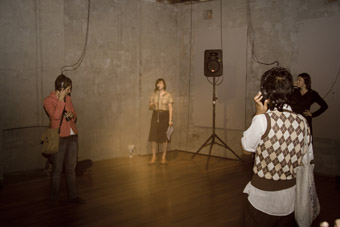
Mimic Mass, photo Ben Mastwyk
SPLIT RADIO IS THE LATEST IN A SERIES OF VOCAL PERFORMANCES BY THE ENSEMBLE MIMIC MASS THAT UNPICKS THE CONVENTIONS OF THE POPULAR SONG IN CONTEMPORARY CULTURE. SPLIT RADIO IS HOSTED BY CONICAL INC AS PART OF ITS SOUND SERIES WHICH, THE PROGRAM STATES, IS INTENDED TO EXPLORE THE DISRUPTION OF TEMPORAL AND SPATIAL SYNTAX TYPICAL OF MUSICAL PERFORMANCES. IT CERTAINLY DOES.
The Mimic Mass performance takes place in Conical’s main gallery and a smaller inner room. In three of the four corners of the bare main gallery, a singer sings unaccompanied at a microphone connected to its own PA speaker. The singers each cover pop hits from recent decades, and the audience, hearing three songs simultaneously, initially tune in aurally to one or other, depending on personal curiosity and taste, or try to take in all three. It’s like listening to three radio stations at once.
You can also hear each voice alone through one or other of the many pairs of headphones in the gallery and entrance hall. The voices are then transmitted via a mixing desk to a PA in a smaller room, which is completely darkened. Here the voices are variously morphed, fragments are repeated serially and effects such as drum and bass accompaniment are added. Later, the remixed sound is transmitted into the main room over the top of the singers, and the unmixed voices are then heard in the darkened room. The whole work lasts about 40 minutes, during which the very capable singers rarely pause, covering numerous songs.
The audience patrols the spaces and tries different headphones to hear the evolving variations in this condensed and remixed classic hits selection. The effect musically is to create several binaries: accompanied/unaccompanied, mixed/unmixed, transmitted/direct. Listeners not only shape their reception by moving between listening positions; the work’s formal development requires listeners to move through sequences of positions. Aural awareness is heightened in the darkened space that’s not unlike a club chill-out room or a meditation cell, suggesting further binaries: light/dark, sighted/unsighted and inner/outer. We’re also reminded that music is affected by studio recording and broadcasting—to transmit is to transmute.
The melodies and lyrics of the songs trigger the listener’s verbal and musical memory, the effect of which is heightened if the memory is also an emotional one, perhaps of a love song that recalls a close relationship. But you can only hold a feeling momentarily before it merges into the overall musical/textual picture, creating an emotional roller-coaster ride. The listener experiences a kind of hypertext, as fragments of song lyrics coalesce into new text, the content of which depends on the mixer’s mixing and the listener’s listening position: “I’m too sexy for my car…and the white knight’s talking backwards…I love you, I really do…it’s just an old war, not even a cold war…and say-ay that you love me.” The tradition of the pop idol as heroic storyteller is undermined, and meaning emerges fleetingly and speculatively to be transformed and annihilated. You might sing along or dance to rock music, but here the rhythms and lyrics are too elusive, so your response is cerebral rather than visceral as you wander through this soundscape.
The work recalls the emphasis in Fluxus events on text and idea, playfulness and the disruption of normal reception and understanding. Singer Madeleine Hodge, a performance artist who has previously appeared in Liquid Architecture and Electrofringe, says that the intention is to break down the normal audience/performer relationship. Split Radio cannot be recorded—in the tradition of performance art it must be experienced live. No two listeners will hear exactly the same sounds, and the range of listening options extends the range of possible listener experiences.
Conical states that its Sound Series, subtitled “A poke in the eye is a good distraction from a ringing ear”, is intended to address “the expanded nature of current art practice”, and Mimic Mass nicely fulfills the contract. This expansion, in which art encompasses and reconsiders multiple cultural forms and traditions and involves audiences more actively, has evolved into a broad genre. Mimic Mass’s Split Radio could be described as a performance-installation involving the rendition and electronic mediation of iconic musical and textual material within an overarching compositional structure that unfolds exponentially and that requires the listener to be a mobile, active interpreter. It references DJ-ing that melds musical fragments into a new whole, and mimics the cultural and mental saturation of contemporary life. It breaks the spell of pop music, offering an alternative, oblique aesthetic. It’s iconoclastic and demanding but ultimately it’s a fun event. We love the nostalgia of catchy old tunes, and subverting them like this is “…too sexy by far…”
Mimic Mass, Conical Inc, Fitzroy, March 9, 10, 15-17; Conical’s Sound Series also includes performances by The Spheres, Mark Brown & David O’Donoghue and The Glass Percussion Project
RealTime issue #78 April-May 2007 pg. 40
© Chris Reid; for permission to reproduce apply to realtime@realtimearts.net
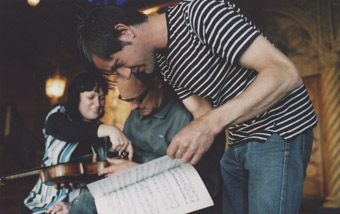
Dead Horse Productions
DEAD HORSE PRODUCTIONS’ GROUND ELASTIC SOUND IS THE LATEST IN A SERIES OF MUSICAL EVENTS THAT INCLUDES THEIR MEMORABLE CONCAVE CITY OF 2006. DEAD HORSE GOES FOR UNUSUAL VENUES AND THE FABULOUS FORUM CINEMA, DECORATED WITH NEO-CLASSICAL FACADES AND SCULPTURES, CREATES AN EPICALLY MYTHOLOGICAL BACKDROP FOR THIS ENGAGING CONCERT.
The evening is introduced by a cheery voice from an old vinyl record—“Are you ready? Let’s get going!”—and Biddy Connor’s tongue in cheek Ground Elastic Sound Fanfare commences with the clarinet and brass players performing in the theatre’s aisles. The crackly narration (the recording is of whistling) later returns, the fanfare concluding with the performers on stage whistling the fanfare theme—music of the mouth.
Peter Knight’s more cerebral Spirals Part 1, in two contrasting movements for clarinet, trumpet and string quartet, opens with a slow, dramatic cello note. A dialogue between winds and strings develops, sharp gestures overlaying a steady rhythm that builds towards an unfolding melodic line late in the first movement. In the program note, Knight outlines the mathematical basis for the work’s form, a numerical spiral. The short second movement is angular, atonal and gestural. The piece is accompanied by imagery projected on the cinema screen—a slowly evolving abstract form in the first, and latticed sticks in the second, personifying the music.
Light-heartedness returns momentarily with Wally Gunn’s Formwork for tape, which sounds like a theatre organ dubbed over industrial noise and played on a slurring gramophone record. It’s heard while the stage is rearranged for his Eleven Fifty-Five, a strongly coloured work for clarinet, brass, string quartet and contrabass that opens with declamatory gestures from the brass and clarinet. All the musicians are miked for the evening, and the mix for Eleven Fifty-Five foregrounds the brass. The piece develops in motoric passages with a thriller movie feel. The visual imagery is of stylised figures running aimlessly, trapped behind a grid of lines, evoking a struggle between the enclosing industrial world, represented by the overwhelming brass, and humans, represented by tremulous strings. Gunn states in the program his concern that “the world is close to apocalypse”, hence the work’s title.
Kate Neal’s Semaphore, also for winds and strings, is preceded by a video of her own hand writing out the lines of a TS Eliot poem, Chorus VII, from The Rock. Opening with brass layered over glissandi strings, the work is a meditation on semaphore signalling as a form of communication. A vocalist is positioned next to a statue under one of the theatre’s arches. Tristram Williams’ fine trumpet is given scope in this piece, in which the brass again dominates the mix. The work progresses steadily and rather introspectively within a restricted tonal range, and concludes over the projected cartoon of a flag-waving signalman. Biddy Connor’s second work for the evening is Into Hundreds, written in 2000 and performed here to mark the 10th anniversary of her father’s death. Arranged for this performance for clarinet, tenor and baritone saxes and violin, viola and cello, it is a short but eloquent elegy, slow, lyrical and melodic, with combinations of strings and brass producing some delicious moments. Into Hundreds feels like it could be the middle of a three-movement work but is delightful as is.
The final work is David Chisholm’s Ikebana, for live and pre-recorded string quartet (the Silo Quartet). This unusual arrangement must have been technically demanding for the four performers on stage, as the work is in effect an octet and they are cued both through headphones and by a conductor. But the result is impressive. The muted sound of the recording hangs like a ghost over the performers, suggesting a kind of inner dialogue. The solid writing provides a welcome opportunity for leader Miki Tsunoda to showcase her talents. Originally scored to accompany Phillip Adams’s dance work Origami, this vibrant, pulsing work hints at a range of musical forms and flavours, especially mid-20th century. In the absence of the dance, the listener is left wanting more, perhaps a finale movement.
Dead Horse events are a complex blend of innovative composition, performance and visuals, tinged with social observation and curated with an eye to theatrical presentation. At times it can seem contrived but when the blend works, there is magic. There is not quite a house compositional style but, with the exception of Chisholm’s piece, the instrumentation for this concert created a house texture and feel, leaving a memory of solid rhythmic structures, strong instrumental colour and dissonant, edgy lyricism. The longer pieces are 10-12 minutes, absorbing enough but sometimes leaving a feeling of incompleteness. The strength of the Ensemble’s performers shines through.
Ground Elastic Sound, Dead Horse Ensemble, conductor Benjamin Northey, visuals Nina Gonzaga, Robin Fox, Forum Upstairs, Melbourne, February 23
RealTime issue #78 April-May 2007 pg. 40
© Chris Reid; for permission to reproduce apply to realtime@realtimearts.net
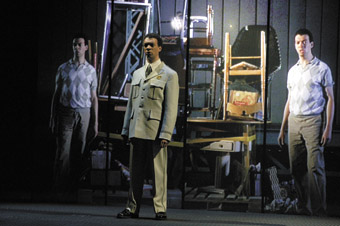
After Life
DUTCH COMPOSER MICHEL VAN DER AA VISITED AUSTRALIA IN 2000 WITH HIS FORMER MENTOR LOUIS ANDRIESSEN AND DIRECTOR PETER GREENAWAY TO WORK ON THE GREENAWAY OPERA, WRITING TO VERMEER. VAN DER AA’S OWN PIECES FEATURE PRE-RECORDED SOUNDTRACKS OR VIDEO PROJECTIONS WHICH DOUBLE THE LIVE PERFORMERS, CREATING A DYNAMIC INTERACTION BETWEEN THE TRAGIC, HARRIED, ONSTAGE CHARACTERS AND THEIR TECHNOLOGISED OTHERS. VAN DER AA IS A KEYNOTE SPEAKER AT THE 2007 TOTALLY HUGE NEW MUSIC FESTIVAL CONFERENCE WHERE SELECTED SCORES AND FILMS FROM HIS OEUVRE WILL BE PRESENTED.
How would you characterise your aesthetic?
I often work with electronics or soundtrack, combining pre-recorded samples and live music, which lets me stretch the sounds of the ensemble or the orchestra, or put them in a different context. The soundtracks are closely related to the live sound, so they act as an alter ego for the live players. In the operas One (2002) and After Life (2005), the singers on stage are also singing in the projections—they do duets with themselves. They finish each other’s sentences and movements. It’s almost an extra set or layer of musicians. The use of a visual alter ego in the projections and an electronic alter ego in the soundtrack—both of which I do in One—is another way of stretching the personality on stage and of providing insight into the mind of the protagonist. It becomes an internal dialogue.
In terms of video and multimedia in opera, Greenway and Andriessen—together with Steve Reich, Robert Wilson and Philip Glass—are key figures.
I was here for Adelaide [with Vermeer]. At that point Louis collaborated with Peter Greenaway and with me, and now I’m trying to do it myself. The important difference between us is that we have a different starting point. In One and in After Life, while I was writing the music I was also thinking about what would happen in the projections and on stage. By writing all three layers in one I could decide—for each moment—which of these elements would be foregrounded. The shifting of weight to and from the music also influences the musical structure and the phrasing.
Mischa Spel describes your doubling of the performers as being like “freezing” sections of the music, which then “thaw out” as they are repeated or extended. The metaphor which I would prefer, however, would be to call this a kind of “blurring” or “smudging” of material, like charcoal on a page, so that it becomes not just an opposition between two things—two musical lines, or the live singer versus the filmed one—but that there is also a spreading of these opposed elements, and an exchange of sounds and rhythmic elements between the two lines.
[Freezing] is something that I often do with the soundtracks, though. The ensemble stops playing and the tape echoes the last chord they played. With a dry cut between them, the reverb or the echo is cut open and the new part is then played live with that reverb in the background. In that sense time is stopped and then a new time axis is shown through that echo.
So it’s not so much that time stops, but that another time opens up.
Yes. That’s the way I use polyphony.
Michiel Cleij notes that in many of your works there exist what he calls musical or “aural images”, which might be considered as blocks within a collage of elements, structured together, and which then recur or are worked through over the course of the piece.
I don’t see it so much as that montage style of music. It’s more like you cut open the music and you look through and see what is happening behind it or underneath it—and then that original musical element continues again. That use of polyphony is quite different from the postmodernist montage technique where things are cut or stopped and then a new thing simply happens.
Samuel Beckett’s Krapp’s Last Tape seems an obvious comparison with your work, not only because of the sense of identity which Beckett develops—of tragic individuals dealing with their past and the fragmentation of their identity—but also because Krapp records his own voice and then plays it back over the course of a dramatic scene.
You are the first one who has pinpointed that work, but some people have made the Beckett comparison before. I had never heard of it before I wrote Here—in circles (2002), in which the soprano uses a tape recorder during the performance. I know Beckett, of course, but I’m not that familiar with his work.
Here—enclosed (2003), in which the soprano is meant to be locked inside an opaque box, reminds me of those 19th century seances where a medium would be locked in a box in order to prevent them from tampering with what was going on outside.
The soprano is not actually there, though, in Here—enclosed. It’s a dress dummy which the conductor reveals at the end. But theatrically, she’s there [and is heard in the soundtrack]. The text which I wrote for the Here trilogy [and for One] is about a woman who is completely lost and who tries to find herself again. The box emphasizes the sense of confinement which she feels and you hear this musically. The conductor walks to the box twice. At first he doesn’t do anything. Then the live ensemble gets ‘stuck’ in the soundtrack; the soundtrack encloses the ensemble. At the climax, the conductor hits a light switch on the side and you see the silhouette of woman in a dress. The ensemble then starts miming and you hear the sound coming from the box. So the music is captured and enclosed acoustically within this box.
Are these some of the things which you will be talking about in your keynote ddress?
I will talk about the theatrical layers and the use of multimedia in my composition, using examples from One, After Life and Passage (2002), focussing especially on the relationship between music, soundtrack, live action onstage, and the action in the film or video. I am hoping that this will generate a lively discussion. Also there is a good cross section of my pieces and films being presented in the festival.
Michel van der Aa, Keynote Address, Totally Huge New Music Festival Conference, April 28; works by Michel van der Aa are in the programs: Sonic Sights, WA Symphony Orchestra, AGWA April 28; Sonic Image, Luna Cinemas, Northbridge, April 27; Resonator, WAAPA, April 30; Sparkling Rhythms, with percussion ensemble Defying Gravity, WAAPA, May 1-3. www.tura.com.au/events/totallyhuge/
Michel van der Aa’s website, www.doublea.net, includes the articles by Mischa Spel and Michiel Cleij referred to in this interview.
RealTime issue #78 April-May 2007 pg. 41
© Jonathan Marshall; for permission to reproduce apply to realtime@realtimearts.net
 THIS IS FABULOUS MUSIC, WONDERFULLY PERFORMED. THE WAY OF THE SEEKER IS A MONUMENTAL ACHIEVEMENT, NOT ONLY IN ITS SCALE AND POWER, BUT PERHAPS ALSO MONUMENTAL IN A LITERAL SENSE. IT CAN BE SEEN AS A QUASI-AUTOBIOGRAPHICAL STATEMENT FROM COMPOSER LARRY SITSKY, A MAJOR FIGURE IN AUSTRALIAN CONTEMPORARY MUSIC FOR HALF A CENTURY, AND HE LAYS HIS MUSICAL SENSIBILITY BEFORE US.
The work is in six movements: Prologue, Birth, The Guide, The Journey, Beyond Time, and Epilogue: the Man of Light. It maps a spiritual journey drawn from the writings of the 11th Century Sufi mystic Hakim Sanai. Sitsky has been influenced throughout his career by the mysticism of various Eastern cultures. In an interview on ABC Radio National’s Music Show with Andrew Ford, Sitsky, who grew up in China, recounts a moment in his youth when a local doctor, attending a sick neighbour, played a flute to him to heal him. This work is the latest in Sitsky’s explorations of mysticism through composition, but it is also a massive achievement pianistically, drawing heavily on the Western musical traditions.
The Way of the Seeker is a demanding work of around 50 minutes, brilliantly rendered by Michael Kieran Harvey, evoking the emotional and psychological states that envelop the novice on the path to enlightenment. It traces the progression from darkness or ignorance, represented by the heavy bass textures in the Prologue and early in the first movement, towards enlightenment in the Epilogue. In Birth, the music becomes discordant and agitated, and intense dynamics punctuate the calm. The writing is expressionistic and gestural, evoking the seeker’s tumultuous experiences. As the piano’s shadowy rumble continues, the principal voice soliloquises. A note is repeated for a few bars, suggesting a tolling bell, around which the voice dances. In his introduction on the CD, Sitsky states that the bell-like figure, which recurs periodically in different registers, represents crucial moments in the journey.
The drama ebbs and flows through subsequent movements: The Guide opens gently, becomes animatedly conversational and then regains composure. The final movement, Beyond Time, begins explosively, but calm ultimately prevails. The Epilogue is slow, gentle and introspective, concluding with a questioning, unfinished line suggesting that, although this journey is complete, a new cycle of life and searching will now commence.
Stylistically, the work recalls early 20th Century music, the music of Sitsky’s tutelage and perhaps of the beginning of his own journey. One thinks of Scriabin’s late works and his mysticism, and, more generally, of the transition from Romanticism to Expressionism and atonality. The listener senses a detailed formal structure and carefully calculated moves, but the CD liner notes suggest that the score offers limited performance directions and leaves the shaping of the dynamics to the pianist. The realisation of the work thus requires a shared sensibility—the performer also becomes a pilgrim—so as to induce this feeling in the listener. As well as the necessary technical virtuosity, Kieran Harvey brings to this music his experience of performing some of the great works of the contemporary repertoire, especially Messiaen’s Vingt Regards sur l’Enfant Jesus (1944), itself an intense expression of religious experience.
The Way of the Seeker recalls the autobiographical feel of, say, Liszt’s Years of Pilgrimage and, though very different in character, Shostakovich’s consummate 24 Preludes and Fugues (op 87). The seeker is one who sits alone at the piano to contemplate life and the universe.
See interview with Michael Kieran Harvey
Larry Sitsky: The Way of the Seeker (2004), piano Michael Kieran Harvey; Move Records, 2006. MD3309.
RealTime issue #78 April-May 2007 pg. 41
© Chris Reid; for permission to reproduce apply to realtime@realtimearts.net
Clayton Thomas, the NOW now Festival
photo Tom Banigan
Clayton Thomas, the NOW now Festival
THE ANNUAL NOW NOW FESTIVAL WAS FIRST STAGED IN 2002 FOLLOWING THE ESTABLISHMENT OF A FORNIGHTLY CONCERT SERIES AT SPACE 3 GALLERY, REDFERN IN 2001 (IF YOU LIKE IMPROVISED MUSIC THEN WE LIKE YOU). THIS YEAR, A NEW VENUE, THE FACTORY IN ENMORE, HOSTED THE NOW NOW OVER FOUR NIGHTS. THE EVENT IS AN AMBITIOUS SHOWCASE FOR IMPROVISED MUSIC AND MUSICAL SPONTANEITY IS ASSURED BY THE FACT THAT MORE THAN 75 PER CENT OF THE ENSEMBLES PERFORMING RESULT FROM CURATORIAL INTERVENTIONS BY CO-DIRECTOR CLAYTON THOMAS. IT IS NOT UNUSUAL FOR PLAYERS TO BE INTRODUCED AT THE SOUND CHECK!
The If you like improvised music, we like you concerts through the year are focused exclusively on music but the NOW now embraces film, installation and other related events. One of these in 2007 was by Melbourne artist, Anthony Magan, a guided, Cageian sound walk at midnight through Enmore and Newtown.
The Factory is a rather vast space clearly set up for rock concerts. Much of the music in the Now now filled the room with PA sound such as the anarchic Son Of The Seventh Sister on the Wednesday night program. Other performances occurred at audience level in front of the raised stage and on Thursday night Tony Buck’s acoustic percussion could be differentiated from Thembi Soddell’s extraordinary array of sound treatments as they performed a duet in-the-round near the mixing desk.
I managed to get a seat at the front every night of the festival despite the large crowds so I was well placed to hear the nuance of Manon-Liu Winter’s festival opening solo on Wednesday with its refrains, laments and blistering interactions between prepared piano and electronics. On Friday I could hear most of the quieter interior piano manipulations during the bold duet by Winter and Jon Rose but, as with Cor Fuhler in his quintet the previous night and Anthony Pateras in a trio the following night, I often felt there was more to be heard from inside the piano during passages of group polyphony. In their duet Rose and Winter’s attention to detail constantly transformed the dynamic range as Rose’s characteristically passionate bowing was at times beautifully modulated to accommodate precise duet coordinates.
The Friday night music began with a trio of piano, bass and drums (Adrian Klumpes, Milica Stefanovic and Simon Barker respectively). I wasn’t aware of any mix problems for Klumpes as Barker crashed in with Noh-esque crescendo, maintaining the initial tension relentlessy with rolling bass drum vibrations which insisted the trio join in the anachronistic climaxes. As soon as agreements were made percussion disappeared into sparse play and the music disintegrated into fragments which took on a life of their own only to be crafted back into new moods and directions.
Ben Byrne (laptop) and Dean Roberts (guitar/effects) followed with swampy settings as creature-like utterances emerged from the clicks and drones of the machine, the piece falling into near-silence and back out again heading toward a bedlam which never quite arrived. I liked New Zealander Roberts’ work a lot but on Saturday I thought his quasi-rock ensemble Autistic Daughters was a little out of place in the NOW now. Even though this group features Vienna-based improvisers Werner Dafeldecker (bass and electronics) and Martin Brandlmayr (drums) the laments showcased here with their song structures were a rather bland juxtaposition for the complexities of the other sets on Saturday.
Jon Rose and Hollis Taylor followed, delightfully quirky, working a table of whistles, kazoos, various pitched objects and their own voices to create an array of bird impersonations with lyrebird accuracy. Then Natasha Anderson and Amanda Stewart exchanged swirls across a broad spectrum of sound framed and contextualised superbly by Louise Curham’s flashes of handpainted film projected at several levels around the players. More film (by Louis Hock) and live score followed with Robin Hayward (tuba), Cass McGlynn (tenor horn) and Simon Ferenci (trumpet) providing what must have been the most delicate sounds of the festival. Later, Carolyn Connors’ cries and ukulele and Jeff Henderson’s sax, banjo and voice were mediated by Robin Fox’s live processing resulting in a slightly disturbing trio that mixed the manic with the comedic before the floor was cleared for the finale.
Sound balances were not a problem for the closely-gathered audience at the unmiked 49 piece Splinter Orchestra whose direct line laptop players were flawlessly integrated by Richie Belkner into the acoustic set. The orchestra performed two pieces from notional scores, one of which involved alphabet display sheets held up randomly by six or so players at the front. Players remained silent until a letter from their name appeared. Proceedings were finalised with contextual screams by Jeff Henderson and only Robin Fox got a solo!
Anthony Pateras, the NOW now Festival
photo Tom Banigan
Anthony Pateras, the NOW now Festival
Saturday night kicked off with a relentless rhythmic outing from a trio hell-bent on driving syncopation. Anthony Pateras (piano), Tony Buck (drums) and Clayton Thomas (double bass) played prepared versions of their instruments and laid out some dark and persistent signatures. I never tire of the way these players extrapolate from their beginnings. On this occasion they initiated three separate hard-driving individual rhythms and within minutes the score had coalesced into some remarkable contrapuntal settings.
Jim Denley (voice, laptop and often dismantled saxophone) and Peter Blamey (mixing desk) found juxtaposition and symmetry in their explorations of the meeting points between pitch and white noise. They were followed later by a sensitive and moving trio from John Blades, Chris Abrahams and Robbie Avenaim within which the Loop Orchestra co-founder (Blades) told the inspiring story of his life-journey with multiple sclerosis.
An exhilarating performance from Embers (Adam Simmons and Kris Wanders on saxophones, Dave Brown, bass and Sean Baxter on drums) followed. They blasted out a kind of sustained crescendo—a visceral assault on the senses. The mesmeric results reduced the accompanying Aldo Tambelinni film to a rather redundant distraction from the music for me and I found myself watching the musicians more than the film.
A more successful image and sound collaboration occurred earlier in the evening when Joel Stern and Sally Golding (aka Abject Leader) converted the cinema room into an audio-visual wonderland with field recordings, electronic, percussive and pitched sound supporting images projected from multiple 16mm projectors onto a variety of surfaces. Illusions were created by images on uneven surfaces such as a gauze making hologram-like effects in the centre of the room, and from opening bird sounds through drones, beeps and whistles and finally to an accordion finale. Stern, Golding and Danni Zuvela are the Brisbane-based Otherfilm crew who fascinated and amazed us each night with an exciting range of experimental film screenings, from optical sound pieces (the sonic results of optical material shot across the sound stripe of 16mm film) to Mary Ellen Bute’s take on Finnegan’s Wake.
The festival finale was presented by Hammeriver, a Clare Cooper project which over the last four years has engaged a large group of players in explorations inspired by the music of Alice Coltrane whose death on the Friday preceding the festival imbued this set with added poignancy and meaning. With Cooper conducting proceedings from the concert harp the ensemble played an improvisation which began with a silent overture until the ensemble’s sound rolled in like a storm from the horizon. Everyone in the band seemed to follow the timbre of Cooper’s harp as a watery rumble settled in around the space with Jeff Henderson, Monica Brooks and Chris Abrahams releasing occasional splatters of nuance and spiky accents from within an eerie drone. This week of music was a great achievement from Clare Cooper, Clayton Thomas and their dedicated team, I went home every night exhausted but very satisfied.
the NOW now Festival of spontaneous music and experimental film; The Factory, Enmore, Sydney, Jan 17-20, www.thenownow.net
RealTime issue #78 April-May 2007 pg. 42
© Tony Osborne; for permission to reproduce apply to realtime@realtimearts.net
Cave 1, Wild Boys or Bust (2006)
IT’S A TRICKY VENUE, CANBERRA CONTEMPORARY ART SPACE IN GORMAN HOUSE. DESPITE SMOOTH AND SHINY WALLS, THE BUILDING EXUDES THE GHOSTLY TRACES OF SUBURBAN LIVING ROOMS PAST, AND WE MODERN ART CONSUMERS ARE CONDITIONED TO FEEL COMFORTABLE CONTEMPLATING ART IN PLACES AS FAR FROM OUR DAILY EXPERIENCE AS PRACTICABLE. I KEEP EXPECTING TO FIND MY DEPARTED GRANNY KNOTTING CAVADOLI MACRAME IN THE CORNER WHILE SHE MINDS THE EXHIBITION, PAUSING TO CLEAR HER THROAT WHEN I LEAN TOO CLOSE TO THE WORK OR LOOK AT A PAINTING WITH RUDE BITS.
Curator Amita Kirpalini harnesses rather than battles this domestic flavour in Oomph, a parodic survey of raunch culture, the new mediascape’s “bawdy world of boobs and gams” (Ariel Levy, Female Chauvinist Pigs: Women and the Rise of Raunch Culture, Simon & Schuster, 2005). We can expect a little tongue in cheek in such a show, for sure, but the sheer quotidian humdrum which these works sexualise is astounding. The Wild Boys, for example: their slides document a lewd drag music video shoot across a suburban park, abasing and debasing themselves around park benches and Moreton Bay Fig trees. In the hands of our fearless cross-dressing documentarians, the mundane objects that populate public spaces unleash unanticipated lust, fairies of an unlikely sort are lurking at the bottom of the garden, getting off in ways that you never imagined, and they are photographing it to boot. And damn, but these boys can wear a piece of polyester tiger pattern fur to its best conceivable advantage.
Sue Dodd shares the medium of video clips in this show, graciously. With all the breathless seriousness of any YouTube auteur, she has collated a rag tag selection of the icons of pop music and dumped them in an artfully incongruous heap on the gallery floor. The silver body suits, the driving pop beats, the vivid varicoloured backdrop, the diffident backup dancer Ken (is his head in an orange net?)…love it. The text that she intones in each of the three clips summarises a different scandal from a supermarket checkout celebrity magazine, enacted by a cast of celebrity puppets cut out from said gossip mags behind Dodd herself singing. The self-conscious teenage intensity and DIY flavour of it recall punk fanzines, but depict a suburban rebellion directed against no opponent more specific than the eternal vexations of a stardom that its subjects will never possess.
Pilar Mata Dupont and Tarryn Gill have very specific targets in their sights. Their photographs mash up the vocabularies of war propaganda posters and of socialist realism in a pisstake of the soft porn of girlie calendars. The militaristic theme in these images is not subtle: “Join the airforce, see the world before it’s gone” depicts a leggy paratrooper flashing her best patriotic simper for the camera as she descends through smoke machine clouds. This in an Australia where “it’s now more acceptable for…women to appear naked in a magazine than wear the hijab in public” (Gwyn Topham, “A Cultural Paradox Stripped Bare”, Sydney Morning Herald, February 27, 2006). I can hear my Gran’s discrete cough. What is our page four girl media selling us when flogging the anti-introspective eye candy of raunch culture?
I wonder, though, as appropriate as the domestic nature of Gorman House is for this show, is it not domestic enough? This is politically engaged, accessible work, it’s a lot of fun, and there is no reason—the economics of the art world aside—why some of it would not be even more effective if it were displayed somewhere still more public. Dodd’s work is a case in point, being the kind of lo-fidelity material that would weather YouTube with no ill effects. There comes a point where a show that sets out to critique has to justify the manner in which it chooses to do so. Are we sitting smug in the sanitised space of our bourgeois gallery mocking the habits of those others out there in different parts of the cultural landscape?
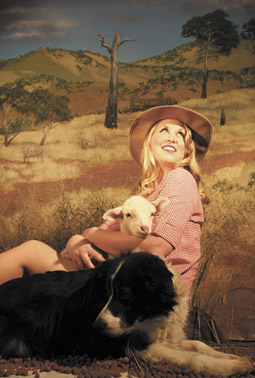
Isn’t this worth fighting for? (2006) Tarryn Gill and Pilar Mata Dupont
courtesy of the artists
Isn’t this worth fighting for? (2006) Tarryn Gill and Pilar Mata Dupont
If our artists are to be believed, the view from suburbia looking out is a dark one; Alex Martinis Roe invites us to look in at the victims of the objectifying gaze, old-school style. Her piece is a simple site specific video installation trapping a model in the two dimensional confines of the video screen. The captured figure lies in weary resignation, supporting the columns of the gallery with her hands, imprisoned by the photographic process and an unfortunate confusion of dimensionality. It would be a fun bit of visual punning on the role of spectacle in any old gallery space, but it really sets off this show, where our gaze is anything but innocuous. As gallery goers we are media consumers, as much as we are when we’re TV watchers or gossip magazine readers, however much of a pisstake we may make of it.
Oomph, curator Amita Kirpalini, artists Bianca Barling, Sue Dodd, Pilar Mata Dupont & Tarryn Gill, Louise Paramor, Alex Martinis Roe, The Wild Boys; Canberra Contemporary Art Space Gorman House, Feb 16-March 17
RealTime issue #78 April-May 2007 pg. 43
© Dan MacKinlay; for permission to reproduce apply to realtime@realtimearts.net
Yang Zhengzhong, 922 Rice Corns
IT’S BRISBANE’S BIG SHOW, THE APT. STARTED BACK IN 93 AND THIS TIME AROUND IT’S TWICE THE SIZE AND THE OPENER FOR THE NEW ‘WORLD CLASS’ GALLERY OF MODERN ART (GOMA). THE OPENING WAS HUGE, WITH SOME GREAT PROJECTION WORK OUTSIDE. IN THE SHOW PROPER THE OFFICIAL BLURB PUTS IT AT CLOSE TO 300 WORKS, 37 ARTISTS, PERFORMANCES, MOVIES, VIDEO, SOME OLD STUFF AND A BUNCH OF SPECIALLY COMMISSIONED PIECES. NOT A SHOW TO SEE IN ONE SITTING—THE CINEMA PROGRAM ALONE IS TOO LARGE.
There’s Jackie Chan in the GOMA cinematheque, a few dozen screens showing the rise of budgets and the progression of technical expertise. Amazing how slow the Young Master seems now. Also saw Weerasethakul’s The Adventures of Iron Pussy (2003; see page 17) which, with Sasanatieng’s Tears of the Black Tiger (2000; not at the APT), makes me keen to explore more Thai cinema in the near future.
Photography is everywhere—as object and as documentation. Along one wall are the large prints by Mu Chen and Shao Yinong of classrooms set up for a bit of mass re-education (Assembly Hall Series, Long March Project, China, 2006). They weren’t always classrooms, sometimes a bit of temple peeps in from the side. The images are formal, camera down the back of the room for a perspective shot of rows of empty desks. Up front some communist bunting and a red silhouette of Lenin, Mao and co. The tone of the photos is very flat, very ‘This is’. Similarly depersonalised, or at least without obvious intervention, are some older photos from Nasreen Mohamedi, black and white, lines in the wet road, a blobby ‘U’ that is strangely self contained. Not much, but enough.
Unsentimental is the theme for much of the show, particularly the video work. Over at the Queensland Art Gallery (QAG), Yang Fudong (Jiaer’s Livestock, China 2002-05) sets up two little cinemas side by side—in each one a bench for someone to sit on and a bit of standing room for a few others. In front of each screen, and flanked by naked fluoros, is a suitcase on a neat spread of dirt. Inside the case some little black and white handheld screens play repetitive footage that looks like it may come from the big screen footage or maybe from some outtakes. On the main screens the movies proper—short variations on or around each other. Actors, props, and scenes shuffle about. Same basic story, different outcome. There’s a guy in a suit pushing a suitcase uphill. Some people get killed for not very much. Flat observation on strange events. No idea why, but it reminds me of Polanski’s film Cul-de-Sac, which I haven’t seen for years.
More video over at the GOMA site with two works by Yang Zhengzhong. 922 Rice Corns (China, 2000) pits two chickens against each other in a race to eat rice. At the bottom of the screen the scores are kept ticking over. Voice-overs from a couple of commentators pace out the contest (shame I lack the language). The birds are devices for counting rice (Yang’s description) but I’m thinking of the nutty safety-in-numbers meaningless statistics and performance reviews that plague corporate (and bureaucratic) life in Australia. No rest until everyone is above average. On everything.
Next to the chooks is another work by Yang, and one of my favourites. As with the counting birds video, the presentation is uncoloured, without intervention. Set up the camera at a club, at a home, in the street. It’s people, one after another, looking into the camera and saying “I will die” (Do It Project, curator Hans-Ulrich Obrist, 2001). Maybe they laugh, maybe they look a little wistful, but—no dramas—that’s about it.
Yang also has some photos which for me are not so successful. He presents people, in typical urban settings, balancing the treasures of modernity on their fingertips (Light and Easy, China, 2002). A car, a helicopter, an ultra mod city. The future as a happy, lightweight trick anyone can do. Sounds okay, but years of student photoshoppery has killed the montage for me.
Others also have a light touch, particularly Korea’s Kwon Ki-soo, whose cutesy cartoon character (Dongguri) runs up and down the walls in the children’s section of APT. Kwon has latched onto a graphic character form that is perhaps even more reduced than Keith Haring’s graffiti-ism from the 80s but just as productive as a cut-out rubbery figure, a sprightly chap in some cheerful paintings, or farting away in some great Flash animations.
Wang Wenhai’s massive Mao twins (Chairman and Emperor) are also cute and cuddly, after the fashion of monumental clay-like blobs (Mao Zedong and Mao Zedong, China, 2003). Year after year Wang obsessively reproduces Mao in numerous forms. That’s it. He is not the only obsessive on show. Out the back and a bit out of the way are something akin to huge miniatures from Yoo Seung-Ho. His works appear to be large inky washes, styled after traditional brush and ink Chinese landscapes. Up close they are made from the tiniest of characters, meticulously inked in with a graphics pen. It’s strangely admirable and pointless, like crossing a large ocean in the smallest of home made boats.
Another favourite video is from Vietnamese artist Dinh Q Le. Le presents a triptych movie, The Farmers and the Helicopters (2006), a document of the history and meaning of helicopters in a rural community. There’s footage of helicopters exploding forest (thanks Hollywood), and wartime recollections like, “We’d stand very still and the helicopters would go over then come back to look. If they came back a third time you’d run.” Time lets memories and feelings update to “the helicopter is evil” and a triumphal “I could go in a helicopter now.” The post-war generation is represented by Tran Huoc Hai who pieces together a working helicopter from leftovers and what he could pick up out of physics textbooks. “We don’t have to be scared of the helicopter, I want to show that Vietnam can use the helicopter to help people too.” The content reads like decades of trauma delivering a materialist and casual cargo cult. And again, the feel is unsentimental: views are held, memories recur, events happen.
Why so many videos, so interesting and so artless? (The APT is not for the post-processing fx junkie.) Perhaps it’s the rise of cheap and ubiquitous cameras. Home cinema was meant to be 5.1 sound, deck chairs in the lounge room and a few golden oldies from the Sony back catalogue. Maybe sometimes, but more likely it’s youtubing a stranger’s home movies while back at their place they watch yours. According to the BBC, 300 is the average number of times each person in England is filmed per day on CCTV. Dress up, go out, make a movie every day. The video image comes and goes. It’s a way of keeping stuff—in the phone, just for a bit, maybe longer on a drive, no more tricky or substantial than laughing at a number plate or downloading a movie of a man shoving golf clubs in a blender. Maybe it’s a reflection on history—stand back far enough and, if you’re lucky, events will go on without you. Regardless, ‘on video’ is now nothing.
The last work is from Shien Xiaomin (The Village Cameraman and His Son, Long March Project, China, 2001). Another documentary. An old guy, crinkle cut face, box camera, wooden tripod slung over the shoulders as he wanders the province recording the big events. Families, babies, weddings. Fifty years of black and white, misty edges, someone moves. That special photo when the light is just right.
The 5th Asia Pacific Triennial of Contemporary Art. Queensland Art Gallery and Gallery of Modern Art, Brisbane, Dec 2 2006-May 27 2007
RealTime issue #78 April-May 2007 pg. 44
© Greg Hooper; for permission to reproduce apply to realtime@realtimearts.net
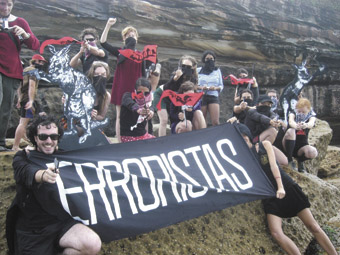
Erroristas, Group Etcétera Workshop, Sydney 2007
“WE WERE SEEING SOMETHING, FOR SURE, BUT IT WASN’T THE ‘SOMETHING’ THAT OUR GOVERNMENT WANTED US TO SEE”, CURATORS ZANNY BEGG AND KEG DE SOUZA EXPLAINED AT THE SECOND OPENING EVENT OF THEIR MULTIFACETED CURATORIAL, WORKSHOP AND PUBLICATION PROJECT, IF YOU SEE SOMETHING, SAY SOMETHING AT MORI GALLERY IN SYDNEY’S DARLING HARBOUR.
Speaking to a crowd of mainly artists and activists (and activist artists), their appropriation of a familiar anti-terrorism campaign slogan as the title of the show was clearly chosen not only to voice dissent at our government’s insidious, US-style Neighbourhood-Watch strategy, but also to confirm that socio-political change can or may occur through a discursive process. After all, to say something about something is to involve oneself in the immediacy of a moment, be it political or otherwise. This was a project about both local and global participation, political discourse, protest and activism.
The curators assembled an impressive array of artists, groups and collaborations across three main venues including the Argentinean Group Etcétera, the collaboration of German artist Dario Azzellini and the Austrian Olivier Ressler, Taring Padi from Indonesia and Contra Fil from Brazil. Elucidation of the contexts and political moments in which all of the artists variously work, was handled through a freely distributed newspaper, with texts commissioned by both exhibiting artists and external writers. Without this document I would have been lost in the complexity of such an international exchange. If You See Something, Say Something brought together provocative practices and while viewing the works in their various locations, I had to keep reminding myself that it wasn’t important that I agreed with everything I saw and heard.
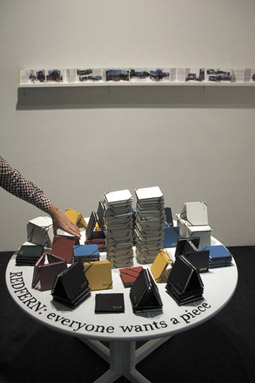
Redfern Mapping Project, Squatspace
The exhibition at Gallery 4A was split between documentary film and photography, and traditional painting and printmaking in the service of social change. Indonesian group Taring Padi’s works on paper were installed in the entrance gallery, juxtaposing sharp woodblock prints of struggle and military violence with paintings of utopian dreams in which people live collectively, in harmonious rural landscapes. Upstairs Zanny Begg had installed a series of Flemish-style portraits and a map, exchanging traditional subjects of wealthy traders or landowners for representations of young Australian environmental and political activists. Rather than depicting trade routes, the map located sites of activist movements and their connections to others around the world. While I understood the logic of this exchange, I found the representation and identification of particular people in Begg’s paintings (some were masked) to be strangely at odds with the spirit of movements that champion the cause, rather than the individual.
Reflecting this notion, opposite Begg’s paintings was a wall and shelving unit covered in printed paraphernalia relating to upcoming events and workshops connected to the project as well as propaganda, protest march details and environmental action material. Next to this was Sydney-based multidisciplinary artist David Griggs’ installation of his photographs of homeless people, youths, dogs and ephemera on The Philippines’ streets. The photographs were taken and exhibited like snapshots, scattered on a poorly made, low plywood table surrounded by totemic objects including a blackened head with a cigarette in its mouth and a black cobra poised to strike. Grigg’s combination of the quotidian image with death-metal symbolism created a potent atmosphere of everyday antipathy with a seething undercurrent of anger.
At Mori Gallery Begg and de Souza’s curatorial gambit appeared to revolve around the intersection of various artistic, research and performance practices involving public space. In one corner, local artist collective Squatspace created a playful and interactive map project about their ongoing, two-year (and counting) reality-promenade Tour of Beauty, a bus and bike excursion around the suburb of Redfern. Including a video document edited from various tours, the comfortable zone created by Squatspace enabled members of the audience to participate by drawing images from their memories and community connections onto the fabric map of Redfern that covered the floor. Rather like hobo graffiti, symbols of personal experience accumulated over time—love hearts on street corners, dogs in the park—while the Tour of Beauty video examined the broader implications of ongoing infrastructural changes to Redfern as they continue to impact upon Indigenous welfare and claims to the land as well as inner-city housing for low-income earners and families.
In the early stages of the Tour of Beauty project, members of Squatspace identified themselves to the Redfern Waterloo Authority (the NSW government agency responsible for the re-zoning and planning in Redfern) but were unsuccessful in securing a RWA spokesperson to speak as part of the tour. Despite this, the RWA used a photograph of Squatspace member Keg de Souza (wearing her Squatspace uniform) as the cover girl for their annual report, revealing an embarrassing breakdown of bureaucratic process and communication, but turning up subversive trumps for the Squatters. I found this report by chance while looking at the doodles on the map and it highlighted the fact that the most intriguing works to be found in the exhibition were examples of subversive practices that had insinuated their way into the social fabric they critiqued.
This was certainly the case with Perth-based pvi collective’s most recent performance project, Loyal Citizens Underground. Shown as a video document at Mori Gallery, the group had its members, uniformed in green and gold, handing out Code of Conduct cards and gently reprimanding unsuspecting shoppers and pedestrians in Perth’s CBD. Concerned with the effects of the Australian Government’s anti-terror legislation on monitoring civilian activity in our public spaces, pvi tested the policing of these and other behaviour-restricting laws in real time with a crack team of helpful vigilantes. The LCU not only busted grannies crossing the street in diagonal lines but assisted them to perform the task correctly. “We are holding your hand to increase your confidence when crossing the road.” The sense of familiarity I felt when viewing Australian responses of bewildered compliance to such paternalism was quickly blown away by the documentation of a “poop attack” and protest installation against the HSBC Bank performed by Etcétera, screening loudly in an adjacent room.
It goes without saying that I was instantly drawn to the work of some of the Australian artists in this exhibition. I understand the language and the context instantly, but I also understand poop. The absurdist installation of a toilet in front of the Congress building in Buenos Aires by Etcétera during a vote on the national budget in 2002 was followed by the more direct action of slinging actual shit and rotting vegetables at the building itself, attracting participation by angry members of the public. The documentation of live acts by the Brazilian group Contra Fil was less visually and symbolically accessible, requiring a (readily-available) translation. The translation publication Programme for the De-turnstilation of Life Itself was a bound collation of press material about a turnstile monument that the group initially installed in a town square. Gradually this document revealed the turnstile’s co-option as a symbol by students and other groups agitating for social change, and also its filtration into the local vernacular through cartoons and (probably not surprisingly) advertising for a banking corporation. I was unclear reading this whether it was the group’s intention to critique the diluted agency of the “movement” it initiated.
I left Mori Gallery after viewing the technically clunky, yet deeply soulful and melancholic video work of Al Fadhil from Iraq that considered the psychological terrain of his ravaged country through a photo-essay documenting empty public spaces and impoverished homes. The beseeching voiceover described scenes of suburban desolation and of families—all of whom have lost a child or another loved one—retaining only a small shred of hope for the future.
Fadhil says, “to remind ourselves that we once had a garden, we fill our houses with flowers. Plastic flowers”. This was a solemn ending to an experience of works that positively agitated for alternatives to current political and cultural situations. Fadhil’s work was a meditation on the acceptance of despair in a world that needs to open its eyes and ears to such stories.
If you see something, say something, publication, exhibitions and workshops, curators Zanny Begg, Keg de Souza, Mori Gallery, Gallery 4A, Chrissie Cotter Gallery, Sydney, Jan 26-March 3
RealTime issue #78 April-May 2007 pg. 46
© Bec Dean; for permission to reproduce apply to realtime@realtimearts.net
Owls At Noon Prelude: The Hollow Men
Brisbane’s IMA is showing film-essayist and media artist par excellence Chris Marker’s Owls At Noon Prelude: The Hollow Men until May 26, a unique opportunity to immerse yourself in this eight-screen video installation commissioned by New York’s Museum of Modern Art for its 2004 re-opening. The 19-minute video loop of images (black and white footage and stills), text (TS Eliot’s and Marker’s own words and digital musings) and music (Takemitsu’s Corona, for piano) figures World War I as prophetic prelude to a century of wars. On April 14 and 24, respectively, Frances Bonner and Adrian Martin will speak about Marker’s work.
IMA, Chris Marker, Bill Henson, Gavin Hipkins; Brisbane, April 10-May 26; www.ima.org.au
RealTime issue #78 April-May 2007 pg. 47
© RealTime ; for permission to reproduce apply to realtime@realtimearts.net
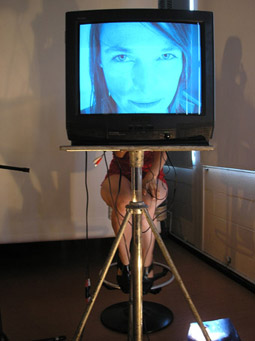
Caroline Daish, The Last To See Her Alive
UNREASONABLE ADULTS’ THE LAST TO SEE THEM ALIVE WAS SUBTITLED, LIKE A PAPER AT AN ACADEMIC CONFERENCE, “SEX, SLAUGHTER AND THE CITY.” LIKE A STRAIGHT-TO-VIDEO-RELEASE THRILLER IT WAS TAG-LINED “HOW DO YOU MEET MR RIGHT IN AGE OF SERIAL KILLERS.”
This new work is an essay of sorts, devised and realised by Fiona Sprott (texts), Caroline Daish (performance) and Jason Sweeney (music/songs/soundscapes) during and after a Month in the Country residency at HotHouse Theatre in Albury (RT75, p46). Sprott's writing tests our appetite for sex-crime fictions of the sort served up nightly on our television screens in endless seasons (or so it seems) of CSI and SVU.
Sprott's insight is to articulate these fictions as the erotic fantasy of their ideal reader—the working woman reading crime fiction while waiting on the station for her train home; the single woman at home alone in an apartment, watching CSI to exorcise the fears and fantasies, conjured and consumed daily, of falling victim to one of the city's killers.
Daish, dressed for success in a business woman's best, gives body and voice to these fantasies and fears. Seated at a long table set for a media conference, she addresses the audience through the intimate clarity of a microphone. A jug of water and a vase of flowers are set on the table; a video monitor and a technician (Sweeney) are set alongside.
Daish recalls how mothers once warned their daughters to beware axe-wielding murderers and sex maniacs. Today, she observes, the single woman fancies herself the ideal next victim of the serial killer's cold, clean and clinical obsession. With perverse technical efficiency, Sweeney aims a live video camera beneath the table, between Daish's legs, treating the audience to intimate vision of Daish's panties on screen.
In another uncannily intimate use of live video, Daish sits on a stool, her head obscured by the monitor. Only her lips are visible, enlarged upon the screen, as she divulges an erotic fantasy. The invasive intimacy of such close-up assemblage of vision and voice gives bite to the satire of Sprott's text.
The woman longs, she confesses, for a gentleman caller. She leaves her window open at night. However when her intruder arrives he is not quite the gentleman of her dreams. He is clumsy and inarticulate; he makes her wear a pillow case on her head; he ejaculates prematurely on her wool crepe skirt. Disconcerted and disappointed, She calls the police with a complaint. As gentleman rapists go, he was-well, just, “not very good.”
As a performer, Daish maintains an unsettling low-level intensity at the threshold between presentation and performance. She delivers her lines with the efficiency of a media presenter, with none of the actor's embodiment of character. I never believe she is the female subject of the fantasies she recites. She is their avid consumer instead.
Sweeney's presence onstage is also disconcerting. When he is not focused on operational tasks cueing video and sound, he stares at women in the audience, glances furtively at Daish and stage manages her wardrobe changes. He is her partner-pimp through the performance-the police detective at a victim's media conference, the backroom dealer for her corporate striptease, the floor manager of her chat show confessions.
Daish sings and she dances for us, but also for him. At one point, microphone in hand, she walks into the audience. We are seated at tables set cabaret style with flowers and red tablecloths. She flirts with a man and invites him to dance. She really wants more, she says in an aside, but she's settling for less. Her diaphragm fitted and her dress now zipped up, she sits on his knee, announcing “I'm always prepared for rape.”
The city which compels such preparation, such anticipation, is the fictional New York of television's crime shows. Sweeney's work with audio extends to the city outside. Before the show, he unobtrusively interviewed women in the foyer. “Where do you live?”, he asked them, and “How are you getting home?” The replies, some candid, some suspicious, are mostly evasive. The recordings are played quietly as the performance comes to a close.
Softness is an admirable aspect of the artistry of Unreasonable Adults. Unlike so much that is robust and loud, performance at low-level intensities can evoke in an audience a desire to lean in, to make an approach, to attend and make contact on their own ground. Quiet suspicion and seduction by stealth drew me towards this work.
Unreasonable Adults, The Last to See Them Alive, performer Carolyn Daish, text Fiona Sprott, media Jason Sweeney; Higher Ground, Adelaide, Feb 9-11
A re-worked version of The Last to See Them Alive with four performers (Caroline Daish, Fiona Sprott, Jason Sweeney, Julie Vulcan) was presented as part of the SPILL Festival of Performance, Soho Theatre, London, April 13, 14 (see preview, RT 77, p6).
RealTime issue #78 April-May 2007 pg. onl
© Jonathan Bollen; for permission to reproduce apply to realtime@realtimearts.net
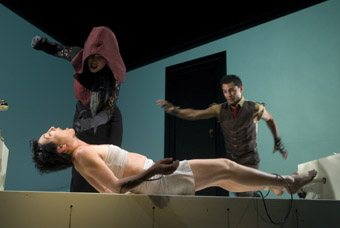
Claudia Alessi, Michelle Fornasier, Kegan Kang, BSTC, The Lady Aoi
DIRECTOR MATTHEW LUTTON’S PRODUCTION OF YUKIO MISHIMA’S THE LADY AOI OPENED THE 2007 PERTH FESTIVAL. LUTTON ONCE AGAIN DEMONSTRATED HIS COMMAND OF DESIGN, SOUND AND LIGHT, WITH ASH GIBSON’S DOUR, BASS-HEAVY STRINGS MAINTAINING A SENSE OF MENACE, WHILE SOHAN ARIEL HAYES’ PROJECTIONS CREATED A SET OF GRAPHICS WHICH MORPHED AND EXECUTED DEFT, WIPE-TRANSITIONS.
Yasuko is the deceased lover of the protagonist Hikaru. Her hair crawls about the frame before she draws him from the hospital room of his wife, Aoi, and brings him before a rippling image of the lake where he and Yasuko once wooed.
The production looked and sounded fantastic, while Michelle Fornasier as Yasuko made the most of her black, gothic dress to slink and prance about the stage. Nevertheless, Lutton is still wanting in directing actors, consequently he exacerbates the clunkiness of Mishima’s text. Passages like the nurse’s boast that the “sexual complexes” which cause illness have been cured by her regular intercourse and analysis with the doctors reads like an adolescent male fantasy, rendered all the more ludicrous by its sledgehammer Freudianism. Lutton fails to overcome such problems—Hikaru has little to do other than stare earnestly during his flashbacks. “Was that a woman’s cry?” he asks, before immediately falling back under Yasuko’s spell like a hypnotised subject from a bad Hammer horror film.
wild cursive
Taiwanese choreographer Lin Hwai-min’s Wild Cursive drew heavily upon Tai-Chi and Eastern body training, and was accompanied by a literally breath-taking score consisting of shattered, distorted field-recordings of pebbles, the sparse rumble of waves, and other materials nestled within a spacious silence which demanded deep attention from the audience. As the dance tempo rose and fell, arms windmilled in great, blurred arcs, while the undulations of the dancers’ torsos rolling up or down from deep, off-centred crouches seemed to defy gravity—as though time and physics had been stopped or stretched through their exacting concentration.
The intensity of the performance escalated rapidly, with curvilinear dancers filling the stage in a rippling mass with such speed and complexity in their indirect ‘call-and-response’ exchanges (the dancers rarely touched) that it was almost as if all structure evaporated. Having deployed this unrelenting aesthetic to deconstruct the dance’s legibility, Lin then forged deep pauses between each pyramidal sinuous pose or momentary extension upward. Gender emerged as a major organising principle. The audience was eased through the disorientation of the initial frenzy by the simpler dyad of active males dancing with reactive women. Even so, the extraordinary movements enacted in the women’s later solos—notably the one performed by associate director Lee Ching-chun—appeared to exceed human capability, with the spine rolled behind the feet so far and in such a slowly measured fashion as to surely overbalance the dancer, yet her strength and careful judging of trajectory (or flow of chi) enabling a momentary return to standing, prior to a leap—also without apparent preparation.
Lin’s aesthetic was rigorous and uncompromising, consisting exclusively of abstract dance and music—no narrative or even close adherence to the theme of Chinese calligraphy. Although couched in terms of a meditation on the individual’s harmonious embodiment of yin and yang, absence and presence, life and death, and performed using forms derived more from Eastern techniques than European and American dance, Lin’s total commitment to abstract forms produced an ambience akin to the toughest of European Modernists.
a midsummer night’s dream
Although more visibly impregnated with culturally specific signs, Korean director Jung-ung Yang’s version of Shakespeare’s A Midsummer Night’s Dream was no less modern in its fusion of theatrical styles. Compared with Japan’s Noh and Kabuki, Korea does not have a well recognised, national classical theatrical tradition performed by professionals (as opposed to semi-professional festive traditions like Sandae-togam-guk), and was strongly influenced by the Japanese occupation, 1905-45. Jung-ung claims to produce a “collision of traditional theatrical elements such as Japanese Kabuki, Indian Kathakali, [and] Korean martial arts” which are employed as “materials … from which I can freely choose.”
Jung-ung’s style suggests a pan-Asian aesthetic evocative of Herbert Blau’s notion of a universal, highly physical expressive style. Blau’s “physical hieroglyphics” are deployed light-heartedly by Jung-ung on a beautiful, raw wood stage with raised ramps on either side recalling the Kabuki hanamichi—here for the comic characters to lounge upon whilst commenting on the action or pronouncing their theories of life and leisure. A low space for instrumentalists was situated within the back wall (as in Sandae-togam-guk, Kabuki and Bunraku), yet it was the actors themselves who struck the sharply percussive, wooden blocks and drums.
Jung-ung has reduced Shakespeare’s narrative to four bewitched lovers pursuing each other at cross-purposes in the woods while local sprites—Korean dokkebi—played with the lovers’ perceptions, enacting the childhood conceit of pretending to be trees, or sprinkling magical pollen on the protagonists. As a result, this version was almost pure stage business. Interestingly, here it is the wayward faery King who is taught a lesson by his spouse in falling for Bottom (an aged, female herb collector enchanted as a pig). The King’s opening speech on the joys of womanising and laziness while jauntily perched on one leg, with a stick bearing his possessions hanging casually off his shoulder, was exquisite. Also notable was the delicate, traditional fan-dance by one of the male lovers, this gentle interlude expressing his inner distress. Jung-ung’s interpretation was short, sharp and relatively straightforward, yet no less precisely structured in its formal borrowings and arrangement—as well as being resonant with various deeper cultural allusions. Bottom’s fate for example was not a punishment for stupidity, as in Shakespeare’s play, but a blessing in disguise, hogs presaging good fortune.
George Shevtsov & dinner guests, HOME, last seen imagining
photo Jon Green
George Shevtsov & dinner guests, HOME, last seen imagining
home
Rather than reflecting an adroit cultural fusion, Home, from writer Humphrey Bower and director Sophia Hall, dramatised the pains of cultural movement. Six actors joined 20 spectators at a catered dinner hosted at a private house. After an initial introduction to the characters’ cultural derivations, be they British or Middle Eastern, each related the events which led to their migration, traumatic journeys and initial Australian incarceration—prior to adopting what was often a highly positive view of their ostensibly peaceful new homeland.
The performers often stood to speak, sometimes with the inflections of a Thai or Croatian accent, or with the callow casualness of youth, as appropriate. Generally the dramaturgy was sparse, recalling Bower’s work on Melbourne director Robert Draffin’s “theatre as storytelling” aesthetic in The Idiot (1992) and A Thousand and One Nights (1991).
Home successfully guided its necessarily comfortable audiences (at $140 a ticket) through these stories, but it was not the first to do so. Like Bower, Alice Garner and Actors For Refugees have used detainee interviews to script verbatim theatre since 2002, while Through the Wire: The Inside Story On Refugees toured the eastern states in 2004-05. The main novelty of Home was its dinner setting, but the small, formal helpings of nouvelle cuisine were a far cry from The Idiot’s homely and culturally relevant fare of borscht and vodka, doing little to foster a congenial sociability amongst the audience or with the performers. The most interesting inclusions were tales from guards at the detention centres—notably Hall playing a no-nonsense, good-natured warden who tried to treat her charges well, yet who was acquainted with how to rush a prison riot and how this separated the camp into ‘us’ and ‘them.’ While not as striking as the artists’ previous work, Home was a fine addition to the Bower and Hall oeuvre.
2007 Perth Festival: Black Swan Theatre, The Lady Aoi, writer Yukio Mishima, director Matthew Lutton, performers Michelle Fornasier, Kegan Kang, Samantha Murray, Claudia Alessi, designer Bryan Woltjen, lighting designer Nicholas Higgins, composer Ash Gibson Greig, video Sohan Ariel Hayes, movement Claudia Alessi; Playhouse, Feb 2-17; Cloud Gate Dance Theatre, Wild Cursive, choreographer Lin Hwai-min, sound Jim Shun, Liang Chun-mei, His Majesty’s Theatre, Feb 19-21; Yohangza, A Midsummer Night’s Dream, director Jung-ung Yang; Playhouse, Perth Festival, 15-23 Feb; Last Seen Imagining, Home, senior writer Humphrey Bower, director/dramaturg/performer Sophia Hall, performers/collaborators Simon Clarke, Marta Kaczmarek, Phillip McInnes, George Shevtsov, Cara Sutcliffe, lighting Andrew Lake, sound Kingsley Reeve, various locations, Perth, Feb 12 – 24; Perth International Arts Festival 2007
RealTime issue #78 April-May 2007 pg. onl
© Jonathan Marshall; for permission to reproduce apply to realtime@realtimearts.net
Oliver Grau’s MediaArtHistories
I was in a reviewing reverie as I embraced Oliver Grau’s MediaArtHistories, which brings together the work of media researchers who have been prolific in interpreting the relationship between new media art and art history.
In Australia, with its strong 25-year history in media art, we have witnessed an inevitable pulling back of media art into the immersive folds of traditional visual art. Grau views this process as a positive development. He also demonstrates, however, that traditional notions of visual art will have to be revised to absorb the ineluctable impact of science and technology on contemporary art practice.
Now that media art is integrated into a number of university departments across Australia, transdisciplinary approaches to art practice are demanded. MediaArtHistories provides insights and contexts for some of the theoretical and historical programs being continually revised as the area constantly reinvents itself and expands.
I’ll highlight some of the connecting threads that suggest the book’s transdisciplinary inclusiveness. Gunalan Nadarajan demonstrates that meaning is not fixed and can be recontexualised by exploring media art from different cultural perspectives which he does by exploring the genealogy of the influence of Ibn al-Jazari’s Book of Ingenious Mechanical Devices on the development of mechanical automata in Europe. Machiko Kusahara too addresses the cross-cultural implications of media art through his notion of Device Art, entailing a Japanese alternative to Western art history and an integrative view of art, technology and entertainment.
Sean Cubitt explores constructs of projection referencing the ‘Maid of Corinth’ as a fundamental influence on traditional art practice. He suggests that this traced outline of a shadow created by candlelight has played a strong role in influencing events at the very core of image science. Ron Burnett extends the projection concept to the psychology of projection, of mind as a metaphorical interfacing with technologies, and seeing as active and cultural.
This theme of the cohesiveness of art and media is also expressed in other essays focused on the role of media art as an interdisciplinary and transdiciplinary vehicle bringing together science, technology and art. In his essay, “Historicizing Art and Technology”, Edward Shanken argues for a revision “of the art historical canon…required not only because it corrects an obvious omission but because contemporary artists are increasingly employing science and technology as artistic media.”
Erikki Huhtamo suggests an archaeology of interactivity and tactility in relation to media art referencing works such as Paul Sermon’s Telematic Dreaming which explores intimacy and touch mediated by technology. Oliver Grau addresses phantasmagoria by looking at magic lantern shows in terms of telepresence and artificial life. Lev Manovich explores the effects of science and psychology on abstraction invoking a paradigm of ‘reduction and complexity.’ Dieter Daniels makes interesting parallels between the works of Marcel Duchamp and Allan Turing.
The incremental increase of technological developments makes this reinvention of art history a pressing concern, as highlighted in Christiane Paul’s essay on the role of the curator and the need for galleries to be proactive in this change. Paul expands on current ideas of how the immaterial nature of media art becomes materialised through cables, projectors and the immensely complicated process of media arts installation. She points to the possibility of user-generated and curated media shows, and considers the role of digital commons in reinterpreting the classic role of the gallery. In his essay, Andreas Broeckmann addresses the “aesthetics of the machinic”, pointing out that the ‘machinic’ controls, interprets and processes the decoding of data into the work as conspirator, collaborator or partner.
The essence of MediaArtHistories is encapsulated, in part, by Nadarajan’s essay as it re-examines, re-contexualises and re-focuses our attention on art’s global history, nowadays technologically mediated not least by media art.
The concept for MediaArtHistories as a book came about prior to the first MediaArtHistories conference, Refresh, in 2005. The book is supplemented by the online conference proceedings available as streaming video downloads. The proceedings are a tribute to the network of scholars that instigated the event but also reflect the growing interest in serious academic work being done in this area.
The essays presented in MediaArtHistories comprise a compelling addition to the bookshelf of any academic interested in art history. New media art histories need to be positioned with the growing range of books that are coming to terms with technological, scientific, philosophical and social comprehension of art practice.
Due to the immense rate of change in emergent technologies we are confronted by a continual immersion in flows of data, without the chance to reflect on what is evolving in their wake. The current art paradigm cannot remain stable in dealing with media art. MediaArtHistories allows us to make important connections and realise, perhaps too late, the possible outcomes. These scholarly essays give us some ground on which to stand and perceive emerging patterns.
I hope the next Media Art Histories conference, re:place (Berlin 15-18, November 2007, http://tamtam.mi2.hr/replace/) will spawn a publication of equally high calibre.
MediaArtHistories Archive: http://www.mediaarthistory.org/
MediaArtHistories, editor Oliver Grau, MIT Press, Mass, 2007
RealTime issue #78 April-May 2007
© Paul Thomas; for permission to reproduce apply to realtime@realtimearts.net
SO, DIMIA CHANGES TO DIC IN THE COALITION RE-SHUFFLE, FROM DEPARTMENT OF IMMIGRATION AND MULTICULTURAL AND INDIGENOUS AFFAIRS TO DEPARTMENT OF IMMIGRATION AND CITIZENSHIP. WHAT DOES THIS MEAN? NATIONALLY? INTERNATIONALLY? WITHIN EACH OF US? ARE WE MOVING FROM A COUNTRY OF MULTIVALENT VOICES CLOSER TO “ONE NATION?” (AND WHY HAS ‘ETHNIC’ REPLACED ‘MUTLICULTURAL’ IN SOME ARTS FUNDING APPLICATIONS IN RECENT YEARS?)
It’s 34 years since Al Grassby, the ALP’s somewhat rococo ethnic pin-up, tabled “multiculturalism” as a platform to which Australia should aspire. This was an attempt to overturn the so-called Anglo-conformist practices which drove our post-World War II immigration drive. Bring ‘em in, spread ‘em about, make sure they speak our language and—although it was not policy—tell ‘em off publicly if they don’t.
Multiculturalism flowered into many a folk-dancing, retsina-swilling, rice paper rolling event (with bush tucker taking much longer to catch on). Sydney’s Carnivale was launched in 1979 with sometimes acrid arguments about who had the greater right to express their sorrows—immigrant or displaced indigene. Passionate, complex, irritating. You wondered where your feet were. As the teenage child of European immigrants, I felt the stirring of complex rhythms, antagonisms, empathies.
I have sad memories of other festivals: plastic chairs in the corridors of windy malls, gaudy spectacles, shuffled performances, screeching microphones. Nostalgic serenades for the ethnic hordes; for the passive audience, a starchy tourist smorgasbord.
But Canberra’s National Multicultural Festival sparked it up (and thought things out) with an opera, physical theatre, tango in the street all day and night, a dozen international acts at the Tradies’, a night of ecstatic dance. The zeugma of the Beatles linked with Georgian chant; butoh dancers lined up in Civic Square in a kind of antipodean wailing wall. And everywhere, everywhere, people speaking language.
Tents at the day-long Greek Glendi spun with the honey-oiled kiss of Aegean vowels. Chinese new year was welcomed in in Vietnamese. The Bangladeshi Ambassador, speaking longer in Bangla than English, honoured the martyrs who fought for the right to retain Bangla as a public language in 1952. Further, he insisted that “culture is the glue of life,” and that language, song, dance need their continuity in order to honour the spirit world from which they emerge.
So, what is crushed when language, song, dance is censured or lost? Surely, just these spirits, which (as for Indigenous Australians) helped to form material worlds. Culture is the landscape that precedes song. Our ghosts already dance in the silences that precede words.
It seems disingenuous, then, of Dhafer Youssef, a Tunisian-born oud player and singer, to say (when pressed regarding the Arabic origins of his playing by Andrew Ford on Radio National’s The Music Show) that “I play from the heart…From nothing…I do what I feel, and that’s it…Before I play I have no idea what I’m going to do.”
I look at his oud, its very shape embodying specific histories, and hence delivering a very specific spirit and sound. His voice too sounds undeniable landscapes. And yet he plays up the ‘wow” factor of having players from “everywhere” whilst mocking himself as a “silly Dafher.” Hm, cheap ethnic joke. Who’s fooling whom?
I look, too, at the Western string quartet and tabla with whom he plays. Each is a synecdoche of their disparate cultures, constrained and released by their shapes and tone. This is no easy meeting. Indeed, to my ear, the group’s first set was riddled with difficulties. The strings played in (comparatively) measured harmonics and timescale, sawing (both visibly and audibly) through their notes, whilst oud and tabla rolled and flowed, a melisma of river-motion. The performers’ feet really stayed in different lands.
Later sets, however, bravely walked over a new man’s land. A special achievement was the encore-which-nearly-didn’t-happen: Jatinda Thakur (tabla) urged Youssef to bring “the girls” back on stage and gave each the chance to truly emerge from their different terrains.
What occurred here, through improvisation, was enough to make you yelp and cry. From Melissa Coleman’s opening cello solo, which worked its way from the Sistine Chapel around the whole of Istanbul, to Joanna Lewis’ violin stretching from desert to marshland pulled through the scent of an English rose, to Youssef’s wailing muezzin call, this is where the team created a very complex co-existence—a landscape of deeply bedded textures that enriched, informed and re-formed the soils and landscape of a new terrain. Genuine coalition.
By contrast, Operalab’s A Thousand Doors, A Thousand Windows sent its audience adrift. Over its 50 minutes, we heard tonalities shift incomprehensibly from Greek monody to Arabic modes, its texts move from Greek to Finnish to Farsi (and possibly more), and watched a projected Muslim script (a sacred text?) morph in so alarming a fashion that I feared the artists must be bringing on themselves some kind of curse (and somewhere crushing the spirits of the song). Although soprano Xenia Hanusiak lacked dramatic and vocal nuance there were moments of striking tonalities that turned one inside out with a sense of displacement, longing and loss. However A Thousand Doors, A Thousand Windows (works by Australian composer Constantine Koukias and Hanusiak, and Finnish composer Kaija Saarhiaho) left the ‘other’ (new music, new citizen) so unframed as to create profound impediments to reception. It is hard enough to embark on an odyssey, let alone last the distance in the face of such patent disregard.
That said, multicultural listening is always a hard task. From where do we listen, here, or there? If “there”, what helps us transpose ourselves to that other landscape, the one from which we do not come?
Curiously, Youssef’s ensemble only seemed to find true clarity following a moment where he stopped the concert, pleading for the venue’s thrumming refrigeration to be turned off. “Please, just this once—this song needs to come from silence!” The management were unable to oblige. In the end, however, he more than survived his compromise. He must have listened deeper than the ‘white noise.’ It took more than refrigeration to silence the meeting ground to which the performers had come.
The first post-war naturalized Australian citizen (1949) was made to disavow allegiance to his old country before taking oath to serve the new. I bow my head for the silences any new citizen is asked to leave behind. I bow my head for anyone whose language is silenced by neglect, indifference, or white noise. This is our nation: how well do we listen, or care? How well do we embark on that hard task to help cultures meet? How far have we really come?
See also Keith Gallasch's review of A Thousand Doors, A Thousand Windows in Ten Days on the Island.
Canberra National Multicultural Festival, artistic director Dominic Mico, Feb 5-18
RealTime issue #78 April-May 2007 pg. onl
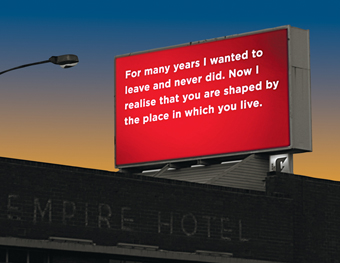
the write/here project
photo Justy Phillips, James Newitt
the write/here project
I’m walking through my city and I discover that something fundamental has changed. The jangle of multi coloured advertisements, with all of their enticements, have been replaced by personal messages, thoughts and musings. I stop and wonder at the text that I see. I find myself agreeing with “Sometimes you make your own traps” and asking myself what is referred to in “Could be magnificent.” This is the urban experience that Justy Phillips imagined when developing an idea for a short film some years ago.
What evolved from the original idea is a massive public artwork developed in collaboration with fellow artist James Newitt, transforming Hobart for just two weeks.
The write/here project strips 27 bill board spaces around Hobart and re-skins them with pieces of text shown in a white, sans serif font on a lush red background. The text originates from 1000 responses to workshops, exhibitions and individual interviews with residents of Hobart. People were asked a range of questions about the place they live in, including “What does Hobart mean to you?”, “Do you have any regrets?”, and “What are your hopes for the future?” The artists selected the final texts to provide a range of responses that retained enough ambiguity to allow viewers to establish their own interpretations.
While there is only spelling, syncopation and choice of phrase to define their voices, the text is seeded with clues that reveal the contributors as diverse in age, experience and country of origin. One board evokes the sadness of old age, “So many of my friends are dead now”, while another suggests the voice of a prisoner or care home resident: “It’s my own space but sometimes I feel I’m trapped in a cage. 6.30 is too early for goodnight.”
With the spread of boards around the city the write/here project is seen in a range of contexts that have a bearing on both the interpretation and the effect of the text. A poignant note about a highway death at the head of the Southern Outlet is likely to leave motorists pondering their own mortality and “Hobart means home, but you can’t spend your whole life at home” is a prompt for those leaving the airport to think about where they have come from or where they return. There seems to be a tendency toward texts that depict Hobart as something other than a peaceful, picturesque tourist destination and some of my friends have reflected that the overall effect is too melancholy to fit with their impression of their city.
Visually, I enjoy the aesthetic of the boards that use the colours of advertising but are stripped of any extraneous information. The clarity of this effect is pleasing, particularly when seen across a collage of windows, roofs and satellite dishes.
The write/here project is clearly a work mediated by the artists, but their touch is light enough to ensure that it is still an expression of a community. There is a lovely sense of relief in seeing meaningful, truthful statements on these boards rather than wildly exaggerated claims or threats that life won’t be complete without a particular product.
Another account by Judith Abell will appear in Landscape Architect Australia, May 2007
the write/here project, curators Justy Phillips, James Newitt; billboards around Hobart, Ten Days on the Island, March 23-April 1
RealTime issue #78 April-May 2007 pg. web
© Judith Abell; for permission to reproduce apply to realtime@realtimearts.net
the write/here project
photo Justy Phillips, James Newitt
the write/here project
I’m walking through my city and I discover that something fundamental has changed. The jangle of multi coloured advertisements, with all of their enticements, have been replaced by personal messages, thoughts and musings. I stop and wonder at the text that I see. I find myself agreeing with “Sometimes you make your own traps” and asking myself what is referred to in “Could be magnificent.” This is the urban experience that Justy Phillips imagined when developing an idea for a short film some years ago.
What evolved from the original idea is a massive public artwork developed in collaboration with fellow artist James Newitt, transforming Hobart for just two weeks.
The write/here project strips 27 bill board spaces around Hobart and re-skins them with pieces of text shown in a white, sans serif font on a lush red background. The text originates from 1000 responses to workshops, exhibitions and individual interviews with residents of Hobart. People were asked a range of questions about the place they live in, including “What does Hobart mean to you?”, “Do you have any regrets?”, and “What are your hopes for the future?” The artists selected the final texts to provide a range of responses that retained enough ambiguity to allow viewers to establish their own interpretations.
While there is only spelling, syncopation and choice of phrase to define their voices, the text is seeded with clues that reveal the contributors as diverse in age, experience and country of origin. One board evokes the sadness of old age, “So many of my friends are dead now”, while another suggests the voice of a prisoner or care home resident: “It’s my own space but sometimes I feel I’m trapped in a cage. 6.30 is too early for goodnight.”
With the spread of boards around the city the write/here project is seen in a range of contexts that have a bearing on both the interpretation and the effect of the text. A poignant note about a highway death at the head of the Southern Outlet is likely to leave motorists pondering their own mortality and “Hobart means home, but you can’t spend your whole life at home” is a prompt for those leaving the airport to think about where they have come from or where they return. There seems to be a tendency toward texts that depict Hobart as something other than a peaceful, picturesque tourist destination and some of my friends have reflected that the overall effect is too melancholy to fit with their impression of their city.
Visually, I enjoy the aesthetic of the boards that use the colours of advertising but are stripped of any extraneous information. The clarity of this effect is pleasing, particularly when seen across a collage of windows, roofs and satellite dishes.
The write/here project is clearly a work mediated by the artists, but their touch is light enough to ensure that it is still an expression of a community. There is a lovely sense of relief in seeing meaningful, truthful statements on these boards rather than wildly exaggerated claims or threats that life won’t be complete without a particular product.
Another account by Judith Abell will appear in Landscape Architect Australia, May 2007
the write/here project, curators Justy Phillips, James Newitt; billboards around Hobart, Ten Days on the Island, March 23-April 1
RealTime issue #78 April-May 2007 pg. web
© Judith Abell; for permission to reproduce apply to realtime@realtimearts.net
Leigh Hobba
I’m looking at Leigh Hobba’s face from 1982, the corners of his large tortoise shell glasses are rounded in the style of the time. Across five images he smiles or stares impassively. Each fragmented image is composed of squares that are cut, mixed and re-pasted to rebuild his portrait in a way reminiscent of Hockney’s collages of the same time. Combined with its title—Came so quickly from winter in Paris to Summer in Hobart that I could still feel the cold in my body—the series evokes the common sensation of arriving on another side of the world before your body has caught up. This work, mounted near the entry, seems at odds with the others at first, but on reflection, sets the scene for The Space of Presence, a retrospective of the last twenty years of Hobba’s practice.
Leigh Hobba is a prolific artist who has travelled widely, making work since the mid 70s. By the time he graduated from Elder Conservatorium in Adelaide, he was already excited by avant-garde approaches to working with sound, like John Cage’s, challenging methods for making music, embracing chance and using mechanical means to generate compositions. Since then Hobba has built a contemporary art practice utilising sound, video and performance. However for many, The Space of Presence offers the first viewing of the 12 pieces in the show.
As the first set of images suggests, a continuous thread linking all the works is the self, the body and the passing of time. The focus in Hobba’s work is the way he is affected by particular environments, from dense cities to remote Tasmanian wilderness.
This is a song about Hobart and some of the people who live here, is a video and sound work with a single, large screen display. Donning headphones, I listened to Hobba’s monotone recital of diary entries from a time in Paris. He mirrors me in the video, also wearing headphones, his stare unwavering. The monologue is a fast-spoken narration of ordinary events and acute observations, often humorous. Towards the end of the loop Hobba speeds up the recital to the point where the words take on an overlapping song-like rhythm with phrases repeated, broken down, rearranged.
I’ve seen Mycenae glistening over the wine dark sea, is a compelling, sensual installation enclosed in a dark, brick-red space dominated by a large projection of mist softly revealing and concealing a rocky outcrop. As if to emphasise its intermittent absence, a thick black line overlayed on the video provides the outline of the outcrop, even when it cannot be seen. Three small screens placed on the floor around the room show Hobba’s young, sleeping son. Lying on a black background, his pale skin and red curls angelic, the boy is so still his breathing is almost imperceptible. A long, low bench, placed diagonally in the centre of the space is covered with large rocks, each the size of a dinner plate. On three walls, door-sized panels, striped with mirrored perspex are fixed horizontally and vertically to reflect the greys of the mist and movement of visitors. The imperfections in the perspex stripes recreate the facets of the rock face. Having spent some time in the room, I come away with a sensation that is difficult to describe and the exquisite image of the boy fixed in my mind—his tiny breaths are the key here. Somehow.
There is an overwhelming sense in the gallery of time passing and the presence of a man for whom this is a preoccupation. While the works appear to be intimately connected to Hobba’s sense of self, they lack self-consciousness—there is no compulsion to be an artist of a particular time or type—and many pieces are unapologetically obtuse. He is quoted in the catalogue: “For me the act of recording is the act of documentation—a document of experience—in crafting that documentary, one might indeed create good fiction; in creating fiction one might equally create a good documentary.” Like the act of staring at rocks in the mist, I don’t think that we need to necessarily understand this exhibition, we just need to experience, to register its effect in our bodies.
Leigh Hobba, The Space of Presence, curator Craig Judd; Tasmanian Museum and Art Gallery, Hobart, March 16-April 29; Ten Days on the Island, March 23-April 1
RealTime issue #78 April-May 2007 pg. web
© Judith Abell; for permission to reproduce apply to realtime@realtimearts.net
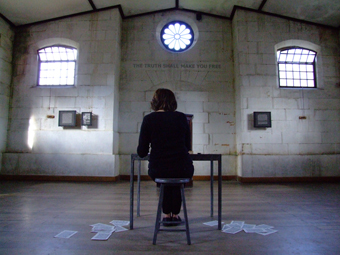
Brigita Ozolins, The Truth Shall Make You Free
photo Bec Tudor
Brigita Ozolins, The Truth Shall Make You Free
Taking my map and setting out to find the Port Arthur Project in this former penal settlement is like embarking on a treasure hunt, my first trial being to cut through throngs of tourists in the information centre and then the milling crowds waiting for guided tours. Finally I break into the open space of the foreshore lawn and my quest to find the Art hiding amongst the History begins.
Peering into the rectangular cutting of an excavation site, roped off in official fashion, I see the puzzling sight of bitumen inset with road disk markers and a drain cover. The accompanying interpretation boards displaying reproduced landscape paintings of the penal colony offer little clarification. It takes a minute and then I realise with amusement that what I’m looking at is a car parking space. Lucy Bleach titles this mock archaeological dig Reserved. It pokes fun at the visitor’s romanticised idea of history as static, and playfully queries what future generations might deem worthy of preservation from the present.
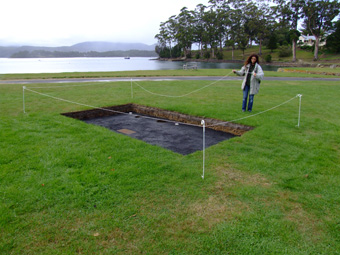
Lucy Bleach, Reserved
photo Bec Tudor
Lucy Bleach, Reserved
A few hundred metres away ten conical forms of about 1.5 metres in height, woven from tea tree and dodder vine and circled with a line of sand, are positioned in a ring. The organic material is dying and drying out; given enough time they will disappear into the earth. The shadows stretching from the work are strikingly figurative and I feel I am not entitled to step into this sacred congregation. Indigenous artists Lola Greeno and Vicki West have collaborated on Premaydena to honour the traditional owners of the Tasman Peninsula, the Oyster Bay people who were forcefully displaced by European settlement. It is a powerful representation of identity interwoven with place and environment. It’s remarkable that Port Arthur does not already have a permanent installation of this power to give due recognition to the earliest chapters of human history in this site.
In the quaint waterside Sentry Box I discover Matt Warren’s sound installation Cantus 35. A single wooden chair invites me to enter the dark cubicle and, once seated I look out to a glorious view of the sparkling sea. Around and behind me harmonic tones toll, swell and diminish, return, overlap and suspend. The soundscape is melancholy, enduring and emotive. My time with this work and this spot is intensely private. When I reluctantly draw myself out of this state of meditation I read that Cantus 35 is a response to the unforgettable sound of gunshots heard in radio newscasts during the Port Arthur massacre of 1996. Comprising 35 tones, this work pays tender tribute to each individual who lost their life. Warren is brave to have tackled this most recent dimension of the site’s tragic history, and he is the sole artist to do so.
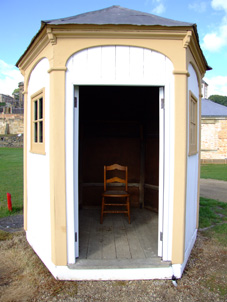
Matt Warren, Cantus 35
photo Bec Tudor
Matt Warren, Cantus 35
I climb the sandstone stairs to the cylindrical guard tower and find Anne MacDonald’s Memory no.5, a photographic installation exploring the passage of time and the inevitability of death. The word ‘memory’ is repeated in grainy black and white and I am confronted by the paradox and futility of trying to salvage something eternal in the face of mortality. Erosion has degraded the carved texts that derive from headstones. I struggle to conceive of the convict thousands who died under abject conditions here. I know that many were buried in unmarked graves on the Isle of the Dead. Each image is mounted in white and framed in apt funerary simplicity. Five works, in vertical arrangement, hang on either side of the pathway that transects the circular space, and on passing out the other side of the tower I am conscious of time sweeping me, slowly but firmly, through space.
I discover Brigita Ozolins seated at a small desk in the oppressive Separate Prison Chapel. Her feet neatly together, the artist at first appears a studious pupil. However, with nibbed pen and bottle of ink, she carefully writes over the pages of a printed book in an action reminiscent of the ‘lines’ naughty children were once given as punishment. When she fills a page she tears it out letting it drift to the floor before beginning the next. Her script repeats the statement she faces on the wall above the pulpit: The Truth Shall Make You Free. Ideas of truth and freedom must have seemed abstract for the incarcerated, especially here, where solitary confinement epitomised disempowerment and voicelessness. This defiant performance is one part of Ozolins’ tribute to inmate Henry Savery (convicted for forgery) believed to be Australia’s first novelist, who died and is buried at Port Arthur. She is writing on the pages of Quintus Servinton, Savery’s autobiographical novel. Writing ‘their truth’ must have provided precious self-affirmation and escapism for those convicts lucky enough to be literate.
Obviously not all visitors appreciate artistic intervention as part of their tourist experience. I see curiosity dissipate in a puff of annoyance for several people when the realisation hits that this is art. Cameras are lowered and retreats hastily made. However, I am impressed that most visitors are willing participants in critical analysis of the heavily mediated experience for which they have paid handsomely. Those who’ve bought Lucia Usmiani’s fold-out photographic mementos of the Port Arthur “red posts”, “pieces of ground”, “seats for sitting” etc. from the gift shop, for example, voluntarily completed the consumerist loop of the artist’s witty piece. I had a wonderful time.
The Port Arthur Project involves 25 artists working across sculpture, photography, furniture design, performance, printmaking, sound, video and other media. And there are 23 temporary, indoor and outdoor, site-specific installations distributed throughout the extensive site. Curators Noel Frankham and Julia Clark have coordinated a pluralistic reinterpretation of this complex site that is coherent and accessible—a considerable achievement given stringent heritage protocols and the minefield of this history: colonisation, Aboriginal genocide, brutal penal colony, 1996 massacre and part of the huge tourism economy in Tasmania.
Unlike the majority of visitors who will inadvertently stumble across the works in the Port Arthur Project, I was familiar with the territory and on a dedicated mission to locate these artistic treasures. I reflect now that my attempt to experience the exhibition free from ‘tourism’ perhaps made me as much a plunderer of the site as those seeking macabre thrills from Port Arthur’s tales of hardship and cruelty. I disregarded other narratives I deemed less interesting or relevant to me at that time. This is ironic given the works themselves bring to light the untold stories of convict sexuality, women and children and such under-recognised histories as those of the Indigenous inhabitants. If I were to see the show again, I think I might join the noisy guided tour group to get the full Port Arthur Project experience: contemporary site-specific art in an historic place.
Port Arthur Project: Re-interpreting Port Arthur Historic Site through Contemporary Visual Art, curators Noel Frankham & Julia Clark, artists Christl Berg, Lucy Bleach, Tracey Cockburn, Nicole Ellis, Anne Ferran, Linda Fredheim, Ruth Frost, Lola Greeno & Vicki West, Fiona Hall, Leigh Hobba, Colin Langridge, Fiona Lee, Karen Lunn & Milan Milojevic, Anne MacDonald, Anne Mestitz, James Newitt, Brigita Ozolins, Justy Phillips, Helena Psotova, Alyssa Simone, Lucia Usmiani, Matt Warren and Elizabeth Woods; Port Arthur Historic Site, Arthur Highway, Tasman Peninsula, presented by Tasmanian School of Art, University of Tasmania & Port Arthur Historic Site & Ten Days on the Island, March 16 – April 11
Bec Tudor presented a paper at the symposium Revelations… in Hobart, held in conjunction with the Port Arthur Project.
RealTime issue #78 April-May 2007 pg. web
© Bec Tudor; for permission to reproduce apply to realtime@realtimearts.net
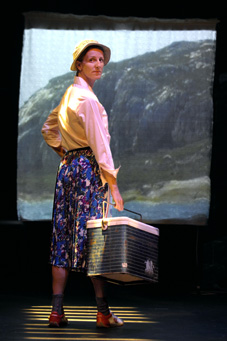
Cheryl Wheatley, Queen of the Snakepit
photo Michael Rayner
Cheryl Wheatley, Queen of the Snakepit
“Fuckin’ oath”, exclaims Lois, “Fuckin’ oath, ay?” Lois, played by Cheryl Wheatley, is our Flinders Island tour guide for the night. She is the ultimate boisterous Aussie sheila, with the broadest of accents, a passion for shandies, and she can handle a ute when a kangaroo jumps in her path. With the help of a kitsch teatowel (six bucks sixty from the tourist shop), showing a map of the Island, she takes us on a journey through the place where she was born and bred. She expertly morphs into local personalities: Queenie, Aunt Myrtle and her own mother, sharing the stories, myths and memories of some of this island’s female inhabitants.
I watch transfixed as Lois’ back slowly bends, her shoulders hunch, her face and neck contort and strain. She literally becomes Queenie, aging 30 years. Queenie’s voice is shaky and laboured as she reflects on the past: “pregnant, baby, pregnant, baby, pregnant, baby, pregnant, pregnant, pregnant, baby…“We know Lois has returned when her back straightens and she breaks into her infectious smile.
Lois also becomes Myrtle, the aunt obsessed with feral cats. A slight speech impediment, unusual body language, skirt hitched. Myrtle knows all—she warned the Island community, but no, they did nothing… so she had to take the cat problem into her own hands. Shakily, Myrtle sets up the slide projector to proudly show us the results of the cull. Wheatley effortlessly and convincingly moves between these unique characters.
As Lois she charms the audience with her familiar and friendly attitude, and I often get the feeling that she is smiling right at me; as you would expect in a small community such as Flinders Island. She shares shandies, stories and local knowledge and the audience regularly assist her with stunts or being the object of quite literal illustrations. To prove the force of the wind on the Island, a massive industrial fan is produced and then pointed directly at the audience, blowing coasters and vases off the tables, accompanied by a blustering soundtrack. We also experience “salt spray” first hand from a plastic dispenser while “sailing off the coast.”
I dreaded the prospect of audience involvement from the start of this performance when I sat down in the cabaret-style seating, observed a rubber snake coiled under the table and an empty glass on top. I never really relaxed into the show for fear of being bullied. But even in this state of tension, there was much to enjoy.
There were a few wonderful unplanned moments. Early in the show, Hobart Mayor, Rob Valentine’s hat is run over by the excited Lois and her wind machine, “Oh no, not the hat”, she shrieks (for those who aren’t locals, Valentine is never seen without his iconic wide brimmed hat). Later, on being squirted with the ‘sea spray’, one of the audience calls out “Don’t waste water”, to which Lois, retorts “Yeah, I’m not Dream Masons”; which refers to the obscene amount of water used in another Ten Days on the Island performance.
Wheatley’s one-liners were probably the most engaging aspect of Queen of the Snakepit. While some of the longer stories lost me at times (like the ones surrounding the little girl standing at the window), the vividly active were the most entertaining, such as the ride in the ute with its beautifully minimal props: two flashlights on either side of the esky, with Lois on a milk crate behind. Wheatley used mime and sound effects to evoke the experience, which was particularly funny when inflatable kangaroos were hurled at her oncoming vehicle, prompting a lesson on what to do in such circumstances.
Cheryl Wheatley is a fantastic entertainer and as a result Queen of the Snakepit is a lot of fun. I particularly enjoyed her skills in mime, her character transformations, the very Aussie sense of humour, as well as her infectious enthusiasm. The lasting image for me was of our initial introduction to Lois: a skinny woman weaving her way between the tables in a footy hat, daggy shirt and skirt, knee high beige stockings with a VB-filled esky and a wide welcoming grin.
is theatre, Queen of the Snakepit, deviser/performer Cheryl Wheatley, co-director/dramaturg Robin Laurie, writer Finegan Kruckemeyer, co-director Tania Bosak, designer Greg Methé, executive producer Ryk Goddard; The Backspace Theatre, Hobart, Ten Days on the Island, March 29-31
RealTime issue #78 April-May 2007 pg. web
© Lucy Hawthorne; for permission to reproduce apply to realtime@realtimearts.net
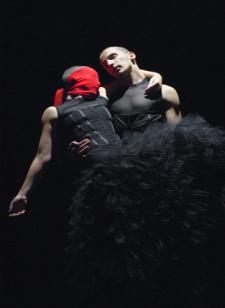
Trisha Dunn, Derrick Amanatidis, Mercy: a dance for the forgotten
photo Michael Rayner
Trisha Dunn, Derrick Amanatidis, Mercy: a dance for the forgotten
Four years of war in Iraq, Guantanamo Bay and web broadcasts of torture have made us familiar with horror inflicted in the name of belief or public safety. Unfortunately, we too easily visualise that hostage with a bag over his head, being threatened on grainy video. New Zealand choreographer, Raewyn Hill has devised Mercy: A Dance for the Forgotten for TasDance. The work, exploring ideas of imprisonment, torture and the strength of the human spirit, was born of a visit to Port Arthur and a book by Margaret Scott about the massacre there in 1996.
From the first moment of Mercy a powerful aesthetic is revealed. A bell peals, like a call to prayer and four dancers are shown face down in each corner of the stage. Each is contained in a hazy cone of light that forms a rectangular cell on the floor. Red bands of elastic run from their prone hands and feet to the heights of the fly tower. As a recording of Pergolesi’s Marian Vespers swells around the audience, a sole female, in black corset and delicate ruffled skirt, falls and twirls in the space made between the red lines. It is a scene that is visually striking, sensual and ambiguous. While the solo dancer is obviously imprisoned, it is difficult to ascertain her state of mind from the flowing, rolling gestures.
As brief scenes progress, the aesthetic vocabulary is consistent and ambiguity lingers. Each corseted dancer is affected by some form of torture as the glorious voices of the Pergolesi fill the auditorium at a constant intensity. Amidst the stylised horror, a love story emerges between the leading dancers. These sequences between Trisha Dunn and Derrick Amanatidis shine with a sense of fragile, tender connection, built around cradling and carrying.
Mercy stems from a very genuine engagement with the idea of imprisonment. The emotional connection to the material is clear from Hill’s statement in the program, but I can’t help thinking that the dance needed to go further, to dig deeper. Having once spent several weeks visiting concentration camps in Eastern Europe, I expected to see more of the complexities of imprisonment in this work. Yes, there are definitely triumphs of the human spirit in horrendous circumstances, but there are also many questions around the potential for any one human to inflict cruelty on another. From my observation the triumphs are rarely grand gestures but more points of light in the dark—one person wrote a book on tiny pages, another made playing cards small enough to hide in the mouth. Gender, sexuality and personality are stripped in these circumstances, the body wastes, the spirit is heavy. Watching Mercy, a work of undeniable beauty, I couldn’t reconcile this knowledge against the sexiness of the costumes, the sensuality of the gestures, the relentless energy of the dancers or the uninterrupted formality of or the stylised production design.
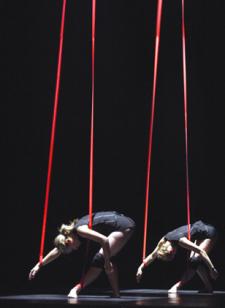
Mercy
photo Michael Rayner
Mercy
A single chiming bell pierces the black, smoke-filled theatre as four dancers lie face down on the stage; red ribbons run from the heavens, tied to a hand and a foot of each. The marionette dancers rise, bounce and twist under the fabric ties which appear to be lifelines, and at other times, binds. Later, red ribbons depict torture and bondage.
The idea for Mercy: a dance for the forgotten came to New Zealand choreographer Raewyn Hill after a visit to Port Arthur in 2005 and her subsequent readings of Margaret Scott’s Port Arthur, A Story of Strength and Courage. The work is an exploration of imprisonment, torture and pays homage to the strength of the human spirit in times of adversity.
Mercy’s stylistic strength comes from stark symbolic components – red ribbons and blindfolds are worn by the dancers who struggle against prison guards as they are led to their likely deaths. Chains, attached to male dancers are dragged noisily across the hazy stage. The costumes are black, tightly fitted corsets and large, layered skirts reminiscent of colonial underskirts. The lighting evokes prison life with bars and small isolated cells and downward lights creating, at times, a sense of a God looking down on the prisoners as they repent and seek salvation.
It is said in moments of struggle humans look for connection – often a physical one. There are such moments, but the audience is denied any fulfilling emotional journey alongside these convicts or prisoners. For a moment, love does emerge, between two captivating dancers – Trish Dunn and Derrick Amanatidis. They support each other’s bodies, caress gently and we know their love will never be fully realised in such a treacherous place.
At times the work is unrelenting in its motifs of oppression, however the mood achieved through the choreography leans more towards the abstract than the specifics of a monumental time in our national history. The work seems therefore to be limited conceptually and doesn’t achieve the promise of the program synopsis.
The musical score (Pergolesi’s Marian Vespers composed more than 250 years ago) is astounding, strong and impassioned and operatic – it seems to call the lost souls of the prisoners to the stage to repent and free their souls. Choreography and musical score are given a similar weight for much of the work and on occasion the music seems distracting.
Mercy is a stylish work, visually arresting with strong symbolism but perhaps too abstract in its treatment of its subject matter to be completely fulfilling.
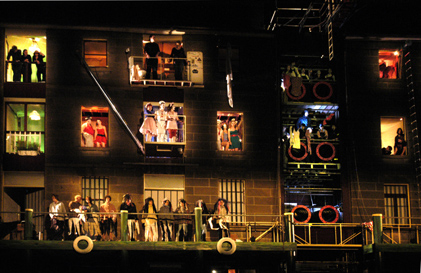
Dream Masons
photo Michael Rayner
Dream Masons
The highly ambitious production, Dream Masons, has been promoted as a headlining event in this year’s Ten Days on the Island calendar. Curiosity was roused as soon as the historic façade of the Salamanca Arts Centre began transforming weeks ago. Scaffolding, balconies, ladders, ledges and enormous drainpipes have been erected across several shop frontages, up four storeys and over Kelly’s Steps laneway, to form the set for this timeless tale of an apartment block, its inhabitants and their relationships with water.
There is the unlucky fisherman, the sailor and his lover, a landlady who hoards ice, a jilted bride who weeps over her washing and a debauched, liquor-fuelled party. There’s a newly arrived couple equipped with planter box, white picket fence and baby lamb ready to establish domestic bliss and there’s also a little boy. Meanwhile in the basement convict-like workers pump water up into the house above. We are given no formal introduction to the characters as there is no spoken dialogue. Rather, the protagonists are well-worn archetypes identifiable by costume as they appear in windows and weave in and out, up and down the façade via rope ladders, swinging walkways and a suspended rowboat, going about their idiosyncratic lives.
A great flood constitutes the story’s climax and necessitates a daring escape as the residents flee from rising waters to the topmost apartment. However the young boy is accidentally left behind and engulfed, only to be resurrected, recalling Jonah’s journey in the whale. The clownish fisherman ultimately helps the boy, saving the day in spectacular fashion, rounding off this whimsical tale with a happy ending.
Technically speaking, Dream Masons is spectacular. The use of water is impressive, as is the kinetic set. A beautiful lighting design by Daniel Zika creates a candle-lit effect across the sandstone facade and spotlights are well employed in assisting the audience to follow the action across this vast canvas. The layers of history visually represented by the floors in the Dream Masons’ apartment block resonate poignantly with the work’s siting in the mini tourist mecca of historic Salamanca Place. Despite occasional clumsiness, innovative use of image projection and shadow puppetry is used effectively to create visions of the underworld. However the distance between performers and audience makes following the plot somewhat challenging.
Pace and dramatic atmosphere are developed throughout the show by a live instrumental ensemble and The Southern Gospel Choir, the latter covering a number of frustratingly obvious popular songs with references to water (Bridge over Troubled Water for example). The performance of Leonard Cohen’s Hallelujah seemed rather tactless given the nature of the demise by drowning of Jeff Buckley, the best known interpreter of the song.
Appropriating Tasmanian waterscape photographs such as Dombrovski’s historically significant Rock Island Bend as background for banners that introduce scenes is also problematic. These images simply joined the plethora of water references in Dream Masons ultimately muddied meaning.
There is little subtlety to be found in this spectacular performance, perhaps because of the complex logistical objectives of the project. For me, the most poetic moment came when I noticed the Pacific Princess cruise ship serendipitously docked at Hobart’s waterfront parallel to the Salamanca Arts Centre. With its portholes alight it beautifully embodied Dream Masons’ tale of a dwelling supported by water.
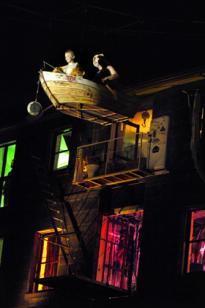
Dream Masons
photo Michael Rayner
Dream Masons
To the oom-pa-pa of the band water cascades from the stage, shadow-puppet fish swim in the windows of Salamanca Arts Centre, a boat floats above the street audience and performers climb ladders and moving ramps on a uniquely vertical stage. These impressive theatrics leave you smiling. Dream Masons is worth attending just to observe the amazing set design that turns the façade of the Arts Centre into a stage with unlimited opportunity.
The rigging is fantastic: ramps appear out of nowhere allowing performers to scale the building; a washing line strung between windows allows a performer to swing from one to another; and skilful wiring allows a fisherman to row in mid-air. Projections and shadow play reveal scenes and sub-plots further accentuated by the deftly changing music score as each window lights up.
Mood is largely dictated by the music and lighting, and most of the characters are defined by their musical accompaniment. The excellent small cabaret-style band, comprising tuba, drums, keyboard, bells and accordion, generate the ominous quality of a scene with a whale that would make Hollywood directors jealous. And many members of the audience cannot help but bop to the more upbeat music.
The building is populated with clown-like stereotypes: the helpless bourgeois lady in a wheelchair, the woman hanging out washing and yearningly holding up a wedding dress; the muscular sailor showing off his strength to a ditzy girl; and the ‘old hag’—a woman with a hunchback. The characters visit or intrude on each other or party—until the plumbing goes wrong. This is where the production comes to life. The building is flooded, resulting in an evacuation to the top storey providing suspense and interest so far lacking in the production. The water rises, fish and shadowy water demons and finally a giant whale appear, impressively filling the windows of the entire façade.
After the initial introduction to the building and its inhabitants, large banners had been unfurled to announce the five chapters of the story, revealing the production to be an allegory of the flooding of Lake Pedder. (Really! What did the first part of the production have to do with this?). For me Dream Masons relies a bit too heavily on glitzy stunts and theatrics, dated gender stereotypes and a trivialising of the Lake Pedder disaster to form a coherent and convincing story. However, the design, with its vertical staging and clever use of windows, rigging and lights was fantastic; so let’s hope that this approach is used again in the future in a more coherent production.
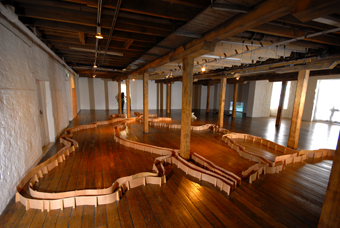
Lucy Bleach, Circumnarrative
photo Craig Opie
Lucy Bleach, Circumnarrative
A low wooden structure snakes around the pillars of the Long Gallery. A series of plaques on the wall proudly display fragments of local roads. An easily missed lightbox hides outside the gallery window. This is Lucy Bleach’s Circumnarrative.
The wooden structure is probably the most puzzling of the three works. Two parallel lines of 10cm high plywood curve around the timber floor forming the likeness of a walled road or some other passageway. It dodges the gallery pillars in a way that a plant would, the organic nature of its movement suggesting that nature may have been an inspiration. Yet it still looks very much built, with its exposed supports and its likeness is to roads which track a journey through what appears to me to be the gradually evolving shape of Tasmania. I strain to remember the locations of the roads I have travelled in my own short time in the state: Eaglehawk Neck, Burnie, Launceston.
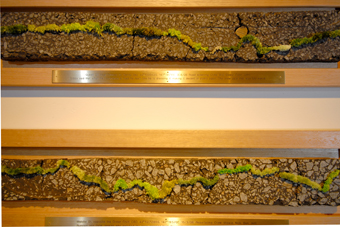
Lucy Bleach, Circumnarrative
photo Craig Opie
Lucy Bleach, Circumnarrative
The five plaques mounted vertically on the nearby wall each display a section of bitumen dug up from Hobart roadworks. Between the cracks, delicate green embroidery pokes out, just as hardy plants would amongst the urban landscape. Engraved professionally below each section on a brass plaque are the details of the location of the road, its coordinates, the date of the removal of the section, the names of the crew, as well as quotations from people involved in the works or looking on. These observations fight the cold objectivity of the plaques, some describing an experience relating to the road: an old man who named the particular crack in the road which he has been watching for many years “Nellie.” Other sentences are brutally honest: “Bumped into Pete Jenkins who watched the crew scraping back the road with me and told me Mary had lost their baby girl.”
The third work, the lightbox mounted outside on a neighbouring wall depicts a landscape view with a freestanding gate, through which can be seen the edge of the land over the ocean. Even without the gate, the typically bleak Tasmanian landscape would seem hostile; but the gate adds an extra physical barrier to the land. It is also cleverly placed out of reach in the space between the buildings—an island of colour and light against the sandstone wall.
Circumnavigate is an initially incohesive work, but on closer reflection, the three parts share an underlying theme. I perceive an outsider’s view of Tasmania. As with many small communities, Tasmania has a cliquey nature that many newcomers to state find initially alienating and hostile. Perhaps, coming from Sydney, Bleach has experienced this ‘outsider’ phenomenon. The wooden structure may suggest the roads of Tasmania, but also a sense of exclusion: these ‘roads’ are created out of relatively tall barriers, preventing not only entrance but also escape. The wall plaques share with us intimate comments, but are presented in a strangely objective manner, suggesting the view of another kind of ‘outsider.’
Circumnavigate is beautifully mysterious: the structure which evolves as you walk around it and consider the shape of the whole and the journey within; the intriguing plaques with the fleeting stories of ordinary Hobart workers and the overlooked remnants of their efforts made permanent; and the landscape, sectioned off twice in a bid to keep out the stranger. It takes time to enter Lucy Bleach’s work, however the reward is coming to a unique understanding of Tasmanian as ‘an other place’.
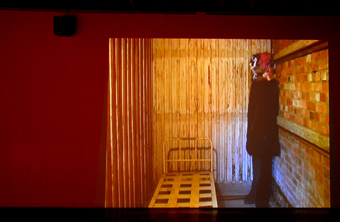
Austin McQuinn’s Bogeyman
photo Craig Opie
Austin McQuinn’s Bogeyman
There’s a neverending conversation in much artwork that emanates from Tasmania and is about Tasmania, which is about This Place (a current local advertising campaign virtually orders us to Love This Place!) that was eventually named Tasmania, after being Van Deimen’s Land for a period of time, and presumably had an Indigenous name before that. There is a particular sensation that the place seems to evoke, formed by distance, being dwarfed and awed by a landscape huge and even intimidating. The South West Forest (possibly the most internationally well-known part of Tasmania) was named Transylvania on early maps, setting into motion a strange unnamed kind of Tasmanian Gothic that has dominated much artistic production here ever since.
Austin McQuinn’s Bogeyman offers a particular vision of this place, a vision of Hobart, that is familiar and Other at once. A video projection introduces us to an odd figure constructed from dark cloth that covers the entire body except for the head, which comprises a clump of those old woollen CWA toys made into a slightly sinister amorphous blob. Interestingly, the use of old toys is fairly common round here, due in part to the presence of the Resource Tip Shop. The regular Art From Trash exhibitions usually feature something like the Bogeyman’s headpiece. But there’s more to this Bogeyman than his appearance.
He wanders out of place, pathetic and forlorn through regions that for me are rich with personal memory. I know the region of the mountain Bogeyman stands in, the steep street in South Hobart he carefully feels his way down, looking ever more awkward and displaced. I know which courthouse he’s been in, and I wonder if his story is formed in part by the sad tale of the Irish political exiles that ended up here. The guy who made the work is Irish after all, and for the purposes of this exhibition, the Irish are apparently Other as well.
So, the Bogeyman is alone in a place that I find so familiar. He doesn’t have my local know, is blind to the resonance and ripples that he creates, re-writing the landscape with his small presence. It’s a landscape he’s removed from—he can’t see, all his sensory equipment muffled by the thick black costume and the heavy headdress. He’s been made that way—he is a construction.
I see the places he’s in as some of the most obvious places an outsider would go when they come here; then I wonder if I’m being smug and insular. Maybe. Maybe I’m tired of the same story of this place being told by those from outside it. That’s if it is the same story, but if it is not, why do I recognise it? Even some things about the Bogeyman seem familiar. The way he seems to be put together, made out of residue, discard and children’s nightmares. I’ve seen him before somewhere; somewhere here. He’s unfamiliar and yet sympathetic in his lonely plodding. And I do think of him as character, yes, somehow. Somehow he takes that on in this work, bringing me back to where I sit, staring at him, wondering if his mere presence has re-written my home town even for me. I watch him sadly slide under a bed that no one sleeps in anymore.
That’s it. He was under my bed. He was under yours as well. Remember?
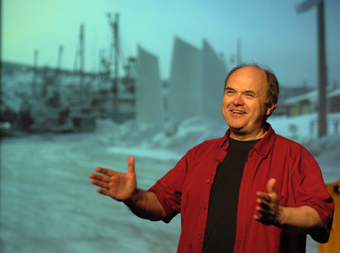
Andy Jones, To the Wall
photo Michael Rayner
Andy Jones, To the Wall
It’s immediately and alarmingly clear that you’re locked in a room with an eccentric. You’re a captive audience. You pray it’s a non-participatory one. Newfoundlander Andy Jones comes on, an engagingly pushy mix of lecturer, spruiker and preacher, flogging a thesis that will explain why humans are so bad to each other, and what we and God, should he exist, can do about it. The extrapolation of the thesis, he advises us, will take the whole performance. In the meantime he kicks off with something terribly contemporary—anxiety about anxiety, specifically the human wiring that triggers: “future possible, possibly horrible” (which he titles fitposs, economising from a French-Canadian rendering). We’re all very attentive and the brisk texturing of references French, Irish and Newfoundland layers the thesis-making with something very particularly cultural and possibly personal—as in Jones’ droll description of his intensely exclusive Roman church upbringing as “Hasidic Catholic.”
Most of the time fitposs (“a déjà vu of the future”) prepares us for the worst, but September 11, 2001 shocked the atheist Jones into prayer—what else could you do, he asks. This plunges him into a big question—are we God’s experimental failure (God wanted equals, got nasty supplicants and is profoundly lonely, and therefore absent)? He offers some big solutions—let’s invite God to a public meeting, in this theatre, tonight, and propose some genetic tweaking. Without fitposs we might be a nicer species (Jones rattles off a history of the demise of earlier humans not fitted with fitposs—the first of our kind were, of course, Adam and Eve). While modifying our anxiety generator might seem a reasonable idea, Jones is not reasonable in any ordinary sense, suggesting that we have anxiety thermostats visibly implanted over our nipples (slide of Uma Thurman at an Academy Awards thus technically adorned). This will not only make us more aware of each other’s emotional fluctuations but generate some new language: “Go fluctuate yourself!” Wilder evolutionary engineerings are suggested later in the show, but in the meantime there’s much else to rapidly absorb and to reflect on: what would be the saddest story you could tell a rabbit such that its tears would turn to ice and lock it to the ground (and provide you with dinner)?
This is discursive theatre, Jones playing out a persona doubtless rooted in the real man and stylistically reminiscent of the American Spalding Gray, if without the incantatory poetry or darker personal musings, and the UK’s Ken Campbell (Jones was a performer for a period with the Ken Campbell Roadshow). Like Campbell, Jones is in love with the big picture, generating wildly improbable theses that nonetheless tell us much about what worries us and the kinds of not always silly fuzzy logic we apply to such mysteries. Again like Campbell, there’s a mix of real if distorted science and wacko cosmology. Some episodes seem simply off the air, smutty, over elaborate but usually arrive at a kind of meaningfulness, as does the seductive rhetorical illogic of a good sermon (which he illustrates at one stage). Jones introduces us to the Newfoundland beef bucket (used to tenderise tough brisket in salt) deployed in an experiment with his three nubile assistants, seen on screen. They fling sand from such a bucket millions of times, looking to form by chance the perfect shape of Newfoundland and Labrador and they get close. But of course God created randomness. What can you do?
That Newfoundlanders would indulge in such flights of scientific fancy and many other bizarre activities, Jones attributes to the N-factor—a Newfoundland facility for doing things in very odd, lateral and sometimes surprisingly successful ways. This takes us into the country’s history, back to the 18th century, and the Jones’ family’s connection with it, climaxing in the story of his aunt Mary, a Newfoundland beauty who eloped with a protestant English diplomat who was then posted to Berlin in 1939. There it was rumoured Mary, now with an imperious upperclass British accent, snubbed Hitler, so mortifying him that he gave up on invading Great Britain. That’s lateral. The story includes delightful photographs (by Louise Abbott) of a family wedding on a windy Newfoundland day, bridesmaids tottering about the uneven landscape. “No one seems to notice they’re living on a rock!” quips Jones.
If Ken Campbell seems to teeter on the edge of madness in his wilder flights, Jones is on safer ground, for example diverting any extreme nuttiness into the portrayal of a Catholic priest, with Jones asking us stamp our feet when the clergyman has crossed the line into insanity. We’re stamping pretty quickly, but Jones signals that worse is to come.
Like Campbell and Gray, Jones is a deft weaver of tales and ideas, leaving many threads hanging and then ravelling them with bravura sleights of hand. But there are still always surprises to come: “You’re wondering what this show is all about? … Mating!” The cosmological weft is suddenly evolutionary (an earlier thread now picked up) and we’re warped into an hilarious fantasy of genetic tweaking providing the inadequate male with the voice of JFK and bigger buttocks.
There’s plenty to take away with you from To the Wall. Just how many human problems are generated by ‘fitposs’ and what would we be like without it? Why does a confirmed atheist turn to God in moments of extreme crisis? Jones, garbed in a plethora of priestly vestments from different cultures, invites God to join us. He doesn’t turn up, but Jones trips, falls to the stage, and with good Catholic logic, suspects He has been silently present. What are the odds? Other questions linger. How can Catholicism continue to be a creative force when such a punishing one? Above all, is Jones’ account of Newfoundland quirkiness (the N-factor), a condition compounded by Catholicism, true just of his home culture, or is it recognisable, in other ways, in Tasmania or Australia—whose people are so often inclined to insularity, especially now?
Occasional sillinesses aside, To the Wall is amusing and sometimes bracing, performed with affable ease and a self-mockery which fellow islanders from all over will recognise. Best of all, Jones takes the edge off our own troubling fitposs for a while.
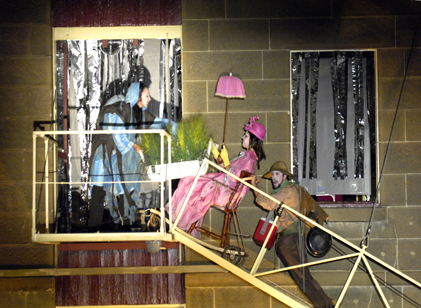
Dream Masons
photo Michael Rayner
Dream Masons
For the last month I’ve been walking under a jetty to get my morning coffee. I was oblivious to my underwater journey until Dream Masons exploded over the face of the Salamanca Arts Centre with a spectacular display of mechanical wizardry, bawdy hijinks and vaudeville-style theatre.
Dream Masons was commissioned as a celebration of the Salamanca Arts Centre, a place that has housed and supported Hobart’s creative community for thirty years in a jumble of linked sandstone warehouses. The buildings themselves are the stage for the work which is performed across the vertical surface of three buildings over four storeys. Twenty windows were utilised and the entire facade was fitted with scaffolding, rigging, ladders, a twenty metre long bridge, a boat on a rope, three balconies, a fridge and a toilet. And of course, my jetty.
The windows depict apartments within the building occupied by a mixed bag of tenants. The characters are easily recognised types played out in with vaudevillian overacting, repetition and an abundance of sight gags. We meet the hapless fisherman, the bawdy babe, the strong-man sailor, the henpecked husband, the prissy wife, the weeping spinster who is always washing and a boy in a Superman suit. Living at the top of the building, hoarding ice cubes like currency and screaming through a loud hailer is the cantankerous hunch-backed landlady. Each of these lives is highlighted through the changing focus across the facade as windows are illuminated in turn.
Gibberish aside, there is no dialogue and the plot is deceptively simple. Each of these characters goes about their lives until disaster hits. A great flood—possibly created by evil means—threatens their building and the group help each other to escape to the apartment of the unwelcoming landlord. The weeping spinster makes a dramatic escape across her clothesline to safety, but the boy is lost in the waters and eventually swallowed by a whale as big as the whole building. Saved by his snorkel, the boy spectacularly finds his way out through the whale spout and saves the day by releasing the waters.
The main players are backed by a cast of extras, a large band, giant banners to announce the main episodes of the story, a gospel choir and a busy backstage crew whom I imagine running madly between buildings throughout the work. They fill each window with back projections, creating the rising water and the huge whale which are highlights of the show.
While it is easy to take the show at its cheesy face value, anyone who has ever had anything to do with the Salamanca Arts Centre will know that Dream Masons is like taking the place and turning it inside out so that all the melodrama, personalities, politics, shoddy construction and leaking roofs are all revealed on the outside for one hour of madness. I’ve often thought the place was ripe for a multi-storey sit com, but this show goes ten steps further and I now wonder if the centre was also a hub for the protests against the Lake Pedder flooding which is hinted at as a parallel disaster in the show. I clapped and laughed like a seven year old, but also enjoyed Dream Masons as a regular of the Salamanca strip and I will miss those underwater coffees over the weeks to come.
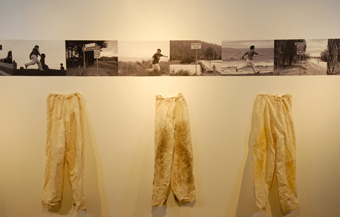
Julie Gough, We Ran/I Am
photo Craig Opie
Julie Gough, We Ran/I Am
How do we experience place? How much can we ever understand of a foreign place? If we read the signs will they tell us the story? These are questions that arise in experiencing works by Julie Gough and Austin McQuinn in AN OTHER PLACE.
Julie Gough’s work We ran/I am is composed of a series of black and white photographs matched against pairs of rough-sewn wool and calico trousers. The trousers hang as physical evidence of the photographic content. As the artist is documented running through the horizontally mounted images, the trousers underneath bear different levels of soiling that could reflect falls to the ground or lost footing. A map mounted on the side wall shows the marking of the Black Line, part of a notorious campaign in 1830 by Lieutenant Governor George Arthur involving a moving chain of Tasmanian residents intended to round up all Indigenous islanders, most of whom would eventually die as a result of imprisonment and disease. Interspersed between the active images are stills of the tired signposts welcoming travellers to towns along the Line with the standard claims about being “Historic” or “Tidy”. As an adjunct to her title, Gough quotes a journal entry from George Augustus Robinson: “The people all seemed satisfied at their clothes. Trousers is excellent things and confines the legs so they cannot run.” (sic) In similar trousers, Gough relives the escapes of her ancestors.
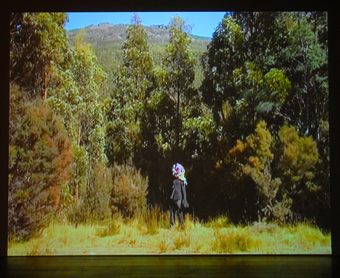
Austin McQuinn, Bogeyman
photo Craig Opie
Austin McQuinn, Bogeyman
Austin McQuinn’s work also journeys through a series of places, but with a different kind of energy. Bogeyman is a wall-sized video projection with a five minute loop showing a series of locked shots of Hobart. Coming into the work at a particular point I was confused by the intent as it flicked through a number of shaky views of Hobart backed with questionable sound. Almost to the end of the fifth shot, my patience waning, his Bogeyman appeared. This creature is presumably the artist or a projection of McQuinn, dressed in sagging black knit pants and top, hands and feet encased in what could be mittens. His head is completely covered by a headdress of knitted toys. The figure is both pathetic and absurd as he walks slowly through each of the shots from the top of Mount Wellington to a single cell within the old Hobart Gaol. In what could be the final shot, he disappears under the bed, like the bogeyman of childhood.
Together these works address a condition that I believe is intimate to Tasmanians and visitors—the sense of experiencing, but perhaps not understanding the place you inhabit. Gough’s work reveals a dark layer of Tasmania’s past that makes a parody of the “historic” in the worn out welcome signs within her images. Her Tasmania is definitely “an other place” from the pristine island that we see in the advertisements and its people are to be feared. McQuinn’s figure also reveals an experience of distance from the landscape. I imagine that his moping monster represents the artist’s feeling of isolation as a resident of Ireland attempting to make work in a foreign place, walking blindly through a landscape he may never understand.
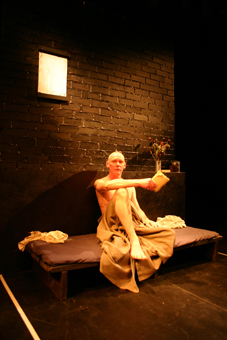
Robert Jarman, The Spectre of the Rose
photo Carolyn Whamond
Robert Jarman, The Spectre of the Rose
They called me a thief. I was innocent. They called me a thief, so I decided to be a thief. A false accusation at the age of ten may have been the first defining moment in the chequered life of Jean Genet, French playwright, political spokesman and hero of the Existentialist movement.
These words are uttered in disgust and defiance by Robert Jarman as he plays Genet in a solo show entitled Spectre of the Rose. The show is staged in Backspace where a small audience is party to the confidences and musings of Genet from prison. His cell is defined by a brick wall at the rear, a sleeping bench, a few personal possessions and a strong white line marked out on the floor. Throughout the work, Jarman remains behind the line, even while leaning his body out emphatically toward the audience.
The show begins uncomfortably. Genet is prone on his bed, placed centrally in the cell. He is clothed in pants and singlet that are thin and holed. Low restless music accompanies his breathing for an indeterminable time and he seems to be struggling with thoughts or nightmares, his body stiff with tension. I sense the spring of a dancer in this man and as if to prove this Jarman’s Genet leaps from his bed and begins his monologue like a ranting madman. He runs around the cell, listens at the wall and is wide eyed as he describes the voices of other prisoners that surround him—some murmured, some screamed, some inaudible. He climbs up high to listen and runs laps around his bed describing the ritual of the discipline yard where men are forced to continually run in a torture that is accompanied by the indignity of defecating in a can in full view of the others.
Once Genet has articulated his dreadful circumstances he quietens and begins to explore his thoughts. It is now that he makes sustained eye contact with audience members and there is a sense that he has decided to trust us. We are his confidante.
Genet’s imagination is rich and dark and perhaps that is how he survived lengthy incarceration. He appears to have the capacity to build relationships with imagined foes and lovers to the point where the heights of experience with those he selects bring him a kind of satisfaction, sexual or otherwise. He shares his heroes with us—they are murderers whose faces he has pasted to a board concealed in his room. He is excited by their crimes. As he says, “The only way to escape horror is to bury yourself in it.”
This portrayal of Genet reveals a complex man. While I believe that we are expected to feel some revulsion at his delight in the worst of human behaviour, Jarman’s Genet is also tender and loving. As he describes his relationship with a fellow prisoner and re-enacts an afternoon of slow dancing in a cell—the only permitted form of affection—the depth of feeling, the love, the grief for this lost love is very moving. To some extent, he is a slave to his own desires and we witness the inability to gain distance from his turmoil culminating in self mutilation. Perhaps this is the inspiration for the trilogy of which this play forms part—Prisoner of Love. Seeing the show is a visceral experience that could be confronting for some as it involves blood, nudity, masturbation and simulated fellatio, but beyond this are moments of lucidity and stunning observations that inspire reflection on the condition of being human in such extremity. Seeing the show is a visceral experience that could be confronting for some as it involves blood, nudity, masturbation and simulated fellatio, but beyond this are moments of lucidity and stunning observations that inspire reflection on what it might mean to be human in such extremity.
Hobart’s City Hall has been transformed into a caravan park. Inside the corral of five crusty old caravans, chairs and picnic rugs face a small stage and a screen. We have each been given an esky filled with surprising gourmet products—confit of scallops, sugar and grapefruit cured ocean trout, and smoked wallaby. Not your standard family picnic fare. But then, there is nothing quite standard about Big hART's Drive In Holiday.
One caravan serves as technical hub and radio station from which the actors keep us informed about what we are eating, what to do and where to go. The other vans house installations representing four Tasmanian coastal townships. The Crayfish Creek van is particularly engaging as every surface including the vinyl seat covers and the internal surfaces of the cupboards, is postered with naïve illustrations by Rebecca Lavis. She has even created a photo album to flick through and decorated blocks and a jigsaw to play with. The Tomahawk van has illustrations by cartoonist Reg Lynch glowing on a lightbox above the sink while Euan McLeoud’s acrylic and oil landscapes adorn the Trial Harbour van. For Southport, Christine Kilter has created a haven for kitsch with crocheted cushions, gaudy figurines and a series of snowdomes with pictures and stories from the area. The vans are intriguing and warrant time to absorb but we are instructed to return to our seats, or picnic blankets to watch the show.
While we sample our exotic edibles a duo sings a sweet and melancholy acoustic number and the “movie” begins to roll. We see a woman, Crystal (played by Kerry Walker) through the window of a caravan. Surprised by the appearance of a police officer, she chokes on a piece of food. There is sharp edit, and we realise that the action is now live, being filmed in the Couta Rocks van to our right. We can choose to watch the live action surrounded by a young crew holding boom, camera and lights, or we can view the action on screen. This is a movie in the making.
Pre-recorded footage offers the unhappy back story of divorce, custody loss, and a sea change. In a live scene in the van a gentle friendship between Crystal and Keg (Lex Marinos) unfolds as she helps him write his will. Back to animations and prepared material and the tale of a freak discovery—a human toe in the guts of a fish. Then we switch back to a repeat of the live scene as a policeman delivers Crystal the message of her ex-husband’s unfortunate demise.
And this is just the beginning. It’s a mini-series and the drama continues to develop, using a connection to Keg as the binding agent and taking in the towns we have experienced via the van installations. We meet a young girl, his niece (Dawn Yates), playing a piano in the middle of the bush at Southport, her mother with Alzheimer’s (Kerry Walker) in Tomahawk and eventually there is a love story in Crayfish Creek (or is it Trial Harbour… I’m a bit lost now).
As with all of Big hArt’s work, Drive In Holiday is made as part of a larger community development project, so in addition to appearances in the fictional material, local people are included in brief documentary segments telling stories and recollecting details about their towns. The fictional scenes that follow illustrate how this is incorporated into the narrative.
The shifts between live and set footage gradually break down, the switching between lines of recorded and live dialogue becoming unwieldy. The actors abandon the filming scenario and simply stand on the stage reading from their scripts. Originally I suspected a technical hitch as Marinos receives instructions from the blue-coated floor manager but, as the actors are directed to play the scene as though it were a soap opera, the mock rehearsal reveals another layer of artifice. Again we are reminded that this a story, and a story in the making.
And the story is not finished. As the show progresses the initially tight hold on the narrative begins to unravel. Some of the imposed details and fragments of stories from the community are not completely woven into the plot but rather just hang there, perhaps waiting for the next episode. Why does Crystal take the name of her deaf and dumb sister? And the rapidly developed lesbian love story seems expedient. In the end we are left with another gentle sweet song and an ambiguous kiss.
The scale, complexity, and the integration of interdisciplinary elements in Drive In Holiday is very impressive, and the environment created is completely immersive. However there are are a few elements that niggle. The overwhelming nostalgia of the content—a golden era of baby boomer Australian kitsch—is curious considering the material was developed with a workshop of young mothers and their children. And within this atmosphere, the gourmet food, although thoroughly enjoyable, might more appropriately be replaced by a sausage sizzle. The material does also seem to thin out, as the work progresses, less integration of live elements and more scattered plot devices. Despite this Drive In Holiday is a unique and thoroughly engaging exploration not only of a slice of Tasmanian culture, but of the potential of hybrid performance and expanded storytelling.
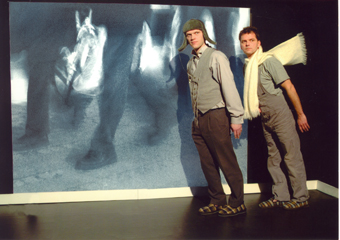
The Little Match Girl
photo Jan Rüsz
The Little Match Girl
A strongly familiar story that deals with the cold and lonely death of an innocent girl might seem to be a strange choice for a piece of children’s theatre, but then again, perhaps discussing such a difficult topic is exactly what we need from theatre. It’s a brave thing to even attempt, so a great delight to experience something that must have been so difficult that achieves as much as Denmark’s Gruppe 38’s production of Hans Christian Andersen’s The Little Match Girl.
Children’s theatre has different concerns from its adult counterpart, and there’s a common assumption that the performance has to be responsible for the emotional wellbeing of the younger audience. Given that both story and outcome, are well known, the nature of this responsibility looms large, and the company’s reaction to this has shaped the nature of this production in quite particular ways. From beginning to end the cast are visible, and they acknowledge the audiences’ presence. The set, and general appearance of the performers has a hint of genteel poverty, which gives the whole thing a clownish, unthreatening quality. The performers use their own names, introduce themselves to the audience, have their roles explained and produce ‘scripts’, which are not scripts in the traditional sense but images. All perfectly elegant and deft deconstructive moments, and indeed there was much of this throughout the performance: a piece of paper being moved about with a long thin stick to create an illusion of wind is eventually grabbed, revealed as a long thin stick and not wind at all. It’s an illusion. It looks amazing but it’s not real. It’s just a story you’re watching: we’re reading it from scripts, using clever theatrical tricks; you can see us using them. It’s all right. It’s fine.
The set, stark and simple, utilizing projection in many ways, had one particular premise that fascinated – the performance took place within a smaller square on the stage, that was clearly defined early on as a dangerous place to be. Performers entered it at their own risk, a little nervous but with brave hearts. They would take whatever risk necessary for their story, unselfishly keeping the audience a little safer still.
It’s not always dangerous in the space however; a simple projection onto a shoulder-high silhouette of a four-storey townhouse is raised from the floor giving the performers a chance to create images of warmth and food and comfort. It’s all done with a small projector, visibly worked by the performers. It’s all an illusion; it’s not real. We are telling a story. This is how we are telling it, using these clever little things that are simple and easy to use. What’s extraordinary is how many of these things there are, and how much is evoked by their clever, economical usage.
I found this work extraordinarily satisfying. It was everything I look for in strong theatre – intelligent, even witty use of theatrical devices that do not overwhelm or cheapen the story and its attendant emotional resonances. The energy that was created, controlled and shared was very involving; I was caught up: charmed by the way the company told stories and moved by the story they told.
Do you know the type of sound which massages the back of your skull? No? Yes? Well… it is my best attempt at quantifying the intensity of sound that Leigh Hobba managed to create in his performance at the Tasmanian Museum & Art Gallery. I tried to keep my eyes open to the shadows, the video images and the live dancer but it occasionally became necessary to lull in the pulsating sounds of Hobba’s clarinet playing and avoid sensual overload by just closing them.
Leigh Hobba is a performance, sound and video artist who announced this event as a “distillation of 20 years work”: favourite performance pieces dating back to 1976. As one of the younger members of the audience, I had never seen any of these so I had no idea what to expect. In the darkened room, two wide screen television monitors sat on each side of the stage, and on a plinth next to the microphone and music stand, a tiny monitor blinked with static. From behind a black curtain, an elongated shadow of the clarinet spreads across the white wall, the monitor revealing what I finally decide is Hobba's pulsing stomach. He alternates between repetitive, modulating series of notes and the bending of long single notes. The effect is ultimately spine chilling. Combined with the rhythmic tapping of the keys, Hobba’s desperate breathing—due to the pressures of continuous playing and circular breathing—and the ever present shadow provide an almost overwhelmingly sensual introduction to his work.
Hobba’s collaborator, Wendy Morrow, enters the room as the sound ceases. My view of her is blocked so, as with the introduction, I am captivated by her shadow. The quiet that follows Hobba’s work fills with dancing until Hobba returns and reads text, accompanied by images that flash up on the various screens: a young boy acting out a brief movement routine, a baby curled up, the jet trail of a plane and the flags of nations fluttering in the wind with repetitive flag pole clanking.
Later that night, when I am sitting through a different performance, A 1000 Doors, A Thousand Windows, I am struck by similarities in the projections, the use of digital sound distortion and the hypnotic effect created by repetition. Hobba calls his work performance art, and Xenia Hanusiak, the singer and co-creator of A 1000 Doors… calls hers music, but both challenge the traditional boundaries between visual art and music.
Leigh Hobba’s performance created a sensual environment that was almost overwhelmingly magical and evoked a strong emotional response, an experience not dependent on prior knowledge of his work.
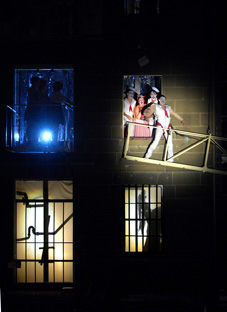
Dream Masons
photo Michael Rayner
Dream Masons
One of Hobart’s beloved landmarks is the stage for a festival extravaganza, one that could not be contained in a theatre or gallery space. Ten Days on the Island wouldn’t feel a complete festival without the outdoor theatre spectacle, Dream Masons.
In Australia, there is a tradition of labelling large-scale outdoor productions ‘community works.’ This often translates to loads of ‘emerging’ community artists working for no money in exchange for ‘training’ from ‘professional’ artists. Dream Masons is not a community work. Expert artists have been sought from the US (co-director Jim Lasko) and the ‘mainland’ (Joey Ruigrok Van Der Werven on design and construction) to work alongside many exceptional local professionals (co-director Jessica Wilson and Tania Bosak, Justus Neumann and Ryk Goddard). Dream Masons has also provided a training opportunity for many budding theatre technicians from the Salamanca Arts Centre’s SPACE course. All of these artists and more and many volunteers have collaborated on the transformation of the Salamanca Arts Centre buildings, making Dream Masons a truly site specific work.
The inhabitants share this liquorice-all-sort of a building and speak in gibberish, howling, laughing and accosting each other as they dance over three levels of the Salamanca Arts Centre façade. Their introduction is perhaps a little uninspired and drawn out but includes some considerable aerial feats. All have white faces with comically exaggerated, doll-like features. A hunchbacked landlady who collects rent in the form of ice cubes, a weeping widow who washes clothes in her own tears, a virile sailor who gets the girl and a confused fisherman are some of the motley crew we meet.
A team of volunteers create vivid underwater scenes with shadow puppets and an amazing whale using old-school overhead projectors. A live band and choir confidently belt out a water-themed repertoire, finishing with Bridge Over Troubled Water.
Large painted banners of popular Tasmanian landscapes are unfurled revealing summations of the action: “The Problem Deepens: a tipped bottle, a never-ending sponge and the sad demise of the overlooked.” They are a little unnecessary and, if anything, tend to confuse rather than add to the story.
The plot however is simple, the premise of the work a kind of cleansing in which a young boy is the catalyst for change and a symbol of hope. As the building and indeed world are flooded he is swallowed into the belly of a gigantic whale to be later ejected from the whale’s blow-hole—depicted by an impressive jet of water shooting out of the arts centre’s roof. With the help of a fisherman suspended high above us in his boat, the boy wields the wheel that will turn a giant tap and purge the building of water. And so he becomes the hero of the story.
Like the characters, the scale of the production is BIG and the big audiences are young, making Dream Masons a refreshing and unique addition to the Ten Day’s festival program
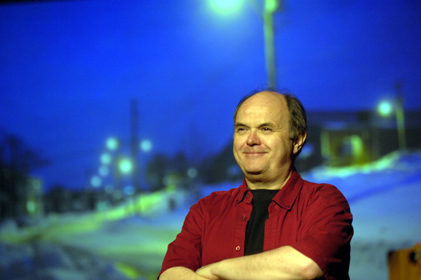
Andy Jones, To the Wall
photo Michael Rayner
Andy Jones, To the Wall
A pulpit and priestly vestments await Andy Jones on the stage. Religion is almost a compulsory subject for comedians today so I am not in the least bit surprised. As the spotlight focuses on the short, stocky and balding man, Jones takes on an evangelical persona and quickly establishes the character of the show.
Describing his Irish Catholic upbringing in Newfoundland, Jones colourfully re-enacts a ‘psychotic’ priest, childhood memories and the odd Newfoundland-Irish character with the help of projections. He calls a meeting in the theatre to which he invites God, suggests new additions to the human body (such as sexually attractive thermostats making visible emotional fluctuations), and uses a Newfoundland beef bucket as a metaphor for the randomness of life and the universe.
The premise of the show is that Stephen Hawking has a theory of the universe, however Jones has a better one. So in a one hour show Jones backs up his evolving theory with evidence. This is hard to follow at times with Jones’ liberal borrowings from scientific language, rabbits, randomness, throwing beef buckets of sand to form perfect maps of Newfoundland and Labrador, and finally the formula “TBP (Teddy Bears Picnic) = x [to the power of u to the power of u]” which supposedly created humans.
Funnily enough, many of his arguments seem logical and convincing, thanks in part to his charismatic personality. In fact, at the end of his psychotic priest impression, when he makes the sign of the cross, he is so convincing that a woman seated in front of me is compelled to follow.
Jones’ theatricalised standup formula is amusing, although at times he
crosses the line into ‘dirty old man’ territory, focusing on projections of female breasts, lusting over the young girls who are his onscreen assistants and making desperate ‘mating’ jokes—especially tiresome after he hands a gift of chocolates to a female audience member willing to confirm his sexism.
Despite these flaws and uninventive use of screen projections, Andy Jones educates a willing audience about the finer points of Newfoundland and its eccentric culture (and the fact that it is built on a rock). He’s convincing as an actor, and the vivid theatrical moments are easily the most amusing parts of his performance. Andy Jones did not make me laugh ‘til I cried, but To the Wall was a unique and entertaining introduction to an island culture on the other side of the earth.
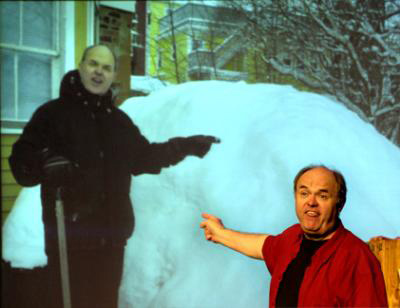
Andy Jones, To the Wall
photo Michael Rayner
Andy Jones, To the Wall
What were you doing when you heard about 9/11? Andy Jones was working on his theory of the universe, and though a self-proclaimed atheist, he prayed to God. And like many of us after these events he was left asking ‘Why?’ What God would allow such a thing to happen? Why are human beings able to inflict, and suffer, pain and misery? Worse still, why are we able to imagine such awful possibilities? These questions lead to his current thesis, delivered in the irreverent and humorous self-devised solo performance To the Wall.
Inspired by the popular writing of Stephen Hawking, this is a journey of amateur philosophy, theology and science. All the big questions get asked, and yet Jones finds many of his answers in the parochial tales from his own family history and their long involvement in the town of St John’s, Newfoundland. His overactive imagination is as ever expanding as the universe itself, seeming to drag everything and anything into his vortex of “N factor” reasoning (Newfoundlanders apparently do everything slightly different from everyone else).
The set is simple yet a little bizarre. There is a desk covered with a piece of crushed velvet, a ‘salt beef’ bucket, an old desktop computer, a wardrobe full of priestly vestments and a gold-detailed podium. Collectively they do not create a setting so much as provide Jones with a selection of props used at various points to elucidate his ramblings. The bucket for example aids Jones’ metaphor for chance: “How many times would you need to throw a salt beef bucket filled with sand to create a perfect image of a map of Newfoundland?” Image projection is used to similar ends with Jones’ wonderful family photographs from the early to mid 20th Century, epitomising the microcosmic dimension of his metaphysical investigations.
The intensity of Jones’ narration played on the anxiety I have experienced when cornered by a talkative boozer at the pub, or when a relative reaches for their photo album. It’s the fear of getting stuck in somebody else’s reality. Jones has studied the techniques of Newfoundland’s Irish Catholic preachers, and the ‘priest gone mad’ strategy has clearly influenced his own performance style. It’s akin to stand-up comedy, even Jones’ appearance—middle-aged man in nondescript black outfit with loud, open shirt—pays homage to this genre.
Jones is very much an entertainer and audience participation is part of his act though no one leaves their seat. Questions were posed to us and I was pulled into hypothetical scenarios, called upon to support his nutty ideas by raising a hand or stamping my feet. I became embroiled in Jones’ world by being made to laugh. To the Wall has many genuinely funny moments, and though it deals with life’s hardest questions this is essentially a light and engaging play.
Apparently, God invented randomness in the Big Bang in the hope of indirectly creating a “lovable equal other.” Jones establishes this role for himself in relation to his audience. Theorising that humour is a biological method of exuding “non-specific attractiveness”, his ridiculous imitation of a bird mating dance doubles as metaphor for the courtship between actor and audience in the theatre. Deviation into sexual innuendo and quips about gender politics however constitute the least interesting moments of this otherwise intelligent show.
Unfortunately the conclusion was abrupt and weak. Jones issues God an invitation to join us in the theatre for a question-and-answer session. He doesn’t come, and in frustration Jones proclaims his atheism. God instantly strikes him down! Or, was it just that he tripped over the keyboard cable? Either way, through the resultant paralysis Jones’ belief in the almighty is renewed and the final scene is a conversation between Hawking and Jones, projected in text and ‘spoken’ through voice synthesisers, where they debate their different theories about the origins of the universe. As Jones himself says, we may be alone but at least we have science. However, all the effort of setting up his theory of the universe over the course of the performance never seemed to pay off. Perhaps, as with science itself, the point is that theories are not always about proving a hypothesis correct—the value lies in the journey of inquiry itself.
The Knitting Room
photo Robyn Carney
The Knitting Room
Agapanthus, geranium and lavender bushes line the white picket fence. Inside the front door is the living room, home to an old dial telephone which sits on a small table with a crocheted tablecloth. A homemade sponge cake is ready for visitors and a turntable (His Masters Voice style) sits poised to play the nearby Elvis record. I could easily be describing my grandmother’s house; but this is The Knitting Room and all of these objects have been knitted, crocheted or woven to make up the exhibition at the Moonah Arts Centre.
The Knitting Room is intriguing for its colourful detail, its historical and cultural value and its surprisingly raw humour. A knitted tyre-swan, iced Vo-Vo’s, Flick bug-spray container, the milk bottles sitting by the door, are all iconic items now disappeared from everyday life. These specific objects of an era now passed, have been created by the over 300 participants in this exhibition whose average age is around 70, with the oldest aged 96. The Knitting Room arouses affectionate memories. The objects are so lovingly made and the room emits this enjoyment.
You enter via the front yard; and from there you are invited to step into the living room, the kitchen, the laundry and then the backyard. The living room is obviously primed for potential visitors, but the kitchen and laundry sit behind-the-scenes for the regular visitor. I feel as if I’m intruding as I observe a knitted woman relaxing in the privacy of the laundry with her feet up, a cigarette close at hand. Adding to this feeling, the rooms are all roped off giving it a distinct museum aura.
Jennie Gorringe, the Arts and Cultural Development Officer for Glenorchy Council, informs me that this exhibition is a collaboration between nursing home residents, community and environmental groups, the CWA, day centres “and artists”, which explains the eclectic mixture of styles, objects, methods of making and materials. I have to question Gorringe’s use of the word ‘artist’ however. Knitting has long been associated with craft, and more specifically with “women’s activity” and consequently, is rarely seen in the context of high art. I am aware of a number of female artists who are trying to subvert this assumption and, observing the skill displayed in The Knitting Room, it’s easy to see why. I believe all the participants in this exhibition should be acknowledged as artists. Labelling the exhibition as a ‘community project’ also somehow undermines the worth of these participants’ efforts. On the technical side, I am greatly in awe of the skill and time that created such a feat. I know from my own disastrous attempts at knitting!
The Centre expects 4000 visitors over the course of the exhibition, and has had a great deal of interstate interest following coverage on ABC TV’s The Collectors and The Arts Show. By the time I arrive at Moonah Arts Centre, the exhibition has been open only half an hour, but 55 people have passed through the doors. This is a true testament to the wide appeal and novelty of this theme, and entirely appropriate for such a moving exhibition.
“Even in an academic context I would never talk about the work of et al, still less ‘explain’ it… the process of viewing art provides the explanation, and it is invariably particular to the viewer. The artist is exactly the wrong person to explain their work…”
This statement by dr p mule (sic) on behalf of the collective, et al. is a telling introduction to the show by this New Zealand group entitled Maintenance of Social Solidarity.
Mounted in CAST Gallery, the oppressive atmosphere of the installation is established immediately by the deep grey walls and ceiling. While the construction of individual objects is rough there’s a strong sense of deliberation and formality to the arrangement of elements within the space. At the entry, I’m confronted with two rows of easels facing each other. I hear a kind of chant bleeding from the other side of the room. Each of the easels displays a poster that has been defaced by cut and paste and packing tape then overlaid with thick, dark, handwriting. This text is like an abstract poem that triggers thoughts about war, solidarity and human rights abuse without really saying anything:
Degrading treatment is
never
Hostility hate
& contempt
day of dooms
a morally
permissible
option
infidel
Hanging from each easel is a set of headphones with soundtrack, the overlaid digitised voices immediately reminiscent of Stephen Hawking. These voices relay excerpts of speeches from key figures in the current war in Iraq, the war in Afghanistan and responses to 9/11. Stripping the actual voice and intonation of the speakers—George W Bush and Osama Bin Laden are featured—places each on the same platform for debate without the prejudice or limitation associated with language or accent. While the idea is interesting, there is a generic quality to the soundtrack –I quickly return the headphones—I feel like I’ve heard it before, another exhibition, other artists.
The remaining elements in the show hang together as one. In the centre of the room a cyclone fence encloses a large projection screen. Twelve chairs sit under a spotlight in their own cell—taped markings on the floor—as if to house a jury or audience at an execution. A desk is lit by a bare bulb like a monitoring station in the midst of the gloom. The chairs and desk also suggest presences that watch and wait. Three more easels sit beside the twelve chairs and on the wall behind them is a grid of images that map mathematical equations, again, defaced by loose, hand written text.
Within the fenceline, the projections are from Google Earth. In digitised tones I hear—“Stockholm”, “Cairo”, “Frankfurt”, “Washington”, “Baghdad.” The projection responds, spinning across the surface of the earth in that familiar Google way before settling just above an airstrip, as if about to land. At first I thought it searched out actual locations, but after a few repeats of the loop, I realised that these were fictionalised places where all else but that which immediately surrounds the airstrip seems blurred, missing or perhaps obliterated. It is as if I am witnessing a series of virtual airstrikes, perhaps from a simulated cockpit. At a certain point in the recording, most notably after “Baghdad” is uttered, the screen freezes and the recording switches to the haunting chant I heard upon entering the space. Given its Middle Easter edge, I read this like a prayer sung prior to attack.
I feel as though I’ve stumbled into a military monitoring or strategy room. From what little I can find about the secretive collective et al., this show is both typical and unique. The consistent aesthetic, the deep grey paint and the elements that appear to be modelled on some militaristic institution are typical. What is not is the minimalism of this piece – the group is known for using a mass of outdated sound and screen technology, quite often to build a cacophonous atmosphere. The use of headphones here allows the sole soundtrack to dominate and the space is easy to read in its arrangement. Given the introduction suggests the work should stand alone, I expected to be able to come to some sort of conclusion about it, but this obtuseness is also typical of et al. While I don’t feel like I’m treading any new ground I am intrigued by this show and the visual imagery—quite beautiful in its own way—stays with me.
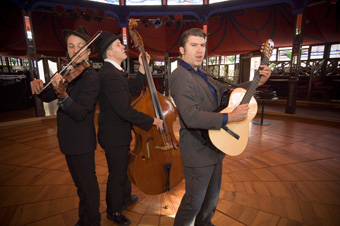
Mikelangelo & the Black Sea Gentlemen
photo Matt Newton
Mikelangelo & the Black Sea Gentlemen
The Nightingale of the Adriatic crooned and swooped in the crazy cage of the Crystal Palace last night, christened by the chants of the crowd The Baltic Stallion—they were swiftly corrected by the charming Balkan.
Mikelangelo’s statuesque form, clad in high black pants, danced in the mirrors beneath the chandeliers and disco ball of our devil’s kitchen. His voice soaked in sauerkraut, he truly was the devil sent from heaven. At one point, he enters the room like the Lone Ranger, guitar slung over one shoulder, dances on tabletops, caresses members of the audience, enticing even the most conservative of us into a fleshy sing-along—La, lah, lah, la, la. I left the show with blood thicker than wine racing through my veins, chanting La, lah, lah, la, la through Elizabeth Street Mall.
Mikelangelo and the Black Sea Gentlemen are a quintet—guitar, accordion, double bass, violin and clarinet. Each brings his own unique flavour to the mix—Moldavio recites a poem about his tragic downfall from taxidermy; an accountant who was sold to the circus as a child bellows a mournful song from the bar (“like love, sometimes the sweetest grape is the first to go rotten”); and Guido Libido suspends our disbelief in a fantastic short silent film sequence achieved simply with a screen and strobe light. The Gentlemen howl like dogs, crow like roosters and all openly and willing support their front man’s formidable persona.
Besides dubious Eastern European accents, the threads that bind these men are strong musicianship and a genuine sense of improvisation. Together, they radiate a lust for life. From the moment they enter the stage (and kiss each other on the cheeks three times) to the final encore (“seven hours worth of blood, sweat and tears in our home country but here rolled into three and a half minutes”!) there is a striking sense of humanity, a liveliness that opens up the possibility of even the humble potato becoming sexy.
Nothing is staged, rather it’s lived and shared. To be so genuine is risky but this is precisely what makes them so captivating. They embody a mock Slavic gloom and traverse a landscape in A minor where the sea leaves villages stuck in mud flats, where the weather is always bleak and where “we’re all just skeletons dancing in a sea of flesh”.
Mikelangelo demands attention like a Spanish bullfighter, and he and his Black Sea Gentlemen have written polkas for the 21st century that you won’t see on Eurovision.
All this and sauerkraut…I fear I may have become a groupie.
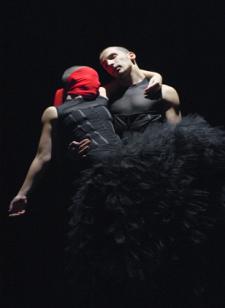
Mercy
photo Michael Rayner
Mercy
Mercy, the Raewyn Hill-Tasdance collaboration, proved curiously memorable, not the whole production, which problematically aestheticises imprisonment and torture into something quite beautiful (reds and blacks and columns of misty light evocative of fascist chic and movie concentration camps by night), but in a number of individual scenes and a final series that suggest a kind of narrative as an intimate couple go to their deaths.
The whole work, in its choreography, music and design is markedly formal. The brief passages of Pergolesi’s Marian Vespers determine the duration of each scene and evoke, of course, a religious formalism matched in the choreography by gestural imagery of supplication, benediction, crucifixion and pieta-like cradlings. Even their opposites—images of torment and torture—share a Baroque neatness, a dancerliness at times courtly and with evidence too of the balletic underpinnings of much modern dance. It’s when this formalism is broken or a series of images suddenly coalesce into something more potent that Mercy makes its mark in the memory.
A man, stretched out on the floor, wrestles with his chains but what disturbs is a sudden and repeated sharp stiffening of the whole body at the moment he puts his hands behind his back as if to have them bound. One victim struggles desperately in a swathe of red ribbon delicately wrapped about him by his tormentors. Another victim uses her body to plead with her gaoler, wrapping herself around him, climbing and clinging to him, losing grip to fall from his temporary or denied grasp. He catches her exhausted body one more time and she falls, totally and frighteningly limp, face down across his extended arms. He leaves her body behind. Is the gesture he makes one of perverted benediction? Another powerful image is of inert bodies carried in a slow dance across the stage, as if in rigor mortis.
Amanatidis and Dunn stand out in a somewhat uneven ensemble. Daniel Zika’s powerful lighting creates spaces both epic and claustrophobic. Greg Clarke’s costumes include identical bodices and striking skirts for male and female dancers (and the principals share short-cropped hair) creating ambiguity and dark elegance—creatures transcending gender and too beautiful to be destroyed. Unfortunately the balance of the costuming—bare-buttocked, leather strapped—looks the cliched stuff of S&M fantasy, reinforcing a feeling that the content of the work is at the mercy of a sleek aesthetic that undercuts the immediacy of its concerns—fortunately not always.
In a final series of images, Derek Amanatidis dances a remarkable solo of supplication, arms reaching high in a convincing embodiment of prayer, circling low
and returning again and again to stretch up for grace. Amanatidis and Trish Dunn whose bodies have hitherto remained apart but are drawn to one another now entwine in movements of subtle caring such as the gentle cradling of a head. The two separate and lie passively on the stage as a row of torturers advances slowly on them. There is no mercy here, perhaps only in the care they have shared and a dream of grace for those who believe in God’s beneficence—a distant prospect here for all the beauty of the music and the empathy of the choreography. Mercy is at its best when its images of suffering, supplication and caring are at their strongest, when the extremities of torment and yearning are palpable in the dancers’ bodies.
The major retrospective of Leigh Hobba’s work currently at TMAG offered the opportunity for live performance, and the potential was not wasted. Live work has formed an important part of Hobba’s practice since 1996 when he was involved in a number of collaborations at Adelaide’s EAF. This performance was a kind of ‘greatest hits parade’, as Hobba noted when introducing the work and himself. This disarming moment thankfully lightened the tone, which had become tense as an assembled audience of museum patrons and Tasmanian Arts intelligentsia scrambled for the limited seats. This was to be an event.
What then transpired was a gloriously ragged presentation of individual works that moved in and out of each other, creating a serendipitous whole that was strikingly engaging. There certainly appeared to be accidents and human error, but this added an element of informality that freed the work from being a mere rehash of past glories—here was a whole made of parts, like the stark self portraits of Hobba visible elsewhere in this retrospective. Not quite new work, but not a bloodless retread.
Variations 1, a work from the beginnings of Hobba’s practice was deemed the sensible place to start. Its striking use of shadow and the introduction of circular breathing—a technique of playing long, extended forms without interruption—was immediately arresting. This was ritual. Light and dark playing on the wall, the performer hidden yet totally audible, his disembodied silhouette huge, the image of his clarinet extending out to a vast length, every small movement exaggerated.
Unsure where one piece ended and the next began I gave up trying to decide: yes there was a change of pace here, the mood perceptibly shifted, Hobba spoke of Tasmanian tiger hunters, revealing how spoken text figures in his varied palette. Dancer, Wendy Morrow, a frequent collaborator took the stage and the focus for a time, but the sensation that every moment was an extension of the work prior, a growth out of it, was hard to shake. There was progression in the changes as the onstage monitors blinked awake, almost independent of the actual performers, they seemed to have a life of their own, competing for attention. Screen images were being triggered from assistants in the audience, yet the appearance was random, and the question of technical mishap seemed to hover—was this the intent? What was I seeing? And what was I hearing in the gorgeous trilling arpeggio that ended the piece as Hobba wandered out of the room and into the distance? He seemed elated somehow as he took in the applause, waving his clarinet in a gesture of triumph. Something had been achieved, something with deep significance to the personal world Leigh Hobba investigates.
The curatorial premise is promising. Free Range is an exhibition featuring 28 of Tasmania’s leading designers and their prototypes and one-off pieces of jewellery, furniture, sculpture, lights and ceramics. It claims to provide “…a rare opportunity for the participants to venture outside of the constraints of the designer/client relationship and to try something new or different.” I was hooked by this proposal and excited to find out what results when the creativity and imagination of skilled craftspeople is let loose. My hope was that it might be something truly original, aesthetically challenging, and possibly fabulous.
Unsurprisingly perhaps, given that the show is presented by Design Objects Tasmania, all works are object-based. Nevertheless, there is a contingent of works which range into conceptual or artistic territory. I was drawn to these pieces as they represent the furthest deviation from designers’ usual concern for functionality. Textile artist Grietje van Randen for example creates a very tactile full-scale replica of a potbelly stove. It’s made entirely from felted white merino wool and comments on lifestyle habits exacerbating global warming, and urges us toward sustainable living. Ceramicist Zsolt Faludi contributes Three Islands, a beautiful sculpture of clay, glaze, glass and resin symbolic of the hermetic nature of island culture. Rebecca Coote’s two light objects (the largest sized 100 by 80 centimetres) are tentacle-like architectural installations of glass that wrap around corners and dangle from ledges, while Martin Warren’s intensely coloured slumped glass baskets stretch down from above like cooling toffee. These pieces reflect artisans taking delight in challenging the physical and visual potential of their media, as well their own skill.
Furniture is perhaps the most conservative category of works in this show. A number of unchallenging but nevertheless elegant table, seat and cabinet designs feature the precious indigenous timbers (such as Huon Pine, King Billy Pine and Celery Top Pine) ubiquitous in handcrafted Tasmanian furniture at present.
Patrick Hall’s Typeface is a notable exception. A visually heavy, boxy structure 1.8 metres in height, this piece grapples with recollection through the form of an archival cabinet filled with drawers. The collection—ceramic fragments illustrated with photographic images of faces, labelled with strange catch phrases—are not hidden inside but encased behind glass in the drawer-fronts themselves. This exquisite and conceptually complex object evidences Hall’s statement that his practice “is based in craft, is informed by design, but deals with ‘fine art’ concerns.”
Peter Prassil’s Recreational Device is a reclining lounge chair of aluminium, stainless steel and black leather, gadget-ed with microphone and amplifiers. Stylistically sitting somewhere between a dentist chair and the space age interior designs of the 1960s, this furniture piece also stands out for truly shaking off concerns of practicality and commercial viability in favour of fantasy.
The setting of Mawson’s Waterside Pavilion, a purpose-built design showroom, ensures this exhibition maintains an industrial feel. It could have been interesting to view these pieces in a gallery setting, and a number would certainly have benefited from controlled lighting. Alternatively it would be wonderful to actually sit in Prasil’s chair and find out what the microphone and amplifiers did, or to see Megan Perkins leather belts with luscious enamel buckles modelled.
As it is, these disparate works are collated in Free Range almost like an expo and not quite like an art exhibition and as such fail to capitalise on the opportunities of either format. A picture of avant-garde practice from the creative hybrid zones beyond commercial design is not quite realised overall, yet I sense Kevin Perkins could have addressed this to a degree through stronger curatorial direction. There are undoubtedly many very beautiful objects in Free Range and if I think of the show simply as a loose survey of creativity in contemporary local design, it is an excellent indication of the breadth and vibrancy of the industry here in Tasmania.
The Hobart Chamber Orchestra and Tasmanian Chorale’s concert for Ten Days on the Island lovingly entwined the music of Britain’s Henry Purcell and Ralph Vaughan Williams with works by Tasmania’s Don Kay and Peter Sculthorpe in an engrossing program that for good reason felt more British than Australian. That’s largely because Kay’s Matthina in the Red Dress and Sculthorpe’s My Country Childhood, despite local references, evoke the pastoral tradition of British music (Delius, Bax et al) in the finely modulated long lines of their writing for violins and violas and the darker, often telling underpinnings from cellos and basses. The Kay is inspired by an 1842 portrait by Thomas Bock of a young Aboriginal girl in an elegant dress; the Sculthorpe ‘country’ is in part the Tasmania in which he grew up.
A copy of the Matthina portrait sits to once side of the orchestra in the Town Hall, the girl’s apparent serenity and the quiet directness of her gaze captured in the gentle lyricism of Kay’s composition. There’s nothing programmatic about the score, but there is a gradual if always subtle darkening of mood from the cellos, a few sudden silences, like a dance interrupted, and some later plucking and then firm bowing of the double basses (perhaps a moment of disquiet about what the composer sees in the portrait), ending softly and fading with just the slightest hint of discordance. It’s a work more about the viewer of the painting than its subject—there’s a certain elegiac quality although none of the melancholy of nostalgia.
The Four English Folk Songs by Ralph Vaughan Williams are an acquired taste, but the Tasmanian Chorale under the direction of Stephanie Abercromby acquitted them with ease, attentive to the complex layerings with which Williams embroidered and sometimes laboured such simple songs. Their interest resides in part in juxtaposing them with Purcell’s Dido and Aeneas, the first English opera, written some 200 years before the Vaughan Williams and presented in the second part of the concert.
Sculthorpe’s My Country Childhood proved a fine companion piece for the Kay composition, opening in a similar way in part one, Song of the Hills, with a fetching iterated melody and a slight darkening from beneath before a solo violin sings out above the rest. Part two, A Church Gathering, although warmly contrapuntal, evokes a sense of yearning and again the solo violin rises heavenwards. In part three, A Village Funeral, cellos and basses brood, the cello this time dominant in a kind of keening followed by a surge of affecting anguish, heightened by the violins and concluding with diminishing cadences of the same hurt—death now almost accepted. Finally, in Song of the River rapid soft fiddling provides a sense of a speeding current over which run slower waters suggested by a melancholy cello before the whole speeds up in almost frantic ripplings—it’s a wonderful dance of a river as much as a song.
Conductor Myer Fredman paced Dido and Aeneas at the speed it warrants—brisk, allowing the spare drama to unfold without strain and for the listener to feel the considerable force of a string orchestra fattened out with harpsichord, an experience aided by the intimate, clean acoustic of Hobart’s Town Hall. The soloists were all in fine voice, Jane Edwards above all, her Dido heartfelt, unmelodramatic and the continuo playing (cello, Tony Morgan; harpsichord, Stephanie Abercromby) providing firm underpinning for the vocal action. The Tasmanian Chorale were allowed to display their full power and, in the sad final song, their capacity for nuance. This was not a period instrument presentation but the continuo playing and Fredman’s dance-like drive yielded the requisite crispness, elegance and passion.
Entwined was an unusual experience—a traversal of 300 years of music largely out of one tradition, moving broadly from the present to the past, and teasing out kinships between islands—sharing elegance, reflectiveness and a subtle dancerliness in these works. Then again, there was nothing like Sculthorpe’s Sun Music on the program to point to some palpable differences.
We live in a world of make-believe. We access more information than ever before but the technologies that make this possible can also blur our vision of reality. We are under the misconception that information is knowledge. We become insecure and, as we struggle to connect a constructed view of reality with our own lived experiences, ours is no longer a shared reality but a shared ‘dis-reality.’
The strongest point of audience engagement with et al.’s Maintenance of Social Solidarity appears to be in unpacking the theories it presents. The exhibition notes present six introductions to the New Zealand collective which investigates our systems of belief and defines our current state of disconnection. Etal suggests our freedom is at stake when we can no longer choose what we see and hear, perversely distorting our image of the ‘real’ world.
The room is set up like some self-ordering information bunker. The walls are gun-metal blue and a high wire fence encloses a large projected image of the Google map search engine, constantly scanning city to city around the world. As we zoom in on landscapes (bunkers, airstrips and military installations) devoid of any cultural detail, a computer animated voice tells us where we are. This sense of removal is a reccurring theme in the work. Through various technological means (headphones, projectors, laptops etc) we are reminded that ours is a constructed reality that we do not control. Political jargon and religious discourse rather than geography keep us distant from other peoples and lands, generating a sense of us and them and consequent insecurity.
A section of the space is set up with a series of easels to which are pinned large printed posters that have been defaced by a variety of packing and adhesive tapes. Each easel has a set of headphones attached. Some have a mouthpiece so you feel like a scud missile launcher when you put them on. But the mouthpieces don’t work and so the potential of dialogue becomes monologue as computer enhanced male and female voices speak in what first appears to be a familiar media discourse. It soon becomes apparent that the information we hear is mumbo-jumbo. Suddenly I feel angry, as if my time has been wasted listening to a distant rhetoric that pollutes my reality.
At the foot of each easel is a pile of street press style publications which you can take away with you. They are filled with abstracted imagery of sun-spots and quotes from George W Bush, Osama bin Laden and Saddam Hussein relating to God, freedom and change. Selected words in each quotation have file paths attached, abstracting them and making them seem computer generated.
Sporadic musical chanting is a reminder of our need to connect for more than just information exchange and heightens awareness of our isolation in a room full of technological equipment and computerised voices. Without being culture or gender specific, the Maintenance of Social Solidarity suggests that these notions of isolation and shared dis-reality are everyone’s concern. We are collectively, not individually, to blame for the displacement of our culture. By creating an awareness of how media and political middlemen make meaning for us we become aware of just how distorted our world view may have become. It makes me want to get straight to the source: to have a cup of tea and conversation with someone across the other side of the world and to hear about their reality.
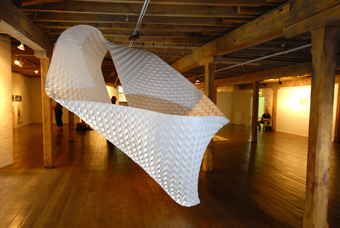
Alex Pentek, Otherness
photo Craig Opie
Alex Pentek, Otherness
Alex Pentek’s Otherness is a monumental metre-wide Mobius strip constructed from a single length of cartridge paper approximately four metres long. The paper sheet is brought into relief through a meticulous process of scoring and folding. Beginning as a repetition of diamond shapes the folded texture morphs into rounded scales before gradually returning to the original pattern. The loop and twist of the overall structure is simple and graceful.
Amidst the already eclectic range of work in the exhibition An Other Place, Otherness it is an odd entity to encounter. It is big, white and its place within the exhibition concept is at first obtuse. Initially, I complacently assume I understand its investigation: something along the lines of a formalist pursuit of perfection. And I am only vaguely interested.
The sculpture is accessible from all angles and as I wander around its girth peering over its lip into its folds, I begin to realise I’ve been too hasty in judging it. Suspended on wires, it all but fills the volume of space between gallery ceiling and floor. In a dialogue of bodies I warm to this “white elephant” and begin to notice its surprising subtlety.
Natural light passes through the semi-opaque paper, bouncing off and between its surfaces. The interior has the luminescence of a seashell from some angles and elsewhere the gallery’s lighting throws facets of the paper into contrasting yellow and shadow-blue. Disturbances in the air trigger a gentle bounce across the paper structure, a reminder of the material weightlessness of Otherness.
Alex Pentek, Otherness (detail)
photo Craig Opie
Alex Pentek, Otherness (detail)
Crinkles, dents, small tears and holes made accidentally in folding mark the entire surface. No effort has been made to disguise the join in the paper strip, nor the reinforced attachment points of the hanging mechanism. Perhaps the artist was pursuing consistency and perfection, but this work is very much handmade and it bears testament to the fact that the artist is human not machine. The humility of the work renders the concentration, accuracy, care and persistence involved in the Pentek’s labour all the more potent.
An Other Place brings together three Irish and three Australian contemporary artists to explore the notion of ‘other in place’ (felt especially in island places) and curator Sean Kelly in his catalogue essay writes of the slippage between familiarity and confusion associated with this precarious state of being. This concept made tangible in the shifting pattern of Pentek’s work and the eternal loop of the Mobius strip is a powerful metaphor for transition occurring between assimilation and difference within one continuous entity. The play between inside/outside and the twisting that turns both sides of the paper outwards speaks of inversion and extroversion.
Pentek’s sculpture is a floating island: physically self-contained and visually at odds with other works in the show. Its scale makes Otherness impossible to overlook, yet its presence is paradoxically unassuming. What at first appeared a cold rather conceptual and self-referential work turned out, through interaction, to be sensual and receptive.
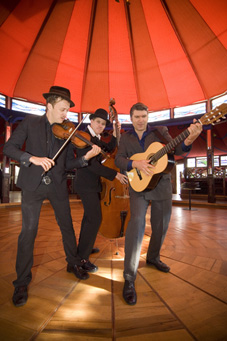
Mikelangelo and the Black Sea Gentlemen
photo Matt Newton
Mikelangelo and the Black Sea Gentlemen
Mikelangelo pauses to run a comb through his slicked-back hair “ This song is a rumination on gloom” he announces to the teary eyed audience. That’s right folks; don’t wear your mascara to this one. Mikelangelo and the Black Sea Gentlemen is an hysterically funny gypsy cabaret group playing at the Crystal Palace this week.
Mikelangelo is the handsome charismatic ringleader with a voice so absurdly deep that it competes with the double bass. Rufino the Catalan Casanova is a shifty looking violinist with the ability to jump onto tables without missing a note. On the clarinet is The Great Muldavio, a taxidermist on the run from an avenging duchess. Guido Libido, on the piano accordion, looks suspiciously like Uncle Fester (unlike the other Gentlemen, he refrains from singing because his tongue has been cut out in a battle over a woman and replaced with the tongue of a bull). Little Ivan, the bass player, may have been behind the killing of Mikelangelo’s entire family. These characters are completed with immaculate suits, intriguingly sexy European accents and morbid tales of their past.
This is black humour at its best. The truly macabre stories are told through monologues, dramatic re-enactments and satirical songs for which the Eastern European style arrangements are perfect especially for songs like It’s one of those A-Minor Days.
My favourite has to be A Formidable Marinade, a klezmer-themed tune. Besides the song itself which demonstrates the group’s expert musical and song writing abilities the melodramatics that accompany the performance are pretty impressive: Mikelangelo slides through the audience and between the tables like an animal possessed, while singing:
“Sodomy is not just for animals
Human flesh is not just for cannibals
I’ll feast on your body if you feast on mine
Blood is thicker and redder than wine
Lay ourselves out upon the table
Ravish each other ‘til we’re no longer able
When juices mix in the heat of the fray
It will make a formidable… marinade.”
At this point Rufino leaps onto a table and, ripping into his violin, plays a spine-chilling solo, his fingers climbing up the fingerboard to the bridge, higher and higher. The tortuously high notes truly make the described lust real.
The smoke and lights filling the circus tent- style venue provide the perfect stage for a group that enjoys interacting with the audience, jumping onto tables and visiting the bar mid-show (which reminds me: for the ultimate Gentlemen experience, make sure you have a glass of vino in your hand).
Their encore which they describe as a seven hour ordeal squeezed into three minutes of blood, sweat and tears, was rejected by Eurovision, and I probably don’t have to tell you that the producers haven’t any taste. I was trying not to mention the word taste but these are classy gentlemen. However dubious their subject matter, they pull it off, and they pull it off well. Although the band sound great on CD their utterly seductive show has to be seen to believed.