Australian
and international
exploratory
performance and
media arts
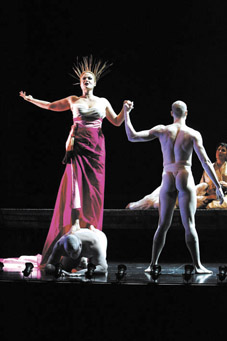
Katrina Sheppeard, The Love of the Nightingale
photo Rob MacColl
Katrina Sheppeard, The Love of the Nightingale
THERE IS SOMETHING BOTH ENDEARING AND ABSURD ABOUT OPERA AND IT’S NOT THAT IT’S NOT OVER UNTIL THE FAT LADY SINGS. IT’S IMPOSSIBLE NOT TO MENTION THE OPINION OF DR SAMUEL JOHNSON CITED RECENTLY IN THE AUSTRALIAN THAT IT IS AN “EXOTICK AND IRRATIONAL ENTERTAINMENT.” LIKE A CRAZY MARXIST AUNT FROM ANOTHER ERA, OPERA CAN SEEM BOTH HOPELESSLY ANACHRONISTIC AND EMBARRASSING, TOO PRONE TO WEEP OVER LOST CAUSES LIKE, WELL, HUMANITY. IN THE POSTHUMAN WORLD, WE WEEP OVER THE BOTTOM LINE, AND OPERA COMPANIES HAVE MUCH TO WEEP ABOUT IN THIS RESPECT.
But since words have been cannibalised into sound-bites and rhetoric trammelled in the mud of world wars and worse, opera seems well-suited to express our most primal or sublime emotions, and something of those in between. In a cheek by jowl inner suburb in Brisbane sometimes it becomes impossible to edit out the intimate transactions of neighbours. When the phone rang in the home of an elderly Greek couple, the awful pause and ensuing deep male keening accompanied by the broken recitative of a female voice told its own story (their son had died). It seems to me that it would be impossible to render the speechless anguish and profundity of such a moment in any form other than opera (unless in the silent scream of visual art). The American musical has its own fine attributes, but doesn’t quite cut the mustard unless we count George Gershwin’s Porgy and Bess, a self-styled folk opera. From Artaud onwards, avant-garde theatre has aspired to the total experience of Eastern opera while denigrating Western opera as a bourgeois art form, forgetting that ‘bel canto’ was once as popular as ‘the beautiful game’ [soccer, Ed.]. Beaumarchais’ farcical play The Marriage of Figaro was credited with being the insurrectionist spark that inflamed the French Revolution, and was adapted into an equally subversive operatic masterpiece by Mozart. More recently, John Adams’ controversial modern opera Death of Klinghoffer caused a bitter international debate. The mad old aunt is still dancing away.
l’orpheo
The 2007 Queensland Music Festival wins the World Cup by fielding the first (still one of the finest), and our home team’s very impressive latest, contribution to the operatic tradition. The festival participated in the 400th anniversary of Claudio Monteverdi’s and Alessandro Striggio’s L’Orpheo which is being celebrated world-wide, while mounting the world premiere season of Richard Mills’ and Timberlake Wertenbaker’s The Love of The Nightingale. L’Orpheo was first performed before a court audience (although Monteverdi’s second lost opera was presented al fresco before a reputed audience of 5000) so that the neo-classical, acoustically friendly venue at the Masonic Memorial Temple with its back-straightening wooden pews chimed. It was a sumptuous feast, not because a lot of money had been spent (it was sparsely but adequately staged in the round), but because of the superlative and enthusiastic rendering by the mainly young cast of Griffith’s Conservatorium singers, and the accompanying musical ravishment.
We were on intimate terms with the inner workings of the period music ensemble led by the disarmingly undemonstrative harpist Marshall McGuire. Violone, harpsichord, theorbo, cornetto, sackbut and regal were some of the instruments rarely seen or heard that made the orchestra as entrancing to watch as to listen to, as on the spot as a jazz combo. The loud cacophany of brass and drums, the harmony and rhythm of ‘continuo’ instruments like the organ, cello and viola, and melodic ones such as the recorder were a combined knockout in their day, and are familiarly dissonant in the manner, say, of Kurt Weill to modern ears. Like the songster Weill, Monteverdi turned out some hot madrigals, although he also wrote church music as well as writing for the more profane medium of the theatre. A kind of brilliant musical ‘bricoleur’, Monteverdi mixed and matched: the opening bars of L’Orpheo are the same as his Vespers. It was this conflux of church music, love songs, and dramatic feelings that defined a new genre. By extolling in then voguish Neo-Platonic terms the ‘civilising’ power of music in the classical Orpheus and Eurydice myth, Monteverdi raised men and women to the heights of the gods in what has been regarded by many as the first humanist manifesto. On opening night, Gregory Massingham as Orpheo had lost his voice. His part was sung by Trevor Pichanick while Massingham performed the role. Pichanick’s bel canto rendition grew wonderfully in stature, and a warm and supportive audience responded to the potentially awkward arrangement with appropriately civilised demeanour.
the love of the nightingale
The Love of the Nightingale tenders a less optimistic, less harmonious version of the humanist project from a soured, latterday perspective of civilisation and its discontents. Based on a darker classical myth from Ovid’s Metamorphoses, it sets up an opposition between liberal, sunny Athens and gloomy, repressive Thrace which has come to its aid in times of war, but really it’s the fracture in any society’s psyche between the ineffectual voice of conscience and dumb violence.
The liberator from the North, Tereus, asks only to marry the King’s daughter, Procne, to the chagrin of her naïve younger sister, Philomele. Five years later and after the birth of her son, Itys, Procne languishes for her sister’s company, and asks her husband, Tereus, to escort Philomele back to Thrace on a visit. On the journey homeward, Tereus rapes Philomele and, in a desperate bid to cover his tracks, cuts out her tongue. Philomele is prevented from asking the most basic question: Why? When the deed is exposed, Procne exacts revenge by slaughtering her own sword-wielding, father-proxy child because: “We did not want that future. A future without questions.” Rather than offering the slaying of the patriarchal line as a solution, there is devastating irony here because one of the questions relates to the murder of children. The only hope—because “the blood had to stop flowing, the anger had to subside”—is radical transformation magically provided by Ovid who has the three protagonists turn into birds. In the opera, the possibility of transcendence is made heartbreakingly transparent in a sort of afterlife coda when Itys asks: “Why aren’t you speaking Philomele? Don’t you want me to ask questions?” Philomele breaks into the pure wordless song of the nightingale and we are brought full circle to meditate on the hope (and hopelessness) of the civilising power of music extolled in L’Orpheo.
Wertenbaker’s libretto is simply marvellous in its self-awareness, and Anke Hoppner as Procne and Leanne Kenneally as Philomele interpretively and vocally outstanding, but I found Mill’s post-romantic score (and I’ll be howled down for this) had too many unnecessary strings, literal and figurative, attached. Nevertheless I was still intensely aware that my mad old aunt was dancing.
L’Orpheo, composer Claudio Monteverdi, librettist Alessandro Striggio, musical director Marshall McGuire, stage director Caroline Stacey, designer Kaoru Alfonso, lighting designer George Meijer, Ludovico’s band, chorus and orchestra staff and students Queensland Conservatorium Griffith University; Masonic Memorial Temple, July 23, 25, 27; The Love of the Nightingale, composer Richard Mills, librettist Timberlake Wertenbaker, conductor Richard Gill, director Lindy Hume, designer Dan Potra, costumes Kate Hawley, lighting Nigel Levings; Opera Queensland, Playhouse Queensland Performing Arts Centre, July 13, 16, 18
RealTime issue #81 Oct-Nov 2007 pg. 49
© Douglas Leonard; for permission to reproduce apply to realtime@realtimearts.net
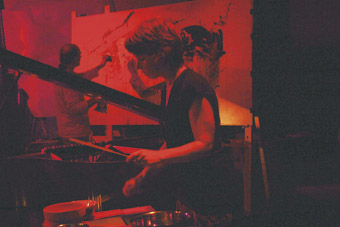
Tony Cuthbertson, Vanessa Tomlinson, See Hear Now
photo Glen O’Malley
Tony Cuthbertson, Vanessa Tomlinson, See Hear Now
IN SEE HEAR NOW 2007, QUALITY COLLABORATIONS AND SYNERGIES ABOUNDED; IT WAS THE AUDIENCES WHICH WERE THIN. TROPICAL TOWNSVILLE’S COLDEST WINTER ON RECORD MUST HAVE KEPT ITS FROST-TENDER INHABITANTS INDOORS, UNWILLING TO BRAVE THE UNSEASONABLE COLD(ISH) SNAP EVEN FOR THE LIKES OF DISTINGUISHED VISITORS, BONEMAP AND JIM DENLEY, CLOCKED OUT DUO AND LAWRENCE ENGLISH. THE COMPENSATORY ASPECT OF SMALL AUDIENCE NUMBERS WAS THE FEEL OF FAMILY GATHERING/MASTER JAM SESSION.
performance 7: lapse
Previous collaboration between Bonemap and Denley was evident in Lapse, the piece straddling the divide between improvisation and rehearsed polish. The aural contortions of Denley’s sax were complemented dynamically by Russell Milledge’s dripping, synthesized percussion in the early stages of the piece. Projections of numbers and computations flickered across the walls, amplifying Rebecca Youdell’s stressed, erratic movements. Youdell, in a vintage black ruffled dress, played to the spotlight, flitted and flirted with the saxophonist, intermittently connected with him, calmed; then the next wave of moaning, wailing sax threw her back to her obsessive scrubbing, quarantined by the circle of the spotlight into her involuntary dance, untouchable.
Youdell bumped against visual artists scratching away at their easels on the periphery, and tangled with an unseen protagonist. Black and white projections of body silhouettes appeared, initially floating and swirling like a Bond film intro, but at times becoming frantic and distorted. Youdell clawed at her costume.
The visual artists laughed, sharing a separate moment, but the laughter almost mocked the dancer’s vulnerability. The projections turned into a hall of mirrors reflecting a filmed Youdell in a red dress torn and pinned together with safety pins. Her shadow interrupted her screen self as she mimicked its movements.
Distorted words filtered through the sax and the laptop. Youdell screwed up her face and tilted her head in an effort to decipher.
Lapse gave away its performance history with a neat wrap up, the music and visuals ending as Youdell faced the audience, styled like a catwalk model, placed her hand under her long hair and flipped it forward to hide her face.
challenges
In contrast, not a few of the festival’s 20 performances were overlong and dawdled scrappily to their conclusions. Works which were solidly captivating in their first half died as the ideas ran thin. This could have been due to the pressures of improvisation.
Another challenge was the role of the visual artists. They tended to be placed at the edges of the action, contrary to the claim in the program: “Visual artists feature…as an integral performing and documenting element, enabling the audience to simultaneously view a number of different visual interpretations of the performance.” However, lighting, projections and distance often prevented the audience from seeing the marks being laid down. Occasionally artist movements at the easels served as an iteration of the larger performance, but mostly it seemed extraneous. Visual art incorporating new media practices were integrated more successfully, with projected film and stills essential to the ambience of many of the multidisciplinary pieces.
performance 4: untitled
The most effective incorporation of visual art was achieved in Performance 4.
Movement artists Nicole Keen and Kate Hooper were wrapped together in a single stretchy white sack centrestage. As they contorted in response to Amanda Stewart’s vocal performance, visual artist Michelle Deveze drew on the cloth. Slower passages allowed her to make deliberately directed work, while at times the movement artists’ staccato responses caused Deveze’s charcoal marks to become random and opportunistic, confined to wherever she could establish contact with her heaving canvas in the moment. A further layer of intrigue was added by local artist Donna Foley’s simultaneous responses using a data tablet, the images projected onto the dancers and walls.
Stewart’s voicework and Foley’s projections carried a heightened synergy underpinned by Foley’s specialisation in the intersection of the visual and aural. Just as Stewart pares back language from the coherent into its component parts, Foley’s calligraphy, using stylus on data tablet, is like pre-writing scribble, almost fooling the audience into believing they could decipher, in Foley’s chaotic, lacy marks, what Stewart was vocalising.
The intensity showed in Stewart’s mobile features and taut neck muscles as she worked rapidly back and forth between two microphones. An unbelievable array of effects was conjured. At times it was like someone quickly turning an old radio dial across stations, or overhearing the sighs, whispers and tragedies of the inhabitants of a whole apartment block all at once.
In between evoking echoes of kissing, popping, chattering teeth, ripping velcro, rain, trains, Morse code from space or a penguin colony in distress with her hoarse, breathy scat, Stewart threw in the odd, tantilising word, which she later described as “a rant for the underlings; women and low caste people.”
Foley’s projected marks changed colour, overlapped, intensified until the screen was practically filled, emptied and the process begun again. The lighting replicated changing weather. Photographer Glenn O’Mallley ducked and wove through the action, adding his shadow to the backdrop as he recorded Deveze trying to tame a ground which behaved like a large, unruly and reluctant animal.
Eventually Stewart’s vocals wound down from disturbing to soothing, ending quietly with “fait accompli…the economics of us…” She walked away from the microphones cueing Foley and Deveze’s last slow lines as they all eyed each other.
These disparate elements married to produce a multidimensional, sensual and random collage. The eye was kept moving, the ear straining and the mind racing to connect the nuances of voice, hand and body: an engrossing journey.
performance 11: after milk wood
Three actors based in North Queensland, Christopher Glover, Susan Prince and John Robertson, performed as an array of characters in a text derived from Dylan Thomas’ Under Milk Wood. The shifts from character to character intensified in pace and visual projections reinforced the rhythm of the dialogue. With the speakers’ faces distorted by the strongly coloured uplights and partly obscured by the projections onto their semi-transparent cage, the focus was firmly on the powerful poetry.
Brisbane-based media artist and composer Lawrence English stood at his laptop computer for the first two-thirds of the performance, recording, mixing and sampling to produce a soundscape playback for the final third. As the actors fell silent and still, English’s playback commenced with a sound like humming machinery, a faint tune and feedback. Bites and echoes of the spoken performance became audible, passages of dialogue were repeated, snippets of biting and nagging, interspersed with a squeaking wheel turning reluctantly. Thomas’s words were rearranged, new dialogue formed between characters in English’s reflexive mixing—the dreams of Milk Wood’s characters disintegrated and reintegrated as night terrors.
This time, the frantic, responsive work of the visual artists at the edges of the performance space added several unexpected elements to the whole. Working on paper with dry media, the rustling, crunching and scratching enhanced the mood of the piece and could be heard in the playback, providing layers of night sounds like rats scuttling and leaves blowing. Deveze, Jenny Tyack, Gerald Soworka and Katherine Cornwall continued to work on through the playback, responding to the mixto which they had already contributed. The movement of the visual artists in the half light of the stage periphery also added a sense of dark things lurking at the barely discernable edges of consciousness during sleep and dreams.
panel 4: spoken music, stationary movement
At a brief forum held at the end of day three, a group of participants examined the potential of movement and text in contemporary performance. Discussion ensued on the hierarchy of forms in each performance, which led, of course, to the question ‘What constitutes Art?’ Group? Language? Neurology? Someone commented that for an infant learning language everything is interrelated, and involves control of movement/hand/mouth/ ear. This neatly encapsulated the tone of the festival, its cross disciplinary experiments and unexpected synergies, and its extended family inclusiveness.
See Hear Now 2007, Multi-Arts Festival, director Michael Whiticker, Townsville, June 21-24
RealTime issue #81 Oct-Nov 2007 pg. 50
© Bernadette Ashley; for permission to reproduce apply to realtime@realtimearts.net
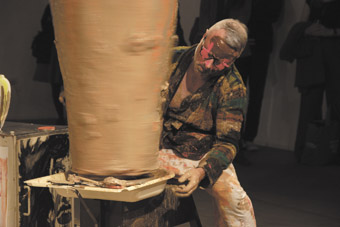
Guy Benfield, Maximum Commune (Ugly Business… on the basis of disbelief.), performance still
photo Jennifer Leahy, Silversalt, courtesy of the artist
Guy Benfield, Maximum Commune (Ugly Business… on the basis of disbelief.), performance still
IN AFTERMATH, BLAIR FRENCH, DIRECTOR AT ARTSPACE AND CURATOR, BROUGHT TOGETHER A GROUP OF ARTISTS ALL OF WHOM MANIFEST THEIR INSTALLATIONS THROUGH AN EXPLORATION OF PERFORMANCE, THAT IS, THE WORKS RESULT FROM A LIVE TRANSACTION BETWEEN ARTIST AND AUDIENCE. THE IDEA BEHIND AFTERMATH SEEMS TO BE TO EXPLORE THE ESSENTIAL PERFORMATIVITY OF INSTALLATION.
This is not in itself a new idea. French began to explore this notion in detail at Performance Space some years ago while working as its director in charge of time-based art. There, in influential projects like Cerebellum in 2002 with Gary Carsley, artists such as the Kingpins and Monica Tichacek presented video work alongside an exhibition of the ‘part objects’ of Leigh Bowery: his fake lips and costumes. In this show the images and videos were all part objects in that they could represent the whole absent object (Bowery or the other artists and their actions). In other words the objects and the videos were displayed only partly as things in themselves and mainly in terms of how they translated a performance event which was no longer comprehensible in any other way.
The blurb for Aftermath on the Artspace website indicates a similar focus on “the complex relationship of performance to installation art, sharing a genealogy, as they do, in early conceptual and post-object art.” But with Aftermath the emphasis is slightly altered as it “centres on the installation ‘aftermath’ of performance, or conversely, performance as a strategy for creation of material environments.” So rather than the installation being framed as the part object split off from the body of the artist, it now functions mainly as an object in its own right but one which represents “the bleeding back and forth of active models of performance and its post-life.”
guy benfield
Guy Benfield’s performance in Maximum Commune (Ugly Business…on the basis of disbelief) was designed to “re-animate tropes that were once declared obsolete, such as ritual, live action painting…the ‘Art informal’ movement in France, and the Japanese actionist painting movement-Gutai group.” And one should add the anarchic Paul McCarthy’s 1995 work Painter to this list as the most obvious intertext. Like all the artist statements in Aftermath, Benfield’s own descriptions of the work are worth examining for their oddly accurate account of the achievement of their experiments. He describes his essentially citational actions as “droppings” or “situational episodes” in a way that nicely combines the excremental notion of the art object as by-product of an ongoing process with the idea that the foundation of the performance action is its occurrence in space, its situated-ness, the aftermath of which is the installation.
The chaotic deconstructed pavilion motif of this work remained in the gallery for three weeks after the initial performance with a monitor displaying edits of the frenzied video documentation by TV Moore. The humour and energy of this piece reminded me of Benfield’s French Pup/live action (2001) a video work in which a long-haired rock guitarist dips the head of his guitar in paint and smears the walls and a canvas with it. Like Maximum Commune this earlier work is another play on performance and its various afterlives in recordings and documentations. The colour and chaos of the opening action was still in evidence three weeks after the event itself which is already I think the kind of effect the curator was after.
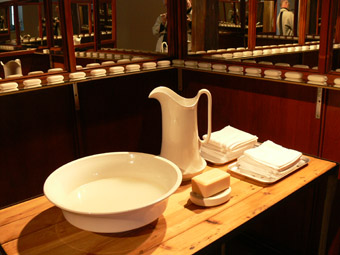
Ann Graham, Aftermath
photo Tony Bond
Ann Graham, Aftermath
anne graham
Anne Graham’s In Between Spaces comprised eight adjacent booths designed to correspond “to a normal dwelling: a bedroom, a bathroom, a kitchen, a studio, a library, a living room, an office and a gallery.” The initial performance (“situational episode”) involved a number of those present (yes me too) blowing up pink balloons for the “rumpus room” while Graham’s partner Tony Bond performed his signature risotto creation to feed all those in attendance. Their performative hospitality was no less sincere for its scale and constructedness. Perhaps this was evidence of what the blurb laid out as “the formal framework for the work” in a number of the “everyday routines that occur while occupying these spaces” in which the spaces become more than simply functional and approach the status of “social sculptures.”
The rooms/spaces were certainly organised and arranged after different activities with a DJ in one room, and hair cutting gear in another. But for me the room with the bars of soap and little carafes of urine was the most suggestive of the “intimate and familiar activities that…will appear strange due to their displacement.” (see RT80, p12).The repeated references in the artist’s statement to the dislocation of “normal” activities and arrangements is reinforced by the origin of these furnishings. The dark wood panels of the booths had been part of an old psychiatric institution and the artist had retained them for precisely this kind of work.
I don’t know if this installation can be described as “social sculpture” which operates on a broader and much more ambitious scale than this. But the sense of invitation to revisit was strong. The poeticised space of the different rooms was not so much a trace of an absent performance but a trigger for multiple interactions and experiences.
franz ehmann
“The new message reverberates in a never-ending forever young. I am with you, for you and amongst you.” I have no idea what the title of Franz Ehmann’s delightful work, forever young, references (please tell me it’s not the Alphaville track from their 1984 album) and his description of it as “a sculptural text food performance event with materials akin to theatre props” may not help those of you who didn’t see it (the polenta and mushrooms he made us on the opening night were delicious). His goofy and self-deprecating way of demonstrating the various interactive components of his installation was less about providing information and more about generating a sense of play so perhaps the title can be understood in terms of this childlike playfulness in the midst of endless reporting of violence and brutality.
Ehmann’s ‘newspaper floor’ was surprisingly sturdy and contained folds and tucks which could be used as spaces for the visitors to inhabit in various ways. Helpful instructions were provided in the form of illustrations on the walls advising visitors to pick up the large balls and drop them again. But on the other hand the news cycle is endlessly self renewing, forever young in the sense that there is always another hideous event to fetishize. This piece evoked both possibilities of eternal recurrence of both creative inspiration and destructive passion.
tony schwensen
Tony Schwensen’s work tends to produce a similarly double register of meaning in which the artist’s clown-like persona—The Fat White Straight Bald Guy of his 2005 Performance Space installation—tends to conceal the very real depths of the images he constructs. I’m thinking of the video work he contributed to the ABC for its 50th birthday video portrait commissions dedicated to Peter Jackson, an elite Rugby League champion undone by the trauma of being a childhood victim of abuse. This is a genuinely moving study of the man and the issue that led to his suicide. Schwensen is one of the few artists I know who can successfully marry this contemporary understanding of vernacular Australia and elite art practice without surrendering an authentic point of view in either domain.
In Rise, a hundred hour long “meditation”, Schwensen claimed to be investigating the futility of attempting to live a self-sufficient life in contemporary Western society with its “rampant and thoughtless consumption.” His time consuming tasks were carried out beneath the banner of the wall text: “Hopes None Resolutions None”, Samuel Beckett’s famous contribution to a planned publication of the New Year’s meditations of celebrity writers.
Schwensen’s self-imposed performance tasks were to include continuous manual water desalination but, appropriately for a work examining futility, the pump gave out after nine hours, thrusting the artist into the fundamental experience of Beckett’s characters, the feeling of duration…the negation of activity and the focus on the passing of time. Adorno noted this as the essential characteristic of Beckett’s Endgame in which Clov’s opening words are “Finished, it’s finished, nearly finished, it must be nearly finished.” Poor old Schwensen must have muttered these words to himself on a few occasions stuck as he was in gallery for 100 hours with a broken pump and nothing to do.
But duration is also the central experience of much recent performance art. In this sense Rise is typical of the kind of work that Schwensen has been developing over the last five years in that it’s a durational performance in which the unfolding of the event over time is doubled by the presence of the artist engaged in repetitive acts on a video monitor. In Rise two monitors were arranged one on top of the other showing the artist’s mouth in close-up enunciating the slogans “Love it” and “Leave it” as in the redneck mantra about Australia (love it or leave it). In Schwensen’s rendering it’s not a choice—you love it and you leave it—something the artist is practising as well as preaching: he has recently relocated to the US. His unique approach to performance art as time-based physical art and mediated self conscious irony is a way of capturing something elemental in the consciousness of the place he is exploring in his work. He will be missed.
arahmaiani
Arahmaiani’s Make Up or Break Up is a more conventional exhibition of documentary photographs of the artist’s entirely unconventional performative presentations. These are described in her statement as “somewhere between promotions and protests” in which the participants carry a number of wall banners (also featured in the exhibition) “featuring the names of multinational corporations and brands in Malay-Arabic (Jawi) script in public spaces around Sydney.” The sites chosen were at Circular Quay, in the Botanical Gardens and at the Block in Redfern, among other places. Despite their visual appeal these staged events work better as documentation because without knowing what the texts mean there is no possibility of identifying the strategy the artist is employing.
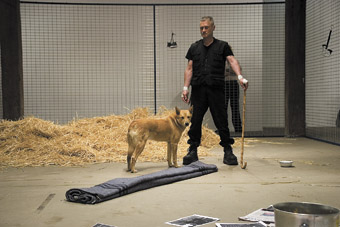
Andre Stitt, Dingo: A treatment towards a new communionsim, performance still
photo Jennifer Leahy, Silversalt; courtesy of the artist
Andre Stitt, Dingo: A treatment towards a new communionsim, performance still
andré stitt
André Stitt’s performance, Dingo: A Treatment towards a new communionism, was more successful in terms of the legibility of its imagery. It involved the artist being locked in a cage with Whumpi the dingo for several hours each day over the three days of the event. The obvious reference is to the Joseph Beuys’ performance, Coyote: I Like America and America Likes Me, performed at Renee Block’s New York gallery in 1974.
I don’t have to tell you that this piece received an enormous amount of media attention in Australia. The usual mix of sensationalism and outright dismissal was perhaps most evident in Sebastian Smee’s response for The Australian on August 10, “Piece without bite made me howl.” In this ‘review’ Smee, who appeared to have been glad-handing everyone the day before at Artspace and enjoying the event, had decided after a moment’s reflection that the work “failed as an interesting piece of performance art for one simple reason: it lacked conviction.” I love it when Murdoch hacks pretend to speak in defence of conviction. “Theatre knows it has to engage”, quoth Smee, while “[p]erformance art subsists on the adolescent idea that it can do whatever it bloody well likes.” Poor boy wanted to be entertained. You might say ‘fair enough’ but to attend a durational performance event and expect theatre is a category error of the most fundamental kind, as any half-conscious arts journalist would be well aware.
Yet the piece was conventionally theatrical in a number of respects with the repetitive use of gesture and props and the establishment of the characters and their relationship at the core of the work. Stitt engaged the dingo in a variety of gestural games, dragging different props: a shirt, a felt blanket, a cane, all references to Beuys. At one point he produced a baby doll from his bag but sensibly didn’t over emphasise this reference. Rather than actively engaging with Stitt the dingo tolerated these activities in the interest, no doubt, of a peaceful life, if not aesthetic harmony. The slow evolution of a relationship between Stitt and the dingo was fascinating to witness as it developed from an initial distrust and fear to a sense of relaxed and playful amusement. Regardless of the larger symbolic associations of this work with respect to the current fragility of the relationship between the Indigenous culture of Australia and the European visitor cultures, Stitt’s achievement was in the immensely subtle development of a complex set of themes—nature/culture, excess/containment, structure/anti-structure—obtained through a slow unfolding of the images in the cage.
If I had more time I would explore the extent to which this work is a re-enactment of Beuys. Of course none of us were there in New York and we have only seen the Beuys performance as video or photographic documentation. In this sense it is perhaps more appropriate to argue that André Stitt is not so much re-enacting Beuys as performing the documentation, as Philip Auslander suggests in a recent paper (“The Performativity of Performance Documentation”, PAJ: A Journal of Performance and Art, 84 Vol 28.3, 2006).
For now it is enough to note that the work itself poses the question which all the works in Aftermath raise in their own way about the extent of the gap between performance and its aftermath in documentation or in installation. These works all show a systematic effort to undermine the opposition between the live encounter with a performance and the encounters with its products, its afterimages, its flashbacks and hard copy memories.
Aftermath, Performance Installations, curator Blair French, artists Guy Benfield, Anne Graham, Franz Ehmann, Tony Schwensen, Arahmaiani, André Stitt, Artpsace, Sydney, July 5-Aug 18
www.artspace.org.au
Aftermath also featured performances by Yiorgos Zafiriou (Aug 16), senVoodoo (Fiona MacGregor, Aña Wojak) and a symposium with Performance Space and RealTime at Carriageworks (Aug 18) – see RealTime 82
RealTime issue #81 Oct-Nov 2007 pg. 52
© Edward Scheer; for permission to reproduce apply to realtime@realtimearts.net
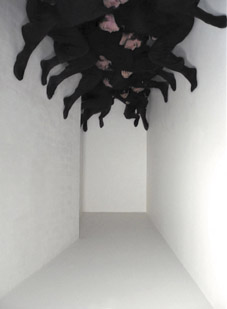
Almost Always Everywhere Apparent, still, Sonia Leber and David Chesworth
OVER THE FIVE YEARS SINCE ACCA OPENED AT SOUTHBANK, MULTIPLE STRUCTURES GENERATING UNEASE AND CLAUSTROPHOBIA HAVE BEEN CONSTRUCTED THAT RECONCILE, AND AT THE SAME TIME, EXPLOIT THE GALLERY’S CAVERNED INTERIOR SPACES. COLLABORATIVE ARTISTS SONIA LEBER AND DAVID CHESWORTH HAVE MOST RECENTLY BUILT SUCH A MICRO-ENVIRONMENT WITH THEIR INSTALLATION, ALMOST ALWAYS EVERYWHERE APPARENT.
A dimly lit foyer acts as a transitional zone between the bloated scale of the ACCA lobby and the core of the installation. This spartan, rectangular void offers a brief moment of stimulus deprivation heightening the sense of immersion that follows.
Open the next door and partially illuminated in neon-pink is a corridor. It veers slightly, concealing its course. Traversing this eerie segment, a digitised crackling noise from above creates an auditory itch. Fragments of choral music also echo in short bursts down the narrow space. The resulting eclectic theatricality is rather like Lara Croft meets the Vatican, in this consecrated low-rent sci-fi set.
Emerging from the passageway some people grin with excitement while others peer out nervously, overwhelmed, into the dark ovoid central space. Five corridors splay out from this shadowy zone, each illuminated by turquoise or lime-green light. Leber and Chesworth seem to replicate the dynamics of Jeremy Bentham’s panoptic prison architectural system, where a central concealed overseer observes a perimeter structure of permanently silhouetted figures.
Accentuated by the splintered choral singing, the installation equally hints at ecclesiastic architecture, of cloisters and interior domes. By combining panoptic and cathedral inspired space, the installation highlights their shared architectonic logic of an omnipresent overseer. Yet, there is a phenomenological disjunction between these two architectural systems.
The church utilises psychologically uplifting atmospherics to reduce bodily awareness, conjuring a sense of being closer to a godly presence. Ceiling details prompt faces to look skyward, reducing the sensation of being grounded, and an often-grandiose scale translates its unconfined nature with a disembodying effect. Conversely Bentham’s panoptic administration, by making the overseen conscious of their silhouettes and of being forever overheard through tin channels, constructed a constant reminder of physical confinement. Leber and Chesworth work the tensions between these two spatial demands.
The abstracted choral sound bites emanate from above where, hanging in the black interior sky of ACCA’s hulking gallery, rests a circular projection screen. This screen hypnotically offers a slowly spinning dull metal propeller behind which warm hued petal shapes move as though the viewer is pushing up through them.
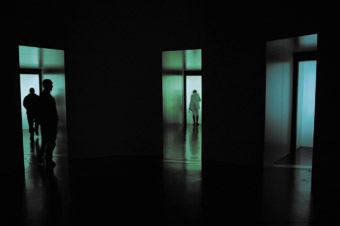
Almost Always Everywhere Apparent, installation
photo John Brash
Almost Always Everywhere Apparent, installation
The quasi-spiritual mood this uplifting movement induces comes with a catch; if contemporary meditation is offered through this simulated, slowed-down centrifuge, the propeller is a barrier that would chop into you. Conjuring physical awareness, the spinning blades deny any sense of potential salvation.
Equally reminiscent of the visceral heaviness of the human body are the noises emitting from the corridors. If the choral music from above seductively evokes the human body in unison and as a hollow instrumental vessel, the noises below come from individual bodies dense with meaty organs from which guttural grunts and groans emerge. Full-bodied gurgling, crying and hissing burst forth as segmented sounds from all directions.
Animalistic yet distinctly human, this repertoire of pre-lingual expression is theatrical in its variety and discordant layering. As gallery-goers veer into the claustral corridors they experience a hiss from the side or an ‘uuuuggghhhhhh’ from the ceiling, like the phantasmic sound track of a ghost ride.
At the dead end of each corridor is a peephole suggesting, as in the panopticon, the opportunity for invisible witness. Lured towards this, figures in silhouette hunch and peer. Observing these observers forefronts the installation’s performative dynamic. The bent over heads appear attached to the wall, bathed in a cool neon glow, their posture suggesting stylised despair, repentance or even some sci-fi cranial procedure.
The videos Leber and Chesworth have concealed behind the peepholes each utilise one of two devices, depicting an upturned hallway so that figures wearing black appear to defy gravity, or showing an overhead perspective (in one, a bird’s eye view of an interior cathedral space). But with these distinctly different perspectival tropes, the artists fail to create an accumulative sense of disorientation. Easily visible monitor edges grounded the images, nullifying the capacity for the videos to further articulate the bodily tensions theatrically constructed by the built space and auditory layering.
Without this concentration of visual detailing the installation threatened to topple into overblown theatrics. Yet, what pulled it back from the brink was the rich complexity of sounds oscillating within its confines. These unstable collisions between spectral and corporeal evocations provided Chesworth and Leber’s phantasmic portal with a surprisingly taut density.
David Chesworth, Sonia Leber, Almost Always Everywhere Apparent, ACCA, Melbourne, Aug 10-Sept 30
RealTime issue #81 Oct-Nov 2007 pg. 54
© Amy Marjoram; for permission to reproduce apply to realtime@realtimearts.net
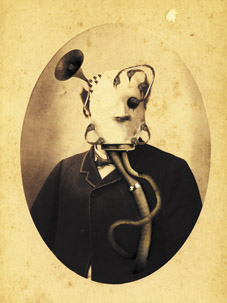
Aurélien Police, Sir Ralph Witkins (2003)
courtesy of the artist
Aurélien Police, Sir Ralph Witkins (2003)
SOMETIMES PERCEIVED AS THE LOVE CHILD OF CYBERPUNK—A DYSTOPIAN STEM OF FANTASY ESPOUSING CYBERNETICS AND REBELLION—STEAMPUNK FINDS ITS NICHE IN A PARALLEL WORLD WHERE STEAM-ERA TECHNOLOGY INVADES THE ULTRA SLICK DEVELOPMENTS OF THE MODERN WORLD. THINK COMPUTER KEYBOARDS MADE FROM OLD TYPEWRITER KEYS, VICTORIAN ERA FASHION AND DIRIGIBLES FLYING HIGH IN THE SKY. STEAMPUNK CROSSES GENRES WITH EASE, ENCOMPASSING LITERATURE, COMICS, FILM, MUSIC AND FASHION. IN ALL ITS FORMS, STEAMPUNK CAN BE GRITTY, INTELLIGENT AND DARKLY COMPLEX.
In an ambitious attempt to bring the genre to a contemporary art audience, Infinite Empire contemplates the wide-ranging creative impact of steampunk. Curated by Carole Hammond and developed under the annual CAST Curatorial Mentorship Program, the exhibition showcases seven artists working across the fields of video, sculpture, jewellery, fashion and digital illustration.
Transformed from the usual white cube into a shadowy cavern with black walls and heavily draped entrance, the CAST gallery momentarily becomes another world. Strange mechanical sounds fill the room, emanating from the Lycette Bros video projection, The Modern Compendium of Miniature Automata (2005). Comparable to a scratchy turn of the century zoological study, the video tracks tiny animals winging and squirming their way across the screen. Each preceded by a species card complete with Latin-inspired name, the creatures resemble microscopic marine life yet their bodies sprout tiny gears, twirling spirals and spinning propellers—the newfound species of a futuristic cesspool.
Intrigued by the techniques used in jewellery and taxidermy, Julia deVille creates Memento Mori imbued with elements of memory, death and resurrection. Clustered inside a glass case swathed in black satin is a series of diminutive trinkets. The trophy head of a diamond-encrusted mouse protrudes from a filigreed picture frame; a small bone and skull rest delicately inside a palm-sized coffin while a severed kingfisher wing longs mournfully for flight: each object echoes a distinctly Victorian fascination with the exotically morbid.
Reflecting on the 19th century devotion to function and mechanical grandeur, furniture maker James Vaughan looks to the guts of Tasmanian power stations, breweries and gas plants for inspiration. Layered with scrupulous detail, Vaughan’s functional objects drip with polished brass and glinting copper. Honeycombed metal panels spread like pathways across the centre of The Brilliant Chamber (2005) while concrete and lead create the sturdy base of Art Gas (2005), a fantastically elegant homage to the architectural ideals of a distant era.
In a similar way, the work of Jon Williamson excels in superb attention to industrial detail. Innovatively exhibited on metal barrels lit from beneath, Williamson’s meticulously crafted jewellery speaks of an aesthetic where beauty appears in a slice of twisted metal. Painstakingly constructed from old typewriter components and electric motors, the work transforms obsolete machinery into futuristic relics wrought with mystery and depth.
Victorian grandeur seeps into Sonia Heap’s collection of pinched and cinched dominatrix-style dresses. More like sculptures than clothing, Heap’s designs combine opulent fabrics, buckles, ribbons and perspex corsets to create a look that is expertly contained yet dangerously malevolent. Possessing a perverse beauty reminiscent of Hans Bellmer’s twisted, eroticised dolls, Heap’s work accentuates the feminine form while demonstrating an innate aggression through the vicious pull and fold of binding fabric.
Alongside the Manga inspired work of animator and illustrator Madeleine Rosca, French artist Aurélien Police relies on the creative scope of digital illustration to document his strange race of mechanical animals and humanoid beasts. Coupling anatomical sketches with yellowed 19th century portraits, Police traverses a futuristic landscape where animals travel on wheels and humans absorb machinery. Augmented by tubes, metal pipes and the rusted innards of industry, characters like Sir Ralph Witkins (2003) and Sybil (2005) exude an eerie familiarity—faintly whispering of what we might become.
Although steampunk has a well-defined style and dedicated fanbase, it is not often seen in art galleries. However, like comic art and graphic novels, steampunk persistently pushes its way into contemporary art. In Infinite Empire, like a prickly rash on the pristine skin of utopia, it’s a satisfying itch to scratch.
Infinite Empire, curator Carole Hammond, CAST Gallery, Hobart, July 28-Aug 26
RealTime issue #81 Oct-Nov 2007 pg. 55
© Briony Downes; for permission to reproduce apply to realtime@realtimearts.net
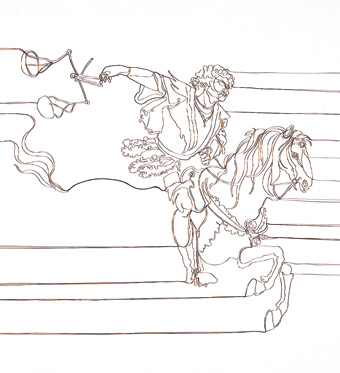
Christine Collins, Riding School for the Cowboys of Doom
I WALK INTO THE AIRY GALLERY, A SHED REALLY, WITH WHITE WALLS AND A CORRUGATED ROOF. BEFORE I TAKE IN THE SCENE I’M MET WITH THE INDISTINGUISHABLE VOICES OF SEVERAL MEN AND THE FRAGMENTS OF A CLIMAXING FILM SCORE. THEN SOMETHING MORE COHERENT, “HOW ABOUT AN EGG?”
In her sound installation, Riding School for the Cowboys of Doom, Christine Collins uses the length of one wall of CACSA’s Project Space to house her work. Four speakers sit on the floor, at least a metre apart, each attached to necessary equipment: AKI, Kenwood, TEAC, Annexe. CDs spin in portable players. The eclectic sound gear emulates the crossing over of eras apparent in the soundscape of four filmic narratives and their relationship to three large images that hang on the wall.
Precise traces of Albrecht Durer’s Four Riders of the Apocalypse (1498) gallop across the tryptic of white primed canvas. Elegant, in flight, the riders move. Towards what? The end of the world: death, famine, war and plague. Beneath them the speakers call, talk of extermination, innocence, of hunters and betrayal. “I wonder if any of these girls will file a complaint about you.” A cat meows. The sound of ice clinking in a scotch glass is unmistakable. The evocations of Hollywood hero and anti-hero are ripe in this landscape. Even if their voices aren’t heard, the Lone Ranger and Dirty Harry are present. Here, the model of American manhood competes with the vigilante for airtime.
You have to get intimate with the speakers in order to hear the film stories in isolation. I lean close to the soft fabric to decipher a line, just in time to be distracted by a familiar voice. Darth Vader? No. It’s Sean Connery in Zardoz, a futuristic western: “You wore a mask. You lead me on, like a game.” The play of these dialogues across the gallery is akin to hide and seek. “If you’re bad enough you’ll die” is followed by “Yes” then “booby trap”, “Yes” then “Goodnight.” A car revs and swamps the Dadaist dialogue.
The technicalities of the exhibition are visible, incorporated. The electrical cords snake along the floor between the speakers. The slender copper thread that hangs from the canvas edges of each apocalyptic rider joins the wires of the sound gear below. The associations between these elements are anachronistic yet, like Collins’ versions of the four riders, the soundscape keeps you moving towards something—perhaps an unfulfillable desire to identify each film, to complete a narrative. But if the dramatic closure of the classic western resurrects hope and order, Collins fragments the protagonists and removes visual contexts, opening up territories of cinematic and, with the four horseman, cultural memory that have no need for resolutions.
It’s been said that the values of Durer’s riders change with the times. By placing them in a cowboy context Collins has inverted their classic meaning. Rather than being ready for action, the riders are left afloat, intermingling with the tales of other men. Collins’ considered juxtapositions of masculinity are quietly comical. I am left wondering if this school of heroes will in fact bring on the apocalypse. Or are they simply doomed to suffer the repeated sounds of each other’s manly actions? Can they get the girl in the end?
Christine Collins, Riding School for the Cowboys of Doom, sound installation, Project Space, Contemporary Arts Centre of South Australia (CACSA), Adelaide, July 20-Aug 26
RealTime issue #81 Oct-Nov 2007 pg. 55
© Jessica Wallace; for permission to reproduce apply to realtime@realtimearts.net
Aphids, the Melbourne based company specialising in international cross-artform collaborations, and RealTime, the magazine promoting innovative Australian art to the world in print and online, have come together to offer a residency for an emerging Victorian reviewer in music and sound art.
Part of the Aphids Residencies and Mentoring Program for young and emerging artists, the residency will take the form of a mentorship with a Victorian reviewer and two visits to Sydney to work with the editors of RealTime. Airfares, accommodation and fees will be covered.
Download full information
RealTime issue #81 Oct-Nov 2007 pg.
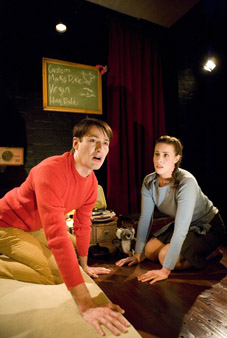
Luke Mullins, Katherine Tonkin, The Eisteddfod
photo Brett Boardman
Luke Mullins, Katherine Tonkin, The Eisteddfod
STUCK PIGS SQUEALING’S EISTEDDFOD IS A RIVETTING, CLAUSTROPHOBIC ACCOUNT OF THE MEETING OF INCEST AND SIBLING RIVALRY. LATE ADOLESCENT BROTHER AND SISTER, ABALONE AND GERTURE, HOME ALONE (THEIR PARENTS ARE DEAD), TRAIN UP TO PERFORM MACBETH AND HIS LADY FOR THE LOCAL EISTEDDFOD (FILLING US IN, ON THE WAY, WITH A HISTORY OF THE COMPETITION). HE’S ALL HAMMY AMBITION, SHE APPEARS TO HAVE NONE. IF SHE DID HE WOULD DESTROY IT, UNDERCUTTING AS HE DOES ANY SENSE OF SELF SHE MIGHT HAVE. THERE IS HOWEVER A BOND, FORMED FROM ENFORCED INTIMACY AND THE RITUALISED GAME-PLAYING THEY HAVE EVOLVED. AND THE SEXUAL ABUSE BY THEIR FATHER—IF IT HAPPENED.
Eisteddfod climaxes with a sudden reversal, the sister winning the prize for her performance as Lady Macbeth, the brother collapsing in disbelief, begging her to “be Mum.” The sister, once happy with mediocrity, now has something more—but how much and for how long? Her words from earlier in the play stick: “I want someone to hurt me for a reason.” These children are damaged goods.
Presented in the small space of Belvoir St Downstairs with subtle miking and a clever, hinged stand-alone set-cum-stage which the performers can fold into new spaces, The Eisteddfod is seriously, viciously funny. Written and played larger than life and with a sustained theatrical intensity by Luke Mullins and Katherine Tonkin as directed by Chris Kohn, the play takes us into a world of incest where the lovers are beginning to diverge on their way to complex adulthoods, or an eternal corrupted childhood.
The Eisteddfod premiered in Melbourne in 2004 and was much admired in New York in 2005. It confirms Stuck Pigs Squealing’s radical inventiveness and the acuity and vividness of playwright Lally Katz’s imagination, yielding utterly convincing non-naturalistic dialogue, rich in humour and a revealing perversity in investigating a condition via a flight of fantasy rather than a social document.
Stuck Pigs Squealing, The Eisteddfod, writer Lally Katz, director Chris Kohn, performers Luke Mullins, Katherine Tonkin, designer Adam Gardnir, lighting Richard Vabre, sound designer Jethro Woodward; B Sharp, Belvoir St Downstairs, Sydney, June 6-24
RealTime issue #81 Oct-Nov 2007 pg. onl
© Keith Gallasch; for permission to reproduce apply to realtime@realtimearts.net
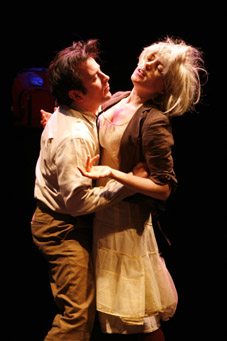
Steve Cuiffo, Maggie Hoffmann, Major Bang
MAJOR BANG, FROM NEW YORK'S THE FOUNDRY THEATRE, IS MINESTRONE THEATRE, A WELL-BREWED, TASTY MIX OF PERFORMATIVE INGREDIENTS—STANDUP, MAGIC, IMPERSONATION, DOCUMENTARY AND MULTIMEDIA THEATRE, AND POSTMODERN DIVERSIONS ABOUT THE NATURE OF THEATRE IN THE FACE OF TERROR. ELSEWHERE IT'S BEEN LABELLED “POLITICAL CABARET.” BUT THERE'S A PLAY INSIDE MAJOR BANG. WOVEN THROUGH A VARIETY OF ROUTINES, IT'S ABOUT A FATHER'S FAILING RELATIONSHIP WITH HIS ADOLESCENT, SCIENTIST SON WHO IS IN THE THRALL OF A FASCIST BOY SCOUT LEADER, MAJOR BANG.
The father works in a food irradiation plant in New York, feels threatened by his son's superior intelligence and inadvertantly allows his security badge to be given by the boy to the scout leader whose intentions are terrorist. The tone is persistently comic, ironic and satirical, the playing virtuosic. Steve Cuiffo is our host, plays father, son and scout leader (in rapid alternations, even using a two-sided costume), mimicks a resurrected Lenny Bruce (rejecting a “war on terror”, he demands “a jihad on terror!”), executes deft magic routines and, with co-performer and fellow host Maggie Hoffman, wickedly corrupts the dialogue of a screened excerpt from the Kevin Costner vehicle, The Bodyguard. Hoffmann plays Cuiffo's boss and potential lover at the factory and demonstrates to us, with a gieger counter-cum-beat-box, that there's radiation in the theatre.
In direct reference to the Kubrick film Dr Strangelove, Major Bang is subtitled How I Learned to Stop Worrying and Love the Dirty Bomb. There's enough destructive energy (the equivalent of “three million chest x-rays” at any time) in the play's food irradiation plant to create another 9/11 horror and there's enough lunacy-at-home to pull it off (the performers tell the true story of a boy who invented a nuclear weapon in the family garage in 1995). The 'war on terror' campaign quickly becomes a nonsense, the US government's fear mongering embodied symbolically in a red backpack that hovers, glowing over the action and soon works its way into the narrative. It explodes, but because the company can't afford anything more than a sound effect, the plot line has to be diverted.
Although it ends with a heavy-handed solemnity after a suspenseful and very funny race to defeat Major Bang, the play's strength resides in its DIY approach to the challenge of dealing with the psychological and political consequences of terrorism. The creative recipe comprises whatever performative means are at hand. From the tacky showground set to card tricks, film clips and wild role doubling, Major Bang, alternatively quaint, arch and incisive, is ultimately a quick-witted lo-tech form of theatrical resistance to the US and (as the performers left us in no doubt) Australian governments' moneyed, monolithic hi-tech paranoia making. As the script puts it: “They tried to scare us but it didn't work. We took all the cars and planes and unattended bags, everything they had made dangerous, and we put them out of reach by turning them into jokes and stories.”
The Foundry Theatre, Major Bang, conceived and created by Melanie Joseph, Steve Cuiffo, Kirk Lynn, writer Kirk Lynn, director Paul Lazar, performers Steve Cuiffo, Maggie Hoffman; Adventures 07, Playhouse, Sydney Opera House, July 17-29
RealTime issue #81 Oct-Nov 2007 pg. on
© Keith Gallasch; for permission to reproduce apply to realtime@realtimearts.net
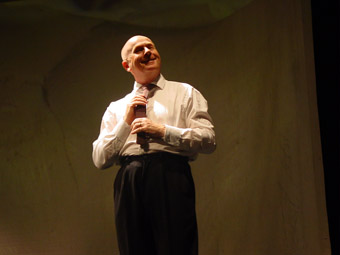
Andrew Morrish
photo Heidrun Löhr
Andrew Morrish
“I’M BACK”, DECLARES ANDREW MORRISH, PLAYING TO A WELCOMING OPENING NIGHT AUDIENCE AT THE NEW PERFORMANCE SPACE IN CARRIAGEWORKS AFTER A LONG SOJOURN IN EUROPE AND DESCRIBING HIMSELF AS “A LITTLE MORE RECKLESS”, AGEING AND THEREFORE PERMITTED TO WEAR WHAT TACKY OUTFIT HE WILL. THIS IS MORRISH IN STAND UP MODE, FAST, WISE-CRACKING AND VERY FUNNY, AND WITH AN APPARENT OBSESSIVENESS THAT FITS HIS IMPRO-RIFFING.
From experience we know Morrish in performance is on the road to somewhere. He probably has a pretty good idea where that somewhere is and even how long it might take to get there, if less certain about exactly how. Like a sometimes distracted driver, he’ll chat incessantly while looking out for road signs and landmarks that pop into his head, or not—and then? That’s the nature of improvisation, even this semi-structured variety. No road map. No GPS. Performance is hard enough with lines learnt and moves blocked. In improvisation the road can turn into a tightrope, a path that can run out mid-air, or snap. Then again, improvisors extol the freedom of their medium. Unhindered by various fixities they are psychoanalyst Michael Balint’s “philobats”, in love with the inbetween, preferably without safety nets (Balint, Thrills & Regressions, Maresfield Library, London, 1959). Of course, many an improvisor travels with a rescue kit of fall-back positions, handy set pieces, vocal or physical turns, reliable triggers to carry them through.
“I’m avoiding narrative tonight”, Morrish announces, “but I do have a story. I’ll try to cut it up.” So we accompany him on a journey over the next hour to what turns out to be his mother’s death, but first we hear something of the man she bore: “…an artist, a fat old working class bloke working around Europe getting technique.” The peculiar little Morrish frolics, the discombobulated leaps between verbal dancing, suggest, amusingly as ever, that the technique doses not belong to dance. What’s on his mind is “working class” and how that explains why he can never aspire either to romancing Julia Roberts or applying for an Australia Council grant: he’s working class and “doesn’t deserve better.” He says he’s not bitter that he’s created “a Morrish un-fundable artform: un-copyable, un-ownable sound and movement.” Like the claims made for imrovisation, this is a declaration of independence, as well as of origins. (It would be churlish to dwell on the career safety net offered by performing in state subsidised arts venues. Independence is relative, rarely absolute.)
On the way to his mother’s death, the road does turn to tightrope. We sense a tightening, a somewhat mysterious telephone call motif is established, some words tangle—attributed to the “uncontrollable saliva” of ageing, quips Morrish, making the most of everything—as he does with the CarriagWorks “heritage wall” he realises he is playing against and which nearly takes a bit out of him with one of its left-in-place metal features). Morrish’s quick thinking capacity to pick up on his errors and his tics is played to pomo self-referential advantage, allowing him safe passage to his next point. But suddenly, just as he is about to launch into a key story, his next destination, he realises that it’s not there. All he can do is admit it, and it feels like we’re out there on the tightrope with him. It’s a curiously visceral moment, however brief, before he’s on a roll again.
Morrish is in Europe when he hears of his mother’s impending death. He grapples with Qantas about getting a flight and is criticised by someone for not asking for “compassion discount.” The result is a splendid tirade about a world governed by loyalty points.
The sad conclusion to the story has Morrish transform, in a way, into his mother. He unzips his jacket to reveal a floral frock, and he dances a little dance and “she slips away.” It’s a moment of quiet but intense, considered theatricality.
The balance between moment and momentum in Morrish’s performance was finely held, even the moments of near fall accentuating the accomplished art of a fine philobat.
Andrew Morrish, Solo 1, Letting off Steam, Performance Space, CarriageWorks, Sydney, May 25
RealTime issue #81 Oct-Nov 2007 pg. on
© Keith Gallasch; for permission to reproduce apply to realtime@realtimearts.net
Input, updating, memory, computation/comprehension, output. These are what you need for interactivity, writes Jolt artistic director James Hullick in his program notes for Interactacon, an event focused on interaction between humans and computers.
Robin Fox, his face screen-lit, holds a detonator in each hand—game-like t-box sensor interface controllers. A barrage of rapid-fire sliced-in-a-blender sounds mixed with moments of Looney Tunes hilarity, sheets of sheer noise and room rumbling bass move from left to right at dizzying speeds. Fox’s relative stillness contrasts with the moment-to-moment interaction with his computer via the hand-held interfaces, much like a virtuosic jazz musician in the throes of a blistering solo.
The program notes reveal that the software has its own “behavioural” tendencies that “fight back” Fox's inputting. The result suggests war, conversation, laughter, dance, play and love-making—all at a hair-raising, impossible pace, if you can stay with it (a handful of people drop out of the battle early on). Huge dynamic shifts move over and slice into each other with momentary suspensions and windings up and down while Fox’s fingers twitch at the controls.
In Maculae, Natasha Anderson’s gestures are more theatrical and considered. The sensors she's attached to an impressive contrabass recorder allow her to trigger sounds from her playing as well as to add gestural input alongside vocal croaks and clicks. To one side small details from “self-portraits” and the interior of a room are screened, fading in and out and also triggered by her interaction with her instrument.
In contrast to Fox’s minimal spacings between sounds, Anderson creates a more open sonic field where languid movements and long tones are punctuated by sharp spikes of sound and gesture. The processing adds fleeting, decaying loops, watery masses, varying textures and brief abrupt buzzings, creating a cumulative rendering of a kind of subterranean or interior space.
Hullick’s first contribution to the event is Sk-eylike Mind, an interactive score performed by Bolt and comprising flute, clarinet, sax, double bass, percussion and viola. The projected score unfolds in real time displaying, among other things, pitch, directions and rests. Long overlapping tonal notes are textured with shorter gestural events. “Like a machine hum” and “let it ring” are some of the more curious directions in the score.
Hullick’s second contribution also features projected notation—bright dots on a black background are revealed left to right at various heights. The Crank-A-Maphone (a computer-operated instrument comprising a triangular frame within which sit Tibetan bowls, chimes, bells and more, see RT79) realises the score while a series of miked spherical glass objects appear to be improvised on by The Amplified Elephants, an “inter-ability” ensemble that has grown out of the Footscray Community Arts Centre’s Artlife program. The result is a spacious landscape of soft bell-like sounds with occasional metallic punctuations.
Without the aid of the program notes it's difficult to deduce the modes of interaction inherent in some of the performances. Sometimes the interactivity is visible, sometimes not, for example in how the functioning of the Crank-A-Maphone relates to the projected score. But does the audience need to be privy to the workings of interactivity? Isn't it about the overall effect of the interactivity, and especially its sonic outcome? These interesting questions are being posed in events like Interacton and in the discovery of new modes of composing and playing through human and computer interaction.
Interactacon, Jolt Winter Series Concert 4, artistic director James Hullick, artists Robin Fox, Natasha Anderson, James Hullick, Bolt Musicians (David Thomas, Martin Mackeras, Andy Williamson, Bernie The Man, Peter Neville, Erkii Veltheim), instrument engineer Richie Allen, The Amplified Elephants (June Bentley, Jay Euesden, Liz Hofbauer, Robyn McGrath, Enza Pratico), designer Emile Zile; 45 Downstairs, Melbourne, August 23
RealTime issue #81 Oct-Nov 2007 pg. on
© Dean Linguey; for permission to reproduce apply to realtime@realtimearts.net
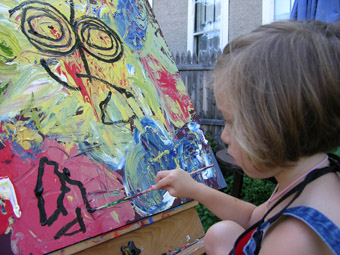
My Kid Could Paint That
WHEN I WAS A FOUR-YEAR-OLD MY MUM OFTEN TOOK ME TO THE ART GALLERY. I QUITE LIKED THE IMPRESSIONISTS, THE VAN GOGHS, THAT FREDERICK MCCUBBIN WITH A WOMAN HOLDING HER BABY ON HER LAP. I COULD UNDERSTAND THEM. THE PICASSOS I WASN’T SO KEEN ON. AND ANYTHING WITH A RED TRIANGLE ON A WHITE CANVAS, SPLODGES OF PAINT THROWN ON OR A HORIZONTAL LINE DRIBBLING ACROSS WITH A SHAKY HAND MET WITH ANGER AND FRUSTRATION, AND LOTS OF DEMANDS TO MY MOTHER. “WHY IS THAT HANGING IN THE GALLERY! I COULD DO THAT!” SHE ALWAYS HAD THE SAME REPLY: “MAYBE, BUT YOU DIDN’T.”
Meet another four-year-old. Marla. She’s certainly done it. She’s sold over $300,000 worth of abstract art. Oprah Winfrey’s on the phone. Crayola’s keen to be a sponsor. Her buyers talk of her artwork in hushed tones as if the canvases have been touched by the hands of an angel. They imagine the works as full of her childlike spirit, her innocence. A man sees a door opening onto new worlds. A woman just loves the Mickey Mouse ears. As Michael Kimmelman, New York Times chief art critic says in the film, “…no one is saying fuck you in this picture. They’re just saying I’m a happy girl who likes painting.” But Marla doesn’t want to expound on the symbolism or lack of irony in her work. “No!” is her firm answer whenever doco-maker Amir Bar-Lev asks whether she wants to talk about her art. And Marla doesn’t seem to want to make much art either, not on camera anyway, and not in the colours and techniques she’s expected to.
When Bar-Lev first gets filming, he believes in the work of Marla; she’s at the (short) peak of her success. Parents Mark (a painter himself, keen to push his child into the limelight) and Laura (“if this ends today, I’ll be happy”) let him into their home and the often cynical world of their friend, gallery owner and hyper-realist painter Anthony Brunelli, who sees the possibilities (“these kids could be on a Gap commercial”) and exploits them for all they’re worth.
As Bar-Lev pushes deeper, and the media begin to turn after an expose on CBS’s 60 Minutes claiming she’s a fraud (they plant a hidden camera in the Olmstead house), the filmmaker, along with the audience, starts to have doubts—is she really doing the artwork?; is her father directing or bullying?; does he finish them off himself?; why can’t she seem to create such masterpieces for the camera? But Marla’s dad has read the literature and is always one step ahead. He tells the filmmaker that once you measure something, you alter it. The only problem for him is, it’s hard to control the wayward conversation of a four-year-old. Much is revealed by Marla’s younger brother Zane, who brags: “When I was at the hospital, when I was in mummy’s tummy, I was painting on the table.” Now there’s a child prodigy: I imagine the artworks nestled in his mum’s womb, protected like cave paintings.
Like Maciek Wszelaki's great Australian doco Original Schtick (1999), which covered similar territory about the artist Bob Fischer, this film isn’t really so interested in whether the art’s authentic or not, but at the public and media reaction when things turn sour. Bar-Lev digs into the underlying fears of a community who have no rules to play by when judging whether art is ‘good’ or ‘bad’, who distrust an artworld based on increasing commercialism and who still see art as representing some sort of ‘truth.' If a child can paint a masterpiece, where are the standards by which to judge a Pollock? It’s an old debate but it still seems to upset people. A lot. After 60 Minutes airs, Marla’s parents are assaulted and attacked via email as traitors, even as sinners marked to burn in hell. As Kimmelman points out, people take the idea of modern art as an insult, it says ‘you’re stupid and I’m not’, breeding a collective insecurity.
But what I’m left debating is the widespread desperate desire to dress up a child in adult clothes, spin her around in high heels, and then strip her bare, exposed to the world. But then, here I am in the audience, devouring this wonderful documentary like a wolf, hungry for more to chew up and spit out…
My Kid Could Paint That, director, producer Amir Bar-Lev, editors John Walter, Michael Levine, directors of photography Matt Boyd, Nelson Hume, Bill Turnley, original score Rondo Brothers, A&E Indie Films [US]
RealTime issue #81 Oct-Nov 2007 pg.
© Kirsten Krauth; for permission to reproduce apply to realtime@realtimearts.net
Jo Lancaster, Acrobat
photo John Sones
Jo Lancaster, Acrobat
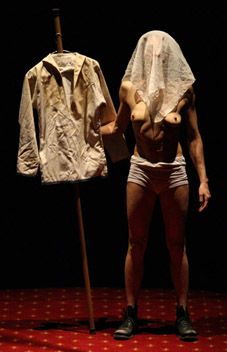
JO LANCASTER APPEARS ALONE IN AN UNADORNED PERFORMANCE SPACE, NAKED BAR A PAIR OF BLUNDSTONE BOOTS. SHE STROLLS OVER TO A BASKET, PULLS ON UNDERWEAR AND TURNS, TONGUE IN CHEEK, BRANDISHING HER BOTTOM AT THE AUDIENCE AND WHIRLING A HULA HOOP. THERE IS A SENSE OF MISCHIEVOUSNESS AS SHE PLAYS ON THE AUDIENCE’S FEELING OF AWKWARDNESS. ACROBAT’S SMALLER, POORER, CHEAPER CHALLENGES CONVENTIONAL ROLES FOR THE BODY AND THE PHYSICAL EXPECTATIONS PLACED ON IT, QUESTIONING WHAT HAPPENS WHEN WE SHED OUR INHIBITIONS ALONG WITH OUR CLOTHING AND EXPOSE THE VULNERABLE BODIES BENEATH.
Lancaster’s fun-loving opening tumbles, turns and spins are suddenly interrupted by a marriage to a clothes horse. This woman’s freedom is abruptly exchanged for a vacuum cleaner thrust into her hands by a stage assistant. There is something eerie about the way she rocks it like a baby. Now, the cold, hard metallic object restricts her freedom as it lies cradled in her arms. In a final mockery of domesticity, she attaches the suction valve of the vacuum to her breast, creating an image of a suckling parasite.
Lancaster, Simon Yates and Mozes Taplin each perform solo acts exploring how the body is shaped and re-shaped by warring social forces. As in the theories of Foucault, the body becomes a surface on which events are inscribed. The play between the naked body and the meaning of clothing threads through the work.
Placing a giant sheet of butcher’s paper on the floor, Lancaster creases the sheet as if practising origami. She reveals her creation: a dress. It is striking the way domesticity keeps defining her actions. Even now she is, in a sense, folding her own clothes. She holds the dress against her body and, in big child-like scrawling texta, draws scenes of typical suburbia. In a violent movement she suddenly rips a hole in the dress over her genitalia, exposing a crude gash amongst the pretty scenes of flora and picket fences.
With the appearance of Mozes Taplin comes a magical exploration of the contrast between the public and private self. He brandishes a scarf and appears to lose it in various parts of his body. The trick turns into a flirty striptease that tests the boundaries between private whim and public performance.
In the starkest scene of all Taplin, tautly entwined by a rope, tumbles from a height, the cord cutting into and marking his flesh. The temporary etchings that cover his skin remind us of the way people score and brand their bodies as a form of self- expression. ‘Blood’ (in the form of paint) seeps down the rope and, suddenly, it is everywhere, splattering the performance space. It is a violent act and the painfulness of the scene is underscored by a haunting sound-score by Tim Barrass. Sounds of insatiable hunger, gulping and sucking, echo through the room like a soul being wrung from its body. Pre-recorded and live sounds are mixed by the composer onstage creating a metallic, electronic rhapsody.
In another twist to the categories on interior and exterior, traditional ‘behind the scenes’ artists appear onstage, integrated into the performance. The stage operator, Alex White, drolly walks across the space with a placard reading “And now for something a bit lighter.” At another point the audience watch as the performers, with the aid of the stage hands, elaborately and dramatically set up a catapult act using a punching bag as the weight, only to parody the feat in a contrived anti-climax.
Smaller, poorer, cheaper is hilarious and frank physical theatre performance in which the body is constantly revealed in more ways than one. We leave the theatre with a heightened awareness of what we could achieve with our own.
Acrobat, Smaller poorer cheaper, Performance Space, CarriageWorks, Sydney, March 28-April 1
RealTime issue #81 Oct-Nov 2007 pg.
© Kavita Bedford; for permission to reproduce apply to realtime@realtimearts.net
ABC Classics, 2005
Cat No 476 8064
http://shop.abc.net.au/browse/label.asp?labelid=3
 Producing a novel dialogue between elements of the European high Classical period and contemporary post-classical New Music can be daunting. To further extend such a musical collaboration across the centuries to include early liturgical music—in this case Byzantine chant—is therefore no mean feat. There are precedents such as Akira Rabelais’ sparse sampling of Medieval chorale (Spellewauerynsherde, 2004) or Darrin Verhagen’s use of religious chant behind his Goth textures (the Witch trilogy, 1993-2000). Under artistic director Nick Tsiavos, Jouissance has produced a unique, lyrical and musically complex take on sixth century Byzantine chorale with contemporary fusions.
Although recorded at the acoustically neutral Iwaki studios, producers Jim Atkins and Tsiavos have created a gorgeous sonic space within which the cycle sits. The chimed bells of master percussionist Peter Neville and the at times almost ‘basso profundo’ of baritone Jerzy Kozlowski rest within a richly echoing context, at once wide and deep, yet sufficiently shaped and tweaked to go beyond a simple replication of the reverberance of a Medieval cathedral. The recording is simultaneously seductive yet complex, far from the faux historicism of most Gregorian chant recordings. At their thickest, Neville’s chimes and bowed gongs sound like they could resonate to infinity.
Neville, Kozlowski and cellist Tsiavos are joined by soprano Deborah Kayser and shakuhachi player Anne Norman. The CD begins with passages of often highly syncopated singing from Kayser, answered by active contemporary instrumental responses. Norman makes the most of the special character of the shakuhachi: sharp, highly pitched accents and extended, stretched notes hover over the other instruments or make up short lead sections. Periods of sustained, strongly tongued vibrato feature within the most intense exchanges, such as the tightly controlled storm of instruments on track five (a Thracian dance).
Each instrument has a track in which it leads. Tsiavos presents a gorgeous cello solo, at once mildly Romantic in tone, yet with a rough, grating texture to the bowing, lying deep and hard within a hummed vocal wash (track eight), while on track 10 Neville fills the space with lightly buoyant timbres. As the tracks progress, the vocals eschew the tightly clipped enunciation of Kayser’s initial delivery to rise and glide over passages in a fashion more familiar in Early Music. A kind of questioning emerges with the shakuhachi, then the cello, speaking out after these motifs creating an enticing sense of non-resolution. The cycle ends with a minimalist rhythmic percussion and cello section underpinning soaring vocals.
There is an implicit narrative at the heart of the Byzantine motifs reworked here, which although related in the liner notes, remains largely opaque to modern listeners. This matters little however as the sheer gorgeousness of these works, tinged with a sense of divine tragedy, more than carries the cycle. In the context of so much spiky, acerbic New Music, it is a rare pleasure to find such a luscious new work.
Jonathan Marshall
 Melbourne: Move, 2005
MD3297
www.move.com.au/
 Melbourne/Sydney: Cracked, 2005
www.crackedrecords.com.au
The influence of New Age-ism, and its associated, banal reinterpretations of Brian Eno’s “ambient music”, has contributed to a surfeit of dubious, cross-cultural musics.
Machine For Making Sense react against this by crafting harsh textures and violent, sound art concatenations (for example, Dissect the Body, featuring Satsuki Odamura on koto and Stevie Wishart on hurdy-gurdy), while Liza Lim and Julian Yu produce orchestral works incorporating European and Oriental instrumentation which possess some characteristics of both Euro-American Romanticism and high modernist dissonance and atonalism. The material compiled by editor/producer Le Tuan Hung for On the Wings of a Butterfly has some sympathy with this second approach—notably Brigid Burke’s fabulous, lightly perturbed mix of scattered percussion, sudden tabla accents, and irregular rumblings of clarinet, embedded within a harmonic vibraphone and electronics wash (track seven). On the whole however the artists presented here have chosen less arch and more lyrical methods, with several Oriental classical traditions being brought together with European Medieval and Renaissance ideas as well as atmospheric percussion. In this sense, On the Wings of a Butterfly sits well alongside the rest of the work of soprano Deborah Kayser (featured here in collaboration with shakuhachi player Anne Norman), Jouissance and others. While not “wallpaper music” in Eno’s sense, On the Wings of a Butterfly largely presents a meditative, seductive listening experience whose aggressive elements are found more in sudden jumps of the volume (as with Dindy Vaughan’s work; tracks five to six), rather than in overt sonic or textural distinctions. The materials are on the whole well balanced, harmonised and successfully melded. The approach is therefore more one of fusion rather than contrast or dialectic, of finding common timbre and rhythmic patterns across traditions rather than setting them against each other in a kind of debate.
On the first track, Kayser and Norman present a gorgeous, soaring, while at times barely breathed meditation on the work of Hildegard von Bingen, the long, gliding tones of the shakuhachi complementing the extended vocal lines of early European liturgical chorale. This is perhaps not surprising given that both musics developed partly to assist spiritual contemplation.
Nevertheless, some of the shorter, more hesitant enunciations of the duo help to give their interpretation a more modern, formalist touch. Norman’s collaboration with vocalist Ria Soemardjo (track three), underscored by Hindustani dulcimer strings, successfully melds two Oriental improvisatory traditions (Japanese and Indian) in a work which not only recalls the ragas and chants of the Indian subcontinent, but also incorporates some freer, non-verbal sung motifs, which are, in turn, echoed by Norman. Tuan Hung’s own contributions, in which he plays dan tranh or Vietnamese zither, are less effective, with the musician tending to flatten the material by interjecting repeated passages of strumming rising and falling through whole scales (notably in his collaboration with Ros Bandt on Medieval psaltery; track two). Where Tuan Hung resists this particular temptation, on track four, his work is impressive, the zither’s slightly fractured, discordant tones and string-bending technique answered or supported by ringing bell percussion and open, tube-y sounding pan-pipes.The CD closes somewhat disappointingly with the linguistically unremarkable (and strikingly Orientalising) poetry of Rewi Alley (tracks eight to 11), supported by shifting organ chords from Warren Burt, to which the vocals have also been tuned.
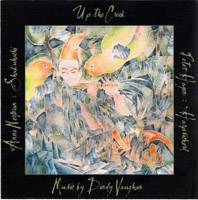
On the Wings of a Butterfly features an additional two compositions selected from Vaughan’s own CD, Up the Creek. The latter, 12-track collection sees Norman paired with harpsichordist Peter Hagen. The duo play six works together, and then perform as soloists on three pieces each. Hagen’s technique is at times harsh and brutal, with Norman generally doubling the main harmonic lines and introducing sections with a rising, breathy spaciousness, or rising above the stately lines of the harpsichord to lead in a complicated series of jumps and glides. As noted earlier, the dynamic of the pieces is often striking, with abrupt leaps from quieter, building sequences and scattered phrases, versus loud, crashing motifs and crescendos.
The harpsichord is such a cultural loaded instrument that images of Baroque symmetry and early cinema horror soundtracks cannot help but intrude, with much of the interest being generated by how Vaughan disabuses one of such assumptions without totally abandoning the idea of adding her own little, mathematic, self-enclosed passages, derived in part from the high Classical tradition. While only occasionally exhibiting actual atonalism, several tracks nevertheless attain a dissonant complication of musical structure through the tentative indirectness of the links between passages as well as their attendant silences, which makes for a highly unconventional listening experience. The vaguely modernist tracks five and six break, clash and then pause in a highly arresting manner.
Norman’s solos move from clipped materials which sound almost like discontinuous allusions to Stravinsky’s Firebird played on shakuhachi, to the more characteristic woody, breathy tones of the instrument, but with a fluttering and lack of intensity only found in 20th century American-Japanese composition. Hagen has less to play with in this sense with his rather more unbending instrument—though during the duets he performs some arrested plucking of the strings and abortive, percussive keyboard strikes. The recordings also include a subdued background of feet rearranging and wooden finger-block clattering. Up the Creek is, in short, a very interesting collection of pieces which is worth repeated listening to fully appreciate its sometimes hidden intricacies. Overall, Up the Creek is somewhat more satisfying than On the Wings of a Butterfly, exhibiting in a more overt fashion a sense of musical and textural rigour in composition. Nevertheless, both are fine, thought-provoking additions to the ongoing corpus of approaches which bring together the various and only indistinctly separate terms of Oriental, Western, Euro-American, traditional, classical, Early Music and New Music.
Jonathan Marshall
Synaesthesia SYN019
http://synrecords.blogspot.com/
Gauticle is the second release for the Melbourne-based trio of Anthony Pateras (prepared piano), Sean Baxter (percussion) and David Brown (prepared guitar) recorded during their foray into Europe in 2004. Unlike their previous record Ataxia, this time they have opted for solely acoustic instrumentation. Describing their music as ‘exploratory acoustic’, the group combine their interest in improvisation and idiosyncratic techniques with an appreciation of free jazz, electronic noise and the classical avant-garde.
One thing this album gladly lacks is that feeling of tentativeness which can so often kill recordings of improvised music stone dead. Having played consistently since forming in 2002 the trio is focused, deliberate and capable of great subtlety. Thankfully, this is also not a series of illustrations or set pieces to show off their various preparations, but rather 5 pieces of intuitively produced music. By focusing on their sounding possibilities Pateras, Baxter and Brown relieve both the listener and themselves of the need to examine or explain the purpose of the preparations, or the techniques involved.
With their various preparations Pateras and Brown direct their instruments away from the sound of strings, melody and harmony, and instead focus on the timbral and percussive aspects of music making. Baxter’s kit tends as much towards metallic junk, plates and cymbals as to drums. In a loose sense Gauticle is an album of events dispersed across all 3 instruments. Although this is a record with much attention to space and resonance, it never becomes reductive or simply pointillist. Instead what is most interesting about this music is the way small percussivie events coalesce into streams and layers of sound moving at different speeds, each of these layers containing elements from all 3 players. This lends the music a multi-directional feel, giving it an ability to propel itself forward without sacrificing a sense of space or even place. There are backs and fronts and spaces to the side, between and underneath the sounds presented here, but not between the instrumentation. This is after all a group sound. It’s sound that flows—not just like liquid, but like a bucket full of miscellaneous rivets.
Improvised music is often characterised as not just a music of interaction, but of possibility. This possibility is not just about what the music can be in the present, but how it can continue to invent itself in the future. And in that sense, it needs to draw inspiration from the resources it employs. On the evidence of Gauticle, it would seem that beyond their instruments, the music of Pateras, Baxter and Brown is underpinned by an attention to resonance. Of course, resonance is a fundamental component of acoustic performance: vibrating air inside the body of a guitar, a drum skin, a struck cymbal, the piano‘s sounding board, the tone of a room. Unlike much European ‘chamber improv’, which seems predicated on a reductive notion of sound played into some metaphorical silence, this understanding of resonance allows something more generative to occur and for the music to be able to find its future: that if music like this is underpinned by resonance then sounds other than instrumental sounds are crucial. So on Guaticle, even when individual sound sources fall silent, by following the trailing away of its reverberations we hear the recurrence of the sounds of other things, quiet, but still persisting: everyday sounds, other reverberations, other people, other interactions, and in those sounds the possibility for more.
Peter Blamey
Presented by RealTime, Performance Space, d/Lux/MediaArts and the
Visual Arts Board of the Australia Council for the Arts at Performance Space, at Carriageworks, Sydney, Australia, August 21st, 2007, hosted by Keith Gallasch, Managing Editor of RealTime and David Cranswick, Director d/Lux/MediaArts.
This transcript has been edited for clarity and where the recorded dialogue became inaudible.
introduction
Keith Gallasch I’d like to welcome the manager of the Visual Arts Board of the Australia Council, Anna Waldman to introduce Steve Dietz to you.
Anna Waldman In the visual arts there have always been over many decades some form of new media, and that the new, new media I believe is about questioning and lateral thinking and intellectual risk and artistic intervention—because many of us are paralysed by the control technology exercises over our lives and because we might like to shelter from satellite tracking and genetic testing and the twilight zone of the net and parallel universes. But also because art takes in a truly strange and wonderful domain that shapes our understanding of events, places and emotions, a forum like this is a rewarding event. And thank you Keith and Virginia [Baxter, Managing Editor, RealTime] and Fiona [Winning, Director, Performance Space] and David for organising and hosting it. We’re privileged to have with us Steve Dietz to help us explore the new worlds where control is within our grasp. Steve’s visit supported by the Visual Arts Board is part of our international media arts strategy, a focused program of visits and curated exhibitions we are working on at the moment.
Steve was director of ISEA 2006, Symposium Zero One, San Jose. Between 1996 and 2003 he was curator of new media at the Walker Arts Centre in Minneapolis in the US, where he founded the new media initiative Beyond Line Art Gallery 9 and the Digital Arts study collection. He was founding chief of publications and new media initiatives at the Smithsonian Institute and the editor of the journal American Art. Steve has organised and curated many new media exhibitions including some of the first online exhibitions—Beyond Interface, net art and art on the net in 1998, Shock of the New: Art Historians and Museums in the Digital Age in 1999, the travelling exhibition, Telematic Connections, The Virtual Embrace in 2001, Database Imaginary in 2004 at the Banff Centre, and in 2005 he curated Public Sphere_s as part of Media Art Net in conjunction with ZKM exhibitions and, also for ZKM, curated the Fair Assembly web projects for the Making Things Public, Atmospheres of Democracy exhibition. Steve is also artistic director of the biennale Zero One, Global Festival of Art on the Edge in San Jose, 2006.
As you know, Walter Benjamin famously claimed that technology destroys the aura of the work of art, and Marshal McLuhan suggested that we always understand new media via the old media. So it’s good to know that Steve has positioned Zero One as an event where artists are making art, using technology [as they wish]. Steve has described his curatorial role as being polymorphously inquisitive. So this intriguing description should make for an interesting discussion tonight and I would like you to join me in welcoming Steve Dietz.
explorations
KG In one of your essays, you quoted Tom Stoppard, from his play Arcadia, saying, “It is the best of all possible times to be alive when everything we thought we knew is wrong.” Now, predictability as we know in new media art, and in the media in general with new technologies, it is just incredibly hard to project where things are going, and this has happened again and again particularly in the last 20 or 30 years. Has your own career been like the twists and turns of media and media arts developments? Has it been one of surprises, dead-ends, wrong turns and accidents? I know that when you started out you had some connection through Aperture magazine with photography and, in an interview I read, you said that your interest in new media perhaps sprang from aspects of photography and the relationship between text and image. So where did you get into all this, and when?
SD Well if I can just back up one second, I do want to thank d/Lux and Performance Space and the Visual Arts Board of the Australia Council and Anna and David and you and everyone for bringing me out, and I want to thank Romany for making sure that I could tell my family that I’m not here on vacation…But it is a great honour and actually a lot of fun to meet everyone here and those of you who have had your 30 minutes [individual artist meetings with Dietz. Ed] or whatever with me, I do appreciate that. I know that it’s a tense process often but it’s been really enjoyable for me, and a great learning experience. I really appreciate this opportunity to have hopefully a more two-sided conversation.
In terms of my background and interests, I did go to art school and very smartly knew that I shouldn’t try and be an artist after that. But I was always interested in the combination of art and text, you know, sort of multiple things at once, and I think probably for many people around the circle here, the so called 'new media' was a place where you didn’t quite fit in as an architect or an engineer or a programmer or painter, and somehow this sort of combination of things was an amazing opportunity. And that was what Tom Stoppard [was referring to], that we didn’t know exactly what was going to happen but there was a kind of excitement and enthusiasm and it wasn’t about success in traditional terms, it was about exploration and energy and for me it was around text and images and that combination and photography is both an artform and a system of communication, and digital media was sort of that on steroids.
KG But it was web art in particularly that grabbed you?
SD What actually grabbed me was the CD-Rom. I saw it and I thought this is what I want to do, and I went back and sort of founded the New Media Department at the Smithsonian American Art Museum. But I think net art was interesting because it was, kind of oddly, a substantiation of a virtual world. It’s a kind of platform that one could talk about that historically I think didn’t exist quite in the same way until the advent of the Internet and especially the World Wide Web. So that’s where a lot of my early curatorial energy was focused because I think that for me one of the roles of the curator is to be a follower not a leader. There were lots of artists, I think, who were doing things on the net that were interesting to me and I wanted to make them interesting to both my colleagues and the general public.
KG You actually said at one stage, looking at websites was a lot like seeing a photographic image appearing in the fixer in the dark room where there’s a magical moment.
SD My background is in photography and there was the magic of the images appearing in this red light and I think that there was something similarly magical [here]. I was typing in VT, a Unix editing language, well not language but editing program, and you would sort of FTP it and there would be this thing on the network and it was like, like magic!
just art
KG Later on you wrote an important paper called “Just Art: Contemporary Art after the Art formerly known as New Media.” I was wondering, how did you arrive at the ‘Just Art’ position having been so heavily involved in the promotion of new media art? Was this a rhetorical point? In what way was it strategic, because in the same essay, although you say it’s “formerly known as new media art”, you defend artists against the charge of technophilia. You say, in fact, that new media art would save contemporary art because it would never be curated in the same way, and you say at the end, new media art won. New media art is dead, long live new media art. …. Are you having it both ways?
SD Yes, exactly. Well, I think that this whole question—what is new media art is a really complex issue and it’s nice to be with a sort of knowledgeable and sophisticated audience because so often the question when you talk to a newspaper or whatever, is what is new media, and how does it relate to the latest, you know, stock price of Google? It gets confused with a lot of different issues. I think that there is this kind of time-based sense of a lot of different media—photography, video—that at one point it’s one thing and then at another point it’s another thing. And that’s actually kind of a normal situation even though I think we treat it as somewhat surprising or abnormal. And so for a certain amount of time I was very interested in championing and understanding the sort of differences and the new possibilities and capabilities and especially network and computational based artwork.
But I think at a certain point…there started to be a kind of ghetto happening, a kind of division, of conversations that weren’t happening between contemporary artists and so called new media artists. And one of the things I write is that every single artist and curator I talk to says it’s not about the technology, it’s about the art. But still we put on these festivals and we put on these exhibitions where there is a lot of technology. It’s not clear exactly what the art is. So, what I wanted to do was two things: avoid the idea of assimilation, that certain new media artists are worthy of the contemporary art world, but at the same time, say, new media art is really fantastic art and if you’re at all involved in the present moment, we have to pay attention to it. And so in that sense, my argument is, and not everyone agrees with this, that the best way to understand contemporary art is though the lens of new media art. It’s ephemeral, it’s performative, it’s real time, it’s, you know, all these things that everyone is dealing with and new media artists in particular have been dealing with them for a long time. So it’s a bit of a stretch—in the real world, in the pragmatic world—to say that new media art is now. But I do think that a lot of the issues that we have been dealing with for however many years are ones that are also front and centre in the contemporary art world and so, we need to have that conversation. And then just one last sort of little coda, I think it’s also really important to understand, and this is my sort of reference to photography, there is a sort of communications world, a system, and the Internet is a communications system, it’s an economic system. There are all sorts of other issues, so it’s not about a hegemonic position. And there are definitely artists and processes that aren’t interested in being part of the academy, part of the museum, that there is a kind of digital culture, there is a kind of social, relational aspect to digital media that has accelerated the kinds of communications that happened to the letter and the telegraph etcetera. I’m not saying that everything is the same, but I am interested in the conversations that many really interesting new media artists, so called new media artists, artists formerly known as new media artists, can and should be having and vice versa, with contemporary artists and contemporary curators and institutions of contemporary art.
zero one
KG And so in your own festival, Zero One, in San Jose, what kind of art do you include if you want a more expansive notion? I know you’re written about this. You’ve said, okay, perhaps we need our ISEAs, we need our Ars Electronicas, but the exclusiveness of some of these things can stop this dialogue. So what do you do with your own festival?
SD Well, I think that the goal of the festival is to be a festival about contemporary art that intersects with technology but is not medium specific. So it has nothing to do with whether it’s a computer or projector or a network. It could be a painting, it could be a sculpture, it could be, you know, some version of nature. And so in that sense it’s a very open field. But I do feel like a whole range of artists are looking at how technology has impacted on the universe for better and worse over the past 40 years and to separate those artificially into media arts and contemporary art is no longer a very interesting proposition. So when I go to the Sao Paulo Biennale and see fantastic work and really interesting ideas and there are no artists who actually use technology in a compelling way, it’s depressing. And I go to a media arts festival and there are no artists who are self-defining as new media artists, it doesn’t seem like a future, it seems like a dead-end.
KG Could you explain that a bit further? What do you mean by at such an event, a new media art event where people are not defining themselves?
SD Well, I’m trying not to name names, like ISEA and Ars Electronica, but let’s just say that historically ISEA has not shown a Janet Carter, who does amazing locative media works, that are just mind boggling. So why not? As media arts producers and curators and institutions, we’re artificially ignoring really interesting artists because either they don’t self-define or they’re not medium specific.
Unidentified participant Or there’s a heritage aspect to Ars Electronica, which ties it into certain kinds of new music practices—is that what you mean?
SD Music’s probably the most interesting, the most porous aspect of new media art practice. I do think that music is maybe an example of a practice where the same musicians appear at media arts festivals and contemporary art festivals.
category shifts & overlaps
UP …I’m just wondering in new media art, if you drop the “new”, you’ve got media and art sitting side by side, or if you drop the “art” you’re left with media and various kinds of creative practices within the very broadly defined continuum of media practices you talk about and economic systems that are tied up in contemporary media. [Then there's] a kind of convergence which puts a mainstream television station into the same stream of distribution system and access system as a new media art work, consciously defined as such. I’m wondering what do you see as the bleed across all these media practices where what was not previously defined as consciously as art finds itself actually located within a spectrum of practice, or an art practice, or vice versa where art practices bleed into mainstream media practices where the territory between them blurs?
SD I think that’s a really good point. Art is another definition that changes. I used to have this discussion with the director of the Walker Art Centre that some of these practices hopefully really change our notion of what art is. And that’s the assimilation part, it’s not about 'now you are art as we’ve always understood it', but now you are all changing what an art practice is. There is also this other element and it’s a kind of curatorial thing. The Palais de Tokyo had a show in January, a competition for chainsaw art. And I don’t know whether that was Hans Ulrich Obrist's idea, but it was a curator looking at this outsider practice and bringing it in into the realm of the art institution. So there is historically that aspect of bringing practices that are interesting into the realm of the museum. To my mind, as a curator, that’s fine and that’s interesting and you can make an argument and people buy it or not. But what’s really important is for that not to be the apex; the ultimate goal that we’re looking to create (is) a heterogenous environment where artists can be political, and, the same kind of practice can have very different meanings in different contexts and that we not valorise only one practice over all others. That’s the most important objective—or fear, in a sense—from my point of view.
Mark Titmarsh I would have thought that the characterisation you made of artists in Sao Paulo not engaging with new media art in an interesting way, that the opposite of that would have been in ISEA. Maybe there are no media artists engaging with contemporary art discourse. And I get the feeling that the position you’re taking is that there needs to be some kind of rapport, which doesn’t exist as yet—a bridge between new media arts festivals and new media artists with contemporary art discourse.
SD I actually didn’t mean to say that it was artists at Sao Paulo. It was the curators who weren’t including the artists that could fit perfectly within their premises. And I also think the same thing is true and I talk to so many artists formerly known as new media artists who really view their practice as being about art or politics or whatever, but it’s not about the media that they use or the technology they use. Many new media artists are very cogniscent of their relationship to the ideas of the contemporary art world. It’s the institutions and curators that I think are keeping or creating the separation, for some odd reason.
art about technology
Lizzie Muller You were saying you’ve spoken to lots of new media artists who say their work is not about the technology, it’s about the art. But I wonder if that’s one of the distinctions that’s becoming a bit of a problem because if technology is someone’s medium, it might be fair to say that their art is very much about the technology, and that one of the problems I think is where that divide, that digital or that contemporary art divide comes because a lot of contemporary art curators are quite scared of technology, and about the kind of things technology brings into a gallery environment which include interaction, messiness, all kinds of irritating, kind of half-finished possibilities that are quite difficult to sustain in a contemporary art environment, or are felt to be difficult to sustain. Another possibility is that the division between art and technology has held for such a long time that if, as new media people we continue to say, it’s not about the technology, we are kind of refusing to allow our medium to be brought into contemporary art spaces, whereas if we started to say, actually it’s very much about the technology and we work with technology, as a material, that might start to create some of those conversations between contemporary and technological art.
SD I think there are probably several different arguments there but my experience is that most new media artists don’t feel that their art is about the technology, and I think Julian Moraito can talk about painting or Wayne Thibault can talk about painting and paint, but in the end, it’s a conversation that is never really about that in the same way, and so I don’t think that most artists think that art is about C++ or Flash or html or anything like that. I do think there is a larger issue on both sides, if we talk about sides, where technology is changing how society works and this is my sort of core argument. I mean, I really only have three arguments. And one of them is the whole idea of the computerisation of society, that the combination of computation and networks has changed the world. And the world includes art. But my experience, and frankly my own interest, is not that artists formerly known as new media artists are interested in their art being understood as being about technology.
KG Is it about the uses to which technology is put?
SD I think for many people, of course, surveillance is an issue. And that’s true in David Salle’s paintings of people falling in sort of non-horizon space. There is a kind of surveillance aspect to them that I think is equally the same as amnesia. Amnesia, where is amnesia?
Denis Beaubois It’s very interesting for me because I don’t think it’s an either/or argument, I don’t think it’s polarised like that. I think part of the debate about new media, in my understanding is, that it is a fluid thing, a developing field, something that is active, and that doesn’t necessarily or shouldn’t be pinned down by a medium. There are some practitioners who tend to work with alternative environments, alternative audiences, alternate technology and I think it’s all encompassing. So for me the debate about whether it’s technology specific, or not, it seems it’s limiting.
AW But our whole life, our environment, is described by technology. I don’t think art is about technology any more than knowledge is about Wikipedia, or research is about Google. This is just what defines contemporary life, in the same way there must have been different things that defined life during the industrial revolution. So it’s perfectly fine to be a painter in the 21st century—although most painters have complained bitterly that no-one is paying attention to them any longer—as it is to be an artist using technology.
LM Is it not possible to say that you couldn’t make an artwork now that wouldn’t be dealing with the impact of technology on experience, on one’s life? But that on the other hand some artists are really confronting that impact in an explicit way. And maybe that’s what joins together those artists that you’re talking about that come together at Zero One because, as you said, their art practices or artworks may kind of intersect with all kinds of different mediums but the uniting factor is that they all intersect with the technology. So there is obviously something about that intersection with technology which is very important and I think that we can’t get rid of it because otherwise, we might as well just say “art”, which I suppose is number two of your arguments?
SD There are two things I just want to be clear about for the record: first of all that is very well put in terms of how I would like to think about Zero One, because one shorthand way of saying it is: it’s not medium specific. And I think the other thing I tried to say at the beginning is that it is a complicated argument and I’m not trying to say that there is contemporary art sitting up here, and we’re all trying to be there. We have to actively support a heterogenous environment, the idea of experimentation and the support of new practices, and you know, those are really critical issues that can’t be ignored, or shouldn’t be shoved away. At the same time, I also think we have a certain responsibility, whether we’re curators or critics or artists, of not limiting ourselves to our most comfortable circle so to speak.
David Cranswick I don’t think there’s ever been a time when more of the general population have been more engaged with the substance of what a lot of media artists have been working with, that is, the internet, video, iPods, whatever. And I think that’s the really burgeoning thing is that the public are moving into the areas the artists have been already working with. The thing I’m thinking most about at the moment is the technology, which is the substance of what the artists are working with.
UP What was video art in the gallery can be now used as user-generated content online in that sense and, that from the media producers’ point of view, the rank amateurism of a lot of video art now becomes the rank amateurism of people participating through user-generated content. It’s interesting there is a blurring of this kind of what was once a kind of aesthetic practice is kind of a social practice.
DC But within that there are the beacons, amazing websites, which we all know and love, and pointing to them is what I do as a curator. And the challenge now is that—telling people that if you’re online all the time you can go ‘here’ and see something extraordinary. People now have fluency with navigating and understanding networks and systems—everyone has been drilled in the revolution that, say, Apple has brought to us. Everyone understands the networks that are there and are trying to work into that space, but again the artists have been working for decades now have been doing great stuff with this.
SD Exactly my argument—I would say everyone except the institutions and the curators, right? The argument is not with the artists, the artists are not the problem.
middle men & the new mass media
KG Perhaps we can just define this a bit. Let’s talk about museums, then perhaps about festivals, and then about life! Suddenly it’s all out there, it’s Second Life, YouTube, MySpace, and radical versions thereof. Steve, you spent some time in a famous museum, and had some interesting times, and you’ve written about this, what you hoped museums would become. Wouldn’t museums, instead of being platforms for representation, become platforms for reproduction, platforms for circulation of new works instead of just staging them in a privileged space? Now, have they done that?
SD Well, no, I don’t think they have. I mean some have and some haven’t. I think sometimes they do it and sometimes they don’t. But I don’t think the overall picture has sort of shifted significantly in the direction that I hoped…I actually think that there’s really still a valuable role for the middleman, so I love d/Lux’s little selection of ten machinima films on your site. And you know, I don’t feel that’s the only selection or there’s nothing else out there, but that was a really interesting selection. And so I think that museums and art institutions have a perfectly legitimate role to say pay attention for this reason. But they need to say for what reasons, and it can’t be that that’s the ultimate goal, that there aren’t other kinds of processes and places that are equally important, whether YouTube or Facebook, or you know, your kitchen! But I think, on the face of it, there is no adequate generalised appreciation of the amazing work that artists formerly known as new media artists are doing. And that’s you know, bordering on criminal.
video precedents
Stephen Jones There’s a historical parallel. The video art scene has gone through almost the same trajectory of acceptance, or failure of acceptance and then acceptance to the point where it is now pretty much mainstream, but it started 15 years or so ahead of network art, well maybe 20 years ahead of network art depending on how you date it. The experience is awfully similar. It went through a whole period where it was essentially a political attack on broadcast television. There was a period where it was a formalist kind of exercise about what the medium, what the technology as a medium was capable of doing. Eventually the DVcam becomes absolutely ubiquitous and you get all the sort of street video stuff that’s going on. You still get referencing back to beautiful, technologically interesting things. You get references into even more deeply what, prior to video, is the sort of modernist work that Daniel Von Sturmer is doing for example, or you get the sort of technologically investigative stuff that Daniel Crooks is doing.
UP Bill Viola?
SJ Well at the very point where Bill Viola has become absolutely mainstream. So, you’re quite right, curators are followers and it’s just that the lag time is quite long, because there is a great deal of technological understanding to have to grapple with for curators. Without someone providing massive amounts of technical support in the really early days there wouldn’t be a video scene now—support from various people like myself who came in to museums as needed. That kind of development has reached a point where Roslyn Oxley and Sherman and Schwartz galleries are selling video work as a mainstream, very successful product. And some of it is extraordinarily beautiful and some of it isn’t. So I think that new media is [going through the same process]. Well, let’s not call it new media because video was new media 30 years ago. But network art and web art are going through a similar trajectory of development and acceptance in museums. There have been seriously important early events like Mike Leggett’s Burning the Interface CD-ROM exhibition at the MCA [1996] and 010101 at the San Francisco Museum of Modern Art in 2001—a bit mainstream to my mind, but you know. Artists pursue questions of curiosity and experiment and investigation, and they can be political, and they can be about wonder, and they can be about science, and they can be about technologies, and they can be about all kinds of other things that we may have. And what we are really doing is trying to provide subjectivities to other people that envelop them or they can embrace in various ways.
SD Bill Viola is certainly a blue chip artist but I’m not sure that DeeDee Halleck the founder of Paper Tiger Television would say that video art has been accepted quite in the same way. I think maintaining space and possibilities for alternative practices are also a really critical element that’s not as clearly solved by time, because there are these really strong, hierarchical, economic structures that militate against those kind of practices.
SJ That’s about frameworks, and critical frameworks, and about the politics of media production and media presentation, and so Paper Tiger is an extremely radical operation—it would in fact probably be horrified to find itself accepted within a sort of mainstream framework.
battling obsolescence
KG Tell us about the Guggenheim Variable Media Initiative. Because the whole notion of “obsolescence of art that seems out of date before it becomes historical”—to quote you, or someone who quoted you—seems to be a very pertinent issue about making art. Is the Guggenheim type of initiative common? Or is it just a one-off?
SD The Variable Media Initiative is a small consortium—the Langlois Foundation has been supportive of it, but I noticed that in the next month there are five different media archaeology symposia around the world. It’s clearly a topic of interest and importance—basically it’s because everyone who’s going to run their videotape through the machine one more time is probably the last time. So that really makes you think about these issues. But to me the most interesting thing about the Variable Media Initiative is precisely that it gets the medium out of the equation—it’s about the intent and it’s about context, it’s about framing…but it really has nothing to do with the medium. So it’s equally applicable to Dan Flavin, to Jody, to Meg Cranston and to any new media artist. And I think that’s a really interesting way to think about it.
KG So what are they actually saying to an artist? Here’s your work, we might not be able to run this in five years, so what do you want to do?
SD Yes. So there’s an interview process where they go through a set of questions and say—again it’s easier to look at the historical examples. They might ask Dan Flavin 'Is it more important that you can get a red light bulb [you can buy] anywhere or is it important that it’s red dye number 2? And red dye number 2 was outlawed but the Guggenheim and the Whitney have this huge stockpile of red dye number 2 when presumably his original intent was you could go to the hardware store and get it. So I think that, as a sort of litmus test, it raises these issues of what’s the best format or format that you would like to allow your work to be presented? Does it have to be 35mm film? Can it be transferred to DVD? Can it be projected—all those kinds of issues. So that’s the goal, which seems to me to be absolutely appropriate.
future curations
DC We were talking earlier about pasts; now let's talk about futures. What’s on your mind for five years from now in terms of your curation and how you are developing festivals? Where are you heading? What exciting things do you see on the horizon?
SD I would like to see this happen, I would like to see the artists that I care about—that I have to go to two different kinds of worlds to see—together, and have these interesting fights, and drinks at the bar. I see five years as an ambitious goal for that to happen. On a curatorial basis as well, I can see, obviously there are lots of concerns, issues like the environment, and how artists are interested in intersecting with that. But it’s not about what I’m interested in, in that regard per se. But if artists are doing it, then I’m interested in supporting it.
DC We've talked with you about ecologies and GPS and locative media. In recent months more and more people, and organisations like the City of Sydney, have alerted themselves to the fact that there are new channels, and they’re interested in how people traverse the city and how we might communicate with people, say within an arts festival, or a biennale or so on. I’m saying, well I know there are artists who have been working with these ideas for some time. And these [organisations] say, well I never knew about that. And they are really interested in the tool set that a lot of artists have developed and have brought into play in utilitarian environments. Perhaps public sector support is fading away and the private sector are more interested—coming out of San Jose, I guess you get a lot of that, because you’re working in the hot bed of the drivers of the economies of technology. Thinking about five years from now, I’m not asking you to name the technologies [that will dominate] but is it GPS or some super network? Where are the movements do you think?
SD This gets back to my three ideas. I was talking to someone here earlier about Second Life as an instantiation of a larger issue around virtuality and networks. And so at one level, I couldn’t care less about Second Life per se. It’s a particular thing of the moment. So I do think that, you know, networks and computation are critical and what’s happened is that there’s this convergence– and I’m sorry for repeating what everyone already knows—of mobility, the power of computing and the global network always being available. And that creates new possibilities, and I think that the larger issue there is: how do we think about a universe that’s always online everywhere, all the time. And yes, I absolutely think that that’s a direction that’s happening, whether it’s the iPhone or the Palm Pilot or GPS or a new set of satellites that the Chinese will put up into orbit—I don’t know, but I think that will change things. But the interpenetration of the network of computation into the physical world is only going to get more and more dense, and artists are going to do more and more interesting things with that.
human filter: the archiving curator
UP Artists can be completely feral and viral as well as put in a box—is that liberation or a problem? Do you aim at gaining many small audiences or try and aggregate people towards larger spaces where things can be found? How do you work as a curator trying to discipline the network?
SD Well, in terms of the network, this is where I do idea number three, and one of my models for this is a site called Runme.org [www.runme.org]. It’s basically a very simple structure where Runme define their field as software art. Anyone can submit their project to Runme so it sort of goes through that first filter—is it software art, or is it just a Flash animation? When I say filter, it’s a human filter. And if it’s software art then it goes into their catalogue of art. Then they have a privileged group of people running it, and if one of those people writes a review of it, in other words curates it, it’s going to go to the second level. So I think this notion of combining the archive with the curator is actually a really interesting model for the network. Because I want to be able to go and look at any machinima that I want, or I like to see what d/Lux did. I like that, as long as I know that that’s not the only imprimatur that I care about. And so I think that there is a role for curation but it can’t be exclusive, there have to be hooks for people to find their own paths.
UP Equally, of course, you could go looking for a ringtone and carry away a piece of new music. So you could be a punter with no interest in art, and stumble quite by accident across something pretty amazing.
SD Absolutely.
AW But that’s rare. Most people are still looking for gatekeepers, or some formal validation.
the co-creating audience
KG But there is also an audience increasingly expecting to be not an audience but a participant and even a co-creator. The new mass media such as Youtube and Myspace and Facebook are already leading the way in this, and artists are thinking, how can I get into it.
LM Even through there will always a role for gatekeeping, Steve, wouldn’t you say that a curatorial role is more than just picking, it’s more than selection, and what would you say was part of the curatorial skillset in new media art, beyond just picking the best of?
SD I think what I see as providing a point of view is absolutely, fundamentally a total requirement of the curator, or the curatorial process. It’s not exactly the same as transparency but I think it’s a responsibility. I think on a sort of pragmatic level you learn how to help navigate the bureaucracy. So, let’s not talk to the director, let’s talk to the IT guy, you know, he can do it in two minutes. But I think fundamentally it’s really about point of view, and there’s probably some ethical issues there too.
LM But coming back to Keith’s point, the audience expects now to have more of a role in media art than ever before, and wants to be involved at the point of the museum. And, as you were saying, the museum is no longer just a place for presenting work any more, it’s a place for collaborating and producing. And consequently the curatorial role has to change a great deal—working with the audience and with the artist.
SD Yes. One of the things I wanted to bring up earlier is the notion of the open platform and the artists and the audience as the participants co-creating the work. Again, one of the things that I’m interested in is this idea that Steven Johnson [author of Emergence, Pengin Books, 2001] has written about, the greatest challenge in the 21st century is how do you put enough parameters on an open system that you get something interesting out of it, without over-determining it? So that’s why I like this Runme.org model because it enters an open system where anybody who meets a basic criteria can be part of it, and there’s a kind of selection or critical appraisal as part of the process. I think it’s not so interesting to say anyone who uses, say Mark Napier’s potato head and draws a drawing is somehow [creating art]…How do you differentiate the result of that software artwork from the software artwork itself? It is a difficult question, and I think some systems are much more successful. Paul Serman’s telematic couches are amazingly successful I think. Other kinds of projects that are open and that the audience completes are like ‘Kilroy was here’!
ML In Runme you’ve described a bit of a closed system. The people who get to write about the works that are submitted, who are they? And how do they get there?
SD Exactly. I think they get there because people in the end respect Amy Alexander or Alexei Shulgun or Thomax Kaulmann or Olga Goriunova…And they respect them because over the past 10, 15, 20 years their opinions have mattered. I guess it gets formalised around the notion of a reputation economy, but it’s not exactly a closed system. But also it’s not a completely open system. I mean, people matter.
art embedded in industry
LM Funding [for this kind of work] has been reduced in Australia and artists have had to find other places to conduct their practice and one of the places has been the cross-disciplinary areas [for example, artists working within the commercial, industrial and scientific sectors]. The question therefore comes about—and it’s one that Mark Amerika has raised in his recent book—that there are considerable dangers in this kind of approach, which he is alarmed about.
SD Coming out of Silicon Valley I think there’s what I would call ethos around the idea of the artist in the research centre, that somehow we’ll end up with better science and better technology if only the artists could be there at the origin. And I’m agnostic about that. I think amazing projects have [come out of it]. I always point to the Ben Ruben collaboration with a scientist from Bell Labs to create the Listening Post. But I think that 10 or 20 or maybe 100 people around the world could be embedded in labs, and of those 100 people, if 10 of those create really interesting projects which may or may not be successes, that’s a huge success rate. So that’s ten projects. What interests me is when that research technology gets commodified, and can be used by almost anyone. And commodification can be $10, 1 cent, a thousand dollars, even ten thousand, but there is a really broad practice, or landscape, that lots of people can act on. And so in that sense I think the open source movement is at least as important, if not more important, than getting a research project with an artist in a lab as a goal to move the field forward and to make the world a more interesting place. I think commodified technology is—and commodified can be open source—I don’t mean patently owned—is a very productive terrain. And the research in the lab, it’s less compelling to me personally.
UP To a degree the museum has become commodified. If you can see it on the mobile phone, everything by the mobile phone, then the platform for engaging with the work as a commodity is regularly accessible.
SD No, no, that’s exactly my point! As soon as we get away from the idea “did you see what that person did on a phone?” to look at what that person actually did, and it happens to be on the phone. It’s like Nam-June Paik got a Sony portapack—isn’t that amazing? But now everyone has an HD 3-chip video camera, and actually some really interesting [works] are being made, but not because they own the camera. It’s when everyone has it, it no longer matters that it’s the technology; it’s what you do with it.
UP But now, rather than with the Guggenheim, you can negotiate with HP for your next project.
DC That’s all right!
SD Artists should have the ability to go wherever they need. Artists are very smart about using a context and the ways that it makes sense to them, and that’s what we need. To me that’s what institutions need to be open to—to being used by the artists, and not controlling the artists.
transvergence
MT I thought you created a really interesting conceptual challenge at the beginning, which I kind of visualise as a Venn diagram where you have two circles overlapping, where one is new media art and one is contemporary art. And they overlap in one small area and how do we unpack that overlapping. But we seem to inevitably fall back into the new media circle on its own, and talk about technologies and open sourcing, and the internet and Google and so on. I guess I’m just trying to bring it back to that overlapping area. You seem to be interested in stripping away the technology: let’s not talk about technology, let’s talk about the idea, and purity, let’s talk about what the artists do. I keep thinking, you know, what you’re doing or making is intimately tied to the mobile phone. It is more than just what they did on the mobile phone, in many ways the mobile phone is indivisible in the interacting, the making and the doing of what appears on the mobile. So is there some kind of split there where you want to strip the technology away so that we can equate ideas of Dan Flavin and someone working on a mobile phone, yet you can’t do it. Can we find that overlap with real people and strip away the technology at the same time?
SD It’s a really good question. Two comments I guess: one is I wouldn’t want my position to be that this work is intimately connected with this technology. Of course that happens. Why is it that we can acknowledge Wayne Thibault’s relationship to paint without ever thinking that his work is about paint. There’s some kind of gap there that I don’t fully understand. The other issue is—sorry, I don’t really have this fully formulated—but there is the idea of the Venn diagram, which is how we think about multimedia, this intersection of text and image and sound and music, and in the middle, there’s multimedia. But there’s this other way, and in Zero One last year we called it “Transvergence.” The idea was you have two disciplines, which for now are called new media art and contemporary art, and what happens is, the practice of one perturbs the practice of the other and changes it, but it’s not so much about a kind of mechanical overlap that’s sort of changing how they relate to each other. And I don’t know if that’s in the end useful, in terms of your question. But the question I keep coming back to is why do we talk about the technology of sculpture or video or painting without ever thinking that that’s what it’s about, but every time we talk about cell phones and html and C++, somehow, that’s what it’s about. I really don’t get why that happens.
MT Well, there have been times when it was exactly like that—when we go back to, say, Greenburgian formalism, when painting was about the paint and the canvas. And those issues, and that kind of formalism has been messed around with, and played around with an infinite number of ways ever since, so it does happen.
SD I’m not sure that formalism is the same as media—maybe. But so what I would say is that we really have to get away from a unifying sense of what a medium is.
the trouble with 'new'
LM Is this perhaps where the term “new media” is still useful? Because it designates the idea that the artist is struggling with the emergence of some new kind of technology which is impacting on practice, so a new kind of paint, or equally perhaps the emergence of a printing press or something like that, or like the emergence of the novel in the 18th century, or other kinds of moments where makers developed a kind of new form to go along with the technology, and that’s why the term new media is useful. Because the internet no longer is a new medium, but perhaps mobile phones and the different capabilities which are emerging now still are, the term “new media” describes the kind of avant-garde of experimentation with technology that ushers in new forms.
SD That’s a seductive argument, but the thing is, mobile phones—I mean, how new is new? And [how can the] new [be equated with] avant-garde. Avant-garde seems to me to be a much more philosophical position than 'new.' And then there is this other thing that I sort of call “the powers of ten problem” which mostly relates to code—that someone’s idea of what code is could be assembler, or C++, it could be Flash, it could be processing—and it's the same thing with 'new.' To a lot of people the computer is new. So I think in that sense, the impulse behind this idea of experimental is an important one and I understand and agree with that. But somehow 'new media' seems inadequate. And also does that mean that if I’m interested in new media, I can no longer be interested in the web because that is old now, so I really have to only be interested in the new things.
SJ Surely the point is that we’re experimenting with ideas and notions and occasionally those are technological notions, but we are actually experimenting with curiosity, and investigation. And it’s kind of independent of the medium, and most of us, I’m sure, have worked in a number of different media in the time we’ve been making work, and each piece is sometimes per se about the work and sometimes it’s about the technology, but mostly it’s about trying to communicate some other subjectivity and to make available to others your own subjectivity in one way or another. And the media, be it new old or indifferent, be it paint or photography or digital photography or video or mobile phone or biology, as it’s become in some areas now, is actually more about ideas and investigation and curiosities and political issues and trying to transmit that. And that the medium per se is, I guess we’ll say, irrelevant.
SD Part of what I think you’re trying to say, if I can put words in your mouth, is that when a new technology comes along, it can mean a new printing press, it actually expands and there is this sort of symbiotic, Mcluhanesque relationship to technology where we can actually imagine new things, and so for me, computation actually does give rise to all sorts of new things that weren’t equally previously available.
SJ Yes, but the stimulus of the technologies is as much a thing about which one can be curious, and investigative and developmental, as it is about Prime Minister John Howard and making a mess of him. It is exactly that. It’s that loop of relations that develop and how that evolves and grows, and shifts and changes and modifies your thinking, and how your thinking can then impact on the rest of the culture. I mean, putting a book out there is a really effective means of infecting the culture with a whole new set of ideas and shifting and changing the way people think about things—some people anyway.
technology's cultural impacts
Kate Richards It certainly seems there's a historical specificity in the incursion of technology into art around engineering and computational technologies. For example, in the 19th century there was a little kind of meme going, 'Oh, gee you’re not really an author but you can vanity publish.' So it’s almost like, with the technologies that we use as new media artists, both software and hardware, the enormous proliferation of those, the commodification of them and how they were sold to us from the 70s onwards, creates a very historically specific situation. For example when those earlier softwares came out it was like, buy something like CorelDRAW and you can become Da Vinci, or get a handycam and you can become De Palma, and there’s lots of reasons and I’m sure we’ve got lots of ideas as to how that has emerged, but there is an historical specificity that we haven’t really seen before and I think that’s one important aspect.
I think there is also an historical specificity with the Me-generation. For millennia we have seen individuals with a creative process, and whether that involves being on a ship and taking a whale tusk and inscribing on it, or whether it involved hammering out a coin and making a medallion for your loved one at a remote location, people have always done that kind of thing. But what we’ve seen in the second half of the twentieth century is the whole proliferation of the individual, the cult of the individual—you’ve got your own right to express what is actually not a personal expression, it’s a broadcast expression. And I think that’s kind of a subtle philosophical thing that has also reinforced the ubiquity of the individual and it completely underpins the justification of user-generated content. I think that’s all absolutely fantastic—every individual has a broad right to have creative expression in how they live their life. They don’t have to be professional artists.
And the third point: what is a technological avant-garde? I believe that there always will be an avant-garde, it’s just how the definition shifts and I think, in some ways today, for artists working in media or technology, the role of the avant-garde goes back to some earlier idea of an avant-garde, say mid 20th century, where the aim is to critique both through your subject matter for want of a better term, and through your application. SymbioticA's work really can be very strongly defined as conceptual—ideas and their conceptual documentation. But they have a very, very important role in illuminating for both a more literate and less literate audience a whole phalanx of crucial political issues around biotechnology and so on and so forth. And so, as a technological avant-garde these days we have to continually reinvestigate what that terms means, and I think today it can actually be critiquing and drawing attention to some of the ubiquitous technologies that are around. It may not actually be inherent in the form of the work, which it has been in the past, and that will probably shift again, but I think there is a lot of historical specificity in the connection between art and technology.
DC And the economies of it are unheralded.
KR Absolutely! I’ve been on the board of ANAT and when they formed it was genuinely grassroots and it came out of a city that has had a lot of centralisation and bureaucratisation of technological development like the military and so on. It was 15 years ago when artists working with say robotics, or ubiquitous networks, were neck and neck with the commercial industries. That’s not the case anymore, the commercial industry—anything that you can think of has been done! Buy it off the shelf! That’s not the point. We cannot compete at that level, we have to find applications, we have to find appropriateness, we have to find ways to revisit content and all those sorts of ideas.
KG We’ve traversed a lot of terrain and we can continue, as always on these occasions, to talk over food and drink. My big question, and Virginia has often asked this over the breakfast table: Keith, where are we in the evolutionary trajectory? One new media writer has said that thanks to the mobile phone the human thumb is going to grow way out of whack in the younger generation. I like something that Steve wrote, where he said, “It is not hard to imagine that an anthropologist of the future examining 20th century artefacts and interfaces of the digital age would have to postulate a being with at least 20 digits, if not several hands, myopic vision, no hearing except for extremely loud sounds, no sense of smell or touch, perhaps a large cranium but only vestigial lower limbs and a very large bottom.” And on that happy note, I would like to thank Steve Deitz for being with us tonight.
Further information about Steve Dietz can be found at www.yproductions.com
danceTANK, Freedom to Launch
You enter Sydney Opera House's The Studio to be brusquely greeted by perspex-masked men who wave red neon wands over you, looking for sharp objects and other offensive items. You’re then directed down stairs and along the wall space of the performance area, demarcated with accident tape, where members of the 27-strong young danceTANK ensemble stage solo installations. Each of them is labelled and they include everything from someone sitting reading a romance novel, or performing a fan dance, or a puppet-like set of moves, to a paparazzi who takes a shot of you, and my favourite – a body face-down at the bottom of the stairs, outlined in tape on the floor and labelled “full of beans.”
What did these often droll images of containment, surveillance, escape, accident and crime add up to? Perhaps enlightenment would come later. Perhaps, in the age of terror, every activity (work, art, art as work) becomes a potential crime.
Youth theatre and youth dance works frequently express strong feelings about the right to individual freedom of expression, not least for the young themselves. Ironically the common en masse approach (a large cast with a lot of crowd and unison work and glimpses of individual expression) often gravitates against this ideal, and Freedom to Launch is no exception. What impresses however is the commitment of the performers (ranging from 14 to 28 years), the sheer precision of their work in large and small groups, and those rare moments of individual virtuosity — sometimes balletic, sometimes discombobulated hip hop or mere theatrical gall. Director and choreographer Anton has clearly worked his team hard and got results.
The first scene establishes the work’s dynamic. Four police figures mechanically wave their red neon wands-cum-cattle prods against a screen which silhouettes a large crowd. This mass emerges in a swathe of helicopter roar and spotlighting, forms taut lines and performs a shared abstract gesturing into which the bouncing of tennis balls is incorporated. For this display of group self-discipline (the balls suggestiive of the social control underlying sport) there is no compulsion from the police until one performer is singled out for a beating, the red wands dancing around the body, conjuring an image that is convincingly violent as the victim resists and then convulses.
A red bag falls to the floor accompanied by loud ticking. A team moves in to remove the anticipated bomb only to discover inside a large teddy bear. The gathered crowd cradle and cuddle it but soon turn to eye-gouging and beating the passive toy. This is no longer the put-upon crowd of recent moments, but one capable of its own absurd cruelties.
In another wave of mass movement, unison is gradually broken down as individuals are spotlit and create their own motifs, evoking the mass of a dance club. A ragged-dressed girl turns away with a strange sustained cry which turns into a cough. A boy does a balletic spin. The mass begins to dissolve, accompanied by a sombre ostinato over which guitar strings are delicately plucked in a haunting half melody which is soon further layered with higher notes. The world turns complex.
Three girls move like marionettes to music box accompaniment. Other performers blindfold their charges with accident site tape and leash them like dogs. A male performer holds a television monitor in front of his face. On it a girl talks about her difficult relationship with dance, searching for freedom within it, acknowledging that it will “reshape but not ruin” her, wanting to be listened to by her choreographer. Two male performers bounce around the stage in a comic mock battle. Another performer repeatedly barks “Bey!” at us, as if he’s lost the ‘o’ in 'Obey.' The mass reforms as the crowd mindlessly attempts to constrain some of its fellows with polysterene supports—the kind used in packaging electronic goods. This standardisation can’t be effected, and the shapes are stacked into what looks like a building which is kicked over by one of the male performers after executing a wild solo dance.
The melancholic musical theme is replaced by a driving beat and the images of oppression and individual release supplanted by mass movement as the performers race in waves across the stage, falling and sliding, disappearing into the wings and re-appearing elsewhere, again on the run. Suddenly the movements becomes dancerly—in the ADT manner—big leaps, falls to the floor, immediate recovery, rapid rolling. Sonar pings and vague Asian accents overlay the musical pulse. Brief pairings allow for sudden lifts before there's more running and then finally a mass rolling fills the performance space.
The energy of this finale, a release both loose and precise, seemed happily cathartic for its admiring young audience. Despite the earlier images of oppression, both literal and surreal, here was the promised “freedom to launch”, a burst of pure if disciplined collective energy. No scenario, no moralising. It's an oddly satisfying conclusion (or a relief perhaps) for what had started out so literally and had fragmented into a grab bag of performances and a bunch of ideas that rarely added up.
Like many a large scale youth performance before and many to come, Freedom to Launch's structural weaknesses are likely symptomatic of the mix of directorial vision and participant contributions that has become so standard—semi-self-devised. It's good training for young directors in marshalling large forces and a creative education for young performers, but the formula is tired, the outcome often unfocused. Adding a writer or a rigorous dramaturg can help, but it's no guarantee, as in the case of ATYP's This Territory: that work still appeared cobbled together from disparate elements. What Freedom to Launch had to its advantage, and this is Anton's achievement, was a coherent sense of a body of performers at work.
danceTANK, Freedom to Launch, director Anton, composer Adam Ventoura, lighting designer Luiz Pampolha; The Studio, Sydney Opera House, June 6-8
RealTime issue #80 Aug-Sept 2007 pg. web
© Keith Gallasch; for permission to reproduce apply to realtime@realtimearts.net
danceTANK, Freedom to Launch
You enter Sydney Opera House's The Studio to be brusquely greeted by perspex-masked men who wave red neon wands over you, looking for sharp objects and other offensive items. You’re then directed down stairs and along the wall space of the performance area, demarcated with accident tape, where members of the 27-strong young danceTANK ensemble stage solo installations. Each of them is labelled and they include everything from someone sitting reading a romance novel, or performing a fan dance, or a puppet-like set of moves, to a paparazzi who takes a shot of you, and my favourite – a body face-down at the bottom of the stairs, outlined in tape on the floor and labelled “full of beans.”
What did these often droll images of containment, surveillance, escape, accident and crime add up to? Perhaps enlightenment would come later. Perhaps, in the age of terror, every activity (work, art, art as work) becomes a potential crime.
Youth theatre and youth dance works frequently express strong feelings about the right to individual freedom of expression, not least for the young themselves. Ironically the common en masse approach (a large cast with a lot of crowd and unison work and glimpses of individual expression) often gravitates against this ideal, and Freedom to Launch is no exception. What impresses however is the commitment of the performers (ranging from 14 to 28 years), the sheer precision of their work in large and small groups, and those rare moments of individual virtuosity — sometimes balletic, sometimes discombobulated hip hop or mere theatrical gall. Director and choreographer Anton has clearly worked his team hard and got results.
The first scene establishes the work’s dynamic. Four police figures mechanically wave their red neon wands-cum-cattle prods against a screen which silhouettes a large crowd. This mass emerges in a swathe of helicopter roar and spotlighting, forms taut lines and performs a shared abstract gesturing into which the bouncing of tennis balls is incorporated. For this display of group self-discipline (the balls suggestiive of the social control underlying sport) there is no compulsion from the police until one performer is singled out for a beating, the red wands dancing around the body, conjuring an image that is convincingly violent as the victim resists and then convulses.
A red bag falls to the floor accompanied by loud ticking. A team moves in to remove the anticipated bomb only to discover inside a large teddy bear. The gathered crowd cradle and cuddle it but soon turn to eye-gouging and beating the passive toy. This is no longer the put-upon crowd of recent moments, but one capable of its own absurd cruelties.
In another wave of mass movement, unison is gradually broken down as individuals are spotlit and create their own motifs, evoking the mass of a dance club. A ragged-dressed girl turns away with a strange sustained cry which turns into a cough. A boy does a balletic spin. The mass begins to dissolve, accompanied by a sombre ostinato over which guitar strings are delicately plucked in a haunting half melody which is soon further layered with higher notes. The world turns complex.
Three girls move like marionettes to music box accompaniment. Other performers blindfold their charges with accident site tape and leash them like dogs. A male performer holds a television monitor in front of his face. On it a girl talks about her difficult relationship with dance, searching for freedom within it, acknowledging that it will “reshape but not ruin” her, wanting to be listened to by her choreographer. Two male performers bounce around the stage in a comic mock battle. Another performer repeatedly barks “Bey!” at us, as if he’s lost the ‘o’ in 'Obey.' The mass reforms as the crowd mindlessly attempts to constrain some of its fellows with polysterene supports—the kind used in packaging electronic goods. This standardisation can’t be effected, and the shapes are stacked into what looks like a building which is kicked over by one of the male performers after executing a wild solo dance.
The melancholic musical theme is replaced by a driving beat and the images of oppression and individual release supplanted by mass movement as the performers race in waves across the stage, falling and sliding, disappearing into the wings and re-appearing elsewhere, again on the run. Suddenly the movements becomes dancerly—in the ADT manner—big leaps, falls to the floor, immediate recovery, rapid rolling. Sonar pings and vague Asian accents overlay the musical pulse. Brief pairings allow for sudden lifts before there's more running and then finally a mass rolling fills the performance space.
The energy of this finale, a release both loose and precise, seemed happily cathartic for its admiring young audience. Despite the earlier images of oppression, both literal and surreal, here was the promised “freedom to launch”, a burst of pure if disciplined collective energy. No scenario, no moralising. It's an oddly satisfying conclusion (or a relief perhaps) for what had started out so literally and had fragmented into a grab bag of performances and a bunch of ideas that rarely added up.
Like many a large scale youth performance before and many to come, Freedom to Launch's structural weaknesses are likely symptomatic of the mix of directorial vision and participant contributions that has become so standard—semi-self-devised. It's good training for young directors in marshalling large forces and a creative education for young performers, but the formula is tired, the outcome often unfocused. Adding a writer or a rigorous dramaturg can help, but it's no guarantee, as in the case of ATYP's This Territory: that work still appeared cobbled together from disparate elements. What Freedom to Launch had to its advantage, and this is Anton's achievement, was a coherent sense of a body of performers at work.
danceTANK, Freedom to Launch, director Anton, composer Adam Ventoura, lighting designer Luiz Pampolha; The Studio, Sydney Opera House, June 6-8
RealTime issue #80 Aug-Sept 2007 pg. web
© Keith Gallasch; for permission to reproduce apply to realtime@realtimearts.net

Melissa Hirsch, de natured
photo Fiona Morrison
Melissa Hirsch, de natured
Election-propelled politicians play at being visionaries of the environment, Aboriginal well-being, water management and housing shortages. But, as we’ve come to expect of recent elections [and Opposition leader Kevin Rudd’s strategy of not messing with established perceptions], no one will lead on the arts [‘elitist’ and ‘adequately funded’]. In the universities, tensions between art and institution are reaching critical mass [see our annual arts education feature, p13-28]. The absorption of arts training schools into the constantly restructured and managerialist university sector, proposed ‘generalist’ undergraduate degrees and the diminution of the humanities deal heavy blows to the arts—like being hit by an immoveable force. In the world outside the academy, federal politics has likewise belted into the arts—not least with the velvet glove of indifference. Kel Glaister’s Immovable Object [exhibited at Bus Gallery as part of the Making Space celebration of Melbourne artist-run-initiatives, p53] seemed an apt cover image for this edition, not least because its ‘icy’ coating is melting and the object, once a violent force, seems not quite so immovable despite the damage done. Can the arts resist the forces arrayed against them and repair the damage done? Do we have the tools? Fibre artist Melissa Hirsch’s “climate neutral status” de natured at Darwin’s 24HR art [image on this page and see p39] evokes in its flax-woven tools not only technological transience but also the creative capacities for renewal.
RealTime issue #80 Aug-Sept 2007 pg. 1
© Keith Gallasch; for permission to reproduce apply to realtime@realtimearts.net
Miguel Perreira and Manuel Vason, Collaboration #2
courtesy of the artist
Miguel Perreira and Manuel Vason, Collaboration #2
“IT’S A LOVE STORY,” SHOUTS FRANKO B, INCREASINGLY AGITATED AND VERBOSE, “IT’S ALSO A STORY OF HATE. IT’S LIKE I LOVE YOU, BUT SOMETIMES I WANNA FUCKIN’ KILL YOU.”
Here we are at the symposium attached to Encounters, Manuel Vason’s exhibition of photographs at Arnolfini in Bristol. The pictures were produced as joint projects with the great, the good, the bad and the beautiful of the live art world and Franko B is reflecting (loudly) upon the nature of collaboration and the ethical difficulties of sharing a work. Sometimes, he says, when a performer needs an image it would be easier for them to “give a photographer three grand” and then walk away with the negatives. But this is not what Manuel Vason does.
five times—no more
How best to describe the creative process initiated by Vason? The word ‘symbiotic’ might sound a wee bit OTT, conjuring up images of the photographer as some sort of arty pilot fish swimming about the gills of Ron Athey, Monica Tichacek or Luiz de Abreu. But Vason originally came to the world of performance as an ingénue, almost completely unfamiliar with the live art territory, stunned by these odd bodies in extreme contexts, bewitched by the unspeakable and the seemingly unrecordable. And it’s this challenge that propels Vason’s own practice forward as he takes some serious time to get to know his subjects: discussing their work at length, going on little adventures, repeatedly shooting the breeze before shooting a single frame. When the crucial moment of capture finally arrives Vason creates a scant five exposures. Sure, as the shoot progresses Polaroids litter the floor, consulted, criticised…but when the shutter atop the tripod snaps, it does so five times—no more. For subject and photographer, the pressure is on.
These exposures are not necessarily representations of an existing performance, not ‘documentation’ in the sense of the word usually employed by live artists. They are not the meta-data of a moment, shot for funding bodies, archivists or future collaborators. Whilst familiar motifs and concepts may well crop up (Sachiko Abe’s gossamer webs of cut-up paper, Veenus Vortex surrounded by charred carboniferous debris), these are performances for the camera, unique and brief—as brief as the snap of a shutter. A selection of these moments has been collected into a book (also entitled Encounters) published by Arnolfini, and its launch is accompanied by several related events: the aforementioned symposium; performances by three of Vason’s collaborators; and an unusually dynamic exhibition of 16 large prints. It’s an immersive weekend.
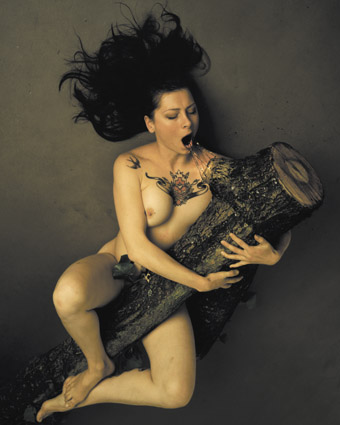
Monika Tichacek and Manuel Vason, Collaboration #2
courtesy of the artist
Monika Tichacek and Manuel Vason, Collaboration #2
controlled viewing
In Douglas Adams’ and John Lloyd’s comic dictionary The Meaning Of Liff, a ‘Frolesworth’ is “the amount of time one must spend looking at each picture in an art gallery in order that everyone else doesn’t think you’re a complete moron.” Take it from me: the Encounters exhibition seriously messes with your Frolesworth. The gallery space is in semi-darkness and rigged so that each print is spotlit only in the physical presence of a viewer: pressure sensitive pads depress beneath your feet, and a light gently warms over both you and the nearest image. You’re a little theatrical show of your own, you and that photograph. Move along and the light thins to nothing. Try to step closer? The light fizzles away.
On my first viewing I’m treated to my own—strictly unofficial—performance by Franko B. He strides up to the remarkable domineering image of his own whitened, blood-flecked face and appraises it from a variety of angles; except he can’t. He finds out pretty rapidly that he’s not allowed to stand close-up next to his own right cheek, or assay his majesty from a distance. The light only loves him when he’s upon the appointed spot, when he begs an audience with himself. Franko B harrumphs, shakes his head, and moves on: and I can see that interfering with one of the central freedoms of gallery-going may well annoy those who like to get so close they can smell the pixels, or stand so far back they’re practically in another postal code. Equally, you could argue that the technical trickery makes Encounters a bit like walking around iPhoto made flesh, a giant slideshow by anything but name. But for me, the staging has a remarkably positive effect: presented in such a uniform manner, without explanation or index cards, these frameless pictures develop frames uniquely their own.
As you walk around the gallery each approach involves a different negotiation. Here’s Alastair MacLennan, enthroned atop a cliff-face of rubbish and muck on a Belfast landfill, king of the seagulls. The print is one of the more pronounced enlargements and from this panoramic distance he appears foreign, benign…you feel the desire to approach and the instinct to turn away, simultaneously. Here’s Kira O’Reilly holding a slaughtered pig in a pieta, surrounded by a motley collection of Svankmajer-like taxidermy, lilies and pickled specimens; much like the performance that inspired it (inthewrongplaceness) the picture is oddly inviting, sweet like the amine tang of decaying flesh, whispering of a great many mortalities.
Here’s Marcela Levi, her steady unrelenting gaze above a mouth made into some alien orifice by means of a brace of thin black hairgrips, a sphincter dentata. I feel the need to return to this picture and step more carefully, more gently on the pressure point than I did the first time…as if I hadn’t properly paid my respects. In contrast, I feel like I’m seriously intruding upon the tarred-and-feathered Miguel Pereira, sad, pathetic and plastered against a blank wall like a dying bird. And the portrait of Anne Seagrave, channelling an almost visible electricity through clenched fingers and arms at right angles, invites me into a sort of meditative response of my own, rocking on the light switch, moving the steel grey image in and out of darkness. The freedom of interaction is much more pronounced than it might at first appear; upon leaving, we’re even invited to give these photographs (uniformly named Collaboration) titles of our own, scrawling ideas on postcards. It’s fruitful stuff: the images invite stories, backstories, the non-sequiturs of dreams.
tell and show
The symposium is much concerned with the collected problems of documenting the live event and the interesting complications generated by the beguiling love stories Vason and his collaborators have fashioned. Rebecca Schneider delivers a keynote speech as mischievous and sparkling as her contribution to Vason’s book, musing upon the tease of photography: “The photograph says: you were never there, and even if you think you were, you probably weren’t.”
Luckily, over the course of two days, we’re given the opportunity to ‘be there’ in no uncertain terms. Niko Raes produces Shattered Dreams, a compelling performance in which his naked body, suspended from the ceiling, is rigged so as to confound itself: as one limb falls, another must rise and vice versa, making a Sisyphean task of attaining any repose. His slow, deliberate movements have the constancy of Brownian motion and, ultimately, a very visible pain, Raes’ breath becoming increasingly laboured. The tension is only spoilt by some distracting and somewhat pointless analogue bloops and burbles on the soundtrack.
Veenus Vortex’s Worth Her Weight is a durational performance examining the personal language of desire and mythological representations of the body. A prone female form is slowly gilded over the course of several hours, the gold leaf attached by means of raw egg and saliva. Whilst the central image of a female form entwined around a cloven-hoofed double of herself is a remarkable one, the room is full of all sorts of vague symbols and ideas and for an examination of desire it seems strangely unfocussed; the entire atmosphere again wrecked by an unpleasant clunky collage of a soundtrack, this time played so loud it practically kicks your cochlea to death.
The final performance of the weekend is Ecstatic by Ron Athey and is, in contrast, a model of extreme, almost overwhelming focus. On a central altar, Athey vigorously brushes a wig of blonde hair on his head. This action somehow punctures wounds beneath the hairpiece, leading to a flow of blood. He then removes two glass panes from the end of the dais and laboriously, slowly, slats them back and forth across his naked body, over and under each other, his blood forming coagulating patterns on the glass like fluid fixed upon microscope slides. He then leaves. That is the sum of his actions, and despite the fact that mid-show the Arnolfini fire alarm sounds and the work halts for a few heartstopping minutes—a moment that feels like a slap to the face—the visceral simplicity of the performance prompts in me a series of reactions I can only describe as synaesthetic; I can almost smell the iron in the blood dripping across the raised podium, the motes of dust spilling from Athey’s wig are like tumbling musical notes, and by the end of this brief, unique moment I’m light in the head. I was there. And even if I thought I wasn’t, I probably was.
Manuel Vason, Encounters, Arnolfini, Bristol, UK, June 6-July 1
www.manuelvason.com
Encounters, Manuel Vason, Performance, Photography, Collaboration, Dominic Johnson ed, Arnolfini Gallery Ltd, UK 2007
RealTime issue #80 Aug-Sept 2007 pg. 2,3
© Tim Atack; for permission to reproduce apply to realtime@realtimearts.net
stolen TVs, from Life After Wartime
THE ROAD TO SEEING HERSELF AS A MEDIA ARTIST HAS BEEN A FASCINATING ONE FOR KATE RICHARDS WHO HAS TWO SHOWS AT SYDNEY’S PERFORMANCE SPACE IN AUGUST-SEPTEMBER. BOTH WORKS ARE TECHNOLOGICALLY SOPHISTICATED, COLLABORATIVE CREATIONS INVOLVING NOT ONLY SOFTWARE AND HARDWARE INNOVATIONS BUT ALSO ADVANCES IN DISPLAY AND PERFORMANCE METHODOLOGY. BUT IT WAS SUPER 8 THAT KICKSTARTED RICHARD’S COMMERCIAL AND ARTISTIC CAREER.
The first work, Bystander, is the latest manifestation of Life After Wartime, a suite of interactive media works created with Ross Gibson around a Sydney archive of crime scene photographs from 1945-60. This time the work will be experienced as an immersive installation after earlier incarnations as CD-ROM, gallery exhibition (which drew a huge attendance at the Justice and Police Museum, 1999-2000) and performance. Twelve visitors at a time will enter a space made up of five screens. This time, the mobility and attentiveness of the audience will prompt a computer to decide what to release of the crime scene images and narratives.
Richards’ other collaboration is Wayfarer, with Martyn Coutts, a game-based performance in which each of four audience teams investigates an unfamiliar space through images relayed by a performer whom the team direct using their voices.
the making of the artist
Sydney in the late 1970s fuelled the young Richards, just out of high school and excited by conceptualism at Sydney College of the Arts, where her sister was studying, by what people were doing at Alexander Mackie Studio, at Side Effects and the Sydney Filmmakers’ Co-op. “It was a very fruitful period. I was lucky enough to get into what later became the University of Technology, Sydney (UTS) and I started working in film, which I loved, and later living in the UK I learned video through the community video sector. But I always had a hankering to do more conceptual, experimental types of work, and I didn’t feel I fitted in at UTS which was at that stage teaching a more film industry model, although a lot of good people did come out of that.”
Richards maintained her experimental film and video practice, but while teaching at the College of Fine Arts (COFA) and doing her Masters degree, “I had a concept for a work that was not linear. And, I thought, ‘How am I going to manage this?’ Bill Seaman, the American media artist, was teaching at the COFA at the time and was my supervisor and said, ‘This sounds like a CD-ROM.’ And I was away! With a solid media production background I’ve always had a horses for courses attitude—choose the media that’s going to fit the concept. What I liked about interactive multimedia was that you could bring lots of extant media to it—cinema, sound, illustration, painting and typography. And there was also a role for the audience in determining outcomes or in navigating—I liked this fourth dimension. I’ve always enjoyed working with technology so it didn’t faze me too much.”
But Richards was wary of seeing herself as an artist even though in the early 80s she’d been well known in Super 8 circles and had secured grants. “I didn’t feel that confident as a young artist. I found creativity a scary, deep thing…I’m a bit of a late bloomer.” The impulse to focus on her artistry came after eight years of teaching at COFA, as well as in the Indigenous filmmaking course at the Australian Film, Television and Radio School (AFTRS), Metro Screen and full time at UTS in media production.
“I was burnt out from executive producing something like 80 different projects a year and from not doing my own projects. And I’d lost the creative drive.” Richards turned to freelance work including two years as multimedia producer for the NSW Historic Houses Trust based at the Museum of Sydney. Nowadays, working on her own projects and in collaborative ventures, Richards declares, “I define myself as a media artist.” As well as the Performance Space shows, she’s exhibiting a series of photographs at the Australian Centre for Photography in October and is working on a video for next year.
Above all, Richards reveals, “It’s interactivity, as a commercial producer or as an artist, that continues to stretch me. I learn different techniques, I work with different contractors and crafts people.”
Bystander, Kate Richards, Ross Gibson
bystander
Richards describes Life After Wartime as “a suite we’ve worked on together since 1999. Ross Gibson started a couple of years earlier researching the material. We have a database of 3,000 images and about 1,500 texts from Ross as well as sounds [incuding original music by Chris Abrahams and sound design by Greg White]. We were interested in different forms of display, different forms of interactivity design, so the audience would get different affects from the same sort of material. The visual and the sound design is similar across the whole suite—it’s the interactivity design and the combinatory strategies that differ in terms of the way the audience engages.”
Explaining how this new version of Life After Wartime works, Richards says, “Bystander is based on the notion of a generative world. ‘World’ is a common notion in fairly sophisticated interactivity. You create an environment that has very simple rules and it knows what to do under particular conditions. This allows for emergent behaviour which could be defined as simple rules giving form to complex behaviours. So you try to keep the rules as simple as possible for the World. In Bystander, the world only has a few characteristics. It’s on a 45-minute cycle. Every 20 seconds it pumps out a narrative text.”
Richards emphasises that “there is no interactivity apart from where audience bodies are and how they’re moving individually and collectively.” It’s the World which is asking, “Where am I in the 45-minute time cycle? What’s that text that’s just rolled out? How is the audience behaving, how still or robust or disruptive? And then using a valency or a gravitational idea it will draw a number of images or texts to cluster around that text. It’s choosing them on the fly from the database. If the World finds itself at a certain point in the cycle and the audience behave in a certain way, it chooses a whole lot of images about Kings Cross…or a bunch of images designated as having high narrativity. The rules change over the cycle. It’s a World sending you stuff, we don’t control what comes out, just the rules.”
The five-sided space was designed by media artist Tim Gruchy who, says Richards, “with his gallery experience and knowing that most galleries don’t have the equipment we need, suggested we make Bystander portable and self-sufficient. The frame and screen have been fabricated by professional screen makers. Five computers run the work, one has the brains (the World) and the others have to prepare the images for the five projectors as well as the sound. We made the whole thing as a kit.”
Richards adds, “The beauty of this system is that we could put someone else’s database in. Part of the research imperative of the project, which was funded by an Australian Research Council grant, was how do you create an environment that enables you to put a collection in and find the patterns. And how to pace it to suit the collection.
“We made Bystander respond positively to attentiveness because the material demands it. If the 12 people visiting at a time are quiet, more content is revealed, if noisy, less.”
wayfarer
Wayfarer has been three years in development and has physical theatre performers at its centre. Richards has always been attracted to engaging with performers, working with them on film and for voiceovers: “and I’m a bit of a frustrated performer myself even though it terrifies me.”
The work was initially conceived in 2004 at Time_Place_Space [the laboratory which brought together media artists and performers over five years]: “I teamed up with Martyn Coutts and we got on like a house on fire. He’s a physical performer from Tasmania interested in technology, he’s done a few technological projects and has strong theatre production management skills. We put together a concept in about an hour from a provocation from the workshop convenors, but it’s been through various changes since.”
Richards describes Wayfarer as combining “the exploration of a strange space, live performance and interesting technologies. It’s effectively a live game. The audience groups each have a player whom they drive using voice. The conceit is that the audience is outside and the performer inside a building they don’t know. It’s timely to premiere it at CarriageWorks because a lot people don’t know the back of the building yet.”
The performers move through the building wearing small chest-mounted computers “which send streamed video to our software and audio through VOIP to the audience who communicate via microphone. The performers also have RFID readers that can read tags (which trigger films about the site), like bar codes, in the building, and also so the site knows where they are. There are key game elements—time limits, issues of agency, how much for the performers, how much for the audience. There’s a series of tasks and goals you have to achieve to finish the game and beat the clock.”
The teams will operate near each other in the massive CarriageWorks foyer, working to a large screen with their voices: “Voice is the most flexible interface you can have. Anything you say is a potential action.” As for performer interplay, “If and when the performers intersect, the software splits the screen, so that the audience see up to four points of view.”
Richards says she has been particularly influenced by the UK’s Blast Theory (see p6): “When you participate in one of their works, it alters your consciousness because they’ve got a stong social enquiry imperative, the works are well designed and not always dependent on hardware—it might be about team mentality, for example, having to ‘buddy up’ with someone for a long period. We’d like our audience to be confronted by their own behaviour, their improvising, their relationship with a performer. We want the stakes to be high, an ethical spectacle. We like spectacle, we like games but we want something gritty, to be challenged. We want moral dilemmas.”
As with Bystander, Richards says that the hardware and software can be adapted for various users, for example text-driven theatre or community projects. As for the design, she admits, “I understand it in principle but it’s hard until it’s functional.” It’s a long way away from the mechanics of Super 8, but clearly for Richards a road well worth taking.
Above all, Kate Richards is emphatic that “immersive” doesn’t mean having to push buttons, learn rules, make mechanical decisions or rely just on the intellect. “It’s in the way you move. It’s in your voice and what you say.” The game is on. Enter the ethical spectacle. Complexity.
Bystander, artists Ross Gibson, Kate Richards, visual design Aaron Seymour, interactive sound design Greg White, senior programmer & engineer Daniel Heckenberg, sound programmer Jon Drummond, installation design Tim Gruchy, Performance Space, Aug 8-Sept 9 www.lifeafterwartime.com; Wayfarer, artists Kate Richards, Martyn Coutts, software design and programing Jon Drummond, technical producer & designer Mr Snow, Performance Space, CarriageWorks, Sept 5-8, www.performancespace.com.au
RealTime issue #80 Aug-Sept 2007 pg. 4
© Keith Gallasch; for permission to reproduce apply to realtime@realtimearts.net
Pocket Film Festival
THE MOBILE PHONE IS A SHRILL INTRUDER. IT UNSETTLES MY SLEEP, INTERRUPTS MY CONVERSATIONS AND PROMPTS A MID-STRIDE FRANTIC BAG FOSSICK. IN JUNE I TRAVELLED TO PARIS IN PURSUIT OF THE BROADER CULTURAL DISRUPTIONS THAT THE MOBILE PHONE MIGHT BE CAUSING.
Now in its third year, the International Pocket Film Festival 07, hosted by the Pompidou Centre, presented a plethora of forums and creative projects that were made with, shown on, or developed thanks to the mobile phone.
France seems an appropriate home for this grainy new bloom of filmmaking. The streets of Paris are the subject for a new generation of filmmakers, but now pixilated to the point of abstraction with truth shakier than ever at 15 frames per second. Yves Gallard, coordinator of the festival’s international program, likens the potential of mobile films to the freedoms experienced by early Super 8 filmmakers, thus squarely and safely placing the festival within a canon of French national cinema. It is not surprising then that film director Claude Miller, who started out assisting Bresson, Godard and Truffaut, headed up the jury for best big screen film shot on mobile phone.
Heidi Tikka's Births, Pocket Film Festival
broadcasting intimacy
In one of the many forums, Heidi Tikka of Mcult, Finland, presented Births, a mobile service experiment that placed camera phones in the hands of new mothers in Helsinki maternity hospitals. Tikka frames her work as artistic social research into mobile applications.The stills taken on these phone cameras were projected in prominent public spaces: babies catapulted from recent constriction in the womb to 20x magnification on a city wall. Tikka explains that we previously announced births in the local newspaper: a few words released into the public sphere for those who know the family. Her project makes the celebration of birth a broader community experience. As viewer I have no idea who these slimy little people are but their struggling first breaths and closed eyes are overwhelmingly powerful and slightly troubling—my voyeurism highlighted by the absence of any returning gaze.
I wonder how people felt watching the mobile phone video of Saddam Hussein’s death. Tikka’s work highlights the ways that mobile media might influence social etiquette and norms, raising questions about how to navigate when mobile technology disturbs the boundary between public and private, and embodied experience becomes disrupted by telepresence. Should we be able to peer this closely at others’ deaths and births? Tikka reported that despite the images being freely given by the mothers, she still felt the need to moderate them for public display.
personal screenings
Most of the films shown came from the likes of the UK’s Pocket Shorts (UK), the Toronto International Film Festival and Amsterdam’s Playmobiel. Australia had a major presence in this program with exhibitions from Australian Network for Art and Technology, dLux Media Arts and Metro Screen. Australia was also represented in the big screen competition with works by Melinda Rackham, Damon Herriman, Michael Lohmaller and Hermione Merry. Merry won third prize for her Sunday or the Circus.
There was an enormous body of tiny works to view—the experience one of constant flipping between poetry and eye candy. Works were less than one minute and situated somewhere between ultra cute screen-saver type animations and the video equivalent of haiku.
Each exhibition phone held a lengthy sequence of works edited as a single loop with keypads completely locked preventing the skim reading and flicking that handsets make possible. It was also disappointing that none of the mobile works were available for download, thus keeping the art securely framed by its gallery locale. Gallard explained the decision: “the French do not use Bluetooth. This aspect failed at last year’s festival and will not be tried again.”
At its best, the mobile platform is wonderfully uncontrollable; artists and filmmakers have the opportunity to leave their work literally in the hands of the viewer, from where it can be shared rhizomatically. It’s a pity that in comparison with the playful, disruptive attitude of the big screen program, the mobile exhibition did not undermine the expectation that viewers should only ‘look but don’t touch.’ Mobile films can be tactile and personal, but in this case, none of the works got anywhere near audience pockets.
public screenings
UK artist Henry Reichold stages a small, hand-sized takeover of public space with his work Free Run. Black and white phone video taken on the streets of London is overlaid by the artist’s own movement through them. In a flight of editing fancy Reichold jumps buildings and scales walls like a surfer of public monuments. Free Run suggests the potential of mobile phones in the creation of public digital art with a new digital public in networked communities.
Taken in one shot, unedited and unscripted, Porte de Choisy by Antonin Verrier won the judges’ prize. The film centered on a highly intimate but also totally banal conversation between lovers, one of whom held the mobile phone camera most of the time (when it wasn’t simply discarded on the bed). Made like a home movie, but for collective viewing by strangers, the work’s similarity to YouTube content playfully tempts the audience to disregard it as amateurish. Despite the film’s veneer of carelessness, Verrier makes some interesting choices including his characters’ use of apartment windows and phone and internet screens to create an expanded narrative outside the frame.
It seems that the mobile has unleashed some refreshingly impetuous filming. In Reverse Love, a non-professional actor walks perpetually towards us in uncomfortably long shots, gradually forgets to act cool and acknowledges the person behind the mobile camera with flirtatious smiles. Finally she grabs the phone and turns it on her partner. Now the action continues much as before, although with the dynamic between director and actor disrupted. Reverse Love won the audience prize for maker Morgan Foldi-Mohand and, like Porte de Choisy, enjoys great fluidity between the roles of subject and maker.
Mobile technology seems to be mapping out a little elbow room for media art, with phone films bringing fresh fumbling intimacy and impetuousness to creative practices. For such a tiny festival (three days long), Pocket Film covered enormous ground, the expansive approach testament to the far-reaching tremors this tiny cultural disruptor is causing.
Sasha Grbich presented pixel.play and Portable Worlds, programs developed for ANAT. For works from the big screen program go to www.festivalpocketfilms.fr
International Pocket Film Festival, Pompidou Centre, Paris, June 8 -10
RealTime issue #80 Aug-Sept 2007 pg. 5
© Sasha Grbich; for permission to reproduce apply to realtime@realtimearts.net
Day Of The Figurines 2006, Blast Theory
courtesy of National Museum of Singapore
Day Of The Figurines 2006, Blast Theory
BLAST THEORY’S LATEST WORK, DAY OF THE FIGURINES, WHICH RECENTLY RECEIVED AN HONORARY MENTION AT PRIX ARS ELECTRONICA 2007, IS A MASSIVELY MULTIPLAYER BOARD GAME FOR UP TO 1000 PARTICIPANTS WHOM PLAYERS CAN INTERACT WITH REMOTELY VIA SMS MESSAGES THROUGH THEIR MOBILE PHONES FROM ANYWHERE IN THE WORLD.
Day of the Figurines opened in Berlin in 2006, and has since been presented in Singapore, Brighton and Birmingham. It was developed by Blast Theory in collaboration with Nottingham University’s Mixed Reality Lab as part of IPerG, an EU funded research project investigating pervasive games and comprising a number of European research centres and universities including Fraunhofer Institute and Sony NetServices. For IPerG, pervasive games “are no longer confined to the virtual domain of the computer, but integrate the physical and social aspects of the real world” by extending conventional computer games in one or more of three dimensions.
Blast Theory’s Can You See Me Now? (2003-5), winner of the Golden Nica (2003) at the Ars Electronica Festival in Linz, explored spatial expansion by utilising the Global Positioning System (GPS) to track performers’ movements through a city which were then mapped onto avatars’ movements to allow for a chase between the performers in the city and the online players. Other Blast Theory works, such as Uncle Roy All Around You (2003), investigated social expansion by exploring the boundaries between the fictional world of a game and the physical reality of a city, implicating bystanders on city streets in the narrative of the game. In contrast, Day of the Figurines explores the theme of temporal expansion, unfolding slowly, over 24 days, through the exchange of just a few text messages each day.
Day Of The Figurines 2006, Blast Theory
courtesy of National Museum of Singapore
Day Of The Figurines 2006, Blast Theory
To participate in the game, players visit a physical space, which could be a museum, gallery, theatre or art centre, where they find a large-scale white metal model of an imaginary town at table height. Designed to act as a spectator interface, the board displays 50 cut-up destinations, based on a typical British town including, for instance, a 24 Hour Garage, Big Chef, the Blue Cross, a Boarded-up Shop, an Underpass, but also, ominously, the Nuclear Bunker and the Rat Research Institute. Two video projectors beneath the surface of the board shine through holes in the table reflecting off mirrors mounted horizontally above, thus enabling the surface of the table to be augmented with projections of information from the game. This augmentation system is turned on periodically to show the game operators where to move each figurine as they update the physical game board. For each figurine in turn, the augmentation system projects a line from the figurine’s current position on the board to its new position.
Players select a figurine from a display of 100 neatly arranged on a second table. The figurines are the size of a thumbprint, made of plastic, brightly coloured, and act as in a cartoon, allowing for, in Blast Theory founding member Matt Adams’s words, “a deeper level of identification than a more realistic portrayal.” Assisted by an operator, players give their figurine a name, an identity, and then watch as it is placed on the edge of town. Before leaving the space, they are given some basic instructions about the game, which explain how to move, speak, pick up and use objects, find other players, receive help or even leave the game.
From the moment of registration, the game contacts players through SMS messages. If players choose a destination, the figurines are moved towards it. Once the new destination is reached, they may encounter other players with whom they can exchange messages. Players may also encounter objects, such as ladders, billiard cues, photo IDs, wrist bands, fleeces, tea, saveloys, gas canisters, bodies and defibrillators, and be presented with missions and dilemmas in the form of multiple-choice and open questions, some formulated in real time by the game operators. Unlike in conventional games, players, who soon realize that they are refugees in this estranged town, do not really win or lose but rather learn how to survive by looking after their health, building on their game knowledge, responding to missions and dilemmas and helping other players. While time goes by, shops open and close, an eclipse takes place, a fete raises some money, an army occupies the town, light fades and dusk sets in, it becomes cold. Players, some chatty, some quiet, some active, some tentative, come and go, and, for nearly a month, become our companions, sharing information, circulating rumours, having enlightened or exhilarating conversations, some trying to help, some trying to hurt or even kill us, episodically and yet pervasively, in this curiously entertaining and yet also disturbingly estranging world.
being in the game
Here we learn that this game has no real winners, no final objective, but rather operates at the level of Heideggerrian dasein—being in the world. The spatio-temporal structure of the game is very complex and whereas players, subsequent to the encounter with the board, are under the impression that they inhabit a Cartesian world, the game in fact operates by a hub structure whereby all destinations are equidistant from one another. This creates a distorted spatial awareness, which affects the sensation that the game operates in its own space-time, not so much separately from as additionally to our day-to-day lives. Day of the Figurines is a sophisticated hybrid, encouraging, as IPerG member Markus Montola would put it, “minimal” roleplay and thereby allowing players to dip in and out of the game world from within the varied contexts of their own lives. The game narrative is carefully constructed to give the sense of an authorial presence but also to facilitate interactivity, as well as theatricality and performativity. Whereas the former allows for the creation of virtual spectatorship and audience, the latter is visible in the formation of more or less spontaneous performance events, such as virtual happenings, flaneurism and, perhaps even most innovatively, spatial and social co-presence which allows for a prolonged and efficacious form of social connectivity derived purely via the temporal augmentation of our lives.
I have now played Day of the Figurines three times (Berlin, Brighton and Birmingham) and have found the game just as absorbing and engaging as any faster, more immersive game. I have also found it structurally and aesthetically exceptionally rich, so much so that as yet I have not been able to explore all destinations and engage with all objects, dilemmas and missions. Although the game is unmistakably original, it contains a wealth of dramaturgical intertextual references that locate it between and beyond postmodernist practices spanning from Samuel Beckett’s Waiting for Godot and Endgame to Peter Eisenman’s Holocaust Memorial in Berlin and Peter Handke’s Kaspar Hauser, not to mention the world of pervasive and massively multiplayer games, as well as Blast Theory’s own mixed reality performance work.
Day of the Figurines is an exciting, complex, and decidedly original development in the work of Blast Theory that represents a milestone for disciplines as varied as Performance Studies and Computer Science, Visual Art and Psychology, Sociology and Game Studies. Not only is it the first game working entirely through SMS messages (linguists might of course see this as the first performative mobile phone game, based exclusively on speech acts. Philosophers might read it as a post-Wittgensteinian interpretation of language games), but it’s also the first original artwork to operate pervasively, episodically, and performatively that can be played from anywhere and at any time.
****
Julianne Pierce (ex-VNS Matrix, ex-Executive Director ANAT, Visual Arts Coordinator Adelaide Festival of the Arts, and Board Member Open City, publisher of RealTime), has been appointed Executive Producer to Blast Theory and leaves to join the company in the UK this September.
Blast Theory, Day Of The Figurines, various cities
www.dayofthefigurines.co.uk
www.blasttheory.co.uk
Mixed Reality Lab www.mrl.nott.ac.uk
IPerG www.pervasive-gaming.org
RealTime issue #80 Aug-Sept 2007 pg. 6
© Gabriella Giannachi; for permission to reproduce apply to realtime@realtimearts.net
Daphna Yalon, Porthole to the Earth
photo Elan Rabinovich
Daphna Yalon, Porthole to the Earth
ALONG THE RANGES, OCHRE PAINTINGS SHELTER IN THE GAPS. BLUE SKY BLAZES AND COUNTRY STRETCHES AWAY RED-GOLD. ALICE SPRINGS, SLIGHT AS A SCATTER OF SALT, LIES TO THE NORTH OF THE GAP ALONGSIDE THE SANDY YELLOW TODD RIVER.
Over 21 days in May, Shifting Ground showcased over 40 local, interstate and international artists at 13 sites around Mparntwe/Alice Springs. Their common aim was to link people to art, land and culture, responding to the arid lands on a physical, social and cultural level, telling stories of people and place and exploring sustainability and ecology.
The opening at the Ilparpa claypans, hard baked by the hot, dry summer was at sunset. Dark thunderclouds banked up creating a light show to rival the human one. After welcome to country by traditional owner, Sybaella Turner, longed-for rain drowned the voices of poetry readers and sluiced down the screen of projected images of desert water. The white cube home of Israeli artist Daphna Yalon’s ground-breaking, installation Porthole to the Earth shone in the dark attracting the soaked audience like moths. Adrienne Kneebone’s thorn-pierced red knickers blew on the Hills Hoist. High on the range-side, the solar lanterns in Richard Thomas’ installation, China, had shone briefly at dusk until smashed by vandals.
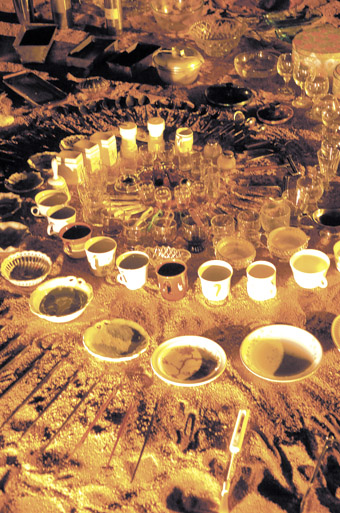
Franca Barraclough, Cleaning Country/Mandala
photo Chloe Erlich
Franca Barraclough, Cleaning Country/Mandala
Out west at the Desert Wildlife Park, while the birds slept, local poets read from The Milk in the Sky (25 stories by local writers published by Ptilotus Press), followed by Sound Atlas, more live music and Arrernte woman, cultural educator MK Turner. Sculptural installations by Pam Lofts, Sue Richter, J9 Stanton and Sue Taylor sat in the earth. Franca Barraclough performed Cleaning Country/Mandala, laying out domestic paraphanelia also on bare earth as she constructed “an invisible Western house on the pristine traditional country of Central Australia…to see the awkward and eerie juncture of two worlds.” Pauline Hanson had come to town to launch her book.
All the while negotiations and confrontations between the Federal Minister for Aboriginal Affairs, the NT government, Alice Springs Council and Tangentyere Council over land and houses for local Arrernte people were being acted out.
There were artist forums, one a Moonlight Picnic on the Adelaide House lawns in the Mall, alongside the Story Wall, which screened Pip McManus’s video installation Ichor (1 kôr), documenting the soft disintegration of a clay figure. Violent assaults in town camps continued throughout the three weeks.
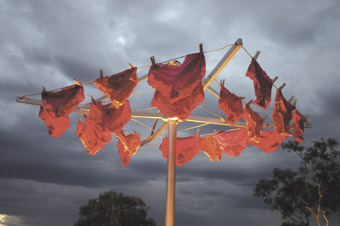
Adrienne Kneebone, Hills Hoist
photo Pip Mcmanus
Adrienne Kneebone, Hills Hoist
Araluen Galleries showed Deborah Clarke’s Boots and All; mixed media works conveyed walking the Larapinta Trail; and Shifting Ground explored ‘this place’ with Michael Gillam’s photographs of arid land minutiae, Genevieve and Christopher O’Loughlin’s photo series, The Laneways (resonating with Under Today, an excavation of storied sites by Alexandra Gillespie and Dani Powell performed in an Eastside laneway) and Alison Hittmann’s paintings on rusty metal sat alongside Mervyn Rubuntja’s sun drenched watercolours of country.
The desert water of Pam Lofts’ Ripple Affect video flowed around in its never-ending cycle whilst national water policies and global warming heated the airwaves.
The nuclear dump debate re-emerged. At Watch This Space, Inhabited, 12 photographs with interviews by Jessie Boylan and Bilbo Taylor, recorded the stories and protests of Indigenous and non-indigenous people affected by uranium mining in Australia.
Indomite, a video by Chilean artist Leonardo Ortega exploring Aboriginal community housing issues at Ntaria, played in a shop window as, reflected in the glass, the shadowy figures of an Aboriginal family passed by, glancing at an Aboriginal man, on screen, indicating Albert Namatjira’s old home.
Down the dusty Old South Road, the Wild Plum Dreaming rock carvings at Ewaninga sit in country forever.
Shifting Ground, an Art/Land/Culture project initiated by Watch This Space, various sites and venues, Alice Springs, May 4-25; www.wts.org.au/alc/shiftgallery.html
RealTime issue #80 Aug-Sept 2007 pg. 8
© Mardijah Simpson; for permission to reproduce apply to realtime@realtimearts.net
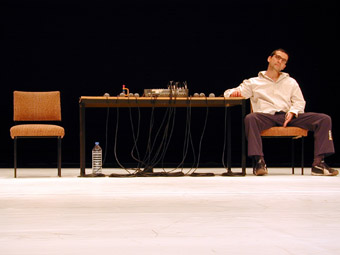
Thomas Lehmen
photo Thomas Aurin
Thomas Lehmen
“LEARNT SO FAR: SCREAMING, WALKING, READING, WRITING, COOKING, PLAYING FOOTBALL, DANCING, MAKING LOVE, DRIVING A CAR, LAYING FLOORS, FISHING, MAKING NONSENSE. LEARNING AT THE MOMENT: STAYING CALM, LIVING, PORTUGUESE, TAKING CARE OF MONEY, KEEPING ORDER, FRIENDSHIP, DYING.”
Thomas Lehmen
This list of accomplishments and intentions serves as introduction to the contemporary dance solo, Lehmen Lernt, with which Berlin based choreographer, Thomas Lehmen, will make his Australian debut. Hosted by Critical Path and Performance Space in Sydney and by Strut in Perth, Lehmen is part of the Goethe Institut’s GerMANY FACES Australia cultural festival.
Lehmen’s provocative solo marked a pause in the rapid creation of conceptual, rules-driven group pieces, such as Schreibstueck from 2002 and FUNKTIONEN and It’s better to… from 2004. Still in repertoire, these productions have been performed widely around the world and have led to Lehmen’s inclusion in a wave of programming which probes the conceptual underpinnings of dance. In 2005 Lehmen began a protracted exercise in learning which he continues to develop.
In tackling a list of tasks, ranging from the mundane to the poetic, with a single approach, Lehmen seeks to show “that we all shape the world together, that everyone has their own part to play, and that the desire to learn, seen in even the smallest action, is a creative contribution. Learning is universal to all people. A function everybody uses in life. That’s how I came to the collection of ‘things’ one can learn. People connect with it in many ways. Everybody seems to pick out what interests them personally.”
Tackled with wit and showmanship, the solo is an absorbing experience, as Lehmen in his blue overalls demonstrates his achievements to date. Unlike much of his other work, there is no manual or tool-box for this show to be recreated on other artists. Instead, this piece will continue to be extended by its creator. Lehmen says, “Each piece is a development. This one was important to me because I could put in lots of the experience which I gained from the previous pieces. The ideas of systems, functions, lists. Though I think there is still so much to work out, which I hope I can do for the next 50 years.”
In Sydney and Perth, Lehmen will use the set of rules he created for the Funktionen project to work with local choreographers on a week-long research project. Lehmen describes Funktionen as a “rotating system” in which the functions of Observation, Material, Interpretation, Mediation and Manipulation are used by the artists as tools for the expression of ideas. Lehmen says, “It is just a guideline for the participants to make their decisions. It is a system of communication which contextualises any relevant context the participants work with. I work with the idea of complexity and context by myself in a similar way. Knowing that everything is possible to connect to everything else, and each element has a potential influence on all the others, I need a system which allows me to keep an overview. Within this system chosen elements may nevertheless still have an independent function within the choreography (and in my mind).”
This materialising of context is a theme in all Lehmen’s work. He writes, “It’s obvious you can’t pull down the walls of theatre buildings and rebuild them. But that doesn’t keep me from imagining it. The solution of a problem cannot go any further than structures and rules allow. After all, structures and rules can only offer inherent solutions. But, in dance, we’re constantly working at more or less consciously applying, classifying, and naming structures, systems, focuses, styles, and world views. We generally reconstruct existing things to confirm their existence, although we might vary certain factors without changing the foundation for those structures. In choreography, more than anything else, it’s the shape and quality of the body that we want to change. And thankfully, it’s more and more the idea, perception, reference, and context.”
In 2007, Lehmen Lernt has toured to Vienna, Brussels, Rome, Montevideo, Utrecht, Prague, Uzes, Talinn and Tuzla. Lehmen has started the creation of a new piece, in which he hopes, “to put my systematic thinking on my movements and body more.” He is reluctant to expand further upon this new work, stating, “I try to work with ideas of freedom.” Thomas Lehmen is looking forward to his Australian visit with a similar lack of expectations.
Thomas Lehmen, Lehmen Lernt, Performance Space, CarriageWorks, Oct 6, 8.00pm; workshops at Critical Path, Sydney, and Strut, Perth, in October.
RealTime issue #80 Aug-Sept 2007 pg. 11
© Sophie Travers; for permission to reproduce apply to realtime@realtimearts.net
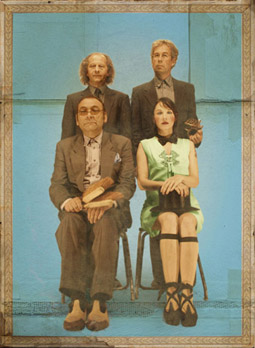
Meret Becker & Ars Vitalis, HARMONIE DESASTRES
HERE’S A FESTIVAL THAT WILL BRING YOU FACE TO FACE WITH CLAUDIA TERSTAPPEN’S PHOTOGRAPHS OF GERMANS LIVING IN AUSTRALIA, WITH THOMAS WEINBERGER’S JUXTAPOSITIONS OF BERLIN, MUNICH AND SYDNEY, AND INTO EYE CONTACT WITH THE CRYING WOMEN OF THE PAINFULLY INTIMATE VIDEO PORTRAITURE OF BORIS ELDAGSEN’S WEEPING SONG.
How we look at another culture, from everyday physiognomy to art to the character of its cities is central to the Goethe-Institut’s GerMANY FACES Australia festival whether encountered in Thomas Lehmen’s provocative self-choreography, or Katharina Grosse’s adventures in the colour-driven transformations of space, or the hybrid forms bred by a new generation of German musicians.
Sydney Goethe-Institut’s Director, Klaus Krischok, sees the festival’s substantial music program as “countering the predictable association of German music with Bach, Beethoven, Brahms, hard-core Berlin techno and the allegedly ubiquituous brass band oompah-pah. The performers chosen for this festival counteract some of those stereotypical associations though ironic commentary and deliberate style mixes.”
As evidence, Krischok cites “the young film star Meret Becker teaming up with a group of rather mature world musicians to produce her Harmonie Desastres, and a good deal of anarchy. Rising star Schriefl—a Bavarian dandy—blends cool urban jazz with punk elements. Francoise Cactus and Brezel Göring are Stereo Total. They mix German and French lyrics and styles, accents and topics in their minimalistic yet melodic songs. DJs Ame, Tanzmann and Trickski are here to prove that the German electronica scene has indeed evolved from techno and does allow for elements of new romanticism.”
While seeing new German music in action, or contemplating the imagery of German-Australian duo Boris Eldagsen and Natascha Stellmach and at the ACP in No Cure—New German Photomedia (Aug 23-Sept 29), or finding oneself immersed in site-specific and performative painter Katharina Grosse’s new work at GoMA (Brisbane’s new Gallery of Modern Art, July 15-Oct 28), there’ll be big picture ideas to talk about and contemplate. An art and science expo at the University of Sydney (GerMANY INNOVATIONS) will open on September 10 and go on to other cities while The Liquid Cities: Berlin-Sydney Conference (Oct 3-5) is designed to address “the creative city, innovative cultural management and broader access to the arts.”
Performance comes to the centre of these discussions in Ta(l)king Pleasure in German Culture, A Day in the Dialectical Playground. This symposium at UNSW is followed by performances featuring Sydney based artists Martin del Amo, Jeff Stein, Regina Heilmann along with Paul Gazzola (who works between Germany and Australia) and visuals by Heidrun Lohr (Io Myers Studio, 5.45pm, Oct 20).
As Sydney increasingly comes face to face with its problems as a city, the opportunity to reflect on its future through art and dialogue is truly welcome. RT
GerMANY FACES Australia, Sydney, Melbourne, Canberra, Brisbane, Sept 10-Oct 20
RealTime issue #80 Aug-Sept 2007 pg. 11
© RealTime ; for permission to reproduce apply to realtime@realtimearts.net
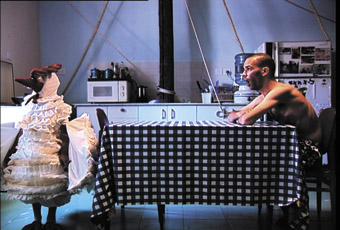
Guy Ben-Ner, Moby Dick, Experimenta’s Playground
PERFORMANCE ART IN DARWIN, PERFORMATIVE INSTALLATIONS IN SYDNEY, MEDIA ARTS EVENTS IN MELBOURNE AND PERTH, AND A GRAND AMERICAN OVERVIEW IN THE MELBOURNE FESTIVAL
experimenta playground
The latest of Experimenta’s international media arts shows features artists RealTime readers will recognise. Shu Lea Cheang’s Baby Love, its audience riding in giant plastic teacups with ‘cloned’ singing baby dolls, was highlighted in Michael Connors’ report from ISEA 2006 in San Jose (RT 76, p23), and Jennifer and Kevin McCoy’s movie-inspired electronic sculptural installations were at the centre of Fabienne Nicholas’ celebration of the opening of BFI Southbank in London RT 78, p 8).
As well as these Taiwanese (Cheang lives and works in Paris) and US contributions to the playground, Australian video artist Shaun Gladwell takes on the urban environment as a skateboard challenge a la Parkour—if it’s there go at it, including a public fountain. The UK’s Philip Worthington takes your shadow (an alarming concept after seeing Chunky Move’s Glow) and ‘monsters’ it—adding teeth, scales etc. From Israel, Guy Ben-Ner brings his take on Moby Dick, staged at home in the kitchen with the family and silent movie trickery. Daniel Crooks contributes his admired vertical kaleidoscoping of city spaces (see RT 77, p33). From Switzerland, the chain reaction creations of Peter Fischli and David Weis will amaze alongside the animated wonderland of Japan’s Sawatowasi, a screen puzzle from Korea’s innovative June Bum Park and, from the US, Zachary Lieberman’s offer of synasthesia as you compose music with a colour yield. Spain’s Eugenio Ampudia in En Juego (in Play) rightly offers fooball as art.
And, surprise, amidst these 21st century interactives and video installations, there’s a Marina Abramovic video from 1973: Rhythm 10, her first work! With 20 knives and two tape recorders she jabs systematically between spread fingers and then attempts to reproduce the performance, cuts, cries and all. While it’s not at all surprising that Experimenta, on past evidence of user-friendly shows, has finally arrived at one titled Experimental Playground, the mysterious inclusion of Abramovic is a reminder of previous glimpses of the dark side of new media arts. This is pre-digital play, live action replay, and not to be played at home.
Experimenta Playground, Blackbox, Arts Centre, Melbourne, Aug 25-Sept 23, www.experimenta.org
beap
The Biennale of Electronic Arts Perth (BEAP) is accelerating towards its 2007 program, Stillness, featuring three international exhibitions and hosting two international conferences (including one open to the public on the future of digital media). This third BEAP focuses like its predecessors on the instersections of art, technology and science. Exhibited works will include Christa Sommerer and Laurent Mignonneau’s “massive interactive installation” Eau de Jardin (Austria/France), Daniel Lee’s digital animation Origin (Taiwan), Mark Cypher’s Darwin project (Australia), Lynette Wallworth’s immersive soundscape and interactive installation Still: Waiting 2 (Australia), Bill Viola’s Observance (US), Ulf Langeinrich’s Waveform B (Germany/Austria) and Boris+Natascha’s Meditations series (Germany/Australia), “a guided meditation on 21st century anxiety”, plus new works from Australians Kylie Ligertwood and George Khut. Former BEAP director Paul Thomas has described data growth as “akin to a maelstrom—a global storm that’s unstoppable and unpredictable. But, at the storm’s eye—as in nature—there is ‘stillness’, a momentary space for reflection.” Let’s hope for a contemplative BEAP amidst the hurly-burly of our technologised lives.
BEAP, Stillness 2007, Sept 10-23, www.beap.org
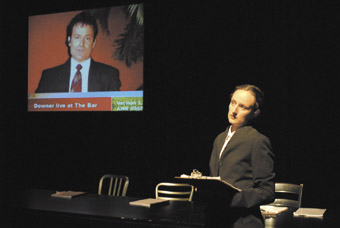
Version 1.0, Deeply Offensive and Utterly Untrue
photo Heidrun Löhr
Version 1.0, Deeply Offensive and Utterly Untrue
deeply offensive and utterly untrue
In their latest detailed unveiling of Australian political iniquities and radical re-working of verbatim theatre, Sydney’s version 1.0 (CMI and Wages of Spin) take on the 8,500 page transcript and 64 days of the Cole Inquiry’s public hearings into the Australian Wheat Board’s $290m of kickbacks paid to the Iraqi leadership. The endless “I forget” litany muttered throughout the ‘wheat-for-weapons’ inquiry should provide an insistent pulse to the pragmatic madnesses and rhetorical games duly and doubtless entertainingly revealed.
Version 1.0, Deeply Offensive and Utterly Untrue, artists Sean Bacon, Paul Dwyer, Stephen Klinder, Jane Phegan, Gail Priest, Christopher Ryan, Yana Taylor, Kym Vercoe, David Williams; Performance Space, CarriageWorks, Aug 24-Sept 8, www.performancespace.com.au
interpositions
Casting all obstacles aside, geographic and cultural, and signalling the rise and rise of performance art and live art, 24HR Art is bringing together stellar artists from Singapore and Australia as part of the Darwin Festival. Interpositions is free and will be staged in various public locations for a week, commencing with Jill Orr on August 11. Other artists from Australia are Anna Fuata, Ash Keating, Jason Keats and Hayley West; from Singapore, Jason Lim, Lynn Lu, Rizman Putra, Juliana Yasin and Lee Wen.
Ann Graham, Aftermath
photo Tony Bond
Ann Graham, Aftermath
aftermath
Artspace’s big performative installation program moves from strength to strength with an impressive accumulation of crafted detritus—the aftermath of performances. Ann Graham’s In Between Space is a curious cluster of dark timber and glass walled rooms like small office spaces out of the 30s. Each addresses a basic function and there are signs of rarified life—water drunk, hair cut, books read, food consumed (Graham’s performance was the serving of a meal). It’s a witty and pleasantly disorienting installation. A symposium on issues raised by Aftermath will be jointly presented by Artspace, Performance Space and RealTime. Speakers include Arahmaiani, Christina Barton, Thomas J Berghuis, Blair French, Ash Keating, Julie Rrap, Tony Schwensen, André Stitt and David Teh.
Aftermath Symposium, Performance Space, CarriageWorks, Aug 18, 1-5pm, www.artspace.org.au
melbourne international arts festival
With Merce Cunningham and Laurie Anderson on hand and with works from Robert Wilson, Jasper Johns, Robert Rauschenberg, Andy Warhol and John Cage, this year’s Melbourne Festival constitutes a substantial introduction to the evolution of American postmodernity, an experience bound to be at once educational and intensely aesthetic. With some 10 events on the agenda, the Cunningham presence is indeed, as advertised, a residency. It’s rare these days to find an arts festival with such coherent programming at its centre.
Elsewhere on the program is Poe’s Tell-Tale Heart as realised by Barrie Kosky, Matthew Gardiner’s Oribotics, Chunky Move’s Glow, European performance companies Dood Paard and Teatre Lliure, and Japan’s Sankai Juku. And that’s just a short list. Read more about it in RT 81. KG
Melbourne International Arts Festival, Oct 11-27, www.melbounrefestival.com.au
RealTime issue #80 Aug-Sept 2007 pg. 12
© RealTime ; for permission to reproduce apply to realtime@realtimearts.net
WELCOME TO OUR ANNUAL ARTS EDUCATION FEATURE. THIS YEAR INSTEAD OF ADDRESSING SPECIFIC ISSUES OF PRACTICE AND LEARNING IN SURVEYS OF UNIVERSITY SCHOOLS AND DEPARTMENTS AROUND AUSTRALIA, WE THOUGHT WE’D INVITE OPINION PIECES FROM LEADING ARTFORM ACADEMICS ABOUT CURRENT CHALLENGES TO THE ARTS IN THE UNIVERSITY. FEELING IS STRONG THAT THE ARTS ARE GETTING A RAW DEAL DESPITE SOME IMPROVEMENTS AT POSTGRADUATE LEVEL AND PRE-ELECTION TALK OF AN ‘EDUCATION REVOLUTION.’
The informal essays in this feature call variously for more equitable funding of the arts within the university; for more relevant and responsive course structures (eg in music); formal recognition of professional experience accrued by staff outside the university (eg in film); for sympathetic application of Research Quality Framework (RQF) criteria; and acknowledgment of the compromises and inequities that come with mergers (eg of arts training schools with humanities departments). Writers are also concerned about the likely impact of proposed generalist first degrees (with specialisation only in higher degrees) on the training of young undergraduate bodies in dance, theatre and music.
The essays on sound and performance describe how niches have been established inside and outside the university enhancing survival but also creative practice and stimulation. Elsewhere, failures to connect are worried at—disconnections between art and the university, and between the university and the outside world. As Stephen Whittington points out, teachers have come to realise that their educational ideals are often not shared by the community or the education system given the current ideological temper.
In an election year, do we dare hope for a vision that entails an ‘education revolution’ for the university. Might we hope for art’s liberation from the chains of economic rationalism and ideological incarceration? RT
RealTime issue #80 Aug-Sept 2007 pg. 13
© Keith Gallasch; for permission to reproduce apply to realtime@realtimearts.net
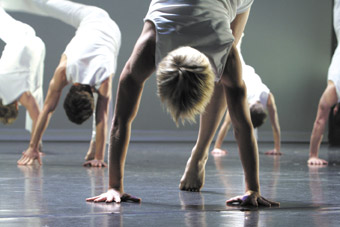
Dance students from the Faculty of Creative Industries, QUT
THERE ARE FLESHY BODIES, HIGHLY SKILLED AND VULNERABLE, AND THERE ARE DISCURSIVE BODIES, HERMETICALLY SEALED IN WORDS BRAVELY SPEAKING ABOUT THEIR MUSCULAR AND MUCH MESSIER COUSINS. THE FORMER ENGENDER SUSPICION, IF TINGED WITH AWE, WHILE THE LATTER PROBE EMBODIMENT’S DARK RECESSES WITH RIGOUR AND EXACTITUDE WITHOUT BEING ABLE TO ENCAPSULATE ITS LABILE CONSCIOUSNESS AND KNOWLEDGE.
Both types of bodies populate higher education, at times in tense relationships, at other times in articulate and consummate partnerships. Few scholars in the 21st century would deny the gap between ‘being’ and its pervasive representations and yet the movements of dance within the halls of academe often meet with resistance, as if dance was the shadowy substance and its representative descriptions—like these words—the measure of its validity.
News of the academic dancing body, however, is not all woe. Practice-based knowledge or epistemological materiality has been recognised in the Australian research community, specifically in a Creative Arts’ Panel of the Research Quality Framework, the present government’s new mechanism for research funding, and that is a huge step for a discipline all too often considered frivolous and/or dangerous or, at the least, victim of its unavoidable vanishing.
Nonetheless, the debate continues in part due to semantic habits—artists clinging tenaciously to intuition, scholars to rigorous methodologies where the two might interchange or fuse, artists through the rigour of their methods, scholars through intuitive ‘what ifs.’ Dismantling preconceptions seems apt for a discipline whose contemporary history is permeated with fall and recovery investigations, stretching back to modern dance pioneers like Rudolf Laban and Doris Humphrey. This tradition of challenge is not to be taken lightly. Questions about where, within practice-based experiments, original discovery lies and how it is to be articulated, understood and judged form the subject matter of a Carrick Institute for Teaching and Learning in Higher Education grant, awarded to collaborators from the Queensland University of Technology, Deakin University and the WA Academy of Performing Arts in conjunction with the Tertiary Dance Council of Australia and Ausdance. The tilts and twists of physical research are advancing, pushing cumulatively in the wake of Shirley McKecknie and Kate Stevens’ ARC-funded explorations into choreographic processes and the reception of contemporary dance.
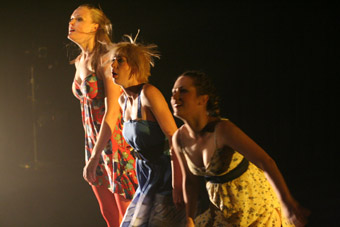
Dancers, UNSW School of English, Media & Performing Arts
photo Su Goldfish
Dancers, UNSW School of English, Media & Performing Arts
Consonant with general tertiary education trends, postgraduate dance practices and their mix of actual and discursive bodies are under the spotlight. The University of Melbourne’s forthright decision to concentrate specialisation in higher degrees is a telling sign of what may lie ahead, shifting career decisions perhaps to a later date. For dance, this tendency is both a blessing—the mature artist shifting into another level of engagement—and a dilemma, considering the vocational responsibilities of undergraduate ‘training.’ Institutions across the country in all sorts of configurations, WAAPA, QUT, VCA and Adelaide Centre of the Arts, TAFE SA, offer a variety of undergraduate degrees, designed to develop informed dancers and choreographers for companies and independent situations and they need to work intensively with young and pliable bodies.
Other institutions, the Wesley Institute, the Australian Centre of Physical Education and the University of NSW, concentrate on alternative pathways in dance therapy, education or arts management/policy. At the elite level, training has to take advantage of peak physical capacities to attain the space hurtling and angular buckling of contemporary dance or the effortless flight and balance of ballet. Virtuosic youth is less necessary for teaching, healing and guiding, although each of these occupations depends conceptually on the daring embodiment of performer and energy-shifter. Other complications arise for these complementary careers, such as requirements of literacy and numeracy standards, strategies for special needs students, technological integration and behavioural management skills dictated by the newly formed NSW Institute of Teachers which leave little time for intensive content development. The disciplinary task, as dance lecturer Jacqui Simmonds observes, “is to assist students to appreciate dance as a continually evolving art form that extends beyond the framework of the NSW Board of Studies Dance syllabuses while honouring the philosophy and content of those syllabuses.” Her comments resonate with tensions of information overload and the fluctuating political rhetoric between monologic learning and plural specialisations which, differently expressed, reflects the University of Melbourne’s model.
One coup for dance, enabled by the arguably vocational focus of the postgraduate model, is the announcement of a new postgraduate program in dance science to be offered at the VCA in 2008. The course is designed for dance and health science professionals interested in expanding their understanding of the science of dance movement and in improving dancers’ well-being and training. Another niche development emerges through Deakin University’s recently unveiled Motion.Lab, one of a handful of motion capture studios world-wide available to dance students, artists and researchers, projecting an innovative vision that embraces both under- and postgraduate streams. While steering dance into digital engagements, the Motion.Lab’s singularity also lies in its commercial alignment with animation and game development industries through the university’s industry partner, Act3animation.
The University of NSW’s introduction of specific practice-based PhDs in the School of English, Media and the Performing Arts concurs with the higher degree opportunities pattern. However, the same institution’s struggle to come to grips with dance at an undergraduate level reveals an awareness of young dancers’ needs and touches Sydney’s raw nerve as the only state capital without an established dance training course. UNSW’s long-standing Dance Education degree has been reviewed in the light of this thorny issue, exacerbated by the recent closure of the BA Dance at the University of Western Sydney. Recommendations have yet to be actioned though there is a prevailing optimism about UNSW’s capacity to offer an undergraduate course that, while not duplicating the elite situations at QUT, VCA and WAAPA, could lead active and committed students to a variety of performing and/or dance-making careers. Accented liberal arts, modelled on programs in the US and Europe which aim at a fusion of dancing and discursive bodies, propel UNSW’s vision. Whether this fusion works for students is yet to be tested.
In conversation with Su Goldfish of UNSW’s production unit, another crucial point emerged, the mutual benefits of crossing the arts with university structures. Goldfish’s unit at the Io Myers Studio has been re-shaped into a Creative Practice and Research Unit to facilitate the envisioned postgraduate activity. At the same time, existing resources (perhaps complemented by two spaces refurbished for dance) currently accommodate independent artists’ choreographic development. Dancer/choreographers such as Kate Champion, Julie-Anne Long, Martin del Amo and Sue Healey fill any available spaces with their driven pursuits. This interaction with the artistic community generates opportunities which flow both ways: artists can be employed as lecturers, their working processes in university venues can act as laboratory studies for student analysis and together artists, university staff and students can percolate culture, keeping mindful bodies alert and curious. Other institutions such as WAAPA operate in a similar way, invariably astounding visitors with the excess of movement, sound and text that spills into every niche within and outside the building. Such visitors can be the same university authorities who cut teaching weeks and strategise on-line transmission to reduce the costs of face-to-face teaching. Engagement admired in one breath is dismissed in the next.
Dance has much to gain from current postgraduate tendencies but educators have to resist the impoverishment of undergraduate offerings, support the mutual advantages of embodied campuses and, most importantly, encourage partnerships between the discursive and the fleshy. Embodiment must venture into the unknown, pushing against obstacles because, in the shuddering response, dance happens.
RealTime issue #80 Aug-Sept 2007 pg. 13
© Maggi Phillips; for permission to reproduce apply to realtime@realtimearts.net
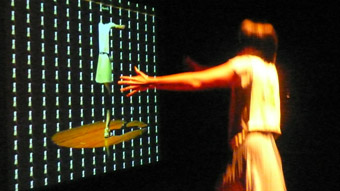
Student performance, School of English, Media and Performing Arts, UNSW
Su Goldfish
Student performance, School of English, Media and Performing Arts, UNSW
IT’S AN INTERESTING TIME FOR THE PERFORMING ARTS IN AUSTRALIA. ON THE ONE HAND, GRANTS HAVE BEEN CONTINUALLY SHRINKING IN REAL TERMS AND THE POLITICAL CLIMATE HAS BEEN NOTICEABLY ANTI-ARTS FOR THE LAST DECADE OR SO. ON THE OTHER HAND, FOR SOME SECTIONS OF THE ARTS, EVERYTHING IS ROSY. “THE ARTS HAVE NEVER BEEN IN A STRONGER POSITION, AND ARTISTS HAVE NEVER BEEN HAPPIER”, DECLARED THE FEDERAL MINISTER FOR THE ARTS, SENATOR GEORGE BRANDIS, AT THE UNIVERSITY OF SYDNEY IN APRIL. “THE ONLY PEOPLE WHO AREN’T HAPPY ARE THE COMMENTARIAT, WHO NEVER HAVE TO DEAL WITH THE REALITY OF ARTS FUNDING.”
The occasion was the launch of the book Australian Arts: Where the Bloody Hell are You? (University of Sydney Press, 2007), which featured a brief debate between Brandis and his opposite number, Labor’s Peter Garrett. Everyone is happy, so nothing needs doing, Brandis suggested, somehow managing to maintain a straight face as he addressed the hostile, but fairly polite crowd. Brandis’ suggestion is true of course, from a particular perspective. The mainstream arts organisations are consolidating, having made over the last five years successful cases for substantial infrastructural projects and improved funding positions. Brandis didn’t mention it in his speech at the launch, but he, along with Education Minister Julie Bishop, had recently made the Bell Shakespeare Company very happy by presenting a big pretend cheque to John Bell for a schools touring program. Bishop stated of this occasion: “It’s not legal tender, so don’t try and cash it, but a photo opportunity [with] a cheque for $1 million.”
arts culling
It’s an especially interesting time for the performing arts in tertiary institutions, with widespread cutbacks, budget restrictions, reduced staffing, cancelled courses and degree programs, forced mergers of schools and departments within universities, and declining staff morale. The place of the performing arts in the tertiary education sector is being actively questioned, with many universities demonstrating a distinct lack of interest in supporting the humanities, let alone the performing arts. In a recent speech, the Vice-Chancellor of the University of NSW Fred Hilmer in effect declared that the function of the arts within the university was to provide general education electives for engineers and scientists (Australian Financial Review, Dec 4, 2006). In a university trying desperately to recoup massive losses from the collapse of the Singapore-based UNSW Asia, it seems that the arts generally will get the first and most vicious squeeze. An internal memo leaked to the Sydney Morning Herald in May announced that the Faculty of Arts and Social Sciences at UNSW would not provide a budget allocation to employ any casual staff until at least 2009, along with an overhaul and ‘streamlining’ of the courses taught in the faculty. Twelve out of forty-five courses currently offered will reportedly be cut, and it seems clear that amongst these will be most of the studio-based courses that focus upon contemporary performance. Interesting times indeed.
new niches
What might be the fate of contemporary performance in all this? Performance has never been dominant in the university at the best of times, existing in niches tucked away as minor strands within schools and departments whose primary focus is on theatre, visual arts and media. Straddling these disciplinary domains, performance encourages cross-pollination, the embrace of the unknown, and the formation of hybrid understandings. But the niches occupied within academia by performance makers have certainly been enriching for performance practice, providing allies, advocates, safe havens and recruiting grounds for emerging generations of artists, opening spaces for dialogue, for exploration, and for innovation. It seems, at least in NSW, that these spaces are either contracting or simply evaporating.
There is, however, a glow of hope evident in the growing number of performance makers pursuing higher degree study, enrolling in PhD programs, often ones in which they are able to pursue practice as research with the Queensland University of Technology, seen as a bastion in this regard. Artists armed with doctorates have been able to further infiltrate the university sector nationwide, spreading the gospel of performance. In undergraduate education, however, the situation seems less bright. But there are signs of a fruitful interplay of university and practice in the field.
emergence
At UNSW, in the School of English, Media and Performing Arts, lecturer Clare Grant positions her teaching very clearly in relation to practicing artists. In her view, young performance makers are able to learn “certain things from us, and certain things from other people [outside the university].” She views her role, though not strictly, as an advocate for the possibilities of performance over more traditional modes of actor training, and as a builder of bridges between students and practicing artists. In her teaching she stages interventions and introductions, encouraging students to seek their own place in the field of performance practice while also actively addressing the question: what is this field? Many of her students, she says, have gone on to further their performance training with companies such as PACT and Urban Theatre Projects before forming their own groups, recent examples including Post (see p46) and Brown Council. Of challenges to tertiary arts programs she remains encouraged by the recent exciting “flurry of work” that has occurred in the intersection of artistic practice and university programs.
Janys Hayes at the University of Wollongong agrees, having “an implicit belief that new performance practices emerge from creative young people whether courses facilitate these movements or in fact operate to stultify them. Students, artists, read, see, think beyond the boundaries and make new work.” She makes the point that “ideas travel”, and notes the recent tour to the Hanoi Experimental Theatre Festival of a group devised performance. Originally developed within the performance course at the university, the production had been reworked by the graduated students as a springboard to creating their own performance group. While Hayes recognises the threat to the performing arts in the increasingly managerial university sector, she weighs against this the ability of performance education to enrich practice, noting that: “the politics of university education is too miserly a consideration in comparison with the power of new ideas embodied in new forms.”
The performance group version 1.0 (of which I am a member) began almost a decade ago in a similar manner with a group of recent graduates of the University of Western Sydney, Nepean convening to explore and further develop aesthetic strategies first encountered as part of tertiary study. Despite the attacks upon arts practice and education that seem to occur these days with depressing regularity, the continued emergence of contemporary performance practice from tertiary education programs, even when being cut back, remains heartening.
niche shutdown
The current situation at the University of Western Sydney, however, is less than encouraging, with all of the creative arts and performance courses that have so enriched Sydney’s contemporary performance scene over the last 15 years being scrapped after being subjected to long term painful budget cuts. Programs have been abolished that provided contemporary performance with artists such as Alicia Talbot (Urban Theatre Projects), Lee Wilson (Branch Nebula), Claudia Chidiac (Powerhouse Youth Theatre), Beck Ronkson (Milkcrate), Gail Priest and almost all the members of version 1.0. Protests are continuing, but so far have fallen upon deaf ears within the university.
gene strength
In his essay Art in a Cold Climate (Platform Paper No 6, Currency House, 2005), Keith Gallasch memorably compared hybrid arts practictioners with slime mould. This was not intended to be read pejoratively, but rather to recognise the constant innovation and mutation that occurs in hybrid practices, especially collectively. In the university sector at the moment, it seems that powerful bleach is being used to try and kill off this mould. But with luck, energy and goodwill the mutations of contemporary performance will continue to linger in the corners of tertiary institutions, ever impossible to completely eradicate.
RealTime issue #80 Aug-Sept 2007 pg. 14
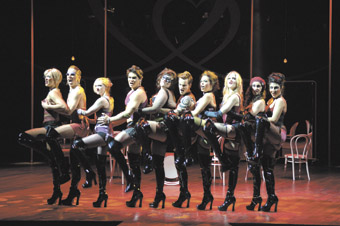
NIDA’s 2007 Graduation Production, Sweet Charity
photo James Morgan
NIDA’s 2007 Graduation Production, Sweet Charity
IN A DICTIONARY OF THEATRE ANTHROPOLOGY, EUGENIO BARBA OBSERVES THAT “THE CHARACTERISTIC MOST COMMON TO ACTORS AND DANCERS FROM DIFFERENT CULTURES AND TIMES IS THE ABANDONMENT OF DAILY BALANCE IN FAVOUR OF A ‘PRECARIOUS’ OR EXTRA-DAILY ‘BALANCE’.” HE ALSO NOTES THAT THIS “EXTRA-DAILY BALANCE DEMANDS A GREATER PHYSICAL EFFORT” THAN IS ORDINARILY REQUIRED OF OUR BODIES IN EVERYDAY LIFE.
Was there ever a time when the practice of theatre was not a precarious endeavour, a calculated risk, a gamble against the odds? Hasn’t theatre always been an enterprise at odds with the world, a rupture in the ordinary sequence of events, a hitch in the daily flow of time? And doesn’t theatre demand of those who perform and who attend something more than just the usual expenditure of energy, something in excess, something extravagant instead?
There is a risk in Barba’s description of performing for it may render ahistorical our culture’s disposition towards theatrical enterprise—as precarious as ever, a luxury, an unnecessary excess. I doubt there ever was a time when it was easy to make theatre, when resources flowed quite freely in response to offers, promises and requests. But some times do seem more difficult than others. At this time, it seems salutary to recall the qualities that Barba attributes to performers since precarious balance and extra-daily effort are certainly what is currently required to sustain theatre scholarship in our tertiary education institutions.
endangered undergrads
Most precarious, it seems, are theatre training programs for undergraduate students. Two universities—Griffith University on the Gold Coast and the University of Western Sydney—have recently proposed discontinuing their undergraduate programs in theatre and performance. These proposals do not countenance the resulting loss of opportunities for students to train in live performance. Nor do they consider the professional deficit that will be imposed upon the arts industry when academic staff are made redundant or redeployed. The rationale for discontinuation is driven in each case by an internal funding formula which does not value the modes of teaching and learning specific to the discipline.
Teaching students to become performing artists and theatre makers entails intensive, studio-based modes of learning with a high degree of interpersonal interaction between students and their teachers. The ideal class size for studio learning would be no more than 12. Yet not since the early 1990s have Australian universities afforded class sizes as low as this. Since then the ratio of students to staff has been steadily increasing: at latest count, in 2004, it was over 21.
With the number of students studying Drama at secondary school steadily increasing, a contraction in opportunities for undergraduate training in theatre and performance will put particular pressure on institutions which have focused on studio-based teaching. The traditionally small annual intake of students into the National Institute of Dramatic Arts, the Victorian College of the Arts, the Western Australian Academy of the Performing Arts, the Drama Centre at Flinders University and the Acting programs at the Queensland University of Technology and the University of Southern Queensland may be difficult to sustain.
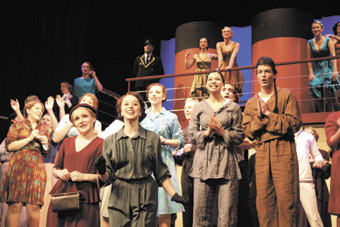
The Arts Academy, University of Ballarat, Anything Goes
photo Ilana Rose
The Arts Academy, University of Ballarat, Anything Goes
solutions & consequences
Melbourne University is currently conducting a curriculum review in which Theatre Studies is asked to justify its offering in anticipation of the introduction of new generalist degrees in which subjects may be expected to enrol 250 students. Where student intakes don’t increase, departments may struggle to retain their staffing levels. As senior academics approach retirement, not all may be replaced. Another staffing challenge is the ‘brain-drain’ of Australian academics taking up attractive short- and long-term opportunities in universities overseas. Among such departures in recent times are Rachel Fensham, Helen Gilbert, Donald Pulford, Edward Scheer and Kerrie Schaeffer.
Under conditions of increasing student numbers and decreasing staff availability, studio-based teaching with intensive contact between staff and students may be deemed too readily ‘unsustainable’ and ‘uneconomic’ by unimaginative administrators. Sustaining viable theatre studies programs in Australian universities at this time is requiring extra-daily effort from academic staff, and university administrators who are prepared to get creative with the funding formulas.
postgrad artist refuge
The state of play for postgraduate research seems less precarious and more assured. Indeed, it appears that many postgraduates in theatre and performance have sought an institutional framework to stabilise their otherwise precarious existence as practising artists. At Extreme States, the annual conference of the Australasian Association for Theatre, Drama and Performance Studies held in Melbourne this July, postgraduates delivered more than one third of the presentations. Of the 31 postgraduates who presented, 24 indicated in their biographical notes substantial track records as practising artists—as performers, directors, dramaturgs, writers, producers and so on—including Adam Broinowski, Catherine Fargher, Julie-Anne Long, Alison Lyssa and David Williams.
This is one indication of significant changes in the pathways leading to postgraduate degrees in theatre and performance. As applicants for postgraduate admission, practising artists with track records of creative work may be outpacing traditional applicants—those bright yet less experienced bachelor degree students with first class honours results. The emergence of new practice-based research paradigms has enabled artists to attract postgraduate scholarships which offer a tax-free stipend of just under $20,000 per annum for three years. Postgraduate programs are providing supportive environments and financial sustenance for both established and emerging artists to engage in sustained periods of creative development, augmented here and there with bits of project funding from state and federal arts agencies. The easing of restrictions around access to arts funding for postgraduates and academics has been a welcome change.
the rise of the artist-scholar
Postgraduate artists becoming scholars at the vanguard of performance research are now moving on to academic posts. Also at the conference were Julie Robson, David Fenton and Leah Mercer who presented a joint panel reflecting on their experience in undertaking the first three doctorates by performance-led research at QUT. Their reflections emphasised the anxieties, insecurities and tensions inherent in “composing knowledge amidst the noisy endeavour of performance-led research.” Yet however precarious their research methods, these brave, new reflexive artist-scholars have now secured positions in the academy—Robson at Edith Cowan, Fenton at QUT and Mercer at Curtin.
rqf virtues tbc
Performance-led research ought to fare well under the Research Quality Framework, the Federal government’s new mechanism for distributing research funding to universities. Previously universities would report only the quantity of traditional research in the form of books, chapters, journal articles and conference proceedings. Under the new system, to be implemented in 2008, the emphasis is on the quality of research and its impact on end-users in industry and the community.
The quality and impact of research will be assessed by discipline-specific panels of academic peers and end-users. Panels will also determine what kinds of research may be reported for assessment. The creative arts will have an assessment panel of their own and creative works such as performances and exhibitions will be reported, alongside traditional forms of research, in the competition for research funds. In the future, universities may become more supportive of the creative research undertaken by scholars in theatre and performance—although, at this stage, the precise specifications are still emerging and the funding implications remain unclear.
on the record
Meanwhile the publication record of Australian researchers in theatre and performance is in good shape. Three academic journals publish current research. The long-running Australasian Drama Studies, now edited by Geoffrey Milne at La Trobe, has been joined by About Performance from Performance Studies at the University of Sydney, and Performance Paradigm edited by Peter Eckersall of Melbourne University and Edward Scheer of UNSW. And at the recent conference, four new books were launched including Joanne Tompkins’ Unsettling Space On Contemporary Australian Theatre and Helen Gilbert and Jacqueline Lo’s Performance and Cosmopolitics: On Cross-Cultural Performance in Australasia.
adapt, evolve or…
Like the challenge of sustaining viable programs for undergraduate students, the challenge of the Research Quality Framework will be an internal numbers game. The emphasis is on research strengths and concentrations, on winners and high-fliers. Small-scale theatre programs will forge alliances with the other creative arts or lose their practice-led approach and assets in mergers with the humanities.
RealTime issue #80 Aug-Sept 2007 pg. 15
© Jonathan Bollen; for permission to reproduce apply to realtime@realtimearts.net
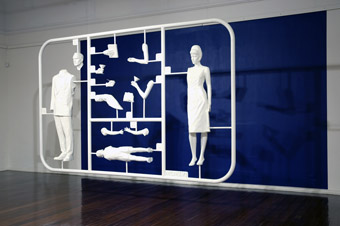
From HATCHED 07 National Graduate Show exhibited April 20-June 24, PICA. Guy Marc Bottroff (Adelaide Centre for the Arts, TAFE SA), A Model Family
photo Eva Fernandez
From HATCHED 07 National Graduate Show exhibited April 20-June 24, PICA. Guy Marc Bottroff (Adelaide Centre for the Arts, TAFE SA), A Model Family
THE TITLE OF THIS ARTICLE IS PURPOSELY MISLEADING. IT IMPLIES A NEOCONSERVATIVE AFFIRMATION OF DOGMA ENFORCED BY THE POWER OF THE ACADEMY. IT SUGGESTS RE-IDENTIFICATION WITH A CULTURE THAT IS SIMPLISTICALLY DIVIDED BETWEEN THOSE WHO subCRIBE TO ITS ETHOS AND THOSE WHO, BY VIRTUE OF THEIR OPINION, CREED OR STATUS, DO NOT. ONE OF THE UNFORTUNATE BY-PRODUCTS OF POLITICAL CONSERVATISM, AND ESPECIALLY ONE THAT HAS HAD PLENTY OF TIME TO ENTRENCH ITSELF, IS A SOCIAL CLIMATE THAT FORCES ITS LINES OF RESISTANCE INTO A STATE OF REACTIONARY DEFENSIVENESS THAT IT NEVER WISHED FOR.
The slow but inexorable transformation of students into clients, and the ever-elaborate chain of accountability have made tertiary institutions into service-based institutions in which abstract knowledge is supposed to fit assessable quanta and is continually the subject of suspicion or, worse, veiled contempt. It is a process that has made many tertiary teachers feel they are bound to retreat into a position of guardianship for areas of knowledge that they are in an increasingly diminished position to defend.
the digital transition
Let me be clear from the start: I am not shaking my fist at the ignorance of the young like some Dickensian curmudgeon. It is true that every age, deludedly or no, feels that it is the one that it is in decline, and that changing values are needlessly usurping the status quo; it is true that every age looks nostalgically on the past. With this in mind, we might also step outside this perennial reflex and look at the way people’s responses, expectations and areas of interest have altered since, say, the mid-90s, the rough marker for the entry of the internet into the domestic sphere and its adoption as both official and ad hoc tool for child education. Having begun my teaching career roughly during this change-over from the more analogue to the digital culture, I can see a change whose effects are more marked than ever in the last three to five years, that is, with the entry into tertiary education of students whose entire secondary education has been affected by internet culture in some way, whether glancingly or dominant. And I have come to the following conclusion, which I share with many of my peers: that digital mass culture is questionable on its own, but with guidance, with the appropriate educational frameworks, its benefits are astonishing.
Yet we are living in an intellectual climate whose powers to effect the right changes, within humanities and art education at least, are desultory at best. More and more students have been made to turn to their own resources, not as a result of lazy teachers, but because of less available quality time for education which is in turn caused by a weakening regard for what art and the humanities represent.
<img src="http://www.realtime.org.au/wp-content/uploads/art/12/1265_geczy_visartsmorris.jpg" alt="From HATCHED 07 National Graduate Show exhibited April 20-June 24, PICA.
Sophie Morris (Curtin University of Technology), Memory (detail from installation)”>
From HATCHED 07 National Graduate Show exhibited April 20-June 24, PICA.
Sophie Morris (Curtin University of Technology), Memory (detail from installation)
absent online
What we have is an educational sector within Australia, and, it seems, also in the rest of the Anglophone world, that is gravitating to internet and non-contact teaching solutions—on-line delivery is the official term—faster than they have to assess the pedagogical implications of such changes. The result has been slowly to erode, diminish and undermine, through a kind of institutional stealth, courses whose outcomes are resistant to digital streamlining, and whose outcomes are unquantifiable. I am sure, for example, the decision by the University of Western Sydney no longer to take visual arts students is not based on campus logistics alone. (Departments and faculties have to pay a kind of levy based on the space they take up, hence courses requiring greater infrastructure lose out, the virtual, needless to say, wins.)
The kinds of pressures that the emphasis on tangible outcomes-based education exerts on students and staff of art schools continues to be the subject of hot debate. Will face-to-face teaching soon be something of the past? Teaching positions are frequently not replaced (the once pre-eminent Power Institute of Art History and Theory at Sydney University has lost at least two staff whose postgraduates have migrated elsewhere) and elsewhere staff-student ratios are subject to a level of pernickety scrutiny that defies common sense. Numerical analysis tends to win out in a field in which, strictly speaking, it has no real role.
suspensions of disbelief
When academics are under pressure, the students seldom rally to their cause. Nor should they. Universities are healthy places of dissent. The paradox that underrides a good humanities education is that students are taught within a vastly institutionalized structure about institutions and how to undermine them, since it is only through the constant redistribution of ideas that the institution can keep any vestige of life. But this tenuous balance within universities is shaken whenever the probity of the academics is called into account in a general and ideological way, that is, not on the basis of their own discipline as a direct and rigorous confrontation with ideas, but as a reactionary stymieing. When the abstract notions for which they stand are not valued, then many students are less inclined to listen, and, to return to my opening point, academics are made to stand with their backs to the wall.
For indeed a fundamental vector of humanities teaching is faith; suspension of disbelief. At a certain point, students are expected to believe that one idea is more valid than another; that this artist, writer or other exponent is better than that. This is not to advocate some false obeisance on the part of those who learn, rather it warns that when education enters into endless, turgid justification of its terms of reference, when taken to an extreme, it always winds up in a black hole. When it confronts a culture of mass skepticism, then the opposition between ‘those who know’ and ‘those who learn’ is pronounced to the point of conflict. Both blame the other, but the source of the problem is in an institution that doesn’t respect itself, or at least is no longer willing to respect the discipline as a valid point of inquiry, as something worth pursuing. When we try to excel in something that is undervalued at the outset, a large amount of energy is spent on legitimation. One has to do this enough as an artist within Australia without having to do it doubly in the institutions where knowledge is supposedly gathered and nurtured.
art only for art’s sake
The issue here is not to voice some Medieval law that students must obey their professorial masters, it is to say that there needs to be a certain protocol of accepting certain base strata so that students will be in a better position to confront their elders, previous generation, call it what you like. This is the dialectical process upon which art and the humanities is built. But what I think is currently emerging is a culture of dissent amongst students who seek to confront something but they know not what. And so they find themselves inexorably making art for the sake of making art. Education is what supplies the tools and the direction for the best kind of intellectual shifts and purges to take place. It is a matter again of the old chestnut of a rebel without a cause, but the condition is made considerably more acute by the information superhighway that throws all kinds of causes and concerns in its ‘user’s’ path.
Another way of saying this is that the internet has given birth to a new kind of autodidact. The core quality of autodidacticism, which makes it both charming and deadly, is that while it excels at absorbing information it has a limited ability to order or distinguish between one element and another. The internet has amplified this condition to an untold degree. Its users have more information at their fingertips than ever with an ever smaller capacity to discriminate. Sites like rotten.com make us laughing spectators of tragedy and deformity, and if humanity is built on consensus, then does the vast amount of pornography suggest that we finally approve of it?
the adorno-horkheimer corrective
We have returned with even greater magnitude to the condition that Walter Benjamin voiced in his 1934 essay, “Art in the Age of Mechanical Reproduction”, when he noticed that the socially liberating possibilities of new media such as film were undermined by the manipulations of the image wrought by the Nazi propaganda machine. We might also revisit Adorno and Horkheimer’s 1944 essay, “The Culture Industry: Enlightenment as Mass Deception”; it is as relevant as ever.
To Adorno and Horkheimer, the culture industry of popular music, cinema, television and advertising lulls its receivers into a state of torpor, of false pleasure, deluding them that they are safe and free and still have discerning free will. This counterfeit bliss involves a welter of vulgarizing compromises, what in today’s parlance is known as dumbing-down: “a movement from a Beethoven Symphony is crudely ‘adapted’ for a film soundtrack in the same way as a Tolstoy novel is garbled in a film script.” Mass media gives its audience everything and more; the arts are willingly bowdlerized and conglomerated, expurgated or refashioned. In commercial film people expect a hackneyed plot and a certain ending and are disappointed when they do not get it. The same goes for structured temporal and formulaic limitations of commercial music. In a statement that presages Baudrillard they exclaim, “Real life is becoming indistinguishable from movies.” The public are encouraged neither to imagine nor to reason for themselves. The manner in which mass media shields its audience from the plain realities of being human robs humans of the power to create for themselves a happiness external to what has already been defined for them by the mass-marketed juggernaut of the culture industry. If we apply their theory to digital media, we see that while it has positive effects for rogue sites that undermine political censorship and disseminate repressed material (eg dead GIs in bodybags), it is used just as much as a tool for social manipulation, from conservative political agendas to marketing. We know that more people log onto commercial sites, joke pages, personal chat and porn than they do to sites that try to give the truth about world events.
artentertainment
The consequence of this muzak life on art? Adorno and Horkheimer hoped for the possibility for art to sing over the cacophony. One of the ways for art to counter the industry that constantly undermines it is to adopt for itself a critical stance that all but eschews the kind of beauty that hallucinates the gormless public. If not, art becomes as shallow as anything else. Art is always to some extent forced into entertainment since it must give its audiences a modicum of what they know, or else art never has a chance to enter into public discourse and remains rarified to the point of pomposity. But whereas art is supposed to be a creditable form of knowledge, “the culture industry perpetually cheats its customers of what it perpetually promises”, since the real promise is not that we will be led to a better way of thinking, but that we will continue to be entertained. It is barbarism hiding in the sheep’s clothing of civilisation.
More recently, with the rise of the YBA (Young British Artists) phenomenon and its many sensationalist off-shoots, critics and artists have commented that much art is indistinguishable from the entertainment to which it is meant to be significant foil. Society has largely lost its ability to discriminate between knowledge and information, knowledge implying a method, information being just unqualified material, like data downloaded onto a computer desktop.
a strange apathy
To return to the question of the tertiary sector, what is noticeably the case is the production of ideas without a sense of their background. Nothing comes from nothing but this does not stop the diverse production of works of art by young artists, many of whom have no regard, or interest, in their forward trajectory or their provenance. The world we inhabit is a series of bite-sized bits which have no definite beginning but reach an abrupt end. It is curious that the internet encourages a strange form of apathy when so much tragedy is there for the taking. Or perhaps because of that, the uneducated mind doesn’t know where to start.
Grounding the groundless has always been an aim of knowledge. It has two effects. One is to render ideas hard and inert; the other is to provide the correct platform for an effective ‘revolution’ for want of a better word, to take place. Without education all we see are whimpers dressed up as bangs, a rhetorical revolution whose only aim is to state itself: ‘I am here’, like aimless chat on YouTube or an endless vomiting of SMS prattle. Those who use the internet as an end in itself are holding onto a rudder whose direction is permanently being reset, a world that is constantly rebooting before their eyes without them even knowing it.
white noise
For as long as we can remember, the academy has always complained of a crisis. The current one is a lack of support for education and knowledge for its own sake: the simplification of degrees into products, the reduction of students to quotas, the weakening regard for the skills that academics are meant to disseminate. I am not announcing the death of anything. It is hard if not impossible to quell the instinct to make art whether there be art schools or not. The devaluing of humanities and art education will not in any way reduce the volume of things written or art made. Nor am I an apologist for the institution—let me be clear about that. But muffling and trivialising the kind of debate whose task it is for universities to foster and refine will only engender more boring, bad art as transient as entertainment. It will also stifle the platform on which to shape new critical voices (let alone to argue through what constitutes the apt critical voice of today). We already have a welter of raw autodidactic art oblivious to the traditions it’s trying to remake and we already have far too many opinions—all white noise in the end.
Meanwhile, within universities we have flagging self-respect. Students do not know where to go to rebel and lecturers find themselves wearing a dowdy mantle of academicism and ‘tradition’ in their best efforts to keep critical consciousness alive.
RealTime issue #80 Aug-Sept 2007 pg. 18
© Adam Geczy; for permission to reproduce apply to realtime@realtimearts.net
“…NOW WE REALISE THAT ALL EDUCATION IS MAGNETIZED BY SOMETHING THAT IS TACIT AND IMPLIED, WHILE INSTRUCTION THAT IS MERELY EXPLICIT SOUNDS SHRILL AND HORRID, LIKE A PASSAGE OF RACINE DECLAIMED IN THE PENITENTIARY ON THE WARDEN’S BIRTHDAY…”
Roberto Calasso, The Ruin of Kasch, Harvard University Press, 1994
There are changes sweeping through Australian tertiary music education, but the mood of staff across the country is far from optimistic. Many music schools are struggling with budget deficits and politically driven demands for more accountability that are constant distractions from the real business at hand. Most staff cannot remember a time when it was otherwise. They have begun to doubt whether such a time ever existed. And some are apprehensive about the direction in which change is taking us. Yet the real reason for their gloom is not the lack of time or money, but the nagging fear that these problems are merely symptoms of an underlying problem: that the educational ideal they still believe in is not shared by the community or by the system in which they work.
We are partly to blame. We have acquiesced—passively or otherwise—in the creation of the world we now live in. We have not been effective advocates for what we do. And we have been slow to respond to changes in the art of music as it is practised outside the academies.
a special case
The situation may be similar in other art practices, but music is a special case. In no other area of the arts (aside from classical ballet) is professional education predicated on the assumption that a significant proportion of students have been engaged in the disciplined study and practice of the art since childhood. The nearest point of comparison is not with the other arts but with sport, which enjoys strong government and community support. The situation of tertiary music schools cannot be considered in isolation from the music education system as a whole. Without the foundation of strong music programs at primary and secondary levels and high quality private teaching, the tertiary music enterprise is doomed to failure.
School music programs are under threat across Australia. This is partly because they are expensive, while the benefits are not easily measured in economic terms. It is also because classical music in particular is tarred with the brush of elitism. Yet surely no one has a problem with the concept that individuals with exceptional talent exist and should be nurtured. This is accepted in the sporting arena where elite athletes are the objects of community adulation and national pride.
other talent, other ways
Musical talent is not confined to the comfortable middle class. While a boy from a remote Aboriginal community might become an AFL star, demographic evidence of tertiary music enrolments indicates that (far less remote) outer suburbs of our major cities produce few classical musicians. This has been the great failure of musical education at all levels in this country. One answer to this is to encourage the development in schools of programs focussing on popular music, giving culturally disadvantaged students access to music education through music that they can relate to. Paradoxically, in the name of access such programs deny them entry to the deeper levels of culture. The much-reported Venezuelan approach, ‘el sistema’—which has thousands of children from slums playing in classical youth orchestras—shows that there are other ways.
one to one to…
Much music education remains grounded on an ancient and precious tradition: the close relationship between student and teacher. This goes beyond mere instruction; the teacher is a guide and an example, a person whose selfless dedication to the art of music provides the model that the student is implicitly called upon to emulate. This is the principle that ‘magnetizes’ music education, and the tacit understanding of it underpins what we do. As an ethical principle it eludes all attempts by educational bureaucracies to contain or control it, and make it subservient to the principles on which the current system is founded. The periodic assaults launched by administrators are couched in economic terms, on the grounds that individual instruction is too expensive. The suspicion remains that behind the economic arguments lies a deep mistrust of a mode of education whose core values stand in stark contrast to the prevailing ideology.
While the model of the teacher remains precariously in place, classical instrumental instruction seems slowly to be undergoing overdue changes. The traditional pattern was the training of the soloist; no matter that few students were suited to such a career. A realisation has dawned that we must better equip students for what they will actually be doing professionally, with courses in pedagogy and more emphasis on ensemble playing becoming common. But it is still rare for courses to provide classical instrumentalists with training in improvisation or the use of technology, or meaningful experiences of musical traditions (whether playing jazz or raga) other than their own.
opening out composition
Composition courses have gradually embraced music for film and theatre, but the proclivity to insist that students write orchestral works that will never be performed still lingers. As the primary creative force in music, composition sits uneasily in the academic world. The free play of the imagination is not easily reconciled with the constraints of a system that wants everything explicable and quantifiable. The academies have therefore taken certain forms of composition to their bosoms, and studiously ignored others. Any composition student even modestly acquainted with music history will be aware of the scorn poured on academic composition by the greatest composers (Debussy: “[Music] must never be shut in and become an academic art”; Stravinsky: “Never trust a willing academic.”) Unsurprisingly, such remarks are rarely discussed in composition classes.
Similar misgivings have been felt about the acceptance of jazz into the academic world, not (anymore) stemming from the belief that jazz is unworthy of inclusion, but from the fear that the creative impulse in jazz will be stifled. Such doubts have been assuaged to some extent by the success of tertiary jazz programs and the fine artists they have produced. Jazz education has been ahead of classical in its emphasis on ensemble experience, but students rarely gain practical experience of alternative improvisatory traditions or the integration of technology in performance. As with any form of music education, the extent to which jazz is reduced to formulaic repetition of conventions is a measure of its failure. Its potential success rests on its ability to constantly renew tradition through imagination. The same can be said of classical training; in fact, jazz as taught in music schools has all the hallmarks of a classical art form. We must wait to see whether a similar future awaits rock music, which is yet to find a place in most institutions.
inescapable technology
The newcomer on the block is the burgeoning field of music technology. Music schools have long accepted technology as an adjunct to composition (though often awarding electronic composition inferior status to instrumental composition) but are now being obliged to confront technology’s presence in nearly every sphere of musical endeavour. A deep-seated mistrust persists, which is not entirely misplaced. Technological novelty too often masquerades as originality, scientism dominates aesthetics, and hard-won skills are replaced by software. At the same time technology is an inescapable fact of the musical future. Music schools are confronting a dual challenge: how to deal with a new group of students whose musical experience has been entirely shaped by technology (and who often lack conventional musical training), and how to prepare instrumentalists and composers for a technologically mediated future.
eroding division
The nature of the forgoing discussion illustrates the enduring hold of an educational outlook that segregates specialisations such as composition, technology and performance, and genres such as classical, jazz and world music. Rigid divisions of any kind defy the musical reality of the present time, and while some progress has been made towards eroding them, there is still a long way to go. Institutions need to prepare students for an increasing diversity of career possibilities that cannot be served by a restrictive and narrowly defined curriculum.
The arts have a love-hate relationship with institutionalised academe. They have accepted the shelter it offers but resent the demands and constraints it imposes. The essence of what the arts teach is implicit and unquantifiable, but we have to articulate it and quantify it to justify our existence. The challenges are perpetual: how to respect tradition without being stifled by it, how to honour the past while embracing the present, and how teach an art that is defined by freedom and imagination within an institutional framework that is encumbered by rigidity and inertia. The future of music education depends on how we meet these challenges.
RealTime issue #80 Aug-Sept 2007 pg. 22
© Stephen Whittington; for permission to reproduce apply to realtime@realtimearts.net
AS MANY OF THE WRITERS FOR THIS ISSUE WILL IDENTIFY, THE ARTS IN AUSTRALIAN UNIVERSITIES HAVE BEEN UNDER A PERIOD OF SUSTAINED CHALLENGE SINCE THE MID 1990s. IT IS IMPOSSIBLE TO ADDRESS THIS ISSUE IN RELATION TO SOUND ART AND EXPERIMENTAL MUSIC PRACTICES WITHOUT CONSIDERING THE ECOLOGY IN WHICH THEY ARE SITUATED.
As federal funding to universities has decreased in real terms and pressure has been put on universities to differentiate themselves and compete, most Vice-Chancellors have paid very close attention to the discipline mixes on offer in their institution and have made substantial moves to reduce the mix and to focus resources on their perceived strengths in the market for which they are seeing high demand. In the final analysis, this strategy has posed the major background threat to the arts in the university sector over the past decade.
Beyond a vice chancellor’s overall strategy for a university, a major driver behind these reviews has been an assessment of the ‘viability’ and ‘sustainability’ of any particular discipline in economic terms, and the arts are particularly vulnerable in this kind of analysis. Domestic student income is derived from the Department of Education, Science & Training (DEST) cluster funding model, which delivers a unit of funding per student according to the discipline cluster in which they are situated. Unfortunately for sound and for all of the visual and performing arts, we are deemed to be ‘mid-cost’ by DEST, which isn’t an accurate reflection of the true cost of delivering an ideal practical experience to students.
the cluster problem
There are serious inequities in the cluster funding model, where lecture and tutorial disciplines are funded at the same level as intensive, high contact-hour, resource-intensive disciplines like Sound. DEST does not require universities to pass on the cluster differentials in their internal funding models, but the reality is that very few universities have provided internal funding above clusters, due to their overall efforts to stay afloat financially. Other sources of income are fee-paying courses and research. These are complex areas and, in this field, neither has proven to be profitable enough to fully compensate for the comparatively low level of DEST cluster funding, leaving many courses cash-strapped. The fact of the matter is that, to this writer’s knowledge, no Sound discipline has successfully argued for an increase to its funding base in the last decade.
That being the case, the most obvious way for high-cost disciplines to survive is by being part of a much larger discipline cluster which includes lower-cost disciplines (to free up some extra funding), or if they take on substantial low-cost service teaching roles in other programs. The issue here is the critical mass of the program. Any program, which is both small and high-cost is extremely vulnerable in the current environment and we have seen a number of closures over the last few years as evidence of this. The lesson here is to keep your stakeholders many and varied and your overall student load up as high as possible.
more flexible flagships
A rare possibility for survival is to be seen as an expensive, but valuable flagship. The difficulty for sound art and experimental music is that it is difficult to be seen as a flagship unless you’re hanging onto the coat-tails of a more institutionally powerful discipline, such as the broader discipline of Music. There are a number of flagships in the music area, but these are mostly conservatoria, devoted to training in classical music (ironically itself a niche genre from an audience perspective). As such, their programs are based on a western classical music paradigm, so even if sound art is co-located in that cluster, it can be difficult to shape an appropriate program within the program core or have your voice sufficiently heard. I believe it is high time for that to change and that the adoption of a broader church and more flexible course structures would be of great benefit to the sector, and is long overdue. Many of the flagships, however, are constrained by their histories and their community stakeholders who, ironically, are also their champions and protectors. Catch-22 anyone?
un-nurtured grass-roots
At the grass-roots of the discipline, I and many of my colleagues have advocated for a more contemporary approach to teaching in schools, which provides students with the opportunity to appropriately engage with contemporary approaches to the creation of sound and music. Although the federal government’s National Review of School Music Education emphasised the need for students to engage with sound and music technologies, the Minister’s response to that review to date has been to directly allocate $1m to Music Viva, an entrepreneur of ‘fine ensemble music’ who will deliver educational packages and “professional development courses centred around voice, percussion and improvisation” and a further $600,000 to the Australian Children’s Music Foundation to deliver workshops to disadvantaged kids. Whilst both of these organisations may be worthy in their fields, the funding shows complete blindness at ministerial level to the reality that in 2007, the computer is, for many young people their primary means of consuming and creating sound and music, often in the presence of their social and creative networks. Will we see another $1.6 million allocated in recognition of this glaring reality? I suspect not. All of this is particularly unhelpful in growing a platform to develop talent at the grass-roots. This blindness must be cured if we are to have a robust talent development pathway from the school system.
beyond the walls
Clearly there are major environmental challenges to this discipline, deeply rooted in institutional and federal politics. So what about the good news? It is clear that a few institutions have stood by their commitment to sound and electronic music. The surviving departments have managed to retain the support of their managers and have often found creative methods to sustain themselves and provide opportunities to students within the current funding climate by working beyond the walls of the university. The staff who work at these institutions, though now small in numbers, are often highly active as practitioners in the field with substantial profiles. They are also active as organisers of events and festivals that provide both a modest infrastructure for established and emerging practitioners and an opportunity for students to immerse themselves in the exceptionally rich and diverse sound culture in Australia. It’s not without its problems, and critics in the field argue that this creates a kind of closed-shop system and skews programming in events, or that it can limit the range of aesthetic approaches to practice. Others argue that this has resulted in too much focus on early career or student practitioners (the policy obsession of the 90s) and not enough on established practitioners.
connectivity
Whatever position one takes, these academic/practitioners and their networks of guest lecturers have become important points of connection to the field of practice for their students. Academic staff, graduates and senior students from RMIT, UWS, QUT, UTS, ANU and WAAPA have worked as organisers for the major festivals in this field, including Liquid Architecture, What Is Music?, Totally Huge New Music Festival and Electrofringe. They have worked as organisers for key series such as impermanent audio, Small Black Box, the NowNow and Disorientation. Despite unreliable, and in some cases without, funding, this network of events and series has formed the backbone of the incredibly vibrant experimental sound scene from the late 1990s to the present day.
This suggests that one of the ways in which university sound art areas have been able to cope with the climate has been by taking the learning off campus into the real world, almost always without direct financial support of their institution. Ironically many of these ‘real world’ contexts are illegal venues and artist run spaces, especially in states such as NSW, where there is little or no support for the practice from the major presentation organisations. It’s both a way of enriching the environment for students in a climate of constrained resources and a vehicle for the staff to undertake research and creative practice. A common remark made about audiences for sound art and experimental music events is that they are predominantly young and it is a fact that many are students who have found their way to these events through their lecturers. A certain proportion of the audience is aspiring or student practitioners, so these events also operate as performance labs to provide a critical forum to extend the learning process. Indeed it has been common practice to provide some of the more capable students with support slots on the bill in these events as a way of testing their work on an audience, or team them with a more experienced practitioner in an improvisation.
fruitful if fragile
For institutions who have limited space or capacity for practical training in the field, these performance networks provide the only real opportunities for students to present and test work in front of an audience. For institutions with a stronger practical base, they extend opportunities beyond those available on campus. Whatever the context, it is clear that, despite its fragility, the contemporary sound and experimental music performance scene is significantly intertwined with the small network of university departments who embrace this area of practice and that the best students have developed into exceptional practitioners through this informal collaborative network. If you want good reasons to attend university, then this track record has got to be one of them. On the other hand, the lack of infrastructure to support this practice is a matter of great concern, as the training and development pathways are currently constructed on a very fragile and under-funded base where there is the constant risk that it might disappear. The current political climate is not encouraging, and both sides of politics seem to be strongly focused on heritage arts to the exclusion of contemporary practices.
RealTime issue #80 Aug-Sept 2007 pg. 24
© Julian Knowles; for permission to reproduce apply to realtime@realtimearts.net
WA Screen Academy (ECU) student
photo Mike Gray
WA Screen Academy (ECU) student
HOW TO TEACH ANYTHING TO STUDENTS WHO ARE ALREADY MAKING MOBILE MOVIES AND DESIGNING WEBSITES USING YOUTUBE AND MYSPACE IS ONE AMONG THE MANY CHALLENGES FACING COURSES IN FILMMAKING AND MEDIA PRODUCTION. TEACHING FOR A FUTURE IN TV PRODUCTION AND CINEMA MAKING SEEMS LESS RELEVANT WHEN MANY OF YOUR STUDENTS ARE NOT PLUGGED INTO THOSE ‘OLD’ TRADITIONAL MODELS IN THE WAY THEIR LECTURERS WERE AND ARE. THIS IS CAUSING SOME COURSES TO FEEL THE NEED to UPDATE for THE NEW ONLINE WORLD.
RMIT has recently moved into this territory in its Bachelor of Communication (Media), mixing theory and practice in the same subjects and has theory teachers marking online essays that may include film clips and photos and other interactive media textual devices. The University of Technology, Sydney (UTS) Media Arts and Production undergraduate course is undergoing a similar revision with its new course beginning in 2009.
changing production models
Part of what is driving this is the belief that in the changed media world practitioners of the future are going to have to operate across many platforms in small flexible businesses and that the larger studio set-ups, both public and private, that allowed for media specialists are fast disappearing. The new media creator will need to know how to shoot and light and how to make a good website and a soundtrack, and think and create flexibly.
One of the immediate challenges here for universities is how to find suitably skilled cross-media practitioners who already have the much needed ‘industry’ experience to teach these new courses. It remains to be seen however if a specialist film and video education, such as the one offered by Griffith University’s new $5m state-subsidised Griffith Film School in Brisbane, will leave students any less equipped than new new-age cross-media education. It’s the ability to write and create interesting and good-looking content that is always the sought after skill.
the melbourne model
Related to these shifts is the influence of the so-called ‘Bologna’ model, here often called the Melbourne model, in reference to Melbourne University’s decision to offer only six generalist undergraduate degrees, leaving specialisation to postgraduate studies. This European approach expects students to undertake a first generalist degree of three to four years and then a further two years in specialist graduate studies. In Australia, the currently stretched budgets of the universities are making this almost an economic necessity, and putting specialist undergraduate degrees under threat. While no less expensive than science education, media production courses are generally funded by government on the ‘arts’ model’s much lower levels. A move to the Melbourne model shifts the economic burden even more heavily onto the students who will now have to add the cost of postgraduate study to their undergraduate fees debt. This is because specialised film and television courses may only exist as graduate courses.
Most universities will keep their media production courses but they may become more digital cross-media oriented than current specialised filmmaking courses, and hence will be cheaper, they hope.
That hope may be vain. New media technologies such as digital equipment and software, miniaturization and internet distribution have made it easier for students to get good results with less expertise and without using expensive film stock. And to get those results to an audience. Now is technologically the right time to introduce media courses that themselves are more convergent between types of media production and distribution. But clunky old film cameras go on working for 40 years, whereas digital equipment needs regular replacement and software upgrading every two to three years. Media Production courses always cost money and this is the cause of many other problems that face staff.
WA Screen Academy (ECU) student
photo Mike Gray
WA Screen Academy (ECU) student
teacher exploitation
While there is immense variance between universities in terms of the conditions for media production teaching staff, it is my contention that they have often been some of the most exploited staff in their universities. Media Production began to be taught in universities in the 70s. Those hired to teach were usually people with already well established industry (rather than academic) careers such as directors and writers; creative technicians (editors, sound designers, cinematographers), or ‘techos’, people who knew how to set up facilities and how to work the gear. They often lacked higher degrees and were already lower in the promotion list and in the level of traditional Department of Education, Science and Training (DEST) approved research outputs than their same-age media studies teaching peers.
Testament to this is the small number of staff who, starting out as filmmakers, have now reached Associate Professor status in the sector. Whole films they may have directed account for only half the DEST points for a refereed article. Added to this, one hears of staff hired who, apart from their teaching load, are expected to maintain facilities and run gear and software workshops out of class, making it nigh impossible for them to find the time to do the research also demanded of them.
rqf hopes & fears
But now a new way of counting research has been introduced by the Federal Government: the Research Quality Framework (RQF). In many ways this may be a boon to media production academics because it counts ‘impact’ as well as ‘quality’ as a way of measuring the worth of research and because, for the first time, creative practice-based researchers are able to sit at the same table with historians and scientists as equals. No longer will it be only the multiple-paper publisher who looks like a good researcher.
While in the long term the RQF is a good thing—and academics in our field are horrified by Labor’s plans to scuttle the impact measure—in the short term it is feared creative arts academics may not fare well. This could be because they may not have been under pressure to produce research or, perhaps, many of them have been far too busy running under-funded media courses to do so.
The strongest RQF critics in media production teaching fear that because their areas will not be seen to attract research funding those same areas will be wound down or will end up in the feared other product of this RQF system: ‘teaching only’ universities which will lack the inspiration and good students that a research culture brings.
Some feel Screen Production academics should be able to claim their students’ creative outputs as their own ‘produced’ work, which of course, as their supervisors, in some way it usually is. But understandably the RQF will not allow staff to claim supervisees’ work unless it is part of a submission on teaching research. At the June 2007 Australian Screen Production Education and Research Association (ASPERA) Conference the RQF provoked a lot of debate. It is to be hoped that universities will help their creative practitioner academics get up to speed where needed and that the academics themselves will be given time to pursue creative research, and also get more canny about publishing their work.
production +/- theory
Lastly media production courses are facing the challenge of how they integrate theory with production. Here I make a distinction between ‘meta-theory’ (such as screen studies, history, politics, media theory) and ‘theory of practice’, such as the concept of depth of field and its use in image production, the Hollywood continuity style and the 180-degree rule, how to write a synopsis and a treatment and so forth. There are concerns that in this age of market driven education, it is what most students see as career producing that is in demand. Meta-theory areas are not necessarily seen as useful for getting work although research has shown that employers value analytical thinking and broad knowledge.
It is not clear that media production courses are divesting themselves of the humanities or of teaching meta-theory. While Queensland University of Technology (QUT) closed its Humanities Faculty recently, Professor Stuart Cunningham has hotly defended the humanities strength of the Creative Industries Faculty at QUT (Letter to the Editor, Cunningham, The Australian, May 30). With John Hartley, he points out that not all universities can excel at everything and the approach of many modern universities has been to embed theory with practice as part of an ‘applied’ package. It might nevertheless be interesting to conduct research to find out if, in the current education climate, there has been a reduction in humanities theory, including screen theory, being taught in media production courses.
RealTime issue #80 Aug-Sept 2007 pg. 28
© Gillian Leahy; for permission to reproduce apply to realtime@realtimearts.net
Garin Nugroho
courtesy Pyramide International
Garin Nugroho
“ART IS A MEDIUM FOR OPEN DIALOGUE. IT IS A PUBLIC SPACE FOR THE MEETING OF DIFFERENT PERSPECTIVES. ART CAN BREAK BARRIERS BETWEEN PEOPLE AND MAKE THEM MORE HUMAN AGAIN. IT CAN BRING ABOUT A REBIRTH OF HUMAN FEELING. THAT IS ART’S ROLE.”
Garin Nugroho
Indonesian filmmaker Garin Nugroho is, in the truest sense of the word, a pioneer. Peerless in his nation, he has since 1991 produced and directed eight features and five documentaries that have established him as one of the most interesting filmmakers of our time. His films are beautiful, unusual and politically active statements, each expressing a unique vision of Indonesia and its place in the world. And yet to describe Nugroho as an auteur is problematic, for none of his films are obviously alike. They all look, sound and feel different. Indeed, it is as if with each production a new Nugroho steps forward, one with his own sensibility, his own language and his own history. Nugroho was recently in Australia to promote his latest film Opera Jawa. Sandy Cameron wrote: “In a timely reminder that Western narratives often dwell in narrowly confined spaces and that there are many alternative modes of storytelling, comes a dazzling musical from Indonesia in the form of Opera Jawa…How the story is presented via gamelan music, acrobatic dance and puppetry is unique in global cinema…its sheer spectacle is continually impressive” (RT 78, p18). During Nugroho’s stay I was keen to find out if any constants underlie his radically changing vision.
Your films reflect a fascination with textures, colours and shapes. Were you artistic as a child?
I grew up in an artistic family. My family’s house was like the traditional Javanese house in Opera Jawa. We hosted dance rehearsals there every week. Two of my brothers are painters and my father is a publisher. He used to be a writer. He wrote a very famous modernised adaptation of a traditional Javanese puppet story. My artistic sense grew up in that atmosphere, in a traditional house surrounded by contemporary activities.
So why did you choose filmmaking?
Well, I couldn’t become a writer because my father would criticise me. I tried painting, but my brothers criticised me. I ran away to make films so that no one in my family could criticise me! Actually, my father told me in 1970 when television was introduced that for my generation the role of the book would be transferred to visual media. This influenced me very strongly.
Each film you make is always very different from the last. Is that a conscious choice that you have made?
Firstly, this springs from my personal desire to do something new with each film. But the second reason is that I believe in developing a multicultural perspective. If I say the word ‘yes’ in Japanese, this means something different to the word ‘yes’ in English. Every idea will be different in a different culture. Every culture has their own language and psychology. And each new perspective leads to a new style. In Indonesia we have so many different cultures: 400 tribes speaking 500 languages! So with each film I try to enter a new perspective. If I make a film in Java, for example, this will be totally different to making a film in Nusa Tenggara. These differences push me to come to totally new concepts. It’s very scary and stressful! Every time I start from zero. I feel stupid and inferior, like a blind man with each new film. But, if it works, it is beautiful, because I didn’t know the product before I started.
Despite their differences, all of your films seem to be concerned with problems of class division. This is especially evident in Opera Jawa.
In Asia we have a more symbolic relationship with narrative than you do in the West. And yes, Opera Jawa can be seen as a political allegory. The character of Rawana is like a big rich country. He assumes he can just take what he wants. Rama, on the other hand, is more of a traditional, religious type. He is at odds with economic forces. He doesn’t know how to develop and becomes angry and possessive, which leads him to violence. The two males’ struggle over the female character Sinta is also a struggle over earth. That’s what Sinta means in Javanese: “earth.”
Your films are sometimes described as examples of ‘Third World Cinema.’ Does this term mean anything to you?
No. I never think about ‘Third World Cinema.’ For me every person or community of filmmakers develops their own style to make a statement. And every generation makes a new statement. Look at the differences between the Chinese generations, between Zhang Yimou and Jia Zhang-ke for example. The real issue has to do with the relationship of cinema with social and political problems. European cinema was so dynamic in the 1940s through to the 1960s because of its relationship with political problems. Today, even though the quality is very good, European films are voiceless. By contrast, in Asia today we have so many crises. Political and economic life is so full of suspense and surprise. You can see Asian films reflecting this instability. This is my opinion: the cinema runs parallel with the political, the social and the cultural.
How have the political changes of Indonesia’s past decade affected the cinema?
It’s too simplistic to equate the fall of Suharto with positive consequences for Indonesian cinema. The cinema was an important tool of propaganda for Suharto during the first fifteen or so years of his reign, and at that time Indonesia produced almost one hundred films a year. When the new globalism came in 1985 Suharto could no longer control the influx of international product into Indonesia and so the local film output declined massively; down to one or two films by 1998. My films! Back then we knew our enemy, Suharto’s militarism. But now we face new problems. The forces of global consumerism, consumerism without ethics that you can see in violent mass appeal cinema, have become so strong. This is a serious problem. On the other hand we have the forces of censorship from minority religious groups. Another problem. I think the filmmaker today has to survive in this paradox: between freedom of expression and consumerism and between freedom of expression and the censorship of tribal groups.
Finally, there’s an interesting recurring line in Opera Jawa: “Cleverness becomes power.” What do you take this to mean?
Clever people, religious people, use knowledge to dominate and demean others. More knowledge means more power, and humans have always tended to attack those who have less power. It’s always like that. The clever become dominant. Their knowledge doesn’t liberate their humanity. It imprisons it.
Produced with financial support of the New Crowned Hope Festival Vienna 2006, the Goteborg Film Festival Fund and the Hubert Bals Fund of The International Film Festival Rotterdam, Opera Jawa screened at the 2007 Adelaide and Sydney Film Festivals and is distributed by Pyramide International.
RealTime issue #80 Aug-Sept 2007 pg. 29
© Tom Redwood; for permission to reproduce apply to realtime@realtimearts.net
Climates
THE TURKISH POETS COLLECTION WAS ONE OF TWO PROGRAMMING STRANDS AT THE 2007 SYDNEY FILM FESTIVAL PRESENTED UNDER THE BANNER OF A NATIONAL CINEMA. THIS MOVE MAY REFLECT DEBATE IN RECENT YEARS ABOUT THE IDEA OF A RESURGENCE IN THE TURKISH CINEMA SCENE AS A RESULT OF SOME OUTSTANDING NEW FILMS FROM MAJOR DIRECTORS AND THE GROWING PROFILE OF TURKEY’S TWO MAJOR FILM FESTIVALS.
Four narrative features, two documentaries and an array of supporting shorts were dispersed across the festival. Crowd-pulling big names were presented alongside some key debut offerings. Three films in the strand have won International Federation of Film Critics’ (FIPRESCI) prizes at major international festivals and in Turkey: the majestic Bes Vakit (Times and Winds), directed and written by Reha Erdem; Takva—Man’s Fear of God, the knockout directorial debut of Ozner Kiziltan; and Iklimler (Climates), the intimate new film from Nuri Bilge Ceylan, who won the Grand Prix at Cannes in 2003 with Distant (Uzak).
While the emphasis was clearly on the national, it seems possible both descriptors might have held equal weight in tying these films together under the title “Turkish Poets.” In the middle of Times and Winds four children stand on a rocky outcrop and literally shout Turkish poetry they have learned to recite out across a massive valley, their monotone, rapid delivery humorously emptying out any meaning. The task of thinking about how film can be poetic, however, is a much more complex undertaking and the program opened up the possibility of thinking through this complexity across the clustered films.
The poetic sensibilities revealed here emerged out of intricate aural, temporal and spatial juxtapositions, rhythmic modulations and intense attention to environmental and facial specificities. Poetry can also be defined by economy and the verbal economy of Nuri Bilge Ceylan’s Climates produces an incredible expressive intensity, but barely anything is said in it at all. Giant close-ups of the broodingly restrained faces of a couple on the verge of a break-up lingered throughout, modulating across the changing seasons of the film. While Ceylan shot his previous three feature films, in Climates he plays the central character, Isa. So, for the first time, he employed a cinematographer, Gokhan Tiryaki, to shoot the film and the results are immaculate. Ceylan’s wife, Ebru, plays his wife in the film, extending the filmmaker’s habitual use of family members and autobiographical links in his stories. Together in Climates, husband and wife intimately convey an intricate array of submerged emotions.
Tayfun Pirselimoglu’s Riza also told a complex story of emotional desolation and restrained disaster with an intense and very pregnant verbal economy. Riza (Riza Akin), a lonely truck driver who learns that he cannot afford to fix his broken vehicle, finds himself in limbo in a dingy boarding house full of lost souls. While the dialogue is sparse throughout, it seems that Riza has even less to say than nearly all of his temporary companions. Instead, the camera looks intermittently out his shabbily curtained hotel window onto the curve of a bright green neon sign that bathes the room in an unsettling tint. Riza’s mute sense of devastation only rises on his unwelcome visits to a former lover, Aysel (Nurcan Eren), a fiery woman still clearly hurt by their unspoken history.
When Riza quietly murders an illegal Afghan immigrant from his hotel in the dead of night, taking his money, his wretchedness consumes him. He observes the impact of his clandestine act upon those who surround him as he waits the last few days for his truck, which is being fixed with the money from the crime.
The powerful artistry of cinematographer Colin Mounier is central to the telling of Riza’s devastating story. The cinematography accentuates the heightened sense of waiting that fills this film through delicate attention to the shabby details of the setting.
Takva—Man’s Fear of God also delineates the emotional trajectory of a lonely older man. Similarly, the combination of an outstanding central performance from Erkan Can as Muharrem and the lavish cinematography of Soykut Turan produce an evocative storytelling style. Under Kiziltan’s direction they spectacularly render a parable about one man’s journey towards existential crisis.
Muharrem, an intensely polite assistant in a small business, is a very devout Muslim with few possessions and no self-esteem. When his powerful local Imam unexpectedly offers him the job of landlord for the mosque’s many properties, he fears he will not be up to the task. His anxieties prove well founded, but not for the reasons he envisaged. Along with the job comes a full wardrobe of suits, a mobile phone and a chauffer-driven Mercedes. As Muharrem’s standing in life transforms dramatically, his ability to adhere strictly to his faith is destabilized by the corruption entangled in his occupation. Original music by Gokce Akcelik gives Takva a rhythmic energy that peaks as the stress levels rise and in the breathtaking scenes of worship.
In contrast, the rhythmic modulations of Reha Erdem’s Times and Winds are shaped by the prayers of the local mosque. Set in a small Anatolian village on Turkey’s north west coast, three children are on the brink of adolescence, struggling, like Muharrem in Takva, to come to terms with the reality of the communal laws they have inherited. The times of daily prayer are interspersed over the course of the film but do not mark out the film chronologically, since they appear to move backwards in time. The film closes with the early morning call to prayer as 12-year-old Omer watches the sunrise from a rocky outcrop in tears. Dispersed, strangely isolated shots of each of the four children lying in the open, eyes closed, limbs sprawled, likewise rhythmically mark Times and Winds, always appearing without warning and suggesting a fate that never arrives—an unsettling kind of parallel universe.
It is worth noting that the short film screened with Times and Winds, The Flag, directed by Köken Ergun, was the only short that truly complemented the feature with which it was partnered. Disappointingly, the rest mostly seemed like time-fillers.
Unfortunately, the two Turkish documentaries in the program were, for the most part, also disappointing given the growing documentary scene in Turkey and some stand-out work in recent years. To Make an Example of, directed by Necati Sönmez, aimed to raise awareness about the death penalty in Turkey through prison footage, testimony, letters from death row, written statistics and quotes. This strategy became intensely repetitive, and the metaphorical poetry generated by such juxtapositions was amateurish. Housekeeper (Gundelikci), directed by Emel Celebi, was more successful in playfully and powerfully conveying its message. Interviews brought to life a community of workers whose occupation is constantly undermined by lack of official recognition and support. The film began to respectfully make visible the complex web of social factors that left these women without rights but did not move much beyond an awareness raising exercise full of talking heads.
Fortunately the narrative feature films on show confirmed the strengths of Turkish cinema. Each wove their own intricate rhythmic modulations and each skilfully honed delicate actions in everyday settings into an intense rejuvenation of sensory perception.
Turkish Poets, Sydney Film Festival, June 8-24, www.sydneyfilmfestival.org
RealTime issue #80 Aug-Sept 2007 pg. 30
© Megan Carrigy; for permission to reproduce apply to realtime@realtimearts.net
Rescue Dawn
IT’S HARD TO IMAGINE TWO FILMS MORE DIAMETRICALLY OPPOSED THAN RESCUE DAWN AND BOMB HARVEST, BOTH OF WHICH HAD THEIR AUSTRALIAN DEBUT AT THIS YEAR’S SYDNEY FILM FESTIVAL. THEY EACH DEAL WITH THE SECRET BOMBING OF LAOS BY THE UNITED STATES BETWEEN 1964 AND 1973 AS AN ADJUNCT TO THE WAR IN VIETNAM. NINE YEARS OF AERIAL BOMBARDMENT SAW THE US DUMP MORE BOMBS ON THE COUNTRY THAN WERE DROPPED BY ALL THE ALLIES IN THE ENTIRE COURSE OF THE SECOND WORLD WAR.
The Australian documentary, Bomb Harvest, starkly depicts the ongoing human and material cost of this protracted campaign, while Rescue Dawn is a Hollywood drama that takes America’s ‘we were the victims in Vietnam’ line to new heights of self-congratulatory delusion and historical whitewashing. What’s really surprising is that this politically extremist film was written and directed by Werner Herzog, a filmmaker usually known for his complex, politically ambiguous cinema.
Herzog has never been overtly aligned with the left nor concerned with politics in the manner of fellow New German Cinema directors like Fassbinder. From the beginning of his directorial career, Herzog’s obsessions have revolved around the epic struggle of tortured men (his protagonists are invariably male) to assert themselves in the face of societal structures, the tide of history or the forces of nature. From his 1967 debut feature, Signs of Life, to classic dramas of the 1970s such as Aguirre, the Wrath of God, to recent documentaries like Grizzly Man, Herzog’s thematics have remained remarkably consistent.
rescue dawn
On the surface at least, Rescue Dawn remains in familiar Herzog territory. The film dramatises the true story of German-born US navy pilot Dieter Dengler who was shot down while bombing Laos in 1966, a tale Herzog has already explored in his documentary Little Dieter Needs to Fly (1997). Dengler endured harsh conditions in a primitive prisoner of war camp before escaping into the jungle and suffering even greater depravations as a fugitive. He managed to evade capture, survive disease and fend off starvation to be eventually plucked from the jungle by a passing US helicopter. Rescue Dawn contains all the elements of a classic Herzog narrative: a crazed individual pursuing an impossible dream, an unwilling group press-ganged into following him, and the overcoming of enormous physical hardship. But the director’s great features of the 1970s and 80s depict man’s often selfish and destructive attempts to assert himself in the face of overwhelming odds with detachment, humour and a sense of tragedy. In contrast, Rescue Dawn unequivocally celebrates Dengler’s heroic posturing as the epitome of US military culture and white American manhood. The stridently masculine histrionics climax in the final, horrendously cliched scene in which Dengler is welcomed back to his ship with a chest-beating all-male group hug from the entire crew.
Throughout the film US military personnel appear as simple, straight-talking, likeable men of action who never question what they do. On the other hand, reflective characters are shown in a uniformly negative light. Dengler’s fellow prisoners, for example, are introverted, emaciated types hoping that peace talks in Paris will bring about their release. After Dengler is finally rescued from the jungle, he is whisked into hiding by shady CIA operatives who are portrayed as dubious, secretive characters, partly because of their unmanly appearance (well-tailored suits, ties and spectacles as opposed to fatigues and army boots), and partly because of their propensity for talk and analysis. Military action is exciting work, while CIA intelligence is the realm of feminised intellectuals.
More troubling than the cliched nature of the characters, however, is the fact that Rescue Dawn seems to unambiguously endorse—or even glorify—a political and military culture that saw the US carpet bomb a largely defenceless Third World nation for nearly a decade without the knowledge of Congress, let alone the American public. The secret nature of the bombing campaign is only referred to fleetingly in the film, and is never interrogated. If anything it only adds to the ‘boy’s own adventure’ feeling of the opening scenes in which the pilots are briefed for their mission.
The uncritical celebration of one military culture generally requires the denigration of another, and Rescue Dawn serves up stereotypes of the crazed Asian ‘other’ in spades. With the sole exception of a simpleton dwarf on the prison camp staff, the Laotian characters are primitive, violent and completely alien. The guards in the camp are shown to be inexplicably cruel and irrational for abusing the prisoners every time US jets scream overhead. No connection is ever made between the guards’ attitude and the murderous payloads being dumped on their country, or the fact that the prisoners were dropping these when they were shot down. When Dengler’s limbs are placed in stocks upon his arrival at the camp, he protests “What is this, the middle ages?” Primitive cruelties, it seems, offend American sensibilities—modern weapons of indiscriminate destruction, like napalm and cluster bombs, are the civilised West’s preferred means of inflicting pain.

Bomb Harvest
bomb harvest
To understand the degree to which Rescue Dawn provides an American-centric view of the war in Laos, audiences at the Sydney Film Festival needed to look no further than the documentary Bomb Harvest, by Sydney-based filmmaker Kim Mordaunt. This film centres on Laith Stevens, an Australian bomb disposal technician attempting to clean up the mess left by 580,000 US missions over Laos. It is estimated that as many as 30 per cent of the US bombs failed to explode, leaving an appalling legacy across the country. In some areas the explosives lie so densely that any kind of agriculture is impossible. The smallest bombs are frequently mistaken by children for balls or pieces of fruit. In one of the film’s more stomach-churning moments, we see a photograph graphically illustrating what these tiny ‘bombies’ can do—the head and upper torso of a young boy lie virtually untouched, while his arms and lower half have been shredded into a bloodied pulp. Around 12,000 Laotians have been killed by unexploded weapons since the bombing ceased in 1973.
The film follows Laith Stevens as he instructs a group of Laotians in bomb disposal techniques at the country’s National Unexploded Ordnance Training Centre. Much of the screen time is taken up following the students through the second half of their training, as they deal with live bombs in the province of Ta Oi, where the Ho Chi Minh Trail once crossed into Vietnam. The area was subject to some of the most intense bombardments of the war as the Americans tried to sever North Vietnamese supply lines. When Stevens and his team arrive in their base village, they are greeted by a line of amputees—peasant victims of unexploded ordnance.
In the course of clearing the area, Stevens’ team is forced to evacuate several villages, and the film’s most moving sequence unfolds around one old man’s refusal to leave his house. Stevens talks to the 96-year-old, who relates how bombs dropped day and night during the war: “I lost my wife…My brother died also because of a bomb. My children died. Then nobody was left.” The man looks away, utterly distraught. The film cuts to archival footage of a US military chaplain praying with B-52 pilots before a mission: “…we give thee thanks for the ability to serve as thy servants, to seek freedom for the world as we know it…” Returning to the present, we see the old man eventually agreeing to leave the village, muttering bitterly, “They come back to disturb us again…drop bombs, clear bombs…it’s all too much.” As Stevens’ team detonates some nearby bombs, close-ups on the faces of the older villagers reveal the horror of their memories. The sequence is illustrative of the way Bomb Harvest skilfully weaves together the drama of the team’s work, stunning archival footage and the locals’ experiences to explore how the trauma of the bombing lives on 35 years later.
Bomb Harvest is an emotional look at the horrific aftermath of one of the Vietnam War’s lesser known atrocities, but coming at a time when the US and the West generally are increasingly enthusiastic about military interventions, it also lays bare the hypocrisy of concepts like ‘just war’ and ‘precision bombing.’ The ongoing suffering in places like Laos makes a mockery of our supposed ideals, especially when films like Rescue Dawn continue to focus exclusively on the tribulations of Western servicemen while denigrating the people of Indo-China. However much we comfort ourselves with self-serving myths about the Vietnam War, the fact is the US and its allies slaughtered untold numbers of civilians in Vietnam, Laos and Cambodia, while their grandchildren continue to be maimed, deformed and killed by the legacy we left behind.
Rescue Dawn, director, writer Werner Herzog, producers Steve Marlton, Elton Brand, Harry Knapp, performers Christian Bale, Steve Zahn, Jeremy Davis, USA; Bomb Harvest, director Kim Mordaunt, producer Sylvia Wilcynski, writers Sylvia Wilcynski, Kim Mordaunt; Australia
54th Sydney Film Festival, various venues, Sydney, June 8-24
An hour-long version of Bomb Harvest will screen in late 2007-early 2008 on ABC TV.
RealTime issue #80 Aug-Sept 2007 pg. 31
© Dan Edwards; for permission to reproduce apply to realtime@realtimearts.net
Carnivore Reflux
AT THE MELBOURNE INTERNATIONAL ANIMATION FESTIVAL’S CAREERS IN ANIMATION FORUM, AN AUDIENCE MEMBER WANTED TO KNOW WHAT INSTITUTIONS LOOK FOR IN THEIR ENTRANCE INTERVIEWS. ROBERT STEPHENSON (VCA) SAID THAT AN UNDERSTANDING OF THE BODY’S MOVEMENT AND MECHANICS IS USEFUL. HE SUGGESTED WOULD-BE ANIMATORS ENROL IN LIFE-DRAWING CLASSES AND BRING A STORYBOARD TO THEIR INTERVIEW, EVEN IF THE APPLICANT HAS NEVER MADE A FILM, AS THIS MAY SUGGEST AN UNDERSTANDING OF HOW TO TELL A STORY. ANOTHER TIP: “DON’T COPY DRAWINGS OUT OF A ‘HOW TO ANIMATE’ BOOK.”
The panel also included animators David Blumenstein (Naked Fella) and Jim Kalogiratos (Tantalus) alongside educators Peter Allen (Holmesglen TAFE), and David Atkinson (RMIT). Atkinson said that while an applicant’s drawings might be naïve, it didn’t necessarily mean they’d be bad storytellers—their talent might be in writing and they might make good directors or producers. He reckoned his course could just about turn a mathematician into an animator, suggesting an applicant bring to the interview anything that gives the sense of them as a creative individual, such as visual diaries and journals; he said he’s even had applicants rap dance and serenade him with guitars.
Kalogiratos was quiet while Blumenstein was outspoken, referring to himself as a traditionalist with a 2D style. He expressed disgust for the hackwork animators have to do for studios to make a living, which contrasted with Allen, who said there are no opportunities for 2D work and that it’s best to concentrate on 3D industry and studio work. Stephenson disagreed, saying that the global children’s market is huge for 2D work—Australia just needs to refocus and become “one of the main players.” Allen acquiesced, indicating there is in fact a big market for 3D films that look like 2D; therefore animators may still need 2D skills in order to make the 3D simulation look ‘realistic.’ Of course, the animation course at Allen’s Holmesglen is more industry oriented than the VCA’s or RMIT’s, and it was this contrast that made for lively debate.
So, in essence, that’s what they’re teaching; now let’s see whether the results stacked up in MIAF’s Australian Panorama screening, which this year, we were told, was extended over two sessions as “there were so many outstanding entries.”
Emit (director Fergus Donald, 8’30min, 2007) told of a dead clock in a post-apocalyptic wasteland that ticks again after a space-probe crash. Unfortunately, a dull, derivative story overwhelmed the excellent digital technique. Even before MIAF, I felt I’d already had my fill of cutesy inanimate objects becoming reanimated and anthropomorphised to embark on a ‘rites of passage’ quest set to a Spielbergian score. In the even more pointless Ticketweavels (Caroline Huff, 2’15, 2005), a train ticket was invisibly shredded in stop motion set to a grinding industrial soundtrack. Steve Baker’s An Imaginary Life (5’00, 2007) may have won Tropfest, and the mix of animation and Super 8-style footage might be nicely done, but the story is incredibly hokey.
Brendan Cook’s compelling Heart’s A Mess (4’45, 2007) was a music-video clip for Goyte, with shape-shifting industrial creatures reminiscent of the marching hammers in Pink Floyd’s The Wall film. The Puppetmaker (Timothy Gaul, 4’00, 2006) could have descended into cliché—how many times have you seen a sad puppet yearning to break free of the strings—but instead was atmospheric, short and sweet. Rosalie Osman’s The Rabbit (6’00, 2006) was a silly tale of cats coming back to life to punish an animal beater, while JC Reyes’s Box (1’45, 2006) was a successful union of a short poem about forbidden pleasures with a textured animation style like a twisted children’s book. Thort Bubbles/ Dividing Cells (7’45, 2006) was another stop-motion Caroline Huff effort, overlong, dated and set to a pretentious voiceover (something to do with regeneration).
From Gold to Grapes: The Story of Landsborough
From Gold to Grapes: The Story of Landsborough (Al MacInnes, 6’15, 2005) had a previous airing at the Melbourne International Film Festival (MIFF) in 2006; it features hand-drawn animation by young kids telling the wistful story of the adult narrators in the town of Landsborough. I loved the idea and the execution, and especially the use of real-life stories. It marked a refreshing change from The Luminary (Nicholas Kallincos, 9’15, 2005), also at MIFF 2006, which featured—yes, you guessed it— inanimate objects struggling with human feelings, in this case a light bulb falling in love with a moth. Elka Kerkhof’s Filled with Water (5’00, 2006) was about a female surfer coming across a giant TV in the street; a ballerina performs on the TV screen, the surfer falls through the screen, and they kiss passionately. It’s about feeling comfortable with same-sex leanings, but still, Kerkhof’s sense of narrative is head-scratching.
Carnivore Reflux (The People’s Republic of Animation, 7’00, 2006) was outstanding, with its bitingly witty poem about overeating, indulgence and flatulence set to a savage, ultra-vivid animation style like a cross between Terry Gilliam in his Python days and Marco Ferreri’s feature film La Grande Bouffe. Cry from the Past (6’00, 2007), by Susan Stamp (a VCA animation lecturer), was a lovely piece about the old-time Boydtown whalers, and the quirky whales themselves, with excellent technique, halfway between watercolour and animated charcoal. Fraught (Stephanie Brotchie, Chris Pahlow and Maia Terrell, 6’00, 2006) was also very good, drawing on real-life stories of embarrassing moments, with the interviewees overlaid with a variety of animation styles including surreal cut-outs, and shimmering line drawings.
Gargoyle (Michael Cusack, 9’30, 2006) has garnered a bit of hype, with its gothic tale of a statue coming to life—still more reanimation! But the stop motion was excellent and the sets evocative. Paper City Architects (Daniel Agpag, 6’30, 2006) was a moody dystopian set piece reminiscent of Brazil in tone, and with a kooky look: the central character is a matchstick, but at least he’s not struggling with human emotions—he’s just flinty. Clint Cure, Holmesglen’s animation course coordinator, doubtless drew on personal experience for The Lecture (4’00, 2006), a very funny tale of two old-school animation teachers aghast at the values of the younger generation of students. The animation style is simple yet bold and witty. Fluid (Lachlan Dean, 3’00, 2006) was a gentle piece about movement and colour, while Gloomy Valentine (Isabel Peppard, 5’50, 2006) was a weird stop motion about a woman driven batty by the absence of love in her life. The Designer (John Lewis, 10’00, 2007) featured yet another oddball creature performing alchemy in some bizarre, remote location.
I was left wondering: did we really need another screening of the overexposed An Imaginary Life, or films that have previously featured prominently at MIFF, or indeed films from 2005 given that MIAF’s focus is on ‘recently released’ work? Instead, why not include the excellent work animators are doing in the games and mobile-phone arenas (see Sasha Grbich’s “Tiny movies, big moves”, page 5) a platform hyped up in the careers forum? Also in the forum it was stressed that animators need to respect their audiences, but that appears to have gone unheeded in some cases here. Yes, fantasy is good, and animation facilitates that, but the danger is that it can be like telling someone about the really weird dream you had last night: fascinating for you, excruciating for the listener (or viewer).
I’d rather see MIAF deliver one killer session of absolute top-drawer stuff, rather than stretching the Australian Panorama out to support something that just isn’t there.
Melbourne International Animation Festival, ACMI Cinemas, June 19-24, www.miaf.net/2007
RealTime issue #80 Aug-Sept 2007 pg. 32
© Simon Sellars; for permission to reproduce apply to realtime@realtimearts.net
The Illusion of Life II: More Essays on Animation
THERE IS ONLY ONE DECENT WAY TO APPROACH THIS BOOK: YOU HAVE TO WEIGH IT IN YOUR HAND (IT’S HEAVY), TURN IT ON THE SIDE AND GAUGE ITS WIDTH (IT’S THICK), AND THEN YOU HAVE TO FLIP TO THE NUMBER ON THE LAST PAGE (HOLY SHIT, IT’S 576). 576 PAGES? HAS THERE EVER BEFORE BEEN AN AUSTRALIAN-MADE BOOK OF HIGHBROW FILM THEORY AND ANALYSIS THAT HAS GOT TO 576 PAGES?
It is hard—indeed, impossible—to separate this book from the personality of its editor, Alan Cholodenko. The book began—a whole 12 years ago—as the proceedings of The Life of Illusion, “Australia’s second international conference on animation”, just as its predecessor, The Illusion of Life: Essays on Animation, derived from the first conference in 1988 (but with a mere three year gap before publication). Cholodenko has a large presence in the new book, as he did in the original: his 86-page Introduction is a mini-book unto itself, and he brings up the rear with another contribution (“Speculations on the Animatic”) that clocks up another 44 pages.
Cholodenko indeed seems to have been born for this destined rendezvous with animation. The topic brings with it extremes—of the lowest culture mixed with the highest theory—that are exactly his own extremes. Neither the cruddiest TV cartoon nor the most abstruse Derridean play on words occasion any defensiveness in him. Therefore, he is exactly the right man for the job.
Reading The Illusion of Life II prompted many vivid memories for me. Particularly of when I was 17 years old, commuting between Melbourne’s once-beloved International Bookshop (the Red Menace) to buy copies of the new journal Camera Obscura, and the camera stores where one could still buy rolls of Super 8 film. In those days, one could also still buy Warner Bros cartoons on Super 8 (even Standard 8) rolls in tiny little packets: thus started a homegrown, amateur apprenticeship in ‘textual analysis’, winding some Chuck Jones Daffy Duck reel through a precarious Super 8 viewer and noticing the remarkable difference between one frame and the next—decomposing movements into their individual frames in order to better appreciate the magic of their continuous projection.
As it happened, there was, right to hand, an essay in Camera Obscura (no 2, Fall 1977) that was about exactly this experience of still frames in a strip of animated celluloid—and it also served as an indelible introduction to the farthest and wildest reaches of French theory. The piece in question is Thierry Kuntzel’s Le Défilement—and let us pause to pay tribute to this great critic and video artist who died earlier this year.
Defilement refers to the passage of the film strip through a projector: the mechanism that clinches movement, and indeed the ‘illusion of life’ itself. Kuntzel’s article (first published in 1973) is about getting an arty Canadian animation (Peter Foldes’ Appetite of a Bird) down to its frames, and once fixed in this way, Kuntzel notices, ‘between the frames’ as it were, several strange metamorphoses that are almost indiscernible to the naked eye once the strip is ‘defiled’: in particular, some remarkably peculiar hermaphroditic sex organs. (The analysis looks forward to Edward Colless’ superb reverie located “between the legs of the Little Mermaid” in the book under review.)
My free association leaps to a much older essay, but one I tracked down only recently. In 1952, a year after the scandalous premiere at Cannes of his avant-garde masterpiece Treatise on Slime and Eternity, Isidore Isou wrote an ambitious text in Ion magazine titled “Aesthetics of Cinema.” Isou was the ringleader of the Lettrists, and Lettrism is, without a shadow of a doubt, one of the most significant strands in the history of experimental animation. There are actually many good reasons to connect Isou with Cholodenko: not only did both men cross paths with Orson Welles (these encounters are on film), and not only are both given to a certain (shall we say) boastfulness (Isou could write, in his early 20s, that “by the age of 19 I had already established the bases of a new mode of knowledge and a new form of culture”); but Isou, too, managed to edit publications in which he gave himself an awful lot of room (as in the case of the “Aesthetics”, 146 pages).
But listen to Isou: in 1952, he was already predicting that the future of cinema was “post-photographic”—and we thought Bazin’s photo-ontology was the only game in the town of Paris back then! Moreover, in Isou’s account, cinema—passing, like all the arts, from the era of ‘amplic’ expansion to its self-destructive ‘chiseling’ phase—had only one meaningful ‘unit’: the single frame, preferably scratched out, written on, flipped upside down…The guy was a born animator.
The contributors to The Illusion to Life II are, consciously or otherwise, the rightful heirs to Isou’s legacy. They cover many bases in this book: anime (essays by Kosei Ono, Pauline Moore, Bill Routt, Jane Goodall, Fred Patten), digital technologies benevolent and scary (David Ellison, Patrick Crogan), American animation slick and independent (Rex Butler, Freida Riggs, Rick Thompson, Annemarie Jonson).
Actually, there is a heavy philosophic justifiction for the 12 years it took to get this book together and out—and it is to be found ‘between the frames’ of two of its finest essays. For William Schaffer, animation can be considered a “control-image” (après Deleuze): it’s all about the social techne of defining, mapping, determining, controlling a movement. On the other hand, here’s a passing definition from Philip Brophy’s “Apocalyptic Echoes in Anime”: filmic animation is “the hysterical unleashing of dynamic movement resulting from the wilful animation of the inanimate.”
You can just picture Alan Cholodenko labouring on the 86th page of his Introduction: wanting to put an amen to it, needing to secure the very latest (and hopefully the last) reference to his topic, praying for a control-image of his domain…But he can’t: he has helped to unleash (hysterically) a movement, and there is no stopping that dynamism. A book that unleashes movement: I can think of no higher praise for The Illusion of Life II.
This speech by Adrian Martin launched The Illusion of Life II: More Essays on Animation, at the Society for Animation Studies’ Animated Dialogues Conference, Monash University and VCA, Melbourne, June 17-19.
The Illusion of Life II: More Essays on Animation, Alan Cholodenko ed, Power Publications, Sydney 2007, ISBN 978 0909952 34 1, power.publications@arts.usyd.edu.au or tel (61 2) 9351 6904
RealTime issue #80 Aug-Sept 2007 pg. 33
© Adrian Martin; for permission to reproduce apply to realtime@realtimearts.net
In the last week in July, we lost two of film’s greatest artists, Ingmar Bergman (July 14, 1918-July 31, 2007) and Michelangelo Antonioni (Sept 29, 1912-July 30, 2007), whose films I grew up with when many appeared in the film festivals of my younger years and reliably unnerved and exhilarated me with their personal insights and formal boldness.
With Bergman it’s very much as Hamish Ford describes the work in Senses of Cinema: “Bergman’s mature cinema provokes the viewer into an intimate engagement in which a range of uncomfortable feelings are opened up, shared and laid bare. And this often occurs, quite literally, face-to-face.” He cites in particular Bergman’s “extraordinary use of the close-up” describing it as “a formal and thematic key to [the] work. In these frequent, almost embarrassingly close and radically elongated moments the viewer can see, think and feel existential sureties in different states of crisis-—as we watch subjects reduced to pure flesh, bones, mouth, nose, hair and eyes” (Hamish Ford, The radical intimacy of Ingmar Bergman, www.sensesofcinema.com).
This mirror-like confrontation was realised with the haunting clarity of Sven Nykvist’s (1922-2006) cinematography and wonderful performances elicited from Bergman’s long-term ensemble of performers by a director-writer who, although often working in the theatre, truly understood and explored the intimacies of cinema.
Bergman undoes time and space psychologically (most extremely in the psychotic transferences of Persona [1966] or the horrors of Hour of the Wolf [1968]—recently made available on DVD). So too does Antonioni, himself a cinematographer, warping time and space with the eye of a great modernist visual artist, often with minimal story-telling in his wonderful films of the 1960s. L’Eclisse (1962, cinematographer Gianni di Venanzo) evokes the complex lucidity of the great black and white photography of the 20th century; blocks of colour, as if out of Color Field painting, are used with devastating psychological effect in The Red Desert [1964, cinematographer Carlo di Palma); and, later, Antonioni revels in the painterly colour mutations of video.
Bergman and Antonioni realised their idiosyncratic visions through film while making works about film, drawing us deep into their worlds while keeping us at a distance, reminding us of the mechanics of film and film fiction (Antonioni’s ‘dead time’ of stopping the telling and simply looking), of the importance of surfaces and the experience of time, real and unreal, unfolding. Along with a handful of others these directors made cinema great in the 20th century. KG
RealTime issue #80 Aug-Sept 2007 pg. 33
© Keith Gallasch; for permission to reproduce apply to realtime@realtimearts.net
from Grant Matthews’ The Piano Series (1993)
courtesy of the artist
from Grant Matthews’ The Piano Series (1993)
“…PLAYING, NONSENSE AND STATES OF SEXUAL DESIRE ARE ALL, AT THEIR BEST, STATES OF ABSENT-MINDEDNESS, OF SELF-FORGETTING, OF ABANDON”, WRITES AUTHOR AND ANALYST ADAM PHILLIPS IN SIDE EFFECTS (HARPERCOLLINS, NEW YORK, 2006). WHEN REVISITING JANE CAMPION’S AWARD-WINNING THE PIANO, VIA GAIL JONES’ ILLUMINATING BOOK ABOUT IT, I WAS STRUCK BY HOW OFTEN THE TROPE OF PLAY OR PLAYING OCCURS IN THE FILM AS A METAPHOR FOR SELF-PRESERVATION AND ABANDONMENT.
For those who haven’t seen the 1993 film, written and directed by Campion, the plot centres on the (voluntarily) mute Ada who arrives in New Zealand with her daughter, Flora, to marry the prudish white settler, Stewart in about 1860. We sense the marriage is doomed even before Stewart trades Ada’s beloved piano to another settler, Baines, for land. But Stewart is later cuckolded when Baines makes his own trade with Ada, selling back her piano, key by key, in exchange for sexual access to her.
The Piano, Jones’ intelligent and penetrating essay—the latest of Currency Press’ Australian Screen Classics—is assembled into nine chapters examining the cultural, historical and social aspects of the story and the aesthetic techniques used to represent these (“containment and excess, the rhythmical unrolling of images…an interior turbulence, a spill into dimensions of sublimity and vastness…”). Most compelling of these is Jones’ account of the complex sexual entanglements between Ada, Stewart and Baines and the piano, “a prosthetic object…for [Ada’s] missing voice.”
Playing, in Baines’ house, involves a series of initially sexually predatory encounters, where he circles and touches Ada as she bends, absorbed, over the piano. Ada “plays in a self-enclosed, private way, closing her eyes at points of rhapsodic engagement… As she enters the music, she is self-pleasuring…” The evocations of Ada’s playing in The Piano suggest the connection between play, creativity, expression and self-abandonment. Sex, which eventually occurs between Ada and Baines, is, as Phillips writes, “what threatens play, what constantly threatens to put a stop to it…”
In having amicable relations with the local Maori people, Baines is portrayed in contrast to Ada’s husband Stewart, as “a kind of assimilated white man” amidst the colonial New Zealand setting. The Maori are often depicted as playful, “active and lively”, engaging in mimicry and humour at the expense of the subdued white settlers. In one scene they literally participate in a play, Bluebeard’s Castle, “a narrative of possessive and violent marriage” in which Bluebeard murders his wives. After Maori warriors in the audience leap up to save one wife on stage, interrupting the drama, they are given a lecture on the logic of theatre. This scene, Jones notes, has been widely critiqued as an example of native naïvéte—but she suggests we might consider the Maori’s actions as stemming from honourable aims: intervening in a scene about oppression and violence toward women. (This is a theme that recurs throughout The Piano, most brutally so when Stewart attempts to rape Ada after chopping off her finger in a jealous rage.)
But Jones also notes the occasionally insensitive depiction of the native people in The Piano. “[W]ith any historical drama’, she writes, ‘there is an ethical challenge to the filmmakers to assess the degree to which representations might perpetuate neo-colonial thinking.” While Campion cites her interest in 19th century melodrama, such as Wuthering Heights, as a strong influence on her style, rendering the Gothic aesthetically in The Piano can at times result in depictions of the New Zealand landscape and its people as overtly ‘other.’ The Piano’s cinematography features subaquatic qualities; the colours are dark and murky, it has a “sensibility of immersion.” But although this effectively suggests Ada’s interior, unconscious space, and represents New Zealand as “a perilous and drenching heterotopia, not for touristic or colonial satisfactions of the picturesque but otherworldly…that might dissolve the self into place in disturbing ways”, the use of filters, tone, light and colour also “enhances white skins to the point of luminosity and causes dark skins to be subordinated and vaguely erased”, writes Jones. Director of Photography Stuart Dryburgh says, “We tried to represent [the landscape] honestly, and let it be a dark place”; he strove to “recreate a kind of antique visual style drawing on 19th century colour still process” yet this notion of ‘dark places’ echoes many colonial and ethnological accounts of exotic ‘otherness’ and sounds like a white construct. How much does the eerie ‘darkness’ and strangeness in depictions of both Australian and New Zealand landscapes in many contemporary films uncritically reflect white concepts of inhospitable and hostile frontiers to be ‘civilised’ or tamed?
Despite this, The Piano is not simplistic in its depiction of either the white or native characters, though the latter contribute to the film’s milieu, furthering the themes through dialogue and action and are not central to the action. Stewart comes to represent everything dour, restrained and dull about the early settlers (their “Scottish rectitude”). His (and Baines’) masculinity are far from conventional, and both are undercut by Ada’s actions in several examples of sexual and gender play. (Apparently Campion always initiated a ‘dress day’ on set during which cast and crew had to frock up. The production diary notes: “The men love it. The most macho change their dresses several times a day… Jane says she feels much closer to her male crew once she’s seen them in a dress.”) Stewart seems only capable of sexual arousal in the face of Ada’s helplessness (he twice attempts to rape her and rejects her advances in disgust). And Baines eventually realises that his desire for Ada, as she attempts to earn back her piano, “exceeds the logic of trade.” When this “trading relationship is annulled by Baines”, Jones notes, there is a “crucial revaluation of value” changing the terms of the sexual engagement to one which allows “the possibility of reciprocated desire” when Ada willingly responds to Baines’ advances. This is a fresh reading of a sequence that other critics have called an “aestheticisation of rape.” What Jones so thoughtfully describes in discussing several readings and critiques of the film, is how this erotic engagement between Ada and Baines—“a sexual and trading narrative”—connects to the larger question of how “the primary sexual relationship in the film effect(s) the colonial economy.”
It is this ability to consider both the film’s shortcomings and strengths and to openly and deeply consider varying interpretations of The Piano without striving to reach a singular conclusion that makes Jones’ essay an invaluable resource. In its free-ranging and generous interpretations, in its acknowledgment of the film’s beauty and flaws, Jones’ account is also playful. While noting The Piano’s capacity “to alienate and entrance” she cites the range of critical responses—from gushing adoration to Stanley Kauffman’s dismissal of the film as an “over-wrought, hollowly symbolic glob of glutinous nonsense.” Jones’ background as an academic in cinema, literary and cultural studies and her considerable talents as a writer of four novels is evident in this rigorous, thoughtful and effortlessly composed critique.
Gail Jones, The Piano, Australian Screen Classics, Currency Press, Sydney, 2007
RealTime issue #80 Aug-Sept 2007 pg. 34
© Mireille Juchau; for permission to reproduce apply to realtime@realtimearts.net
Dreaming in Motion
Dreaming in Motion celebrates the work of the Indigenous Branch of the Australian Film Commission, the achievements of the filmmakers it has supported, and the nurturing network of film training institutions, funding agencies and Indigenous community media organisations around Australia that have made Indigenous filmmaking such a distinct success.
Edited and produced by RealTime for the Australian Film Commission, this handsome book includes three essays (Sally Riley, Lester Bostock, Keith Gallasch), entries on 26 filmmakers (including Rachel Perkins, Bec Cole, Warwick Thorton, Richard Frankland, Erica Glynn, Catriona Mackenzie, Darlene Johnson), producers and cinematographers and their films, and a DVD with excerpts from selected films. The full-colour book is extensively illustrated with images from many of the films and of directors on location. The essays focus the development of Indigenous filmmaking from the 1990s to the present time while sketching in its origins in the 1980s.
This unique 90-page tribute is available for $10, to cover handling and postage, from the Australian Film Commission. You can download an order form from the AFC website: www.afc.gov.au/downloads/pubs/dreamingorderform.pdf
Australian Film Commission, GPO Box 3984 Sydney NSW 2001
Phone (02) 9321 6444 or Freecall 1800 226 615 Fax (02) 9357 3714 publishing@afc.gov.au
RealTime issue #80 Aug-Sept 2007 pg. 34
© RealTime ; for permission to reproduce apply to realtime@realtimearts.net
Film in the Age of Digital Distribution
OVER THE LAST DECADE, AT CONFERENCES, SEMINARS AND FESTIVALS WITHIN THE FILM COMMUNITY, MANY PANELS HAVE BEEN ASSEMBLED TO ADDRESS THE ELUSIVE ‘DIGITAL FUTURE’ THAT HAS SEEMED TO OFFER SO MUCH—IF ONLY IT COULD BE PINNED DOWN AND DEFINED. AT MANY OF THESE SESSIONS, RICHARD HARRIS HAS BEEN PRESENT AS ORGANISER, CHAIR OR PANELLIST.
Harris has had a legitimate role in these discussions, as Executive Director of the Australian Screen Directors Association (recently renamed the Australian Directors Guild). As an advocate for directors, he has been keen to identify, as he says in his Platform Paper, Film in the Age of Digital Distribution, “what all this change actually means and is likely to mean for the Australian film industry in general and for filmmakers in particular.”
As industry associations go, ASDA has been more interesting than most, probably due to its very active membership of film and television directors and documentary makers. It’s always had the most interesting events and conferences, always been eager to explore the creative side of the filmmaking process, and it’s played an energetic and involved part in industry-wide campaigns such as local content and the US Free Trade Agreement negotiations. Since 1998 Richard Harris has been an exemplary executive director, working hard on guild issues such as legal recognition of directors’ copyright, as well as giving ASDA a strong industry voice, a presence in Canberra and even an international profile.
While keeping himself and his members informed and up to date on the many policy and practical issues that affect the sector, he’s found that the digital revolution has provided the biggest challenge. As he says, “trying to get a handle on the fast-changing media landscape is a daunting exercise, as new developments occur every day—in internet terms, this essay is already light years out of date—and it is easy to freeze in the face of so much hype and hysteria. That said, I felt it important to put some facts on the table for both filmmakers and policy makers, and add my mite to the industry’s attempts to navigate the new media’s hype curve.”
Film in the Age of Digital Distribution, published by Currency House as part of its series addressing issues of concern for the arts in public life, is more than a mite; it’s a serious and detailed look at just what future is possible for the film industry in the digital age. Harris’ approach is to analyse the industry as it is now, investigate the realities and myths of the digital revolution, ask what the internet offers and how it will compete with conventional media, how it can help people earn money, and what the challenges and options are for the industry.
But through it all, his major questions are: how to ensure that Australian audiences continue to receive adequate levels of Australian content, and how to guarantee that the film industry is able to negotiate the new media terrain by taking on the opportunities and challenges that it offers.
As someone who has been closely involved with most of the film and media-related political campaigns of the last decade or so, Harris is well placed to analyse the current state of the industry, and he’s not too impressed. He sees it as one that’s been in decline in recent years, with production levels critically low, one that probably wouldn’t even exist if it weren’t for the substantial government support it has received for years. (Since this was written, a new and well-received support structure has been introduced by the federal government for the film industry. Interestingly, while it strongly lobbied for inclusion, Australia’s creative and entrepreneurial and digitally-based games industry—which suffers many of the same problems as the film industry, particularly in relation to large overseas competitors—was left out in the cold.)
At the same time, with the real money being made by those who control, distribute and exhibit rather than produce screen content, Harris sees filmmaker access to screens (and therefore to audiences) restricted by a series of gatekeepers with whom they have to negotiate, and who profoundly affect the sorts of films and programs that are made and shown. Despite all this, filmmakers have learnt to work within this production landscape, and with an accepted set of rules. But, Harris asks, will the development of new digital technologies offer a means of breaking open this (flawed) structure, without destroying the fragile and vulnerable Australian industry?
While canvassing what digital technology, and especially the internet, has to offer, Harris does so with a clear and analytical eye; he might discover not only many and varied possibilities for content creation and new ways of viewing and distributing work that avoid many of the traditional pathways, but he also recognises the big question: where does the revenue come from? As new internet business models emerge, as broadband accelerates internet use and downloading of films and programs becomes accepted, and as internet advertising growth outstrips its more traditional competitors, does this really provide a new style of marketplace for local content?
So, Harris asks, “how do we ensure that the Australian film industry is best placed to survive and prosper in the new cross-platform environment? What interventions by government will guarantee Australian audiences access to the quality and diversity of original Australian content that they have come to expect?”
In this coherent and clear-sighted analysis of the digital possibilities for the film community, Harris doesn’t pretend to have the answers, but what he does offer are at least some of the questions that need to be asked in the development of “an integrated content strategy that considers everything from regulation to tax mechanisms, from the public broadcasters to professional training, with the focus always returning to Australian content.” But, he warns, in this short but substantial book, “only by stepping back and looking at the structure as a whole do we stand any chance of developing the strategies that will create a sustainable and prosperous future for our industry.” Let’s hope that the policy setters and decision makers are reading.
In July, Richard Harris left ASDG to take up the position of CEO at the South Australian Film Corporation.
Richard Harris, Film in the Age of Digital Distribution, The Challenge for Australian Content, Platform Paper No, 12, Currency House, April 2007, IBSN 978 0 9802802-0-3
RealTime issue #80 Aug-Sept 2007 pg. 35
© Tina Kaufman; for permission to reproduce apply to realtime@realtimearts.net
Contemporary Arts Media has released into its burgeoning catalogues 14 DVDs from Kostas Metaxas’ Is This Art series, most with two interviews per disk and mostly pairing artists from the same or similar fields. In a country poor at recording and accessibly archiving interviews with its artists, Is This Art? hopefully represents a point of transition to a richer future and, notably, one from outside the ABC, the most persistent of documenters (a vast treasure trove of material warrants digital release in the iPod era).
The focus is on innovators, mostly Australian, for example choreographers Lucy Guerin and Gideon Obarzanek, and a range of artists working with new technologies: Stelarc, Drew Berry, Mari Velonaki, Martin Mrongovius, Craig Walsh, Justine Cooper, Josephine Starrs and Leon Cmielewski. From overseas there are Ulf Langhenrich of Granular Synthesis, media artist Shilpa Gupta, photomedia artist Wu-Chi-Tsung, Dutch ‘music machine makers’ Peter Bosch and Simone Simons, and, recently repatriated to the UK, Mike Stubbs and Gina Czarnecki.
I sampled the double bill featuring animator Adam Elliot and media artist Ian Haig. The Elliot interview is nicely constructed, alternating between the animator being interviewed at a desk (his creations in glass cases behind him) and excerpts from his Academy Award-winning Harvie Krumpet and an earlier film. The segueing between the animator’s reflections on his life and the excerpts effectively suggests autobiographical connections between the man and his work—“a lot of Harvie’s idiosyncrasies are mine.” Elliot is disarmingingly frank about his work (“writing is the cheapest part of the process”, “there’s not a lot of animation…there’s a lot of winking and blinking”, “some animators do too much…every hair moves…when just a blink will do”) and his beginnings (hand painting t-shirts for five years; last minute acceptance into the VCA Animation course while contemplating a career in picture framing).
Elliot likes playing God (he couldn’t do that with actors, he says), he’s “a bit of a luddite”, and he loves being able to still see his finger prints on the clay characters in his films. There’s also a glimpse of his studio and, in the profile shots, Elliot’s storyboard drawings scroll across the screen. The interview is relaxed, Elliot is eloquent, and the interplay of elements gives the viewer a substantial sense of the man and his work, all in 16 minutes.
The Ian Haig interview offers a strong visual impression of the artist’s satirical, sometimes scatological creations as well as his motivation (“popular culture is more radical than art”, “art should screw with people’s minds”, and a view that high art simply gives certain people what they want), though the two strands are not brought together as effectively as in the Elliot interview. There’s simply not enough talk about the actual works and the interviewer doesn’t probe past Haig’s rhetoric. Nonetheless, it’s vital for scholars and students to be able to see this work and to get some sense of the artist.
Is This Art? offers brisk accounts of careers, ideas and works from significant innovators, often well outside the mainstream; the brevity of the interviews makes them ideal for classroom and accessible study use. KG
Is This Art?, exero hdtv productions 2007, distributed through Contemporary Arts Media, www.contemporaryartsmedia.com.au
RealTime issue #80 Aug-Sept 2007 pg. 35
© Keith Gallasch; for permission to reproduce apply to realtime@realtimearts.net
Mark Amerika
MARK AMERIKA’S BOOK META/DATA TURNS WRITING INTO VJ-ING AND VICE VERSA, SIGNALLING AS IT DOES HOW SOPHISTICATED DIGITAL CULTURE HAS BECOME. META/DATA’S SUCCESS LIES PARTLY IN AMERIKA’S ABILITY AS A WRITER AND THINKER, AND PARTLY IN THE FACT THAT HE HAS BEEN THERE FOR SO MUCH OF THE DEVELOPMENT OF A SOPHISTICATED DIGITAL CULTURE — NOT ONLY AS AN ARTIST, BUT ALSO AS AN ADVENTUROUS EDITOR, PUBLISHER, CURATOR, AND EDUCATOR.
Yet Meta/Data is not only theory or reflection. The theory is contaminated throughout—in the best possible way—by stories, as many here as there are “pseudoautobiographical” narrators. In one story, a homeless courier in New York—really an aspiring experimental novelist who loves Henry Miller and the avant-garde—reads Derrida in the library between jobs. He realises that the world is being changed by computers and networks. He works to live out the changes, give them substance, make something of them. He becomes Mark Amerika (first a conflation of Man Ray and Kafka’s Amerika, then with Man changed to Mark, “mark” as in “ideas of signature and trace”). Other voices begin to inhabit “Amerika”—VJ Persona (later blogging as Professor VJ), Abe Golum, Faker/Maker, the Digital Thougtographer, even a certain “Not-Me” that is as much worked by new media worlds as working them. Amerika and company write arguably the first mega-hit of the hypertext world, Grammatron. It’s not enough. At a certain point, “he wanted to become the human equivalent of a moving image filled with transient matter and memory.”
For Amerika, becoming this human equivalent of a transient moving image does not diminish the beloved writing. Rather, possible frameworks for writing, reading, publishing and distribution have multiplied into a seeming infinity. It becomes possible to write, even more than the French New Wave with their cinema-pen, with images, sounds, text and code. More importantly, one can write with the bleeds between them. Writing itself expands to encompass the act of living in the new social networks, much in the way that Joseph Beuys expanded the concept of sculpture towards “social sculpture.” Simply put, writing becomes “Extreme writing” (Eugene Thacker in conversation with Amerika). Extreme writing requires new grammars, and, above, all a new way of conceiving of the world. In describing and at the same time fulfilling the project of extreme writing, Meta/Data is a unique book in the history of new media.
The first essay, “Cyberpsychogeography (An Aimless Drift in Twenty Parts)“ is really the major statement of the book, and a kind of manifesto. One part of the excitement here for me is the massive proliferation of concepts—“digital thoughtography”, distributed or “artificial intelligensia”, “playgiarism”, “asynchronous realtime” (or “unrealtime”—perhaps RealTime could add a new section with this title), “theory looping”, the “Not-Me Generation”, “pseudo-autobiographical becoming”, “surf-sample-manipulate”, the “asexual workaholic.” These concepts often have personalities that must be struggled with (as in “the intimidation tactics of the ever-leering philosophical void”, or “Note to the field of neuroscience: You can’t scan my radical subjectivity”). With this invention of concepts, Amerika claims not to be covering himself after the fact, but to be letting the reader in on “whatever happened to be floating through my mind…while I was making it up.” If this sounds like it’s going to be imprecise, it’s not. Amerika is a brilliant and precise practitioner of improvisation across the huge horizon that writing becomes in his work.
Take his take on VJing, in which the VJ “loses awareness…to a state of active perception where the artist-medium is intermediating between the body, brain, and whatever digital apparatus is being used to transcribe the hyperimprovisational performance.” Such ideas are the core of the book, and it is this complex series of material transactions that make up “metadata” in “asynchronous realtime.” This is a time that both pre- and postcognitive are unable to be contained within the limitations of conscious thought. For Amerika, the “metadata” of the title is abstract in its closeness to the richness of the real, abstract only because of our inability to really begin to comprehend the richness of the reality we are immersed in. The metadata is the “raw, a priori, experiential” stuff, exponentially magnified by digital networking. The best digital art is therefore about “hyperimprovisation”, working with “readiness potential”, only really able to know that “what feels like a haptic reality, taking place in the present, is actually a distorted smudge of complex event processes that speedily pass us by.”
Meta/Data thus embraces the indeterminate and the complex within the networked and the digital, but always folds it back into the analog (and the embodied, the thought) in a way that enriches all of them. We are a long way from the standard tale of the digital—an analog Kansas disrupted by digital computers that corrupt our lives with their technical wizardry. On the contrary, Amerika makes a strong series of claims not just for a digital poetics but for a “digital Life Style Practice” based on an ethic of ongoing reinvention. This ethic might “create an alternative form of survival” and develop “an Internetworked tribe of artist-nomads.” Oz was Kansas all along. The avant-garde lives, if differently (Amerika declared the postmodern dead as early as 1993).
Amerika makes it clear throughout that such an “open source” “Life Style Practice” also has a social agenda. Crucially, for those involved in practice-led research (the book reworks this concept in dramatic and urgent terms), Amerika positions his digital poetics against the co-opting of concepts into the “preconceived agendas and methods of the academic research community as well as the corporate R&D divisions.” This is echoed in the fiction section: “It was as if the undifferentiated Digital God of Endless Beings had approximated my need to tear off the grubby hands that were feeding me.”
For all these reasons and many more, Meta/Data is compulsory reading for those who would free themselves from the compulsory.
Mark Amerika Meta/Data: A Digital Poetics, Cambridge, MA:MIT Press, 2007
ISBN-10:_0-262-01233-2
RealTime issue #80 Aug-Sept 2007 pg. 36
© Andrew Murphie; for permission to reproduce apply to realtime@realtimearts.net
THE RELEASE OF MEDIA THEORIST MCKENZIE WARK’S NEW BOOK GAMER THEORY IS MANY THINGS AT ONCE. IF YOU’RE INTERESTED IN THE GROWTH OF A NEW MEDIUM, IT’S A MEDIA ACADEMIC’S MAJOR GUIDE TO THE KEY ISSUES. IF YOU’RE GAMES-SAVVY, YOU ARE JUST AS LIKELY TO RECOIL IN HORROR AT WARK’S ANALYSES. TO PROCLAIM THAT HE HAS SIMPLY EXPANDED ON HIS PREVIOUS WORK, A HACKER MANIFESTO, IGNORES WHAT GAMER THEORY IS—A STUDY IN THE CATASTROPHE OF READING CULTURE. IT’S AN INTENSELY DIFFICULT-TO-NAVIGATE WORK BUT ULTIMATELY REWARDING FOR THOSE UP TO THE CHALLENGE OF THE GAME BEFORE THEM.
Appearing first as a website open to public discussion and later as a print edition with harvested commentary from the site’s visitors, Gamer Theory is a guide to possible action drawn from the logics of games and the material situations of capitalism in which they’re stuck.
Each of the chapters takes on a game (eg Grand Theft Auto: Vice City) and a set of concerns around a particular theme (say, America), and acts as a sort of strategy for playing the game in question, intellectually. Wark is out to show what games can’t do, what they can’t escape, and how they inculcate us into sometimes frightening systems of control. There is a sense that Wark is fearful of what the encroachment of gamespaces may mean for potential ways of working against capitalism—games offer escape but deliver us into the hands of the enemy.
This idea of play being a coded way of validating commodity is a common refrain; for Wark, the mechanics of games are an extension of the quality assurance process of manufacturing. This is a compelling concept, especially considering the mountainous tasks that sports and strategy games put before us. Many games are so weighted towards a process of commodity-validity that we have internalized an entire dictionary of business language to navigate them; ‘unlocking content’ is as common in computer game terminology as ‘magic sword’ or ‘health bar.’ Wark’s project is to illuminate these issues and to cast them in a narrative of control—that gamers are enjoying playing through the same systems that capitalism uses to keep its subjects in tow.
With each reading of Gamer Theory, the growing sensation is of Wark taking us on a tour of a disaster area via helicopter. We can see the sweat on his face. His voice comes to us through a headset, trying to overcome the furious roaring above. “This is where capitalism hit hardest…You can see the damage. People here are trying to build their lives up again…but there’s nothing left.” “WHAT?” “There’s nothing left!” And with each chapter, the gamer is painted in stark contrast to the hacker, whose DIY ethic can cut through the systems of control with ease.
Wark doesn’t pretend his book is from the heart of digital play culture, but rather a shot across the bow for our assumptions that gamespaces aren’t having a profound effect on our perception of the world. In the process, we know as much about games as McKenzie Wark the gamer if not as much as the theorist playing at being McKenzie Wark. So it is no surprise that Gamer Theory has caused a few ripples in game research, with the author re-entering the fora that made the book possible to give it its most potent summary.
Responding to reader comments, Wark suggests that “making totality go away is not a task for thought. It doesn’t yield to a merely conceptual labour, since it is an historical task, a remaking of the world.” Which is precisely how Gamer Theory presents itself. We can now finally understand this vast new medium not merely as an interactive junket through media history, but as a space tainted with the technologies of control and power.
McKenzie Wark, Gamer Theory, Harvard University Press, 2007
www.futureofthebook.org/gamertheory
RealTime issue #80 Aug-Sept 2007 pg. 38
© Christian McCrae; for permission to reproduce apply to realtime@realtimearts.net
Illogic of Sense: The Gregory L. Ulmer Remix
GREGORY ULMER HAS BEEN DUBBED A ‘RISING STAR’ OF THE US ORATORY SCENE, A SOPHISTICATED VEHICLE FOR ERUDITE JUDGEMENT AND A ‘DRIVING FORCE’, IF YOU WILL, IN THE LAWS OF TRANSMISSION AND DISPATCH. OH, HANG ON, SORRY THAT’S THE OTHER GREG ULMER: THE AUTOMOTIVE LITIGATOR FROM HUSTON, TEXAS. IF YOU’RE FAMILIAR WITH THE INVENTIVE POETICS OF MEDIA THEORIST GREGORY L ULMER, YOU’LL GET THE POINT. TO WRITE, LET ALONE TO READ ULMERIAN DEMANDS ADVANCED LITERACY SKILLS IN THE “UNFORESEEABLE PROCESSES OF DISCOVERY AND ASSOCIATION.”
As an undergraduate I wrestled, resolutely yet unhappily, with Ulmer’s idiosyncratic blend of poststructuralist theory, technological pedagogy and avant garde aesthetics. It was much easier to read Derrida than to apply Ulmer. And that seems the rhetorical aim of this new ebook from Alt X Publishing, inspired by Ulmer, with lush design by Joel Swanson. As editors Darren Tofts and Lisa Gye explain, introducing this collection by academics, artists and creative writers:
Ulmer has never advocated the prescription of a method to be mimicked or simply emulated. Rather his ideas are offered as a means for enabling others to make creative work of their own, to use his work as raw material for invention.
These contributors use Ulmer’s hypermedial research as “an invocation to invention” responding with an eclectic sampling of pop cultural debris, anecdotal whimsy and arch theory. Yet despite, or perhaps because of, the exhortation to read Ulmer as “generative concepts for the making of new and experimental work” his presence is a central problematic of the ebook. Ulmer’s name, for example, is entirely absent from Niall Lucy’s sophisticated speculation on death, identity and a disregarded Bic lighter, “The King and I: Elvis and the Post-Mortem or A Discontinuous Narrative in Several Media (On the Way to Hypertext).” Across distributed platforms of music and theory, Lucy deftly ‘posts’ Elvis through Pynchon, Nixon and Derrida so that YouTube clips of the King are placed in dialogue with the poststructuralist apocalypse. And if that’s not enough, he slights Ken Wark’s hair. Lucy’s piece is an eloquent demonstration of the editors’ argument that Ulmer represents aesthetic inspiration rather than theoretical imperative. As Michael Jarrett explains in his inventive piece, “On Hip-Hop, a Rhapsody”, Ulmer offers “a readiness strategy” a kind of “gangsta writing” for the “electronic paradigm.”
The absence of Ulmer acts as an altogether different rhetorical device in Linda Marie Walker’s elegiac ode, “Surface to Surface, Ashes to Ashes (Reporting to U).” For Walker, the coincidence between the second person pronoun and Ulmer’s initial provides the symbolic framework through which to explore the lacunae of desire and the impossibility of communication. Reminiscent of Derrida’s enigmatic epistolary work, The Post Card, Walker explores the uncertainty of address and destination by teasing the reader about the intended recipient of her intimate thoughts: “I almost didn’t hear a question, just your voice speaking to me, and your voice is the voice of a lover, so I didn’t mind, even as I knew I would fail with my answer.” Conversely, for Teri Hoskin Ulmer is the destination. Her lyrical hypertext art, the evocatively named “Soliciting Taste: How sweet the lips of salted bream”, is dedicated to Ulmer both explicitly and through the design itself.
If the addressee of Walker’s piece is indeterminate (perhaps her musings concern the Other Ulmer, the one who protects the law of transmission) then references to Ulmer are more straightforward in Jon McKenzie’s “StudioLab UMBRELLA” and Marcel O’Gorman’s “From Mystorian to Curmudgeon: Skulking Toward Finitude.” Straightforward, however, does not exclude a certain ‘anxiety of influence.’ Both authors provide fascinating accounts of what it means to teach via Ulmer. Working through pedagogical principles of “cultural performance”, McKenzie develops the media literacy of StudioLab where students produce “critico-creative projects.” O’Gorman is less sanguine, admitting to being “nauseated” by his “sense of nostalgia” for the prelapsarian days of early hypertext theory and Mystory 101. There’s a critical edge to O’Gorman’s suggestions that, arguably, Ulmerian “auto-psychoanalysis” encourages excessive subjectivity, a celebration of the individual, rather than its critique.
Although subjectivity is a key issue for Rowan Wilken, self-indulgence doesn’t figure in his piece, “Diagrammatology”, on contemporary architectural theory and historical poststructuralism. This is a lean, mean fighting machine of an essay: rigorously argued and beautifully researched. Anyone grappling with those still contested sites of ‘subjectivity’ and ‘space’ in networked, distributed settings should use Wilken as a guide. Indeed, this is the strength of Illogic of Sense itself: functioning as a guide on how to produce and read our emerging media cultures. And, finally, the Other Ulmer who has shadowed this review, the Texan lawyer of the car business, is realised in Craig Saper’s “The Two Ulmers in e-Media Studies: Vehicle and Driver.” I guess it’s true what they say: you can never escape the puns of the father.
Illogic of Sense: The Gregory L. Ulmer Remix, Darren Tofts and Lisa Gye eds, Alt-X Press ebook, design by Joel Swanson, 2007:
http://www.altx.com/ebooks/ulmer.html
RealTime issue #80 Aug-Sept 2007 pg. 38
© Esther Milne; for permission to reproduce apply to realtime@realtimearts.net
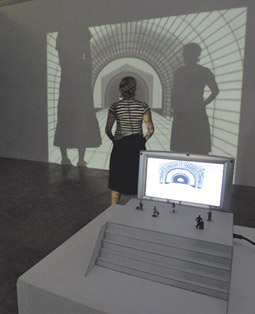
reconfigured, Jude Walton
photo Fiona Morrison
reconfigured, Jude Walton
JUDE WALTON’S RECONFIGURED PROVIDES AN INTERACTIVE SPACE WHICH LITERALLY FRAMES OUR PHYSICAL PRESENCE AND COGNITIVE AWARENESS WITHIN PERSPECTIVE; WEB ARTISTS YOUNG-HAE CHANG HEAVY INDUSTRIES BRING AN INTERCULTURAL INTERNET TO THE SCREENING ROOM IN THEIR CINEMATIC WORK, THE MOOD OF THE MOMENT; AND MELISSA HIRSCH’S FIBRE WORK, DE NATURED (see page 1), CONFRONTS THE LOSS OF TRADITION AND IDENTITY TO TECHNOLOGY.
These works and 24HR Art’s most recent exhibitions have recognised the complex new dynamics of point of view, confronting us with ways of thinking about our physical presence and our identities as members of multiple communities.
In the main gallery space, Walton creates stations of activity that collectively provide an insight into our sensing of self within space. As individuals and groups move from one work to another they fill the gallery with bodies that build histories and narratives which include the real architectural space in relation to Walton’s references. Each exhibit requires an interactive response; the more complex of these involved sensor pads interfaced with an animation of a ball on a board. Participants are invited to step on and test their sense of balance, to become aware of their bodies in action.
Walton wants us there physically, to become aware of our own scale shifts within the viewed grid. A graphically rendered Paris Underground tunnel allows repeated views from different perspectives. As we move from one exhibit to another we are challenged by the different scales—sometimes it’s like an optical test, at others observing a model replica of ourselves in space and, finally, immersion as we and our shadows make a convincing dint in the virtual tunnel.
Young-Hae Chang Heavy Industries, comprising collaborators Young-Hae Chang (Korea) and Marc Voge (USA), are Seoul based web and new media artists who have negotiated the art world through the internet. They use signature streamlined Flash animations on large screens and monitors in galleries rather than on the personal computer (although you can find their work online), creating a different paradigm for viewing and understanding.
Using animated text, The Mood of the Moment, amusingly portrays a provocative dialogue highlighting sexual politics, language barriers, people who are in the know and those who want to be. This work is not simply about information getting lost in translation. Central to the dialogue is a seemingly nonsensical term, “Guachi Guaro”, which can be attributed to jazz vibraphonist Cal Tjader’s 1965 album and its title piece Guachi Guaro (soul sauce). To be a jazz aficionado is to be part of an exclusive club. In a similar way nationality and language provide not only difference but also access to exclusive knowledge and experience.
Like many of YHCHI’s works The Mood of the Moment is accompanied by jazz. Punctuated by a catchy digital jingle reminiscent of Korean toothpaste commercials and with computer translator voices, the sound is wittily synched with flashing text. Speed is critical to the reading of the work. As viewers become embroiled in a discourse between male and female our attention is caught by the pacing of both sound and text. We are anxious to understand; to not be left behind; to be in the mood of the moment.
The maker’s mark is clearly discernible in Byron Bay artist Melissa Hirsch’s de natured. Woven from New Zealand flax and revealing a skilled fibre artist, Hirsch has made a collection of tools from power drill, sander (including cord) to shovel, rake and screwdrivers—a familiar collection to anyone owning a tool shed. Hirsch identifies her practice within the paradigm of sustainability and has gained climate neutral status from Climate Friendly, a government accredited climate impact company.
Sustainability is a vital ecological goal but used within the context of the exhibit characterises the impossibility of maintaining indefinitely practices of the past. Hirsch’s delicately woven tools emphasise the inevitable replacement of generations of skills and of technologies as part of a constant dynamic.
Jude Walton, reconfigured; Young-Hae Chang Heavy Industries, The Mood of the Moment; Melissa Hirsch, de natured, 24HR Art, Darwin, May 11-June 16
RealTime issue #80 Aug-Sept 2007 pg. 38
© Sarah Pirrie; for permission to reproduce apply to realtime@realtimearts.net
Robin Petterd, Drifters
HAVE YOU EVER PLAYED POOH STICKS? IT’S A GAME POOH BEAR INVENTED ONE DAY WHILE HE WAS THINKING OF SOMETHING ELSE (PROBABLY HONEY). ONCE INVENTED, POOH BEAR AND HIS FRIENDS SPENT COUNTLESS HOURS DROPPING STICKS IN A STREAM ON ONE SIDE OF THE BRIDGE AND THEN RUNNING TO THE OTHER TO SEE WHOSE STICK EMERGED FIRST. EACH STICK, ONCE RELEASED, WAS SUBJECT TO THE UNPREDICTABLE, BUT CONTINUOUS, CURRENT OF THE STREAM AND THE GAP CREATED BY THE SPACE UNDER THE BRIDGE WAS CRUCIAL TO THE SUSPENSE OF THE GAME.
It’s not such a long bow to draw together the visual of Pooh and his friends with the intention of Robin Petterd’s latest installation, Drifters. In a small project space, Petterd has mounted three flat screens on the floor, each in slight misalignment with a wall. A form of blackout has been achieved with a dark fabric ceiling and door. Across each of the screens drift amorphous, foggy shapes, objects, flotsam—it’s hard to put a name to this stuff. Silently, the soft shapes move at different speeds, sometimes beginning slowly and accelerating as if affected by rapids. Shape shifts takes place, with the foggy forms dissolving, emerging or changing like curls of smoke. While the flow of objects in water is the most direct visual reference, I’m reminded of particles travelling through blood, perhaps because there is an increased viscosity to this animation. After some time, it’s possible to identify a sense of continuity between the screens, as if the floor space between monitors were like Pooh’s bridge—hiding, then revealing—and capturing this connection demands you shift position.
From Petterd’s artist statement, I understand that the work is intended to be immersive, to duplicate the bodily experience of floating in a flowing stream. With an installation where you must look down at each of the screens and stand for lengthy periods to appreciate the content, I would also suggest that the work is intended to prompt a meditation. An experience of this work could take us to that place or moment where we stare into the stream and allow inner thoughts to be unlocked by the observation of continuous movement.
Robin Petterd, Drifters
While other factors impacted on my capacity to focus on the work—the bleed of fluorescent light from the gallery entry and an adjacent tenant’s radio noise—I think it was the choices made for the installation of Drifters that foiled the potential for immersion. The animation in itself is quite beautiful and I could have watched it for some time, but the constriction of the small screen and monitor frame seemed to be contrary to the loose flow of the work. A projection of the animation onto the floor that I could walk through, or onto a wall where I could move closer, may have helped to take me somewhere. As much as I wanted to be, unfortunately I was not Pooh, captivated by the vagaries of the stream, chasing between views, nor was I lost in the act of contemplating the flow.
Robin Petterd, Drifters, Inflight Project Space, Hobart, June 2-23
RealTime issue #80 Aug-Sept 2007 pg. 38
© Judith Abell; for permission to reproduce apply to realtime@realtimearts.net
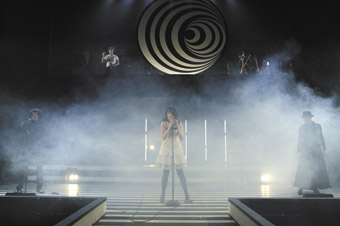
Grant Smith, Ian Stenlake (top), Alison Bell and Renee Geyer, Sleeping Beauty
photo Lisa Tomasetti
Grant Smith, Ian Stenlake (top), Alison Bell and Renee Geyer, Sleeping Beauty
AT THE RISK OF GENERALISING ON NATIONAL GROUNDS, I’LL GO ON THE RECORD AS ARGUING THAT AUSTRALIA DOESN’T PRODUCE THAT MANY NOTABLE DIRECTORS. NOT THAT THERE AREN’T A LOT OF GOOD, AND INDEED A FEW GREAT-DIRECTORS WHO’VE EMERGED FROM THE COUNTRY IN THE LAST FEW DECADES. BUT THERE AREN’T SO MANY AS TO HAVE GENERATED THE KIND OF CULT FOLLOWINGS SEEN INTERNATIONALLY.
Those who have achieved almost household-name status—your Barrie Koskys or John Bells—have often done so through flashy, eccentric manoeuvring; idiosyncratic aesthetic choices that sucker-punch our familiarity with classic texts. For the most part, however, our directors seem happy telling actors which way to face. It’s rare that an audience will leave a show thinking “now that was some direction.”
Three recent Melbourne productions were exceptions—or at least complications—to the rule. Malthouse Theatre’s Sleeping Beauty advanced artistic director Michael Kantor’s increasingly distinct program of gloriously contradictory excess; Theatre @ Risk’s Chris Bendall bettered his best with the arresting Checklist for an Armed Robber; and the debut directorial gig for Spring Awakening’s Simon Stone heralds an almost alarmingly striking new talent.
sleeping beauty
I like Kantor’s artistic sensibility, though not always the results. He creates big shows, ambitious spectacles which do head towards that directorial stamp lacking in much Australian theatre. I like his eagerness to exceed, rather than simply succeed; to say “more is more” and to attempt to stretch the given meanings a text can be expected to contain. He layers myth and allegory, pop culture references, meta-theatrical self-consciousness and a vaudeville slice of grotesque humour onto anything he approaches. God knows what he’d do with Chekhov.
Sleeping Beauty takes its source fairy tale in typically irreverent fashion. In Kantor’s hands, the story of a young girl put to sleep and woken by a kiss becomes the hook for a fabulist confection of psychosexual desire, familial monstrosity and uncanny weirdness. It’s a musical, too, with all the trappings. The small cast of four—Alison Bell, Ian Stenlake, Renee Geyer and Grant Smith—deliver the goods entirely through song, piecing together the narrative via the great lyricists of the past few centuries: Cave, Bowie, Brahms and Britney.
Beauty is here a wayward teen, simultaneously desired and detested by her parents and slovenly brother. Retreating to her bedroom after her sixteenth birthday, she falls into a fitful sleep and takes a somnambulistic journey into a world of animal-headed avatars and a rock-god star-man arriving to save her from (parental-surrogate) dragons. When she finally awakes, it is her brother who takes the place of her object of deliverance, and her parents themselves who have inaugurated their incestuous union. It should be scary stuff. I’m not sure it hits all the right notes.
By theatrical convention, curtains and flats are always wheeled out on tracks—perhaps there was a subtle punning in the way the performers frequently interacted along straight horizontal lines, rarely navigating the betweens. It seemed, to me, strange, since the profundity the script gestured toward—we’re talking that epic, pop, grotesque explosion of meaning Kantor seeks to create—is anything but flat. It’s as much playlist as play though, and hinging the work’s effectiveness on song is a brave move that only pays off if the tracks in question rouse the soul of the audience member watching. There’s no doubt that some moments—Geyer’s eye-widening rendition of Eminem’s Go to Sleep (“Now go to sleep bitch! / Die, motherfucker, die!”), for instance—make for uniformly jaw-dropping theatre. But the deeply divided response the show has met, some feeling little while others have been gobsmacked, is testament to the way music is that most personal of things. Love it or hate it, you won’t really know unless you’ve seen it.
Kantor’s unrestrained eclecticism is perhaps the closest we have to that paradoxical global phenomenon of contemporary theatre—avant-gardism as the norm. Today’s canon is composed of that which can’t be boxed into traditional categories, postmodern performance as the institutionalisation of the un-instituted. Difference is the sameness of the now; Sleeping Beauty can only be the unquestionably wondrous work it is for some by failing to inspire wonder in others.
checklist for an armed robber
As the creative force behind Theatre @ Risk, Chris Bendall occupies a different space. His productions over the past half decade have not suggested a studious eclecticism that itself becomes an aesthetic so much as an untamed variety of style that effaces directorial intent. It’s almost impossible to reconcile the range of works which this company has laid out under his name, since their scope—in both quality and content—has been so variegated as to put to question the very notion of direction. There’s no such thing as The Bendall Look. As a result, the productions where he’s been at the helm have been at times outstanding, at times mediocre. With Checklist for an Armed Robber, however, he hits his stride.
One floppy-haired wag once remarked to me that, as a director, Bendall makes a great producer. Their point was that his talents lie in picking the right script, assembling the appropriate creative team and casting the ideal performers for each role. His individual, unique contributions in the form of directorial choices are invisible. There’s a truth to this, though its dismissive tone should be ignored. Bendall has developed a talent for sourcing excellent material and has gradually built a solid stable of theatre-makers to help realise each work. I don’t think this is an ability to be scoffed at. There’s a place for art which doesn’t draw explicit attention to the hand of its maker, just as there’s one which underscores a distinct perspective behind its fashioning.
Certainly, Checklist is an unequivocally powerful script in its own right. Writer Vanessa Bates contrasts two real events—the Moscow siege of 2002, in which Chechen rebels held a theatre audience hostage until soldiers gassed the venue with tragic results, and a holdup in a Newcastle bookshop which occurred over the same weekend. The action shifts between the two settings as a journalist attempts to negotiate with the terrorists and the Newcastle robber prepares to undertake his crime.
What links the two incidents, in this case, is a question of sympathy. In the Moscow scenario the journalist in question is one sympathetic to the Chechen struggle but now faced with the unutterable horror taking place in its name. Locally, we are given saddening insights into the mind and history of a man driven to commit an armed robbery, but his abortive—indeed, hilarious—efforts produce a trauma all the more effectively conveyed by its subtle deliverance.
It’s a tense, taut thriller that doesn’t let up, but had Bendall gone for a more showy aesthetic the effect would not have been the same. In this instance, he has picked the right script, drawn together a superb creative team and excelled in his casting. Can that be a bad thing?
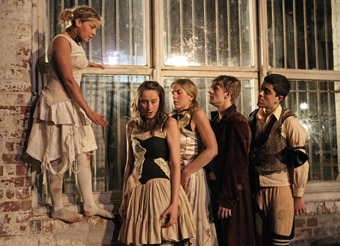
Spring Awakening
photo Jeff Busby
Spring Awakening
spring awakening
And then there are those directors who arrive entirely unexpected. Simon Stone’s first effort in the role, Spring Awakening, is as bold and engaging a piece as has been seen this year in Melbourne, and it’s one where his input has been more than evident. The play is adapted from a century-old script by Frank Wedekind, which caused great scandal when it first appeared. It’s not hard to see why—the list of taboos it toys with is extensive, including rape, homosexuality, suicide, domestic violence, teen pregnancy and abortion. It’s all played out by schoolkids, too, in a timeless schoolroom beset by decay.
Done badly, the piece could too easily be a tacky, squalid affair, but Stone evokes performances from his young cast that transfix. The level of energy displayed is impressive, but the way it is channelled into controlled states is laser-sharp. The unflagging pace is made to carry its audience, rather than expecting them to keep up, and if Stone can pull off this feat more than once, he’ll be assured a rapid ascent in Melbourne’s theatrical circles. If not, well, here’s hoping his Spring Awakening returns for another season.
Malthouse Theatre, Sleeping Beauty: This Is Not A Lullaby, director Michael Kantor, devisors Paul Jackson, Maryanne Lynch, Anna Tregloan, scenario Maryanne Lynch, Michael Kantor, performers Alison Bell, Renée Geyer, Grant Smith, Ian Stenlake, design Anna Tregloan, lighting Paul Jackson, choreography Tony Bartuccio; CUB Malthouse, July 6-28; Theatre @ Risk, Checklist for an Armed Robber, writer Vanessa Bates, director Chris Bendall, performers Paul Ashcroft, Ryan Gibson, Natalia Novikova and Edwina Wren, producer Kirrilly Brentnall, designer Isla Shaw, lighting Nick Merrylees, sound Jethro Woodward; Trades Hall, May 10-27; The Hayloft Project, Spring Awakening, writer Frank Wedekind, adaptation & direction Simon Stone, performers Angus Grant, Sara Gleeson, Katie-Jean Harding, Shelly Lauman, Rhys McConnochie, Beejan Olfat, Russ Pirie, Dylan Young design Jolyon James, Mark Leonard Winter, Simon Stone, lighting Lucy Birkinshaw, sound Rob Stewart, costume Mel Page; fortyfivedownstairs, Melbourne, June 7-17.
RealTime issue #80 Aug-Sept 2007 pg.
© John Bailey; for permission to reproduce apply to realtime@realtimearts.net
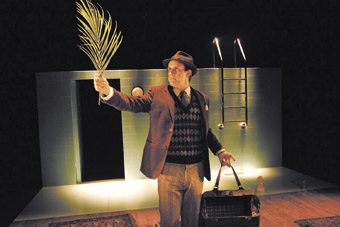
Eamon Flack, The Goose Chase
photo Bohdan Warchomij
Eamon Flack, The Goose Chase
THEATRE CAN BE HARD, ADULT, WORK AND FOR THAT WE SHOULD BE GRATEFUL. THE GROWN-UP DEMANDS OF A NIGHT AT THE THEATRE OFFER A RARE ANTIDOTE TO THE UBIQUITOUS TELEVISION, WHICH HAS BEQUEATHED US A TEENAGER-ISH MODE OF ENGAGEMENT CHARACTERISED BY WEAK ATTENTION, MILD DISINTEREST AND POOR POSTURE. UNLIKE THE MOVIES, WHERE OUR EXPECTATIONS AS VIEWERS ARE LARGELY GENRE-DRIVEN AND FRAMED BY A COMBINATION OF MARKETING AND REVIEW, THEATRE PROMISES THE INTENSELY UNEXPECTED.
But with intense engagement comes the risk of intense boredom. It is a singular state, the boredom of theatre, irreducible to other kinds of boredom. Is there a word (in German perhaps?) for the muscle-clenching, teeth-grinding experience of being stuck inside a theatre with an hour and a half behind you, and another 50 minutes in front?
Two recent productions in WA offer an opportunity to reflect upon the intense experience of theatre.
Matthew Lutton has emerged as a powerful force in West Australian theatre, both through his role as Artistic Director of Black Swan’s BSX Theatre and in productions with his own company, ThinIce. In the first half of Lutton and Eamon Flack’s recent The Goose Chase, I was thrilled to get to work, grateful to be given a grown-up job to do. There was no doubting Eamon Flack’s energy and skill as he flipped between era and character. The script was witty and insightful, and I wrestled happily with the tricky parallelisms established between Edwardian detective Edward Blunt, struggling to find his identity, and the contemporary Edward Taylor, young, gay, expatriate, desperately seeking a new plot for his next novel while holed up in London. I was moved by the drama of a young Australian author struggling to locate a subject for his writing within a universe which objectively promulgates postmodernism and globalism, but which subjectively robs him of reference and roots. At last, I thought, an original theatrical production which is dialogically engaged with issues that matter to me, to us, here in the State of Excitement, in the Land of Opportunity. Hurrah!
But, alas, interval and then the befuddlement of devised theatre. What appeared in the first half to be an actor inside an act, increasingly proved to be an actor putting on an unnecessary act. In scenes set in Singapore, the contemporary Edward rediscovers his ‘roots’, travelling back to his family home. The performance collapses into autobiographical sentimentality, with a tedious parody of a Malay trader on the beach adding nothing more than proof that the actor can do accents. What had been a fine balance between Shandy-esque digression and narrative focus now spilled over into—well, to put it bluntly, boredom. Excruciating boredom. Boredom raised to the degree to which I had been formerly engaged. Where was this goose chase leading? And if nowhere, and for no good reason at that, what was the point of working at it?
The sad thing about The Goose Chase is that it broke its promise to the audience. It was very nearly very good, but in falling short it proved its reputable devisers to be further from home than most had hoped. The most telling moment came in the epilogue, where the actor stepped out of frame to offer us a faux resolution which jettisoned the complex, dialogic concerns of the first half (where do we belong? does the local matter? how do we straddle the commitment to place and speak beyond that place?) in favour of a pallid ‘we are one’ individualism. Teeth clenching indeed. But which is worse? To have no idea where you are headed, or to have no interest in anything other than the destination?
Katherine Thomson’s Wonderlands knows what it is about, and it is quite sure what it wants to do. It is a play that sets out to ‘build bridges’ and ‘fill in gaps’. It is about land rights, about history, family, about love and betrayal. Instead of one actor on a goose chase, we have a whole stage-full of actors in character types being dispatched where many have gone before. Quick tempered Lon (Luke Hewitt), with wife Cathy (Angela Campbell) by his side, is struggling to keep his pastoral property on the go. Their daughter is about to be married to young fella Tom, but has inexplicably taken extended leave of her family. When Lon finds his property to be the subject of a land claim, led by local Indigenous woman-with-heart-of-gold, Edie (Margaret Harvey), old wounds are opened and old prejudices are mobilised, with suitably symbolic consequences.
It is not surprising that Katherine Thomson has had a long and successful career across theatre, television and film. Wonderlands sets demands on the audience somewhere around the level of ‘serious’ Australian television drama. Unlike The Goose Chase, this looks like a script with its issues up on the board well before a word was written. With more parallels than a parallelogram, no stray ends are permitted. Black and white, past and present all line up to face each other. Lon’s daughter suffers from mental illness, Edie’s son is off the rails. The disasters of the present mirror the disasters of the past. We are apparently doomed to repeat our melodramatic plots forever and a day.
The Goose Chase set out to keep the audience guessing, and promised a suitably clever dénouement, only to abandon the detective genre and jump ship. But this is surely infinitely preferable to narrative predictability. Having had all the work done for you, there is really nothing to do when watching Wonderlands, except become mildly bored and wait for the moment when your friend (who is very good and who, like all the actors in the show, continues to work very hard) comes back on stage and manages to wring a new shape out of a familiar shadow. Which is just enough for me tonight.
Deckchair Theatre & ThinIce, The Goose Chase, co-creator, director Matthew Lutton, co-creator, performer Eamon Flack, composer Ash Gibson Grieg, set & cosume design Claude Marcos, lighting Andrew Lake, sound design Kingsley Reeve, projections Sohan Ariel Hayes, PICA, Perth, May 1-20; Wonderlands, writer Katherine Thomson, director Angela Chaplin, performers Angela Campbell, Margaret Harvey, Luke Hewitt, Scott Jackson, Kyle Morrison and Samantha Murray, lighting Andrew Portwine, set & costume designer Brian Woltjen, Victoria Hall, Fremantle, June 7-July 1
RealTime issue #80 Aug-Sept 2007 pg. 41
© Josephine Wilson; for permission to reproduce apply to realtime@realtimearts.net
THE DAPPER MAN ON THE DOOR WANTS TO KNOW THE IDENTITY OF MY FAVOURITE FASCIST. AS A CONDITION OF ENTRY INTO THE MEATPACKERS UNION SPECTACULAR, I SAY “MICKEY MOUSE.” HE HANDS ME MY ANSWER PRINTED ON A CARD, BUT THE WORD MOUSE HAS BEEN BASTARDISED AS “MAUSD…” IT SETS THE TONE FOR A PUNISHING NIGHT WITHIN THE SUBTERRANEAN GLASSHOUSE HOTEL. FOR, CONSISTENT WITH AN ABILITY TO SEE THROUGH WALLS, THIS SHOW WILL REQUIRE THAT WE STARE INTO THE SOUL OF ART. SOMETIMES, WE WON’T LIKE WHAT WE SEE; SOMETIMES, WE WON’T SEE ANYTHING AT ALL.
The show’s starting time slips by; I’m about to leave, when I run into a friend. Our conversation centres around art and artists, before it is gunned down by the staccato rhythms of the Space Cadets. Meanwhile, several women of various sizes, from squat to Amazonian, strut their stuff in corsets and fishnet stockings. At the bar, an anemic Circus Strongman with a bullet hole in his forehead snaps a matchstick, then returns to conversing with a friend.
At the 1996 Adelaide Festival, La Fura dels Baus set their S&M bloodbath MTM at a Rave, deceiving a complacent audience before a visceral, yet hollow assault upon the senses. At the Meatpackers 2007 the idea of Party as Art mutates into a disconcerting afterparty. Nerdrockers, Aleks and the Ramps, belt out celtic grunge and band members feign smashing their instruments in a self-conscious declaration that there is nothing left to believe in; in particular, there is nothing left to believe in Art. I’m semi-inebriated when a woman dressed like the Tooth Fairy wants to calligraph my face with a black textacolour. I decline, but ask her what she’s into, and she answers my questions with quotes from Hollywood movies. Declaring “I’ll be back, Terminator, 1984”, she dematerialises Schwarzenegger style. Finally, talking to a female punter, I introduce myself as Tony. She says, “Ahh yes, Tony Soprano”. I laugh, but the she studies my face and then says, “Hmmm, Yes…Tony Soprano”. This time, it’s kind of disturbing.
At 3.00am it becomes apparent that the Meatpackers are really onto something. What I can’t ascertain is whether it’s the boozy afterparty or the ‘Do it Yourself’ Punk ethic that pervades this performance. From the man who escapes his dinner jacket while balanced upon a bottle of Sake, to a male stripper with bonbons attached to his body that explode in fugue with recitals from a Jackie Collins’ novel, the Meatpackers Union might just be a provocation toward Live Art in the next decade. I suspect there were drugs and dickheads aplenty, but like the quality of performance, this cannot be verified. Whatever, I had a bastard of a time.
Meatpackers Union, performers Space Cadets, Aleks & the Ramps, Barons of Tang, Mitch, Sky, Conor & Sam, Wazzadeeno Wharton, The Opposable Thumbs, Good Kissing Carrion Burlesque; Glasshouse Hotel, Melbourne July 29
RealTime issue #80 Aug-Sept 2007 pg. 41
© Tony Reck; for permission to reproduce apply to realtime@realtimearts.net
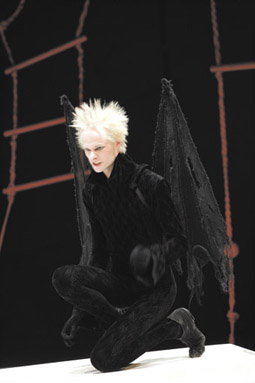
2007 VCA Graduating Company’s production, The Perjured City
photo Jeff Busby
2007 VCA Graduating Company’s production, The Perjured City
FOR KIRSTEN VON BIBRA, THE PERJURED CITY’S TWINNING OF GREEK DRAMA AND FRENCH THEATRE CONSTITUTES THE MARRIAGE OF TWO GREAT PASSIONS. AS DIRECTOR, ARTISTIC DIRECTOR, DRAMATURG AND TEACHER, SHE HAS NUMEROUS CREDITS IN BOTH THESE TRADITIONS. HER OWN GRADUATING PRODUCTION IN 1983 AT THE VCA WAS A GREEK TRAGEDY. AND YET, FRESH FROM THE 2007 VCA GRADUATING COMPANY’S PRODUCTION OF HELENE CIXOUS’ EPIC, FOUR-HOUR PLAY, SHE SPEAKS OF THE EXPERIENCE IN HUSHED, REVERENT TONES THAT ONLY HINT AT THE EXTRAORDINARINESS OF THIS DIRECTING EXPERIENCE.
I always work with a lot of heart, but I think that was something very special, that play. It’s a privilege to work on material like that… It’s so vast in its intellectual breadth, in pulling together all these extraordinary stimuli of the imagination…Hamlet, King Lear, Macbeth, Greek mythology, and contemporary history. God, it’s such a blast!
It’s also been physically and intellectually exhausting. Von Bibra has enjoyed an 18-year role as project director with the Melbourne Theatre Company’s Education Program, was joint artistic director of Theatre of Spheres, has worked with contemporary, classical and devised theatre in the UK and throughout Europe. In Melbourne, she has directed at Playbox, La Mama, St Martins, National Theatre and others, studied psychonanalysis for four years and in 2006 was co-recipient of a creative development grant from the Full Tilt program at The Arts Centre, with performance artist Andrew Morrish. The Perjured City, she confesses, might have been the biggest challenge of her career: as well as an epic drama of tainted blood, corruption, marginalisation, vengeance and injustice, the production was a visual spectacle involving puppetry, stilt-walking and rope-climbing: “to rehearse that play in the time that we did, just about killed us.”
a theatre of elevation
So, why The Perjured City? Why a play so long and difficult? “It’s a lot to do with the passion”, von Bibra says. “[Cixous is] so motivated to talk about social issues…” The director shares Cixous’ interest in what she calls the “incessant alert of responsibility”, viewing theatre as an agent of social activation and as an act of elevation; a means of alerting people and awakening them to injustice, here the illness and deaths of some 5,000 people given HIV infected blood transfusions in France in the 1980s. So, what are the theatrical and stylistic elements that produce a theatre of elevation? How do you incite consciousness and engagement, perhaps even action?
“Choral work, where you’ve got vocal strength in a number of people speaking together, and they’re unified” is pivotal, says von Bibra. The inclusion of a chorus, a staple of Greek drama, was informed by Cixous’ study of the French Resistance fighters of World War II, but there’s so much historical slippage, or glissage, in this play, her Chorus could be eighteenth century revolutionaries, or the students of the 1960s uprisings. But the play’s most impassioned outcry against injustice is the collective voice of the Furies: “Cixous awakens the Furies after 5,000 years of sleeping. She awakens them through outrage and indignation that this horrendous crime, this blood crime, has occurred.”
unwomanly power
The Furies needed to be a potent force without sliding into burlesque. There’s a lot of humour in the way Cixous has written them; and they’re very much related to the grotesque women of Le rire de la Méduse (The Laugh of the Medusa, 1975), Cixous’s seminal essay championing the ways women might use rage, laughter and generally unruly, unwomanly behaviour as a form of agency and resistance. It’s a paradigm of femininity that is both erotic and abject. Von Bibra initially conceived the Furies as completely stylised, with slow and synchronised gestures and movement: stepping forward, rubbing their palms together, wringing the stain of blood from their hands like Lady Macbeth. But as the performance blueprint evolved, they became more naturalistic, allowing for increased freedom of movement and expressiveness. Costuming them was challenging. Aeschylus never actually described them beyond the physical repulsion and terror they evoke. “All you get is the residue from the other…Isn’t that the nature of the fear of the other? [Like] the ‘War on Terror.’ What is ‘Terror’? If you had to personify ‘Terror’, what does it look like?’ So then, how do represent the Furies, characterising what is perhaps more powerful in abstraction?”
“They were always going to be red”, the director states emphatically. “There are mythological references to them wearing black, but I really wanted them to be Passion…and the notion of blood too is important in terms of what they were avenging…There’s a femininity about them, but their dresses were distressed at the bottom and sewn in ribs with veins so they were basically a seething mass of blood.” But the emphasis had to be on language and utterance. Von Bibra’s biggest focus is on the dissolution of language, another motivation for choosing Cixous, who deliberately implants meaning into grammar, punctuation and line formation.
enunciation & pronunciation
“More than anything I felt it was about the language of the Furies, so I felt that visually I didn’t want to create a lot of pulling of focus…The work on the Furies was much more invisible than the visible…I’m very passionate about the acts of enunciation and pronunciation, [so, we] did a lot of work on the approach to utterance. For example, when the Furies say: “We disappeared for 5,000 years. No one heard us. Not even, c-c-cough”, [there’s] the repetition of ‘cough’, and the [emphasis on] how you enunciate the word ‘cough’, and the whole notion of onomatopoeia.”
Cixous uses “amphibology”—an ambiguity of language achieved through grammatical structure. The play’s title, The Perjured City is an example. Has the city been lying? Or, has the city been lied to? Amphibology also functions in the play’s constant glissage of address. There’s a deliberate ambiguity around the use of the word “vous.” Is it referencing other characters on stage or the audience? There’s a lot of breaking of the fourth wall, and the dialogue slips easily between fourth wall and direct address. Von Bibra considers this the strongest component of the play’s activist rhetoric.
the others
But it’s the theatricality of Otherness that is its most compelling aspect. In the house of Cixous, the voice of the Other—the repressed, the politically marginalised, the collective unconscious, the dead—acts as a social agent. In The Perjured City, the children who have died from HIV/AIDS as the result of a contaminated blood transfusion, return from beyond the grave, singing a call to arms. The VCA production team reincarnated them in the form of small wooden puppets. When they appeared, the children were always aspiring upwards, always climbing—a nod to the concepts of elevation and transcendence. Similarly, the red ropes surrounding the set became a sort of trapeze for the venerable souls of the Chorus, who could perch above the trials that unfolded beneath, literalising a sort of elevation.
the word
To bring this spectacle together, the players drew on the VCA’s three-tiered rehearsal model and extensive research into the play’s backgrounds. The tiers commence with “dropping in”, a process of visualising individual words and meanings and attributing personal significance to each, word by word. This is followed by an abstracting process—a physical and imaginative improvisation of the universe of the play. The actors then have a very strong kinaesthetic and muscle memory recall when they finally create the “blueprint”, the shape of each scene.
Von Bibra relates a very stirring moment from the thick of this emotionally gruelling process. About three weeks before opening night, the director, cast and crew received a message from the playwright herself: “Don’t act, live it.”
See John Bailey’s review of this production of The Perjured City, “The ghosts of bad blood”
RealTime issue #80 Aug-Sept 2007 pg. 42
SINCE 2006, PVI HAS BEEN PRESENTING THE ACTIONS OF THE LOYAL CITIZENS UNDERGROUND (LCU), A PARA-POLICING GROUP. THE AUDIENCE IS ISSUED WITH HEADSETS AND LISTEN TO THE LCU QUESTIONING MEMBERS OF THE PUBLIC REGARDING THEIR ACTIVITIES OR RESPONSES TO MINOR CRIMES. REFORM (2006) WAS PLAYED OUT IN FULL VIEW ON A WALK ALONG A CITY ROAD. THE ACTION OF PVI’S NEW WORK, INFORM, OCCURS LARGELY OUT OF SIGHT, WITH AUDIENCES IN THEIR CARS, PARKED ALONG A SUBURBAN STREET, AS LCU DOORKNOCKS.
This seems a bold move, exposing the performers to unpredictability. Given the audience only has access to the spoken word, one might expect the actors to be masters of verbal improvisation and poetic sparring. In fact, the LCUs are skilled at bullying. Each “interview” is a monologue directed at the householder on the evils of a social practice (graffiti, public dog shit, theft of carparking spaces, water wastage), peppered with unending “umms” and “you knows” and other uninspiring phrases while disparaging the practice in question.
Little space is offered for the householder to respond. For those of us raised on Countdown, one is tempted to recall Molly Meldrum’s interviews involving questions whose replies were largely predetermined (Molly: “So, you must be pleased with your new album?” Artist: “Yes.”). The only unexpected responses were from householders refusing to talk to the LCU, but nothing significant was made of this. Throughout, one is left imagining how much richer Inform could have been with a stronger text (be it the crafted larrikinism of Australian New Wave works like Alex Buzo’s Norm And Ahmed, or a calculated use of metaphor and imagery), with a more dynamic interviewing technique, and with more developed improvisational skills. In short, how much better PVI’s otherwise engaging concepts might be if carried out by those who, apparently unlike the current cast, have extensive theatre or comedy experience.
Possibly the LCU indifference to interviewee responses was meant as a critique of political pollsters and ideologues, but if so, it was a blunt instrument used to establish a familiar point. Jason Sweeney’s score, moreover, conformed to Brian Eno’s “wallpaper music” epithet, exacerbating the broadcast’s vocal, aural and affective monotony. Here too one could perhaps conclude the intent was to dull the audience into indifferent, distracted submission to authority similar to that expected of the householders—but the result was more tedious and frustrating than intellectually challenging.
The key issue is just what is being presented here? If it’s theatre it compares poorly with Version 1.0’s The Wages of Spin and Not Yet It’s Difficult’s Blowback or their Apolitical Dance. And what precisely is PVI trying to depict? The repressiveness and pettiness of modern policing and of spying are hardly new given these institutions developed in post-Napoleonic Europe to keep populations at bay. PVI’s press materials suggest an interest in the post-9/11, post-Tampa psyche, but to depict this, one would need more from the householders themselves—be these real stories or scripted material. It seems that, like the 1960s street artists whose approach PVI most closely echoes, PVI assume that their projects are not ‘fictions’ as such, but ‘real’ interventions into society. In this sense, Inform is just what is seems: moderately aestheticised, publicly-staged spruiking conducted by non-actors—a modest if not particularly edifying achievement.
Opening night’s final interview did however rise above such limitations. A migrant from Sierra Leone was asked if he would dob in illegals, if he accepted that immigrants must “assimilate”, and was then pressured to join in singing Waltzing Matilda and Do You Come From a Land Down Under. Possibly disarmed by the offensiveness of their own questions in this context, the interviewers here actively solicited this man’s opinions, which he delivered with all the aural beauty of someone carefully replying in a language not his native tongue. Although ostensibly enunciating the conservative position, the palpable aural presence of this man, his dignity and patience in replying to these demands imparted a pathos, drama and aural complexity otherwise lacking in Inform. PVI should abandon their insistent ‘realism’ and ensure they have more interaction with their subjects.
Jonathan Marshall’s preview of PVI’s Inform appeared in RealTime 79, page 32.
PVI, Inform, artistic directors Kelli McCluskey, Steve Bull, performer-collaborators Ben Sutton, Sarah Wilkinson, Ofa Fotu, Chris Williams, score Pretty Boy Crossover (Jason Sweeney), production manager/DJ Mike Nanning, research Christina Lee; Perth suburbs, June 20-30
RealTime issue #80 Aug-Sept 2007 pg.
© Jonathan Marshall; for permission to reproduce apply to realtime@realtimearts.net
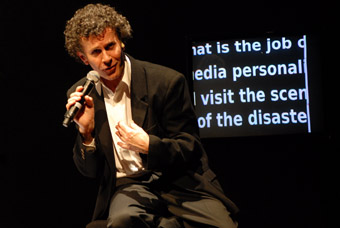
Nigel Kellaway, Sleepers Wake! Wachet Auf!
photo Heidrun Löhr
Nigel Kellaway, Sleepers Wake! Wachet Auf!
OUR NAMES ARE SPOKEN ALOUD INTO A DIMMED SPACE AS WE ENTER. THE CHARACTER ‘NIGEL’, THE VERY LAST TO ARRIVE, HOLDS OUR COLLECTIVE PRESENCE AND SUGGESTS THAT TOGETHER WE “DECIDE WHEN THIS PERFORMANCE BEGINS.” WE WAIT. FOR A TIME. OUR EYES FOLLOW HIS EYES, DIRECTED OUTWARDS. THERE IS A PIANO, CENTRE. A VIDEO MONITOR. POOLS OF LIGHT DELICATELY SPLOSHED ACROSS A DISTANT SQUARE OF TARQUETTE. A MEMORY OF AN ACTION, PERHAPS. A FLEETING GLIMPSE OF PERFORMANCE? OF MOVEMENT? A TRACE OF WHAT HAPPENED, OF WHAT WILL HAPPEN WHEN BEGINNING FINALLY BEGINS?
Nigel Kellaway’s solo performance Sleepers Wake! Wachet Auf! is concerned with memory and forgetting. The title, taken from a cantata written by Johann Sebastian Bach in 1731, implies the opposite to lullaby, and yet, Sleepers Wake! mirrors Bach’s own entry into the riff of dreamscape. We exist with Nigel in a zone that slips, like sleep, between loss and longing, caress and fantasy, pain and forgetting. Our journey is heavily somnambulant. We are half-teased into waking by the trickery of words or the sensuous strain of melody. We are all made witness to a very strange kind of time.
Is Nigel in mourning? Is he traumatised? Amnesiac? He has certainly forgotten something. We watch him chase memories—remnants of narratives, half-told stories, the shadowy footsteps of a dance. These are the compelling traces that he longs to unravel, but they only ever return in the fickle shape of “bluff.” Nigel’s memories are fake, a mocking ruse. He merely “appears to have a past.” Instead, his reminiscence is the junky bric-a-brac of other people’s stories: dim and fading musical motifs, punchlines and ‘wound culture’ television grabs, repeatedly leading both us and Nigel to the wrong scene at the centre of the wrong crime
French novelist Marcel Proust was enamoured of memory and its tendencies for loss and longing. Sleepers Wake! was conceived as a collaboration between four distinguished performance writers. Amanda Stewart, Josephine Wilson, Virginia Baxter and Jai McHenry were each invited to respond to Kellaway’s identity as performer through notions of memory. The collaborative writing effort creates a sense of a man who stands amidst broken narrative—a postmodern Proust gone awry. And yet, these narrative breakages speak less of collaboration and more of a certain kind of experience. Their fractures paint Nigel as a man who is balancing tenuously on the cusp of himself.
At the centre of the space are three musicians (Michael Bell, Margaret Howard and Catherine Tabrett) who sensitively sustain Nigel’s melancholia in compositions that Kellaway has adapted from Bach’s original Goldberg Variations. What we hear are “variations upon variations”—music that is ‘quoted’, recollected, eclectic. It lullabies on recurring motifs that return, each time with a slightly different twist, engineered to sink us into the sense that we are looking at the same problem from perhaps a different angle. Kellaway’s reference to Roy Orbison and eighteenth century music boxes sounds out a tinny, kitsch nostalgia above the depth of Bach. Another version using Kurt Weill has dramatic spunk in its pace.
These incongruous musical themes elide dream with recollection. They make Nigel dance before us, stand before us and, interestingly, resist the memory of Kellaway’s own musical skill. Kellaway, the performer, does not play (until the very end), although we get the sense that Nigel, the character, has a lurching itch to do so. The different textual variations cleverly merge to produce writing that is in different degrees elegant, potent, smug, syncopated and raw. In one narrative, Nigel confesses to a psychiatrist, only to end with a gag and the punctuating resonance of canned laughter. In another, he has received a letter from a lover who has apparently left him, but has got all the facts wrong. For a start, Nigel never had a pet rabbit, nor did the lovers own a holiday house.
This delicate stepping between worlds both in space, music and text makes Sleepers Wake! a complex take on the oftentimes symbiotic relationships between memory, performance and self. In this rendition, a postmodern Proust gives way to a cynically philosophical Hamlet. “To B or not to B?”, Nigel coyly asks when tinkering at the keyboard. And yet this reference to bigger questions is not to be taken lightly. I was moved by Sleepers Wake!. There was a sense of inevitability about it all, the pathos in Nigel’s not knowing but continued attempts at being. The writers cleverly use memory to ask bigger questions around what all of this “presence”—this “Nigel Kellaway Hour”—is really about.
The skill in Kellaway’s performance is in his exquisite command not only of text, timing and audience, but in his obvious joy in knowing exactly what we do not. Kellaway understands the fickle nature of memory, which is why he disappears before our eyes a little too quickly. We are left with a trace of a gesture, the afterglow of human sentiment, an energy that lingers alongside what has already become just a distant memory of music. There’s the rub.
Sleepers Wake! Wachet Auf! composer, director, performer Nigel Kellaway, writers Amanda Stewart, Virginia Baxter, Jai McHenry, Josephine Wilson, musicians Michael Bell, Margaret Howard, Catherine Tabrett, lighting designer Simon Wise, Performance Space, CarriageWorks, Sydney, June 7-16
RealTime issue #80 Aug-Sept 2007 pg. 43
© Bryoni Trezise; for permission to reproduce apply to realtime@realtimearts.net
THE ESTIMATOR IS DAVID BROWN’S SECOND PLAY TO BE DEVELOPED AND PRODUCED BY QUEENSLAND THEATRE COMPANY (THE FIRST WAS 2005’S HIGHLY ACCLAIMED EATING ICE CREAM WITH YOUR EYES CLOSED). IT STARTS AS AN ALIENATED WORKING CLASS COMEDY OF CROSS-PURPOSES AND ENDS AS TRAGEDY (THE SORT WE READ ABOUT IN THE NEWSPAPERS.)
The setting is a one-bedroom Housing Commission flat on the outskirts of suburbia. As the play begins, we hear, portentously, a recorder playing a faltering version of Advance Australia Fair. The plot revolves around a young man, Martin (Remy Hii), an estimator with Far and Wide Removals who is under the misapprehension that he has been called to give an estimate for the occupants. These tenants are, on every level, going nowhere. Yonni (Carole Skinner) is a diabetic grandmother—“It’s a life-style disease”—who cares for her 12 year old orphaned granddaughter, Sharday (Natasha Wanganeen). Martin is drawn into their existence together through role plays and ritual games: “We hold together a few bits and pieces and we just try and kick on. Don’t we, Shard? We sing a few songs. Tell a few stories, recite some nice poems and we just kick on.” Amongst the appalling debris in this domicile is a kitsch shrine to Yonni’s son, Mozzy, Sharday’s father. It transpires that Martin has also lost a father, and that junkies are implicated in both deaths. They form The Children’s Association for Dads who are Dead.
Enter Karen (Bridget Boyle), Yoni’s daughter and Sharday’s Aunt. This rude, racist, impossible woman has been the one to engage Martin’s services in an estimation of the life of her brother, Mozzy, an habitual junkie who died of an overdose in prison after being apprehended, as it turns out, for killing Martin’s Dad in an armed robbery. Inspired by attending a New Age workshop, her confused intention is to lay bare the facts so that everyone can move on. Karen’s intervention is given some stick in a program note which criticises the self-help industry. This is a bit unfair, I think. Who was it who said the unexamined life is not worth living? Certainly someone speaking from the centre of culture, not from the margins. The Advocate in Strindberg’s A Dream Play insists that the worst thing of all is “Repetition. Repeating the pattern.” Karen’s intervention seems perfectly respectable in the light of such a high cultural precedent. If she desperately relies on what is available to her, however cranky, is she more absurd than someone currently deploying troops in Australia? However, it is unlikely that anything has fundamentally changed. Yonni’s last word, after her own devastating revelation, is: “A cuppa is what we’d all like.” You have to admire the resilience. And a kind of loving.
Jon Halpin’s sensitive direction (although I would have preferred a brisker pace at times), and an outstanding cast convinces us that Brown’s play is deeply moral and compassionate without flinching from the shortcomings and limitations evident in the lives of his characters. It is out of these that he weaves his scabrous poetry. But the morality, the compassion is quiet, simply declaring that these sorts of people deserve attention. In the final moment as the sun sets and we hear the sound of whip birds in the distance, we are called upon to make our own estimation—about our own agency in the world, about the nature of the world (and the world of nature), aware that our own complicit natures are part of the equation. Brown doesn’t allow us to escape into neutrality, but invites us instead to enter into the discipline of listening, of cultivating a Socratic sense of ‘wonder.’ No small lesson for these loud times when everybody is speaking, but few are speaking well.
As someone brought up in a fibro home, I loved it.
Queensland Theatre Company, The Estimator, writer David Brown, director Jon Halpin, performers Bridget Boyle, Remy Hii, Carole Skinner, Natasha Wanganeen, design Kieran Swann, lighting Ben Hughes, composer & sound designer, Brett Collery; Billie Brown Studio, QTC, Brisbane, June 4-July 7
RealTime issue #80 Aug-Sept 2007 pg. 43
© Doug Leonard; for permission to reproduce apply to realtime@realtimearts.net
SATURDAY NIGHT, THE MAIN EVENT FOR THE INAUGURAL UNDERBELLY FESTIVAL, WAS A PACKED HOUSE, A SELL OUT AT $25 A POP. THERE WERE DISCO DANCERS IN ROLLER SKATES, PUPPET SHOWS, VIDEO INSTALLATIONS AND BAROQUE LIVING DOLLS. THE EMPHASIS WAS ON SIMULTANEITY, A GIANT SHOW & TELL IN WHICH EVERYONE WAS TALKING AT ONCE, AND IT WORKED A TREAT.
Many of the most radical performance groups in Sydney were there, most of them so underground and so subversive that in a generation they’ll be blind and albino and have ASIO files devoted to them. The sum effect was of a carnival. The general public—and it really was a cross section, drawn in by the repeated articles in the media—wandered for hours amongst shows scattered throughout the building, sometimes genuinely astounded by what they found.
Administrators must have jumped at the chance to introduce some avant garde hip into the brand new CarriageWorks when Imogen Semmlar brought them her plans for Underbelly, a massive indoor public arts festival, in which dozens of groups of invited artists would baptise the building by doing…uh…stuff. They must be young, cool, and unrecognised, and consequently prepared to give their all for a shot at fame. Or just for the chance to hang out in a new space with other young artists. They would consecrate the space, give it that aura that only virgin sacrifices can achieve.
The rules of play were as follows: two weeks development time, all rehearsals to be open to the public, minimal funding. The incentive: free run of the building, a possible share in the proceeds, and a chance to be exposed to the almighty glare of an official venue and all of the blessings and curses that brings in its wake. Many of the performances were explicitly conceived as preparatory sketches for later shows. This is a good thing, as we can anticipate some great spin off events from Underbelly in the coming months.
Charlie Garber, Simon Greiner, Nick Coyle and Claudia O’Dougherty were clear house favourites with Pig Island. Ironically, theirs was the most conservative of the productions staged, being a straightforward play augmented with some improvisation. The plot centres on a pleasingly eccentric but doomed British aristocrat (Charlie Garber) unable to come to terms with modernity (Nick Coyle and Claudia O’Dougherty) or the possession of his 12 year-old puppet daughter with the restless soul of a 19th century Devonshire boy. Audiences were repeatedly and unnervingly transfixed by Garber railing in an upper class accent against the evils of puberty and travel over 30 km/h.
Similarly successful was Eddie Sharp’s Dance to the Max, a cinema remix of the Mad Max epics, performed by Mr Sharp, Kenzie McKenzie and Zoe Coombs Marr as a live voiceover with the aide of an extraordinarily proficient foley team—the way they managed to render the sound of a man walking in tight leather pants with only the use of a balloon and a sensitive microphone boggled more than the mind. In the new version, the villain Humongous is a kindly hippy who organises bush doofs and arrives with his army to announce a performance by techno artistes called HTML legends, and the imminent erection of a chai tent. The project is objectively hilarious, and will do well.
Jamie Gerlach took a blow for the Token group by almost severing his finger with a circular saw. Now, after some microsurgery and appearing on the TV show, RPA, he can nearly make a fist again. Token made an installation, a house warming party for a mythical man called Sidney, an engineer who might have been part of the Sydney Push, or then again, not, and who might have donated his body and all of his possessions to the arts or, then again, perhaps never existed. It half worked. Most people didn’t get the joke, which might have been made more clear by including Sidney’s coffin in the installation.
Phoebe Torzillo and Janie Gibson created a movement work in which Phoebe was murdered and her body dragged around the venue. The victim died like clockwork every hour, and the dance was performed with extraordinary grace and professionalism, allowing at several times, without flinching, for her face to be dragged along the concrete floor (!) as Janie humped her lifeless corpse around the foyer. It’s a bitter twist, and perhaps an intentional metaphor, that Phoebe and Janie—like many others on the night—are graduates of the combative Lan Franchis School of Performance. And speaking of Lan Franchis—what a terrible loss to Sydney its closure has been. All the arts launches and lunches in the continent couldn’t save it. Lan Franchis was a dirty speak-easy, a firetrap, and a source of countless noise complaints, and even if ArtsNSW had ever approved of it, it would have been closed on the spot for violating every OHS rule in the book. But it played host to more talent and better shows than the Opera House, and now it’s gone and there is nothing like it and there won’t be anything like it until the economy collapses or liquor licensing laws are liberalised, whichever comes first. All the while, Post mumbled lies to each other in a cold hotel room.
The Vespertine Project and Tetranomicon made perhaps the best use of the volume of the space, by filling it with architectonic projections with a hint of Albert Speer and roaming through the venue alarming guests, and Meem were allegedly excellent, but I was always somewhere else when they performed. That was the joy of the event, the pleasure of a carnival in which there is too much gelatinous popping and sliding, too much squealing and wailing, to take everything in, let alone name it.
underbelly, CarriageWorks, July 3-14
RealTime issue #80 Aug-Sept 2007 pg. 44
© Adam Jasper; for permission to reproduce apply to realtime@realtimearts.net
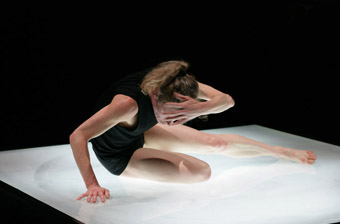
Rosalind Crisp, danse (1)
photo Patrick Berger
Rosalind Crisp, danse (1)
RECENT MONTHS BROUGHT AN ABUNDANCE OF DANCE AND CONTEMPORARY PERFORMANCE RICHES TO SYDNEY, TOO MUCH FOR THESE PAGES TO CONTAIN. TWO HIGHLIGHTS FOR ME WERE THE LATEST DEVELOPMENT of ROSALIND CRISP’S DANSE [1], NOW IN ITS FIFTH INCARNATION, AND THE FIRST MAJOR WORK FROM A TRIO OF SYDNEY PERFORMERS, POST, IN GIFTED AND TALENTED.
From Melbourne Stuck Pigs Squealing’s Eisteddfod astonished with its explosion and reintegration of theatrical form in the Lally Katz-scripted and Chris Kohn-directed Eisteddfod. From New York, The Foundry Theatre brought Major Bang, a witty and whimsical if ever darkening reflection on the emotional and political impact of 9/11. Andrew Morrish, visiting from Europe, was in virtuosic stand-up form at Performance Space walking the improvisation tightrope with the few near slips that give the form its edge. At the same venue, Erin Brannigan curated Choreographics for Reeldance, engrossing large scale dance installations which I experienced several times with increasing enjoyment of their immersiveness.
rosalind crisp, danse [1]
A foot lands. A temporary anchor point. The other foot lands but at what appears to be the wrong angle, an error perhaps—Rosalind Crisp’s body appears trapped, momentarily immobile. But just as suddenly it’s the starting point for the next move, a kick, pulling the rest of the body with it. The dancer finds a hand close to her face at the end of an angled arm, she watches it fly up, and her head drops back in brief release before another part of her leads elsewhere. The ongoing danse [1] project is full of surprises, not least for the dancer—if she spoke, she might exclaim, ‘Oh, this is here. What do I do with that?’
The stakes are high, every movement a challenge: Crisp’s manifesto includes the following: “As soon as I notice I am starting to do a habitual movement, I practise making a conscious decision to redirect my attention to another part of my body or to employ a different speed, direction, size or effort in that movement.” She also never repeats something which is leading a movement (“an impossible task but one which constantly awakens me to the potential of each moment”), and “enlarg[es], or briefly suspend[s], the commencement of each movement…to make a different movement choice…” In this way, Crisp sees herself as “escaping from cliches in dance in general and in one’s own dance language.” The danse [1] project returned to Sydney from France, where this Australian artist is currently based, with evidence of organic development of the language she has been evolving in recent years.
The audience wander the open space around two low platforms and past another with a woman at her computer, until a huge projection of Crisp dancing takes our attention. The dancer watches it with us. It’s as if we’re being re-familarised with the Crisp idiom writ larger than life. Movements oscillate between fluid and jerky and there’s a strong improvisational quality which comes with the task Crisp has set herself. It’s hard to pick motifs, the dance evolving moment by moment, difficult to add up, which is part of its power. It’s like witnessing a strange physiological phenomenon or a state of being which, encountered in the street, might be mistaken for a certain spasticity or autistic self-containment. The state comprises sudden alternations: centre/off-centre, balance/imbalance, proportion/disproportion, voluntary/involuntary, release/drag…
These moments are brief, often sudden, and frequently unlike each other. The work is not dancerly in any conventional sense, not long-lined, not lyrical. Yes, there’s a relentless fluidity but it’s the result of hard work, hard thinking. The work is work, curiously cerebral as well as intensely physical.
But the performance is also significantly spatial and although the pathway is never clear or predictable, Crisp occupies and transforms spaces—a wall, a wide raised platform, a human-scale lightbox. And in these we witness some new dimensions to the choreography of danse [1]. Near a wall in a dull greenish light Crisp’s pace is markedly slower. A forward thrust closes in a locked position, one knee bent, arms reaching forward, a relatively long moment of stillness. Change. The body squares off—legs akimbo right-angling at the knees, arms likewise raised. Held. Change. Brisk hops before the body arches back like a taut bow, arms completing the line, one hand twitching in the stillness. These phrases are like still frames from a 16mm film stuttering in a projector. A foot taps 1,2,3, an arm locks in three descending positions. We have just that little more time to absorb and assimilate an image, to see the relationship between stillness and movement, decision and impulse, more clearly.
The dancer slips off her shoes and moves tentatively onto the wide platform. Here perspective, as in the video earlier, comes into play as we watch her near and far, travelling where her modus operandi takes her, the dance now about propulsion—how can you travel when your body has another agenda? The moves are familiar, but then there’s a markedly accelerated passage replete with quick turns, arms reaching out, cupping, cradling and then slowing to a stand. But it’s a temporary reprieve. The left leg flies back and a hand shoots to the top of the head and then circles as the arm swings. Crisp gasps, the audience laughs as if sharing surprise at the sheer demand of the task.
She strips down to essentials and approaches the lightbox carefully, hand-first as if testing for heat and texture, staring intently, sitting slowly before lifting her legs onto it and commencing the moves we recognise but which are now demandingly transformed to the horizontal plane, working from the bottom, the pelvis, legs lifted and extended, skin red with effort, bathed in sweat and the fluoro glow. Crisp smiles at her effort, a little laugh escapes, as if about the extremity of the task she’s set herself and the audience laugh with her.
On the wall above, projected text scrolls, intriguing realtime observations about writing and dance, entered moment by moment on Isabelle Ginot’s computer (“..there are two kinds of dance—of the limbs and the organs, of the skeleton, and the other kinds she lets in or blocks”). Soon Crisp dances near the writer, the form more fluid, her body weary, the dancer taking us in, face to face. Finally, she calls for music and Janis Joplin belts out “Another little piece of my heart” as the dancer yells, crawls and flails in wild release. A job well done. We might be applauding ourselves as well, for our visceral empathy for this Herculaen effort for the sake of dance, performed, or rather lived, with commitment, seriousness and such good humour.
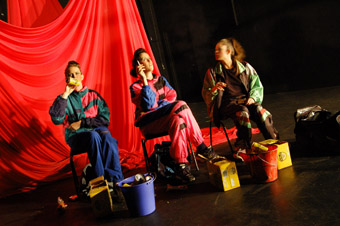
Zoe Coombs Marr, Mish Grigor, Natalie Rose, Post, Gifted and Talented
photo Will Mansfield
Zoe Coombs Marr, Mish Grigor, Natalie Rose, Post, Gifted and Talented
post: gifted and talented
Seated on big cushions inside a tent of parachute silk, we watch a soloist in sparkling briefs work out distractedly until we get the giggles. The silk is whisked away over our heads and two other performers appear in tracksuits and with bags from which the trio empty out cigarettes, packs of Solo and cellophane wrapped sausage rolls. Constantly smoking, sipping and scoffing, these tough mums prattle on viciously about the failings of their amateur dancer daughters. It’s a timely subject given the pressure to introduce ethical and even criminal codes for the restraint of sports parents. Much of the talk here is self-justification: no toilet breaks for their girls—there are no such breaks in any dance movie they can recall; no pissing in performance—“I made her apologise to her leotard.”
This is Kath and Kim territory. The women are amusingly misinformed, appallingly ignorant and bursting with malapropisms. But they are nastier, more surreal and they are political.
While orally indulging themselves, they attack their daughters’ eating habits (one is caught collecting sausage roll leftovers in bins and joining them up), they envy a Parramatta dance school’s chip machine (“all the girls there are skinny!”), and reflect on their own lives. On the subject of discipline one recalls being caught smoking cannabis by her mother. Mum gets out her bong and, for punishment, forces the child into a 17-round smoko. The lesson was learned and the daughter was fine—after a six-week stay in a psychosis ward. As funny as it is, the sense of cruelty and of hypocrisies passed on generation to generation is palpable.
The litany of torments multiplies and accelerates until suddenly, unannounced and unmarked, it’s Abu Ghraib tortures climaxing with one mother spitting in another’s face and the third slowly emptying her drink into her lap before being marched to the wall, stripped naked and hooded. Silently the other two remove their clothes and stand with her, their backs to us, still, victims as much as perpetrators.
But the eisteddfod must go on: kitsch dance wear is slipped into and an astonishing display of bad dancing executed—slatternly shimmying, gross ogling, meaningless posturing, suspect tableaux, woolly tapping and a climax in which the threesome slide into the parachute silk, through holes for arms and legs, to create the ugly totality the mums have wished onto their charges. This is unforgiving satire. The mothers show no signs of love for their daughters, little knowledge of each other (“do you think things all day long?”), their concern only extending to “disadvantaged parents with boring daughters.”
Post’s Natalie Rose, Zoe Coombs Marr and Mish Grigor write exceedingly well, act with verve and dance badly with great conviction. Gifted and Talented is a delirious take on the issue of psychological abuse and all the better for being neither subtle nor balanced. Post is a potent addition to the Sydney performance scene.
For responses to danceTANK, Andrew Morrish, Eisteddfod, Major Bang and Reeldance Choreographics, go to www.realtimearts.net
–
Rosalind Crisp, danse [1], text Isabelle Ginot, lighting Marco Wehrspann, video Eric Pellet, Performance Space, CarriageWorks, Sydney, May 30-June 2; Post, Gifted and Talented, performer-devisors Natalie Rose, Zoe Coombs Marr, Mish Grigor, design Post, lighting & sound Padaraic Meredith-Keller; PACT Theatre, Sydney, June 7-17
RealTime issue #80 Aug-Sept 2007 pg. 46
© Keith Gallasch; for permission to reproduce apply to realtime@realtimearts.net
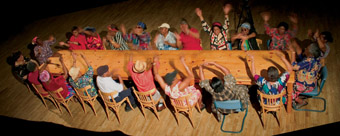
The Elders, Lisa May Thomas
photo Ivan Teage
The Elders, Lisa May Thomas
MAYA DEREN STATED THAT IN HER WORK, NON-DANCE MOVEMENTS WERE INTERRELATED “ACCORDING TO A CHOREOGRAPHIC CONCEPT.” THIS NOTION COULD SERVE AS A GOVERNING ETHOS FOR MANCHESTER’S MOVES’07, BILLED AS A FESTIVAL OF MOVEMENT ON SCREEN, WHERE AN ARRAY OF SCREEN DANCE AND MOVING IMAGE WORK WAS PRESENTED OVER FOUR DAYS IN SEVEN STRONGLY THEMED PROGRAMMES.
Originating as a strand of the Commonwealth Film Festival in 2005, Moves this year became a stand-alone event, under the continuing direction of Pascale Moyes. An additional range of hands-on activities, including a week-long filmmaking lab, panel discussions and workshops, began with a two-day conference on screen choreography, hosted by Manchester Metropolitan University. Keynote addresses were given by Christian Ziegler, artist in residence at ZKM in Karlsruhe, and Xavier Baert of La Cinémathèque de la Danse, who spotlighted ‘acts of choreographic creation’, evident in the work of non-dance identified artists from Hans Richter to David Lynch, with a plenary session led by Johannes Birringer of Brunel University.
The orientation towards screen choreography, rather than screen dance, foregrounded a range of context-specific processes and functions, including Steve Hawley’s practice-led take on the choreographic relevance of framing choice and Simon Fildes’ exploration of repetition within the editing process. The importance of historical legacy emerged through a focus on Muybridge and Marey’s early experimentation with body-centred moving image, and from Elinor Lipman and Claudia Kappenberg’s respective studies of Maya Deren’s The Very Eye of Night (1958) and Rene Clair’s Entre’ Acte (1924). A variety of papers, relating to notions of choreographed violence and to the field of dance and technology, highlighted the diversity of thematic concerns and constituent groups rallying under the banner of movement on screen.
The conference orientation was also strongly reflected within the festival’s curatorial stance. Traditional notions of the choreographic role, involving the generation of codified steps on dance-trained, human bodies, were expanded to include a range of screen-related practices, such as framing choice, editing, and the composition of graphic elements.
Over the course of the week, work spilled out into the public arena with Bex and Mark Haig’s installation, Simon Says, combining CCTV-style live feed with pre-recorded content, and selected pieces also shown on Manchester’s BBC TV run public access screen in Exchange Square. Meanwhile, Xavier Baert’s guest-curated program began the ‘indoor’ screenings, housed at the Royal Northern College of Music. Baert’s choice of work ranged historically from the fluidly billowing ‘serpentine’ dances of Loie Fuller adherents to the visual feast of saturated colour and granular texture of Ronald Nameth’s Andy Warhol’s Exploding Plastic Inevitable (1967), where a flicker effect alternately illuminated and obscured silver and red-drenched glimpses of late 60s club life.
The Visual Rhythms programme combined screendance with animation and short film, contrasting the ultra-minimalism of Pekka Sassi’s On Message (2006), where light flashed onto an otherwise darkened screen at beat-driven intervals, with the smooth glide of the steadicam in Royston Tan’s DIY (2005), as rhythmic pulses, discovered in the course of everyday activities, developed into an escalating symphony of urban syncopation. A range of work by North West-based artists was also showcased, where Andy Wood’s framing choice in Gaze (2006)—to render visible the fuchsia-hued, flamingo-like lower limbs of an otherwise unseen performer—functioned in itself as a choreographic device. Kirk Woolford’s Will.O.W1sp (2006), featured earlier in the week as a conference presentation. Here the silhouette and movement pathways of a single figure were translated into a swarm of particles, alternately coalescing and scattering in a state of constant flux, highlighting the inherent instability of physical form and stylistically echoing the work of pioneering film artist Len Lye.
The issue of narrativity was addressed by a variety of means throughout the Communication Break-Down program. Gail Sneddon’s The Fall of Adam (2006) transposed ejection from the Garden of Eden to a tower block stairway, combining an eloquently framed economy of imagery with a highly polished visual style. In David Russo’s I Am Not Van Gogh (2005), a rambling movie pitch, heard in voice-over, was simultaneously rendered visible through a combination of live action and animation, leading the viewer through a surreal urban pathway of constantly shifting elements, transforming at the speed of thought.
Through the Picket Fence provided a rich seam of work dealing with cross-cultural reference points. Marlene Millar and Philip Szporer’s Butte (2006) contrasted an exhilarating, aerial camera journey with the earth-bound and ritualised step-based movement vocabulary characteristic of Native American culture, locating a single human figure within expansive elemental surroundings, lit by firelight and the flame-red setting of evening sun. In Lucy Cash’s Sight Reading (2006) a minimal, precise and carefully composed interweaving of elements, which included a cross-generational cast and use of voice-over, created a highly considered world governed by its own internal logic. Viewers were drawn into an enclosed environment of arcane imagery as test subjects with covered eyes ‘read’ opened books by placing them against forearms, and an indoor falling of snow settled on an otherwise immobile grouping of crouched figures, connected by a floor-bound patterning of twine. Sound and silence, movement and stillness, and visibility and darkness were explored within the framing of a solar eclipse, with the work’s muted colour palette intermittently punctuated by black screen, and a movement vocabulary of steps, falls and settled balances glimpsed fleetingly, as though from the corner of an eye.
Lisa May Thomas’ The Elders (2005) used documentary form in a generation-oriented portrayal of Bristol’s long-established Black community. Throughout, a subtle interplay of aural and visual material raised issues relating to individuality and community, and the honouring of dignity in age. Stately-paced walking contrasted with close-up shots of hands and mouths, beating body-centred rhythms and engaged in song. A skilful interweaving of testimony on the experience of migration was intercut with imagery of birds in flight, echoed by a flutter of hands.
In Saturday evening’s programme, Pas De Deux, the ochre-tinted haze of fragmented repetition and filmic decomposition of Solomon Nagler’s spare, dream-like Untitled 3 (Stone Killer) (2006) brought to mind the legacy of experimental film makers such as Malcolm Le Grice and Stan Brakhage. In Boldi Csernak’s Dusk (2007), the retreat of a lone female figure from the cautious approach of a male was presented simultaneously, by means of a split screen, from a distanced, static viewing position and from a gradually shifting camera point, attached to body of the ambulant male. The use of exterior location, functionally-oriented camera work and naturalistic, though emotionally heightened, movement vocabulary, recalled aspects of low-key surveillance and wildlife filming, contributing to a disquieting engagement with the acts of witnessing and documenting. The programme was topped and tailed by Maya Deren’s seminal Study in Choreography for Camera (1945) and the lesser known Meditation on Violence (1948). Both pieces conjured a continuously moving male figure through abrupt changes of background location, virtuosically realised as choreographic sleight-of-hand by means of editing. The latter piece was shown with partially improvised live accompaniment, providing an additional, if unfamiliar, layer of aural complexity to the numinosity of Deren’s work.
Douglas Rosenberg has stated that we are now in an era which can be described as “post-dance.” This, he asserts, is particularly evident in relation to a screen context, where “dance is displacing its own identity by eagerly merging with other existing forms and its own mediated image.” In an increasingly convergent culture of moving image creation, the Moves 07 conference and screening program created space to examine how the post-dance era is giving way to an emergent era of the choreographic.
Moves 07, Manchester, June 12-17, www.movementonscreen.org.uk
RealTime issue #80 Aug-Sept 2007 pg. 47
© Chirstinn Whyte; for permission to reproduce apply to realtime@realtimearts.net
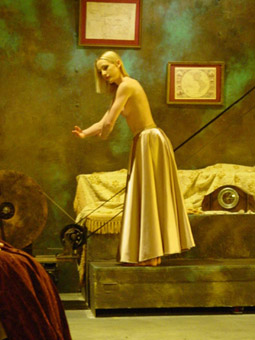
Terri Herlings, Thursday’s Fictions
photo Mathew Aberline
Terri Herlings, Thursday’s Fictions
ON A DARK, WINDY NIGHT A WOMAN NAMED THURSDAY FORCES HER WAY INTO A HOUSE, OFFERING THE OWNER, FRIDAY, A TRUNK CONTAINING A PECULIAR MAGIC—SWIRLING SPARKS THAT MANIFEST AS HUMAN DANCERS. THESE, HER FICTIONS, COME WITH THE GIFT OF THURSDAY’S BODY BUT ONLY AT THE MOMENT OF HER DEATH—FROM WHICH SHE EXPECTS TO BE REINCARNATED. THERE IS ONE CONDITION—THAT SHE AND HER CREATIONS NOT BE CREMATED. A SUCCESSION OF DAYS AND THEIR CHARACTERS FOLLOWS THROUGH TO WEDNESDAY WHO DANCES WITH THURSDAY’S FICTIONS BUT RELEASES THEM AND HIMSELF FROM ANY ATTACHMENT. THIS THROUGH-CHOREOGRAPHED 52-MINUTE DANCE FILM, AN ELLIPTICAL FICTION IN EDWARDIAN GOTHIC MOULD, EVOLVES FROM THURSDAY’S IMPOSSIBLE YEARNING FOR IMMORTALITY—AN ARTIST ATTEMPTING TO LIVE FOREVER THROUGH HER WORK.
The makers of Thursday’s Fictions are husband and wife team Richard James Allen (director, writer, choreographer and performer—he plays Wednesday) and Karen Pearlman (producer, co-writer and editor) under the banner of their company, Physical TV. After making a string of short dance films since 1997 they decided it was time to extend their range.
Pearlman always thought that Thursday’s Fictions should be a film, but after realising it as a full-scale stage production for Tasdance (1995) and as a book (1999), Allen was insistent: “I didn’t want to spend the rest of my life being associated with Thursday’s Fictions.” Little did he know. Not only have the couple and their collaborators spent several years making the film, broadcast on ABC TV on July 29, but now it has another life, in fact a Second Life manifestation launched on the same day through the AFTRS LAMP (Australian Film Television & Radio School’s Laboratory of Advanced Media Production) program.
Allen was persuaded to go ahead with the film after reflecting on the materials the book offered for film and through dance film in particular and with the greater knowledge of both which the makers had accrued across the years. There was also a desire, after making short works, to move on to feature film: “Thursday’s Fictions is the stepping stone between the short and the feature”, says Allen. In the meantime a “television hour” work offered, in Pearlman’s words, “scope and a sense of excitement and scale and trying to go beyond a single thought or a verse. The short film is characterised by its conciseness, which is a virtue but it has a closedness as well, like a short story…” “Or a poem”, adds Allen. “There’s scope for texture and change and rise and fall of energy.”
For a film that’s come from a long poem, there are not many words. Allen admits that “when we did the live production I was very attached to the words—too stuck on them, though I was happy with the production. But here I said. ‘I’m not going to be attached to a single word. If there are no words, that’s fine with me.’ This was a fundamental shift.”
For Pearlman what’s interesting and paradoxical about the film is that “while it looks very stable and finished with a high polish, it’s a very unstable text with a testy relationship between story and dance.” She could imagine making it again with a different dynamic.
As for the scripting of the film, Pearlman says, “Script writing is the hardest part of filmmaking and continues to evolve in filming, but what we were searching for was structure—organising it and looking for the thematic concerns at any given point. It’s a very unusual structure. A woman bursts in, she dies and there are different characters in each scene. Who do I attach myself to? The viewer engages and detaches but within the structure there’s a lot of room for narrative conceits. The words though were the last consideration.”
Allen recalls, “We completely let the stage production go. We adapted the story and used the text that was appropriate. This was around the time of Memento and other feature films with experimental structures.” Pearlman sees Thursday’s Fictions as being like an opera: “the story in opera is a vehicle for moments”, and each of these in Thursday’s Fictions “has an underlying choreographic sensibility.”
Richard Allen explains that the choreography for the film was entirely new but that “writing the script and creating the choreography moved in tandem. There was a semi-conscious dialogue between them. I had great dancers and one in particular, Amitie Skye Merrey, was my capturer of movement. I made something like 58 dance phrases—like a dance script but it came in out of order. When I stopped, I made a pattern on a piece of paper: this fits here, this fits there. It was like making a script. I just knew when it was there.”
Early in the film and in the final scene there are sustained dance pieces. Pearlman comments that “often in dance film you’re creating things that couldn’t be performed live, but these scenes could be.” Even so they attain a heightened, immersive fluidity from Pearlman’s editing which Allen sees as reinterpreting and integrating the many layers of material from three dimensions onto the flat screen. Pearlman argues that that “although everyone says the last draft of the script is the editing, well the last draft of the choreography is the editing. The choreography in dance film is not finished until it is edited. The editor’s role is not to show you the live dance but the feeling of it…the editing becomes part of the choreography. The dynamic range between a smooth elision and a harsh collision is part of my toolkit in the editing suite and so every cut is part of the choreography.”
Although it’s not always possible, especially when she’s doubling as producer, Pearlman prefers not to see the dance being filmed: “I bring a certain objectivity to not what the director hopes to capture but what he actually does. I look at the rushes. There were 12 hours of raw material for the 12 minute final dance—a large ratio, if not unheard of. My response is very intuitive. Richard says how about that shot and I’ll say, “…uh mmm. I’ll tell you when it’s good. I’ll see it when I see it.”
With funds cobbled together from many sources and without a major backer, the making of Thursday’s Fictions was often a labour of love. The film’s high production values give a big budget impression. Allen reports that “It’s nice when people say it’s amazing for a low budget film. What was it, one, two, three million?” The pair laugh. They don’t talk budget. Pearlman’s retort is, “Our budget was 20 years, 10 each off the end of our lives.”
Much of Allen’s pleasure in making the film, he says, was spiritual. Not only did the script and choreography emerge in semi-conscious tandem, but “people found us” who wanted to work on the film. “There are a lot of spiritual things in the film, a lot of serendipity in its making. It evolved in a yogic way.” (Allen is a long-time yoga practitioner and teacher.)
Allen puts the film’s narrative into spiritual perspective: “Thursday was searching for eternal life through her dances, through personal immortality, a western version of the eastern notion of reincarnation. Wednesday is offered immortality by Saturday as a Faustian bargain: ‘I’ll give you the dances and what your mother wanted.’ But Wednesday says, ‘No, I’m just going to be in the moment with the dances and preserve them but I don’t need to go on. Wednesday can let go, and he can die.”
What strengthens the impression of a very personal vision is that Allen plays Wednesday. But, two days before the 2003 18-day shoot (spread over a month), the dancer cast in the role was injured. Pearlman laughs, “I almost became Wednesday!” As Allen tells it, “There I was in the middle of directing and everyone said, ‘You know all the phrases.’ I did, but now I had to learn them overnight. It was very stressful.”
The spiritual dimension of Thursday’s Fictions, say its makers, is central to its Second Life incarnation: “The whole version is being scripted and designed around reincarnation, purgatory and how karma creates the life you move into.” The pair have enjoyed the making of this version with LAMP enormously: “It’s astounding after the ponderous film process—every hour your project moves forward. Gary Hayes, the director of LAMP, is a world expert in building in Second Life and he’s designing for us.”
This little Second Life prototype is being funded by the Literature Board of the Australia Council which is encouraging writers to tackle different media platforms. For Allen, Second Life is also providing a different writing experience, building what he calls a “script map: a script that fits into the architecture of Second life rather than in a story, creating points of multiple opportunities.” Pearlman emphasises that Thursday’s Fictions in Second Life is not the film reproduced online but is about the choices the work offers the visitor, for example a visit to an apothecary’s shop” where you choose what qualities you might want in your next life.” Allen sees the venture “as creating beyond the film. It’s actually a prequel within a larger landscape and connects with the book along with new things that didn’t exist before.”
Whereas once he doubted the work’s future, Allen now admits, “It’s starting to feel like Thursday’s Fictions has an identity beyond any single manifestation of it. And I’m its servant.”
Thursday’s Fictions will be released on DVD by Marcom Projects; www.thursdaysfictions.com
RealTime issue #80 Aug-Sept 2007 pg. 48
© Keith Gallasch; for permission to reproduce apply to realtime@realtimearts.net
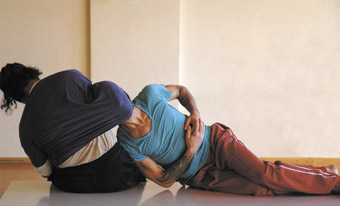
Sete Tele, Matthew Morris, Didier Théron’s Les Locataires (rehearsal shot), Strut Dance
photo Cristophe Canato
Sete Tele, Matthew Morris, Didier Théron’s Les Locataires (rehearsal shot), Strut Dance
WORKING WITH STRUT DANCE, FRENCH CHOREOGRAPHER DIDIER THÉRON PRESENTED IN TWO WORKS BOTH A THEATRE OF ABSURDLY DISCONNECTED, ARBITRARY ACTIONS, AS WELL AS AN EXPRESSIONIST CHARACTER STUDY WHICH VERGED ON PHYSICAL CLOWNING.
In other recent Perth dance, Katrina Lazaroff staged a series of light, gender specific physical games which invoked both pleasure and a dark, childish intensity. Bianca Martin, like Théron, sketched a complicated, abstract dance theatre realm within which sexism, pornography and gendered leisure came together without actually producing a fully organised space, physically or dramaturgically. Chaotic bodies and expressive realms haunted all of these works.
Deborah Robertson however offered a gentle, minimalistic self-portrait of bodily articulations and the affects located in each of them. A deeply internal self-exploration, Robertson’s staging at times evoked early lyric Expressionist dance, rejecting the tendency towards disorder seen in the other works reviewed. Intensity here produced order and structure rather than fraying or destroying it. The work of Robertson, Martin and Lazaroff was presented as part of a triple bill, Get Yourself Some Art.
bianca martin
First in Get Yourself was Martin’s Packed Like Sardines In A Football Stadium, opening with one of her satirically coy mime dances to popular music (here Elvis’ Wonder Of You), performed by a lone female in a wedding veil, ignored by two drinking men leaning on a tabletop supported by the crossing legs of two prone female dancers. This juxtaposition of spaces left and right, of dramatic scenarios (idealised romance versus sexist spectatorship; friends jostling on the couch in front of the TV while two others posed and ‘swam’ like a soft-porn Sports Illustrated cover before them), and of differently sexualised spaces, defined Martin’s shifting aesthetic. A negative perspective was suggested by one of the men’s ‘wet T-shirt’ dousing of a female dancer, an act mitigated by his taking up a violin to play lilting, folk-Romantic motifs. Martin was not aiming to resolve these ambiguities but to activate them in everything from a stompy dance performed to I Am The Walrus through to a sequence where one of the women pulled at her face and moved doll-like in a ballgown—a dance for a ‘post-feminist’ world, where voyeurism is neither altogether condemned nor unproblematic.
deborah robertson
Robertson’s solo, The Deconstruction (of my shoulder blade), by contrast, established a melancholically beautiful space for internal reflection and celebration akin to Rosalind Crisp’s early work and others who map their bodies, their sensitivities and the small changes in self-perception (and self-presentation) which come from moving hips from parallel to the shoulders to a right angle, or other subtle shifts. Film projection explained Robertson’s physical iconography, recording, for example, as she moved her elbows to the horizontal and brought her fingers to her mouth that “My lips hold the love I have been given.”
katrina lazaroff
Get Yourself Some Art ended with the second of Lazaroff’s Pomona Road series on growing up, the first having been performed by two women (Lazaroff and Danielle Micich) in 2006. Part Two was performed by two men and largely consisted of rough’n’tumble masculine games drawn from Contact Improvisation in its relaxed muscularity and in the push-and-pull of bodies. Props served as tools of aimless play. A pipe became a phone, a knife etc. I preferred Lazaroff’s more dramaturgically and musically focused Part One, using 1980s popular song as the soundtrack to a childish friendship so intense that it bordered on hate. The dramatic frame of two girls around a stereo gave more purpose and cohesion to their games than those of the boys. Rock actions like air-guitar or 80s dance served as the starting point for the girls’ play and fights—unlike the open-ended activities of the boys. Both parts though were distinguished by fine performances and astute musical choices, promising a strong Part Three.
didier théron
Didier Théron explained that both of his pieces were portraits of sorts: one of a tortured murderous figure from Dostoyevsky, and the other a group of five dancers. Neither though were psychological studies: both emanated from the alternations between the sensation of being crushed, of being fatefully led down a route, or of “extreme situations of disequilibrium, ruptures of energy and space”—as well as (more absurdly) those scenarios which switch from “the terrifying” to “the burlesque”, or from “miniscule dramas” to moments of high melodrama. In short, Théron’s dancerly oeuvre—whether touching on narrative themes in his Dostoyevskian solo or in his abstract event-piece Les Locataires—was focused on transitions and tensions. Théron’s own body in Raskolnikov was all spikes and sharp, taught enunciations. Even when curving an arm or grotesquely squeezing his face like a butoh dancer, Théron’s body seemed built of pins and triangles, rich as it was in pointillist jumps in energy from playful introspection to crazed mobile arcs and passages about the cleanly lit, almost Brechtian black stage.
Les Locataires may have exhibited an entirely different bodily palette, constructed as it was through tasks given to five local dancers. It nevertheless reflected the same sense of an ‘itchy’ space, a site lacking resting places, within which the body was forced to find something to do, something to act on, to counterpoint or to generate new textures each time the weight of bodies in one corner had become too heavy, or the bored play with a jumper pulled over the head went on too long. Tragedy or burlesque, madness or disinterest, both works tested the limits of these states—in the first instance through the body and its own actions, and in the second through an architectural and musical deployment of bodies as just another sculptural or musical object within the visual field.
Théron thereby offered two apparently distinct aesthetic visions. These were the choreographic space as a site for the dramatic body, as eloquent and melodramatically intense as Pina Bausch. In Les Locataires however we moved to the theatre as a space within which to stage essentially meaningless or expressively obtuse actions whose true effect lay in the generation of textures, clusters and sudden, almost telepathically activated deconstructions of these set-ups—get under the table, get off it, move around it, come to the front of the stage, and above all explore EVERYTHING on the stage (tattoos, clothes, arms, skin, walls, hair, silence etc). Looking past such features though it becomes apparent that all of these materials were deployed in a manner akin to stringing a square and a triangle together on a rubber band. Like the postmodernist legends with whom he has worked (Cunningham, Brown etc), Théron seemed more interested in the fundamental palette of relations which underpins all action on stage than he necessarily was with the dramaturgical trappings through which such structural correlations are realised. Seen from this perspective, Robertson and Martin too can be seen to be working within the same expanded field of dance within which we find ourselves in this post-postmodern world.
Autoportrait Raskolnikov and Les Locataires, choreographer, performers Didier Théron, Claudia Alessi, Aimee Smith, Sete Tele, Sue Peacock, Matthew Morris, Strut Dance at PICA, May 26-27; Get Yourself Some Art: Packed Like Sardines In A Football Stadium, choreographer Bianca Martin, performers Aisling Donovan, Brooke Leader, Keira Mason-Hill; Pomona Road Part 2, choreographer, sound Katrina Lazaroff, performers Tim Rodger, Joshua Mu, projection Sarah Neville, Isaac Lummis; The Deconstruction (of my shoulder blade), choreographer, performer Deborah Robertson, dramaturg Lucy Angell, projection, Cobie Orger; lighting Deidre Math, Blue Room Theatre, May 10-26
RealTime issue #80 Aug-Sept 2007 pg. 49
© Jonathan Marshall; for permission to reproduce apply to realtime@realtimearts.net
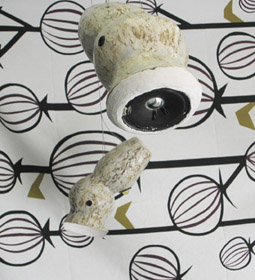
Chatter and Listening, Alex Thorogood, installation 2007
CSIRAC (COUNCIL FOR SCIENTIFIC AND INDUSTRIAL RESEARCH AUTOMATIC COMPUTER 1949), THAT QUAINT RELIC OF AUSTRALIA’S FAILURE TO CAPITALISE ON ITS WORLD WAR II HEAD START ON INFORMATION TECHNOLOGY, HAS BEEN MUCH IN THE NEWS SINCE IT WAS DRAGGED OUT OF THE CLOSET AND INSTALLED IN MELBOURNE MUSEUM. THERE IT SITS, SEEPING MINUTE TRACES OF TOXIC VAPOUR FROM ITS MERCURY MEMORY COLUMNS INTO THE BRAINS OF A NEW GENERATION OF GAWKING KIDS WHOSE MOBILE PHONES HAVE MORE COMPUTATIONAL POWER THAN THE ANCIENT 20 KILOWATT BEHEMOTH. IT’S GOOD FOR AT LEAST FIVE OR SIX MINUTES SOLID ENTERTAINMENT. DIGITAL MUSIC TYPES WILL PROUDLY TELL YOU THAT IT PLAYED THE FIRST COMPUTER GENERATED MUSIC IN THE WORLD, IN 1951, WHEN IT WHEEZED OUT THE COLONEL BOGEY MARCH.
My own first encounter with CSIRAC was not courtesy of the Melbourne museum, but of a chance encounter in 2004, hitching back to Canberra from Electrofringe. Just outside Goulburn, a retired gentleman by the name of Terry Holden gave us a lift, and we got talking about the big old computer that used to exist in Canberra when Australia thought itself to be at the cutting edge. Mr Holden, as a young, aspiring radio-electronic technician, had been put to work using CSIRAC in analysing harmonic motion and heat diffusion for the planned ‘skyscrapers’ to be constructed in Sydney and Melbourne. In the course of this, he asserted, he had become one of the (several) independent conceivers of the Fast Fourier Transform, which digital music geeks will recall is among the most widely used algorithm in computer processing of sound. It seems that digital music appears wherever there are computers, like mushrooms after rain. If the connection between mathematics and music is ancient and renowned, then the connection between computers and music is just as famous and more intense for its youth. In the 21st century, of course, this connection is so commonplace as to be beneath mention; and even the most defiantly acoustic of folk music gigs has an audio geek with a powerbook sitting up the back churning out spectrographs.
This year the Australasian Computer Music Association (ACMA) held their annual conference (ACMC) with a decidedly historic orientation befitting its location a scant few metres from the abortive birthplace of computer music, the original site of CSIRAC. The 2007 convenor, Alistair Riddell, was one of the original founders of the association back in 1989, and the keynote address was from a similarly seminal figure, Warren Burt.
These gents are acutely aware of the erosion of ACMA’s original niche. The musical landscape of 1989 has shifted, and no longer does ACMA fly the flag for the musicological merits of computers in the face of a conservative establishment view of composition in the conservatoria—classical composition has been as thoroughly colonised by digital technology as every other genre. Accordingly, this year ACMA’s tendrils have spread more widely than ever, bringing a compositional aesthetic to mixed media design, and wedging open the doors between good old fashioned dance floors and the hallowed corridors of academic music.
The crowd favourite this year seemed to be aa-cell, a collaborative project between Andrew Brown and Andrew Sorenson based around Sorenson’s open-source project Impromptu. Impromptu is a Mac OS based application, combining a plug-in-based architecture with a live-coding scripting interface. The result, in aa-cell’s hands, is a complex, agile improvisational journey that pares composition progress back to the naked sonification of algorithms—and, because this is the 21st century, the bloody thing churns out visuals too. As academically rigorous as the compositional technique may be, it’s still plain old techno and wouldn’t get a look-in the door of any classical music school in the country. aa-cell shares the popular focus that predominates in the live-coding scene, honestly reflecting ACMA’s own drift from its high-art origins. This is a trend parodied by Ross Bencina in his Mulchwerk cover songs series, where the primordial handmade analogue electronic music of early Kraftwerk is reconstructed in the slick digital interface of AudioMulch. It’s just a little smug even though Bencina’s consummate skill at laptop wrangling justifies a considerable degree of smugness.
Burt’s keynote address looks further back than Kraftwerk and is cheekier still; he’s quick to remind us that whatever gloss of newness computers might give to compositional aesthetics, someone probably did it already in 1969. Possibly Burt himself. And they definitely had more fun while doing so. And the audience liked it more. The notes to his concert performance make a mockery of academia’s pious over-explicated justification of their artistic choices: “Cellular automata make drawings. The drawings are turned into sounds. The sounds are spliced and mixed together. The particular cellular automata were chosen because I thought they would give me these kinds of sounds. And they did. Enjoy.” The dig might be well-aimed. But it raises the question: what is the function of an organisation such as ACMC in the age of ubiquitous digital media?
If ACMC does anything uniquely well, it must be fostering young composers whose work falls in the troublesome gap in genres that lie between wholly novel technology and dance-floor AV, providing them with a captive audience of sympathetic conference delegates to sit through their stumbling presentational style. The conference was graced by several standouts in the area: Sebastian Tomczak demonstrated a work called Toriton Plus, using laser beams to transform the motions of a surface of water into a compelling gestural compositional device that made even the hackneyed palette of harmonic additive analysis seem vibrant. A showcase of student work from Stephen Barrass’ University of Canberra media design class was also remarkable, although sadly individual artists were not identified in the program notes. The highlight from this series was a rhythmic work made of simple layering of the laboured breathing sounds of a close miked participant in a game of rugby, attracting perhaps the loudest ovation of the evening.
Student and conference organiser Alex Thorogood also turned out a very neat presentation, using MP3 players as the DSP engines in an immersive audio sculpture of wirelessly networked robotic magpies. From an artist too freshly emerged to be eligible for any plausible funding, it was one of the lowest budget networked installations I have ever witnessed. The prototype was captivating enough. Seeing the thing deployed in full-scale glory will be interesting indeed.
As noteworthy as each of these works were, it was a little disappointing how under-represented young emerging artists were (and most acutely, emerging female artists), even from the ranks of ANU’s Centre for New Media Art. Whether this is ACMA’s problem or an artefact of the declining popularity of composition is another question. Perhaps next year’s conference will tell. Or perhaps it’s an indication of the increasing difficulty of marketing a conference on electronics in composition in the era when the Colonel Bogey March ringtone is available in midi polyphony for your mobile device of choice for $4.75.
Australasian Computer Music Conference, ANU, Canberra, June 19-21
http://www.acmc07.org
Andrew Sorenson/aa-cell/Impromptu
http://impromptu.moso.com.au
Ross Bencina/AudioMulch;
http://www.audiomulch.com
Sebastian Tomczak;
http://little-scale.blogspot.com
Alex Thorogood
http://greenmeat.net
http://csirac.info/
RealTime issue #80 Aug-Sept 2007 pg. 50
© Dan MacKinlay; for permission to reproduce apply to realtime@realtimearts.net
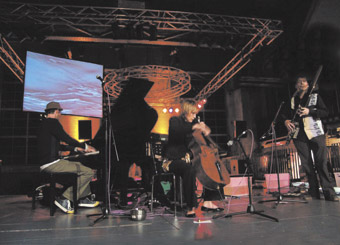
Erik Griswold (piano), Louise King (cello), Oscar Garrido de la Rosa (bassoon), Sounding Wivenoe, Liquid Architecture
photo Sharka Bosakova
Erik Griswold (piano), Louise King (cello), Oscar Garrido de la Rosa (bassoon), Sounding Wivenoe, Liquid Architecture
THE PERFORMANCE BEGINS WITH THE ROOM DARK, THE PERFORMERS SITTING ON THE STAGE FLOOR AMONGST OLD FILM PROJECTORS, REEL TO REEL TAPE DECKS, TUBS OF CHEMICALS, SPOOLS OF TAPE. TWO FACE THE AUDIENCE, BOUNCING THE PROJECTOR BEAMS OFF MIRRORS AND BACK ONTO THE SCREEN STRETCHED OUT BEHIND THEM, WHILST ANOTHER DOES THE SOUND. IT COULD BE A MEDIEVAL FAIR, RUGS ON THE GROUND, DIRT UNDERNEATH, MAGIC LANTERN SHOW. MACHINES BEGIN TO WHIR, UNSEEN FIELDS FLUCTUATE, ARE PICKED UP, AMPLIFIED AND PASSED ON. LENSES BLUR, HANDS CAST SHADOWS. FRAGMENTS FLICKER, CATCH AND BURN.
This is Cellule d’Intervention Metamkine, an extended cinema group out of Grenoble. Together for about 20 years their practice has moved from semi-organised narratives to completely improvised and spontaneous events.
There’s a visual structure to the performance—two squarish patches side by side, one for each performer, and a central circle overlay, frayed at the edges, not sure who controls it. It’s loud, soft, sharp, hard, tense, sometimes colourful, mostly not. Images flash like nervous memories of pathology reports, damaged retinas, further tests. An ending rushes toward us. Birds hovering, foam at the edge of the ocean. Manic gestures and found footage. The night-time glare of oncoming traffic and, after the crash, a silence.
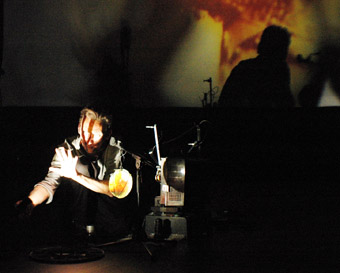
Cellule d’Intervention Metamkine
erik griswold
Sounding Wivenhoe, by Erik Griswold, is set up on the raised concrete of the Turbine Stage. Wivenhoe is the major dam supplying Brisbane and, in the current drought, fast disappearing. On stage is a piano—excellently prepared in the Griswold style—and some lounge chairs for the audience to lounge in and have a beer whilst listening. Around the stage, on the mezzanine, and further afield, stand the other musicians—primarily brass and winds, but also a cellist up close to the piano. Plastic tubs of water and a few pots and bowls lie about—apparatus of the contemporary percussionist. A largish LCD screen is suspended high up and nearby, projecting video of the slightly rippled surface of Wivenhoe Dam throughout the performance.
Griswold starts playing high up the keyboard—fast tinkling arpeggios gradually extending in range. Over the top are occasional blurts from the wind and brass players, their lines also gradually extending as the piece moves along. Cello and bassoon play off each other, jazz fragments pop up on the side from trumpet, trombone and clarinet. Gradually the piano moves into hammered string sounds, then chills down to a sort of rubber harp. Performers echo rhythms and pitch fragments across the space.
In come the percussionists for the second section—gongs battered fast then pitch bent by dipping them into the tubs of water. The winds and brass sound out long drones. It’s like something out of a Kurosawa movie—mist and the pre-dawn, unseen armies slowly walking to slaughter. The drones drop out a bit and the gongs dominate again.
The third section begins with curiously maudlin melodies from the winds, like something sentimental from a Victorian music hall. Underneath and soft is Griswold’s weirdly flat-handed playing of the piano and busy arhythmic splats and clangs from the percussionists. The contrast works. There’s a jazz feel to the final section through the trumpet figure—Griswold composes neatly across genres and has a great feel for rhythm in his work. Finish on what sounds like sparse wind chimes.
The music sits well in the space, the performers acting as sound sources within an environment: obviously present but not obtrusive. Somewhat weaker is the projection of the video—not the images themselves, but the overt bounding of the image by the borders of the LCD. Where the spatial extent and arrangement of the sound sits naturally with the Sounding Wivenhoe theme, the LCD, with its hard, black, regular edges, is a bit lost in the volume of the Turbine Hall.
pauline oliveros
At about 75 years old Pauline Oliveros is a long-time name composer and one of the star attractions of this year’s Liquid Architecture. A major figure in the development of US music in the 1960s her scores are often invitations to behaviour and attention, such as “Listen to a sound until you no longer recognise it” (Re Cognition), or “Sustain a tone or sound until any desire to change it disappears. Where there is no longer any desire to change the tone or sound, then change it” (Horse Sings from Cloud).
Oliveros and accompanying vocalist, Ione, sit facing the audience. Oliveros starts on accordion, no pitch, just a slow voiceless wheeze as the lungs of the instrument push air in and out. Small close chords enter with the occasional rapid run synching up with a burst of consonants. A conversation builds, Ione singing along the intonation contours of speech, Oliveros playing accordion drones and rapid flourishes.
The second piece is a reworking of A Little Noise in the System from 1966, a classic of the genre that accepted the inherent noise of studio systems as worth a listen. This is an update, played live from Oliveros’ laptop. Small noise bursts move about overhead and, like the rhythmic breathing of the accordion, the spatial movement and pacing of the sound has the feel of human gesture. A bass drone rumbles in, volume quite low, building a rhythm that drops off, dies away. The noise ramps up until it’s frenetic, saturated and overwhelming. There’s a system going on, working its way out until the circuit is exhausted. Started great, but way too loud at times.
Back to accordion and vocalist for the third and final piece, this time with the accordion being electronically treated a little. The beginning is tiny clusters high up, simple single reed sounds with a little delay. Similar to the first work, but with the treatments articulating the accordion into complex little chirps to accompany the drones. Vocal and accordion gestures swap around, the words delivered deadpan with the occasional gliding pitch. The text recalls a time when the artist’s emotional autobiography seemed important. That’s not so obvious now.
Liquid Architecture 8: Cellule d’Intervention Metamkine, sound Jérôme Noetinger, projectors Christophe Auger, Xavier Quérel; Sounding Wivenhoe: composer, prepared piano Erik Griswold, video Rebecca Ross, musicians Richard Haynes, Miranda Sue Yek, Elliott Dalgleish, Oscar Garrido de la Rosa, Dan Quigley, Crystal Hildred, Louise King, Vanessa Tomlinson, Matthew Horsley, Wang Yan, Paul Lin; Pauline Oliveros, composer, accordion, laptop with vocalist Ione; Brisbane Powerhouse, July 6-7
RealTime issue #80 Aug-Sept 2007 pg. 51
© Greg Hooper; for permission to reproduce apply to realtime@realtimearts.net
A VITALLY IMPORTANT CHAMPION OF NEW MUSIC IN AUSTRALIA FOR 21 YEARS, THE ELISION ENSEMBLE STAGED THREE 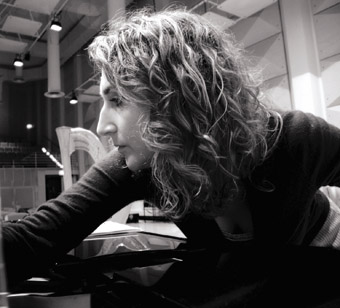
Marilyn Nonken, Elision Ensemble
photo Sharka Bosokova
Marilyn Nonken, Elision Ensemble
CONCERTS IN MELBOURNE AS PART OF AN EXTENSIVE NATIONAL TOUR, INCLUDING WORKS BY REGULAR COMPOSERS LIZA LIM, JOHN ROGERS, RICHARD BARRETT AND CHRIS DENCH, AND ESPECIALLY FOREGROUNDING THE WORK OF US COMPOSER AARON CASSIDY AND POLISH COMPOSER (AND SOMETIME AUSTRALIAN RESIDENT) DOMINIK KARSKI.
ELISION players are renowned for bringing off difficult and inaccessible work, often in association with visual and other art forms. As well as showcasing some demanding new composition, this season emphasised clarity and virtuosity in instrumental performance.
vca, university of melbourne
The VCA concert comprised mainly solo performances of works that emphasised playing technique. This was evident from the opening work, the premiere of Dominik Karski’s ethereal open cluster M45 (2003), which was inspired by the constellation Pleiades. For amplified bass flute, it explores fully the instrument’s sonority and timbre, receiving an enchanting performance from flautist Liz Hirst. John Rodgers’ fiery Ciacco (1999), personifying the hog from Dante’s Inferno, is no less demanding, and bass clarinettist Richard Haynes was superb, ably shifting from the highest to the lowest pitches in consecutive notes and producing the multiphonics and overtones that evoke the snorting, squealing and howling of the monster of hell.
Violinist Susan Pierotti gave us Helmut Lachenmann’s Toccatina—Study for the Violin (1986), which requires the performer to pluck, poke and prod the instrument—everything but conventional bowing. Composer Liza Lim’s two works—Ming Qi (2000) for oboe and percussion, and Shimmer (2004) for solo oboe—make great demands of the oboist. Ming Qi, inspired by a Chinese tomb, is an intense but engaging work with a forceful oboe line, wonderfully carried by Peter Veale, which overlays the measured percussion. ELISION’s Artistic Director Daryl Buckley suggested that the VCA concert was intended to emphasise the timbre of the instruments and solo virtuosity. The recital had the flavour of a masterclass, demonstrating the musicality that can be achieved through unconventional playing techniques. Listener attention shifts back and forth between the composition, the playing and the resonance and character of the instrument itself.
australian national academy of music
Buckley introduced ELISION’s ANAM concert by coining the word ‘hypervirtuosic’ as an appropriate descriptor, and it is. The two performers—Haynes, on clarinet and bass clarinet, and Carl Rosman, on clarinet and contrabass clarinet and, in two works, singing a falsetto alto—brought extraordinary dynamism to their performances. Such music couldn’t work without this level of musicianship. They opened with venerable US composer Elliott Carter’s Hiyoku (2001), an engaging clarinet duet with intertwining melodic lines. The evening also included the premiere of Chris Dench’s absorbing new work The Sum of Histories (2006/7), for bass and contrabass clarinets, which was inspired by physicist Richard Feynman’s term for the multiple ways in which sub-atomic particles can decay. Scored for the two largest of wind instruments, which are rarely used for solo performance, The Sum of Histories is a poetically lyrical work, stentorian but finely controlled.
Two knockout works were those in which Rosman exercised his vocal showmanship: Aaron Cassidy’s I, purples, spat blood, laugh of beautiful lips (2006/7), another premiere, and Richard Barrett’s Interference (2000). Cassidy’s piece, for unaccompanied high male voice, requires the performer to monitor a computer-generated random pitch line through an earphone and sing that line while pronouncing fragments of words derived from texts by Arthur Rimbaud and Christian Bök. Cassidy’s work addresses their translation and, in the absence of conventional verbal meaning, Rosman’s declamatory voice delivers a powerful emotional impact, extending the consideration of verbalisation and sound poetry since Kurt Schwitters and the Dadaists. The randomness of the pitch line ensures the work is never rendered the same way twice. Barrett’s Interference (2000) is based on a text by Lucretius and is set for falsetto voice alternating with contrabass clarinet and accompanied by kick-drum, and Rosman’s theatrical one-man-band effort is electrifying.
abc iwaki auditorium
This ABC live-to-air concert opened with Genevieve Lacey’s rendition of Liza Lim’s delightful weaver-of-fictions (2007), written for the Ganassi recorder which was popular in Renaissance Venice. The recorder is a larger than conventional one, with a sound approaching that of the shakuhachi. It can render gentle, mediative lines with a rich sonority and support compositional gymnastics including clearly articulated multiphonics. The instrument used is an Australian made alto and hopefully its revival will stimulate further compositional interest. The concert also included Cassidy’s asphyxia (2000) for solo soprano saxophone (Haynes), a physically demanding work that incorporates into the musical material playing techniques such as breathing through the instrument and fingering notes without breathing, and legendary US-based UK composer Brian Ferneyhough’s dramatic and highly complex La Chute d’Icare (1988) for clarinet (Rosman) and the Ensemble.
The central work was the premiere of Karski’s larger ensemble composition, The Source Within (2006). Commissioned by ELISION, The Source Within is, in effect, three quintets performed sequentially, each of which comprises three different quartets of instruments together with piano (Marilyn Nonken)—firstly, flute, guitar, harp and violin; then clarinet, contrabass clarinet, horn and cello; and finally, trumpet, trombone, oboe and percussion. Karski’s work is intense, evocative and demanding for performers and audience, each movement establishing four instrumental lines that build independently on the piano element. The complex and often contrasting voicing produces some unique sonorities and textures. The ensemble works draw together the extreme techniques of the solo works, demanding virtuosic playing to realise their musicality, and under French conductor Jean Deroyer, ELISION carry off these pieces wonderfully.
Concerts such as these consolidate the musical languages that emerge from compositional and performance development, and, especially when supported by radio broadcasting, strengthen public appreciation. Buckley’s thoughts behind the programming for this series were to bring together the musicians (many of whom are often overseas) and the composers, and to showcase particular instrumental combinations and techniques—an interweaving of musical ideas. The new works from Karski, Lim, Dench and Cassidy are terrific, and contrasting them with the more established Ferneyhough and Carter works identifies some current directions in composition, Cassidy for example incorporating unconventional performative techniques and Karski devising elaborate formal structures. With the predominance of wind instruments, the compositional use of controlled instrumental multiphonics and the emphasis on timbre are consistent threads.
ELISION Ensemble, Victorian College of the Arts, University of Melbourne, May 22; Australian National Academy of Music, May 24; ABC Iwaki Auditorium, May 26
RealTime issue #80 Aug-Sept 2007 pg. 52
© Chris Reid; for permission to reproduce apply to realtime@realtimearts.net
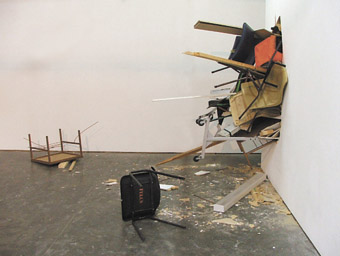
Ardi Gunawan, Untitled Construction, 2007
image courtesy of Tamsin Green
Ardi Gunawan, Untitled Construction, 2007
IN A MELBOURNE GALLERY, WEDGED IN A HOLE IN A FREESTANDING WALL, IS A CINDERBLOCK. CLOSE INSPECTION SHOWS AN ICY, CRYSTALLINE COATING. AS THE OPENING EXPANDS, GREYISH DROPLETS FORM, THE BLOCK MELTS, SEEPING DOWN BOTH SIDES OF THE PLASTERBOARD, SPORADICALLY DRIPPING AND SPLATTERING GREY FLECKS ON THE GALLERY FLOOR AS IT MESSILY PAINTS ITS OWN COLLAPSE. THIS IS IMMOVABLE OBJECT (2007) BY KEL GLAISTER (SEE OUR COVER IMAGE), PART OF THE GROUP SHOW, FLOATS LIKE A BRICK DOESN’T, AT THE ARTIST RUN INITIATIVE BUS. THE INCLUSION OF THIS EXHIBITION AS PART OF THE MAKING SPACE PROGRAM IS AN APT ONE.
Making Space, a co-ordinated programming event by the recently formed VIA-n (Victorian Initiative of Artists Network) was a first. The program included exhibitions across Victoria’s many Artist Run Initiatives (ARIs) and produced an accompanying publication of the same name. Highlighting the history of the network and showcasing contemporary ARI practices, whilst tentatively hinting at future developments, Making Space became a catalyst for discussions around the evolving nature of these spaces. In this context Floats Like A Brick Doesn’t—which involved a hectic three day commando-style installation of false ceilings, extended gallery walls and works that were literally supported by the gallery infrastructure—is an interesting reminder of the relationship between artists’ practices and the ARI system.
ARIs have a tradition of supporting site-specific practices, that (vitally) wouldn’t often otherwise be realised. In conversations with Glaister, she emphasizes the importance of ARIs maintaining flexibility in their sites, offering freedom to splatter paint and cut holes in walls, as a means of facilitating specific and developed responses to ARI spaces.
After the Bus opening, in the dark gallery Glaister’s diminishing cinderblock slips out of its wedged position. A heavy chain attached to the cinderblock swings and smashes it against the gallery wall, the collision between artwork and ARI leaving an evidentiary grey paint splatter. Equally conscious of the gallery space as container was Ardi Gunawan’s work: a large hole cut into a wall, then jammed full with institutional debris. This protrusion of chairs, wooden planks and a broken ceiling fan created a faux explosion; appearing at a glance like a chaotic slammed-up assemblage, it quickly changed as one noticed both its compositional clarity and the odd sense that the objects were being either sucked into or spat out of the wall. This work was suggestive of how ARIs are in part congenial to spatial experimentation, whilst often retaining formal conditions of the archetypal white cube.
These works employ an elegant yet raw aesthetic to explore their entropic and gravitational concerns, referencing the dumpster-trawling, makeshift approach traditionally associated with ARIs, although the recent spawning of designer logos and an overall polished neatness now hints at the surface gentrification of many galleries. But, says Tamsin Green, “The works don’t just pay lip-service to a nostalgic idea of ad-hoc ARIs.”
Green’s work Drip (2007), a video embedded in an uncomfortably lowered false ceiling, saw viewers craning their necks upwards in the oppressive space to see liquid pooling from drips, whose direction was disconcertingly difficult to ascertain.
Green animatedly described the process of trying (with little to no building expertise) to construct the false ceiling, which involved people crawling underneath the plasterboard whilst others frantically hoisted ropes. Of some remarks made about the ‘crappy aesthetic’ of this raised roof, Green remains nonchalant; “it’s as good as I could make it; it’s honest, slightly incompetent and under-resourced.”
In another room, with wry humour Carl Scrase makes tents levitate on the ceiling, defensively refusing to submit to their functionality. Yet the effort invested and melancholic effect created by all these works surpasses a straightforward “ironic repositioning of found objects.” The exhibition is parodic, yet the artist’s self-conscious and undeniably informed use of ‘found object aesthetic’ is simultaneously whimsical and cynical. Glaister says, “the poetic nature of found objects isn’t always convincing; for it to work as a found object you have to be aware of it as a found object.”
Glaister’s Irresistible force (2007) clearly illustrates this approach; a cinder block, this time unalterably real, is elevated by fine silver cables and metal rulers. The delicate detailing of this support system and its distant anchorage points in the gallery walls create an odd sense of ease in the object’s suspension, steadily hovering, if not quite floating, above a one metre ruler bending slightly from the weight. The arc of the ruler, exhibits the vulnerability of logical, imperical measurements forced into structural relationships of gravity and weight.
Irresistible force is equally tongue-in-cheek about the clichéd notion of ‘I had it in my studio, it was right there so I used it.’ Although using springs and rulers, which could have feasibly been lurking around, the perfect aesthetic and functional cohesion of the complex construction would clearly have required multiple pilgrimages to hardware stores. This doesn’t make it a ‘faked’ found aesthetic, but it does partially over-ride the economical imperative (both financial and process based) generally identified as a driving force in this type of production.
Of course a found object practice remains a logical choice for cash-strapped artists, particularly when we consider the equally cash-strapped status of Melbourne ARIs that necessitates charging substantial rental fees to exhibiting artists. Making Space enabled ARIs to provide free exhibition space for some shows, yet this is not the norm.
The increased professionalisation of ARIs is both a response to funding body parameters and a strategy for artist viability. It is witnessed in their increased longevity, evolving committee based structures and greater marketing emphasis. Yet despite ARIs often appearing increasingly slick and businesslike, financial insecurity remains. The volunteers who still primarily run ARI spaces often have to solve problems like being just too skint for a liquor licence or a necessary door repair.
One of the ARIs most vocal about professionalism as a survival tactic, and one of the key instigators of Making Space, is West Space. Their Making Space group exhibition Rules of Engagement included Patrick Pound’s ongoing C.V.—a work in progress (1992-2007) which parodies the greater professionalism across the entire arts sector, seeing artists cultivating their CVs like delicate bonsai. Equally satirical, Danius Kesminas’ Post-Traumatic Origami (1999-2002) displayed the crushed cube of Robert Hughes’ car wreckage. Kesmina’s inclusion of items like a beer can made the vitrine presentation—hinting at a sealed, evidentiary state—somewhat redundant: unnecessary value-adding that over-referenced the artist’s institutional critique.
Both the Bus and West Space exhibitions benefited from the self-reflective atmosphere the Making Space program encouraged, contextualizing the ambitions of the exhibiting artists and the ARIs involved. As a logical finishing point to Making Space most of the Bus show ended in a dumpster out the front of the gallery, to be returned to the tip from which some of it had already come.
Floats Like a Brick Doesn’t, Bus Gallery, May 22-June 9; Rules of Engagement, West Space, Melbourne, May 25-June 16; Making Space, Artist-Run Initiatives in Victoria, April-June, www.via-n.org
RealTime issue #80 Aug-Sept 2007 pg. 53
© Amy Marjoram; for permission to reproduce apply to realtime@realtimearts.net
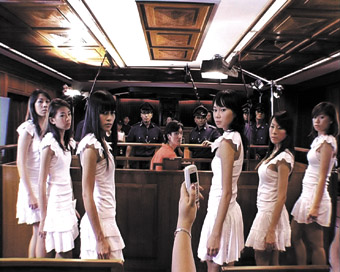
Ho Tzu Nyen, The Bohemian Rhapsody Project
QUEEN’S ICONIC BOHEMIAN RHAPSODY HAS BEEN APPROPRIATED AND PARODIED BEFORE (THE COMIC STRIP PRESENTS; BAD NEWS BAND’S VERSION IS A PERSONAL FAVOURITE), AND I WOULD HAVE BEEN DISAPPOINTED HAD IT NOT BEEN USED OR MISUSED WELL IN THE BOHEMIAN RHAPSODY PROJECT. FORTUNATELY, IT HAS BEEN SAFE IN THE HANDS OF SINGAPORE’S HO TZU NYEN, WHO ADOPTS THE PIECE AS A KIND OF ‘READYMADE’ FRAMEWORK FOR THIS ARTWORK.
Ho’s Bohemian Rhapsody Project, created for the 2006 Singapore Biennale, is a film set in the Supreme Court of Singapore, which takes its spoken dialogue entirely from the lyrics of the song. The context is a courtroom trial and the characters are the accused, wearing Guantanamo-orange suits and the judge in traditional court garb, along with the police, jury and the public and, although not generally present in the courtroom, a chorus of girls in white (angels perhaps). Some of the lyrics are spoken as dialogue by the accused and some by the judge, other lyrics are sung by the chorus of girls and the clip includes an intrusive guitar solo. At one point, humorously, the melody comes from a ringtone on a mobile phone answered by the mother of the defendant.
The film changes scenes, style and pace, opening by entering through the light corridors of the building then changing between the courtroom, the grainy painterly judgement scene, and the rock clip/nightclub lit guitar solo. These changes are reminiscent of the original Bohemian Rhapsody, which unconventionally meshed and moved between musical styles (a cappella and glam rock), settings and outfits, giving Ho’s work a similar quality to what was engaging in the original.
The actor playing the accused also transforms as the film progresses. This might be interpreted as a trope alluding to the fact that a multitude of different peoples are subjected to a singular monolithic system of justice. Certainly the work can be seen as a comment on Singapore’s justice system and contentious use of capital punishment and the death penalty. There are, however, other layers. Ho has used footage from the auditions for the main character. For Ho, the defendant’s is the only role in a courtroom which changes. The audition and subsequent judgement by the director conflate with the theme of legal judgement: of the individual defendant in the court and, Ho suggests, with spiritual judgement, as the judge turns into a cardinal out of Velazquez (Portrait of Pope Innocent X, 1650) and Francis Bacon (Head VI, 1948). This might also be considered, as the catalogue essay indicates, a metaphor for aesthetic judgement, whereby the crime at the centre of the film is the double death of painting and cinema.
The film further explores the mechanics of the media by documenting its own production as the apparatus of the film’s own making (cameras, microphones, crew, lighting) are folded into the film itself. This film-within-a-film quality, the theatricality of the piece, along with the adoption of a pop-culture framework, alludes to the theatrical nature of the courtroom as it is presented in the media and popular culture. Further, it suggests the insertion of the media into the justice system.
Importantly, this work is also the remake of a music clip and Bohemian Rhapsody, for me, conjures up Sunday afternoons in the 70s watching Countdown and being perplexed (and impressed) by this unconventional music which crashed together musical styles, presented unfathomable lyrics and was incongruous with the rest of the pop music in the charts, which it dominated for weeks. I was reminded of its iconic status, when living in London, as Britain was mourning Freddie Mercury’s death and Bohemian Rhapsody seemed to be played constantly on the airwaves. I wondered what it meant for Ho or a Singaporean audience.
In the wall text which accompanied the work at the Singapore Biennale, Ho indicated that the adoption of a such a well known song meant that the narrative thread was spun by the spectators themselves, soliciting their memory of the music and lyrics, so that their “own projection could be overlaid onto the projected image.” Ho Tzu Nyen describes this as mental karaoke. Like the beguiling style and lyrics of the original, which are at once recognisable and incomprehensible (Mercury refused to explain them), the strength of this work rests with that “mental karaoke”, with both the familiarity and instability of its reference points, making the work impossible to fully apprehend but creating spaces for the audience to move between layers of interpretation.
Ho Tzu Nyen, The Bohemian Rhapsody Project, CACSA, Adelaide, June 1-July 8
RealTime issue #80 Aug-Sept 2007 pg. 54
© Christine Collins; for permission to reproduce apply to realtime@realtimearts.net
2007 VCA Graduating Company’s production, The Perjured City
photo Jeff Busby
2007 VCA Graduating Company’s production, The Perjured City
HÉLÈNE CIXOUS IS ONE OF THE HEAVYWEIGHTS OF FRENCH FEMINIST THEORY, BUT TO CURTAIL HER CV THERE IS TO SELL HER SHORT. IN HER HOMELAND, SHE’S A PUBLIC INTELLECTUAL, POET, LECTURER, CRITIC AND, SURPRISINGLY, PLAYWRIGHT. PERHAPS THEY DO THINGS DIFFERENTLY THERE. IT’S HARD TO THINK OF AN EQUIVALENT POLYMATH WITH SUCH A HIGH PROFILE IN AUSTRALIA. THEN AGAIN, VIEWING HER EPIC THE PERJURED CITY, IT’S NOT CERTAIN THAT SUCH A PROLIFIC OUTPUT IS NECESSARILY OF UNIFORMLY GREAT QUALITY.
The Perjured City was originally created for Ariane Mnouchkine’s Theatre du Soleil, though, so subsequent productions will inevitably suffer in comparison. After attending the four and half hour version mounted by the graduating students of the VCA’s School of Drama, all I longed for was to see how Mnouchkine could have adapted such a sprawling, unwieldy work. Its ambition far outweighs its realisation, but sometimes an ambitious failure can thrill more than a modest success.
The work is a Greek tragedy shaped around a contemporary horror. During the 1980s, the French National Centre for Blood Tranfusions knowingly administered HIV-positive blood to thousands of patients and it was years before any kind of justice was even hesitatingly advanced. Cixous gives voice to those who suffered most by relocating the real-life events into a quasi-allegorical otherworld, a twilight graveyard into which the grieving mother of two children arrives. They have died from the bad blood; she seeks a settling of the ledger. Amidst the denizens of the cemetery she calls forth the three Furies of legend who have lain dormant since the days of the Greeks who needed them most—the guilty doctors are dragged into this netherworld to face trial and, perhaps, retribution.
That’s the bare bones of it. Cixous doesn’t pare back her text, however. The Mother soon slinks off into a shadowy penumbra as other voices flesh out the story. The dead children themselves are reanimated as ethereal ghosts, beautifully rendered here through the use of magnificent and heart-achingly evocative puppets. The doctors are given leave to voice their own situations, motives and excuses—mostly successful, though one scene ranks among the most ham-fisted and clumsy attempts at meta-theatricality I’ve seen as a character finds himself literally lying atop the grave of Shakespeare. The Bard would be turning in his.
There are many ideas submerged in this production to warrant further investigation. But why did Cixous produce such a gargantuan monster of a piece? If Theatre du Soleil’s others works are anything to go by, the answer is obvious. It’s not so clear whether companies with smaller budgets, monetary or otherwise, can bear the burden of such pieces.
The VCA production was a relatively spare one. The set was minimal, consisting of red-dyed ropes forming a circus-like series of netted ladders and trapeze-like structures around an austere forum—or, perhaps, agora. For the most part, this is unchanged for the entire duration of the work, though its closing moments are all the more breathtaking for their unexpectedness. After a typically Grecian moment of death and destruction is wrought upon the text, we are transported into a celestial afterlife wherein some kind of hope seems possible, and a sudden darkness is lit by a proliferation of coloured stars whirling around the audience’s field of vision. It’s an unforeshadowed moment of beauty—if not sublime, at least something like it.
It’s doubtful that most of these graduates will have the opportunity to perform such a grand, heroic work again in a long time, if at all. And even less certain is the possibility that local audiences will have the chance to see Cixous’ text produced again in a live context. For all its flaws, then, The Perjured City was still a production that left an indelible impression, and one worth savouring for its rarity.
The Perjured City, Or The Awakening of the Furies, writer Hélène Cixous, translator Bernadette Fort, director Kirsten von Bibra, music Elizabeth Drake, design Jeminah Reidy, costumes Jessica Daley, lighting Whitney McNamara, puppet design Lachlan Plain, performers 2007 Drama Graduates, VCA School of Drama, Space 28, Melbourne, May 29-June 9
RealTime issue #80 Aug-Sept 2007 pg. web
© John Bailey; for permission to reproduce apply to realtime@realtimearts.net
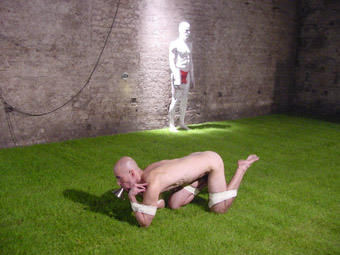
Pacitti Company
photo Luiz Fernando Lobo
Pacitti Company
GRAND FINAL AT SHUNT VAULTS RATTLES THE NERVES OF EVEN THE MOST HARDENED EXPERIMENTAL THEATRE-GOER. PACITTI COMPANY’S IMMERSIVE, NON-NARRATIVE REWORKING OF EMILE ZOLA’S 1867 NOVEL OF DEATH, SEX, MORALITY AND POWER, THERESE RAQUIN, IS SET IN THE DARK, UNDERGROUND, RAT-INFESTED HOLE-CUM-NIGHTCLUB HOME TO THE SHUNT PERFORMANCE COLLECTIVE IN THE OLD RAILWAY TUNNELS BY LONDON BRIDGE.
Grand Finale has been performed over the last seven years, in cities as varied as Brussels, Birmingham and Rio De Janeiro, but remains profoundly and politically site specific. Each host city impacts on the work to produce a unique performance every time.
On its way through a maze of dark tunnels the audience passes a corner illuminated by a disco ball, under which a heavily tattooed lady dances on a shabby white grand piano—a disturbing curtain raiser to the main act where we encounter Sheila Ghelani, tightly muzzled and glamorous, alongside a cast of all-female guest performers.
Ghelani removes the muzzle, launching into a monologue: “I am Therese, I am an experiment. I am under analysis, under the microscope. My fate is fixed and I wear the perfect costume.” She is Therese, the protagonist of Zola’s novel, but shares the part with her fellow female performers. Grand Finale’s dispersal of the Therese role fits with the central motivation of Zola’s novel, to study human actions and temperament but not character. It also ties neatly in with Pacitti Company’s non-theatrical treatment of the novel in order to pursue the real drama and themes contained within.
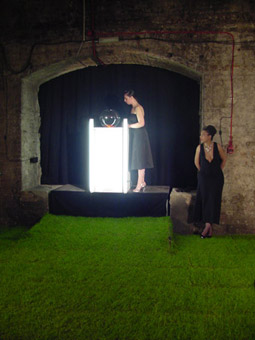
Pacitti Company
photo Luiz Fernando Lobo
Pacitti Company
Later, the 22 performers break away leaving the audience free to wander and witness a range of vignettes beneath the railway arches, escalating the show’s dark aesthetic with images of sex, violence, domestic abuse and suffocation variously involving bared breasts and genitals, raw meat, milk, wine and bin bags. One vignette tested the central dilemmas under analysis in Zola’s novel more acutely than any other. In it Ghelani slowly drowns a large goldfish by gradually removing water from its small glass bowl. Of course the fish only appears to be drowning—it clearly has enough water throughout—but what’s signified is more important. The scene embodies a live manifestation of Zola’s example of the helpless victim, its impending death and the exercising of power to kill devoid of any moral or legal right to perform such an act. It is a gesture that creates audience concern, questioning the integrity of using a live animal in performance. In short, the scene presents a moral conundrum: it is the best act for all the wrong reasons and as such its place within Grand Finale is entirely fitting.
Grand Finale was more than a climax to the month long Spill Festival. It was about exchange, bringing local and international performers to an existing but open-ended, radical structure in order to ‘produce’ while simultaneously exploring collaboration as product in and of itself. Grand Finale functioned as a microcosm of the Spill Festival as a whole, embodying the individual and collective aim to provide, and moreover share, this unique UK platform for performance.
It is an event no-one will forget thanks to Grand Finale’s compulsory post-performance handwash for every audience member. This sinister ablution on the way out represented one last sly grope, courtesy of Pacitti Company, ensuring the grime of Grand Finale lingers on.
Grand Finale, devised and performed by Pacitti Company in collaboration with Françoise Berlanger, Eve Bonneau, Caroline Daish, Richard Eton, Sheila Ghelani, Richard Hancock, Traci Kelli, Louise Mari, André Masseno, Tuca Moraes, Priya Mistry, Robert Pacitti, Sylvain Reymond, Valerie Renay, Jason Sweeney, Carla Esperanza Tommasini, Heather Uprichard, Julie Vulcan, Hannah Williams, soundtrack Velma; Shunt Vaults, SPILL Festival of Performance, London, April 21, 22
RealTime issue #80 Aug-Sept 2007 pg. web
© Rachel Lois Clapham; for permission to reproduce apply to realtime@realtimearts.net
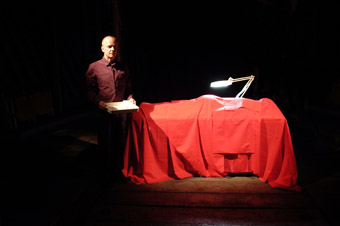
Kira O’Reilly
photo Manuel Vason
Kira O’Reilly
FROM THE FAR END OF A ROW OF OLD RAILWAY ARCHES UNDERNEATH LONDON BRIDGE STATION A WHITE SHAPE LOOMS SLOWLY OUT OF THE DARKNESS TOWARDS US. WE STRAIN TO SEE MORE CLEARLY BUT THE SHAPE IS ONLY GLIMPSED OCCASIONALLY WHEN SHAFTS OF LIGHT FALL THROUGH THE GAPS IN THE SURROUNDING ARCHES. EVENTUALLY I MAKE OUT THE BACK OF A FIGURE. KIRA O’REILLY IS NAKED EXCEPT FOR A PAIR OF RED SHINY STILETTOS, A BLACK FEATHER HEADDRESS AND A MIRROR THROUGH WHICH SHE REGARDS US.
It takes more than five minutes for O’Reilly to move the short distance from her end of the corridor to ours. She smiles seductively, singles out an audience member and leads him to the adjoining arch. We follow. There, we witness several acts, including O’Reilly gently cutting herself with a scalpel and stepping to a metronome beat in a variety of taut, automaton-like movements whilst straining and teetering on her high heels. The rigidity of her body and the blank facial expression are militaristic, the strict rhythm set by the metronome suggestive of the impossible task of a body keeping up with technology.
Thoughtfully installed lighting is used to great effect in Untitled (Syncope), creating pronounced areas of darkness and invisibility under each arch into which O’Reilly moves to signal the different parts of her performance. This ‘off stage’ facility heightens the contrast between the stilettoed robotics and the second part of the performance in which she emerges from the dark minus shoes and headdress to complete a series of repeated, slower and slower balancing acts. Yet despite these poetic distractions my thoughts return continually to the artist’s nakedness.?
The naked body is part and parcel and a raison d’etre of performance art traceable back, in various guises, to the work of artists such as Hannah Wilke, Carolee Schneeman, Marina Abramovich and Annie Sprinkle, and further back to the work of the 1960s Viennese Actionists. But it can still shock. Here, its power derives in part from the industrial architecture that surrounds O’Reilly’s creamy white body; her nakedness appears vulnerable and fragile in the railway arches. Every train that rumbles overhead seems to threaten her soft flesh.
The other shock is perhaps the outcome of more theoretical concerns. The red stilettos and burlesque headdress set O’Reilly up as a sex object, an image far removed from many of the iconic feminist performances from the 1970s. Her pubic hair is shaved into a severe contemporary style, her underarm hair removed, she smiles provocatively at her audience at close quarters. Perhaps this is the salient point of Untitled (Syncope)—a difference between performance now and then. O’Reilly overtly references her nakedness at one point in the performance by firmly clasping her front and back nether-regions and stalking dramatically into the darkness as if suddenly aware for the first time of her nakedness and its sexuality.
The last line in material distributed at the performance asks, “How to have a body, now?” Untitled (Syncope) is a work that grapples openly with the problematic of its own erotics.
Kira O’Reilly, Untitled (Syncope), Shunt, SPILL Festival of Performance, London, April 7
RealTime issue #80 Aug-Sept 2007 pg. web
© Rachel Lois Clapham; for permission to reproduce apply to realtime@realtimearts.net
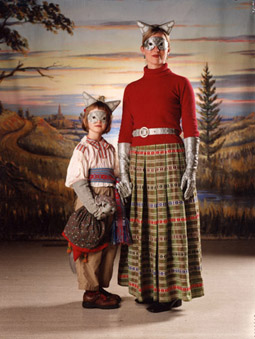
Jazmina Cininas, Iron She Wolves: Daina & Arielle 2002
THIS IS NOT A PRINT SHOW LIVES UP TO ITS TITLE, BECAUSE, ALTHOUGH ITS CURATORS AND SOME OF ITS PARTICIPANTS HAVE A BACKGROUND IN PRINTMAKING, ALL HAVE PUSHED THE BOUNDARIES OF THE MEDIUM OR RE-THOUGHT IT BY PRESENTING WORKS BEST DESCRIBED AS CONCEPTUAL AND/OR INSTALLATION, USING OTHER MEDIA.
There is a very strong sense of theatricality to this exhibition as soon as you enter the gallery—an overwhelming sense of things happening. Out of the corner of your eye you see a room-sized installation of suspended, decorated plastic, all colour and shine; another room holds an extraordinary contraption of laser-cut black acrylic, wire, plastic beads with lithographed images—mostly stylised portraits or profiles—on clear film. Both Mohd Fauzi Sedon's Iced Donuts and Neil Emmerson's The Dream invite the viewer to enter and interact.
All this colour and movement is complemented by three transgressive photographs by Jazmina Cininas. These vaguely disturbing images feature costumed female figures against idealised, artificial forest backdrops. The figures are masked and dressed in outfits that refer to Cininas’ Lithuanian background. The artist's evocatively titled Girlie Werewolf Suit is a costume presented as a sculpturesque installation comprising a linocut on calico with ears, mask, gloves, tail and belt.
Addressing warfare in the Middle East, Belinda Fox presents an installation approximating helicopters in camouflage colours, hovering above a stylised camouflaged landscape. Already despairing of the futility of the Iraq conflict, Fox's work made me feel even more aware of something so apparently beyond resolution.
Alexis Beckett references museum displays of birds in glass domes in a way that foreshadows the idea of extinction with a sense of the memorial. Tom O’Hern’s images, influenced by popular culture, are striking and confronting, large-scale homoerotic works. I was particularly taken—amused even—with Learning to Love Myself in which, in multiples, the artist (I presume) is depicted in acts of self-oral-genital stimulation.
But it is Sedon and Emmerson whose works stand out in this very fine show. Sedon, who completed a PhD at the Tasmanian School of Art and is currently a university lecturer in Malaysia, critiques consumerism and depicts mundane objects—in this case, the iced donuts of the title—creating spaces in which these images overwhelm the viewer. Light is used to create a seductive glow and to enter the installation of dozens of long, plastic ribbons is to be delightfully disorientated.
Emerson teaches at the Otago Polytechnic in Dunedin, New Zealand and is interested in taking printmaking techniques into completely new arenas, using other media including plastics, fabrics and recorded sound to create complex assemblages. His installation is sensual and seductive. The faces depicted are of an obscure Chinese student hero and Aubrey Beardsley—a strange pairing. In referencing Beardsley, Emmerson is drawing upon the artist’s reputation as a purveyor of erotica. As the suspended images twist and turn, there occur “shifting visual overlays” (catalogue essay) and the multiple portraits seem to become indistinguishable. It is difficult to find words to describe these compelling works—a sign of their uniqueness.
This is not a print show, curators Karen Lunn, Milan Milojevic, Plimsoll Gallery, Hobart, May 18-June 8. Touring: Burnie Regional Art Gallery, Oct 26 – Dec 9; Wagga Wagga Art Gallery, Feb 8-April 13, 2008; Gippsland Art Gallery, July 12-Aug 17, 2008; Lake Macquarie Art Gallery, Sept 26-Nov 2, 2008
RealTime issue #80 Aug-Sept 2007 pg. web
© Diana Klaosen; for permission to reproduce apply to realtime@realtimearts.net
THIS DRACULA WAS A FRESH, VISUALLY LUSH PIECE OF PROMENADE-STYLE THEATRE EXECUTED WITH CONTROLLED EXUBERANCE. ZEN ZEN ZO’S 2007 CREATIVE DEVELOPMENT SEASON WAS TITLED IN THE RAW. WHILE THIS MIGHT IMPLY THAT THE WORK WAS UNCOOKED, IT WAS, TO THE CONTRARY, REMARKABLY WELL-DEVISED TO SHOWCASE THE STRENGTHS OF THIS ENSEMBLE TEACHING COMPANY.
The creepy atmosphere of Brisbane’s Old Museum on a cold and windy night provided a perfect setting. Director-designer Steven Mitchell Wright and costume designer Angie White theatricalised the bricks and mortar of this Victorian edifice in a way that immediately suggested a new look at an old classic. The audience was introduced to the space by coyly animated, white-faced young women dressed in punked-up 19th Century boudoir finery. The slightly salacious intimation was that we had been invited to the private gallery of a museum within a museum as we wandered between discrete installations. Dracula and his cohorts on the raked stage that represented his castle were implacable, feeding predators; a tormented Renfrey was exhibited in his cage next to a card cabinet labelled in the arcane terminology of redundant sciences; Mina posed on a swing; an old-fashioned typewriter reminded us that these were figures from a text. The instilled power in these living waxworks—Dracula’s realm of the undead—was appropriately uncanny, glacial.
There was much to admire, though the ensuing production was extremely wordy for physical theatre, resulting in an irritating clunkiness despite the brilliance of some of the set pieces such as Lucy’s funeral when the mourners’ umbrellas were chillingly utilised to seal her grave. However, there was dramaturgical neatness in the reduction of Lucy’s original triumvirate of suitors to the teasing desire enacted between Dr Seward and Lucy, so that the dual partnerships of Lucy/Seward and Mina/Harkness enacted mirror male reflections of the whore/bride dichotomy. Similarly, the homoerotic overtones in the magnificently eruptive fight between Dracula and Harkness added a transgressive dimension (in the original, Dracula cannot repress his bloodlust when Harkness cuts himself shaving.)
Mina (played in attractively forthright, no nonsense fashion by Aideen McCartney rather than as dazed victim), Kevin Spink as Harkness, Peta Ward as Lucy, Rob Thwaites as Seward, and Mark Hill as a very sympathetic Renfield demonstrated a total focus and physical economy of means that conveyed a raw purity of intent. These aspects were distilled in Simon Tate’s iconic Van Helsing.
But it was Kevin Kiernan-Molloy’s Dracula that gave depth and contemporary relevance to the production. His potent physical presence as an outlandish corsair of Eastern European origins embodied desire that was nevertheless metamorphic, formless and nameless. He represented the Other—Gypsy, Jew, Aboriginal, Muslim—projected by the otherness within ourselves. But in this production it is Mina who kills him, not the men. By acting outside her assigned role in the text in order to slay the primal father in their stead, she subverts the symbolic order and, in a heartfelt gesture towards the impossible task of reconstituting the imaginary in words, the production concludes with an ensemble choral paean filling the space with liberating sound.
Zen Zen Zo, Dracula, director, designer Steven Mitchell Wright, assistant director, writer Stephen Atkins, assistant director Tora Hylands, costume design and lighting Ben Hughes with Genevieve Trace, sound design Kayne Hunnam, choral direction Zohara Rotem, composition/strings Lyndon Chester, assistant choreographer Carly Rees, guest vocals Emma Dean; Old Museum Building, Brisbane, Jun 27–Jul 14
RealTime issue #80 Aug-Sept 2007 pg. web
© Doug Leonard; for permission to reproduce apply to realtime@realtimearts.net
COMPOSED MOSTLY OF VETERAN'SOF EDITH COWAN UNIVERSITY'S CONTEMPORARY PERFORMANCE COURSE, THE NEW GENERATION OF PERTH THEATRE-MAKERS EMPLOY A STYLE DRAWING ON POP CULTURE AND SCHLOCK (NOTABLY WEEPING SPOON PRODUCTIONS), A BLEND OF POETIC MONOLOGUES AND CHOPPY DIALOGUE TOGETHER WITH A STRATEGIC USE OF INNOCENCE FOR CHARACTERISATION AND NARRATIVE VOICE, FELT HERE IN CITY OF CAKE. THE INNOCENT REPRESENTS THE BEST OF SOCIETY, AS WELL AS ITS TRAGEDY, PROVIDING AN AMBIGUOUS OUTLET FOR SOCIAL CRITIQUE AND DRAMA.
City Of Cake deploys the innocent alongside two other female characters arrayed against the megalomaniacal midget, Mad Pattie. Three, it seems, is the magic number for these shows, the tripartite division of space suiting the Blue Room’s shallow stage, with pairs flanking a central monologist or occasionally engaging in song-and-dance routines, moving in a triptych. For all of City Of Cake’s pop-cultural fluff and colour (literally rendered sometimes as garish cabaret-like lighting and costume), this was a work rich in recurring poetic motifs and themes.
A city proffered to the audience through dense culinary imagery, Cake was home to three lost young women: Jam (our innocent), Honey (an eye-patch wearing detective) and Vegemite (a willowy, legs-and-arms-akimbo bad grrl, with a history of partying and given to fantasmatic readings of her surrounds). Jam had remained in Cake, frozen in her childlike state but for intermittent sexual fantasies (gorgeously realised using her naked, male doll, Broccoli). Vegemite had become a “drugged out ghost of the city”, lost in dreams and shadows, while Honey returned, hopeful to reunite with her estranged father. As these characters became reacquainted, their narrative was interspersed with crazed monologues from Pattie, a diminutive, hunched, perpetually angry figure in massive boots and sporting an ever more delightful collection of garish toys (a kid’s ride-on truck with a Mickey Mouse head and glowing eyes; a phallic, soft unicorn’s head on the end of a hobby horse stick which whinnied disturbingly).
Much of City Of Cake’s appeal came from this careful balance of childish play between sexual knowledge, resonant with the presence of those childhood 'traumatic scenes' involving parents which Freud insisted usher us into sexuality. In one comic highlight, Jam recalled how she had mistakenly had internet sex with her father. Cake’s major theme was absent fathers and the character's desire to go beyond trauma and blame to reunite with those who, in Freud’s account, were their first loves. Amidst this mix of cabaret themes and moments of abject performance art (a wonderful scene where a drugged Vegemite was forced by Pattie to create a globular, phallic cone of shit-like chocolate), these classic tropes of feminist aesthetics were refigured in a work deeply ambivalent towards much feminist rhetoric.
Pattie emerged as the ultimate ‘feminazi’ (although far too amusingly portrayed to echo such rightist caricatures too closely) who purged the city of males and dreamt of a Utopian society based on female parthenogenesis. As Pattie observed: “The women of this city were merely condiments and the men were the bread on which they were spread…no more! Let them eat cake!” Pattie, Honey and Jam all died an appropriately gooey death in this world where feminine production (food, children, menses) had become monstrous. What then is one to make of the politics of this production? Cake was too much fun—and too artfully constructed, especially in its scripting—to be dismissed as anti-feminist backlash. Its aim was to go beyond the Electra myth to amusingly depict women’s love for their fathers. A difficult recipe, and the political opacity of Cake’s soup made it intriguing to savour—yet potentially alarming as an indicator of contemporary gender politics.
City Of Cake, director, deviser Sharney Nougher, performers, devisors Oda Aunan, Natalie Holmwood, Andrea Jenkins, Natalie Pinnock, sound Jeffrey Jay Fowler, lighting Steve Warren, Blue Room Theatre, Perth, March 15-31
RealTime issue #80 Aug-Sept 2007 pg. web
© Jonathan Marshall; for permission to reproduce apply to realtime@realtimearts.net
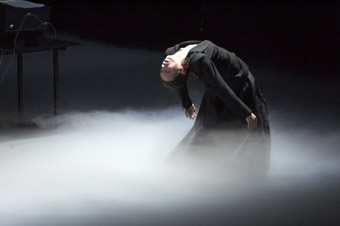
Francoise Berlanger, Penthesilea
THE TWO MOST STRIKING FEATURES OF PENTHESILEA ARE ESTABLISHED WHILE THE AUDIENCE ARE FINDING THEIR SEATS. ALGERIAN-BORN AND BRUSSELS-BASED FRANCOISE BERLANGER, THE SOLE PERFORMER, IS ROAMING AROUND THE AUDITORIUM, NAKED AND HOLDING A CROSSBOW, WHILE EAR-ACHINGLY LOUD WHITE NOISE AND FEEDBACK BLASTS THROUGH THE SOUND SYSTEM. IT’S A COMBINATION OF RAW IMMEDIACY (THE NAKEDNESS, THE PIERCING NOISE) AND OTHER-WORLDLY DISTANCE (HER DISTRACTED GAZE, THE INHUMAN HOSTILITY OF THE SOUNDS), AND IT ANTICIPATES THE TENOR OF THE NEXT 60 MINUTES.
This is Penthesilea, the story of an Amazonian Queen whose love drives her to madness and despair, and Berlanger has adapted this production from Heinrich von Kleist’s radical nineteenth century version of the classical myth. Emotions are dangerously connected, and Berlanger bleeds between the rapture of love and the horror of grief, just as she bleeds between the characters of this involved tale. It’s all enhanced by her magnetic stage presence, some dramatic lighting and simple costume changes. But most of all, this piece is a collaboration between Berlanger and the two sound artists who accompany her on stage. They produce sounds that battle, offset and complement her performance—at times elongating her words into primal screeches, at times rooting a rhythmic resistance to the direction of the narrative.
This soundtrack composition is like musique concrète—electronic manipulations of real-world sounds seeming to come from industrial machines and twisted into the screams of mechanical nightmares. Combined with Berlanger’s slightly archaic language, this terrifyingly futuristic noise situates the piece outside of time. Fittingly for the profound emotions it represents, Penthesilea occurs in all time and no time—its message is universal.
But while the strength of these emotions is never in doubt, the intricacies of the plot are hard to follow. The piece is text-heavy, and Berlanger’s thick accent can be a barrier to understanding. The two most powerful moments occur when the English language is dissolved: once when Berlanger’s incantation of grief twists until the words lose their meaning, and again when she recites a passage in German. Free from the task of deciphering speech, the audience can revel in the power and profundity of the emotions alone.
The piece is also brimming with symbolism which is left unexplained. Four sepia images hang above the stage (in a set designed by Berlanger’s visual artist brother, Marcel): a desert, a plant, a spiky-beaked owl and an abstract set of lines. Are these meant to be visual aids to the setting of the story, or metaphoric allusions to the state of Penthesilea’s mind? At one point, Berlanger strips to her waist and scrubs a white substance—salt?—over her body. Is this a cleansing ritual? A transformation? Or just an act of madness?
These confusing elements, along with the fact that there is only one actor on stage, compound the difficulty of distinguishing between characters and events if you don’t already know the story. And, with no direction to follow, the emotional weight of Penthesilea can be hard to bear. The sentiments it explores are deeply distressing, and this is reflected in the noise—often painfully loud and always unpleasant—as well as in Berlanger’s impassioned performance. In terms of the language at least, Berlanger may have been done a disservice. She doesn’t speak fluent English but had to learn this script because the Barbican’s Pit doesn’t currently have the facility to subtitle. I don’t think the piece would have lost anything if the audience didn’t understand the words, but something did feel strained because the performer didn’t.
In any case, it’s difficult to engage in Penthesilea for long; to distance oneslf is almost as an act of survival. That’s not exactly a criticism—the emotions it invokes are so severe that to succumb would be unbearable. In that respect it’s a remarkably successful portrayal of grief and misery, and perhaps it hangs less agonisingly from the frame of plot and character. It’s an accomplished and affective performance, but I’m not sure I want to feel those emotions again.
Penthesilea, Francoise Berlanger, Barbican Pit Theatre, SPILL Festivalof Performance, London, April 11
RealTime issue #80 Aug-Sept 2007 pg. web
© Mary Paterson; for permission to reproduce apply to realtime@realtimearts.net
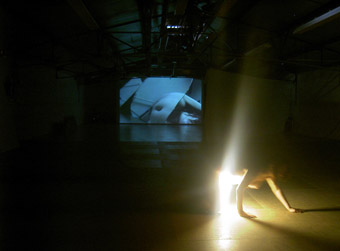
Eve Bonneau
photo Luiz Fernando Lobo
Eve Bonneau
BRUSSELS-BASED ARTIST EVE BONNEAU STANDS NAKED IN AN ALCOVE, HER EYES SHUT. A SINGLE, WHITE LIGHT BULB HANGS FROM A MICROPHONE STAND IN FRONT OF HER. WE ARE IN ONE OF THE SMALLER ROOMS IN SHUNT VAULTS, A DIRTY CAVE WHERE THIS STRANGE, NAKED WOMAN STANDS LIKE AN ALTAR STATUE, SEEMINGLY UNAWARE OF THE GATHERING CROWD AROUND HER. THE PUBLICITY MATERIAL THAT ACCOMPANIES EVE BONNEAU’S PIECE SAYS SHE “EXPLORES HER BODY WITH THE EYES OF A CHILD.” A SIMPLE PREMISE, BUT THE RESULT IS MORE COMPLEX—AND MORE BEAUTIFUL—THAN YOU MIGHT THINK.
Moving the bulb around her body, Bonneau makes dramatic shapes with the bright white light and deepest shadow. It’s the only light source in the room, and its power makes parts of her seem as if they have disappeared altogether: now the ridges on her neck make a disembodied pipe, now the curves of her breasts make a beheaded bust. She turns around and lets us see the shapes thrown up by her back, moving tentatively around the bulb until she touches it, and jerks sharply away.
It’s hard to believe these beautiful shapes have not been carefully choreographed, but the idea is so simple, and Bonneau’s own gaze so intent, that is feels like we’re all taking part in a genuine discovery. And we’re discovering the power of the light as much as of the shapes it reveals. At one point, Bonneau turns out the lamp and the viewers, plunged into darkness, scramble from their hastily kneeled positions ready to follow where she’ll go next. She switches the light back on—she’s only moved a couple of feet.
The next section of the show relies on the strength of a slide projector to distort Bonneau’s shadow through a white sheet. Her body billows and rolls, at times silhouetted in perfect clarity and at times blown up like a fairy tale monster. Fantasy seems closely linked to discovery—the body both a real, physical object and the ephemeral representation of a playful mind. We, the audience, are free to overlay our own explanations for this magic.
Bonneau continues to work with the slide projector, moving under the image of a giant eye and showing close-ups of the artist prodding her own body. Unfortunately, at this point I was frustrated by other bodies—those of the audience. We were a larger crowd than had been anticipated, and whole swathes of the performance were invisible to me as I gazed at the backs of heads. We were all so transfixed in the exploration of someone else’s body, we had forgotten to admit the consequences of our own bodies in space.
Bonneau’s performance draws to a close with the artist lying prostrate under a red lamp as it is lowered towards her. As it gets closer, the light flattens the contrasts in her figure, and returns it to the sculptural, fleshy form we saw at the start. But by now, we have a whole new understanding of what the body means and does. Often the idea of seeing with ‘the eyes of a child’ can be overrated, but in this case they served us well.
Eve Bonneau, ‘Body’ is the first word I say, SPILL Festival of Performance, Soho Theatre, London, April 8, 9
RealTime issue #80 Aug-Sept 2007 pg. web
© Mary Paterson; for permission to reproduce apply to realtime@realtimearts.net
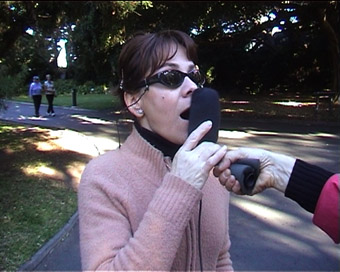
Talking About the Weather, Norie Neumark & Maria Miranda
IT’S THE SOUND THAT DRAWS YOU INTO THE TROUBLE WITH THE WEATHER: A SOUTHERN RESPONSE AT THE UTS GALLERY, AS THOUGH THE SPACE ITSELF IS BREATHING. IT IS AMAZING HOW MUCH CAN BE HEARD IN A BREATH—CURIOSITY, EMBARRASSMENT, JOY. THE SOUND IS EMANATING FROM NORIE NEUMARK AND MARIA MIRANDA’S INSTALLATION TALKING ABOUT THE WEATHER FOR WHICH THEY HAVE COLLECTED BREATHS FROM AROUND THE WORLD IN ORDER TO “BLOW BACK GLOBAL WARMING.” THE INSTALLATION ALSO FEATURES A VIDEO OF THE CREATORS, IN PARKS AROUND THE WORLD, ASKING PEOPLE FOR CONTRIBUTIONS. THE VOX POP STYLE MAKES FOR INTRIGUING VIEWING AS PEOPLE ARE GENTLY RENDERED VULNERABLE, THE EVERYDAY ACTION OF BREATHING BECOMING REVEALING AND INTIMATE, LIKE A SECRET SHARED.
The centrepiece of the installation is a large Perspex box that we are told holds a selection of breaths from the Southern Hemisphere while, pinned around the walls, are handwritten transcripts from the blog Talking About the Weather (http://www.scanz.net.nz/weathertalk), where people are invited to contribute “text breaths.” One talks of visiting his/her father in a hospital, a place where there is no weather, trying to breath shallowly for fear of absorbing too much misery. Another reveals his unrequited love for a woman as he stands and watches her through a window, his breath quieter than the airconditioning. Others are statements: “to think about each breath makes me uneasy” and “to live is a question of breathing.” These, like the collected breaths, are intimacies shyly yet generously shared. The choice to write on lined paper rather than simply use printouts ensures that the human hand is felt in the work. The combination of elements in the installation creates an experience that is both whimsical and weighty.
There is a similarly light yet tender approach in the video piece by Elizabeth Day. From A to B —an allegory of process, is a home video-style document of the artist’s 80-year old parents who decided to move an old tank from the shed down the hill to alongside the house in order to collect rainwater for the garden. The elaborate process involves wheels, jacks, cranes, trolleys and tree propping—the kind of thing a retired handyman could bore you with for hours—yet the plan is rather elegant and resourceful, designed to overcome the shortcomings of strength in the older man. The fragility of the protagonists set against their determination to make a small environmental difference makes the work surprisingly poignant. A second piece by Day situated in the courtyard consists of a large segment of turf embossed with the tyre tracks of an SUV. Perhaps this work too is about determination as the grass stubbornly tries to assert its existence despite trampling and attempts at displacement in the tiled courtyard.
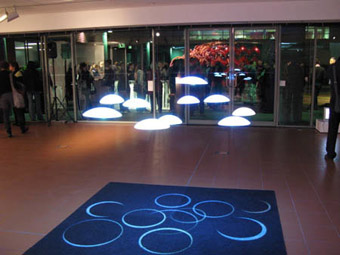
Anemocinegraph, Janine Randerson
photo Maria Miranda
Anemocinegraph, Janine Randerson
In the centre of the gallery is New Zealand artist Janine Randerson’s Anemocinegraph. Based around a 19th century device for the graphing of wind movement, Randerson’s instrument consists of ten suspended convex disks onto which animated interpretations of weather data are down-projected. It is hard not to think of Lynette Wallworth’s Hold: Vessel because of the similarity in materials, however Anemocinegraph is equally engaging in its use of scale and perspective. We enjoy a god-like vista over floating planets where terrains and textures slip over the surfaces, the spill of images on the floor creating sickle moons and intersecting cusps. The soundtrack by Jason Johnston, also using scientific data as its source, is intriguing, drawing you into the work with pulsing tones, combining well with the breaths from the Neumark/Miranda piece and generating a winsome soundscape for the exhibition as a whole.
Co-curated by Jacqueline Bosscher, Maria Miranda and Norie Neumark, The Trouble With the Weather: a southern response is expansive, featuring the work of 19 artists, however it felt light and spaciously arranged in the open plan mode of the UTS Gallery. Three net.art works were also included and if you like to check the weather daily, Jason Nelson’s elegantly designed Vholoce: Weather Visualiser is definitely worth bookmarking (http://www.secrettechnology.com/weather_rss/weather_rss.html).
The southern perspective was further manifest in the work of artists from New Zealand, Cook Island, Tuvalu, Samoa, Chile and Brazil.
Despite the undercurrent of urgency and desperation in the subject matter, many of the works took a whimsical approach, from Dani Martin’s suburban kitsch sculpture made from pool noodles to Joyce Hinterding’s beautiful ink splattered diagrams for cloud engineering and, of course, Neumark and Miranda’s own contribution. Consequently, and without stridency, the overarching issues operate as a kind of climate in which the works can dwell and evolve.
The Trouble with the Weather: a southern response, curators Jacqueline Bosscher, Maria Miranda, Norie Neumark, UTS Gallery, Sydney, July 4-Aug 3
www.weathertrouble.net
RealTime issue #80 Aug-Sept 2007 pg. web
© Gail Priest; for permission to reproduce apply to realtime@realtimearts.net
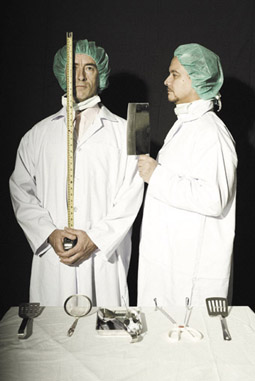
Matt Crosby, Majid Shakor, Know No Cure
IMMERSED WITHIN A PLASTIC DOME, CYBER CONSULTS SURGEON USING A MAELSTROM OF TEXTUAL METAPHOR. HE CANNOT UNDERSTAND WHY HE IS SADDENED BY THE DEATH OF HIS SELF. NO SHORT ANSWER EXISTS, SO CYBER PERSISTS WITH HIS POETIC ASSAULT. IN RESPONSE, HIS SURGEON DELIVERS A RETORT THAT IS EQUALLY INCOMPREHENSIBLE, AND IT BECOMES CLEAR THAT THE AFFLICTION WITHOUT CURE IN THIS PLAY, IS LANGUAGE. ADAM BROINOWSKI’S SCRIPT IS A PERTINENT EXAMPLE OF THIS TENSION BETWEEN OLD MODES OF EXPRESSION AND NEW IDEAS. ALTHOUGH NOT AN ENTIRELY SUCCESSFUL PRODUCTION, KNOW NO CURE IS AN ADVENTUROUS WORK. ONE CONSISTENT WITH ITS CONTEMPORARY CONCERNS ABOUT UNRELIABLE PERCEPTION, POSTCOLONIALISM, GLOBAL HOMOGENEITY AND THE HUMAN QUEST FOR A VIRTUAL SELF.
Obligatory convulsions on the Surgeon’s operating table complete, the space is transformed. Cyber disembarks an aircraft and checks in at an airport terminal. He finds himself in an imaginary country named Jaya, succinctly suggested by actor Majid Shakor’s shift from Surgeon to a female wearing an Islamic head scarf. Here, the poetic interrogation continues between two characters, but is relieved by a video projection. The images are various, some are indecipherable, but two thematic strands of Broinowski’s script emerge. Cyber’s journey has overtones of myth, but it is really a trip into an interior world exemplified by the plastic dome and its images as representative of the human brain. In the other, stock footage of figures riding camels, followed by devolutionary fractal patterns, hint at the desert as place of spiritual insight, and the late 20th century world view of Chaotic Order present in Donna Haraway’s early theoretical writing. Once again, the tension in this play is between what was, what is and what might be…but this possibility is not elaborated in any depth or with clarity. Intensely poetic dialogue has its limits—regardless of how stimulating its ideas—audience reception is dulled, then defeated.
The space transforms yet again, from airport terminal to the foyer of a strange hotel. Shakor, now wearing dark glasses and playing the role of concierge, invites Cyber to partake of wonders that never materialise. Rather, Cyber shares a bottle of whisky with his unreliable guide, then practices his golf swing. Easily dismissed as an eccentricity, golf becomes critical to understanding the postcolonial concerns of Know No Cure. Amidst Broinowski’s verbal barrage, it is one of few actions in the play that allows the audience space to breathe. Moderate Islam’s acceptance of Western values, along with Cyber’s refusal to discard colonial forms of recreation and assumed cultural superiority, begin to resonate beyond this highly insular world. Golf also indicates Cyber’s futile quest to recapture the vigorous joys of physical exercise; joys that have become the programmed streams of electronic data of his cybernetic self. Between flesh, blood, and the data stream, Know No Cure makes an ambitious attempt to explore concerns usually encountered in new media art. In doing so, the pathos of Cyber’s predicament is almost palpable, as are references to a troubled Islam and the present war in Iraq. But a dated theatricality that has more in common with the simple two-hander strips Know No Cure of its contemporary concerns.
As the lights fade to rustic hues, a blue silence settles upon the performance. No longer a protective shield, or the trim adorning a 21st century hotel, the plastic dome now presents as a detached view of the earth that we might see if we, the audience, were standing on the Moon. Connecting the various strands of this performance, that is, the incendiary collision between the West and Islam, and the human quest for a perfect self, the show now asks us to consider the consequences of global homogeneity. As Cyber, actor Matt Crosby sustains a compelling awareness of his character’s trajectory throughout the play; no easy feat for a performer confronted by such adventurous writing. And so it is Cyber’s voice that fades with the dimming lights, until a lone projection upon the plastic dome, one of Earth spinning on its axis, positions the audience as ultimate observer. In a show emphasising unreliable perception, the audience itself is suddenly objectified. As creators, or even as purveyors of Beckett’s cruel joke, our alienation is complete. Out here, the inconsequential dance of life is sensed, but never understood. With nothing left to do and no-one left to do it for, we simply dance on…
Know No Cure, writer, director Adam Broinowski, performers Matt Crosby, Majid Shakor, lighting: John Dutton, set design Adam Gardnir, video Nazim Esa, Lisa Roet; Theatreworks, Melbourne, June 20-July 1
RealTime issue #80 Aug-Sept 2007 pg. web
© Tony Reck; for permission to reproduce apply to realtime@realtimearts.net
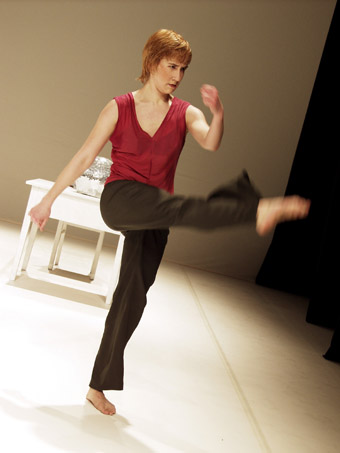
Antje Pfundtner, EigenSinn
photo Iris Terzka
Antje Pfundtner, EigenSinn
EIGENSINN (THE WILFUL CHILD) IS A FIGURE OF CHILDREN’S FICTION, A CAUTIONARY TALE OF THE MANY PITFALLS THAT CAN BEFALL ILL-BEHAVED YOUTH. ANTJE PFUNDTNER HAS AN AIR OF THE DISOBEDIENT ABOUT HER. SHE IS CLEARLY TRAINED IN CONTEMPORARY DANCE BUT HER PERFORMANCE IS A CONTINUAL TUSSLE, WITH EVERYTHING.
Not too far into the show, Pfundtner narrates an early childhood experience in which she couldn’t move. This was a semi-permanent condition she had to slowly and painfully overcome. One can’t imagine what that would have been like and the inflexion that whole process would have lent her current immersion in dance. What would it mean to move when once you couldn’t? Nothing is taken for granted.
EigenSinn is full of surprises. Pfundtner moves to the corner to sit at a small white desk, a school desk perhaps. Quietly looking out, scanning the audience, taking a long time…Whack! With an axe she cuts off her (fake) hand. She moves on. Little vignettes, either physical or verbal, grow like balloons which then deflate making farty sounds into the distance. These stories may or may not be true. She is a passenger on a bus. The bus driver collapses on the wheel. Antje takes over and saves the day. Did this happen? Children are full of fantasies in which they heroically save the day. Pfundntner offers a kaleidoscope of childhood perspectives, but from a distance. She does not enter the child’s persona. She gives it to us in the midst of her own movement, twisting the narrative not only in verbal terms but through her dancing.
Whilst there is an undercurrent of contemporary aesthetic values in her work, Pfundtner superimposes a level of irony in her choice of movement. Like the girl at the desk, our lulled waiting is interrupted by surprises. A quick drop to the floor, a lunge out of order, quirky arm gestures, all in a river of movement which is quite nice, lyrical almost.
Pfundtner has a liking for spirals. She enjoys, I think, the feeling of spinning, turning, twisting across space. I can almost sense an historical pattern of her training here—executing phrase material across the dance floor, taking a half turn, then another then another into spirals. But this has been worked over, like découpage, a series of cutout images laid on top of other cutouts. Pfundtner creates her own movement vocabulary, almost inserting elements from everyday life but not quite. She is more creative than this. Many of her movements are twisted deconstructions of the everyday. Someone could make this gesture but if they did we’d all stare and wonder. You could dance these movements but they would seem odd. It is an exaggeration to call her style grotesque or monstrous. But neither are her choices ‘normal.’ What to say?
Well, watching her is funny. Not everyone in the audience was laughing but I don’t think we’re trained to laugh at dance. We’re trained to take it seriously. I’m one of the worst offenders. I felt transported into the world of stand-up comedy physically realised. And yet, this was not slapstick. Pfundtner’s persona is fluid, flexible, chameleon-like. In one sense, this is an autobiographical piece, like most solos, but she plays a certain distance through her parodic performativity. At one point she played air guitar, then this morphed into some convincing clitoral masturbation. Is this personal? Who knows? She put a glitter ball on her head, dimming the lights for a home planetarium experience. This was almost entrancing but became something else. We don’t get to sit too long until a particular experience is chopped off with an axe, leaving a corporeal memory trace on a little white desk as Pfundtner, that willful girl, spirals off somewhere else. I don’t know whether all this humour is a defence or an embellishment. Is Antje Pfundtner funny for the heck of it? She is good at it. She is an artist who has made a collage of her life, including her childhood, in movement. I liked this piece but I am also intrigued to see her next one, to see how the willful child grows up.
EigenSinn, The Wilful Child, dancer, choreographer Antje Pfundtner, sound design, Dayton Alleman, presented by Chunky Move and Arts House, North Melbourne Town Hall, Melbourne, Jun 22-24
RealTime issue #80 Aug-Sept 2007 pg. web
© Philipa Rothfield; for permission to reproduce apply to realtime@realtimearts.net
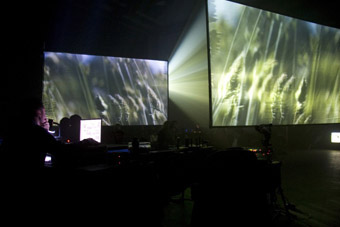
Immersion: Electrical Empathy
photo Alex Davies
Immersion: Electrical Empathy
IMMERSION:ELECTRICAL EMPATHY OFFERED A FASCINATING INSIGHT INTO THE AUDIO-VISUAL PRACTICE OF COLLABORATORS CONVENED BY VIDEO ARTIST SAM JAMES AND SOUND ARTIST GAIL PRIEST. USING MULTI-DIRECTIONAL STEREO, DUAL PROJECTION SCREENS AND A LITTLE SMOKE THEY ENSURED THAT ACCESS TO THE EXTREMITIES OF IMAGINATION WERE ACCESSIBLE BY PLACING THE AUDIENCE IN THE CULMINATING CORE OF THEIR WEEK-LONG RESIDENCY AT PERFORMANCE SPACE.
When I entered the Track 12 studio at CarriageWorks on the first night of the two-night program there were already shadowy figures moving through a slight haze and sweet ringing harmonics and pulsing tones wrapping around us in the low light. The effect was complete and immediate. The audience was enlisted into participation by virtue of their presence because there was no particular area designated for watching or listening, just chairs randomly placed as signs of encouragement to change our position. The movement this created served as a mysterious choreographic accompaniment to some very tasty machine tones ranging from sweet to apocalyptic.
Two large screens were suspended on diagonals and positioned to encapsulate the centre of the studio but leaving enough space for the audience to sit between them and observe in both directions. On screen was something that resembled blazing sunlight refracted through a pipe or narrow tunnel which provided background for two pulsing mites (they seemed to have tails) moving along symmetrical trajectories. The hint of a silhouette figure dancing across layers of images appeared and like so many of the projections to come it eluded fixity. Successive images impressed briefly then disappeared whilst others recurred and asserted thematic links. A spinal column laid itself across the screen only to break up into an oscilloscope effect; then its nature as a divide between split-screen water images was revealed. Flashes of light preempted images of lightning over a city night sky; multiple pulses drowned silence in hypnotic Afro-electronics then driven to submission by machine screams which in turn disintegrated into hums, whistles and the sound of metal objects ringing and clanging in discordant pleasure.
This disintegration was often realized in thematically linked sound and vision as video and sound artists located on opposite sides of the room engaged in collaborations of varying lengths and complexity. Some were live mixes of the other’s sound or simply responsive production of their own materials. One such coordination between Peter Newman and Scott Morrison resulted in digitized video images of three human figures breaking up into a series of smearing distortions that mixed into a mess of colour. Audio-visual material on Newman’s computer was being transferred for treatment by Morrison who manipulated it within his own processors before passing it on to the projectors.
Performative objects were not only provided by collaborative mixes and juxtapositions between music and image but also by the off-screen dramas being played out in the shadows. There was great theatrical effect in the audience seeking new vantage points and the intense attention of the operators in the glow of laptop screens as multiple hands hovered above sound and vision desks to implement elaborate mixing collaborations. Everything in the room was available to be observed. Everyone was elemental in the 360-degree setting and covert glances at the process underway were unnecessary. Observation was encouraged for there was no real ‘front’, even the screens could be viewed from many angles. Immersion was a kind of musical drama where the operators’ presence was integral to the ambient theatre they created.
When the video was designed around less recognizable objects, the imagery became more embedded in the sonic adventures and vice versa. The sounds throughout were so evocative, engaging and often disturbing that at some moments literal video objects interrupted my fabulist reveries. However, this was not the case in Nick Ritar’s slow reveal during a beautiful duet with Ai Yamamoto’s tuneful sample combinations in which a liquidating white screen became a shot of sky through a rain-filled windscreen. So, visual surprises could be welcome additions but mostly there was a surplus of imaginative material for me in the relentless drones, pulses and gentle screams that vibrated and emerged from the complex of circuitry. In an atmosphere where Peter Newman threatened subtle system overloads, Jason Sweeney incorporated human sounds into gentle rhythms and Gail Priest’s voices hung in endless reverb loops, the machine kept pulsing in the dark room. Sounds created imaginative worlds, images on-screen entered waking dreams and a shifting sonic depth of field immersed us into a multi-faceted sensual experience.
Immersion:Electrical Empathy, producer-collaborators Samuel James, Gail Priest, collaborators Cicada (Nick Ritar, Kirsten Bradley), Scott Morrison, Peter Newman, Jason Sweeney, Ai Yamamoto, Performance Space, CarriageWorks, Sydney, June 15, 16
RealTime issue #80 Aug-Sept 2007 pg. web
© Tony Osborne; for permission to reproduce apply to realtime@realtimearts.net
The OnScreen Film and New Media Course Guide is available as a PDF (840k)
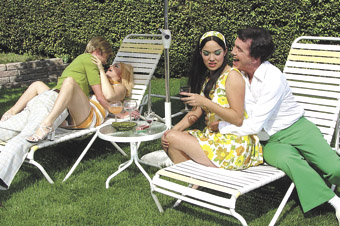
Swingers
AT A TIME WHEN THE FUTURE OF THE TRADITIONAL FILM FESTIVAL IS A MATTER OF SOME DEBATE, TWO OF AUSTRALIA’S NEWEST FESTIVALS ARE FORGING AHEAD. WHILE ADELAIDE HAS JUST SEEN ITS MOST SUCCESSFUL EVENT BOTH CRITICALLY AND IN TERMS OF ATTENDANCE, PERTH’S REVELATION FILM FESTIVAL IS ABOUT TO CELEBRATE ITS 10TH BIRTHDAY WITH A LARGER AND EVEN MORE INNOVATIVE PROGRAM, MORE FILMS AND A NEW ARTISTIC DIRECTOR. MEGAN SPENCER, DOCUMENTARY MAKER (LOVESTRUCK: WRESTLING’S NO. 1 FAN; RT78, p20) AND FILM CRITIC FOR TV AND RADIO, HAS LEAPT ENTHUSIASTICALLY INTO THE TASK OF KEEPING REV ONE OF THE MOST IMAGINATIVE AND CHALLENGING ANNUAL EVENTS ON THE SCREEN CULTURE CALENDAR.
While the more established film festivals are trying to adapt to new ways of looking at cinema, and still grappling with the rather delicate balancing act of satisfying their older, subscriber-based audiences with more traditional offerings while attracting the very necessary newer and younger audience with diverse and provocative programming, younger festivals don’t have this challenge. Their audiences are risk-taking, attracted by innovation; these events can grow organically with their audiences, can enjoy the new ways of both making and experiencing the moving image.
Unlike the larger and more traditional film festivals, which developed naturally from the film society movements or from a city or a community’s need for such an event, the Revelation festival emerged from a desire to screen underground films from all over the world, and a need to take cinema into different environments. Now the event is very healthy; it has state and federal government support through Screenwest and the Australian Film Commission, triennial funding, and a strong sponsorship base.
Rev began in 1997 as an underground event in a basement, Perth’s smoothest jazz venue, where it screened everything on 16mm and included live music and poetry. On its tenth anniversary—titled Revolution. Retrospective. Revelation—Rev will screen around 100 features, documentaries and short films, as well as music videos and experimental work, include a late-licensed festival club and other music and film related activities, and present them at both established cinemas and at nightclub venues. Rev hasn’t abandoned its underground beginnings: Cinema Tabu will present a microcinema showcase of strange films from around the world in a bar environment. Brent Hoff from San Francisco is editor of Wholphin DVD Magazine (an offshoot of cool literary journal, McSweeney’s) and gathers together rare and unseen films to release on DVD. He will screen a selection of these as part of Cinema Tabu.
Already a filmmaker and reviewer, Spencer hadn’t been planning to look for a job as artistic director of a film festival. When she actually considered accepting such a role, however, she realised that every experience she’d had “coalesces and becomes relevant. I’ve got the benefit of being a filmmaker, and of knowing what filmmakers want and hope to get from a film festival. And I’ve seen thousands of films. I’m aware of the cultural and critical connections. I understand the lie of the land and I think I know what to program for the audience to connect with.” And, she says, becoming artistic director of Rev is really a natural progression. “I’ve cheered it on as an exciting new event, I’ve had films screened there, I came over to Perth twice with SBS’s Movie Show. I think I understand what the audience wants.”
Unlike most festival directors, she hasn’t been able to travel to overseas festivals to put her program together. Instead, she’s been programming from the internet, through other festival websites, festival reviews, and the many new avenues offered (“MySpace has been a very good source”), while Rev’s growing identity has, of course, made it attractive, with over 500 films submitted for selection from local and international filmmakers. Working closely with Rev founder Richard Sowada (now Head of Film Programs for the Australian Centre of the Moving Image in Melbourne, but still chairman of the Rev board and very involved) in choosing films, she’s particularly excited about the queer cinema strand, which includes John Waters’ Pink Flamingos (1972), Anna Biller’s Viva (2006; a parody of 60s sexploitation films) and Mary Jordan’s documentary, Jack Smith and the Destruction of Atlantis. “I’d never heard of him—I was just stunned when I saw the film. It’s amazing when you discover someone like that, and other filmmakers fall into place.”
Spencer hopes the activist strand will encourage at least some audience members to, well, become active and do something. There’s Iraq For Sale (2006) by Outfoxed (2004) director Robert Greenwald, on war profiteering; God’s Ways, by German filmmaker Evan Neymann, on two street kids in Odessa; and Soft Words, an Australian short film by Adrian Francis on political spin about asylum seekers and how it abuses language. Rev’s strong documentary strand this year includes something Megan Spencer is particularly excited about: a mini-retrospective of the work of famed documentary-makers the Maysles brothers, with two short films showing Truman Capote and Marlon Brando in a fresh and unexpected light.
Super 8—that little film gauge that just won’t go away—is the surprise element in Rev’s 10th birthday, forming the basis of the new film competition, Revel-8. (“The more we go forward in time, the more incandescent Super 8 becomes”, comments Spencer.) Former director of Perth’s lost and lamented Pandora’s Box Super 8 Film Festival and ECU lecturer Keith Smith takes charge of this new event celebrating the fusion of image and sound, inviting both experienced and novice filmmakers resident in WA to participate. “Super 8 is the original DIY medium and is still finding new devotees after 40 years of glorious imaging. It’s not just the unique look, there’s something magical about working on Super 8 which brings out a special creativity”, he explains. Filmmakers are challenged to make a silent, unprocessed film, edited-in-camera, on a single Super 8 cartridge, lasting just three and a half minutes, on the theme, “Birthday”, using an experimental, animation, drama or documentary approach. Then the best 20 films will be scored by composers at the WA Academy of the Performing Arts and screened in a 5000W flickfest at the Rev Club on Friday July 20, with lots of creative and genre prizes on offer.
A major element of the festival is the Screen Conference, which was initiated last year as a space for filmmakers and those involved in many aspects of the film industry to discuss and workshop a range of related issues. This year the conference has grown, and its guest list includes representatives from the international distribution scene, local and international filmmakers, composers, editors, cinematographers and writers. Featured conversations, masterclasses and workshops include two sessions on HD Heaven (a masterclass with Toby Oliver ACS, on working with HD); Art of the Music Video, with both an international and local focus; The Art of the Short Film; Loving the Alien: The Relationship Between Documentary Filmmaker and Subject; Shedding Light: Performance For Screen; and DIY or Die on digital filmmaking and alternate modes of exhibition and distribution.
Special festival guest and anime proponent Phillip Brophy will be presenting Tezuka: From Manga to Anime, on how Osamu Tezuka transformed his manga into anime. Rev is screening Brophy’s curated program, Focus on Tezuka (already seen at the Art Gallery of NSW and ACMI), with its kids’ flicks component of Astro Boy and Kimba The White Lion, and five fantastic adult animations. Brophy will also be represented in his filmmaker and sound design artist mode; during the festival he’ll be performing The Planets, a remixed presentation of his exquisite cinema scores live, and screening his Evaporated Music series of big-budget, high-gloss video clip images reworked to monstrously alien sound. And his notorious sci-fi horror comedy from 1993, Body Melt, will have a rare screening.
Strange Culture (2007) is a convention-defying documentary by Lynn Hershman Leeson which screened earlier this year at the Sundance and Berlin Film Festivals. It documents the extremely paranoid reaction of US security authorities in the case of internationally acclaimed artist and professor Steve Kurtz when his wife Hope died in her sleep of heart failure. Police arrived, became suspicious of Kurtz’s art, and called the FBI. Within hours the artist was detained as a suspected ‘bioterrorist’, his computers, manuscripts, books, his cat, and even his wife’s body were impounded, and he still awaits a trial date. While Strange Culture manages to reinvent an old form while telling an urgently topical story, what makes it even more memorable is that the Sundance Film Festival screened the documentary in Second Life, the first feature film to be screened on the online community. Rev will not only be screening the film, but will also include a panel on Second Life as part of the Screen Conference—Second Life and Beyond: Virtual Communities and Making Media in a Digital World, organised by Mick Broderick.
Megan Spencer hopes that her first festival will continue the great work that Richard Sowada has done in making Rev a very distinctive event. Sowada himself is cautious about the future for film festivals: “a not-for-profit event has to exist in an exhibition culture that’s commercially based, that’s totally geared to making money. Rev is all about audience development, and that’s a very difficult area to navigate right now.” Spencer thinks that “what makes Rev special is that it opens up a dialogue with the individual filmmaker, and brings in people from all aspects of filmmaking. What I’m trying to do is blur it all: see how digital culture is affecting film, how much feature film has taken from music video—and vice versa. It’s important to recognize what’s going on, and to discuss and debate it. I believe in plugging film into film culture, rather than the industry, and I think that’s what Rev does.”
Revelation Perth International Film Festival 2007, July 12-22, www.revelationfilmfest.org
RealTime issue #79 June-July 2007 pg. 21
© Tina Kaufman; for permission to reproduce apply to realtime@realtimearts.net
Swingers
AT A TIME WHEN THE FUTURE OF THE TRADITIONAL FILM FESTIVAL IS A MATTER OF SOME DEBATE, TWO OF AUSTRALIA’S NEWEST FESTIVALS ARE FORGING AHEAD. WHILE ADELAIDE HAS JUST SEEN ITS MOST SUCCESSFUL EVENT BOTH CRITICALLY AND IN TERMS OF ATTENDANCE, PERTH’S REVELATION FILM FESTIVAL IS ABOUT TO CELEBRATE ITS 10TH BIRTHDAY WITH A LARGER AND EVEN MORE INNOVATIVE PROGRAM, MORE FILMS AND A NEW ARTISTIC DIRECTOR. MEGAN SPENCER, DOCUMENTARY MAKER (LOVESTRUCK: WRESTLING’S NO. 1 FAN; RT78, p20) AND FILM CRITIC FOR TV AND RADIO, HAS LEAPT ENTHUSIASTICALLY INTO THE TASK OF KEEPING REV ONE OF THE MOST IMAGINATIVE AND CHALLENGING ANNUAL EVENTS ON THE SCREEN CULTURE CALENDAR.
While the more established film festivals are trying to adapt to new ways of looking at cinema, and still grappling with the rather delicate balancing act of satisfying their older, subscriber-based audiences with more traditional offerings while attracting the very necessary newer and younger audience with diverse and provocative programming, younger festivals don’t have this challenge. Their audiences are risk-taking, attracted by innovation; these events can grow organically with their audiences, can enjoy the new ways of both making and experiencing the moving image.
Unlike the larger and more traditional film festivals, which developed naturally from the film society movements or from a city or a community’s need for such an event, the Revelation festival emerged from a desire to screen underground films from all over the world, and a need to take cinema into different environments. Now the event is very healthy; it has state and federal government support through Screenwest and the Australian Film Commission, triennial funding, and a strong sponsorship base.
Rev began in 1997 as an underground event in a basement, Perth’s smoothest jazz venue, where it screened everything on 16mm and included live music and poetry. On its tenth anniversary—titled Revolution. Retrospective. Revelation—Rev will screen around 100 features, documentaries and short films, as well as music videos and experimental work, include a late-licensed festival club and other music and film related activities, and present them at both established cinemas and at nightclub venues. Rev hasn’t abandoned its underground beginnings: Cinema Tabu will present a microcinema showcase of strange films from around the world in a bar environment. Brent Hoff from San Francisco is editor of Wholphin DVD Magazine (an offshoot of cool literary journal, McSweeney’s) and gathers together rare and unseen films to release on DVD. He will screen a selection of these as part of Cinema Tabu.
Already a filmmaker and reviewer, Spencer hadn’t been planning to look for a job as artistic director of a film festival. When she actually considered accepting such a role, however, she realised that every experience she’d had “coalesces and becomes relevant. I’ve got the benefit of being a filmmaker, and of knowing what filmmakers want and hope to get from a film festival. And I’ve seen thousands of films. I’m aware of the cultural and critical connections. I understand the lie of the land and I think I know what to program for the audience to connect with.” And, she says, becoming artistic director of Rev is really a natural progression. “I’ve cheered it on as an exciting new event, I’ve had films screened there, I came over to Perth twice with SBS’s Movie Show. I think I understand what the audience wants.”
Unlike most festival directors, she hasn’t been able to travel to overseas festivals to put her program together. Instead, she’s been programming from the internet, through other festival websites, festival reviews, and the many new avenues offered (“MySpace has been a very good source”), while Rev’s growing identity has, of course, made it attractive, with over 500 films submitted for selection from local and international filmmakers. Working closely with Rev founder Richard Sowada (now Head of Film Programs for the Australian Centre of the Moving Image in Melbourne, but still chairman of the Rev board and very involved) in choosing films, she’s particularly excited about the queer cinema strand, which includes John Waters’ Pink Flamingos (1972), Anna Biller’s Viva (2006; a parody of 60s sexploitation films) and Mary Jordan’s documentary, Jack Smith and the Destruction of Atlantis. “I’d never heard of him—I was just stunned when I saw the film. It’s amazing when you discover someone like that, and other filmmakers fall into place.”
Spencer hopes the activist strand will encourage at least some audience members to, well, become active and do something. There’s Iraq For Sale (2006) by Outfoxed (2004) director Robert Greenwald, on war profiteering; God’s Ways, by German filmmaker Evan Neymann, on two street kids in Odessa; and Soft Words, an Australian short film by Adrian Francis on political spin about asylum seekers and how it abuses language. Rev’s strong documentary strand this year includes something Megan Spencer is particularly excited about: a mini-retrospective of the work of famed documentary-makers the Maysles brothers, with two short films showing Truman Capote and Marlon Brando in a fresh and unexpected light.
Super 8—that little film gauge that just won’t go away—is the surprise element in Rev’s 10th birthday, forming the basis of the new film competition, Revel-8. (“The more we go forward in time, the more incandescent Super 8 becomes”, comments Spencer.) Former director of Perth’s lost and lamented Pandora’s Box Super 8 Film Festival and ECU lecturer Keith Smith takes charge of this new event celebrating the fusion of image and sound, inviting both experienced and novice filmmakers resident in WA to participate. “Super 8 is the original DIY medium and is still finding new devotees after 40 years of glorious imaging. It’s not just the unique look, there’s something magical about working on Super 8 which brings out a special creativity”, he explains. Filmmakers are challenged to make a silent, unprocessed film, edited-in-camera, on a single Super 8 cartridge, lasting just three and a half minutes, on the theme, “Birthday”, using an experimental, animation, drama or documentary approach. Then the best 20 films will be scored by composers at the WA Academy of the Performing Arts and screened in a 5000W flickfest at the Rev Club on Friday July 20, with lots of creative and genre prizes on offer.
A major element of the festival is the Screen Conference, which was initiated last year as a space for filmmakers and those involved in many aspects of the film industry to discuss and workshop a range of related issues. This year the conference has grown, and its guest list includes representatives from the international distribution scene, local and international filmmakers, composers, editors, cinematographers and writers. Featured conversations, masterclasses and workshops include two sessions on HD Heaven (a masterclass with Toby Oliver ACS, on working with HD); Art of the Music Video, with both an international and local focus; The Art of the Short Film; Loving the Alien: The Relationship Between Documentary Filmmaker and Subject; Shedding Light: Performance For Screen; and DIY or Die on digital filmmaking and alternate modes of exhibition and distribution.
Special festival guest and anime proponent Phillip Brophy will be presenting Tezuka: From Manga to Anime, on how Osamu Tezuka transformed his manga into anime. Rev is screening Brophy’s curated program, Focus on Tezuka (already seen at the Art Gallery of NSW and ACMI), with its kids’ flicks component of Astro Boy and Kimba The White Lion, and five fantastic adult animations. Brophy will also be represented in his filmmaker and sound design artist mode; during the festival he’ll be performing The Planets, a remixed presentation of his exquisite cinema scores live, and screening his Evaporated Music series of big-budget, high-gloss video clip images reworked to monstrously alien sound. And his notorious sci-fi horror comedy from 1993, Body Melt, will have a rare screening.
Strange Culture (2007) is a convention-defying documentary by Lynn Hershman Leeson which screened earlier this year at the Sundance and Berlin Film Festivals. It documents the extremely paranoid reaction of US security authorities in the case of internationally acclaimed artist and professor Steve Kurtz when his wife Hope died in her sleep of heart failure. Police arrived, became suspicious of Kurtz’s art, and called the FBI. Within hours the artist was detained as a suspected ‘bioterrorist’, his computers, manuscripts, books, his cat, and even his wife’s body were impounded, and he still awaits a trial date. While Strange Culture manages to reinvent an old form while telling an urgently topical story, what makes it even more memorable is that the Sundance Film Festival screened the documentary in Second Life, the first feature film to be screened on the online community. Rev will not only be screening the film, but will also include a panel on Second Life as part of the Screen Conference—Second Life and Beyond: Virtual Communities and Making Media in a Digital World, organised by Mick Broderick.
Megan Spencer hopes that her first festival will continue the great work that Richard Sowada has done in making Rev a very distinctive event. Sowada himself is cautious about the future for film festivals: “a not-for-profit event has to exist in an exhibition culture that’s commercially based, that’s totally geared to making money. Rev is all about audience development, and that’s a very difficult area to navigate right now.” Spencer thinks that “what makes Rev special is that it opens up a dialogue with the individual filmmaker, and brings in people from all aspects of filmmaking. What I’m trying to do is blur it all: see how digital culture is affecting film, how much feature film has taken from music video—and vice versa. It’s important to recognize what’s going on, and to discuss and debate it. I believe in plugging film into film culture, rather than the industry, and I think that’s what Rev does.”
Revelation Perth International Film Festival 2007, July 12-22, www.revelationfilmfest.org
RealTime issue #79 June-July 2007 pg. 21
© Tina Kaufman; for permission to reproduce apply to realtime@realtimearts.net
 Jonathan Dady, Cardboard Pianos, installation,
There Forever, Port Adelaide
What are the markers of this great age of hybridity? In the arts they are transience, transformation and sensory transport in works that heighten our sense of ephemerality, of mutability and, with apparent magic [digital and otherwise], shake loose our perceptual certainties. In There Forever, Jonathan Dady’s cardboard pianos exhibited in a deserted shop in Port Adelaide [page 4-5] evoke the fragile, even surreal aspirations embodied in the incipient regeneration of an old suburb. In Merilyn Fairskye’s video work Stati di Animo [p3], past and present likewise co-exist in the moment, in a dynamic of stillness and motion—the photographic fixity of waiting airline passengers juxtaposed with the ghostly brushstrokes of those on the move. In Aqua [cover image], Fairskye’s new work for Stills Gallery, the video image of a swimmer is layered some 50 times, each image a second apart, generating an intensely fluid impressionism—‘now’ and ‘then’ constantly folding into each other. Whether in the works of Dady and Fairskye or in Jia Zhang-Ke’s feature film, Still Life [p17], where we are invited to look in real time rather than surrender again to the edit, or in Craigie Horsfield’s enigmatic “slow time” photography [p41], or in Chris Marker’s Owls at Noon [p27], or in the Wooster Group’s replay and recreation of Richard Burton’s 1954 made-for-television Hamlet, it is above all our sense of time, perceived visually, aurally, spatially and filtered through many media, that is radically undone.  Jonathan Dady, Cardboard Pianos, installation,
There Forever, Port Adelaide
RealTime issue #79 June-July 2007 pg. 1
© Keith Gallasch; for permission to reproduce apply to realtime@realtimearts.net
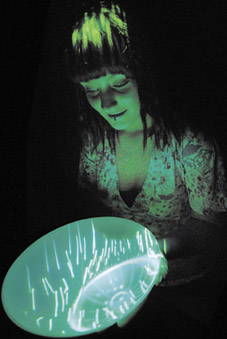
Lynette Wallworth, Hold: Vessel 1
photo Colin Davison
Lynette Wallworth, Hold: Vessel 1
LYNETTE WALLWORTH IS KNOWN IN AUSTRALIA FOR HER MUCH LOVED WORK, HOLD: VESSEL, WHICH HAS BEEN SHOWN AT THE ART GALLERY OF NSW, ACMI, DAVIS MUSEUM (USA), AND CURRENTLY AT THE NATIONAL GLASS CENTRE IN THE UK .
More recently Wallworth has been solidly foc sed on research and production for new works culminating in a series of high profile international exhibitions—at the New Crowned Hope Festival in Vienna, Arnolfini in Bristol, Auckland Triennial, the National Glass Centre, and the second exhibition for the newly launched BFI Southbank. The BFI have extended their commitment by commissioning a new stage for Hold. I caught up with Wallworth on the brink of a busy few months of production.
I am in the process of developing the work for the BFI so I am busy connecting with marine specialists I first encountered when working on Hold: Vessel 1. These are people like Marine Biologist Anya Salih who works on understanding the uses of the fluorescent gene in coral and David Hannan who first filmed the mass spawning event on the Great Barrier reef in 1990 and has been filming reef systems in all the years since. They are absolutely focused on corals, all of them in a slightly different way and they are the same people who informed my understanding then of the future stresses on marine organisms if current predictions of climate change held up. That was in 2001.
The issue of climate change was not in the public imagination then. Now I look at the footage in Hold and think, okay, I used this imagery of the giant kelp forests of southern Tasmania for example and only about five percent of those kelp forests exist now. So it feels a very potent time to be making this next stage of the work; it was something I always intended. The thing that has changed I think is the context. It feels to me as though everything I thought about in making the work has become transparent in the intervening years. To hold an underwater world in a fragile glass bowl gives a very clear, tangible sensation of these environments. It has become patently clear to most people that we really do have to think about what we are handing on to those coming after us.
It had always been in my thinking that the work would evolve, because marine environments are changing so rapidly, but it has been difficult to raise funds to make a finished work. The BFI, through Michael Connor’s curation, completely comprehended that this was a part of the work from its inception, this process of evolution and being able to walk through both the work and through different time spans. So it’s really a fantastic opportunity I’ve been given to continue it, and on the other hand it’s very confronting. It’s the strange sensation of making a work at a time when the impetus for the work has intensified.
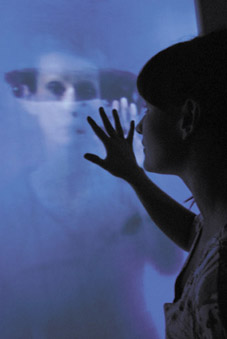
Lynette Wallworth, Invisible by Night, 2004, commissioned by Experimenta
photo Colin Davison
Lynette Wallworth, Invisible by Night, 2004, commissioned by Experimenta
I always think that I make works that are communal at their core. I love looking at the way people who don’t know one another form a sort of temporary community whilst in the space together—there’s is something very anti-hierarchical about it. I certainly contemplate accessibility and the ability for people to be able to resolve the work with one another and I am interested in creating a tangible sensation of the audience being implicit to the work.
In a significant retrospective of her work At the New Crowned Hope Festival in Vienna, Wallworth exhibited five works including two new commissions.
Vienna was really one of the most satisfying times of my life. The curator Peter Sellars very carefully determined the way that you would move through the exhibition such that the relationship between the works became really apparent. Peter has worked a lot with Bill Viola and has a wonderful understanding about the best environment for experiencing these works. So he drew a map—I’ve still got this little serviette that I kept when, sitting in a café with him, very late one night in Vienna, he drew the journey from piece to piece. He is extremely attuned to things like how long it takes your eyes to become used to the physical aspects of being in a video installation.
My work is very slow in tempo and here was a way of placing things that supported the pacing needed and encouraged the sensation of immersion. I didn’t realise how obsessed I am with darkness until I saw all of these works together, but it is a very comfortable space for me. I am interested in how to construct darkness so you can rest in it, be altered by it. The other huge change in terms of the exhibition experience was that I had the support of FORMA [the Liverpool-based media arts agency], which has been a really significant breakthrough for me. For years I tried to find ways of getting my work produced in Australia but individuals can’t sustain a company that does this sort of work without funding. FORMA produce and tour for me so my life has changed. I feel now my practice is sustained and sustainable.
The opportunity to show in a festival is wonderful because of the focus on so many different art forms and artists—I got the opportunity to meet and talk with some of my favourites, especially filmmakers, as well as meet new ones. And the flow on has been great. There is interest in showing these pieces now in France, in Rome and in New York. Galleries are the best equipped to show it, but the festival environment gives the opportunity for the work to find relationships with other artforms.
The major new commission for Vienna was an interactive work, Evolution Of Fearlessness, for which I filmed 11 women, most of them political refugees. The experience of the work is a moment of ‘video meeting’ when the women respond to the viewer’s touch. In Vienna the relationship of this work to some of Sellars’ commissioned films was really interesting—the same medium with very different modes of delivery—and it sparked my thinking about where to go next. There’s an amplification that happens with this kind of attunement and that feels like a perfect home for me.
Prior to Vienna Wallworth spent three months on a British Council residency at the National Glass Centre in Sunderland, a chance for her to deeply examine the medium of glass, which she has used frequently in her work, and to develop new works combining video and glass.
Sunderland was very contemplative. It’s completely different working on glass than on a Mac G5. It made me think about the longevity of work. The history of glassmaking is a part of the experience of the National Glass Centre; it’s where the first stained glass was made in England. You can’t be there and not become cognisant of the historical importance of the medium. That haunts me really, because of the medium I work in. For example, the projectors we used to make Hold in 2001 are no longer in production, you can’t buy them any more and that’s in a six-year timespan. The software that we use to deliver work changes every year so it’s impossible to know how the work can be seen in 100 years time. Whereas a glass bowl that I made in Sunderland last year could still exist in that form, cracked and scratched, in a thousand years time. There is no economic determinant to make a piece of glass obsolete. This tension is inherent in the history of art, the experimentation with new materials and the concern for longevity. It really expanded my thinking about what are the essential tools.
The other thing that came from that time was that my work is still very strongly linked to being in the Australian landscape, so being in Newcastle (UK) for that length of time was quite challenging for me, but also helped to clarify why I still need to come back here to develop new pieces. It’s certainly easier for me overseas right now, my work is shown more and commissioning opportunities are definitely coming from Europe in a wonderful and supportive way. But I still find it beneficial to come home and make the work—there’s a fluidity about it, along with being able to work with the same people as a team. I think it makes the work much stronger. It means you can shorthand a lot of things and so take them in unexpected directions. But still, when I made Evolution of Fearlessness I imagined I would film women from other parts of the world, and I’m still thinking about that. It might be the one that actually shifts me out of this compulsion to make work out of Australia.
Lynette Wallworth, Hold: Vessel 2, BFI Southbank Gallery, London, June 23-Sept 2, www.bfi.org.uk. Touring produced by Forma, www.forma.org.uk
RealTime issue #79 June-July 2007 pg. 2
© Fabienne Nicholas; for permission to reproduce apply to realtime@realtimearts.net
Merilyn Fairskye, Stati d’Animo (States of Mind), 2006-2007
courtesy of the artist
Merilyn Fairskye, Stati d’Animo (States of Mind), 2006-2007
MERILYN FAIRSKYE’S STATI D’ANIMO (STATE OF MIND) EVOKES THE INTERNATIONAL AIRPORT EXPERIENCE LIKE NO OTHER ARTWORK I CAN RECALL. THE THREE-SCREEN WORK THAT WRAPS AROUND YOU AT ARTSPACE FUSES AT LEAST TWO STATES OF BEING INTO ONE. FIRST, THERE’S WAITING, WITH ITS SHEER STILLNESS, HERE A PRECISE PHOTOGRAPHIC FIXING ON THOSE SITTING OR STANDING. THEN THERE’S MOVEMENT, THE PURPOSEFUL STRIDE OR ABSENT-MINDED WANDER, REALISED CINEMATICALLY AS A GHOSTLY BLUR OF BODIES WALKING, RIDING ESCALATORS, HAULING THEIR BAGGAGE. THOSE WHO WAIT APPEAR FROZEN IN TIME, THOSE WHO MOVE SEEM ALWAYS ON THE EDGE OF DISAPPEARING. THE NOWHERENESS OF AIRPORTS AND THE SENSE OF ETERNAL TRANSIENCE IS RENDERED EVEN MORE PALPABLE IN THE WAY FAIRSKYE GIVES BUILDINGS, EQUIPMENT AND AEROPLANES THE GREATER SOLIDITY—HUMANS ARE A MERE EPHEMERAL PRESENCE.
With her Sony HDV camera hand-held, mostly at waist level, Fairskye recorded at Charles de Gaulle, Darwin, Dubai, Frankfurt, Helsinki, Hong Kong, JFK, Kuala Lumpur, Los Angeles, Pudong, Sao Paulo, San Francisco, Singapore, Sofia, Sydney and Vienna airports. She writes, “the camera moves or rests without composing or focussing on the people it tracks and traces” in a work that is not “investigative or ethnographic documentary. Nothing specific is revealed. The aim is to achieve a sense of things, of simultaneity, rather than a direct account or story.
“The formation of the interior airport images in this work is different from conventional film and photography. It closely resembles the sequenced exposures of chronophotography by Jules Etienne Marey which (like Henri Bergson’s reflections on time) inspired the painterly experiments of the Futurists that this work evokes. The effect is to condense and dilate the experience of time, by superimposing a sequence of frames in fifty transparent layers.”
This layering allows Fairskye to conflate time so that we are watching past and present at once folding into one another: “the ‘present’ is thus continuous (and coexistent) with the past, in a perpetual state of becoming and vanishing, in the same way as the people who briefly inhabit the airport, and the airspace above it, become and vanish.”
Merilyn Fairskye, Stati d’Animo (States of Mind), 2006-2007
courtesy of the artist
Merilyn Fairskye, Stati d’Animo (States of Mind), 2006-2007
The association with Futurism is quite precise—the title is taken from Futurist artist Umberto Boccioni’s 1911 trilogy of paintings which has the railway station as its zone of transience. Painting and train station are replaced in Fairskye’s work with digital art and airport, the joys and anxieties of machine age speed paralleled with those in our own time to do with computer speed and hyperconnectivity. But the vulnerability of bodies and machines persists, not only in the visual ephemerality of Fairskye’s airport inhabitants, but in their words.
Structured into passages of Arrival, Crossing, Waiting, Departure and Farewell, the video watches but also listens. What appears to be airport background noise is revealed to be something more: at one point the attentive listener is privy to a dialogue between airline cabin staff on one plane and the control tower—a terrorist drama appears to be unfolding in the cockpit. The aeroplane moves across the tarmac and then, when air control says, after communication is broken, “We’ve lost them”, the jet simply disappears against the background of buildings and other aeroplanes. Life in the airport terminal goes on, with its alternating solidity and blurring.
I asked Fairskye about about the technical side of her work which, she writes, “is quite simple but chews up a lot of render time. I had already sorted out the process in principle when I made an earlier three-channel Stati d’Animo installation (Stills, 2005, shot on SD and working with 25 layers only). Greg Ferris worked on post production for Stati d’Animo 2006. The new material was shot on HDV. Once the offline edit was completed, all the interior airport shots were each subject to the following process.
Merilyn Fairskye, Stati d’Animo (States of Mind), 2006-2007
courtesy of the artist
Merilyn Fairskye, Stati d’Animo (States of Mind), 2006-2007
“A template was set up in After Effects for 50 duplicate layers of video (going to 50 from 25 made the image much more fluid.) Each layer was moved along one frame. So overall, there was a time overlap of 2 seconds by the end of the particular shot. The opacity of each subsequent layer was decreased according to a formula I have worked out so that by the time you got to layer fifty there was still a visible trace of all the preceding layers, including layer one, but from two seconds earlier. This is an aspect of the process that is crucial from my point of view—a visualisation of a temporal depth that is quite different from linear duration. Lastly, the whole thing was rendered, and imported back into Final Cut Pro as a single track video, and colour corrected. With my new work, Aqua, I am doing everything in Final Cut Pro, greatly assisted by the Paste Attributes command.”
Fairskye’s new video work Aqua (see our cover image), premieres soon at Stills Gallery as an installation. I had a glimpse of the video in preparation. The look and feel, quite different from the gently fluent if eerie time shifts of Stati d’Animo, is of an intense vibrancy, a living impressionism and, again, magical play with technology and perception.
Merilyn Fairskye, Stati d’Animo (States of Mind), 2006-2007, three-channel video installation, writer, director, producer Merilyn Fairskye, camera, post production, sound Merilyn Fairskye, Greg Ferris; Artspace March 16-April 14
Merilyn Fairskye, Aqua, Stills Gallery, Sydney, July 18-Aug 18
RealTime issue #79 June-July 2007 pg. 3
© Keith Gallasch; for permission to reproduce apply to realtime@realtimearts.net
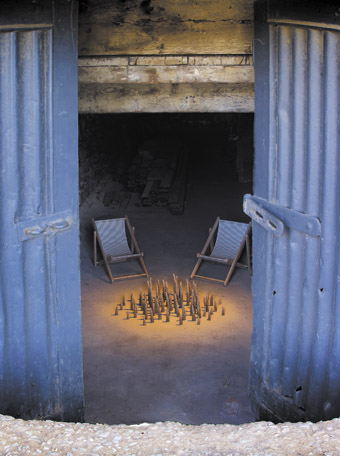
Angela Valamanesh, New Metaphors
photo Anton Hart, image courtesy of artist
Angela Valamanesh, New Metaphors
“PORT ADELAIDE—IT’S HAPPENING!” READ THE SIGNS AROUND THE LARGEST WATERFRONT URBAN DEVELOPMENT BEING UNDERTAKEN IN SOUTH AUSTRALIA OVER THE NEXT DECADE. IN THE VISION AND FRAMEWORK DOCUMENT FOR THE NEW CITY, JAN GEHL, PROFESSOR OF URBAN DESIGN, TALKS ABOUT PORT ADELAIDE IN RELATION TO OTHER RECLAIMED WATERFRONT CITIES IN THE WORLD AS “JUST WAITING TO BE RECONQUERED. “ HE SEES THE CENTRE AS HAVING “LOST ITS CONNECTION TO THE WATERFRONT…THE WORKING HARBOUR IS IN THE PROCESS OF BEING TRANSFORMED INTO A RECREATION HARBOUR WITH THE OPPORTUNITY TO REINVIGORATE PORT ADELAIDE CENTRE AND RECONNECT IT TO THE WATERFRONT.”
Transforming this historic city has unearthed predictable disputes to do with insensitive development. Hoping to generate more complex discussions around what constitutes a sense of place, artist and local resident, Linda Marie Walker responded to her strong feelings about the Port with an “ephemeral public art project” entitled There Forever. As part of the Port Festival, the event involved eight artists creating works that each in their own way addressed the subtle striations of history that are potentially warped in any major urban re-design.
“The title refers to the idea that everyday attention, deliberate action, and continual work is required in relation to the infinite memories and physical bearings of a place to ensure that these remain as part of a place’s past and future”, says Walker in her curatorial statement.
Yhonnie Scarce traces the trajectory of Fanny Graham, an indigenous woman born (1925) at Point Pearce Christian Mission on the York Peninsula and buried there (1967), who spent part of her itinerant life in the Port. The artist creates a kind of map, sewing coarse red thread onto tough black canvas, in the process engaging with people moving through the Visitors Centre. At the climax of the event, she will fold the cloth and place it beside the paper dress pattern and white gloves in the suitcase which lies open on the floor of the project headquarters in the old ANZ Bank building in Lipson Street.
Julie Henderson has taken up residence for a time down at the harbour, slowly acquainting herself with some of the people who gather and work in the sheds and shacks there. Her DVD, installed in the door of one of the boatsheds, documents the artist’s conversation with the boat builder who has worked there for years. His face never appears, only his body and the materials of a craft to which he is clearly devoted. Ambivalent about the luxurious life his boats may go on to enjoy in one of the Port’s proliferation of planned new marinas, the boatbuilder says of his boat’s new owner, “I think he called it Georgia.”
Nearby is the Radio Shack in which Henderson has spent long periods listening to men from the amateur radio club. She’s filmed their idiosyncratic environment and recorded their conversations and documented one man transmitting a message in Morse Code (he chose “the moving finger writes and, having writ, moves on…”). Henderson also stages a performance at night on the site of the old shed 5 (“Look for two lights, bring an umbrella”).
Inside the shack, Julie Henderson says she can’t quite settle on what constitutes the art of this project. On the website she muses: “Perhaps the work is impossible or perhaps it is already there and I just need to notice its formation among other things. I am in the space of the swamp, the dock, the boat-builder and the amateur radio club and I’m localizing and taking small opportunities to meet them. I’m in their place—it is an open shape with details that we inhabit together for now.”
As in all the works in There Forever, a sense of quiet and detailed evidence-gathering pervades amidst the more urgent atmosphere of impending disappearance. As part of the redevelopment, and lacking obvious “heritage” status, the Radio Shack may be razed anytime soon, like the nearby boat sheds.
Elements of the works that can be pinned down form an intriguing exhibition in the bank building which is the project’s HQ. Denuded of all but its elegant proportions, this house is full of subtle surprises.
In the ceiling of one room, Jess Wallace’s video, Buoyancy, references the buoys in the river that have been out of bounds since 1869 by Declaration of the Marine Board Act. Wallace projects young swimmers flouting the law, as kids at the Port have done for years, freely floating them above our heads.
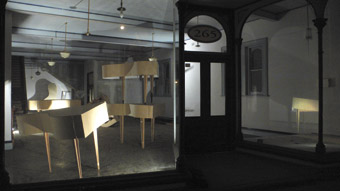
Jonathan Dady, The Cardboard Piano Shop;
photo Jonathan Dady, image courtesy of the artist
Jonathan Dady, The Cardboard Piano Shop;
A wall away, in perfect light filtered through large windows and reflected off the buff colours of the paint-stripped house, Jonathan Dady’s elegant cardboard piano makes silent music. Down the hall, Julie Henderson’s harbour video sits atop a 1960s TV set transmitting interference from the Radio Shack.
Downstairs, James Guerts’ Bridge Drawing Water displays the beginnings of the artist’s collection of casual markings gathered from the wharf and drawn onto the walls of the house. Another surprise— one stair tread is painted gold.
Angela Valamanesh’s New Metaphors began in the mangrove sites once pervasive around the Port but now almost invisible. In the basement below a studio in Divett Street, she installs a small drama. Peering down from the street, we are faced with two miniature deckchairs addressing a series of clay replicas of pheumatophores—aerial roots of mangroves that grow above the low tide level to allow the plants to breathe. Says Valamanesh “I’ve been wondering why mangroves are of interest to me as a visual artist. I think it’s that they are plants that live in both water and land and have characteristics which visually link them to human and animal life.”
Jonathan Dady’s proliferating pianos make another appearance, this time displayed inside a graceful disused shop on the main street. Starkly lit, and randomly displayed, they maintain their sense of grandeur—prototypes perhaps for the aspirations of a working class area gradually succumbing to gentrification.
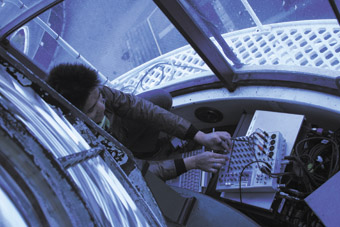
Michael Yuen, Flash
photo James Geurts, image courtesy of the artist
Michael Yuen, Flash
Among the performance works which my sole foray precluded attending was Michael Yuen’s Flash: “At this place and time for a brief moment a large flash of light and burst of sound will saturate the surrounding region. The point of origin will be the Port Adelaide Lighthouse.”
And throughout the nine days of the event, Teri Hoskin was travelling (on foot, by car and train) each day at daybreak and dusk from her home in Adelaide to a series of pre-figured locations in Port Adelaide. She took from these “points of perception” and posted on the web a series of images and sounds, adding to her ongoing assembly of “useless knowledge” valued solely for the role it plays in the minute everyday of life (http://ensemble.va.com.au/9days).
Last night the bridge opened to the sound of breathing under water. It closed again, the two sides met ungainly, like this sentence.
There Forever, various sites around Port Adelaide, curator Linda Marie Walker, artists James Geurts, Bridge Drawing Water; Jonathan Dady, The Cardboard Piano Shop; Julie Henderson, Continuous Wave, Forms For A Dialogue; Michael Yuen, Flash; Jess Wallace, Buoyance; Teri Hoskin, B Part Renaissance; Angela Valamanesh, New Metaphors; Yhonnie Scarce, Fanny Graham; The Port Festival, Port Adelaide, April 21-29
RealTime issue #79 June-July 2007 pg. 4,5
© Virginia Baxter; for permission to reproduce apply to realtime@realtimearts.net
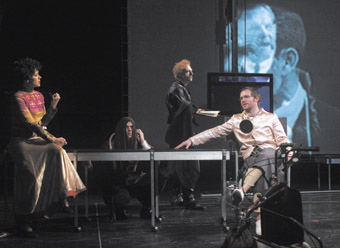
The Wooster Group, Hamlet
photo Paula Court
The Wooster Group, Hamlet
GROWING OUT OF THE CREATIVE AND POLITICAL FERMENT OF THE DOWNTOWN NEW YORK ART SCENE IN THE EARLY 1970S, THE WOOSTER GROUP HAS REMAINED ‘A THEATRE COLLECTIVE’ LONG AFTER AUSTRALIAN GROUPS BORN OF THE SAME IMPULSES SIMPLY GAVE UP THE STRUGGLE AND FADED AWAY (THE AUSTRALIAN PERFORMING GROUP BEING THE MOST OBVIOUS PARALLEL). INDEED, IN THE CONTEMPORARY AUSTRALIAN CONTEXT, THE IDEA OF A ‘COLLECTIVE’ SEEMS ALMOST OUTRÉ, SUGGESTING A PROJECT BOTH NAÏVE AND IDEOLOGICALLY OVER-DETERMINED. BY CONTRAST, THE WOOSTER GROUP HAS MAINTAINED A SENSE OF INTELLECTUAL PLAY AND ENGAGEMENT WHICH READS AS FRESH, VIGOROUS AND UNAFRAID—AND AS RELEVANT TODAY, IN THEIR PRODUCTION OF HAMLET, AS IT WAS WHEN I FIRST SAW THEM IN 1986. FOR MORE THAN 30 YEARS THEY HAVE SUSTAINED AN EXPLORATION OF THE POSSIBLE RELATIONSHIPS BETWEEN PERFORMER, TEXT AND MEDIA TO CREATE AN EXTRAORDINARY BODY OF WORK WHICH HAS BEEN CONSISTENTLY ENTERTAINING AND RIGOROUS.
The Wooster Group’s longevity seems even more remarkable when you consider the company has had only one director—Elizabeth LeCompte—working with a core group of powerful personalities (including Willem Dafoe, Kate Valk, and formerly Ron Vawter and Spalding Gray) and a shifting roster of associates. Taking into account all the mundane problems of maintaining a theatre company, such as ever increasing salaries and production costs and the fickleness of critical fashions, as well as the potentially explosive combination of creative personalities, it’s easy to imagination that either exhaustion or implosion would have put paid to the company a decade ago.
However, the Wooster Group appears to have found a strategy which has allowed a visionary director and a company of strong-willed performers to work together for what for many has been an artistic lifetime—even as one of the core members of the group (Dafoe) has built a career as a mainstream, if minor, Hollywood star. And unlike her contemporaries (Twyla Tharp say, or Arianne Mnouchkine), LeCompte remains relatively in the background: she is clearly a formidable character, but seems content to let the performers be the public face of the company. (Mnouchkine’s shock of grey hair and steely gaze I recall from her watchful presence before and after performances by Theatre du Soleil, but despite interviewing LeCompte in the late 80s, and having had the privilege of seeing the company perform on at least six occasions since then, I cannot for the life of me remember her face!)
The Wooster Group oeuvre includes “nineteen theatre pieces, four dances, three radio plays, five video/film works, and the first eight monologues of Spalding Gray” (www.thewoostergroup.org), and will soon include an opera when they take on Cavalli’s La Didone, via a collision with “Mario Brava’s 1965 cult movie Terrore nello spazio.” The collision of a classic or overburdened theatre text and an obscure ‘cult’ film is a typical starting point for a Wooster Group production. The violent encounter of mediums, performance styles and histories produces the rich multi-modal performance language which defines the company’s style, a hectic, always surprising collaging of personal and public histories, pop cultural references, performance techniques and media.
newly mediated old hamlet
The Wooster’s Hamlet is no exception—but in this case, the cinema text in question is a version of the theatrical text: a rarely seen 1964 film version of a Broadway production of Shakespeare’s Hamlet starring and directed by Richard Burton. A single performance was recorded ‘live’ by 17 cameras and edited into a film that was shown for only two days in 2000 movie houses across the US. It was the first and only example of what the producers conceived as a new form—“Theatrofilm”, made possible through “the miracle of Electronovision.”
The Wooster Group have taken this forgotten ‘theatrofilm’ of Hamlet, and edited it to emphasise the meter of the verse. As a consequence, the whole film loses the illusion of visual seamlessness that editing usually seeks to engender, and the scenes seem held together by jump cuts, with weird elisions between shots. Figures stutter and jump, and frequently vanish altogether, or appear only as ghostly after images, present only as versifying voices.
With this ‘detourned’ film as their text, the Wooster Group then set about a kind of crazed reverse engineering process: “our Hamlet attempts…reconstructing a hypothetical theatre piece from the fragmentary evidence of the edited film, like an archaeologist inferring an improbable temple from a collection of ruins. Channelling the ghost of the legendary 1964 performance, we descend into a kind of madness, intentionally replacing its own spirit with the spirit of another.”
While the result may be a kind of madness, it is far from hypothetical. The Wooster Group’s Hamlet is striking not only for its humour (often slapstick) and its purposeful deconstruction of both text and performance language, but because it gives us, in the end, a deeply satisfying and affecting version of a classic play.
by design
The set up is standard Wooster Group scenography—a raised thrust stage framed by the scaffolding of light and sound rigging. A large screen forms the back of the performance area, and on a pair of a parallel bars running vertically, a decent size flat screen monitor can slide up and down. At the front of the stage, a microphone on a stand and, on another arm coming off the mike stand, a small video camera. Scott Shepherd/Hamlet is the man behind the mike, and the camera relays his image to the monitor which travels up and down a little in front of the large main screen, on which we can see the edited ‘theatrofilm.’ All the performers wear head mikes, and their voices (as well as the voices of Burton and company from the sound track of the film/video) are amplified, affected and moved between various loudspeakers to create precise effects. Sound amplification and the use of spot sound effects (footsteps, various cartoon crashes and bangs) played in live evoke both rock and roll and the Foley effects in film post production.
Indeed, the whole set up is a variation of rock concert typologies, suggesting a kind of travelling show—a medieval mummers’ stage for the 21st century.
While the technical set up is complex (in that obvious rock’n’roll way: nothing is hidden away), the ‘props’ and furnishings are basic—a table with legs of the same light industrial pipe as the rigging has large castors which enable it to be wheeled around with ease, so too the large clunky office chair which serves as throne. There is a rack of clothes (behind which Polonius lurks), and not much else. A couple of other chairs are brought on as needs demand. The set and furniture echo the bare stage and minimalist setting of Burton’s Hamlet, played in modern dress upon an almost empty stage.
the live edit
The performance unfolds as Shepherd (real time image displayed on the monitor) directs the operator to fast forward, or go back, to particular scenes in the 1964 film, projected behind him (there is also a monitor hanging above the stage in front of him, on which he watches the film). The actor on stage attempts to mimic the cadences and action of the on-screen Hamlet—striking the same poses, making the same moves, in the stuttering, jerky rhythms of the edited film. In the first half of the performance, this is largely played for laughs—or at any rate it’s very funny, as the whole company jerks and leaps around reciting Shakespearean verse but acting like poorly co-ordinated marionettes. Mostly we hear the ‘live’ performers, but acoustic traces of Burton’s voices also appear, and it’s not clear in these moments if Shepherd is following or leading the performance. Working with the screen image makes for some wonderful stage craft. To compensate for camera pans, Ninja costumed stage hands move the table and chairs: as, say, the camera pans right, and the table ‘disappears’ out of the left hand frame, the stage hands move the table to the left at the same speed. Likewise, when a jump cut will see an onscreen actor seemingly repeat a gesture, the onstage performer does the same. The result is a company possessed by the flickering shadows of Burton et al.
As if this wasn’t enough, Shepherd also screws with the timeline of the narrative, for example directing the video operator to skip the “get thee to a nunnery” scene only to come back to it later, to pick up the threads of Hamlet’s relationship to Ophelia in a series of back to back scenes at a point he feels is more effective. When the Players arrive (and are instructed by Hamlet) a scene from another film version of Hamlet is cut in, with Charlton Heston as the Player King.
real and fake collapsed
By the beginning of the second half, the sense of novelty has worn off, and the St Vitus Dance of possession has become ‘naturalised’ as the physical language of the piece—which, by the way, has never wavered from a straight, intelligent vocal reading of the text itself—and the play begins to work on other levels. As the actors struggle to make the words and actions of others their own (or, rather, are inhabited against their will by the words and actions of others), they are also making visible the ambiguities of identity, agency, authenticity and dissimulation explored in the play, and which Hamlet himself neurotically embodies. There is no Ghost in this version of Hamlet—rather the actor confronts the ghosts of generations of Hamlets, of which the spectral flickering of the ageless Richard Burton captured by “the miracle of Electronovision” is the most (literally, in this instance) luminous.
At the end of the play, the stage is littered with bodies (at the culmination of a breathtaking ‘real’ stage sword fight), and the images on the screen fade into ‘snow’, the video equivalent of white noise, while the thunderous applause of the taped Broadway audience turns into static, which melds with our own applause. It’s an extraordinary collapse of real and fake, of real time and recorded time, of then and now. And the Wooster Group have once again told us a great story, while minutely examining the nature of theatrical gesture, the relationship between live and cinematic performance, and the role of the actor. And all of it with a light touch, an almost casual sense of play.
The Wooster Group, Hamlet, director Elizabeth LeCompte, performers Scott Shepherd, Kate Valk, Roy Faudree, Ari Fliakos, Daniel Pettrow, Casey Spooner, Judson Williams, space design Ruud van den Akker, lighting design Jennifer Tipton, Gabe Maxson, sound Geoff Abbas, Joby Emmons, Matt Tierney, video Reid Farrington, costume design Claudia Hill, film directed by Richard Burton; St Anne’s Warehouse, Brooklyn, New York, Feb 7-March 25; forthcoming Public Theater, NY, October 2007
RealTime issue #79 June-July 2007 pg. 6
© Tony MacGregor; for permission to reproduce apply to realtime@realtimearts.net
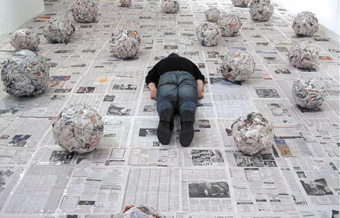
Franz Ehmann, speaking the world into existence, 2005, installation detail
photo Carl Warner
Franz Ehmann, speaking the world into existence, 2005, installation detail
ARTSPACE IS ABOUT TO EXAMINE THE COMPLEX LINKS BETWEEN PERFORMANCE AND INSTALLATION. CURATED BY ARTSPACE DIRECTOR BLAIR FRENCH, AFTERMATH: PERFORMANCE INSTALLATION FEATURES SIX PERFORMANCE ARTISTS—INCLUDING FOUR FROM AUSTRALIA, ONE FROM INDONESIA, AND ONE FROM THE UK. EACH WILL CREATE A PERFORMANCE IN ONE OF THE EXHIBITION ROOMS AND COMPLETE THEIR WORK WITH AN INSTALLATION THAT WILL REMAIN IN THE GALLERY IN THE WEEK FOLLOWING EACH PERFORMANCE, THUS CHALLENGING THE ARTISTS TO PROVIDE PROLIFIC IMPRINTS OF THEIR PERFORMANCES IN THE ENVIRONMENT OF THE EXHIBITION.
The participating artists are Guy Benfield, Anne Graham, Franz Ehmann, Tony Schwensen (all from Australia), Arahmaini (Indonesia), and André Stitt (UK). The weekly performance installations will be followed by performances from Yiorgos Zafiriou and senVoodoo (Fiona McGregor and AñA Wojak) also from Australia. Aftermath concludes with a Symposium in collaboration with Performance Space and RealTime at CarriageWorks. The program will be accompanied by a screening of international performance videos—including recent works from China—hence emphasizing the way performance art is frequently linked to a wide range of media, and paying attention to its inherent re-mediation.
Aftermath offers a welcome investigation of both time-based and spatial notions of performance art, by inviting artists whose works aim to address the enduring interactions between direct encounters with live performances and their intricate links to installation and video art. It thus provides a clear break with some of the more frequently addressed discourses on the post-productive qualities of performance art, particular in photography, which are often treated as mere documentations of the actual performance event, and which have become increasingly popular on the international market in recent years. Instead, Aftermath offers a more profound art historical approach by further tracing connections between performance art and conceptual art including, no doubt, links with Arte Povera and other post-WW II art movements, particular those of the 1960s and 1970s.
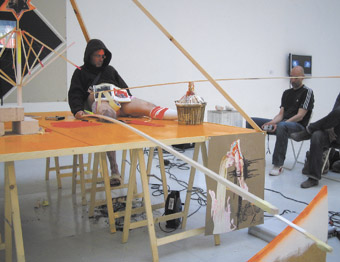
Guy Benfield, Stadium Redux Redux, installation performance, 2006
guy benfield
The first performance-installation will be by Guy Benfield. Titled Maximum Commune (Ugly Business…on the basis of disbelief), it will involve the artist playing out several performance scenarios that trace allegorical notions of ritual, early French and Japanese exchanges in action painting, arte informel, and modernist architecture of the 1960s. By re-animating time-based and culturally embedded style, form and technique, Benfield’s performances often force audiences to contemplate the perversion of collective trends.
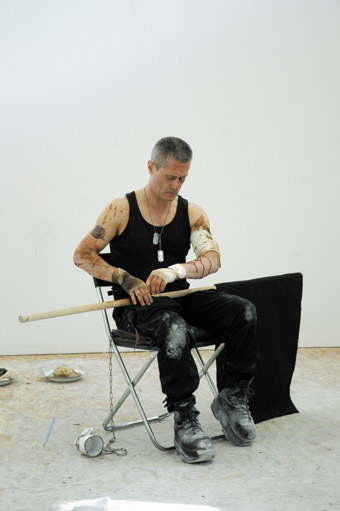
André Stitt, Nostalgia, Baltic Centre for Contemporary Art, Gateshead, UK, 2005
photo Manuel Vason
André Stitt, Nostalgia, Baltic Centre for Contemporary Art, Gateshead, UK, 2005
andré stitt
André Stitt’s performance, Dingo: A treatment towards a new communionism, will without a doubt raise eyebrows in the performance art community (and among some animal-rights activists). Stitt has proposed he be placed in a cage with a dingo, a direct reference to Joseph Beuys’ 1974 ‘coyote’ performance, I Like America, America Likes Me. Aside from providing a ‘communionism’ between Stitt/Dingo and Beuys/Coyote, the work will also invoke social-political and cultural-historic topics, particularly in relation to post-colonial trauma, cultural imperialism, and genocide. It will also be interesting to see how the performance deals with occupational health and safety regulations, animal-rights laws, and public sensibilities that will require a constant renegotiation of the real time performance.
To date it has been announced that Stitt will be “locked in a cage with a dingo at certain times over a three day period” and hence animal friends can be assured the dingo will also have some time off. Stitt’s performance may also address some of the specific issues surrounding the animal which was introduced to Australia by traders from Asia around 3,500-4,000 years ago (whereas the coyote is native to America). The dingo is certainly less of a mythical animal than the coyote, and rather than being seen as a ‘trickster’ it is treated as a ‘menace.’ I wonder if and how these distinctions will be dealt with in Stitt’s paraphrasing of Beuys.
anne graham
Aside from paying attention to re-animation, particular emphases in Aftermath will be directed to the displacement of culturally-embedded practices and daily routines into the gallery space. Anne Graham’s work, In Between Space, will transform Artspace into a residential home, comprising eight rooms: bedroom, kitchen, studio, library, living room, office, and gallery. Throughout the weeklong performance each of the spaces will be occupied and used for everyday activities, thereby instilling both intimate and familiar daily behaviour into the public environment of the exhibition space. Graham’s works provide ongoing research into individual and collective remembrance that becomes visualized in the way people conduct their lives in relation to space. By dislocating some of the clearly defined demarcations of private and public space and place, Graham is able to generate intricate social sculptures in which the audience circumscribes part of the work process.
arahmaiani
Addressing the collaborative aspects of performance art practice, Arahmaiani’s performance-installation, Make-Up or Break-Up, will combine an ongoing investigation into questions surrounding her identity as a female Muslim artist, in conjunction with local communities in Sydney. In preparation for the installation at Artspace, Arahmaiani will instigate the production of wall-sized banners of multinational company logos and brand names translated into Malay-Arabic script. These will be made by local communities and artists for public display.
This work follows on from recent collaborations in Germany, Malaysia, and Thailand addressing the polarization between the image of Islam in the international media and its everyday reality in Islamic communities. By blending Malay-Arabic script with corporate signs Arahmaini’s work will offer a rethinking of the way audiences in different parts of the world perceive culturally embedded symbols, especially following the September 11, 2001 attacks.
franz ehmann
The interaction between symbolism and meaning in relation to language will also be examined in the performance-installation, forever young, by Franz Ehmann. His works frequently offer rites of passage between natural and cultural worlds, making use of everyday objects, including food products and newspapers, which are transformed into ambiguous symbols that are reaffirmed through their use in the gallery space. In forever young, objects will be used as theatre props—a floor laid with a thin membrane of newspapers will form the main stage of the performance, and an interface between linguistic territory and semiotic space.
Guy Benfield, Stadium Redux Redux, installation performance, 2006
tony schwensen
Tony Schwensen will conduct a “hundred hour meditation on stupidity, nationalism, delusionism, the devaluation of manual labour in the Western world both socially and financially, and the rampant and thoughtless consumption that has accompanied it with its manifestations in contemporary Australia” (press release). Many of Schwensen’s works contrast cynical views on contemporary society with a certain optimism about the basic levels of the human condition, reflecting his ongoing interest in the work of Samuel Beckett who will be quoted on one of the walls at Artspace with his new year statement, “Hopes None, Resolutions None”, paraphrased by Schwensen as “Love it or leave it.” During his 100-hour performance Schwensen will conduct a variety of actions around matters of national concern, examining self-proficient solutions, such as in his planned performance of manual and automated water desalination.
yiorgos zafirou
During the final weekend of the Aftermath program performers will investigate the way the body is represented in performance-installations. The first performance is by Yiorgos Zafirou, whose recent work investigates the relationship between performance practice and ritualistic modifications of the body. Titled Malignant Mother, this new work follows on from a performance work of 2004 in which Zafirou had his nipples grafted so that they lost sense and became decorative badges that could be further modified.
senVoodoo
Fiona McGregor and AñA Wojak will present Font, a testimonial performance in which they violate their skin and bleed into a container of water to colour it red. The performances of senVoodoo reinvigorate iconographic displays of desecrated flesh to entice audiences to open their senses to corporeal levels of experience. However rather than delving into ritual their works provide references to more theatrical practices, and reflect on the formation of a “living installation.” Many of their performances are recurring works, held at various sites, and also involve re-mediation in the form of public screenings and video installations.
re-mediation
The way in which attention is given to re-mediation in the production of many contemporary performance works will also be evident in the screenings of performance videos. These will include recent performance art from China, which has attracted increasing attention in the international art world but has been rarely screened in public art venues in Australia. Included are durational performances by Ma Liuming, Zhu Ming, He Yunchang, Sun Yuan & Peng Yu, and Yang Zhichao.
symposium
Aftermath will conclude with an afternoon symposium that will trace some of the art historical discourses of performance art and open up new discussions on the experiences of the events of the preceding weeks. The symposium will involve local artists, scholars, and critics, as well as the two visiting overseas artists in Aftermath, Arahmaini and André Stitt.
Aftermath: Performance Installation, Artspace, July 5- August 18; for program go to www.artspace.org.au
Schwensen and Stitt will also be creating a performance installation at Campbelltown Art Centre in August.
RealTime issue #79 June-July 2007 pg. 8
© Thomas Berghuis; for permission to reproduce apply to realtime@realtimearts.net
A LIVE ART DEVELOPMENT AGENCY. I WISH WE HAD ONE OF THESE IN AUSTRALIA FOR CONTEMPORARY PERFORMANCE. ESPECIALLY NOW THAT THE TIME_PLACE_SPACE LABORATORY HAS BEEN KILLED OFF. ARTS NEW SOUTH WALES HAS GROWN A UNIQUE DANCE-NURTURING RESEARCH LABORATORY, CRITICAL PATH. AUSTRALIAN THEATRE HAS GAINED A FRESHLY ENGINEERED PLAYWRITING AUSTRALIA [POST THE CULLING OF THE AUSTRALIAN NATIONAL PLAYWRIGHTS CENTRE AND PLAYWORKS]. HOPEFULLY PLAYWRITING AUSTRALIA WILL ADDRESS A RANGE OF PERFORMATIVE WRITING [AS PLAYWORKS SOMETIMES DID] IN LINE WITH WHAT CAN NOW BE ACTUALLY EXPERIENCED IN OUR THEATRES AND ART SPACES.
I’m not yearning for a centralising organisation but a facilitating one which can keep artists and companies in the information, inspiration, skills, ideas and touring loops vital to established and emerging work across Australia’s still intimidating distances. England’s Live Art Development Agency (LADA) directed by Lois Keidan and Daniel Brine is an impressive, idiosyncratic example of what a small organisation can achieve as collaborator, conduit and cultivator. It is now going national and has international ambitions.
flourishing & fragile
On our 2006 UK visit the RealTime editors encountered what appeared to be a flourishing contemporary performance ecology entailing live art and experimental theatre. It is supported by LADA; by the networking of Live Art UK, Guardians of Doubt, and the online New Work Network; festivals (National Review of Live Art, Inbetween Time, The Cat Show, SPILL, Fierce); venues (Greenroom, Arnolfini, Bluecoat, Tramway, Tate Modern, Chapter Arts Centre); bursaries and free advisory service (LADA, Arts Admin); book publishing (LADA with various publishers); archives (Live Art Archives, Bristol University, Tate Modern, LADA); strong academic interest (Centre for Performance Research, University of Aberystwyth; Dartington College of Arts, Devon); regional distribution of funding, and a cluster of ‘star’ performers—Bobby Baker, Kira O’Reilly, Curious, Joshua Sofaer, Franko B, Duckie, Pacitti Company, Shunt, Forced Entertainment and related artists, like photographer Manuel Vason.
As remarkably supportive as this all seemed and, in the best sense, institutionalised, we were left in little doubt that it constituted a fragile ecology—small grants, a limited number of responsive venues, a shortage of creative producers, no magazine focused on contemporary performance and little press coverage, the work mostly project-based and created by a multitude of vulnerable often self-subsidising artists. That fragility has become suddenly and brutally real. Arts Council of England Grants for Artists Funding has been cut by 35%, in order to shore up funds for the 2012 London Olympics.
Key live art funding had come principally from the ACE’s visual arts wing but the Live Arts post was recenty axed, “a loss”, writes Daniel Brine, “with serious repercussions.”
Brine reports that “Arts Council funding cuts have already begun to bite within the sector with a number of projects that you would expect to be funded failing to get support.” He worries that “this may not be the end of Grants for Artist cuts as more Lottery money may be allocated to the Olympics in the future, necessitating more cuts. At the same time the arts sector is very pessimistic about the Government’s Comprehensive Spending Review, the outcome of which is due to be announced in the autumn…The existing cuts to Grants for Artists and the potential of further cuts are very serious for our sector because we all depend (probably more than other sectors) on project funding. If there is no change to this funding situation then by 2012 and the Olympics our sector will be stretched very thin indeed.”
everything you need
Back in 1997, at another critical moment, the ICA revamped its renowned live art program. Its curator, Lois Keidan, left and put in a successful tender when the Arts Council of England sought bids for an organisation to provide support for live art. The Live Art Development Agency was set up by Keidan and Catherine Ugwu in 1999 and, since 2001, has been run by Keidan and Daniel Brine, with Andrew Mitchelson joining in 2006 as company and resource manager. Freelance project directors join for the lives of projects. LADA is based in the Rochelle School building on Arnold Circus in Shoreditch, East London.
LADA describes itself as offering “a portfolio of resources, professional development schemes, projects and initiatives for the support and development of live art practices, and discourses in London, the UK and internationally.” It commits “to supporting high risk artists, practices and ideas of contemporary culture and particularly the practices of emerging artists, and artists from culturally diverse backgrounds.”
“Everything is strategic at the Live Art Agency”, says Brine, “especially in curatorial projects…We work by consultation, always through partnerships, we seek a lot of input and offer free advice—without economic barriers.”
The Arts Council of England devolved funds to LADA so it could offer seven bursaries per annum of nine thousand pounds each for an activity, not a finished work, for example Brine tells us, Ernst Fischer took a course in butlering developing his new work on servitude. The funds could also be used to work with a senior artist as mentor. Unfortunately, ACE ceased this funding in 2005. There is 10 thousand pounds for artists to set up training courses for other artists—the DIY progam, 15 projects across the UK including one led by Australian Barbara Campbell.
On the premises there’s the much used and very comfortable Study Room extensively stocked with live art performance on VHS and DVDs, large monitor, books and magazines, including RealTime. There are associated Study Room Guides available on The Body in Performance; Performance, Politics, Ethics and Human Rights; Site and Space In Performance [a guide created by Gregg Whelan of Lone Twin that takes the form of a series of short texts written in response to key works in the Study Room]; Performance and Activism; and, forthcoming, Richard Dedomenici’s guide to performance posted on YouTube, and Socially and Politically Engaged Performances written by Robert Pacitti. Some of the guides can be downloaded from LADA’s website.
LADA’s strategies include joint publishing, practitioner meetings around the country, hosting the Live Art UK consortium, and organising the successful China Live tour and book in 2005, partnered by a number of venues. LADA continues to be involved with Bluecoat artspace in the Liverpool Biennale live art program and has collaborated on the De La Waar performance program, Performance Studies International and, in 2003, in the Live Culture program at the Tate Modern.
recruitment
There’s even a recruitment aspect to the organisation’s program. LADA provides talks and lectures on live art for upper school and university classes. Then there’s Everything You Wanted To Know About Live Art But Were Afraid To Ask, a touring information and advice day aimed at recent graduates, emerging artists and interested persons. For the first time, the tour has gone national in 2007. Everything… is part of Joining the Dots, a Live Art Development Agency professional development initiative for artists across the UK.
expanding niches
LADA’s latest book, Programme Notes, Case Studies for Locating Experimental Theatre, was recently launched by Forced Entertainment’s Tim Etchells at the Fierce Ten Festival in Birmingham. Edited and published by LADA, it’s “about furthering dialogues and collaborations between the theatrical mainstream and artists from the independent sector… [focusing on] models of exciting and innovative relationships at work in different places in the UK.” Using case studies, interviews and essays the book “explores the ways in which contemporary theatre is changing through new relationships between mainstream venues and experimental practices.” It has been devised as a resource for “theatre programmers, artistic directors and venue managers, with the aim of sharing knowledge and stimulating thinking around a broader range of new and emergent theatrical practices.”
LADA sees much of its work as infrastructure building with Live Art UK playing a key role in coordinating and developing a national perspective, commissioning works and “addressing different ways of touring—adapting to situations.”
the word
London-based live art practitioner, writer and teacher Joshua Sofaer ran the Live Art UK critical writing course, Writing for Live Art, for 6 writers meeting on weekends in 2006. New writers are joining the program in 2007. Leading the program is an opportunity, Sofaer told us, to rectify a situation where it “can be impossible to get a review in the ghetto of live art….Many of my peers have never had a review.” The aim of the project has also been to provide brokerage so that the writers’ work can be placed, given publishing opportunities are few. Daniel Brine reports that, to this end, Live Art UK recently held a meeting with editors and writers from Frieze, A-N, Total Theatre, Guardian, Wire and Dance Theatre Journal.
Another Live Art UK initiative is the Live Art Almanac, to be published in May 2008 by LADA and Live Art UK with financial support from the University of Leeds. Editor Phil Stanier and his team will gather together “the most engaging, provocative, thoughtful writing about live art and the cultural landscape in which it is set.”
Sofaer attributes the visibility of live art to the vision and hard work of the Live Art Agency’s Lois Keidan, but getting the term into common parlance has been difficult, he said. Sofaer’s five-minute video, What is Live Art? was made for public distribution during Live Culture. He also made a box of instructions for DIY Live Art, the Performance Pack, for the Live Art Development Agency and Tate Interpretation and Education in 2004. The limited edition quickly sold out. RealTime holds one box on behalf of the Live Art Development Agency for use by Australian artists.
event creation
As well, LADA produces forums and events for other organisations. In March this year it was commissioned by Tanzquartier Vienna to create a three-day live art program, Performing Rights Vienna, featuring performances, presentations, debates, workshops, screenings and interventions about the relationships between performance and human rights and between art and activism and will create a similar program for the 2008 NRLA in Glasgow. In April this year LADA collaborated on a symposium for the SPILL festival in London.
books and burnings
LADA sells book, DVDs and other materials through its online sales wing, Unbound. Brine says it’s not going to make LADA a lot of money but that it’s been well received, “in particular, we have been surprised by the very good international response. Our next step is to begin to focus more and more on self-publishing and we are very keen to develop a market for DVDs from artists and burnt on demand.”
going international
“Over the next twelve months”, writes Brine, “we plan to work on our international strategy. We are developing Live Art Unpacked, which is the working title for a tool kit for international promoters and venues consisting of workshops, lectures, screening programmes, The Performance Pack and DIY projects. We think there will be two versions: Live Art Flat Pack (easy-assemble without our presence) and Live Art Development Agency in Residence (our formats and programs and us making them work in local situations).
how it’s done
I wonder about the division of labour that makes all this prodigious effort workable. Brine replies, “Lois and I have been working together for over five years now and we’ve developed a collaborative working method that works well for us. Basically, we both do everything together although there will be times or situations when one or the other will take the lead. Andrew has been a fantastic addition and he makes sure things run smoothly, especially the Study Room, Unbound and our financial records.”
The Live Art Agency does all the above and more, making the most of partnerships and building on and expanding networks, fuelling (and being fuelled by) live art and experimental theatre artists, and bringing new blood and mainstream venues into play. And it’s not about power, but about enabling and, yes, everything is strategic.
Live Art Development Agency,
www.thisisliveart.co.uk
www.thisisunbound.co.uk
RealTime issue #79 June-July 2007 pg.
© Keith Gallasch; for permission to reproduce apply to realtime@realtimearts.net
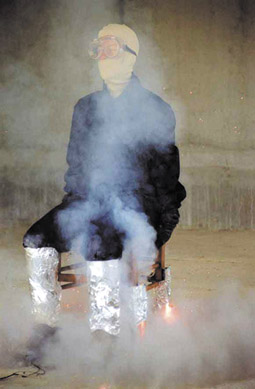
Gwendoline Robin; NRLA2007
photo Pierre Laborde
Gwendoline Robin; NRLA2007
NOWADAYS FIREWORKS REGULARLY BOOK-END ALL KINDS OF FESTIVALS, SENDING UP A WHOOSH! OF EXPECTATION AT THE START AND A WHIZZ-BANG OF ‘WASN’T THAT GREAT?’ AT THE END. BUT, TRUE TO TYPE, THE NATIONAL REVIEW OF LIVE ART 2007 OPENED AND CLOSED ON AN OUTBURST OF THOROUGHLY UNTOWARD PYROTECHNICS. ON A GRIMLY NIPPY FEBRUARY NIGHT, A DUTIFUL AUDIENCE TROOPED OUTSIDE TO THE GARDEN AREA BEHIND GLASGOW’S TRAMWAY COMPLEX. AND THERE THEY WAITED. REGISTERED THE ARRIVAL OF A FIGURE IN WHAT LOOKED LIKE A WHITE SPACE-SUIT. MAYBE THOUGHT ‘HEALTH AND SAFETY’ AS THEY TOOK IN HER PROTECTIVE CLOTHI…OH MY GOD—A LIGHTED FUSE. A SWIFT-FIZZING RUSH OF SHOOTING SPARKS, HALO-ING A HUMAN FIREWORK. AND WE LAUGHED LIKE CRAZY CHILDREN AND CHEERED THE BELGIAN ARTIST GWENDOLINE ROBIN AND TROOPED INSIDE AGAIN, CONFIDENT THAT THE FIVE DAYS THAT LAY AHEAD WOULD BE CRAMMED FULL OF METAPHYSICAL SQUIBS AND FIRE-CRACKER CHALLENGES AND PEOPLE DOING RECKLESS STUFF OF THE ‘DON’T TRY THIS AT HOME’ VARIETY.
Afterwards, as the smoke cleared, the resonances of Robin’s work started to take disconcerting hold: nudged aside the hip-hooray sideshow effect and threw up other incendiary images—the suicide bombers, the self-immolaters who torch themselves in protest, the blazing victims of napalm attacks. By the time Robin ended NRLA 2007 with another risk-taking act of self-ignition, all manner of performances—some very still, others verging on the hyperactive—had echoed her flair for twisting the everyday into the unexpected. Had, like Robin, startled us into laughing, before choking the laugh in our throat with a sudden image of pillaged societies or humanity at bay.
Unlike Robin’s Instant no 6899, however, some of the most shattering and thought-provoking pieces made powerful use of still, small voices to whisper of lives pillaged by injustices and oppression. Indeed, Chumpon Apisuk (from Thailand) called his first action Silence. Long before Apisuk was even half-way through his performance, we had cottoned on to the rhythm and intensity of a reverencing ritual dedicated to those whose human rights had been violated in his native land and beyond. Even so, there was no foreseeing the litmus shadings of grief and respect that filtered across his face as he addressed the twenty or so knives arranged down both sides of a dinner table, bowing as he placed his cheek against each blade before placing it on the newspapered floor. No names were ever spoken. The newspapers became shrouds, or maybe just the wrapping for discarded detritus…the little bundles looked like bodies destined for unmarked graves. Apisuk’s Silence built into a visual scream of outrage and reproach without one word of a rant. It continues to haunt me.
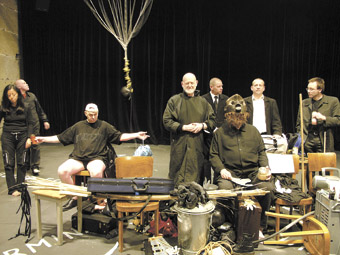
Black Market International “Actuation” reproduced with permission of BMI
So do certain fragments from the productive melange of ‘collision and collusion’ that arose from the five day residency by Black Market International (BMI), a multi-talented collective of international artists who turn up with various props and processes and then morph into an ad hoc ideas factory. Lee Wen, for instance, took to barrelling out of BMI’s designated space—a vast, white hanger-like gallery—and buffeting through the foyer crowds, his half-naked wiry frame encased in a raggedy tent, like some refugee snail. You had to smile. He looked ridiculous. But then the awful pathos of his mute wanderings between laden cafe tables and among our camera-toting, mobile-phoning ranks stopped being funny. And you knew he knew that—in real life, if not at the NRLA—you probably turned away from such silently accusing images.
Alastair MacLennan’s continuous 24 hour action saw flowers wither away in a greenhouse where the floor was strewn with unfinished shoes. Nearby, a burnt-out car gradually silted up with rusting mechanical debris while its exterior became host to photographs of endangered species—a paper trail of flimsy white footprints leading from the greenhouse hinted at man as the user and abuser: indeed he was occasionally present in the driving seat of the useless vehicle, going nowhere but still hell-bent on ignoring all the warning signs around him. Again, there was no morally superior spoken diatribe to kickstart our consciences—only an eloquent juxtaposition of objects and actions.
A recent trip to a post-Tsunami Sri Lanka had certainly proved something of a cultural eye-opener for Ian Smith, a thoughtfully mischievous interventionist of longstanding and NRLA’s genially suave MC. His video installation, Médecins Sans Frontières, presented him as a talking head in a bed strewn with tabloid clippings, all trumpeting of a Britain awash with street crime, domestic violence and racist bullying. You had to move close up, to catch Smith’s sickbed musings on his Sri Lanka experiences—especially the acts of kindness and caring from impoverished strangers who were, themselves, the needy victims of earthquake, flood and devastation. Humorous, mostly at the expense of his own attitudes and expectations, this was a soft-spoken, needle-sharp reminder of what is best meant, and achieved, by common humanity.
Elsewhere, Marie Cool padded silently through the dimly-lit reaches of Tramway 4, reiterating her exquisitely simple tasks—letting a flame travel along a length of thread, animating sheets of white paper with gentle exhalations of breath or the passing wake of her own moving body—until she had drawn her circle of onlookers into an oasis of meditative calm. Cool’s demeanour is that of a sweetly grave, if solitary, child who is possessed of a wide-eyed, lateral imagination and an uncanny degree of physical poise: it’s a combination that can make inanimate objects come alive and time pass… at… other-worldy… speeds. Bliss.
Marcia Farquhar has so far clocked up 49 action-packed years—she has the anecdotes, and the wardrobe, to prove it. Hers is not actually a still, small voice. She’s too succulent and exuberant an individual to be caught muttering or lost for words. But her funny, feisty solo show, in which she modelled her past—with a running commentary on the where, when and why of each frock—proved to be a surprisingly touching essay on the socio-political side to fashion and how we cloak our vulnerabilities by dressing up, or down. Sheila Ghelani and Jenny Edbrooke—emerging artists beginning to gain profile and experience—were outstanding examples of how you can air chewy, underbelly issues of identity without standing on a soapbox, hollering your politics to rapidly vanishing backs. For her solo, What Goes Up Must Come Down, Edbrooke had her back to the wall with thighs splayed around a tin bucket. Think coconut shy—oh look! there’s a table piled with coins, a carrot, bottles of booze, condoms, a turkey baster… objects rife with sexual innuendo that we were invited to lob at her bucket-crotch. Har-de-har-har, what a hoot—until the punchline, when Edbrooke asked, brightly, if we’d like to stay in touch with her? Message received, loud and clear, Jenny.
Sheila Ghelani’s message was one of love—between her parents—and pride, her own, in being a product of a mixed race marriage. Her method involved the ritualistic halving of red and green apples, then melding the two varieties into wittily decorated mythic hybrids—the Cyborg, the Griffin and so forth. Her ‘apple-parentage’ was rich with mixed spices, sparkles and, at its heart, a drop of her own blood. Such a gentle, whimsical way of leading up to her closing statement, an affirmation of her joy at being born out of two cultures.
Across the five days voices were, of course, raised in stentorian banshee protests. Glass was smashed, bodies bruised and made to bleed, as performers vehemently denounced the evils of their choice: cultural imperialism, the war in Iraq, bigotry and discrimination—racial, religious, sexist—were the usual suspects and some very powerful work arose from these concerns. But not every memorable firework was a rocket or a banger—many of the brightest sparks chose to ignite our hearts and minds by the depths of their silence.
National Review of Live Art, Tramway, Glasgow, February 7-11, www.newmoves.co.uk
RealTime issue #79 June-July 2007 pg. 12
© Mary Brennan; for permission to reproduce apply to realtime@realtimearts.net
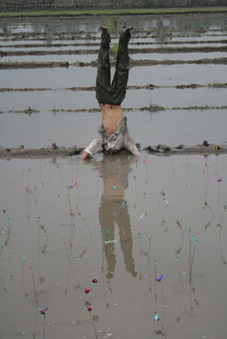
I Gede Made Surya Darma (Indonesia – Bali)
photo Dolly
I Gede Made Surya Darma (Indonesia – Bali)
LOCATION: GEMBLANGAN VILLAGE, BANTUL, YOGYAKARTA, INDONESIA. PURPOSE: TO CREATE A TEMPORARY ART VILLAGE IN THE SPIRIT OF SOLIDARITY AND SPIRITUAL RENEWAL AFTER LAST YEAR’S DEVASTATING EARTHQUAKE.
Organisers: The Performanceklub, a group of local artists committed to bringing art out of conventional art spaces into public places. They have developed a close relationship with the people of Gemblangan since carrying out volunteer relief work there.
Performance Map: The tiny village is a circular island surrounded on all sides by rice paddies. A path follows the small river (irrigation channel) around the perimeter of the circle. Only two roads cross in the centre of the village. The mosque and cemetery guard the back road into the village. The Jamu House (jamu is a traditional medicinal drink) stands at the main entrance. (This village is also famous for cobra-snake medicine). Rebuild-ing is going on all around but many families are still living in the ruins of their old houses in bamboo shacks provided by aid organizations.
Program: Artist performances, traditional local performances, seminars on organic farming, recycling, first aid, cultural and spiritual values, an excursion to Borobodur Buddhist temple, a dangdut concert finale (popular sexy Indo-Arabic music).
Village Hosts: House and feed over sixty artists and volunteers for five days. Mr Gyanto (Mr Jamu) is the main mover and shaker. Plus the women’s food collective, security, other volunteers, billets.
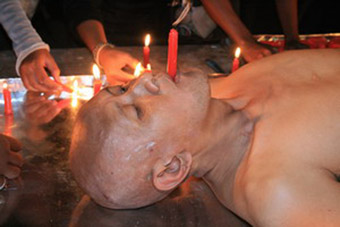
W. Christiawan (Indonesia – Bandung)
photo Dolly
W. Christiawan (Indonesia – Bandung)
day 1
11am. Traditional Welcome: Local dignitaries including Bantul Regent, Mr Idam Samawi, and guests arrive. All the villagers in traditional dress line the roads. Village men sing and play traditional Islamic songs. Mr Samawi gives a passionate speech—Bantul says no to malls and globalisation! Visiting artists are brought to the stage and given a plain coloured flag to use in their performance.
1pm. Traditional Performance: Jathilan—young boys in gaudy costume, makeup and riding toy horses perform traditional trance dances that go on for several hours. The whole village attends. The trance master is particularly fascinating. One of the international artists accidentally goes into trance. The trance master is called away to assist. A crowd follows. She recovers, with a bad headache.
5pm. Location Meeting: Artists decide on location and time of performance. Volunteers draw up map and timetable.
9pm Gejong Lesung: Traditional music shows about the history of the land by women from a neighbouring village.
day 2
11am. Seminar: Importance of cultural and spiritual values in maintaining independence/autonomy in a global world. The head of local Islamic boarding school, Mr Djawis, a former Minister for Culture, Mr Marzuki and myself discuss spirituality, tourism, economics and performance.
3pm: Art Performances begin. Lewis Gesner, USA, 2 hours, all around the village. Arrives with a ball of string and a pair of scissors, walks, collects objects, ties them to string, ties other end to his leg, walks slowly again, collecting and dragging objects behind him.
3.20pm. Maya Pasternak, Canada/Tel Aviv, video interviews with villagers as they work, continuous over 3 days. Begins in southeast part of the village.
3.45pm. I Gede Made Surya Darma, Bali, walks into the fallow rice paddy near Jamu house carrying bunches of plastic flowers. On closer examination we see they are small toy soldiers, tanks and planes on long stalks. He plants each stalk slowly and methodically in lines. After a while others wade into the water to help. When all are planted he “plants” himself by standing on his head on the paddy bank.
4.10pm. Harumi Tereo, Japan, south end of village, places coloured squares of paper on the low wall next to irrigation channel. Rearranges them, using only her toes. Lies down on them and performs “a feet, arms and hand dance”, changing position from front to back and side to side.
4.30pm. Mayumi Ishino, Japan/New York, on the west side of the village in the cow and sheep corral. Draws a self-portrait on a mirror hung on a tree trunk. Animals baa and moaaah in chorus. When she has finished the portrait she takes out a hammer and smashes it. Then walks away with it under her arm. She repeats this every day in different locations with a finale of four or five in a row in a central location near the kitchen.
4.50pm. Bruno Mercet, France, next to a villager’s house on south west corner. Bruno wears only his flag around his waist. It doesn’t quite cover all of him. Organisers go into a slight flurry. It’s not kosher to be naked in a Muslim village. But no one is bothered. He’s a westerner after all. He plays with an old door, climbing in and around and through it then writes a greeting to his host on the top of the door. His host, a tiny old lady, laughs a toothless smile.
5.00pm. Huang Ming Chi (Mickey), Taiwan, at a house near the crossroad gives a massage to a village woman. She waits at the door telling the audience she won’t start until exactly 5pm. She sets her timer and leaves it outside the house. She enters, gives the massage for allotted time and leaves when timer goes off. She does an activity like this each day with a villager; helps in rice fields and in the collective kitchen.
And So On Into The Night, followed at 9pm by a Dzikir Saman—a religious show of song and dance.
Days 3, 4, Continue As Above: same daily schedule with works from other international and local performance artists: China—ShaoYan Xin, Qing Sheng Ming, Wang Jian; Surabaya—Illham J, Bidai, Aye Ko; Jakarta—Santo Clingon; Bali—I Kadek Dedy Sumantra Yasa; Japan—Shinya Misawa, Seiji Shimoda, Makoto Maruyama, Sakiko Yamaoka, Yoshie Baba; Yogyakarta—Sindu Cutter, Emilia White, Bocor Alus Group, Buyung Mentari, Ronald Apriyan, Lepan, Rachel Saraswati, Yudha Coklat, Iwan Wijono, Arahmaiani; Australia—Patrick O’Brien, Jan Cornall; Bandung—Ferial Affif, Isa Perkasa, Deden Sambas, W Christiawan; Singapore—Lee Wen, Jeremy Hiah, Kai Lam, Agnes Yit; Solo—Choiri, Satriana Didik, Ozy; Myanmar—Aye Ko.
Audience Response: Many of the villagers are quick to engage with the performances—joining in and helping out with props and logistics. Audience from Yogyakarta come and go—more there in the evenings. A moving feast of press and avid documenters follow like a paparazzi pack.
day 4
An Unexpected Performance Event. On Day 3 an elderly lady of the village dies. We go to pay our respects. On Day 4, prayers are sung across the village all morning. Masses of people arrive from other villages. We are invited to take part in the funeral procession. Lewis and Bruno help carry the coffin and myself, Mickey, Agnes and Maya, with young village women, carry flower petals, flower water, stakes and banana leaf parcels to the grave side.
day 5
Excursions to Borobodur and Parangtritis Beach
2pm. Final Session. Villagers and artists agree it has been a valuable and unforgettable experience. Visiting artists thank their hosts and promise to return.
5pm. Performance by Sangar Rumah Kardus & Andi O. Earthquake Victims Kids Group.
9pm. Dangdut Concert Finale. Draws an audience from surrounding villages. Westerners learn some sexy moves from the Dangdut Divas. Retire to the Green Room (Jamu House) when they can dance no more and see in the dawn over the rice paddies before catching flights home.
post festiva
l
In an email a few days later from the USA, Lewis Gesner summed it up beautifully. “Placing performance art in a cultural setting of traditional music and dance and a physical setting of a village on the cusp of globalisation was a brilliant construction…for moving forward positively as people and neighbours in a world that is becoming an increasingly smaller village, for better, or worse. Perfurbance#3 pointed to a better village, and hurray for that!”
Perfurbance #3, Yogyakarta, Indonesia, April 25-29
RealTime issue #79 June-July 2007 pg. 14
© Jan Cornall; for permission to reproduce apply to realtime@realtimearts.net
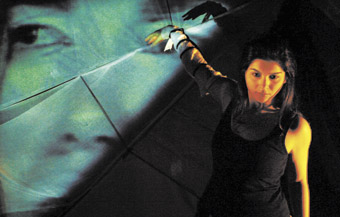
Olivia Crang, Senseless (creative development)
photo Shane Bell
Olivia Crang, Senseless (creative development)
SINCE IT WAS ESTABLISHED IN 2003, THE SPARK PROGRAM HAS SEEN 35 YOUNG ARTISTS THROUGH ITS PROFESSIONAL DEVELOPMENT PROGRAM. AN INITIATIVE OF THE AUSTRALIA COUNCIL AND RUN THROUGH YOUTH ARTS QUEENSLAND (YAQ), SPARK TEAMS UP EMERGING ARTISTS (18-26 YEARS) WITH ARTIST MENTORS, PROVIDING TRAINING, ADVICE AND IN SOME CASES EVEN A LITTLE BIT OF FUNDING TO KICK-START A PROJECT. SIX ARTISTS WHO HAVE HAD THE SPARK EXPERIENCE IN 2005-2006 ARE SURVEYED HERE TO GAUGE THE IMPACT IT HAS HAD ON THEIR PRACTICE.
the projects
Animateur, writer, director, performer Olivia Crang invited David Pledger from Not Yet It’s Difficult to be her mentor in establishing the performance company x:machine. Crang worked with Pledger’s NYID on his latest project apoliticaldance (RT 77, p41, 42). “I liaised with various members of the company while observing rehearsals, as well as organising marketing, publicity and front of house aspects of the production…It offered me the chance to reflect upon my own dramaturgy and working methodologies. [David] has a great way of raising fundamental issues and questioning how his art tackles them…By giving me the chance to become actively involved in his processes, I have picked up on some of his strengths.”
Western Australian dancer choreographer Aimee Smith worked with Andrew Lake to develop a 20-minute solo dance work called Courageously Heroic Gallantry performed by Aisling Donovan (RT78, p33). “I wanted to use this creative process to develop my skills, focusing on the integration of digital media and contemporary dance… With such tight time and financial restrictions new works are often premiered underdeveloped, but with this project I felt…I was that step closer to realising a concept.”
Also in WA, director Matthew Lutton set himself up with Artrage’s Marcus Canning as mentor to help his company ThinIce to create their first self-devised (as opposed to pre-scripted) work, The Gathering (RT70, p15), and to guide the company through a key growth period. “I was preparing to apply for our first annual program of activities, so I needed to learn a lot of new skills about setting up company structures…It was about having an outside eye, and a support network…someone who was objective [about] my artistic process, but was intimate with my work and aesthetic.”
Megan Sarmardin met composer and instrumentalist John Rodgers when she was performing in Bob Cats Dancing for the 2004 Queensland Music Festival. She subsequently asked him to help her develop a music theatre piece based on her family history. “Out of this project we worked together to develop the show and two songs; Little Birung (about my great-great grandparents fleeing from the authorities) and No Where to Hide (the experience of what I thought my great-great grandmother went through when she saw non-indigenous people for the first time).” Through the project Samardin was able to develop both her songwriting and performance skills. “I’m more confident in performing. I have worked with a number of musicians thanks to [John’s] musical knowledge and networks.”
Teik-Kim Pok is a Sydney based artist who worked with Rolando Ramos to create the video design for PACT Youth Theatre’s production Before the Lights Go Out (RT71, p32) at the Sydney Opera House. He was particularly interested in Ramos as their career trajectories were similar. Both started as performers and shifted into video work. Pok drew on Ramos to develop technical skills but also to have “conversation[s] about the role of the multimedia artist in the collaborative dramaturgy of the live performance we were working on…I managed to get a better idea of what my performative aesthetic was in an overall sense rather than actually splintering my identity as performer and then multimedia creator.”
As of 2006 SPARK opened its doors to visual artists as well. Queensland artist and curator Bree Jackson was able to draw upon the skills of Raw Gallery’s Rob Kelly, working as the exhibitions co-ordinator as well trying her hand at curating a major exhibition: You Are Here. “The fact that my SPARK experience was project-based really helped with being able to draw on actual experiences and questions to approach my mentor with…Being part of [it] has definitely helped me to make people more aware of my practice and abilities and kick-start my practice as an emerging curator by getting my name out there.”
the caffeine catalyst
At the beginning of the ten month program, YAQ co-ordinates a formal three day planning session where all the mentors and mentorees come together. There is an expectation that meetings between the mentor and mentoree will take place every few weeks, but beyond that how the relationship transpires is up to the individuals. Most of the six artists surveyed believe that coffee was the best catalyst for their information exchange. Jackson says, “My mentorship with Robb was really laidback. We had casual meetings to discuss the project and basically just had a chat about where I could go from here, how I should approach each situation.”
Smith says, “We would chat about ideas related to the work and my practice, and other times we’d chat about things completely unrelated. The more regularly we did this, the more information was exchanged, the more we got to understand each other’s practice, and the deeper the mentorship grew.”
For Lutton being able to get all his ideas out to an eager experienced ear was vital. “I am notorious for having too many ideas swirling around in my head… a lot of the time Marcus would just let me talk through my plans, and he would then encourage me to be more precise and succinct. He would help me clarify my goals.”
For Samardin, trust and mutual respect is the key to their successful relationship, “to communicate with one another on both a professional and personal level. I trust [John] enough to tell him feelings about certain events/experiences in my life, then we make it into a piece of music/work.”
professional profiling
In addition to the artform specific wisdom that mentors were able to share, all the mentorees talk most positively about the networking and profile opportunities that came from these professional relationships. Crang states that it has put her in “closer proximity to the networks, resources and knowledge that I need to develop, engage with and extend my practice.”
Bree Jackson says, “With direct support from YAQ and the…Australia Council [connection] it was definitely easier to get important industry professionals and contacts along to the exhibition…From my involvement in SPARK I have made some great contacts and networks that I could call on for future projects.”
For Smith and Pok it was important to connect with peers. Teik-Kim Pok says “to meet other artists from around Australia of my age, who were looking to develop their own practice in a similar spirit in different artforms, gave further definition and context to my ideas and process.” It was a similar situation for Lutton who met his latest collaborator through Canning: “I am currently creating a new version of Antigone with local song writer and performer Rachael Dease, and it is a result of my mentorship that this connection was made.”
up and running
The all important factor of development programs is what happens afterwards.
All of these mentorees still have active engagements with their mentors. Crang meets Pledger once a month for feedback and discussion, Jackson still works for Kelly at Raw Space and is now on the board, Samardin has been working with Rodgers on a variety of projects, and Lutton’s offices are based at Artrage with Canning. Lutton states that his relationship has shifted subtly from mentor to colleague: “The mentorship certainly set up a relationship…and I know that Marcus is someone I can always turn to for advice and feedback.”
When you look at the projects the 2005-2006 participants have on the boil, the results of SPARK are impressive. As well as a string of directorial projects including The Lady Aoi for Black Swan Theatre and Perth International Arts Festival (RT 79 online), Lutton’s ThinIce company is applying for its second round of annual programming funding from ArtsWA. Lutton is also off to England to work on a contemporary opera for Aldeburgh New Music after which he returns to assist Neil Armfield on Michael Gow’s Toy Symphony. Olivia Crang’s x:machine launched in March and is working on Senseless, a collaborative piece for 25 artists of different disciplines conceived online for the Melbourne Fringe Festival, and Serial Blogger for Next Wave 2008. Megan Samardin is developing a proposal for the 2007 Gympie Muster as well as working on corporate gigs like the Department of the Premier’s Reconciliation Business Awards and making her demo tape. Bree Jackson continues to work at Raw Space, is the Exhibitions Assistant at Institute of Modern Art (IMA), as well as applying for other curatorial projects. Teik-Kim Pok is off to Guillermo Gómez-Peña’s La Pocha Nostra Summer School in Tucson, Arizona courtesy of a RunWay emerging artists travel grant. And Aimee Smith, along with tripping over to Taiwan to choreograph a work for the Taipei National University, has joined the EPIC program (Emerging Producers in Community; RT 73, p9) to work with AWESOME Arts in regional communities in WA.
With similar achievements for many of its participants, the SPARK program seems to be fulfilling its brief to “fire up young artists”, and there are now 12 more with the announcement of the 2007 participants. Let’s hope that small and sporadic funding and the general insecurity of life in the arts in Australia doesn’t extinguish the flame.
* * *
2007 SPARK teams are Yusuke Akai (QLD) & Jim Denley (NSW), Aisling Donovan & Sue Peacock (WA), Ashley Dyer & Margery Smith (NSW), Ofa Fotu & Steve Bull/Kelli McCluskey (WA), Amber Haines & Stephanie Lake (VIC), Luke Haralampou (QLD) & Morgan Lewis (NSW), Ming-Zhu Hii & Melanie Beddie (VIC), Gareth Hudson & Art Phillips (NSW), Alisdair Macindoe & Lucy Guerin (VIC), Paul Morrison (NSW) & Brian Lucas (QLD), Lara Thoms & Caitlin Newton-Broad (NSW), Willoh Weiland & Roger Alsop (VIC)
SPARK, Youth Arts Queensland; www.yaq.org.au
RealTime issue #79 June-July 2007 pg.
© Gail Priest; for permission to reproduce apply to realtime@realtimearts.net
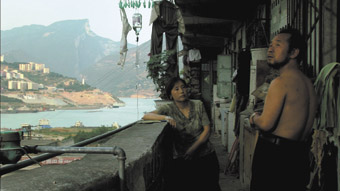
Jia Zhangke, Still Life
AFTER TAKING OUT THE GOLDEN LION AT VENICE LAST YEAR AND THE JURY PRIZE AT ADELAIDE IN MARCH, JIA ZHANG-KE’S STILL LIFE PROMISES TO BE A HIGHLIGHT OF THE UPCOMING SYDNEY FILM FESTIVAL. RELATIVELY UNKNOWN OUTSIDE THE FESTIVAL CIRCUIT HERE IN AUSTRALIA, JIA IS ONE OF CHINA’S KEY ‘SIXTH GENERATION’ FILMMAKERS, A GROUP WHO CAME OF AGE DURING CHINA’S TUMULTUOUS TRANSITION FROM ISOLATED COMMUNIST STATE TO MARKET-DRIVEN INDUSTRIAL POWERHOUSE. JIA IS NOT CONCERNED WITH CHINA’S ECONOMIC SUCCESS HOWEVER—HIS OEUVRE OF FIVE FEATURES TRACES THE FALLOUT OF CHINA’S TRANSFORMATION FOR THOSE LIVING ON THE SOCIAL AND GEOGRAPHIC PERIPHERY OF THE PEOPLE’S REPUBLIC.
Jia grew up in the remote provincial town of Fenyang in Shanxi province, where his Beijing family was deported during the Cultural Revolution. After studying in the capital, the director returned to Fenyang to make his debut feature Xiao Wu (aka Pickpocket) in 1997, a brazenly original work that represented a marked break with the stately historical epics of ‘fifth generation’ Chinese directors like Chen Kaige. Shot entirely on location on 16mm film for very little money, Xiao Wu traces the misadventures of the eponymous ‘hero’, a petty thief who in the course of the story manages to be rejected by one of his childhood friends, become estranged from his family, and lose his girlfriend. Caught stealing a wallet from a street stall customer when his beeper goes off at exactly the wrong moment, Xiao is arrested and ends the film handcuffed to a telegraph pole. He crouches in the busy street, hunched and looking like he wishes he could disappear into the pavement. Suddenly, the camera executes a 180 degree turn, revealing a very real crowd of curious onlookers. Some stare at the chained actor, but most look questioningly straight at the camera. They shift uncomfortably from one foot to another under the camera’s gaze, or chat nervously, occasionally glancing around as if hoping for an explanation of the strange scene before them. Jia holds the shot for what seems like an eternity before an abrupt cut to the end credits.
This startling final shot ruptures the diegetic world of the drama, whose borders have already been blurred by the glances of passers-by at the camera as it follows Xiao Wu through the streets of Fenyang. Is Jia turning his lens on the ‘new China’ and its indifference towards those left by the wayside on the road to material affluence? Or is he forcing the viewer to confront the reality of a country so long seen only through stereotypes perpetuated by both Chinese and Western governments? For me these final moments feel like a profoundly unsettling inversion of the camera’s gaze, a chance for the ‘Other’ to return my voyeuristic interest in China and its people, in the process calling into question my entire relationship to the world depicted on screen. No doubt Chinese viewers bring a whole different set of cultural baggage to their reading of the shot. In any case, Xiao Wu set the template for Jia’s conclusions, which invariably turn on an unexpected though usually understated event, or a sudden shift in tone, that forces the viewer to reassess everything the film has shown us to that point.
Since Xiao Wu, the director has explored a range of different styles, from the circuitous historical sweep of his second feature Platform (2000) to the mixture of live action and animation in The World (2004). Like Xiao Wu, Platform and its follow-up, Unknown Pleasures (2002) were set in Fenyang, while The World takes place in a theme park on the outskirts of Beijing. But even when his setting is the capital, Jia remains concerned with those on the periphery—historical bystanders living in the slipstream of immense economic and political forces over which they have no control.
China’s opening up and the subsequent influx of fashion, pop culture and media images means Jia’s characters are acutely aware of the possibilities of the outside world, but they also know that by and large these possibilities remain out of their reach. Platform, for example, follows the lives of a troupe of travelling performers through the 1980s. Despite the great changes they experience in the course of that decade, the main characters end up trapped in the same provincial setting from which they start. The sense of frustration and hopelessness this situation engenders is graphically depicted in The World, set in Beijing’s Five Continents theme park which comprises miniature versions of famous sites from around the globe, including the Manhattan skyline, the Eiffel Tower and the Taj Mahal. The park workers move between ‘countries’, performing dances in a variety of national costumes for cashed-up tourists, yet they themselves lack the means to really engage with the life of the city outside, let alone travel to the exotic destinations represented in the park. One poignant scene sees the main character, Tao, chatting to a young labourer on a building site. They pause in their conversation as a jet airliner passes over head. “Tao”, the labourer asks, “who flies on those planes?” She shrugs and replies, “Who knows…I don’t know anybody who has ever been on a plane.”
It’s not just economics, however, that see the men and women of Jia’s films excluded from the opportunities of the new China—they are also psychologically and philosophically unprepared to deal with what’s required to survive in an individualised world of ever accelerating change. They usually cling to relationships in an attempt to provide an element of certainty in their lives, but love and sex are rendered as transient as all other connections in the new economic order. Xiao Wu’s girlfriend clings to him determinedly when he visits her in the karaoke bar where she works, yet she later leaves town with a rich client without even saying goodbye. In The World, Tao’s boyfriend is convinced they will split up if Tao finds someone ‘better’, but it is he whose interest is later diverted by a chic clothes designer. “You’re my whole life”, Tao tells him as they share a post-coital moment in a hotel. “If you’re unfaithful I’ll be left with nothing.” To which he calmly replies “You can’t count on anyone that much these days, including me.”
In his portrait of people attempting to find a way to live in a world without stable familial, economic or social ties, Jia’s films share many common thematic concerns with the work of Michelangelo Antonioni. Indeed, parts of Still Life feel like a homage to the Italian director, particularly the way Jia films the setting of the Three Gorges region, where the construction of the world’s largest dam has seen millions of people displaced as entire cities are demolished and rebuilt above the new waterline. The central figures of Still Life move like somnambulants through a riverside landscape of rubble, buildings half-constructed or half-demolished (it’s impossible to tell which), and bridges over waterless depressions. Like the incomplete Roman suburbs of Antonioni’s L’Eclisse (1962) this is a zone of indeterminate purpose, where immense changes are clearly occurring, while at the same time history—and any social or cultural foundation it might provide—seems to have been completely erased. The old world has been obliterated, but its replacement has yet to take shape, leaving a population wandering in a landscape without bearings.
It’s no coincidence that China has thrown up a filmmaker like Jia Zhang-Ke at a time when the country is emerging from decades of intense trauma and upheaval, embarking on a future that promises much but is also further destabilising the existing social order. But Jia’s films don’t just tell us something about contemporary China. The People’s Republic has experienced a more intense version of the market-driven revolution that has affected all of us in the past 20 years, creating a globalised space that has brought images of consumer riches tantalisingly close to much of the world’s population, even as those riches remain, in reality, as inaccessible as ever for many. When we’re hypnotised by a world in which anything and everything seems possible, meaningful contact with each other, it seems, becomes harder than ever.
Still Life, director Jia Zhang-Ke, performers Han Sanming, Zhao Tao, producer Chow Keung; Sydney Film Festival, June 9 & 11
Jia Zhang-Ke’s The World is distributed on DVD in Australia by Madman.
RealTime issue #79 June-July 2007 pg. 17
© Dan Edwards; for permission to reproduce apply to realtime@realtimearts.net

Loose Change
AT THE AUSTRALIAN INTERNATIONAL DOCUMENTARY CONFERENCE THIS YEAR THERE WERE TWO SESSIONS DEVOTED TO CREATIVELY RETHINKING THE MARKETPLACE AND PROJECT FINANCING. THESE DOCAGORA SESSIONS, AN INDEPENDENT INITIATIVE, ARE TAKING PLACE AT CONFERENCES AROUND THE GLOBE THROUGHOUT 2007. AT THE AIDC DOCAGORA IT WAS THE GEN-Y PANELLISTS WHO HAD THE MOST INTERESTING AND CHALLENGING THINGS TO SAY.
the pitch
The subject of distribution and markets was explored through a series of project pitches. One science-based TV broadcast and web docu-game pitched by Sonya Pemberton was influenced by the ground-breaking online presence of ReGenesis, a Canadian program produced by Xenophile Media. While not appropriate to provide details on Pemberton’s pitch, ReGenesis is an existing project and can be discussed. ReGenesis was designed to interact with a TV series. Players could ‘assist’ the characters by discovering ‘information’ and submitting it to the main site. Sometimes the search for the information involved visiting mock websites or even real world locations. To cater for hard-core fans, the players could also become ‘hackers’ and be the bad guys.
Broadcasters from around the world were putting up their hands to sink money into Pemberton’s pitch, but then a spanner was thrown in the works by a GenY panellist, Elliott Bledsoe: “What about letting your audience re-skin your game and generate new scenarios?” Re-skinning means changing the physical appearance and personality of a game character. Generating scenarios means the players create new environments, characters, narratives and objectives based on those that your game has established, a bit like fans writing their own TV episode.
The producer, however, was concerned about the idea of letting the players manage content. How could she control the veracity of the science in the game if the players could create their own scenarios? Bledsoe was nonplussed. He really couldn’t see how this was a problem, and if it was, then the idea needed to be redesigned to cater for player need to input at the most fundamental level in a game. The dichotomy between player input and scientific truth was left unresolved.
web 2.0
Roland Barthes spoke of a ‘writerly’ text, where the reader also becomes the author. Web 2.0 is the embodiment of this philosophy. The web is the future platform for TV and therefore much of documentary is headed there. Understanding the way it works is key to understanding the future of documentary markets.
Initially, veracity on the web was associated with branding: certain sites became known for their reliability eg BBC, Bartleby etc. In Web 2.0 this has been undermined by sites such as Wikipedia and YouTube. These potentially unreliable sources are becoming increasingly trustworthy as more and more people contribute, the sheer number modifying the information, providing multiple perspectives and bringing to bear unique knowledges. A fact is no longer provided by an authoritative single voice, rather it is accumulated from multiple contributors. That is the GenY way of reading, writing and managing knowledge. And as well as being open-access, it is free of charge. Visits to Wikipedia are free, and also importantly the site is ad free. Online documentary makers need to understand this philosophy.
knowledge is no longer owned
If knowledge is free and the property of anyone, this opens up a series of dilemmas regarding Intellectual Property and income streams. After all IP is what artisans, such as filmmakers, use to make money, albeit incredibly small amounts.
According to GenY you can give something away for free and you can still make money. These panellists were adamant that allowing free use of material generates a market rather than diminishing it. Allowing people to breach traditional copyright was core to their message, although their philosophy is tempered by the Creative Commons copyright system which allows for different types of IP ownership and control. Loose Change and Outfoxed were cited as examples of limited release documentaries that used varying copyrights and generated a larger market and income stream than would normally be expected. Another prime example is the Australian project, Time to Go John. However, it should be noted that Outfoxed had a $300,000 budget to create its ‘free’ market. And I hadn’t heard of Loose Change before the session. Even giving content away costs money.
all for one
At the DocAgora session it was taken as given that TV will end up on the internet, but Web 2.0’s tendency to form communities online changes the way you need to look at the audience.
In traditional broadcasting the audience comprises a large number of individual viewers grouped into categories, but still treated as a mass of individuals. With Web 2.0 the individual is subsumed into a community which acts as a single organism with the sum intelligence of its members. This occurs through secondary sites such as chat rooms and blogs. Information is swapped and problems solved quickly.
Narratives and their conclusions will be challenged. Documentary should embrace and encourage this: a programme’s success is in how much online chatter it generates.
in the end
As the web becomes the primary platform for production, GenY attitudes and the Web 2.0 medium offer new ways of engaging with facticity—a new watershed for documentary art.
DocAgora http://docagora.org/
RealTime issue #79 June-July 2007 pg. 18
© Catherine Gough-Brady; for permission to reproduce apply to realtime@realtimearts.net

Bomb Harvest, Kim Mordaunt
RECENT INDUSTRY BUZZ ABOUT A RE-JIGGED, REJUVENATED SFF HAS CENTERED AROUND THE APPOINTMENT OF A YOUTHFUL NEW FESTIVAL DIRECTOR, CLARE STEWART. A SENSE OF ANTICIPATION WAS APPARENT AT THE CROWDED CIRCULAR QUAY LAUNCH. TELSTRA WAS WELCOMED AS A MAJOR NEW SPONSOR, AND WILL CO-HOST AN ONLINE COMPETITION FOR ONE-MINUTE MOBILE-SHOT FILMS. A NEW VENUE WAS ALSO FLAGGED, THE METRO THEATRE ON GEORGE STREET, WHERE MUSIC FILMS WILL SCREEN IN A ‘COCKTAIL-BAR’ ATMOSPHERE (AS WELL AS FEATURING POST-SCREENING PERFORMANCES). FINALLY STEWART TALKED US THROUGH CLIPS FROM THIS YEAR’S KEY FILMS AND PROGRAM STRANDS.
In light of her appointment and subsequent first program, Stewart’s career path is of interest. Based in Melbourne, she has had a 15-year programming career, the culmination of which was the last four years as head of film programs for ACMI. Previously a programmer for the Melbourne and National cinematheques, she worked for five years at the the Australian Film Institute. I talked to her by phone about the programming philosophy she brought to her first Sydney festival.
There is always debate around film festivals in regards to programming. Do you think SFF ought to have a kind of ‘contract’ with audiences that the event is bringing into their orbit ‘cutting-edge’ world cinema?
If you mean ‘should the festival be challenging?’, I would say yes. I think that’s one of its roles. My approach to programming is that the ideal audience is composed of a number of clusters. Not everybody is interested in being ‘challenged.’ But that is absolutely, on a curatorial level, one of the things the festival must do—and I’m very excited about our Provocateurs strand this year, which is quite deliberately putting up films that agitate, films that provoke, that are really on that cutting edge of stylistic, formal or content provocation.
I have to say, though, that I believe in cinema for everyone. We’ve just introduced this year for the first time a program for kids. [This is all part of] widening out the festival… Personally, my tastes are very, very broad. I’m particularly excited about reviving The 5,000 Fingers of Dr. T (Roy Rowland, USA), the only film that Dr. Seuss substantially contributed to. We also have a program charting 20 years of Pixar shorts. For me, programming is about producing these kinds of clusters; it’s not about saying an overall program should be one thing or the other.
Do you think there’s any tension between an obligation to challenge viewers in regards to the formal and conceptual extremes of contemporary cinema (and retrospectives), and economic pressure to appeal to an ever-larger audience by programming ‘accessible’ films. How can a festival deal with this gap? I’m thinking both of programming per se but also marketing and public articulation of the festival’s tone or character.
I’d say it’s a tension not as in a restraint [but] as in an exciting ‘frisson’ [Laughter]…It’s my responsibility to communicate effectively to all possible patrons that this is a festival for everyone, which is not the same as saying everything in it is going to appeal to everyone. That’s an important balance to strike. For the cinephiles, and I would very much class myself as being one, I also don’t like to presume they’re not interested in more popular forms of cinema. I guess I just don’t see it as an either/or situation; I see it as a complex set of options.
For film-goers who seek out challenging work that’s not likely to appear on TV or DVD anytime soon, what are some of notable titles in the program?
Sure. The Provocateur strand is really quite full of that. For example, Build a Ship, Sail to Sadness (Laurin Federlein, UK), I’m sure this is not turning up in a DVD near anyone anytime soon! It is a completely bizarre, hilarious film [about] an incredibly strange man who is driving on a kind of motorised cycle around the hills of Scotland with the desire to set up a mobile disco, to “take away the loneliness of the citizens” who, of course, are completely uninterested. He ends up sniffing the petrol in his vehicle and having hallucinatory moments. Featuring a kind of clapped-out video aesthetic with roots in performance video art, it’s a film that’s come out of nowhere with a minimal budget. Then we also have the Australian premier of Inland Empire, the newest David Lynch film. This really is ‘Lynch at his most Lynchian.’ He has always been a provocateur extraordinaire, and the film totally anchors a program like this.
There is perennial talk around film festivals of ‘new waves’ from various parts of the world. Could you comment on where you think the centre of gravity is right now in regards to important feature filmmaking?
One of the most evocative and powerful strands in the festival is the Turkish Poets program—a cluster of recent award-winning Turkish films that share a very poetic sensibility…[often portraying] a melancholic state where the civilian population of Turkey is somehow suspended in the nether space between the loss of the Ottoman Empire and the contradictions of the rapid introduction of western capitalism, and how all of that fits with a predominantly Islamic society. It’s a really rich field of paradoxes…Takva—A Man’s Fear of God [Özer Kiziltan], for example, is an incredibly powerful film about a man who starts working for the local seminary in an administrative role. He’s suddenly brought out of his life of faith, paradoxically [now in] a more commercial environment because he’s representing the business of the seminary. And this absolutely challenges his faith in God. Times and Winds [Reha Erdem] is a visually stunning, lyrical portrayal of village life, which has visual echoes of Parajanov or Tarkovsky, but also a visual and temporal language all of its own. [There’s also] the Stories from Brazil program, a more textured and varied strand. For example, São Paolo City Tellars (Francesco Jodice) looks at the different tactics of survival in a city of 18 million people showing the helicopter-taxis that fly rich people over the dangerous streets below, then the extensive recycling that is a way of life for many.
I’m looking forward to both those programs. I’m also delighted to see you’ve got the complete 2006 Vienna New Crowned Hope festival’s ‘Mozart’ package of films commissioned by Peter Sellars.
Of course—I haven’t even touched on that! To me, that is the most exciting commissioning project of the year. It’s so adventurous, obviously featuring some of the most interesting filmmakers working in cinema at the moment—people such as Tsai Ming-liang, who will be familiar to many RealTime readers I’m sure.
Global Haywire, Bruce Petty
There seems to be an increased presence both of Australian cinema and I think documentaries in the festival this year. This presumably reflects your positive view of these sectors at the moment?
It’s been a very strong year, particularly for Australian feature-length documentaries, which I think is really exciting, and we’re premiering a number of those. We’ve got films like Tim Slade’s 4, the new Tom Zubrycki film, Temple of Dreams, and Bomb Harvest by Kim Mordaunt. These are films that go the extra mile in terms of length and depth, as well as sometimes being more unconventional in style, [such as] Bruce Petty’s Global Haywire—a very different investigation into contemporary global politics, which is a feature-length combination of animation and performance. There’s Home Song Stories [Tony Ayres], Lucky Miles [Michael James Rowland] and West [Daniel Krige], which will be breakout feature films.
But we’ve also got some interesting independent films made on very low budgets, like Corroboree, by Ben Hackworth, which is a totally daring production, very different for an Australian feature film. It’s a tribute to Richard Wherrett, but he’s the starting point for a film which really undertakes a formal experimentation that demonstrates the energy and inventiveness of the early works of Guy Maddin and Lars von Trier…It’s so exciting to see those kinds of forms coming into play in an Australian feature.
Sydney Film Festival, June 8-24,
www.sydneyfilmfestival.org
RealTime issue #79 June-July 2007 pg. 19
© Hamish Ford; for permission to reproduce apply to realtime@realtimearts.net
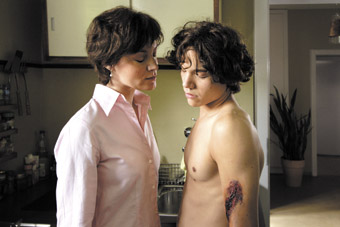
PingPong
THIS YEAR’S GOETHE-INSITUT FESTIVAL OF GERMAN FILMS EXEMPLIFIES IN A VARIETY OF WAYS THE QUALITIES OF POST-REUNIFICATION GERMAN CINEMA, WHICH HAS SEEN SUBSTANTIAL CRITICAL AND AUDIENCE SUCCESS OVER THE LAST DECADE OR SO, AND INCREASINGLY OCCUPIES A POSITION AT THE HEART OF THE EUROPEAN FILM INDUSTRY.
This German film renaissance is notably different from its predecessor, the ‘new [West] German cinema’ that from the late 1960s through to the early 80s produced significant and challenging feature films that were (with a few exceptions) rarely commercially successful, due in large part to their radical formal innovation, politically-imbued content and often rather bleak philosophical tone. This dichotomy marks the publicity and discourse around recent films (festival and Goethe-Institut director Klaus Krischok is one of many to note that they defy stereotypes about German cinema being unrelentingly ‘heavy’) and was largely played out in the 10 films I saw at the 2007 festival in Sydney. They were, by and large, straight and transparently told narrative and/or character based dramas or comedies—all very well made and often exemplary examples of their form, but lacking in aesthetic play or experimentation.
That the films are rather conservative in narrative adherence and style doesn’t mean they are fast-moving, compared to contemporary US cinema at least; instead they are ‘classical’ in adhering to the more accessible end of the European art-house tradition. For example, Pingpong (director Matthias Luthardt) and Summer 04 (Stefan Krohmer) are ‘chamber films’ which, language and minor details aside, in tone and theme could easily have been French films—the hidden problems of a bourgeois family on summer holiday exposed by the intervention of a sexually precocious teenager. The films are enjoyable, thanks to sustained tension and engaging performances (strong naturalistic acting talent seems a major strength of contemporary German-language cinema), but the potential thematic impact of both films is unfortunately reduced by rather too neat endings. These familiar riffs on the dark side of the bourgeois family are nonetheless enjoyable viewing experiences: European cinema (with the German industry perhaps increasingly at its centre) doggedly sustains a different ‘first-world’ vision of contemporary mainstream moral experience, behaviour and thought from that which more commonly dominates our TV and movie screens. (For one thing, films featuring sexually active young teenagers liasing on an equal footing with very ‘liberal’ adults over twice their age are only ever seen on the other side of the Atlantic through a mist of fevered moral panic.)
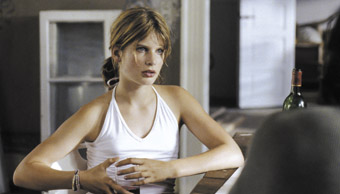
Summer 04
Another very European-styled and thematised film, though this time much more urban in its setting and concerns, was Valerie (Birgit Möller). Popular with critics and audiences, this story of a Paris-based Polish model who finds herself in a cash flow crisis one Christmas in Berlin (such that she has to sleep in her car) showed all the signs of its background as a diploma film stretched to feature length. There was lots of potentially interesting but relatively underdeveloped material here about the messy East-West coming together of contemporary Europe’s grand economic and cultural project. In one notable scene the consequent inequalities are played out when the protagonist, asked to translate the Polish of a German friend’s maid, is suddenly allied with Berlin’s servant class.
The problems of a slowly integrating Europe were much more overtly essayed in Offset (Didi Danquart), set entirely in Romania. The primary German character represents the charming and benign (though also rather bland) heart of the EU. When the family arrives for his marriage to a young Romanian woman, his mother immediately exhibits appallingly chauvinistic, old German patronising distain for the crumbling socialist grandeur of Bucharest and Germany’s post-communist EU brethren. For the most part a comedy-drama, the film delivers a dark jolt both in its narrative dénouement and the seemingly inevitable gravitational pull of the new (Western-authored) Europe, when the beautiful young Romanian woman decides to stay in Bucharest with her sometime lover and boss (a fierce nationalist who brandishes a gun while shouting anti-German and EU rhetoric) rather than ‘escape’ with the more youthful and modern German figure.
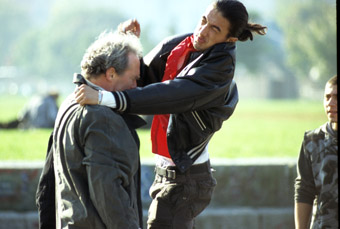
WUT
The panel kicking off the festival, which featured both local and festival guests, was devoted to the elusive, historically and politically problematic German notion of ‘heimat’ (very loosely, ‘homeland’)—an issue that can certainly be read into many of the films in a variety of ways. While Züli Aladag’s Can—His World Has Its Own Rules (the original title, Wut, translated as Rage or Fury, seems more appropriate) betrays its TV origins through rather one-note performances and a schematic script, it is initially effective in seeking to expose political, historical and ethical fissures within left-liberal bourgeois German culture via the tale of a second generation Turkish teenager who relentlessly harasses another outwardly model middle-class family. Sadly, the last half hour becomes very reductive and generic with its neat conclusion to this airing of raw nerves when the father of the family has his presumably ‘repressed’ racism violently outed. More historically concerned and less subtle from the start was Dresden—The Inferno (Roland Suso Richter). Although effective in charting the ultimately inescapable collusion of the German middle class with the Nazis, this very old fashioned Hollywood-style film seriously reduces the challenging moral and political questions concerning the atrocity of the Dresden bombing in 1945 to a romantic melodrama centred around a politically naïve nurse and an injured British fighter pilot.
A film that sought to bring contemporary and Nazi-era Germany together was the very popular Four Minutes (Chris Kraus). It centred around the difficult relationship between an octogenarian piano teacher still haunted by her youthful betrayal to the Gestapo of her female communist lover, and an extremely violent young female prison inmate who possesses remarkable musical ability. The tension and growing tenderness between the hard-nosed pedagogue and her recalcitrant, animalistic charge coming together through their different mental scarring is a familiar trope in middlebrow drama, as are meditations on the redemptive power of ‘timeless’ art. Yet beyond its inevitable narrative arc, the film’s interest perhaps lies in a particularly Germanic extolling of classical music as both a viable stand-in for religion, vis-à-vis offering an apparent ‘truth’ beyond social reality, yet at the same time as a rather nihilistic force through its supposed disinterest in the earthly domain of moral concerns (hence a convicted killer can be a great artist). Here Schumann is the appropriate touchstone for a film about mental degradation, though through its much-practised performance—whereby the two women find a troubled communion—his music is shown as ultimately rather more socially affective than the old teacher claims. Importantly, this outwardly ascetic custodian of tradition is far from a pillar of virtue, and cannot be allowed a conservative victory. Hence during the young woman’s triumphant public performance at the finals of a piano competition, she quickly shifts from Schumann, through fragmented gospel (which her teacher had earlier decried as ‘Negro noise’), to exaggeratedly violent post-Schoenberg atonal attacks on the piano’s keys, strings and body.
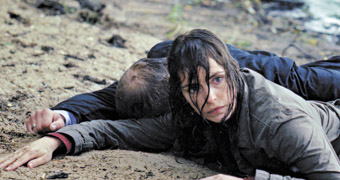
Yella
The one film I saw that did attempt some aesthetic experimentation was Yella (Christian Petzold). An elusive piece, both realistic and yet simultaneously oneiric, it tells the story of a melancholic economist from the former East whose business and marriage have ended disastrously, whereupon she attempts to start anew in Hanover—which makes for a very sterile vision of the former West as defined by soulless hotels, conference rooms and company cars. But her experience and vision of the economically and morally vertiginous side of post-reunification Germany is coloured by the recurrence of strange sounds and images vaguely connected to home (including odd shots of her husband, who seems to be stalking her). Though these confusing visions are partially explained by a linearity-destroying final scene that suggests most of the film may have been a post-death ‘alternate reality’ of some sort (or, as someone suggested to me, a Faustian bargain scenario whereby our protagonist gets another chance but must witness and partake of the most demonic elements of her capitalist culture), the entire film is highly evocative as a quiet yet disquieting meditation on contemporary Germany seen from the ‘other side’ in both the geopolitical and metaphysical sense.
Festival of German Films, Goethe-Institut, Sydney, April 19-29, Melbourne, Brisbane and Perth
RealTime issue #79 June-July 2007 pg. 20
© Hamish Ford; for permission to reproduce apply to realtime@realtimearts.net
Black Sun
THE EXPERIENCE OF BLINDNESS MIGHT SEEM A CURIOUS SUBJECT FOR A FILM, SINCE PART OF OUR ENDURING FASCINATION WITH CINEMA IS SURELY THE MEDIUM’S ABILITY TO RENDER THE VISIBLE APPEARANCE OF THINGS. BUT FILM IS ALSO A SENSORIAL MEDIUM OF WORDS, PICTURES, SOUNDS AND LIGHT, MAKING IT THE PERFECT VEHICLE FOR A REFLECTION ON THE SUBJECTIVE NATURE OF SIGHT. ESPECIALLY GIVEN THE STARTLING ASSERTION IN GARY TARN’S BLACK SUN THAT THE PICTURE OF THE WORLD FORMED BY OUR EYES IS A CREATION, AS SUBJECTIVE AS A PURELY HALLUCINATORY VISION.
Black Sun tells the story of Hugues de Montalembert, a French-born painter and filmmaker who was the victim of a random attack in his New York apartment in 1978. During a struggle with two assailants, de Montalembert had paint stripper thrown into his face and, over the course of a night, lost the use of his eyes forever. For an artist whose entire life was based around vision, de Montalembert dealt with his new condition with remarkable strength and determination. After a year of rehabilitation, he set off alone for Bali where he wrote a book entitled Eclipse, which went on to become a best-seller in his native France. Since then he has travelled extensively, published a second book, and at the time of Black Sun’s making was working on a third.
Tarn allows de Montalembert to tell his own story in voiceover, while a stream of associative images plays out on screen. The style is clearly influenced by Chris Marker [see page 27], particularly his 1982 film Sans Soleil (Sunless). Like Marker, Tarn creates a dream-like visual experience, sometimes manipulating the picture through special effects, at other points presenting undoctored images of tantalising mystery. Words and images dance in an open-ended exchange, both complementing each other and working in counterpoint. As the film progresses, de Montalembert’s voiceover moves from a fairly straightforward account of the attack and his struggle to deal with the loss of his sight, to a more philosophical reflection on what it actually means to see.
For some time after going blind, de Montalembert’s brain continued to generate images of such clarity that he would wake up each morning convinced his vision had returned. Then, after a few hours, his brain would tire and the images would suddenly be shut off, plunging him into darkness. Similarly, a friend once asked de Montalembert whether he had an image of him in his mind. “Of course”, replied de Montalembert, “I knew you before I went blind.” He is shocked when his friend points out his mistake. He has never seen this friend’s face, yet the image he holds of him is so strong de Montalembert was initially convinced they had met before the attack. Over time, these experiences have led de Montalembert to conclude that “vision is a creation, not a perception.” Through conversations with sighted people, he has also come to realise most of us do not in fact see the world around us, in terms of engaging with what our eyes reveal. For many, sight is merely a means by which to avoid collisions with objects and other people.
Black Sun is a fascinating reflection on a sense so integral to our everyday experience that most of us take it completely for granted. De Montalembert’s insights are at once inspiring, provocative and disturbing, while his world view is informed by a profound compassion. The loss of his eyes ultimately seems to have opened a whole new dimension in his experience and understanding. Gary Tarn’s achievement is that through Black Sun we share something of de Montalembert’s unique vision.
Black Sun, director and producer Gary Tarn, writer and narrator Hugues de Montalembert, 2005, DVD released by Aztec International, www.aztecinternational.com.au
Aztec International has made available five DVD copies of Black Sun for RealTime readers. See page 48 for our giveways.
RealTime issue #79 June-July 2007 pg. 22
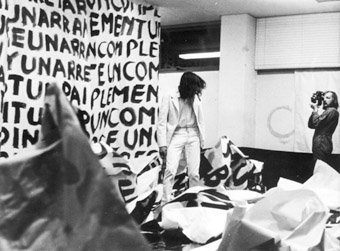
Mike Leggett filming Ian Breakwell in Unword
courtesy Mike Leggett
Mike Leggett filming Ian Breakwell in Unword
ONE OF SEVERAL PLEASURES TO BE HAD AT THE SCREENING OF FILMS BY MIKE LEGGETT AT ACP WAS THE SHOWING OF AN EARLY WORK FROM HIS UNWORD SERIES. THESE FILM ENGAGEMENTS WITH PERFORMANCE WORKS SERVE AS ARCHIVAL DOCUMENTS AND CREATIVE ACTS IN THEIR OWN RIGHT.
In 1969-70 in London, Bristol and Swansea, Leggett filmed Ian Breakwell in performance as the artist moved amidst huge swathes of inscribed material. The black and white shots with their photographic image intensity, staccato editing and sharply shifting perspectives against an instructional voiceover (language lessons and eyesight tests) create a curious visual rhythm but leave an incredibly strong mental imprint of the performance. Leggett filmed each performance, projected the footage as part of the subsequent one, and filmed that one in turn.
Leggett explains in his catalogue that the rhythm of the screening was not the result of editing: “The projection of the footage was on a Spectro stop frame analysis projector (a scientific examination tool) running at two frames per second.” In 2003 he and Breakwell “digitally reconstructed the Unword film at 2 frames per second, with a married soundtrack of the compilation tape.” Leggett’s Unword series covers the years 1969-2003. He tells me he has put them on DVD for study or reference.
The other highlight of the night was Shepherd’s Bush (1971, 16mm, 15 mins), a remarkable film which begins in black (has the lamp blown?, you think), the soundtrack pulses mechanically, the black lightens to grey to slowly reveal barely discernable movement across rough ground, brightening to a glaring white, erasing the image, the beat intensifying. It’s a truly invasive, curiously beautiful sonic experience and a spooky exercise in visual denial but one nonetheless conveying a frantic sense of momentum. The process has been described as simple (“a forward tracking movement was printed at every available grade in the printer’s grey scale”, John Du Cane, Catalog of British Avant Garde Art, London, 1971), but the effect is profound.
The creative representation of performance on film or video can be interpretatively problematic but in Unword, in Wade Marynowsky’s Autonomous Improvisations v1 (page 24) and in some, if not all, of the Castelluci films (Tragedia Endogonidia: video memory by Cristiano Carloni & Stefano Franceschetti) screened in Sydney and Melbourne in 2006 (RT74, p37), documentation is transcended and the spirit of the work retained and furthered.
A Program of Films by Mike Leggett, hosted by Louise Curham, Lucas Ihlein, Teaching and Learning Cinema, Australian Centre for Photography, April 28.
Mike Leggett’s Shepherd’s Bush appears on the Shoot Shoot Shoot DVD Vol 1, British Avant Garde Film 1966-76, featuring films from the London Filmmakers’ Cooperative available through OtherFilm Bazaar, www.otherfilm.org. The late Ian Breakwell’s own films have recently been released on the BFI British Artists’ Films DVD series.
RealTime issue #79 June-July 2007 pg. 22
© Keith Gallasch; for permission to reproduce apply to realtime@realtimearts.net

Daniel Frederiksen, Bastard Boys
BASTARD BOYS, THE ABC’S DRAMATISATION OF THE 1998 DISPUTE BETWEEN THE MARITIME UNION OF AUSTRALIA AND PATRICK STEVEDORES, INCLUDES A SCENE IN WHICH ACTU SECRETARY BILL KELTY, PLAYED BY FRANCIS GREENSLADE, ANOINTS GREG COMBET, PLAYED BY DANIEL FREDERIKSEN, AS HIS SUCCESSOR. LEAVING KELTY’S OFFICE, COMBET REMOVES HIS GLASSES AND FOR A MOMENT, WITH HIS SENSIBLE SIDE PART, RESEMBLES CLARK KENT IN SEARCH OF A PHONE BOOTH. THE TRANSFORMATION, THOUGH, IS NEVER REALISED. IN THE NEXT SCENE, COMBET IS PRETTY MUCH THE SAME MAN AS BEFORE.
In many ways, this transformation-that-isn’t is an apt metaphor for Bastard Boys: while it looks great, has an excellent cast and a compelling story, it never really flies. Rather, it remains grounded in a no-man’s land, trying to portray the complexities of recent political history on a tiny canvas: not quite drama, not quite documentary, it never manages to free itself sufficiently from the events of 1998 to offer a deeper reflection on the implications of those tumultuous events on the country.
These limits are strikingly apparent in the script, which often seems contrived to the point of silliness. In one scene, for example, Combet comes to convince a group of unionists to end a sit-in in response to the presence of scab labour on the docks. As he enters the room where the group of unionists has bunkered down, one of their number announces his arrival, adding “The ACTU. You ever heard of them? The affiliation of trade unions formed to devise policy and lobby on behalf of the labour movement.”
The producers might as well have plastered a caption on the screen to explain the ACTU and its role on the political landscape.
It’s not only the protagonists who get brushed with the bleeding obvious. Bastard Boys is infested with that blight of political drama: the set speech. Combet, for example, explains to union lawyer Josh Bornstein that “The law is an artificial construct erected by the capitalist class to ensure the system protects their own interests and maximises their own profit.” Later on, MUA National Secretary John Coombes, played by Colin Friels, explains the importance of solidarity to Combet thus: “I don’t break my promises, now that’s what solidarity’s about”.
While some of these exchanges are delivered with irony, they end up looking like clunky plot points and character sketches for those unfamiliar with the personalities and events around the waterfront dispute. Signposts of this kind are necessary to expand Bastard Boys’ appeal to more than political junkies, but they warranted a more sophisticated approach, not a high school social studies lesson.
These are symptoms of the larger problem of Bastard Boys, namely that in limiting itself to the particular personalities and events of the waterfront dispute, it remains a prisoner to the times and events it depicts.
In this regard, Bastard Boys might have been strengthened by displacing the point of view from the main protagonists in the dispute to minor players—the experiences of a scab labourer and a unionist, for example, would, potentially, have made for a more politically and artistically nuanced story. Alternatively the main characters and events could have been displaced to a different context altogether. A lesson here is The West Wing, which, rather than directly re-creating the Clinton Administration (which is its obvious template) displaces the action into fictional, yet recognisable characters and events.
While comparisons with The West Wing might be regarded as grossly unfair given obvious differences in resources, this isn’t an argument about production values or costs. The point rather is one of approach. A more visceral treatment, freed from particular characters and events might have given the makers of Bastard Boys greater creative freedom in expressing truths about those events which a more straightforward re-telling of events does not permit.
The political, cultural and artistic limits of the docu-drama format have been highlighted by the responses of the main protagonists that followed the airing of Bastard Boys.
Bill Kelty went on Late Night Live to complain that the show’s makers never approached him to ask about his role in the dispute. Chris Corrigan, meanwhile took to the opinion pages of The Australian to denounce what he saw as the portrayal of himself as an “evil, uncaring and insensitive boss” and to point to errors of fact around conspiracy claims.
The predictable nature of these responses suggests that rather than opening a space for a more searching discussion of the events of 1998 and their relevance to contemporary Australia, Bastard Boys seemed stuck in 1998. In an election year where industrial relations are set to take centrestage, Bastard Boys was an opportunity lost.
Bastard Boys, writer Sue Smith, director Ray Quint, performers Geoff Morrell, Daniel Frederiksen, Dan Wyllie, Anthony Hayes, Justine Clarke, Rhys Muldoon, Lucy Bell, Justin Smith, Caroline Craig, Helen Thomson, producers Brett Popplewell, Ray Quint; ABC TV & Flying Cabbage Productions; May 13, 14
RealTime issue #79 June-July 2007 pg. 23
© Christopher Scanlon; for permission to reproduce apply to realtime@realtimearts.net
Field of Play, Digital Harbour
THE DOCKLAND DIGITAL HARBOUR AREA IS A DOUBLY VIRTUAL REALITY. COMPRISING THREE MAIN BUILDINGS (PORT 1010, INNOVATION, LIFE.LAB), BUT STILL TAKING SHAPE, EACH is MEANT TO EMBODY THE POSSIBILITIES OF AN INTERCONNECTED TECHNOLOGY AND RESEARCH CENTRE WHOSE PARAMETERS AND STYLE ARE YET TO BE REALISED. THE DOCKLANDS THEMSELVES ARE A VIRTUAL REALITY, MELBURNIANS STILL ATTEMPTING TO CONNECT A NEW URBAN SPACE WITH THE PRE-EXISTING CONCEPTUAL MAP OF A CITY GROWING LIKE IVY—IF IN A WEB OF STRAIGHT LINES. IN EVERY SENSE, THE ARCHITECTURE AND STREETSCAPES OF THE DOCKLANDS AREA ARE CONTESTED, VIRTUAL, UNREAL.
It is in this uncertain, unstable zone that Troy Innocent’s new work, Field of Play, toys with the abstractions of place and shape that form all of our sensations of location. In the shadow of these buildings, Innocent’s signs and colours of indeterminate origin coalesce and dance. Sets of paving stones are lit from beneath with colours and shapes, while a nearby wall acts as a neon Rosetta Stone, runes and letters from alien languages glowing in the dark. It takes only a moment to realise that a game is on offer.
Twin versions of the game, loosely collected around the concepts of ‘here’ and ‘there’, allow players to participate through the related website—or a powerful phone—controlling the lighted paving stones between the three buildings. The game uses the rules of Janken (rock-paper-scissors) to let players score points on a playing field of several either/or segments. Three players choose colours and hedge bets against the odds of being superseded by the colour above them in the cycle: green beats blue, blue beats orange, orange beats green. The game is playable on two planes of virtuality: online through the work’s website and secondly through the lights and paver stones of Digital Harbour, if you’re connected by a sufficiently powerful mobile phone. The second iteration adds an element of naturalism to the play, like digital divining rods bending with the promise of water as the lights below shift and rearrange in response to the twitches of your thumb.
Innocent’s conceptualisation of the game’s materiality is perhaps the most striking element. What seems to be Digital Harbour’s curious relationship to its own history as a docking port is suddenly illuminated as a zone of translation, transition and transaction. The three coloured lingua (orange, blue, green) of Field of Play are tied in Innocent’s formulation to electronic networks, digital games and tribal cultures respectively—avatar forms of the three surroundingbuildings. His previous works have also borne out this fascination with the properties of digital language, coalescing figures around the molecular drifts and eddys of the ether which we have become so accustomed to navigating.
Yet Field of Play takes on properties of this incorporeal dialogic previously undetected and uncelebrated with a ritualised and sacral tone. What was clearly envisaged as an enlivening of an open space instead broaches the implicit coda like a taboo. We are invited to embrace and then to play with the very artificiality of Digital Harbour. For a work so devout in its hermetic appreciation of the digital, players find their appreciation most satisfied by the soft warmth of the speakers and the heat of the luminescent pavers; concrete and glass also being kinds of virtual, remodulated earth. The sensory quality of the art, primary colours and heavy stone at your disposal through microgestures of the thumb and finger, enhances this ritual world.
Everything about Field of Play suggests a design that works during daylight but is more closely incorporated into the night lighting systems of the area. After several visits, the sensation of play transforms, especially during the traditional harbour activity hours of dusk and dawn, as the slate grey of the building is negated when bathed in colour.
Innocent’s digital explorations reveal a fascination with interfaces natural and technological, with the game as a carnival space confusing the two. Here, our playing is not a by-product of labour, or something we earn, deserve or waste. Instead, play is the inhabitation of an experience with a meaning beyond the messy materiality of the game’s duration. The ritual of the game lets even concrete pavers have a life of their own.
Melbourne Docklands Urban Art Program; Troy Innocent, Field of Play (2007), painted aluminium, custom luminaires, lasercut steel, shotblast pavers, multi-player digital game, computer-controlled light, four-channel sound; Harbour Lane, Digital Harbour, Melbourne Docklands, http://fieldofplay.net/
RealTime issue #79 June-July 2007 pg. 24
© Christian McCrae; for permission to reproduce apply to realtime@realtimearts.net
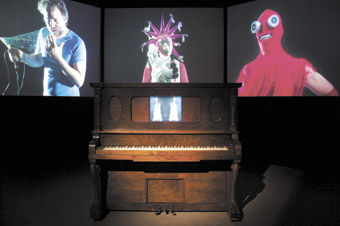
Wade Marynowsky, Autonomous, Improvisations v.1, L-R Lucas Abela, Toydeath, Matthew Stegh
photo Wade Marynowsky
Wade Marynowsky, Autonomous, Improvisations v.1, L-R Lucas Abela, Toydeath, Matthew Stegh
THERE’S SOMETHING STRANGE GOING ON IN THE BACK ROOM AT ARTSPACE, LOUD BURSTS OF CUT-UP NOISE AND WHAT SOUNDS LIKE THE FRENZIED EFFORTS OF AN ‘IMPROV’ PIANIST ARE COMING FROM BEHIND THE HEAVY BLACK CURTAIN COVERING THE entrance. INSIDE BY THE FAINT GLOW OF DIGITAL CANDLELIGHT AN OLD-WORLD PIANOLA PLAYS AND A BIZARRE PROCESSION OF PERFORMERS, MANY OF WHOM WOULDN’T BE OUT OF PLACE IN A CARNIVAL SIDESHOW APPEAR AND DISAPPEAR, PROJECTED ON THREE SCREENS.
Welcome to Wade Marynowsky’s Autonomous Improvisation v.1, an automated and prepared pianola that triggers an audio-visual mix of Sydney’s more infamous live performers, creating what the artist describes as “a mash-up of the ‘improv’ scene (the NOW now festival), the burlesque scene (man jamm), extreme metal-ists, techno-heads, toy-heads and the classical avant-garde…”
Roll up, roll up… for the fabulous transgender hula-hooper and the man who makes music using his mouth and a piece of broken glass…
If you live in Sydney you will probably recognise many of the artists who appear in this work and, as you might expect, there are lots of weird and wonderful looking people to behold. One hairy young man looks very much like he has just received a powerful electric shock and is covered from head to toe in red body paint. There’s a DJ in a polka-dot clown suit, a rapper in a gold gimp mask and matching lamé dress, and a man wearing little more than a few strategically placed plastic googly eyes stuck to his face, backside and crotch.
While the glamorous and glittery ones certainly stand out, many of the people on screen are more ‘regular’ looking music folk, some sitting earnestly behind their laptops, others twiddling knobs, swaying to theremins, mouthing into mikes and playing a range of musical instruments.
Marynowsky has assembled a diverse group of 37 performers creating a continuously surprising display of unusual collaborations and sonic arrangements. The artist explains he was aiming to create a mechanism that could juxtapose all sorts of people, “many who have never performed together and probably never will.”
While from past experience I know many of these acts make staggeringly loud or incredibly soft noises when performing on their own, the over all sound mix is balanced so that one never seems to take precedence over another. This restrained equilibrium means that combinations such as noise-core, tap dancing and soft vocals or minimal electronica, death-metal and rap can play simultaneously while still allowing subtle nuances from each to flutter in and out of aural focus.
The different performance images are all composed in the same way, giving a continuity that has the effect of binding them all together into one ‘live’ show. Every performer is alone in shot, positioned towards the centre of frame and lit vibrantly against a black backdrop. Each is very much in their element, onstage and demanding the focus of our attention to such an extent that it is often difficult to know where to look.
Sound and image bites jolt and collide as the performances captured on video are cut up and re-mixed on the fly in conjunction with the notes of the pianola. This digital mash-up gives the conjoined performances a strange inhuman rhythm and makes you wonder who the performer actually is in this situation.
Marynowsky has removed all but the trace of the human from this performative equation. The recorded liveness of the different acts is randomly triggered by an array of networked computers behind the scenes, but does this make it a new improvisation? And if so, whose? Who triggers the invisible pianola player—is it the artist or the computer, the programmer or the code? A bit of each I suspect, creating a new hybrid entity, a kind of musical bastard child, a freaky crossbreed.
In a playful and entertaining way Marynowsky’s work questions the notion of live performance and more specifically improvisation. What does it mean to improvise? Can a computer improvise? What about a group of computers programmed by an artist?
The work is a well balanced combination of live content, computer-triggered effects and kinetic sculpture. A testament to its composition is that the technology used is quite complex, but an understanding or awareness of it is not necessary to enjoy the work.
Apart from being a stimulating artwork, Autonomous Improvisation v.1 is a fabulous archive of the Sydney underground performance scene at the current time. Like a kind of digital documentary-automaton it continuously alters its form and is able to create a potentially unlimited supply of audio-visual experiences.
Wade Marynowsky, Autonomous Improvisations v.1, contributing artists Adrian Bertram, The_Geek_From_Swampy_Creek, Lucas Abela, Robbie Avenaim, Peter Blamey, Monika Pazniewska, Dallas Dellaforce, Jim Denley, Peter Farrar, Robin Fox, Brian Fuata, Dale Gorfinkel, Singing Sadie, Rev. Kriss Hades, Kristina Harrison, Ian Pieterse, Marty Jay, Josh Shipton, Hirofumi Uchino, Somaya Langley, Trent Mardan, Charlie McMahon, Dave Noyze, Shannon O’Neil, Gail Priest, Rory Brown, Mark Selway, Milica Stefanovic, Matthew Stegh, Amanda Stewart, Pizzo (George Tillianakis), Clayton Thomas, The Toecutter, Toydeath,Trash Vaudeville, Jon Wah, Dave Slave; Artspace, Sydney, April 20-May 19
RealTime issue #79 June-July 2007 pg. 24
© Anna Davis; for permission to reproduce apply to realtime@realtimearts.net
Aspasia and Jaimie Leonarder
photo Garth Boyed
Aspasia and Jaimie Leonarder
SITUATED IN THE BACK STREETS OF INNER-CITY SYDNEY THE MU-MESON ARCHIVE DEFIANTLY COUNTERS THE TREND OF EVER-DECREASING INDEPENDENT CINEMA AND ART SPACES. IN THIS ALTERNATIVE ‘FAMILY’ SPACE JAIMIE AND ASPASIA LEONARDER CURATE AND PRESERVE A RARE CULTURAL ARCHIVE OF FILM AND VIDEO THAT MAINSTREAM SCREEN CULTURE HAS REJECTED.
We are sitting in the loungeroom that is also part of the archive. In front of us is a 100 metre square screening room where films, videos and equipment are stored. The room contains records, digital media, obscure fanzines and computer/editing equipment. One of the things the Leonarders specialise in is collecting guerrilla mail documentaries of which they have literally hundreds. I asked why they chose the name Mu-Meson Archive and how many films they’d collected.
AL The archives are named after the band of outsider musicians that Jaimie created in the 80s. As for the number of films, we don’t know exactly how many, as every day we gain something new. In 16mm alone we have well over 1,000 films, shorts and features. We have constructed the Kubla Khan Pleasure Dome of alternative cinema.
BP What binds the archive together?
AL I think a lot of it is ‘outsider’, it falls onto the periphery of culture and that is the stuff that eventually becomes mainstream but we have always championed it before it becomes popular. Quentin Tarantino exploits very well that fringe material in terms of mainstream life. He has taken B-grade pictures, genre films, and now they have become the mainstream.
JL We love the whole idea of people’s alternative notions of consensus reality.
AL Every generation at some point will express interest in their past media memories. For us, of course, it’s the 60s and 70s. For this generation it’s the 80s and 90s.
JL Between 1965 to the late 70s Hollywood was letting things slip, although, after Denis Hopper did Easy Rider, a bevy of films questioning authority took cinema to its cutting edge. Looking back at this period is very inspirational; films need to have depth and meaning. Polanski said that cinema is pointless unless you walk out feeling a strong sense of injustice and that will motivate you to go and do something to rectify that injustice.
BP You love politically incorrect exploitation films, and now we have the PC liberation of Borat.
JL Before Borat there were pioneers of un-PC such as John Waters. He made us look at the most challenging of images and circumstances and we learned to laugh in the face of them—at Divine delivering her own baby, eating the afterbirth and biting the umbilical cord. PC is a cover for conservatism that denies us the ability to see who we really are.
I tried so many times at SBS to convince them to get into the wild side of world cinema, and for example show what the Europeans did with blockbuster American films. From the Italian Jaws to the Turkish Exorcist there is a parallel planet of exploitation cinema waiting to be devoured by the West. Spanish director Jesus Franco is a prolific exploitation director but there is something in each of his films that elevates them to a great piece of art. Pam Grier, for god’s sake, became the queen of blaxploitation female heroines. She was Roger Corman’s secretary until she had to stand in for an actress who didn’t turn up, hence sending her on a new career.
BP Is guerrilla mail documentary also a part of the outsider genre?
AL These are people outside of the mainstream who may only have a camera and a message but nothing is going to stop them getting their story out. These films are mostly mail order, libraries neglect them, institutions won’t screen them. We feel it is our responsibility to acknowledge them. They could be about anything from alternative energies and cures to conspiracies and UFO theories.
JL I have always been fascinated by the mail order documentary, they have as much right to be screened and viewed as anything else. I have tracked these films since the 80s. The late Jim Collier was the first person who spoke about electronic voter fraud in the States and he did a one-man assault documentary on the moon landing being a hoax called Was It a Paper Moon? One of the best examples would be Iraq for Sale: The War Profiteers (screening at the Revelation film festival, page 21) by Robert Greenwald the director of Xanadu. He has liberated cinema distribution by giving his audience the right to screen his film anywhere they deem fit, eg loungerooms and pubs. He funded the documentary by doing a call out on the net for people to send in between $20 and $50. He raised $200,000.
Also worth checking out are Guerrilla News Network and Mad Cow News. The all time classic of this genre is Dylan Avery’s Loose Change on the alleged 9/11 World Towers conspiracy. It’s become the most downloaded film in the history of the internet.
BP What are the politics of the archives?
JL To make people think more about the notion of independence, to be inspired by low budget filmmaking and demystify the idea of cinema as only a tool of the wealthy. I want people to actually think that there is something worthwhile about looking at films that aren’t considered great pieces of art. We want to question mainstream distribution and the limiting of screens and spaces…I would like to see a more robust notion of independent cinema in Australia. I think that’s one good thing that the digital era can do because camera technology is now accessible to everyone.
I think our frustration came from growing up in a town that was so alive with microcosms, of people with home cinemas and performance spaces like the Film Makers Co-op and the Sydney Super 8 Group, the Paris and Valhalla cinemas. After the 80s, with the Bicentenary and finally the Olympics these spaces have disappeared from the city. We don’t want to see pockets of independence vanish. We are trying to keep the idea of repertory cinema alive.
BP Your work seems to be very much about community.
AL Everything we do is about community. I have a knitting group. We have our cult cinema screenings, the Sounds of Seduction. We eventually get to know the people who attend our events and hopefully they begin to feel like they belong. It’s almost like creating a village in the middle of a very large city.
BP You have some great cultural artefacts here.
AL We always open our archives to discarded formats and antiquated technology. Eventually someone, a student or low budget filmmaker, will ask us where they can find an old projector or Super 8 camera and nine times out of ten we will have it and can help them out.
JL We also had three Scopitone juke boxes. Scopitones are fascinating in terms of their film history. They are 16mm juke boxes made around 1957 with 36 music clips in them shot around the world. They started in France but eventually went right around the globe ending up in America. No one has got a complete history that we know of. The clips were only made to be played on that particular juke box. It was really the birth of three-minute music clips. One of our favourites is Web of Love by B-grade starlet Joy Lancing. It is a pure piece of exotica. She is suspended in a spider web with Scopitone dancers parading beneath her in the skimpiest tiger skin bikinis, all in lurid colour. The words of the song are literally visualised and at some stage she ends up in a big pot in the jungle with a witch doctor stirring the brew.
AL One Scopitone was donated to the Sydney Powerhouse Museum and the other to ACMI in Melbourne, with 36 clips in each. They are the most remarkable film clips you could ever imagine.
BP Where do you want to go from here?
JL Nowhere, we will stay here and just keep doing what we have always done. There is so much pleasure in introducing an audience to material they had no idea existed. And we are still discovering obscure and exciting things every day.
AL Our Monday night screenings are a bit like church, it’s weekly, we get to know our congregation and at the end of the night we try to acknowledge everyone that is there, hoping that they are positively affected by the experience.
JL Our only hope for the future is that our archives can become fully catalogued and therefore become a more effective library for those willing to look at the fringes.
Jaimie and Aspasia (aka Jay Katz and Miss Death) host a weekly radio show, The Naked City on Sydney radio station, fbi 94.5 fm. www.mumeson.org
RealTime issue #79 June-July 2007 pg. 26
© Bob Percival; for permission to reproduce apply to realtime@realtimearts.net
Chris Marker, Owls At Noon Prelude: The Hollow Men
CHRIS MARKER IS ONE OF THOSE ARTISTS OF SNIPPET AND RUMOUR RATHER THAN EXPERIENCE. FOR YEARS I HEARD OF THIS INTRIGUING MOVIE, LA JETE (1962). IT WAS GREAT, INNOVATIVE, THE INSPIRATION FOR GILLIAM’S TWELVE MONKEYS. EVENTUALLY I SAW IT VIA A CRAPPY, SCRATCHED AND WARBLING VIDEO COPY. INTRIGUING THROUGH THE INDESCRIBABLE SOUNDTRACK, A PRISTINE VERSION IS A BONUS OFFERING WITH THE MAIN SHOW AT THE IMA—OWLS AT NOON PRELUDE: THE HOLLOW MEN.
Originally commissioned for the re-opening of New York’s Museum of Modern Art in 2004, Owls At Noon begins Chris Marker’s attempt at a larger “subjective journey through the 20th century”—not a bad project to start up for a man past 80. Owls at Noon grows out of Eliot’s The Hollow Men. The installation/media object/video is “a reflection upon that poem, mixed with some images gathered from the limboes [sic] of my memory”, following the poem from start to finish—a straight line. However, Marker resists reproduction or illustration. In response to an interview request from Mikkel Aaland, Marker replied, “no interviews. Instead, if you must write something use your imagination. Place us on a boat on the Nile, We are drunk, It’s your story.” Similarly Marker is no flunkey to the source, taking Eliot’s poem and reworking it into partial quotes, fragmentary paraphrase and comment.
The installation of Owls At Noon at the IMA is minimal and pretty much as it was for the MoMA show—white gallery wall, 8 flat panel monitors in a long thin row. There’s a bench just comfy enough away to take in all monitors at once. That’s all that’s in the room. It’s on a loop—a reasonable curatorial convenience I guess—but it has a definite beginning and end that is worth following. Sound fills the space—Corona by Takemitsu, with Roger Woodward on piano. The soundtrack is inspired. Rumbling, sparse, building in complexity throughout to finally end simply at a recapitulation of the beginning. People come and go through the other gallery rooms but not enough to interrupt.
First image is words floating in on the left hand screen—there might be eight screens but really it’s a diptych of screens quadrupled up, so it’s left right left right left right left right across the wall. First words point to Eliot, “remember ‘the hollow men’.” Shiny automatons appear from the darkness, skin eaten, circuits exposed. Is this what it is to be hollow? The machine without a ghost. Other faces appear, dead and human, carved back into patches of black and white. Gridded up documents of atrocity. Bodies arranged in rows; you do your best but it’s hard to get them neat.
As far as I can tell the images are all from World War 1, the war to end all wars, “which we found untrue scarcely 80 seasons later”—another fragment oft repeated. There is strangeness in the idea that one war would end all others. A message from another time of proud, religious colonisers thinking their suffering was just as supernaturally effective as the suffering and sacrifice their Christian faith had them dream of. For Marker the war happened a few years before his birth, and was still fresh in memory and artefact into his time as a boy. Owls At Noon acts as a meditation on his memories of the effect of that war, and extends into an exploration of WW1 as a cultural generator, a supplier of metaphor and image to scaffold our interpretive schema. I think of a graph of war density over time, statistical distributions of violent death.
The video is always black and white, fragments of words, fragments of people. A dead man in a dead tree, a face looking down, no children, no animals. There’s a team photo of convalescents, staggered rows, rugs on knees. Accusations and fury, straight to the camera. But mostly, faces look out—the piece is filled with gazes—without engagement. Trauma creates a type of specialised human—hippocampal spines shrink, thoughts dwell over and over on the the same old thing—inputs are reduced, reorganised, outputs are stereotyped, old memories are the only memories. These are the humans Marker has look out at us: total interiority, no contact with their own surface, the skin makes a boundary that neither side can read, neither side can cross. He obsesses on their eyes, “how often did we meet in dreams those eyes that Eliot dared not meet.” A phrase contrasting ‘blind’ with ‘sightless’ recurs. The eyes of Marker’s memories are sightless, waiting to look out on another world.
Yet more faces, a fibrous kiss shattered into granular decay. Faces scraped and burnt back into the soil. Ambiguous boundaries between people and dirt, people and wood, people and bodies. World War I has always been the muddy war, the war without colour. Marker has commented elsewhere on colour as sex, for billions of years an ancient device of seduction. “When I began to play with B&W film clips…I just wanted it to be a light, unpretentious way to celebrate in my manner one hundred years of cinematography…But to put it more simply, wasn’t it fun to free oneself from a three-billion-year-long addiction?” Scarcely fun, Owls at Noon Prelude is paced slow, hypnotic, always in motion. Images fade in and out, side to side, up and down. Words move across the screen, close up, partial. There is no colour here, yet there is seduction in Marker’s evocation of memory’s obscured scrutiny.
Chris Marker, Owls At Noon Prelude: The Hollow Men, visuals Marker, score Toru Takemitsu (Corona, 1962), piano Roger Woodward; Institute of Modern Art, Brisbane, April 10-May 26
RealTime issue #79 June-July 2007 pg.
© Greg Hooper; for permission to reproduce apply to realtime@realtimearts.net