Australian
and international
exploratory
performance and
media arts
Performa 05, a dynamic multidisciplinary program of live performances, exhibitions, film screenings, lectures and symposia, marked the first biennial initiative of veteran performance art curator and historian RoseLee Goldberg under the auspices of the organisation Performa, which she founded in 2004. The scope and ambition of the program were undoubtedly impressive, with a total of 98 artists and 26 organisations involved in the presentation of more than 60 events. Produced on a shoestring budget with a tiny staff, and without major corporate or institutional sponsorship, the result was nothing short of revelatory. Performa 05 invigorated both the city and the dialogue around the ongoing significance of “new visual art performance” in the 21st century.
Framework
Under the artistic direction of Goldberg, the program evolved in collaboration with a consortium of independent organisers and curators at leading New York arts venues. Proposals were invited for specially designed exhibitions and events that responded to Performa’s objectives, which were then reviewed by Goldberg and a stellar Curatorial Advisory Council including the likes of curators Hans Ulrich Obrist, Jens Hoffmann, Chrissie Iles and Massimiliano Gioni, as well as artists William Kentridge and Joan Jonas. The program that materialised was dispersed across venues as varied as the Museum for African Art, Anthology Film Archives, The Kitchen, Bowery Ballroom, and a significant contingent of commercial galleries and alternative spaces.
With all events either free or affordably cheap (US$5-$15 or free with admission at museums), and with a palpable profile across the city throughout November, Performa 05 established itself as a truly accessible venture with the capacity to attract audiences outside of dedicated contemporary arts circles. One of the triumphs was that work by emerging artists was contextualised in relation to that of mid-career practitioners and performance art royalty, such as Marina Ambramovic and Yoko Ono. The result was a fertile exchange that highlighted the history and evolution of performance alongside currents and concerns now dominating this scene, drawing attention to the resurgence of performance in art over the past decade. Diversity was key. In addition to ‘live art’, the program explored performance as an integral element in video and film, installation, sound art, music, theatre and photography. Comprehensive as it was, Goldberg emphasised that the inaugural biennial focused specifically on performance in the context of the visual arts, and has vowed Performa 07 will expand to present a different perspective entirely.
New/Now
An important aspect of Performa’s mission is to initiate and support the creation of new performances. Performa Radio presented works designed by artists for broadcast, investigating radio as a performance space in relation to issues of intimacy, placelessness, dispersion, and the ‘disappearance’ of actual experience. Francis Alys premiered his first indoor performance Rehearsal II the Slipper Room, selling out long before the once-only 6-hour performance featuring a striptease artist, pianist and singer (but unusually not the artist himself) took place.
Most impressive was Danish artist Jesper Just’s production True Love Is Yet To Come, presented on an intimately scaled stage in the Stephan Weiss Studio as the biennial’s opening affair. Renowned for his video practice, this was Jest’s first foray into live performance. The 22-minute opera continued the artist’s poetic investigation of gender and relationship dynamics, particularly aspects of masculinity, affection and loneliness. Utilising the effects of a newly patented computer program, the production was highly complex and layered: the lone ‘real’ performer—well-known Norwegian actor Baard Owe—interacted with holographic figures and landscapes, occasionally taking on an intangible presence himself by dissolving into the animated set projections, at which point the performance became cinematic. Cover versions of familiar love songs framed fraught exchanges between Owe and the silent transparent figure of a younger man whose identity remained ambiguous, and could have been either a son or lover. Huutajat, the Finnish Men’s Screaming Choir, also made a holographic appearance shouting “You Always Hurt the One You Love” in one of several intense climaxes of visual spectacle, tempo and emotion. A pioneering and stunningly complex work, True Love… made clear from the beginning Performa 05’s intention to challenge conventional notions of performance.
Not for sale
As part of an ongoing series titled “Not for Sale”, a one-day symposium held at New York University aimed to investigate different facets of “Writing on New Media and Performance”, from the integration of ephemeral works into ‘official’ contexts, to the multidisciplinary language required to engage with the research, development and presentation of visual art performance. The event covered familiar and fairly superficial territory, offering the audience descriptive accounts of professional encounters but stopping short of thrashing out new possibilities for instigating paradigm shifts. In the first of two sessions, curators Anthony Huberman (Sculpture Centre, Queens), Bennett Simpson (ICA, Boston), and Catherine Wood (Tate Modern, London) ruminated on the increasing presence of performance in museums and galleries and its incoherence with the strictures of institutionalised curating and collecting; nothing new. Wood’s presentation ironically dealt with the Tate Modern’s recent venture into collecting live performance in an event supposedly premised on the resistance of this medium to the market, while Huberman spoke of the way in which ephemeral works challenge the ‘exhibition logic.’ Bennett offered by far the most interesting paper, examining how the resurgence of performance art over the past decade has intersected with the new media ‘boom’ and its impact on ideas of interactivity, temporality and performativity. The most important effect of this conflation of performance and performativity, he argued, is not the demand that art take into account broader frames of reference—such as fashion, music and technology—but rather “the emphasis it now places on who the artist is, as opposed to what the artist does.” In view of the notion that “all artists are performers (if artists are people who perform art), what is the relationship between the inherent performativity of being an artist, and performance art as a medium?”
Retrieving history
In what was arguably Performa 05’s most ambitious and extravagant co-presentation, seminal performance artist Marina Ambramovic performed a series of 7 works on a circular platform in the grand rotunda of the Solomon R Guggenheim Museum. Wryly titled Seven Easy Pieces, the performance schedule was spread over 7 consecutive evenings and involved Ambramovic re-enacting influential works by her peers from the 1960s and 70s. Each of the unrehearsed performances ran from 5pm until midnight, extending and distorting the duration of the original pieces, and continuing Ambramovic’s career-long exploration of the mental and physical limitations of the body. Re-enactments of works by Bruce Nauman, Vito Acconci, VALIE EXPORT, Gina Pane, Joseph Beuys and Ambramovic’s own Lips of Thomas (1975) were concluded by a new performance created by Ambramovic specifically for the series, Entering the Other Side, which functioned as a contemporary point of reference from which to investigate the temporal dichotomy at the crux of the project. Seven Easy Pieces conflated past and present, commanding consideration, yet again, of fundamental issues that relate to ephemeral art.
Alternative network
Complementary to the scale and polish of the commissions, a host of modest projects were staged in New York’s premier alternative arts venues clustered around Soho and the Lower East Side. Much of the vitality of the program was derived from these events, which took a finger to the pulse of post-millennium performance practice with an emphasis on young and emerging artists. Art in General, Apexart, Participant Inc and the Swiss Institute contributed. As did Artists Space, one of New York’s oldest not-for-profit organisations, which staged a 5-week exhibition, Empty Space With Exciting Events, in which the empty main gallery became “a stage for daily action, performances, concerts and lectures”, while the Project Spaces hosted individual works with performative affinities.
At The Kitchen in Chelsea, Listen Up! Lectures as Performance offered a double bill contrasting a reworking of French conceptual artist Bernar Venet’s 1966 performance-lecture Neutron Emission with a new work by Coco Fusco, A Room of One’s Own. A product of the artist’s recent experience in a women’s interrogation training camp it highlighted the malleability and power of language as a tool for propaganda.
Co-presented by the Lower Manhattan Cultural Council at Gigantic Art Space, Pablo Helguera’s one-act opera, The Foreign Legion likewise took on the politics of interpretive discussion as its theme. Merging scripted fiction, documentary narrative, hermetic thought, the lecture format and music, Helguera’s work aimed to “embrace the contemporary ambiguous threshold between reality and fiction” by confusing the audience’s perception of what was ‘objective’ fact and subjective intervention, creating a space for dialogue on how art might function at the interstice between the two.
Performing the city
Performa 05 cast a wide net both in terms of its interdisciplinary fervour and geographical manifestation. Stretching from Harlem all the way Downtown, and encompassing a vast array of venues in between, the program itself incorporated a performative sensibility in its distribution across the city. The decentralised format forged a rich conversation between diverse entities, from museum stalwarts, to commercial gallery heavyweights, and various constituents in the not-for-profit sector. Audience participation became a process of enacting a ritual of transit and mapping in the spaces of everyday life as people moved between venues and events. New York Times reporter Roberta Smith pointed out that although the difficult choices to be made often left one feeling as though great opportunities had been missed, and on occasions events did not quite meet expectations, there was ample room to structure a unique performance program of one’s own, fuelled by adrenalin, followed by fatigue, and underscored by the satisfaction of participating in a remarkable event.
Performa 05, various venues, producer Performa, New York City, Nov 3-21
RealTime issue #71 Feb-March 2006 pg. 34,
© Anneke Jaspers; for permission to reproduce apply to realtime@realtimearts.net
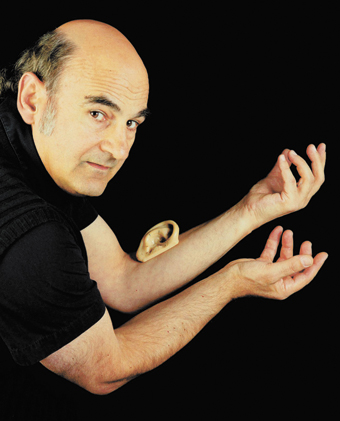
Stelarc, Ear on an Arm 2003, from Interzone
photo Polixeni Papapetrou
Stelarc, Ear on an Arm 2003, from Interzone
From the beginning, it’s clear we’re on ‘Yuji-time.’ There was no misprint in the conference program, registration really did open at 0800 on the dot, and the sessions waited for no latecomers. At e-performance and Plug-ins, billed as a “mediatised performance conference”, it’s clear that the primary mediatising force was the coordinator, performance artist Yuji Sone. And his mediatisation was impressive, bringing together a wide variety of hybrid artists and theorists, with the practice/theory line being continually and productively blurred by the presence of so many artist/theorists (including Victoria Spence and Mark Seton discussing the breakdown of technological and biological systems in Spence’s communication/failure (see page 32), and Out-of-Sync’s (Maria Miranda and Norie Neumark) blend of digital networking technology and 19th century mysticism in their ouija board performance Séance: a networked glossalalia on the ISEA2004 ferry. Many of the presentations from PhD candidates were also of ‘practice as research’, meaning that e-performance could be seen as a sign of new media, performance and live art’s growing significance within the academy, especially in Australia and the UK.
The brief of the conference was wide, ranging from “the ontology of liveness to the very technical and logistical questions of performance in a mediatised environment under diverse conditions of actualisation.” These technical and logistical questions were well demonstrated within the conference form itself, with keynote addresses (Philip Auslander on robotics, US curator and critic Michael Rush tracing histories of performance in video art, and Nottingham-based Johannes Birringer’s barely intelligible presentation on performing the intersections of wearable technology and fashion) delivered via different forms of video or audio streaming. While impressively executed by a dedicated technical support team (supervised by Mark Mitchell), each had its own unique and inevitable glitches. Despite Edward Scheer’s quip in the closing remarks (“couldn’t we have watched it on TV?”), this ever-present sense of potential disaster kept all the mediatisation firmly in the realm of the live.
Stelarc
As the only keynote speaker physically present at the conference, performance artist Stelarc’s imaginative and ever-excessive rethinking of the human body was well demonstrated in his discussion of recent practice, including Stomach Sculpture (described as “a site-specific performance for private physiological space”), Blender (a collaboration with Nina Sellars involving the literal removal of subcutaneous tissue from their 2 bodies and blending it repeatedly, reanimating the biomaterial to create ‘new life’), and a range of other performances with networked prosthetics.
In these networked experiments, Stelarc has attempted to remake the body into “an inverse motion-capture system.” Rather than create a template for the movements of an avatar in a virtual world, he makes a surrogate to enable an avatar to perform in the real world. To make this possible, Stelarc aims for an emptying out of the body, allowing it to become a better host. Strangely he refers to his body as if it is not his own, rhetorically performing this ‘emptying out.’
Speaking enthusiastically about his difficulties in obtaining a plastic surgeon to attach a replica of his ear to his arm, his current body modification project, Stelarc clearly demonstrates that there are implications legal and ethical as much as aesthetic to this practice. It seems that here the impersonal is political too, pointing to a post-human artistic politics.
Philip Auslander
This fascination with the ends of the human in live art and performance reached its peak early on with US performance theorist Philip Auslander asking “can robots make performance art?” He cites the example of Max Dean and Rafaello D’Andrea’s The table: childhood (1984-2001) in which a robotic performer (a computer-controlled dining table on wheels) chooses a viewer to attempt to “form a relationship with” by closely approaching them. This semblance of intimacy from a large heavy table can be threatening, its unpredictable and lifelike behaviour uncanny. The artists anthropomorphically frame their performing table, subtitling the piece “childhood” because the table’s programming has it perform actions similar to those of a child trying to relate to adults.
Can it be live art if the performer is an artificial life form? And what is the place of these artistic robots? A metaphor for the human? A substitute for the human? A parody of a human? If the actions of these robot performers are designed to be read as futile does it mean that humans programmed these robots to undertake meaningless tasks? How is this different from instructing humans to perform such pointless tasks? Auslander pointed to the example of Bulgarian artist Nedko Solakov’s A Life (Black and White, 1999-2000) in which 2 human painters repeatedly repaint the gallery space black then white for the duration of the exhibition. These painters might as well have been machines.
‘live’
The performance program ‘live’ provided exhilarating live image mixing from John Gillies in Shiver (VJ mix version), UK-based Michaela Reiser’s biofeedback performance Excitations, and Company in Space’s Hellen Sky’s eloquently playful live web stream from Nottingham, Liquid Paper 11. There were no performing robots on the night, and therefore no way to test Auslander’s provocations. The ‘live’ here was strictly ‘alive’, wrapping up with welcome low-tech absurdity from Unreasonable Adults’ The End of Romance. Their deadpan mock competitiveness in obsessively detailed descriptions of technical apparatus (various redundant laptops and a mini-cassette recorder) was a refreshing reminder that the technological is most productively linked to the social context of its use, and there’s no reason to take it all so seriously.
As Sydney video and new media artist Anna Davis pointed out in discussing the social proxemics in her installation In the house of shouters, “audiences respond socially to almost anything, with a minimum of social cues.” No matter what the material and form of the art practice, a common thread demonstrated in the work discussed over the conference was the desire to produce engagement with viewers. As Hellen Sky put it: “We’re trying to make a connection and we make endless phone calls in the foyer.”
Surprising connections were made. And endless phone calls were indeed made in foyers. All the liveness, the networking, and the mediatised presentations conspired to create what Andrew Murphie aptly described as a “complex dynamic system”— the conference itself as an emergent lifeform. What as-yet unimagined ‘new life’ will emerge from this important initiative is much anticipated.
See also the report on the WISP conference.
e-performance and Plug-ins: A Mediatised Performance Conference. Coordinated by Yuji Sone. School of Media, Film and Theatre, University of New South Wales, Dec 1-2, 2005
RealTime issue #71 Feb-March 2006 pg. 35
© David Williams; for permission to reproduce apply to realtime@realtimearts.net
Derek Kreckler, Antidote
photo Heidrun Löhr
Derek Kreckler, Antidote
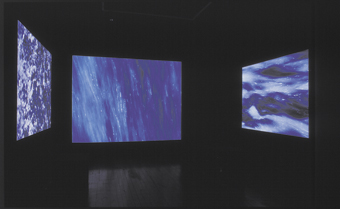
In Derek Kreckler’s new 6-channel DVD installation Antidote, the walls of the Performance Space gallery are doused in large projections of falling water. In some cases the idyllic waterfall scenes are reminiscent of the kind of kitsch imagery you might find as the backdrop to a deodorant commercial or in the foyer of a health retreat. Other video sources survey the water spray in close-up, revealing patterns that cut across the projected screens like the streaky grain of scratched celluloid.
Possibly it sounds like work you’ve seen before; an immersive video installation of the nature-is-so-beautiful variety. But the experience it produces is something quite different, subtly disordering your everyday modes of perception in ways that are difficult to shake off.
As groups of viewers flow into Antidote, interesting things begin to happen. It is as if the installation has unseen zones of intense gravitational pull, causing viewers to cluster like barnacles in certain pockets of the room. This curious migration pattern seems to be motivated by the audience’s desire to keep their shadow clear of the projected footage. Kreckler, however, appears to anticipate this attempt and deliberately sets out to frustrate it.
Instead of minimising interference by suspending the projectors from the ceiling, the projectors are installed at ground level. This has the effect of entrapping large areas of floor space within their throw. Although some visitors delighted in the opportunity to guide their silhouette through the water-walls, most viewers pooled at the vantage points where they produced the least interference.
What this installation scenario pulls into focus is the tendency for viewers to treat the moving image as a window onto the world. In other words, we’d rather peer into the intact image than have to reflect on the messy existential issue of how we’re positioned in relation to it.
With Antidote, however, Kreckler allows no such reprieve. The waterfall scenery may be sourced from the natural world, but he unhinges the familiarity of the footage by setting it at different speeds. The rhythms of the various channels clash, creating a shared audio track where dilated and compressed timeframes wash up against one another. These jarring shifts in velocity also occur within each channel, preventing viewers from getting swept up in the hypnotic flow of a single image stream.
The shifts in the scale of the imagery also effect a gentle disorientation. In particular, the longer you stare into the closeups of water, the more they take on the properties of abstract patterns. The very images of waterfalls that had initially seemed banal, ultimately turn out to be strangely compelling and charged.
In the catalogue, Kreckler says of this installation, “After a while I hear dogs barking, horses running, people screaming and gun shots; sounds not included; it is then I know that I am home.” Home for Kreckler would seem to be that place where perception throws off its passivity and reality becomes a site of potential transformation.
It is not surprising that he turns to sound for this dynamic, considering that hearing is a far more malleable sense than sight. We often become aware of the way we cut our own mix of the sounds we hear, tuning into familiar frequencies and disregarding others. What is fascinating about Antidote is the degree to which the installation introduces this uncertainty into viewing. It is packed with perceptual booby-traps ready to wrong-foot your usual modes of interaction with the world.
Antidote is the standout work of the exhibition Derek Kreckler: Downstairs: recent and new work in photography and video. The show is the latest instalment in an impressive series of exhibitions curated by Blair French (now Director, Artspace), concentrating on the work of significant contemporary Australian artists. Also in this exhibition is the not-so-recent video Blind Ned (1998). In this silent single-channel work, bushranger Ned Kelly blindly navigates his way through the Australian landscape, stuck in an uneasy, unending loop.
Kreckler’s stunning photographic installation Holey #4 (2005) also sports its own type of blind spots. Here, a photograph of a beach landscape is partially blocked out by a number of large circles planted across the image. Corresponding with these “holes” are four vinyl balls lying on the floor beneath the photograph. The balls are wrapped in the missing areas of the beach, as if the 3-dimensionality of the landscape has literally popped out of the image.
Derek Kreckler: Downstairs: recent and new work in photography and video, curator Blair French, Performance Space, Sydney, Nov 4-Dec3, 2005
RealTime issue #71 Feb-March 2006 pg. 36
© Dominique Angeloro; for permission to reproduce apply to realtime@realtimearts.net

untitled 2005 © boat-people.org,
It’s not a clear day. It’s overcast, hot and humid. You can tell because of the flies, buzzing, sticking to clothes. Assuming a fatherly pose, a suited man holds a small girl in his arms. Their backs to the bay, they face inland. We assume they are Australians, and this is all we can suppose from the photograph.
For their new series of works shown at Casula Powerhouse’s Artists Against Sedition Laws Exhibition, boat-people.org created Magritte-like images in their photographs by using the Australian flag to mask the faces of their subjects. Sensorially challenged—neither seeing, nor hearing, nor speaking—men, women and children are arranged in traditional studio-portrait groupings at Botany Bay, the site of arrival for the First Fleet. Like blindfolded criminals in front of a firing squad they were shot (on film). Their images build a picture of a nationalism that all but stifles identity and erases difference.
Seeing these works on Monday December 12, only 2 days after the racially demarcated gang violence at Cronulla—where youths on one side wore the Australian flag like superhero capes and, on the other side, burned them—I was struck by the paradox of the sedition legislation (amendments to the Crimes Act of 1914 and the Criminal Code Act of 1995) in the way that it has actually fostered opposition and protest. The group boat-people.org, as an example, formed in the wake of the Tampa impasse, the ‘Pacific Solution’, the ‘Children Overboard’ scandal, increased border protection and mandatory detention for ‘illegal immigrants.’ These humanitarian crises of the Government’s making have served to alienate all Australians with the vaguest sense of decency, compassion or social justice.
That the Howard Coalition government’s policies and scandals have successfully caused a great deal of group and community disaffection was something that many artists in Protest chose to focus upon. Mischievously positioned in the exhibition entrance, none was so self-effacing as Simon Barney’s A-frame painting with text that reads “Blame John Howard for Bad Political Art”, and another, a swarthy self-portrait, titled Of Middle Eastern Appearance. The Artists and Writers Alliance showed a series of 12 large works on paper including silkscreen prints, photocopies and transfers manipulating found photographs, classified advertising and reworkings of socialist propaganda poster art. One of these stencils features the image of Howard on a “Wanted” bill “for inciting terror” and reminds us that “if caught [you] can be detained for 14 days without charge.”
I was fortunate to have arrived at opening time when video artist Tony Schwensen promptly commenced a reading of the United Nations Bill of Human Rights while an assistant encased his feet in a quick-setting concrete. Despite Schwensen’s dead-pan countenance, the bill read rather like a humanist poem—in stark contrast to the vague and defensive little amendments that comprise the sedition laws. Watching with the small crowd were a group of children, huddled close to the action and taking the same kind of delight in the artist’s self-sabotage as they would watching a classic cartoon of Wiley Coyote dropping an anvil on his own head. It didn’t take much to follow through the logic of Schwensen’s symbolic intent, imagining his body and all that the Human Rights Bill stands to protect sinking to the bottom of a lake, or a harbour somewhere.
While Schwensen’s performance was in progress, the general buzz of crowds arriving and latecomer artists hurriedly hanging their work gathered momentum. Over 230 artists participated in the Artists Against Sedition Laws Exhibition with many Sydney galleries listed as supporting the project. Steven Mori was there, installing the work of Melbourne-based artist Danielle Freakley including her graphic Cum Rags, pieces of white, fleecy fabric overlocked at the edges with a photo-transfer of bodies blown-apart during the war in Iraq—a blunt and unflinching statement on the testosterone-fuelled appetites of the coalition-led attack. In another bloody work, Peacekeeper, photographer Belinda Mason Lovering produced an arresting portrait of anti-war activist Dave Burgess. Daubed in fake blood and shot from a steep angle, his body dominates the sails of the Opera House that he and Will Saunders bravely defaced in 2003, while the words “No War” are tracked though the red paint on his belly.
Satirical entries addressed the extent of the threat to freedom of speech and the right to criticise government posed by the new laws. The Seditious Artists Society’s (SAS) Suspicious White Van…stone, was is a hilarious assemblage of transcript from the SA branch of the Rotary Club quoting Amanda Vanstone as saying, “I don’t know if any of you travel that much…but we have this (no knives policy), of course, because we’re worried about terrorists getting on planes and grabbing knives and doing bad things with them. But has it ever occurred to you that you just smash your wine glass and jump at someone, grab the top of their head and put it to their carotid artery and ask anything?” This quotation from the Minister for Immigration was fixed to the back of a box frame as instructional information complete with a terrorist kit of smashed wine glass, plastic knife and HB pencil. Nobody and Maxine Foxxx’s short video Shitty Rail, turned its attention to Sydney’s inadequate public transport system. The artists, uniformed to impersonate Cityrail guards are documented hassling young people for tickets and handing out inflated fines for non-existent offences (amid raucous laughter from the carriage). In a minimal and symbolic video work, White Australia, Hayden Fowler captures the movement of a white lab rat endlessly entering and exiting the same, institutional, green-tiled room through 2 holes. The space holds the promise of 2 distinct choices, but they both lead the rat back to the beginning.
In the current conservative and fearful climate where Opposition leaders are increasingly failing to oppose anything, prominent creative Australians and Australian arts organisations are strongly voicing their objections to the new laws. The National Association of Visual Arts (NAVA) has proved a formidable and tenacious force in seeking amendments to the Anti-Terrorism Bill and the sedition legislation that was rushed through parliament in early December. NAVA director, Tamara Winikoff opened the exhibition by urging the audience to continue pressuring the Government for change. At such a moment it is not difficult to imagine the potential, particularly for regional galleries run by local government bureaucracies, to shy away from political or contentious work. For the Artists Against Sedition Laws Exhibition, Casula Powerhouse staff took advantage of the building being empty [prior to its reopening in 2006 after extensive refurbishment] in order to send a clear voice of dissent out into the community. Conceived as a gathering of multifarious and uncurated art objects and performances, asserting artists’ (and everyone’s) rights to freedom of speech, the exhibition demonstrated the capacity for contemporary art spaces to respond quickly and decisively to the shifting political landscape.
Artists Against Sedition Laws Exhibition, Casula Powerhouse, Western Sydney, Dec 12-17, 2005
RealTime issue #71 Feb-March 2006 pg. 38
© Bec Dean; for permission to reproduce apply to realtime@realtimearts.net
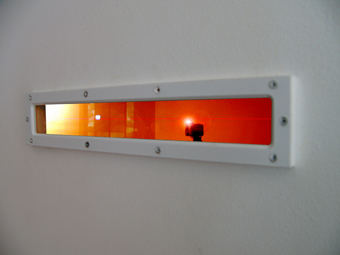
Mark Brown, Demarcation
photo David Simpkin
Mark Brown, Demarcation
Mark Brown’s recent exhibition Exeunt_Site Manoeuvres, shown at the Melbourne artist-run initiative Conical Inc, was an analytical and elegant installation of 3 intensely sculptural works that created an allusive viewing experience. In a manner that initially felt counter to Brown and Conical Inc’s shared commitment to work of a site-specific nature, Brown deployed strategies that resulted in an intriguing exhibition that seemed sparse and introspective. His strategies could be summarised as focusing the viewer on the space outside the gallery rather than inside, barring the viewer from one gallery completely, and siting a minaturised object in the most expansive space. This is not to say that there was a sense of loss or absence in the exhibition. Rather, Brown’s ingenuity produced objects that seemed to have an autonomy from the viewer. The show was not immersive or interactive in the way that many new media exhibitions are described. We approached the objects rather than the objects claiming our attention, and viewing was a durational rather than instantaneous experience.
The title Exeunt_Site Manoeuvres could not be more apt as exeunt is archaic Elizabethan theatre Latin for exiting the space of the stage. Brown’s choice of terminology—site manoeuvres rather than site-specificity—was also deliberate. The term site-specific, which is now so pervasive that it operates as a kind of shorthand signifying progressive leanings and aesthetic innovation, has become increasingly restrictive for Brown. With beginnings in the late 60s, site-specific art was a catalyst for a widespread desire to incorporate the physical conditions of a particular location into art production and reception as a form of social and institutional critique. Site-specificity has now been mobilised to incorporate practices that can be defined as community-specific or issue-specific and embraces nomadic, virtual and ephemeral forms such as billboards, street demonstrations or mobile phones. Earliest debates saw artists jostle for position as the most authentic by being the most thoroughly site-specific.
While Brown’s practice is not exclusively gallery-based, he is an artist who continues to work within and against the modernist paradigm of the exhibition. Brown characterises his practice as a critique of commonly held views about site-specificity. The aspects of site-specificity which particularly inform Brown’s sensibility are those associated with Minimalism and its emphasis on a phenomenological understanding of context. Brown’s early installations were a response to the textures and accretions of rundown industrial and military sites through the amplification of the molecular and the fragmentary. In relation to his early works, Brown invented the term detritical, derived from ‘detritus’, to denote his investigation of the affect of built spaces charged with an atmosphere of decay.
Writing about his recent show, the artist argued, “I have attempted to evolve my methodology of making site-specific works beyond a direct, formal architectural response to site archaeology and past and present contextual function in a bid to develop strategies to transcend what I perceive to be the potential end game of hermetic site works.” It is Browns passion for sound and other technologically mediated approaches to site which set his work apart. He is striving for an engagement with questions of locality and place that is highly speculative and founded on a stylish, personal language which is simultaneously neighbourly and other-worldly.
Throughout his exhibition history, Brown’s finely honed objects have all shared a design vocabulary which can be traced to mid 20th century military instrumentation relating to navigation, measurement and surveillance. According to Brown his affinity with military interfaces of all kinds owes something to his father’s service in the New Zealand Territorial Air Force Reserve. He has also volunteered a previous obsession with computer games. This exhibition continued his research as Brown’s retro eye also took in the well-proportioned bones of the Conical building and the earlier technologies evoked by the domestic fireplace, the density of the glass and the weight of the iron mullions of its window.
At the window, Brown positioned Noise Gate, a viewfinder fabricated out of metal through which a video image of Fitzroy’s gritty streetscape could be viewed. An eerie, unearthly light was emitted by the adjacent factory rooftop exhaust vents. Moving between the periscope-style viewfinder and the window panes, the scene was reminiscent of paintings by Antipodeans Albert Tucker and Danila Vassilieff as well as early depictions in science fiction of the teleporter. The disjunction generated a ghostly effect which heightened our apprehension of unseen atmospheric forces. The visible and audible energy field extending between the 2 vents also signaled an expanded notion of navigation through time and space rather than one bound to a particular place.
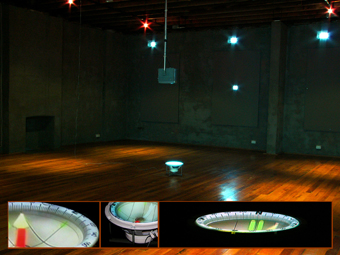
Mark Brown, Waypoint
photo David Simpkin
Mark Brown, Waypoint
A red flash glimpsed from the corner of the eye, alerted viewers to the presence of an anthropomorphic form revolving in a darkened, smoke-filled gallery, viewable only through a slot in the dividing wall. Pressed against the slot, it was possible to detect a laser pointer spinning on an electric motor mounted on a tripod. While the narrowness of the viewfinder concealed the viewer’s identity to the creature within, Demarcation’s menace lay in the fact that viewers felt compelled to maximise their exposure to the laser beam as it passed across their eyes by getting as close to the viewfinder as they could.
Low, rumbling vibrations across the gallery floor, led us to Way-point, another finely calibrated viewing experience, in the main body of the gallery. Looking down rather than out or through, we enjoyed the brief deception that the compass face projected onto a speaker on the floor was solid. Brown was projecting a video recording of the face of a compass held on a walk around the block on which the gallery is situated. At this moment our visual sense was foremost but as we gazed into the speaker the habitual ordering of our senses was challenged by the sound recordings made during the walk emanating from the speaker. The illusion of solidity was accentuated by the shape of the speaker mirroring the shape of the compass dial but this visual doubling was undercut by the contrast between the smallness of the seen object and the volume of the invisible soundtrack reverberating beneath our feet.
Despite Mark Brown’s dexterity with his materials, the exhibition was not about high production values. His pleasure in economical technology and the adaptive re-use of widely available materials further underpinned our feeling that his objects didn’t need anyone to look at them. We were drawn to them because of their craftsmanship and their manner of standing apart from viewer expectations. It was their self sufficiency which ultimately destabilised the personal and cultural locative devices at work in the space. By using conventions, templates and codes which are widely identified with warfare in his practice, Mark Brown raised our awareness of his orchestration of our vision while at the same time undercutting their certainties with manoeuvres which are often uncanny, poetic and unexpected. Strangely, we were inspired to reflect on the many meanings of location through an exhibition in which the objects potentially displaced the site.
Mark Brown, Exeunt_Site Manoeuvres, Conical Inc, Melbourne, 16 Sept 16-Oct 2, 2005; http://untitledbrown.zina.org/
Jasmin Stephens is Senior Manager, Education and Access, at the Museum of Contemporary Art, Sydney.
RealTime issue #71 Feb-March 2006 pg. 39
© Jasmin Stephens; for permission to reproduce apply to realtime@realtimearts.net
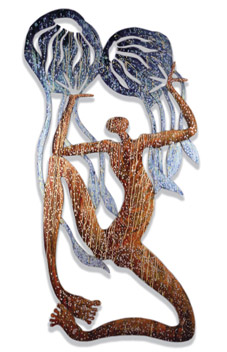
Arone Meeks, Irukanji, 2004, Sculpture
photo David Campbell
Arone Meeks, Irukanji, 2004, Sculpture
Along with one of the fastest urban growth rates in Australia, Cairns has developed a cultural sophistication that is fuelled by a creative mix of colliding and colluding cultures. This continues to change the face of far north Queensland’s cultural, business and civic hub. Strong influences from traditional and urban Aboriginals along with Torres Strait Islanders, Melanesians and Pacific people mix with the remnants of local pioneering dynasties and droves of young families migrating from southern states. With over 2 million tourist visitors each year, Cairns holds a place as one of Australia’s top 5 gateways. All this generates activities that tessellate into a rich social and cultural mosaic.
A significant contemporary visual arts culture has emerged with professional players—KickArts operating impressive galleries at the new Centre of Contemporary Arts, the Tanks Art Centre’s wonderfully robust and atmospheric interiors, The Cairns Regional Gallery’s converted neo-Georgian spaces and the grandeur of the Cairns Convention Centre. The latter has acquired a remarkable collection of large-scale contemporary art through the Queensland State Government’s Art Built-in policy which has run for the last decade or so.
In this political climate, artists are either borne along with the sweeping tides of change, or are activists speaking out about indiscriminate and inappropriate development. There are many artists working with a localised culture and lifestyle, a few with sustainable careers. National and international interest is bestowed upon those artists whose work has some resonance with current issues, and who’ve developed networks with industry peers. Three such artists are Arone Meeks, Zane Saunders and Samuel Tupou. Meeks and Saunders are urban Aboriginal artists and Tupou has Pacific Islander heritage.
Arone Meeks
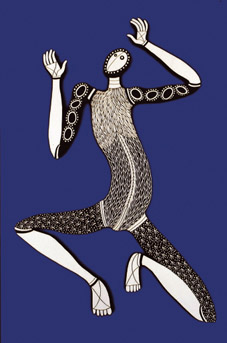
Arone Meeks, Bird Totem, 2003, Sculpture
photo David Campbell
Arone Meeks, Bird Totem, 2003, Sculpture
Arone Meeks was born in Sydney in 1957, but grew up in Cairns before attending art school in Sydney. He was a founding artist with the Boomalli Aboriginal Artists Coorporation in Sydney and initiated the annual NAIDOC exhibition at the Tanks Art Centre in Cairns, creating dialogue between communities and showcasing the work of Indigenous artists. Meeks has been awarded significant fellowships including the first Indigenous Australian residency at Cite des Arts in Paris.
Meeks grew up with his initiated grandfather and spent time with one of the North’s most celebrated Indigenous artists, Thancoupie, whom he describes as “Athoy”—spiritual mother. He has lived with the Mornington Island community, finding strength in its social foundation.
He produces paintings, sculpture and prints that express a passion for country, spirituality, sexuality and politics. Meeks’ path is one that redefines his connections through art mediums. The spiritual is actualised through art and his response is one of “working it through” an intuitive process. He is able to express a unique spiritual response to country that has a harmony in connecting disparate worlds. His subjects are sourced from nature and are represented with both cultural responsibility and the expressiveness of contemporary art. Arone’s Indigenous links are with the Kokomidiji of Cape York, around Laura, the site of renowned rock art galleries filled with graceful drawings of quinkans (spirits). Laura is known as a place of Aboriginal magic and sorcery; it is also the location for the biannual Angnarra Aboriginal Dance Festival. Walking through this country has a palpable effect on the artist. He feels a physical reaction to sacred country that helps forge kinship relationships, a sense of self and “renewing the dreaming.”
Meeks’ practice is based intuitively on the shifting definition of cultural identity. It has a connection to dreams and experiences that have touched his soul. Sexuality also has an influence and is conceptualised as part of the human matrix. As an urban Aboriginal who inhabits a world in proximity to traditional tribal lands and communities, he describes his practice by saying, “I am hunting for lost pieces of myself.” It is a process where imagination comes from within and is possibly an inexhaustible source for his art. For Arone Meeks the process of painting is great therapy for defining self and existence. He finds humanity in the gesture of the mark and this is evident in much of his work. His art objects are like his children, sent off into the world, and like children the finished objects take their time to reveal their full consequences to him.
Zane Saunders
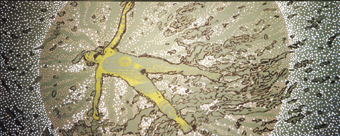
Zane Saunders, Call, 2004, Acrylic on Canvas
photo David Campbell
Zane Saunders, Call, 2004, Acrylic on Canvas
Zane Saunders was born in Cairns in 1971. He identifies with the Butchulla (Bajala) of Fraser Island some 1500km to the south. He grew up in Kuranda and went to school in Townsville. His mother encouraged a return to Cairns so that he could attend art school at Cairns TAFE. Saunders has a Gungu Yimithir language name given by a Hopevale elder. The name—Ngamu Mangal Bungal—means “clever hands.” As a community ranger for Angnarra at Laura, he was a delegate to the International Rock Art Symposium in Alice Springs. Although he has found it challenging to survive as an artist, he has works in the collections of the Australian National Gallery, Queensland Art Gallery, National Gallery of Victoria and an impressive string of state, corporate and private collections.
Saunders’ strength in drawing is evident in much of his painting and printmaking. His practice of developing surfaces and colour, while composing forms with layers of symbolism is informed by visions and ideas. In the last year he has begun to present short performances in conjunction with exhibition openings or mixed bill dance events. These have incorporated shamanistic characters informed by traditional Aboriginal dance and stories. His interest in performance is to find ways to include the audience directly in the experience. This investigation has been fuelled by the desire to learn more skills and have a range of possible responses to particular situations. This is indicative of the way he seeks challenges as an artist. For Saunders the process of creating new work is to engage with new mediums. This keeps the act of art-making fresh and challenges him to develop different skills.
Zane Saunders’ concerns are about the collision of cultures and beliefs. This includes politics in the community and the effects of colonisation. He interrogates social barriers around belief, and the shifting notion of religion and spirituality. His current work has progressed to referencing human form, identity, social values and a sense of spirit and religion. Performance brings his practice closer to the physical body in an investigation of what makes us the same or different. His ultimate responsibility is to carry a message about spiritual connection, for he believes art is an educational process that offers us spiritual strength.
Samuel Tupou
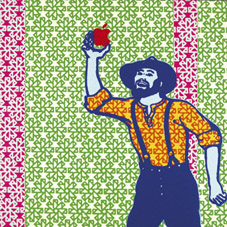
Samuel Tupou, Candy Apple, 2005, Screenprint on Perspex
photo David Campbell
Samuel Tupou, Candy Apple, 2005, Screenprint on Perspex
Samuel Tupou was born in New Zealand in 1976. He arrived in Australia in 1982, living in the Northern Territory. After completing visual art studies in Townsville and Lismore, he moved to Cairns in 1998. He has Tongan heritage.
Tupou came to sell T-shirts in the tourism frenzy of Cairns. In stark contrast to the other graduates from art school who ‘moved to Melbourne’, he was attracted by the tropical climate that reminded him of the area around Gove, NT where he grew up.
His artworks are generally silk-screen prints on perspex. Derived from an 80s retro style, they are influenced by street advertising. The work fits into commercial environments and has a functionality ideally suited to the often dank, humid conditions of the tropics. Tupou’s works are immediately accessible; employing the familiar ‘found’ imagery and symbols, as well as simple materials used as substrate. Perspex and vinyl foam are less susceptible to mould and do not require framing—making them the perfect art materials for rainforest homes. Works from his 2005 KickArts exhibition New Tapa were acquired for the collections of the Australian National Gallery and Cairns Regional Gallery.
Influences on Tupou are everyday encounters with symbols and patterns. Many are appropriated from the internet, from magazines or CD covers, removed from their original context and layered in varying degrees of complexity through his screen-printing process. He works from an idea, which starts to take form through digital ‘sketches’ using Photoshop. The idea can sometimes start as a title that then requires searching for images, or fragments from his bank of images come together to create a new work.
Using traditional Tongan tapa patterns found in books brought to Australia by his grandmother, a background is developed over which figurative symbols and clichéd imagery in high key colour is added. This creates enough tension and interest to take the work to other reference points. There is ambiguity in his work around cultural identity and ‘bi-culturalism.’ For Tupou a work can start quite innocently as a collection of self-reflective mementos and reminders of youthful experiences. He is quite happy for the work to be open to interpretation. Finding new contexts for appropriated advertising imagery can also extend the universal mythologies associated with them. Like the ever-popular Pop Art style, Sam Tupou believes tapa patterns give his work currency well into the future.
–
Zane Saunders’ exhibition Lone Guinea Fowl opens April 14, KickArts lower gallery; Arone Meeks’ solo exhibition opens May 5 in KickArts upper gallery, Centre of Contemporary Arts, 96 Abbott St, Cairns. www.kickarts.org.au; Samuel Tupou’s New Tapa-Summer Collection, showed at IMA, Brisbane, Dec 13, 2005-Jan 28, 2006.
RealTime issue #71 Feb-March 2006 pg. 41
© Russell Milledge; for permission to reproduce apply to realtime@realtimearts.net
Cardiomorphologies
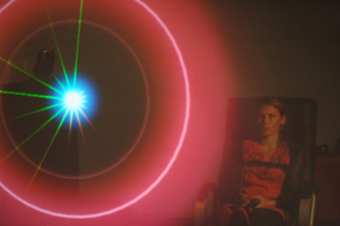
George Poonkhin Khut’s Cardiomorphologies is a multimedia work wherein the vital medium is the participant’s body. A pressure-sensitive strap is placed around your upper ribs to measure your breathing; your heart rate is converted into electronic pulses using sensors held in both hands. You sit in a comfortable chair and watch your personal bodysong writ large in throbbing circular pulses, projected before you. It’s described by the artist as a “quietly immersive” experience, and whilst that’s certainly true the act is also quietly invasive in the way that any vaguely medical procedure tends to be. A whole gallery wall is occupied by huge, unflinching multicoloured representations of your vital organs for all to view, unstoppable only in the sense that you can let go of the electrodes at any time. Simultaneously, sounds are generated from the rhythmic beat of your body data, and these are audible on headphones: a pair around your own head, and wireless sets for use by any interested parties around the gallery space. As a participant, it’s possible to use the experience several ways. One is to sit back and watch your body mechanism rendered as artwork in as passive or meditative a manner as possible—given the situation. Another is to play Cardiomorphologies like a musical instrument. The metabolic musician can use hyperventilation or deep breathing to form wider, more vibrant circular pulses on the screen, the thump of the heart increasing in volume, size and frequency, before perhaps making attempts to slow the tempo back down into a natural resting state.
Whatever approach you decide upon, Cardiomorphologies creates a very honest creative symbiosis between yourself and a cold, hard computer. There are many pieces at the Inbetween Time festival concerned with relationships—both real and imagined—between humans and technology, but Khut’s biological mimic is the only example where the machine can literally be said to have taken on human characteristics. However, the key facet of Cardiomorphologies’ ingenuity is the manner in which bodily data is transformed into highly abstract representations. True, it’s possible to imagine the piece presented with life-like or even photorealistic video images of heart and lungs up on that screen, but the effect would be to slam out a constant reminder to any participant of their own mortality, their entropic, finite qualities, the ones that make humans most resemble machines… and let’s face it, a huge undulating mass of meat projected in this fashion would probably make people lose their lunch on a regular basis. With the far subtler approach chosen by Khut, a partnership develops between device and devisor. Given enough time in that chair, it’s almost possible to forget the mechanical-biological feed into the image, and to consider your cyborg interactions a sort of dance, a duet, a partnership of necessity. It’s hypnotic—almost literally—and reflecting upon the experience afterwards there’s enough interdependence in Cardiomorphologies to make you ponder the implications of Khut’s hardware freezing, or his software crashing. If you were sufficiently immersed in the process and the screen suddenly went blank, what sort of shock might that provoke and would your metabolism follow suit?
George Khut is a Sydney-based artist working in the area of sound and immersive installation environments.
George Poonkin Khut, Cardiomorphologies, Arnolfini, Feb 1-12
RealTime issue #72 April-May 2006 pg.
© Tim Atack; for permission to reproduce apply to realtime@realtimearts.net
What is the relationship between risk and artistic practice? For some, the notion of risk is necessarily embedded in the process of making work; for others it is relative. Within the context of Inbetween Time, festival director Helen Cole has embraced risk as a means of moving practices forward. The notion of Breathing Space is literally that: a pause in the working life of an artist allowing them to explore, to share it with an audience, to change work, and even allow it to fail.
Nurturing Risk was important then as the festival’s opening forum, pairing 12 panelists—artists, curators, project managers and coordinators. Ironically, Daniel Belasco Rogers was stranded in Berlin with a broken ankle sustained during a workshop, so Cole delivered his written response complete with performance directions. Speakers were “asked to consider how their relationship took risks, how it nurtured, and also how it nurtured risk.”
One of the dominant themes to emerge early on was trust. Mark Timmer of Gasthuis (Netherlands) still finds it amusing that David Weber-Krebs flooded a wooden floor when he was entrusted with the gallery keys; Sydney dance-artist Martin del Amo spoke of his panic after accepting a commission to create a 40-minute piece. Gregg Whelan of Lone Twin expanded on the space between a proposal and the resultant work. He gave as an example Lone Twin’s ambitious idea for a narrative-based piece that would occasionally break into song, an idea that Thomas Frank (Sophiensaele, Berlin) liked well enough to program. When Whelan realised Lone Twin didn’t actually have the musical skills required, they created something altogether different (a work about Morris Dancing). When asked how this mutual trust was attained, Frank and Whelan looked almost perplexed. “Over a series of lunches,” they replied. I was reminded of Adam Phillips’ notion that “a couple is a conspiracy in search of a crime.”
This type of collaboration (or collusion) reflects Fiona Winning’s (Director of Sydney’s Performance Space) opinion that artists are very good at constructing temporary communities. She spoke eloquently about Time_Place_Space, a laboratory in its 5th year that enables new collaborations between artists, expanding their networks and practices. For Winning, it is exciting when artists arrive with one set of ideas only to replace them with others arising from connections made with their peers. Equally, speakers were honest enough to flag up some of the difficulties around blueprints for nurturing risk. Nina Wyllie (founder-member of The Special Guests) described participating in eXpo Mentors 2003. Even as artists straight out of academia and with “little to lose”, they experienced “a sense of submitting”, of fitting into a model. Sophie Cameron (New Work Network), who facilitated that scheme, spoke of the risk of losing control—how there was always the possibility that the mentor-artist combination would fail—and the necessity of managing expectations. Robert Pacitti (Pacitti Company) highlighted the importance of funding to keep these developmental spaces open, praising the Live Art Development Agency’s bursary scheme (now in its final year). He also reminded us of the dangers of complacency. Such schemes need to be championed.
All the speakers were engaging and the pairings well chosen with an emphasis on practice over theory. Daniel Brine ably summed up the proceedings, though the ensuing question and answer session never really ignited. This felt like a lost opportunity. Perhaps everyone was playing it too safe.
Nurturing Risk Forum, coordinator Ruth Holdsworth; Chemistry Lecture Theatre, University of Bristol, Feb 1
RealTime issue #72 April-May 2006 pg.
© Marie-Anne Mancio; for permission to reproduce apply to realtime@realtimearts.net
Into the interzone
RealTime 71 celebrates the publication of Darren Tofts’ long-awaited Interzone—media arts in Australia with a review and author interview (p22–23). An opponent of the label ‘new media arts’, Darren proposed ‘intermedia art’ as a more apt term on these pages long ago. Now he argues for ‘media arts’ (right in some ways, perhaps too broad in others) and by bringing out what looks like it could be the definitive book, for some time to come, on Australian media arts (from inception to the near present) he just might make the term stick. But I’m pleased to see the ‘inter’ in Interzone given the extensive hybridising of forms and practices that keeps on emerging from the evolution of media arts. Congratulations to Darren on writing a wonderful book.
Robotics
The approaching singularity where humans and machines merge is anticipated and queried in dance works in the 2006 Adelaide Festival: ADT’s Devolution (p2) and Random’s Nemesis (p4). Choreographers Garry Stewart and Wayne McGregor discuss their respective works, the issues and the science that informs them. We also have a disturbing report from Perth on MEART (p25) in which robotic arms driven by rat neurons create artworks that do away with the need for the human artist. Reports on conferences and workshops on performance and interactivity are also to be found on pages 24 and 35. The world grows stranger, the body something else altogether.
Live art: UK, New York, Bangkok
This edition also features coverage of live art/performance art/visual art performance (the choice of label is yours) in the first and very big biennale of such work in New York in the form of Performa 05 directed by RoseLee Goldberg (p34), a long time champion of contemporary performance. A report from Bangkok describes a substantial and ongoing gathering of South-East Asian artists performing and debating their practice (p8). In February the RealTime editors will be experiencing plenty of live art at the InBetween Time Festival in Bristol, the National Review of Live Art in Glasgow and elsewhere.
Live Art is enjoying growing prominence in the UK, Europe, Asia and in the USA (and outside of New York). After seeing the work in the UK and talking with practitioners, curators and agencies, in coming editions we’ll be looking closely at how live art has developed and what it means in the Australian context.
For our responses to the InBetween Time Festival
go to our features page.
RealTime issue #71 Feb-March 2006 pg.
© RealTime ; for permission to reproduce apply to realtime@realtimearts.net
The Shaman’s Apprentice
It’s rare to see anything but an occasional film from Latin America in Australia’s international film festivals. In fact it’s a long time since South America loomed brutally and magically at us from the screen with its new wave of the 70s. So a first ever Latin-American Film Festival looks a very attractive proposition. Features, shorts and documentaries will screen over 2 weekends, opening at the impressive new Campbelltown Arts Centre, February 17-19, and continuing the following weekend, February 24-26, at the Tom Mann Theatre in Surry Hills.
Cuban director Juan Carlos Cremata Malberti is represented by 2 films. Viva Cuba , his latest, looks at emigration, a challenging issue for Cubans, from a child’s point of view. Made for both children and adults, Malberti’s Nada + (Nothing More) won the Cannes 2005 Grand Prix Ecrans Juniors award for children’s cinema. For the festival’s organisers, “this film’s message of hope sets the tone of the festival and captures the mood sweeping Latin America at the moment where newly elected democratic governments are promising a better future.” Cremata Malberti will be attending the festival.
Australian activist filmmaker, David Bradbury, travelled to Latin America in the 1980s establishing a long-term relationship with the region and making documentaries covering conflicts in Nicaragua, Cuba, Chile and now Argentina with Raul the Terrible. Over 4 months, Bradbury followed Raul Castells, the “dynamic and often confrontationalist leader of the piqueteros (picketers), a national movement of the poor and unemployed in Argentina”. David Bradbury will be present at the Tom Mann Theatre screening of Raul the Terrible on Saturday 25 February at 6.30pm for a Q&A session.
From the producer of City of God and Central Station, Walter Salles, comes Cidade Baixa (Lower City) “a tale of a woman’s intrusion on the close, almost intimate relationship between 2 men”. The film’s director is Sergio Machado who also made Madame Sata (2002).
Machuca is the first film to be made about Chile’s 1973 coup and was the country’s official entry to the 2004 Academy Awards. Set in Santiago, this coming-of-age story “traces the friendship of 2 boys from opposing ends of the social spectrum and how the events of September 1973 affect their relationship”. Director Andres Wood had another box office hit throughout Latin America in 1997 with his first feature film Football Stories. Machuca is his third feature film, “a testament to that past and a reminder of why it must not happen again.”
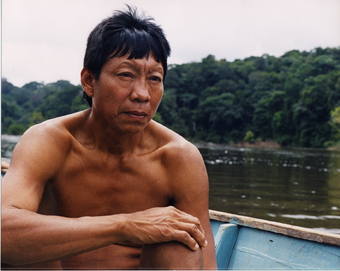
The festival will also screen a series of films focussing on the Amazon region. The Shaman’s Apprentice is set amongst the Suriname communities of the Amazon and concerns the ethnobotanist Dr Mark Plotkin’s mission to find a cure for diabetes. In Between Midnight and the Roosters Crow a Canadian oil company commences its operation in the Ecuadorian Amazon. An intriguing part of the festival program comes in the form of 15 minutes of short films made by locals in the Brazilian Amazon basin: the project is titled One Amazonas.
Among the festival’s documentaries, Tina in Mexico recreates the life of photographer and revolutionary, Tina Modotti, who adopted Mexico as her home. Archival footage and images from the photographer’s work convey a sense of life in 1920s Mexico. Argentinian director Sergio Morkin’s Oscar documents the resistance to advertising’s invasion of public space: “By transforming billboards with his own collages and paintings, a Buenos Aires taxi driver takes his revenge.”
This looks like a great little festival, modest in scale but no less impressive in its scope and offering rare insight into a region rarely glimpsed on this side of the world. In all, 14 features and documentaries will be screened plus 4 shorts and some animation. And as you’d expect of a Latin American gig, hospitality will also be generous. At the big launch, the screening of Viva Cuba will be followed by a fiesta of traditional food, salsa dancing and “a good dose of rum.” RT
Sydney Latin-American Film Festival, Campbelltown Arts Centre, Feb 17-19; Tom Mann Theatre, Surry Hills, Feb 24-26. www.sydneylatinofilmfestival.org
RealTime issue #71 Feb-March 2006 pg. 21
© RealTime ; for permission to reproduce apply to realtime@realtimearts.net
If you work in an office packed full of computers there’s a chance that the subtle high frequency noise of multiple disc drives whirring around, day in day out, is actually chipping away at the fundamentals of your audio range, tiring them into submission. So alongside having our brains fried by mobile phones, we’ve now identified desktops and laptops as the new enemy. Technology: it’s out to get you.
Ryoji Ikeda, Spectra II
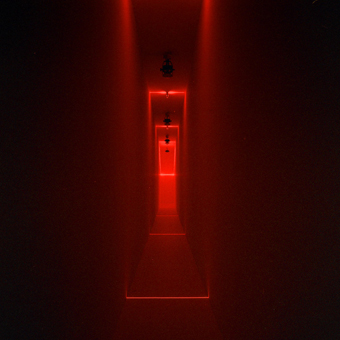
Ryoji Ikeda’s Spectra II is definitely out to get you. The artist’s intention is to have the audience interact with a geographically defined soundscape, an all-encompassing sensory experience, and in Spectra II he does it using the subtle scream of low volume high frequency sine waves, amplified in such a way as to be altered by your very movements within the space. That space is a tight corridor, taking one victim at a time, its precise dimensions at first rendered uncertain by disorienting lighting effects and the unnatural omnipresence of electronic noise. From the entrance point of this channel, it’s not clear if and how the installation ends: an all-pervasive red glow emanates from a long, horizontal laser marker far in the distance, and every now and then white strobes burst to life along the length of the walkway.
Certain of Ikeda’s previous compositions on CD can be said to resemble nothing so much as a ‘concerto for electric cattle-prod’, and the surges that accompany every burst of light in Spectra II are highly reminiscent of these angry crackling stabs. It has the emotional effect of urging you on up the corridor, into the unknown. At the same time, the prospect of what lies at the end of the walkway is not exactly comforting; everything has the air of an horrific science fiction landscape, the laser lines in the distance forming the crosshairs for some terrible inhuman device.
As you move tentatively forward, the clashing sine waves about you form peaks and troughs in your geographic perception where peaks and troughs have no right to be. If you clap your hands, it doesn’t reflect back off the walls in the normal fashion and is instead swallowed up by some sort of ambient compression. In short, ladies and gentlemen, this is hell. Everything is consumed by the insatiable space, and it’s never, ever going to stop.
So, yeah, it’s a bit of a disappointment when you get to the far end of the corridor and it’s just a straightforward wall. A laser marker is slapped across it just above eye level, and the red glow renders wood grain within the construct highly visible, removing any mystery about its provenance. For a while you feel like knocking on the wood just to see if it will open up, continuing beyond, a further corridor, onward into infinity. But no such luck.
The fact that this is a finite corridor necessarily makes Spectra II a game of 2 halves, and the last trick up Ikeda’s sleeve is revealed when you turn to retrace your steps. In returning back down the passageway, you are blocking the principle light source, the laser. In addition to this, your exit far off in the distance is only vaguely lit by the half-light spilling from the outside world. As each strobe explosion occurs, it’s now far more apparent that the walls of this corridor are painted bright white, which means your funny little brain does a funny little thing: in the sudden absence of light (an effect you can mimic anytime by quickly shutting your eyes) the brain converts any after-image held by the retina into a negative of itself. This means, that in the final part of Spectra II, you are traversing a space that seems to be repeatedly vanishing into complete nothingness in controlled bursts. Hell isn’t going to let you go easy.
Alex Bradley & Charles Poulet, White Plane_2
Adam Farady
Alex Bradley & Charles Poulet, White Plane_2
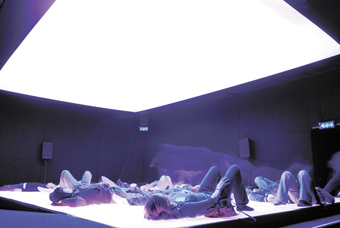
At Inbetween Time heaven is well represented by Alex Bradley and Charles Poulet’s Whiteplane_2, an immersive audiovisual landscape that differs from Ikeda’s work in several ways. Firstly—and perhaps most importantly—it is not an experience that defines a strict journey for its participants. Audiences come and go within the space as they please, spending as much or as little time as they deem fit, and they do so in a communal fashion, as Whiteplane_2 is a broad rectangular platform upon which many people can stand, sit or lie down. The opaque floor and ceiling glow with changing colours, sometimes in parallel reflection of each other and sometimes in a riot of shifting tones, whilst sounds envelop you, circling, zipping and swooping from an array of speakers hidden in the darkness that surrounds the stage. The noises tend towards the abstractly pleasant; a cynic might detect a touch of Harold Budd/Wyndham Hill new-ageness about some of the more fluid tones. But the cumulative effect of hearing these motifs ebb and flow repeatedly—combined with the occasional random attack of white noise and lightning not dissimilar to Spectra II—is to give the impression of natural phenomena, the ocean or the sunset, storm fronts or swarms, represented consummately by a marvellous benevolent technology. It’s as if, somehow, an orchestra of fast-processing computers has developed a set of musical themes and is improvising away, happily, to the Aurora Borealis.
There are further associations: having to remove your shoes gives the experience a sepulchral edge, alongside the deep, reassuring roar of a gong that drops in and out of the ambient noise… Some of the colours bleach the environment so as to suddenly turn everyone upon the platform to monochrome.
Whilst a crowd of primary school children is in residence, the space turns into a wash of blue and without prompting, the kids all begin to swim like fish. Whilst Bradley and Poulet must in some sense have programmed a limited combination of instructions into Whiteplane_2’s software, the foreground presence of an audience extends the aesthetic possibilities into almost infinite territories. Some people chatter, some lie prone, some throw paper aeroplanes, some stare at their feet throughout. If you’re willing to be in the space for long enough, you can play a strange little game of crowd control, so that if you sit on the ground for long enough eventually everyone will be sitting; if you lie staring at the ceiling, you rise some time later to see that the platform looks like a bed-in, bodies prone, blissed-out. So unlike Spectra II, which after the fact one recalls as a ‘ride’, a sort of futuristic ghost train, Whiteplane_2 can be so many other things all at once: a toy, an escape, an artwork, a moment. And it’s all thanks to the audience. Jean-Paul Sartre was wrong. Hell is a solitary pursuit. Heaven is other people.
The opening forum at the Inbetween Time Festival of Live Art and Intrigue is a discussion centring upon the concept of ‘risk’ within live art, with special attention paid to the curator/artist axis. Six sets of producers and artists speak about their experiences of operating together, and how ‘strategies of risk’—rightly identified as a difficult, almost oxymoronic concept—have been nurtured between them, around and within the work. As Nina Wyllie (The Special Guests) flags up early on, any discussion of risk is almost always accompanied by its “somewhat less sexy counterpart, safety.” Certainly the pattern of discussion today is similar no matter where we turn (including dissections of work based in Australia, the UK, Germany and the Netherlands) in that the producers will often talk about the support structures in place around artists, and then the artists take the ball and run, describing how these ‘safety nets’ allow them to bundle all over the place performing acrobatic feats of the imagination and generally engaging in lovely risky stuff (including, in the instance of David Weber-Krebs, flooding part of his host’s venue).
Ironically enough, one of the forum participants is present in written form only, Dan Belasco Rogers having done himself a disservice in the ankle department, resulting in immobility and a cancelled flight from Berlin. (The last IBT festival saw Rogers presenting a seminar on cuts, bruises and injuries he sustained in various international locations over the years—shown in the very same lecture theatre we’re sitting in today—in which, memorably, he asked the city of Bristol “not to hurt” him. In the end it was Berlin that ‘got’ him.) On top of this, dramaturg Thomas Frank of Sophiensaele in Berlin is late because of clogged-up air traffic above Brussels, and at one point in proceedings the fire alarm goes off and we’re forced to evacuate the building. Obviously in real life risk nurtures itself, and this is a point raised within open discussion at the tail end of the forum when artist Paul Hurley ruminates on the fact that risk is present in every art form, and not simply a prerogative of live art. It’s subsequently made clear by many of the participants that they aren’t laying claims to the unique ability of the discipline to engender risk-taking, simply that the often extremely open, trusting relationships between curators and artists are vital to the development of curve-ball concepts and risky creative processes.
In this respect, Thomas Frank’s working practice with UK performers Lone Twin is a wonderful example of commissioners and artists adapting new models in the light of increasing international collaboration. As a company without a ‘rehearsal’ ethic as such, and where the work is sometimes presented simply as documentation, Lone Twin have found a regular foil in Frank, who explains that as a dramaturg under the German model he would normally expect to sit in on preparations and generally have more immediate creative input into an artist’s practice. Gregg Whelan then paints the picture of vague conversations and occasional lunches that characterise Lone Twin’s recent experiences with Frank, and uses this to illustrate how, for this company, the ability to take risk is founded upon ‘belief’: the belief of their collaborators in Lone Twin’s work; the belief of producers like Frank, who will sometimes find themselves sitting in front of a final work completely different from anything previously discussed; and last but not least, the belief of audiences in their endeavours, an audience who are—as Rogers points out—risking a great deal by investing in work where the generic parameters are nebulous and outcomes frequently uncertain
Arriving a few minutes late having taken a gamble (or should I say risk) on my knowledge of Bristol geography, my first take of the Nurturing Risk forum was hearing the query “Why do we nurture risk?”, followed quickly by the answer that it was quite simple. But hang on a minute. What about the nurture/risk dyad, the antithetical relation between these terms that the introductory text for the forum highlighted?
The forum paired artists and producers, yielding examples from the array of possible couplings. Each focused on the nature of their relationship, the development of a bond coming across strongly throughout. Each was also asked to consider their relationship in light of the forum title, taking us back to adversarial terms: nurture—to encourage somebody to grow, develop, thrive, and be successful; and risk—the danger that injury, damage, or loss will occur. On the surface these definitions are glaringly contrary; and yet the introductory text suggests (and no one on the panel opposed the idea) that these terms “reflect the lifeblood of Live Art and experimental practice.” One would hope that any successful relationship has the potential to disrupt these limiting classifications.
The first 2 pairings concentrated on artist-to-artist relations facilitated by a producer. Nina Wyllie and Sophie Cameron discussed a mentoring process developed as part of eXpo 2003, while Fiona Winning and Robert Pacitti revealed a more laboratory style approach as part of Time_Place_Space initiated by Performance Space in Sydney. Wyllie termed eXpo as a safe space, of hand-holding and guidance. These are double-edged terms, both comforting and intrusively paternalistic, but Wyllie thought that her company, The Special Guests, “needed it” at the time, they “needed a leg up.”
A discussion of the inevitable limits that risk creates highlights our existence in an environment where it’s not the case that ‘anything goes.’ Risk is limited by what Wyllie described as its “less sexy partner, safety”, a point backed up by Gregg Whelan later when he asked of Live Art, “Is it dangerous?”, and answered himself, “No, because it is in a building that complies with health and safety [regulations].”
Wyllie described a creative situation with a certain level of openness that allowed her company to tinker with the world they are entering, but with the caveat that they knew they were fitting into an existing model. This was was like moving across stepping-stones, one step at a time, each with a validating function allowing entry into the world of promoters, organisations and funders in their role as ‘guardians’ (a term repeatedly used by numerous speakers). Can this model facilitate risk, or does each validation simply reduce the possibility of taking it? The role of the producer, as one who convinces others to promote or believe in work, certainly develops the artist’s career, but I would not wish to assume that this inherently fosters risk (without clarification of how or why it does). Clearly such relationships will at times do so, and at others not—and such belief will always be open to debate. In Robert Pacitti’s terms “risk is relative.”
We heard of various relationships: in Australia the Time_Place_Space laboratory process where participating artists sometimes decide to drop what they came to do and go for something else instead; David Weber-Kreb’s continued dialogue with Gasthuis (Netherlands) despite winning bronze in the Golden Tomato award for worst performance in a season; and Gregg Whelan informing his dramaturg that he would have to see the work when they did it, due to zero rehearsal. These examples display relative levels of belief and risk; the trouble however with a relative position is that it can continually defer actually pinning down what is happening. Fiona Winning applauded the opportunity for Martin del Amo to show his work again, to test it until the “the artist knows what works.” In terms of risk this appears contrary: if you continue once you know something works, where is the risk?
Risk has to exist in the work, in its content: Mark Timmer (Gasthuis) states that he can only understand “taking risks inside the work, otherwise it is not clear what is meant by the phrase in this sense.” In light of this, a late question asking if “risk was really being taken” seemed pertinent. Whelan responded, claiming that this approach to framing Live Art is spin, and that the “heart of practice is not trying to fetishize [it]…” This made me hope that the rhetoric of risk might not be necessary. When we take an act of what Whelan termed “professional bravery”, we don’t necessarily see it as a question of risk, simply that it would be a complete waste of time to not do so.