Australian
and international
exploratory
performance and
media arts
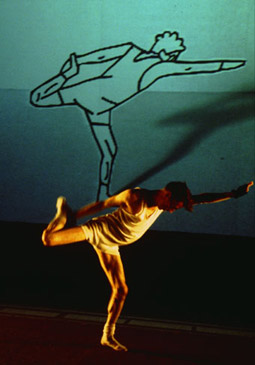
Trevor Patrick, Plasticine Park
photo Virginia Cummins
Trevor Patrick, Plasticine Park
‘Sweet bird, that shunn’st the noise of folly, Most musical, most melancholy.’
Milton, Il Penseroso
We, the vinyl generation, are able to recollect our personal histories through the music of our time. Particular songs remind us of periods and situations in our lives. Pivotal events become woven into the fabric of human existence: John F Kennedy’s assassination, the death of John Lennon, the aeroplanes crashing into the Twin Towers. Moments we remember as shared and personal.
Raimund Hoghe’s performative reflection on the 1960s, Another Dream, is a collage of many such moments. Evoking the social via a poetics of the personal, Hoghe quietly walks us through his account of this period. Music is used to stimulate memories and feelings, whereas words articulate his life experience. Hoghe successively unfolds himself to the gaze of the spectator, simultaneously revealing some things about time and place. His 1960s is decidedly German: it consists of post-war rubble, his sister scrubbing steps, the local cinema he frequented.
Famous songs of the 60s delineate each section of the piece, which consists of simple actions: repeated arm gestures, a reclining body waving an incense stick in time to the music, hands measuring the length of the body, walking patterns. The colour red stands out—communism, solidarity, blood. Hoghe lies down for peace beside a red t-shirt. Some sections are meditative, ritualistic, even reverential. A lacquer box of tea lights is lit, extinguished, lit, arranged, and packed away again. Spare gestures accompany poignant songs, many from singers no longer with us. Life is not a bowl of cherries.
At one point well into the performance, Hoghe carried a lantern along a pathway. This simple act provoked a perceptual shift out of ordinary time into a more epic awareness. The epic is a poetry of the heroic. Another Dream is a performative recollection of things past, a revelation of time and place and body. Its heroism is a tale of survival, of a lived body out of the ordinary, oriented towards the extra-ordinary. This moving work is meticulously crafted and performed. Hoghe is utterly present within his work in a way that gives it a dignified clarity. The last image in Another Dream is of Hoghe’s buckled back facing the audience, his head supporting a small box of shifting sands. The box is illuminated. The world is dark but also illuminated.
Superficially, Balletlab’s latest work, Nativity, is also about a moment in personal history—choreographer Philip Adams’ childhood. Its opening look is every bit as good as David Lynch’s picket fence in Blue Velvet. A select audience is welcomed by our maitre d’—Adams resplendent in brown velvet suit. His house is a faux cabin/home, furnished with a selection of Australian objects, circa 1960. We are treated to some horrible biscuits (Iced Vovos, I believe) while Adams gives us a tour of his collectibles.
But don’t be fooled. This is not a trip down memory lane. From the iconic twee of 60s suburbia to the mementos of Adams’ childhood, there isn’t a scintilla of expressivity about this work. Nativity is a postmodern autobiography. It lacks any sense of the biographical. A woman enters the house and hangs her coat. Is she Adams’ mother? We neither know nor care. She is a Stepford wife, her absence is palpable. The walls of the home open onto an Aussie backyard, a tiny Hills Hoist twirls in the background. A toy Spanish bull from Adams’ past is our portal into a bullfight scene: the girls are toreadors, the boys are bulls. A reference to childhood initiates some backyard roughhousing using Adams’ familiar group choreography where people anonymously throw each other about on a tarpaulin. They fold, twist and turn with ping-pong timing.
Stuffed rodents, moose and marsupials jerk on and offstage. They exhibit the same deadpan as the dancers. We are enticed into a climax of vacant spirituality: one dancer is a Snow White character surrounded by a manger of stuffed animals. Somehow this leads into an offstage UFO sighting and the deliverance of a sort of saviour.
Nativity is very funny. It is imaginative and creative. Adams’ presence as our tour guide and some inspired animal grooming make the piece work as quirk. Two areas could be improved: the dancers are required to use their faces very carefully, way beyond the usual demands of contemporary dance. I think some skilful direction would assist, to help the performers work out what attitude to adopt in the various scenes and the overall tenor of the piece. Secondly, the dancer’s relationship to objects could similarly be further nuanced. There is often a touch of subject/object cross-dressing in his work—objects are animated, whereas humans are evacuated of human emotion. How are those stuffed animals to be handled and moved? How should the various inanimate objects be animated? Whatever the answers here (puppetry skills?), their development would give a greater edge to the bent humour that animates Nativity, encouraging its eccentricities and enhancing its insanity.
Lucy Guerin’s Plasticine Park is a much more modern dance piece. A collaboration between Guerin and 4 visual artists, Plasticine Park, consists of 8 scenarios that juxtapose dance and the moving image. Some segments are humorous, some naturalistic, some video-arcade and some otherworldly. The naturalistic works (David Rosetzky) are accompanied by a kitchen sink monologue by 2 young things (Kirstie McCracken and Kyle Kremerskothen). Although (perhaps because) they were everyday, these sections had some interesting choreographic moments: movement found on a rug or with a chair. The more imaginary Create Grid (by Stephen Honegger) was a very geometric piece whose corresponding choreography was equally directional. It was precisely executed by Brett Daffy who has an admirable ability to move with mercurial fluidity. Polygon Jungle, also by Honegger, looked like it inhabited the colourful universe of video games, sporting the meanderings of a queer bunny (Shona Erskine). Laresa Kosloff’s 2 pieces were cartoons that documented the travails of wannabe athletes. Guerin’s comic responses drew upon the lexicon of the gym and running track to create a narrative, faithfully rendered by Trevor Patrick and Rebecca Hilton.
Patricia Piccinini’s images were the most disturbing. Her imaginary compositions of human bodies recalled the stark realism of documentaries on surgical procedures. Blood bubbled, swollen organs emerged and mutated. Sally Gardner performed a meticulous series of hand and head movements with a rhythm and quality that matched Piccinini’s alien landscape of the flesh. In a final sweep, Stephanie Lake cut through space to the last of Piccinini’s corpulent imagery. This was the most poignant section though I’m not sure why. Perhaps it was because Lake seemed more exposed than the others, closer to the audience. Plasticine Park was a “degustation”, an aesthetic series of tastings coupling food (dance) and wine (image). It afforded the opportunity to see the breadth of Guerin’s kinaesthetic imagination in response to a series of artistic constructions, designed to stimulate the palate.
–
Another Dream, Raimund Hoghe, CUB Malthouse, Melbourne, October 22-25
Nativity, Balletlab, choreographer Phillip Adams, designer Bluebottle, performers Joanne White, Ryan Lowe, Brooke Stamp, Toby Mills, Rachel Ogle & Phillip Adams, Dancehouse, Melbourne, October 13-35
Plasticine Park, director, choreographer Lucy Guerin, visual concept Lucy Guerin & Patricia Piccinini, performers Brett Daffy, Shona Erskine, Sally Gardner, Rebecca Hilton, Kyle Kremerskothen, Stephanie Lake, Kirstie McCracken, Trevor Patrick, visual artists, Stephen Honegger, Laresa Kosloff, Patricia Piccinini, David Rosetzky, music/sound design, Paul Healy, ACMI Screen Gallery, Melbourne, October 11-25
RealTime issue #58 Dec-Jan 2003 pg. 6
© Philipa Rothfield; for permission to reproduce apply to realtime@realtimearts.net
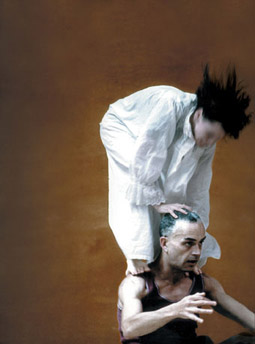
Michelle Heaven, Brian Lucas, Chunky Move, Tense Dave
photo Anthony Scibelli
Michelle Heaven, Brian Lucas, Chunky Move, Tense Dave
The thin membrane of skin separates one supposedly independent, free, voting individual from another. Yet when bodies bleed and ooze, when one body’s psycho-neural shaking is communicated beyond the family into society as a whole, we react with horror. Bodies are supposed to be cohesive and self-contained in all but the most intimate of contexts. However in the wake of AIDS, digital technology and postmodernism, society has been forced to acknowledge that bodies are not always self-contained but rather dangerously contingent, contaminated, fluid and interconnected.
Sandra Parker’s choreography has focused for some time on such disturbed bodily metaphors. Her dancers oppress and manipulate each other and themselves in an aggressive yet disturbingly banal fashion, such that their sense of solidity, of clear presence in performance and unambiguous intent in movement or expression is violated. Parker’s bodies have an almost camp quality, performing with such force as to suggest the essentially socially-imposed nature of our psyches.
If the body is thought of as sound, Katie Symes’ score epitomised what was most successful in Parker’s Symptomatic. Symes created an aural realm of large, yet sonically dirty, oppressive spaces, of environments filled with constant throb and hiss that allayed the nerves by imparting a sense of banal, urban familiarity, while also suggesting dehumanisation and tense endurance. The body in performance took on the same character as a fluoro-lit carpark, rich in potential for movement, yet enclosed by a feeling of blighted industrial space. Overall Symptomatic was replete with moments in which suggestions of tension and character slipped through the performers. Though this was alluring it lacked the clear tempo or musical development that characterised Symes’ score. Yet in sketching such a suggestive realm that both denied and invoked emotional trauma, Symptomatic’s contradictory possibilities remained in memory long after the performance.
In-Compatibility the first collaboration from Tony Yap and Yumi Umiumare as their new company “—”, was similarly energised by troubled bodies. Yap’s approach comes from Grotowski technique and shamanic inspirations, while Umiumare’s style is based in butoh and modern dance. Their many collaborations have rendered them as intense, symmetrical presences who, simply in shaking their heads or thrashing quietly at each other’s side, capture the slightest nuances of each other’s jazz-like improvisations. In-Compatibility is the first co-production from these 2 involving other dancers since Yap’s Narcissus Dream (1997). While Umiumare and Yap related to each other in violent and delicate ways (such as a particularly beautiful moment when Umiumare simply lay on top of her partner, her head at his feet, and vice versa), the use of the 3 other dancers was problematic, producing only marginal—albeit evocative—detailing.
Musicians Tim Humphrey and Madeleine Flynn have a wonderful sense of light, slightly neo-Dadaist/Fluxus improvisation that has complemented Yap’s solo improvisation performances. Their approach nevertheless added to the rather studio-feel of this production. In-Compatibility was superb as an initial study of pained, ecstatic bodies, but presented so that its clarity and more tangible intentions remained mysterious. It was an interestingly structured improvisation, but the kind of subliminal ‘order-behind-chaos’ achieved by the likes of John Coltrane was lacking.
Rather than these tensed, conflicted, chaotic bodies, director Kate Denborough staged the surreal body in her Kage Physical Theatre production of Nowhere Man. The piece was full of wonderfully inventive illusionistic devices and sketches, recalling an expressionist magic show or a music hall performance. Tramps in hats and coats played at vocal sound effects before launching into a short hip-hop section; later the audience marvelled at a pair of sashaying torsos bearing 3 plastinated heads (1 from the neck and 2 others sprouting from upraised elbows). These were great suggestive moments, but overall, Nowhere Man had little to say. A character from the margins of society was introduced and we followed his dreams and his fears—including a superb, almost Pataphysical discourse on the value of “quadrupedism”—but that was about it. Denborough’s direction was tremendously seductive in its assurance and sharpness of execution, recalling Phillippe Genty’s equally illusionistic work. As with Genty though, Denborough’s latest production constitutes the popular face of surrealism, referring to little beyond its own strange, magical dreamscapes and piecemeal iconography. Denborough’s images were immediately intriguing and engaging, making them highly accessible, but not especially sophisticated in conception.
The highlight of the Australian material in this year’s Melbourne Festival (besides the Phillip Adams gem Nativity) was Chunky Move’s Tense Dave. Chunky Move has long been burdened with its status as Victoria’s “flagship dance company”, making it difficult for the institution to live up to its marketing. It was therefore intensely satisfying to see Chunky Move fulfil its promises here.
Michael Kantor’s program notes for this piece which he co-directed with choreographers Lucy Guerin and Gideon Obarzanek describe his marvelling at the dancers “creating a shell of work based on an initial idea and then filling” it out and “infusing” it. Despite the dangers inherent in this process, it was precisely this quality that made Tense Dave so effective. The simple narrative constituted an apparently rigid framework through which the audience followed an increasingly gob-smacked Dave (Brian Lucas) as he circled an eternally revolving space within which otherwise free-floating events, movement sequences, dramatic games and encounters occurred. As with Guerin’s The Ends of Things (2001), the performance began with the man alone in his self-contained space which suddenly and disturbingly exploded outwards. This space coincided with 3 other apartments, then with an unending stream of social and psychological realms as the 4 partitions separating the initial rooms began roaming about the revolve before fracturing into further divisions before finally flying away, leaving a frighteningly open, unadorned environment in the centre of a bleak stage.
Like Symptomatic, Tense Dave examined what happens when bodies and minds flow into each other, exploring where our most secret fears, desires and nightmares come from: through the walls, from the minds of others, and what happens if our dreams blend with others’. Lucas’ lanky Dave was juxtaposed with the jagged, ropy tension of Luke Smiles’ tangles; or the equally pointed yet desperately grasping presence of Michelle Heaven (clambering across Dave’s forehead like a fairytale imp); the easy, weighty power of Brian Carbee (whose commandingly mellifluous voice introduced the fears and games of yet more characters); and Stephanie Lake’s poisoned-chalice of melodramatic sexuality. Tense Dave’s overall message amounted to little more than a retelling of Sartre’s existentialism, but by letting these ambiguous performative images hang unexplained on stage, the directors produced a piece rich with psychological suggestions and contaminated bodies.
–
Symptomatic, DanceWorks, choreographer Sandra Parker. dramaturg Yoni Prior, sound Katie Symes, lighting Jenny Hector, design Anna Tregloan, performers Deanne Butterworth, Phoebe Robinson, Katy Macdonald, Tim Harvey, Asher Leslie, Athenaeum II, Oct 11-25
In-Compatibility, “-”, choreographers/performers Tony Yap, Yumi Umiumare, performers Tom Davies, Nic Hemple, Meredith Elton, musicians Tim Humphrey, Madeleine Flynn, lighting Dori Dragon Bicchierai, design Michael Pierce, 45 Downstairs, Oct 16-20
Nowhere Man, Kage, director Kate Denborough, performers Gerard Van Dyck, Merfyn Owen, Dylan Owen, Byron Perry, Antony Hamilton, Fiona Cameron, Christine Envall, Steven Richards, Gordon Wilson, sound Franc Tetaz, lighting Marko Respondeck, design Paula Levis, N. Melbourne Town Hall, Oct 20-Nov 2
Tense Dave, Chunky Move, choreographers/directors Lucy Guerin, Michael Kantor, Gideon Obarzanek, performers Brian Lucas, Brian Carbee, Michelle Heaven, Stephanie Lake, Luke Smiles, lighting Niklas Pajanti, sound Franc Tetaz, design Jodie Fried, original design/concept Bluebottle (Andrew Livingston, Ben Cobham), Malthouse, Oct 2-11
RealTime issue #58 Dec-Jan 2003 pg. 8
© Jonathan Marshall; for permission to reproduce apply to realtime@realtimearts.net
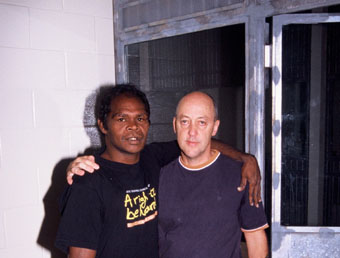 Richard Wanambi and Trevor Graham (director) in a cell at the Supreme Court Darwin
Two recent locally made documentaries demonstrate the diverse challenges facing our communities—and the ties that bind them.
Richard Wanambi lives in Yirrkala, a small isolated community in Arnhem Land. He’s been drinking since the age of 14 and now, aged 35, he’s in trouble for committing a serious offence. He’s looking at doing a long stretch in prison.
Tony Wood and Lee Matthews live in Melbourne. They’re a gay couple eagerly awaiting the birth of their first child from a surrogate mother in America. This is the culmination of a long and expensive process for Lee and Tony and they are both excited and apprehensive as they wait to fly out to meet the mother and witness the birth of their son.
Nami White, the woman who Richard Wanambi calls his mum (he is, in fact, her deceased sister’s son) is worried about her other son, Jamie, who is also drinking and getting into trouble. Nami has already lost one son as a result of a drunken fight and she’s petrified that the same thing will happen again.
Lee and Tony are busy preparing the baby’s room with the assistance of their mothercraft trainer. The white wine is poured and sits on the dining room table, ready to toast the future of a new family. Meanwhile, Richard is heading into the ‘long grass’ to catch up with his drinking buddies. He has a cask of moselle to consume.
Different lives, different communities, same country but separated by so much on so many levels—geographically, socially, economically, culturally—that it takes a mind-stretch to see them co-existing on the same terrain. Then again, the ties that bind them are obvious too, such as the breakdown of the family structure or its transmogrification in response to personal needs and social pressures. (Reading the film notes, I also found another common denominator: Jenni Meaney who was camera operator on both films—a remarkable achievement to cover such disparate projects).
Viewing these films end-to-end, as I did, is to experience (albeit at a viewer’s safe distance) the dead weight of social inequality, moral imperatives and legal constraints. We watch the inevitable unfolding of events that seem nevertheless to catch those affected by surprise, and feel the confusion and trepidation of people trying to cope with unusual circumstances and their consequences.
Lee and Tony, Richard and Nami are all defined by their historical moment, a conjunction of quite different competing interests that block off some options, close some doors and offer other ways out that are certainly not always ideal and, ultimately, propel them to do what they do, be who they are.
Richard’s story (he calls himself Lonely Boy, a sign of his own isolation from the rest of his community due to his alcoholism) is an example of the problems besetting remote communities in the Northern Territory and, in particular, the devastating impact of alcohol on traditional ties and relationships.
This is a frustrating film. Everybody interviewed seems to know what the problem is and understands its impact; the lawyers, judges, police, community leaders all recognise that alcohol abuse is central to the routine violence and self-inflicted human misery found in places such as Yirrkala. The lack of meaningful progress on this problem, however, seems inexplicable. Certainly, the film offers no answers and that may be intentional; it raises issues, presents them lucidly but doesn’t pretend that anything is anywhere near being resolved.
As Richard disappears into prison, Nami White remarks that she will probably not see him again in her lifetime and her matter-of-fact tone belies the palpable pain of this situation.
The film benefits from the obvious sense of trust and openness before the camera that everyone in the film displays, not least Richard himself. The film tries hard to connect with him and succeeds momentarily although it is hard at times to penetrate the fog of alcohol and find the person within.
Man Made also benefits from an intimacy between the camera and the subjects while never shying away from the obvious implications of Lee and Tony’s situation, such as the parallels between shopping for baby and shopping for a baby. As both Lee and Tony acknowledge, once you start flipping through the egg donor catalogues, political correctness goes out the window and it all comes down to face value.
The film owes a lot to the perceptiveness of the camera work, the happy knack of being able to capture the prescient detail, such as observing the meticulous preparation of the couple, clothes neatly folded, travel items arranged in a row on the bed, an orderliness that underpins their approach to the buy-a-baby arrangements (and undermined when baby refuses to arrive on time). This observation is particularly acute in the hospital, firstly during the nervous wait for something to happen (life measured in dilated centimetres) and then as the relationship between the couple and the surrogate mother, Junoa, gradually shifts as the moment of separation approaches.
The actual birth, a coincidence of commercial, social and scientific developments, is also the site of powerful emotions that are invariably ambivalent and unruly.
Lee and Tony’s surrogacy raises issues about the rights and roles of mother, dads and baby. Man Made is sensitive to these concerns—motives are examined, feelings questioned—and, by and large, the subjects respond with candour. In a sense, the film is as much about the couple’s relationship as it is about the birth of their son, Alexander. The birth becomes a means of examining how the couple negotiate the transition to a new phase in their lives through what is largely uncharted territory. In the end, Junoa’s argument that everybody should be given the opportunity to raise children seems justified and the couple grow as a result.
From a documentary perspective, both films underline the value of spending time with the subjects, gaining their trust and presenting their situation honestly without trying to dilute the implications of their behaviour. There is a tough fairness about them both which is ultimately hopeful if only because, whatever the problems and challenges their subjects face, at least there’s somebody out there who cares enough to tell their stories well.
Lonely Boy Richard, director Trevor Graham, producers Denise Haslem, Rose Hesp; Man Made: The Story of Two Men and A Baby, director Emma Crimmings, producers Toby Patten, Michael McMahon
RealTime issue #58 Dec-Jan 2003 pg. 17
© Simon Ellis; for permission to reproduce apply to realtime@realtimearts.net
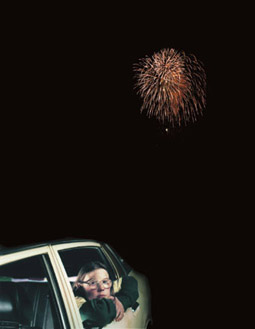
Cracker Bag
Issues of personalised sexual politics have dominated cinema screens since the late 1990s, taking precedence over politics. While this trend is not necessarily reflected in most of the Australian features nominated for the 45th Annual AFI Awards, the 2003 nominees in the Short Fiction category all reject any ‘big picture’ social or political commentary to focus on interpersonal relations, memory and frustrated sexual longing. In these films, characters exist in narrow worlds of heated desires and obsessions, living out their dramas in generic settings.
Cracker Bag (director Glendyn Ivin) for example, is ostensibly set in early 80s suburban Australia. A young girl named Eddie steadily works at earning enough small change to purchase fireworks from the corner shop. At home she is taunted by her older brother and haunted by the sounds of her mother’s telephone arguments with the family’s absent father. Eddie channels all her energy into assembling a firework stash, which will be unleashed cracker by cracker on fireworks night. Inevitably, when the night arrives it ends in disappointment.
There are many touches in the design of Cracker Bag to remind viewers of the relatively recent time when we all lived without home computers or mobile phones, and even the smallest child could purchase explosives. Essentially, however, these elements are window dressing, forming a backdrop that is never integrated into the main character’s emotional journey, creating the sense that with a few surface alterations the same story could have been set anywhere, at any time.
Similarly, Preservation (Sofya Gollan) is a period piece with very little to say about its historical setting. It tells the story of a young, repressed female taxidermist living in late 19th century Sydney, nurturing an obsession with her dead father through frequent visits to a spiritualist photographer. Early in the film, she takes in a lodger who is nursing his own deep grief at the loss of his wife 2 years earlier. A sexual tension develops between the 2 as they each wrestle with their memories and unwillingness to let go of the past.
The drama primarily unfolds in the young woman’s cavernous house which is filled with the preserved corpses of dead animals. Given the characters’ obsessions with dead relatives and ossified memories, the hermetically-sealed nature of the world we see on screen is at least thematically justified, but the viewer never really gets a sense that these characters inhabit a wider societal context. The setting appears more like a theatrical backdrop sketched in with a few historical markers.
The Visitor (Dan Castle) is a contemporary drama which focuses on a middle-aged gay man living alone, coming to terms with the death of a relationship with a younger man. The beautiful cinematography from Richard Milchalak provides an effective contrast between the sun-drenched glare of the beach, where the central character spends time wistfully observing the bronzed bodies of local surfers and the dark interiors of his apartment at night, where he broods over his memories. As in Cracker Bag and Preservation, the pivotal relationships in the film, while containing no real surprises, are effectively handled, but could have unfolded anywhere. The main character lives in what looks like Sydney’s eastern suburbs, but there is no engagement with a world outside his immediate, non-specific surrounds.
The lack of specificity in the settings of these 3 films is not necessarily a problem when each is examined individually. Not every movie should be expected to offer a commentary on the time in which it is set, nor do its themes necessarily have to resonate on a broader social, political or historical level. As a trend which seems to infect much Australian cinema across the board, however, this “fear of specificity” is frustrating, and reflects a deeper fear of creating films in Australia that might demand or require any kind of intellectual engagement beyond a fairly prosaic emotional response.
This is not to suggest we should be seeking a cinema of didactic political agit-prop, or social-realism in the style of Ken Loach. A filmmaker like Swedish director Lukas Moodysson has shown it is possible to create highly effecting humanist dramas which contain very few characters, yet which resonate in many ways with the broader currents of the times in which they are set. Moodysson’s Together is both an examination of how human beings long, and often fail, to be “together”, while also offering a nuanced and extremely subtle reflection on the social and political currents streaming across mid-70s Europe. Based on the shorts nominated for AFI Awards this year, it’s hard to imagine any of our emergent filmmakers coming close to pulling off a similar feat.
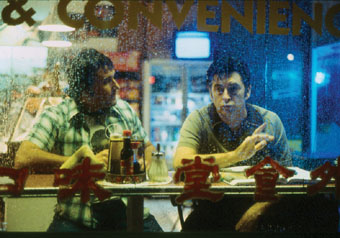
Having said that, the 4th Short Fiction nominee, Roy Hollsdotter Live (directed by Matthew Saville) was refreshingly unequivocal in its affirmation of a particular physical setting. Although it once again focused on a relationship in crisis, the noirish lighting and passages of expressionistic editing effectively evoked the smoky, well-worn interiors of Melbourne pubs, plunging the viewer into the unique atmosphere of the rain-swept city. This alone set Roy Hollsdotter Live above the other Short Fiction nominees. The gritty sense of place was also bolstered by Darren Casey’s complex lead performance. By turns amusing, obnoxious, charismatic and repellent, Casey never failed to hold the audience’s attention with a face as worn and weather-beaten as the pubs his character frequents.
None of the films nominated for the Short Fiction award this year represents anything new or innovative in content or form, but Roy Hollsdotter Live at least created a cinematic world that bore some recognisable relationship to our own. However the generically Australian settings of many of our films perhaps goes some way to explaining why so little Australian cinema seems to resonate in any effective way with Australian audiences.
The Atlab AFI Award For Best Short Fiction Film and the Award For Best Screenplay In A Short Fiction Film were won by Cracker Bag.
RealTime issue #58 Dec-Jan 2003 pg. 19-20
© Dan Edwards; for permission to reproduce apply to realtime@realtimearts.net
Japanese Story
My initial impulse in discussing the 2003 45th Annual AFI Awards was to write about what a poor year it has been for Australian films, but there have been so many articles on this subject recently that it seems merely fashionable to put the boot in again. Instead, let’s try to understand the films as industrial objects and ask what they tell us about the current disjunctions between production and consumption in this country.
As comedy after comedy thudded to earth this year, I noticed that many of these films stemmed from the Macquarie Bank FLIC (Film Licensed Investment Company). FLICs are a part of the present funding regime that is attempting to move production toward a more commercial basis. This is a thankless task. There is a general, though undeniable, link between high production budgets and box office returns. Given that Australian films are always going to have low budgets relative to Hollywood, positioning them in the commercial mainstream is a tenuous business.
The trick is to find a type of filmmaking that can complement rather than compete with Hollywood. Blurred (director Evan Clarry), for example, marks a worthwhile effort at the teenpic, a genre that is popular, and not reliant on stars or expensive special effects.
Asian film industries are adopting horror as a staple genre, while Australia has opted for comedy. Comedies are generally thought to be a genre that represents a good defensive investment with a limited downside. While they might have small theatrical appeal and no international market, they can perform reasonably well in ancillary markets, filling the pipeline for Pay-TV, and let’s not forget that Showtime is a significant investor these days.
Director-actor Nick Giannopoulos finally follows up The Wog Boy with The Wannabes. It’s a tired critical move, but I can’t help seeing this as an allegory for Australian cinema. The central idea is that Australian entertainment industries are wasting their time worrying about talent and intelligence. If your heart’s in the right place and you can overturn Hollywood convention with enough ironic distance, then you’ll be okay. The giveaway here is the appalling and appallingly prominent score by David Hirschfelder, on other projects a composer of skill and subtlety.
Crackerjack (Paul Moloney), the only real box office success of the year, just about gets the mix right. The movie shambles around in a likeable enough way and the plot pretty much falls apart but it seems churlish to point that out. At the other end of the spectrum, The Nugget (Bill Bennet) shows how easy it is to misjudge when you’re taking the piss. This profoundly misanthropic and politically reactionary film suggests that Aussie battlers are stupid and mean-spirited. They should all thank God they aren’t called on to think for themselves too often, or all kinds of bad shit would happen. At the movie’s end we are yet again exhorted, Don’t Worry, Be Happy.
Mick Malone’s follow-up to Crackerjack, Bad Eggs (with Tony Martin), begins as a dryly ironic comedy but then starts to take its crime narrative seriously, as though someone smuggled a Shane Maloney novel on to the set and they started to think they might be able to take a crack at this type of thing too. The nationalist pay-off is in localising a popular genre that people associate with international production, converting the action protagonist into a bloke. Blokes never take themselves too seriously, even when staring down the barrel.
Any film that dares to take itself seriously invites the piss-take, with self-mockery being taken as a badge of national pride. To attempt a national epic such as Burke and Wills or Ned Kelly is to invite a Wills and Burke or, this year, a Ned, 80 minutes of NIDA pretty boys doing rape jokes.
Ned Kelly (director Gregor Jordan) was itself an attempt to test the possibilities of a high budget film with international appeal. There’s a Sam Peckinpah film in there somewhere but the story of outlaws inevitably succumbing to the establishment is itself too much of an establishment exercise, respectful of approved styles. There are some wistful Celtic pipes, some bleach bypass cinematography and some good opportunities for the actors to do their working class accents, but alas, no hint of the shambling majesty of a Peckinpah film or even the flash boldness of Chopper.
This brings us to Gettin’ Square (Jonathan Teplitzky) which is like a night out at a casino—a mainstream pleasure for those who accept the nastiness of the world. Lots of colour, lots of cinematography, lots of soundtrack, moderate amounts of Packer money. David Wenham gets to play a character role and chews extensively on the scenery. There’s no third act, but there is enough furiously flashy energy in the framing and cutting to provide you with a pleasing distraction while Kerry takes your money—and isn’t this the main thing about being Australian these days?
At the other end of the industrial food chain, Phil Avalon plays low-budget guru with 2 entries. The Pact is the kind of movie made to be seen at 2am on cable TV. Sigrid Thornton is being stalked in some strange parallel-universe Australia where everyone has American accents and people name their kids Brittany. Still, its very existence signifies the persistence of a place for the cheap exploitation film. I have a dream, that one day we will be free of taste, and of Acting, free in a land where movies are full of disreputable energy.
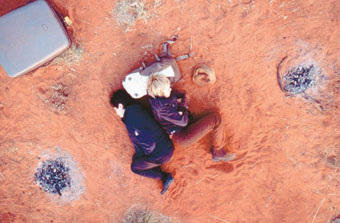
Please forgive that digression. This is still Australia and the favourite this year is probably Japanese Story (Sue Brooks), a seriously worthy serious film. It is burdened with some of the clunkiest theatrical acting you’ll see. Toni Collette will win Best Actress, even though she gives one of her worst performances. While it’s about time we had a film which acknowledges that Australia might want to think about its relation to Asia, this is unfortunately limited to checking off national and racial stereotypes (Japanese men are gruff, Japanese women are inscrutable, and there is so much space in Australia).
The art cinema entries are a bit thin on the ground. Maybe Rolf de Heer’s Alexandra’s Project has some sort of a chance. It is certainly notable for sustaining a narrative in which the protagonist watches TV for the middle half of the film. As in The Tracker, Gary Sweet is again the villainous white guy whose chickens must come home to roost.
The question of winners this year is a little like being asked to choose between John Howard and Simon Crean as PM. Maybe the palpable lack of enthusiasm which will greet any winner will lead to a radical re-evaluation of feature film production in this country. Things have to get better.
Japanese Story won The Showtime AFI Award For Best Film, the Empire Magazine AFI Award For Best Direction, The Parker Pen AFI Award For Best Original Screenplay, Complete Post AFI Award For Best Editing and Awards For Best Cinematography, Best Sound, Best Original Music Score And The Jan Logan AFI Award to Toni Collette for Best Actress In A Leading Role.
RealTime issue #58 Dec-Jan 2003 pg. 20
© Mike Walsh; for permission to reproduce apply to realtime@realtimearts.net
Peter Dombrovskis, Wildness
photo Peter Jackson
Peter Dombrovskis, Wildness
A very sparse crop in this year’s AFI documentary film awards with no obvious contenders and nothing like The Diplomat or A Wedding in Ramallah to catch the eye. This year we’re staying very close to home, having a look at our history and immediate environment, urban and natural. There are 2 films about photography and 2 that explore our archives; they are worthy, well-intentioned, carefully researched, intermittently interesting and enlightening, technically skilful, the product of good hard yakka and an obvious dedication to the topics in question.
Painting with Light in a Dark World (writer/director Sascha Ettinger-Epstein, producer Renata Schuman) is one of the films about photography, in this case the photographer Peter Darren Moyle who has dedicated his life to recording the inhabitants of Kings Cross in Sydney. The film aims to show it like it is in terms of gritty real-life, on the edge, on-the-street action and succeeds in re-creating a specific locale and community. Moyle’s pictures of wasted bodies lost in a statuesque torpor are eloquent enough, more so than Moyle himself who swivels between overbearing bravado and fragile insecurity, a fuck-you brashness masking a painful vulnerability.
The narrative ruse of following Moyle as he moves towards his first exhibition seems somewhat contrived, determined to track a rags to riches storyline, the unknown artist ‘discovered’ which, in the end, just seems to be part of the ‘romance’ of the street. The photographs themselves, for all their supposed importance to the ‘story’ of the documentary, are devoid of any context in terms of the tradition of street photography and our understanding of them hardly progresses beyond the voyeuristic impulse. They deserve better.
Silent Storm (writer/director Peter Butt, producers Peter Butt, Ross McAuley) tries hard to get us bursting with indignation with its own shock-horror unmasking of deceitful deeds. The great unsuspecting Australian public is once again subject to terrible goings-on and treachery in the name of—well, whatever you like—progress, the Empire, national security. While there is clearly a worthwhile story to be told here about Australia’s participation in the British testing of the atom bomb, and useful parallels can be drawn between politicians and national paranoia then and now, this film aims for more and achieves less.
Somewhere along the line it has been decided that all this science stuff needs pepping up a bit and so there are re-enactments galore, spliced together with archival footage and, in places ‘faux footage’, that is re-enactments touched up to appear authentic which, as a distancing technique works quite well but to what effect? Such estrangement simply makes us strangers to the story.
The hyperbole is pressing, insistent—the most powerful, the most contentious, most politically charged, most brilliant, bitterest etc—but the material doesn’t really need spooky piano music and the clichéd commentary along the lines of ‘the security net is closing in’ to make its point. Some of the archival footage is amusing, such as shots used to set the scene for 1950s Adelaide, Perth, Brisbane etc that instead make the locales appear almost identical—slow moving cars and pedestrians, brown buildings and golden light.
After all the trickery and visual manipulation, what is the message? That the public were kept in the dark, that when faced with an unpalatable truth, politicians will intimidate and dissemble. In that sense, the film is a reflection of its time ie today, but the conclusion that those in power will lie in order to protect themselves is unlikely to surprise too many people.
The Original Mermaid (writer/director Michael Cordell, producer Ian Collie) is yet more archival film, this time from London, Paris, Sydney, interwoven with a lot of watery images of people swimming, diving and splashing about. It’s the wettest film, a poetic paeon to swimming. Still, Annette Kellerman, who was the original mermaid, is a fine advertisement for all things watery. The film does a thorough job placing her in context, explaining what made her unique for her time, how she challenged social expectations about what women were capable of achieving. Kellerman comes across as the Madonna of her age, admired by men and women, someone who was not afraid to use her physicality and aquatic prowess to shock, titillate and entertain.
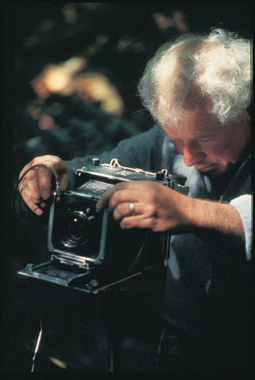
Wildness (writer/director Scott Millwood, producer Michael McMahon) is the most focused of these documentaries. It has the biggest canvas—the Tasmanian wilderness—but one that is viewed from the perspective of 2 nature photographers, Olegas Truchanas and Peter Dombrovskis, so time after time we are invited to stand in their shoes, share their views, literally see what they saw. The film shifts easily between the men and the places where they roamed, back and forth through time and across country. There is symmetry and balance between the men’s lives, their work of photographing the natural state of Tasmania, which spanned 2 generations as well as different but related conservation battles. Indeed, having seen both men represented together in this film it would be hard now to look at them in isolation—they each reference the other, forward and backwards. It’s interesting, too, comparing their different photographic styles: the stillness and particularity of Dombrovskis, the more gregarious Truchanas who populates his grand vistas with idyllic family scenes. The fact that the men were also close—like father and son, the film says—reinforces the parallels, creates a context that is both personal and political.
There are more re-enactments in Wildness, this time a re-creation of the slideshows given by Olegas Truchanas to raise people’s awareness of the natural beauty on their doorstep that was in danger of being lost. Wildness itself is an extension of these shows, still concerned with delivering a conservation message via the medium of film. It makes us care about places that most of us will probably never see in person, a result which, in itself, is a fairly basic but important effect of documentary film, both still and moving.
Which just goes to show that for all the dazzling cinematography on display in these films, you still can’t beat a good slide show when it comes to making an impact.
The Film Australia AFI Award For Best Documentary was won by Wildness. The Award for Best Direction in a Documentary and For Best Editing In A Non-Feature Film went to Painting With Light in a Dark World.
RealTime issue #58 Dec-Jan 2003 pg. 21
© Simon Enticknap; for permission to reproduce apply to realtime@realtimearts.net

Cane Toad—What Happened to Baz?
For the 2003 AFI Awards, “a panel of accredited industry professionals” whittled the list of 47 short fiction and animation films down to 4 finalists in each category. It’s a lot of whittling and in the process you’re always going to lose something. In the case of animation, the loss is serious and the outcome is a misshapen vision of the artform in Australia. What were these professionals thinking? The Projectionist (14 minutes, director Michael Bates, producer Anna Messariti), already an international prizewinner, is one of the most striking works of animation of recent years. Perhaps, with its pixilated human performers and its real city setting there was uncertainty about its status as animation; perhaps the slow unfolding without apparent narrative—rather a reverie, a state of being—didn’t engage the judges in this post-postmodern era of chronic addiction to story-telling. It’s small compensation that The Projectionist snuck into the nominations for Best Achievement in Sound and for Cinematography in the Non-feature film categories but not for Short Fiction or Short Animation.
Competition for the big prize between The Projectionist and that other international prizewinner, the clay animation Harvie Krumpet (see the interview with director Adam Elliot, RT#57), could have made for instructive comparisons and a telling outcome. Both entail particularly intensive methods of making, both evoke the life of a solitary European migrant and both implicitly pay homage to the animation traditions of middle Europe. Both are unusually serious in tone for animated film in this country even though one is patently comic. Both share the European penchant for metaphysical whimsy. As the situation stands, Harvie Krumpet will easily sweep the board. Although its competitors are finely crafted and one of its number almost has the wit to rise above a conceit, Elliot’s labours are so intensive at some 20 minutes of animation, and his mood so consistently droll and adult, that he must win.
What of the other contenders? Cane Toad—What Happened to Baz? (directors David Clayton, Andrew Silke) is expertly made digital cartooning, an episodic gag (with a clumsy title) about the various nasty fates likely to beset these voracious, cute-ugly predators. The cruellest, for a yob toad it seems, is to be stuffed, dressed in a tutu and stuck in a tourist shop window. That’s Baz’s fate. In the meantime and in the tradition of the American animated cartoon, his fellows meet gruesome ends, the most spectacular being dismemberment by a Victa mower with a spray of toad blood and guts across the lens. Unlike their animated US cousins these guys don’t bounce back to life: Cane Toad’s fatalism is much more thorough. What’s more, through its beer-swilling cane toad narrator, the film’s anthropomorphism plays back as a metaphor for the dumb Australian male—loves a yarn, a good laugh at fate and enjoys a bit of Schadenfreude. Slender, if grimly enjoyable stuff, best in the volume of visual detail and some nice play with point of view. Cane Toad—What Happened to Baz? won a Triple J Moonlight Framebreaks competition and is screening in international competitions.
Susan Kim’s Mother Tongue (6 mins, producers Lea Croydon, Susan Kim) reminded me of a few precious, illustrated books for children, fundamentally still and painterly, beautiful if static. However, compared with the big picture lives of The Projectionist and Harvie Krumpet, Mother Tongue is unusually specific (though it shares the migration theme). It focuses on a period of adaptation in a Korean child’s life. Her father migrates to Australia ahead of her family. She is told he has “gone on an adventure.” She manages by making him a sound tape everyday. She also learns English—we see words and human figures on the textbook page magically unfold and dissolve. The sad coda to this quietly reflective animation is the narrator’s comment that “I never spoke my language again.” Though not particularly compelling, Mother Tongue does open up some cross-cultural territory, not least in its visual style.
One viewing of Hello (director Jonathan Nix; 6’30 mins, produced by David Atkinson, Jonathan Nix, edited by Jeremy Parker) didn’t seem enough. Again, the isolation of the protagonist is central, but here love solves that. The conceit is a nice one, a humanoid world where everyone has a sound device for a head—the central male has a portable cassette-radio player atop his shoulders, his beloved a CD Walkman with small speaker ‘ears’ and a sage, aged acquaintance an antique turntable and horn speaker. The deftness of the line drawings (hand drawn, ink on paper and 2D and 3D animation), the imaginatively realised backgrounds and the swelling, movie-ish fantasy of the conclusion elevate the slightness of the material and a conceit that is not taken very far…but perhaps far enough when the protagonist plugs into his beloved. Hello has received an AIM Graduate Award and Best Animated Production and Best Use of Sound in an animated production in the 2003 ATOM Awards. You can see drawings and clips from the film at http://studionix.com/hello.html. Nix is clearly an animator to watch if he can make more of this material.
Harvie Krumpet (23 mins, director and animator Adam Elliot, producer Melanie Coombs, editor Bill Murphy, sound by Peter Walker) is quite a feat, a carefully measured tale of feelgood misery coolly narrated by Geoffrey Rush. This mini-epic packs a lot in without ever feeling hurried: a European peasant birth, Tourette’s syndrome, migration to Melbourne, magnetisation by lightning, the pleasures of nudism, a tussle with testicular cancer, a thalidomide child, a dead wife, life as a hermit, as clinically insane, as a drunken finger puppet street performer and, finally, in a home for the aged, as a near-suicide. But Harvie persists, though it’s not always clear why, especially towards the end of this fraught life of disadvantage, disability and loss where Elliot seems happy to have us simply believe in Harvie’s will to live and sentimentality overtakes an otherwise carefully constructed pathos. It hardly seems enough to be reassured by one of Harvie’s sustaining aphorisms: “life is like a cigarette, smoke it to the butt.” I began too, to doubt that I had heard mention of Tourette’s, since curiously, nothing is made of it. Nor is there much to be made of Harvie’s cultural transposition. Nor is the internal logic of the film always clear in its unfolding of Harvie’s catalogue of considerable woes, but we learn to accept its quiet relentlessness and his cartoon character durability. As ever, Elliot forgoes spectacle and for the most part keeps a lid on sight gags, focusing instead on character and detail, looking to amuse and to disturb (most affectingly with a limbless child). Although his technique is conventional claymation, perhaps it’s Elliot’s seriousness more than anything which has won him plaudits and awards (at Annecy this year: Palmars du 27th Festival du d’animation Prix FIPRESC Press Award, the Prix du public Audience Award and the Prix special du jury; and Leeds, the Louis Le Prince award in the short film animation competition).
As the longest of the nominated animations and the most thought-out and sustained, Harvie Krumpet is clearly the winner. However, while the quality of the other contenders is not in doubt, it remains a pity that The Projectionist wasn’t admitted to do battle with Harvie. For the record, The Projectionist has recently added best Experimental Film, LA Short Film Festival (USA) to its growing list of awards that include the Kino/Dendy Award for Creative Excellence in an Australian Short Film (Melbourne International Film Festival), Grand Prix at the Tampere International Film Festival (Finland) and Best Experimental Film Atlanta International Film Festival (USA).
The AFI Award For Best Short Animation was won by Harvie Krumpet. The AFI Award for Best Cinematography in a Non-Feature film was won by The Projectionist .Hello was awarded Best Sound In A Non-Feature Film.
RealTime issue #58 Dec-Jan 2003 pg. 21-
© Keith Gallasch; for permission to reproduce apply to realtime@realtimearts.net
Roy Hollsdotter Live
It’s been a satisfying year for Melbourne’s emerging film talent, particularly in short film. Harvie Krumpet won top animation prizes worldwide. Roy Hollsdotter Live bagged major awards for script, cinematography and editing. Excursion gained a passport to the world’s key film festivals. Cracker Bag wowed them at Cannes. Melbourne filmmakers are visible, and it’s tempting to whip out the old “tale of 2 cities” cliché. Let’s stick the middle finger up at big, bad Sydney with its Fox Studios and big-budget Hollywood productions. Why not champion Melbourne and its risk-taking, commercially unsound shorts?
A look at this crop might even suggest that Melbourne will underwrite the next wave of Australian feature-film makers. But whether any of the principals make a feature depends upon many inflexible factors, a few illogical ones, and many frustrating hurdles that, in cash-strapped times, no amount of success or community pride can seem to overcome. Some points to consider then: Is Melbourne’s status as a centre of short film renaissance by accident or design? What’s so good about short film? Can you define a ‘Melbourne film’, or even a Melbourne film community (and why would you bother)?
Nick Feik, Melbourne International Film Festival’s short film coordinator, agrees that it’s been a great time for some Melbourne films. But he’s not sure “if it’s anything more than chance that they came out of Melbourne in the same year. Those successful filmmakers have ideas that are in some ways atypical even in Melbourne, and each has been working hard making films since at least the middle of last decade.” Still, he notes, “the filmmaking community in Melbourne is a supportive one in which success is applauded rather than a cause of jealousy.”
That support is appreciated by Melanie Coombs, Harvie Krumpet’s producer. Originally from Sydney, Coombs chose Melbourne to launch her producing career. Her Melodrama Pictures office is in a Fitzroy building that’s home to a gaggle of production companies, including Sue Maslin’s Gecko Films (Japanese Story), Trevor Blainey’s Retro Active Films (Roy Hollsdotter Live), and Richard Keddie and Andrew Wiseman’s Apollo Films. According to Coombs, “In this building we’re competing for the same funding and that can be hard, but we choose to work as a community. That doesn’t exist in Sydney.”
Coombs is wary of making broad generalisations but she does say Melbourne’s communal aspect is perhaps due to “second-city syndrome, because all those Sydney people are out there being amazing. Maybe it’s the weather…I don’t really know. But there’s no way I’d work in Sydney now. Here, people are more generous, more experimental. The commercial imperative is a big factor in Sydney.”
Melbourne is undeniably strong in short film, but Coombs says you could turn that on its head and posit a crisis in feature film making in Melbourne. The point was made in RT 57 (p15) that while the AFC/SBSi/Film Victoria-funded 50 Minutes from Home scheme provides a valuable chance for new directors to make a so-called short feature, it’s a bit pointless when there’s no equivalent scheme for feature films. Sadly, a high profile in short film doesn’t guarantee anything about your next project.
It seems that a generation of filmmakers is being held back from making feature films (and that’s not just a Melbourne thing). The names attached to current Australian features—like The Wannabes—have a depressing sameness. Funding structures appear to protect those already securely making films. Trevor Blainey worked on 30 feature films as a production accountant before deciding to produce. He formed Retro Active in 1994 and it’s taken him 8 years to get his first film up—Matthew Saville’s Roy Hollsdotter Live. But even Hollsdotter’s success, aligned with Blainey’s extensive experience in the industry, won’t open many doors when it comes to funding.
According to Blainey, everyone wants to make films and resources are undeniably thin, so the funding bodies try to raise the bar. “Both the AFC and Film Victoria are now saying that producers can’t access development funds unless they’ve produced 2 hours of television drama or feature film. Even though Matthew and I just made a film which has been widely praised and nominated for everything it could have been, because it’s only 53 minutes long it doesn’t fulfil that criteria.”
But Blainey pushes on and, like Coombs, is grateful to be part of that tight-knit Melbourne film world. “The sharing of resources is useful to us all. If things are going to be awkward financially you might as well be in it together, rather than working from the second bedroom at home—which is what most people are forced to do.”
For Blainey, scraping for resources does impart a particular feel to the films that get made in Melbourne—Roy Hollsdotter Live was originally touted as one of the AFC’s “million dollars movies”, but was retooled for 50 Minutes From Home when funding ran out. He, too, can’t resist jokes about the weather playing a part. “Perhaps the crummy environment—downtrodden, wet and grey—has something to do with it. But it could be this: if you want to go and make one of the major TV programs or work on a high-budget American picture, then you’re going to go to Sydney because that’s where the studios are. What that leaves Melbourne to be good at is lower-budget, gritty urban dramas. I guess we gravitate to what the economic possibilities are. I’d like to think it’s a state of mind. I’d like to think it’s the talent base. But it’s probably not.”
Melbourne’s weather has also made an impression on Cracker Bag’s writer/director Glendyn Ivin, who moved to the city a decade ago due to “some kind of romantic notion that it was more conducive to making films. I’m not sure if that’s true or not. There is a smaller community here and that’s probably good. Maybe working in Sydney or Melbourne depends on whether you want an overcast or sunny backdrop to your films. Give me overcast any day!”
Naturally, Ivin aspires to be a fulltime feature film director, but he doesn’t think that’s possible in Australia, let alone Melbourne. Like Adam Elliot, he hasn’t been pushed into a rarefied atmosphere by Cracker Bag’s Cannes hype. The only change he’s experienced is that “people are more likely to take your calls and meet with you. Before, that wouldn’t have happened.”
Ultimately, then, there are 3 things that we can assert about Melbourne: its environment affects those who make films there; those who make films there are really good at making shorts; and being really good at making shorts doesn’t necessarily mean you will be “promoted” to making features. Actually, being really good at making shorts won’t even guarantee that those shorts will be seen. As Ivin notes, “Short filmmaking in Australia is seen as something students do or as a way to get attention from ad agencies. It’s not seen as a stand-alone art form like in other parts of the world. When I was making Cracker Bag, people would say, ‘How will I see it?’ and my honest response was, ‘Well, you may not!’”
Adam Elliot knows why that might be. He recently attended a meeting with some Federal MPs who wondered why shorts aren’t shown before feature films. “[I] said, ‘Why don’t you pass a law that there have to be shorts before features?’ And they said, ‘That can quite easily be done.’ But at the end of the day you’re up against advertisers—and a Coca Cola ad makes more money.”
RealTime issue #58 Dec-Jan 2003 pg. 22
© Simon Sellars; for permission to reproduce apply to realtime@realtimearts.net
Walkabout
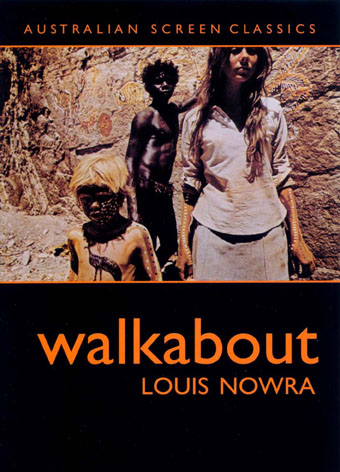
Louis Nowra, Walkabout, Australian Screen Classic, Currency Press, Sydney, 2003, ISBN 0 86819 670 3
English film director Nicholas Roeg’s Walkabout opened worldwide in 1971. Based on the novel of the same name by James Vance Marshall, an English writer, the film tells the story of 2 white children lost in the Australian outback. They survive only through the help of an Aboriginal boy who is on walkabout during his initiation into manhood. The film earned a unique place in cinematic history and was re-released in 1998.
In this illuminating reflection on Walkabout, a leading Australian dramatist and screenwriter Louis Nowra discusses the iconic status of the Outback in Australia and the peculiar resonance of the lost child story in the Australian psyche. He tells how the film was made and how its preoccupations fit into the oeuvre of director and cinematographer Nicolas Roeg and screenwriter Edward Bond. Nowra identifies the film’s distinctive take on a familiar story and its fable-like qualities, while also exploring its relationship to Australia and its implications for the English society of its day. He recognises the film’s relevance to the contemporary struggle to find common ground between blacks and whites.
Walkabout, says Nowra, “destroyed the cliche of the Dead Heart and made us Australians see it from a unique perspective, as something wondrous, mysterious and sensuous. It took a stranger…to reveal it to us.”
So, Roeg came and walked in the forbidding place, the Outback, sometimes still called the Dead Heart, at a time when the occasional Australian film was avoided by many Australians. There was no Australian movie industry. Roeg showed us a different image of the Outback. Nowra explains how he felt when he first saw the film in the 1970s:
“The images of the Outback were of an almost hallucinogenic intensity. Instead of the desert and bush being infused with a dull monotony, everything seemed acute, shrill and incandescent. The Outback was beautiful and haunting. It didn’t matter that some of the animals were incongruous to the location, and the countryside was at times absurdly out of sync with the actual terrain traversed. The setting sun was a richer red than I ever thought possible, the solitary quandong tree in the middle of the desert had the mysterious visual potency of a Byzantine icon, the animals had a fairytale brightness, and the Aboriginal boy’s dance seemed one of the strangest yet beautiful expressions of yearning I had ever seen. The visual splendour mocked my stereotype of the Outback. Never before had I entertained the notion that our landscape could be so romantic, so glorious both in its potent dangers and beauty.”
Reading Nowra’s balanced account of Walkabout is a journey through the film of places, of people, of the journey of the characters as well as the era of the film’s production. However, it is through time most of all that the turbulent, intertwining Aboriginal journey—glaring-into-the-distance-for-a-glimpse of reality while nurturing the land from an ancient point of view—is brought to the surface. The journey of reading Walkabout was a painful reminder of who we are as Australians today and the role played by the language of a civil tongue. David Malouf refers to this as “what we all, as English speakers, come home to.” This is also a language without urgency, which does not highlight the turbulence of Indigenous Australian reality, nor lessen the widening gap between Black and White Australia. A similar civility was once described by Primo Levi (The Drowned and the Saved, 1988) as one of the weapons of a modern state in a war against memory, deployed in propaganda, camouflaged by upbringing, instruction and popular culture in order to deny the entry of memory—or what should be remembered. In book, in film and still today, Walkabout, albeit a fable, omits some of the deep concerns and facts of memory for Indigenous Australia.
In her essay collection, Playing in the Dark (1992), Toni Morrison says the form of evasion which uses a substitute, racially-inflected language as a wilful critical blindnes—created by habit, manners and political agenda and by excising the political from the life of the mind as being ‘race free’—has proven costly to the artist and added to continuing racism between White and Black people.
First published in 1959 as The Children, Marshall’s book was republished as Walkabout in 1961. The story was modernised to suit a 1970s movie audience. As an Aboriginal writer reading this fable of English sensibilities I am still angered by the film’s portrayal of the Aboriginal character, named simply “Aboriginal boy”, who conveniently commits suicide at the end of the film because he fails to gain the affection of Mary, the white girl he saved. Because he only speaks his Aboriginal language, noone can communicate with him. He is in fact muted, silenced—but this was not a problem for the purposes of the story as he had been given a different role to play. He is the backdrop, an offering from Indigenous Australia. As Morrison said about Black oppression: “This black population was available for mediations on terror—the terror of European outcasts, their dread of failure, powerlessness, Nature without limits, natal loneliness, internal aggression, evil, sin, greed. In other words, this slave population was understood to have offered itself up for reflections on human freedom in terms other than the abstractions of human potential and the rights of man.” The male Aboriginal character in Walkabout was in fact choked—an idiosyncratic choice—hanging himself from a tree at the end of the film, after leading the girl and her brother to safety. With his silence complete, the film totally succeeds in enforcing an invisibility of the racial reality of the times, strengthening the dire consequences of a distorted history for Aboriginal people today.
Very much relevant in today’s Australia, where so much hope continues to be forsaken by the exclusion of people on racial terms, a story like Walkabout should also include a different reading where issues of race are put to the test. Walkabout was about a White man, in this case the British author, Marshall, testing White power and domination in the “black playground of his imagination”, and here in the homeland of the Aboriginal. This was an agile writer’s game in morals, ethics and visions of justice. The game was continued by the screenwriter Edward Bond 20 years later, while still denying the reality of unimaginably painful decades for Aboriginal people, just to see how Blackness will lose—and not only that—pay, because Blackness wanted the ‘unimaginable,’ the purest representation of innocence in the White world that must be protected above all else from Black hands, a White girl. In fact, those who belong to an Aboriginal world might view the film’s portrayal of this Aboriginal character’s life as being trivialised and powerless: the premise being that even a young, white schoolgirl could cause the death of this newly initiated, Aboriginal man. This reading of the story is that Aboriginal knowledge counts for nothing. The chilling thought is that because of the continued silencing of the Aboriginal voice, young Aboriginal men are committing suicide to perhaps have their voice finally recognised.
Black American author and scholar Ralph Ellison once said this stereotyping of the collective imaginative body of the ‘Black’ giant, who, lying trussed up like Gulliver, forms the stage and the scene upon which the action unfolds, was a literature more about consoling the White man, than crushing the Black man. On the other hand, Edward Said, in Orientalism (1995), examined the British needneed to have executive responsibility over the coloured races, and explained, “It was of this tradition, its glories, and difficulties, that Kipling wrote when he celebrated the ‘road’ taken by White Men in the colonies:
Now, this is the road that the White Men tread
When they go to clean a land…
Oh, well for the world when the White Men tread
Their highway side by side.”
–
RealTime issue #58 Dec-Jan 2003 pg. 23
© Alexis Wright; for permission to reproduce apply to realtime@realtimearts.net
The screening of Kalkadoon Man, a documentary commissioned by the Queensland Biennial Festival of Music about the seeking out and making of a didjeridu by composer William Barton, was a generous theatrical affair. There were speeches, performances by Barton on the instrument and by his mother, Delmae Barton, in soprano vocalise, and the handing over of the didjeridu to the museum’s director.
I spoke to director of the film, Brendan Fletcher about the experience of making the film. He described a rich and intense experience—10 days on the road outside Mt Isa with Barton. “It was pure process…just me and William, a camera and a microphone and the bubble of the journey.”
For Fletcher this was an adventure and an education. The adventure comprised traversing a unique landscape, Barton’s traditional Kalkadungu homeland, during the wet season. A sudden storm meant re-crossing 5 rivers to avoid being stranded. There are brief dramatic shots of Barton taken from the car as he wades ahead, the sky filled with rain and lightning. Some days were hot and fly-blown, making it hard to work. Mostly though it’s the pleasure of the collaboration that comes across.
Fletcher says he filmed Barton each night as they sat by the campfire, recording the stories and songs that would become the vocal strand of the film (some of it re-recorded later, but using the same words). As the 2 travelled, Barton would fill Fletcher in on family and clan history, visit key sites and recollect his own history with the didjeridu. Producer and editor Chris Newling says that the makers soon realised that there was no need to narrate the making of the didjeridu: you can witness that without words—the only exception appearing to be the explanation about filling cracks in the timber with spinifex wax from the plant’s roots.
What Barton has to tell us is a spare but intriguing account of his parents’ battle for land, their success, his father’s death, memories handed down of massacres and narrow escapes, glimpses of good, caring relations between whites and blacks, and Barton’s education as a player. The elders of his clan passed on to him his teacher’s didjeridu (though he points out that ‘teach’ is not in the Kalkadungu language—the learning player watches and listens and learns). This was rare, he says. Usually such an instrument is broken, “silenced” after its maker and player passes on.
The most powerful moment of the film is when Barton first plays the instrument he has made. The music he makes with the didjeridu is sombre and fluent. Shot in tight close-up, he appears to finish, but his eyes remain fixed on the didjeridu, his hands stay in place. It is as if he has hesitated rather than ceased playing, as if to ask the instrument is it satisfied, has it been awoken.
–
Kalkadoon Man, A documentary film, Queensland Biennial Festival of Music, Queensland Museum, July 18
RealTime issue #58 Dec-Jan 2003 pg. 23
© Keith Gallasch; for permission to reproduce apply to realtime@realtimearts.net
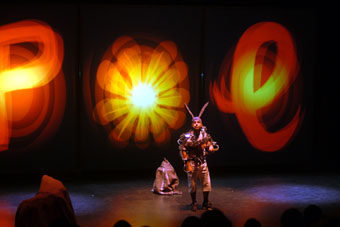
Marcel-li Antunez Rocha, POL, a Mechatronic Performance
photo Sabine Starmayr
Marcel-li Antunez Rocha, POL, a Mechatronic Performance
Ars Electronica is revered in the annals of new media arts and theory, and for its role in the European, Oceanic and North American new media art scenes. Packed into 5 days at Linz, about an hour and a half from Vienna and straddling the River Danube, the event comprises a conference, an exhibition at the Ars Electronica Museum of the Future, the Prix at the OK Centruum, electronic theatre and live performance. Linz is small and it’s easy to flow between the riverside and downtown venues while media arts lay an incongruous internationalist map onto the medieval city.
The conference is now rather institutionalised and themed (this year: Code = art, code = law, code = life). Among the exhibitions and performances there are 3 threads I want to mention: realtime video and audio manipulation; multi-user environments; and developments in tactile user interfaces.
Realtime manipulation of video and audio signal flow is a prevalent techné. The Cinema Fabrique (Justin Manor, USA) is a gesture-controlled, hardware/software environment for single-person improvisation. Holding a section of the interface in each hand, the visitor can choose, filter, scratch, loop and otherwise manipulate projected pop culture video/audio sequences. The 2-handed interface is enticing—it encourages expressive, free-form movement and a dance approach to interactivity.
The software artists TMEMA (Golan Levin, Zachary Leiberman USA) in collaboration with voice artists Jaap Blonc (NL) and Joan La Barbara (USA), performed the playful Messa di Voce. The piece is written in custom code developed during a residency at Ars Electronica, and is based on speech recognition algorithms. In what was more a series of set pieces than a fully realised performance, the vocalists were tracked spatially and their utterances analysed in real time. The system synthesises and outputs graphics in response—so Blonc performs his virtuosic vocals and the graphically rendered bubbles projected around his head are pushed up and suspended by the force of his breath. While the possibilities of the technical arrangements are very inspiring, I had to ask what creative and aesthetic development has been sacrificed for the complexity of the software development.
A wonderfully realised live performance with interactivity was POL, a Mechatronic Performance by Marcel-li Antunez Rocha (Spain). Two performers with exo-skeletal apparatus drive the fable of a rabbit’s search for love; performers’ action and voice, transcoded by the exo-skeleton, manipulate robotic offsiders, sound and projections. The complex, 3 channel Flash animations are synthesised into a retro-futuristic trope of mythical creatures, Bosch-like scapes and scenarios of sex, death and betrayal. The robotic and the cybernetic merge with an aesthetic of baroque intensity, evoking various origins of the abject and disembodied subject: surrealism, 1920s futurism, medievalism and collective fable.
Multiuser environments provide a challenge to new media artists and designers. Instant City (Sybille Hauert, Daniel Reichmuth, CH) is developed in Max/MSP. A very tactile interface helps—visitors stand around a square plinth on which they arrange acrylic blocks in architectural forms—the ‘buildings’ of the instant city. The placement and mass of the blocks manipulates the sound composition (visitors choose between 6). The installation successfully brings visitors together across the top of the plinth: the acrylic blocks, lovely in their own sandblasted way, are non-threatening. It is easy to play with their manipulating effect and to tweak the compositions with a degree of finesse.
Access by Marie Sester (France) allows more freeform audience response. A motion-tracking spotlight attaches itself to a passerby and follows them around the gallery. A simple idea, which has complex interactivity affect (people become self-conscious about ‘being in the spotlight’ and probably about the simplicity of the metaphor too). Why am I grinning so foolishly? Visitors become inventive—playing tag with the light, and with other potential ‘subjects’, pushing the installation to its limits. Access plays with notions of light as sprite, the audience as focus of attention, and an anthropomorphism we cannot help but bring to animated objects.
In Pockets Full of Memories (George Legrady, USA), visitors scan an object of their choice and enter associated metadata into a database. Throughout the duration of the exhibition the database grows and is continually reconfigured (and projected) as an emergent system using a Kohonen self-organising map algorithm. Although employing a single user interface, the installation evokes real world consciousness of being and contributing in a system with others, in which we nevertheless aim to make an individual mark.
Can you see me now? (Blast Theory and The Mixed Reality Lab, University of Nottingham, UK) is an addition to an important body of multi-user performance works. CUSMN operates in the non-private, non-public cultural spaces emerging around wireless communications like mobile phones, GPS and 3G. ‘Real’ players on the street and online players inhabit the city and a virtual overlay—“the players online and the runners in the street enter into a relationship that is adversarial, playful and ultimately filled with pathos.” A crucial feature of Blast Theory projects is the ability to extend user and audience affect outside the game—rather than delimiting our consciousness to the stereotypical and virtual, the gameplay pushes us to understand aspects of ourselves, our communities and social responsibility. This is partially achieved by the very visceral gameplay—in CUSMN the players and gameplay self-generate affects of pursuer and pursued. In a new work, Uncle Joe, players are encouraged to buddy up and commit to long term mutual support outside the game, without any mediation by the organisers. It was encouraging to see Blast Theory awarded the Prix Ars Electronica Golder Nica, which has in the past lauded some commercial, apolitical projects.
Developments in tactical user interface were particularly in evidence at the Ars Electronica Centre. Many of these applications are prototypical and easily understood as collaborative production tools. However the possibility of artistic application imbues them with extra frisson. The Audio Pad (James Patten, Ben Recht, MIT, USA) enables sole or collaborative users to compose using freely mobile discs that trigger and manipulate predetermined audio compositional variables (eg timbre and pitch). The interface is very attractive, fluid and responsive. Also developed at MIT, the SAND TRAY tool enables multiple users to model interdependencies in earth science, engineering or hydraulic projects using a tray of coarse sand as the interface. Depending on how the sand is modelled—add a hill, flatten a mound—the effects on height, topography, water flow and temperature are calculated and projected back onto the sand in realtime. These innovations in tactical and multi-user interface address current issues about collaborative work process and the role of interactivity.
Other displays use sound as data input, and many visitors were fascinated by Protrude, flow by Sachiko Kodama and Minako Takeno (Japan), an installation of strongly magnetic fluid which responds to sound inputs. An attempt to model matter freely, as well as express wild and organic shapes, the work responds to synchronous sound by creating 3D patterns of splitting, clustering, flowing or dripping.
Finally, a whimsical work Earth Core Laboratory and Elf Scan (Agnes Meyer-Brandis, Germany) encourages a very careful, delicate form of tactical user interactivity. Based on the conceit that mineral-dwelling elves carry on a complex, humanoid life within a parallel universe of mineral cores, the work demands visitors very carefully scan the cores with some pseudo-scientific gear. The more careful, delicate and composed your search, the steadier your hand, the greater chance of seeing the little elf vignettes.
Ars Electronica, directors Gerfried Stocker & Christine Schopf, Linz, Austria, Sept 6-11
RealTime issue #58 Dec-Jan 2003 pg. 24
© Kate Richards; for permission to reproduce apply to realtime@realtimearts.net
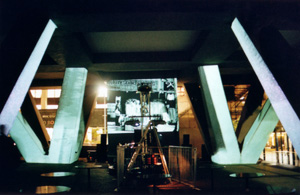
Re_Squared
photo Tim Webster
Re_Squared
Given the inherent difficulties in creating art events in public spaces, it was fantastic to see the MCA’s Primavera (in conjunction with City of Sydney and AMP’s Art & About) take to the street with Re_Squared. Staged at Undercroft, a strange, brutalist cave beneath the Australia Square building in Sydney’s CBD, Re_Squared projected the city back onto itself, concrete onto concrete, reflecting its textures and terrors, visually fetishising everyday urban existence.
Re_Squared is the creation of Cicada (Kirsten Bradley and Nick Ritar) on visuals, with Ben Frost on sound. With a massive surround sound system, Frost lulls us into his audio zone by re-sampling the actual environment. What sounds like the rumbling Martin Place underground turns out to be the opening body-jarring bass frequencies of the piece. The projections are concentrated on a screen with 2 angled pillars used for flanking images. Pillars behind catch more projections and texture the space.
The 1 hour 15 minute audio visual immersion breaks into episodes, or tracks, as in an audio recording. Comparisons with the Koyaanisqatsi model of urban ambience come to mind, though there is something more engaging in this work. Partly it’s the combination of grittiness and meticulous production. A great section takes place in an underground carpark with the camera strapped to the underside of a skateboard. Another loop follows a superkooldude in stupidly wide pants down the road—no destination is ever reached but the rhythm and purposefulness is compelling. Sometimes it’s pure aesthetic absorption: water in a gutter filmed so it looks like an exotic rock pool; a smoke trail meandering from an ashtray; an escalator infinitely ascending like a city artery. An interesting inclusion is a personal narrative with each of the artists filmed in silhouette on split-screen, pacing, preparing…for what? These visuals are manipulated live while the overall score seems predetermined. Frost’s sound is sumptuous, full of beautifully defined dirt and crackle, spliced with orchestral melodic swellings. Only by the end of the piece did I feel the climactic waves becoming a little too comfortable.
Having enough time to access the space in order to truly explore its potential is one of the challenges for artists taking on site-specific work. While the audio and visual elements of Re_Squared are well tended and blended, with the exception of one stark graphic, the flanking columns are only really explored as a surface for a kind of washed out texture. I wondered whether some smaller, more focussed projections might have more power. Also, the surround sound creates a desire for a 360 degree experience making the frontal focus here unsatisfying. That said, I found Re_Squared an engaging audiovisual experience. Hopefully there’ll be further such immersive explorations in response to other spaces in the future.
Re_Squared, Cicada + Frost in association with MCA and City of Sydney/AMP’s Arts & About, Primavera, Undercroft, Australia Square, Sydney Oct 9 & 16. www.cicada.tv
RealTime issue #58 Dec-Jan 2003 pg. 25
© Gail Priest; for permission to reproduce apply to realtime@realtimearts.net
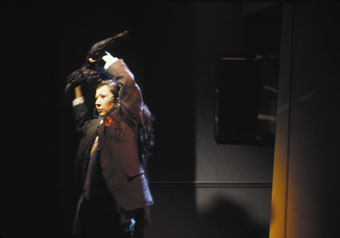
Marie Brassard, Jimmy
photo Simon Guilbault
Marie Brassard, Jimmy
I once dreamed I was falling off a bridge and as I fell, scolded myself, “Dreaming symbols again!” as if my failing had caused the fall.
Marie Brassard has come up with a richer commentary on the postmodern condition in her solo work, Jimmy. For Brassard, a close collaborator with Robert Lepage, the creation of this play in 2001 was her first experience as solo writer/director. The work has been an international success with tours and translations. She arrived in Sydney after a successful season at the Melbourne International Arts Festival. Her new work, La Noirceur premieres in Montreal in June.
In Jimmy, Brassard spins the intriguing tale of a homosexual hairdresser born in the dream of a (homophobic) American general in the 50s. “As [Jimmy] is about to kiss his lover in the dream, the general dies, leaving the 2 in no man’s land, in a state of pure pleasure. After staying suspended in time for 50 years, Jimmy starts to live again, but to his despair, in the dreams of a Montreal actress.”
Brassard’s beautifully orchestrated performance takes place on a deceptively simple stage. We’re on the sloping edge of somewhere, a step in time maybe, with only a mirror to reflect on. Using a pitch-shifting device to deepen her voice, Brassard’s measured delivery is captivating, her richly detailed tale of longing holding us in thrall till the end when she drops us too suddenly back into the world. Along the way, there’s a nicely orchestrated rift in the narrative when the device drops out and for a moment we’re unsure whether the technology has failed. This gives the real actress a chance to reveal herself momentarily to her audience. I’m a sucker for these gaps in the theatrical fence. Others, I discover later, find the postmodern folly too familiar—don’t fall for it at all. This lapse into uncertainty makes the telling even more enticing. Brassard has such a light performative touch, her French-Canadian accent delayed by the device makes her sound like a live puppet. This effect is enhanced by her fixed facial expression and articulated movements confined largely to a fixed plane. She is the perfect dream being, waiting to be filled with our projections.
There’s a note in the program about the moment of waking from a pleasurable dream in which we try to return: “You close your eyes again and you try to slowly get back into the exact same position you were in when you opened them. You try to go back to where you were. To that place you only glimpsed.” Like many artists before her, Marie Brassard attempts to capture that state and very nearly nails it.
I think I know where Jimmy spent those 50 years he went missing. Days after this performance I dropped into Light from Shadow, the wonderful exhibition at Ivan Dougherty Gallery that features recent hologram art in intriguing juxtapositions with historic works by Tiepolo, Goya and others. Peering into Paula Dawson’s To Absent Friends (Midnight Fragment) 1989, a silvery hologram of a totally realised hotel bar, I swear I saw Jimmy’s shadow.
Jimmy, performer Marie Brassard, design Simon Guilbault, technical designer Christian Gagnon, sound adviser & soundtrack realisation Michel F Cote; The Studio, Sydney Opera House, Nov 4-7
Light from Shadow: The Legacy of Chiaroscuro in Spatial Imaging, Ivan Dougherty Gallery October 22-Nov 29 www.shadowyfigures.com
RealTime issue #58 Dec-Jan 2003 pg. 25
© Virginia Baxter; for permission to reproduce apply to realtime@realtimearts.net
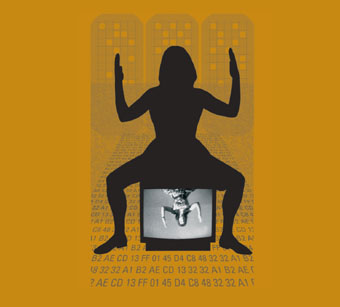
Continental Drift, 1990 Jill Scott
Jill Scott, Coded Characters: Media Art (with DVD-ROM), Hatje Cantz, Germany, 2003; ISBN 3 7757 1272 0 (Hardback)
Jill Scott’s art spans video, conceptual performance and interactive environments and has been exhibited in the US, Australia, Europe and Japan. Scott’s work explores relationships between the body, technology and experiences of real time and virtual space, most recently using computers, 3D Animation and Interactive Art. Born in Melbourne in 1952, Scott lectured in Media at the University of New South Wales, College of Fine Arts, Sydney and founded the Australian Video Festival. In 1993 she won an Award of distinction at Ars Electronica for Interactive Art. Based in Europe for many years, Scott has been Artist in Residence and project co-ordinator for the Medienmuseum at the Zentrum fur Kunst und Medien Technology in Karlsruhe (ZKM) and Research Fellow at The Center for Advanced Inquiry into the Interactive Arts, University of Wales, Great Britain, where she received a Doctorate in Media Philosophy. Professor for Installation Design in the Media Faculty at The Bauhaus University in Weimar, Germany until 2003, she is now Research Professor at The University of Applied Science (FHA) and the Academy of Art and Design (HGKZ) in Switzerland. Eds.
When an artist publishes a book surveying the vast body of their work it is sometimes difficult to decide, as a reviewer, whether to evaluate the art it contains or the text that contains it. In such a case, the tasks of the writing, presentation and design, which fall to the book, should be to contextualise, historicise and indeed engage the art in broader aesthetic dialogue. A book, rather than say a retrospective show, should draw the reader into the world of art and artist, offer new possibilities for understanding the work and bring the artist into an exchange with external perspectives. Here the art book differentiates itself as a form and becomes a mode of inquiry that goes beyond simply the documentation or re-presentation of work. When this happens, reading about art and its producers turns out to be a rewarding and enriching activity. The balance between pictorial survey and textual engagement is infrequently achieved—Jill Scott’s Coded Characters is no exception.
Admittedly the job of translating time-based and interactive art into the static book form is a daunting one. A single image of an installation or video never does justice to the transitory qualities of these media forms. It is perhaps for this reason that Scott includes copious amounts of visual testimony to a career spanning the decades of the 1970s, 80s, 90s and forward into the new millennium. And yet given its inclusion of a DVD-ROM for the purposes of documentation and the inherent problems of photographing screen-based work, Coded Characters as an art book falls short of anything more than a simple catalogue of the artist’s work. It does not give us a good sense of how Scott’s work sits within the broader phenomenon of media art or where, as a result of her contributions, media art may go in the future. Instead we are presented with a rather standardised view of the history of technological development that serves as a mode for organising Scott’s pieces into 3 all too tidy categories.
Her first phase, spanning 1972-1982, Scott labels “Analog Figures” in deference to the body-based performative nature of the work. This quickly gives way to her video period of the 1980s, which she conceives of as “Digital Beings”, and is followed by an attempt to resolve this opposition between materiality and information technologies in the final label “Mediated Nomads.” This last period, with which Australian audiences may be more familiar, focuses upon her computer-based 1990s pieces such as Frontiers of Utopia (1995). This is an interactive installation that allows the audience to initiate dialogues between 8 fictional female characters from different decades of the 20th century. Scott, with many of her contemporaries such as Roy Ascott (who writes a brief introduction to the book) and Peter Weibel, sees the technologies themselves as the driving force of media art. Hence early work concentrating upon the performer’s body can be deemed ‘analogue’ because there appears to be a more direct or analogous relation set up between the performer’s body and its representation in the media of the performance. Furthermore, it is only the deployment of analogue technologies by politically informed media artists which undoes the distortions of identity commercial media interests produce when using these same technologies. As Scott states: “We wanted to explore these process-oriented mediums for their potential levels of mimicry and distortion of the figure (body), governed by a fascination to record ourselves, recreate our identities and rebel against our commercial environment.”
Similarly when discussing work produced using digital technologies, she unthinkingly draws an equivalence between the nonlinear capabilities of the software and a conception of digital art as aesthetically pluralistic. Although many artists have chosen to explore nonlinear systems during the late 20th century, they have not necessarily used digital technologies to do so: Hans Haake being one of the better-known examples.
There are 2 consequences of relying on this evolutionary, techno-determinist view of media art’s growth. The first is to completely miss the interesting connections to be made across Scott’s work and across the conceptual frameworks that underpin the technologies themselves. In an early media and performance work, Moved Up Moved Down (1978), Scott plays back a pre-recorded loop of herself climbing a giant staircase alongside a realtime video monitoring audience members climbing stairs. The audience complained that this had the effect of making their climb more difficult. This catapults the concerns of the piece, which investigates the experiential effects of mediated feedback on human beings, more firmly into a contemporary aesthetic terrain that explores the ecology of cybernetic systems. Breaking art down into neat eras that coincide with the use of particular technologies facilitates against more nuanced associations.
The second consequence of conceiving media art as the outcome of technological change is, paradoxically, to leave little room for the impact of its experimental currents. Scott’s narrative—beginning with the body accompanied by sound and video, moving to digital video and ending up with interactivity—sounds suspiciously like a history of the rise of the Sony Corporation. Media artists are always confronted with the social reality of consciously situating themselves in relation to the media industry and may choose to appropriate, infiltrate or simply occupy similar territories. But Scott fosters an old-fashioned and elitist approach to media culture by asserting that her mode of artistic intervention works in an intelligent way, ‘outside’ the intellectual desert of the media industry.
Today’s media artists know they cannot get away with this aesthetic avant-gardism and humorously, passionately and tactically insert themselves into the hub of any and every mediated experience. It is a pity that Coded Characters does not interrogate the relation of Jill Scott’s media art to the context of the media cultures within which she found herself working. Although the book offers us a number of essays and an artist’s interview, it seems that none of the analyses up to this task. Ultimately we are left with a slim view of where media art has been and an even narrower idea of where it might be heading.
RealTime issue #58 Dec-Jan 2003 pg. 26
© Anna Munster; for permission to reproduce apply to realtime@realtimearts.net
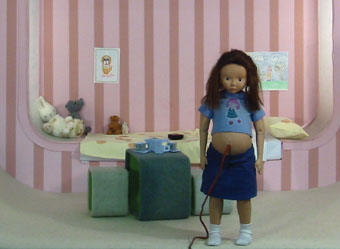
Isobel Knowles, Van Sowerwine, Expecting
Christopher Langton’s bright blue, inflated PVC facade, built for the entrance of Experimenta’s recent House of Tomorrow exhibition symbolised the concerns of this collection of new media art. Reminiscent of The Futuro House created by architect Matti Suuronen in 1968, which looked like the spaceship from Tim Burton’s Mars Attacks, Langton’s facade created a sense of nostalgia for the future that characterised many of the world fairs, home expos and films of the 1950s and 60s. This sense of retro-futurism was used by the exhibition curators to guide their selections for the program. But, they were particularly concerned with how domestic technologies are shaped by the fusion of our present desires and fears, technological capabilities and ongoing obsessions with past imaginings of the future.
Like its predecessors, such as Robin Boyd’s House of Tomorrow exhibited at the 1949 Modern Home Exhibition in Melbourne, this show offered both “futuristic visions of the living environment through new technology” and a “forum to critique, to parody and to play.” Some works would have been equally at home in a trade show, which is not to condemn them—rather, to suggest that in an age of internet connected refrigerators and microwaves, the line between function and fable is blurry.
Zizi the Affectionate Couch (Stephen Barrass, Linda Davy, Kerry Richens, Australia, 2003) is one such work. Gorgeously upholstered in pink and purple velvet, Zizi is a responsive ottoman that growls when sat on, purrs when touched and groans with delight when caressed. Designed to support you both physically and emotionally, Zizi evokes the responsive air conditioning system that not only adjusts itself according to your presence in the room but, as a recent TV-ad suggests, mysteriously makes you cups of coffee. Zizi would be right at home in this paradise of involuntary action where the home is transformed into a veritable homeostasis of human-machine life. I’m surprised the artists weren’t asked to take orders.
Virsual—The Digital Rocking Horse (Steven Mieszelewicz, Nimrod Weis and Asaf Weis, Australia, 2003) is billed by its creators as “the ultimate toy for the playroom of the future.” Virsual brings to mind the Holographic Nursery envisioned by writer Ray Bradbury in his short story, “The Veldt.” Riding a rocking horse equipped with a motion-sensing device, users navigate a 3D simulated environment projected on a screen in front of them. The faster you rock, the more rapidly you move through the depicted terrain of Virsual Island, collecting apples and horseshoes with the aim of finding the end of the rainbow. The immense popularity of this work at the exhibition suggests a ready market through Toys R Us.
Not all the works promised domestic futures of benign comfort. Many were far more unheimlich—to use Freud’s famous term. Sally Blenheim’s Dirty Pillows (2000), for example, critiques the desire to see technology as a substitute for human companionship and comfort. Blenheim invites the user to lie on a bed facing a monitor on which a woman’s face is projected. The woman gazes back at the user, occasionally blinking but perpetually passive. As users are drawn into the woman’s gaze, they are simultaneously reminded of the “ultimate emptiness that televisual relationships offer.”
Similarly, Expecting (Isobel Knowles, Van Sowerwine, Australia, 2003) disrupts the belief that new technologies can replace real nurturing with a virtual equivalent. The user is invited to create playmates for 8-year old Charlotte who is imprisoned on a screen in her virtual bedroom. Using a teddy bear as an interface, users can affect the animation on the screen by squeezing the bear. As you squeeze, Charlotte’s belly appears to distend until eventually she gives birth (quite grotesquely) to a virtual playmate who, after a short while, vanishes. Without user input, Charlotte remains alone (and presumably lonely) in her room, suggesting that only human intervention, and not technologies, is capable of alleviating human alienation and isolation.
Mirror D (Marco Bresciani, Sam De Silva, Australia, 2003) plays on the ambivalence of our relationship with new technologies by drawing attention to the tendency of surveillance technologies to disrupt the very sense of security they purportedly strive to engender. A digital mirror takes the user’s reflection and digitally distorts it in ways that make the user question the veracity of the claim that the mirror (or the CCTV camera) never lies. In an age of increased visual surveillance and digital technologies, Mirror D reminds us that appearances can be deceptive. The very tools we use to protect ourselves from the alien and unknown can just as easily alienate us from the world and from our selves.
House of Tomorrow will tour nationally to towns and cities in 2004 and 2005. More information about the exhibition can be found at www.experimenta.org/
House of Tomorrow, Experimenta, curators Liz Hughes, Shiralee Saul, Helen Stuckey; Black Box, Victorian Arts Centre, Sept 5-Oct 3
RealTime issue #58 Dec-Jan 2003 pg. 27
© Lisa Gye; for permission to reproduce apply to realtime@realtimearts.net

Keely O'Shannessy, Alice's Conversations in Cyberspace
Keely O’Shannessy’s Alice’s Conversations in Cyberspace, at the Centre for Contemporary Photography’s always-intriguing e-media gallery, is an interactive installation in which participants are invited to ‘converse’ with an on-screen Alice (transfigured from her literary Wonderland to the brave new frontier of screen-based computer technology). The participant types questions or observations into the computer, triggering various responses from the on-screen character that range through intrigue, delight, scorn, confusion and outrage.
The hitch is that Alice’s side of the conversation is restricted to phrases from Lewis Carroll’s Through the Looking Glass and Alice in Wonderland, and thus the conversation becomes something of a guessing game, as the participant is compelled to try and string together some sort of meaningful interaction. There is a conspicuous score in the top left corner of the screen—your points for interesting and pleasing Alice. They’re deducted for boring, confusing and disappointing her.
Thus, the subject matter that interests Alice the most scores you the most points and leads to the most favourable response: a high score of 5 and a warm thank-you “for your interesting story.” Piss her off, however, and she lashes out, dismissing you as being “perfectly idiotic,” and ending the conversation abruptly, leaving you to start over and try and do the right thing next time (whatever the ‘right thing’ is in Wonderland/Cyberspace).
The idea of “winning” a conversation by placating the other party as compliantly and entirely as possible provides a wry commentary on the loaded and sublimated nature of our seemingly innocuous everyday interactions and conversations. As a conversation with a machine—and O’Shannessy is quick to point out that this is not an experiment in “artificial intelligence”—it provides a humorous insight into the ways in which our expectations and hidden agendas are present in every move we make, and every interaction we have, be it with live or inanimate collaborators. Alice may have a highly specific (and necessarily predetermined) agenda, but it only serves to highlight the participant’s own expectations. The interaction increasingly becomes something of a test of one’s adaptive and intuitive finesse.
Pleasant as the conversation can be, Alice’s incredulous “attitude” and the omnipresent evaluative score lingering on the screen inevitably provokes some aggression and competitive attitudes. I found myself going back again and again to try and trump Alice at her own game. I was clearly not alone—the final comment for the exhibition in the CCP’s comments book reads “Alice is a whore—she called me an idiot.”
While remaining relatively small in scale and ambition, Alice’s Conversations in Cyberspace is a witty and polished installation. Indeed, it’s a refreshingly subtle and considered take on the increasingly visible media art/game hybrid genre. Beckoning the viewer to unravel Alice’s mysteries, this humorous and intelligent multimedia encounter throws the spotlight back on the participant.
Alice’s Conversations in Cyberspace, Keely O’Shannessy, Centre for Contemporary Photography, Melbourne, Oct 3-Nov 1
RealTime issue #58 Dec-Jan 2003 pg. 27
© Jeff Khan; for permission to reproduce apply to realtime@realtimearts.net
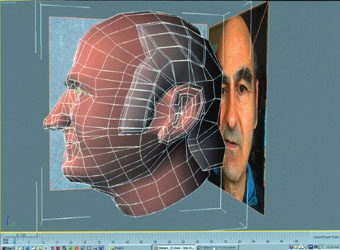
Sterlarc, Prosthetic Head
Alessio Cavallaro is one of the most authoritative and engaged figures in new media arts in Australia. Senior Producer/Curator, New Media Projects, Australian Centre for the Moving Image (ACMI) in Melbourne, Cavallaro is a former director of Sydney’s dLux media arts (1997-2000) and co-editor with Darren Tofts and Annemarie Jonson of Prefiguring Cyberculture (Power Publications/MIT Press 2002). In the exhibition, Transfigure, opening at ACMI in December, Cavallaro has drawn on the centre’s significant collection to engage with the theme of transformation, but also adding some new works and a seminal immersive experience. We met at the RealTime office in Sydney (Cavallaro was once co-editor of OnScreen) where he took me on a verbal tour of the works and themes of his curatorial adventure.
Let’s start with how you arrived at the title, Transfigure.
Essentially, it’s about changing forms and appearances and it also suggests a property that the moving image has which, in general, the other visual arts don’t—the ability to change in and through time. Hence the idea that we could bring together a collection of works by prominent artists both Australian and international, mainly derived from ACMI’s exhibition collection, that would explore notions of perception, body, space and landscape as transformed by the moving image.
You’ve also programmed some seminal immersive works and a new interactive work. What is it about these that you think is important?
Osmose and Ephémère were created by Canadian artist Char Davies in 1995 and 1998 respectively. With Stelarc’s new project, Prosthetic Head, they form the thematic focus of the exhibition—body, landscape and technology. As film innovator John Whitney argued, to experiment with the medium of cinema is to confront the technology of cinema. Bringing that notion forward into the new media art realm, we find that more and more artists, particularly those in Transfigure, are not only using it to produce quite startling works but often to raise questions about the disquieting implications of our technological revolution.
The works of Davies and Stelarc not only implicitly explore the creative potentials of technology but also notions of embodiment, agency, consciousness and subjectivity. With VR, Davies enables us to explore how our subjective experiences of the natural world might be altered in a fully immersive 3D digital environment. There’s a direct critical inquiry not only about technology and the way it allows us to experience the world but also about how the technology is changing nature.
What can people expect of the Osmose experience?
It involves a head mount, as in the classic VR image from the early 90s, and also a tracking vest. Rather than using a data glove or a joystick, for example, or some other kind of touch interface, you navigate through the worlds by breathing in and out and by leaning forward or back, to one side or the other. It takes the “immersent” a few minutes to adjust and orient themselves in the virtual space. The remarkable thing is that once you’re there, wherever you look—above, below, around you—you are in this world that Davies has constructed.
This has to be one of the most famously successful immersive works.
It’s one of the very few. Interestingly, it’s already regarded, rightly I believe, as a classic of its genre. I’m amused when people say, “oh, but that’s an old work, not a new media work.” Already there’s a notion of age creeping into new media arts as if to say that the only works exploring interesting concepts are those produced in the last 6 months.
What about the big new media exhibition issues? How long do people need to experience the work? How will you handle the queues?
Each “journey” in Osmose and Ephémère [which represents a symbolic correspondence between landscape, earth and interior body ed.] has a duration of 15 minutes. It’s free of charge but you need to book for a session. It’ll take around 20 minutes including the time for strapping on the vest and the head mount and taking them off. But, as has been proven when these works have been exhibited around the world, people are very disciplined about sticking to their designated timeslot because they want to experience them—and it really is an experience, one well worth having.
What kind of audience engagement is there with Stelarc’s Prosthetic Head?
As you walk into the darkened space, you’ll see a computer-generated image of Stelarc’s head projected large scale onto a wall. There’s a plinth holding the keyboard and sensors that detect your entry into the space. The head will look towards you, greet you and invite you to initiate dialogue. You key in a remark, a question or a comment and the head responds from a substantial database vocabulary.
The work is a progression of Stelarc’s career-long investigation of the ‘obsolete body.’ The head is uncanny, certainly amusing and utterly engrossing. As with all of Stelarc’s work, it raises serious issues about consciousness, embodiment and artificial intelligence. In doing so it’s not only questioning those attributes and how they’re embedded in technology but also how we can re-define our own concepts of consciousness or identity through interacting with such a work.
Is this a one-to-one experience?
It’s more informal. You don’t have to book for this one. Groups can gather while the person at the keyboard is conversing, as it were, with the head. With the Char Davies’ works, although only one immersent at a time can engage with the works, there is an ante-room in which a 2D projection of the landscape being travelled can be viewed by a group of people who might be curious or waiting their turn.
There are 13 other artists represented in Transfigure. How did you choose from the ACMI collection?
It was a matter of finding works to complement these major works in some way. Certainly, I was interested in notions of perception and landscape—and by landscape I don’t just mean representation of the natural landscape or cityscape but also the space of the screen. It’s interesting, certainly in single channel, 2-dimensional works, to think of the screen as a landscape space. For example, in Sydney artist Ian Andrews’ Departure, there’s a loop of found footage that repeats but the textures of the image begin to fragment and, as it were, exfoliate. You glimpse a shadowy figure of a man moving away. There’s something forensic about Andrews’ exploration of this image. He’s asking you to look deeper and deeper into it. For me, there’s an analogy in terms of perceptual interplay with the experience one might have with Char Davies’ works. And the difference between those experiences—the way the transparency of Davies’ images opens up to you as you glide through a virtual landscape, as opposed to the arrested moment and the movement in Ian Andrews’ work.
What other connections and associations might the visitor make between works?
Char Davies is at one end of the gallery and at the other there’s the world premiere of a multi-player game called acmipark by a Melbourne-based collective called selectparks. These works represent parentheses for the exhibition. The gameplay is quite different from the virtual spaces of Davies’ work. acmipark is an example of interaction in virtual worlds in a public space and in distributed space, because it can also be accessed and interacted with online. While Davies’ work offers a solitary experience—a more contained, private virtual space.
The works in between in one way or another raise issues of the body and space and how our perceptions and experiences are transformed in viewing and engaging with such works. For example, there are some astonishing biomedical visualisations by Drew Berry who works at the Walter and Eliza Hall Institute in Melbourne. Coming from the scientific community, he probably wouldn’t refer to himself as an artist, but his visualisations are intricate and painterly and utterly captivating. What you’re witnessing are vistas of cellular molecular activity in the human body realised through computer-generated animations. There are analogies with Char Davies’ virtual landscapes. Justine Cooper’s Rapt was constructed by animating MRI scans of the artist’s own body, spectral vistas of her corporeal self. Gina Czarnecki’s video work, Infected, raises disturbing questions about the impact of technology and bio-engineering on the human body manifested through digital mutations of the image of a dancer. I’ve also included the music video by Chris Cunningham for the Björk song “All is Full of Love”, which in this exhibition can be aligned with Stelarc’s various projects documented in Alternate Interfaces, a video compilation of his recent performances involving robotic and prosthetic technologies.
I feel very gratified about the calibre of these artists and the aesthetic and technical diversity of works exhibited—online experiences, computer animations, documentary and experimental film and video, VR installations, gameplay and a computer-generated talking head. It makes for an intriguing amalgam of influences, convergences of ideas, applications of technologies. It’s also about representing the history of the moving image forms: film, video art, online experiences, new media and virtual reality all within the one exhibition. That for me has been the delight and privilege in being able to curate such an exhibition.
Other artists exhibited in Transfigure are Mike Stubbs (UK), Paul Brown (UK), Vikki Wilson (Australia), Ed Burton/Soda Creative Ltd (UK), Robert Gligorov (Macedonia/Italy), Steina (Iceland/USA), Tamás Waliczky (Hungary/Germany).
Transfigure, curator Alessio Cavallaro, Australian Centre for the Moving Image, Melbourne, Dec 8-May 9 www.acmi.net.au/transfigure
RealTime issue #58 Dec-Jan 2003 pg. 28
© Keith Gallasch; for permission to reproduce apply to realtime@realtimearts.net
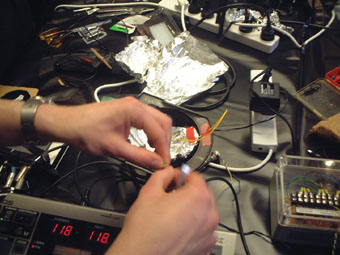
Midi Scrapyard Challenge
photo Jonah Brucker-Cohen
Midi Scrapyard Challenge
“What software do you use?” This question inevitably arises at any presentation by artists working with new technologies. Certainly, knowing something of tools is important, but this query all too often sends dialogue into a tailspin of tech-talk and TLAs [three letter acronyms], diverting attention from artistic intention and inspiration to methods and technique.
My overwhelming memory of this year’s Electrofringe festival was of presentations and discussions that mixed theory and practice with a mature sophistication. Something had definitely changed since my 2001 visit to Newcastle; artists performed works in progress and then discussed them, academics presented alongside VJs; panels included toolsets in discussion of concepts and artistic aims; masterclasses tempered technical know-how with practical examples. I felt Electrofringe had come of age in an environment it has helped build over the past 6 years.
First, some background: each year around early October under the auspices of the Octapod Association, Newcastle hosts an amazing array of interrelated festivals. The This Is Not Art festival (TINA) includes: Electrofringe; the National Young Writers Festival; the National Student Media Conference; Sound Summit, a national conference of independent electronic music and hip-hop; Radioactive, a national radio industry conference open to anyone involved in community, commercial, public, online, and digital radio; and Critical Animals, a graduate conference focused on the themes of all the above.
As an interdisciplinary event like no other; it’s not uncommon to find yourself wondering: “now which festival is this panel a part of?”
Electrofringe is “a hands-on, all-in, new media arts festival exploring sound, video, gaming, audio visual integrations, screen, hypertext and installation” (from electrofringe.org). That’s a very tall order, and a quick search of the website reveals that the program covers a lot of ground. It is impossible to be at every presentation, so you really have to choose whether to concentrate on one strand of the festival or sample widely from the range. However, Electrofringe is a lot more than the officially sanctioned events and anyone who only follows the program will miss out on a great deal of what the festival has to offer. Putting in time at the festival club (definitely try the ginger beer) and gigs are both worthwhile. Dinner is optional.
It’s the relaxed atmosphere of TINA that makes Electrofringe a must-do for anyone interested in maintaining a connection with what’s happening in Australian new media art and activism. The distinctions between presenter, audience, emerging and established artists are the fuzziest I’ve experienced anywhere. In what must be Australia’s highest concentration of eclectic new media talent outside a capital city, the festival fosters connections, collaborations and (increasingly) critical reflection. The many ongoing networks and collaborations that trace their existence to a specific Electrofringe forum attest to this, as to some extent does the recent explosion of Australian VJ culture and artists using digital games for creative expression.
This year’s festival featured diverse international artists presenting workshops, masterclasses and overviews of their work. Jonah Brucker-Cohen from MIT Dublin ran a workshop for creating alternative MIDI controllers (out of junk) and presented his extensive body of work subverting common conceptions of what networks can be. His installation PoliceState, a physically manifested carnivore client, was a great addition to the FraGGed exhibition (curated by Thea Baumann). The-phone-book Ltd from the UK helped participants create artworks for SMS and wireless delivery (courtesy of ANAT). Marije Baalman from Berlin gave a very thorough masterclass on Wave Field Synthesis and presented electroacoustic works written for this new way of spatialising sound. Janek Schaefer performed and presented work situated on the edges of architecture, art and turntablism. These guests expand the context of the festival, injecting new ideas and practices into the Australian scene. While bringing international credibility to the festival, this also raises the question: are Australians still averse to keynoting local talent?
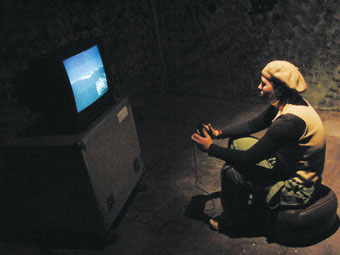
Kipper’s Viderunt Omnes 3D in FraGGed
photo Vicky Clare
Kipper’s Viderunt Omnes 3D in FraGGed
On that front, other major highlights (surveyed from a range of attendees, organisers and performers) included: a series of in-depth workshops exploring patcher-based software techniques; investigations into the nature of text in visual culture and digital environments in panels chaired by Linda Carroli; plans for ongoing collaboration and discussion from sessions on surviving artists collectives and videotista tactics; Archimedia’s presentation on representations of Hackers in Media; QuantaCrib, a hybrid performance space designed to enable new media artists to interact with traditional media artists; an unofficial collection of the infamous and insanely intense as the Dual Plover label gave good reason for people to stray from the festival plan; and performances and masterclasses at the SPA[V]CE.
As an area concentrating on multi-channel audio-visual work, the SPA[V]CE inverted the usual panel model, having 40 minutes for presentation and performance with 20 minutes for discussion after. The atmosphere allowed for subtle works, with presentations ranging from live audio-visual improvisation and works-in-progress to very polished performances, inspiring some artists with “greater motivation to pursue ideas and projects.” The team responsible for the SPA[V]CE (Alan Bamford, Alistair Riddell & Shannon O’Neill) represent 3 quite different artistic practices based in 3 capital cities, a fine example of what Electrofringe is so good for: creating connections and mixing it up. It’s great to hear that the festival directors, Vicky Clare and Gail Priest plan to continue the format next year.
With eyes (and ears) to the future, the challenge Electrofringe faces is to stay connected and open to possibilities while it continues to develop and organise the program. In true Electrofringe fashion, it’s a challenge best met with a mix of audience, artist and curatorial input. There’s just one major problem to overcome: you can only take so much in one long weekend. All the extra-curricular activity, the associated late nights and hoarse throat (attempting to continue conversations over the band) combined with daily injections of new theories, people, techniques and experiences add up to a formidable test of the mind and body. You may want to start training for next year.
Electrofringe, directors Gail Priest and Vicky Clare, Newcastle, October 2-7
RealTime issue #58 Dec-Jan 2003 pg. 29
© Jeremy Yuille; for permission to reproduce apply to realtime@realtimearts.net
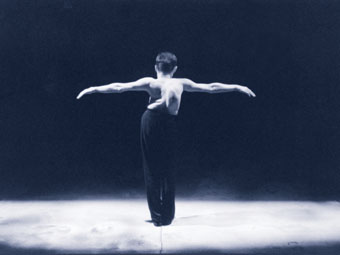
Raimund Hoghe
photo Luca Giacomo Schulte
Raimund Hoghe
Dancers are Sace Eaters provides the Perth independent contemporary dance scene with a mirror on itself and a lens on the outside world. Two Suits (David Corbett, Paul Roberts) opened the festival; literally planted among the VIP speakers at the opening night launch who did double-takes as the welcome slipped into contact improvisation. The performers’ tactile, acrobatic flourishes were a lozenge for the dance-happy.
As dance becomes less about perfecting existing techniques and more a matter of morphogenesis (the creation of novel reality) Perth is an interesting place to be in a dance audience. The connection between cultural studies and dance-making has all but swerved and missed here, where dance engages more with popular culture than semiotics.
My first response to NightShift (George P Khut, Wendy McPhee) was, “Ah, the inside of my head.” McPhee’s blank poem and a sequence of semi-stripteases on film, inter-cut phrase by phrase, sputtered at breakneck speed. Cascading into the peepshow darkness of PICA’s central space from 4 transparent screens, the effect was of visual, poetic and polemic chiaroscuro all in relative non-sequence, and yet it flowed. Sexistentialism: who knew desire was anonymous femme-fleshy staccato, crisp shadow and font at transcendent rate of variation? It seems obvious to me now.
Throw the Body into the Fight refers to the nature of Raimund Hoghe’s entry into solo performance-making back in 1994. The performance is a journey through the works he has created since, through excerpts and reflections. The excerpts comprised anecdotes and dance sequences; personal moments of meeting oneself in historical circumstances of (sometimes pleasant) dislocation and suffering. The dances, set to torch songs, displayed a technique reminiscent of Pina Bausch for whom Hoghe has worked as dramaturg. The song choice flowed from the given narrative of each anecdote, but the ensuing movement phrases, having only the slightest hint of narrative segue, were starkly literal, disjuncted, set in a personal present. The effect analogised Hoghe’s very real otherness; small for his age, with a twisted spine and hump, gasping sometimes for breath between clauses. Uncomfortable yet welcoming, he gave license to re-attach ideology to body-memory. The audience passes with Hoghe as a native ‘outsider’, looking in as a post World War II German crossing out into a new and unfamiliar international politick—an essay in the instability of citizenhood. The lucidity of childhood, its time-looping, space-warping is a key to Hoghe’s performance and, I imagine, teaching logic. A complex encounter, not for everyone but a rare gift to Perth performance artists.
New dance has been about physicalising one’s creed. Graduate dancers have mostly relied on the obvious rules of engagement given by the stage-dance tradition. But contemporary dance audiences require a new kind of communication in the performance exchange. Do dancers know that the other disciplines they employ, like cinematography, visual art and narrative are fully-fledged and flux-ing disciplines in their own right? Even with short cuts and dabbling, gaining adherence for their work requires the additional form (or formlessness) of a performance structure—a communication mode.
Showcase 1 presented local dance groups doing new and extant work. In Commentary and The View Outside, Paul O’Sullivan experiments with hybridity (the added dimension is interactive video); in the former, to parody the discourse of contemporary dance, and in the latter to argue social justice through a ballet fairytale treatment of everyday class violence. Brave and mature but I imagine, grating to non-dancers. In Contact, Danielle Micich created a refreshingly feather-light critique through parody of the classical ballet ingénue. A post-modern chestnut, it was nonetheless lovingly rendered here, through technique, costume and music selection.
Watching Sete Tele and Rachel Arianne Gold in the collaboration N_TN_GOLD I was reminded of Chunky Move’s send up of ‘intricate and detailed’ movement (this being very popular among Australian audiences according to the company’s survey piece, Wanted). Performed with the kernel of an original voice, humour and darkness under sumptuous data-projected lighting effects, I felt I could look at N_TN_GOLD but not touch, nor be touched. Chasing Terror by Olivia Millard was a heartening example of independent dancers of varied experience and background working collectively. In the scheme of the night, it was unusual to see dancing without theatre or technology. I could not tell though whether the distance in their faces was performative or from the stress of ambitious risk. In any case, the length of the piece slightly outlasted its idea.
It is a difficult testament to the flaneurial nature of Perth dancer/choreographers in their relative isolation, traveling to national and international centres of dance, that upon returning home, the rich data collected does not (yet) necessarily translate into the local language. Now as cultural studies shifts from theory to functionality it will be interesting to see if and when it swings over Perth it will create a new legibility for dance here, if only by osmosis.
Dancers are Space Eaters, Perth Institute of Contemporary Art, Oct 29-Nov 15
RealTime issue #58 Dec-Jan 2003 pg. 30
© David Fussell; for permission to reproduce apply to realtime@realtimearts.net
In order to appear on this page, a body moving quietly in the space of a black box must accede to translation. Watching Lucy Guerin’s Melt on the final night of Dancers are Space Eaters I found myself flipping through my head in search of inky simulacra the movement of bodies in space.
I settled on the noun ‘articulation.’ The ‘Articulata’ were Cuvier’s third great sub-kingdom of animals, embracing invertebrate animals with an external skeleton and having their limbs composed of segments jointed together—insects, crustacea. Here, I thought, was a word that would do the job nicely, itself articulated, registering the indivisibility of things, jointed between the real body and the organ of speech, the tongue. Articulation seemed to resonate simultaneously and without prejudice or precedence across words and movement.
I congratulated myself before I was lost in the extremities of Melt. Kirstie McCracken and Stephanie Lake quivered and shook. The tiny bones in their fingers contracted and extended. Thin white lines of light tracked across their bodies, like cracks in ice. Joints collapsed at the slightest touch. As the performers folded into each other, I was struck by the achievement of this piece at every level—lighting, sound score, graphic design. Afterwards, I read that Guerin had been interested in making a translation between temperature and movement. What a perfect articulation of a creative impulse, I thought. After all, it is in the extremities and the joints that heat and cold register, where a state finds its physical equivalence. A moment of legibility.
There is another sense to my word, which drives it in the opposite direction. “To articulate” is also to cauterise and compartmentalise, as in “to divide vocal sounds into distinct and significant parts.” So, is dance a jointed thing, a spine of relationships, or a series of incommensurate parts?
Against this isolationist stance, Dancers Are Space Eaters is an event that thrills in its capacity to extend the space of dance and give form to the interrelationship of contemporary impulses. Who would have thought that ballet—that Freudian field of attraction and repulsion for so many performers—should demonstrate the flexion that we associate with the contemporary? I am thinking here of Holly Croft’s compelling Frag, rather than Emiliana Lione’s more predictable Did it Happen? In Frag, 5 women, resident dancers from the West Australian Ballet, parade their pale uniform of leotardian (Lyotardian?) conformity with post-human precision.
Ballet finds it difficult to forgo its edges and ends—its neat corners. Even when punched in the gut it cannot forget its toes, its hands. I love it when ballet abandons the finishing school and takes a few punches.
Sometimes video and lighting design can do for the sweaty, dirty, contemporary body what ballet does for the hands and feet: deliver clean lines, sharp planes. In Swallow, Sue Peacock moves with asymmetrical precision, captured within a horizontal grid of blue and white light that makes us all voyeurs. There is a kind of resolute intentionality in Swallow; however abstract and foreign the tongue, it knows what it is saying. This is not to confuse articulation with the literal; simply, there was no rush for the program notes to supplement the gaps in the performance.
I suppose dance is a bit like crochet: holes are fine as long as they’re meant to be there.
Cazerine Barry’s Sprung is a different kind of articulation. A recognisable narrative (the end of the Oz dream of home ownership) is broken down into discrete elements (mortgage/banks/renovation) and extrapolated in an innovative 3-dimensional graphical space. Barry demonstrates the potential of an emerging juncture—that of solo performer and sophisticated digital artist. Her fine and funny story is replete with cars and suburbs and the Death of the Kangaroo. And yet, in embracing thematic, story and content—the ‘legible’—the artist goes for the too easily read. Dare I mention the comic book? Complexity and reference are sometimes threatened by 1950s visual data that is so easily reducible to kitsch. Why sacrifice contemporaneity for style? Despite these reservations, Barry’s is an original and accomplished voice—we all want to see where she goes next.
‘What is and is not meant to be?’ was the question on everybody’s lips after Molly Tipping’s work. Tipping opened the Platform Performances on the final evening of Week 2 of Dancers Are Space Eaters. The evening is designed to offer young and emerging choreographers and performers the opportunity to find a broader audience and refocus work developed through the earlier STRUT studio showings. I’d seen a version of molly and the light at one such showing, and what had been lo-tech was now definitely plugged-in. Edging away from dance, and firmly framing itself as performance, what had passed as charm and unmediated simplicity in Tipping’s earlier work stopped working for me. Despite a strong lighting concept (fluorescents head to tail across the floor, spinning bulb on white wire) she lost me in a disjointed narrative that touched on loss and European travel and woundings, but added up to confusion. As she wandered around on all fours with her head hidden beneath her up-ended dress (have I lost you?) I wondered about the vulnerability of the female body. What was she saying? When rape was mentioned I wondered too about the limits of this particular articulation. Neither dance nor spoken text was up to the task.
The dynamic Aimee Smith’s solo, the-state-of-in-between, plays in the space between the leaden gravity of the unconscious body-in-sleep and the elevated intentionality of the waking. A perfectly articulated concept was strongly mapped upon the body. Smith returned to dance with choreographer Jessyka Watson-Galbraith in Kind of Entwined, another strong piece that showed its movement research origins in an exploration of lines, planes, and geometric tracings.
Finally, the girls got together in Roxanne Carless’ Feelin’ Good. The choreographer shows strong affinities with dance theatre in her femme take on the bordello and the strip club. This playful up-ending of the gendered spaces of performance left me smiling.
Space Eaters began with Raimund Hoghe. In articulating his imperfect body to an audience expecting virtuosity and perfection, he reminded the audience that every body is worthy. It’s the sort of thing we mouth off but rarely take on. I am still shocked at his devastating challenge to contemporary dance.
To get over the perfect body. How hard it is.
I think of Rosalind Crisp’s Raft. She wears ordinary clothes—the sorts of clothes you don in the studio. But her body is not ordinary; it is wiry and expressive, marked by years of disciplined practice. Raft takes time. A mode of coming to the body is first demonstrated in slow, ever so slightly comic articulations of hands, feet, legs. Gesture and rhythm rehearse and repeat across the body, building to a final, short kind of expansive release. The artifice and exhibitionism implicit in so much dance is replaced with a kind of intense anatomy of internal space, the body becoming the raft across more profoundly intangible explorations.
–
Dancers are Space Eaters, Perth Institute of Contemporary Art, Oct 29-Nov 15
RealTime issue #58 Dec-Jan 2003 pg. 30-
© Josephine Wilson; for permission to reproduce apply to realtime@realtimearts.net
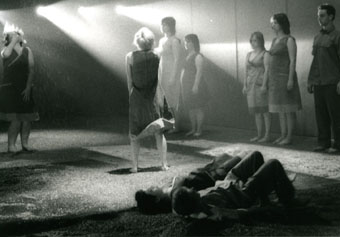
Restless Dance Company, Starry Eyed
photo David Wilson
Restless Dance Company, Starry Eyed
Restless Dance Company’s Starry Eyed directed by Kat Worth, draws its audience into an intricate world of gestures where space and time intensify into a climactic, breathless question. Despite its title, Starry Eyed doesn’t entertain culturally constructed visions of glamour or false images of pop culture success. Rather the work trespasses into the inner world of dancers as they grapple with the dystopian reality of their own means of creating pathways, choosing directions and dealing with ambition. Starry Eyed asks, “What do we learn about ourselves while getting to where we want to go?”
This organic process is symbolised by the sound of a Tibetan bowl, played by composer Heather Frahn, which gently wakes the dancers. They begin breathing deeply as a continuous shower of dried rose petals falls. A small dance of breath initiated, falling, rolling, settling for a moment, suggests an unfolding universe. The sound of bells draws the dancers into densely-woven actions that suggest self-examination around past success and future survival: impatient finger tapping, caressing faces, heads shaking to rid themselves of debilitating self-talk, reclining contemplation. Low level falling, rolling bodies slowly fill the spaces left open by pockets of light. An ascending, reaching dancer breaks the hypnotic meditative state of shifting bodies.
A pulsing earth beat draws the dancers’ dreams to the surface as they sketch shapes in the fallen petals of past success. By moving the petals, the dancers map self-fulfilling prophecies, gazing into their momentary creations as if reading leaves in a teacup. Itchy feet glide through the petals, testing the water before taking the leap. They wind up with swinging arms, dusting off the past to prepare for the future. There are so many directions, which do you choose? The future is like walking blind. Perhaps if I run ahead I’ll catch it?
The soundscape grows denser as the pace builds. Live vocals beckon the dancers like a siren song, singing their dreams into existence. They respond but it’s not easy. Protective huddles are hurdled, sparks of ideas are pocketed, gestural pages turned. Dancers are stopped mid-stride and taken down. Movements become more automated as the bodies walk imaginary urban streets, punching imaginary time cards, avoiding eye contact, negotiating narrow footpaths at the edges of the space. It’s here I notice the uniform quality of Gaelle Mellis’ earth-toned costumes. Meanwhile, a solo of yearning, breaking free, reaching and falling captures the emotions of the race only to be stopped and returned to the fold. The residue of potential success is collected by dancers breaking from the controlled urban environment, carrying each other, catching falling bodies, gently easing them to the ground, messing up the space with running, sliding, falling down and getting back up. They end in a line across the front of the stage, lit dramatically by designer Geoff Cobham, telling personal stories. This chattering wall of a desiring mass is paradoxically juxtaposed with the invitation to share each dancer’s private thoughts.
Secrets made public abruptly stop. The lights swing, imbuing a sense of vertigo, exposing too much. The dancers slowly, delicately step backwards while looking tentatively at each other. Who will break out, who will succeed, who will fail? A brave duo falls out of line, triggering a climax of sound and movement. The relentless falling of petals and bodies is on. Dancers slide, fall and recover, greedily grab, stuff, roll and bathe in the flowery sea that symbolises reward and success—an act of resisting the dystopian world. The intoxicating perfume of petals hits me at this moment and, with the profusion of images and actions, triggers a heady mix of associations about memory, survival and emotion.
Starry Eyed, Restless Dance Company, director Kat Worth, composer Heather Frahn, lighting Geoff Cobham, design Gaelle Mellis; AIT Arts X Space Theatre, October 10-17
RealTime issue #58 Dec-Jan 2003 pg. 32
© Helen Omand; for permission to reproduce apply to realtime@realtimearts.net
Kylie Johnson sits behind boys on public transport
photo Kylie Johnson
Kylie Johnson sits behind boys on public transport
Tasmanian artists Kylie Johnson and Tiffany Winterbottom’s exhibition Everyday Entertainment takes the ‘bad grrrl’ phenomenon of a couple of years ago—and runs with it.
Johnson and Winterbottom take an experimental approach to their work within popular culture and develop its content from personal experience. Their creations are set in the social spaces they inhabit—bars, clubs, living rooms, parties, public transport…In the name of art, they remodel their lives into “something more entertaining, powerful and glamorous” (media release).
Winterbottom’s 5 large-scale scenarios derive from photo-shoots (at home) of friends dressing up, drinking, smoking and playing to the camera. Luridly seductive, colourful collages of digital prints, vinyl and plastic sheet, they are sexually explicit and slightly cartoon-like. Photoshoot for Boyfriend Overseas dabbles in deliberately cheap eroticism, exploring female sexual stereotypes. The subject of this image is semi-naked, assuming a submissive pose, yet her face is defiant and confident—a “girl with attitude” (exhibition notes).
Pop Bandit is all legs and torso. Its subject wears boots, fishnets and black lingerie, her stance bold and challenging. In The Night the Cops Turned Up, the subject matter is taken to its extreme, with what appears to be a rape scene, but is actually a ‘hard-edged’ depiction of sexual coupling. These works are powerful, confronting and highly original in their execution. The subjects are “cast in fantasy roles that exaggerate their eroticised self” (exhibition notes). Winterbottom’s extraordinary animation, the affecting and disquieting Dribble Girl in Lounge Room combines abstracted still elements overlaid with linear moving components and depicts a young woman writhing in a slightly pathetic sexual display.
Kylie Johnson’s work is, by comparison, understated—and a good foil. Her obsession is seduction. She says, “to be seduced is to be preoccupied, absorbed or enchanted by someone or something to the point where one’s individual identity dissolves into nothingness.”
Johnson’s images are smaller in scale; predominantly black and white digital prints from video. Her titles are long and descriptive, incorporating the artist’s name in a Tracey Emin-like gesture that nevertheless has its own originality—Kylie Johnson took his photo to her clairvoyant; Kylie Johnson sits behind boys on public transport; Kylie Johnson made a template of his tattoo from memory—each title expanding the work and having its own subtle wit. Text is used to effect in the artworks as well, and Clairvoyant incorporates sound; earphones allowing the gallery visitor to eavesdrop on the seer’s musings.
Tattoo interestingly incorporates an artist’s book of images of the facsimile tattoo Johnson adhered to her arm for 7 days, removing it to reveal slightly scabby skin in its shape. This work is dominated by an enormous wall-based bat-wing vinyl shape—a blow-up of the tattoo in question.
These are voyeuristic and confessional works. The 20 small digiprints, Kylie Johnson followed her because she had that familiar hard skin feature an anonymous woman’s legs and shoes and prompt the question—What else does Kylie Johnson get up to? An intriguing question about an intriguing artist. Everyday Entertainment is an excellent 2-hander with 2 strong bodies of work complementing each other exceptionally well.
Everyday Entertainment, Kylie Johnson & Tiffany Winterbottom, CAST Gallery, North Hobart, Sept 6-28; Gallery Wren, Sydney, Nov 6-22
RealTime issue #58 Dec-Jan 2003 pg. 33
© Diana Klaosen; for permission to reproduce apply to realtime@realtimearts.net
The 10th RealTime-Performance Space open forum, Video + Art = ? was hosted by Blair French and Alexie Glass with some 100 video artists, experimental filmmakers, curators, afficionados and scholars gathered to discuss what’s happening in video practice at a moment when the form is enjoying new dimensions and wider popularity. You’ll find the transcript of the forum in the feature section of our site.
French is Associate Director at Performance Space and is curating a series of exhibitions focused on video. Glass, a curator at ACMI, is working on the video section of the joint ACMI and National Gallery of Victoria show surveying Australian practices, 2004: New Visual Culture. She’s also co-curating I thought I knew but I was wrong: New Video Art in Australia in collaboration with Asialink, touring a number of venues across Asia soon.
The cross-media artist
French initiated the discussion by asking Merilyn Fairskye, an artist who’s worked across a range of media including a variety of video forms, to comment on where video fits in her work. Fairskye replied that video work was “very different from the early video experiments of the 80s which had much more direct relationship to television and its mechanisms. For the most part, what we’re seeing now is…art that’s not based on materiality but on ideas…an art that comes together because of the participation of people within the space…I describe myself as a cross-media artist, not a video or photo-media artist. I work with the form that I think is best for a particular set of ideas and sometimes that might involve 3 or 4 different media. But a lot of my work is time-based rather than video-based (although video is always a component) and it’s certainly different but not unrelated to my still work or my installation work in public spaces or in other art gallery contexts.” For Fairskye this has meant opportunities for creating flexible works that can appear in different ways in different spaces, single screen, multi-screen, for gallery or cinema, short and long versions.
Performance & video space
Sam James works extensively in collaborations with performance and dance artists and companies, creating images and performative virtual spaces. With a multi-artform background and training in architecture, he began in theatre building sets until he was struck by their limitations: “So I started using projections to try to expand that [space]. I use it as a tool to get a release from the physical space.” Illustrating how diverse the use of video in performance is, James described himself as sometimes feeling like a filmmaker, for example when shooting on location for a dance film. However, for Gail Priest’s Sonic Salon installation, “a non-physical performance, more about performative presence…the video I was making for that was just purely abstract, graphic imagery to relate to a 5.1 surround sound installation. I also built various screens which a one-person audience could sit within and have an immersive experience.” For Victoria Spence’s Communication Failure, the performance “turned into an interaction with suspended monitors. I didn’t shoot any of the footage. My role was to operate and to create a sort of a sympathetic consciousness based on Victoria’s autobiographical video material which she filmed herself.”
Configuring viewing
The dominant theme of the discussion soon became the challenge of exhibiting video. Alexei Glass spoke about the very different attitudes that abound about exhibiting experimental film and video. “People who primarily come from experimental film will say, “Put in screenings in the cinema. Put it in film festivals…not in the gallery.” Glass described the range of alternatives offered by ACMI ranging from its large exhibition space to state-of-the-arts cinemas with digital projectors to “screen lounges where 2-5 people can sit and watch screens by themselves or with friends just for the price of a movie ticket. They can watch single channel works which are often short films curated into 1 hour programs.”
MCA curator Russell Storer said of the gallery’s engagement with video, “there are concentric circles of information provided to audiences about how to deal with video work…It’s presented in the broader context of contemporary art.” He described artists’ requirements for setting up video in their works and the reconfiguration demanded by the architecture of the gallery spaces. Glass commented that “[ACMI has] an architect as part of our installation team because of the technology that we’re working with. You need an architect to work the space and to actually navigate the design of the installation and the sound.”
Learning to watch
Storer reported that “the most popular shows tend to be photography. It’s still the artform that people are most comfortable with. A lot of people are still not sure how to interact with video art.” Glass said, “At first, when people came in to ACMI they were treating it like television. They wanted to surf through the exhibitions. I was in the Susan Norrie show at MCA today…I kept watching people move through it in circles. It became like this fluid, performative space. That often happens in ACMI now that we get repeat visitors.” Blair French described the MCA’s Liquid Sea as being like a journey through the history of screen culture from the filmic to the immersive. He found the required perceptual shifts that others enjoyed were challenging: “I was kind of working with the screen stuff but couldn’t look at all the objects and paintings in between. I was looking, but not looking. Something was going on about light.”
Video = cinema?
Several speakers described a different kind of challenge, fatigue from sitting through future perfect and Transmediale screenings in Sydney. This prompted some intense discussion about the appropriacy of the cinema screening of video art. Visual artist Lucas Ihlein suggested breaking up the screenings with introductions and comments to create space between the works and for reflection “rather than a room full of bodies gradually sinking down into vinyl chairs, peeling ourself off them at the end of the night, all stiff. It’s an experience, an event, a performance. We should become more interactive.” Others disagreed, but writer and academic Edward Scheer argued that “if we take another genealogy apart from the cinematic one to come to time-based art practice where it is now, you find that in fact people don’t want to be sitting in the dark watching things. They want to have interaction. The televisual model is a live model. It’s predicated on interactivity. Cinema is not…I think there’s a challenge to re-think the debate about physical presence in relation to the presentation of this work.” Louise Curham (see interview p15) suggested that “cinema doesn’t need to be a dead space. I think it’s a big ask for an audience to actually go into a gallery and treat it as a pseudo-cinema space. It’s uncomfortable. And you’re asked to give the kind of concentration to a work that is being asked in a cinema.”
Video artist and curator Emil Goh added further heat to the conversation by suggesting that higher definition projection means that soon video won’t require darkened gallery spaces, that the duration of works should be signalled so that viewers can choose when and for how long to watch, and that, as with the last Asia Pacific Triennial, comfortable spaces be provided for viewing.
Education for choice
Curham and video artist John Gillies pointed beyond the issue of choice to the diminution of context, for example in tertiary education where the availability of works and the time for them to be seen is increasingly limited and in film festivals, where directors are nervous about challenging their audiences. When new audiences see video they have no context for it.
The forum ended with a discussion on the challenge for galleries and events to keep up with the technological demands of screening video. Despite the disgruntlement over this and the education issue, the forum generated valuable debate over modes of exhibition, intriguing reports on various manifestations of video as art, positive talk of audiences adapting to video in galleries and the happily looming prospect of video lounges.
Video + Art = ?, RealTime-Performance Space Forum, Performance Space, Sydney, Aug 18
RealTime issue #58 Dec-Jan 2003 pg. 34
© Keith Gallasch; for permission to reproduce apply to realtime@realtimearts.net
There is a scene in the Coen brothers’ film The Big Lebowski (1998) that prepared me for the 50th Venice Biennale. Julianne Moore is a conceptual artist entertaining an 80s looking black-garbed German video artist. She’s giggling on the phone to her agent about the Biennale, “Darling…the Biennale…” The posturing world of contemporary art as the butt of a joke in this very funny scene kept coming back to me in Venice.
One of my agendas, after queuing an hour for tickets, was to figure out how, or if, new media was integrated in the Biennale. I don’t necessarily mean the obvious computer-based, interactive point-and-click model of new media, but ways of thinking about the form as different kinds of physical and non-physical spaces, and all things hybrid, recombinant and mutant.
This year the Biennale’s theme, “Dreams and Conflicts: The dictatorship of the viewer”, ensured that much of the work was strongly embodied in issues of sociological crisis and cultural conflict. Curators seemed compelled to contextualise contemporary art with an overwrought and heavy-handed social consciousness. The curated show Utopian Station about self-sustainable communities, took the Biennale’s theme to heart and the result looked like a bad hippy commune—complete with John and Yoko’s “Give Peace a Chance.” Thankfully not all artists ran with the loaded theme.
Appearing like a set of embassies from countries with cash, the institutionally controlled, government regulated and culturally endorsed international pavilions in the Giardini, make up a large component of the Biennale. They function as part international art show, part art trade show and part tourist expo (the Singapore Pavilion even offered tourist brochures).
Some of the more memorable works included Italian Diego Perrone’s A dog dead of old age (2003), in the curated show The Zone in the Giardini. Perrone’s dark and foreboding animation depicted a hyperreal computer generated dog in the throes of death, caught between the living and the hereafter. If any work in the Biennale audio-visually and perversely articulated the theme of ‘crisis’, this was it. The Estonian pavilion featured the fictional artist John Smith created by Marko Maetamm and Kaido Ole. Marko and Kaido (2003) offered a spatial narrative to be followed through a series of rooms in a mutant, sci-fi, Boys’ Annual mix. The Australian pavilion, as we know, featured Patricia Piccinini’s continuing biotech preoccupations.
Much of the video work was disappointing. Exceptions included Yang Zhenzhong’s Let’s Puff (2002), which used 2 video screens. One featured a girl strenuously blowing in the air towards a screen opposite and causing the action to accelerate and slow down in time with her blowing: a simple piece that extended the artificiality of video and notions of screen space. Notable also was Dan Graham’s important 1974 precursor to interactive new media work, Opposing mirrors and video monitors on time delay. This closed circuit TV video installation and mirrors captured the viewer’s image from a few seconds before and allowed you to watch yourself as both subject and object: a work based around simple notions of participation. Most of the other videos were recordings of the banalities of everyday life, a style that seems to be an international phenomenon.
Other highlights in this enormous event were works in the curated Zone of Urgency, part of the large Asenale Show. Much of Asenale was predictably austere, precious and boring, taking place in huge derelict shipping assembly warehouses. But Zone of Urgency offered a far funkier engagement with contemporary art, with lots of refreshing cacophonous noise and media arts spaces, a barrage to the senses playing with notions of survivalism and cultural resistance. The show included the web work of Heavy Industries and Alfredo and Isobel Aquilizan’s fantastic chrome-plated World War 2 Army Jeep, M201, in god we trust (2003) which seemed like the product of a crazed survivalist and religious zealot.
Less advertised components of the Biennale contained some of the more perverse and genuinely strange work. The Absolute Generations show at the Palazzo Zenobio featured Russian artist Oleg Kulik and his mutant Sportswomen, a stuffed, zombified version of tennis player Martina Hinghis. Cabinet of Manipulation, by Ben, a kind of mutant 19th century laboratory in a large room, dealt in all manner of human and non-human transformations. Though I missed it, I was intrigued by stories of Maurizio Cattelan’s remote-controlled animatronic boy Charlie, who roamed around the Giardini grounds on his tricycle, freaking everyone out.
After 4 days overdosing on contemporary art, I left feeling that while Venice is great for the artists involved, the event is only a blip on the radar of what’s actually occurring in contemporary art at any given time. It is too big and unfocused. The sheer scale only amplifies the more banal examples of contemporary art, rather than offering a concise and focused undertaking. One also gets the impression that the Biennale’s attraction is partly due to its picturesque European setting, in the middle of summer. I’m sure the artists in the The Big Lebowski would have loved it.
New media at the Biennale is not canonised as ‘new media’ nor ghettoised as such. It was refreshing to see ‘new media’ coming under the larger and expansive rubic of contemporary art, a sign that the term is as redundant as ‘light art’, ‘earth art’ or ‘body art.’ This distinction was also apparent in Paris at the Pompidou Centre and the new Palais de Tokyo gallery. At these institutions, new media comes under the subset of video art and contemporary hybrid practice. The Palais de Tokyo, a huge contemporary art institution, is very much a hybrid space, with art, design, fashion and lifestyle converging under one roof in shows that include video and painting with new media. The Venice Biennale, for all its problems, proves that new media can and does sit side by side with other contemporary practices.
Dreams and Conflicts: The dictatorship of the viewer, The Venice Biennale, Venice, 2003 www.labiennale.org
RealTime issue #58 Dec-Jan 2003 pg. 35
© Ian Haig; for permission to reproduce apply to realtime@realtimearts.net
Contemporary performance has played a key role in the development of the arts in western Sydney over the last decade, evident in the work of Urban Theatre Projects, Citymoon and a host of groups and individual artists. It’s also had an impact on youth theatre, most visibly in the artistic direction at PACT and in Shopfront collaborations. Now members of the performance community and associates from music and theatre have created Live Bait, winning a tender for a summer arts and music festival taking up the January space vacated by the deceased Sydney Fringe Festival formerly based at the Bondi Pavilion in Sydney’s East. The producers are Michael Cohen (Theatre Kantanka) and Glen Wright (Vitamin Records) with fellow artistic directors, performance artist Jeff Stein and theatre director Sarah Goodes.
Working with a dauntingly limited budget, Cohen and team are nonetheless excited by the festival’s prospects, believing that idiosyncratic programming and the collaborative strength of its ‘stakeholders’ will make for success. Inspired by the Adelaide Fringe’s Garden of Unearthly Delights, Cohen is keen to create a fluid, carnivalesque environment mixing free attractions with walk-up ticket purchasing for shows. However, unlike other fringe festivals, this one is curated. A bigger fringe “with a critical mass” can afford to adopt the open-ended approach, says Cohen, but not one on this scale. The spaces in the Bondi Pavilion therefore have been carefully allocated for particular strands of performance.
The upstairs theatre will be home to contemporary music with an impressive line-up of artists working the intimate 250 seater venue, the kind that is rare in Sydney. Musicians include The Necks, IOTA, Sarah Blasko, Fourplay, New York-based Greta Gertler, Chris Abrahams solo and with Melanie Oxley, Jeff Lang, the Israeli band Shiva and Dha, the wonderful Indian percussion band.
Cohen’s Theatre Kantanka is committed to outdoor and site specific performance, so it’s not surprising that his attention is, as much as it can be, on the outdoors program, Boxed Set, with the company performing and MC-ing. Adapted with visiting French company, Royale Delux while Kantanka were putting together their show, The Eye, the program centres around a shipping container that has a fold-out apron, a mini-proscenium arch and can be climbed and swung from with the help of a crane especially made for this season by Stalker’s Joey Ruigrok van der Werven. Boxed Set, will feature architectural performance virtuosi Gravity Feed, wild nerd girl-show Frumpus, dancer Julie-Anne (Miss XL) Long and Kissing the Mirror (performers/installation artists Clare Britton and Halcyon McLeod). Cohen thought Britton and McLeod’s Unit one of the best shows of 2003, with its transformation of the apartment for artist residencies above the old Petersham Town Hall into a bewildering world of mirrors and puppets. Each group will perform for up to 20 minutes in a program that will be repeated 6 times over the 2 week festival.
The Boxed Set site will also be home to 2 late nights of provocative entertainment in Mister Monster Cabaret hosted by Imogen Kelly (Machine Gun Fellatio) and featuring Bum Puppets, Joel Salom, Christa Hughes, Frank Bennett and Toy Death. Also playing late night in their own program, and adding to the “adult carnival” ambience Cohen and his cohorts are keen to bestow on Bondi, is South Australia’s Circus Bizarre subjecting their persons to all kinds of nasty interventions.
Wandering the Pavilion site you’ll encounter Nick Wishart’s The Cell, an industrial street orchestra comprising, among other things, drills, hammers and air compressors. A couple of caravans will house installations including one by performance group Shagging Julie.
Also coming to the party is the enterprising Reel Life short film festival with films by and about young people in a 2 night program. In the gallery Electrofringe will present 2 programs of screen-based art, corpo[real] and [ill]uminations. There’s also Fine Film’n’Food—outdoors eating with feature films of the kind the cinema-less Bondi population must travel to see: Kill Bill, Frida, The Swimming Pool and others. In the Pavilion Theatre independent Sydney theatre artists will find a summer home for readings of new plays, showings of works-in-progress and trial runs. Some titles intrigue: Kate Mulvany’s Enbalmer! The Musical, Lickety Split Productions’ Simon Crean! The Musical, Patrica Johnson’s The White Light of Enlightenment and Susan Prior’s Making Love to the Scarecrow, inspired by the music of Patti Smith. The New Mercury Theatre will present Refugitive, a one-man show by Shahin Shafaei.
Having won the tender for the festival, Cohen and his associates had only 2 months to put their program together. For a first run it’s already got lots of character and plenty of edgy talent. This is live bait that should hook a big audience.
Live Bait, a summer arts & music festival, Bondi Pavilion, Jan 15-31
RealTime issue #58 Dec-Jan 2003 pg. 36
© Keith Gallasch; for permission to reproduce apply to realtime@realtimearts.net
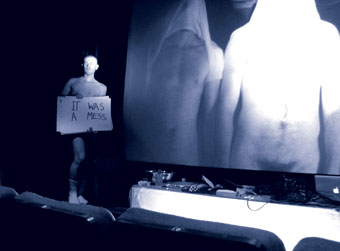
Jason Sweeney, Peculiar
photo Peter Heydrich
Jason Sweeney, Peculiar
“Gotta keep an open mind, don’tcha?” whispers the guy sitting next to me as a woman in the front row assists the show’s naked solo performer into his snug-fitting Calvin Klein boxers.
A fug of nervous amusement hangs over the audience as performer Jason Sweeney recites masturbatory fantasies about having sex with the brother he never had. Yep. Open mind. Wide open.
Showing as part of Adelaide’s FEAST gay and lesbian cultural arts festival, Peculiar is the performance incarnation of mixed media experiments designed collaboratively by sound-maker and performer Sweeney, Martin Potter (video image maker and sound designer for Sample People) and Ingrid Voorendt, a director of movement-based theatre.
As if performing to a live version of the non-existent album, Sweeney presents a series of short mixed media compositions or “tracks”, manifesting in a hybrid of spoken word, video, musical theatrics and live sound effects. Throughout each track, he interacts with the audience, flitting between them and a trestle table laden with props. Amidst bottles of wine, delay pedals, a portable turntable and a selection of queer porn magazines, Sweeney encounters camp in some dark and intimate locations, be it a grimy basement in a forest of masked young men, or inside the mind of a young underground prince, pumped full of pharmaceuticals, club sleaze and narcissism.
Glancing to my right, I notice that the open-minded whisperer is looking a little apprehensive. I think he suspects he’s become a target for a little audience participation later in the show, as he is handed a sample of nasty red wine in a plastic cup and a tiny sealed envelope…
I find it difficult to know or care how autobiographical these works are. The development of any fictional character may draw upon personal experiences, but inevitably its creator sacrifices personal details so that an audience may step partway or perhaps all of the way into this identity. For better or worse in Peculiar the boundaries between performance persona and a completely fictitious character were complicated by the use of personal references, affecting the quality of emotional investment.
In track No. 4, Boy Story, Sweeney’s voice calmly discloses intimate details of some of his sexual encounters, occurring within what could only be described as horribly dysfunctional relationships. His narration accompanies documentary video of an absurd puppet show, using teddy bears, bottles and condoms in front of a household mirror and balanced on what we presume to be Sweeney’s lap. This lo-fi home video composition reflects an amusing pathos running throughout the show, which is both entertaining and annoyingly solipsistic.
Towards the end an OK Computer-style voice-bot announces with subtle, then not so subtle hints that the show is over…the performer has slunk away without waiting for applause. I left with my head full of subliminal flashes, lipstick traces and the smell of cheap aftershave.
Ripe with clichéd gay references, exquisite video works and a drag-salute to the sad tunes of PJ Harvey and Radiohead, Peculiar captures the intensity and melancholia of queer romance as its tenderness vies for attention within the emotionless force of sexual excess.
Peculiar was developed with the assistance of para//elo as part of an open platform artist residency (POP) in 2003.
Peculiar, performer Jason Sweeney, designers Jason Sweeney, Martin Potter, Ingrid Voorendt; FEAST gay and lesbian cultural arts festival, Iris Cinema, Adelaide, Nov 12-15
RealTime issue #58 Dec-Jan 2003 pg. 36
© Samara Mitchell; for permission to reproduce apply to realtime@realtimearts.net
Dramaturgy is a hot topic. It’s been on and off the boil since the late 70s with a lot of resistance to and misunderstanding of the role of the dramaturg, their function, their training, their artistic status and their power. A rather intimidating monodimensional view of the dramaturg as ally of the director and the theatrical status quo has prevailed for over 20 years. However, the large number of small to medium sized companies and individual artists turning to dramaturgs and choreoturgs is transforming this threatening vision into a flexible model for getting a perspective on your work, good craft advice and serious help in sustaining your vision. This quiet development has been aided by the rise of hybrid arts practices and the emergence of different kinds of dramaturgy not solely centred on the written text. Attitudes (but not necessarily funding resources) have also changed about how long it takes to develop a script or a collectively devised performance. Back in the 1980s Playworks began supporting women writers with a more measured dramaturgy than the Australian National Playwrights Conference’s hothouse approach where it also wasn’t always clear whether the people cast in dramaturgical roles were in fact dramaturgs. It’s interesting to see, under the leadership of chair Campion Decent and the 2004-5 conference director Chris Mead, a well-worn model given new life. Other models have emerged, particularly in the Australian film industry where sustained attention is paid to the importance of script development in the Spark (RT56) and Aurora (RT55) programs. These don’t have to be imitated but they suggest ways of nurturing creativity unmuddied by other purposes.
This is the second of our reports on developments in dramaturgy in Australian theatre, dance and contemporary performance. Earlier this year Peter Eckersall, Melanie Beddie and Paul Monaghan of the Dramaturgy and Cultural Intervention Project reported on the conference they organised as part of the 2002 Melbourne International Festival of the Arts (RT 55). The transcript of Dramaturgies I was reproduced on our website (see the Dramaturgy Now section). That forum took a global view of dramaturgy, focusing on the importance of seeing the developing work in a socio-political context and the dramaturgical role as an inclusive one involving all the artists in a project. In February 2003 a second conference, Dramaturgies II was held for 2 days at Melbourne University. This time the focus was on the dramaturgical process (when and where does it happen, with writers, devised by groups), the kinds of dramaturgy practised (eg by lighting designers and sound artists working on productions) and some analogous practices (eg art gallery curatorship). You’ll find the sizeable transcript, labelled Dramaturgies 2 on our website. What follows, given the scale of the event, is a brief, even cursory summing up of some of the key utterances and issues.
What dramaturg?
Peter Eckersall bravely attempted to delineate the big picture of dramaturgy, ranging through various models, across continents and performance traditions. The picture of the ideal dramaturg that emerged was of a sounding board, a collaborator and mediator who democratises the creative process making sure every actor understands every word and can answer questions (deep, difficult and as provocative as possible) about the work and not just the work as a script. The German model, inevitably debated over the next 2 days because of the dramaturg’s power in German theatre (adapting, translating, helping choose plays), positions them as those who “guard the integrity of the play.” Although mostly seen as a supportive role, Eckersall argued that it should challenge, with the dramaturg as agent provocateur, crossing borders, mediating complex interactions and connecting theatre with culture. He cited Eugenio Barba’s metaphor of the weave, “everything that has action or effect; not only text and actors but also sounds, lights, changes in the space.” The weave is not an object or a skill, he said, it’s an attitude, a process, a sensibility. For Barba artistic discipline, and therefore dramaturgy, is an “attitude that…presupposes…a continual exercise in revolt, above all against oneself, against one’s own ideas.” It’s a way of refusal, said Eckersall, against accepting conventional notions. Dramaturgy is therefore a disorientation because it evokes something different. It is a process of “being undecided”, of discovering the creative tensions in the evolution of a work.
However, ranging through the opinions of Brecht, Esslin, Pavis and others, Eckersall made clear the complex position of the dramaturg, involved in the creative process but also as critical observer, responsible for putting the play in a wider context; “our work touches so many areas of the production process, we do so in an atmosphere of not really knowing our function, thus leading to a kind of ambivalence that surrounds dramaturgical practice.” Viennese writer and satirist Karl Krauss declared the dramaturg, “a potential artist who is unable to provide convincing proof of his or her art. He or she is an artist without either the means of expression or the tools…The dramaturg does not risk his or her skin every night.” Others have written of dramaturgs and their ‘poverty’, as ‘artists without tools.’ Although Eckersall challenged these notions, they recurred over the 2 days of the conference with some surprising animosity towards dramaturgs coming from a few experienced hands. In the meantime, Eckersall celebrated the significance of “the new poetics of dramaturgy” concerned with fractures, disorientation and flows and in which making theatre is a collective dramaturgy.
Some of us were beginning to wonder if this dramaturgy can be practised without a dramaturg—so we quietly worried at that. The discussion that followed included a valuable reminder that the dramaturg keeps the memory of the writing, the workshop and rehearsal process alive, as well as bringing to bear the cultural history of theatre and its processes, thus “countering historical amnesia.” Eckersall noted, in an exchange about different attitudes to dramaturgy, that it is part of an intellectual tradition in Europe, a reflective one. “In Australia,” he quipped, “it’s a matter of getting the play on and not reflecting too much.” He later added a handy label for the brisk cut and paste school of script editing sometimes practised by our major companies—“industrial dramaturgy.” Whatever one’s slant, the session’s emphasis on sustaining vision, the significance of various kinds of memory and the importance of cultural intervention held promise for the dramaturgical process, though perhaps not so clearly for the dramaturg.
Who’s talking? Who’s listening?
In the session on dramaturgy and devised performance, where collectivity often rules, Maud Davey (Vitalstatistix) declared that because dramaturgs “are not responsible they can be quite radical in their suggestions.” A number of us quietly tucked away ‘responsibility’ for something else to worry at. She described having John Romeril as dramaturg on Crying in Public Places’ Skin (2000) as like having an extra brain. Clearly wary of dramaturgs (seeing them as potentially “improving” a work to the point of damaging it), Davey fantasised in a later session an ideal situation in which she’d have a clone of herself as dramaturg to her director self, “to do what I’m not good at.” Bruce Gladwin (Back to Back Theatre) described himself as a director-dramaturg working with a full time ensemble over a long timeframe and using a dramaturg only as a script consultant for a couple of weeks. For Gladwin the key to dramaturgy is collective continuity of collaboration. Paul Monaghan took up Barba’s weave and the way the weave of action involves everything, like a multi-track sound recording. But as strong and rich as the weave is, the structure might be weak and that has to be addressed dramaturgically. Elements of the weave, for example, can be deployed in various structural ways—sound as a trigger or for slowing time.
Rachael Swain (Stalker, Marrugeku Company) brought into play a stage prior to the usual notion of creative starting point: “For Stalker and Marrugeku, dramaturgy is about the process of negotiation with Indigenous people who do not readily give out their knowledge.” Therefore casting is “a major dramaturgical function” because of the cultural complexities of dealing “with multilayered intercultural meanings combining notions of dreaming with contemporary consciousness.” Raising the issue of ‘different culture, different dramaturgy’, Swain detailed the kinds of cultural negotiations and key personalities involved in creating a new work, of using reconciliation “as a process of learning to move”, of timing (“the importance of going slow: someone might get sick”), and using the South African Truth in Reconciliation Commission as a model of dramaturgical responsibility. The final work, a hybrid performance fusing storytelling, dance and personal histories, becomes a kind of translation for a white audience, encouraging a shift in perceptions.
It had been frequently proposed throughout the conference that in creating a work everyone involved plays a dramaturgical role. However, in the session on ‘Dramaturgy, Space, Visuality, Sound and Technology’ Paul Jackson opened up the very issue of how such a dialogue begins, a matter raised from the intercultural perspective by Rachael Swain. Jackson said the important thing, in his case, is to ask, “How can you have a conversation with a lighting designer?” [In another conference, performer and director Chris Ryan described dramaturgy as finding a way in which you can talk to an artist.] Rather than seeing lighting as a history of technology, Jackson argued for it as a history of design, of “creating narrative with light and shadow”, of “space reacting to bodies”, of “how we want space to move.”
Designer Kathryn Sproul whose projects include working with director Nigel Jamieson on the outdoor orchestral and performance spectacle Flamma Flamma for the 1998 Adelaide Festival, described the designer as visual dramaturg, “a scenographer who writes the stage space creating a text, articulating one beyond language.” Also keeping to the fore the challenge of communication, she claimed that designers are often not called on to sufficiently verbalise, that there isn’t an established language for them to deal with directors and little time to reflect. Sproul emphasised the role of the designer in testing the validity of the directors’ intuitive ideas, of playing provisional audience. Sound artist and designer Lawrence Harvey spoke about the power of sound, describing himself as a creative mediator in other people’s work but also in his own, which he graphically described and where he has to “step back from himself.” When working for NYID (Not Yet It’s Difficult), his aim is to create an acoustic set entailing the spatial and temporal dimensions of sound. What Harvey wants to hear from collaborators is “not the sound you want but the feeling you want to achieve…If you want to fetishise the text you don’t need a designer.”
In the discussion that followed it was agreed that if in fact the various designers play a dramaturgical role then, as these artists were insisting, we need to know how to listen to and talk to them; we all have to expand our vocabularies (to speak of design, sound, light); and the artists need to be employed much earlier in the creative process than they currently are. Perhaps, mused Paul Jackson, a work could be initiated from a lighting idea. Laurence Harvey reinforced the notion of the weave: “Inherent…are a whole lot of ways that images will move, ways that the environment will respond to a whole lot of input from the actions. As a sound designer, I have not only to respond to the visual information in front of me but also the data information that comes back to the environment that I’ve been working on to deliver the sound design.”
Structure & self-dramaturgy
On the second day of the conference, in a session titled ‘Dramaturgy, Text and Structure’, Yoni Prior spoke about the experience of being part of Gilgul Theatre where the multidisciplinary ensemble took on the dramaturgy and there was no initial script. Barrie Kosky, she said, was interested in ideas, not character. Everyone was involved in the process and wrote and edited the text, everyone negotiated structure and all took responsibility. Prior said there was a gradual move into areas of specific responsibility. Tom Wright looked after research, Prior teaching and, later, character issues. Michael Kantor shared in developing the choreography. Kosky at the piano controlled the pace. Self-dramaturgy, she said, involved stepping in and out of a work with Kosky as the predominant outside eye and aided by very long development period. Prior described the work as highly physical, highly cerebral, demanding and fractured. “You had to think, had to be inside and outside the work and you had to deal with different performance modes.”
Describing herself as semi-dance literate, Prior has subsequently been working as a dance dramaturg with choreographer Sandra Parker who wants to develop a more theatrical edge to her work. Prior said she was helping Parker break out of “choreostructures”, integrating different processes, coming up with new combinations of material and dealing with multi-tasking for modern performers who are often in extreme states. She sees herself as adapting choreographic techniques for use with text, looking for musicality, for patterns, listening for the sounds that come out of the body in extremis. She surmised that the rise of dramaturgy was one way of compensating for the increasingly short times available for creating work: “I think the fact that we had really long processes for Gilgul Theatre allowed spaces for reflection for all of us, so that we could actually step outside and into a third eye position, and have time to reflect on what it was that we did.”
Writer Maryanne Lynch described a variety of experiences of working as a dramaturg, with an Indigenous theatre company, with a youth group and as a script editor late in the development of a particular play. In all of these she saw herself as concerned with structure. “I privilege structure over text, because there’s no work if there’s no structure—there’s only text…Structure’s the thing which makes the texts become more than themselves.” Lynch placed structure next to the relationships between the artist-participants, context and how these 3 intersect. She also emphasised the dramaturg’s point of entry in the process. Introducing another metaphor, and one relating to the weave, she described the dramaturgy on one work as analogous to scoring, working to 2 time signatures.
Playwright John Romeril spoke of himself as involved in cultural dramaturgy between Australia and Japan, borrowing from the riches of myriad forms found in our region, extending what we can do in the theatre and, among other things, “heightening our visuality”, given the much higher integration between visual and verbal in Japanese culture. Dramaturgy, he said, is research, a constant preoccupation with structure, “a blow against anti-intellectualism” and our Eurocentricity, legitimising what theatre can talk about. Romeril’s turn (relish it in its entirety online) entailed many more observations, descriptions of the evolution of recent and forthcoming plays (some fine examples of a particular kind of self-dramaturgy) and the passing thought that perhaps it was time for him to buy himself some dramaturgy.
“…Maybe only after working for 20 years did I really begin to develop a skill of self-criticism; that thing of swinging from objective to subjective. You need that subjective belief in yourself…That level of commitment is not just an idea; it’s a whole visceral lifestyle…to be able to step back and go, ‘Oh, that’s a crock, Johnno’, calling yourself into the office, sitting yourself down, and giving yourself a big fucken rap, ‘Now get back out there and fucken do it properly this time!’ I wouldn’t have minded having someone to say that stuff to me…Can you buy [dramaturgs]? I’ll start saving.”
The curator as dramaturg
The session on curatorship as dramaturgy was richly informative, suggesting by analogy that dramaturgy is about creating a context for experiencing a work. Alison Carroll described how modernism had ‘disappeared’ the curator, hiding the significance of their role, their years of training, their personalities, presenting an illusion of non-mediation. Carroll suggested that curators need a sense of theatricality, quipping: “especially when faced with venues like the Australian pavilion in Venice.” Curators should have a public face, she argued, not least in Australia’s arts festivals where the performing arts hold sway. Kevin Murray concurred with Carroll, describing the prescriptive view that “the curator must not contaminate the data.” He argued that the curator’s role should be collaborative, playing witness to the work, providing the perspective with which to see it, where to stand, how to move, just as “a lot of painters use the stage frame in their work.”
Big picture
In a final session too substantial to be detailed here (again, read it online), Aubrey Mellor put the current dramaturgical situation in a fascinating 30 year Australian perspective. In an age when the ensemble has disappeared, when financial resources have to be prioritised and forward planning is more and more difficult, Mellor said that dramaturgy was increasingly important, but that it was still being defined and would be different for every company. The history of dramaturgy in this country has certainly been difficult, he said, and has been tied to the battle to get Australian plays onto the stage; it’s a tale that includes playwrights banned from the rehearsal room, the word ‘dramaturgy’ tabooed, the them-and-us schism between directors and dramaturgs and the ‘literary manager solution.’ Mellor declared, “For me, [dramaturgy] is now the most important tool for the creation of an original Australian theatre. We’ve all been doing it in many ways, and the missing ingredient I now find is the dramaturg, and that’s the one that we actually need most to be able to give you the sorts of things we imagined we’d all be doing by now, but we’re not…” Julian Meyrick, not taking sides, defined the variables of dramaturgy, while David Pledger took us back to the other side of the dramaturgical coin: “The theatre company is the dramaturgy. [The dramaturg is] another question all together…What is the dramaturgy? Essentially, the dramaturgy is the operating system of the work for the company, and over a period of time, that operating system accumulates so that you develop a repertoire, and a way of working with a group of people.”
At the close of these 2 days the value of dramaturgy had certainly been asserted as well as the dramaturgical role of all the artists working on a project. The role of the dramaturg was less resolved. For example, feelings about the dramaturg’s ‘ownership’ of the finished work were sharply divided. Certainly it was admitted that the balancing act the dramaturg negotiates in being, on the one hand, the ‘memory’ of the creative process and, on the other, an ‘outside eye’, is a difficult but important one. In general the view at the conference was that it should be flexible, the point of entry taken into account, a mode of communication between artists established and importantly that the choice of dramaturg was crucial for a particular job. And, as with the dramaturgical ideal espoused in Dramaturgies I and again here, the dramaturg should provoke as well as support. Apparent irritants such as whether or not the dramaturg should share the vision, the takings, the praise and the responsibility for failure, would be discussed another time. The conference organisers spoke of Dramaturgies III as an opportunity to go another welcome step further and explore dramaturgy on the floor in 2004.
Dramaturgies II was an intense and invaluable probing of dramaturgical practice in Australia.
Find the complete transcript of Dramaturgies II under Dramaturgy Now. Keith Gallasch and Virginia Baxter were guests of Dramaturgies II. [currently offline]
Dramaturgies II, The Open Stage, Melbourne University, Feb 21-22. Supported by the School of Creative Arts, University of Melbourne.
RealTime issue #58 Dec-Jan 2003 pg. 38,
© Keith Gallasch & Virginia Baxter; for permission to reproduce apply to realtime@realtimearts.net
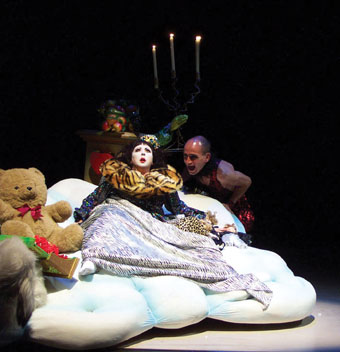
Frank Theatre, Midsummer Night’s Romeos
photo Kelly Berggren
Frank Theatre, Midsummer Night’s Romeos
Draped over extravagant fluffy-cloud settees, 2 glamour-puss demi-gods open Frank Theatre’s Midsummer Night’s Romeos by playfully messing with Shakespeare’s florid treatises on love. Part-chorus, part-skeptics, part-voyeurs, the pair (played by John Nobbs and Lisa O’Neill) lounge about, feasting themselves on the lusty interactions of Cupid, the Moon, and 3 couplings of Romeos and Juliets. In director Jacqui Carroll’s ‘modern masque’ rendering of Romeo and Juliet (with text from A Midsummer Night’s Dream), nothing comes quite as expected.
Much lighter than Frank’s trademark austerity, Midsummer Night’s Romeos revels in the kitsch and frivolity of a youthful Valentine’s Day. Plush velvet hearts, feathery angel wings and dashes of leopard skin are prominent as the performance moves through a cleverly edited selection of Shakespeare’s most evocative love imaginings. Imagery of night, sun, moon and stars feature as the Romeos and Juliets, after rising from their fridge-like coffins and wheeling themselves to life, seek to play out their fantasy love scenarios. They are spurred on and thwarted by a mischievous Cupid (Caroline Dunphy) whose wicked grin punctuates her gameplay.
Frank Theatre’s work is characterised by a measured and grounded choreography and, until recently, tragedy has been its signature form. But with Doll 17 (Carroll’s adaptation of Lawler’s Summer of the Seventeenth Doll), and now Midsummer Night’s Romeos, the company is out to play-with form, text, and comic energy. The use of comedy within such a rigorous tradition-abiding context can often be strained, yet in Midsummer Night’s Romeos, while there were shades of performer tentativeness, the humour arose from the text’s cheeky playfulness and the performers’ delightful thwarting of audience expectations.
In reconfiguring the R&J legend, Carroll’s use of 3 couples carefully avoids predictable repetition, instead affording rare glimpses (for a Frank show) of the actors’ quirky personalities and individual differences. The 3-by-2 approach also offers opportunities for nuanced physical moments to underscore the “yes, yes, almost…but not quite” intimacies of these eternal lovers. Each couple re-interprets the touch, the longing, the striving for the kiss, resulting in some very funny comparative vignettes. While Cupid works her cheesy smile for laughs, it is the Romeos and Juliets who provide the subtle comic play. Perhaps not so nuanced was the ensemble’s handle on the text, but given that Midsummer Night’s Romeos is one of the most ambitious pieces vocally for this physically-defined company, the spoken text stood up to the challenge.
The unexpected leaps from the sublime to the silly were engaging, particularly with the selection of bubblegum classics ranging from Yummy, Yummy, Yummy by Ohio Express to accompany some nicely eroticised lolly-licking, to Connie Francis’ Stupid Cupid when the Romeos and Juliets finally get their own back on the frisky Ms Cupid and her childlike alter-ego, the Moon. The Doors’ End of the Night was an appropriate mood-setter for the near closing of the performance as the Romeos and Juliets wheeled their way back to their graves to face the fate of those “born to endless night.” After all the fun and sensuality, the Romeos and Juliets never get that one big, long kiss. On opening night, Carroll entreated the audience to consider the performance’s spirited take on carpe diem (seize the day) and cogita mori (remember death): proverbs that this production embraces as totally entwined.
Midsummer Night’s Romeos, Frank Theatre, director, choreographer, text Jacqui Carroll, design John Nobbs, Robyn Graham, performers Thierry Cartou, Conan Dunning, Caroline Dunphy, Ramsay Hatfield, Yuu Matsuyama, John Nobbs, Lisa O’Neill, Emma Pursey, Leah Shelton, Neridah Waters; Brisbane Powerhouse Theatre, Oct 22-25
RealTime issue #58 Dec-Jan 2003 pg. 40
© Mary Ann Hunter; for permission to reproduce apply to realtime@realtimearts.net
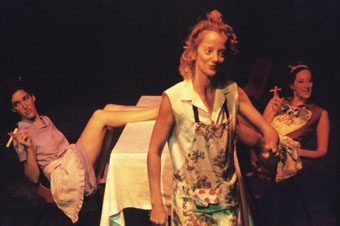
sacredCOW, The Quivering: a matter of life and death
photo Suzon Fuks
sacredCOW, The Quivering: a matter of life and death
The first sign that sacredCOW’s performance is about to begin is indeed a kind of quivering, a rustling among the plastic strips hanging from the ceiling in John Levey’s sparse, but effective set, as if the wind has changed and something is afoot. Then from deep inside the cavernous brick hallway running behind the Brisbane Powerhouse Visy theatre comes the sound of voices, layered, spoken and sung; the content is obscured for the moment. The performers are first sighted amidst Suzon Fuk’s projections which use the floor and back wall as their surface. Underlying the entire performance, constantly changing and merging, they are vital scenographic components. While the detail is sometimes unclear, the evocation of a space that is never static, that’s in transit, is clearly felt. At first sight the performers seem to be floating mid-air, holding a lantern they navigate the deep recesses of the Visy before arriving onstage on what is revealed to be a hospital gurney. It’s a compelling beginning and casts a spell over the entire performance.
Described as “an irreverent meditation on death and beyond”, The Quivering was inspired by Homer’s Sirens. Rather than femmes fatales cruelly luring mariners to their death, sacredCOW portrays the sirens as “compassionate lamenters” navigating the passage of death. Once on stage, the performers (Dawn Albinger, Scotia Monkivitch and Julie Robson) transform from sirens crossing the River Styx into co(s)mic waitresses in an outback Australian roadhouse. This transformation, like the countless others on which this performance is built, appears effortless. It soon becomes apparent that this is no ordinary roadhouse. Here bodies are washed and souls are sung onwards. In their direct address and occasional audience interactions, the intention, and sometimes the effect, is to implicate the audience in this passing. One of the motivating factors behind the generation of this work has been to “address community responses to death and dying”, given that “dying has been pushed further and further out of the perceptual world of the living” (Walter Benjamin, program note). Accordingly, one of sacredCOW’s creative partners in this project has been Mount Olivet Hospice where the group were artists-in-residence.
Combining the comic with the cosmic is one of The Quivering’s most compelling traits. Filling time between the dying, these waitresses, like everyone stuck in eternal limbo, are by turns moody, bored and ecstatic. There are resonances here with Sartre’s No Exit and pretty much anything by Beckett, as The Quivering depicts the inevitable toll of familiarity. The broad, physicalised humour that arises from this is a perfect counterpoint to the delicacy usually associated with the subject matter. Special mention must be made of Monkivitch’s adept work in those perfect Aussie signifiers, rubber thongs. Her ability to maintain her grip throughout all manner of physical manoeuvring verges on the virtuosic.
Each performer brings unique qualities to the performance: Albinger, a fleshy sensuality; Monkivitch, a deadpan that flits between absurd and melancholic; and Robson, a sweetly naïve persona that is rounded out by the warm depths of her singing voice. Yet they are an ensemble in every sense of the word as each of the characters/performers is a vital component in the overall effect of the piece. It is rare to witness such intimate and effortless ensemble work, apparent both in the performance work and in the depth of image and beauty of language.
The overriding language of The Quivering is an interplay between image and sound (with exquisite compositions by Robson, Catherine Mundy and Brett Collery). These are the moments that leave an imprint. Monkivitch running on the spot, transforming before our eyes and the endless progression of deaths and dying depicted in a mesmeric sequence of bodies laid out. So simple and yet so clearly portraying the unrelenting nature of death both images evoke complex emotions in the audience. Even so, there were times in the orchestration of the piece where the layers smothered rather than illuminated, where the constant activity sometimes obscured moments that required our specific attention. A few stripped back moments, some time alone with each of the waitresses might have punctuated the overall effect.
Ending as it began, with the turning of the tide, the waitresses set sail again: “Send us a postcard. Let us know where you end up!” This is a performance that I hope will turn up again—it deserves a long life.
sacredCOW, The Quivering: a matter of life and death, devised by sacredCOW & Nikki Heywood, director Nikki Heywood, performers Dawn Albinger, Scotia Monkivitch, Julie Robson, dramaturg Virginia Baxter, music Julie Robson, Catherine Mundy, Brett Collery, design John Levey, video Suzon Fuks, lighting Andrew Meadows, sound Brett Collery; Brisbane Powerhouse, Nov 5-15
RealTime issue #58 Dec-Jan 2003 pg. 40
© Leah Mercer; for permission to reproduce apply to realtime@realtimearts.net
Halcyon
Among new music events in recent months the one that lit me up was Raising Sparks from sopranos Alison Morgan and Jenny Duck-Chong who, as Halcyon, gather skilled musicians around them to present rare contemporary compositions and commissions. The standout in this truly daunting program was Harrison Birtwistle’s 9 Settings of Celan (1996) from his Pulse Shadows series. One of the enduring great late modernists, there is a monumentality about this British composer’s work, a sense of vast movements of nature and thought even when writing for small forces, here sublimely integrated soprano, 2 clarinets, cello, double bass and the requisite pulsing viola (Nicole Forsyth). Sensibly, Halycon reproduced translations of the Celan text in the program allowing for reflection on the poet’s brooding imagery. Morgan, in great voice, enunciated with clarity and in the challenging Todtnauberg, displayed eerie ease in the rapid alternations between the octaves of text spoken and sung.
In an hermetic reverie on the divinity scattered throughout creation, the Scots composer James Macmillan’s polystylistic Raising Sparks (to a poem by Michael Symmons Roberts) blends and juxtaposes chant, folk tune, flares and bursts of hurried sound, operatic passion and passages of simple tonal beauty. It’s music that is accessible but that also manages to formally challenge. Equally, Macmillan allows his Catholic faith to open up to Jewish mysticism, musically realised in the opening and recurrent chanting of ‘zimzum.’ (“In the Hasidic tradition the moment of creation can be understood as a divine act of self limitation [zimzum], where God held back his own power and light to make space to create something other than himself”; program note.)
By comparison, Australian composer Jane Stanley’s Aunts (2003) to a poem by David Malouf seemed modest fare, rather too literal at times in its enactment of the text, but nonetheless a fine vehicle for the entwining voices of soprano Morgan and mezzo Duck-Chong who seem to become the aunts while at the same time observing them at a distance both ironic and sympathetic. Also on the program, Paul Stanhope’s Shadow Dancing (2001) has a Ravelian summery ease, clarinet jazziness and, in the second movement, an (almost excessive) eastern edge on the viola, all held together by an engaging and finally mellow dancerly propulsion.
Raising Sparks was a big concert yielding striking resonances and contrasting visions between the Macmillan and the Birtwistle, from the low chant of ‘zimzum’ in the one as the light of creation shatters across the universe and, in the other, the final, hugely sustained last note on the word “light” following on from Beckettian angst glowing with hope, dimly (the same passage bluntly utters: “Art pap”). This was an exemplary concert—musically brave, thoughtful and meditative.
ensemble offspring
Back from Poland and beyond, ensemble offspring continued its adventurous programming with a collection of idiosyncratic compositions in a multimedia context. Ever a risky business, the engagement of music in concert with new media is littered with failures, while dance, for example, seems to me to be making a pretty good go of it. In Lucy Guerin’s Melt or the best work of Company in Space, there’s a meticulously crafted and balanced relationship between projected images, sound score and the live body. There were moments in Testimony, the Sandy Evans/Nigel Jamieson/Paul Grabowksy tribute to Charlie Parker, where all media coexisted in a thrilling dynamic. In this concert however the projected imagery didn’t always enjoy such a relationship, the conjunction between media simply being too loose, one or other element in danger of becoming mere background, and sometimes it was best to just shut the eyes. That said, it was still a pretty interesting concert which ever way you didn’t look at it.
Justine Cooper’s videos, Moist and Excitation, have been exhibited internationally, making beautiful a red and blue microscopy flow of “blood, phlegm, pus, cervical mucus and tears…transformed into images of interstellar geographies” (program note). Silence would do justice to these images, but Barton Staggs’ composition guarantees the reverie starting with bowed vibes and mellow piano rhythmically attuned to the ebb and flow of the bulging liquid image in Moist. The ensuing Excitation video tryptich suggests an eternity of living and the music is an empathetic mix of movement and stasis as if the instruments are resonating with the images, calling back to them, a bizarre music of the spheres, of micro and macrocosms. The associations seem casual, but they work.
Unfortunately, White Call, the James McGrath interpretative images meant to be teamed with Morton Feldman’s Instruments 1 had been impounded, we were told, by terror-nervous customs officers. Feldman had to stand on his own which, of course, he did admirably. Rarely heard in Sydney (Adelaide’s the place) there is much in Feldman to love and linger with and little to fear: an unpredictable linearity, theatrical moments, beautiful textures shades of ritual and evocations of the delicious rattle of the gangaku orchestra.
The concert’s main work, The Cattle Raid of Cooley or The Show, Imaginary Operas in Three Acts didn’t cut the new media mustard. This over-narrated lumbering juxtaposition of a tale of yore and trendy Manhattan arts scene fused with the disparate work of a trio of visual artists is in desperate need of editing on every front, as well as some serious aesthetic reassessment. Matthew Shlomowitz’s score needs more aural attention than most with its relentless modernist angularity let alone having to stand up against scrolling text inexpertly voiced and images that are either too far removed from the content of the tales or too obviously illustrative to be effective partners to the music. Occasionally there are visually inventive moments, for example when scattered sentences fall into a heap of words across the bottom of the screen. Musically it’s a seriously demanding work served well by the ensemble, especially in Adam Yee’s virtuosic performance on oboe, in fact this is the strongest visual element in this opera without song.
Ensemble 24
The highlight of this double bill was Australian composer George Lentz’s Caeli Enarrant… IV. Informed by the composer’s mysticism (it would have fitted Halcyon’s Raising Sparks program more than comfortably), the adoption of instrumental techniques that evoke the music of Tibetan Buddhism and the careful deployment of silences, Caeli Enarrant… is an engrossing work and not an easy one to describe in its many shifts of pace, tone and pitch. As Gordon Kerry writes in his excellent sleeve note on the CD of Caeli Enarrant… III & IV (Ensemble 24, Naxos, 8.557019), Lentz’s “harmony ranges between strident density and radiant consonance.” Passages of hard-edged modernism co-exist with a postmodern penchant for a sublime melody; a loud, starry burst of cymbals (pre-recorded) sits beside a silence that can surprise with its fullness, and the cosmos is evoked in all its strangeness. Presented essentially as a string quartet interpolated with pre-recorded passages (presumably to bring bigger forces into play, but making for an awkward fit) and very occasional live percussion, this was a truly memorable performance.
The audiophonic work, Derelict Woman (writer Susan Rogers, director Richard Buckham, composer Barton Staggs) was a less satisfactory experience regardless of its meticulous realisation and aural production values. Staggs’ contribution, realised live and on tape, musically and as soundscape, was assured and enveloping. Occasionally it revealed a distinctive compositional voice, most evident in the mellifluous piano part (Tamara Anna Cislowska) reminscent of his writing for Moist and Excitation in the ensemble offspring program (see above).
As for a relationship between Rogers’ text (intoned by Kerry Walker) and Staggs’ score there seemed little to it except in the very broadest sense as one would expect, say, of much movie music. Of course there were moments without words when spaces were opened up and there was a glimpse of a potential dialectic that could have driven what seemed to settle into stasis. The central problem was the text, a whimsical, sentimental evocation of a bag lady who narrates an account of her life, a world of velvets and perfumes and feathers and poetry, and encounters with other eccentrics. For the most part it’s numbingly ethereal, largely devoid of the specificity of personality and place that might have earthed it. Well into this epic of recollection when the woman finds 2 plastic bags, one full of body parts, the other of money, things liven up a little. The woman develops an affection for an ear and a penis and hangs onto them, and some of the money, when she turns over her find to the police. There’s suddenly an edge and wit to the writing (and some eerie plot possibilities) but it’s in such disjunction with the rest of Rogers’ reverie that by then it doesn’t really matter.
Halycon, Raising Sparks, conductor Matthew Wood, Verbruggen Hall, Sydney Conservatorium, Nov 7
ensemble offspring, The Imaginary Opera Project, Music Workshop, Sydney Conservatorium, Nov 2
Ensemble 24, New Music Network & The Studio, A Derelict Woman, The Studio, Sydney Opera House, Nov 16
RealTime issue #58 Dec-Jan 2003 pg. 44
© Keith Gallasch; for permission to reproduce apply to realtime@realtimearts.net
There are 2 fundamental directions in sound: an increase in sonic or musical density through rising volume or an increase in layering of materials; or a decrease in density through the minimisation of volume or a greater spaciousness between materials. As I revisit those Punk era recordings that introduced me to experimental music, such as Suicide, The Velvet Underground, The Birthday Party, The Fall and Cabaret Voltaire, I find I have little patience for those who build on John Cage’s 4’33” by exploring ever more dispersed or quiet musics. For me the harsher, fuller soundscapes command attention more effectively than low level acoustics. At the 2 performances of the Melbourne leg of i.audio, it was the former which, to paraphrase Iggy Pop, brought raw power runnin’ to me.
The first night featured several artists whose approach epitomised, in different ways, the drive towards low sonic densities. Natasha Anderson (contrabass recorder) and Jim Denley (various flutes and parts thereof), both Make It Up Club regulars, represent a trend in the crossover between free jazz and new music improvisation. Their performance was all incomplete noises and ‘improperly’ produced woodwind and brass sounds, off-centre gasps across the mouthpiece, or un-tongued, barely sustained whispers through hollow tubes. This was a world of isolated fragments, of numerous gestures that led to surprises or sudden drop-outs of enunciation. While this approach has its adherents, it constitutes a musical cul-de-sac. Once you’re familiar with Denley’s extraordinary sonic range, there is little more to appreciate, while Anderson’s material holds marginally more interest largely because of her relatively exotic instruments.
Regular collaborators Oren Ambarchi and Philip Samartzis—here joined by Joel Stern—exhibited a considerably less gestural quality due to their instrumentation (processed guitar; prepared CDs and electronics; and laptop and electronics, respectively). There was nevertheless a similar sense of dancing about the edges of silences and spaciousness due to the extreme subtlety of Samartzis’ dispersed sinewave intrusions and crackles, or Ambarchi’s elusive, gritty materials. Once again, the lack of consistent, overt energy or something more arresting to hang on to left me indifferent. The unintended earth hum that persisted throughout all of the first evening’s performances was extremely irritating given the quiet nature of this piece.
The hum presented an insurmountable problem for Taku Sugimoto, the first night’s closing act. The Japanese artist’s long piece—frankly shocking in its radical minimalism—consisted simply of his crouching beside his guitar and amplifier, essentially willing a gentle, cottony, fluttering hum from these devices. With another hum already in the system though, identifying Sugimoto’s barely audible evocations required an act of monumentally close listening. I found myself wishing Sugimoto might spontaneously transform into extreme noise artists Merzbow or Voicecrack. If you are going to summon the beasts that dwell within electronic equipment, I’d rather raging demons than hollow angels.
Unlike the first night, the second was characterised by works of considerable sonic density and the earth buzz was absent. The first 2 performances by Will Guthrie and Arek Gulbenkoglu, then Scott Horscroft with his mini guitar orchestra, were both readily coherent because of their foundational use of layered, sustained notes and chords. Guthrie built his own base by lightly flicking a large, amplified gong with a carefully positioned hand fan, while Horscroft forged an even denser weft of chords by mixing and manipulating 4 continuously agitated, amplified guitars.
Guthrie sat at a desk of percussion items and electronic processors, while the similarly electronically endowed Gulbenkoglu tweaked and mashed materials over the pick-up of his prone guitar. Their improvisations had a visibly gestural quality, yet it was the bedrock of Guthrie’s gong and the equally evocative, underlying sound of fan-blades through the guitar’s bridge that made this performance more than a collection of intriguing discontinuities. The sustained, continuous materials established a context for Guthrie’s measured twangs and scrapes of pliable metal rods, or the shaking of a large spring, whose sound was reshaped through the amplifying medium of the small drum on which it sat. Gulbenkoglu meanwhile pressed metal brushes and steel wool over the guitar’s lightly harmonising strings and through its popping, crackling pick-up. When the sustained sounds dropped out, these smaller, secondary gestures were suddenly foregrounded, taking on a dramatic intensity.
Horscroft’s performance was simultaneously both more and less complex. Where Guthrie and Gulbenkoglu used a heavy, bassy substratum to provide a contrast to discrete musical flourishes of a different sonic character, Horscroft produced a thicker layering of essentially like materials, deepening and increasing their musico-dramatic charge through the accumulation of first guitar hums and taps, then single notes and chords, and finally inserting within these a simple, 3-note sequence. Although Horscroft’s extended gathering and cycling of polyrhythms recalled Steve Reich, the sound was closer to Terry Riley’s messier, more ecstatic minimalism, married with such classics of sheets of guitar and feedback as Television’s Marquee Moon (Elektra, NY: 1977).
Although jazz-noise artists David Brown (abused guitar) and Sean Baxter (drums and junk) had much in common with fellow improvisers Anderson and Denley, the proximity of Brown and Baxter to rock and its in-your-face manifestations gave their performance a greater depth and volume. The 2 shifted between tiny crinkles and passages that literally slid from one to the other as Baxter let his scratching, bowing stick travel in a single arc from one bent cymbal to another before the artists counterpointed each other with more aggressive, chaotic explosions. Brown and Baxter presented a typically solid work at i.audio, adopting a late Modernist, jangly quality through the addition of Anthony Pateras’ impressive prepared piano crashes, waves and fine miniaturas.
Japanese vocalist Ami Yoshida concluded the evening with an enthralling curio; a horrified, acoustic counterpart to the electronically produced “Little Voice” of Laurie Anderson. Yoshida both externally and internally squeezed her vocal chords and larynx, amplifying these sounds within her head alone, rather than in her chest. This created a highly restricted, squeaking, piercing, choked note; a kind of aural scraping of the open-mouthed, sound “e.” Yoshida’s performance constituted a distillation of the erotic scream of horror film, an absolute reduction and purification of the acoustics of terror and sex to its merest hints, yet no less sonicly powerful for this. The physical challenges involved in forcefully producing such a cry did mean however that Yoshida’s vocalisations functioned more as a demonstration than performance.
The highlight of both evenings was Robin Fox, who overcame the poor PA set-up of the first night to offer a forcefully ripping, laptop performance. Fox’s piece had a commanding rise and fall of squelched electro noises, cut with brittle, musique-concrete—like masses, all characterised by a sense of sonic cut-off and a leaping between materials which evoked a particularly aggressive, electronic version of hip-hop turntablism. Laurie Anderson once joked that her jangling, amplified violin work reflected the beat of a dance that we all unconsciously know: one that’s produced when you stick your finger into a power point. Fox’s compelling beats similarly summoned tunes that were too chaotic to consciously decipher, but which subliminally extended deep within the body and the psyche. Only sonic dynamism of this power can approach the “raw power” that Iggy Pop and the Stooges tore from their Marshall stacks.
i.audio, curator caleb k., Performance Space, Sydney, Sept 12-20; Footscray Community Arts Centre, Melbourne, Sept 17-18
RealTime issue #58 Dec-Jan 2003 pg. 45
© Jonathan Marshall; for permission to reproduce apply to realtime@realtimearts.net
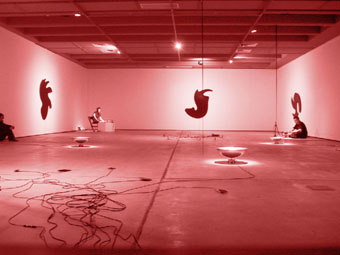
Ed Osborn & Elision, Particle Moves 2003
photo courtesy Institute of Modern Art
In installations by Ed Osborn (Germany) and Nigel Helyer (Australia) in Brisbane and Sydney respectively, I spend most of the time staring at the floor. And listening. Especially listening. In both works suspect objects litter gallery floors. In Osborn’s Particle Moves, clusters of tiny metal disks, appearing to hover just over the sheen of the concrete floor, suddenly buzz and rattle to life and move short distances like wary robotic insects. In Helyer’s Seed, the objects are overtly worrisome, they’re landmines neatly positioned on the centre of a series of eastern prayer mats. But they’re also transmitters and as you approach them you pick up the sounds they emit in the earphones (which you collected when you left your shoes outside) via the handset you carry, replicated to look like a mine detector. Elsewhere on the floorspace of Particle Moves sound drivers vibrate wok-shaped bowls and long wavering rods; on the walls elegant elliptical black metal cut-outs a la Matisse are just as driven, quietly humming or crackling or thundering between protracted silences. As you come within range of each of the “mines” in Seed you detect not a warning, but the 99 names of Allah, looped Arabic music and extracts read from the Koran.
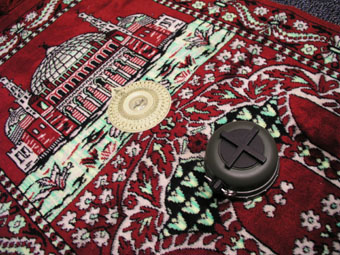
Nigel Helyer, Seed
At one level Seed is curiously meditative; you journey from one mine to another, from one passage of the Koran to the next, you learn, you take in the details of the mats, the insistent rhythms of the music. On another level it is alarming, associations turn between agriculture and war, between the seeds of life and the seeds of death. Helyer writes: “…the death toll inflicted by landmines (principally in the developing world) is equivalent to the appalling destruction of the World Trade Centre—repeated 5 times each year.” Other resonances accumulate in Helyer’s “sonic minefield” to do with our incomprehension of the Islamic faith and culture and what the West will reap from this ignorance.
Osborn’s work is urbane and abstract, but its irregular beauty is made from the fundaments of sound—the movement of particles. It too has much to do with resonance, the loud speaker/sound driver as an instrument engaging with other, musical instruments, the outcomes accumulating in a computer. So although there’s not much room here for metaphor (beyond the distant connotations offered by wok and rod), there is the sense of something unnameable, larger than the gathering of objects in a gallery space, because the objects are linked by sound, because they are growing something sonic and uttering it, it seems, whenever they like. The seeds for this creation were partly sown by members of the Elision ensemble in improvised live performance with Osborn recording them, feeding their sounds into the installation where they became something else. A week later I had the space to myself, but not really. The room rattled and sighed and sang and wailed and went silent and I waited and it sang again.
Seed and Particle Movement confirm in their very different ways the power of expertly realised sound installations to fascinate and disturb, to take you deep into and through sound into rewritten, re-sounded worlds.
Particle Moves, Ed Osborn, IMA, Fortitude Valley, Brisbane, July 31-Aug 30; Nigel Helyer, Gone to Earth: Seed and Haiku, Boutwell Draper Gallery, Redfern, Sydney, Sept 10-Oct 4
RealTime issue #58 Dec-Jan 2003 pg. 46
© Keith Gallasch; for permission to reproduce apply to realtime@realtimearts.net
Lyndon Terracini’s second Queensland Biennial Festival of Music in July this year was another notable success bringing remarkable music to Queensland and from Queensland itself. Terracini also extended the festival’s regional reach, using the model of uniting local and visiting artists and communities, often through long term workshops and commissions that then belong to those communities. Over a mere 2 festivals the legacy of these collaborations is already in evidence in places like Barcaldine with its massive marimba ensemble and Rockhampton with its 2001 and 2003 symphonies by Elena Katz Chernin with words from local poet Mark Svendsen.
RealTime focused on the Brisbane portion of the program producing over 30 reviews that you can read on our website. (The site also includes interviews with artists working in regional centres—Svendsen, Graeme Leak and Jacinta Foale.) The Brisbane performances ranged from the sublimely epic, Heiner Goebbel’s vast orchestral and vocal work, Surrogate Cities, to the intimate, crystalline Rautavaara choral works performed in a small church, and immersive sound compositions in a tiny theatrette in the Judith Wright Centre.
Twilight concerts in the Spiegeltent attracted crowds with a free taste of some of Australia’s leading musical talents eager to sell their wares to visiting producers and presenters. David Chesworth Ensemble, Clocked Out Duo, Topology and Andrée Greenwell (with Deborah Conway and musicians with excerpts from Dreaming Transportation) delivered engaging sets with vigour and commitment. Patricia Pollett on viola gave one of the best, with an impressive range of Australian compositions, demanding serious listening from her attentive audience and. Trumpeter Scott Tinkler was equally intense, leading a marvellous set with his group, DRUB; the dueting and texturing from guitarist Carl Drewhurst was beautifully distinctive. A substantial excerpt from Chamber Made Opera’s Recital worked well in the intimate space with Helen Noonan in fine voice and executing tautly controlled choreography. The tent also housed daily forums and nightly cabaret performances, late night togetherness and exactly the right kind of hub for an intimate festival.
The Brisbane Powerhouse was home to the International Critics’ Symposium and several performances: a bracing array of creations realised by Elision and a generous and inspired staged concert from Meredith Monk and her ensemble. The highlight of Elision’s Burning House was seeing Lilla Watson’s artwork, Sight and Sound of a Storm in Sky Country (2003) side by side with and projected above Timothy O’Dwyer who delivered a sublimely controlled pointillist saxophone response to the work. Meredith Monk couldn’t bring the fully-staged version of Mercy past Singapore, so we got the concert version, but we weren’t short-changed—Monk and company magnificently gestured, tableaux-ed and danced to their idiosyncratic singing. In the Brisbane City Hall, The Big Percussion Concert packed them in twice over, once again a marvellous cross-cultural extravaganza, as subtle as it was athletic. The following are excerpts from a small selection of RealTime reviews of QBFM 2003.
RealTime was part of the official program of QBFM 03
RealTime issue #58 Dec-Jan 2003 pg. 42
© Keith Gallasch; for permission to reproduce apply to realtime@realtimearts.net
Goebbels’ Surrogate Cities recalls the great choral symphonies such as Beethoven’s 9th, and Shostakovitch’s 14th, which (with solo voices) muses on an existential death. These were landmark works, as is this. Here, spoken word, taped, sampled sounds, all kinds of unusual percussion instruments, including torn newspapers, bundles of sticks being rattled, a stainless steel mixing bowl—the sounds of civilisation—bring the symphony into the present. Goebbels has managed to avoid the pitfall of many composers who try to blend heterogeneous forms, by weaving his own original form with just a few threads of others, rather than simply adding them on top of each other. ‘D and C for Orchestra’ is intended to evoke city buildings; these replace the forests and fields of the Romantic repertoire. It also suggests a dance, returning regularly to a pulsating theme driven by double basses and contrabassoon and heightened by a clanging triangle and massive brass forces. Passages in ‘D and C for Orchestra’ recall the fatal dance in Stravinsky’s Rite of Spring, and the music for his The Soldier’s Tale, with their dynamic, irresistible energies and the sense of the inevitability of the drama of life being played out.
Generally, this was a splendid performance of an immensely difficult work. The orchestral elements are frequently an amalgam of disparate sounds and textures that do not depend on thematic or harmonic development, and strict direction is required to keep the event together. Expressionistic music of this kind requires concentrated effort by every performer. The work itself is metamorphosing, for example new elements were added in this performance and the sequence was quite different from the CD version (ECM New Series 1688 465 338-2). The soloists were superb—David Moss’ vocal range is prodigious, from baritone to countertenor. Goebbels’ writing would be unrealisable without such a performer. Smith and Moss are not merely singers. Some of the texts Moss delivered were babble, a meaningless abstraction of the sound rather than the content of conversation, recalling the work of Berio, and requiring consummate skill to bring off. Smith’s performance was superb; both are vital to the success of the work. On stage, their presence is dramatic, operatic in its intensity.
Heiner Goebbels has created an extraordinary synthesis out of a disparate array of musical forms and instrumentation. Surrogate Cities is a masterpiece and a fitting opening to the Queensland Biennial Festival of Music.
Heiner Goebbels, Surrogate Cities, The Queensland Orchestra, conductor Andrea Molino, Concert Hall, QPAC, July 18
RealTime issue #58 Dec-Jan 2003 pg. 42
© Chris Reid; for permission to reproduce apply to realtime@realtimearts.net
Gail Priest opened the show. A couple of laptops, logos glowing in the darkness. Priest’s work involved live mixing of samples, and some text to speech improv. Beautifully paced set, starting slow with spooky wooo-wooos, scissors working, clanking train journeys with delays. The limited palette produced coherence with just the right amount of variation. The text to speech was hard to decipher at times, losing semantics to become punctuation for the underlying drones. One highlight of the set was the use of very deep register tones—sub-bass better than I have previously heard, no oscillating feedback boom resonating to the architecture, just clear and large. At the end, the lid goes down, and the machine shuts down.
Bruce Mowson then introduced his work with a slyly disarming apology. He told us that it would be fairly static, a case of turning a sound on then waiting 12 minutes for it to end. Ready. Set. Go. The sound jumped out like a real bastard, harsh pumping machine noise full on into the head. And it kept on coming, no let up, no change. Except to the listener, modulating their attention to the relentless interplay between room acoustics and sound source. Only criticism was the volume—too loud. Consult that audiologist. I joined many others in putting my fingers in my ears about halfway through. But quality music. And then it stopped.
Lawrence English and Philip Samartzis then stepped up and improvised some statics and circuits. Beginnings were gradual, slow microsounds from the turntable, walks on moist gravel. Some sine waves wandered in and got close enough to set up interference. Sounds of foraging and late night listening to something scrabbling inside the wall. Not so much overt structure in this performance. More crafted sounds and obsessive tweaking. Fine motor control. Rifling through cases of white label CDs.
After the interval came the grand old man. Bernard Parmegiani, pioneer of tape music and loops when loops were rings of physical tape, not a method for addressing files. Parmegiani mixed 3 stereo tracks from CD across all the speakers of the diffusion system to get those sounds moving through the space. Worked a treat, much better than just playing straight stereo.
The pieces came in chronological order. First up was Capture Ephemere from 1967. I’d forgotten how much I missed the rich sound of analog tapes. The piece had an economy of means that strengthened its impact. Speed changes and echoes, cut and splice. Next was Rouge Mort from 1987. Nightbirds. Wind. Trees. Hipster bongos and violins. From natural to abstract and back. 17 minutes of sonic and dynamic variety. Last up was Les Memoire des Sons from 2001, a more electro-acoustic work using the sounds of bells, the wind, blowing through pipes, accelerating to create headlong rushing and hurtling through electro-acoustic space.
Liquid Architecture 4, Brisbane Powerhouse, July 19
RealTime issue #58 Dec-Jan 2003 pg. 43
© Greg Hooper; for permission to reproduce apply to realtime@realtimearts.net
Timothy O’Dwyer’s and Lilla Watson’s composition, Sight and Sound of a Storm in Sky Country (2003) is a collaboration in which Watson, an Aboriginal artist, has made an artwork in response to a piece of music by O’Dwyer, and the composer/performer O’Dwyer has then made a new piece of music for electronically mediated saxophone based on, or as a response to Watson’s artwork. That artists should respond in such a way to each other’s work is not unusual. For example, we know of Mondrian’s interest in jazz. What is significant here is the cross-cultural nature of the work and the active collaboration between 2 artists who have both reconsidered the forms of their cultural traditions and synthesised something new and different. Instead of using traditional pigment or modern acrylic paint, Watson’s artworks are made by burning rows of small holes in layers of heavy drawing paper and adding a further layer of coloured papers beneath that are visible through the holes, the colours evoking sky, water and so on. The paper around the holes is scorched by the burning process in a controlled way, creating motifs. Thus the artworks are highly symbolic—not only do they tell the story of Watson’s country, but they also symbolise for a wider audience the use of fire to pierce and to mark, and the importance of the trace (of the smoke) and the rituals in traditional art. The layering of the papers also suggests a metaphor for the layering of cultural and traditional forms, the ‘true’ colours found beneath the pierced, blank surface.
Watson’s work is an abstraction that parallels the abstract forms of another culture, providing common ground on which both artists can reach and greet each other. O’Dwyer’s musical response to Watson’s art is itself heavily layered and is concerned with the physicality, almost as ritual, of the performance. The O’Dwyer/Watson work is significant musically, and makes clear the value of experimental and developmental composition. Such a work can be appreciated not only in terms of musicality and form but also due to its symbolic significance within wider cultural contexts. O’Dwyer’s performance of the music, in front of the projected images of Watson’s works, was captivating.
Elision, Burning House, Powerhouse, July 20
RealTime issue #58 Dec-Jan 2003 pg. 43
© Chris Reid; for permission to reproduce apply to realtime@realtimearts.net
The concert finale was Rautavaara’s 1979 setting of the Magnificat, a more darkly brooding piece than the lighter, earlier works. Sung in Latin, the voicing included a countertenor, and the soprano solos were hauntingly beautiful. The work alternates powerful, gestural statements with softer passages to build drama. Lines are sung in parallel with spoken text evoking an angelic chorus. But this work was not the finale after all, the audience volubly demanding an encore. The choir chose another Finnish hero, Jean Sibelius, and offered 2 of his works, the latter a choral setting of Finlandia. Culminating in a single melodic line that reaches a powerful crescendo, Finlandia was intense and moving. One wondered how many in the audience might have wanted to join the choir in singing what amounts to a Finnish anthem. The Kampin Laulu 23-member choir was superb, creating an ethereal sound that filled the gracious St Mary’s, the voices clear and balanced.
Ethereal Voices: The Music of Einojuhani Rautavaara,Kampin Laulu Chamber Choir
St Mary’s Church, Brisbane, July 23
RealTime issue #58 Dec-Jan 2003 pg. 43
© Chris Reid; for permission to reproduce apply to realtime@realtimearts.net
Monk’s melodic style is like no other, but has connections to an enormous range of music; it embraces the notion of music as a universal language. The voice is perhaps the primary musical universal—all peoples sing. To explore the voice as a musical instrument (she calls it “the original musical instrument”), to produce an astonishing range of sound colours and in settings that suggest ritual, is to join a very ancient tradition that nevertheless sounds utterly new. A visitor from 50,000 years ago could relate to this music, but it has also been on New York’s cutting edge since the 1960s.
This makes the music an excellent vehicle for the themes embraced in Mercy, the experience of giving, receiving and withholding compassion. A highlight, for example, is a duet between a doctor and patient, ending with the sung word “help” repeated by both. The voices intertwine to become a single sound, Monk making virtuosic use of the hocket technique so beloved of medieval troubadours and West African singers, where the notes of a single melody are divided between 2 or more performers.
At other points in Mercy, sounds are passed around the whole ensemble (2 male and 2 female singers, piano, percussion and clarinets, with the instrumentalists contributing vocals) creating a mesmerising spatial effect. In “Liquid Air”, pairs of kneeling singers sway around each other, the sound moving between and seeming to wrap around them.
In Shaking, dance and music are married completely—the movement and sound are inseparable. The singers shake their heads from side to side while rotating their bodies, creating constant pitch shifts and tremolos. The effect is both disturbing (with its appearance of insanity) and absorbingly beautiful.
Monk’s troupe of performers are extraordinarily devoted. They constitute a whole singing tradition of their own founded on Monk’s inspiration. And they share great virtuosity (I was particularly impressed, for example, by Theo Bleckmann’s precise, clarinet-like head voice) and theatrical, whole-body sensibility. The camaraderie and community was palpable. The 3 instrumentalists embraced the performance whole-heartedly, contributing improvisation, playing multiple instruments (pianist Allison Sniffin often joining the vocals, and also playing violin; clarinettist Bohdan Hilash performing on all clarinets from piccolo to contrabass) and inventing new sounds (percussionist John Hollenbeck coaxing complex overtones by playful use of a microphone and cymbals).
Meredith Monk: Mercy, Brisbane Powerhouse, July 25-26
RealTime issue #58 Dec-Jan 2003 pg. 43
© Robert Davidson; for permission to reproduce apply to realtime@realtimearts.net
Porch and Woo-la weh from Monk’s 1977 work Songs from Hill have a folk-based melodic progression exploring vowel sounds. Vowels and notes seem completely interlinked, in symbiotic relation. Her Insect Songs investigate some of the harsher edges of the voice, the first using a dry throaty static, the second ringing out nasal tones accompanied by playful gesture. Movement is inherent in the production of the sounds and Monk adopts a different body position and attitude for each piece, like the open-chested exuberance of Bird Code. Of these unaccompanied works the most impressive were the Light Songs from 1988, duets for solo voice, like Click Song 1 with its soft-palette humming accompanied by its own rhythm track of tongue clicks and tocks. The jawharp piece from Songs from the Hill was also a highlight with beautiful manipulation of vibration and harmonics.
These early pieces set the conceptual framework for Mercy, performed in a pared-back concert version but with a distillation of choreography, spatialisation and gesture to evoke a sense of the depth of the work. Mercy begins with Monk’s expanding arpeggios and the haunting tones of disembodied voices perfectly underpinned by the bowed vibraphone. The other performers join Monk for the collective calling of “leaping song.” It feels like a summoning. The ensemble is virtuosic—expansive voices with constantly shifting qualities and gloriously minimalist piano cycles augmented by perfectly placed woodwind and percussive lines. Of particular beauty are the reflective drone interludes performed by John Hollenbeck for cymbal and microphone. The highlight of the piece is doctor/patient, an astounding duet between Monk and Theo Bleckmann of syncopated vocal leaps and yelps for help, one of the few ‘words’ in the opera. Bleckmann and Monk go note for note, their voices so tightly plaited that you can’t tell whose voice is whose. Each segment of Mercy is divine, with shifts of tone and context, investigations of each singer’s vocal qualities, and the astounding beauty of the voices slipping around, melding and then separating again. Monk has written a cry for compassion that sinks into the flesh and dwells in you.
In the artists’ talk following the performance, Monk lets us in on some of the imagery created by Ann Hamilton for the fully-staged work, including a mouth held video camera, huge sheets of bubble membrane and paper cascades. You can’t help yearning to see Mercy in full production (the same goes for Laurie Anderson’s recent concert tour of Happiness), however the meticulously presented concert version is a rewarding and inspirational experience.
Meredith Monk: Mercy, Brisbane Powerhouse, July 25-26
RealTime issue #58 Dec-Jan 2003 pg. 43
© Gail Priest; for permission to reproduce apply to realtime@realtimearts.net
ABC Management has axed The Listening Room. ABC Classic FM has cut New Music Australia. Aside from Critical Mass and the occasional new arts documentary, ABC TV does little to embody the vibrant Australian arts. There’s something toxic in the organisation that’s invaded the broadcaster, eating at its art, destroying vital organs, impelling it to cut off its ears and gouge out its eyes, rendering it a near comatose, cosy-chatshow, personality-driven hulk, drained of the diverse riches that once were its life blood.
Despite the depletions it too has suffered, Radio National still manages to ingest and convert the world into rich aural sustenance but how long before the virus strikes there too? What has caused this hideous illness? Is it an agent from the outside or is it something immunological of the ABC’s very own making, hollowing it from the inside out?
It would be easy to blame the Howard government: sure it provides the sickly environment of funding deprivation, editorial trepidation and the dumbing-down fear of being labelled “elitist.” And yes, this year’s refusal by the Federal Government to properly fund the national broadcaster led, much to Senator Richard Alston’s chagrin, to the unplugging of the ABC’s new digital prostheses. But other savings had to be made. What were the solutions? Abortion— removal of the cadet training program—and sterilisation—cut out the ABC’s capacity to make art, remove the internationally acclaimed, prize-winning (2003 Prix Italia) Listening Room made by sound artists and composers from across Australia and its richly creative team of producers.
Of course, the ABC is no stranger to self-mutilation insanely lopping off an ear when it banished stereo radio drama to mono broadcast and conducting a home lobotomy with the excision of Arts Today. Julie Copeland on Sunday mornings and Andrew Ford on Saturdays just keep the arts brain ticking over, but can they live up to the prodigious Australian arts output? Why remove The Listening Room at a mere one hour a week! If it was a matter of cost, as smugly proposed by The Sydney Morning Herald’s The Guide (Nov 10-16) why not re-think, re-shape, re-budget? How about some holistic solutions for improvement? To toss it aside is to discard a living part of our culture. Where are the micro-surgeons of ABC management? Pick it up, put it back!
The Listening Room is living, contemporary art, exemplary of sound art and new developments in the generation of multimedia and hybrid art forms. As the concert hall future narrows and technologies provide new compositional tools and broadcast media, this program offers composers new ways of working. It provides established international links and outlets for Australian art. Each year an emerging artist is awarded a 6-month fellowship with The Listening Room, jointly offered by the Australia Council’s New Media Arts Board and the ABC. The associated Adlib project created by Jon Rose is archiving an astonishing collection of the ways all kinds of Australians make music. Cut out The Listening Room and you lose all of this, you do irreparable damage to the body of the ABC, the body of Australian sound art, the body of Australian culture.
The admirable New Music Australia on Classic FM plays music both accessible and challenging, recorded and, importantly, live and provides significant interviews with leading composers (a handful still downloadable from the no-longer updated ABC arts web gateway). It seems that the program will be dissected and its parts grafted onto Classic FM here and there in the hope that listeners will accept more Australian music if it becomes a part of the everyday listening experience. A lot will depend on the surgical cunning of the programmer—will the listening body tolerate an invasion of the unfamiliar and the sometimes innovative, and at what time of the day? Will the voices of living composers and musicians be allowed to interrupt wall-to-wall classics and, if yes, for how long? Will new music continue to be played live, and how often? If the transplant is rejected by audiences, what has the operation achieved? Will ABC middle management have the nerve and arts nouse to persist with a higher quota of Australian music in the face of possible bad reaction?
Again it has to be asked why the radical surgery? What’s wrong with a specialist focus on developments in Australian contemporary music in a specific timeslot, a place the listener knows they can visit. Yes, Australian music has come of age, but the mature body still needs a good solid workout, not short runs off the leash.
The death of programs like The Listening Room and New Music Australia is just more bad news for Australian artists at a time when David Throsby’s report for the Australia Council on artists’ incomes (Don’t Give Up Your Day Job) reveals high levels of poverty. With the exit of The Listening Room there will be substantially reduced commissions. The ABC may continue to make artful mini-series, comedies and documentaries but they hardly represent the full extent of the broadcaster’s capacities. When Throsby launched his report he decried the absence of an Australian cultural policy. When the ABC fails to live up to its charter “to reflect our cultural diversity” (that’s for SBS isn’t it?), to contribute to a national sense of identity and produce cultural enrichment, it appears to have no consistent cultural policy (Art is now subsumed to Entertainment in the ABC hierarchy). At times like this, it seems that achieving a cultural policy for Australia is about as likely as a policy on human rights—then we really would have to address the refugee issue.
The cultural health of the ABC used to be reflected, as the charter puts it, in its “balance between broadcasting programs of wide appeal and specialized programs”; the result was tremendous choice. Its vision of Australia was not ratings-driven. It was for all Australians, a truly diverse bunch, not a bland mass of homogenous bodies. Now the generalist position prevails with ratings clearly governing programming decisions. Lifestyle shows supplant arts programs and almost everywhere on radio live talk is easier than crafted programs and a lot cheaper—and sounds like it.
Deaf in one ear to radio drama and stone deaf to audio art, and in danger of tuning out to new music, will the ABC stop listening to Australian artists altogether? If so we might as well sign that free trade agreement with the US and get the selling off over and done with. What is needed is a coherent cultural policy so that art is assured of its place within the ABC and our national broadcaster regains its cultural well-being. KG
Happy Holidays
To all of our readers, writers, contributing editors, advertisers, subscribers and the funding bodies who generously support RealTime+OnScreen, we wish you a Merry Xmas and a creative 2004. ‘Prosperous’ is not a word thrown around casually in arts circles, but if you’re feeling flush think about treating yourself or a friend to a RealTime subscription for 2004. We’d really appreciate it and we trust you will too!
Virginia, Keith, Gail, Mireille, Daniel
RealTime issue #58 Dec-Jan 2003 pg. 3
© RealTime ; for permission to reproduce apply to realtime@realtimearts.net
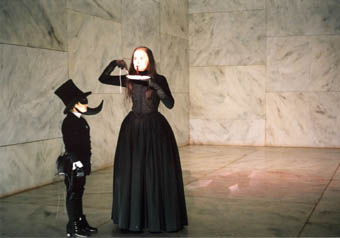
Societas Raffaello Sanzio, BR#04, Tragedia Endogonidia IV Episode
KunstenFestivaldesArt, Brussels, May 2003. Thirty innovative projects, 20 world premieres, 15 venues, over 3 weeks in one very edgy city. Time is of the essence. And it’s not just my experience of ‘festival time’, which always seems distorted, what with the early morning bedtimes, the running late through dark, unfamiliar streets and the twilight zone of entire days spent at the theatre. Time is a theme and an obsession in much of the work I see at Kunsten, offering structures and perceptions to interrogate and subvert.
Rushing from the airport I thankfully arrive on time for the latest offering from Societas Raffaelo Sanzio. BR#04 (IV Episode of Tragedia Endogonida) is the 4th part of a dramatic cycle to be presented over 3 years in 9 European cities. Director Romeo Castellucci’s aim is to investigate the traditions and mechanics of tragedy and reinterpret them in each city into the world of the here and now.
In Brussels, a large white marble room (perhaps it’s the lobby of some bureaucratic office at the headquarters of the EU) becomes the laboratory in which a series of scenes examine the duration of the body through life and time, from conception to death. Some of the images are devastatingly direct; the curtains open to reveal a baby lying on his belly. He is left to cry for 3 or 4 minutes. The curtains close. Other scenes are thick with complexity: apocryphal text, ancient and macabre rites, ominous figures who flash through the phosphorescence. I get the feeling that I’m not witnessing these astonishing images for the first time, but that they have been mined directly from my own or some collective subconscious, some shared dreaming. In one scene 2 policemen bludgeon a young man to death. The company is disinclined to suspend my disbelief. I watch them repeatedly apply fake blood to the young man’s skin. It spreads as he writhes. Each time he is struck the theatre shakes with violent synthetic sound and every blow to his body resonates through mine from sheer decibel power. The mechanics of theatre become the tools of brutality.
Tickets for the festival are, by Australian standards, incredibly cheap, and highly prized. Every event is full. One of the festival staff tells me that a woman who arrived late to a show because her husband was trying to park the car, threw herself screaming at the theatre doors and refused to be removed when she discovered her tickets had been resold.
The show she missed was Christoph Marthlaler’s interpretation of Schubert’s lieder cycle Die schöne Müllerin (The Fair Maid of the Mill). Bypassing the original performative context of the recital, Marthaler dramatises the cycle in a severe flat salon, a kind of rundown eastern bloc apartment, where a troop of listless nobodies mooch with seemingly no purpose, biding time with their songs of romantic yearning and loss. The staging, full of physical comedy and absurd imagery has a kind of anti-structure, which is at odds with and entirely complementary to the music.
Most of the ensemble are not professional singers and I was particularly moved by their imperfect voices. It is as if these characters have more to lose, mainlining the audience to the fragility inherent in the songs. There’s a compelling rhythm and sense of time at work. Where, in a conventional lieder recital, Schubert’s music would provide the dominant time structure, Marthaler has employed a choreography designed to work against it. Certain songs and actions are repeated again and again, or drawn out to be painfully slow, some characters disengage mid-song and go and hide in a cupboard or sleep in an enormous feather bed. Time dilates, warps or suspends.
Edit Kaldor explores the experience of cyber-time in her ingenious solo Or Press Escape. On entering the theatre we see her sitting alone, her back to the audience, in front of her computer’s giant screen. The only sound is the amplified staccato of the keys as she types. She records last night’s dream, makes ‘to do’ lists, tidies her desktop, receives mail, downloads files, deletes them, empties the trash. It’s an unlikely script, but this silent text is utterly theatrical. Solitary thoughts are made explicit, censored and unwittingly betrayed. At one point Kaldor enters a live chat room and for the first time we see her face via the web cam on her desk, illuminating a wonderful tension between the smallness of her body sitting in the half-light and the expansiveness of her projected cyber-self.
My highlight is 5, a timed journey through a series of installation/performances created by Kris Verdonck and Aernoudt Jacobs. Their work attempts to reduce to an extreme the codes of visual and performing arts, allowing the essence of each code to inform the other, producing a hybrid form, a distillation that achieves an exquisite impact. In one installation, IN, an actress dressed as a French maid is submerged in a tank of water. She breathes via a tube connected to air canisters outside the tank. Microphones amplify her breathing and the slight movements of her body. Her senses have been distorted: she is in a trance. In another, To Sleep we enter the tiny room to discover 4 people asleep on transparent cots. They have altered their body clocks and undergone hypnosis to actually be asleep. The initial impact deepens through the 20-minute duration of each piece. Our subjective responses begin to write the narrative. In the room with the sleepers, first we creep and whisper, then sit in silence on the perimeter, ‘performing’ with as much authenticity as those we are trying not to wake.
KunstenFestivaldesArts, Brussels, Belgium, May 2-24, 2003
Die schöne Müllerin, co-production KunstenFestivaldesArts and Schauspielhaus Zürich, direction Christoph Marthaler, set & costumes Anna Viebrock, Halles de Schaerbeek, Brussels, May 6-8
BR#04, Tragedia Endogonidia IV Episode, Societas Raffaello Sanzio, direction, set, lighting & costumes Romeo Castellucci, vocal sound & score Chiara Guidi, writings Claudia Castellucci, music & live execution Scott Gibbons, La Raffinerie, Brussels, May 4-7
Or Press Escape, concept, text, performance Edit Kaldor, Kaaitheatrestudios, Brussels, May 5-9
5, concept Kris Verdonck, sound Aernoudt Jacobs, performance for IN Heike Langsdorf, BSBbis, May 11-15
RealTime issue #58 Dec-Jan 2003 pg. 4
© Lucy Taylor; for permission to reproduce apply to realtime@realtimearts.net
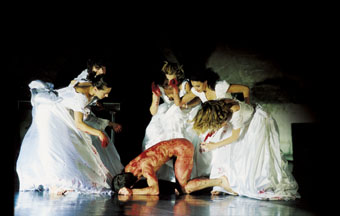
I Am Blood
photo Philippe Delacroix
I Am Blood
I Am Blood has 2 dramaturgs listed in its credits. It is curious this fascination with and increasing dependence upon the dramaturg over the past couple of decades. These dramatic architects, these advisers and guides in the architectonics of theatre: the systematic arrangement of knowledge. With the unities of time, place and action, with the hero’s journey from unknowing to experience via the monster’s cave, with the lineal chain of cause and effect to anagnorisis and perepeteia etc etc, there was/is an underlying arrangement of experience, so that the various stories laid upon the top produced variations upon old (and deeply resonant) themes of individual and personal (re)organisation. Not so with so many contemporary performances: Teshigawara’s I Was Real: Documents, Needcompany’s Snakesong, Castelluci’s Giulio Cesare and Genesis, to mention only some of those that I have written about for RealTime over the past few years. And now the ‘anxiety of formlessness’ caused by Jan Fabre’s I Am Blood. They are not easy to absorb. They are impossible to fit into any recognisable structure. They feel carefully fashioned but without any underlying form; and maybe (horror!) this equates to surface without soul.
The Age reviewer Hilary Crampton concluded her review: “As Art, the work fails, because it lacks any sense of selectivity, of form and structure, resulting in an indulgent presentation…” Neil Jillett in the Sunday Age dismissed it as “a spectacular display of chaotic nastiness…poorly choreographed…a bloody shambles.” (Interesting that the word ‘shambles’ which, figuratively, has come to mean “a mess, a muddle”, was originally the word for “a butcher’s market-stall, a flesh market, a slaughterhouse.” Jillett’s description was more apt than perhaps he realised.) For many of my friends and fellow artists it was a ‘mess’, ‘studentish’, ‘obvious’, ‘lacking directorial control’ etc. There’s something going on here, some kind of extreme concern. Hence my term ‘anxiety of formlessness’ to describe the effect it has caused. And I’m not saying I was immune to it: alternately enthralled, confused, thinking I understood it, bored, excited and shocked etc.
Fabre’s show in 1984 was called The Power of Theatrical Madness—in that title he stated a mission which he still adheres to. Hans-Thies Lehmann describes it thus: “Theatre was and is searching for and constructing spaces and discourses liberated as far as possible from the restraints of goals (telos), hierarchy and causal logic. This search may terminate in scenic poems, meandering narration, fragmentation and other procedures…on the borderline of logic and reason.” (Performance Research, Spring 1997). Fabre is also a visual artist: a sculptor, graphic artist, installation artist and video maker. The pressure of the experimentation in the visual arts pushing against the tenacious borders of theatre can be felt in I Am Blood.
The beetle has been a fascination of Fabre’s for many years, in art and theatre. Beetles wear their skeleton on the outside. It is their defence against the penetration of the flesh. Near the beginning of I Am Blood a chorus of men in armour dance a mock chorus line number while one in their midst spins out into a crazed ‘structureless’ sequence in which armour and sword are no longer defences but potential for self-damage. On reflection, the show seems as much as anything to be a meditation upon the act of shedding and covering. The bodies cover themselves with armour, wedding dresses, ordinary clothes, only to take them off again and again revealing the vulnerable flesh (and blood) underneath. Suction cups are placed on the body, only to fall shattering on the floor, the shards swept up presumably to protect bare feet. More metaphorically, steel tables are alternately used as platforms for human display and surgical benches for bodily desecration. I think of the jeeps and tanks and helicopters in Iraq, supposedly providing armoured protection to the ‘invulnerable’ US troops, but ripped away increasingly by bombs and missiles to expose the flesh of the soldiers underneath. We are still kidding ourselves like beetles do. We are still medieval.
The ultimate protection, of course, is the word, which can justify and sanctify and give a sense of order to every mad thing we do to one another—in the name of the father. The show begins with 2 figures sharing the stage. One is the fearless, mainly naked, seemingly sexless, curly-headed contortionist who is witness to all the theatrical madness that proceeds, who attempts to send it all up, and who ends with his nakedness covered in feathers. The other is the woman with the book on her head. She is the word provider throughout the play. It is she whom we first see and she ends the show as she began it, parading around the stage, confronting us, the book as both weight to carry and armour against whatever may drop from above.
Paradoxically, whilst it resists the recognisable forms of dramatic progression, I Am Blood is made up of images and sequences of exquisite formality, set against sequences of seeming chaos. It is in the progression from one to another that the rationality—the ability to make meaning of it all—breaks down. Lehmann has called this “the aesthetics of poison”: “An image of beauty, craving and desire is presented, but with the addition of a disturbing element, a vivid poisonous green tinge of colour…(which) spoils my enjoyment, while at the same time stimulating it to reach a different level of reflection.” How to reach that level is the challenge these works of ‘mere anarchy’ place upon us.
–
I Am Blood, writer, director, choreographer, Jan Fabre, Melbourne Festival, Oct 9-25
RealTime issue #58 Dec-Jan 2003 pg. 5
© Richard Murphet; for permission to reproduce apply to realtime@realtimearts.net
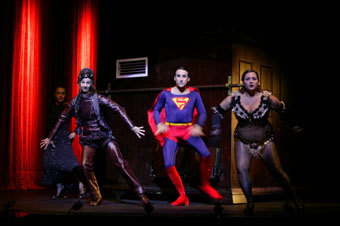
Der verlorene Atem
Director Barrie Kosky’s Australian productions were marked by profuse energy and inventive, often deliberately excessive amalgamations, drawing on expressionism, German language cabaret and Yiddish culture. Although these sometimes seemed wrought only from a rearrangement of these antique references spiced with garish postmodernism, the results were compelling. Kosky’s current Viennese pieces in his new role at the Vienna Schauspielhaus are sharper and sparer but somehow less embracing.
The word about town was that Der verlorene Atem was not Kosky’s best Schauspielhaus show. Though a masterpiece of precision and evocative restraint, it was unsatisfactory as theatre—largely because it offered much but delivered little. Kosky drew on Kafka, specifically the instrument of tortuous punishment and the Law described in The Penal Colony and the destabilising self-transformation in Metamorphosis. Like much of Der verlorene Atem though, these rich motifs became throwaway ideas within a performance mostly devoted to the expressions layered within the strained female voice.
The piece began beautifully, with actor Yehuda Almagor playing a digressive Jewish Houdini, chatting charismatically with the audience about his “apparat” which contained Kafka’s ambiguous machine. Almagor unbuttoned his shirt in wan light while singing in Hebrew, suggesting that this appalling device might offer the transcendence that its victims desired. In Act 2, 4 variously costumed tap-dancers performed German, Yiddish and Broadway cabaret tunes outside Houdini’s former cabinet. Metamorphosis’ protagonist Gregor remained hidden inside this Tabernacle, but rather than depicting Gregor’s family confusedly dealing with his change, Kosky’s unseen Gregor was represented as a playful, growling-voiced participant in his relations’ light musical games, interjecting lines into songs otherwise unconnected to Kafka’s themes—an amusing interlude, but not much more.
If the second act constituted a fraying of Kosky’s theatrical conviction, the third signalled its abandonment. The audience was presented with nothing but almost immobile performers, caught in nebulous spotlights, singing Robert Schumann’s ode to lost love, Dichterliebe, in German. As one spectator quipped, a recital is fine, just don’t call it theatre. The performance was beautifully modulated in playing-off broken voices with operatic fullness, but this was not a well-conceived conclusion. As another spectator observed, yes, we all end up feeling like we’re locked in a box, alone and unloved—but this is a banal final message for a piece subtitled: A Kafka evening in 3 acts (Ein Kafka Abend in 3 Akten).
While Kosky staged a cabaret recital misrepresented as theatre, Melbourne’s Aphids offered 2 fine music performances which stretched (though did not break) the recital form. Skin Quartet, composed by David Young, used various graphic and notational methods which were then incorporated within Louisa Bufardeci’s accompanying projections derived from close-ups of skin tones, tattoo-like shapes, and maps rich in the patina of cultural history. Young kept the arrangements integrated and softly flowing, despite the composition’s post-classical basis, with interjections and exclamations largely resting easily within the overall sound, rather than cutting across it. This produced a beautifully seductive effect, but it did mean that all the musical ideas seemed to have been introduced about two thirds in, while only deferentially alluding to the racial politics foregrounded by the visuals. Skin Quartet was nevertheless an exquisite gem, sitting well against Aphids’ more variegated Fight With Violin.
Fight showcased 6 contemporary pieces for solo violin ranging from Motoharu Kawashima’s fun, John-Cage-esque instruction piece (rub violin on top of head, end performance with empty stage and a recording of a classical piece) to Kate Neal’s almost romantic sketch of melancholy, sour notes. Yasutaka Hemmi performing in a Japanese armed martial arts dojo, complete with demonstrations enhanced the novelty of these rarely seen works. The audience had to draw its own conclusions about what this combination suggested (the sound of a swiftly drawn katana blade generating a cruel tension in Neal’s work, for example). If nothing else, the staging added firmly poised, meditative bodies to such aggressively avant-gardist compositions as Helmut Lachenmann’s pointillist scrapings.
Dumb Type’s Memorandum was particularly energised by its paradoxical performativity. Video documentation of their 1994 Adelaide Festival production S/N suggested that Memorandum was a weaker work, while dance purists were nonplussed by the its movement elements. These criticisms missed the heart though of this extraordinary, totally overwhelming and wry, yet impersonal, work. At a sonic level alone, the monumentally forceful, finely tuned and shaped white-noise assaults and the repetitive, purified sine-waves of Ryoji Ikeda were sublime in the wonderful audio mix—I melt at Ikeda’s combination of carefully nuanced violence and electronic minimalism.
Dumb Type’s formation in 1990 epitomised the supremely manufactured and designed aesthetic of the Japanese “bubble economy”; the company’s productions today restate the familiar motif of the postmodern individual, a self sublimely dispersed throughout culture, language and technology. Dumb Type was however always guilty of presenting style over substance—indeed, style as substance—so such a summary does not do justice to its consummately slick form, produced through sound, action, multi-screen projection and shadow play. The company’s approach transformed the arguably antiquated technique of performance art (as in Jan Fabre’s I Am Blood) into a glistening, plastinated extrusion.
The company masterfully achieved an astonishingly clarified, controlled aestheticisation of banal actions, thoughts, experiences and metaphors. Everyday events and ideas were rendered strange on stage not through the manipulation of content, but through the form and framing of the work. A man sketched his room, trying to remember each piece of furniture, which then magically arrived. But it was the mundane details beautifully cast into relief by these acts that were significant, not what this act said about memory. I was entranced as each new gesture of writing made a sharp line in the creases of the man’s pressed, red shirt. Such exquisite minutiae of the everyday framed an act of play so serious in its simplicity of execution that it became both transcendent and funny. Dumb Type may be trapped in an aesthetic cul de sac, but remain nevertheless impressive. Memorandum was destined to appeal to those who marvel at simple things well presented, such as the donuts, coffee and pie that pervade David Lynch’s Twin Peaks, Laurie Anderson’s USA Live or Quentin Tarantino’s gangster cinema.
Der verlorene Atem: Ein Kafka Abend in 3 Akten [The Lost Breath: A Kafka evening in 3 acts], director Barrie Kosky, dramaturg Susanna Goldberg, choreography Dagmar Benda, design Alon Rodeh, Izaq Ronen, Michael Zerz, lighting Michael Zerz, performers Yehuda Almagor, Beatrice Frey, Tania Golden, Melita Jurisic, Florian Carove, Wiener Schauspielhaus, Athenaeum, Oct 14-19
Skin Quartet, Aphids, composer David Young, visual artist / projection Louisa Bufardeci, violin Yasutaka Hemmi, Stephanie Lindner, viola Jason Bunn, violoncello Caerwen Martin, Anna Schwartz Gallery, Oct 13-15
Fight With Violin, Aphids, violin Yasutaka Hemmi, martial arts by members of Melbourne Budokai, composers Helmut Lachenmann, David Young, Luciano Berio, Kate Neal, Brian Ferneyhough, Motoharu Kawashima, Kenshikan Dojo, Oct 19
Memorandum, Dumb Type, sound Ryoji Ikeda, visuals Shiro Takatani, Takayuki Fujimoto, Hiromasa Tomari, computer programming Tomohiro Ueshiba, performers Seiko Kato, Takao Kawaguchi, Hidekazu Maeda, Noriko Sunayama, Mayumi Tanaka, Misako Yabuuchi, Manna Fujiwara, So Ozaki, Forum, Oct 9-12
RealTime issue #58 Dec-Jan 2003 pg. 5
© Jonathan Marshall; for permission to reproduce apply to realtime@realtimearts.net
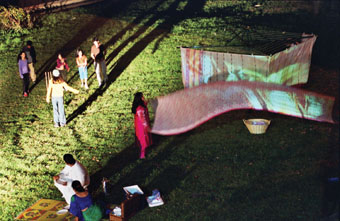
Urban Theatre Projects, India@oz.sangam
photo Heidrun Löhr
Urban Theatre Projects, India@oz.sangam
Carnivale appears to grow stronger year by year, presenting more coherent and adventurous programs and opening up local talent to the wider audience it deserves. Guillermo Gómez-Peña’s The Living Museum of Fetish/ized Identities, Sidetrack’s The Book Keeper, Urban Theatre Project’s India@oz.sangam, Karen Therese’s Sleeplessness, Sivan Gabrielovich’s The Cool Room and the installation, Sound of Missing Objects at Performance Space were just a handful of the many Carnivale shows that made for an engrossing experience. The Book Keeper has already been reviewed by RealTime; Gail Priest’s response to the Living Museum.
India@oz.sangam
Urban Theatre Projects is adept at adroitly managing large scale performance events. India@oz.sangam is another fine example of the company’s ability to focus on a community, draw out its talents and concerns and present them in an open-ended framework that can attract large audiences from that community and beyond. Most distinctively, this production had a tremendous sense of pride, fun and celebration, embodied as it was in the spectacle and melodrama of Bollywood, that miracle of the hybrid arts, and focused on being young and Indian-Australian. Dancing and singing were to be expected at every turn. In the foyer we watch children in a story-telling circle and, on a large video monitor, their peers in India learning yoga. We are then invited to join a parade led by a turbaned man held aloft to the adjoining riverside. Sari-clad girls dance on a long stairway (nicely reflected in the river) and Indian hip hop beats sail across the water. On the riverbank below us a cricket game materialises alongside a Hills Hoist hung with sheets picking up movie projections. Broken into groups we return to the foyer, passing a couple of eager rappers on the way, to witness women in delicate, sensuous song and dance amidst candles and bells. Our guide explains we are celebrating Diwali, the festival of light. We file into a darkened room where guides introduce us to Indian film classics, spices, flower patterning, a Diwali altar and invite us to relax on a couch as projected images of a hand painting ceremony gather on its veiled walls.
From this intimacy we emerge into a crowded theatre where cast members are cajoling the audience into an Indian singalong. A couple in their 50s constantly surprise their fellow Indian-Australians with a repertoire of rarities which everyone seems to half know. A few rows back, 4 boys break into glorious cross-cultural doo-wop. Once everyone has gathered, the performers spring into a quickfire string of comic skits and little dramas—parents struggling to understand sons who only speak hip hop; a “This is Your Wife” parody, “putting the ‘arranged’ back into the arranged marriage”; a father with 2 PhDs unrecognised in Australia; the trials of taking money ‘home’ to India; a grim monologue about sexual abuse in a conservative society; a young wife denied English classes. The younger women gather in a song of defiance, one of their number on sax, the bodies say pop, the gesturing hands say traditional Indian dance. Two boys perform a great piece about being labelled black (“all my life I’ve been running from one image to the next…I need to get rid of the mask, the colour.”) The irony of their plight is powerfully stated in their admiration for black American heroes—Marcus Garvey, Malcolm X…Performed on a sitcom loungeroom set these scenes are informally presented, the writing is rough, the acting is variable, endings sometimes indeterminate, but the commitment and the drive is there.
We’re led into a cabaret-formatted courtyard with video monitors, a pair of traditional dancers onstage. A sleek car invades the yard, the bonnet draped with girls in their modern best, ready to displace the past, but the final gathering onstage of the participants offers all possibilities: this from one of the most remarkably adaptive of human cultures. Although sometimes more conventionally theatrical than its Urban Theatre Project predecessors, India@oz.sangam doubtless reflects the passions and artform interests of its participants. But the overarching structure (of installation, exhibit, performance and spectacle) maintains the hybridity for which the company is famed and which offers communities the most flexible way to present and explore their cultures.
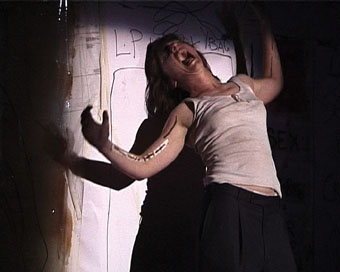
Karen Therese, Sleeplessness
photo Angie Abdilla
Karen Therese, Sleeplessness
Sleeplessness
Karen Therese’s solo performance is one the most adventurous of recent times and certainly one of the best of 2003. It’s a risky venture, an up-close investigation into a state of ‘not knowing’, a sleeplessness, a family mystery in which Therese plays both herself and, at several critical moments, her Hungarian grandmother who long ago disappeared and whose death certificate described her as male. This is a medical and psychiatric mystery and a tragedy about the pressures of war and migration. Therese and her sister solve the mystery but the great weight of personal plight lingers unbearably, as does the dark legacy of heredity.
Therese’s performance style is forthright, unavoidable and the enactment of the grandmother’s seizures, an assault, shock treatment and her own childhood anxieties are such that not everyone in the audience feels comfortable—sometimes these lives and personalities are too big for this small space. But what a space. Projections flicker across the walls, ranging from little iconic images to wall-to-wall phantasms. It is a space of transformations and the back and forth of history. Filmmaker Margie Medlin travelled to Hungary with Therese to create the wonderful black and white images of the performer in the guise of her couturier grandmother. Other images have a haunting old world colour that is at once nostalgic and appalling because of the pain of loss they signal. This is a space that Therese inhabits, frantically scrawling the accumulating data of the investigation across walls pinned with letters and documents and certificates, old clothes, dress patterns and strange fragments of latex, like the skin of stretch marks and ageing and torture. This is set design as installation: the curious audience inhabits it at the end of the show.
Karen Therese’s script is plain and simply delivered, but it is rich in detail and place; the evocation of Sydney from a migrant perspective is grim, the sense of moment always potent, of growing paranoia and suicidal impulses. The performance is brave and the sizeable team of collaborators have made a wonderful dramaturgical and design context for it. Sleeplessness should be widely seen.
The Cool Room
The Cool Room is sensitive, sometimes explosive territory that director Deborah Leiser has visited previously in A Room With No Air (1998), with Leiser as a fleeing Jew harbored begrudgingly by a German (Regina Heilmann). A Room With No Air, was a powerful performance work in which the physical and visual components counted more than the spare verbal utterances. The Cool Room is primarily a play of words, beginning sparely and growing in density and moral perplexity as 2 chefs (Israeli and Lebanese migrants) locked in a restaurant’s refrigerated cool room feel the full weight of the deadly chill of their relationship. However Melbourne-based Israeli playwright Sivan Gabrielovich establishes the play in jump-cut fragments, pulling back from literalising the situation or its transitions, making us read them and make the connections. Leiser finds in the spaces in between a physical language for the performers that choreographs the moral twists in an increasingly claustrophobic space where arguments turn on themselves and ironies become overwhelming.
The production is striking from the outset—the chefs carry in 3 performers like sides of beef and hang them on hooks: they are the ‘meat.’ They become a chorus, no mere ‘meat in the sandwich’, there is little innocence in this world. I would have liked their role more tightly defined. Too often they slip into a generalist chorus mode, or become a handy satirical device. At the play’s end they get the last word, carrying a moral weight they have not earned, the content of which threatens to trivialise all that had gone before (in effect: ‘don’t cry for us, we love our war’).
Through its bloody anecdotes, appallingly cruel jokes, sexual paranoia, reflex racism, shared recipes (same foods, different names) and its acute sense of migrant displacement The Cool Room offers a disturbing account of cultural tensions carried over to another homeland, Australia. However, this local situation is barely coloured in at all, it is always a metaphor for a conflict initiated between Lebanon and Israel in 1982, lasting 18 years and still alive in the bodies of these men, these cultures even if they don’t want it. As a young Israeli writer, Gabrielovich is not easy on her own people, but nor does she see a way out. The end of the play is like hitting a brick wall—the Middle Eastern conflict as neurosis turned psychosis. Incurable. Of course, I might have missed significant nuances as the play argued its way to a conclusion; it’s a head-spinning debate. The Cool Room is one of many plays appearing now that urgently address social, political and ethical issues with a bracing immediacy. At its best it does so with passion, if not always with finesse, and with a not undeserved bluntness given Australia’s own moral obtuseness—who are we to judge?. Matthew Crosby is good as the extrovert chef, an ex-Israel soldier alert to his country’s wrongs, while Majid Shokor conveys a quiet intensity and woundedness that is palpable.
Sound of Missing Objects
Paul Virilio proposed a museum of accidents based on the premise that every new technology comes with an accident in tow (a ship, a shipwreck; a light, a blackout etc). Sound of Missing Objects is an installation created by Panos Couros (sound artist), Jonathan Jones (installation artist) and Illaria Vanni (writer, academic, curator), a spooky visual and aural evocation of a museum of cultural erasure. There are 5 elegant Victorian glass-topped museum cabinets (with plates like ‘The Great Exhibition, London 1851’), and there’s writing on the wall. In the cabinets there is crumpled, cryptically patterned tissue paper, the kind for wrapping precious objects, but empty. Finely etched into the glass are the names of cultural artefacts and their taxonomies reflected in the mirrored bases of the cabinets. The words are those of the European collectors: “Bamboo shaft”, “Womerahs”, “Nulla Nulla Sharp-pointed”, “Three Plaster casts of Aboriginal feet and fingers” etc. The words are like ghosts—you’re always looking through them. Some are crossed out. The patterns on the paper are also traces, delicate designs based, for example, on “‘two drawings by Mickey, native of the Ulladulla tribe’…1893 World’s Columbian Exhibition, Chicago.” The writing on the walls is just as fragile, it’s in pencil. On one side of long diagonal lines it’s in an Aboriginal language; on the other it’s in English, an often derogatory account of Indigenous people, forecasting their inevitable extinction, but noting occasional virtues, like skill at drawing. The sound score is also ghostly; it’s difficult to find its point of emanation (until you realise it’s the cabinets themselves) as it distantly catalogues a world of objects and people lost to invasion, scattered to the world’s museums and extinction. Sound of Missing Objects is a melancholy work. Beyond anger, its sense of loss is deeply felt, realised as measured, beautiful, putting desecration to rest in a reconstitution and emptying of the 19th century museum.
–
India@oz.sangam, Urban Theatre Projects, co-directors Cicily Ponnor, Alicia Talbot; visual design artist Vananda Ram; multimedia Sam James; musical director Phil Downing; choreographer Chum Ehelepola; sound artists Masala Mix; DJ earthbrownkid; Parramatta Riverside Theatres, Oct 2-12
Sleeplessness, performer, maker, installation Karen Therese; visual media design, installation Sean Bacon; sound design, composer Anna Liebzeit; dramaturg Nikki Heywood; facilitating director Toula Filokostas; film artist Margie Medlin; latex screens Jane Shadbolt; Performance Space, Oct 1-12
The Cool Room, writer Sivan Gabrielovich, director Deborah Leiser, designer Niklas Pajanti, performers Matthew Crosby, Majid Shockor, Alex Ben-Mayor, Karen Therese, Konstantinos Tsetsonis; Performing Lines; Downstairs Theatre, Belvoir St Theatre, Sydney, Oct 16-Nov 2
Sound of Missing Objects, installation by Panos Couros, Jonathan Jones, Illaria Vanni; Performance Space, Oct 3-Nov1,
Carnivale, Sydney, Sept 24-Oct 19
RealTime issue #58 Dec-Jan 2003 pg. 10
© Keith Gallasch; for permission to reproduce apply to realtime@realtimearts.net
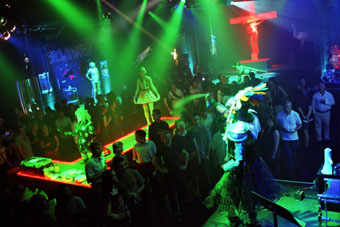
The Living Museum of Fetish/ized Identities
photo Heidrun Löhr
The Living Museum of Fetish/ized Identities
Part nightclub, part theatre, part church, part peepshow, the Living Museum of Fetish/ized Identities is a hyperactive, kaleidoscopic experience of identities, perceptions and realities. Wandering amongst the market-like crowd, each performer appears like a hologram—from one angle they display the trappings of this culture, this religion, this sexual inclination. Move your head a little, wander to the other side of the room and suddenly everything shifts.
This is the second visitation of Guillermo Gómez-Peña’s Museum to Performance Space. The first, in 2001, provided one of the most invigorating experiences in contemporary performance since Sydney Front powder-puffed their genitals and paid some of us in the audience $20 to strip for them. This incarnation of the Museum reprised by Performance Space in collaboration with Carnivale had an abbreviated creative development time, drawing upon work discovered in the first version, the ongoing explorations of Gómez-Peña’s group Pocha Nostra, and a one-week Sydney workshop with former and new participants. As Gómez-Peña said, this version had the intention of “opening the doors” to the creative process.
Once again, Performance Space converts to a museum, with living tableaux dotted around performative stations. The performers have created schizophrenic identities for themselves, based on perceptions of nationality, sexuality, spirituality. A number of the “artificial savages” have carried over from 2001. Victoria Spence’s Sister Australis Domesticada Mongrolis is back—a Carry On/Benny Hill nurse (or is it check out chick?), her face obscured by a Luna Park mask. The statuesque Spence draws a crowd with her perplexing reflection of the middle class white girl’s confusion and incipient fear of banality. El Health Ministro Globalizionista (Rolando Ramos) is equally disturbing with his portable accoutrements of human size boxes that open out to a kind of cabinet of curiosities, lorded over by his alter-ego, a body-painted savage with bureaucratic proclivities.
Valerie Berry’s Oriental Warrior Terrorista Senorita, is a stunning performative specimen, swinging between a kind of catholic/voodoo black-veiled widow and stripped down vision of pure feistiness ready to challenge any opponent on any grounds with her own gestural martial art. Berry’s physical precision and power are matched by Brian Fuata’s King Poly-Captivatis Kong which has developed more primate DNA over the intervening 2 years. His Polynesian King alternates between devout austerity and flirty banana-munching naivety. These last 2 draw upon a heightened religiosity that sits well within the pervasive latino/catholicism of the Pocha Nostra performers Michelle Ceballos and Gómez-Peña.
Ceballos performs before the ever present crucifix as La Femma Latina Extrema, an armour-clad latino Amazon spliced with Prima Ballerina. Peña’s preoccupation as El Mad Mex Techno-Shaman is to create tableaux vivant with the live and sweaty audience members, many of whom are more than willing to participate and even bare all. The museum also had some new exhibits in the personae of Para/Normal/Trooper/Betty (Wahabibi Moussa), a lock-and-loaded walking sacred parchment with texts inscribed on rolls of flesh and, in amongst it all, a band of roving Ghost Specimens—Teik Kim Pok looking divine in heels as the Moonwalking Geisha, Kira Carden as a sexy, flexy hoolahoopa and Elena Knok as a go go-dancing rabbit/waitress(?). Add to this some body piercers in the corner, a noodle stand to indulge olfactory and oral appetites, and the Great Wall of Sound pumping out courtesy of DJ Gemma, and you’re getting pretty much to ecstatic overload.
This Living Museum of Fetish/ized Identities joins others in Gómez Peña’s ongoing investigation: living in this media consumed world, where all manifestations of difference have been commodified by advertising, subsumed to create ‘mainstream bizarre’, how can the performance artist be truly transgressive? He is interested in how a generation raised on the postmodern spectacle can absorb ideological content? Gómez-Peña’s answer is interactivity—disguise content in experience. In the first Museum, interaction began tentatively with audiences circling around the edges, testing their levels of involvement. As the season progressed, word spread of the most “unlikely” people stepping into Gómez-Peña’s collaged tableaux. This time I detected far more eager participation which set me thinking about contemporary audiences, how participation impacts on performance and whether all participation is valid. Are people participating out of a desire to add to the commentary or as a vehicle for relatively safe exhibitionism? Both have benefits for participants and performers alike but I wondered about the potential in a work like this for the latter to reinforce “the commodification and homogenisation of the transgressive.”
My encounter with Living Museum of Fetish/ized Identities was my 4th (clocking up 3 visits in 2001) and delivered an equally vibrant and stimulating experience. No doubt, for first time visitors, this one conjured all the power of the first. Gómez-Peña has created an amazing model for engagement and commentary. As the museum works its way around the globe, the grinding prerogative of the avant-garde becomes manifest. Where will this model go next? How can it push an audience—now desperate to get naked and participate—to the next level, so that spectacle doesn’t once again dominate the complexities of content? If there is an answer, Guillermo Gómez-Peña and his collaborators are well qualified to discover it.
The Living Museum of Fetish/ized Identities, Carnivale, Performance Space, September 25-28.
RealTime issue #58 Dec-Jan 2003 pg. 11
© Gail Priest; for permission to reproduce apply to realtime@realtimearts.net
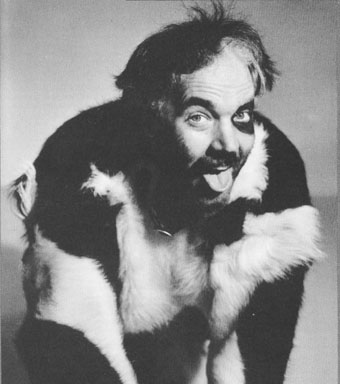
Bruce Keller in Puppy Love
The wonderful Bruce Keller is no more but his spirit of invention, community and wild good humour persists in the lives of friends, close associates and students and in the memories of the many works and projects on which he collaborated. The number of Bruce’s friends is astonishing. As eulogists commented, many of them were at the funeral service reflecting the multiple facets of his life and talents. As James Waites described it in his fine obituary for Bruce in the Sydney Morning Herald (“Dramaturg who eschewed cultural boundaries”, Nov 19), the funeral service was a standing-room-only occasion replete with a standing ovation. The ceremony included chamber music, finely sung hymns, loving eulogies and, yes, jokes, and a sublimely sad a capella gospel farewell, “Steal away.”
Speakers at the funeral initiated what was to become the character of the day through to the end of the wake at Performance Space, and one which Bruce with his archivist sensibility would have enjoyed—the unfolding of a cultural history of performance from the 70s to the present constellating around the life of a unique artist. This mostly unwritten history was revealed in recollections, anecdotes, jokes and performances (including Scaring pigeons in the park: a solo performance with rubber gloves) drawn from memory, scripts, videos (Bruce, bigger than life) and a joke-athon. The history was told in no particular order but it evoked some 30 years when Australian theatre opened up to movement and image, intercultural exchange and social engagement. We heard stories of Bruce’s university days—the comic collaborations with the late Lance Curtis; spontaneous, anarchic one-off performances; briskly contrived dada-ist acts for public places; the wonderful Anthill years in Melbourne (Bruce had been a co-founder of Australian Nouveau Theatre with Jean-Pierre Mignon); a richly innovative decade with Entr’acte Theatre in Sydney and overseas; and, while teaching with great commitment at the University of Western Sydney, the intercultural project he was working on until the very end, Citymoon, the Vietnamese-Australian Contemporary Theatre Company with poet and performer Binh Duy Ta and other collaborators.
This packed, creative life also included a great success, Puppy Love, the solo work he wrote and played—as the dog—to thousands and which was published by Currency Press. Bruce was also a perceptive dramaturg on plays and performances including Alma de Groen’s The Rivers of China for the Sydney Theatre Company.
Friends quickly produced a commemorative booklet celebrating Bruce’s life and work and circulated it at the wake. They have also moved briskly to preserve and make accessible Bruce’s considerable archive of books, scripts, scrapbooks and videos.
It’s difficult to sum up a life, especially one as creative and multi-faceted as Bruce Keller’s. However, in eulogies and memoriums a recurrent theme was Bruce’s sense of humour and his love of joking. This was no mere quirk of personality but an attitude to life, a way of being. In the memorial booklet, performer Jai McHenry (now living in France) captures the first-hand feel of this spirit: “He would laugh so hard (at either his jokes or mine—it made no difference), he would laugh so maniacally. Well, there was nowhere to go but into the maelstrom with him. His laughter came so fast, it almost seemed to flee his body, like some wild thing making a break for it. He is the only man I know who could giggle so loudly, so like a child. His pleasure, his joy, his understanding that life is supremely, absurdly funny was totally contagious. To laugh with Bruce was a given. Just to think of him now brings great joy.”
Across that sad October day, from funeral to wake, there were many moments of vivid recollection and depiction of Bruce’s life and performance milieu, eruptions of laughter and surprise at hearing slices of forgotten history. Of the many, I enjoyed hearing read aloud an email from John Nobbs and Jacqui Carroll of Frank Theatre in Brisbane. In the mid 70s John and Jacqui had shared a house with and then lived in the same street with Bruce in Sydney. It says something of his spontaneity, communality and creativity. He would have loved to be in on this telling.
“Arthur St was…the HQ of The Ashes Of Sydney, the brainchild of Bruce, Jacqui and Greg Scheimer, set up as a international non-profit foundation directly in competition with The Fires Of London, the portentous chamber group led by Peter Maxwell Davies who had wafted through town some months before. There was only one legendary performance, I think in March 1976, and it involved many arty mates cruising around Sydney harbour in a ferry looking at some fairly bizarre site-specific events. One particularly memorable moment occurred when Bruce, Jacqui and I were to be observed in a rowing boat crossing behind the ferry somewhere near Balmain. It was an old-fashioned clinker rowing boat, Bruce was in the front in a monk’s habit holding a lantern a la Tarot. I was in the middle attempting to row dressed in a dinner suit with a pig’s head on, and Jacqui was in the back in a full-on wedding outfit with a substantial veil. We had set ourselves up neatly and were steaming along looking the very essence of surreal when the silly bloody ferry came around the island the WRONG way and nearly clobbered us. Jacqui’s veil became a sea anchor and tried to pull her to a watery grave. I hadn’t a clue what was going on as the pig’s head made things difficult and Bruce, the only one who could actually see the imminent disaster, was in the bow trying to maintain composure—and an Ahab like countenance—whilst continuously muttering under his breath, They’re getting closer!! They’re getting closer!!!
“Eventually they saw us and swerved but it was a bit toooo close and definitely NOT workplace health and safety. However, a great night was had by all and in many ways it was very essential Bruce in that (1) it wasn’t too organised, (2) it was fantastic in conception, (3) it was a lot of fun.”
The Sydney performance community has lost a fine performer, a great collaborator and organiser, and an inspiring teacher.
Bruce Keller died of complications from pancreatic cancer on Saturday, October 18. KG
RealTime issue #58 Dec-Jan 2003 pg. 12
© Keith Gallasch; for permission to reproduce apply to realtime@realtimearts.net
Fran Ferguson was a seer of beauty and originality. Painter, theatre and costume designer, sculptor, writer, ceramicist, teacher and traveller, she lived an artist’s life, a passionate collage of texture, colour and intuition, leaving a trail of precious creations that criss-cross Australia.
Born in Orange in NSW, Frances’ mischievous nature and vibrant imagination propelled her to create the most extraordinary artworks and objects in the most ordinary of realities.
Cherished by her family, Frances was challenged early in her adolescence by severe diabetes. The onset of her medical condition was compounded a few years later by the premature death of her mother. This formative event shadowed her throughout her life and created a raw echo throughout her many creative works.
In 1986 Fran entered Charles Sturt University in Bathurst to study Theatre/Media. There she designed sets and costumes for over fifty student shows. After college Fran moved to Sydney where she created striking visual frameworks for the early innovative works of contemporary theatre companies such as Death Defying Theatre (now Urban Theatre Projects), Legs On The Wall and Stalker, amongst others.
Fran’s creative output was immense and she produced a body of work that included painting and drawing, costumes and ceramics. The inspiration for her work came from friends, family, memories, dreams and fantasies. The experience of being, with all its follies and graces, was the stuff of her art and it was exquisite.
She possessed a rare combination of deep emotional intelligence and manual dexterity, and so was rarely, if ever, thwarted in giving life to the curious stuff of her dreams. Anything conjured in her sparkling imagination could be wrought in her nimble hands. The techniques of many trades, from carpentry to welding, needlepoint to printing, came naturally to her.
In 1995 Frances was commissioned by Arts Out West and the Wellington Council to design and build the landmark sculpture “Gateway to Wellington”, in Central Western NSW. Using twisted steel beams from the collapsed Wellington Bridge, she undertook the greatest artistic challenge of her life.
Standing almost 15 metres high, the reinforced metal beams became the sculptural skeleton which she fleshed out with stonework, mosaics, glass, ceramics welding and metal work. What started as a six-month gig expanded into a project of Herculean proportions. The “Gateway”, resonating with local history and the essence of the surrounding landscape, took 3 years to complete.
Premier Bob Carr finally launched the work, but no public launch or applause could ever really recognise the painstaking hours and ultimately, years that Fran dedicated to that incredible work of glass, mosaic and metal. The “Gateway “ is visited by thousands of tourists annually.
This work, perhaps more obviously than many, demonstrated Fran’s dogged tenacity and sheer endurance when it came to completing an artwork. Many all-nighters went by where she had the sewing machine out utterly intent on finishing a costume. She always made it in time. And the work was always incredible.
Those of us who were privileged to be a part of Fran’s life could only sit back in amazement at the way a simple doodle on a shopping list became something you’d want to frame. A keen dancer (and enterprising op-shopper) Frances fiercely seized each day; perhaps she had an inkling that her illness would shorten her life.
Frances was humble, generous, courageous, reckless, warm-hearted, funny, wise, and strong. She was loved by many.
Friends of Fran Ferguson
RealTime issue #58 Dec-Jan 2003 pg. 12
© Friends of Fran Ferguson; for permission to reproduce apply to realtime@realtimearts.net
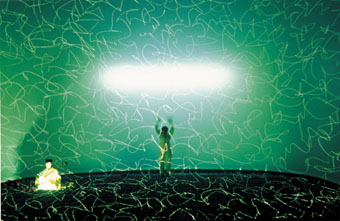
Heiner Goebbels, Hashirigaki
photo Klaus Grünberg
Heiner Goebbels, Hashirigaki
Brett Sheehy has taken on the mantle of artistic director of the Adelaide Festival of the Arts for 2006. In his 2004 Sydney Festival (his term finishes 2005) there are signs of an exciting, concentrated vision that could augur well for Adelaide where the considerable budget also allows for greater depth of programming and for a festival to be a work of art, a finely wrought, visionary vessel.
Must-sees…
Sydney Festival programs of the past have usually included a few must-see shows that demonstrate the passions and mutating forms of contemporary performance, dance and music. This time there’s a host of them: music theatre maestro Heiner Goebbels’ Hashirigaki; the edgiest of choreographers, Meg Stuart; the film of John Adams’ opera The Death of Klinghoffer; the Wesley Enoch/Legs on the Wall collaboration, Eora Crossing; Kronos Quartet; Bang on a Can All-Stars cellist Maya Beiser; Def Poetry Jam; Asian Dub Foundation; George Piper Dancers; Chunky Move’s Tense Dave; Chamber Made Opera’s Phobia; James Brennan’s The Glass Garden; Jon Rose and Hollis Taylor’s Great Fences of Australia; and new music ensemble Elision’s Tulp, The Body Public (our cover photo) in collaboration with new media artist Justine Cooper and composer John Rogers. It’s a substantial lineup with some welcome challenges of the kind that Sydney audiences too rarely experience.
The visual arts program is also strong, focusing on a handful of significant creators headed by a pioneer of installation, video art and multimedia performance, Nam Jun Paik who will be featured both at the Art Gallery of NSW and in the Opera House forecourt. The show at AGNSW will include documentation of his 1976 visit to Australia with the late Charlotte Moorman who collaborated with Paik, performing on cello while held aloft above the Opera House by helium-filled balloons and elsewhere wearing the TV Bra for Living Sculpture. Paik again returns to the forecourt, this time with a large part of his 32 cars for the 20th century play Mozart’s Requiem: silver painted vintage cars filled with electronic detritus surround a neon and laser tower built by Paik collaborator, New Yorker Norman Ballard. Provocateurs Tracey Moffat and the late Leigh Bowery will have retrospectives at the MCA. Photographers Cherine Fahd and Trent Parke will populate Circular Quay and Martin Place with their idiosyncratic images.
There’s spectacle of course and it’s free: Of Angels and Light by Compagnia di Valerio Festi is to be performed on the Olympic Boulevard, Olympic Park for 3 nights, with artists amidst and above the crowd in a light show of aerial feats and supernatural imagery.
Music theatres
Also in Sydney’s west, there’s a feast of music theatre in Breaking the Cycle, a program of performances accompanied by a 2-day forum presented by Music Theatre Sydney and Riverside Theatre. Melbourne’s Chamber Made Opera will present Phobia. In his online review for RealTime of the work, Jonathan Marshall wrote that “composer Gerard Brophy’s score for Phobia…draws heavily upon the Foley skills and sense of fun displayed by the members of percussionist Graeme Leak’s ensemble, the Ennio Morricone Experience…Through this theatre of sound effects, miked-up celery crunching and gentle mugging on the part of the performers, the narrative and themes of Alfred Hitchcock’s Vertigo are torn apart and scattered throughout an overt performance of sound, identity and text…with a radioactive afterglow produced by film noir’s psychosexual ambiguities.”
Breaking the Cycle includes another significant Melbourne work, James Brennan’s The Glass Garden; Judy Glen’s Melba and Moncrief; a concert performance of the first act of composer Drew Crawford’s fascinating work-in-progress, Eugene & Roie about Eugene Goossens and Rosaleen Norton, the Witch of King Cross; and for young audiences Oz Opera’s Software and the Sonicsphere workshops hosted by Carlos Russell and Margery Smith.
The Riverside Theatre in Paramatta is also presenting Stone Sleeper, a music theatre work from Bosnian composer and director Mirsad (Giga) Jeleskovic setting the poems of Mak Dizdar for a capella choir and 8 musicians, dancers, actors and singers.
The music theatre centrepiece of the festival is Goebbels’ Hashirigaki. Even a concert performance of Goebbels’ Surrogate Cities at this year’s Queensland Biennial Festival of Music was an intensely theatrical experience, and the composer’s Black on White at the 1998 Adelaide Festival was one of that great festival’s high points. Hashirigaki is something altogether different in the unfolding ouevre of Goebbels’ creations. It radically juxtaposes but makes sense of juxtaposing passages from Gertrude Stein’s novel, The Making of Americans, The Beach Boys’ masterpiece Pet Sounds and traditional Japanese folk music taken to new places. The astonishing set and lighting design is by Klaus Grunberg. Willi Bopp, as ever, designs the Goebbels’ sound world.
By the way, don’t miss The Lab, instrument-maker virtuosi and musical wits Graeme Leak and Linsey Pollak’s mad scientist routine showing 3 nights only at the ArtHouse Hotel.
Cinematic musics
The film of John Adams’ opera The Death of Klinghoffer won the 2003 Prix Italia. It will have 2 screenings during the festival, a rare opportunity to see it on the big screen. It’s a powerful work about the hi-jacking of the Achille Lauro cruise ship by Palestinian terrorists with Adams and librettist Alice Goodman striving to understand both sides and courting the inevitable controversy, still felt strongly in the USA. The film’s director, Penny Woolcock, claims to have made the work more accessible by adding realist fictional narratives.
Another cinematic music theatre experience, but one with a mix of live and screened performance is La Haine with music by the British intercultural music group Asian Dub Foundation. The acclaimed 1995 black and white film about racism and class, youth violence and police brutality is shown with a live soundscore by the Foundation with “bass’n’drum, bhangra and electro-klezmer.” Add Chamber Made Opera’s Phobia to La Haine and The Death of Klinghoffer and you’ll enjoy a fascinating perspective on sound and cinema.
Tulp: be in it
Not exactly music theatre, but a close relative in the era of hybrid arts, Tulp: The Body Public is a musical, surround-sound and visual exploration of the human body inspired by Rembrandt’s famous painting The Anatomy Lesson of Dr Thomas Tulp. Composer-musician John Rogers can write engagingly and accessibly (the musical The Sunshine Club 1999, the score for Bob Cat Dancing, Mt Isa for the 2003 Queensland Biennial Festival of Music) but also viscerally as in Inferno (2000) for Elision. And visceral Tulp is. Visual artist Justine Cooper’s internationally lauded videos Moist and Excitation make beautiful the red and blue flow, under microscopy, of bodily fluids. She has also exhibited MRI scans of cross-sections of her own body (see p28).
In December Cooper and Rogers will be collecting sound and body images from volunteers at AGNSW to use in Tulp. The performance space will be made of latex membrane, a screen for these and other images, with the musicians’ bodies as well as their instruments wired for sound. Brisbane-based and admired across Europe, Elision is always exciting, its new music dynamically integrated with design, its passion wrought with intelligence.
The newest music
The Kronos Quartet needs no introduction, but they will introduce you to a remarkable range of music across cultures and forms, proving how far this one group have extended the string quartet repertoire. Witness it yourself, especially in the second of their 2 programs, Caravan. Maya Beiser, the cellist from the wonderful Bang on a Can All-Stars presents a perfect companion program (Pärt, Golijov, Reich, Andriessen, Lang) to Kronos’ first concert (Ruvueltas, Gubaidulina, Reich, Vasks, Golijov), creating a revealing cross-section of contemporary music.
Ross Edwards’ 4th Symphony, Star Chant, like Gorecki’s 3rd is driven by an embracing melody and is accompanied here by projected images of the heavens (David Malin) while John Adams’ On the Transmigration of Souls, a reverie on September 11, is presented with a filmscape by Greg Barrett commissioned by the festival. The program inlcudes Chris Gordon’s Peace on Earth and features the Sydney Symphony Orchestra with Gondwana Voices, Cantillation and the Sydney Children’s Choir.
Watch out too for the Music House to House series, with Lisa Moore (Bang on a Can All-Stars) performing piano works by Kats-Chernin, Bresnick, Rzewski and Schwitters, all composed with text for recitation: the yield is intense, the theatricality striking.
Composer-violist Brett Dean heads 2 strong programs with works by Birtwistle, Boulez and Lentz in one and Lim, Sculthorpe, Messiaen, Ravel, Lentz again (and worth it) and Tulp’s John Rogers.
Last word…on dancing
Alongside Goebbels’ Hashirigaki, the most significant programming in the festival is Alibi, a creation of Brussels-based American choreographer Meg Stuart and her company, Damaged Goods. With powerful, fragmented dancing that appeared to be on the edge of physical and psychological distress, No longer Readymade and No One is Watching were the dance sensations of the 1996 Adelaide Festival.
The company’s dramaturg, New York-based writer André Lepecki writes: “As long as we move and are moved (in the 2 senses of the word, as motion and emotion), there will always be this disquieting accumulation, generation and degeneration of bodies inside the limits of our own bodies and inside the patterns of our daily choreographies: bodies of knowledge, bodies of feelings, bodies of lovers, bodies of sorrows. To acknowledge so human a predicament, the one of being always multiple, always contradictory, always in lack, constitutes the first step by which choreography can emerge.”
Also in the strong lineup of dance are Michael Nunn and William Trevitt (both ex-Royal Ballet) performing works by leading UK choreographers Matthew Bourne, Michael Clark, Akram Kahn, Russell Maliphant and Christopher Wheeldon. Chunky Move will present their Melbourne Festival hit, Tense Dave (see p 8), a fantasia of crumbling identity and voyeurism performed magically on a revolve stage.
There are many other shows in the 2004 Sydney Festival, but the constellation of new music, music theatre works, installations and cinematic music events makes for a great program for the festival-goer looking for a rewarding festival trajectory. Add to that some adventurous dance and you’ve got a festival to pick you up, kick you around, seduce and delight you.
2004 Sydney Festival, Jan 8-26; www.sydneyfestival.org.au
RealTime issue #58 Dec-Jan 2003 pg. 13
© Keith Gallasch; for permission to reproduce apply to realtime@realtimearts.net
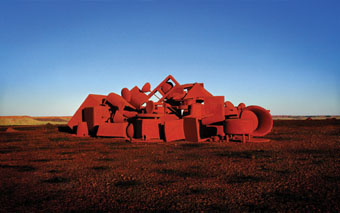
Rosemary Laing, burning Ayer
Always a central feature of the Adelaide Festival of Arts visual arts program, the Adelaide Biennial promises to be a major event in 2004. Responding to a brief to stage a program devoted to screen and photographic media, curator Julie Robinson has selected 18 artists, 8 of whom will show screen-based work and 10 photographic works, including multimedia. Robinson will address contemporary photomedia’s subjects and its place in art and look at photography (manipulated and not), video and hybrid forms.
In planning the exhibition Robinson has considered the needs and interests of viewers and is offering opportunities to devote serious attention to the works. She notes that, given the recent proliferation of new media art, the issue of quality is key. Though video and digital forms have been developing for some years, the results are not always memorable and this carefully constructed survey exhibition will do much to focus opinion and raise awareness.
Some material in the Adelaide Biennial will be familiar, but worth revisiting and will gain strength from being included in such a survey. Patricia Piccinini (Melbourne) will be represented by some of the work shown to great acclaim in the recent Venice Biennale as well as a new work that continues her investigative simulations of the merging of human and animal forms. Currently showing, with Piccinini, at the Havana Biennial in Cuba, Craig Walsh (Brisbane) continues his exploration of public space, architecture and the re-centring of the viewer. “Craig’s work will be located in a part of the gallery that is usually out of bounds to viewers,” says Robinson.
David Rosetzky (Melbourne), now exhibiting in Berlin with the well-travelled Piccinini, Rosemary Laing (Sydney) and others as part of a major Australian exhibition (Face Up, Hamburgbahnhoff, Berlin), will show his Untouchable, a 3-video work set in what looks like a domestic interior without walls. Seen only once before in Australia, Untouchable shows characters crossing between screens, discussing issues that we might enjoin but can merely observe.
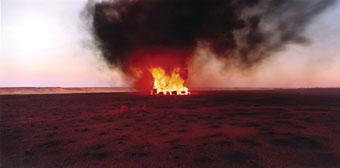
Rosemary Laing, burning Ayer
The role of political commentary in art, and its application in photomedia, threads through this Biennial. Some artists address the gravest questions: legendary Sydney performance artist Mike Parr is shown having his face sewn up in the 20-minute video UnAustralian. In the past Parr has tended to avoid making direct political statements in his work, but this video of a private performance directly addresses government policy on asylum seekers, and it’s harrowing to watch. Topical political concern is continued in Canberra artist Silvia Vélez’s images of hundreds of coloured Post-it notes, each carrying a print depicting anti-Iraq War protests—a collection of forgotten reminders.
In the gallery there will be a series of small rooms for viewing video adjoining an open area showing photographic work or video, or combinations of forms. “You won’t have to sit right through a video to appreciate it,” says Robinson. “Viewers will be able to walk through this area and browse. But…there will be a separate screening room where [viewers] can sit and absorb a succession of videos by several of the artists.” Neither video nor photographic works will be privileged in the exhibition layout.
Robinson has been very careful with her selection, “I am interested in works that anchor the image in, or address reality in some way.” Thus, the Biennial emphasises the capacity of the media to reflect life’s harsh realities and to identify prevailing cultural narratives. We are preoccupied as a society with reality and its transmission through the visual (think of the fashion for Reality TV). Using a range of devices from narrative to symbolic and metaphorical, works in the Biennial will highlight how these media work the ways our perceptions and beliefs are shaped. For example, Linda Wallace (Brisbane) has selected archival images from Australia’s televisual history and juxtaposed them with images from the outside world to establish ambiguous relationships between these spaces.
Wallace’s Entanglements comments on the pervasiveness of lifestyle imagery in the Australian consciousness. Sydney artist Liu Xiao Xian’s photography continues his exploration of the migrant experience, especially of those who are politically and culturally dislocated or isolated. Derek Kreckler (Perth) and Destiny Deacon (Melbourne) use multiple forms—Deacon’s photographs are mounted adjacent to plasma-screen videos, and Kreckler’s large-scale stills adjoin corresponding 3-dimensional forms, dissolving both the physical and psychological boundaries between these media and reiterating the equivalence of forms and information in an image-saturated world.
Deborah Paauwe (Adelaide) continues to develop her work on the costumed child or adolescent girl, adding garish, theatrical make-up to draw another narrative trajectory with references to the fantasy/reality of theatre. This layering of theatrical devices—both the posed photograph and its twin, the stage—acknowledges that the actors (ourselves) are playing at roles, consciously melding the multiple discourses to which we are inevitably subject.
Without the aid of digital manipulation, Rosemary Laing has created stunning imagery that muses on our intrusion into the outback—a stack of bulldust-covered IKEA furniture set on fire and casts of human heads, made by fellow artist Stephen Birch, lolling in a salt-stricken bore. Bronwyn Wright’s (Darwin) photos show derelict, graffitied cars, little oases of grunge art in the Northern Territory desert.
The soundtrack for Sydney writer and artist Adam Geczy’s video From a Remote and Lonely Place (Port Arthur Elegy) will be Peter Sculthorpe’s Irkanda IV (1961) for violin and orchestra. The title of Tasmanian-born Sculthorpe’s haunting, lyrical work is an Aboriginal word for “remote and lonely place”, and Geczy’s video will be exhibited in a long, darkened room on 2 screens, one showing clouds and the other scenes of the site of the former penal colony and recent massacre. Sculthorpe is writing an accompanying catalogue essay for this collaboration.
Works by Tracey Moffatt (Sydney/New York), James Geurts (Adelaide), David Haines (Sydney) and Bill Henson (Melbourne) will add to what promises to be a powerful and timely exhibition.
Adelaide Biennial of Australian Art 2004, curator Julie Robinson, Art Gallery of South Australia, Feb 28-May 30; Artists’ Week Feb 28-March 4 www.adelaidefestival.com.au
RealTime issue #58 Dec-Jan 2003 pg. 14
© Chris Reid; for permission to reproduce apply to realtime@realtimearts.net
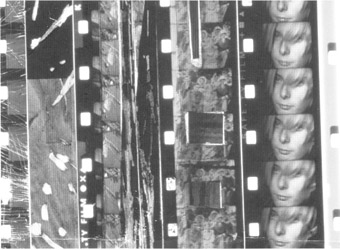
Louise Curham, Untitled
My wish is to sensitise the audience to the ephemerality of the event, and I think that sense of ephemerality is really played up when you feel the thing you’re watching is about to destroy itself.
Louise Curham
This statement goes to the very heart of Louise Curham’s filmmaking practice, which straddles the avant-garde traditions of materialist experimental film and reflexive questions generally associated with new media about how an audience interfaces with technology. Curham is a Sydney-based filmmaker who works primarily with Super 8, a narrow-gauge film format that once occupied the market space now filled by domestic camcorders. Rather than using the medium in a traditional way, Curham works directly on the film itself: “I torture the film in any way I can think of: cutting it, bleaching it, scraping it, marking it and collaging it.” This creates highly abstract images of pure texture, colour and light, which take on an organic life of their own when projected on screen.
Trained in film production at the Victorian College of the Arts, Curham produced several dance films (she has been a regular collaborator with choreographer Sue Healey) and conventional narrative shorts before studying painting in the mid-90s. When she returned to filmmaking through the Super 8 medium, her interest in the graphic aspects of the image led to a new direction inspired by filmmakers like Stan Brakhage and, closer to home, Len Lye and Albie Thoms. This has led to a specific approach to screening her work. Rather than employing conventional cinemas, she has exhibited her films in a series of “improvised” screening spaces, from warehouses and galleries in Sydney to the foyer of the New Zealand Film Archive in Auckland. Curham has also played a key role in the revival of the Sydney Super 8 Group, now known as the Sydney Moving Image Coalition (SMIC).
What was it that originally attracted you to the Super 8 medium?
I wanted a format that I could use cheaply and easily so I could teach myself and learn about film from the inside. Although I had done filmmaking at VCA and made several short films, I really felt I didn’t have a handle on the medium and its possibilities. Someone gave me a Super 8 camera and I went from there.
Why Super 8 film over video?
The Super 8 image is a chemical emulsion. Even though my work is very abstract, I’m interested in actuality and riding on the coat-tails of all the loadings associated with photography and its status as a physical document—the fact that it physically exposes a moment in time. Whereas with video it’s a becoming thing; every time you play a video back it’s re-creating itself from a signal. It’s the pure materiality of the filmic image I’m interested in.
How is this interest in reflected in your work?
One of the pivotal things for me is the photographic and documentary aspect of film, because the medium is always indexed to the actual, even when I’m just marking blank film by bleaching or painting it, or scraping away the emulsion. I’m actually physically making that mark and what you see on screen is a record of that marking. It’s also interesting to watch the film degrade as I continually reuse it.
The frailty of the medium seems to play a big part in your work. You always project actual Super 8, rather than making video copies for screening purposes, which means the film often tears or sometimes even melts.
I’m very interested in the “event” of cinema. Not just what’s in the frame, but the whole event of the screening and the environment in which it is taking place, including the location, the apparatus, the screen and the audience. If you take the event as part of the signifying process, then the fact that you’re showing your work using obsolete media becomes really loaded. More specifically, Super 8 has connotations linked to its status as the once-favoured medium for home movies. So I try and create these intimate, non-structured screening environments in galleries and warehouses, where the projection technology is right there in front of the audience. And audiences are often fascinated by the curio factor created by employing this obsolete technology. It’s a way of creating intimacy with the image and the apparatus, so that the machines themselves become part of the artwork.
For me the cinematic event always has a performative aspect that we’ve largely been trained to ignore. I try to re-attune people to the reality of what they’re seeing and what is happening to them right now in the environment they’re in, thus re-sensitising them to the ephemerality not only of the medium, but of all experience. The medium’s frailty is part of that, and helps create a certain anxiety. Because there’s always a tension in film between the medium’s status as a document, and the fact that the document is always ageing and changing. So it’s about reinserting the cinematic experience itself into time, rather than trying to lend it an air of permanence. Recently at the Techno-Derby exhibition at Kudos Gallery, I set up a projector playing black spacer going over sandpaper inside a spool. The film ran so that the emulsion was scratching over the sandpaper as the film was projecting, so the film was both generated and destroyed in the moment of projection. In this way the apparatus itself, and our experience of the apparatus, becomes part of the artwork.
So how does your filmmaking fit into your work with the Sydney Moving Image Coalition?
Originally SMIC was going to be a group for filmmakers to show their work in front of a small, intimate audience. I’m really interested in having that direct contact with my audience, in the same way musicians are. My suspicion is that most filmmakers don’t feel they need that; they’re happy sending their work off to festivals and that’s enough. Consequently the screenings have become more about the event than the filmmakers. Again, we’re interested in the performance aspect, and shaping the whole screening so that it becomes a work of art in itself. Several of the nights have featured improvised live musical collaborations with multiple-screen projections of my work. Three of our 4 events this year have been at Lanfranchi’s, a warehouse space in Chippendale that also plays host to the Camera Obscura screenings of local and overseas experimental shorts. I think the improvised cinema aspect is part of the attraction for some of the audience, and there seem to be a lot of these nights springing up around town. We’re looking at some kind of collaborative work with the Camera Obscura group next year. In the meantime, we’re always looking for films to screen.
Louise Curham’s work will be exhibited at Kudos Gallery, Paddington, February 24-28, 2004. The next SMIC screening: February 3, Lanfranchi’s. http://www.innersense.com.au/mic/sydney.html
RealTime issue #58 Dec-Jan 2003 pg. 15
© Dan Edwards; for permission to reproduce apply to realtime@realtimearts.net
42 films and games were banned in Australia over the last year. What better way to round the year off than with an inaugural International Ratings Conference?
In late September, Australia’s Office of Film and Literature Classification (OFLC) held a conference in Sydney attended by international media classifiers. The theme was “Classification in a Convergent World”, a reflection of the view that the rapidly evolving way that media is produced, distributed and consumed has resulted in media ‘convergence.’ In Australia this prompted legislators in March this year to combine the way computer games and films are classified into one set of guidelines.
Not all classifiers agree with the notion that we are living in a “convergent world.” In fact New Zealand Chief Censor, Bill Hastings, used his presentation to argue that we were in fact seeing media divergence, and reminded us that to a great extent the medium really is the message.
I have to wonder how much the vogue for talking about ‘convergence’ is the result of euphoric cross-marketing spin. To what extent, beyond superficial production values, have the fundamentals of video games and films actually become similar media? Sure, Lord Of the Rings game may look almost as good as the movie but does that mean we’re witnessing a revolution in gameplay that draws on key structural characteristics of the film medium?
A panel of speakers convened by Margaret Pomeranz and including the NSW Attorney-General Bob Debus, had its own interpretation of the “convergent world” theme. Panellists pointed to the ridiculous attempt to police media consumption within national borders when, for example, any Australian with a high speed internet connection can view the banned film Ken Park. Pomeranz proposed an international, purely informational system for media classification, which sounded extremely sensible, but unfortunately we live in a world where the most rational ideas tend to be dismissed as naïve idealism.
One high profile and controversial guest at the conference was American academic Dr Craig Anderson, famous for his strong public statements against video game violence. He naturally became very popular with the mainstream Australian press while here. Anderson presented a confusing (and suspiciously tersely labeled) array of bar graphs with which he attempted to convince us that there is more evidence of a link between media violence and real world violence than between smoking and lung cancer.
By contrast the other academic delegates characterised the results of international media effects research as too conflicting to draw useful conclusions. Australian academic Dr Jeff Brand had the last word in this debate with a commonsense observation: if there was a link between video game violence and real world violence we’d be witnessing a social epidemic and we simply aren’t.
In 2001 Brand was commissioned by the OFLC to write a report based on community submissions as part of a review of their film and game classification guidelines. The most important recommendation in a practical sense was the addition of an R18+ rating for games. This would go some way to halt the internationally notorious Australian practice of cutting and banning popular computer games. Australian gamers were outraged when the adult rating was undemocratically stymied by a veto vote from the Federal and South Australian Attorneys-General. Neither Darryl Williams nor the OFLC attempted to defend this decision during the conference beyond saying the guidelines with respect to games enjoyed “community support”, which they quite clearly don’t given Dr Brand’s findings. So whose are the community voices that the politicians are listening to?
The most visible lobby group from the “will somebody please think of the children” camp is Young Media Australia. From their name you might guess they’re a youth rights advocacy group run by young people but in fact they are censorship advocates and notorious television complaint filers who are visibly in their autumn years. I was struck by the inclusion of Young Media Australia fridge magnets in our conference satchels. The magnet advertises a “helpline” staffed by a real person 24 hours, 7 days a week (it’s true—I checked). Presumably we are supposed to stick it up next to the federal government’s terrorist hotline fridge magnet. That number, in case of media effects emergency, is 1800 700 357.
The classifiers state their primary aim is to safeguard the welfare of young people, and so I found it interesting that there was no youth or consumer representation visible at the conference. The debates centred around how to achieve a balance between protecting children from harm and giving adults the right to see and hear what they want, and arguing over whose duty it is to regulate young people’s media consumption—parents or the state. However, the notion of the right of young people to make choices about their own media consumption was given little attention.
Dr Michael Flood from The Australia Institute pointed out the inconsistency of having the age at which graphic sex is viewable set at 18 while the age of consent is 16. This could be applied to the assumptions about games inherent in the OFLC’s guidelines: that the impact of content is strengthened by interactivity (but as even Craig Anderson admits, this is mere theoretical speculation). Surely actual sex is the ultimate in interactive pornography?
Another telling observation came from Doug Lowenstein from the Entertainment Software Association in the US, who gave a somewhat reluctant response when asked to explain the exact cultural differences between Australia and the US that justified such different sets of regulation for videogames. He pointed out that the notion of protecting free speech is more culturally ingrained in the US than it is here. In fact a recent move by one US state to legislate point of sale restrictions of games to minors was overturned in court on the basis that it infringed the constitutional rights of young people.
I found the conference on the whole quite informative and interesting, and yet the benign and civilised atmosphere belied the true nature of what is at stake. I still remember David Marr’s words on the late night news broadcast a few months ago when the police broke up that screening of Ken Park in Sydney. From the midst of the scuffle he shouted, “This is what censorship means”: simple and blunt physical enforcement by the repressive arm of the state so that some people may not see what certain others don’t want them to.
Surely there’s another option: investment in good quality media. Anyone who truly cares about what kind of entertainment young people consume courtesy of “exploitative sex and violence sells” corporate media empires should be championing more state funding for public broadcasting and funding for videogames as cultural, not just commercial investment. And perhaps one day young people, indeed all people, will be able to make real choices about the media they consume.
“Classification in a Convergent World”, Office of Film and Literature Classification Conference, Crown Plaza, Darling Harbour, Sydney, Sept 21-24
RealTime issue #58 Dec-Jan 2003 pg. 16
© Katherine Neil; for permission to reproduce apply to realtime@realtimearts.net
Screen culture in Australia has changed profoundly over the last decade. The wholesale integration of ‘independent’ exhibition into national distribution corporations, the resulting disintegration of the independent exhibition circuit, post September 11 insurance and freight increases, dwindling funding options and greater box office pressure from exhibitors have all had major effects. Increasingly, independent screen culture events have to unwillingly compete with the commercial imperatives of the distribution and exhibition sector. Though the objectives of the 2 are very different, the dynamics of one are directly transposed on the other. Funding agencies are increasingly market driven. In their response to these dramatic shifts most funds are actually going backwards. Screen culture is simply not a priority.
In Western Australia, funding has been lacklustre, falling short of professional expectations and industry demands. Until 2003, screen culture funding for individual projects from the state film development agency, ScreenWest, was capped at $3,000 (though some received more) with the entire annual screen culture fund of $53,000 servicing 25 major and smaller projects/partnerships. Traditional alternate funding opportunities have also dried up with one of the largest government arts funders—Healthway—refusing to fund any film (or arts) project that depicts smoking in any form, whatever the context.
Despite these difficulties, event-based screen culture activity in WA has seen consistent growth. Grass Roots, Revelation Film Festival, Over the Fence, Big Screen, SPLIF are excellent independent examples. It is against this backdrop of enormous industry change and frustratingly static funding levels that a number of WA based practitioners have engaged ScreenWest in aggressive and sustained lobbying, the aim being to create a competitive and professionally based fund and policy with long-term purpose, muscle and impact for all.
Via this sustained pressure, ScreenWest has comprehensively restructured its existing program to create a model that centres on development opportunities and the encouragement of new players across the sector. Previously the fund had twice-yearly application rounds with projects applying to a single fund and assessed internally. The new structure provides a significant departure both in funds and strategic development. ScreenWest has approved a $25,000 injection, taking the fund to $78,000. Of this, $10,000 is an ongoing grant to the Australian Writers Guild, the remainder invested in independent screen culture. Fresh from the ScreenWest Board comes the approval of a 3-tiered structure. There will be a triennial fund of $30,000 for established, locally generated projects that demonstrate long-term strategies and development potential. An annual grant pool of $26,000 has been established for one-off or established local and national projects whose initiators have proven track records. Local events that show ongoing potential may be invited for application to triennial funds. A development fund of $12,000 for new events and practitioners is designed to provide new players with adequate funding and direct mentoring opportunities with industry professionals in the development of their project. The Film & Television Institute (FTI) will administer this fund.
The central priorities in the restructure are to raise the standard of all events and applicants and to encourage the engagement of greater rigour in examining WA audience and industry specifics to develop critical, curatorial, employment and analytical skills in the state and with the applicants. Projects will be peer assessed.
Timing of the rounds is yet to be established but the $25,000 fund increase fell well short of industry needs and recommendations which advised a conservative, considered and well argued $50,000 injection. However, levels will be reviewed as early as February via ScreenWest’s half-yearly budget analysis so the outlook is hopeful for possible increases.
In a positive response to increased costs, the fund is CPI-indexed and reviewed annually in consultation with a new independent screen culture industry body. This body will examine streamlining local and national project logistics in the creation of consolidated freight, advertising, equipment and accommodation accounts to facilitate bottom line reductions for event-based projects local or otherwise.
Compared with the lack of movement in previous years, this restructure will greatly benefit and impact on the local and national sector. It does not at this stage embrace critical writings, journals and publications, electronic or otherwise, a major sticking point that remains to be effectively addressed and will also provide an immediate and initial focus for the new sector body.
ScreenWest’s movement on this issue and its recognition of the sector as a professional activity in its own right must be applauded, along with the commitment of local practitioners who brought it to the table. Certainly the structure of the new fund is very strong and perhaps one of the best in the country in its intent, but this must be supported by muscle, providing the sector with the ability to develop, not simply survive.
RealTime issue #58 Dec-Jan 2003 pg. 16
© Richard Sowada; for permission to reproduce apply to realtime@realtimearts.net
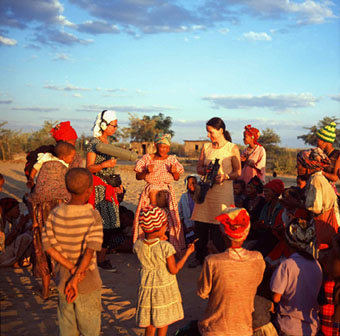
Dances of Ecstasy on location
The film Dances of Ecstasy by writer/director Michelle Mahrer and producer/co-writer Nicole Ma represents modes of trance experience that take participants into relationship with larger dimensions (“borderless, mysterious, vast”). For Mahrer, the intention to represent a “commonality between peoples”—a place of “no division…no walls of ego, culture, religion, fear”—is ably matched by the film’s virtually seamless form. Like a tone-poem, it is to be tasted or half-dreamt, carrying the viewer on waves of movement, rhythm, visuals, and sound. Dance-parties staged in the foyers of each film launch in Melbourne, Sydney and Byron Bay were held to encourage a continuity of this seamlessness, a bodily processing of what was viewed in the film. “We wanted to illuminate [and presumably tease open] the spiritual vacuum and deep loss of community that exists in our modern lives,” Mahrer says.
Footage of skyscrapers and hurried, crowded streets imply contrast between the psychological and physical isolation in modern (Western) life, and the communal experience of dance/trance, ritual and healing as shown in footage from the Kalahari (the San), Nigeria (the Yoruba), Morocco (a Hadra women’s ritual), Brazil (Candomble initiates), the Kut in Korea, Sufi whirling in Turkey, a workshop run by healer/dancer Gabrielle Roth in New York, and a trance party (the Rainbow Serpent Festival) in southern Victoria. Commentaries from Western specialists such as Jean Houston and some of the healers themselves presumably call up our hunger for connection. And yet, for me, this at times astonishing film shows up significant and notable differences of ontologies not caught in those language grabs.
I respond on 2 main levels to this film: to its artistry—as a beatific artefact in itself—and to how it represents what it documents; the cultural beliefs and practices it shows. Clearly, the makers earned the deep trust of the communities they filmed. Episodes of trance and possession, of men and women, are captured in full, and sometimes violent force: from Sufic spiralling, to the passing of sharpened knives across a shaman’s tongue; from an inwardly-intensifying shaking to sweating, writhing, screaming, collapse. Rare forces explode through willing bodies almost thrust out of themselves by a supra-human power. And there is the lighter, more individually oriented pleasure of the Rave. And yet, while the experiences of ecstasy are all presumed trans-individual and extra-bodily, the shape of movement and experience of trance is quite clearly also shaped by the beliefs and permissions (the “walls” and “borders,” perhaps) within each distinct culture. It’s as if (the same) gods need to negotiate their passage differently, and to different purpose, according to the tribe.
I admire the filmic details, such as a sense of otherness created by using slow shutter speeds and fast film, which tends to blur the outline of dancing bodies as if they are ghosted, or accompanied by spirits beyond themselves. And yet, I am also troubled by the blurring of both fine and gross differences, most especially in effects which include the slowing down of footage to make one culture’s movement conform to the rhythmic pattern of music from another culture’s practices. Shamans’ voiceovers detail how a different rhythm calls on a different spirit. The filmic blurring does disservice to this understanding.
Most difficult is where rave music, with its insistent, quite controlled repetitive rhythms, overlays footage of shamans in different trances/possessions slowed to the Serpent Festival groove. Quite clearly, the dance of trance (social healing), where a shaman/healer endures often intensely painful possession, is so immensely different in experience, purpose, and intention, to the noticeably individuated, extending and recoiling, ego-expressive dances of the rave. Shamanic dance, by contrast, seems to spiral inward to an almost invisible core. The exhausted, absented ecstasy in the faces of the shamans and tribal peoples who collapse are quite distinct from the ravers’ smiles of (relatively) simple joy. Significant is the aspect of the shaman processing unquantifiable pain on the way to embodying a healing force then distributed (as wind, breath, smoke, “medicine”) to the rest of his/her tribe. These are such different healings.
That said, I wept when I viewed the film for a second time: not only being moved again by such intensities, but also from witnessing the exquisite companionship that the indigenous communities give to each other in their processes. Yoruba and Candomble participants, carried to safety and guarded to recovery in tents; the Haddarat women in trance, sawing violently, bodies held safe by their sisters in their writhing trance…I weep to see both the acceptance of this non-ordinary experience, and because of the multitude of arms ready to hold others in their collapse. In our culture, we are often lucky to get mere words of agony, illness, ecstasy in edgeways (and the last perhaps only in childbirth, or sex).
I am left wondering whether ecstasy is a place to build up towards (or try to make cohere into a film); and what difference it makes within a culture to know ecstasy is accessible through repeated ritual—a rhythm to come back to. The film actually makes several nice moments of building and falling, resisting singular climax; but perhaps, as an experience of an event in itself, it reminds me of, rather than heals, my unhappiness at the separations of ecstasy from our everyday—birth, death and pain from daily life; self from selflessness or communality—which may be our greatest pain of all.
I was unable to view the additional documentation on the DVD version of Dances of Ecstasy before publication. This review is a response to viewing the publicly screened film.
Dances of Ecstasy, director/writer Michelle Mahrer, producer/co-writer Nicole Ma, director of photography Paul Elliot, sound Paul Finlay, editor Sioux Currie; 58 minutes.
RealTime issue #58 Dec-Jan 2003 pg. 18
© Zsuzsanna Soboslay; for permission to reproduce apply to realtime@realtimearts.net
Unbearable Lightness (tree of fortune)
photo Keith Armstrong
Unbearable Lightness (tree of fortune)
Unbearable Lightness (tree of fortune) is a collaboration between Keith Armstrong and Linda Carroli recontextualsing the christmas tree. On the South Bank Cultural Forecourt, a fig tree is decoreated with small glowing baubles which on closer inspection are digital ‘text modules’ each with their own message.
“We live in a time of unbearable lightness, thinness, emptiness; a time where hope has become blanketed by fear. Christmas is traditionally a time of hope and renewal for many cultures, a time of giving (and taking), a time for reflection, a time to rethink what it is that must be thought. This artwork suggests that opportunity in a networked poem… to say goodbye, once and for all, to unbearable lightness.”
Keith Armstrong and Linda Carroli, Unbearable lightness (tree of fortune), South Bank Cultural Forecourt, Brisbane, November 28th 2003-January 4th 2004 from 6pm, http://www.south-bank.net.au/
RealTime issue #58 Dec-Jan 2003 pg. 29
© Keith Armstrong & Linda Carroli; for permission to reproduce apply to realtime@realtimearts.net
These Lucy Guerin creations have finally made it to Sydney after a tour of the USA where Melt and The Ends of Things won glowing plaudits. Melt is a triumph of invention, and new media artist Michaela French was heroine of the opening night along with Guerin and dancers Stephanie Lake and Kirstie McCracken. Like Guerin’s best work, Robbery Waitress on Bail, Melt is a work complete in conception, here a pulsing organism comprising entwined dancers framed and patterned with fluent painterly geometries of light and image. It is not just that bodies and images are in fine sync but the demands of the projected framing are precisely met by the choreography’s anchoring of the dancers, generating a largely upper body focus with marvellous work with arms and hands (lines rippling along them) and resonating with South-East Asian dance traditions. The women ‘melt’, their bodies separate, projections go on the boil as does the dancing until the togetherness and apartness of the relationship stabilise into acceptance. On the way there’s magical play with images of flowers, snow crystals and shards of ice caught on bodies, cupped in hands and a breathtaking moment when McKracken leaps onto Lake’s breast like a child and a projected red net flies across her back, brief warmth and comfort amidst the chill.
The Ends of Things has the wonderful Trevor Patrick as an oldster miming his way through morning rituals in comically outsize clothes. Patrick’s persona owes something to Chaplin and Keaton-timing deftly based on distraction and delayed responses. Outside his little abode (back projections create domestic details), a trio of youthful phantasmic figures dance abstract patterns. Occasionally they’re in parallel with the old man—he folds a shirt, they fold each other as if ordering lives and relationships. Soon they enter his life unseen but disorienting it (the best of this is in Guerin’s facility for entwining her characters, here in knots with Patrick at his bewildered best), eventually dismantling his house and, it appears, setting him free while they freeze. Something has ended, something begun, even in old age. While The Ends of Things is finely made and frequently inventive, the metaphysical promise of the title is not matched by the pervasive whimsy and the trio dancing becomes predictable. It’s at its best in Patrick, especially when a darker comic dimension emerges—the pants-down, bum-baring exhibitionist in-the-privacy of-his-own-home.
–
Melt and The Ends of Things, Lucy Guerin Inc, The Studio, Sydney Opera House, Nov 18-23
RealTime issue #58 Dec-Jan 2003
© Keith Gallasch; for permission to reproduce apply to realtime@realtimearts.net
Synergy crafted a seamless integration of their eclectic influences and the masterful performance of Hossam Ramzy on doumbek and Omar Faruk Tekbelik on ney and zurna. Faruk added even more colour to the mix with his beautiful instrumental and vocal improvisations. The ensemble played an array of percussion instruments from the western orchestra as well as djembes, bongos and bells. The djembe has become such a standard instrument for modern western groups that it is almost due for absorption into the orchestra.
After a break, Senegalese master drummer Aly N’Diaye Rose and his musical brothers, son, and cousins walked onto the stage one by one. The first began with a sweet boogaraboo solo. He was gradually joined by 7 others who added saba drums, dunduns and djembes to the sound. The contrast with the previous performers was fascinating. Where the music of Synergy was moody and mesmerising, Aly’s family were extroverted and where Taikoz was full of intensity and discipline, the Senegalese were relaxed. Moving dynamically from the subtle patter of the boogaraboos to the rumble of the dunduns and then to the cracking explosion of the djembes, the musicians laughed and joked with the audience—sometimes stopping to mug or pose, sometimes ripping out a masterful line of tones and slaps. A feature was made of the tama, the talking drum and there was lots of great stick work on djembes and saba.
The poise of Synergy, the melismatic trances of the Ramzys, the intensity and discipline of Taikoz and the breezy relaxation of Aly N’Diaye Rose tantalised and energised the audience. At the end of the marathon 3 and a half hours people were either screaming and dancing in the front of the stage or flat on their backs from fatigue. Both exhausted and energised the City hall auditorium emptied into the cool night with rhythm on their minds.
The Big Percussion Concert 1, Brisbane City Hall, July 19
RealTime issue #58 Dec-Jan 2003 pg. 42
© Jim Chapman; for permission to reproduce apply to realtime@realtimearts.net
This concert included the same artists as the first but with an additional feature—the world premiere of Gerard Brophy’s Brisbane Drumming. The players and young people from the Caboolture Shire Council region near Brisbane—grouped as the Tonga Bell Players and Djembe Players—combined under the direction of workshop teachers, percussionist Elliot Orr and instrument-maker Steve Langton, to present the work. It’s a dynamic, riff-driven work, beautifully textured (the bells providing the upper notes and a melodic sweetness), the young players appearing totally at ease with it, responding to cues from Orr and the professionals scattered amongst them. The rousing free-for-all finale of the concert incorporated the gift of traditional African clothing from Senegalese master drummer Aly N’Diaye Rose to Terracini and Brophy who had to don them on the spot. Surely one of the festival’s biggest drawcards in Brisbane, The Big Percussion Concert again proved itself a complex and rich cultural meeting point.
The Big Percussion Concert 2, Brisbane City Hall, July 22
RealTime issue #58 Dec-Jan 2003 pg. 42
© Keith Gallasch; for permission to reproduce apply to realtime@realtimearts.net
Performance space, Sydney
With guest speaker, writer-director Jenny Kemp
Hosts: Virginia Baxter, Clare Grant
Speakers: Julie-Anne Long, Nikki Heywood, Gail Priest. David Williams and Stephen Klinder (from Version 1.0), Morgan Lewis, Brian Fuata, Victoria Spence, and Alicia Talbot and Cicily Ponnor (from urban Theatre Projects)
Virginia Baxter
Welcome to No 10 in this series of RealTime-Performance Space forums. For those of you who are here for the first time this series of discussions on issues of arts practice and politics has covered topics such as:
Clare Grant
Sound in contemporary performance, Design, Touring, Vision, Training, The Small to Medium sector, Cultural Protocols, Touring and The Place of the Space. The idea of these forums is to create, in the midst of all the hectic doing, some space for thinking and talking together as a community of artists.
Virginia
The forums are taped and transcribed and appear in edited form in the print publication of RealTime and in their entirety online at the RealTIme website.
Clare
Tonight we focus on the word.
Virginia
In what was described for quite some time as a non text-based medium.
Clare
What is that so called “text” that much of contemporary performance is supposedly not based on, I wonder?
Virginia
Good question.
Clare
What is the written word? Is it the prompt for the spoken word? A list of sequential actions? A few squiggles on a shifting bundle of Post-it stickers? Does your use of it include the dramaturgical or choreographic thinking processes that go on or before someone records lists of chosen actions. How do you go about describing those physical or verbal actions?
Virginia
Whatever the questions, we'd agree I think that words have had a remarkable resurgence in contemporary performance. Sounds become words in improvising bodies, words murmur, spit and rap into microphones, are broken into bits, reproduced verbatim, plundered, projected, sung-spoken solo, chorally. Dancers are speaking. Words intersect bodies. Kellaway does Albee! Video voices interrupt live ones, words make difficult sense as they're scrawled onto walls.
Clare
In performance we can watch words conjure, repel, tease, mystify, confirm, protect, seduce, resist, cajole, lie, divert, upend, calm. destroy. Words can make us remember, and they can help us to mourn, to celebrate, and they do so in multiple forms and frames.
Virginia
In celebration of this resurgence, we've decided on a wordfest and we've invited some of the principal players to tell us how they generate and shape words. People like Julie Anne Long who does more than gesture at words, who uses them to generate movement.
Clare
David Williams And Stephen Klinder from Version 1.0 who (usually,it seems with the assistance of a range of stimulants) conjure imaginative worlds contingent on words…whose relations to words “alternates between the throwaway line and being possessed. Getting carried away or thrown away.”
Virginia
Nikki Heywood who unwinds words out of movement, who gestures and textures with words. Gail Priest who pulls apart and composes with the sound of words.
Clare
Victoria Spence who comes across words through speaking…for whom as she puts it “all the material for the text had already been spoken to me, by me, near me etc. How I came upon what I wanted to say was just by seeing what was left in my body from these encounters.”
Virginia
Morgan Lewis who spontaneously freestyles words; Brian Fuata whose words are written on his body.
Clare
Alicia Talbot who translates words into texts for action; and Cicily Ponnor who makes marsala with words. And many others here who play with words and connect them to the body and to the spaces around them, who we hope will add their own way with words.
Virginia
Our special guest tonight is writer-director Jenny Kemp who goes to the heart and the foot and the breast and the elbow of words, to the time of words, the kinaesthetic and the place of words as they unfold inside intense, everyday (usually female) states of being.
Clare
Jenny has also managed to elicit these states for the many participants in her now famous workshops, as many of you here can affirm.
Virginia
On her notes on the performance text for Still Angela her most recent work which we'll finally get to see here at Performance Space, Jenny notes that while the verbal language is written prior to contact with her group of regular collaborators, the visual/aural/physical language and the overall form of the work are developed with the full group present. In Still Angela we watch a woman in her 30s negotiate transition. It's a sensual, multi-layered, beautifully written work in which the experience of one woman breaks into 4 and opens up the world as we (subconsciously) know it.
What is and isn't able to be spoken
Jenny Kemp
Thanks for such a beautiful intro. When Virginia asked me to respond to the idea of “Getting the Word Out”, I thought of Freud's famous statement “The Return of the Repressed” and I thought about the way when something returns after being repressed for quite a long time, being submerged it can come back in strange forms and with strange distortions. In a way, as a writer, I feel like I work with this energy on two levels, one as a kind of fuel for my writing (this energy that comes back up) and the other as for me a sort of focus for the conceptual work of the writing. In a way I sort of feel that as human beings we're negotiating that raw energy and the way society moulds and structures and sometimes represses that energy. And at that place there's a really interesting dynamic. Probably as a writer that's actually the dynamic that I dialogue with. And it'll be that dynamic that this talk is locating really.
In my plays–and I know that you probably haven't seen them in Sydney–the characters are engaged in negotiating this dynamic in various more or less everyday contexts. The plays themselves give focus to women's experience, not really that it excludes men, but it happens to be experience that is particular to women. So for instanceCall of the Wild (1989) was looking at a young mother in her domestic role and the way society and religion have repressed her in her role as a woman. Remember (1993) is about a woman who has been raped. I'm just citing these as the sort of “everyday” situations that I look at. Black Sequin Dress (1996) was about a housewife going out to a nightclub in a glamorous dress and slipping and falling on the nightclub floor. Still Angela is looking at a repressed memory of loss and the death of a mother. Basically, they're all negotiating something that has been pushed under. Perhaps sexuality, subjectivity, spontaneity, autonomy, grief, desire. And the plays themselves are looking at and attempting to give form to the way we psychically order and negotiate experience.
So coming back to “getting the word out”, the writing that I'm interested in is both writing that can be spoken and writing that can't be spoken. So writing that, in a sense, gives voice to things that we don't give voice to and which I feel writing has the possibility of giving voice to. And the form that I'm trying to find with these works is a form through which an audience can perceive this kind of internal, silent, maybe seemingly unnoticed work and meditate on that and how it factors in our daily lives. That's the dynamic between what is and isn't able to be spoken.
So the kind of voices I'm attempting to tap there in the writing–I'll just try to name a few to locate this–would be something like an intimate voice, an uncensored voice, a censored voice, a repressed voice, a socially conditioned or constructed voice, an imaginary voice, and whatever this is–the voice of the unconscious.
The form is sometimes in monologue, sometimes in dialogue, sometimes one person's own dialogues (talking to the self) and sometimes just writing of action only when speaking can't happen or when a number of characters are existing at the same time in the space and one is speaking and the other represents another aspect of that character. So given we're dealing with the writing itself, I just want to talk quickly about the way it happens, how it's triggered for me.
How the writing happens
Quite often a starting point is an image that won't go away, that sits with me. Or an action. An example of that might be something like an image that keeps recurring for me of a woman lying on a kitchen floor or an action of a woman slipping and falling because it's such an incongruous thing for someone to do when you're grown up and adult–you don't fall over, especially when you're all dressed up. And with Still Angela, it was the image of a woman just sitting on a chair–the action of stopping and the image of sitting on a chair and staying there and not getting up. That one particularly fascinated me too because it was so clearly non-dramatic. How was I going to find anything dramatic in it? Interestingly, the longer she sat still, the more internally active she became. So they're just examples of things that just start to be there and from which the writing comes or is generated, by meditating on those.
Structuring the writing
Now I just want to talk a little bit about the process of structuring this writing for me, just some practical components: the process of imagining; imagining a place where this writing can be located, where the text can be spoken. For me it's a landscape where inner and outer worlds can coexist. I often work with visual stimuli just to help me see a place. And the creation of a visual storyboard. The process of visualising. That's another thing I do. So there's the writing, the imagining and the drawing of a storyboard, sketching the mise-en-scene, drawing the action. In a sense, my process of work shifts between these tasks. So when I'm really jammed with writing, I can move to imagining which involves conceptual work as well, like imagining into the concept. And in a way I find it liberating to move between these things–from action to visuals to the writing to the conceptual work. They're mutually catalytic as tasks.
So then deciding on the order things go is one of the major difficulties at a dramaturgical level. And so I just want to mention that the other side of it is the conceptual structuring of the work and that's a part of the imagining and in locating a form for my work at a conceptual level I've done a lot of thinking about time. So I suppose that for me time and time and space are a conceptual base. I feel that that side of the work is really important and it helps, in a sense, to guide the writing too.
Opening out time and space
So I'm going to talk a little bit about my concept mainly because I'm trying to talk about a process. So I want to talk about the concept so I'm talking about the way I work and hopefully that's of interest that I put this energy into the concept in this way. So just to say that the reason time is interesting to me is because I've always felt that the way that time is organised in our society is repressive and has resulted in a shutting down of space, both on the inside and on the outside of ourselves. So this is a space I want to open up in my performance work. There's this illusion propagated that we don't have any time, that we're sort of running out of time. We're always saying, I'm running late or there's this feeling that there's no time. I think this is really interesting. I think this process of believing that we don't have any time or that certain things are a waste of time actually starts when we're children. It starts in school when you're not allowed to daydream or look out the window. There are actually certain things we don't have time for, we're told. And they're the things, the seemingly too slow things, the waste-of-time activities I call them that I'm interested in giving focus to because I actually think they're very productive. And so an example of these activities would be like fantasising or imagining or daydreaming, remembering, thinking slowly, waiting (Iraq), incubating, meditating, taking a long time to think about or discuss something. So I'm interested in focusing on ways of prising open a notion of time and re-inserting or integrating these other functions into the daily rhythm of our life. So that's what I'm trying to do with the work.
So to find a form for this, I organise the performance narrative around two grids and I'll call one a horizontal grid and the other vertical grid. So this is now with my storyboarding and how I'm trying to factor what goes after what. How do I find the rhythm of the performance. So I've got these two grids and one's moving forward in time like this, like a linear narrative structure, a causal concept of time. A causes B causes C. Like a classical narrative structure in a sense. Like the way the everyday world is organised. So I've got that there because that is there. That's the forward moving one. Then there's another grid, the vertical structure where the movement is downwards, sometimes backwards. This is where time is no longer a factor. Time stops. It's like timelessness or eternity. Aboriginal people have a concept called “the eternal now” in which the past goes on existing in the present. Dream states, unconscious states, meditative states, states based on extreme emotion when your sense of time dissolves. So between the everyday world of social time and the imaginary or inner worlds is a dynamic, a kind of, a thing that we're negotiating. And I call it a kind of experiential narrative. And that's what I try and build. And in a sense it actually both gives to an audience and resists an audience's expectation. In a sense there is a desire for the story which is very understandable. What's going to happen? Then there's the interruption. And there's a tension between those two things that I think performance, for me anyway, negotiates. And I've got to get that balance right.
So, it sort of brings up the formal question this vertical time, about simultaneity and multiplicity. If time stops, everything exists. The past goes on existing, your future exists there too, and the present. So everything's existing in that moment. There's an interesting Chinese concept of time called “field-thinking” and in a sense that's more like instead of having your events organised like a, b, c, d–causal sense of time–there's a cluster. So all of those events cluster around a key or pivotal moment in time. And that moment in time, in a sense, is what matters–that one event. And all those things exist around it. And both inner and outer facts are taken into consideration. It's almost like what we understand of as Gestalt, I suppose. So a story is about all those elements. And in a way the linear sequence doesn't matter so much. It's what coexists. What's pertinent there is the perception of patterns or rhythms, sort of reading meaning through association, disjunction and juxtaposition. Sort of finding the poetic order perhaps. So image and space and action have equal status here with the word. Signs and actions, whatever's happening, all have equal status with the word. That's where I'll finish up. In this dramatic situation, this performance, all of those things, the inner and the outer, the word and the action in the space are all read, all create the meaning.
So to sum up, I've been talking about the way I've conceptually understood I suppose, an offer up from myself. Writing has come out of me that I've had to understand. Then I've had to structurally organise it and create a form for it. That's because I've worked like that from these images, from these actions that are there for me which is just a particular way of working, starting that way and in a sense, working it out as you go along.
Virginia
So now time opens up for us which we can approach either horizontally or vertically. We can ask questions that relate directly to what Jenny's had to say or we can delve down into the deep. Somebody might like to spontaneously erupt in a whirr of words in response to that.
Clare
Or venture a gently query or observation.
The status of written words
Nikki Heywood
Something is puzzling me at the moment, to do with the status of the written word. And having just come out of a process in which we've sort of been working towards making a written text, even though the evolution of the work began as a physical exploration of the concept. What I've noticed–and this has happened over a number of processes I've been involved in over the last 2 years in particular–somehow I'm finding myself with words in front of me in a rehearsal space. And what I find happens with performers is that once they have this text in front of them, that space that you're talking about, where the signs and the actions and the silence and the movement and gesture within the silence, becomes much harder to find. It takes a whole new negotiation to get back to that pre-verbal place of finding meaning once I'm sitting there with a text in front of me. I'm curious to know how you negotiate that when you're working with performers and trying to find that vertical dynamic.
Jenny Kemp
It's interesting. I've been working with a choreographer (Helen Herbertson) quite a lot and with dance. And after I did Black Sequin Dress where we were trying to negotiate those 2 worlds, we analysed what had happened. And we got to a certain point with that piece where the choreographer and I were starting to get really interested in the world that was happening physically out there and the actors were getting more and more anxious because we were holding off on text. So you could either do the text in a whole separate block, but in a way the text has to come out of the world they're in. So we started to bring the text in and we'd sort of prised open time quite a lot to have kept it off-text for that long. So there was, in a sense, quite a strong physical world built but I still thought we didn't go far enough.
I asked Helen, what is the solution here? And she said, “You need as long on the physical work as you need on the verbal work.” And you know how long text needs for rehearsal. Actors need a long time on text so that they can eat the text. And know it completely. The physical has to be known at that level too. And I think rehearsals need to be twice as long. That's the only answer I can find.
The other thing is that seems really important to me is that actors understand that there are internal actions as well as external ones. And that some of these locations that I've been talking about are actually about the internal work and the way that is spoken of and the place it's spoken from is actually a very different place. That's why for me, building the world that the words can exist in–and by that I mean that it's got to have an everyday element but it's got to be something other as well because we're speaking things that can't be spoken as well as things that can. The things that get spoken or not even “spoken” inside oneself. And I think it just takes a long time. And I mean things like an action, like orientating or remembering, or sifting or sorting or something like that. It's money. More money.
Nikki Heywood
I'm interested in the mechanics of it, whether you come to your performers with text that you've written or whether you come to them with the concept and what you know of the word and then let the text travel in sideways. Or whether you say OK this is the starting point. These words are eventually going to be said by you or you and we create the world out of that.
Jenny Kemp
Well, I don't create the world out of words. I don't start with the words because an actor will go straight to words. I kind of feel like I have to start with a situation like, I don't know, a path, a chair, a sense of place, a landscape that they're existing in. And they find out how to exist there. And then we might locate the desire to speak or to reach out to another. There might be 4 people who are the same character (as in Still Angela) so the sense of communication or dynamic inside the person occurs.
Nikki Heywood
And then when they're reaching out for the words, how do they slide in?
Jenny Kemp
If someone's been in the space for a long time…I work on states of being and things like that, emotional states, and you're looking at someone. I have the text there and, at certain moments, you can see an actor is ready to speak They're in a place in which they could speak. And sometimes it's very “dropped.” It's a very deep state. You can just hand them the text. They might not know that's the moment to speak but if you give them some text at that moment…So they haven't worked to speak. But they're probably doing work on that text at a technical …at some level, somewhere else.
Images cause writing
Su Goldfish
Could you talk about the images in the same way you've just talked about text in terms of whether the images are perhaps something that inspire you before you enter the room, the things that you bring or that you offer to the performers.
Jenny Kemp
OK. I think the images probably or a sense of an action cause the writing in some way. Or I do some writing and identify an image or an action inside them that's a key conceptual nitty gritty something. Then out of those images, like the woman falling, I would start to understand a sense of place or 2 places in one place. I would go well, a shiny floor, could be a kitchen lino floor, could be a shiny nightclub floor, could be the same thing in the same place. In a sense, that place has come from the image and it starts building with the dreaming of it. What else could be there? A nightclub is also an underworld. So when she falls she's falling into an underworld. So then you've also got the underworld and just gradually understanding what exists there, what coexists there, what is juxtaposed? So with Still Angela, she's sitting on a chair in a kitchen and she's remembering things. But there's also the past kitchen from her childhood and also the memory of a desert. And because of the state she's in, in a sense, being in the kitchen is like being in the desert. So the kitchen disappears and becomes the desert. So they're things that flesh out the image and start to create the sense of place and what actions can exist in there.
Finding a way back
Victoria Spence
I was really “in” what you were saying. Something I was thinking about as I was listening to you because I was thinking I'm going to speak at some point and what am I going to say? I'm just going to talk specifically about a little piece that I'm developing after, you know, a long way of finding my way back to my own generative practice after, I don't know what I've been doing for 10 years, but something. I realised that I wanted to work with what I already have and that in fact I had all I needed so that I was walking out of a sense of constraint luckily just brought about by having a child. So my world sort of got smaller and that vertical thing you talk about I would call depth time where I just went into this place. So I really struggled for years to write, like to get it out and I really was not very successful at getting the words out until I realised that actually for me, writing is speaking and that that's how it happens for me. And it comes easily and that I've always talked to myself and I became unashamed of that you know 5 or 6 years ago and really took on that that's how my words come out. So it was about looking for the ways that they seeped out and it wasn't through the pen or the computer and onto the page. Once I understood that that was how I wrote I then started to feel incredibly comfortable and supported by the fact I really knew what I was going to say and I just had to actually stop looking for it and start to see it. And so therefore words for me became about proximity and relationships. I think it was a conceptual shift from thinking that the good things in me were going to be prised out of some rock somewhere but in fact they were close and simple and comfortable and that in my silences there were lots. So words have always informed everything that I've done.
Jenny Kemp
What I get from what you're saying, which I really like, is that you're talking about perceiving from your own creative work what is presenting, like, what is it that is there. What is happening? And I think that is really key. That there is this thing, an idea about how things should be or even how we should be ourselves as artists. What is desire from the outside world? And then there's what is actually happening and what is there. If you cast it down like pick-up sticks and looked. There's actually something to be perceived there. There's probably a pattern, a form, a concept. But it's about perceiving it. That is so key that we really can't see what is there. And it's very simple sometimes. We're looking for something really complicated and it's right there.
Nikki Heywood
Isn't that about having the time to sit long enough to set and get simple?
Victoria Spence
Or even, conversely in my experience, it was not having the time. I didn't have any time to think. I had this deadline. I was doing a residency and someone said give me some images, write me something about what the work is about. And I just had to go with what was right there and it has become an informing principle now. It's incredibly comforting to think that it's all there and I just have to find the way…
Jenny Kemp
So it's your spontaneity and intuition that you're just going with.
Fiona Winning
But sometimes surely it's about having a collaborator who helps you see what's already there.
Victoria Spence
That all comes. It's not like you can do it all on your own.
Word block
Morgan Lewis
I think it's interesting what you say about text not being written. Coming to this myself I was so aware of the way I think of text for performance. Well it's more like as performers you generate text which then becomes your script which is a whole lot of post-it notes which you then maybe later have to write into a script and go, gee what did I say every night? But you've been saying pretty much the same thing in the show every night. So it's scripted, so it's a text, it has authority. But it just hasn't come from the page.
And thinking about what you were saying, Nikki. Working with performers on stage, often when they're given text on a page or even if it's their own text initially on a page, it can almost imprison them. As a director, when you're sitting outside, you can see how it has this effect–the dead European men or sense of authority. Once that's gone, I often find you can find that spirit. Maybe it's only a video camera that can capture it.
Jenny Kemp
Interestingly, when you've got a text which is a written text with that sense of authority, I find even from my work as a director of plays–and I do this with my own work–if you separate it out, if the actor actually takes one line, only one line and then you take only one word out of the one line, and you start working like that, you can break down that sense of authority and dive in and get playful with it. That's very interesting. It gets rid of the slab, this great big thing.
Morgan Lewis
The dirge.
David Williams
Clare mentioned the variety of stimulants we use in Version 1.0. Putting external stimuli on your writing that force you to be “re-present” in the representing of the work. For instance, in drinking a lot of alcohol during a performance, you still do the same text, but it's a struggle to make that text come out. And so in the struggle, it's no longer a slab. It's a performance just getting through the text.
Stephen Klinder
The text is a structure to swing off. You get to that point where you might actually let go, but you have to get to that point first. And giving yourself permission. Sometimes as a performer, you don't get that permission when you're working in that formal structure with a director who's saying, this is the text and there's no silence there. You get into that Nazi-like situation which I think damages you when you go into rehearsal again for the next piece and you have to remind yourself that you can take the time and explore.
Jenny Kemp
Isn't the challenge with the text as a given the challenge, of course, with the performer that they come to a place in performance of that kind of release and spontaneity and depth in relation to their text where they feel like that, that they're not trapped by it? That's what one's supposed to get to, isn't it?
Stephen Klinder
If the obstacle is well, I don't agree with this, then that's probably the best place you can be at to really dive in, to find out how to agree, how to feel that, to have a contrary relationship with what you're saying.
Clare Grant
How do words come in Version 1.0?
Stephen Klinder
We never like each other's stuff.
David Williams
Stephen works out psychological relationships for the entire piece, for everybody and no-one else agrees with him. So Stephen's worked out why we do everything we do. Chris Ryan knows why everyone does what they do. I've worked out why everyone does what they do. Now Nikki and Vicki are starting to work out why everyone does what they do. But no-one agrees.
Stephen Klinder
We try to find agreement within the performance.
David Williams
Well we do the same things in the same order but the things that inform the doing for each of us are different.
Word layers, words embodi
ed
Vicki Spence
This is where the whole concept of words and text opens up to incorporate silence. I have always loved words and I always thought it ironic in contemporary performance that we didn't think we made work with words when all we do in rehearsal is sit round for hours and talk about the work. And what interests me is all the words that are there… Jenny, you talked about it as conceptual clarity or something like that. There are words that end up getting spoken in a piece but they're like the top layer of words. And then there's all these other words that are….we sat round for 3 hours and talked about the development of this new work today and none of those words that we said today will end up in the piece but they're already forming the layer on which other words will come and they're gonna inform everything of what we bring into the performance space. They're totally in your body. I often find my physical material in this little solo thing I'm doing, through talking. I'll go into a studio and just talk and I'll see what my body does and from that I'll go there. So in the performance, I might not be speaking out but I'm totally in the story, totally in my words and what my body is doing.
Brian Fuata
I don't see the absence of words equals silence. The physicality of your body continues that dialogue. I find text and the human body quite intrinsic to each other and that's a whole part of my practice in terms of the way I write. The way that I write is the way that I move.
Clare Grant
How do you mean?
Brian Fuata
It's quite an idiosyncratic but simple process where I… It's such a free-form way of writing text. They're so intrinsic to each other. The physicality of my body and the way that I write are interconnected. I perform a lot of what I write, so it's actually for me.
Victoria Spence
Do you write sitting down at a table? Do you talk to yourself? How do you come across your words?
Brian Fuata
I write with an image of my body in the performing space. So I go, this word will entail the configuration of my body in this position. It's a holistic approach to writing. I actually don't give the word more weight than the way that my body will move.
Jenny Kemp
That's interesting. The choreographers that I've worked with who write and those who've done my writing workshops, I notice, write with a great knowledge of physicality. There's a lot of physical kinaesthetic things in their writing. What they often do is they take the writing and they read the images in the writing and take them onto the floor and use them to generate physical work.
Brian Fuata
Exactly.
Jenny Kemp
It results in great specificity in the work when the performer is filled with all this imagining that's coming from the writing and the images. So all that speaking is actually causing the detail.
Buried words
Virginia Baxter
Julie-Anne, does the connection for you between words and movement relate to words about your own body or are the words from somewhere else?
Julie-Anne Long
I think they come from somewhere else. There are lots of approaches I've tried to using words and I think I did have a spate of years where I would chat a lot–carefully rehearsed chatting of course (thanks to you, Virginia). Now I'm going through a phase where I'm deliberately not talking because I can't find the voice for this work that I'm doing at the moment–the “voice” voice. But also because I've made a conscious decision to go back to the mute dancer, I suppose. One thing that I do still like to do and I've done it for quite a few years and it's kind of one of those things that I just enjoy doing it and I keep going back to it. It's a tiny little kind of exercise and it's to make movement in very literal connection to the words and then take it away from its initial source, take it away and put it in another context and it becomes something else. And I've actually prepared a little number, a little demonstration of that idea. The piece is called Words and it might be a bit difficult to remember it because I've only just made it up. And what I'm going to do is after this little demonstration number, I'm working on a piece for January, I'm going to (because I like recycling) use the movement material in quite a different way so it will become useful to me in another context. I'll just see if I can get through this.
SHE PERFORMS A SET OF SOMETIMES ILLUSTRATIVE SOMETIMES MORE UNIVERSAL GESTURES TO A SONG.
(Smile an everlasting words/ A smile can bring you near to me/ Don't ever let me find you down/ Cause that would bring a tear to me/ This world has lost its glory/ Let's start a brand new story now, my love etc)
WILD APPLAUSE
Virginia Baxter
I remember being shocked when we were working together by a moment where you'd been doing these movements to the particular piece wearing a beard. They were deeply mysterious movements to me. I thought they were intrinsically connected to the psychology of the work until I found out they were the gestures to the song “Walk on By.”
Jenny Kemp
So in the performance, we won't hear the song, you'll just do it?
Julie-Anne Long
Yes. And it kind of becomes something else. It's going to be a kind of Mommie Dearest type character but I'll be able to use that material and turn it into something else.
Clare Grant
I don't know how it quite ties in with this discussion but I suppose in the sense of gesture and the impossibility of words I don't know how I would describe that look in Julie-Anne's eye, the smile as she performed that piece. How could you write that?
Jenny Kemp
Julie-Anne, are you talking in a way about disjunctions? So in a way there's something going on and something else.. the way things look aren't the way they are. That there's this kind of odd double…?
Julie-Anne Long
The original intention is quite literal and then depending on the context it reappears in, hopefully it will cut through that and I'll discover it means something totally different. So I won't go into it necessarily knowing what it is it's going to say or mean.
Jenny Kemp
So it's about going from the literal to the complex? The complex paradoxical layering instead of ….?
Julie-Anne Long
That's good. (LAUGHS)
Jenny Kemp
I'm just thinking whatever context you take it to, it will be heightened and the other thing will be heightened.
Julie-Anne Long
Well, depending on what I do with the movement material, I might break it up quite a lot and it might be that there's only two things from that whole set of movements I've just performed that actually mean something to keep working with. I think for me the interest is that it's actually what's in the shadow that's interesting, not what we can see in the light.
Morgan Lewis
And is it also a quick way of generating some language?
Julie-Anne Long
Yes, that's right. Because I'm not a choreographer. Even though I fraudulently call myself one from time to time. (LAUGHS) I can't for the life of me get interested in making new movement. I just can't go there.
Jenny Kemp
But there is something that caused the words in the song. It's interesting what you're doing because it's like you're translating the words into something so that's a kind of interesting layering, like trying to go back to an origin or….because something always causes the words.
Victoria Spence
So when you take this from here, how much of the source of the movements, ie this song and the relationship between the lyrics and the gestures, how much of the source do you take with you? Do you just take the movement or is there still a thread of it.
Julie-Anne Long
What I found when I made that little gesture-phrase is that because I already knew what it was going to be used for as a starting point, that informed some of my choices.
Victoria Spence
You mean for the performance for this forum? Or did you make it for the piece you're working on?
Julie-Anne Long
Well I made it for this performance tonight but once I thought, oh I can use some of this movement material for the piece I'm working on, then I made certain choices about what I would do because I was already projecting how I would use them.
Fiona Winning
You said this is an exercise you like to do. So do you find yourself doing that when you make a work? Jenny used a phrase before–”mutually catalytic” Do you maybe choose a number of songs or sets of words that you might make work to and then just piece together from those?
Julie Anne Long
I think for the next piece I might do that. Because I'm also going to work with a ten-year old girl and she responds quite well to the idea of connecting words with movement. She likes that. So I think I'll go with that.
Body of sound
Clare Grant
Thinking of the many whirls and swirls in the process Julie-Anne's talking about took me to you Gail, I don't know if that makes any sense to you?
Gail Priest
I suppose I kind of gave up on my performative body a while ago for I don't know what reason. I just started writing myself out of my pieces. And it was an interesting catalyst of the time which was the early 90s when this crisis (occurred), when the word got buried and suddenly you weren't really allowed to talk in person on stage for a while. That's when I was coming into this contemporary performance scene. And it was when drag hit and all these kinds of things. I was finding it increasingly difficult to put myself on stage with a naked voice and be able to talk about the things I wanted to talk about. So somewhere through many progressions, i became interested in the recorded voice and that led to my becoming more of a sound designer for performance and using sound as my basis of creation which is sometimes performatively based and sometimes purely an aural experience which, of course, involves performative elements in its creation.
So that's taken several forms. In one, I've used other people's text, like Brian Fuata's and Caitlin Newton-Broad's (Song to Sing Angelic To) together with my own to create radio works. Recently I've done an installation piece (Sonic Salon) in this space. These are text-based pieces. And what I'm doing with those, whether it's using my own material or someone else's, there's the body of the text that is there but the way that works aurally is what I'm concentrating on. And it's one of those intuitive, unexplained processes. I'll record voices and I actually re-edit the content of things aurally. So it doesn't matter how they've been written down in the first place, when you start hearing what things sound like, all of a sudden, different connections are coming out. Because you get the benefit in recording of multi-tracking vocals and those kinds of things, you can open up whole layers of meaning that you can't do as a solo live body in space. And often that's responding to a sound source as well that I've developed, like either a composed music sound source which works with the text or against the text and they begin to meld together. So that's the point I wanted to make about writing. I'm a terrible text editor on the page. I can't do it at all. I don't understand what you should cut out. It's a mystery. But as soon as I start physically…it's quite a physical process when you start working with recorded sound. You're picking up that bit and putting it there, and you accidentally slip and drop it there and you play it and you've got this beautiful overlap.
Something else I wanted to say about responding to music is that the other mode that I've begun to work with as an improvising sound artist is this thing I call Watching Me Type which actually started because there's a big improvisation scene in Sydney and with sound, I felt I was faking it to do it with purely computer-based sound stuff. There was too much that was pre-recorded within that. I mean it doesn't bother other people and that's fine and it doesn't bother me as much now either. But at the time, I felt like a charlatan saying I was improvising. And I thought well, what is it that I actually do that I really improvise with. And it was automatic writing. As a cathartic act, I've always done a lot of automatic writing. And had been doing a lot of improvisation with Andrew Morrish which no-one ever needs to see (LAUGHS), I'd just been doing it. But I'd developed a kind of confidence about what came out of my brain when I forced it to perform. I almost had more confidence in performing under those conditions than if I sat down for a long time…So I have this mode of Watch Me Type which I still want to be an audible thing. So you don't actually see the words I'm typing which would make it a lot easier to understand at this stage because I'm using Simpletext voices but I automatic-write for you while I'm still mixing my music at the same time. So I'm responding…I could get into some very narcissistic feedback loop I daresay, responding to my own music improvisation as well. And I'm really interested in that form of writing as a performative act as well. It's saying here is what's in my brain and, god, what is that?
Clare Grant
See any connections there, Morgan?
Rapping the words out
Morgan Lewis
I've been seeing segues through this whole thing. It's been really nice. Last night I was in a hip-hop gig in Melbourne where I had a terrible migraine and couldn't perform. I had to vomit in the street which put me into a delirious state in which to absorb Brunswick Street, Fitzroy. And 250 people in the room all obsessed with hearing people rhyme, speak, talk. You know words are weapons, words are swords, words are for warriors, female or male. There was a female and male battling each other up on stage last night down in Melbourne. And I flew here on a plane listening to Curse ov Dialect, a crazy hip hop group, Macedonian MC called Borche Makedonski yelling in my ear from my CD player which had sign language printed all over the disc as I flew over a territory of a world which is covered by an initiated text of how we pillage and rape every landscape that we stand upon. I see the scars which we leave upon every place when I travel. In the little way between the stars and the earth when I surf around the whole world. Sort of like little satellites in the middle of the day or night. But then I travelled up here earlier this afternoon and there was a little dog that was MC-ing with an ambulance on Cleveland Street. And his owner was probably an alcoholic who probably couldn't quite get with it. But the dog was goin off! And I travel in here and there's a lotta MCs and poets and dancers and creators and it's sort of like the dance and inter-relation of words in the texts that we create and the patterns that are pillaged and created upon this place, Performance Space with so much history written all around, graffiti all across the back doors. That's another form of text, of course. I see Vicki Spence with words across her chest. Stencil writing–that's really cool on baseball caps and that's how I react. See what I mean? You won't get that when you read it in your RealTime later.
Keith Gallasch
We'll have to start streaming.
Morgan Lewis
That's it. You see we're all MP3's and we're all just dreams. It all comes back to haunt you. It's sort of like karma, you know. One thing that relates to composed texts in theatre world. where we have a lot of dead European fellas (is that) in hip hop we have a lot of live African-American fellas, and there's a lot of slang in hip hop. It's about slang and how you create yourself. I think for me text is a lot about definition of yourself. For myself as an MC and with the communities that I work with, text is for them the ultimate source of pride. It's the statement of definition. I think for a lot of people in this room who do community work, that's a lot of what we do. We create our own texts. That's why I've always wanted to do performance, whatever it is, hip hop or plays (A GLASS BREAKS IN THE ROOM) smashing glasses, spontaneous crashing whatever it may be. For me it's about creating our own texts. Of course within any form, you've gotta know the history, where it comes from. Sure African Bambaata is DJ-ing Big Day Out but I've seen him DJ in New York and he's a whacked DJ. And you don't know what I'm talkin' about. See, it's just the history, another lineage. You gotta know it so you can go in and fuck around and do it. You know? So you go in, muck around with whatever text it might be. Another thing I was bouncing was that thing about directing.
I just directed a spoken word show And that was a great example of poets who had to get something together really quickly. And it stunned me and this woman Kristen who's a slam poet who came out to work with these, with these 6 young poets from around Australia. And only two of them had memorised pieces at the beginning of the project. I thought, my god, you're poets and only two of you have memorised pieces. And there were 6 of them In a week they wrote pretty much the whole show and memorised it. In another week, we rehearsed it and theatricalised it. And that was a good amount of time. You had to go on gut instinct. You had to go forward. Make decisions. Everyone. And I think everyone has been involved in projects where you do creative development and you whack a show together at the end and it's excellent or it makes sense. Then you come back to do it and you get right into it and it doesn't make any fuckin' sense at all. You've gone too far into it. I think there's beauty in the freshness of text sometimes, of any text. Talking as an MC, I've just put out a new album. My first album took me two and a half years to get out. By the time it came out, I hated it. But my new one has just come out and I was touring and I had to learn all my raps 'cause I had to perform them, 'cause the CD was out and in the stores and I don't know my fuckin' words.
I was talking to a guy who's composing a series of hip hop songs for a chamber orchestra down in Melbourne. And he said, more and more I feel like an actor when I do hip hop. Hip hop feels to me like theatre. I have to learn my lines. I have to say them with conviction.
Clare Grant
And know my motivation?
Nikki Heywood
Doesn't that defeat the entire rationale of freestyling, being up there on the word right now speaking it as it comes. To learn it and regurgitate it seems…
Morgan Lewis
I regurgitated last night! In hip hop you have two forms of rhymes, written and freestyle. He was talking about his written stuff. They're two different things. You've gotta have both.
Victoria Spence
You can do freestyle within a written. You can open up a space where you go off and then just come back.
Morgan Lewis
All the time. Like I was thinking about this one:
Writing two new lines
that would never see the light of day,
How could anyone have the time
to build 'em all a house so they had somewhere to stay?
You know what I'm sayin'?
These are babies that I'm sprayin'
From my mind to the paper to the pen
and back again|
when I inhale
Inspiration.
Creation of this vocation
MC
Manufacturing Children in a dangerous world
Where children are hurled
via satellite
in the middle of the night
And that's where I forget the rhythm and turn it into freestyle,
But that's all right.
See, so it's the inter-relation of the two.
APPLAUSE
Disposable words, blocks of action
Virginia Baxter
Alicia, do you see some connections between the writing that you do to do with freestyling and memorised?
Alicia Talbot
I see some unspoken connections. What exactly do you mean?
Virginia Baxter
Well, you've talked about your writing with Urban Theatre Projects as taking experience or stories from people in communities, translating them into actions which are then taken on by the performers who tend to be some of the same people who are telling the stories who then create a kind of improvised speech from these actions and then perform the semi-improvised text which they've memorised throughout the rehearsal process in a way but not quite. How's that?
Alicia Talbot
Very good. You asked me about getting the word out and I came back with the ways you write a performance. And you said, well it is about the word. And it's about trying to actually think about the place the word occupies. And it was really interesting to hear Jenny speak. And I think it's about that place where an image comes and something has to come in response and I was frustrated about how you get performers to be their fantastic selves and at the same time grapple with text. I find it really hard. I don't want to be a writer. I'm not even sure I want what is perceived to be a writer in the process. But I want to write with a team of people I'm making the new work with. I also desire, I guess, to be able to write that in its final form from the image that started the whole process. You were talking about work by elimination and I sort of feel the same with performance and actual written text in the sense that– I just have to get my thoughts together because they've collided with everybody else's ideas tonight and I feel like I have none of my own left, which is fantastic.
It came from the frustration of feeling like performance… I like to grapple with what's in front of you–aurally, spatially, physically, sensually. Performance is only existing in the act before you, what is being communicated with me as an audience member. In order to do that grappling, I can't engage in transposing a text from a piece of paper into that live action. What I'm most interested in is the live action engagement. And so the role of text within that to me is disposable but so vital because we put so much (importance) onto it. But text is the spoken and the unspoken. And quite often, the big communication comes within that gap, comes within the spoken and the unspoken co-existing alongside. And there is the emotional affect that is communicated to and on and for and within dialogue with the audience. So in devising performance work, in order to address short rehearsal times–'cause I didn't actually know how to devise a work and have that freshness and relationship with the audience and performers while relating to a written text– so there came this model which I'm still grappling with and trialing and wanting to experiment with and carry me through many of my days, which is how to actually make a work based on blocks of action. And a block of action is everything that in a breath you can take in. So that would be text and movement and feeling and sign and space–everything all at once. To try and fix a section of that action, makes it no longer active. So what I'm interested in with a team of performers is how you can make a work that swings from blocks of action or moments of action to action. I made Cement Garage and The Longest Night with Morgan and in Cement Garage with three very experienced performers who were able to, just through a process of improvisation and setting an improvisation and understanding in their conceptual…what I call “performance-making brain”, asking what you are doing?… And if you understand as a performance-maker what you're doing, you can then hit the mark every time and it doesn't matter if someone's hanging upside down or so and so didn't say their lines or so-and-so in community performances isn't there that night!
And I hate to out them but in one show we had a father and daughter team and they would both come to me after the show for notes. And at one stage I said to the younger daughter, look really it doesn't matter what you're doing. Just follow your father. He's going to do something different every night. Give it up. Don't try and recall every night the same line or the same blocking or the same emotion because it's not gonna work. If an ensemble is truly mobile then they can swing in any formation and still hit the same emotional arc on the audience every night. And I think what that requires, rather than a long rehearsal time even is a well practised ensemble. And it's not improvisation in terms of the Big Improvisation scene, in terms of the way people are moving at the moment where it is spontaneous and the craft is the improvisation itself. It's something very different. It's very well considered. It's strongly crafted. But it's a hard groove to sit in.
And when we made the second work, The Longest Night in Adelaide we were grappling with about a hundred more community members than we were in Western Sydney. And also we had an inexperienced member of the team who found it really hard to re-create the improvised block of action. So the team in this crazy week before we opened set the text and as a director it was a nightmare. In terms of wanting to truly engage in this blocks-of-action swinging, it was a disaster and I saw the death of the text, the show, everything within the “you say this bit and then I'll say this bit and I'll be standing here at the time.” It was that struggle of needing to go to performers and say “look, we need to do this so you can feel good” but at the same time knowing that if perhaps that one person had had the five to ten, fifteen years experience that the other people around the table had had, then we wouldn't need to do that because everybody could multi-task. And it's that truly mobile action that a group can undertake that is coordinated and directed and exact.
I mean Morgan does have a tremendous ability to be able to re-create probably a 5 minute text with maybe a year's gap in between, not ever writing it down. Because of the rhythm and the pattern. But I would argue that many…maybe it's just me but I never write down my things either although as I'm getting older I find I have to write them post-event..But it's this truly remarkable ability for the entire body to engage in everything. And it comes from the work that you do about a body being in space. And it's the principles that we deal with in the workshop. The people that you work with themselves work in many different ways which is the kind of intersecting of the light and your body in space and where you are at. If you're intersected, then everybody here is on the grid. And everybody within a 5 kilometre radius is on the grid, including the audience. And it's almost as if that grid–and I'm sorry if I'm not making sense–moves around when you're working with a team of people who practice in the sense that half your day is spent understanding that grid and your role within it as a performer and as a performance-maker.
Then the afternoon is set 'cause you've discovered material and as the process moves on then you actually grapple with the task of how do we do this? And that is just the most exhilarating challenge. And for me as a practitioner, I believe that my answers are in that model or in the grappling with this block-of-action model. And it's indispensable in community processes. I would never ever try and ask people to set text because I find it completely unwieldy and I have nowhere to go. And in fact I just collaborated with Cicily Ponnor on a project (India@Oz) with the Indian community and we discussed this cultural imperative to WRITE EVERYTHING DOWN SO IT CAN BE MARKED! So you would give people feedback on a scene that they had worked on and had been performing and very diligently they would go away and re-write the entire scene, completely and utterly because you'd given them a line of feedback. And for a person like me who is really only interested in this live engagement, not transposing this into the live but in the holistic..I would have to say to people, well you've brought me back the same problems. I can't help you with the written text. It may read OK for you but if you stand up and try to speak to me, then you're presenting me with just as many problems every time you write a new line. What I'm really interested in is you using that material (if that was helpful for you)…I've had many community participants say to me, “Hey, Alicia, when are we gonna get the script?” And I say,”I'm not writing a script! You wanna write a script, you write it.” I'm really happy with what you're doing. And they do it as a means of their own comfort and in fact, if you'd said to that person 3 months before, you know you're going to be writing a script a week before you open and it's gonna be so hot. But if I had tried any other process other than the physical making and the physical engagement with them as performers and me as director or facilitator or producer or animateur in this live engagement and dialogue, I don't know how else to get that remarkable material. And it's not remarkable material about self-disclosure but it's remarkable material of the self.
Victoria Spence
So what do they come to you with?
Alicia Talbot
Resentment.
LAUGHTER
Victoria Spence
Do people come with stuff that they've written down or do you get them to talk in improvisations? How do you come across the words?
Alicia
You get them to make something in the physical space rather than sitting around and talking about it. You offer a provocation but a provocation that's not sterile. Once people go on stage, I don't stand back and wait till they're finished. I'm on the stage with them, in their ear, feeding this other voice, the nightmare. Because as the person outside it you can see all these moments–of dialogue, of tension and conflict that when you're in it as a performer you can't always sense or you miss or your partner misses because they're not having a sharp day and we don't have ensembles that train together every day for 3 hours in order to have the repertoire to draw on.
And for me the real skill is the practice of training which is why in a community process, it's a different event. But they will sit and you'll keep them going in a process for half an hour. And they'll create this amazing scene. And then the real discipline, even for community ensembles who might come once or twice a week, is to actually have them be able to sit down and go back through the improvisation again and talk about it.
My learning curve as a practitioner is also in those crowded processes when you're just trying to do so much and make really wild work, as a learning director, it's that you know, we've never really had the time to sit down and analyse those moments after improvisation. The Longest Night team would perform for an hour and then you'd be over-run by other demands, rather than taking 15 minutes to go right, what worked then, what sang between us–people feeding back on the interior experience and me feeding back on the exterior experience. And then us putting together a bit of material. It's the process of “Go again. Do that improvisation again.” And then it not working. And inexperienced people going all over the shop. But then other people in this group dynamic even when they've had no experience at all being able to shape and pull people back in. And together the group finds its rhythm and the group begins to make all these intellectual decisions about where they are and where they're going and what they need to do. And the actors that exist as part of that group–not separate or on the side–are able to be that. I find it really wild. As a performer I think it's amazingly liberating and you can just chuck something that doesn't work. You're never stuck with something that doesn't work because you just re-write it. And this for me is the true engagement, the true struggle. I don't have the answers for the model but I'm committed to it and so excited by it as a process.
Clare
Cicily would you like to add anything to that or … I'm really interested in your connection between Bollywood and suburbia and what that means for you in terms of working with communities.
Images and essences
Cicily Ponner
Well I agree with what Alicia was saying about the cultural imperative and working with the Indian community but my kind of writing always seems to be under that pressure of oh, my god I don't have any time. So I sit on the train and do my writing and usually I work with a collaborator and they say well, that works and that doesn't and then I edit it. Whatever I do I work with a concept. I like films, all kinds of films–Bollywood, film noir, all those kinds of things. So I start with a concept and think of it in images that come from (the form) and then I start writing it, usually as I said, under pressure. I constantly edit and I keep asking myself “What's the essence of this piece?” And sometimes I end up with maybe 3 pages and edit it to 5 lines and then I go, oh my god I don't have enough and I have to re-write it back again and I keep re-writing.
In terms of community and coming from the Indian community, I guess I'm always interested in challenging the idea of being Indian, challenging the whole Indian audience and I guess non-Indians too about particular concepts within that culture. I'm still learning my process. I'm very much a person who writes a lot of different things, in different styles using different images and then I just try to work with my collaborators to string it together. Things like Bollywood give me a structure. But I've written about 3 works in response to Bollywood and they're all very different. When you think of Bollywood you automatically think of singing and dancing but it's always been very different for me because it keeps coming back to me and my experiences at that time and also the collaborators I work with either from the community or working with people like Alicia and Deborah Pollard.
Clare
Bollywood is so filmic. What happens to that quality when you put it on bodies.
Cicily
I try to get that filmic quality in my writing. I try to make it big. Sometimes it's hard, you know trying to create all these dances and background noise and so on. I also like to work with video and so that helps support it. I'm not a very good dancer. I try to pretend I'm dancing.
Virginia
Top marks, Cicily, for being the only writer in the room who has said they love editing.
Rhythm and editing
Jenny Kemp
One thing that occurred to me listening to Gail and Alicia is about rhythm and editing. Gail was talking about editing aurally and Alicia you're talking about a spontaneous rhythmic place and also Morgan, you're talking about working from rhythm. It's really interesting that when people edit there is this sense that one can edit from entirely the wrong place. There is a meaning that comes out of rhythm and there's another kind of meaning. From my writing workshops (I've found that) there's often a sense of people wanting to cut out aberrant…or things that seem a bit strange in the work, that seem like they've got to go because they're not making sense. That makes another kind of sense. It makes aural and rhythmic sense and spontaneous sense. And there's something there about the performer. When the performer comes to actually speak the text, especially with things like radio microphones, and the ability to find a non-projected, non actorly type of delivery and voice, where people are speaking in a really different mode, from a different kind of place, where it's an intimate voice, another kind of voice that's more like this spontaneous place…it's interesting to think of performers themselves being able to actually perform from these places rather than from actorly zones
Alicia
Yeh. Yeh. Yeh. Yeh. Yeh.
Jenny Kemp
That they can come into and work with a really intimate voice or a voice that's drifting or that's….'cause I've heard quite a lot of, in a sense, the text is kind of like “law” or “the word” or this “authority” or this “impenetrable something” there. I think it's really interesting to think of the text as also being like these texts that you end up with, Gail or that Morgan's rap ends up with or just working orally Alicia can end up with. You can start with a text like that and approach it with the performers in a different kind of way so that one is actually more implicit about it or isn't sort of seeking an out in that Stanislavsky kind of mode.
Commandments
Stephen Klinder
David and I have drafted a spontaneous piece to explain how we work in Version 1.0.
David
OK, Well, here are some notes on writing which we wrote in response to Virginia's questions.
“In the beginning there was the word and then the word became flesh.”
That's the beginning of the Book of John in the New Testament.
It's also usually the beginning of our work
Stephen
Thou shalt not kill
David
In the beginning there's always lots of words–stuff we've written, stuff we've found, stuff we know we want to do one day but just haven't found the time, random scribbling, etc etc.
Stephen
Thou shalt not steal/
David
Then we set something up.
Stephen
Thou shalt not covet thy neighbours wife.
David
Something that barely makes sense to anyone. And then we throw some of that writing in.
Stephen
Thou shalt not covet thy neighbour.
David
Slip it under the skin, into the flesh, in relationship to words that alternates between the throw-away line and being possessed…
Stephen
Thou shalt not covet in public or on the boss's desk
David
Getting carried away or thrown away. Shrugging it off or being infected by it.
Stephen
Thou shalt not covet on the escalators at David Jones
David
There's always lots of words around us. We talk a lot with each other and at each other.
Stephen
Shut up, David. You're talking shit.
David
We use big words, rude words, stupid words, contradictory words and words we don't understand and have to look up in the dictionary.
Stephen
Thou shalt look up the meaning of “covet”
David
We use these words to argue with each other, to convince one another that I am right and you are wrong. To explain why we are bothering to be here at all, to deceive ourselves that we really are on the right track and to convince other people that we really are artists and we really do have a vision.
Stephen
Thou shalt not worship false Eye Dolls (HE PRODUCES A BARBIE DOLL WITH AN EYEBALL FOR A HEAD)
David
A lot of these words are strategic or tactical and are deployed based on the demands of others outside the process especially funding bodies and publicists.
Stephen
hou shalt not speak too much.
David
The rest of these words depend largely on contingency, accident, improvisation, making do and making it up.
Stephen
Thou shalt not speak too little.
David
I wrote this because I drank a bottle of wine last night and had 2 coffees trying to wake up this morning. I wrote these words because these neurones make connections with each other in this moment linking together my random thoughts and the randomly sorted ideas raised by the collection of books, films and performances that I happened to see over the last fortnight.
Stephen
Thou shalt not look behind this door.
David
This can't be explained by reference to some deep, authentic voice that is somehow contained within me.
Stephen
Thou shalt be alert but not all armed.
David
To use Werner Eisenberg's notion of the electron, it is un-look-at-able. Either its material conditions or its trajectory can be known but not both at the same time.
Stephen
Thou shalt not. Not, not. Naughty boy!
David
An idea from Tim Etchells of Forced Entertainments: What I am at this moment is a collection of the writing that flows through me. I am a switching and feeding machine.
Stephen
Thou shalt not make too many rules
David
Not that I want to claim some mystical process, only that explanations are writings in themselves.
Stephen
Thou shalt not say “Thou shalt not” without trying it first.
David
Description gets the word out as much as the performance of the word does. It's just a different set of words for different audiences with very different affects and effects.
Stephen: Thou shalt always concede defeat after Chris Ryan has had his third bottle of red wine.
David
Laurie Anderson once talked about giving impromptu new music concerts for groups of customs agents and airport security forces while touring Europe during Gulf War 1
Stephen
Thou shalt not think of “Oh Superman”
David
Anyone caught carrying that much electronic equipment must be suspicious and through the paranoia of the state, the word got out to places that it had probably never been before.
Stephen
Thou shalt not relocate to California.
David
I heard once in a semi-drunken foyer conversation that for Open City the writing of the grant application was the performance. I can go along with that. Often for Version 1.0, the arguments are the performance. And they're always verbose.
Stephen
As Ken Campbell says, everything in the universe is connected by hyphens.
David
Even when they don't make sense.
Stephen
And a full stop is a hyphen coming straight at you.
David
I like Tim Etchell's approach to writing for performance: ABCDEFGHIJKLMNOPQRSTUVWXYZ. Here are 26 letters, now write a performance–absolutely contingent but poetical nonetheless.
Virginia
A great spot to end. Thanks everyone. Please stay and have a drink.
END
Aark was founded in 2002 by percussionist Jeremy Barnett, composer Matthew Bieniek and conductor Paul Smith. Bieniek has since drifted away from direct involvement and Aark is now a core ensemble of 8 musicians performing local and international chamber music of the last 30 years—a period with a huge diversity of styles and aesthetics. Rather than choosing to specialise, Aark’s programming looks to be taking this diversity on. Ground covered so far has ranged from minimalism to neo-romanticism, to (more rarely) music of the European avant-garde. Whether there’s an audience out there for “come along and who knows exactly what you’ll get but we’ll certainly do something we think is cool” remains to be seen. Although such a trend has occasionally copped flack from senior commentators, it may well find more resonance in a younger generation with greater acceptance of stylistic plurality. The ensemble has so far premiered one work by Bieniek and there are rumours of another in the pipeline. Plans also include commissions from young as well as established composers. Performances so far have been variable, with a few disappointing moments, but also, for me, some highlights of the year’s new music. Of particular note have been a couple of wildly exhilarating solos from percussionist Barnett, and the ensemble’s second performance of Michael Smetanin’s Undertones which managed impeccably precise ensemble-playing and the requisite aggressive punch. If one can detect a musical preference within the eclecticism then it’s probably in this post-minimalist direction.
RealTime issue #57 Oct-Nov 2003 pg. 4
© Rachel Campbell; for permission to reproduce apply to realtime@realtimearts.net
Bradley Alderson, War of Love
Gay pride sounds an intimate, classical chord in Bradley Alderson’s series, War of Love, an endearingly honest narrative of the artist’s first gay relationship–doomed but impassioned—recreated through cursive text and abstracted images of a naked white male (perhaps representing Bradley’s ex), bare surrounds and emblematic flora (frangipani-strong) in soft decay. Shown as part of Campsites at Darwin’s Pride Festival, Alderson’s black and white vignettes, cleaved from an art journal (16 pages, A5), portray a raw sensitivity and subtle sophistication, bringing a fresh feel to a potent though often over-wrought genre.
Alderson’s Aboriginality offers a distinctly local, cross-cultural take on sexuality and underpins the acute social, subversive agency of photography. A student at Charles Darwin (formerly Northern Territory) University, Alderson recently debuted in PICA’s annual national graduate show, Hatched. War of Love confirms him as a promising young talent.
See review of Campsites.
RealTime issue #57 Oct-Nov 2003 pg. 4
© Maurice O'Riordan; for permission to reproduce apply to realtime@realtimearts.net
Discovered by Queensland Theatre Company in the mid-90s when she won the Young Playwrights’ Award 3 years running, Angela Betzien’s theatrical emergence has come full circle. Her play, The Orphanage Project, is part of the company’s 2003 program. Along the way there have been stints at La Bôite, the Brisbane Festival and even London’s Royal Court. The thread running through Betzien’s writing is a mordantly wry fascination with children and neglect: scavenging children left unattended in city carparks (The Kingswood Kids); and missing children of deranged parents in shopping mall beauty pageants (Princess of Suburbia). Now, with The Orphanage Project, she shifts her attention from the backyard to the national stage in a play writ large with sinister, gothic focus on systemic childhood abuse. Betzien uses the maltreatment of young people as a metaphor for the rankness and corruption of innocence in the broad Australian imaginary. Betzien formed theatre group The Real TV Project with director Leticia Caceres in the late 90s and this independent outlet has run parallel with her considerable mainstream success, allowing her to experiment with form and tone before an appreciative alternative urban Brisbane scene. It seems fitting, then, that Brisbane has produced the writer touted as Australian theatre’s ‘next big thing.’ As Queensland seeks to redefine itself from ‘Sunshine’ to ‘Smart’ State, Betzien’s intelligent body of work provides a timely reminder that Paradise has its sinister side.
RealTime issue #57 Oct-Nov 2003 pg. 4
© Stephen Carleton; for permission to reproduce apply to realtime@realtimearts.net
Ian Blamey, User Friendly, 2001
Graphic designer Ian Blamey divides his time between commercial and student work. Best known for his innovative graphic design in student magazines, government handbooks and corporate promotions, Blamey describes himself as “first and foremost, an artist.” Favoring the artist’s book as a creative medium, Blamey has exhibited nationally and internationally since 1995. Initially using collage, found images, vinyl adhesive and screen prints, Blamey’s books have grown with the rapid development of computer design programs. Now able to incorporate more of his own images into the books, the success of Blamey’s work was most evident in the 2001 solo exhibition, User Friendly, at Foyer Installation Gallery in Hobart. Heavily influenced by the modern technological environment, Blamey is a true lover of vector graphics. While paying homage to the industrial geometrics of typical vector design, his work is distinctively slick in its ability to transcend surface. Organic flourishes of Autumn leaves and jagged mountaintops intermingle with the stark outlines of building sites and suburban sprawl. Blamey’s skill at interpreting the essence of object and place gives his graphic work a deeper aesthetic not usually found in monochrome design. Currently completing an Honours year at the University of Tasmania, Ian Blamey is exploring the effect of celebrity and fan culture on personal identity. Using the techniques of self-portraiture, airbrush and colour illustration, his present work implies that our relationship to the cult of celebrity is a form of escape, playing a vital role in the way we see ourselves.
RealTime issue #57 Oct-Nov 2003 pg. 5
© Briony Lee Downes; for permission to reproduce apply to realtime@realtimearts.net
Performer and composer Hannah Clemen uses both acoustic and electronic/computer-based instruments. As well as creating works for events, festivals, ensembles and individuals, she has collaborated with dancers, filmmakers and visual artists and her works have been performed or broadcast in Australia and beyond. Clemen has also exhibited several sound installations in Perth galleries. Critic Gordon Monro (gordonmonro.com) wrote of IntraSpectral II, an installation at the Australasian Computer Music Conference, July 2003: “Clemen’s IntraSpectral II…responds best to singing of relatively slow notes, which suits its purpose to encourage meditative states. Some very interesting timbres resulted…Overall [it] is one of the best interactive sound installations I have encountered.” Clemen is developing several installations designed to encourage meditation, healing and self-cultivation and conducting improvisation and sound meditation workshops as research towards creating ritualistic semi-improvised works for group participation. She is interested in cross-media arts that challenge the traditional dualistic paradigms of audience-performer or artwork-viewer, aiming for a more participatory and ‘ecological’ approach.
RealTime issue #57 Oct-Nov 2003 pg. 5
© RealTime ; for permission to reproduce apply to realtime@realtimearts.net
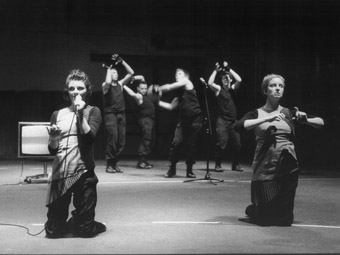
The Border Project, Despoiled Shore Medeamaterial Landscape with Argonauts
photo David Wilson
The Border Project, Despoiled Shore Medeamaterial Landscape with Argonauts
The Border Project is an ensemble of theatre artists committed to charting the future language of live performance, creating performance that communicates with an audience that traditional theatre has left behind. Their work transcends borders, using a performance language that reflects the contemporary landscape, the time and place that we live in–the collision of sound and images from videos, pop music, film, television and cyber-media which surrounds us. The Border Project set out to dislocate our perception of media by re-engaging the live experience, taking the audience with them on a journey of diversity and innovation. The founding performers who hail from Flinders University in South Australia, now work across borders, living in different states and coming together to create their multi-layered work. The ensemble members are Katherine Fyffe, Cameron Goodall, Sam Haren, David Heinrich, Andrew Howard, Amber McMahon, Paul Reichstein, Andrew Russ and Alirio Zavarce. All are committed to a unique ensemble practice, with a shared history, performance skills and an equal involvement in the process of creating work.
In 2002, The Border Project presented its inaugural production, Heiner Müller’s Despoiled Shore Medeamaterial Landscape with Argonauts, and was nominated for the 2002 Adelaide Critics Circle Award for Innovation. In the second half of 2003, The Border Project will be creating a number of new projects, including a durational performance piece, Please Go Hop!, an intimate work exploring games, memory, fear, movement and pop culture with a crazy 80s sound track. The ensemble are also developing a major new work exploring Picnic at Hanging Rock, disappearance in the Australian landscape and the illusion of magic shows.
RealTime issue #57 Oct-Nov 2003 pg. 5
© Rachel Paterson; for permission to reproduce apply to realtime@realtimearts.net
Here’s a homeopathic drop of distilled pure form for RealTime. Melbourne 30-something Michael Farrell is an emerging poet in a potentially submerging artform. His recent book ode ode has a cover photo of 2 plastic forks on a red carpet. Considering poetry books usually have landscape images which reek of the production values and aesthetics of amateur bushwalking guides it’s an overwhelming relief to see—Farrell is a cheap stylist de rigeur. His signature style is the assemblage—there’s virtually no vestiges of the romantic author, what American critic Marjorie Perloff calls “the tedious and unreflective claim for the unique insight and individual vision that has characterised so large a portion of mainstream poetry.” While the lyrical ‘I’ isn’t mobilised by Farrell, you get the sense that he is peculiarly enmeshed by a life he then hives off to form pop poems—“the stuff of late 90s legends.” This energises his work perhaps more than many others of his ilk anthologised in the Calyx anthology (Paperbark Press, 1999), who tend to be more concerned with the changing ecologies and language theory of the post-romantic landscape. However, Farrell is also in dialogue with the artistic tradition he inherits, with poems referring to visual artists (Vermeer to Jeff Koons), dance (tango to “my knees arent much but in/ mes the spirit of the young travolta”), music (“compare the songs you heard this morning with madrigals &/ fitting the words underground overground/ wombling free to the tune & you compose/ a poem”) and film (“this is cinema made by people/ shuffling in gumboots”) as well as inserting fragments of literary and other texts within his poems to form cut-ups. There’s a sense of place, of European tradition as well as the local (“my white arms reach for brisbane”) and even that great poetic motif, birds, get a mention in chirp (“fuck off lay eggs come back to my window/ ill give you ash to peck at”).
Farrell’s modus-poeme is “its better to edit than portray”, and his work is nodal, unpunctuated, even words are often broken at the end of lines, creating interesting disjunction. Just shy of frustrating poetic obfuscation, he “speaks in little phrases like a bee thats afraid of conversation.” I think finally Farrell is Frank O’Hara’s Australian heir apparent, where so many others have tried it’s Farrell who's perfected the requisite combination of laconic camp. Michael Farrell is the Australian editor of Slope magazine (www.slope.org). All quotes from Michael Farrell, ode ode, Salt Publishing 2002.
RealTime issue #57 Oct-Nov 2003 pg. 5
© Keri Glastonbury; for permission to reproduce apply to realtime@realtimearts.net
Alex Davies is a digital media artist working with sound and image integrations and responsive installations. His recent work Swarm, shown at Artspace in June/July this year, was an evolving audiovisual environment built from the live footage of viewers in the gallery captured while they watch the work. This is then played back in real time (with a slight ghostly lag), while a database of prior visitors is randomly composited creating a mixed environment of real and virtual, or in fact remembered bodies. The image constantly shifting across the width of the gallery creates a scoping sensation, and also triggers panning parameters in the sound bed. Swarm produces a disjunction between the viewer’s perception of themselves in time and space as they question which presences are real, which spectral. The strength of Davies’ work is that each element is perfectly integrated. The technology is not used as display (as is often the case in technically advanced new media investigations) but rather as the tool to serve the concepts. This is also the case in the work Filter Feeder currently exhibiting as part of Primavera at the Museum of Contemporary Art (p21). Davies has also recently exhibited Anchortronic Performance and Heterodyne at the Garage Festival, Germany and is involved in collaborations with robotics artists Time’s Up in Austria. http://schizophonia.com
RealTime issue #57 Oct-Nov 2003 pg. 6
© Gail Priest; for permission to reproduce apply to realtime@realtimearts.net
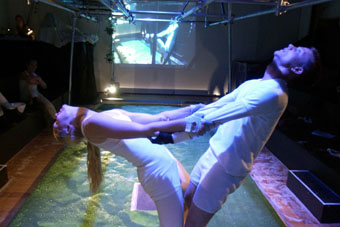
istheatre ltd, White Trash Medium Rare
photo Bruce Miller
istheatre ltd, White Trash Medium Rare
Martin Coutts has just received a RUN_WAY grant to attend the Transmedial media festival in Berlin next year, which he won on the merit of performing, writing and video making with Ryk Goddard (istheatre ltd) for Freezer (a performance installation in a dance party). The artist sees Berlin as the best place to explore his interest in new media works that include performance, particularly in the unique nightclub environment. Lamp is a collaborative project with Tricky Walsh (a visual artist and animator who works in claymation, she is interested in optical and filmic experience). Their “badly made box” using a lens, light and a body—“all that TV is really”—is a proudly “low-tech media” collaboration to these artists. Transparency is important to the artists who believe that being open about the (simple) mechanisms at play means the audience will be less preoccupied with unraveling the way it all works and hence freer to experience the piece. Lamp has been funded to attend the Next Wave festival in Melbourne. Coutts is not averse to ‘higher’ forms of media in his performance. Spect, a new collaboration between dancer Bec Reid and multimedia artist Matt Warren, involves manipulating live feed in an environmental installation. It’s an exploration of site and space and an attempt to resolve one of the challenges of performing with media. Concept and media artists often move out of sync in the developmental process: Martin Coutts is interested in bringing it all together again.
RealTime issue #57 Oct-Nov 2003 pg. 6
© Susanne Kennedy; for permission to reproduce apply to realtime@realtimearts.net
David Franzke is a theatre and dance composer who has successfully convinced directors to accept his often aggressive use of sound. In addition to his beautiful, idiosyncratic scores for dance theatre such as Anna Tregloan’s Skin Flick (2001), he inserted a sometimes bombastic, torn, radio-like soundscape into Playbox Theatre’s Falling Petals (2003). As someone schooled in club DJ-ing, Franzke’s aesthetic merges creative breaks or avant-hip-hop with contemporary, hissy, musique concrète. It is no surprise that Franzke’s samples have included the works of Bernd Friedman (Beige, Freeform, Red Snapper) and the Crazy Baldheads. His work shares the funk and sci-fi humour of the former, while he is collaborating with the latter on a score for the Melbourne Workers’ Theatre’s Yanagai! Yanagai! (2003). Franzke is on the cusp of moving beyond his pre-recorded compositions for others into his own performances and releases. The recent Dancehouse Dance Card season (2003), for example, allowed him to overtly rewrite the emotional content of the solos performed in front of him by visibly mixing deep, loud, funking combinations, while Opera Somatica’s Oculus (2002) enabled him to conduct twisted tango played by a live string ensemble. More gentle musical offerings include his collaboration with Jeremy Downer as Tet et Hok, On the Fly (self-produced, 2002), while his exquisite ghosting of the transitions within electronic space is found on the Strewth! compilation (Synaesthesia, 2002). If Franzke continues to build on such independent works as his live appearance within 45 Downstairs’ Swank series (2003), he is sure to continue to challenge and amuse.
RealTime issue #57 Oct-Nov 2003 pg. 6
© Jonathan Marshall; for permission to reproduce apply to realtime@realtimearts.net
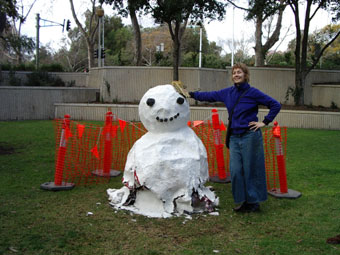
Sarah CrowEST, snow creature
I’ve known of Sarah CrowEST’s work for a long time, yet it’s hard, now, to define it—which is its strength, and its vulnerability (in the best sense). Coming from an established craft background in textiles, the move into arts practice is a mere footstep, an addition and an elasticity. And, language means everything in this move, or movement between and across genres. In CrowEST’s work every move makes a difference—this is the great continual break (and breaking): that everywhere/place is the space of making and showing: unofficial streets, official public space, art gallery, craft gallery. The work seems, overall, one of secreted memory, ambivalent about where things should, or could, or will be. And more, how they might appear, or make an appearance in the world (eg how will a ‘snow creature’ cope in an Adelaide winter). Small passive creatures live in boxes, and other creatures want to live there too; the places we make, make others placeless. This strange divide between place (unconditional) and placelessness (contingent) is a political imperative—how do we regard others (will the black ‘beetles’ crawling up the side of the boxes be welcomed?).
CrowEST makes boxes for those who seem to belong—weird creatures anyway. Other ‘things’ become ‘blobs’; rounded, stone-like, fabric coated shapes—not quite seamless–replete with ‘what’ they might be…tomorrow. Pregnancy is a dangerous state, the benign appears quiet (as hell). There are too many extraordinary works to write of, each finely realised, like the exhibition at Downtown Art Space, earlier this year, where, in the catalogue, Bridget Currie wrote: “A slow heart beating. In parts, the delicate hairiness of spores, mould mounds, fungal bloom…Moist sludgy love.” It is a particular poetic that Currie engages–an illicit quietness. CrowEST’s latest work snow creature, part of BUILT! an ephemeral public art project (an Adelaide Festival Centre Trust Visual Arts initiative), was bashed the first night it took up its position at the King William Street side of the centre. CrowEST repaired it for the next day’s opening. The snow creature was there for 20 days, and continued to be ‘bashed.’ Perhaps all ‘snowmen’ are beaten and broken; that could be their ‘invitation.’ Still, it was a stranger in our midst, incongruous, small, even lost. Sarah CrowEST’s work questions whether care is possible in the face of incomprehension.
RealTime issue #57 Oct-Nov 2003 pg. 7
© Linda Marie Walker; for permission to reproduce apply to realtime@realtimearts.net
Aphids’ artistic director David Young has a distinguished career as a new music composer. The company he is affiliated with is less well known, largely because the fascinating projects mounted under its banner tend to be will-o’-the-wisp events, with long gaps between them. The company has however been enjoying considerable success in Europe for several years. This year’s Melbourne Festival marks Aphids’ definitive Australian coming out, with 2 new music events from the company: a composition from Young accompanied by projections drawn from the FBI’s database of skin colours (Skin Quartet) and a collection of near impossible to play solo contemporary classical violin pieces, performed by Yasutaka Hemmi, as the title suggests, as a kind of Fight With the Violin. The most interesting feature of this company is the way it departs from the annual or biannual concert series so common in new music. Aphids events typically involve a high degree of performativity, with music not necessarily being a feature. For example, theatre-maker James Brennan’s The Glass Garden (2001-2002) is auspiced by Aphids, while another of the company’s projects was composer/ director Richard Rijnvos’ poetic-critical, live staging of Samuel Beckett’s radio play Radio 1 (1999). Productions for 2003 include work by prolific young local playwright Lally Katz, returning to her early interest in writing for surrealist puppetry. In short, while Aphids may not have the rough-shod energy of the old Cabaret Voltaire, their music and performance program reflects a similar interest in contemporary manifestations of avant gardism and cross-arts.
RealTime issue #57 Oct-Nov 2003 pg. 7
© Jonathan Marshall; for permission to reproduce apply to realtime@realtimearts.net
In Nikki Heywood’s The Dark Room at PACT Youth Theatre a very young Karen Therese impressed as a daring and charismatic performer. She went on to train with Tess De Quincey until deciding on the Animateuring course at VCA. Since graduating in 2000 Karen has created a variety of collaborative works and freelanced with companies such as desoxy theatre in Melbourne, where Teresa Blake was her mentor, and Brisbane’s transmute collective. Karen received a kickstART grant from Next Wave as well as support from the Literature Board’s Write in your Face initiative to develop the trilogy, whitegirlblackdreams. Part 1, Sleeplessness, is based on the intriguing story of Karen’s grandmother who was unknown to the family until Karen’s sister began to excavate the history and discovered Lenke Palffy. Born in Budapest, working as a couturier, Palffy escaped post war Hungary for Australia where her 2 small children were placed in orphanages. How she came to be identified as a German man when she died in a nursing home in Annandale many years later is part of the story of Sleeplessness which Karen Therese presents at Performance Space this month during Carnivale. The performance is an attempt to construct a memory of an unknown relative whose life has uncannily provided the map for subsequent generations to follow. The research took Karen (with filmmaker Margie Medlin) to Hungary to construct a narrative of speculative events in Palffy's life. Sleeplessness is driven by Karen Therese’s intense desire to account for a remarkable life and to somehow weave it into her own. Also working on the project are young musician/sound artist Anna Leibzeit (Svila, Next Wave 2002) who uses the rhythms of an insomniac’s sleep to underscore the physical act of memory. Designer/maker Jane Shadbolt creates a latex skin for the projections by media artist Sean Bacon. Direction is by Toula Filokostas. Karen Therese has received a New Media Arts Board Run_Way grant to return to Budapest in 2004 to continue her research.
RealTime issue #57 Oct-Nov 2003 pg. 7
© Virginia Baxter; for permission to reproduce apply to realtime@realtimearts.net

Lisa Reihana & Beata Batorowicz,
Feathers Calling Foxy on the Fone (detail), 2003
The art practice of Polish-born Beata Batorowicz, a self-titled foxy artist, is refreshingly innovative and a source of much amusement. Through fetish bestial garments and objects, large-scale soft sculptures and photographic tableaux she acts out the position of a discontented daughter. Aptly describing this as anti-big Daddy art she expresses an imagined father/daughter relationship, specifically with the late German art hero Joseph Beuys. Both homage and mockery, Batorowicz uses the grossly fabricated story surrounding Beuys for much of her output to which she adds references to the patriarchs of Western art/philosophy: a knight from Duchamp’s chess set and Clement Greenberg’s book The Avant-Garde of Kitsch (1939) for example. The materials and processes used to create (or re-create) these works are loaded with their own histories. In a satirical take on the specifically Polish/German notion of ‘fatherland’ Batorowicz uses traditionally feminine crafts to critique male dominance in the arts. Seemingly disappointed with ‘traditional’ art mediums she introduces knitting, patchwork and sewing to the realm of high art.
Showing great artistic promise Beata Batorowicz has exhibited in several group shows including Hatched (2000) at the Perth Institute of Contemporary Art, Primavera (2000) at MCA, Sydney and in the touring exhibition Gulliver’s Travels (2002/03). Currently completing a Doctor of Visual Art at Brisbane’s Griffith University, Batorowicz has most recently exhibited at the Institute of Modern Art in Readymade for which she collaborated with leading New Zealand artist Lisa Reihana and will next exhibit at the Ian Potter Centre, Melbourne in Fraught Tales.
RealTime issue #57 Oct-Nov 2003 pg. 7
© Shaun Davies; for permission to reproduce apply to realtime@realtimearts.net
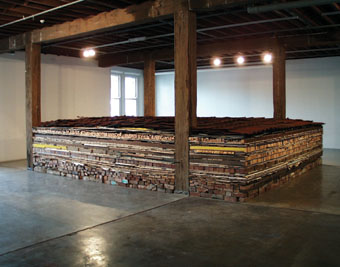
Sean Cordeiro & Claire Healy, The Cordial Home Project
While business pundits prophesied the end of the current housing boom, the judges for the Helen Lempriere Travelling Art Scholarship 2003 (Aug 14) awarded the $40,000 prize to Sean Cordeiro and Claire Healy for The Cordial Home Project, which originally appeared at Sydney’s Artspace (Feb 6-28). The judges commented on the work as “topical and extremely relevant to the current concerns about the affordability of housing in Australia” and described it as “a demanding and ambitious project that is provocative and conceptually informed.” In their note accompanying the work, Cordeiro and Healy wrote, “The exhibition documents the transformation of a house from family home to unwanted scrap to art object. In deconstructing meanings of the home, there is a misguided yearning to discover its real essence as suggested once in its title…[W]e also wish to highlight the absurd delusion of 2 young artists owning a home in Sydney.” There is something at once sobering and exhilarating about the project in the rawness and neatness of the layered components of the original house in its new form (not a little reminiscent of compacted automobiles), a carefully stacked and packed block from which all inhabitable space and the spirit of domesticity seem to have been sucked away. This is compression, artistic and actual, at its most powerful. It was reported that the scholarship will take Cordeiro and Healy to India to work on the collaborative building of a “500 foot materialisation of the Maitreya Buddha, out of a sand cast bronze aluminium alloy.”
RealTime issue #57 Oct-Nov 2003 pg. 8
© Keith Gallasch; for permission to reproduce apply to realtime@realtimearts.net
Vince Miller, an actor in his late 20s, is the founder of Red Stitch theatre in St Kilda. Miller studied dance at WAAPA and in London and spent a year on the West End in the musical Oh! What a Night. He continued working in London fringe theatre, then returned to Melbourne in 2001 to “pour his life savings” into setting up a space for a new theatre to be based around a company of actors. This is the unique aspect of Red Stitch. The company is an ensemble of 12 actors who choose the plays and appoint directors for each project. Miller is dynamic and set the pace immediately by promising and achieving 12 productions in the first 12 months of operation in the company’s converted office space in St Kilda.
The standard has been high and the momentum has paid off. Within a year audiences arrive at the theatre “to see a Red Stitch show”—the self-defeating bind of the one-off independent show has been broken. Red Stitch chooses contemporary plays about the 20-something bracket they occupy themselves. The repertoire so far has been largely American but the most recent shows, Dirty Butterflies and Black Milk, have been by new British and Russian writers respectively. Miller’s background in dance gives his own performances a physical detail and energy that sets a style for the whole company. Red Stitch has recently moved to a 60-seat converted church hall in St Kilda east. For the regular legion of actors graduating from theatre schools each year, Miller has proved that with the right amount of energy you can create work if you’re willing to put the work ahead of the pay packet.
RealTime issue #57 Oct-Nov 2003 pg. 9
© Richard Murphet; for permission to reproduce apply to realtime@realtimearts.net
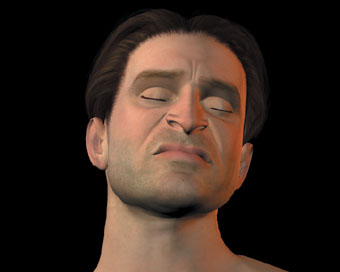
Linda Erceg, from PunchLine, 2003
Hovering somewhere between the urban myths of our collective cultural imaginary and our most private desires and experiences, Linda Erceg’s multimedia narratives splice reconfigured gaming engines, internet porn aesthetics and digitally generated ‘characters’ with dirty jokes, sex confessions and tales of debauched bachelor-party escapades. Naked virtual bodies go one-on-one with viewers, who are somewhat diminished in scale by the enormous cocks, breasts and jiggling nipples which tease, invite and thrust at them, while a pulsing musical score provides a rhythmic, visceral counterpoint to the on-screen shenanigans. Erceg’s increasingly confronting screen-based installations often place the viewer in an extraordinarily intimate space of engagement with the work. Skin Club 2002 features naked, computer-generated characters regaling individual viewers with stories of sexual escapades, reprimanding them if they fidget or walk away from the viewing space.
Punch Line, exhibited this year in the Australian Centre for Photography’s Staring in the Dark exhibition, featured solo sexual performances from a number of characters underscored by a throbbing, repetitive electronic soundtrack and polyphonic recollections of dirty jokes and sex stories. The stories are at once wildly exaggerated and uncannily familiar, a tension echoed in the repetitive, mechanical yet strangely organic quality of Erceg’s animated figures. This schism echoes the simultaneous liminality and extreme banality of a modern sexuality, which is increasingly the product of a fast-paced, competitive technologically oriented culture. In a world where guilt-free satisfaction, or perhaps a simulated surrogate for sex, is only a URL away, with no inconvenient interaction, emotion, consequences or afterglow involved, Erceg’s work provides a means to consider how technology amplifies, distorts and attenuates our desires, leaving the viewer to ponder the meaning/aftermath of their encounter, after the screen goes blank.
RealTime issue #57 Oct-Nov 2003 pg. 9
© Jeff Khan; for permission to reproduce apply to realtime@realtimearts.net
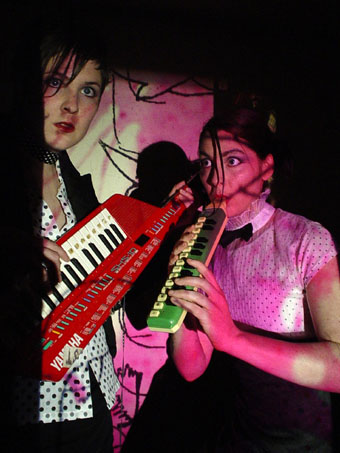
Anna Helme, Louise Terry
photo Rebecca Stegh
Anna Helme, Louise Terry
Electric Dreams is a genre-hopping audiovisual zine performed by The Artesian AV Arkestra (Anna Helme, Louise Terry) a small band exploring the potential of performance with live video.
“We’re a big-band cos we got big-ideas. Live-action video collides onscreen with a comix feel, projecting customised slides and hand-drawn stop animation cut’n’pastried with the latest in digital compositing with Flash/After Effects etc. Our sonic palette includes acoustic character-driven tragi-country lullabies through to quirky pop tunes, upbeat electronica and an atmosphere of textural loops. All of this action is assisted by the newly designed SpaceMaker, a spatial audio and video mixer. This theremin-inspired instrument will be accompanied by a cacophony of out-dated musical instruments and newly modified sound toys. We’re hiding our laptops under the desk and puttin’ on our tie’n’tails to give you a sensory spectacle through a landscape of (s)punky audiovisual oddities. As Rocky and Visage, time-bandits in tinfoil-underpants, Helme and Terry will be the audiovisualnauts guiding the cinematic spaceship. Mark Gomes (Barrage) is our musical filter-psychotically selfish sounds take on the guise of innocence and suave, innocuous melodies bend darkly sinister. Paul Bourke as Vladimir Crow visits this production as a ghost in the machine, embodying the lonely spirit of a cowboy on the plains, Charlie Chaplin caught in the cogs of post-modernity.”
Electric Dreams is being developed for Next Wave 2004 and beyond. Helme also works with with Sean Healy as SPOOLE, an audiovisual duo, peforming at Electrofringe this year. www.sagaponic.net
RealTime issue #57 Oct-Nov 2003 pg. 9
© RealTime ; for permission to reproduce apply to realtime@realtimearts.net
It’s no secret that working conditions for independent dance artists and small project-based ensembles in this country are appalling. Not only do these artists make and present work, but they take on board myriad creative, administrative and promotional issues, including occupational health and safety and public liability. Your average dance artist is unlikely to be familiar with the finer details of all this and exhausted by the endless adminstrivia. This leaves little time and energy for the creative process-assuming there’s any money with which to be creative! Enter STRUT, established by highly regarded choreographer Sue Peacock and freelance administrator Gabrielle Sullivan with the support of Ausdance WA, STRUT assists artists with their funding applications and if an artist is successful, takes on production support and promotion for that project. STRUT also produces 3 2-week programs of studio showings annually, which have been hugely successful with artists and audiences. Artists are, however, responsible for more than turning up to perform. They’re expected to support each other’s work, help on front of house, assist with stage management and participate in the decision-making process. STRUT operates like a collective-artists attend regular meetings where information is shared and programming decisions discussed. In 2004, STRUT plans to pursue skills development opportunities-everything from lighting to intensive movement workshops. Beyond the regular studio performances, STRUT is looking to develop theatre seasons, to extend its network interstate and, in association with Ausdance WA, planning a studio tour that will allow artists across the country to become familiar with the work of their peers. In 2004, studio showings are planned for Adelaide and Melbourne, but these plans are-as the saying goes-funding dependent.
RealTime issue #57 Oct-Nov 2003 pg. 9
© Sarah Miller; for permission to reproduce apply to realtime@realtimearts.net
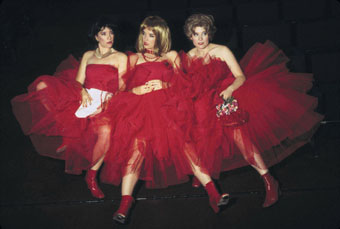
The Fondue Set (Emma Saunders, Elizabeth Ryan, Jane McKernan)
photo Suzanne Brown
The Fondue Set (Emma Saunders, Elizabeth Ryan, Jane McKernan)
I first saw the Fondues (Emma Saunders, Jane McKernan, Elizabeth Ryan) at the now defunct Bodies dance festival: sandwiched between dance pieces taking themselves very seriously indeed, they were a breath of fresh air. Ironic, really, given that they swept us into the smoky, ritualised world of the pub—which is in fact where they originally began performing for their mates. The Fondues are funny, sexy, irreverent, ironic, Sex In The City kind of gals, but less cynical, and definitely more smiley. I can just picture them downing Cosmopolitans with Sarah Jessica Parker and co—red is, after all, their trademark colour from lippy to tippy toes.
Like those cute dashboard puppies with heads waggling on a spring, the Fondues play humorously with repetitive movement in their work—not so much obsessive-compulsive de Keersmaeker-style as playing that fab new 45 single over and over again for the simple teenage joy of it. It’s not so surprising that my terms of reference are to defunct recording formats, there is definitely something vintage—swinging 50s/60s/70s/80s—about The Fondue Set. (How could there not be, named as they are after that essential 70s dinner party accoutrement?) Certainly their recent, full-length piece, Blue Moves at the Seymour Centre evoked prom night and Hitchcockian heroine/ victims for me, alongside its explorations of more contemporary female experience. Blue Moves (2002) was a welcome full-scale development from their earlier vignettes, especially following the less densely layered Soft Cheese (2001), though I did love the hilarious anarchy of that piece—perhaps inevitable when one Fondue appears with a plaster cast plus wheelchair!
Dizzyingly intoxicating, intoxicatingly dizzy, they make me want to put on red lipstick and dance. In high heels. And a frock. Where can I get some shiny red boots?
The Fondue Set’s next gig is at the 2003 Melbourne Festival where they will perform at late night cabaret venue, The Blue Thong Club, in the Black Box at the Victorian Arts Centre.
RealTime issue #57 Oct-Nov 2003 pg. 10
© Laura Ginters; for permission to reproduce apply to realtime@realtimearts.net
Mikhail Bakhtin argued that we only attain our social identity through our public interactions and performances. Carnivalesque performance therefore constitutes the supreme manifestation of unmasked social reality, in which everyone’s adopted roles only function because of their temporary public acceptance. This gives carnivalesque literature its radical quality, up-ending oppressive social hierarchies by crowning the fool “king for the day”, the latter’s role no less real for its fictional, performative character. Like the St Petersburg conman from Gogol’s play who enthusiastically acts the part of government inspector after being mistaken for one, fictional performance becomes true if everyone believes it—a reality today’s politicians know well. Director Daniel Schlusser has drunk deep of such Russian philosophy in praise of literary “dialogism”, carnivalism, masquerade, satire and anarchy. Schlusser’s madly careening production of The Government Inspector for the Hoist theatre collective was replete with performers, largely without artifice, taking on several roles or characters, often in the same breath. Men play women, women play men and the whole edifice of theatrical convention comes tumbling down.
If, as Bakhtin and Shakespeare both claimed, society is a theatre, then Schlusser’s society was one in which the enduring conventions were deliberately arbitrary, shifting from moment to moment, and never entirely relied upon. Often it felt as if we were at a light-hearted “event” rather than a “play” per se, or possibly a free-form (yet well-rehearsed) reading.
Partly because it’s a fundamental convention that sex and gender are essentially immutable social realities, I found the forceful inversion of these rules especially satisfying. Stephen Clements, after standing with his deep cheeks sucking in and out, doffed his helmet-like fur cap and stepped from his coat to reveal his impressive, long, stockinged legs and a fashionably spiked shock of silver hair which would not have been out of place among either the cashed-up dames of Melbourne’s haute shopping strips, or at a Les Girls review—from nervous, corrupt provincial judge to wife of a local petty worthy, in one deft transition.
Schlusser recorded in the program notes that the show’s dramaturgy was based upon “‘theatre crimes’…counter-intuitive responses” such as “to upstage your fellow actor” or “ignore the audience and each other.” Amid all of this artful chaos, it was largely the actors’ commitment to the text—as well as to a common sense of fun and mischief—that ensured things did not fall completely apart. Schlusser staged Gogol’s script unedited, causing the show to run at 3 hours, so the audience returning after interval was notably smaller than before. Although this was frankly over-taxing, it did mean the 4th wall between actor and spectator was annihilated, both having experienced a theatrical auto-da-fe of endurance. By packing so many ideas and so much performative freedom and plasticity into a single production, Schlusser’s reach did somewhat exceed his grasp, but The Government Inspector was more impressive because of its massively conceited excesses.
Nikolai Gogol, The Government Inspector, Hoist Theatre Co., Melbourne, July 10-27
RealTime issue #57 Oct-Nov 2003 pg. 10
© Jonathan Marshall; for permission to reproduce apply to realtime@realtimearts.net
Not exactly emerging but achieving recognition in her own right, Jo Lloyd has performed in Shelley Lasica’s and Sandra Parker’s work over many years. She received a Green Room award nomination in 1999 for her performance of Situation Live (Lasica) and In the Heart of the Eye (Parker, Danceworks). A graduate of the VCA, Jo is not typically ‘dancerly’ though she is quite capable of elegance. She executes other people’s choreography without affectation. The quiet assertion in her work manifests itself through a kinaesthetic immersion in action. She recently performed in the July Dancehouse season, The Dance Card and her work showed that she is increasingly extending her kinaesthetic range, exhibiting more confidence to experiment and therefore create surprising and new forms of movement. Jo Lloyd keeps movement coursing through her body, not in terms of compulsive activity but through sustained rhythmic complexity, tonal differentiations and a really nice bounce that’s capitalized through quick shifts of her body through space. By that I mean she has a certain quality which she takes with her in quickly shifting her centre of gravity. Sometimes this is seen in a range of little lunges, sometimes in a transfer of weight from one side of the pelvis to the other. She can also access an emotive, expressive, gestural palette combined with more abstract forms of action. Her relationship to music takes the form of dialogue rather than illustration in a way which sustains the musicality in her own body. It would be good to see her make and show a lengthy piece of work.
RealTime issue #57 Oct-Nov 2003 pg. 10
© Philipa Rothfield; for permission to reproduce apply to realtime@realtimearts.net
A new force on the Melbourne theatre scene is The Eleventh Hour theatre company, the outcome of a lengthy collaboration between Anne Thompson and William Henderson: its other members are Fiona Todd, Adrian Muller and Carolyn Patamisi. The focus is on investigating the spoken word in performance and particularly the interplay of poetic and dramatic language. The creative task is in part a dramaturgical one: to compose performance from often very different languages while addressing a common image, or set of ideas. Eleventh Hour is at present composing a piece grounded in the world and languages of Oscar Wilde, from the poetry of The Ballad of Reading Gaol, the prose of his fairy stories and the dialogue and epigrammatic wit of An Ideal Husband.
Wine and Blood: another Oscar Wilde opens in The Eleventh Hour Theatre, 170 Leicester St Fitzroy, Nov 14.
RealTime issue #57 Oct-Nov 2003 pg. 10
© RealTime ; for permission to reproduce apply to realtime@realtimearts.net
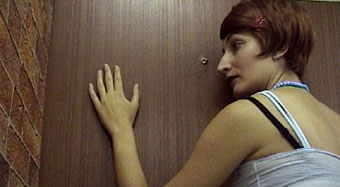
Bianca Barling, still from I wanna drown in an ocean full of love…
Bianca Barling is a recent graduate of the South Australian School of Art. Practising in a hybrid arena of video, installation, photography and performance, her work is remarkable for its lush production values and sentimental aesthetics. Barling’s work has always had an uneasy edge, not quite pure irony, although it is ironic with a lot of depth hiding in its sexy, gloss surface. Maybe it’s about being sentimental in a deep way, or perhaps believing in a situation that has an old script. And a lot of it is about love. Barling’s solo-produced short film, I’ve never walked out of a movie before (2002) made less use of narrative than her earlier collaborative Modern Love Collective works and relied instead on quite still camera shots with strong references to 1940s filmic codes and history. Seductive colour, sadness and retro kitsch pervade the atmosphere. Barling continuously plays with tropes of the stage, building tension between the real, the performed and the recorded performance/image. Her newest work I wanna drown in an ocean full of love…, shown in the CACSA Project Space in 2003, plays tricks with the strange mediation of the camera. A video work played on a monitor inside an elaborate box set. The video performer lay still within the set, which we could peer into through peepholes and windows. This tangled layering of real and constructed characters, places and scenarios is typical of Barling’s work, as is its carefully detailed romance.
Bianca Barling recently received a Helpmann Academy Mentorship, to work with new media artist Francesca Da Rimini.
RealTime issue #57 Oct-Nov 2003 pg. 11
© Bridget Currie; for permission to reproduce apply to realtime@realtimearts.net
Sisters Phoebe and Julia Robinson have been working together and apart. Having trained separately (Phoebe at WAAPA, Julia at Deakin University), the sisters united in a short piece last year. There is something appealing about 2 sisters working together—how are their bodies related? How do they differ? What connections operate between them? To what extent are they the products of distinct forms of training, and to what extent are their similarities due to a shared familial history? There is a trace in their work that I suspect comes from a form of contemporary dance/ballet common to their training. This manifests in lunges, twists, and turns, a torso at the service of long limbs, raised, lifted and kicked. Phoebe performed in Lucy Guerin’s Melt last year, and Julia in a retrospective of Shelly Lasica’s work at the Ian Potter Gallery. Together they trialled a new work as part of the Next Wave Festival. Phoebe made a work for Bodyworks at Dancehouse earlier this year. She has a nice sense of speed and tempo. Like Paul Romano, she shows an interest in jointed action of the limbs but combines this with twists, turns, dips and spirals. Julia has perhaps made less work, but she has a lovely, clear sense of presence, a freshness of composure. This was evident in her solo at this year’s Dance Card (July, Dancehouse)—Julia is able to maintain an internal focus while being watched. Her being and her movement are one. Neither inside herself, nor outside, just present to the action. Fairly simple movements, lunges, turns, twists, changes of levels, very upright, now prostrate. In a flash of deformation an iliac crest leads a differentiated torso. I liked the moments in-between: given the space to fill what is often a void in dance works, Julia instead expands her perceptual appreciation.
RealTime issue #57 Oct-Nov 2003 pg. 11
© Philipa Rothfield; for permission to reproduce apply to realtime@realtimearts.net
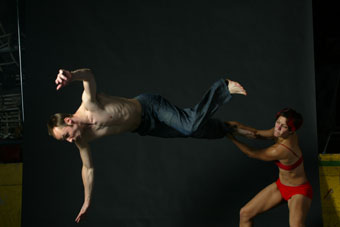
Rowan Marchingo and Alexandra Harrison
photo Daniel Bereholak
Rowan Marchingo and Alexandra Harrison
Alexandra Harrison performs with Legs on the Wall around Australia and internationally, including the Canadian co-production Flying Blind touring nationally in October-November. We first spotted her singular creativity in 2 works (Knots and Diffusion) which she wrote, directed and performed at B-Sharp 2001-2002. She also co-created Together which she performed with Rowan Marchingo. She is currently working with Legs on Eora Crossing, directed by Wesley Enoch, and Cloak of Feathers with Chris Drummond. Harrison was studying Anthropology at Macquarie University when she was waylaid by a 2-week workshop in acrobatics “just to keep me sane” and was hooked. Before this she had lived for a time in Canada where she lied her way into a dance-theatre intensive that gave her a new respect for bodies and articulation. Now she just wants to find as many ways as possible to communicate, to make movement meaningful and on the way, work out how to live, how to stay sane in the world. “I’m obsessive…don’t relax easily ….You have to figure out how to live, how to eat, how to stop yourself from being perpetually pissed-off—getting incensed at the waste when some poor waiter offers you a straw in a restaurant! And what the fuck can art do when nobody in Australia sees it.” She finds Australia a pretty embarrassing place to be at the moment. “What is happening? Everyone is complaining but nobody is doing anything.” Harrison’s at exploration stage, working on a new solo about sleep and narcolepsy with theatre director/writer Michael Piggott which we’ll hopefully get to see at B Sharp in 2004. Alexandra Harrison is an edgy, sexy and very skilled performer and choreographer who likes working in physical theatre, creating her own pieces while contributing to the development of Legs’ work. “Unlike a lot of forms, physical theatre is still undefined. So there’s space for someone like me and my ideas…The fact that it’s growing and unsure of itself makes it more exciting.”
RealTime issue #57 Oct-Nov 2003 pg. 13
© Virginia Baxter; for permission to reproduce apply to realtime@realtimearts.net
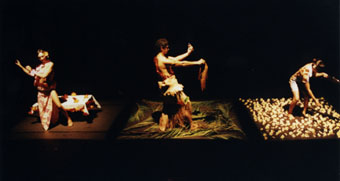
Polytoxic
Ioanne Efeso Sidney Fa’anana is a New Zealand-born Samoan raised in Ipswich, Queensland. Efeso became Fez when his Australian teachers “would pause then stutter when it got to my name on the attendance roll!” This early experience of cultural friction finds contemporary resonance in Fez’s work with Polytoxic, the dance company he founded with Lisa Fa’alafi in Brisbane in 2000. Suzuki-trained Leah Shelton joined the group in 2002. The “poly” in the company’s moniker refers to their Polynesian roots and to the polyvalent voice they are finding as they fuse traditional Samoan dance with hip street and physical theatre sensibilities. Working extensively with the Youth Arts network in Queensland, Polytoxic have performed at events as diverse as the Asia Pacific Triennial at the Queensland Art Gallery and, soon, at uber-cool Valley nightclub, Family. They have collaborated consistently with local indigenous groups as well as other Polynesian communities in Brisbane and want, in Fez’s words, to “create performance that can reach and relate to as many cultures, subcultures and sub-subcultures as possible” in order to push dance genre boundaries and debunk orientalist notions of Polynesian dance as “floor show” entertainment for Western tourist consumption. Their forthcoming production, Teuila Postcards, a collaboration with Brisbane design, art and music outfit Rinzen, for instance, detonates reductive stereotypes of dusky island maidens “combing their hair on a rock” and Hills-Hoists in taro-leafed Samoan Australian backyards. Fez’s sharp satiric eye (which he attributes to an early diet of Young Talent Time and the Solid Gold dancers) combines with an astute cultural-political sensibility. Polytoxic is a formidable, innovative company worth watching.
RealTime issue #57 Oct-Nov 2003 pg. 13
© Stephen Carleton; for permission to reproduce apply to realtime@realtimearts.net
Rowan Marchingo and Alexandra Harrison
photo Daniel Bereholak
Rowan Marchingo and Alexandra Harrison
Rowan Marchingo appeared in the 4 on the Floor season hosted jointly for 2 years running (2001-2) by physical theatre company Legs on the Wall and Company B Belvoir Street’s B Sharp program. Evident in his work was what appeared to be a new hybrid with the athleticism of physical theatre combined with a sinuous and sexy, more dancerly vocabulary. Marchingo is a graduate of Rusden College (Deakin University, Melbourne) who also trained for a year at the National Institute of Circus Arts. After graduating, he freelanced with members of the band Augie March (Holistic Invention), with choreographer Jodie Farrugia (InOutside at Dancehouse) and Object! with fellow Rusden-graduate Gerard Veltre. He also worked on a number of youth and community projects including Cyberdance involving 100 participants, before moving to Sydney in 2000 to join Legs on the Wall. Together, the work he choreographed for 4 on the Floor was a duet for Marchingo and Alexandra Harrison focussing on the difficult balance between sameness and difference with which we all struggle in relationships. AFTRS student Madeleine Hetherton’s film of this work is in post-production for release in 2004. Rowan Marchingo balances his workload with Legs (including a recent tour to Berlin and creative development on 2 new works with Wesley Enoch and Chris Drummond) with forays into the community dance arena, working as choreographer and tutor. This year, he’s participated in a creative development with Fling, a young dance company in Bega and choreographed Group Dynamic, a short dance piece for the Australian Choreographic Centre’s Quantum Leap Youth Ensemble.
RealTime issue #57 Oct-Nov 2003 pg. 13
© Virginia Baxter; for permission to reproduce apply to realtime@realtimearts.net
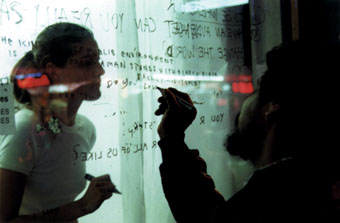
Astra Howard, Public (private) living spaces II, Kings Cross, 2000
Parts of Astra Howard appeared in the Outside In exhibition of works by UNSW College of Fine Art faculty members and PhD candidates curated by Rilka Oakley at Ivan Dougherty Gallery earlier this year. In particular, one of her legs and an arm protruded from a white box high on the gallery wall creating a troubling sense of exclusion and confinement in the bodies free to roam the gallery. The Other (Inside) II is one of a number of public actions captured on video and replicated as a live performance during the exhibition. As well as galleries, Astra has performed this action on the streets of Sydney and Delhi. Winner of a 2002 Samstag International Visual Arts Scholarship, Howard has recently returned to Australia after a year travelling in Beijing, Paris, New York and Delhi comparing attitudes to public and private, stationary and transitory, individual and community and sense of concealment and exposure. In her ongoing project, Vagrant Landscapes for Transitional Bodies she asks, “What are the various contentions experienced by an individual interacting within an urban public space environment, and how can these positions be recorded, activated, manipulated or remembered?” In other actions, Howard has taken to city buildings with a stethoscope (Blindspot: feeling cities, 2001) and in Public (private) > living spaces II, 2000 occupied a Kings Cross tobacconist’s for a week, communicating with passers-by in written conversations on the glass.
RealTime issue #57 Oct-Nov 2003 pg. 14
© Virginia Baxter; for permission to reproduce apply to realtime@realtimearts.net
Emile Zile, Larry Emdur’s Suit
Emile Zile is a Melbourne-based artist who reuses media the stuff of television, print and the internet—in a range of works for VJ, performance and installation (www.bubotic.net). A graduate of Media Arts at RMIT, most recently he took part in the Composition show at Degraves Street subway in Melbourne. For this he made a series of “wartime psychosexual” slogans in red vinyl lettering with red neon. They were “mutated advertising jargon for alert commuters; text blobs of compressed meaning: GRASS IS GREENER SUICIDE BOMBER; LICK MY ZIP SAVE MY BEIGE; ENTERTAIN ME WHILE I CHEW.”
His video work Larry Emdur’s Suit is a classic. Finding himself a contestant on The Price is Right, Zile successfully guessed the price of the Nursery package and moved up to share the stage with host Larry Emdur. This is where Zile ‘performs’ himself in a bizarre series of hand gestures and contorted postures to which Emdur responds by mirroring. Zile effectively bends the materiality of television to his will, making Emdur follow his dance. It is hilarious and very, very strange.
His most recent work is Holy Cow, a reworking with original internet audio and video clips of people watching the WTC destruction from their office windows. Zile says, “I hope to excavate deeper levels of meaning in the material than the immediately audiovisual, by re-animating that material in another context, often in live performance-manipulation of the multiple perspectives of one event and magnifying the intersections of personal, social and televised history. I am obsessed by the individual frame that separates a home video from an international news item.”
RealTime issue #57 Oct-Nov 2003 pg. 14
© Linda Wallace; for permission to reproduce apply to realtime@realtimearts.net
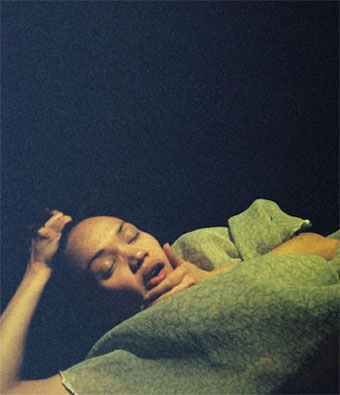
Nareeporn Vachananda’s Konstantinos Tsetsonis
Nareeporn Vachananda’s choreographic development is striking not only because of various performance opportunities—Dancehouse’s open seasons, Great Escapes (1998-9), curator/performer Stephanie Glickman’s Focus 4 (2002), but also from initiating her own, small-scale program of works–in-development: the Inspiration Series 1 and 2 (2003). This series showed her solo work-in-progress Opposite My House Is a Funeral Parlour and studies by Ashley May Mariani (Program) and Ilan Abrahams (Ritual For ReInhabitation). Vachananda has a slight, thin form, which she employs with considerable grace and poise in performance. She worked with the Grotowski-inspired dance-maker Tony Yap in director Michael Kantor’s production of Meat Party (2000). Yap’s often violently ecstatic technique has imparted a radical darkness and ambiguity to Vachananda’s choreography, distancing it from Western cliches of grace in the female Eastern dancer and rearticulating those qualities already embedded within Vachananda’s movement and physique, into a more progressive, avant-garde context. Vachananda’s current project is an ambivalent study of the twisted psychokinesis generated by the meditation of the individual on death and absolute negativity and how this can act in some contexts as a positive journey with an uncertain and potentially revelatory significance for the living subject. The Inspiration showings indicate that Vachananda’s solo is already an arrestingly layered, minimalist work; a style she seems likely to continue to investigate, building on her formalistic study mounted within Focus 4.
RealTime issue #57 Oct-Nov 2003 pg. 14
© Jonathan Marshall; for permission to reproduce apply to realtime@realtimearts.net
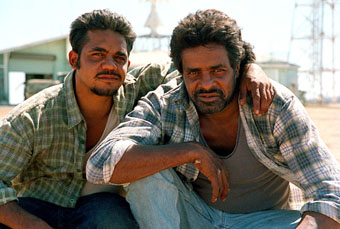
Wayne Munroe, John Moore, Cold Turkey
Where does the short feature film sit in the film industry as a creative form and something to sell? While Australian-made documentaries can fill an ABC or SBS 50 minute slot with some regularity, how often is it we see an equivalent drama on television? And what life is the short feature likely to have in the cinema, except in the most subsidised of circumstances? The Australian Film Commission AFC commenced regular funding of 50 minute films several years ago, partly as a response to cutbacks which had made the funding of low-budget feature length films increasingly difficult. The 50 Minutes From Home—An Australian Film Festival, touring the country throughout September and October, showcases 9 of these recent short-feature productions.
The 50 minute film program has undoubtedly been successful in maintaining a level of production for new directors in a time of increasing financial strain for Federal Government funding bodies, but the turn to 50 minute features also highlights an underlying problem in the Australian film industry. In the 1990s, and into the present decade, directors lucky enough to get their debut features off the ground have rarely been given the opportunity to develop their talent with follow-up features. Audiences are constantly given glimpses of nascent talent never allowed to develop beyond the embryonic stage. 50 minute features have allowed a group of new directors to move from shorts to longer-form dramas, but the program does not address the fact that true directorial development requires a sustained career in feature production over many years. Furthermore, like the current crop of full-length Australian features, most of the 50 minute films reflect a broader stylistic conservatism that seems to plague Australia’s screen industries.
A career bridge?
Carole Sklan, Director of Film Development at the AFC, believes that television is the ultimate home for 50 minute films, since they are generally not viable in a commercial distribution context. This fact is reflected in the heavy involvement of broadcasters in funding these films. Of the 9 short-features in the 50 Minutes From Home festival, 6 were co-funded by SBSi, one was co-funded by ABC drama, and one is an SBSi and NSW Film and Television Office (FTO) co-production. Only The 13th House was entirely funded by the AFC, without any pre-sales to television. The makers instead intend to rely on festival exposure. But as director, Shane McNeil points out, the 50 minute length can present problems in a festival context. Depending on the event, the film is sometimes expected to compete with full-length features, while at other times it is classed as an overly-long short. The AFC and SBSi are to be commended for recognising these difficulties by programming cinema screenings.
While it’s impossible to predict that the 50 minute program will succeed in assisting a new generation of Australian filmmakers to make the leap to full production, Sklan believes it has played a vital role in maturing the filmmakers involved: “When you have to tell a story on screen for a sustained amount of time, it requires the development of story and structure, explorations of character, and a range of emotional tones. I feel that these teams are now in a much stronger position creatively, and in terms of their craft and technical expertise, to handle a feature-length film.” McNeil concurs: “Previously, a director would make a couple of shorts and if they were lucky they would be given a feature. They’d jump in and have to sink or swim. If they sank, it was a long time before they swam again.”
While there can be little doubt that a 50 minute production provides valuable experience for a filmmaker, the program does not solve the problem of the overall shortage of funds for feature production. As already noted, the Australian film industry is full of filmmakers whose careers consist of several shorts and one feature. Unless the AFC can continue to support most of the 50 minute filmmakers, there is a real danger that the scheme will simply produce a generation of directors whose career instead consists of a few shorts and a 50 minute feature. This is not a criticism of the AFC or the 50 minute initiative per se: the organisation has effectively managed to maintain a level of production in a funding environment not of its own making. There is, however, a certain fruitlessness in fostering talent in this way if we, as a nation, are not prepared to then support its full flowering.
The films
Without the financial risk of a feature production, the 50 Minutes program also potentially offers the opportunity to explore the kinds of formal and thematic possibilities so rarely seen in contemporary Australian features. Judging by the films of the festival, however, this has not generally occurred. With the exception of The 13th House, and to a lesser extent Cold Turkey, the films remain firmly within the naturalistic dramatic tradition that has dominated Australian cinema for decades.
Whether this is a result of the AFC’s selection process, or the nature of the projects applying for funding, is difficult to tell. It’s also possible that the involvement of television broadcasters has played a determining role although SBSi is certainly the most adventurous funding body associated with free-to-air television in this country. But it is perhaps significant that The 13th House, by far the most stylised film in the festival and the only work to operate outside the conventions of naturalistic drama, is also the only project made without the involvement of a broadcaster. A metaphorical tale about employees brutalised by corporate culture, the film was originally conceived as a television pilot for a Twilight Zone-style anthology series, which was unable to attract any interest from the Australian television sector. The makers of The 13th House were able to realise their project exclusively on AFC money by working within a budget several hundred thousand dollars below the average of the other films in the program.
Steven McGregor’s Cold Turkey (RT 56, p18), like The 13th House, is formally challenging and continues the trend in Indigenous Australian cinema of powerful dramas not afraid to engage with the country’s social, political and historical conditions. Jessica Hobbs’ So Close to Home also manages to engage, to an extent, with issues outside the interpersonal familial concerns of most of the films, centring on the plight of a young immigrant whose mother is in an Australian detention centre.
Overall, however, the films in the 50 Minutes From Home festival remain within the sphere of the family or interpersonal relations, and tell their stories in a very traditional naturalistic style. Which is not to say they are not of a high standard. Martha’s New Coat in particular is distinguished by an outstanding script and a searing performance from Matilda Brown in the title role. Roy Hollsdotter Live offers an intriguing rumination on the performative nature of the faces we show our friends and lovers, through the tale of a disintegrating relationship between a stand-up comedian and his girlfriend. The film also features some effective passages of expressionistic editing and lighting, punctuating an otherwise fairly straightforward narrative.
50 Minutes From Home played in Sydney’s Valhalla Cinema just a few weeks after the venue hosted the Next Generation 2003 showcase of short films by new German directors, as part of the BMW Festival of German Cinema. The contrast between the range of styles and subject matter on display in the German shorts was striking when compared to the relative homogeneity of the Australian films.
50 Minutes From Home-An Australian Film Festival, presented by the AFC and SBSi, various cinemas around Australia, touring from Sept10-Oct 25
RealTime issue #57 Oct-Nov 2003 pg. 15
© Dan Edwards; for permission to reproduce apply to realtime@realtimearts.net
Looking around and not really knowing where to find new documentary filmmakers (even though, I realise now, they’re all around us, except I don’t always think of them in that way—new/old etc—I mean, does that really matter?) I’m introduced fortuitously to a new series of half-hour documentaries on SBS called Inside Australia. All new directors, several with little or no broadcast or filmmaking experience, and a determined push to put them up the front of the schedule—7pm on a Sunday. What could be better? Let’s see…
Meet George from Aurora Scheelings’ The Trouble with George (the first film on the schedule) except he’s not really trouble, he’s a delight, albeit maddening, infuriating, a handful, 2 handfuls even. George is 81 with the mental age of a small child. Brian finds him living in a bus shelter so he takes him home to his wife, Jennifer, and they look after him. Now, several years on, Brian and Jennifer have parted but Jennifer is still caring for George. “Why?” you might ask, as this film does. George is a character but you know he’s hard work-imagine an irascible old man with a toddler’s temperament-although you can also see why he’s still with Jennifer after all this time. It’s an unusual relationship, partly mother/child but also one of companionship and mutual need, an irresistible emotional call and response. The film’s strength is that it makes sense of it all without wrapping it up too neatly–in the end, we don’t really know what will happen to George and Jennifer but that’s okay.
In Me Me Me and ADHD, directed by Shelley Matulick, Ben is a 21-year old with, that’s right, ADHD—he’s practically bouncing off the insides of my TV, so much energy pouring down the tube. Not that Ben is going down the tube, he’s right there dead centre—I mean, of course, there’s a documentary being made about him-who else? His family are there too, although rather more battle weary and circumspect. They don’t really come alive to the same degree as Ben but that would be hard to do anyway (only the boy who lives down the road, also diagnosed with ADHD, comes close). The film works because it doesn’t try to airbrush ADHD but manages, mainly, to show what it’s like to live with it on both sides, inside and out.
Disturbing Dust (director Tosca Looby) is a very ordinary story in that it is about a woman, Robyn Unger, dying of cancer, an everyday occurrence for somebody, somewhere, and something that is oddly banal for all its awfulness. In this instance, Robyn has mesothelioma, which she contracted as a result of handling asbestos sheeting 25 years earlier. There’s understandable anger that an activity as innocent and matter-of-fact as building a house should lead to such painful consequences decades later, but it’s to the credit of everybody involved that this outrage doesn’t obscure the central, inevitable process of somebody dying with whatever dignity is allowed. In one scene, Robyn farewells her work colleagues who, watch wide-eyed and dumbfounded by what’s happening, even as Robyn chats matter-of-factly about her cancer. At times, Robyn and her husband, Peter, appear incongruously cheery as they prepare for death, in the manner of people trying to jolly themselves along in the midst of great pain because the alternative doesn’t bear thinking about.
There’s nothing lightweight about these topics and the rest of Inside Australia promises more of the same but on the evidence of the first 3 episodes, the effect is undeniably positive. It’s continually amazing–what people can do—and this is something the directors all seem to recognise and value. The episodes are pacey and taut as befits a half hour slot, no gradual unfurling or leisurely settling in-the subjects fill the space and the screen and the immediacy is an obvious counterpart to the intimacy between the directors and their protagonists. The filmmakers are savvy, as are the subjects.
Obviously, in half an hour, there are going to be elisions and lacunae–you sense there must be more to George and Ben and Robyn and their situations (there are hints of this in the films anyway)—but I guess we’re mature enough now in our viewing to understand that this is television and half an hour with these people is far, far better than nothing at all.
The 3 opening episodes, for all their differences, document the pressures of living together today, especially when those pressures are intensified by specific challenges; Inside Australia, in this instance, means indoors, in the family home, and the dramas played out in bedrooms and kitchens. Other episodes promise to take us outdoors, but the focus remains tight-individuals, families, small communities-as if these are the basic units with which to build an understanding.
‘New’ documentary, in this instance, means staying close to home and watching the daily dramas of people trying to get by in the extraordinary everyday. Perhaps these documentaries are a reaction to the seamless gloss of ‘lifestyle’ and faux reality where a simple makeover can seemingly make everything okay. Undoubtedly, too, it’s easier logistically to make these ‘home’ movies, especially for first-time directors. ‘New’ means something well-formed but fresh, a personal engagement that doesn’t necessarily equal ‘SBS documentary’ but ends up there anyway. It takes a fair bit of passion to make documentaries this way-why else would you do it?–but the results speak for themselves.
Inside Australia was commissioned at SBSi by Commissioning Editor Marie Thomas who is upbeat about the state of the documentary as exemplified by the directors in this series: “At the moment I think Australians have every reason to be positive about their industry. I think that it is on the move and we are on the crest of a new wave of creativity. Certainly at SBSi we feel that we have been allowed to renew our remit to invent and change. I sense that the industry is loosening its stays. There are a host of really bright, committed new filmmakers out there-under 35, full of fight, ideas and attitude. Just what an industry needs to thrive.”
Directors mentioned by Thomas as the ‘tip of the iceberg’ (not just new but emerging talent) include Aurora Schellings, Emma Crimmings, Melanie Byres, Zane Lovett, Kate Hampel, Shelley Matulick, Rebecca and Jonathon Heath, Sean Cousins, Tosca Looby, Faramarz K-Rahber and Anthony Mullins and producers Melanie Coombs, Anna Kaplin and Celia Tait.
The challenge now is to ensure that the ‘new wave’ translates into something sustained and sustainable for these directors, with enough impetus, perhaps, to push them toward more, bigger and better projects. Thomas believes that the local documentary scene has been playing it “a bit safe” lately, leaving it to overseas sources to develop new forms and reinvigorate old ones. “Worst of all, this conservatism isn’t bred by lack of funds. That’s fumbling with fig leaves. We’re the cause of it. Filmmakers and broadcasters alike,” she says.
“When I arrived in Australia, I was fresh from the frontline of the terrestrial UK market where a lot of the broadcasters’ time is spent considering who will watch and why, balancing ‘should-be-made’ with ‘it’s-what-they-want’ programming. On my arrival, I was shocked by the ‘bugger ‘em’ attitude towards the viewer that I found amongst filmmakers here. It seemed so counter productive.
“First and foremost, television is a medium that needs to be watched in order to be effective and second, we are dealing with viewers who have been watching television for half century and documentary for longer than that. To assume they can’t make informed choices seems to me to be arrogant. Good ratings don’t equal dumbing down-and yet that was the regular war cry I heard from all around.
“Recently SBSi and the independent sector have been given the thumbs up by the channel’s television management. Ned Lander, Senior Commissioning Editor, and I have been told to give our TV instincts and new ideas a go-ideas that perhaps a year or 2 ago may not have been seen to be fitting or ‘the thing’ for the channel to do. Personally I feel that we are being allowed to open the door to new players and fresh content and being given the opportunity to widen the vernacular of documentary output. From now on, programs can come in different shapes and sizes, as will budgets. We have been given the opportunity to play with light and shade in the schedule.”
Inside Australia isn’t going to change the scenery overnight but it is a good start. Stay tuned.
Inside Australia Sundays 7pm, SBS from October 12
RealTime issue #57 Oct-Nov 2003 pg. 16
© Simon Enticknap; for permission to reproduce apply to realtime@realtimearts.net
Pests
Victor Abbott started as an engineer. Angela Walsh developed her skills in radio and television. Directing his own short films provided Judd Tilyard with an understanding of “how hard it is to be a director without the proper support a good producer can offer.” Emma Spencer discovered that she “was always the one organising everything for the shoot, and making sure everything got done.” From these diverse backgrounds, a group of promising producers is emerging in Queensland.
Recent decades have seen the producer’s role diluted as discourses of auteurism gained critical and popular mindshare. In contrast to the Hollywood studio heyday, when the producer was the dominant figure, and the director more often “the producer’s brother-in-law” (Gore Vidal), recognition for contemporary producers, even in film culture, is often scant. The image of the demonstrably ignorant financier-philistine producer, rolling onto set occasionally to loudly oversee proceedings before retreating to power lunches, is light years away from the kind of producing done by these Queensland independents. Rather, work in the ‘slog years’ is characterised by long hours and minimal remuneration driven by a personal connection to the work.
Judd Tilyard says: “to me a producer who’s just about putting together the details is a glorified production manager–if they can’t understand why making the film the best it can be is important, then why are they doing it? If you’re seeking money or fame there are better professions out there.” Most producers have to subsidise their work with other jobs; Walsh does voiceovers to support her “filmmaking habit”, and Abbott concentrates on “fewer but quality projects” rather than navigating “the financial instability of being dependent on filmmaking for a living.” For Spencer, producing is just one of many things she does as manager of a multimedia production company.
Philosophically, there is much that unites this group. All, for example, are utterly pragmatic when talk turns to their own creative capacities. “As I can’t direct and am not a masterful writer, but have the skill to work with others, understand a vision, organise things and get things done”, Abbott says, “producing appeals to me.” He adds, “it’s important for the creative producer to understand that their main job is to support the director’s vision.” While Tilyard “hasn’t given up on directing”—he is warmly regarded in the close-knit Queensland film community and in high demand–there’s a certain inevitability (about the job) to which even he seems reconciled. “It’s simply part of who I am.”
Likewise, though Emma Spencer enjoys writing and directing, she finds she needs “to be involved as a producer on some level with every project I work on, it helps me feel a little more in control over a medium that generally runs along the lines of barely organised chaos at the best of times.” Despite numerous awards for writing, Angela Walsh says: “you can be good at something and that doesn’t mean you want to do it.” Work across other media has solidified Walsh’s self-knowledge and her sense of purpose: “I can direct, but it’s not a burning ambition. I get quite excited about finding someone who’s very good at what they do and matching them with someone else… and then making this team who are really excited about a project—there’s nothing better.”
This clear-eyed assessment of individual skills and talents links with a belief in the incontrovertibility of specialisation. For Abbott, “it’s important to get buy-in from the production team”: this means not only being responsive to “what they want to get out of the production” but “respecting crew and cast disciplines—I believe in the tenets of ‘the director directs, the producer produces and the actor acts’.” Believing passionately that “everyone has a gift, and they’re going to look into every facet of that”, Walsh sees the job of producer as primarily about cohering specialisations. Spencer agrees: “it sometimes feels like trying to mix oil and water, but it is the producer’s job to be aware at all times where each of the elements are and to make sure they come together in the end.”
Undoubtedly the greatest challenge for producers, emerging or otherwise, is budget. For Walsh budgets are the biggest trial, outdoing even last-minute shocks like a child actor disfigured by a skin condition the day before shooting. For Tilyard, they are the necessary limitations against which a producer displays their mettle; “it can feel like you’re drowning in problems, but you have to remember, it’s times like these that define a filmmaker’s life–these are the war stories you’ll tell at parties.” Spencer puts it in a typically laconic, Queensland way: “no matter how much money you are given it is never enough and you will always have to find ways to rebuild the Titanic when there is only $22.50 left in the art department.”
Offsetting these budget trials, the producers recount myriad tales of assistance and encouragement from the film community, from donations of equipment and resources to mentorship and exceptional generosity. Tilyard recently worked on a production where camera assistants from interstate offered time and experience, demonstrating that the community is national and “how people pool together to make dreams a reality.” The legendary intimacy of the Queensland community figures largely too: “everyone from suppliers, local professional crew, film school graduates, established producers, production companies and other industry practitioners are all willing to help and offer advice or services,” says Abbott, adding “there’s a real camaraderie and cooperative spirit among Queensland filmmakers.” Walsh decided to pursue her producing ‘up north’: “I quit my job, went freelance and came up here. I thought, if I’m going to be broke I may as well do it where it’s warm!” Her connection to place is common to many Queenslanders: “I’d love to be based in Queensland and have a successful production company here, get stuff off the ground and bring really good actors here and get great new ideas up–get people to live and work in Queensland.” For Walsh, this means work overseas, “to learn from different people, then bring it back here.”
These producers ultimately learn to be masters of realpolitik: “you have to be prepared to just throw everything into keeping the film running,” says Tilyard. Walsh agrees, “the producer’s role is to say ‘regardless, we can make this film happen’.” Abbott’s pre-film career furnishes him with a sense of civic duty: “I guess it’s the engineer in me that wants to see things made for the good of society.” After some serious soul searching he says he “wasn’t interested in TVCs, corporates, music videos etc, but in telling stories about who we are as people that resonate with my spirit.” For Tilyard, it’s only natural “when you surround yourself with talented people they will have great worlds of their own dying to be brought to life.”
Never underestimate a good producer, says Spencer, “they can move (or make) mountains for you if the project needs it and despite the bags under her eyes and the tufts of hair falling out from stress, she will always ensure that there is room in the budget for a slab of beer at all production meetings…A good producer is a woman with her priorities set straight.” Abbott concludes, “filmmaking can often be soul destroying and heart-wrenching but when you see the collective creation up there on the screen, the joy makes it all worthwhile.”
Recent Producing Roles: Angela Walsh Tongmaster, Judd Tilyard Pests, Emma Spencer The Last Hour, Victor Abbott Brace Yourself
RealTime issue #57 Oct-Nov 2003 pg. 17
© Danni Zuvela; for permission to reproduce apply to realtime@realtimearts.net
Film festivals are places of intersection between national cinemas. This year’s Melbourne International Film Festival provided the space to compare the cinemas of host Australia; and South Korea, which MIFF director James Hewison has championed so strongly and which was represented by 13 features this year.
Both countries are currently contemplating trade treaties with the US in which film and television quotas are potential bargaining chips. Both have production industries that have enjoyed crucial government support through national film commissions. However while South Korea is the success story of recent national cinema, claiming up to 49% of its domestic box office, Australian figures are in the 3 to 4% range. While Korean films are showcased in the growing number of Asian-focused festivals around the world, the conservatism of Australian filmmaking has seen it decline into insignificance at international festivals.
On the basis of what was screened at MIFF, the impressive thing about Korean cinema is the sheer range of production, from commercial genre films such as the wu xia pian swordplay of Bichunmoo and the bloody political allegory of Sympathy for Mr Vengeance, through youth cult movies (Save the Green Planet!, Resurrection of the Little Match Girl) to glossy commercial art-house studies of amour fou (Ardor and Roadmovie) to festival auteurs such as Hong Sang-soo (Turning Gate) and Lee Chang-dong (Oasis). Lee’s recent appointment as Minister of Culture in the new government signals the film industry’s ascension to a significant political force.
This variety of styles and genres in Korean filmmaking indicates a successful meshing of production and screen culture, and impressively most films at MIFF were debut features for directors. The high-level of competence of first time feature directors indicates a strongly supportive industry structure—if not the genius of the system, at least a strong professional cleverness.
By comparison, the label “emerging filmmaker” has taken on a hollow ring in Australia. It is associated with the announcement of “exciting new initiatives” and the consumption of free wine and hors d’oeuvres rather than the building of oeuvres.
Unfortunately the Australian films at MIFF revealed a national cinema that is struggling. Films such as The Rage in Placid Lake, Japanese Story, and Travelling Light stem from an industry context more at home with the theatrical values of Acting and Dialogue than with a vital knowledge of contemporary screen culture. The emphasis on development within film policy seems to be developing the mannerisms that have led Australian filmmaking down to its current state.
Whereas Korean films appealed to a vibrant, technologically savvy, viscerally sexual and violent youth culture, we got The Rage in Placid Lake, a film completely constipated by its own cleverness. Its own startlingly sexist conservatism—boys can fuck around but heroines still have to be virginal—hides beneath a cool which proclaims itself superior to both the right and the left. Style children drink martinis and frolic and are, of course, envied by the unhip straight world that they mock.
It is notable that the major Australian prizewinner from MIFF, Undead, which won the FIPRESCI critics’ award, is a low-budget genre film produced by cinephile enthusiasts without any government funding support. The critics’ citation went out of its way to signal that the film was “everything that Australian films are not supposed to be–popular and disreputable.”
Films are tangible indicators of broader production contexts, and it is worth citing two factors in explaining the differences between Australian and South Korean filmmaking. The first is the relationship of each industry to Hollywood. Korean cinema enjoys the ability to differentiate itself from Hollywood on linguistic grounds. It also has sufficiently strong corporate backing to enable it to compete with moderately budgeted entertainment films. Australian films rely much more heavily on government support, which is smaller and less tied to popular response.
Consequently, Australian cinema has a history of seeking places in the tasteful margins. The cultural capital that has accrued from the Hollywood careers of Australian actors such as Russell Crowe, Cate Blanchett et al has resulted in a national screen culture dominated by a star system that has moved offshore. As the Australian industry struggles for popular success, it is now looking to small local comedies. This is a familiar strategy in many countries. Comedies may not travel well, but if you give up on your international ambitions, you can at least limit the downside, and every so often you get a Crackerjack or The Castle.
A second set of factors concern the way that Korean cinema has grown on the back of an increasingly regional appeal. The Pusan Film Festival has quickly become one of the major sites for regional deal making through which Asian film industries have supported each other so effectively. Screensound’s recent restoration of the 1970s action film, The Man From Hong Kong, perhaps stands out here as a symbol of the path not taken. Australian post-production work on recent Hong Kong/Chinese films such as Hero and So Close provides isolated instances of the opportunities for links with regional production, rather than simply concentrating on an annual Cannes push or the vagaries of international co-productions with Europe or North America.
One conclusion that might be drawn from the Australian films at MIFF this year is that the production of dramatic feature films is beside the point in Australia. It is increasingly evident that the strength of our filmmaking is in documentary production financed by television. The optimist might look to 2003 as Year Zero, the year when we saw it wasn’t working and that we need to try something else.
Australian filmmakers and administrators need to stop pretending that they are “telling our stories”—stories in which we collectively seem to be manifestly uninterested. Let’s propose a new start, which includes going to the movies more often to see what’s emerging in countries such as South Korea.
RealTime issue #57 Oct-Nov 2003 pg. 18
© Mike Walsh; for permission to reproduce apply to realtime@realtimearts.net
Two Western Australian filmmakers, Andrew Ewing and Jennifer Jamieson, have recently consolidated their position as emerging film talents by securing one of 3 Filmex short film production grants provided by Screenwest. The $62,000 grant will enable writer-director Ewing and producer Jamieson to realise their short drama Automatic, a detailed character study of the relationship between a husband and wife who are challenged by past and present trauma. The pair make a formidable creative team and have previously collaborated on various projects. Both teach screen production and photography at Murdoch University and reflect the strength of the developing inter-campus Screen Academy initiative, which fosters postgraduate filmmaking in WA.
Jamieson has already amassed an impressive list of awards here and overseas. Her short film Soon has screened at several local and international festivals including JVC Tokyo Video Festival (Japan), the European Media Arts Festival (Germany) and Jaffas Down the Aisle (Melbourne). Soon, an evocative meditation on memory and motherhood, has won a number of awards including Best Director, Best Editing and The Kaleidoscope Award at the MetroScreen Kaleidoscope, best film at the SPLIF/ Artrage Festival and the Communication Prize at the Tokyo Video Festival. A recent visit to an international film festival as an invited guest surprised and delighted Jamieson who was unprepared for the passion and corresponding commercial viability the short film scene can generate overseas.
Jamieson is completing her Honours degree at Murdoch University and continues to collaborate with local filmmakers, having worked on, among others, the award winning productions Marama, Resonance and Gaze. Similarly, Ewing is undertaking a higher degree (a screen production PhD at Murdoch). His short film Resonance was awarded Best Narrative Video at the 2002 National Student Film and Video Festival in Sydney and nominated for Best Short Drama at the 2002 WA Screen Awards (WASAs). Resonance was his 4th film as writer, director and cinematographer and stylishly examines Gen X ennui, alienation and the politics of one night stands. His first film, Smile, won the WA Screen Award for Best Experimental film in 1998 and his follow up works, Violence and Capsule, are both screening at numerous national festivals.
Skilled in most areas of film production, Ewing has served as cinematographer on several short films including Tim Holland’s The Malefactor and Sweeper, Jamieson’s Soon and among others, Perplexity and Fade directed by Melbourne based writer/director Stuart Moffat. He has worked on numerous music videos for local Perth bands such as Gata Negra, Headshot and El Horizonte and on the weekends Ewing assumes an alternate identity as a musician, performing on stage in local pubs and nightclubs with his band Thumb.
RealTime issue #57 Oct-Nov 2003 pg. 18
© Mick Broderick; for permission to reproduce apply to realtime@realtimearts.net
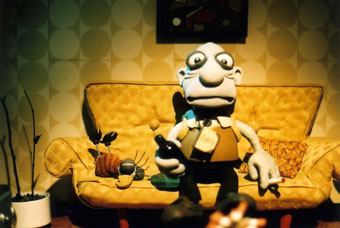
Adam Elliot, Harvie Krumpet, 2003
Adam Elliot is being trumpeted as Australia’s most successful short filmmaker. In June, his 23-minute claymation, Harvie Krumpet (2003, 23min) won 3 of the 4 major prizes at Annecy, the world’s largest animation festival, making it eligible for Oscar nomination. Harvie also won the Best Australian Short Award at the 2003 Melbourne International Film Festival. But Elliot hasn’t come from nowhere: Harvie is the culmination of a unified aesthetic and philosophy, a project begun in 1996 with Uncle (1996, 6min), the first of a trilogy that also included Cousin (1998, 4min) and Brother (1999, 8min). This extraordinarily detailed and richly observed body of work elevates ordinary characters over extraordinary situations and Harvie’s recent success is an apt tribute to Elliot’s finely tuned sensibilities. I asked Elliot how he became an animator.
When I left school I really wanted to be a vet but didn’t have the qualifications, so I studied graphic design. Then I deferred and ended up hand-painting T-shirts at St Kilda market for 5 years. The lifestyle and money were great, but in the end I thought: “Is this what I’m going to do for the rest of my life?” I always liked animation, but never really aspired to being an animator; I had no idea I’d end up as a claymator. So on a whim I went to the VCA Open Day and applied to the film school; I only got in on the 2nd round after someone dropped out. I wanted to do 2D animation until my lecturers convinced me to turn Uncle into claymation.
SBS is very supportive of Australian filmmakers and have a particular affinity for animation. How did they get involved with Harvie?
SBS bought Uncle in 1997 when I graduated, and have supported all my films with presales and broadcast deals. SBS have really been my saviour and we are very lucky to have them. The AFC put a bit of money into Uncle, and fully funded Cousin and Brother in collaboration with Film Victoria. But with Harvie we went to SBS first and got a presale and an equity investment. We then went to AFC for a third of the money, and to Film Victoria for the final third.
Has knocking them dead at Annecy led to further opportunities?
At Annecy, a major distributor snapped up Harvie, after 2 or 3 were in the running. But winning mainly means we get into more film festivals: we’ll now be invited to screen as opposed to having to submit (and we’ll save a fortune in courier costs). When I first started making shorts, I thought that winning a prize meant that someone would give me a cheque to fund my next film. But it never happens like that. Even if we get nominated for an Oscar, it doesn’t really make life easier. It opens doors a little but you still have to push your way through.
You speak highly of your producer, Melanie Coombs. What’s the value of a good producer?
Melanie is everything I’m not. She’s very good at putting budgets together and predicting how much a film will cost. She supports me on every level of the process. So often a director gets all the attention, but what I do is a real partnership with Melanie. She’s been with me right from the beginning of Harvie, although she approached me back when Cousin came out. She said if I wanted to do a longer format, she’d be really interested in producing—not for any commercial reason, but purely because she’s in love with the artform.
What are you working on now?
I’m writing a claymation series called Urban Eccentrics for SBS. There are 13 5-minute episodes and each is a case study about a real urban eccentric who I’ve had to go out and find, which means I’ve met a lot of interesting people! I’m a very slow writer—I’ve done about 6 of the 13 characters–so I probably won’t finish until Christmas. And then we have to finance it. And that can take a year and we need anywhere between one and 2 million dollars to make it. It’s going to be a big task to raise the money. I’ve got some other half-hour ideas in early development. I’d love to do a trilogy of half-hours, but Melanie says that’s not economically viable! A series is a lot more consumable.
RealTime issue #57 Oct-Nov 2003 pg. 19
© Simon Sellars; for permission to reproduce apply to realtime@realtimearts.net
Lovesick
“I’m working on a theory,” announced a breathless futurologist in a recent edition of Time magazine. “I’m calling it, ‘The Centre is the New Edge’.” And, presumably, vice versa. Doubters should glance over the catalogue for this year’s Melbourne Underground Film Festival, awash with gunfights, skateboard stunts, Nazis, porn…. Festival director Richard Wolstencroft’s semi-literate manifestoes are always good for a laugh, but as an aesthetic provocateur he stands somewhere between Rick the People’s Poet from The Young Ones and the serial-killer buff in the comic-book version of Ghost World, unaware that his hip obsessions are pretty much “the same shit the rest of America is interested in.”
Value judgments aside, one simple truth is clear: in the age of Johnny Knoxville and Eminem, celebrating trash culture is not a radical act. It’s no wonder the festival has resorted to increasingly desperate publicity stunts in order to stand out from the crowd, stirring up “controversies” (amply documented elsewhere) which this year turned the screening program into a virtual sideshow. That promoting the art of cinema was not the main goal was confirmed by the decision to screen almost everything on video rather than film—though to be fair, most of the premieres and all the porn movies, were originally shot in DV format.
Were the new Australian features that screened at the festival “underground”? Per John Howard, a better label might be “aspirational”, with most filmmakers plainly less interested in exploring new aesthetic possibilities than in moving up a division in the only game in town. As in previous years, the program was stacked with show-reel Z-movies like Bullet in the Arse and Reign in Darkness; the former kicks off with a shot-by-shot replica of the credit sequence from Once Upon A Time in the West, while the latter is distinguished mainly by having the entire cast perform in cod-American accents. Shannon Young’s marginally more sophisticated Razoreaters mocks fantasies of “guerrilla filmmaking” by posing as a series of crime-spree videos made by celebrity-seeking terrorists, like John Waters’ Cecil B Demented without the cinephilia. A frame story starring the lugubrious Paul Moder (Sensitive New Age Killer) drains some energy, but overall it’s lively though without any real edge—the tough-guy antics are no more threatening than those in West Side Story, the snickering brutalities clearly a by-product of youthful high spirits and eagerness to please.
If Razoreaters allegorises its makers’ quest for stardom, 2 “small” but intelligent features stood out by dramatising the circumstances of their own production in more nuanced ways. Scott Ryan’s prizewinning The Magician again goes the mockumentary route (a neat dodge to cover a lack of visual style) yet brings an affectionate wit to the normally hateful cliches of the hitman comedy. Ryan succeeds, where others have conspicuously failed, in transferring Tarantino-style banter to an Australian idiom: if the Pulp Fiction formula was Seinfeld plus profanity, here the yakking about hamburgers and Wayne Carey has the pleasing deadpan redundancy of a John Clarke routine. More slyly, the ambiguously evolving friendship between an ingenuous documentary filmmaker and his underworld subject (played by Ryan) allows an ongoing moral interrogation of the genre’s love affair with powerful, violent men.
Good as it is, The Magician still seems intended mainly as a passport to the promised land of the “real” film industry (here or in Hollywood). By contrast, Bill Mousoulis’ typically intransigent Lovesick might be read as an oblique satire on the romantic bad faith that views ‘creativity’ as a path to both authenticity and worldly success. In retreat from perceived social corruption, Mousoulis’ protagonists lock themselves away to pursue dreams of love and art, but as they soon find out ascetic principles don’t equal imaginative achievement and the fulfilment they eventually come to is a strictly private affair. Mousoulis’ minimal, eccentric style correlates with his theme of hermetic obsession to the point where the film becomes a gloss on its own lack of commercial potential—not necessarily a bad thing. Of the MUFF premieres mentioned here, Lovesick alone seemed genuinely indifferent (or hostile) to market expectations–even if less influenced by a tabloid notion of “subculture” than by deified auteurs like Bresson and Antonioni. Could it be the canon is the new underground? Only Time will tell…
MUFF, Melbourne Underground Film Festival, George Cinemas and other venues, Melbourne, June 3-13
RealTime issue #57 Oct-Nov 2003 pg. 19
© Jake Wilson; for permission to reproduce apply to realtime@realtimearts.net
One of the greatest misconceptions about German film is that the term German comedy is an oxymoron. Outside Germany many people tend to associate this cinema with brand name directors who used to produce turgid films, populated by tormented characters who have really bad sex. Yet at the German box office, it’s indigenous comedies that draw crowds, and in the 1990s at least, comedies of the sexes, like Rossini—Or the Deadly Question of Who Sleeps with Whom (Helmut Dietl, 1997), were among the most profitable local productions.
The BMW Festival of German Films organised by the Goethe Institut showcases a number of recent comedies, some whimsical, some major box office hits: it also provides Sydney and Melbourne audiences with access to award-winning German dramas, shorts and low budget features. This year the festival opened with full houses for Good Bye, Lenin! (Wolfgang Becker, 2002), a mischievous comedy highlighting the absurdities surrounding the fall of the Wall and East Germany's bungled initiation into capitalism. Here Becker works adroitly within the genre of the “unification comedy.” Evidently millions of Germans are amused by the suggestion that unification is, after all, something of a joke: Good Bye, Lenin! broke the box office barrier of 6 million domestic ticket sales, something local productions rarely do.
Becker is among a group of recently emergent directors, based in Berlin. His modestly budgeted features have picked up a bag-full of prizes. National film prizes are always prestigious, no matter where they are awarded, but in Germany they carry with them added benefits that would make Australian independent filmmakers drool. Apart from opening up more funding agency doors and coffers, German film awards usually carry with them prize monies unheard of in this country. Some prizes, like those awarded Good Bye Lenin!, carry with them hefty monetary bonuses of about $5 million (www.deutscherfilmpreis.de/filmpreis/ index.html).
Becker elicits superlative performances from his cast, which includes the acclaimed East German actor Michael Gwisdek and the young prize winning talent, Daniel Bruehl, who was guest of the BMW Festival last year and star of the deliciously comic no-budget, film school feature, No Regrets (Benjamin Quabeck, 2000).
Good Bye Lenin! sees Bruehl in the role of Alex, a young East Berlin man adapting to life in unified Germany as his ailing mother lies comatose in hospital. When she regains consciousness, she is unaware that the Socialist regime has collapsed and the ideals of the state have been abandoned and discredited. In an effort to avoid the risk such a major shock may have upon her health, Alex strives to maintain the fiction of the GDR, literally restaging aspects of domestic life under the old regime for the benefit of his incapacitated mother. He provides her with an illusion of continuity by reconstructing what has been dismantled. Alex goes to ingenious lengths to console his mother by rationalizing the increasingly conspicuous presence of commodities and signs of corporate capitalism, previously deemed ‘degenerate’.
The festival highlighted the debut work of other emerging filmmakers who have succeeded in navigating the funding agency networks of the Federal Republic. Their films emerge with a remarkable vibrancy despite tortuous dealings with state funding agencies. Suelbiye V Guenar’s, Karamuk (2002) was one such impressive feature debut. Her drama focuses on the turmoil and yearnings of a rebellious teenage girl, Johanna, and presents a sensitive, compassionate portrait of her attempt to secure a cultural identity.
A package of film school shorts, titled Next Generation 2003, was also included in the festival and initially selected for screening in Cannes. Some of the shorts, like Cluck Cluck (Olaf Encke, 2001) and Knight Games (Sven Martin, 2003), are assured in their reliance on absurdist humour and wild flights of fantasy. The Day Winston Ngakambe Came to Kiel (Jasper Ahrens, 2003) takes a comic swipe at xenophobia, effectively satirising colonialist stereotypes and assumptions.
One short, Fetish (Richard Lehun, 2002), received a lucrative federal short film prize valued at around $60,000. Yet this was one of the weakest in the package, falling into the same trap as any number of Australian film school shorts. And that is depicting “old people” as lunatics who are either a) eccentric in a harmlessly regressive and endearing way, or b) haunted by some dark secret that provides opportunity for heavily stylized flashbacks, oozing with ambience and menace.
With its suburban focus and whimsical recollection of a fleeting incident from childhood, Oliver Held’s Spring (2003) may invite comparison with the award winning Australian short, Cracker Bag (Glendyn Ivin, 2003.) Spring brims with the manic energy and irrepressible curiosity of childhood, auspiciously evocative of the student films of Jane Campion. Like many other films screened during the festival, Spring is nothing short of tantalising.
BMW Festival of German Film 2003, Melbourne, Sydney 21-31 August.
RealTime issue #57 Oct-Nov 2003 pg. 20
© Leonie Naughton; for permission to reproduce apply to realtime@realtimearts.net
Light bulbs, goldfish, skateboards and Starbucks. Welcome to the latest in new media at Sydney’s Museum of Contemporary Art. Primavera is currently showcasing the work of Australian artists under the age of 35 and it’s a volatile blend. From Daniel Crooks’ angsty jagged/fluid explorations of inner city journeys to Indigenous artist Jonathan Jones’ austere beauty of bulbs and cords, the exhibition aims to explore what it is that defines new media with its intercutting of sound, performance, video art, computer aesthetics and everyday objects.
Tracking time
Entering Alex Davies’ Filter Feeder I am immediately drawn past the projections to the centre of the room. A fishbowl, goldfish swimming happily, children peering in. Gradually the large wall to ceiling projections envelope—hues of yellows and blacks, vertical and horizontal holds—with their strange static/movement and the occasional appearance of a ghostly fish. It soon becomes apparent that it is not my movements that are triggering the changes in the projections—but the fish’s. The sound, too, is what I imagine they can hear, water slapping against the sides, muffled and hollowed-out voices, contained, like those at a shopping mall or an airport. The goldfish bowl becomes a jewel, the light of the projections refracted in beams of intense green light. And as I listen, I am being absorbed by this strange waterworld where the ceilings and floors glide across shiny surfaces. Am I becoming a character in Richard Flanagan’s Gould’s Book of Fish, suddenly desperately up against the other side of the glass?
Daniel Crooks knocks me out with his Time Slice interpretations of moving through Melbourne. Six monitors line up and his video art fluidly moves across the screens. Each segment—train, tram, lift, a pan around a market—uses different computer effects. A view from a train is jagged, relaying how your eye fixes on points, playing catch up in a journey. Looking into the eyes of other people as they look out train windows is spooky, freakish, as if intruding on something private. Layers of bridges and tracks overlap and unfold. A lift and its occupants become amorphous, Baconesque blobs, floating in and out, the lift door like the zip in a pair of Levis, opening and closing to accommodate the 9-to-5 set. It’s a den of pleasure, occasionally grotesque, often erotic, as people glide through. A tram image infinitely reproduced becomes a tidal wave of transformations, a new iconic landscape. I can’t wait to see this work again. Coming soon to a television screen near you when the advertisers discover it.
Adam Donovan’s Heterodyning Cage and Stephen Honegger and Anthony Hunt’s collaborative installation Container both use a computer game aesthetic to implicate the viewer with varied results. Decked out in 3D glasses and moving through Donovan’s industrial space alone I just couldn’t tell whether the work was responding to me as it should. Teenagers ahead of me were having a great time, the boy running around, the girl in the wings laughing and screaming, “What if you jump!” I wander, tracked by cameras that change the perspective of the projected land/soundscape—a warehouse environment touched by lightly falling snow. A character on the screen, a dark shadow of a man’s head, gauges my behaviour, constantly looking over his shoulder. Am I getting him or is he getting me? We both leave feeling paranoid. In Container a large shipping container is converted to a gaming room where I become the central character, breaking into the MCA. Roaming its empty corridors, grabbing a gun, suddenly I'm implicated in murder. There’s blood on the walls. Who have I killed? The curator? The artist? There’s a dab of humour and irony here but no tension. This work is the beginning of something good but it needs more development. It would have been better with the door closed.
City ballet
I love and fear the rooms behind the black curtain, crossing the threshold of digital comfort. With anticipation I pull the curtain across, always hesitant before walking in. Others take an even safer route, gauging from the door whether it’s safe before moving on. I love that moment as your eyes adjust, sensing others in the room, shifting slowly to a seat.
Mari Velonaki’s Embracement captures the shiftiness of a particular relationship—the older and younger woman. A collaboration with the Australian Centre for Field Robotics at the University of Sydney, performers, Melpo Papadopoulos and Leah Grycewicz stand a concentrated distance apart on a crystal screen, their reverse images projected onto other walls. The younger woman lunges forward to hug the older woman. She repeatedly hugs her but each movement is subtly different. Is it a bear hug given to a mother or a stranglehold meted out to a lover? The line between affection and violence is crisscrossed, the lunge betraying anger/fear/longing, tender tension, a showdown and challenge that all relationships must negotiate.
Another man plays out every possible nuance of a relationship in Shaun Gladwell’s large video projection taken from the series Kickflipping Flaneur. Set against a mural at Bondi beach, a skater performs an extraordinary duet with his board. Delicate turns, using all the edges, flipping over to caress the wheels, he falls. Sometimes he’s not there. It’s slow-mo ballet, steady, repetitive and refined, rather than the full tilt of frenzied macho-dom usually seen in documentaries on skate culture. At times his shadow becomes part of the dance too and his board is end-to-end vertical while he teeters on his toes—the new en pointe. Jonathan Jones’ work is about connections and extensions too. A wall of light bulbs hangs off extension cords, the lights switching on and off, triggered by your footsteps. Almost imperceptible when it first happens, a gentle flickering. The heights of the bulbs vary, based on Bondi’s night-lights. Jones’ work is comforting, like the flick of a lamp switch in your home at the end of a hard day; I feel bathed in light as the bulbs give off fireside warmth. And talk about connections. How many light bulb associations can you think of? I count them as I walk its length. It’s a work I would like to take home.
The most entertaining exhibit is The Kingpins’ performative video installation Welcome to the Jingle. Four drag kings (Emma Price, Katie Price, Techa Noble and Angelica Mesiti) take on the ultimate challenge, to be the ugliest males they can imagine. These pimply blond mustachioed fitness fanatics with a Kath and Kim aesthetic reclaim the night, jogging in green satin sweatshirts in synch to the beats of Sydney’s streets. But they’re not pretty faces (as Kath would say); they manage to incorporate the political into their silliness. Their marathon running always leads them to Starbucks cafes, a stylised protest against the blandness of global conglomerates that specialise in coffee but can’t make it. Reminiscent of the genius of the Fat Boy Slim video clip Praise You where Spike Jonze leads a wonderfully incompetent jazz ballet dance troupe in the middle of a cinema queue, it’s priceless watching coffee slurping customers trying to maintain that look of someone desperately trying not to look, perfected by commuters all over the world so they don’t have to engage with life’s unexpected and threatening moments. With a glam rock/wrestling group as their coach shouting out variations of Gallipoli’s “what are your legs” dialogue and a hyper version of Jean-Michel Jarre’s accompanying soundtrack, The Kingpins put into performance form what we have all feared: a middle-aged Mark Lee, still trying to do the same moves on his ‘steel springs’, not recognising that he is past it. As I walk past the Starbucks in Circular Quay I see their blond ghosts moving in perfect time.
In Primavera, all the artists are immersed in the city landscape, illuminating it in new ways. Funny, challenging, sweet and mocking, the exhibition leads the way to a bright future for Australian new media. It's free so take a chance on it.
Primavera will also feature Re-Squared by Kirsten Bradley and Nick Ritar, a series of audiovisual performances, Australia Square, Sydney, Oct 9 & 16, 8-9:15pm
'Primavera 2003, curated by Julianne Pierce, Museum of Contemporary Art, Sydney, Sept 17-Nov 30
RealTime issue #57 Oct-Nov 2003 pg. 21
© Kirsten Krauth; for permission to reproduce apply to realtime@realtimearts.net
SBS and SA Film Corporation have just announced the 9 emerging film, television and new media practitioners who will be working full time in the My Space is an Amazing Place production lab at the SA Film Corporation for 20 weeks. They are Jain Moralee, Amy Gebhardt, Luke Gibbs, Karyn Lanthois, Simon Michelmore, Jason Ramp, Will Sheridan, Rudi Soman and Hugh Sullivan. The team will produce 25 innovative, multiplatform pieces for both TV and the web Each clip will be a personal tour of a place that is special or unique to the person who submitted the story idea-their town, suburb, street, room, their head space.
The production lab is now seeking stories about your amazing space for broadcast on SBS TV and online. Community-focussed or intimate submissions are invited from men, women and children all over Australia. To submit a story, go to www.sbs.com.au/myspace [no longer functional]
RealTime issue #57 Oct-Nov 2003 pg. 22
© RealTime ; for permission to reproduce apply to realtime@realtimearts.net
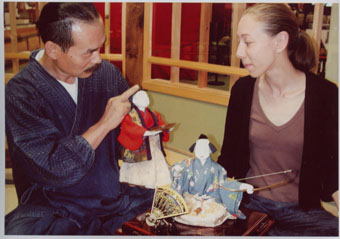
Shobei Tamaya IX & Kirsty Boyle
photo Yuji Hiraiwa
Shobei Tamaya IX & Kirsty Boyle
The challenge of applying for financial support to make work is familiar to most practicing artists. Apparently difficult application forms and complicated budgets can deter potential young candidates. RUN_WAY, offered by The Australia Council’s New Media Arts Board, is an attempt to overcome some of these obstacles by giving young and emerging artists (30 years and under) the chance to apply for up to $5000 towards their own unique professional development scenario using an uncomplicated application process. I spoke to Assistant Program Officer Reed Everingham who has guided and nurtured the program through all 3 funding rounds. Everingham is genuinely passionate about RUN_WAY and the way it has affected its many recipients and stimulated the new media arts field in general. “I’ve seen RUN_WAY really elevate artists and make them feel much more confident about their arts practice.”
As part of the Federal Government’s Young and Emerging Artists’ Initiative administered by The Australia Council, RUN_WAY is based on the Skills and Arts Development funding model but with a much simpler and more direct application procedure.” Making the whole thing less bureaucratic, with less red tape,” says Everingham. “I wanted to say to people, just give us 2 pages on what you really want to do and why you want to do it, and a CV.” This straightforward approach obviously appealed–the New Media Arts Board has processed 101 applications in total. The board has also seen a positive flow on from RUN_WAY into the regular funding rounds with many successful applicants proving themselves in an extremely competitive field. The scheme also educates Council artform board members about youth practice by giving them greater exposure to young artists’ projects.
As soon as the New Media Arts Board announced the first round of 15 successful applicants in 2002, RUN_WAY became the hot topic of conversation in young artist circles. Everingham says, “The first round of recipients did a great job advocating the initiative, and mostly by word of mouth.” Successful RUN_WAY recipients have traveled across Australia, to Asia, Europe, the UK and the US attending conferences, festivals, forums, symposiums, exhibitions and engaging in residencies and mentorships. 44 Australian artists and artsworkers have been supported so far. Only just scraping in to this age bracket, receiving a RUN_WAY grant was enough to have me running around like I was 25 again!
I think one of the most exciting aspects of RUN_WAY has been the encouragement to ‘think outside the square’, to design a skills and arts development scenario that really suits your individual needs. Most artists I know are big dreamers and this invitation seemed to strike a chord with many. I asked artist Kirsty Boyle whose RUN_WAY grant allowed her to follow her dream of studying under Shobei Tamaya, a 9th generation, karakuri ningyo craftsman, what appealed to her most about the initiative. “I liked the freedom of not being confined, and being able to travel overseas,” says Boyle. “If I hadn’t traveled to Japan I would never have been able to study the karakuri tradition. As there is only one living master left it was all the more exciting meeting him and seeing him work in his workshop.” Karakuri ningyo is a Japanese mechanical doll and puppetry tradition that dates back to the 12th century. Since returning to Australia, Boyle has become a Cultural Contact at the Consulate General of Japan’s Information and Cultural Centre, giving guest lectures on her experiences and has a show in October at Melbourne’s Westspace. “It’s been great to come back and have all this new knowledge and inspiration,” she says.
In another out of the ordinary, self initiated program, artist Boo Chapple will undertake an 8-week residency focusing on the areas of cell culture and neurophysiology at the symbioticA lab in Perth exploring what she describes as “the connection between the body electric and sonic/ digital architecture.” Not all RUN_WAY recipients Skills and Arts Development programs were so unusual. The allure of well-established, large-scale international arts festivals like ISEA, ArsElectronica and Transmediale continue to attract many applicants and for good reason. Artists and artsworkers in Australia are aware that far from these shores (or sometimes just on the other side of the country) exists the legendary glamour, fame, fun and fortune (and of course critical debate and discussion) of the world’s leading new media arts festivals. Events like these, I can now say from personal experience, can turn any dull town into a throbbing, pulse point of artistic fever and inspiration. By giving young and emerging artists and artsworkers the chance to attend these festivals, RUN_WAY provides the unique opportunity to experience all this first hand and perhaps most importantly to meet and engage with their contemporaries.
RUN_WAY also encourages young artsworkers to extend and enliven their experience and understanding of interdisciplinary and new media arts practice. Joni Taylor, another first round RUN_WAY applicant, writer and former Electrofringe director, used her grant to attend the European Media Arts Festival (EMAF) in Osnabruck and other smaller scale events throughout Germany. Taylor made valuable contacts in the international new media art scene, some of whom became guests at Electrofringe. One fortuitous meeting was with Jon Dekron, a leading Berlin video performer, famous for his spectacular live shows created using his own video mixing software. Dekron’s enthusiastic and generous approach was one of Electrofringe 2002’s highlights. In RUN_WAY’s latest round Marcus Westbury, Artistic Director of Melbourne’s Next Wave Festival will have the opportunity to experience 2 other important international events, Ars Electronica in Austria and the Next 5 Minutes festival in the Netherlands. This will no doubt lead to more stimulating cross cultural exchange and collaboration opportunities for Marcus and the many other people involved in Next Wave.
Everingham has good news, “We are offering RUN_WAY again as part of our May 2004 application round…let people know about it.”
RealTime issue #57 Oct-Nov 2003 pg. 24
© Anna Davis; for permission to reproduce apply to realtime@realtimearts.net
Clunking and clanking, metallic echoes, submarine-like blips and beeps, the faint whir of a distant turbine. With these eerie, disembodied noises Temporal Intervals announces itself. As you descend the stairs at the Powerhouse, your eyes meet a video image of deep red and black shapes mutating, pulsating and replicating to these enigmatic sounds.
Artist Trish Adams’ installation consists of a digital video loop, here projected on the wall of the Visy theatre, and a complex interactive counterpart with a foot pedal-triggered kymograph and webcam feeding back to a website. The kymograph is a familiar contraption even if its name is not. An instrument for recording various time-related events, it consists of a revolving drum with a record sheet on which a stylus or penpoint travels in response to stimulus. In Temporal Intervals, the kymograph is recontextualised as a mark-making device; as an artist’s rather than scientist’s tool. The participant depresses the pedal, generating a twitch in the machine which is recorded onto the paper and duly transmitted to the website. The trace of that action forms part of the (continuously evolving) cross-media artwork. New media art’s “marriage of 3 cultures”–art, science and technology–is explored in a directly sensual way with the kymograph/website configuration, but Adams’ inquiry into the aesthetic dimensions of the scientific instrument also results in a proficiently staged, somewhat more abstruse video artwork, Dolly 00121.
In this video loop, humanoid figures, some foetus-shaped, some resembling children’s paper cutouts, merge with images of dividing and replicating cultured cells scraped from the artist’s body. This miscroscopy work, which, abstracted from the scientific context has an exquisite beauty of its own, gains new dimensions with the use of Sabattier-like effects and when dissolved with images of the rotating drums and rolling paper of the kymograph. The physical resemblance between these drums and the power turbines of the Powerhouse’s previous incarnation is uncanny; together with the neighbouring set-up of the kymograph and webcam, the artwork constitutes an intriguing, multivalent discourse on electricity.
The early uses of the kymograph to investigate the vital force of life saw its application in, initially confirming, then measuring and quantifying bioelectricity. Now, centuries later, participants intervene in the artwork, receive visual confirmation of the electrical action of their own nervous systems and leave a physical trace of that action. Electricity is the work’s matrix and motif and the kymograph is the fulcrum of this installation. In a society grappling with issues in biotechnology, the artist can be seen to operate as a kind of social kymograph, responding to stimulus and recording, scribing those concerns in a concrete record. Temporary Intervals joins an increasingly important conversation about science and culture, nodding toward questions of scientific determinism and whispers about post-humanity. The video work is particularly successful in its aesthetic response to scientific developments, but is the richer as an art experience for its collocation with the kymography. Interbreeding the physicality and permanence of mark-making with the ephemerality of the data age, Temporary Intervals represents a fascinating and convincing synthesis of analogue and digital concerns.
Temporal Intervals, artist Tricia Adams, Brisbane Powerhouse, Visy Foyer & Stairwell, June 23-July 7
RealTime issue #57 Oct-Nov 2003 pg. 24
© Danni Zuvela; for permission to reproduce apply to realtime@realtimearts.net
Warlpiri Media Bush Mechanics 2002
Plaything is this year’s futurescreen event, produced by Sydney’s dLux media arts. As well as a symposium, it features an exhibition showing the work of those experimenting with digital games. The exhibition, opening on October 8, will present 9 works of “game art.” I wonder about the adequacy of this term: combining “game” with “art” continues to generate a certain frisson. However it seems important not to submerge the exciting variety of work under a single, rather utilitarian term. The title’s emphasis on play is helpful here. There is something very heartening about being encouraged to play—to mess around and get dynamic—particularly when supplies of energy and creativity are running low elsewhere. But play is also not easily containable.
Curator Josephine Starrs suggests that the proliferation and ubiquity of games make them a natural form for artists to turn to, work with and comment on at present, and she has assembled works showing various engagements with the form. Local and international content is represented, from artists located both within and outside the commercial industry. Installing these diverse works in one space should manifest several of the tensions around contemporary games development, including questions about relations between commercial and independent developers and artists.
The humorous premise of Natalie Bookchin’s Metapet is that players are managers in biotech companies, where the workers have been genetically modified, injected with an obedient dog gene. This Shockwave game offers an ongoing, Tamagochi-like experience where players are challenged to get the most from their metapet, without them cracking up. With an engaging interface and a range of quirky motivational incentives, the game clearly comments on contemporary work regimes. But strategic management never looked so much fun, making me wonder how much irony might get lost in the course of play. gameLab’s Arcadia also seems to relate to contemporary cultures of productivity and performativity, though in quite different ways. It combines 4 retro 80s games in one. Players are challenged to keep up with them all at once, perhaps the ultimate multi-tasking feat. The remarks of players trying out the free version of Arcadia make an interesting commentary—and not just on the game. Reviews posted at the Shockwave site are split between those who say it’s too hard so don’t bother trying, and those who claim it’s too easy and gets boring. Such disparate assessments lend weight to the claims of scholars like Jason Wilson who argue that games have presaged new attentive regimes. Personally, I like “shrimpy’s” assessment: “wow!! this game is CRAZY!! and i like it!!” (www.shockwave.com).
Beijing artist Feng Mengbo’s ah_Q (movie) and Julian Oliver’s QTOTH: Quilted Thought Organ each critically reconfigure aspects of commercially available games and engines. Mengbo has been working with games and specifically Quake, for several years. An earlier work, Q3, saw him star as an in-game war correspondent, interviewing combatants in the popular first person shooter (FPS). In Q4U, a sequel to Q3, all the characters are skinned as Mengbo, creating an uncanny effect that is intensified when the artist performs the piece in real time and effectively kills avatars of himself. ah_Q (movie) is an 8-minute machinima of recorded Q4U gameplay, in which the artist is an avatar inside the gamespace, this time holding a video camera as well as his weapon.
From this recognisable Quake universe, Julian Oliver’s QTOTH totally alters the appearance of Half Life of which it is a hack. The walls and tunnels appear to consist of lines and grids of colour, more abstract and less grey than your average FPS. But apart from this visual aesthetic, Oliver has turned the engine into a musical environment, so that objects and actions performed in the game trigger sound samples. Oliver is particularly concerned with place, and this hack creates a remarkably different sense of space and place. I’m looking forward to seeing the transformations it effects when installed in First Draft gallery. For me, QTOTH points to the range of possibilities for game environments and the ways they can engage users. This is perhaps a point it shares with Mary Flanagan’s new work Curtain which promises to generate a game environment entirely out of text. Though Curtain was not available at the time of writing, Flanagan’s earlier work [search] will be familiar to some from its recent showing at Melbourne DAC.
Two works in Plaything combine game world references with material forms on the one hand, and ‘real-world’ footage on the other. Troy Innocent’s Semiomorph (reviewed in RT #46 p21) investigates the icons and ‘language’ of video games. In this game, the environment is alternately represented as text, diagram, icon or simulation, with 4 corresponding game characters. The goal is to collect enough energy points to create a significant shift in the graphical representation of the world. Interestingly, the cute, bright icons also exist sculpturally, as plastic models which audiences interact with via sensors. I like the idea of giving these colourful others a scale and materiality close to that of gallery visitors. According to Innocent, giving virtual shapes a material form “make[s] virtual reality more real and less virtual.” But while transposing these others into physical form changes our relation to them, it underlines the fact that our engagements with avatars in games spaces are also aesthetic.
The real/virtual status of Zina Kaye’s Observatine initially had me perplexed. In Plaything, Kaye will show edited footage shot from a remote controlled aeroplane flying over Western Sydney. Starrs explains that the grassy areas and treetops we see from this god’s eye view almost look as if they could be part of a rendered landscape in a game (albeit one without characters). But it is not a game, nor a flight sim; rather, it recalls a certain playfulness, perhaps like the hobbyist’s passion for their playthings.
Bush Mechanics, a Flash game designed by Gordon Jangala Robertson, Robin Cave and Donovan Jampijinpa Rice, evidences yet another angle on play. Though the design of this Flash game is simple, it couples the inventiveness and trickster elements from the television series with a whimsy evident in the tasks players must undertake and in how they meet their fate when they fail. Let’s just say the challenges of the Tanami Track were too much for this player, who didn’t manage to get the band to the gig on time and got abducted by aliens several times along the way.
The final work in the show is Rez, a standout commercial release for the PS2. Apart from the familiarity of its promise to “shock you out of your senses”, Rez combines a highly innovative storyline with quite beautiful, at times constructivist visuals and sounds which players cannot help but be moved by. Though it’s not the first time Rez has been shown in a gallery, its inclusion raises several points. Importantly, it recognises the artistry of those working as commercial game artists. Judging from the discussion generated by an April BigKid.com.au editorial, which opined that “industry heavyweights…are clueless about true creativity, and rarely have the ability to recognise it when they see it,” the commercial confines generated significant frustration. Without singling Rez out, its creation by “United Game Artists” makes the point poignantly: who are UGA anyway?
The Plaything symposium will be a great opportunity to discuss these issues and more. Expect more than the usual talkfest and maybe even some fun and games.
–
Plaything, First Draft Gallery, Sydney, October 8; symposium October 10-12 www.dlux.org.au
RealTime issue #57 Oct-Nov 2003 pg. 25
© Melanie Swalwell; for permission to reproduce apply to realtime@realtimearts.net
Art + Film exhibition staged at Melbourne’s Centre for Contemporary Photography (CCP), curators Natasha Bullock and Brendan Lee explain that they aimed to explore “the pervasiveness of the cinematic medium and the dynamic effect it has had on contemporary art in Australia.” Yet in his catalogue essay Adrian Martin sees the exhibition not only as a response to the ubiquity of the cinematic image, but rather an acknowledgment that cinema can no longer stand alone as a fetishised cultural object. Paraphrasing Raymond Bellour, Martin characterises the contemporary era as a time of “between-images”, comprising “an audio-visual culture based less on the properties of any specific medium in isolation, and more on the passages and exchanges between them.”
Martin’s observation is important. The works in Art + Film don't indulge in the kind of postmodern appropriation of cinematic forms and conventions that characterised the work of artists like Cindy Sherman in the late 1970s and early 1980s. Cinema for these artists has become an increasingly indistinct part of an all-encompassing cultural milieu characterised by the continuous exchange of images between mediums, contexts and technologies. Given the limited confines of the CCP, Art + Film was only ever going to interrogate this cultural terrain in a modest fashion, but the works on display approached the theme in several thought-provoking, concise and often amusing ways.
The first room contained a series of works examining the intersection of cinema and other forms of technology. Brendan Lee’s Shoot Me for example, employed a simple idea to effectively explore the connections between camera technology and military tools of destruction. A series of black lines on a white wall formed a rectangle, reminiscent of a camera viewfinder. A small disk in the middle immediately shifted the impression to a gun-sight. Upon closer inspection, the disk revealed itself to be a tiny circular screen, showing computer-generated images of a pistol discharging a bullet in slow motion.
In the second room, the viewer entered a hushed, darkened space encouraging the contemplative state usually associated with the cinema experience. In one corner was the exhibition’s largest work, SOWA, by David Noonan and Simon Trevaks, an installation comprising a partitioned space, with a large screen along one wall. The other walls were lined with wallpaper. On screen a video loop depicted a young woman sitting in a room lined with the same wallpaper as the viewing space. At first she read a book, but soon stood and moved across the room as if responding to a call. She paused briefly on the edge of the room, before crossing into a forest, where she was led through the trees by a wolf-like creature. Although SOWA’s dream-like imagery was somewhat cliched, the woman’s constantly recurring passage between domestic space and forest dream-scape, as well as mirroring our physical viewing space on screen, intriguingly suggested cinema’s ability to simultaneously evoke both a material “real” and a state of imaginative dreaming.
However, it was a pair of paintings by Lily Hibberd, from a series referencing iconic sci-fi classics like Close Encounters of the Third Kind, that most successfully explored the inter-penetration of cinema and other art forms. The first, Blinded by the Light [see cover], depicts a young woman grimacing as she shields her face with her arm. In Perpetual Dream-State, a woman with her back to us looks towards a white screen. In her arms she holds a young child, who she seems to be half attempting to shield from the screen. The child nervously clutches its mother’s dress. Both these works were hung in darkened spaces, powerfully lit by a spotlight, which periodically faded to darkness. When unlit, the white screen of Perpetual Dream-State appeared dull and yellowed, but as the lights reached full strength, the screen glowed with a burning white intensity that was difficult to look at. Similarly, the young woman in Blinded by the Light became bathed in a white glare that forced the viewer to squint.
The oil and phosphorescent paintings captured the hypnotic illumination of the cinema screen, as well as cinema’s reliance on the ephemeral qualities of light to bring its images to life. More crucially, at the level of form and content, these 2 paintings illustrated the concerns running throughout Art + Film. The workings, conventions and iconography of cinema have penetrated every form of image-making, while the parameters of what we call cinema have been shattered in turn by the pervasiveness of images and image-making technologies across every aspect of our daily lives. Hibberd’s paintings convey the spellbinding allure of the image, as well as its blinding ability to overwhelm us through its sheer pervasiveness in the contemporary world.
Art + Film, Centre for Contemporary Photography, Melbourne, July 24-Aug 24
RealTime issue #57 Oct-Nov 2003 pg. 26
© Dan Edwards; for permission to reproduce apply to realtime@realtimearts.net
Research and the Arts is the funding trend of the decade. In a similar way to ‘Marketing the Arts’ in the 80s and ‘Managing the Arts’ in the 90s, research is currently the rubric by which public funds resource the media artist. Linkage and Discovery are some recent terms which, while encouraging cross-disciplinary collaboration between and within many universities around the country, beg the question, how are individual practitioners faring? And are the arts audience and the taxpayer getting bangs for their bucks? The short answer is that it’s too early in the decade to tell, though a handful of practitioners have accessed resources that seem not to have been there before.
The University of New South Wales established the iCinema Centre for Interactive Cinema Research, joining the School of Computer Science and Engineering with the College of Fine Art in Paddington during 2001. A $1.25mil Australian Research Council (ARC) Federation Fellowship brought iCinema’s Executive Director Professor Jeffrey Shaw, lately the director of the ZKM Institute for Visual Media in Karlsruhe, back to his native Australia after more than 30 years in Europe. Teaming up with the Centre’s co-director and ARC Fellow, Dr Dennis Del Favero, and an executive of professors drawn from several UNSW Schools, iCinema has dazzlingly demonstrated the way to forge allies, partners and members, regionally, nationally and internationally, into a strategic entity to tackle “…the comprehensive domain of the moving image that is currently being radically redefined and extended by the variegated potentiality of new digital media systems.” (www.icinema.unsw.edu.au).
With an initial budget of some $2.5 million over 5 years from UNSW, iCinema has established a suite of rooms in Paddington and a laboratory 4 km across town on the main campus in Kensington and will shortly have a fibre-optic working ‘window’ connection (iC_Link) between at least 3 spaces. The link will also be used in the development of Conversations, an ARC Discovery funded project ($330,000) in which “…4 remotely located stations, connected by a high-bandwidth network will enable 4 viewers to be simultaneously immersed in and navigate…a digitally generated 3 dimensional environment comprising computer graphic, photographic and videographic components.
“Conversations is also the story of Ronald Ryan and Peter Walker and their escape from Pentridge Prison in Melbourne on December 19, 1965…the escape will be re-enacted and recorded as a full 360-degree panoramic film. Placed virtually in the centre of the film set, players view the film using the trackers and head-mounted displays to choose their own points of view…Players are able to conduct investigations into the Ryan case, sometimes together, at other times alone. As they do so, by virtue of their actions and utterances, players will permanently change the virtual world.”
Research Professor Ross Gibson from University of Technology Sydney brings his expertise as media producer, historian and proto-criminologist to join collaborators Shaw, Del Favero and Ian Howard, Dean of COFA. Working as art directors, designers and scriptwriters, the specifications for the code and the content it controls are passed to a production team comprising professional staff, postgraduate and graduate students Conversations is headed for the first public outing in September 2004, linking Melbourne, Sydney, Perth and Brisbane.
Interactive narrative space also links projects already exhibiting (Del Favero’s Pentimento and Shaw’s Place-Urbanity have been at ACMI and ZKM) and the first iteration stage of T_Visionarium, an extended virtual environment, in Europe at the end of the year (another ARC grant $300,000). And in the tradition of university-based research, the un-imaginable DVD-ROM and Book combination is due next year, to be published as the first in iCinema’s Digital Art series on the occasion of an international conference.
What about bringing projects to iCinema? Shaw and Del Favero warn that it’s early days. Shaw says, “iCinema is at a moment when we begin to build a history of resources and competencies, technical and intellectual–a set of internally and externally funded research projects–a location with enabling infrastructure. This will allow us to increasingly offer access, certainly advice, to other researchers, artists, students.” The plan is to set up the first ARC Creative Arts Centre of Excellence with a $10 million budget over 5 years.
Where is the work headed? Why cross-disciplinary co-operation? Del Favero says, “What are the mechanisms for the structuring of meaning, say of an hallucination? How are these embodied digitally? While artists would be interested in effect, atmosphere and mood, cognitive scientists, for instance, would be more interested in the cognitive processes at work…clearly there are differences in approach but the interesting things are the points of intersection. If those points can be framed in a collaborative exploration, would it arrive at different, possibly more engaging conclusions? It means we can start treating experience in a more coherent way rather than in the conventional schizophrenic schema which splits the subjective and objective–the purely subjective encounter of the artist versus the clinically objective analysis of the scientist. In what ways does the digital allow the two approaches to co-operate? This is the question that fascinates us…”
RealTime issue #57 Oct-Nov 2003 pg. 26
© Mike Leggett; for permission to reproduce apply to realtime@realtimearts.net